US8663858B2 - Fuel cell system and method for operating the same - Google Patents
Fuel cell system and method for operating the same Download PDFInfo
- Publication number
- US8663858B2 US8663858B2 US12/529,798 US52979808A US8663858B2 US 8663858 B2 US8663858 B2 US 8663858B2 US 52979808 A US52979808 A US 52979808A US 8663858 B2 US8663858 B2 US 8663858B2
- Authority
- US
- United States
- Prior art keywords
- fuel cell
- fuel
- cell stack
- voltage
- current
- Prior art date
- Legal status (The legal status is an assumption and is not a legal conclusion. Google has not performed a legal analysis and makes no representation as to the accuracy of the status listed.)
- Expired - Fee Related, expires
Links
Images




Classifications
-
- H—ELECTRICITY
- H01—ELECTRIC ELEMENTS
- H01M—PROCESSES OR MEANS, e.g. BATTERIES, FOR THE DIRECT CONVERSION OF CHEMICAL ENERGY INTO ELECTRICAL ENERGY
- H01M8/00—Fuel cells; Manufacture thereof
- H01M8/04—Auxiliary arrangements, e.g. for control of pressure or for circulation of fluids
- H01M8/04298—Processes for controlling fuel cells or fuel cell systems
- H01M8/04313—Processes for controlling fuel cells or fuel cell systems characterised by the detection or assessment of variables; characterised by the detection or assessment of failure or abnormal function
- H01M8/04537—Electric variables
- H01M8/04604—Power, energy, capacity or load
- H01M8/04619—Power, energy, capacity or load of fuel cell stacks
-
- H—ELECTRICITY
- H01—ELECTRIC ELEMENTS
- H01M—PROCESSES OR MEANS, e.g. BATTERIES, FOR THE DIRECT CONVERSION OF CHEMICAL ENERGY INTO ELECTRICAL ENERGY
- H01M8/00—Fuel cells; Manufacture thereof
- H01M8/04—Auxiliary arrangements, e.g. for control of pressure or for circulation of fluids
- H01M8/04223—Auxiliary arrangements, e.g. for control of pressure or for circulation of fluids during start-up or shut-down; Depolarisation or activation, e.g. purging; Means for short-circuiting defective fuel cells
- H01M8/04228—Auxiliary arrangements, e.g. for control of pressure or for circulation of fluids during start-up or shut-down; Depolarisation or activation, e.g. purging; Means for short-circuiting defective fuel cells during shut-down
-
- H—ELECTRICITY
- H01—ELECTRIC ELEMENTS
- H01M—PROCESSES OR MEANS, e.g. BATTERIES, FOR THE DIRECT CONVERSION OF CHEMICAL ENERGY INTO ELECTRICAL ENERGY
- H01M8/00—Fuel cells; Manufacture thereof
- H01M8/04—Auxiliary arrangements, e.g. for control of pressure or for circulation of fluids
- H01M8/04298—Processes for controlling fuel cells or fuel cell systems
- H01M8/043—Processes for controlling fuel cells or fuel cell systems applied during specific periods
-
- H—ELECTRICITY
- H01—ELECTRIC ELEMENTS
- H01M—PROCESSES OR MEANS, e.g. BATTERIES, FOR THE DIRECT CONVERSION OF CHEMICAL ENERGY INTO ELECTRICAL ENERGY
- H01M8/00—Fuel cells; Manufacture thereof
- H01M8/04—Auxiliary arrangements, e.g. for control of pressure or for circulation of fluids
- H01M8/04298—Processes for controlling fuel cells or fuel cell systems
- H01M8/043—Processes for controlling fuel cells or fuel cell systems applied during specific periods
- H01M8/04303—Processes for controlling fuel cells or fuel cell systems applied during specific periods applied during shut-down
-
- H—ELECTRICITY
- H01—ELECTRIC ELEMENTS
- H01M—PROCESSES OR MEANS, e.g. BATTERIES, FOR THE DIRECT CONVERSION OF CHEMICAL ENERGY INTO ELECTRICAL ENERGY
- H01M8/00—Fuel cells; Manufacture thereof
- H01M8/04—Auxiliary arrangements, e.g. for control of pressure or for circulation of fluids
- H01M8/04298—Processes for controlling fuel cells or fuel cell systems
- H01M8/04694—Processes for controlling fuel cells or fuel cell systems characterised by variables to be controlled
- H01M8/04858—Electric variables
- H01M8/04895—Current
- H01M8/0491—Current of fuel cell stacks
-
- H—ELECTRICITY
- H01—ELECTRIC ELEMENTS
- H01M—PROCESSES OR MEANS, e.g. BATTERIES, FOR THE DIRECT CONVERSION OF CHEMICAL ENERGY INTO ELECTRICAL ENERGY
- H01M8/00—Fuel cells; Manufacture thereof
- H01M8/04—Auxiliary arrangements, e.g. for control of pressure or for circulation of fluids
- H01M8/04298—Processes for controlling fuel cells or fuel cell systems
- H01M8/04694—Processes for controlling fuel cells or fuel cell systems characterised by variables to be controlled
- H01M8/04858—Electric variables
- H01M8/04925—Power, energy, capacity or load
- H01M8/04947—Power, energy, capacity or load of auxiliary devices, e.g. batteries, capacitors
-
- H—ELECTRICITY
- H01—ELECTRIC ELEMENTS
- H01M—PROCESSES OR MEANS, e.g. BATTERIES, FOR THE DIRECT CONVERSION OF CHEMICAL ENERGY INTO ELECTRICAL ENERGY
- H01M8/00—Fuel cells; Manufacture thereof
- H01M8/04—Auxiliary arrangements, e.g. for control of pressure or for circulation of fluids
- H01M8/04298—Processes for controlling fuel cells or fuel cell systems
- H01M8/04694—Processes for controlling fuel cells or fuel cell systems characterised by variables to be controlled
- H01M8/04955—Shut-off or shut-down of fuel cells
-
- H—ELECTRICITY
- H01—ELECTRIC ELEMENTS
- H01M—PROCESSES OR MEANS, e.g. BATTERIES, FOR THE DIRECT CONVERSION OF CHEMICAL ENERGY INTO ELECTRICAL ENERGY
- H01M2250/00—Fuel cells for particular applications; Specific features of fuel cell system
- H01M2250/20—Fuel cells in motive systems, e.g. vehicle, ship, plane
-
- H—ELECTRICITY
- H01—ELECTRIC ELEMENTS
- H01M—PROCESSES OR MEANS, e.g. BATTERIES, FOR THE DIRECT CONVERSION OF CHEMICAL ENERGY INTO ELECTRICAL ENERGY
- H01M8/00—Fuel cells; Manufacture thereof
- H01M8/04—Auxiliary arrangements, e.g. for control of pressure or for circulation of fluids
- H01M8/04298—Processes for controlling fuel cells or fuel cell systems
- H01M8/04313—Processes for controlling fuel cells or fuel cell systems characterised by the detection or assessment of variables; characterised by the detection or assessment of failure or abnormal function
- H01M8/0432—Temperature; Ambient temperature
-
- H—ELECTRICITY
- H01—ELECTRIC ELEMENTS
- H01M—PROCESSES OR MEANS, e.g. BATTERIES, FOR THE DIRECT CONVERSION OF CHEMICAL ENERGY INTO ELECTRICAL ENERGY
- H01M8/00—Fuel cells; Manufacture thereof
- H01M8/04—Auxiliary arrangements, e.g. for control of pressure or for circulation of fluids
- H01M8/04298—Processes for controlling fuel cells or fuel cell systems
- H01M8/04313—Processes for controlling fuel cells or fuel cell systems characterised by the detection or assessment of variables; characterised by the detection or assessment of failure or abnormal function
- H01M8/04537—Electric variables
- H01M8/04544—Voltage
- H01M8/04559—Voltage of fuel cell stacks
-
- H—ELECTRICITY
- H01—ELECTRIC ELEMENTS
- H01M—PROCESSES OR MEANS, e.g. BATTERIES, FOR THE DIRECT CONVERSION OF CHEMICAL ENERGY INTO ELECTRICAL ENERGY
- H01M8/00—Fuel cells; Manufacture thereof
- H01M8/04—Auxiliary arrangements, e.g. for control of pressure or for circulation of fluids
- H01M8/04298—Processes for controlling fuel cells or fuel cell systems
- H01M8/04694—Processes for controlling fuel cells or fuel cell systems characterised by variables to be controlled
- H01M8/04746—Pressure; Flow
- H01M8/04753—Pressure; Flow of fuel cell reactants
-
- H—ELECTRICITY
- H01—ELECTRIC ELEMENTS
- H01M—PROCESSES OR MEANS, e.g. BATTERIES, FOR THE DIRECT CONVERSION OF CHEMICAL ENERGY INTO ELECTRICAL ENERGY
- H01M8/00—Fuel cells; Manufacture thereof
- H01M8/04—Auxiliary arrangements, e.g. for control of pressure or for circulation of fluids
- H01M8/04298—Processes for controlling fuel cells or fuel cell systems
- H01M8/04694—Processes for controlling fuel cells or fuel cell systems characterised by variables to be controlled
- H01M8/04746—Pressure; Flow
- H01M8/04768—Pressure; Flow of the coolant
-
- Y—GENERAL TAGGING OF NEW TECHNOLOGICAL DEVELOPMENTS; GENERAL TAGGING OF CROSS-SECTIONAL TECHNOLOGIES SPANNING OVER SEVERAL SECTIONS OF THE IPC; TECHNICAL SUBJECTS COVERED BY FORMER USPC CROSS-REFERENCE ART COLLECTIONS [XRACs] AND DIGESTS
- Y02—TECHNOLOGIES OR APPLICATIONS FOR MITIGATION OR ADAPTATION AGAINST CLIMATE CHANGE
- Y02E—REDUCTION OF GREENHOUSE GAS [GHG] EMISSIONS, RELATED TO ENERGY GENERATION, TRANSMISSION OR DISTRIBUTION
- Y02E60/00—Enabling technologies; Technologies with a potential or indirect contribution to GHG emissions mitigation
- Y02E60/30—Hydrogen technology
- Y02E60/50—Fuel cells
-
- Y—GENERAL TAGGING OF NEW TECHNOLOGICAL DEVELOPMENTS; GENERAL TAGGING OF CROSS-SECTIONAL TECHNOLOGIES SPANNING OVER SEVERAL SECTIONS OF THE IPC; TECHNICAL SUBJECTS COVERED BY FORMER USPC CROSS-REFERENCE ART COLLECTIONS [XRACs] AND DIGESTS
- Y02—TECHNOLOGIES OR APPLICATIONS FOR MITIGATION OR ADAPTATION AGAINST CLIMATE CHANGE
- Y02T—CLIMATE CHANGE MITIGATION TECHNOLOGIES RELATED TO TRANSPORTATION
- Y02T90/00—Enabling technologies or technologies with a potential or indirect contribution to GHG emissions mitigation
- Y02T90/40—Application of hydrogen technology to transportation, e.g. using fuel cells
Definitions
- the present invention relates generally to a type of fuel cell system. More particularly, the present invention relates to a type of fuel cell system that temporarily shuts down power generation under a low load.
- a vehicle carrying a conventional fuel cell system when all of the following conditions are met, that is, when the vehicle speed is lower than a prescribed speed, the output power of the motor for traveling and the output power of the motor for driving the air compressor for driving the fuel cell are lower than respective prescribed motor output powers, the brake is ON, and the voltage between terminals of the accumulator is higher than a prescribed voltage, then feeding of the reaction gases to the fuel cell is stopped, and power generation of the fuel cell is temporarily shut down. That is, an idle stop operation is performed.
- Japanese Kokai Patent Application No. 2001-359204 discloses this type of conventional fuel cell system.
- the fuel cell of this type can experience problems relating to the durability of the solid-state polymer fuel cell. That is, when power generation of the fuel cell is shut down, the voltage of the fuel cell stack rises, and the fuel cell stack deteriorates. This phenomenon is considered undesirable.
- Embodiments of the present invention can avoid the problems associated with the conventional fuel cell system discussed above.
- a fuel cell system comprising a fuel cell stack that generates power by electrochemical reaction of the reaction gases fed to the fuel electrode and the oxidant electrode.
- the reaction gas feeding device when the load demand on the fuel cell stack becomes lower than a prescribed level, at least the reaction gas feeding device is shut down to conserve fuel in a fuel conservation operation.
- a controller operates such that during the fuel conservation operation, a current larger than zero is drawn from the fuel cell stack, and the total charge drawn per unit time has a constant or substantially constant value.
- FIG. 1 is a diagram illustrating an example of the relationship between the current during fuel conservation operation and stack deterioration
- FIG. 2 is a diagram illustrating an example of the constitution of the main portion of the fuel cell vehicle employing a fuel cell system according to a first embodiment of the present invention
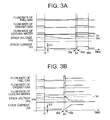
- FIG. 3A is a timing chart illustrating an example of the various control values in the fuel conservation operation cycle in accordance with the first embodiment of the present invention
- FIG. 3B is a timing chart illustrating an example of the various control values in resetting from fuel conservation operation to a normal operation in accordance with the first embodiment of the present invention
- FIG. 4 is a flow chart illustrating an example of control operations performed by the first embodiment of the present invention.
- FIG. 5 is a timing chart illustrating an example of the variation over time of various control values in accordance with a second embodiment of the present invention
- FIG. 6 is a flow chart illustrating an example of control operations performed by the second embodiment of the present invention.
- FIG. 7 is a timing chart illustrating an example of the variation over time of various control values in accordance with a third embodiment of the present invention.
- FIG. 8 is a flow chart illustrating an example of control operations performed by the third embodiment of the present invention.
- FIG. 9 is a diagram illustrating an example of setting the stack current in accordance with the third embodiment of the present invention.
- FIG. 10 is a flow chart illustrating an example of control operations performed by a fourth embodiment of the present invention.
- FIG. 11 is a diagram illustrating an example of the relationship between the internal state of the stack and stack deterioration
- FIG. 12 is a diagram illustrating an example of the relationship between the internal state of the stack and the current setting.
- FIG. 13 is a diagram illustrating an example of the relationship between the stack voltage and the current setting coefficient in an idle operation performed the fourth embodiment of the present invention.
- deterioration in the fuel cell stack due to a rise in the fuel cell stack voltage and the maintenance of a voltage close to the open circuit voltage can be significantly suppressed by drawing a minute current from the fuel cell stack.
- the relationship between the magnitude of the current drawn and the degree of deterioration is such that the degree of deterioration decreases as the current drawn rises. Also, the proportion falls when the current drawn increases.
- the current of the fuel cell stack can be controlled, or the voltage of the fuel cell stack can be controlled.
- a current larger than zero is drawn from the fuel cell stack during a fuel conservation operation, and the total charge drawn per unit time is constant or substantially constant.
- FIG. 2 is a diagram illustrating an example of the main portion of the fuel cell vehicle carrying the fuel cell system according to this embodiment of the present invention.
- fuel cell stack 1 is a laminate prepared by laminating plural solid-state polymer fuel cells.
- Fuel tank 2 stores hydrogen gas at high pressure as the fuel gas.
- Fuel pressure adjusting valve 3 reduces the high pressure of the hydrogen gas in fuel tank 2 , whereupon the hydrogen gas is fed to fuel cell stack 1 .
- Fuel gas circulating pump 4 mixes the fuel gas fed from fuel pressure adjusting valve 3 and the fuel gas exiting fuel cell stack 1 , and feeds the mixture to fuel cell stack 1 .
- Oxidant gas compressor 5 compresses air as the oxidant gas and feeds it to fuel cell stack 1 .
- the air used in fuel cell stack 1 is released via oxidant gas pressure adjusting valve 6 .
- Cooling water circulating pump 7 circulates the cooling water between cooling water path (not shown in the figure) formed inside fuel cell stack 1 and radiator 8 .
- the reaction heat generated by fuel cell stack 1 is dissipated from radiator 8 .
- Temperature sensor 14 that detects the temperature of fuel cell stack 1 e.g., fuel cell stack temperature detecting means
- the temperature sensor 14 may be a sensor that can directly detect the internal temperature of fuel cell stack 1 . It should be noted that in the first through third embodiments described herein, temperature sensor 14 is not required.
- Electric power controller 9 controls discharge from rechargeable battery 10 when the electric power generated by fuel cell stack 1 is insufficient. Also, electric power controller 9 controls charging of the rechargeable battery 10 such that while rechargeable battery 10 is charged when there is excess electric power generated by fuel cell stack 1 , rechargeable battery 10 is also charged by regenerated electric power produced by driving motor 11 . Also, electric power controller 9 contains a resistor for discharge (e.g., a discharge means) that can be connected in parallel with fuel cell stack 1 . The electric power generated by fuel cell stack 1 can be discharged via the resistor while rechargeable battery 10 is being charged with regenerated electric power. Also, the resistor for discharge may be arranged outside of electric power controller 9 . Rechargeable battery residual charge monitor 10 a detects the remaining charge in rechargeable battery 10 .
- a resistor for discharge e.g., a discharge means
- Driving motor 11 is driven by the electric power generated by fuel cell stack 1 and the electric power discharge of rechargeable battery 10 .
- driving motor 11 regenerates the kinetic energy of the vehicle as electric power that is fed to electric power controller 9 .
- the electric power controller 9 rectifies the regenerated electric power and adjusts its voltage, so that charging of rechargeable battery 10 can be performed. That is, driving motor 11 and electric power controller 9 operate as means for energy regeneration.
- Vehicle speed sensor 12 detects the vehicle speed.
- Driving wheels 13 are driven to rotate by driving motor 11 in order to drive the fuel cell vehicle.
- Voltage sensor 15 detects the voltage of fuel cell stack 1 and the voltages of the various cells that comprise fuel cell stack 1 or the cell group comprising plural cells connected in series, and sends the detected value to controller 20 .
- the controller 20 performs control of the supply of reaction gases in the fuel cell system and control of the overall system, such as control of the temperature of fuel cell stack 1 .
- the fuel cell vehicle is also controlled, and when the load demanded from fuel cell stack 1 falls below a prescribed level, at least oxidant gas compressor 5 is shut down to implement the fuel conservation operation.
- the controller causes a current larger than zero to be drawn from fuel cell stack 1 during the fuel conservation operation, and the total charge drawn per unit time is controlled to be constant or substantially constant.
- controller 20 comprises a microprocessor comprising a CPU, a program ROM, a working RAM, and an input/output interface. Control is realized by execution of the control program stored in the program ROM by the CPU.
- a prescribed level for a prescribed time for example, 20 sec.
- a prescribed speed for example, 10 km/h
- the load required by the driver of the vehicle continues to be lower than a prescribed load for a prescribed time according to the accelerator pedal depression distance, such as when the vehicle is running down a continuous slope.
- controller 20 sets fuel conservation operation permission flag Fs to 1 for making the transition of the fuel cell system to fuel conservation operation.
- controller 20 controls the fuel gas fed by fuel gas circulating pump 4 to flow at a prescribed rate (such as 80% of the flow rate in idle operation) to fuel cell stack 1 , oxidant gas compressor 5 that feeds the oxidant gas and cooling water circulating pump 7 are shut down.
- a prescribed rate such as 80% of the flow rate in idle operation
- oxidant gas compressor 5 that feeds the oxidant gas and cooling water circulating pump 7 are shut down.
- FIG. 3A is a time chart illustrating an example of the various control values of the fuel gas flow rate, oxidant gas flow rate, cooling water flow rate, stack voltage, and stack current when the fuel conservation operation cycle is continued.
- the fuel conservation operation cycle during fuel conservation operation, the fuel cell stack voltage falls and fuel conservation operation is paused, and after the oxidant gas and cooling water are fed to the fuel cell stack, the operation is again reset to the fuel conservation operation.
- the auxiliary devices for operation of fuel cell stack 1 such as oxidant gas compressor 5 and cooling water circulating pump 7 , are shut down beginning at time t 1 . Also, the current drawn from fuel cell stack 1 is reduced relative to that in idle operation by a quantity corresponding to the electric power consumed by the auxiliary devices ( ⁇ I).
- the oxidant gas is then consumed over time, and the voltage of fuel cell stack 1 gradually falls.
- the operation is reset to conventional idle operation (time t 2 a ).
- a transition is made in a prescribed time (for example, time ⁇ t from time t 2 a to time t 3 a being 1 sec) to the fuel cell stack current in idle operation, and the operating mode is reset to conventional idle operation.
- FIG. 3B is a time chart illustrating an example of the various control values of the fuel gas flow rate, oxidant gas flow rate, cooling water flow rate, stack voltage and stack current when a load demand is generated from the vehicle during fuel conservation operation, and fuel conservation operation is shut down.
- the fuel conservation operation mode is entered as is shown in FIG. 3A .
- an instruction is generated corresponding to the load demand to feed fuel gas and oxidant gas at preset flow rates, or at flow rates higher by a prescribed ratio (for example, twice the preset flow rates) in order to reset in a shorter time, for a prescribed time (for example, the duration ⁇ t from time t 2 b to t 3 b being 1 sec).
- a prescribed ratio for example, twice the preset flow rates
- Vm voltage at end of fuel conservation operation
- Vp fuel conservation operation permission voltage
- step S 10 controller 20 judges whether said fuel conservation operation permission flag Fs is set to 1. If the fuel conservation operation permission flag Fs is not set to 1, flow returns without any further operations being performed. On the other hand, if it is determined in step S 10 that the fuel conservation operation permission flag Fs is set to 1, flow proceeds to step S 12 .
- the fuel conservation operation permission flag Fs is set according to a judgment made by checking whether all of the conditions for permission for fuel conservation operation are met in a routine for judgment of the conditions for fuel conservation operation that is different from the flow chart shown in FIG. 4 . If all the conditions are met, the flag is set to 1, and if not, the flag is set to 0.
- step S 12 controller 20 performs control to shut down oxidant gas compressor 5 and cooling water circulating pump 7 , and fuel conservation operation is entered. At the same time, the operating output power of fuel gas circulating pump 4 can be decreased, and the flow rate of the fuel gas can be reduced. Then, in step S 14 controller 20 sets stack current Is drawn from fuel cell stack 1 . This stack current Is is set at a value lower than the current drawn from fuel cell stack 1 in the idle operation by an amount corresponding to the current consumption ( ⁇ I) of the auxiliary devices which have been shut down or have their operating output power cut.
- ⁇ I current consumption
- step S 16 controller 20 determines whether the measured stack voltage Vs of fuel cell stack 1 is lower than the prescribed voltage Vm at the end of fuel conservation operation, and whether vehicle demanded electric power Pv as the electric power needed by the vehicle is higher than the prescribed electric power Pn at the end of fuel conservation operation. If none of these conditions is met, S 16 is repeated, and the fuel conservation operation continues to be performed.
- step S 16 indicates that stack voltage Vs is lower than voltage Vm at the end of fuel conservation operation (the case shown in FIG. 3A ) or vehicle demanded electric power Pv is higher than electric power Pn at the end of fuel conservation operation (the case shown in FIG. 3B )
- flow proceeds to step S 18 .
- step S 18 controller 20 starts oxidant gas compressor 5 in order to start feeding oxidant gas to fuel cell stack 1 . Also, controller 20 starts cooling water circulating pump 7 in order to start circulation of the cooling water between fuel cell stack 1 and radiator 8 . In this case, if the operating output power of fuel gas circulating pump 4 was reduced in step S 12 , controller 20 increases the operating output power of fuel gas circulating pump 4 in order to increase the flow rate of fuel gas circulation.
- step S 20 controller 20 judges whether stack voltage Vs detected by voltage sensor 15 is higher than the prescribed current draw permission voltage Vn. If stack voltage Vs is lower than current draw permission voltage Vn, detection of stack voltage Vs and the determination in S 20 are repeated in a standby mode. On the other hand, if the determination in step S 20 indicates that stack voltage Vs is higher than current draw permission voltage Vn, flow proceeds to step S 22 . In step S 22 , controller 20 instructs electric power controller 9 to start drawing the demanded load, and when electric power controller 9 starts drawing the demanded load, fuel conservation operation comes to an end.
- a current larger than zero is still drawn from the fuel cell stack even during the fuel conservation operation, and the total charge drawn per unit time is controlled to stay constant or substantially constant. Consequently, even when the current-voltage characteristics vary during the process of using the fuel cell stack, it is still possible to draw the desired current throughout the time period extending from a new stack to a deteriorated stack. As a result, it is possible to suppress deterioration caused by keeping the fuel cell stack voltage close to the open circuit voltage during fuel conservation operation. In addition, because the quantity of hydrogen consumed can be reduced, it is possible to execute fuel conservation operation for a longer time. As a result, it is possible to realize improvement in the durability of the fuel cell stack.
- the stack current remains constant or substantially constant over time during fuel conservation operation. Consequently, the cell voltage falls monotonically, and it is possible to suppress up/down variations in the cell voltage. As a result, it is possible to realize further improvement in the durability of the fuel cell stack.
- it is easy to determine the consumption of reaction gas at the fuel electrode and in the pipes there is little or no waste in the consumption of gas throughout the period from beginning to end of fuel conservation operation, and it is possible to execute fuel conservation operation for a longer time.
- the mode when the voltage falls lower than the prescribed level during fuel conservation operation, the mode is reset to the idle operation. Consequently, it is possible to suppress deterioration in the resetting response caused by a cutoff of gas at least at the fuel electrode and the oxidant electrode during the fuel conservation operation.
- oxidant gas is fed to the oxidant electrode. Consequently, instead of fully resetting from fuel conservation operation to the idle operation, it is possible to perform fuel conservation operation for a longer time. Consequently, it is possible to improve the durability of the fuel cell stack during the fuel conservation operation that guarantees the supply surplus rate (stoichiometric ratio SR) of the fuel gas, and it is possible to realize the effect of long-term execution of fuel conservation operation.
- the value of the current drawn from the fuel cell stack during fuel conservation operation is set lower than the stack current value in idle operation by an amount corresponding to the current not drawn from the fuel cell stack for the auxiliary devices that are shut down during fuel conservation operation. Consequently, it is possible to suppress the high voltage deterioration of the fuel cell stack during fuel conservation operation, and it is possible to conserve energy by an amount corresponding to the output power for the auxiliary devices that are shut down in this case. Hence, it is possible to realize improvement of the durability of the fuel cell stack and zero variation in the overall power generation/consumption balance of the fuel cell system.
- a second embodiment of the fuel cell system of the present invention will be explained.
- the constitution of the fuel cell system in this second embodiment is the same as that in the first embodiment as shown in FIG. 2 .
- a current equal to the stack current in idle operation is drawn during a certain period after shutdown of the auxiliary devices, and control is performed so that the stack voltage is quickly lowered.
- the current drawn curve has a sloping shape from the time of gas supply (when the voltage rises) in resetting to the idle operation.
- FIG. 5 is a time chart illustrating an example of the various control values of the fuel gas flow rate, oxidant gas flow rate, cooling water flow rate, stack voltage, and stack current when the fuel conservation operation cycle is continued in this embodiment.
- the auxiliary devices for the operation of fuel cell stack 1 such as oxidant gas compressor 5 and cooling water circulating pump 7 , are shut down.
- stack current Is is set such that even when the fuel cell stack current is reduced by a value corresponding the power consumption of the auxiliary devices that are now shut down, the fuel cell stack voltage still does not exceed the idle voltage.
- This current setting may be performed in stepwise form or gradually.
- FIG. 5 shows an example of the stepwise form of this current setting. In this case, the stack current in idle operation continues until the fuel cell stack voltage becomes lower than fuel conservation operation permission voltage Vp.
- the fuel gas and oxidant gas are fed for a prescribed time (for example, the duration ⁇ t from time t 2 a to t 3 a being 1 sec) at the preset flow rates for idle operation or at flow rates higher than that by a prescribed ratio (for example, twice the preset flow rates) in order to reset in a shorter time.
- FIG. 5 further includes a diagram illustrating the preset gas flow rates in the idle operation.
- the stack current value is set such that the voltage does not exceed the idle voltage, and operation is reset to the conventional idle operation.
- the stack current setting may be performed in stepwise form or gradually.
- the stack current makes a gradual transition to the idle current such that the stack voltage does not exceed the idle voltage.
- the stack current makes a gradual transition to the idle current such that the stack voltage does not exceed the idle voltage.
- insufficient gas supply due to excessive current draw also can be suppressed, so that it is possible to further reduce deterioration of the fuel cell.
- the aforementioned method may also be adopted when the electric power Pv demanded by the vehicle during fuel conservation operation exceeds the prescribed level.
- the voltage of fuel cell stack 1 at the start of fuel conservation operation does not rise to near the open circuit voltage, so that it is possible to further enhance the effect of durability improvement achieved in the first embodiment.
- step S 10 controller 20 determines whether fuel conservation operation permission flag Fs is set to 1. If fuel conservation operation permission flag Fs is not set to 1, the process flow returns without further activity. On the other hand, if the determination in step S 10 indicates that fuel conservation operation permission flag Fs is set to 1, flow proceeds to step S 12 .
- step S 12 controller 20 shuts down oxidant gas compressor 5 and cooling water circulating pump 7 , and flow proceeds to the fuel conservation operation. At the same time, the operating output power of fuel gas circulating pump 4 can be decreased and the fuel gas flow rate be reduced.
- step S 30 controller 20 measures voltage Vs of fuel cell stack 1 by means of voltage sensor 15 , and judges whether stack voltage Vs is lower than the prescribed fuel conservation operation permission voltage Vp. If stack voltage Vs is over the fuel conservation operation permission voltage Vp, flow returns to the operation of measuring and judging the stack voltage in step S 30 . On the other hand, if the determination made in step S 30 indicates that stack voltage Vs is lower than fuel conservation operation permission voltage Vp, flow proceeds to step S 32 .
- step S 32 controller 20 sets stack current Is drawn from fuel cell stack 1 during fuel conservation operation.
- the stack current Is is set to be lower than the current drawn from fuel cell stack 1 in idle operation by a value corresponding to the current consumption ( ⁇ I) of the auxiliary devices that are shut down or have their operating output cut.
- step S 36 controller 20 judges whether stack voltage Vs as the measured value of the voltage of fuel cell stack 1 is lower than voltage Vm at the end of fuel conservation operation, and whether electric power Pv demanded by the vehicle is higher than the prescribed electric power Pn at the end of fuel conservation operation. When neither of these conditions is met, S 36 is repeated, and fuel conservation operation is continued. On the other hand, if the determination in step S 36 indicates that stack voltage Vs is lower than voltage Vm at the end of fuel conservation operation, or that electric power Pv demanded by the vehicle is higher than electric power Pn at the end of fuel conservation operation, flow proceeds to step S 38 .
- step S 38 controller 20 starts oxidant gas compressor 5 in order to start feeding oxidant gas to fuel cell stack 1 .
- Controller 20 also starts cooling water circulating pump 7 in order to start cooling water circulation between fuel cell stack 1 and radiator 8 .
- controller 20 increases the operating output power of fuel gas circulating pump 4 and increases the circulation flow rate of the fuel gas.
- step S 40 controller 20 performs feedback control of the magnitude of stack current Is drawn from fuel cell stack 1 such that fuel cell stack voltage Vs detected by voltage sensor 15 does not exceed the upper limit idle voltage pre-stored as the fuel cell stack voltage in idle operation.
- the fuel cell stack current value is set such that the fuel cell stack voltage does not exceed the maximum value for normal operation. Consequently, when the generated current value is low during fuel conservation operation, it is possible when resetting to idle operation or normal operation to prevent a rise of the cell voltage to near the open circuit voltage, and to prevent deterioration of the stack.
- a third embodiment of the fuel cell system of the present invention will now be explained.
- the fuel cell system in this embodiment is similar to that of the first embodiment shown in FIG. 2 , except that a discharge device (e.g., discharge means) is provided (not shown in FIG. 2 ) that can be connected in parallel with fuel cell stack 1 .
- a discharge device e.g., discharge means
- the value of the current drawn from fuel cell stack 1 in fuel conservation operation is set at larger value when the residual charge of rechargeable battery 10 is smaller.
- FIG. 7 is a time chart illustrating an example of the various control values of the fuel gas flow rate, oxidant gas flow rate, cooling water flow rate, stack voltage, and stack current when the fuel conservation operation cycle is continued.
- the auxiliary devices for operation of fuel cell stack 1 such as oxidant gas compressor 5 and cooling water circulating pump 7 , are shut down.
- the current drawn from fuel cell stack 1 is controlled by electric power controller 9 such that the total charge per unit time becomes constant or substantially constant.
- the current value for charging rechargeable battery 10 is set at a value that is larger when the residual charge of rechargeable battery 10 detected by residual charge monitor 10 a is smaller.
- the broken line in FIG. 7 indicates that case when the residual charge of rechargeable battery 10 is small.
- FIG. 9 is a diagram illustrating an example of setting the value for current drawn from fuel cell stack 1 in the fuel conservation operation.
- the stack current value in fuel conservation operation is set larger when the residual charge of the rechargeable battery is smaller.
- a % normal power generation is reestablished, and rechargeable battery 10 is quickly charged.
- B % the rechargeable battery is not charged in order to avoid overcharging, and discharge by the discharge device is performed under control.
- the values of A, B are selected appropriately according to the capacity of the rechargeable battery and the features of the vehicle carrying the fuel cell system, such as whether a rechargeable battery running mode is provided.
- the current value shown in FIG. 9 is pre-stored in controller 20 as a control map.
- the current value stored in the control map may be set such that there is no drastic drop in the voltage of fuel cell stack 1 caused by non-supply of oxidant gas and cooling water. As a result, it is possible even during fuel conservation operation to perform charging more quickly when the residual charge of rechargeable battery 10 is smaller in fuel conservation operation, too.
- the kinetic energy of the vehicle is recovered by the vehicle as regenerated electric energy.
- the current setting for current drawn from fuel cell stack 1 during fuel conservation operation is skipped according to the residual charge of the rechargeable battery.
- Control is then performed such that current flows into a discharge device (not shown in the figure) that can be connected in parallel with fuel cell stack 1 , and the total charge per unit time becomes constant or substantially constant.
- a prescribed level such as 60% of that at full charge
- step S 50 controller 20 judges whether fuel conservation operation permission flag Fs is set to 1. If fuel conservation operation permission flag Fs is not set at 1, the flow returns without further activity. On the other hand, if the judgment in step S 50 indicates that fuel conservation operation permission flag Fs is set at 1, flow proceeds to step S 52 .
- step S 52 controller 20 shuts down oxidant gas compressor 5 and cooling water circulating pump 7 , and fuel conservation operation is begun.
- the operating output power of fuel gas circulating pump 4 can be lowered at the same time to reduce the flow rate of the fuel gas.
- controller 20 sets stack current Is drawn from fuel cell stack 1 in the fuel conservation operation.
- the stack current Is is set at a larger value when the residual charge of rechargeable battery 10 detected by residual charge monitor 10 a is smaller.
- step S 56 controller 20 judges whether stack voltage Vs as the measured value of the voltage of fuel cell stack 1 is below the prescribed voltage Vm at the end of fuel conservation operation. If this condition is not met, flow returns to step S 56 , and fuel conservation operation is continued. On the other hand, if the judgment in step S 56 indicates that stack voltage Vs is lower than voltage Vm at the end of fuel conservation operation, flow proceeds to step S 58 .
- step S 58 controller 20 starts oxidant gas compressor 5 to start feeding of the oxidant gas to fuel cell stack 1 . Controller 20 also starts cooling water circulating pump 7 to start the cooling water circulation between fuel cell stack 1 and radiator 8 . In this case, if the operating output power of fuel gas circulating pump 4 was lowered in step S 52 , controller 20 increases the operating output power of fuel gas circulating pump 4 to increase the circulation flow rate of the fuel gas.
- step S 60 controller 20 judges whether fuel cell stack voltage Vs detected by voltage sensor 15 is higher than the prescribed current draw permission voltage Vn. If stack voltage Vs is lower than current draw permission voltage Vn, detection and judgment of fuel cell stack voltage Vs in step S 60 are repeated in a standby state. If the determination in step S 60 indicates that fuel cell stack voltage Vs is higher than current draw permission voltage Vn, flow proceeds to step S 62 . In step S 62 , controller 20 instructs electric power controller 9 to start drawing the demanded load, and fuel conservation operation comes to an end when electric power controller 9 starts drawing the demanded load.
- the value of the current drawn from the fuel cell stack during fuel conservation operation is set at a larger value when the residual charge in the rechargeable battery is smaller. Consequently, while the high voltage deterioration is suppressed during fuel conservation operation, it is possible to have a high rechargeable battery charging current. Hence, it is possible to realize the effects of improving the durability of the fuel cell stack and charging the rechargeable battery more quickly.
- a discharge device that can be connected in parallel with the fuel cell stack is used to draw the stack current during fuel conservation operation. Consequently, while high voltage deterioration can be suppressed during fuel conservation operation, it is possible to prevent overcharging of the rechargeable battery.
- the energy regeneration device charges the rechargeable battery during fuel conservation operation
- a discharge device that can be connected in parallel with the fuel cell stack is used to fetch the stack current during fuel conservation operation. Consequently, while high voltage deterioration is suppressed during fuel conservation operation, it is possible to prevent overcharging of the rechargeable battery during energy regeneration.
- the fuel cell system in this fourth embodiment 4 also has a temperature sensor 14 (e.g., stack temperature detecting means) that detects the temperature of fuel cell stack 1 , a fuel gas pressure detecting device that detects the fuel gas pressure of fuel cell stack 1 , and an oxidant gas pressure detecting device that detects the oxidant gas pressure of fuel cell stack 1 .
- a temperature sensor 14 e.g., stack temperature detecting means
- fuel gas pressure detecting device that detects the fuel gas pressure of fuel cell stack 1
- oxidant gas pressure detecting device that detects the oxidant gas pressure of fuel cell stack 1 .
- voltage sensor 15 detects the stack voltage as the total voltage of fuel cell stack 1
- the setting value for stack current Is drawn from fuel cell stack 1 during fuel conservation operation is corrected according to the stack temperature, fuel gas pressure, and oxidant gas pressure.
- the operation in the fourth embodiment 4 is essentially the same as that in the third embodiment.
- step S 70 controller 20 judges whether fuel conservation operation permission flag Fs is set at 1. If fuel conservation operation permission flag Fs is not set to 1, flow returns as is. On the other hand, if the determination in step S 70 indicates that fuel conservation operation permission flag Fs is set at 1, flow goes to step S 72 .
- step S 72 controller 20 makes use of the stack temperature detecting device, fuel gas pressure detecting device and oxidant gas detecting device to read the stack temperature, fuel gas pressure, and oxidant gas pressure, respectively, immediately before the start of fuel conservation operation.
- the value for current drawn from fuel cell stack 1 during fuel conservation operation is computed based on said values.
- the current setting coefficient with respect to the stack temperature shown in FIG. 12A , the current setting coefficient with respect to the fuel gas pressure shown in FIG. 12B , and the current setting coefficient with respect to the oxidant gas pressure shown in FIG. 12C are used in this computing. These current setting coefficients are set based on the deterioration tendencies of the stack shown in FIGS. 1 and 11 . From FIG.
- the reference values of the stack temperature, of the fuel gas pressure, and of the oxidant gas pressure corresponding to each current setting coefficient of 1.0, the shapes of the curves of the various current setting coefficients are selected based on experiments performed beforehand, and they are pre-stored in controller 20 .
- step S 72 a correction is performed when the result of computing of stack current value is larger than the idle current value. More particularly, the minimum value of the cell voltage, measured using voltage sensor 15 arranged in each unit cell of fuel cell stack 1 , immediately before fuel conservation operation is corrected to enable preventing the value from becoming the fuel gas insufficiency judgment voltage value (for example, ⁇ 0.5 V) by drawing said set current from fuel cell stack 1 during fuel conservation operation.
- the fuel gas insufficiency judgment voltage value for example, ⁇ 0.5 V
- the correction be performed based on experiments performed beforehand. For example, as shown in FIG. 13 , when the lowest value of the cell voltage measured in idle operation immediately before fuel conservation operation is equal to 45% of the average cell voltage in fuel cell stack 1 , the result obtained by correction with the current setting coefficient shown in FIG. 12 is multiplied by a correction coefficient of 0.2.
- the current setting coefficient has a smaller value when the deviation of the average cell voltage is larger. As a result, it is possible to set an appropriate stack current value corresponding to the internal state of the stack during fuel conservation operation.
- step S 74 controller 20 shuts down oxidant gas compressor 5 and cooling water circulating pump 7 , and fuel conservation operation is begun. At the same time, it is preferred that the operating output power of fuel gas circulating pump 4 be lowered, and the fuel gas flow rate be reduced.
- step S 76 controller 20 sets stack current Is drawn from fuel cell stack 1 during fuel conservation operation. This stack current Is has the value computed in step S 72 .
- step S 78 controller 20 judges whether stack voltage Vs as the voltage measurement value for fuel cell stack 1 is lower than the prescribed voltage Vm at the end of fuel conservation operation. If this condition is not met, step S 78 is repeated, and fuel conservation operation is continued. On the other hand, if the determination in step S 78 indicates that stack voltage Vs is lower than voltage Vm at the end of fuel conservation operation, flow proceeds to step S 80 .
- step S 80 controller 20 starts oxidant gas compressor 5 to start feeding of the oxidant gas to fuel cell stack 1 . Controller 20 also starts cooling water circulating pump 7 to start the circulation of cooling water between fuel cell stack 1 and radiator 8 . In this case, if the operating output power of fuel gas circulating pump 4 was reduced in step S 74 , controller 20 increases the operating output power of fuel gas circulating pump 4 so that the circulation flow rate of the fuel gas is increased.
- step S 82 controller 20 judges whether fuel cell stack voltage Vs detected by voltage sensor 15 exceeds the prescribed current draw permission voltage Vn. If the fuel cell stack voltage Vs is lower than said current draw permission voltage Vn, the detection and judgment of fuel cell stack voltage Vs in step S 82 are repeated in a standby state. On the other hand, when the determination in step S 82 indicates that fuel cell stack voltage Vs exceeds current draw permission voltage Vn, flow proceeds to step S 84 . In step S 84 , controller 20 instructs electric power controller 9 to start drawing the demanded load, and fuel conservation operation comes to an end when electric power controller 9 starts drawing the demanded load.
- oxidant gas is fed so that the voltage does not exceed the voltage during an idle operation. Consequently, it is possible to prevent deterioration of the stack when the value of generated current during fuel conservation operation is low, and the cell voltage rises to near the open circuit voltage due to feeding of the oxidant gas.
- the value of current drawn from the stack during fuel conservation operation is corrected according to the stack temperature, fuel gas pressure and oxidant gas pressure immediately before fuel conservation operation. Consequently, it is possible to determine the current drawn according to the susceptibility of the stack to deterioration, so that it is possible to realize further improvement of fuel cell stack durability.
- the current value is corrected such that the cell having the lowest value of the cell voltage does not reach the voltage at which the fuel gas is insufficient. Consequently, while high voltage deterioration is suppressed during fuel conservation operation, it is possible to suppress deterioration in the fuel electrode catalyst due to insufficient fuel gas resulting from a rise in the current value when the fuel electrode flow path is blocked during idle operation.
Landscapes
- Life Sciences & Earth Sciences (AREA)
- Engineering & Computer Science (AREA)
- Manufacturing & Machinery (AREA)
- Sustainable Development (AREA)
- Sustainable Energy (AREA)
- Chemical & Material Sciences (AREA)
- Chemical Kinetics & Catalysis (AREA)
- Electrochemistry (AREA)
- General Chemical & Material Sciences (AREA)
- Fuel Cell (AREA)
- Electric Propulsion And Braking For Vehicles (AREA)
Abstract
Description
O2+2H++2e −→H2O2 (Equation 1)
As a result, very highly oxidative OH radicals are generated, and the molecular structure of the electrolyte membrane becomes damaged.
Claims (17)
Applications Claiming Priority (5)
| Application Number | Priority Date | Filing Date | Title |
|---|---|---|---|
| JP2007162909 | 2007-06-20 | ||
| JP2007-162909 | 2007-06-20 | ||
| JP2008041828A JP5233312B2 (en) | 2007-06-20 | 2008-02-22 | Fuel cell system |
| JP2008-041828 | 2008-02-22 | ||
| PCT/IB2008/001586 WO2008155629A1 (en) | 2007-06-20 | 2008-06-18 | Fuel cell system and method for operating the same |
Publications (2)
| Publication Number | Publication Date |
|---|---|
| US20100203408A1 US20100203408A1 (en) | 2010-08-12 |
| US8663858B2 true US8663858B2 (en) | 2014-03-04 |
Family
ID=39870425
Family Applications (1)
| Application Number | Title | Priority Date | Filing Date |
|---|---|---|---|
| US12/529,798 Expired - Fee Related US8663858B2 (en) | 2007-06-20 | 2008-06-18 | Fuel cell system and method for operating the same |
Country Status (6)
| Country | Link |
|---|---|
| US (1) | US8663858B2 (en) |
| EP (1) | EP2158632B1 (en) |
| JP (1) | JP5233312B2 (en) |
| AT (1) | ATE527716T1 (en) |
| CA (1) | CA2691119C (en) |
| WO (1) | WO2008155629A1 (en) |
Cited By (1)
| Publication number | Priority date | Publication date | Assignee | Title |
|---|---|---|---|---|
| US20140120440A1 (en) * | 2012-10-25 | 2014-05-01 | GM Global Technology Operations LLC | Coolant flow pulsing in a fuel cell system |
Families Citing this family (13)
| Publication number | Priority date | Publication date | Assignee | Title |
|---|---|---|---|---|
| WO2010114048A1 (en) * | 2009-03-31 | 2010-10-07 | Toto株式会社 | Solid electrolyte fuel cell |
| JP5359621B2 (en) * | 2009-07-03 | 2013-12-04 | トヨタ自動車株式会社 | Fuel cell system and control method thereof |
| DE102009036199A1 (en) * | 2009-08-05 | 2011-02-17 | Daimler Ag | Method for operating a fuel cell system in a vehicle |
| JP5852589B2 (en) * | 2011-01-27 | 2016-02-03 | ヤマハ発動機株式会社 | Fuel cell system and transportation equipment including the same |
| JP5427832B2 (en) | 2011-05-18 | 2014-02-26 | 本田技研工業株式会社 | Fuel cell vehicle |
| JP5395116B2 (en) * | 2011-05-24 | 2014-01-22 | 本田技研工業株式会社 | Fuel cell system and control method thereof |
| US9543603B2 (en) | 2011-11-10 | 2017-01-10 | Nissan Motor Co., Ltd. | Fuel cell system and control method for fuel cell system |
| JP5755552B2 (en) * | 2011-11-21 | 2015-07-29 | 株式会社日本自動車部品総合研究所 | FUEL CELL SYSTEM AND CONTROL METHOD FOR FUEL CELL SYSTEM |
| DE102014005296A1 (en) | 2014-04-10 | 2015-10-15 | Daimler Ag | Method for starting normal operation |
| JP2020025426A (en) * | 2018-08-08 | 2020-02-13 | 三菱自動車工業株式会社 | Electric vehicle |
| KR102681375B1 (en) * | 2019-09-24 | 2024-07-04 | 현대자동차주식회사 | Method for performance recovery of fuel cell stack |
| CN111038330B (en) * | 2019-12-31 | 2021-06-25 | 永安行科技股份有限公司 | Power supply method and system of hydrogen fuel cell stack, hydrogen energy moped and transmission method and system thereof |
| JP7434142B2 (en) * | 2020-12-18 | 2024-02-20 | 株式会社東芝 | Operating method of fuel cell system and fuel cell system |
Citations (8)
| Publication number | Priority date | Publication date | Assignee | Title |
|---|---|---|---|---|
| US20010053950A1 (en) * | 2000-06-12 | 2001-12-20 | Honda Giken Kogyo Kabushiki Kaisha | Idle control device for fuel cell vehicle |
| US20030152816A1 (en) * | 2002-02-13 | 2003-08-14 | Hoch Martin Monroe | Intermittent cooling of fuel cell |
| US20030224228A1 (en) * | 2002-05-30 | 2003-12-04 | Reiser Carl A. | Fuel cell performance recovery by cyclic oxidant starvation |
| US20040137291A1 (en) * | 2002-09-12 | 2004-07-15 | Smedley Stuart I. | Self-controlling fuel cell-power system |
| US20060188765A1 (en) * | 2005-02-24 | 2006-08-24 | Mitsubishi Denki Kabushiki Kaisha | Fuel cell system and method of shutting down the same |
| JP2006294304A (en) | 2005-04-06 | 2006-10-26 | Nissan Motor Co Ltd | Fuel cell system |
| WO2006117969A1 (en) | 2005-04-26 | 2006-11-09 | Nissan Motor Co., Ltd. | Fuel cell system |
| DE102005042722A1 (en) | 2005-09-08 | 2007-03-29 | Automotive Lighting Reutlingen Gmbh | Headlight for e.g. passenger car, has housing connected with cover plate by laser welded joint, where cover plate is made of laser transparent plastic e.g. polycarbonate, and housing is made of laser absorbing plastic e.g. polycarbonate |
Family Cites Families (4)
| Publication number | Priority date | Publication date | Assignee | Title |
|---|---|---|---|---|
| JP2621435B2 (en) * | 1988-11-04 | 1997-06-18 | 富士電機株式会社 | How to stop operation of fuel cell |
| JP2007005000A (en) * | 2005-06-21 | 2007-01-11 | Nissan Motor Co Ltd | Control method of fuel cell system |
| JP5087833B2 (en) * | 2005-10-14 | 2012-12-05 | 日産自動車株式会社 | Fuel cell system |
| JP5061453B2 (en) * | 2005-11-22 | 2012-10-31 | 日産自動車株式会社 | Fuel cell system |
-
2008
- 2008-02-22 JP JP2008041828A patent/JP5233312B2/en not_active Expired - Fee Related
- 2008-06-18 AT AT08776275T patent/ATE527716T1/en not_active IP Right Cessation
- 2008-06-18 WO PCT/IB2008/001586 patent/WO2008155629A1/en not_active Ceased
- 2008-06-18 CA CA2691119A patent/CA2691119C/en active Active
- 2008-06-18 EP EP08776275A patent/EP2158632B1/en not_active Not-in-force
- 2008-06-18 US US12/529,798 patent/US8663858B2/en not_active Expired - Fee Related
Patent Citations (9)
| Publication number | Priority date | Publication date | Assignee | Title |
|---|---|---|---|---|
| US20010053950A1 (en) * | 2000-06-12 | 2001-12-20 | Honda Giken Kogyo Kabushiki Kaisha | Idle control device for fuel cell vehicle |
| JP2001359204A (en) | 2000-06-12 | 2001-12-26 | Honda Motor Co Ltd | Idle control device for fuel cell vehicle |
| US20030152816A1 (en) * | 2002-02-13 | 2003-08-14 | Hoch Martin Monroe | Intermittent cooling of fuel cell |
| US20030224228A1 (en) * | 2002-05-30 | 2003-12-04 | Reiser Carl A. | Fuel cell performance recovery by cyclic oxidant starvation |
| US20040137291A1 (en) * | 2002-09-12 | 2004-07-15 | Smedley Stuart I. | Self-controlling fuel cell-power system |
| US20060188765A1 (en) * | 2005-02-24 | 2006-08-24 | Mitsubishi Denki Kabushiki Kaisha | Fuel cell system and method of shutting down the same |
| JP2006294304A (en) | 2005-04-06 | 2006-10-26 | Nissan Motor Co Ltd | Fuel cell system |
| WO2006117969A1 (en) | 2005-04-26 | 2006-11-09 | Nissan Motor Co., Ltd. | Fuel cell system |
| DE102005042722A1 (en) | 2005-09-08 | 2007-03-29 | Automotive Lighting Reutlingen Gmbh | Headlight for e.g. passenger car, has housing connected with cover plate by laser welded joint, where cover plate is made of laser transparent plastic e.g. polycarbonate, and housing is made of laser absorbing plastic e.g. polycarbonate |
Cited By (1)
| Publication number | Priority date | Publication date | Assignee | Title |
|---|---|---|---|---|
| US20140120440A1 (en) * | 2012-10-25 | 2014-05-01 | GM Global Technology Operations LLC | Coolant flow pulsing in a fuel cell system |
Also Published As
| Publication number | Publication date |
|---|---|
| JP2009026736A (en) | 2009-02-05 |
| CA2691119A1 (en) | 2008-12-24 |
| WO2008155629A1 (en) | 2008-12-24 |
| EP2158632B1 (en) | 2011-10-05 |
| ATE527716T1 (en) | 2011-10-15 |
| CA2691119C (en) | 2012-04-03 |
| JP5233312B2 (en) | 2013-07-10 |
| EP2158632A1 (en) | 2010-03-03 |
| US20100203408A1 (en) | 2010-08-12 |
Similar Documents
| Publication | Publication Date | Title |
|---|---|---|
| EP2158632B1 (en) | Fuel cell system and method for operating the same | |
| JP6164199B2 (en) | Power supply system and fuel cell voltage control method | |
| US8084151B2 (en) | Fuel cell system and method therefor | |
| US10232853B2 (en) | Control device and control method for vehicle | |
| JP5434196B2 (en) | Fuel cell system and vehicle equipped with the same | |
| US10396376B2 (en) | Fuel cell vehicle control method and fuel cell vehicle control apparatus | |
| CA2836555C (en) | Fuel cell system with idle-stop control | |
| KR101646403B1 (en) | Control method of fuel cell system | |
| EP2779292B1 (en) | Fuel cell system | |
| JP4814930B2 (en) | Fuel cell system | |
| CN104205454A (en) | Fuel cell system | |
| JP4977947B2 (en) | Fuel cell system | |
| JP7156194B2 (en) | hybrid vehicle | |
| CN100380773C (en) | Fuel cell electric power generation control system and electric power generation control method | |
| US11165080B2 (en) | Fuel cell system | |
| JP6992420B2 (en) | Fuel cell system and its control method | |
| JP5631826B2 (en) | Fuel cell system | |
| JP2010146750A (en) | Fuel cell system | |
| JP5720584B2 (en) | Fuel cell system and control method thereof | |
| JP5341955B2 (en) | Fuel cell vehicle | |
| JP6167864B2 (en) | FUEL CELL SYSTEM, FUEL CELL VEHICLE, AND METHOD FOR CONTROLLING FUEL CELL SYSTEM | |
| JP2019079757A (en) | Fuel cell system | |
| JP2011210512A (en) | Fuel cell system | |
| JP2006109650A (en) | Vehicle control apparatus and vehicle control method | |
| JP6287010B2 (en) | Fuel cell system |
Legal Events
| Date | Code | Title | Description |
|---|---|---|---|
| AS | Assignment |
Owner name: NISSAN MOTOR CO., LTD., JAPAN Free format text: ASSIGNMENT OF ASSIGNORS INTEREST;ASSIGNORS:ONO, YOSHITAKA;FUJII, TAKAHIRO;IIMORI, TAKASHI;AND OTHERS;SIGNING DATES FROM 20100402 TO 20100405;REEL/FRAME:024309/0806 |
|
| FEPP | Fee payment procedure |
Free format text: PAYOR NUMBER ASSIGNED (ORIGINAL EVENT CODE: ASPN); ENTITY STATUS OF PATENT OWNER: LARGE ENTITY |
|
| STCF | Information on status: patent grant |
Free format text: PATENTED CASE |
|
| MAFP | Maintenance fee payment |
Free format text: PAYMENT OF MAINTENANCE FEE, 4TH YEAR, LARGE ENTITY (ORIGINAL EVENT CODE: M1551) Year of fee payment: 4 |
|
| MAFP | Maintenance fee payment |
Free format text: PAYMENT OF MAINTENANCE FEE, 8TH YEAR, LARGE ENTITY (ORIGINAL EVENT CODE: M1552); ENTITY STATUS OF PATENT OWNER: LARGE ENTITY Year of fee payment: 8 |
|
| FEPP | Fee payment procedure |
Free format text: MAINTENANCE FEE REMINDER MAILED (ORIGINAL EVENT CODE: REM.); ENTITY STATUS OF PATENT OWNER: LARGE ENTITY |
|
| LAPS | Lapse for failure to pay maintenance fees |
Free format text: PATENT EXPIRED FOR FAILURE TO PAY MAINTENANCE FEES (ORIGINAL EVENT CODE: EXP.); ENTITY STATUS OF PATENT OWNER: LARGE ENTITY |
|
| STCH | Information on status: patent discontinuation |
Free format text: PATENT EXPIRED DUE TO NONPAYMENT OF MAINTENANCE FEES UNDER 37 CFR 1.362 |
|
| FP | Lapsed due to failure to pay maintenance fee |
Effective date: 20260304 |