US8661136B2 - Method and system for work load balancing - Google Patents
Method and system for work load balancing Download PDFInfo
- Publication number
- US8661136B2 US8661136B2 US13/274,385 US201113274385A US8661136B2 US 8661136 B2 US8661136 B2 US 8661136B2 US 201113274385 A US201113274385 A US 201113274385A US 8661136 B2 US8661136 B2 US 8661136B2
- Authority
- US
- United States
- Prior art keywords
- load
- deviance
- resource unit
- balancing
- module
- Prior art date
- Legal status (The legal status is an assumption and is not a legal conclusion. Google has not performed a legal analysis and makes no representation as to the accuracy of the status listed.)
- Expired - Fee Related, expires
Links
Images




Classifications
-
- H—ELECTRICITY
- H04—ELECTRIC COMMUNICATION TECHNIQUE
- H04L—TRANSMISSION OF DIGITAL INFORMATION, e.g. TELEGRAPHIC COMMUNICATION
- H04L67/00—Network arrangements or protocols for supporting network services or applications
- H04L67/01—Protocols
- H04L67/10—Protocols in which an application is distributed across nodes in the network
- H04L67/1001—Protocols in which an application is distributed across nodes in the network for accessing one among a plurality of replicated servers
- H04L67/1004—Server selection for load balancing
- H04L67/1008—Server selection for load balancing based on parameters of servers, e.g. available memory or workload
-
- G—PHYSICS
- G06—COMPUTING OR CALCULATING; COUNTING
- G06F—ELECTRIC DIGITAL DATA PROCESSING
- G06F11/00—Error detection; Error correction; Monitoring
- G06F11/30—Monitoring
- G06F11/34—Recording or statistical evaluation of computer activity, e.g. of down time, of input/output operation ; Recording or statistical evaluation of user activity, e.g. usability assessment
- G06F11/3409—Recording or statistical evaluation of computer activity, e.g. of down time, of input/output operation ; Recording or statistical evaluation of user activity, e.g. usability assessment for performance assessment
- G06F11/3433—Recording or statistical evaluation of computer activity, e.g. of down time, of input/output operation ; Recording or statistical evaluation of user activity, e.g. usability assessment for performance assessment for load management
-
- G—PHYSICS
- G06—COMPUTING OR CALCULATING; COUNTING
- G06F—ELECTRIC DIGITAL DATA PROCESSING
- G06F9/00—Arrangements for program control, e.g. control units
- G06F9/06—Arrangements for program control, e.g. control units using stored programs, i.e. using an internal store of processing equipment to receive or retain programs
- G06F9/46—Multiprogramming arrangements
- G06F9/50—Allocation of resources, e.g. of the central processing unit [CPU]
- G06F9/5083—Techniques for rebalancing the load in a distributed system
-
- H—ELECTRICITY
- H04—ELECTRIC COMMUNICATION TECHNIQUE
- H04L—TRANSMISSION OF DIGITAL INFORMATION, e.g. TELEGRAPHIC COMMUNICATION
- H04L67/00—Network arrangements or protocols for supporting network services or applications
- H04L67/01—Protocols
- H04L67/10—Protocols in which an application is distributed across nodes in the network
- H04L67/1001—Protocols in which an application is distributed across nodes in the network for accessing one among a plurality of replicated servers
- H04L67/1004—Server selection for load balancing
- H04L67/101—Server selection for load balancing based on network conditions
-
- H—ELECTRICITY
- H04—ELECTRIC COMMUNICATION TECHNIQUE
- H04L—TRANSMISSION OF DIGITAL INFORMATION, e.g. TELEGRAPHIC COMMUNICATION
- H04L67/00—Network arrangements or protocols for supporting network services or applications
- H04L67/01—Protocols
- H04L67/10—Protocols in which an application is distributed across nodes in the network
- H04L67/1001—Protocols in which an application is distributed across nodes in the network for accessing one among a plurality of replicated servers
- H04L67/1004—Server selection for load balancing
- H04L67/1012—Server selection for load balancing based on compliance of requirements or conditions with available server resources
-
- G—PHYSICS
- G06—COMPUTING OR CALCULATING; COUNTING
- G06F—ELECTRIC DIGITAL DATA PROCESSING
- G06F2209/00—Indexing scheme relating to G06F9/00
- G06F2209/50—Indexing scheme relating to G06F9/50
- G06F2209/508—Monitor
Definitions
- the present teaching relates to methods, systems, and programming for work load balancing. Particularly, the present teaching is directed to methods, systems, and programming for work load balancing in a distributed system.
- Distributed computing is a field of computer science that studies distributed systems, which include multiple autonomous computers or parallel virtual machines that communicate through a computer network, such as a computer cluster having multiple nodes. The machines in a distributed system interact with each other in order to achieve a common goal. In distributed computing, a problem is divided into many tasks, each of which is solved by one or more computers, such as the nodes of a computer cluster. Distributed systems and applications may be applied as various paradigms, including grid computing, utility computing, edge computing, and cloud computing by which users may access the server resources using a computer, netbook, tablet, smart phone, or other device through the Internet.
- Some known solutions of work load balancing in a distributed system utilize a calculation-based control method.
- the calculation-based control method is based on statically assigning work assignments to sequenced physical resources.
- These know solutions lack global registration mechanisms that can monitor an overall work load distribution among the entire system and dynamically balance the work load based on predefined balancing policies. Therefore, there is a need to provide a solution for automatically performing dynamic work load balancing in various highly distributed, scalable, and elastic data processing and management systems, which aggregate large sets of physical computers and storage resources.
- the present teaching relates to methods, systems, and programming for work load balancing. Particularly, the present teaching is directed to methods, systems, and programming for work load balancing in a distributed system.
- a method, implemented on at least one machine each having at least one processor, storage, and a communication platform connected to a network for balancing work load in a distributed system is presented.
- a plurality of multi-dimensional load metrics are received from a plurality of resource units in the distributed system.
- a load deviance for each resource unit is computed.
- the plurality of resource units in the distributed system are then ranked based on the load deviance of each resource unit.
- At least one load balancing action is further determined based on the ranked resource units and at least one load balancing policy.
- a system for balancing work load in a distributed system which includes a sensing module, a computation module, a ranking module, and an action module.
- the sensing module is configured to receive a plurality of multi-dimensional load metrics from a plurality of resource units in the distributed system.
- the computation module is operatively coupled to the sensing module and is configured to compute a load deviance for each resource unit based on a global statistical load model and the received plurality of multi-dimensional load metrics.
- a ranking module is operatively coupled to the computation module and is configured to rank the plurality of resource units in the distributed system based on the load deviance of each resource unit.
- An action module operatively coupled to the ranking module and is configured to determine at least one load balancing action based on the ranked resource units and at least one load balancing policy.
- a software product in accord with this concept, includes at least one machine-readable non-transitory medium and information carried by the medium.
- the information carried by the medium may be executable program code data regarding parameters in association with a request or operational parameters, such as information related to a user, a request, or a social group, etc.
- a machine readable and non-transitory medium having information recorded thereon for balancing work load in a distributed system recorded thereon, wherein the information, when read by the machine, causes the machine to perform a series of steps.
- a plurality of multi-dimensional load metrics are received from a plurality of resource units in the distributed system. Based on the received plurality of multi-dimensional load metrics and a global statistical load model, a load deviance for each resource unit is computed. The plurality of resource units in the distributed system are then ranked based on the load deviance of each resource unit. At least one load balancing action is further determined based on the ranked resource units and at least one load balancing policy.
- FIGS. 1( a ) and ( b ) depict exemplary embodiments of a distributed system in which work load balancing is applied, according to an embodiment of the present teaching
- FIG. 2 is a high level exemplary system diagram of a system for balancing work load in a distributed system, according to an embodiment of the present teaching
- FIG. 3 is a depiction of an exemplary dynamic load controller of the system for balancing work load in a distributed system shown in FIG. 2 , according to an embodiment of the present teaching
- FIGS. 4( a )-( c ) are depictions of exemplary global statistical load models in the system for balancing work load in a distributed system, according to various embodiments of the present teaching
- FIG. 5 is a depiction of an exemplary multi-dimensional load ranking in the system for balancing work load in a distributed system, according to an embodiment of the present teaching
- FIG. 6 is a depiction of an exemplary ranking module, action module, and load assignment manger of the system for balancing work load in a distributed system, according to an embodiment of the present teaching
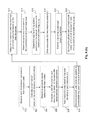
- FIG. 7 is a flowchart of exemplary process of balancing work load in a distributed system, according to various embodiment of the present teaching
- FIGS. 8( a )-( d ) are detailed flowcharts of exemplary processes of balancing work load in a distributed system, according to various embodiments of the present teaching
- FIG. 9 depicts a general computer architecture on which the present teaching can be implemented.
- FIGS. 10( a ) and ( b ) depict examples of computing a load deviance for a resource unit in a distributed system, according to various embodiments of the present teaching
- FIG. 11 is a depiction of an exemplary optimization module of the system for balancing work load in a distributed system, according to an embodiment of the present teaching.
- FIG. 12 depict an example of determining one or more principal load axes based on a distribution of a plurality of multi-dimensional load metrics in a distributed system, according to an embodiments of the present teaching.
- the present disclosure describes method, system, and programming aspects of work load balancing in a distributed system at a global level in real-time.
- Such method and system benefit users in several ways: it has a self-tuning capability based on feedback at a larger time-scale; it relies on system statistics, incremental load status from resources, and a robust controller to compute the source and target of a load to be shifted; it uses objective functions (e.g. transfer cost, end-state optimization) to identify the actual load to be shifted and the type of shifting action that needs to be carried out; it has a general applicability and is particularly suitable for highly distributed, scalable and elastic data processing and management systems.
- objective functions e.g. transfer cost, end-state optimization
- FIGS. 1( a ) and 1 ( b ) depict high level exemplary system configurations in which work load balancing in a distributed system can be dynamically performed, according to an embodiment of the present teaching.
- the exemplary system 100 includes a host 102 , a distributed system such as a cluster 104 , an operator 106 , a network 108 , and users 110 .
- the network 108 may be a single network or a combination of different networks.
- the network 108 may be a local area network (LAN), a wide area network (WAN), a public network, a private network, a proprietary network, a Public Telephone Switched Network (PSTN), the Internet, a wireless network, a virtual network, or any combination thereof.
- LAN local area network
- WAN wide area network
- PSTN Public Telephone Switched Network
- the network 108 may also include various network access points, e.g., wired or wireless access points such as base stations or Internet exchange points 108 - a , . . . , 108 - b , through which a data source may connect to the network in order to transmit information via the network.
- network access points e.g., wired or wireless access points such as base stations or Internet exchange points 108 - a , . . . , 108 - b , through which a data source may connect to the network in order to transmit information via the network.
- the cluster 104 in which the work load balancing to be performed may include a plurality of nodes 104 - a , 104 - b , . . . 104 - h , 104 - i , which communicate through the network 108 or through an internal network (not shown).
- the nodes 104 - a , 104 - b , . . . 104 - h , 104 - i may include autonomous physical machine, such as a server, a workstation, a desktop or laptop computer, a tablet, a smart phone, a television, a game console, or any other suitable machine.
- the cluster 104 may be a set of machines owned by one entity, e.g., an enterprise, and maintained as a server farm or server cluster where the servers are mounted on racks in a server room or data center.
- the cluster 104 may also be a collection of machines owned by different entities and that are physically separate from each other at a distance.
- Each node 104 - a , 104 - b , . . . 104 - h , 104 - i may include one or more resource units, which are physical capacities to which units of work (load-quanta) are assigned.
- an actual physical resource may have multiple capacities, each having its own load.
- the resource unit may be a storage unit, e.g., disk and memory, a computing unit, e.g., CPU and GPU, or a combination thereof.
- the cluster 104 is a highly distributed, scalable and elastic storage and processing system in which the number of resource units may be dynamically changed, and load may be dynamically shifted among resource units.
- Users 110 may be of different types such as users connected to the network via desktop connections ( 110 - d ), users connecting to the network via wireless connections such as through a laptop ( 110 - c ), a handheld device ( 110 - a ), or a built-in device in a motor vehicle ( 110 - b ).
- a user may access to the cluster 104 by sending a request to the cluster 104 via the network 108 and receiving a result from the cluster 104 through the network 108 .
- an operator 106 who may be a network administrator, operator, developer, or customer of the cluster 104 , may configure the host 102 via an internal or proprietary network connection to perform the work load balancing of the cluster 104 .
- the host 102 in response to the configuration information such as load balancing policies and model parameters, may collect or receive multi-dimensional load metrics from all the resource units of the cluster 104 and compute a load deviance for each resource unit based on a global statistical load model and the real-time multi-dimensional load metrics of the cluster 104 .
- the load deviances may be used by the host 102 to rank the resource units in the cluster 104 and determine load balancing actions based on load balancing policies provided by the operator 106 to achieve desired work load balancing objectives.
- Various global statistical load models based on different statistical moments such as but not limited to mean, variance, median, percentile, etc., may be used to deduce the load balancing actions.
- FIG. 1( b ) presents another similarly system configuration as what is shown in FIG. 1( a ) except that the host 102 is also one of the nodes of the cluster 104 . That is, one machine in the cluster 104 acts as both the host for controlling the work load balancing and a node of the cluster 104 . It is noted that different configurations as illustrated in FIGS. 1( a ) and 1 ( b ) can also be mixed in any manner that is appropriate for a particular application scenario.
- FIG. 2 shows a more detailed high level exemplary system diagram of the system 100 shown in FIG. 1( a ), according to one application embodiment of the present teaching.
- the system 100 includes a host 102 and a plurality of cluster nodes 104 - a . . . 104 - n , each including one or more resource units 202 .
- the host 102 in this example includes a dynamic load controller 204 and a load assignment manager 206 operatively coupled to each other.
- the dynamic load controller 204 in conjunction with the load assignment manager 206 has a self-tuning capability based on feedback at a larger time-scale.
- the dynamic load controller 204 is configured to dynamically determine suitable load balancing actions based on real-time collecting or receiving of multi-dimensional load metrics from the resource units 202 - a , . . . , 202 - n of the nodes 104 - a , . . . , 104 - n and based on load balancing polices.
- the load assignment manager 206 may be a central assignment controller that registers the mapping from work assignments to resource units.
- the work assignments may exist in the form of load-quanta that can be shifted and re-quantized by the load assignment manager 206 .
- the load assignment manager 206 is configured to apply each of the determined load balancing actions to the corresponding resource units 202 - a , . .
- the resource units a-1 and n-1 may be storage units and their associated load metric may be memory or disk usage; the resource units a-2 and n-2 may be computing units and their associated load metric may be CPU or GPU usage.
- the multiple-dimensional load metrics may also include, but are not limited to, query length, latency, I/O usage, network usage, and any other suitable load metric, each representing one dimension of load metrics.
- the load balancing actions include, for example, assigning work to a resource unit, re-assigning work from one resource unit to another resource unit, splitting work among a plurality of resource units, and keeping the current work assignment (no further action).
- FIG. 3 depicts an exemplary diagram of the dynamic load controller 204 , according to an embodiment of the present teaching.
- the dynamic load controller 204 includes a sensing module 302 , a computation module 304 , a ranking module 306 , an action module 308 , and an optimization module 310 .
- the sensing module 302 is configured to receive a plurality of multi-dimensional load metrics from a plurality of resource units in the distributed system 104 . That is, the sensing module 302 gathers the resource unit-specific and cluster-wide load data in a predetermined time interval (sampling frequency).
- each resource unit may collect one or more load metrics for a 5-minute window and adds them to the previous value by applying decay as follows: Load metric ⁇ decay fraction ⁇ Load metric ⁇ (1 ⁇ decay fraction) ⁇ Load metric 5min (1)
- the default value of decay_fraction may be, for example, 0.8.
- the slow decay is used to prevent short-term variation in request rate. It is understood that, however, the time window for exampling may not be predetermined or fixed in other examples.
- the sensing module 302 may passively receive the load data and record the last time the data arrives. As such, the sensing module 302 may calculate each individual time difference and use it as the time interval for the analysis performed by the dynamic load controller 204 . In other words, in those examples, the time window may vary from time to time, depending on how fast or slow the load data arrives.
- the plurality of multi-dimensional load metrics received by the sensing module 302 include at least one of latency, query length, disk usage, processing unit usage, memory usage, input/output unit usage, network usage, and any combination thereof, each representing one dimension of load metrics.
- the computation module 304 is operatively coupled to the sensing module 302 .
- the computation module 304 is configured to compute a load deviance for each resource unit based on a global statistical load model and the received plurality of multi-dimensional load metrics.
- Various global statistical load models based on different statistical moments, such as but not limited to mean, variance, median, percentile, etc., may be used to deduce the load balancing actions.
- FIG. 4( a ) illustrates one exemplary global statistical load model based on load mean and load variance.
- the computation module 304 is configured to calculate a load mean 404 and a load variance 406 of the distributed system 104 based on the received plurality of multi-dimensional load metrics 402 (cluster-wide load data).
- Each multi-dimensional load metric 403 for one resource unit u may be represented by L u (t) as a function of time t.
- the load mean 404 and load variance 406 may be represented by functions MEAN F (L u (t)) and VAR F (L u (t)), respectively, over all resource units in a given cluster 104 F over some window of time ⁇ t.
- the window of time ⁇ t is a configurable model parameter and may be determined as part of the configuration information provided by the operator 106 .
- the window of time ⁇ t may be 5 minutes.
- the load mean 404 and load variance 406 may be calculated using some kind of decay model to dampen out variations over short periods of time. It is understood that, in other examples, a different time interval and/or decay model may be implemented to compute the load mean 404 and load variance 406 . It is also understood that, the time interval for exampling may not be predetermined or fixed in other examples. In those examples, the sensing module 302 may passively receive the load data and record the last time the data arrives.
- the sensing module 302 may calculate each individual time difference and use it as the time interval for the analysis performed by the dynamic load controller 204 .
- the time window may vary from time to time, depending on how fast or slow the load data arrives.
- the computation module 304 is further configured to determine a normal operation band (NoB) 408 based on the calculated load mean 404 and load variance 406 .
- NoB 408 is a band of load variation for which the dynamic load controller 204 may not take any load balancing action.
- NoB 408 may be defined based on the cluster-wide load mean 404 and load variance 406 , using 2c 1 to indicate the width of the band in units of variance.
- MEAN F +c 1 ⁇ VAR F is the upper bound of the band. Any resource units that have a particular load metric above the upper bound have high load value (overload). Similarly, MEAN F ⁇ c 1 ⁇ VAR F is the lower bound of the band. Any resource units that have a particular load metric below the lower bound have low load value (underload). If a resource unit falls within this band, no action may be taken to relieve its load.
- NoB 408 may be determined by the Gaussian distribution. For example, if c 1 equals to 1, then the band covers 68.26% of cases closest to the load mean 404 . This choice allows the operator 106 to select c 1 and associate an actual meaning to it.
- the computation module 304 is configured to determine a load deviance 412 for each of the plurality of resource units based on NoB 408 and a last extreme load metric 410 of the respective resource unit u observed in the window of time ⁇ t. In order to prevent actions that are too hasty, the load deviance 412 is calculated for any given resource unit u as a measure of persistence in operating outside NoB 408 .
- load deviance 412 For overloaded resource units, the calculation of load deviance 412 is as follows: OverLoad u+ ⁇ t ⁇ ( L u ( t ) ⁇ (MEAN F +c 1 ⁇ VAR F )) ⁇ t ⁇ ( L u ( t ) ⁇ MAX( L u )) ⁇ (1 ⁇ sign( L u ( t ) ⁇ L u ( t ⁇ t )) ⁇ 2 (3)
- Max(L u ) refers to the last maximum load metric of L u (t) of a resource unit u received by the sensing module 302 .
- the computation module 304 continuously determines a load deviance 412 for each resource unit. Thus, if a resource unit returns to NoB 408 before this last inequality condition is satisfied, the computation module 304 may stop calculating OverLoad u+ for that resource unit.
- Min(L u ) refers to the last minimum load metric of L u (t) of a resource unit u received by the sensing module 302 .
- FIG. 10( a ) further illustrates one example of determining a load deviance for a resource unit based on NoB and a last extreme load metric of a resource unit.
- the load metric in one dimension of a resource unit u changes with respect to time.
- the shaded area above the base line defined by the load mean, load variance, and model parameter c 1 is computed by integration, which corresponds to ⁇ t ⁇ (L u (t) ⁇ (MEAN F +c 1 ⁇ VAR F )) in Equation (3).
- the computation module 304 keeps track of the last-observed extreme value of the load metric for each resource unit and uses the last extreme load metric as a “differential reward” for adjusting the integral area to obtain the load deviance.
- the differential reward adjustment applies to resource units that shed load on their own or lose load through other processes (such as fewer client requests) in order to prevent them from being tagged for a load balancing action too early. Knowing the last extreme value is the same as knowing the average differential of load since the last such observation of such minima or maxima.
- the differential reward adjustment corresponds to ⁇ t ⁇ (L u (t) ⁇ Max(L u )) ⁇ (1 ⁇ sign(L u (t) ⁇ L u (t ⁇ t)))/2 in Equations (3) above.
- FIG. 10( a ) shows an example of an overloaded resource unit, it is understood that the same idea can be applied to underloaded resource units in view of Equations (4) above.
- the exemplary global statistical load model shown in FIGS. 4 and 10( a ) may be viewed as an improved proportional-integral-derivative (PID) controller, where NoB (baseline) represents the proportional aspect, the integral shaded area represents the integral aspect, and the differential reward adjustment represents the derivative aspect of the classical PID controller.
- PID proportional-integral-derivative
- FIG. 4( b ) illustrates another exemplary global statistical load model based on load median.
- the computation module 304 in computing the load deviance for each resource unit, is configured to calculate a load median 414 of the distributed system 104 based on the received plurality of multi-dimensional load metrics 402 (cluster-wide load data).
- the computation module 304 is further configured to determine a plurality of percentile bands 416 based on the calculated load median 414 using approaches such as population analysis.
- percentile bands may be defined by the calculated load median and 10% percentile lines. It is understood that the width of each percentile band and the total number of percentile bands may vary in other examples. Referring back to FIG.
- the computation module 304 is configured to determine a load deviance 418 for each of the plurality of resource units based on at least some of the percentile bands 416 and a last extreme load metric 410 of the respective resource unit observed in the sampling time window.
- FIG. 10( b ) illustrates one example of determining a load deviance for a resource units based on percentile band and the last extreme load metric of the resource unit.
- the percentile bands are used to calculate the load integrals with respect to each percentile line (percentile boundary) in the time window. Separate integrals may be calculated for each percentile band for a given resource unit.
- the determined load variance for each resource unit in this example may be represented by a vector having multiple elements, each representing one integral value from one percentile band.
- the load median (0 percentile line) instead of each percentile line, may be used as a common base line for integration in other examples.
- the load deviance may be represented as a single value for each resource unit.
- the computation module 304 keeps track of the last-observed extreme value of the load metric for each resource unit and uses the last extreme load metric 410 as a “differential reward” for adjusting the integral area(s) to obtain the load deviance.
- FIG. 4( c ) illustrates still another exemplary global statistical load model based on load median.
- the computation module 304 in computing the load deviance for each resource unit, is configured to calculate a load median 414 of the distributed system 104 based on the received plurality of multi-dimensional load metrics 402 (cluster-wide load data).
- the computation module 304 is further configured to determine a plurality of percentile bands 416 based on the calculated load median 414 using approaches such as population analysis. Referring now the FIG. 10( b ), for example, percentiles bands may be defined by the calculated load median and 10% percentile lines. Referring back to FIG.
- the computation module 304 is configured to determine a load deviance 420 for each of the plurality of resource units based on at least some of the percentile bands 416 using a digit summation approach.
- each element in the vector is an “accurate” estimate of the area occupied by the load graph in a percentile band (with differential reward adjustment)
- the value of each element is an integer that is incremented every time the load dimension is found within that band (without differential reward adjustment). It is understood that, however, as the number of percentile bands increases, the difference in information content between the examples in FIGS. 4( b ) and 4 ( c ) may gradually disappear.
- a load percentile array including a plurality of elements, is determined by incrementing an array element based on a percentile band into which the load dimension falls.
- a load percentile array (e l , e 1 , e 2 , e 3 , e 4 , e 5 , e 6 , e 7 , e 8 , e h ) may include eight elements e 1 to e 8 corresponding to ⁇ 40%, ⁇ 30%, ⁇ 20%, ⁇ 10%, 10%, 20%, 30%, annd 40% percentile bands, respectively, and two elements e l and e h corresponding to lower and higher bands capturing the long tails. It is understood that the width of each percentile band and the total number of percentile bands may vary in other examples, so may the number of elements in the load percentile array.
- the corresponding element value in the load percentile array is incremented.
- digit summation approach may be applied to determine the load percentile array.
- the load percentile array may be used as the load deviance for each resource unit to determine the appropriate load balancing action.
- the ranking module 306 is operatively coupled to the computation module 304 .
- the ranking module 306 is configured to rank the plurality of resource units in the distributed system 104 based on the load deviances.
- the load deviance may be determined in the form of a single value or a vector/array depending on the selected global statistical load model. In one example, if the load deviance is represented as a single value, the value may be used to rank the resource units.
- the ranking may be based on each element of the vector/array or based on composite ordering of some or all elements in the vector/array (a weight may be applied to each element in the vector/array in composite ordering).
- each load metric dimension may be independently ranked, including a first load ranking based on a first load metric dimension, e.g., disk usage, and a second load ranking based on a second load metric dimension, e.g., latency.
- the same resource unit may be ranked differently based on different load metric dimensions, and certain resource units may not exist in a particular ranking if a corresponding load metric dimension is not applicable.
- the independent rankings may be transferred into a single ranking using approaches such as single value decomposition approach if needed.
- the ranking module 306 may be configured to remove any resource unit that was previously applied to a load balancing action within a predetermined time period (cooling period) from the ranking. The cooling period allows resource unit metrics to stabilize before considering it for another balancing action.
- the ranking module 306 may also ignore resource units that were recently rebooted, or if they report stale data.
- the ranking module 306 is further configured to assign some of the plurality of resource units into an overload pool 502 and an underload pool 504 based on the determined load deviance for the resource unit.
- the load deviance 412 LoadDeviance u calculated in FIG. 4( a ) may be used by the ranking module 306 .
- the resource units that are selected into the overload pool 502 and underload pool 504 may be determined as follows: Overload pool: OverLoad u+ W ⁇ c 2 ⁇ VAR F (6) Underload pool: UnderrLoad u ⁇ W ⁇ c 2 ⁇ VAR F (7)
- W refers to the sampling time window as noted above, for example, of 5 minutes.
- W, c 2 , VAR F indicate the degree of persistence above NoB 408 , in terms of a fraction of variance (c 2 ⁇ VAR F ) in a given time W. Similar to c 1 as noted above, c 2 and W have physical meanings that can be understood and set by the operator 106 . It is noted that in FIG. 5 , although most of the resource units selected into the overload pool 502 and underload pool 504 may be the resource units outside NoB 408 , in some examples, the resource units 506 that are about to be out of NoB 408 may also be selected into the overload pool 502 and underload pool 504 by adjusting the model parameters W, c 2 .
- the computation module 304 may be further configured to determine one or more principal load axes based on a distribution of the plurality of multi-dimensional load metrics
- the ranking module 306 may be further configured to rank the plurality of resource units in the distributed system based on the one or more principal load axes and the plurality of multi-dimensional load metrics.
- FIG. 12 illustrates one example of how to determine the principal load axes.
- the multi-dimensional load metrics include two load dimensions: CPU usage and I/O usage for each resource unit.
- the distribution of the multi-dimensional load metrics of the resources units may be reflected in a coordinate system defined by the two load dimensions as X and Y axes (original load metric axes).
- two principal load axes may be derived by techniques such as latent factor analysis, regression fitting, principal vector analysis, etc., based on the multi-dimensional load data distribution.
- a new coordinate system may be defined by the derived principal load axes for ranking the resource units based on the load deviance calculated using any of the global statistical models noted above or based on the multi-dimensional load metric of each resource unit. It is understood that, the dimensions of the load metrics may be less than or more than two and thus, the number of derived principal load axes may be also less than or more than two in other examples.
- Using principle load axis, rather than original load metric axis may be more effective for ranking and load balancing in high dimensional load systems.
- the action module 308 is operatively coupled to the ranking module 306 .
- the action module 308 is configured to determine at least one load balancing action based on the ranked resource units and at least one load balancing policy. In determining the load balancing action, the action module 308 may be further configured to select one or more resource units from each of the overload pool 502 and underload pool 504 as shown in FIG. 6 .
- the action module 308 usually selects one or more recourse units on top of the overload pool 502 (mostly overloaded) and one or more resource units at the bottom of the underload pool 504 (mostly underloaded).
- the action module 308 may further receive load balancing policies from the operator 106 as part of the configuration information.
- the load balancing policies may include a balancing objective function and a balancing rule.
- the objective function includes, but is not limited to, transfer cost and end-state optimization.
- the object function is to achieve a potential desirable outcome so that the load variance of the cluster is minimized or below a certain minimum relative to the load mean of the cluster based on time averaged load of each resource unit, over some period of time (e.g., 24 hours for web-based load balancing).
- the balancing rules may define the mechanism of assigning selected resource units to possible load balancing actions in view of the balancing objective function and cluster condition.
- the action module 308 initiates a move for the resource unit with the highest load deviance that can be accepted by the resource unit at the bottom of the underload pool 504 —the mostly underloaded resource unit—without significantly increasing the destination load.
- the balancing rule may include the following checks:
- the load difference between the overloaded and underloaded resource units is above a configurable threshold value.
- the threshold may be 25% of the load mean of the cluster.
- the load of the overloaded resource unit, selected for the move, is not more than twice the average load of the destination underloaded resource units.
- the load balancing rules may also include, for example, a provisioning rule that discriminates among load-quanta.
- the action module 308 may determine the at least one load balancing action applying to the selected one or more resource units based on the at least one load balancing policy.
- the load balancing action includes, for example assigning work (load-quanta) to a resource unit, re-assigning work from one resource unit to another resource unit, splitting work among a plurality of resource units (e.g., re-partitioning data), and keeping the current work assignment (no further action).
- the action module 308 may temporally store the determined at least one load balancing action, for example, in an action queue 602 , for processing.
- the load deviance of each resource unit associated with a queued load balancing action is continuously determined as noted above.
- the dequeuing rate may be adjusted so that a load balancing action may be removed from the action queue 602 before it is dequeued and performed by the load assignment manager 206 if the load deviance of one of the associated resource units has changed back to normal.
- the load balancing actions may be periodically determined at a second rate higher than the first rate. That is, the action module 308 may dequeue load balancing actions from the action queue 602 to the load assignment manager 206 in a time interval less than 5 minutes.
- the load assignment manager 206 is configured to perform one of the stored load balancing actions that have been dequeued from the action queue 602 .
- the dynamic load controller 204 may further include an optimization module 310 operatively coupled to the sensing module 302 , the computation module 304 , the ranking module 306 , and the action module 308 .
- the optimization module 310 is configured to optimize the global statistical load model by updating the configuration parameters of the global statistical load model based on the received plurality of multi-dimensional load metrics and the at least one load balancing policy.
- the optimization module 310 may apply an automatic mechanism to learn and/or search for the optimal values of various configuration parameters such as model parameters c 1 , c 2 , and W, load metric collection frequencies, and paramedic smoothing factors. In one example as shown in FIG.
- the load metrics of the distributed system 104 and the balancing policy are combined with a feedback loop related to the objective functions of the load balancing policy.
- desirable system behavior with respect to the objective functions of the load balancing policy may be determined and applied to the optimization module 310 .
- the desirable system behavior includes, for example, availability and number of service level agreement (SLA) misses across the installation under control.
- SLA service level agreement
- Some initial values of the model parameters may be selected based on the physical meaning of these parameters, as given in the exemplary global statistical load models noted above.
- updated configuration parameters may be set in order to move the system towards the desirable system behavior.
- One metric may be necessary is the “distance” to the desirable system behavior.
- the distance metric may be the load variance as a fraction of the load mean vs. the same, earlier, or difference between load variance as a fraction of the load mean and the desired load variance as a fraction of the load mean.
- gradient descent techniques and the distance metric may be used to optimize and update the configuration parameters. It is understood that any other suitable optimization algorithm may be used by the optimization module 310 to discover more optimal configuration parameters.
- FIG. 7 is a flowchart of an exemplary process in which work load in a distributed system is balanced, according to an embodiment of the present teaching.
- a plurality of multi-dimensional load metrics are received from a plurality of resource units in the distributed system. As described above, this may be performed by the sensing module 302 of the dynamic load controller 204 .
- processing may continue where a load deviance for each resource unit is computed based on a global statistical load model and the received plurality of multi-dimensional load metrics.
- Various global statistical load models based on different statistical moments, such as but not limited to mean, variance, median, percentile, etc., may be used to deduce the load balancing actions.
- this may be performed by the computation module 304 of the dynamic load controller 204 .
- the plurality of resource units in the distributed system are ranked based on the load deviance of each resource unit. As described above, this may be performed by the ranking module 306 of the dynamic load controller 204 .
- at least one load balancing action is determined based on the ranked resource units and at least one load balancing policy. As described above, this may be performed by the action module 308 of the dynamic load controller 204 .
- FIG. 8( a ) is a detailed flowchart of one exemplary process in which the work load in a distributed system is balanced, according to an embodiment of the present teaching.
- a plurality of multi-dimensional load metrics are received from a plurality of resource units in the distributed system.
- the plurality of multi-dimensional load metrics may include at least one of latency, query length, disk usage, processing unit usage, memory usage, input/output unit usage, network usage, and any combination thereof, each representing one dimension of load metrics. As described above, this may be performed by the sensing module 302 of the dynamic load controller 204 .
- processing may continue where a load mean and a load variance of the distributed system are calculated based on the received plurality of multi-dimensional load metrics.
- a normal operation band is determined based on the calculated load mean and load variance.
- the load deviance is computed based on the normal operation band and a last extreme load metric of the resource unit.
- the global statistical model used in FIG. 8( a ) is based on load mean and load variance as noted above in FIG. 4( a ).
- blocks 802 , 804 , 806 may be performed by the computation module 304 of the dynamic load controller 204 .
- the plurality of resource units in the distributed system are ranked based on the load deviance of each resource unit.
- any resource unit that was previously applied to a load balancing action within a predetermined time period is removed.
- some of the plurality of resource units are assigned into an overload pool and an underload pool based on the determined load deviances of the resource units.
- blocks 808 , 810 , 812 may be performed by the ranking module 306 of the dynamic load controller 204 .
- one or more resource units are selected from each of the overload pool and underload pool.
- the at least one load balancing action applying to the selected one or more resource units are determined based on the at least one load balancing policy.
- the load balancing policy includes a balancing objective function and a balancing rule.
- the determined at least one load balancing action is stored temporally, for example, in an action queue.
- blocks 814 , 816 , 818 may be performed by the action module 308 of the dynamic load controller 204 .
- one of the stored at least one load balancing action is performed.
- the at least one load balancing action may include at least one of assigning work to a resource unit, re-assigning work from one resource unit to another resource unit, splitting work among a plurality of resource units, and keeping the current work assignment (no further action). As described above, this may be performed by the load assignment manager 206 .
- the global statistical load model is optimized based on the received plurality of multi-dimensional load metrics and the at least one load balancing policy. As described above, this may be performed by the optimization module 310 of the dynamic load controller 204 .
- FIG. 8( b ) is a detailed flowchart of another exemplary process in which the work load in a distributed system is balanced as what is shown in FIG. 8( a ) except that blocks 802 , 804 , 806 are replaced with blocks 824 , 826 , 828 as FIG. 8( b ) applies another global statistical model as shown in FIG. 4( b ).
- a load median of the distributed system is calculated based on the received plurality of multi-dimensional load metrics.
- a plurality of percentile bands are determined based on the calculated load median.
- the load deviance is computed based on at least some of the plurality of percentile bands and a last extreme load metric of the resource unit.
- blocks 824 , 826 , 828 may be performed by the computation module 304 of the dynamic load controller 204 .
- FIG. 8( c ) is a detailed flowchart of still another exemplary process in which the work load in a distributed system is balanced as what is shown in FIG. 8( b ) except that block 828 is replaced with block 830 as FIG. 8( b ) applies another global statistical model as shown in FIG. 4( c ).
- the load deviance is computed based on at least some of the plurality of percentile bands using digit summation.
- the load deviance is a load percentile array.
- block 830 may be performed by the computation module 304 of the dynamic load controller 204 .
- FIGS. 8( a )- 8 ( c ) are illustrated in a particular order, those having ordinary skill in the art will appreciate that the processing can be performed in different orders.
- block 810 may be performed after block 812 or performed essentially simultaneously.
- block 822 may be performed before block 802 .
- FIG. 8( d ) is a detailed flowchart of yet another exemplary process in which the work load in a distributed system is balanced as what is shown in FIG. 7 with additional blocks 824 and 826 .
- one or more principal load axes are determined based on a distribution of the plurality of multi-dimensional load metrics. As described above, this may be performed by the computation module 304 of the dynamic load controller 204 .
- the plurality of resource units in the distributed system are ranked based on the one or more principal load axes and the load deviance of each resource unit. As described above, this may be performed by the ranking module 306 of the dynamic load controller 204 .
- computer hardware platforms may be used as the hardware platform(s) for one or more of the elements described herein.
- the hardware elements, operating systems, and programming languages of such computers are conventional in nature, and it is presumed that those skilled in the art are adequately familiar therewith to adapt those technologies to implement the processing essentially as described herein.
- a computer with user interface elements may be used to implement a personal computer (PC) or other type of work station or terminal device, although a computer may also act as a server if appropriately programmed. It is believed that those skilled in the art are familiar with the structure, programming, and general operation of such computer equipment and as a result the drawings should be self-explanatory.
- FIG. 9 depicts a general computer architecture on which the present teaching can be implemented and has a functional block diagram illustration of a computer hardware platform that includes user interface elements.
- the computer may be a general-purpose computer or a special purpose computer.
- This computer 900 can be used to implement any components of the work load balancing architecture as described herein. Different components of the system, e.g., as depicted in FIGS. 1( a ), 1 ( b ), and 2 , can all be implemented on one or more computers such as computer 900 , via its hardware, software program, firmware, or a combination thereof. Although only one such computer is shown, for convenience, the computer functions relating to work load balancing may be implemented in a distributed fashion on a number of similar platforms, to distribute the processing load.
- the computer 900 includes COM ports 902 connected to and from a network connected thereto to facilitate data communications.
- the computer 900 also includes a central processing unit (CPU) 904 , in the form of one or more processors, for executing program instructions.
- the exemplary computer platform includes an internal communication bus 906 , program storage and data storage of different forms, e.g., disk 908 , read only memory (ROM) 910 , or random access memory (RAM) 912 , for various data files to be processed and/or communicated by the computer, as well as possibly program instructions to be executed by the CPU.
- the computer 900 also includes an I/O component 914 , supporting input/output flows between the computer and other components therein such as user interface elements 916 .
- the computer 900 may also receive programming and data via network communications.
- aspects of the method of balancing work load in a distributed system may be embodied in programming.
- Program aspects of the technology may be thought of as “products” or “articles of manufacture” typically in the form of executable code and/or associated data that is carried on or embodied in a type of machine readable medium.
- Tangible non-transitory “storage” type media include any or all of the memory or other storage for the computers, processors or the like, or associated modules thereof, such as various semiconductor memories, tape drives, disk drives and the like, which may provide storage at any time for the software programming.
- All or portions of the software may at times be communicated through a network such as the Internet or various other telecommunication networks. Such communications, for example, may enable loading of the software from one computer or processor into another.
- another type of media that may bear the software elements includes optical, electrical, and electromagnetic waves, such as used across physical interfaces between local devices, through wired and optical landline networks and over various air-links.
- the physical elements that carry such waves, such as wired or wireless links, optical links or the like, also may be considered as media bearing the software.
- terms such as computer or machine “readable medium” refer to any medium that participates in providing instructions to a processor for execution.
- Non-volatile storage media include, for example, optical or magnetic disks, such as any of the storage devices in any computer(s) or the like, which may be used to implement the system or any of its components as shown in the drawings.
- Volatile storage media include dynamic memory, such as a main memory of such a computer platform.
- Tangible transmission media include coaxial cables; copper wire and fiber optics, including the wires that form a bus within a computer system.
- Carrier-wave transmission media can take the form of electric or electromagnetic signals, or acoustic or light waves such as those generated during radio frequency (RF) and infrared (IR) data communications.
- Computer-readable media therefore include for example: a floppy disk, a flexible disk, hard disk, magnetic tape, any other magnetic medium, a CD-ROM, DVD or DVD-ROM, any other optical medium, punch cards paper tape, any other physical storage medium with patterns of holes, a RAM, a PROM and EPROM, a FLASH-EPROM, any other memory chip or cartridge, a carrier wave transporting data or instructions, cables or links transporting such a carrier wave, or any other medium from which a computer can read programming code and/or data. Many of these forms of computer readable media may be involved in carrying one or more sequences of one or more instructions to a processor for execution.
Landscapes
- Engineering & Computer Science (AREA)
- General Engineering & Computer Science (AREA)
- Theoretical Computer Science (AREA)
- Computer Networks & Wireless Communication (AREA)
- Signal Processing (AREA)
- Computer Hardware Design (AREA)
- Physics & Mathematics (AREA)
- General Physics & Mathematics (AREA)
- Software Systems (AREA)
- Quality & Reliability (AREA)
- Debugging And Monitoring (AREA)
Abstract
Description
Load metric−decay fraction×Load metric·(1−decay fraction)×Load metric5min (1)
NoB−(MEANF −c 1·VARF, MEANF +c 1·VARF) (2)
OverLoadu+ −Δt·(L u(t)−(MEANF +c 1·VARF))·Δt·(L u(t)−MAX(L u))·(1−sign(L u(t)−L u(t−Δt))·2 (3)
UnderLoadu− −Δt·(L u(t)−(MEANF −c 1·VARF))·Δt·(L u(t)−Min(L u))·(1·sign(L u(t)−L u(t−Δt)))2 (4)
LoadDevianceu(1+sign((L u(t)−(MEANF +c 1·VARF)))
Overload pool: OverLoadu+ W·c 2·VARF (6)
Underload pool: UnderrLoadu− W·c 2·VARF (7)
Claims (24)
Priority Applications (2)
| Application Number | Priority Date | Filing Date | Title |
|---|---|---|---|
| US13/274,385 US8661136B2 (en) | 2011-10-17 | 2011-10-17 | Method and system for work load balancing |
| US13/775,678 US9378058B2 (en) | 2011-10-17 | 2013-02-25 | Method and system for dynamic control of a multi-tier processing system |
Applications Claiming Priority (1)
| Application Number | Priority Date | Filing Date | Title |
|---|---|---|---|
| US13/274,385 US8661136B2 (en) | 2011-10-17 | 2011-10-17 | Method and system for work load balancing |
Publications (2)
| Publication Number | Publication Date |
|---|---|
| US20130097321A1 US20130097321A1 (en) | 2013-04-18 |
| US8661136B2 true US8661136B2 (en) | 2014-02-25 |
Family
ID=48086764
Family Applications (1)
| Application Number | Title | Priority Date | Filing Date |
|---|---|---|---|
| US13/274,385 Expired - Fee Related US8661136B2 (en) | 2011-10-17 | 2011-10-17 | Method and system for work load balancing |
Country Status (1)
| Country | Link |
|---|---|
| US (1) | US8661136B2 (en) |
Cited By (10)
| Publication number | Priority date | Publication date | Assignee | Title |
|---|---|---|---|---|
| US20140046974A1 (en) * | 2012-08-13 | 2014-02-13 | Hulu Llc | Job Dispatcher of Transcoding Jobs for Media Programs |
| US20160292233A1 (en) * | 2013-12-20 | 2016-10-06 | Hewlett Packard Enterprise Development Lp | Discarding data points in a time series |
| US9513806B2 (en) | 2014-05-01 | 2016-12-06 | Microsoft Technology Licensing, Llc | Dimension based load balancing |
| US9609054B2 (en) | 2014-05-01 | 2017-03-28 | Microsoft Technology Licensing, Llc | Load balancing scalable storage utilizing optimization modules |
| CN109218355A (en) * | 2017-06-30 | 2019-01-15 | 华为技术有限公司 | Load equalizing engine, client, distributed computing system and load-balancing method |
| US10395043B2 (en) | 2016-07-29 | 2019-08-27 | International Business Machines Corporation | Securely storing data in an elastically scalable dispersed storage network |
| US10459790B2 (en) | 2016-07-26 | 2019-10-29 | International Business Machines Corporation | Elastic storage in a dispersed storage network |
| US10721150B2 (en) * | 2015-05-12 | 2020-07-21 | Hewlett Packard Enterprise Development Lp | Server discrete side information |
| US10839302B2 (en) | 2015-11-24 | 2020-11-17 | The Research Foundation For The State University Of New York | Approximate value iteration with complex returns by bounding |
| US20220114073A1 (en) * | 2015-06-17 | 2022-04-14 | Capital One Services, Llc | Systems and methods for modeling computer resource metrics |
Families Citing this family (20)
| Publication number | Priority date | Publication date | Assignee | Title |
|---|---|---|---|---|
| US8554917B2 (en) * | 2010-08-20 | 2013-10-08 | International Business Machines Corporation | Performance isolation for storage clouds |
| US8661136B2 (en) * | 2011-10-17 | 2014-02-25 | Yahoo! Inc. | Method and system for work load balancing |
| KR101696698B1 (en) * | 2011-12-23 | 2017-01-17 | 한국전자통신연구원 | Distribution and management method of components having reliance |
| WO2013174451A1 (en) * | 2012-05-25 | 2013-11-28 | Nec Europe Ltd. | Method for executing processes on a worker machine of a distributed computing system and a distributed computing system |
| US9727355B2 (en) * | 2013-08-23 | 2017-08-08 | Vmware, Inc. | Virtual Hadoop manager |
| JP6341212B2 (en) * | 2013-11-25 | 2018-06-13 | 日本電気株式会社 | Information collection system, server device, edge device, control method, and program |
| KR20150106224A (en) * | 2014-03-11 | 2015-09-21 | 삼성전자주식회사 | System-on-chip and load imbalance detecting method thereof |
| US9979617B1 (en) * | 2014-05-15 | 2018-05-22 | Amazon Technologies, Inc. | Techniques for controlling scaling behavior of resources |
| US10061525B1 (en) * | 2015-03-31 | 2018-08-28 | EMC IP Holding Company LLC | Load balancing system and method |
| US10203887B1 (en) * | 2015-03-31 | 2019-02-12 | EMC IP Holding Company LLC | Recommendation system and method |
| CN110688213B (en) * | 2018-07-05 | 2023-02-10 | 深圳先进技术研究院 | Resource management method, system and electronic device based on edge computing |
| US10656930B2 (en) * | 2018-09-12 | 2020-05-19 | Microsoft Technology Licensing, Llc | Dynamic deployment target control |
| US10824556B2 (en) * | 2018-11-05 | 2020-11-03 | International Business Machines Corporation | Adaptive garbage collection (GC) utilization for grid storage systems |
| US11157323B2 (en) * | 2019-01-10 | 2021-10-26 | International Business Machines Corporation | Multiple metric based load prediction and resource allocation in an active stream processing job |
| US11461145B2 (en) * | 2019-01-28 | 2022-10-04 | EMC IP Holding Company LLC | Building neural networks for resource allocation for iterative workloads using reinforcement learning |
| CN112004249B (en) * | 2020-08-10 | 2022-03-18 | 中国联合网络通信集团有限公司 | Method and device for determining load distribution state of channel resources |
| CN113382040B (en) * | 2021-05-08 | 2022-09-13 | 深圳市科思科技股份有限公司 | Load balancing method, electronic device and computer readable storage medium |
| CN113326125B (en) * | 2021-05-20 | 2023-03-24 | 清华大学 | Large-scale distributed graph calculation end-to-end acceleration method and device |
| US11782934B2 (en) * | 2022-01-11 | 2023-10-10 | Dell Products L.P. | Controlling monitoring roles of nodes in a monitoring system utilizing a time-based ranking of the nodes |
| CN115098261B (en) * | 2022-06-28 | 2024-10-11 | 中南大学 | A method, medium and device for allocating cloud server resources |
Citations (4)
| Publication number | Priority date | Publication date | Assignee | Title |
|---|---|---|---|---|
| US20050160171A1 (en) * | 2003-12-22 | 2005-07-21 | Nortel Networks Limited | Traffic engineering and bandwidth management of bundled links |
| US20100107172A1 (en) * | 2003-12-31 | 2010-04-29 | Sychron Advanced Technologies, Inc. | System providing methodology for policy-based resource allocation |
| US8028293B2 (en) * | 2007-06-28 | 2011-09-27 | Microsoft Corporation | Optimal policies for load balancing for distributed and strategic agents (more technically, optimal coordination mechanisms for machine scheduling) |
| US20130097321A1 (en) * | 2011-10-17 | 2013-04-18 | Yahoo! Inc. | Method and system for work load balancing |
-
2011
- 2011-10-17 US US13/274,385 patent/US8661136B2/en not_active Expired - Fee Related
Patent Citations (6)
| Publication number | Priority date | Publication date | Assignee | Title |
|---|---|---|---|---|
| US20050160171A1 (en) * | 2003-12-22 | 2005-07-21 | Nortel Networks Limited | Traffic engineering and bandwidth management of bundled links |
| US8312145B2 (en) * | 2003-12-22 | 2012-11-13 | Rockstar Consortium US L.P. | Traffic engineering and bandwidth management of bundled links |
| US8463916B2 (en) * | 2003-12-22 | 2013-06-11 | Rockstar Consortium Us Lp | Traffic engineering and bandwidth management of bundled links |
| US20100107172A1 (en) * | 2003-12-31 | 2010-04-29 | Sychron Advanced Technologies, Inc. | System providing methodology for policy-based resource allocation |
| US8028293B2 (en) * | 2007-06-28 | 2011-09-27 | Microsoft Corporation | Optimal policies for load balancing for distributed and strategic agents (more technically, optimal coordination mechanisms for machine scheduling) |
| US20130097321A1 (en) * | 2011-10-17 | 2013-04-18 | Yahoo! Inc. | Method and system for work load balancing |
Cited By (16)
| Publication number | Priority date | Publication date | Assignee | Title |
|---|---|---|---|---|
| US8930416B2 (en) * | 2012-08-13 | 2015-01-06 | Hulu, LLC | Job dispatcher of transcoding jobs for media programs |
| US9740732B2 (en) | 2012-08-13 | 2017-08-22 | Hulu, LLC | Job dispatcher of transcoding jobs for media programs |
| US20140046974A1 (en) * | 2012-08-13 | 2014-02-13 | Hulu Llc | Job Dispatcher of Transcoding Jobs for Media Programs |
| US20160292233A1 (en) * | 2013-12-20 | 2016-10-06 | Hewlett Packard Enterprise Development Lp | Discarding data points in a time series |
| US9513806B2 (en) | 2014-05-01 | 2016-12-06 | Microsoft Technology Licensing, Llc | Dimension based load balancing |
| US9609054B2 (en) | 2014-05-01 | 2017-03-28 | Microsoft Technology Licensing, Llc | Load balancing scalable storage utilizing optimization modules |
| US10721150B2 (en) * | 2015-05-12 | 2020-07-21 | Hewlett Packard Enterprise Development Lp | Server discrete side information |
| US20220114073A1 (en) * | 2015-06-17 | 2022-04-14 | Capital One Services, Llc | Systems and methods for modeling computer resource metrics |
| US12007869B2 (en) * | 2015-06-17 | 2024-06-11 | Capital One Services, Llc | Systems and methods for modeling computer resource metrics |
| US12169793B2 (en) | 2015-11-24 | 2024-12-17 | The Research Foundation For The State University Of New York | Approximate value iteration with complex returns by bounding |
| US10839302B2 (en) | 2015-11-24 | 2020-11-17 | The Research Foundation For The State University Of New York | Approximate value iteration with complex returns by bounding |
| US10459790B2 (en) | 2016-07-26 | 2019-10-29 | International Business Machines Corporation | Elastic storage in a dispersed storage network |
| US11157362B2 (en) | 2016-07-26 | 2021-10-26 | International Business Machines Corporation | Elastic storage in a dispersed storage network |
| US11250141B2 (en) | 2016-07-29 | 2022-02-15 | International Business Machines Corporation | Securely storing data in an elastically scalable dispersed storage network |
| US10395043B2 (en) | 2016-07-29 | 2019-08-27 | International Business Machines Corporation | Securely storing data in an elastically scalable dispersed storage network |
| CN109218355A (en) * | 2017-06-30 | 2019-01-15 | 华为技术有限公司 | Load equalizing engine, client, distributed computing system and load-balancing method |
Also Published As
| Publication number | Publication date |
|---|---|
| US20130097321A1 (en) | 2013-04-18 |
Similar Documents
| Publication | Publication Date | Title |
|---|---|---|
| US8661136B2 (en) | Method and system for work load balancing | |
| US9104497B2 (en) | Method and system for work load balancing | |
| US11275429B2 (en) | Reducing power consumption of a data center utilizing reinforcement learning framework | |
| EP2615803B1 (en) | Performance interference model for managing consolidated workloads in QoS-aware clouds | |
| US20180349121A1 (en) | Dynamic deployment of an application based on micro-services | |
| US20160019084A1 (en) | Method and system for inter-cloud virtual machines assignment | |
| US20160269319A1 (en) | Intelligent Placement within a Data Center | |
| US9378058B2 (en) | Method and system for dynamic control of a multi-tier processing system | |
| US11609784B2 (en) | Method for distributing a computational process, workload distribution device and system for distributing a computational process | |
| US20140201371A1 (en) | Balancing the allocation of virtual machines in cloud systems | |
| Swathy et al. | Game theoretical approach for load balancing using SGMLB model in cloud environment | |
| US9609054B2 (en) | Load balancing scalable storage utilizing optimization modules | |
| CN112148492A (en) | Service deployment and resource allocation method considering multi-user mobility | |
| Wei et al. | Proactive virtualized resource management for service workflows in the cloud | |
| Chaudhary et al. | Analytical study of load scheduling algorithms in cloud computing | |
| US9501321B1 (en) | Weighted service requests throttling | |
| CN117354310A (en) | Node selection method, device, equipment and medium based on task collaboration | |
| Kang et al. | A multiagent brokering protocol for supporting Grid resource discovery | |
| Patni et al. | Heuristic models for optimal host selection | |
| US11625285B2 (en) | Assigning workloads in a multi-node processing environment using feedback from each node | |
| Sarkar et al. | Power aware container placement in cloud computing with affinity and cubic power model | |
| De Grande et al. | Dynamic load redistribution based on migration latency analysis for distributed virtual simulations | |
| US9712609B2 (en) | Computer network system and method of determining necessity of transferring load in computer network system | |
| Kheiri et al. | An efficient approach based on genetic algorithm for multi-tenant resource allocation in SaaS applications | |
| Barlaskar et al. | Dynamic Consolidation of Virtual Machines with Multi-Agent System |
Legal Events
| Date | Code | Title | Description |
|---|---|---|---|
| AS | Assignment |
Owner name: YAHOO! INC., CALIFORNIA Free format text: ASSIGNMENT OF ASSIGNORS INTEREST;ASSIGNORS:TUMBDE, ADWAIT;ALBERT, SAHAYA ANDREWS;SILBERSTEIN, ADAM;AND OTHERS;SIGNING DATES FROM 20111012 TO 20111014;REEL/FRAME:027068/0950 |
|
| FEPP | Fee payment procedure |
Free format text: PAYOR NUMBER ASSIGNED (ORIGINAL EVENT CODE: ASPN); ENTITY STATUS OF PATENT OWNER: LARGE ENTITY |
|
| STCF | Information on status: patent grant |
Free format text: PATENTED CASE |
|
| AS | Assignment |
Owner name: EXCALIBUR IP, LLC, CALIFORNIA Free format text: ASSIGNMENT OF ASSIGNORS INTEREST;ASSIGNOR:YAHOO! INC.;REEL/FRAME:038383/0466 Effective date: 20160418 |
|
| AS | Assignment |
Owner name: YAHOO! INC., CALIFORNIA Free format text: ASSIGNMENT OF ASSIGNORS INTEREST;ASSIGNOR:EXCALIBUR IP, LLC;REEL/FRAME:038951/0295 Effective date: 20160531 |
|
| AS | Assignment |
Owner name: EXCALIBUR IP, LLC, CALIFORNIA Free format text: ASSIGNMENT OF ASSIGNORS INTEREST;ASSIGNOR:YAHOO! INC.;REEL/FRAME:038950/0592 Effective date: 20160531 |
|
| FPAY | Fee payment |
Year of fee payment: 4 |
|
| AS | Assignment |
Owner name: STARBOARD VALUE INTERMEDIATE FUND LP, AS COLLATERAL AGENT, NEW YORK Free format text: PATENT SECURITY AGREEMENT;ASSIGNORS:ACACIA RESEARCH GROUP LLC;AMERICAN VEHICULAR SCIENCES LLC;BONUTTI SKELETAL INNOVATIONS LLC;AND OTHERS;REEL/FRAME:052853/0153 Effective date: 20200604 |
|
| AS | Assignment |
Owner name: R2 SOLUTIONS LLC, TEXAS Free format text: ASSIGNMENT OF ASSIGNORS INTEREST;ASSIGNOR:EXCALIBUR IP, LLC;REEL/FRAME:053459/0059 Effective date: 20200428 |
|
| AS | Assignment |
Owner name: AMERICAN VEHICULAR SCIENCES LLC, TEXAS Free format text: RELEASE OF SECURITY INTEREST IN PATENTS;ASSIGNOR:STARBOARD VALUE INTERMEDIATE FUND LP;REEL/FRAME:053654/0254 Effective date: 20200630 Owner name: LIMESTONE MEMORY SYSTEMS LLC, CALIFORNIA Free format text: RELEASE OF SECURITY INTEREST IN PATENTS;ASSIGNOR:STARBOARD VALUE INTERMEDIATE FUND LP;REEL/FRAME:053654/0254 Effective date: 20200630 Owner name: CELLULAR COMMUNICATIONS EQUIPMENT LLC, TEXAS Free format text: RELEASE OF SECURITY INTEREST IN PATENTS;ASSIGNOR:STARBOARD VALUE INTERMEDIATE FUND LP;REEL/FRAME:053654/0254 Effective date: 20200630 Owner name: STINGRAY IP SOLUTIONS LLC, TEXAS Free format text: RELEASE OF SECURITY INTEREST IN PATENTS;ASSIGNOR:STARBOARD VALUE INTERMEDIATE FUND LP;REEL/FRAME:053654/0254 Effective date: 20200630 Owner name: SUPER INTERCONNECT TECHNOLOGIES LLC, TEXAS Free format text: RELEASE OF SECURITY INTEREST IN PATENTS;ASSIGNOR:STARBOARD VALUE INTERMEDIATE FUND LP;REEL/FRAME:053654/0254 Effective date: 20200630 Owner name: PARTHENON UNIFIED MEMORY ARCHITECTURE LLC, TEXAS Free format text: RELEASE OF SECURITY INTEREST IN PATENTS;ASSIGNOR:STARBOARD VALUE INTERMEDIATE FUND LP;REEL/FRAME:053654/0254 Effective date: 20200630 Owner name: INNOVATIVE DISPLAY TECHNOLOGIES LLC, TEXAS Free format text: RELEASE OF SECURITY INTEREST IN PATENTS;ASSIGNOR:STARBOARD VALUE INTERMEDIATE FUND LP;REEL/FRAME:053654/0254 Effective date: 20200630 Owner name: SAINT LAWRENCE COMMUNICATIONS LLC, TEXAS Free format text: RELEASE OF SECURITY INTEREST IN PATENTS;ASSIGNOR:STARBOARD VALUE INTERMEDIATE FUND LP;REEL/FRAME:053654/0254 Effective date: 20200630 Owner name: NEXUS DISPLAY TECHNOLOGIES LLC, TEXAS Free format text: RELEASE OF SECURITY INTEREST IN PATENTS;ASSIGNOR:STARBOARD VALUE INTERMEDIATE FUND LP;REEL/FRAME:053654/0254 Effective date: 20200630 Owner name: TELECONFERENCE SYSTEMS LLC, TEXAS Free format text: RELEASE OF SECURITY INTEREST IN PATENTS;ASSIGNOR:STARBOARD VALUE INTERMEDIATE FUND LP;REEL/FRAME:053654/0254 Effective date: 20200630 Owner name: BONUTTI SKELETAL INNOVATIONS LLC, TEXAS Free format text: RELEASE OF SECURITY INTEREST IN PATENTS;ASSIGNOR:STARBOARD VALUE INTERMEDIATE FUND LP;REEL/FRAME:053654/0254 Effective date: 20200630 Owner name: MOBILE ENHANCEMENT SOLUTIONS LLC, TEXAS Free format text: RELEASE OF SECURITY INTEREST IN PATENTS;ASSIGNOR:STARBOARD VALUE INTERMEDIATE FUND LP;REEL/FRAME:053654/0254 Effective date: 20200630 Owner name: ACACIA RESEARCH GROUP LLC, NEW YORK Free format text: RELEASE OF SECURITY INTEREST IN PATENTS;ASSIGNOR:STARBOARD VALUE INTERMEDIATE FUND LP;REEL/FRAME:053654/0254 Effective date: 20200630 Owner name: R2 SOLUTIONS LLC, TEXAS Free format text: RELEASE OF SECURITY INTEREST IN PATENTS;ASSIGNOR:STARBOARD VALUE INTERMEDIATE FUND LP;REEL/FRAME:053654/0254 Effective date: 20200630 Owner name: UNIFICATION TECHNOLOGIES LLC, TEXAS Free format text: RELEASE OF SECURITY INTEREST IN PATENTS;ASSIGNOR:STARBOARD VALUE INTERMEDIATE FUND LP;REEL/FRAME:053654/0254 Effective date: 20200630 Owner name: LIFEPORT SCIENCES LLC, TEXAS Free format text: RELEASE OF SECURITY INTEREST IN PATENTS;ASSIGNOR:STARBOARD VALUE INTERMEDIATE FUND LP;REEL/FRAME:053654/0254 Effective date: 20200630 Owner name: MONARCH NETWORKING SOLUTIONS LLC, CALIFORNIA Free format text: RELEASE OF SECURITY INTEREST IN PATENTS;ASSIGNOR:STARBOARD VALUE INTERMEDIATE FUND LP;REEL/FRAME:053654/0254 Effective date: 20200630 |
|
| AS | Assignment |
Owner name: R2 SOLUTIONS LLC, TEXAS Free format text: CORRECTIVE ASSIGNMENT TO CORRECT THE ASSIGNEE NAME PREVIOUSLY RECORDED ON REEL 053654 FRAME 0254. ASSIGNOR(S) HEREBY CONFIRMS THE RELEASE OF SECURITY INTEREST GRANTED PURSUANT TO THE PATENT SECURITY AGREEMENT PREVIOUSLY RECORDED;ASSIGNOR:STARBOARD VALUE INTERMEDIATE FUND LP;REEL/FRAME:054981/0377 Effective date: 20200630 |
|
| AS | Assignment |
Owner name: STARBOARD VALUE INTERMEDIATE FUND LP, AS COLLATERAL AGENT, NEW YORK Free format text: CORRECTIVE ASSIGNMENT TO CORRECT THE THE ASSIGNOR NAME PREVIOUSLY RECORDED AT REEL: 052853 FRAME: 0153. ASSIGNOR(S) HEREBY CONFIRMS THE ASSIGNMENT;ASSIGNOR:R2 SOLUTIONS LLC;REEL/FRAME:056832/0001 Effective date: 20200604 |
|
| FEPP | Fee payment procedure |
Free format text: MAINTENANCE FEE REMINDER MAILED (ORIGINAL EVENT CODE: REM.); ENTITY STATUS OF PATENT OWNER: LARGE ENTITY |
|
| LAPS | Lapse for failure to pay maintenance fees |
Free format text: PATENT EXPIRED FOR FAILURE TO PAY MAINTENANCE FEES (ORIGINAL EVENT CODE: EXP.); ENTITY STATUS OF PATENT OWNER: LARGE ENTITY |
|
| STCH | Information on status: patent discontinuation |
Free format text: PATENT EXPIRED DUE TO NONPAYMENT OF MAINTENANCE FEES UNDER 37 CFR 1.362 |
|
| FP | Lapsed due to failure to pay maintenance fee |
Effective date: 20220225 |