US8648090B2 - Indole alkaloid derivatives having opioid receptor agonistic effect, and therapeutic compositions and methods relating to same - Google Patents
Indole alkaloid derivatives having opioid receptor agonistic effect, and therapeutic compositions and methods relating to same Download PDFInfo
- Publication number
- US8648090B2 US8648090B2 US13/549,564 US201213549564A US8648090B2 US 8648090 B2 US8648090 B2 US 8648090B2 US 201213549564 A US201213549564 A US 201213549564A US 8648090 B2 US8648090 B2 US 8648090B2
- Authority
- US
- United States
- Prior art keywords
- compound
- och
- nmr
- mmol
- meoh
- Prior art date
- Legal status (The legal status is an assumption and is not a legal conclusion. Google has not performed a legal analysis and makes no representation as to the accuracy of the status listed.)
- Expired - Fee Related
Links
- 239000000203 mixture Substances 0.000 title claims abstract description 60
- WYTGDNHDOZPMIW-RCBQFDQVSA-N alstonine Chemical class C1=CC2=C3C=CC=CC3=NC2=C2N1C[C@H]1[C@H](C)OC=C(C(=O)OC)[C@H]1C2 WYTGDNHDOZPMIW-RCBQFDQVSA-N 0.000 title claims abstract description 44
- 238000000034 method Methods 0.000 title claims abstract description 33
- 230000001225 therapeutic effect Effects 0.000 title claims abstract description 19
- 102000003840 Opioid Receptors Human genes 0.000 title abstract description 27
- 108090000137 Opioid Receptors Proteins 0.000 title abstract description 27
- 230000001270 agonistic effect Effects 0.000 title abstract description 27
- 150000001875 compounds Chemical class 0.000 claims abstract description 79
- 239000000243 solution Substances 0.000 claims description 72
- LYCAIKOWRPUZTN-UHFFFAOYSA-N ethylene glycol Substances OCCO LYCAIKOWRPUZTN-UHFFFAOYSA-N 0.000 claims description 59
- -1 elixirs Substances 0.000 claims description 50
- 230000000202 analgesic effect Effects 0.000 claims description 31
- 239000000843 powder Substances 0.000 claims description 26
- 229930005303 indole alkaloid Natural products 0.000 claims description 22
- 238000011282 treatment Methods 0.000 claims description 20
- 241001465754 Metazoa Species 0.000 claims description 19
- 150000002475 indoles Chemical class 0.000 claims description 16
- 150000003839 salts Chemical class 0.000 claims description 14
- 239000008194 pharmaceutical composition Substances 0.000 claims description 13
- 208000002193 Pain Diseases 0.000 claims description 12
- SIKJAQJRHWYJAI-UHFFFAOYSA-N Indole Chemical compound C1=CC=C2NC=CC2=C1 SIKJAQJRHWYJAI-UHFFFAOYSA-N 0.000 claims description 10
- 239000002775 capsule Substances 0.000 claims description 10
- 230000036407 pain Effects 0.000 claims description 10
- 241000282414 Homo sapiens Species 0.000 claims description 8
- 230000037396 body weight Effects 0.000 claims description 8
- 125000005843 halogen group Chemical group 0.000 claims description 8
- ZCYVEMRRCGMTRW-UHFFFAOYSA-N 7553-56-2 Chemical compound [I] ZCYVEMRRCGMTRW-UHFFFAOYSA-N 0.000 claims description 7
- 239000000839 emulsion Substances 0.000 claims description 7
- 238000002347 injection Methods 0.000 claims description 7
- 239000007924 injection Substances 0.000 claims description 7
- 239000011630 iodine Substances 0.000 claims description 7
- 229910052740 iodine Inorganic materials 0.000 claims description 7
- 239000000829 suppository Substances 0.000 claims description 7
- 238000009472 formulation Methods 0.000 claims description 6
- 238000001802 infusion Methods 0.000 claims description 6
- 239000003826 tablet Substances 0.000 claims description 6
- 241000124008 Mammalia Species 0.000 claims description 5
- 125000003545 alkoxy group Chemical group 0.000 claims description 5
- 239000007788 liquid Substances 0.000 claims description 5
- 125000000449 nitro group Chemical group [O-][N+](*)=O 0.000 claims description 5
- 239000006187 pill Substances 0.000 claims description 5
- 239000000725 suspension Substances 0.000 claims description 5
- 238000013268 sustained release Methods 0.000 claims description 5
- 239000012730 sustained-release form Substances 0.000 claims description 5
- 125000004435 hydrogen atom Chemical group [H]* 0.000 claims description 4
- 239000000443 aerosol Substances 0.000 claims description 3
- 238000007345 electrophilic aromatic substitution reaction Methods 0.000 claims description 3
- 239000008187 granular material Substances 0.000 claims description 3
- 239000007937 lozenge Substances 0.000 claims description 3
- 239000008188 pellet Substances 0.000 claims description 3
- 239000007921 spray Substances 0.000 claims description 3
- 239000006188 syrup Substances 0.000 claims description 3
- 235000020357 syrup Nutrition 0.000 claims description 3
- 239000006071 cream Substances 0.000 claims description 2
- 239000000499 gel Substances 0.000 claims description 2
- 230000015572 biosynthetic process Effects 0.000 abstract description 10
- 238000003786 synthesis reaction Methods 0.000 abstract description 9
- OKKJLVBELUTLKV-UHFFFAOYSA-N Methanol Chemical compound OC OKKJLVBELUTLKV-UHFFFAOYSA-N 0.000 description 213
- HEDRZPFGACZZDS-MICDWDOJSA-N Trichloro(2H)methane Chemical compound [2H]C(Cl)(Cl)Cl HEDRZPFGACZZDS-MICDWDOJSA-N 0.000 description 118
- BQJCRHHNABKAKU-KBQPJGBKSA-N morphine Chemical compound O([C@H]1[C@H](C=C[C@H]23)O)C4=C5[C@@]12CCN(C)[C@@H]3CC5=CC=C4O BQJCRHHNABKAKU-KBQPJGBKSA-N 0.000 description 100
- XEKOWRVHYACXOJ-UHFFFAOYSA-N Ethyl acetate Chemical compound CCOC(C)=O XEKOWRVHYACXOJ-UHFFFAOYSA-N 0.000 description 93
- HEDRZPFGACZZDS-UHFFFAOYSA-N Chloroform Chemical compound ClC(Cl)Cl HEDRZPFGACZZDS-UHFFFAOYSA-N 0.000 description 82
- CSNNHWWHGAXBCP-UHFFFAOYSA-L Magnesium sulfate Chemical compound [Mg+2].[O-][S+2]([O-])([O-])[O-] CSNNHWWHGAXBCP-UHFFFAOYSA-L 0.000 description 54
- VLKZOEOYAKHREP-UHFFFAOYSA-N n-Hexane Chemical compound CCCCCC VLKZOEOYAKHREP-UHFFFAOYSA-N 0.000 description 54
- 125000000956 methoxy group Chemical group [H]C([H])([H])O* 0.000 description 53
- 230000000694 effects Effects 0.000 description 51
- 229960005181 morphine Drugs 0.000 description 49
- 238000001644 13C nuclear magnetic resonance spectroscopy Methods 0.000 description 46
- 238000005160 1H NMR spectroscopy Methods 0.000 description 46
- UIIMBOGNXHQVGW-UHFFFAOYSA-M Sodium bicarbonate Chemical compound [Na+].OC([O-])=O UIIMBOGNXHQVGW-UHFFFAOYSA-M 0.000 description 44
- QFLWZFQWSBQYPS-AWRAUJHKSA-N (3S)-3-[[(2S)-2-[[(2S)-2-[5-[(3aS,6aR)-2-oxo-1,3,3a,4,6,6a-hexahydrothieno[3,4-d]imidazol-4-yl]pentanoylamino]-3-methylbutanoyl]amino]-3-(4-hydroxyphenyl)propanoyl]amino]-4-[1-bis(4-chlorophenoxy)phosphorylbutylamino]-4-oxobutanoic acid Chemical compound CCCC(NC(=O)[C@H](CC(O)=O)NC(=O)[C@H](Cc1ccc(O)cc1)NC(=O)[C@@H](NC(=O)CCCCC1SC[C@@H]2NC(=O)N[C@H]12)C(C)C)P(=O)(Oc1ccc(Cl)cc1)Oc1ccc(Cl)cc1 QFLWZFQWSBQYPS-AWRAUJHKSA-N 0.000 description 40
- 239000011541 reaction mixture Substances 0.000 description 37
- 239000012300 argon atmosphere Substances 0.000 description 29
- 238000002360 preparation method Methods 0.000 description 28
- 239000012267 brine Substances 0.000 description 27
- 239000000284 extract Substances 0.000 description 27
- 229910052943 magnesium sulfate Inorganic materials 0.000 description 27
- HPALAKNZSZLMCH-UHFFFAOYSA-M sodium;chloride;hydrate Chemical compound O.[Na+].[Cl-] HPALAKNZSZLMCH-UHFFFAOYSA-M 0.000 description 27
- LELBFTMXCIIKKX-QVRQZEMUSA-N Mitragynine Chemical compound C1=CC(OC)=C2C(CCN3C[C@H]([C@H](C[C@H]33)\C(=C/OC)C(=O)OC)CC)=C3NC2=C1 LELBFTMXCIIKKX-QVRQZEMUSA-N 0.000 description 26
- XTEOJPUYZWEXFI-UHFFFAOYSA-N butyl n-[3-[4-(imidazol-1-ylmethyl)phenyl]-5-(2-methylpropyl)thiophen-2-yl]sulfonylcarbamate Chemical compound S1C(CC(C)C)=CC(C=2C=CC(CN3C=NC=C3)=CC=2)=C1S(=O)(=O)NC(=O)OCCCC XTEOJPUYZWEXFI-UHFFFAOYSA-N 0.000 description 26
- 238000002000 high resolution fast-atom bombardment mass spectrometry Methods 0.000 description 26
- 238000004992 fast atom bombardment mass spectroscopy Methods 0.000 description 25
- TVTJUIAKQFIXCE-HUKYDQBMSA-N 2-amino-9-[(2R,3S,4S,5R)-4-fluoro-3-hydroxy-5-(hydroxymethyl)oxolan-2-yl]-7-prop-2-ynyl-1H-purine-6,8-dione Chemical compound NC=1NC(C=2N(C(N(C=2N=1)[C@@H]1O[C@@H]([C@H]([C@H]1O)F)CO)=O)CC#C)=O TVTJUIAKQFIXCE-HUKYDQBMSA-N 0.000 description 24
- 229940125851 compound 27 Drugs 0.000 description 24
- YSUIQYOGTINQIN-UZFYAQMZSA-N 2-amino-9-[(1S,6R,8R,9S,10R,15R,17R,18R)-8-(6-aminopurin-9-yl)-9,18-difluoro-3,12-dihydroxy-3,12-bis(sulfanylidene)-2,4,7,11,13,16-hexaoxa-3lambda5,12lambda5-diphosphatricyclo[13.2.1.06,10]octadecan-17-yl]-1H-purin-6-one Chemical compound NC1=NC2=C(N=CN2[C@@H]2O[C@@H]3COP(S)(=O)O[C@@H]4[C@@H](COP(S)(=O)O[C@@H]2[C@@H]3F)O[C@H]([C@H]4F)N2C=NC3=C2N=CN=C3N)C(=O)N1 YSUIQYOGTINQIN-UZFYAQMZSA-N 0.000 description 23
- 235000002639 sodium chloride Nutrition 0.000 description 23
- 230000003389 potentiating effect Effects 0.000 description 22
- 238000010898 silica gel chromatography Methods 0.000 description 22
- 229910000030 sodium bicarbonate Inorganic materials 0.000 description 22
- QTBSBXVTEAMEQO-UHFFFAOYSA-N Acetic acid Chemical compound CC(O)=O QTBSBXVTEAMEQO-UHFFFAOYSA-N 0.000 description 20
- 241000699670 Mus sp. Species 0.000 description 19
- WEVYAHXRMPXWCK-UHFFFAOYSA-N Acetonitrile Chemical compound CC#N WEVYAHXRMPXWCK-UHFFFAOYSA-N 0.000 description 18
- 0 CC[C@@](C*(CC[C@@]12*)[C@@](*)(C3)C1=*C1=C2C(*C)=CCC1C)[C@]3C(C)=CO Chemical compound CC[C@@](C*(CC[C@@]12*)[C@@](*)(C3)C1=*C1=C2C(*C)=CCC1C)[C@]3C(C)=CO 0.000 description 18
- 239000003814 drug Substances 0.000 description 18
- XLYOFNOQVPJJNP-UHFFFAOYSA-N water Substances O XLYOFNOQVPJJNP-UHFFFAOYSA-N 0.000 description 18
- 238000012360 testing method Methods 0.000 description 17
- PEZNEXFPRSOYPL-UHFFFAOYSA-N (bis(trifluoroacetoxy)iodo)benzene Chemical compound FC(F)(F)C(=O)OI(OC(=O)C(F)(F)F)C1=CC=CC=C1 PEZNEXFPRSOYPL-UHFFFAOYSA-N 0.000 description 16
- FAPWRFPIFSIZLT-UHFFFAOYSA-M Sodium chloride Chemical compound [Na+].[Cl-] FAPWRFPIFSIZLT-UHFFFAOYSA-M 0.000 description 16
- 229940126214 compound 3 Drugs 0.000 description 16
- 230000002496 gastric effect Effects 0.000 description 16
- 230000005764 inhibitory process Effects 0.000 description 15
- 229940125904 compound 1 Drugs 0.000 description 14
- 229940079593 drug Drugs 0.000 description 14
- 230000004044 response Effects 0.000 description 13
- 239000011780 sodium chloride Substances 0.000 description 13
- RYENLSMHLCNXJT-CYXFISRXSA-N 7-Hydroxymitragynine Chemical compound C1=CC(OC)=C2[C@@]3(O)CCN4C[C@@H](CC)[C@@H](\C(=C/OC)C(=O)OC)C[C@H]4C3=NC2=C1 RYENLSMHLCNXJT-CYXFISRXSA-N 0.000 description 12
- RYENLSMHLCNXJT-UHFFFAOYSA-N Mitragynine hydroxyindolenine Natural products C1=CC(OC)=C2C3(O)CCN4CC(CC)C(C(=COC)C(=O)OC)CC4C3=NC2=C1 RYENLSMHLCNXJT-UHFFFAOYSA-N 0.000 description 12
- 239000000460 chlorine Chemical group 0.000 description 12
- 210000003405 ileum Anatomy 0.000 description 12
- 239000000546 pharmaceutical excipient Substances 0.000 description 12
- 229920006395 saturated elastomer Polymers 0.000 description 12
- LELBFTMXCIIKKX-SUCIZOKWSA-N Mitragynine Natural products C1=CC(OC)=C2C(CCN3C[C@H]([C@H](C[C@H]33)\C(=C\OC)C(=O)OC)CC)=C3NC2=C1 LELBFTMXCIIKKX-SUCIZOKWSA-N 0.000 description 11
- 102000051367 mu Opioid Receptors Human genes 0.000 description 11
- 108020001612 μ-opioid receptors Proteins 0.000 description 11
- VYPSYNLAJGMNEJ-UHFFFAOYSA-N Silicium dioxide Chemical compound O=[Si]=O VYPSYNLAJGMNEJ-UHFFFAOYSA-N 0.000 description 10
- 230000036461 convulsion Effects 0.000 description 10
- 239000012043 crude product Substances 0.000 description 10
- 239000001257 hydrogen Substances 0.000 description 10
- 229910052739 hydrogen Inorganic materials 0.000 description 10
- 238000007920 subcutaneous administration Methods 0.000 description 10
- CSCPPACGZOOCGX-UHFFFAOYSA-N Acetone Chemical compound CC(C)=O CSCPPACGZOOCGX-UHFFFAOYSA-N 0.000 description 9
- 241000700199 Cavia porcellus Species 0.000 description 9
- PEDCQBHIVMGVHV-UHFFFAOYSA-N Glycerine Chemical compound OCC(O)CO PEDCQBHIVMGVHV-UHFFFAOYSA-N 0.000 description 9
- 230000008602 contraction Effects 0.000 description 9
- 230000002401 inhibitory effect Effects 0.000 description 9
- 230000036515 potency Effects 0.000 description 9
- 239000000741 silica gel Substances 0.000 description 9
- 229910002027 silica gel Inorganic materials 0.000 description 9
- 239000005557 antagonist Substances 0.000 description 8
- 230000000638 stimulation Effects 0.000 description 8
- 239000003981 vehicle Substances 0.000 description 8
- NLXLAEXVIDQMFP-UHFFFAOYSA-N Ammonia chloride Chemical compound [NH4+].[Cl-] NLXLAEXVIDQMFP-UHFFFAOYSA-N 0.000 description 7
- VHUUQVKOLVNVRT-UHFFFAOYSA-N Ammonium hydroxide Chemical compound [NH4+].[OH-] VHUUQVKOLVNVRT-UHFFFAOYSA-N 0.000 description 7
- 125000000217 alkyl group Chemical group 0.000 description 7
- 230000003502 anti-nociceptive effect Effects 0.000 description 7
- 239000003610 charcoal Substances 0.000 description 7
- 238000002474 experimental method Methods 0.000 description 7
- 229910052736 halogen Inorganic materials 0.000 description 7
- 150000002367 halogens Chemical class 0.000 description 7
- 150000002431 hydrogen Chemical class 0.000 description 7
- 102000048260 kappa Opioid Receptors Human genes 0.000 description 7
- 230000002829 reductive effect Effects 0.000 description 7
- 238000010992 reflux Methods 0.000 description 7
- 108020001588 κ-opioid receptors Proteins 0.000 description 7
- WWTBZEKOSBFBEM-SPWPXUSOSA-N (2s)-2-[[2-benzyl-3-[hydroxy-[(1r)-2-phenyl-1-(phenylmethoxycarbonylamino)ethyl]phosphoryl]propanoyl]amino]-3-(1h-indol-3-yl)propanoic acid Chemical compound N([C@@H](CC=1C2=CC=CC=C2NC=1)C(=O)O)C(=O)C(CP(O)(=O)[C@H](CC=1C=CC=CC=1)NC(=O)OCC=1C=CC=CC=1)CC1=CC=CC=C1 WWTBZEKOSBFBEM-SPWPXUSOSA-N 0.000 description 6
- 206010010774 Constipation Diseases 0.000 description 6
- VGGSQFUCUMXWEO-UHFFFAOYSA-N Ethene Chemical compound C=C VGGSQFUCUMXWEO-UHFFFAOYSA-N 0.000 description 6
- 239000005977 Ethylene Substances 0.000 description 6
- 241000699666 Mus <mouse, genus> Species 0.000 description 6
- 230000002411 adverse Effects 0.000 description 6
- 230000036592 analgesia Effects 0.000 description 6
- 229940035676 analgesics Drugs 0.000 description 6
- 239000000730 antalgic agent Substances 0.000 description 6
- 229940126208 compound 22 Drugs 0.000 description 6
- 229940125898 compound 5 Drugs 0.000 description 6
- 238000002451 electron ionisation mass spectrometry Methods 0.000 description 6
- 239000004615 ingredient Substances 0.000 description 6
- 235000012054 meals Nutrition 0.000 description 6
- 230000000144 pharmacologic effect Effects 0.000 description 6
- 125000001997 phenyl group Chemical group [H]C1=C([H])C([H])=C(*)C([H])=C1[H] 0.000 description 6
- AOSZTAHDEDLTLQ-AZKQZHLXSA-N (1S,2S,4R,8S,9S,11S,12R,13S,19S)-6-[(3-chlorophenyl)methyl]-12,19-difluoro-11-hydroxy-8-(2-hydroxyacetyl)-9,13-dimethyl-6-azapentacyclo[10.8.0.02,9.04,8.013,18]icosa-14,17-dien-16-one Chemical compound C([C@@H]1C[C@H]2[C@H]3[C@]([C@]4(C=CC(=O)C=C4[C@@H](F)C3)C)(F)[C@@H](O)C[C@@]2([C@@]1(C1)C(=O)CO)C)N1CC1=CC=CC(Cl)=C1 AOSZTAHDEDLTLQ-AZKQZHLXSA-N 0.000 description 5
- 229940126657 Compound 17 Drugs 0.000 description 5
- 101100244562 Pseudomonas aeruginosa (strain ATCC 15692 / DSM 22644 / CIP 104116 / JCM 14847 / LMG 12228 / 1C / PRS 101 / PAO1) oprD gene Proteins 0.000 description 5
- 239000004480 active ingredient Substances 0.000 description 5
- 230000001684 chronic effect Effects 0.000 description 5
- 102000048124 delta Opioid Receptors Human genes 0.000 description 5
- 108700023159 delta Opioid Receptors Proteins 0.000 description 5
- 125000002887 hydroxy group Chemical group [H]O* 0.000 description 5
- RKJUIXBNRJVNHR-UHFFFAOYSA-N indolenine Natural products C1=CC=C2CC=NC2=C1 RKJUIXBNRJVNHR-UHFFFAOYSA-N 0.000 description 5
- 239000002756 mu opiate receptor agonist Substances 0.000 description 5
- 229940005483 opioid analgesics Drugs 0.000 description 5
- 239000012279 sodium borohydride Substances 0.000 description 5
- 229910000033 sodium borohydride Inorganic materials 0.000 description 5
- PYFVEIDRTLBMHG-UHFFFAOYSA-N 2,3-dimethyl-1h-indole Chemical class C1=CC=C2C(C)=C(C)NC2=C1 PYFVEIDRTLBMHG-UHFFFAOYSA-N 0.000 description 4
- KDFRVNARKRKXQQ-UHFFFAOYSA-M 2,6-dichloro-1-fluoropyridin-1-ium;trifluoromethanesulfonate Chemical compound [O-]S(=O)(=O)C(F)(F)F.F[N+]1=C(Cl)C=CC=C1Cl KDFRVNARKRKXQQ-UHFFFAOYSA-M 0.000 description 4
- KBMIVGVAJKVWBU-DEYYWGMASA-N 2-[(2r,3r,12bs)-3-ethyl-1,2,3,4,6,7,12,12b-octahydroindolo[2,3-a]quinolizin-2-yl]ethanol Chemical class C1=CC=C2C(CCN3C[C@@H]([C@H](C[C@H]33)CCO)CC)=C3NC2=C1 KBMIVGVAJKVWBU-DEYYWGMASA-N 0.000 description 4
- WKBOTKDWSSQWDR-UHFFFAOYSA-N Bromine atom Chemical group [Br] WKBOTKDWSSQWDR-UHFFFAOYSA-N 0.000 description 4
- ZAMOUSCENKQFHK-UHFFFAOYSA-N Chlorine atom Chemical group [Cl] ZAMOUSCENKQFHK-UHFFFAOYSA-N 0.000 description 4
- WQZGKKKJIJFFOK-GASJEMHNSA-N Glucose Natural products OC[C@H]1OC(O)[C@H](O)[C@@H](O)[C@@H]1O WQZGKKKJIJFFOK-GASJEMHNSA-N 0.000 description 4
- TWRXJAOTZQYOKJ-UHFFFAOYSA-L Magnesium chloride Chemical compound [Mg+2].[Cl-].[Cl-] TWRXJAOTZQYOKJ-UHFFFAOYSA-L 0.000 description 4
- 241000680659 Mitragyna speciosa Species 0.000 description 4
- PCLIMKBDDGJMGD-UHFFFAOYSA-N N-bromosuccinimide Chemical compound BrN1C(=O)CCC1=O PCLIMKBDDGJMGD-UHFFFAOYSA-N 0.000 description 4
- JRNVZBWKYDBUCA-UHFFFAOYSA-N N-chlorosuccinimide Chemical compound ClN1C(=O)CCC1=O JRNVZBWKYDBUCA-UHFFFAOYSA-N 0.000 description 4
- WIYUZYBFCWCCQJ-IFKAHUTRSA-N Naltrindole Chemical compound N1([C@@H]2CC3=CC=C(C=4O[C@@H]5[C@](C3=4)([C@]2(CC=2C3=CC=CC=C3NC=25)O)CC1)O)CC1CC1 WIYUZYBFCWCCQJ-IFKAHUTRSA-N 0.000 description 4
- APSUXPSYBJVPPS-YAUKWVCOSA-N Norbinaltorphimine Chemical compound N1([C@@H]2CC3=CC=C(C=4O[C@@H]5[C@](C3=4)([C@]2(CC=2C=3C[C@]4(O)[C@]67CCN(CC8CC8)[C@@H]4CC=4C7=C(C(=CC=4)O)O[C@H]6C=3NC=25)O)CC1)O)CC1CC1 APSUXPSYBJVPPS-YAUKWVCOSA-N 0.000 description 4
- 239000013543 active substance Substances 0.000 description 4
- 239000000556 agonist Substances 0.000 description 4
- 125000003118 aryl group Chemical group 0.000 description 4
- PQKHESYTSKMWFP-WZJCLRDWSA-N beta-Funaltrexamine Chemical compound C([C@]12[C@H]3OC=4C(O)=CC=C(C2=4)C[C@@H]2[C@]1(O)CC[C@H]3NC(=O)/C=C/C(=O)OC)CN2CC1CC1 PQKHESYTSKMWFP-WZJCLRDWSA-N 0.000 description 4
- GDTBXPJZTBHREO-UHFFFAOYSA-N bromine Chemical group BrBr GDTBXPJZTBHREO-UHFFFAOYSA-N 0.000 description 4
- 229910052794 bromium Inorganic materials 0.000 description 4
- 238000006243 chemical reaction Methods 0.000 description 4
- 239000003795 chemical substances by application Substances 0.000 description 4
- 229910052801 chlorine Inorganic materials 0.000 description 4
- 231100000673 dose–response relationship Toxicity 0.000 description 4
- 230000009977 dual effect Effects 0.000 description 4
- 238000011156 evaluation Methods 0.000 description 4
- 239000011737 fluorine Substances 0.000 description 4
- 229910052731 fluorine Inorganic materials 0.000 description 4
- 125000000524 functional group Chemical group 0.000 description 4
- 238000001990 intravenous administration Methods 0.000 description 4
- 229940124531 pharmaceutical excipient Drugs 0.000 description 4
- BASFCYQUMIYNBI-UHFFFAOYSA-N platinum Chemical compound [Pt] BASFCYQUMIYNBI-UHFFFAOYSA-N 0.000 description 4
- 230000002265 prevention Effects 0.000 description 4
- 238000006722 reduction reaction Methods 0.000 description 4
- 239000007858 starting material Substances 0.000 description 4
- 125000001424 substituent group Chemical group 0.000 description 4
- BLGXFZZNTVWLAY-SCYLSFHTSA-N yohimbine Chemical class C1=CC=C2C(CCN3C[C@@H]4CC[C@H](O)[C@@H]([C@H]4C[C@H]33)C(=O)OC)=C3NC2=C1 BLGXFZZNTVWLAY-SCYLSFHTSA-N 0.000 description 4
- 125000004191 (C1-C6) alkoxy group Chemical group 0.000 description 3
- 125000004169 (C1-C6) alkyl group Chemical group 0.000 description 3
- XKLNOVWDVMWTOB-UHFFFAOYSA-N 2,3,4,9-tetrahydro-1h-carbazole Chemical class N1C2=CC=CC=C2C2=C1CCCC2 XKLNOVWDVMWTOB-UHFFFAOYSA-N 0.000 description 3
- OISVCGZHLKNMSJ-UHFFFAOYSA-N 2,6-dimethylpyridine Chemical compound CC1=CC=CC(C)=N1 OISVCGZHLKNMSJ-UHFFFAOYSA-N 0.000 description 3
- QTBSBXVTEAMEQO-UHFFFAOYSA-M Acetate Chemical compound CC([O-])=O QTBSBXVTEAMEQO-UHFFFAOYSA-M 0.000 description 3
- IILQILGCNGUUHT-DEYYWGMASA-N Corynantheol Chemical compound N1C2=CC=CC=C2C2=C1[C@@H]1C[C@H](CCO)[C@@H](C=C)CN1CC2 IILQILGCNGUUHT-DEYYWGMASA-N 0.000 description 3
- LFQSCWFLJHTTHZ-UHFFFAOYSA-N Ethanol Chemical compound CCO LFQSCWFLJHTTHZ-UHFFFAOYSA-N 0.000 description 3
- 229920002472 Starch Polymers 0.000 description 3
- 238000000692 Student's t-test Methods 0.000 description 3
- ZBIKORITPGTTGI-UHFFFAOYSA-N [acetyloxy(phenyl)-$l^{3}-iodanyl] acetate Chemical compound CC(=O)OI(OC(C)=O)C1=CC=CC=C1 ZBIKORITPGTTGI-UHFFFAOYSA-N 0.000 description 3
- 239000002253 acid Substances 0.000 description 3
- 230000001154 acute effect Effects 0.000 description 3
- 229930013930 alkaloid Natural products 0.000 description 3
- 125000003262 carboxylic acid ester group Chemical group [H]C([H])([*:2])OC(=O)C([H])([H])[*:1] 0.000 description 3
- 239000007795 chemical reaction product Substances 0.000 description 3
- 238000011161 development Methods 0.000 description 3
- 239000003937 drug carrier Substances 0.000 description 3
- 125000001153 fluoro group Chemical group F* 0.000 description 3
- 210000001035 gastrointestinal tract Anatomy 0.000 description 3
- 239000008103 glucose Substances 0.000 description 3
- 150000002476 indolines Chemical class 0.000 description 3
- 238000007914 intraventricular administration Methods 0.000 description 3
- 239000000463 material Substances 0.000 description 3
- 210000004379 membrane Anatomy 0.000 description 3
- 239000012528 membrane Substances 0.000 description 3
- XMWXBVXCPGIKJK-NMQLNVAUSA-N methyl (e)-2-[(2s,3s,12bs)-3-ethyl-9-fluoro-8-methoxy-1,2,3,4,6,7,12,12b-octahydroindolo[2,3-a]quinolizin-2-yl]-3-methoxyprop-2-enoate Chemical compound C1=C(F)C(OC)=C2C(CCN3C[C@H]([C@H](C[C@H]33)\C(=C/OC)C(=O)OC)CC)=C3NC2=C1 XMWXBVXCPGIKJK-NMQLNVAUSA-N 0.000 description 3
- UZHSEJADLWPNLE-GRGSLBFTSA-N naloxone Chemical compound O=C([C@@H]1O2)CC[C@@]3(O)[C@H]4CC5=CC=C(O)C2=C5[C@@]13CCN4CC=C UZHSEJADLWPNLE-GRGSLBFTSA-N 0.000 description 3
- 229960004127 naloxone Drugs 0.000 description 3
- IILQILGCNGUUHT-UHFFFAOYSA-N nor-melinonine B Natural products N1C2=CC=CC=C2C2=C1C1CC(CCO)C(C=C)CN1CC2 IILQILGCNGUUHT-UHFFFAOYSA-N 0.000 description 3
- 230000009467 reduction Effects 0.000 description 3
- BJOIZNZVOZKDIG-MDEJGZGSSA-N reserpine Chemical compound O([C@H]1[C@@H]([C@H]([C@H]2C[C@@H]3C4=C([C]5C=CC(OC)=CC5=N4)CCN3C[C@H]2C1)C(=O)OC)OC)C(=O)C1=CC(OC)=C(OC)C(OC)=C1 BJOIZNZVOZKDIG-MDEJGZGSSA-N 0.000 description 3
- 239000000523 sample Substances 0.000 description 3
- 210000000813 small intestine Anatomy 0.000 description 3
- 239000002904 solvent Substances 0.000 description 3
- 239000008107 starch Substances 0.000 description 3
- 235000019698 starch Nutrition 0.000 description 3
- 230000002194 synthesizing effect Effects 0.000 description 3
- 210000001519 tissue Anatomy 0.000 description 3
- 238000005303 weighing Methods 0.000 description 3
- DNXIKVLOVZVMQF-UHFFFAOYSA-N (3beta,16beta,17alpha,18beta,20alpha)-17-hydroxy-11-methoxy-18-[(3,4,5-trimethoxybenzoyl)oxy]-yohimban-16-carboxylic acid, methyl ester Natural products C1C2CN3CCC(C4=CC=C(OC)C=C4N4)=C4C3CC2C(C(=O)OC)C(O)C1OC(=O)C1=CC(OC)=C(OC)C(OC)=C1 DNXIKVLOVZVMQF-UHFFFAOYSA-N 0.000 description 2
- OURDZMSSMGUMKR-UHFFFAOYSA-N 1,2,3,4,6,7,12,12b-octahydroindolo[2,3-a]quinolizine Chemical compound C1=CC=C2C(CCN3CCCCC33)=C3NC2=C1 OURDZMSSMGUMKR-UHFFFAOYSA-N 0.000 description 2
- NMDQVCDFLXXRTG-UHFFFAOYSA-N 1,2,3,4,6,7,8,12c-octahydroindolo[3,2-a]quinolizine Chemical class N1C2=CC=CC=C2C2=C1CCN1CCCCC12 NMDQVCDFLXXRTG-UHFFFAOYSA-N 0.000 description 2
- VBICKXHEKHSIBG-UHFFFAOYSA-N 1-monostearoylglycerol Chemical compound CCCCCCCCCCCCCCCCCC(=O)OCC(O)CO VBICKXHEKHSIBG-UHFFFAOYSA-N 0.000 description 2
- 244000215068 Acacia senegal Species 0.000 description 2
- RZVAJINKPMORJF-UHFFFAOYSA-N Acetaminophen Chemical compound CC(=O)NC1=CC=C(O)C=C1 RZVAJINKPMORJF-UHFFFAOYSA-N 0.000 description 2
- GUBGYTABKSRVRQ-XLOQQCSPSA-N Alpha-Lactose Chemical compound O[C@@H]1[C@@H](O)[C@@H](O)[C@@H](CO)O[C@H]1O[C@@H]1[C@@H](CO)O[C@H](O)[C@H](O)[C@H]1O GUBGYTABKSRVRQ-XLOQQCSPSA-N 0.000 description 2
- CIWBSHSKHKDKBQ-JLAZNSOCSA-N Ascorbic acid Chemical compound OC[C@H](O)[C@H]1OC(=O)C(O)=C1O CIWBSHSKHKDKBQ-JLAZNSOCSA-N 0.000 description 2
- QCMHGCDOZLWPOT-FMNCTDSISA-N COC1=C(CC[C@@H]2CCC3=C(C2)C=CC(=C3)[C@H]2CC[C@](N)(CO)C2)C=CC=C1 Chemical compound COC1=C(CC[C@@H]2CCC3=C(C2)C=CC(=C3)[C@H]2CC[C@](N)(CO)C2)C=CC=C1 QCMHGCDOZLWPOT-FMNCTDSISA-N 0.000 description 2
- UZKPJKLWSZCPHF-RYUDHWBXSA-N C[C@@]12NC3=C(C=CC=C3)[C@]1(C)OCCO2 Chemical compound C[C@@]12NC3=C(C=CC=C3)[C@]1(C)OCCO2 UZKPJKLWSZCPHF-RYUDHWBXSA-N 0.000 description 2
- UXVMQQNJUSDDNG-UHFFFAOYSA-L Calcium chloride Chemical compound [Cl-].[Cl-].[Ca+2] UXVMQQNJUSDDNG-UHFFFAOYSA-L 0.000 description 2
- 241000700198 Cavia Species 0.000 description 2
- KRKNYBCHXYNGOX-UHFFFAOYSA-K Citrate Chemical compound [O-]C(=O)CC(O)(CC([O-])=O)C([O-])=O KRKNYBCHXYNGOX-UHFFFAOYSA-K 0.000 description 2
- 241000682653 Corynanthe Species 0.000 description 2
- IAZDPXIOMUYVGZ-UHFFFAOYSA-N Dimethylsulphoxide Chemical compound CS(C)=O IAZDPXIOMUYVGZ-UHFFFAOYSA-N 0.000 description 2
- 241000792859 Enema Species 0.000 description 2
- PXGOKWXKJXAPGV-UHFFFAOYSA-N Fluorine Chemical compound FF PXGOKWXKJXAPGV-UHFFFAOYSA-N 0.000 description 2
- 108010010803 Gelatin Proteins 0.000 description 2
- 229920000084 Gum arabic Polymers 0.000 description 2
- UFHFLCQGNIYNRP-UHFFFAOYSA-N Hydrogen Chemical compound [H][H] UFHFLCQGNIYNRP-UHFFFAOYSA-N 0.000 description 2
- GUBGYTABKSRVRQ-QKKXKWKRSA-N Lactose Natural products OC[C@H]1O[C@@H](O[C@H]2[C@H](O)[C@@H](O)C(O)O[C@@H]2CO)[C@H](O)[C@@H](O)[C@H]1O GUBGYTABKSRVRQ-QKKXKWKRSA-N 0.000 description 2
- 238000003820 Medium-pressure liquid chromatography Methods 0.000 description 2
- ZSEGXLQDXBIKDH-BSZCRENTSA-N O=C=O.O=C=O.[H][C@@]12C[C@H](/C(C)=C\OC)[C@H](CC)CN1CC[C@@]1(O)C2=NC2=C1C(OC)=C(C)C=C2.[H][C@@]12C[C@H](/C(C)=C\OC)[C@H](CC)CN1CC[C@]1(O)C3=C(C=CC(C)=C3OC)N[C@@]12[H] Chemical compound O=C=O.O=C=O.[H][C@@]12C[C@H](/C(C)=C\OC)[C@H](CC)CN1CC[C@@]1(O)C2=NC2=C1C(OC)=C(C)C=C2.[H][C@@]12C[C@H](/C(C)=C\OC)[C@H](CC)CN1CC[C@]1(O)C3=C(C=CC(C)=C3OC)N[C@@]12[H] ZSEGXLQDXBIKDH-BSZCRENTSA-N 0.000 description 2
- WXKAHVSITKUBDT-REISRTJDSA-N O=C=O.[H][C@@]12C[C@H](/C(C)=C\OC)[C@H](CC)CN1CC[C@]1(O)C3=C(C=CC(C)=C3OC)N[C@@]12[H] Chemical compound O=C=O.[H][C@@]12C[C@H](/C(C)=C\OC)[C@H](CC)CN1CC[C@]1(O)C3=C(C=CC(C)=C3OC)N[C@@]12[H] WXKAHVSITKUBDT-REISRTJDSA-N 0.000 description 2
- CGGDZETXBHOYQP-QOACGJPHSA-N O=C=O.[H][C@]12C[C@@H](OC(=O)C3=CC(OC)=C(OC)C(OC)=C3)[C@H](O)[C@@H](C)[C@@]1([H])C[C@@]1([H])N(CC[C@@]34OCCO[C@]31NC1=C4C=CC(C)=C1)C2 Chemical compound O=C=O.[H][C@]12C[C@@H](OC(=O)C3=CC(OC)=C(OC)C(OC)=C3)[C@H](O)[C@@H](C)[C@@]1([H])C[C@@]1([H])N(CC[C@@]34OCCO[C@]31NC1=C4C=CC(C)=C1)C2 CGGDZETXBHOYQP-QOACGJPHSA-N 0.000 description 2
- 229940127450 Opioid Agonists Drugs 0.000 description 2
- 229940123257 Opioid receptor antagonist Drugs 0.000 description 2
- 229910019142 PO4 Inorganic materials 0.000 description 2
- LCQMZZCPPSWADO-UHFFFAOYSA-N Reserpilin Natural products COC(=O)C1COCC2CN3CCc4c([nH]c5cc(OC)c(OC)cc45)C3CC12 LCQMZZCPPSWADO-UHFFFAOYSA-N 0.000 description 2
- QEVHRUUCFGRFIF-SFWBKIHZSA-N Reserpine Natural products O=C(OC)[C@@H]1[C@H](OC)[C@H](OC(=O)c2cc(OC)c(OC)c(OC)c2)C[C@H]2[C@@H]1C[C@H]1N(C2)CCc2c3c([nH]c12)cc(OC)cc3 QEVHRUUCFGRFIF-SFWBKIHZSA-N 0.000 description 2
- QAOWNCQODCNURD-UHFFFAOYSA-N Sulfuric acid Chemical compound OS(O)(=O)=O QAOWNCQODCNURD-UHFFFAOYSA-N 0.000 description 2
- 241000973887 Takayama Species 0.000 description 2
- XSQUKJJJFZCRTK-UHFFFAOYSA-N Urea Chemical compound NC(N)=O XSQUKJJJFZCRTK-UHFFFAOYSA-N 0.000 description 2
- BLGXFZZNTVWLAY-CCZXDCJGSA-N Yohimbine Natural products C1=CC=C2C(CCN3C[C@@H]4CC[C@@H](O)[C@H]([C@H]4C[C@H]33)C(=O)OC)=C3NC2=C1 BLGXFZZNTVWLAY-CCZXDCJGSA-N 0.000 description 2
- WLLIXJBWWFGEHT-UHFFFAOYSA-N [tert-butyl(dimethyl)silyl] trifluoromethanesulfonate Chemical compound CC(C)(C)[Si](C)(C)OS(=O)(=O)C(F)(F)F WLLIXJBWWFGEHT-UHFFFAOYSA-N 0.000 description 2
- 238000010521 absorption reaction Methods 0.000 description 2
- 235000010489 acacia gum Nutrition 0.000 description 2
- 230000009471 action Effects 0.000 description 2
- 230000004913 activation Effects 0.000 description 2
- 150000003797 alkaloid derivatives Chemical class 0.000 description 2
- 125000003282 alkyl amino group Chemical group 0.000 description 2
- 125000002877 alkyl aryl group Chemical group 0.000 description 2
- 239000003708 ampul Substances 0.000 description 2
- 230000003042 antagnostic effect Effects 0.000 description 2
- 229940054051 antipsychotic indole derivative Drugs 0.000 description 2
- 125000003710 aryl alkyl group Chemical group 0.000 description 2
- 125000004104 aryloxy group Chemical group 0.000 description 2
- WQZGKKKJIJFFOK-VFUOTHLCSA-N beta-D-glucose Chemical compound OC[C@H]1O[C@@H](O)[C@H](O)[C@@H](O)[C@@H]1O WQZGKKKJIJFFOK-VFUOTHLCSA-N 0.000 description 2
- BLGXFZZNTVWLAY-UHFFFAOYSA-N beta-Yohimbin Natural products C1=CC=C2C(CCN3CC4CCC(O)C(C4CC33)C(=O)OC)=C3NC2=C1 BLGXFZZNTVWLAY-UHFFFAOYSA-N 0.000 description 2
- RYYVLZVUVIJVGH-UHFFFAOYSA-N caffeine Chemical compound CN1C(=O)N(C)C(=O)C2=C1N=CN2C RYYVLZVUVIJVGH-UHFFFAOYSA-N 0.000 description 2
- 239000001110 calcium chloride Substances 0.000 description 2
- 229910001628 calcium chloride Inorganic materials 0.000 description 2
- 125000003178 carboxy group Chemical group [H]OC(*)=O 0.000 description 2
- 239000003638 chemical reducing agent Substances 0.000 description 2
- 239000003086 colorant Substances 0.000 description 2
- 229940125773 compound 10 Drugs 0.000 description 2
- 229940125782 compound 2 Drugs 0.000 description 2
- 239000000470 constituent Substances 0.000 description 2
- 238000013270 controlled release Methods 0.000 description 2
- KBMIVGVAJKVWBU-UHFFFAOYSA-N corynantheidol Natural products C1=CC=C2C(CCN3CC(C(CC33)CCO)CC)=C3NC2=C1 KBMIVGVAJKVWBU-UHFFFAOYSA-N 0.000 description 2
- 125000004093 cyano group Chemical group *C#N 0.000 description 2
- CAPOXAFTSMHBKG-UHFFFAOYSA-N dihydrocorynantheol Natural products COC1=CC=C2C(CCN3CC(C(CC33)CCO)CC)=C3NC2=C1 CAPOXAFTSMHBKG-UHFFFAOYSA-N 0.000 description 2
- 208000037265 diseases, disorders, signs and symptoms Diseases 0.000 description 2
- 238000006073 displacement reaction Methods 0.000 description 2
- 239000012153 distilled water Substances 0.000 description 2
- 230000003291 dopaminomimetic effect Effects 0.000 description 2
- 239000007920 enema Substances 0.000 description 2
- 229940095399 enema Drugs 0.000 description 2
- 125000004185 ester group Chemical group 0.000 description 2
- 239000008273 gelatin Substances 0.000 description 2
- 229920000159 gelatin Polymers 0.000 description 2
- 235000019322 gelatine Nutrition 0.000 description 2
- 235000011852 gelatine desserts Nutrition 0.000 description 2
- 239000007943 implant Substances 0.000 description 2
- 238000000099 in vitro assay Methods 0.000 description 2
- PZOUSPYUWWUPPK-UHFFFAOYSA-N indole Natural products CC1=CC=CC2=C1C=CN2 PZOUSPYUWWUPPK-UHFFFAOYSA-N 0.000 description 2
- 125000001041 indolyl group Chemical group 0.000 description 2
- 238000007918 intramuscular administration Methods 0.000 description 2
- ZLVXBBHTMQJRSX-VMGNSXQWSA-N jdtic Chemical compound C1([C@]2(C)CCN(C[C@@H]2C)C[C@H](C(C)C)NC(=O)[C@@H]2NCC3=CC(O)=CC=C3C2)=CC=CC(O)=C1 ZLVXBBHTMQJRSX-VMGNSXQWSA-N 0.000 description 2
- 239000002632 kappa opiate receptor agonist Substances 0.000 description 2
- 239000008101 lactose Substances 0.000 description 2
- 239000003446 ligand Substances 0.000 description 2
- 230000000670 limiting effect Effects 0.000 description 2
- 239000002502 liposome Substances 0.000 description 2
- 229910001629 magnesium chloride Inorganic materials 0.000 description 2
- HQKMJHAJHXVSDF-UHFFFAOYSA-L magnesium stearate Chemical compound [Mg+2].CCCCCCCCCCCCCCCCCC([O-])=O.CCCCCCCCCCCCCCCCCC([O-])=O HQKMJHAJHXVSDF-UHFFFAOYSA-L 0.000 description 2
- 238000007726 management method Methods 0.000 description 2
- 230000007246 mechanism Effects 0.000 description 2
- 230000001404 mediated effect Effects 0.000 description 2
- 238000002844 melting Methods 0.000 description 2
- 230000008018 melting Effects 0.000 description 2
- 230000004048 modification Effects 0.000 description 2
- 238000012986 modification Methods 0.000 description 2
- 235000015097 nutrients Nutrition 0.000 description 2
- 239000003921 oil Substances 0.000 description 2
- 235000019198 oils Nutrition 0.000 description 2
- 238000001543 one-way ANOVA Methods 0.000 description 2
- 239000003401 opiate antagonist Substances 0.000 description 2
- 239000000014 opioid analgesic Substances 0.000 description 2
- 210000000056 organ Anatomy 0.000 description 2
- AICOOMRHRUFYCM-ZRRPKQBOSA-N oxazine, 1 Chemical compound C([C@@H]1[C@H](C(C[C@]2(C)[C@@H]([C@H](C)N(C)C)[C@H](O)C[C@]21C)=O)CC1=CC2)C[C@H]1[C@@]1(C)[C@H]2N=C(C(C)C)OC1 AICOOMRHRUFYCM-ZRRPKQBOSA-N 0.000 description 2
- 238000007254 oxidation reaction Methods 0.000 description 2
- NBIIXXVUZAFLBC-UHFFFAOYSA-K phosphate Chemical compound [O-]P([O-])([O-])=O NBIIXXVUZAFLBC-UHFFFAOYSA-K 0.000 description 2
- 239000010452 phosphate Substances 0.000 description 2
- 229910052697 platinum Inorganic materials 0.000 description 2
- 125000002924 primary amino group Chemical group [H]N([H])* 0.000 description 2
- 239000000047 product Substances 0.000 description 2
- 230000000069 prophylactic effect Effects 0.000 description 2
- 210000001187 pylorus Anatomy 0.000 description 2
- 230000035484 reaction time Effects 0.000 description 2
- 239000000018 receptor agonist Substances 0.000 description 2
- 229940044601 receptor agonist Drugs 0.000 description 2
- 229960003147 reserpine Drugs 0.000 description 2
- MDMGHDFNKNZPAU-UHFFFAOYSA-N roserpine Natural products C1C2CN3CCC(C4=CC=C(OC)C=C4N4)=C4C3CC2C(OC(C)=O)C(OC)C1OC(=O)C1=CC(OC)=C(OC)C(OC)=C1 MDMGHDFNKNZPAU-UHFFFAOYSA-N 0.000 description 2
- CVHZOJJKTDOEJC-UHFFFAOYSA-N saccharin Chemical compound C1=CC=C2C(=O)NS(=O)(=O)C2=C1 CVHZOJJKTDOEJC-UHFFFAOYSA-N 0.000 description 2
- AJPJDKMHJJGVTQ-UHFFFAOYSA-M sodium dihydrogen phosphate Chemical compound [Na+].OP(O)([O-])=O AJPJDKMHJJGVTQ-UHFFFAOYSA-M 0.000 description 2
- 229910000162 sodium phosphate Inorganic materials 0.000 description 2
- 230000003595 spectral effect Effects 0.000 description 2
- 238000007619 statistical method Methods 0.000 description 2
- 239000012258 stirred mixture Substances 0.000 description 2
- 239000000126 substance Substances 0.000 description 2
- 238000001356 surgical procedure Methods 0.000 description 2
- 208000024891 symptom Diseases 0.000 description 2
- 238000001308 synthesis method Methods 0.000 description 2
- 230000009885 systemic effect Effects 0.000 description 2
- 239000000454 talc Substances 0.000 description 2
- 229910052623 talc Inorganic materials 0.000 description 2
- 229940124597 therapeutic agent Drugs 0.000 description 2
- 230000000451 tissue damage Effects 0.000 description 2
- 231100000827 tissue damage Toxicity 0.000 description 2
- 230000000699 topical effect Effects 0.000 description 2
- VZCYOOQTPOCHFL-UHFFFAOYSA-N trans-butenedioic acid Natural products OC(=O)C=CC(O)=O VZCYOOQTPOCHFL-UHFFFAOYSA-N 0.000 description 2
- 229960000317 yohimbine Drugs 0.000 description 2
- AADVZSXPNRLYLV-UHFFFAOYSA-N yohimbine carboxylic acid Natural products C1=CC=C2C(CCN3CC4CCC(C(C4CC33)C(O)=O)O)=C3NC2=C1 AADVZSXPNRLYLV-UHFFFAOYSA-N 0.000 description 2
- GLGNXYJARSMNGJ-VKTIVEEGSA-N (1s,2s,3r,4r)-3-[[5-chloro-2-[(1-ethyl-6-methoxy-2-oxo-4,5-dihydro-3h-1-benzazepin-7-yl)amino]pyrimidin-4-yl]amino]bicyclo[2.2.1]hept-5-ene-2-carboxamide Chemical compound CCN1C(=O)CCCC2=C(OC)C(NC=3N=C(C(=CN=3)Cl)N[C@H]3[C@H]([C@@]4([H])C[C@@]3(C=C4)[H])C(N)=O)=CC=C21 GLGNXYJARSMNGJ-VKTIVEEGSA-N 0.000 description 1
- MAKMQGKJURAJEN-RUZDIDTESA-N (2r)-1-benzyl-n-(3-spiro[1h-2-benzofuran-3,4'-piperidine]-1'-ylpropyl)pyrrolidine-2-carboxamide Chemical compound C([C@@H]1C(NCCCN2CCC3(CC2)C2=CC=CC=C2CO3)=O)CCN1CC1=CC=CC=C1 MAKMQGKJURAJEN-RUZDIDTESA-N 0.000 description 1
- ITOFPJRDSCGOSA-KZLRUDJFSA-N (2s)-2-[[(4r)-4-[(3r,5r,8r,9s,10s,13r,14s,17r)-3-hydroxy-10,13-dimethyl-2,3,4,5,6,7,8,9,11,12,14,15,16,17-tetradecahydro-1h-cyclopenta[a]phenanthren-17-yl]pentanoyl]amino]-3-(1h-indol-3-yl)propanoic acid Chemical compound C([C@H]1CC2)[C@H](O)CC[C@]1(C)[C@@H](CC[C@]13C)[C@@H]2[C@@H]3CC[C@@H]1[C@H](C)CCC(=O)N[C@H](C(O)=O)CC1=CNC2=CC=CC=C12 ITOFPJRDSCGOSA-KZLRUDJFSA-N 0.000 description 1
- IWZSHWBGHQBIML-ZGGLMWTQSA-N (3S,8S,10R,13S,14S,17S)-17-isoquinolin-7-yl-N,N,10,13-tetramethyl-2,3,4,7,8,9,11,12,14,15,16,17-dodecahydro-1H-cyclopenta[a]phenanthren-3-amine Chemical compound CN(C)[C@H]1CC[C@]2(C)C3CC[C@@]4(C)[C@@H](CC[C@@H]4c4ccc5ccncc5c4)[C@@H]3CC=C2C1 IWZSHWBGHQBIML-ZGGLMWTQSA-N 0.000 description 1
- GHOKWGTUZJEAQD-ZETCQYMHSA-N (D)-(+)-Pantothenic acid Chemical compound OCC(C)(C)[C@@H](O)C(=O)NCCC(O)=O GHOKWGTUZJEAQD-ZETCQYMHSA-N 0.000 description 1
- ONBQEOIKXPHGMB-VBSBHUPXSA-N 1-[2-[(2s,3r,4s,5r)-3,4-dihydroxy-5-(hydroxymethyl)oxolan-2-yl]oxy-4,6-dihydroxyphenyl]-3-(4-hydroxyphenyl)propan-1-one Chemical compound O[C@@H]1[C@H](O)[C@@H](CO)O[C@H]1OC1=CC(O)=CC(O)=C1C(=O)CCC1=CC=C(O)C=C1 ONBQEOIKXPHGMB-VBSBHUPXSA-N 0.000 description 1
- 238000004293 19F NMR spectroscopy Methods 0.000 description 1
- WXTMDXOMEHJXQO-UHFFFAOYSA-N 2,5-dihydroxybenzoic acid Chemical compound OC(=O)C1=CC(O)=CC=C1O WXTMDXOMEHJXQO-UHFFFAOYSA-N 0.000 description 1
- MDKVDJZIHRFUBO-UHFFFAOYSA-N 2-amino-3-benzoyl-4-(2-benzoylphenyl)iminocyclohexa-2,5-dien-1-one Chemical compound C1=CC=C(C=C1)C(=O)C2=CC=CC=C2N=C3C=CC(=O)C(=C3C(=O)C4=CC=CC=C4)N MDKVDJZIHRFUBO-UHFFFAOYSA-N 0.000 description 1
- XWKFPIODWVPXLX-UHFFFAOYSA-N 2-methyl-5-methylpyridine Natural products CC1=CC=C(C)N=C1 XWKFPIODWVPXLX-UHFFFAOYSA-N 0.000 description 1
- QBWKPGNFQQJGFY-QLFBSQMISA-N 3-[(1r)-1-[(2r,6s)-2,6-dimethylmorpholin-4-yl]ethyl]-n-[6-methyl-3-(1h-pyrazol-4-yl)imidazo[1,2-a]pyrazin-8-yl]-1,2-thiazol-5-amine Chemical compound N1([C@H](C)C2=NSC(NC=3C4=NC=C(N4C=C(C)N=3)C3=CNN=C3)=C2)C[C@H](C)O[C@H](C)C1 QBWKPGNFQQJGFY-QLFBSQMISA-N 0.000 description 1
- FEWJPZIEWOKRBE-UHFFFAOYSA-M 3-carboxy-2,3-dihydroxypropanoate Chemical compound OC(=O)C(O)C(O)C([O-])=O FEWJPZIEWOKRBE-UHFFFAOYSA-M 0.000 description 1
- TXEBWPPWSVMYOA-UHFFFAOYSA-N 4-[3-[(1-amino-2-chloroethyl)amino]propyl]-1-[[3-(2-chlorophenyl)phenyl]methyl]-5-hydroxyimidazolidin-2-one Chemical compound NC(CCl)NCCCC1NC(=O)N(Cc2cccc(c2)-c2ccccc2Cl)C1O TXEBWPPWSVMYOA-UHFFFAOYSA-N 0.000 description 1
- WCDLCPLAAKUJNY-UHFFFAOYSA-N 4-[4-[3-(1h-pyrazol-4-yl)pyrazolo[1,5-a]pyrimidin-6-yl]phenyl]morpholine Chemical compound C1COCCN1C1=CC=C(C2=CN3N=CC(=C3N=C2)C2=CNN=C2)C=C1 WCDLCPLAAKUJNY-UHFFFAOYSA-N 0.000 description 1
- KUZSBKJSGSKPJH-VXGBXAGGSA-N 5-[(9R)-6-[(3R)-3-methylmorpholin-4-yl]-11-oxa-1,3,5-triazatricyclo[7.4.0.02,7]trideca-2,4,6-trien-4-yl]pyrazin-2-amine Chemical compound C[C@@H]1COCCN1c1nc(nc2N3CCOC[C@H]3Cc12)-c1cnc(N)cn1 KUZSBKJSGSKPJH-VXGBXAGGSA-N 0.000 description 1
- MITGKKFYIJJQGL-UHFFFAOYSA-N 9-(4-chlorobenzoyl)-6-methylsulfonyl-2,3-dihydro-1H-carbazol-4-one Chemical compound ClC1=CC=C(C(=O)N2C3=CC=C(C=C3C=3C(CCCC2=3)=O)S(=O)(=O)C)C=C1 MITGKKFYIJJQGL-UHFFFAOYSA-N 0.000 description 1
- 235000006491 Acacia senegal Nutrition 0.000 description 1
- 241000251468 Actinopterygii Species 0.000 description 1
- 241000272525 Anas platyrhynchos Species 0.000 description 1
- 108010011485 Aspartame Proteins 0.000 description 1
- BSYNRYMUTXBXSQ-UHFFFAOYSA-N Aspirin Chemical compound CC(=O)OC1=CC=CC=C1C(O)=O BSYNRYMUTXBXSQ-UHFFFAOYSA-N 0.000 description 1
- PBLXEEGPOBVTSQ-BDUUUFAESA-N B.N#C[Na].O=C=O.O=C=O.[H][C@@]12C[C@H](/C(C)=C\OC)[C@H](CC)CN1CCC1=C2NC2=C1C(OC)=CC=C2.[H][C@@]12C[C@H](/C(C)=C\OC)[C@H](CC)CN1CC[C@@]13OCO[C@]12NC1=C3C(OC)=CC=C1 Chemical compound B.N#C[Na].O=C=O.O=C=O.[H][C@@]12C[C@H](/C(C)=C\OC)[C@H](CC)CN1CCC1=C2NC2=C1C(OC)=CC=C2.[H][C@@]12C[C@H](/C(C)=C\OC)[C@H](CC)CN1CC[C@@]13OCO[C@]12NC1=C3C(OC)=CC=C1 PBLXEEGPOBVTSQ-BDUUUFAESA-N 0.000 description 1
- 241000283690 Bos taurus Species 0.000 description 1
- 241000167854 Bourreria succulenta Species 0.000 description 1
- CPELXLSAUQHCOX-UHFFFAOYSA-M Bromide Chemical compound [Br-] CPELXLSAUQHCOX-UHFFFAOYSA-M 0.000 description 1
- FERIUCNNQQJTOY-UHFFFAOYSA-M Butyrate Chemical compound CCCC([O-])=O FERIUCNNQQJTOY-UHFFFAOYSA-M 0.000 description 1
- ZSCFPSGUBXOPRI-KBPBESRZSA-N C1=CC2=C(C=C1)[C@@]13CCCC[C@]1(N2)OCCO3 Chemical compound C1=CC2=C(C=C1)[C@@]13CCCC[C@]1(N2)OCCO3 ZSCFPSGUBXOPRI-KBPBESRZSA-N 0.000 description 1
- KCBAMQOKOLXLOX-BSZYMOERSA-N CC1=C(SC=N1)C2=CC=C(C=C2)[C@H](C)NC(=O)[C@@H]3C[C@H](CN3C(=O)[C@H](C(C)(C)C)NC(=O)CCCCCCCCCCNCCCONC(=O)C4=C(C(=C(C=C4)F)F)NC5=C(C=C(C=C5)I)F)O Chemical compound CC1=C(SC=N1)C2=CC=C(C=C2)[C@H](C)NC(=O)[C@@H]3C[C@H](CN3C(=O)[C@H](C(C)(C)C)NC(=O)CCCCCCCCCCNCCCONC(=O)C4=C(C(=C(C=C4)F)F)NC5=C(C=C(C=C5)I)F)O KCBAMQOKOLXLOX-BSZYMOERSA-N 0.000 description 1
- 241000282693 Cercopithecidae Species 0.000 description 1
- VEXZGXHMUGYJMC-UHFFFAOYSA-M Chloride anion Chemical compound [Cl-] VEXZGXHMUGYJMC-UHFFFAOYSA-M 0.000 description 1
- 208000000094 Chronic Pain Diseases 0.000 description 1
- 206010011224 Cough Diseases 0.000 description 1
- 241000699800 Cricetinae Species 0.000 description 1
- FBPFZTCFMRRESA-KVTDHHQDSA-N D-Mannitol Chemical compound OC[C@@H](O)[C@@H](O)[C@H](O)[C@H](O)CO FBPFZTCFMRRESA-KVTDHHQDSA-N 0.000 description 1
- DSLZVSRJTYRBFB-LLEIAEIESA-N D-glucaric acid Chemical compound OC(=O)[C@@H](O)[C@@H](O)[C@H](O)[C@@H](O)C(O)=O DSLZVSRJTYRBFB-LLEIAEIESA-N 0.000 description 1
- RGHNJXZEOKUKBD-SQOUGZDYSA-M D-gluconate Chemical compound OC[C@@H](O)[C@@H](O)[C@H](O)[C@@H](O)C([O-])=O RGHNJXZEOKUKBD-SQOUGZDYSA-M 0.000 description 1
- FEWJPZIEWOKRBE-JCYAYHJZSA-N Dextrotartaric acid Chemical compound OC(=O)[C@H](O)[C@@H](O)C(O)=O FEWJPZIEWOKRBE-JCYAYHJZSA-N 0.000 description 1
- 206010052804 Drug tolerance Diseases 0.000 description 1
- 241000196324 Embryophyta Species 0.000 description 1
- 241000283073 Equus caballus Species 0.000 description 1
- 241000282326 Felis catus Species 0.000 description 1
- BDAGIHXWWSANSR-UHFFFAOYSA-M Formate Chemical compound [O-]C=O BDAGIHXWWSANSR-UHFFFAOYSA-M 0.000 description 1
- 229930091371 Fructose Natural products 0.000 description 1
- 239000005715 Fructose Substances 0.000 description 1
- RFSUNEUAIZKAJO-ARQDHWQXSA-N Fructose Chemical compound OC[C@H]1O[C@](O)(CO)[C@@H](O)[C@@H]1O RFSUNEUAIZKAJO-ARQDHWQXSA-N 0.000 description 1
- VZCYOOQTPOCHFL-OWOJBTEDSA-N Fumaric acid Chemical compound OC(=O)\C=C\C(O)=O VZCYOOQTPOCHFL-OWOJBTEDSA-N 0.000 description 1
- 241000287828 Gallus gallus Species 0.000 description 1
- HSRJKNPTNIJEKV-UHFFFAOYSA-N Guaifenesin Chemical compound COC1=CC=CC=C1OCC(O)CO HSRJKNPTNIJEKV-UHFFFAOYSA-N 0.000 description 1
- 241000282412 Homo Species 0.000 description 1
- 238000012404 In vitro experiment Methods 0.000 description 1
- MADRVGBADLFHMO-UHFFFAOYSA-N Indeloxazine Chemical compound C=1C=CC=2C=CCC=2C=1OCC1CNCCO1 MADRVGBADLFHMO-UHFFFAOYSA-N 0.000 description 1
- LPHGQDQBBGAPDZ-UHFFFAOYSA-N Isocaffeine Natural products CN1C(=O)N(C)C(=O)C2=C1N(C)C=N2 LPHGQDQBBGAPDZ-UHFFFAOYSA-N 0.000 description 1
- 108010076876 Keratins Proteins 0.000 description 1
- 102000011782 Keratins Human genes 0.000 description 1
- WHUUTDBJXJRKMK-VKHMYHEASA-N L-glutamic acid Chemical compound OC(=O)[C@@H](N)CCC(O)=O WHUUTDBJXJRKMK-VKHMYHEASA-N 0.000 description 1
- JVTAAEKCZFNVCJ-UHFFFAOYSA-M Lactate Chemical compound CC(O)C([O-])=O JVTAAEKCZFNVCJ-UHFFFAOYSA-M 0.000 description 1
- 241000270322 Lepidosauria Species 0.000 description 1
- 229930195725 Mannitol Natural products 0.000 description 1
- 244000246386 Mentha pulegium Species 0.000 description 1
- 235000016257 Mentha pulegium Nutrition 0.000 description 1
- 235000004357 Mentha x piperita Nutrition 0.000 description 1
- AFVFQIVMOAPDHO-UHFFFAOYSA-N Methanesulfonic acid Chemical compound CS(O)(=O)=O AFVFQIVMOAPDHO-UHFFFAOYSA-N 0.000 description 1
- GXCLVBGFBYZDAG-UHFFFAOYSA-N N-[2-(1H-indol-3-yl)ethyl]-N-methylprop-2-en-1-amine Chemical compound CN(CCC1=CNC2=C1C=CC=C2)CC=C GXCLVBGFBYZDAG-UHFFFAOYSA-N 0.000 description 1
- OPFJDXRVMFKJJO-ZHHKINOHSA-N N-{[3-(2-benzamido-4-methyl-1,3-thiazol-5-yl)-pyrazol-5-yl]carbonyl}-G-dR-G-dD-dD-dD-NH2 Chemical compound S1C(C=2NN=C(C=2)C(=O)NCC(=O)N[C@H](CCCN=C(N)N)C(=O)NCC(=O)N[C@H](CC(O)=O)C(=O)N[C@H](CC(O)=O)C(=O)N[C@H](CC(O)=O)C(N)=O)=C(C)N=C1NC(=O)C1=CC=CC=C1 OPFJDXRVMFKJJO-ZHHKINOHSA-N 0.000 description 1
- 238000005481 NMR spectroscopy Methods 0.000 description 1
- 229910002651 NO3 Inorganic materials 0.000 description 1
- NHNBFGGVMKEFGY-UHFFFAOYSA-N Nitrate Chemical compound [O-][N+]([O-])=O NHNBFGGVMKEFGY-UHFFFAOYSA-N 0.000 description 1
- IYHSAPHCIBOSHX-ZRKCYNEGSA-N O=C=O.[H][C@@]12C[C@]3([H])[C@@H](C)[C@@H](O)CC[C@@]3([H])CN1CC[C@@]13OCCO[C@]12NC1=C3C=CC=C1 Chemical compound O=C=O.[H][C@@]12C[C@]3([H])[C@@H](C)[C@@H](O)CC[C@@]3([H])CN1CC[C@@]13OCCO[C@]12NC1=C3C=CC=C1 IYHSAPHCIBOSHX-ZRKCYNEGSA-N 0.000 description 1
- 239000008896 Opium Substances 0.000 description 1
- 241000283973 Oryctolagus cuniculus Species 0.000 description 1
- 240000007594 Oryza sativa Species 0.000 description 1
- 235000007164 Oryza sativa Nutrition 0.000 description 1
- MUBZPKHOEPUJKR-UHFFFAOYSA-N Oxalic acid Chemical compound OC(=O)C(O)=O MUBZPKHOEPUJKR-UHFFFAOYSA-N 0.000 description 1
- 241000282577 Pan troglodytes Species 0.000 description 1
- 241001504519 Papio ursinus Species 0.000 description 1
- 235000019483 Peanut oil Nutrition 0.000 description 1
- 241001494479 Pecora Species 0.000 description 1
- 241000009328 Perro Species 0.000 description 1
- 241000700159 Rattus Species 0.000 description 1
- 229930006000 Sucrose Natural products 0.000 description 1
- CZMRCDWAGMRECN-UGDNZRGBSA-N Sucrose Chemical compound O[C@H]1[C@H](O)[C@@H](CO)O[C@@]1(CO)O[C@@H]1[C@H](O)[C@@H](O)[C@H](O)[C@@H](CO)O1 CZMRCDWAGMRECN-UGDNZRGBSA-N 0.000 description 1
- QAOWNCQODCNURD-UHFFFAOYSA-L Sulfate Chemical compound [O-]S([O-])(=O)=O QAOWNCQODCNURD-UHFFFAOYSA-L 0.000 description 1
- 241000282898 Sus scrofa Species 0.000 description 1
- 229920002253 Tannate Polymers 0.000 description 1
- 235000010724 Wisteria floribunda Nutrition 0.000 description 1
- LNUFLCYMSVYYNW-ZPJMAFJPSA-N [(2r,3r,4s,5r,6r)-2-[(2r,3r,4s,5r,6r)-6-[(2r,3r,4s,5r,6r)-6-[(2r,3r,4s,5r,6r)-6-[[(3s,5s,8r,9s,10s,13r,14s,17r)-10,13-dimethyl-17-[(2r)-6-methylheptan-2-yl]-2,3,4,5,6,7,8,9,11,12,14,15,16,17-tetradecahydro-1h-cyclopenta[a]phenanthren-3-yl]oxy]-4,5-disulfo Chemical compound O([C@@H]1[C@@H](COS(O)(=O)=O)O[C@@H]([C@@H]([C@H]1OS(O)(=O)=O)OS(O)(=O)=O)O[C@@H]1[C@@H](COS(O)(=O)=O)O[C@@H]([C@@H]([C@H]1OS(O)(=O)=O)OS(O)(=O)=O)O[C@@H]1[C@@H](COS(O)(=O)=O)O[C@H]([C@@H]([C@H]1OS(O)(=O)=O)OS(O)(=O)=O)O[C@@H]1C[C@@H]2CC[C@H]3[C@@H]4CC[C@@H]([C@]4(CC[C@@H]3[C@@]2(C)CC1)C)[C@H](C)CCCC(C)C)[C@H]1O[C@H](COS(O)(=O)=O)[C@@H](OS(O)(=O)=O)[C@H](OS(O)(=O)=O)[C@H]1OS(O)(=O)=O LNUFLCYMSVYYNW-ZPJMAFJPSA-N 0.000 description 1
- HVZYTRJIIYGQKI-ULQDDVLXSA-N [H][C@@]12CCCCN1CC[C@@]13OCCO[C@]12NC1=C3C=CC=C1 Chemical compound [H][C@@]12CCCCN1CC[C@@]13OCCO[C@]12NC1=C3C=CC=C1 HVZYTRJIIYGQKI-ULQDDVLXSA-N 0.000 description 1
- IDGAIZKYRMFKOL-BTYGSNJISA-N [H][C@@]12C[C@H](/C(=C\OC)COC=O)[C@H](CC)CN1CCC1=C2NC2=C1C(OC)=C(Br)C=C2 Chemical compound [H][C@@]12C[C@H](/C(=C\OC)COC=O)[C@H](CC)CN1CCC1=C2NC2=C1C(OC)=C(Br)C=C2 IDGAIZKYRMFKOL-BTYGSNJISA-N 0.000 description 1
- ZLRFCRFNADKDDK-OKLUMFQZSA-N [H][C@@]12C[C@H](/C(=C\OC)COC=O)[C@H](CC)CN1CCC1=C2NC2=C1C(OC)=C(CO)C=C2 Chemical compound [H][C@@]12C[C@H](/C(=C\OC)COC=O)[C@H](CC)CN1CCC1=C2NC2=C1C(OC)=C(CO)C=C2 ZLRFCRFNADKDDK-OKLUMFQZSA-N 0.000 description 1
- AKGHURLDDRWADS-BTYGSNJISA-N [H][C@@]12C[C@H](/C(=C\OC)COC=O)[C@H](CC)CN1CCC1=C2NC2=C1C(OC)=C(Cl)C=C2 Chemical compound [H][C@@]12C[C@H](/C(=C\OC)COC=O)[C@H](CC)CN1CCC1=C2NC2=C1C(OC)=C(Cl)C=C2 AKGHURLDDRWADS-BTYGSNJISA-N 0.000 description 1
- SCOKKPWIFYBZEU-BTYGSNJISA-N [H][C@@]12C[C@H](/C(=C\OC)COC=O)[C@H](CC)CN1CCC1=C2NC2=C1C(OC)=C(F)C=C2 Chemical compound [H][C@@]12C[C@H](/C(=C\OC)COC=O)[C@H](CC)CN1CCC1=C2NC2=C1C(OC)=C(F)C=C2 SCOKKPWIFYBZEU-BTYGSNJISA-N 0.000 description 1
- MHAPGBVAINPZQC-BTYGSNJISA-N [H][C@@]12C[C@H](/C(=C\OC)COC=O)[C@H](CC)CN1CCC1=C2NC2=C1C(OC)=C([N+](=O)[O-])C=C2 Chemical compound [H][C@@]12C[C@H](/C(=C\OC)COC=O)[C@H](CC)CN1CCC1=C2NC2=C1C(OC)=C([N+](=O)[O-])C=C2 MHAPGBVAINPZQC-BTYGSNJISA-N 0.000 description 1
- SDTNPXPNJWIGAO-AGLWPELRSA-N [H][C@@]12C[C@H](/C(=C\OC)COC=O)[C@H](CC)CN1CCC1=C2NC2=C1C(OC)=CC=C2.[H][C@@]12OC3=C(O)C=CC4=C3[C@@]13CCN(C)[C@]([H])(C4)[C@]3([H])C=C[C@@H]2O Chemical compound [H][C@@]12C[C@H](/C(=C\OC)COC=O)[C@H](CC)CN1CCC1=C2NC2=C1C(OC)=CC=C2.[H][C@@]12OC3=C(O)C=CC4=C3[C@@]13CCN(C)[C@]([H])(C4)[C@]3([H])C=C[C@@H]2O SDTNPXPNJWIGAO-AGLWPELRSA-N 0.000 description 1
- UHZFSRHADDNTBA-VWZDRZACSA-N [H][C@@]12C[C@H](/C(=C\OC)COC=O)[C@H](CC)CN1CC[C@@]1(O)C2=NC2=C1C(OC)=C(Br)C=C2 Chemical compound [H][C@@]12C[C@H](/C(=C\OC)COC=O)[C@H](CC)CN1CC[C@@]1(O)C2=NC2=C1C(OC)=C(Br)C=C2 UHZFSRHADDNTBA-VWZDRZACSA-N 0.000 description 1
- LNNIODNTFLQXBF-IRMHFOBOSA-N [H][C@@]12C[C@H](/C(=C\OC)COC=O)[C@H](CC)CN1CC[C@@]1(O)C2=NC2=C1C(OC)=C(CO)C=C2 Chemical compound [H][C@@]12C[C@H](/C(=C\OC)COC=O)[C@H](CC)CN1CC[C@@]1(O)C2=NC2=C1C(OC)=C(CO)C=C2 LNNIODNTFLQXBF-IRMHFOBOSA-N 0.000 description 1
- OGZTXVYNJBHWEM-VWZDRZACSA-N [H][C@@]12C[C@H](/C(=C\OC)COC=O)[C@H](CC)CN1CC[C@@]1(O)C2=NC2=C1C(OC)=C(Cl)C=C2 Chemical compound [H][C@@]12C[C@H](/C(=C\OC)COC=O)[C@H](CC)CN1CC[C@@]1(O)C2=NC2=C1C(OC)=C(Cl)C=C2 OGZTXVYNJBHWEM-VWZDRZACSA-N 0.000 description 1
- BZCXEXJSOZRQRF-VWZDRZACSA-N [H][C@@]12C[C@H](/C(=C\OC)COC=O)[C@H](CC)CN1CC[C@@]1(O)C2=NC2=C1C(OC)=C(F)C=C2 Chemical compound [H][C@@]12C[C@H](/C(=C\OC)COC=O)[C@H](CC)CN1CC[C@@]1(O)C2=NC2=C1C(OC)=C(F)C=C2 BZCXEXJSOZRQRF-VWZDRZACSA-N 0.000 description 1
- QXPQSMAYLIGUNY-BLSAYXSKSA-N [H][C@@]12C[C@H](/C(=C\OC)COC=O)[C@H](CC)CN1CC[C@@]1(O)C2=NC2=C1C(OC)=CC=C2 Chemical compound [H][C@@]12C[C@H](/C(=C\OC)COC=O)[C@H](CC)CN1CC[C@@]1(O)C2=NC2=C1C(OC)=CC=C2 QXPQSMAYLIGUNY-BLSAYXSKSA-N 0.000 description 1
- RIYZABWKIDKWBC-ACFFDQHESA-N [H][C@@]12C[C@H](/C(=C\OC)COC=O)[C@H](CC)CN1CC[C@@]1(OCCO[Si](C)(C)C(C)(C)C)C2=NC2=C1C(OC)=C([N+](=O)[O-])C=C2 Chemical compound [H][C@@]12C[C@H](/C(=C\OC)COC=O)[C@H](CC)CN1CC[C@@]1(OCCO[Si](C)(C)C(C)(C)C)C2=NC2=C1C(OC)=C([N+](=O)[O-])C=C2 RIYZABWKIDKWBC-ACFFDQHESA-N 0.000 description 1
- LGBYOEQPVQTEHH-FULICXLPSA-N [H][C@@]12C[C@H](/C(=C\OC)COC=O)[C@H](CC)CN1CC[C@@]13OCCO[C@]12/N=C1/C=CC(CO)(CO)C(OC)=C13 Chemical compound [H][C@@]12C[C@H](/C(=C\OC)COC=O)[C@H](CC)CN1CC[C@@]13OCCO[C@]12/N=C1/C=CC(CO)(CO)C(OC)=C13 LGBYOEQPVQTEHH-FULICXLPSA-N 0.000 description 1
- LCJCONWIVCGQMR-AVBOELKKSA-N [H][C@@]12C[C@H](/C(=C\OC)COC=O)[C@H](CC)CN1CC[C@@]13OCCO[C@]12NC1=C3C(OC)=C(CO)C=C1 Chemical compound [H][C@@]12C[C@H](/C(=C\OC)COC=O)[C@H](CC)CN1CC[C@@]13OCCO[C@]12NC1=C3C(OC)=C(CO)C=C1 LCJCONWIVCGQMR-AVBOELKKSA-N 0.000 description 1
- VKHCJCHWFRCUQU-CTORRATCSA-N [H][C@@]12C[C@H](/C(=C\OC)COC=O)[C@H](CC)CN1CC[C@@]13OCCO[C@]12NC1=C3C(OC)=C(F)C=C1 Chemical compound [H][C@@]12C[C@H](/C(=C\OC)COC=O)[C@H](CC)CN1CC[C@@]13OCCO[C@]12NC1=C3C(OC)=C(F)C=C1 VKHCJCHWFRCUQU-CTORRATCSA-N 0.000 description 1
- JKCSZDLREUKTAI-XWSXQJJSSA-N [H][C@@]12C[C@H](/C(=C\OC)COC=O)[C@H](CC)CN1CC[C@@]13OCCO[C@]12NC1=C3C(OC)=CC=C1 Chemical compound [H][C@@]12C[C@H](/C(=C\OC)COC=O)[C@H](CC)CN1CC[C@@]13OCCO[C@]12NC1=C3C(OC)=CC=C1 JKCSZDLREUKTAI-XWSXQJJSSA-N 0.000 description 1
- YERULOJGOAFRBP-NHUSPQTBSA-N [H][C@@]12C[C@H](CCO)[C@@H](C=C)CN1CC[C@@]13OCCO[C@]12NC1=C3C=CC=C1 Chemical compound [H][C@@]12C[C@H](CCO)[C@@H](C=C)CN1CC[C@@]13OCCO[C@]12NC1=C3C=CC=C1 YERULOJGOAFRBP-NHUSPQTBSA-N 0.000 description 1
- XUHHEWIHDZYFKN-NHUSPQTBSA-N [H][C@@]12C[C@H](CCO)[C@@H](CC)CN1CC[C@@]13OCCO[C@]12NC1=C3C=CC=C1 Chemical compound [H][C@@]12C[C@H](CCO)[C@@H](CC)CN1CC[C@@]13OCCO[C@]12NC1=C3C=CC=C1 XUHHEWIHDZYFKN-NHUSPQTBSA-N 0.000 description 1
- 239000000205 acacia gum Substances 0.000 description 1
- OIPILFWXSMYKGL-UHFFFAOYSA-N acetylcholine Chemical compound CC(=O)OCC[N+](C)(C)C OIPILFWXSMYKGL-UHFFFAOYSA-N 0.000 description 1
- 229960004373 acetylcholine Drugs 0.000 description 1
- 229960001138 acetylsalicylic acid Drugs 0.000 description 1
- 208000005298 acute pain Diseases 0.000 description 1
- 238000004458 analytical method Methods 0.000 description 1
- 125000002490 anilino group Chemical group [H]N(*)C1=C([H])C([H])=C([H])C([H])=C1[H] 0.000 description 1
- 229940124584 antitussives Drugs 0.000 description 1
- 239000012062 aqueous buffer Substances 0.000 description 1
- 239000007864 aqueous solution Substances 0.000 description 1
- 239000007900 aqueous suspension Substances 0.000 description 1
- 150000001491 aromatic compounds Chemical class 0.000 description 1
- 229940072107 ascorbate Drugs 0.000 description 1
- 235000010323 ascorbic acid Nutrition 0.000 description 1
- 239000011668 ascorbic acid Substances 0.000 description 1
- 239000000605 aspartame Substances 0.000 description 1
- 235000010357 aspartame Nutrition 0.000 description 1
- IAOZJIPTCAWIRG-QWRGUYRKSA-N aspartame Chemical compound OC(=O)C[C@H](N)C(=O)N[C@H](C(=O)OC)CC1=CC=CC=C1 IAOZJIPTCAWIRG-QWRGUYRKSA-N 0.000 description 1
- 229960003438 aspartame Drugs 0.000 description 1
- 238000003556 assay Methods 0.000 description 1
- XRWSZZJLZRKHHD-WVWIJVSJSA-N asunaprevir Chemical compound O=C([C@@H]1C[C@H](CN1C(=O)[C@@H](NC(=O)OC(C)(C)C)C(C)(C)C)OC1=NC=C(C2=CC=C(Cl)C=C21)OC)N[C@]1(C(=O)NS(=O)(=O)C2CC2)C[C@H]1C=C XRWSZZJLZRKHHD-WVWIJVSJSA-N 0.000 description 1
- 239000012752 auxiliary agent Substances 0.000 description 1
- 230000008901 benefit Effects 0.000 description 1
- SRSXLGNVWSONIS-UHFFFAOYSA-M benzenesulfonate Chemical compound [O-]S(=O)(=O)C1=CC=CC=C1 SRSXLGNVWSONIS-UHFFFAOYSA-M 0.000 description 1
- 229940077388 benzenesulfonate Drugs 0.000 description 1
- WPYMKLBDIGXBTP-UHFFFAOYSA-N benzoic acid Chemical compound OC(=O)C1=CC=CC=C1 WPYMKLBDIGXBTP-UHFFFAOYSA-N 0.000 description 1
- 239000011230 binding agent Substances 0.000 description 1
- 210000004556 brain Anatomy 0.000 description 1
- 230000031709 bromination Effects 0.000 description 1
- 238000005893 bromination reaction Methods 0.000 description 1
- RMRJXGBAOAMLHD-IHFGGWKQSA-N buprenorphine Chemical compound C([C@]12[C@H]3OC=4C(O)=CC=C(C2=4)C[C@@H]2[C@]11CC[C@]3([C@H](C1)[C@](C)(O)C(C)(C)C)OC)CN2CC1CC1 RMRJXGBAOAMLHD-IHFGGWKQSA-N 0.000 description 1
- 229960001736 buprenorphine Drugs 0.000 description 1
- VJEONQKOZGKCAK-UHFFFAOYSA-N caffeine Natural products CN1C(=O)N(C)C(=O)C2=C1C=CN2C VJEONQKOZGKCAK-UHFFFAOYSA-N 0.000 description 1
- 229960001948 caffeine Drugs 0.000 description 1
- 239000004202 carbamide Substances 0.000 description 1
- 239000001913 cellulose Substances 0.000 description 1
- 229920002678 cellulose Polymers 0.000 description 1
- 210000003169 central nervous system Anatomy 0.000 description 1
- XMPZTFVPEKAKFH-UHFFFAOYSA-P ceric ammonium nitrate Chemical compound [NH4+].[NH4+].[Ce+4].[O-][N+]([O-])=O.[O-][N+]([O-])=O.[O-][N+]([O-])=O.[O-][N+]([O-])=O.[O-][N+]([O-])=O.[O-][N+]([O-])=O XMPZTFVPEKAKFH-UHFFFAOYSA-P 0.000 description 1
- 239000003153 chemical reaction reagent Substances 0.000 description 1
- 235000019693 cherries Nutrition 0.000 description 1
- 238000005660 chlorination reaction Methods 0.000 description 1
- SOYKEARSMXGVTM-UHFFFAOYSA-N chlorphenamine Chemical compound C=1C=CC=NC=1C(CCN(C)C)C1=CC=C(Cl)C=C1 SOYKEARSMXGVTM-UHFFFAOYSA-N 0.000 description 1
- 229960003291 chlorphenamine Drugs 0.000 description 1
- 238000004587 chromatography analysis Methods 0.000 description 1
- 229940001468 citrate Drugs 0.000 description 1
- 229910052681 coesite Inorganic materials 0.000 description 1
- 239000008119 colloidal silica Substances 0.000 description 1
- 238000004440 column chromatography Methods 0.000 description 1
- 229940125758 compound 15 Drugs 0.000 description 1
- 229940126142 compound 16 Drugs 0.000 description 1
- 229940125810 compound 20 Drugs 0.000 description 1
- 229940126086 compound 21 Drugs 0.000 description 1
- 229940125833 compound 23 Drugs 0.000 description 1
- 229940125961 compound 24 Drugs 0.000 description 1
- 229940125846 compound 25 Drugs 0.000 description 1
- 235000008504 concentrate Nutrition 0.000 description 1
- 239000012141 concentrate Substances 0.000 description 1
- 238000007796 conventional method Methods 0.000 description 1
- 229910052906 cristobalite Inorganic materials 0.000 description 1
- 230000001186 cumulative effect Effects 0.000 description 1
- 230000002939 deleterious effect Effects 0.000 description 1
- 239000000857 delta opiate receptor antagonist Substances 0.000 description 1
- 239000008121 dextrose Substances 0.000 description 1
- LOKCTEFSRHRXRJ-UHFFFAOYSA-I dipotassium trisodium dihydrogen phosphate hydrogen phosphate dichloride Chemical compound P(=O)(O)(O)[O-].[K+].P(=O)(O)([O-])[O-].[Na+].[Na+].[Cl-].[K+].[Cl-].[Na+] LOKCTEFSRHRXRJ-UHFFFAOYSA-I 0.000 description 1
- 201000010099 disease Diseases 0.000 description 1
- 208000035475 disorder Diseases 0.000 description 1
- DLNKOYKMWOXYQA-UHFFFAOYSA-N dl-pseudophenylpropanolamine Natural products CC(N)C(O)C1=CC=CC=C1 DLNKOYKMWOXYQA-UHFFFAOYSA-N 0.000 description 1
- 210000005064 dopaminergic neuron Anatomy 0.000 description 1
- 239000002552 dosage form Substances 0.000 description 1
- 210000005069 ears Anatomy 0.000 description 1
- 239000012039 electrophile Substances 0.000 description 1
- 238000000921 elemental analysis Methods 0.000 description 1
- 239000003995 emulsifying agent Substances 0.000 description 1
- 238000005538 encapsulation Methods 0.000 description 1
- 238000011067 equilibration Methods 0.000 description 1
- CCIVGXIOQKPBKL-UHFFFAOYSA-M ethanesulfonate Chemical compound CCS([O-])(=O)=O CCIVGXIOQKPBKL-UHFFFAOYSA-M 0.000 description 1
- 230000000763 evoking effect Effects 0.000 description 1
- 230000002349 favourable effect Effects 0.000 description 1
- 229960002428 fentanyl Drugs 0.000 description 1
- PJMPHNIQZUBGLI-UHFFFAOYSA-N fentanyl Chemical compound C=1C=CC=CC=1N(C(=O)CC)C(CC1)CCN1CCC1=CC=CC=C1 PJMPHNIQZUBGLI-UHFFFAOYSA-N 0.000 description 1
- 239000000835 fiber Substances 0.000 description 1
- 239000000706 filtrate Substances 0.000 description 1
- 238000003818 flash chromatography Methods 0.000 description 1
- 239000000796 flavoring agent Substances 0.000 description 1
- 235000013312 flour Nutrition 0.000 description 1
- 239000012530 fluid Substances 0.000 description 1
- 238000003682 fluorination reaction Methods 0.000 description 1
- NBVXSUQYWXRMNV-UHFFFAOYSA-N fluoromethane Chemical compound FC NBVXSUQYWXRMNV-UHFFFAOYSA-N 0.000 description 1
- 235000013305 food Nutrition 0.000 description 1
- 235000013355 food flavoring agent Nutrition 0.000 description 1
- 235000003599 food sweetener Nutrition 0.000 description 1
- 229960002737 fructose Drugs 0.000 description 1
- 239000007789 gas Substances 0.000 description 1
- 229940050410 gluconate Drugs 0.000 description 1
- 229930195712 glutamate Natural products 0.000 description 1
- YQEMORVAKMFKLG-UHFFFAOYSA-N glycerine monostearate Natural products CCCCCCCCCCCCCCCCCC(=O)OC(CO)CO YQEMORVAKMFKLG-UHFFFAOYSA-N 0.000 description 1
- SVUQHVRAGMNPLW-UHFFFAOYSA-N glycerol monostearate Natural products CCCCCCCCCCCCCCCCC(=O)OCC(O)CO SVUQHVRAGMNPLW-UHFFFAOYSA-N 0.000 description 1
- 229960002146 guaifenesin Drugs 0.000 description 1
- 125000001475 halogen functional group Chemical group 0.000 description 1
- 230000036541 health Effects 0.000 description 1
- 238000010438 heat treatment Methods 0.000 description 1
- 241000411851 herbal medicine Species 0.000 description 1
- FUZZWVXGSFPDMH-UHFFFAOYSA-N hexanoic acid Chemical compound CCCCCC(O)=O FUZZWVXGSFPDMH-UHFFFAOYSA-N 0.000 description 1
- 238000004128 high performance liquid chromatography Methods 0.000 description 1
- 235000001050 hortel pimenta Nutrition 0.000 description 1
- 150000003840 hydrochlorides Chemical class 0.000 description 1
- XMBWDFGMSWQBCA-UHFFFAOYSA-N hydrogen iodide Chemical compound I XMBWDFGMSWQBCA-UHFFFAOYSA-N 0.000 description 1
- QAOWNCQODCNURD-UHFFFAOYSA-M hydrogensulfate Chemical compound OS([O-])(=O)=O QAOWNCQODCNURD-UHFFFAOYSA-M 0.000 description 1
- WGCNASOHLSPBMP-UHFFFAOYSA-N hydroxyacetaldehyde Natural products OCC=O WGCNASOHLSPBMP-UHFFFAOYSA-N 0.000 description 1
- 230000035863 hyperlocomotion Effects 0.000 description 1
- 239000012729 immediate-release (IR) formulation Substances 0.000 description 1
- 238000000338 in vitro Methods 0.000 description 1
- 238000001727 in vivo Methods 0.000 description 1
- 238000005462 in vivo assay Methods 0.000 description 1
- 230000001939 inductive effect Effects 0.000 description 1
- 238000003780 insertion Methods 0.000 description 1
- 230000037431 insertion Effects 0.000 description 1
- 210000004347 intestinal mucosa Anatomy 0.000 description 1
- 238000007912 intraperitoneal administration Methods 0.000 description 1
- 238000007913 intrathecal administration Methods 0.000 description 1
- TWBYWOBDOCUKOW-UHFFFAOYSA-M isonicotinate Chemical compound [O-]C(=O)C1=CC=NC=C1 TWBYWOBDOCUKOW-UHFFFAOYSA-M 0.000 description 1
- 239000002618 kappa opiate receptor antagonist Substances 0.000 description 1
- 239000000314 lubricant Substances 0.000 description 1
- 230000001050 lubricating effect Effects 0.000 description 1
- 239000003580 lung surfactant Substances 0.000 description 1
- 239000008176 lyophilized powder Substances 0.000 description 1
- ZLNQQNXFFQJAID-UHFFFAOYSA-L magnesium carbonate Chemical compound [Mg+2].[O-]C([O-])=O ZLNQQNXFFQJAID-UHFFFAOYSA-L 0.000 description 1
- 239000001095 magnesium carbonate Substances 0.000 description 1
- 229910000021 magnesium carbonate Inorganic materials 0.000 description 1
- 235000019359 magnesium stearate Nutrition 0.000 description 1
- VZCYOOQTPOCHFL-UPHRSURJSA-N maleic acid Chemical compound OC(=O)\C=C/C(O)=O VZCYOOQTPOCHFL-UPHRSURJSA-N 0.000 description 1
- 239000000594 mannitol Substances 0.000 description 1
- 235000010355 mannitol Nutrition 0.000 description 1
- 230000000873 masking effect Effects 0.000 description 1
- 238000005259 measurement Methods 0.000 description 1
- ZBUQOGXGXVHZPA-UJMXBMMASA-N methyl (e)-2-[(2s,3s,7as,12bs)-3-ethyl-9-fluoro-7a-hydroxy-8-methoxy-2,3,4,6,7,12b-hexahydro-1h-indolo[2,3-a]quinolizin-2-yl]-3-methoxyprop-2-enoate Chemical compound C1=C(F)C(OC)=C2[C@@]3(O)CCN4C[C@@H](CC)[C@@H](\C(=C/OC)C(=O)OC)C[C@H]4C3=NC2=C1 ZBUQOGXGXVHZPA-UJMXBMMASA-N 0.000 description 1
- OSWPMRLSEDHDFF-UHFFFAOYSA-N methyl salicylate Chemical compound COC(=O)C1=CC=CC=C1O OSWPMRLSEDHDFF-UHFFFAOYSA-N 0.000 description 1
- 239000003094 microcapsule Substances 0.000 description 1
- 239000011859 microparticle Substances 0.000 description 1
- 239000002480 mineral oil Substances 0.000 description 1
- 235000010446 mineral oil Nutrition 0.000 description 1
- 238000000302 molecular modelling Methods 0.000 description 1
- 239000006199 nebulizer Substances 0.000 description 1
- 230000010807 negative regulation of binding Effects 0.000 description 1
- 238000006396 nitration reaction Methods 0.000 description 1
- 150000002828 nitro derivatives Chemical class 0.000 description 1
- 229910052757 nitrogen Inorganic materials 0.000 description 1
- 125000004433 nitrogen atom Chemical group N* 0.000 description 1
- QJGQUHMNIGDVPM-UHFFFAOYSA-N nitrogen group Chemical group [N] QJGQUHMNIGDVPM-UHFFFAOYSA-N 0.000 description 1
- LYGJENNIWJXYER-UHFFFAOYSA-N nitromethane Chemical compound C[N+]([O-])=O LYGJENNIWJXYER-UHFFFAOYSA-N 0.000 description 1
- 230000003040 nociceptive effect Effects 0.000 description 1
- QIQXTHQIDYTFRH-UHFFFAOYSA-N octadecanoic acid Chemical compound CCCCCCCCCCCCCCCCCC(O)=O QIQXTHQIDYTFRH-UHFFFAOYSA-N 0.000 description 1
- 229940049964 oleate Drugs 0.000 description 1
- ZQPPMHVWECSIRJ-KTKRTIGZSA-N oleic acid Chemical compound CCCCCCCC\C=C/CCCCCCCC(O)=O ZQPPMHVWECSIRJ-KTKRTIGZSA-N 0.000 description 1
- 229960001027 opium Drugs 0.000 description 1
- 230000003287 optical effect Effects 0.000 description 1
- 230000008520 organization Effects 0.000 description 1
- 230000003647 oxidation Effects 0.000 description 1
- 125000004430 oxygen atom Chemical group O* 0.000 description 1
- 239000006179 pH buffering agent Substances 0.000 description 1
- 229940014662 pantothenate Drugs 0.000 description 1
- 235000019161 pantothenic acid Nutrition 0.000 description 1
- 239000011713 pantothenic acid Substances 0.000 description 1
- 229960005489 paracetamol Drugs 0.000 description 1
- 239000000312 peanut oil Substances 0.000 description 1
- 230000010412 perfusion Effects 0.000 description 1
- 239000003208 petroleum Substances 0.000 description 1
- SONNWYBIRXJNDC-VIFPVBQESA-N phenylephrine Chemical compound CNC[C@H](O)C1=CC=CC(O)=C1 SONNWYBIRXJNDC-VIFPVBQESA-N 0.000 description 1
- 229960001802 phenylephrine Drugs 0.000 description 1
- DLNKOYKMWOXYQA-APPZFPTMSA-N phenylpropanolamine Chemical compound C[C@@H](N)[C@H](O)C1=CC=CC=C1 DLNKOYKMWOXYQA-APPZFPTMSA-N 0.000 description 1
- 229960000395 phenylpropanolamine Drugs 0.000 description 1
- 239000008363 phosphate buffer Substances 0.000 description 1
- 239000002953 phosphate buffered saline Substances 0.000 description 1
- 239000003755 preservative agent Substances 0.000 description 1
- QQONPFPTGQHPMA-UHFFFAOYSA-N propylene Natural products CC=C QQONPFPTGQHPMA-UHFFFAOYSA-N 0.000 description 1
- 125000004805 propylene group Chemical group [H]C([H])([H])C([H])([*:1])C([H])([H])[*:2] 0.000 description 1
- 230000002685 pulmonary effect Effects 0.000 description 1
- 125000000168 pyrrolyl group Chemical group 0.000 description 1
- 230000009257 reactivity Effects 0.000 description 1
- 230000000241 respiratory effect Effects 0.000 description 1
- 235000009566 rice Nutrition 0.000 description 1
- 235000019204 saccharin Nutrition 0.000 description 1
- 229940081974 saccharin Drugs 0.000 description 1
- 239000000901 saccharin and its Na,K and Ca salt Substances 0.000 description 1
- YGSDEFSMJLZEOE-UHFFFAOYSA-M salicylate Chemical compound OC1=CC=CC=C1C([O-])=O YGSDEFSMJLZEOE-UHFFFAOYSA-M 0.000 description 1
- 229960001860 salicylate Drugs 0.000 description 1
- 239000008159 sesame oil Substances 0.000 description 1
- 235000011803 sesame oil Nutrition 0.000 description 1
- 239000000377 silicon dioxide Substances 0.000 description 1
- 235000020183 skimmed milk Nutrition 0.000 description 1
- RYYKJJJTJZKILX-UHFFFAOYSA-M sodium octadecanoate Chemical compound [Na+].CCCCCCCCCCCCCCCCCC([O-])=O RYYKJJJTJZKILX-UHFFFAOYSA-M 0.000 description 1
- AKHNMLFCWUSKQB-UHFFFAOYSA-L sodium thiosulfate Chemical compound [Na+].[Na+].[O-]S([O-])(=O)=S AKHNMLFCWUSKQB-UHFFFAOYSA-L 0.000 description 1
- 239000003549 soybean oil Substances 0.000 description 1
- 235000012424 soybean oil Nutrition 0.000 description 1
- 238000004611 spectroscopical analysis Methods 0.000 description 1
- 239000003381 stabilizer Substances 0.000 description 1
- 230000000087 stabilizing effect Effects 0.000 description 1
- 239000008227 sterile water for injection Substances 0.000 description 1
- 229910052682 stishovite Inorganic materials 0.000 description 1
- KDYFGRWQOYBRFD-UHFFFAOYSA-L succinate(2-) Chemical compound [O-]C(=O)CCC([O-])=O KDYFGRWQOYBRFD-UHFFFAOYSA-L 0.000 description 1
- 239000005720 sucrose Substances 0.000 description 1
- 230000002459 sustained effect Effects 0.000 description 1
- 239000003765 sweetening agent Substances 0.000 description 1
- 238000007910 systemic administration Methods 0.000 description 1
- 229940095064 tartrate Drugs 0.000 description 1
- FRACPXUHUTXLCX-BELIEFIBSA-N tert-butyl N-{1-[(1S)-1-{[(1R,2S)-1-(benzylcarbamoyl)-1-hydroxy-3-[(3S)-2-oxopyrrolidin-3-yl]propan-2-yl]carbamoyl}-2-cyclopropylethyl]-2-oxopyridin-3-yl}carbamate Chemical compound CC(C)(C)OC(=O)NC1=CC=CN(C1=O)[C@@H](CC2CC2)C(=O)N[C@@H](C[C@@H]3CCNC3=O)[C@H](C(=O)NCC4=CC=CC=C4)O FRACPXUHUTXLCX-BELIEFIBSA-N 0.000 description 1
- 125000000999 tert-butyl group Chemical group [H]C([H])([H])C(*)(C([H])([H])[H])C([H])([H])[H] 0.000 description 1
- 238000011287 therapeutic dose Methods 0.000 description 1
- 230000008719 thickening Effects 0.000 description 1
- 239000002562 thickening agent Substances 0.000 description 1
- JOXIMZWYDAKGHI-UHFFFAOYSA-N toluene-4-sulfonic acid Chemical compound CC1=CC=C(S(O)(=O)=O)C=C1 JOXIMZWYDAKGHI-UHFFFAOYSA-N 0.000 description 1
- 150000003626 triacylglycerols Chemical class 0.000 description 1
- 229910052905 tridymite Inorganic materials 0.000 description 1
- 235000013311 vegetables Nutrition 0.000 description 1
- 238000009736 wetting Methods 0.000 description 1
- 239000000080 wetting agent Substances 0.000 description 1
- 239000009637 wintergreen oil Substances 0.000 description 1
Images


Classifications
-
- C—CHEMISTRY; METALLURGY
- C07—ORGANIC CHEMISTRY
- C07D—HETEROCYCLIC COMPOUNDS
- C07D471/00—Heterocyclic compounds containing nitrogen atoms as the only ring hetero atoms in the condensed system, at least one ring being a six-membered ring with one nitrogen atom, not provided for by groups C07D451/00 - C07D463/00
- C07D471/02—Heterocyclic compounds containing nitrogen atoms as the only ring hetero atoms in the condensed system, at least one ring being a six-membered ring with one nitrogen atom, not provided for by groups C07D451/00 - C07D463/00 in which the condensed system contains two hetero rings
- C07D471/04—Ortho-condensed systems
-
- A—HUMAN NECESSITIES
- A61—MEDICAL OR VETERINARY SCIENCE; HYGIENE
- A61P—SPECIFIC THERAPEUTIC ACTIVITY OF CHEMICAL COMPOUNDS OR MEDICINAL PREPARATIONS
- A61P25/00—Drugs for disorders of the nervous system
- A61P25/04—Centrally acting analgesics, e.g. opioids
-
- C—CHEMISTRY; METALLURGY
- C07—ORGANIC CHEMISTRY
- C07D—HETEROCYCLIC COMPOUNDS
- C07D459/00—Heterocyclic compounds containing benz [g] indolo [2, 3-a] quinolizine ring systems, e.g. yohimbine; 16, 18-lactones thereof, e.g. reserpic acid lactone
Definitions
- the present invention pertains to indole alkaloid derivatives having an opioid receptor agonistic effect, their synthesis, and therapeutic compositions containing these derivatives, and additionally methods of treating conditions with these compounds and therapeutic compositions are also provided.
- Morphine-related derivatives have been synthesized by simplification and introduction of substituents into the morphine structure in order to develop powerful analgesics without side effects (Corbett et al., 2006).
- Analgesics such as fentanyl and buprenorphine have been consequently derived from morphine. Most of them have ⁇ -receptor agonist profiles and are used clinically. Despite their profound utility in the management of pain, they have undesirable side effects such as constipation, respiratory, depression, and development of dependence.
- ⁇ -opioids such as morphine induce not only potent antinociception but also undesired rewarding effects following chronic administration in mice.
- IGIT gastrointestinal transit
- the dose required for morphine's analgesic effect is much higher than that required for its constipating effect; thus, when morphine is used for analgesia, constipation is not a negligible issue (Megens et al., 1998).
- Mitragyna speciosa has long been used in Thailand for its opium- (Burkill, 1935) and coca-like effects and as a replacement for opium (Grewal, 1932; Suwanlert, 1975).
- the leaves of Mitragyna speciosa have been used, and are effective when taken orally.
- This medicinal herb contains many indole alkaloids (Takayama 2004).
- Mitragynine, illustrated below a main constituent of this plant, is an indole alkaloid and structurally different from morphine, also illustrated below.
- 7-Hydroxymitragynine induced a potent antinociceptive effect in mice, and its effect was more potent than those of morphine when subcutaneously or orally administered and mediated by the ⁇ -opioid receptor mechanism (Matsumoto et al., 2004; Matsumoto et al., 2006). Furthermore, 7-hydroxymitragynine inhibited gastrointestinal transit less potently than morphine at each equi-antinociceptive dose (Matsumoto et al., 2006).
- indole alkaloid derivatives having an opioid receptor agonistic effect.
- the indole alkaloid compounds of the present teachings have a useful pharmacological profile for producing potent antinociceptive effects with fewer rewarding effects compared with ⁇ -agonists in general, and weaker adverse side effects, such as in terms of IGIT, than morphine in particular.
- indole alkaloid compound having an opioid receptor agonistic effect having the formula (a):
- X represents hydrogen nor a halogen atom
- Q and A each independently represents hydrogen, alkyl, or aryl
- E represents a hydrogen or a hydroxyl group
- m is 0 or 1
- n is 0 or 1
- q is 0 or 1
- R 1 and R 2 independently are hydrogen, hydroxy, alkoxy, aryloxy, alkyl, aryl, aralkyl, alkaryl, alkyl amide, amino, alkylamino, halogen, fluorinated alkyl, fluorinated alkoxy, nitro group, or cyano group
- R 3 represents an ester group or carboxyl group, wherein the dashed lines each indicates an optional double bond with the provisos that when q is 0 and X is halogen then a 2,7 double bond is present and when m is 0, q is 1 and X is halogen then a 1,2 double bond is present.
- R 1 and R 2 independently are C 1 -C 6 alkoxy
- R 3 represents a C 1 -C 6 alkyl carboxylic acid ester group
- Q and A are hydrogen, and the other groups and mentioned bonds are the same as previously defined.
- a C10-halogenated indole alkaloid compound having an opioid receptor agonistic effect is provided that is selected from the formulae:
- R is a halogen atom
- R 1 , R 2 and R 3 have the same respective meanings as defined above for formula (a).
- the C10-halogenated indole alkaloid compound having an opioid receptor agonistic effect is selected from the formulae:
- R is fluorine, chlorine, bromine, or iodine.
- the C10-halogenated indole alkaloid compound is C10-halogenated mitragynine, 7-hydroxy-C10-halogenatedmitragynine, C10-halogenated 2,3-dimethylindole, C10-halogenated tetrahydrocarbazole, C10-halogenated indoloquinolizidine corynantheol, C10-halogenated dihydrocorynantheol, or C10-halogenated yohimbine, singly or in any combination thereof.
- the compound is 10-halomitragynine, 7-hydroxy-10-halomitragynine, singly or in a combination thereof.
- an indole alkaloid compound having an opioid receptor agonistic effect having the formula:
- the indole alkaloid compound having an opioid receptor agonistic effect has the formula:
- a pharmaceutical composition comprising a therapeutic amount of at least one indole alkaloid derivative compound having an opioid receptor agonistic effect or a pharmaceutically acceptable salt thereof of the present invention.
- the indole alkaloid derivative compound contained in these pharmaceutical compositions can be, for example, selected from amongst one of any of formulae (a), 1, 2, I, II, 1a, and Ia as set forth herein. These indole alkaloid derivative compounds may be used alone or in combinations thereof in a pharmaceutical composition.
- the pharmaceutical composition can further comprise a pharmaceutically acceptable carrier.
- the pharmaceutical composition can be provided in a pharmaceutically deliverable form, such as solutions, suspensions, emulsions, tablets, pills, pellets, granules, lozenges, capsules, capsules containing liquids, powders, sustained-release formulations, syrups, elixirs, creams, gels, suppositories, emulsions, aerosols, or sprays.
- a pharmaceutically deliverable form such as solutions, suspensions, emulsions, tablets, pills, pellets, granules, lozenges, capsules, capsules containing liquids, powders, sustained-release formulations, syrups, elixirs, creams, gels, suppositories, emulsions, aerosols, or sprays.
- the indole alkaloid derivative (as an active ingredient) can be compounded in salt form into tablets or pills and the like, or alternatively can be dissolved in solution.
- the pharmaceutical composition can contain, for example, 0.1 wt % to 100 wt %, particularly about 1 wt % to about 90 wt %, more particularly from about 5 wt % to about 80 wt %, of the indole alkaloid derivative compound or a pharmaceutically acceptable salt thereof.
- Other wt % can be from 10 wt % to 75 wt %; from 15 wt % to 60 wt %, from 20 wt % to 50 wt % of the active ingredient.
- a method for eliciting a therapeutic effect in a patient comprising the step of administering to the patient an effective dose of an indole alkaloid derivative compound having an opioid receptor agonistic effect or a pharmaceutically acceptable salt thereof of the present invention.
- the indole alkaloid derivative compound can be selected, for example, from amongst any one of formula (a), 1, 2, I, II, 1a or Ia as set forth herein, wherein X or R, as applicable, is fluorine, chlorine, bromine, or iodine.
- the therapeutic effect achieved by the method comprises an analgesic effect, although not limited thereto.
- the indole alkaloid compounds of the present teachings can be used to treat or prevent acute or chronic pain.
- the step of administering can be performed, for example, by a delivery route selected from oral, transdermal, intramuscular, intravenous, inhalation, injection, infusion, or suppository.
- the patient can be, for example, an animal, such as a mammal, although not limited thereto.
- the patient is a human.
- the effective total daily dosage of the indole alkaloid derivative compound can range, for example, from about 0.1 mg to about 1,000 mg active compound/kg body weight of the patient. Other dosages are possible.
- a method for synthesizing a 10-halo-substituted indole alkaloid derivative compound, such as those exemplified in formulae 1, 2, I and II, wherein a Corynanthe-type indole alkaloid is reacted with hypervalent iodine in the presence of ethylene glycol effective to provide a 2,3-ethylene glycol bridged indoline adduct, effective to mask a 2,3- ⁇ bond of an indole nucleus of the adduct.
- a halogen atom is introduced at a C10 position of the adduct via electrophilic aromatic substitution, providing a C10-halogenated adduct derivative.
- the C10-halogenated adduct derivative is converted into a corresponding C10-halogenated mitragynine derivative by reduction reaction effective to eliminate the ethylene glycol bridge.
- the C10-halogenated mitragynine derivative is further converted into a corresponding 7-hydroxy-10-halomitragynine derivative by oxidation reaction.
- a method for synthesizing an indole alkaloid derivative compound, such as those exemplified in formulae 1a and Ia, wherein 7-hydroxymitragynine or 7-hydroxy-10-halomitragynine is reacted with a reducing agent, such as NaBH 4 , in a solvent such as MeOH, to yield compounds of formulae 1a and Ia.
- a reducing agent such as NaBH 4
- the reaction product obtained by the methods according to various embodiments of the present invention can contain the indole alkaloid derivative compound in a concentration, for example, of from about 5 wt % to 100 wt %, particularly from about 10 wt % to about 99 wt %, about 20 wt % to about 99 wt %, and 50 wt % to about 99 wt %.
- FIG. 1 shows dose-response curves for analgesic effect of orally-administered compound 1, compound 11, compound 26, compound 27 and morphine in tail-flick test in mice, as discussed in Example 2 herein.
- a cut-off time of 10 s was used to prevent tissue damage.
- Each value represents mean ⁇ S.E.M. of data obtained from 7 to 9 mice.
- FIG. 2 a )- c ) shows effects of opioid receptor antagonists on analgesia induced by subcutaneous (s.c.) administration of compound 11, compound 26 and compound 27, as discussed in Example 2 herein.
- the analgesic effects were determined in the mouse tail-flick test after s.c. administration of the following antagonists: ⁇ -funaltrexamine ( ⁇ -FNA, 40 mg/kg), naltrindole (NTI, 3 mg/kg), and nor-binaltorphimine (norBNI, 20 mg/kg). Measurements were performed 15 min after s.c. administration of compound 11, compound 26 and compound 27.
- the doses of compound 11 (1 mg/kg, s.c.), compound 26 (0.5 mg/kg, s.c.) and compound 27 (0.1 mg/kg, s.c.) that produce a response of 80-90% were chosen to detect the effect of each antagonist easily.
- Each value represents mean ⁇ S.E.M. of 8 or 9 mice.
- the # denotes values that were significantly different from vehicle-treated mice by Student's t-test (##, P ⁇ 0.01).
- the asterisk (*) denotes values that were significantly different from mice treated with compound 11, compound 26 and compound 27 alone in one-way analysis of variance followed by Bonferroni multiple comparison test (*, P ⁇ 0.05, **, P ⁇ 0.01).
- FIG. 3 shows dose-response curves of inhibitory effect on gastrointestinal transit of orally-administered compound 1, compound 11, and morphine in mice, as discussed in Example 2 herein.
- FIG. 4 a is the 1H-NMR for Ethylene Glycol-Bridged Compound 3 and FIG. 4 b is the 13C-NMR for Ethylene Glycol-Bridge Compound 3.
- FIG. 5 a is the 1H-NMR for Compound 4 and FIG. 5 b is the 13C-NMR for Compound 4.
- FIG. 6 a is the 1H-NMR for Compound 5 and FIG. 6 b is the 13C-NMR for Compound 5.
- FIG. 7 a is the 1H-NMR for Compound 6 and FIG. 7 b is the 13C-NMR for Compound 6.
- FIG. 8 a is the 1H-NMR for Compound 11 and FIG. 8 b is the 13C-NMR for Compound 11.
- FIG. 9 a is the 1H-NMR for Compound 17 and FIG. 9 b is the 13C-NMR for Compound 17.
- FIG. 10 a is the 1H-NMR for Compound 22 and FIG. 10 b is the 13C-NMR for Compound 22.
- Halogen or “-Halo” means fluorine, chlorine, bromine, or iodine.
- phrases “pharmaceutically acceptable salt,” as used herein, can be a salt formed, for example, from an acid and a basic functional group, such as a nitrogen group, of the indole alkaloid compound.
- Illustrative salts include, but are not limited, to sulfate, citrate, acetate, oxalate, chloride, bromide, iodide, nitrate, bisulfate, phosphate, acid phosphate, isonicotinate, lactate, salicylate, acid citrate, tartrate, oleate, tannate, pantothenate, bitartrate, ascorbate, succinate, maleate, gentisinate, fumarate, gluconate, glucaronate, saccharate, formate, benzoate, glutamate, methanesulfonate, ethanesulfonate, benzenesulfonate, p-toluenesulfonate, pamoate salt
- therapeutic amount when used in connection with an indole alkaloid compound means an amount effective for treating and/or preventing a condition.
- treatment of includes the amelioration or cessation of a condition, or a symptom thereof.
- prevention of include the avoidance of the onset of a condition, or a symptom thereof.
- animal refers to a mammal, bird, reptile or fish.
- Representative animals include, for example, a monkey, chimpanzee, baboon, cow, buffalo, horse, sheep, pig, chicken, turkey, duck, cat, dog, rabbit, mouse, rat, hamster, guinea pig, and human.
- mammal for purposes of treatment refers to any animal classified as a mammal, including humans, domestic and farm animals, and zoo, sport, or pet animals.
- Uniquely structured indole alkaloid compounds are provided in accordance with the present teachings that can be used for pain treatment and other therapeutic effects with reduced adverse side effects compared to prior alkaloid analgesics such as morphine and morphine derivatives.
- indole alkaloid compound having an opioid receptor agonistic effect having the formula (a) indicated below:
- X represents halogen atom or hydrogen
- Q and A each independently represents hydrogen, alkyl, or aryl
- E represents a hydrogen or hydroxyl group
- m is 0 or 1
- n is 0 or 1
- q is 0 or 1
- R 1 and R 2 independently are hydrogen, hydroxy, alkoxy, aryloxy, alkyl, aryl, aralkyl, alkaryl, alkyl amide, amino, alkylamino, halogen, fluorinated alkyl, fluorinated alkoxy, nitro group, or cyano group
- R 3 represents an ester group or carboxyl group
- the dashed lines each indicates an optional double bond with provisos that when q is 0 and X is halogen then a 2,7 double bond is present, and when m is 0, q is 1 and X is halogen then a 1,2 double bond is present.
- when m, q and n each is 1, then no 1,2 or 2,
- R 1 and R 2 independently are C 1 -C 6 alkoxy
- R 3 represents a C 1 -C 6 alkyl carboxylic acid ester group
- Q and A are hydrogen, and the other groups and mentioned bonds are the same as previously defined.
- the C 1 -C 6 alkoxy groups can be, e.g., methoxy, ethoxy, propoxy, butoxy, and the like)
- C 1 -C 6 alkyl carboxylic acid ester group can be, e.g., acetate, ethanoate, butanoate, hexanoate, and the like.
- R 1 and R 2 can be the same or different.
- R 1 , R 2 , and R 3 can be substituted or unsubstituted. Any C 3 or greater alkyl portions of these groups can be linear or branched.
- a C10-halogenated indole alkaloid compound having opioid receptor agonistic effect is provided that is selected from the formulae:
- R has the same meaning as X as defined above
- R 1 , R 2 and R 3 have the same respective meanings as defined above.
- the C10-halogenated indole alkaloid compound having opioid receptor agonistic effect is selected from the formulae:
- R is fluorine, chlorine, bromine, or iodine.
- the C10-halogenated indole alkaloid compound is C10-halogenated mitragynine, 7-hydroxy-C10-halogenatedmitragynine, C10-halogenated 2,3-dimethylindole, C10-halogenated tetrahydrocarbazole, C10-halogenated indoloquinolizidine corynantheol, C10-halogenated dihydrocorynantheol, or C10-halogenated yohimbine, singly or in any combination thereof.
- the compound is 10-halomitragynine, 7-hydroxy-10-halomitragynine, singly or in a combination thereof.
- Specific therapeutic compounds according to embodiments of the present teachings include, for example, 7-hydroxy-10-fluoromitragynine, 7-hydroxy-10-chloromitragynine, 7-hydroxy-10-bromomitragynine, 10-fluoromitragynine, 10-chloromitragynine, or 10-bromomitragynine.
- an indole alkaloid compound having an opioid receptor agonistic effect having the formula:
- the indole alkaloid compound having an opioid receptor agonistic effect has the formula:
- the indole alkaloid compounds of the present teachings have a useful pharmacological profile for producing potent antinociceptive effects with fewer rewarding effects compared with ⁇ -agonists in general and weaker adverse side effects than morphine in particular.
- indole alkaloid compounds of the present teachings can inhibit gastrointestinal transit less potently than morphine at each equi-antinociceptive dose.
- Compounds of formula 1a (and Ia) have shown oral analgesic activity that is greater than about 200 times or more potent than that of morphine. They also exhibit potent in vitro activity relative to other mitragynine derivatives.
- the indole alkaloid compounds of the present teachings are unique dual acting ⁇ - and ⁇ -opioid agonists, which can produce stronger antinociceptive effects and weaker adverse effects than morphine.
- ⁇ -opioids induce potent antinociception, but they also induce psychological dependence during chronic administration.
- Activation of dopaminergic systems after administration of the ⁇ -opioid agonist induces the development of rewarding effects.
- ⁇ -opioid receptors negatively modulate the activity of dopaminergic neurons and inhibit the rewarding effects mediated by ⁇ -opioid receptors (Narita et al., 2001).
- ⁇ - and ⁇ -opioid agonist will induce potent antinociceptive effects and fewer rewarding effects than ⁇ agonists such as morphine.
- ⁇ - and ⁇ -opioid receptor mechanisms in the opioid agonistic effects of indole alkaloid compounds of the present teachings is possible.
- the affinities of indole alkaloid compounds of embodiments of the present teachings for the three opioid receptor types of ⁇ -, ⁇ -, and ⁇ -opioid receptors can be determined by evaluating the inhibition of binding of ligands to ⁇ -, ⁇ -, and ⁇ -opioid receptors.
- the inventors have found a new method to protect the 2,3- ⁇ of indole alkaloids, which has been applied to the preparation of derivatives having various substituents at the C10-position in Corynanthe-type indole alkaloids such as hydroxymitragynine or its parent compound.
- the present inventors have determined that attempts at the direct introduction of electrophilic substituents on the benzene ring in 7-hydroxymitragynine or its parent compound are not successful.
- the present investigators have devised a method to protect the 2,3- ⁇ of indole alkaloids, producing the aniline structure that acts as a reactive aromatic compound toward various electrophiles.
- the general synthesis scheme is shown in Scheme A.
- treatment of indole alkaloids with hypervalent iodine in the presence of ethylene glycol provides 2,3-ethylene glycol bridged adducts that can be converted into the original indoles under mild reductive conditions.
- This procedure which involves masking of the reactivity of the indole nucleus at the ⁇ -position, is used for the modification of the benzene ring of the indoline derivative and is supplied to the preparation of potent opioid receptor agonists with the Corynanthe skeleton.
- the purity of the reaction product compounds can be checked, for example, by high-performance liquid chromatography and 1 H-nuclear magnetic resonance (500 MHz) analysis.
- a method also is provided for synthesizing an indole alkaloid derivative compound, such as those exemplified in formulae 1a and Ia, wherein 7-hydroxymitragynine or 7-hydroxy-10-halomitragynine, or a similar indole alkaloid, is reacted with an indole reducing agent, such as NaBH 4 , in a solvent such as MeOH, to yield compounds of formulae 1a and Ia.
- an indole reducing agent such as NaBH 4
- X is a halogen atom or a hydrogen atom depending on the starting compound.
- the reaction product obtained by methods according to embodiments of the present teachings, such as illustrated above, can contain the indole alkaloid derivative compound in a concentration, for example, of from about 5 wt % to 100 wt %, particularly from about 10 wt % to about 99 wt %, from about 20 wt % to about 99 wt %, or from 50 wt % to about 99 wt %.
- compositions according to embodiments of the present teachings can contain, for example, from 0.1 wt % to 100 wt %, particularly from about 1 wt % to about 90 wt %, more particularly from about 5 wt % to about 80 wt %, of the indole alkaloid derivative compound or a pharmaceutically acceptable salt thereof, which amounts can vary depending on factors such as the overall formulation and form thereof, intended treatment, and patient details at hand, and the like.
- the indole alkaloid compounds of embodiments according to the present teachings are advantageously useful, for example, in veterinary and human medicine.
- the indole alkaloid compounds are useful for treating or preventing a condition in an animal in need thereof.
- the indole alkaloid compounds are administered as a component of a composition that comprises any pharmaceutically acceptable carrier or excipient.
- the present compositions, which comprise at least one indole alkaloid compound, can be administered orally.
- the indole alkaloid compounds of the invention can also be administered by any other convenient route, for example, by infusion or bolus injection, by absorption through epithelial or mucocutaneous linings (e.g., oral, rectal, and intestinal mucosa, etc.) and can be administered together with another biologically active agent. Administration can be systemic or local.
- Various delivery systems are known, e.g., encapsulation in liposomes, microparticles, microcapsules, capsules, etc., and can be used to administer the indole alkaloid compounds.
- Methods of administration include, but are not limited to, intradermal, intramuscular, intraperitoneal, intravenous, subcutaneous, intranasal, epidural, oral, sublingual, intracerebral, intravaginal, transdermal, rectal, by inhalation, or topical, particularly to the ears, nose, eyes, or skin.
- the mode of administration is left to the discretion of the practitioner. In most instances, administration will result in the release of the C10-halogenated indole alkaloid compounds into the bloodstream.
- indole alkaloid compounds can be desirable to administer the indole alkaloid compounds locally.
- This can be achieved, for example, and not by way of limitation, by local infusion during surgery, topical application, e.g., in conjunction with a wound dressing after surgery, by injection, by means of a catheter, by means of a suppository or enema, or by means of an implant, said implant being of a porous, non-porous, or gelatinous material, including membranes, such as sialastic membranes, or fibers.
- indole alkaloid compounds can be desirable to introduce the indole alkaloid compounds into the central nervous system or gastrointestinal tract by any suitable route, including intraventricular, intrathecal, and epidural injection, and enema.
- Intraventricular injection can be facilitated by an intraventricular catheter, for example, attached to a reservoir, such as an Ommaya reservoir.
- it can be desireable to administer the indole alkaloid compounds by subcutaneous administration, such as, for example, as dissolved in phosphate-buffered saline (pH 5.3-5.5).
- Pulmonary administration can also be employed, e.g., by use of an inhaler or nebulizer, and formulation with an aerosolizing agent, or via perfusion in a fluorocarbon or synthetic pulmonary surfactant.
- the indole alkaloid compounds can be formulated as a suppository, with traditional binders and excipients such as triglycerides.
- the indole alkaloid compounds can be delivered in a vesicle, in particular a liposome.
- the indole alkaloid compounds can be delivered in a controlled-release system or sustained-release system.
- a pump can be used.
- polymeric materials can be used.
- a controlled- or sustained-release system can be placed in proximity of a target of the indole alkaloid compounds, e.g., the spinal column, brain, or gastrointestinal tract, thus requiring only a fraction of the systemic dose.
- compositions can optionally comprise a suitable amount of a pharmaceutically acceptable excipient so as to provide the form for proper administration to the animal.
- a pharmaceutical excipient can be a liquid, such as water or an oil, including those of petroleum, animal, vegetable, or synthetic origin, such as peanut oil, soybean oil, mineral oil, sesame oil and the like.
- the pharmaceutical excipient can be saline, gum acacia, gelatin, starch paste, talc, keratin, colloidal silica, urea and the like.
- auxiliary, stabilizing, thickening, lubricating, and coloring agents can be used.
- the pharmaceutically acceptable excipient is sterile when administered to an animal.
- Water is a particularly useful excipient when the indole alkaloid compound is administered intravenously.
- Saline solutions and aqueous dextrose and glycerol solutions can also be employed as liquid excipients, particularly for injectable solutions.
- Suitable pharmaceutical excipients also include starch, glucose, lactose, sucrose, gelatin, malt, rice, flour, chalk, silica gel, sodium stearate, glycerol monostearate, talc, sodium chloride, dried skim milk, glycerol, propylene, glycol, water, ethanol and the like.
- the present compositions if desired, can also contain minor amounts of wetting or emulsifying agents, or pH buffering agents.
- compositions can take the form of solutions, suspensions, emulsions, tablets, pills, pellets, capsules, capsules containing liquids, powders, sustained-release formulations, suppositories, emulsions, aerosols, sprays, suspensions, or any other form suitable for use.
- the composition is in the form of a capsule.
- suitable pharmaceutical excipients are described in Remington's Pharmaceutical Sciences, incorporated herein by reference.
- the indole alkaloid compounds are formulated in accordance with routine procedures as a composition adapted for oral administration to human beings.
- compositions for oral delivery can be in the form of tablets, lozenges, aqueous or oily suspensions, granules, powders, emulsions, capsules, syrups, or elixirs, for example.
- Orally administered compositions can contain one or more agents, for example, sweetening agents such as fructose, aspartame or saccharin; flavoring agents such as peppermint, oil of wintergreen, or cherry; coloring agents; and preserving agents, to provide a pharmaceutically palatable preparation.
- the compositions can be coated to delay disintegration and absorption in the gastrointestinal tract thereby providing a sustained action over an extended period of time.
- Selectively permeable membranes surrounding an osmotically active driving compound are also suitable for orally administered compositions.
- fluid from the environment surrounding the capsule is imbibed by the driving compound, which swells to displace the agent or agent composition through an aperture.
- delivery platforms can provide an essentially zero order delivery profile as opposed to the spiked or bolus profiles of immediate release formulations.
- a time-delay material such as glycerol (mono)stearate can also be used.
- Oral compositions can include standard excipients such as mannitol, lactose, starch, magnesium stearate, sodium saccharin, cellulose, or magnesium carbonate. In one embodiment, the excipients are of pharmaceutical grade.
- the indole alkaloid compounds can be formulated for intravenous administration.
- compositions for intravenous administration can comprise a sterile isotonic aqueous buffer.
- the compositions can also include a solubilizing agent.
- the ingredients are supplied either separately or mixed together in unit dosage form, for example, as a dry lyophilized powder or water free concentrate in a hermetically sealed container such as an ampule or sachette indicating the quantity of active agent.
- the indole alkaloid compounds are to be administered by infusion, they can be dispensed, for example, with an infusion bottle containing sterile pharmaceutical grade water or saline.
- an ampule of sterile water for injection or saline can be provided so that the ingredients can be mixed prior to administration.
- the amount of the indole alkaloid compounds that is effective for the treatment or prevention of a condition can be determined by standard clinical techniques. In addition, in vitro or in vivo assays can optionally be employed to help identify optimal dosage ranges.
- the effective dosage may vary depending upon the particular compound used, the mode of administration, the condition, and severity thereof, of the condition being treated, as well as the various physical factors related to the patient being treated, such that the precise dosing regimen to be employed can also depend on these factors and the judgment of a health care practitioner treating the patient.
- Suitable effective dosage amounts can range from about 0.1 mg/kg body weight/day to about 1,000 mg/kg body weight/day, particularly from about 1 mg/kg body weight/day to about 200 mg/kg body weight/day, and more particularly from about 2 mg/kg body weight/day to about 100 mg/kg body weight/day.
- the dosage amount can be administered in a single dosage treatment per day or as divided into separate smaller dosage treatments per day, depending on the treatment circumstances. For example, in pain treatment, from about 5 to about 30 mg can be administered to a patient in need thereof every four hours or other dosage and/or interval, as needed.
- the indole alkaloid compounds also can be administered as an aqueous solution or other solution containing the compound or salt thereof, and such as in a concentration of from about 1 mg to about 25 mg per mL or other concentration.
- the opioid component of the present methods and compositions may further include one or more other active ingredients that may be conventionally employed in analgesic and/or cough-cold-antitussive combination products.
- Such conventional ingredients include, for example, aspirin, acetaminophen, phenylpropanolamine, phenylephrine, chlorpheniramine, caffeine, and/or guaifenesin, and the like.
- Typical or conventional ingredients that may be included in the opioid component are described, for example, in the Physicians' Desk Reference, the disclosure of which is hereby incorporated herein by reference, in its entirety.
- the opioid component may further include one or more compounds that may be designed to enhance the analgesic potency of the opioid and/or to reduce analgesic tolerance development.
- the compounds of the present invention may be administered as the pure chemicals, the active ingredient can be administered as a pharmaceutical composition.
- the invention thus further provides a pharmaceutical composition comprising an effective amount of one or more of the compounds of the invention, preferably one or more compounds described herein, together with one or more pharmaceutically acceptable carriers therefore and, optionally, other therapeutic and/or prophylactic ingredients.
- the carrier(s) must be acceptable in the sense of being compatible with the other ingredients of the composition and not deleterious to the recipient thereof.
- the compounds of the invention may be administered in an effective amount by any of the conventional techniques well-established in the medical field.
- the compounds employed in the methods of the present invention including, for example, opioids and the compounds of the invention, or a pharmaceutically acceptable salt thereof, may be administered by any means that results in the contact of the active agent(s) with the relevant site or site(s) of action in the body of a patient.
- the compounds may be administered by any conventional means available for use in conjunction with pharmaceuticals, either as individual therapeutic agents or in a combination of therapeutic agents.
- they may be administered as the sole active agents in a pharmaceutical composition, or they can be used in combination with other therapeutically active ingredients.
- Mitragynine (compound 2) was treated with 1 equivalent of phenyliodine bis (trifluoroacetate) (PIFA) in the presence of ethylene glycol (EG) in MeCN at 0° C., and a 2,3-ethylene glycol bridged indoline derivative was obtained in quantitative yield.
- PIFA phenyliodine bis (trifluoroacetate)
- Indoline compound 3 could be converted into the starting indole, mitragynine, in almost quantitative yield upon reduction with NaCNBH 3 in AcOH at room temperature, followed by heating at 90° C. after addition of MeOH. Indoline 3 was put to practice use for the preparation of several benzene-substituted derivatives for the study of opioid receptor ligands, as described below.
- phenyliodine diacetate (PIDA) was a more suitable reagent than PIFA for the formation of the EG-bridged adduct (10), which was also useful as a starting material for the preparation of various kinds of A-ring-modified reserpine analogues.
- the series of C10-substituted mitragynine derivatives obtained by the above reactions were subjected to pharmacological evaluation.
- the opioid agonistic effect was evaluated in an experiment involving twitch contraction induced by electrical stimulation of guinea pig ileum. This experiment is generally used to study opioid analgesics. Additional details on the experimental procedures used for this evaluation are provided in the Supporting Information. The results are shown in Table A.
- Relative potency is expressed as a percentage the pD2 value of each compound against that of morphine.
- Maximum inhibition (%) which is elicited by the compound when the response reaches a plateau, was calculated by regarding the twitch contraction as 100%.
- Relative inhibitory activity which means intrinsic activity on opioid receptors, is expressed as a percentage of the maximum inhibition by each compound against that by morphine.
- Each value represents a mean (SEM) of five or six animals.
- the asterisk (*) donates values that were significantly different from the morphine group by Student's t-test (**, ⁇ 0.01). Compounds 13a, 15,17-21, and 25 did not show significant inhibition at 1 ⁇ M.
- C10-fluorinated derivatives (11, 22) showed the highest potency.
- Derivatives having a fluoro group at C10 showed the highest potency amongst the C10-halogenated derivatives.
- these results suggest that the dimension or electronegativity of the functional group at the C10 position can be useful to elicit opioid agonistic effect.
- Compound 22 in particular showed potent agonistic effect, but its potency was nearly equal to that of 7-hydroxymitragynine (1).
- Exemplary indole alkaloid derivative compounds of formulae Ia were prepared by reacting 7-hydroxymitragynine and separately 7-hydroxy-10-halomitragynine with NaBH 4 , in MeOH, to yield compounds 26 and 27, such as shown in general synthesis Scheme 4.
- mice Male ddY-strain mice (Japan SLC, Hamamatsu, Japan) weighing 25-33 g and male Hartley-strain guinea-pigs (Japan SLC) weighing 320-550 g were used.
- compound 1 and compound 11 were first dissolved in 100% dimethylsulfoxide to yield a 5 mM solution, and then subsequently diluted with distilled water.
- compound 1 and compound 11 were dissolved in 25 mM phosphate buffer (pH 5.3-5.5).
- the guinea-pig ileum was dissected and placed in Krebs-Henseleit solution (in mM: NaCl, 112.08; KCl, 5.90; CaCl 2 , 1.97; MgCl 2 , 1.18; NaH 2 PO 4 , 1.22; NaHCO 3 , 25.00, and glucose, 11.49).
- the ileum was placed under 1 g tension in a 5 ml organ bath containing the nutrient solution. The bath was maintained at 37° C. and continuously bubbled with a mixture of 95% O 2 and 5% CO 2 .
- Tissues were stimulated by a platinum needle-ring (the ring was placed 20 mm above the base of a 5 mm long needle) electrode. After equilibration, the ileum was transmurally stimulated with monophasic pulses (0.2 Hz and 0.1 ms duration) by a stimulator (SEN-7203, Nihon Kohden, Tokyo, Japan). Contractions were isotonically recorded by using a displacement transducer (NEC Type 45347, San-ei Instruments Ltd., Tokyo, Japan). The effects of drug treatments on the twitch contractions evoked by transmural stimulation elicited through the ring electrodes were examined. The height of the twitch response to transmural stimulation was measured before and after the drug challenge. The responses were expressed as % inhibition of the twitch response to the transmural stimulation before the drug challenge.
- mice respond to a focused heat stimulus by flicking or moving their tail from the path of the stimulus, thereby exposing a photocell located in the tail-flick analgesia meter (Ugo Basile Tail-flick Unit 7360, Ugo Basile, Comerio, Italy) immediately below the tail.
- the reaction time is automatically recorded.
- the nociceptive threshold Prior to treatment with drugs, vehicle, or saline, the nociceptive threshold was measured three times, and the mean of the reaction time was used as the pre-drug latency for each mouse. A cut-off time of 10 s was used to prevent tissue damage.
- mice were fasted, with water available ad libitum, for 18 h before the experiments. Fifteen minutes after s.c. administration of compound 1, compound 11, morphine, vehicle, or saline, a charcoal meal (an aqueous suspension of 10% charcoal and 5% gum arabic) was orally administered at a volume of 0.25 ml. Fifteen minutes after oral administration of compound 1, compound 11 or vehicle, and 30 min after oral administration of morphine or distilled water, a charcoal meal was orally administered. Thirty minutes after administration of the charcoal meal, the animal was sacrificed by cervical dislocation, and the small intestine from the pylorus to the ileocecum was carefully removed.
- a charcoal meal an aqueous suspension of 10% charcoal and 5% gum arabic
- Analgesic effects of compound 1, compound 11, compound 26, compound 27 and morphine were investigated in acute thermal pain tests in mice.
- the oral administration of compound 1, compound 11, compound 26 and compound 27 exhibited potent and dose-related analgesic effects in the tail-flick test ( FIG. 1 ).
- the ED 50 values (95% confidence limits) for the analgesic effects of the oral administration of compound 1, compound 11, compound 26 and compound 27 were 4.43 mg/kg (1.57-6.93 mg/kg), 2.84 mg/kg (1.60-5.05 mg/kg), 1.26 mg/kg (0.84-1.88 mg/kg) and 0.26 mg/kg (0.17-0.42 mg/kg), respectively, in the tail-flick test.
- mice were pretreated with selective opioid receptor type antagonists in mouse tail-flick test. Doses of compound 11, compound 26 and compound 27 were used and produced a response of 80-90% to detect the effects of the antagonists easily. The analgesic effects of subcutaneously-administered compound 11, compound 26 and compound 27 were completely blocked by the non-selective opioid antagonist naloxone (data not shown).
- Constipation is a major problem during chronic administration of opioid analgesics such as morphine.
- the dose required for its analgesic effect is much higher than that required for its constipating effect. Consequently, constipation is not a clinically negligible issue when morphine is used for the analgesic drug.
- the inhibition of gastrointestinal transit was studied to evaluate the constipating effect of compound 11 in comparison to morphine and compound 1.
- the effect of compound 11 on the passage of a charcoal meal was examined after its oral administration in mice.
- the oral administration of the compound 1, compound 11 and morphine dose-dependently inhibited gastrointestinal transit ( FIG. 3 ).
- the constipating ED 50 values (95% confidence limits) for compound 1, compound 11 and morphine were 7.50 mg/kg (3.95-14.2), 11.1 mg/kg (5.96-20.7) and 11.7 mg/kg (5.56-24.6), respectively (Table 2).
- the constipating effect of compound 11 was equipotent with morphine and compound 1.
- the constipating ED 50 value of compound 11 was 4 times larger than that of its analgesic ED 50 (Table 2).
- its constipating ED 50 value was 5 times smaller than its analgesic ED 50 value.
- the dual acting ⁇ - and ⁇ -opioid agonist, compound 11, and the dual acting ⁇ - and ⁇ -opioid agonists, compound 26 and compound 27, are promising novel analgesics that have more potent analgesic and weaker adverse effects than morphine in clinical management of pain.
- Relative potency is expressed as a percentage the pD 2 value of each compound against that of morphine.
- Maximum inhibition (%) which is elicited by the compound when the response reaches a plateau, was calculated by regarding the twitch contraction as 100%.
- Relative inhibitory activity which means intrinsic activity on opioid receptors, is expressed as a percentage of the maximum inhibition by each compound against that by morphine. Each value represents mean ⁇ S.E.M. of data obtained from five or six animals. Compounds 13a, 15, 17-21, and 25 did not show significant inhibition at 1 ⁇ M.
- UV recorded in MeOH on a JASCO V-560 instrument.
- IR recorded on a JASCO FT/IR-230 spectrophotometer.
- 1 H and 13 C NMR recorded on a JEOL JNM A-400, JNM A-500, JNM ECP-400 or JNM ECP-600 spectrometer, J values are given in Hz.
- EI-MS direct probe insertion at 70 eV recorded on a JEOL JMS GC-mate spectrometer.
- FAB-MS recorded on a JEOL JMS-AX500 or JMS-HX110 mass spectrometer.
- Optical rotation measured with a JASCO P-1020 polarimeter.
- CD measured with a JASCO J-720WI.
- Elemental analysis performed on a Perkin-Elmer 240, 2408 Elemental Analyzer. Melting point: measured with a Yanagimoto Micro Melting Point Apparatus 1631A.
- TLC precoated Kieselgel 60 F 254 plates (Merck, 0.25 mm thick).
- Column chromatography Kieselgel 60 [Merck, 70-230 mesh (for open chromatography) and 230-400 mesh (for flash chromatography)], Chromatorex NH [Fuji Silysia Chemical, 100-200 mesh (for amino-silica gel column chromatography)].
- FIG. 4 a is the 1H-NMR for Ethylene Glycol-Bridged Compound 3 and FIG. 4 b is the 13C-NMR for Ethylene Glycol-Bridge Compound 3.
- FIG. 5 a is the 1H-NMR for Compound 4 and FIG. 5 b is the 13C-NMR for Compound 4.
- FIG. 6 a is the 1H-NMR for Compound 5 and FIG. 6 b is the 13C-NMR for Compound 5.
- FIG. 9 a is the 1H-NMR for Compound 17 and FIG. 9 b is the 13C-NMR for Compound 17.
- FIG. 10 a is the 1H-NMR for Compound 22 and FIG. 10 b is the 13C-NMR for Compound 22.
- guinea pigs Male albino guinea pigs (Japan SLC) weighing 320-550 g were used. Animals were housed in a temperature-controlled room at 24° C. with lights on from 07:00-19:00 and had free access to food and water. The guinea-pig ileum was dissected and placed in Krebs-Henseleit solution (in mM: NaCl, 112.08; KCl, 5.90; CaCl 2 , 1.97; MgCl 2 , 1.18; NaH 2 PO 4 , 1.22; NaHCO 3 , 25.00, and glucose, 11.49). The ileum was set up under 1 g of tension in 5 mL of an organ bath containing the nutrient solution.
- Krebs-Henseleit solution in mM: NaCl, 112.08; KCl, 5.90; CaCl 2 , 1.97; MgCl 2 , 1.18; NaH 2 PO 4 , 1.22; NaHCO 3
- the bath was maintained at 37° C. and continuously bubbled with a gas mixture of 95% O 2 and 5% CO 2 .
- the maximum response to acetylcholine (3 ⁇ M) was obtained for each tissue to check its suitability.
- Tissues were stimulated through platinum needle-ring (a ring was placed 20 mm above the base of a needle 5 mm in length) electrodes using square wave pulses of supramaximal voltage.
- the ileum was transmurally stimulated with monophasic pulses (0.2 Hz) at 0.3 ms duration by a stimulator (SEN-7203, Nihon Kohden, Tokyo, Japan).
- Agonist activity was expressed as pD 2 value, which is the negative logarithm of the molar concentration required to produce 50% of the maximum response to the drug (EC 50 ).
- pD 2 value is the negative logarithm of the molar concentration required to produce 50% of the maximum response to the drug (EC 50 ).
Landscapes
- Chemical & Material Sciences (AREA)
- Organic Chemistry (AREA)
- Health & Medical Sciences (AREA)
- Medicinal Chemistry (AREA)
- Pain & Pain Management (AREA)
- Neurology (AREA)
- Neurosurgery (AREA)
- Bioinformatics & Cheminformatics (AREA)
- Chemical Kinetics & Catalysis (AREA)
- General Chemical & Material Sciences (AREA)
- Engineering & Computer Science (AREA)
- Nuclear Medicine, Radiotherapy & Molecular Imaging (AREA)
- Biomedical Technology (AREA)
- Pharmacology & Pharmacy (AREA)
- Life Sciences & Earth Sciences (AREA)
- Animal Behavior & Ethology (AREA)
- General Health & Medical Sciences (AREA)
- Public Health (AREA)
- Veterinary Medicine (AREA)
- Pharmaceuticals Containing Other Organic And Inorganic Compounds (AREA)
Abstract
Indole alkaloid derivatives having an opioid receptor agonistic effect, their synthesis, and therapeutic compositions containing these derivatives, and methods of treating conditions with these compounds and therapeutic compositions, are provided.
Description
This application is a continuation of U.S. patent application Ser. No. 12/266,579, filed Nov. 7, 2008, which, in turn, claims the benefit under 35 U.S.C. §119(e) of prior U.S. Provisional Patent Application No. 60/986,370, filed Nov. 8, 2007, which is incorporated in its entirety by reference herein.
The section headings used herein are solely for organization purposes and are not to be construed as limiting the subject matter described in any way.
The present invention pertains to indole alkaloid derivatives having an opioid receptor agonistic effect, their synthesis, and therapeutic compositions containing these derivatives, and additionally methods of treating conditions with these compounds and therapeutic compositions are also provided.
For the clinical treatment of acute and chronic severe pain, morphine is utilized as a standard analgesic. Morphine-related derivatives have been synthesized by simplification and introduction of substituents into the morphine structure in order to develop powerful analgesics without side effects (Corbett et al., 2006). Analgesics such as fentanyl and buprenorphine have been consequently derived from morphine. Most of them have μ-receptor agonist profiles and are used clinically. Despite their profound utility in the management of pain, they have undesirable side effects such as constipation, respiratory, depression, and development of dependence. It is known that μ-opioids such as morphine induce not only potent antinociception but also undesired rewarding effects following chronic administration in mice. The activation of dopaminergic systems after systemic administration of a μ-opioid agonist induces development of hyperlocomotion and place preference in mice (Matthes et al., 1999). Inhibitory effects on gastrointestinal transit (IGIT), such as constipation, tend to be a significant problem during administration of a chronic opioid such as morphine. The dose required for morphine's analgesic effect is much higher than that required for its constipating effect; thus, when morphine is used for analgesia, constipation is not a negligible issue (Megens et al., 1998).
The traditional Thai herbal medicine Mitragyna speciosa has long been used in Thailand for its opium- (Burkill, 1935) and coca-like effects and as a replacement for opium (Grewal, 1932; Suwanlert, 1975). The leaves of Mitragyna speciosa have been used, and are effective when taken orally. This medicinal herb contains many indole alkaloids (Takayama 2004). Mitragynine, illustrated below, a main constituent of this plant, is an indole alkaloid and structurally different from morphine, also illustrated below.

Studies have been done on the pharmacological activities of mitragynine (Watanabe et al., 1997; Matsumoto et al., 2005) and related alkaloids (Yamamoto et al., 1999; Takayama et al., 2002; Takayama, 2004; Matsumoto et al., 2006a), which have found that these compounds have agonistic effects on opioid receptors. Recently, studies have been done on the opioid agonistic effects of the constituents of Mitragyna speciosa using in vitro assays. Among them, 7-hydroxymitragynine, illustrated below, which has a hydroxyl group at the C7 position of mitragynine, produced the most potent effect, suggesting that the opioid effect of Mitragyna speciosa is mostly based on the activity of 7-hydroxymitragynine (Horie et al., 2005).

7-Hydroxymitragynine induced a potent antinociceptive effect in mice, and its effect was more potent than those of morphine when subcutaneously or orally administered and mediated by the μ-opioid receptor mechanism (Matsumoto et al., 2004; Matsumoto et al., 2006). Furthermore, 7-hydroxymitragynine inhibited gastrointestinal transit less potently than morphine at each equi-antinociceptive dose (Matsumoto et al., 2006). The structural similarities between morphine and 7-hydroxymitragynine have been investigated using molecular modeling techniques (Matsumoto et al., 2005), but could not superimpose all three functional groups, i.e., a nitrogen atom, a benzene residue, and an oxygen atom on the benzene ring in the structures of morphine and 7-hydroxymitragynine. These functional groups have been considered to play an important role in producing analgesic activity (Dhawan et al., 1996).
A need has been recognized and solved by the present inventors for developing unique and potent analgesic compounds that can provide pain relief and/or prevention with reduced side effects.
Uniquely structured indole alkaloid compounds are presented that are useful for pain treatment and other therapeutic effects with reduced adverse side effects compared to prior alkaloid analgesics such as morphine and morphine derivatives.
According to various embodiments, indole alkaloid derivatives are provided having an opioid receptor agonistic effect. The indole alkaloid compounds of the present teachings have a useful pharmacological profile for producing potent antinociceptive effects with fewer rewarding effects compared with μ-agonists in general, and weaker adverse side effects, such as in terms of IGIT, than morphine in particular.
According to various embodiments, indole alkaloid compound having an opioid receptor agonistic effect is provided having the formula (a):

wherein X represents hydrogen nor a halogen atom, Q and A each independently represents hydrogen, alkyl, or aryl, E represents a hydrogen or a hydroxyl group, m is 0 or 1, n is 0 or 1, q is 0 or 1, R1 and R2 independently are hydrogen, hydroxy, alkoxy, aryloxy, alkyl, aryl, aralkyl, alkaryl, alkyl amide, amino, alkylamino, halogen, fluorinated alkyl, fluorinated alkoxy, nitro group, or cyano group, R3 represents an ester group or carboxyl group, wherein the dashed lines each indicates an optional double bond with the provisos that when q is 0 and X is halogen then a 2,7 double bond is present and when m is 0, q is 1 and X is halogen then a 1,2 double bond is present. In another embodiment, when m, q and n each are 1, then no 1,2 or 2,7 position double bond is present in the indole moiety of the compound. In a further embodiment of formula (a), R1 and R2 independently are C1-C6 alkoxy, and R3 represents a C1-C6 alkyl carboxylic acid ester group, and Q and A (if present) are hydrogen, and the other groups and mentioned bonds are the same as previously defined.
According to other various embodiments, a C10-halogenated indole alkaloid compound having an opioid receptor agonistic effect is provided that is selected from the formulae:

where R is a halogen atom, and R1, R2 and R3 have the same respective meanings as defined above for formula (a).
According to other various embodiments, the C10-halogenated indole alkaloid compound having an opioid receptor agonistic effect is selected from the formulae:

wherein the R is fluorine, chlorine, bromine, or iodine.
According to other various embodiments, the C10-halogenated indole alkaloid compound is C10-halogenated mitragynine, 7-hydroxy-C10-halogenatedmitragynine, C10-halogenated 2,3-dimethylindole, C10-halogenated tetrahydrocarbazole, C10-halogenated indoloquinolizidine corynantheol, C10-halogenated dihydrocorynantheol, or C10-halogenated yohimbine, singly or in any combination thereof. According to further embodiments, the compound is 10-halomitragynine, 7-hydroxy-10-halomitragynine, singly or in a combination thereof.
According to other various embodiments, an indole alkaloid compound having an opioid receptor agonistic effect is provided having the formula:

where X, R1, R2 and R3 have the same respective meanings as defined above for formula (a).
According to other various embodiments, the indole alkaloid compound having an opioid receptor agonistic effect has the formula:
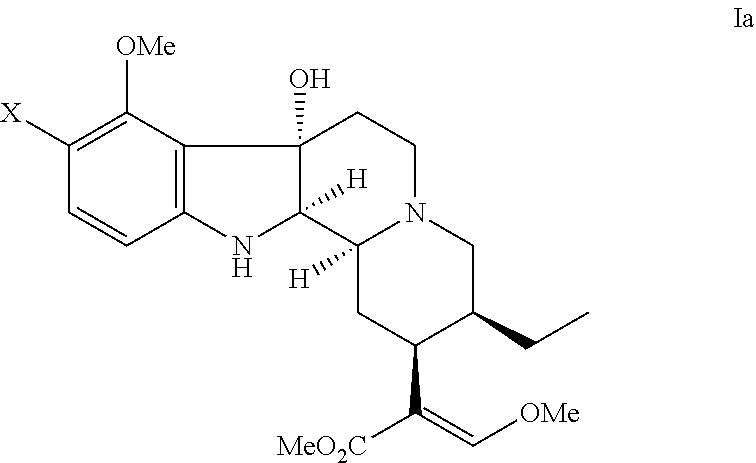
where X has the same meaning as defined above for formula (a).
According to other various other embodiments, a pharmaceutical composition is provided comprising a therapeutic amount of at least one indole alkaloid derivative compound having an opioid receptor agonistic effect or a pharmaceutically acceptable salt thereof of the present invention. The indole alkaloid derivative compound contained in these pharmaceutical compositions can be, for example, selected from amongst one of any of formulae (a), 1, 2, I, II, 1a, and Ia as set forth herein. These indole alkaloid derivative compounds may be used alone or in combinations thereof in a pharmaceutical composition. The pharmaceutical composition can further comprise a pharmaceutically acceptable carrier. The pharmaceutical composition can be provided in a pharmaceutically deliverable form, such as solutions, suspensions, emulsions, tablets, pills, pellets, granules, lozenges, capsules, capsules containing liquids, powders, sustained-release formulations, syrups, elixirs, creams, gels, suppositories, emulsions, aerosols, or sprays. In various embodiments, the indole alkaloid derivative (as an active ingredient) can be compounded in salt form into tablets or pills and the like, or alternatively can be dissolved in solution. The pharmaceutical composition can contain, for example, 0.1 wt % to 100 wt %, particularly about 1 wt % to about 90 wt %, more particularly from about 5 wt % to about 80 wt %, of the indole alkaloid derivative compound or a pharmaceutically acceptable salt thereof. Other wt % can be from 10 wt % to 75 wt %; from 15 wt % to 60 wt %, from 20 wt % to 50 wt % of the active ingredient.
According to other various embodiments, a method is provided for eliciting a therapeutic effect in a patient (e.g., human, animal) in need thereof, comprising the step of administering to the patient an effective dose of an indole alkaloid derivative compound having an opioid receptor agonistic effect or a pharmaceutically acceptable salt thereof of the present invention. The indole alkaloid derivative compound can be selected, for example, from amongst any one of formula (a), 1, 2, I, II, 1a or Ia as set forth herein, wherein X or R, as applicable, is fluorine, chlorine, bromine, or iodine.
According to various embodiments, the therapeutic effect achieved by the method comprises an analgesic effect, although not limited thereto. In various embodiments, the indole alkaloid compounds of the present teachings can be used to treat or prevent acute or chronic pain. The step of administering can be performed, for example, by a delivery route selected from oral, transdermal, intramuscular, intravenous, inhalation, injection, infusion, or suppository. The patient can be, for example, an animal, such as a mammal, although not limited thereto. According to particular embodiments, the patient is a human. Where the patient is a human and the therapeutic effect is pain treatment, the effective total daily dosage of the indole alkaloid derivative compound can range, for example, from about 0.1 mg to about 1,000 mg active compound/kg body weight of the patient. Other dosages are possible.
According to various embodiments, a method is provided for synthesizing a 10-halo-substituted indole alkaloid derivative compound, such as those exemplified in formulae 1, 2, I and II, wherein a Corynanthe-type indole alkaloid is reacted with hypervalent iodine in the presence of ethylene glycol effective to provide a 2,3-ethylene glycol bridged indoline adduct, effective to mask a 2,3-π bond of an indole nucleus of the adduct. A halogen atom is introduced at a C10 position of the adduct via electrophilic aromatic substitution, providing a C10-halogenated adduct derivative. The C10-halogenated adduct derivative is converted into a corresponding C10-halogenated mitragynine derivative by reduction reaction effective to eliminate the ethylene glycol bridge. Optionally, the C10-halogenated mitragynine derivative is further converted into a corresponding 7-hydroxy-10-halomitragynine derivative by oxidation reaction.
According to other various embodiments, a method is provided for synthesizing an indole alkaloid derivative compound, such as those exemplified in formulae 1a and Ia, wherein 7-hydroxymitragynine or 7-hydroxy-10-halomitragynine is reacted with a reducing agent, such as NaBH4, in a solvent such as MeOH, to yield compounds of formulae 1a and Ia.
The reaction product obtained by the methods according to various embodiments of the present invention can contain the indole alkaloid derivative compound in a concentration, for example, of from about 5 wt % to 100 wt %, particularly from about 10 wt % to about 99 wt %, about 20 wt % to about 99 wt %, and 50 wt % to about 99 wt %.
It is to be understood that the following descriptions are exemplary and explanatory only. The accompanying drawings are incorporated in and constitute a part of this application and illustrate several exemplary embodiments with the description. Reference will now be made to various embodiments, examples of which are illustrated in the accompanying drawings.
For purposes of this application, the following definitions apply.
“Halogen” or “-Halo” means fluorine, chlorine, bromine, or iodine.
The phrase “pharmaceutically acceptable salt,” as used herein, can be a salt formed, for example, from an acid and a basic functional group, such as a nitrogen group, of the indole alkaloid compound. Illustrative salts include, but are not limited, to sulfate, citrate, acetate, oxalate, chloride, bromide, iodide, nitrate, bisulfate, phosphate, acid phosphate, isonicotinate, lactate, salicylate, acid citrate, tartrate, oleate, tannate, pantothenate, bitartrate, ascorbate, succinate, maleate, gentisinate, fumarate, gluconate, glucaronate, saccharate, formate, benzoate, glutamate, methanesulfonate, ethanesulfonate, benzenesulfonate, p-toluenesulfonate, pamoate salts, or hydrochloride salts thereof.
The phrases “therapeutic amount,” “therapeutic dose,” “effective amount,” “effective dose,” and the like, when used in connection with an indole alkaloid compound means an amount effective for treating and/or preventing a condition.
The phrases “treatment of,” “treating,” and the like include the amelioration or cessation of a condition, or a symptom thereof.
The phrases “prevention of,” “preventing,” and the like include the avoidance of the onset of a condition, or a symptom thereof.
The term “animal,” for purposes of treatment, refers to a mammal, bird, reptile or fish. Representative animals include, for example, a monkey, chimpanzee, baboon, cow, buffalo, horse, sheep, pig, chicken, turkey, duck, cat, dog, rabbit, mouse, rat, hamster, guinea pig, and human.
The term “mammal” for purposes of treatment refers to any animal classified as a mammal, including humans, domestic and farm animals, and zoo, sport, or pet animals.
Indole Alkaloid Derivative Structures
Uniquely structured indole alkaloid compounds are provided in accordance with the present teachings that can be used for pain treatment and other therapeutic effects with reduced adverse side effects compared to prior alkaloid analgesics such as morphine and morphine derivatives.
According to various embodiments, indole alkaloid compound having an opioid receptor agonistic effect is provided having the formula (a) indicated below:

wherein:
X represents halogen atom or hydrogen,
Q and A each independently represents hydrogen, alkyl, or aryl,
E represents a hydrogen or hydroxyl group,
m is 0 or 1,
n is 0 or 1,
q is 0 or 1,
R1 and R2 independently are hydrogen, hydroxy, alkoxy, aryloxy, alkyl, aryl, aralkyl, alkaryl, alkyl amide, amino, alkylamino, halogen, fluorinated alkyl, fluorinated alkoxy, nitro group, or cyano group,
R3 represents an ester group or carboxyl group,
the dashed lines each indicates an optional double bond with provisos that when q is 0 and X is halogen then a 2,7 double bond is present, and when m is 0, q is 1 and X is halogen then a 1,2 double bond is present. In another embodiment, when m, q and n each is 1, then no 1,2 or 2,7 position double bond is present in the indole moiety of the compound.
In a further embodiment of the compounds of formula (a), R1 and R2 independently are C1-C6 alkoxy, R3 represents a C1-C6 alkyl carboxylic acid ester group, and Q and A (if present) are hydrogen, and the other groups and mentioned bonds are the same as previously defined. The C1-C6 alkoxy groups can be, e.g., methoxy, ethoxy, propoxy, butoxy, and the like), and C1-C6 alkyl carboxylic acid ester group can be, e.g., acetate, ethanoate, butanoate, hexanoate, and the like. R1 and R2 can be the same or different. R1, R2, and R3 can be substituted or unsubstituted. Any C3 or greater alkyl portions of these groups can be linear or branched.
According to other various embodiments, a C10-halogenated indole alkaloid compound having opioid receptor agonistic effect is provided that is selected from the formulae:

where R has the same meaning as X as defined above, R1, R2 and R3 have the same respective meanings as defined above.
According to other various embodiments, the C10-halogenated indole alkaloid compound having opioid receptor agonistic effect is selected from the formulae:

wherein the R is fluorine, chlorine, bromine, or iodine.
According to other various embodiments, the C10-halogenated indole alkaloid compound is C10-halogenated mitragynine, 7-hydroxy-C10-halogenatedmitragynine, C10-halogenated 2,3-dimethylindole, C10-halogenated tetrahydrocarbazole, C10-halogenated indoloquinolizidine corynantheol, C10-halogenated dihydrocorynantheol, or C10-halogenated yohimbine, singly or in any combination thereof.
According to further embodiments, the compound is 10-halomitragynine, 7-hydroxy-10-halomitragynine, singly or in a combination thereof. Specific therapeutic compounds according to embodiments of the present teachings include, for example, 7-hydroxy-10-fluoromitragynine, 7-hydroxy-10-chloromitragynine, 7-hydroxy-10-bromomitragynine, 10-fluoromitragynine, 10-chloromitragynine, or 10-bromomitragynine.
According to other various embodiments, an indole alkaloid compound having an opioid receptor agonistic effect is provided having the formula:

where X, R1, R2 and R3 have the same respective meanings as defined above for formula (a).
According to other various embodiments, the indole alkaloid compound having an opioid receptor agonistic effect has the formula:

where X has the same meaning as defined above for formula (a).
According to various embodiments, the indole alkaloid compounds of the present teachings have a useful pharmacological profile for producing potent antinociceptive effects with fewer rewarding effects compared with μ-agonists in general and weaker adverse side effects than morphine in particular. According to various embodiments, indole alkaloid compounds of the present teachings can inhibit gastrointestinal transit less potently than morphine at each equi-antinociceptive dose. Compounds of formula 1a (and Ia) have shown oral analgesic activity that is greater than about 200 times or more potent than that of morphine. They also exhibit potent in vitro activity relative to other mitragynine derivatives.
Although not desiring to be bound to theory, it is thought that the indole alkaloid compounds of the present teachings are unique dual acting μ- and κ-opioid agonists, which can produce stronger antinociceptive effects and weaker adverse effects than morphine. As discussed previously, μ-opioids induce potent antinociception, but they also induce psychological dependence during chronic administration. Activation of dopaminergic systems after administration of the μ-opioid agonist induces the development of rewarding effects. In contrast, κ-opioid receptors negatively modulate the activity of dopaminergic neurons and inhibit the rewarding effects mediated by μ-opioid receptors (Narita et al., 2001). Therefore, it is hypothesized that a dual acting μ- and κ-opioid agonist will induce potent antinociceptive effects and fewer rewarding effects than μ agonists such as morphine. The involvement of μ- and κ-opioid receptor mechanisms in the opioid agonistic effects of indole alkaloid compounds of the present teachings is possible. The affinities of indole alkaloid compounds of embodiments of the present teachings for the three opioid receptor types of μ-, δ-, and κ-opioid receptors can be determined by evaluating the inhibition of binding of ligands to μ-, δ-, and κ-opioid receptors.
Synthesis Methods
Synthesis of C10-halogenated indole alkaloid compounds of formula 1.
Synthesis methods that can be utilized or adapted in preparing C10-halogenated indole alkaloid compounds of embodiments of the present teachings are described, for example, in Takayama, H., et al. (2006) and Takayama, H., et al. (2002).
In one embodiment of the present invention, the inventors have found a new method to protect the 2,3-π of indole alkaloids, which has been applied to the preparation of derivatives having various substituents at the C10-position in Corynanthe-type indole alkaloids such as hydroxymitragynine or its parent compound.
The present inventors have determined that attempts at the direct introduction of electrophilic substituents on the benzene ring in 7-hydroxymitragynine or its parent compound are not successful. The present investigators have devised a method to protect the 2,3-π of indole alkaloids, producing the aniline structure that acts as a reactive aromatic compound toward various electrophiles. According to one embodiment, the general synthesis scheme is shown in Scheme A.

With reference to Scheme A, in accordance with embodiments of the present teachings, treatment of indole alkaloids with hypervalent iodine in the presence of ethylene glycol provides 2,3-ethylene glycol bridged adducts that can be converted into the original indoles under mild reductive conditions. This procedure, which involves masking of the reactivity of the indole nucleus at the β-position, is used for the modification of the benzene ring of the indoline derivative and is supplied to the preparation of potent opioid receptor agonists with the Corynanthe skeleton. The purity of the reaction product compounds can be checked, for example, by high-performance liquid chromatography and 1H-nuclear magnetic resonance (500 MHz) analysis.
Synthesis of Indole Alkaloid Compounds of Formula 1a.
A method also is provided for synthesizing an indole alkaloid derivative compound, such as those exemplified in formulae 1a and Ia, wherein 7-hydroxymitragynine or 7-hydroxy-10-halomitragynine, or a similar indole alkaloid, is reacted with an indole reducing agent, such as NaBH4, in a solvent such as MeOH, to yield compounds of formulae 1a and Ia. According to one embodiment thereof, the general synthesis scheme is shown in Scheme B.

where X is a halogen atom or a hydrogen atom depending on the starting compound.
The reaction product obtained by methods according to embodiments of the present teachings, such as illustrated above, can contain the indole alkaloid derivative compound in a concentration, for example, of from about 5 wt % to 100 wt %, particularly from about 10 wt % to about 99 wt %, from about 20 wt % to about 99 wt %, or from 50 wt % to about 99 wt %.
Therapeutic/Prophylactic Administration and Compositions
Pharmaceutical compositions according to embodiments of the present teachings can contain, for example, from 0.1 wt % to 100 wt %, particularly from about 1 wt % to about 90 wt %, more particularly from about 5 wt % to about 80 wt %, of the indole alkaloid derivative compound or a pharmaceutically acceptable salt thereof, which amounts can vary depending on factors such as the overall formulation and form thereof, intended treatment, and patient details at hand, and the like.
Due to their activity, the indole alkaloid compounds of embodiments according to the present teachings are advantageously useful, for example, in veterinary and human medicine. As described above, the indole alkaloid compounds are useful for treating or preventing a condition in an animal in need thereof. When administered to an animal, the indole alkaloid compounds are administered as a component of a composition that comprises any pharmaceutically acceptable carrier or excipient. The present compositions, which comprise at least one indole alkaloid compound, can be administered orally. The indole alkaloid compounds of the invention can also be administered by any other convenient route, for example, by infusion or bolus injection, by absorption through epithelial or mucocutaneous linings (e.g., oral, rectal, and intestinal mucosa, etc.) and can be administered together with another biologically active agent. Administration can be systemic or local. Various delivery systems are known, e.g., encapsulation in liposomes, microparticles, microcapsules, capsules, etc., and can be used to administer the indole alkaloid compounds.
Methods of administration include, but are not limited to, intradermal, intramuscular, intraperitoneal, intravenous, subcutaneous, intranasal, epidural, oral, sublingual, intracerebral, intravaginal, transdermal, rectal, by inhalation, or topical, particularly to the ears, nose, eyes, or skin. The mode of administration is left to the discretion of the practitioner. In most instances, administration will result in the release of the C10-halogenated indole alkaloid compounds into the bloodstream.
In specific embodiments, it can be desirable to administer the indole alkaloid compounds locally. This can be achieved, for example, and not by way of limitation, by local infusion during surgery, topical application, e.g., in conjunction with a wound dressing after surgery, by injection, by means of a catheter, by means of a suppository or enema, or by means of an implant, said implant being of a porous, non-porous, or gelatinous material, including membranes, such as sialastic membranes, or fibers.
In certain embodiments, it can be desirable to introduce the indole alkaloid compounds into the central nervous system or gastrointestinal tract by any suitable route, including intraventricular, intrathecal, and epidural injection, and enema. Intraventricular injection can be facilitated by an intraventricular catheter, for example, attached to a reservoir, such as an Ommaya reservoir. In certain embodiments, it can be desireable to administer the indole alkaloid compounds by subcutaneous administration, such as, for example, as dissolved in phosphate-buffered saline (pH 5.3-5.5).
Pulmonary administration can also be employed, e.g., by use of an inhaler or nebulizer, and formulation with an aerosolizing agent, or via perfusion in a fluorocarbon or synthetic pulmonary surfactant. In certain embodiments, the indole alkaloid compounds can be formulated as a suppository, with traditional binders and excipients such as triglycerides.
In another embodiment, the indole alkaloid compounds can be delivered in a vesicle, in particular a liposome. In yet another embodiment, the indole alkaloid compounds can be delivered in a controlled-release system or sustained-release system. In one embodiment, a pump can be used. In another embodiment, polymeric materials can be used. In yet another embodiment, a controlled- or sustained-release system can be placed in proximity of a target of the indole alkaloid compounds, e.g., the spinal column, brain, or gastrointestinal tract, thus requiring only a fraction of the systemic dose.
The present compositions can optionally comprise a suitable amount of a pharmaceutically acceptable excipient so as to provide the form for proper administration to the animal. Such a pharmaceutical excipient can be a liquid, such as water or an oil, including those of petroleum, animal, vegetable, or synthetic origin, such as peanut oil, soybean oil, mineral oil, sesame oil and the like. The pharmaceutical excipient can be saline, gum acacia, gelatin, starch paste, talc, keratin, colloidal silica, urea and the like. In addition, auxiliary, stabilizing, thickening, lubricating, and coloring agents can be used. In one embodiment, the pharmaceutically acceptable excipient is sterile when administered to an animal. Water is a particularly useful excipient when the indole alkaloid compound is administered intravenously. Saline solutions and aqueous dextrose and glycerol solutions can also be employed as liquid excipients, particularly for injectable solutions. Suitable pharmaceutical excipients also include starch, glucose, lactose, sucrose, gelatin, malt, rice, flour, chalk, silica gel, sodium stearate, glycerol monostearate, talc, sodium chloride, dried skim milk, glycerol, propylene, glycol, water, ethanol and the like. The present compositions, if desired, can also contain minor amounts of wetting or emulsifying agents, or pH buffering agents.
The present compositions can take the form of solutions, suspensions, emulsions, tablets, pills, pellets, capsules, capsules containing liquids, powders, sustained-release formulations, suppositories, emulsions, aerosols, sprays, suspensions, or any other form suitable for use. In one embodiment, the composition is in the form of a capsule. Other examples of suitable pharmaceutical excipients are described in Remington's Pharmaceutical Sciences, incorporated herein by reference. In one embodiment, the indole alkaloid compounds are formulated in accordance with routine procedures as a composition adapted for oral administration to human beings. Compositions for oral delivery can be in the form of tablets, lozenges, aqueous or oily suspensions, granules, powders, emulsions, capsules, syrups, or elixirs, for example. Orally administered compositions can contain one or more agents, for example, sweetening agents such as fructose, aspartame or saccharin; flavoring agents such as peppermint, oil of wintergreen, or cherry; coloring agents; and preserving agents, to provide a pharmaceutically palatable preparation. Moreover, where in tablet or pill form, the compositions can be coated to delay disintegration and absorption in the gastrointestinal tract thereby providing a sustained action over an extended period of time. Selectively permeable membranes surrounding an osmotically active driving compound are also suitable for orally administered compositions. In these latter platforms, fluid from the environment surrounding the capsule is imbibed by the driving compound, which swells to displace the agent or agent composition through an aperture. These delivery platforms can provide an essentially zero order delivery profile as opposed to the spiked or bolus profiles of immediate release formulations. A time-delay material such as glycerol (mono)stearate can also be used. Oral compositions can include standard excipients such as mannitol, lactose, starch, magnesium stearate, sodium saccharin, cellulose, or magnesium carbonate. In one embodiment, the excipients are of pharmaceutical grade.
In another embodiment, the indole alkaloid compounds can be formulated for intravenous administration. Typically, compositions for intravenous administration can comprise a sterile isotonic aqueous buffer. Where necessary, the compositions can also include a solubilizing agent. Generally, the ingredients are supplied either separately or mixed together in unit dosage form, for example, as a dry lyophilized powder or water free concentrate in a hermetically sealed container such as an ampule or sachette indicating the quantity of active agent. Where the indole alkaloid compounds are to be administered by infusion, they can be dispensed, for example, with an infusion bottle containing sterile pharmaceutical grade water or saline. Where the indole alkaloid compounds are administered by injection, an ampule of sterile water for injection or saline can be provided so that the ingredients can be mixed prior to administration.
The amount of the indole alkaloid compounds that is effective for the treatment or prevention of a condition can be determined by standard clinical techniques. In addition, in vitro or in vivo assays can optionally be employed to help identify optimal dosage ranges. When administered for the treatment and/or prevention of a particular disorder and/or disease state, it is understood that the effective dosage may vary depending upon the particular compound used, the mode of administration, the condition, and severity thereof, of the condition being treated, as well as the various physical factors related to the patient being treated, such that the precise dosing regimen to be employed can also depend on these factors and the judgment of a health care practitioner treating the patient. Suitable effective dosage amounts, for example, can range from about 0.1 mg/kg body weight/day to about 1,000 mg/kg body weight/day, particularly from about 1 mg/kg body weight/day to about 200 mg/kg body weight/day, and more particularly from about 2 mg/kg body weight/day to about 100 mg/kg body weight/day. The dosage amount can be administered in a single dosage treatment per day or as divided into separate smaller dosage treatments per day, depending on the treatment circumstances. For example, in pain treatment, from about 5 to about 30 mg can be administered to a patient in need thereof every four hours or other dosage and/or interval, as needed. The indole alkaloid compounds also can be administered as an aqueous solution or other solution containing the compound or salt thereof, and such as in a concentration of from about 1 mg to about 25 mg per mL or other concentration.
The opioid component of the present methods and compositions may further include one or more other active ingredients that may be conventionally employed in analgesic and/or cough-cold-antitussive combination products. Such conventional ingredients include, for example, aspirin, acetaminophen, phenylpropanolamine, phenylephrine, chlorpheniramine, caffeine, and/or guaifenesin, and the like. Typical or conventional ingredients that may be included in the opioid component are described, for example, in the Physicians' Desk Reference, the disclosure of which is hereby incorporated herein by reference, in its entirety.
In addition, the opioid component may further include one or more compounds that may be designed to enhance the analgesic potency of the opioid and/or to reduce analgesic tolerance development. Although the compounds of the present invention may be administered as the pure chemicals, the active ingredient can be administered as a pharmaceutical composition. The invention thus further provides a pharmaceutical composition comprising an effective amount of one or more of the compounds of the invention, preferably one or more compounds described herein, together with one or more pharmaceutically acceptable carriers therefore and, optionally, other therapeutic and/or prophylactic ingredients. The carrier(s) must be acceptable in the sense of being compatible with the other ingredients of the composition and not deleterious to the recipient thereof. The compounds of the invention may be administered in an effective amount by any of the conventional techniques well-established in the medical field. The compounds employed in the methods of the present invention including, for example, opioids and the compounds of the invention, or a pharmaceutically acceptable salt thereof, may be administered by any means that results in the contact of the active agent(s) with the relevant site or site(s) of action in the body of a patient. The compounds may be administered by any conventional means available for use in conjunction with pharmaceuticals, either as individual therapeutic agents or in a combination of therapeutic agents. For example, they may be administered as the sole active agents in a pharmaceutical composition, or they can be used in combination with other therapeutically active ingredients.
The present invention will be further clarified by the following examples, which are intended to be purely exemplary of the present invention. Unless otherwise indicated, all numbers expressing quantities, percentages or proportions, and other numerical values used in the specification and claims, are to be understood as being weight percentages unless indicated to the contrary.
Synthesis of C10-Substituted Indole Alkaloid Compounds
Mitragynine (compound 2) was treated with 1 equivalent of phenyliodine bis (trifluoroacetate) (PIFA) in the presence of ethylene glycol (EG) in MeCN at 0° C., and a 2,3-ethylene glycol bridged indoline derivative was obtained in quantitative yield. The structure of the adduct including the stereochemistry was determined from spectroscopic data, as shown in Scheme 1.

Using other indole alkaloids, the present investigators examined the generality of the newly developed method to mask the pyrrole moiety in the indole nucleus. Among the tested compounds 2,3-dimethylindole, tetaracarbazole, indoloquinolizidine corynantheeol, dihydrocorynantheol, and yohimbine, the corresponding EG adducts (4-9), were obtained in moderate yields. However, the best results (the yields are shown in Scheme 1a) were obtained when NH4Cl was added to the reaction mixture (see Supporting Information).


In the case of reserpine, it was found that phenyliodine diacetate (PIDA) was a more suitable reagent than PIFA for the formation of the EG-bridged adduct (10), which was also useful as a starting material for the preparation of various kinds of A-ring-modified reserpine analogues.
Using EG adduct 3 derived from mitragynine (2), various kinds of substituents were introduced onto the benzene ring as shown in Scheme 2.

Treatment of compound 3 with N-fluoro-2,6-dichloropyridinium triflate (FP-T800) gave compound 11 fluorinated at the C-10 position in 53% yield. Exposure of compound 3 to NCS in AcOH afforded two chlorinated derivatives 12a (10-Chloro) and 12b (12-Chloro) in 88% and 11% yields respectively. Using NBS in DMF, 10-bromo and 12-bromo derivatives (13a and 13b) were obtained in 75% and 24% yields, respectively. To introduce a nitro group, for comparison sake, a combination of CAN and concentrated H2SO4 in DCM was used to give 14a in 52% yield together with its 12-isomer (14b) in 21% yield. 10-Methoxy derivative 15 was prepared in 64% yield by treatment of compound 3 with IBDA in MeOH, followed by the reduction of the resulting iminoquinone intermediate (see Supporting Information) with Zn in MeOH.
The C10-substituted derivative thus obtained as a major product of each electrophilic aromatic substitution reaction were converted into their indole derivatives in good yields by reduction with NaCNBH3 in AcOH as described above (conversion from compound 3 into compound 2). However, in the case of nitro derivative 14a, a two-step procedure was used; i.e., compound 14a was treated with TBSOTf in the presence of 2,6-lutadine and the resultant indolenine derivative 16 obtained in 87% yield was reduced with NaCNBH3 to give the indole derivative 20 in 94% yield (Scheme 3). The thus obtained indole derivatives were, respectively, converted into 7-hydroxyindolenine derivatives (22-25) by oxidation with PIFA in aqueous MeCN.
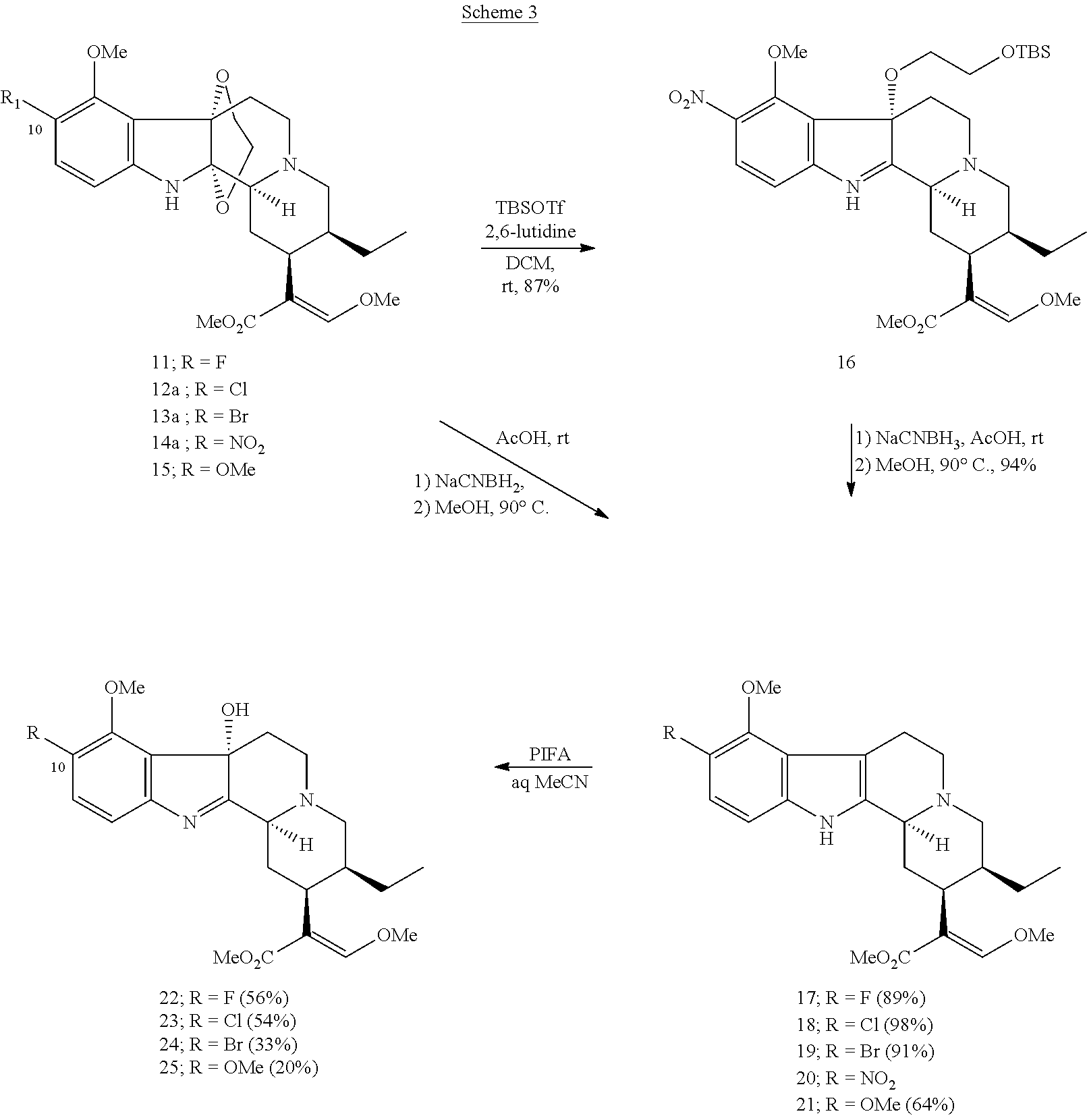
Additional details on the experimental procedures used for the preparation of compounds 2-25, and copies of 1H and 13C NMR spectral data for compounds 3-6, 11, 17 and 22 are provided in the Supporting Information included herewith.
Pharmacological Evaluation
The series of C10-substituted mitragynine derivatives obtained by the above reactions were subjected to pharmacological evaluation. The opioid agonistic effect was evaluated in an experiment involving twitch contraction induced by electrical stimulation of guinea pig ileum. This experiment is generally used to study opioid analgesics. Additional details on the experimental procedures used for this evaluation are provided in the Supporting Information. The results are shown in Table A.
| TABLE A |
| Opioid Effects of Mitragynine Derivatives on Twitch Contraction |
| Induced by Electrical Stimulation in Guinea Pig Ileuma |
| pD2 value | Relative | Maximum | Inhibitory | |
| Compound | (−log M) | Potency (%) | inhibition (%) | activity (%) |
| Morphine | 7.15 ± 0.05 | 100 | 87.2 ± 1.8 | 100 |
| Ethylene Glycol Bridged |
| 3 | 7.70 ± 0.10 | 354 | 35.0 ± 11.0 | 40 |
| 11 | 8.40 ± 0.02 | 1778 | 83.4 ± 3.2 | 96 |
| 12a | 7.61 ± 0.17 | 288 | 48.1 ± 9.3 | 55 |
| 14a | 7.88 ± 0.18 | 537 | 65.0 ± 4.3 | 75 |
| |
| 2 | 6.50 ± 0.06 | 22 | 72.0 ± 5.0 | 83 |
| 7- |
| 1 | 7.78 ± 0.10 | 426 | 90.8 ± 3.4 | 104 |
| 22 | 7.87 ± 0.04 | 524 | 82.5 ± 1.8 | 95 |
| 23 | 7.53 ± 0.08 | 239 | 74.8 ± 3.0 | 86 |
| 24 | 7.45 ± 0.04 | 199 | 61.7 ± 6.2 | 71 |
| aPotency is expressed as a pD2 value, which is the negative logarithm of the concentration required to produce 50% of the maximum response each compound (EC50). Relative potency is expressed as a percentage the pD2 value of each compound against that of morphine. Maximum inhibition (%), which is elicited by the compound when the response reaches a plateau, was calculated by regarding the twitch contraction as 100%. Relative inhibitory activity, which means intrinsic activity on opioid receptors, is expressed as a percentage of the maximum inhibition by each compound against that by morphine. Each value represents a mean (SEM) of five or six animals. The asterisk (*) donates values that were significantly different from the morphine group by Student's t-test (**, <0.01). Compounds 13a, 15,17-21, and 25 did not show significant inhibition at 1 μM. | ||||
Among the EG-bridged derivatives (3, 11, 12a, 13a, 14a and 15) and the 7-hydroxyindolenine derivatives (22-25) C10-fluorinated derivatives (11, 22) showed the highest potency. Derivatives having a fluoro group at C10 showed the highest potency amongst the C10-halogenated derivatives. Although not desiring to be bound to any theory, these results suggest that the dimension or electronegativity of the functional group at the C10 position can be useful to elicit opioid agonistic effect. Compound 22 in particular showed potent agonistic effect, but its potency was nearly equal to that of 7-hydroxymitragynine (1).
The results of these experimental studies show a new method to mask the 2,3-π bond of indole alkaloids and the conversion of the protected compounds, i.e., 2,3-ethylene glycol adducts, back to the starting indoles. This procedure was utilized in these studies for the modification of the benzene ring of the indoline derivative and was applied to the preparation of potent opioid receptor agonists with the Corynanthe skeleton, in which the C10-halogenated indole alkaloid compound exhibited more potent opioid agonistic effect than morphine in in vitro experiments.
Synthesis of Indole Alkaloid Compounds of Formula Ia
Exemplary indole alkaloid derivative compounds of formulae Ia were prepared by reacting 7-hydroxymitragynine and separately 7-hydroxy-10-halomitragynine with NaBH4, in MeOH, to yield compounds 26 and 27, such as shown in general synthesis Scheme 4.

Additional details on the experimental procedures used for the preparation of compounds 26 and 27, and 1H and 13C NMR spectral data for these compounds are provided below.
Preparation of Compound 26.
To a stirred solution of 7-hydroxymitragynine (37.5 mg, 0.091 mmol) in dry MeOH (1.1 mL) was added NaBH4 (4.3 mg, 0.11 mmol) at 0° C. under argon atmosphere. After 30 min, H2O was added to the reaction mixture. The mixture was concentrated under reduced pressure and poured into saturated aqueous NaHCO3 solution, and the whole mixture was extracted with 5% MeOH/CHCl3 three times. The combined extract was washed with brine, dried over MgSO4, and evaporated to give a residue that was purified by silica gel column chromatography (ethyl acetate/n-hexane=35:65) and then crystallized from ethyl acetate to give 26.3 mg of compound 26 (MGM-15) (y. 70%).
Preparation of Compound 27.
To a stirred solution of 10-fluoro7-hydroxymitragynine (23.7 mg, 0.055 mmol) in dry MeOH (0.5 mL) was added NaBH4 (2.1 mg, 0.056 mmol) at 0° C. under argon atmosphere and the reaction mixture was stirred for 30 min. After adding H2O, the reaction mixture was poured into saturated aqueous NaHCO3 solution. The whole mixture was extracted with 5% MeOH/CHCl3 three times. The combined extract was washed with brine, dried over MgSO4, and evaporated to give a residue that was purified by amino-silica gel column chromatography (ethyl acetate/n-hexane=1:1) to give 22.6 mg of compound 27 (MGM-16) (y. 95%).
Pharmacological Evaluation
Methods
Animals.
Male ddY-strain mice (Japan SLC, Hamamatsu, Japan) weighing 25-33 g and male Hartley-strain guinea-pigs (Japan SLC) weighing 320-550 g were used.
Drugs.
For guinea-pig isolated ileum test, compound 1 and compound 11 were first dissolved in 100% dimethylsulfoxide to yield a 5 mM solution, and then subsequently diluted with distilled water. For mouse tail-flick test and gastrointestinal transit test, compound 1 and compound 11 were dissolved in 25 mM phosphate buffer (pH 5.3-5.5).
Electrical Stimulation of Guinea-Pig Ileum.
These tests were also conducted on compounds 26 and 27, in addition to the compounds previously reported in Table A, and the combined results are set forth in Table 1. The guinea-pig ileum was dissected and placed in Krebs-Henseleit solution (in mM: NaCl, 112.08; KCl, 5.90; CaCl2, 1.97; MgCl2, 1.18; NaH2PO4, 1.22; NaHCO3, 25.00, and glucose, 11.49). The ileum was placed under 1 g tension in a 5 ml organ bath containing the nutrient solution. The bath was maintained at 37° C. and continuously bubbled with a mixture of 95% O2 and 5% CO2. Tissues were stimulated by a platinum needle-ring (the ring was placed 20 mm above the base of a 5 mm long needle) electrode. After equilibration, the ileum was transmurally stimulated with monophasic pulses (0.2 Hz and 0.1 ms duration) by a stimulator (SEN-7203, Nihon Kohden, Tokyo, Japan). Contractions were isotonically recorded by using a displacement transducer (NEC Type 45347, San-ei Instruments Ltd., Tokyo, Japan). The effects of drug treatments on the twitch contractions evoked by transmural stimulation elicited through the ring electrodes were examined. The height of the twitch response to transmural stimulation was measured before and after the drug challenge. The responses were expressed as % inhibition of the twitch response to the transmural stimulation before the drug challenge.
Tail-Flick Test.
Mice respond to a focused heat stimulus by flicking or moving their tail from the path of the stimulus, thereby exposing a photocell located in the tail-flick analgesia meter (Ugo Basile Tail-flick Unit 7360, Ugo Basile, Comerio, Italy) immediately below the tail. The reaction time is automatically recorded. Prior to treatment with drugs, vehicle, or saline, the nociceptive threshold was measured three times, and the mean of the reaction time was used as the pre-drug latency for each mouse. A cut-off time of 10 s was used to prevent tissue damage. Analgesia was quantified using the percentage of maximum possible effect (% MPE) and calculated as: % MPE=[(test latency−pre-drug latency)/(cut-off time−pre-drug latency)]×100.
Gastrointestinal Transit.
Mice were fasted, with water available ad libitum, for 18 h before the experiments. Fifteen minutes after s.c. administration of compound 1, compound 11, morphine, vehicle, or saline, a charcoal meal (an aqueous suspension of 10% charcoal and 5% gum arabic) was orally administered at a volume of 0.25 ml. Fifteen minutes after oral administration of compound 1, compound 11 or vehicle, and 30 min after oral administration of morphine or distilled water, a charcoal meal was orally administered. Thirty minutes after administration of the charcoal meal, the animal was sacrificed by cervical dislocation, and the small intestine from the pylorus to the ileocecum was carefully removed. Both the length of the small intestine from the pylorus to the ileocecum and the farthest distance to which the charcoal meal had traveled were measured. For each animal, the gastrointestinal transit (GIT) was calculated as the percentage of distance traveled by the charcoal meal relative to the total length of the small intestine. The inhibition of gastrointestinal transit (%) was calculated as: Inhibition of gastrointestinal transit (%)=[(saline or vehicle GIT−drug GIT)/(saline or vehicle GIT)]×100.
Statistical Analysis.
The data are expressed as the mean±S.E.M. Statistical analyses were performed with two-tailed Student's t-test for comparison of two groups, and by a one-way analysis of variance followed by a Bonferroni multiple comparison test for comparison of more than two groups. A P value <0.05 was considered statistically significant. ED50 values and 95% confidence limits were determined using the Litchfield-Wilcoxon method (1949).
Results and Discussion.
Analgesic effects of compound 1, compound 11, compound 26, compound 27 and morphine were investigated in acute thermal pain tests in mice. The oral administration of compound 1, compound 11, compound 26 and compound 27 exhibited potent and dose-related analgesic effects in the tail-flick test (FIG. 1 ). The ED50 values (95% confidence limits) for the analgesic effects of the oral administration of compound 1, compound 11, compound 26 and compound 27 were 4.43 mg/kg (1.57-6.93 mg/kg), 2.84 mg/kg (1.60-5.05 mg/kg), 1.26 mg/kg (0.84-1.88 mg/kg) and 0.26 mg/kg (0.17-0.42 mg/kg), respectively, in the tail-flick test. Compound 1, compound 11, compound 26 and compound 27 elicit 14, 22, 50 and 240 times, respectively, more potent analgesic effects than morphine in the mouse tail-flick test (Table 2). It is hypothesized that mitragynine-related compounds have a favorable structure for inducing the orally-active analgesic effect.
Site of Action in Analgesic Effects of Compounds.
The in vivo analgesic test revealed that compound 11, compound 26 and compound 27 showed dose-dependent and strong analgesic effects when orally administered to mice. In order to determine the opioid receptor type selectivity of analgesia induced by compound 11, compound 26 and compound 27, mice were pretreated with selective opioid receptor type antagonists in mouse tail-flick test. Doses of compound 11, compound 26 and compound 27 were used and produced a response of 80-90% to detect the effects of the antagonists easily. The analgesic effects of subcutaneously-administered compound 11, compound 26 and compound 27 were completely blocked by the non-selective opioid antagonist naloxone (data not shown).
This result suggests the involvement of opioid receptors in their analgesic effects. The effect of compound 11 was markedly inhibited by the μ-opioid receptor selective antagonist β-funaltrexamine and by the κ-opioid receptor selective antagonist nor-binaltorphimine (FIG. 2A ). The selective δ-antagonist naltrindole was ineffective on compound 11-induced effect. Taken together, these results indicated that the potent analgesic effect of compound 11 resulted from its combined agonistic action on both μ- and κ-opioid receptors.
On the other hand, the effects of compound 26 and compound 27 were markedly inhibited by the μ-opioid receptor selective antagonist β-funaltrexamine, but were moderately inhibited by the δ-opioid receptor selective antagonist naltrindole (FIG. 2B , C). The selective κ-antagonist nor-binaltorphimine had no effect on their effects. Consequently, these results showed that the potent analgesic effects of compound 26 and compound 27 are attributed to its combined agonistic action on both μ- and δ-opioid receptors.
Weaker Constipating Effects of Compounds than that of Morphine.
Constipation is a major problem during chronic administration of opioid analgesics such as morphine. The dose required for its analgesic effect is much higher than that required for its constipating effect. Consequently, constipation is not a clinically negligible issue when morphine is used for the analgesic drug. Then, the inhibition of gastrointestinal transit was studied to evaluate the constipating effect of compound 11 in comparison to morphine and compound 1. The effect of compound 11 on the passage of a charcoal meal was examined after its oral administration in mice. The oral administration of the compound 1, compound 11 and morphine dose-dependently inhibited gastrointestinal transit (FIG. 3 ). The constipating ED50 values (95% confidence limits) for compound 1, compound 11 and morphine were 7.50 mg/kg (3.95-14.2), 11.1 mg/kg (5.96-20.7) and 11.7 mg/kg (5.56-24.6), respectively (Table 2).
The constipating effect of compound 11 was equipotent with morphine and compound 1. The constipating ED50 value of compound 11 was 4 times larger than that of its analgesic ED50 (Table 2). In the case of morphine, its constipating ED50 value was 5 times smaller than its analgesic ED50 value. These results suggest that compound 11 induces constipation much less potently than morphine at equi-analgesic dose.
The oral administration of compound 11, compound 26 and compound 27 induced potent analgesic effects in mice. It was surprising that the analgesic effect of compound 27 is 240 fold more potent than that of morphine in their oral administration. The effect of compound 11 was meditated by its agonistic action on both μ- and κ-opioid receptors, while the effect of compound 26 and compound 27 were meditated by their agonistic action on both μ- and δ-opioid receptors. In the gastrointestinal transit study, compound 11 inhibited gastrointestinal transit, but its constipating effect was much weaker than that of morphine at equi-analgesic doses.
The dual acting μ- and κ-opioid agonist, compound 11, and the dual acting μ- and δ-opioid agonists, compound 26 and compound 27, are promising novel analgesics that have more potent analgesic and weaker adverse effects than morphine in clinical management of pain.
| TABLE 1 |
| Opioid effects of mitragynine derivatives on twitch contraction |
| induced by electrical stimulation in guinea-pig isolated ileum |
| pD2 value | Relative | Maximum | Inhibitory | |
| Compound | (−log M) | Potency (%) | inhibition (%) | activity (%) |
| Morphine | 7.15 ± 0.05 | 100 | 87.2 ± 1.8 | 100 |
| Ethylene Glycol Bridged |
| 3 | 7.70 ± 0.10 | 354 | 35.0 ± 11.0 | 40 |
| 11 | 8.40 ± 0.02 | 1778 | 83.4 ± 3.2 | 96 |
| 12a | 7.61 ± 0.17 | 288 | 48.1 ± 9.3 | 55 |
| 14a | 7.88 ± 0.18 | 537 | 65.0 ± 4.3 | 75 |
| |
| 2 | 6.50 ± 0.06 | 22 | 72.0 ± 5.0 | 83 |
| 7- |
| 1 | 7.78 ± 0.10 | 426 | 90.8 ± 3.4 | 104 |
| 22 | 7.87 ± 0.04 | 524 | 82.5 ± 1.8 | 95 |
| 23 | 7.53 ± 0.08 | 239 | 74.8 ± 3.0 | 86 |
| 24 | 7.45 ± 0.04 | 199 | 61.7 ± 6.2 | 71 |
| 26 | 8.26 ± 0.05 | 1259 | 78.2 ± 3.4 | 90 |
| 27 | 8.81 ± 0.09 | 4571 | 89.0 ± 2.3 | 102 |
| Potency is expressed as a pD2 value, which is the negative logarithm of the concentration required to produce 50% of the maximum response each compound (EC50). Relative potency is expressed as a percentage the pD2 value of each compound against that of morphine. Maximum inhibition (%), which is elicited by the compound when the response reaches a plateau, was calculated by regarding the twitch contraction as 100%. Relative inhibitory activity, which means intrinsic activity on opioid receptors, is expressed as a percentage of the maximum inhibition by each compound against that by morphine. Each value represents mean ± S.E.M. of data obtained from five or six animals. Compounds 13a, 15, 17-21, and 25 did not show significant inhibition at 1 μM. | ||||
| TABLE 2 |
| Analgesic effects (tail-flick) and inhibitory effects on gastrointestinal transit (GIT) produced by |
| orally administration of morphine, |
| Compound |
| 1 | |
|
|
Morphine |
| Tail-flick | 4.43 (1.57-6.93) | 2.84 (1.60-5.05) | 1.26 (0.84-1.88) | 0.263 (0.165-0.420) | 63.0 (37.2-106.8) |
| GIT | 7.50 (3.95-14.20) | 11.1 (6.0-20.7) | N.D. | N.D. | 11.7 (5.6-24.6) |
| ED50 represents the median effective dose (mg/kg) (95% confidence limits). N.D.: Not determined. | |||||
The disclosures of each patent, patent application and publication cited or described in this document are hereby incorporated herein by reference, in their entirety.
Applicants specifically incorporate the entire contents of all cited references in this disclosure. Further, when an amount, concentration, or other value or parameter is given as either a range, preferred range, or a list of upper preferable values and lower preferable values, this is to be understood as specifically disclosing all ranges formed from any pair of any upper range limit or preferred value and any lower range limit or preferred value, regardless of whether ranges are separately disclosed. Where a range of numerical values is recited herein, unless otherwise stated, the range is intended to include the endpoints thereof, and all integers and fractions within the range. It is not intended that the scope of the invention be limited to the specific values recited when defining a range.
Other embodiments of the present teachings will be apparent to those skilled in the art from consideration of the present specification and practice of the present teachings disclosed herein. It is intended that the specification and examples be considered as exemplary only and not be limiting of the claims. All cited references, patents, and patent applications are incorporated in their entireties herein by reference.
- Bansinath M, Ramabadran K, Turndorf H, Puig M M (1991) κ-Opiate agonist-induced inhibition of gastrointestinal transit in different strains of mice. Pharmacology 42:97-102.
- Burkill I H (1935) A Dictionary of the Economic Products of the Malay Peninsula. Vol. II., pp. 1480-1483, Crown Agents for the Colonies, London.
- Chavkin C, Goldstein A (1981) Demonstration of a specific dynorphin receptor in guinea pig ileum myenteric plexus. Nature 291:591-593.
- Cheng Y C, Prusoff W H (1973) Relationship between inhibition constant (K1) and the concentration of inhibitor which causes 50% inhibition (I50) of an enzymatic reaction. Biochem Pharmacol 22:3099-3108.
- Corbett A D, Henderson G, McKnight A T, Paterson S J (2006) 75 years of opioid research: the exciting but vain quest for the Holy Grail. Br J Pharmacol 147:S153-162.
- Cox B M, Weinstock M (1966) The effect of analgesic drugs on the release of acetylcholine from electrically stimulated guinea-pig ileum. Br J Pharmacol Chemother 27:81-92.
- D'Amour F E, Smith D L (1941) A method for determining loss of pain sensation. J Pharmacol Exp Ther 72:74-79.
- Dhawan B N, Cesselin F, Raghubir R, Reisine T, Bradley P B, Portoghese P S, Hamon M (1996) International Union of Pharmacology. XII. Classification of opioid receptors. Pharmacological Review 48:567-592.
- Funada M, Suzuki T, Narita M, Misawa M, Nagase H (1993) Blockade of morphine reward through the activation of κ-opioid receptors in mice. Neuropharmacology 32:1315-1323.
- Grewal K S (1932) Observations on the pharmacology of mitragynine. J Pharmacol Exp Ther 46:251-271.
- Horie S, Koyama F, Takayama H, Ishikawa H, Aimi N, Ponglux D, Matsumoto K, Murayama T (2005) Indole alkaloids of a Thai medicinal herb, Mitragyna speciosa, that has opioid agonistic effect in guinea-pig ileum. Planta Med 71:231-236.
- Hughes J, Kosterlitz H W, Leslie F M (1975) Effect of morphine on adrenergic transmission in the mouse vas deferens. Assessment of agonist and antagonist potencies of narcotic analgesics. Br J Pharmacol 53:371-381.
- Kuzmin A, Sandin J, Terenius L, Ogren S O (2000) Dose- and time-dependent bimodal effects of kappa-opioid agonists on locomotor activity in mice. J Pharmacol Exp Ther 295:1031-1042.
- Litchfield J T, Wilcoxon F (1949) A simplified method of evaluating dose-effect experiments. J Pharmacol Exp Ther 96:99-113.
- Matthes H W, Maldonado R, Simonin F, Valverde O, Slowe S, Kitchen I, Befort K, Dierich A, Le Meur M, Dolle P, Tzavara E, Hanoune J, Rogues B P, Kieffer B L (1999) Loss of morphine-induced analgesia, reward effect and withdrawal symptoms in mice lacking the μ-opioid-receptor gene. Nature 383:819-823.
- Matsumoto K, Hatori Y, Murayama T, Tashima K, Wongseripipatana S, Misawa K, Kitajima M, Takayama H, Horie S (2006b) Involvement of μ-opioid receptors in antinociception and inhibition of gastrointestinal transit induced by 7-hydroxymitragynine, isolated from Thai herbal medicine Mitragyna speciosa. Eur J Pharmacol 549:63-70.
- Matsumoto K, Horie S, Ishikawa H, Takayama H, Aimi N, Ponglux D, Watanabe K (2004) Antinociceptive effect of 7-hydroxymitragynine in mice: Discovery of an orally active opioid analgesic from the Thai medicinal herb Mitragyna speciosa. Life Sci 74:2143-2155.
- Matsumoto K, Horie S, Takayama H, Ishikawa H, Aimi N, Ponglux D, Murayama T, Watanabe K (2005) Antinociception, tolerance and withdrawal symptoms induced by 7-hydroxymitragynine, an alkaloid from the Thai medicinal herb Mitragyna speciosa. Life Sci 78:2-7.
- Matsumoto K, Mizowaki M, Suchitra T, Takayama H, Sakai S, Aimi N, Watanabe H (1996) Antinociceptive action of mitragynine in mice: evidence for the involvement of supraspinal opioid receptors. Life Sci 59:1149-55.
- Matsumoto K, Takayama H, Ishikawa H, Aimi N, Ponglux D, Watanabe K, Horie S (2006a) Partial agonistic effect of 9-hydroxycorynantheidine on mu-opioid receptor in the guinea-pig ileum. Life Sci 78:2265-2271.
- Matsumoto K, Yamamoto L T, Watanabe K, Yano S, Shan J, Pang P K, Ponglux D, Takayama H, Horie S (2005) Inhibitory effect of mitragynine, an analgesic alkaloid from Thai herbal medicine, on neurogenic contraction of the vas deferens. Life Sci 78:187-194.
- McCurdy C R, Scully S S (2005) Analgesic substances derived from natural products (natureceuticals). Life Sci 78:476-484.
- Megens A A, Artois K, Vermeire J, Meert T, Awouters F H (1998) Comparison of the analgesic and intestinal effects of fentanyl and morphine in rats. J Pain Symptom Manage 15:253-258.
- Narita M, Funada M, Suzuki T (2001) Regulations of opioid dependence by opioid receptor types. Pharmacol Ther 89:1-15.
- Narita M, Mizuo K, Mizoguchi H, Sakata M, Narita M, Tseng L F, Suzuki T (2003) Molecular evidence for the functional role of dopamine D3 receptor in the morphine-induced rewarding effect and hyperlocomotion. J Neurosci 23:1006-1012
- Narita M, Takahashi Y, Takamori K, Funada M, Suzuki T, Misawa M, Nagase H (1993) Effects of kappa-agonist on the antinociception and locomotor enhancing action induced by morphine in mice. Jpn J Pharmacol. 62:15-24.
- Neumeyer J L, Bidlack J M, Zong R, Bakthavachalam V, Gao P, Cohen D J, Negus S S, Mello N K (2000) Synthesis and opioid receptor affinity of morphinan and benzomorphan derivatives: mixed kappa agonists and mu agonists/antagonists as potential pharmacotherapeutics for cocaine dependence. J Med Chem 43:114-22.
- Roy S, Liu H C, Loh H H (1998) μ-Opioid receptor-knockout mice: the role of μ-opioid receptor in gastrointestinal transit. Brain Res Mol. Brain Res 56:281-283.
- Suwanlert S (1975) A study of kratom eaters in Thailand. Bull Narc 27:21-27.
- Takayama H (2004) Chemistry and pharmacology of analgesic indole alkaloids from the rubiaceous plant, Mitragyna speciosa. Chem Pharm Bull 52:916-928.
- Takayama H, Ishikawa H, Kurihara M, Kitajima M, Aimi N, Ponglux D, Koyama F, Matsumoto K, Moriyama T, Yamamoto L T, Watanabe K, Murayama T, Horie S (2002) Studies on the synthesis and opioid agonistic activities of mitragynine-related indole alkaloids: discovery of opioid agonists structurally different from other opioid ligands. J Med Chem 45:1949-1956.
- Takayama H., Misawa K, Okada N, Ishikawa H, Kitajima M, Hatori Y, Murayama T, Wongseripipatana S, Tashima K, Matsumoto K and Horie S (2006) New procedure to mask the 2,3-π bond of the indole nucleus and its application to the preparation of potent opioid receptor agonists with a Corynanthe skeleton. Org Lett 8:5705-5708.
- Thongpradichote S, Matsumoto K, Thoda M, Takayama H, Aimi N, Sakai S, Watanabe H (1998) Identification of opioid receptor subtypes in antinociceptive actions of supraspinally-administered mitragynine in mice. Life Sci 62:1371-1378.
- Watanabe K, Yano S, Horie S, Yamamoto L T (1997) Inhibitory effect of mitragynine, an alkaloid with analgesic effect from Thai medicinal plant Mitragyna speciosa, on electrically stimulated contraction of isolated guinea-pig ileum through the opioid receptor. Life Sci 60:933-942.
- Yamamoto L T, Horie S, Takayama H, Aimi N, Sakai S, Yano S, Shan J, Pang P K T, Ponglux D, Watanabe K (1999) Opioid receptor agonistic characteristics of mitragynine pseudoindoxyl in comparison with mitragynine derived from Thai medicinal plant Mitragyna speciosa. Gen Pharmacol 33:73-81.
General
UV: recorded in MeOH on a JASCO V-560 instrument. IR: recorded on a JASCO FT/IR-230 spectrophotometer. 1H and 13C NMR: recorded on a JEOL JNM A-400, JNM A-500, JNM ECP-400 or JNM ECP-600 spectrometer, J values are given in Hz. EI-MS: direct probe insertion at 70 eV recorded on a JEOL JMS GC-mate spectrometer. FAB-MS: recorded on a JEOL JMS-AX500 or JMS-HX110 mass spectrometer. Optical rotation: measured with a JASCO P-1020 polarimeter. CD: measured with a JASCO J-720WI. Elemental analysis: performed on a Perkin-Elmer 240, 2408 Elemental Analyzer. Melting point: measured with a Yanagimoto Micro Melting Point Apparatus 1631A. TLC: precoated Kieselgel 60 F254 plates (Merck, 0.25 mm thick). Column chromatography: Kieselgel 60 [Merck, 70-230 mesh (for open chromatography) and 230-400 mesh (for flash chromatography)], Chromatorex NH [Fuji Silysia Chemical, 100-200 mesh (for amino-silica gel column chromatography)]. Medium pressure liquid chromatography (MPLC): C. I. G prepacked column CPS-HS-221-05 (Kusano Kagakukikai, SiO2).
Preparation of Ethylene Glycol-Bridged Compound 3 from Mitragynine (2)

To a solution of mitragynine (2, 102 mg, 0.26 mmol) in dry MeCN (2.0 mL) were added dry ethylene glycol (2.0 mL) and PIFA (113.5 mg, 0.26 mmol) at 0° C. and the mixture was stirred for 1 h at 0° C. under argon atmosphere. After adding chilled aqueous NaHCO3 solution, the mixture was extracted three times with chloroform. The combined extract was washed with brine, dried over MgSO4, and evaporated. The crude product was chromatographed on amino-silica gel (ethyl acetate/n-hexane=30:70) to give 120.4 mg (quantitative) of 3 as a colorless amorphous powder, a portion of which was recrystallized from acetone to give pale yellowish prisms (mp. 169-172° C.). Ethylene glycol-bridged Compound 3; UV (MeOH) λmax nm (log ε): 285 (3.35), 277 (3.32), 238 (4.26), 229 (4.22), 213 (4.64). IR (ATR) νmax cm−1: 3255, 2929, 1694, 1646, 1605, 1458, 1255. 1H-NMR (500 MHz, CDCl3) δ ppm: 7.41 (1H, s, H-17), 7.08 (1H, dd, J=8.1, 8.1 Hz, H-11), 6.39 (1H, d, J=8.2 Hz, H-10), 6.37 (1H, d, J=7.9 Hz, H-12), 4.25 (1H, br.s, Na—H), 3.93 (1H, ddd, J=11.8, 11.8, 2.7 Hz, H-2′), 3.85 (3H, s, 9-OCH3), 3.84 (1H, m, H-1′, overlapped with 9-OCH3), 3.79 (3H, s, 17-OCH3), 3.70 (3H, s, 22-OCH3), 3.67 (1H, dd, J=11.6, 2.4 Hz, H-1′), 3.42 (1H, dd, J=11.7, 2.3 Hz, H-2′), 2.98 (1H, dd, J=11.4, 2.0 Hz, H-21), 2.92 (1H, ddd, J=13.4, 3.6, 3.6 Hz, H-15), 2.48 (1H, m, H-5), 2.46 (1H, m, H-3), 2.38-2.29 (2H, m, H-5 and H-14), 2.26 (1H, dd, J=11.3, 2.7 Hz, H-21), 2.15 (1H, ddd, J=14.6, 2.4, 2.4 Hz, H-6), 1.85 (1H, m, H-6), 1.80 (1H, m, H-14), 1.73 (1H, m, H-19), 1.56 (1H, br. d, J=11.3 Hz, H-20), 1.25 (1H, m, H-19), 0.84 (3H, dd, J=7.3, 7.3 Hz, H3-18). 13C-NMR (100 MHz, CDCl3) δ ppm: 169.1 (C-22), 160.4 (C-17), 156.9 (C-9), 149.0 (C-13), 129.9 (C-11), 115.8 (C-8), 111.7 (C-16), 105.3 (C-12), 102.8 (C-10), 90.8 (C-2), 81.3 (C-7), 62.3 (C-1′), 61.6 (17-OCH3), 61.2 (C-2′), 60.8 (C-3), 58.5 (C-21), 55.3 (9-OCH3), 51.3 (22-OCH3), 50.2 (C-5), 40.5 (C-20), 40.1 (C-15), 35.4 (C-6), 24.2 (C-14), 19.2 (C-19), 13.1 (C-18). CD (c=0.21 mM, MeOH, 24° C.), Δε (λ nm): 0 (303), −2.4 (286), 0 (263), +0.7 (256), 0 (250), −1.0 (233), −30.2 (211), −9.4 (200). FAB-MS (NBA) m/z: 459 [M+H]+. HR-FAB-MS (NBA/PEG): calcd. for C25H35N2O6: 459.2495, found: 459.2515. Anal. Calcd for C25H34N2O6.H2O: C, 63.00; H, 7.61; N, 5.88. Found: C, 63.26; H, 7.75; N, 5.73. FIG. 4 a is the 1H-NMR for Ethylene Glycol-Bridged Compound 3 and FIG. 4 b is the 13C-NMR for Ethylene Glycol-Bridge Compound 3.
Conversion of 3 to Mitragynine (2)
To a stirred solution of 3 (24.6 mg, 0.05 mmol) in dry AcOH (0.6 mL) was added NaCNBH3 (19.2 mg, 0.29 mmol) at room temperature and the mixture was stirred for 2 h at room temperature under argon atmosphere. MeOH (20 μL) was added to the reaction mixture, which was then heated under reflux at 90° C. for 4 h. The reaction mixture was poured into cold aqueous NH4OH solution, and this was extracted three times with chloroform. The combined extract was washed with brine, dried over MgSO4, and evaporated to give a residue that was purified by silica gel column chromatography (ethyl acetate/n-hexane=50:50) to give 21.7 mg (quantitative) of mitragynine (2), which was completely identical with the authentic sample.
Preparation of Compound 4

To a stirred solution of 2,3-dimethylindole (74.3 mg, 0.51 mmol) in dry MeCN (2.6 mL) and dry ethylene glycol (2.6 mL) were successively added NH4Cl (132.2 mg, 2.45 mmol) and PIFA (251.5 mg, 0.61 mmol) at 0° C. and the mixture was stirred for 1 h at 0° C. under argon atmosphere. After adding chilled aqueous NaHCO3 solution, the mixture was extracted three times with chloroform. The combined extract was washed with brine, dried over
MgSO4, and evaporated. The crude product was purified by pre-packed silica gel column chromatography (ethyl acetate/n-hexane=30:70) to give 83.1 mg (79%) of 4 as a yellowish amorphous powder, a portion of which was recrystallized from n-hexane to give yellowish prisms (mp. 79-81° C., cap.). Compound 4; UV (MeOH) λmax nm: 290, 269, 241, 233, 220, 218, 104. IR (KBr) νmax cm−1: 3329, 2979, 2960, 2864, 1612, 1468. 1H-NMR (400 MHz, CDCl3) δ ppm: 7.21 (1H, d, J=7.3 Hz, H-5), 7.15 (1H, ddd, J=7.7, 7.7, 1.3 Hz, H-7), 6.86 (1H, ddd, J=7.4, 7.4, 0.9 Hz, H-6), 6.71 (1H, d, J=7.9 Hz, H-8), 4.11 (1H, br. s, Na—H), 3.72 (2H, m, H-1′ and H-2′), 3.65 (1H, m, H-2′), 3.58 (1H, m, H-1′), 1.56 (3H, s, 2-CH3), 1.38 (3H, s, 3-CH3). 13C-NMR (100 MHz, CDCl3) δ ppm: 147.6 (C-9), 131.1 (C-4), 129.0 (C-7), 123.1 (C-5), 119.8 (C-6), 110.5 (C-8), 93.2 (C-2), 81.5 (C-3), 61.3 (C-2′), 61.1 (C-1′), 23.3 (2-CH3), 18.0 (3-CH3). [α]D 25 0 (c 1.0, CHCl3). FAB-MS (NBA) m/z: 206 [M+H]+. HR-FAB-MS (NBA/PEG): calcd. for C12H16NO2: 206.1181, found: 206.1180. FIG. 5 a is the 1H-NMR for Compound 4 and FIG. 5 b is the 13C-NMR for Compound 4.
Preparation of Compound 5

To a stirred solution of tetrahydrocarbazole (1110.9 mg, 0.65 mmol) in dry MeCN (3.3 mL) and dry ethylene glycol (3.3 mL) were successively added NH4Cl (167.8 mg, 2.60 mmol) and PIFA (335.6 mg, 0.78 mmol) at 0° C. and the mixture was stirred for 30 min at 0° C. under argon atmosphere. After adding chilled aqueous NaHCO3 solution, the mixture was extracted three times with chloroform. The combined extract was washed with brine, dried over MgSO4, and evaporated. The crude product was chromatographed on silica gel (ethyl acetate/n-hexane=0:100-50:50) to give 129.5 mg (87%) of 5 as a colorless amorphous powder, a portion of which was recrystallized from ethyl acetate to give colorless prisms (mp. 156-157° C., cap.). Compound 5; UV (MeOH) λmax nm: 295, 275, 247, 223, 205. IR (KBr) νmax cm−1: 3311, 3035, 2958, 2933, 2864, 1616. 1H-NMR (400 MHz, CDCl3) δ ppm: 7.18 (1H, d, J=7.3 Hz, H-9), 7.14 (1H, ddd, J=7.6, 7.6, 1.2 Hz, H-11), 6.85 (1H, dd, J7.4, 7.4 Hz, H-10), 6.71 (1H, d, J=7.6 Hz, H-12), 4.01 (1H, br. s, Na—H), 3.81 (2H, overlapped, H-1′ and H-2′), 3.65 (2H, overlapped, H-1′ and H-2′), 2.12 (1H, ddd, J=10.4, 10.4, 2.7), 2.00 (1H, m), 1.70 (2H, m), 1.52 (3H, m), 1.42 (1H, m) 13C-NMR (100 MHz, CDCl3) δ ppm: 147.4 (C-13), 131.6 (C-8), 128.8 (C-11), 122.4 (C-9), 119.7 (C-10), 111.1 (C-12), 92.3 (C-2), 80.6 (C-7), 61.4 (C-1′), 61.0 (C-2′), 36.4, 29.4, 22.9, 20.6. [α]D 25 +1 (c 1.0, CHCl3). FAB-MS (NBA) m/z: 231 [M]+. HR-FAB-MS (NBA/PEG): calcd. for C14H17NO2: 231.1259, found: 231.1269. FIG. 6 a is the 1H-NMR for Compound 5 and FIG. 6 b is the 13C-NMR for Compound 5.
Preparation of Compound 6

To a stirred solution of indoloquinolizidine (70.4 mg, 0.31 mmol) in dry MeCN (1.6 mL) and dry ethylene glycol (1.6 mL) were successively added NH4Cl (83.2 mg, 1.55 mmol) and PIFA (157.8 mg, 0.37 mmol) at room temperature and the mixture was stirred for 2 h at 50° C. under argon atmosphere. After adding chilled aqueous NaHCO3 solution, the mixture was extracted three times with chloroform. The combined extract was washed with brine, dried over MgSO4, and evaporated. The crude product was purified by pre-packed silica gel column chromatography (5% MeOH in CHCl3) to give 86.0 mg (97%) of 6 as a colorless amorphous powder, a portion of which was recrystallized from acetone and n-hexane to give colorless prisms (mp. 142-143° C., cap.). Compound 6; UV (MeOH) λmax nm: 290, 262, 238, 221, 206. IR (ATR) νmax cm−1: 3313, 3033, 2964, 2939, 2924, 2910, 1614. 1H-NMR (500 MHz, CDCl3) δ ppm: 7.18 (1H, dd, J=7.2, 0.6 Hz, H-9), 7.14 (1H, ddd, J=7.6, 7.6, 1.3 Hz, H-11), 6.86 (1H, ddd, J=7.4, 7.4, 0.9 Hz, H-10), 6.71 (1H, d, J=7.7 Hz, H-12), 4.20 (1H, br. s, Na—H), 3.90 (2H, overlapped, H-1′ and H-2′), 3.61 (1H, m, H-1′ or H-2′), 3.44 (1H, m, H-1′ or H-2′), 2.99 (1H, d, J=11.0 Hz), 2.57 (1H, m), 2.50 (1H, dd, J=10.9, 2.1 Hz, H-3), 2.41 (1H, ddd, J=12.3, 12.3, 2.5 Hz), 2.16 (1H, ddd, J=11.1, 11.1, 4.3 Hz), 2.05 (1H, d, J=10.3 Hz), 1.91 (2H, m), 1.80 (1H, ddd, J=13.8, 13.8, 4.5 Hz), 1.68 (2H, m), 1.43 (1H, m), 1.33 (1H, m). 13C-NMR (100 MHz, CDCl3) δ ppm: 146.8 (C-13), 130.8 (C-8), 128.6 (C-11), 122.0 (C-9), 119.9 (C-10), 111.8 (C-12), 91.1 (C-2), 80.4 (C-7), 62.0 and 61.2 (C-1′ and C-2′), 59.5, 56.5, 50.6, 37.4, 25.5, 24.8, 24.6. [α]D 24 +1 (c 0.8, CHCl3). FAB-MS (NBA) m/z: 287 [M+H]+. HR-FAB-MS (NBA/PEG): calcd. for C17H23N2O2: 287.1760, found: 287.1762. FIG. 7 a is the 1H-NMR for Compound 6 and FIG. 7 b is the 13C-NMR for Compound 6.
Preparation of Compound 7

To a stirred solution of dihydrocorynantheol (229 mg, 0.77 mmol) in dry MeCN (4.0 mL) and dry ethylene glycol (4.0 mL) was added NH4Cl (55.4 mg, 1.04 mmol), and PEFA was added portionwise to the stirred mixture at room temperature under argon atmosphere in the following manner: 0 min, 157.6 mg (0.37 mmol); 1 h, 175.7 mg (0.41 mmol); 4 h, 37.5 mg (0.08 mmol). The reaction mixture was stirred at the same temperature for further 3 h under argon atmosphere. After adding chilled aqueous NaHCO3 solution, the mixture was extracted three times with chloroform. The combined extract was washed with brine, dried over MgSO4, and evaporated. The crude product was chromatographed on amino-silica gel (ethyl acetate/chloroform=30:70) to give 238.7 mg (87%) of 7 as a colorless amorphous powder, a portion of which was recrystallized from ethyl acetate and n-hexane to give colorless prisms (mp. 108-111° C. cap.). Compound 7; UV (MeOH) λmax nm: 292, 264, 239, 221, 205. IR (ATR) νmax cm−1: 3313, 2958, 2866, 1614, 1466. 1H-NMR (500 MHz, CDCl3) δ ppm: 7.17 (1H, d, J=7.0 Hz, H-9), 7.13 (1H, ddd, J=7.6, 7.6, 1.2 Hz, H-11), 6.86 (1H, ddd, J=7.3, 7.3, 0.9 Hz, H-10), 6.71 (1H, d, J=7.6 Hz, H-12), 4.23 (1H, br. s, Na—H), 3.89 (2H, overlapped, H-1′ and H-2′), 3.75 (2H, m, H2-17), 3.61 (1H, m, H-1′), 3.44 (1H, m, H-2′), 3.05 (1H, dd, J=11.3, 3.6 Hz, H-21), 2.60 (1H, dddd, J=11.6, 2.2, 2.2, 2.2 Hz, H-5), 2.51 (1H, dd, J=11.1, 1.9 Hz, H-3), 2.39 (1H, ddd, J=12.4, 12.4, 2.4 Hz, H-5), 2.15 (1H, ddd, J=12.0, 2.8, 2.8 Hz, H-14), 1.96 (2H, overlapped, H-6 and H-16), 1.88 (1H, dd, J=11.3, 11.3 Hz, H-21), 1.80 (1H, ddd, J=13.8, 13.8, 4.4 Hz, H-6), 1.67 (1H, m, H-19), 1.38 (3H, overlapped, H-15, H-16 and H-20), 1.24 (1H, ddd, J=11.6, 11.6, 11.6 Hz, H-14), 1.11 (1H, m, H-19), 0.89 (3H, dd, J=7.5, 7.5 Hz, H3-18). 13C-NMR (100 MHz, CDCl3) δ ppm: 146.7 (C-13), 130.8 (C-8), 128.7 (C-11), 122.0 (C-9), 119.9 (C-10), 111.8 (C-12), 91.1 (C-2), 80.3 (C-7), 62.0 (C-1′), 61.3 (C-2′), 61.0 (C-21), 60.5 (C-17), 59.1 (C-3), 50.3 (C-5), 41.5 (C-20), 37.4 (C-6), 37.0 (C-15), 35.8 (C-16), 30.5 (C-14), 23.3 (C-19), 11.0 (C-18). [α]D 25 −72 (c 1.1, CHCl3). EI-MS m/z (%): 358 (100, M+), 313 (20), 169 (95), 156 (41). HR-FAB-MS (NBA/PEG): calcd. for C21H31N2O3: 359.2335, found: 359.2344.
Preparation of Compound 8

To a stirred solution of corynantheol (302 mg, 1.02 mmol) in dry MeCN (15.0 mL) and dry ethylene glycol (15.0 mL) was added NH4Cl (107.4 mg, 2.01 mmol), and PIFA was added portionwise to the stirred mixture at 0° C. under argon atmosphere in the following manner: 0 min, 139.1 mg (0.32 mmol); 10 min, 142.3 mg (0.33 mmol); 20 min, 175.5 mg (0.41 mmol); 30 min, 100.5 mg (0.23 mmol). The reaction mixture was stirred at room temperature for further 15 h under argon atmosphere. After adding chilled aqueous NaHCO3 solution, the mixture was extracted three times with chloroform. The combined extract was washed with brine, dried over MgSO4, and evaporated. The crude product was chromatographed on amino-silica gel (ethyl acetate/chloroform=30:70) to give 352.9 mg (97%) of 8 as a yellowish amorphous powder, a portion of which was recrystallized from ethyl acetate and n-hexane to give colorless prisms (mp. 105-110° C., cap.). Compound 8; UV (MeOH) λmax nm: 291, 265, 239, 222, 205. IR (KBr) νmax cm−1: 3315, 2924, 2866, 2821, 1614, 1466. 1H-NMR (500 MHz, CDCl3) δ ppm: 7.18 (1H, d, J=7.3 Hz, H-9), 7.14 (1H, ddd, J=7.6, 7.6, 1.3 Hz, H-11), 6.87 (1H, dd, J=7.3, 7.3 Hz, H-10), 6.72 (1H, d, J=7.6 Hz, H-12), 5.58 (1H, ddd, J=17.2, 10.2, 8.9 Hz, H-19), 5.12 (1H, dd, J=17.2, 1.7 Hz, H-18), 5.09 (1H, dd, J=10.2, 1.7 Hz, H-18), 4.23 (1H, br. s, Na—H), 3.89 (2H, overlapped, H-1′ and H-2′), 3.75 (2H, m, H2-17), 3.61 (1H, m, H-1′), 3.44 (1H, m, H-2′), 2.89 (1H, dd, J=11.1, 3.7 Hz, H-21), 2.57 (2H, m, overlapped H-3 and H-5), 2.40 (1H, ddd, J=12.4, 12.4, 2.4 Hz, H-5), 2.19 (2H, m, overlapped H-14 and H-20), 2.07 (1H, dd, J=11.1, 11.1 Hz, H-21), 1.92 (2H, overlapped, H-6 and H-16), 1.79 (1H, ddd, J=13.9, 13.9, 4.6 Hz, H-6), 1.46 (1H, m, H-15), 1.35 (1H, m, H-16), 1.24 (1H, ddd, J=11.4, 11.4, 11.4 Hz, H-14). 13C-NMR (100 MHz, CDCl3) δ ppm: 146.7 (C-13), 139.5 (C-19), 130.7 (C-8), 128.7 (C-11), 122.1 (C-9), 120.0 (C-10), 116.9 (C-18), 111.8 (C-12), 91.0 (C-2), 80.3 (C-7), 61.9 (C-1′), 61.7 (C-21), 61.3 (C-2′), 60.4 (C-17), 58.9 (C-3), 50.0 (C-5), 46.8 (C-20), 37.3 (C-6), 36.8 (C-16), 36.7 (C-15), 30.1 (C-14). [α]D 24 −81 (c 1.0, CHCl3). EI-MS m/z (%): 356 (100, M+), 166 (76), 154 (37). HR-FAB-MS (NBA/PEG): calcd. for C21H29N2O3: 357.2178, found: 357.2169.
Preparation of Compound 9

To a stirred solution of yohimbine (117.4 mg, 0.33 mmol) in dry MeCN (1.7 mL) and dry ethylene glycol (1.7 mL) were successively added NH4Cl (69.8 mg, 1.29 mmol) and PIFA (157.0 mg, 0.36 mmol) at room temperature and the mixture was stirred for 3 h at 40° C. under argon atmosphere. After adding chilled aqueous NaHCO3 solution, the mixture was extracted three times with chloroform. The combined extract was washed with brine, dried over MgSO4, and evaporated. The crude product was chromatographed on silica gel (10% MeOH in CHCl3) to give 113.2 mg (83%) of 9 as a pale yellowish amorphous powder, a portion of which was recrystallized from acetone and n-hexane to give colorless prisms (mp. 231-234° C., cap.). Compound 9; UV (MeOH) λmax nm: 292, 265, 239, 222, 205. IR (KBr) νmax cm−1: 3381, 2924, 1726, 1616, 1468. 1H-NMR (500 MHz, CDCl3) δ ppm: 7.17 (1H, d, J=6.8 Hz, H-9), 7.13 (1H, ddd, J=7.6, 7.6, 1.3 Hz, H-11), 6.87 (1H, dd, J=7.3, 7.3 Hz, H-10), 6.72 (1H, d, J=7.8 Hz, H-12), 4.19 (1H, br. s, Na—H), 4.18 (1H, m, H-17), 3.87 (2H, overlapped, H-1′ and H-2′), 3.76 (3H, s, 22-OCH3), 3.60 (1H, d, J=9.3 Hz, H-1′), 3.42 (1H, d, J=9.5 Hz, H-2′), 3.27 (1H, br. s, 17-OH), 2.88 (1H, dd, J=11.1, 3.1 Hz, H-21), 2.61 (1H, d, J=11.5 Hz, H-3), 2.57 (1H, m, H-5), 2.42 (1H, ddd, J=12.3, 12.3, 2.4 Hz, H-5), 2.31 (1H, dd, J=11.1, 1.8 Hz, H-16), 2.02 (1H, dd, J=10.9, 10.9 Hz, H-21), 1.99 (1H, m, H-18), 1.90 (3H, overlapped, H-6, H-14 and H-15), 1.77 (1H, ddd, J=13.8, 13.8, 4.4 Hz, H-6), 1.50 (3H, overlapped, H-18, H-19 and 11-20), 1.39 (1H, m, H-19), 1.24 (1H, ddd, J=12.1, 12.1, 12.1 Hz, H-14). 13C-NMR (100 MHz, CDCl3) δ ppm: 176.1 (C-22), 146.6 (C-13), 130.7 (C-8), 128.7 (C-11), 122.1 (C-9), 120.1 (C-10), 111.8 (C-12), 90.9 (C-2), 80.2 (C-7), 66.6 (C-17), 61.9 (C-1′), 61.8 (C-21), 61.3 (C-2′), 59.2 (C-3), 52.3 (C-16), 51.9 (22-OCH3), 50.1 (C-5), 40.3 (C-20), 37.4 (C-6), 36.8 (C-15), 31.1 (C-18), 29.3 (C-14), 23.2 (C-19). [α]D 25 −44 (c 0.98, CHCl3). FAB-MS (NBA) m/z: 415 [M+H]+. HR-FAB-MS (NBA/PEG): calcd. for C23H31N2O5: 415.2233, found: 415.2202.
Preparation of Compound 10

To a stirred solution of reserpine (100.7 mg, 0.17 mmol) in dry MeCN (2.0 mL) and dry ethylene glycol (2.0 mL) was added IBDA (111.2 mg, 0.31 mmol) at 0° C. After 2 h, another portion of IBDA (26.0 mg, 0.07 mmol) was added to the reaction mixture, and this was stirred for 1 h at 0° C. under argon atmosphere. After adding chilled aqueous NaHCO3 solution, the mixture was extracted three times with chloroform. The combined extract was washed with brine, dried over MgSO4, and evaporated. The crude product was chromatographed on silica gel (ethyl acetate/chloroform=30:70) to give 102.3 mg (93%) of 10 as a yellowish oil, a portion of which was recrystallized from ethyl acetate to give colorless prisms (mp. 130-132° C., cap.). Compound 10; UV (MeOH) λmax nm: 267, 246, 267. IR (ATR) νmax cm−1: 3355, 2934, 1739, 1717, 1626. 1H-NMR (500 MHz, CDCl3) δ ppm: 7.32 (2H, s, H-24 and H-28), 7.05 (1H, d, J=8.1 Hz, H-9), 6.43 (1H, dd, J=8.1, 2.2 Hz, H-10), 6.35 (1H, d, J=2.2 Hz, H-12), 5.06 (1H, m, H-18), 3.92 (9H, overlapped, 25-OCH3, 26-OCH3 and 27-OCH3), 3.90 (1H, s,), 3.88 (1H, dd, J=11.7, 1.7 Hz, H17), 3.83 (1H, m, H-2′), 3.81 (3H, s, 16-CO2CH3), 3.78 (3H, s, 11-OCH3), 3.76 (1H, m, H-1′), 3.60 (1H, m, H-1′), 3.58 (1H, m, H-21), 3.54 (3H, s, 17-OCH3), 3.54 (1H, dd, J=9.0, 1. 5 Hz), 3.49 (1H, d, J=7.3 Hz), 3.43 (1H, dd, J=11.7, 1.7 Hz, H-2′), 3.10 (1H, ddd, J=13.6, 13.6, 2.2 Hz, H-5), 2.79 (1H, dd, J=11.0, 5.1 Hz, H-16), 2.67 (1H, m, H-15), 2.59 (1H, m, H-5), 2.16 (3H, overlapped, H-19, H-20 and H-21), 2.00 (1H, m, H-14), 1.95 (1H, m, H-19), 1.87 (1H, ddd, J=13.4, 13.4, 4.2 Hz, H-6), 1.80 (1H, dd, J=14.7, 4.5 Hz, H-14), 1.69 (1H, m, H-6). 13C-NMR (100 MHz, CDCl3) δ ppm: 172.6 (16-CO2CH3), 165.4 (C-22), 160.9 (C-11), 152.9 (C-25, C-27), 148.4 (C-13), 142.3 (C-26), 125.4 (C-23), 122.9 (C-9), 122.6 (C-8), 106.8 (C-24, C-28), 105.7 (C-10), 98.3 (C-12), 89.2 (C-2), 80.9 (C-7), 77.9 (C-18), 77.8 (C-17), 61.5 (C-2′), 61.4 (C-1′), 60.9 (26-OCH3), 60.8 (17-OCH3), 56.2 (25-OCH3, 27-OCH3), 55.4 (11-OCH3), 52.0 (16-CO2CH3), 51.9 (C-16), 51.3 (C-21), 51.0 (C-3), 48.7 (C-5), 34.0 (C-6), 33.9 (C-20), 32.6 (C-15), 30.1 (C-19), 20.1 (C-14). [α]D 24 −45 (c 0.99, CHCl3). FAB-MS (NBA) m/z: 669 [M+H]+. HR-FAB-MS (NBA/PEG): calcd. for C35H45N2O11: 669.3023, found: 669.3008.
Fluorination of Compound 3

To a solution of 3 (20.6 mg, 0.045 mmol) in dry DCM (0.4 mL) were added FP-T800 (17.0 mg, 0.054 mmol) and MeNO2 (47 μL) at 0° C. and the mixture was stirred at the same temperature under argon atmosphere. After 24 h, FP-T800 (4.8 mg, 0.015 mmol) was added to the reaction mixture, which was further stirred for 46.5 h at 0° C. The reaction mixture was poured into cold saturated aqueous NaHCO3 solution, and this was extracted three times with chloroform. The combined extract was washed with brine, dried over MgSO4, and concentrated to give a residue that was purified by pre-packed amino-silica gel column chromatography (ethyl acetate/n-hexane=20:80) to give 11.3 mg (53%) of 11 as a colorless amorphous powder, together with 2.2 mg (11%) of recovered starting material. Compound 11; UV (MeOH) λmax (log ε) nm: 295 (3.36), 277 (3.20), 239 (4.13), 225 (4.06), 207 (4.44). IR (ATR) νmax cm−1: 2926, 1697, 1647, 1489, 1242. 1H-NMR (500 MHz, CDCl3) δ ppm: 7.42 (1H, s, H-17), 6.84 (1H, dd, J=12.5, 8.5 Hz, H-11), 6.32 (1H, dd, J=8.4, 3.3 Hz, H-12), 4.16 (1H, br. s, Na—H), 4.00 (3H, d, J=2.4 Hz, 9-OCH3), 3.91 (2H, m, H-1′, H-2′), 3.79 (3H, s, 17-OCH3), 3.71 (1H, m, H-1′, overlapped with 22-OCH3), 3.70 (3H, s, 22-OCH3), 3.44 (1H, d, J=9. 5 Hz, H-2′), 3.00 (1H, d, J=11.6 Hz, H-21), 2.91 (1H, ddd, J=13.1, 3.6, 3.6 Hz, H-15), 2.50 (1H, ddd, J=11.3, 3.3, 3.3 Hz, H-5), 2.45 (1H, d, J=11.0 Hz, H-3), 2.34 (2H, m, H-5 and H-14), 2.26 (1H, dd, J=11.6, 3.1 Hz, H-21), 2.13 (1H, d, J=14.3 Hz, H-6), 1.86 (1H, ddd, J=13.6, 13.6, 4.2 Hz, H-6), 1.77 (1H, d, J=12.5 Hz, H-14), 1.72 (1H, m, H-19), 1.57 (1H, br. d, J=11.3 Hz, H-20), 1.24 (1H, m, H-19), 0.84 (3H, dd, J=7.5, 7.5 Hz, H3-18). 13C-NMR (125 MHz, CDCl3) δ ppm: 169.0 (C-22), 160.4 (C-17), 149.5 (d, J=237.8 Hz, C-10), 144.6 (d, J=12.4 Hz, C-9), 144.1 (C-13), 121.9 (C-8), 116.7 (d, J=21.5 Hz, C-11), 111.5 (C-16), 106.0 (d, J=7.3 Hz, C-12), 91.5 (C-2), 81.5 (C-7), 62.5 (C-1′), 61.6 (17-OCH3), 61.2 (C-2′), 61.1 (d, J=6.9 Hz, 9-OCH3), 60.8 (C-3), 58.4 (C-21), 51.3 (22-OCH3), 50.2 (C-5), 40.4 (C-20), 40.0 (C-15), 36.0 (C-6), 24.0 (C-14), 19.1 (C-19), 13.0 (C-18). 19F-NMR (564.7 MHz, CDCl3) δ ppm: −141.5 (d, J=12.9 Hz). CD (c=0.27 mM, MeOH, 24° C.), Δε (λ nm): 0 (319), −0.9 (293), 0 (268), +0.9 (253), 0 (245), −19.0 (208), −14.6 (200). FAB-MS (NBA) m/z: 477 [M+H]+. HR-FAB-MS (NBA/PEG): calcd. for C25H34N2O6F: 477.2401. found: 477.2381. FIG. 8 a is the 1H-NMR for Compound 11 and FIG. 8 b is the 13C-NMR for Compound 11.
Chlorination of Compound 3

To a solution of 3 (106 mg, 0.23 mmol) in dry AcOH (2.0 mL) was added N-chlorosuccinimide (38.7 mg, 0.58 mmol) and the mixture was stirred for 12 h at room temperature under argon atmosphere. After adding Na2S2O3, the mixture was poured into cold aqueous NH4OH solution, and this was extracted three times with chloroform. The combined extract was washed with brine, dried over MgSO4, and evaporated. The crude product was chromatographed on amino-silica gel (ethyl acetate/n-hexane=10:90) to give 100.7 mg (88%) of 12a and 13.2 mg (11%) of 12b, as a colorless amorphous powder, respectively. Compound 12a; UV (MeOH) λmax nm (log ε): 299 (3.12), 279 (2.92), 246 (4.18), 227 (3.96), 210 (4.40). IR (ATR) νmax cm−1: 2942, 1701, 1604, 1456, 1285. 1H-NMR (400 MHz, CDCl3) δ ppm: 7.42 (1H, s, H-17), 7.12 (1H, d, J=8.2 Hz, H-11), 6.43 (1H, d, J=8.2 Hz, H-12), 4.30 (1H, br. s, Na—H), 3.95 (1H, m, H-2′), 3.95 (3H, s, 9-OCH3), 3.90 (1H, m, H-1′), 3.79 (3H, s, 17-OCH3), 3.70 (3H, s, 22-OCH3), 3.70 (1H, m, H-1′), 3.43 (1H, d, J=9.2 Hz, H-2′), 3.00 (1H, dd, J=11.6, 2.1 Hz, H-21), 2.92 (1H, ddd, J=13.2, 3.6, 3.6 Hz, H-15), 2.51 (1H, m, H-5), 2.45 (1H, dd, J=11.3, 1.6 Hz, H-3), 2.34 (2H, m, H-5 and H-14), 2.26 (1H, dd, J=11.2, 3.3 Hz, H-21), 2.15 (1H, ddd, J=14.3, 2.5, 2.5 Hz, H-6), 1.88 (1H, ddd, J=13.8, 13.8, 4.6 Hz, H-6), 1.78 (1H, br. d, J=11.2 Hz, H-14), 1.72 (1H, m, H-19), 1.58 (1H, br. d, J=11.2 Hz, H-20), 1.24 (1H, m, H-19), 0.85 (3H, dd, J=7.4, 7.4 Hz, H3-18). 13C-NMR (100 MHz, CDCl3) δ ppm: 169.0 (C-22), 160.4 (C-17), 152.9 (C-9), 147.9 (C-13), 130.6 (C-11), 123.3 (C-8), 118.0 (C-10), 111.6 (C-16), 108.3 (C-12), 91.2 (C-2), 81.5 (C-7), 62.7 (C-1′), 61.7 (17-OCH3), 61.3 (9-OCH3), 61.1 (C-2′), 60.8 (C-3), 58.5 (C-21), 51.3 (22-OCH3), 50.2 (C-5), 40.4 (C-20), 40.0 (C-15), 36.4 (C-6), 24.0 (C-14), 19.1 (C-19), 13.0 (C-18). CD (c=0.25 mM, MeOH, 24° C.), Δε (λ nm): 0 (318), −1.0 (292), 0 (267), +0.3 (259), 0 (251), −0.9 (240), −0.8 (236), −24.8 (209), −11.4 (200). EI-MS (%) m/z: 494 (M++2, 30), 492 (M+, 83), 239 (100). HR-FAB-MS (NBA/PEG): calcd. for C25H34N2O6 35Cl: 493.2105. found: 493.2104, calcd. for C25H34N2O6 37Cl: 495.2089. found: 495.2061. Compound 12b; UV (MeOH) λmax nm (log ε): 293 (3.24), 276 (3.01), 237 (4.13), 231 (4.11), 215 (4.52). IR (ATR) νmax cm−1: 2940, 1698, 1608, 1486, 1279, 1238. 1H-NMR (400 MHz, CDCl3) δ ppm: 7.43 (1H, s, H-17), 7.07 (I H, dd, J=8.8, 0.5 Hz, H-11), 6.35 (1H, d, J=8.6 Hz, H-10), 4.45 (1H, br. s, Na—H), 3.93 (1H, ddd, J=11.7, 11.7, 2.9 Hz, H-2′), 3.83 (3H, s, 9-OCH3), 3.79 (3H, s, 17-OCH3), 3.78 (1H, m, H-1′, overlapped with 17-OCH3), 3.71 (3H, s, 22-OCH3), 3.69 (1H, m, H-1′, overlapped with 22-OCH3), 3.43 (1H, dd, J=11.6, 2.5 Hz, H-2′), 3.00 (1H, d, J=11.5 Hz, H-21), 2.93 (1H, ddd, J=13.0, 3.5, 3.5 Hz, H-15), 2.48 (2H, m, H-3 and H-5), 2.37 (2H, m, H-5 and H-14), 2.26 (1H, dd, J=11.4, 3.3 Hz, H-21), 2.15 (1H, ddd, J=14.5, 2.1, 2.1 Hz, H-6), 1.82 (2H, m, H-6 and H-14), 1.75 (1H, m, H-19), 1.26 (1H, m, H-19), 0.85 (3H, dd, J=7.3, 7.3 Hz, H3-18), *H-20: under H2O. 13C-NMR (125 MHz, CDCl3) δ ppm: 169.2 (C-22), 160.5 (C-17), 155.6 (C-9), 145.6 (C-13), 129.2 (C-11), 117.3 (C-8), 111.6 (C-16), 109.7 (C-12), 103.9 (C-10), 90.6 (C-2), 82.0 (C-7), 62.5 (C-1′), 61.6 (17-OCH3), 61.1 (C-2′), 60.8 (C-3), 58.5 (C-21), 55.6 (9-OCH3), 51.3 (22-OCH3), 50.1 (C-5), 40.4 (C-20), 40.2 (C-15), 35.3 (C-6), 24.1 (C-14), 19.1 (C-19), 13.1 (C-18). CD (c=0.42 mM, MeOH, 24° C.), Δε (λ nm): 0 (310), −0.8 (287), −0.1 (262), −0.8 (247), 0 (241), +0.2 (236), 0 (229), −19.1 (212), −6.7 (200). EI-MS m/z (%): 494 (M +2, 25), 492 (M+, 65), 239 (100). HR-FAB-MS (NBA/PEG): calcd. for C25H34N2O6 35Cl: 493.2105. found: 493.2107, calcd. for C25H34N2O6 37Cl: 495.2089. found: 495.2082.
Bromination of Compound 3

To a solution of 3 (101 mg, 0.22 mmol) in dry DMF (2.0 mL) was added a solution of N-bromosuccinimide (43.2 mg, 0.24 mmol) in dry DMF (1.0 mL) and the mixture was stirred for 5 h at room temperature under argon atmosphere. The reaction mixture was poured into saturated aqueous NaHCO3 solution, and this was extracted three times with chloroform. The combined extract was washed with brine, dried over MgSO4, and concentrated to give a residue that was purified by pre-packed amino-silica gel column chromatography (ethyl acetate/n-hexane=10:90) to give 90 mg (75%) of 13a and 29 mg (24%) of 13b, as a colorless amorphous powder, respectively. Compound 13a; UV (MeOH) λmax nm (log ε): 298 (3.19), 281 (3.09), 245 (4.24), 228 (4.04), 211 (4.42). IR (ATR) νmax cm−1: 2941, 1699, 1628, 1602, 1456, 1283. 1H-NMR (500 MHz, CDCl3) δ ppm: 7.41 (1H, s, H-17), 7.27 (1H, d, J=8.2 Hz, H-11), 6.38 (1H, d, J=8.2 Hz, H-12), 4.33 (1H, br. s, Na—H), 3.93 (3H, s, 9-OCH3), 3.88 (2H, m, H-1′ and H-2′), 3.79 (3H, s, 17-OCH3), 3.70 (3H, s, 22-OCH3), 3.69 (1H, m, H-1′), 3.43 (1H, dd, J=11.6, 2.1 Hz, H-2′), 3.00 (1H, d, J=10.4 Hz, 14-21), 2.92 (1H, ddd, J=13.4, 3.6, 3.6 Hz, H-15), 2.51 (1H, br. d, J=11.0 Hz, H-5), 2.45 (1H, br. d, J=10.4 Hz, H-3), 2.34 (2H, m, H-5 and H-14), 2.26 (1H, d, J=12.2 Hz, H-21), 2.16 (1H, ddd, J=14.3, 2.4, 2.4 Hz, H-6), 1.89 (1H, ddd, J=13.7, 13.7, 4.0 Hz, H-6), 1.78 (1H, d, J=12.8 Hz, H-14), 1.72 (1H, m, H-19), 1.57 (1H, br. d, J=11.3 Hz, H-20), 1.25 (1H, m, H-19), 0.85 (3H, dd, J=7.3, 7.3 Hz, H3-18). 13C-NMR (125 MHz, CDCl3) δ ppm: 169.0 (C-22), 160.4 (C-17), 153.8 (C-9), 148.7 (C-13), 133.5 (C-11), 123.5 (C-8), 111.5 (C-16), 109.1 (C-12), 106.5 (C-10), 91.1 (C-2), 81.5 (C-7), 62.7 (C-1′), 61.6 (17-OCH3), 61.5 (9-OCH3), 61.1 (C-2′), 60.8 (C-3), 58.4 (C-21), 51.2 (22-OCH3), 50.2 (C-5), 40.4 (C-20), 39.9 (C-15), 36.5 (C-6), 24.0 (C-14), 19.1 (C-19), 13.0 (C-18). CD (c=0.19 mM, MeOH, 24° C.), Δε (λ nm): 0 (319), −0.9 (299), 0 (268), +0.3 (259), 0 (254), −17.2 (210), −8.7 (200). FAB-MS (NBA) m/z: 539 [M+2+H]+, 537 [M+H]+. HR-FAB-MS (NBA/PEG): calcd. for C25H34N2O6 79Br: 537.1600. found: 537.1615, calcd. for C25H34N2O6 81Br: 539.1584, found: 539.1589. Compound 13b; UV (MeOH) λmax nm (log ε): 294 (3.27), 275 (3.02), 233 (4.16), 215 (4.54). IR (ATR) νmax cm−1: 2953, 1699, 1607, 1484, 1278. 1H-NMR (400 MHz, CDCl3) δ ppm: 7.42 (1H, s, H-17), 7.20 (1H, d, J=8.8 Hz, H-11), 6.32 (1H, d, J=8.8 Hz, H-10), 4.40 (1H, br. s, Na—H), 3.92 (1H, ddd, J=11.6, 11.6, 3.1 Hz, H-2′), 3.83 (3H, s, 9-OCH3), 3.79 (3H, s, 17-OCH3), 3.79 (1H, m, H-1′, overlapped with 17-OCH3), 3.71 (3H, s, 22-OCH3), 3.68 (1H, dd, J=11.5, 2.7 Hz, H-1′), 3.43 (1H, dd, J=11.6, 2.3 Hz, H-2′), 2.99 (1H, dd, J=11.6, 1.9 Hz, H-21), 2.92 (1H, ddd, J=12.9, 3.5, 3.5 Hz, H-15), 2.46 (2H, m, H-3 and H-5), 2.36 (2H, m, H-5 and H-14), 2.26 (1H, dd, J=11.7, 2.7 Hz, H-21), 2.15 (1H, ddd, J=14.1, 2.4, 2.4 Hz, H-6), 1.82 (2H, m, H-6 and H-14), 1.75 (1H, m, H-19), 1.57 (1H, br. d, J=10.8 Hz, H-20), 1.26 (1H, m, H-19), 0.85 (3H, dd, J=7.3, 7.3 Hz, H3-18). 13C-NMR (125 MHz, CDCl3) ppm: 169.2 (C-22), 160.5 (C-17), 156.2 (C-9), 147.0 (C-13), 132.0 (C-11), 117.3 (C-8), 111.6 (C-16), 104.5 (C-10), 97.4 (C-12), 90.4 (C-2), 82.2 (C-7), 62.4 (C-1′), 61.6 (17-OCH3), 61.1 (C-2′), 60.7 (C-3), 58.4 (C-21), 55.6 (9-OCH3), 51.3 (22-OCH3), 50.1 (C-5), 40.4 (C-20), 40.2 (C-15), 35.3 (C-6), 24.1 (C-14), 19.1 (C-19), 13.1 (C-18). CD (c=0.18 mM, MeOH, 24° C.), Δε (λ nm): 0 (308), −0.9 (290), +0.1 (258), −0.7 (250), 0 (248), +0.4 (229), 0 (225), −22.0 (212), −6.9 (200). FAB-MS (NBA) m/z: 539 [M+2+H]+, 537 [M+H]+. HR-FAB-MS (NBA/PEG): calcd. for C25H34N2O6 79Br: 537.1600, found: 537.1640, calcd. for C25H34N2O6 81Br: 539.1584. found: 539.1642.
Nitration of Compound 3

To a solution of 3 (20.5 mg, 0.045 mmol) in dry DCM (0.9 mL) were added cerium (IV) ammonium nitrate (24.4 mg, 0.045 mmol) and one drop of conc. H2SO4 and the mixture was stirred for 1 h at room temperature under argon atmosphere. The reaction mixture was poured into cold saturated aqueous NaHCO3 solution, and this was extracted three times with chloroform. The combined extract was washed with brine, dried over MgSO4, and evaporated to give a residue that was purified by pre-packed amino-silica gel column chromatography (ethyl acetate/n-hexane=30:70-50:50) to give 11.6 mg (52%) of 14a and 4.7 mg (21%) of 14b, as a pale yellowish amorphous powder, respectively. Compound 14a; UV (MeOH) λmax nm (log ε): 359 (3.87), 283 (3.29), 242 (4.09), 228 (4.04), 206 (4.28). IR (ATR) νmax cm−1: 2949, 1698, 1599, 1517, 1326, 1241. 1H-NMR (400 MHz, CDCl3) δ ppm: 7.93 (1H, d, J=8.6 Hz, H-11), 7.42 (1H, s, H-17), 6.47 (1H, d, J=8.6 Hz, H-12), 4.87 (1H, br. 5, Na—H), 3.97 (3H, s, 9-OCH3), 3.89 (2H, m, H-1′ and H-2′), 3.81 (3H, s, 17-OCH3), 3.73 (1H, m, H-1′, overlapped with 22-OCH3), 3.71 (3H, s, 22-OCH3), 3.46 (1H, d, J=9.7 Hz, H-2′), 3.00 (1H, dd, J=11.7, 1.8 Hz, H-21), 2.93 (1H, ddd, J=13.2, 3.7, 3.7 Hz, H-15), 2.52 (1H, d, J=10.4 Hz, H-5), 2.47 (1H, d, J=9.3 Hz, H-3), 2.31 (3H, m, H-5, H-14 and H-21), 2.21 (1H, d, J=14.3 Hz, H-6), 1.86 (1H, ddd, J=13.3, 13.3, 4.5 Hz, H-6), 1.80 (1H, d, J=12.6 Hz, H-14), 1.70 (1H, m, H-19), 1.59 (1H, br. d, J=11.7 Hz, H-20), 1.26 (1H, m, H-19), 0.86 (3H, dd, J=7.3, 7.3 Hz, H3-18). 13C-NMR (125 MHz, CDCl3) δ ppm: 168.9 (C-22), 160.4 (C-17), 154.2 (C-13), 153.0 (C-9), 135.6 (C-10), 129.3 (C-11), 123.1 (C-8), 111.5 (C-16), 106.3 (C-12), 91.0 (C-2), 81.0 (C-7), 62.8 (9-OCH3), 62.6 (C-1′), 61.7 (17-OCH3), 61.0 (C-2′), 60.6 (C-3), 58.4 (C-21), 51.3 (22-OCH3), 50.0 (C-5), 40.3 (C-20), 39.8 (C-15), 36.2 (C-6), 24.0 (C-14), 19.1 (C-19), 13.0 (C-18). CD (c=0.26 mM, MeOH, 24° C.), Δε (λ nm): 0 (436), +1.4 (379), 0 (344), −1.0 (304), 0 (286), +0.2 (282), 0 (278), −1.9 (263), 0 (249), +0.6 (242), 0 (237), −11.3 (208), −10.5 (200). FAB-MS (NBA) m/z: 504 [M+H]+. HR-FAB-MS (NBA/PEG): calcd. for C25H34N3O8: 504.2346, found: 504.2318. Compound 14b; UV (MeOH) λmax nm (log ε): 356 (3.66), 314 (3.84), 274 (3.38), 241 (4.23), 221 (4.02), 205 (4.37). IR (ATR) νmax cm−1: 2944, 1699, 1625, 1596, 1476, 1324, 1274, 1252. 1H-NMR (400 MHz, CDCl3) ppm: 8.00 (1H, d, J=9.3 Hz, H-11), 7.46 (1H, s, H-17), 6.87 (1H, br. s, Na—H), 6.46 (1H, d, J=9.5 Hz, H-10), 3.95 (3H, s, 9-OCH3), 3.91 (1H, m, H-2′, overlapped with 9-OCH3), 3.82 (3H, s, 17-OCH3), 3.73 (2H, m, H2-1′, overlapped with 22-OCH3), 3.72 (3H, s, 22-OCH3), 3.46 (1H, d, J=11.0 Hz, H-2′), 2.99 (1H, dd, J=11.5, 1.8 Hz, H-21), 2.94 (1H, m, H-15), 2.47 (4H, m, H-3, H2-5 and H-14), 2.28 (1H, dd, J=11.5, 2.9 Hz, H-21), 2.18 (1H, ddd, J=14.3, 2.3, 2.3 Hz, H-6), 1.88 (1H, m, H-14), 1.79 (1H, ddd, J=13.7, 13.7, 4.5 Hz, H-6), 1.72 (1H, m, H-19), 1.59 (1H, br. d, J=12.8 Hz, H-20), 1.26 (1H, m, H-19), 0.85 (3H, dd, J=7.3, 7.3 Hz, H3-18). 13C-NMR (125 MHz, CDCl3) δ ppm: 169.2 (C-22), 161.3 (C-9), 160.7 (C-17), 146.8 (C-13), 127.3 (C-12), 126.9 (C-11), 117.3 (C-8), 111.1 (C-16), 103.5 (C-10), 90.0 (C-2), 80.7 (C-7), 62.6 (C-1′), 61.6 (17-OCH3), 61.0 (C-2′), 60.4 (C-3), 58.2 (C-21), 56.1 (9-OCH3), 51.3 (22-OCH3), 49.8 (C-5), 40.2 (C-20), 40.2 (C-15), 35.3 (C-6), 24.4 (C-14), 19.0 (C-19), 12.9 (C-18). CD (c=0.24 mM, MeOH, 24° C.), Δε (λ nm): 0 (437), +1.4 (392), 0 (363), −2.1 (333), 0 (309), +1.8 (288), 0 (259), −8.0 (235), −4.2 (215), −7.4 (203), −7.1 (200). FAB-MS (NBA) m/z: 504 [M+H]+. HR-FAB-MS (NBA/PEG): calcd. for C25H34N3O8: 504.2346, found: 504.2338.
Introduction of a Methoxyl Group on C-10 in Compound 3

To a solution of 3 (50.8 mg, 0.11 mmol) in dry MeOH (2.0 mL) and dry DCM (0.5 mL) was added iodosobenzene diacetate (73.2 mg, 0.22 mmol) and the mixture was stirred for 30 min at 0° C. under argon atmosphere. The reaction mixture was poured into saturated aqueous NaHCO3 solution, and this was extracted three times with chloroform. The combined extract was washed with brine, dried over MgSO4, and evaporated to give a residue that was purified by pre-packed silica gel column chromatography (2% MeOH in CHCl3) to give 39.4 mg (69%) of an intermediate: UV (MeOH) λmax nm: 296, 239, 220. 1H-NMR (500 MHz, CDCl3) δ ppm: 7.43 (1H, s, H-17), 6.85 (1H, d, J=10.1 Hz, H-12), 6.16 (1H, d, J=10.1 Hz, H-11), 4.08 (3H, s, 9-OCH3), 3.92 (1H, m, H-2′), 3.77 (3H, s, 17-OCH3), 3.73 (2H, m, H2-1′), 3.69 (3H, s, 22-OCH3), 3.52 (1H, ddd, J=11.9, 2.3, 2.3 Hz, H-2′), 3.26 (3H, s, 10-OCH3), 3.24 (3H, s, 10-OCH3), 2.95 (1H, dd, J=11.6, 1.8 Hz, H-21), 2.89 (1H, ddd, J=13.7, 3.1, 3.1 Hz, H-15), 2.84 (1H, m, H-14), 2.54 (1H, dd, J=10.7, 2.7 Hz, H-3), 2.48 (1H, ddd, J=11.3, 4.0, 4.0 Hz, H-5), 2.28 (1H, ddd, J=11.7, 11.7, 2.8 Hz, H-5), 2.20 (1H, dd, J=11.3, 3.1 Hz, H-21), 2.14 (1H, ddd, J=14.3, 3.1, 3.1 Hz, H-6), 1.89 (1H, br. d, J=13.4 Hz, H-14), 1.80 (1H, ddd, J=14.2, 11.5, 4.6 Hz, H-6), 1.66 (1H, m, H-19), 1.53 (1H, br. d, J=11.3 Hz, H-20), 1.24 (1H, m, H-19), 0.81 (3H, dd, J=7.5, 7.5 Hz, H3-18). 13C-NMR (125 MHz, CDCl3) δ ppm: 169.7, 169.4 (C-13 and C-22), 160.6 (C-17), 150.9 (C-9), 138.5 (C-11), 128.7 (C-12), 123.3 (C-8), 111.5 (C-16), 99.1 (C-10), 95.3 (C-2), 79.4 (C-7), 63.2 (C-3), 62.5 (C-1′), 61.7 (17-OCH3), 60.8 (C-2′), 59.4 (9-OCH3), 58.9 (C-21), 51.4 (10-OCH3×2), 51.2 (22-OCH3), 51.0 (C-5), 40.5 (C-20), 40.1 (C-15), 35.5 (C-6), 24.7 (C-14), 19.1 (C-19), 13.0 (C-18). FAB-MS (NBA) m/z: 519 [M+H]+.

To a solution of the intermeidate in dry MeOH (3.0 mL) was added activated Zn (445 mg) and the mixture was stirred for 85 h at reflux temperature under argon atmosphere. The reaction mixture was filtered through Celite. The filtrate was concentrated under reduced pressure and poured into saturated aq. NaHCO3 solution, and this was extracted three times with chloroform. The combined extract was washed with brine, dried over MgSO4, and evaporated. The crude product was chromatographed on amino-silica gel (ethyl acetate) to give 34.5 mg (64% in two steps) of 15 as an amorphous powder. Compound 15; UV (MeOH) λmax nm (log ε): 305 (3.02), 281 (2.90), 241 (3.83), 226 (3.72), 207 (4.01). IR (KBr) νmax cm−1: 3327, 2948, 1703, 1627, 1487, 1261. 1H-NMR (600 MHz, CDCl3) δ ppm: 7.41 (1H, s, H-17), 6.70 (1H, d, J=8.2 Hz, H-11), 6.39 (1H, d, J=8.2 Hz, H-12), 4.06 (1H, br. s, Na—H), 3.93 (3H, s, 9-OCH3), 3.92 (2H, m, H-1′ and H-2′, overlapped with 9-OCH3), 3.80 (3H, s, 10-OCH3), 3.79 (3H, s, 17-OCH3), 3.70 (3H, s, 22-OCH3), 3.69 (1H, m, H-1′, overlapped with 22-OCH3), 3.43 (1H, d, J=9.3 Hz, H-2′), 2.99 (1H, d, J=10.7 Hz, H-21), 2.91 (1H, d, J=13.2 Hz, H-15), 2.49 (1H, d, J=11.5 Hz, H-5), 2.45 (1H, d, J=11.0 Hz, H-3), 2.34 (2H, m, H-5 and H-14), 2.25 (1H, d, J=12.0 Hz, H-21), 2.14 (1H, d, J=14.4 Hz, H-6), 1.89 (1H, ddd, J=13.8, 13.8, 4.5 Hz, H-6), 1.77 (1H, d, J=11.3 Hz, H-14), 1.76 (1H, m, H-19), 1.57 (1H, br.d, J=11.3 Hz, H-20), 1.24 (1H, m, H-19), 0.84 (3H, dd, J=7.4, 7.4 Hz, H3-18). 13C-NMR (150 MHz, CDCl3) δ ppm: 169.2 (C-22), 160.4 (C-17), 146.8 (C-9 and C-10), 142.1 (C-13), 122.7 (C-8), 113.7 (C-11), 111.8 (C-16), 106.5 (C-12), 91.4 (C-2), 81.7 (C-7), 62.6 (C-1′), 61.7 (17-OCH3), 61.3 (C-2′), 61.0 (C-3 and 9-OCH3), 58.7 (C-21), 56.7 (10-OCH3), 51.4 (22-OCH3), 50.4 (C-5), 40.5 (C-20), 40.2 (C-15), 36.3 (C-6), 24.1 (C-14), 19.2 (C-19), 13.1 (C-18). CD (c=0.21 mM, MeOH, 24° C.), Δε (λ nm): 0 (348), +0.5 (316), 0 (302), −0.7 (287), 0 (279), +3.4 (256), 0 (245), −14.0 (208), −6.1 (200). FAB-MS (NBA) m/z: 489 [M+H]+. HR-FAB-MS (NBA/PEG): calcd. for C26H37N2O7: 489.2601, found: 489.2555.
Preparation of 10-Fluoromitragynine (17)
To a stirred solution of 11 (168 mg, 0.35 mmol) in dry AcOH (3.5 mL) was added

NaCNBH3 (46.7 mg, 0.71 mmol) at room temperature. After 15 min, another portion of NaCNBH3 (46.7 mg, 0.71 mmol) was added to the reaction mixture, and this was stirred for 1 h at room temperature under argon atmosphere. MeOH (45 μL) was added to the reaction mixture, which was then heated under reflux at 70° C. for 7 h. The reaction mixture was poured into cold aqueous NH4OH solution, and this was extracted four times with chloroform. The combined extract was washed with brine, dried over MgSO4, and evaporated to give a residue that was purified by pre-packed amino-silica gel column chromatography (ethyl acetate/n-hexane=30:70-50:50) to give 131.3 mg (89%) of 17 as a colorless amorphous powder.
Preparation of 10-Chloromitragynine (18)

To a stirred solution of 12a (14.7 mg, 0.03 mmol) in dry AcOH (0.5 mL) was added NaCNBH3 (4.0 mg, 0.06 mmol) at room temperature. After 15 min, another portion of NaCNBH3 (4.0 mg, 0.06 mmol) was added to the reaction mixture, and this was stirred for 1 h at room temperature under argon atmosphere. MeOH (40 μL) was added to the reaction mixture, which was then heated under reflux at 90° C. for 18.5 h. The reaction mixture was poured into cold aqueous NH4OH solution, and this was extracted three times with chloroform. The combined extract was washed with brine, dried over MgSO4, and evaporated to give a residue that was purified by silica gel column chromatography (ethyl acetate/n-hexane=50:50) to give 11.7 mg (91%) of 18 as a colorless amorphous powder. Compound 18; UV (MeOH) λmax nm (log ε): 279 (3.64), 271 (3.63), 233 (4.40), 210 (4.16). IR (ATR) νmax cm−1: 2939, 1697, 1647, 1457, 1239. 1H-NMR (500 MHz, CDCl3) δ ppm: 7.88 (1H, br. s, Na—H), 7.43 (1H, s, H-17), 7.04 (1H, d, J=8.2 Hz, H-11), 6.98 (1H, d, J=8.5 Hz, H-12), 3.93 (3H, s, 9-OCH3), 3.73 (3H, s, 17-OCH3), 3.71 (3H, s, 22-OCH3), 3.15 (1H, d, J=8.8 Hz, H-3), 3.10 (1H, m, H-6), 3.04 (1H, m, H-15), 3.03 (1H, m, H-21), 2.96 (1H, m, H-5), 2.92 (1H, m, H-6), 2.55 (1H, m, H-5), 2.51 (1H, m, H-14), 2.46 (1H, m, H-21), 1.80 (1H, d, J=13.1 Hz, H-14), 1.75 (1H, m, H-19), 1.65 (1H, br. d, J=11.5 Hz, H-20), 1.23 (1H, m, H-19), 0.87 (3H, dd, J=7.3, 7.3 Hz, H3-18). 13C-NMR (125 MHz, CDCl3) δ ppm: 169.1 (C-22), 160.5 (C-17), 149.1 (C-9), 136.4 (C-13*), 136.2 (C-2*), 122.6 (C-11), 122.4 (C-8\), 117.1 (C-10\), 111.4 (C-16), 107.8 (C-12), 107.2 (C-7), 61.9 (9-OCH3), 61.6 (17-OCH3), 61.2 (C-3), 57.8 (C-21), 53.6 (C-5), 51.4 (22-OCH3), 40.6 (C-20), 39.9 (C-15), 29.8 (C-14), 23.2 (C-6), 19.1 (C-19), 12.8 (C-18), *,†: interchangeable. CD (c=0.15 mM, MeOH, 24° C.), Δε (λ nm): 0 (319), +1.0 (274), 0 (263), −7.1 (242), 0 (234), +1.4 (229), 0 (224), −3.9 (215), 0 (204), +3.0 (200). FAB-MS (NBA) m/z: 435 [M+2+H]+, 433 [M+H]+. HR-FAB-MS (NBA/PEG): calcd. for C23H30N2O4 35Cl: 433.1894. found: 433.1856, calcd. for C23H30N2O4 37Cl: 435.1875. found: 435.1853
Preparation of 10-Bromomitragynine (19)

To a stirred solution of 13a (12.1 mg, 0.023 mmol) in dry AcOH (0.4 mL) was added NaCNBH3 (3.0 mg, 0.045 mmol) at room temperature. After 15 min, another portion of NaCNBH3 (3.0 mg, 0.045 mmol) was added to the reaction mixture, and this was stirred for 1 h at room temperature under argon atmosphere. MeOH (20 μL) was added to the reaction mixture, which was then heated under reflux at 90° C. for 12 h. The reaction mixture was poured into cold aqueous NH4OH solution, and this was extracted three times with chloroform. The combined extract was washed with brine, dried over MgSO4, and evaporated to give a residue that was purified by pre-packed amino-silica gel column chromatography (ethyl acetate/n-hexane=30:70-50:50) to give 10.3 mg (96%) of 19 as a colorless amorphous powder. Compound 19; UV (MeOH) λmax nm (log ε): 279 (3.67), 231 (4.47), 210 (4.21). IR (KBr) νmax cm−1: 2954, 1699, 1636, 1458, 1246. 1H-NMR (400 MHz, CDCl3) δ ppm: 7.90 (1H, br. s, Na—H), 7.44 (1H, s, H-17), 7.18 (1H, d, J=8.4 Hz, H-11), 6.95 (1H, d, J=8.4 Hz, H-12), 3.92 (3H, s, 9-OCH3), 3.74 (3H, s, 17-OCH3), 3.71 (3H, s, 22-OCH3), 3.15 (1H, d, J=11.5 Hz, H-3), 3.10 (1H, m, H-6), 3.03 (2H, m, H-15 and H-21), 2.95 (2H, m, H-5 and H-6), 2.56 (1H, m, H-5), 2.51 (1H, m, H-14), 2.46 (1H, dd, J=11.6, 2.7 Hz, H-21), 1.81 (1H, d, J=12.4 Hz, H-14), 1.75 (1H, m, H-19), 1.64 (1H, br. d, J=11.0 Hz, H-20), 1.22 (1H, m, H-19), 0.87 (3H, dd, J=7.3, 7.3 Hz, H3-18). 13C-NMR (100 MHz, CDCl3) δ ppm: 169.1 (C-22), 160.5 (C-17), 150.1 (C-9), 137.1 (C-13), 136.0 (C-2), 125.2 (C-11), 122.6 (C-8), 111.3 (C-16), 108.4 (C-12), 107.1 (C-7), 106.0 (C-10), 62.1 (9-OCH3), 61.6 (17-OCH3), 61.2 (C-3), 57.7 (C-21), 53.6 (C-5), 51.4 (22-OCH3), 40.6 (C-20), 39.9 (C-15), 29.7 (C-14), 23.2 (C-6), 19.1 (C-19), 12.8 (C-18). CD (c=0.28 mM, MeOH, 24° C.), Δε (λ nm): 0 (324), +0.9 (275), 0 (263), −7.3 (243), 0 (234), +2.0 (230), 0 (224), −3.8 (213), 0 (205), +3.6 (200). FAB-MS (NBA) m/z: 479 [M+2+H]+, 477 [M+H]+. HR-FAB-MS (NBA/PEG): calcd. for C23N30N2O4 79Br: 477.1389. found: 477.1393, calcd. for C23H30N2O4 81Br: 479.1372. found: 479.1377.
Preparation of 10-Nitromitragynine (19) via Indolenine 16
To a solution of 14a (56.8 mg, 0.11 mmol) in dry DCM (1.0 mL) were added 2,6-lutidine (66 μL, 0.57 mmol) and tert-butyldimethylsilyl trifluoromethanesulfonate (66 μL, 0.28 mmol) and the mixture was stirred for 23 h at room temperature under

argon atmosphere. The reaction mixture was poured into cold saturated aqueous NaHCO3 solution, and this was extracted three times with chloroform. The combined extract was washed with brine, dried over MgSO4, and evaporated to give a residue that was purified by pre-packed silica gel column chromatography (ethyl acetate/n-hexane=25:75) and then amino-silica gel column chromatography (CHCl3/n-hexane=30:70) to give 60.6 mg (87%) of 16 as an amorphous powder. Compound 16; UV (MeOH) λmax nm: 284, 275, 243 (sh), 214, 201. 1H-NMR (400 MHz, CDCl3) δ ppm: 7.94 (1H, d, J=8.4 Hz, H-11), 7.45 (1H, s, H-17), 7.41 (1H, d, J=8.4 Hz, H-12), 4.04 (3H, s, 9-OCH3), 3.83 (3H, s, 17-OCH3), 3.71 (3H, s, 22-OCH3), 3.68 (2H, m), 3.05 (4H, m), 2.87 (3H, m), 2.76 (1H, d, J=13.9 Hz), 2.63 (1H, d, J=11.5 Hz), 2.48 (1H, d, J=11.5 Hz), 1.84 (1H, d, J=13.7 Hz), 1.64 (3H, m), 1.25 (1H, m, H-19), 0.89 (9H, s, —OSi(CH3)2C(CH 3), 0.83 (3H, dd, J=7.3, 7.3 Hz, H3-18), 0.07 (3H, s, —OSi(CH 3)2C(CH3)3), 0.05 (3H, s, —OSi(CH 3)2C(CH3)3. 13C-NMR (125 MHz, CDCl3) δ ppm: 188.8 (C-2), 169.1 (C-22), 160.7 (C-17), 159.2 (C-13), 150.9 (C-9), 141.9 (C-10), 130.8 (C-8), 128.3 (C-11), 116.8 (C-12), 111.5 (C-16), 86.6 (C-7), 66.1 (C-1′), 62.6 (9-OCH3), 62.2 (C-2′), 62.0 (C-3), 61.8 (17-OCH3), 58.1 (C-21), 51.3 (22-OCH3), 50.0 (C-5), 40.4 (C-20), 39.0 (C-15), 35.6 (C-6), 25.9 (—OSi(CH3)2C(CH 3)3), 25.8 (C-14), 18.9 (C-19), 18.4 (—OSi(CH3)2 C(CH3)3), 12.8 (C-18), −5.2 (—OSi(CH3)2C(CH3)3), −5.4 (—OSi(CH3)2C(CH3)3). FAB-MS (NBA) m/z: 618 [M+H]+.

To a stirred solution of 16 (95.9 mg, 0.16 mmol) in dry AcOH (2.0 mL) was added NaCNBH3 (19.9 mg, 0.30 mmol) at room temperature. After 10 min, another portion of NaCNBH3 (19.9 mg, 0.30 mmol) was added to the reaction mixture, and this was stirred for 30 min at room temperature under argon atmosphere. MeOH (20 μL) was added to the reaction mixture, which was then heated under reflux at 90° C. for 13 h. The reaction mixture was poured into cold aqueous NH4OH solution, and this was extracted three times with chloroform. The combined extract was washed with brine, dried over MgSO4, and evaporated to give a residue that was purified by silica gel column chromatography (ethyl acetate/n-hexane=40:60-100:0) to give 65.0 mg (94%) of 20 as a colorless amorphous powder. Compound 20; UV (MeOH) λmax nm (log ε): 327 (3.71), 306 (3.60), 260 (4.23), 239 (4.21), 217 (5.36). IR (KBr) νmax cm−1: 3387, 2952, 1701, 1620, 1520, 1330, 1245. 1H-NMR (400 MHz, CDCl3) δ ppm: 8.07 (1H, br. s, Na—H), 7.77 (1H, d, J=9.0 Hz, H-11), 7.44 (1H, s, H-17), 7.05 (1H, d, J=8.8 Hz, H-12), 4.02 (3H, s, 9-OCH3), 3.75 (3H, s, 17-OCH3), 3.71 (3H, s, 22-OCH3), 3.18 (1H, d, J=13.9 Hz, H-3), 3.16 (1H, m, H-6), 3.05 (2H, m, H-15 and H-21), 2.98 (2H, m, H-5 and H-6), 2.56 (2H, m, H-5 and H-14), 2.48 (1H, d, J=9.2 Hz, H-21), 1.82 (1H, d, J=12.8 Hz, H-14), 1.75 (1H, m, H-19), 1.65 (1H, br. d, J=13.2 Hz, H-20), 1.24 (1H, m, H-19), 0.88 (3H, dd, J=7.3, 7.3 Hz, H3-18). 13C-NMR (125 MHz, CDCl3) δ ppm: 169.0 (C-22), 160.6 (C-17), 149.9 (C-9), 139.9 (C-13), 137.5 (C-2), 135.4 (C-10), 122.0 (C-8), 119.2 (C-11), 111.2 (C-16), 109.9 (C-7), 106.8 (C-12), 107.1 (C-7), 63.5 (9-OCH3), 61.6 (17-OCH3), 61.0 (C-3), 57.7 (C-21), 53.3 (C-5), 51.4 (22-OCH3), 40.5 (C-20), 39.7 (C-15), 29.7 (C-14), 23.3 (C-6), 19.1 (C-19), 12.8 (C-18). CD (c=0.28 mM, MeOH, 24° C.), Δε (λ nm): 0 (410), −1.4 (357), 0 (325), +5.3 (273), 0 (261), −6.9 (237), +0.1 (226), +2.6 (221), −0.1 (217), −7.8 (206), −5.3 (200). FAB-MS (NBA) m/z: 444 [M+H]+. HR-FAB-MS (NBA/PEG): calcd. for C23H30N3O6: 444.2135, found: 444.2104.
Preparation of 10-Methoxymitragynine (21)

To a stirred solution of 15 (41.2 mg, 0.084 mmol) in dry AcOH (1.0 mL) was added NaCNBH3 (11.2 mg, 0.17 mmol) at room temperature. After 15 min, another portion of NaCNBH3 (11.2 mg, 0.17 mmol) was added to the reaction mixture, and this was stirred for 1 h at room temperature under argon atmosphere. MeOH (40 μL) was added to the reaction mixture, which was then heated under reflux at 90° C. for 5 h. The reaction mixture was poured into cold aqueous NH4OH solution, and this was extracted three times with chloroform. The combined extract was washed with brine, dried over MgSO4, and evaporated to give a residue that was purified by pre-packed amino-silica gel column chromatography (ethyl acetate/n-hexane=30:70) and then by silica gel column chromatography (ethyl acetate/n-hexane=40:60) to give 23.2 mg (64%) of 21 as a colorless amorphous powder. Compound 21; UV (MeOH) λmax nm (log ε): 276 (3.76), 229 (4.40), 208 (4.27). IR (KBr) νmax cm−1: 3358, 2936, 1702, 1643, 1502, 1435, 1244. 1H-NMR (400 MHz, CDCl3) δ ppm: 7.58 (1H, br. s, Na—H), 7.43 (1H, s, H-17), 6.95 (1H, d, J=8.6 Hz, H-11), 6.81 (1H, d, J=8.8 Hz, H-12), 3.92 (3H, s, 9-OCH3), 3.88 (3H, s, 10-OCH3), 3.73 (3H, s, 17-OCH3), 3.71 (3H, s, 22-OCH3), 3.15 (1H, m, H-3), 3.13 (1H, m, H-6), 3.02 (2H, m, H-15 and H-21), 2.95 (1H, m, H-5 and H-6), 2.55 (1H, m, H-5), 2.50 (1H, m, H-14), 2.45 (1H, m, H-21), 1.79 (1H, d, J=14.6 Hz, H-14), 1.75 (1H, m, H-19), 1.63 (1H, br. d, J=10.6 Hz, H-20), 1.21 (1H, m, H-19), 0.87 (3H, dd, J=7.3, 7.3 Hz, H3-18). 13C-NMR (100 MHz, CDCl3) δ ppm: 169.2 (C-22), 160.5 (C-17), 145.5 (C-10), 142.6 (C-9), 136.1 (C-2), 133.2 (C-13), 122.3 (C-8), 111.5 (C-16), 110.6 (C-11), 107.1 (C-7), 106.0 (C-12), 61.7 (17-OCH3), 61.5 (9-OCH3), 61.3 (C-3), 58.2 (10-OCH3), 57.8 (C-21), 53.7 (C-5), 51.3 (22-OCH3), 40.6 (C-20), 39.9 (C-15), 29.8 (C-14), 23.4 (C-6), 19.1 (C-19), 12.8 (C-18). CD (c=0.31 mM, MeOH, 24° C.), Δε (λ nm): 0 (323), +0.1 (318), 0 (315), −0.1 (307), 0 (304), +2.2 (274), 0 (260), −6.3 (243), −2.6 (229), −5.9 (218), −5.8 (216), −6.3 (212), 0 (204), +0.8 (200). FAB-MS (NBA) m/z: 429 [M+H]+. HR-FAB-MS (NBA/PEG): calcd. for C24H33N2O5: 429.2389, found: 429.2376.
Preparation of 7-Hydroxy-10-fluoromitragynine (22)
A solution of PIFA (56.0 mg, 0.13 mmol) in MeCN (0.5 mL) was added dropwise to a

stirred solution of 17 (51.8 mg, 0.12 mmol) in MeCN (1.7 mL) and H2O (0.6 mL) at 0° C. and the mixture was stirred for 2 h at the same temperature under argon atmosphere. The reaction mixture was poured into cold saturated aqueous NaHCO3 solution, and this was extracted three times with chloroform. The combined extract was washed with brine, dried over MgSO4, and concentrated to give a residue that was purified by pre-packed amino-silica gel column chromatography (ethyl acetate/n-hexane=30:70-50:50) to give 30.2 mg (56%) of 22 as a colorless amorphous powder.
Preparation of 7-Hydroxy-10-chloromitragynine (23)

A solution of PIFA (26.1 mg, 0.059 mmol) in MeCN (0.2 mL) was added dropwise to a stirred solution of 18 (23.1 mg, 0.053 mmol) in MeCN (0.9 mL) and H2O (0.3 mL) at 0° C. and the mixture was stirred at the same temperature under argon atmosphere. After 1 h, another portion of PIFA (2.3 mg, 0.005 mmol) was added to the reaction mixture, and this was further stirred for 3.5 h at 0° C. The reaction mixture was poured into cold saturated aqueous NaHCO3 solution, and this was extracted three times with chloroform. The combined extract was washed with brine, dried over MgSO4, and evaporated to give a residue that was purified by silica gel column chromatography (ethyl acetate/n-hexane=40:60) to give 12.8 mg (54%) of 23 as a colorless amorphous powder. Compound 23; UV (MeOH) λmax nm (log ε): 303 (3.49), 244 (sh, 4.09), 224 (4.25), 209 (4.20), 202 (4.22). IR (KBr) νmax cm−1: 3410, 2930, 1682, 1642, 1592, 1464, 1247. 1H-NMR (500 MHz, CDCl3) δ ppm: 7.44 (1H, s, H-17), 7.35 (1H, d, J=7.9 Hz, H-11), 7.26 (1H, d, J=7.9 Hz, H-12), 3.99 (3H, s, 9-OCH3), 3.81 (3H, s, 17-OCH3), 3.66 (3H, s, 22-OCH3), 3.13 (1H, dd, J=11.0, 2.4 Hz, H-3), 3.05 (1H, dd, J=11.3, 2.1 Hz, H-21), 3.00 (1H, ddd, J=14.0, 3.7, 3.7 Hz, H-15), 2.79 (2H, m, H-5 and H-14), 2.67 (1H, m, H-5), 2.63 (1H, m, H-6), 2.49 (1H, dd, J=11.1, 2.3 Hz, H-21), 1.85 (1H, d, J=13.7 Hz, H-14), 1.69 (2H, m, H-6 and H-19), 1.59 (1H, br. d, J=11.0 Hz, H-20), 1.24 (1H, m, H-19), 0.82 (3H, dd, J=7.3, 7.3 Hz, H3-18). 13C-NMR (125 MHz, CDCl3) δ ppm: 184.4 (C-2), 169.3 (C-22), 160.8 (C-17), 153.9 (C-9), 152.5 (C-13), 133.7 (C-8), 131.5 (C-11), 125.5 (C-10), 117.8 (C-12), 111.1 (C-16), 81.4 (C-7), 62.1 (9-OCH3), 61.8 (17-OCH3), 61.5 (C-3), 58.1 (C-21), 51.3 (22-OCH3), 50.0 (C-5), 40.4 (C-20), 39.2 (C-15), 36.0 (C-6), 26.0 (C-14), 18.9 (C-19), 12.8 (C-18). CD (c=0.32 mM, MeOH, 24° C.), Δε (λ nm): 0 (346), +3.8 (303), +1.4 (282), +9.9 (257), −0.1 (241), −13.2 (227), −0.1 (212), +8.5 (204), +5.9 (200). FAB-MS (NBA) m/z: 451 [M+2+H]+, 449 [M+H]+. HR-FAB-MS (NBA/PEG): calcd. for C23H30N2O5 35Cl: 449.1843. found: 449.1853, calcd. for C23H30N2O5 37Cl: 451.1825. found: 451.1775.
Preparation of 7-Hydroxy-10-bromomitragynine (24)
A solution of PIFA (12.9 mg, 0.029 mmol) in MeCN (0.2 mL) was added dropwise to a stirred solution of 19 (13.9 mg, 0.029 mmol) in MeCN (0.5 mL) and H2O (0.2 mL) at 0° C. and the mixture was stirred at the same temperature under argon atmosphere. After 1.5 h, another portion of PIFA (1.3 mg, 0.003 mmol) was added to the reaction mixture, and this was further stirred for 3.5 h at 0° C. The reaction mixture was poured into cold saturated aqueous NaHCO3 solution, and this was extracted three times with chloroform. The combined extract was washed with brine, dried over MgSO4, and evaporated to

give a residue that was purified by pre-packed silica gel column chromatography (ethyl acetate/n-hexane=40:60) to give 4.8 mg (33%) of 24 as a colorless amorphous powder, together with 0.6 mg (6%) of recovered starting material 19. Compound 24; UV (MeOH) λmax nm (log ε): 306 (3.54), 248 (sh, 4.09), 221 (4.26), 208 (4.21), 201 (4.25). IR (KBr) νmax cm−1: 3393, 2935, 1670, 1646, 1459, 1249. 1H-NMR (400 MHz, CDCl3) δ ppm: 7.44 (1H, s, H-17), 7.53 (1H, d, J=8.2 Hz, H-11), 7.21 (1H, d, J=8.2 Hz, H-12), 3.99 (3H, s, 9-OCH3), 3.81 (3H, s, 17-OCH3), 3.65 (3H, s, 22-OCH3), 3.12 (1H, dd, J=11.2, 2.4 Hz, H-3), 3.05 (1H, dd, J=11.5, 2.0 Hz, H-21), 2.99 (1H, ddd, J=13.9, 3.5, 3.5 Hz, H-15), 2.79 (2H, m, H-5 and H-14), 2.66 (1H, m, H-5), 2.63 (1H, d, J=15.2 Hz, H-6), 2.49 (1H, dd, J=11.4, 3.0 Hz, H-21), 1.87 (1H, d, J=13.7 Hz, H-14), 1.69 (2H, m, H-6 and H-19), 1.59 (1H, br. d, J=11.5 Hz, H-20), 1.24 (1H, m, H-19), 0.82 (3H, dd, J=7.3, 7.3 Hz, H3-18). 13C-NMR (125 MHz, CDCl3) δ ppm: 184.3 (C-2), 169.3 (C-22), 160.8 (C-17), 154.8 (C-9), 153.6 (C-13), 133.8 (C-8), 134.6 (C-11), 118.4 (C-12), 114.8 (C-10), 111.1 (C-16), 81.5 (C-7), 62.3 (9-OCH3), 61.8 (17-OCH3), 61.5 (C-3), 58.1 (C-21), 51.3 (22-OCH3), 50.0 (C-5), 40.4 (C-20), 39.2 (C-15), 36.0 (C-6), 26.0 (C-14), 18.9 (C-19), 12.8 (C-18). CD (c=0.21 mM, MeOH, 24° C.), Δε (λ nm): 0 (346), +4.2 (304), +1.4 (282), +10.9 (258), 0 (242), −14.0 (228), 0 (214), +9.1 (205), +8.5 (200). FAB-MS (NBA) m/z: 495 [M+2+H]+, 493 [M+H]+. HR-FAB-MS (NBA/PEG): calcd. for C23H30N2O5 79Br: 493.1338. found: 493.1317, calcd. for C23H30N2O5 81Br: 495.1321. found: 495.1375.
Preparation of 7-Hydroxy-10-methoxymitragynine (25)
A solution of PIFA (22.7 mg, 0.051 mmol) in MeCN (1.0 mL) was added dropwise to a stirred solution of 21 (21.5 mg, 0.050 mmol) in MeCN (3.0 mL) and H2O (1.0 mL) at 0° C. and the mixture was stirred for 1 h at the same temperature under argon atmosphere. The reaction mixture was poured into cold saturated aqueous NaHCO3 solution, and this was extracted three times with chloroform. The combined extract was washed with brine, dried over MgSO4, and concentrated to give a residue that was purified by amino-silica gel column chromatography (ethyl acetate/n-hexane=30:70) to give 4.4 mg (20%) of 25 as a colorless amorphous powder. Compound 25; UV (MeOH)

λmax nm (log ε): 311 (3.48), 297 (3.43), 236 (4.08), 215 (4.04), 202 (4.12). IR (KBr) νmax cm−1: 3410, 2952, 1702, 1644, 1488, 1433, 1259. 1H-NMR (400 MHz, CDCl3) δ ppm: 7.44 (1H, s, H-17), 7.24 (1H, d, J=8.2 Hz, H-12*), 6.84 (1H, d, J=8.4 Hz, H-11*), 3.95 (3H, s, 9-OCH3), 3.86 (3H, s, 10-OCH3), 3.80 (3H, s, 17-OCH3), 3.69 (3H, s, 22-OCH3), 3.11 (1H, dd, J=11.2, 2.6 Hz, H-3), 3.02 (2H, m, H-15 and H-21), 2.79 (2H, m, H-5 and H-14), 2.62 (2H, m, H-5 and H-6), 2.47 (1H, dd, J=11.5, 2.7 Hz, H-21), 2.22 (1H, br. s, 7-OH), 1.86 (1H, d, J=13.7 Hz, H-14), 1.75 (1H, ddd, J=13.5, 13.5, 4.6 Hz, H-6), 1.71 (1H, m, H-19), 1.59 (1H, br. d, J=11.4 Hz, H-20), 1.25 (1H, m, H-19), 0.82 (3H, dd, J=7.3, 7.3 Hz, H3-18), *: interchangeable. 13C-NMR (125 MHz, CDCl3) δ ppm: 182.0 (C-2), 169.3 (C-22), 160.7 (C-17), 151.5 (C-13), 147.9 (C-9), 145.9 (C-10), 132.6 (C-8), 116.3 (C-11), 112.7 (C-12), 111.3 (C-16), 81.2 (C-7), 61.8 (17-OCH3), 61.5 (C-3 and 9-OCH3), 58.2 (C-21), 56.2 (10-OCH3), 51.3 (22-OCH3), 50.1 (C-5), 40.5 (C-20), 39.3 (C-15), 36.3 (C-6), 26.1 (C-14), 19.0 (C-19), 12.8 (C-18). CD (c=0.25 mM, MeOH, 24° C.), Δε (λ nm): 0 (334), +2.3 (316), +2.4 (306), 0 (289), −0.3 (285), 0 (281), +6.4 (264), +7.6 (256), 0 (244), −9.6 (233), −9.3 (228), 0 (211), +4.0 (200). FAB-MS (NBA) m/z: 445 [M+H]+. HR-FAB-MS (NBA/PEG): calcd. for C24H33N2O6: 445.2339, found: 445.2314.
Magnus Assay Using Guinea Pig Ileum Preparations
Male albino guinea pigs (Japan SLC) weighing 320-550 g were used. Animals were housed in a temperature-controlled room at 24° C. with lights on from 07:00-19:00 and had free access to food and water. The guinea-pig ileum was dissected and placed in Krebs-Henseleit solution (in mM: NaCl, 112.08; KCl, 5.90; CaCl2, 1.97; MgCl2, 1.18; NaH2PO4, 1.22; NaHCO3, 25.00, and glucose, 11.49). The ileum was set up under 1 g of tension in 5 mL of an organ bath containing the nutrient solution. The bath was maintained at 37° C. and continuously bubbled with a gas mixture of 95% O2 and 5% CO2. At the start of each experiment, the maximum response to acetylcholine (3 μM) was obtained for each tissue to check its suitability. Tissues were stimulated through platinum needle-ring (a ring was placed 20 mm above the base of a needle 5 mm in length) electrodes using square wave pulses of supramaximal voltage. The ileum was transmurally stimulated with monophasic pulses (0.2 Hz) at 0.3 ms duration by a stimulator (SEN-7203, Nihon Kohden, Tokyo, Japan). Contractions were isotonically recorded with a displacement transducer (NEC, San-ei Instruments Ltd., Type 45347), a DC strain amplifier (San-ei 6M92), and a DC recorder (Hitachi, Mod 056, Tokyo, Japan). All concentration-response curves were constructed in a cumulative manner. The height of the twitch response to transmural stimulation was measured before and after drug challenge. The twitch response remaining after each sample addition was determined by dividing the height after its addition by the height before addition multiplied by 100. To obtain the percentage inhibition, this value was subtracted from 100. Agonist activity was expressed as pD2 value, which is the negative logarithm of the molar concentration required to produce 50% of the maximum response to the drug (EC50). To investigate the involvement of opioid receptors in the inhibitory effect of the samples, the antagonistic effect of the opioid receptor antagonist naloxone was examined. The inhibitory effects of samples on electrically stimulated contraction were regarded as opioid activities when the antagonistic effect of naloxone was observed.
Claims (13)
1. A compound having the formula:

wherein R1 is a halogen atom, hydrogen atom, or a nitro group or alkoxy group and R2 is a hydrogen atom or halogen atom or nitro group.
2. A compound having the formula:

wherein R1═F, R2═H; R1═Cl, R2═H; R1═H, R2═Cl; R1═Br, R2═H; R1═H, R2═Br; R1═NO2, R2═H; R1═H, R2═NO2; or R1═OMe, R2═H.
3. A pharmaceutical composition comprising a therapeutic amount of a compound of claim 1 or a pharmaceutically acceptable salt thereof.
4. The pharmaceutical composition of claim 3 in a pharmaceutically deliverable form selected from the group consisting of solutions, suspensions, emulsions, tablets, pills, pellets, granules, lozenges, capsules, capsules containing liquids, powders, sustained-release formulations, syrups, elixirs, creams, gels, suppositories, emulsions, aerosols, and sprays.
5. A pharmaceutical composition containing 0.1% to 100% of said compound of claim 1 or a pharmaceutically acceptable salt thereof.
6. A method for eliciting a therapeutic effect in a patient in need thereof, comprising the step of administering to said patient an effective dose of the 2,3-ethylene glycol bridged indoline adduct compound of claim 1 or a pharmaceutically acceptable salt thereof, wherein said therapeutic effect is an analgesic effect.
7. The method of claim 6 wherein said step of administering is performed by a delivery route selected from the group consisting of oral, transdermal, inhalation, injection, infusion, and suppository.
8. The method of claim 6 wherein said patient is an animal.
9. The method of claim 6 wherein said patient is a mammal.
10. The method of claim 6 wherein said patient is a human.
11. The method of claim 6 wherein patient is a human and the therapeutic effect is pain treatment, where an effective total daily dosage of said compound ranges from about 0.1 mg to about 1,000 mg active compound/kg body weight of said patient.
12. A method for making the 2,3-ethylene glycol bridged indoline adduct compound of claim 1 , comprising the steps of:
reacting a Corynanthe-type indole alkaloid with hypervalent iodine in the presence of ethylene glycol effective to provide a 2,3-ethylene glycol bridged indoline adduct, effective to mask a 2,3-n bond of an indole nucleus of said adduct.
13. The method of claim 12 further comprising introducing a halogen atom at a C10 position of the adduct via electrophilic aromatic substitution, providing a C10-halogenated adduct derivative.
Priority Applications (1)
| Application Number | Priority Date | Filing Date | Title |
|---|---|---|---|
| US13/549,564 US8648090B2 (en) | 2007-11-08 | 2012-07-16 | Indole alkaloid derivatives having opioid receptor agonistic effect, and therapeutic compositions and methods relating to same |
Applications Claiming Priority (3)
| Application Number | Priority Date | Filing Date | Title |
|---|---|---|---|
| US98637007P | 2007-11-08 | 2007-11-08 | |
| US12/266,579 US8247428B2 (en) | 2007-11-08 | 2008-11-07 | Indole alkaloid derivatives having opioid receptor agonistic effect, and therapeutic compositions and methods relating to same |
| US13/549,564 US8648090B2 (en) | 2007-11-08 | 2012-07-16 | Indole alkaloid derivatives having opioid receptor agonistic effect, and therapeutic compositions and methods relating to same |
Related Parent Applications (1)
| Application Number | Title | Priority Date | Filing Date |
|---|---|---|---|
| US12/266,579 Continuation US8247428B2 (en) | 2007-11-08 | 2008-11-07 | Indole alkaloid derivatives having opioid receptor agonistic effect, and therapeutic compositions and methods relating to same |
Publications (2)
| Publication Number | Publication Date |
|---|---|
| US20120276195A1 US20120276195A1 (en) | 2012-11-01 |
| US8648090B2 true US8648090B2 (en) | 2014-02-11 |
Family
ID=41013659
Family Applications (2)
| Application Number | Title | Priority Date | Filing Date |
|---|---|---|---|
| US12/266,579 Expired - Fee Related US8247428B2 (en) | 2007-11-08 | 2008-11-07 | Indole alkaloid derivatives having opioid receptor agonistic effect, and therapeutic compositions and methods relating to same |
| US13/549,564 Expired - Fee Related US8648090B2 (en) | 2007-11-08 | 2012-07-16 | Indole alkaloid derivatives having opioid receptor agonistic effect, and therapeutic compositions and methods relating to same |
Family Applications Before (1)
| Application Number | Title | Priority Date | Filing Date |
|---|---|---|---|
| US12/266,579 Expired - Fee Related US8247428B2 (en) | 2007-11-08 | 2008-11-07 | Indole alkaloid derivatives having opioid receptor agonistic effect, and therapeutic compositions and methods relating to same |
Country Status (1)
| Country | Link |
|---|---|
| US (2) | US8247428B2 (en) |
Cited By (3)
| Publication number | Priority date | Publication date | Assignee | Title |
|---|---|---|---|---|
| WO2017165738A1 (en) * | 2016-03-25 | 2017-09-28 | The Trustees Of Columbia University In The City Of New York | Mitragynine alkaloids as opioid receptor modulators |
| WO2021076849A1 (en) * | 2019-10-16 | 2021-04-22 | Caamtech Llc | New kratom compositions |
| EP4538367A2 (en) | 2023-09-20 | 2025-04-16 | Mitradyne Corporation | Polypeptides for use in the synthesis of kratom alkaloids |
Families Citing this family (11)
| Publication number | Priority date | Publication date | Assignee | Title |
|---|---|---|---|---|
| US8247428B2 (en) * | 2007-11-08 | 2012-08-21 | National University Corporation Chiba University | Indole alkaloid derivatives having opioid receptor agonistic effect, and therapeutic compositions and methods relating to same |
| WO2009069764A1 (en) * | 2007-11-30 | 2009-06-04 | National University Corporation Chiba University | Opioid analgesic agent |
| CN102558200A (en) * | 2010-12-21 | 2012-07-11 | 复旦大学 | Vinblastine derivative, preparation method of vinblastine derivative, and application of vinblastine derivative in medicines |
| WO2015006615A1 (en) * | 2013-07-10 | 2015-01-15 | Board Of Regents, The University Of Texas System | Anticancer agents |
| WO2015064573A1 (en) * | 2013-10-29 | 2015-05-07 | 国立大学法人 千葉大学 | Opioid analgesic |
| CN104387400A (en) * | 2014-12-06 | 2015-03-04 | 西宁意格知识产权咨询服务有限公司 | Novel carbazole alkaloid in clausena and preparation method and application of carbazole alkaloid |
| EP4212532A3 (en) * | 2015-04-30 | 2023-09-27 | Memorial Sloan Kettering Cancer Center | Mitragynine analogs and uses thereof |
| CN106236837A (en) * | 2016-07-29 | 2016-12-21 | 天津康源益健生物科技有限公司 | A kind of containing indoles alkaloid hydrogel micro-enema and preparation method thereof |
| WO2020037136A1 (en) * | 2018-08-16 | 2020-02-20 | The Trustees Of Columbia University In The City Of New York | Mitragynine analogs for the treatment of pain, mood disorders and substance use disorders |
| CN114040761A (en) * | 2019-02-01 | 2022-02-11 | 纽约市哥伦比亚大学信托人 | Deuterated genipin analogs as safer opioid modulators in genipin |
| US20250188081A1 (en) * | 2023-12-08 | 2025-06-12 | Shaman Pharma, LLC | Method for Production of Spiro-Oxindole and Indoxyl Derivatives of Mitragynine |
Citations (2)
| Publication number | Priority date | Publication date | Assignee | Title |
|---|---|---|---|---|
| JPH09291091A (en) | 1996-04-25 | 1997-11-11 | Soyaku Gijutsu Kenkyusho:Kk | Indole alkaloid derivative, method for producing the same, and antiviral agent |
| US8247428B2 (en) * | 2007-11-08 | 2012-08-21 | National University Corporation Chiba University | Indole alkaloid derivatives having opioid receptor agonistic effect, and therapeutic compositions and methods relating to same |
-
2008
- 2008-11-07 US US12/266,579 patent/US8247428B2/en not_active Expired - Fee Related
-
2012
- 2012-07-16 US US13/549,564 patent/US8648090B2/en not_active Expired - Fee Related
Patent Citations (2)
| Publication number | Priority date | Publication date | Assignee | Title |
|---|---|---|---|---|
| JPH09291091A (en) | 1996-04-25 | 1997-11-11 | Soyaku Gijutsu Kenkyusho:Kk | Indole alkaloid derivative, method for producing the same, and antiviral agent |
| US8247428B2 (en) * | 2007-11-08 | 2012-08-21 | National University Corporation Chiba University | Indole alkaloid derivatives having opioid receptor agonistic effect, and therapeutic compositions and methods relating to same |
Non-Patent Citations (5)
| Title |
|---|
| Matsumoto, K. et al.: Antinociceptive effect of 7-hydroxymitragynine in mice: Discovery of an orally active opioid analgesic from the Thai medicinal herb Mitragyna speciosa. Life Sciences, vol. 74, pp. 2143-2155, 2004. * |
| Takayama et al., "Studies on the Synthesis and Opioid Agonistic Activities of Mitragynine-Related Indole Alkaloids: Discovery of Opoid Agonists Structurally Different from Other Opioid Ligands," Journal of Medicinal Chemistry, vol. 45, No. 9, 2002 pp. 1949-1956 (9 pages). |
| Takayama, H. et al.: Discovery of anti-influenza A virus activity of a Corynanthe-type indole alkaloid, Hirsutine, in vitro and the structure-activity relationship of natural and synthetic analogs. Bioorg. & Medicin. Chem. Lett., vol. 7, pp. 3145-3148, 1997. * |
| Takayama, H., et al., "New Procedure to Mask the 2,3-pi Bond of the Indole Nucleus and Its Application to the Preparation of Potent Opioid Receptor Agonists with a Corynanthe Skeleton," Organic Letters, vol. 8, pp. 5705-5708, 2006. |
| Takayama, H., et al., "New Procedure to Mask the 2,3-π Bond of the Indole Nucleus and Its Application to the Preparation of Potent Opioid Receptor Agonists with a Corynanthe Skeleton," Organic Letters, vol. 8, pp. 5705-5708, 2006. |
Cited By (5)
| Publication number | Priority date | Publication date | Assignee | Title |
|---|---|---|---|---|
| WO2017165738A1 (en) * | 2016-03-25 | 2017-09-28 | The Trustees Of Columbia University In The City Of New York | Mitragynine alkaloids as opioid receptor modulators |
| US10961244B2 (en) | 2016-03-25 | 2021-03-30 | The Trustees Of Columbia University In The City Of New York | Mitragynine alkaloids as opioid receptor modulators |
| US11912707B2 (en) | 2016-03-25 | 2024-02-27 | The Trustees Of Columbia University In The City Of New York | Mitragynine alkaloids as opioid receptor modulators |
| WO2021076849A1 (en) * | 2019-10-16 | 2021-04-22 | Caamtech Llc | New kratom compositions |
| EP4538367A2 (en) | 2023-09-20 | 2025-04-16 | Mitradyne Corporation | Polypeptides for use in the synthesis of kratom alkaloids |
Also Published As
| Publication number | Publication date |
|---|---|
| US8247428B2 (en) | 2012-08-21 |
| US20120276195A1 (en) | 2012-11-01 |
| US20090221623A1 (en) | 2009-09-03 |
Similar Documents
| Publication | Publication Date | Title |
|---|---|---|
| US8648090B2 (en) | Indole alkaloid derivatives having opioid receptor agonistic effect, and therapeutic compositions and methods relating to same | |
| US8362007B1 (en) | Substituted noribogaine | |
| EP1359146B1 (en) | 4-aryl piperidines as opioid receptor binding agents | |
| KR101589846B1 (en) | Benzoic acid, benzoic acid derivatives and heteroaryl carboxylic acid conjugates of hydromorphone, prodrugs, methods of making and use thereof | |
| US8026252B2 (en) | Large substituent, non-phenolic opioids and methods of use thereof | |
| CN102573845A (en) | Novel dicarboxylic acid linked amino acid and peptide prodrugs of opioids and uses thereof | |
| WO2011083304A1 (en) | Prodrugs of opioids and uses thereof | |
| BRPI0611476A2 (en) | (s) -n-methylnaltrexone, process for its synthesis and pharmaceutical use | |
| KR100250922B1 (en) | Ethanolamine derivatives having sympathomimetic and anti-pollakiuria activities | |
| US7820692B2 (en) | Tetrahydro isoquinoline derivatives, preparation methods and medicinal uses thereof | |
| CN110872253B (en) | Lappaconitine derivative with analgesic activity and preparation method thereof | |
| AU2007281408A1 (en) | 6-carboxy-normorphinan derivatives, synthesis and uses thereof | |
| US8431591B2 (en) | R(−)-2-methoxy-11-hydroxyaporphine and derivatives thereof | |
| US8362283B2 (en) | Cross-conjugated 2,5-cyclohexadienone and related synthesis methods | |
| JP5308352B2 (en) | Opioid analgesics | |
| ITMI951900A1 (en) | REPLACED HYDROISOKINOLINIC DERIVATIVES | |
| JP4292738B2 (en) | Indole derivatives and their pharmaceutical use | |
| WO2017105881A1 (en) | Deuterated compounds for treating pain | |
| ES2217533T3 (en) | INDOLOMORFINAN DERIVATIVES AND PREVENTIVE MEDICINES FOR BRAIN DISORDERS. | |
| AU2017290897B2 (en) | Deuterated compounds for treating pain | |
| JP2001199884A (en) | Analgesic agent | |
| US9957262B2 (en) | Opioid analgesic | |
| US10975099B2 (en) | Thiophene compounds for long-acting injectable compositions and related methods | |
| US20230111856A1 (en) | Opioid receptor antagonists | |
| AU2013200437B2 (en) | (S)-N-methylnaltrexone, process for its synthesis and its pharmaceutical use |
Legal Events
| Date | Code | Title | Description |
|---|---|---|---|
| STCF | Information on status: patent grant |
Free format text: PATENTED CASE |
|
| FPAY | Fee payment |
Year of fee payment: 4 |
|
| FEPP | Fee payment procedure |
Free format text: MAINTENANCE FEE REMINDER MAILED (ORIGINAL EVENT CODE: REM.); ENTITY STATUS OF PATENT OWNER: LARGE ENTITY |
|
| LAPS | Lapse for failure to pay maintenance fees |
Free format text: PATENT EXPIRED FOR FAILURE TO PAY MAINTENANCE FEES (ORIGINAL EVENT CODE: EXP.); ENTITY STATUS OF PATENT OWNER: LARGE ENTITY |
|
| STCH | Information on status: patent discontinuation |
Free format text: PATENT EXPIRED DUE TO NONPAYMENT OF MAINTENANCE FEES UNDER 37 CFR 1.362 |
|
| FP | Lapsed due to failure to pay maintenance fee |
Effective date: 20220211 |