US8638920B2 - Call routing monitoring, control and reporting - Google Patents
Call routing monitoring, control and reporting Download PDFInfo
- Publication number
- US8638920B2 US8638920B2 US12/843,277 US84327710A US8638920B2 US 8638920 B2 US8638920 B2 US 8638920B2 US 84327710 A US84327710 A US 84327710A US 8638920 B2 US8638920 B2 US 8638920B2
- Authority
- US
- United States
- Prior art keywords
- call
- incoming service
- call center
- routing
- calls
- Prior art date
- Legal status (The legal status is an assumption and is not a legal conclusion. Google has not performed a legal analysis and makes no representation as to the accuracy of the status listed.)
- Active, expires
Links
Images


Classifications
-
- H—ELECTRICITY
- H04—ELECTRIC COMMUNICATION TECHNIQUE
- H04M—TELEPHONIC COMMUNICATION
- H04M3/00—Automatic or semi-automatic exchanges
- H04M3/42—Systems providing special services or facilities to subscribers
- H04M3/50—Centralised arrangements for answering calls; Centralised arrangements for recording messages for absent or busy subscribers ; Centralised arrangements for recording messages
- H04M3/51—Centralised call answering arrangements requiring operator intervention, e.g. call or contact centers for telemarketing
- H04M3/523—Centralised call answering arrangements requiring operator intervention, e.g. call or contact centers for telemarketing with call distribution or queueing
- H04M3/5232—Call distribution algorithms
- H04M3/5234—Uniform load distribution
-
- H—ELECTRICITY
- H04—ELECTRIC COMMUNICATION TECHNIQUE
- H04M—TELEPHONIC COMMUNICATION
- H04M2201/00—Electronic components, circuits, software, systems or apparatus used in telephone systems
- H04M2201/12—Counting circuits
Definitions
- the service call center has become an important aspect of the purchase and use of goods and services.
- a provider of a service for example, telephone services, cable television services, data services, and the like, operates or utilizes one or more call centers to receive and process calls from customers/subscribers regarding service offerings and/or service problems/needs.
- a provider of a particular good for example, computers, may operate or utilize one or more call centers to allow customers to receive help with purchased items/systems.
- a provider of goods or services may operate an internal call center for handling service calls, but the provider may contract with a third party call center to handle some or all of the service calls based on call volume and needs.
- a provider of telecommunications services may handle a number of service calls via an internal call center, but the service provider may contract with a third party call center to handle a number of service calls, for example, 500 service calls per day, in order to relieve the service provider from the necessity of hiring additional internal call center staff or from investing in additional internal call center systems.
- a substantial penalty may be assessed to the service provider for calls routed to the third party call center in excess of the contracted volume (e.g., 500 calls).
- the service provider fails to maximize calls routed to the third party call center (i.e., less than the contracted volume), then the service provider fails to maximize utilization of the contracted call volume, and thus, spends more on the third party call center contract than is necessary.
- Embodiments of the present invention solve the above and other problems by providing monitoring, reporting, and controlling of service calls placed to a call center.
- service calls directed to a call center may be monitored according to a variety of parameters such as associated line of business, date, time, and call volume.
- Such calls directed to an internal call center of a goods or services provider may be routed to an alternate or third party call center for processing as required or needed by the operator of the provider's primary or internal call center based on a variety of factors, including but not limited to, primary call center staffing levels, periodic volume levels, costs, technical capabilities of the primary and alternate call centers, and the like.
- a maximum call count or percentage-based call count may be established to facilitate efficient routing of service calls to the primary call center or to an alternate call center to ensure that no more than a specified number of calls are routed to a given call center.
- a real time call routing report may be generated as calls are routed to primary and/or alternate call centers to allow for monitoring of call processing, real time trending review and analysis, and to allow for on-the-fly changes to call routing instructions based on real time call routing data.
- An executive summary report may be generated to show call routing data over a specified period of time, and a real time canvas report may be generated to show calls routed versus total calls received or total calls passed through an associated call routing control system. Accordingly, through aspects and embodiments of the invention, users may track and trend service call routing and may guarantee precise numbers of calls are routed to specified call centers.
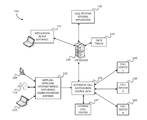
- FIG. 1 is a simplified block diagram illustrating a system architecture in which embodiments of the present invention may be practiced.
- FIG. 2 illustrates an example computer-generated display of a real time call count report.
- FIG. 3 illustrates an example computer-generated display of a call count executive summary report.
- FIG. 4 illustrates an example computer-generated display of a real time call count canvas report.
- FIG. 5 illustrates a flow of a process for monitoring, reporting, and controlling call center call routing according to embodiments of the present invention.
- embodiments of the present invention are directed to monitoring, controlling, and reporting call center call routing.
- Service calls directed to a call center may be monitored according to a variety of parameters such as associated line of business, date, time, and call volume.
- Calls directed to an internal call center may be routed to an alternate call center for processing as required or needed by the provider of the internal call center.
- a maximum call count or percentage-based call count may be established to facilitate efficient routing of service calls to the internal call center or to an alternate call center to ensure that no more than a specified number of calls are routed to a given call center.
- Real time and summary reporting may be generated to allow call center management personnel to monitor and manage service call routing to one or more internal and/or alternate call centers.
- FIG. 1 is a simplified block diagram illustrating a system architecture in which embodiments of the present invention may be practiced.
- providers of goods and/or services often provide access by customers/subscribers to primary/internal or alternate/third party call centers for receiving information about goods or services including help information, use information, repair information, problem reporting, and the like.
- each different type of line of business for which provision of call center services may be provided may be associated with varying levels of call center usage.
- a provider of telephone services may receive 1,000 calls per day to an internal or third party call center for answering questions about provided telephone services.
- a provider of data services for example, internet connectivity services, may receive 10,000 calls per day for questions about provided data services.
- a cable television services provider may similarly receive hundreds or thousands of calls per day regarding cable television service offerings, services outages, services availability, and the like.
- a provider of goods for example, computers, electronics, software products, hardware products, etc., may similarly receive many calls per day that must be routed to an internal or third party call center for providing information associated with those goods.
- providers of goods and services may also receive incoming calls associated with business and transactional items, for example, billing, purchasing, delivery, and the like. Indeed, as should be appreciated, embodiments of the present invention may be applied to any line of business type for which an incoming call may be received that must be routed to an internal or third party call center for processing.
- a variety of communications means for example, a hand held wireless communication device 105 , a wire line telephone 110 , a computer 115 may be utilized by a purchaser/subscriber of goods or services to communicate over a wireless, wire line, Internet-based, cable television-based communication system, or any other available communications means 120 to an automatic call distribution system (ACD) 125 operated by the provider of the applicable goods or services.
- ACD automatic call distribution system
- the ACD 125 may be a communications receiving system at a business headquarters for receiving incoming service related calls that must be routed to an internal or third party call center for processing.
- the ACD 125 may be a device or system used for distributing incoming calls to a group of terminals at an internal call center 147 operated by the receiving goods or services provider, or the ACD 125 may be utilized for distributing incoming calls to one or more terminals operated at alternate call centers 150 , 155 , 160 .
- the ACD 125 may include hardware, software, switches, phone lines, and routing technology for routing incoming calls to one of the call centers 147 , 150 , 155 , 160 according to one or more call routing procedures. Call routing procedures may be based on a number of factors including, day/time of call receipt, technology associated with incoming call, location of the source of the incoming call, and the like.
- the automatic control distribution center 125 may utilize an interactive voice response system for gathering information from an incoming caller that may be utilized to assist in the routing of the incoming service call. For example, a simple call routing procedure may route all calls received at the ACD 125 after the close of business of the associated goods or services provider to an alternate or third party call center 150 rather than routing the calls to the internal call center 147 associated with the provider of the goods or services.
- an incoming call may be automatically routed to an alternate call center 155 hired by the receiver of the incoming call to handle and process all incoming service calls related to computer hardware troubleshooting issues.
- a receiver of incoming services calls may simply need to route all calls in excess to a number that may be handled by its internal call center 147 to a third party call center. That is, if the goods/services provider has facilities, personnel, and systems capable of handling 5,000 incoming service calls per day, then the goods/services provider may need to contract with an alternate or third party call center 150 , 155 , 160 to handle all incoming service calls in excess of 5,000 calls per day.
- the third party call center operator may agree to handle a specified number of service calls for an agreed price.
- the goods/services provider may contract with a third party call center 150 to handle up to 1,000 service calls per day for a specified price.
- the receiving goods/service provider does not receive a refund or rebate on the agreed price.
- calls in excess of the specified agreed number for example, 1,000 calls, are passed to the third party call center 150 , a substantial cost penalty may be applied to each call passed to the third party call center in excess of the agreed number of calls.
- systems and methods are provided for allowing a goods/services provider to monitor, report, analyze, and control routing of calls to an internal call center 147 or to one or more third party call centers 150 , 155 , 160 .
- a query may be passed to a computer telephony integration (CTI) server 130 for receiving any special call routing instructions for the incoming call.
- CTI computer telephony integration
- a call routing control application 135 may reside on the CTI server 130 for monitoring, reporting and controlling call routing to one or more call centers.
- one or more data tables 140 may be generated for storing information associated with incoming service calls for associated line of business types.
- a data table 140 may be generated for storing information on all incoming video technology service calls that may be utilized for determining a most efficient service call routing instruction to be applied to each incoming service call for video technology services.
- the contracted call routing may be accomplished according to a variety of agreed upon parameters.
- the third party call center may agree to process 100 calls per hour for ten hours.
- the call center may agree to process incoming services calls between the hours of 5:00 p.m. and midnight daily.
- the call center may agree to process calls according to certain lines of business, or calls originating from certain locations or areas in which the call centers operate.
- the third party call center 147 On the side of the provider of goods or services requiring use of the third party call center, there may be a need to route calls to the third party call center at times of day when the internal call center 147 is not operating, or on days or during times when call volume exceeds the capabilities of the internal call center. If calls are routed to third party call centers when the internal call center is not operating, then every incoming service call may be routed in sequence to a specified third party call center. On the other hand, if the capabilities of the internal call center 147 only allow for processing to out of every three received calls during periods of high call volume, then the goods/services provider may need to route one out of every three incoming service calls to the third party call center up to a maximum number of agreed upon routed calls.
- the call routing control application 135 may track each call routed to any call center including the internal call center 147 and including any of the third party call centers 150 , 155 , 160 along with information associated with routed calls, for example, associated line of business, current Nth call routing setting, for example, every four calls, every six calls, and the like, current maximum call routing setting, for example, 500 calls, current Nth call count, number of calls sent to a given call center, total number of calls processed by the call routing control application, percentage of total calls passed to a given call center, date/time associated with routed calls, and the like.
- current Nth call routing setting for example, every four calls, every six calls, and the like
- current maximum call routing setting for example, 500 calls, current Nth call count, number of calls sent to a given call center, total number of calls processed by the call routing control application, percentage of total calls passed to a given call center, date/time associated with routed calls, and the like.
- the call control application 135 may generate one or more call routing reports for review by personnel of the goods/services provider requiring call center functions so that the utilization of the internal call center 147 and any of the third party call centers 150 , 155 , 160 may be maximized.
- an application set up interface 145 may be provided by the call routing control application 135 via the CTI server 130 to allow personnel of the goods/services provider to make on-the-fly changes in call routing procedures and instructions based on real time and historical call routing data. For example, if it is reported by the call routing control application 135 , as described below with reference to FIGS. 2 through 4 , that one out of every three calls for a given line of business are being routed to a specified third party call center 150 , but it is also determined that the personnel and systems of the internal call center 147 are being overloaded due to unusually high call volume, the application set up interface 145 may be utilized for changing routing instructions to alleviate the situation.
- the application set up interface may be utilized to require that two out of every three calls received for the example line of business be routed to the third party call center 150 and that only one out of every three incoming calls be routed to the internal call center 147 .
- the call routing procedure is thus changed via the application set up interface 145 , all subsequent incoming calls directed to the example line of business will be routed to the internal call center 147 or the third party call center 150 according to the updated call routing instructions.
- the application set up interface 145 may be utilized for temporarily routing all incoming calls to the internal call center 147 or to an alternate third party call center 155 .
- certain call routing instructions changes may be programmed via the call routing control application to occur automatically without user input. For example, if the maximum number of calls that may be passed to a third party call center 155 without penalty equals 1,000 calls, the call routing control application 135 may be programmed to automatically stop sending calls to the third party call center 155 when the maximum number is reached. Thus, the contracted number of calls that may be sent to the third party call center is maximized without incurring penalties for excess call routing.
- the call routing control application 135 may be programmed to automatically route future calls to a specified alternate call center including the internal call center 147 or another third party call center 150 , 155 , 160 .
- a query is passed to the CTI server 130 for call routing instructions.
- a return message from the CTI server 130 in association with the aforementioned functionality of the call routing control application 135 causes the automatic call distribution system 125 to route the incoming service call to the appropriate internal or third party call center.
- the call routing control application 135 may generate one or more reports for allowing the receiving goods/services provider to monitor, trend, analyze and control service call routing.
- FIG. 2 illustrates an example computer-generated display of a real time call count report.
- the real time call count report 200 illustrated in FIG. 2 is generated and updated after each incoming service call is processed to allow personnel to review up-to-date real time information on calls routed to one or more call service centers by the ACD 125 .
- the real time call count report 200 may include one or more application functions 205 for editing or otherwise manipulating data contained in the report 200 .
- a city or operating area field 210 may provide a location, for example, New York City, Atlanta, Los Angeles, Southeast Region, and the like for data illustrated in the report 200 .
- a number of data items for example, line of business 215 , current Nth setting, 220 , current max setting 225 , Nth call counter 230 , calls sent 235 , total calls through applications 240 , percent of total calls sent 245 , and date 250 may be provided for calls routed according to the call routing control application 135 .
- a current Nth setting is illustrated as three calls. That is, every three calls received at the automatic control distribution system 125 are set for routing to a third party call center according to instructions provided by the call routing control application 135 .
- a current maximum setting of 9,999 calls is set as the maximum number of calls that may be routed to a specified third party call center.
- the Nth call counter 230 illustrates the current number of Nth calls processed, and the calls sent 235 illustrates that one call has been sent to the third party call center since the beginning of the call processing cycle with the third party call center.
- the total calls placed through all applications illustrates a total of three, and the percent of total calls sent illustrates 33.33% to indicate that of the three total calls that have been passed through all call center applications, one call has been passed to the specified third party call center.
- the date field 250 illustrates the date associated with the currently displayed data. As should be appreciated, the data illustrated in the real time call count report 200 is for purposes of example only and is not limiting of the vast amount and types of data that may be displayed for routed service calls.
- personnel may make on-the-fly call routing decisions in order to properly utilize the capabilities and functions of internal call centers 147 and various third party call centers 150 , 155 , 160 .
- personnel may utilize the application set up interface 145 , as described above, to change the percent of total calls to be sent to the specified third party call center to a different number, for example, 50%, to cause more calls to be routed to the specified third party call center.
- a call count executive summary report 300 is illustrated for providing summary information for calls routed to one or more call centers 147 , 150 , 155 , and 160 .
- Information about service calls routed to one or more internal or third party call centers may be summarized according to a specified period of time, for example, weekly, monthly, etc.
- a specified period of time for example, weekly, monthly, etc.
- FIG. 3 for the line of business of “Billing,” information for three days worth of call routing is summarized under similar data headings as illustrated and described above with reference to FIG. 2 .
- data for three days worth of call routing is illustrated.
- call count executive summary report 300 allows personnel of the goods/services provider to determine appropriate call routing maximums that may be needed from one or more third party call centers, appropriate percentages of calls to be routed based on days and times of various call volumes, etc.
- a call count real time canvas report 400 may be generated and provided to personnel of the goods/services provider for reviewing for any given line of business a real time graphical view of Nth call counts versus maximum call counts for a given line of business service calls that are routed to a given third party call center.
- the current Nth call percentage is 25%. That is, one out of every four calls received by the goods/service provider associated with data technology, are designated for routing to a third party call center.
- the total calls received for this example line of business is illustrated as 536 calls and the total calls sent to the third party call center is illustrated as 134 calls or 25% of the total number of calls.
- the current Nth call setting is set at 4 meaning that every fourth call received by the goods/services provider at its ACD 125 is routed to the third party call center.
- the example current maximum setting is designated as 500 calls that may be sent to the designated third party call center without incurring excess call routing penalties.
- the time maximum count is reached may illustrate the date and time at which the maximum number of calls sent to the third party call center is reached.
- a graphical display may be provided to the personnel of the goods/services provider to allow a quick view of the current Nth call count and the current total calls sent to the designated third party call center.
- the Nth count may be tracked and may be reset to zero when the Nth count is reached to ensure that the appropriate calls are sent according to the appropriate Nth count to maintain the appropriate percentage of calls to be sent.
- the Nth count will be reset to zero after each 4 counts, but the Nth count of 134 illustrated in the graphical display 400 illustrates the Nth count has been reached 134 times out of a total of 536 calls.
- the real time call count canvas illustrated in FIG. 4 allows personnel of the goods/services provider to quickly and readily review the numbers of calls being sent to third party call centers in comparison to total numbers of calls being processed by one or more other call centers to allow goods/services provider personnel to efficiently manage call center utilization.
- the data illustrated in FIGS. 2 , 3 and 4 may be illustrated for a single specified call center 147 , 150 , 155 , 160 , or information for a number of call centers may be illustrated in a single display for review by personnel of the goods/services provider.
- FIG. 5 illustrates a flow of a process for monitoring, reporting, and controlling call center call routing according to embodiments of the present invention.
- the method 500 begins at start operation 505 and proceeds to operation 510 where an incoming service call is received from one or more communications sources 105 , 110 , 115 and is passed to the automatic call distribution system 125 at operation 515 .
- a call count message is sent from the ACD 125 via a query to the CTI server 130 as illustrated in FIG. 1 . As described above, the query is passed from the ACD 125 to the CTI server 130 to determine whether any special call routing processing instructions are to be applied to the presently received incoming service call.
- the call routing control application 135 queries the data tables 140 for call routing information associated with the received incoming call. That is, the call routing control application 135 determines whether the incoming call should be routed to a specified third party call center as opposed to the internal call center, and call count information for call routing including maximum call numbers that may be routed to the specified third party call center and percentage call routing, if applicable, for example, the routing of every fourth call to the specified third party call center.
- the data tables 140 are updated with any information associated with the present incoming call, for example, line of business, date and time of call, etc.
- any reporting updates required by the new information are automatically updated, for example, the real time call count report 200 may be automatically updated with information received for the incoming service call.
- any on-the-fly call routing procedure changes required by personnel of the goods/services provider may be performed via the application set up interface 145 , as described above with reference to FIG. 1 . For example, if the real-time reports generated in association with the incoming service call cause personnel of the goods/services provider to determine that call routing procedures should be changed, changes may be made via the application set up interface 145 .
- the call routing control application 135 determines whether the maximum call count for calls to be routed to a specified third party call center has been reached. If the maximum number of calls has been reached as a result of the presently received incoming service call, then the call routing control application 135 may automatically change call routing procedures to prevent subsequent calls from being routed to that third party call center. As should be appreciated, the call routing control application 135 may automatically route subsequent calls of this line of business to a different third party call center or to the internal call center 147 .
- the call routing control application 135 may cause an alert or report update to be presented via the application set up interface 145 to allow personnel of the goods/services provider to manually make changes in the call routing procedures to forward subsequent calls of this line of business to a different call center if desired. If it is acceptable by personnel of the goods/services provider that additional calls exceeding the maximum number may be sent to the specified third party call center, then that instruction may be entered via the application set up interface 145 .
- the call routing control application 135 determines whether the Nth call count has been reached. For example, if the present call routing instruction requires that every fourth call received for a given line of business be routed to a specified third party call center, a determination is made at operation 545 as to whether the present incoming call is the fourth call in a series of incoming calls requiring that the present call be routed to the specified third party call center.
- the call routing control application 135 passes an affirmative (ACK) or negative (NACK) acknowledgement message back to the ACD 125 to complete the call routing procedure. For example, if the call routing control application 135 passes an affirmative acknowledgement to the ACD 125 , the call may be routed to the third party call center as designated. Alternatively, if the maximum count has been reached, or if it is determined that the present call should not be passed to the designated third party call center based on instructions provided via the application set up interface 145 , then a negative acknowledgement may be sent back to the ACD 125 to direct the ACD 125 to route the presently received incoming service call to an alternate call center.
- the reports illustrated in FIGS. 2 , 3 and 4 may be updated for presentation to personnel of the goods/services provider, as described above.
- the method 500 ends at operation 595 .
- embodiments of the present invention are directed to monitoring, controlling, and reporting call center call routing.
- Embodiments of the present invention are described above with reference to block diagrams and/or operational illustrations of methods, systems, and computer program products according to embodiments of the invention.
- the functions/acts noted in the blocks may occur out of the order as shown in any flowchart. For example, two blocks shown in succession may in fact be executed substantially concurrently or the blocks may sometimes be executed in the reverse order, depending upon the functionality/acts involved.
Landscapes
- Business, Economics & Management (AREA)
- Marketing (AREA)
- Engineering & Computer Science (AREA)
- Signal Processing (AREA)
- Telephonic Communication Services (AREA)
Abstract
Description
Claims (20)
Priority Applications (1)
| Application Number | Priority Date | Filing Date | Title |
|---|---|---|---|
| US12/843,277 US8638920B2 (en) | 2010-07-26 | 2010-07-26 | Call routing monitoring, control and reporting |
Applications Claiming Priority (1)
| Application Number | Priority Date | Filing Date | Title |
|---|---|---|---|
| US12/843,277 US8638920B2 (en) | 2010-07-26 | 2010-07-26 | Call routing monitoring, control and reporting |
Publications (2)
| Publication Number | Publication Date |
|---|---|
| US20120020472A1 US20120020472A1 (en) | 2012-01-26 |
| US8638920B2 true US8638920B2 (en) | 2014-01-28 |
Family
ID=45493615
Family Applications (1)
| Application Number | Title | Priority Date | Filing Date |
|---|---|---|---|
| US12/843,277 Active 2031-04-06 US8638920B2 (en) | 2010-07-26 | 2010-07-26 | Call routing monitoring, control and reporting |
Country Status (1)
| Country | Link |
|---|---|
| US (1) | US8638920B2 (en) |
Families Citing this family (3)
| Publication number | Priority date | Publication date | Assignee | Title |
|---|---|---|---|---|
| US9531880B2 (en) * | 2014-06-04 | 2016-12-27 | Avaya Inc. | Optimization in workforce management using work assignment engine data |
| US10855849B1 (en) * | 2015-05-29 | 2020-12-01 | 8X8, Inc. | Analysis of data metrics in IPBX networks |
| US20250016098A1 (en) * | 2022-12-29 | 2025-01-09 | Commvault Systems, Inc. | Adaptive rate throttling for cloud-based service requests |
Citations (8)
| Publication number | Priority date | Publication date | Assignee | Title |
|---|---|---|---|---|
| US6118861A (en) * | 1997-08-14 | 2000-09-12 | Nortel Networks Corporation | Calling party invoked held call monitoring |
| US20020106071A1 (en) * | 1998-06-19 | 2002-08-08 | Prem Uppaluru | Point-of-presence call center management system |
| US20040151296A1 (en) * | 2003-02-03 | 2004-08-05 | Gamble Oliver Wendel | Method and system for automatically sending, receiving and utilizing information transmitted over a communication network |
| US20050094799A1 (en) * | 2001-05-21 | 2005-05-05 | Elsey Nicholas J. | Technique for effectively processing and dynamically routing communication calls |
| US20060098583A1 (en) * | 1997-09-26 | 2006-05-11 | Worldcom, Inc. | Integrated customer web station for web based call management |
| US20080091516A1 (en) * | 2006-10-17 | 2008-04-17 | Giovanni Giunta | Response monitoring system for an advertising campaign |
| US20110002453A1 (en) * | 2009-07-01 | 2011-01-06 | Matthew Finkle | Method and system for connecting a telephone call to a third party |
| US20110055251A1 (en) * | 2002-10-16 | 2011-03-03 | Christine Baumeister | System and method for efficient call management for directory assistance services |
-
2010
- 2010-07-26 US US12/843,277 patent/US8638920B2/en active Active
Patent Citations (8)
| Publication number | Priority date | Publication date | Assignee | Title |
|---|---|---|---|---|
| US6118861A (en) * | 1997-08-14 | 2000-09-12 | Nortel Networks Corporation | Calling party invoked held call monitoring |
| US20060098583A1 (en) * | 1997-09-26 | 2006-05-11 | Worldcom, Inc. | Integrated customer web station for web based call management |
| US20020106071A1 (en) * | 1998-06-19 | 2002-08-08 | Prem Uppaluru | Point-of-presence call center management system |
| US20050094799A1 (en) * | 2001-05-21 | 2005-05-05 | Elsey Nicholas J. | Technique for effectively processing and dynamically routing communication calls |
| US20110055251A1 (en) * | 2002-10-16 | 2011-03-03 | Christine Baumeister | System and method for efficient call management for directory assistance services |
| US20040151296A1 (en) * | 2003-02-03 | 2004-08-05 | Gamble Oliver Wendel | Method and system for automatically sending, receiving and utilizing information transmitted over a communication network |
| US20080091516A1 (en) * | 2006-10-17 | 2008-04-17 | Giovanni Giunta | Response monitoring system for an advertising campaign |
| US20110002453A1 (en) * | 2009-07-01 | 2011-01-06 | Matthew Finkle | Method and system for connecting a telephone call to a third party |
Also Published As
| Publication number | Publication date |
|---|---|
| US20120020472A1 (en) | 2012-01-26 |
Similar Documents
| Publication | Publication Date | Title |
|---|---|---|
| US9454596B2 (en) | Enterprise entity for use in a call center | |
| US6754331B2 (en) | Determining statistics about the behavior of a call center at a past time instant | |
| US6115693A (en) | Quality center and method for a virtual sales and service center | |
| US11095773B2 (en) | Coaching in an automated communication link establishment and management system | |
| USRE46420E1 (en) | Method and system for distributing outbound telephone calls | |
| US6741697B2 (en) | Telephone call centre performance evaluation | |
| US8965779B1 (en) | Fulfilling staffing requirements via an interactive voice response system | |
| US8804919B2 (en) | Managing interactive communications campaigns | |
| US20120027197A1 (en) | Collaboration System and Method | |
| US7720759B2 (en) | Revenue assurance tool | |
| US11800015B2 (en) | Upfront customer time consideration along with optimized agent desktop in a contact center | |
| US20210209529A1 (en) | Systems and methods for optimizing and managing high volume processes having discretized and atomized tasks and components | |
| US20150195404A1 (en) | Systems and methods of managing competing business goals of a contact center | |
| US20120020472A1 (en) | Call Routing Monitoring, Control and Reporting | |
| CN108833725B (en) | A material contract performance voice management system | |
| US8219436B2 (en) | Online installation scheduling system and method for cable services | |
| US10298755B1 (en) | Dialing list manager for outbound calls | |
| US20230239402A1 (en) | Coaching in an automated communication link establishment and management system | |
| US10694028B2 (en) | Systems and methods for generating application data from call data | |
| US20050287983A1 (en) | System and method of managing SS7-monitored call information | |
| CN101610179A (en) | Hosting center for real-time action management system and real-time action management system | |
| US7228281B1 (en) | Method and process for accumulating and summarizing data for defined time intervals within a customer interaction system | |
| US20230394388A1 (en) | System and method for increasing productivity of agents in a contact center by improving an automatic-scheduling generation in a workforce management (wfm) application | |
| US10902083B2 (en) | System and method for enhancing information flow in an enterprise | |
| CA2625757A1 (en) | An intelligence system for the processing of electronic billing data |
Legal Events
| Date | Code | Title | Description |
|---|---|---|---|
| AS | Assignment |
Owner name: COX COMMUNICATIONS, INC., GEORGIA Free format text: ASSIGNMENT OF ASSIGNORS INTEREST;ASSIGNOR:CUTAJAR, LOUIS;REEL/FRAME:024739/0535 Effective date: 20100721 |
|
| STCF | Information on status: patent grant |
Free format text: PATENTED CASE |
|
| CC | Certificate of correction | ||
| FPAY | Fee payment |
Year of fee payment: 4 |
|
| MAFP | Maintenance fee payment |
Free format text: PAYMENT OF MAINTENANCE FEE, 8TH YEAR, LARGE ENTITY (ORIGINAL EVENT CODE: M1552); ENTITY STATUS OF PATENT OWNER: LARGE ENTITY Year of fee payment: 8 |
|
| FEPP | Fee payment procedure |
Free format text: MAINTENANCE FEE REMINDER MAILED (ORIGINAL EVENT CODE: REM.); ENTITY STATUS OF PATENT OWNER: LARGE ENTITY |
|
| FEPP | Fee payment procedure |
Free format text: 11.5 YR SURCHARGE- LATE PMT W/IN 6 MO, LARGE ENTITY (ORIGINAL EVENT CODE: M1556); ENTITY STATUS OF PATENT OWNER: LARGE ENTITY |
|
| MAFP | Maintenance fee payment |
Free format text: PAYMENT OF MAINTENANCE FEE, 12TH YEAR, LARGE ENTITY (ORIGINAL EVENT CODE: M1553); ENTITY STATUS OF PATENT OWNER: LARGE ENTITY Year of fee payment: 12 |