US8637696B2 - Methods for preparing amides and amino acids - Google Patents
Methods for preparing amides and amino acids Download PDFInfo
- Publication number
- US8637696B2 US8637696B2 US13/621,553 US201213621553A US8637696B2 US 8637696 B2 US8637696 B2 US 8637696B2 US 201213621553 A US201213621553 A US 201213621553A US 8637696 B2 US8637696 B2 US 8637696B2
- Authority
- US
- United States
- Prior art keywords
- substituted
- acid
- carboxylic acid
- nitroethylene
- amino acid
- Prior art date
- Legal status (The legal status is an assumption and is not a legal conclusion. Google has not performed a legal analysis and makes no representation as to the accuracy of the status listed.)
- Expired - Fee Related
Links
- 0 *C(C)(CC[N+](=O)[O-])C(=O)O Chemical compound *C(C)(CC[N+](=O)[O-])C(=O)O 0.000 description 11
- ULQRKDATTHYIGB-YAPWIYTRSA-N C.C.C.C.CCC[C@@H](CC)C(=O)O.CC[C@@H](CO)CC[N+](=O)[O-].CC[C@H](CC[N+](=O)[O-])C(=O)O.O=[Cr](=O)(=O)(=O)(=O)(=O)(=O)[Cr].[CH+]=C[N+](=O)[O-].[H]C(=O)CCC Chemical compound C.C.C.C.CCC[C@@H](CC)C(=O)O.CC[C@@H](CO)CC[N+](=O)[O-].CC[C@H](CC[N+](=O)[O-])C(=O)O.O=[Cr](=O)(=O)(=O)(=O)(=O)(=O)[Cr].[CH+]=C[N+](=O)[O-].[H]C(=O)CCC ULQRKDATTHYIGB-YAPWIYTRSA-N 0.000 description 2
- UKRHNLNIUGFIDQ-KGLIPLIRSA-N CC[C@H](CC[N+]([O-])=O)C(N[C@@H](Cc1ccccc1)C(OC)=O)=O Chemical compound CC[C@H](CC[N+]([O-])=O)C(N[C@@H](Cc1ccccc1)C(OC)=O)=O UKRHNLNIUGFIDQ-KGLIPLIRSA-N 0.000 description 2
- SGKBTOVZJBIYHA-UJYFIQRSSA-N *.*.*.*.C.C.C.C.C.CCC[C@@H](CC)C(=O)N[C@@H](CC1=CC=CC=C1)C(=O)OC.CCC[C@@H](CC)C(=O)O.CC[C@@H](CO)CC[N+](=O)[O-].CC[C@H](CC[N+](=O)[O-])C(=O)O.O=[Cr](=O)(=O)(=O)(=O)(=O)(=O)[Cr].S.[CH+]=C[N+](=O)[O-].[H]C(=O)CCC Chemical compound *.*.*.*.C.C.C.C.C.CCC[C@@H](CC)C(=O)N[C@@H](CC1=CC=CC=C1)C(=O)OC.CCC[C@@H](CC)C(=O)O.CC[C@@H](CO)CC[N+](=O)[O-].CC[C@H](CC[N+](=O)[O-])C(=O)O.O=[Cr](=O)(=O)(=O)(=O)(=O)(=O)[Cr].S.[CH+]=C[N+](=O)[O-].[H]C(=O)CCC SGKBTOVZJBIYHA-UJYFIQRSSA-N 0.000 description 1
- PLPNIDYSOQKKGD-NPUFFLEDSA-N *.*.*.C.C[C@@H](N)C(C)(C)C.[H]/C(=N\[C@H](C)C(C)(C)C)[C@H](CCC)CC[N+](=O)[O-].[H]C(=O)[C@H](CCC)CC[N+](=O)[O-] Chemical compound *.*.*.C.C[C@@H](N)C(C)(C)C.[H]/C(=N\[C@H](C)C(C)(C)C)[C@H](CCC)CC[N+](=O)[O-].[H]C(=O)[C@H](CCC)CC[N+](=O)[O-] PLPNIDYSOQKKGD-NPUFFLEDSA-N 0.000 description 1
- NKDSPTIIEILMAU-JAXOOIEVSA-N *.CC[C@H](CCNC(=O)OC(C)(C)C)C(=O)C[C@@H](CC1=CC=CC=C1)C(=O)OC.S Chemical compound *.CC[C@H](CCNC(=O)OC(C)(C)C)C(=O)C[C@@H](CC1=CC=CC=C1)C(=O)OC.S NKDSPTIIEILMAU-JAXOOIEVSA-N 0.000 description 1
- NYQIFMYYHDDNIA-MQTROWDVSA-N *.C[Si](C)(C)OC(C1=CC=CC=C1)(C1=CC=CC=C1)[C@@H]1CCCN1.O=C(O)[C@@H]1CCCN1 Chemical compound *.C[Si](C)(C)OC(C1=CC=CC=C1)(C1=CC=CC=C1)[C@@H]1CCCN1.O=C(O)[C@@H]1CCCN1 NYQIFMYYHDDNIA-MQTROWDVSA-N 0.000 description 1
- MMKLRQJUPQRFIY-UHFFFAOYSA-N B.C=C[N+](=O)[O-].O=C(O)C1=CC([N+](=O)[O-])=CC=C1.[H]C(=O)C(CCC)CC[N+](=O)[O-].[H]C(=O)CCCC Chemical compound B.C=C[N+](=O)[O-].O=C(O)C1=CC([N+](=O)[O-])=CC=C1.[H]C(=O)C(CCC)CC[N+](=O)[O-].[H]C(=O)CCCC MMKLRQJUPQRFIY-UHFFFAOYSA-N 0.000 description 1
- LSMSLYDOWWTQMV-XWEAEAMTSA-N C.C.C.C.C.CCC[C@@H](CC)C(=O)N[C@@H](CC1=CC=CC=C1)C(=O)OC.CCC[C@@H](CC)C(=O)N[C@@H](CC1=CC=CC=C1)C(=O)OC.CCC[C@@H](CC)C(=O)O.CC[C@@H]1CCN(C(=O)OC(C)(C)C)C1=O.CC[C@H](CC[N+](=O)[O-])C(=O)O Chemical compound C.C.C.C.C.CCC[C@@H](CC)C(=O)N[C@@H](CC1=CC=CC=C1)C(=O)OC.CCC[C@@H](CC)C(=O)N[C@@H](CC1=CC=CC=C1)C(=O)OC.CCC[C@@H](CC)C(=O)O.CC[C@@H]1CCN(C(=O)OC(C)(C)C)C1=O.CC[C@H](CC[N+](=O)[O-])C(=O)O LSMSLYDOWWTQMV-XWEAEAMTSA-N 0.000 description 1
- PFDZRZLACZOVIV-AJHHDZOESA-N C.C.C.CCC[C@@H](CC)C(=O)N[C@@H](CC1=CC=CC=C1)C(=O)OC.CCC[C@@H](CC)C(=O)O.CC[C@@H]1CCN(C(=O)OC(C)(C)C)C1=O Chemical compound C.C.C.CCC[C@@H](CC)C(=O)N[C@@H](CC1=CC=CC=C1)C(=O)OC.CCC[C@@H](CC)C(=O)O.CC[C@@H]1CCN(C(=O)OC(C)(C)C)C1=O PFDZRZLACZOVIV-AJHHDZOESA-N 0.000 description 1
- ATBQAXKJXMKUDE-CGGFIHHKSA-N C.C.CC[C@H](CC[N+](=O)[O-])C(=O)N[C@@H](CC1=CC=CC=C1)C(=O)OC.CC[C@H](CC[N+](=O)[O-])C(=O)O Chemical compound C.C.CC[C@H](CC[N+](=O)[O-])C(=O)N[C@@H](CC1=CC=CC=C1)C(=O)OC.CC[C@H](CC[N+](=O)[O-])C(=O)O ATBQAXKJXMKUDE-CGGFIHHKSA-N 0.000 description 1
- SZBFYBANRRVIIY-SECBINFHSA-N CC(C)(C)OC(=O)CC[C@@H](CO)CC[N+](=O)[O-] Chemical compound CC(C)(C)OC(=O)CC[C@@H](CO)CC[N+](=O)[O-] SZBFYBANRRVIIY-SECBINFHSA-N 0.000 description 1
- UOMLCESBOXLHDB-CQSZACIVSA-N CC(C)(C)OC(=O)N(CCCC[C@@H](CO)CC[N+](=O)[O-])C(=O)OC(C)(C)C Chemical compound CC(C)(C)OC(=O)N(CCCC[C@@H](CO)CC[N+](=O)[O-])C(=O)OC(C)(C)C UOMLCESBOXLHDB-CQSZACIVSA-N 0.000 description 1
- VJBDUCBWMNETGR-ZDUSSCGKSA-N CC(C)(C)OC1=CC=C(C[C@@H](CO)CC[N+](=O)[O-])C=C1 Chemical compound CC(C)(C)OC1=CC=C(C[C@@H](CO)CC[N+](=O)[O-])C=C1 VJBDUCBWMNETGR-ZDUSSCGKSA-N 0.000 description 1
- FNPJMWAZBXWFHV-QMMMGPOBSA-N CC(C)C[C@@H](CO)CC[N+](=O)[O-] Chemical compound CC(C)C[C@@H](CO)CC[N+](=O)[O-] FNPJMWAZBXWFHV-QMMMGPOBSA-N 0.000 description 1
- GBBJCWQYURELJJ-MRVPVSSYSA-N CCCC[C@@H](CO)CC[N+](=O)[O-] Chemical compound CCCC[C@@H](CO)CC[N+](=O)[O-] GBBJCWQYURELJJ-MRVPVSSYSA-N 0.000 description 1
- NMMAMGXTJKNYTB-CABCVRRESA-N CCC[C@@H](CC)C(=O)N[C@@H](CC1=CC=CC=C1)C(=O)OC Chemical compound CCC[C@@H](CC)C(=O)N[C@@H](CC1=CC=CC=C1)C(=O)OC NMMAMGXTJKNYTB-CABCVRRESA-N 0.000 description 1
- BAZMYXGARXYAEQ-ZCFIWIBFSA-N CCC[C@@H](CC)C(=O)O Chemical compound CCC[C@@H](CC)C(=O)O BAZMYXGARXYAEQ-ZCFIWIBFSA-N 0.000 description 1
- BGWDGJZPACYUFM-ZCFIWIBFSA-N CC[C@@H](CO)CC[N+](=O)[O-] Chemical compound CC[C@@H](CO)CC[N+](=O)[O-] BGWDGJZPACYUFM-ZCFIWIBFSA-N 0.000 description 1
- QPXZYJGSBJVGJM-MRVPVSSYSA-N CC[C@@H]1CCN(C(=O)OC(C)(C)C)C1=O Chemical compound CC[C@@H]1CCN(C(=O)OC(C)(C)C)C1=O QPXZYJGSBJVGJM-MRVPVSSYSA-N 0.000 description 1
- GIAXMJYNJVGWRN-SJORKVTESA-N CC[C@H](CCNC(OC(C)(C)C)=O)C(N[C@@H](Cc1ccccc1)C(OC)=O)=O Chemical compound CC[C@H](CCNC(OC(C)(C)C)=O)C(N[C@@H](Cc1ccccc1)C(OC)=O)=O GIAXMJYNJVGWRN-SJORKVTESA-N 0.000 description 1
- UNJUZVBTTIHCID-RXMQYKEDSA-N CC[C@H](CC[N+](=O)[O-])C(=O)O Chemical compound CC[C@H](CC[N+](=O)[O-])C(=O)O UNJUZVBTTIHCID-RXMQYKEDSA-N 0.000 description 1
- CZUKMJNCZHVKEK-RXMQYKEDSA-N C[C@@H](CO)CC[N+](=O)[O-] Chemical compound C[C@@H](CO)CC[N+](=O)[O-] CZUKMJNCZHVKEK-RXMQYKEDSA-N 0.000 description 1
- BNRAYEDTQBNLMW-NSHDSACASA-N O=[N+]([O-])CC[C@H](CO)CC1=CC=CC=C1 Chemical compound O=[N+]([O-])CC[C@H](CO)CC1=CC=CC=C1 BNRAYEDTQBNLMW-NSHDSACASA-N 0.000 description 1
- ONIBWKKTOPOVIA-BYPYZUCNSA-N OC([C@H]1NCCC1)=O Chemical compound OC([C@H]1NCCC1)=O ONIBWKKTOPOVIA-BYPYZUCNSA-N 0.000 description 1
- YGKNPBRUVBDCNM-SSDOTTSWSA-N [H]C(=O)[C@@H](CC[N+](=O)[O-])C(C)C Chemical compound [H]C(=O)[C@@H](CC[N+](=O)[O-])C(C)C YGKNPBRUVBDCNM-SSDOTTSWSA-N 0.000 description 1
- NETJHGMBNHLGDD-LURJTMIESA-N [H]C(=O)[C@@H](CC[N+](=O)[O-])CC(=O)OC Chemical compound [H]C(=O)[C@@H](CC[N+](=O)[O-])CC(=O)OC NETJHGMBNHLGDD-LURJTMIESA-N 0.000 description 1
- XGRLWAQEFAHOAL-NSHDSACASA-N [H]C(=O)[C@@H](CC[N+](=O)[O-])CC1CCCCC1 Chemical compound [H]C(=O)[C@@H](CC[N+](=O)[O-])CC1CCCCC1 XGRLWAQEFAHOAL-NSHDSACASA-N 0.000 description 1
Classifications
-
- C—CHEMISTRY; METALLURGY
- C07—ORGANIC CHEMISTRY
- C07C—ACYCLIC OR CARBOCYCLIC COMPOUNDS
- C07C269/00—Preparation of derivatives of carbamic acid, i.e. compounds containing any of the groups, the nitrogen atom not being part of nitro or nitroso groups
-
- C—CHEMISTRY; METALLURGY
- C07—ORGANIC CHEMISTRY
- C07C—ACYCLIC OR CARBOCYCLIC COMPOUNDS
- C07C205/00—Compounds containing nitro groups bound to a carbon skeleton
- C07C205/13—Compounds containing nitro groups bound to a carbon skeleton the carbon skeleton being further substituted by hydroxy groups
- C07C205/14—Compounds containing nitro groups bound to a carbon skeleton the carbon skeleton being further substituted by hydroxy groups having nitro groups and hydroxy groups bound to acyclic carbon atoms
- C07C205/15—Compounds containing nitro groups bound to a carbon skeleton the carbon skeleton being further substituted by hydroxy groups having nitro groups and hydroxy groups bound to acyclic carbon atoms of a saturated carbon skeleton
-
- C—CHEMISTRY; METALLURGY
- C07—ORGANIC CHEMISTRY
- C07C—ACYCLIC OR CARBOCYCLIC COMPOUNDS
- C07C205/00—Compounds containing nitro groups bound to a carbon skeleton
- C07C205/27—Compounds containing nitro groups bound to a carbon skeleton the carbon skeleton being further substituted by etherified hydroxy groups
- C07C205/35—Compounds containing nitro groups bound to a carbon skeleton the carbon skeleton being further substituted by etherified hydroxy groups having nitro groups and etherified hydroxy groups bound to carbon atoms of six-membered aromatic rings of the carbon skeleton
- C07C205/36—Compounds containing nitro groups bound to a carbon skeleton the carbon skeleton being further substituted by etherified hydroxy groups having nitro groups and etherified hydroxy groups bound to carbon atoms of six-membered aromatic rings of the carbon skeleton to carbon atoms of the same non-condensed six-membered aromatic ring or to carbon atoms of six-membered aromatic rings being part of the same condensed ring system
- C07C205/37—Compounds containing nitro groups bound to a carbon skeleton the carbon skeleton being further substituted by etherified hydroxy groups having nitro groups and etherified hydroxy groups bound to carbon atoms of six-membered aromatic rings of the carbon skeleton to carbon atoms of the same non-condensed six-membered aromatic ring or to carbon atoms of six-membered aromatic rings being part of the same condensed ring system the oxygen atom of at least one of the etherified hydroxy groups being further bound to an acyclic carbon atom
-
- C—CHEMISTRY; METALLURGY
- C07—ORGANIC CHEMISTRY
- C07C—ACYCLIC OR CARBOCYCLIC COMPOUNDS
- C07C205/00—Compounds containing nitro groups bound to a carbon skeleton
- C07C205/44—Compounds containing nitro groups bound to a carbon skeleton the carbon skeleton being further substituted by —CHO groups
-
- C—CHEMISTRY; METALLURGY
- C07—ORGANIC CHEMISTRY
- C07C—ACYCLIC OR CARBOCYCLIC COMPOUNDS
- C07C205/00—Compounds containing nitro groups bound to a carbon skeleton
- C07C205/49—Compounds containing nitro groups bound to a carbon skeleton the carbon skeleton being further substituted by carboxyl groups
- C07C205/50—Compounds containing nitro groups bound to a carbon skeleton the carbon skeleton being further substituted by carboxyl groups having nitro groups and carboxyl groups bound to acyclic carbon atoms of the carbon skeleton
- C07C205/51—Compounds containing nitro groups bound to a carbon skeleton the carbon skeleton being further substituted by carboxyl groups having nitro groups and carboxyl groups bound to acyclic carbon atoms of the carbon skeleton the carbon skeleton being saturated
-
- C—CHEMISTRY; METALLURGY
- C07—ORGANIC CHEMISTRY
- C07C—ACYCLIC OR CARBOCYCLIC COMPOUNDS
- C07C205/00—Compounds containing nitro groups bound to a carbon skeleton
- C07C205/49—Compounds containing nitro groups bound to a carbon skeleton the carbon skeleton being further substituted by carboxyl groups
- C07C205/57—Compounds containing nitro groups bound to a carbon skeleton the carbon skeleton being further substituted by carboxyl groups having nitro groups and carboxyl groups bound to carbon atoms of six-membered aromatic rings of the carbon skeleton
-
- C—CHEMISTRY; METALLURGY
- C07—ORGANIC CHEMISTRY
- C07C—ACYCLIC OR CARBOCYCLIC COMPOUNDS
- C07C227/00—Preparation of compounds containing amino and carboxyl groups bound to the same carbon skeleton
- C07C227/02—Formation of carboxyl groups in compounds containing amino groups, e.g. by oxidation of amino alcohols
-
- C—CHEMISTRY; METALLURGY
- C07—ORGANIC CHEMISTRY
- C07C—ACYCLIC OR CARBOCYCLIC COMPOUNDS
- C07C233/00—Carboxylic acid amides
- C07C233/01—Carboxylic acid amides having carbon atoms of carboxamide groups bound to hydrogen atoms or to acyclic carbon atoms
- C07C233/45—Carboxylic acid amides having carbon atoms of carboxamide groups bound to hydrogen atoms or to acyclic carbon atoms having the nitrogen atom of at least one of the carboxamide groups bound to a carbon atom of a hydrocarbon radical substituted by carboxyl groups
- C07C233/46—Carboxylic acid amides having carbon atoms of carboxamide groups bound to hydrogen atoms or to acyclic carbon atoms having the nitrogen atom of at least one of the carboxamide groups bound to a carbon atom of a hydrocarbon radical substituted by carboxyl groups with the substituted hydrocarbon radical bound to the nitrogen atom of the carboxamide group by an acyclic carbon atom
- C07C233/47—Carboxylic acid amides having carbon atoms of carboxamide groups bound to hydrogen atoms or to acyclic carbon atoms having the nitrogen atom of at least one of the carboxamide groups bound to a carbon atom of a hydrocarbon radical substituted by carboxyl groups with the substituted hydrocarbon radical bound to the nitrogen atom of the carboxamide group by an acyclic carbon atom having the carbon atom of the carboxamide group bound to a hydrogen atom or to a carbon atom of an acyclic saturated carbon skeleton
-
- C—CHEMISTRY; METALLURGY
- C07—ORGANIC CHEMISTRY
- C07C—ACYCLIC OR CARBOCYCLIC COMPOUNDS
- C07C271/00—Derivatives of carbamic acids, i.e. compounds containing any of the groups, the nitrogen atom not being part of nitro or nitroso groups
- C07C271/06—Esters of carbamic acids
- C07C271/08—Esters of carbamic acids having oxygen atoms of carbamate groups bound to acyclic carbon atoms
- C07C271/10—Esters of carbamic acids having oxygen atoms of carbamate groups bound to acyclic carbon atoms with the nitrogen atoms of the carbamate groups bound to hydrogen atoms or to acyclic carbon atoms
- C07C271/22—Esters of carbamic acids having oxygen atoms of carbamate groups bound to acyclic carbon atoms with the nitrogen atoms of the carbamate groups bound to hydrogen atoms or to acyclic carbon atoms to carbon atoms of hydrocarbon radicals substituted by carboxyl groups
Definitions
- ⁇ 2 -Amino acids represent potential building blocks for ⁇ -peptide 6 and heterogeneous backbone foldamers.
- Derivatives of the neurotransmitter ⁇ -amino butyric acid (GABA) 8 are of potential biomedical utility, illustrated by the use of Pregabalin and Baclofen to treat neurological disorders. 9
- new methods for the synthesis of ⁇ 2 -amino acids would significantly aid the preparation and study of ⁇ -peptide and heterogeneous backbone foldamers. Such methods would also help to facilitate evaluation of their potential biomedical uses. Therefore, new synthetic methods for the preparation of versatile adducts that can be converted to converted to ⁇ 2 -amino acids would be of significant value to the research community.
- the invention provides a compound of formula I:
- R is hydrogen, alkyl, cycloalkyl, aryl, heteroaryl, or heterocycle;
- R′ is alkyl, cycloalkyl, aryl, heteroaryl, or heterocycle; and the alkyl, cycloalkyl, aryl, heteroaryl, or heterocycle is optionally substituted with one to five substituents, for example, alkyl, alkoxy, halo, hydroxy, aryl, heteroaryl, heterocycle, cycloalkyl, alkanoyl, alkoxycarbonyl, amino, alkylamino, dialkylamino, acylamino, nitro, trifluoromethyl, trifluoromethoxy, carboxy, carboxyalkyl, keto, arylsulfonyl, cyano, or azide groups, or a substituent as described herein for the definition of substituents; or a salt thereof.
- R and R′ are not methyl or butyl, for example, n-butyl.
- the compound can be enantiomerically enriched and can be in an (R) or (S) configuration.
- the compound can have an enantiomeric purity of greater than about 90%, about 95%, or about 98%.
- the invention also provides a compound of formula II:
- R and R′ are each independently hydrogen, alkyl, cycloalkyl, aryl, heteroaryl, or heterocycle; R′′ is an amino acid side chain; P is hydrogen or a carboxylic acid protecting group; Y is nitro, amino, or protected amino; and the alkyl, cycloalkyl, aryl, heteroaryl, or heterocycle is optionally substituted with one to five substituent groups, as described above for formula I.
- one of R and R′ is not methyl or butyl, for example, n-butyl. In other embodiments, R and R′ are not both methyl.
- the compound of formula II can be an ⁇ -amino acid linked to a compound of formula I through an amide bond.
- the ⁇ -amino acid can be protected at its carboxylic acid.
- the amino acid side chain can be any side chain of any known ⁇ -amino acid, for example, the a side chain of any of the twenty naturally occurring amino acids in humans, including a hydrogen of proline.
- R is hydrogen
- R′ is ethyl
- R′′ is benzyl
- P is methyl or acetyl
- Y is nitro or Boc-protected amino.
- the compound can have an enantiomeric purity of greater than about 95% with respect to the carbon attached to R.
- Diastereomerically pure compounds of formula II can be provided by using enantiomerically pure ⁇ -amino acids in their preparation.
- the invention further provides highly efficient Michael reactions between the highly reactive nitroethylene (A) and aldehydes (B) to provide the Michael products C, ⁇ -substituted- ⁇ -nitrobutyl aldehydes (Scheme 1).
- the use of a chiral pyrrolidine catalyst allows for the highly enantioselective preparation of Michael products.
- the reaction requires only very low catalyst loading (e.g., about 1-2 mol %) when carried out in the presence of certain acids as cocatalysts, and high yields are readily achieved.
- the substituent R can be any organic group or functional group that is tolerant of the mild Michael reaction conditions.
- the Michael products (C) are valuable building blocks for organic synthesis.
- ⁇ -substituted- ⁇ -nitroaldehyde C can be converted to ⁇ 2 -amino acids F ( ⁇ -substituted- ⁇ -aminobutyric acids) and their derivatives (e.g., ⁇ -substituted- ⁇ -nitrobutyl alcohols D, ⁇ -substituted- ⁇ -aminobutyl alcohols E, and ⁇ -lactams G, etc.) (Scheme 2).
- the products can be broadly used from basic research (e.g. foldamer research, etc.) to product development (e.g., pharmaceutically relevant molecules).
- the invention provides a method for preparing an ⁇ -substituted- ⁇ -nitrobutyraldehyde comprising contacting nitroethylene and an aldehyde in the presence of an organic solvent, a proline derivative, and optionally a carboxylic acid, under suitable reaction conditions so as to provide the ⁇ -substituted- ⁇ -nitrobutyraldehyde.
- the invention also provides a method for preparing an ⁇ -substituted- ⁇ -nitrobutyraldehyde comprising contacting nitroethylene and an aldehyde under suitable reaction conditions to provide the product, for example, in the presence of an organic solvent, an (S)- or (R)-diphenylprolinol trialkyl silyl ether, and optionally a nitrobenzoic acid, for a period of time sufficient to provide the ⁇ -substituted- ⁇ -nitrobutyraldehyde, wherein the ⁇ -substituted- ⁇ -nitrobutyraldehyde is prepared in at least about 80%, 90%, 95%, or 98% enantiomeric purity.
- the invention further provides a method for preparing a compound of formula III:
- R and R′ are each independently hydrogen or optionally substituted alkyl, cycloalkyl, aryl, heteroaryl, or heterocycle;
- R is as defined for formula III, and nitroethylene in the presence of an organic solvent, a proline derivative, and optionally a carboxylic acid, for a period of time sufficient to provide the compound of formula III.
- the compound of formula III can be enantiomerically enriched or substantially enantiomerically pure, with respect to the carbon attached to R, for example, when the proline derivative is a chiral pyrrolidine catalyst.
- the invention provides a method for preparing an enantiomerically pure ⁇ -substituted- ⁇ -amino acid comprising contacting nitroethylene and an aldehyde in the presence of an organic solvent, an (S)- or (R)-diphenylprolinol trialkyl silyl ether, and optionally a carboxylic acid, for a period of time sufficient to provide an ⁇ -substituted- ⁇ -nitrobutyraldehyde.
- the aldehyde of the ⁇ -substituted- ⁇ -nitroaldehyde can be reduced to an alcohol and the alcohol can be oxidized to a carboxylic acid.
- a peptide bond can optionally be formed with the carboxylic acid and the nitrogen moiety of an amino acid that has a protected carboxylic acid group.
- the nitro moiety of the ⁇ -substituted- ⁇ -nitrobutyraldehyde can be reduced to an amine, to provide the enantiomerically pure ⁇ -substituted- ⁇ -amino acid, or an amide derivative thereof.
- the method can further include protecting the amine group of the ⁇ -substituted- ⁇ -amino acid with a nitrogen protecting group, for example, a Boc group.
- the invention also provides a method to formally aminoethylate an aldehyde, and a concise synthesis of ⁇ 2 -amino acids and their derivatives via novel, highly efficient and selective organocatalytic Michael additions of aldehydes to nitroethylene. Additionally, the invention provides a method to prepare an amide compound comprised of an ⁇ -substituted- ⁇ -amino acid coupled to an ⁇ -amino acid directly from an ⁇ -substituted- ⁇ -nitrobutyraldehyde.
- ⁇ 2 -amino acids are an important class of non-natural amino acids that are very difficult and/or expensive to prepare.
- Literature methods for making ⁇ 2 -amino acids are very inefficient, and not very useful for scalable synthesis or structural diversity. These methods typically require about six synthetic steps, harsh conditions, limited functional group tolerance, low overall yields, and the separation of diasteriomers, which further reduces the synthetic efficiency of such methods.
- the methods described herein allow for the preparation of ⁇ 2 -amino acids with fewer steps than known methods.
- the Michael addition reaction is highly enantioselective and high overall isolated yields are achieved. Only a minimal use of chromatography is typically used for product purification, and the methods are amenable to large scale synthesis.
- the reaction conditions are mild, and are thus tolerant of a diverse range of functional groups.
- the starting materials, including the catalyst, are typically readily available and inexpensive. Accordingly, the invention provides flexible and efficient catalytic methods for amino aldehyde and ⁇ 2 -amino acid synthesis.
- the methods can provide either the (R)- or (S)-enantiomer of the Michael adduct.
- the term “about” can refer to a variation of ⁇ 5%, 10%, or 20% of the value specified. For example, “about 50” percent can in some embodiments carry a variation from 45 to 55 percent. For integer ranges, the term “about” can include one or two integers greater than and less than a recited integer.
- contacting refers to the act of touching, making contact, or of bringing to immediate or close proximity, including at the molecular level, for example, to allow two suitable compounds to chemically react with each other.
- ⁇ -substituted- ⁇ -nitrobutyraldehyde refers to a compound of the formula O 2 N—CH 2 —CH 2 —CH(R)—CHO, wherein the substituent R is considered to be ‘alpha’ to the aldehyde moiety.
- the group R can be any organic group or functional group, such as an optionally substituted alkyl group, an optionally protected amino acid or derivative thereof, and/or a substituent as described herein.
- ⁇ -substituted- ⁇ -nitrobutyraldehyde can also refer to a compound of the formula O 2 N—CH 2 —CH 2 —C(R)(R)—CHO, wherein the compound has two substituents ‘alpha’ to the aldehyde moiety.
- aldehydes useful for the reactions described herein have at least one ⁇ -hydrogen atom. Accordingly, the aldehydes employed with have either an ⁇ -methylene group or an ⁇ -methine group.
- An “aldehyde that has an ⁇ -methylene group” refers to a compound that includes a moiety of the formula —CH 2 —CHO, and an “aldehyde that has an ⁇ -methine group” refers to a compound that includes a moiety of the formula>CH—CHO.
- proline derivative refers to L-proline, R-proline, or a derivative thereof. Such derivatives include various pyrrolidine compounds, including certain chiral pyrrolidine catalyst known in the art. Examples of proline derivatives include diarylprolinol trialkyl silyl ethers, such as diphenylprolinol trialkyl silyl ether, for example, diphenylprolinol trimethyl silyl ether. A proline derivative can be racemic, scalemic, or the derivative can be the (R) or (S) enantiomer.
- solvent refers to any liquid that can dissolve a compound to form a solution.
- Solvents include water and various organic solvents, such as hydrocarbon solvents, for example, alkanes and aryl solvents. Examples include hexanes, DMF, DMA, DMSO, benzene, toluene, xylenes, and alcoholic solvents such as methanol, ethanol, propanol, isopropanol, and linear or branched (sec or tert) butanol.
- a “reducing agent” can effectuate the removal of oxygen from a compound or the addition of hydrogen to a compound.
- Typical reducing agents include various hydride reagents, such as borohydride reagents and aluminum hydride reagents, for example, sodium borohydride and lithium aluminum hydride.
- An “oxidizing agent” can effectuate the addition of oxygen to a compound or the removal of hydrogen from a compound.
- Typical reducing agents include various metal oxides and metal catalysts (e.g., a transition metal, optionally adsorbed onto carbon) in the presence of hydrogen gas.
- metal oxides and metal catalysts e.g., a transition metal, optionally adsorbed onto carbon
- chromium oxides such as the Jones reagent, and palladium on carbon in the presence of hydrogen gas.
- enantiomerically enriched refers to mixtures that have one enantiomer present to a greater extent than another.
- the term “enantiomerically enriched” refers to a mixture having at least about 50% enantiomeric excess (“ee”); in another embodiment, the term refers to a mixture having at least about 75% ee; in another embodiment, the term refers to a mixture having at least about 80%; in another embodiment, the term refers to a mixture having at least about 85%; in another embodiment, the term refers to a mixture having at least about 90%; in another embodiment, the term refers to a mixture having at least about 92%; in another embodiment, the term refers to a mixture having at least about 95%; in another embodiment, the term refers to a mixture having at least about 98%; and in another embodiment, the term “enantiomerically enriched” refers to a mixture having at least about 99% ee.
- enantiomerically enriched includes enantiomerically pure mixtures, which are mixtures that are substantially free of the species of the opposite optical activity or one enantiomer is present in very low quantities, for example, about 0.01%, about 0.001% or about 0.0001%.
- alkyl refers to a branched, unbranched, or cyclic carbon chain having, for example, about 1-20 carbon atoms, and often 1-12, 1-10, 1-8, 1-6, or 1-4 carbons. Examples include, but are not limited to, methyl, ethyl, 1-propyl, 2-propyl, 1-butyl, 2-methyl-1-propyl, 2-butyl, 2-methyl-2-propyl(t-butyl), 1-pentyl, 2-pentyl, 3-pentyl, 2-methyl-2-butyl, 3-methyl-2-butyl, 3-methyl-1-butyl, 2-methyl-1-butyl, 1-hexyl, 2-hexyl, 3-hexyl, 2-methyl-2-pentyl, 3-methyl-2-pentyl, 4-methyl-2-pentyl, 3-methyl-3-pentyl, 2-methyl-3-pentyl, 2,3-dimethyl-2-butyl, 3,3-dimethyl-2-butyl
- the alkyl can be unsubstituted or substituted.
- the alkyl can also be optionally partially or fully unsaturated.
- the recitation of an alkyl group includes both alkenyl and alkynyl groups.
- the alkyl can be a monovalent hydrocarbon radical, as described and exemplified above, or it can be a divalent hydrocarbon radical (i.e., an alkylene).
- certain alkyl groups can be excluded from a definition. For example, in some embodiments, methyl, ethyl, propyl, butyl, or a combination thereof, can be excluded from a specific definition of alkyl.
- cycloalkyl refers to cyclic alkyl groups of, for example, from 3 to 10 carbon atoms having a single cyclic ring or multiple condensed rings. Cycloalkyl groups include, by way of example, single ring structures such as cyclopropyl, cyclobutyl, cyclopentyl, cyclooctyl, and the like, or multiple ring structures such as adamantyl, and the like.
- the cycloalkyl can be unsubstituted or substituted.
- the cycloalkyl group can be monovalent or divalent, and can be optionally substituted as described for alkyl groups.
- the cycloalkyl group can optionally include one or more cites of unsaturation, for example, the cycloalkyl group can include one or more carbon-carbon double bonds, such as, for example, 1-cyclopent-1-enyl, 1-cyclopent-2-enyl, 1-cyclopent-3-enyl, cyclohexyl, 1-cyclohex-1-enyl, 1-cyclohex-2-enyl, 1-cyclohex-3-enyl, and the like.
- aryl refers to an aromatic hydrocarbon group derived from the removal of one hydrogen atom from a single carbon atom of a parent aromatic ring system.
- the radical attachment site can be at a saturated or unsaturated carbon atom of the parent ring system.
- the aryl group can have from 6 to 30 carbon atoms.
- the aryl group can have a single ring (e.g., phenyl) or multiple condensed (fused) rings, wherein at least one ring is aromatic (e.g., naphthyl, dihydrophenanthrenyl, fluorenyl, or anthryl).
- Typical aryl groups include, but are not limited to, radicals derived from benzene, naphthalene, anthracene, biphenyl, and the like.
- the aryl can be unsubstituted or optionally substituted, as described for alkyl groups.
- heteroaryl refers to a monocyclic, bicyclic, or tricyclic ring system containing one, two, or three aromatic rings and containing at least one nitrogen, oxygen, or sulfur atom in an aromatic ring, and that can be unsubstituted or substituted, for example, with one or more, and in particular one to three, substituents, as described in the definition of “substituted”.
- Typical heteroaryl groups contain 2-20 carbon atoms in addition to the one or more hetoeroatoms.
- heteroaryl groups include, but are not limited to, 2H-pyrrolyl, 3H-indolyl, 4H-quinolizinyl, acridinyl, benzo[b]thienyl, benzothiazolyl, ⁇ -carbolinyl, carbazolyl, chromenyl, cinnolinyl, dibenzo[b,d]furanyl, furazanyl, furyl, imidazolyl, imidizolyl, indazolyl, indolisinyl, indolyl, isobenzofuranyl, isoindolyl, isoquinolyl, isothiazolyl, isoxazolyl, naphthyridinyl, oxazolyl, perimidinyl, phenanthridinyl, phenanthrolinyl, phenarsazinyl, phenazinyl, phenothiazinyl, phenoxathiinyl,
- heteroaryl denotes a monocyclic aromatic ring containing five or six ring atoms containing carbon and 1, 2, 3, or 4 heteroatoms independently selected from non-peroxide oxygen, sulfur, and N(Z) wherein Z is absent or is H, O, alkyl, aryl, or (C 1 -C 6 )alkylaryl.
- heteroaryl denotes an ortho-fused bicyclic heterocycle of about eight to ten ring atoms derived therefrom, particularly a benz-derivative or one derived by fusing a propylene, trimethylene, or tetramethylene diradical thereto.
- heterocycle refers to a saturated or partially unsaturated ring system, containing at least one heteroatom selected from the group oxygen, nitrogen, silicon, and sulfur, and optionally substituted with one or more groups as defined for the term “substituted”.
- a heterocycle can be a monocyclic, bicyclic, or tricyclic group.
- a heterocycle group also can contain an oxo group ( ⁇ O) or a thioxo ( ⁇ S) group attached to the ring.
- heterocycle groups include 1,3-dihydrobenzofuran, 1,3-dioxolane, 1,4-dioxane, 1,4-dithiane, 2H-pyran, 2-pyrazoline, 4H-pyran, chromanyl, imidazolidinyl, imidazolinyl, indolinyl, isochromanyl, isoindolinyl, morpholinyl, piperazinyl, piperidinyl, pyrazolidinyl, pyrazolinyl, pyrrolidine, pyrroline, quinuclidine, tetrahydrofuranyl, and thiomorpholine.
- substituted is intended to indicate that one or more (e.g., 1, 2, 3, 4, or 5; in some embodiments 1, 2, or 3; and in other embodiments 1 or 2) hydrogens on the group indicated in the expression using “substituted” is replaced with a “substituent”, which can be a selection from the indicated group(s), or with a suitable group known to those of skill in the art, provided that the indicated atom's normal valency is not exceeded, and that the substitution results in a stable compound.
- a “substituent” can be a selection from the indicated group(s), or with a suitable group known to those of skill in the art, provided that the indicated atom's normal valency is not exceeded, and that the substitution results in a stable compound.
- Suitable indicated groups include, e.g., alkyl, alkenyl, alkynyl, alkoxy, halo, haloalkyl, hydroxy, hydroxyalkyl, aryl, heteroaryl, heterocycle, cycloalkyl, alkanoyl, alkoxycarbonyl, amino, alkylamino, dialkylamino, trifluoromethylthio, difluoromethyl, acylamino, nitro, trifluoromethyl, trifluoromethoxy, carboxy, carboxyalkyl, keto, thioxo, alkylthio, alkylsulfinyl, alkylsulfonyl, arylsulfinyl, arylsulfonyl, heteroarylsulfinyl, heteroarylsulfonyl, heterocyclesulfinyl, heterocyclesulfonyl, phosphate, sulfate, hydroxylamine, hydroxyl(alky
- the suitable indicated groups can include, e.g., —X, —R, —O ⁇ , —OR, —SR, —S ⁇ , —NR 2 , —NR 3 , ⁇ NR, —CX 3 , —CN, —OCN, —SCN, —N ⁇ C ⁇ O, —NCS, —NO, —NO 2 , ⁇ N 2 , —N 3 , NC( ⁇ O)R, —C( ⁇ O)R, —C( ⁇ O)NRR—S( ⁇ O) 2 O ⁇ , —S( ⁇ O) 2 OH, —S( ⁇ O) 2 R, —OS( ⁇ O) 2 OR, —S( ⁇ O) 2 NR, —S( ⁇ O)R, —OP( ⁇ O)O 2 RR, —P( ⁇ O)O 2 RR—P( ⁇ O)(O) 2 , —P( ⁇ O)(OH) 2 , —P
- any of the above groups which contain one or more substituents, it is understood, of course, that such groups do not contain any substitution or substitution patterns that are sterically impractical and/or synthetically non-feasible.
- the compounds of the invention contain asymmetrically substituted carbon atoms, and may be isolated in optically active or racemic forms. It is well known in the art how to prepare optically active forms, such as by resolution of racemic forms or by synthesis from optically active starting materials. All chiral, diastereomeric, racemic forms and all geometric isomeric forms of a structure are part of this invention.
- any reference to any of the compounds of the invention also includes a salt, hydrate, or solvate thereof.
- salts of the compounds of the invention include salts derived from an appropriate base, such as an alkali metal (for example, sodium or potassium), an alkaline earth (for example, calcium or magnesium), ammonium or NX 4 + (wherein X is C 1 -C 4 alkyl).
- Salts of a hydrogen atom or an amino group include salts of organic carboxylic acids such as acetic, behenic, benzoic, lactic, fumaric, tartaric, maleic, malonic, malic, isethionic, lactobionic and succinic acids; organic sulfonic acids, such as methanesulfonic, ethanesulfonic, benzenesulfonic and p-toluenesulfonic acids; and inorganic acids, such as hydrochloric, sulfuric, phosphoric and sulfamic acids.
- Salts of a compound of a hydroxy group include the anion of said compound in combination with a suitable cation such as Na + and NX 4 + (wherein X is independently selected from H or a C 1 -C 4 alkyl group).
- amino acid refers to a natural amino acid residue (e.g. Ala, Arg, Asn, Asp, Cys, Glu, Gln, Gly, H is, Hyl, Hyp, Be, Leu, Lys, Met, Phe, Pro, Ser, Thr, Trp, Tyr, and Val) in D or L form, as well as unnatural amino acid (e.g.
- phosphoserine phosphothreonine; phosphotyrosine; hydroxyproline; gamma-carboxyglutamate; hippuric acid; octahydroindole-2-carboxylic acid; statine; 1,2,3,4,-tetrahydroisoquinoline-3-carboxylic acid; penicillamine; ornithine; citrulline; ⁇ -methyl-alanine; para-benzoylphenylalanine; phenylglycine; propargylglycine; sarcosine; and tert-butylglycine) residue having one or more open valences.
- the term also comprises natural and unnatural amino acids bearing amino protecting groups (e.g.
- acetyl, acyl, trifluoroacetyl, or benzyloxycarbonyl as well as natural and unnatural amino acids protected at carboxy with protecting groups (e.g. as a (C 1 -C 6 )alkyl, phenyl or benzyl ester or amide).
- protecting groups e.g. as a (C 1 -C 6 )alkyl, phenyl or benzyl ester or amide.
- Other suitable amino and carboxy protecting groups are known to those skilled in the art (see for example, T. W. Greene, Protecting Groups In Organic Synthesis ; Wiley: New York, Third Edition, 1999, and references cited therein; D. Voet, Biochemistry , Wiley: New York, 1990; L. Stryer, Biochemistry , (3rd Ed.), W.H. Freeman and Co.: New York, 1975; J.
- protecting group refers to a group that, when bound to a hydroxyl, nitrogen, or other heteroatom, prevents undesired reactions from occurring at this group and which can be removed by conventional chemical or enzymatic steps to reestablish the ‘unprotected’ hydroxyl, nitrogen, or other heteroatom group.
- the particular removable group employed is often interchangeable with other groups in various synthetic routes.
- Certain removable protecting groups include conventional substituents such as, for example, allyl, benzyl, acetyl, chloroacetyl, thiobenzyl, benzylidine, phenacyl, methyl methoxy, silyl ethers (e.g., trimethylsilyl (TMS), t-butyl-diphenylsilyl (TBDPS), or t-butyldimethylsilyl (TBS)) and any other group that can be introduced chemically onto a hydroxyl functionality and later selectively removed either by chemical or enzymatic methods in mild conditions compatible with the nature of the product.
- silyl ethers e.g., trimethylsilyl (TMS), t-butyl-diphenylsilyl (TBDPS), or t-butyldimethylsilyl (TBS)
- TMS trimethylsilyl
- TDPS t-butyl-diphenylsilyl
- TBS t
- Typical nitrogen protecting groups described in Greene include benzyl ethers, silyl ethers, esters including sulfonic acid esters, carbonates, sulfates, and sulfonates.
- suitable nitrogen protecting groups include substituted methyl ethers; substituted ethyl ethers; p-chlorophenyl, p-methoxyphenyl, 2,4-dinitrophenyl, benzyl; substituted benzyl ethers (p-methoxybenzyl, 3,4-dimethoxybenzyl, o-nitrobenzyl, p-nitrobenzyl, p-halobenzyl, 2,6-dichlorobenzyl, p-cyanobenzyl, p-phenylbenzyl, 2- and 4-picolyl, diphenylmethyl, 5-dibenzosuberyl, triphenylmethyl, p-methoxyphenyl-diphenylmethyl, di(p-
- the invention provides novel compounds and methods for preparing various useful compounds, for example, compounds of formulas I-III.
- Certain specific compounds of the invention include, but are not limited to, 2-methyl-4-nitrobutanoic acid, 2-ethyl-4-nitrobutanoic acid, 2-(2-nitroethyl)pentanoic acid, 2-isopropyl-4-nitrobutanoic acid, 2-(2-nitroethyl)hexanoic acid, 4-nitro-2-phenylbutanoic acid, 2-benzyl-4-nitrobutanoic acid, 2,2-dimethyl-4-nitrobutanoic acid, 2,2-diethyl-4-nitrobutanoic acid, 2-ethyl-2-methyl-4-nitrobutanoic acid, 2-methyl-2-phenyl-4-nitrobutanoic acid, methyl 2-(2-ethyl-4-nitrobutanamido)-3-phenylpropanoate, methyl 2-(4-amino-2-ethylbutanamido)-3-pheny
- Compounds that possess a chiral carbon can be prepared as either the (R)- or (S)-enantiomer.
- the derivatives include, for example, compounds where the alkyl or aryl group is substituted, and/or where the amine and/or acid moiety is protected.
- the methods of the invention include preparing ⁇ -substituted- ⁇ -nitrobutyraldehyde compounds.
- Nitroethylene and an aldehyde that has an ⁇ -hydrogen atom can be combined in the presence of an organic solvent, a proline derivative, and optionally a carboxylic acid under suitable reaction conditions to provide the ⁇ -substituted- ⁇ -nitrobutyraldehyde.
- the proline derivative can be a chiral pyrrolidine catalyst, for example, an (S)- or (R)-diarylprolinol trialkyl silyl ether.
- the diarylprolinol trialkyl silyl ether can be a diphenylprolinol trialkyl silyl ether, such as (S)-diphenylprolinol trimethyl silyl ether or (R)-diphenylprolinol trimethyl silyl ether.
- the catalyst can be present in varying amounts. Typically a higher catalyst loading is required in the absence of an acid co-catalyst.
- the proline derivative can be present, for example, in about 0.5 mol %, about 1 mol %, about 2 mol %, about 5 mol %, about 10 mol %, about 20 mol %, or about 50 mol %, with respect to the molar amount of nitroethylene.
- the reaction can provide the ⁇ -substituted- ⁇ -nitrobutyraldehyde in enantiomerically enriched form.
- products can have at least about 80% ee, at least about 90% ee, at least about 95% ee, at least about 98% ee, or at least about 99% ee.
- the reaction typically affords high yields, for example the yield of the ⁇ -substituted- ⁇ -nitrobutyraldehyde is typically greater than about 80%. In several embodiments, the yield can be greater than about 50%, greater than about 70%, greater than about 80%, greater than about 90%, or greater than about 95% yield.
- aldol products are typically afforded in less than about 20% yield, and are often observed in less than about 5%, or the aldol products are absent.
- a carboxylic acid When the reaction includes an acid co-catalyst, a carboxylic acid often provides favorable results.
- the carboxylic acid can be acetic acid, trifluoroacetic acid, and the line, or a benzoic acid, and in some embodiments, an electron deficient benzoic acid.
- the carboxylic acid can be a nitrobenzoic acid, such as 3-nitrobenzoic acid.
- the acid can be present in any suitable and effective amount.
- the acid cocatalyst can be present in about 1-200 mol % with respect to the molar amount of nitroethylene. Typically, about 2-100 mol %, or about 5-20 mol % of the cocatalyst is used.
- Standard amounts include multiples of 5 mol % ranging from 5-100 mol %, with respect to the molar amount of nitroethylene. In one specific embodiment, about 2 mol % of the chiral catalyst is used and about 5-20 mol % of the carboxylic acid is used, relative to the molar amount of nitroethylene.
- the molar amount of the aldehyde is greater than the molar amount of nitroethylene.
- the nitroethylene and the aldehyde can be present in anywhere from about a 1:1 molar ratio to about a 1:10 molar ratio. In some embodiments, the nitroethylene and the aldehyde are present in about a 1:2 molar ratio.
- Typical solvents include non-polar organic solvents such as alkanes and aryl solvents. Examples include but are not limited to hexanes, DMF, DMA, DMSO, benzene, toluene, and xylenes.
- an acid can be used as the solvent.
- the solvent can be a carboxylic acid, such as acetic acid, which can also act as a cocatalyst. When an acid is used as the solvent, other solvents may be optional and not required.
- the reaction can typically be run at about 0° C., or 3° C., or up to about room temperature ( ⁇ 23° C.). Under some circumstances, it may be desirable to run the reaction at a low temperature, for example, at less than about 0° C., or about ⁇ 30° C. to about 0° C. Under other circumstances, it may be desirable to heat the reaction to above room temperature, for example, to about 30° C., about 40° C., about 50° C., or to about the reflux temperature of the solvent used in the reaction. Increased reaction temperatures can increase the reaction rate or total conversion of the starting materials to the product.
- the ⁇ -substituted- ⁇ -nitrobutyraldehydes are excellent intermediates for the preparation of other valuable compounds, such as amino acids and related derivatives. Accordingly, the ⁇ -substituted- ⁇ -nitrobutyraldehyde can be further manipulated, such as by reducing the aldehyde moiety of the ⁇ -substituted- ⁇ -nitrobutyraldehyde to an alcohol, for example, using a borohydride reagent. The alcohol can then be oxidized to a carboxylic acid, for example, using an oxidizing agent such as a chromium reagent, for example, the Jones reagent.
- an oxidizing agent such as a chromium reagent, for example, the Jones reagent.
- the nitro moiety of the ⁇ -substituted- ⁇ -nitrobutyraldehyde can be to an amine, for example, using hydrogen gas and a transition metal reagent, such as palladium on carbon.
- a peptide bond can be formed with the carboxylic acid of the Michael adduct derivative, in combination with the nitrogen moiety of an amino acid, for example, one that has a protected carboxylic acid group.
- the invention further provides for the addition of protecting groups to the compounds prepared by the methods of the invention.
- the amine group of the ⁇ -substituted- ⁇ -amino acid can optionally be protected with a nitrogen protecting group.
- the substituent of the aldehyde can be any organic group or functional group that is tolerant of the Michael addition reaction conditions. Examples include, but are not limited to, alkyl, cycloalkyl, aryl, heteroaryl, or heterocycle, wherein each group can be optionally substituted with one or more substituents.
- the invention provides a method to carry out an organocatalytic Michael addition of aldehydes to nitroethylene catalyzed by a pyrrolidine catalyst to provide ⁇ -substituted- ⁇ -nitroalcohols.
- the reaction can be rendered enantioselective when a chiral pyrrolidine catalyst is used, resulting in Michael adducts in nearly optically pure form (e.g., 96-99% e.e.).
- the Michael adducts bear a single substituent adjacent to the carbonyl and can be efficiently converted to protected ⁇ 2 -amino acids, which are essential for systematic conformational studies of ⁇ -peptide foldamers.
- the chiral pyrrolidine catalyst can be, for example, proline or a diarylprolinol trialkyl silyl ether.
- the acid cocatalyst can be an organic acid such as acetic acid, trifluoroacetic acid, or a benzoic acid, for example, a nitrobenzoic acid.
- Suitable solvents include non-polar organic solvents such as hexanes, benzene, or toluene.
- the reducing agent can be, for example, a borohydride reagent such as sodium borohydride.
- the ⁇ -substituted- ⁇ -nitroalcohols can be provided in high yield and high enantiomeric excess.
- ⁇ -substituted aldehyde In place of the ⁇ -substituted aldehyde, and ⁇ , ⁇ -disubstituted aldehyde may be used to provide ⁇ , ⁇ -disubstituted- ⁇ -nitro-aldehydes, alcohols, or acids.
- the invention provides an asymmetric organocatalytic method for aminoethylation of aldehydes, which leads to a new and efficient synthesis of ⁇ 2 -amino acids (Scheme 3).
- the novel approach pairs a chiral pyrrolidone catalyst with an acidic co-catalyst to promote Michael addition of aldehydes to nitroethylene with high enantioselectivity.
- the highly enantioselective Michael additions described herein provide for the formal “aminoethylation” of aldehydes.
- the reaction can be catalyzed by a chiral pyrrolidine, and relatively low catalyst loading is possible, for example, when a carboxylic acid co-catalyst is used.
- this process provides ⁇ -substituted-6-nitrobutanol derivatives, which are potentially valuable chiral intermediates for organic synthesis.
- Such intermediates can be converted expeditiously to protected ⁇ 2 -amino acids, which are important foldamer building blocks.
- a new and improved method for ⁇ 2 -amino acid synthesis 10 is described herein, and the approach allows for diverse side chain functionality.
- Optical rotations were measured using a 1 mL cell with a 1 dm path length on a Perkin-Elmer 241 digital polarimeter and are reported as follows: [ ⁇ ] rt D . (c in g per 100 mL solvent). Flasks were oven-dried overnight and cooled under a stream of nitrogen. All reagents were purchased from Aldrich Chemical Company. Flash chromatography was performed using silica gel 60 ⁇ (32-63 mesh) from Sorbent Technologies. Reactions were monitored by thin layer chromatography (TLC) using 0.25 mm E. Merck pre-coated silica gel 60 (particle size 0.040-0.063 mm). Visualization was performed using a UV lamp or potassium permanganate stain.
- Aldehydes 2e and 2g were prepared in one step from commercially available alcohols via PCC oxidation. Aldehydes 2i-2k were each prepared in a few steps from commercially available materials; see: Gellman and coworkers, J. Am. Chem. Soc. 2007, 129, 6050.
- the starting materials turned to a homogeneous solution (solid material may exist depending on the temperature), and the distillate was collected until the distillation ceased to give a pale yellow solid at ⁇ 78° C.
- the mixture was mixed with toluene, dried over anhydrous CaCl 2 (anhydrous), and filtered through a pad of anhydrous CaCl 2 .
- the filtrate was collected as a pale yellow stock solution of nitroethylene in toluene, and stored at ⁇ 10° C. for future use.
- the concentration of nitroethylene of the stock solution can be estimated via 1 H NMR analysis in benzene-d6 (with toluene as internal standard). Concentration estimated from the 1 H NMR analysis agreed with that calculated from mass of the crude nitroethylene product (the impurity is water) and toluene used in preparation of the stock solution. Nitroethylene as a solution in dry benzene was found to be stable (no change in NMR) for at least 6 months when stored in a refrigerator.
- butyraldehyde was subjected to the stereoselective Michael reaction conditions to afford ⁇ -substituted- ⁇ -nitrobutyralcohol 2b.
- Jones oxidation of 2b provided the ⁇ -nitro- ⁇ -alkylbutyric acid 3, which was then transformed to protected ⁇ 2 -amino acid 4 in an efficient one-pot operation involving nitro group reduction followed by Boc protection.
- Nitro acid 3 (0.483 g, 3 mmol) was dissolved in dry CH 2 Cl 2 (30 mL) and treated with L-Ph-OMe.HCl (0.78 g, 3.6 mmol), EDCI (0.69 g, 3.6 mmol), DIEA (0.64 mL, 3.6 mmol) and catalytic amount of DMAP.
- the reaction mixture was stirred for 24 h, diluted with EtOAc, acidified with 10% citric acid and extracted with EtOAc (3 ⁇ ). The combined organic layers were washed with saturated NaHCO 3 and brine, dried (MgSO 4 ) and concentrated.
Landscapes
- Chemical & Material Sciences (AREA)
- Organic Chemistry (AREA)
- Organic Low-Molecular-Weight Compounds And Preparation Thereof (AREA)
Abstract
Description

wherein R is hydrogen, alkyl, cycloalkyl, aryl, heteroaryl, or heterocycle; R′ is alkyl, cycloalkyl, aryl, heteroaryl, or heterocycle; and the alkyl, cycloalkyl, aryl, heteroaryl, or heterocycle is optionally substituted with one to five substituents, for example, alkyl, alkoxy, halo, hydroxy, aryl, heteroaryl, heterocycle, cycloalkyl, alkanoyl, alkoxycarbonyl, amino, alkylamino, dialkylamino, acylamino, nitro, trifluoromethyl, trifluoromethoxy, carboxy, carboxyalkyl, keto, arylsulfonyl, cyano, or azide groups, or a substituent as described herein for the definition of substituents; or a salt thereof. In some embodiments, one or both of R and R′ are not methyl or butyl, for example, n-butyl. The compound can be enantiomerically enriched and can be in an (R) or (S) configuration. For example, the compound can have an enantiomeric purity of greater than about 90%, about 95%, or about 98%.

wherein R and R′ are each independently hydrogen, alkyl, cycloalkyl, aryl, heteroaryl, or heterocycle; R″ is an amino acid side chain; P is hydrogen or a carboxylic acid protecting group; Y is nitro, amino, or protected amino; and the alkyl, cycloalkyl, aryl, heteroaryl, or heterocycle is optionally substituted with one to five substituent groups, as described above for formula I. In some embodiments, one of R and R′ is not methyl or butyl, for example, n-butyl. In other embodiments, R and R′ are not both methyl.
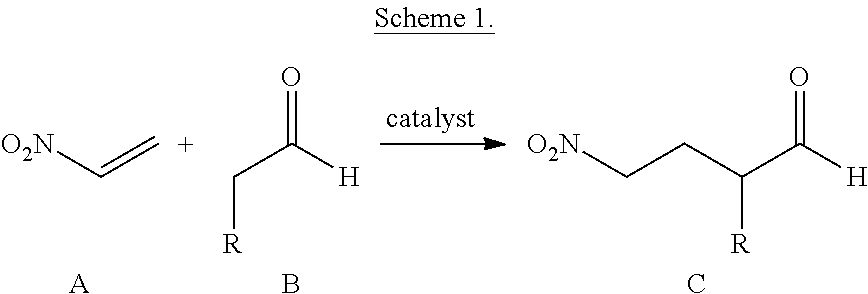
The use of a chiral pyrrolidine catalyst allows for the highly enantioselective preparation of Michael products. The reaction requires only very low catalyst loading (e.g., about 1-2 mol %) when carried out in the presence of certain acids as cocatalysts, and high yields are readily achieved. The substituent R can be any organic group or functional group that is tolerant of the mild Michael reaction conditions.


wherein R is as defined for formula III, and nitroethylene in the presence of an organic solvent, a proline derivative, and optionally a carboxylic acid, for a period of time sufficient to provide the compound of formula III. The compound of formula III can be enantiomerically enriched or substantially enantiomerically pure, with respect to the carbon attached to R, for example, when the proline derivative is a chiral pyrrolidine catalyst.

The chiral pyrrolidine catalyst can be, for example, proline or a diarylprolinol trialkyl silyl ether. The acid cocatalyst can be an organic acid such as acetic acid, trifluoroacetic acid, or a benzoic acid, for example, a nitrobenzoic acid. Suitable solvents include non-polar organic solvents such as hexanes, benzene, or toluene. The reducing agent can be, for example, a borohydride reagent such as sodium borohydride. The β-substituted-δ-nitroalcohols can be provided in high yield and high enantiomeric excess. In place of the α-substituted aldehyde, and α,α-disubstituted aldehyde may be used to provide β,β-disubstituted-δ-nitro-aldehydes, alcohols, or acids.

Such reactions can in theory proceed via enamine intermediates. L-proline (20 mol %) provided very little of the Michael adduct. The major product in a variety of solvents was the product of the aldol condensation of n-pentanal, a process that is known to be catalyzed by proline.11 In contrast, when 20 mol % A was employed in toluene, the desired Michael adduct was generated in 95% yield with >95% e.e., and little or no aldol product was formed. The enantiomeric excess of the product aldehyde was determined via an NMR-based assay.12 The Michael adduct yield was somewhat lower in hexane, and the use of DMF or methanol provided reduced yields.
Co-Catalyst Selection
| TABLE 1 |
| Organocatalyzed Michael Reaction |
 |
| entry | catalyst | co-catalyst | yieldb (%) | eec |
| 1 | 20 mol % | none | 95 | >95% |
| 2 | 5 mol % | none | <10 | n.d.d |
| 3a | 5 mol % | HOAc (200 mol %) | 95 | >95% |
| 4 | 2 mol % | HOAc (20 mol %) | 30 | n.d.d |
| 5 | 2 mol % | TFA (20 mol %) | 8 | n.d.d |
| 6a | 2 mol % | HOAc (200 mol %) | 55 | n.d.d |
| 7 | 2 mol % | B (5 mol %) | 96 | >95% |
| aHOAc used as solvent. | ||||
| bFrom 1H NMR of the crude reaction mixture. | ||||
| cDetermined by a 1H NMR ee assay. | ||||
| dNot determined. | ||||
Reaction Scope
| TABLE 2 |
| Efficient and Enantioselective Michael Reaction of aldehydes with nitroethylene |
 |
| entry | product | R | time (h) | yield (%)a | ee (%)b |
| 1 | 2a | Me | 48 | 95 | 98 |
| 2 | 2b | Et | 48 | 96 | 98 |
| 3 | 2cc,d | i-Pr | 32 | 94 | 97 |
| 4 | 2d | n-Bu | 48 | 95 | 99 |
| 5 | 2e | i-Bu | 54 | 94 | >99 |
| 6 | 2f | Bn | 32 | 93 | 99 |
| 7 | 2gc | CH2-c-Hex | 48 | 93 | >99 |
| 8 | 2hc | CH2COOMe | 54 | 92 | 96 |
| 9 | 2i | (CH2)2COOtBu | 54 | 94 | 97 |
| 10 | 2j | 4-OtBuC6H4CH2 | 32 | 94 | 98 |
| 11 | 2k | (CH2)4N(Boc)2 | 48 | 92 | 98 |
| aIsolated yield. | |||||
| bDetermined by chiral HPLC analysis (Chiralcel OD-H). | |||||
| cDetermined by chiral HPLC analysis (Chiralcel OD-H) on the corresponding aldehyde. | |||||
| dReaction conducted at 23° C. | |||||
Formal Aminoethylation of Aldehydes


| yield (%) of 5, | yield (%) | ||
| entry | coupling condition | yield of lactam | of 7a |
| 1 | 1.2 eq DIEA | 80%, 6% | 90% |
| concentration = 0.1M, rt | |||
| 2 | 1.2 eq DIEA | 13%, 69% | 88% |
| concentration = 0.03M, rt | |||
| 3 | 3.0 eq DIEA | 15%, 67% | 70% |
| concentration = 0.1M, rt | |||
| 4 | 1.2 eq DIEA | 76%, 8% | 87% |
| concentration = 0.1M, 35° C. | |||
| a5-10% DMAP will accelerate the reaction | |||

The absolute configuration of alcohol 2b from the Michael reaction/reduction sequence was assigned by the MPA model. See Latypov et al., J. Org. Chem. 1996, 61, 8569.

The absolute configuration of compound 2b was determined by X-ray structure analysis of phenylalanine derivative 5.

The absolute configuration of other β-substituted-δ-nitroalcohols from the Michael reaction/reduction sequence was assigned by analogy.


- (1) Perlmutter, P. Conjugate Addition Reactions in Organic Synthesis; Pergamon Press: Oxford, 1992.
- (2) For general reviews on the asymmetric Michael reactions, see Jarvo, E. R.; Miller, S. J. Tetrahedron 2002, 58, 2481.
- (3) For reviews, see Santanu, M.; Yang, J. W.; Hoffmann, S.; List, B. Chem. Rev. 2007, 107, 5471.
- (4) For organocatalytic Michael reactions of aldehydes to nitroalkenes, see: (a) Org. Lett. 2001, 3, 3737. (b) Org. Lett. 2004, 6, 2527. (c) J. Am. Chem. Soc. 2006, 128, 4966. (d) O. Org. Lett. 2002, 4, 3611. (e) Eur. J. Org. Chem. 2004, 1577. (f) Angew. Chem., Int. Ed. 2005, 44, 1369. (g) Angew., Chem. Int. Ed. 2005, 44, 4212. (h) Angew. Chem., Int. Ed. 2005, 45, 6366. (i) Org. Lett. 2006, 8, 2559. (j) Angew. Chem., Int. Ed. 2006, 45, 5984.
- (5) For organocatalytic Michael additions of non-aldehyde carbonyl nucleophiles to nitroalkenes, see: (a) Chem. Commun. 2006, 460. (b) Org. Biomol. Chem. 2006, 4, 63.
- (6) Seebach, D.; Brenner, M.; Rueping, M.; Jaun, B. Chem. Eur. J. 2002, 8, 573.
- (7) (a) J. Org. Chem. 2007, 72, 636. (b) J. Am. Chem. Soc. 2007, 129, 4039.
- (8) For selected reviews, see: (a) GABA in Nervous System Function the View at Fifty Years; Martin, D. L.; Olson, R. W.; Ed.; Lippincott Williams & Williams & Wilkins: Philadelphia, Pa., 2000 (b) Bryans, J. S.; Wustrow, D. J. Med. Res. Rev. 1999, 19, 149. (c) Otsuka, M. GABA: Receptors, Transporters and Metabolism 1996, 1. (d) DeFeudis, F. V. Annual review of pharmacology 1975, 15, 105.
- (9) For selected references of Pregabalin, see: (a) J. Org. Chem. 2007, 72, 7390. (b) J. Am. Chem. Soc. 2007, 129, 9216. For selected references of Baclofen, see: (c) Corey, E. J.; Zhang, F.-Y.; Org. Lett. 2000, 2, 4257. (d) Evans, D. A,; Mito, S.; Seidel, D. J. Am. Chem. Soc. 2007, 129, 11583. (e) Gotoh, H.; Ishikawa, H.; Hayashi, Y. Org. Lett. 2007, 9, 5307.
- (10) For recent review on synthesis of γ-amino acids, see: Ordóñez, M.; Cativiela, C. Tetrahedron: Asymmetry 2007, 18, 3. For selected synthesis examples, see: (a) Evans, D. A.; Gage, J. R.; Leighton, J. L.; Kim, A. S. J. Org. Chem. 1992, 57, 1961. (b) Azam, S.; D'Souza, A. A,; Wyatt, P. B. J. Chem. Soc., Perkin Trans. 1 1996, 621. (c) Brenner, M.; Seebach, D. Helv. Chim. Acta. 1999, 82, 2365. (d) Camps, P.; Munoz-Torrero, D.; Sanchez, L. Tetrahedron: Asymmetry 2004, 15, 2039.
- (11) (a) Córdova, A.; Notz, W.; Barbas, C. F., III. J. Org. Chem. 2002, 67, 301. (b) Northrup, A. B.; MacMillan, D. W. C. J. Am. Chem. Soc. 2002, 124, 6798. (c) List, B. Tetrahedron 2002, 58, 5573.
- (12) Chi, Y.; Peelen, T. J.; Gellman, S. H. Org. Lett. 2005, 7, 3469.
- (13) (a) Peelen, T. J.; Chi, Y.; Gellman, S. H. J. Am. Chem. Soc. 2005, 127, 11598. (b) Chi, Y. G.; Gellman, S. H. Org. Len. 2005, 7, 4253. (c) Melchiorre, P.; Jørgensen, K. A. J. Org. Chem. 2003, 68, 4151.
- (14) (a) Nat. Chem. Biol. 2007, 3, 252. (b) Angew. Chem., Int. Ed. 2003, 42, 776.
Claims (19)
Priority Applications (1)
| Application Number | Priority Date | Filing Date | Title |
|---|---|---|---|
| US13/621,553 US8637696B2 (en) | 2008-03-21 | 2012-09-17 | Methods for preparing amides and amino acids |
Applications Claiming Priority (3)
| Application Number | Priority Date | Filing Date | Title |
|---|---|---|---|
| US7029808P | 2008-03-21 | 2008-03-21 | |
| US12/383,370 US8269039B2 (en) | 2008-03-21 | 2009-03-23 | Amino acids and catalytic preparatory methods |
| US13/621,553 US8637696B2 (en) | 2008-03-21 | 2012-09-17 | Methods for preparing amides and amino acids |
Related Parent Applications (1)
| Application Number | Title | Priority Date | Filing Date |
|---|---|---|---|
| US12/383,370 Division US8269039B2 (en) | 2008-03-21 | 2009-03-23 | Amino acids and catalytic preparatory methods |
Publications (2)
| Publication Number | Publication Date |
|---|---|
| US20130030210A1 US20130030210A1 (en) | 2013-01-31 |
| US8637696B2 true US8637696B2 (en) | 2014-01-28 |
Family
ID=41201674
Family Applications (2)
| Application Number | Title | Priority Date | Filing Date |
|---|---|---|---|
| US12/383,370 Expired - Fee Related US8269039B2 (en) | 2008-03-21 | 2009-03-23 | Amino acids and catalytic preparatory methods |
| US13/621,553 Expired - Fee Related US8637696B2 (en) | 2008-03-21 | 2012-09-17 | Methods for preparing amides and amino acids |
Family Applications Before (1)
| Application Number | Title | Priority Date | Filing Date |
|---|---|---|---|
| US12/383,370 Expired - Fee Related US8269039B2 (en) | 2008-03-21 | 2009-03-23 | Amino acids and catalytic preparatory methods |
Country Status (1)
| Country | Link |
|---|---|
| US (2) | US8269039B2 (en) |
Citations (1)
| Publication number | Priority date | Publication date | Assignee | Title |
|---|---|---|---|---|
| US3024232A (en) | 1958-09-18 | 1962-03-06 | Commercial Solvents Corp | Reaction products of nitroolefins and carbonyl compounds |
-
2009
- 2009-03-23 US US12/383,370 patent/US8269039B2/en not_active Expired - Fee Related
-
2012
- 2012-09-17 US US13/621,553 patent/US8637696B2/en not_active Expired - Fee Related
Patent Citations (1)
| Publication number | Priority date | Publication date | Assignee | Title |
|---|---|---|---|---|
| US3024232A (en) | 1958-09-18 | 1962-03-06 | Commercial Solvents Corp | Reaction products of nitroolefins and carbonyl compounds |
Non-Patent Citations (17)
Also Published As
| Publication number | Publication date |
|---|---|
| US20090264676A1 (en) | 2009-10-22 |
| US8269039B2 (en) | 2012-09-18 |
| US20130030210A1 (en) | 2013-01-31 |
Similar Documents
| Publication | Publication Date | Title |
|---|---|---|
| Afzali-Ardakani et al. | l-Vinylglycine | |
| DE69032679T2 (en) | Threo (2R, 3S) -3-amino-2-hydroxypentanoic acid and threo (2R, 3S) -3- (p-methoxy-benzyloxycarbonyl / FMOC) amino-2-hydroxy-pentanoic acid | |
| KR100694735B1 (en) | Mono- and Disubstituted 3-propyl gamma-aminobutyric acid | |
| EP2252578A1 (en) | Novel conjugates for treating neurodegenerative diseases and disorders | |
| US9796660B2 (en) | Gamma amino acid building blocks | |
| US12312361B2 (en) | Methods for practical synthesis of deuterated amino acids | |
| US8269039B2 (en) | Amino acids and catalytic preparatory methods | |
| AU2011247593A1 (en) | New compounds, synthesis and use thereof in the treatment of pain | |
| US20050020673A1 (en) | Method for the preparation of lariciresinol cyclolariciresinol and secoisolariciresinol | |
| D’Oca et al. | Synthesis of (+/−)-Pregabalin and its novel lipophilic β-alkyl-substituted analogues from fatty chains | |
| Chandrasekhar et al. | Synthesis of unusual amino acids: N-(tert-butoxycarbonyl)-l-vinyl glycine and N-(tert-butoxycarbonyl)-l-homophenylalanine | |
| FR2458534A1 (en) | PIVALOYLOXYMETHYL 2-PROPYL-PENTANOATE, PROCESS FOR THE PREPARATION THEREOF AND THERAPEUTIC USE THEREOF | |
| Schmidt et al. | Enantioselective and diastereoselective formation of syn-3-hydroxy-4-amino acids (syn-statines) via tetramic acids | |
| DE69018268T2 (en) | METHOD FOR PRODUCING PROTECTED AZA-YPERITE PRODRUGS. | |
| Song et al. | Preparation of Ethyl (R)-3-hydroxy-4-chlorobutyrate by Selective Reduction of (R)-4-(Trichloromethyl)-oxetan-2-one: Key Intermediate to (R)-Carnitine and (R)-4-Amino-3-hydroxybutyric Acid | |
| Kokotos et al. | Synthetic routes to lipidic diamines and amino alcohols: a class of potential antiinflammatory agents | |
| WO2013093220A1 (en) | Method for synthesising ivabradine and the pharmaceutically acceptable acid addition salts thereof | |
| CN111333513A (en) | Preparation method of 2,4-difluoro-3-nitrobenzoic acid | |
| EP0389338A1 (en) | Platinium complexes, their preparation and pharmaceutical compositions containing them | |
| EP4725937A1 (en) | Process for the synthesis of bicyclic carboxamide compounds | |
| CZ292221B6 (en) | Process for preparing (4R,6R) tert-butyl[6-(2-aminoethyl)-2,2-dimethyl[1,3]dioxan-4-yl]acetate and intermediates for its preparation | |
| Kirihata et al. | Synthesis and Structural Confirmation of (2 S, 3 R, 4 R, 6 E)-2-Acetylamino-3-hydroxy-4-methyl-6-octenoic Acid, a New Amino Acid Produced by Neocosmospora vasinfecta | |
| FR2693373A1 (en) | A product capable of releasing an oxazolidinone, in particular chlorzoxazone, and, if appropriate, an acetamidophenol, in particular paracetamol, into the physiological medium, manufacturing processes. | |
| DE60111956T2 (en) | Cyclophilin-binding ligands | |
| JPH0791223B2 (en) | Process for producing optically active 6-t-butoxy-3,5-dihydroxyhexanoic acid ester |
Legal Events
| Date | Code | Title | Description |
|---|---|---|---|
| AS | Assignment |
Owner name: NATIONAL INSTITUTES OF HEALTH (NIH), U.S. DEPT. OF Free format text: CONFIRMATORY LICENSE;ASSIGNOR:WISCONSIN ALUMNI RESEARCH FOUNDATION;REEL/FRAME:029065/0748 Effective date: 20120924 |
|
| AS | Assignment |
Owner name: KSB AKTIENGESELLSCHAFT, GERMANY Free format text: ASSIGNMENT OF ASSIGNORS INTEREST;ASSIGNORS:ROSTALSKI, KAI;SPRINGER, PEER;SIGNING DATES FROM 20121004 TO 20121111;REEL/FRAME:029746/0442 |
|
| AS | Assignment |
Owner name: WISCONSIN ALUMNI RESEARCH FOUNDATION, WISCONSIN Free format text: ASSIGNMENT OF ASSIGNORS INTEREST;ASSIGNORS:GUO, LI;GELLMAN, SAMUEL;CHI, YONGGUI;REEL/FRAME:031862/0358 Effective date: 20090612 |
|
| STCF | Information on status: patent grant |
Free format text: PATENTED CASE |
|
| FPAY | Fee payment |
Year of fee payment: 4 |
|
| CC | Certificate of correction | ||
| MAFP | Maintenance fee payment |
Free format text: PAYMENT OF MAINTENANCE FEE, 8TH YR, SMALL ENTITY (ORIGINAL EVENT CODE: M2552); ENTITY STATUS OF PATENT OWNER: SMALL ENTITY Year of fee payment: 8 |
|
| FEPP | Fee payment procedure |
Free format text: MAINTENANCE FEE REMINDER MAILED (ORIGINAL EVENT CODE: REM.); ENTITY STATUS OF PATENT OWNER: SMALL ENTITY |
|
| LAPS | Lapse for failure to pay maintenance fees |
Free format text: PATENT EXPIRED FOR FAILURE TO PAY MAINTENANCE FEES (ORIGINAL EVENT CODE: EXP.); ENTITY STATUS OF PATENT OWNER: SMALL ENTITY |
|
| STCH | Information on status: patent discontinuation |
Free format text: PATENT EXPIRED DUE TO NONPAYMENT OF MAINTENANCE FEES UNDER 37 CFR 1.362 |
|
| FP | Lapsed due to failure to pay maintenance fee |
Effective date: 20260128 |