US8637557B2 - Aminothiazole derivative - Google Patents
Aminothiazole derivative Download PDFInfo
- Publication number
- US8637557B2 US8637557B2 US13/502,636 US201013502636A US8637557B2 US 8637557 B2 US8637557 B2 US 8637557B2 US 201013502636 A US201013502636 A US 201013502636A US 8637557 B2 US8637557 B2 US 8637557B2
- Authority
- US
- United States
- Prior art keywords
- group
- formula
- carbon atoms
- brs
- mhz
- Prior art date
- Legal status (The legal status is an assumption and is not a legal conclusion. Google has not performed a legal analysis and makes no representation as to the accuracy of the status listed.)
- Expired - Fee Related
Links
- BGRWYRAHAFMIBJ-UHFFFAOYSA-N CC(C)NC(=O)NC(C)C Chemical compound CC(C)NC(=O)NC(C)C BGRWYRAHAFMIBJ-UHFFFAOYSA-N 0.000 description 51
- PUACTIIESPYWSI-UHFFFAOYSA-N CC(C)C1=CN=CC=C1 Chemical compound CC(C)C1=CN=CC=C1 PUACTIIESPYWSI-UHFFFAOYSA-N 0.000 description 44
- 0 [1*]CC1=NC([2*])=C(C2=NC([Y][3*])=NO2)S1 Chemical compound [1*]CC1=NC([2*])=C(C2=NC([Y][3*])=NO2)S1 0.000 description 13
- IGZDXYHMGWRJAZ-UHFFFAOYSA-N CC(C)NC(=O)C(C)C Chemical compound CC(C)NC(=O)C(C)C IGZDXYHMGWRJAZ-UHFFFAOYSA-N 0.000 description 11
- CWPPDTVYIJETDF-UHFFFAOYSA-N CC(C)CC(C)(C)CO Chemical compound CC(C)CC(C)(C)CO CWPPDTVYIJETDF-UHFFFAOYSA-N 0.000 description 9
- UJKDXJPPDNLMKJ-UHFFFAOYSA-N CC(C)CCC(=O)OC(C)(C)C Chemical compound CC(C)CCC(=O)OC(C)(C)C UJKDXJPPDNLMKJ-UHFFFAOYSA-N 0.000 description 9
- CONTVCYXDSFGMN-UHFFFAOYSA-N CC(C)CC(F)(F)F Chemical compound CC(C)CC(F)(F)F CONTVCYXDSFGMN-UHFFFAOYSA-N 0.000 description 8
- WVYWICLMDOOCFB-UHFFFAOYSA-N CC(C)CC(C)O Chemical compound CC(C)CC(C)O WVYWICLMDOOCFB-UHFFFAOYSA-N 0.000 description 5
- HXVNBWAKAOHACI-UHFFFAOYSA-N CC(C)C(=O)C(C)C Chemical compound CC(C)C(=O)C(C)C HXVNBWAKAOHACI-UHFFFAOYSA-N 0.000 description 4
- ZISSAWUMDACLOM-UHFFFAOYSA-N CC(C)C(C)(C)C Chemical compound CC(C)C(C)(C)C ZISSAWUMDACLOM-UHFFFAOYSA-N 0.000 description 4
- BAUXVVCVEDWRGY-UHFFFAOYSA-N CC(C)C1=CN=CN=C1 Chemical compound CC(C)C1=CN=CN=C1 BAUXVVCVEDWRGY-UHFFFAOYSA-N 0.000 description 4
- UAOMVDZJSHZZME-UHFFFAOYSA-N CC(C)NC(C)C Chemical compound CC(C)NC(C)C UAOMVDZJSHZZME-UHFFFAOYSA-N 0.000 description 3
- YLFYUSNPIHLTBP-UHFFFAOYSA-N CC(C)NC(NC)=O Chemical compound CC(C)NC(NC)=O YLFYUSNPIHLTBP-UHFFFAOYSA-N 0.000 description 3
- ZYVYEJXMYBUCMN-UHFFFAOYSA-N COCC(C)C Chemical compound COCC(C)C ZYVYEJXMYBUCMN-UHFFFAOYSA-N 0.000 description 3
- ZQAYBCWERYRAMF-UHFFFAOYSA-N COCCC(C)C Chemical compound COCCC(C)C ZQAYBCWERYRAMF-UHFFFAOYSA-N 0.000 description 3
- NNPPMTNAJDCUHE-UHFFFAOYSA-N CC(C)C Chemical compound CC(C)C NNPPMTNAJDCUHE-UHFFFAOYSA-N 0.000 description 2
- LZTPHEMZYFRQGB-UHFFFAOYSA-N CC(C)C1=CC=CC(CO)=C1 Chemical compound CC(C)C1=CC=CC(CO)=C1 LZTPHEMZYFRQGB-UHFFFAOYSA-N 0.000 description 2
- VLJSLTNSFSOYQR-UHFFFAOYSA-N CC(C)C1=CC=CC(O)=C1 Chemical compound CC(C)C1=CC=CC(O)=C1 VLJSLTNSFSOYQR-UHFFFAOYSA-N 0.000 description 2
- GWESVXSMPKAFAS-UHFFFAOYSA-N CC(C)C1CCCCC1 Chemical compound CC(C)C1CCCCC1 GWESVXSMPKAFAS-UHFFFAOYSA-N 0.000 description 2
- FMLSQAUAAGVTJO-UHFFFAOYSA-N CC(C)CC(C)(C)O Chemical compound CC(C)CC(C)(C)O FMLSQAUAAGVTJO-UHFFFAOYSA-N 0.000 description 2
- XQTIIOBJOLSUNB-UHFFFAOYSA-N CC(C)CCC(=O)CC(C)(C)C Chemical compound CC(C)CCC(=O)CC(C)(C)C XQTIIOBJOLSUNB-UHFFFAOYSA-N 0.000 description 2
- KAVPLAKJNSCAOP-UHFFFAOYSA-N CC(C)CCC(=O)CC(C)(CO)CO Chemical compound CC(C)CCC(=O)CC(C)(CO)CO KAVPLAKJNSCAOP-UHFFFAOYSA-N 0.000 description 2
- IRFPCDHRTMHDDV-UHFFFAOYSA-N CC(C)CCC(=O)N1CCC(O)CC1 Chemical compound CC(C)CCC(=O)N1CCC(O)CC1 IRFPCDHRTMHDDV-UHFFFAOYSA-N 0.000 description 2
- GLSXCGDZDSMXJX-UHFFFAOYSA-N CC(C)CCCC(=O)OC(C)(C)C Chemical compound CC(C)CCCC(=O)OC(C)(C)C GLSXCGDZDSMXJX-UHFFFAOYSA-N 0.000 description 2
- NQULBISGTHBUGM-UHFFFAOYSA-N CC(C)CCCN(C)C Chemical compound CC(C)CCCN(C)C NQULBISGTHBUGM-UHFFFAOYSA-N 0.000 description 2
- HJUXKAYLXYLTFI-UHFFFAOYSA-N CC(C)CCCOC(C)(C)C Chemical compound CC(C)CCCOC(C)(C)C HJUXKAYLXYLTFI-UHFFFAOYSA-N 0.000 description 2
- YJIOXFNBHQFGBI-UHFFFAOYSA-N CC(C)CCNC(=O)OC(C)(C)C Chemical compound CC(C)CCNC(=O)OC(C)(C)C YJIOXFNBHQFGBI-UHFFFAOYSA-N 0.000 description 2
- PHTQWCKDNZKARW-UHFFFAOYSA-N CC(C)CCO Chemical compound CC(C)CCO PHTQWCKDNZKARW-UHFFFAOYSA-N 0.000 description 2
- ATDYVUAGTYSTHS-UHFFFAOYSA-N CC(C)CS(C)(=O)=O Chemical compound CC(C)CS(C)(=O)=O ATDYVUAGTYSTHS-UHFFFAOYSA-N 0.000 description 2
- XSGMJDQRZDWEPW-UHFFFAOYSA-N CC(C)N1CC(O)C1 Chemical compound CC(C)N1CC(O)C1 XSGMJDQRZDWEPW-UHFFFAOYSA-N 0.000 description 2
- UZRXHHMTKCJKTQ-UHFFFAOYSA-N CC(C)N1CCC(O)CC1 Chemical compound CC(C)N1CCC(O)CC1 UZRXHHMTKCJKTQ-UHFFFAOYSA-N 0.000 description 2
- XLZMWNWNBXSZKF-UHFFFAOYSA-N CC(C)N1CCOCC1 Chemical compound CC(C)N1CCOCC1 XLZMWNWNBXSZKF-UHFFFAOYSA-N 0.000 description 2
- MVUUAIHDSOOJLK-UHFFFAOYSA-N CC(C)NC(=O)OC(C)C Chemical compound CC(C)NC(=O)OC(C)C MVUUAIHDSOOJLK-UHFFFAOYSA-N 0.000 description 2
- QWTDNUCVQCZILF-UHFFFAOYSA-N CCC(C)C Chemical compound CCC(C)C QWTDNUCVQCZILF-UHFFFAOYSA-N 0.000 description 2
- FRNHNENZDWMNBU-QPJJXVBHSA-N C/C(=C\C(C)C)CO Chemical compound C/C(=C\C(C)C)CO FRNHNENZDWMNBU-QPJJXVBHSA-N 0.000 description 1
- YHQXBTXEYZIYOV-UHFFFAOYSA-N C=CC(C)C Chemical compound C=CC(C)C YHQXBTXEYZIYOV-UHFFFAOYSA-N 0.000 description 1
- JULOHJDJZALMKN-UHFFFAOYSA-N CC(=O)C(C)(C)CC(C)C Chemical compound CC(=O)C(C)(C)CC(C)C JULOHJDJZALMKN-UHFFFAOYSA-N 0.000 description 1
- SNHWHSSUBMGTOS-UHFFFAOYSA-N CC(=O)CC(C)C(C)C Chemical compound CC(=O)CC(C)C(C)C SNHWHSSUBMGTOS-UHFFFAOYSA-N 0.000 description 1
- FFWSICBKRCICMR-UHFFFAOYSA-N CC(=O)CCC(C)C Chemical compound CC(=O)CCC(C)C FFWSICBKRCICMR-UHFFFAOYSA-N 0.000 description 1
- BYLYLPGUVRQSIO-UHFFFAOYSA-N CC(=O)OCCCC(C)C Chemical compound CC(=O)OCCCC(C)C BYLYLPGUVRQSIO-UHFFFAOYSA-N 0.000 description 1
- OOYBITFWBADNKC-UHFFFAOYSA-N CC(=O)OCCCCC(C)C Chemical compound CC(=O)OCCCCC(C)C OOYBITFWBADNKC-UHFFFAOYSA-N 0.000 description 1
- GOBZWCKZJWKQCR-UHFFFAOYSA-N CC(C)(CS(CSC)S)S(N)(=O)=O Chemical compound CC(C)(CS(CSC)S)S(N)(=O)=O GOBZWCKZJWKQCR-UHFFFAOYSA-N 0.000 description 1
- OIPMJJVCOSACDS-UHFFFAOYSA-N CC(C)C(C)(C)CCO Chemical compound CC(C)C(C)(C)CCO OIPMJJVCOSACDS-UHFFFAOYSA-N 0.000 description 1
- FAMOAJMEFGYSNY-UHFFFAOYSA-N CC(C)C(C)(C)CO Chemical compound CC(C)C(C)(C)CO FAMOAJMEFGYSNY-UHFFFAOYSA-N 0.000 description 1
- IKECULIHBUCAKR-UHFFFAOYSA-N CC(C)C(C)(C)O Chemical compound CC(C)C(C)(C)O IKECULIHBUCAKR-UHFFFAOYSA-N 0.000 description 1
- ZFFMLCVRJBZUDZ-UHFFFAOYSA-N CC(C)C(C)C Chemical compound CC(C)C(C)C ZFFMLCVRJBZUDZ-UHFFFAOYSA-N 0.000 description 1
- WYBKSYJGMUHTQK-UHFFFAOYSA-N CC(C)C(C)CC(=O)OC(C)(C)C Chemical compound CC(C)C(C)CC(=O)OC(C)(C)C WYBKSYJGMUHTQK-UHFFFAOYSA-N 0.000 description 1
- XRUZOCYQQNKMDG-UHFFFAOYSA-N CC(C)C(C)CS(C)(=O)=O Chemical compound CC(C)C(C)CS(C)(=O)=O XRUZOCYQQNKMDG-UHFFFAOYSA-N 0.000 description 1
- CFZJBSVXWSTBNO-UHFFFAOYSA-N CC(C)C1=CC(=O)NC=C1 Chemical compound CC(C)C1=CC(=O)NC=C1 CFZJBSVXWSTBNO-UHFFFAOYSA-N 0.000 description 1
- OIGWAXDAPKFNCQ-UHFFFAOYSA-N CC(C)C1=CC=C(CO)C=C1 Chemical compound CC(C)C1=CC=C(CO)C=C1 OIGWAXDAPKFNCQ-UHFFFAOYSA-N 0.000 description 1
- ZNRBQJLZGSDXDM-UHFFFAOYSA-N CC(C)C1=CC=CC(CCO)=C1 Chemical compound CC(C)C1=CC=CC(CCO)=C1 ZNRBQJLZGSDXDM-UHFFFAOYSA-N 0.000 description 1
- RWGFKTVRMDUZSP-UHFFFAOYSA-N CC(C)C1=CC=CC=C1 Chemical compound CC(C)C1=CC=CC=C1 RWGFKTVRMDUZSP-UHFFFAOYSA-N 0.000 description 1
- UTKXDSMWHKPGNZ-UHFFFAOYSA-N CC(C)C1=CC=CC=C1CO Chemical compound CC(C)C1=CC=CC=C1CO UTKXDSMWHKPGNZ-UHFFFAOYSA-N 0.000 description 1
- FRGXNJWEDDQLFH-UHFFFAOYSA-N CC(C)C1=CC=NC=C1 Chemical compound CC(C)C1=CC=NC=C1 FRGXNJWEDDQLFH-UHFFFAOYSA-N 0.000 description 1
- GWSOIFJYYARYAI-UHFFFAOYSA-N CC(C)C1=CN(C)C(=O)C=C1 Chemical compound CC(C)C1=CN(C)C(=O)C=C1 GWSOIFJYYARYAI-UHFFFAOYSA-N 0.000 description 1
- GOGHRSJSAGGONL-UHFFFAOYSA-N CC(C)C1=CN=C(OCC2=CN=CC=C2)C=C1 Chemical compound CC(C)C1=CN=C(OCC2=CN=CC=C2)C=C1 GOGHRSJSAGGONL-UHFFFAOYSA-N 0.000 description 1
- ZULWJXNGSCEKDB-UHFFFAOYSA-N CC(C)C1=CN=CC(O)=C1 Chemical compound CC(C)C1=CN=CC(O)=C1 ZULWJXNGSCEKDB-UHFFFAOYSA-N 0.000 description 1
- GIMBKDZNMKTZMG-UHFFFAOYSA-N CC(C)C1=CN=CC=N1 Chemical compound CC(C)C1=CN=CC=N1 GIMBKDZNMKTZMG-UHFFFAOYSA-N 0.000 description 1
- DGTAAIBINZROPM-UHFFFAOYSA-N CC(C)C1=CNC(=O)C=C1 Chemical compound CC(C)C1=CNC(=O)C=C1 DGTAAIBINZROPM-UHFFFAOYSA-N 0.000 description 1
- PFYPDUUXDADWKC-UHFFFAOYSA-N CC(C)C1=NC=CC=C1 Chemical compound CC(C)C1=NC=CC=C1 PFYPDUUXDADWKC-UHFFFAOYSA-N 0.000 description 1
- HPBROFGYTXOJIO-UHFFFAOYSA-N CC(C)C1CC1 Chemical compound CC(C)C1CC1 HPBROFGYTXOJIO-UHFFFAOYSA-N 0.000 description 1
- PQLWJJKVXQAMHF-UHFFFAOYSA-N CC(C)C1CC1(C)C Chemical compound CC(C)C1CC1(C)C PQLWJJKVXQAMHF-UHFFFAOYSA-N 0.000 description 1
- RFHQRRJFJJCQDJ-UHFFFAOYSA-N CC(C)C1CCC1 Chemical compound CC(C)C1CCC1 RFHQRRJFJJCQDJ-UHFFFAOYSA-N 0.000 description 1
- TVSBRLGQVHJIKT-UHFFFAOYSA-N CC(C)C1CCCC1 Chemical compound CC(C)C1CCCC1 TVSBRLGQVHJIKT-UHFFFAOYSA-N 0.000 description 1
- MQLNQYVZVZHRDH-UHFFFAOYSA-N CC(C)C1CCCOC1 Chemical compound CC(C)C1CCCOC1 MQLNQYVZVZHRDH-UHFFFAOYSA-N 0.000 description 1
- BJNJKOKPKYNBHD-UHFFFAOYSA-N CC(C)C1CCOC1 Chemical compound CC(C)C1CCOC1 BJNJKOKPKYNBHD-UHFFFAOYSA-N 0.000 description 1
- VXPCMPWKRCZJLB-UHFFFAOYSA-N CC(C)C1CCOCC1 Chemical compound CC(C)C1CCOCC1 VXPCMPWKRCZJLB-UHFFFAOYSA-N 0.000 description 1
- CRKITOKPUMNYAG-UHFFFAOYSA-N CC(C)C1COC1 Chemical compound CC(C)C1COC1 CRKITOKPUMNYAG-UHFFFAOYSA-N 0.000 description 1
- ZKAODOPIAGAVNQ-UHFFFAOYSA-N CC(C)CC(=O)OC(C)(C)C Chemical compound CC(C)CC(=O)OC(C)(C)C ZKAODOPIAGAVNQ-UHFFFAOYSA-N 0.000 description 1
- NHTMVDHEPJAVLT-UHFFFAOYSA-N CC(C)CC(C)(C)C Chemical compound CC(C)CC(C)(C)C NHTMVDHEPJAVLT-UHFFFAOYSA-N 0.000 description 1
- NHBUGGCJRMEOCC-UHFFFAOYSA-N CC(C)CC(C)(C)C(=O)O Chemical compound CC(C)CC(C)(C)C(=O)O NHBUGGCJRMEOCC-UHFFFAOYSA-N 0.000 description 1
- XBPPTIWCGIXQMB-UHFFFAOYSA-N CC(C)CC(C)(C)C(C)(C)O Chemical compound CC(C)CC(C)(C)C(C)(C)O XBPPTIWCGIXQMB-UHFFFAOYSA-N 0.000 description 1
- PNCCXTCWYPQYEO-UHFFFAOYSA-N CC(C)CC(C)(C)C(C)O Chemical compound CC(C)CC(C)(C)C(C)O PNCCXTCWYPQYEO-UHFFFAOYSA-N 0.000 description 1
- MLJGJWCRMJDCFV-UHFFFAOYSA-N CC(C)CC(C)(C)C(N)=O Chemical compound CC(C)CC(C)(C)C(N)=O MLJGJWCRMJDCFV-UHFFFAOYSA-N 0.000 description 1
- HBTWUJHNHFGRQC-UHFFFAOYSA-N CC(C)CC(C)(C)C(O)C1=CC=CC=C1 Chemical compound CC(C)CC(C)(C)C(O)C1=CC=CC=C1 HBTWUJHNHFGRQC-UHFFFAOYSA-N 0.000 description 1
- CHMURTNGODAQRR-UHFFFAOYSA-N CC(C)CC(C)(C)CCS(C)(=O)=O Chemical compound CC(C)CC(C)(C)CCS(C)(=O)=O CHMURTNGODAQRR-UHFFFAOYSA-N 0.000 description 1
- QBZBDLKOSCXQAW-UHFFFAOYSA-N CC(C)CC(C)(C)CF Chemical compound CC(C)CC(C)(C)CF QBZBDLKOSCXQAW-UHFFFAOYSA-N 0.000 description 1
- AKYZNGLLWXGHMQ-UHFFFAOYSA-N CC(C)CC(C)(C)CN Chemical compound CC(C)CC(C)(C)CN AKYZNGLLWXGHMQ-UHFFFAOYSA-N 0.000 description 1
- HUQXLKCCKILFGE-UHFFFAOYSA-N CC(C)CC(C)(C)COS(C)(=O)=O Chemical compound CC(C)CC(C)(C)COS(C)(=O)=O HUQXLKCCKILFGE-UHFFFAOYSA-N 0.000 description 1
- RINVRENZGOOYGU-UHFFFAOYSA-N CC(C)CC(C)(C)S(=O)(=O)CC(C)(C)C Chemical compound CC(C)CC(C)(C)S(=O)(=O)CC(C)(C)C RINVRENZGOOYGU-UHFFFAOYSA-N 0.000 description 1
- PVKLREGTIQVJQW-UHFFFAOYSA-N CC(C)CC(C)(C)S(N)(=O)=O Chemical compound CC(C)CC(C)(C)S(N)(=O)=O PVKLREGTIQVJQW-UHFFFAOYSA-N 0.000 description 1
- REQVMPVOKUHDOZ-UHFFFAOYSA-N CC(C)CC(C)(CO)CO Chemical compound CC(C)CC(C)(CO)CO REQVMPVOKUHDOZ-UHFFFAOYSA-N 0.000 description 1
- BZHMBWZPUJHVEE-UHFFFAOYSA-N CC(C)CC(C)C Chemical compound CC(C)CC(C)C BZHMBWZPUJHVEE-UHFFFAOYSA-N 0.000 description 1
- JPCPSMPFMGTZNK-UHFFFAOYSA-N CC(C)CC(O)CC(F)(F)F Chemical compound CC(C)CC(O)CC(F)(F)F JPCPSMPFMGTZNK-UHFFFAOYSA-N 0.000 description 1
- JEDXCXWWAQJSKD-UHFFFAOYSA-N CC(C)CC1(C)COC1 Chemical compound CC(C)CC1(C)COC1 JEDXCXWWAQJSKD-UHFFFAOYSA-N 0.000 description 1
- QPABQBCGEKNMQI-UHFFFAOYSA-N CC(C)CC1(CO)CC1 Chemical compound CC(C)CC1(CO)CC1 QPABQBCGEKNMQI-UHFFFAOYSA-N 0.000 description 1
- YFYPKPBOAHOTCM-UHFFFAOYSA-N CC(C)CC1(CO)COC1 Chemical compound CC(C)CC1(CO)COC1 YFYPKPBOAHOTCM-UHFFFAOYSA-N 0.000 description 1
- YLPQZOFLJMGJNK-UHFFFAOYSA-N CC(C)CC1=CC(CO)=CC=C1 Chemical compound CC(C)CC1=CC(CO)=CC=C1 YLPQZOFLJMGJNK-UHFFFAOYSA-N 0.000 description 1
- ZKSISJGIJFEBMS-UHFFFAOYSA-N CC(C)CC1=CC=CC(O)=C1 Chemical compound CC(C)CC1=CC=CC(O)=C1 ZKSISJGIJFEBMS-UHFFFAOYSA-N 0.000 description 1
- DEGXTCKEZCCZOP-UHFFFAOYSA-N CC(C)CC1=CN=CC=C1 Chemical compound CC(C)CC1=CN=CC=C1 DEGXTCKEZCCZOP-UHFFFAOYSA-N 0.000 description 1
- XIMCWSMVGVJQQN-UHFFFAOYSA-N CC(C)CC1CC1 Chemical compound CC(C)CC1CC1 XIMCWSMVGVJQQN-UHFFFAOYSA-N 0.000 description 1
- FDZXGTMQTJUINZ-UHFFFAOYSA-N CC(C)CC1CCOCC1 Chemical compound CC(C)CC1CCOCC1 FDZXGTMQTJUINZ-UHFFFAOYSA-N 0.000 description 1
- SVZQVKRBOSYVKS-UHFFFAOYSA-N CC(C)CCC(=O)CC(C)(C)CO Chemical compound CC(C)CCC(=O)CC(C)(C)CO SVZQVKRBOSYVKS-UHFFFAOYSA-N 0.000 description 1
- ZERIVQMOZUVFGX-UHFFFAOYSA-N CC(C)CCC(=O)CC(CO)(CO)CO Chemical compound CC(C)CCC(=O)CC(CO)(CO)CO ZERIVQMOZUVFGX-UHFFFAOYSA-N 0.000 description 1
- ANGBPOUMOWHMDC-UHFFFAOYSA-N CC(C)CCC(=O)N(C)C Chemical compound CC(C)CCC(=O)N(C)C ANGBPOUMOWHMDC-UHFFFAOYSA-N 0.000 description 1
- OVMXULFLRSMRQR-UHFFFAOYSA-N CC(C)CCC(=O)N1CCN(C(=O)OC(C)(C)C)CC1 Chemical compound CC(C)CCC(=O)N1CCN(C(=O)OC(C)(C)C)CC1 OVMXULFLRSMRQR-UHFFFAOYSA-N 0.000 description 1
- WTTMKNYUCLJJKZ-UHFFFAOYSA-N CC(C)CCC(=O)N1CCNCC1 Chemical compound CC(C)CCC(=O)N1CCNCC1 WTTMKNYUCLJJKZ-UHFFFAOYSA-N 0.000 description 1
- VZHUINGYHHOPDT-UHFFFAOYSA-N CC(C)CCC(=O)N1CCOCC1 Chemical compound CC(C)CCC(=O)N1CCOCC1 VZHUINGYHHOPDT-UHFFFAOYSA-N 0.000 description 1
- FGKJLKRYENPLQH-UHFFFAOYSA-N CC(C)CCC(=O)O Chemical compound CC(C)CCC(=O)O FGKJLKRYENPLQH-UHFFFAOYSA-N 0.000 description 1
- SVIJAVIDKRORLN-UHFFFAOYSA-N CC(C)CCC(=O)OC(C)C Chemical compound CC(C)CCC(=O)OC(C)C SVIJAVIDKRORLN-UHFFFAOYSA-N 0.000 description 1
- NPSNGMHOBSPOGJ-UHFFFAOYSA-N CC(C)CCC(=O)OCCO Chemical compound CC(C)CCC(=O)OCCO NPSNGMHOBSPOGJ-UHFFFAOYSA-N 0.000 description 1
- JPUIYNHIEXIFMV-UHFFFAOYSA-N CC(C)CCC(C)(C)O Chemical compound CC(C)CCC(C)(C)O JPUIYNHIEXIFMV-UHFFFAOYSA-N 0.000 description 1
- UWNADWZGEHDQAB-UHFFFAOYSA-N CC(C)CCC(C)C Chemical compound CC(C)CCC(C)C UWNADWZGEHDQAB-UHFFFAOYSA-N 0.000 description 1
- UHDOWIRKQWDHEC-UHFFFAOYSA-N CC(C)CCC1=CC=CC=N1 Chemical compound CC(C)CCC1=CC=CC=N1 UHDOWIRKQWDHEC-UHFFFAOYSA-N 0.000 description 1
- OAEJZOKECBYYJT-UHFFFAOYSA-N CC(C)CCC1=CN(C(C)C)C=N1 Chemical compound CC(C)CCC1=CN(C(C)C)C=N1 OAEJZOKECBYYJT-UHFFFAOYSA-N 0.000 description 1
- OPTAQRDDEUQTFQ-UHFFFAOYSA-N CC(C)CCC1=CN=CC=C1 Chemical compound CC(C)CCC1=CN=CC=C1 OPTAQRDDEUQTFQ-UHFFFAOYSA-N 0.000 description 1
- QGQAHVJOBYNMFN-UHFFFAOYSA-N CC(C)CCCCC(C)(C)C Chemical compound CC(C)CCCCC(C)(C)C QGQAHVJOBYNMFN-UHFFFAOYSA-N 0.000 description 1
- ZVHAANQOQZVVFD-UHFFFAOYSA-N CC(C)CCCCO Chemical compound CC(C)CCCCO ZVHAANQOQZVVFD-UHFFFAOYSA-N 0.000 description 1
- DWPOQXHQARBRER-UHFFFAOYSA-N CC(C)CCCN1CCCC1=O Chemical compound CC(C)CCCN1CCCC1=O DWPOQXHQARBRER-UHFFFAOYSA-N 0.000 description 1
- YIYSIMLIWDXTER-UHFFFAOYSA-N CC(C)CCCN1CCOCC1 Chemical compound CC(C)CCCN1CCOCC1 YIYSIMLIWDXTER-UHFFFAOYSA-N 0.000 description 1
- PCWGTDULNUVNBN-UHFFFAOYSA-N CC(C)CCCO Chemical compound CC(C)CCCO PCWGTDULNUVNBN-UHFFFAOYSA-N 0.000 description 1
- BMFVGAAISNGQNM-UHFFFAOYSA-N CC(C)CCN Chemical compound CC(C)CCN BMFVGAAISNGQNM-UHFFFAOYSA-N 0.000 description 1
- KYKCVQIIPXYHSZ-UHFFFAOYSA-N CC(C)CCN1CCCC1=O Chemical compound CC(C)CCN1CCCC1=O KYKCVQIIPXYHSZ-UHFFFAOYSA-N 0.000 description 1
- PWPUPXJJCPIOGY-UHFFFAOYSA-N CC(C)CCN1CCOCC1 Chemical compound CC(C)CCN1CCOCC1 PWPUPXJJCPIOGY-UHFFFAOYSA-N 0.000 description 1
- GUXUVZWLLMVNOS-UHFFFAOYSA-N CC(C)CCNC(=O)C(C)(C)C Chemical compound CC(C)CCNC(=O)C(C)(C)C GUXUVZWLLMVNOS-UHFFFAOYSA-N 0.000 description 1
- ZMPSIKJZYXBXPL-UHFFFAOYSA-N CC(C)CCOC(=O)C(C)(C)C Chemical compound CC(C)CCOC(=O)C(C)(C)C ZMPSIKJZYXBXPL-UHFFFAOYSA-N 0.000 description 1
- HCFNXFDYKVBSRW-UHFFFAOYSA-N CC(C)CCS(=O)(=O)CC(C)(C)C Chemical compound CC(C)CCS(=O)(=O)CC(C)(C)C HCFNXFDYKVBSRW-UHFFFAOYSA-N 0.000 description 1
- HGZORUNWJQFEJI-UHFFFAOYSA-N CC(C)CN1C=CC=N1 Chemical compound CC(C)CN1C=CC=N1 HGZORUNWJQFEJI-UHFFFAOYSA-N 0.000 description 1
- QKVSMSABRNCNRS-UHFFFAOYSA-N CC(C)CN1CCOCC1 Chemical compound CC(C)CN1CCOCC1 QKVSMSABRNCNRS-UHFFFAOYSA-N 0.000 description 1
- OVOVDHYEOQJKMD-SSDOTTSWSA-N CC(C)C[C@@H](C)CO Chemical compound CC(C)C[C@@H](C)CO OVOVDHYEOQJKMD-SSDOTTSWSA-N 0.000 description 1
- OVOVDHYEOQJKMD-ZETCQYMHSA-N CC(C)C[C@H](C)CO Chemical compound CC(C)C[C@H](C)CO OVOVDHYEOQJKMD-ZETCQYMHSA-N 0.000 description 1
- QVUNMWQRCFABKL-UHFFFAOYSA-N CC(C)N1CCCC(O)C1 Chemical compound CC(C)N1CCCC(O)C1 QVUNMWQRCFABKL-UHFFFAOYSA-N 0.000 description 1
- QVUNMWQRCFABKL-QMMMGPOBSA-N CC(C)N1CCC[C@H](O)C1 Chemical compound CC(C)N1CCC[C@H](O)C1 QVUNMWQRCFABKL-QMMMGPOBSA-N 0.000 description 1
- MYFPIRLHESHOGR-SSDOTTSWSA-N CC(C)N1CC[C@@H](O)C1 Chemical compound CC(C)N1CC[C@@H](O)C1 MYFPIRLHESHOGR-SSDOTTSWSA-N 0.000 description 1
- MYFPIRLHESHOGR-ZETCQYMHSA-N CC(C)N1CC[C@H](O)C1 Chemical compound CC(C)N1CC[C@H](O)C1 MYFPIRLHESHOGR-ZETCQYMHSA-N 0.000 description 1
- VRRPUTSZKZTNAN-UHFFFAOYSA-N CC(C)NC(NS(CSC)S)=O Chemical compound CC(C)NC(NS(CSC)S)=O VRRPUTSZKZTNAN-UHFFFAOYSA-N 0.000 description 1
- WVRPFQGZHKZCEB-UHFFFAOYSA-N CC(C)OC(=O)C(C)C Chemical compound CC(C)OC(=O)C(C)C WVRPFQGZHKZCEB-UHFFFAOYSA-N 0.000 description 1
- AXINNNJHLJWMTC-ZETCQYMHSA-N CC(C)[C@H](O)C(C)(C)C Chemical compound CC(C)[C@H](O)C(C)(C)C AXINNNJHLJWMTC-ZETCQYMHSA-N 0.000 description 1
- UPNGRUTUSDLBAG-SSDOTTSWSA-N CC(C)[C@H]1CCCO1 Chemical compound CC(C)[C@H]1CCCO1 UPNGRUTUSDLBAG-SSDOTTSWSA-N 0.000 description 1
- QNJMMZJHBXJKQL-UHFFFAOYSA-N CC1=C(C(C)C)C=CC=N1 Chemical compound CC1=C(C(C)C)C=CC=N1 QNJMMZJHBXJKQL-UHFFFAOYSA-N 0.000 description 1
- ZHFRTTBPOPDEKX-UHFFFAOYSA-N CC1=CC(C(C)C)=CN=C1 Chemical compound CC1=CC(C(C)C)=CN=C1 ZHFRTTBPOPDEKX-UHFFFAOYSA-N 0.000 description 1
- CLMGLIYUNAKJFE-UHFFFAOYSA-N CC1=CC=NC=C1C(C)C Chemical compound CC1=CC=NC=C1C(C)C CLMGLIYUNAKJFE-UHFFFAOYSA-N 0.000 description 1
- WXASMDVSGYHPAH-UHFFFAOYSA-N CC1=NC=C(C(C)C)C=C1 Chemical compound CC1=NC=C(C(C)C)C=C1 WXASMDVSGYHPAH-UHFFFAOYSA-N 0.000 description 1
- IRCPNHBMYQLQCC-UHFFFAOYSA-N CCC(CC)(CO)CC(C)C Chemical compound CCC(CC)(CO)CC(C)C IRCPNHBMYQLQCC-UHFFFAOYSA-N 0.000 description 1
- CDCQDEHWGMQGJP-UHFFFAOYSA-N CCC(O)C(C)(C)CC(C)C Chemical compound CCC(O)C(C)(C)CC(C)C CDCQDEHWGMQGJP-UHFFFAOYSA-N 0.000 description 1
- AFABGHUZZDYHJO-UHFFFAOYSA-N CCCC(C)C Chemical compound CCCC(C)C AFABGHUZZDYHJO-UHFFFAOYSA-N 0.000 description 1
- ZDBLHSGGSPNJSV-UHFFFAOYSA-N CCCCC(NC(CO)(CO)CO)=O Chemical compound CCCCC(NC(CO)(CO)CO)=O ZDBLHSGGSPNJSV-UHFFFAOYSA-N 0.000 description 1
- QTWTYUQSMYTONZ-UHFFFAOYSA-N CCN1C=NC(CCC(C)C)=C1 Chemical compound CCN1C=NC(CCC(C)C)=C1 QTWTYUQSMYTONZ-UHFFFAOYSA-N 0.000 description 1
- GAJHEDYPVPGHSN-UHFFFAOYSA-N CCOC(=O)C(C)(C)CC(C)C Chemical compound CCOC(=O)C(C)(C)CC(C)C GAJHEDYPVPGHSN-UHFFFAOYSA-N 0.000 description 1
- SJTYSQUKMOHFHS-UHFFFAOYSA-N CCOC(=O)CC(C)C(C)C Chemical compound CCOC(=O)CC(C)C(C)C SJTYSQUKMOHFHS-UHFFFAOYSA-N 0.000 description 1
- OFQRUTMGVBMTFQ-UHFFFAOYSA-N CCOC(=O)CCC(C)C Chemical compound CCOC(=O)CCC(C)C OFQRUTMGVBMTFQ-UHFFFAOYSA-N 0.000 description 1
- VUOGVGBBHBPFGM-UHFFFAOYSA-N CCOC(=O)CCCC(C)C Chemical compound CCOC(=O)CCCC(C)C VUOGVGBBHBPFGM-UHFFFAOYSA-N 0.000 description 1
- TUOLYDXIJOYNHX-AXDSSHIGSA-N CCOC(=O)[C@H]1CCCC1C(C)C Chemical compound CCOC(=O)[C@H]1CCCC1C(C)C TUOLYDXIJOYNHX-AXDSSHIGSA-N 0.000 description 1
- SHJRUXQEQAVRIR-UHFFFAOYSA-N CCOC(C)(OCC)C(C)C Chemical compound CCOC(C)(OCC)C(C)C SHJRUXQEQAVRIR-UHFFFAOYSA-N 0.000 description 1
- JPDFTGUGGUNYQT-UHFFFAOYSA-N COC(=O)C1=CC(C(C)C)=CN=C1 Chemical compound COC(=O)C1=CC(C(C)C)=CN=C1 JPDFTGUGGUNYQT-UHFFFAOYSA-N 0.000 description 1
- KBCOVKHULBZKNY-UHFFFAOYSA-N COC(=O)CCC(C)C Chemical compound COC(=O)CCC(C)C KBCOVKHULBZKNY-UHFFFAOYSA-N 0.000 description 1
- YRSWRMLCSAFQSX-UHFFFAOYSA-N COC(C)(C)CC(C)C Chemical compound COC(C)(C)CC(C)C YRSWRMLCSAFQSX-UHFFFAOYSA-N 0.000 description 1
- PLMBSQKUMOJZNE-UHFFFAOYSA-N COC(CC(C)C)OC Chemical compound COC(CC(C)C)OC PLMBSQKUMOJZNE-UHFFFAOYSA-N 0.000 description 1
- DQTIPNUAOHPMAM-UHFFFAOYSA-N COC1=C(C(C)C)C=CC=N1 Chemical compound COC1=C(C(C)C)C=CC=N1 DQTIPNUAOHPMAM-UHFFFAOYSA-N 0.000 description 1
- WKVJISDVJWJDAC-UHFFFAOYSA-N COC1=NC=C(C(C)C)C=C1 Chemical compound COC1=NC=C(C(C)C)C=C1 WKVJISDVJWJDAC-UHFFFAOYSA-N 0.000 description 1
- RHOWRFZABIDWNW-UHFFFAOYSA-N COCC(C)(C)CC(C)C Chemical compound COCC(C)(C)CC(C)C RHOWRFZABIDWNW-UHFFFAOYSA-N 0.000 description 1
- BFUUFGIGGBXWFB-UHFFFAOYSA-N COCCCC(=O)CCC(C)C Chemical compound COCCCC(=O)CCC(C)C BFUUFGIGGBXWFB-UHFFFAOYSA-N 0.000 description 1
- QQSGNPVQVZONMP-UHFFFAOYSA-N COCCCC(C)C Chemical compound COCCCC(C)C QQSGNPVQVZONMP-UHFFFAOYSA-N 0.000 description 1
- LFJNVLDOQPOSOJ-UHFFFAOYSA-N COCCOCC(C)C Chemical compound COCCOCC(C)C LFJNVLDOQPOSOJ-UHFFFAOYSA-N 0.000 description 1
Classifications
-
- C—CHEMISTRY; METALLURGY
- C07—ORGANIC CHEMISTRY
- C07D—HETEROCYCLIC COMPOUNDS
- C07D417/00—Heterocyclic compounds containing two or more hetero rings, at least one ring having nitrogen and sulfur atoms as the only ring hetero atoms, not provided for by group C07D415/00
- C07D417/02—Heterocyclic compounds containing two or more hetero rings, at least one ring having nitrogen and sulfur atoms as the only ring hetero atoms, not provided for by group C07D415/00 containing two hetero rings
- C07D417/04—Heterocyclic compounds containing two or more hetero rings, at least one ring having nitrogen and sulfur atoms as the only ring hetero atoms, not provided for by group C07D415/00 containing two hetero rings directly linked by a ring-member-to-ring-member bond
-
- A—HUMAN NECESSITIES
- A61—MEDICAL OR VETERINARY SCIENCE; HYGIENE
- A61P—SPECIFIC THERAPEUTIC ACTIVITY OF CHEMICAL COMPOUNDS OR MEDICINAL PREPARATIONS
- A61P1/00—Drugs for disorders of the alimentary tract or the digestive system
- A61P1/04—Drugs for disorders of the alimentary tract or the digestive system for ulcers, gastritis or reflux esophagitis, e.g. antacids, inhibitors of acid secretion, mucosal protectants
-
- A—HUMAN NECESSITIES
- A61—MEDICAL OR VETERINARY SCIENCE; HYGIENE
- A61P—SPECIFIC THERAPEUTIC ACTIVITY OF CHEMICAL COMPOUNDS OR MEDICINAL PREPARATIONS
- A61P1/00—Drugs for disorders of the alimentary tract or the digestive system
- A61P1/16—Drugs for disorders of the alimentary tract or the digestive system for liver or gallbladder disorders, e.g. hepatoprotective agents, cholagogues, litholytics
-
- A—HUMAN NECESSITIES
- A61—MEDICAL OR VETERINARY SCIENCE; HYGIENE
- A61P—SPECIFIC THERAPEUTIC ACTIVITY OF CHEMICAL COMPOUNDS OR MEDICINAL PREPARATIONS
- A61P11/00—Drugs for disorders of the respiratory system
- A61P11/06—Antiasthmatics
-
- A—HUMAN NECESSITIES
- A61—MEDICAL OR VETERINARY SCIENCE; HYGIENE
- A61P—SPECIFIC THERAPEUTIC ACTIVITY OF CHEMICAL COMPOUNDS OR MEDICINAL PREPARATIONS
- A61P17/00—Drugs for dermatological disorders
-
- A—HUMAN NECESSITIES
- A61—MEDICAL OR VETERINARY SCIENCE; HYGIENE
- A61P—SPECIFIC THERAPEUTIC ACTIVITY OF CHEMICAL COMPOUNDS OR MEDICINAL PREPARATIONS
- A61P17/00—Drugs for dermatological disorders
- A61P17/06—Antipsoriatics
-
- A—HUMAN NECESSITIES
- A61—MEDICAL OR VETERINARY SCIENCE; HYGIENE
- A61P—SPECIFIC THERAPEUTIC ACTIVITY OF CHEMICAL COMPOUNDS OR MEDICINAL PREPARATIONS
- A61P19/00—Drugs for skeletal disorders
- A61P19/02—Drugs for skeletal disorders for joint disorders, e.g. arthritis, arthrosis
-
- A—HUMAN NECESSITIES
- A61—MEDICAL OR VETERINARY SCIENCE; HYGIENE
- A61P—SPECIFIC THERAPEUTIC ACTIVITY OF CHEMICAL COMPOUNDS OR MEDICINAL PREPARATIONS
- A61P25/00—Drugs for disorders of the nervous system
-
- A—HUMAN NECESSITIES
- A61—MEDICAL OR VETERINARY SCIENCE; HYGIENE
- A61P—SPECIFIC THERAPEUTIC ACTIVITY OF CHEMICAL COMPOUNDS OR MEDICINAL PREPARATIONS
- A61P27/00—Drugs for disorders of the senses
- A61P27/02—Ophthalmic agents
-
- A—HUMAN NECESSITIES
- A61—MEDICAL OR VETERINARY SCIENCE; HYGIENE
- A61P—SPECIFIC THERAPEUTIC ACTIVITY OF CHEMICAL COMPOUNDS OR MEDICINAL PREPARATIONS
- A61P29/00—Non-central analgesic, antipyretic or antiinflammatory agents, e.g. antirheumatic agents; Non-steroidal antiinflammatory drugs [NSAID]
-
- A—HUMAN NECESSITIES
- A61—MEDICAL OR VETERINARY SCIENCE; HYGIENE
- A61P—SPECIFIC THERAPEUTIC ACTIVITY OF CHEMICAL COMPOUNDS OR MEDICINAL PREPARATIONS
- A61P3/00—Drugs for disorders of the metabolism
-
- A—HUMAN NECESSITIES
- A61—MEDICAL OR VETERINARY SCIENCE; HYGIENE
- A61P—SPECIFIC THERAPEUTIC ACTIVITY OF CHEMICAL COMPOUNDS OR MEDICINAL PREPARATIONS
- A61P3/00—Drugs for disorders of the metabolism
- A61P3/04—Anorexiants; Antiobesity agents
-
- A—HUMAN NECESSITIES
- A61—MEDICAL OR VETERINARY SCIENCE; HYGIENE
- A61P—SPECIFIC THERAPEUTIC ACTIVITY OF CHEMICAL COMPOUNDS OR MEDICINAL PREPARATIONS
- A61P3/00—Drugs for disorders of the metabolism
- A61P3/06—Antihyperlipidemics
-
- A—HUMAN NECESSITIES
- A61—MEDICAL OR VETERINARY SCIENCE; HYGIENE
- A61P—SPECIFIC THERAPEUTIC ACTIVITY OF CHEMICAL COMPOUNDS OR MEDICINAL PREPARATIONS
- A61P35/00—Antineoplastic agents
-
- A—HUMAN NECESSITIES
- A61—MEDICAL OR VETERINARY SCIENCE; HYGIENE
- A61P—SPECIFIC THERAPEUTIC ACTIVITY OF CHEMICAL COMPOUNDS OR MEDICINAL PREPARATIONS
- A61P37/00—Drugs for immunological or allergic disorders
-
- A—HUMAN NECESSITIES
- A61—MEDICAL OR VETERINARY SCIENCE; HYGIENE
- A61P—SPECIFIC THERAPEUTIC ACTIVITY OF CHEMICAL COMPOUNDS OR MEDICINAL PREPARATIONS
- A61P37/00—Drugs for immunological or allergic disorders
- A61P37/02—Immunomodulators
-
- A—HUMAN NECESSITIES
- A61—MEDICAL OR VETERINARY SCIENCE; HYGIENE
- A61P—SPECIFIC THERAPEUTIC ACTIVITY OF CHEMICAL COMPOUNDS OR MEDICINAL PREPARATIONS
- A61P37/00—Drugs for immunological or allergic disorders
- A61P37/02—Immunomodulators
- A61P37/06—Immunosuppressants, e.g. drugs for graft rejection
-
- A—HUMAN NECESSITIES
- A61—MEDICAL OR VETERINARY SCIENCE; HYGIENE
- A61P—SPECIFIC THERAPEUTIC ACTIVITY OF CHEMICAL COMPOUNDS OR MEDICINAL PREPARATIONS
- A61P37/00—Drugs for immunological or allergic disorders
- A61P37/08—Antiallergic agents
-
- A—HUMAN NECESSITIES
- A61—MEDICAL OR VETERINARY SCIENCE; HYGIENE
- A61P—SPECIFIC THERAPEUTIC ACTIVITY OF CHEMICAL COMPOUNDS OR MEDICINAL PREPARATIONS
- A61P43/00—Drugs for specific purposes, not provided for in groups A61P1/00-A61P41/00
-
- A—HUMAN NECESSITIES
- A61—MEDICAL OR VETERINARY SCIENCE; HYGIENE
- A61P—SPECIFIC THERAPEUTIC ACTIVITY OF CHEMICAL COMPOUNDS OR MEDICINAL PREPARATIONS
- A61P9/00—Drugs for disorders of the cardiovascular system
- A61P9/10—Drugs for disorders of the cardiovascular system for treating ischaemic or atherosclerotic diseases, e.g. antianginal drugs, coronary vasodilators, drugs for myocardial infarction, retinopathy, cerebrovascula insufficiency, renal arteriosclerosis
-
- C—CHEMISTRY; METALLURGY
- C07—ORGANIC CHEMISTRY
- C07D—HETEROCYCLIC COMPOUNDS
- C07D417/00—Heterocyclic compounds containing two or more hetero rings, at least one ring having nitrogen and sulfur atoms as the only ring hetero atoms, not provided for by group C07D415/00
- C07D417/14—Heterocyclic compounds containing two or more hetero rings, at least one ring having nitrogen and sulfur atoms as the only ring hetero atoms, not provided for by group C07D415/00 containing three or more hetero rings
Definitions
- the present invention relates to a 2-aminothiazole derivative having an inhibitory action on PI 3-kinase (phosphatidylinositol 3-kinase) ⁇ and a pharmaceutical product containing such a derivative as an effective ingredient.
- PI 3-kinase phosphatidylinositol 3-kinase
- PI 3-kinase has been reported to play diverse roles, but its main roles include several basic biological processes including cell proliferation by a platelet-derived growth factor or the like, cytoskeleton regulation, glycometabolism by insulin, neurite extension, immune cell involvement (see Non Patent Literature 1).
- PI 3-kinase is an enzyme capable of phosphorylating the hydroxy group at the 3 position of the inositol ring constituting inositol phospholipid, and with phosphatidylinositol, phosphatidylinositol 4-phosphate and phosphatidylinositol 4,5-diphosphate as substrates, produces phosphatidylinositol 3-phosphate, phosphatidylinositol 3,4-diphosphate and phosphatidylinositol 3,4,5-triphosphate, respectively.
- PI 3-kinase The phospholipid in which the hydroxy group at the 3 position of the inositol ring is phosphorylated by PI 3-kinase serves as the second messenger to activate serine/threonine kinases such as PDK1 and Akt/PKB in the signal transduction pathways via receptor stimulation. Further, PI 3-kinase plays an important role as a controlling factor in membrane transport. PI 3-kinase is classified into three classes, Types I to III, based on the primary structure, the activity regulatory mechanism and substrate specificity.
- PI 3Ks belonging to Class I are composed of a heterodimer comprising a catalytic subunit (molecular weight: about 110 kDa) and a noncatalytic subunit (molecular weight: 50, 55, 85 or 101 kDa) (see Non Patent Literature 2).
- PI 3-kinase ⁇ belonging to Class I is expressed only in the hemopoietic system, and the normal expression is found in a gene deficient mouse but a partial suppression of the adaptive immunity in the immune cells is found. More specifically, suppressions, or the like, of the lymphocyte activation and the neutrophilic leukocyte migration (leukocyte chemotaxis) which occur during the immune response are found (see Non Patent Literature 3), suggesting that PI 3-kinase ⁇ is associated with diseases such as rheumatoid arthritis, Crohn's disease, irritable bowel syndrome, Sjoegren's syndrome, multiple sclerosis, systemic lupus erythematosus, asthma, atopic dermatitis, arteriosclerosis, organ transplant rejection, cancer, retinosis, psoriasis, arthrosis deformans, age-related macular degeneration, type II diabetes mellitus, insulin resistance, obesity, fatty liver (NAFLD), non-alcoholic hepatitis (NASH
- PI 3-kinase ⁇ inhibitor is considered to be useful to treat or prevent these diseases.
- the reported PI 3-kinase ⁇ inhibitors include a certain kind of thiazolidinedione derivatives (see Patent Literature 1), pyridopyrimidine-7-one derivatives (see Patent Literature 2), triazolopyridine derivatives (see Patent Literature 3), aminotetrazole derivatives (see Patent Literatures 3 to 6), and 2-aminothiazole derivatives (see Patent Literatures 7 to 15), however, no compound which has the structure of the present invention is disclosed.
- An object of the present invention is to provide the compound which has a PI 3-kinase ⁇ inhibitory action and is useful as a pharmaceutical product.
- the present inventors conducted extensive research to meet the above object, and found that the novel amino thiazole derivative (hereinafter sometimes referred to as the compound of the present invention) inhibits the enzyme activity of PI 3K ⁇ , whereby the present invention has been completed.
- the novel amino thiazole derivative hereinafter sometimes referred to as the compound of the present invention
- the present invention provides
- X represents a formula —NR X1 —, a formula —C(O)NR X1 —, a formula —NR X1 C(O) NR X2 —, a formula —OC(O)NR X1 — or a formula —SO 2 NR X1 —, wherein R X1 and R X2 are each independently a hydrogen atom or an alkyl group having 1 to 6 carbon atoms; R 1 represents a hydrogen atom, an alkyl group having 1 to 6 carbon atoms, a cycloalkyl group having 3 to 6 carbon atoms or a 5- or 6-membered saturated heterocyclic group, wherein when R 1 is an alkyl group having 1 to 6 carbon atoms, the alkyl group may optionally be substituted with 1 to 5 substituents selected from the group consisting of a cycloalkyl group having 3 to 6 carbon atoms, a halogen atom, a cyano group, a
- X represents a formula —NR X1 —, a formula —C(O)NR X1 —, a formula or a formula —OC(O)NR X1 —
- R X1 and R X2 are each independently a hydrogen atom or an alkyl group having 1 to 6 carbon atoms
- R 1 is a hydrogen atom, an alkyl group having 1 to 6 carbon atoms, a cycloalkyl group having 3 to 6 carbon atoms which may optionally be substituted with a formula —CO 2 R 15 , or a 5- to 6-membered saturated heterocyclic group which may optionally be substituted with a hydroxy group
- R 1 is an alkyl group having 1 to 6 carbon atoms
- the alkyl group may optionally be substituted with 1 to 5 substituents selected from the group consisting of a hydroxy group, an alkoxy group having 1 to 6
- X is a formula —C(O)NH—; and R 1 is a hydrogen atom, an alkyl group having 1 to 6 carbon atoms, a cycloalkyl group having 3 to 6 carbon atoms which may optionally be substituted with a formula —CO 2 R 15 , or a 5- to 6-membered saturated heterocyclic group which may optionally be substituted with a hydroxy group, wherein when R 1 is an alkyl group having 1 to 6 carbon atoms, the alkyl group may optionally be substituted with 1 to 5 substituents selected from the group consisting of a hydroxy group, an alkoxy group having 1 to 6 carbon atoms, a formula —NR 11 R 12 , a formula —CO 2 R 15 , a formula —CONR 16 R 17 , a formula —SO 2 NR 22 R 23 , a formula —NR 25 CO
- R 3 represents an alkyl group having 1 to 8 carbon atoms, a cycloalkyl group having 3 to 6 carbon atoms, an alkenyl group having 2 to 6 carbon atoms substituted with a hydroxy group, or a 4- to 6-membered heterocyclic group, wherein when R 3 is an alkyl group having 1 to 8 carbon atoms, the alkyl group may optionally be substituted with 1 to 5 substituents selected from the group consisting of a hydroxy group, a halogen atom, an alkoxy group having 1 to 6 carbon atoms, a cycloalkyl group having 3 to 6 carbon atoms, a formula —CO 2 R 33 , a formula —CONR 34 R 35
- ⁇ 12> A prophylactic or therapeutic agent for rheumatoid arthritis, Crohn's disease, irritable bowel syndrome, Sjoegren's syndrome, multiple sclerosis, systemic lupus erythematosus, asthma, atopic dermatitis, arteriosclerosis, organ transplant rejection, cancer, retinosis, psoriasis, arthrosis deformans, age-related macular degeneration, type II diabetes mellitus, insulin resistance, obesity, fatty liver (NAFLD), non-alcoholic hepatitis (NASH) or hyperlipidemia, the agent comprising as an effective ingredient a compound or a pharmaceutically acceptable salt thereof according to any one of ⁇ 1> to ⁇ 11>.
- the agent comprising as an effective ingredient a compound or a pharmaceutically acceptable salt thereof according to any one of ⁇ 1> to ⁇ 11>.
- the compound of the present invention has the inhibitory activity on PI 3 K ⁇ .
- the alkyl group having 1 to 6 carbon atoms refers to a linear or branched alkyl group having 1 to 6 carbon atoms, and the examples thereof include a methyl group, an ethyl group, a n-propyl group, an isopropyl group, a n-butyl group, an isobutyl group, a tert-butyl group, a sec-butyl group, a n-pentyl group, an isopentyl group, a neopentyl group, a tert-pentyl group, and a n-hexyl group.
- alkyl group having 1 to 8 carbon atoms refers to a linear or branched alkyl group having 1 to 8 carbon atoms, and the examples thereof include, in addition to the above substituents, a n-heptyl group, and a n-octyl group.
- the alkenyl group having 2 to 6 carbon atoms refers to a linear or branched alkenyl group having 2 to 6 carbon atoms, and the examples thereof include a vinyl group, an allyl group, a 1-propenyl group, an isopropenyl group, a 1-butenyl group, a 2-butenyl group, a 3-butenyl group, a 2-methylallyl group, a 2-methylpropenyl group, and a 4-pentenyl group.
- the cycloalkyl group having 3 to 6 carbon atoms refers to a cyclopropyl group, a cyclobutyl group, a cyclopentyl group and a cyclohexyl group.
- the alkoxy group having 1 to 6 carbon atoms refers to a linear or branched alkoxy group having 1 to 6 carbon atoms, and the examples thereof include a methoxy group, an ethoxy group, a n-propoxy group, an isopropoxy group, a n-butoxy group, an isobutoxy group, a sec-butoxy group, a tert-butoxy group, a n-pentyloxy group, and a n-hexyloxy group.
- the alkoxycarbonyl group having 2 to 7 carbon atoms refers to a combined form of a linear or branched alkoxy group having 1 to 6 carbon atoms and a carbonyl group, and the examples thereof include a methoxycarbonyl group, an ethoxycarbonyl group, a n-propoxycarbonyl group, an isopropoxycarbonyl group, a n-butoxycarbonyl group, an isobutoxycarbonyl group, a tert-butoxycarbonyl group, a sec-butoxycarbonyl group, a n-pentyloxycarbonyl group, an isopentyloxycarbonyl group, and a neopentyl oxycarbonyl group.
- the alkoxyalkoxy group having 2 to 6 carbon atoms refers to a linear or branched alkoxyalkoxy group having 2 to 6 carbon atoms, and the examples thereof include a 2-methoxyethoxy group, a 2-ethoxyethoxy group, a 2-tert-butoxyethoxy group, a 3-methoxypropoxy group, and a 4-methoxybutoxy group.
- the hydroxyalkyl group having 1 to 6 carbon atoms refers to a linear or branched hydroxyalkyl group having 1 to 6 carbon atoms, and the examples thereof include a hydroxymethyl group, a 1-hydroxyethyl group, a 2-hydroxyethyl group, a 3-hydroxypropyl group, a 4-hydroxybutyl group, and a 2-hydroxypropan-2-yl group.
- the 5- or 6-membered heterocyclic group refers to a saturated heterocyclic group, an aromatic heterocyclic group or a partially saturated aromatic heterocyclic group, each of which is 5- or 6-membered and contains 1 to 4 hetero atoms selected from an oxygen atom, a nitrogen atom or a sulfur atom in the ring.
- the saturated heterocyclic group or the partially saturated aromatic heterocyclic group may optionally be substituted with an oxo group.
- the examples thereof include a tetrahydrofuranyl group, a tetrahydropyranyl group, a morpholinyl group, a morpholino group, a pyrrolidinyl group, 2-oxo-pyrrolidinyl group, a piperidyl group, a piperidino group, a piperazinyl group, a piperazino group, an imidazolyl group, a pyrazolyl group, an oxazolyl group, an isoxazolyl group, an oxadiazolyl group, a thiazolyl group, a triazolyl group, a tetrazolyl group, a pyridyl group, a pyrimidyl group, a pyrazyl group, and a 6-oxo-1,6-dihydropyridyl group.
- the 4- to 6-membered heterocyclic group refers to a 4- to 6-membered saturated heterocyclic group, an aromatic heterocyclic group or a partially saturated aromatic heterocyclic group, each of which is 4- to 6-membered and contains 1 to 4 hetero atoms selected from an oxygen atom, a nitrogen atom or a sulfur atom in the ring.
- the saturated heterocyclic group or the partially saturated aromatic heterocyclic group may optionally be substituted with an oxo group.
- the examples thereof include, in addition to the above substituents, an oxetanyl group, and an azetidinyl group.
- the 4- to 6-membered nitrogen-containing saturated heterocyclic group refers to a group which contains at least one nitrogen atom in the ring among the above 4- to 6-membered saturated heterocyclic groups, and the examples thereof include an azetidinyl group, a pyrrolidinyl group, a piperidyl group, a piperidino group, a piperazinyl group, a piperazino group, a morpholinyl group, and a morpholino group.
- the halogen atom refers to a fluorine atom, a chlorine atom, a bromine atom and an iodine atom.
- the examples of the structure defined as the “any one carbon atom of the alkyl group, as the ring-constituting carbon, may form a cycloalkyl ring having 3 to 6 carbon atoms or a 4- to 6-membered saturated heterocyclic ring” include a (3-methyloxetan-3-yl)methyl group and a (1-methylcyclopropyl)methyl group.
- the pharmaceutically acceptable salt refers to salts with alkali metals, alkaline earth metals, ammonium, alkyl ammonium, etc., salts with mineral acids or organic acids.
- the examples of such salts include sodium salts, potassium salts, calcium salts, ammonium salts, aluminium salts, triethylammonium salts, acetates, propionates, butyrates, formic acid salts, trifluoroacetic acid salts, maleates, tartrates, citrates, stearates, succinates, ethylsuccinates, lactobionates, gluconates, glucoheptonates, benzoates, methanesulfonates, ethanesulfonates, 2-hydroxyethanesulfonates, benzenesulfonates, p-toluenesulfonates, lauryl sulfates, malates, aspartates, glutamates, adipates, salt
- the compound of the present invention can contain more than one asymmetric center. Consequently, the compounds described above can exist in the form of optically active substance as well as the racemate thereof, and can further exist in the form of more than one diastereoisomers. Any forms mentioned above are encompassed within the scope of the present invention. Each isomer can be obtained by known methods such as using an optically active starting material or intermediate, optically selective reaction or diastereoselective reaction in the production of the intermediate or the final product, or chromatographic separation in the production of the intermediate or the final product. Further, when the compound of the present invention forms a hydrate or a solvate, they are also encompassed within the scope of the present invention. Equally, the pharmaceutically acceptable salts of the hydrate or the solvate of the compound of the present invention are also encompassed within the scope of the present invention.
- the compound of the present invention can be synthesized by, for example, the following production methods.
- R 1 , R 2 , R 3 , R Y1 , X and Y are defined as above, Hal represents a chlorine atom, a bromine atom or an iodine atom, and R represents an alkyl group having 1 to 6 carbon atoms.
- Step (1-1) The compound 1-a may be reacted with ammonium chloride in an ether solvent such as tetrahydrofuran or dioxane, a halogen solvent such as methylene chloride or chloroform, an aromatic hydrocarbon solvent such as toluene or xylene, or an aprotic polar solvent such as N,N-dimethylformamide or N,N-dimethylacetamide, in the presence or absence of a base such as triethylamine or pyridine, and a condensation agent such as dicyclohexylcarbodiimide (DCC), 1-(3-dimethylaminopropyl)-3-ethylcarbodiimide (EDC) hydrochloride or benzotriazol-1-yloxytripyrrolidino phosphonium hexafluorophosphoric acid salt (PyBOP (R)) to produce the compound 1-b.
- the compound 1-b may also be produced by reacting the compound 1-a with N
- an ether solvent such as tetrahydrofuran or dioxane
- an alcohol solvent such as methanol or ethanol or ether solvent such as tetrahydrofuran or dioxane
- an aqueous solution of hydroxylamine or an aqueous solution of hydroxylamine obtained from hydroxylamine hydrochloride with an inorganic base such as sodium bicarbonate, potassium bicarbonate, sodium carbonate, potassium carbonate, sodium hydroxide, potassium hydroxide or lithium hydroxide, to produce the compound 1-d.
- Step (1-5) The compound 1-c may also be produced by reacting the compound 1-g with sodium cyanide or potassium cyanide in an aprotic polar solvent such as N,N-dimethylformamide, N,N-dimethylacetamide or dimethyl sulfoxide, water, acetonitrile or an alcohol solvent such as methanol or ethanol.
- an aprotic polar solvent such as N,N-dimethylformamide, N,N-dimethylacetamide or dimethyl sulfoxide, water, acetonitrile or an alcohol solvent such as methanol or ethanol.
- the compound 1-c may also be produced by reacting the compound 1-h with a dehydrating agent such as phosphoryl trichloride, trifluoroacetic anhydride, thionyl chloride, trifluoromethanesulfonic anhydride, diphosphorus pentaoxide, p-toluene sulfonylchloride, cyanuric trichloride, or (methoxycarbonylsulfamoyl)triethylammonium hydroxide inner salt (Burgess reagent) in an ether solvent such as tetrahydrofuran or dioxane, a halogen solvent such as methylene chloride or chloroform, an aromatic hydrocarbon solvent such as toluene or xylene, in the presence or absence of a base such as triethylamine or pyridine.
- a dehydrating agent such as phosphoryl trichloride, trifluoroacetic anhydride, thiony
- Step (1-7) When R 3 is a 4- to 6-membered nitrogen-containing saturated heterocyclic group, the compound 1-c may also be produced by reacting the compound 1-i with cyanogen chloride, cyanogen bromide, etc., in an ether solvent such as tetrahydrofuran or dioxane, a halogen solvent such as methylene chloride or chloroform, an aromatic hydrocarbon solvent such as toluene or xylene, or an aprotic polar solvent such as N,N-dimethylformamide or N,N-dimethylacetamide, in the presence or absence of a base such as triethylamine or pyridine.
- an ether solvent such as tetrahydrofuran or dioxane
- a halogen solvent such as methylene chloride or chloroform
- an aromatic hydrocarbon solvent such as toluene or xylene
- an aprotic polar solvent such as N,N-dimethylformamide or N,N
- an inorganic base such as sodium bicarbonate, potassium bicarbonate, sodium carbonate, potassium carbonate, sodium hydroxide, potassium hydroxide or lithium hydroxide
- an alcohol solvent such as methanol or ethanol or ether solvent such as tetrahydrofuran or dioxane
- a base such as sodium ethoxide, potassium tert-butoxide, sodium hydride
- an ether solvent such as tetrahydrofuran or dioxane
- an alcohol solvent such as methanol or ethanol or an aprotic polar solvent
- N,N-dimethylformamide or N,N-dimethylacetamide an aprotic polar solvent
- Step (2-3): The compound 2-h of the present invention or the compound 2-i of the present invention may be produced by reacting the compound 2-d with the compound 2-e or the compound 2-g, respectively, in an ether solvent such as tetrahydrofuran or dioxane, a halogen solvent such as methylene chloride or chloroform, an aromatic hydrocarbon solvent such as toluene or xylene, or an aprotic polar solvent such as N,N-dimethylformamide or N,N-dimethylacetamide, in the presence or absence of a base such as triethylamine or pyridine.
- an ether solvent such as tetrahydrofuran or dioxane
- a halogen solvent such as methylene chloride or chloroform
- an aromatic hydrocarbon solvent such as toluene or xylene
- an aprotic polar solvent such as N,N-dimethylformamide or N,N-dimethylacetamide
- the compound 2-d and the compound 2-f may be reacted in an ether solvent such as tetrahydrofuran or dioxane, a halogen solvent such as methylene chloride or chloroform, an aromatic hydrocarbon solvent such as toluene or xylene, or an aprotic polar solvent such as N,N-dimethylformamide or N,N-dimethylacetamide, in the presence or absence of a base such as triethylamine or pyridine, with a condensation agent such as dicyclohexylcarbodiimide (DCC), 1-(3-dimethylaminopropyl)-3-ethylcarbodiimide (EDC) hydrochloride or benzotriazol-1-yloxytripyrrolidino phosphonium hexafluorophosphoric acid salt (PyBOP (R)), and, where necessary, with an additive such as 1-hydroxybenzotriazole 1 hydrate (HOBt), and the reaction mixture may be
- the compound 2-k of the present invention may be produced by reacting the mixture of the compound 2-d and the compound of 2-j with sodium cyanoborohydride, or sodium triacetoxyborohydride in an ether solvent such as tetrahydrofuran or dioxane, a halogen solvent such as methylene chloride or chloroform, an alcohol solvent such as methanol or ethanol or acetonitrile, in the presence or absence of a carboxylic acid such as acetic acid or trifluoroacetic acid.
- an ether solvent such as tetrahydrofuran or dioxane
- a halogen solvent such as methylene chloride or chloroform
- an alcohol solvent such as methanol or ethanol or acetonitrile
- Step (3-1) The compound 3-a may be reacted with an aqueous solution of hydroxylamine or an aqueous solution of hydroxylamine obtained from hydroxyamine hydrochloride with an inorganic base such as sodium bicarbonate, potassium bicarbonate, sodium carbonate, potassium carbonate, sodium hydroxide, potassium hydroxide or lithium hydroxide, in water, an alcohol solvent such as methanol or ethanol or ether solvent such as tetrahydrofuran or dioxane, to produce the compound 3-b.
- an inorganic base such as sodium bicarbonate, potassium bicarbonate, sodium carbonate, potassium carbonate, sodium hydroxide, potassium hydroxide or lithium hydroxide
- an alcohol solvent such as methanol or ethanol or ether solvent such as tetrahydrofuran or dioxane
- the R in the compound 3-c is preferably a tert-butyl group.
- Step (3-3) The compound 3-e may be produced by reacting the compound 3-d with a halogenation reagent such as tetra-n-butyl ammonium tribromide, N-chlorosuccinimide, N-bromosuccinimide, bromine or copper bromide (II) in an ether solvent such as tetrahydrofuran or dioxane, a halogen solvent such as methylene chloride, chloroform, carbon tetrachloride or a protic polar solvent such as water or acetic acid.
- a halogenation reagent such as tetra-n-butyl ammonium tribromide, N-chlorosuccinimide, N-bromosuccinimide, bromine or copper bromide (II) in an ether solvent such as tetrahydrofuran or dioxane
- a halogen solvent such as methylene chloride, chloroform, carbon tetrachlor
- the compound 3-g of the present invention may be produced by reacting the compound 3-e with the compound 3-f in an ether solvent such as tetrahydrofuran or dioxane, a halogen solvent such as methylene chloride or chloroform, an aromatic hydrocarbon solvent such as toluene or xylene, or an aprotic polar solvent such as N,N-dimethylformamide or N,N-dimethylacetamide, in the presence or absence of a base such as triethylamine or pyridine.
- an ether solvent such as tetrahydrofuran or dioxane
- a halogen solvent such as methylene chloride or chloroform
- an aromatic hydrocarbon solvent such as toluene or xylene
- an aprotic polar solvent such as N,N-dimethylformamide or N,N-dimethylacetamide
- Step (3-5): The compound 3-i of the present invention may be produced by reacting the compound 3-g with the compound 3-h in water, an alcohol solvent such as methanol or ethanol, an ether solvent such as tetrahydrofuran or dioxane, or an aprotic polar solvent such as N,N-dimethylformamide or N,N-dimethylacetamide.
- an alcohol solvent such as methanol or ethanol
- an ether solvent such as tetrahydrofuran or dioxane
- an aprotic polar solvent such as N,N-dimethylformamide or N,N-dimethylacetamide.
- Step (4-1) The compound 4-b of the present invention may be produced by hydrolyzing the compound 4-a in water, an alcohol solvent such as methanol or ethanol, an ether solvent such as tetrahydrofuran or dioxane, using a mineral acid such as hydrochloric acid or an inorganic base such as sodium hydroxide or potassium hydroxide.
- an alcohol solvent such as methanol or ethanol
- an ether solvent such as tetrahydrofuran or dioxane
- a mineral acid such as hydrochloric acid
- an inorganic base such as sodium hydroxide or potassium hydroxide.
- Step (4-2) The compound 4-c of the present invention may be produced by reacting the compound 4-b with various acyl chlorides, sulfonyl chlorides, chloroformates or isocyanates in an ether solvent such as tetrahydrofuran or dioxane, a halogen solvent such as methylene chloride or chloroform, an aromatic hydrocarbon solvent such as toluene or xylene, in the presence or absence of a base such as triethylamine or pyridine.
- an ether solvent such as tetrahydrofuran or dioxane
- a halogen solvent such as methylene chloride or chloroform
- an aromatic hydrocarbon solvent such as toluene or xylene
- the compound 4-c of the present invention may also be produced by reacting the compound 4-b with various carboxylic acids in the present or absence of a base such as triethylamine or pyridine, using a condensation agent such as DCC, EDC hydrochloride or PyBOP or an additive such as HOBt monohydrate.
- a condensation agent such as DCC, EDC hydrochloride or PyBOP or an additive such as HOBt monohydrate.
- the compound 4-c of the present invention may be produced by reacting the compound 4-b of the present invention with N,N′-carbonyldiimidazole (CDI) and further reacting with various amines or alcohols.
- CDI N,N′-carbonyldiimidazole
- the reaction may be carried out by selecting a suitable temperature ranging from ⁇ 78° C. to the boiling point of the solvent used for the reaction and at normal temperature, under applied pressure, microwave irradiation, or the like.
- the compound of the present invention may be made into tablets, granules, pills, capsules, powders, liquids, suspensions, injections, or the like by adding a diluent, a bulking agent, a pH-adjusting agent, a solubilizing agent, or the like typically used, by a routine pharmaceutical technology, which may be administered orally or as an injection or a liniment.
- the compound of the present invention may be administered at one to several doses of 0.01 to 100 mg/kg a day per adult patient.
- the dosage is suitably variable according to the type of disease, patient's age, body weight, symptoms, etc.
- CDI means N,N′-carbonyldiimidazole
- EDC means 1-(3-dimethylaminopropyl)-3-ethylcarbodiimide
- HOBt means 1-hydroxybenzotriazole
- Burgess reagent is (methoxycarbonylsulfamoyl)triethylammonium hydroxide inner salt
- Dess-Martin reagent is 1,1,1-triacetoxy-1,1-dihydro-1,2-benziodoxol-3(1H)-one
- TBAF means tetra-n-butyl ammonium fluoride.
- the chemical shift shown in [ ] in the NMR data is derived from a minor ingredient of the E and Z isomers of the oxime structure, and the chemical shift shown in front of [ ] is derived from a major ingredient.
- the compounds of Examples 1 to 54, 56 to 69, 71, 73 to 77, 79 to 89, 92 to 95 and 97 to 114 were synthesized by the same method as shown in General synthesis method 1.
- the compounds of Examples 55, 70, 72, 78, 90, 91 and 96 were synthesized by the same method as shown in General synthesis method 3.
- the compounds of Examples 115 to 176 were synthesized by the same method as the combined method of General synthesis methods 1 and 4.
- Example 1 Example 2, Example 3, Example 31, Example 84 and Example 87 as the synthesis examples which use the General synthesis method 1;
- Example 55 and Example 72 as the synthesis examples which use the General synthesis method 3;
- Example 115, Example 117 and Example 129 as the combined synthesis examples of the General synthesis methods 1 and 4.
- Triethylamine (1.3 ml) and acetyl chloride (0.6 ml) were added to a tetrahydrofuran suspension (20 ml) of the compound obtained in Example 1-(1) (500 mg) under ice cooling, and the mixture was stirred at room temperature for 1 hour.
- Tetrahydrofuran (20 ml) was added to the reaction mixture and stirred at room temperature for 21 hours.
- the solvent was distilled off under reduced pressure, and water was added to the residue and stirred at room temperature for 1 hour.
- the obtained crystal was collected by filtration, washed with water, thereby obtaining 2-acetamido-4-methylthiazole-5-carboxylic acid (585 mg) as a colorless solid.
- Triethylamine (0.1 ml) was added to an N,N-dimethylformamide solution (3 ml) of the compound obtained in Example 1-(2) (72 mg), the compound obtained in Example 1-(3) (45 mg), EDC hydrochloride (76 mg) and HOBt monohydrate (54 mg), and the mixture was stirred at room temperature for 25 hours. Water was added to the reaction mixture, followed by extraction with ethyl acetate and the organic layer was washed with saturated brine. The organic layer was dried over magnesium sulfate and the solvent was distilled off under reduced pressure. Toluene (5 ml) was added to the residue and stirred at 130° C. for 7 hours. N,N-dimethylformamide (2 ml) was added to the reaction mixture and stirred at 130° C. for 18 hours.
- Example 1-(3) Using trimethyl acetonitrile (2.5 g), the same procedure as in Example 1-(3) was carried out, thereby obtaining N′-hydroxy-2,2-dimethylpropanimidamide (1.9 g) as a colorless solid.
- Example 2-(1) Using the compound obtained in Example 2-(1) (242 mg), the same procedure as in Example 1-(4) was carried out, thereby obtaining the title compound (16 mg) as a colorless solid.
- the solvent was distilled off under reduced pressure and the residue was washed with chloroform.
- Example 31-(2) Using the compound obtained in Example 31-(2) (1.9 g), the same procedure as in Example 1-(3) was carried out, thereby obtaining 4- ⁇ [tert-butyl(dimethyl)silyl]oxy ⁇ -N-hydroxy-3,3-dimethylbutanimidamide (158 mg) as a colorless oily substance.
- Example 1-(2) The compound obtained in Example 1-(2) (143 mg) and EDC hydrochloride (137 mg) were added to an N,N-dimethylacetamide solution (3 ml) of the compound obtained in Example 31-(3) (155 mg) and stirred at room temperature for 10 hours under nitrogen atmosphere.
- Molecular sieves (4A, 131 mg) was added to the reaction mixture and stirred at 120° C. for 4 hours under nitrogen atmosphere.
- TBAF a 1M-tetrahydrofuran solution, 933 mg was added to the reaction mixture and stirred at 80° C. for 6 hours under nitrogen atmosphere. Water was added to the reaction mixture, followed by extraction with tetrahydrofuran and the organic layer was washed with saturated brine.
- Example 84-(2) Using the compound obtained in Example 84-(2) (0.93 g) and the compound obtained in Example 1-(2) (1.3 g), the same procedure as in Example 31-(4) was carried out, thereby obtaining the title compound (42 mg) as a colorless solid.
- Triethylamine (3.2 ml) and cyanogen bromide (1.6 g) were added to a chloroform solution (20 ml) of morpholine (1.0 g) under ice cooling and stirred at room temperature overnight. Water was added to the reaction mixture, followed by extraction with chloroform and the organic layer was washed with saturated brine. The organic layer was dried over magnesium sulfate and the solvent was distilled off under reduced pressure, thereby obtaining a crude product containing morpholine-4-carbonitrile.
- Triethylamine (4.8 ml) and hydroxylamine hydrochloride (1.6 g) were added to a methanol solution (15 ml) of the obtained crude product and stirred at room temperature for 4 hours.
- the compound obtained in Example 1-(2) (2.3 g) and EDC hydrochloride (2.7 g) were added to an N,N-dimethylformamide solution (20 ml) of the obtained crude product and stirred at room temperature for 2 hours under nitrogen atmosphere. The reaction mixture was stirred at 100° C. for 3 hours.
- Example 1-(3) Using ethyl cyanoformate (5.0 g), the same procedure as in Example 1-(3) was carried out, thereby obtaining ethyl 2-amino(hydroxyimino)ethanoate (4.6 g) as a colorless solid.
- Tetra-n-butyl ammonium tribromide (363 mg) was added to a tetrahydrofuran solution (5 ml) of the compound obtained in Example 55-(2) (142 mg), and the mixture was stirred at room temperature for 3 hours.
- Tetra-n-butyl ammonium tribromide (174 mg) was added to the reaction mixture and stirred at room temperature for 3 hours.
- N-acetyl thiourea (89 mg) was added to the residue and stirred at 70° C. for 16 hours.
- Water was added to the reaction mixture, followed by extraction with ethyl acetate and the organic layer was washed with saturated brine. The organic layer was dried over magnesium sulfate and the solvent was distilled off under reduced pressure.
- Example 1-(3) Using the compound (6.3 g) obtained in Example 1-(1) and the compound (5.0 g) obtained in Example 1-(3), the same procedure as in Example 3-(2) was carried out, thereby obtaining 4-methyl-5-[3-(pyridin-3-yl)-1,2,4-oxadiazol-5-yl]-1,3-thiazol-2-amine (3.5 g) as a yellow solid.
- Example 115-(1) and tert-butyl 3-hydroxypropionate (1.5 ml) Using the compound (100 mg) obtained in Example 115-(1) and tert-butyl 3-hydroxypropionate (1.5 ml), the same procedure as in Example 117 was carried out, thereby obtaining the title compound (101 mg) as a colorless solid.
- Tables 1 to 11 below show the structural formulae and NMR values of Examples 1 to 113.
- the compound with a “—” shown in the Y column means that Y is a single bond.
- Tables 12 to 17 show the structural formulae and the NMR values of Examples 114 to 176.
- PIP 2 -PS was prepared by mixing 500 ⁇ M of PIP 2 and 2.5 nM of PS and sonicating the mixture for 40 minutes while ice cooling to cause micellization.
- ATP final concentration 10.0 ⁇ M
- [ ⁇ - 33 P] ATP final concentration 10 ⁇ Ci/ml
- PIP 2 -PS final concentration 5.0 ⁇ M
- DMSO solutions of the test compound in different concentrations compound final concentration 1.0 ⁇ 10 ⁇ 5 to 2.4 ⁇ 10 ⁇ 12 M, DMSO final concentration 0.1%) were added to PI 3-kinase p120 ⁇ , stirred and reacted at 30° C. for 2 hours.
- PIP 2 -PS and phosphorylated PIP 2 -PS were allowed to be adsorbed to the well wall of the plate and collected.
- the well was washed twice with PBS (Phosphate-Buffered Saline) and dried.
- the radioactivity was measured using Top Count NXT (manufactured by PerkinElmer Co., Ltd.), whereby the phosphorylated amount (a) of PIP 2 -PS at the time of compound addition was calculated.
- the activity of the test compound was calculated as the value which exhibits 50% radioactivity relative to the non-addition group (IC 50 value). More specifically, using the suppression rate by the test compound of different concentrations, the IC 50 value was calculated according to the dose-dependent inhibition curve analyzed by a data analysis software Origin (Lightstone Corp.) and used as the inhibitory activity index. Tables 18 and 19 show the results. In Tables 18 and 19, A indicates an IC 50 value of below 100 nM, B indicates an IC 50 value of 100 nM or more and below 500 nM, and C indicates an IC 50 value of 500 nM or more and 10 ⁇ M or less. An example of A is Example 82 (IC 50 value; 88 nM), an example of B is Example 67 (IC 50 value; 428 nM) and an example of C is Example 5 (IC 50 value; 7230 nM).
- the compound of the present invention has a P13K ⁇ inhibitory activity, and can be used as a prophylactic or therapeutic agent for rheumatoid arthritis, Crohn's disease, irritable bowel syndrome, Sjoegren's syndrome, multiple sclerosis, systemic lupus erythematosus, asthma, atopic dermatitis, arteriosclerosis, organ transplant rejection, cancers, retinosis, psoriasis, arthrosis deformans, age-related macular degeneration, type II diabetes mellitus, insulin resistance, obesity, fatty liver (NAFLD), non-alcoholic hepatitis (NASH) or hyperlipidemia.
- P13K ⁇ inhibitory activity can be used as a prophylactic or therapeutic agent for rheumatoid arthritis, Crohn's disease, irritable bowel syndrome, Sjoegren's syndrome, multiple sclerosis, systemic lupus erythematosus, asthma, atopic dermatitis, arterio
Landscapes
- Health & Medical Sciences (AREA)
- Organic Chemistry (AREA)
- Chemical & Material Sciences (AREA)
- Pharmacology & Pharmacy (AREA)
- Life Sciences & Earth Sciences (AREA)
- Bioinformatics & Cheminformatics (AREA)
- Chemical Kinetics & Catalysis (AREA)
- General Chemical & Material Sciences (AREA)
- Medicinal Chemistry (AREA)
- Engineering & Computer Science (AREA)
- Nuclear Medicine, Radiotherapy & Molecular Imaging (AREA)
- Veterinary Medicine (AREA)
- Animal Behavior & Ethology (AREA)
- Public Health (AREA)
- General Health & Medical Sciences (AREA)
- Immunology (AREA)
- Diabetes (AREA)
- Pulmonology (AREA)
- Obesity (AREA)
- Hematology (AREA)
- Rheumatology (AREA)
- Dermatology (AREA)
- Neurology (AREA)
- Child & Adolescent Psychology (AREA)
- Vascular Medicine (AREA)
- Ophthalmology & Optometry (AREA)
- Pain & Pain Management (AREA)
- Urology & Nephrology (AREA)
- Cardiology (AREA)
- Biomedical Technology (AREA)
- Neurosurgery (AREA)
- Transplantation (AREA)
- Heart & Thoracic Surgery (AREA)
- Orthopedic Medicine & Surgery (AREA)
- Physical Education & Sports Medicine (AREA)
- Gastroenterology & Hepatology (AREA)
- Pharmaceuticals Containing Other Organic And Inorganic Compounds (AREA)
- Plural Heterocyclic Compounds (AREA)
Abstract
Description
- Patent Literature 1: WO2004/007491
- Patent Literature 2: WO2005/105801
- Patent Literature 3: WO2008/025821
- Patent Literature 4: WO2004/108709
- Patent Literature 5: WO2004/108708
- Patent Literature 6: WO2005/023800
- Patent Literature 7: WO2003/072557
- Patent Literature 8: WO2004/096797
- Patent Literature 9: WO2005/021519
- Patent Literature 10: WO2005/068444
- Patent Literature 11: WO2006/125805
- Patent Literature 12: WO2006/125803
- Patent Literature 13: WO2007/082956
- Patent Literature 14: WO2008/000421
- Patent Literature 15: WO2008/027584
- Non Patent Literature 1: Biochim Biophys Acta. 2008 January; 1784(1): 159-85.
- Non Patent Literature 2: Nat Immunol. 2003 April; 4(4): 313-9.
- Non Patent Literature 3: Science. 2000 Feb. 11; 287(5455): 1040-6.

wherein X represents a formula —NRX1—, a formula —C(O)NRX1—, a formula —NRX1C(O)NR X2—, a formula —OC(O)NRX1— or a formula —SO2NRX1—,
wherein RX1 and RX2 are each independently a hydrogen atom or an alkyl group having 1 to 6 carbon atoms;
R1 represents a hydrogen atom, an alkyl group having 1 to 6 carbon atoms, a cycloalkyl group having 3 to 6 carbon atoms or a 5- or 6-membered saturated heterocyclic group,
wherein when R1 is an alkyl group having 1 to 6 carbon atoms, the alkyl group may optionally be substituted with 1 to 5 substituents selected from the group consisting of a cycloalkyl group having 3 to 6 carbon atoms, a halogen atom, a cyano group, a hydroxy group, an alkoxy group having 1 to 6 carbon atoms, a formula —NR11R12, a formula —NR13COR14, a formula —CO2R15, a formula —CONR16R17, a formula —COR18, a formula —NR19CONR20R21, a formula —SO2NR22R23, a formula —SO2R24, a formula —NR25CO2R26, a formula —OCOR27 and a 5- or 6-membered heterocyclic group which may optionally be substituted with an alkyl group having 1 to 6 carbon atoms,
when R1 is a cycloalkyl group having 3 to 6 carbon atoms, the cycloalkyl group may optionally be substituted with 1 to 5 substituents selected from the group consisting of an alkyl group having 1 to 6 carbon atoms, a hydroxy group, an oxo group, an alkoxy group having 1 to 6 carbon atoms and a formula —CO2R15,
when R1 is a 5- or 6-membered saturated heterocyclic group, the saturated heterocyclic group may optionally be substituted with 1 to 5 substituents selected from the group consisting of an alkyl group having 1 to 6 carbon atoms, a hydroxy group, an alkoxy group having 1 to 6 carbon atoms and a formula —NR11R12,
R11, R12, R16, R17, R20, R21, R22 and R23 are each independently a hydrogen atom or an alkyl group having 1 to 6 carbon atoms which may optionally be substituted with 1 to 3 substituents selected from a hydroxy group and an alkoxy group having 1 to 6 carbon atoms, or R11 and R12, R16 and R17, R20 and R21, and R22 and R23, together with the nitrogen atom to which they are bound, may each form a 5- or 6-membered saturated heterocyclic group (wherein the heterocyclic group may optionally be substituted with 1 to 3 substituents selected from the group consisting of a hydroxy group, an alkoxy group having 1 to 6 carbon atoms and an alkoxycarbonyl group having 2 to 7 carbon atoms), and
R13, R14, R15, R18, R19, R24, R25, R26 and R27 are each independently a hydrogen atom, or an alkyl group having 1 to 6 carbon atoms which may optionally be substituted with 1 to 3 substituents selected from a hydroxy group and an alkoxy group having 1 to 6 carbon atoms;
R2 represents a hydrogen atom, an alkyl group having 1 to 6 carbon atoms which may optionally be substituted with 1 to 3 halogen atoms, or a halogen atom;
Y represents a single bond, a formula —CO—, a formula —CO2—, a formula —CONRY1—, a formula —NRY1—, a formula —NRY1CO— or a formula —NRY1SO2—,
wherein RY1 is a hydrogen atom or an alkyl group having 1 to 6 carbon atoms; and
R3 represents a hydrogen atom, a halogen atom, a cyano group, an alkyl group having 1 to 8 carbon atoms, a cycloalkyl group having 3 to 6 carbon atoms, an alkenyl group having 2 to 6 carbon atoms which may optionally be substituted with a hydroxy group, or a 4- to 6-membered heterocyclic group; and
wherein when R3 is an alkyl group having 1 to 8 carbon atoms, the alkyl group may optionally be substituted with 1 to 5 substituents selected from the group consisting of a hydroxy group, a halogen atom, an alkoxy group having 1 to 6 carbon atoms, an alkoxyalkoxy group having 2 to 6 carbon atoms, a cycloalkyl group having 3 to 6 carbon atoms, a cyano group, a phenyl group which may optionally be substituted with 1 to 5 substituents selected from the group consisting of a hydroxy group and a hydroxyalkyl group having 1 to 6 carbon atoms, a 5- or 6-membered heterocyclic group, a formula —NR31R32, a formula —CO2R33, a formula —CONR34R35, a formula —OCOR36, a formula —SO2R37, a formula —NR38COR39, a formula —COR40, a formula —SO2NR41R42, a formula —OSO2R43, a formula —NR44CO2R45 and a formula —NR46SO2R47, or any one carbon atom of the alkyl group, as the ring-constituting carbon, may form a cycloalkyl ring having 3 to 6 carbon atoms or a 4- to 6-membered saturated heterocyclic ring,
R31, R32, R33, R34, R35, R36, R37, R38, R39, R40, R41, R42, R43, R44, R45, R46, and R47 are each independently a hydrogen atom or an alkyl group having 1 to 6 carbon atoms, and
when R3 is a cycloalkyl group having 3 to 6 carbon atoms or a 4- to 6-membered heterocyclic group, the cycloalkyl group and the 4- to 6-membered heterocyclic group may optionally be substituted with 1 to 5 substituents selected from the group consisting of a hydroxy group, an alkoxy group having 1 to 6 carbon atoms, a pyridylmethoxy group, an alkyl group having 1 to 6 carbon atoms, a hydroxyalkyl group having 1 to 6 carbon atoms and an alkoxycarbonyl group having 2 to 7 carbon atoms;
with the proviso that R3 is a halogen atom or a cyano group only when Y is a single bond) or a pharmaceutically acceptable salt thereof.
<2> The compound or a pharmaceutically acceptable salt thereof according to <1>, wherein when X is a formula —NH—, R1 is not a hydrogen atom, or
when R3 is a group selected from 4- to 6-membered heterocyclic group, R3 is not a thienyl group; with the proviso that N,4-dimethyl-5-[3-(pyridin-3-ylmethyl)-1,2,4-oxadiazol-5-yl]-1,3-thiazol-2-amine, N-ethyl-4-methyl-5-[3-(1-methyl-imidazol-4-yl)-1,2,4-oxadiazol-5-yl]-1,3-thiazol-2-amine, N-ethyl-4-methyl-5-[3-(pyridin-2-yl)-1,2,4-oxadiazol-5-yl]-1,3-thiazol-2-amine, and N-[5-(3-benzyl-1,2,4-oxadiazol-5-yl)-4-(trifluoromethyl)-1,3-thiazol-2-yl]-N2-[(2S)-2-hydroxy-3,3-dimethylbutanoyl]-L-norvalinamide are excluded.
<3> The compound or a pharmaceutically acceptable salt thereof according to <1>, wherein X represents a formula —NRX1—, a formula —C(O)NRX1—, a formula or a formula —OC(O)NRX1—,
wherein RX1 and RX2 are each independently a hydrogen atom or an alkyl group having 1 to 6 carbon atoms;
R1 is a hydrogen atom, an alkyl group having 1 to 6 carbon atoms, a cycloalkyl group having 3 to 6 carbon atoms which may optionally be substituted with a formula —CO2R15, or a 5- to 6-membered saturated heterocyclic group which may optionally be substituted with a hydroxy group,
wherein when R1 is an alkyl group having 1 to 6 carbon atoms, the alkyl group may optionally be substituted with 1 to 5 substituents selected from the group consisting of a hydroxy group, an alkoxy group having 1 to 6 carbon atoms, a formula —NR11 R12, a formula —NR13COR14, a formula —CO2R15, a formula —CONR16R17, a formula —SO2NR22R23, a formula —NR25CO2R26, a formula —OCOR27 and a 5- or 6-membered heterocyclic group which may optionally be substituted with an alkyl group having 1 to 6 carbon atoms,
R11, R12, R16, R17, R22 and R23 are each independently a hydrogen atom or an alkyl group having 1 to 6 carbon atoms which may optionally be substituted with 1 to 3 substituents selected from a hydroxy group and an alkoxy group having 1 to 6 carbon atoms, or R16 and R17, together with the nitrogen atom to which they are bound, may form a 5- or 6-membered saturated heterocyclic group (wherein the heterocyclic group may optionally be substituted with 1 to 3 substituents selected from the group consisting of a hydroxy group, an alkoxy group having 1 to 6 carbon atoms and an alkoxycarbonyl group having 2 to 7 carbon atoms), and
R13, R14, R15, R25, R26 and R27 are each independently a hydrogen atom, or an alkyl group having 1 to 6 carbon atoms which may optionally be substituted with a hydroxy group;
R2 is an alkyl group having 1 to 6 carbon atoms;
Y represents a single bond, a formula —CO—, a formula —CO2— or a formula —CONRY1—,
wherein RY1 represents a hydrogen atom, or an alkyl group having 1 to 6 carbon atoms; and
R3 is a hydrogen atom, an alkyl group having 1 to 8 carbon atoms, a cycloalkyl group having 3 to 6 carbon atoms, an alkenyl group having 2 to 6 carbon atoms which may optionally be substituted with a hydroxy group, or a 4- to 6-membered heterocyclic group,
wherein when R3 is an alkyl group having 1 to 8 carbon atoms, the alkyl group may optionally be substituted with 1 to 5 substituents selected from the group consisting of a hydroxy group, a halogen atom, an alkoxy group having 1 to 6 carbon atoms, an alkoxyalkoxy group having 2 to 6 carbon atoms, a cycloalkyl group having 3 to 6 carbon atoms, a phenyl group which may optionally be substituted with 1 to 5 substituents selected from the group consisting of a hydroxy group and a hydroxyalkyl group having 1 to 6 carbon atoms, a 5- or 6-membered heterocyclic group, a formula —NR31R32, a formula —CO2R33, a formula —CONR34R35, a formula —OCOR36, a formula —SO2R37, a formula —NR38COR39, a formula —COR40, a formula —SO2NR41R42, a formula —OSO2R43, a formula —NR44CO2R45 and a formula —NR46SO2R47, or any one carbon atom of the alkyl group, as the ring-constituting carbon, may form a cycloalkyl ring having 3 to 6 carbon atoms or a 4- to 6-membered saturated heterocyclic ring,
R31, R32, R33, R34, R35, R36, R37, R38, R39, R40, R41, R42, R43, R44, R45, R46 and R47 are each independently a hydrogen atom or an alkyl group having 1 to 6 carbon atoms, and
when R3 is a cycloalkyl group having 3 to 6 carbon atoms or a 4- to 6-membered heterocyclic group, the cycloalkyl group and the 4- to 6-membered heterocyclic group may optionally be substituted with 1 to 5 substituents selected from the group consisting of a hydroxy group, an alkoxy group having 1 to 6 carbon atoms, a pyridylmethoxy group, an alkyl group having 1 to 6 carbon atoms, a hydroxyalkyl group having 1 to 6 carbon atoms and an alkoxycarbonyl group having 2 to 7 carbon atoms.
<4> The compound or a pharmaceutically acceptable salt thereof according to any one of <1> to <3>,
wherein X is a formula —C(O)NH—; and
R1 is a hydrogen atom, an alkyl group having 1 to 6 carbon atoms, a cycloalkyl group having 3 to 6 carbon atoms which may optionally be substituted with a formula —CO2R15, or a 5- to 6-membered saturated heterocyclic group which may optionally be substituted with a hydroxy group,
wherein when R1 is an alkyl group having 1 to 6 carbon atoms, the alkyl group may optionally be substituted with 1 to 5 substituents selected from the group consisting of a hydroxy group, an alkoxy group having 1 to 6 carbon atoms, a formula —NR11R12, a formula —CO2R15, a formula —CONR16R17, a formula —SO2NR22R23, a formula —NR25CO2R26 and a formula —OCOR27,
R11, R12, R16, R17, R22 and R23 are each independently a hydrogen atom, or an alkyl group having 1 to 6 carbon atoms which may optionally be substituted with 1 to 3 substituents selected from a hydroxy group and an alkoxy group having 1 to 6 carbon atoms, and
R15, R25, R26 and R27 are each independently a hydrogen atom, or an alkyl group having 1 to 6 carbon atoms which may optionally be substituted with a hydroxy group.
<5> The compound or a pharmaceutically acceptable salt thereof according to any one of <1> to <3>, wherein X is a formula —NHC(O)NH— or a formula —OC(O)NH—.
<6> The compound or a pharmaceutically acceptable salt thereof according to any one of <1> to <3> or <5>,
wherein R1 is an alkyl group having 1 to 6 carbon atoms,
the alkyl group may optionally be substituted with 1 to 5 substituents selected from the group consisting of a formula —CO2R15, a formula —CONR16R17 and a 5- or 6-membered heterocyclic group which may optionally be substituted with an alkyl group having 1 to 6 carbon atoms, R16 and R17 are each independently a hydrogen atom or an alkyl group having 1 to 6 carbon atoms which may optionally be substituted with 1 to 3 substituents selected from a hydroxy group and an alkoxy group having 1 to 6 carbon atoms, or R16 and R17, together with the nitrogen atom to which they are bound, may form a 5- or 6-membered saturated heterocyclic group (wherein the heterocyclic group may optionally be substituted with 1 to 3 substituents selected from the group consisting of a hydroxy group, an alkoxy group having 1 to 6 carbon atoms and an alkoxycarbonyl group having 2 to 7 carbon atoms), and
R15 represents a hydrogen atom, or an alkyl group having 1 to 6 carbon atoms which may optionally be substituted with a hydroxy group.
<7> The compound or a pharmaceutically acceptable salt thereof according to any one of <1> to <6>, wherein Y is a single bond.
<8> The compound or a pharmaceutically acceptable salt thereof according to any one of <1> to <7>, wherein R3 represents an alkyl group having 1 to 8 carbon atoms, a cycloalkyl group having 3 to 6 carbon atoms, an alkenyl group having 2 to 6 carbon atoms substituted with a hydroxy group, or a 4- to 6-membered heterocyclic group,
wherein when R3 is an alkyl group having 1 to 8 carbon atoms, the alkyl group may optionally be substituted with 1 to 5 substituents selected from the group consisting of a hydroxy group, a halogen atom, an alkoxy group having 1 to 6 carbon atoms, a cycloalkyl group having 3 to 6 carbon atoms, a formula —CO2R33, a formula —CONR34R35, a formula —SO2R37, a formula —NR38COR39 and a formula —COR40, or any one carbon atom of the alkyl group, as the ring-constituting carbon, may form a cycloalkyl ring having 3 to 6 carbon atoms or a 4- to 6-membered saturated heterocyclic ring,
R33, R34, R35, R37, R38, R39 and R40 are each independently a hydrogen atom, or an alkyl group having 1 to 6 carbon atoms, and
when R3 is a cycloalkyl group having 3 to 6 carbon atoms or a 4- to 6-membered heterocyclic group, the cycloalkyl group having 3 to 6 carbon atoms and the 4- to 6-membered heterocyclic group may optionally be substituted with 1 to 5 substituents selected from the group consisting of a hydroxy group, an alkoxy group having 1 to 6 carbon atoms, an alkyl group having 1 to 6 carbon atoms, a hydroxyalkyl group having 1 to 6 carbon atoms and an alkoxycarbonyl group having 2 to 7 carbon atoms.
<9> The compound or a pharmaceutically acceptable salt thereof according to any one of <1> to <7>, wherein R3 is an alkyl group having 1 to 8 carbon atoms substituted with a hydroxy group, or a 4- to 6-membered heterocyclic group which may optionally be substituted with a hydroxy group.
<10> The compound or a pharmaceutically acceptable salt thereof according to any one of <1> to <7>, wherein R3 is a pyridyl group.
<11> The compound or a pharmaceutically acceptable salt thereof according to any one of <1> to <7>, wherein R3 is a 4- to 6-membered nitrogen-containing saturated heterocyclic group substituted with a hydroxy group.
<12> A prophylactic or therapeutic agent for rheumatoid arthritis, Crohn's disease, irritable bowel syndrome, Sjoegren's syndrome, multiple sclerosis, systemic lupus erythematosus, asthma, atopic dermatitis, arteriosclerosis, organ transplant rejection, cancer, retinosis, psoriasis, arthrosis deformans, age-related macular degeneration, type II diabetes mellitus, insulin resistance, obesity, fatty liver (NAFLD), non-alcoholic hepatitis (NASH) or hyperlipidemia, the agent comprising as an effective ingredient a compound or a pharmaceutically acceptable salt thereof according to any one of <1> to <11>.


| TABLE 1 | |||
| Example | Y | R3 | 1H NMR (d ppm) |
| 1 | — |
 |
(600 MHz, DMSO-d6) 2.22 (s, 3 H) 2.74 (s, 3 H) 7.40- 7.79 (m, 1 H) 8.24-8.52 (m, 1 H) 8.66-8.89 (m, 1 H) 9.07-9.31 (m, 1 H) 12.75 (brs, 1 H) |
| 2 | — |
 |
(200 MHz, CHLOROFORM-d6) 1.41 (s, 9 H) 2.30 (s, 3 H) 2.72 (s, 3 H) 9.11 (brs, 1 H) |
| 3 | — |
 |
(200 MHz, DMSO-d6) 2.22 (s, 3 H) 2.74 (s, 3 H) 9.40 (s, 2 H) 9.42 (s, 1 H) 12.72 (brs, 1 H) |
| 4 | — |
 |
(200 MHz, DMSO-d6) 2.21 (s, 3 H) 2.71 (s, 3 H) 3.95 (s, 3 H) 7.01 (dd, J = 8.4, 0.8 Hz, 1 H) 8.26 (dd, J = 8.4, 2.2 Hz, 1 H) 8.82 (d, J = 2.2 Hz, 1 H) 12.49-12.87 (brs, 1 H) |
| 5 | — |
 |
(200 MHz, DMSO-d6) 2.21 (s, 3 H) 2.71 (s, 3 H) 5.25 (s, 2 H) 7.25 (d, J = 8.8 Hz, 2 H) 7.40-7.50 (m, 1 H) 7.86- 8.05 (m, 3 H) 8.56 (brs, 1 H) 8.72 (brs, 1 H) 12.69 (brs, 1 H) |
| 6 | — |
 |
(600 MHz, DMSO-d6) 2.22 (s, 3 H) 2.71 (s, 3 H) 2.80 (s, 3 H) 7.45 (dd, J = 7.8, 4.6 Hz, 1 H) 8.30-8.34 (m, 1 H) 8.64 (dd, J = 4.6, 1.8 Hz, 1 H) 12.74 (brs, 1 H) |
| 7 | — |
 |
(200 MHz, DMSO-d6) 2.22 (s, 3 H) 2.72 (s, 3 H) 7.52- 7.64 (m, 3 H) 8.00-8.10 (m, 2 H) 12.72 (brs, 1 H) |
| 8 | — |
 |
(200 MHz, DMSO-d6) 2.17 (s, 3 H) 2.62 (s, 3 H) 4.18 (s, 2 H) 7.38 (ddd, J = 7.9, 4.8, 0.9 Hz, 1 H) 7.77 (m, J = 7.9 Hz, 1 H) 8.48 (dd, J = 4.8, 1.7 Hz, 1 H) 8.59 (d, J = 1.7 Hz, 1H) |
| 9 | — |
 |
(200 MHz, CHLOROFORM-d) 1.19-2.14 (m, 10 H) 2.30 (s, 3 H) 2.72 (s, 3 H) 2.84 (tt, J = 11.2, 3.6 Hz, 1 H) 9.83 (brs, 1 H) |
| 10 | — |
 |
(200 MHz, DMSO-d6) 2.22 (s, 3 H) 2.73 (s, 3 H) 7.57- 7.69 (m, 1 H) 7.96-8.19 (m, 2 H) 8.75-8.83 (m, 1 H) 12.73 (brs, 2 H) |
| 11 | — |
 |
(200 MHz, DMSO-d6) 2.22 (s, 3 H) 2.73 (s, 3 H) 7.94- 8.01 (m, 2 H) 8.82 (d, J = 5.7 Hz, 2 H) 12.74 (brs, 1 H) |
| TABLE 2 | |||
| Example | Y | R3 | 1H NMR (d ppm) |
| 12 | — |
 |
(200 MHz, DMSO-d6) 2.20 (s, 3 H) 2.64 (s, 3 H) 3.03-3.12 (m, 4 H) 7.25-7.37 (m, 1 H) 7.68-7.73 (m, 1 H) 8.32-8.58 (m, 2 H) 12.67 (brs, 1 H) |
| 13 | — |
 |
(200 MHz, DMSO-d6) 2.20 (s, 3 H) 2.65 (s, 3 H) 2.86 (t, J = 6.2 Hz, 2 H) 3.79 (brt, J = 6.2 Hz, 2 H) 4.82 (brs, 1 H) 12.70 (brs, 1 H) |
| 14 | — |
 |
(200 MHz, DMSO-d6) 2.22 (s, 3 H) 2.62 (s, 3 H) 2.73 (s, 3 H) 7.48 (d, J = 4.8 Hz, 1 H) 8.62 (d, J = 4.8 Hz, 1 H) 9.06 (s, 1 H) |
| 15 | — |
 |
(200 MHz, DMSO-d6) 2.21 (s, 3 H) 2.41 (s, 3 H) 2.71 (s, 3 H) 8.12-8.23 (m, 1 H) 8.58-8.67 (m, 1 H) 8.99 (m, 1 H) 12.71 (brs, 1H) |
| 16 | — |
 |
(200 MHz, DMSO-d6) 2.21 (s, 3 H) 2.71 (s, 3 H) 4.00 (s, 3 H) 7.22 (dd, J = 7.5, 4.8 Hz, 1 H) 8.33-8.42 (m, 2 H) 12.72 (brs, 1 H) |
| 17 | — |
 |
(200 MHz, DMSO-d6) 2.21 (s, 3 H) 2.57 (s, 3 H) 2.71 (s, 3 H) 7.47 (d, J = 8.0 Hz, 1 H) 8.26 (dd, J = 8.0, 2.2 Hz, 1 H) 9.05 (d, J = 2.2 Hz, 1 H) 12.73 (brs, 1 H) |
| 18 | — |
 |
(200 MHz, CHLOROFORM-d) 1.65-2.19 (m, 8 H) 2.30 (s, 3 H) 2.73 (s, 3 H) 3.15-3.36 (m, 1 H) 10.05 (brs, 1 H) |
| 19 | — |
 |
(600 MHz, DMSO-d6) 2.21 (s, 3 H) 2.66 (s, 3 H) 4.11 (q, J = 10.9 Hz, 2 H) 12.73 (brs, 1 H) |
| 20 | — |
 |
(200 MHz, CHLOROFORM-d) 1.03 (d, J = 7.0 Hz, 6 H) 2.19 (m, 1H) 2.27 (s, 3 H) 2.64 (d, J = 7.0 Hz, 2 H) 2.73 (s, 3 H) 9.61 (brs, 1 H) |
| 21 | — |
 |
(200 MHz, DMSO-d6) 2.22 (s, 3 H) 2.72 (s, 3 H) 4.61 (d, J = 5.7 Hz, 2 H) 5.39 (t, J = 5.1 Hz, 1 H) 7.47-7.58 (m, 2 H) 7.86- 7.97 (m, 1 H) 8.00-8.06 (m, 1 H) 12.71 (brs, 1 H) |
| 22 | — |
 |
(200 MHz, CHLOROFORM-d) 2.30 (s, 3 H) 2.72 (s, 3 H) 3.06 (t, J = 6.6 Hz, 2 H) 3.40 (s, 3 H) 3.83 (t, J = 6.6 Hz, 2 H) 9.56 (brs, 1 H) |
| TABLE 3 | |||
| Example | Y | R3 | 1H NMR (d ppm) |
| 23 | — |
 |
(200 MHz, DMSO-d6) 2.22 (s, 3 H) 2.73 (s, 3 H) 8.84- 8.91 (m, 2 H) 9.27-9.31 (m, 1 H) 12.74 (brs, 1 H) |
| 24 | — |
 |
(200 MHz, DMSO-d6) 2.21 (s, 3 H) 2.67 (s, 3 H) 3.22 (s, 3H) 4.89 (s, 2 H) 12.73 (brs, 1 H) |
| 25 | — |
 |
(600 MHz, DMSO-d6) 2.22 (s, 3 H) 2.73 (s, 3 H) 4.59 (s, 2 H) 5.36 (t, J = 5.7 Hz, 1 H) 7.53 (d, J = 8.3 Hz, 2 H) 7.98- 8.05 (m, 2 H) 12.71 (brs, 1 H) |
| 26 | — |
 |
(200 MHz, CHLOROFORM-d) 1.95-2.55 (s, 6 H) 2.31 (s, 3H) 2.75 (s, 3 H) 3.70 (quin, J = 8.5 Hz, 1 H) 10.05 (brs, 1 H) |
| 27 | — |
 |
(600 MHz, DMSO-d6) 2.21 (s, 3 H) 2.72 (s, 3 H) 6.91- 7.04 (m, 1 H) 7.30-7.54 (m, 3 H) 9.85 (s, 1 H) 12.71 (brs, 1 H) |
| 28 | — |
 |
(600 MHz, DMSO-d6) 2.22 (s, 3 H) 2.73 (s, 3 H) 2.83 (t, J = 6.7 Hz, 2 H) 3.63-3.70 (m, 2 H) 4.68 (t, J = 5.3 Hz, 1 H) 7.43-7.53 (m, 2 H) 7.86-7.93 (m, 2 H) 12.71 (brs, 1 H) |
| 29 | — |
 |
(600 MHz, DMSO-d6) 2.22 (s, 3 H) 2.72 (s, 3 H) 4.87 (s, 2 H) 5.31 (t, J = 5.3 Hz, 1 H) 7.42-7.49 (m, 1 H) 7.58- 7.65 (m, 1 H) 7.71-7.85 (m, 1 H) 7.93-8.05 (m, 1 H) 12.71 (brs, 1 H) |
| 30 | — |
 |
(200 MHz, CHLOROFORM-d) 2.02-2.10 (m, 3 H) 2.07- 2.22 (m, 2 H) 2.29 (s, 3 H) 2.73 (s, 3 H) 2.88 (t, J = 7.0 Hz, 2 H) 4.19 (t, J = 7.0 Hz, 2 H) 9.83 (brs, 1 H) |
| 31 | — |
 |
(200 MHz, CHLOROFORM-d) 1.03 (s, 6 H) 2.32 (s, 3 H) 2.71 (s, 3 H) 2.77 (s, 2 H) 2.90 (t, J = 6.8 Hz, 1 H) 3.40 (d, J = 6.8 Hz, 2 H) |
| 32 | — |
 |
(600 MHz, DMSO-d6) 2.21 (s, 3 H) 2.72 (s, 3 H) 7.71- 7.78 (m, 1 H) 8.34 (d, J = 2.8 Hz, 1 H) 8.68 (d, J = 1.4 Hz, 1H) |
| 33 | — |
 |
(200 MHz, DMSO-d6) 1.85 (m, 2 H) 2.19 (s, 3 H) 2.64 (s, 3 H) 2.78 (t, J = 6.6 Hz, 2 H) 3.47 (m, 2 H) 4.59 (brs, 1 H) 12.58 (brs, 1 H) |
| TABLE 4 | |||
| Example | Y | R3 | 1H NMR (d ppm) |
| 34 | — |
 |
(200 MHz, CHLOROFORM-d) 1.35 (s, 6 H) 2.32 (s, 3 H) 2.72 (s, 3 H) 2.99 (s, 2 H) 3.42 (brs, 1 H) 9.68 (brs, 1 H) |
| 35 | — |
 |
(200 MHz, DMSO-d6) 2.21 (s, 3 H) 2.67 (s, 3 H) 5.90 (dd, J = 10.6, 1.3 Hz, 7 H) 6.38 (dd, J = 17.1, 1.3 Hz, 7 H) 6.83 (dd, J = 17.1, 10.6 Hz, 7 H) 12.71 (brs, 1 H) |
| 36 | — |
 |
(200 MHz, DMSO-d6) 2.17 (s, 3 H) 2.62 (s, 3 H) 4.10 (s, 2 H) 4.47 (s, 2 H) 7.08-7.39 (m, 4 H) |
| 37 | — |
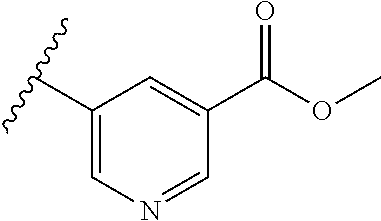 |
(600 MHz, DMSO-d6) 2.22 (s, 3 H) 2.73 (s, 3 H) 3.96 (s, 3 H) 8.74 (t, J = 2.1 Hz, 1 H) 9.26 (d, J = 2.3 Hz, 1 H) 9.41 (s, 1 H) 12.74 (brs, 1 H) |
| 38 | — |
 |
(200 MHz, CHLOROFORM-d) 1.38 (d, J = 6.2 Hz, 3 H) 2.32 (s, 3 H) 2.70 (s, 3 H) 2.78-3.07 (m, 2 H) 3.20 (brs, 1 H) 4.23- 4.41 (m, 1 H) 9.78 (brs, 1 H) |
| 39 | — |
 |
(600 MHz, DMSO-d6) 2.21 (s, 3 H) 2.71 (s, 3 H) 3.57 (s, 3 H) 6.56 (d, J = 9.6 Hz, 1 H) 7.93 (dd, J = 9.4, 2.5 Hz, 1 H) 8.53 (d, J = 2.8 Hz, 1H) 12.70 (brs, 1 H) |
| 40 | — |
 |
(600 MHz, DMSO-d6) 2.21 (s, 3 H) 2.69 (s, 3 H) 6.51 (d, J = 9.6 Hz, 1 H) 7.93 (dd, J = 9.6, 2.8 Hz, 1 H) 8.06 (d, J = 2.3 Hz, 1 H) 12.13 (brs, 1 H) 12.67 (brs, 1 H) |
| 41 | — |
 |
(200 MHz, CHLOROFORM-d) 1.40 (s, 3 H) 2.31 (s, 3 H) 2.71 (s, 3 H) 3.11 (s, 2 H) 4.46 (d, J = 6.2 Hz, 2 H) 4.75 (d, J = 6.2 Hz, 2 H) 8.95 (brs, 1 H) |
| 42 | — |
 |
(600 MHz, DMSO-d6) 0.80 (s, 3 H) 2.20 (s, 3 H) 2.65 (s, 3 H) 2.67 (s, 2 H) 3.26-3.37 (m, 4 H) 4.49 (t, J = 5.3 Hz, 2 H) 12.64 (brs, 1 H) |
| 43 | — |
 |
(600 MHz, DMSO-d6) 0.90 (s, 6 H) 2.18 (s, 3 H) 2.43 (s, 2 H) 2.62-2.65 (m, 5 H) |
| 44 | — |
 |
(200 MHz, CHLOROFORM-d) 1.08 (s, 6 H) 2.32 (s, 3 H) 2.71 (s, 3 H) 2.73 (s, 2 H) 2.96-3.02 (m, 5 H) 5.23 (t, J = 7.0 Hz, 1 H) 9.01 (brs, 1 H) |
| TABLE 5 | |||
| Example | Y | R3 | 1H NMR (d ppm) |
| 45 | — |
 |
(200 MHz, CHLOROFORM-d) 1.66 (m, 4 H) 1.98-2.22 (m, 1 H) 2.31 (s, 3 H) 2.70-2.74 (m, 5 H) 3.41 (m, 2 H) 3.92-4.03 (m, 2 H) 9.55 (brs, 1 H) |
| 46 | — |
 |
(600 MHz, CHLOROFORM-d) 0.84-0.94 (m, 6 H) 1.26-1.44 (m, 4 H) 2.31 (s, 3 H) 2.70 (s, 3 H) 2.75 (s, 2 H) 2.96 (brs, 1 H) 3.41 (brs, 2 H) 8.98 (brs, 1 H) |
| 47 | — |
 |
(200 MHz, DMSO-d6) 1.15 (s, 6 H) 1.77 (m, 2 H) 2.20 (s, 3 H) 2.64 (s, 3 H) 2.77 (m, 2 H) 4.37 (s, 1 H) 12.66 (brs, 1 H) |
| 48 | — |
 |
(200 MHz, CHLOROFORM-d) 0.61 (m, 4 H) 2.31 (s, 3 H) 2.71 (s, 3 H) 2.90 (s, 2 H) 3.57 (s, 2 H) 3.64 (s, 1 H) |
| 49 | — |
 |
(600 MHz, DMSO-d6) 2.19 (s, 3 H) 2.63 (s, 3 H) 4.01 (s, 2 H) 6.62-6.67 (m, 1 H) 6.71-6.77 (m, 2 H) 7.08-7.14 (m, 1 H) 9.39 (s, 1 H) 12.65 (brs, 1 H) |
| 50 | — |
 |
(200 MHz, CHLOROFORM-d) 2.31 (s, 3 H) 2.75 (s, 3 H) 3.52 (s, 3 H) 4.62 (s, 2 H) 9.71 (brs, 1 H) |
| 51 | — |
 |
(600 MHz, CHLOROFORM-d) 1.02 (s, 6 H) 2.30 (s, 3 H) 2.72 (s, 3 H) 2.76 (s, 2 H) 3.19 (s, 2 H) 3.38 (s, 3 H) 8.96 (brs, 1 H) |
| 52 | — |
 |
(600 MHz, CHLOROFORM-d) 2.30 (s, 3 H) 2.72 (s, 3 H) 3.11 (d, J = 6.0 Hz, 2 H) 3.40 (s, 6 H) 4.96 (t, J = 6.0 Hz, 1 H) 9.20 (brs, 1H) |
| 53 | — |
 |
(200 MHz, CHLOROFORM-d) 1.03 (d, J = 7.0 Hz, 3 H) 2.15- 2.30 (m, 1 H) 2.30 (s, 3 H) 2.68-2.97 (m, 2 H) 2.72 (s, 3 H) 3.50-3.71 (m, 2 H) 9.17 (brs, 1 H) |
| 54 | — |
 |
(600 MHz, CHLOROFORM-d) 1.96-2.03 (m, 4 H) 2.31 (s, 3 H) 2.72 (s, 3 H) 3.06-3.12 (m, 1 H) 3.53-3.59 (m, 2 H) 4.03- 4.09 (m, 2 H) 8.99 (brs, 1 H) |
| 55 |
 |
 |
(600 MHz, CHLOROFORM-d) 1.46 (t, J = 7.1 Hz, 3 H) 2.32 (s, 3 H) 2.77 (s, 3 H) 4.53 (q, J = 7.3 Hz, 2 H) 8.98 (brs, 1 H) |
| TABLE 6 | |||
| Example | Y | R3 | 1H NMR (d ppm) |
| 56 | — |
 |
(600 MHz, CHLOROFORM-d) 2.31 (s, 3 H) 2.72 (s, 3 H) 3.40 (s, 3 H) 3.61-3.63 (m, 2 H) 3.79-3.82 (m, 2 H) 4.74 (s, 2 H) |
| 57 | — |
 |
(600 MHz, CHLOROFORM-d) 2.31 (s, 3 H) 2.32-2.35 (m, 1 H) 2.70 (s, 3 H) 3.26 (s, 2 H) 3.92 (d, J = 5.0 Hz, 2 H) 4.52 (d, J = 6.4 Hz, 2 H) 4.66 (d, J = 6.4 Hz, 2 H) 8.95 (brs, 1 H) |
| 58 | — |
 |
(200 MHz, CHLOROFORM-d) 1.28 (t, J = 7.0 Hz, 4 H) 1.78 (s, 3 H) 2.31 (s, 3 H) 2.74 (s, 3 H) 3.47-3.77 (m, 6 H) 10.11 (brs, 1 H) |
| 59 | — |
 |
(200 MHz, CHLOROFORM-d) 1.72-1.79 (m, 4 H) 2.06 (s, 3 H) 2.31 (s, 3 H) 2.73 (s, 3 H) 2.84 (t, J = 7.0 Hz, 2 H) 4.12 (t, J = 7.0 Hz, 2 H) 9.88 (brs, 1 H) |
| 60 |
 |
 |
(200 MHz, DMSO-d6) 2.21 (s, 3 H) 2.64 (s, 3 H) 2.68 (s, 3 H) 12.82 (brs, 1H) |
| 61 | — |
 |
(200 MHz, DMSO-d6) 2.20 (s, 3 H) 2.64 (s, 3 H) 2.73 (t, J = 7.5 Hz, 2 H) 3.43 (m, 2 H) 4.43 (brs, 1 H) 12.67 (brs, 1 H) |
| 62 | — |
 |
(200 MHz, DMSO-d6) 0.90 (d, J = 7.0 Hz, 3 H) 1.94-2.12 (m, 1 H) 2.20 (s, 3 H) 2.65 (s, 3 H) 2.86 (dd, J = 14.5, 5.3 Hz, 1 H) 4.64 (brs, 1 H) 12.67 (brs, 1 H) |
| 63 | — |
 |
(600 MHz, CHLOROFORM-d) 2.31 (s, 3 H) 2.33-2.39 (m, 2 H) 2.72 (s, 3 H) 3.64 (dt, J = 14.7, 7.3 Hz, 1 H) 3.94-4.08 (m, 3 H) 4.16-4.21 (m, 1 H) 9.18 (brs, 1 H) |
| 64 | — |
 |
(600 MHz, DMSO-d6) 1.52 (s, 6 H) 2.20 (s, 3 H) 2.65 (s, 3 H) 5.59 (s, 1 H) 12.65 (brs, 1 H) |
| 65 | — |
 |
(600 MHz, DMSO-d6) 1.28 (s, 6 H) 2.20 (s, 3 H) 2.64 (s, 3 H) 3.54 (d, J = 5.5 Hz, 2 H) 4.82 (t, J = 5.5 Hz, 1 H) 12.63 (brs, 1 H) |
| 66 | — |
 |
(200 MHz, CHLOROFORM-d) 2.24 (s, 3 H) 2.31 (s, 3 H) 2.71 (s, 3 H) 2.93-3.11 (m, 4 H) 9.59 (brs, 1 H) |
| TABLE 7 | |||
| Example | Y | R3 | 1H NMR (d ppm) |
| 67 | — |
 |
(600 MHz, DMSO-d6) 2.20 (s, 3 H) 2.42-2.63 (m, 2 H) 2.65 (s, 3 H) 2.83-2.97 (m, 2 H) 4.27 (brs, 1 H) 5.32 (d, J = 6.4 Hz, 1 H) 12.66 (brs, 1 H) |
| 68 | — |
 |
(200 MHz, CHLOROFORM-d) 1.06 (s, 9 H) 2.31 (s, 3 H) 2.68 (s, 2 H) 2.73 (s, 3 H) 9.57 (brs, 1 H) |
| 69 | — |
 |
(200 MHz, CHLOROFORM-d) 1.05 (s, 9 H) 1.63 (s, 3 H) 2.32 (s, 3 H) 2.73 (s, 3 H) 2.82 (d, J = 8.1 Hz, 1 H) 4.56 (d, J = 8.1 Hz, 1 H) 9.47 (brs, 1 H) |
| 70 |
 |
H | (600 MHz, DMSO-d6) 2.21 (s, 3 H) 2.68 (s, 3 H) 8.13 (s, 1 H) 8.32 (s, 1 H) 12.72 (brs, 1 H) |
| 71 | — |
 |
(600 MHz, CHLOROFORM-d) 2.31 (s, 3 H) 2.71 (s, 3 H) 2.85 (t, J = 7.3 Hz, 2 H) 3.12 (t, J = 7.3 Hz, 2 H) 3.73 (s, 3 H) 8.93 (brs, 1 H) |
| 72 |
 |
 |
(600 MHz, DMSO-d6) 2.21 (s, 3 H) 2.67 (s, 3 H) 3.51- 3.62 (m, 4 H) 3.68 (s, 4 H) 12.74 (brs, 1 H) |
| 73 | — |
 |
(600 MHz, CHLOROFORM-d) 1.44 (s, 6 H) 2.03 (t, J = 6.7 Hz, 2 H) 2.30 (s, 3 H) 2.69 (s, 3 H) 3.75 (t, J = 6.7 Hz, 2 H) 9.20 (brs, 1 H) |
| 74 | — |
 |
(600 MHz, CHLOROFORM-d) 1.47 (s, 9 H) 1.56 (d, J = 6.9 Hz, 3 H) 2.31 (s, 3 H) 2.69 (s, 3 H) 5.03-5.21 (m, 2 H) 9.43 (brs, 1 H) |
| 75 | — |
 |
(600 MHz, CHLOROFORM-d) 2.31 (s, 3 H) 2.62-2.68 (m, 4 H) 2.72 (s, 3 H) 3.70-3.82 (m, 6 H) 9.18 (brs, 1 H) |
| 76 | — |
 |
(200 MHz, CHLOROFORM-d) 1.11 (s, 6 H) 2.31 (s, 3 H) 2.72 (s, 3 H) 2.81 (s, 2 H) 3.11 (s, 3 H) 4.09 (s, 2 H) 9.22 (brs, 1 H) |
| 77 | — |
 |
(200 MHz, DMSO-d6) 1.44 (d, J = 7.0 Hz, 3 H) 1.86 (s, 3 H) 2.20 (s, 3 H) 2.65 (s, 3 H) 4.98-5.16 (m, 1 H) 8.50 (d, J = 7.9 Hz, 1 H) 12.70 (brs, 1 H) |
| TABLE 8 | |||
| Example | Y | R3 | 1H NMR (d ppm) |
| 78 |
 |
 |
(600 MHz, DMSO-d6) 2.21 (s, 3 H) 2.69 (s, 3 H) 2.81 (d, J = 4.6 Hz, 3 H) 8.90 (d, J = 4.6 Hz, 1 H) 12.73 (brs, 1 H) |
| 79 | — |
 |
(600 MHz, DMSO-d6) 2.20 (s, 3 H) 2.31 (s, 3 H) 2.65 (s, 3 H) 3.77 (s, 2 H) |
| 80 | — |
 |
(600 MHz, CHLOROFORM-d) 0.28-0.32 (m, 2 H) 0.57-0.61 (m, 2 H) 1.16-1.22 (m, 1 H) 2.31 (s, 3 H) 2.68 (d, J = 6.9 Hz, 2 H) 2.73 (s, 3H) 9.20 (brs, 1 H) |
| 81 | — |
 |
(600 MHz, DMSO-d6) 1.51 (d, J = 6.9 Hz, 3 H) 2.20 (s, 3 H) 2.66 (s, 3 H) 2.96 (s, 3 H) 4.71-4.80 (m, 1 H) 7.94 (d, J = 7.8 Hz, 1H) 12.69 (brs, 1 H) |
| 82 | — |
 |
(200 MHz, CHLOROFORM-d) 0.98 (d, J = 7.0 Hz, 6 H) 1.61- 1.77 (m, 2 H) 2.30 (s, 3 H) 2.66-2.82 (m, 2 H) 2.73 (s, 3 H) 9.79 (brs, 1 H) |
| 83 | — |
 |
(600 MHz, DMSO-d6) 0.94-0.97 (m, 2 H) 1.07-1.11 (m, 2 H) 2.12-2.17 (m, 1 H) 2.19 (s, 3 H) 2.61 (s, 3 H) 12.59 (brs, 1 H) |
| 84 | — |
 |
(600 MHz, CHLOROFORM-d) 1.33 (s, 6 H) 2.30 (s, 3 H) 2.72 (s, 3 H) 2.98 (s, 2 H) 3.31 (s, 3 H) 9.17 (brs, 1 H) |
| 85 | — |
 |
(600 MHz, CHLOROFORM-d) 0.98 (s, 3 H) 1.03 (s, 3 H) 1.19 (d, J = 6.4 Hz, 3 H) 2.31 (s, 3 H) 2.67 (d, J = 13.7 Hz, 1 H) 2.71 (s, 3 H) 2.81 (brs, 1 H) 2.92 (d, J = 13.7 Hz, 1 H) 3.59 (m, 1 H) 9.39 (brs, 1 H) |
| 86 | — |
 |
(200 MHz, CHLOROFORM-d) 1.27 (s, 6 H) 2.29 (s, 3 H) 2.31 (s, 3 H) 2.69 (s, 3 H) 3.03 (s, 2 H) |
| 87 | — |
 |
(200 MHz, DMSO-d6) 2.19 (s, 3 H) 2.62 (s, 3 H) 3.30-3.42 (m, 4 H) 3.64-3.76 (m, 4 H) 12.62 (brs, 1 H) |
| 88 |
 |
 |
(200 MHz, CHLOROFORM-d) 1.42 (s, 9 H) 2.32 (s, 3 H) 2.77 (s, 3 H) 9.43 (brs, 1 H) |
| TABLE 9 | |||
| Example | Y | R3 | 1H NMR (d ppm) |
| 89 | — |
 |
(200 MHz, CHLOROFORM-d) 2.12 (m, 2 H) 2.22-2.26 (m, 2 H) 2.52-2.64 (m, 2 H) 2.59 (s, 3 H) 2.99 (t, J = 6.8 Hz, 2 H) 3.55 (t, J = 6.8 Hz, 2 H) 3.77 (t, J = 6.8 Hz, 2 H) 10.73 (brs, 1 H) |
| 90 |
 |
 |
(600 MHz, DMSO-d6) 2.21 (s, 3 H) 2.67 (s, 3 H) 3.79- 3.84 (m, 1 H) 4.17-4.22 (m, 1 H) 4.28-4.33 (m, 1 H) 4.51-4.57 (m, 1 H) 4.64-4.69 (m, 1 H) 5.84 (d, J = 6.4 Hz, 1 H) 12.73 (brs, 1 H) |
| 91 |
 |
 |
(600 MHz, DMSO-d6) 1.07 (d, J = 6.4 Hz, 3 H) 2.21 (s, 3 H) 2.69 (s, 3 H) 3.18-3.27 (m, 2 H) 3.72-3.87 (m, 1 H) 4.81 (d, J = 5.0 Hz, 1 H) 8.76 (t, J = 6.0 Hz, 1 H) 12.74 (brs, 1 H) |
| 92 | — |
 |
(600 MHz, DMSO-d6) 1.92-2.01 (m, 1 H) 2.02-2.15 (m, 2 H) 2.20 (s, 3 H) 2.24-2.33 (m, 1 H) 2.65 (s, 3 H) 3.82-3.89 (m, 1 H) 3.90-3.96 (m, 1 H) 5.07 (dd, J = 7.8, 5.5 Hz, 1 H) 12.68 (brs, 1 H) |
| 93 | — |
 |
(600 MHz, DMSO-d6) 1.31-1.41 (m, 1 H) 1.43-1.53 (m, 1 H) 1.71-1.79 (m, 1 H) 1.83-1.90 (m, 1 H) 2.19 (s, 3 H) 2.61 (s, 3 H) 2.83 (dd, J = 12.4, 8.7 Hz, 1 H) 2.94- 3.03 (m, 1 H) 3.51-3.65 (m, 2 H) 3.78 (dd, J = 12.4, 4.1 Hz, 1 H) 4.93 (d, J = 4.1 Hz, 1 H) 12.61 (brs, 1 H) |
| 94 | — |
 |
(600 MHz, CHLOROFORM-d) 1.41 (s, 9 H) 1.50 (s, 6 H) 2.31 (s, 3 H) 2.72 (s, 3 H) 3.24 (s, 2 H) 3.93 (brs, 1 H) 9.10 (brs, 1H) |
| 95 | — |
 |
(600 MHz, CHLOROFORM-d) 1.07 (d, J = 1.8 Hz, 6 H) 2.31 (s, 3 H) 2.72 (s, 3 H) 2.72-2.88 (m, 2 H) 3.48-3.50 (brs, 1 H) 4.20-4.31 (m, 2 H) 8.92 (brs, 1 H) |
| 96 |
 |
 |
(600 MHz, DMSO-d6) 2.21 (s, 3 H) 2.70 (s, 3 H) 4.66 (t, J = 6.4 Hz, 2 H) 4.75 (t, J = 7.1 Hz, 2 H) 4.96-5.08 (m, 1 H) 9.72 (d, J = 6.4 Hz, 1 H) 12.74 (brs, 1 H) |
| 97 | — |
 |
(600 MHz, CHLOROFORM-d) 0.97 (s, 3 H) 1.00-1.04 (m, 6 H) 1.33-1.41 (m, 1 H) 2.31 (s, 3 H) 2.64 (d, J = 13.8 Hz, 1 H) 2.71 (s, 3 H) 2.94 (d, J = 14.2 Hz, 1 H) 3.18 (dd, J = 10.1, 4.6 Hz, 1 H) 9.08 (brs, 1 H) |
| 98 | — |
 |
(200 MHz, CHLOROFORM-d) 2.21 (s, 3 H) 2.31 (s, 3 H) 2.74 (s, 3 H) 4.23-4.29 (m, 2 H) 6.50-6.57 (m, 1 H) |
| 99 | — |
 |
(600 MHz, DMSO-d6) 2.19 (s, 3 H) 2.62 (s, 3 H) 5.57 (s, 2 H) 6.26-6.36 (m, 1 H) 7.49 (d, J = 1.8 Hz, 1 H) 7.90 (d, J = 2.3 Hz, 1 H) 12.69 (brs, 1 H) |
| TABLE 10 | |||
| Example | Y | R3 | 1H NMR (d ppm) |
| 100 | — |
 |
(600 MHz, CHLOROFORM-d) 0.97 (s, 3 H) 1.00 (s, 3 H) 2.30 (s, 3 H) 2.70-2.75 (m, 4 H) 3.02 (d, J = 14.2 Hz, 1 H) 3.08- 3.13 (m, 1 H) 4.57 (d, J = 4.1 Hz, 1 H) 7.28 (d, J = 7.3 Hz, 1 H) 7.30-7.34 (m, 2 H) 7.35-7.38 (m, 2 H) 8.97 (brs, 1 H) |
| 101 | — |
 |
(600 MHz, CHLOROFORM-d) 1.03 (dd, J = 8.71, 4.6 Hz, 1 H) 1.15 (s, 3 H) 1.20-1.29 (m, 4 H) 1.93 (dd, J = 8.3, 5.5 Hz, 1 H) 2.30 (s, 3 H) 2.71 (s, 3 H) 9.29 (brs, 1 H) |
| 102 | — |
 |
(600 MHz, DMSO-d6) 1.83-1.90 (m, 1 H) 1.95-2.04 (m, 1 H) 2.19 (s, 3 H) 2.62 (s, 3 H) 3.24-3.30 (m, 1 H) 3.39-3.49 (m, 3 H) 4.33-4.41 (m, 1H) |
| 103 | — |
 |
(600 MHz, DMSO-d6) 1.83-1.90 (m, 1 H) 1.95-2.04 (m, 1 H) 2.19 (s, 3 H) 2.62 (s, 3 H) 3.24-3.30 (m, 1 H) 3.39-3.49 (m, 3 H) 4.33-4.41 (m, 1H) |
| 104 | — |
 |
(200 MHz, CHLOROFORM-d) 1.67-2.05 (m, 4 H) 2.08 (s, 3 H) 2.30 (s, 3 H) 2.69 (s, 3 H) 3.26-3.45 (m, 2 H) 3.71-3.89 (m, 2 H) 4.91-5.07 (m, 1 H) 9.56 (brs, 1 H) |
| 105 | — |
 |
(200 MHz, CHLOROFORM-d) 1.29 (t, J = 7.2 Hz, 3 H) 1.32 (s, 6H) 2.30 (s, 3 H) 2.70 (s, 3 H) 3.06 (s, 2 H) 4.20 (q, J = 7.2 Hz, 3 H) 9.90 (brs, 1 H) |
| 106 | — |
 |
(600 MHz, CHLOROFORM-d) 1.06 (s, 6 H) 1.31 (s, 6 H) 2.32 (s, 3 H) 2.72 (s, 3 H) 2.88 (s, 2 H) 9.72 (brs, 1 H) |
| 107 | — |
 |
(600 MHz, CHLOROFORM-d) 1.56 (s, 6 H) 2.37 (s, 3 H) 2.75 (s, 3 H) 3.31 (s, 2 H) 4.61 (s, 2 H) |
| 108 | — |
 |
(200 MHz, DMSO-d6) 1.22 (s, 6 H) 2.20 (s, 3 H) 2.64 (s, 3 H) 2.96 (s, 2 H) 12.66 (s, 1 H) |
| 109 | — |
 |
(200 MHz, CHLOROFORM-d) 2.12 (s, 3 H) 2.29 (s, 3 H) 2.68 (s, 3 H) 4.02-4.16 (m, 2 H) 4.38-4.51 (m, 2 H) 5.28-5.42 (m, 1 H) 9.63 (brs, 1 H) |
| 110 | — |
 |
(200 MHz, CHLOROFORM-d) 1.67-2.00 (m, 4 H) 2.03 (s, 3 H) 2.29 (s, 3 H) 2.68 (s, 3 H) 3.41-3.58 (m, 3 H) 3.65-3.78 (m, 1 H) 4.86-5.00 (m, 1 H) 9.54 (brs, 1 H) |
| TABLE 11 | |||
| Example | Y | R3 | 1H NMR (d ppm) |
| 111 | — |
 |
(200 MHz, DMSO-d6) 1.19 (s, 6 H) 2.19 (s, 3 H) 2.64 (s, 3 H) 2.92 (s, 2 H) 6.89 (brs, 1 H) 7.17 (brs, 1 H) |
| 112 | — |
 |
(600 MHz, CHLOROFORM-d) 1.74-1.80 (m, 2 H) 1.89- 1.98 (m, 1 H) 2.18-2.24 (m, 1 H) 2.31 (s, 3 H) 2.71 (s, 3 H) 3.11-3.18 (m, 1 H) 3.51-3.57 (m, 1 H) 3.71 (dd, J = 11.0, 9.6 Hz, 1 H) 3.93- 3.98 (m, 1 H) 4.14-4.19 (m, 1 H) 9.01 (brs, 1 H) |
| 113 | — |
 |
(600 MHz, DMSO-d6) 2.22 (s, 3 H) 2.71 (s, 3 H) 6.69 (d, J = 6.4 Hz, 1 H) 6.91-7.00 (m, 1 H) 7.58 (d, J = 6.4 Hz, 1 H) 11.95 (brs, 1 H) 12.72 (brs, 1 H) |

| TABLE 12 | ||||
| Example | R1 | X | R3 | 1H NMR (d ppm) |
| 114 | H |
 |
 |
(600 MHz, CHLOROFORM-d) 1.39 (s, 9 H) 2.62 (s, 3 H) 5.44 (brs, 2 H) |
| 115 |
 |
 |
 |
(600 MHz, DMSO-d6) 1.16 (d, J = 6.9 Hz, 6 H) 2.74 (s, 3 H) 2.79 (quin, J = 6.9 Hz, 1 H) 7.43-7.82 (m, 1 H) 8.27-8.53 (m, 1 H) 8.66-8.92 (m, 1 H) 9.07-9.31 (m, 1 H) 12.72 (brs, 1 H) |
| 116 |
 |
 |
 |
(600 MHz, DMSO-d6) 2.74 (s, 3 H) 3.38 (s, 3 H) 4.22 (s, 2 H) 7.50-7.79 (m, 1 H) 8.27-8.52 (m, 1 H) 8.71-8.90 (m, 1 H) 9.09-9.31 (m, 1 H) 12.74 (brs, 1 H) |
| 117 |
 |
 |
 |
(600 MHz, CHLOROFORM-d) 1.47 (s, 9 H) 2.55-2.59 (m, 2 H) 2.79 (s, 3 H) 3.63 (q, J = 5.8 Hz, 2 H) 7.34-7.58 (m, 1 H) 8.25-8.51 (m, 1 H) 8.61-8.88 (m, 1 H) 9.20-9.47 (m, 1 H) 9.70 (brs, 1 H) |
| 118 |
 |
 |
 |
(600 MHz, DMSO-d6) 1.29 (t, J = 7.1 Hz, 3 H) 1.88 (quin, J = 7.3 Hz, 2 H) 2.37 (t, J = 7.3 Hz, 2 H) 2.55 (t, J = 7.3 Hz, 2 H) 2.73 (s, 3 H) 4.06 (q, J = 7.3 Hz, 2 H) 7.45-7.78 (m, 1 H) 8.25-8.51 (m, 1 H) 8.68-8.91 (m, 1 H) 9.08-9.33 (m, 1 H) 12.74 (brs, 1 H) |
| 119 |
 |
 |
 |
(600 MHz, CHLOROFORM-d) 1.29 (t, J = 7.1 Hz, 3 H) 2.67 (t, J = 5.7 Hz, 2 H) 2.79 (s, 3 H) 3.54-3.76 (m, 2 H) 4.20 (q, J = 7.3 Hz, 2 H) 7.36-7.54 (m, 1 H) 8.31-8.46 (m, 1 H) 8.62- 8.86 (m, 1 H) 9.26-9.41 (m, 1 H) 9.52 (brs, 1 H) |
| 120 |
 |
 |
 |
(600 MHz, DMSO-d6) 2.68 (s, 3 H) 3.24 (q, J = 5.7 Hz, 2 H) 3.49 (brs, 2 H) 4.83 (brs, 1 H) 6.80 (brs, 1 H) 7.51-7.71 (m, 1 H) 8.27-8.49 (m, 1 H) 8.68-8.87 (m, 1 H) 9.20-9.21 (m, 1 H) 11.08 (brs, 1 H) |
| 121 |
 |
 |
 |
(600 MHz, DMSO-d6) 2.30-2.47 (m, 6 H) 2.68 (s, 3 H) 3.26- 3.35 (m, 2 H) 3.59 (brs, 4 H) 6.72 (brs, 1 H) 7.44-7.72 (m, 1 H) 8.38-8.41 (m, 1 H) 8.66-8.91 (m, 1 H) 9.07-9.29 (m, 1 H) 11.24 (brs, 1 H) |
| 122 |
 |
 |
 |
(600 MHz, DMSO-d6) 2.68 (s, 3 H) 3.29 (s, 3 H) 3.32-3.37 (m, 2 H) 3.43 (t, J = 5.5 Hz, 2 H) 6.82 (brs, 1 H) 7.53-7.73 (m, 1 H) 8.29-8.51 (m, 1 H) 8.68-8.90 (m, 1 H) 9.04-9.32 (m, 1 H) 11.07 (brs, 1 H) |
| 123 |
 |
 |
 |
(600 MHz, CHLOROFORM-d) 1.40 (s, 9 H) 1.46 (s, 9 H) 2.55 (t, J = 5.7 Hz, 2 H) 2.71 (s, 3 H) 3.61 (q, J = 6.0 Hz, 2 H) 9.59 (brs, 1 H) |
| 124 | H |
 |
 |
(600 MHz, DMSO-d6) 2.68 (s, 3 H) 6.69 (brs, 2 H) 7.51- 7.74 (m, 1 H) 8.23-8.52 (m, 1 H) 8.65-8.92 (m, 1 H) 9.08- 9.32 (m, 1 H) 11.14 (brs, 1 H) |
| TABLE 13 | ||||
| Example | R1 | X | R3 | 1H NMR (d ppm) |
| 125 |
 |
 |
 |
(600 MHz, CHLOROFORM-d) 1.46 (s, 9 H) 1.80- 2.10 (m, 2 H) 2.38 (t, J = 7. 1 Hz, 2 H) 2.80 (s, 3 H) 3.19- 3.65 (m, 2 H) 7.34-7.59 (m, 1 H) 8.22-8.54 (m, 1 H) 8.64-8.90 (m, 1 H) 9.21-9.48 (m, 1 H) 9.95 (brs, 1 H) |
| 126 |
 |
 |
 |
(600 MHz, CHLOROFORM-d) 1.52 (s, 9 H) 2.79 (s, 3 H) 4.07-4.12 (m, 2 H) 7.39- 7.45 (m, 1 H) 8.33-8.40 (m, 1 H) 8.72-8.77 (m, 1 H) 9.31-9.36 (m, 1 H) |
| 127 |
 |
 |
 |
(600 MHz, DMSO-d6) 1.56 (quin, J = 6.8 Hz, 2 H) 2.10 (brs, 6 H) 2.21 (brs, 2 H) 2.63 (s, 3 H) 3.11-3.19 (m, 2 H) 6.85 (brs, 1 H) 7.53-7.62 (m, 1 H) 8.30-8.40 (m, 1 H) 8.72-8.79 (m, 1 H) 9.13-9.19 (m, 1 H) 11.20 (brs, 1 H) |
| 128 |
 |
 |
 |
(600 MHz, DMSO-d6) 1.86 (quin, J = 6.9 Hz, 2 H) 2.55 (t, J = 7.6 Hz, 2 H) 2.73 (s, 3 H) 3.23 (s, 3 H) 3.36 (t, J = 6.2 Hz, 2 H) 7.60-7.67 (m, 1 H) 8.36-8.45 (m, 1 H) 8.76-8.84 (m, 1 H) 9.17- 9.24 (m, 1 H) 12.73 (brs, 1 H) |
| 129 |
 |
 |
 |
(600 MHz, CHLOROFORM-d) 1.46 (s, 9 H) 2.68 (t, J = 6.4 Hz, 2 H) 2.81 (s, 3 H) 4.57 (t, J = 6.2 Hz, 2 H) 7.40-7.49 (m, 1 H) 8.36-8.47 (m, 1 H) 8.72-8.80 (m, 1 H) 9.34-9.42 (m, 1 H) 9.82 (brs, 1 H) |
| 130 |
 |
 |
 |
(600 MHz, CHLOROFORM-d) 1.22 (s, 9 H) 1.84 (quin, J = 6.0 Hz, 2 H) 2.79 (s, 3 H) 3.48 (q, J = 5.7 Hz, 2 H) 3.53 (t, J = 5.5 Hz, 2 H) 7.40-7.49 (m, 1 H) 8.34- 8.45 (m, 1 H) 8.72-8.80 (m, 1 H) 9.33-9.39 (m, 1 H) 9.56 (brs, 1 H) |
| 131 |
 |
 |
 |
(600 MHz, DMSO-d6) 2.55 (t, J = 6.2 Hz, 2 H) 2.67 (s, 3 H) 2.85 (s, 3 H) 2.95 (s, 3 H) 3.36-3.41 (m, 2 H) 6.86-6.96 (m, 1 H) 7.58- 7.67 (m, 1 H) 8.33-8.45 (m, 1 H) 8.73-8.86 (m, 1 H) 9.15-9.23 (m, 1 H) 11.10 (brs, 1 H) |
| 132 |
 |
 |
 |
(600 MHz, DMSO-d6) 1.26 (s, 9 H) 2.28 (t, J = 6.4 Hz, 2 H) 2.68 (s, 3 H) 3.30-3.36 (m, 2 H) 6.83 (brs, 1 H) 7.52 (brs, 1 H) 7.60-7.66 (m, 1 H) 8.37-8.43 (m, 1 H) 8.76-8.83 (m, 1 H) 9.18-9.22 (m, 1 H) 11.19 (brs, 1 H) |
| 133 |
 |
 |
 |
(600 MHz, DMSO-d6) 1.28 (s, 9 H) 2.69 (s, 3 H) 3.22 (t, J = 6.7 Hz, 2 H) 3.56 (q, J = 6.4 Hz, 2 H) 6.90 (brs, 1 H) 6.98 (s, 1 H) 7.59- 7.67 (m, 1 H) 8.37-8.44 (m, 1 H) 8.77-8.83 (m, 1 H) 9.18- 9.23 (m, 1 H) 11.52 (brs, 1 H) |
| 134 |
 |
 |
 |
(600 MHz, DMSO-d6) 1.38 (s, 9 H) 2.68 (s, 3 H) 2.98- 3.09 (m, 2 H) 3.15-3.26 (m, 2 H) 6.77 (brs, 1 H) 6.86-6.95 (m, 1 H) 7.58-7.68 (m, 1 H) 8.36-8.44 (m, 1 H) 8.76-8.83 (m, 1 H) 9.17-9.24 (m, 1 H) |
| 135 |
 |
 |
 |
(600 MHz, CHLOROFORM-d) 1.23 (s, 9 H) 2.80 (s, 3 H) 3.68 (q, J = 5.5 Hz, 2 H) 4.29 (t, J = 5.5 Hz, 2 H) 7.39-7.50 (m, 1 H) 8.36- 8.45 (m, 1 H) 8.71-8.87 (m, 1 H) 9.30-9.44 (m, 1 H) 9.81 (brs, 1 H) |
| TABLE 14 | ||||
| Example | R1 | X | R3 | 1H NMR (d ppm) |
| 136 |
 |
 |
 |
(600 MHz, DMSO-d6) 2.41- 2.54 (m, 2 H) 2.68 (s, 3 H) 3.29-3.46 (m, 2 H) 4.28 (brs, 1 H) 6.86-6.99 (m, 1 H) 7.63-7.74 (m, 1 H) 8.41-8.51 (m, 1 H) 8.78- 8.87 (m, 1 H) 9.18-9.27 (m, 1 H) 11.18 (brs, 1 H) |
| 137 |
 |
 |
 |
(660 MHz, DMSO-d6) 1.27- 1.40 (m, 2 H) 1.67-1.82 (m, 2 H) 2.70 (s, 3 H) 3.13- 3.24 (m, 2 H) 3.63-3.76 (m, 1 H) 3.82-3.96 (m, 2 H) 4.74 (d, J = 4.1 Hz, 1 H) 7.57-7.67 (m, 1 H) 8.35- 8.46 (m, 1 H) 8.75-8.85 (m, 1 H) 9.15-9.25 (m, 1 H) 11.68 (brs, 1H) |
| 138 |
 |
 |
 |
(600 MHz, DMSO-d6) 2.58- 2.79 (m, 5 H) 3.14-3.24 (m, 2 H) 6.89 (brs, 1 H) 7.58-7.66 (m, 1 H) 8.35- 8.42 (m, 1 H) 8.74-8.82 (m, 1 H) 9.16-9.22 (m, 1 H) |
| 139 |
 |
 |
 |
(600 MHz, DMSO-d6) 1.08 (s, 9 H) 2.68 (s, 3 H) 3.13- 3.21 (m, 2 H) 3.22-3.28 (m, 2 H) 6.70 (brs, 1 H) 7.56 (t, J = 5.3 Hz, 1 H) 7.60- 7.66 (m, 1 H) 8.34-8.45 (m, 1 H) 8.73-8.84 (m, 1 H) 9.15-9.24 (m, 1 H) 11.30 (brs, 1H) |
| 140 |
 |
 |
 |
(600 MHz, DMSO-d6) 1.15 (d, J = 6.0 Hz, 6 H) 2.62- 2.78 (m, 2 H) 2.74 (s, 3 H) 3.19-3.40 (m, 2 H) 4.73 (dt, J = 12.5, 6.4 Hz, 1 H) 7.06-7.17 (m, 1 H) 7.57- 7.70 (m, 1 H) 8.34-8.46 (m, 1 H) 8.74-8.87 (m, 1 H) 9.13-9.26 (m, 1 H) 12.75 (brs, 1 H) |
| 141 |
 |
 |
 |
(600 MHz, DMSO-d6) 1.42 (s, 9 H) 2.45 (t, J = 6.4 Hz, 2 H) 2.69 (s, 3 H) 3.37 (q, J = 6.1 Hz, 2 H) 6.78-6.83 (m, 1 H) 9.39 (s, 2 H) 9.42 (s, 1 H) 11.27 (brs, 1 H) |
| 142 |
 |
 |
 |
(600 MHz, DMSO-d6) 1.63 (quin, J = 7.0 Hz, 2 H) 2.26- 2.42 (m, 6 H) 2.68 (s, 3 H) 3.15-3.25 (m, 2 H) 3.59 (brs, 4 H) 6.77 (brs, 1 H) 7.57-7.69 (m, 1 H) 8.34- 8.43 (m, 1 H) 8.75-8.86 (m, 1 H) 9.14-9.26 (m, 1 H) 11.22 (brs, 1 H) |
| 143 |
 |
 |
 |
(600 MHz, DMSO-d6) 1.13- 1.23 (m, 6 H) 2.52-2.61 (m, 2 H) 2.68 (s, 3 H) 3.98- 4.19 (m, 3 H) 6.69-6.84 (m, 1 H) 7.56-7.69 (m, 1 H) 8.35-8.46 (m, 1 H) 8.74- 8.86 (m, 1 H) 9.16-9.25 (m, 1 H) 11.08 (brs, 1 H) |
| 144 |
 |
 |
 |
(600 MHz, DMSO-d6) 1.12 (t, J = 7.1 Hz, 3 H) 1.52- 2.02 (m, 6 H) 2.68 (s, 3 H) 3.01 (q, J = 7.5 Hz, 1 H) 3.93-4.12 (m, 2 H) 4.32- 4.43 (m, 1 H) 6.67 (brs, 1 H) 7.55-7.69 (m, 1 H) 8.34- 8.45 (m, 1 H) 8.75-8.84 (m, 1 H) 9.16-9.24 (m, 1 H) 10.85 (brs, 1H) |
| 145 |
 |
 |
 |
(600 MHz, DMSO-d6) 2.57 (t, J = 6.2 Hz, 2 H) 2.67 (s, 3 H) 3.35-3.60 (m, 10 H) 6.81-6.97 (m, 1 H) 7.57- 7.69 (m, 1 H) 8.34-8.45 (m, 1 H) 8.72-8.83 (m, 1 H) 9.14-9.25 (m, 1 H) 11.17 (brs, 1 H) |
| 146 | H |
 |
 |
(600 MHz, DMSO-d6) 2.50 (s, 3 H) 4.02 (q, J = 10.7 Hz, 2 H) 8.06 (s, 2 H) |
| TABLE 15 | ||||
| Example | R1 | X | R3 | 1H NMR (d ppm) |
| 147 |
 |
 |
 |
(600 MHz, CHLOROFORM-d) 1.46 (s, 9 H) 2.53-2.57 (m, 2 H) 2.73 (s, 3 H) 3.56-3.68 (m, 4 H) 9.54 (brs, 1 H) |
| 148 |
 |
 |
 |
(600 MHz, DMSO-d6) 1.12 (brs, 9 H) 1.64 (brs, 2 H) 2.64 (brs, 3 H) 3.10-3.28 (m, 4 H) 6.19 (brs, 1 H) 7.00 (brs, 1 H) 7.56-7.67 (m, 1 H) 8.33-8.42 (m, 1 H) 8.73-8.83 (m, 1 H) 9.14-9.23 (m, 1 H) |
| 149 |
 |
 |
 |
(600 MHz, DMSO-d6) 1.19 (s, 6 H) 2.31 (t, J = 6.4 Hz, 2 H) 2.68 (s, 3 H) 3.32-3.36 (m, 2 H) 3.39 (brs, 2 H) 4.81 (brs, 1 H) 6.82 (brs, 1 H) 7.39 (s, 1 H) 7.56-7.69 (m, 1 H) 8.34-8.45 (m, 1 H) 8.73-8.85 (m, 1 H) 9.16-9.25 (m, 1 H) 11.19 (brs, 1 H) |
| 150 |
 |
 |
 |
(600 MHz, DMSO-d6) 1.19-1.38 (m, 2 H) 1.63-1.78 (m, 2 H) 2.52-2.60 (m, 2 H) 2.67 (s, 3 H) 2.96-3.08 (m, 1 H) 3.09- 3.19 (m, 1 H) 3.38 (q, J = 6.0 Hz, 2 H) 3.59-3.74 (m, 2 H) 3.87-3.98 (m, 1 H) 4.73 (d, J = 4.1 Hz, 1 H) 6.83 (brs, 1 H) 7.56-7.68 (m, 1 H) 8.36-8.44 (m, 1 H) 8.75-8.84 (m, 1 H) 9.14-9.25 (m, 1 H) 11.14 (brs, 1 H) |
| 151 |
 |
 |
 |
(600 MHz, DMSO-d6) 2.67 (t, J = 6.9 Hz, 2H) 2.74 (s, 3 H) 3.30-3.35 (m, 2 H) 3.44-3.60 (m, 2 H) 3.95 (t, J = 5.3 Hz, 2 H) 4.70 (t, J = 5.3 Hz, 1 H) 7.18- 7.31 (m, 1 H) 7.56-7.69 (m, 1 H) 8.33-8.48 (m, 1 H) 8.73- 8.86 (m, 1 H) 9.16-9.27 (m, 1 H) 12.77 (brs, 1 H) |
| 152 |
 |
 |
 |
(600 MHz, DMSO-d6) 1.14 (s, 3 H) 2.35 (t, J = 6.4 Hz, 2 H) 2.68 (s, 3 H) 3.33-3.38 (m, 2H) 3.40-3.53 (m, 4 H) 4.73 (brs, 2 H) 6.81 (brs, 1 H) 7.29 (brs, 1 H) 7.59-7.67 (m, 1 H) 8.36-8.43 (m, 1 H) 8.76- 8.83 (m, 1 H) 9.17-9.23 (m, 1 H) |
| 153 |
 |
 |
 |
(200 MHz, CHLOROFORM-d) 1.46 (s, 3 H) 1.25-2.08 (m, 10 H) 2.71 (s, 3 H) 2.69-2.92 (m, 1 H) 3.52-3.70 (m, 2 H) 7.27 (brs, 1H) 10.39 (brs, 1 H) |
| 154 |
 |
 |
 |
(200 MHz, CHLOROFORM-d) 1.46 (s, 9 H) 2.55 (t, J = 6.0 Hz, 2 H) 2.71 (s, 3 H) 3.04 (t, J = 6.6 Hz, 2 H) 3.39 (s, 3 H) 3.62 (q, J = 6.0 Hz, 2 H) 3.82 (t, J = 6.6 Hz, 2 H) 7.43 (brs, 1 H) 10.05 (brs, 1 H) |
| 155 |
 |
 |
 |
(600 MHz, DMSO-d6) 2.22 (s, 3 H) 2.73 (s, 3 H) 4.59 (s, 2 H) 5.36 (t, J = 5.7 Hz, 1 H) 7.53 (d, J = 8.3 Hz, 2 H) 7.98-8.05 (m, 2 H) 12.71 (brs, 1 H) |
| 156 | H |
 |
 |
(600 MHz, DMSO-d6) 0.88 (s, 6 H) 2.49 (s, 3 H) 2.58 (s, 2 H) 3.21 (d, J = 5.5 Hz, 2 H) 4.66 (t, J = 5.5 Hz, 1 H) |
| 157 |
 |
 |
 |
(600 MHz, CHLOROFORM-d) 1.01 (s, 6 H) 1.46 (s, 9 H) 2.55 (t, J = 6.0 Hz, 2 H) 2.70 (s, 3 H) 2.75 (s, 2 H) 2.83 (t, J = 6.0 Hz, 1 H) 3.34-3.40 (m, 3 H) 3.58-3.63 (m, 2 H) 9.37 (brs, 1 H) |
| TABLE 16 | ||||
| Ex- | ||||
| ample | R1 | X | R3 | 1H NMR (d ppm) |
| 158 |
 |
 |
 |
(600 MHz, CHLOROFORM-d) 1.02 (s, 6 H) 1.38 (t, J = 7.2 Hz, 3 H) 2.73 (s, 3 H) 2.76 (s, 2 H) 3.38 (d, J = 6.9 Hz, 2 H) 4.37 (q, J = 7.2 Hz, 2 H) 9.79 (brs, 1 H) |
| 159 |
 |
 |
 |
(600 MHz, CHLOROFORM-d) 1.01 (s, 6 H) 1.81 (s, 2 H) 2.04-2.12 (m, 2 H) 2.48-2.53 (m, 2 H) 2.64 (s, 3 H) 2.73 (s, 2 H) 3.30-3.35 (m, 2 H) 3.35- 3.38 (m, 2 H) 3.42-3.47 (m, 4 H) 6.98 (brs, 1 H) |
| 160 |
 |
 |
 |
(600 MHz, CHLOROFORM-d) 1.01 (s, 6 H) 1.21 (s, 9 H) 1.78-1.84 (m, 2 H) 2.69 (s, 3 H) 2.75 (s, 2 H) 3.37 (s, 2 H) 3.43-3.48 (m, 2 H) 3.51 (t, J = 5.7 Hz, 2 H) |
| 161 |
 |
 |
 |
(600 MHz, CHLOROFORM-d) 1.02 (s, 6 H) 1.35 (s, 9 H) 2.50 (t, J = 5.7 Hz, 2 H) 2.64 (s, 3 H) 2.74 (s, 2 H) 3.10 (brs, 1 H) 3.39 (s, 2 H) 3.60 (q, J = 6.0 Hz, 2 H) 5.73 (s, 1 H) |
| 162 |
 |
 |
 |
(600 MHz, CHLOROFORM-d) 1.01 (s, 6 H) 1.46 (d, J = 6.9 Hz, 6 H) 2.64 (s, 3 H) 2.73 (s, 2 H) 2.81 (t, J = 6.2 Hz, 2 H) 3.37 (s, 2 H) 3.55-3.67 (m, 2 H) 4.23-4.33 (m, 1 H) 6.79 (s, 1 H) 7.46 (s, 1 H) |
| 163 |
 |
 |
 |
(600 MHz, CHLOROFORM-d) 1.02 (s, 6 H) 1.45 (s, 9 H) 2.71 (s, 3 H) 2.76 (brs, 4 H) 3.38 (brs, 2 H) 3.50-3.59 (m, 2 H) 5.10 (brs, 1 H) 9.61 (brs, 1 H) |
| 164 |
 |
 |
 |
(600 MHz, DMSO-d6) 1.14 (s, 3 H) 2.34 (t, J = 6.4 Hz, 2 H) 2.60 (s, 3 H) 3.29-3.37 (m, 2 H) 3.40-3.52 (m, 4 H) 4.08 (q, J = 10.7 Hz, 2 H) 4.73 (brs, 2 H) 6.80 (brs, 1 H) 7.27 (s, 1 H) 11.17 (brs, 1 H) |
| 165 |
 |
 |
 |
(200 MHz, DMSO-d6) 2.39-2.52 (m, 2 H) 2.62 (s, 3 H) 3.21 (s, 3 H) 3.38 (m., 2 H) 4.87 (s, 2 H) 6.79 (brs, 1 H) 11.22 (brs, 1H) |
| 166 |
 |
 |
 |
(600 MHz, DMSO-d6) 1.19- 1.36 (m, 2 H) 1.64-1.76 (m, 2 H) 2.52-2.57 (m, 2 H) 2.60 (s, 3 H) 2.99-3.07 (m, 1 H) 3.09- 3.17 (m, 1 H) 3.34-3.41 (m, 2 H) 3.60-3.72 (m, 2 H) 3.88- 3.96 (m, 1 H) 4.08 (q, J = 10.9 Hz, 2 H) 4.73 (d, J = 4.1 Hz, 1 H) 6.79-6.98 (m, 1 H) 11.10 (brs, 1 H) |
| 167 |
 |
 |
 |
(600 MHz, DMSO-d6) 2.33 (t, J = 6.4 Hz, 2 H) 2.60 (s, 3 H) 3.20-3.26 (m, 5 H) 3.30-3.38 (m, 4 H) 4.08 (q, J = 10.9 Hz, 2 H) 6.87 (brs, 1 H) 8.01 (t, J = 5.7 Hz, 1 H) 11.11 (brs, 1 H) |
| 168 |
 |
 |
 |
(600 MHz, DMSO-d6) 1.40 (s, 9 H) 2.57 (t, J = 6.0 Hz, 2 H) 2.60 (s, 3 H) 3.26-3.49 (m, 10 H) 4.08 (q, J = 10.6 Hz, 2 H) 6.88 (brs, 1 H) 11.14 (brs, 1 H) |
| TABLE 17 | ||||
| Example | R1 | X | R3 | 1H NMR (d ppm) |
| 169 |
 |
 |
 |
(600 MHz, DMSO-d6) 2.51- 2.55 (m, 2 H) 2.60 (s, 3 H) 2.62-2.70 (m, 4 H) 3.24- 3.43 (m, 6 H) 4.08 (q, J = 10.9 Hz, 2 H) 6.89 (t, J = 5.1 Hz, 1 H) |
| 170 |
 |
 |
 |
(200 MHz, CHLOROFORM-d) 1.33 (s, 6 H) 1.45 (s, 9 H) 2.48-2.60 (m, 2 H) 2.69 (s, 3 H) 2.96 (s, 2 H) 3.53- 3.66 (m, 2 H) 7.13 (brs, 2 H) 7.73 (brs, 1 H) |
| 171 |
 |
 |
 |
(600 MHz, DMSO-d6) 2.67 (s, 3 H) 2.97 (t, J = 7.1 Hz, 2 H) 3.52-3.62 (m, 2 H) 6.86 (brs, 1 H) 7.22-7.27 (m, 1 H) 7.28-7.33 (m, 1 H) 7.60-7.66 (m, 1 H) 7.70- 7.77 (m, 1 H) 8.43 (s, 1 H) 8.50-8.55 (m, 1 H) 8.75- 8.85 (m, 1 H) 9.20 (d, J = 16.5 Hz, 1H) 11.19 (brs, 1H) |
| 172 |
 |
 |
 |
(600 MHz, CHLOROFORM-d) 1.46 (t, J = 7.3 Hz, 3 H) 2.75 (s, 2 H) 2.80-2.85 (m, 1 H) 3.62 (brs, 1 H) 3.97 (q, J = 7.3 Hz, 1 H) 6.77 (s, 1 H) 7.42-7.44 (m, 1 H) 7.48 (s, 1 H) 8.38-8.40 (m, 1 H) 8.74-8.75 (m, 1 H) 9.35 (m, 1 H) |
| 173 |
 |
 |
 |
(200 MHz, DMSO-d6) 2.74 (s, 3 H) 3.32 (s, 3 H) 4.23 (s, 2 H) 4.61 (d, J = 5.5 Hz, 2 H) 5.38 (t, J = 5.5 Hz, 1 H) 7.54 (m, 2 H) 7.86-7.98 (m, 1 H) 8.00-8.07 (m, 1 H) 12.71 (brs, 1 H) |
| 174 |
 |
 |
 |
(600 MHz, DMSO-d6) 1.06 (d, J = 6.0 Hz, 3 H) 2.66 (s, 3 H) 2.98-3.04 (m, 1 H) 3.19-3.25 (m, 1 H) 3.68- 3.76 (m, 1 H) 4.82-4.88 (m, 1 H) 6.73-6.80 (m, 1 H) 6.95-7.00 (m, 1 H) 7.37 (t, J = 7.8 Hz, 1 H) 7.44-7.49 (m, 2 H) 9.84 (s, 1 H) 10.99 (brs, 1H) |
| 175 |
 |
 |
 |
(600 MHz, DMSO-d6) 1.07 (d, J = 6.4 Hz, 3 H) 2.68 (s, 3 H) 2.98-3.05 (m, 1 H) 3.19- 3.26 (m, 1 H) 3.70-3.74 (m., 1 H) 4.86 (brd, J = 4.1 Hz, 1 H) 6.75-6.79 (m, 1 H) 7.62-7.64 (m, 1 H) 8.38-8.41 (m, 1 H) 8.79-8.81 (m, 1 H) 9.20-9.21 (m, 1 H) 10.94 (brs, 1 H) |
| 176 |
 |
 |
 |
(600 MHz, DMSO-d6) 1.06 (d, J = 6.0 Hz, 3 H) 2.68 (s, 3 H) 2.99-3.04 (m, 1 H) 3.19-3.24 (m, 1 H) 3.72 (brs, 1 H) 4.84-4.87 (m, 1 H) 6.77 (brs, 1 H) 9.38 (s, 2 H) 9.42 (s, 1 H) |
Suppression rate (%)=[1−(a−c)/(b−c)]×100
| TABLE 18 | |||
| Example | PI3Kγ | ||
| 1 | A | ||
| 2 | A | ||
| 3 | A | ||
| 4 | A | ||
| 5 | C | ||
| 6 | A | ||
| 7 | A | ||
| 8 | C | ||
| 9 | A | ||
| 10 | B | ||
| 11 | C | ||
| 12 | B | ||
| 13 | B | ||
| 14 | A | ||
| 15 | A | ||
| 16 | A | ||
| 17 | A | ||
| 18 | A | ||
| 19 | A | ||
| 20 | A | ||
| 21 | A | ||
| 22 | B | ||
| 23 | A | ||
| 24 | A | ||
| 25 | A | ||
| 26 | A | ||
| 27 | A | ||
| 28 | A | ||
| 29 | A | ||
| 30 | C | ||
| 31 | A | ||
| 32 | A | ||
| 33 | B | ||
| 34 | A | ||
| 35 | B | ||
| 36 | C | ||
| 37 | A | ||
| 38 | B | ||
| 39 | B | ||
| 40 | B | ||
| 41 | A | ||
| 42 | A | ||
| 43 | C | ||
| 44 | A | ||
| 45 | B | ||
| 46 | A | ||
| 47 | B | ||
| 48 | A | ||
| 49 | B | ||
| 50 | B | ||
| 51 | A | ||
| 52 | C | ||
| 53 | A | ||
| 54 | A | ||
| 55 | B | ||
| 56 | C | ||
| 57 | B | ||
| 58 | C | ||
| 59 | C | ||
| 60 | A | ||
| 61 | B | ||
| 62 | A | ||
| 63 | A | ||
| 64 | A | ||
| 65 | A | ||
| 66 | B | ||
| 67 | B | ||
| 68 | A | ||
| 69 | A | ||
| 70 | B | ||
| 71 | B | ||
| 72 | C | ||
| 73 | A | ||
| 74 | C | ||
| 75 | C | ||
| 76 | B | ||
| 77 | C | ||
| 78 | B | ||
| 79 | C | ||
| 80 | A | ||
| 81 | C | ||
| 82 | A | ||
| 83 | A | ||
| 84 | B | ||
| 85 | A | ||
| 86 | A | ||
| 87 | B | ||
| 88 | B | ||
| 89 | C | ||
| 90 | B | ||
| 91 | B | ||
| 92 | B | ||
| 93 | A | ||
| 94 | B | ||
| 95 | A | ||
| 96 | B | ||
| 97 | A | ||
| 98 | A | ||
| 99 | C | ||
| 100 | B | ||
| TABLE 19 | |||
| Example | PI3Kγ | ||
| 101 | A | ||
| 102 | B | ||
| 103 | B | ||
| 104 | B | ||
| 105 | B | ||
| 106 | A | ||
| 107 | B | ||
| 108 | A | ||
| 109 | B | ||
| 110 | A | ||
| 111 | A | ||
| 112 | A | ||
| 113 | B | ||
| 114 | A | ||
| 115 | B | ||
| 116 | A | ||
| 117 | A | ||
| 118 | A | ||
| 119 | A | ||
| 120 | A | ||
| 121 | A | ||
| 122 | A | ||
| 123 | A | ||
| 124 | A | ||
| 125 | A | ||
| 126 | A | ||
| 127 | A | ||
| 128 | A | ||
| 129 | A | ||
| 130 | A | ||
| 131 | A | ||
| 132 | A | ||
| 133 | A | ||
| 134 | A | ||
| 135 | A | ||
| 136 | A | ||
| 137 | C | ||
| 138 | A | ||
| 139 | A | ||
| 140 | A | ||
| 141 | A | ||
| 142 | A | ||
| 143 | A | ||
| 144 | A | ||
| 145 | A | ||
| 146 | A | ||
| 147 | A | ||
| 148 | A | ||
| 149 | A | ||
| 150 | A | ||
| 151 | A | ||
| 152 | A | ||
| 153 | A | ||
| 154 | A | ||
| 155 | A | ||
| 156 | A | ||
| 157 | A | ||
| 158 | A | ||
| 159 | A | ||
| 160 | A | ||
| 161 | A | ||
| 162 | A | ||
| 163 | B | ||
| 164 | A | ||
| 165 | A | ||
| 166 | A | ||
| 167 | A | ||
| 168 | B | ||
| 169 | A | ||
| 170 | A | ||
| 171 | A | ||
| 172 | A | ||
| 173 | A | ||
| 174 | A | ||
| 175 | A | ||
| 176 | A | ||
Claims (6)

Applications Claiming Priority (3)
| Application Number | Priority Date | Filing Date | Title |
|---|---|---|---|
| JP2009-240008 | 2009-10-19 | ||
| JP2009240008 | 2009-10-19 | ||
| PCT/JP2010/067383 WO2011048936A1 (en) | 2009-10-19 | 2010-10-04 | Aminothiazole derivative |
Publications (2)
| Publication Number | Publication Date |
|---|---|
| US20120220767A1 US20120220767A1 (en) | 2012-08-30 |
| US8637557B2 true US8637557B2 (en) | 2014-01-28 |
Family
ID=43900168
Family Applications (1)
| Application Number | Title | Priority Date | Filing Date |
|---|---|---|---|
| US13/502,636 Expired - Fee Related US8637557B2 (en) | 2009-10-19 | 2010-10-04 | Aminothiazole derivative |
Country Status (5)
| Country | Link |
|---|---|
| US (1) | US8637557B2 (en) |
| EP (1) | EP2492269A4 (en) |
| JP (1) | JPWO2011048936A1 (en) |
| TW (1) | TW201124410A (en) |
| WO (1) | WO2011048936A1 (en) |
Families Citing this family (1)
| Publication number | Priority date | Publication date | Assignee | Title |
|---|---|---|---|---|
| WO2014072937A1 (en) | 2012-11-08 | 2014-05-15 | Rhizen Pharmaceuticals Sa | Pharmaceutical compositions containing a pde4 inhibitor and a pi3 delta or dual pi3 delta-gamma kinase inhibitor |
Citations (17)
| Publication number | Priority date | Publication date | Assignee | Title |
|---|---|---|---|---|
| WO2000075120A1 (en) | 1999-06-04 | 2000-12-14 | Agouron Pharmaceuticals, Inc. | Diaminothiazoles and their use for inhibiting protein kinases |
| WO2003072557A1 (en) | 2002-02-28 | 2003-09-04 | Novartis Ag | 5-phenylthiazole derivatives and use as pi3 kinase inhibitors |
| WO2004007491A1 (en) | 2002-07-10 | 2004-01-22 | Applied Research Systems Ars Holding N.V. | Azolidinone-vinyl fused-benzene derivatives |
| WO2004096797A1 (en) | 2003-05-02 | 2004-11-11 | Novartis Ag | Inhibitors of phosphatidylinositol 3-kinase |
| WO2004108709A1 (en) | 2003-06-05 | 2004-12-16 | Warner-Lambert Company Llc | Tetrazol benzofurancarboxamides with p13k aktivity as therapeutic agents |
| WO2004108708A1 (en) | 2003-06-05 | 2004-12-16 | Warner-Lambert Company Llc | 3-substituted indoles and derivatives thereof as therapeutic agents |
| WO2005021519A2 (en) | 2003-08-28 | 2005-03-10 | Novartis Ag | 5-phenyl-4-methyl-thiazol-2-yl-amine derivatives as inhibitors of phosphatidylinositol 3 kinase enzymes (pi3) for the treatment of inflammatory airway diseases |
| WO2005023800A1 (en) | 2003-09-04 | 2005-03-17 | Warner-Lambert Company Llc | Halo substituted benzo`b! thiophenes with pi3k inhibitory activity as therapeutic agents |
| WO2005068444A2 (en) | 2004-01-12 | 2005-07-28 | Applied Research Systems Ars Holding N.V. | Thiazole derivatives and use thereof |
| WO2005105801A1 (en) | 2004-05-04 | 2005-11-10 | Warner-Lambert Company Llc | Pyrrolyl substituted pyrido[2,3-d]pyrimidin-7-ones and derivatives thereof as therapeutic agents |
| WO2006125803A1 (en) | 2005-05-24 | 2006-11-30 | Laboratoires Serono S.A. | Thiazole derivatives and use thereof |
| WO2006125805A1 (en) | 2005-05-24 | 2006-11-30 | Laboratoires Serono S.A. | Thiazole derivatives and use thereof |
| US20060293366A1 (en) | 2004-01-16 | 2006-12-28 | Sanofi-Aventis | Acylaminothiazole derivatives and use thereof as beta-amyloid inhibitors |
| WO2007082956A1 (en) | 2006-01-23 | 2007-07-26 | Laboratoires Serono S.A. | Thiazole derivatives and use thereof |
| WO2008000421A2 (en) | 2006-06-26 | 2008-01-03 | Novartis Ag | Thiazolyl urea derivatives as phosphatidylinositol 3-kinase inhibitors |
| WO2008025821A1 (en) | 2006-08-30 | 2008-03-06 | Cellzome Limited | Triazole derivatives as kinase inhibitors |
| WO2008027584A2 (en) | 2006-09-01 | 2008-03-06 | Vertex Pharmaceuticals Incorporated | 5- (2-furyl)-1, 3-thiazole derivatives useful as inhibitors of phosphatidylinositol 3-kinase |
Family Cites Families (1)
| Publication number | Priority date | Publication date | Assignee | Title |
|---|---|---|---|---|
| KR20070004891A (en) | 2004-04-29 | 2007-01-09 | 코닌클리케 필립스 일렉트로닉스 엔.브이. | Method light system for classification of audio signal |
-
2010
- 2010-10-04 US US13/502,636 patent/US8637557B2/en not_active Expired - Fee Related
- 2010-10-04 JP JP2011537194A patent/JPWO2011048936A1/en not_active Abandoned
- 2010-10-04 EP EP10824785.9A patent/EP2492269A4/en not_active Withdrawn
- 2010-10-04 WO PCT/JP2010/067383 patent/WO2011048936A1/en not_active Ceased
- 2010-10-06 TW TW099134040A patent/TW201124410A/en unknown
Patent Citations (21)
| Publication number | Priority date | Publication date | Assignee | Title |
|---|---|---|---|---|
| WO2000075120A1 (en) | 1999-06-04 | 2000-12-14 | Agouron Pharmaceuticals, Inc. | Diaminothiazoles and their use for inhibiting protein kinases |
| JP2003501420A (en) | 1999-06-04 | 2003-01-14 | アゴウロン・ファーマスーティカルス・インコーポレーテッド | Diaminothiazole and its use for protein kinase inhibition |
| WO2003072557A1 (en) | 2002-02-28 | 2003-09-04 | Novartis Ag | 5-phenylthiazole derivatives and use as pi3 kinase inhibitors |
| WO2004007491A1 (en) | 2002-07-10 | 2004-01-22 | Applied Research Systems Ars Holding N.V. | Azolidinone-vinyl fused-benzene derivatives |
| WO2004096797A1 (en) | 2003-05-02 | 2004-11-11 | Novartis Ag | Inhibitors of phosphatidylinositol 3-kinase |
| WO2004108708A1 (en) | 2003-06-05 | 2004-12-16 | Warner-Lambert Company Llc | 3-substituted indoles and derivatives thereof as therapeutic agents |
| WO2004108709A1 (en) | 2003-06-05 | 2004-12-16 | Warner-Lambert Company Llc | Tetrazol benzofurancarboxamides with p13k aktivity as therapeutic agents |
| WO2005021519A2 (en) | 2003-08-28 | 2005-03-10 | Novartis Ag | 5-phenyl-4-methyl-thiazol-2-yl-amine derivatives as inhibitors of phosphatidylinositol 3 kinase enzymes (pi3) for the treatment of inflammatory airway diseases |
| WO2005023800A1 (en) | 2003-09-04 | 2005-03-17 | Warner-Lambert Company Llc | Halo substituted benzo`b! thiophenes with pi3k inhibitory activity as therapeutic agents |
| JP2007517835A (en) | 2004-01-12 | 2007-07-05 | アプライド リサーチ システムズ エーアールエス ホールディング ナームロゼ フェンノートシャップ | Thiazole derivatives and uses thereof |
| WO2005068444A2 (en) | 2004-01-12 | 2005-07-28 | Applied Research Systems Ars Holding N.V. | Thiazole derivatives and use thereof |
| US20090029998A1 (en) | 2004-01-12 | 2009-01-29 | Applied Research System Ars Holding N.V. | Thiazole Derivatives and Use Thereof |
| JP2007520478A (en) | 2004-01-16 | 2007-07-26 | サノフイ−アベンテイス | Acylaminothiazole derivatives and their use as β-amyloid inhibitors |
| US20060293366A1 (en) | 2004-01-16 | 2006-12-28 | Sanofi-Aventis | Acylaminothiazole derivatives and use thereof as beta-amyloid inhibitors |
| WO2005105801A1 (en) | 2004-05-04 | 2005-11-10 | Warner-Lambert Company Llc | Pyrrolyl substituted pyrido[2,3-d]pyrimidin-7-ones and derivatives thereof as therapeutic agents |
| WO2006125805A1 (en) | 2005-05-24 | 2006-11-30 | Laboratoires Serono S.A. | Thiazole derivatives and use thereof |
| WO2006125803A1 (en) | 2005-05-24 | 2006-11-30 | Laboratoires Serono S.A. | Thiazole derivatives and use thereof |
| WO2007082956A1 (en) | 2006-01-23 | 2007-07-26 | Laboratoires Serono S.A. | Thiazole derivatives and use thereof |
| WO2008000421A2 (en) | 2006-06-26 | 2008-01-03 | Novartis Ag | Thiazolyl urea derivatives as phosphatidylinositol 3-kinase inhibitors |
| WO2008025821A1 (en) | 2006-08-30 | 2008-03-06 | Cellzome Limited | Triazole derivatives as kinase inhibitors |
| WO2008027584A2 (en) | 2006-09-01 | 2008-03-06 | Vertex Pharmaceuticals Incorporated | 5- (2-furyl)-1, 3-thiazole derivatives useful as inhibitors of phosphatidylinositol 3-kinase |
Non-Patent Citations (6)
| Title |
|---|
| CAS RN (1070330-78-7) disclosed on Nov. 3, 2008. * |
| International Search Report for PCT/JP2010067383 dated Nov. 2, 2012. |
| Koyasu, "The role of P13K in immune cells", Nature Immunol., 4(4):313-319 (2003). |
| Marone et al., "Targeting phosphoinositide 3-kinase-Moving towards therapy", Biochimica et Biophysica Acta, 1784:159-185 (2008). |
| Sasaki et al., "Function of P13Kgamma in Thymocyte Development, T cell Activation, and Neutrophil Migration", Science, 287:1040-1046 (2000). |
| Sasaki et al., "Function of P13Kγ in Thymocyte Development, T cell Activation, and Neutrophil Migration", Science, 287:1040-1046 (2000). |
Also Published As
| Publication number | Publication date |
|---|---|
| US20120220767A1 (en) | 2012-08-30 |
| EP2492269A4 (en) | 2013-08-07 |
| JPWO2011048936A1 (en) | 2013-03-07 |
| EP2492269A1 (en) | 2012-08-29 |
| TW201124410A (en) | 2011-07-16 |
| WO2011048936A1 (en) | 2011-04-28 |
Similar Documents
| Publication | Publication Date | Title |
|---|---|---|
| CA2902103C (en) | Compounds and pharmaceutical compositions thereof for the treatment of inflammatory disorders | |
| US11229623B2 (en) | TRPV4 antagonists | |
| US9216173B2 (en) | 2-Pyridyl carboxamide-containing spleen tyrosine kinase (SYK) inhibitors | |
| EP1692140B1 (en) | Compositions useful as inhibitors of protein kinases | |
| US9193721B2 (en) | Fused derivatives as PI3Kδ inhibitors | |
| US20110190280A1 (en) | Thiazole And Oxazole Kinase Inhibitors | |
| US11713312B2 (en) | Substituted bicyclic compounds as farnesoid X receptor modulators | |
| EP2900665A1 (en) | Triazolyl derivatives as syk inhibitors | |
| EP1756108A2 (en) | Azaindoles useful as inhibitors of rock and other protein kinases | |
| WO2011075517A1 (en) | Aminopyrimidines as syk inhibitors | |
| WO2013192125A1 (en) | Pyrazolyl derivatives as syk inhibitors | |
| TW201930315A (en) | Novel, highly active amino-thiazole substituted indole-2-carboxamides active against the hepatitis B virus (HBV) | |
| KR20140028062A (en) | Aminopyrimidines as syk inhibitors | |
| US11260049B2 (en) | TRPV4 antagonists | |
| CA3108809C (en) | Heteroaromatic compounds, pharmaceutical compositions and uses thereof | |
| US10233180B2 (en) | Substituted nitrogen-containing heterocyclic derivatives, pharmaceutical compositions comprising the same and applications of antitumor thereof | |
| TW201408641A (en) | Novel ring-substituted N-pyridinyl amides as kinase inhibitors | |
| CN102639513A (en) | Sphingosine kinase inhibitors | |
| US8357707B2 (en) | 2-carboxamide cycloamino ureas | |
| US20070249599A1 (en) | Novel Chemical Compounds | |
| US20120220767A1 (en) | Aminothiazole derivative | |
| US20240383904A1 (en) | Heterocyclic compounds | |
| WO2026055409A1 (en) | Pyrrolo-pyridazine inhibitors of jak2 | |
| HK1147487A (en) | Compositions useful as inhibitors of protein kinases |
Legal Events
| Date | Code | Title | Description |
|---|---|---|---|
| AS | Assignment |
Owner name: TAISHO PHARMACEUTICAL CO., LTD., JAPAN Free format text: ASSIGNMENT OF ASSIGNORS INTEREST;ASSIGNORS:YABUUCHI, TETSUYA;OKA, YUSUKE;KURODA, SHOICHI;AND OTHERS;REEL/FRAME:028074/0820 Effective date: 20120223 |
|
| FEPP | Fee payment procedure |
Free format text: PAYOR NUMBER ASSIGNED (ORIGINAL EVENT CODE: ASPN); ENTITY STATUS OF PATENT OWNER: LARGE ENTITY |
|
| FEPP | Fee payment procedure |
Free format text: MAINTENANCE FEE REMINDER MAILED (ORIGINAL EVENT CODE: REM.) |
|
| LAPS | Lapse for failure to pay maintenance fees |
Free format text: PATENT EXPIRED FOR FAILURE TO PAY MAINTENANCE FEES (ORIGINAL EVENT CODE: EXP.) |
|
| STCH | Information on status: patent discontinuation |
Free format text: PATENT EXPIRED DUE TO NONPAYMENT OF MAINTENANCE FEES UNDER 37 CFR 1.362 |
|
| FP | Lapsed due to failure to pay maintenance fee |
Effective date: 20180128 |