US8637287B2 - Glycosyltransferase reversibility for sugar nucleotide synthesis - Google Patents
Glycosyltransferase reversibility for sugar nucleotide synthesis Download PDFInfo
- Publication number
- US8637287B2 US8637287B2 US13/159,097 US201113159097A US8637287B2 US 8637287 B2 US8637287 B2 US 8637287B2 US 201113159097 A US201113159097 A US 201113159097A US 8637287 B2 US8637287 B2 US 8637287B2
- Authority
- US
- United States
- Prior art keywords
- glycosyltransferase
- ndp
- replaced
- sugar
- nucleotide
- Prior art date
- Legal status (The legal status is an assumption and is not a legal conclusion. Google has not performed a legal analysis and makes no representation as to the accuracy of the status listed.)
- Expired - Fee Related, expires
Links
- 0 *OC1=CC=C(C)C=C1F.*OC1=CC=C([N+](=O)[O-])C=C1Cl.*OC1=CC=CC=C1I.*OC1=CC=CC=C1[N+](=O)[O-] Chemical compound *OC1=CC=C(C)C=C1F.*OC1=CC=C([N+](=O)[O-])C=C1Cl.*OC1=CC=CC=C1I.*OC1=CC=CC=C1[N+](=O)[O-] 0.000 description 16
- IEJGELYKJMTMMD-UHFFFAOYSA-N COC1=CC=C(C)C=C1Cl.COC1=CC=C(C)C=C1F.COC1=CC=CC=C1I.COC1=CC=CC=C1[N+](=O)[O-] Chemical compound COC1=CC=C(C)C=C1Cl.COC1=CC=C(C)C=C1F.COC1=CC=CC=C1I.COC1=CC=CC=C1[N+](=O)[O-] IEJGELYKJMTMMD-UHFFFAOYSA-N 0.000 description 4
- NYIZMVBIXDGSLF-UHFFFAOYSA-N COC1=CC=C(C)C=C1F.COC1=CC=C([N+](=O)[O-])C=C1Cl.COC1=CC=CC=C1I.COC1=CC=CC=C1[N+](=O)[O-] Chemical compound COC1=CC=C(C)C=C1F.COC1=CC=C([N+](=O)[O-])C=C1Cl.COC1=CC=CC=C1I.COC1=CC=CC=C1[N+](=O)[O-] NYIZMVBIXDGSLF-UHFFFAOYSA-N 0.000 description 2
- DLJPNXLHWMRQIQ-UHFFFAOYSA-N COc(ccc([N+]([O-])=O)c1)c1Cl Chemical compound COc(ccc([N+]([O-])=O)c1)c1Cl DLJPNXLHWMRQIQ-UHFFFAOYSA-N 0.000 description 1
- XGMVTXUXZUPGGY-UHFFFAOYSA-N COc(ccc([N+]([O-])=O)c1)c1F Chemical compound COc(ccc([N+]([O-])=O)c1)c1F XGMVTXUXZUPGGY-UHFFFAOYSA-N 0.000 description 1
- CFBYEGUGFPZCNF-UHFFFAOYSA-N COc1ccccc1[N+]([O-])=O Chemical compound COc1ccccc1[N+]([O-])=O CFBYEGUGFPZCNF-UHFFFAOYSA-N 0.000 description 1
Images


Classifications
-
- C—CHEMISTRY; METALLURGY
- C12—BIOCHEMISTRY; BEER; SPIRITS; WINE; VINEGAR; MICROBIOLOGY; ENZYMOLOGY; MUTATION OR GENETIC ENGINEERING
- C12N—MICROORGANISMS OR ENZYMES; COMPOSITIONS THEREOF; PROPAGATING, PRESERVING, OR MAINTAINING MICROORGANISMS; MUTATION OR GENETIC ENGINEERING; CULTURE MEDIA
- C12N9/00—Enzymes; Proenzymes; Compositions thereof; Processes for preparing, activating, inhibiting, separating or purifying enzymes
- C12N9/10—Transferases (2.)
- C12N9/1048—Glycosyltransferases (2.4)
-
- C—CHEMISTRY; METALLURGY
- C12—BIOCHEMISTRY; BEER; SPIRITS; WINE; VINEGAR; MICROBIOLOGY; ENZYMOLOGY; MUTATION OR GENETIC ENGINEERING
- C12P—FERMENTATION OR ENZYME-USING PROCESSES TO SYNTHESISE A DESIRED CHEMICAL COMPOUND OR COMPOSITION OR TO SEPARATE OPTICAL ISOMERS FROM A RACEMIC MIXTURE
- C12P19/00—Preparation of compounds containing saccharide radicals
-
- C—CHEMISTRY; METALLURGY
- C12—BIOCHEMISTRY; BEER; SPIRITS; WINE; VINEGAR; MICROBIOLOGY; ENZYMOLOGY; MUTATION OR GENETIC ENGINEERING
- C12P—FERMENTATION OR ENZYME-USING PROCESSES TO SYNTHESISE A DESIRED CHEMICAL COMPOUND OR COMPOSITION OR TO SEPARATE OPTICAL ISOMERS FROM A RACEMIC MIXTURE
- C12P19/00—Preparation of compounds containing saccharide radicals
- C12P19/26—Preparation of nitrogen-containing carbohydrates
- C12P19/28—N-glycosides
- C12P19/30—Nucleotides
-
- C—CHEMISTRY; METALLURGY
- C12—BIOCHEMISTRY; BEER; SPIRITS; WINE; VINEGAR; MICROBIOLOGY; ENZYMOLOGY; MUTATION OR GENETIC ENGINEERING
- C12P—FERMENTATION OR ENZYME-USING PROCESSES TO SYNTHESISE A DESIRED CHEMICAL COMPOUND OR COMPOSITION OR TO SEPARATE OPTICAL ISOMERS FROM A RACEMIC MIXTURE
- C12P19/00—Preparation of compounds containing saccharide radicals
- C12P19/26—Preparation of nitrogen-containing carbohydrates
- C12P19/28—N-glycosides
- C12P19/30—Nucleotides
- C12P19/305—Pyrimidine nucleotides
-
- C—CHEMISTRY; METALLURGY
- C12—BIOCHEMISTRY; BEER; SPIRITS; WINE; VINEGAR; MICROBIOLOGY; ENZYMOLOGY; MUTATION OR GENETIC ENGINEERING
- C12P—FERMENTATION OR ENZYME-USING PROCESSES TO SYNTHESISE A DESIRED CHEMICAL COMPOUND OR COMPOSITION OR TO SEPARATE OPTICAL ISOMERS FROM A RACEMIC MIXTURE
- C12P19/00—Preparation of compounds containing saccharide radicals
- C12P19/44—Preparation of O-glycosides, e.g. glucosides
- C12P19/60—Preparation of O-glycosides, e.g. glucosides having an oxygen of the saccharide radical directly bound to a non-saccharide heterocyclic ring or a condensed ring system containing a non-saccharide heterocyclic ring, e.g. coumermycin, novobiocin
-
- C—CHEMISTRY; METALLURGY
- C12—BIOCHEMISTRY; BEER; SPIRITS; WINE; VINEGAR; MICROBIOLOGY; ENZYMOLOGY; MUTATION OR GENETIC ENGINEERING
- C12P—FERMENTATION OR ENZYME-USING PROCESSES TO SYNTHESISE A DESIRED CHEMICAL COMPOUND OR COMPOSITION OR TO SEPARATE OPTICAL ISOMERS FROM A RACEMIC MIXTURE
- C12P19/00—Preparation of compounds containing saccharide radicals
- C12P19/44—Preparation of O-glycosides, e.g. glucosides
- C12P19/60—Preparation of O-glycosides, e.g. glucosides having an oxygen of the saccharide radical directly bound to a non-saccharide heterocyclic ring or a condensed ring system containing a non-saccharide heterocyclic ring, e.g. coumermycin, novobiocin
- C12P19/62—Preparation of O-glycosides, e.g. glucosides having an oxygen of the saccharide radical directly bound to a non-saccharide heterocyclic ring or a condensed ring system containing a non-saccharide heterocyclic ring, e.g. coumermycin, novobiocin the hetero ring having eight or more ring members and only oxygen as ring hetero atoms, e.g. erythromycin, spiramycin, nystatin
-
- C—CHEMISTRY; METALLURGY
- C12—BIOCHEMISTRY; BEER; SPIRITS; WINE; VINEGAR; MICROBIOLOGY; ENZYMOLOGY; MUTATION OR GENETIC ENGINEERING
- C12P—FERMENTATION OR ENZYME-USING PROCESSES TO SYNTHESISE A DESIRED CHEMICAL COMPOUND OR COMPOSITION OR TO SEPARATE OPTICAL ISOMERS FROM A RACEMIC MIXTURE
- C12P21/00—Preparation of peptides or proteins
- C12P21/005—Glycopeptides, glycoproteins
-
- C—CHEMISTRY; METALLURGY
- C12—BIOCHEMISTRY; BEER; SPIRITS; WINE; VINEGAR; MICROBIOLOGY; ENZYMOLOGY; MUTATION OR GENETIC ENGINEERING
- C12Q—MEASURING OR TESTING PROCESSES INVOLVING ENZYMES, NUCLEIC ACIDS OR MICROORGANISMS; COMPOSITIONS OR TEST PAPERS THEREFOR; PROCESSES OF PREPARING SUCH COMPOSITIONS; CONDITION-RESPONSIVE CONTROL IN MICROBIOLOGICAL OR ENZYMOLOGICAL PROCESSES
- C12Q1/00—Measuring or testing processes involving enzymes, nucleic acids or microorganisms; Compositions therefor; Processes of preparing such compositions
- C12Q1/48—Measuring or testing processes involving enzymes, nucleic acids or microorganisms; Compositions therefor; Processes of preparing such compositions involving transferase
-
- G—PHYSICS
- G01—MEASURING; TESTING
- G01N—INVESTIGATING OR ANALYSING MATERIALS BY DETERMINING THEIR CHEMICAL OR PHYSICAL PROPERTIES
- G01N2333/00—Assays involving biological materials from specific organisms or of a specific nature
- G01N2333/90—Enzymes; Proenzymes
- G01N2333/91—Transferases (2.)
- G01N2333/91091—Glycosyltransferases (2.4)
Definitions
- This invention relates generally to the fields of glycobiology and the synthesis of glycosylated compounds.
- the present invention encompasses materials and methods for exploiting glycosyltransferase reversibility to provide nucleotide diphosphate (NDP) sugar synthesis.
- NDP nucleotide diphosphate
- GTs Glycosyltransferases
- the GT-B fold is the predominate fold of natural product GTs and is characterized by two closely associated Rossman-like domains, each of which is usually distinguished as the acceptor- and donor-binding domains (N and C-terminal domains, respectively).
- Nucleotide diphosphate (NDP) sugars are common substrates for GTs where they routinely act as glycoside donors.
- a generic structure for an NDP sugar is depicted in FIG. 1 .
- NDP sugars represent a class of compounds routinely utilized in the investigation of polysaccharide formation for basic metabolism, intra- and extracellular transport, cell wall biosynthesis within virulent organisms, and drug discovery.
- synthesis of sugar-nucleotides is currently expensive, difficult and time-consuming, and is further complicated by their low solubility in organic solvents and susceptibility to both chemical and enzymatic hydrolysis.
- an exemplary GT reaction utilizing an NDP sugar, in this case GtfD is shown in FIG. 2 .
- the present invention relates to novel glycosyltransferases and improved methods of NDP-sugar synthesis.
- Applications for this novel method include efficient synthesis of NDP-sugars with complete stereochemical control, in vitro formation for drug discovery, and robust microscale glycosyl scanning for assessing large compound libraries.
- the invention provides in a first aspect an isolated mutant glycosyltransferase comprising: (a) the amino acid sequence of OleD glycosyltransferase set forth in SEQ ID NO:1, wherein proline at position 67 has been replaced with threonine, serine at position 132 has been replaced with phenylalanine, alanine at position 242 has been replaced with leucine, and glutamine at position 268 has been replaced with valine; or (b) an amino acid sequence substantially identical to OleD glycosyltransferase (SEQ ID NO:1) in which proline at position 67 has been replaced with threonine, serine at position 132 has been replaced with phenylalanine, alanine at position 242 has been replaced with leucine, and glutamine at position 268 has been replaced with valine; wherein the isolated mutant exhibits an improved conversion of nucleotide diphosphate (NDP) to NDP sugar as compared to a corresponding non-mutated glycosy
- the invention provides a method of providing an isolated mutant glycosyltransferase with improved conversion of nucleotide diphosphate (NDP) to NDP sugar as compared to a corresponding non-mutated glycosyltransferase.
- NDP nucleotide diphosphate
- Such a method includes steps of: (a) mutating an isolated nucleic acid sequence encoding an amino acid sequence identical to or substantially identical to OleD glycosyltransferase (SEQ ID NO:1) in which proline at position 67 has been replaced with threonine, serine at position 132 has been replaced with phenylalanine, alanine at position 242 has been replaced with leucine, and glutamine at position 268 has been replaced with valine; (b) expressing said isolated nucleic acid in a host cell; and (c) isolating from the host cell a mutant glycosyltransferase that is characterized by improved conversion of nucleotide diphosphate (NDP) to NDP sugar as compared to a corresponding non-mutated glycosyltransferase.
- SEQ ID NO:1 OleD glycosyltransferase
- the invention encompasses a method of providing a nucleotide diphosphate (NDP) sugar.
- NDP nucleotide diphosphate
- Such a method includes steps of incubating a nucleotide diphosphate and a glycoside donor in the presence of an isolated mutant glycosyltransferase described and claimed herein to provide an NDP sugar.
- the glycoside donor has the structure:
- R is ⁇ -D-glucopyranose
- the glycoside donor has the structure:
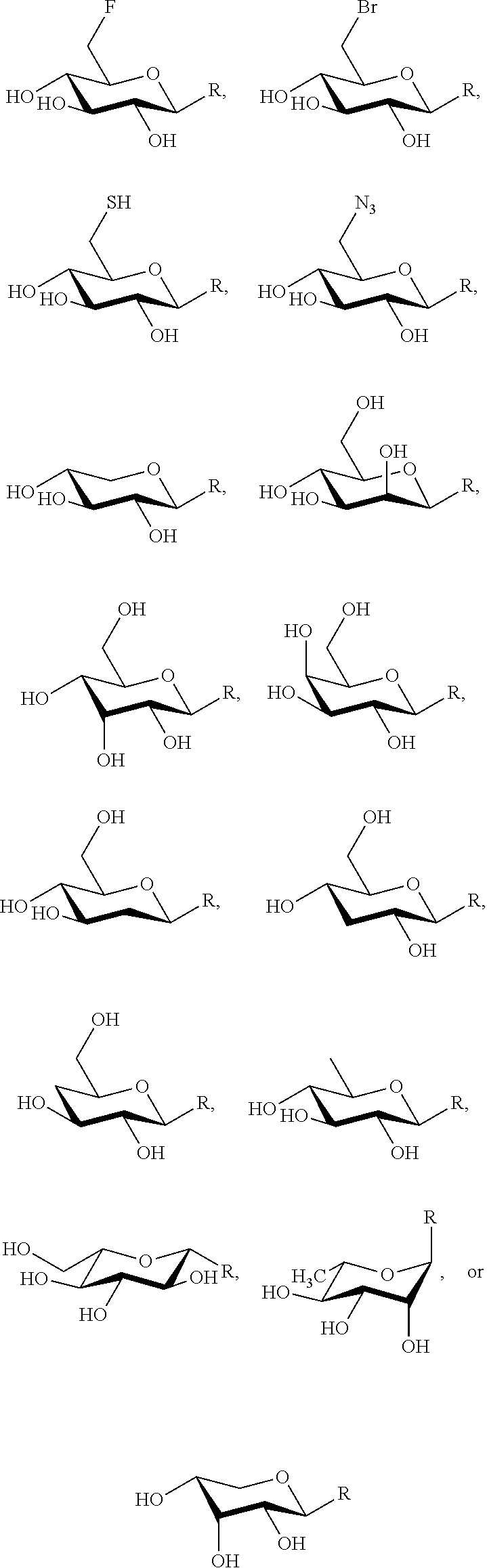
- R is:
- the NDP is preferably uridine or thymidine diphosphate.
- the NDP sugar includes a 13 C atom.
- Such labeled compounds are particularly useful in bioimaging studies, particularly nuclear magnetic resonance (NMR) studies.
- Yet another aspect of the invention is directed to a method of providing a glycosylated target molecule.
- a method includes steps of: (a) incubating a nucleotide diphosphate and a glycoside donor in the presence of an isolated mutant glycosyltransferase as described and claimed herein to provide a nucleotide diphosphate (NDP) sugar; and (b) further incubating the NDP sugar with a second glycosyltransferase and a target molecule to provide a glycosylated target molecule.
- NDP nucleotide diphosphate
- the glycoside donor has the structure:
- R is ⁇ -D-glucopyranose
- the glycoside donor has the structure:
- R is:
- Suitable target molecules for use in the present method include, but are not limited to, natural or synthetic pyran rings, furan rings, enediynes, anthracyclines, angucyclines, aureolic acids, orthosomycins, macrolides, aminoglycosides, non-ribosomal peptides, polyenes, steroids, lipids, indolocarbazoles, bleomycins, amicetins, benzoisochromanequinones, flavonoids, isoflavones, coumarins, aminocoumarins, coumarin acids, polyketides, pluramycins, aminoglycosides, oligosaccharides, nucleosides, peptides and proteins.
- the method is carried out in vitro, preferably in a single reaction vessel.
- more than one type of target molecule is incubated with the second glycosyltransferase to produce a diverse population of glycosylated target molecules.
- more than one type of NDP may be incubated with the isolated mutant glycosyltransferase to produce a diverse population of NDP sugars.
- the invention further provides an isolated nucleic acid encoding a mutant glycosyltransferase having a polypeptide sequence identical to or substantially identical to OleD glycosyltransferase (SEQ ID NO:1) in which proline at position 67 has been replaced with threonine, serine at position 132 has been replaced with phenylalanine, alanine at position 242 has been replaced with leucine, and glutamine at position 268 has been replaced with valine, wherein the isolated mutant glycosyltransferase exhibits an improved conversion of nucleotide diphosphate (NDP) to NDP sugar as compared to a corresponding non-mutated glycosyltransferase.
- NDP nucleotide diphosphate
- the isolated nucleic acid hybridizes under stringent conditions to the nucleotide sequence set forth in SEQ ID NO:2.
- a recombinant vector comprising the isolated nucleic acid and a host cell comprising same are provided by the invention.
- Another aspect of the invention is a fluorescent-based assay for identifying a mutant glycosyltransferase exhibiting an improved conversion of nucleotide diphosphate (NDP) to NDP sugar as compared to a corresponding non-mutated glycosyltransferase.
- NDP nucleotide diphosphate
- Such a method includes steps of: (a) providing a mutant glycosyltransferase; (b) incubating the mutant glycosyltransferase with an NDP and a fluorescent glycoside donor; and (c) measuring a change in fluorescence intensity of the fluorescent glycoside donor incubated with the mutant glyscosyltransferase, the mutant glycosyltransferase's ability to transfer a sugar from said fluorescent glycoside donor to the NDP to form an NDP sugar indicated by an increase in the fluorescence of the fluorescent glycoside donor incubated with the mutant glycosyltransferase; wherein the mutant glycosyltransferase exhibits an improved conversion of NDP to NDP sugar by displaying an increase in the fluorescent glycoside donor fluorescence as compared to a corresponding non-mutated glycosyltransferase.
- the glycoside donor has the structure:
- R is ⁇ -D-glucopyranose
- the glycoside donor has the structure:
- R is:
- the assay is carried out in parallel on a plurality of mutant glycosyltransferases.
- FIG. 1 depicts the general structure of a nucleotide diphosphate (NDP) sugar.
- FIG. 2 shows the reaction catalyzed by GtfD which utilizes an NDP sugar as a donor substrate.
- FIG. 3 illustrates glycosyltransferase (GT) reversibility and the utilization of a synthetic glycoside donor.
- FIG. 4 depicts the reaction catalyzed by wild type OleD. OleD was mutated to accept three different nitrogenous bases, approximately 20 sugars, and approximately 90 aglycons.
- FIG. 5 illustrates the inventors' strategy and results for ⁇ -D-glucoside screening of OleD variants.
- FIG. 6 shows the inventors' identification of OleD variant P67T/S132F/A242L/Q268V and optimization of reverse reaction conditions.
- FIG. 7 depicts the inventors' strategy and results for glycoside library evaluation.
- FIG. 8 depicts the inventors' conclusions for structure activity relationship (SAR) evaluation of NDP sugar substrates related to OleD variant substrate usage.
- FIG. 9 illustrates a general scheme for production of milligram scale NDP-sugar libraries for biochemicaliInvestigations and drug discovery.
- FIG. 10 depicts production of 13 C Labeled NDP-sugars for bioimaging studies.
- FIG. 11 depicts a general strategy for protein engineering and evolution based on the OleD variants.
- FIG. 12 depicts the coupling of GT reactions to initially provide an NDP sugar which serves as the glycoside donor in a second GT reaction to provide a glycosylated target.
- FIG. 13 illustrates an approach to microscale glycosyl scanning according to the invention.
- polypeptide sequence for the wild type OleD protein is provided below as SEQ ID NO: 1:
- SEQ ID NO: 2 An exemplary nucleotide sequence which encodes the wild type OleD protein is set forth below as SEQ ID NO: 2:
- substantially sequence homology refers to DNA or RNA sequences that have de minimus sequence variations from, and retain substantially the same biological functions as the corresponding sequences to which comparison is made.
- sequences having substantial sequence homology to the nucleic acid of SEQ ID NO:2 are identified by: (1) their encoded gene product possessing the ability to improve conversion of NDP to NDP sugar; and (2) their ability to hybridize to the sequence of SEQ ID NO: 2, respectively, under stringent conditions.
- hybridizes under stringent conditions is intended to describe conditions for hybridization and washing under which nucleotide sequences that are significantly identical or homologous to each other remain hybridized to each other.
- stringent conditions are known to those skilled in the art and can be found in Current Protocols in Molecular Biology, Ausubel et al., eds., John Wiley & Sons, Inc. (1995), sections 2, 4 and 6. Additional stringent conditions can be found in Molecular Cloning: A Laboratory Manual, Sambrook et al., Cold Spring Harbor Press, Cold Spring Harbor, N.Y. (1989), chapters 7, 9 and 11.
- a preferred, non-limiting example of stringent hybridization conditions includes hybridization in 4 ⁇ sodium chlorine/sodium citrate (SSC), at about 65-70° C. (or hybridization in 4 ⁇ SSC plus 50% formamide at about 42-50° C.) followed by one or more washes in 1 ⁇ SSC, at about 65-70° C.
- a preferred, non-limiting example of highly stringent hybridization conditions includes hybridization in 1 ⁇ SSC, at about 65-70° C. (or hybridization in 4 ⁇ SSC plus 50% formamide at about 42-50° C.) followed by one or more washes in 0.3 ⁇ SSC, at about 65-70° C.
- a preferred, non-limiting example of highly stringent hybridization conditions includes hybridization in 4 ⁇ SSC, at about 50-60° C.
- SSPE (1 ⁇ SSPE is 0.15 M NaCl, 10 mM NaH 2 PO 4 , and 1.25 mM EDTA, pH 7.4) can be substituted for SSC (1 ⁇ SSPE is 0.15 M NaC and 15 mM sodium citrate) in the hybridization and wash buffers; washes are performed for 15 minutes each after hybridization is complete.
- additional reagents may be added to the hybridization and/or wash buffers to decrease non-specific hybridization of nucleic acid molecules to membranes, for example, nitrocellulose or nylon membranes, including but not limited to blocking agents (e.g., BSA or salmon or herring sperm carrier DNA), detergents (e.g., SDS) chelating agents (e.g., EDTA), Ficoll, PVP and the like.
- blocking agents e.g., BSA or salmon or herring sperm carrier DNA
- detergents e.g., SDS
- EDTA chelating agents
- Ficoll e.g., Ficoll, PVP and the like.
- an additional preferred, non-limiting example of stringent hybridization conditions is hybridization in 0.25-0.5M NaH 2 PO 4 , 7% SDS at about 65° C., followed by one or more washed at 0.02M NaH 2 PO 4 , 1% SDS at 65° C., see e.g., Church and Gilbert (1984) Proc. Natl. Acad. Sci. USA 81: 1991-1995, (or alternatively 0.2 ⁇ SSC, 1% SDS).
- Polynucleotide(s) generally refers to any polyribonucleotide or polydeoxyribonucleotide, which may be unmodified RNA or DNA or modified RNA or DNA. “Polynucleotide(s)” include, without limitation, single- and double-stranded DNA, DNA that is a mixture of single- and double-stranded regions or single-, double- and triple-stranded regions, single- and double-stranded RNA, and RNA that is mixture of single- and double-stranded regions, hybrid molecules comprising DNA and RNA that may be single-stranded or, more typically, double-stranded, or triple-stranded regions, or a mixture of single- and double-stranded regions.
- polynucleotide(s) also includes DNAs or RNAs as described above that contain one or more modified bases.
- DNAs or RNAs with backbones modified for stability or for other reasons are “polynucleotide(s)” as that term is intended herein.
- DNAs or RNAs comprising unusual bases, such as inosine, or modified bases, such as tritylated bases, to name just two examples are polynucleotides as the term is used herein. It will be appreciated that a great variety of modifications have been made to DNA and RNA that serve many useful purposes known to those of skill in the art.
- polynucleotide(s) as it is employed herein embraces such chemically, enzymatically or metabolically modified forms of polynucleotides, as well as the chemical forms of DNA and RNA characteristic of viruses and cells, including, for example, simple and complex cells. “Polynucleotide(s)” also embraces short polynucleotides often referred to as oligonucleotide(s).
- isolated nucleic acid used in the specification and claims means a nucleic acid isolated from its natural environment or prepared using synthetic methods such as those known to one of ordinary skill in the art. Complete purification is not required in either case.
- the nucleic acids of the invention can be isolated and purified from normally associated material in conventional ways such that in the purified preparation the nucleic acid is the predominant species in the preparation. At the very least, the degree of purification is such that the extraneous material in the preparation does not interfere with use of the nucleic acid of the invention in the manner disclosed herein.
- the nucleic acid is preferably at least about 85% pure, more preferably at least about 95% pure and most preferably at least about 99% pure.
- an isolated nucleic acid has a structure that is not identical to that of any naturally occurring nucleic acid or to that of any fragment of a naturally occurring genomic nucleic acid spanning more than three separate genes.
- An isolated nucleic acid also includes, without limitation, (a) a nucleic acid having a sequence of a naturally occurring genomic or extrachromosomal nucleic acid molecule but which is not flanked by the coding sequences that flank the sequence in its natural position; (b) a nucleic acid incorporated into a vector or into a prokaryote or eukaryote genome such that the resulting molecule is not identical to any naturally occurring vector or genomic DNA; (c) a separate molecule such as a cDNA, a genomic fragment, a fragment produced by polymerase chain reaction (PCR), or a restriction fragment; and (d) a recombinant nucleotide sequence that is part of a hybrid gene.
- PCR polymerase chain reaction
- nucleic acids present in mixtures of clones e.g., as those occurring in a DNA library such as a cDNA or genomic DNA library.
- An isolated nucleic acid can be modified or unmodified DNA or RNA, whether fully or partially single-stranded or double-stranded or even triple-stranded.
- a nucleic acid can be chemically or enzymatically modified and can include so-called non-standard bases such as inosine, as described in a preceding definition.
- gene product shall refer to the biochemical material, either RNA or protein, resulting from expression of a gene.
- heterologous is used for any combination of DNA sequences that is not normally found intimately associated in nature (e.g., a green fluorescent protein (GFP) reporter gene operably linked to a SV40 promoter).
- GFP green fluorescent protein
- a “heterologous gene” shall refer to a gene not naturally present in a host cell (e.g., a luciferase gene present in a retinoblastoma cell line).
- nucleotides that occur in the various nucleotide sequences appearing herein have their usual single-letter designations (A, G, T, C or U) used routinely in the art.
- references to Greek letters may either be written out as alpha, beta, etc. or the corresponding Greek letter symbols (e.g., ⁇ , ⁇ , etc.) may sometimes be used.
- GT glycosyltransferase
- NTP nucleotide-5′-triphosphate
- ATP adenosine-5′-triphosphate
- CTP cytidine-5′-triphosphate
- GTP guanosine-5′-triphosphate
- UTP uridine-5′-triphosphate
- dATP 2′-deoxyadenosine-5′-triphosphate
- dCTP 2′-deoxycytidine-5′-triphosphate
- dGTP 2′-deoxyguanosine-5′-triphosphate
- dTTP 2′ deoxythymidine-5′-triphosphate
- NDP-sugar nucleotide diphosphosugar
- IPTG isopropyl- ⁇ -D-thiogalactopyranoside
- WT wild-type.
- GTs Glycosyltransferases
- the present invention is based on the inventors' success in broadening the promiscuity of a natural product GT—the oleandomycin GT (OleD) from Streptomyces antibioticus .
- the native macrolide GT reaction catalyzed by OleD was previously characterized and is shown in FIG. 4 .
- Another aspect of the invention is a versatile method for optimizing glycosyltransferases such as OleD toward non-natural donors through a comprehensive program of ‘hot spot’ saturation mutagenesis of functional positions.
- the method comprises a general enzyme optimization strategy (hot spot saturation mutagenesis) applicable to reactions limited by amenable high throughput screens using the macrolide glycosyltransferase OleD as a non-limiting model.
- a high throughput screen based on synthetic glycoside donors is used to identify key amino acid ‘hot spots’ that contribute to GT conversion of NDP to NDP sugar.
- FIG. 5 illustrates the inventors' experimental strategy and results for three OleD variants assayed in combination with various synthetic glycoside donors designed to transfer a ⁇ -D-glucopyranose moiety.
- FIG. 6 depicts further optimization of the reaction conditions for the OleD variant P67T/S132F/A242L/Q268V.
- the invention provides in a first aspect an isolated mutant glycosyltransferase comprising: (a) the amino acid sequence of OleD glycosyltransferase set forth in SEQ ID NO:1, wherein proline at position 67 has been replaced with threonine, serine at position 132 has been replaced with phenylalanine, alanine at position 242 has been replaced with leucine, and glutamine at position 268 has been replaced with valine; or (b) an amino acid sequence substantially identical to OleD glycosyltransferase (SEQ ID NO:1) in which proline at position 67 has been replaced with threonine, serine at position 132 has been replaced with phenylalanine, alanine at position 242 has been replaced with leucine, and glutamine at position 268 has been replaced with valine; wherein the isolated mutant exhibits an improved conversion of nucleotide diphosphate (NDP) to NDP sugar as compared to a corresponding non-mutated glycosy
- Such a method includes steps of: (a) mutating an isolated nucleic acid sequence encoding an amino acid sequence identical to or substantially identical to OleD glycosyltransferase (SEQ ID NO:1) in which proline at position 67 has been replaced with threonine, serine at position 132 has been replaced with phenylalanine, alanine at position 242 has been replaced with leucine, and glutamine at position 268 has been replaced with valine; (b) expressing said isolated nucleic acid in a host cell; and (c) isolating from the host cell a mutant glycosyltransferase that is characterized by improved conversion of nucleotide diphosphate (NDP) to NDP sugar as compared to a corresponding non-mutated glycosyltransferase.
- SEQ ID NO:1 OleD glycosyltransferase
- the invention encompasses a method of providing a nucleotide diphosphate (NDP) sugar.
- NDP nucleotide diphosphate
- Such a method includes steps of incubating a nucleotide diphosphate and a glycoside donor in the presence of an isolated mutant glycosyltransferase described and claimed herein to provide an NDP sugar.
- FIG. 9 illustrates a general schematic for such a method using one of the synthetic glycoside donors explicitly described below.
- the glycoside donor has the structure:
- R is ⁇ -D-glucopyranose
- the glycoside donor has the structure:
- R is:
- the NDP is preferably uridine or thymidine diphosphate.
- the NDP sugar includes a 13 C atom.
- Such labeled compounds are particularly useful for bioimaging studies, specifically nuclear magnetic resonance (NMR) imaging.
- FIG. 10 depicts an NMR study utilizing a 13 C-labeled NDP sugar.
- Yet another aspect of the invention is directed to a method of providing a glycosylated target molecule.
- Such a method includes steps of: (a) incubating a nucleotide diphosphate and a glycoside donor in the presence of an isolated mutant glycosyltransferase as described and claimed herein to provide a nucleotide diphosphate (NDP) sugar; and (b) further incubating the NDP sugar with a second glycosyltransferase and a target molecule to provide a glycosylated target molecule.
- FIG. 12 depicts a general scheme in which an OleD variant according to the invention is coupled with a second different GT to provide a glycosylated target molecule.
- the glycoside donor has the structure:
- R is ⁇ -D-glucopyranose
- the glycoside donor has the structure:
- R is:
- Suitable target molecules for use in the present method include, but are not limited to, natural or synthetic pyran rings, furan rings, enediynes, anthracyclines, angucyclines, aureolic acids, orthosomycins, macrolides, aminoglycosides, non-ribosomal peptides, polyenes, steroids, lipids, indolocarbazoles, bleomycins, amicetins, benzoisochromanequinones, flavonoids, isoflavones, coumarins, aminocoumarins, coumarin acids, polyketides, pluramycins, aminoglycosides, oligosaccharides, nucleosides, peptides and proteins.
- the method is carried out in vitro, preferably in a single reaction vessel.
- more than one type of target molecule is incubated with the second glycosyltransferase to produce a diverse population of glycosylated target molecules.
- more than one type of NDP may be incubated with the isolated mutant glycosyltransferase to produce a diverse population of NDP sugars.
- the invention further provides an isolated nucleic acid encoding a mutant glycosyltransferase having a polypeptide sequence identical to or substantially identical to OleD glycosyltransferase (SEQ ID NO:1) in which proline at position 67 has been replaced with threonine, serine at position 132 has been replaced with phenylalanine, alanine at position 242 has been replaced with leucine, and glutamine at position 268 has been replaced with valine, wherein the isolated mutant glycosyltransferase exhibits an improved conversion of nucleotide diphosphate (NDP) to NDP sugar as compared to a corresponding non-mutated glycosyltransferase.
- NDP nucleotide diphosphate
- the isolated nucleic acid hybridizes under stringent conditions to the nucleotide sequence set forth in SEQ ID NO:2.
- a recombinant vector comprising the isolated nucleic acid and a host cell comprising same are provided by the invention.
- Another aspect of the invention is a fluorescent-based assay for identifying a mutant glycosyltransferase exhibiting an improved conversion of nucleotide diphosphate (NDP) to NDP sugar as compared to a corresponding non-mutated glycosyltransferase.
- NDP nucleotide diphosphate
- Such a method includes steps of: (a) providing a mutant glycosyltransferase; (b) incubating the mutant glycosyltransferase with an NDP and a fluorescent glycoside donor; and (c) measuring a change in fluorescence intensity of the fluorescent glycoside donor incubated with the mutant glyscosyltransferase, the mutant glycosyltransferase's ability to transfer a sugar from said fluorescent glycoside donor to the NDP to form an NDP sugar indicated by an increase in the fluorescence of the fluorescent glycoside donor incubated with the mutant glycosyltransferase; wherein the mutant glycosyltransferase exhibits an improved conversion of NDP to NDP sugar by displaying an increase in the fluorescent glycoside donor fluorescence as compared to a corresponding non-mutated glycosyltransferase.
- the glycoside donor has the structure:
- R is ⁇ -D-glucopyranose
- the glycoside donor has the structure:
- R is:
- the assay is carried out in parallel on a plurality of mutant glycosyltransferases.
- FIG. 11 illustrates an assay according to the invention carried out in a multiwall format.
- the invention provides a systematic strategy for the development of integrated high throughput pipelines to rapidly synthesize and evaluate sugar-drug conjugates—referred to as microscale glycosyl-scanning (shown generally in FIG. 13 ).
- microscale glycosyl-scanning shown generally in FIG. 13 .
- the core innovation of this study is an unparalleled one-step glycosyltransferase (GT)-catalyzed transglycosylation reaction from simple activated (2-chloro-4-nitrophenol) glycosyl donors that ultimately drives subsequent target scaffold glycosylation while providing a convenient colorimetric readout amenable to high throughput screening.
- GT glycosyltransferase
- Bacterial strain E. coli BL21(DE3)pLysS was from Stratagene. NovaBlue was from Novagen.
- Plasmid pET28/OleD was a generous gift from Prof Hung-Wen Liu (University of Texas-Austin, Austin, USA) and pET28a was from Novagen. All other chemicals were reagent-grade purchased from Fluka, New England Biolabs, or Sigma, unless otherwise stated. Primers were ordered from Integrated DNA Technologies (Coralville, Iowa). Oleandomycin was purchased from MP Biomedicals Inc. (Ohio, USA). Phenolic substrates (Table 1: 27, 28, 30-32) were from Indofine Chemical Company Inc. (Hillsborough, N.J., USA).
- Novobiocic acid (Table 1: 29) was prepared as previously described from Novobiocin. Albermann C, et al. (2003) Org Lett 5: 933-6.
- Product standard 4-Me-umb-7-O-beta-D-glucoside ( FIG. 1 : 4-glc) was from Sigma, daidzein-7-O-beta-D-glucoside (Table 1: 31-glc), and genistein-7-O-beta-D-glucoside (Table 1: 32-glc) standards were from Fluka. Analytical HPLC was performed on a Rainin Dynamax SD-2/410 system connected to a Rainin Dynamax UV-DII absorbance detector.
- Mass spectra were obtained using electrospray ionization on an Agilent 1100 HPLC-MSD SL quadrapole mass spectrometer connected to a UV/Vis diode array detector.
- LC-MS analysis quenched reaction mixtures were analyzed by analytical reverse-phase HPLC with a 250 mm ⁇ 4.6 mm Gemini 5 ⁇ C18 column (Phenomenex, Torrance, Calif.) using a gradient of 10-90% CH 3 CN in 0.1% formic acid/H 2 O in 20 min at 1 ml/min, with detection at 254 nm.
- the enzymatic and/or chemical syntheses sugar nucleotides ( FIG. 3 : 7-9, 11-25) utilized in this study have been previously described.
- the random mutant library was prepared via error-prone PCR using the Stratagene GeneMorph II Random Mutagenesis Kit, as described by the manufacturer using varying quantities of pET28/OleD as template.
- the primers used for amplification of the OleD gene were T7 FOR (5′-TAA TAC GAC TCA CTA TAG GG-3′; SEQ ID NO:3) and T7 REV (5′-GCT AGT TAT TGC TCA GCG G-3′; SEQ ID NO:4).
- Amplified product was digested with NdeI and HindIII purified by agarose gel electrophoresis (0.8% w/v agarose), extracted using the QIAquick Gel Extraction Kit (QIAgen, Valenica, Calif.), and ligated into similarly treated pET28a.
- the ligation mixtures were transformed into chemically competent NovaBlue cells and single colonies used to prepare plasmid for DNA sequencing, which revealed that a library made with ⁇ 10 ng starting template had the desired mutation rate of 1-2 amino acid mutations per gene product. Subsequently, all the transformants from this library were pooled and cultured overnight. Plasmid was prepared from this culture and used to transform chemical competent E. coli BL21(DE3)pLysS, which was screened as described below.
- Site-specific OleD variants were constructed using the Stratagene QuikChange II Site-Directed Mutagenesis Kit, as described by the manufacturer.
- the amplified plasmid was digested with DpnI and transformed into chemical competent E. coli XL1 Blue. Constructs were confirmed to carry the correct mutation(s) via DNA sequencing.
- the original plate was sealed and stored at 4° C., or a glycerol copy made by mixing 100 microliters of each culture with 100 microliters 50% (v/v) glycerol and storing at ⁇ 80° C.
- the freshly inoculated plate was incubated at 37° C. for 2-3 h with shaking at 350 rpm.
- Expression of the N-terminal His 6 -tagged OleD was induced at OD 600 ⁇ 0.7, and isopropyl beta-D-thiogalactoside (IPTG) was added to a final concentration of 0.4 mM and the plate incubated for 18 h at 18° C.
- Cells were harvested by centrifugation at 3000 g for 10 min at 4° C., the cell pellets thoroughly resuspended in chilled 50 mM Tris-HCl (pH 8.0) containing 10 mg/ml lysozyme (Sigma), and the plates were subjected to a single freeze/thaw cycle to lyse the cells. Following thawing, cell debris was collected by centrifugation at 3000 g for 20 min at 4° C. and 50 microliters of the cleared supernatant used for enzyme assay.
- Ni-NTA nickel-nitrilotriacetic acid
- the enzyme was eluted by incubation of the resin with 2 ml lysis buffer containing 100 mM imidazole for 10 min at 4° C. with gentle agitation.
- the purified enzyme was applied to a PD-10 desalting column (Amersham Biosciences AB) equilibrated with 50 mM Tris-HCl (pH 8.0) and eluted as described by the manufacturer. Protein aliquots were immediately flash frozen in liquid nitrogen and stored at ⁇ 80° C. Protein purity was verified by SDS-PAGE. Protein quantification was carried out using the Bradford Protein Assay Kit from Bio-Rad.
Landscapes
- Chemical & Material Sciences (AREA)
- Organic Chemistry (AREA)
- Life Sciences & Earth Sciences (AREA)
- Wood Science & Technology (AREA)
- Zoology (AREA)
- Engineering & Computer Science (AREA)
- Health & Medical Sciences (AREA)
- Bioinformatics & Cheminformatics (AREA)
- Genetics & Genomics (AREA)
- Microbiology (AREA)
- Biochemistry (AREA)
- General Engineering & Computer Science (AREA)
- General Health & Medical Sciences (AREA)
- Biotechnology (AREA)
- General Chemical & Material Sciences (AREA)
- Chemical Kinetics & Catalysis (AREA)
- Molecular Biology (AREA)
- Proteomics, Peptides & Aminoacids (AREA)
- Medicinal Chemistry (AREA)
- Physics & Mathematics (AREA)
- Analytical Chemistry (AREA)
- Biophysics (AREA)
- Biomedical Technology (AREA)
- Immunology (AREA)
- Micro-Organisms Or Cultivation Processes Thereof (AREA)
- Enzymes And Modification Thereof (AREA)
Abstract
Description



| (SEQ ID NO: 1) |
| MTTQTTPAHIAMFSIAAHGHVNPSLEVIRELVARGHRVTYAIPPVFAD |
| KVAATGARPVLYHSTLPGPDADPEAWGSTLLDNVEPFLNDAIQALPQL |
| ADAYADDIPDLVLHDITSYPARVLARRWGVPAVSLSPNLVAWKGYEEE |
| VAEPMWREPRQTERGRAYYARFEAWLKENGITEHPDTFASHPPRSLVL |
| IPKALQPHADRVDEDVYTFVGACQGDRAEEGGWQRPAGAEKVVLVSLG |
| SAFTKQPAFYRECVRAFGNLPGWHLVLQIGRKVTPAELGELPDNVEVH |
| DWVPQLAILRQADLFVTHAGAGGSQEGLATATPMIAVPQAVDQFGNAD |
| MLQGLGVARKLATEEATADLLRETALALVDDPEVARRLRRIQAEMAQE |
| GGTRRAADLIEAELPARHERQEPVGDRPNGG |
| (SEQ ID NO: 2) | |
| atgaccaccc agaccactcc cgcccacatc gccatgttct ccatcgccgc ccacggccat | |
| gtgaacccca gcctggaggt gatccgtgaa ctcgtcgccc gcggccaccg ggtcacgtac | |
| gccattccgc ccgtcttcgc cgacaaggtg gccgccaccg gcgcccggcc cgtcctctac | |
| cactccaccc tgcccggccc cgacgccgac ccggaggcat ggggaagcac cctgctggac | |
| aacgtcgaac cgttcctgaa cgacgcgatc caggcgctcc cgcagctcgc cgatgcctac | |
| gccgacgaca tccccgatct cgtcctgcac gacatcacct cctacccggc ccgcgtcctg | |
| gcccgccgct ggggcgtccc ggcggtctcc ctctccccga acctcgtcgc ctggaagggt | |
| tacgaggagg aggtcgccga gccgatgtgg cgcgaacccc ggcagaccga gcgcggacgg | |
| gcctactacg cccggttcga ggcatggctg aaggagaacg ggatcaccga gcacccggac | |
| acgttcgcca gtcatccgcc gcgctccctg gtgctcatcc cgaaggcgct ccagccgcac | |
| gccgaccggg tggacgaaga cgtgtacacc ttcgtcggcg cctgccaggg agaccgcgcc | |
| gaggaaggcg gctggcagcg gcccgccggc gcggagaagg tcgtcctggt gtcgctcggc | |
| tcggcgttca ccaagcagcc cgccttctac cgggagtgcg tgcgcgcctt cgggaacctg | |
| cccggctggc acctcgtcct ccagatcggc cggaaggtga cccccgccga actgggggag | |
| ctgccggaca acgtggaggt gcacgactgg gtgccgcagc tcgcgatcct gcgccaggcc | |
| gatctgttcg tcacccacgc gggcgccggc ggcagccagg aggggctggc caccgcgacg | |
| cccatgatcg ccgtaccgca ggccgtcgac cagttcggca acgccgacat gctccaaggg | |
| ctcggcgtcg cccggaagct ggcgaccgag gaggccaccg ccgacctgct ccgcgagacc | |
| gccctcgctc tggtggacga cccggaggtc gcgcgccggc tccggcggat ccaggcggag | |
| atggcccagg agggcggcac ccggcgggcg gccgacctca tcgaggccga actgcccgcg | |
| cgccacgagc ggcaggagcc ggtgggcgac cgacccaacg gtgggtga |


Claims (2)
Priority Applications (2)
| Application Number | Priority Date | Filing Date | Title |
|---|---|---|---|
| US13/159,097 US8637287B2 (en) | 2010-06-11 | 2011-06-13 | Glycosyltransferase reversibility for sugar nucleotide synthesis |
| US13/495,760 US20130004979A1 (en) | 2010-06-11 | 2012-06-13 | Glycosyltransferase reversibility for sugar nucleotide synthesis and microscale scanning |
Applications Claiming Priority (2)
| Application Number | Priority Date | Filing Date | Title |
|---|---|---|---|
| US35403710P | 2010-06-11 | 2010-06-11 | |
| US13/159,097 US8637287B2 (en) | 2010-06-11 | 2011-06-13 | Glycosyltransferase reversibility for sugar nucleotide synthesis |
Related Child Applications (1)
| Application Number | Title | Priority Date | Filing Date |
|---|---|---|---|
| US13/495,760 Continuation-In-Part US20130004979A1 (en) | 2010-06-11 | 2012-06-13 | Glycosyltransferase reversibility for sugar nucleotide synthesis and microscale scanning |
Publications (2)
| Publication Number | Publication Date |
|---|---|
| US20110306074A1 US20110306074A1 (en) | 2011-12-15 |
| US8637287B2 true US8637287B2 (en) | 2014-01-28 |
Family
ID=45096516
Family Applications (1)
| Application Number | Title | Priority Date | Filing Date |
|---|---|---|---|
| US13/159,097 Expired - Fee Related US8637287B2 (en) | 2010-06-11 | 2011-06-13 | Glycosyltransferase reversibility for sugar nucleotide synthesis |
Country Status (1)
| Country | Link |
|---|---|
| US (1) | US8637287B2 (en) |
Cited By (1)
| Publication number | Priority date | Publication date | Assignee | Title |
|---|---|---|---|---|
| US12234464B2 (en) | 2018-11-09 | 2025-02-25 | Ginkgo Bioworks, Inc. | Biosynthesis of mogrosides |
-
2011
- 2011-06-13 US US13/159,097 patent/US8637287B2/en not_active Expired - Fee Related
Non-Patent Citations (7)
| Title |
|---|
| Hancock, SM, et al. "Engineering of glycosidases and glycosyltransferases" (2006) Curr Opin Chem Biol 10: 509-19. |
| Hoffmeister D, et al. "Creation of the first anomeric D/L-sugar kinase by means of directed evolution" (2003) Proc Natl Acad Sci U S A 100: 13184-9. |
| Hu, Y., et al. "Remarkable structural similarities between diverse glycosyltransferases" (2002) Chem Biol 9: 1287-96. |
| Lairson LL, et al. "Mechanistic analogies amongst carbohydrate modifying enzymes" (2004) Chem Commun 2243-8. |
| Ngo et al. in The Protein Folding Problem and Tertiary Structure Prediction, 1994, Merz et al. (ed.), Birkhauser, Boston, MA, pp. 433 and 492-495. * |
| Williams, GJ, et al. "Creation of a pair of stereochemically complementary biocatalysts" (2006) J Am Chem Soc 128: 16238-47. |
| Yang et al., Journal of American Chemical Society vol. 127, pp. 9336-9337, 2005. * |
Cited By (1)
| Publication number | Priority date | Publication date | Assignee | Title |
|---|---|---|---|---|
| US12234464B2 (en) | 2018-11-09 | 2025-02-25 | Ginkgo Bioworks, Inc. | Biosynthesis of mogrosides |
Also Published As
| Publication number | Publication date |
|---|---|
| US20110306074A1 (en) | 2011-12-15 |
Similar Documents
| Publication | Publication Date | Title |
|---|---|---|
| US8093028B2 (en) | Engineered glycosyltransferases with expanded substrate specificity | |
| WO2019241305A1 (en) | Improved reverse transcriptase for nucleic acid sequencing | |
| EP1546313B1 (en) | Thermostable rna ligase from thermus phage | |
| Kruger et al. | Tailoring of glycopeptide scaffolds by the acyltransferases from the teicoplanin and A-40,926 biosynthetic operons | |
| Chen et al. | Wide sugar substrate specificity of galactokinase from Streptococcus pneumoniae TIGR4 | |
| US20130004979A1 (en) | Glycosyltransferase reversibility for sugar nucleotide synthesis and microscale scanning | |
| Waduge et al. | Chemical probing for examining the structure of modified RNAs and ligand binding to RNA | |
| WO2016108159A1 (en) | Methods for in vitro ribosome synthesis and evolution | |
| Huang et al. | High-throughput profiling of RNA modifications by ultra-performance liquid chromatography coupled to complementary mass spectrometry: methods, quality control, and applications | |
| Hsu et al. | An ELISA for RNA helicase activity: application as an assay of the NS3 helicase of hepatitis C virus | |
| Hansen et al. | Recognition of nucleotide G745 in 23 S ribosomal RNA by the rrmA methyltransferase | |
| US20110306074A1 (en) | Glycosyltransferase reversibility for sugar nucleotide synthesis | |
| Siegmund et al. | Screening mutant libraries of T7 RNA polymerase for candidates with increased acceptance of 2′-modified nucleotides | |
| Zhang et al. | Rational engineering acyltransferase domain of modular polyketide synthase for expanding substrate specificity | |
| EP1926827A2 (en) | Regioselective glycosylation | |
| Kalb et al. | Purification of post-transcriptionally modified tRNAs for enhanced cell-free translation systems | |
| Taki et al. | Chemoenzymatic Transfer of Fluorescent Non‐natural Amino Acids to the N Terminus of a Protein/Peptide | |
| Kumar et al. | High-throughput screening of glycosynthases using azido sugars for oligosaccharides synthesis | |
| US10829798B2 (en) | DNA-linked enzyme-coupled assays | |
| Wen et al. | Directed evolution: novel and improved enzymes | |
| Gerlinger et al. | Ketosynthase engineering enhances activity and shifts specificity towards non-native extender units in type I linear polyketide synthase | |
| US6514703B1 (en) | Method for separating and characterizing functions potentially present in a biological sample containing nucleic acids | |
| Karin | Cloning of transfected cells without cloning rings | |
| EP4381094B1 (en) | Argonaute-based nucleic acid detection system | |
| US9994886B2 (en) | Modified Epstein-Barr virus DNA polymerase and methods for isothermal DNA amplification |
Legal Events
| Date | Code | Title | Description |
|---|---|---|---|
| AS | Assignment |
Owner name: NATIONAL INSTITUTES OF HEALTH (NIH), U.S. DEPT. OF Free format text: CONFIRMATORY LICENSE;ASSIGNOR:WISCONSIN ALUMNI RESEARCH FOUNDATION;REEL/FRAME:026464/0207 Effective date: 20110615 |
|
| AS | Assignment |
Owner name: WISCONSIN ALUMNI RESEARCH FOUNDATION, WISCONSIN Free format text: ASSIGNMENT OF ASSIGNORS INTEREST;ASSIGNORS:THORSON, JON;GANTT, RICHARD;REEL/FRAME:026562/0671 Effective date: 20110701 |
|
| STCF | Information on status: patent grant |
Free format text: PATENTED CASE |
|
| FPAY | Fee payment |
Year of fee payment: 4 |
|
| MAFP | Maintenance fee payment |
Free format text: PAYMENT OF MAINTENANCE FEE, 8TH YR, SMALL ENTITY (ORIGINAL EVENT CODE: M2552); ENTITY STATUS OF PATENT OWNER: SMALL ENTITY Year of fee payment: 8 |
|
| FEPP | Fee payment procedure |
Free format text: MAINTENANCE FEE REMINDER MAILED (ORIGINAL EVENT CODE: REM.); ENTITY STATUS OF PATENT OWNER: SMALL ENTITY |
|
| LAPS | Lapse for failure to pay maintenance fees |
Free format text: PATENT EXPIRED FOR FAILURE TO PAY MAINTENANCE FEES (ORIGINAL EVENT CODE: EXP.); ENTITY STATUS OF PATENT OWNER: SMALL ENTITY |
|
| STCH | Information on status: patent discontinuation |
Free format text: PATENT EXPIRED DUE TO NONPAYMENT OF MAINTENANCE FEES UNDER 37 CFR 1.362 |
|
| FP | Lapsed due to failure to pay maintenance fee |
Effective date: 20260128 |