US8629639B2 - Brushless direct current motor and driving unit thereof - Google Patents

Brushless direct current motor and driving unit thereof Download PDF

Info

Publication number
US8629639B2
US8629639B2 US12/397,867 US39786709A US8629639B2 US 8629639 B2 US8629639 B2 US 8629639B2 US 39786709 A US39786709 A US 39786709A US 8629639 B2 US8629639 B2 US 8629639B2
Authority
US
United States
Prior art keywords
controlling signal
bridge circuit
stator
rotor
phase
Prior art date
Legal status (The legal status is an assumption and is not a legal conclusion. Google has not performed a legal analysis and makes no representation as to the accuracy of the status listed.)
Active, expires
Application number
US12/397,867
Other versions
US20100164420A1 (en
Inventor
Yen-Hung Wu
Tsung-Jung Hsieh
Yueh-Lung Huang
Current Assignee (The listed assignees may be inaccurate. Google has not performed a legal analysis and makes no representation or warranty as to the accuracy of the list.)
Delta Electronics Inc
Original Assignee
Delta Electronics Inc
Priority date (The priority date is an assumption and is not a legal conclusion. Google has not performed a legal analysis and makes no representation as to the accuracy of the date listed.)
Filing date
Publication date
Application filed by Delta Electronics Inc filed Critical Delta Electronics Inc
Assigned to DELTA ELECTRONICS, INC. reassignment DELTA ELECTRONICS, INC. ASSIGNMENT OF ASSIGNORS INTEREST (SEE DOCUMENT FOR DETAILS). Assignors: HSIEH, TSUNG-JUNG, HUANG, YUEH-LUNG, WU, YEN-HUNG
Publication of US20100164420A1 publication Critical patent/US20100164420A1/en
Application granted granted Critical
Publication of US8629639B2 publication Critical patent/US8629639B2/en
Active legal-status Critical Current
Adjusted expiration legal-status Critical

Links

Images

Classifications

    • HELECTRICITY
    • H02GENERATION; CONVERSION OR DISTRIBUTION OF ELECTRIC POWER
    • H02PCONTROL OR REGULATION OF ELECTRIC MOTORS, ELECTRIC GENERATORS OR DYNAMO-ELECTRIC CONVERTERS; CONTROLLING TRANSFORMERS, REACTORS OR CHOKE COILS
    • H02P6/00Arrangements for controlling synchronous motors or other dynamo-electric motors using electronic commutation dependent on the rotor position; Electronic commutators therefor
    • H02P6/14Electronic commutators
    • HELECTRICITY
    • H02GENERATION; CONVERSION OR DISTRIBUTION OF ELECTRIC POWER
    • H02KDYNAMO-ELECTRIC MACHINES
    • H02K29/00Motors or generators having non-mechanical commutating devices, e.g. discharge tubes or semiconductor devices
    • H02K29/03Motors or generators having non-mechanical commutating devices, e.g. discharge tubes or semiconductor devices with a magnetic circuit specially adapted for avoiding torque ripples or self-starting problems
    • HELECTRICITY
    • H02GENERATION; CONVERSION OR DISTRIBUTION OF ELECTRIC POWER
    • H02KDYNAMO-ELECTRIC MACHINES
    • H02K3/00Details of windings
    • H02K3/04Windings characterised by the conductor shape, form or construction, e.g. with bar conductors
    • H02K3/28Layout of windings or of connections between windings

Definitions

  • the present invention relates to a brushless direct current (DC) motor and driving unit thereof, and in particular to a brushless DC motor and driving unit thereof including a stator which has a plurality of alternately arranged upper pole arms and lower pole arms.
  • DC direct current
  • FIG. 1 shows a conventional driving circuit of a motor.
  • a driver 10 is electrically connected with a main power Vcc.
  • a bridge circuit 12 includes four switches Q 1 ⁇ Q 4 and a coil L, and the bridge circuit 12 is electrically connected with the driver 10 and a main power source Vcc.
  • the driver 10 receives the required voltage from the main power source Vcc and outputs the controlling signal C 1 and the controlling signal C 2 to the bridge circuit 12 for switching on and switching off the witches Q 1 ⁇ Q 4 .
  • the conventional motor is mainly composed of a rotor, a magnet ring disposed in the rotor, a stator and a printed circuit board.
  • the stator includes a plurality of salient poles located at the same level, and the driver 10 and a sensor 14 are disposed on the printed circuit board.
  • the coil L of the bridge circuit 12 is wound on the stator.
  • the driver 10 outputs the controlling signal C 1 and the controlling signal C 2 to the bridge circuit 12 for switching on and switching off the witches Q 1 ⁇ Q 4 .
  • the switch Q 1 and the switch Q 4 of the bridge circuit 12 are turned on and the switch Q 2 and the switch Q 3 of the bridge circuit 12 are turned off, the electric current flows through the switch Q 1 , the coil L and the switch Q 4 .
  • the switch Q 2 and the switch Q 3 of the bridge circuit 12 are turned on and the switch Q 1 and the switch Q 4 of the bridge circuit 12 are turned off, the electric current flows through the switch Q 2 , the coil L and the switch Q 3 .
  • the rotor is driven by the electromagnetic field on the stator when the electric current flows through the coil L.
  • the sensor 14 senses the magnetic field of the magnet ring of the rotor and outputs a sensing signal S sense to the driver 10 for adjusting the time that the electric current flowing through the coil L, so as to make a stable electromagnetic field on the stator.
  • the conventional motor has greater Cogging Torque, and there is a short “dead time” during the switch of the flowing direction of the electric current, so that the amplitude of vibration between the highest current and the lowest current is too wide, and the electronic elements in the motor are broken by an excessive Peak Current easily. If the conventional motor is applied to a fan, the multiple-frequency vibration of the motor will be apparent on the fan. In addition, there are only one driving circuit, one single coil L and one set of salient poles in the stator of the conventional motor, if anyone of the electronic elements mentioned above is broken, there will be no electromagnetic field on the stator and the rotor will stop rotating.
  • the present invention is to provide a brushless direct current (DC) motor which includes at least a spare driving unit and has low multiple-frequency vibration and low amplitude of vibration between the highest current and the lowest current.
  • DC direct current
  • the present invention discloses a brushless direct current (DC) motor.
  • the brushless direct current motor includes a rotor, a stator and a driving unit.
  • the rotor includes a plurality of magnetic poles.
  • the stator includes a plurality of upper pole arms and a plurality of lower pole arms.
  • the driving unit includes at least two coils wound on the upper pole arms and the lower pole arms respectively, and the driving unit generates an alternating magnetic field on the stator for driving the rotor.
  • the present invention also discloses a brushless DC motor.
  • the brushless DC motor includes a rotor, a stator and a driving unit.
  • the rotor includes a plurality of magnetic poles.
  • the stator includes a plurality of pole arms located at the same level.
  • the driving unit includes at least two coils wound on the two adjacent pole arms of the stator respectively, and the driving unit generates an alternating magnetic field on the stator for driving the rotor.
  • the brushless DC motor of the present invention has at least two coils of a driving unit wound on a plurality of upper pole arms and lower pole arms of a stator for driving a rotor, or has at least two coils of a driving unit wound on two adjacent pole arms of the stator respectively for driving the rotor.
  • the driving unit of the brushless DC motor of the present invention includes two bridge circuits and two sensors, so that each bridge circuit and sensor can keep the operation of the driving unit separately even when the other bridge circuit and sensor are broken. Therefore, the stability of the operation of the brushless DC motor is high.
  • FIG. 1 is a circuit block diagram of a conventional driving circuit of a motor
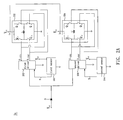
  • FIG. 2A is a circuit block diagram of a driving unit of the brushless DC motor according to a first embodiment of the present invention
  • FIG. 2B is a circuit block diagram of another driving unit of the brushless DC motor according to the first embodiment of the present invention.
  • FIG. 2C is an exploded and schematic illustrations of the brushless DC motor according to the first embodiment of the present invention.
  • FIG. 3A is a current-time diagram obtained by measuring the current at the point I of FIG. 1 ;
  • FIG. 3B is a current-time diagram obtained by measuring the current at the point Ia of FIG. 2A ;
  • FIG. 4 is a top view of a stator of a brushless DC motor according to a second embodiment of the present invention.
  • a brushless DC motor according to a first embodiment of the present invention includes a driving unit 2 a , a rotor 26 and a stator 28 .
  • the driving unit 2 a includes a power source Vcc, a first driver 202 , a first bridge circuit 222 , a first sensor 242 , a second driver 204 , a second bridge circuit 224 and a second sensor 244 .
  • the first driver 202 is electrically connected with the power source Vcc and the first bridge circuit 222 for outputting a first controlling signal A 1 and a second controlling signal A 2 to the first bridge circuit 222 .
  • the first controlling signal A 1 and the second controlling signal A 2 are pulse voltage signals, and the phase of the first controlling signal A 1 and the phase of the second controlling signal A 2 are opposite with each other.
  • the second driver 204 is electrically connected with the power source Vcc and the second bridge circuit 224 for outputting a third controlling signal A 3 and a fourth controlling signal A 4 to the second bridge circuit 224 .
  • the third controlling signal A 3 and the fourth controlling signal A 4 are pulse voltage signals, and the phase of the third controlling signal A 3 and the phase of the fourth controlling signal A 4 are opposite with each other.
  • a coil L of the first bridge circuit 222 is wound on the upper pole arms 281 (please refer to FIG. 2C ) of the stator 28
  • a coil L′ of the second bridge circuit 224 is wound on the lower pole arms 282 of the stator 28 , so as to generate the alternating magnetic field on the stator 28 cooperatively for driving the rotor 26 .
  • the first sensor 242 is electrically connected with the power source Vcc and the first driver 202 for sensing the magnetic poles 27 of the rotor 26 (i.e., the magnetic field of the rotor 26 when the rotor 26 rotates) and outputting a first sensing signal S 1 to the first driver 202 , so as to adjust the phase of the first controlling signal A 1 and the phase of the second controlling signal A 2 for adjusting the magnetic field on the stator 28 and the rotation rate of the rotor 26 .
  • the second sensor 244 is electrically connected with the power source Vcc and the second driver 204 for sensing the magnetic poles 27 of the rotor 26 (i.e., the magnetic field of the rotor 26 when the rotor 26 rotates) and outputting a second sensing signal S 2 to the second driver 204 , so as to adjust the phase of the third controlling signal A 3 and the phase of the fourth controlling signal A 4 for adjusting the magnetic field on the stator 28 and the rotation rate of the rotor 26 .
  • the first bridge circuit 222 and the second sensor 244 are full-bridge circuits in this embodiment, or the first bridge circuit 222 and the second sensor 244 can be half-bridge circuits in other embodiment.
  • a Hall direct driving circuit electrically connected with two coils(not shown) can be substituted for the driving unit 2 a . At least a driver, a bridge circuit and a sensor are built-in the Hall direct driving circuit.
  • a driving unit 2 b can be substituted for the driving unit 2 a .
  • the difference between the driving unit 2 a and the driving unit 2 b is that the first driver 202 and the second driver 204 in the driving unit 2 a are replaced by a microprocessor unit 206 in the driving unit 2 b .
  • the driving unit 2 b includes the power source Vcc, the first bridge circuit 222 , the second bridge circuit 224 , the first sensor 242 , the second sensor 244 and the microprocessor unit 206 .
  • the microprocessor unit 206 is electrically connected with the power source Vcc, the first bridge circuit 222 and the second bridge circuit 224 for outputting the first controlling signal A 1 and the second controlling signal A 2 to the first bridge circuit 222 and outputting the third controlling signal A 3 and the fourth controlling signal A 4 to the second bridge circuit 224 .
  • the first controlling signal A 1 , the second controlling signal A 2 , the third controlling signal A 3 and the fourth controlling signal A 4 are pulse voltage signals, and the phase of the first controlling signal A 1 and the phase of the second controlling signal A 2 are opposite with each other, and the phase of the third controlling signal A 3 and the phase of the fourth controlling signal A 4 are opposite with each other.
  • the coil L of the first bridge circuit 222 is wound on the upper pole arms 281 of the stator 28
  • the coil L′ of the second bridge circuit 224 is wound on the lower pole arms 282 of the stator 28 , so as to generate the alternating magnetic field on the stator 28 cooperatively for driving the rotor 26 .
  • the first sensor 242 is electrically connected with the power source Vcc and the microprocessor unit 206 for sensing the magnetic poles 27 of the rotor 26 (i.e., the magnetic field of the rotor 26 when the rotor 26 rotates) and outputting a first sensing signal S 1 to the microprocessor unit 206 , so as to adjust the phase of the first controlling signal A 1 and the phase of the second controlling signal A 2 for adjusting the magnetic field on the stator 28 and the rotation rate of the rotor 26 .
  • the second sensor 244 is electrically connected with the power source Vcc and the microprocessor unit 206 for sensing the magnetic poles 27 of the rotor 26 (i.e., the magnetic field of the rotor 26 when the rotor 26 rotates) and outputting a second sensing signal S 2 to the microprocessor unit 206 , so as to adjust the phase of the third controlling signal A 3 and the phase of the fourth controlling signal A 4 for adjusting the magnetic field on the stator 28 and the rotation rate of the rotor 26 .
  • the first bridge circuit 222 and the second sensor 244 of the driving unit 2 b are full-bridge circuits in this embodiment, or the first bridge circuit 222 and the second sensor 244 can be half-bridge circuits in other embodiment.
  • a motor portion 2 c of the brushless DC motor includes the rotor 26 , the stator 28 , a printed circuit board 283 and a base 284 .
  • the magnetic poles 27 (the poles of the magnetic poles 27 are N, S, N, S in this embodiment) is disposed inside the rotor 26 .
  • the stator 28 includes a plurality of upper pole arms 281 and a plurality of lower pole arms 282 (there are four upper pole arms 281 and four lower pole arms 282 in this embodiment).
  • the upper pole arms 281 are located above the lower pole arms 282 in FIG. 2C , but it is not limited thereto, the upper pole arms 281 can be located below the lower pole arms 282 in other embodiments.
  • a first gap 2811 is formed between each two adjacent upper pole arms 281
  • a second gap 2821 is formed between each two adjacent lower pole arms 282 .
  • the first gaps 2811 and the second gaps 2821 are alternately arranged.
  • the center of each upper pole arm 281 is corresponding to one of the second gaps 2821 respectively
  • the center of each lower pole arm 282 is corresponding to one of the first gaps 2811 respectively.
  • An angle is formed between an first imaginary line which connects the center of one of the first gaps 2811 and the center of the stator 28 and an second imaginary line which connects the center of one of the second gaps 2821 adjacent to the first imaginary line and the center of the stator 28 , and the angle is obeyed an equation of:
  • first gaps 2811 the number of the upper pole arms 281
  • second gaps 2821 the number of the lower pole arms 282
  • the stator 28 can further include a third set of pole arms(not shown) or more above.
  • the driving unit 2 a or the driving unit 2 b can further include a third coil, a third bridge circuit, a third sensor or elements more above electrically connected with the stator 28 for driving the rotor 26 .
  • the driving unit 2 a drives the rotor 26 , and the first driver 202 , the second driver 204 , the first sensor 242 and the second sensor 244 can be disposed on the printed circuit board 283 .
  • the driving unit 2 a includes at least two coils L and L′ wound on the upper pole arms 281 and the lower pole arms 282 respectively, and the driving unit 2 a generates an alternating magnetic field on the stator 28 for driving the rotor 26 .
  • FIG. 3A is a current-time diagram obtained by measuring the current at the point I of FIG. 1 , wherein the power source Vcc supplies power into the bridge circuit 12 of the conventional driving circuit. It is clear in FIG. 3A that the amplitude of vibration between the highest current and the lowest current are 400 milliamperes(400 mA), so that the amplitude of the current flowing through the coil L of FIG. 1 is quite wide, and this makes the electronic elements in the motor to be broken easily.
  • the waveform is intermittent and more circuitous, such as at the point T of the time axle, there is a short “dead time” which represents the current flowing through the coil L breaks off in a short period.
  • the Cogging Torque of the conventional motor driven by the conventional driving circuit is greater than the Cogging Torque of the brushless DC motor of the present invention.
  • FIG. 3B is a current-time diagram obtained by measuring the current at the point Ia of FIG. 2A wherein the power source Vcc supplies power into the bridge circuit 222 . It is shown in FIG. 3B that the amplitude of vibration between the highest current and the lowest current are only 200 milliamperes(200 mA), which is not too wide.
  • the waveform is more continuous, because the driving unit 2 a of the present invention includes two coils L and L′, and the “dead time” will not happen on the coil L and the coil L′ at the same time.
  • the first gaps 2811 and the second gaps 2821 of the stator 28 are alternately arranged, the Cogging Torque of the brushless DC motor of the present invention has been reduced obviously.
  • the brushless DC motor according to a second embodiment of the present invention also includes a rotor, a stator and a driving unit, wherein the rotor and the driving unit of the second embodiment are the same with the rotor 26 and the driving unit 2 a of the first embodiment.
  • the stator 48 of the second embodiment includes a plurality of pole arms 481 ⁇ 488 , and the pole arms 481 ⁇ 488 are located at the same level.
  • the two coils L and L′ of the driving unit 2 a are wound on the two adjacent pole arms of the stator 48 respectively.
  • the stator 48 includes a first pole arm 481 , a second pole arm 482 and a third pole arm 483 arranged orderly and located at the same level, and the coil L of the driving unit 2 a is wound on the first pole arm 481 and the second pole arm 482 , and another coil L′ of the driving unit 2 a is wound on the second pole arm 482 and the third pole arm 483 .
  • the coil L is wound on the first pole arm 481 and the second pole arm 482 firstly, and then be wound on the third pole arm 483 and the fourth pole arm 484 , and afterwards be wound on the fifth pole arm 485 and the sixth pole arm 486 , finally be wound on the seventh pole arm 487 and the eighth pole arm 488 ; and the coil L′ is wound on the eighth pole arm 488 and the first pole arm 481 firstly, and then be wound on the second pole arm 482 and the third pole arm 483 , and afterwards be wound on the fourth pole arm 484 and the fifth pole arm 485 , finally be wound on the sixth pole arm 486 and the seventh pole arm 487 .
  • the driving unit of the second embodiment also generates an alternating magnetic field on the stator 48 for driving the rotor.
  • the number of the pole arms of the stator 48 divided by the number of the coils equals the number of the magnetic poles of the rotor.
  • the number of the pole arms of the stator 48 is eight, and the number of the coils of the driving unit is two, so that the number of the magnetic poles of the rotor is four(which are poles of N, S, N, S).
  • the coil winding method in this embodiment winding the coil L and the coil L′ on the pole arms of the stator 48 respectively, this method also reduces the amplitude of vibration between the highest current and the lowest current supplied into the first bridge circuit 222 and the second bridge circuit 224 , so as to prevent the damage of the electronic elements in the motor caused by an excessive Peak Current. And the waveform is also more continuous during the switch of the flowing direction of the current in this embodiment.
  • the brushless DC motor of the present invention has at least two coils of a driving unit wound on a plurality of upper pole arms and lower pole arms of a stator for driving a rotor, or has at least two coils of a driving unit wound on two adjacent pole arms of the stator respectively for driving the rotor. So that the amplitude of the current supplied into the bridge circuit is low, and the pause time of the rotation of the rotor is practically negligible.
  • the driving unit of the brushless DC motor of the present invention includes two bridge circuits and two sensors, so that each bridge circuit and sensor can keep the operation of the driving unit separately even when the other bridge circuit and sensor are broken, i.e., the stability of the operation of the brushless DC motor is high. When the brushless DC motor of the present invention is applied to a fan, the stability of the operation of the fan is undoubtedly high.

Landscapes

  • Engineering & Computer Science (AREA)
  • Power Engineering (AREA)
  • Brushless Motors (AREA)
  • Control Of Motors That Do Not Use Commutators (AREA)

Abstract

A brushless direct current (DC) motor includes a rotor, a stator and a driving unit. The rotor includes a plurality of magnetic poles. The stator includes a plurality of upper pole arms and a plurality of lower pole arms. The driving unit includes at least two coils wound on the upper pole arms and the lower pole arms respectively, and the driving unit generates an alternating magnetic field on the stator for driving the rotor.

Description

CROSS REFERENCE TO RELATED APPLICATIONS
This Non-provisional application claims priority under 35 U.S.C. §119(a) on Patent Application No(s). 097151168, filed in Taiwan, Republic of China on Dec. 29, 2008, the entire contents of which are hereby incorporated by reference.
BACKGROUND OF THE INVENTION
1. Field of Invention
The present invention relates to a brushless direct current (DC) motor and driving unit thereof, and in particular to a brushless DC motor and driving unit thereof including a stator which has a plurality of alternately arranged upper pole arms and lower pole arms.
2. Related Art
Please refer to FIG. 1, which shows a conventional driving circuit of a motor. A driver 10 is electrically connected with a main power Vcc. A bridge circuit 12 includes four switches Q1˜Q4 and a coil L, and the bridge circuit 12 is electrically connected with the driver 10 and a main power source Vcc. The driver 10 receives the required voltage from the main power source Vcc and outputs the controlling signal C1 and the controlling signal C2 to the bridge circuit 12 for switching on and switching off the witches Q1˜Q4.
The conventional motor is mainly composed of a rotor, a magnet ring disposed in the rotor, a stator and a printed circuit board. The stator includes a plurality of salient poles located at the same level, and the driver 10 and a sensor 14 are disposed on the printed circuit board.
The coil L of the bridge circuit 12 is wound on the stator. When the motor operates, the driver 10 outputs the controlling signal C1 and the controlling signal C2 to the bridge circuit 12 for switching on and switching off the witches Q1˜Q4. While the switch Q1 and the switch Q4 of the bridge circuit 12 are turned on and the switch Q2 and the switch Q3 of the bridge circuit 12 are turned off, the electric current flows through the switch Q1, the coil L and the switch Q4. On the other hand, while the switch Q2 and the switch Q3 of the bridge circuit 12 are turned on and the switch Q1 and the switch Q4 of the bridge circuit 12 are turned off, the electric current flows through the switch Q2, the coil L and the switch Q3. The rotor is driven by the electromagnetic field on the stator when the electric current flows through the coil L. The sensor 14 senses the magnetic field of the magnet ring of the rotor and outputs a sensing signal Ssense to the driver 10 for adjusting the time that the electric current flowing through the coil L, so as to make a stable electromagnetic field on the stator.
However, the conventional motor has greater Cogging Torque, and there is a short “dead time” during the switch of the flowing direction of the electric current, so that the amplitude of vibration between the highest current and the lowest current is too wide, and the electronic elements in the motor are broken by an excessive Peak Current easily. If the conventional motor is applied to a fan, the multiple-frequency vibration of the motor will be apparent on the fan. In addition, there are only one driving circuit, one single coil L and one set of salient poles in the stator of the conventional motor, if anyone of the electronic elements mentioned above is broken, there will be no electromagnetic field on the stator and the rotor will stop rotating.
SUMMARY OF THE INVENTION
The present invention is to provide a brushless direct current (DC) motor which includes at least a spare driving unit and has low multiple-frequency vibration and low amplitude of vibration between the highest current and the lowest current.
To achieve the above, the present invention discloses a brushless direct current (DC) motor. The brushless direct current motor includes a rotor, a stator and a driving unit. The rotor includes a plurality of magnetic poles. The stator includes a plurality of upper pole arms and a plurality of lower pole arms. The driving unit includes at least two coils wound on the upper pole arms and the lower pole arms respectively, and the driving unit generates an alternating magnetic field on the stator for driving the rotor.
To achieve the above, the present invention also discloses a brushless DC motor. The brushless DC motor includes a rotor, a stator and a driving unit. The rotor includes a plurality of magnetic poles. The stator includes a plurality of pole arms located at the same level. The driving unit includes at least two coils wound on the two adjacent pole arms of the stator respectively, and the driving unit generates an alternating magnetic field on the stator for driving the rotor.
The brushless DC motor of the present invention has at least two coils of a driving unit wound on a plurality of upper pole arms and lower pole arms of a stator for driving a rotor, or has at least two coils of a driving unit wound on two adjacent pole arms of the stator respectively for driving the rotor. As the results, the amplitude of the current supplied into the bridge circuit is low, and the pause time of the rotation of the rotor is practically negligible. Moreover, the driving unit of the brushless DC motor of the present invention includes two bridge circuits and two sensors, so that each bridge circuit and sensor can keep the operation of the driving unit separately even when the other bridge circuit and sensor are broken. Therefore, the stability of the operation of the brushless DC motor is high.
BRIEF DESCRIPTION OF THE DRAWINGS
The present invention will be fully understood from the subsequent detailed description and accompanying drawings, which are given by way of illustration only, and thus are not limitative of the present invention, and wherein:
FIG. 1 is a circuit block diagram of a conventional driving circuit of a motor;
FIG. 2A is a circuit block diagram of a driving unit of the brushless DC motor according to a first embodiment of the present invention;
FIG. 2B is a circuit block diagram of another driving unit of the brushless DC motor according to the first embodiment of the present invention;
FIG. 2C is an exploded and schematic illustrations of the brushless DC motor according to the first embodiment of the present invention;
FIG. 3A is a current-time diagram obtained by measuring the current at the point I of FIG. 1;
FIG. 3B is a current-time diagram obtained by measuring the current at the point Ia of FIG. 2A; and
FIG. 4 is a top view of a stator of a brushless DC motor according to a second embodiment of the present invention.
DETAILED DESCRIPTION OF THE INVENTION
The preferred embodiments of a brushless direct current (DC) motor and driving unit thereof of the present invention will be apparent from the following detailed description, which proceeds with reference to the accompanying drawings, wherein the same references relate to the same elements.
Please refer to FIG. 2A and FIG. 2C, a brushless DC motor according to a first embodiment of the present invention includes a driving unit 2 a, a rotor 26 and a stator 28. The driving unit 2 a includes a power source Vcc, a first driver 202, a first bridge circuit 222, a first sensor 242, a second driver 204, a second bridge circuit 224 and a second sensor 244.
The first driver 202 is electrically connected with the power source Vcc and the first bridge circuit 222 for outputting a first controlling signal A1 and a second controlling signal A2 to the first bridge circuit 222. The first controlling signal A1 and the second controlling signal A2 are pulse voltage signals, and the phase of the first controlling signal A1 and the phase of the second controlling signal A2 are opposite with each other. The second driver 204 is electrically connected with the power source Vcc and the second bridge circuit 224 for outputting a third controlling signal A3 and a fourth controlling signal A4 to the second bridge circuit 224. The third controlling signal A3 and the fourth controlling signal A4 are pulse voltage signals, and the phase of the third controlling signal A3 and the phase of the fourth controlling signal A4 are opposite with each other.
A coil L of the first bridge circuit 222 is wound on the upper pole arms 281 (please refer to FIG. 2C) of the stator 28, and a coil L′ of the second bridge circuit 224 is wound on the lower pole arms 282 of the stator 28, so as to generate the alternating magnetic field on the stator 28 cooperatively for driving the rotor 26. The first sensor 242 is electrically connected with the power source Vcc and the first driver 202 for sensing the magnetic poles 27 of the rotor 26(i.e., the magnetic field of the rotor 26 when the rotor 26 rotates) and outputting a first sensing signal S1 to the first driver 202, so as to adjust the phase of the first controlling signal A1 and the phase of the second controlling signal A2 for adjusting the magnetic field on the stator 28 and the rotation rate of the rotor 26.
The second sensor 244 is electrically connected with the power source Vcc and the second driver 204 for sensing the magnetic poles 27 of the rotor 26(i.e., the magnetic field of the rotor 26 when the rotor 26 rotates) and outputting a second sensing signal S2 to the second driver 204, so as to adjust the phase of the third controlling signal A3 and the phase of the fourth controlling signal A4 for adjusting the magnetic field on the stator 28 and the rotation rate of the rotor 26. The first bridge circuit 222 and the second sensor 244 are full-bridge circuits in this embodiment, or the first bridge circuit 222 and the second sensor 244 can be half-bridge circuits in other embodiment. In addition, a Hall direct driving circuit electrically connected with two coils(not shown) can be substituted for the driving unit 2 a. At least a driver, a bridge circuit and a sensor are built-in the Hall direct driving circuit.
Or, please refer to FIG. 2B and FIG. 2C, a driving unit 2 b can be substituted for the driving unit 2 a. The difference between the driving unit 2 a and the driving unit 2 b is that the first driver 202 and the second driver 204 in the driving unit 2 a are replaced by a microprocessor unit 206 in the driving unit 2 b. The driving unit 2 b includes the power source Vcc, the first bridge circuit 222, the second bridge circuit 224, the first sensor 242, the second sensor 244 and the microprocessor unit 206. The microprocessor unit 206 is electrically connected with the power source Vcc, the first bridge circuit 222 and the second bridge circuit 224 for outputting the first controlling signal A1 and the second controlling signal A2 to the first bridge circuit 222 and outputting the third controlling signal A3 and the fourth controlling signal A4 to the second bridge circuit 224. The first controlling signal A1, the second controlling signal A2, the third controlling signal A3 and the fourth controlling signal A4 are pulse voltage signals, and the phase of the first controlling signal A1 and the phase of the second controlling signal A2 are opposite with each other, and the phase of the third controlling signal A3 and the phase of the fourth controlling signal A4 are opposite with each other.
The coil L of the first bridge circuit 222 is wound on the upper pole arms 281 of the stator 28, and the coil L′ of the second bridge circuit 224 is wound on the lower pole arms 282 of the stator 28, so as to generate the alternating magnetic field on the stator 28 cooperatively for driving the rotor 26. The first sensor 242 is electrically connected with the power source Vcc and the microprocessor unit 206 for sensing the magnetic poles 27 of the rotor 26(i.e., the magnetic field of the rotor 26 when the rotor 26 rotates) and outputting a first sensing signal S1 to the microprocessor unit 206, so as to adjust the phase of the first controlling signal A1 and the phase of the second controlling signal A2 for adjusting the magnetic field on the stator 28 and the rotation rate of the rotor 26.
The second sensor 244 is electrically connected with the power source Vcc and the microprocessor unit 206 for sensing the magnetic poles 27 of the rotor 26(i.e., the magnetic field of the rotor 26 when the rotor 26 rotates) and outputting a second sensing signal S2 to the microprocessor unit 206, so as to adjust the phase of the third controlling signal A3 and the phase of the fourth controlling signal A4 for adjusting the magnetic field on the stator 28 and the rotation rate of the rotor 26. The first bridge circuit 222 and the second sensor 244 of the driving unit 2 b are full-bridge circuits in this embodiment, or the first bridge circuit 222 and the second sensor 244 can be half-bridge circuits in other embodiment.
Please refer to FIG. 2C, a motor portion 2 c of the brushless DC motor includes the rotor 26, the stator 28, a printed circuit board 283 and a base 284. The magnetic poles 27(the poles of the magnetic poles 27 are N, S, N, S in this embodiment) is disposed inside the rotor 26. The stator 28 includes a plurality of upper pole arms 281 and a plurality of lower pole arms 282(there are four upper pole arms 281 and four lower pole arms 282 in this embodiment). The upper pole arms 281 are located above the lower pole arms 282 in FIG. 2C, but it is not limited thereto, the upper pole arms 281 can be located below the lower pole arms 282 in other embodiments. A first gap 2811 is formed between each two adjacent upper pole arms 281, and a second gap 2821 is formed between each two adjacent lower pole arms 282. The first gaps 2811 and the second gaps 2821 are alternately arranged. And the center of each upper pole arm 281 is corresponding to one of the second gaps 2821 respectively, and the center of each lower pole arm 282 is corresponding to one of the first gaps 2811 respectively. An angle is formed between an first imaginary line which connects the center of one of the first gaps 2811 and the center of the stator 28 and an second imaginary line which connects the center of one of the second gaps 2821 adjacent to the first imaginary line and the center of the stator 28, and the angle is obeyed an equation of:
360 ° ( a circumferenc ) the number of the upper pole arms + the number of the lower pole arms .
In this embodiment, there are four first gaps 2811 (the number of the upper pole arms 281) and four second gaps 2821 (the number of the lower pole arms 282), so that the angle is 45 degrees.
Besides, if the upper pole arms 281 and the lower pole arms 282 are regarded as a first set of pole arms and a second set of pole arms respectively, the stator 28 can further include a third set of pole arms(not shown) or more above. The driving unit 2 a or the driving unit 2 b can further include a third coil, a third bridge circuit, a third sensor or elements more above electrically connected with the stator 28 for driving the rotor 26.
Please refer to FIG. 2A and FIG. 2C again. The driving unit 2 a drives the rotor 26, and the first driver 202, the second driver 204, the first sensor 242 and the second sensor 244 can be disposed on the printed circuit board 283. The driving unit 2 a includes at least two coils L and L′ wound on the upper pole arms 281 and the lower pole arms 282 respectively, and the driving unit 2 a generates an alternating magnetic field on the stator 28 for driving the rotor 26.
Please compare FIG. 3A with FIG. 3B. FIG. 3A is a current-time diagram obtained by measuring the current at the point I of FIG. 1, wherein the power source Vcc supplies power into the bridge circuit 12 of the conventional driving circuit. It is clear in FIG. 3A that the amplitude of vibration between the highest current and the lowest current are 400 milliamperes(400 mA), so that the amplitude of the current flowing through the coil L of FIG. 1 is quite wide, and this makes the electronic elements in the motor to be broken easily. Moreover, during the switch of the flowing direction of the current, the waveform is intermittent and more circuitous, such as at the point T of the time axle, there is a short “dead time” which represents the current flowing through the coil L breaks off in a short period. Furthermore, the Cogging Torque of the conventional motor driven by the conventional driving circuit is greater than the Cogging Torque of the brushless DC motor of the present invention.
FIG. 3B is a current-time diagram obtained by measuring the current at the point Ia of FIG. 2A wherein the power source Vcc supplies power into the bridge circuit 222. It is shown in FIG. 3B that the amplitude of vibration between the highest current and the lowest current are only 200 milliamperes(200 mA), which is not too wide. During the switch of the flowing direction of the current, the waveform is more continuous, because the driving unit 2 a of the present invention includes two coils L and L′, and the “dead time” will not happen on the coil L and the coil L′ at the same time. Furthermore, because the first gaps 2811 and the second gaps 2821 of the stator 28 are alternately arranged, the Cogging Torque of the brushless DC motor of the present invention has been reduced obviously.
Please refer to FIG. 2A and FIG. 4, similarly, the brushless DC motor according to a second embodiment of the present invention also includes a rotor, a stator and a driving unit, wherein the rotor and the driving unit of the second embodiment are the same with the rotor 26 and the driving unit 2 a of the first embodiment. The difference between the first embodiment and the second embodiment is that the stator 48 of the second embodiment includes a plurality of pole arms 481˜488, and the pole arms 481˜488 are located at the same level. The two coils L and L′ of the driving unit 2 a are wound on the two adjacent pole arms of the stator 48 respectively. For example, the stator 48 includes a first pole arm 481, a second pole arm 482 and a third pole arm 483 arranged orderly and located at the same level, and the coil L of the driving unit 2 a is wound on the first pole arm 481 and the second pole arm 482, and another coil L′ of the driving unit 2 a is wound on the second pole arm 482 and the third pole arm 483. Or, go into details, the coil L is wound on the first pole arm 481 and the second pole arm 482 firstly, and then be wound on the third pole arm 483 and the fourth pole arm 484, and afterwards be wound on the fifth pole arm 485 and the sixth pole arm 486, finally be wound on the seventh pole arm 487 and the eighth pole arm 488; and the coil L′ is wound on the eighth pole arm 488 and the first pole arm 481 firstly, and then be wound on the second pole arm 482 and the third pole arm 483, and afterwards be wound on the fourth pole arm 484 and the fifth pole arm 485, finally be wound on the sixth pole arm 486 and the seventh pole arm 487. The driving unit of the second embodiment also generates an alternating magnetic field on the stator 48 for driving the rotor. In this embodiment, the number of the pole arms of the stator 48 divided by the number of the coils equals the number of the magnetic poles of the rotor. Please refer to FIG. 4, the number of the pole arms of the stator 48 is eight, and the number of the coils of the driving unit is two, so that the number of the magnetic poles of the rotor is four(which are poles of N, S, N, S).
The coil winding method in this embodiment winding the coil L and the coil L′ on the pole arms of the stator 48 respectively, this method also reduces the amplitude of vibration between the highest current and the lowest current supplied into the first bridge circuit 222 and the second bridge circuit 224, so as to prevent the damage of the electronic elements in the motor caused by an excessive Peak Current. And the waveform is also more continuous during the switch of the flowing direction of the current in this embodiment.
In summary, the brushless DC motor of the present invention has at least two coils of a driving unit wound on a plurality of upper pole arms and lower pole arms of a stator for driving a rotor, or has at least two coils of a driving unit wound on two adjacent pole arms of the stator respectively for driving the rotor. So that the amplitude of the current supplied into the bridge circuit is low, and the pause time of the rotation of the rotor is practically negligible. Moreover, the driving unit of the brushless DC motor of the present invention includes two bridge circuits and two sensors, so that each bridge circuit and sensor can keep the operation of the driving unit separately even when the other bridge circuit and sensor are broken, i.e., the stability of the operation of the brushless DC motor is high. When the brushless DC motor of the present invention is applied to a fan, the stability of the operation of the fan is undoubtedly high.
Although the present invention has been described with reference to specific embodiments, this description is not meant to be construed in a limiting sense. Various modifications of the disclosed embodiments, as well as alternative embodiments, will be apparent to persons skilled in the art. It is, therefore, contemplated that the appended claims will cover all modifications that fall within the true scope of the present invention.

Claims (14)

What is claimed is:
1. A brushless direct current (DC) motor, comprising:
a rotor, the rotor comprising a plurality of magnetic poles;
a stator, comprising a plurality of upper pole arms and a plurality of lower pole arms; and
a driving unit, comprising at least two individual coils and at least two individual drivers for individually driving the rotor, wherein the at least two individual coils separate from each other are wound on the upper pole arms and the lower pole arms respectively, the at least two individual drivers are coupled to the at least two individual coils respectively, and the driving unit generates an alternating magnetic field on the stator for driving the rotor to rotate.
2. The brushless DC motor according to claim 1, wherein the brushless DC motor is applied to a fan, and a plurality of blades are disposed around the rotor.
3. The brushless DC motor according to claim 1, wherein a first gap is formed between each two adjacent upper pole arms of the stator, a second gap is formed between each two adjacent lower pole arms of the stator, and the first gaps and the second gaps are alternately arranged.
4. The brushless DC motor according to claim 3, wherein a center of each upper pole arm of the stator is corresponding to one of the second gaps respectively, and a center of each lower pole arm of the stator is corresponding to one of the first gaps respectively.
5. The brushless DC motor according to claim 3, wherein an angle is formed between an first imaginary line which connects a center of one of the first gaps and a center of the stator and an second imaginary line which connects a center of one of the second gaps adjacent to the first imaginary line and the center of the stator, and the angle is obeyed an equation of:
360 ° ( a circumferenc ) the number of the upper pole arms + the number of the lower pole arms .
6. The brushless DC motor according to claim 1, wherein the driving unit further comprises:
a power source;
a first bridge circuit, comprising one of the coils, wherein the at least two individual drivers has a first driver electrically connected with the power source and the first bridge circuit for outputting a first controlling signal and a second controlling signal to the first bridge circuit, wherein the phase of the first controlling signal and the phase of the second controlling signal are opposite with each other; and
a second bridge circuit, comprising another one of the coils, wherein the at least two individual drivers has a second driver electrically connected with the power source and the second bridge circuit for outputting a third controlling signal and a fourth controlling signal to the second bridge circuit, wherein the phase of the third controlling signal and the phase of the fourth controlling signal are opposite with each other;
wherein the coil of the first bridge circuit is wound on the upper pole arms of the stator, and the coil of the second bridge circuit is wound on the lower pole arms of the stator, so as to generate the alternating magnetic field on the stator cooperatively for driving the rotor.
7. The brushless DC motor according to claim 6, wherein the first bridge circuit and the second bridge circuit are full-bridge circuits or half-bridge circuits.
8. The brushless DC motor according to claim 6, wherein the driving unit further comprises:
a first sensor electrically connected with the first driver for sensing the magnetic poles of the rotor and outputting a first sensing signal to the first driver, so as to adjust the phase of the first controlling signal and the phase of the second controlling signal for adjusting the magnetic field on the stator and the rotation rate of the rotor; and
a second sensor electrically connected with the second driver for sensing the magnetic poles of the rotor and outputting a second sensing signal to the second driver, so as to adjust the phase of the third controlling signal and the phase of the fourth controlling signal for adjusting the magnetic field on the stator and the rotation rate of the rotor.
9. The brushless DC motor according to claim 1, wherein the driving unit further comprises:
a power source;
a first bridge circuit, comprising one of the coils;
a second bridge circuit, comprising another one of the coils; and
a microprocessor unit electrically connected with the power source, the first bridge circuit and the second bridge circuit for outputting a first controlling signal and a second controlling signal to the first bridge circuit and outputting a third controlling signal and a fourth controlling signal to the second bridge circuit, wherein the phase of the first controlling signal and the phase of the second controlling signal are opposite with each other, and the phase of the third controlling signal and the phase of the fourth controlling signal are opposite with each other.
10. The brushless DC motor according to claim 9, wherein the first bridge circuit and the second bridge circuit are full-bridge circuits or half-bridge circuits.
11. The brushless DC motor according to claim 9, wherein the driving unit further comprises:
a first sensor electrically connected with the microprocessor unit for sensing the magnetic poles of the rotor and outputting a first sensing signal to the first driver, so as to adjust the phase of the first controlling signal and the phase of the second controlling signal for adjusting the magnetic field on the stator and the rotation rate of the rotor; and
a second sensor electrically connected with the microprocessor unit for sensing the magnetic poles of the rotor and outputting a second sensing signal to the second driver, so as to adjust the phase of the third controlling signal and the phase of the fourth controlling signal for adjusting the magnetic field on the stator and the rotation rate of the rotor.
12. A driving unit applied to a brushless DC motor, the brushless DC motor comprises a rotor and a stator, the rotor includes a plurality of magnetic poles, the stator comprises a plurality of upper pole arms and a plurality of lower pole arms, the driving unit comprises at least two individual coils and at least two individual drivers for individually driving the rotor, wherein the at least two individual coils separate from each other are wound on the upper pole arms and the lower pole arms respectively, the at least two individual drivers are coupled to the at least two individual coils respectively, and the driving unit generates an alternating magnetic field on the stator for driving the rotor.
13. The driving unit according to claim 12, further comprising:
a power source;
a first bridge circuit, comprising one of the coils, wherein the at least two individual drivers has a first driver electrically connected with the power source and the first bridge circuit for outputting a first controlling signal and a second controlling signal to the first bridge circuit, wherein the phase of the first controlling signal and the phase of the second controlling signal are opposite with each other; and
a second bridge circuit, comprising another one of the coils, wherein the at least two individual drivers has a second driver electrically connected with the power source and the second bridge circuit for outputting a third controlling signal and a fourth controlling signal to the second bridge circuit, wherein the phase of the third controlling signal and the phase of the fourth controlling signal are opposite with each other;
wherein the coil of the first bridge circuit is wound on the upper pole arms of the stator, and the coil of the second bridge circuit is wound on the lower pole arms of the stator, so as to generate the alternating magnetic field on the stator cooperatively for driving the rotor.
14. The driving unit according to claim 12, further comprising:
a power source;
a first bridge circuit, comprising one of the coils;
a second bridge circuit, comprising another one of the coils; and
a microprocessor unit electrically connected with the power source, the first bridge circuit and the second bridge circuit for outputting a first controlling signal and a second controlling signal to the first bridge circuit and outputting a third controlling signal and a fourth controlling signal to the second bridge circuit, wherein the phase of the first controlling signal and the phase of the second controlling signal are opposite with each other, and the phase of the third controlling signal and the phase of the fourth controlling signal are opposite with each other.
US12/397,867 2008-12-29 2009-03-04 Brushless direct current motor and driving unit thereof Active 2031-01-14 US8629639B2 (en)

Applications Claiming Priority (3)

Application Number Priority Date Filing Date Title
TW97151168A 2008-12-29
TW097151168 2008-12-29
TW097151168A TWI389426B (en) 2008-12-29 2008-12-29 Brushless dc motor and drive unit thereof

Publications (2)

Publication Number Publication Date
US20100164420A1 US20100164420A1 (en) 2010-07-01
US8629639B2 true US8629639B2 (en) 2014-01-14

Family

ID=42284024

Family Applications (1)

Application Number Title Priority Date Filing Date
US12/397,867 Active 2031-01-14 US8629639B2 (en) 2008-12-29 2009-03-04 Brushless direct current motor and driving unit thereof

Country Status (2)

Country Link
US (1) US8629639B2 (en)
TW (1) TWI389426B (en)

Cited By (1)

* Cited by examiner, † Cited by third party
Publication number Priority date Publication date Assignee Title
US20130285584A1 (en) * 2012-04-27 2013-10-31 Samsung Electro-Mechanics Co., Ltd. Motor driving apparatus and method

Families Citing this family (8)

* Cited by examiner, † Cited by third party
Publication number Priority date Publication date Assignee Title
JP5648469B2 (en) * 2010-12-23 2015-01-07 日立工機株式会社 Electric tool
TWI458253B (en) * 2011-05-10 2014-10-21 Delta Electronics Inc Ac motor
TWI449303B (en) * 2011-10-25 2014-08-11 Univ Nat Sun Yat Sen Electric power generating apparatus
TWI451671B (en) * 2012-01-31 2014-09-01 Sunonwealth Electr Mach Ind Co Motor with power generating coils
TWI556569B (en) * 2014-09-25 2016-11-01 Dyna Rechi Co Ltd Brushless DC Motor Speed ​​Control System
TWI587609B (en) * 2014-09-25 2017-06-11 Dyna Rechi Co Ltd Brushless DC motor
CN105449962A (en) * 2014-09-29 2016-03-30 瑞展动能股份有限公司 Brushless DC Motor
DE102021201617A1 (en) * 2021-02-19 2022-08-25 Robert Bosch Gesellschaft mit beschränkter Haftung Electric motor for selective operation with at least two different supply voltages and switching device for the electric motor

Citations (3)

* Cited by examiner, † Cited by third party
Publication number Priority date Publication date Assignee Title
US6498451B1 (en) * 2000-09-06 2002-12-24 Delphi Technologies, Inc. Torque ripple free electric power steering
US6624541B2 (en) * 2001-05-29 2003-09-23 Sunonwealth Electric Machine Industry Co., Ltd. Stator with a radial winding and method for manufacturing same
US6856054B2 (en) * 2001-09-25 2005-02-15 Matsushita Electric Industrial Co., Ltd Brushless DC motor, pump, and electronic apparatus

Patent Citations (3)

* Cited by examiner, † Cited by third party
Publication number Priority date Publication date Assignee Title
US6498451B1 (en) * 2000-09-06 2002-12-24 Delphi Technologies, Inc. Torque ripple free electric power steering
US6624541B2 (en) * 2001-05-29 2003-09-23 Sunonwealth Electric Machine Industry Co., Ltd. Stator with a radial winding and method for manufacturing same
US6856054B2 (en) * 2001-09-25 2005-02-15 Matsushita Electric Industrial Co., Ltd Brushless DC motor, pump, and electronic apparatus

Cited By (1)

* Cited by examiner, † Cited by third party
Publication number Priority date Publication date Assignee Title
US20130285584A1 (en) * 2012-04-27 2013-10-31 Samsung Electro-Mechanics Co., Ltd. Motor driving apparatus and method

Also Published As

Publication number Publication date
TWI389426B (en) 2013-03-11
TW201025798A (en) 2010-07-01
US20100164420A1 (en) 2010-07-01

Similar Documents

Publication Publication Date Title
US8629639B2 (en) Brushless direct current motor and driving unit thereof
CN100350726C (en) Three-phase ring coil type permanent magnet rotary motor
US9059659B2 (en) Method and system for measuring a characteristic of an electric motor
US8350503B2 (en) Brushless motor device
JP5848070B2 (en) Brushless motor control device and brushless motor
US20060055265A1 (en) Printed circuit board motor
US20080074068A1 (en) Brushless motor
US9785117B2 (en) Motor drive device and electronic timepiece
CN1515067A (en) Method and device for driving brushless DC motor
US7342367B2 (en) Motor drive circuit, motor system, and motor drive method
US20060056823A1 (en) Fan speed control circuit
US7304446B2 (en) Sensorless and brushless DC motor
US10520897B2 (en) Analog timepiece and control method of analog timepiece
US7940022B2 (en) Motor controlling device and method thereof
US8283885B2 (en) Driver circuit
US20090236922A1 (en) High-efficiency, variable-speed permanent magnet motor and control system
US8125174B2 (en) Motor driven electronic apparatus
US6969962B2 (en) DC motor drive circuit
EP3832879B1 (en) Control of a single coil bldc motor
US7154239B1 (en) Controller for a brushless direct current motor
CN101771319A (en) Brushless DC motor and drive unit thereof
KR20160050763A (en) Motor drive device of single-phase and three-phase
JP2002101683A (en) Phase angle control method of brushless dc motor
JP2006081283A (en) Brushless motor and drive circuit therefor
US20100181950A1 (en) Fan and controlling device thereof

Legal Events

Date Code Title Description
AS Assignment

Owner name: DELTA ELECTRONICS, INC.,TAIWAN

Free format text: ASSIGNMENT OF ASSIGNORS INTEREST;ASSIGNORS:WU, YEN-HUNG;HSIEH, TSUNG-JUNG;HUANG, YUEH-LUNG;REEL/FRAME:022345/0942

Effective date: 20090220

Owner name: DELTA ELECTRONICS, INC., TAIWAN

Free format text: ASSIGNMENT OF ASSIGNORS INTEREST;ASSIGNORS:WU, YEN-HUNG;HSIEH, TSUNG-JUNG;HUANG, YUEH-LUNG;REEL/FRAME:022345/0942

Effective date: 20090220

STCF Information on status: patent grant

Free format text: PATENTED CASE

FPAY Fee payment

Year of fee payment: 4

MAFP Maintenance fee payment

Free format text: PAYMENT OF MAINTENANCE FEE, 8TH YEAR, LARGE ENTITY (ORIGINAL EVENT CODE: M1552); ENTITY STATUS OF PATENT OWNER: LARGE ENTITY

Year of fee payment: 8

MAFP Maintenance fee payment

Free format text: PAYMENT OF MAINTENANCE FEE, 12TH YEAR, LARGE ENTITY (ORIGINAL EVENT CODE: M1553); ENTITY STATUS OF PATENT OWNER: LARGE ENTITY

Year of fee payment: 12