US8619287B2 - System and method for information gathering utilizing form identifiers - Google Patents
System and method for information gathering utilizing form identifiers Download PDFInfo
- Publication number
- US8619287B2 US8619287B2 US12/542,343 US54234309A US8619287B2 US 8619287 B2 US8619287 B2 US 8619287B2 US 54234309 A US54234309 A US 54234309A US 8619287 B2 US8619287 B2 US 8619287B2
- Authority
- US
- United States
- Prior art keywords
- user
- document
- electronic
- text
- identifier
- Prior art date
- Legal status (The legal status is an assumption and is not a legal conclusion. Google has not performed a legal analysis and makes no representation as to the accuracy of the status listed.)
- Expired - Fee Related, expires
Links
Images






Classifications
-
- G—PHYSICS
- G06—COMPUTING OR CALCULATING; COUNTING
- G06Q—INFORMATION AND COMMUNICATION TECHNOLOGY [ICT] SPECIALLY ADAPTED FOR ADMINISTRATIVE, COMMERCIAL, FINANCIAL, MANAGERIAL OR SUPERVISORY PURPOSES; SYSTEMS OR METHODS SPECIALLY ADAPTED FOR ADMINISTRATIVE, COMMERCIAL, FINANCIAL, MANAGERIAL OR SUPERVISORY PURPOSES, NOT OTHERWISE PROVIDED FOR
- G06Q30/00—Commerce
- G06Q30/06—Buying, selling or leasing transactions
- G06Q30/0601—Electronic shopping [e-shopping]
- G06Q30/0633—Managing shopping lists, e.g. compiling or processing purchase lists
-
- G—PHYSICS
- G06—COMPUTING OR CALCULATING; COUNTING
- G06F—ELECTRIC DIGITAL DATA PROCESSING
- G06F40/00—Handling natural language data
- G06F40/10—Text processing
- G06F40/166—Editing, e.g. inserting or deleting
- G06F40/174—Form filling; Merging
-
- G—PHYSICS
- G06—COMPUTING OR CALCULATING; COUNTING
- G06Q—INFORMATION AND COMMUNICATION TECHNOLOGY [ICT] SPECIALLY ADAPTED FOR ADMINISTRATIVE, COMMERCIAL, FINANCIAL, MANAGERIAL OR SUPERVISORY PURPOSES; SYSTEMS OR METHODS SPECIALLY ADAPTED FOR ADMINISTRATIVE, COMMERCIAL, FINANCIAL, MANAGERIAL OR SUPERVISORY PURPOSES, NOT OTHERWISE PROVIDED FOR
- G06Q10/00—Administration; Management
- G06Q10/10—Office automation; Time management
-
- G—PHYSICS
- G06—COMPUTING OR CALCULATING; COUNTING
- G06Q—INFORMATION AND COMMUNICATION TECHNOLOGY [ICT] SPECIALLY ADAPTED FOR ADMINISTRATIVE, COMMERCIAL, FINANCIAL, MANAGERIAL OR SUPERVISORY PURPOSES; SYSTEMS OR METHODS SPECIALLY ADAPTED FOR ADMINISTRATIVE, COMMERCIAL, FINANCIAL, MANAGERIAL OR SUPERVISORY PURPOSES, NOT OTHERWISE PROVIDED FOR
- G06Q30/00—Commerce
- G06Q30/06—Buying, selling or leasing transactions
- G06Q30/0601—Electronic shopping [e-shopping]
- G06Q30/0603—Catalogue creation or management
-
- G—PHYSICS
- G06—COMPUTING OR CALCULATING; COUNTING
- G06Q—INFORMATION AND COMMUNICATION TECHNOLOGY [ICT] SPECIALLY ADAPTED FOR ADMINISTRATIVE, COMMERCIAL, FINANCIAL, MANAGERIAL OR SUPERVISORY PURPOSES; SYSTEMS OR METHODS SPECIALLY ADAPTED FOR ADMINISTRATIVE, COMMERCIAL, FINANCIAL, MANAGERIAL OR SUPERVISORY PURPOSES, NOT OTHERWISE PROVIDED FOR
- G06Q30/00—Commerce
- G06Q30/06—Buying, selling or leasing transactions
- G06Q30/0601—Electronic shopping [e-shopping]
- G06Q30/0633—Managing shopping lists, e.g. compiling or processing purchase lists
- G06Q30/0635—Managing shopping lists, e.g. compiling or processing purchase lists replenishment orders; recurring orders
-
- G—PHYSICS
- G06—COMPUTING OR CALCULATING; COUNTING
- G06Q—INFORMATION AND COMMUNICATION TECHNOLOGY [ICT] SPECIALLY ADAPTED FOR ADMINISTRATIVE, COMMERCIAL, FINANCIAL, MANAGERIAL OR SUPERVISORY PURPOSES; SYSTEMS OR METHODS SPECIALLY ADAPTED FOR ADMINISTRATIVE, COMMERCIAL, FINANCIAL, MANAGERIAL OR SUPERVISORY PURPOSES, NOT OTHERWISE PROVIDED FOR
- G06Q30/00—Commerce
- G06Q30/06—Buying, selling or leasing transactions
- G06Q30/0601—Electronic shopping [e-shopping]
- G06Q30/0641—Electronic shopping [e-shopping] utilising user interfaces specially adapted for shopping
-
- G—PHYSICS
- G06—COMPUTING OR CALCULATING; COUNTING
- G06V—IMAGE OR VIDEO RECOGNITION OR UNDERSTANDING
- G06V30/00—Character recognition; Recognising digital ink; Document-oriented image-based pattern recognition
- G06V30/10—Character recognition
- G06V30/14—Image acquisition
- G06V30/142—Image acquisition using hand-held instruments; Constructional details of the instruments
-
- H—ELECTRICITY
- H04—ELECTRIC COMMUNICATION TECHNIQUE
- H04N—PICTORIAL COMMUNICATION, e.g. TELEVISION
- H04N1/00—Scanning, transmission or reproduction of documents or the like, e.g. facsimile transmission; Details thereof
- H04N1/00127—Connection or combination of a still picture apparatus with another apparatus, e.g. for storage, processing or transmission of still picture signals or of information associated with a still picture
- H04N1/00204—Connection or combination of a still picture apparatus with another apparatus, e.g. for storage, processing or transmission of still picture signals or of information associated with a still picture with a digital computer or a digital computer system, e.g. an internet server
-
- H—ELECTRICITY
- H04—ELECTRIC COMMUNICATION TECHNIQUE
- H04N—PICTORIAL COMMUNICATION, e.g. TELEVISION
- H04N1/00—Scanning, transmission or reproduction of documents or the like, e.g. facsimile transmission; Details thereof
- H04N1/04—Scanning arrangements, i.e. arrangements for the displacement of active reading or reproducing elements relative to the original or reproducing medium, or vice versa
- H04N1/10—Scanning arrangements, i.e. arrangements for the displacement of active reading or reproducing elements relative to the original or reproducing medium, or vice versa using flat picture-bearing surfaces
- H04N1/107—Scanning arrangements, i.e. arrangements for the displacement of active reading or reproducing elements relative to the original or reproducing medium, or vice versa using flat picture-bearing surfaces with manual scanning
-
- H—ELECTRICITY
- H04—ELECTRIC COMMUNICATION TECHNIQUE
- H04N—PICTORIAL COMMUNICATION, e.g. TELEVISION
- H04N2201/00—Indexing scheme relating to scanning, transmission or reproduction of documents or the like, and to details thereof
- H04N2201/0008—Connection or combination of a still picture apparatus with another apparatus
- H04N2201/0034—Details of the connection, e.g. connector, interface
- H04N2201/0037—Topological details of the connection
- H04N2201/0039—Connection via a network
-
- H—ELECTRICITY
- H04—ELECTRIC COMMUNICATION TECHNIQUE
- H04N—PICTORIAL COMMUNICATION, e.g. TELEVISION
- H04N2201/00—Indexing scheme relating to scanning, transmission or reproduction of documents or the like, and to details thereof
- H04N2201/0008—Connection or combination of a still picture apparatus with another apparatus
- H04N2201/0034—Details of the connection, e.g. connector, interface
- H04N2201/0048—Type of connection
- H04N2201/0055—By radio
Definitions
- 60/653,663 filed on Feb. 16, 2005, Application No. 60/653,669 filed on Feb. 16, 2005, Application No. 60/653,899 filed on Feb. 16, 2005, Application No. 60/653,679 filed on Feb. 16, 2005, Application No. 60/653,847 filed on Feb. 16, 2005, Application No. 60/654,379 filed on Feb. 17, 2005, Application No. 60/654,368 filed on Feb. 18, 2005, Application No. 60/654,326 filed on Feb. 18, 2005, Application No. 60/654,196 filed on Feb. 18, 2005, Application No. 60/655,279 filed on Feb. 22, 2005, Application No. 60/655,280 filed on Feb. 22, 2005, Application No. 60/655,987 filed on Feb. 22, 2005, Application No. 60/655,697 filed on Feb. 22, 2005, Application No. 60/655,281 filed on Feb. 22, 2005, and Application No. 60/657,309 filed on Feb. 28, 2005.
- the described technology is directed to the field of document processing.
- the present invention relates to the field of electronic data/information processing. More specifically, the present invention relates to methods and apparatuses for initiating ordering items using a graphical capture device.
- Paper documents have an enduring appeal, as can be seen by the proliferation of paper documents in the computer age. It has never been easier to print and publish paper documents than it is today. Paper documents prevail even though electronic documents are easier to duplicate, transmit, search and edit.
- FIG. 1 is a data flow diagram that illustrates the flow of information in one embodiment of the core system.
- FIG. 2 is a component diagram of components included in a typical implementation of the system in the context of a typical operating environment.
- FIG. 3 is a block diagram of an embodiment of a scanner.
- FIG. 4 illustrates a system view of an example operating environment, in accordance with one embodiment.
- FIG. 5 illustrates an architectural view of a device suitable for use as a scanning device, in accordance with one embodiment.
- FIG. 6 illustrates an architectural view of a device suitable for use as a form registry, in accordance with one embodiment.
- FIG. 7 illustrates an overview of the protocol and methods for the various devices to interact with the scanning device for filling a form, in accordance with one embodiment.
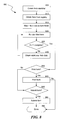
- FIG. 8 illustrates the operational flow of relevant aspects of a process for filling a form, in accordance with one embodiment.
- FIG. 9 illustrates an overview of the protocol and methods for various devices to interact with the scanning device for filling a form, in accordance with one embodiment.
- FIG. 10 illustrates an overview of the protocol and methods for various devices to interact with the scanning device for filling a form, in accordance with one embodiment.
- FIG. 11 illustrates the operational flow of relevant aspects of a process for filling a form, in accordance with one embodiment.
- FIG. 12 illustrates the operational flow of relevant aspects of a process for identifying a form, in accordance with one embodiment.
- FIG. 13 illustrates the operational flow of relevant aspects of a process for processing field data for a form, in accordance with one embodiment.
- FIG. 14 illustrates the operational flow of relevant aspects of a process for registering a form, in accordance with one embodiment.
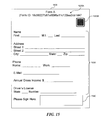
- FIG. 15 illustrates an exemplary form, in accordance with one embodiment.
- FIG. 16 illustrates an exemplary filled form, in accordance with one embodiment.
- FIGS. 17A-B illustrate exemplary postcard forms, in accordance with various embodiments.
- FIG. 18 illustrates an exemplary catalog page as a form, in accordance with one embodiment.
- FIG. 19 illustrates an exemplary iconic form, in accordance with one embodiment.
- FIG. 20 illustrates an exemplary iconic form web page, in accordance with one embodiment.
- Various embodiments include a user-friendly technique for filling forms (such as forms on paper, in catalogs, displayed on web pages, other dynamic displays, in advertisements, in books, in magazines, on signs and the like) using a graphical capture device (such as a scanner, digital camera, or other device capable of capturing at least a portion of the rendered form) or other devices.
- forms such as forms on paper, in catalogs, displayed on web pages, other dynamic displays, in advertisements, in books, in magazines, on signs and the like
- a graphical capture device such as a scanner, digital camera, or other device capable of capturing at least a portion of the rendered form
- Embodiments may be practiced to engage in many forms of information gathering utilizing a device to interface with human and machine-readable materials.
- the system uses a sample of text captured from a paper document, for example using a handheld scanner, to identify and locate an electronic counterpart of the document.
- the amount of text needed by the facility is very small in that a few words of text from a document can often function as an identifier for the paper document and as a link to its electronic counterpart.
- the system may use those few words to identify not only the document, but also a location within the document.
- the system implements these and many other examples of “paper/digital integration” without requiring changes to the current processes of writing, printing and publishing documents, giving such conventional rendered documents a whole new layer of digital functionality.
- a rendered document is a printed document or a document shown on a display or monitor. It is a document that is perceptible to a human, whether in permanent form or on a transitory display.
- Scanning or capturing is the process of systematic examination to obtain information from a rendered document.
- the process may involve optical capture using a scanner or camera (for example a camera in a cellphone), or it may involve reading aloud from the document into an audio capture device or typing it on a keypad or keyboard.
- a scanner or camera for example a camera in a cellphone
- This section describes some of the devices, processes and systems that constitute a system for paper/digital integration.
- the system builds a wide variety of services and applications on this underlying core that provides the basic functionality.
- FIG. 1 is a data flow diagram that illustrates the flow of information in one embodiment of the core system. Other embodiments may not use all of the stages or elements illustrated here, while some will use many more.
- Text from a rendered document is captured 100 , typically in optical form by an optical scanner or audio form by a voice recorder, and this image or sound data is then processed 102 , for example to remove artifacts of the capture process or to improve the signal-to-noise ratio.
- a recognition process 104 such as OCR, speech recognition, or autocorrelation then converts the data into a signature, comprised in some embodiments of text, text offsets, or other symbols.
- the system performs an alternate form of extracting document signature from the rendered document.
- the signature represents a set of possible text transcriptions in some embodiments. This process may be influenced by feedback from other stages, for example, if the search process and context analysis 110 have identified some candidate documents from which the capture may originate, thus narrowing the possible interpretations of the original capture.
- a post-processing 106 stage may take the output of the recognition process and filter it or perform such other operations upon it as may be useful. Depending upon the embodiment implemented, it may be possible at this stage to deduce some direct actions 107 to be taken immediately without reference to the later stages, such as where a phrase or symbol has been captured which contains sufficient information in itself to convey the user's intent. In these cases no digital counterpart document need be referenced, or even known to the system.
- next stage will be to construct a query 108 or a set of queries for use in searching.
- Some aspects of the query construction may depend on the search process used and so cannot be performed until the next stage, but there will typically be some operations, such as the removal of obviously misrecognized or irrelevant characters, which can be performed in advance.
- the query or queries are then passed to the search and context analysis stage 110 .
- the system optionally attempts to identify the document from which the original data was captured.
- the system typically uses search indices and search engines 112 , knowledge about the user 114 and knowledge about the user's context or the context in which the capture occurred 116 .
- Search engine 112 may employ and/or index information specifically about rendered documents, about their digital counterpart documents, and about documents that have a web (internet) presence). It may write to, as well as read from, many of these sources and, as has been mentioned, it may feed information into other stages of the process, for example by giving the recognition system 104 information about the language, font, rendering and likely next words based on its knowledge of the candidate documents.
- the sources of the documents 124 may be directly accessible, for example from a local filing system or database or a web server, or they may need to be contacted via some access service 122 which might enforce authentication, security or payment or may provide other services such as conversion of the document into a desired format.
- markup The next stage of the process 130 , then, is to identify any markup relevant to the captured data. Such markup may be provided by the user, the originator, or publisher of the document, or some other party, and may be directly accessible from some source 132 or may be generated by some service 134 . In various embodiments, markup can be associated with, and apply to, a rendered document and/or the digital counterpart to a rendered document, or to groups of either or both of these documents.
- actions may be taken 140 .
- These may be default actions such as simply recording the information found, they may be dependent on the data or document, or they may be derived from the markup analysis. Sometimes the action will simply be to pass the data to another system.
- the various possible actions appropriate to a capture at a specific point in a rendered document will be presented to the user as a menu on an associated display, for example on a local display 332 , on a computer display 212 or a mobile phone or PDA display 216 . If the user doesn't respond to the menu, the default actions can be taken.
- FIG. 2 is a component diagram of components included in a typical implementation of the system in the context of a typical operating environment.
- the operating environment includes one or more optical scanning capture devices 202 or voice capture devices 204 .
- Each capture device is able to communicate with other parts of the system such as a computer 212 and a mobile station 216 (e.g., a mobile phone or PDA) using either a direct wired or wireless connection, or through the network 220 , with which it can communicate using a wired or wireless connection, the latter typically involving a wireless base station 214 .
- the capture device is integrated in the mobile station, and optionally shares some of the audio and/or optical components used in the device for voice communications and picture-taking.
- Computer 212 may include a memory containing computer executable instructions for processing an order from scanning devices 202 and 204 .
- an order can include an identifier (such as a serial number of the scanning device 202 / 204 or an identifier that partially or uniquely identifies the user of the scanner), scanning context information (e.g., time of scan, location of scan, etc.) and/or scanned information (such as a text string) that is used to uniquely identify the document being scanned.
- scanning context information e.g., time of scan, location of scan, etc.
- scanned information such as a text string
- the operating environment may include more or less components.
- the network 220 may be a corporate intranet, the public Internet, a mobile phone network or some other network, or any interconnection of the above.
- the devices may all be operable in accordance with well-known commercial transaction and communication protocols (e.g., Internet Protocol (IP)).
- IP Internet Protocol
- the functions and capabilities of scanning device 202 , computer 212 , and mobile station 216 may be wholly or partially integrated into one device.
- scanning device, computer, and mobile station can refer to the same device depending upon whether the device incorporates functions or capabilities of the scanning device 202 , computer 212 and mobile station 216 .
- some or all of the functions of the search engines 232 , document sources 234 , user account services 236 , markup services 238 and other network services 239 may be implemented on any of the devices and/or other devices not shown.
- the capture device may capture text using an optical scanner that captures image data from the rendered document, or using an audio recording device that captures a user's spoken reading of the text, or other methods. Some embodiments of the capture device may also capture images, graphical symbols and icons, etc., including machine readable codes such as barcodes.
- the device may be exceedingly simple, consisting of little more than the transducer, some storage, and a data interface, relying on other functionality residing elsewhere in the system, or it may be a more full-featured device. For illustration, this section describes a device based around an optical scanner and with a reasonable number of features.
- Scanners are well known devices that capture and digitize images.
- portable optical scanners have been introduced in convenient form factors, such as a pen-shaped handheld device.
- the portable scanner is used to scan text, graphics, or symbols from rendered documents.
- the portable scanner has a scanning element that captures text, symbols, graphics, etc, from rendered documents.
- rendered documents include documents that have been displayed on a screen such as a CRT monitor or LCD display.
- FIG. 3 is a block diagram of an embodiment of a scanner 302 .
- the scanner 302 comprises an optical scanning head 308 to scan information from rendered documents and convert it to machine-compatible data, and an optical path 306 , typically a lens, an aperture or an image conduit to convey the image from the rendered document to the scanning head.
- the scanning head 308 may incorporate a Charge-Coupled Device (CCD), a Complementary Metal Oxide Semiconductor (CMOS) imaging device, or an optical sensor of another type.
- CCD Charge-Coupled Device
- CMOS Complementary Metal Oxide Semiconductor
- a microphone 310 and associated circuitry convert the sound of the environment (including spoken words) into machine-compatible signals, and other input facilities exist in the form of buttons, scroll-wheels or other tactile sensors such as touch-pads 314 .
- Feedback to the user is possible through a visual display or indicator lights 332 , through a loudspeaker or other audio transducer 334 and through a vibrate module 336 .
- the scanner 302 comprises logic 326 to interact with the various other components, possibly processing the received signals into different formats and/or interpretations.
- Logic 326 may be operable to read and write data and program instructions stored in associated storage 330 such as RAM, ROM, flash, or other suitable memory. It may read a time signal from the clock unit 328 .
- the scanner 302 also includes an interface 316 to communicate scanned information and other signals to a network and/or an associated computing device.
- the scanner 302 may have an on-board power supply 332 .
- the scanner 302 may be powered from a tethered connection to another device, such as a Universal Serial Bus (USB) connection.
- USB Universal Serial Bus
- a reader may scan some text from a newspaper article with scanner 302 .
- the text is scanned as a bit-mapped image via the scanning head 308 .
- Logic 326 causes the bit-mapped image to be stored in memory 330 with an associated time-stamp read from the clock unit 328 .
- Logic 326 may also perform optical character recognition (OCR) or other post-scan processing on the bit-mapped image to convert it to text.
- Logic 326 may optionally extract a signature from the image, for example by performing a convolution-like process to locate repeating occurrences of characters, symbols or objects, and determine the distance or number of other characters, symbols, or objects between these repeated elements.
- the reader may then upload the bit-mapped image (or text or other signature, if post-scan processing has been performed by logic 326 ) to an associated computer via interface 316 .
- a reader may capture some text from an article as an audio file by using microphone 310 as an acoustic capture port.
- Logic 326 causes audio file to be stored in memory 328 .
- Logic 326 may also perform voice recognition or other post-scan processing on the audio file to convert it to text.
- the reader may then upload the audio file (or text produced by post-scan processing performed by logic 326 ) to an associated computer via interface 316 .
- End-to-end feedback can be applied by performing an approximation of the recognition or interpretation, identifying a set of one or more candidate matching documents, and then using information from the possible matches in the candidate documents to further refine or restrict the recognition or interpretation.
- Candidate documents can be weighted according to their probable relevance (for example, based on then number of other users who have scanned in these documents, or their popularity on the Internet), and these weights can be applied in this iterative recognition process.
- the selective power of a search query based on a few words is greatly enhanced when the relative positions of these words are known, only a small amount of text need be captured for the system to identify the text's location in a corpus.
- the input text will be a contiguous sequence of words, such as a short phrase.
- the system can identify the location in that document and can take action based on this knowledge.
- the system may also employ other methods of discovering the document and location, such as by using watermarks or other special markings on the rendered document.
- search query In addition to the captured text, other factors (i.e., information about user identity, profile, and context) may form part of the search query, such as the time of the capture, the identity and geographical location of the user, knowledge of the user's habits and recent activities, etc.
- the document identity and other information related to previous captures, especially if they were quite recent, may form part of a search query.
- the identity of the user may be determined from a unique identifier associated with a capturing device, and/or biometric or other supplemental information (speech patterns, fingerprints, etc.).
- the search query can be constructed taking into account the types of errors likely to occur in the particular capture method used.
- One example of this is an indication of suspected errors in the recognition of specific characters; in this instance a search engine may treat these characters as wildcards, or assign them a lower priority.
- the capturing device may not be in communication with the search engine or corpus at the time of the data capture. For this reason, information helpful to the offline use of the device may be downloaded to the device in advance, or to some entity with which the device can communicate. In some cases, all or a substantial part of an index associated with a corpus may be downloaded. This topic is discussed further in Section 15.3.
- this pre-loaded information can improve the performance of the local device, reduce communication costs, and provide helpful and timely user feedback.
- the queries may be saved and transmitted to the rest of the system at such a time as communication is restored.
- Section 13.1 discusses the importance of the time of capture in relation to earlier captures. It is important to note that the time of capture will not always be the same as the time that the query is executed.
- multiple queries may be launched in response to a single capture, either in sequence or in parallel.
- queries may be sent in response to a single capture, for example as new words are added to the capture, or to query multiple search engines in parallel.
- the system sends queries to a special index for the current document, to a search engine on a local machine, to a search engine on the corporate network, and to remote search engines on the Internet.
- the results of particular searches may be given higher priority than those from others.
- the response to a given query may indicate that other pending queries are superfluous; these may be cancelled before completion.
- search engines may be enhanced or modified in a number of ways to make them more suitable for use with the described system.
- the search engine and/or other components of the system may create and maintain indices that have different or extra features.
- the system may modify an incoming paper-originated query or change the way the query is handled in the resulting search, thus distinguishing these paper-originated queries from those coming from queries typed into web browsers and other sources.
- the system may take different actions or offer different options when the results are returned by the searches originated from paper as compared to those from other sources.
- the same index can be searched using either paper-originated or traditional queries, but the index may be enhanced for use in the current system in a variety of ways.
- Extra fields can be added to such an index that will help in the case of a paper-based search.
- the first example is a field indicating that the document is known to exist or be distributed in paper form.
- the system may give such documents higher priority if the query comes from paper.
- statistical data concerning the popularity of paper documents (and, optionally, concerning sub-regions within these documents)—for example the amount of scanning activity, circulation numbers provided by the publisher or other sources, etc—is used to give such documents higher priority, to boost the priority of digital counterpart documents (for example, for browser-based queries or web searches), etc.
- Another important example may be recording information about the layout of a specific rendering of a document.
- the index may include information about where the line breaks and page breaks occur, which fonts were used, any unusual capitalization.
- the index may also include information about the proximity of other items on the page, such as images, text boxes, tables and advertisements.
- semantic information that can be deduced from the source markup but is not apparent in the paper document, such as the fact that a particular piece of text refers to an item offered for sale, or that a certain paragraph contains program code, may also be recorded in the index.
- a second factor that may modify the nature of the index is the knowledge of the type of capture likely to be used.
- a search initiated by an optical scan may benefit if the index takes into account characters that are easily confused in the OCR process, or includes some knowledge of the fonts used in the document.
- the query is from speech recognition, an index based on similar-sounding phonemes may be much more efficiently searched.
- An additional factor that may affect the use of the index in the described model is the importance of iterative feedback during the recognition process. If the search engine is able to provide feedback from the index as the text is being captured, it can greatly increase the accuracy of the capture.
- the system stores the appropriate offset or signature information in an index.
- Indices may be maintained on several machines on a corporate network. Partial indices may be downloaded to the capture device, or to a machine close to the capture device. Separate indices may be created for users or groups of users with particular interests, habits or permissions. An index may exist for each filesystem, each directory, even each file on a user's hard disk. Indexes are published and subscribed to by users and by systems. It will be important, then, to construct indices that can be distributed, updated, merged and separated efficiently.
- a search engine may take different actions when it recognizes that a search query originated from a paper document.
- the engine might handle the query in a way that is more tolerant to the types of errors likely to appear in certain capture methods, for example.
- some indicator included in the query for example a flag indicating the nature of the capture
- it may deduce this from the query itself for example, it may recognize errors or uncertainties typical of the OCR process.
- queries from a capture device can reach the engine by a different channel or port or type of connection than those from other sources, and can be distinguished in that way.
- some embodiments of the system will route queries to the search engine by way of a dedicated gateway.
- the search engine knows that all queries passing through the dedicated gateway were originated from a paper document.
- Section 13 describes a variety of different factors which are external to the captured text itself, yet which can be a significant aid in identifying a document. These include such things as the history of recent scans, the longer-term reading habits of a particular user, the geographic location of a user and the user's recent use of particular electronic documents. Such factors are referred to herein as “context.”
- search engine may keep track of a user's scanning history, and may also cross-reference this scanning history to conventional keyboard-based queries. In such cases, the search engine maintains and uses more state information about each individual user than do most conventional search engines, and each interaction with a search engine may be considered to extend over several searches and a longer period of time than is typical today.
- Some of the context may be transmitted to the search engine in the search query (Section 3.3), and may possibly be stored at the engine so as to play a part in future queries. Lastly, some of the context will best be handled elsewhere, and so becomes a filter or secondary search applied to the results from the search engine.
- the described system can emit and use not only information about documents as a whole, but also information about sub-regions of documents, even down to individual words.
- Many existing search engines concentrate simply on locating a document or file that is relevant to a particular query. Those that can work on a finer grain and identify a location within a document will provide a significant benefit for the described system.
- the search engine may use some of the further information it now maintains to affect the results returned.
- the system may also return certain documents to which the user has access only as a result of being in possession of the paper copy (Section 7.4).
- the search engine may also offer new actions or options appropriate to the described system, beyond simple retrieval of the text.
- the described system In addition to performing the capture-search-retrieve process, the described system also associates extra functionality with a document, and in particular with specific locations or segments of text within a document. This extra functionality is often, though not exclusively, associated with the rendered document by being associated with its electronic counterpart. As an example, hyperlinks in a web page could have the same functionality when a printout of that web page is scanned. In some cases, the functionality is not defined in the electronic document, but is stored or generated elsewhere.
- markup This layer of added functionality is referred to herein as “markup.”
- the markup may include human-readable content, but is often invisible to a user and/or intended for machine use. Examples include options to be displayed in a popup-menu on a nearby display when a user captures text from a particular area in a rendered document, or audio samples that illustrate the pronunciation of a particular phrase.
- Any document may have multiple overlays simultaneously, and these may be sourced from a variety of locations.
- Markup data may be created or supplied by the author of the document, or by the user, or by some other party.
- Markup data may be attached to the electronic document or embedded in it. It may be found in a conventional location (for example, in the same place as the document but with a different filename suffix). Markup data may be included in the search results of the query that located the original document, or may be found by a separate query to the same or another search engine. Markup data may be found using the original captured text and other capture information or contextual information, or it may be found using already-deduced information about the document and location of the capture. Markup data may be found in a location specified in the document, even if the markup itself is not included in the document.
- markup may be largely static and specific to the document, similar to the way links on a traditional html web page are often embedded as static data within the html document, but markup may also be dynamically generated and/or applied to a large number of documents.
- dynamic markup is information attached to a document that includes the up-to-date share price of companies mentioned in that document.
- An example of broadly applied markup is translation information that is automatically available on multiple documents or sections of documents in a particular language.
- Users may also install, or subscribe to particular sources of, markup data, thus personalizing the system's response to particular captures.
- Some elements in documents may have particular “markup” or functionality associated with them based on their own characteristics rather than their location in a particular document. Examples include special marks that are printed in the document purely for the purpose of being scanned, as well as logos and trademarks that can link the user to further information about the organization concerned. The same applies to “keywords” or “key phrases” in the text. Organizations might register particular phrases with which they are associated, or with which they would like to be associated, and attach certain markup to them that would be available wherever that phrase was scanned.
- any word, phrase, etc. may have associated markup.
- the system may add certain items to a pop-up menu (e.g., a link to an online bookstore) whenever the user captures the word “book,” or the title of a book, or a topic related to books.
- digital counterpart documents or indices are consulted to determine whether a capture occurred near the word “book,” or the title of a book, or a topic related to books—and the system behavior is modified in accordance with this proximity to keyword elements.
- markup enables data captured from non-commercial text or documents to trigger a commercial transaction.
- Annotations are another type of electronic information that may be associated with a document.
- a user can attach an audio file of his/her thoughts about a particular document for later retrieval as voice annotations.
- a multimedia annotation a user may attach photographs of places referred to in the document.
- the user generally supplies annotations for the document but the system can associate annotations from other sources (for example, other users in a work group may share annotations).
- markup data may often be supplied by third parties, such as by other readers of the document. Online discussions and reviews are a good example, as are community-managed information relating to particular works, volunteer-contributed translations and explanations.
- Another example of third-party markup is that provided by advertisers.
- markup By analyzing the data captured from documents by several or all users of the system, markup can be generated based on the activities and interests of a community.
- An example might be an online bookstore that creates markup or annotations that tell the user, in effect, “People who enjoyed this book also enjoyed . . . ”
- the markup may be less anonymous, and may tell the user which of the people in his/her contact list have also read this document recently.
- Other examples of datastream analysis are included in Section 14.
- Markup will often be based on external events and data sources, such as input from a corporate database, information from the public Internet, or statistics gathered by the local operating system.
- Data sources may also be more local, and in particular may provide information about the user's context—his/her identity, location and activities.
- the system might communicate with the user's mobile phone and offer a markup layer that gives the user the option to send a document to somebody that the user has recently spoken to on the phone.
- the identity of the user will be known. Sometimes this will be an “anonymous identity,” where the user is identified only by the serial number of the capture device, for example. Typically, however, it is expected that the system will have a much more detailed knowledge of the user, which can be used for personalizing the system and to allow activities and transactions to be performed in the user's name.
- One of the simplest and yet most useful functions that the system can perform is to keep a record for a user of the text that s/he has captured and any further information related to that capture, including the details of any documents found, the location within that document and any actions taken as a result.
- This stored history is beneficial for both the user and the system.
- the user can be presented with a “Life Library,” a record of everything s/he has read and captured. This may be simply for personal interest, but may be used, for example, in a library by an academic who is gathering material for the bibliography of his next paper.
- the user may wish to make the library public, such as by publishing it on the web in a similar manner to a weblog, so that others may see what s/he is reading and finds of interest.
- the capture can be stored in the library and can be processed later, either automatically or in response to a user request.
- a user can also subscribe to new markup services and apply them to previously captured scans.
- a record of a user's past captures is also useful for the system. Many aspects of the system operation can be enhanced by knowing the user's reading habits and history. The simplest example is that any scan made by a user is more likely to come from a document that the user has scanned in the recent past, and in particular if the previous scan was within the last few minutes it is very likely to be from the same document. Similarly, it is more likely that a document is being read in start-to-finish order. Thus, for English documents, it is also more likely that later scans will occur farther down in the document. Such factors can help the system establish the location of the capture in cases of ambiguity, and can also reduce the amount of text that needs to be captured.
- this device may be used as a key that identifies the user and authorizes certain actions.
- the device may be embedded in a mobile phone or in some other way associated with a mobile phone account.
- a scanner may be associated with a mobile phone account by inserting a SIM card associated with the account into the scanner.
- the device may be embedded in a credit card or other payment card, or have the facility for such a card to be connected to it. The device may therefore be used as a payment token, and financial transactions may be initiated by the capture from the rendered document.
- the scanner may also be associated with a particular user or account through the process of scanning some token, symbol or text associated with that user or account.
- scanner may be used for biometric identification, for example by scanning the fingerprint of the user.
- the system may identify the user by matching the voice pattern of the user or by requiring the user to speak a certain password or phrase.
- a user scans a quote from a book and is offered the option to buy the book from an online retailer
- the user can select this option, and is then prompted to scan his/her fingerprint to confirm the transaction.
- the capture device When the capture device is used to identify and authenticate the user, and to initiate transactions on behalf of the user, it is important that communications between the device and other parts of the system are secure. It is also important to guard against such situations as another device impersonating a scanner, and so-called “man in the middle” attacks where communications between the device and other components are intercepted.
- An advantage of the described system is that there is no need to alter the traditional processes of creating, printing or publishing documents in order to gain many of the system's benefits. There are reasons, though, that the creators or publishers of a document—hereafter simply referred to as the “publishers”—may wish to create functionality to support the described system.
- the system allows for printed documents to have an associated electronic presence.
- Conventionally publishers often ship a CD-ROM with a book that contains further digital information, tutorial movies and other multimedia data, sample code or documents, or further reference materials.
- some publishers maintain web sites associated with particular publications which provide such materials, as well as information which may be updated after the time of publishing, such as errata, further comments, updated reference materials, bibliographies and further sources of relevant data, and translations into other languages. Online forums allow readers to contribute their comments about the publication.
- the described system allows such materials to be much more closely tied to the rendered document than ever before, and allows the discovery of and interaction with them to be much easier for the user.
- the system can automatically connect the user to digital materials associated with the document, and more particularly associated with that specific part of the document.
- the user can be connected to online communities that discuss that section of the text, or to annotations and commentaries by other readers. In the past, such information would typically need to be found by searching for a particular page number or chapter.
- Some publishers may have mailing lists to which readers can subscribe if they wish to be notified of new relevant matter or when a new edition of the book is published.
- the user can register an interest in particular documents or parts of documents more easily, in some cases even before the publisher has considered providing any such functionality.
- the reader's interest can be fed to the publisher, possibly affecting their decision about when and where to provide updates, further information, new editions or even completely new publications on topics that have proved to be of interest in existing books.
- Such symbols may be intended purely for the reader, or they may be recognized by the system when scanned and used to initiate some action. Sufficient data may be encoded in the symbol to identify more than just the symbol: it may also store information, for example about the document, edition, and location of the symbol, which could be recognized and read by the system.
- the printed document is a gateway to extra materials and functionality, access to such features can also be time-limited. After the expiry date, a user may be required to pay a fee or obtain a newer version of the document to access the features again.
- the paper document will, of course, still be usable, but will lose some of its enhanced electronic functionality. This may be desirable, for example, because there is profit for the publisher in receiving fees for access to electronic materials, or in requiring the user to purchase new editions from time to time, or because there are disadvantages associated with outdated versions of the printed document remaining in circulation. Coupons are an example of a type of commercial document that can have an expiration date.
- Section 10.5 discusses the use of the system's statistics to influence compensation of authors and pricing of advertisements.
- the system deduces the popularity of a publication from the activity in the electronic community associated with it as well as from the use of the paper document. These factors may help publishers to make decisions about what they will publish in future. If a chapter in an existing book, for example, turns out to be exceedingly popular, it may be worth expanding into a separate publication.
- An important aspect of the described system is the ability to provide to a user who has access to a rendered copy of a document access to an electronic version of that document.
- a document is freely available on a public network or a private network to which the user has access.
- the system uses the captured text to identify, locate and retrieve the document, in some cases displaying it on the user's screen or depositing it in their email inbox.
- a document will be available in electronic form, but for a variety of reasons may not be accessible to the user. There may not be sufficient connectivity to retrieve the document, the user may not be entitled to retrieve it, there may be a cost associated with gaining access to it, or the document may have been withdrawn and possibly replaced by a new version, to name just a few possibilities.
- the system typically provides feedback to the user about these situations.
- the degree or nature of the access granted to a particular user may be different if it is known that the user already has access to a printed copy of the document.
- Access to the document may be restricted to specific users, or to those meeting particular criteria, or may only be available in certain circumstances, for example when the user is connected to a secure network.
- Section 6 describes some of the ways in which the credentials of a user and scanner may be established.
- Documents that are not freely available to the general public may still be accessible on payment of a fee, often as compensation to the publisher or copyright-holder.
- the system may implement payment facilities directly or may make use of other payment methods associated with the user, including those described in Section 6.2.
- Electronic documents are often transient; the digital source version of a rendered document may be available now but inaccessible in future.
- the system may retrieve and store the existing version on behalf of the user, even if the user has not requested it, thus guaranteeing its availability should the user request it in future. This also makes it available for the system's use, for example for searching as part of the process of identifying future captures.
- a trusted “document escrow” service can retrieve the document on behalf of the user, such as upon payment of a modest fee, with the assurance that the copyright holder will be fully compensated in future if the user should ever request the document from the service.
- Variations on this theme can be implemented if the document is not available in electronic form at the time of capture.
- the user can authorize the service to submit a request for or make a payment for the document on his/her behalf if the electronic document should become available at a later date.
- payment may be waived, reduced or satisfied based on the user's existing association with another account or subscription. Subscribers to the printed version of a newspaper might automatically be entitled to retrieve the electronic version, for example.
- association may not be quite so direct: a user may be granted access based on an account established by their employer, or based on their scanning of a printed copy owned by a friend who is a subscriber.
- the described system could be coupled to a database which records the location of an original document, for example in an archiving warehouse, making it easy for somebody with access to a copy to locate the archived original paper document.
- OCR Optical Character Recognition
- a scanning device for use with the described system will often be small, portable, and low power.
- the scanning device may capture only a few words at a time, and in some implementations does not even capture a whole character at once, but rather a horizontal slice through the text, many such slices being stitched together to form a recognizable signal from which the text may be deduced.
- the scanning device may also have very limited processing power or storage so, while in some embodiments it may perform all of the OCR process itself, many embodiments will depend on a connection to a more powerful device, possibly at a later time, to convert the captured signals into text. Lastly, it may have very limited facilities for user interaction, so may need to defer any requests for user input until later, or operate in a “best-guess” mode to a greater degree than is common now.
- OCR optical character recognition
- the OCR process can be informed by the contents of the document corpus as it progresses, potentially offering substantially greater recognition accuracy.
- Such a connection will also allow the device to inform the user when sufficient text has been captured to identify the digital source.
- the font may be downloaded to the device to help with the recognition.
- While component characters of a text fragment may be the most recognized way to represent a fragment of text that may be used as a document signature, other representations of the text may work sufficiently well that the actual text of a text fragment need not be used when attempting to locate the text fragment in a digital document and/or database, or when disambiguating the representation of a text fragment into a readable form.
- Other representations of text fragments may provide benefits that actual text representations lack. For example, optical character recognition of text fragments is often prone to errors, unlike other representations of captured text fragments that may be used to search for and/or recreate a text fragment without resorting to optical character recognition for the entire fragment. Such methods may be more appropriate for some devices used with the current system.
- Such characterizations of text fragments may include, but are not limited to, word lengths, relative word lengths, character heights, character widths, character shapes, character frequencies, token frequencies, and the like.
- the offsets between matching text tokens i.e., the number of intervening tokens plus one are used to characterize fragments of text.
- Embodiments of the present invention are different; they employ a variety of methods that use the rendered text itself to assist in the recognition process. These embodiments use characters (or tokens) to “recognize each other.”
- One way to refer to such self-recognition is “template matching,” and is similar to “convolution.” To perform such self-recognition, the system slides a copy of the text horizontally over itself and notes matching regions of the text images.
- Prior template matching and convolution techniques encompass a variety of related techniques. These techniques to tokenize and/or recognize characters/tokens will be collectively referred to herein as “autocorrelation,” as the text is used to correlate with its own component parts when matching characters/tokens.
- the offset number is the distance (number of tokens) to the next occurrence of the same token. If the token is unique within the text string, the offset is zero (0).
- the sequence of token offsets thus generated is a signature that can be used to identify the scanned text.
- the token offsets determined for a string of scanned tokens are compared to an index that indexes a corpus of electronic documents based upon the token offsets of their contents (Section 4.1.2). In other embodiments, the token offsets determined for a string of scanned tokens are converted to text, and compared to a more conventional index that indexes a corpus of electronic documents based upon their contents
- a similar token-correlation process may be applied to speech fragments when the capture process consists of audio samples of spoken words.
- the shapes of characters in most commonly used fonts are related. For example, in most fonts, the letter “c” and the letter “e” are visually related as are “t” and “f,” etc.
- the OCR process is enhanced by use of this relationship to construct templates for letters that have not been scanned yet. For example, where a reader scans a short string of text from a paper document in a previously unencountered font such that the system does not have a set of image templates with which to compare the scanned images the system can leverage the probable relationship between certain characters to construct the font template library even though it has not yet encountered all of the letters in the alphabet. The system can then use the constructed font template library to recognize subsequent scanned text and to further refine the constructed font library.
- images cannot be machine-transcribed into a form suitable for use in a search process, the images themselves can be saved for later use by the user, for possible manual transcription, or for processing at a later date when different resources may be available to the system.
- the user may be offered that document for purchase either in paper or electronic form.
- the user may also be offered related documents, such as those quoted or otherwise referred to in the paper document, or those on a similar subject, or those by the same author.
- the capture of text may be linked to other commercial activities in a variety of ways.
- the captured text may be in a catalog that is explicitly designed to sell items, in which case the text will be associated fairly directly with the purchase of an item (Section 18.2).
- the text may also be part of an advertisement, in which case a sale of the item being advertised may ensue.
- the user captures other text from which their potential interest in a commercial transaction may be deduced.
- a reader of a novel set in a particular country might be interested in a holiday there. Someone reading a review of a new car might be considering purchasing it.
- the user may capture a particular fragment of text knowing that some commercial opportunity will be presented to them as a result, or it may be a side-effect of their capture activities.
- the system allows for a new kind of advertising which is not necessarily explicitly in the rendered document, but is nonetheless based on what people are reading.
- advertisements In a traditional paper publication, advertisements generally consume a large amount of space relative to the text of a newspaper article, and a limited number of them can be placed around a particular article.
- advertising can be associated with individual words or phrases, and can selected according to the particular interest the user has shown by capturing that text and possibly taking into account their history of past scans.
- the system may gather a large amount of information about other aspects of a user's context for its own use (Section 13); estimates of the geographical location of the user are a good example. Such data can also be used to tailor the advertising presented to a user of the system.
- the system enables some new models of compensation for advertisers and marketers.
- the publisher of a printed document containing advertisements may receive some income from a purchase that originated from their document. This may be true whether or not the advertisement existed in the original printed form; it may have been added electronically either by the publisher, the advertiser or some third party, and the sources of such advertising may have been subscribed to by the user.
- Analysis of the statistics generated by the system can reveal the popularity of certain parts of a publication (Section 14.2).
- a newspaper for example, it might reveal the amount of time readers spend looking at a particular page or article, or the popularity of a particular columnist.
- An author whose work becomes a frequently read authority on a subject might be considered differently in future contracts from one whose books have sold the same number of copies but are rarely opened. (See also Section 7.6)
- Decisions about advertising in a document may also be based on statistics about the readership.
- the advertising space around the most popular columnists may be sold at a premium rate. Advertisers might even be charged or compensated some time after the document is published based on knowledge about how it was received.
- the “Life Library” or scan history described in Sections 6.1 and 16.1 can be an extremely valuable source of information about the interests and habits of a user. Subject to the appropriate consent and privacy issues, such data can inform offers of goods or services to the user. Even in an anonymous form, the statistics gathered can be exceedingly useful.
- Advertising and other opportunities for commercial transactions may not be presented to the user immediately at the time of text capture. For example, the opportunity to purchase a sequel to a novel may not be available at the time the user is reading the novel, but the system may present them with that opportunity when the sequel is published.
- a user may capture data that relates to a purchase or other commercial transaction, but may choose not to initiate and/or complete the transaction at the time the capture is made.
- data related to captures is stored in a user's Life Library, and these Life Library entries can remain “active” (i.e., capable of subsequent interactions similar to those available at the time the capture was made).
- a user may review a capture at some later time, and optionally complete a transaction based on that capture. Because the system can keep track of when and where the original capture occurred, all parties involved in the transaction can be properly compensated.
- the author who wrote the story—and the publisher who published the story—that appeared next to the advertisement from which the user captured data can be compensated when, six months later, the user visits their Life Library, selects that particular capture from the history, and chooses “Purchase this item at Amazon” from the pop-up menu (which can be similar or identical to the menu optionally presented at the time of the capture).
- OSs Modern Operating Systems
- other software packages have many characteristics that can be advantageously exploited for use with the described system, and may also be modified in various ways to provide an even better platform for its use.
- New and upcoming file systems and their associated databases often have the ability to store a variety of metadata associated with each file.
- this metadata has included such things as the ID of the user who created the file, the dates of creation, last modification, and last use.
- Newer file systems allow such extra information as keywords, image characteristics, document sources and user comments to be stored, and in some systems this metadata can be arbitrarily extended. File systems can therefore be used to store information that would be useful in implementing the current system. For example, the date when a given document was last printed can be stored by the file system, as can details about which text from it has been captured from paper using the described system, and when and by whom.
- capture devices such as pen scanners
- the same will be true for other aspects of the system's operation.
- the entire described system, or the core of it is provided by the OS.
- support for the system is provided by Application Programming Interfaces (APIs) that can be used by other software packages, including those directly implementing aspects of the system.
- APIs Application Programming Interfaces
- OSs include support for speech or handwriting recognition, though it is less common for OSs to include support for OCR, since in the past the use of OCR has typically been limited to a small range of applications.
- recognition components As recognition components become part of the OS, they can take better advantage of other facilities provided by the OS. Many systems include spelling dictionaries, grammar analysis tools, internationalization and localization facilities, for example, all of which can be advantageously employed by the described system for its recognition process, especially since they may have been customized for the particular user to include words and phrases that he/she would commonly encounter.
- the operating system includes full-text indexing facilities, then these can also be used to inform the recognition process, as described in Section 9.3.
- an optical scan or other capture occurs and is presented to the OS, it may have a default action to be taken under those circumstances in the event that no other subsystem claims ownership of the capture.
- An example of a default action is presenting the user with a choice of alternatives, or submitting the captured text to the OS's built-in search facilities.
- OS has Default Action for Particular Documents or Document Types
- the OS may have a standard action that it will take when that particular document, or a document of that class, is scanned.
- Applications and other subsystems may register with the OS as potential handlers of particular types of capture, in a similar manner to the announcement by applications of their ability to handle certain file types.
- Markup data associated with a rendered document, or with a capture from a document can include instructions to the operating system to launch specific applications, pass applications arguments, parameters, or data, etc.
- certain items of text or other symbols may, when scanned, cause standard actions to occur, and the OS may provide a selection of these.
- An example might be that scanning the text “[print]” in any document would cause the OS to retrieve and print a copy of that document.
- the OS may also provide a way to register such actions and associate them with particular scans.
- a typical use of the system may be for the user to scan an area of a paper document, and for the system to open the electronic counterpart in a software package that is able to display or edit it, and cause that package to scroll to and highlight the scanned text (Section 12.2.1).
- the first part of this process, finding and opening the electronic document is typically provided by the OS and is standard across software packages.
- the availability of a standard API for this functionality could greatly enhance the operation of this aspect of the system.
- the system may wish to perform a variety of operations upon that text.
- the system may request the surrounding text, so that the user's capture of a few words could result in the system accessing the entire sentence or paragraph containing them.
- this functionality can be usefully provided by the OS rather than being implemented in every piece of software that handles text.
- the system uses the application pop-up menus traditionally associated with clicking the right mouse button on some text. The system inserts extra options into such menus, and causes them to be displayed as a result of activities such as scanning a paper document.
- the OS keeps a simple record of when any document was printed and by whom.
- the OS takes one or more further actions that would make it better suited for use with the system. Examples include:
- An OS often maintains certain categories of folders or files that have particular significance.
- a user's documents may, by convention or design, be found in a “My Documents” folder, for example.
- Standard file-opening dialogs may automatically include a list of recently opened documents.
- Categories may be enhanced or augmented in ways that take into account a user's interaction with paper versions of the stored files. Categories such as “My Printed Documents” or “My Recently-Read Documents” might usefully be identified and incorporated in its operations.
- markup Since important aspects of the system are typically provided using the “markup” concepts discussed in Section 5, it would clearly be advantageous to have support for such markup provided by the OS in a way that was accessible to multiple applications as well as to the OS itself. In addition, layers of markup may be provided by the OS, based on its own knowledge of documents under its control and the facilities it is able to provide.
- Digital Rights Management the ability to control the use of particular data according to the rights granted to a particular user, software entity or machine. It may inhibit unauthorized copying or distribution of a particular document, for example.
- the user interface of the system may be entirely on a PC, if the capture device is relatively dumb and is connected to it by a cable, or entirely on the device, if it is sophisticated and with significant processing power of its own. In some cases, some functionality resides in each component. Part, or indeed all, of the system's functionality may also be implemented on other devices such as mobile phones or PDAs.
- a handheld scanner may have a variety of ways of providing feedback to the user about particular conditions.
- the most obvious types are direct visual, where the scanner incorporates indicator lights or even a full display, and auditory, where the scanner can make beeps, clicks or other sounds.
- Important alternatives include tactile feedback, where the scanner can vibrate, buzz, or otherwise stimulate the user's sense of touch, and projected feedback, where it indicates a status by projecting onto the paper anything from a colored spot of light to a sophisticated display.
- Important immediate feedback that may be provided on the device includes:
- the device may provide a variety of ways for the user to provide input in addition to basic text capture. Even when the device is in close association with a host machine that has input options such as keyboards and mice, it can be disruptive for the user to switch back and forth between manipulating the scanner and using a mouse, for example.
- the handheld scanner may have buttons, scroll/jog-wheels, touch-sensitive surfaces, and/or accelerometers for detecting the movement of the device. Some of these allow a richer set of interactions while still holding the scanner.
- the system presents the user with a set of several possible matching documents.
- the user uses a scroll-wheel on the side of the scanner is to select one from the list, and clicks a button to confirm the selection.
- the user can indicate a large region of text by scanning the first few words in conventional left-to-right order, and the last few in reverse order, i.e. right to left.
- the user can also indicate the vertical extent of the text of interest by moving the scanner down the page over several lines.
- a backwards scan might indicate cancellation of the previous scan operation.
- network connectivity may depend on network connectivity, either between components of the system such as a scanner and a host laptop, or with the outside world in the form of a connection to corporate databases and Internet search. This connectivity may not be present all the time, however, and so there will be occasions when part or all of the system may be considered to be “offline.” It is desirable to allow the system to continue to function usefully in those circumstances.
- the device may be used to capture text when it is out of contact with other parts of the system.
- a very simple device may simply be able to store the image or audio data associated with the capture, ideally with a timestamp indicating when it was captured.
- the various captures may be uploaded to the rest of the system when the device is next in contact with it, and handled then.
- the device may also upload other data associated with the captures, for example voice annotations associated with optical scans, or location information.
- More sophisticated devices may be able to perform some or all of the system operations themselves despite being disconnected. Various techniques for improving their ability to do so are discussed in Section 15.3. Often it will be the case that some, but not all, of the desired actions can be performed while offline. For example, the text may be recognized, but identification of the source may depend on a connection to an Internet-based search engine. In some embodiments, the device therefore stores sufficient information about how far each operation has progressed for the rest of the system to proceed efficiently when connectivity is restored.
- the operation of the system will, in general, benefit from immediately available connectivity, but there are some situations in which performing several captures and then processing them as a batch can have advantages. For example, as discussed in Section 13 below, the identification of the source of a particular capture may be greatly enhanced by examining other captures made by the user at approximately the same time. In a fully connected system where live feedback is being provided to the user, the system is only able to use past captures when processing the current one. If the capture is one of a batch stored by the device when offline, however, the system will be able to take into account any data available from later captures as well as earlier ones when doing its analysis.
- a scanner will often communicate with some other device, such as a PC, PDA, phone or digital camera to perform many of the functions of the system, including more detailed interactions with the user.
- some other device such as a PC, PDA, phone or digital camera to perform many of the functions of the system, including more detailed interactions with the user.
- the host device When the host device receives a capture, it may initiate a variety of activities. An incomplete list of possible activities performed by the system after locating and electronic counterpart document associated with the capture and a location within that document follows.
- the scanner device projects a popup menu onto the paper document.
- a user may select from such menus using traditional methods such as a keyboard and mouse, or by using controls on the capture device (Section 12.1.2), gestures (Section 12.1.3), or by interacting with the computer display using the scanner (Section 12.2.4).
- the popup menus which can appear as a result of a capture include default items representing actions which occur if the user does not respond—for example, if the user ignores the menu and makes another capture.
- the system provides a real-time display of the documents or the locations found, for example in list, thumbnail-image or text-segment form, and for the number of elements in that display to reduce in number as capture continues.
- the system displays thumbnails of all candidate documents, where the size or position of the thumbnail is dependent on the probability of it being the correct match.
- this fact may be emphasized to the user, for example using audio feedback.
- the system may indicate this on the screen, for example by grouping documents containing a quoted reference around the original source document.
- Some optical scanners may be able to capture text displayed on a screen as well as on paper. Accordingly, the term rendered document is used herein to indicate that printing onto paper is not the only form of rendering, and that the capture of text or symbols for use by the system may be equally valuable when that text is displayed on an electronic display.
- the user of the described system may be required to interact with a computer screen for a variety of other reasons, such as to select from a list of options. It can be inconvenient for the user to put down the scanner and start using the mouse or keyboard.
- Other sections have described physical controls on the scanner (Section 12.1.2) or gestures (Section 12.1.3) as methods of input which do not require this change of tool, but using the scanner on the screen itself to scan some text or symbol is an important alternative provided by the system.
- the optics of the scanner allow it to be used in a similar manner to a light-pen, directly sensing its position on the screen without the need for actual scanning of text, possibly with the aid of special hardware or software on the computer.
- Another example of useful context is the user's geographical location.
- a user in Paris is much more likely to be reading Le Monde than the Seattle Times, for example.
- the timing, size and geographical distribution of printed versions of the documents can therefore be important, and can to some degree be deduced from the operation of the system.
- the time of day may also be relevant, for example in the case of a user who always reads one type of publication on the way to work, and a different one at lunchtime or on the train going home.
- the user's recent use of electronic documents can also be a helpful indicator.
- Section 14 covers the analysis of the data stream resulting from paper-based searches, but it should be noted here that statistics about the popularity of documents with other readers, about the timing of that popularity, and about the parts of documents most frequently scanned are all examples of further factors which can be beneficial in the search process.
- the system brings the possibility of Google-type page-ranking to the world of paper.
- This stream is a record of what users are reading and when, and is in many cases a record of what they find particularly valuable in the things they read. Such data has never really been available before for paper documents.
- Section 6.1 Some ways in which this data can be useful for the system, and for the user of the system, are described in Section 6.1. This section concentrates on its use for others. There are, of course, substantial privacy issues to be considered with any distribution of data about what people are reading, but such issues as preserving the anonymity of data are well known to those of skill in the art.
- the system can also deduce who is reading any given document. This allows the tracking of a document through an organization, to allow analysis, for example, of who is reading it and when, how widely it was distributed, how long that distribution took, and who has seen current versions while others are still working from out-of-date copies.
- the system can deduce the popularity of certain documents and of particular sub-regions of those documents. This forms a valuable input to the system itself (Section 4.2.2) and an important source of information for authors, publishers and advertisers (Section 7.6, Section 10.5). This data is also useful when integrated in search engines and search indices—for example, to assist in ranking search results for queries coming from rendered documents, and/or to assist in ranking conventional queries typed into a web browser.
- One example is connecting one user with others who have related interests. These may be people already known to the user.
- the system may ask a university professor, “Did you know that your colleague at XYZ University has also just read this paper?”
- the system may ask a user, “Do you want to be linked up with other people in your neighborhood who are also how reading Jane Eyre?”
- Such links may be the basis for the automatic formation of book clubs and similar social structures, either in the physical world or online.
- Section 10.6 has already mentioned the idea of offering products and services to an individual user based on their interactions with the system.
- Current online booksellers for example, often make recommendations to a user based on their previous interactions with the bookseller. Such recommendations become much more useful when they are based on interactions with the actual books.
- the user will also not just be capturing some text, but will be causing some action to occur as a result. It might be emailing a reference to the document to an acquaintance, for example. Even in the absence of information about the identity of the user or the recipient of the email, the knowledge that somebody considered the document worth emailing is very useful.
- the aggregated statistics of that group can be used to deduce the importance of a particular document to that group.
- a capture device for use with the system needs little more than a way of capturing text from a rendered version of the document.
- this capture may be achieved through a variety of methods including taking a photograph of part of the document or typing some words into a mobile phone keypad.
- This capture may be achieved using a small hand-held optical scanner capable of recording a line or two of text at a time, or an audio capture device such as a voice-recorder into which the user is reading text from the document.
- the device used may be a combination of these—an optical scanner which could also record voice annotations, for example—and the capturing functionality may be built into some other device such as a mobile phone, PDA, digital camera or portable music player.
- the device implements the majority of the system itself. In some embodiments, however, it often communicates with a PC or other computing device and with the wider world using communications facilities.
- these communications facilities are in the form of a general-purpose data network such as Ethernet, 802.11 or UWB or a standard peripheral-connecting network such as USB, IEEE-1394 (Firewire), BluetoothTM or infra-red.
- a wired connection such as Firewire or USB
- the capture device may appear to a connected machine to be a conventional peripheral such as a USB storage device.
- the device may in some circumstances “dock” with another device, either to be used in conjunction with that device or for convenient storage.
- Sections 3.5 and 12.1.4 have raised the topic of disconnected operation.
- the device can still be useful, though the functionality available will sometimes be reduced.
- the device can record the raw image or audio data being captured and this can be processed later.
- it can be important to give feedback where possible about whether the data captured is likely to be sufficient for the task in hand, whether it can be recognized or is likely to be recognizable, and whether the source of the data can be identified or is likely to be identifiable later.
- the user will then know whether their capturing activity is worthwhile. Even when all of the above are unknown, the raw data can still be stored so that, at the very least, the user can refer to them later.
- the user may be presented with the image of a scan, for example, when the scan cannot be recognized by the OCR process.
- the SimpleScanner has a scanning head able to read pixels from the page as it is moved along the length of a line of text. It can detect its movement along the page and record the pixels with some information about the movement. It also has a clock, which allows each scan to be time-stamped. The clock is synchronized with a host device when the SimpleScanner has connectivity. The clock may not represent the actual time of day, but relative times may be determined from it so that the host can deduce the actual time of a scan, or at worst the elapsed time between scans.
- the SimpleScanner does not have sufficient processing power to perform any OCR itself, but it does have some basic knowledge about typical word-lengths, word-spacings, and their relationship to font size. It has some basic indicator lights which tell the user whether the scan is likely to be readable, whether the head is being moved too fast, too slowly or too inaccurately across the paper, and when it determines that sufficient words of a given size are likely to have been scanned for the document to be identified.
- the SimpleScanner has a USB connector and can be plugged into the USB port on a computer, where it will be recharged. To the computer it appears to be a USB storage device on which time-stamped data files have been recorded, and the rest of the system software takes over from this point.
- the SuperScanner also depends on connectivity for its full operation, but it has a significant amount of on-board storage and processing which can help it make better judgments about the data captured while offline.
- the captured pixels are stitched together and passed to an OCR engine that attempts to recognize the text.
- a number of fonts including those from the user's most-read publications, have been downloaded to it to help perform this task, as has a dictionary that is synchronized with the user's spelling-checker dictionary on their PC and so contains many of the words they frequently encounter.
- Also stored on the scanner is a list of words and phrases with the typical frequency of their use—this may be combined with the dictionary. The scanner can use the frequency statistics both to help with the recognition process and also to inform its judgment about when a sufficient quantity of text has been captured; more frequently used phrases are less likely to be useful as the basis for a search query.
- the full index for the articles in the recent issues of the newspapers and periodicals most commonly read by the user are stored on the device, as are the indices for the books the user has recently purchased from an online bookseller, or from which the user has scanned anything within the last few months.
- the titles of several thousand of the most popular publications which have data available for the system are stored so that, in the absence of other information the user can scan the title and have a good idea as to whether or not captures from a particular work are likely to be retrievable in electronic form later.
- the system informs user that the captured data has been of sufficient quality and of a sufficient nature to make it probable that the electronic copy can be retrieved when connectivity is restored. Often the system indicates to the user that the scan is known to have been successful and that the context has been recognized in one of the on-board indices, or that the publication concerned is known to be making its data available to the system, so the later retrieval ought to be successful.
- the SuperScanner docks in a cradle connected to a PC's Firewire or USB port, at which point, in addition to the upload of captured data, its various onboard indices and other databases are updated based on recent user activity and new publications. It also has the facility to connect to wireless public networks or to communicate via Bluetooth to a mobile phone and thence with the public network when such facilities are available.
- Some embodiments of the system use a scanner that scans in contact with the paper, and which, instead of lenses, uses an image conduit a bundle of optical fibers to transmit the image from the page to the optical sensor device.
- a scanner that scans in contact with the paper, and which, instead of lenses, uses an image conduit a bundle of optical fibers to transmit the image from the page to the optical sensor device.
- Such a device can be shaped to allow it to be held in a natural position; for example, in some embodiments, the part in contact with the page is wedge-shaped, allowing the user's hand to move more naturally over the page in a movement similar to the use of a highlighter pen.
- the conduit is either in direct contact with the paper or in close proximity to it, and may have a replaceable transparent tip that can protect the image conduit from possible damage.
- the scanner may be used to scan from a screen as well as from paper, and the material of the tip can be chosen to reduce the likelihood of damage to such displays.
- some embodiments of the device will provide feedback to the user during the scanning process which will indicate through the use of light, sound or tactile feedback when the user is scanning too fast, too slow, too unevenly or is drifting too high or low on the scanned line.
- the capture device may form an important part of identification and authorization for secure transactions, purchases, and a variety of other operations. It may therefore incorporate, in addition to the circuitry and software required for such a role, various hardware features that can make it more secure, such as a smartcard reader, RFID, or a keypad on which to type a PIN.
- the scanning head may also be able to read a fingerprint.
- the voice pattern of the user may be used.
- the device is able to form an association with other nearby devices to increase either its own or their functionality.
- it uses the display of a nearby PC or phone to give more detailed feedback about its operation, or uses their network connectivity.
- the device may, on the other hand, operate in its role as a security and identification device to authenticate operations performed by the other device. Or it may simply form an association in order to function as a peripheral to that device.
- An interesting aspect of such associations is that they may be initiated and authenticated using the capture facilities of the device. For example, a user wishing to identify themselves securely to a public computer terminal may use the scanning facilities of the device to scan a code or symbol displayed on a particular area of the terminal's screen and so effect a key transfer. An analogous process may be performed using audio signals picked up by a voice-recording device.
- the functionality of the capture device is integrated into some other device that is already in use.
- the integrated devices may be able to share a power supply, data capture and storage capabilities, and network interfaces. Such integration may be done simply for convenience, to reduce cost, or to enable functionality that would not otherwise be available.
- Some examples of devices into which the capture functionality can be integrated include:
- the phone hardware is not modified to support the system, such as where the text capture can be adequately done through voice recognition, where they can either be processed by the phone itself, or handled by a system at the other end of a telephone call, or stored in the phone's memory for future processing.
- voice recognition can either be processed by the phone itself, or handled by a system at the other end of a telephone call, or stored in the phone's memory for future processing.
- Many modern phones have the ability to download software that could implement some parts of the system.
- voice capture is likely to be suboptimal in many situations, however, for example when there is substantial background noise, and accurate voice recognition is a difficult task at the best of times.
- the audio facilities may best be used to capture voice annotations.
- the camera built into many mobile phones is used to capture an image of the text.
- the phone display which would normally act as a viewfinder for the camera, may overlay on the live camera image information about the quality of the image and its suitability for OCR, which segments of text are being captured, and even a transcription of the text if the OCR can be performed on the phone.
- the phone is modified to add dedicated capture facilities, or to provide such functionality in a clip-on adaptor or a separate Bluetooth-connected peripheral in communication with the phone.
- the phone has connectivity with the wider world, which means that queries can be submitted to remote search engines or other parts of the system, and copies of documents may be retrieved for immediate storage or viewing.
- a phone typically has sufficient processing power for many of the functions of the system to be performed locally, and sufficient storage to capture a reasonable amount of data. The amount of storage can also often be expanded by the user. Phones have reasonably good displays and audio facilities to provide user feedback, and often a vibrate function for tactile feedback. They also have good power supplies.
- the Life Library (see also Section 6.1.1) is a digital archive of any important documents that the subscriber wishes to save and is a set of embodiments of services of this system. Important books, magazine articles, newspaper clippings, etc., can all be saved in digital form in the Life Library. Additionally, the subscriber's annotations, comments, and notes can be saved with the documents.
- the Life Library can be accessed via the Internet and World Wide Web.
- the system creates and manages the Life Library document archive for subscribers.
- the subscriber indicates which documents the subscriber wishes to have saved in his life library by scanning information from the document or by otherwise indicating to the system that the particular document is to be added to the subscriber's Life Library.
- the scanned information is typically text from the document but can also be a barcode or other code identifying the document.
- the system accepts the code and uses it to identify the source document. After the document is identified the system can store either a copy of the document in the user's Life Library or a link to a source where the document may be obtained.
- One embodiment of the Life Library system can check whether the subscriber is authorized to obtain the electronic copy. For example, if a reader scans text or an identifier from a copy of an article in the New York Times (NYT) so that the article will be added to the reader's Life Library, the Life Library system will verify with the NYT whether the reader is subscribed to the online version of the NYT; if so, the reader gets a copy of the article stored in his Life Library account; if not, information identifying the document and how to order it is stored in his Life Library account.
- NYT New York Times
- the system maintains a subscriber profile for each subscriber that includes access privilege information.
- Document access information can be compiled in several ways, two of which are: 1) the subscriber supplies the document access information to the Life Library system, along with his account names and passwords, etc., or 2) the Life Library service provider queries the publisher with the subscriber's information and the publisher responds by providing access to an electronic copy if the Life Library subscriber is authorized to access the material. If the Life Library subscriber is not authorized to have an electronic copy of the document, the publisher provides a price to the Life Library service provider, which then provides the customer with the option to purchase the electronic document.
- the Life Library service provider either pays the publisher directly and bills the Life Library customer later or the Life Library service provider immediately bills the customer's credit card for the purchase.
- the Life Library service provider would get a percentage of the purchase price or a small fixed fee for facilitating the transaction.
- the system can archive the document in the subscriber's personal library and/or any other library to which the subscriber has archival privileges. For example, as a user scans text from a printed document, the Life Library system can identify the rendered document and its electronic counterpart. After the source document is identified, the Life Library system might record information about the source document in the user's personal library and in a group library to which the subscriber has archival privileges.
- Group libraries are collaborative archives such as a document repository for: a group working together on a project, a group of academic researchers, a group web log, etc.
- the life library can be organized in many ways: chronologically, by topic, by level of the subscriber's interest, by type of publication (newspaper, book, magazine, technical paper, etc.), where read, when read, by ISBN or by Dewey decimal, etc.
- the system can learn classifications based on how other subscribers have classified the same document. The system can suggest classifications to the user or automatically classify the document for the user.
- annotations may be inserted directly into the document or may be maintained in a separate file.
- the article is archived in his Life Library with the scanned text highlighted.
- the article is archived in his Life Library along with an associated annotation file (thus leaving the archived document unmodified).
- Embodiments of the system can keep a copy of the source document in each subscriber's library, a copy in a master library that many subscribers can access, or link to a copy held by the publisher.
- the Life Library stores only the user's modifications to the document (e.g., highlights, etc.) and a link to an online version of the document (stored elsewhere). The system or the subscriber merges the changes with the document when the subscriber subsequently retrieves the document.
- the source document and the annotation file are provided to the subscriber and the subscriber combines them to create a modified document.
- the system combines the two files prior to presenting them to the subscriber.
- the annotation file is an overlay to the document file and can be overlaid on the document by software in the subscriber's computer.
- Subscribers to the Life Library service pay a monthly fee to have the system maintain the subscriber's archive. Alternatively, the subscriber pays a small amount (e.g., a micro-payment) for each document stored in the archive. Alternatively, the subscriber pays to access the subscriber's archive on a per-access fee. Alternatively, subscribers can compile libraries and allow others to access the materials/annotations on a revenue share model with the Life Library service provider and copyright holders. Alternatively, the Life Library service provider receives a payment from the publisher when the Life Library subscriber orders a document (a revenue share model with the publisher, where the Life Library service provider gets a share of the publisher's revenue).
- a small amount e.g., a micro-payment
- subscribers can compile libraries and allow others to access the materials/annotations on a revenue share model with the Life Library service provider and copyright holders.
- the Life Library service provider receives a payment from the publisher when the Life Library subscriber orders a document (a revenue share model with the publisher, where
- the Life Library service provider acts as an intermediary between the subscriber and the copyright holder (or copyright holder's agent, such as the Copyright Clearance Center, a.k.a. CCC) to facilitate billing and payment for copyrighted materials.
- the Life Library service provider uses the subscriber's billing information and other user account information to provide this intermediation service. Essentially, the Life Library service provider leverages the pre-existing relationship with the subscriber to enable purchase of copyrighted materials on behalf of the subscriber.
- the Life Library system can store excerpts from documents. For example, when a subscriber scans text from a paper document, the regions around the scanned text are excerpted and placed in the Life Library, rather than the entire document being archived in the life library. This is especially advantageous when the document is long because preserving the circumstances of the original scan prevents the subscriber from re-reading the document to find the interesting portions. Of course, a hyperlink to the entire electronic counterpart of the paper document can be included with the excerpt materials.
- the system also stores information about the document in the Life Library, such as author, publication title, publication date, publisher, copyright holder (or copyright holder's licensing agent), ISBN, links to public annotations of the document, readrank, etc.
- information about the document is a form of paper document metadata.
- Third parties may create public annotation files for access by persons other than themselves, such the general public. Linking to a third party's commentary on a document is advantageous because reading annotation files of other users enhances the subscriber's understanding of the document.
- the system archives materials by class. This feature allows a Life Library subscriber to quickly store electronic counterparts to an entire class of paper documents without access to each paper document. For example, when the subscriber scans some text from a copy of National Geographic magazine, the system provides the subscriber with the option to archive all back issues of the National Geographic. If the subscriber elects to archive all back issues, the Life Library service provider would then verify with the National Geographic Society whether the subscriber is authorized to do so. If not, the Life Library service provider can mediate the purchase of the right to archive the National Geographic magazine collection.
- a variation on, or enhancement of, the Life Library concept is the “Life Saver,” where the system uses the text captured by a user to deduce more about their other activities.
- the scanning of a menu from a particular restaurant, a program from a particular theater performance, a timetable at a particular railway station, or an article from a local newspaper allows the system to make deductions about the user's location and social activities, and could construct an automatic diary for them, for example as a website.
- the user would be able to edit and modify the diary, add additional materials such as photographs and, of course, look again at the items scanned.
- Portable scanners supported by the described system have many compelling uses in the academic setting. They can enhance student/teacher interaction and augment the learning experience. Among other uses, students can annotate study materials to suit their unique needs; teachers can monitor classroom performance; and teachers can automatically verify source materials cited in student assignments.
- a child's interaction with a paper document, such as a book, is monitored by a literacy acquisition system that employs a specific set of embodiments of this system.
- the child uses a portable scanner that communicates with other elements of the literacy acquisition system.
- the literacy acquisition system includes a computer having a display and speakers, and a database accessible by the computer.
- the scanner is coupled with the computer (hardwired, short range RF, etc.).
- the literacy acquisition system compares the scanned text with the resources in its database to identify the word.
- the database includes a dictionary, thesaurus, and/or multimedia files (e.g., sound, graphics, etc.).
- the system uses the computer speakers to pronounce the word and its definition to the child.
- the word and its definition are displayed by the literacy acquisition system on the computer's monitor.
- Multimedia files about the scanned word can also be played through the computer's monitor and speakers. For example, if a child reading “Goldilocks and the Three Bears” scanned the word “bear,” the system might pronounce the word “bear” and play a short video about bears on the computer's monitor. In this way, the child learns to pronounce the written word and is visually taught what the word means via the multimedia presentation.
- the literacy acquisition system provides immediate auditory and/or visual information to enhance the learning process.
- the child uses this supplementary information to quickly acquire a deeper understanding of the written material.
- the system can be used to teach beginning readers to read, to help children acquire a larger vocabulary, etc. This system provides the child with information about words with which the child is unfamiliar or about which the child wants more information.
- the system compiles personal dictionaries. If the reader sees a word that is new, interesting, or particularly useful or troublesome, the reader saves it (along with its definition) to a computer file. This computer file becomes the reader's personalized dictionary. This dictionary is generally smaller in size than a general dictionary so can be downloaded to a mobile station or associated device and thus be available even when the system isn't immediately accessible.
- the personal dictionary entries include audio files to assist with proper word pronunciation and information identifying the paper document from which the word was scanned.
- the system creates customized spelling and vocabulary tests for students. For example, as a student reads an assignment, the student may scan unfamiliar words with the portable scanner. The system stores a list of all the words that the student has scanned. Later, the system administers a customized spelling/vocabulary test to the student on an associated monitor (or prints such a test on an associated printer).
- the arrangement of notes on a musical staff is similar to the arrangement of letters in a line of text.
- the same scanning device discussed for capturing text in this system can be used to capture music notation, and an analogous process of constructing a search against databases of known musical pieces would allow the piece from which the capture occurred to be identified which can then be retrieved, played, or be the basis for some further action.
- Teachers can use the system to detect plagiarism or to verify sources by scanning text from student papers and submitting the scanned text to the system. For example, a teacher who wishes to verify that a quote in a student paper came from the source that the student cited can scan a portion of the quote and compare the title of the document identified by the system with the title of the document cited by the student. Likewise, the system can use scans of text from assignments submitted as the student's original work to reveal if the text was instead copied.
- capturing text from an academic textbook links students or staff to more detailed explanations, further exercises, student and staff discussions about the material, related example past exam questions, further reading on the subject, recordings of the lectures on the subject, and so forth. (See also Section 7.1.)
- the system is used to teach foreign languages. Scanning a Spanish word, for example, might cause the word to be read aloud in Spanish along with its definition in English.
- the system provides immediate auditory and/or visual information to enhance the new language acquisition process.
- the reader uses this supplementary information to acquire quickly a deeper understanding of the material.
- the system can be used to teach beginning students to read foreign languages, to help students acquire a larger vocabulary, etc.
- the system provides information about foreign words with which the reader is unfamiliar or for which the reader wants more information.
- Reader interaction with a paper document, such as a newspaper or book, is monitored by a language skills system.
- the reader has a portable scanner that communicates with the language skills system.
- the language skills system includes a computer having a display and speakers, and a database accessible by the computer.
- the scanner communicates with the computer (hardwired, short range RF, etc.).
- the database includes a foreign language dictionary, thesaurus, and/or multimedia files (sound, graphics, etc.).
- the system compares the scanned text with the resources in its database to identify the scanned word. After the word has been identified, the system uses the computer speakers to pronounce the word and its definition to the reader.
- the word and its definition are both displayed on the computer's monitor.
- Multimedia files about grammar tips related to the scanned word can also be played through the computer's monitor and speakers. For example, if the words “to speak” are scanned, the system might pronounce the word “hablar,” play a short audio clip that demonstrates the proper Spanish pronunciation, and display a complete list of the various conjugations of “hablar.” In this way, the student learns to pronounce the written word, is visually taught the spelling of the word via the multimedia presentation, and learns how to conjugate the verb. The system can also present grammar tips about the proper usage of “hablar” along with common phrases.
- the user scans a word or short phrase from a rendered document in a language other than the user's native language (or some other language that the user knows reasonably well).
- the system maintains a prioritized list of the user's “preferred” languages. The system identifies the electronic counterpart of the rendered document, and determines the location of the scan within the document. The system also identifies a second electronic counterpart of the document that has been translated into one of the user's preferred languages, and determines the location in the translated document corresponding to the location of the scan in the original document. When the corresponding location is not known precisely, the system identifies a small region (e.g., a paragraph) that includes the corresponding location of the scanned location. The corresponding translated location is then presented to the user. This provides the user with a precise translation of the particular usage at the scanned location, including any slang or other idiomatic usage that is often difficult to accurately translate on a word-by-word basis.
- a user researching a particular topic may encounter all sorts of material, both in print and on screen, which they might wish to record as relevant to the topic in some personal archive.
- the system would enable this process to be automatic as a result of scanning a short phrase in any piece of material, and could also create a bibliography suitable for insertion into a publication on the subject.
- Conventional Internet search engines typically provide free search of electronic documents, and also make no charge to the content providers for including their content in the index.
- the system provides for charges to users and/or payments to search engines and/or content providers in connection with the operation and use of the system.
- subscribers to the system's services pay a fee for searches originating from scans of paper documents.
- a stockbroker may be reading a Wall Street Journal article about a new product offered by Company X.
- the stockbroker uses the system to search special or proprietary databases to obtain premium information about the company, such as analyst's reports.
- the system can also make arrangements to have priority indexing of the documents most likely to be read in paper form, for example by making sure all of the newspapers published on a particular day are indexed and available by the time they hit the streets.
- Content providers may pay a fee to be associated with certain terms in search queries submitted from paper documents. For example, in one embodiment, the system chooses a most preferred content provider based on additional context about the provider (the context being, in this case, that the content provider has paid a fee to be moved up the results list). In essence, the search provider is adjusting paper document search results based on pre-existing financial arrangements with a content provider. See also the description of keywords and key phrases in Section 5.2.
- Such content may be protected by a firewall and thus not generally indexable by third parties.
- the content provider may nonetheless wish to provide an index to the protected content.
- the content provider can pay a service provider to provide the content provider's index to system subscribers.
- a law firm may index all of a client's documents. The documents are stored behind the law firm's firewall.
- the law firm wants its employees and the client to have access to the documents through the portable scanner so it provides the index (or a pointer to the index) to the service provider, which in turn searches the law firm's index when employees or clients of the law firm submit paper-scanned search terms via their portable scanners.
- the law firm can provide a list of employees and/or clients to the service provider's system to enable this function or the system can verify access rights by querying the law firm prior to searching the law firm's index.
- the index provided by the law firm is only of that client's documents, not an index of all documents at the law firm.
- the service provider can only grant the law firm's clients access to the documents that the law firm indexed for the client.
- the search function revenue can be generated from paid subscriptions from the scanner users, but can also be generated on a per-search charge.
- the content delivery revenue can be shared with the content provider or copyright holder (the service provider can take a percentage of the sale or a fixed fee, such as a micropayment, for each delivery), but also can be generated by a “referral” model in which the system gets a fee or percentage for every item that the subscriber orders from the online catalog and that the system has delivered or contributed to, regardless of whether the service provider intermediates the transaction.
- the system service provider receives revenue for all purchases that the subscriber made from the content provider, either for some predetermined period of time or at any subsequent time when a purchase of an identified product is made.
- the subscriber scans information from the catalog that identifies the catalog. This information is text from the catalog, a bar code, or another identifier of the catalog. The subscriber scans information identifying the products that s/he wishes to purchase.
- the catalog mailing label may contain a customer identification number that identifies the customer to the catalog vendor. If so, the subscriber can also scan this customer identification number.
- the system acts as an intermediary between the subscriber and the vendor to facilitate the catalog purchase by providing the customer's selection and customer identification number to the vendor.
- a consumer scans paper coupons and saves an electronic copy of the coupon in the scanner, or in a remote device such as a computer, for later retrieval and use.
- An advantage of electronic storage is that the consumer is freed from the burden of carrying paper coupons.
- a further advantage is that the electronic coupons may be retrieved from any location.
- the system can track coupon expiration dates, alert the consumer about coupons that will expire soon, and/or delete expired coupons from storage.
- An advantage for the issuer of the coupons is the possibility of receiving more feedback about who is using the coupons and when and where they are captured and used.
- the system may be used to auto-populate an electronic document that corresponds to a paper form.
- a user scans in some text or a barcode that uniquely identifies the paper form.
- the scanner communicates the identity of the form and information identifying the user to a nearby computer.
- the nearby computer has an Internet connection.
- the nearby computer can access a first database of forms and a second database having information about the user of the scanner (such as a service provider's subscriber information database).
- the nearby computer accesses an electronic version of the paper form from the first database and auto-populates the fields of the form from the user's information obtained from the second database.
- the nearby computer then emails the completed form to the intended recipient. Alternatively, the computer could print the completed form on a nearby printer.
- the system has a portable scanner that contains the user's information, such as in an identity module, SIM, or security card.
- the scanner provides information identifying the form to the nearby PC.
- the nearby PC accesses the electronic form and queries the scanner for any necessary information to fill out the form.
- the system can be used to automatically populate electronic address books or other contact lists from paper documents. For example, upon receiving a new acquaintance's business card, a user can capture an image of the card with his/her cellular phone. The system will locate an electronic copy of the card, which can be used to update the cellular phone's onboard address book with the new acquaintance's contact information. The electronic copy may contain more information about the new acquaintance than can be squeezed onto a business card. Further, the onboard address book may also store a link to the electronic copy such that any changes to the electronic copy will be automatically updated in the cell phone's address book.
- the business card optionally includes a symbol or text that indicates the existence of an electronic copy.
- the cellular phone can use OCR and knowledge of standard business card formats to fill out an entry in the address book for the new acquaintance. Symbols may also aid in the process of extracting information directly from the image. For example, a phone icon next to the phone number on the business card can be recognized to determine the location of the phone number.
- the system can enhance the proofreading and editing process.
- One way the system can enhance the editing process is by linking the editor's interactions with a paper document to its electronic counterpart.
- the system will make the appropriate annotations or edits to an electronic counterpart of the paper document. For example, if the editor scans a portion of text and makes the “new paragraph” control gesture with the scanner, a computer in communication with the scanner would insert a “new paragraph” break at the location of the scanned text in the electronic copy of the document.
- a user can make voice annotations to a document by scanning a portion of text from the document and then making a voice recording that is associated with the scanned text.
- the scanner has a microphone to record the user's verbal annotations. After the verbal annotations are recorded, the system identifies the document from which the text was scanned, locates the scanned text within the document, and attaches the voice annotation at that point. In some embodiments, the system converts the speech to text and attaches the annotation as a textual comment.
- the system keeps annotations separate from the document, with only a reference to the annotation kept with the document.
- the annotations then become an annotation markup layer to the document for a specific subscriber or group of users.
- the system identifies the document, opens it using a software package, scrolls to the location of the scan and plays the voice annotation. The user can then interact with a document while referring to voice annotations, suggested changes or other comments recorded either by themselves or by somebody else.
- a markup layer associated with a paper document contains help menu information for the document. For example, when a user scans text from a certain portion of the document, the system checks the markup associated with the document and presents a help menu to the user. The help menu is presented on a display on the scanner or on an associated nearby display.
- the portable scanner is used to scan information from computer monitors and televisions.
- the portable optical scanner has an illumination sensor that is optimized to work with traditional cathode ray tube (CRT) display techniques such as rasterizing, screen blanking, etc.
- CTR cathode ray tube
- a voice capture device which operates by capturing audio of the user reading text from a document will typically work regardless of whether that document is on paper, on a display, or on some other medium.
- a public kiosk displays a dynamic session ID on its monitor.
- the kiosk is connected to a communication network such as the Internet or a corporate intranet.
- the session ID changes periodically but at least every time that the kiosk is used so that a new session ID is displayed to every user.
- the subscriber scans in the session ID displayed on the kiosk; by scanning the session ID, the user tells the system that he wishes to temporarily associate the kiosk with his scanner for the delivery of content resulting from scans of printed documents or from the kiosk screen itself.
- the scanner may communicate the Session ID and other information authenticating the scanner (such as a serial number, account number, or other identifying information) directly to the system.
- the scanner can communicate directly (where “directly” means without passing the message through the kiosk) with the system by sending the session initiation message through the user's cell phone (which is paired with the user's scanner via BluetoothTM).
- the scanner can establish a wireless link with the kiosk and use the kiosk's communication link by transferring the session initiation information to the kiosk (perhaps via short range RF such as BluetoothTM, etc.); in response, the kiosk sends the session initiation information to the system via its Internet connection.
- the system can prevent others from using a device that is already associated with a scanner during the period (or session) in which the device is associated with the scanner. This feature is useful to prevent others from using a public kiosk before another person's session has ended.
- the user scans a barcode on a monitor of a PC which s/he desires to use; in response, the system sends a session ID to the monitor that it displays; the user initiates the session by scanning the session ID from the monitor (or entering it via a keypad or touch screen or microphone on the portable scanner); and the system associates in its databases the session ID with the serial number (or other identifier that uniquely identifies the user's scanner) of his/her scanner so another scanner cannot scan the session ID and use the monitor during his/her session.
- the scanner is in communication (through wireless link such as BluetoothTM, a hardwired link such as a docking station, etc.) with a PC associated with the monitor or is in direct (i.e., w/o going through the PC) communication with the system via another means such as a cellular phone, etc.
- Various embodiments include a user-friendly technique for filling forms (such as forms on paper, in catalogs, displayed on web pages, other dynamic displays, in advertisements, in books, in magazines, on signs and the like) using a graphical capture device (such as a scanner, digital camera, or other device capable of capturing at least a portion of the rendered form) or other devices.
- forms such as forms on paper, in catalogs, displayed on web pages, other dynamic displays, in advertisements, in books, in magazines, on signs and the like
- a graphical capture device such as a scanner, digital camera, or other device capable of capturing at least a portion of the rendered form
- Embodiments may be practiced to engage in many forms of information gathering utilizing a device to interface with human and machine-readable materials.
- example operating environment 400 includes a scanning device 500 (operative to graphically capture a portion of form 495 ), computer 212 , mobile phone or PDA 216 , form registry 600 , user account services 236 document sources 234 , recipient device 450 , Interactive Voice Response (“IVR”) server 460 (couple to a telephone 465 ), all interconnected via a network such as the Internet 410 or Wireless network 430 .
- scanning device 500 operative to graphically capture a portion of form 495
- computer 212 operative to graphically capture a portion of form 495
- mobile phone or PDA 216 includes form registry 600 , user account services 236 document sources 234 , recipient device 450 , Interactive Voice Response (“IVR”) server 460 (couple to a telephone 465 ), all interconnected via a network such as the Internet 410 or Wireless network 430 .
- IVR Interactive Voice Response
- operating environment 400 may include more or less components.
- the devices of operating environment 400 may comprise a number of components.
- FIG. 5 illustrates one exemplary embodiment of a scanning device 302 , 500 , which is described below.
- FIG. 6 illustrates one exemplary embodiment of a form registry 600 , which is described below.
- FIGS. 7-14 illustrate exemplary communication protocols and processes, for operating environment 400 .
- the scanning device 302 , 500 , computer 212 , mobile phone or PDA 216 , user account services 236 , document sources 234 , recipient device 450 , form registry 600 and IVR server 460 are coupled to each other wirelessly, i.e., they are members of a wireless network 430 .
- the scanning device 302 , 500 , computer 212 , mobile phone or PDA 216 , user account services 236 , document sources 234 , recipient device 450 , form registry 600 and IVR server 460 are coupled to each other as members of a wire-based or mixed wireless and wire-based network (e.g., as in the Internet 410 ).
- scanning device 302 , 500 , computer 212 , mobile phone or PDA 216 , user account services 236 , document sources 234 , recipient device 450 , form registry 600 and IVR server 460 are each equipped to operate in accordance with at least one communication transaction protocol.
- scanning device 302 , 500 , computer 212 , mobile phone or PDA 216 and telephone 465 may be wholly or partially integrated.
- scanning device and computer mobile phone, PDA and telephone, as used herein, for the purpose of this specification, including the claims, shall be interpreted with the meaning of an appropriately equipped device, operating in accordance with one or more of the scanning device 302 , 500 , computer 212 , mobile phone or PDA 216 and telephone roles.
- computer 212 and user account services 236 may be wholly or partially integrated.
- computer and user account services shall be interpreted with the meaning of an appropriately equipped device, operating in accordance with either a user computer or an account server role. It may be useful for a user to have field data on file so that some or all of the fields of a form may be submitted without a user having to input data when a form is encountered. This may be helpful with especially common data elements such as name, address, phone number, e-mail address, social security number, driver's license number, date of birth or other possible identifier. Less common fields, such as parent's name, date of high school graduation, astrological sign, registered political party, financial or medical information or other personal information, may also be stored within one or more devices within the system 400 and optionally made available to complete forms.
- FIG. 5 illustrates an exemplary alternate embodiment of a scanning device 302 , 500 suitable for use in various embodiments.
- a scanning device 302 , 500 suitable for use in various embodiments.
- One non-limiting example of such a device is a pen scanner, but many other forms of a scanning or capture device may be employed by various embodiments.
- the scanning device 302 , 500 may include many more components (or fewer) than those shown in FIG. 5 . However, it is not necessary that all of these generally conventional computing components be shown in order to disclose an enabling embodiment.
- scanning device 302 , 500 is referred to as a scanning device, in various embodiments it may be any form of device suitable for graphically capturing portions of rendered forms. As shown in FIG.
- the scanning device 302 , 500 includes a communications interface 530 , which, in some embodiments, may be a Network Interface Controller (“NIC”).
- the inter-device communications of the communications interface 530 may be designed to support a local area network, wide area network, personal area network, telephone network, power line network, serial bus or wireless (e.g., Bluetooth, IEEE 802.11 or 802.16 and the like) connection.
- Such a communications interface 530 would also include the necessary circuitry, driver(s) and/or transceiver for such a connection and would be constructed for use with the appropriate transmission protocols for such connections.
- the scanning device 302 , 500 also includes a processing unit 510 , a display 540 , a graphical input 525 , an optional audio input 545 , an optional user input interface 535 and a memory 550 , all interconnected along with the communications interface 530 via a bus 520 .
- the memory 550 generally comprises a random access memory (“RAM”), a read only memory (“ROM”) and a permanent mass storage device, such as a disk drive, flash RAM or the like.
- the memory 550 stores an operating system 555 , form processing routine 560 , field data 565 and device identifier 570 .
- bus 520 may be a hierarchy of bridged buses.
- operating system 555 form processing routine 560 , field data 565 and device identifier(s) 570 are illustrated as separate software components, in alternate embodiments, they may be comprised of multiple software components, implemented in hardware, or may be subparts of one or more integrated software components.
- the form processing routine 560 is adapted to process graphically captured portions of a form 495 .
- a form 495 may be any rendered version of human readable text and or images that is susceptible to graphical capture by a scanning device 302 , 500 .
- Exemplary, non-limiting example of rendered forms 495 include materials from, but not limited to, paper catalogs, magazines, books, printed text, television or computer displays, posters, signs and the like.
- form processing routine 560 may simply be an analog to digital converter where graphically captured information from the graphical input 525 is stored as form data.
- scanning device 302 , 500 comprises Global Positioning System (“GPS”) circuitry or other positioning circuitry (not shown), thereby enabling transactions based on the geographic location of the graphical capture of a rendered form.
- GPS Global Positioning System
- form processing routine 560 may include enhanced image analysis.
- form processing routine 560 may process graphically captured information from the graphical input 525 to extract image information.
- One possible form of form processing may include determining the position, orientation and size of elements of a pattern in an image (such as text or other human readable symbols).
- Another form of form processing may include identifying differences between an image and a stored pattern. Methods for identifying these differences are generally referred to as pattern inspection methods and may be used for a number of purposes.
- One early, widely used method for pattern location and inspection is known as blob analysis.
- the pixels of a digital image are classified as “object” or “background,” typically by comparing pixel gray-levels to a threshold. Pixels classified as object are grouped into blobs using the rule that two object pixels are part of the same blob if they are neighbors; this is known as connectivity analysis.
- Each such blob is analyzed to determine properties such as area, perimeter, center of mass, principal moments of inertia, principal axes of inertia and the like.
- the position, orientation and size of a blob are taken to be its center of mass, angle of first principal axis of inertia, and area, respectively. These and the other blob properties can be compared against a known ideal for proposes of inspection. Blob analysis is relatively inexpensive to compute, allowing for fast operation on inexpensive hardware.
- Template matching uses one or more training images that contain examples of the patterns to be located. The subset of the training image containing the example is processed to produce a pattern and then stored in a memory. Images are presented that may contain the object to be found. The stored pattern is compared with like-sized subsets of the presented images at all or selected positions and the position(s) that best match the stored pattern may then be considered the position(s) of the object. Degree of match at a given position of the pattern is simply the proportion of pattern pixels that match their corresponding image pixel, thereby providing pattern inspection information.
- template matching may be employed to locate electronic instances of forms as described below.
- Template matching may be applied to a variety of form processing analyses. It also is able to tolerate missing or extra pattern features without severe loss of accuracy, and it is able to detect fine differences between the pattern and the object.
- a further alternate form of form processing is the use of gray-level normalized correlation for pattern location and inspection.
- Gray-level normalized correlation and template matching are similar, except that the full range of image gray-levels are considered with gray-level normalized correlation, and the degree of match becomes the correlation coefficient between the stored pattern and the image subset at a given position.
- Gray-level correlation may be used in applications where significant variation in orientation and/or size is expected. Accordingly, the stored pattern is rotated and/or scaled by digital image re-sampling methods before being matched against the image. By matching over a range of angles, sizes and x-y positions, one can locate an object in the corresponding multidimensional space.
- form processing routine 560 may include conventional Optical Character Recognition (“OCR”) processing to extract textual and/or symbolic information from a graphically captured portion of a rendered form 495 .
- OCR Optical Character Recognition
- form processing routine 560 is described as residing on the scanning device 302 , 500 , in alternate embodiments, form processing routine 560 may optionally reside on other devices of the operating environment 400 , such as the computer 212 , mobile phone or PDA 216 or document sources 234 .
- the software components of scanning device 302 , 500 may be loaded from a computer readable medium into memory 550 of the scanning device 302 , 500 using a mechanism (not shown) associated with the computer readable medium such as a floppy, tape, DVD (Digital Versatile Disk) drive, CD (Compact Disk) drive, flash RAM or communications interface 530 .
- the loading may be performed during the manufacturing of scanning device 302 , 500 , or subsequently.
- the software components may be downloaded from one or more networked servers.
- the communications interface 530 may facilitate the connection of remote devices to the scanning device 302 , 500 ; for example, devices for reading and/or writing in machine readable media, digital cameras, printers and the like.
- Various user-input interfaces 535 may also be coupled to the scanning device 302 , 500 , such as, for example, keyboards, keypads, touch-pads, mice and the like.
- FIG. 6 illustrates an exemplary form registry 600 suitable for use in various embodiments.
- the form registry 600 may include many more components (or fewer) than those shown in FIG. 6 . However, it is not necessary that all of these generally conventional computing components be shown in order to disclose an enabling embodiment.
- the form registry 600 includes a communications interface 630 , which, in some embodiments, may be a NIC.
- the inter-device communications of the communications interface 630 may be designed to support a local area network, wide area network, personal area network, telephone network, power line network, serial bus or wireless (e.g., Bluetooth, IEEE 802.11 or 802.16 and the like) connection.
- Such a communications interface 630 would also include the necessary circuitry, driver(s) and/or transceiver for such a connection and would be constructed for use with the appropriate transmission protocols for such connections.
- the form registry 600 also includes a processing unit 610 , an optional display 640 and a memory 650 , all interconnected along with the communications interface 630 via a bus 620 .
- the memory 650 generally comprises RAM, ROM and a permanent mass storage device, such as a disk drive, flash RAM or the like.
- the memory 650 stores an operating system 655 , form matching routine 1200 , form entry routine 1400 and forms database 675 .
- bus 620 may be a hierarchy of bridged buses.
- operating system 655 , form matching routine 1200 , form entry routine 1400 and forms database 675 are illustrated as separate software components; in alternate embodiments, they may be comprised of multiple software components, implemented in hardware, or may be subparts of one or more integrated software components.
- the forms database 675 contains form information corresponding to form 495 .
- the form registry 600 uses the forms database 675 to correlate operations to a form 495 with an electronic instance of the form.
- the software components may be loaded from a computer readable medium into memory 650 of the form registry 600 using a mechanism (not shown) associated with the computer readable medium such as a floppy, tape, DVD drive, CD drive, flash RAM or communications interface 630 .
- the loading may be performed during the manufacturing of device 600 , or subsequently.
- the software components may be downloaded from one or more networked servers.
- the communications interface 630 may facilitate the connection of remote devices to the form registry 600 ; for example, devices for reading and/or writing in machine readable media, digital cameras, printers and the like.
- Various input mechanisms may also be coupled to the form registry 600 , such as, for example, keyboards, keypads, touch-pads, mice and the like (not shown).
- an electronic instance of a form may be located for, and associated with form 495 .
- the form 495 is associated with a form identifier.
- a form identifier may be an explicit identifier or may be a derived identifier from the contents of the form itself.
- various types of explicit form identifiers may be used to distinguish forms. The type of form may determine the choice of the type of identifier used. The generation and assignment of the identifiers may follow industry standard practices. Accordingly, in some embodiment it may be desirable that form identifiers are unique for a form (or group of forms).
- form identifiers One method for generating form identifiers is to take a title and append a random number (e.g., “Tax-Form-1040-5435873934”). Another method is to generate a Globally Unique Identifier (“GUID”) using conventional algorithms.
- the location of form identifier generation may be at any of a variety of devices in the operating environment 400 , such as user account services 236 , scanning device 302 , 500 , computer 212 , mobile phone or PDA 216 , form registry 600 and the like.
- the appropriate form identifier may be generated on demand or may be predetermined.
- form identifiers may comprise supplemental information associated with a specific form or even a specific instance of a form.
- Derived identifiers may be determined from the contents of a form 495 .
- One type of derived form identifier is a digest of one or more fragments (e.g., title, form text, form fields, names or the like) of the form 495 .
- electronic instances and forms 495 contain substantially the same content.
- an electronic instance may or may not be the actual source form employed to generate form 495 .
- an electronic instance may be a copy instance or cousin descendant instance from a common ancestor of the source document employed to generate form 495 .
- the form 495 may be a form of any type, and the term “form,” as used herein, includes but is not limited to, a printed version, a displayed version, a Braille version and other versions of the like of a form.
- each form fragment includes a number of characters, and the corresponding digest is generated based at least in part on the characters of the form fragment.
- character as used herein is intended to be broadly interpreted, encompassing alphabets, numerals, punctuation, symbols and glyphs of non-character based languages.
- each digest may be generated without awareness of the language and/or the character/glyph set employed to express the content of the form, including the form fragment itself. Further, an electronic instance may be located employing a digest generated using a relatively short form fragment, as short as a handful of words.
- the scanning device 302 , 500 is suitably equipped to generate at least a representation of a form fragment of the form 495 .
- scanning device 302 , 500 may be an optical scanner unit capable of generating at least an image of the form fragment.
- scanning device 302 , 500 may be further endowed with the ability to generate a digest of a form fragment, using the generated image of the form fragment.
- an electronic instance may be located and associated with a form 495 , based at least in part on the digest of a fragment of the form 495 .
- the content/characters of a form fragment may be determined from its digest, and may be used to cause an electronic instance to be located.
- an electronic instance may be located, and associated with form 495 , by providing an image of a form fragment to search service, or by causing a search query having either a digest or the determined contents/characters as the search criteria, to be submitted to a search service (not shown). Resultantly, an electronic instance may be located, and associated with a form 495 .
- the process of generating a digest for a form fragment may be practiced by scanner device 500 or other devices such as computer 212 or mobile phone or PDA 216 . Further, for these embodiments, the content, more specifically, the characters, of a form fragment may be analyzed without awareness of the language and/or the character set employed to express the content of the form 495 , including the form fragment.
- Locating an electronic instance of a form involves abstractedly identifying the characters of form fragment.
- the phrase “abstractedly identifying the characters” as used herein, is intended to include in its meaning “the identification of the presence of the various characters in the form fragment, without precisely recognizing the nature of the characters.” For example, when processing a form fragment having the content “this is a string of characters”, the process identifies the presence of 25 characters (not counting spaces), of which, 12 are distinct, i.e., “t”, “h”, “i”, “s”, “a”, “r”, “n”, “g”, “o”, “f”, “c”, “e”, but, the process does not recognize the exact nature of the distinct characters, i.e., they are “s”, “t”, and so forth.
- the presence of the various characters is identified by comparing an image of the form fragment with a replicate of the image (also referred to as the template).
- the process may also include pre-processing of the received image of form fragment, removing extraneous information, e.g., all or portions of the characters of the line above and/or the line below. Removal of such extraneous information may be effectuated employing anyone of a number of image/text processing techniques.
- identification of the presence of various characters in form fragment is effectuated by incrementally comparing the ending characters of form fragment with the beginning characters of form fragment.
- the process may be visualized as sliding a template along from the beginning to the end of the form fragment and comparing the overlapping sections of form fragment and the template. Resultantly, the character “s” is first compared to the letter “t”, then the letters “rs” are compared to the letters “th”, and so forth.
- a token is assigned to identify the new character.
- the characters are identified by corresponding token tokens or token identifiers.
- the presence of the characters “e”, “f”, “o”, “g” and “n” are substantially identified at the same time, when the entire form fragment is compared to template.
- white space analysis is further performed at the end of the comparison analysis, to ensure the characters within a non-repeating pair or multiple characters, such as “o” and “f” in the case of “of”, are recognized as separate characters, although again they need not be fully recognized as the alphabet “o” or “f”.
- tokens for the last characters detected are simply assigned tokens without recognizing the nature of each of the characters.
- tokenization results in the generation of the token vector of “5261 61 4 1536CB A9 7243475831” as “this is a string of characters” is compared to it template as described above.
- an analysis is performed using the token vector to generate a digest comprised of presence characters.
- a value is assigned to each presence character, based at least in part on its occurrence pattern.
- the re-occurrence value is equal to the character distance between a token, and its first subsequent re-occurrence in the remainder of the token vector.
- a presence character is attributed with a value of zero if it does not re-occur in the remainder of the token vector.
- the digest is outputted for the form fragment. Accordingly, for the exemplary form fragment “this is a string of characters”, its digest is given by a vector “0, 20, 3, 3, 3, 8, 4, 7, 14, 7, 19, 15, 11, 0, 0, 0, 3, 0, 0, 0, 5, 0, 2, 5, 0, 0, 0, 0, 0.”
- the occurrence values may be attributed without first tokenizing the characters.
- Another value other than “0” may be attributed to a character, if the character does not reoccur in the remainder of the form fragment. Hexadecimal values A, B etc. may be employed. More complex, non-linear value attribution approach may be employed instead.
- the attributed value may be based on other factors beside the re-occurrence of the character. Space may be included as a character. Further, as described earlier, other techniques to recognize the nature of the characters may be employed. Yet further, the process may be modified to analyze and assign attributes to the characters, abstractedly, by groups of characters having two or more characters.
- the scanning device 302 , 500 initiates a form filling transaction involving the form registry 600 by scanning a portion of a rendered form 495 .
- FIG. 4 illustrates one exemplary series of communications between a scanning device 302 , 500 , computer 212 and form registry 600 in accordance with various embodiments.
- FIG. 7 shows the flow of a form filling transaction, including the parameters, for some devices of operating environment 400 .
- scanned information is sent from the scanning device 302 , 500 to begin a form filling transaction.
- the specific communications between the devices are described in more detail below.
- the form filling begins with a graphical image capture of a form identifier a form 495 . While some portion of the form 495 may include human-readable information, in some embodiments, a form identifier may be captured using machine-readable information such as barcode (1D, 2D, and/or multi-colored) information. Such barcode or other machine-readable information may also be used to contain checksum information to verify graphically captured human-readable portions of the rendered form.
- the form identifier is sent 710 to the computer 212 .
- the computer 212 starts a form transaction 715 .
- the computer 212 sends the form identifier 720 to the form registry 600 .
- the form registry 600 locates 725 the form of associated with the form identifier and returns 730 the form to the computer 212 .
- the computer 212 matches 735 field data stored at the computer 212 to the form fields of the returned form.
- the field data is populated 740 into the returned form.
- the computer 212 renders 745 the form with the new field data in the associated form fields of the form.
- a form filler may add additional field data that is processed 750 by the computer 212 , after which the form is re-rendered 755 .
- rendering the form may comprise displaying the form on a dynamic display, while in other embodiments, rendering the form may comprise printing the form.
- the communications described above and shown in FIG. 4 are merely one exemplary set of communications between the scanning device 302 , 500 , computer 212 and form registry 600 .
- Other communications both more and fewer, may be employed in other embodiments.
- the form filling process includes delivering a form to an account associated with the scanning device identifier 570 at the user account services 236 (and/or a separate e-mail address account). Such an embodiment would allow a user to review the electronic order before rendering the form with the field data.
- a user may graphically capture a form fragment as a form context and may also capture a form fragment including a desired item, but not transmit the graphically captured form fragments until a later point in time.
- Such asynchronous communications allow users of various embodiments to practice the embodiments, even when not connected to a network.
- a scanning device 302 , 500 does not have information about this user's context (e.g., location, time of day, recent forms viewed, recently viewed documents, occupation and any of a myriad of other contextual clues that may be used to provide context to a user's action), or when a user does not have access to a display—then resolving questions about which form was actually scanned can be resolved at a later time.
- a form-submission process might be finished by directing a user to a web site later, or by sending them an e-mail that requests further action—possibly confirming by clicking on or otherwise following a hyperlink.
- Such an e-mail-based completion process might also include an explanation or list of data items being requested.
- a user's context is tracked rigorously to aid in resolving ambiguous form selections. For example, if a user (form filler) submits a positively identifier form from a particular magazine, then an ambiguously matched form that also appears in the same magazine may be given a higher priority as a likely correct choice. Similarly, if a user located in London scans a form that ambiguously matches both an American form and a British form, the British form will be given precedence. Likewise, if the user owns a boat, but not an airplane, and one of the ambiguously matched forms relates to boats and another to airplanes, priority may be given to the form relating to boats when disambiguating between the two forms. These are merely illustrative and non-limiting examples of how user context may be used to resolve ambiguous matches between forms.
- form submission communications are performed over connections using a Hypertext Transfer Protocol (“HTTP”) connection in communication with one or more Common Gateway Interface (“CGI”) or other HTTP-accessible applications.
- HTTP Hypertext Transfer Protocol
- CGI Common Gateway Interface
- different transmission protocols and/or connections for form submissions may be employed.
- Various types of form submission protocols are anticipated being employed by various embodiments.
- a form submission contains the information necessary to identify the form 495 and field data for filling one or more form fields. This may be accomplished by a variety of different form models in accordance with various embodiments.
- FIG. 8 illustrates a process within the computer 212 for filling a form.
- the form filling process 800 begins at block 805 where a form identifier (or a representation thereof) is obtained.
- a form is obtained from a form registry (e.g., form registry 600 ).
- field data is matched to form fields in the obtained form.
- the field data and form are rendered (e.g., displayed or printed) for review.
- decision block 825 a determination is made whether the form is complete with all the desired (or necessary) field data. If so, then processing proceeds to decision block 835 . If, however, in decision block 825 it was determined that the form is not complete, processing proceeds to block 830 where additional field data is obtained, after which processing cycles back to block 820 where the form is re-rendered with the additional field data.
- processing proceeds to decision block 835 where a determination is made whether the form should be printed. If so, processing proceeds to block 840 where the form is printed. If however in decision block 835 it was determined that the form should not be printed (or after printing the form), processing proceeds to decision block 845 where a determination is made whether to submit (e.g., via e-mail, HTTP, facsimile or other electronic submission, or via other methods, such a postal mail or courier delivery) the form to a recipient. Such a determination may be selected by a user, or may be predetermined by defaults or a users previous actions.
- submit e.g., via e-mail, HTTP, facsimile or other electronic submission, or via other methods, such a postal mail or courier delivery
- decision block 845 it is determined to submit the form to a recipient than processing proceeds to block 850 after which form filling routine 800 ends. If however in decision block 845 it was determined not to submit the form to a recipient processing proceeds to block 899 where the form filling routine 800 ends.
- a user may request that a particular form, or a field data request which a form represents, be presented or delivered in another fashion.
- a user might request that a separate paper copy of a form be mailed to their home or work address, that information shown on a form be requested via an email, or that a URL identifying a web-based version of this form be sent to this user by email other methods.
- a user when a user scans a form, e.g., by scanning a form identifier or other identifying text or marking, the user may be presented with options. This presentation may occur later, for example when this user connects to a user account (e.g., on user account services 236 ), or when they check their email or a website.
- Options available to a user might include:
- a user may be presented with feedback (audible, visual, tactile or the like) while obtaining form identifiers.
- feedback audible, visual, tactile or the like
- a first light emitting diode (“LED”) may light up.
- a second LED may light up once the scanning device 302 , 500 (either alone or in combination with one or more other devices within the system 100 ) determines the scanned location within the form 495 .
- other indicators may be employed to indicate that a form was not unambiguously identifier.
- a scanning device 302 , 500 or account might be associated with a group of people (e.g., a club, a company, or other association).
- FIGS. 7-8 The description of an item ordering transaction illustrated in FIGS. 7-8 is one of a myriad of possible item ordering systems and methods employed by various embodiments.
- FIGS. 9-13 illustrate alternate embodiments for filling forms.
- FIGS. 9-10 additionally illustrate that various devices within the operating environment may, in different embodiments, reallocate processing of portions of item ordering transactions.
- FIG. 9 illustrates a similar item ordering transaction to the one shown in FIG. 7 , however between a scanning device 302 , 500 , form registry 600 , user account services 236 and recipient device 450 .
- the form filling transaction begins with the scanning device 302 , 500 graphically capturing 905 a form identifier.
- the form identifier is sent 910 to the form registry 600 (optionally via a computer 212 , not shown).
- the scanning device 302 , 500 and optional computer 212 may be closely coupled such that the computer 212 will know which scanning device 302 , 500 provided the form identifier.
- the form registry 600 locates 915 an electronic instance of the form from which the form identifier was captured.
- an electronic form is located using a conventional lookup technique in a database using the form identifier as a key or as query data.
- the form registry 600 returns 920 an electronic instance of the form 495 to the scanning device 302 , 500 .
- the scanning device 302 , 500 analyzes 925 the electronic instance of the form, including determining form fields.
- the scanning device 302 , 500 matches field data 565 to the determined form fields and populates 935 the electronic instance of the form.
- the filled (populated) form is next sent 940 to the recipient device 450 .
- a record of the filled form and submission may be logged 945 with the user account services 236 as well.
- the communications described above and shown in FIG. 10 are merely one exemplary set of communications between the scanning device 302 , 500 , form registry 600 , user account services 236 and recipient device 450 .
- Other communications both more and fewer, may be employed in various embodiments. Note, however, that unlike the communications shown in FIG. 7 , a recipient device 450 receives a filled electronic instance of the form 495 .
- a fee or other financial transaction associated with various steps of completing a form.
- a user might receive a charge for this service.
- a charge might be automatically billed to a credit card or deducted from a debit card or bank account or prepaid account associated with a particular user, with a scanning device 302 , 500 or with a location.
- a scanning device 302 , 500 or with a location Alternately, such a charge might be levied on and paid by a recipient of this information or a party in association with them.
- FIG. 10 also illustrates a similar item ordering transaction to the one shown in FIG. 9 , likewise between a scanning device 302 , 500 , form registry 600 , user account services 236 and recipient device 450 .
- the form filling transaction begins with the scanning device 302 , 500 graphically capturing 1005 a form identifier.
- the form identifier is sent 1010 along with a device identifier 570 to the form registry 600 (optionally via a computer 212 , not shown).
- the form registry 600 locates 1015 an electronic instance of the form from which the form identifier was captured.
- the form registry 600 sends 1020 a field data request (possibly, but not necessarily specifying form specific field data) along with the device identifier 570 to the user account services 236 to obtain field data associated with the scanning device 302 , 500 (or a specific persona indicated by a device identifier 570 ).
- the user account services 236 processes 1025 the field data request and locates 1030 field data associated with the device identifier 570 .
- the field data is returned 1035 to the form registry for filling the electronic instance of the located electronic instance of a form.
- the form registry matches 1040 the field data to the form fields of the electronic instance of the located form and populates 1045 the form with the field data.
- the filled (populated) form is next sent 1050 to the recipient device 450 .
- a record of the filled form and submission may be logged 1055 with the user account services 236 as well.
- a user may complete a part of a form or an entire form simply by scanning (or otherwise entering) an identifier associated with this form.
- a form identifier may also be readable by a human, for example as a serial number or URL, so that users who cannot or do not want to graphically capture a form may still complete it by entering an identifier manually.
- Such a user identifier may associate an individual with a collection of data so that an individual may respond to or complete all or part of a particular field data request by submitting or relating only their identifier.
- a user could respond to a printed form by dialing a number associated with this form and then entering their (possibly numeric) identifier via voice or DTMF or other phone commands or actions.
- a user might be able to use their email address, social security number, or other pre-existing data item as a key associated with data to be submitted with a form.
- a user may complete a rendered form using auto-complete capabilities of a web browser.
- a user may browse to a website where they can enter a form identifier.
- a form or associated materials may indicate a URL or other web address that a user may use to locate and connect to a correct form-completion service.
- Such a form might indicate, “To complete this form online go to www.formfill.com/ID2372893.”
- Such a system then might present this user's browser (or any tool capable of completing a web-based—e.g., HTML—form) with an HTML or other web-based version of this form, which can then be completed manually (e.g., with keyboard and mouse), and/or with auto-fill, if desired, and submitted electronically by a user (e.g., by clicking on a submit button with a computer mouse).
- forms that are enabled for this auto-completion service to carry a specific mark indicating this fact, and optionally an indication of the form's identity and/or an internet location for a completion service for the form.
- FIG. 11 illustrates a process for filling a form obtained from a form registry 600 .
- the form filling routine 1100 begins at block 1105 where a form identifier is obtained.
- an electronic instance of a form is obtained from a form registry (e.g., form registry 600 ).
- the electronic instance of the form is analyzed to determine its constituent parts (e.g., text, form fields, signature blocks and the like).
- field data is matched to form fields in the obtained electronic instance of the form.
- the field data and form are rendered (e.g., displayed or printed) for review.
- decision block 1130 a determination is made whether the form is complete with all the desired (or necessary) field data. If so, then processing proceeds to block 1140 . If, however, in decision block 1130 it was determined that the form is not complete, processing proceeds to block 1135 where additional field data is obtained, after which processing cycles back to block 1125 where the form is re-rendered with the additional field data.
- processing of the form filling routine 1100 ends in block 1199 .
- a user with a scanning device 302 , 500 may optionally enter selected fields or groups of fields by individually scanning field labels (or symbols) or title text associated with a fields. This might allow a user to choose which items to submit and which to skip. Required items may carry visible and/or machine-readable indications of their required status (not shown).
- a suitable system may have an ability to recognize various frequently used field names, titles and/or symbols.
- an association between a title or other mark and a meaning of a particular field or group of fields may be separately established by a party setting up a form.
- special marks may accompany fields, field names, or other entities that forms system 400 may want or need to recognize. These marks may be recognizable by a scanning device and or other device within the system 400 . Optionally the special marks may have characteristics recognizable by a user. In some embodiments, only these special marks will need to be scanned to indicate an item or object to file all or part of a form. In some cases it may be helpful if these marks appear next to or near a given field name.
- FIGS. 7-11 illustrate transactions generally showing explicit form identifiers as part of the form filling process. Such embodiments may also be compatible with implicit form identifiers as illustrated in the process shown in FIG. 12 and described below.
- FIG. 12 illustrates that a form identifier may be derived from form context information (i.e. the context data is the form identifier).
- FIG. 12 illustrates a form matching routine 1200 .
- the form matching routine 1200 begins at block 1205 where form context data (e.g., text, images, symbols, bar codes, form fields, signature blocks and the like) is obtained.
- decision block 1210 a determination is made whether the context data contains an explicit form identifier. If so, then processing proceeds to decision block 1215 . If however, the context data does not contain an explicit form identifier, then an implicit form identifier may be derived. Accordingly, processing proceeds to block 1225 where the form context data is analyzed and compared against known forms.
- decision block 1230 a determination is made whether the analysis in block 1225 located an unambiguously matching form. If so, then processing proceeds to block 1235 where the unambiguously matching form is obtained and the form matching routine ends in block 1299 .
- the form recipient e.g., user of recipient device 450
- a third-party acts as a form remailer.
- the form remailer takes the place of the recipient device 450 as a recipient, but forwards the form on to the form recipient in the format desired by the form recipient. For example, this would allow a newspaper to accept electronic form submissions to classified ad forms, but would then provide e-mail responses to the classified advertisers.
- remailers may send postal form submissions or other formats of submissions.
- processing proceeds to block 1240 where additional form context information is obtained. For example, a user may be queried for additional information from the form in real-time, or may have a query for additional information sent to an associated user account (e.g., on user account services 236 ). Processing then proceeds to block 1225 for re-analysis.
- processing proceeds to block 1220 , where the matching form is obtained. Processing then ends in block 1299 .
- a password, PIN or other private code may be associated with a user's identifier. For example, a user might place a telephone call to a phone number associated with a data request or form, enter their social security number to identify themselves, and then be prompted for and enter their PIN or password to confirm their identity.
- stored field data might be located on a scanning device 302 , 500 , or other device associated with an individual user (such as computer 212 or user account services 236 ). Data may be stored encrypted, and/or with other security measures to prevent theft and/or accidental release of data.
- a user's data may, for example, be grouped into classes or categories. These groups might optionally have names or titles, such as, for example, “level-1, level-2, level-3,” or possibly “very private, semi-private, public.”
- certain types of data may be flagged for special processing. For example, when a form requests or requires a social security number, a specific authorization might be required by a user.
- a specific handling of each element of field data in a form-submission process might be specified by a user, by system defaults, or by another method.
- FIG. 13 illustrates a field data request processing routine 1300 for handling request for field data.
- Field data request processing routine 1300 begins at block 1305 where a request for field data is obtained.
- the field data request is analyzed to determine which pieces of field data are desired and/or required.
- decision block 1315 a determination is made whether any of the field data desired and/or required in the field data request is restricted, either inherently due to its sensitive nature (e.g., financial or medical field data) or as specified in a record or records of the field data (e.g., field data 565 ). If none of the field data is restricted, processing proceeds to decision block 1350 . If, however, there is any restricted field data, then processing proceeds to block 1320 where field data release authorization is obtained.
- Field data release authorization may comprise any form of authentication and or authorization process suitable for a form filler to grant permission for the release of restricted field data.
- the authorization involves a personal identification number (“PIN”) code entry.
- PIN personal identification number
- a specific symbol or code is graphically captured by a scanning device 302 , 500 .
- field data request processing routine 1300 proceeds to looping block 1325 , which begins a loop for each restricted data field in the request.
- a restricted data field is compared with the field data release authorization. If in decision block 1335 it is determined that the compared data field is authorized for release, then in block 1340 field data for that data field is stored for release. Processing then proceeds to looping block 1345 where processing cycles back to looping block 1325 until all restricted data fields have been processed. If in decision block 1335 it is determined that the compared data field is not authorized for release, processing proceeds directly to looping block 1345 .
- decision block 1350 a determination is made whether there is any unrestricted field data. If so, then processing proceeds to block 1355 where the unrestricted data is stored for delivery. If not, or after the unrestricted field data has been stored, processing proceeds to return block 1399 where any stored data (restricted and/or unrestricted) is returned to the requester of the field data.
- a recipient of this data can be analyzed, evaluated, confirmed or otherwise assessed.
- a potential recipient might be checked to confirm that their published privacy policy is in accord with a certification level, or perhaps with an individual user's specific instructions for data submission.
- a DNA user might specify that personal data should only to be released to organizations having a privacy rating or trust rating above a certain threshold.
- Such a rating might be established by an independent party. And/or such a rating might be established by voting or other indications from individuals who have experience with an organization or entity being rated (for example, users who have previously participated in this or previous offers from this entity or organization).
- a user might establish data-handling procedures via a set of rules or options.
- One such rule might be “only submit level-2 and higher data to organizations having a privacy rating of at least 3.”
- Another rule might be “always contact me via phone call to confirm a request for my social security number.”
- Another rule might be “always send me an email record showing all data submitted to a form recipient.”
- Another rule might be “enter each data submission into my chronological log of data releases.”
- Rules for directing email in common personal computer email clients are an example of how rules may be employed to customize a system or determine system behavior for an individual user.
- scanning a form identifier conveys that a user specifically wants information sent—e.g., this user is giving consent.
- one or more devices within a forms system 400 may make a record of this scan, for example by preserving a captured image, time, date, or other meta-data, from this event as proof of consent.
- a form identifier may include supplemental information that in some measure verifies that a user scanned a form.
- the supplemental information might be a unique code associated with each individual form 495 . This code might be associated with a specific form mailed or otherwise delivered to a specific individual. This code might optionally only be readable by a machine programmed with specific data or a specific algorithm.
- the form registry 600 may be desirable for the form registry 600 to process (or preprocess) forms when registering them for later retrieval.
- a registration might include data such as where and how to send certain data, specific fields on a form, which fields are required or optional, how these form-submitting services are to be paid for, security and/or privacy and/or credit and/or other qualifications or ratings of recipients of form data, a copy of this entity's privacy policy, specific instructions for handling various processes and/or circumstances in this form-filling and form-submitting process (optionally as computer code or instructions) and optionally other data as well.
- Other data associated with or registered with a form may include information about a form identifier, a symbol or other representation of some graphical element or elements by which this form may be recognized, which individual users or groups of users or situations or contexts this form is intended for, an electronic copy of this form (for example, in printable PDF format) or where to locate such a copy, valid dates, times, or other qualifying circumstances in which this form may be submitted.
- Other data may be associated or submitted with a form as well, optionally including all data that is useful or necessary to various parties participating in a forms-completion process.
- a form may carry additional coded, machine-readable or human-readable data.
- This data might include a specific user for whom this form was intended.
- Such additional data may be incorporated in a form identifier such that this additional data is included when a user scans the form identifier.
- a form or group of forms may have a unique form identifier. Data may be separately associated with this identifier.
- Such data might be stored in a form registry 600 or stored elsewhere within the forms system 400 . If a form is registered with a form registry 600 , such data might be entered and/or associated with a form when the form is registered.
- FIG. 14 illustrates one exemplary simplified form registration routine 1400 .
- Form registering routine 1400 begins at block 1405 where an unregistered form is obtained.
- the form is processed into a parseable format.
- processing the form may comprise an OCR process wherein the characters of the textual portions of the form may be recognized. Alternate processes, such as the non-OCR character processing methods described above may also be used in alternate embodiments.
- processing proceeds to block 1415 where the form is parsed into data fields.
- the data fields are analyzed in block 1420 for relationships. In some embodiments, the relationship may be in the form of dependencies.
- a form field may be a check box with two options and if one of the options is checked, then another form field is required to be filled.
- Such relations and other relations between form fields are analyzed in block 1420 .
- the form fields are analyzed for specific data types (check, “X”, name, address, city, state, zip, country, telephone number, date and the like).
- a form identifier is assigned to (or derived from) the form in block 1430 .
- the form is registered in the form registry (e.g., form registry 600 ) with its identifier.
- a user if a user encounters a form not known to a form registry 600 , they might mail, fax, email or otherwise deliver this form so that it may be filled out.
- the form registry may optionally contain expert knowledge and instructions for automatically analyzing and recognizing various elements commonly used on forms. Thus, a new form may be analyzed and made available to be automatically filled out if subsequent users request it.
- the first user to submit a copy of a form previously unknown to a form registry 600 may be rewarded in some way, for example by receiving a small payment when subsequent users interact with this form, or by not having to pay a fee to have the form filled.
- these incentive payments might instead appear as credits to form authors or publishers who submit and/or register their form directly with a form registry 600 before a user submits it—for example, these credits might be used to reduce a per-user charge that registered form publishers may be assessed for use of this system.
- a registry or database of form images may be created.
- a user of this forms system encounters a printed or otherwise rendered form, they may request that this forms system complete this form for them.
- This user's data necessary to complete this form might be transmitted to this forms system at the time of this request, or, in another of many embodiments, this user's data might already be on file within this forms system, in which case this user may only need to identify themselves to this forms system, for example by submitting a user ID, and password or PIN.
- FIGS. 15-20 illustrate a variety of exemplary unfilled and filled forms suitable for use with various embodiments.
- FIG. 15 illustrates a conventional form 1500 with a form identifier in both numeric 1520 A and 2D barcode 1520 B formats.
- Form 1500 includes a number of form fields 1530 and a signature block 1540 .
- the signature block 1540 may be enhanced with machine-readable information.
- machine-readable information may be used to verify the authenticity of a form and/or a signature.
- a signature line or lines of a legal document might be marked by a watermark or pattern or other design. This design might include or incorporate a serial number or other identifier unique to this specific form.
- a scanning device 302 , 500 may be used to capture this signature and underlying or nearby identifying marks. This data may be transmitted to a separate location. A time, date or other information related to a transaction may be recorded.
- FIG. 16 illustrates a conventional form 1600 such as form 1500 , but with the field data inserted already into the form fields 1630 .
- Form 1600 includes a form identifier in both numeric 1620 A and 2D barcode 1620 B formats.
- Form 1600 also includes a filled signature block 1640 .
- FIGS. 17A and B illustrate simplified types of postcard forms 1700 A, 1700 B where the actual form fields are not displayed; rather a machine-readable form identifier 1710 A, 1710 B is used to locate an electronic instance of the form 1700 A, 1700 B that is filled with the desired and/or required field data.
- Form 17008 also includes a notification 1720 of what field data will be submitted upon the submission of the form.
- Such simplified forms may allow users who encounter missing complete forms to still submit this same data.
- a tear-out form in a magazine might have an accompanying description and/or identifier, either of which might be recognized by a scanning device, even after this accompanying form was removed.
- Such a description or form identifier might, for instance, be printed on a tab remaining in a magazine insert after a form had been removed.
- a description or other identifier might be printed nearby, for example on a nearby page.
- FIG. 18 illustrates a catalog page as an exemplary form 495 for use with various embodiments.
- a customer number on a catalog label (not shown) may be used a form identifier in form filling transactions associated with the catalog.
- the address label may also contain further information, such as a name and address of a recipient of the catalog.
- FIG. 18 illustrates an interior page 1800 of the catalog with a number of items 1810 A-H and a purchase symbol 1820 . In alternate embodiments, further symbols may be used, for example a symbol to request special offers or sale items (not shown).
- a user scans catalog form identifier (possibly the customer number or catalog number) using a scanner device.
- the form identifier data is processed at a form registry 600 to locate an electronic instance of the catalog.
- the user scans an item number, such an item number “789321” corresponding to item 1810 G (a refurbished iBook computer).
- the item number scan identifies the item to be ordered within the electronic instance of the catalog.
- a recipient device 450 (probably corresponding to the catalog supplier) is notified of an order for item 1810 G (a refurbished iBook computer with item number “789321”).
- FIG. 18 illustrates a conventional catalog with printed pages
- the catalog may actually be simplified to a minimal size, such as a postcard (or within a magazine, book, TV guide, letter and the like), thereby allowing a user to scan the address label and receive an electronically rendered (e.g., via e-mail, the web or even via a custom printed and mailed version) of the catalog.
- the user may see a web page similar to the one shown in FIG. 19 and described below.
- a dynamically generated catalog presented to the user of the scanning device 302 , 500 it is possible for form recipients to personalize the catalog to a particular user of a scanning device 302 , 500 by selecting the items, prices and fulfillment requirements in a dynamic manner. As the scanning devices 300 , 500 provide this additional functionality, form recipients may also elect to provide a discount to users of scanning devices.
- a dynamic display allows further functionality for dynamically displayed forms.
- actions associated with ordering items from a catalog form, such as form 1800 could be reflected in a dynamically updated portion of the dynamic display.
- a tally (not shown) is displayed listing the item, the quantity ordered, tax on the item, shipping costs and a total cost.
- Form field data such as the user's address, tax-exempt status and the like are used to calculate shipping, tax rates and related information for the tally.
- a special symbol 1820 is presented to a user in a rendered document, representing that an order activity (generally a purchase) may be activated by scanning the symbol 1820 . By scanning one or more items individually presented, the user can indicate their decision to make the purchase. Orders can be confirmed via any available display, via telephone, or by sending the user an email requiring further action.
- scanning an item multiple times may be used to indicate a purchase of multiple items. Additionally, scanning in an opposite direction (e.g., right to left) can undo or remove an ordered item or otherwise erase a form field.
- gestures and others with a scanning device 302 , 500 may be used to enhance the interaction with a form, without requiring complex controls or user interfaces. The gestures may be detected using motion sensing components (not shown) of a scanning device 302 , 500 , such as accelerometers and the like.
- One relatively safe way to insure that the user actually intended to make the purchase is to have a separate action that the user is required to perform to complete the purchase.
- This action might be to push a special button on the scanning device 302 , 500 or to scan a special object or phrase printed in the form 1800 (for example, a statement like “I agree to purchase”).
- the user may also identify themselves (possibly via a username and/or password) and/or confirm a purchase by scanning a special code or mark that can be printed on a card and carried by the user. If the coded information on the card is not easily copied, only a user in physical possession of the card could scan this data.
- Other forms of authentication and/or verification may be employed in various embodiments, including, but not limited to biometric authentication, PIN entry in a keypad, challenge/response, cryptographic tokens and the like.
- a label or other scanning-device-readable indicator (not shown) that identifies the specific display and or device may be available to the user. Scanning this label informs a document sources 234 (or account server) of the user's location. In some cases, the identifying label can be generated and displayed on a computer 212 . Generally, only the user physically at the display device would then be able to scan this information, thereby providing an additional layer of security.
- FIGS. 19 and 20 illustrate exemplary iconic forms 1900 , 2000 wherein the form fields 1940 , 2040 are represented symbolically.
- FIG. 19 illustrates a statically rendered form, such as a printed card and
- FIG. 20 illustrates a dynamically rendered form 2000 , such as a web page.
- Form fields 1940 may be any type of predetermined symbol used to represent a form field.
- the symbols 1910 A-H may correspond to mailing address, e-mail address, phone number, driver's license, name, work address, attorney bar number and annual income respectively.
- the symbols may have different meanings.
- other symbols may also be used.
- payment method symbols may be used, such as a “bill me later” symbol or credit payment symbols, including recognizable symbols, such as the VISA®, American Express® and MasterCard® logos as symbolic representations of form fields requesting payment field data corresponding to a payment account associated with one or more of the payment method logos.
- an iconic form may have exclusive symbols, such as symbols 1920 A-B. Such symbols may indicate that no personal lodging information should be included when submitting the form, or that no personal financial information be included.
- Form 1900 also includes form identifiers in 2D barcode 1930 A, 1D barcode 1930 B and numeric 1930 C forms.
- the scanning device 302 , 500 may be used in conjunction with an associated display, such as a display of a computer 212 .
- FIG. 20 illustrates such an embodiment where the display of a device (e.g., computer 212 ) is used to assist in displaying a form.
- FIG. 20 illustrates an exemplary displayed electronic instance of a dynamically rendered form 2000 .
- the displayed electronic instance of a rendered form is a web page 2000 corresponding to the statically rendered form 1900 .
- the web page 2000 is displayed within a browser window 2005 (e.g., in a browser of a computer 212 ).
- Form fields 2040 may be any type of predetermined symbol used to represent a form field.
- the symbols 2010 A-H may correspond to mailing address, e-mail address, phone number, driver's license, name, work address, attorney bar number and annual income respectively. However, in alternate embodiments the symbols may have difference meanings.
- the form 2000 may have exclusive symbols, such as symbols 2020 A-B. Such symbols may indicate that information should be included when submitting the form.
- the symbolic form fields 2040 in dynamically rendered form 2000 may alter depending on a form fillers selection or de-selection of a particular form field.
- Form 2000 also includes form identifiers in 2D barcode 1930 A, 1D barcode 1930 B and numeric 1930 C forms. It will be appreciated that FIG. 20 is presented for illustrative purposes and is in no way meant to be limiting to the scope of the present invention.
Landscapes
- Business, Economics & Management (AREA)
- Engineering & Computer Science (AREA)
- Accounting & Taxation (AREA)
- Finance (AREA)
- Theoretical Computer Science (AREA)
- Physics & Mathematics (AREA)
- General Physics & Mathematics (AREA)
- Strategic Management (AREA)
- General Business, Economics & Management (AREA)
- Marketing (AREA)
- Economics (AREA)
- Development Economics (AREA)
- Human Resources & Organizations (AREA)
- Entrepreneurship & Innovation (AREA)
- Data Mining & Analysis (AREA)
- Operations Research (AREA)
- Quality & Reliability (AREA)
- Tourism & Hospitality (AREA)
- Computational Linguistics (AREA)
- General Health & Medical Sciences (AREA)
- General Engineering & Computer Science (AREA)
- Audiology, Speech & Language Pathology (AREA)
- Artificial Intelligence (AREA)
- Health & Medical Sciences (AREA)
- Computer Vision & Pattern Recognition (AREA)
- Multimedia (AREA)
- Information Retrieval, Db Structures And Fs Structures Therefor (AREA)
Abstract
Description
-
- the paper document need not be in the same location as the final printout, and in any case need not be there at the same time
- the wear and damage caused to documents by the photocopying process, especially to old, fragile and valuable documents, can be avoided
- the quality of the copy is typically be much higher
- records may be kept about which documents or portions of documents are the most frequently copied
- payment may be made to the copyright owner as part of the process
- unauthorized copying may be prohibited
8.6. Locating Valuable Originals from Photocopies
-
- Saving the digital rendered version of every document printed along with information about the source from which it was printed
- Saving a subset of useful information about the printed version—for example, the fonts used and where the line breaks occur—which might aid future scan interpretation
- Saving the version of the source document associated with any printed copy
- Indexing the document automatically at the time of printing and storing the results for future searching
11.6. My (Printed/Scanned) Documents
-
- feedback on the scanning process—user scanning too fast, at too great an angle, or drifting too high or low on a particular line
- sufficient content—enough has been scanned to be pretty certain of finding a match if one exists—important for disconnected operation
- context known—a source of the text has been located
- unique context known—one unique source of the text has been located
- availability of content—indication of whether the content is freely available to the user, or at a cost
-
- The details of the capture may be stored in the user's history. (Section 6.1)
- The document may be retrieved from local storage or a remote location. (Section 8)
- The operating system's metadata and other records associated with the document may be updated. (Section 11.1)
- Markup associated with the document may be examined to determine the next relevant operations. (Section 5)
- A software application may be started to edit, view or otherwise operate on the document. The choice of application may depend on the source document, or on the contents of the scan, or on some other aspect of the capture. (Section 11.2.2, 11.2.3)
- The application may scroll to, highlight, move the insertion point to, or otherwise indicate the location of the capture. (Section 11.3)
- The precise bounds of the captured text may be modified, for example to select whole words, sentences or paragraphs around the captured text. (Section 11.3.2)
- The user may be given the option to copy the capture text to the clipboard or perform other standard operating system or application-specific operations upon it.
- Annotations may be associated with the document or the captured text. These may come from immediate user input, or may have been captured earlier, for example in the case of voice annotations associated with an optical scan. (Section 19.4)
- Markup may be examined to determine a set of further possible operations for the user to select.
12.2.2. Contextual Popup Menus
-
- Which documents have been printed recently?
- Which documents have been modified recently on the corporate file server?
- Which documents have been emailed recently?
-
- an existing peripheral such as a mouse, a stylus, a USB “webcam” camera, a Bluetooth™ headset or a remote control
- another processing/storage device, such as a PDA, an MP3 player, a voice recorder, a digital camera or a mobile phone
- other often-carried items, just for convenience—a watch, a piece of jewelry, a pen, a car key fob
15.7.1. Mobile Phone Integration
-
- Get additional information about this form offer or other entity in this context.
- Get additional information about a company/organization/entity associated with this form.
- Contact other users who have responded to this offer (e.g., via chat room, discussion group, listserv).
- View various demographics and/or statistics about others who have commented on, or otherwise participated in, this offer, form, or other entity in this context.
-
- Contests;
- Subscriptions (e.g., to magazines);
- Registration (e.g., to win prizes or vote);
- Government forms;
- Postal forms;
- Shipping forms;
- Customs forms;
- Product ordering forms (e.g., catalog order sheet);
- Financial documents;
- Credit applications;
- Other documents related to commerce; and
- Other forms where an entity wants or requires information from an individual or entity.
Claims (24)
Priority Applications (2)
| Application Number | Priority Date | Filing Date | Title |
|---|---|---|---|
| US12/542,343 US8619287B2 (en) | 2004-04-01 | 2009-08-17 | System and method for information gathering utilizing form identifiers |
| US14/144,337 US20140237342A1 (en) | 2004-04-01 | 2013-12-30 | System and method for information gathering utilizing form identifiers |
Applications Claiming Priority (105)
| Application Number | Priority Date | Filing Date | Title |
|---|---|---|---|
| US55871704P | 2004-04-01 | 2004-04-01 | |
| US55926504P | 2004-04-01 | 2004-04-01 | |
| US55878904P | 2004-04-01 | 2004-04-01 | |
| US55896804P | 2004-04-01 | 2004-04-01 | |
| US55876004P | 2004-04-01 | 2004-04-01 | |
| US55896904P | 2004-04-01 | 2004-04-01 | |
| US55927804P | 2004-04-01 | 2004-04-01 | |
| US55852704P | 2004-04-01 | 2004-04-01 | |
| US55889304P | 2004-04-01 | 2004-04-01 | |
| US55837004P | 2004-04-01 | 2004-04-01 | |
| US55922604P | 2004-04-01 | 2004-04-01 | |
| US55849904P | 2004-04-01 | 2004-04-01 | |
| US55879104P | 2004-04-01 | 2004-04-01 | |
| US55889204P | 2004-04-01 | 2004-04-01 | |
| US55886704P | 2004-04-01 | 2004-04-01 | |
| US55927904P | 2004-04-01 | 2004-04-01 | |
| US55927704P | 2004-04-01 | 2004-04-01 | |
| US55912504P | 2004-04-02 | 2004-04-02 | |
| US55903304P | 2004-04-02 | 2004-04-02 | |
| US55908704P | 2004-04-02 | 2004-04-02 | |
| US55912704P | 2004-04-02 | 2004-04-02 | |
| US55890904P | 2004-04-02 | 2004-04-02 | |
| US55913104P | 2004-04-02 | 2004-04-02 | |
| US55976604P | 2004-04-06 | 2004-04-06 | |
| US56176804P | 2004-04-12 | 2004-04-12 | |
| US56352004P | 2004-04-19 | 2004-04-19 | |
| US56348504P | 2004-04-19 | 2004-04-19 | |
| US56468804P | 2004-04-23 | 2004-04-23 | |
| US56484604P | 2004-04-23 | 2004-04-23 | |
| US56666704P | 2004-04-30 | 2004-04-30 | |
| US57138104P | 2004-05-14 | 2004-05-14 | |
| US57156004P | 2004-05-14 | 2004-05-14 | |
| US57171504P | 2004-05-17 | 2004-05-17 | |
| US58920204P | 2004-07-19 | 2004-07-19 | |
| US58920104P | 2004-07-19 | 2004-07-19 | |
| US58920304P | 2004-07-19 | 2004-07-19 | |
| US59882104P | 2004-08-02 | 2004-08-02 | |
| US60289604P | 2004-08-18 | 2004-08-18 | |
| US60294704P | 2004-08-18 | 2004-08-18 | |
| US60293004P | 2004-08-18 | 2004-08-18 | |
| US60289804P | 2004-08-18 | 2004-08-18 | |
| US60292504P | 2004-08-18 | 2004-08-18 | |
| US60289704P | 2004-08-18 | 2004-08-18 | |
| US60295604P | 2004-08-18 | 2004-08-18 | |
| US60346604P | 2004-08-19 | 2004-08-19 | |
| US60308204P | 2004-08-19 | 2004-08-19 | |
| US60308104P | 2004-08-19 | 2004-08-19 | |
| US60349804P | 2004-08-20 | 2004-08-20 | |
| US60335804P | 2004-08-20 | 2004-08-20 | |
| US60410204P | 2004-08-23 | 2004-08-23 | |
| US60410304P | 2004-08-23 | 2004-08-23 | |
| US60409804P | 2004-08-23 | 2004-08-23 | |
| US60410004P | 2004-08-23 | 2004-08-23 | |
| US60522904P | 2004-08-27 | 2004-08-27 | |
| US60510504P | 2004-08-27 | 2004-08-27 | |
| US61345404P | 2004-09-27 | 2004-09-27 | |
| US61346004P | 2004-09-27 | 2004-09-27 | |
| US61340004P | 2004-09-27 | 2004-09-27 | |
| US61336104P | 2004-09-27 | 2004-09-27 | |
| US61360204P | 2004-09-27 | 2004-09-27 | |
| US61363304P | 2004-09-27 | 2004-09-27 | |
| US61345504P | 2004-09-27 | 2004-09-27 | |
| US61334004P | 2004-09-27 | 2004-09-27 | |
| US61362804P | 2004-09-27 | 2004-09-27 | |
| US61363404P | 2004-09-27 | 2004-09-27 | |
| US61333904P | 2004-09-27 | 2004-09-27 | |
| US61358904P | 2004-09-27 | 2004-09-27 | |
| US61324304P | 2004-09-27 | 2004-09-27 | |
| US61334104P | 2004-09-27 | 2004-09-27 | |
| US61346104P | 2004-09-27 | 2004-09-27 | |
| US61324204P | 2004-09-27 | 2004-09-27 | |
| US61363204P | 2004-09-27 | 2004-09-27 | |
| US61345604P | 2004-09-27 | 2004-09-27 | |
| US61511204P | 2004-10-01 | 2004-10-01 | |
| US61553804P | 2004-10-01 | 2004-10-01 | |
| US61537804P | 2004-10-01 | 2004-10-01 | |
| US61712204P | 2004-10-07 | 2004-10-07 | |
| US62290604P | 2004-10-28 | 2004-10-28 | |
| US11/004,637 US7707039B2 (en) | 2004-02-15 | 2004-12-03 | Automatic modification of web pages |
| US63345204P | 2004-12-06 | 2004-12-06 | |
| US63345304P | 2004-12-06 | 2004-12-06 | |
| US63367804P | 2004-12-06 | 2004-12-06 | |
| US63348604P | 2004-12-06 | 2004-12-06 | |
| US63473904P | 2004-12-09 | 2004-12-09 | |
| US63462704P | 2004-12-09 | 2004-12-09 | |
| US64768405P | 2005-01-26 | 2005-01-26 | |
| US64874605P | 2005-01-31 | 2005-01-31 | |
| US65337205P | 2005-02-15 | 2005-02-15 | |
| US65384705P | 2005-02-16 | 2005-02-16 | |
| US65366905P | 2005-02-16 | 2005-02-16 | |
| US65389905P | 2005-02-16 | 2005-02-16 | |
| US65367905P | 2005-02-16 | 2005-02-16 | |
| US65366305P | 2005-02-16 | 2005-02-16 | |
| US65437905P | 2005-02-17 | 2005-02-17 | |
| US65419605P | 2005-02-18 | 2005-02-18 | |
| US65436805P | 2005-02-18 | 2005-02-18 | |
| US65432605P | 2005-02-18 | 2005-02-18 | |
| US65598705P | 2005-02-22 | 2005-02-22 | |
| US65528005P | 2005-02-22 | 2005-02-22 | |
| US65569705P | 2005-02-22 | 2005-02-22 | |
| US65528105P | 2005-02-22 | 2005-02-22 | |
| US65527905P | 2005-02-22 | 2005-02-22 | |
| US65730905P | 2005-02-28 | 2005-02-28 | |
| US11/097,961 US20060041484A1 (en) | 2004-04-01 | 2005-04-01 | Methods and systems for initiating application processes by data capture from rendered documents |
| US12/542,343 US8619287B2 (en) | 2004-04-01 | 2009-08-17 | System and method for information gathering utilizing form identifiers |
Related Parent Applications (1)
| Application Number | Title | Priority Date | Filing Date |
|---|---|---|---|
| US11/097,961 Continuation US20060041484A1 (en) | 2004-02-15 | 2005-04-01 | Methods and systems for initiating application processes by data capture from rendered documents |
Related Child Applications (1)
| Application Number | Title | Priority Date | Filing Date |
|---|---|---|---|
| US14/144,337 Continuation US20140237342A1 (en) | 2004-04-01 | 2013-12-30 | System and method for information gathering utilizing form identifiers |
Publications (2)
| Publication Number | Publication Date |
|---|---|
| US20100182631A1 US20100182631A1 (en) | 2010-07-22 |
| US8619287B2 true US8619287B2 (en) | 2013-12-31 |
Family
ID=35910727
Family Applications (4)
| Application Number | Title | Priority Date | Filing Date |
|---|---|---|---|
| US11/097,961 Abandoned US20060041484A1 (en) | 2004-02-15 | 2005-04-01 | Methods and systems for initiating application processes by data capture from rendered documents |
| US12/542,343 Expired - Fee Related US8619287B2 (en) | 2004-04-01 | 2009-08-17 | System and method for information gathering utilizing form identifiers |
| US12/902,081 Expired - Fee Related US8620760B2 (en) | 2004-04-01 | 2010-10-11 | Methods and systems for initiating application processes by data capture from rendered documents |
| US14/144,335 Expired - Fee Related US9760938B2 (en) | 2004-04-01 | 2013-12-30 | Methods and systems for initiating application processes by data capture from rendered documents |
Family Applications Before (1)
| Application Number | Title | Priority Date | Filing Date |
|---|---|---|---|
| US11/097,961 Abandoned US20060041484A1 (en) | 2004-02-15 | 2005-04-01 | Methods and systems for initiating application processes by data capture from rendered documents |
Family Applications After (2)
| Application Number | Title | Priority Date | Filing Date |
|---|---|---|---|
| US12/902,081 Expired - Fee Related US8620760B2 (en) | 2004-04-01 | 2010-10-11 | Methods and systems for initiating application processes by data capture from rendered documents |
| US14/144,335 Expired - Fee Related US9760938B2 (en) | 2004-04-01 | 2013-12-30 | Methods and systems for initiating application processes by data capture from rendered documents |
Country Status (1)
| Country | Link |
|---|---|
| US (4) | US20060041484A1 (en) |
Cited By (5)
| Publication number | Priority date | Publication date | Assignee | Title |
|---|---|---|---|---|
| US20140362417A1 (en) * | 2011-12-20 | 2014-12-11 | Sagemcom Documents Sas | Method of pairing between a unique identifier of a device for digitizing documents and a user account identifier |
| US20150033120A1 (en) * | 2011-11-30 | 2015-01-29 | The University Of Surrey | System, process and method for the detection of common content in multiple documents in an electronic system |
| EP3133507A1 (en) | 2015-03-31 | 2017-02-22 | Secude AG | Context-based data classification |
| US10567975B2 (en) | 2005-10-04 | 2020-02-18 | Hoffberg Family Trust 2 | Multifactorial optimization system and method |
| US10902232B2 (en) | 2017-11-01 | 2021-01-26 | Advanced New Technologies Co., Ltd. | Service process starting method and apparatus |
Families Citing this family (104)
| Publication number | Priority date | Publication date | Assignee | Title |
|---|---|---|---|---|
| US8352400B2 (en) | 1991-12-23 | 2013-01-08 | Hoffberg Steven M | Adaptive pattern recognition based controller apparatus and method and human-factored interface therefore |
| US7904187B2 (en) | 1999-02-01 | 2011-03-08 | Hoffberg Steven M | Internet appliance system and method |
| US7707039B2 (en) | 2004-02-15 | 2010-04-27 | Exbiblio B.V. | Automatic modification of web pages |
| US8442331B2 (en) | 2004-02-15 | 2013-05-14 | Google Inc. | Capturing text from rendered documents using supplemental information |
| US7812860B2 (en) * | 2004-04-01 | 2010-10-12 | Exbiblio B.V. | Handheld device for capturing text from both a document printed on paper and a document displayed on a dynamic display device |
| US8799303B2 (en) * | 2004-02-15 | 2014-08-05 | Google Inc. | Establishing an interactive environment for rendered documents |
| US20060041484A1 (en) | 2004-04-01 | 2006-02-23 | King Martin T | Methods and systems for initiating application processes by data capture from rendered documents |
| US10635723B2 (en) | 2004-02-15 | 2020-04-28 | Google Llc | Search engines and systems with handheld document data capture devices |
| US8793162B2 (en) * | 2004-04-01 | 2014-07-29 | Google Inc. | Adding information or functionality to a rendered document via association with an electronic counterpart |
| US20060081714A1 (en) | 2004-08-23 | 2006-04-20 | King Martin T | Portable scanning device |
| US9143638B2 (en) | 2004-04-01 | 2015-09-22 | Google Inc. | Data capture from rendered documents using handheld device |
| US20080313172A1 (en) * | 2004-12-03 | 2008-12-18 | King Martin T | Determining actions involving captured information and electronic content associated with rendered documents |
| US7894670B2 (en) | 2004-04-01 | 2011-02-22 | Exbiblio B.V. | Triggering actions in response to optically or acoustically capturing keywords from a rendered document |
| US20070300142A1 (en) * | 2005-04-01 | 2007-12-27 | King Martin T | Contextual dynamic advertising based upon captured rendered text |
| US8621349B2 (en) * | 2004-04-01 | 2013-12-31 | Google Inc. | Publishing techniques for adding value to a rendered document |
| US20060098900A1 (en) | 2004-09-27 | 2006-05-11 | King Martin T | Secure data gathering from rendered documents |
| US8146156B2 (en) * | 2004-04-01 | 2012-03-27 | Google Inc. | Archive of text captures from rendered documents |
| WO2008028674A2 (en) | 2006-09-08 | 2008-03-13 | Exbiblio B.V. | Optical scanners, such as hand-held optical scanners |
| US8081849B2 (en) | 2004-12-03 | 2011-12-20 | Google Inc. | Portable scanning and memory device |
| US7990556B2 (en) | 2004-12-03 | 2011-08-02 | Google Inc. | Association of a portable scanner with input/output and storage devices |
| US20100185538A1 (en) * | 2004-04-01 | 2010-07-22 | Exbiblio B.V. | Content access with handheld document data capture devices |
| US9116890B2 (en) | 2004-04-01 | 2015-08-25 | Google Inc. | Triggering actions in response to optically or acoustically capturing keywords from a rendered document |
| US8713418B2 (en) | 2004-04-12 | 2014-04-29 | Google Inc. | Adding value to a rendered document |
| US8874504B2 (en) | 2004-12-03 | 2014-10-28 | Google Inc. | Processing techniques for visual capture data from a rendered document |
| US8489624B2 (en) | 2004-05-17 | 2013-07-16 | Google, Inc. | Processing techniques for text capture from a rendered document |
| US8620083B2 (en) | 2004-12-03 | 2013-12-31 | Google Inc. | Method and system for character recognition |
| US9460346B2 (en) | 2004-04-19 | 2016-10-04 | Google Inc. | Handheld device for capturing text from both a document printed on paper and a document displayed on a dynamic display device |
| US8346620B2 (en) | 2004-07-19 | 2013-01-01 | Google Inc. | Automatic modification of web pages |
| US20100092095A1 (en) * | 2008-10-14 | 2010-04-15 | Exbiblio B.V. | Data gathering in digital and rendered document environments |
| US7672543B2 (en) * | 2005-08-23 | 2010-03-02 | Ricoh Co., Ltd. | Triggering applications based on a captured text in a mixed media environment |
| WO2007052281A1 (en) * | 2005-10-31 | 2007-05-10 | Hewlett-Packard Development Company, L.P. | Method and system for selection of text for editing |
| US20070164554A1 (en) | 2005-12-16 | 2007-07-19 | Krone Craig E | Order fulfillment system and method for printing products including individualized information |
| US7647251B2 (en) * | 2006-04-03 | 2010-01-12 | Sap Ag | Process integration error and conflict handling |
| GB0708813D0 (en) * | 2007-05-08 | 2007-06-13 | Wesby Philip B | System and method for data acquisition and processing |
| US20090089293A1 (en) * | 2007-09-28 | 2009-04-02 | Bccg Ventures, Llc | Selfish data browsing |
| US8762364B2 (en) * | 2008-03-18 | 2014-06-24 | Yahoo! Inc. | Personalizing sponsored search advertising layout using user behavior history |
| US20090300068A1 (en) * | 2008-05-30 | 2009-12-03 | Tang ding-yuan | System and method for processing structured documents |
| US8412529B2 (en) * | 2008-10-29 | 2013-04-02 | Verizon Patent And Licensing Inc. | Method and system for enhancing verbal communication sessions |
| US20100132044A1 (en) * | 2008-11-25 | 2010-05-27 | International Business Machines Corporation | Computer Method and Apparatus Providing Brokered Privacy of User Data During Searches |
| EP2394215A1 (en) * | 2009-02-06 | 2011-12-14 | OCE-Technologies B.V. | Method for processing documents on an image-processing apparatus |
| WO2010096193A2 (en) | 2009-02-18 | 2010-08-26 | Exbiblio B.V. | Identifying a document by performing spectral analysis on the contents of the document |
| US8719582B2 (en) * | 2009-03-03 | 2014-05-06 | Microsoft Corporation | Access control using identifiers in links |
| US8447066B2 (en) | 2009-03-12 | 2013-05-21 | Google Inc. | Performing actions based on capturing information from rendered documents, such as documents under copyright |
| WO2010105244A2 (en) | 2009-03-12 | 2010-09-16 | Exbiblio B.V. | Performing actions based on capturing information from rendered documents, such as documents under copyright |
| KR20110047398A (en) * | 2009-10-30 | 2011-05-09 | 삼성전자주식회사 | Image Provision System and Image Provision Method |
| US9081799B2 (en) | 2009-12-04 | 2015-07-14 | Google Inc. | Using gestalt information to identify locations in printed information |
| US9323784B2 (en) | 2009-12-09 | 2016-04-26 | Google Inc. | Image search using text-based elements within the contents of images |
| EP2548181B1 (en) * | 2010-03-15 | 2016-03-02 | BT Americas Inc. | Voting communicating system |
| US8448072B1 (en) | 2010-04-07 | 2013-05-21 | Sprint Communications Company L.P. | Interception of automatic status updates for a social networking system |
| US9081412B2 (en) | 2010-07-31 | 2015-07-14 | Hewlett-Packard Development Company, L.P. | System and method for using paper as an interface to computer applications |
| US8542889B2 (en) | 2010-10-19 | 2013-09-24 | Apple Inc. | Systems, methods, and computer-readable media for capturing a signature for use in a document |
| US20120131131A1 (en) * | 2010-11-18 | 2012-05-24 | Samsung Electronics Co. Ltd. | Sharing of mobile code information |
| US8856807B1 (en) | 2011-01-04 | 2014-10-07 | The Pnc Financial Services Group, Inc. | Alert event platform |
| US11055754B1 (en) | 2011-01-04 | 2021-07-06 | The Pnc Financial Services Group, Inc. | Alert event platform |
| US20120187185A1 (en) * | 2011-01-20 | 2012-07-26 | Eugene Sayan | System and method for detecting counterfeit products and documents, and tracking and authenticating documents |
| US9418385B1 (en) * | 2011-01-24 | 2016-08-16 | Intuit Inc. | Assembling a tax-information data structure |
| US20120278179A1 (en) | 2011-04-28 | 2012-11-01 | Ray Campbell | Systems and methods for deducing user information from input device behavior |
| WO2012148770A2 (en) * | 2011-04-28 | 2012-11-01 | United Video Properties, Inc. | Systems and methods for deducing user information from input device behavior |
| US9135512B2 (en) | 2011-04-30 | 2015-09-15 | Hewlett-Packard Development Company, L.P. | Fiducial marks on scanned image of document |
| WO2012175758A1 (en) * | 2011-06-24 | 2012-12-27 | Indra Sistemas, S.A. | Method for preparing, filling in and managing electoral documentation |
| WO2013070527A1 (en) * | 2011-11-07 | 2013-05-16 | LaVoult.com, LLC | Messaging system |
| US9111140B2 (en) * | 2012-01-10 | 2015-08-18 | Dst Technologies, Inc. | Identification and separation of form and feature elements from handwritten and other user supplied elements |
| US20140298151A1 (en) * | 2012-05-11 | 2014-10-02 | FitzForm LLC | Creation and distribution of forms |
| JP2014036314A (en) * | 2012-08-08 | 2014-02-24 | Canon Inc | Scan service system, scan service method, and scan service program |
| DE102012108223A1 (en) * | 2012-09-05 | 2014-03-06 | Cadenas Gmbh | Product catalog, method for automatically ordering products represented in a product catalog and computer program product therefor |
| US9946713B1 (en) * | 2012-11-08 | 2018-04-17 | Amazon Technologies, Inc. | Digital media relationship analyzer and recommender |
| US8908210B2 (en) * | 2012-12-31 | 2014-12-09 | Lexmark International, Inc. | Process enablement in network downtime condition |
| US9285948B2 (en) * | 2013-03-15 | 2016-03-15 | Assima Switzerland Sa | System and method for interface display screen manipulation |
| US9098217B2 (en) * | 2013-03-22 | 2015-08-04 | Hewlett-Packard Development Company, L.P. | Causing an action to occur in response to scanned data |
| JP6132617B2 (en) * | 2013-03-26 | 2017-05-24 | キヤノン株式会社 | Image processing system, image processing method, and program for storing received image data in folder |
| US10445417B2 (en) * | 2013-08-01 | 2019-10-15 | Oracle International Corporation | Entry of values into multiple fields of a form using touch screens |
| US20150178728A1 (en) * | 2013-12-20 | 2015-06-25 | Chacha Search, Inc | Method and system of selective content delivery |
| KR102092164B1 (en) * | 2013-12-27 | 2020-03-23 | 삼성전자주식회사 | Display device, server device, display system comprising them and methods thereof |
| US10028658B2 (en) * | 2013-12-30 | 2018-07-24 | Welch Allyn, Inc. | Imager for medical device |
| FR3018378A1 (en) * | 2014-03-12 | 2015-09-11 | Enrico Maim | TRANSACTIONAL SYSTEM AND METHOD WITH DISTRIBUTED ARCHITECTURE BASED ON TRANSFER TRANSFERS OF ACCOUNT UNITS BETWEEN ADDRESSES |
| US10311528B1 (en) | 2014-04-10 | 2019-06-04 | Hyphen Solutions, Llc | Closed network PO detail communication |
| US10121112B1 (en) * | 2014-04-10 | 2018-11-06 | Hyphen Solutions, Llc | Systems and methods for improved management of construction project data |
| JP6066108B2 (en) * | 2014-04-16 | 2017-01-25 | コニカミノルタ株式会社 | Electronic document generation system and program |
| US10176159B2 (en) * | 2014-05-05 | 2019-01-08 | Adobe Systems Incorporated | Identify data types and locations of form fields entered by different previous users on different copies of a scanned document to generate an interactive form field |
| US20160063109A1 (en) * | 2014-08-29 | 2016-03-03 | Yuanjie Liu | Query-breadth selected search result sorting mechanism |
| US10296272B2 (en) | 2014-10-31 | 2019-05-21 | Hewlett-Packard Development Company, L.P. | Printed document including machine-readable mark including unique identification under which metadata for document is stored in repository |
| US10387561B2 (en) | 2015-11-29 | 2019-08-20 | Vatbox, Ltd. | System and method for obtaining reissues of electronic documents lacking required data |
| US10509811B2 (en) | 2015-11-29 | 2019-12-17 | Vatbox, Ltd. | System and method for improved analysis of travel-indicating unstructured electronic documents |
| US11138372B2 (en) | 2015-11-29 | 2021-10-05 | Vatbox, Ltd. | System and method for reporting based on electronic documents |
| US10558880B2 (en) * | 2015-11-29 | 2020-02-11 | Vatbox, Ltd. | System and method for finding evidencing electronic documents based on unstructured data |
| US10691885B2 (en) * | 2016-03-30 | 2020-06-23 | Evernote Corporation | Extracting structured data from handwritten and audio notes |
| US10572839B2 (en) * | 2016-07-01 | 2020-02-25 | Intel Corporation | Tool experience aggregator |
| US20190132469A1 (en) * | 2016-07-07 | 2019-05-02 | Hewlett-Packard Development Company, L.P. | Scanning with destination marks |
| US10089293B2 (en) * | 2016-10-10 | 2018-10-02 | International Business Machines Corporation | QR code loading of form elements |
| WO2018071511A1 (en) | 2016-10-11 | 2018-04-19 | Orion Labs | Group communication forwarding to a secondary service |
| US11295396B1 (en) | 2017-01-30 | 2022-04-05 | Intuit Inc. | Computer-implemented methods systems and articles of manufacture for image-initiated preparation of electronic tax return |
| US11176621B1 (en) * | 2017-01-30 | 2021-11-16 | Intuit Inc. | Computer-implemented methods systems and articles of manufacture for addressing optical character recognition triggered import errors during preparation of electronic tax return |
| US10977744B1 (en) | 2017-01-30 | 2021-04-13 | Intuit Inc. | Computer-implemented methods systems and articles of manufacture for validating electronic tax return data |
| WO2018217891A1 (en) * | 2017-05-23 | 2018-11-29 | Vatbox, Ltd. | System and method for identification of missing data elements in electronic documents |
| US10742662B2 (en) * | 2017-09-28 | 2020-08-11 | Apple Inc. | Non-transaction enabling data security |
| US20210034907A1 (en) * | 2019-07-29 | 2021-02-04 | Walmart Apollo, Llc | System and method for textual analysis of images |
| US10839181B1 (en) | 2020-01-07 | 2020-11-17 | Zebra Technologies Corporation | Method to synchronize a barcode decode with a video camera to improve accuracy of retail POS loss prevention |
| US11403455B2 (en) * | 2020-07-07 | 2022-08-02 | Kudzu Software Llc | Electronic form generation from electronic documents |
| US11341318B2 (en) | 2020-07-07 | 2022-05-24 | Kudzu Software Llc | Interactive tool for modifying an automatically generated electronic form |
| US11681480B1 (en) * | 2021-02-15 | 2023-06-20 | egrafa, inc. | Printing system operated responsive to data bearing records |
| JP7322928B2 (en) * | 2021-08-24 | 2023-08-08 | カシオ計算機株式会社 | Information processing method, information processing device, program and information processing system |
| CN114066410A (en) * | 2021-11-15 | 2022-02-18 | 用友网络科技股份有限公司 | Document flow configuration method and device, storage medium and device |
| US20240355432A1 (en) * | 2023-04-23 | 2024-10-24 | Rachel Gologorsky | System and method of medical data entry |
| US11936608B1 (en) * | 2023-06-28 | 2024-03-19 | Checkmate Savings Inc. | Consolidated order status and tracking |
Citations (401)
| Publication number | Priority date | Publication date | Assignee | Title |
|---|---|---|---|---|
| US3899687A (en) | 1972-07-10 | 1975-08-12 | Identicon Corp | Optical label scanning |
| US3917317A (en) | 1974-02-25 | 1975-11-04 | Univ California | Book indexing and processing system |
| US4065778A (en) | 1976-06-17 | 1977-12-27 | Eastman Kodak Company | Automatic rangefinder and focusing apparatus |
| US4135791A (en) | 1974-12-02 | 1979-01-23 | Varian Associates, Inc. | Reduced glare scanner |
| US4358824A (en) | 1979-12-28 | 1982-11-09 | International Business Machines Corporation | Office correspondence storage and retrieval system |
| US4633507A (en) | 1982-09-17 | 1986-12-30 | Cannistra Anthony T | Apparatus for reading mark sheets |
| US4903229A (en) | 1987-03-13 | 1990-02-20 | Pitney Bowes Inc. | Forms generating and information retrieval system |
| US4914709A (en) | 1989-06-02 | 1990-04-03 | Eastman Kodak Company | Method for identifying unrecognizable characters in optical character recognition machines |
| US4955693A (en) | 1989-06-09 | 1990-09-11 | Spectra-Physics, Inc. | Laser scanner having improved optical scanning window |
| US4958379A (en) | 1988-01-04 | 1990-09-18 | Sumitomo Electric Industries, Ltd. | Optical character reader for outputting a character from combinations of possible representations of the character |
| US5040229A (en) | 1990-02-02 | 1991-08-13 | Eastman Kodak Company | Contour feature-based method for identification and segmentation of touching characters |
| US5048097A (en) | 1990-02-02 | 1991-09-10 | Eastman Kodak Company | Optical character recognition neural network system for machine-printed characters |
| US5107256A (en) | 1987-11-02 | 1992-04-21 | Matsushita Electric Industrial Co., Ltd. | Method and apparatus for controlling terminals on communication network |
| US5140644A (en) | 1990-07-23 | 1992-08-18 | Hitachi, Ltd. | Character string retrieving system and method |
| US5142161A (en) | 1990-04-26 | 1992-08-25 | Brackmann Rogers F | Hand-held optical scanner and highlighter |
| US5151951A (en) | 1990-03-15 | 1992-09-29 | Sharp Kabushiki Kaisha | Character recognition device which divides a single character region into subregions to obtain a character code |
| US5159668A (en) | 1989-05-08 | 1992-10-27 | Apple Computer, Inc. | Method and apparatus for manipulating outlines in improving digital typeface on raster output devices |
| US5168147A (en) | 1990-07-31 | 1992-12-01 | Xerox Corporation | Binary image processing for decoding self-clocking glyph shape codes |
| US5212739A (en) | 1990-10-17 | 1993-05-18 | Hewlett-Packard Company | Noise tolerant optical character recognition system |
| US5271068A (en) | 1990-03-15 | 1993-12-14 | Sharp Kabushiki Kaisha | Character recognition device which divides a single character region into subregions to obtain a character code |
| US5272324A (en) | 1990-08-10 | 1993-12-21 | Interlink Technologies, Inc. | Portable scanner system with transceiver for two-way radio frequency communication |
| US5371348A (en) | 1992-10-16 | 1994-12-06 | Khyber Technologies Corporation | Portable device for handsfree data entry with variably-positionable display/scanner module detachable for handheld use |
| US5444779A (en) | 1993-10-18 | 1995-08-22 | Xerox Corporation | Electronic copyright royalty accounting system using glyphs |
| US5465353A (en) | 1994-04-01 | 1995-11-07 | Ricoh Company, Ltd. | Image matching and retrieval by multi-access redundant hashing |
| US5500920A (en) | 1993-09-23 | 1996-03-19 | Xerox Corporation | Semantic co-occurrence filtering for speech recognition and signal transcription applications |
| US5517331A (en) | 1992-06-22 | 1996-05-14 | Fujitsu Limited | Method and apparatus for reading image of image scanner-reader |
| US5532469A (en) | 1982-01-25 | 1996-07-02 | Symbol Technologies, Inc. | Hand held bar code reader with input and display device and processor |
| US5541419A (en) | 1994-03-21 | 1996-07-30 | Intermec Corporation | Symbology reader wth reduced specular reflection |
| US5577135A (en) | 1994-03-01 | 1996-11-19 | Apple Computer, Inc. | Handwriting signal processing front-end for handwriting recognizers |
| EP0697793A3 (en) | 1994-08-15 | 1996-12-18 | At & T Corp | Multimedia service access apparatus and method |
| US5602376A (en) | 1993-05-07 | 1997-02-11 | Psc Inc. | Hand-mounted optical scanner system |
| US5625711A (en) | 1994-08-31 | 1997-04-29 | Adobe Systems Incorporated | Method and apparatus for producing a hybrid data structure for displaying a raster image |
| US5680607A (en) | 1993-11-04 | 1997-10-21 | Northern Telecom Limited | Database management |
| US5684891A (en) | 1991-10-21 | 1997-11-04 | Canon Kabushiki Kaisha | Method and apparatus for character recognition |
| US5708825A (en) | 1995-05-26 | 1998-01-13 | Iconovex Corporation | Automatic summary page creation and hyperlink generation |
| US5724521A (en) | 1994-11-03 | 1998-03-03 | Intel Corporation | Method and apparatus for providing electronic advertisements to end users in a consumer best-fit pricing manner |
| US5748805A (en) | 1991-11-19 | 1998-05-05 | Xerox Corporation | Method and apparatus for supplementing significant portions of a document selected without document image decoding with retrieved information |
| US5757360A (en) | 1995-05-03 | 1998-05-26 | Mitsubishi Electric Information Technology Center America, Inc. | Hand held computer control device |
| US5756981A (en) | 1992-02-27 | 1998-05-26 | Symbol Technologies, Inc. | Optical scanner for reading and decoding one- and-two-dimensional symbologies at variable depths of field including memory efficient high speed image processing means and high accuracy image analysis means |
| US5818965A (en) | 1995-12-20 | 1998-10-06 | Xerox Corporation | Consolidation of equivalence classes of scanned symbols |
| US5818612A (en) | 1994-11-29 | 1998-10-06 | Nec Corporation | Scanning method and apparatus for pre-scanning document to allow manual adjustment of its orientation |
| US5832528A (en) | 1994-08-29 | 1998-11-03 | Microsoft Corporation | Method and system for selecting text with a mouse input device in a computer system |
| US5862260A (en) | 1993-11-18 | 1999-01-19 | Digimarc Corporation | Methods for surveying dissemination of proprietary empirical data |
| US5890147A (en) | 1997-03-07 | 1999-03-30 | Microsoft Corporation | Scope testing of documents in a search engine using document to folder mapping |
| US5889896A (en) | 1994-02-09 | 1999-03-30 | Meshinsky; John | System for performing multiple processes on images of scanned documents |
| US5899700A (en) | 1997-09-22 | 1999-05-04 | Didacticom Partners | Embedded multimedia control code method and apparatus |
| US5913185A (en) | 1996-08-19 | 1999-06-15 | International Business Machines Corporation | Determining a natural language shift in a computer document |
| JPH11213011A (en) | 1997-12-22 | 1999-08-06 | Ricoh Co Ltd | Computer implemented electronically stored document annotation method and computer program product and computer system |
| US5937422A (en) | 1997-04-15 | 1999-08-10 | The United States Of America As Represented By The National Security Agency | Automatically generating a topic description for text and searching and sorting text by topic using the same |
| US5949921A (en) | 1994-08-09 | 1999-09-07 | Matsushita Electric Industrial Co., Ltd. | Image processing apparatus for reading an image by hand scanning |
| US5963966A (en) | 1995-11-08 | 1999-10-05 | Cybernet Systems Corporation | Automated capture of technical documents for electronic review and distribution |
| US5983171A (en) | 1996-01-11 | 1999-11-09 | Hitachi, Ltd. | Auto-index method for electronic document files and recording medium utilizing a word/phrase analytical program |
| US5983295A (en) | 1997-10-31 | 1999-11-09 | Unisys Corporation | Method and system for wrapping single files for burning into compact disk |
| US6002491A (en) * | 1990-01-05 | 1999-12-14 | Symbol Technologies, Inc. | Apparatus for processing human-readable and machine-readable documents |
| US6009420A (en) | 1992-10-05 | 1999-12-28 | Expert Systems Publishing Co. | Computer-implemented decision management system with dynamically generated questions and answer choices |
| US6033086A (en) | 1998-04-30 | 2000-03-07 | Hewlett-Packard Company | Compact illumination system for image scanner |
| US6036086A (en) | 1997-03-28 | 2000-03-14 | Lucent Technologies Inc. | Apparatus and method for initiating a telephone transaction using a scanner |
| US6044378A (en) | 1997-09-29 | 2000-03-28 | International Business Machines Corporation | Method and system for a federated digital library by managing links |
| US6053413A (en) | 1989-06-16 | 2000-04-25 | Symbol Technologies, Inc. | Optical scanner with hand-held and hands-free modes of use |
| JP2000123114A (en) | 1998-10-15 | 2000-04-28 | Casio Comput Co Ltd | Handwritten character input device and storage medium |
| US6081621A (en) | 1996-10-01 | 2000-06-27 | Canon Kabushiki Kaisha | Positioning templates in optical character recognition systems |
| US6081206A (en) | 1997-03-14 | 2000-06-27 | Visionary Technology Inc. | Parking regulation enforcement system |
| JP2000195735A (en) | 1998-12-22 | 2000-07-14 | Xerox Corp | Interactive parasitic display device |
| US6095418A (en) | 1994-01-27 | 2000-08-01 | Symbol Technologies, Inc. | Apparatus for processing symbol-encoded document information |
| JP2000215213A (en) | 1998-12-22 | 2000-08-04 | Xerox Corp | Method and system for preparing table based on distributed type documents |
| US6134532A (en) | 1997-11-14 | 2000-10-17 | Aptex Software, Inc. | System and method for optimal adaptive matching of users to most relevant entity and information in real-time |
| US6145003A (en) | 1997-12-17 | 2000-11-07 | Microsoft Corporation | Method of web crawling utilizing address mapping |
| US6154737A (en) | 1996-05-29 | 2000-11-28 | Matsushita Electric Industrial Co., Ltd. | Document retrieval system |
| US6178263B1 (en) | 1995-01-06 | 2001-01-23 | Xerox Corporation | Method of estimating at least one run-based font attribute of a group of characters |
| US6178261B1 (en) | 1997-08-05 | 2001-01-23 | The Regents Of The University Of Michigan | Method and system for extracting features in a pattern recognition system |
| US6201903B1 (en) | 1997-09-30 | 2001-03-13 | Ricoh Company, Ltd. | Method and apparatus for pen-based faxing |
| US6212299B1 (en) | 1992-12-11 | 2001-04-03 | Matsushita Electric Industrial Co., Ltd. | Method and apparatus for recognizing a character |
| US6226631B1 (en) | 1997-07-25 | 2001-05-01 | Claritech Corporation | Apparatus and methodology for submitting search queries |
| US6229137B1 (en) | 1998-09-14 | 2001-05-08 | Hewlett-Packard Company | Scan line illumination system utilizing hollow reflector |
| US6292274B1 (en) | 1998-12-11 | 2001-09-18 | Hewlett-Packard Company | Portable scanner with tilting body design |
| US20010034237A1 (en) | 2000-03-01 | 2001-10-25 | Masood Garahi | Interactive wagering system with control of unauthorized wagering |
| US6310988B1 (en) | 1996-12-20 | 2001-10-30 | Xerox Parc | Methods and apparatus for camera pen |
| US6314406B1 (en) | 1996-06-26 | 2001-11-06 | Telxon Corporation | Customer information network |
| JP2001345710A (en) | 2000-03-31 | 2001-12-14 | Fujitsu Ltd | Data compression apparatus and method |
| US6330976B1 (en) | 1998-04-01 | 2001-12-18 | Xerox Corporation | Marking medium area with encoded identifier for producing action through network |
| US20010055411A1 (en) | 2000-05-25 | 2001-12-27 | Black Gerald R. | Identity authentication device |
| US6341290B1 (en) | 1999-05-28 | 2002-01-22 | Electronic Data Systems Corporation | Method and system for automating the communication of business information |
| US20020012065A1 (en) | 2000-04-27 | 2002-01-31 | Ricoh Company, Ltd | Exposure control apparatus and method thereof |
| US6345104B1 (en) | 1994-03-17 | 2002-02-05 | Digimarc Corporation | Digital watermarks and methods for security documents |
| US6349308B1 (en) | 1998-02-25 | 2002-02-19 | Korea Advanced Institute Of Science & Technology | Inverted index storage structure using subindexes and large objects for tight coupling of information retrieval with database management systems |
| US20020022993A1 (en) | 1999-04-22 | 2002-02-21 | Miller Michael R. | System, method and article of manufacture for presenting product information to an anonymous user |
| US20020023957A1 (en) | 2000-08-21 | 2002-02-28 | A. John Michaelis | Method and apparatus for providing audio/visual feedback to scanning pen users |
| US6360949B1 (en) | 1995-10-10 | 2002-03-26 | Symbol Technologies, Inc. | Retro-reflective scan module for electro-optical readers |
| US6360951B1 (en) | 1999-12-16 | 2002-03-26 | Xerox Corporation | Hand-held scanning system for heuristically organizing scanned information |
| US20020049781A1 (en) | 2000-05-01 | 2002-04-25 | Bengtson Michael B. | Methods and apparatus for serving a web page to a client device based on printed publications and publisher controlled links |
| US20020054059A1 (en) | 2000-02-18 | 2002-05-09 | B.A. Schneiderman | Methods for the electronic annotation, retrieval, and use of electronic images |
| US20020055919A1 (en) | 2000-03-31 | 2002-05-09 | Harlequin Limited | Method and system for gathering, organizing, and displaying information from data searches |
| US20020073000A1 (en) | 2000-05-05 | 2002-06-13 | Mike Sage | System and method for implementing a wireless network in a service center for generating a repair order |
| US6409401B1 (en) | 2000-03-30 | 2002-06-25 | Zih Corp. | Portable printer with RFID encoder |
| US20020091928A1 (en) | 2000-10-03 | 2002-07-11 | Thaddeus Bouchard | Electronically verified digital signature and document delivery system and method |
| US20020091671A1 (en) | 2000-11-23 | 2002-07-11 | Andreas Prokoph | Method and system for data retrieval in large collections of data |
| US6427032B1 (en) | 1997-12-30 | 2002-07-30 | Imagetag, Inc. | Apparatus and method for digital filing |
| US6429899B1 (en) | 1998-07-16 | 2002-08-06 | Matsushita Electric Industrial Co., Ltd. | Video display apparatus with scan conversion and reversion and a video display method using scan conversion and reversion |
| US20020111960A1 (en) | 1997-12-30 | 2002-08-15 | Irons Steven W. | Apparatus and method for simultaneously managing paper-based documents and digital images of the same |
| US20020125411A1 (en) | 2001-03-08 | 2002-09-12 | Christy Orrin D. | Method and apparatus for reducing specular reflection from a scannable surface |
| US20020138476A1 (en) | 2001-03-22 | 2002-09-26 | Fujitsu Limited | Document managing apparatus |
| US6459823B2 (en) | 1998-10-28 | 2002-10-01 | Hewlett-Packard Company | Apparatus and method of increasing scanner resolution |
| US6466336B1 (en) | 1999-08-30 | 2002-10-15 | Compaq Computer Corporation | Method and apparatus for organizing scanned images |
| US20020154817A1 (en) | 2001-04-18 | 2002-10-24 | Fujitsu Limited | Apparatus for searching document images using a result of character recognition |
| US20020169509A1 (en) | 2001-05-11 | 2002-11-14 | Chih-Wen Huang | Handheld multi-function peripheral capable of scanning |
| US6490553B2 (en) | 2000-05-22 | 2002-12-03 | Compaq Information Technologies Group, L.P. | Apparatus and method for controlling rate of playback of audio data |
| US6493707B1 (en) | 1999-10-29 | 2002-12-10 | Verizon Laboratories Inc. | Hypervideo: information retrieval using realtime buffers |
| US20020191847A1 (en) | 1998-05-06 | 2002-12-19 | Xerox Corporation | Portable text capturing method and device therefor |
| US20020199198A1 (en) | 2001-06-20 | 2002-12-26 | Dale Stonedahl | System and method for selecting, capturing, and distributing customized event recordings |
| US20030004991A1 (en) | 2001-06-29 | 2003-01-02 | Keskar Dhananjay V. | Correlating handwritten annotations to a document |
| US20030019939A1 (en) | 2001-07-27 | 2003-01-30 | Sellen Abigail Jane | Data acquisition and processing system and method |
| US6520407B1 (en) | 1997-11-04 | 2003-02-18 | Siemens Aktiengesellschaft | Method and system for recognizing routing information on letters and parcels |
| US20030039411A1 (en) | 1998-05-18 | 2003-02-27 | Olympus Optical Co., Ltd., | Hanndheld code reader with optimal optical reading distance |
| US20030043042A1 (en) | 2001-08-21 | 2003-03-06 | Tabula Rasa, Inc. | Method and apparatus for facilitating personal attention via wireless networks |
| US6546385B1 (en) | 1999-08-13 | 2003-04-08 | International Business Machines Corporation | Method and apparatus for indexing and searching content in hardcopy documents |
| US20030093545A1 (en) | 2001-11-14 | 2003-05-15 | Inventec Tomorrow Work Studio Corporation, Taiwan | Method and system for downloading data to portable electronic device |
| US20030093400A1 (en) | 2001-11-13 | 2003-05-15 | International Business Machines Corporation | Method for updating a database from a browser |
| EP1318659A1 (en) | 2001-12-06 | 2003-06-11 | Hewlett-Packard Company, A Delaware Corporation | Image capture device and method of selecting and capturing a desired portion of text |
| US6597812B1 (en) | 1999-05-28 | 2003-07-22 | Realtime Data, Llc | System and method for lossless data compression and decompression |
| US20030149678A1 (en) | 1997-04-24 | 2003-08-07 | Cook Daniel Reed | Signal interpretation engine |
| US6611598B1 (en) | 1998-01-12 | 2003-08-26 | Unisys Corporation | Self-authentication of value documents using encoded indices |
| US20030160975A1 (en) | 2002-02-26 | 2003-08-28 | Skurdal Vincent C. | N-up printing methods and systems |
| US6616047B2 (en) | 2001-03-31 | 2003-09-09 | Koninklijke Philips Electronics N.V. | Machine readable label reader system with robust context generation |
| US6616038B1 (en) | 1996-10-28 | 2003-09-09 | Francis Olschafskie | Selective text retrieval system |
| US20030171910A1 (en) | 2001-03-16 | 2003-09-11 | Eli Abir | Word association method and apparatus |
| US20030173405A1 (en) | 2000-01-12 | 2003-09-18 | Metrologic Instruments, Inc. | Bar code symbol driven systems for accessing information resources on the internet |
| US20030182399A1 (en) | 2002-03-21 | 2003-09-25 | Silber Matthew A. | Method and apparatus for monitoring web access |
| US20030187751A1 (en) | 2001-10-31 | 2003-10-02 | Mike Watson | Interactive electronic reference systems and methods |
| US6640145B2 (en) | 1999-02-01 | 2003-10-28 | Steven Hoffberg | Media recording device with packet data interface |
| US20030212527A1 (en) | 2002-05-07 | 2003-11-13 | Microsoft Corporation | Method, system, and apparatus for converting numbers between measurement systems based upon semantically labeled strings |
| US6650442B1 (en) | 2000-03-06 | 2003-11-18 | Umax Data Systems, Inc. | Multiple non-directional scanning |
| US20030223637A1 (en) | 2002-05-29 | 2003-12-04 | Simske Steve John | System and method of locating a non-textual region of an electronic document or image that matches a user-defined description of the region |
| US20030225547A1 (en) | 2002-05-30 | 2003-12-04 | International Business Machines Corporation | Wireless feeder verification system |
| EP1054335A3 (en) | 1999-05-19 | 2003-12-17 | Digimarc Corporation | Methods and systems for controlling computers or linking to internet resources from physical and electronic objects |
| US20040001217A1 (en) | 2002-06-26 | 2004-01-01 | Microsoft Corporation | System and method for users of mobile computing devices to print documents |
| JP2004500635A (en) | 1999-12-07 | 2004-01-08 | マイクロソフト コーポレイション | System and method for annotating electronic documents independent of content |
| US20040006509A1 (en) | 1999-09-23 | 2004-01-08 | Mannik Peeter Todd | System and method for providing interactive electronic representations of objects |
| US20040006740A1 (en) | 2000-09-29 | 2004-01-08 | Uwe Krohn | Information access |
| US6678687B2 (en) | 1998-01-23 | 2004-01-13 | Fuji Xerox Co., Ltd. | Method for creating an index and method for searching an index |
| US6678075B1 (en) | 2000-06-07 | 2004-01-13 | Mustek Systems Inc. | Slide securing device for flatbed scanning system |
| US20040023200A1 (en) | 2002-07-31 | 2004-02-05 | Leo Blume | System for enhancing books with special paper |
| US6691107B1 (en) | 2000-07-21 | 2004-02-10 | International Business Machines Corporation | Method and system for improving a text search |
| US20040028295A1 (en) | 2002-08-07 | 2004-02-12 | Allen Ross R. | Portable document scan accessory for use with a wireless handheld communications device |
| JP2004050722A (en) | 2002-07-23 | 2004-02-19 | Canon Inc | Printing equipment |
| US6714677B1 (en) | 1999-12-17 | 2004-03-30 | Xerox Corporation | Use of correlation histograms for improved glyph decoding |
| JP2004102707A (en) | 2002-09-10 | 2004-04-02 | Ntt Docomo Inc | Information inquiry system, server, program and recording medium |
| US20040068483A1 (en) | 2001-02-07 | 2004-04-08 | Mikiko Sakurai | Information processor for setting time limit on check out of content |
| JP2004110563A (en) | 2002-09-19 | 2004-04-08 | Dainippon Printing Co Ltd | Electronic pen, electronic pen form, form processing system, and unit data division processing program |
| US20040080795A1 (en) | 2002-10-23 | 2004-04-29 | Bean Heather N. | Apparatus and method for image capture device assisted scanning |
| US6738519B1 (en) | 1999-06-11 | 2004-05-18 | Nec Corporation | Character recognition apparatus |
| US20040098165A1 (en) | 2002-05-23 | 2004-05-20 | Butikofer Chet M. | Publication-dispensing apparatus |
| US6741871B1 (en) | 1999-12-01 | 2004-05-25 | Silverbrook Research Pty Ltd | Mobile phone with interactive printer |
| US6748306B2 (en) | 2001-06-28 | 2004-06-08 | Xerox Corporation | Document communication systems for use in automobiles |
| US6745937B2 (en) | 1995-06-07 | 2004-06-08 | E-Comm, Inc. | Low-power hand-held transaction device |
| US6757783B2 (en) | 2001-11-13 | 2004-06-29 | Daesung Ec&P Co., Ltd. | Portable storage medium based on universal serial bus standard and UFI standard |
| US20040139106A1 (en) | 2002-12-31 | 2004-07-15 | International Business Machines Corporation | Search engine facility with automated knowledge retrieval generation and maintenance |
| US20040139107A1 (en) | 2002-12-31 | 2004-07-15 | International Business Machines Corp. | Dynamically updating a search engine's knowledge and process database by tracking and saving user interactions |
| GB2366033B (en) | 2000-02-29 | 2004-08-04 | Ibm | Method and apparatus for processing acquired data and contextual information and associating the same with available multimedia resources |
| US6775422B1 (en) | 1996-06-27 | 2004-08-10 | Papercomp, Inc. | Systems, processes, and products for storage and retrieval of physical paper documents, electro-optically generated electronic documents, and computer generated electronic documents |
| US6785421B1 (en) | 2000-05-22 | 2004-08-31 | Eastman Kodak Company | Analyzing images to determine if one or more sets of materials correspond to the analyzed images |
| US6783071B2 (en) | 2001-06-18 | 2004-08-31 | Symbol Technologies, Inc | Scanner pairing in a bluetooth POS network |
| US20040181671A1 (en) | 1998-11-19 | 2004-09-16 | Brundage Trent J. | Identification document and related methods |
| US20040186766A1 (en) | 2003-03-19 | 2004-09-23 | International Business Machines Corporation | Apparatus and method for marketing to instant messaging service users |
| US20040193488A1 (en) | 2000-01-19 | 2004-09-30 | Denis Khoo | Method and system for advertising over a data network |
| US20040189691A1 (en) | 2003-03-28 | 2004-09-30 | Nebojsa Jojic | User interface for adaptive video fast forward |
| US6801907B1 (en) | 2000-04-10 | 2004-10-05 | Security Identification Systems Corporation | System for verification and association of documents and digital images |
| US6801658B2 (en) | 1999-03-01 | 2004-10-05 | Hitachi, Ltd. | Business form handling method and system for carrying out the same |
| US20040205534A1 (en) | 2000-05-16 | 2004-10-14 | Koelle Steven K. | System and method for providing access to forms and maintaining the data used to complete the forms |
| US20040205041A1 (en) | 2003-04-11 | 2004-10-14 | Ricoh Company, Ltd. | Techniques for performing operations on a source symbolic document |
| US20040204953A1 (en) | 2002-07-17 | 2004-10-14 | Lincoln Muir | Subscription based systems, methods and components for providing genomic and proteomic products and services |
| US6812961B1 (en) | 2000-05-11 | 2004-11-02 | Eastman Kodak Company | System and camera for automatically forwarding digital images to a service provider |
| US6823075B2 (en) | 2000-07-25 | 2004-11-23 | Digimarc Corporation | Authentication watermarks for printed objects and related applications |
| US20040236791A1 (en) | 1999-07-14 | 2004-11-25 | Fuji Photo Film Co., Ltd. | Image searching method and image processing method |
| US20040250201A1 (en) | 2003-06-05 | 2004-12-09 | Rami Caspi | System and method for indicating an annotation for a document |
| US20040254795A1 (en) | 2001-07-23 | 2004-12-16 | Atsushi Fujii | Speech input search system |
| US20040258274A1 (en) | 2002-10-31 | 2004-12-23 | Brundage Trent J. | Camera, camera accessories for reading digital watermarks, digital watermarking method and systems, and embedding digital watermarks with metallic inks |
| US20040268237A1 (en) | 2003-06-27 | 2004-12-30 | Microsoft Corporation | Leveraging markup language data for semantically labeling text strings and data and for providing actions based on semantically labeled text strings and data |
| US6845913B2 (en) | 1999-02-11 | 2005-01-25 | Flir Systems, Inc. | Method and apparatus for barcode selection of themographic survey images |
| US20050022114A1 (en) | 2001-08-13 | 2005-01-27 | Xerox Corporation | Meta-document management system with personality identifiers |
| US6850252B1 (en) | 1999-10-05 | 2005-02-01 | Steven M. Hoffberg | Intelligent electronic appliance system and method |
| US20050033713A1 (en) | 2003-01-07 | 2005-02-10 | Microsoft Corporation | Automatic text generation |
| US6862046B2 (en) | 2001-06-13 | 2005-03-01 | Samsung Electronics Co., Ltd. | Display apparatus and controlling method for on-screen display of bar code data |
| US6877001B2 (en) | 2002-04-25 | 2005-04-05 | Mitsubishi Electric Research Laboratories, Inc. | Method and system for retrieving documents with spoken queries |
| US20050091578A1 (en) | 2003-10-24 | 2005-04-28 | Microsoft Corporation | Electronic sticky notes |
| US20050097335A1 (en) | 2003-10-31 | 2005-05-05 | Hewlett-Packard Development Company, L.P. | Secure document access method and apparatus |
| US20050108001A1 (en) | 2001-11-15 | 2005-05-19 | Aarskog Brit H. | Method and apparatus for textual exploration discovery |
| US20050108195A1 (en) | 2002-05-07 | 2005-05-19 | Microsoft Corporation | Method, system, and apparatus for processing information based on the discovery of semantically labeled strings |
| US20050132281A1 (en) | 2003-10-21 | 2005-06-16 | International Business Machines Corporation | Method and System of Annotation for Electronic Documents |
| US20050136949A1 (en) | 2002-05-23 | 2005-06-23 | Barnes Melvin L.Jr. | Portable communications device and method of use |
| US20050139649A1 (en) | 2001-10-19 | 2005-06-30 | Metcalf Jonathan H. | System for vending products and services using an identification card and associated methods |
| US20050154760A1 (en) | 2004-01-12 | 2005-07-14 | International Business Machines Corporation | Capturing portions of an electronic document |
| US6922725B2 (en) | 2001-09-07 | 2005-07-26 | Xerox Corporation | Method and apparatus for processing document service requests originating from a mobile computing device |
| US20050168437A1 (en) | 2004-01-30 | 2005-08-04 | Carl Stewart R. | Processing pose data derived from the pose of an elongate object |
| US20050205671A1 (en) | 2004-02-13 | 2005-09-22 | Tito Gelsomini | Cellular phone with scanning capability |
| US20050214730A1 (en) | 2004-03-24 | 2005-09-29 | Rines Robert H | Method of and apparatus for supplementing the reading of selected passages of printed material in a book or the like by electronically reading coded indicia provided in the book at such passages to access the playing of corresponding coded tracks of pre-recorded video/audio supplemental material respectively related to the selected passages |
| US6952281B1 (en) | 1997-12-30 | 2005-10-04 | Imagetag, Inc. | Apparatus and method for dynamically creating fax cover sheets containing dynamic and static content zones |
| US20050222801A1 (en) | 2004-04-06 | 2005-10-06 | Thomas Wulff | System and method for monitoring a mobile computing product/arrangement |
| US20050220359A1 (en) | 2004-04-01 | 2005-10-06 | Microsoft Corporation | Luminance correction |
| US6957384B2 (en) | 2000-12-27 | 2005-10-18 | Tractmanager, Llc | Document management system |
| WO2005098610A2 (en) | 2004-02-15 | 2005-10-20 | Exbiblio B.V. | Searching and accessing documents on private networks |
| US20050231746A1 (en) * | 2003-08-29 | 2005-10-20 | Parry Travis J | Rendering with substituted validation input |
| WO2005101193A2 (en) | 2004-04-06 | 2005-10-27 | King Martin T | Scanning apparatus and related techniques |
| US20050243386A1 (en) | 2004-04-30 | 2005-11-03 | Thomas Sheng | Book scanner with a uniform light source |
| US20050251448A1 (en) | 1999-02-12 | 2005-11-10 | Gropper Robert L | Business card and contact management system |
| US20050262058A1 (en) | 2004-05-24 | 2005-11-24 | Microsoft Corporation | Query to task mapping |
| US20050270358A1 (en) | 2002-07-19 | 2005-12-08 | Jorg Kuchen | Image-recording device, method for recording an image that is visualized on a display unit, arrangement of an image-recording device and a display unit, use of said image-recording device, and use of said arrangement |
| US20050278314A1 (en) | 2004-06-09 | 2005-12-15 | Paul Buchheit | Variable length snippet generation |
| US6978297B1 (en) | 1998-11-12 | 2005-12-20 | Ricoh, Co., Ltd. | System and method of managing queues by maintaining metadata files having attributes corresponding to capture of electronic document and using the metadata files to selectively lock the electronic document |
| US20050288954A1 (en) | 2000-10-19 | 2005-12-29 | Mccarthy John | Method, system and personalized web content manager responsive to browser viewers' psychological preferences, behavioral responses and physiological stress indicators |
| US6985169B1 (en) | 1998-02-09 | 2006-01-10 | Lenovo (Singapore) Pte. Ltd. | Image capture system for mobile communications |
| US20060011728A1 (en) | 2004-07-14 | 2006-01-19 | Didier Frantz | Mobile device gateway providing access to instant information |
| US6991158B2 (en) | 2004-03-16 | 2006-01-31 | Ralf Maximilian Munte | Mobile paper record processing system |
| US6992655B2 (en) | 2000-02-18 | 2006-01-31 | Anoto Ab | Input unit arrangement |
| WO2006014727A1 (en) | 2004-07-19 | 2006-02-09 | Exbiblio. B.V. | Automatic modification of web pages |
| US7001681B2 (en) | 2001-08-28 | 2006-02-21 | Honeywell International Inc. | Water vapor transport power generator |
| US20060041484A1 (en) | 2004-04-01 | 2006-02-23 | King Martin T | Methods and systems for initiating application processes by data capture from rendered documents |
| US20060041605A1 (en) | 2004-04-01 | 2006-02-23 | King Martin T | Determining actions involving captured information and electronic content associated with rendered documents |
| US7006881B1 (en) | 1991-12-23 | 2006-02-28 | Steven Hoffberg | Media recording device with remote graphic user interface |
| WO2006023718A2 (en) | 2004-08-18 | 2006-03-02 | Exbiblio B.V. | Locating electronic instances of documents based on rendered instances, document fragment digest generation, and digest based document fragment determination |
| US20060048046A1 (en) | 2004-08-24 | 2006-03-02 | Joshi Mukul M | Marking and annotating electronic documents |
| WO2006023937A2 (en) | 2004-08-23 | 2006-03-02 | Exbiblio B.V. | A portable scanning device |
| US20060045374A1 (en) | 2004-08-31 | 2006-03-02 | Lg Electronics Inc. | Method and apparatus for processing document image captured by camera |
| US7010616B2 (en) | 1996-05-31 | 2006-03-07 | Microsoft Corporation | Method for automatically implementing special forms in an e-mail system |
| US20060053097A1 (en) | 2004-04-01 | 2006-03-09 | King Martin T | Searching and accessing documents on private networks for use with captures from rendered documents |
| US7020663B2 (en) | 2001-05-30 | 2006-03-28 | George M. Hay | System and method for the delivery of electronic books |
| US7023536B2 (en) | 2004-03-08 | 2006-04-04 | Electronic Scripting Products, Inc. | Apparatus and method for determining orientation parameters of an elongate object |
| US20060075327A1 (en) | 2004-09-29 | 2006-04-06 | Joe Sriver | User interface for presentation of a document |
| US20060085477A1 (en) | 2004-10-01 | 2006-04-20 | Ricoh Company, Ltd. | Techniques for retrieving documents using an image capture device |
| US20060081714A1 (en) | 2004-08-23 | 2006-04-20 | King Martin T | Portable scanning device |
| US7038846B2 (en) | 2003-11-24 | 2006-05-02 | Electronic Scripting Products, Inc. | Solid catadioptric lens with a single viewpoint |
| US20060101285A1 (en) | 2004-11-09 | 2006-05-11 | Fortiva Inc. | Secure and searchable storage system and method |
| US20060098900A1 (en) | 2004-09-27 | 2006-05-11 | King Martin T | Secure data gathering from rendered documents |
| US7047491B2 (en) | 2000-12-05 | 2006-05-16 | Schubert Daniel M | Electronic information management system for abstracting and reporting document information |
| US20060104515A1 (en) | 2004-07-19 | 2006-05-18 | King Martin T | Automatic modification of WEB pages |
| US20060103893A1 (en) | 2004-11-15 | 2006-05-18 | Kouros Azimi | Cellular telephone based document scanner |
| WO2006036853A3 (en) | 2004-09-27 | 2006-06-01 | Exbiblio Bv | Handheld device for capturing |
| US20060122983A1 (en) | 2004-12-03 | 2006-06-08 | King Martin T | Locating electronic instances of documents based on rendered instances, document fragment digest generation, and digest based document fragment determination |
| US20060136629A1 (en) | 2004-08-18 | 2006-06-22 | King Martin T | Scanner having connected and unconnected operational behaviors |
| US7069272B2 (en) | 2002-10-09 | 2006-06-27 | Blackrock Financial Management, Inc. | System and method for implementing dynamic set operations on data stored in a sorted array |
| EP1087305A3 (en) | 1999-09-20 | 2006-06-28 | NCR International, Inc. | Creation, transmission and retrieval of information |
| US20060138219A1 (en) | 2004-12-29 | 2006-06-29 | John Brzezniak | Handset shopping tool and method thereof |
| US20060146169A1 (en) | 2005-01-03 | 2006-07-06 | Yosef Segman | Electronic viewing device |
| US7085755B2 (en) | 2002-11-07 | 2006-08-01 | Thomson Global Resources Ag | Electronic document repository management and access system |
| US20060173859A1 (en) | 2004-12-30 | 2006-08-03 | Samsung Electronics Co., Ltd. | Apparatus and method for extracting context and providing information based on context in multimedia communication system |
| US7089330B1 (en) | 2000-09-28 | 2006-08-08 | I2 Technologies Us, Inc. | System and method for transforming custom content generation tags associated with web pages |
| US7088440B2 (en) | 2003-12-22 | 2006-08-08 | Electronic Scripting Products, Inc. | Method and apparatus for determining absolute position of a tip of an elongate object on a plane surface with invariant features |
| US7093759B2 (en) | 1995-02-13 | 2006-08-22 | E-Comm Incorporated | Low-power hand-held transaction device |
| US20060195695A1 (en) | 2005-02-25 | 2006-08-31 | John Keys | Techniques for verification of electronic device pairing |
| US20060200780A1 (en) | 2002-07-30 | 2006-09-07 | Microsoft Corporation | Enhanced on-object context menus |
| US7110100B2 (en) | 2003-11-04 | 2006-09-19 | Electronic Scripting Products, Inc. | Apparatus and method for determining an inclination of an elongate object contacting a plane surface |
| US7113270B2 (en) | 2004-06-18 | 2006-09-26 | Electronics Scripting Products, Inc. | Determination of an orientation parameter of an elongate object with a scan beam apparatus |
| US7111787B2 (en) | 2001-05-15 | 2006-09-26 | Hand Held Products, Inc. | Multimode image capturing and decoding optical reader |
| US7117374B2 (en) | 2000-03-24 | 2006-10-03 | Intermec Ip Corp | Apparatus and method for gathering and utilizing data |
| US20060224895A1 (en) | 2005-03-31 | 2006-10-05 | Xerox Corporation | System and methods for electronically notarizing scanned documents |
| WO2006029259A3 (en) | 2004-09-08 | 2006-10-26 | Sharedbook Ltd | Creating an annotated web page |
| US20060239579A1 (en) | 2005-04-22 | 2006-10-26 | Ritter Bradford A | Non Uniform Blending of Exposure and/or Focus Bracketed Photographic Images |
| US7131061B2 (en) | 2001-11-30 | 2006-10-31 | Xerox Corporation | System for processing electronic documents using physical documents |
| US7137077B2 (en) | 2002-07-30 | 2006-11-14 | Microsoft Corporation | Freeform encounter selection tool |
| US20060256371A1 (en) | 2004-12-03 | 2006-11-16 | King Martin T | Association of a portable scanner with input/output and storage devices |
| US20060259783A1 (en) | 2005-04-27 | 2006-11-16 | William Work | Methods and Systems for Clinical Trial Data Management |
| US20060266839A1 (en) | 2005-05-31 | 2006-11-30 | Symbol Technologies, Inc. | Retro-reflective scanner having exit window with positive optical power |
| US20060283952A1 (en) | 2005-06-03 | 2006-12-21 | Wang Ynjiun P | Optical reader having reduced specular reflection read failures |
| US7161664B2 (en) | 2004-04-13 | 2007-01-09 | Electronic Scripting Products, Inc. | Apparatus and method for optical determination of intermediate distances |
| US20070009245A1 (en) | 2005-07-08 | 2007-01-11 | Fuji Photo Film Co., Ltd. | Imaging apparatus and imaging method |
| US7165268B1 (en) | 2000-10-17 | 2007-01-16 | Moore Keith E | Digital signatures for tangible medium delivery |
| US7167586B2 (en) | 2002-09-30 | 2007-01-23 | Pitney Bowes Inc. | Method and system for remote form completion |
| US7181761B2 (en) | 2004-03-26 | 2007-02-20 | Micosoft Corporation | Rights management inter-entity message policies and enforcement |
| US7185275B2 (en) | 2001-02-27 | 2007-02-27 | International Business Machines Corporation | Method and computer system for enabling a user to construct a web-site navigation |
| US20070050712A1 (en) | 2005-08-23 | 2007-03-01 | Hull Jonathan J | Visibly-Perceptible Hot Spots in Documents |
| US7197716B2 (en) | 2000-12-22 | 2007-03-27 | Merchant & Gould, P.C. | Litigation management system and method |
| US7203384B2 (en) | 2003-02-24 | 2007-04-10 | Electronic Scripting Products, Inc. | Implement for optically inferring information from a planar jotting surface |
| US7203158B2 (en) | 2000-12-06 | 2007-04-10 | Matsushita Electric Industrial Co., Ltd. | OFDM signal transmission system, portable terminal, and e-commerce system |
| US7224480B2 (en) | 2001-10-31 | 2007-05-29 | Canon Kabushiki Kaisha | Imaging apparatus, system having imaging apparatus and printing apparatus, and control method therefor |
| US7225979B2 (en) | 1999-09-17 | 2007-06-05 | Silverbrook Research Pty Ltd | Methods and systems for object identification and interaction |
| US7234645B2 (en) | 1997-03-16 | 2007-06-26 | Silverbrook Research Pty Ltd | Document having an encoded data structure |
| US7239747B2 (en) | 2002-01-24 | 2007-07-03 | Chatterbox Systems, Inc. | Method and system for locating position in printed texts and delivering multimedia information |
| US7242492B2 (en) | 2002-01-25 | 2007-07-10 | Hewlett-Packard Development Company, L.P. | Proxied printing services |
| KR100741368B1 (en) | 2005-03-21 | 2007-07-20 | 유니챌(주) | Automatic character recognition device and method |
| US20070194119A1 (en) | 2006-02-22 | 2007-08-23 | Igor Vinogradov | Imaging reader and method with internal window reflections directed away from imager |
| US7262798B2 (en) | 2001-09-17 | 2007-08-28 | Hewlett-Packard Development Company, L.P. | System and method for simulating fill flash in photography |
| US7268956B2 (en) | 2003-11-24 | 2007-09-11 | Electronic Scripting Products, Inc. | Solid catadioptric lens with two viewpoints |
| US20070219940A1 (en) | 2005-10-14 | 2007-09-20 | Leviathan Entertainment, Llc | Merchant Tool for Embedding Advertisement Hyperlinks to Words in a Database of Documents |
| KR100761912B1 (en) | 2006-04-05 | 2007-09-28 | (주)첫눈 | Method and system for extracting document information based on body identification |
| US20070228306A1 (en) | 2006-03-31 | 2007-10-04 | Hand Held Products, Inc. | Optical reading device with light blocking gasket |
| US20070233806A1 (en) | 2006-03-29 | 2007-10-04 | Mehrzad Asadi | Method and system for conducting an internet search using a mobile radio terminal |
| US20070238076A1 (en) | 2006-03-20 | 2007-10-11 | Burstein Jill C | Method and System for Automatic Generation of Adapted Content to Facilitate Reading Skill Development for Language Learners |
| WO2005101192A3 (en) | 2004-04-19 | 2007-10-11 | Exbiblio Bv | Processing techniques for visual capture data from a rendered document |
| US7284192B2 (en) | 2004-06-24 | 2007-10-16 | Avaya Technology Corp. | Architecture for ink annotations on web documents |
| US7283992B2 (en) | 2001-11-30 | 2007-10-16 | Microsoft Corporation | Media agent to suggest contextually related media content |
| EP0887753B1 (en) | 1996-11-15 | 2007-10-24 | Toho Business Management Center | Business management system |
| US7289806B2 (en) | 2004-03-30 | 2007-10-30 | Intel Corporation | Method and apparatus for context enabled search |
| US20070279711A1 (en) | 2004-12-03 | 2007-12-06 | King Martin T | Portable scanning and memory device |
| WO2005098609A8 (en) | 2004-04-01 | 2007-12-06 | Xbiblio B V | A method and system for character recognition |
| WO2007141020A1 (en) | 2006-06-06 | 2007-12-13 | Exbiblio B.V. | Contextual dynamic advertising based upon captured rendered text |
| WO2006093971A3 (en) | 2005-02-28 | 2007-12-21 | Exbiblio Bv | Association of a portable scanner with input/output and storage devices |
| US20070300142A1 (en) | 2005-04-01 | 2007-12-27 | King Martin T | Contextual dynamic advertising based upon captured rendered text |
| WO2008014255A2 (en) | 2006-07-24 | 2008-01-31 | Exbiblio B.V. | Referral award system for portable devices |
| US20080023550A1 (en) | 2006-07-31 | 2008-01-31 | Ming Yu | Curved window in electro-optical reader |
| US7327883B2 (en) | 2002-03-11 | 2008-02-05 | Imds Software Inc. | Character recognition system and method |
| US7331523B2 (en) | 2001-07-13 | 2008-02-19 | Hand Held Products, Inc. | Adaptive optical image reader |
| US7339467B2 (en) | 1999-06-11 | 2008-03-04 | At&T Delaware Intellectual Property, Inc. | Apparatus and method for providing weather and other alerts |
| US20080063276A1 (en) | 2006-09-08 | 2008-03-13 | Luc Vincent | Shape clustering in post optical character recognition processing |
| US20080072134A1 (en) | 2006-09-19 | 2008-03-20 | Sreeram Viswanath Balakrishnan | Annotating token sequences within documents |
| WO2008031625A2 (en) | 2006-09-15 | 2008-03-20 | Exbiblio B.V. | Capture and display of annotations in paper and electronic documents |
| US20080082903A1 (en) | 2000-06-30 | 2008-04-03 | Zinio Systems, Inc. | Systems and methods for distributing and viewing electronic documents |
| US20080091954A1 (en) | 2006-10-17 | 2008-04-17 | Morris Daniel R | Method and system for facilitating printed page authentication, unique code generation and content integrity verification of documents |
| US7362902B1 (en) | 2004-05-28 | 2008-04-22 | Affiliated Computer Services, Inc. | Resolving character data boundaries |
| US7376581B2 (en) | 2000-01-07 | 2008-05-20 | Universal Music Group, Inc. | System and method for providing access to electronic works |
| US20080126415A1 (en) | 2006-11-29 | 2008-05-29 | Google Inc. | Digital Image Archiving and Retrieval in a Mobile Device System |
| US7383263B2 (en) | 2002-11-29 | 2008-06-03 | Sap Aktiengesellschaft | Controlling access to electronic documents |
| US20080141117A1 (en) | 2004-04-12 | 2008-06-12 | Exbiblio, B.V. | Adding Value to a Rendered Document |
| US20080137971A1 (en) | 2004-04-01 | 2008-06-12 | Exbiblio B.V. | Method and System For Character Recognition |
| WO2008072874A1 (en) | 2006-12-11 | 2008-06-19 | Min Soo Kang | Advertisement providing method and system for moving picture oriented contents which is playing |
| US7392287B2 (en) | 2001-03-27 | 2008-06-24 | Hemisphere Ii Investment Lp | Method and apparatus for sharing information using a handheld device |
| US7392475B1 (en) | 2003-05-23 | 2008-06-24 | Microsoft Corporation | Method and system for automatic insertion of context information into an application program module |
| US20080172365A1 (en) | 2007-01-12 | 2008-07-17 | Babur Ozden | Searching a database using a cellular telephone |
| US20080177825A1 (en) | 2006-09-29 | 2008-07-24 | Yahoo! Inc. | Server assisted device independent markup language |
| US7404520B2 (en) | 2004-04-28 | 2008-07-29 | Symbol Technologies, Inc. | System and method for providing location information in transaction processing |
| US7409434B2 (en) | 2001-09-07 | 2008-08-05 | Xerox Corporation | Method and apparatus for controlling document service requests using a mobile computing device |
| US7412158B2 (en) | 2005-08-08 | 2008-08-12 | Nokia Corporation | Deeper depth of field for video |
| US20080195664A1 (en) | 2006-12-13 | 2008-08-14 | Quickplay Media Inc. | Automated Content Tag Processing for Mobile Media |
| US7415670B2 (en) | 2001-11-19 | 2008-08-19 | Ricoh Co., Ltd. | Printer with audio/video localization |
| US7424543B2 (en) | 1999-09-08 | 2008-09-09 | Rice Iii James L | System and method of permissive data flow and application transfer |
| US20080222166A1 (en) | 2004-07-03 | 2008-09-11 | Tomas Hultgren | Data and file management system |
| US7426486B2 (en) | 2001-10-31 | 2008-09-16 | Call-Tell Llc | Multi-party reporting system and method |
| US20080235093A1 (en) | 2007-03-22 | 2008-09-25 | W.S. Packaging Group, Inc. | Mobile phone image processing for promotional enterprise |
| US7433068B2 (en) | 2002-08-15 | 2008-10-07 | Hewlett-Packard Development Company, L.P. | Digital transmitter device |
| US7433893B2 (en) | 2004-03-08 | 2008-10-07 | Marpex Inc. | Method and system for compression indexing and efficient proximity search of text data |
| US20080313172A1 (en) | 2004-12-03 | 2008-12-18 | King Martin T | Determining actions involving captured information and electronic content associated with rendered documents |
| US20090012806A1 (en) | 2007-06-10 | 2009-01-08 | Camillo Ricordi | System, method and apparatus for data capture and management |
| US20090018990A1 (en) | 2007-07-12 | 2009-01-15 | Jorge Moraleda | Retrieving Electronic Documents by Converting Them to Synthetic Text |
| US7487112B2 (en) | 2000-06-29 | 2009-02-03 | Barnes Jr Melvin L | System, method, and computer program product for providing location based services and mobile e-commerce |
| US7493487B2 (en) | 2004-10-15 | 2009-02-17 | Microsoft Corporation | Portable computing environment |
| US7496638B2 (en) | 1998-09-11 | 2009-02-24 | Rpx-Lv Acquisition Llc | Launching a web site using a portable scanner |
| US7505785B2 (en) | 1993-10-13 | 2009-03-17 | Dataquill Limited | Data entry systems |
| US20090077658A1 (en) | 2004-04-01 | 2009-03-19 | Exbiblio B.V. | Archive of text captures from rendered documents |
| US7523067B1 (en) | 2000-08-02 | 2009-04-21 | Softbankbb Corporation | Electronic settlement system, settlement apparatus, and terminal |
| US7533040B2 (en) | 1996-10-25 | 2009-05-12 | Ipf, Inc. | Internet-based system for managing and delivering consumer product information at points along the world wide web using consumer product information (CPI) requesting and graphical user interface (GUI) displaying subsystems driven by server-side components and managed by consumer product manufacturers and/or authorized parties |
| US7536547B2 (en) | 2003-11-27 | 2009-05-19 | Oce-Technologies B.V. | Secure data transmission in a network system of image processing devices |
| US7552075B1 (en) | 1999-02-22 | 2009-06-23 | Walsh William F | Method, apparatus and computer-based program for exclusive investment of debenture credit |
| US7552381B2 (en) | 2003-03-31 | 2009-06-23 | Ricoh Co., Ltd. | Check boxes for identifying and processing stored documents |
| WO2008028674A3 (en) | 2006-09-08 | 2009-07-02 | Exbiblio Bv | Optical scanners, such as hand-held optical scanners |
| US7561312B1 (en) | 2004-10-04 | 2009-07-14 | Google Inc. | Systems and methods for glare removal using polarized filtering in document scanning |
| US7574407B2 (en) | 2002-10-10 | 2009-08-11 | International Business Machines Corporation | System and method for selecting, ordering and accessing copyrighted information from physical documents |
| US7591597B2 (en) | 2003-06-24 | 2009-09-22 | Koninklijke Philips Electronics N.V. | Method of moving a device provided with a camera to a desired position by means of a control system, and such a system |
| US20090247219A1 (en) | 2008-03-25 | 2009-10-01 | Jian-Liang Lin | Method of generating a function output from a photographed image and related mobile computing device |
| US7613634B2 (en) | 2000-12-21 | 2009-11-03 | Sony Corporation | Method and system for performing electronic retailing |
| US7616840B2 (en) | 2003-04-11 | 2009-11-10 | Ricoh Company, Ltd. | Techniques for using an image for the retrieval of television program information |
| US7634468B2 (en) | 2003-05-06 | 2009-12-15 | Sap Ag | Expanded inverted index |
| US7634407B2 (en) | 2005-05-20 | 2009-12-15 | Microsoft Corporation | Method and apparatus for indexing speech |
| US7646921B2 (en) | 2006-09-11 | 2010-01-12 | Google Inc. | High resolution replication of document based on shape clustering |
| US7650035B2 (en) | 2006-09-11 | 2010-01-19 | Google Inc. | Optical character recognition based on shape clustering and multiple optical character recognition processes |
| US7660813B2 (en) | 2000-05-25 | 2010-02-09 | Microsoft Corporation | Facility for highlighting documents accessed through search or browsing |
| US7664734B2 (en) | 2004-03-31 | 2010-02-16 | Google Inc. | Systems and methods for generating multiple implicit search queries |
| US7672543B2 (en) | 2005-08-23 | 2010-03-02 | Ricoh Co., Ltd. | Triggering applications based on a captured text in a mixed media environment |
| US7680067B2 (en) | 2007-03-09 | 2010-03-16 | Palm, Inc. | Peer-to-peer data synchronization architecture |
| US7689832B2 (en) | 2000-09-11 | 2010-03-30 | Sentrycom Ltd. | Biometric-based system and method for enabling authentication of electronic messages sent over a network |
| US7689712B2 (en) | 2003-11-26 | 2010-03-30 | Ricoh Company, Ltd. | Techniques for integrating note-taking and multimedia information |
| US7698344B2 (en) | 2007-04-02 | 2010-04-13 | Microsoft Corporation | Search macro suggestions relevant to search queries |
| US7697758B2 (en) | 2006-09-11 | 2010-04-13 | Google Inc. | Shape clustering and cluster-level manual identification in post optical character recognition processing |
| US20100092095A1 (en) | 2008-10-14 | 2010-04-15 | Exbiblio B.V. | Data gathering in digital and rendered document environments |
| US7710598B2 (en) | 2004-08-23 | 2010-05-04 | Harrison Jr Shelton E | Polychromatic encoding system, method and device |
| US20100121848A1 (en) | 2008-11-12 | 2010-05-13 | Sun Microsystems, Inc. | Multi-interval quicksort algorithm for complex objects |
| US7729515B2 (en) | 2006-03-08 | 2010-06-01 | Electronic Scripting Products, Inc. | Optical navigation apparatus using fixed beacons and a centroid sensing device |
| US20100177970A1 (en) | 2004-02-15 | 2010-07-15 | Exbiblio B.V. | Capturing text from rendered documents using supplemental information |
| US7761451B2 (en) | 2005-06-17 | 2010-07-20 | Microsoft Corporation | Efficient querying and paging in databases |
| US20100185538A1 (en) | 2004-04-01 | 2010-07-22 | Exbiblio B.V. | Content access with handheld document data capture devices |
| US20100185620A1 (en) | 2001-12-21 | 2010-07-22 | Location Inc. Group Corporation | Method for analyzing demographic data |
| US7779002B1 (en) | 2000-02-22 | 2010-08-17 | Google Inc. | Detecting query-specific duplicate documents |
| US7783617B2 (en) | 2003-04-16 | 2010-08-24 | Yahoo! Inc. | Personals advertisement affinities in a networked computer system |
| WO2010096191A2 (en) | 2009-02-18 | 2010-08-26 | Exbiblio B.V. | Automatically capturing information, such as capturing information using a document-aware device |
| US7788248B2 (en) | 2005-03-08 | 2010-08-31 | Apple Inc. | Immediate search feedback |
| US7796116B2 (en) | 2005-01-12 | 2010-09-14 | Thinkoptics, Inc. | Electronic equipment for handheld vision based absolute pointing system |
| WO2010105246A2 (en) | 2009-03-12 | 2010-09-16 | Exbiblio B.V. | Accessing resources based on capturing information from a rendered document |
| US7812860B2 (en) | 2004-04-01 | 2010-10-12 | Exbiblio B.V. | Handheld device for capturing text from both a document printed on paper and a document displayed on a dynamic display device |
| US7826641B2 (en) | 2004-01-30 | 2010-11-02 | Electronic Scripting Products, Inc. | Apparatus and method for determining an absolute pose of a manipulated object in a real three-dimensional environment with invariant features |
| WO2010108159A3 (en) | 2009-03-20 | 2011-01-13 | Exbiblio B.V. | Associating rendered advertisements with digital content |
| US7872669B2 (en) | 2004-01-22 | 2011-01-18 | Massachusetts Institute Of Technology | Photo-based mobile deixis system and related techniques |
| US20110019020A1 (en) | 2004-04-01 | 2011-01-27 | King Martin T | Adding information or functionality to a rendered document via association with an electronic counterpart |
| US20110022940A1 (en) | 2004-12-03 | 2011-01-27 | King Martin T | Processing techniques for visual capture data from a rendered document |
| US20110026838A1 (en) | 2004-04-01 | 2011-02-03 | King Martin T | Publishing techniques for adding value to a rendered document |
| US20110029443A1 (en) | 2009-03-12 | 2011-02-03 | King Martin T | Performing actions based on capturing information from rendered documents, such as documents under copyright |
| US20110029504A1 (en) | 2004-12-03 | 2011-02-03 | King Martin T | Searching and accessing documents on private networks for use with captures from rendered documents |
| US20110033080A1 (en) | 2004-05-17 | 2011-02-10 | Exbiblio B.V. | Processing techniques for text capture from a rendered document |
| US7894670B2 (en) | 2004-04-01 | 2011-02-22 | Exbiblio B.V. | Triggering actions in response to optically or acoustically capturing keywords from a rendered document |
| WO2005106643A3 (en) | 2004-04-12 | 2011-03-03 | Exbiblio, B.V. | Adding value to a rendered document |
| US20110072012A1 (en) | 2009-09-18 | 2011-03-24 | Xerox Corporation | System and method for information seeking in a multimedia collection |
| US20110078585A1 (en) | 2004-07-19 | 2011-03-31 | King Martin T | Automatic modification of web pages |
| US20110075228A1 (en) | 2004-12-03 | 2011-03-31 | King Martin T | Scanner having connected and unconnected operational behaviors |
| US20110096174A1 (en) | 2006-02-28 | 2011-04-28 | King Martin T | Accessing resources based on capturing information from a rendered document |
| US7941433B2 (en) | 2006-01-20 | 2011-05-10 | Glenbrook Associates, Inc. | System and method for managing context-rich database |
| US7949191B1 (en) | 2007-04-04 | 2011-05-24 | A9.Com, Inc. | Method and system for searching for information on a network in response to an image query sent by a user from a mobile communications device |
| US7961909B2 (en) | 2006-03-08 | 2011-06-14 | Electronic Scripting Products, Inc. | Computer interface employing a manipulated object with absolute pose detection component and a display |
| US20110145068A1 (en) | 2007-09-17 | 2011-06-16 | King Martin T | Associating rendered advertisements with digital content |
| US20110154507A1 (en) | 2004-02-15 | 2011-06-23 | King Martin T | Establishing an interactive environment for rendered documents |
| US20110153653A1 (en) | 2009-12-09 | 2011-06-23 | Exbiblio B.V. | Image search using text-based elements within the contents of images |
| US20110167075A1 (en) | 2009-12-04 | 2011-07-07 | King Martin T | Using gestalt information to identify locations in printed information |
| US20110209191A1 (en) | 2009-05-27 | 2011-08-25 | Ajay Shah | Device for presenting interactive content |
| US20110295842A1 (en) | 2004-08-18 | 2011-12-01 | Google Inc. | Applying Scanned Information to Identify Content |
| US8082258B2 (en) | 2009-02-10 | 2011-12-20 | Microsoft Corporation | Updating an inverted index in a real time fashion |
| US20120038549A1 (en) | 2004-01-30 | 2012-02-16 | Mandella Michael J | Deriving input from six degrees of freedom interfaces |
Family Cites Families (142)
| Publication number | Priority date | Publication date | Assignee | Title |
|---|---|---|---|---|
| US3017317A (en) | 1957-02-12 | 1962-01-16 | Kimberly Clark Co | Method of creping tissue and product thereof |
| US4716804A (en) * | 1982-09-23 | 1988-01-05 | Joel Chadabe | Interactive music performance system |
| US4553261A (en) | 1983-05-31 | 1985-11-12 | Horst Froessl | Document and data handling and retrieval system |
| JPH0797373B2 (en) * | 1985-08-23 | 1995-10-18 | 株式会社日立製作所 | Document matching system |
| US4901364A (en) * | 1986-09-26 | 1990-02-13 | Everex Ti Corporation | Interactive optical scanner system |
| US4988981B1 (en) * | 1987-03-17 | 1999-05-18 | Vpl Newco Inc | Computer data entry and manipulation apparatus and method |
| US4804949A (en) * | 1987-03-20 | 1989-02-14 | Everex Ti Corporation | Hand-held optical scanner and computer mouse |
| US4805099A (en) * | 1987-04-17 | 1989-02-14 | Wang Laboratories, Inc. | Retrieval of related records from a relational database |
| USD306162S (en) * | 1987-10-20 | 1990-02-20 | Everex Ti Corporation | Hand-held OCR scanner |
| US7512254B2 (en) * | 2001-11-07 | 2009-03-31 | Symbol Technologies, Inc. | System and method for mobile biometric authentication |
| US6688523B1 (en) * | 1988-08-31 | 2004-02-10 | Intermec Ip Corp. | System for reading optical indicia |
| US5083218A (en) * | 1989-02-08 | 1992-01-21 | Casio Computer Co., Ltd. | Hand-held image reading apparatus |
| US5201010A (en) * | 1989-05-01 | 1993-04-06 | Credit Verification Corporation | Method and system for building a database and performing marketing based upon prior shopping history |
| US5185857A (en) * | 1989-12-13 | 1993-02-09 | Rozmanith A Martin | Method and apparatus for multi-optional processing, storing, transmitting and retrieving graphical and tabular data in a mobile transportation distributable and/or networkable communications and/or data processing system |
| US5179652A (en) * | 1989-12-13 | 1993-01-12 | Anthony I. Rozmanith | Method and apparatus for storing, transmitting and retrieving graphical and tabular data |
| US5288938A (en) * | 1990-12-05 | 1994-02-22 | Yamaha Corporation | Method and apparatus for controlling electronic tone generation in accordance with a detected type of performance gesture |
| US5539427A (en) * | 1992-02-10 | 1996-07-23 | Compaq Computer Corporation | Graphic indexing system |
| US5583542A (en) * | 1992-05-26 | 1996-12-10 | Apple Computer, Incorporated | Method for deleting objects on a computer display |
| US5592566A (en) * | 1992-05-27 | 1997-01-07 | Apple Computer, Incorporated | Method and apparatus for computerized recognition |
| US6028271A (en) * | 1992-06-08 | 2000-02-22 | Synaptics, Inc. | Object position detector with edge motion feature and gesture recognition |
| JPH06131437A (en) * | 1992-10-20 | 1994-05-13 | Hitachi Ltd | Operation instruction method by compound form |
| US5481278A (en) * | 1992-10-21 | 1996-01-02 | Sharp Kabushiki Kaisha | Information processing apparatus |
| US5377706A (en) * | 1993-05-21 | 1995-01-03 | Huang; Jih-Tung | Garbage collecting device |
| US5710831A (en) * | 1993-07-30 | 1998-01-20 | Apple Computer, Inc. | Method for correcting handwriting on a pen-based computer |
| US5367453A (en) * | 1993-08-02 | 1994-11-22 | Apple Computer, Inc. | Method and apparatus for correcting words |
| US5485565A (en) * | 1993-08-04 | 1996-01-16 | Xerox Corporation | Gestural indicators for selecting graphic objects |
| US6021218A (en) * | 1993-09-07 | 2000-02-01 | Apple Computer, Inc. | System and method for organizing recognized and unrecognized objects on a computer display |
| US5596697A (en) * | 1993-09-30 | 1997-01-21 | Apple Computer, Inc. | Method for routing items within a computer system |
| US5583946A (en) * | 1993-09-30 | 1996-12-10 | Apple Computer, Inc. | Method and apparatus for recognizing gestures on a computer system |
| JP2804224B2 (en) * | 1993-09-30 | 1998-09-24 | 日立ソフトウエアエンジニアリング株式会社 | Network diagram drawing method and system |
| EP0667567B1 (en) * | 1993-12-30 | 2001-10-17 | Xerox Corporation | Apparatus and method for supporting the implicit structure of freeform lists, outlines, text, tables, and diagrams in a gesture-based input system and editing system |
| US5488196A (en) * | 1994-01-19 | 1996-01-30 | Zimmerman; Thomas G. | Electronic musical re-performance and editing system |
| JP3630712B2 (en) * | 1994-02-03 | 2005-03-23 | キヤノン株式会社 | Gesture input method and apparatus |
| US6522770B1 (en) | 1999-05-19 | 2003-02-18 | Digimarc Corporation | Management of documents and other objects using optical devices |
| JP3423413B2 (en) | 1994-06-21 | 2003-07-07 | キヤノン株式会社 | Handwritten information recognition apparatus and method |
| US5624265A (en) * | 1994-07-01 | 1997-04-29 | Tv Interactive Data Corporation | Printed publication remote contol for accessing interactive media |
| US5522798A (en) | 1994-10-17 | 1996-06-04 | Abbott Laboratories | Control of a multi-channel drug infusion pump using a pharmacokinetic model |
| US6029195A (en) * | 1994-11-29 | 2000-02-22 | Herz; Frederick S. M. | System for customized electronic identification of desirable objects |
| US5594469A (en) * | 1995-02-21 | 1997-01-14 | Mitsubishi Electric Information Technology Center America Inc. | Hand gesture machine control system |
| US5713045A (en) * | 1995-06-29 | 1998-01-27 | Object Technology Licensing Corporation | System for processing user events with input device entity associated with event producer which further links communication from event consumer to the event producer |
| US6018342A (en) * | 1995-07-03 | 2000-01-25 | Sun Microsystems, Inc. | Automatically generated content-based history mechanism |
| US20030040957A1 (en) * | 1995-07-27 | 2003-02-27 | Willam Y. Conwell | Advertising employing watermarking |
| US6505160B1 (en) * | 1995-07-27 | 2003-01-07 | Digimarc Corporation | Connected audio and other media objects |
| US6026388A (en) * | 1995-08-16 | 2000-02-15 | Textwise, Llc | User interface and other enhancements for natural language information retrieval system and method |
| EP0848552B1 (en) * | 1995-08-30 | 2002-05-29 | Hitachi, Ltd. | Sign language telephone system for communication between persons with or without hearing impairment |
| US5867597A (en) * | 1995-09-05 | 1999-02-02 | Ricoh Corporation | High-speed retrieval by example |
| US6184847B1 (en) * | 1998-09-22 | 2001-02-06 | Vega Vista, Inc. | Intuitive control of portable data displays |
| US5595445A (en) * | 1995-12-27 | 1997-01-21 | Bobry; Howard H. | Hand-held optical scanner |
| US6055333A (en) * | 1995-12-28 | 2000-04-25 | Motorola, Inc. | Handwriting recognition method and apparatus having multiple selectable dictionaries |
| WO1997027553A1 (en) * | 1996-01-29 | 1997-07-31 | Futuretense, Inc. | Distributed electronic publishing system |
| US5893095A (en) * | 1996-03-29 | 1999-04-06 | Virage, Inc. | Similarity engine for content-based retrieval of images |
| US5862256A (en) * | 1996-06-14 | 1999-01-19 | International Business Machines Corporation | Distinguishing gestures from handwriting in a pen based computer by size discrimination |
| US5864635A (en) * | 1996-06-14 | 1999-01-26 | International Business Machines Corporation | Distinguishing gestures from handwriting in a pen based computer by stroke analysis |
| US5861886A (en) * | 1996-06-26 | 1999-01-19 | Xerox Corporation | Method and apparatus for grouping graphic objects on a computer based system having a graphical user interface |
| US6021403A (en) * | 1996-07-19 | 2000-02-01 | Microsoft Corporation | Intelligent user assistance facility |
| US5867795A (en) * | 1996-08-23 | 1999-02-02 | Motorola, Inc. | Portable electronic device with transceiver and visual image display |
| US6175922B1 (en) * | 1996-12-04 | 2001-01-16 | Esign, Inc. | Electronic transaction systems and methods therefor |
| US8225089B2 (en) * | 1996-12-04 | 2012-07-17 | Otomaku Properties Ltd., L.L.C. | Electronic transaction systems utilizing a PEAD and a private key |
| JPH10240552A (en) | 1996-12-26 | 1998-09-11 | Canon Inc | Information processing apparatus and method |
| US5864848A (en) * | 1997-01-31 | 1999-01-26 | Microsoft Corporation | Goal-driven information interpretation and extraction system |
| JP3634099B2 (en) * | 1997-02-17 | 2005-03-30 | 株式会社リコー | Document information management system, media sheet information creation device, and document information management device |
| US6643696B2 (en) | 1997-03-21 | 2003-11-04 | Owen Davis | Method and apparatus for tracking client interaction with a network resource and creating client profiles and resource database |
| JPH10289006A (en) * | 1997-04-11 | 1998-10-27 | Yamaha Motor Co Ltd | Control Method of Control Target Using Pseudo-Emotion |
| US6025844A (en) * | 1997-06-12 | 2000-02-15 | Netscape Communications Corporation | Method and system for creating dynamic link views |
| US6029141A (en) * | 1997-06-27 | 2000-02-22 | Amazon.Com, Inc. | Internet-based customer referral system |
| US6344906B1 (en) * | 1997-09-16 | 2002-02-05 | Cyberscan Technology, Inc. | Universal document scanner controller |
| US6518950B1 (en) * | 1997-10-07 | 2003-02-11 | Interval Research Corporation | Methods and systems for providing human/computer interfaces |
| US6925182B1 (en) | 1997-12-19 | 2005-08-02 | Koninklijke Philips Electronics N.V. | Administration and utilization of private keys in a networked environment |
| US6195104B1 (en) * | 1997-12-23 | 2001-02-27 | Philips Electronics North America Corp. | System and method for permitting three-dimensional navigation through a virtual reality environment using camera-based gesture inputs |
| US6181343B1 (en) * | 1997-12-23 | 2001-01-30 | Philips Electronics North America Corp. | System and method for permitting three-dimensional navigation through a virtual reality environment using camera-based gesture inputs |
| DE19758198A1 (en) * | 1997-12-30 | 1999-08-19 | Siemens Ag | Surface wave (SAW) device on pyroelectric single crystal substrate |
| US6018346A (en) * | 1998-01-12 | 2000-01-25 | Xerox Corporation | Freeform graphics system having meeting objects for supporting meeting objectives |
| US6509912B1 (en) * | 1998-01-12 | 2003-01-21 | Xerox Corporation | Domain objects for use in a freeform graphics system |
| US6094689A (en) | 1998-02-13 | 2000-07-25 | Hewlett-Packard Company | System for coupling a host computer to an image scanner in which high level functions are migrated to the attached host computer |
| US6192478B1 (en) * | 1998-03-02 | 2001-02-20 | Micron Electronics, Inc. | Securing restricted operations of a computer program using a visual key feature |
| US6031525A (en) * | 1998-04-01 | 2000-02-29 | New York University | Method and apparatus for writing |
| US6347290B1 (en) * | 1998-06-24 | 2002-02-12 | Compaq Information Technologies Group, L.P. | Apparatus and method for detecting and executing positional and gesture commands corresponding to movement of handheld computing device |
| US6265844B1 (en) | 1998-07-02 | 2001-07-24 | Ericsson Inc. | Battery pack with photo means for enabling integral circuitry |
| US6169969B1 (en) * | 1998-08-07 | 2001-01-02 | The United States Of America As Represented By The Director Of The National Security Agency | Device and method for full-text large-dictionary string matching using n-gram hashing |
| US6681031B2 (en) * | 1998-08-10 | 2004-01-20 | Cybernet Systems Corporation | Gesture-controlled interfaces for self-service machines and other applications |
| US6688522B1 (en) * | 1998-09-11 | 2004-02-10 | L. V. Partners, L.P. | Unique bar code |
| US6526449B1 (en) * | 1998-09-11 | 2003-02-25 | Digital Convergence Corporation | Method and apparatus for controlling a computer from a remote location |
| US6594705B1 (en) * | 1998-09-11 | 2003-07-15 | Lv Partners, L.P. | Method and apparatus for utilizing an audibly coded signal to conduct commerce over the internet |
| US6195475B1 (en) * | 1998-09-15 | 2001-02-27 | Hewlett-Packard Company | Navigation system for handheld scanner |
| US6140140A (en) | 1998-09-16 | 2000-10-31 | Advanced Micro Devices, Inc. | Method for detecting process sensitivity to integrated circuit layout by compound processing |
| US6351222B1 (en) * | 1998-10-30 | 2002-02-26 | Ati International Srl | Method and apparatus for receiving an input by an entertainment device |
| US6341280B1 (en) * | 1998-10-30 | 2002-01-22 | Netscape Communications Corporation | Inline tree filters |
| US6993580B2 (en) * | 1999-01-25 | 2006-01-31 | Airclic Inc. | Method and system for sharing end user information on network |
| US20030004724A1 (en) * | 1999-02-05 | 2003-01-02 | Jonathan Kahn | Speech recognition program mapping tool to align an audio file to verbatim text |
| US7353199B1 (en) | 1999-03-22 | 2008-04-01 | Perfect Web Technologies, Inc. | Method of moderating external access to an electronic document authoring development and distribution system |
| US6453237B1 (en) * | 1999-04-23 | 2002-09-17 | Global Locate, Inc. | Method and apparatus for locating and providing services to mobile devices |
| US6678664B1 (en) * | 1999-04-26 | 2004-01-13 | Checkfree Corporation | Cashless transactions without credit cards, debit cards or checks |
| US6880124B1 (en) * | 1999-06-04 | 2005-04-12 | Hewlett-Packard Development Company, L.P. | Methods of storing and retrieving information, and methods of document retrieval |
| SG121850A1 (en) | 1999-06-30 | 2006-05-26 | Silverbrook Res Pty Ltd | Method and system for conferencing using sensor with identifier |
| BR0012077A (en) | 1999-06-30 | 2002-04-30 | Silverbrook Res Pty Ltd | Interactive printer account |
| US6335725B1 (en) * | 1999-07-14 | 2002-01-01 | Hewlett-Packard Company | Method of partitioning a touch screen for data input |
| US6297491B1 (en) * | 1999-08-30 | 2001-10-02 | Gateway, Inc. | Media scanner |
| US6346933B1 (en) * | 1999-09-21 | 2002-02-12 | Seiko Epson Corporation | Interactive display presentation system |
| US6688525B1 (en) * | 1999-09-22 | 2004-02-10 | Eastman Kodak Company | Apparatus and method for reading a coded pattern |
| EP1087306A3 (en) | 1999-09-24 | 2004-11-10 | Xerox Corporation | Meta-documents and method of managing them |
| US6522333B1 (en) * | 1999-10-08 | 2003-02-18 | Electronic Arts Inc. | Remote communication through visual representations |
| EP1238355A4 (en) * | 1999-11-30 | 2006-08-16 | David Russell | Methods, systems, and apparatuses for secure interactions |
| JP2001188555A (en) * | 1999-12-28 | 2001-07-10 | Sony Corp | Information processing apparatus and method, and recording medium |
| US6526395B1 (en) * | 1999-12-31 | 2003-02-25 | Intel Corporation | Application of personality models and interaction with synthetic characters in a computing system |
| US6507349B1 (en) * | 2000-01-06 | 2003-01-14 | Becomm Corporation | Direct manipulation of displayed content |
| US20020013781A1 (en) * | 2000-01-13 | 2002-01-31 | Erik Petersen | System and method of searchin and gathering information on-line and off-line |
| US6820237B1 (en) | 2000-01-21 | 2004-11-16 | Amikanow! Corporation | Apparatus and method for context-based highlighting of an electronic document |
| US6510417B1 (en) * | 2000-03-21 | 2003-01-21 | America Online, Inc. | System and method for voice access to internet-based information |
| US6771283B2 (en) | 2000-04-26 | 2004-08-03 | International Business Machines Corporation | Method and system for accessing interactive multimedia information or services by touching highlighted items on physical documents |
| US6643661B2 (en) * | 2000-04-27 | 2003-11-04 | Brio Software, Inc. | Method and apparatus for implementing search and channel features in an enterprise-wide computer system |
| US20020002504A1 (en) * | 2000-05-05 | 2002-01-03 | Andrew Engel | Mobile shopping assistant system and device |
| KR20000071993A (en) * | 2000-06-10 | 2000-12-05 | 최제형 | Authentication method and device, and operation method for medium with specified period and anthorization for payment method of internet payinformation service |
| US6990548B1 (en) * | 2000-06-15 | 2006-01-24 | Hewlett-Packard Development Company, L.P. | Methods and arrangements for configuring a printer over a wireless communication link using a wireless communication device |
| US20020016750A1 (en) * | 2000-06-20 | 2002-02-07 | Olivier Attia | System and method for scan-based input, storage and retrieval of information over an interactive communication network |
| US7058223B2 (en) | 2000-09-14 | 2006-06-06 | Cox Ingemar J | Identifying works for initiating a work-based action, such as an action on the internet |
| US20040036718A1 (en) * | 2002-08-26 | 2004-02-26 | Peter Warren | Dynamic data item viewer |
| JP4095243B2 (en) * | 2000-11-28 | 2008-06-04 | キヤノン株式会社 | A storage medium storing a URL acquisition and processing system and method and a program for executing the method. |
| US6690358B2 (en) * | 2000-11-30 | 2004-02-10 | Alan Edward Kaplan | Display control for hand-held devices |
| US20020067308A1 (en) | 2000-12-06 | 2002-06-06 | Xerox Corporation | Location/time-based reminder for personal electronic devices |
| US7062437B2 (en) | 2001-02-13 | 2006-06-13 | International Business Machines Corporation | Audio renderings for expressing non-audio nuances |
| JP4624577B2 (en) * | 2001-02-23 | 2011-02-02 | 富士通株式会社 | Human interface system with multiple sensors |
| US20030001018A1 (en) * | 2001-05-02 | 2003-01-02 | Hand Held Products, Inc. | Optical reader comprising good read indicator |
| GB2375866B (en) | 2001-05-25 | 2005-02-09 | At & T Lab Cambridge Ltd | User interface systems |
| US6508706B2 (en) * | 2001-06-21 | 2003-01-21 | David Howard Sitrick | Electronic interactive gaming apparatus, system and methodology |
| US20030009495A1 (en) * | 2001-06-29 | 2003-01-09 | Akli Adjaoute | Systems and methods for filtering electronic content |
| US7133862B2 (en) | 2001-08-13 | 2006-11-07 | Xerox Corporation | System with user directed enrichment and import/export control |
| US6892264B2 (en) | 2001-10-05 | 2005-05-10 | International Business Machines Corporation | Storage area network methods and apparatus for associating a logical identification with a physical identification |
| US6641037B2 (en) | 2001-12-13 | 2003-11-04 | Peter Williams | Method and system for interactively providing product related information on demand and providing personalized transactional benefits at a point of purchase |
| US6688081B2 (en) * | 2001-12-18 | 2004-02-10 | Schmalbach-Lubeca Ag | Method for reducing headspace gas |
| US6564144B1 (en) * | 2002-01-10 | 2003-05-13 | Navigation Technologies Corporation | Method and system using a hand-gesture responsive device for collecting data for a geographic database |
| GB0200980D0 (en) * | 2002-01-15 | 2002-03-06 | Ibm | Method and apparatus for classification |
| US20030195851A1 (en) | 2002-04-11 | 2003-10-16 | Ong Lance D. | System for managing distribution of digital audio content |
| US7174332B2 (en) * | 2002-06-11 | 2007-02-06 | Ip. Com, Inc. | Method and apparatus for safeguarding files |
| US7260534B2 (en) | 2002-07-16 | 2007-08-21 | International Business Machines Corporation | Graphical user interface for determining speech recognition accuracy |
| DE10335943A1 (en) | 2002-08-06 | 2004-06-03 | Brainshield Technologies Inc. | Device for copy-protected distribution of electronic documents via public electronic data network e.g. the internet, with time-limited access to reconstruction server for reconstruction of encrypted document |
| US20040139400A1 (en) | 2002-10-23 | 2004-07-15 | Allam Scott Gerald | Method and apparatus for displaying and viewing information |
| US7305129B2 (en) * | 2003-01-29 | 2007-12-04 | Microsoft Corporation | Methods and apparatus for populating electronic forms from scanned documents |
| US8255978B2 (en) * | 2003-03-11 | 2012-08-28 | Innovatrend, Inc. | Verified personal information database |
| US7779355B1 (en) * | 2004-03-30 | 2010-08-17 | Ricoh Company, Ltd. | Techniques for using paper documents as media templates |
| US7587412B2 (en) | 2005-08-23 | 2009-09-08 | Ricoh Company, Ltd. | Mixed media reality brokerage network and methods of use |
| US7477052B2 (en) | 2005-03-14 | 2009-01-13 | Continental Automotive Systems Us, Inc. | Two-pole magnet wheel increment position sensing in an actuator |
| US7672931B2 (en) * | 2005-06-30 | 2010-03-02 | Microsoft Corporation | Searching for content using voice search queries |
-
2005
- 2005-04-01 US US11/097,961 patent/US20060041484A1/en not_active Abandoned
-
2009
- 2009-08-17 US US12/542,343 patent/US8619287B2/en not_active Expired - Fee Related
-
2010
- 2010-10-11 US US12/902,081 patent/US8620760B2/en not_active Expired - Fee Related
-
2013
- 2013-12-30 US US14/144,335 patent/US9760938B2/en not_active Expired - Fee Related
Patent Citations (472)
| Publication number | Priority date | Publication date | Assignee | Title |
|---|---|---|---|---|
| US3899687A (en) | 1972-07-10 | 1975-08-12 | Identicon Corp | Optical label scanning |
| US3917317A (en) | 1974-02-25 | 1975-11-04 | Univ California | Book indexing and processing system |
| US4135791A (en) | 1974-12-02 | 1979-01-23 | Varian Associates, Inc. | Reduced glare scanner |
| US4065778A (en) | 1976-06-17 | 1977-12-27 | Eastman Kodak Company | Automatic rangefinder and focusing apparatus |
| US4358824A (en) | 1979-12-28 | 1982-11-09 | International Business Machines Corporation | Office correspondence storage and retrieval system |
| US5532469A (en) | 1982-01-25 | 1996-07-02 | Symbol Technologies, Inc. | Hand held bar code reader with input and display device and processor |
| US4633507A (en) | 1982-09-17 | 1986-12-30 | Cannistra Anthony T | Apparatus for reading mark sheets |
| US4903229A (en) | 1987-03-13 | 1990-02-20 | Pitney Bowes Inc. | Forms generating and information retrieval system |
| US5107256A (en) | 1987-11-02 | 1992-04-21 | Matsushita Electric Industrial Co., Ltd. | Method and apparatus for controlling terminals on communication network |
| US4958379A (en) | 1988-01-04 | 1990-09-18 | Sumitomo Electric Industries, Ltd. | Optical character reader for outputting a character from combinations of possible representations of the character |
| US5159668A (en) | 1989-05-08 | 1992-10-27 | Apple Computer, Inc. | Method and apparatus for manipulating outlines in improving digital typeface on raster output devices |
| US4914709A (en) | 1989-06-02 | 1990-04-03 | Eastman Kodak Company | Method for identifying unrecognizable characters in optical character recognition machines |
| US4955693A (en) | 1989-06-09 | 1990-09-11 | Spectra-Physics, Inc. | Laser scanner having improved optical scanning window |
| US6053413A (en) | 1989-06-16 | 2000-04-25 | Symbol Technologies, Inc. | Optical scanner with hand-held and hands-free modes of use |
| US6002491A (en) * | 1990-01-05 | 1999-12-14 | Symbol Technologies, Inc. | Apparatus for processing human-readable and machine-readable documents |
| US5040229A (en) | 1990-02-02 | 1991-08-13 | Eastman Kodak Company | Contour feature-based method for identification and segmentation of touching characters |
| US5048097A (en) | 1990-02-02 | 1991-09-10 | Eastman Kodak Company | Optical character recognition neural network system for machine-printed characters |
| US5151951A (en) | 1990-03-15 | 1992-09-29 | Sharp Kabushiki Kaisha | Character recognition device which divides a single character region into subregions to obtain a character code |
| US5271068A (en) | 1990-03-15 | 1993-12-14 | Sharp Kabushiki Kaisha | Character recognition device which divides a single character region into subregions to obtain a character code |
| US5142161A (en) | 1990-04-26 | 1992-08-25 | Brackmann Rogers F | Hand-held optical scanner and highlighter |
| US5140644A (en) | 1990-07-23 | 1992-08-18 | Hitachi, Ltd. | Character string retrieving system and method |
| US5168147A (en) | 1990-07-31 | 1992-12-01 | Xerox Corporation | Binary image processing for decoding self-clocking glyph shape codes |
| US5272324A (en) | 1990-08-10 | 1993-12-21 | Interlink Technologies, Inc. | Portable scanner system with transceiver for two-way radio frequency communication |
| US5212739A (en) | 1990-10-17 | 1993-05-18 | Hewlett-Packard Company | Noise tolerant optical character recognition system |
| US5684891A (en) | 1991-10-21 | 1997-11-04 | Canon Kabushiki Kaisha | Method and apparatus for character recognition |
| US5748805A (en) | 1991-11-19 | 1998-05-05 | Xerox Corporation | Method and apparatus for supplementing significant portions of a document selected without document image decoding with retrieved information |
| US7006881B1 (en) | 1991-12-23 | 2006-02-28 | Steven Hoffberg | Media recording device with remote graphic user interface |
| US5756981A (en) | 1992-02-27 | 1998-05-26 | Symbol Technologies, Inc. | Optical scanner for reading and decoding one- and-two-dimensional symbologies at variable depths of field including memory efficient high speed image processing means and high accuracy image analysis means |
| US5517331A (en) | 1992-06-22 | 1996-05-14 | Fujitsu Limited | Method and apparatus for reading image of image scanner-reader |
| US6009420A (en) | 1992-10-05 | 1999-12-28 | Expert Systems Publishing Co. | Computer-implemented decision management system with dynamically generated questions and answer choices |
| US5371348A (en) | 1992-10-16 | 1994-12-06 | Khyber Technologies Corporation | Portable device for handsfree data entry with variably-positionable display/scanner module detachable for handheld use |
| US6212299B1 (en) | 1992-12-11 | 2001-04-03 | Matsushita Electric Industrial Co., Ltd. | Method and apparatus for recognizing a character |
| US5602376A (en) | 1993-05-07 | 1997-02-11 | Psc Inc. | Hand-mounted optical scanner system |
| US5500920A (en) | 1993-09-23 | 1996-03-19 | Xerox Corporation | Semantic co-occurrence filtering for speech recognition and signal transcription applications |
| US7505785B2 (en) | 1993-10-13 | 2009-03-17 | Dataquill Limited | Data entry systems |
| US5444779A (en) | 1993-10-18 | 1995-08-22 | Xerox Corporation | Electronic copyright royalty accounting system using glyphs |
| US5680607A (en) | 1993-11-04 | 1997-10-21 | Northern Telecom Limited | Database management |
| US5862260A (en) | 1993-11-18 | 1999-01-19 | Digimarc Corporation | Methods for surveying dissemination of proprietary empirical data |
| US6095418A (en) | 1994-01-27 | 2000-08-01 | Symbol Technologies, Inc. | Apparatus for processing symbol-encoded document information |
| US5889896A (en) | 1994-02-09 | 1999-03-30 | Meshinsky; John | System for performing multiple processes on images of scanned documents |
| US5577135A (en) | 1994-03-01 | 1996-11-19 | Apple Computer, Inc. | Handwriting signal processing front-end for handwriting recognizers |
| US6345104B1 (en) | 1994-03-17 | 2002-02-05 | Digimarc Corporation | Digital watermarks and methods for security documents |
| US5541419A (en) | 1994-03-21 | 1996-07-30 | Intermec Corporation | Symbology reader wth reduced specular reflection |
| US5465353A (en) | 1994-04-01 | 1995-11-07 | Ricoh Company, Ltd. | Image matching and retrieval by multi-access redundant hashing |
| US5949921A (en) | 1994-08-09 | 1999-09-07 | Matsushita Electric Industrial Co., Ltd. | Image processing apparatus for reading an image by hand scanning |
| EP0697793A3 (en) | 1994-08-15 | 1996-12-18 | At & T Corp | Multimedia service access apparatus and method |
| US5832528A (en) | 1994-08-29 | 1998-11-03 | Microsoft Corporation | Method and system for selecting text with a mouse input device in a computer system |
| US5625711A (en) | 1994-08-31 | 1997-04-29 | Adobe Systems Incorporated | Method and apparatus for producing a hybrid data structure for displaying a raster image |
| US5724521A (en) | 1994-11-03 | 1998-03-03 | Intel Corporation | Method and apparatus for providing electronic advertisements to end users in a consumer best-fit pricing manner |
| US5818612A (en) | 1994-11-29 | 1998-10-06 | Nec Corporation | Scanning method and apparatus for pre-scanning document to allow manual adjustment of its orientation |
| US6178263B1 (en) | 1995-01-06 | 2001-01-23 | Xerox Corporation | Method of estimating at least one run-based font attribute of a group of characters |
| US7093759B2 (en) | 1995-02-13 | 2006-08-22 | E-Comm Incorporated | Low-power hand-held transaction device |
| US5757360A (en) | 1995-05-03 | 1998-05-26 | Mitsubishi Electric Information Technology Center America, Inc. | Hand held computer control device |
| US5708825A (en) | 1995-05-26 | 1998-01-13 | Iconovex Corporation | Automatic summary page creation and hyperlink generation |
| US6745937B2 (en) | 1995-06-07 | 2004-06-08 | E-Comm, Inc. | Low-power hand-held transaction device |
| US6360949B1 (en) | 1995-10-10 | 2002-03-26 | Symbol Technologies, Inc. | Retro-reflective scan module for electro-optical readers |
| US5963966A (en) | 1995-11-08 | 1999-10-05 | Cybernet Systems Corporation | Automated capture of technical documents for electronic review and distribution |
| US5818965A (en) | 1995-12-20 | 1998-10-06 | Xerox Corporation | Consolidation of equivalence classes of scanned symbols |
| US5983171A (en) | 1996-01-11 | 1999-11-09 | Hitachi, Ltd. | Auto-index method for electronic document files and recording medium utilizing a word/phrase analytical program |
| US6154737A (en) | 1996-05-29 | 2000-11-28 | Matsushita Electric Industrial Co., Ltd. | Document retrieval system |
| US7010616B2 (en) | 1996-05-31 | 2006-03-07 | Microsoft Corporation | Method for automatically implementing special forms in an e-mail system |
| US6314406B1 (en) | 1996-06-26 | 2001-11-06 | Telxon Corporation | Customer information network |
| US6775422B1 (en) | 1996-06-27 | 2004-08-10 | Papercomp, Inc. | Systems, processes, and products for storage and retrieval of physical paper documents, electro-optically generated electronic documents, and computer generated electronic documents |
| US5913185A (en) | 1996-08-19 | 1999-06-15 | International Business Machines Corporation | Determining a natural language shift in a computer document |
| US6081621A (en) | 1996-10-01 | 2000-06-27 | Canon Kabushiki Kaisha | Positioning templates in optical character recognition systems |
| US7533040B2 (en) | 1996-10-25 | 2009-05-12 | Ipf, Inc. | Internet-based system for managing and delivering consumer product information at points along the world wide web using consumer product information (CPI) requesting and graphical user interface (GUI) displaying subsystems driven by server-side components and managed by consumer product manufacturers and/or authorized parties |
| US6616038B1 (en) | 1996-10-28 | 2003-09-09 | Francis Olschafskie | Selective text retrieval system |
| EP0887753B1 (en) | 1996-11-15 | 2007-10-24 | Toho Business Management Center | Business management system |
| US6310988B1 (en) | 1996-12-20 | 2001-10-30 | Xerox Parc | Methods and apparatus for camera pen |
| US5890147A (en) | 1997-03-07 | 1999-03-30 | Microsoft Corporation | Scope testing of documents in a search engine using document to folder mapping |
| US6081206A (en) | 1997-03-14 | 2000-06-27 | Visionary Technology Inc. | Parking regulation enforcement system |
| US7234645B2 (en) | 1997-03-16 | 2007-06-26 | Silverbrook Research Pty Ltd | Document having an encoded data structure |
| US6036086A (en) | 1997-03-28 | 2000-03-14 | Lucent Technologies Inc. | Apparatus and method for initiating a telephone transaction using a scanner |
| US5937422A (en) | 1997-04-15 | 1999-08-10 | The United States Of America As Represented By The National Security Agency | Automatically generating a topic description for text and searching and sorting text by topic using the same |
| US20030149678A1 (en) | 1997-04-24 | 2003-08-07 | Cook Daniel Reed | Signal interpretation engine |
| US6226631B1 (en) | 1997-07-25 | 2001-05-01 | Claritech Corporation | Apparatus and methodology for submitting search queries |
| US6178261B1 (en) | 1997-08-05 | 2001-01-23 | The Regents Of The University Of Michigan | Method and system for extracting features in a pattern recognition system |
| US5899700A (en) | 1997-09-22 | 1999-05-04 | Didacticom Partners | Embedded multimedia control code method and apparatus |
| US6044378A (en) | 1997-09-29 | 2000-03-28 | International Business Machines Corporation | Method and system for a federated digital library by managing links |
| US6201903B1 (en) | 1997-09-30 | 2001-03-13 | Ricoh Company, Ltd. | Method and apparatus for pen-based faxing |
| US5983295A (en) | 1997-10-31 | 1999-11-09 | Unisys Corporation | Method and system for wrapping single files for burning into compact disk |
| US6520407B1 (en) | 1997-11-04 | 2003-02-18 | Siemens Aktiengesellschaft | Method and system for recognizing routing information on letters and parcels |
| US6134532A (en) | 1997-11-14 | 2000-10-17 | Aptex Software, Inc. | System and method for optimal adaptive matching of users to most relevant entity and information in real-time |
| US6145003A (en) | 1997-12-17 | 2000-11-07 | Microsoft Corporation | Method of web crawling utilizing address mapping |
| JPH11213011A (en) | 1997-12-22 | 1999-08-06 | Ricoh Co Ltd | Computer implemented electronically stored document annotation method and computer program product and computer system |
| US6952281B1 (en) | 1997-12-30 | 2005-10-04 | Imagetag, Inc. | Apparatus and method for dynamically creating fax cover sheets containing dynamic and static content zones |
| US20020111960A1 (en) | 1997-12-30 | 2002-08-15 | Irons Steven W. | Apparatus and method for simultaneously managing paper-based documents and digital images of the same |
| US6427032B1 (en) | 1997-12-30 | 2002-07-30 | Imagetag, Inc. | Apparatus and method for digital filing |
| US6611598B1 (en) | 1998-01-12 | 2003-08-26 | Unisys Corporation | Self-authentication of value documents using encoded indices |
| US6678687B2 (en) | 1998-01-23 | 2004-01-13 | Fuji Xerox Co., Ltd. | Method for creating an index and method for searching an index |
| US6985169B1 (en) | 1998-02-09 | 2006-01-10 | Lenovo (Singapore) Pte. Ltd. | Image capture system for mobile communications |
| US6349308B1 (en) | 1998-02-25 | 2002-02-19 | Korea Advanced Institute Of Science & Technology | Inverted index storage structure using subindexes and large objects for tight coupling of information retrieval with database management systems |
| US6330976B1 (en) | 1998-04-01 | 2001-12-18 | Xerox Corporation | Marking medium area with encoded identifier for producing action through network |
| US6033086A (en) | 1998-04-30 | 2000-03-07 | Hewlett-Packard Company | Compact illumination system for image scanner |
| US20020191847A1 (en) | 1998-05-06 | 2002-12-19 | Xerox Corporation | Portable text capturing method and device therefor |
| US20030039411A1 (en) | 1998-05-18 | 2003-02-27 | Olympus Optical Co., Ltd., | Hanndheld code reader with optimal optical reading distance |
| US6429899B1 (en) | 1998-07-16 | 2002-08-06 | Matsushita Electric Industrial Co., Ltd. | Video display apparatus with scan conversion and reversion and a video display method using scan conversion and reversion |
| US7496638B2 (en) | 1998-09-11 | 2009-02-24 | Rpx-Lv Acquisition Llc | Launching a web site using a portable scanner |
| US6229137B1 (en) | 1998-09-14 | 2001-05-08 | Hewlett-Packard Company | Scan line illumination system utilizing hollow reflector |
| JP2000123114A (en) | 1998-10-15 | 2000-04-28 | Casio Comput Co Ltd | Handwritten character input device and storage medium |
| US6459823B2 (en) | 1998-10-28 | 2002-10-01 | Hewlett-Packard Company | Apparatus and method of increasing scanner resolution |
| US6978297B1 (en) | 1998-11-12 | 2005-12-20 | Ricoh, Co., Ltd. | System and method of managing queues by maintaining metadata files having attributes corresponding to capture of electronic document and using the metadata files to selectively lock the electronic document |
| US20040181671A1 (en) | 1998-11-19 | 2004-09-16 | Brundage Trent J. | Identification document and related methods |
| US6292274B1 (en) | 1998-12-11 | 2001-09-18 | Hewlett-Packard Company | Portable scanner with tilting body design |
| US6675356B1 (en) | 1998-12-22 | 2004-01-06 | Xerox Corporation | Distributed document-based calendaring system |
| JP2000195735A (en) | 1998-12-22 | 2000-07-14 | Xerox Corp | Interactive parasitic display device |
| US6342901B1 (en) | 1998-12-22 | 2002-01-29 | Xerox Corporation | Interactive device for displaying information from multiple sources |
| JP2000215213A (en) | 1998-12-22 | 2000-08-04 | Xerox Corp | Method and system for preparing table based on distributed type documents |
| US6640145B2 (en) | 1999-02-01 | 2003-10-28 | Steven Hoffberg | Media recording device with packet data interface |
| US6845913B2 (en) | 1999-02-11 | 2005-01-25 | Flir Systems, Inc. | Method and apparatus for barcode selection of themographic survey images |
| US20050251448A1 (en) | 1999-02-12 | 2005-11-10 | Gropper Robert L | Business card and contact management system |
| US7552075B1 (en) | 1999-02-22 | 2009-06-23 | Walsh William F | Method, apparatus and computer-based program for exclusive investment of debenture credit |
| US6801658B2 (en) | 1999-03-01 | 2004-10-05 | Hitachi, Ltd. | Business form handling method and system for carrying out the same |
| US20020022993A1 (en) | 1999-04-22 | 2002-02-21 | Miller Michael R. | System, method and article of manufacture for presenting product information to an anonymous user |
| EP1054335A3 (en) | 1999-05-19 | 2003-12-17 | Digimarc Corporation | Methods and systems for controlling computers or linking to internet resources from physical and electronic objects |
| US6341290B1 (en) | 1999-05-28 | 2002-01-22 | Electronic Data Systems Corporation | Method and system for automating the communication of business information |
| US6597812B1 (en) | 1999-05-28 | 2003-07-22 | Realtime Data, Llc | System and method for lossless data compression and decompression |
| US6738519B1 (en) | 1999-06-11 | 2004-05-18 | Nec Corporation | Character recognition apparatus |
| US7339467B2 (en) | 1999-06-11 | 2008-03-04 | At&T Delaware Intellectual Property, Inc. | Apparatus and method for providing weather and other alerts |
| US20040236791A1 (en) | 1999-07-14 | 2004-11-25 | Fuji Photo Film Co., Ltd. | Image searching method and image processing method |
| US6546385B1 (en) | 1999-08-13 | 2003-04-08 | International Business Machines Corporation | Method and apparatus for indexing and searching content in hardcopy documents |
| US7190480B2 (en) | 1999-08-30 | 2007-03-13 | Hewlett-Packard Development Company, L.P. | Method and apparatus for organizing scanned images |
| US6466336B1 (en) | 1999-08-30 | 2002-10-15 | Compaq Computer Corporation | Method and apparatus for organizing scanned images |
| US7424543B2 (en) | 1999-09-08 | 2008-09-09 | Rice Iii James L | System and method of permissive data flow and application transfer |
| US7225979B2 (en) | 1999-09-17 | 2007-06-05 | Silverbrook Research Pty Ltd | Methods and systems for object identification and interaction |
| EP1087305A3 (en) | 1999-09-20 | 2006-06-28 | NCR International, Inc. | Creation, transmission and retrieval of information |
| US20040006509A1 (en) | 1999-09-23 | 2004-01-08 | Mannik Peeter Todd | System and method for providing interactive electronic representations of objects |
| US6850252B1 (en) | 1999-10-05 | 2005-02-01 | Steven M. Hoffberg | Intelligent electronic appliance system and method |
| US6493707B1 (en) | 1999-10-29 | 2002-12-10 | Verizon Laboratories Inc. | Hypervideo: information retrieval using realtime buffers |
| US6741871B1 (en) | 1999-12-01 | 2004-05-25 | Silverbrook Research Pty Ltd | Mobile phone with interactive printer |
| JP2004500635A (en) | 1999-12-07 | 2004-01-08 | マイクロソフト コーポレイション | System and method for annotating electronic documents independent of content |
| US6360951B1 (en) | 1999-12-16 | 2002-03-26 | Xerox Corporation | Hand-held scanning system for heuristically organizing scanned information |
| US6714677B1 (en) | 1999-12-17 | 2004-03-30 | Xerox Corporation | Use of correlation histograms for improved glyph decoding |
| US7376581B2 (en) | 2000-01-07 | 2008-05-20 | Universal Music Group, Inc. | System and method for providing access to electronic works |
| US20030173405A1 (en) | 2000-01-12 | 2003-09-18 | Metrologic Instruments, Inc. | Bar code symbol driven systems for accessing information resources on the internet |
| US20040193488A1 (en) | 2000-01-19 | 2004-09-30 | Denis Khoo | Method and system for advertising over a data network |
| US6992655B2 (en) | 2000-02-18 | 2006-01-31 | Anoto Ab | Input unit arrangement |
| US20020054059A1 (en) | 2000-02-18 | 2002-05-09 | B.A. Schneiderman | Methods for the electronic annotation, retrieval, and use of electronic images |
| US7779002B1 (en) | 2000-02-22 | 2010-08-17 | Google Inc. | Detecting query-specific duplicate documents |
| GB2366033B (en) | 2000-02-29 | 2004-08-04 | Ibm | Method and apparatus for processing acquired data and contextual information and associating the same with available multimedia resources |
| US20010034237A1 (en) | 2000-03-01 | 2001-10-25 | Masood Garahi | Interactive wagering system with control of unauthorized wagering |
| US6650442B1 (en) | 2000-03-06 | 2003-11-18 | Umax Data Systems, Inc. | Multiple non-directional scanning |
| US7117374B2 (en) | 2000-03-24 | 2006-10-03 | Intermec Ip Corp | Apparatus and method for gathering and utilizing data |
| US6409401B1 (en) | 2000-03-30 | 2002-06-25 | Zih Corp. | Portable printer with RFID encoder |
| JP2001345710A (en) | 2000-03-31 | 2001-12-14 | Fujitsu Ltd | Data compression apparatus and method |
| US20020055919A1 (en) | 2000-03-31 | 2002-05-09 | Harlequin Limited | Method and system for gathering, organizing, and displaying information from data searches |
| US6801907B1 (en) | 2000-04-10 | 2004-10-05 | Security Identification Systems Corporation | System for verification and association of documents and digital images |
| US20020012065A1 (en) | 2000-04-27 | 2002-01-31 | Ricoh Company, Ltd | Exposure control apparatus and method thereof |
| US20020049781A1 (en) | 2000-05-01 | 2002-04-25 | Bengtson Michael B. | Methods and apparatus for serving a web page to a client device based on printed publications and publisher controlled links |
| US20020073000A1 (en) | 2000-05-05 | 2002-06-13 | Mike Sage | System and method for implementing a wireless network in a service center for generating a repair order |
| US6812961B1 (en) | 2000-05-11 | 2004-11-02 | Eastman Kodak Company | System and camera for automatically forwarding digital images to a service provider |
| US20040205534A1 (en) | 2000-05-16 | 2004-10-14 | Koelle Steven K. | System and method for providing access to forms and maintaining the data used to complete the forms |
| US6490553B2 (en) | 2000-05-22 | 2002-12-03 | Compaq Information Technologies Group, L.P. | Apparatus and method for controlling rate of playback of audio data |
| US6785421B1 (en) | 2000-05-22 | 2004-08-31 | Eastman Kodak Company | Analyzing images to determine if one or more sets of materials correspond to the analyzed images |
| US20010055411A1 (en) | 2000-05-25 | 2001-12-27 | Black Gerald R. | Identity authentication device |
| US7660813B2 (en) | 2000-05-25 | 2010-02-09 | Microsoft Corporation | Facility for highlighting documents accessed through search or browsing |
| US6678075B1 (en) | 2000-06-07 | 2004-01-13 | Mustek Systems Inc. | Slide securing device for flatbed scanning system |
| US7487112B2 (en) | 2000-06-29 | 2009-02-03 | Barnes Jr Melvin L | System, method, and computer program product for providing location based services and mobile e-commerce |
| US20080082903A1 (en) | 2000-06-30 | 2008-04-03 | Zinio Systems, Inc. | Systems and methods for distributing and viewing electronic documents |
| US6691107B1 (en) | 2000-07-21 | 2004-02-10 | International Business Machines Corporation | Method and system for improving a text search |
| US6823075B2 (en) | 2000-07-25 | 2004-11-23 | Digimarc Corporation | Authentication watermarks for printed objects and related applications |
| US7523067B1 (en) | 2000-08-02 | 2009-04-21 | Softbankbb Corporation | Electronic settlement system, settlement apparatus, and terminal |
| US20020023957A1 (en) | 2000-08-21 | 2002-02-28 | A. John Michaelis | Method and apparatus for providing audio/visual feedback to scanning pen users |
| US7689832B2 (en) | 2000-09-11 | 2010-03-30 | Sentrycom Ltd. | Biometric-based system and method for enabling authentication of electronic messages sent over a network |
| US7089330B1 (en) | 2000-09-28 | 2006-08-08 | I2 Technologies Us, Inc. | System and method for transforming custom content generation tags associated with web pages |
| US20040006740A1 (en) | 2000-09-29 | 2004-01-08 | Uwe Krohn | Information access |
| US20020091928A1 (en) | 2000-10-03 | 2002-07-11 | Thaddeus Bouchard | Electronically verified digital signature and document delivery system and method |
| US7165268B1 (en) | 2000-10-17 | 2007-01-16 | Moore Keith E | Digital signatures for tangible medium delivery |
| US20050288954A1 (en) | 2000-10-19 | 2005-12-29 | Mccarthy John | Method, system and personalized web content manager responsive to browser viewers' psychological preferences, behavioral responses and physiological stress indicators |
| US20020091671A1 (en) | 2000-11-23 | 2002-07-11 | Andreas Prokoph | Method and system for data retrieval in large collections of data |
| US7047491B2 (en) | 2000-12-05 | 2006-05-16 | Schubert Daniel M | Electronic information management system for abstracting and reporting document information |
| US7203158B2 (en) | 2000-12-06 | 2007-04-10 | Matsushita Electric Industrial Co., Ltd. | OFDM signal transmission system, portable terminal, and e-commerce system |
| US7613634B2 (en) | 2000-12-21 | 2009-11-03 | Sony Corporation | Method and system for performing electronic retailing |
| US7197716B2 (en) | 2000-12-22 | 2007-03-27 | Merchant & Gould, P.C. | Litigation management system and method |
| US6957384B2 (en) | 2000-12-27 | 2005-10-18 | Tractmanager, Llc | Document management system |
| US20080046417A1 (en) | 2000-12-27 | 2008-02-21 | Tractmanager, Inc. | Document management system for searching scanned documents |
| US20040068483A1 (en) | 2001-02-07 | 2004-04-08 | Mikiko Sakurai | Information processor for setting time limit on check out of content |
| US7185275B2 (en) | 2001-02-27 | 2007-02-27 | International Business Machines Corporation | Method and computer system for enabling a user to construct a web-site navigation |
| US20020125411A1 (en) | 2001-03-08 | 2002-09-12 | Christy Orrin D. | Method and apparatus for reducing specular reflection from a scannable surface |
| US20030171910A1 (en) | 2001-03-16 | 2003-09-11 | Eli Abir | Word association method and apparatus |
| US20020138476A1 (en) | 2001-03-22 | 2002-09-26 | Fujitsu Limited | Document managing apparatus |
| US7392287B2 (en) | 2001-03-27 | 2008-06-24 | Hemisphere Ii Investment Lp | Method and apparatus for sharing information using a handheld device |
| US6616047B2 (en) | 2001-03-31 | 2003-09-09 | Koninklijke Philips Electronics N.V. | Machine readable label reader system with robust context generation |
| US20020154817A1 (en) | 2001-04-18 | 2002-10-24 | Fujitsu Limited | Apparatus for searching document images using a result of character recognition |
| US20020169509A1 (en) | 2001-05-11 | 2002-11-14 | Chih-Wen Huang | Handheld multi-function peripheral capable of scanning |
| US7111787B2 (en) | 2001-05-15 | 2006-09-26 | Hand Held Products, Inc. | Multimode image capturing and decoding optical reader |
| US7020663B2 (en) | 2001-05-30 | 2006-03-28 | George M. Hay | System and method for the delivery of electronic books |
| US6862046B2 (en) | 2001-06-13 | 2005-03-01 | Samsung Electronics Co., Ltd. | Display apparatus and controlling method for on-screen display of bar code data |
| US6783071B2 (en) | 2001-06-18 | 2004-08-31 | Symbol Technologies, Inc | Scanner pairing in a bluetooth POS network |
| US20020199198A1 (en) | 2001-06-20 | 2002-12-26 | Dale Stonedahl | System and method for selecting, capturing, and distributing customized event recordings |
| US6748306B2 (en) | 2001-06-28 | 2004-06-08 | Xerox Corporation | Document communication systems for use in automobiles |
| US20030004991A1 (en) | 2001-06-29 | 2003-01-02 | Keskar Dhananjay V. | Correlating handwritten annotations to a document |
| US7331523B2 (en) | 2001-07-13 | 2008-02-19 | Hand Held Products, Inc. | Adaptive optical image reader |
| US20040254795A1 (en) | 2001-07-23 | 2004-12-16 | Atsushi Fujii | Speech input search system |
| US20030019939A1 (en) | 2001-07-27 | 2003-01-30 | Sellen Abigail Jane | Data acquisition and processing system and method |
| US20050022114A1 (en) | 2001-08-13 | 2005-01-27 | Xerox Corporation | Meta-document management system with personality identifiers |
| US20030043042A1 (en) | 2001-08-21 | 2003-03-06 | Tabula Rasa, Inc. | Method and apparatus for facilitating personal attention via wireless networks |
| US7001681B2 (en) | 2001-08-28 | 2006-02-21 | Honeywell International Inc. | Water vapor transport power generator |
| US6922725B2 (en) | 2001-09-07 | 2005-07-26 | Xerox Corporation | Method and apparatus for processing document service requests originating from a mobile computing device |
| US7409434B2 (en) | 2001-09-07 | 2008-08-05 | Xerox Corporation | Method and apparatus for controlling document service requests using a mobile computing device |
| US7262798B2 (en) | 2001-09-17 | 2007-08-28 | Hewlett-Packard Development Company, L.P. | System and method for simulating fill flash in photography |
| US20050139649A1 (en) | 2001-10-19 | 2005-06-30 | Metcalf Jonathan H. | System for vending products and services using an identification card and associated methods |
| US20030187751A1 (en) | 2001-10-31 | 2003-10-02 | Mike Watson | Interactive electronic reference systems and methods |
| US7224480B2 (en) | 2001-10-31 | 2007-05-29 | Canon Kabushiki Kaisha | Imaging apparatus, system having imaging apparatus and printing apparatus, and control method therefor |
| US7426486B2 (en) | 2001-10-31 | 2008-09-16 | Call-Tell Llc | Multi-party reporting system and method |
| US20030093400A1 (en) | 2001-11-13 | 2003-05-15 | International Business Machines Corporation | Method for updating a database from a browser |
| US6757783B2 (en) | 2001-11-13 | 2004-06-29 | Daesung Ec&P Co., Ltd. | Portable storage medium based on universal serial bus standard and UFI standard |
| US20030093545A1 (en) | 2001-11-14 | 2003-05-15 | Inventec Tomorrow Work Studio Corporation, Taiwan | Method and system for downloading data to portable electronic device |
| US20050108001A1 (en) | 2001-11-15 | 2005-05-19 | Aarskog Brit H. | Method and apparatus for textual exploration discovery |
| US7415670B2 (en) | 2001-11-19 | 2008-08-19 | Ricoh Co., Ltd. | Printer with audio/video localization |
| US7283992B2 (en) | 2001-11-30 | 2007-10-16 | Microsoft Corporation | Media agent to suggest contextually related media content |
| US7131061B2 (en) | 2001-11-30 | 2006-10-31 | Xerox Corporation | System for processing electronic documents using physical documents |
| EP1318659A1 (en) | 2001-12-06 | 2003-06-11 | Hewlett-Packard Company, A Delaware Corporation | Image capture device and method of selecting and capturing a desired portion of text |
| US7139445B2 (en) | 2001-12-06 | 2006-11-21 | Hewlett-Packard Development Company L.P. | Image capture device and method of selecting and capturing a desired portion of text |
| US20100185620A1 (en) | 2001-12-21 | 2010-07-22 | Location Inc. Group Corporation | Method for analyzing demographic data |
| US7239747B2 (en) | 2002-01-24 | 2007-07-03 | Chatterbox Systems, Inc. | Method and system for locating position in printed texts and delivering multimedia information |
| US7242492B2 (en) | 2002-01-25 | 2007-07-10 | Hewlett-Packard Development Company, L.P. | Proxied printing services |
| US20030160975A1 (en) | 2002-02-26 | 2003-08-28 | Skurdal Vincent C. | N-up printing methods and systems |
| US7327883B2 (en) | 2002-03-11 | 2008-02-05 | Imds Software Inc. | Character recognition system and method |
| US20030182399A1 (en) | 2002-03-21 | 2003-09-25 | Silber Matthew A. | Method and apparatus for monitoring web access |
| US6877001B2 (en) | 2002-04-25 | 2005-04-05 | Mitsubishi Electric Research Laboratories, Inc. | Method and system for retrieving documents with spoken queries |
| US20030212527A1 (en) | 2002-05-07 | 2003-11-13 | Microsoft Corporation | Method, system, and apparatus for converting numbers between measurement systems based upon semantically labeled strings |
| US20050108195A1 (en) | 2002-05-07 | 2005-05-19 | Microsoft Corporation | Method, system, and apparatus for processing information based on the discovery of semantically labeled strings |
| US20050136949A1 (en) | 2002-05-23 | 2005-06-23 | Barnes Melvin L.Jr. | Portable communications device and method of use |
| US20040098165A1 (en) | 2002-05-23 | 2004-05-20 | Butikofer Chet M. | Publication-dispensing apparatus |
| US20030223637A1 (en) | 2002-05-29 | 2003-12-04 | Simske Steve John | System and method of locating a non-textual region of an electronic document or image that matches a user-defined description of the region |
| US20030225547A1 (en) | 2002-05-30 | 2003-12-04 | International Business Machines Corporation | Wireless feeder verification system |
| US20040001217A1 (en) | 2002-06-26 | 2004-01-01 | Microsoft Corporation | System and method for users of mobile computing devices to print documents |
| US20040204953A1 (en) | 2002-07-17 | 2004-10-14 | Lincoln Muir | Subscription based systems, methods and components for providing genomic and proteomic products and services |
| US20050270358A1 (en) | 2002-07-19 | 2005-12-08 | Jorg Kuchen | Image-recording device, method for recording an image that is visualized on a display unit, arrangement of an image-recording device and a display unit, use of said image-recording device, and use of said arrangement |
| JP2004050722A (en) | 2002-07-23 | 2004-02-19 | Canon Inc | Printing equipment |
| US7137077B2 (en) | 2002-07-30 | 2006-11-14 | Microsoft Corporation | Freeform encounter selection tool |
| US20060200780A1 (en) | 2002-07-30 | 2006-09-07 | Microsoft Corporation | Enhanced on-object context menus |
| US20040023200A1 (en) | 2002-07-31 | 2004-02-05 | Leo Blume | System for enhancing books with special paper |
| US20040028295A1 (en) | 2002-08-07 | 2004-02-12 | Allen Ross R. | Portable document scan accessory for use with a wireless handheld communications device |
| US7433068B2 (en) | 2002-08-15 | 2008-10-07 | Hewlett-Packard Development Company, L.P. | Digital transmitter device |
| JP2004102707A (en) | 2002-09-10 | 2004-04-02 | Ntt Docomo Inc | Information inquiry system, server, program and recording medium |
| JP2004110563A (en) | 2002-09-19 | 2004-04-08 | Dainippon Printing Co Ltd | Electronic pen, electronic pen form, form processing system, and unit data division processing program |
| US7167586B2 (en) | 2002-09-30 | 2007-01-23 | Pitney Bowes Inc. | Method and system for remote form completion |
| US7069272B2 (en) | 2002-10-09 | 2006-06-27 | Blackrock Financial Management, Inc. | System and method for implementing dynamic set operations on data stored in a sorted array |
| US7574407B2 (en) | 2002-10-10 | 2009-08-11 | International Business Machines Corporation | System and method for selecting, ordering and accessing copyrighted information from physical documents |
| US20040080795A1 (en) | 2002-10-23 | 2004-04-29 | Bean Heather N. | Apparatus and method for image capture device assisted scanning |
| US20040258274A1 (en) | 2002-10-31 | 2004-12-23 | Brundage Trent J. | Camera, camera accessories for reading digital watermarks, digital watermarking method and systems, and embedding digital watermarks with metallic inks |
| US7085755B2 (en) | 2002-11-07 | 2006-08-01 | Thomson Global Resources Ag | Electronic document repository management and access system |
| US7383263B2 (en) | 2002-11-29 | 2008-06-03 | Sap Aktiengesellschaft | Controlling access to electronic documents |
| US20040139107A1 (en) | 2002-12-31 | 2004-07-15 | International Business Machines Corp. | Dynamically updating a search engine's knowledge and process database by tracking and saving user interactions |
| US7216121B2 (en) | 2002-12-31 | 2007-05-08 | International Business Machines Corporation | Search engine facility with automated knowledge retrieval, generation and maintenance |
| US20040139106A1 (en) | 2002-12-31 | 2004-07-15 | International Business Machines Corporation | Search engine facility with automated knowledge retrieval generation and maintenance |
| US20050033713A1 (en) | 2003-01-07 | 2005-02-10 | Microsoft Corporation | Automatic text generation |
| US7203384B2 (en) | 2003-02-24 | 2007-04-10 | Electronic Scripting Products, Inc. | Implement for optically inferring information from a planar jotting surface |
| US7474809B2 (en) | 2003-02-24 | 2009-01-06 | Electronic Scripting Products, Inc. | Implement for optically inferring information from a jotting surface and environmental landmarks |
| US20040186766A1 (en) | 2003-03-19 | 2004-09-23 | International Business Machines Corporation | Apparatus and method for marketing to instant messaging service users |
| US20040189691A1 (en) | 2003-03-28 | 2004-09-30 | Nebojsa Jojic | User interface for adaptive video fast forward |
| US7552381B2 (en) | 2003-03-31 | 2009-06-23 | Ricoh Co., Ltd. | Check boxes for identifying and processing stored documents |
| US20040205041A1 (en) | 2003-04-11 | 2004-10-14 | Ricoh Company, Ltd. | Techniques for performing operations on a source symbolic document |
| US7616840B2 (en) | 2003-04-11 | 2009-11-10 | Ricoh Company, Ltd. | Techniques for using an image for the retrieval of television program information |
| US7783617B2 (en) | 2003-04-16 | 2010-08-24 | Yahoo! Inc. | Personals advertisement affinities in a networked computer system |
| US7634468B2 (en) | 2003-05-06 | 2009-12-15 | Sap Ag | Expanded inverted index |
| US7392475B1 (en) | 2003-05-23 | 2008-06-24 | Microsoft Corporation | Method and system for automatic insertion of context information into an application program module |
| US20040250201A1 (en) | 2003-06-05 | 2004-12-09 | Rami Caspi | System and method for indicating an annotation for a document |
| US7591597B2 (en) | 2003-06-24 | 2009-09-22 | Koninklijke Philips Electronics N.V. | Method of moving a device provided with a camera to a desired position by means of a control system, and such a system |
| US20040268237A1 (en) | 2003-06-27 | 2004-12-30 | Microsoft Corporation | Leveraging markup language data for semantically labeling text strings and data and for providing actions based on semantically labeled text strings and data |
| US20050231746A1 (en) * | 2003-08-29 | 2005-10-20 | Parry Travis J | Rendering with substituted validation input |
| US20050132281A1 (en) | 2003-10-21 | 2005-06-16 | International Business Machines Corporation | Method and System of Annotation for Electronic Documents |
| US20050091578A1 (en) | 2003-10-24 | 2005-04-28 | Microsoft Corporation | Electronic sticky notes |
| US20050097335A1 (en) | 2003-10-31 | 2005-05-05 | Hewlett-Packard Development Company, L.P. | Secure document access method and apparatus |
| US7110100B2 (en) | 2003-11-04 | 2006-09-19 | Electronic Scripting Products, Inc. | Apparatus and method for determining an inclination of an elongate object contacting a plane surface |
| US7268956B2 (en) | 2003-11-24 | 2007-09-11 | Electronic Scripting Products, Inc. | Solid catadioptric lens with two viewpoints |
| US7038846B2 (en) | 2003-11-24 | 2006-05-02 | Electronic Scripting Products, Inc. | Solid catadioptric lens with a single viewpoint |
| US7689712B2 (en) | 2003-11-26 | 2010-03-30 | Ricoh Company, Ltd. | Techniques for integrating note-taking and multimedia information |
| US7536547B2 (en) | 2003-11-27 | 2009-05-19 | Oce-Technologies B.V. | Secure data transmission in a network system of image processing devices |
| US7088440B2 (en) | 2003-12-22 | 2006-08-08 | Electronic Scripting Products, Inc. | Method and apparatus for determining absolute position of a tip of an elongate object on a plane surface with invariant features |
| US20050154760A1 (en) | 2004-01-12 | 2005-07-14 | International Business Machines Corporation | Capturing portions of an electronic document |
| US7872669B2 (en) | 2004-01-22 | 2011-01-18 | Massachusetts Institute Of Technology | Photo-based mobile deixis system and related techniques |
| US20050168437A1 (en) | 2004-01-30 | 2005-08-04 | Carl Stewart R. | Processing pose data derived from the pose of an elongate object |
| US20120038549A1 (en) | 2004-01-30 | 2012-02-16 | Mandella Michael J | Deriving input from six degrees of freedom interfaces |
| US7826641B2 (en) | 2004-01-30 | 2010-11-02 | Electronic Scripting Products, Inc. | Apparatus and method for determining an absolute pose of a manipulated object in a real three-dimensional environment with invariant features |
| US20050205671A1 (en) | 2004-02-13 | 2005-09-22 | Tito Gelsomini | Cellular phone with scanning capability |
| US7421155B2 (en) | 2004-02-15 | 2008-09-02 | Exbiblio B.V. | Archive of text captures from rendered documents |
| US7706611B2 (en) | 2004-02-15 | 2010-04-27 | Exbiblio B.V. | Method and system for character recognition |
| US7437023B2 (en) | 2004-02-15 | 2008-10-14 | Exbiblio B.V. | Methods, systems and computer program products for data gathering in a digital and hard copy document environment |
| WO2005098600A3 (en) | 2004-02-15 | 2008-11-20 | Exbiblio Bv | Adding information or functionality to a rendered document via association with an electronic counterpart |
| US20110154507A1 (en) | 2004-02-15 | 2011-06-23 | King Martin T | Establishing an interactive environment for rendered documents |
| US20110085211A1 (en) | 2004-02-15 | 2011-04-14 | King Martin T | Handheld device for capturing text from both a document printed on paper and a document displayed on a dynamic display device |
| US20110044547A1 (en) | 2004-02-15 | 2011-02-24 | King Martin T | method and system for character recognition |
| WO2005096750A3 (en) | 2004-02-15 | 2006-11-30 | Exbiblio Bv | Information gathering system and method |
| US20110019919A1 (en) | 2004-02-15 | 2011-01-27 | King Martin T | Automatic modification of web pages |
| WO2005098598A3 (en) | 2004-02-15 | 2007-04-19 | Exbiblio Bv | Publishing techniques for adding value to a rendered document |
| WO2005096755A3 (en) | 2004-02-15 | 2006-11-30 | Exbiblio Bv | Content access with handheld document data capture devices |
| US7831912B2 (en) | 2004-02-15 | 2010-11-09 | Exbiblio B. V. | Publishing techniques for adding value to a rendered document |
| US7818215B2 (en) | 2004-02-15 | 2010-10-19 | Exbiblio, B.V. | Processing techniques for text capture from a rendered document |
| WO2005098605A3 (en) | 2004-02-15 | 2007-01-25 | Exbiblio Bv | Capturing text from rendered documents using supplemental information |
| WO2005098610A2 (en) | 2004-02-15 | 2005-10-20 | Exbiblio B.V. | Searching and accessing documents on private networks |
| WO2005098606A2 (en) | 2004-02-15 | 2005-10-20 | Exbiblio B.V. | Aggregate analysis of text captures performed by multiple users from rendered documents |
| US20100183246A1 (en) | 2004-02-15 | 2010-07-22 | Exbiblio B.V. | Data capture from rendered documents using handheld device |
| WO2005098597A3 (en) | 2004-02-15 | 2007-07-12 | Exbiblio Bv | Data capture from rendered documents using handheld device |
| WO2005098604A2 (en) | 2004-02-15 | 2005-10-20 | Exbiblio B.V. | Determining actions involving captured information and electronic content associated with rendered documents |
| US20100177970A1 (en) | 2004-02-15 | 2010-07-15 | Exbiblio B.V. | Capturing text from rendered documents using supplemental information |
| WO2005114380A3 (en) | 2004-02-15 | 2007-07-26 | Xbiblio B V | Processing techniques for text capture from a rendered document |
| WO2005098601A3 (en) | 2004-02-15 | 2007-08-02 | Exbiblio Bv | Initiating order placement by capturing information from rendered documents via handheld device |
| US7742953B2 (en) | 2004-02-15 | 2010-06-22 | Exbiblio B.V. | Adding information or functionality to a rendered document via association with an electronic counterpart |
| US20060119900A1 (en) | 2004-02-15 | 2006-06-08 | King Martin T | Applying scanned information to identify content |
| US7707039B2 (en) | 2004-02-15 | 2010-04-27 | Exbiblio B.V. | Automatic modification of web pages |
| US7702624B2 (en) | 2004-02-15 | 2010-04-20 | Exbiblio, B.V. | Processing techniques for visual capture data from a rendered document |
| WO2005098607A3 (en) | 2004-02-15 | 2009-04-02 | Exbiblio Bv | Document enhancement system and method |
| WO2005098596A3 (en) | 2004-02-15 | 2007-12-13 | Exbiblio Bv | Archive of text captures from rendered documents |
| US7606741B2 (en) | 2004-02-15 | 2009-10-20 | Exbibuo B.V. | Information gathering system and method |
| US7599844B2 (en) | 2004-02-15 | 2009-10-06 | Exbiblio B.V. | Content access with handheld document data capture devices |
| US7599580B2 (en) | 2004-02-15 | 2009-10-06 | Exbiblio B.V. | Capturing text from rendered documents using supplemental information |
| WO2005098599A3 (en) | 2004-02-15 | 2007-10-11 | Exbiblio Bv | Triggering actions in response to optically or acoustically capturing keywords from a rendered document |
| US7596269B2 (en) | 2004-02-15 | 2009-09-29 | Exbiblio B.V. | Triggering actions in response to optically or acoustically capturing keywords from a rendered document |
| US7593605B2 (en) | 2004-02-15 | 2009-09-22 | Exbiblio B.V. | Data capture from rendered documents using handheld device |
| US20060023945A1 (en) | 2004-02-15 | 2006-02-02 | King Martin T | Search engines and systems with handheld document data capture devices |
| US20060041590A1 (en) | 2004-02-15 | 2006-02-23 | King Martin T | Document enhancement system and method |
| WO2005098602A3 (en) | 2004-02-15 | 2007-11-15 | Exbiblio Bv | Search engines and systems with handheld document data capture devices |
| US20060036462A1 (en) | 2004-02-15 | 2006-02-16 | King Martin T | Aggregate analysis of text captures performed by multiple users from rendered documents |
| WO2005098603A3 (en) | 2004-02-15 | 2007-11-22 | Exbiblio Bv | Establishing an interactive environment for rendered documents |
| US20060041538A1 (en) | 2004-02-15 | 2006-02-23 | King Martin T | Establishing an interactive environment for rendered documents |
| US7433893B2 (en) | 2004-03-08 | 2008-10-07 | Marpex Inc. | Method and system for compression indexing and efficient proximity search of text data |
| US7023536B2 (en) | 2004-03-08 | 2006-04-04 | Electronic Scripting Products, Inc. | Apparatus and method for determining orientation parameters of an elongate object |
| US6991158B2 (en) | 2004-03-16 | 2006-01-31 | Ralf Maximilian Munte | Mobile paper record processing system |
| US20050214730A1 (en) | 2004-03-24 | 2005-09-29 | Rines Robert H | Method of and apparatus for supplementing the reading of selected passages of printed material in a book or the like by electronically reading coded indicia provided in the book at such passages to access the playing of corresponding coded tracks of pre-recorded video/audio supplemental material respectively related to the selected passages |
| US7181761B2 (en) | 2004-03-26 | 2007-02-20 | Micosoft Corporation | Rights management inter-entity message policies and enforcement |
| US7289806B2 (en) | 2004-03-30 | 2007-10-30 | Intel Corporation | Method and apparatus for context enabled search |
| US7664734B2 (en) | 2004-03-31 | 2010-02-16 | Google Inc. | Systems and methods for generating multiple implicit search queries |
| US7812860B2 (en) | 2004-04-01 | 2010-10-12 | Exbiblio B.V. | Handheld device for capturing text from both a document printed on paper and a document displayed on a dynamic display device |
| US7894670B2 (en) | 2004-04-01 | 2011-02-22 | Exbiblio B.V. | Triggering actions in response to optically or acoustically capturing keywords from a rendered document |
| US8146156B2 (en) | 2004-04-01 | 2012-03-27 | Google Inc. | Archive of text captures from rendered documents |
| US20090077658A1 (en) | 2004-04-01 | 2009-03-19 | Exbiblio B.V. | Archive of text captures from rendered documents |
| US20050220359A1 (en) | 2004-04-01 | 2005-10-06 | Microsoft Corporation | Luminance correction |
| US20110150335A1 (en) | 2004-04-01 | 2011-06-23 | Google Inc. | Triggering Actions in Response to Optically or Acoustically Capturing Keywords from a Rendered Document |
| US20110145102A1 (en) | 2004-04-01 | 2011-06-16 | King Martin T | Methods and systems for initiating application processes by data capture from rendered documents |
| US20110035289A1 (en) | 2004-04-01 | 2011-02-10 | King Martin T | Contextual dynamic advertising based upon captured rendered text |
| US20060041484A1 (en) | 2004-04-01 | 2006-02-23 | King Martin T | Methods and systems for initiating application processes by data capture from rendered documents |
| US20080137971A1 (en) | 2004-04-01 | 2008-06-12 | Exbiblio B.V. | Method and System For Character Recognition |
| US20110019020A1 (en) | 2004-04-01 | 2011-01-27 | King Martin T | Adding information or functionality to a rendered document via association with an electronic counterpart |
| US20100185538A1 (en) | 2004-04-01 | 2010-07-22 | Exbiblio B.V. | Content access with handheld document data capture devices |
| WO2005098609A8 (en) | 2004-04-01 | 2007-12-06 | Xbiblio B V | A method and system for character recognition |
| US20060041605A1 (en) | 2004-04-01 | 2006-02-23 | King Martin T | Determining actions involving captured information and electronic content associated with rendered documents |
| US20110026838A1 (en) | 2004-04-01 | 2011-02-03 | King Martin T | Publishing techniques for adding value to a rendered document |
| US20060053097A1 (en) | 2004-04-01 | 2006-03-09 | King Martin T | Searching and accessing documents on private networks for use with captures from rendered documents |
| US20050222801A1 (en) | 2004-04-06 | 2005-10-06 | Thomas Wulff | System and method for monitoring a mobile computing product/arrangement |
| WO2005101193A2 (en) | 2004-04-06 | 2005-10-27 | King Martin T | Scanning apparatus and related techniques |
| US20080141117A1 (en) | 2004-04-12 | 2008-06-12 | Exbiblio, B.V. | Adding Value to a Rendered Document |
| WO2005106643A3 (en) | 2004-04-12 | 2011-03-03 | Exbiblio, B.V. | Adding value to a rendered document |
| US7161664B2 (en) | 2004-04-13 | 2007-01-09 | Electronic Scripting Products, Inc. | Apparatus and method for optical determination of intermediate distances |
| US20100318797A1 (en) | 2004-04-19 | 2010-12-16 | King Martin T | Secure data gathering from rendered documents |
| WO2005101192A3 (en) | 2004-04-19 | 2007-10-11 | Exbiblio Bv | Processing techniques for visual capture data from a rendered document |
| US7404520B2 (en) | 2004-04-28 | 2008-07-29 | Symbol Technologies, Inc. | System and method for providing location information in transaction processing |
| US20050243386A1 (en) | 2004-04-30 | 2005-11-03 | Thomas Sheng | Book scanner with a uniform light source |
| US20110033080A1 (en) | 2004-05-17 | 2011-02-10 | Exbiblio B.V. | Processing techniques for text capture from a rendered document |
| US20050262058A1 (en) | 2004-05-24 | 2005-11-24 | Microsoft Corporation | Query to task mapping |
| US7362902B1 (en) | 2004-05-28 | 2008-04-22 | Affiliated Computer Services, Inc. | Resolving character data boundaries |
| US20050278314A1 (en) | 2004-06-09 | 2005-12-15 | Paul Buchheit | Variable length snippet generation |
| US7113270B2 (en) | 2004-06-18 | 2006-09-26 | Electronics Scripting Products, Inc. | Determination of an orientation parameter of an elongate object with a scan beam apparatus |
| US7284192B2 (en) | 2004-06-24 | 2007-10-16 | Avaya Technology Corp. | Architecture for ink annotations on web documents |
| US20080222166A1 (en) | 2004-07-03 | 2008-09-11 | Tomas Hultgren | Data and file management system |
| US20060011728A1 (en) | 2004-07-14 | 2006-01-19 | Didier Frantz | Mobile device gateway providing access to instant information |
| US20080093460A1 (en) | 2004-07-14 | 2008-04-24 | Scanbuy, Inc. | Systems, methods, and media for providing and/or obtaining information associated with a barcode |
| US20110078585A1 (en) | 2004-07-19 | 2011-03-31 | King Martin T | Automatic modification of web pages |
| WO2006014727A1 (en) | 2004-07-19 | 2006-02-09 | Exbiblio. B.V. | Automatic modification of web pages |
| US20060104515A1 (en) | 2004-07-19 | 2006-05-18 | King Martin T | Automatic modification of WEB pages |
| WO2006023715A3 (en) | 2004-08-18 | 2007-07-12 | Exbiblio Bv | Applying scanned information to identify content |
| WO2006023717A3 (en) | 2004-08-18 | 2008-01-17 | Exbiblio Bv | Scanner having connected and unconnected operational behaviors |
| WO2006026188A3 (en) | 2004-08-18 | 2007-05-31 | Exbiblio Bv | A system and method of determining readership of data gathered in a published document |
| US20110295842A1 (en) | 2004-08-18 | 2011-12-01 | Google Inc. | Applying Scanned Information to Identify Content |
| WO2006023718A2 (en) | 2004-08-18 | 2006-03-02 | Exbiblio B.V. | Locating electronic instances of documents based on rendered instances, document fragment digest generation, and digest based document fragment determination |
| US20060136629A1 (en) | 2004-08-18 | 2006-06-22 | King Martin T | Scanner having connected and unconnected operational behaviors |
| WO2006023806A3 (en) | 2004-08-23 | 2010-09-10 | Exbiblio B.V. | A method and system for character recognition |
| US20060081714A1 (en) | 2004-08-23 | 2006-04-20 | King Martin T | Portable scanning device |
| WO2006023937A2 (en) | 2004-08-23 | 2006-03-02 | Exbiblio B.V. | A portable scanning device |
| US7710598B2 (en) | 2004-08-23 | 2010-05-04 | Harrison Jr Shelton E | Polychromatic encoding system, method and device |
| US20060048046A1 (en) | 2004-08-24 | 2006-03-02 | Joshi Mukul M | Marking and annotating electronic documents |
| US20060045374A1 (en) | 2004-08-31 | 2006-03-02 | Lg Electronics Inc. | Method and apparatus for processing document image captured by camera |
| WO2006029259A3 (en) | 2004-09-08 | 2006-10-26 | Sharedbook Ltd | Creating an annotated web page |
| WO2006037011A3 (en) | 2004-09-27 | 2006-10-05 | Exibiblio B V | Secure data gathering from rendered documents |
| US20060098900A1 (en) | 2004-09-27 | 2006-05-11 | King Martin T | Secure data gathering from rendered documents |
| WO2006036853A3 (en) | 2004-09-27 | 2006-06-01 | Exbiblio Bv | Handheld device for capturing |
| US20060075327A1 (en) | 2004-09-29 | 2006-04-06 | Joe Sriver | User interface for presentation of a document |
| US20060085477A1 (en) | 2004-10-01 | 2006-04-20 | Ricoh Company, Ltd. | Techniques for retrieving documents using an image capture device |
| US7561312B1 (en) | 2004-10-04 | 2009-07-14 | Google Inc. | Systems and methods for glare removal using polarized filtering in document scanning |
| US7493487B2 (en) | 2004-10-15 | 2009-02-17 | Microsoft Corporation | Portable computing environment |
| US20060101285A1 (en) | 2004-11-09 | 2006-05-11 | Fortiva Inc. | Secure and searchable storage system and method |
| US20060103893A1 (en) | 2004-11-15 | 2006-05-18 | Kouros Azimi | Cellular telephone based document scanner |
| US20080313172A1 (en) | 2004-12-03 | 2008-12-18 | King Martin T | Determining actions involving captured information and electronic content associated with rendered documents |
| US20070279711A1 (en) | 2004-12-03 | 2007-12-06 | King Martin T | Portable scanning and memory device |
| US20110022940A1 (en) | 2004-12-03 | 2011-01-27 | King Martin T | Processing techniques for visual capture data from a rendered document |
| US20060122983A1 (en) | 2004-12-03 | 2006-06-08 | King Martin T | Locating electronic instances of documents based on rendered instances, document fragment digest generation, and digest based document fragment determination |
| US20110299125A1 (en) | 2004-12-03 | 2011-12-08 | Google Inc. | Association of a portable scanner with input/output and storage devices |
| US20060256371A1 (en) | 2004-12-03 | 2006-11-16 | King Martin T | Association of a portable scanner with input/output and storage devices |
| US20110029504A1 (en) | 2004-12-03 | 2011-02-03 | King Martin T | Searching and accessing documents on private networks for use with captures from rendered documents |
| US20110075228A1 (en) | 2004-12-03 | 2011-03-31 | King Martin T | Scanner having connected and unconnected operational behaviors |
| US20110072395A1 (en) | 2004-12-03 | 2011-03-24 | King Martin T | Determining actions involving captured information and electronic content associated with rendered documents |
| US20060138219A1 (en) | 2004-12-29 | 2006-06-29 | John Brzezniak | Handset shopping tool and method thereof |
| US20060173859A1 (en) | 2004-12-30 | 2006-08-03 | Samsung Electronics Co., Ltd. | Apparatus and method for extracting context and providing information based on context in multimedia communication system |
| US20060146169A1 (en) | 2005-01-03 | 2006-07-06 | Yosef Segman | Electronic viewing device |
| US7796116B2 (en) | 2005-01-12 | 2010-09-14 | Thinkoptics, Inc. | Electronic equipment for handheld vision based absolute pointing system |
| US20060195695A1 (en) | 2005-02-25 | 2006-08-31 | John Keys | Techniques for verification of electronic device pairing |
| WO2006093971A3 (en) | 2005-02-28 | 2007-12-21 | Exbiblio Bv | Association of a portable scanner with input/output and storage devices |
| US7788248B2 (en) | 2005-03-08 | 2010-08-31 | Apple Inc. | Immediate search feedback |
| KR100741368B1 (en) | 2005-03-21 | 2007-07-20 | 유니챌(주) | Automatic character recognition device and method |
| US20060224895A1 (en) | 2005-03-31 | 2006-10-05 | Xerox Corporation | System and methods for electronically notarizing scanned documents |
| US20070300142A1 (en) | 2005-04-01 | 2007-12-27 | King Martin T | Contextual dynamic advertising based upon captured rendered text |
| US20060239579A1 (en) | 2005-04-22 | 2006-10-26 | Ritter Bradford A | Non Uniform Blending of Exposure and/or Focus Bracketed Photographic Images |
| US20060259783A1 (en) | 2005-04-27 | 2006-11-16 | William Work | Methods and Systems for Clinical Trial Data Management |
| WO2006124496A3 (en) | 2005-05-17 | 2007-11-22 | Exbiblio Bv | A portable scanning and memory device |
| US7634407B2 (en) | 2005-05-20 | 2009-12-15 | Microsoft Corporation | Method and apparatus for indexing speech |
| US20060266839A1 (en) | 2005-05-31 | 2006-11-30 | Symbol Technologies, Inc. | Retro-reflective scanner having exit window with positive optical power |
| US20060283952A1 (en) | 2005-06-03 | 2006-12-21 | Wang Ynjiun P | Optical reader having reduced specular reflection read failures |
| US7761451B2 (en) | 2005-06-17 | 2010-07-20 | Microsoft Corporation | Efficient querying and paging in databases |
| US20070009245A1 (en) | 2005-07-08 | 2007-01-11 | Fuji Photo Film Co., Ltd. | Imaging apparatus and imaging method |
| US7412158B2 (en) | 2005-08-08 | 2008-08-12 | Nokia Corporation | Deeper depth of field for video |
| US20070050712A1 (en) | 2005-08-23 | 2007-03-01 | Hull Jonathan J | Visibly-Perceptible Hot Spots in Documents |
| US7672543B2 (en) | 2005-08-23 | 2010-03-02 | Ricoh Co., Ltd. | Triggering applications based on a captured text in a mixed media environment |
| US20070219940A1 (en) | 2005-10-14 | 2007-09-20 | Leviathan Entertainment, Llc | Merchant Tool for Embedding Advertisement Hyperlinks to Words in a Database of Documents |
| US7941433B2 (en) | 2006-01-20 | 2011-05-10 | Glenbrook Associates, Inc. | System and method for managing context-rich database |
| US20070194119A1 (en) | 2006-02-22 | 2007-08-23 | Igor Vinogradov | Imaging reader and method with internal window reflections directed away from imager |
| US20110096174A1 (en) | 2006-02-28 | 2011-04-28 | King Martin T | Accessing resources based on capturing information from a rendered document |
| US7729515B2 (en) | 2006-03-08 | 2010-06-01 | Electronic Scripting Products, Inc. | Optical navigation apparatus using fixed beacons and a centroid sensing device |
| US7961909B2 (en) | 2006-03-08 | 2011-06-14 | Electronic Scripting Products, Inc. | Computer interface employing a manipulated object with absolute pose detection component and a display |
| US20110227915A1 (en) | 2006-03-08 | 2011-09-22 | Mandella Michael J | Computer interface employing a manipulated object with absolute pose detection component and a display |
| US20070238076A1 (en) | 2006-03-20 | 2007-10-11 | Burstein Jill C | Method and System for Automatic Generation of Adapted Content to Facilitate Reading Skill Development for Language Learners |
| US20070233806A1 (en) | 2006-03-29 | 2007-10-04 | Mehrzad Asadi | Method and system for conducting an internet search using a mobile radio terminal |
| US20070228306A1 (en) | 2006-03-31 | 2007-10-04 | Hand Held Products, Inc. | Optical reading device with light blocking gasket |
| KR100761912B1 (en) | 2006-04-05 | 2007-09-28 | (주)첫눈 | Method and system for extracting document information based on body identification |
| WO2007141020A1 (en) | 2006-06-06 | 2007-12-13 | Exbiblio B.V. | Contextual dynamic advertising based upon captured rendered text |
| WO2008014255A2 (en) | 2006-07-24 | 2008-01-31 | Exbiblio B.V. | Referral award system for portable devices |
| US20080023550A1 (en) | 2006-07-31 | 2008-01-31 | Ming Yu | Curved window in electro-optical reader |
| WO2008028674A3 (en) | 2006-09-08 | 2009-07-02 | Exbiblio Bv | Optical scanners, such as hand-held optical scanners |
| US20110142371A1 (en) | 2006-09-08 | 2011-06-16 | King Martin T | Optical scanners, such as hand-held optical scanners |
| US20080063276A1 (en) | 2006-09-08 | 2008-03-13 | Luc Vincent | Shape clustering in post optical character recognition processing |
| US8111927B2 (en) | 2006-09-08 | 2012-02-07 | Google Inc. | Shape clustering in post optical character recognition processing |
| US7650035B2 (en) | 2006-09-11 | 2010-01-19 | Google Inc. | Optical character recognition based on shape clustering and multiple optical character recognition processes |
| US7646921B2 (en) | 2006-09-11 | 2010-01-12 | Google Inc. | High resolution replication of document based on shape clustering |
| US7697758B2 (en) | 2006-09-11 | 2010-04-13 | Google Inc. | Shape clustering and cluster-level manual identification in post optical character recognition processing |
| US20100278453A1 (en) | 2006-09-15 | 2010-11-04 | King Martin T | Capture and display of annotations in paper and electronic documents |
| WO2008031625A2 (en) | 2006-09-15 | 2008-03-20 | Exbiblio B.V. | Capture and display of annotations in paper and electronic documents |
| US20080072134A1 (en) | 2006-09-19 | 2008-03-20 | Sreeram Viswanath Balakrishnan | Annotating token sequences within documents |
| US20080177825A1 (en) | 2006-09-29 | 2008-07-24 | Yahoo! Inc. | Server assisted device independent markup language |
| US20080091954A1 (en) | 2006-10-17 | 2008-04-17 | Morris Daniel R | Method and system for facilitating printed page authentication, unique code generation and content integrity verification of documents |
| US20080126415A1 (en) | 2006-11-29 | 2008-05-29 | Google Inc. | Digital Image Archiving and Retrieval in a Mobile Device System |
| WO2008072874A1 (en) | 2006-12-11 | 2008-06-19 | Min Soo Kang | Advertisement providing method and system for moving picture oriented contents which is playing |
| US20080195664A1 (en) | 2006-12-13 | 2008-08-14 | Quickplay Media Inc. | Automated Content Tag Processing for Mobile Media |
| US20080172365A1 (en) | 2007-01-12 | 2008-07-17 | Babur Ozden | Searching a database using a cellular telephone |
| US20080170674A1 (en) | 2007-01-12 | 2008-07-17 | Babur Ozden | Retrieving electronic mail using a cellular telephone |
| US7680067B2 (en) | 2007-03-09 | 2010-03-16 | Palm, Inc. | Peer-to-peer data synchronization architecture |
| US20080235093A1 (en) | 2007-03-22 | 2008-09-25 | W.S. Packaging Group, Inc. | Mobile phone image processing for promotional enterprise |
| US7698344B2 (en) | 2007-04-02 | 2010-04-13 | Microsoft Corporation | Search macro suggestions relevant to search queries |
| US7949191B1 (en) | 2007-04-04 | 2011-05-24 | A9.Com, Inc. | Method and system for searching for information on a network in response to an image query sent by a user from a mobile communications device |
| US20090012806A1 (en) | 2007-06-10 | 2009-01-08 | Camillo Ricordi | System, method and apparatus for data capture and management |
| US20090018990A1 (en) | 2007-07-12 | 2009-01-15 | Jorge Moraleda | Retrieving Electronic Documents by Converting Them to Synthetic Text |
| US20110145068A1 (en) | 2007-09-17 | 2011-06-16 | King Martin T | Associating rendered advertisements with digital content |
| US20090247219A1 (en) | 2008-03-25 | 2009-10-01 | Jian-Liang Lin | Method of generating a function output from a photographed image and related mobile computing device |
| US20100092095A1 (en) | 2008-10-14 | 2010-04-15 | Exbiblio B.V. | Data gathering in digital and rendered document environments |
| US20100121848A1 (en) | 2008-11-12 | 2010-05-13 | Sun Microsystems, Inc. | Multi-interval quicksort algorithm for complex objects |
| US8082258B2 (en) | 2009-02-10 | 2011-12-20 | Microsoft Corporation | Updating an inverted index in a real time fashion |
| US20110035656A1 (en) | 2009-02-18 | 2011-02-10 | King Martin T | Identifying a document by performing spectral analysis on the contents of the document |
| WO2010096192A9 (en) | 2009-02-18 | 2010-09-30 | Exbiblio B.V. | Interacting with rendered documents using a multi-function mobile device, such as a mobile phone |
| US20110025842A1 (en) | 2009-02-18 | 2011-02-03 | King Martin T | Automatically capturing information, such as capturing information using a document-aware device |
| WO2010096193A3 (en) | 2009-02-18 | 2010-10-28 | Exbiblio B.V. | Identifying a document by performing spectral analysis on the contents of the document |
| WO2010096191A2 (en) | 2009-02-18 | 2010-08-26 | Exbiblio B.V. | Automatically capturing information, such as capturing information using a document-aware device |
| US20110035662A1 (en) | 2009-02-18 | 2011-02-10 | King Martin T | Interacting with rendered documents using a multi-function mobile device, such as a mobile phone |
| US20110043652A1 (en) | 2009-03-12 | 2011-02-24 | King Martin T | Automatically providing content associated with captured information, such as information captured in real-time |
| WO2010105246A2 (en) | 2009-03-12 | 2010-09-16 | Exbiblio B.V. | Accessing resources based on capturing information from a rendered document |
| WO2010105244A3 (en) | 2009-03-12 | 2011-01-13 | Exbiblio B.V. | Performing actions based on capturing information from rendered documents, such as documents under copyright |
| US20110029443A1 (en) | 2009-03-12 | 2011-02-03 | King Martin T | Performing actions based on capturing information from rendered documents, such as documents under copyright |
| WO2010105245A3 (en) | 2009-03-12 | 2011-02-03 | Exbiblio B.V. | Automatically providing content associated with captured information, such as information captured in real-time |
| WO2010108159A3 (en) | 2009-03-20 | 2011-01-13 | Exbiblio B.V. | Associating rendered advertisements with digital content |
| US20110209191A1 (en) | 2009-05-27 | 2011-08-25 | Ajay Shah | Device for presenting interactive content |
| US20110072012A1 (en) | 2009-09-18 | 2011-03-24 | Xerox Corporation | System and method for information seeking in a multimedia collection |
| US20110167075A1 (en) | 2009-12-04 | 2011-07-07 | King Martin T | Using gestalt information to identify locations in printed information |
| US20110153653A1 (en) | 2009-12-09 | 2011-06-23 | Exbiblio B.V. | Image search using text-based elements within the contents of images |
Non-Patent Citations (150)
| Title |
|---|
| Bagley et al., "Editing Images of Text", Communications of the ACM, Dec. 1994, 37(12):63-72. |
| Bahl, et al., "Font Independent Character Recognition by Cryptanalysis," IBM Technical Disclosure Bulletin, vol. 24, No. 3, pp. 1588-1589 (Aug. 1, 1981). |
| Brickman et al., "Word Autocorrelation Redundancy Match (WARM) Technology," IBM J. Res. Develop., 26(6):681-686 (Nov. 1982). |
| Brin et al., "The Anatomy of a Large-Scale Hypertextual Web Search Engine," Computer Networks and ISDN Systems, Vo. 30, Issue 1-7, Apr. 1, 1998, pp. 1-22. |
| Casey et al., "An Autonomous Reading Machine," IEEE Transactions on Computers, V. C-17, No. 5, pp. 492-503, May 1968. |
| Computer Hope, "Creating a link without an underline in HTML:," as evidenced by Internet Archive Wayback Machine: http://web.archive.org/web/20010329222623/http://www.computerhope.com/iss-ues/ch000074.htm, Mar. 29, 2001. |
| D.P. Curtain, "Image Sensors-Capturing the Photograph," 2006, available at http://www.shortcourses.com/how/sensors/sensors.htm, (last visited Sep. 4, 2006). |
| European Search Report for EP Application No. 05731509 dated Apr. 23, 2009. |
| European Search Report for EP Application No. 05732913 dated Mar. 31, 2009. |
| European Search Report for EP Application No. 05733191 dated Apr. 23, 2009. |
| European Search Report for EP Application No. 05733819 dated Mar. 31, 2009. |
| European Search Report for EP Application No. 05733851 dated Sep. 2, 2009. |
| European Search Report for EP Application No. 05733915 dated Dec. 30, 2009. |
| European Search Report for EP Application No. 05734796 dated Apr. 22, 2009. |
| European Search Report for EP Application No. 05734947 dated Mar. 20, 2009. |
| European Search Report for EP Application No. 05734996 dated Mar. 23, 2009. |
| European Search Report for EP Application No. 05735008 dated Feb. 16, 2011. |
| European Search Report for EP Application No. 05737714 dated Mar. 31, 2009. |
| European Search Report for EP Application No. 05742065 dated Mar. 23, 2009. |
| European Search Report for EP Application No. 05745611 dated Mar. 23, 2009. |
| European Search Report for EP Application No. 05746428 dated Mar. 24, 2009. |
| European Search Report for EP Application No. 05746830 dated Mar. 23, 2009. |
| European Search Report for EP Application No. 05753019 dated Mar. 31, 2009. |
| European Search Report for EP Application No. 05789280 dated Mar. 23, 2009. |
| European Search Report for EP Application No. 05812073 dated Mar. 23, 2009. |
| European Search Report for EP Application No. 07813283 dated Dec. 10, 2010. |
| Feldman, Susan, "The Answer Machine," The Magazine for Database Professional, 8(1):58 (Jan. 2000). |
| Final Office Action for U.S. Appl. No. 11/097,089 dated Mar. 17, 2009. |
| Final Office Action for U.S. Appl. No. 11/097,089 dated Sep. 23, 2010. |
| Final Office Action for U.S. Appl. No. 11/097,833 dated Jul. 7, 2009. |
| Final Office Action for U.S. Appl. No. 11/097,835 dated Dec. 29, 2009. |
| Final Office Action for U.S. Appl. No. 11/097,836 dated May 13, 2010. |
| Final Office Action for U.S. Appl. No. 11/097,961 dated Dec. 9, 2009. |
| Final Office Action for U.S. Appl. No. 11/098,014 dated Mar. 26, 2010. |
| Final Office Action for U.S. Appl. No. 11/098,043 dated Jul. 21, 2009. |
| Final Office Action for U.S. Appl. No. 11/185,908 dated Jun. 28, 2010. |
| Final Office Action for U.S. Appl. No. 11/208,408 dated May 11, 2009. |
| Final Office Action for U.S. Appl. No. 11/236,440 dated Jul. 22, 2009. |
| Final Office Action for U.S. Appl. No. 11/365,983 dated Sep. 14, 2010. |
| Garain et al., "Compression of Scan-Digitized Indian Language Printed Text: A Soft Pattern Matching Technique," Proceedings of the 2003 ACM Symposium on Document Engineering, pp. 185-192 (Jan. 1, 2003). |
| Ghaly et al., SAMS Teach Yourself EJB in 21 days, Sams Publishing, 2002-2003 (pp. 1-2, 123 and 135). |
| International Search Report for PCT/EP2007/005038 dated Sep. 17, 2007. |
| International Search Report for PCT/EP2007/007824 dated May 25, 2009. |
| International Search Report for PCT/EP2007/008075 dated Oct. 10, 2008. |
| International Search Report for PCT/US2005/011012 dated Sep. 29, 2006. |
| International Search Report for PCT/US2005/011013 dated Oct. 19, 2007. |
| International Search Report for PCT/US2005/011014 dated May 16, 2007. |
| International Search Report for PCT/US2005/011015 dated Dec. 1, 2006. |
| International Search Report for PCT/US2005/011016 dated May 29, 2007. |
| International Search Report for PCT/US2005/011026 dated Jun. 11, 2007. |
| International Search Report for PCT/US2005/011042 dated Sep. 10, 2007. |
| International Search Report for PCT/US2005/011043 dated Sep. 20, 2007. |
| International Search Report for PCT/US2005/011084 dated Aug. 8, 2008. |
| International Search Report for PCT/US2005/011085 dated Sep. 14, 2006. |
| International Search Report for PCT/US2005/011088 dated Aug. 29, 2008. |
| International Search Report for PCT/US2005/011090 dated Sep. 27, 2006. |
| International Search Report for PCT/US2005/011533 dated Jun. 4, 2007. |
| International Search Report for PCT/US2005/011534 dated Nov. 9, 2006. |
| International Search Report for PCT/US2005/012510 dated Jan. 6, 2011. |
| International Search Report for PCT/US2005/013297 dated Aug. 14, 2007. |
| International Search Report for PCT/US2005/013586 dated Aug. 7, 2009. |
| International Search Report for PCT/US2005/017333 dated Jun. 4, 2007. |
| International Search Report for PCT/US2005/025732 dated Dec. 5, 2005. |
| International Search Report for PCT/US2005/029534 dated May 15, 2007. |
| International Search Report for PCT/US2005/029536 dated Apr. 19, 2007. |
| International Search Report for PCT/US2005/029537 dated Sep. 28, 2007. |
| International Search Report for PCT/US2005/029539 dated Sep. 29, 2008. |
| International Search Report for PCT/US2005/029680 dated Jul. 13, 2010. |
| International Search Report for PCT/US2005/030007 dated Mar. 11, 2008. |
| International Search Report for PCT/US2005/034319 dated Apr. 17, 2006. |
| International Search Report for PCT/US2005/034734 dated Apr. 4, 2006. |
| International Search Report for PCT/US2006/007108 dated Oct. 30, 2007. |
| International Search Report for PCT/US2006/018198 dated Sep. 25, 2007. |
| International Search Report for PCT/US2007/074214 dated Sep. 9, 2008. |
| International Search Report for PCT/US2010/000497 dated Sep. 27, 2010. |
| International Search Report for PCT/US2010/000498 dated Aug. 2, 2010. |
| International Search Report for PCT/US2010/000499 dated Aug. 31, 2010. |
| International Search Report for PCT/US2010/027254 dated Oct. 22, 2010. |
| International Search Report for PCT/US2010/027255 dated Nov. 16, 2010. |
| International Search Report for PCT/US2010/027256 dated Nov. 15, 2010. |
| International Search Report for PCT/US2010/028066 dated Oct. 26, 2010. |
| King et al., U.S. Appl. No. 11/432,731, filed May 11, 2006. |
| King et al., U.S. Appl. No. 11/933,204, filed Oct. 31, 2007. |
| King et al., U.S. Appl. No. 11/952,885, filed Dec. 7, 2007. |
| King et al., U.S. Appl. No. 12/517,352, filed Jun. 2, 2009. |
| King et al., U.S. Appl. No. 12/517,541, filed Jun. 3, 2009. |
| King et al., U.S. Appl. No. 12/884,139, filed Sep. 16, 2010. |
| King et al., U.S. Appl. No. 12/894,059, filed Sep. 29, 2010. |
| King et al., U.S. Appl. No. 13/186,908, filed Jul. 20, 2011, 118 pages. |
| King et al., U.S. Appl. No. 13/253,632, filed Oct. 5, 2011, 101 pages. |
| King et al., U.S. Appl. No. 13/614,473, filed on Sep. 13, 2012, 120 pages. |
| King et al., U.S. Appl. No. 13/614,770, filed on Sep. 13, 2012, 102 pages. |
| King et al., U.S. Appl. No. 13/615,517, filed on Sep. 13, 2012, 114 pages. |
| Liddy, Elizabeth, "How a Search Engine Works," InfoToday.com, vol. 9, No. 5, May 2001, pp. 1-7. |
| Nagy et al., "Decoding Substitution Ciphers by Means of Word Matching with Application to OCR," IEEE Transactions on Pattern Analysis and Machine Intelligence, vol. 30, No. 5, pp. 710-715 (Sep. 1, 1987). |
| Non-Final Office Action for U.S. Appl. No. 11/004,637 dated Apr. 2, 2009. |
| Non-Final Office Action for U.S. Appl. No. 11/097,089 dated Apr. 7, 2011. |
| Non-Final Office Action for U.S. Appl. No. 11/097,089 dated Dec. 23, 2009. |
| Non-Final Office Action for U.S. Appl. No. 11/097,103 dated Dec. 31, 2008. |
| Non-Final Office Action for U.S. Appl. No. 11/097,103 dated Jan. 28, 2008. |
| Non-Final Office Action for U.S. Appl. No. 11/097,103 dated Jun. 25, 2007. |
| Non-Final Office Action for U.S. Appl. No. 11/097,836 dated Jul. 30, 2009. |
| Non-Final Office Action for U.S. Appl. No. 11/097,961 dated Jul. 9, 2010. |
| Non-Final Office Action for U.S. Appl. No. 11/097,961 dated Mar. 5, 2009. |
| Non-Final Office Action for U.S. Appl. No. 11/097,981 dated Jan. 16, 2009. |
| Non-Final Office Action for U.S. Appl. No. 11/098,014 dated Jun. 30, 2009. |
| Non-Final Office Action for U.S. Appl. No. 11/098,014 dated Nov. 3, 2010. |
| Non-Final Office Action for U.S. Appl. No. 11/110,353 dated Sep. 15, 2009. |
| Non-Final Office Action for U.S. Appl. No. 11/185,908 dated Dec. 14, 2009 (as revised Feb. 5, 2010). |
| Non-Final Office Action for U.S. Appl. No. 11/208,408 dated Apr. 23, 2010. |
| Non-Final Office Action for U.S. Appl. No. 11/208,461 dated Nov. 3, 2010. |
| Non-Final Office Action for U.S. Appl. No. 11/208,461 dated Sep. 29, 2009. |
| Non-Final Office Action for U.S. Appl. No. 11/209,333 dated Apr. 29, 2010. |
| Non-Final Office Action for U.S. Appl. No. 11/236,330 dated Dec. 2, 2009. |
| Non-Final Office Action for U.S. Appl. No. 11/365,983 dated Jan. 26, 2010. |
| Non-Final Office Action for U.S. Appl. No. 11/547,835 dated Dec. 29, 2010. |
| Non-Final Office Action for U.S. Appl. No. 11/672,014 dated May 6, 2010. |
| Non-Final Office Action for U.S. Appl. No. 11/758,866 dated Jun. 14, 2010. |
| Non-Final Office Action for U.S. Appl. No. 11/972,562 dated Apr. 21, 2010. |
| Non-Final Office Action for U.S. Appl. No. 12/538,731 dated Jun. 28, 2010. |
| Non-Final Office Action for U.S. Appl. No. 12/541,891 dated Dec. 9, 2010. |
| Non-Final Office Action for U.S. Appl. No. 12/542,816 dated Jun. 18, 2010. |
| Non-Final Office Action for U.S. Appl. No. 12/721,456 dated Mar. 1, 2011. |
| Non-Final Office Action for U.S. Appl. No. 12/887,473 dated Feb. 4, 2011. |
| Non-Final Office Action for U.S. Appl. No. 12/889,321 dated Mar. 31, 2011. |
| Non-Final Office Action for U.S. Appl. No. 12/904,064 dated Mar. 30, 2011. |
| Notice of Allowance for U.S. Appl. No. 11/004,637 dated Dec. 11, 2009. |
| Notice of Allowance for U.S. Appl. No. 11/096,704 dated Jun. 5, 2009. |
| Notice of Allowance for U.S. Appl. No. 11/097,103 dated May 14, 2009. |
| Notice of Allowance for U.S. Appl. No. 11/097,828 dated Feb. 5, 2010. |
| Notice of Allowance for U.S. Appl. No. 11/097,833 dated Jan. 10, 2011. |
| Notice of Allowance for U.S. Appl. No. 11/097,835 dated Sep. 1, 2010. |
| Notice of Allowance for U.S. Appl. No. 11/097,981 dated Jul. 31, 2009. |
| Notice of Allowance for U.S. Appl. No. 11/098,014 dated Mar. 16, 2011. |
| Notice of Allowance for U.S. Appl. No. 11/098,016 dated Apr. 22, 2008. |
| Notice of Allowance for U.S. Appl. No. 11/098,038 dated May 29, 2009. |
| Notice of Allowance for U.S. Appl. No. 11/098,042 dated Apr. 13, 2009. |
| Notice of Allowance for U.S. Appl. No. 11/110,353 dated Dec. 2, 2009. |
| Notice of Allowance for U.S. Appl. No. 11/131,945 dated Oct. 30, 2009. |
| Notice of Allowance for U.S. Appl. No. 11/208,458 dated Jun. 2, 2008. |
| Notice of Allowance for U.S. Appl. No. 11/208,461 dated Mar. 15, 2011. |
| Notice of Allowance for U.S. Appl. No. 11/210,260 dated Jan. 13, 2010. |
| Notice of Allowance for U.S. Appl. No. 11/236,330 dated Jun. 22, 2010. |
| Notice of Allowance for U.S. Appl. No. 11/672,014 dated Feb. 28, 2011. |
| Notice of Allowance for U.S. Appl. No. 12/538,731 dated Oct. 18, 2010. |
| Notice of Allowance for U.S. Appl. No. 12/542,816 dated Apr. 27, 2011. |
| Notice of Allowance for U.S. Appl. No. 12/542,816 dated Jan. 3, 2011. |
| Notice of Allowance for U.S. Appl. No. 12/721,456 dated Jul. 6, 2011. |
| Ramesh, R.S. et al., "An Automated Approach to Solve Simple Substitution Ciphers," Cryptologia, vol. 17. No. 2, pp. 202-218 (1993). |
| Wood et al., "Implementing a faster string search algorithm in Ada," CM Sigada Ada Letters, vol. 8, No. 3, pp. 87-97 (Apr. 1, 1988). |
Cited By (8)
| Publication number | Priority date | Publication date | Assignee | Title |
|---|---|---|---|---|
| US10567975B2 (en) | 2005-10-04 | 2020-02-18 | Hoffberg Family Trust 2 | Multifactorial optimization system and method |
| US20150033120A1 (en) * | 2011-11-30 | 2015-01-29 | The University Of Surrey | System, process and method for the detection of common content in multiple documents in an electronic system |
| US9760548B2 (en) * | 2011-11-30 | 2017-09-12 | The University Of Surrey | System, process and method for the detection of common content in multiple documents in an electronic system |
| US20140362417A1 (en) * | 2011-12-20 | 2014-12-11 | Sagemcom Documents Sas | Method of pairing between a unique identifier of a device for digitizing documents and a user account identifier |
| US10057453B2 (en) * | 2011-12-20 | 2018-08-21 | Sagemcom Documents Sas | Method of pairing between a unique identifier of a device for digitizing documents and a user account identifier |
| EP3133507A1 (en) | 2015-03-31 | 2017-02-22 | Secude AG | Context-based data classification |
| US10902232B2 (en) | 2017-11-01 | 2021-01-26 | Advanced New Technologies Co., Ltd. | Service process starting method and apparatus |
| US10997384B2 (en) | 2017-11-01 | 2021-05-04 | Advanced New Technologies Co., Ltd. | Service process starting method and apparatus |
Also Published As
| Publication number | Publication date |
|---|---|
| US20110145102A1 (en) | 2011-06-16 |
| US8620760B2 (en) | 2013-12-31 |
| US20060041484A1 (en) | 2006-02-23 |
| US20110246333A9 (en) | 2011-10-06 |
| US9760938B2 (en) | 2017-09-12 |
| US20140236758A1 (en) | 2014-08-21 |
| US20100182631A1 (en) | 2010-07-22 |
Similar Documents
| Publication | Publication Date | Title |
|---|---|---|
| US8619287B2 (en) | System and method for information gathering utilizing form identifiers | |
| US7606741B2 (en) | Information gathering system and method | |
| US10438251B2 (en) | Content access with handheld document data capture devices | |
| US9268852B2 (en) | Search engines and systems with handheld document data capture devices | |
| US9323784B2 (en) | Image search using text-based elements within the contents of images | |
| US20140237342A1 (en) | System and method for information gathering utilizing form identifiers | |
| US8521772B2 (en) | Document enhancement system and method | |
| US9919209B2 (en) | Document enhancement system and method | |
| US20100185538A1 (en) | Content access with handheld document data capture devices | |
| US20060122983A1 (en) | Locating electronic instances of documents based on rendered instances, document fragment digest generation, and digest based document fragment determination | |
| US20110075228A1 (en) | Scanner having connected and unconnected operational behaviors | |
| US20060136629A1 (en) | Scanner having connected and unconnected operational behaviors | |
| WO2006023717A2 (en) | Scanner having connected and unconnected operational behaviors | |
| USRE50778E1 (en) | Search engines and systems with handheld document data capture devices |
Legal Events
| Date | Code | Title | Description |
|---|---|---|---|
| AS | Assignment |
Owner name: EXBIBLIO B.V., NETHERLANDS Free format text: ASSIGNMENT OF ASSIGNORS INTEREST;ASSIGNORS:KING, MARTIN T.;STAFFORD-FRASER, JAMES Q.;KUSHLER, CLIFFORD A.;AND OTHERS;SIGNING DATES FROM 20050909 TO 20050916;REEL/FRAME:025971/0026 Owner name: GOOGLE INC., CALIFORNIA Free format text: ASSIGNMENT OF ASSIGNORS INTEREST;ASSIGNOR:EXBIBLIO B.V.;REEL/FRAME:025971/0034 Effective date: 20110105 |
|
| STCF | Information on status: patent grant |
Free format text: PATENTED CASE |
|
| FPAY | Fee payment |
Year of fee payment: 4 |
|
| AS | Assignment |
Owner name: GOOGLE LLC, CALIFORNIA Free format text: CHANGE OF NAME;ASSIGNOR:GOOGLE INC.;REEL/FRAME:044129/0001 Effective date: 20170929 |
|
| MAFP | Maintenance fee payment |
Free format text: PAYMENT OF MAINTENANCE FEE, 8TH YEAR, LARGE ENTITY (ORIGINAL EVENT CODE: M1552); ENTITY STATUS OF PATENT OWNER: LARGE ENTITY Year of fee payment: 8 |
|
| AS | Assignment |
Owner name: KYOCERA CORPORATION, JAPAN Free format text: NUNC PRO TUNC ASSIGNMENT;ASSIGNOR:GOOGLE LLC;REEL/FRAME:057651/0445 Effective date: 20210716 |
|
| FEPP | Fee payment procedure |
Free format text: MAINTENANCE FEE REMINDER MAILED (ORIGINAL EVENT CODE: REM.); ENTITY STATUS OF PATENT OWNER: LARGE ENTITY |
|
| LAPS | Lapse for failure to pay maintenance fees |
Free format text: PATENT EXPIRED FOR FAILURE TO PAY MAINTENANCE FEES (ORIGINAL EVENT CODE: EXP.); ENTITY STATUS OF PATENT OWNER: LARGE ENTITY |
|
| STCH | Information on status: patent discontinuation |
Free format text: PATENT EXPIRED DUE TO NONPAYMENT OF MAINTENANCE FEES UNDER 37 CFR 1.362 |
|
| FP | Lapsed due to failure to pay maintenance fee |
Effective date: 20251231 |