US8618116B2 - Deuterium-enriched pyrimidine compounds and derivatives - Google Patents
Deuterium-enriched pyrimidine compounds and derivatives Download PDFInfo
- Publication number
- US8618116B2 US8618116B2 US12/804,970 US80497010A US8618116B2 US 8618116 B2 US8618116 B2 US 8618116B2 US 80497010 A US80497010 A US 80497010A US 8618116 B2 US8618116 B2 US 8618116B2
- Authority
- US
- United States
- Prior art keywords
- compounds
- deuterium
- pharmaceutically acceptable
- pulmonary
- hypertension
- Prior art date
- Legal status (The legal status is an assumption and is not a legal conclusion. Google has not performed a legal analysis and makes no representation as to the accuracy of the status listed.)
- Active, expires
Links
- 0 [1*]c1c([2*])c2c([y]1[2*])C(N([20*])C1([19*])C([11*])([12*])C([13*])([14*])N(C([4*])([5*])C3=C([10*])C([9*])=C([8*])C([7*])=C3[6*])C([15*])([16*])C1([17*])[18*])=NC([3*])=N2 Chemical compound [1*]c1c([2*])c2c([y]1[2*])C(N([20*])C1([19*])C([11*])([12*])C([13*])([14*])N(C([4*])([5*])C3=C([10*])C([9*])=C([8*])C([7*])=C3[6*])C([15*])([16*])C1([17*])[18*])=NC([3*])=N2 0.000 description 11
- TXAMZPYMMUSCMT-PTINCWPWSA-N [2H]C1=NC2=C(SC(Cl)=C2[2H])C(N([2H])C2([2H])C([2H])([2H])CN(C([2H])([2H])C3=CC([2H])=C(F)C(C#N)=C3)CC2([2H])[2H])=N1.[2H]C1=NC2=C(SC(Cl)=C2[2H])C(N([2H])C2([2H])C([2H])([2H])CN(C([2H])C3=CC([2H])=C(F)C(C#N)=C3)CC2([2H])[2H])=N1.[H]C1=NC2=C(SC(Cl)=C2[2H])C(N([2H])C2([2H])C([2H])([2H])C([2H])([2H])N(C([2H])C3=CC([2H])=C(F)C(C#N)=C3)C([2H])([2H])C2([2H])[2H])=N1 Chemical compound [2H]C1=NC2=C(SC(Cl)=C2[2H])C(N([2H])C2([2H])C([2H])([2H])CN(C([2H])([2H])C3=CC([2H])=C(F)C(C#N)=C3)CC2([2H])[2H])=N1.[2H]C1=NC2=C(SC(Cl)=C2[2H])C(N([2H])C2([2H])C([2H])([2H])CN(C([2H])C3=CC([2H])=C(F)C(C#N)=C3)CC2([2H])[2H])=N1.[H]C1=NC2=C(SC(Cl)=C2[2H])C(N([2H])C2([2H])C([2H])([2H])C([2H])([2H])N(C([2H])C3=CC([2H])=C(F)C(C#N)=C3)C([2H])([2H])C2([2H])[2H])=N1 TXAMZPYMMUSCMT-PTINCWPWSA-N 0.000 description 2
- TXAMZPYMMUSCMT-SHEDXCOOSA-N [2H]C1=NC2=C(SC(Cl)=C2[2H])C(N([2H])C2([2H])CCN(C([2H])C3=CC([2H])=C(F)C(C#N)=C3)CC2)=N1.[H]C1=NC2=C(SC(Cl)=C2[2H])C(N([2H])C2([2H])C([2H])([2H])CN(C([2H])C3=CC([2H])=C(F)C(C#N)=C3)CC2([2H])[2H])=N1.[H]C1=NC2=C(SC(Cl)=C2[2H])C(N([2H])C2([2H])CCN(C([2H])C3=CC([2H])=C(F)C(C#N)=C3)CC2)=N1 Chemical compound [2H]C1=NC2=C(SC(Cl)=C2[2H])C(N([2H])C2([2H])CCN(C([2H])C3=CC([2H])=C(F)C(C#N)=C3)CC2)=N1.[H]C1=NC2=C(SC(Cl)=C2[2H])C(N([2H])C2([2H])C([2H])([2H])CN(C([2H])C3=CC([2H])=C(F)C(C#N)=C3)CC2([2H])[2H])=N1.[H]C1=NC2=C(SC(Cl)=C2[2H])C(N([2H])C2([2H])CCN(C([2H])C3=CC([2H])=C(F)C(C#N)=C3)CC2)=N1 TXAMZPYMMUSCMT-SHEDXCOOSA-N 0.000 description 2
- IZENKUSBMVFASV-AFOLFWOXSA-N C.[2H]C1=CC([2H])=C(C([2H])([2H])N2C([2H])([2H])C([2H])([2H])C([2H])(N([2H])C3=NC([2H])=NC4=C3C([2H])=C(Cl)S4)C([2H])([2H])C2([2H])[2H])C([2H])=C1C#N.[2H]C1=NC2=C(C(N([2H])C3([2H])C([2H])([2H])C([2H])([2H])N(C([2H])([2H])C4=C([2H])C=C(C)C(C#N)=C4[2H])C([2H])([2H])C3([2H])[2H])=N1)C([2H])=C(Cl)S2.[2H]C1=NC2=C(C(N([2H])C3([2H])C([2H])([2H])C([2H])([2H])N(C([2H])([2H])C4=C([2H])C=C(C)C(Cl)=C4[2H])C([2H])([2H])C3([2H])[2H])=N1)C([2H])=C(Cl)S2 Chemical compound C.[2H]C1=CC([2H])=C(C([2H])([2H])N2C([2H])([2H])C([2H])([2H])C([2H])(N([2H])C3=NC([2H])=NC4=C3C([2H])=C(Cl)S4)C([2H])([2H])C2([2H])[2H])C([2H])=C1C#N.[2H]C1=NC2=C(C(N([2H])C3([2H])C([2H])([2H])C([2H])([2H])N(C([2H])([2H])C4=C([2H])C=C(C)C(C#N)=C4[2H])C([2H])([2H])C3([2H])[2H])=N1)C([2H])=C(Cl)S2.[2H]C1=NC2=C(C(N([2H])C3([2H])C([2H])([2H])C([2H])([2H])N(C([2H])([2H])C4=C([2H])C=C(C)C(Cl)=C4[2H])C([2H])([2H])C3([2H])[2H])=N1)C([2H])=C(Cl)S2 IZENKUSBMVFASV-AFOLFWOXSA-N 0.000 description 1
- IZENKUSBMVFASV-OHYKOHKYSA-N C.[2H]C1=NC2=C(C(N([2H])C3([2H])C([2H])([2H])C([2H])([2H])N(C([2H])([2H])C4=C([2H])C=C(C)C(C#N)=C4[2H])C([2H])([2H])C3([2H])[2H])=N1)C([2H])=C(Cl)S2.[2H]C1=NC2=C(C(N([2H])C3([2H])C([2H])([2H])C([2H])([2H])N(C([2H])([2H])C4=C([2H])C=C(C)C(Cl)=C4[2H])C([2H])([2H])C3([2H])[2H])=N1)C([2H])=C(Cl)S2.[H]C1=NC2=C(C(N([2H])C3([2H])C([2H])([2H])C([2H])([2H])N(C([2H])([2H])C4=C([2H])C=C([2H])C(C#N)=C4[2H])C([2H])([2H])C3([2H])[2H])=N1)C([2H])=C(Cl)S2 Chemical compound C.[2H]C1=NC2=C(C(N([2H])C3([2H])C([2H])([2H])C([2H])([2H])N(C([2H])([2H])C4=C([2H])C=C(C)C(C#N)=C4[2H])C([2H])([2H])C3([2H])[2H])=N1)C([2H])=C(Cl)S2.[2H]C1=NC2=C(C(N([2H])C3([2H])C([2H])([2H])C([2H])([2H])N(C([2H])([2H])C4=C([2H])C=C(C)C(Cl)=C4[2H])C([2H])([2H])C3([2H])[2H])=N1)C([2H])=C(Cl)S2.[H]C1=NC2=C(C(N([2H])C3([2H])C([2H])([2H])C([2H])([2H])N(C([2H])([2H])C4=C([2H])C=C([2H])C(C#N)=C4[2H])C([2H])([2H])C3([2H])[2H])=N1)C([2H])=C(Cl)S2 IZENKUSBMVFASV-OHYKOHKYSA-N 0.000 description 1
- IZENKUSBMVFASV-AXOMPUGESA-N C.[2H]C1=NC2=C(C(N([2H])C3([2H])C([2H])([2H])C([2H])([2H])N(C([2H])([2H])C4=C([2H])C=C(C)C(Cl)=C4[2H])C([2H])([2H])C3([2H])[2H])=N1)C([2H])=C(Cl)S2.[H]C1=NC2=C(C(N([2H])C3([2H])C([2H])([2H])CN(C([2H])([2H])C4=C([2H])C=C([2H])C(C#N)=C4[2H])CC3([2H])[2H])=N1)C([2H])=C(Cl)S2.[H]C1=NC2=C(C(N([2H])C3([2H])CC([2H])([2H])N(C([2H])([2H])C4=C([2H])C=C(C)C(C#N)=C4[2H])C([2H])([2H])C3)=N1)C([2H])=C(Cl)S2 Chemical compound C.[2H]C1=NC2=C(C(N([2H])C3([2H])C([2H])([2H])C([2H])([2H])N(C([2H])([2H])C4=C([2H])C=C(C)C(Cl)=C4[2H])C([2H])([2H])C3([2H])[2H])=N1)C([2H])=C(Cl)S2.[H]C1=NC2=C(C(N([2H])C3([2H])C([2H])([2H])CN(C([2H])([2H])C4=C([2H])C=C([2H])C(C#N)=C4[2H])CC3([2H])[2H])=N1)C([2H])=C(Cl)S2.[H]C1=NC2=C(C(N([2H])C3([2H])CC([2H])([2H])N(C([2H])([2H])C4=C([2H])C=C(C)C(C#N)=C4[2H])C([2H])([2H])C3)=N1)C([2H])=C(Cl)S2 IZENKUSBMVFASV-AXOMPUGESA-N 0.000 description 1
- DAZRCAUULZGWQT-LXQDBSSMSA-N COC(=O)C1=CC(N)=C(F)C=C1.[2H]C1=C([2H])C(C(=O)OC)=C([2H])C([N+]#[C-])=C1F.[2H]C1=CC(F)=C(N)C([2H])=C1C(=O)OC.[2H]C1=CC(F)=C([N+]#[C-])C([2H])=C1C(=O)OC Chemical compound COC(=O)C1=CC(N)=C(F)C=C1.[2H]C1=C([2H])C(C(=O)OC)=C([2H])C([N+]#[C-])=C1F.[2H]C1=CC(F)=C(N)C([2H])=C1C(=O)OC.[2H]C1=CC(F)=C([N+]#[C-])C([2H])=C1C(=O)OC DAZRCAUULZGWQT-LXQDBSSMSA-N 0.000 description 1
- QFLGLIXOOLCMFK-USIDRZIKSA-N Cl.NO.[1*].[1*].[1*].[1*].[1*].[2*].[2*].[2*].[2*].[2*].[2H]/C(Cl)=C(/[2H])C#N.[2H]C(=O)C([2H])([2H])[2H].[2H]C1=C([2H])C(N)=C(C(=O)OC)S1.[2H]C1=NC2=C(SC([2H])=C2Cl)C(Cl)=N1.[2H]C1=NC2=C(SC([2H])=C2[2H])C(Cl)=N1.[2H]C1=NC2=C(SC([2H])=C2[2H])C(O)=N1.[3*].[3*].[3*] Chemical compound Cl.NO.[1*].[1*].[1*].[1*].[1*].[2*].[2*].[2*].[2*].[2*].[2H]/C(Cl)=C(/[2H])C#N.[2H]C(=O)C([2H])([2H])[2H].[2H]C1=C([2H])C(N)=C(C(=O)OC)S1.[2H]C1=NC2=C(SC([2H])=C2Cl)C(Cl)=N1.[2H]C1=NC2=C(SC([2H])=C2[2H])C(Cl)=N1.[2H]C1=NC2=C(SC([2H])=C2[2H])C(O)=N1.[3*].[3*].[3*] QFLGLIXOOLCMFK-USIDRZIKSA-N 0.000 description 1
- IAGQCHIUEPKXRA-OGKDVJIFSA-N [1*].[1*].[2*].[2*].[2*].[2H]/C(C)=C(/C#N)C(=O)OCC.[2H]C(C)=O.[2H]C1=C([2H])C(C(=O)OCC)=C(N)S1.[2H]C1=NC2=C(C(Cl)=N1)C([2H])=C(Cl)S2.[2H]C1=NC2=C(C(Cl)=N1)C([2H])=C([2H])S2.[2H]C1=NC2=C(C(O)=N1)C([2H])=C([2H])S2.[3*].[3*].[3*] Chemical compound [1*].[1*].[2*].[2*].[2*].[2H]/C(C)=C(/C#N)C(=O)OCC.[2H]C(C)=O.[2H]C1=C([2H])C(C(=O)OCC)=C(N)S1.[2H]C1=NC2=C(C(Cl)=N1)C([2H])=C(Cl)S2.[2H]C1=NC2=C(C(Cl)=N1)C([2H])=C([2H])S2.[2H]C1=NC2=C(C(O)=N1)C([2H])=C([2H])S2.[3*].[3*].[3*] IAGQCHIUEPKXRA-OGKDVJIFSA-N 0.000 description 1
- COAZHWQCWQJJES-FYNAZRGYSA-N [1*].[2H]C1=NC(C(=O)OCC)=C(N)S1.[2H]C1=NC2=C(N=C([2H])S2)C(Cl)=N1.[2H]C1=NC2=C(N=C([2H])S2)C(O)=N1 Chemical compound [1*].[2H]C1=NC(C(=O)OCC)=C(N)S1.[2H]C1=NC2=C(N=C([2H])S2)C(Cl)=N1.[2H]C1=NC2=C(N=C([2H])S2)C(O)=N1 COAZHWQCWQJJES-FYNAZRGYSA-N 0.000 description 1
- YNGOEOXSSITDAP-FYNAZRGYSA-N [1*].[2H]C1=NC(N)=C(C(=O)OCC)S1.[2H]C1=NC2=C(SC([2H])=N2)C(Cl)=N1.[2H]C1=NC2=C(SC([2H])=N2)C(O)=N1 Chemical compound [1*].[2H]C1=NC(N)=C(C(=O)OCC)S1.[2H]C1=NC2=C(SC([2H])=N2)C(Cl)=N1.[2H]C1=NC2=C(SC([2H])=N2)C(O)=N1 YNGOEOXSSITDAP-FYNAZRGYSA-N 0.000 description 1
- DWBSMKOZMRCFIO-OVUZQSSPSA-N [2H]C1=C(F)C(C#N)=C([2H])C(C([2H])([2H])N2CC([2H])([2H])C([2H])(N([2H])C3=NC=NC4=C3N=C(Cl)S4)C([2H])([2H])C2)=C1[2H] Chemical compound [2H]C1=C(F)C(C#N)=C([2H])C(C([2H])([2H])N2CC([2H])([2H])C([2H])(N([2H])C3=NC=NC4=C3N=C(Cl)S4)C([2H])([2H])C2)=C1[2H] DWBSMKOZMRCFIO-OVUZQSSPSA-N 0.000 description 1
- YSZWLXAOYAZJSY-OVUZQSSPSA-N [2H]C1=C(F)C(C#N)=C([2H])C(C([2H])([2H])N2CC([2H])([2H])C([2H])(N([2H])C3=NC=NC4=C3SC(Cl)=N4)C([2H])([2H])C2)=C1[2H] Chemical compound [2H]C1=C(F)C(C#N)=C([2H])C(C([2H])([2H])N2CC([2H])([2H])C([2H])(N([2H])C3=NC=NC4=C3SC(Cl)=N4)C([2H])([2H])C2)=C1[2H] YSZWLXAOYAZJSY-OVUZQSSPSA-N 0.000 description 1
- DWBSMKOZMRCFIO-NKPPPWAISA-N [2H]C1=C(F)C(C#N)=C([2H])C(C([2H])N2CC([2H])([2H])C([2H])(N([2H])C3=NC=NC4=C3N=C(Cl)S4)C([2H])([2H])C2)=C1[2H] Chemical compound [2H]C1=C(F)C(C#N)=C([2H])C(C([2H])N2CC([2H])([2H])C([2H])(N([2H])C3=NC=NC4=C3N=C(Cl)S4)C([2H])([2H])C2)=C1[2H] DWBSMKOZMRCFIO-NKPPPWAISA-N 0.000 description 1
- YSZWLXAOYAZJSY-NKPPPWAISA-N [2H]C1=C(F)C(C#N)=C([2H])C(C([2H])N2CC([2H])([2H])C([2H])(N([2H])C3=NC=NC4=C3SC(Cl)=N4)C([2H])([2H])C2)=C1[2H] Chemical compound [2H]C1=C(F)C(C#N)=C([2H])C(C([2H])N2CC([2H])([2H])C([2H])(N([2H])C3=NC=NC4=C3SC(Cl)=N4)C([2H])([2H])C2)=C1[2H] YSZWLXAOYAZJSY-NKPPPWAISA-N 0.000 description 1
- DWBSMKOZMRCFIO-BLLYXIMYSA-N [2H]C1=C(F)C(C#N)=CC(C([2H])N2CC([2H])([2H])C([2H])(N([2H])C3=NC=NC4=C3N=C(Cl)S4)C([2H])([2H])C2)=C1 Chemical compound [2H]C1=C(F)C(C#N)=CC(C([2H])N2CC([2H])([2H])C([2H])(N([2H])C3=NC=NC4=C3N=C(Cl)S4)C([2H])([2H])C2)=C1 DWBSMKOZMRCFIO-BLLYXIMYSA-N 0.000 description 1
- YSZWLXAOYAZJSY-BLLYXIMYSA-N [2H]C1=C(F)C(C#N)=CC(C([2H])N2CC([2H])([2H])C([2H])(N([2H])C3=NC=NC4=C3SC(Cl)=N4)C([2H])([2H])C2)=C1 Chemical compound [2H]C1=C(F)C(C#N)=CC(C([2H])N2CC([2H])([2H])C([2H])(N([2H])C3=NC=NC4=C3SC(Cl)=N4)C([2H])([2H])C2)=C1 YSZWLXAOYAZJSY-BLLYXIMYSA-N 0.000 description 1
- MNYJJSLGJSDCRH-XVLDCOGKSA-N [2H]C1=NC2=C(C(N([2H])C3([2H])C([2H])([2H])C([2H])([2H])N(C([2H])([2H])C4=C([2H])C(C)=C(F)C(C#N)=C4[2H])C([2H])([2H])C3([2H])[2H])=N1)C([2H])=C(Cl)S2.[2H]C1=NC2=C(C(N([2H])C3([2H])C([2H])([2H])C([2H])([2H])N(C([2H])([2H])C4=C([2H])C=C(C)C(C#N)=C4[2H])C([2H])([2H])C3([2H])[2H])=N1)C([2H])=C(Cl)S2.[H]C1=NC2=C(C(N([2H])C3([2H])C([2H])([2H])C([2H])([2H])N(C([2H])([2H])C4=C([2H])C=C(C)C(C#N)=C4[2H])C([2H])([2H])C3([2H])[2H])=N1)C([2H])=C(Cl)S2 Chemical compound [2H]C1=NC2=C(C(N([2H])C3([2H])C([2H])([2H])C([2H])([2H])N(C([2H])([2H])C4=C([2H])C(C)=C(F)C(C#N)=C4[2H])C([2H])([2H])C3([2H])[2H])=N1)C([2H])=C(Cl)S2.[2H]C1=NC2=C(C(N([2H])C3([2H])C([2H])([2H])C([2H])([2H])N(C([2H])([2H])C4=C([2H])C=C(C)C(C#N)=C4[2H])C([2H])([2H])C3([2H])[2H])=N1)C([2H])=C(Cl)S2.[H]C1=NC2=C(C(N([2H])C3([2H])C([2H])([2H])C([2H])([2H])N(C([2H])([2H])C4=C([2H])C=C(C)C(C#N)=C4[2H])C([2H])([2H])C3([2H])[2H])=N1)C([2H])=C(Cl)S2 MNYJJSLGJSDCRH-XVLDCOGKSA-N 0.000 description 1
- WWHULBWLHSOZCV-NGUGXUGVSA-N [2H]C1=NC2=C(C(N([2H])C3([2H])C([2H])([2H])C([2H])([2H])N(C([2H])([2H])C4=C([2H])C(C)=C(F)C(C#N)=C4[2H])C([2H])([2H])C3([2H])[2H])=N1)C([2H])=C(Cl)S2.[2H]C1=NC2=C(C(N([2H])C3([2H])C([2H])([2H])C([2H])([2H])N(C([2H])C4=C([2H])C(C)=C(F)C(C#N)=C4[2H])C([2H])([2H])C3([2H])[2H])=N1)C([2H])=C(Cl)S2.[H]C1=NC2=C(C(N([2H])C3([2H])C([2H])([2H])C([2H])([2H])N(C([2H])([2H])C4=C([2H])C(C)=C(F)C(C#N)=C4[2H])C([2H])([2H])C3([2H])[2H])=N1)C([2H])=C(Cl)S2 Chemical compound [2H]C1=NC2=C(C(N([2H])C3([2H])C([2H])([2H])C([2H])([2H])N(C([2H])([2H])C4=C([2H])C(C)=C(F)C(C#N)=C4[2H])C([2H])([2H])C3([2H])[2H])=N1)C([2H])=C(Cl)S2.[2H]C1=NC2=C(C(N([2H])C3([2H])C([2H])([2H])C([2H])([2H])N(C([2H])C4=C([2H])C(C)=C(F)C(C#N)=C4[2H])C([2H])([2H])C3([2H])[2H])=N1)C([2H])=C(Cl)S2.[H]C1=NC2=C(C(N([2H])C3([2H])C([2H])([2H])C([2H])([2H])N(C([2H])([2H])C4=C([2H])C(C)=C(F)C(C#N)=C4[2H])C([2H])([2H])C3([2H])[2H])=N1)C([2H])=C(Cl)S2 WWHULBWLHSOZCV-NGUGXUGVSA-N 0.000 description 1
- UMVMPRDZJJCNFF-DLCFJIMZSA-N [2H]C1=NC2=C(C(N([2H])C3([2H])C([2H])([2H])C([2H])([2H])N(C([2H])([2H])C4=C([2H])C(C)=C([2H])C(F)=C4[2H])C([2H])([2H])C3([2H])[2H])=N1)C([2H])=C(Cl)S2.[2H]C1=NC2=C(C(N([2H])C3([2H])C([2H])([2H])C([2H])([2H])N(C([2H])([2H])C4=C([2H])C=C(C)C(Cl)=C4[2H])C([2H])([2H])C3([2H])[2H])=N1)C([2H])=C(Cl)S2.[2H]C1=NC2=C(C(N([2H])C3([2H])C([2H])([2H])C([2H])([2H])N(C([2H])([2H])C4=C([2H])C=C(C)C(F)=C4[2H])C([2H])([2H])C3([2H])[2H])=N1)C([2H])=C(Cl)S2 Chemical compound [2H]C1=NC2=C(C(N([2H])C3([2H])C([2H])([2H])C([2H])([2H])N(C([2H])([2H])C4=C([2H])C(C)=C([2H])C(F)=C4[2H])C([2H])([2H])C3([2H])[2H])=N1)C([2H])=C(Cl)S2.[2H]C1=NC2=C(C(N([2H])C3([2H])C([2H])([2H])C([2H])([2H])N(C([2H])([2H])C4=C([2H])C=C(C)C(Cl)=C4[2H])C([2H])([2H])C3([2H])[2H])=N1)C([2H])=C(Cl)S2.[2H]C1=NC2=C(C(N([2H])C3([2H])C([2H])([2H])C([2H])([2H])N(C([2H])([2H])C4=C([2H])C=C(C)C(F)=C4[2H])C([2H])([2H])C3([2H])[2H])=N1)C([2H])=C(Cl)S2 UMVMPRDZJJCNFF-DLCFJIMZSA-N 0.000 description 1
- LLWRSXBTRRIDDM-DXWVWLAKSA-N [2H]C1=NC2=C(C(N([2H])C3([2H])C([2H])([2H])C([2H])([2H])N(C([2H])([2H])C4=C([2H])C([2H])=C(F)C(C#N)=C4[2H])C([2H])([2H])C3([2H])[2H])=N1)C([2H])=C(Cl)S2.[2H]C1=NC2=C(C(N([2H])C3([2H])C([2H])([2H])C([2H])([2H])N(C([2H])C4=C([2H])C([2H])=C(F)C(C#N)=C4[2H])C([2H])([2H])C3([2H])[2H])=N1)C([2H])=C(Cl)S2.[H]C1=NC2=C(C(N([2H])C3([2H])C([2H])([2H])C([2H])([2H])N(C([2H])C4=C([2H])C([2H])=C(F)C(C#N)=C4[2H])C([2H])([2H])C3([2H])[2H])=N1)C([2H])=C(Cl)S2.[H]C1=NC2=C(SC(Cl)=C2[2H])C(N([2H])C2CCN(C([2H])C3=C([2H])C([2H])=C(F)C(C#N)=C3[2H])CC2)=N1 Chemical compound [2H]C1=NC2=C(C(N([2H])C3([2H])C([2H])([2H])C([2H])([2H])N(C([2H])([2H])C4=C([2H])C([2H])=C(F)C(C#N)=C4[2H])C([2H])([2H])C3([2H])[2H])=N1)C([2H])=C(Cl)S2.[2H]C1=NC2=C(C(N([2H])C3([2H])C([2H])([2H])C([2H])([2H])N(C([2H])C4=C([2H])C([2H])=C(F)C(C#N)=C4[2H])C([2H])([2H])C3([2H])[2H])=N1)C([2H])=C(Cl)S2.[H]C1=NC2=C(C(N([2H])C3([2H])C([2H])([2H])C([2H])([2H])N(C([2H])C4=C([2H])C([2H])=C(F)C(C#N)=C4[2H])C([2H])([2H])C3([2H])[2H])=N1)C([2H])=C(Cl)S2.[H]C1=NC2=C(SC(Cl)=C2[2H])C(N([2H])C2CCN(C([2H])C3=C([2H])C([2H])=C(F)C(C#N)=C3[2H])CC2)=N1 LLWRSXBTRRIDDM-DXWVWLAKSA-N 0.000 description 1
- LEZYCWXOLACVFU-NNNXNHJTSA-N [2H]C1=NC2=C(C(N([2H])C3([2H])C([2H])([2H])C([2H])([2H])N(C([2H])([2H])C4=C([2H])C=C(C)C(C#N)=C4[2H])C([2H])([2H])C3([2H])[2H])=N1)C([2H])=C(Cl)S2.[2H]C1=NC2=C(C(N([2H])C3([2H])C([2H])([2H])C([2H])([2H])N(C([2H])([2H])C4=CC=C(C)C(C#N)=C4)C([2H])([2H])C3([2H])[2H])=N1)C([2H])=C(Cl)S2.[H]C1=NC2=C(C(N([2H])C3([2H])C([2H])([2H])C([2H])([2H])N(C([2H])([2H])C4=C([2H])C=C(C)C(C#N)=C4[2H])C([2H])([2H])C3([2H])[2H])=N1)C([2H])=C(Cl)S2 Chemical compound [2H]C1=NC2=C(C(N([2H])C3([2H])C([2H])([2H])C([2H])([2H])N(C([2H])([2H])C4=C([2H])C=C(C)C(C#N)=C4[2H])C([2H])([2H])C3([2H])[2H])=N1)C([2H])=C(Cl)S2.[2H]C1=NC2=C(C(N([2H])C3([2H])C([2H])([2H])C([2H])([2H])N(C([2H])([2H])C4=CC=C(C)C(C#N)=C4)C([2H])([2H])C3([2H])[2H])=N1)C([2H])=C(Cl)S2.[H]C1=NC2=C(C(N([2H])C3([2H])C([2H])([2H])C([2H])([2H])N(C([2H])([2H])C4=C([2H])C=C(C)C(C#N)=C4[2H])C([2H])([2H])C3([2H])[2H])=N1)C([2H])=C(Cl)S2 LEZYCWXOLACVFU-NNNXNHJTSA-N 0.000 description 1
- LEZYCWXOLACVFU-QTMHAYBQSA-N [2H]C1=NC2=C(C(N([2H])C3([2H])C([2H])([2H])C([2H])([2H])N(C([2H])([2H])C4=C([2H])C=C(C)C(C#N)=C4[2H])C([2H])([2H])C3([2H])[2H])=N1)C([2H])=C(Cl)S2.[2H]C1=NC2=C(C(N([2H])C3([2H])C([2H])([2H])C([2H])([2H])N(C([2H])C4=C([2H])C=C(C)C(C#N)=C4[2H])C([2H])([2H])C3([2H])[2H])=N1)C([2H])=C(Cl)S2.[H]C1=NC2=C(C(N([2H])C3([2H])C([2H])([2H])C([2H])([2H])N(C([2H])C4=C([2H])C=C(C)C(C#N)=C4[2H])C([2H])([2H])C3([2H])[2H])=N1)C([2H])=C(Cl)S2 Chemical compound [2H]C1=NC2=C(C(N([2H])C3([2H])C([2H])([2H])C([2H])([2H])N(C([2H])([2H])C4=C([2H])C=C(C)C(C#N)=C4[2H])C([2H])([2H])C3([2H])[2H])=N1)C([2H])=C(Cl)S2.[2H]C1=NC2=C(C(N([2H])C3([2H])C([2H])([2H])C([2H])([2H])N(C([2H])C4=C([2H])C=C(C)C(C#N)=C4[2H])C([2H])([2H])C3([2H])[2H])=N1)C([2H])=C(Cl)S2.[H]C1=NC2=C(C(N([2H])C3([2H])C([2H])([2H])C([2H])([2H])N(C([2H])C4=C([2H])C=C(C)C(C#N)=C4[2H])C([2H])([2H])C3([2H])[2H])=N1)C([2H])=C(Cl)S2 LEZYCWXOLACVFU-QTMHAYBQSA-N 0.000 description 1
- LEZYCWXOLACVFU-NWUWQNSUSA-N [2H]C1=NC2=C(C(N([2H])C3([2H])C([2H])([2H])C([2H])([2H])N(C([2H])([2H])C4=C([2H])C=C(C)C(C#N)=C4[2H])C([2H])([2H])C3([2H])[2H])=N1)C([2H])=C(Cl)S2.[2H]C1=NC2=C(C(N([2H])C3([2H])CC([2H])([2H])N(C([2H])([2H])C4=C([2H])C=C(C)C(C#N)=C4[2H])C([2H])([2H])C3)=N1)C([2H])=C(Cl)S2.[H]C1=NC2=C(C(N([2H])C3([2H])CC([2H])([2H])N(C([2H])([2H])C4=C([2H])C=C(C)C(C#N)=C4[2H])C([2H])([2H])C3)=N1)C([2H])=C(Cl)S2 Chemical compound [2H]C1=NC2=C(C(N([2H])C3([2H])C([2H])([2H])C([2H])([2H])N(C([2H])([2H])C4=C([2H])C=C(C)C(C#N)=C4[2H])C([2H])([2H])C3([2H])[2H])=N1)C([2H])=C(Cl)S2.[2H]C1=NC2=C(C(N([2H])C3([2H])CC([2H])([2H])N(C([2H])([2H])C4=C([2H])C=C(C)C(C#N)=C4[2H])C([2H])([2H])C3)=N1)C([2H])=C(Cl)S2.[H]C1=NC2=C(C(N([2H])C3([2H])CC([2H])([2H])N(C([2H])([2H])C4=C([2H])C=C(C)C(C#N)=C4[2H])C([2H])([2H])C3)=N1)C([2H])=C(Cl)S2 LEZYCWXOLACVFU-NWUWQNSUSA-N 0.000 description 1
- MNYJJSLGJSDCRH-GAWMAQDGSA-N [2H]C1=NC2=C(C(N([2H])C3([2H])C([2H])([2H])C([2H])([2H])N(C([2H])([2H])C4=C([2H])C=C(C)C(C#N)=C4[2H])C([2H])([2H])C3([2H])[2H])=N1)C([2H])=C(Cl)S2.[H]C1=NC2=C(C(N([2H])C3([2H])C([2H])([2H])C([2H])([2H])N(C([2H])([2H])C4=C([2H])C(C)=C(F)C(C#N)=C4[2H])C([2H])([2H])C3([2H])[2H])=N1)C([2H])=C(Cl)S2.[H]C1=NC2=C(C(N([2H])C3([2H])C([2H])([2H])C([2H])([2H])N(C([2H])([2H])C4=C([2H])C=C(C)C(C#N)=C4[2H])C([2H])([2H])C3([2H])[2H])=N1)C([2H])=C(Cl)S2 Chemical compound [2H]C1=NC2=C(C(N([2H])C3([2H])C([2H])([2H])C([2H])([2H])N(C([2H])([2H])C4=C([2H])C=C(C)C(C#N)=C4[2H])C([2H])([2H])C3([2H])[2H])=N1)C([2H])=C(Cl)S2.[H]C1=NC2=C(C(N([2H])C3([2H])C([2H])([2H])C([2H])([2H])N(C([2H])([2H])C4=C([2H])C(C)=C(F)C(C#N)=C4[2H])C([2H])([2H])C3([2H])[2H])=N1)C([2H])=C(Cl)S2.[H]C1=NC2=C(C(N([2H])C3([2H])C([2H])([2H])C([2H])([2H])N(C([2H])([2H])C4=C([2H])C=C(C)C(C#N)=C4[2H])C([2H])([2H])C3([2H])[2H])=N1)C([2H])=C(Cl)S2 MNYJJSLGJSDCRH-GAWMAQDGSA-N 0.000 description 1
- ILSORJWZFOGUKK-MCPTVDDOSA-N [2H]C1=NC2=C(C(N([2H])C3([2H])C([2H])([2H])C([2H])([2H])N(C([2H])([2H])C4=C([2H])C=C(F)C(C#N)=C4[2H])C([2H])([2H])C3([2H])[2H])=N1)C([2H])=C(Cl)S2.[2H]C1=NC2=C(C(N([2H])C3([2H])C([2H])([2H])C([2H])([2H])N(C([2H])C4=C([2H])C([2H])=C(F)C(C#N)=C4[2H])C([2H])([2H])C3([2H])[2H])=N1)C([2H])=C(Cl)S2.[H]C1=NC2=C(C(N([2H])C3([2H])CCN(C([2H])C4=C([2H])C([2H])=C(F)C(C#N)=C4[2H])CC3)=N1)C([2H])=C(Cl)S2.[H]C1=NC2=C(C(N([2H])C3CCN(C([2H])C4=C([2H])C([2H])=C(F)C(C#N)=C4[2H])CC3)=N1)C([2H])=C(Cl)S2 Chemical compound [2H]C1=NC2=C(C(N([2H])C3([2H])C([2H])([2H])C([2H])([2H])N(C([2H])([2H])C4=C([2H])C=C(F)C(C#N)=C4[2H])C([2H])([2H])C3([2H])[2H])=N1)C([2H])=C(Cl)S2.[2H]C1=NC2=C(C(N([2H])C3([2H])C([2H])([2H])C([2H])([2H])N(C([2H])C4=C([2H])C([2H])=C(F)C(C#N)=C4[2H])C([2H])([2H])C3([2H])[2H])=N1)C([2H])=C(Cl)S2.[H]C1=NC2=C(C(N([2H])C3([2H])CCN(C([2H])C4=C([2H])C([2H])=C(F)C(C#N)=C4[2H])CC3)=N1)C([2H])=C(Cl)S2.[H]C1=NC2=C(C(N([2H])C3CCN(C([2H])C4=C([2H])C([2H])=C(F)C(C#N)=C4[2H])CC3)=N1)C([2H])=C(Cl)S2 ILSORJWZFOGUKK-MCPTVDDOSA-N 0.000 description 1
- XZHNDFLTKNUAKG-YNGYMQEDSA-N [2H]C1=NC2=C(C(N([2H])C3([2H])C([2H])([2H])C([2H])([2H])N(C([2H])([2H])C4=CC(C)=C(F)C(C#N)=C4)C([2H])([2H])C3([2H])[2H])=N1)C([2H])=C(Cl)S2.[2H]C1=NC2=C(C(N([2H])C3([2H])C([2H])([2H])C([2H])([2H])N(C([2H])([2H])C4=CC=C(C)C(C#N)=C4)C([2H])([2H])C3([2H])[2H])=N1)C([2H])=C(Cl)S2.[2H]C1=NC2=C(C(N([2H])C3([2H])C([2H])([2H])C([2H])([2H])N(C([2H])C4=CC(C)=C(F)C(C#N)=C4)C([2H])([2H])C3([2H])[2H])=N1)C([2H])=C(Cl)S2 Chemical compound [2H]C1=NC2=C(C(N([2H])C3([2H])C([2H])([2H])C([2H])([2H])N(C([2H])([2H])C4=CC(C)=C(F)C(C#N)=C4)C([2H])([2H])C3([2H])[2H])=N1)C([2H])=C(Cl)S2.[2H]C1=NC2=C(C(N([2H])C3([2H])C([2H])([2H])C([2H])([2H])N(C([2H])([2H])C4=CC=C(C)C(C#N)=C4)C([2H])([2H])C3([2H])[2H])=N1)C([2H])=C(Cl)S2.[2H]C1=NC2=C(C(N([2H])C3([2H])C([2H])([2H])C([2H])([2H])N(C([2H])C4=CC(C)=C(F)C(C#N)=C4)C([2H])([2H])C3([2H])[2H])=N1)C([2H])=C(Cl)S2 XZHNDFLTKNUAKG-YNGYMQEDSA-N 0.000 description 1
- ILSORJWZFOGUKK-JJCZQRGXSA-N [2H]C1=NC2=C(C(N([2H])C3([2H])C([2H])([2H])C([2H])([2H])N(C([2H])([2H])C4=CC([2H])=C(F)C(C#N)=C4)C([2H])([2H])C3([2H])[2H])=N1)C([2H])=C(Cl)S2.[2H]C1=NC2=C(C(N([2H])C3([2H])CCN(C([2H])C4=C([2H])C=C(F)C(C#N)=C4[2H])CC3)=N1)C([2H])=C(Cl)S2.[H]C1=NC2=C(C(N([2H])C3([2H])CCN(C([2H])C4=C([2H])C=C(F)C(C#N)=C4[2H])CC3)=N1)C([2H])=C(Cl)S2.[H]C1=NC2=C(C(N([2H])C3CCN(C([2H])C4=C([2H])C=C(F)C(C#N)=C4[2H])CC3)=N1)C([2H])=C(Cl)S2 Chemical compound [2H]C1=NC2=C(C(N([2H])C3([2H])C([2H])([2H])C([2H])([2H])N(C([2H])([2H])C4=CC([2H])=C(F)C(C#N)=C4)C([2H])([2H])C3([2H])[2H])=N1)C([2H])=C(Cl)S2.[2H]C1=NC2=C(C(N([2H])C3([2H])CCN(C([2H])C4=C([2H])C=C(F)C(C#N)=C4[2H])CC3)=N1)C([2H])=C(Cl)S2.[H]C1=NC2=C(C(N([2H])C3([2H])CCN(C([2H])C4=C([2H])C=C(F)C(C#N)=C4[2H])CC3)=N1)C([2H])=C(Cl)S2.[H]C1=NC2=C(C(N([2H])C3CCN(C([2H])C4=C([2H])C=C(F)C(C#N)=C4[2H])CC3)=N1)C([2H])=C(Cl)S2 ILSORJWZFOGUKK-JJCZQRGXSA-N 0.000 description 1
- LEZYCWXOLACVFU-QLXXWKIUSA-N [2H]C1=NC2=C(C(N([2H])C3([2H])C([2H])([2H])C([2H])([2H])N(C([2H])([2H])C4=CC=C(C)C(C#N)=C4)C([2H])([2H])C3([2H])[2H])=N1)C([2H])=C(Cl)S2.[2H]C1=NC2=C(C(N([2H])C3([2H])C([2H])([2H])C([2H])([2H])N(C([2H])C4=CC=C(C)C(C#N)=C4)C([2H])([2H])C3([2H])[2H])=N1)C([2H])=C(Cl)S2.[H]C1=NC2=C(C(N([2H])C3([2H])C([2H])([2H])C([2H])([2H])N(C([2H])C4=CC=C(C)C(C#N)=C4)C([2H])([2H])C3([2H])[2H])=N1)C([2H])=C(Cl)S2 Chemical compound [2H]C1=NC2=C(C(N([2H])C3([2H])C([2H])([2H])C([2H])([2H])N(C([2H])([2H])C4=CC=C(C)C(C#N)=C4)C([2H])([2H])C3([2H])[2H])=N1)C([2H])=C(Cl)S2.[2H]C1=NC2=C(C(N([2H])C3([2H])C([2H])([2H])C([2H])([2H])N(C([2H])C4=CC=C(C)C(C#N)=C4)C([2H])([2H])C3([2H])[2H])=N1)C([2H])=C(Cl)S2.[H]C1=NC2=C(C(N([2H])C3([2H])C([2H])([2H])C([2H])([2H])N(C([2H])C4=CC=C(C)C(C#N)=C4)C([2H])([2H])C3([2H])[2H])=N1)C([2H])=C(Cl)S2 LEZYCWXOLACVFU-QLXXWKIUSA-N 0.000 description 1
- MNYJJSLGJSDCRH-VHRBRSSQSA-N [2H]C1=NC2=C(C(N([2H])C3([2H])C([2H])([2H])C([2H])([2H])N(C([2H])([2H])C4=CC=C(C)C(C#N)=C4)C([2H])([2H])C3([2H])[2H])=N1)C([2H])=C(Cl)S2.[2H]C1=NC2=C(C(N([2H])C3([2H])C([2H])([2H])CN(C([2H])C4=CC(C)=C(F)C(C#N)=C4)CC3([2H])[2H])=N1)C([2H])=C(Cl)S2.[2H]C1=NC2=C(C(N([2H])C3([2H])CC([2H])([2H])N(C([2H])([2H])C4=CC=C(C)C(C#N)=C4)C([2H])([2H])C3)=N1)C([2H])=C(Cl)S2 Chemical compound [2H]C1=NC2=C(C(N([2H])C3([2H])C([2H])([2H])C([2H])([2H])N(C([2H])([2H])C4=CC=C(C)C(C#N)=C4)C([2H])([2H])C3([2H])[2H])=N1)C([2H])=C(Cl)S2.[2H]C1=NC2=C(C(N([2H])C3([2H])C([2H])([2H])CN(C([2H])C4=CC(C)=C(F)C(C#N)=C4)CC3([2H])[2H])=N1)C([2H])=C(Cl)S2.[2H]C1=NC2=C(C(N([2H])C3([2H])CC([2H])([2H])N(C([2H])([2H])C4=CC=C(C)C(C#N)=C4)C([2H])([2H])C3)=N1)C([2H])=C(Cl)S2 MNYJJSLGJSDCRH-VHRBRSSQSA-N 0.000 description 1
- XZHNDFLTKNUAKG-RCWGOEGYSA-N [2H]C1=NC2=C(C(N([2H])C3([2H])C([2H])([2H])C([2H])([2H])N(C([2H])([2H])C4=CC=C(C)C(C#N)=C4)C([2H])([2H])C3([2H])[2H])=N1)C([2H])=C(Cl)S2.[2H]C1=NC2=C(C(N([2H])C3([2H])C([2H])([2H])CN(C([2H])C4=CC(C)=C(F)C(C#N)=C4)CC3([2H])[2H])=N1)C([2H])=C(Cl)S2.[2H]C1=NC2=C(C(N([2H])C3([2H])CC([2H])N(C([2H])([2H])C4=CC(C)=C(F)C(C#N)=C4)C([2H])C3)=N1)C([2H])=C(Cl)S2 Chemical compound [2H]C1=NC2=C(C(N([2H])C3([2H])C([2H])([2H])C([2H])([2H])N(C([2H])([2H])C4=CC=C(C)C(C#N)=C4)C([2H])([2H])C3([2H])[2H])=N1)C([2H])=C(Cl)S2.[2H]C1=NC2=C(C(N([2H])C3([2H])C([2H])([2H])CN(C([2H])C4=CC(C)=C(F)C(C#N)=C4)CC3([2H])[2H])=N1)C([2H])=C(Cl)S2.[2H]C1=NC2=C(C(N([2H])C3([2H])CC([2H])N(C([2H])([2H])C4=CC(C)=C(F)C(C#N)=C4)C([2H])C3)=N1)C([2H])=C(Cl)S2 XZHNDFLTKNUAKG-RCWGOEGYSA-N 0.000 description 1
- WCHYDHWSDSICCI-OHRAENHTSA-N [2H]C1=NC2=C(C(N([2H])C3([2H])C([2H])([2H])C([2H])([2H])N(C([2H])([2H])C4=CC=CC(C#N)=C4)C([2H])([2H])C3([2H])[2H])=N1)C([2H])=C(Cl)S2.[2H]C1=NC2=C(C(N([2H])C3([2H])CC([2H])([2H])N(C([2H])([2H])C4=CC=C(C)C(C#N)=C4)C([2H])([2H])C3)=N1)C([2H])=C(Cl)S2.[2H]C1=NC2=C(C(N([2H])C3([2H])CC([2H])([2H])N(C([2H])C4=CC=C(C)C(C#N)=C4)C([2H])([2H])C3)=N1)C([2H])=C(Cl)S2 Chemical compound [2H]C1=NC2=C(C(N([2H])C3([2H])C([2H])([2H])C([2H])([2H])N(C([2H])([2H])C4=CC=CC(C#N)=C4)C([2H])([2H])C3([2H])[2H])=N1)C([2H])=C(Cl)S2.[2H]C1=NC2=C(C(N([2H])C3([2H])CC([2H])([2H])N(C([2H])([2H])C4=CC=C(C)C(C#N)=C4)C([2H])([2H])C3)=N1)C([2H])=C(Cl)S2.[2H]C1=NC2=C(C(N([2H])C3([2H])CC([2H])([2H])N(C([2H])C4=CC=C(C)C(C#N)=C4)C([2H])([2H])C3)=N1)C([2H])=C(Cl)S2 WCHYDHWSDSICCI-OHRAENHTSA-N 0.000 description 1
- ILSORJWZFOGUKK-OPTQVPGSSA-N [2H]C1=NC2=C(C(N([2H])C3([2H])C([2H])([2H])C([2H])([2H])N(C([2H])C4=CC([2H])=C(F)C(C#N)=C4)C([2H])([2H])C3([2H])[2H])=N1)C([2H])=C(Cl)S2.[2H]C1=NC2=C(C(N([2H])C3([2H])C([2H])([2H])CN(C([2H])([2H])C4=CC([2H])=C(F)C(C#N)=C4)CC3([2H])[2H])=N1)C([2H])=C(Cl)S2.[2H]C1=NC2=C(C(N([2H])C3([2H])C([2H])([2H])CN(C([2H])C4=CC([2H])=C(F)C(C#N)=C4)CC3([2H])[2H])=N1)C([2H])=C(Cl)S2.[H]C1=NC2=C(C(N([2H])C3([2H])C([2H])([2H])C([2H])([2H])N(C([2H])C4=CC([2H])=C(F)C(C#N)=C4)C([2H])([2H])C3([2H])[2H])=N1)C([2H])=C(Cl)S2 Chemical compound [2H]C1=NC2=C(C(N([2H])C3([2H])C([2H])([2H])C([2H])([2H])N(C([2H])C4=CC([2H])=C(F)C(C#N)=C4)C([2H])([2H])C3([2H])[2H])=N1)C([2H])=C(Cl)S2.[2H]C1=NC2=C(C(N([2H])C3([2H])C([2H])([2H])CN(C([2H])([2H])C4=CC([2H])=C(F)C(C#N)=C4)CC3([2H])[2H])=N1)C([2H])=C(Cl)S2.[2H]C1=NC2=C(C(N([2H])C3([2H])C([2H])([2H])CN(C([2H])C4=CC([2H])=C(F)C(C#N)=C4)CC3([2H])[2H])=N1)C([2H])=C(Cl)S2.[H]C1=NC2=C(C(N([2H])C3([2H])C([2H])([2H])C([2H])([2H])N(C([2H])C4=CC([2H])=C(F)C(C#N)=C4)C([2H])([2H])C3([2H])[2H])=N1)C([2H])=C(Cl)S2 ILSORJWZFOGUKK-OPTQVPGSSA-N 0.000 description 1
- MNYJJSLGJSDCRH-SBEVHINMSA-N [2H]C1=NC2=C(C(N([2H])C3([2H])C([2H])([2H])CN(C([2H])([2H])C4=C([2H])C(C)=C(F)C(C#N)=C4[2H])CC3([2H])[2H])=N1)C([2H])=C(Cl)S2.[2H]C1=NC2=C(C(N([2H])C3([2H])C([2H])([2H])CN(C([2H])([2H])C4=CC=C(C)C(C#N)=C4)CC3([2H])[2H])=N1)C([2H])=C(Cl)S2.[2H]C1=NC2=C(C(N([2H])C3([2H])CCN(C([2H])([2H])C4=CC=C(C)C(C#N)=C4)CC3)=N1)C([2H])=C(Cl)S2 Chemical compound [2H]C1=NC2=C(C(N([2H])C3([2H])C([2H])([2H])CN(C([2H])([2H])C4=C([2H])C(C)=C(F)C(C#N)=C4[2H])CC3([2H])[2H])=N1)C([2H])=C(Cl)S2.[2H]C1=NC2=C(C(N([2H])C3([2H])C([2H])([2H])CN(C([2H])([2H])C4=CC=C(C)C(C#N)=C4)CC3([2H])[2H])=N1)C([2H])=C(Cl)S2.[2H]C1=NC2=C(C(N([2H])C3([2H])CCN(C([2H])([2H])C4=CC=C(C)C(C#N)=C4)CC3)=N1)C([2H])=C(Cl)S2 MNYJJSLGJSDCRH-SBEVHINMSA-N 0.000 description 1
- WWHULBWLHSOZCV-WXZGWNLQSA-N [2H]C1=NC2=C(C(N([2H])C3([2H])C([2H])([2H])CN(C([2H])([2H])C4=C([2H])C(C)=C(F)C(C#N)=C4[2H])CC3([2H])[2H])=N1)C([2H])=C(Cl)S2.[2H]C1=NC2=C(C(N([2H])C3([2H])C([2H])([2H])CN(C([2H])C4=C([2H])C(C)=C(F)C(C#N)=C4[2H])CC3([2H])[2H])=N1)C([2H])=C(Cl)S2.[2H]C1=NC2=C(C(N([2H])C3([2H])CC([2H])([2H])N(C([2H])C4=C([2H])C(C)=C(F)C(C#N)=C4[2H])C([2H])([2H])C3)=N1)C([2H])=C(Cl)S2 Chemical compound [2H]C1=NC2=C(C(N([2H])C3([2H])C([2H])([2H])CN(C([2H])([2H])C4=C([2H])C(C)=C(F)C(C#N)=C4[2H])CC3([2H])[2H])=N1)C([2H])=C(Cl)S2.[2H]C1=NC2=C(C(N([2H])C3([2H])C([2H])([2H])CN(C([2H])C4=C([2H])C(C)=C(F)C(C#N)=C4[2H])CC3([2H])[2H])=N1)C([2H])=C(Cl)S2.[2H]C1=NC2=C(C(N([2H])C3([2H])CC([2H])([2H])N(C([2H])C4=C([2H])C(C)=C(F)C(C#N)=C4[2H])C([2H])([2H])C3)=N1)C([2H])=C(Cl)S2 WWHULBWLHSOZCV-WXZGWNLQSA-N 0.000 description 1
- IENZFHBNCRQMNP-NHCZBSCFSA-N [2H]C1=NC2=C(C(N([2H])C3([2H])C([2H])([2H])CN(C([2H])([2H])C4=C([2H])C([2H])=C(F)C(C#N)=C4[2H])CC3([2H])[2H])=N1)C([2H])=C(Cl)S2 Chemical compound [2H]C1=NC2=C(C(N([2H])C3([2H])C([2H])([2H])CN(C([2H])([2H])C4=C([2H])C([2H])=C(F)C(C#N)=C4[2H])CC3([2H])[2H])=N1)C([2H])=C(Cl)S2 IENZFHBNCRQMNP-NHCZBSCFSA-N 0.000 description 1
- ILSORJWZFOGUKK-HMUJJYEQSA-N [2H]C1=NC2=C(C(N([2H])C3([2H])C([2H])([2H])CN(C([2H])([2H])C4=C([2H])C([2H])=C(F)C(C#N)=C4[2H])CC3([2H])[2H])=N1)C([2H])=C(Cl)S2.[2H]C1=NC2=C(C(N([2H])C3([2H])C([2H])([2H])CN(C([2H])C4=C([2H])C([2H])=C(F)C(C#N)=C4[2H])CC3([2H])[2H])=N1)C([2H])=C(Cl)S2.[2H]C1=NC2=C(C(N([2H])C3([2H])CCN(C([2H])C4=C([2H])C([2H])=C(F)C(C#N)=C4[2H])CC3)=N1)C([2H])=C(Cl)S2.[H]C1=NC2=C(C(N([2H])C3([2H])C([2H])([2H])CN(C([2H])C4=C([2H])C([2H])=C(F)C(C#N)=C4[2H])CC3([2H])[2H])=N1)C([2H])=C(Cl)S2 Chemical compound [2H]C1=NC2=C(C(N([2H])C3([2H])C([2H])([2H])CN(C([2H])([2H])C4=C([2H])C([2H])=C(F)C(C#N)=C4[2H])CC3([2H])[2H])=N1)C([2H])=C(Cl)S2.[2H]C1=NC2=C(C(N([2H])C3([2H])C([2H])([2H])CN(C([2H])C4=C([2H])C([2H])=C(F)C(C#N)=C4[2H])CC3([2H])[2H])=N1)C([2H])=C(Cl)S2.[2H]C1=NC2=C(C(N([2H])C3([2H])CCN(C([2H])C4=C([2H])C([2H])=C(F)C(C#N)=C4[2H])CC3)=N1)C([2H])=C(Cl)S2.[H]C1=NC2=C(C(N([2H])C3([2H])C([2H])([2H])CN(C([2H])C4=C([2H])C([2H])=C(F)C(C#N)=C4[2H])CC3([2H])[2H])=N1)C([2H])=C(Cl)S2 ILSORJWZFOGUKK-HMUJJYEQSA-N 0.000 description 1
- LEZYCWXOLACVFU-LIOAQIBBSA-N [2H]C1=NC2=C(C(N([2H])C3([2H])C([2H])([2H])CN(C([2H])([2H])C4=C([2H])C=C(C)C(C#N)=C4[2H])CC3([2H])[2H])=N1)C([2H])=C(Cl)S2.[2H]C1=NC2=C(C(N([2H])C3([2H])CC([2H])([2H])N(C([2H])C4=C([2H])C=C(C)C(C#N)=C4[2H])C([2H])([2H])C3)=N1)C([2H])=C(Cl)S2.[H]C1=NC2=C(C(N([2H])C3([2H])C([2H])([2H])CN(C([2H])C4=C([2H])C=C(C)C(C#N)=C4[2H])CC3([2H])[2H])=N1)C([2H])=C(Cl)S2 Chemical compound [2H]C1=NC2=C(C(N([2H])C3([2H])C([2H])([2H])CN(C([2H])([2H])C4=C([2H])C=C(C)C(C#N)=C4[2H])CC3([2H])[2H])=N1)C([2H])=C(Cl)S2.[2H]C1=NC2=C(C(N([2H])C3([2H])CC([2H])([2H])N(C([2H])C4=C([2H])C=C(C)C(C#N)=C4[2H])C([2H])([2H])C3)=N1)C([2H])=C(Cl)S2.[H]C1=NC2=C(C(N([2H])C3([2H])C([2H])([2H])CN(C([2H])C4=C([2H])C=C(C)C(C#N)=C4[2H])CC3([2H])[2H])=N1)C([2H])=C(Cl)S2 LEZYCWXOLACVFU-LIOAQIBBSA-N 0.000 description 1
- LEZYCWXOLACVFU-LXCLGONQSA-N [2H]C1=NC2=C(C(N([2H])C3([2H])C([2H])([2H])CN(C([2H])([2H])C4=C([2H])C=C(C)C(C#N)=C4[2H])CC3([2H])[2H])=N1)C([2H])=C(Cl)S2.[2H]C1=NC2=C(C(N([2H])C3([2H])CCN(C([2H])([2H])C4=C([2H])C=C(C)C(C#N)=C4[2H])CC3)=N1)C([2H])=C(Cl)S2.[H]C1=NC2=C(C(N([2H])C3([2H])C([2H])([2H])C([2H])([2H])N(C([2H])([2H])C4=C([2H])C=C(C)C(C#N)=C4[2H])C([2H])([2H])C3([2H])[2H])=N1)C([2H])=C(Cl)S2 Chemical compound [2H]C1=NC2=C(C(N([2H])C3([2H])C([2H])([2H])CN(C([2H])([2H])C4=C([2H])C=C(C)C(C#N)=C4[2H])CC3([2H])[2H])=N1)C([2H])=C(Cl)S2.[2H]C1=NC2=C(C(N([2H])C3([2H])CCN(C([2H])([2H])C4=C([2H])C=C(C)C(C#N)=C4[2H])CC3)=N1)C([2H])=C(Cl)S2.[H]C1=NC2=C(C(N([2H])C3([2H])C([2H])([2H])C([2H])([2H])N(C([2H])([2H])C4=C([2H])C=C(C)C(C#N)=C4[2H])C([2H])([2H])C3([2H])[2H])=N1)C([2H])=C(Cl)S2 LEZYCWXOLACVFU-LXCLGONQSA-N 0.000 description 1
- ILSORJWZFOGUKK-QEMKDQNBSA-N [2H]C1=NC2=C(C(N([2H])C3([2H])C([2H])([2H])CN(C([2H])([2H])C4=C([2H])C=C(F)C(C#N)=C4[2H])CC3([2H])[2H])=N1)C([2H])=C(Cl)S2.[2H]C1=NC2=C(C(N([2H])C3([2H])C([2H])([2H])CN(C([2H])C4=C([2H])C=C(F)C(C#N)=C4[2H])CC3([2H])[2H])=N1)C([2H])=C(Cl)S2.[H]C1=NC2=C(C(N([2H])C3([2H])C([2H])([2H])C([2H])([2H])N(C([2H])C4=C([2H])C([2H])=C(F)C(C#N)=C4[2H])C([2H])([2H])C3([2H])[2H])=N1)C([2H])=C(Cl)S2.[H]C1=NC2=C(C(N([2H])C3([2H])C([2H])([2H])CN(C([2H])C4=C([2H])C=C(F)C(C#N)=C4[2H])CC3([2H])[2H])=N1)C([2H])=C(Cl)S2 Chemical compound [2H]C1=NC2=C(C(N([2H])C3([2H])C([2H])([2H])CN(C([2H])([2H])C4=C([2H])C=C(F)C(C#N)=C4[2H])CC3([2H])[2H])=N1)C([2H])=C(Cl)S2.[2H]C1=NC2=C(C(N([2H])C3([2H])C([2H])([2H])CN(C([2H])C4=C([2H])C=C(F)C(C#N)=C4[2H])CC3([2H])[2H])=N1)C([2H])=C(Cl)S2.[H]C1=NC2=C(C(N([2H])C3([2H])C([2H])([2H])C([2H])([2H])N(C([2H])C4=C([2H])C([2H])=C(F)C(C#N)=C4[2H])C([2H])([2H])C3([2H])[2H])=N1)C([2H])=C(Cl)S2.[H]C1=NC2=C(C(N([2H])C3([2H])C([2H])([2H])CN(C([2H])C4=C([2H])C=C(F)C(C#N)=C4[2H])CC3([2H])[2H])=N1)C([2H])=C(Cl)S2 ILSORJWZFOGUKK-QEMKDQNBSA-N 0.000 description 1
- XZHNDFLTKNUAKG-FCEQNZDFSA-N [2H]C1=NC2=C(C(N([2H])C3([2H])C([2H])([2H])CN(C([2H])([2H])C4=CC(C)=C(F)C(C#N)=C4)CC3([2H])[2H])=N1)C([2H])=C(Cl)S2.[2H]C1=NC2=C(C(N([2H])C3([2H])CC([2H])([2H])N(C([2H])([2H])C4=CC=C(C)C(C#N)=C4)C([2H])([2H])C3)=N1)C([2H])=C(Cl)S2.[2H]C1=NC2=C(C(N([2H])C3([2H])CC([2H])([2H])N(C([2H])C4=CC(C)=C(F)C(C#N)=C4)C([2H])([2H])C3)=N1)C([2H])=C(Cl)S2 Chemical compound [2H]C1=NC2=C(C(N([2H])C3([2H])C([2H])([2H])CN(C([2H])([2H])C4=CC(C)=C(F)C(C#N)=C4)CC3([2H])[2H])=N1)C([2H])=C(Cl)S2.[2H]C1=NC2=C(C(N([2H])C3([2H])CC([2H])([2H])N(C([2H])([2H])C4=CC=C(C)C(C#N)=C4)C([2H])([2H])C3)=N1)C([2H])=C(Cl)S2.[2H]C1=NC2=C(C(N([2H])C3([2H])CC([2H])([2H])N(C([2H])C4=CC(C)=C(F)C(C#N)=C4)C([2H])([2H])C3)=N1)C([2H])=C(Cl)S2 XZHNDFLTKNUAKG-FCEQNZDFSA-N 0.000 description 1
- LEZYCWXOLACVFU-YYGSFEGYSA-N [2H]C1=NC2=C(C(N([2H])C3([2H])C([2H])([2H])CN(C([2H])([2H])C4=CC=C(C)C(C#N)=C4)CC3([2H])[2H])=N1)C([2H])=C(Cl)S2.[2H]C1=NC2=C(C(N([2H])C3([2H])CC([2H])([2H])N(C([2H])([2H])C4=CC=C(C)C(C#N)=C4)C([2H])([2H])C3)=N1)C([2H])=C(Cl)S2.[H]C1=NC2=C(C(N([2H])C3([2H])C([2H])([2H])C([2H])([2H])N(C([2H])([2H])C4=CC=C(C)C(C#N)=C4)C([2H])([2H])C3([2H])[2H])=N1)C([2H])=C(Cl)S2 Chemical compound [2H]C1=NC2=C(C(N([2H])C3([2H])C([2H])([2H])CN(C([2H])([2H])C4=CC=C(C)C(C#N)=C4)CC3([2H])[2H])=N1)C([2H])=C(Cl)S2.[2H]C1=NC2=C(C(N([2H])C3([2H])CC([2H])([2H])N(C([2H])([2H])C4=CC=C(C)C(C#N)=C4)C([2H])([2H])C3)=N1)C([2H])=C(Cl)S2.[H]C1=NC2=C(C(N([2H])C3([2H])C([2H])([2H])C([2H])([2H])N(C([2H])([2H])C4=CC=C(C)C(C#N)=C4)C([2H])([2H])C3([2H])[2H])=N1)C([2H])=C(Cl)S2 LEZYCWXOLACVFU-YYGSFEGYSA-N 0.000 description 1
- MNYJJSLGJSDCRH-HVXOVSOASA-N [2H]C1=NC2=C(C(N([2H])C3([2H])C([2H])([2H])CN(C([2H])C4=CC(C)=C(F)C(C#N)=C4)CC3([2H])[2H])=N1)C([2H])=C(Cl)S2.[2H]C1=NC2=C(C(N([2H])C3([2H])CC([2H])([2H])N(C([2H])([2H])C4=CC=C(C)C(C#N)=C4)C([2H])([2H])C3)=N1)C([2H])=C(Cl)S2.[H]C1=NC2=C(C(N([2H])C3([2H])C([2H])([2H])C([2H])([2H])N(C([2H])([2H])C4=CC=C(C)C(C#N)=C4)C([2H])([2H])C3([2H])[2H])=N1)C([2H])=C(Cl)S2 Chemical compound [2H]C1=NC2=C(C(N([2H])C3([2H])C([2H])([2H])CN(C([2H])C4=CC(C)=C(F)C(C#N)=C4)CC3([2H])[2H])=N1)C([2H])=C(Cl)S2.[2H]C1=NC2=C(C(N([2H])C3([2H])CC([2H])([2H])N(C([2H])([2H])C4=CC=C(C)C(C#N)=C4)C([2H])([2H])C3)=N1)C([2H])=C(Cl)S2.[H]C1=NC2=C(C(N([2H])C3([2H])C([2H])([2H])C([2H])([2H])N(C([2H])([2H])C4=CC=C(C)C(C#N)=C4)C([2H])([2H])C3([2H])[2H])=N1)C([2H])=C(Cl)S2 MNYJJSLGJSDCRH-HVXOVSOASA-N 0.000 description 1
- WWHULBWLHSOZCV-ARCYMBNISA-N [2H]C1=NC2=C(C(N([2H])C3([2H])CC([2H])([2H])N(C([2H])([2H])C4=C([2H])C(C)=C(F)C(C#N)=C4[2H])C([2H])([2H])C3)=N1)C([2H])=C(Cl)S2.[2H]C1=NC2=C(C(N([2H])C3([2H])CCN(C([2H])([2H])C4=C([2H])C(C)=C(F)C(C#N)=C4[2H])CC3)=N1)C([2H])=C(Cl)S2.[2H]C1=NC2=C(C(N([2H])C3CCN(C([2H])([2H])C4=C([2H])C(C)=C(F)C(C#N)=C4[2H])CC3)=N1)C([2H])=C(Cl)S2 Chemical compound [2H]C1=NC2=C(C(N([2H])C3([2H])CC([2H])([2H])N(C([2H])([2H])C4=C([2H])C(C)=C(F)C(C#N)=C4[2H])C([2H])([2H])C3)=N1)C([2H])=C(Cl)S2.[2H]C1=NC2=C(C(N([2H])C3([2H])CCN(C([2H])([2H])C4=C([2H])C(C)=C(F)C(C#N)=C4[2H])CC3)=N1)C([2H])=C(Cl)S2.[2H]C1=NC2=C(C(N([2H])C3CCN(C([2H])([2H])C4=C([2H])C(C)=C(F)C(C#N)=C4[2H])CC3)=N1)C([2H])=C(Cl)S2 WWHULBWLHSOZCV-ARCYMBNISA-N 0.000 description 1
- LEZYCWXOLACVFU-MHQAZRHKSA-N [2H]C1=NC2=C(C(N([2H])C3([2H])CC([2H])([2H])N(C([2H])([2H])C4=C([2H])C=C(C)C(C#N)=C4[2H])C([2H])([2H])C3)=N1)C([2H])=C(Cl)S2.[H]C1=NC2=C(C(N([2H])C3([2H])C([2H])([2H])CN(C([2H])([2H])C4=C([2H])C=C(C)C(C#N)=C4[2H])CC3([2H])[2H])=N1)C([2H])=C(Cl)S2.[H]C1=NC2=C(C(N([2H])C3([2H])CC([2H])([2H])N(C([2H])([2H])C4=C([2H])C=C(C)C(C#N)=C4[2H])C([2H])([2H])C3)=N1)C([2H])=C(Cl)S2 Chemical compound [2H]C1=NC2=C(C(N([2H])C3([2H])CC([2H])([2H])N(C([2H])([2H])C4=C([2H])C=C(C)C(C#N)=C4[2H])C([2H])([2H])C3)=N1)C([2H])=C(Cl)S2.[H]C1=NC2=C(C(N([2H])C3([2H])C([2H])([2H])CN(C([2H])([2H])C4=C([2H])C=C(C)C(C#N)=C4[2H])CC3([2H])[2H])=N1)C([2H])=C(Cl)S2.[H]C1=NC2=C(C(N([2H])C3([2H])CC([2H])([2H])N(C([2H])([2H])C4=C([2H])C=C(C)C(C#N)=C4[2H])C([2H])([2H])C3)=N1)C([2H])=C(Cl)S2 LEZYCWXOLACVFU-MHQAZRHKSA-N 0.000 description 1
- LEZYCWXOLACVFU-HCCUTTNMSA-N [2H]C1=NC2=C(C(N([2H])C3([2H])CC([2H])([2H])N(C([2H])([2H])C4=CC=C(C)C(C#N)=C4[2H])C([2H])([2H])C3)=N1)C([2H])=C(Cl)S2.[2H]C1=NC2=C(C(N([2H])C3([2H])CCN(C([2H])([2H])C4=C([2H])C=C(C)C(C#N)=C4[2H])CC3)=N1)C([2H])=C(Cl)S2.[2H]C1=NC2=C(C(N([2H])C3CCN(C([2H])([2H])C4=C([2H])C=C(C)C(C#N)=C4[2H])CC3)=N1)C([2H])=C(Cl)S2 Chemical compound [2H]C1=NC2=C(C(N([2H])C3([2H])CC([2H])([2H])N(C([2H])([2H])C4=CC=C(C)C(C#N)=C4[2H])C([2H])([2H])C3)=N1)C([2H])=C(Cl)S2.[2H]C1=NC2=C(C(N([2H])C3([2H])CCN(C([2H])([2H])C4=C([2H])C=C(C)C(C#N)=C4[2H])CC3)=N1)C([2H])=C(Cl)S2.[2H]C1=NC2=C(C(N([2H])C3CCN(C([2H])([2H])C4=C([2H])C=C(C)C(C#N)=C4[2H])CC3)=N1)C([2H])=C(Cl)S2 LEZYCWXOLACVFU-HCCUTTNMSA-N 0.000 description 1
- WWHULBWLHSOZCV-VHCGWUAFSA-N [2H]C1=NC2=C(C(N([2H])C3([2H])CC([2H])N(C([2H])C4=CC(C)=C(F)C(C#N)=C4)C([2H])C3)=N1)C([2H])=C(Cl)S2.[2H]C1=NC2=C(C(N([2H])C3([2H])CCN(C([2H])C4=CC(C)=C(F)C(C#N)=C4)CC3)=N1)C([2H])=C(Cl)S2.[2H]C1=NC2=C(C(N([2H])C3CCN(C([2H])C4=CC(C)=C(F)C(C#N)=C4)CC3)=N1)C([2H])=C(Cl)S2 Chemical compound [2H]C1=NC2=C(C(N([2H])C3([2H])CC([2H])N(C([2H])C4=CC(C)=C(F)C(C#N)=C4)C([2H])C3)=N1)C([2H])=C(Cl)S2.[2H]C1=NC2=C(C(N([2H])C3([2H])CCN(C([2H])C4=CC(C)=C(F)C(C#N)=C4)CC3)=N1)C([2H])=C(Cl)S2.[2H]C1=NC2=C(C(N([2H])C3CCN(C([2H])C4=CC(C)=C(F)C(C#N)=C4)CC3)=N1)C([2H])=C(Cl)S2 WWHULBWLHSOZCV-VHCGWUAFSA-N 0.000 description 1
- ILSORJWZFOGUKK-POJUAPAGSA-N [2H]C1=NC2=C(C(N([2H])C3([2H])CCN(C([2H])C4=CC([2H])=C(F)C(C#N)=C4)CC3)=N1)C([2H])=C(Cl)S2.[H]C1=NC2=C(C(N([2H])C3([2H])C([2H])([2H])CN(C([2H])C4=CC([2H])=C(F)C(C#N)=C4)CC3([2H])[2H])=N1)C([2H])=C(Cl)S2.[H]C1=NC2=C(C(N([2H])C3([2H])CCN(C([2H])C4=CC([2H])=C(F)C(C#N)=C4)CC3)=N1)C([2H])=C(Cl)S2.[H]C1=NC2=C(C(N([2H])C3CCN(C([2H])C4=CC([2H])=C(F)C(C#N)=C4)CC3)=N1)C([2H])=C(Cl)S2 Chemical compound [2H]C1=NC2=C(C(N([2H])C3([2H])CCN(C([2H])C4=CC([2H])=C(F)C(C#N)=C4)CC3)=N1)C([2H])=C(Cl)S2.[H]C1=NC2=C(C(N([2H])C3([2H])C([2H])([2H])CN(C([2H])C4=CC([2H])=C(F)C(C#N)=C4)CC3([2H])[2H])=N1)C([2H])=C(Cl)S2.[H]C1=NC2=C(C(N([2H])C3([2H])CCN(C([2H])C4=CC([2H])=C(F)C(C#N)=C4)CC3)=N1)C([2H])=C(Cl)S2.[H]C1=NC2=C(C(N([2H])C3CCN(C([2H])C4=CC([2H])=C(F)C(C#N)=C4)CC3)=N1)C([2H])=C(Cl)S2 ILSORJWZFOGUKK-POJUAPAGSA-N 0.000 description 1
- LEZYCWXOLACVFU-XOKLKMIZSA-N [2H]C1=NC2=C(C(N([2H])C3([2H])CCN(C([2H])C4=CC=C(C)C(C#N)=C4)CC3)=N1)C([2H])=C(Cl)S2.[2H]C1=NC2=C(C(N([2H])C3CCN(C([2H])C4=CC=C(C)C(C#N)=C4)CC3)=N1)C([2H])=C(Cl)S2.[H]C1=NC2=C(C(N([2H])C3CCN(C([2H])C4=CC=C(C)C(C#N)=C4)CC3)=N1)C([2H])=C(Cl)S2 Chemical compound [2H]C1=NC2=C(C(N([2H])C3([2H])CCN(C([2H])C4=CC=C(C)C(C#N)=C4)CC3)=N1)C([2H])=C(Cl)S2.[2H]C1=NC2=C(C(N([2H])C3CCN(C([2H])C4=CC=C(C)C(C#N)=C4)CC3)=N1)C([2H])=C(Cl)S2.[H]C1=NC2=C(C(N([2H])C3CCN(C([2H])C4=CC=C(C)C(C#N)=C4)CC3)=N1)C([2H])=C(Cl)S2 LEZYCWXOLACVFU-XOKLKMIZSA-N 0.000 description 1
- GBGCUXYUUIEGOT-FKCUXVJUSA-N [2H]C1=NC2=C(N=C(Cl)S2)C(N([2H])C2([2H])C([2H])([2H])C([2H])([2H])N(C([2H])([2H])C3=CC([2H])=C(F)C(C#N)=C3)C([2H])([2H])C2([2H])[2H])=N1.[2H]C1=NC2=C(N=C(Cl)S2)C(N([2H])C2([2H])C([2H])([2H])C([2H])([2H])N(C([2H])C3=CC([2H])=C(F)C(C#N)=C3)C([2H])([2H])C2([2H])[2H])=N1.[2H]C1=NC2=C(N=C(Cl)S2)C(N([2H])C2([2H])C([2H])([2H])CN(C([2H])([2H])C3=CC([2H])=C(F)C(C#N)=C3)CC2([2H])[2H])=N1.[H]C1=NC2=C(N=C(Cl)S2)C(N([2H])C2([2H])C([2H])([2H])C([2H])([2H])N(C([2H])C3=CC([2H])=C(F)C(C#N)=C3)C([2H])([2H])C2([2H])[2H])=N1 Chemical compound [2H]C1=NC2=C(N=C(Cl)S2)C(N([2H])C2([2H])C([2H])([2H])C([2H])([2H])N(C([2H])([2H])C3=CC([2H])=C(F)C(C#N)=C3)C([2H])([2H])C2([2H])[2H])=N1.[2H]C1=NC2=C(N=C(Cl)S2)C(N([2H])C2([2H])C([2H])([2H])C([2H])([2H])N(C([2H])C3=CC([2H])=C(F)C(C#N)=C3)C([2H])([2H])C2([2H])[2H])=N1.[2H]C1=NC2=C(N=C(Cl)S2)C(N([2H])C2([2H])C([2H])([2H])CN(C([2H])([2H])C3=CC([2H])=C(F)C(C#N)=C3)CC2([2H])[2H])=N1.[H]C1=NC2=C(N=C(Cl)S2)C(N([2H])C2([2H])C([2H])([2H])C([2H])([2H])N(C([2H])C3=CC([2H])=C(F)C(C#N)=C3)C([2H])([2H])C2([2H])[2H])=N1 GBGCUXYUUIEGOT-FKCUXVJUSA-N 0.000 description 1
- DWBSMKOZMRCFIO-IUCGAHIPSA-N [2H]C1=NC2=C(N=C(Cl)S2)C(N([2H])C2([2H])C([2H])([2H])CN(C([2H])([2H])C3=C([2H])C([2H])=C(F)C(C#N)=C3[2H])CC2([2H])[2H])=N1 Chemical compound [2H]C1=NC2=C(N=C(Cl)S2)C(N([2H])C2([2H])C([2H])([2H])CN(C([2H])([2H])C3=C([2H])C([2H])=C(F)C(C#N)=C3[2H])CC2([2H])[2H])=N1 DWBSMKOZMRCFIO-IUCGAHIPSA-N 0.000 description 1
- GBGCUXYUUIEGOT-RUGNTSDMSA-N [2H]C1=NC2=C(N=C(Cl)S2)C(N([2H])C2([2H])C([2H])([2H])CN(C([2H])C3=CC([2H])=C(F)C(C#N)=C3)CC2([2H])[2H])=N1.[2H]C1=NC2=C(N=C(Cl)S2)C(N([2H])C2([2H])CCN(C([2H])C3=CC([2H])=C(F)C(C#N)=C3)CC2)=N1.[H]C1=NC2=C(N=C(Cl)S2)C(N([2H])C2([2H])C([2H])([2H])CN(C([2H])C3=CC([2H])=C(F)C(C#N)=C3)CC2([2H])[2H])=N1.[H]C1=NC2=C(N=C(Cl)S2)C(N([2H])C2([2H])CCN(C([2H])C3=CC([2H])=C(F)C(C#N)=C3)CC2)=N1 Chemical compound [2H]C1=NC2=C(N=C(Cl)S2)C(N([2H])C2([2H])C([2H])([2H])CN(C([2H])C3=CC([2H])=C(F)C(C#N)=C3)CC2([2H])[2H])=N1.[2H]C1=NC2=C(N=C(Cl)S2)C(N([2H])C2([2H])CCN(C([2H])C3=CC([2H])=C(F)C(C#N)=C3)CC2)=N1.[H]C1=NC2=C(N=C(Cl)S2)C(N([2H])C2([2H])C([2H])([2H])CN(C([2H])C3=CC([2H])=C(F)C(C#N)=C3)CC2([2H])[2H])=N1.[H]C1=NC2=C(N=C(Cl)S2)C(N([2H])C2([2H])CCN(C([2H])C3=CC([2H])=C(F)C(C#N)=C3)CC2)=N1 GBGCUXYUUIEGOT-RUGNTSDMSA-N 0.000 description 1
- TXAMZPYMMUSCMT-VKCGZUMASA-N [2H]C1=NC2=C(SC(Cl)=C2[2H])C(N([2H])C2([2H])C([2H])([2H])C([2H])([2H])N(C([2H])([2H])C3=C([2H])C([2H])=C(F)C(C#N)=C3[2H])C([2H])([2H])C2([2H])[2H])=N1.[2H]C1=NC2=C(SC(Cl)=C2[2H])C(N([2H])C2([2H])C([2H])([2H])C([2H])([2H])N(C([2H])C3=C([2H])C([2H])=C(F)C(C#N)=C3[2H])C([2H])([2H])C2([2H])[2H])=N1.[H]C1=NC2=C(SC(Cl)=C2[2H])C(N([2H])C2CCN(C([2H])C3=CC([2H])=C(F)C(C#N)=C3)CC2)=N1 Chemical compound [2H]C1=NC2=C(SC(Cl)=C2[2H])C(N([2H])C2([2H])C([2H])([2H])C([2H])([2H])N(C([2H])([2H])C3=C([2H])C([2H])=C(F)C(C#N)=C3[2H])C([2H])([2H])C2([2H])[2H])=N1.[2H]C1=NC2=C(SC(Cl)=C2[2H])C(N([2H])C2([2H])C([2H])([2H])C([2H])([2H])N(C([2H])C3=C([2H])C([2H])=C(F)C(C#N)=C3[2H])C([2H])([2H])C2([2H])[2H])=N1.[H]C1=NC2=C(SC(Cl)=C2[2H])C(N([2H])C2CCN(C([2H])C3=CC([2H])=C(F)C(C#N)=C3)CC2)=N1 TXAMZPYMMUSCMT-VKCGZUMASA-N 0.000 description 1
- FGMWWRKZUUVSBJ-XLFYSWHJSA-N [2H]C1=NC2=C(SC(Cl)=C2[2H])C(N([2H])C2([2H])C([2H])([2H])C([2H])([2H])N(C([2H])([2H])C3=CC([2H])=C(F)C(C#N)=C3)C([2H])([2H])C2([2H])[2H])=N1.[2H]C1=NC2=C(SC(Cl)=C2[2H])C(N([2H])C2([2H])C([2H])([2H])C([2H])([2H])N(C([2H])C3=CC([2H])=C(F)C(C#N)=C3)C([2H])([2H])C2([2H])[2H])=N1.[H]C1=NC2=C(N=C(Cl)S2)C(N([2H])C2CCN(C([2H])C3=CC([2H])=C(F)C(C#N)=C3)CC2)=N1 Chemical compound [2H]C1=NC2=C(SC(Cl)=C2[2H])C(N([2H])C2([2H])C([2H])([2H])C([2H])([2H])N(C([2H])([2H])C3=CC([2H])=C(F)C(C#N)=C3)C([2H])([2H])C2([2H])[2H])=N1.[2H]C1=NC2=C(SC(Cl)=C2[2H])C(N([2H])C2([2H])C([2H])([2H])C([2H])([2H])N(C([2H])C3=CC([2H])=C(F)C(C#N)=C3)C([2H])([2H])C2([2H])[2H])=N1.[H]C1=NC2=C(N=C(Cl)S2)C(N([2H])C2CCN(C([2H])C3=CC([2H])=C(F)C(C#N)=C3)CC2)=N1 FGMWWRKZUUVSBJ-XLFYSWHJSA-N 0.000 description 1
- TXAMZPYMMUSCMT-JOUNHHBLSA-N [2H]C1=NC2=C(SC(Cl)=C2[2H])C(N([2H])C2([2H])C([2H])([2H])C([2H])([2H])N(C([2H])([2H])C3=CC([2H])=C(F)C(C#N)=C3)C([2H])([2H])C2([2H])[2H])=N1.[2H]C1=NC2=C(SC(Cl)=C2[2H])C(N([2H])C2([2H])C([2H])([2H])C([2H])([2H])N(C([2H])C3=CC([2H])=C(F)C(C#N)=C3)C([2H])([2H])C2([2H])[2H])=N1.[H]C1=NC2=C(SC(Cl)=C2[2H])C(N([2H])C2CCN(C([2H])C3=CC([2H])=C(F)C(C#N)=C3)CC2)=N1 Chemical compound [2H]C1=NC2=C(SC(Cl)=C2[2H])C(N([2H])C2([2H])C([2H])([2H])C([2H])([2H])N(C([2H])([2H])C3=CC([2H])=C(F)C(C#N)=C3)C([2H])([2H])C2([2H])[2H])=N1.[2H]C1=NC2=C(SC(Cl)=C2[2H])C(N([2H])C2([2H])C([2H])([2H])C([2H])([2H])N(C([2H])C3=CC([2H])=C(F)C(C#N)=C3)C([2H])([2H])C2([2H])[2H])=N1.[H]C1=NC2=C(SC(Cl)=C2[2H])C(N([2H])C2CCN(C([2H])C3=CC([2H])=C(F)C(C#N)=C3)CC2)=N1 TXAMZPYMMUSCMT-JOUNHHBLSA-N 0.000 description 1
- OTHKGHIUOUNXHU-NHCZBSCFSA-N [2H]C1=NC2=C(SC(Cl)=C2[2H])C(N([2H])C2([2H])C([2H])([2H])CN(C([2H])([2H])C3=C([2H])C([2H])=C(F)C(C#N)=C3[2H])CC2([2H])[2H])=N1 Chemical compound [2H]C1=NC2=C(SC(Cl)=C2[2H])C(N([2H])C2([2H])C([2H])([2H])CN(C([2H])([2H])C3=C([2H])C([2H])=C(F)C(C#N)=C3[2H])CC2([2H])[2H])=N1 OTHKGHIUOUNXHU-NHCZBSCFSA-N 0.000 description 1
- TXAMZPYMMUSCMT-CFGKOAMSSA-N [2H]C1=NC2=C(SC(Cl)=C2[2H])C(N([2H])C2([2H])C([2H])([2H])CN(C([2H])([2H])C3=C([2H])C([2H])=C(F)C(C#N)=C3[2H])CC2([2H])[2H])=N1.[2H]C1=NC2=C(SC(Cl)=C2[2H])C(N([2H])C2([2H])C([2H])([2H])CN(C([2H])C3=C([2H])C([2H])=C(F)C(C#N)=C3[2H])CC2([2H])[2H])=N1.[H]C1=NC2=C(SC(Cl)=C2[2H])C(N([2H])C2([2H])C([2H])([2H])C([2H])([2H])N(C([2H])C3=C([2H])C([2H])=C(F)C(C#N)=C3[2H])C([2H])([2H])C2([2H])[2H])=N1 Chemical compound [2H]C1=NC2=C(SC(Cl)=C2[2H])C(N([2H])C2([2H])C([2H])([2H])CN(C([2H])([2H])C3=C([2H])C([2H])=C(F)C(C#N)=C3[2H])CC2([2H])[2H])=N1.[2H]C1=NC2=C(SC(Cl)=C2[2H])C(N([2H])C2([2H])C([2H])([2H])CN(C([2H])C3=C([2H])C([2H])=C(F)C(C#N)=C3[2H])CC2([2H])[2H])=N1.[H]C1=NC2=C(SC(Cl)=C2[2H])C(N([2H])C2([2H])C([2H])([2H])C([2H])([2H])N(C([2H])C3=C([2H])C([2H])=C(F)C(C#N)=C3[2H])C([2H])([2H])C2([2H])[2H])=N1 TXAMZPYMMUSCMT-CFGKOAMSSA-N 0.000 description 1
- TXAMZPYMMUSCMT-DTYLBICTSA-N [2H]C1=NC2=C(SC(Cl)=C2[2H])C(N([2H])C2([2H])CCN(C([2H])C3=C([2H])C([2H])=C(F)C(C#N)=C3[2H])CC2)=N1.[H]C1=NC2=C(SC(Cl)=C2[2H])C(N([2H])C2([2H])C([2H])([2H])CN(C([2H])C3=C([2H])C([2H])=C(F)C(C#N)=C3[2H])CC2([2H])[2H])=N1.[H]C1=NC2=C(SC(Cl)=C2[2H])C(N([2H])C2([2H])CCN(C([2H])C3=C([2H])C([2H])=C(F)C(C#N)=C3[2H])CC2)=N1 Chemical compound [2H]C1=NC2=C(SC(Cl)=C2[2H])C(N([2H])C2([2H])CCN(C([2H])C3=C([2H])C([2H])=C(F)C(C#N)=C3[2H])CC2)=N1.[H]C1=NC2=C(SC(Cl)=C2[2H])C(N([2H])C2([2H])C([2H])([2H])CN(C([2H])C3=C([2H])C([2H])=C(F)C(C#N)=C3[2H])CC2([2H])[2H])=N1.[H]C1=NC2=C(SC(Cl)=C2[2H])C(N([2H])C2([2H])CCN(C([2H])C3=C([2H])C([2H])=C(F)C(C#N)=C3[2H])CC2)=N1 TXAMZPYMMUSCMT-DTYLBICTSA-N 0.000 description 1
- YSZWLXAOYAZJSY-IUCGAHIPSA-N [2H]C1=NC2=C(SC(Cl)=N2)C(N([2H])C2([2H])C([2H])([2H])CN(C([2H])([2H])C3=C([2H])C([2H])=C(F)C(C#N)=C3[2H])CC2([2H])[2H])=N1 Chemical compound [2H]C1=NC2=C(SC(Cl)=N2)C(N([2H])C2([2H])C([2H])([2H])CN(C([2H])([2H])C3=C([2H])C([2H])=C(F)C(C#N)=C3[2H])CC2([2H])[2H])=N1 YSZWLXAOYAZJSY-IUCGAHIPSA-N 0.000 description 1
- WWHULBWLHSOZCV-AAFJTXMWSA-N [H]C1=NC2=C(C(N([2H])C3([2H])C([2H])([2H])CN(C([2H])([2H])C4=C([2H])C(C)=C(F)C(C#N)=C4[2H])CC3([2H])[2H])=N1)C([2H])=C(Cl)S2.[H]C1=NC2=C(C(N([2H])C3([2H])C([2H])([2H])CN(C([2H])C4=C([2H])C(C)=C(F)C(C#N)=C4[2H])CC3([2H])[2H])=N1)C([2H])=C(Cl)S2.[H]C1=NC2=C(C(N([2H])C3([2H])C([2H])([2H])CN(C([2H])C4=CC(C)=C(F)C(C#N)=C4[2H])CC3([2H])[2H])=N1)C([2H])=C(Cl)S2 Chemical compound [H]C1=NC2=C(C(N([2H])C3([2H])C([2H])([2H])CN(C([2H])([2H])C4=C([2H])C(C)=C(F)C(C#N)=C4[2H])CC3([2H])[2H])=N1)C([2H])=C(Cl)S2.[H]C1=NC2=C(C(N([2H])C3([2H])C([2H])([2H])CN(C([2H])C4=C([2H])C(C)=C(F)C(C#N)=C4[2H])CC3([2H])[2H])=N1)C([2H])=C(Cl)S2.[H]C1=NC2=C(C(N([2H])C3([2H])C([2H])([2H])CN(C([2H])C4=CC(C)=C(F)C(C#N)=C4[2H])CC3([2H])[2H])=N1)C([2H])=C(Cl)S2 WWHULBWLHSOZCV-AAFJTXMWSA-N 0.000 description 1
- IENZFHBNCRQMNP-WIMWLTHHSA-N [H]C1=NC2=C(C(N([2H])C3([2H])C([2H])([2H])CN(C([2H])([2H])C4=C([2H])C([2H])=C(F)C(C#N)=C4[2H])CC3([2H])[2H])=N1)C([2H])=C(Cl)S2 Chemical compound [H]C1=NC2=C(C(N([2H])C3([2H])C([2H])([2H])CN(C([2H])([2H])C4=C([2H])C([2H])=C(F)C(C#N)=C4[2H])CC3([2H])[2H])=N1)C([2H])=C(Cl)S2 IENZFHBNCRQMNP-WIMWLTHHSA-N 0.000 description 1
- IENZFHBNCRQMNP-RULPBYHRSA-N [H]C1=NC2=C(C(N([2H])C3([2H])C([2H])([2H])CN(C([2H])C4=C([2H])C([2H])=C(F)C(C#N)=C4[2H])CC3([2H])[2H])=N1)C([2H])=C(Cl)S2 Chemical compound [H]C1=NC2=C(C(N([2H])C3([2H])C([2H])([2H])CN(C([2H])C4=C([2H])C([2H])=C(F)C(C#N)=C4[2H])CC3([2H])[2H])=N1)C([2H])=C(Cl)S2 IENZFHBNCRQMNP-RULPBYHRSA-N 0.000 description 1
- IENZFHBNCRQMNP-CYFXNIEQSA-N [H]C1=NC2=C(C(N([2H])C3([2H])C([2H])([2H])CN(C([2H])C4=CC([2H])=C(F)C(C#N)=C4)CC3([2H])[2H])=N1)C([2H])=C(Cl)S2 Chemical compound [H]C1=NC2=C(C(N([2H])C3([2H])C([2H])([2H])CN(C([2H])C4=CC([2H])=C(F)C(C#N)=C4)CC3([2H])[2H])=N1)C([2H])=C(Cl)S2 IENZFHBNCRQMNP-CYFXNIEQSA-N 0.000 description 1
- OTHKGHIUOUNXHU-WIMWLTHHSA-N [H]C1=NC2=C(SC(Cl)=C2[2H])C(N([2H])C2([2H])C([2H])([2H])CN(C([2H])([2H])C3=C([2H])C([2H])=C(F)C(C#N)=C3[2H])CC2([2H])[2H])=N1 Chemical compound [H]C1=NC2=C(SC(Cl)=C2[2H])C(N([2H])C2([2H])C([2H])([2H])CN(C([2H])([2H])C3=C([2H])C([2H])=C(F)C(C#N)=C3[2H])CC2([2H])[2H])=N1 OTHKGHIUOUNXHU-WIMWLTHHSA-N 0.000 description 1
- OTHKGHIUOUNXHU-RULPBYHRSA-N [H]C1=NC2=C(SC(Cl)=C2[2H])C(N([2H])C2([2H])C([2H])([2H])CN(C([2H])C3=C([2H])C([2H])=C(F)C(C#N)=C3[2H])CC2([2H])[2H])=N1 Chemical compound [H]C1=NC2=C(SC(Cl)=C2[2H])C(N([2H])C2([2H])C([2H])([2H])CN(C([2H])C3=C([2H])C([2H])=C(F)C(C#N)=C3[2H])CC2([2H])[2H])=N1 OTHKGHIUOUNXHU-RULPBYHRSA-N 0.000 description 1
- OTHKGHIUOUNXHU-CYFXNIEQSA-N [H]C1=NC2=C(SC(Cl)=C2[2H])C(N([2H])C2([2H])C([2H])([2H])CN(C([2H])C3=CC([2H])=C(F)C(C#N)=C3)CC2([2H])[2H])=N1 Chemical compound [H]C1=NC2=C(SC(Cl)=C2[2H])C(N([2H])C2([2H])C([2H])([2H])CN(C([2H])C3=CC([2H])=C(F)C(C#N)=C3)CC2([2H])[2H])=N1 OTHKGHIUOUNXHU-CYFXNIEQSA-N 0.000 description 1
Classifications
-
- A—HUMAN NECESSITIES
- A61—MEDICAL OR VETERINARY SCIENCE; HYGIENE
- A61K—PREPARATIONS FOR MEDICAL, DENTAL OR TOILETRY PURPOSES
- A61K31/00—Medicinal preparations containing organic active ingredients
- A61K31/33—Heterocyclic compounds
- A61K31/395—Heterocyclic compounds having nitrogen as a ring hetero atom, e.g. guanethidine or rifamycins
- A61K31/495—Heterocyclic compounds having nitrogen as a ring hetero atom, e.g. guanethidine or rifamycins having six-membered rings with two or more nitrogen atoms as the only ring heteroatoms, e.g. piperazine or tetrazines
- A61K31/505—Pyrimidines; Hydrogenated pyrimidines, e.g. trimethoprim
- A61K31/519—Pyrimidines; Hydrogenated pyrimidines, e.g. trimethoprim ortho- or peri-condensed with heterocyclic rings
-
- A—HUMAN NECESSITIES
- A61—MEDICAL OR VETERINARY SCIENCE; HYGIENE
- A61P—SPECIFIC THERAPEUTIC ACTIVITY OF CHEMICAL COMPOUNDS OR MEDICINAL PREPARATIONS
- A61P11/00—Drugs for disorders of the respiratory system
- A61P11/06—Antiasthmatics
-
- A—HUMAN NECESSITIES
- A61—MEDICAL OR VETERINARY SCIENCE; HYGIENE
- A61P—SPECIFIC THERAPEUTIC ACTIVITY OF CHEMICAL COMPOUNDS OR MEDICINAL PREPARATIONS
- A61P25/00—Drugs for disorders of the nervous system
-
- A—HUMAN NECESSITIES
- A61—MEDICAL OR VETERINARY SCIENCE; HYGIENE
- A61P—SPECIFIC THERAPEUTIC ACTIVITY OF CHEMICAL COMPOUNDS OR MEDICINAL PREPARATIONS
- A61P25/00—Drugs for disorders of the nervous system
- A61P25/28—Drugs for disorders of the nervous system for treating neurodegenerative disorders of the central nervous system, e.g. nootropic agents, cognition enhancers, drugs for treating Alzheimer's disease or other forms of dementia
-
- A—HUMAN NECESSITIES
- A61—MEDICAL OR VETERINARY SCIENCE; HYGIENE
- A61P—SPECIFIC THERAPEUTIC ACTIVITY OF CHEMICAL COMPOUNDS OR MEDICINAL PREPARATIONS
- A61P9/00—Drugs for disorders of the cardiovascular system
-
- A—HUMAN NECESSITIES
- A61—MEDICAL OR VETERINARY SCIENCE; HYGIENE
- A61P—SPECIFIC THERAPEUTIC ACTIVITY OF CHEMICAL COMPOUNDS OR MEDICINAL PREPARATIONS
- A61P9/00—Drugs for disorders of the cardiovascular system
- A61P9/10—Drugs for disorders of the cardiovascular system for treating ischaemic or atherosclerotic diseases, e.g. antianginal drugs, coronary vasodilators, drugs for myocardial infarction, retinopathy, cerebrovascula insufficiency, renal arteriosclerosis
-
- A—HUMAN NECESSITIES
- A61—MEDICAL OR VETERINARY SCIENCE; HYGIENE
- A61P—SPECIFIC THERAPEUTIC ACTIVITY OF CHEMICAL COMPOUNDS OR MEDICINAL PREPARATIONS
- A61P9/00—Drugs for disorders of the cardiovascular system
- A61P9/12—Antihypertensives
-
- C—CHEMISTRY; METALLURGY
- C07—ORGANIC CHEMISTRY
- C07B—GENERAL METHODS OF ORGANIC CHEMISTRY; APPARATUS THEREFOR
- C07B59/00—Introduction of isotopes of elements into organic compounds ; Labelled organic compounds per se
- C07B59/002—Heterocyclic compounds
-
- C—CHEMISTRY; METALLURGY
- C07—ORGANIC CHEMISTRY
- C07D—HETEROCYCLIC COMPOUNDS
- C07D495/00—Heterocyclic compounds containing in the condensed system at least one hetero ring having sulfur atoms as the only ring hetero atoms
- C07D495/02—Heterocyclic compounds containing in the condensed system at least one hetero ring having sulfur atoms as the only ring hetero atoms in which the condensed system contains two hetero rings
- C07D495/04—Ortho-condensed systems
-
- C—CHEMISTRY; METALLURGY
- C07—ORGANIC CHEMISTRY
- C07D—HETEROCYCLIC COMPOUNDS
- C07D513/00—Heterocyclic compounds containing in the condensed system at least one hetero ring having nitrogen and sulfur atoms as the only ring hetero atoms, not provided for in groups C07D463/00, C07D477/00 or C07D499/00 - C07D507/00
- C07D513/02—Heterocyclic compounds containing in the condensed system at least one hetero ring having nitrogen and sulfur atoms as the only ring hetero atoms, not provided for in groups C07D463/00, C07D477/00 or C07D499/00 - C07D507/00 in which the condensed system contains two hetero rings
- C07D513/04—Ortho-condensed systems
Definitions
- This invention is concerned with pyrimidine compounds and their derivatives of the formula I and pharmaceutically acceptable salts thereof,
- 5-HT Neurotransmitter serotonin or 5-Hydroxytryptamine
- 5-HT receptors are a family of G-protein coupled receptors, characterized with 7-transmembrane helices and presently have fourteen known receptor subtypes, some of which exist as multiple splice variants [D. L. Murphy, A. M. Andrews, C. H. Wichems, Q. Li, M. Tohda and B. Greenberg, J. Clin. Psychiatry, 1998, 59 (suppl. 15), 4].
- 5-HT influences a number of physiological functions and is implicated in a large number of central nervous system disorders and neurodegenerative diseases [W. E. Childers, Jr. and A. J. Robichaud, Ann. Rep. Med. Chem. 2005, 40, 17].
- 5-HT 2B receptors are widely distributed in mammalian peripheral tissues including lung, heart, pancreas, spleen, prostate, liver, vascular and skeletal muscle, adipose tissue, intestine, ovary, uterus, testis, and in the central nervous system (CNS) including brain and cereberal cortex.
- 5-HT 2B receptors are present in many vascular beds and have been localized to both vascular smooth muscle and vascular endothelial cells in humans. The receptor was characterized in the rat gastric (fundus) smooth muscle cells initially as the receptor responsible mediating serotonin-induced contraction in this tissue.
- 5-HT 2B receptor antagonists have the potential to be selective for diseased pulmonary trachea, thymus, thyroid, salivary gland vasculature (i.e., vessels affected by hypoxic conditions) compared to normal pulmonary and systemic vessels. Due to this selectivity, 5-HT 2B antagonists offer a possible therapeutic advantage over the available agents for the treatment of pulmonary arterial hypertension and related disease of the lung and vascular system.
- Pulmonary hypertension is a progressive, debilitating and often fatal disease that results from an increase in pulmonary blood pressure associated with abnormal vascular proliferation.
- PH is estimated to affect 100,000 people worldwide.
- Current treatments include systemically administered intravenous and subcutaneous prostacyclin analogs and orally active endothelin receptor antagonists, which mainly cause pulmonary arterial dilation to relieve symptoms.
- novel compounds of formula I have 5-HT 2B receptor antagonist activity and have applications as safer and effective therapeutic drugs for the treatment of pulmonary arterial hypertension, resistant hypertension, hypertension, congestive heart failure and erectile dysfunction, Alzheimer's disease, and age-related cognitive and memory dysfunction and cognitive and memory impairment associated with schizophrenia.
- These compounds may also have applications in the treatment of gastrointestinal disorders including irritable bowel syndrome, Crohn's disease, gastroesophageal reflux disease, emesis, nausea, vomiting, prokinesia, non-ulcer dyspepcia, anxiety, depression, pain, migraine, urinary incontinence, arterial fibrillation, arrhythmia, ischemic stroke, gastric emptying disorders, gastritis, gastrointestinal disorders, feeding disorders, obesity, anorexia, constipation, constipation, and respiratory depression.
- gastrointestinal disorders including irritable bowel syndrome, Crohn's disease, gastroesophageal reflux disease, emesis, nausea, vomiting, prokinesia, non-ulcer dyspepcia, anxiety, depression, pain, migraine, urinary incontinence, arterial fibrillation, arrhythmia, ischemic stroke, gastric emptying disorders, gastritis, gastrointestinal disorders, feeding disorders, obesity, anorexia, constipation, constipation, and respiratory depression.
- This invention is concerned with pyrimidine compounds and their derivatives of the formula I and pharmaceutically acceptable salts thereof,
- salts selected from the group consisting of hydrochloride, acetate, trifluoroacetate, mesylate, maleate, broselate, fumarate, maleic, malic, citrate, tartrate, sodium, potassium, calcium and magnesium salts.
- the compounds of formula I have antagonist or agonist activity for serotonin receptor subtypes 2B (5-HT 2B receptor), 5-HT 1A and dopamine receptors, and these compounds and pharmaceutical salts thereof can accordingly be used for the treatment of diseases associated with these receptors, especially pulmonary arterial hypertension, pulmonary hypertension associated with chronic obstructive pulmonary disease (COPD), asthma, cystic fibrosis, hypertension, ischemic stroke, angina pectoris, congestive heart failure, arrhythmia, arterial fibrillation, Alzheimer's disease, cognition impairment, memory decline, and schizophrenia, and depression.
- COPD chronic obstructive pulmonary disease
- a preferred group of compounds of formula I are those in which,
- One of the objectives of the present invention is to provide deuterium enriched compounds of formula I or a pharmaceutically acceptable salt thereof.
- compositions comprising a pharmaceutically acceptable carrier and a therapeutically effective amount of at least one of the deuterium enriched compounds of the present invention a pharmaceutically acceptable salt thereof.
- the present invention relates to compounds of formula I, their pharmaceutically acceptable salts, compositions and their use as mono therapy for treating, or preventing pulmonary arterial hypertension, pulmonary hypertension associated with chronic obstructive pulmonary disease (COPD), resistant hypertension, hypertension, congestive heart failure and erectile dysfunction, Alzheimer's disease, and age-related cognitive and memory dysfunction and cognitive and memory impairment associated with schizophrenia.
- the compounds of formula I may be given as therapy alone or in combination with existing therapies.
- These compounds may also have applications in the treatment of gastrointestinal disorders including irritable bowel syndrome, gastroesophageal reflux disease, emesis, nausea, vomiting, non-ulcer dyspepcia, anxiety, depression, pain, migraine, urinary incontinence, arterial fibrillation, arrhythmia, ischemic stroke, gastric emptying disorders, gastritis, gastrointestinal disorders, feeding disorders, obesity, anorexia, constipation, constipation, and respiratory depression.
- gastrointestinal disorders including irritable bowel syndrome, gastroesophageal reflux disease, emesis, nausea, vomiting, non-ulcer dyspepcia, anxiety, depression, pain, migraine, urinary incontinence, arterial fibrillation, arrhythmia, ischemic stroke, gastric emptying disorders, gastritis, gastrointestinal disorders, feeding disorders, obesity, anorexia, constipation, constipation, and respiratory depression.
- Deuterium is a stable isotope non-radioactive isotope of hydrogen (H) and has an atomic weight of 2.0144. Hydrogen occurs naturally as a mixture of the isotopes 1 H, D (H2), and T (3H or tritium) and the natural abundance of deuterium is 0-015%.
- H actually represents a mixture of H and D, with about 0-015% of D. So, compounds with a level of D that has been enriched to be greater than its natural abundance of 0.015%, should be considered unnatural and as a result novel as compared to their corresponding non-enriched counterparts.
- the carbon-hydrogen bonds contain a naturally occurring distribution of hydrogen isotopes, namely 1 H or protium (about 99.9844%), 2 H or deuterium (D) (about 0.0156%), and 3 H or tritium (in the range between about 0.5 and 67 tritium atoms per 10 18 protium atoms).
- Higher levels of deuterium incorporation produce a detectable Kinetic Isotope Effect (Werstiuk, N. H.; Dhanoa, D. S.; Timmins, G. Can J. Chem. 1979, 57, 2885; Werstiuk, N. H.; Dhanoa, D. S.; Timmins, G. Can J. Chem.
- the present invention disclosed herein describes novel compounds of formula I containing higher content of deuterium (>1%), synthesis and uses thereof as 5-HT 2B receptor antagonists and/or inverse agonist for the treatment of central nervous system diseases including pulmonary arterial hypertension, resistant hypertension, hypertension, congestive heart failure and erectile dysfunction, Alzheimer's disease, Parkinson's disease, anxiety, depression, schizophrenia, insomnia, nausea, emesis, epilepsy pulmonary arterial hypertension, resistant hypertension, hypertension, congestive heart failure and erectile dysfunction pulmonary arterial hypertension, resistant hypertension, hypertension, congestive heart failure and erectile dysfunction pulmonary arterial hypertension, resistant hypertension, hypertension, congestive heart failure and erectile dysfunction pulmonary arterial hypertension, resistant hypertension, hypertension, congestive heart failure and erectile dysfunction pulmonary arterial hypertension, resistant hypertension, hypertension, congestive heart failure and erectile dysfunction, pain and others.
- central nervous system diseases including pulmonary arterial hypertension, resistant hypertension, hypertension, congestive
- Suitable modifications of certain carbon-hydrogen bonds into carbon-deuterium bonds generates novel substituted pyrimidine compounds with unexpected and non-obvious improvements of pharmacological, pharmacokinetic and toxicological properties in comparison to the non-isotopically enriched 5-HT2B antagonists, agonists, or inverse agonists.
- This invention relies on the judicious and successful application of chemical kinetics to drug design.
- Deuterium incorporation levels in the compounds of the invention are significantly higher than the naturally-occurring levels and are sufficient to induce at least one substantial improvement as described herein. All percentages given for the amount of D present are mole percentages.
- Deuterium enrichment refers to the percentage of incorporation of deuterium at a given site on the molecule instead of a hydrogen atom. For example, deuterium enrichment of 1% means that in 1% of molecules in a given sample a particular site is occupied by deuterium. Because the naturally occurring distribution of deuterium is about 0.0156%, deuterium enrichment in compounds synthesized using non-enriched starting materials is about 0.0156%.
- H-D Hydrogen-Deuterium
- the preferred deuterium containing compounds are the ones which contain D directly attached to carbon atoms of the structure of the compounds of this invention.
- the deuterium enrichment in the compounds of the present invention is greater than 4%, 5%, 6%, 7%, 8%, 9% or 10%. In other embodiments, the deuterium enrichment in the compounds of the present invention is greater than 20%. In further embodiments, the deuterium enrichment in the compounds of the present invention is greater than 50%. In some embodiments, the deuterium enrichment in the compounds of the present invention is greater than 70%. In some embodiments, the deuterium enrichment in the compounds of the present invention is greater than 90%.
- the examples provided in the definitions present in this application are non-inclusive unless otherwise stated. They include but are not limited to recited examples.
- the compounds of the present may have various isomers including all stereoisomers of asymmetric atoms and geometric, tautomeric or rotamers, and all isomers are considered to be part of the present invention. All processes used to prepare compounds of the present invention and intermediates made therein are considered to be part of the present invention.
- “Pharmaceutically acceptable salts” refer to derivatives of the disclosed compounds wherein the parent compound is modified by making acid or base salts thereof.
- Examples of the pharmaceutically acceptable salts include, but not limited to, mineral or organic acid salts of the basic residues.
- the pharmaceutically acceptable salts include but not limited to HCl, HBr, HI, acetic, trifluoroacetic, citric, ascorbic, benzoin, methanesulfonic, benzenesulfonic, bicarbonic, carbonic, ethane disulfonic, edetic, fumaric, maleic, lactic, malic, mandelic, gluconic, glutamic, glycolic, glycollyarsanilic, lauryl, hexylresorcinic, hyrdabamic, hydroxymaleic, hydroxynaphthoic, isethionic, lactobionic, napsylic, nitric, oxalic, pamoic, pantothe
- Step A To a solution of acetaldehyde-d 4 1 (1.2 g) in toluene is added 1.2 equivalent of ethyl cyanoacetate (3.2 g) and ammonium acetate (2.2 g) followed by acetic acid (15 mL). The mixture is refluxed for 6 h under nitrogen using Dean-Stark apparatus. After cooling to room temperature by allowing it to stand, the reaction mixture is concentrated using rotary evaporator under vacuum to remove solvent. To the concentrated residue, is added water and the adduct product 2 is extracted with ethyl acetate. The combined organic layer is dried over anhydrous sodium sulfate or anhydrous magnesium sulfate and concentrated under vacuum. The resulting product 2 (3.0 g) obtained as such is used in step B.
- Step B Morpholine is added to 2 (3 g) in ethanol (5 mL) followed by addition of sulfur in slight excess under nitrogen atmosphere and the suspension is refluxed with stirring for 12 h. After cooling to room temperature, the reaction mixture is concentrated in vacuum and the product 3 is extracted with ethyl acetate from aqueous phase. The combined organic layer was dried over anhydrous sodium sulfate, filtered and the filtrate is concentrated in vacuum and then purified by flash column chromatography using mixture of ethyl acetate and hexane to yield Ethyl 2-Aminothiophene-3-carboxylate-d 2 3 (2.6 g). Mass spectral analysis (MS): m/z: 173.5.
- Step C The ester 3 (0.88 mg) is heated at reflux with deutero ammonium acetate-d 1 (100 mg) in 3 ml of formic acid for 8 hrs. The mixture is poured onto ice and the resulting material is filtered and recrystallized from acetone water to give hydroxypyrimidine 4 (0.6 g). Mass spectral analysis (MS): m/z 155.
- Step D The deuterothienopyrimidinol 4 (2 mmol) is heated in thionyl chloride with catalytic amount of N,N-dimethylformamide for 5 hours. The mixture is allowed to cool to room temperature and the excess thionyl chloride is removed under reduced pressure. Excess of ice is added to the mixture and product extracted with dichloromethane. The extracts are dried with anhydrous sodium sulfate, filtered, concentrated and the product purified by flash chromatography over silica gel to yield 5 (0.5 g). Mass spectral analysis (MS): m/z 173.
- Step E To a solution of pyrimidine derivative 5 (0.5 g) was added deuterated acetic acid-d 4 (20 mL) and N-chlorosuccinimide (0.2 g) and the mixture was heated for 2.5 h. The reaction mixture was cooled to room temperature and removed acetic acid-d 4 in vacuum and the residue was treated with aqueous sodium hydroxide and extracted with dichloromethane. The combined organic extracts were dried over anhydrous MgSO4, filtered and concentrated before purification by flash column chromatography to isolate the 2,6-dichlorothienopyrimidine 6 (0.4 g). Mass spectral analysis (MS) m/z: 205.9.
- the regioisomeric thienopyrimidine 12 is prepared from deuterated acetaldehyde-d4 as illustrated in Scheme 2.
- Step F To acetaldehyde 7 (0.48 g), DMF, and phosphorus oxychloride (1.2 equiv) is added and the mixture stirred for 5 minutes. Hydroxylamine (1.2 equivalent) is added to the reaction mixture and heated at 50 degree C. for 5 hours. The reaction mixture is cooled to room temperature and poured over to ice. The compound is extracted with methylene chloride and the extracts are dried over anhydrous magnesium sulfate or sodium sulfate, filtered and concentrated under vacuum. The crude product is purified by flash column chromatography to give 8 (0.62 g). MS: m/z 90 (M+1).
- Step G Methyl thioglycolate (1.1 g) and sodium methoxide (2 equiv) in methanol are added to 8 (0.62 g) and the mixture refluxed for 6 hours. The mixture is cooled to room temperature, concentrated to remove solvent and the resulting mixture partitioned between methylene chloride and water. The aqueous portion is further extracted with dichloromethane and ethyl acetate. The combined organic extracts are dried over anhydrous sodium sulfate, filtered and concentrated to a residue. Flash column chromatography of the residue afforded an amino ester 9 (0.8 g).
- the intermediate 9 was converted to the pyrimidine derivatives 10, 11 and 12 by using methods describes in Step C, Step D, and Step E, respectively.
- regioisomeric thiazolylpyrimidine 18 is prepared from the corresponding deuterated amino ester 16 as illustrated in Scheme 4 below by utilizing the reaction steps C and D.
- Step F One of three key building blocks of the compounds of formula I of the present invention is the partially or fully deuterated 4-N-Boc-aminopiperidine 20.
- the preparation of 20 is illustrated in scheme 5 below that employs the use of the reaction step F.
- the 4-N-Boc-piperidinone is converted to the corresponding amine by reductive amination of 19 with ammonium acetate (NH 4 OAc) using either sodium triacetoxy borodeuteride [NaBD(OAc) 3 ], or sodium borotetradeuteride [NaBD 4 ], or sodium cyanoborodeuteride [NaBD 3 CN], as reducing agents in dicholoroethane or dicholoromethane or DMF or tetrahydrofuran (THF) and water (H 2 O).
- NH 4 OAc ammonium acetate
- Step G Diisopropyl ethylamine (Hunigs base) is added to a solution of 4-N-Boc-aminopiperidine-d 5 , 20 (0.22 g) in acetonitrile (3 ml) followed by addition of 6 (1 equiv). The reaction mixture is refluxed for 24 h. Acetonitrile is removed in vacuo and the resulting residue is dissolved in ethyl acetate (25 ml) and the solution washed with aqueous (aq.) saturated solution of sodium bicarbonate and saturated aqueous solution of sodium chloride (brine).
- the regioisomeric thienopyrimidine 22 (m/z 276 M+1) is prepared from 12 and 20 by using Step H.
- the regioisomeric thiazolylpyrimidines, 23 (m/z 278 M+1) and 24 (m/z 278 M+1) are also prepared in a similar manner by using Step I and Step J from their precursors 15 and 20, and 18 and 20, respectively as illustrated in Scheme 6.
- Step K The 4-aminopiperidine-2-chlorothienopyrimidines 21 and 22 are also prepared from the corresponding N-Boc derivatives 25 and 26, respectively as shown in Scheme 7 by step K as described in Step E of scheme 1.
- Step L The third key structural moiety of the compound of the present invention comprise the deuterated 3-cycano-4-fluorobenzyl derivatives aldehydes 29 and 30 and aryl bromide 32. Preparation of these compounds is shown in Scheme 8 below.
- Methyl 3-cyano-4-fluorobenzoate 27 (1.8 g) is deuterated by heating with 1 equiv of D 2 O and conc. HCl at 180 degree C. under microwave irradiation for 30 minutes (Martin A.; Lautens M., Org. Lett. 2008, 10, 4351-4353).
- the reaction mixture is basified with aqueous solution of NaHCO 3 and extracted with ether.
- the combined ethereal extracts are concentrated, dried, filtered to and concentrated in vacuo.
- the concentrated oil is flash chromatogarphed to afford the monodeuterated 28 (1.62 g).
- DIBALH diisobutyl aluminum hydride
- DIBALD diisobutyl aluminum deuteride
- Step M To a toluene solution of deuterated ester 28 (0.8 g) cooled to ⁇ 78 C by placing the reaction flask in dry ice-acetone mixture, is added 1.1 equiv of DIBALH or DIBALD and the mixture stirred for 1 hour and quenched methanol and sodium hydroxide. The aqueous phase is extracted with solvent mixture of ether and ethyl acetate, dried extracts over MgSO 4 , filtered and concentrated in vacuo to an oil which after flash column chromatography gave 29 (0.53 g).
- Step N To a solution of deuterated ester 28 (0.8 g) in toluene cooled to ⁇ 78 C is added 1.1 equiv of DIBALD and the mixture stirred for 1 hour. Methanolic sodium hydroxide is added to reaction mixture and the aqueous phase is extracted with solvent mixture of ether and ethyl acetate, dried extracts over MgSO 4 , filtered and concentrated in vacuo to an oil which after flash column chromatography gave 31 (0.55 g).
- Step O To a solution of deuterated ester 28 (0.8 g) in ether cooled to ⁇ 78 C is added 1.1 equiv of LiAlD 4 and the mixture stirred for 1 hour. Aqueous NaOH is added to reaction mixture and stirred for 3o min and then the aqueous phase is extracted with ether and ethyl acetate, dried extracts over MgSO 4 , filtered and concentrated in vacuo to an oil which after flash column chromatography gave 30 (0.5 g).
- Step P To a solution of 29 (0.5 g) in THF cooled to ⁇ 78 C is added 1.2 equiv of NaBD 4 and the mixture stirred for 1 hour. Methanolic sodium hydroxide is added to reaction mixture and the aqueous phase is extracted with ether and ethyl acetate, dried extracts over anhydrous MgSO 4 , filtered and concentrated in vacuo to an oil which after flash column chromatography afforded 30 (0.36 g).
- Step Q To a solution of 30 (0.86 g) in dichloromethane at 0 degree is added carbon tetrabromide (1.1 equiv) and stirred. After 5 min, triphenyl phosphine (1 equiv) is added and the resulting mixture stirred for 1 h at 0 degree and allowed to warm to room temperature. The mixture treated with methanol and the mixture concentrated in vacuo, then purification by flash column chromatography gave the tri-deuterated aryl bromide 32 (0.66 g).
- the substituted deuterated benzyl bromide 30 can also be converted to the corresponding deuterated aldehyde 31 by its oxidation with PDC (pyridinium dichromate) in methylene chloride in the presence of dry molecular sieves.
- PDC pyridinium dichromate
- Step R To a mixture of 21 (0.3 g) and deuterated aldehyde 29 is added DCE and NaBD(OAc) 3 (1.5 equiv) and deuterated acetic acid-d 4 (2 equiv). The reaction mixture is stirred for 12 h at room temperature before the addition of aqueous NaHCO 3 solution. The product is extracted with ethyl acetate, dried over anhydrous MgSO4, filtered and concentrated in vacuo to give an oil which is then purified by flash column chromatography to yield the final compound 33 (0.36 g).
- the compound 34 is prepared from the aldehyde 31 by using the procedure described in step R.
- Step S To a solution of 21 (0.28 g) and 0.4 ml of di-isopropylethylamine (Hunigs base) in 3 ml of CH 3 CN is added 32 and the resulting mixture was heated at 85° C. with stirring for 12 h. The mixture is cooled to room temperature and poured over to aqueous sodium bicarbonate solution. The mixture is extracted with ethyl acetate and the combined organic extracts are dried over sodium sulfate, filtered and concentrated in vacuo. The residue is purified by flash column chromatography to give 34 (0.3 g).
- the fully deuterated precursor 38 is prepared from the corresponding aniline 35 as illustrated in Scheme 9 below.
- Step T Methyl 3-amino-4-fluorobenzoate 35 (1.7 g) is heated with 1 equiv of cone HCl and D 2 O at 180° C. under microwave irradiation for 30 minutes. The mixture is cooled to room temperature and treated with methanol and basified with aqueous solution of NaHCO 3 . The mixture is extracted with ether/ethyl acetate mixture, washed combined organic extracts with brine, dried over sodium sulfate, filtered and concentrated in vacuo. The crude product is purified by flash column chromatography to yield di-deuterated aniline 36 (1.3 g).
- Step U The deuterated aniline 36 (1.3 g) is diazotized by treating it with sodium nitrite (1.1 equiv) in the presence of sulfuric acid at 0° C. for 6 hours.
- the diazonium salt intermediate is treated with potassium cyanide (1 equiv) at 0° C. to room temperature for 6 hours.
- Aqueous NaHCO 3 solution is added to the reaction mixture slowly and then extracted with solvent mixture of ether/ethyl acetate.
- the combined extracts are dried over anhydrous sodium sulfate, filtered and concentrated in vacuo.
- the product is isolated by purification of the residue by flash column chromatography to afford the nitrile 37 (0.9 g).
- step T 37 (0.9 g) is converted into 38 (0.65 g) by substituting deuterium ortho to fluorine substituent at the benzene ring of 38.
- All compounds of formula I containing deuterated N-D group is prepared from the corresponding N—H containing precursor by treating N—H precursor with deuterated methanol-d 1 (CH 3 OD) or methanol-d 4 (CD 3 OD) or deuterated acetic acid-d 4 (CD 3 CO 2 D).
- the pharmaceutical salts including maleate, fumarate, acetate, mesylate, tartarate, citrate, HCl, etc., are prepared by treatment of the free bases e.g., 33 and 34 with appropriate acids in a suitable solvent such as ether. methanol, or methylene chloride, etc. followed by removal of the solvent in vacuo.
- a suitable solvent such as ether. methanol, or methylene chloride, etc.
Landscapes
- Health & Medical Sciences (AREA)
- Chemical & Material Sciences (AREA)
- Organic Chemistry (AREA)
- Life Sciences & Earth Sciences (AREA)
- Engineering & Computer Science (AREA)
- Bioinformatics & Cheminformatics (AREA)
- Veterinary Medicine (AREA)
- Public Health (AREA)
- General Health & Medical Sciences (AREA)
- Medicinal Chemistry (AREA)
- Animal Behavior & Ethology (AREA)
- Pharmacology & Pharmacy (AREA)
- Chemical Kinetics & Catalysis (AREA)
- Nuclear Medicine, Radiotherapy & Molecular Imaging (AREA)
- General Chemical & Material Sciences (AREA)
- Biomedical Technology (AREA)
- Cardiology (AREA)
- Heart & Thoracic Surgery (AREA)
- Neurology (AREA)
- Neurosurgery (AREA)
- Epidemiology (AREA)
- Pulmonology (AREA)
- Urology & Nephrology (AREA)
- Vascular Medicine (AREA)
- Hospice & Palliative Care (AREA)
- Psychiatry (AREA)
- Pharmaceuticals Containing Other Organic And Inorganic Compounds (AREA)
Abstract

for the treatment of pulmonary arterial hypertension, pulmonary hypertension associated with chronic obstructive pulmonary disease (COPD), asthma, cystic fibrosis, hypertension, ischemic stroke, angina pectoris, congestive heart failure, arrhythmia, arterial fibrillation, Alzheimer's disease, cognition impairment, memory decline, and schizophrenia, and depression.
Description

wherein,
-
- when X═S, Y is C or N; when Y is C, it is substituted with R2;
- when Y═S, X is C or N; when X is C, it is substituted with R2;
- R1 is D (Deuterium), F, Cl;
- R2 is D, F, Cl;
- R3 is H, D;
- R4 and R5 are D, H;
- R6, R7, R8, R9 and R10 are D, H, F, Cl, CN;
- R11, R12, R13, R14, R15, R16, R17, R18, and R19 are D, H;
- R20 is D, H;
- and salts thereof.

wherein,
-
- when X═S, Y is C or N; when Y is C, it is substituted with R2;
- when Y═S, X is C or N; when X is C, it is substituted with R2;
- R1 is D (Deuterium), H, F, Cl;
- R2 is D, H, F, Cl;
- R3 is H, D;
- R4 and R5 are D, H;
- R6, R7, R8, R9 and R10 are D, H, F, Cl, CN;
- R11, R12, R13, R14, R15, R16, R17, R18, and R19 are D, H;
- R20 is D, H;
- and salts thereof.
-
-
- when X═S, Y is C or N; when Y is C, it is substituted with R2;
- when Y═S, X is C or N; when X is C, it is substituted with R2;
- R1 is D (Deuterium, 1%-100% enrichment of deuterium is incorporated), F, Cl;
- R2 is D, Cl;
- R3 is H, D;
- R4 and R5 are D, H;
- R6, R9 and R10 are D, H;
- R7 is CN;
- R8 is F;
- R11, R12, R17, R18, and R19 are D;
- R13, R14, R15, R16,
- R20 is D;
- and salts thereof.
-


Claims (11)


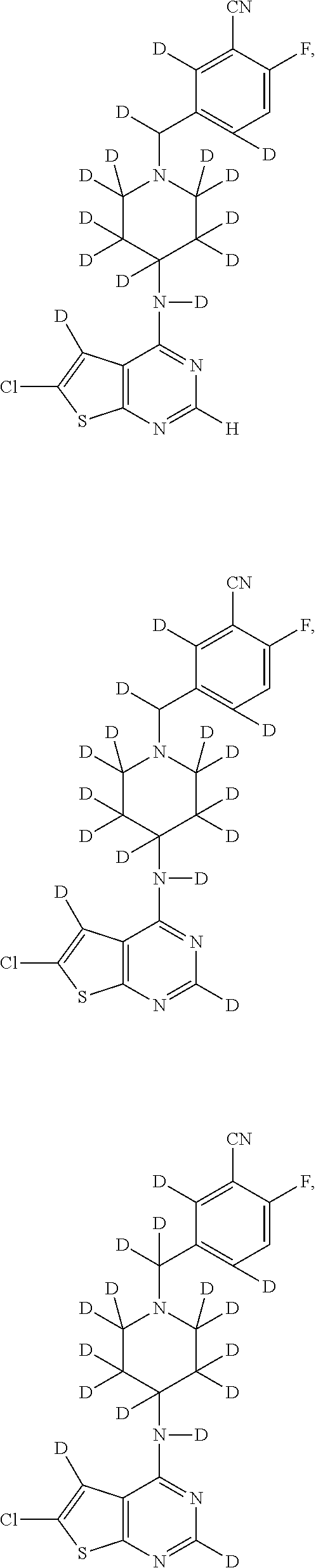


Priority Applications (3)
| Application Number | Priority Date | Filing Date | Title |
|---|---|---|---|
| US12/804,970 US8618116B2 (en) | 2009-08-03 | 2010-08-03 | Deuterium-enriched pyrimidine compounds and derivatives |
| US13/199,940 US9271979B2 (en) | 2010-08-03 | 2011-09-14 | Deuterium-enriched pyrimidine compounds and derivatives |
| US13/651,341 US9271980B2 (en) | 2009-08-03 | 2012-10-12 | Deuterium-enriched pyrimidine compounds and derivatives |
Applications Claiming Priority (2)
| Application Number | Priority Date | Filing Date | Title |
|---|---|---|---|
| US27324709P | 2009-08-03 | 2009-08-03 | |
| US12/804,970 US8618116B2 (en) | 2009-08-03 | 2010-08-03 | Deuterium-enriched pyrimidine compounds and derivatives |
Related Child Applications (2)
| Application Number | Title | Priority Date | Filing Date |
|---|---|---|---|
| US13/199,940 Continuation-In-Part US9271979B2 (en) | 2009-08-03 | 2011-09-14 | Deuterium-enriched pyrimidine compounds and derivatives |
| US13/651,341 Continuation-In-Part US9271980B2 (en) | 2009-08-03 | 2012-10-12 | Deuterium-enriched pyrimidine compounds and derivatives |
Publications (2)
| Publication Number | Publication Date |
|---|---|
| US20110028496A1 US20110028496A1 (en) | 2011-02-03 |
| US8618116B2 true US8618116B2 (en) | 2013-12-31 |
Family
ID=43527604
Family Applications (1)
| Application Number | Title | Priority Date | Filing Date |
|---|---|---|---|
| US12/804,970 Active 2031-07-27 US8618116B2 (en) | 2009-08-03 | 2010-08-03 | Deuterium-enriched pyrimidine compounds and derivatives |
Country Status (1)
| Country | Link |
|---|---|
| US (1) | US8618116B2 (en) |
Families Citing this family (4)
| Publication number | Priority date | Publication date | Assignee | Title |
|---|---|---|---|---|
| EP2825533B1 (en) | 2012-03-13 | 2016-10-19 | Basf Se | Fungicidal pyrimidine compounds |
| WO2015036059A1 (en) | 2013-09-16 | 2015-03-19 | Basf Se | Fungicidal pyrimidine compounds |
| CA2923101A1 (en) | 2013-09-16 | 2015-03-19 | Basf Se | Fungicidal pyrimidine compounds |
| CN113444802B (en) * | 2021-07-01 | 2024-02-06 | 复旦大学附属肿瘤医院 | Application of HTR1A in breast cancer diagnosis, treatment and prognosis |
Citations (7)
| Publication number | Priority date | Publication date | Assignee | Title |
|---|---|---|---|---|
| US6221335B1 (en) * | 1994-03-25 | 2001-04-24 | Isotechnika, Inc. | Method of using deuterated calcium channel blockers |
| US6440710B1 (en) * | 1998-12-10 | 2002-08-27 | The Scripps Research Institute | Antibody-catalyzed deuteration, tritiation, dedeuteration or detritiation of carbonyl compounds |
| US6603008B1 (en) * | 1999-12-03 | 2003-08-05 | Pfizer Inc. | Sulfamoylheleroaryl pyrazole compounds as anti-inflammatory/analgesic agents |
| US20050222176A1 (en) * | 2003-03-31 | 2005-10-06 | Dhanoa Dale S | Piperidinylamino-thieno[2,3-D] pyrimidine compounds |
| US20070082929A1 (en) * | 2005-10-06 | 2007-04-12 | Gant Thomas G | Inhibitors of the gastric H+, K+-atpase with enhanced therapeutic properties |
| US20070197695A1 (en) * | 2006-02-10 | 2007-08-23 | Sigma-Aldrich Co. | Stabilized deuteroborane-tetrahydrofuran complex |
| US7517990B2 (en) * | 2002-11-15 | 2009-04-14 | Wako Pure Chemical Industries, Ltd. | Method for deuteration of a heterocyclic ring |
-
2010
- 2010-08-03 US US12/804,970 patent/US8618116B2/en active Active
Patent Citations (7)
| Publication number | Priority date | Publication date | Assignee | Title |
|---|---|---|---|---|
| US6221335B1 (en) * | 1994-03-25 | 2001-04-24 | Isotechnika, Inc. | Method of using deuterated calcium channel blockers |
| US6440710B1 (en) * | 1998-12-10 | 2002-08-27 | The Scripps Research Institute | Antibody-catalyzed deuteration, tritiation, dedeuteration or detritiation of carbonyl compounds |
| US6603008B1 (en) * | 1999-12-03 | 2003-08-05 | Pfizer Inc. | Sulfamoylheleroaryl pyrazole compounds as anti-inflammatory/analgesic agents |
| US7517990B2 (en) * | 2002-11-15 | 2009-04-14 | Wako Pure Chemical Industries, Ltd. | Method for deuteration of a heterocyclic ring |
| US20050222176A1 (en) * | 2003-03-31 | 2005-10-06 | Dhanoa Dale S | Piperidinylamino-thieno[2,3-D] pyrimidine compounds |
| US20070082929A1 (en) * | 2005-10-06 | 2007-04-12 | Gant Thomas G | Inhibitors of the gastric H+, K+-atpase with enhanced therapeutic properties |
| US20070197695A1 (en) * | 2006-02-10 | 2007-08-23 | Sigma-Aldrich Co. | Stabilized deuteroborane-tetrahydrofuran complex |
Non-Patent Citations (10)
| Title |
|---|
| Baillie, Pharmacology Rev.1981; 33: 81-132. * |
| Browne, Journal of Clinical Pharmacology1998; 38: 213-220. * |
| Cherrah, Biomedical and Environmental Mass Spectrometry vol. 14 Issue 11, pp. 653-657 (1987). * |
| Dyck, Journal of Neurochemistry vol. 46 Issue 2, pp. 399-404 (1986). * |
| Gouyette, Biomedical and Environmental Mass Spectrometry, vol. 15, 243-247 (1988). * |
| Haskins, Biomedical Spectrometry vol. 9 Issue 7, pp. 269-277 (1982. * |
| Honma et al., Drug Metab Dispos 15 (4): 551 (1987). * |
| Pieniaszek, J Clin Pharmacol.1999; 39: 817-825. * |
| Tonn, Biological Mass Spectrometry vol. 22 Issue 11, pp. 633-642 (1993). * |
| Wolen, Journal of Clinical Pharmacology 1986; 26: 419-424. * |
Also Published As
| Publication number | Publication date |
|---|---|
| US20110028496A1 (en) | 2011-02-03 |
Similar Documents
| Publication | Publication Date | Title |
|---|---|---|
| US9453027B2 (en) | Deuterium-enriched pyridinonecarboxamides and derivatives | |
| JP3294961B2 (en) | Novel imidazole derivative and method for producing the same | |
| JP2006501236A (en) | 3,6-disubstituted azabicyclo (3.1.0) hexane derivatives containing fluoro and sulfonylamino as muscarinic receptor antagonists | |
| AU2003226579B2 (en) | Azabicyclo derivatives as muscarinic receptor antagonists | |
| JP5425915B2 (en) | Method for producing diazonium-free indazole intermediate in the synthesis of bicyclic 5- (trifluoromethoxy) -1H-3-indazolecarboxylic acid amide | |
| JP2008525357A (en) | An azole derivative having antimuscarinic activity | |
| WO2004007471A1 (en) | N-phenyl-(2r,5s)dimethylpiperadine derivative | |
| US8618116B2 (en) | Deuterium-enriched pyrimidine compounds and derivatives | |
| KR20220083778A (en) | Thienopyrimidone as a TRPA1 inhibitor | |
| JP5784110B2 (en) | Substituted N-heteroaryltetrahydro-isoquinoline derivatives, their preparation and therapeutic use | |
| JP2006518707A (en) | 3,6-Disubstituted azabicyclo [3.1.0] hexane derivatives as muscarinic receptor antagonists | |
| KR20000005505A (en) | Piperidines and pyrrolidines | |
| US9271980B2 (en) | Deuterium-enriched pyrimidine compounds and derivatives | |
| JP3044055B2 (en) | 1,2-ethanediol derivatives and salts thereof | |
| US8557994B2 (en) | Deuterium-enriched pyridinonecarboxamides and derivatives | |
| AU2011291579A1 (en) | Nicotinic receptor compounds | |
| US8530479B2 (en) | Deuterium-enriched alkyl sulfonamides | |
| JP4648544B2 (en) | (1-Phenacyl-3-phenyl-3-piperidylethyl) piperidine derivatives, process for producing the same and pharmaceutical compositions containing the same | |
| US9271979B2 (en) | Deuterium-enriched pyrimidine compounds and derivatives | |
| SK286977B6 (en) | Morpholine derivates, method for the production thereof and pharmaceutical preparations containing said derivates | |
| JP2004514678A (en) | Benzimidazole derivatives, their preparation and their therapeutic application | |
| JP2002527423A (en) | Ureidopiperidine derivatives as selective antagonists of the human NK3 receptor | |
| US20150133663A1 (en) | Novel synthesis method | |
| AU2023228096A1 (en) | Histamine h3 receptor antagonist and medical use thereof | |
| JP2012523448A (en) | Derivatives of N-[(7-aza-bicyclo [2.2.1] hept-1-yl) -aryl-methyl] -benzamide, their preparation and their therapeutic use |
Legal Events
| Date | Code | Title | Description |
|---|---|---|---|
| STCF | Information on status: patent grant |
Free format text: PATENTED CASE |
|
| FPAY | Fee payment |
Year of fee payment: 4 |
|
| MAFP | Maintenance fee payment |
Free format text: PAYMENT OF MAINTENANCE FEE, 8TH YR, SMALL ENTITY (ORIGINAL EVENT CODE: M2552); ENTITY STATUS OF PATENT OWNER: SMALL ENTITY Year of fee payment: 8 |
|
| FEPP | Fee payment procedure |
Free format text: ENTITY STATUS SET TO MICRO (ORIGINAL EVENT CODE: MICR); ENTITY STATUS OF PATENT OWNER: MICROENTITY |
|
| MAFP | Maintenance fee payment |
Free format text: PAYMENT OF MAINTENANCE FEE, 12TH YEAR, MICRO ENTITY (ORIGINAL EVENT CODE: M3553); ENTITY STATUS OF PATENT OWNER: MICROENTITY Year of fee payment: 12 |