US8618065B2 - Cyclosporin derivatives - Google Patents
Cyclosporin derivatives Download PDFInfo
- Publication number
- US8618065B2 US8618065B2 US13/397,256 US201213397256A US8618065B2 US 8618065 B2 US8618065 B2 US 8618065B2 US 201213397256 A US201213397256 A US 201213397256A US 8618065 B2 US8618065 B2 US 8618065B2
- Authority
- US
- United States
- Prior art keywords
- group
- amino acid
- residue
- cyclosporin derivative
- leucine
- Prior art date
- Legal status (The legal status is an assumption and is not a legal conclusion. Google has not performed a legal analysis and makes no representation as to the accuracy of the status listed.)
- Expired - Fee Related
Links
- 0 *1BCCC[2H]CFC[H][IH]CCC[K]1 Chemical compound *1BCCC[2H]CFC[H][IH]CCC[K]1 0.000 description 22
- BHOQXEIEHPPRTR-WGYYDCEXSA-N CC[C@@H]1CC(=O)[C@H]([C@H](O)[C@H](C)C/C=C/COCC(=O)C[C@H](CCC(=O)O)C(=O)N[C@H](CCC(=O)O)C(=O)C[C@H](CCC(=O)O)C(=O)N[C@H](CCC(=O)O)C(=O)C[C@H](CCC(=O)O)C(=O)N[C@H](CCC(=O)O)C(=O)CCC(=O)O)N(C)C(=O)[C@H](C(C)C)N(C)C(=O)[C@H](CC(C)C)N(C)C(=O)[C@H](CC(C)C)N(C)C(=O)[C@@H](C)NC(=O)[C@H](C)CC(=O)[C@H](CC(C)C)N(C)C(=O)[C@H](C(C)C)CC(=O)[C@H](CC(C)C)N(C)C(=O)CN(C)C1=O.CC[C@@H]1CC(=O)[C@H]([C@H](O)[C@H](C)C/C=C/CSCCC(=O)N[C@H](CCC(=O)O)C(=O)C[C@H](CCC(=O)O)C(=O)N[C@H](CCC(=O)O)C(=O)C[C@H](CCC(=O)O)C(=O)N[C@H](CCC(=O)O)C(=O)C[C@H](CCC(=O)O)C(=O)NCC(=O)O)N(C)C(=O)[C@H](C(C)C)N(C)C(=O)[C@H](CC(C)C)N(C)C(=O)[C@H](CC(C)C)N(C)C(=O)[C@@H](C)NC(=O)[C@H](C)CC(=O)[C@H](CC(C)C)N(C)C(=O)[C@H](C(C)C)CC(=O)[C@H](CC(C)C)N(C)C(=O)CN(C)C1=O Chemical compound CC[C@@H]1CC(=O)[C@H]([C@H](O)[C@H](C)C/C=C/COCC(=O)C[C@H](CCC(=O)O)C(=O)N[C@H](CCC(=O)O)C(=O)C[C@H](CCC(=O)O)C(=O)N[C@H](CCC(=O)O)C(=O)C[C@H](CCC(=O)O)C(=O)N[C@H](CCC(=O)O)C(=O)CCC(=O)O)N(C)C(=O)[C@H](C(C)C)N(C)C(=O)[C@H](CC(C)C)N(C)C(=O)[C@H](CC(C)C)N(C)C(=O)[C@@H](C)NC(=O)[C@H](C)CC(=O)[C@H](CC(C)C)N(C)C(=O)[C@H](C(C)C)CC(=O)[C@H](CC(C)C)N(C)C(=O)CN(C)C1=O.CC[C@@H]1CC(=O)[C@H]([C@H](O)[C@H](C)C/C=C/CSCCC(=O)N[C@H](CCC(=O)O)C(=O)C[C@H](CCC(=O)O)C(=O)N[C@H](CCC(=O)O)C(=O)C[C@H](CCC(=O)O)C(=O)N[C@H](CCC(=O)O)C(=O)C[C@H](CCC(=O)O)C(=O)NCC(=O)O)N(C)C(=O)[C@H](C(C)C)N(C)C(=O)[C@H](CC(C)C)N(C)C(=O)[C@H](CC(C)C)N(C)C(=O)[C@@H](C)NC(=O)[C@H](C)CC(=O)[C@H](CC(C)C)N(C)C(=O)[C@H](C(C)C)CC(=O)[C@H](CC(C)C)N(C)C(=O)CN(C)C1=O BHOQXEIEHPPRTR-WGYYDCEXSA-N 0.000 description 2
- POFIQCNZWWNIEB-LPCWTVJASA-N CC[C@@H]1CC(=O)[C@H]([C@H](O)[C@H](C)CCN(CCC(=O)N[C@H](CCC(=O)O)C(=O)C[C@H](CCC(=O)O)C(=O)N[C@H](CCC(=O)O)C(=O)C[C@H](CCC(=O)O)C(=O)N[C@H](CCC(=O)O)C(=O)C[C@H](CCC(=O)O)C(=O)NCC(=O)O)C(C)=O)N(C)C(=O)[C@H](C(C)C)N(C)C(=O)[C@H](CC(C)C)N(C)C(=O)[C@H](CC(C)C)N(C)C(=O)[C@@H](C)NC(=O)[C@H](C)CC(=O)[C@H](CC(C)C)N(C)C(=O)[C@H](C(C)C)CC(=O)[C@H](CC(C)C)N(C)C(=O)CN(C)C1=O.CC[C@@H]1CC(=O)[C@H]([C@H](O)[C@H](C)CCNC2=CC=C(C(=O)N[C@H](CCC(=O)O)C(=O)C[C@H](CCC(=O)O)C(=O)N[C@H](CCC(=O)O)C(=O)C[C@H](CCC(=O)O)C(=O)N[C@H](CCC(=O)O)C(=O)C[C@H](CCC(=O)O)C(=O)NCC(=O)O)C=C2)N(C)C(=O)[C@H](C(C)C)N(C)C(=O)[C@H](CC(C)C)N(C)C(=O)[C@H](CC(C)C)N(C)C(=O)[C@@H](C)NC(=O)[C@H](C)CC(=O)[C@H](CC(C)C)N(C)C(=O)[C@H](C(C)C)CC(=O)[C@H](CC(C)C)N(C)C(=O)CN(C)C1=O Chemical compound CC[C@@H]1CC(=O)[C@H]([C@H](O)[C@H](C)CCN(CCC(=O)N[C@H](CCC(=O)O)C(=O)C[C@H](CCC(=O)O)C(=O)N[C@H](CCC(=O)O)C(=O)C[C@H](CCC(=O)O)C(=O)N[C@H](CCC(=O)O)C(=O)C[C@H](CCC(=O)O)C(=O)NCC(=O)O)C(C)=O)N(C)C(=O)[C@H](C(C)C)N(C)C(=O)[C@H](CC(C)C)N(C)C(=O)[C@H](CC(C)C)N(C)C(=O)[C@@H](C)NC(=O)[C@H](C)CC(=O)[C@H](CC(C)C)N(C)C(=O)[C@H](C(C)C)CC(=O)[C@H](CC(C)C)N(C)C(=O)CN(C)C1=O.CC[C@@H]1CC(=O)[C@H]([C@H](O)[C@H](C)CCNC2=CC=C(C(=O)N[C@H](CCC(=O)O)C(=O)C[C@H](CCC(=O)O)C(=O)N[C@H](CCC(=O)O)C(=O)C[C@H](CCC(=O)O)C(=O)N[C@H](CCC(=O)O)C(=O)C[C@H](CCC(=O)O)C(=O)NCC(=O)O)C=C2)N(C)C(=O)[C@H](C(C)C)N(C)C(=O)[C@H](CC(C)C)N(C)C(=O)[C@H](CC(C)C)N(C)C(=O)[C@@H](C)NC(=O)[C@H](C)CC(=O)[C@H](CC(C)C)N(C)C(=O)[C@H](C(C)C)CC(=O)[C@H](CC(C)C)N(C)C(=O)CN(C)C1=O POFIQCNZWWNIEB-LPCWTVJASA-N 0.000 description 2
- ORGSBCFFPNEXFQ-LKMFFMOESA-N C=C1[C@H](CC(C)C)N(C)C(=O)[C@H](CC(C)C)N(C)C(=O)[C@@H](C)NC(=O)[C@H](C)CC(=O)[C@H](CC(C)C)N(C)C(=O)[C@H](C(C)C)CC(=O)[C@H](CC(C)C)N(C)C(=O)CN(C)C(=O)[C@H](CC)CC(=O)[C@H]([C@H](O)[C@H](C)CCNC2=CC=C(C(=O)O)C=C2)N(C)C(=O)[C@H](C(C)C)N1C.CCC[C@H]1C(=O)N(C)[C@@H](CC(C)C)C(=O)N(C)[C@@H](C(C)C)C(=O)N(C)[C@@H]([C@H](O)[C@H](C)CCN(CCC(=O)O)C(C)=O)C(=O)C[C@@H](CC)C(=O)N(C)CC(=O)N(C)[C@@H](CC(C)C)C(=O)C[C@@H](C(C)C)C(=O)N(C)[C@@H](CC(C)C)C(=O)C[C@@H](C)C(=O)N[C@H](C)C(=O)N1C.CC[C@@H]1CC(=O)[C@H]([C@H](O)[C@H](C)C/C=C(/C)C2=CC=C(C)C=C2)N(C)C(=O)[C@H](C(C)C)N(C)C(=O)[C@H](CC(C)C)N(C)C(=O)[C@H](CC(C)C)N(C)C(=O)[C@@H](C)NC(=O)[C@H](C)CC(=O)[C@H](CC(C)C)N(C)C(=O)[C@H](C(C)C)CC(=O)[C@H](CC(C)C)N(C)C(=O)CN(C)C1=O.CC[C@@H]1CC(=O)[C@H]([C@H](O)[C@H](C)C/C=C/COCC(=O)O)N(C)C(=O)[C@H](C(C)C)N(C)C(=O)[C@H](CC(C)C)N(C)C(=O)[C@H](CC(C)C)N(C)C(=O)[C@@H](C)NC(=O)[C@H](C)CC(=O)[C@H](CC(C)C)N(C)C(=O)[C@H](C(C)C)CC(=O)[C@H](CC(C)C)N(C)C(=O)CN(C)C1=O.CC[C@@H]1CC(=O)[C@H]([C@H](O)[C@H](C)C/C=C/CSCCC(=O)O)N(C)C(=O)[C@H](C(C)C)N(C)C(=O)[C@H](CC(C)C)N(C)C(=O)[C@H](CC(C)C)N(C)C(=O)[C@@H](C)NC(=O)[C@H](C)CC(=O)[C@H](CC(C)C)N(C)C(=O)[C@H](C(C)C)CC(=O)[C@H](CC(C)C)N(C)C(=O)CN(C)C1=O Chemical compound C=C1[C@H](CC(C)C)N(C)C(=O)[C@H](CC(C)C)N(C)C(=O)[C@@H](C)NC(=O)[C@H](C)CC(=O)[C@H](CC(C)C)N(C)C(=O)[C@H](C(C)C)CC(=O)[C@H](CC(C)C)N(C)C(=O)CN(C)C(=O)[C@H](CC)CC(=O)[C@H]([C@H](O)[C@H](C)CCNC2=CC=C(C(=O)O)C=C2)N(C)C(=O)[C@H](C(C)C)N1C.CCC[C@H]1C(=O)N(C)[C@@H](CC(C)C)C(=O)N(C)[C@@H](C(C)C)C(=O)N(C)[C@@H]([C@H](O)[C@H](C)CCN(CCC(=O)O)C(C)=O)C(=O)C[C@@H](CC)C(=O)N(C)CC(=O)N(C)[C@@H](CC(C)C)C(=O)C[C@@H](C(C)C)C(=O)N(C)[C@@H](CC(C)C)C(=O)C[C@@H](C)C(=O)N[C@H](C)C(=O)N1C.CC[C@@H]1CC(=O)[C@H]([C@H](O)[C@H](C)C/C=C(/C)C2=CC=C(C)C=C2)N(C)C(=O)[C@H](C(C)C)N(C)C(=O)[C@H](CC(C)C)N(C)C(=O)[C@H](CC(C)C)N(C)C(=O)[C@@H](C)NC(=O)[C@H](C)CC(=O)[C@H](CC(C)C)N(C)C(=O)[C@H](C(C)C)CC(=O)[C@H](CC(C)C)N(C)C(=O)CN(C)C1=O.CC[C@@H]1CC(=O)[C@H]([C@H](O)[C@H](C)C/C=C/COCC(=O)O)N(C)C(=O)[C@H](C(C)C)N(C)C(=O)[C@H](CC(C)C)N(C)C(=O)[C@H](CC(C)C)N(C)C(=O)[C@@H](C)NC(=O)[C@H](C)CC(=O)[C@H](CC(C)C)N(C)C(=O)[C@H](C(C)C)CC(=O)[C@H](CC(C)C)N(C)C(=O)CN(C)C1=O.CC[C@@H]1CC(=O)[C@H]([C@H](O)[C@H](C)C/C=C/CSCCC(=O)O)N(C)C(=O)[C@H](C(C)C)N(C)C(=O)[C@H](CC(C)C)N(C)C(=O)[C@H](CC(C)C)N(C)C(=O)[C@@H](C)NC(=O)[C@H](C)CC(=O)[C@H](CC(C)C)N(C)C(=O)[C@H](C(C)C)CC(=O)[C@H](CC(C)C)N(C)C(=O)CN(C)C1=O ORGSBCFFPNEXFQ-LKMFFMOESA-N 0.000 description 1
- CKKNTHJNKLNAPL-YVIRVWAASA-N CCC[C@H]1C(=O)N(C)[C@@H](CC(C)C)C(=O)N(C)[C@@H](C(C)C)C(=O)N(C)[C@@H]([C@H](O)[C@H](C)CCN[C@H](CCC(=O)O)C(=O)C[C@H](CCC(=O)O)C(=O)N[C@H](CCC(=O)O)C(=O)C[C@H](CCC(=O)O)C(=O)N[C@H](CCC(=O)O)C(=O)C[C@H](CCC(=O)O)C(=O)NCC(=O)O)C(=O)C[C@@H](CC)C(=O)N(C)CC(=O)N(C)[C@@H](CC(C)C)C(=O)C[C@@H](C(C)C)C(=O)N(C)[C@@H](CC(C)C)C(=O)C[C@@H](C)C(=O)N[C@H](C)C(=O)N1C.CC[C@@H]1CC(=O)[C@H]([C@H](O)[C@H](C)CC(N)C#N)N(C)C(=O)[C@H](C(C)C)N(C)C(=O)[C@H](CC(C)C)N(C)C(=O)[C@H](CC(C)C)N(C)C(=O)[C@@H](C)NC(=O)[C@H](C)CC(=O)[C@H](CC(C)C)N(C)C(=O)[C@H](C(C)C)CC(=O)[C@H](CC(C)C)N(C)C(=O)CN(C)C1=O.CC[C@@H]1CC(=O)[C@H]([C@H](O)[C@H](C)CC(O)C#CC(=O)O)N(C)C(=O)[C@H](C(C)C)N(C)C(=O)[C@H](CC(C)C)N(C)C(=O)[C@H](CC(C)C)N(C)C(=O)[C@@H](C)NC(=O)[C@H](C)CC(=O)[C@H](CC(C)C)N(C)C(=O)[C@H](C(C)C)CC(=O)[C@H](CC(C)C)N(C)C(=O)CN(C)C1=O.CC[C@@H]1CC(=O)[C@H]([C@H](O)[C@H](C)CC=CC(=O)O)N(C)C(=O)[C@H](C(C)C)N(C)C(=O)[C@H](CC(C)C)N(C)C(=O)[C@H](CC(C)C)N(C)C(=O)[C@@H](C)NC(=O)[C@H](C)CC(=O)[C@H](CC(C)C)N(C)C(=O)[C@H](C(C)C)CC(=O)[C@H](CC(C)C)N(C)C(=O)CN(C)C1=O.CC[C@@H]1CC(=O)[C@H]([C@H](O)[C@H](C)CCCC(=O)O)N(C)C(=O)[C@H](C(C)C)N(C)C(=O)[C@H](CC(C)C)N(C)C(=O)[C@H](CC(C)C)N(C)C(=O)[C@@H](C)NC(=O)[C@H](C)CC(=O)[C@H](CC(C)C)N(C)C(=O)[C@H](C(C)C)CC(=O)[C@H](CC(C)C)N(C)C(=O)CN(C)C1=O Chemical compound CCC[C@H]1C(=O)N(C)[C@@H](CC(C)C)C(=O)N(C)[C@@H](C(C)C)C(=O)N(C)[C@@H]([C@H](O)[C@H](C)CCN[C@H](CCC(=O)O)C(=O)C[C@H](CCC(=O)O)C(=O)N[C@H](CCC(=O)O)C(=O)C[C@H](CCC(=O)O)C(=O)N[C@H](CCC(=O)O)C(=O)C[C@H](CCC(=O)O)C(=O)NCC(=O)O)C(=O)C[C@@H](CC)C(=O)N(C)CC(=O)N(C)[C@@H](CC(C)C)C(=O)C[C@@H](C(C)C)C(=O)N(C)[C@@H](CC(C)C)C(=O)C[C@@H](C)C(=O)N[C@H](C)C(=O)N1C.CC[C@@H]1CC(=O)[C@H]([C@H](O)[C@H](C)CC(N)C#N)N(C)C(=O)[C@H](C(C)C)N(C)C(=O)[C@H](CC(C)C)N(C)C(=O)[C@H](CC(C)C)N(C)C(=O)[C@@H](C)NC(=O)[C@H](C)CC(=O)[C@H](CC(C)C)N(C)C(=O)[C@H](C(C)C)CC(=O)[C@H](CC(C)C)N(C)C(=O)CN(C)C1=O.CC[C@@H]1CC(=O)[C@H]([C@H](O)[C@H](C)CC(O)C#CC(=O)O)N(C)C(=O)[C@H](C(C)C)N(C)C(=O)[C@H](CC(C)C)N(C)C(=O)[C@H](CC(C)C)N(C)C(=O)[C@@H](C)NC(=O)[C@H](C)CC(=O)[C@H](CC(C)C)N(C)C(=O)[C@H](C(C)C)CC(=O)[C@H](CC(C)C)N(C)C(=O)CN(C)C1=O.CC[C@@H]1CC(=O)[C@H]([C@H](O)[C@H](C)CC=CC(=O)O)N(C)C(=O)[C@H](C(C)C)N(C)C(=O)[C@H](CC(C)C)N(C)C(=O)[C@H](CC(C)C)N(C)C(=O)[C@@H](C)NC(=O)[C@H](C)CC(=O)[C@H](CC(C)C)N(C)C(=O)[C@H](C(C)C)CC(=O)[C@H](CC(C)C)N(C)C(=O)CN(C)C1=O.CC[C@@H]1CC(=O)[C@H]([C@H](O)[C@H](C)CCCC(=O)O)N(C)C(=O)[C@H](C(C)C)N(C)C(=O)[C@H](CC(C)C)N(C)C(=O)[C@H](CC(C)C)N(C)C(=O)[C@@H](C)NC(=O)[C@H](C)CC(=O)[C@H](CC(C)C)N(C)C(=O)[C@H](C(C)C)CC(=O)[C@H](CC(C)C)N(C)C(=O)CN(C)C1=O CKKNTHJNKLNAPL-YVIRVWAASA-N 0.000 description 1
- ROZGFQGGEOSWRC-LQLGTGTMSA-N CC[C@@H](C(N(C)CC(N(C)[C@@H](CC(C)C)C(N[C@@H](C(C)C)C(N(C)[C@@H](CC(C)C)C(N[C@@H](C)C(N[C@H](C)C(N(C)[C@@H](CC(C)C)C(N(C)[C@@H](CC(C)C)C(N(C)[C@@H](C(C)C)C(N(C)[C@H]1[C@@H]([C@H](C)CCCC(O)=O)O)=O)=O)=O)=O)=O)=O)=O)=O)=O)=O)NC1=O Chemical compound CC[C@@H](C(N(C)CC(N(C)[C@@H](CC(C)C)C(N[C@@H](C(C)C)C(N(C)[C@@H](CC(C)C)C(N[C@@H](C)C(N[C@H](C)C(N(C)[C@@H](CC(C)C)C(N(C)[C@@H](CC(C)C)C(N(C)[C@@H](C(C)C)C(N(C)[C@H]1[C@@H]([C@H](C)CCCC(O)=O)O)=O)=O)=O)=O)=O)=O)=O)=O)=O)=O)NC1=O ROZGFQGGEOSWRC-LQLGTGTMSA-N 0.000 description 1
- NRXKCFUYNBVJJG-ZAFGWWEGSA-N CC[C@@H](C(N(C)CC(N(C)[C@@H](CC(C)C)C(N[C@@H](C(C)C)C(N(C)[C@@H](CC(C)C)C(N[C@@H](C)C(N[C@H](C)C(N(C)[C@@H](CC(C)C)C(N(C)[C@@H](CC(C)OC(CC[C@H](C(NCC(Nc(cc1)ccc1/C(/C)=C\C[C@@H](C)[C@H]([C@@H]1N(C)C([C@H](C(C)C)N2C)=O)O)=O)=O)NC([C@@H](CCC(O)=O)NC([C@@H](CCC(O)=O)NC([C@@H](CCC(O)=O)NC([C@@H](CCC(O)=O)NC([C@@H](CCC(O)=O)NC(C)=O)=O)=O)=O)=O)=O)=O)C2=O)=O)=O)=O)=O)=O)=O)=O)=O)NC1=O Chemical compound CC[C@@H](C(N(C)CC(N(C)[C@@H](CC(C)C)C(N[C@@H](C(C)C)C(N(C)[C@@H](CC(C)C)C(N[C@@H](C)C(N[C@H](C)C(N(C)[C@@H](CC(C)C)C(N(C)[C@@H](CC(C)OC(CC[C@H](C(NCC(Nc(cc1)ccc1/C(/C)=C\C[C@@H](C)[C@H]([C@@H]1N(C)C([C@H](C(C)C)N2C)=O)O)=O)=O)NC([C@@H](CCC(O)=O)NC([C@@H](CCC(O)=O)NC([C@@H](CCC(O)=O)NC([C@@H](CCC(O)=O)NC([C@@H](CCC(O)=O)NC(C)=O)=O)=O)=O)=O)=O)=O)C2=O)=O)=O)=O)=O)=O)=O)=O)=O)NC1=O NRXKCFUYNBVJJG-ZAFGWWEGSA-N 0.000 description 1
- CTZAELSYNJBWTK-BTVWKUQISA-N CC[C@@H]1CC(=O)C([C@H](O)[C@H](C)C/C=C(/C)C2=CC=C(CC(=O)CCC(=O)O)C=C2)N(C)C(=O)[C@H](C(C)C)N(C)C(=O)[C@H](CC(C)C)N(C)C(=O)[C@H](CC(C)C)N(C)C(=O)[C@@H](C)NC(=O)[C@H](C)CC(=O)[C@H](CC(C)C)N(C)C(=O)[C@H](C(C)C)CC(=O)[C@H](CC(C)C)N(C)C(=O)CN(C)C1=O.CC[C@@H]1CC(=O)[C@H]([C@H](O)[C@H](C)C/C=C(/C)C2=CC=C(CC(=O)CNC(=O)[C@@H](CCC(=O)O)CC(=O)[C@@H](CCC(=O)O)NC(=O)[C@@H](CCC(=O)O)CC(=O)[C@@H](CCC(=O)O)NC(=O)[C@@H](CCC(=O)O)CC(=O)[C@@H](CCC(=O)O)NC(C)=O)C=C2)N(C)C(=O)[C@H](C(C)C)N(C)C(=O)[C@H](CC(C)C)N(C)C(=O)[C@H](CC(C)C)N(C)C(=O)[C@@H](C)NC(=O)[C@H](C)CC(=O)[C@H](CC(C)C)N(C)C(=O)[C@H](C(C)C)CC(=O)[C@H](CC(C)C)N(C)C(=O)CN(C)C1=O Chemical compound CC[C@@H]1CC(=O)C([C@H](O)[C@H](C)C/C=C(/C)C2=CC=C(CC(=O)CCC(=O)O)C=C2)N(C)C(=O)[C@H](C(C)C)N(C)C(=O)[C@H](CC(C)C)N(C)C(=O)[C@H](CC(C)C)N(C)C(=O)[C@@H](C)NC(=O)[C@H](C)CC(=O)[C@H](CC(C)C)N(C)C(=O)[C@H](C(C)C)CC(=O)[C@H](CC(C)C)N(C)C(=O)CN(C)C1=O.CC[C@@H]1CC(=O)[C@H]([C@H](O)[C@H](C)C/C=C(/C)C2=CC=C(CC(=O)CNC(=O)[C@@H](CCC(=O)O)CC(=O)[C@@H](CCC(=O)O)NC(=O)[C@@H](CCC(=O)O)CC(=O)[C@@H](CCC(=O)O)NC(=O)[C@@H](CCC(=O)O)CC(=O)[C@@H](CCC(=O)O)NC(C)=O)C=C2)N(C)C(=O)[C@H](C(C)C)N(C)C(=O)[C@H](CC(C)C)N(C)C(=O)[C@H](CC(C)C)N(C)C(=O)[C@@H](C)NC(=O)[C@H](C)CC(=O)[C@H](CC(C)C)N(C)C(=O)[C@H](C(C)C)CC(=O)[C@H](CC(C)C)N(C)C(=O)CN(C)C1=O CTZAELSYNJBWTK-BTVWKUQISA-N 0.000 description 1
- ABPFPQGRCDUSSF-YGJPOZFFSA-N CC[C@@H]1CC(=O)[C@H]([C@H](O)[C@H](C)C/C=C(/C)C2=CC=C(CC(=O)CCC(=O)N[C@H](CCC(=O)O)C(=O)C[C@H](CCC(=O)O)C(=O)N[C@H](CCC(=O)O)C(=O)C[C@H](CCC(=O)O)C(=O)N[C@H](CCC(=O)O)C(=O)C[C@H](CCC(=O)O)C(=O)NCC(=O)O)C=C2)N(C)C(=O)[C@H](C(C)C)N(C)C(=O)[C@H](CC(C)C)N(C)C(=O)[C@H](CC(C)C)N(C)C(=O)[C@@H](C)NC(=O)[C@H](C)CC(=O)[C@H](CC(C)C)N(C)C(=O)[C@H](C(C)C)CC(=O)[C@H](CC(C)C)N(C)C(=O)CN(C)C1=O Chemical compound CC[C@@H]1CC(=O)[C@H]([C@H](O)[C@H](C)C/C=C(/C)C2=CC=C(CC(=O)CCC(=O)N[C@H](CCC(=O)O)C(=O)C[C@H](CCC(=O)O)C(=O)N[C@H](CCC(=O)O)C(=O)C[C@H](CCC(=O)O)C(=O)N[C@H](CCC(=O)O)C(=O)C[C@H](CCC(=O)O)C(=O)NCC(=O)O)C=C2)N(C)C(=O)[C@H](C(C)C)N(C)C(=O)[C@H](CC(C)C)N(C)C(=O)[C@H](CC(C)C)N(C)C(=O)[C@@H](C)NC(=O)[C@H](C)CC(=O)[C@H](CC(C)C)N(C)C(=O)[C@H](C(C)C)CC(=O)[C@H](CC(C)C)N(C)C(=O)CN(C)C1=O ABPFPQGRCDUSSF-YGJPOZFFSA-N 0.000 description 1
- LRCVTQCAFFLBBP-PIVYLQLQSA-N CC[C@@H]1CC(=O)[C@H]([C@H](O)[C@H](C)C/C=C(/C)C2=CC=C(CC(=O)CCC(=O)N[C@H](CCC(=O)O)C(=O)C[C@H](CCC(=O)O)C(=O)N[C@H](CCC(=O)O)C(=O)C[C@H](CCC(=O)O)C(=O)N[C@H](CCC(=O)O)C(=O)C[C@H](CCC(=O)O)C(=O)NCC(=O)O)C=C2)N(C)C(=O)[C@H](C(C)C)N(C)C(=O)[C@H](CC(C)C)N(C)C(=O)[C@H](CC(C)C)N(C)C(=O)[C@@H](C)NC(=O)[C@H](C)CC(=O)[C@H](CC(C)C)N(C)C(=O)[C@H](C(C)C)CC(=O)[C@H](CC(C)C)N(C)C(=O)CN(C)C1=O.CC[C@@H]1CC(=O)[C@H]([C@H](O)[C@H](C)C/C=C/COCC(=O)C[C@H](CCC(=O)O)C(=O)N[C@H](CCC(=O)O)C(=O)C[C@H](CCC(=O)O)C(=O)N[C@H](CCC(=O)O)C(=O)C[C@H](CCC(=O)O)C(=O)N[C@H](CCC(=O)O)C(=O)CCC(=O)O)N(C)C(=O)[C@H](C(C)C)N(C)C(=O)[C@H](CC(C)C)N(C)C(=O)[C@H](CC(C)C)N(C)C(=O)[C@@H](C)NC(=O)[C@H](C)CC(=O)[C@H](CC(C)C)N(C)C(=O)[C@H](C(C)C)CC(=O)[C@H](CC(C)C)N(C)C(=O)CN(C)C1=O Chemical compound CC[C@@H]1CC(=O)[C@H]([C@H](O)[C@H](C)C/C=C(/C)C2=CC=C(CC(=O)CCC(=O)N[C@H](CCC(=O)O)C(=O)C[C@H](CCC(=O)O)C(=O)N[C@H](CCC(=O)O)C(=O)C[C@H](CCC(=O)O)C(=O)N[C@H](CCC(=O)O)C(=O)C[C@H](CCC(=O)O)C(=O)NCC(=O)O)C=C2)N(C)C(=O)[C@H](C(C)C)N(C)C(=O)[C@H](CC(C)C)N(C)C(=O)[C@H](CC(C)C)N(C)C(=O)[C@@H](C)NC(=O)[C@H](C)CC(=O)[C@H](CC(C)C)N(C)C(=O)[C@H](C(C)C)CC(=O)[C@H](CC(C)C)N(C)C(=O)CN(C)C1=O.CC[C@@H]1CC(=O)[C@H]([C@H](O)[C@H](C)C/C=C/COCC(=O)C[C@H](CCC(=O)O)C(=O)N[C@H](CCC(=O)O)C(=O)C[C@H](CCC(=O)O)C(=O)N[C@H](CCC(=O)O)C(=O)C[C@H](CCC(=O)O)C(=O)N[C@H](CCC(=O)O)C(=O)CCC(=O)O)N(C)C(=O)[C@H](C(C)C)N(C)C(=O)[C@H](CC(C)C)N(C)C(=O)[C@H](CC(C)C)N(C)C(=O)[C@@H](C)NC(=O)[C@H](C)CC(=O)[C@H](CC(C)C)N(C)C(=O)[C@H](C(C)C)CC(=O)[C@H](CC(C)C)N(C)C(=O)CN(C)C1=O LRCVTQCAFFLBBP-PIVYLQLQSA-N 0.000 description 1
- TYAIXAQBKOEHDA-GHBBAAGUSA-N CC[C@@H]1CC(=O)[C@H]([C@H](O)[C@H](C)C/C=C(/C)C2=CC=C(CC(=O)CCC(=O)O)C=C2)N(C)C(=O)[C@H](C(C)C)N(C)C(=O)[C@H](CC(C)C)N(C)C(=O)[C@H](CC(C)C)N(C)C(=O)[C@@H](C)NC(=O)[C@H](C)CC(=O)[C@H](CC(C)C)N(C)C(=O)[C@H](C(C)C)CC(=O)[C@H](CC(C)C)N(C)C(=O)CN(C)C1=O Chemical compound CC[C@@H]1CC(=O)[C@H]([C@H](O)[C@H](C)C/C=C(/C)C2=CC=C(CC(=O)CCC(=O)O)C=C2)N(C)C(=O)[C@H](C(C)C)N(C)C(=O)[C@H](CC(C)C)N(C)C(=O)[C@H](CC(C)C)N(C)C(=O)[C@@H](C)NC(=O)[C@H](C)CC(=O)[C@H](CC(C)C)N(C)C(=O)[C@H](C(C)C)CC(=O)[C@H](CC(C)C)N(C)C(=O)CN(C)C1=O TYAIXAQBKOEHDA-GHBBAAGUSA-N 0.000 description 1
- XRKRVCOMZRLYHS-OOVXVTRFSA-N CC[C@@H]1CC(=O)[C@H]([C@H](O)[C@H](C)C/C=C(/C)C2=CC=C(CC(=O)CCC(=O)O)C=C2)N(C)C(=O)[C@H](C(C)C)N(C)C(=O)[C@H](CC(C)C)N(C)C(=O)[C@H](CC(C)C)N(C)C(=O)[C@@H](C)NC(=O)[C@H](C)CC(=O)[C@H](CC(C)C)N(C)C(=O)[C@H](C(C)C)CC(=O)[C@H](CC(C)C)N(C)C(=O)CN(C)C1=O.CC[C@@H]1CC(=O)[C@H]([C@H](O)[C@H](C)CC(O)C(C)N(C(C)=O)C(C)OC=O)N(C)C(=O)[C@H](C(C)C)N(C)C(=O)[C@H](CC(C)C)N(C)C(=O)[C@H](CC(C)C)N(C)C(=O)[C@@H](C)NC(=O)[C@H](C)CC(=O)[C@H](CC(C)C)N(C)C(=O)[C@H](C(C)C)CC(=O)[C@H](CC(C)C)N(C)C(=O)CN(C)C1=O Chemical compound CC[C@@H]1CC(=O)[C@H]([C@H](O)[C@H](C)C/C=C(/C)C2=CC=C(CC(=O)CCC(=O)O)C=C2)N(C)C(=O)[C@H](C(C)C)N(C)C(=O)[C@H](CC(C)C)N(C)C(=O)[C@H](CC(C)C)N(C)C(=O)[C@@H](C)NC(=O)[C@H](C)CC(=O)[C@H](CC(C)C)N(C)C(=O)[C@H](C(C)C)CC(=O)[C@H](CC(C)C)N(C)C(=O)CN(C)C1=O.CC[C@@H]1CC(=O)[C@H]([C@H](O)[C@H](C)CC(O)C(C)N(C(C)=O)C(C)OC=O)N(C)C(=O)[C@H](C(C)C)N(C)C(=O)[C@H](CC(C)C)N(C)C(=O)[C@H](CC(C)C)N(C)C(=O)[C@@H](C)NC(=O)[C@H](C)CC(=O)[C@H](CC(C)C)N(C)C(=O)[C@H](C(C)C)CC(=O)[C@H](CC(C)C)N(C)C(=O)CN(C)C1=O XRKRVCOMZRLYHS-OOVXVTRFSA-N 0.000 description 1
- WIKXNHBUXBSJTN-HZKTYTDNSA-N CC[C@@H]1CC(=O)[C@H]([C@H](O)[C@H](C)C/C=C(/C)C2=CC=C(CC(=O)CNC(=O)[C@@H](CCC(=O)O)CC(=O)[C@@H](CCC(=O)O)NC(=O)[C@@H](CCC(=O)O)CC(=O)[C@@H](CCC(=O)O)NC(=O)[C@@H](CCC(=O)O)CC(=O)[C@@H](CCC(=O)O)NC(C)=O)C=C2)N(C)C(=O)[C@H](C(C)C)N(C)C(=O)[C@H](CC(C)C)N(C)C(=O)[C@H](CC(C)C)N(C)C(=O)[C@@H](C)NC(=O)[C@H](C)CC(=O)[C@H](CC(C)C)N(C)C(=O)[C@H](C(C)C)CC(=O)[C@H](CC(C)C)N(C)C(=O)CN(C)C1=O Chemical compound CC[C@@H]1CC(=O)[C@H]([C@H](O)[C@H](C)C/C=C(/C)C2=CC=C(CC(=O)CNC(=O)[C@@H](CCC(=O)O)CC(=O)[C@@H](CCC(=O)O)NC(=O)[C@@H](CCC(=O)O)CC(=O)[C@@H](CCC(=O)O)NC(=O)[C@@H](CCC(=O)O)CC(=O)[C@@H](CCC(=O)O)NC(C)=O)C=C2)N(C)C(=O)[C@H](C(C)C)N(C)C(=O)[C@H](CC(C)C)N(C)C(=O)[C@H](CC(C)C)N(C)C(=O)[C@@H](C)NC(=O)[C@H](C)CC(=O)[C@H](CC(C)C)N(C)C(=O)[C@H](C(C)C)CC(=O)[C@H](CC(C)C)N(C)C(=O)CN(C)C1=O WIKXNHBUXBSJTN-HZKTYTDNSA-N 0.000 description 1
- IDKKGODJSOZJFV-CYGOEPCBSA-N CC[C@@H]1CC(=O)[C@H]([C@H](O)[C@H](C)C/C=C(/C)C2=CC=C(CC(=O)CNC(=O)[C@@H](CCC(=O)O)CC(=O)[C@@H](CCC(=O)O)NC(=O)[C@@H](CCC(=O)O)CC(=O)[C@@H](CCC(=O)O)NC(=O)[C@@H](CCC(=O)O)CC(=O)[C@@H](CCC(=O)O)NC(C)=O)C=C2)N(C)C(=O)[C@H](C(C)C)N(C)C(=O)[C@H](CC(C)C)N(C)C(=O)[C@H](CC(C)C)N(C)C(=O)[C@@H](C)NC(=O)[C@H](C)CC(=O)[C@H](CC(C)C)N(C)C(=O)[C@H](C(C)C)CC(=O)[C@H](CC(C)C)N(C)C(=O)CN(C)C1=O.CC[C@@H]1CC(=O)[C@H]([C@H](O)[C@H](C)CC(O)C(C)N(C)C(C)OC=O)N(C)C(=O)[C@H](C(C)C)N(C)C(=O)[C@H](CC(C)C)N(C)C(=O)[C@H](CC(C)C)N(C)C(=O)[C@@H](C)NC(=O)[C@H](C)CC(=O)[C@H](CC(C)C)N(C)C(=O)[C@H](C(C)C)CC(=O)[C@H](CC(C)C)N(C)C(=O)CN(C)C1=O.CC[C@@H]1CC(=O)[C@H]([C@H](O)[C@H](C)CC(O)C(C)N(C)C(C)OC=O)N(C)C(=O)[C@H](C(C)C)N(C)C(=O)[C@H](CC(C)C)N(C)C(=O)[C@H](CC(C)C)N(C)C(=O)[C@@H](C)NC(=O)[C@H](C)CC(=O)[C@H](CC(C)C)N(C)C(=O)[C@H](C(C)C)CC(=O)[C@H](CC(C)C)N(C)C(=O)CN(C)C1=O.CC[C@@H]1CC(=O)[C@H]([C@H](O)[C@H](C)CCN(CCC(=O)O)C(=O)CCC(=O)[C@@H](CCC(=O)O)NC(=O)[C@@H](CCC(=O)O)CC(=O)[C@@H](CCC(=O)O)NC(=O)[C@@H](CCC(=O)O)CC(=O)[C@@H](CCC(=O)O)NC(=O)[C@@H](CCC(=O)O)CC(C)=O)N(C)C(=O)[C@H](C(C)C)N(C)C(=O)[C@H](CC(C)C)N(C)C(=O)[C@H](CC(C)C)N(C)C(=O)[C@@H](C)NC(=O)[C@H](C)CC(=O)[C@H](CC(C)C)N(C)C(=O)[C@H](C(C)C)CC(=O)[C@H](CC(C)C)N(C)C(=O)CN(C)C1=O Chemical compound CC[C@@H]1CC(=O)[C@H]([C@H](O)[C@H](C)C/C=C(/C)C2=CC=C(CC(=O)CNC(=O)[C@@H](CCC(=O)O)CC(=O)[C@@H](CCC(=O)O)NC(=O)[C@@H](CCC(=O)O)CC(=O)[C@@H](CCC(=O)O)NC(=O)[C@@H](CCC(=O)O)CC(=O)[C@@H](CCC(=O)O)NC(C)=O)C=C2)N(C)C(=O)[C@H](C(C)C)N(C)C(=O)[C@H](CC(C)C)N(C)C(=O)[C@H](CC(C)C)N(C)C(=O)[C@@H](C)NC(=O)[C@H](C)CC(=O)[C@H](CC(C)C)N(C)C(=O)[C@H](C(C)C)CC(=O)[C@H](CC(C)C)N(C)C(=O)CN(C)C1=O.CC[C@@H]1CC(=O)[C@H]([C@H](O)[C@H](C)CC(O)C(C)N(C)C(C)OC=O)N(C)C(=O)[C@H](C(C)C)N(C)C(=O)[C@H](CC(C)C)N(C)C(=O)[C@H](CC(C)C)N(C)C(=O)[C@@H](C)NC(=O)[C@H](C)CC(=O)[C@H](CC(C)C)N(C)C(=O)[C@H](C(C)C)CC(=O)[C@H](CC(C)C)N(C)C(=O)CN(C)C1=O.CC[C@@H]1CC(=O)[C@H]([C@H](O)[C@H](C)CC(O)C(C)N(C)C(C)OC=O)N(C)C(=O)[C@H](C(C)C)N(C)C(=O)[C@H](CC(C)C)N(C)C(=O)[C@H](CC(C)C)N(C)C(=O)[C@@H](C)NC(=O)[C@H](C)CC(=O)[C@H](CC(C)C)N(C)C(=O)[C@H](C(C)C)CC(=O)[C@H](CC(C)C)N(C)C(=O)CN(C)C1=O.CC[C@@H]1CC(=O)[C@H]([C@H](O)[C@H](C)CCN(CCC(=O)O)C(=O)CCC(=O)[C@@H](CCC(=O)O)NC(=O)[C@@H](CCC(=O)O)CC(=O)[C@@H](CCC(=O)O)NC(=O)[C@@H](CCC(=O)O)CC(=O)[C@@H](CCC(=O)O)NC(=O)[C@@H](CCC(=O)O)CC(C)=O)N(C)C(=O)[C@H](C(C)C)N(C)C(=O)[C@H](CC(C)C)N(C)C(=O)[C@H](CC(C)C)N(C)C(=O)[C@@H](C)NC(=O)[C@H](C)CC(=O)[C@H](CC(C)C)N(C)C(=O)[C@H](C(C)C)CC(=O)[C@H](CC(C)C)N(C)C(=O)CN(C)C1=O IDKKGODJSOZJFV-CYGOEPCBSA-N 0.000 description 1
- SFNJNOHQERRUBN-PRJJCUEQSA-N CC[C@@H]1CC(=O)[C@H]([C@H](O)[C@H](C)C/C=C(/C)C2=CC=C(N)C=C2)N(C)C(=O)[C@H](C(C)C)N(C)C(=O)[C@H](CC(C)C)N(C)C(=O)[C@H](CC(C)C)N(C)C(=O)[C@@H](C)NC(=O)[C@H](C)CC(=O)[C@H](CC(C)C)N(C)C(=O)[C@H](C(C)C)CC(=O)[C@H](CC(C)C)N(C)C(=O)CN(C)C1=O Chemical compound CC[C@@H]1CC(=O)[C@H]([C@H](O)[C@H](C)C/C=C(/C)C2=CC=C(N)C=C2)N(C)C(=O)[C@H](C(C)C)N(C)C(=O)[C@H](CC(C)C)N(C)C(=O)[C@H](CC(C)C)N(C)C(=O)[C@@H](C)NC(=O)[C@H](C)CC(=O)[C@H](CC(C)C)N(C)C(=O)[C@H](C(C)C)CC(=O)[C@H](CC(C)C)N(C)C(=O)CN(C)C1=O SFNJNOHQERRUBN-PRJJCUEQSA-N 0.000 description 1
- VQDVOSQNECAPLH-JGUFIHHISA-N CC[C@@H]1CC(=O)[C@H]([C@H](O)[C@H](C)C/C=C/COCC(=O)C[C@H](CCC(=O)O)C(=O)N[C@H](CCC(=O)O)C(=O)C[C@H](CCC(=O)O)C(=O)N[C@H](CCC(=O)O)C(=O)C[C@H](CCC(=O)O)C(=O)N[C@H](CCC(=O)O)C(=O)CCC(=O)O)N(C)C(=O)[C@H](C(C)C)N(C)C(=O)[C@H](CC(C)C)N(C)C(=O)[C@H](CC(C)C)N(C)C(=O)[C@@H](C)NC(=O)[C@H](C)CC(=O)[C@H](CC(C)C)N(C)C(=O)[C@H](C(C)C)CC(=O)[C@H](CC(C)C)N(C)C(=O)CN(C)C1=O.CC[C@@H]1CC(=O)[C@H]([C@H](O)[C@H](C)CCN(CCC(=O)N[C@H](CCC(=O)O)C(=O)C[C@H](CCC(=O)O)C(=O)N[C@H](CCC(=O)O)C(=O)C[C@H](CCC(=O)O)C(=O)N[C@H](CCC(=O)O)C(=O)C[C@H](CCC(=O)O)C(=O)NCC(=O)O)C(C)=O)N(C)C(=O)[C@H](C(C)C)N(C)C(=O)[C@H](CC(C)C)N(C)C(=O)[C@H](CC(C)C)N(C)C(=O)[C@@H](C)NC(=O)[C@H](C)CC(=O)[C@H](CC(C)C)N(C)C(=O)[C@H](C(C)C)CC(=O)[C@H](CC(C)C)N(C)C(=O)CN(C)C1=O Chemical compound CC[C@@H]1CC(=O)[C@H]([C@H](O)[C@H](C)C/C=C/COCC(=O)C[C@H](CCC(=O)O)C(=O)N[C@H](CCC(=O)O)C(=O)C[C@H](CCC(=O)O)C(=O)N[C@H](CCC(=O)O)C(=O)C[C@H](CCC(=O)O)C(=O)N[C@H](CCC(=O)O)C(=O)CCC(=O)O)N(C)C(=O)[C@H](C(C)C)N(C)C(=O)[C@H](CC(C)C)N(C)C(=O)[C@H](CC(C)C)N(C)C(=O)[C@@H](C)NC(=O)[C@H](C)CC(=O)[C@H](CC(C)C)N(C)C(=O)[C@H](C(C)C)CC(=O)[C@H](CC(C)C)N(C)C(=O)CN(C)C1=O.CC[C@@H]1CC(=O)[C@H]([C@H](O)[C@H](C)CCN(CCC(=O)N[C@H](CCC(=O)O)C(=O)C[C@H](CCC(=O)O)C(=O)N[C@H](CCC(=O)O)C(=O)C[C@H](CCC(=O)O)C(=O)N[C@H](CCC(=O)O)C(=O)C[C@H](CCC(=O)O)C(=O)NCC(=O)O)C(C)=O)N(C)C(=O)[C@H](C(C)C)N(C)C(=O)[C@H](CC(C)C)N(C)C(=O)[C@H](CC(C)C)N(C)C(=O)[C@@H](C)NC(=O)[C@H](C)CC(=O)[C@H](CC(C)C)N(C)C(=O)[C@H](C(C)C)CC(=O)[C@H](CC(C)C)N(C)C(=O)CN(C)C1=O VQDVOSQNECAPLH-JGUFIHHISA-N 0.000 description 1
- MDTGFYPCSDUXJQ-JQJSKYPKSA-N CC[C@@H]1CC(=O)[C@H]([C@H](O)[C@H](C)C/C=C/COCC(=O)O)N(C)C(=O)[C@H](C(C)C)CC(=O)[C@H](CC(C)C)N(C)C(=O)[C@H](CC(C)C)N(C)C(=O)[C@@H](C)NC(=O)[C@H](C)CC(=O)[C@H](CC(C)C)N(C)C(=O)[C@H](C(C)C)CC(=O)[C@H](CC(C)C)N(C)C(=O)CN(C)C1=O.CC[C@@H]1CC(=O)[C@H]([C@H](O)[C@H](C)C/C=C/CSCCC(=O)O)N(C)C(=O)[C@H](C(C)C)N(C)C(=O)[C@H](CC(C)C)N(C)C(=O)[C@H](CC(C)C)N(C)C(=O)[C@@H](C)NC(=O)[C@H](C)CC(=O)[C@H](CC(C)C)N(C)C(=O)[C@H](C(C)C)CC(=O)[C@H](CC(C)C)N(C)C(=O)CN(C)C1=O Chemical compound CC[C@@H]1CC(=O)[C@H]([C@H](O)[C@H](C)C/C=C/COCC(=O)O)N(C)C(=O)[C@H](C(C)C)CC(=O)[C@H](CC(C)C)N(C)C(=O)[C@H](CC(C)C)N(C)C(=O)[C@@H](C)NC(=O)[C@H](C)CC(=O)[C@H](CC(C)C)N(C)C(=O)[C@H](C(C)C)CC(=O)[C@H](CC(C)C)N(C)C(=O)CN(C)C1=O.CC[C@@H]1CC(=O)[C@H]([C@H](O)[C@H](C)C/C=C/CSCCC(=O)O)N(C)C(=O)[C@H](C(C)C)N(C)C(=O)[C@H](CC(C)C)N(C)C(=O)[C@H](CC(C)C)N(C)C(=O)[C@@H](C)NC(=O)[C@H](C)CC(=O)[C@H](CC(C)C)N(C)C(=O)[C@H](C(C)C)CC(=O)[C@H](CC(C)C)N(C)C(=O)CN(C)C1=O MDTGFYPCSDUXJQ-JQJSKYPKSA-N 0.000 description 1
- ZYLUAYLRVYXYQY-QFLGNAQGSA-N CC[C@@H]1CC(=O)[C@H]([C@H](O)[C@H](C)C/C=C/COCC(=O)O)N(C)C(=O)[C@H](C(C)C)N(C)C(=O)[C@H](CC(C)C)N(C)C(=O)[C@H](CC(C)C)N(C)C(=O)[C@@H](C)NC(=O)[C@H](C)CC(=O)[C@H](CC(C)C)N(C)C(=O)[C@H](C(C)C)CC(=O)[C@H](CC(C)C)N(C)C(=O)CN(C)C1=O Chemical compound CC[C@@H]1CC(=O)[C@H]([C@H](O)[C@H](C)C/C=C/COCC(=O)O)N(C)C(=O)[C@H](C(C)C)N(C)C(=O)[C@H](CC(C)C)N(C)C(=O)[C@H](CC(C)C)N(C)C(=O)[C@@H](C)NC(=O)[C@H](C)CC(=O)[C@H](CC(C)C)N(C)C(=O)[C@H](C(C)C)CC(=O)[C@H](CC(C)C)N(C)C(=O)CN(C)C1=O ZYLUAYLRVYXYQY-QFLGNAQGSA-N 0.000 description 1
- LJGGFAMIQJYMAA-LWZZUIQGSA-N CC[C@@H]1CC(=O)[C@H]([C@H](O)[C@H](C)C/C=C/CSCCC(=O)O)N(C)C(=O)[C@H](C(C)C)N(C)C(=O)[C@H](CC(C)C)N(C)C(=O)[C@H](CC(C)C)N(C)C(=O)[C@@H](C)NC(=O)[C@H](C)CC(=O)[C@H](CC(C)C)N(C)C(=O)[C@H](C(C)C)CC(=O)[C@H](CC(C)C)N(C)C(=O)CN(C)C1=O Chemical compound CC[C@@H]1CC(=O)[C@H]([C@H](O)[C@H](C)C/C=C/CSCCC(=O)O)N(C)C(=O)[C@H](C(C)C)N(C)C(=O)[C@H](CC(C)C)N(C)C(=O)[C@H](CC(C)C)N(C)C(=O)[C@@H](C)NC(=O)[C@H](C)CC(=O)[C@H](CC(C)C)N(C)C(=O)[C@H](C(C)C)CC(=O)[C@H](CC(C)C)N(C)C(=O)CN(C)C1=O LJGGFAMIQJYMAA-LWZZUIQGSA-N 0.000 description 1
- NYEJTIZJWDYJFN-XHVPDBHOSA-N CC[C@@H]1CC(=O)[C@H]([C@H](O)[C@H](C)CC(N)C#N)N(C)C(=O)[C@H](C(C)C)N(C)C(=O)[C@H](CC(C)C)N(C)C(=O)[C@H](CC(C)C)N(C)C(=O)[C@@H](C)NC(=O)[C@H](C)CC(=O)[C@H](CC(C)C)N(C)C(=O)[C@H](C(C)C)CC(=O)[C@H](CC(C)C)N(C)C(=O)CN(C)C1=O Chemical compound CC[C@@H]1CC(=O)[C@H]([C@H](O)[C@H](C)CC(N)C#N)N(C)C(=O)[C@H](C(C)C)N(C)C(=O)[C@H](CC(C)C)N(C)C(=O)[C@H](CC(C)C)N(C)C(=O)[C@@H](C)NC(=O)[C@H](C)CC(=O)[C@H](CC(C)C)N(C)C(=O)[C@H](C(C)C)CC(=O)[C@H](CC(C)C)N(C)C(=O)CN(C)C1=O NYEJTIZJWDYJFN-XHVPDBHOSA-N 0.000 description 1
- CWLYJNJOVPUXFS-DRHSOATOSA-N CC[C@@H]1CC(=O)[C@H]([C@H](O)[C@H](C)CC(NC(=O)CCC(=O)[C@@H](CCC(=O)O)NC(=O)[C@@H](CCC(=O)O)CC(=O)[C@@H](CCC(=O)O)NC(=O)[C@@H](CCC(=O)O)CC(=O)[C@@H](CCC(=O)O)NC(=O)[C@@H](CCC(=O)O)CC(C)=O)C(=O)O)N(C)C(=O)[C@H](C(C)C)N(C)C(=O)[C@H](CC(C)C)N(C)C(=O)[C@H](CC(C)C)N(C)C(=O)[C@@H](C)NC(=O)[C@H](C)CC(=O)[C@H](CC(C)C)N(C)C(=O)[C@H](C(C)C)CC(=O)[C@H](CC(C)C)N(C)C(=O)CN(C)C1=O.CC[C@@H]1CC(=O)[C@H]([C@H](O)[C@H](C)CC(O)C(C)N(C)C(C)OC=O)N(C)C(=O)[C@H](C(C)C)N(C)C(=O)[C@H](CC(C)C)N(C)C(=O)[C@H](CC(C)C)N(C)C(=O)[C@@H](C)NC(=O)[C@H](C)CC(=O)[C@H](CC(C)C)N(C)C(=O)[C@H](C(C)C)CC(=O)[C@H](CC(C)C)N(C)C(=O)CN(C)C1=O Chemical compound CC[C@@H]1CC(=O)[C@H]([C@H](O)[C@H](C)CC(NC(=O)CCC(=O)[C@@H](CCC(=O)O)NC(=O)[C@@H](CCC(=O)O)CC(=O)[C@@H](CCC(=O)O)NC(=O)[C@@H](CCC(=O)O)CC(=O)[C@@H](CCC(=O)O)NC(=O)[C@@H](CCC(=O)O)CC(C)=O)C(=O)O)N(C)C(=O)[C@H](C(C)C)N(C)C(=O)[C@H](CC(C)C)N(C)C(=O)[C@H](CC(C)C)N(C)C(=O)[C@@H](C)NC(=O)[C@H](C)CC(=O)[C@H](CC(C)C)N(C)C(=O)[C@H](C(C)C)CC(=O)[C@H](CC(C)C)N(C)C(=O)CN(C)C1=O.CC[C@@H]1CC(=O)[C@H]([C@H](O)[C@H](C)CC(O)C(C)N(C)C(C)OC=O)N(C)C(=O)[C@H](C(C)C)N(C)C(=O)[C@H](CC(C)C)N(C)C(=O)[C@H](CC(C)C)N(C)C(=O)[C@@H](C)NC(=O)[C@H](C)CC(=O)[C@H](CC(C)C)N(C)C(=O)[C@H](C(C)C)CC(=O)[C@H](CC(C)C)N(C)C(=O)CN(C)C1=O CWLYJNJOVPUXFS-DRHSOATOSA-N 0.000 description 1
- VTCSQYHSRZILRH-MVKZMYRVSA-N CC[C@@H]1CC(=O)[C@H]([C@H](O)[C@H](C)CC(O)C#CC(=O)C[C@H](CCC(=O)O)C(=O)N[C@H](CCC(=O)O)C(=O)C[C@H](CCC(=O)O)C(=O)N[C@H](CCC(=O)O)C(=O)C[C@H](CCC(=O)O)C(=O)N[C@H](CCC(=O)O)C(=O)CCC(=O)O)N(C)C(=O)[C@H](C(C)C)N(C)C(=O)[C@H](CC(C)C)N(C)C(=O)[C@H](CC(C)C)N(C)C(=O)[C@@H](C)NC(=O)[C@H](C)CC(=O)[C@H](CC(C)C)N(C)C(=O)[C@H](C(C)C)CC(=O)[C@H](CC(C)C)N(C)C(=O)CN(C)C1=O Chemical compound CC[C@@H]1CC(=O)[C@H]([C@H](O)[C@H](C)CC(O)C#CC(=O)C[C@H](CCC(=O)O)C(=O)N[C@H](CCC(=O)O)C(=O)C[C@H](CCC(=O)O)C(=O)N[C@H](CCC(=O)O)C(=O)C[C@H](CCC(=O)O)C(=O)N[C@H](CCC(=O)O)C(=O)CCC(=O)O)N(C)C(=O)[C@H](C(C)C)N(C)C(=O)[C@H](CC(C)C)N(C)C(=O)[C@H](CC(C)C)N(C)C(=O)[C@@H](C)NC(=O)[C@H](C)CC(=O)[C@H](CC(C)C)N(C)C(=O)[C@H](C(C)C)CC(=O)[C@H](CC(C)C)N(C)C(=O)CN(C)C1=O VTCSQYHSRZILRH-MVKZMYRVSA-N 0.000 description 1
- QLXDCXJZRAJJEE-GRWUDHDDSA-N CC[C@@H]1CC(=O)[C@H]([C@H](O)[C@H](C)CC(O)C#CC(=O)C[C@H](CCC(=O)O)C(=O)N[C@H](CCC(=O)O)C(=O)C[C@H](CCC(=O)O)C(=O)N[C@H](CCC(=O)O)C(=O)C[C@H](CCC(=O)O)C(=O)N[C@H](CCC(=O)O)C(=O)CCC(=O)O)N(C)C(=O)[C@H](C(C)C)N(C)C(=O)[C@H](CC(C)C)N(C)C(=O)[C@H](CC(C)C)N(C)C(=O)[C@@H](C)NC(=O)[C@H](C)CC(=O)[C@H](CC(C)C)N(C)C(=O)[C@H](C(C)C)CC(=O)[C@H](CC(C)C)N(C)C(=O)CN(C)C1=O.CC[C@@H]1CC(=O)[C@H]([C@H](O)[C@H](C)CC(O)C(C)N(CCC(=O)C[C@H](CCC(=O)O)C(=O)N[C@H](CCC(=O)O)C(=O)C[C@H](CCC(=O)O)C(=O)N[C@H](CCC(=O)O)C(=O)C[C@H](CCC(=O)O)C(=O)N[C@H](CCC(=O)O)C(=O)CCC(=O)O)C(C)=O)N(C)C(=O)[C@H](C(C)C)N(C)C(=O)[C@H](CC(C)C)N(C)C(=O)[C@H](CC(C)C)N(C)C(=O)[C@@H](C)NC(=O)[C@H](C)CC(=O)[C@H](CC(C)C)N(C)C(=O)[C@H](C(C)C)CC(=O)[C@H](CC(C)C)N(C)C(=O)CN(C)C1=O Chemical compound CC[C@@H]1CC(=O)[C@H]([C@H](O)[C@H](C)CC(O)C#CC(=O)C[C@H](CCC(=O)O)C(=O)N[C@H](CCC(=O)O)C(=O)C[C@H](CCC(=O)O)C(=O)N[C@H](CCC(=O)O)C(=O)C[C@H](CCC(=O)O)C(=O)N[C@H](CCC(=O)O)C(=O)CCC(=O)O)N(C)C(=O)[C@H](C(C)C)N(C)C(=O)[C@H](CC(C)C)N(C)C(=O)[C@H](CC(C)C)N(C)C(=O)[C@@H](C)NC(=O)[C@H](C)CC(=O)[C@H](CC(C)C)N(C)C(=O)[C@H](C(C)C)CC(=O)[C@H](CC(C)C)N(C)C(=O)CN(C)C1=O.CC[C@@H]1CC(=O)[C@H]([C@H](O)[C@H](C)CC(O)C(C)N(CCC(=O)C[C@H](CCC(=O)O)C(=O)N[C@H](CCC(=O)O)C(=O)C[C@H](CCC(=O)O)C(=O)N[C@H](CCC(=O)O)C(=O)C[C@H](CCC(=O)O)C(=O)N[C@H](CCC(=O)O)C(=O)CCC(=O)O)C(C)=O)N(C)C(=O)[C@H](C(C)C)N(C)C(=O)[C@H](CC(C)C)N(C)C(=O)[C@H](CC(C)C)N(C)C(=O)[C@@H](C)NC(=O)[C@H](C)CC(=O)[C@H](CC(C)C)N(C)C(=O)[C@H](C(C)C)CC(=O)[C@H](CC(C)C)N(C)C(=O)CN(C)C1=O QLXDCXJZRAJJEE-GRWUDHDDSA-N 0.000 description 1
- MIFWYAATRCUECU-VKVWAXJCSA-N CC[C@@H]1CC(=O)[C@H]([C@H](O)[C@H](C)CC(O)C#CC(=O)O)N(C)C(=O)[C@H](C(C)C)N(C)C(=O)[C@H](CC(C)C)N(C)C(=O)[C@H](CC(C)C)N(C)C(=O)[C@@H](C)NC(=O)[C@H](C)CC(=O)[C@H](CC(C)C)N(C)C(=O)[C@H](C(C)C)CC(=O)[C@H](CC(C)C)N(C)C(=O)CN(C)C1=O Chemical compound CC[C@@H]1CC(=O)[C@H]([C@H](O)[C@H](C)CC(O)C#CC(=O)O)N(C)C(=O)[C@H](C(C)C)N(C)C(=O)[C@H](CC(C)C)N(C)C(=O)[C@H](CC(C)C)N(C)C(=O)[C@@H](C)NC(=O)[C@H](C)CC(=O)[C@H](CC(C)C)N(C)C(=O)[C@H](C(C)C)CC(=O)[C@H](CC(C)C)N(C)C(=O)CN(C)C1=O MIFWYAATRCUECU-VKVWAXJCSA-N 0.000 description 1
- VBVOSPHWPTZQDG-NQYBKGSOSA-N CC[C@@H]1CC(=O)[C@H]([C@H](O)[C@H](C)CC(O)C(C)N(C(C)=O)C(C)OC=O)N(C)C(=O)[C@H](C(C)C)N(C)C(=O)[C@H](CC(C)C)N(C)C(=O)[C@H](CC(C)C)N(C)C(=O)[C@@H](C)NC(=O)[C@H](C)CC(=O)[C@H](CC(C)C)N(C)C(=O)[C@H](C(C)C)CC(=O)[C@H](CC(C)C)N(C)C(=O)CN(C)C1=O Chemical compound CC[C@@H]1CC(=O)[C@H]([C@H](O)[C@H](C)CC(O)C(C)N(C(C)=O)C(C)OC=O)N(C)C(=O)[C@H](C(C)C)N(C)C(=O)[C@H](CC(C)C)N(C)C(=O)[C@H](CC(C)C)N(C)C(=O)[C@@H](C)NC(=O)[C@H](C)CC(=O)[C@H](CC(C)C)N(C)C(=O)[C@H](C(C)C)CC(=O)[C@H](CC(C)C)N(C)C(=O)CN(C)C1=O VBVOSPHWPTZQDG-NQYBKGSOSA-N 0.000 description 1
- YOCDECYAVXLWDY-MTHMRRAISA-N CC[C@@H]1CC(=O)[C@H]([C@H](O)[C@H](C)CC(O)C(C)N(CCC(=O)C[C@H](CCC(=O)O)C(=O)N[C@H](CCC(=O)O)C(=O)C[C@H](CCC(=O)O)C(=O)N[C@H](CCC(=O)O)C(=O)C[C@H](CCC(=O)O)C(=O)N[C@H](CCC(=O)O)C(=O)CCC(=O)O)C(C)=O)N(C)C(=O)[C@H](C(C)C)N(C)C(=O)[C@H](CC(C)C)N(C)C(=O)[C@H](CC(C)C)N(C)C(=O)[C@@H](C)NC(=O)[C@H](C)CC(=O)[C@H](CC(C)C)N(C)C(=O)[C@H](C(C)C)CC(=O)[C@H](CC(C)C)N(C)C(=O)CN(C)C1=O.CC[C@@H]1CC(=O)[C@H]([C@H](O)[C@H](C)CCCC(C)=O)N(C)C(=O)[C@H](C(C)C)N(C)C(=O)[C@H](CC(C)C)N(C)C(=O)[C@H](CC(C)C)N(C)C(=O)[C@@H](C)NC(=O)[C@H](C)CC(=O)[C@H](CC(C)C)N(C)C(=O)[C@H](C(C)C)CC(=O)[C@H](CC(C)C)N(C)C(=O)CN(C)C1=O Chemical compound CC[C@@H]1CC(=O)[C@H]([C@H](O)[C@H](C)CC(O)C(C)N(CCC(=O)C[C@H](CCC(=O)O)C(=O)N[C@H](CCC(=O)O)C(=O)C[C@H](CCC(=O)O)C(=O)N[C@H](CCC(=O)O)C(=O)C[C@H](CCC(=O)O)C(=O)N[C@H](CCC(=O)O)C(=O)CCC(=O)O)C(C)=O)N(C)C(=O)[C@H](C(C)C)N(C)C(=O)[C@H](CC(C)C)N(C)C(=O)[C@H](CC(C)C)N(C)C(=O)[C@@H](C)NC(=O)[C@H](C)CC(=O)[C@H](CC(C)C)N(C)C(=O)[C@H](C(C)C)CC(=O)[C@H](CC(C)C)N(C)C(=O)CN(C)C1=O.CC[C@@H]1CC(=O)[C@H]([C@H](O)[C@H](C)CCCC(C)=O)N(C)C(=O)[C@H](C(C)C)N(C)C(=O)[C@H](CC(C)C)N(C)C(=O)[C@H](CC(C)C)N(C)C(=O)[C@@H](C)NC(=O)[C@H](C)CC(=O)[C@H](CC(C)C)N(C)C(=O)[C@H](C(C)C)CC(=O)[C@H](CC(C)C)N(C)C(=O)CN(C)C1=O YOCDECYAVXLWDY-MTHMRRAISA-N 0.000 description 1
- AYXIBOAINMIVTN-AEHRVTHJSA-N CC[C@@H]1CC(=O)[C@H]([C@H](O)[C@H](C)CC=CC(=O)C[C@H](CCC(=O)O)C(=O)C[C@H](CCC(=O)O)C(=O)N[C@H](CCC(=O)O)C(=O)C[C@H](CCC(=O)O)C(=O)N[C@H](CCC(=O)O)C(=O)C[C@H](CCC(=O)O)C(=O)NCC(=O)O)N(C)C(=O)[C@H](C(C)C)N(C)C(=O)[C@H](CC(C)C)N(C)C(=O)[C@H](CC(C)C)N(C)C(=O)[C@@H](C)NC(=O)[C@H](C)CC(=O)[C@H](CC(C)C)N(C)C(=O)[C@H](C(C)C)CC(=O)[C@H](CC(C)C)N(C)C(=O)CN(C)C1=O.CC[C@@H]1CC(=O)[C@H]([C@H](O)[C@H](C)CCNC2=CC=C(C(=O)N[C@H](CCC(=O)O)C(=O)C[C@H](CCC(=O)O)C(=O)N[C@H](CCC(=O)O)C(=O)C[C@H](CCC(=O)O)C(=O)N[C@H](CCC(=O)O)C(=O)C[C@H](CCC(=O)O)C(=O)NCC(=O)O)C=C2)N(C)C(=O)[C@H](C(C)C)N(C)C(=O)[C@H](CC(C)C)N(C)C(=O)[C@H](CC(C)C)N(C)C(=O)[C@@H](C)NC(=O)[C@H](C)CC(=O)[C@H](CC(C)C)N(C)C(=O)[C@H](C(C)C)CC(=O)[C@H](CC(C)C)N(C)C(=O)CN(C)C1=O Chemical compound CC[C@@H]1CC(=O)[C@H]([C@H](O)[C@H](C)CC=CC(=O)C[C@H](CCC(=O)O)C(=O)C[C@H](CCC(=O)O)C(=O)N[C@H](CCC(=O)O)C(=O)C[C@H](CCC(=O)O)C(=O)N[C@H](CCC(=O)O)C(=O)C[C@H](CCC(=O)O)C(=O)NCC(=O)O)N(C)C(=O)[C@H](C(C)C)N(C)C(=O)[C@H](CC(C)C)N(C)C(=O)[C@H](CC(C)C)N(C)C(=O)[C@@H](C)NC(=O)[C@H](C)CC(=O)[C@H](CC(C)C)N(C)C(=O)[C@H](C(C)C)CC(=O)[C@H](CC(C)C)N(C)C(=O)CN(C)C1=O.CC[C@@H]1CC(=O)[C@H]([C@H](O)[C@H](C)CCNC2=CC=C(C(=O)N[C@H](CCC(=O)O)C(=O)C[C@H](CCC(=O)O)C(=O)N[C@H](CCC(=O)O)C(=O)C[C@H](CCC(=O)O)C(=O)N[C@H](CCC(=O)O)C(=O)C[C@H](CCC(=O)O)C(=O)NCC(=O)O)C=C2)N(C)C(=O)[C@H](C(C)C)N(C)C(=O)[C@H](CC(C)C)N(C)C(=O)[C@H](CC(C)C)N(C)C(=O)[C@@H](C)NC(=O)[C@H](C)CC(=O)[C@H](CC(C)C)N(C)C(=O)[C@H](C(C)C)CC(=O)[C@H](CC(C)C)N(C)C(=O)CN(C)C1=O AYXIBOAINMIVTN-AEHRVTHJSA-N 0.000 description 1
- MYYAQMVTZWODBO-QIPBJRSPSA-N CC[C@@H]1CC(=O)[C@H]([C@H](O)[C@H](C)CC=CC(=O)N[C@H](CCC(=O)O)C(=O)C[C@H](CCC(=O)O)C(=O)N[C@H](CCC(=O)O)C(=O)C[C@H](CCC(=O)O)C(=O)N[C@H](CCC(=O)O)C(=O)C[C@H](CCC(=O)O)C(=O)NCC(=O)O)N(C)C(=O)[C@H](C(C)C)N(C)C(=O)[C@H](CC(C)C)N(C)C(=O)[C@H](CC(C)C)N(C)C(=O)[C@@H](C)NC(=O)[C@H](C)CC(=O)[C@H](CC(C)C)N(C)C(=O)[C@H](C(C)C)CC(=O)[C@H](CC(C)C)N(C)C(=O)CN(C)C1=O Chemical compound CC[C@@H]1CC(=O)[C@H]([C@H](O)[C@H](C)CC=CC(=O)N[C@H](CCC(=O)O)C(=O)C[C@H](CCC(=O)O)C(=O)N[C@H](CCC(=O)O)C(=O)C[C@H](CCC(=O)O)C(=O)N[C@H](CCC(=O)O)C(=O)C[C@H](CCC(=O)O)C(=O)NCC(=O)O)N(C)C(=O)[C@H](C(C)C)N(C)C(=O)[C@H](CC(C)C)N(C)C(=O)[C@H](CC(C)C)N(C)C(=O)[C@@H](C)NC(=O)[C@H](C)CC(=O)[C@H](CC(C)C)N(C)C(=O)[C@H](C(C)C)CC(=O)[C@H](CC(C)C)N(C)C(=O)CN(C)C1=O MYYAQMVTZWODBO-QIPBJRSPSA-N 0.000 description 1
- UDFIZIJDWNNFQI-UGCNSVCESA-N CC[C@@H]1CC(=O)[C@H]([C@H](O)[C@H](C)CC=CC(=O)N[C@H](CCC(=O)O)C(=O)C[C@H](CCC(=O)O)C(=O)N[C@H](CCC(=O)O)C(=O)C[C@H](CCC(=O)O)C(=O)N[C@H](CCC(=O)O)C(=O)C[C@H](CCC(=O)O)C(=O)NCC(=O)O)N(C)C(=O)[C@H](C(C)C)N(C)C(=O)[C@H](CC(C)C)N(C)C(=O)[C@H](CC(C)C)N(C)C(=O)[C@@H](C)NC(=O)[C@H](C)CC(=O)[C@H](CC(C)C)N(C)C(=O)[C@H](C(C)C)CC(=O)[C@H](CC(C)C)N(C)C(=O)CN(C)C1=O.CC[C@@H]1CC(=O)[C@H]([C@H](O)[C@H](C)CCCC(C)=O)N(C)C(=O)[C@H](C(C)C)N(C)C(=O)[C@H](CC(C)C)N(C)C(=O)[C@H](CC(C)C)N(C)C(=O)[C@@H](C)NC(=O)[C@H](C)CC(=O)[C@H](CC(C)C)N(C)C(=O)[C@H](C(C)C)CC(=O)[C@H](CC(C)C)N(C)C(=O)CN(C)C1=O Chemical compound CC[C@@H]1CC(=O)[C@H]([C@H](O)[C@H](C)CC=CC(=O)N[C@H](CCC(=O)O)C(=O)C[C@H](CCC(=O)O)C(=O)N[C@H](CCC(=O)O)C(=O)C[C@H](CCC(=O)O)C(=O)N[C@H](CCC(=O)O)C(=O)C[C@H](CCC(=O)O)C(=O)NCC(=O)O)N(C)C(=O)[C@H](C(C)C)N(C)C(=O)[C@H](CC(C)C)N(C)C(=O)[C@H](CC(C)C)N(C)C(=O)[C@@H](C)NC(=O)[C@H](C)CC(=O)[C@H](CC(C)C)N(C)C(=O)[C@H](C(C)C)CC(=O)[C@H](CC(C)C)N(C)C(=O)CN(C)C1=O.CC[C@@H]1CC(=O)[C@H]([C@H](O)[C@H](C)CCCC(C)=O)N(C)C(=O)[C@H](C(C)C)N(C)C(=O)[C@H](CC(C)C)N(C)C(=O)[C@H](CC(C)C)N(C)C(=O)[C@@H](C)NC(=O)[C@H](C)CC(=O)[C@H](CC(C)C)N(C)C(=O)[C@H](C(C)C)CC(=O)[C@H](CC(C)C)N(C)C(=O)CN(C)C1=O UDFIZIJDWNNFQI-UGCNSVCESA-N 0.000 description 1
- MGYLWZJZYPJCDF-PVCJLSMUSA-N CC[C@@H]1CC(=O)[C@H]([C@H](O)[C@H](C)CC=CC(=O)O)N(C)C(=O)[C@H](C(C)C)N(C)C(=O)[C@H](CC(C)C)N(C)C(=O)[C@H](CC(C)C)N(C)C(=O)[C@@H](C)NC(=O)[C@H](C)CC(=O)[C@H](CC(C)C)N(C)C(=O)[C@H](C(C)C)CC(=O)[C@H](CC(C)C)N(C)C(=O)CN(C)C1=O Chemical compound CC[C@@H]1CC(=O)[C@H]([C@H](O)[C@H](C)CC=CC(=O)O)N(C)C(=O)[C@H](C(C)C)N(C)C(=O)[C@H](CC(C)C)N(C)C(=O)[C@H](CC(C)C)N(C)C(=O)[C@@H](C)NC(=O)[C@H](C)CC(=O)[C@H](CC(C)C)N(C)C(=O)[C@H](C(C)C)CC(=O)[C@H](CC(C)C)N(C)C(=O)CN(C)C1=O MGYLWZJZYPJCDF-PVCJLSMUSA-N 0.000 description 1
- ZXIHTRUPQBLICP-PVCJLSMUSA-N CC[C@@H]1CC(=O)[C@H]([C@H](O)[C@H](C)CCCC(=O)O)N(C)C(=O)[C@H](C(C)C)N(C)C(=O)[C@H](CC(C)C)N(C)C(=O)[C@H](CC(C)C)N(C)C(=O)[C@@H](C)NC(=O)[C@H](C)CC(=O)[C@H](CC(C)C)N(C)C(=O)[C@H](C(C)C)CC(=O)[C@H](CC(C)C)N(C)C(=O)CN(C)C1=O Chemical compound CC[C@@H]1CC(=O)[C@H]([C@H](O)[C@H](C)CCCC(=O)O)N(C)C(=O)[C@H](C(C)C)N(C)C(=O)[C@H](CC(C)C)N(C)C(=O)[C@H](CC(C)C)N(C)C(=O)[C@@H](C)NC(=O)[C@H](C)CC(=O)[C@H](CC(C)C)N(C)C(=O)[C@H](C(C)C)CC(=O)[C@H](CC(C)C)N(C)C(=O)CN(C)C1=O ZXIHTRUPQBLICP-PVCJLSMUSA-N 0.000 description 1
- LJADHIUYCIJEBP-BHENCSJWSA-N CC[C@@H]1CC(=O)[C@H]([C@H](O)[C@H](C)CCN(CCC(=O)NCCOCCOCCNC(=O)C2=CC(C(=O)NCCOCCOCCNC(=O)C3=CC=C(C4=C5C=CC(=[N+](C)C)C=C5OC5=CC(N(C)C)=CC=C54)C(C(=O)[O-])=C3)=CC(C(=O)C[C@H](CCC(=O)O)C(=O)N[C@H](CCC(=O)O)C(=O)C[C@H](CCC(=O)O)C(=O)N[C@H](CCC(=O)O)C(=O)C[C@H](CCC(=O)O)C(=O)N[C@H](CCC(=O)O)C(=O)CCC(=O)O)=C2)C(C)=O)N(C)C(=O)C(C(C)C)N(C)C(=O)[C@H](CC(C)C)N(C)C(=O)[C@H](CC(C)C)N(C)C(=O)[C@@H](C)NC(=O)[C@H](C)CC(=O)[C@H](CC(C)C)N(C)C(=O)[C@H](C(C)C)CC(=O)[C@H](CC(C)C)N(C)C(=O)CN(C)C1=O Chemical compound CC[C@@H]1CC(=O)[C@H]([C@H](O)[C@H](C)CCN(CCC(=O)NCCOCCOCCNC(=O)C2=CC(C(=O)NCCOCCOCCNC(=O)C3=CC=C(C4=C5C=CC(=[N+](C)C)C=C5OC5=CC(N(C)C)=CC=C54)C(C(=O)[O-])=C3)=CC(C(=O)C[C@H](CCC(=O)O)C(=O)N[C@H](CCC(=O)O)C(=O)C[C@H](CCC(=O)O)C(=O)N[C@H](CCC(=O)O)C(=O)C[C@H](CCC(=O)O)C(=O)N[C@H](CCC(=O)O)C(=O)CCC(=O)O)=C2)C(C)=O)N(C)C(=O)C(C(C)C)N(C)C(=O)[C@H](CC(C)C)N(C)C(=O)[C@H](CC(C)C)N(C)C(=O)[C@@H](C)NC(=O)[C@H](C)CC(=O)[C@H](CC(C)C)N(C)C(=O)[C@H](C(C)C)CC(=O)[C@H](CC(C)C)N(C)C(=O)CN(C)C1=O LJADHIUYCIJEBP-BHENCSJWSA-N 0.000 description 1
- YUFVUVNTZGHPOG-WTNFAWSCSA-N CC[C@@H]1CC(=O)[C@H]([C@H](O)[C@H](C)CCN(CCC(=O)O)C(=O)CCC(=O)[C@@H](CCC(=O)O)NC(=O)[C@@H](CCC(=O)O)CC(=O)[C@@H](CCC(=O)O)NC(=O)[C@@H](CCC(=O)O)CC(=O)[C@@H](CCC(=O)O)NC(=O)[C@@H](CCC(=O)O)CC(C)=O)N(C)C(=O)[C@H](C(C)C)N(C)C(=O)[C@H](CC(C)C)N(C)C(=O)[C@H](CC(C)C)N(C)C(=O)[C@@H](C)NC(=O)[C@H](C)CC(=O)[C@H](CC(C)C)N(C)C(=O)[C@H](C(C)C)CC(=O)[C@H](CC(C)C)N(C)C(=O)CN(C)C1=O Chemical compound CC[C@@H]1CC(=O)[C@H]([C@H](O)[C@H](C)CCN(CCC(=O)O)C(=O)CCC(=O)[C@@H](CCC(=O)O)NC(=O)[C@@H](CCC(=O)O)CC(=O)[C@@H](CCC(=O)O)NC(=O)[C@@H](CCC(=O)O)CC(=O)[C@@H](CCC(=O)O)NC(=O)[C@@H](CCC(=O)O)CC(C)=O)N(C)C(=O)[C@H](C(C)C)N(C)C(=O)[C@H](CC(C)C)N(C)C(=O)[C@H](CC(C)C)N(C)C(=O)[C@@H](C)NC(=O)[C@H](C)CC(=O)[C@H](CC(C)C)N(C)C(=O)[C@H](C(C)C)CC(=O)[C@H](CC(C)C)N(C)C(=O)CN(C)C1=O YUFVUVNTZGHPOG-WTNFAWSCSA-N 0.000 description 1
- PWGMTWSAEHIFON-KCWFCMHXSA-N CC[C@@H]1CC(=O)[C@H]([C@H](O)[C@H](C)CCN(CCC(=O)O)C(=O)CCC(=O)[C@@H](CCC(=O)O)NC(=O)[C@@H](CCC(=O)O)CC(=O)[C@@H](CCC(=O)O)NC(=O)[C@@H](CCC(=O)O)CC(=O)[C@@H](CCC(=O)O)NC(=O)[C@@H](CCC(=O)O)CC(C)=O)N(C)C(=O)[C@H](C(C)C)N(C)C(=O)[C@H](CC(C)C)N(C)C(=O)[C@H](CC(C)C)N(C)C(=O)[C@@H](C)NC(=O)[C@H](C)CC(=O)[C@H](CC(C)C)N(C)C(=O)[C@H](C(C)C)CC(=O)[C@H](CC(C)C)N(C)C(=O)CN(C)C1=O.CC[C@@H]1CC(=O)[C@H]([C@H](O)[C@H](C)CCN(CCC(=O)O)C(C)=O)N(C)C(=O)[C@H](C(C)C)N(C)C(=O)[C@H](CC(C)C)N(C)C(=O)[C@H](CC(C)C)N(C)C(=O)[C@@H](C)NC(=O)[C@H](C)CC(=O)[C@H](CC(C)C)N(C)C(=O)[C@H](C(C)C)CC(=O)[C@H](CC(C)C)N(C)C(=O)CN(C)C1=O Chemical compound CC[C@@H]1CC(=O)[C@H]([C@H](O)[C@H](C)CCN(CCC(=O)O)C(=O)CCC(=O)[C@@H](CCC(=O)O)NC(=O)[C@@H](CCC(=O)O)CC(=O)[C@@H](CCC(=O)O)NC(=O)[C@@H](CCC(=O)O)CC(=O)[C@@H](CCC(=O)O)NC(=O)[C@@H](CCC(=O)O)CC(C)=O)N(C)C(=O)[C@H](C(C)C)N(C)C(=O)[C@H](CC(C)C)N(C)C(=O)[C@H](CC(C)C)N(C)C(=O)[C@@H](C)NC(=O)[C@H](C)CC(=O)[C@H](CC(C)C)N(C)C(=O)[C@H](C(C)C)CC(=O)[C@H](CC(C)C)N(C)C(=O)CN(C)C1=O.CC[C@@H]1CC(=O)[C@H]([C@H](O)[C@H](C)CCN(CCC(=O)O)C(C)=O)N(C)C(=O)[C@H](C(C)C)N(C)C(=O)[C@H](CC(C)C)N(C)C(=O)[C@H](CC(C)C)N(C)C(=O)[C@@H](C)NC(=O)[C@H](C)CC(=O)[C@H](CC(C)C)N(C)C(=O)[C@H](C(C)C)CC(=O)[C@H](CC(C)C)N(C)C(=O)CN(C)C1=O PWGMTWSAEHIFON-KCWFCMHXSA-N 0.000 description 1
- CIHYFOLGEYDVQJ-RFHQJAAFSA-N CC[C@@H]1CC(=O)[C@H]([C@H](O)[C@H](C)CCN(CCC(=O)O)C(C)=O)N(C)C(=O)[C@H](C(C)C)N(C)C(=O)[C@H](CC(C)C)N(C)C(=O)[C@H](CC(C)C)N(C)C(=O)[C@@H](C)NC(=O)[C@H](C)CC(=O)[C@H](CC(C)C)N(C)C(=O)[C@H](C(C)C)CC(=O)[C@H](CC(C)C)N(C)C(=O)CN(C)C1=O Chemical compound CC[C@@H]1CC(=O)[C@H]([C@H](O)[C@H](C)CCN(CCC(=O)O)C(C)=O)N(C)C(=O)[C@H](C(C)C)N(C)C(=O)[C@H](CC(C)C)N(C)C(=O)[C@H](CC(C)C)N(C)C(=O)[C@@H](C)NC(=O)[C@H](C)CC(=O)[C@H](CC(C)C)N(C)C(=O)[C@H](C(C)C)CC(=O)[C@H](CC(C)C)N(C)C(=O)CN(C)C1=O CIHYFOLGEYDVQJ-RFHQJAAFSA-N 0.000 description 1
- QBPMRVZNICTTQA-UAZYDWFRSA-N CC[C@@H]1CC(=O)[C@H]([C@H](O)[C@H](C)CCNC2=CC=C(C(=O)O)C=C2)N(C)C(=O)[C@H](C(C)C)N(C)C(=O)[C@H](CC(C)C)N(C)C(=O)[C@H](CC(C)C)N(C)C(=O)[C@@H](C)NC(=O)[C@H](C)CC(=O)[C@H](CC(C)C)N(C)C(=O)[C@H](C(C)C)CC(=O)[C@H](CC(C)C)N(C)C(=O)CN(C)C1=O Chemical compound CC[C@@H]1CC(=O)[C@H]([C@H](O)[C@H](C)CCNC2=CC=C(C(=O)O)C=C2)N(C)C(=O)[C@H](C(C)C)N(C)C(=O)[C@H](CC(C)C)N(C)C(=O)[C@H](CC(C)C)N(C)C(=O)[C@@H](C)NC(=O)[C@H](C)CC(=O)[C@H](CC(C)C)N(C)C(=O)[C@H](C(C)C)CC(=O)[C@H](CC(C)C)N(C)C(=O)CN(C)C1=O QBPMRVZNICTTQA-UAZYDWFRSA-N 0.000 description 1
- VDBOXISGCWEPOC-WJUOMCHFSA-N CC[C@@H]1CC(=O)[C@H]([C@H](O)[C@H](C)CCNC2=CC=C(C(=O)O)C=C2)N(C)C(=O)[C@H](C(C)C)N(C)C(=O)[C@H](CC(C)C)N(C)C(=O)[C@H](CC(C)C)N(C)C(=O)[C@@H](C)NC(=O)[C@H](C)CC(=O)[C@H](CC(C)C)N(C)C(=O)[C@H](C(C)C)CC(=O)[C@H](CC(C)C)N(C)C(=O)CN(C)C1=O.CC[C@@H]1CC(=O)[C@H]([C@H](O)[C@H](C)CCN[C@H](CCC(=O)O)C(=O)C[C@H](CCC(=O)O)C(=O)N[C@H](CCC(=O)O)C(=O)C[C@H](CCC(=O)O)C(=O)N[C@H](CCC(=O)O)C(=O)C[C@H](CCC(=O)O)C(=O)NCC(=O)O)N(C)C(=O)[C@H](C(C)C)N(C)C(=O)[C@H](CC(C)C)N(C)C(=O)[C@H](CC(C)C)N(C)C(=O)[C@@H](C)NC(=O)[C@H](C)CC(=O)[C@H](CC(C)C)N(C)C(=O)[C@H](C(C)C)CC(=O)[C@H](CC(C)C)N(C)C(=O)CN(C)C1=O Chemical compound CC[C@@H]1CC(=O)[C@H]([C@H](O)[C@H](C)CCNC2=CC=C(C(=O)O)C=C2)N(C)C(=O)[C@H](C(C)C)N(C)C(=O)[C@H](CC(C)C)N(C)C(=O)[C@H](CC(C)C)N(C)C(=O)[C@@H](C)NC(=O)[C@H](C)CC(=O)[C@H](CC(C)C)N(C)C(=O)[C@H](C(C)C)CC(=O)[C@H](CC(C)C)N(C)C(=O)CN(C)C1=O.CC[C@@H]1CC(=O)[C@H]([C@H](O)[C@H](C)CCN[C@H](CCC(=O)O)C(=O)C[C@H](CCC(=O)O)C(=O)N[C@H](CCC(=O)O)C(=O)C[C@H](CCC(=O)O)C(=O)N[C@H](CCC(=O)O)C(=O)C[C@H](CCC(=O)O)C(=O)NCC(=O)O)N(C)C(=O)[C@H](C(C)C)N(C)C(=O)[C@H](CC(C)C)N(C)C(=O)[C@H](CC(C)C)N(C)C(=O)[C@@H](C)NC(=O)[C@H](C)CC(=O)[C@H](CC(C)C)N(C)C(=O)[C@H](C(C)C)CC(=O)[C@H](CC(C)C)N(C)C(=O)CN(C)C1=O VDBOXISGCWEPOC-WJUOMCHFSA-N 0.000 description 1
- YKFVYLCURJADIR-NQZHHGLQSA-N CC[C@@H]1CC(=O)[C@H]([C@H](O)[C@H](C)CCN[C@H](CCC(=O)O)CC[C@H](CCC(=O)O)C(=O)N[C@H](CCC(=O)O)C(=O)C[C@H](CCC(=O)O)C(=O)N[C@H](CCC(=O)O)C(=O)C[C@H](CCC(=O)O)C(=O)NCC(=O)O)N(C)C(=O)[C@H](C(C)C)N(C)C(=O)[C@H](CC(C)C)N(C)C(=O)[C@H](CC(C)C)N(C)C(=O)[C@@H](C)NC(=O)[C@H](C)CC(=O)[C@H](CC(C)C)N(C)C(=O)[C@H](C(C)C)CC(=O)[C@H](CC(C)C)N(C)C(=O)CN(C)C1=O Chemical compound CC[C@@H]1CC(=O)[C@H]([C@H](O)[C@H](C)CCN[C@H](CCC(=O)O)CC[C@H](CCC(=O)O)C(=O)N[C@H](CCC(=O)O)C(=O)C[C@H](CCC(=O)O)C(=O)N[C@H](CCC(=O)O)C(=O)C[C@H](CCC(=O)O)C(=O)NCC(=O)O)N(C)C(=O)[C@H](C(C)C)N(C)C(=O)[C@H](CC(C)C)N(C)C(=O)[C@H](CC(C)C)N(C)C(=O)[C@@H](C)NC(=O)[C@H](C)CC(=O)[C@H](CC(C)C)N(C)C(=O)[C@H](C(C)C)CC(=O)[C@H](CC(C)C)N(C)C(=O)CN(C)C1=O YKFVYLCURJADIR-NQZHHGLQSA-N 0.000 description 1
Images


Classifications
-
- C—CHEMISTRY; METALLURGY
- C07—ORGANIC CHEMISTRY
- C07K—PEPTIDES
- C07K7/00—Peptides having 5 to 20 amino acids in a fully defined sequence; Derivatives thereof
- C07K7/64—Cyclic peptides containing only normal peptide links
- C07K7/645—Cyclosporins; Related peptides
-
- A—HUMAN NECESSITIES
- A61—MEDICAL OR VETERINARY SCIENCE; HYGIENE
- A61P—SPECIFIC THERAPEUTIC ACTIVITY OF CHEMICAL COMPOUNDS OR MEDICINAL PREPARATIONS
- A61P1/00—Drugs for disorders of the alimentary tract or the digestive system
- A61P1/04—Drugs for disorders of the alimentary tract or the digestive system for ulcers, gastritis or reflux esophagitis, e.g. antacids, inhibitors of acid secretion, mucosal protectants
-
- A—HUMAN NECESSITIES
- A61—MEDICAL OR VETERINARY SCIENCE; HYGIENE
- A61P—SPECIFIC THERAPEUTIC ACTIVITY OF CHEMICAL COMPOUNDS OR MEDICINAL PREPARATIONS
- A61P11/00—Drugs for disorders of the respiratory system
-
- A—HUMAN NECESSITIES
- A61—MEDICAL OR VETERINARY SCIENCE; HYGIENE
- A61P—SPECIFIC THERAPEUTIC ACTIVITY OF CHEMICAL COMPOUNDS OR MEDICINAL PREPARATIONS
- A61P11/00—Drugs for disorders of the respiratory system
- A61P11/06—Antiasthmatics
-
- A—HUMAN NECESSITIES
- A61—MEDICAL OR VETERINARY SCIENCE; HYGIENE
- A61P—SPECIFIC THERAPEUTIC ACTIVITY OF CHEMICAL COMPOUNDS OR MEDICINAL PREPARATIONS
- A61P17/00—Drugs for dermatological disorders
- A61P17/06—Antipsoriatics
-
- A—HUMAN NECESSITIES
- A61—MEDICAL OR VETERINARY SCIENCE; HYGIENE
- A61P—SPECIFIC THERAPEUTIC ACTIVITY OF CHEMICAL COMPOUNDS OR MEDICINAL PREPARATIONS
- A61P19/00—Drugs for skeletal disorders
- A61P19/02—Drugs for skeletal disorders for joint disorders, e.g. arthritis, arthrosis
-
- A—HUMAN NECESSITIES
- A61—MEDICAL OR VETERINARY SCIENCE; HYGIENE
- A61P—SPECIFIC THERAPEUTIC ACTIVITY OF CHEMICAL COMPOUNDS OR MEDICINAL PREPARATIONS
- A61P21/00—Drugs for disorders of the muscular or neuromuscular system
-
- A—HUMAN NECESSITIES
- A61—MEDICAL OR VETERINARY SCIENCE; HYGIENE
- A61P—SPECIFIC THERAPEUTIC ACTIVITY OF CHEMICAL COMPOUNDS OR MEDICINAL PREPARATIONS
- A61P25/00—Drugs for disorders of the nervous system
-
- A—HUMAN NECESSITIES
- A61—MEDICAL OR VETERINARY SCIENCE; HYGIENE
- A61P—SPECIFIC THERAPEUTIC ACTIVITY OF CHEMICAL COMPOUNDS OR MEDICINAL PREPARATIONS
- A61P29/00—Non-central analgesic, antipyretic or antiinflammatory agents, e.g. antirheumatic agents; Non-steroidal antiinflammatory drugs [NSAID]
-
- A—HUMAN NECESSITIES
- A61—MEDICAL OR VETERINARY SCIENCE; HYGIENE
- A61K—PREPARATIONS FOR MEDICAL, DENTAL OR TOILETRY PURPOSES
- A61K38/00—Medicinal preparations containing peptides
-
- Y—GENERAL TAGGING OF NEW TECHNOLOGICAL DEVELOPMENTS; GENERAL TAGGING OF CROSS-SECTIONAL TECHNOLOGIES SPANNING OVER SEVERAL SECTIONS OF THE IPC; TECHNICAL SUBJECTS COVERED BY FORMER USPC CROSS-REFERENCE ART COLLECTIONS [XRACs] AND DIGESTS
- Y02—TECHNOLOGIES OR APPLICATIONS FOR MITIGATION OR ADAPTATION AGAINST CLIMATE CHANGE
- Y02P—CLIMATE CHANGE MITIGATION TECHNOLOGIES IN THE PRODUCTION OR PROCESSING OF GOODS
- Y02P20/00—Technologies relating to chemical industry
- Y02P20/50—Improvements relating to the production of bulk chemicals
- Y02P20/55—Design of synthesis routes, e.g. reducing the use of auxiliary or protecting groups
Definitions
- the present invention relates to cyclosporin derivatives, a method for concentrating a cyclosporin derivative in an extracellular space of a multicellular object, the use of the cyclosporin derivatives according to the invention to produce a medicament and a pharmaceutical composition comprising a cyclosporin derivative according to the invention.
- Active ingredients can act extracellularly on molecules or structures.
- biological molecules of the extracellular space can be for example enzymes, inhibitors, activators or receptors.
- structures is meant for example the extracellular matrix which is formed from the totality of the macromolecules which are found outside the plasma membrane of cells in tissues and organs.
- PPIases peptidyl-prolyl-cis/trans-isomerases
- Cyclosporin (also ciclosporin) is a cyclic oligopeptide with an immunosuppressive and calcineurin-inhibiting effect. It is characterized by a selective and reversible immunosuppression mechanism. It selectively blocks the activation of T lymphocytes via the production of specific cytokines which participate in the regulation of these T cells. Above all the synthesis of interleukin-2 is inhibited, whereby simultaneously the proliferation of cytotoxic T lymphocytes which e.g. are responsible for the rejection of foreign tissue is suppressed. Cyclosporin acts intracellularly by binding to the so-called cyclophilines or immunophilines which belong to the family of cyclosporin-binding proteins.
- Inhibitors of cyclophilines have a very broad therapeutic spectrum, such as e.g. the treatment of diseases of the respiratory tract, such as e.g. asthma, COPD, pneumonia or emphysema (Expert Opinion on Investigational Drugs 12 (2003), 647-653, Biodrugs 8 (1997) 205-215, American Journal of Respiratory Cell & Molecular Biology 20 (1999), 481-492), metabolic diseases such as diabetes (Transplantation Proceedings 37 (2005), 1857-1860, Molecular Pharmacology 60 (2001), 873-879), inflammatory diseases of the digestive tract (Bone Marrow Transplantation 26 (2000), 545-551, Pharmaceutical Research 20 (2003), 910-917), disorders of the immune system (Immunology Letters 84 (2002), 137-143, Acta Biochimica Polonica 49 (2002), 233-247), inflammations (Journal of Periodontal Research 42 (2007), 580-588, Journal of Neurology, Neurosurgery & Psychiatry 76 (2005), 1115-1120,
- kidney diseases such as e.g.
- HIV-1 HIV-2
- HIV-3 Journal of Infectious Diseases 194 (2006), 1677-1685, Molecular Medicine Today 1 (1995), 287-291, 1995
- cytomegaloviruses Journal of Virology 81 (2007), 9013-9023
- adenoviruses Ophthalmologe 105 (2008), 592-594, Ophthalmologe 97 (2000), 764-768
- for promoting hair growth (Archives of Dermatological Research 296(6), 265-269, 2004, Annales de Dermatologie et de Venereologie 127 (2000), 769).
- the complex of cyclosporin and cyclophilin then blocks the serine-threonine-phosphatase calcineurin. Its activity state in turn controls the activation of transcription factors such as, say, NF-Kappa B or NFATp/c which play an important role in the activation of various cytokine genes, also including that for interleukin-2.
- transcription factors such as, say, NF-Kappa B or NFATp/c which play an important role in the activation of various cytokine genes, also including that for interleukin-2.
- the immunocompetent lymphocytes are hereby arrested during the G0 or G1 phase of the cell cycle, because the proteins essential for cell division such as interleukin-2 can no longer be produced.
- T helper cells which increase the activity of the cytotoxic T cells responsible for rejection are the preferred point of attachment for cyclosporin.
- cyclosporin inhibits the synthesis and release of further lymphokines which are responsible for the proliferation of mature cytotoxic T lymphocytes and for further functions of the lymphocytes.
- the ability of cyclosporin to block interleukin-2 is critical for its clinical effectiveness: Transplant recipients who display a good tolerance of their transplants are characterized by a low production of interleukin-2. Conversely, in patients with a manifest rejection reaction, no inhibition of interleukin-2 production can be established.
- the object of the present invention was to discover new, pharmaceutically active cyclosporin derivatives.
- B is an amino acid residue which is selected from the group consisting of:
- the cyclosporin derivatives according to the invention have a pharmaceutical effectiveness, for example in the case of chronic inflammatory diseases.
- the cyclosporin derivatives according to the invention can have a negative net charge at pH 6, which is why they cannot pass through a cell membrane under corresponding conditions.
- the determination of the net charge of a peptide sequence can as a first approximation be established by means of a calculation, as stated e.g. in WO 2003/097706, or more precisely by corresponding biochemical experiments such as e.g. by means of isoelectric focusing (cf. Lexikon der Biochemie, 1 st edition, 2005, Spektrum Akademischer Verlag) or by titration (cf. e.g. Fresenius' Journal of Analytical Chemistry 274 (1975), 359-361), Helvetica Chimica Acta 91 (2008), 468-482).
- the cyclosporin derivative should furthermore comprise no peptide section capable of passing through the membrane of a cell.
- a “peptide section” is meant within the framework of the invention any section with more than one positively charged, i.e. basic, amino acid capable of passing through the membrane of a biological cell.
- the cyclosporin derivatives according to the invention are therefore preferably free from a peptide section capable of passing through the membrane of a biological cell.
- a peptide section or a peptide, such as must not be a constituent of the cyclosporin derivative according to the invention, can comprise for example one or more amino acids selected from the group consisting of arginine, lysine, histidine or combinations thereof.
- Peptides which are particularly capable of passing through the membrane of biological cells are in particular peptides from 5 to 20 of the amino acids listed above.
- R 1 corresponds to a residue of Formula III
- R 1 corresponds to a residue of Formula IV
- R 1 corresponds to a residue of Formula V
- R 1 corresponds to a residue of Formula VI
- R 1 corresponds, to a residue of Formula VII
- R 1 corresponds to a residue of Formula VIII
- R 1 corresponds to a residue of Formula IX
- the cyclosporin derivative of Formula (I) is selected from:
- the present invention furthermore provides a method for concentrating a cyclosporin derivative in an extracellular space of a multicellular object, comprising the steps of:
- extracellular space all the areas which are located outside the cytosol and the membrane surrounding the cytosol. This also includes the culture solution present for example in cell suspensions.
- the multicellular object can be any object which consists of at least two identical or different biological cells.
- biological cell covers human, animal and also vegetable and bacterial cells as well as monocellular creatures. If the biological cells are bacterial cells or monocellular creatures, then by the term “multicellular object” is meant a collection of several cells, such as for example a cell colony of a bacterial culture.
- multicellular object is meant a separated body part, such as for example a transplant, in particular an organ, cell, limb or tissue transplant, blood or a blood fraction, such as for example blood plasma or an in-vitro culture of human and/or animal cells, such as for example a two-dimensional tissue culture or a spheroid culture of the cells.
- a transplant in particular an organ, cell, limb or tissue transplant
- blood or a blood fraction such as for example blood plasma or an in-vitro culture of human and/or animal cells, such as for example a two-dimensional tissue culture or a spheroid culture of the cells.
- multicellular object is meant a part of a plant, such as for example leaves, root or stalk or also a whole plant.
- the multicellular object is a separated organ or body part, blood or a blood fraction, a cell culture or a plant.
- the present invention furthermore provides the use of a cyclosporin derivative according to the invention as medicament.
- the fields of application of the medicament according to the invention can be the therapy and diagnosis of diseases but also cosmetic in nature, wherein by therapy is meant in the broadest sense also the control of pests in the animal and plant kingdom or the support of healing processes in the animal and plant kingdom but also the influencing of biological processes in the desired manner.
- therapy is meant in the broadest sense also the control of pests in the animal and plant kingdom or the support of healing processes in the animal and plant kingdom but also the influencing of biological processes in the desired manner.
- Particular advantages lie in veterinary and human medicine, in particular in the application of substances on or in cell suspensions, tissue cultures, transplants or the whole mammal.
- the present invention furthermore provides the use of a cyclosporin derivative according to the invention to produce a medicament for the treatment of a chronic inflammatory disease.
- the chronic inflammatory disease is asthma, rheumatoid arthritis, multiple sclerosis, psoriasis or ulcerative colitis.
- the present invention furthermore provides a pharmaceutical composition which comprises a cyclosporin derivative according to the invention.
- the pharmaceutical composition according to the invention can be any pharmaceutical composition known to a person skilled in the art to be suitable.
- the cyclosporin derivative according to the invention can be used in a form, selected from the group consisting of injections, infusions, tablets, creams, sprays, capsules, syrups, emulsions, powders, dry chemicals, suppositories or the like.
- the pharmaceutical composition is used in the form of sprays or tablets.
- the cyclosporin derivative can furthermore comprise groups which provide the cyclosporin derivative with further properties which are desirable for the respective intended use for a person skilled in the art.
- the cyclosporin derivative according to the invention can be bonded to one, but also to more than one, group which can be either identical, similar or different.
- the inclusion of additional groups in the cyclosporin derivative according to the invention can serve on the one hand to reinforce already-present properties, but on the other hand it is also possible to provide the cyclosporin derivative with new, further properties.
- the cyclosporin derivative is provided with an indicator in order to monitor its concentration in the desired tissue or in order to be able to classify the desired tissue by means of indicator distribution.
- the cyclosporin derivative is provided with a group which makes possible its concentration in quite specific tissues.
- the cyclosporin derivative therefore comprises an indicator which can in particular be covalently bonded to the cyclosporin derivative.
- the indicator can, however, be bonded to the cyclosporin derivative in any manner known to a person skilled in the art to be suitable for the purpose according to the invention.
- indicator includes, within the meaning of the invention, substances such as e.g. dyes, voltage-sensitive indicators, pH-sensitive indicators, calcium-sensitive indicators, radioactive elements, NMR labels or else also electron-spin labels and these are repeatedly described in the scientific literature (US 2005/0048671, EP 0649022, U.S. Pat. No. 6,596,499, U.S. Pat. No. 7,090,995, U.S. Pat. No. 4,672,044).
- the term indicator covers, within the meaning of the invention, individual atoms or molecules which are covalently bonded to the cyclosporin derivative. An indicator or also several indicators can be covalently bonded directly to the cyclosporin derivative.
- indicator preferably covers dyes, voltage-sensitive indicators, pH-sensitive indicators, radioactive elements, calcium-sensitive indicators, NMR labels and electron-spin labels.
- “Dyes” within the meaning of the invention are substances which can be visually detected by detecting the electromagnetic radiation emitted from or not absorbed by them. These include e.g. dyes such as fluorescein isocyanate (FIC), fluorescein isothiocyanate (FITC), dimethylaminonaphthalene-S-sulfonyl chloride (DANSC), tetramethylrhodamine isothiocyanate (TRITC), lissamine rhodamine-B200-sulfonyl chloride (RB 200 SC), etc.
- FIC fluorescein isocyanate
- FITC fluorescein isothiocyanate
- DANSC dimethylaminonaphthalene-S-sulfonyl chloride
- TRITC tetramethylrhodamine isothiocyanate
- RB 200 SC tetramethylrhodamine isothiocyanate
- a description of a number of suitable molecules can be
- Voltage-sensitive indicators within the meaning of the invention are substances which, depending on an adjacent electric potential difference or the existing electric potential, change their physical, optical or catalytic properties such that these trigger a detectable signal. Voltage-sensitive indicators such as e.g. DIBAC (Japanese Journal of Pharmacology 86 (2001), 342-350, American Journal of Physiology—Heart & Circulatory Physiology 287 (2004), H985-H993) are known to a person skilled in the art.
- pH-sensitive indicators within the meaning of the invention are substances which, depending on the pH, change their physical, optical or catalytic properties such that these trigger a detectable signal.
- indicator dyes such as e.g. phenol red, bromothymol blue, bromophenol blue, etc. are known to a person skilled in the art.
- Calcium-sensitive indicators within the meaning of the invention are substances which, in the presence of calcium, change their physical, optical or catalytic properties such that these trigger a detectable signal.
- Calcium-sensitive indicators known to a person skilled in the art are e.g. aequorin and other calcium-sensitive dyes, such as e.g. FURA-2.
- Radioactive elements within the meaning of the invention produce e.g. gamma radiation, such as e.g. the following isotopes 124 J, 125 J, 128 J, 131 J, 132 J or 51 Cr, wherein 125 J is particularly preferred.
- Others such as e.g. 11 C, 18 F, 15 O or 13 N, can be detected by means of their positron radiation and corresponding detectors (positron-emission tomography) and others, such as e.g. 111 In, can be detected by means of electron capture.
- NMR labels within the meaning of the invention are substances in which atoms with an odd number of nucleons (sum of the protons and neutrons) are contained. Such atomic nuclei, such as e.g. 13 C, 15 N or 19 F, have a nuclear spin and thus a nuclear magnetic moment.
- Electrode-spin labels serve, within the meaning of the invention, to measure “electron paramagnetic resonance” by means of electron-spin resonance.
- the resonant microwave absorption of a sample is measured in an external magnetic field.
- molecules can be detected which have a permanent magnetic moment (unpaired electrons) (Physics in Medicine & Biology 43 (1998), U 3-U 4, Clinical Chemistry & Laboratory Medicine 46 (2008), 1203-1210).
- the cyclosporin derivative according to the invention can contain one or also more than one indicator which can be identical but also different in nature.
- the use of indicators is particularly advantageous if the cyclosporin derivative according to the invention is to be used for the preparation of a medicament for use in a therapeutic process such as, for example, a diagnostic procedure (e.g. anamnesis investigation, physical examination, use of imaging processes such as X-ray/MRT or analysis with laboratory values of blood and other bodily fluids). If the cyclosporin derivative according to the invention also contains one or more indicators, the distribution space of the cyclosporin derivative can be perceived using these indicators. Indicators can also be used to quantify the cyclosporin derivative.
- the cyclosporin derivative according to the invention is also free from a protease interface, such as an amino acid linker, which can for example serve to bond the individual groups. If individual groups are not bonded directly, but via a splittable linker, this could, under certain circumstances—for example an unintended side-effect when administering several medicaments—lead to an unintended cleavage and thus to the loss of the group bonded via the linker in each case.
- a protease interface such as an amino acid linker
- FIG. 1 the influence of Cs-103 on the number of CD4-positive T cells which migrated through ovalbumin sensitization into the bronchial lining;
- FIG. 2 the influence of 250 ⁇ g Cs-103 on the number of eosinophilic granulocytes (eosinophiles) which migrated through ovalbumin sensitization into the bronchial lining;
- FIG. 3 the influence of 250 ⁇ g Cs-103 on the number of eosinophilic granulocytes (eosinophiles) which migrated through ovalbumin sensitization into the bronchial lining and can be detected in the lung lavage fluid;
- FIG. 4 the number of leukocytes in the blood before and after administering three doses (1 st , 3 rd and 5 th day) of 250 ⁇ g Cs-103 to each animal (determination on the 6 th day);
- FIG. 5 the number of leukocytes in the spleen before and after administering three doses (1 st , 3 rd and 5 th day) of 250 ⁇ g Cs-103 to each animal (determination on the 6th day).
- O-acetyl-CsA was synthesized according to the instruction by R. Traber et al. (Helv. Chim, Acta 1982, 65, 1655-1677). 50 mg O-acetyl-CsA was dissolved in 20 ml CCl 4 . A catalytic quantity of AIBN and 1 equivalent of NBS were then added. Then, the mixture was kept under reflux for two hours. The solvent was then evaporated and the residue was taken up with 100 ml AcOEt. Then, the AcOEt solution was washed successively with 5% KHSO 4 solution, saturated NaHCO 3 solution and saline solution and then dried over MgSO 4 .
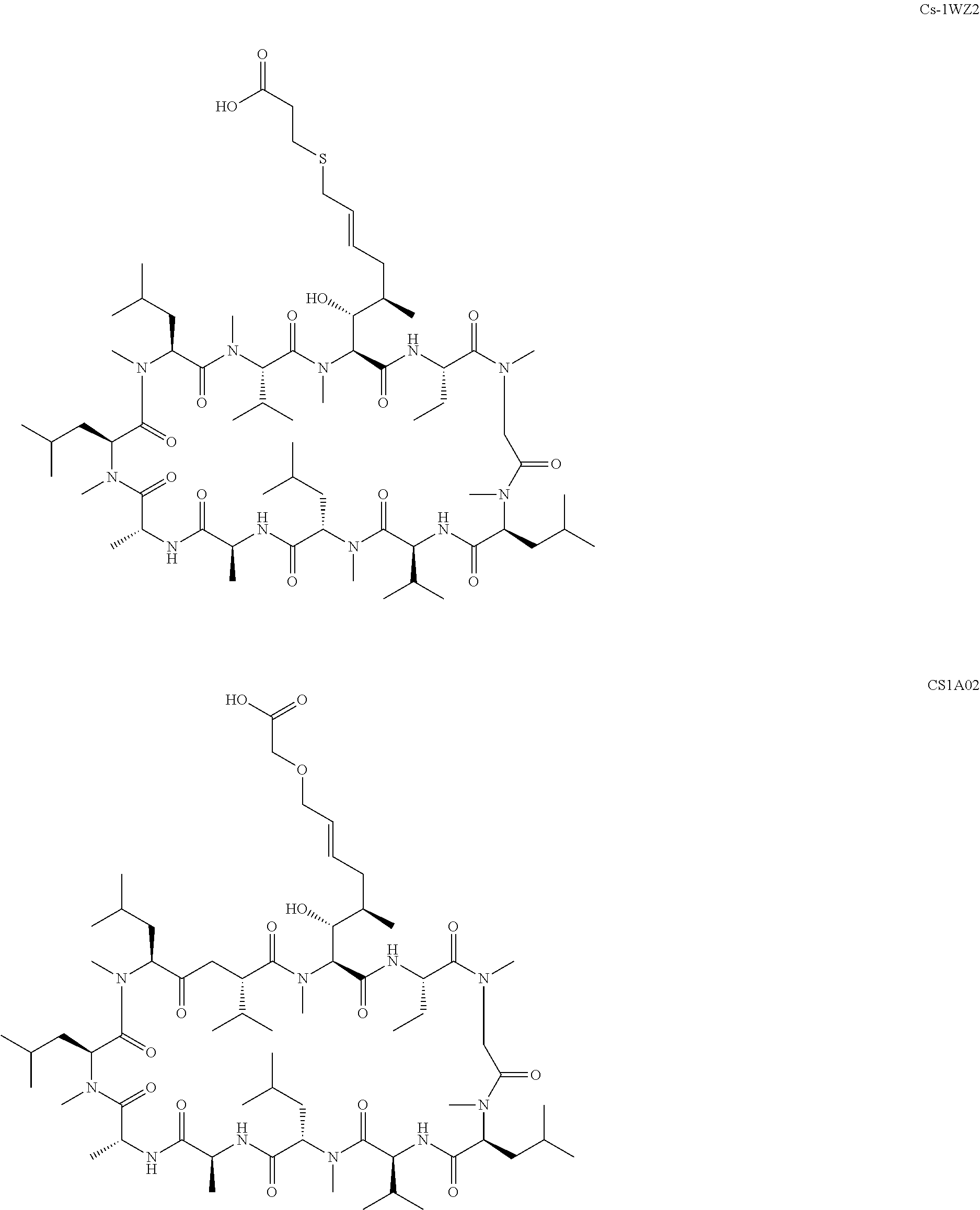
- the precursor Cs-1A01 was produced according to the instruction by Eberle et al. (J. Org. Chem. 1992, 57, 2689). Then, the product was taken up with a solution of 20 mg butyl bromoacetate and 5 mg benzyltriethylammonium chloride in 1 ml dichloromethane, mixed with 2 ml 30% NaOH solution and stirred for two hours at room temperature. After dilution with 10 ml water, the product was extracted twice with ether. After drying of the organic phase by means of MgSO 4 and filtration, evaporation was carried out under vacuum and the residue was mixed with 5 ml 0.1 M LiOH in 50% methanol and stirred for three hours at room temperature. After acidification to pH 2.5 by means of HCl, the product Cs-1A02 was isolated by means of preparative HPLC.
- O-acetyl-CsA-aldehyde 60 mg was produced according to the instruction by J. Liu et al. (Anal. Biochem. 2006, 356, 100-107) and then dissolved in THF and cooled to ⁇ 78° C. A mixture of diisopropylamine in THF and N-butyllithium was stirred separately for 30 min at ⁇ 78° C. The two mixtures were combined at ⁇ 78° C. and stirred until room temperature was reached. Then, the THF supernatant was removed under vacuum and the residue was taken up in AcOEt. The AcOEt extract was washed twice successively with 5% KHSO 4 solution, saturated NaHCO 3 solution and saline solution.
- Cyclosporin A was kept under reflux for 45 hours with 0.1 equivalents of Hoveyda-Grubbs catalyst (2 nd generation) and 20 equivalents of diethyl maleate in toluene. After removal of the toluene under vacuum, the residue was dissolved in DCM/MeOH (10:0.5) and filtered through silica gel. After removal of the organic solvent under vacuum, the residue was dissolved in 5 ml THF and mixed with a 0.2 M LiOH solution. After stirring overnight and neutralization of the solution with HCl, the product was able to be separated off by means of preparative HPLC.
- Cyclosporin A was kept under reflux for 45 hours with 0.1 equivalents of Hoveyda-Grubbs catalyst (2 nd generation) and 20 equivalents of diethyl maleate in toluene. After removal of the toluene under vacuum, the residue was dissolved in DCM/MeOH (10:0.5) and filtered through silica gel. After removal of the organic solvent under vacuum, the residue was dissolved in 5 ml methanol and palladium activated carbon catalyst was added under H 2 . After completion of hydrogenation, filtering was carried out and 2 ml THF as well as 2 ml 0.2 M LiOH solution were added. After stirring overnight, neutralization with HCl was carried out and the product was separated off by means of preparative HPLC.
- O-acetyl-CsA was synthesized according to the instruction by R. Traber et al. (Helv. Chim. Acta 1982, 65, 1655-1677) and then dissolved in dichloromethane (DCM). After addition of 1.1 equivalents of m-chloroperbenzoic acid, stirring was carried out for two hours at room temperature. Then, the DCM was removed under vacuum and the residue was taken up with 10 equivalents of H-Ala-Ot-Bu and DMF and stirred at 50° C. for 5 hours. The DMF was then removed under vacuum and the residue was taken up with AcOEt. The AcOEt extract was washed twice successively with 5% KHSO 4 solution, saturated NaHCO 3 solution and saline solution.
- Example 12 50 mg Cs-1H2 (Example 12), one equivalent of HATU and three equivalents of DIPEA in 3 ml DMF were stirred for 20 min at room temperature. Then, 1 equivalent of H-(D-Glu) 6 -Gly-OH (synthesized by means of solid-phase peptide synthesis) dissolved in 2 ml DMF was added and the solution was stirred overnight. After filtering, the product was able to be isolated by means of preparative HPLC.
- the cells were firstly washed twice with 2 ml PBS pH 7.4 (Dulbecco) and then taken up in 2 ml MIK medium (phenol red-free DME medium, FCS-free, with 20 mM HEPES pH 7.2 and 0.01% carbenicillin) and incubated for 20 min at 37° C. and 5% CO 2 .
- MIK medium phenol red-free DME medium, FCS-free, with 20 mM HEPES pH 7.2 and 0.01% carbenicillin
- the cells were in an incubator for microscopes (Stage Top Incubator INU series from Tokai Hit®) at 37° C. and 5% CO 2 .
- the investigation was started by adding 250 nM CsA derivative dissolved in DMSO and diluted in MIK medium. In the fluorescence light the Hela cells are visible as fluorescent cells.
- the cyclosporin derivative provided with an acid peptide does not accumulate within the Hela cells.
- a mouse spleen removed by surgery (BALE/c line) was crushed between two object glasses in order to prepare suitable cell suspensions.
- the thus-obtained suspension was then filtered through a nylon sieve in order to separate off coarse constituents.
- the thus-obtained cells were centrifuged together with a lymphocyte-separation medium (Mediatech) in order to obtain mononuclear cells.
- An immune response to ovalbumin was provoked by administering ovalbumin together with aluminium hydroxide.
- the immune response can be tracked with the help of the T helper cells population (CD4+) which has migrated into the bronchial lining and the eosinophilic granulocytes which have migrated in.
- mice Female mice (BALE/c line) were sensitized by intraperitoneal (i.p.) administration of 50 ⁇ g ovalbumin (OVA) dissolved in phosphate buffer (PBS) plus 100 ⁇ L aluminium hydroxide (alum) with a total volume of 200 ⁇ L per mouse on day 0.100 ⁇ g OVA in PBS (50 ⁇ L total volume) in each case was then administered intranasally to the OVA/alum-sensitized mice under mild anaesthesia (isoflurane) on days 7 to 10. From these animals groups were formed which additionally received on days 7, 9, and 11 either 250 ⁇ g Cs-103 in PBS (i.p.), PBS only (diluent) or no further addition ( ⁇ ).
- OVA ovalbumin
- PBS phosphate buffer
- alum aluminium hydroxide
- FIG. 1 shows the influence of Cs-103 on the number of CD4-positive T cells which migrated through ovalbumin sensitization into the bronchial lining.
- the animals sensitized with OVA served as control. It can be seen from FIG. 1 that the administration of Cs-103 very significantly reduced the number of CD4-positive T cells.
- FIG. 2 shows the influence of 250 ⁇ g Cs-103 on the number of eosinophilic granulocytes (eosinophiles) which migrated through ovalbumin sensitization into the bronchial lining.
- the animals sensitized with OVA served as control. It can be seen from FIG. 1 that the administration of Cs-103 very significantly reduced the number of eosinophilic granulocytes.
- the number of eosinophilic granulocytes in the lung lavage fluid was determined (cf. FIG. 3 ). As can be seen from FIG. 3 , here too the administration of 250 ⁇ g Cs-103 very significantly reduced the number of eosinophilic granulocytes.
- the selected compound Cs-103 (after administering three doses of 250 ⁇ g Cs-103, on the 1 st , 3 rd and 5 th day, and cell count determination on the 6 th day) is harmless in this assay.
Landscapes
- Health & Medical Sciences (AREA)
- Chemical & Material Sciences (AREA)
- Organic Chemistry (AREA)
- General Health & Medical Sciences (AREA)
- Life Sciences & Earth Sciences (AREA)
- Medicinal Chemistry (AREA)
- Public Health (AREA)
- General Chemical & Material Sciences (AREA)
- Chemical Kinetics & Catalysis (AREA)
- Nuclear Medicine, Radiotherapy & Molecular Imaging (AREA)
- Pharmacology & Pharmacy (AREA)
- Veterinary Medicine (AREA)
- Animal Behavior & Ethology (AREA)
- Engineering & Computer Science (AREA)
- Bioinformatics & Cheminformatics (AREA)
- Pulmonology (AREA)
- Biochemistry (AREA)
- Biophysics (AREA)
- Proteomics, Peptides & Aminoacids (AREA)
- Rheumatology (AREA)
- Neurology (AREA)
- Orthopedic Medicine & Surgery (AREA)
- Physical Education & Sports Medicine (AREA)
- Molecular Biology (AREA)
- Genetics & Genomics (AREA)
- Neurosurgery (AREA)
- Biomedical Technology (AREA)
- Immunology (AREA)
- Dermatology (AREA)
- Pain & Pain Management (AREA)
- Medicines That Contain Protein Lipid Enzymes And Other Medicines (AREA)
- Peptides Or Proteins (AREA)
Abstract
Description

or a pharmaceutically compatible salt thereof,
wherein in Formula (I)
A is an amino acid residue of Formula (II),

in which R1 corresponds to a residue of Formula III

and is covalently bonded via the carbon atom a, or
in which R1 corresponds to a residue of Formula IV
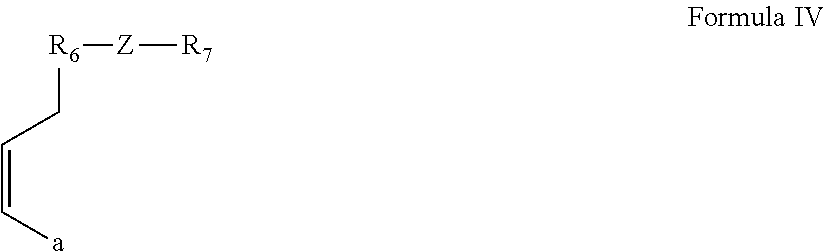
and is covalently bonded via the carbon atom a, or
in which R1 corresponds to a residue of Formula V

and is covalently bonded via the carbon atom a, or
in which R1 corresponds to a residue of Formula VI

and is covalently bonded via the carbon atom a, or
in which R1 corresponds to a residue of Formula VII

and is covalently bonded via the carbon atom a, or
in which R1 corresponds to a residue of Formula VIII

and is covalently bonded via the carbon atom a, or
in which R1 corresponds to a residue of Formula IX

and is covalently bonded via the carbon atom a,
wherein the C═O group in Formula II is covalently bonded to an alpha-amino group of B via an amide bond and the N—Ro group in Formula II is covalently bonded to a carboxyl group of K via an amide bond,
B is an amino acid residue which is selected from the group consisting of:
-
- alpha-aminobutyric acid,
- alanine,
- threonine,
- valine,
- norvaline and
- alpha-aminobutyric acid, alanine, threonine, valine or norvaline modified in the side chain with a hydroxyl group,
C is a sarcosine residue,
D is an amino acid residue which is selected from the group consisting of: - leucine,
- N-methyl leucine,
- valine,
- gamma-hydroxy-N-methyl leucine and
- gamma-hydroxy leucine,
E is an amino acid residue which is selected from the group consisting of: - valine,
- norvaline and
- a modified valine or norvaline in which a carbon atom in the side chain is substituted by a hydroxyl group,
F is an amino acid residue which is selected from the group consisting of: - leucine,
- N-methyl leucine,
- gamma-hydroxy-N-methyl leucine and
- gamma-hydroxy leucine,
G is an alpha-aminobutyric acid residue or an alanine residue,
H is a D-alanine residue,
I and J are residues which are selected, independently of one another, from the group consisting of - leucine,
- N-methyl leucine,
- gamma-hydroxy-N-methyl leucine and
- gamma-hydroxy leucine,
and
K is N-methyl valine residue or valine residue,
wherein in Formulae II to IX - Ro represents H or CH3,
- X represents H or
- hydroxyl or
- a hydroxyl group which is derivatized with an alkanoyl, aryloyl, alkylaminocarbonyl, arylaminocarbonyl, arylalkylaminocarbonyl, alkoxycarbonyl, aryloxycarbonyl, arylalkyloxycarbonyl group or a silyl protecting group,
- R2 represents H or
- a substituted or unsubstituted monocyclic, bicyclic or tricyclic aryl or heteroaryl ring which is optionally substituted with R3,
- R3 is selected from the group consisting of:
- —Z—NY—Y1,
- —Z—CO—Y,
- —Z—S—Y,
- —Y2,
- —NY—Y1,
- —CO—Y,
- —S—Y,
- —Z—O—Y and
- —O—Y,
- R4 corresponds to the R2 group as defined above, wherein R4 and R2 can be the same or different,
- Z is selected from the group consisting of:
- an unbranched, branched or cyclic alkyl group with 1 to 20 carbon atoms,
- an unbranched, branched or cyclic alkenyl group with 1 to 20 carbon atoms,
- an unbranched, branched or cyclic alkinyl group with 1 to 20 carbon atoms,
- a substituted or unsubstituted monocyclic, bicyclic or tricyclic aryl or heteroaryl ring and
- a group of the general formula —[CH2)m—O—(CH2)n]o, wherein m, n and o independently of each other are integers from 1 to 20,
- Y is selected from the group consisting of:
- H,
- the protected or unprotected amino acid residues Gly, D-Glu, D-Asp, D- and L-Cys(SO3H), unprotected peptide residues with a chain length of from 2 to 200 amino acid residues, containing one amino acid type or a combination of different amino acid types selected from Gly, D-Glu, D-Asp, D- and L-Cys(SO3H), an alkyl, alkenyl, aryl, alkylaminocarbonyl, arylaminocarbonyl, arylalkylaminocarbonyl, alkylcarboxyl, alkoxycarbonyl, aryloxycarbonyl and arylalkyloxycarbonyl group,
- Y1 corresponds to the Y group as defined above, wherein Y and Y1 can be the same or different,
- Y2 represents H, F, Cl, Br or I,
- R5 is selected from the group consisting of:
- an alkyl, alkenyl, aryl, alkylaminocarbonyl, arylaminocarbonyl, arylalkylaminocarbonyl, alkylcarbonyl, alkoxycarbonyl, aryloxycarbonyl, arylalkyloxycarbonyl group,
- the amino acid residues Gly, D-Glu, D-Asp, D- and L-Cys(SO3H),
- peptide residues with a chain length of from 2 to 200 amino acid residues, containing one amino acid type or a combination of different amino acid types selected from Gly, D-Glu, D-Asp, D- and L-Cys(SO3H),
- F, Cl, Br and I,
- R6 is selected from the group consisting of:
- O, N and S,
- the protected or unprotected amino acid residues Gly, D-Glu, D-Asp, D- and L-Cys(SO3H), and
- peptide residues with a chain length of from 2 to 200 amino acid residues, containing one amino acid type or a combination of different amino acid types selected from Gly, D-Glu, D-Asp, D- and L-Cys(SO3H),
- R7 is selected from the group consisting of:
- a carboxyl, amino, thiol, hydroxyl group,
- F, Cl, Br, I,
- the protected or unprotected amino acid residues Gly, D-Glu, D-Asp, D- and L-Cys(SO3H), an alkyl, alkenyl, aryl, alkylaminocarbonyl, arylaminocarbonyl, arylalkylaminocarbonyl, alkoxycarbonyl, aryloxycarbonyl and arylalkyloxycarbonyl group,
- peptide residues with a chain length of from 2 to 200 amino acid residues, containing one amino acid type or a combination of different amino acid types selected from Gly, D-Glu, D-Asp, D- and L-Cys(SO3H),
- and
- R3 corresponds to the R5 group as defined above, wherein R8 and R5 can be the same or different.


-
- providing a cyclosporin derivative according to the invention;
- bringing the cyclosporin derivative into contact with a multicellular object.


Claims (8)




Applications Claiming Priority (4)
| Application Number | Priority Date | Filing Date | Title |
|---|---|---|---|
| DE102009037551 | 2009-08-17 | ||
| DE102009037551.1 | 2009-08-17 | ||
| DE102009037551A DE102009037551A1 (en) | 2009-08-17 | 2009-08-17 | Cyclosporin |
| PCT/EP2010/005053 WO2011020596A2 (en) | 2009-08-17 | 2010-08-17 | Cyclosporine derivates |
Related Parent Applications (1)
| Application Number | Title | Priority Date | Filing Date |
|---|---|---|---|
| PCT/EP2010/005053 Continuation WO2011020596A2 (en) | 2009-08-17 | 2010-08-17 | Cyclosporine derivates |
Publications (2)
| Publication Number | Publication Date |
|---|---|
| US20120196749A1 US20120196749A1 (en) | 2012-08-02 |
| US8618065B2 true US8618065B2 (en) | 2013-12-31 |
Family
ID=43037802
Family Applications (1)
| Application Number | Title | Priority Date | Filing Date |
|---|---|---|---|
| US13/397,256 Expired - Fee Related US8618065B2 (en) | 2009-08-17 | 2012-02-15 | Cyclosporin derivatives |
Country Status (4)
| Country | Link |
|---|---|
| US (1) | US8618065B2 (en) |
| EP (1) | EP2471806A3 (en) |
| DE (1) | DE102009037551A1 (en) |
| WO (1) | WO2011020596A2 (en) |
Cited By (1)
| Publication number | Priority date | Publication date | Assignee | Title |
|---|---|---|---|---|
| US9453051B2 (en) | 2011-08-30 | 2016-09-27 | Max-Planck-Gesellschaft Zur Forderung Der Wissenschaften E.V. | Cyclosporin derivatives |
Families Citing this family (4)
| Publication number | Priority date | Publication date | Assignee | Title |
|---|---|---|---|---|
| WO2013181339A2 (en) * | 2012-06-01 | 2013-12-05 | Allergan, Inc. | Cyclosporin a analogs |
| TW201639873A (en) | 2015-01-08 | 2016-11-16 | 歐樂根公司 | Cyclosporin derivatives wherein the MEBMT sidechain has been cyclized |
| CN121554542A (en) * | 2018-08-22 | 2026-02-24 | 贝凯恩生物医疗技术有限公司 | Cyclosporin compositions and methods of use |
| WO2021173474A1 (en) * | 2020-02-26 | 2021-09-02 | Bacainn Biotherapeutics, Ltd. | Cyclosporine compositions and methods of use |
Citations (12)
| Publication number | Priority date | Publication date | Assignee | Title |
|---|---|---|---|---|
| US4672044A (en) | 1984-08-24 | 1987-06-09 | Scripps Clinic & Research Foundation | Murine monoclonal antibody combining site to human C3b receptor (CR1) |
| EP0296122A2 (en) | 1987-06-17 | 1988-12-21 | Sandoz Ag | Cyclosporins and their use as pharmaceuticals |
| EP0649022A1 (en) | 1993-09-30 | 1995-04-19 | AVL Medical Instruments AG | Optical indicator for determining the activity of an ion in a sample |
| WO1998042734A1 (en) | 1997-03-25 | 1998-10-01 | BIOGAL Gyógyszergyár Rt. | Process of purification of cyclosporin |
| DE19859910A1 (en) | 1998-12-23 | 2000-06-29 | Ratiopharm Gmbh | Cyclosporin solution |
| US6395770B1 (en) | 1995-10-26 | 2002-05-28 | Baker Norton Pharmaceuticals, Inc. | Method and compositions for administering taxanes orally to human patients |
| US6423233B1 (en) | 2000-08-15 | 2002-07-23 | Biogal Gyogyszergyar Rt. | Purification process |
| US6596499B2 (en) | 2000-11-30 | 2003-07-22 | The Netherlands Cancer Institute | Membrane molecule indicator compositions and methods |
| WO2003097706A1 (en) | 2002-05-21 | 2003-11-27 | Novosom Ag | Polyampholytes |
| US20050048671A1 (en) | 2003-08-26 | 2005-03-03 | Bayer Technology Services Gmbh | Gap junction-containing devices for detecting biochemical activity |
| JP2006200519A (en) * | 2004-12-24 | 2006-08-03 | Sanden Corp | Electric compressor |
| US7090995B2 (en) | 2000-04-30 | 2006-08-15 | Yissum Research Development Company Of The Hebrew University Of Jerusalem | Molecules and methods using same for measuring non-transferrin bound iron |
Family Cites Families (1)
| Publication number | Priority date | Publication date | Assignee | Title |
|---|---|---|---|---|
| AU2006200519A1 (en) * | 2005-03-16 | 2006-10-05 | Astellas Pharma Inc. | New compound |
-
2009
- 2009-08-17 DE DE102009037551A patent/DE102009037551A1/en not_active Withdrawn
-
2010
- 2010-08-17 WO PCT/EP2010/005053 patent/WO2011020596A2/en not_active Ceased
- 2010-08-17 EP EP12161102.4A patent/EP2471806A3/en not_active Withdrawn
-
2012
- 2012-02-15 US US13/397,256 patent/US8618065B2/en not_active Expired - Fee Related
Patent Citations (12)
| Publication number | Priority date | Publication date | Assignee | Title |
|---|---|---|---|---|
| US4672044A (en) | 1984-08-24 | 1987-06-09 | Scripps Clinic & Research Foundation | Murine monoclonal antibody combining site to human C3b receptor (CR1) |
| EP0296122A2 (en) | 1987-06-17 | 1988-12-21 | Sandoz Ag | Cyclosporins and their use as pharmaceuticals |
| EP0649022A1 (en) | 1993-09-30 | 1995-04-19 | AVL Medical Instruments AG | Optical indicator for determining the activity of an ion in a sample |
| US6395770B1 (en) | 1995-10-26 | 2002-05-28 | Baker Norton Pharmaceuticals, Inc. | Method and compositions for administering taxanes orally to human patients |
| WO1998042734A1 (en) | 1997-03-25 | 1998-10-01 | BIOGAL Gyógyszergyár Rt. | Process of purification of cyclosporin |
| DE19859910A1 (en) | 1998-12-23 | 2000-06-29 | Ratiopharm Gmbh | Cyclosporin solution |
| US7090995B2 (en) | 2000-04-30 | 2006-08-15 | Yissum Research Development Company Of The Hebrew University Of Jerusalem | Molecules and methods using same for measuring non-transferrin bound iron |
| US6423233B1 (en) | 2000-08-15 | 2002-07-23 | Biogal Gyogyszergyar Rt. | Purification process |
| US6596499B2 (en) | 2000-11-30 | 2003-07-22 | The Netherlands Cancer Institute | Membrane molecule indicator compositions and methods |
| WO2003097706A1 (en) | 2002-05-21 | 2003-11-27 | Novosom Ag | Polyampholytes |
| US20050048671A1 (en) | 2003-08-26 | 2005-03-03 | Bayer Technology Services Gmbh | Gap junction-containing devices for detecting biochemical activity |
| JP2006200519A (en) * | 2004-12-24 | 2006-08-03 | Sanden Corp | Electric compressor |
Non-Patent Citations (88)
| Title |
|---|
| Akdemir, G. et al, "Therapeutic efficacy of intraventricular cyclosporine A and methylprednisolone on a global cerebral ischemia model in rats", Neurological Research, 2005, abstract, vol. 27, Issue 8. |
| Arimori, K. et al, "Effect of P-Glycoprotein Modulator, Cyclosporin A, on the Gastointestinal Excretion of Irinotecan and Its Metabolite SN-38 in Rats", Pharmaceutical Research, 2003, pp. 910 to 917, vol. 20, No. 6, Plenum Publishing Corporation. |
| Awumey, E. M. et al, "Molecular and Functional Evidence for Calcineurin-A alpha and beta Isoforms in the Osteoclast: Novel Insights into Cyclosporin A Action on Bone Resorption", Biochemical and Biophysical Research Communications, 1999, pp. 248 to 252, 254, Academic Press. |
| Awumey, E. M. et al, "Molecular and Functional Evidence for Calcineurin-A α and β Isoforms in the Osteoclast: Novel Insights into Cyclosporin A Action on Bone Resorption", Biochemical and Biophysical Research Communications, 1999, pp. 248 to 252, 254, Academic Press. |
| Barik, S., "Immunophilins: for the love of proteins", Cell. Mol. Life Sci., 2006, pp. 2889 to 2900, 63, Birkhaeuser Verlag, Basel. |
| Bernstein, I.L. et al, "How does auranofin compare with methotrexate and cyclosporin as a corticosteroid-sparing agent in severe asthma?", Biodrugs, 1997, abstract, vol. 8, Issue 3. |
| Berth-Jones, J., "The use of ciclosporin in psoriasis", Journal of Dermatological Treatment, 2005, pp. 258 to 277, 16, Taylor & Francis. |
| Binder, A. et al, "Bestimmung von Aciditaetskonstanten aus digitalen potentiometrischen Titrationskurven ohne Kenntnis der genauen Einwaage", Z. Anal. Chem., 1975, pp. 359 to 361, 274, Springer-Verlag. |
| Boehringer, D., et al, "Cyclosporin-A-Augentropfen bei Nummuli nach Adeno-virus-Keratokonjunktivitis", Ophthalmologe, 2008, pp. 592 to 594, 105, Springer Medizin Verlag. |
| Bouchta, N.B. et al, "Conversion from Tacrolimus to Cyclosporin is Associated with a Significant Improvement of Glucose Metabolism in Patients with New-Onset Diabetes Mellitus after Renal Transplantation", Transplantation Proceedings, 2005, pp. 1857 to 1860, 37, Elsevier Inc. |
| Carroll, G.J. et al, "Letters to the Editor Effective control of incomplete reactive arthritis with cyclosporin", Rheumatology, 2001, pp. 945 to 947, 40. |
| Cassarino, D. S. et al, "Cyclosporin A Increases Resting Mitochondrial Membrane Potential in SY5Y Cells and Reverses the Depressed Mitochondrial Membrane Potential of Alzheimer's Disease Cybrids", Biochemical and Biophysical Research Communications, 1998, pp. 168 to 173, 248, Academic Press. |
| Chao, S. et al, "Juglone, an inhibitor of the peptidyl-prolyl isomerase Pin1, also directly blocks transcription", Nucleic Acids Research, 2001, pp. 767 to 773, vol. 29, No. 3, Oxford University Press. |
| Dalmarco, E. M. et al, "Additional evidence of acute anti-infllammatory effects of cyclosporin A in a murine model of pleurisy", Transplant Immunology, 2004, pp. 151 to 157, 12, Elsevier B.V. |
| Damoiseaux, J.G.M.C. et al, "Multiple Effects of Cyclosporin A on the Thymus in Relation to T-Cell Development and Autoimmunity", Clinical Immunology and Immunopathology, 1997, pp. 197 to 202, vol. 82, No. 3, Academic Press. |
| De Clercq, E., "Emerging antiviral drugs", Expert Opin. Emerging Drugs, 2008, pp. 393 to 416, 13(3), Informa UK Ltd. |
| DeLuca, D., "Chapter 7 Immunofluorescence Analysis", Antibody as a Tool, J.J. Marchalonis and G.W. Warr, eds., 1982, pp. 189 to 231, John Wiley & Sons Ltd. |
| Dobson, S. et al, "Characterization of protein Ser/Thr phosphatases of the malaria parasite, Plasmodium falciparum: inhibition of the parasitic calcineurin by cyclophilin-cyclosporin complex", Molecular and Biochemical Parasitology, 1999, pp. 167 to 181, 99, Elsevier Science B.V. |
| Duefer, M. et al, "Diabetogenic Effect of Cyclosporin A is Mediated by Interference with Mitochondrial Function of Pancreatic B-Cells", Molecular Pharmacology, 2001, pp. 873 to 879, vol. 60, No. 4. |
| Duncan, N. et al, "Optimizing the use of cyclosporin in allogeneic stem cell transplantation", Bone Marrow Transplantation, 2006, pp. 169 to 174, 38, Nature Publishing Group. |
| Dzik, J.M. et al, "Effect of cyclosporin A on immunological response in lungs of guinea pigs infected with Trichinella spiralis", Acta Biochimica Polonica, 2002, pp. 233 to 247, col. 49, No. 1. |
| Eberle, M. K. et al, "Synthesis of the Main Metabolite (OL-17) of Cyclosporin A", J. Org. Chem., 1992, pp. 2689 to 2691, 57, American Chemical Society. |
| Eckstein, J.W. et al, "A new class of cyclosporin analogues for the treatment of asthma", Expert Opin. Investig. Drugs, 2003, pp. 647 to 653, 12(4), Ashley Publications Ltd. |
| Eedy, D.J., "Genetic syndrome with ichthyosis: congenital ichthyosis, follicular atrophoderma, hypotrichosis, and woolly hair; second report", Correspondence, British Journal of Dermatology, 2002, pp. 604 to 631, 147. |
| English translation of international preliminary report on patentability dated Feb. 21, 2012 of international application PCT/EP 2010/005053 on which this application is based. |
| Fukushima, A. et al, "Cyclosporin A inhibits eosinophilic infiltration into the conjunctiva mediated by type IV allergic reactions", Clinical and Experimental Ophthalmology, 2006, pp. 347 to 353, 34, Royal Australian and New Zealand College of Ophthalmologists. |
| Gafter-Gvili, A. et al, "Cyclosporin A-induced hair growth in mice is associated with inhibition of hair follicle regression", Arch Dermatol Res, 2004, pp. 265 to 269, 296, Springer-Verlag. |
| Galat, A., "Peptidylprolyl Cis/Trans Isomerases (Immunophilins): Biological Diversity-Targets-Functions", Current Topics in Medicinal Chemistry, 2003, pp. 1315 to 1347, 3, Bentham Science Publishers Ltd. |
| Guillen, C. et al, "Regulatory Effects of Cytokines and Cyclosporine A on Peripheral Blood Mononuclear Cells from Stable Multiple Sclerosis Patients", Immunopharmacology and Immunotoxicology, 1999, pp. 527 to 549, 21(3), Marcel Dekker, Inc. |
| Gurachevsky, A. et al, "Application of spin label electron paramagnetic resonance in the diagnosis and prognosis of cancer and sepsis", Clinical Chemistry and Laboratory Medicine, 2008, Abstract, vol. 46, Issue 9. |
| Hackert, T. et al, "Ciclosporin aggravates tissue damage in ischemia reperfusion-induced acute pancreatitis", Pancreas, 2006, Abstract, vol. 32, Issue 2. |
| Hansen, J. M. et al, "Effects of nitric oxide blockade and cyclosporin A on cardiovascular and renal function in normal man", Journal of Hypertension, 1999, pp. 1707 to 1713, 17, Lippincott Williams & Wilkins. |
| International Search Report dated Jan. 20, 2011 of international application PCT/EP 2010/005053 on which this application is based. |
| Iwamura, H. et al, Comparative Study of Glucocorticoids, Cyclosporine A, and JTE-607 [(-)-Ethyl-N-{3,5-dichloro-2-hydroxy-4-[2-(4-methylpiperazin-1-yl)ethoxy]benzoyl}-L-phenylalaninate Dihydrochloride] in a Mouse Septic Shock Model, The Journal of Pharmacology and Experimental Therapeutics, 2004, pp. 1256 to 1263, vol. 311, No. 3. |
| Jain, A.B. et al, "Cyclosporin and tacrolimus in clinical transplantation-A comparative review", Clinical Immunotherapeutics, 1996, Abstract, vol. 5, Issue 5. |
| Kawai, R. et al, "Physiologically Based Pharmacokinetic Study on a Cyclosporin Derivative, SDZ IMM 125", Journal of Pharmacokinetics and Biopharmaceutics, 1994, pp. 327 to 365, vol. 22, No. 5, Plenum Publishing Corporation. |
| Kawasaki, H. et al, "Cyclosporine Inhibits Mouse Cytomegalovirus Infection via a Cyclophilin-Dependent Pathway Specifically in Neural Stem/Progenitor Cells", Journal of Virology, 2007, pp. 9013 to 9023, vol. 81, No. 17. |
| Kinahan, P.E. et al, "1997 International Meeting on Fully Three-Dimensional Image Reconstruction in Radiology and Nuclear Mediine", Physics in Medicine and Biology, 1998, cover sheet, vol. 43, Issue 4. |
| Kiyomasu, T. et al, "Cyclosporin A Treatment for Membranoproliferative Glomerulonephritis Type II", Nephron, 2002, pp. 509 to 511, 91, S. Karger AG, Basel. |
| Lederman, M.M. et al, "Cyclosporin A Provides No Sustained Immunologic Benefit to Person with Chronic HIV-1 Infection Starting Suppressive Antiretroviral Therapy: Results of a Randomized, Controlled Trial of the AIDS Clinical Trials Group A5138", The Journal of Infectious Diseases, 2006, pp. 1677 to 1685, 194. |
| Leshnower, B.G. et al, "Cyclosporine Preserves Mitochondrial Morphology After Myocardial Ischemia/Reperfusion Independent of Calcineurin Inhibition", Ann Thorac Surg, 2008, pp. 1286 to 1292, 86, Elsevier Inc. |
| Lexikon der Biochemie: in zwei Baenden/[Red. und Fachuebers. Angelika Fallert-Mueller], 1999, p. 505, Spektrum Akademischer Verlag. |
| Liu, Y. et al, "A fluorescence polarization-based assay for peptidyl prolyl cis/trans isomerase cyclophilin A", Analytical Biochemistry, 2006, p. 100 to 107, 356, Elsevier Inc. |
| Lu, K.P. et al, "Prolyl cis-trans isomerization as a molecular timer", Nature Chemical Biology, 2007, pp. 619 to 629 , vol. 3, No. 10. |
| Malesevic, M. et al, "Simple and efficient synthesis of new trifunctional templates", Peptides, 2004, pp. 391 and 392, Proceedings of the 3rd International and Twenty-Eighth European Peptide Symposium, Kenes International, Israel. |
| Mascarell, L. et al, "Cyclosporin A therapy differently affects immunological-relevant gene expression following immunization", Immunology Letters, 2002, pp. 137 to 143, 84, Elsevier Science B.V. |
| Mrowietz, U., "Concepts of the mechanisms of action of cyclosporin in psoriasis. A review with guidelines on therapy", Hautarzt, 1993, Abstract, 44(6). |
| Noli, C. et al, "Prospective open pilot study on the use of ciclosporin for feline allergic skin disease", Journal of Small Animal Practice, 2006, pp. 434 to 438, vol. 47, Issue 8. |
| Odaka, M. et al, "Intractable chronic inflammatory demyelinating polyneuropathy treated successfully with ciclosporin", J Neurol Neurosurg Psychiatry, 2005, pp. 1115 to 1120, 76. |
| Ozkisacik, E.A. et al, "Effects of Cyclosporin A on Neurological Outcome and Serum Biomarkers in the Same Setting of Spinal Cord Ischemia Model", Ann Vasc Surg, 2006, pp. 243 to 249, 20. |
| Panayi, G.S. and Tugwell, P., Chairmen, "The Use of Cyclosporin A Microemulsion in Rheumatoid Arthritis: Conclusions of an International Review", British Journal of Rheumatology, 1997, pp. 808 to 811, 36. |
| Pape, L. et al, "Cyclosporin A-induced remission of primary membranous glomerulonephritis in a child", Nephrology Dialysis Transplantation, 2004, p. 3207, vol. 19, No. 12, ERA-EDTA. |
| Pasero, G. et al, "Risks and benefits of low-dosage cyclosporin in rheumatoid arthritis-Emerging evidence of a therapeutic role", Biodrugs, 1997, Abstract, vol. 7, Issue 5. |
| Periyasamy, S. et al, "The Immunophilin Ligands Cyclosporin A and FK506 Suppress Prostate Cancer Cell Growth by Androgen Receptor-Dependent and -Independent Mechanisms", Endocrinology, 2007, pp. 4716 to 4726, 148(10), The Endrocrine Society. |
| Pilarski, L.M. et al, "Drug resistance in multiple myeloma: cyclosporin A analogues and their metabolites as potential chemosensitizers", Leukemia, 1998, pp. 505 to 509, 12. |
| Quesada, A.J. et al, "La ruta de senalizacion CA++/Calcineurina/NFAT en activacion endotelial y angiogenesis: efetos de la ciclosporina A", Nefrologia, 2003, pp. 44 to 48, vol. XXIII, Suplemento 3. |
| Rao, M.R. et al, "Changes in the Cardiovascular Nitric Oxide Pathway in Cyclosporin-A Treated Rats", Drug and Chemical Toxicology, 1998, pp. 27 to 34, 21(1), Marcel Dekker, Inc. |
| Ravot, E. et al, "New Uses for Old Drugs in HIV Infection the Role of Hydroxyurea, Cyclosporin and Thalidomide", Drugs, 1999, pp. 953-963, 58(6), Adis International Limited. |
| Reinhard, T. et al, "Lokales Cyclosporin A bei Nummuli nach Keratoconjunctivitis epidemica-Eine Pilotstudie", Ophthalmologe, 2000, pp. 764 to 768, 97, Springer-Verlag. |
| Rodella, L. et al, "Cyclosporine-A Delays the End-Plate Degeneration in Denerved Rat Muscles", Neuroscience Research Communications, 2002, pp. 85 to 92, vol. 31, No. 2, Wiley-Liss, Inc. |
| Schmid, F. X, "Prolyl Isomerases", Advances in Protein Chemistry, 2002, pp. 243 to 282, vol. 59, Academic Press. |
| Schmutz, J.L. et al, "New nail and hair side-effects of cyclosporin", Annales De Dermatologie et de Venereologie, 2000, p. 769, vol. 127, Issue 8-9. |
| Schultz, K.R. et al, "Effect of gastrointestinal inflammation and age on the pharmacokinetics of oral microemulsion cyclosporin A in the first month after bone marrow transplantation", Bone Marrow Transplantation, 2000, pp. 545 to 551, 26, Macmillan Publishers Ltd. |
| Steffan, J. et al, "A systematic review and meta-analysis of the efficacy and safety of cyclosporin for the treatment of atopic dermatitis in dogs", Veterinary Dermatology, 2006, pp. 3 to 16, 17. |
| Sukkar, T.Z. et al, Gingival fibroblasts grown from cyclosporin-treated patients show a reduced production of matrix metalloproteinase-1 (MMP-1) compared with normal gingival fibroblasts, and cyclosporin down-regulates the production of MMP-1 stimulated by pro-inflammatory cytokines, Journal of Periodontal Research, 2007, pp. 580 to 588, 42. |
| Tai, D.C-S. et al, "Correction of motion artifact in transmembrane voltage-sensitive fluorescent dye emission in hearts", Am J Physiol Heart Circ Physiol, 2004, pp. H985 to H993, 287. |
| Thali, M., "Cyclosporines: immunosuppressive drugs with anti-HIV-1 activity", Molecular Medicine Today, 1995, pp. 287 to 291, Elsevier Science Ltd. |
| Tosco, P. et al, "Physicochemical Profiling of Sartans: A Detailed Study of Ionization Constants and Distribution Coefficients", Helvetica Chimica Acta, 2008, pp. 468 to 482, vol. 91, Verlag Helvetica Chimica Acta AG, Zurich, Switzerland. |
| Traber, R. et al, "162. Isolierung und Strukturermittlung der neuen Cyclosporine E, F, G, H und I", Helvetica Chimica Acta, 1982, pp. 1655 to 1677, vol. 65, Fasc. 5, Schweizerische Chemische Gesellschaft. (Abstract in English). |
| Tsimberidou, A. et al, "Gemtuzumab, Fludarabine, Cytarabine, and Cyclosporine in Patients with Newly Diagnosed Acute Myelogenous Leukemia or High-Risk Myelodysplastic Syndromes", Cancer, 2003, pp. 1481 to 1487, 97, American Cancer Society. |
| Tsimberidou, A. M. et al, "Mylotarg, fludarabine, cytarabine (ara-C), and cyclosporine (MFAC) regimen as post-remission therapy in acute myelogenous leukemia", Cancer Chemother Pharmacol, 2003, pp. 449 to 452, 52, Springer-Verlag. |
| Tsuruoka, S. et al, "Dosing time-dependent variation of bone resorption by cyclosporin A in rats' femurs", European Journal of Pharmacology, 2007, pp. 226 to 231, 564, Elsevier B.V. |
| Uchida, T. et al, "Pin1 and Par14 Peptidyl Prolyl Isomerase Inhibitors Block Cell Proliferation", Chemistry & Biology, 2003, pp. 15 to 24, vol. 10, Elsevier Science Ltd. |
| Umland, S.P. et al, "Effects of Cyclosporin A and Dinactin on T-Cell Proliferation, Interleukin-5 Production, and Murine Pulmonary Inflammation", Am. J. Respir. Cell Mol. Biol., 1999, p. 481 to 492, vol. 20. |
| Van Westrhenen, R. et al, "Cyclosporin A Induces Peritoneal Fibrosis and Angiogenesis during Chronic Peritoneal Exposure to a Glucose-Based, Lactate-Buffered Dialysis Solution in the Rat", Blood Purif, 2007, pp. 466 to 472, 25, S. Karger AG, Basel. |
| Von Haehling, S. et al, "Cachexia: a therapeutic approach beyond cytokine antagonism", International Journal of Cardiology, 2002, pp. 173 to 183, 85, Elsevier Science Ireland Ltd. |
| Wang, F. et al, "Synthesis and Peptidyl-Prolyl Isomerase Inhibitory Activity of Quinoxalines as Ligands of Cyclophilin A", Chem. Pharm. Bull., 2006, pp. 372 to 376, 54(3), Pharmaceutical Society of Japan. |
| Wang, Q.B. et al, "Injection of bradykinin or cyclosporine A to hippocampus induces Alzheimer-like phosphorylation of Tau and abnormal behavior in rats", Chinese Medical Journal, 2002, Abstract, vol. 115, Issue 6. |
| Wang, X.J. et al, "Peptidyl-Prolyl Isomerase Inhibitors", Biopolymers (Peptide Science), 2006, pp. 125 to 146, vol. 84, Wiley Periodicals, Inc. |
| Watanabe, T. et al, "Short report Effect of SDZ PSC 833 ([3′-keto-Bmt^1]-[Val^2]-cyclosporin) on serum protein binding and distribution to blood cells of doxorubicin, vincristine and etoposide in vitro", Anti-Cancer Drugs, 1997, pp. 400 to 404, vol. 8., Rapid Science Publishers. |
| Watanabe, T. et al, "Short report Effect of SDZ PSC 833 ([3'-keto-Bmt^1]-[Val^2]-cyclosporin) on serum protein binding and distribution to blood cells of doxorubicin, vincristine and etoposide in vitro", Anti-Cancer Drugs, 1997, pp. 400 to 404, vol. 8., Rapid Science Publishers. |
| Wiernik, P. H. et al, "Objective Response of Multiple Myeloma to Cyclosporin A", Leukemia and Lymphoma, 1994, pp. 167 to 170, vol. 16, Harwood Academic Publishers GmbH. |
| Wilasrusmee, C. et al, "Angiocidal effect of Cyclosporin A: a new therapeutic approach for pathogenic angiogenesis", International Angiology, 2005, Abstract, vol. 24, Issue 4. |
| Winkler, M., "Cyclosporin as Baseline Immunosuppression in Solid Organ Transplantation", BioDrugs, 2000, pp. 185 to 193, vol. 14, Issue 3, Adis International Limited. |
| Wulff, B.C. et al, "Sirolimus Reduces the Incidence and Progression of UVB-Induced Skin Cancer in SKH Mice even with Co-administration of Cyclosporine A", Journal of Investigative Dermatology, 2008, pp. 2467 to 2473, 128. |
| Xie, J.-R et al, "Cardioprotective effects of cyclosporine A in an in vivo model of myocardial ischemia and reperfusion", Acta Anaesthesiologica Scandinavica, 2007, pp. 909-913, 51. |
| Yamada, A. et al, "Usefulness and Limitation of DiBAC4(3), a Voltage-Sensitive Fluorescent Dye, for the Measurement of Membrane Potentials Regulated by Recombinant Large Conductance Ca^2+-Activated K^+ Channels in HEK293 Cells", Jpn. J. Pharmacol., 2001, pp. 342 to 350, 86. |
| Zhao, G.J. et al, "Clinical and magnetic resonance imaging changes correlate in a clinical trial monitoring cyclosporine therapy for multiple sclerosis", Journal of Neuroimaging, 1997, Abstract, vol. 7, Issue 1. |
Cited By (1)
| Publication number | Priority date | Publication date | Assignee | Title |
|---|---|---|---|---|
| US9453051B2 (en) | 2011-08-30 | 2016-09-27 | Max-Planck-Gesellschaft Zur Forderung Der Wissenschaften E.V. | Cyclosporin derivatives |
Also Published As
| Publication number | Publication date |
|---|---|
| WO2011020596A8 (en) | 2011-06-03 |
| US20120196749A1 (en) | 2012-08-02 |
| WO2011020596A3 (en) | 2011-04-14 |
| WO2011020596A2 (en) | 2011-02-24 |
| DE102009037551A1 (en) | 2011-02-24 |
| EP2471806A3 (en) | 2013-06-12 |
| EP2471806A2 (en) | 2012-07-04 |
Similar Documents
| Publication | Publication Date | Title |
|---|---|---|
| US10787486B2 (en) | Template-fixed peptidomimetics | |
| EP2859012B1 (en) | Beta-hairpin peptidomimetics | |
| US20120196749A1 (en) | Cyclosporin Derivatives | |
| JP5957521B2 (en) | Β-hairpin peptidomimetics as CXCR4 antagonists | |
| WO2013030208A1 (en) | Cyclosporin derivatives | |
| TW202535918A (en) | GLP-1 compounds and their preparation methods and applications | |
| US20120058932A1 (en) | Active ingredient-peptide construct for extracellular concentration | |
| Herlan et al. | Cyclic Peptoid-Peptide Hybrids as Versatile Molecular Transporters | |
| CN118373920A (en) | Fusion peptide with PD-L1 targeting and cell penetration, conjugate with paclitaxel, and preparation method and application thereof | |
| CN118255843A (en) | A stapled peptide targeting TEAD-VGL4 interaction and its application in skin repair | |
| CN117720661A (en) | Self-assembled thio cyclic peptide with neuroprotection effect, and preparation method and application thereof | |
| EP2718307B1 (en) | Beta-hairpin peptidomimetics as cxc4 antagonists | |
| CN104558122A (en) | Integrin acceptor related antitumor polypeptide and treatment and diagnosis applications thereof | |
| NZ702470B2 (en) | Beta-hairpin peptidomimetics | |
| HK1191021B (en) | Beta-hairpin peptidomimetics as cxc4 antagonists | |
| HK1138011B (en) | Template-fixed peptidomimetics | |
| HK1207867B (en) | Beta-hairpin peptidomimetics |
Legal Events
| Date | Code | Title | Description |
|---|---|---|---|
| AS | Assignment |
Owner name: MAX-PLANCK-GESELLSCHAFT ZUR FOERDERUNG DER WISSENS Free format text: ASSIGNMENT OF ASSIGNORS INTEREST;ASSIGNORS:FISCHER, GUNTER;MALESEVIC, MIROSLAV;ERDMANN, FRANK;AND OTHERS;SIGNING DATES FROM 20120308 TO 20120315;REEL/FRAME:028226/0190 |
|
| FEPP | Fee payment procedure |
Free format text: PAYOR NUMBER ASSIGNED (ORIGINAL EVENT CODE: ASPN); ENTITY STATUS OF PATENT OWNER: SMALL ENTITY |
|
| CC | Certificate of correction | ||
| REMI | Maintenance fee reminder mailed | ||
| LAPS | Lapse for failure to pay maintenance fees |
Free format text: PATENT EXPIRED FOR FAILURE TO PAY MAINTENANCE FEES (ORIGINAL EVENT CODE: EXP.) |
|
| STCH | Information on status: patent discontinuation |
Free format text: PATENT EXPIRED DUE TO NONPAYMENT OF MAINTENANCE FEES UNDER 37 CFR 1.362 |
|
| FP | Lapsed due to failure to pay maintenance fee |
Effective date: 20171231 |