US8614703B1 - Automatic border alignment of objects in map data - Google Patents
Automatic border alignment of objects in map data Download PDFInfo
- Publication number
- US8614703B1 US8614703B1 US12/904,997 US90499710A US8614703B1 US 8614703 B1 US8614703 B1 US 8614703B1 US 90499710 A US90499710 A US 90499710A US 8614703 B1 US8614703 B1 US 8614703B1
- Authority
- US
- United States
- Prior art keywords
- polygon
- border
- vertex
- objects
- cost
- Prior art date
- Legal status (The legal status is an assumption and is not a legal conclusion. Google has not performed a legal analysis and makes no representation as to the accuracy of the status listed.)
- Expired - Fee Related, expires
Links
Images



Classifications
-
- G—PHYSICS
- G01—MEASURING; TESTING
- G01C—MEASURING DISTANCES, LEVELS OR BEARINGS; SURVEYING; NAVIGATION; GYROSCOPIC INSTRUMENTS; PHOTOGRAMMETRY OR VIDEOGRAMMETRY
- G01C21/00—Navigation; Navigational instruments not provided for in groups G01C1/00 - G01C19/00
- G01C21/38—Electronic maps specially adapted for navigation; Updating thereof
- G01C21/3863—Structures of map data
- G01C21/3867—Geometry of map features, e.g. shape points, polygons or for simplified maps
Definitions
- the present invention relates to processing of map data and more specifically to reducing discrepancies between the borders of different geometric objects.
- Digital maps are found in a wide variety of devices, including car navigation systems, hand-held GPS units, mobile phones, and in many websites such as GOOGLE MAPS and MAPQUEST. Although digital maps are easy to use from an end-user's perspective, creating a digital map is a difficult and time-consuming process. Every digital map begins with a set of raw data corresponding to millions of objects such as streets, intersections, parks, and bodies of water. The raw map data is derived from a variety of sources, such as the New York City Open Accessible Space Information System (OASIS) or the U.S. Census Bureau Topologically Integrated Geographic Encoding and Referencing system (TIGER). In many cases, data from different sources is inaccurate and out of date. Oftentimes the data from the different sources are in a format that is not suitable for use in a real map. Integrating data from these heterogeneous sources so that it can be used and displayed properly is an enormous challenge.
- OASIS New York City Open Accessible Space Information System
- TIGER Topologically Integrated Geographic Encoding
- the borders of objects in the raw map data may run roughly parallel, but not exactly parallel, to the borders of other objects.
- the border of an object that represent a park may be jagged, which prevents the park from being accurately aligned with the roads that surround the park, which may have straight borders.
- borders of adjacent objects are not accurately aligned, a thin open area appears between objects when displayed on a map, resulting in sub-optimal map rendering quality.
- a map editing system processes map data to reduce discrepancies between geometric objects in the map data through the use of a cost function.
- the system selects a polygon shaped object (e.g., a park) for processing.
- the polygon may be located close to several polyline objects (e.g., streets) or other polygon objects so that discrepancies, such as open spaces, appear between the objects when displayed together in a map.
- the system repeatedly adjusts the border of the polygon until the attributes of the polygon minimize a cost function.
- the border of the polygon can be adjusted, for example, by adjusting the placement of the individual vertices that make up the border of the polygon.
- the cost function uses several heuristics to compute the cost of the polygon based on attributes of the polygon. Some of the heuristics maintain the original shape of the polygon by penalizing changes to the polygon. Other heuristics eliminate open spaces by penalizing a polygon if it is not aligned with neighboring objects. Other heuristics improve the visual appearance of a polygon by penalizing shapes with rough borders. By balancing these factors with a cost function, the system is able to eliminate discrepancies between objects in the map data without overly distorting their appearance.
- FIG. 1 is a high-level block diagram of a computing environment according to one embodiment.
- FIG. 2A and FIG. 2B illustrate a polygon before it is adjusted and a polygon after it is adjusted according to one embodiment.
- FIG. 3 is a process flow diagram for steps performed by the alignment module according to one embodiment.
- FIG. 4 illustrates adjusting the shape of a polygon according to one embodiment.
- FIGS. 5A-5D illustrate computing the cost associated with geometric similarity according to one embodiment.
- FIG. 6 illustrates computing the cost associated with polygon smoothness according to one embodiment.
- FIG. 7 illustrates a cost relationship for feature fit according to one embodiment.
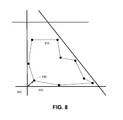
- FIG. 8 illustrates computing the cost associated with corner fit according to one embodiment.
- FIG. 9 illustrates computing the cost associated with vertex displacement according to one embodiment.
- FIG. 1 is a high-level block diagram that illustrates a computing environment for reducing discrepancies between geometric shapes, according to one embodiment of the present disclosure.
- the computing environment includes a client 130 that communicates with a server 105 through a network 140 .
- the network 140 includes but is not limited to any combination of a LAN, MAN, WAN, mobile, wired or wireless network, a private network, or a virtual private network. While only one client is shown to simplify and clarify the description, it is understood that very large numbers of clients are supported and can be in communication with the server 105 .
- Both the server 105 and the client 130 are computer systems that comprise a CPU, memory, network interface, peripheral interfaces, and other well known components.
- the server 105 can be implemented on either a single computer, or using multiple computers networked together.
- the server 105 is adapted to execute computer program modules, such as alignment module 120 , for providing functionality described herein.
- the term “module” refers to computer program logic used to provide the specified functionality.
- a module can be implemented in hardware, firmware, and/or software.
- program modules are stored in on a storage device, loaded into memory and non-transitorily stored therein, and executed by a processor or can be provided from computer program products that are stored in tangible non-transitory computer-readable storage mediums (e.g. RAM, hard disk, or optical/magnetic media).
- the server 105 includes a map data repository 110 that contains map data for generating a digital map.
- the map data repository 110 is illustrated as being stored in server 105 . Alternatively, many other configurations are possible.
- the map data repository 110 does not need to be physically located within server 105 .
- the map data repository 110 can be located in external storage attached directly to the server 105 , or can be accessed by the server 105 through the network 140 that connects the server 105 to the map data repository 110 .
- two dimensional objects e.g., parks, bodies of water, buildings, parking lots, points of interest, etc
- the shape of each polygon is described by a closed border comprising a series of vertices and segments that connect those vertices.
- One dimensional objects e.g., streets and roads
- Each polyline is described with a series of vertices and segments that connect those vertices.
- the data representation for each vertex includes a set of coordinates (e.g. latitude and longitude or other coding that can be associated with a specific geographic location). Vertices may exist at any granularity along the border of the polygon, such as at one meter distances.
- Polylines may intersect with other polylines, similar to how roads intersect with other roads. Further, polygons may intersect with other polygons, or a polyline may intersect with a polygon.
- a polygon When displayed in a map, a polygon may appear to neighbor (i.e. be located nearby to) other objects such as polylines or other polygons. These other objects are referred to herein as “neighboring objects.”
- neighboring objects In the map, the border of the polygon may appear to run roughly parallel to the neighboring objects. Additionally, the neighboring objects may appear to form a loose boundary around the polygon by surrounding the polygon on all or most sides. The border of the polygon may not be perfectly aligned with the neighboring objects. As a result, discrepancies, such as open spaces, appear between the polygon and the neighboring objects.
- the server 105 executes an alignment module 120 for reducing discrepancies between polygons and neighboring objects, such as polylines and other polygons.
- the alignment module 120 generally processes polygons in the map data one at a time, operating in a batch mode.
- the alignment module 120 begins by selecting a polygon of interest for processing. For example, referring to FIG. 2A , illustrated is a polygon before alignment. As shown, a polygon 210 is nearby and surrounded by four polylines 215 - 230 . The border of the polygon 210 appears jagged, resulting in unsightly open spaces 218 between the polygon 210 and the adjacent polylines 215 - 230 .
- the alignment module 120 adjusts the border of the polygon to align it with neighboring objects while still maintaining the overall shape of the polygon.
- the alignment module 120 repeatedly adjusts the vertices of the polygon until a cost function converges on a minimum value. For example, referring to FIG. 2B , illustrated is the polygon of FIG. 2A after the borders of the polygon are aligned. As shown, the alignment module 120 revises the borders of polygon 210 to align it with nearby polylines such that most of the open spaces have been eliminated.
- the cost function is computed with several heuristics that are referred to herein as geometric similarity, shape smoothness, feature fit, corner fit, and vertex displacement. Each of these heuristics will be described in greater detail below.
- the alignment module 120 then stores the revised polygon into the map data repository 110 .
- the client 130 can execute a map editor 135 to retrieve and further edit the polygon, or to display the polygon in a digital map.
- polygon shaped objects e.g., parks and lakes
- the alignment module 120 selects 305 a polygon of interest from the polygons in the map data repository 110 . If operating in batch mode, the alignment module 120 can automatically select a polygon for processing, for example, iteratively processing all polygons with a given region. Alternatively, the identification module CC 10 can select a polygon in response to a user input (e.g. from the client 130 ) that selects a particular polygon. The selected polygon is then received by the alignment module 120 for processing.
- a user input e.g. from the client 130
- the alignment module 120 adjusts 310 the shape of the polygon in order to align the border of the polygon with neighboring objects while still maintaining the overall appearance of the polygon.
- the shape of a polygon is represented by a series of vertices and edges that connect those vertices.
- the alignment module 120 repeatedly adjusts the vertices of the polygon until a cost function is minimized using a “greedy” algorithm that makes locally optimal choices in order to find a globally optimal solution.
- the alignment module 120 attempts to identify the optimal location for a single vertex, given the locations of all other vertices of the polygon, before identifying the optimal locations of the other vertices.
- the location of a given vertex is optimized using a cost function, as further described below.
- adjusting the shape of a polygon itself includes multiple steps.
- the alignment module 120 iterates over each vertex in the polygon. Starting with a given vertex (“a target vertex”) of the polygon, the alignment module identifies 320 a new position for the target vertex that minimizes a cost function.
- the cost function is a local cost function that represents only the cost associated with the target vertex.
- the cost function is a global cost function that represents the overall cost for the entire polygon, given the current location of all of its vertices.
- the alignment module 120 to identify 320 the minimum cost location of the target vertex, starts at the original position of the target vertex and incrementally searches outwards in a spiral or other pattern. At each new position, the alignment module 120 computes a cost using a cost function based on the new position of the target vertex. The alignment module 120 continues to search in this manner until a position of the target vertex that minimizes a cost function is identified. In another embodiment, the alignment module starts with the position of the target vertex and searches positions along a line in the direction of the closest neighboring object until it identifies the minimum cost position. For example, FIG. 4 illustrates adjusting the shape of a polygon.
- vertex 405 is the target vertex and polyline 450 is the closest object to the target vertex 405 .
- the alignment module 120 identifies the lowest cost position for target vertex 405 by searching in the direction of polyline 450 .
- the alignment module 120 can start the search at a location on a neighboring object that is closest to the target vertex. For example, referring again to FIG. 4 , the alignment module can search for the lowest cost position for target vertex 405 starting at position 407 on polyline 450 , and then moving incrementally back towards the current location for the target vertex 405 .
- the alignment module determines 330 whether to process (i.e. identify the minimum cost position for) another vertex.
- the alignment module 120 iterates around the polygon from vertex to vertex, identifying the minimum cost position for each vertex one at a time.
- the alignment module 120 iterates in a clockwise or counter-clockwise manner to select the next vertex 335 .
- the alignment module 120 chooses the next vertex in a clockwise 415 direction as the target vertex. As a result, vertex 410 is selected as the next target vertex.
- identifying a new position for one vertex can indirectly affect the minimum cost position of adjacent vertices.
- a position for a vertex that was previously identified as a minimum cost position may no longer be the true minimum cost position after the other vertices are processed.
- the alignment module 120 makes multiple passes through a polygon. With each pass, the alignment module 120 re-identifies the minimum cost positions for the vertices. This continues until the overall cost of the polygon as determined by the global cost function, is decreasing by less than some threshold amount with each pass (i.e. the costs converge). Once the cost converges, it is determined 330 that no other vertices need to be processed and the process continues to step 340 .
- the alignment module 120 stores the updated polygon data, including the new positions of the vertices, into the map data repository 110 .
- the polygon may be further edited by a user of the map editing system or output for display in a digital map.
- the alignment module 120 computes a cost for the location of one or more vertices using a cost function.
- a cost function for a single vertex (e.g., a target vertex)
- the alignment module 120 computes separate costs for the vertex that are based on different heuristics and combines them into a single cost.
- VertexCost is the cost associated with a single vertex.
- GS is the cost associated with geometric similarity.
- SS is the cost associated with shape smoothness.
- FF is the cost associated with feature fit.
- CF is the cost associated with corner fit.
- VD is the cost associated with vertex displacement.
- the weight for each individual cost component is represented by a, b, c, d, and e. Each of these individual costs will be explained in greater detail
- the alignment module 120 computes the costs for each of the individual vertices of the polygon and combines them into an overall cost.
- the global cost function for computing the overall cost of the entire polygon can be expressed with the following formula:
- PolygonCost is the overall cost of a polygon
- n is the total number of vertices in the polygon
- VertexCost is evaluated at each vertex i.
- the GS (geometric similarity) portion of the cost function attempts to maintain the similarity between the geometry of the polygon before its shape is adjusted (the “original polygon”) and the geometry of the polygon after its shape is adjusted (the “adjusted polygon”) by penalizing changes in geometry. For example, if the original polygon was a rhombus, the adjusted polygon should also be a rhombus and not a parallelogram. Thus, the cost increases as the changes in geometry increase.
- the GS portion of the cost function is the absolute value of the angular difference between an angle at a vertex of the original polygon and an angle at the corresponding vertex in the adjusted polygon.
- the angle can be either the interior or exterior angle, so long as it is consistently applied. A large difference in angle is an indication that the geometry of the polygon has changed and is penalized with a higher cost.
- an angle is measured between a vertex and its immediate adjacent vertices.
- FIGS. 5A and 5B illustrate computing the cost associated with geometry similarity according to one embodiment.
- FIG. 5A shows a portion of an original polygon
- FIG. 5B shows a portion of an adjusted polygon.
- geometric similarity is being computed with respect to vertex 510 .
- the angle of the edges connected to vertex 510 and its adjacent vertices is 60 degrees.
- the angle of the edges connecting vertex 510 to its adjacent vertices is 135 degrees.
- the GS cost for vertex 510 is the absolute value of the difference, which is 75 degrees.
- the alignment module 120 measures angles between a vertex of a polygon and non-adjacent vertices, or between a vertex of a polygon and locations on the polygon that are at some pre-defined distance from the vertex. Measuring angles using non-adjacent vertices or pre-determined distances helps to eliminate noise, or minor variations in angle that do not affect the overall geometry of the polygon.
- FIGS. 5C and 5D illustrate computing the cost associated with geometric similarity according to one embodiment.
- FIG. 5C shows a portion of a polygon before it is adjusted and
- FIG. 5D shows a portion of a polygon after it is adjusted.
- Geometric similarity is being computed with respect to vertex 510 .
- the angle is measured between vertex 510 and a location on the polygon that is five meters away from the vertex. The angle defined by these measurement points is 135 degrees.
- the angle defined by measuring at a five meter distance is also 135 degrees.
- the GS cost for vertex 510 is 0 degrees.
- the geometric similarity cost varies greatly depending on how the angles are measured in the GS function.
- the SS (shape smoothness) portion of the cost function attempts to create a polygon that has straight or smooth borders by penalizing polygons with rough borders.
- the smoother the polygon the lower the cost of the polygon.
- the SS portion of the cost function is the absolute value of the difference between an ideal angle, such as 180 degrees, and the actual angle at a vertex.
- the angle can be either the interior or exterior angle, so long as it is consistently applied.
- FIG. 6 illustrates computing the cost associated with shape smoothness according to one embodiment. Shown in the figure is a portion of a border of a polygon. Shape smoothness is being computed with respect to vertex 610 .
- the angle between vertex 610 and its adjacent vertices is equal to 140 degrees.
- the angle can be measured between a vertex and non-adjacent vertices or between a vertex and locations on the polygon that are at some pre-defined distance from the vertex. Assuming that the ideal angle is 180 degrees, there is a difference of 40 degrees. As such, the cost of vertex 610 is 40 degrees.
- the FF (feature fit) portion of the cost function attempts to reduce any open spaces between a polygon border and neighboring objects. Thus, if there is a close fit between a vertex of a polygon and a neighboring object, the cost of the vertex will be low. Feature fit is accounted for by measuring the distance between a vertex of the adjusted polygon and the neighboring object that is closest to the vertex. The FF portion of the cost function is directly related to this distance according to some pre-defined mathematical relationship.
- FIG. 7 illustrates a cost relationship for feature fit according to one embodiment. Shown in the figure is a graph of the relationship between cost and distance. As shown on the left side of the graph, the cost of a vertex decreases as the distance to the closest neighboring object approaches zero. The cost is at its lowest when the vertex lines up exactly with the neighboring object, thereby eliminating any open space between the objects. As shown on the right side of the graph, large distances are generally not penalized with an increased cost. Large distances do not represent open spaces that appear as unsightly visual noise, but represent open spaces that should not be eliminated.
- the alignment module 120 can measure the distance between an edge of a polygon (as opposed to a vertex) and the closest neighboring object and use this measurement to compute the feature fit cost.
- the CF (corner fit) portion of the cost function attempts to reduce open spaces between a polygon border and the intersection of two or more neighboring objects. Corner fit is accounted for by measuring the distance between a vertex of a polygon and the closest intersection.
- FIG. 8 illustrates how to compute the cost associated with corner fit according to one embodiment. Shown in the figure is a polygon 810 that is located near an intersection 820 of two polylines. The distance between vertex 830 and intersection 820 is represented by arrow 840 .
- the CF portion of the cost function is directly related to the distance 840 according to some pre-defined mathematical relationship. In one embodiment, the relationship between corner fit cost and distance is similar to the relationship illustrated in the graph of FIG. 7 .
- the VD (vertex displacement) portion of the cost function attempts to reduce any changes to the size or position of the original polygon by penalizing such changes.
- the VD portion of the cost function is the distance (e.g. meters, feet) between a vertex of the original polygon and the corresponding vertex of the adjusted polygon.
- FIG. 9 illustrates how to compute the cost associated with vertex displacement according to one embodiment.
- polygon 910 is the original polygon and polygon 920 is the adjusted polygon.
- the vertex displacement cost of vertex 930 is the distance between vertex 930 and 935 .
- the vertex displacement cost of vertex 940 is the distance between 945 and 940 .
- the alignment module 120 can compute the VD cost for the entire polygon (the “polygon displacement cost”) at once.
- the alignment module 120 can compute the polygon displacement cost by computing the overlap in area between the original polygon and the adjusted polygon. The overlap is subtracted from the total area of the adjusted polygon. The resulting number represents a change in area/position between the original and adjusted polygon. The number is scaled (e.g. between 0 and 100) to create a polygon displacement cost that is included as a part of the function for computing Polygon Cost. For example, referring again to FIG.
- the alignment module 120 can measure the overlap in area of original polygon 910 and adjusted polygon 920 , which in this figure is equal to the entirety of original polygon 910 .
- the area of polygon 910 is then subtracted from the area of polygon 920 to identify the change in area or position, which is then scaled to create the polygon displacement cost.
- the disclosed embodiments thus allow for geometric objects, such as polygons and polylines, to be aligned with each other to eliminate open spaces.
- map rendering quality is increased.
- open spaces can be eliminated without distorting the overall appearance of the original polygon.
- Modules may constitute either software modules (e.g., code embodied on a machine-readable medium or in a transmission signal) or hardware modules.
- a hardware module is tangible unit capable of performing certain operations and may be configured or arranged in a certain manner.
- one or more computer systems e.g., a standalone, client or server computer system
- one or more hardware modules of a computer system e.g., a processor or a group of processors
- software e.g., an application or application portion
- a hardware module may be implemented mechanically or electronically.
- a hardware module may comprise dedicated circuitry or logic that is permanently configured (e.g., as a special-purpose processor, such as a field programmable gate array (FPGA) or an application-specific integrated circuit (ASIC)) to perform certain operations.
- a hardware module may also comprise programmable logic or circuitry (e.g., as encompassed within a general-purpose processor or other programmable processor) that is temporarily configured by software to perform certain operations. It will be appreciated that the decision to implement a hardware module mechanically, in dedicated and permanently configured circuitry, or in temporarily configured circuitry (e.g., configured by software) may be driven by cost and time considerations.
- hardware module should be understood to encompass a tangible entity, be that an entity that is physically constructed, permanently configured (e.g., hardwired), or temporarily configured (e.g., programmed) to operate in a certain manner or to perform certain operations described herein.
- “hardware-implemented module” refers to a hardware module. Considering embodiments in which hardware modules are temporarily configured (e.g., programmed), each of the hardware modules need not be configured or instantiated at any one instance in time. For example, where the hardware modules comprise a general-purpose processor configured using software, the general-purpose processor may be configured as respective different hardware modules at different times. Software may accordingly configure a processor, for example, to constitute a particular hardware module at one instance of time and to constitute a different hardware module at a different instance of time.
- Hardware modules can provide information to, and receive information from, other hardware modules. Accordingly, the described hardware modules may be regarded as being communicatively coupled. Where multiple of such hardware modules exist contemporaneously, communications may be achieved through signal transmission (e.g., over appropriate circuits and buses) that connect the hardware modules. In embodiments in which multiple hardware modules are configured or instantiated at different times, communications between such hardware modules may be achieved, for example, through the storage and retrieval of information in memory structures to which the multiple hardware modules have access. For example, one hardware module may perform an operation and store the output of that operation in a memory device to which it is communicatively coupled. A further hardware module may then, at a later time, access the memory device to retrieve and process the stored output. Hardware modules may also initiate communications with input or output devices, and can operate on a resource (e.g., a collection of information).
- a resource e.g., a collection of information
- processors may be temporarily configured (e.g., by software) or permanently configured to perform the relevant operations. Whether temporarily or permanently configured, such processors may constitute processor-implemented modules that operate to perform one or more operations or functions.
- the modules referred to herein may, in some example embodiments, comprise processor-implemented modules.
- the methods described herein may be at least partially processor-implemented. For example, at least some of the operations of a method may be performed by one or processors or processor-implemented hardware modules. The performance of certain of the operations may be distributed among the one or more processors, not only residing within a single machine, but deployed across a number of machines. In some example embodiments, the processor or processors may be located in a single location (e.g., within a home environment, an office environment or as a server farm), while in other embodiments the processors may be distributed across a number of locations.
- the one or more processors may also operate to support performance of the relevant operations in a “cloud computing” environment or as a “software as a service” (SaaS). For example, at least some of the operations may be performed by a group of computers (as examples of machines including processors), these operations being accessible via a network (e.g., the Internet) and via one or more appropriate interfaces (e.g., application program interfaces (APIs).)
- SaaS software as a service
- the performance of certain of the operations may be distributed among the one or more processors, not only residing within a single machine, but deployed across a number of machines.
- the one or more processors or processor-implemented modules may be located in a single geographic location (e.g., within a home environment, an office environment, or a server farm). In other example embodiments, the one or more processors or processor-implemented modules may be distributed across a number of geographic locations.
- any reference to “one embodiment” or “an embodiment” means that a particular element, feature, structure, or characteristic described in connection with the embodiment is included in at least one embodiment.
- the appearances of the phrase “in one embodiment” in various places in the specification are not necessarily all referring to the same embodiment.
- Coupled and “connected” along with their derivatives.
- some embodiments may be described using the term “coupled” to indicate that two or more elements are in direct physical or electrical contact.
- the term “coupled,” however, may also mean that two or more elements are not in direct contact with each other, but yet still co-operate or interact with each other.
- the embodiments are not limited in this context.
- the terms “comprises,” “comprising,” “includes,” “including,” “has,” “having” or any other variation thereof, are intended to cover a non-exclusive inclusion.
- a process, method, article, or apparatus that comprises a list of elements is not necessarily limited to only those elements but may include other elements not expressly listed or inherent to such process, method, article, or apparatus.
- “or” refers to an inclusive or and not to an exclusive or. For example, a condition A or B is satisfied by any one of the following: A is true (or present) and B is false (or not present), A is false (or not present) and B is true (or present), and both A and B are true (or present).
Landscapes
- Engineering & Computer Science (AREA)
- Radar, Positioning & Navigation (AREA)
- Remote Sensing (AREA)
- Physics & Mathematics (AREA)
- Geometry (AREA)
- Automation & Control Theory (AREA)
- General Physics & Mathematics (AREA)
- Processing Or Creating Images (AREA)
Abstract
Description
VertexCost=a×GS+b×SS+c×FF+d×CF+e×VD
Where PolygonCost is the overall cost of a polygon, n is the total number of vertices in the polygon, and VertexCost is evaluated at each vertex i.
Claims (42)
Priority Applications (1)
| Application Number | Priority Date | Filing Date | Title |
|---|---|---|---|
| US12/904,997 US8614703B1 (en) | 2010-10-14 | 2010-10-14 | Automatic border alignment of objects in map data |
Applications Claiming Priority (1)
| Application Number | Priority Date | Filing Date | Title |
|---|---|---|---|
| US12/904,997 US8614703B1 (en) | 2010-10-14 | 2010-10-14 | Automatic border alignment of objects in map data |
Publications (1)
| Publication Number | Publication Date |
|---|---|
| US8614703B1 true US8614703B1 (en) | 2013-12-24 |
Family
ID=49770079
Family Applications (1)
| Application Number | Title | Priority Date | Filing Date |
|---|---|---|---|
| US12/904,997 Expired - Fee Related US8614703B1 (en) | 2010-10-14 | 2010-10-14 | Automatic border alignment of objects in map data |
Country Status (1)
| Country | Link |
|---|---|
| US (1) | US8614703B1 (en) |
Cited By (8)
| Publication number | Priority date | Publication date | Assignee | Title |
|---|---|---|---|---|
| US20140033098A1 (en) * | 2011-04-07 | 2014-01-30 | Sharp Kabushiki Kaisha | Electronic apparatus, display method and display program |
| WO2017055934A1 (en) * | 2015-09-28 | 2017-04-06 | Yandex Europe Ag | Method of and system for generating simplified borders of graphical objects |
| US10339669B2 (en) * | 2017-08-22 | 2019-07-02 | Here Global B.V. | Method, apparatus, and system for a vertex-based evaluation of polygon similarity |
| US10915578B1 (en) | 2019-09-06 | 2021-02-09 | Digital Asset Capital, Inc. | Graph outcome determination in domain-specific execution environment |
| US11132403B2 (en) | 2019-09-06 | 2021-09-28 | Digital Asset Capital, Inc. | Graph-manipulation based domain-specific execution environment |
| CN115797365A (en) * | 2022-11-16 | 2023-03-14 | 武汉中海庭数据技术有限公司 | Method and system for processing flush of joint edges of high-precision map area splicing units |
| US12339904B2 (en) | 2019-09-06 | 2025-06-24 | Digital Asset Capital, Inc | Dimensional reduction of categorized directed graphs |
| WO2026060119A1 (en) * | 2024-09-12 | 2026-03-19 | Qualcomm Incorporated | A geometry-aware map generation model with polygons |
Citations (5)
| Publication number | Priority date | Publication date | Assignee | Title |
|---|---|---|---|---|
| US20030147553A1 (en) * | 2002-02-07 | 2003-08-07 | Liang-Chien Chen | Semi-automatic reconstruction method of 3-D building models using building outline segments |
| US20040263514A1 (en) * | 2003-05-19 | 2004-12-30 | Haomin Jin | Map generation device, map delivery method, and map generation program |
| US20070291994A1 (en) * | 2002-05-03 | 2007-12-20 | Imagetree Corp. | Remote sensing and probabilistic sampling based forest inventory method |
| US20080310715A1 (en) * | 2007-06-14 | 2008-12-18 | Simske Steven J | Applying a segmentation engine to different mappings of a digital image |
| US20110249875A1 (en) * | 2004-11-10 | 2011-10-13 | Agfa Healthcare | Method of performing measurements on digital images |
-
2010
- 2010-10-14 US US12/904,997 patent/US8614703B1/en not_active Expired - Fee Related
Patent Citations (5)
| Publication number | Priority date | Publication date | Assignee | Title |
|---|---|---|---|---|
| US20030147553A1 (en) * | 2002-02-07 | 2003-08-07 | Liang-Chien Chen | Semi-automatic reconstruction method of 3-D building models using building outline segments |
| US20070291994A1 (en) * | 2002-05-03 | 2007-12-20 | Imagetree Corp. | Remote sensing and probabilistic sampling based forest inventory method |
| US20040263514A1 (en) * | 2003-05-19 | 2004-12-30 | Haomin Jin | Map generation device, map delivery method, and map generation program |
| US20110249875A1 (en) * | 2004-11-10 | 2011-10-13 | Agfa Healthcare | Method of performing measurements on digital images |
| US20080310715A1 (en) * | 2007-06-14 | 2008-12-18 | Simske Steven J | Applying a segmentation engine to different mappings of a digital image |
Cited By (12)
| Publication number | Priority date | Publication date | Assignee | Title |
|---|---|---|---|---|
| US20140033098A1 (en) * | 2011-04-07 | 2014-01-30 | Sharp Kabushiki Kaisha | Electronic apparatus, display method and display program |
| WO2017055934A1 (en) * | 2015-09-28 | 2017-04-06 | Yandex Europe Ag | Method of and system for generating simplified borders of graphical objects |
| US10339669B2 (en) * | 2017-08-22 | 2019-07-02 | Here Global B.V. | Method, apparatus, and system for a vertex-based evaluation of polygon similarity |
| US10915578B1 (en) | 2019-09-06 | 2021-02-09 | Digital Asset Capital, Inc. | Graph outcome determination in domain-specific execution environment |
| US10990879B2 (en) * | 2019-09-06 | 2021-04-27 | Digital Asset Capital, Inc. | Graph expansion and outcome determination for graph-defined program states |
| US11132403B2 (en) | 2019-09-06 | 2021-09-28 | Digital Asset Capital, Inc. | Graph-manipulation based domain-specific execution environment |
| US11526333B2 (en) | 2019-09-06 | 2022-12-13 | Digital Asset Capital, Inc. | Graph outcome determination in domain-specific execution environment |
| US12299036B2 (en) | 2019-09-06 | 2025-05-13 | Digital Asset Capital, Inc | Querying graph-based models |
| US12339904B2 (en) | 2019-09-06 | 2025-06-24 | Digital Asset Capital, Inc | Dimensional reduction of categorized directed graphs |
| US12379902B2 (en) | 2019-09-06 | 2025-08-05 | Digital Asset Capital, Inc. | Event-based entity scoring in distributed systems |
| CN115797365A (en) * | 2022-11-16 | 2023-03-14 | 武汉中海庭数据技术有限公司 | Method and system for processing flush of joint edges of high-precision map area splicing units |
| WO2026060119A1 (en) * | 2024-09-12 | 2026-03-19 | Qualcomm Incorporated | A geometry-aware map generation model with polygons |
Similar Documents
| Publication | Publication Date | Title |
|---|---|---|
| Di Stefano et al. | Mobile 3D scan LiDAR: A literature review | |
| US20240053876A1 (en) | Integrating Maps and Street Views | |
| US11988523B2 (en) | Polygon overlap assignment using medial axis | |
| US8718922B2 (en) | Variable density depthmap | |
| US9978161B2 (en) | Supporting a creation of a representation of road geometry | |
| US9483872B2 (en) | Graphical representation of roads and routes using hardware tessellation | |
| JP7420815B2 (en) | System and method for selecting complementary images from a plurality of images for 3D geometric extraction | |
| US9626593B2 (en) | System and method for conflating road datasets | |
| Harmening et al. | A constraint-based parameterization technique for B-spline surfaces | |
| US9140573B2 (en) | Path finding in a map editor | |
| US9679399B2 (en) | Method to optimize the visualization of a map's projection based on data and tasks | |
| Stein et al. | Handling uncertainties in image mining for remote sensing studies | |
| US9245360B2 (en) | Computing devices and methods for deterministically placing geometric shapes within geographic maps | |
| Ayeni et al. | An evaluation of digital elevation modeling in GIS and Cartography | |
| CN118050017A (en) | A land surveying and mapping method and system based on GIS digital technology | |
| López-Vázquez et al. | Point-and curve-based geometric conflation | |
| US11403815B2 (en) | Gridding global data into a minimally distorted global raster | |
| Xue et al. | Surface area calculation for DEM-based terrain model | |
| Goto et al. | Storage-efficient method for generating contours focusing on roundness | |
| Han et al. | Registration of vector maps based on multiple geometric features in topological aspects | |
| US20240211452A1 (en) | System and method for improving building data | |
| Jamali et al. | A novel method of combined interval analysis and homotopy continuation in indoor building reconstruction | |
| Mozas et al. | Positional accuracy control of extracted roads from VHR images using GPS kinematic survey: a proposal of methodology | |
| Goethem et al. | Topologically safe curved schematisation | |
| KR100578380B1 (en) | Boundary Stroke Method |
Legal Events
| Date | Code | Title | Description |
|---|---|---|---|
| AS | Assignment |
Owner name: GOOGLE INC., CALIFORNIA Free format text: ASSIGNMENT OF ASSIGNORS INTEREST;ASSIGNORS:FONG, CHIN LUNG;ARFVIDSSON, JOAKIM KRISTIAN OLLE;PILLOFF, MARK D.;SIGNING DATES FROM 20101018 TO 20101102;REEL/FRAME:025329/0880 |
|
| STCF | Information on status: patent grant |
Free format text: PATENTED CASE |
|
| FPAY | Fee payment |
Year of fee payment: 4 |
|
| AS | Assignment |
Owner name: GOOGLE LLC, CALIFORNIA Free format text: CHANGE OF NAME;ASSIGNOR:GOOGLE INC.;REEL/FRAME:044101/0299 Effective date: 20170929 |
|
| MAFP | Maintenance fee payment |
Free format text: PAYMENT OF MAINTENANCE FEE, 8TH YEAR, LARGE ENTITY (ORIGINAL EVENT CODE: M1552); ENTITY STATUS OF PATENT OWNER: LARGE ENTITY Year of fee payment: 8 |
|
| FEPP | Fee payment procedure |
Free format text: MAINTENANCE FEE REMINDER MAILED (ORIGINAL EVENT CODE: REM.); ENTITY STATUS OF PATENT OWNER: LARGE ENTITY |
|
| LAPS | Lapse for failure to pay maintenance fees |
Free format text: PATENT EXPIRED FOR FAILURE TO PAY MAINTENANCE FEES (ORIGINAL EVENT CODE: EXP.); ENTITY STATUS OF PATENT OWNER: LARGE ENTITY |
|
| STCH | Information on status: patent discontinuation |
Free format text: PATENT EXPIRED DUE TO NONPAYMENT OF MAINTENANCE FEES UNDER 37 CFR 1.362 |
|
| FP | Lapsed due to failure to pay maintenance fee |
Effective date: 20251224 |