US8609902B2 - Organoactinide-, organolanthanide-, and organogroup-4-mediated hydrothiolation of terminal alkynes with aliphatic, aromatic and benzylic thiols - Google Patents
Organoactinide-, organolanthanide-, and organogroup-4-mediated hydrothiolation of terminal alkynes with aliphatic, aromatic and benzylic thiols Download PDFInfo
- Publication number
- US8609902B2 US8609902B2 US12/856,154 US85615410A US8609902B2 US 8609902 B2 US8609902 B2 US 8609902B2 US 85615410 A US85615410 A US 85615410A US 8609902 B2 US8609902 B2 US 8609902B2
- Authority
- US
- United States
- Prior art keywords
- tms
- group
- nme
- alkyl
- aryl
- Prior art date
- Legal status (The legal status is an assumption and is not a legal conclusion. Google has not performed a legal analysis and makes no representation as to the accuracy of the status listed.)
- Expired - Fee Related, expires
Links
- 0 C.C.Cc1c(C)c(C)c(C)c1C.Cc1cc(C)c(C)c1C Chemical compound C.C.Cc1c(C)c(C)c(C)c1C.Cc1cc(C)c(C)c1C 0.000 description 16
- ITKBWZPRAFZVNW-UHFFFAOYSA-N C=C(C)SC Chemical compound C=C(C)SC ITKBWZPRAFZVNW-UHFFFAOYSA-N 0.000 description 3
- FHPUJEYPMSGONV-UHFFFAOYSA-N C=C(CC1CCCCC1)SCCCCC Chemical compound C=C(CC1CCCCC1)SCCCCC FHPUJEYPMSGONV-UHFFFAOYSA-N 0.000 description 3
- LEXKMASNVFCEHR-UHFFFAOYSA-N C=C(CCCC)SCC1=CC=CC=C1 Chemical compound C=C(CCCC)SCC1=CC=CC=C1 LEXKMASNVFCEHR-UHFFFAOYSA-N 0.000 description 3
- UCBALXSPJYVSQG-UHFFFAOYSA-N C=C(SCCCCC)C1=CN=CC=C1 Chemical compound C=C(SCCCCC)C1=CN=CC=C1 UCBALXSPJYVSQG-UHFFFAOYSA-N 0.000 description 3
- UEXCJVNBTNXOEH-UHFFFAOYSA-N C#CC1=CC=CC=C1 Chemical compound C#CC1=CC=CC=C1 UEXCJVNBTNXOEH-UHFFFAOYSA-N 0.000 description 2
- CLRPXACRDTXENY-UHFFFAOYSA-N C#CC1=CN=CC=C1 Chemical compound C#CC1=CN=CC=C1 CLRPXACRDTXENY-UHFFFAOYSA-N 0.000 description 2
- NGKSKVYWPINGLI-UHFFFAOYSA-N C#CCC1=CC=CC=C1 Chemical compound C#CCC1=CC=CC=C1 NGKSKVYWPINGLI-UHFFFAOYSA-N 0.000 description 2
- CUDJBCZXZYTMPY-UHFFFAOYSA-N C=C(CC1=CC=CC=C1)SCCCCC Chemical compound C=C(CC1=CC=CC=C1)SCCCCC CUDJBCZXZYTMPY-UHFFFAOYSA-N 0.000 description 2
- RNPMHMKXARBXPQ-UHFFFAOYSA-N C=C(CCCC)SC1CCCCC1 Chemical compound C=C(CCCC)SC1CCCCC1 RNPMHMKXARBXPQ-UHFFFAOYSA-N 0.000 description 2
- DNTCRHVBSNKLRM-UHFFFAOYSA-N C=C(CCCC)SCC Chemical compound C=C(CCCC)SCC DNTCRHVBSNKLRM-UHFFFAOYSA-N 0.000 description 2
- UNBKHZRZADVPQZ-UHFFFAOYSA-N C=C(CCCC)SCC(F)(F)F Chemical compound C=C(CCCC)SCC(F)(F)F UNBKHZRZADVPQZ-UHFFFAOYSA-N 0.000 description 2
- PDXLTFZLVJUMHU-UHFFFAOYSA-N C=C(CCCC)SCC1=CC=C(C)C=C1 Chemical compound C=C(CCCC)SCC1=CC=C(C)C=C1 PDXLTFZLVJUMHU-UHFFFAOYSA-N 0.000 description 2
- KCJWMLDRAXZUTI-UHFFFAOYSA-N C=C(CCCC)SCCCCC Chemical compound C=C(CCCC)SCCCCC KCJWMLDRAXZUTI-UHFFFAOYSA-N 0.000 description 2
- GVDGFYARHLKNOH-UHFFFAOYSA-N C=C(CN)SCCCCC Chemical compound C=C(CN)SCCCCC GVDGFYARHLKNOH-UHFFFAOYSA-N 0.000 description 2
- LPGRNHHIKZUZHU-UHFFFAOYSA-N C=C(SCC1=CC=C(C)C=C1)C1CCCCC1 Chemical compound C=C(SCC1=CC=C(C)C=C1)C1CCCCC1 LPGRNHHIKZUZHU-UHFFFAOYSA-N 0.000 description 2
- PYNPYTNMMKORHE-UHFFFAOYSA-N C=C(SCCCCC)C1=CC=CC=C1 Chemical compound C=C(SCCCCC)C1=CC=CC=C1 PYNPYTNMMKORHE-UHFFFAOYSA-N 0.000 description 2
- HUWYMRKWMDHQOU-UHFFFAOYSA-N C=C(SCCCCC)C1=CCCCC1 Chemical compound C=C(SCCCCC)C1=CCCCC1 HUWYMRKWMDHQOU-UHFFFAOYSA-N 0.000 description 2
- QRWCUFHWQKYMBD-UHFFFAOYSA-N C=C(SCCCCC)C1CCCCC1 Chemical compound C=C(SCCCCC)C1CCCCC1 QRWCUFHWQKYMBD-UHFFFAOYSA-N 0.000 description 2
- AGFYZLVFPSGUIX-UHFFFAOYSA-N CC1=CC=C(CS)C=C1 Chemical compound CC1=CC=C(CS)C=C1 AGFYZLVFPSGUIX-UHFFFAOYSA-N 0.000 description 2
- DNJIEGIFACGWOD-UHFFFAOYSA-N CCS Chemical compound CCS DNJIEGIFACGWOD-UHFFFAOYSA-N 0.000 description 2
- DKFHWNGVMWFBJE-UHFFFAOYSA-N C#CC1=CCCCC1 Chemical compound C#CC1=CCCCC1 DKFHWNGVMWFBJE-UHFFFAOYSA-N 0.000 description 1
- SSDZYLQUYMOSAK-UHFFFAOYSA-N C#CC1CCCCC1 Chemical compound C#CC1CCCCC1 SSDZYLQUYMOSAK-UHFFFAOYSA-N 0.000 description 1
- UARFKZSJGDQRLF-UHFFFAOYSA-N C#CCC1CCCCC1 Chemical compound C#CCC1CCCCC1 UARFKZSJGDQRLF-UHFFFAOYSA-N 0.000 description 1
- CGHIBGNXEGJPQZ-UHFFFAOYSA-N C#CCCCC Chemical compound C#CCCCC CGHIBGNXEGJPQZ-UHFFFAOYSA-N 0.000 description 1
- JKANAVGODYYCQF-UHFFFAOYSA-N C#CCN Chemical compound C#CCN JKANAVGODYYCQF-UHFFFAOYSA-N 0.000 description 1
- LJVLUKDNUGNNFX-UHFFFAOYSA-N C.C#CC.C=C(C)SC.CS Chemical compound C.C#CC.C=C(C)SC.CS LJVLUKDNUGNNFX-UHFFFAOYSA-N 0.000 description 1
- YJAQUCOYWSTTJT-WKQREDGESA-N C.CC.CC.CC#C1[2H]CC1.CC#C1[H]CC1.CC#CC.[2H]C.[2H]C#CC.[H]C#CC Chemical compound C.CC.CC.CC#C1[2H]CC1.CC#C1[H]CC1.CC#CC.[2H]C.[2H]C#CC.[H]C#CC YJAQUCOYWSTTJT-WKQREDGESA-N 0.000 description 1
- KUMLUIHYWNCJQL-UHFFFAOYSA-N C=C(CCCC)SC1=CC=CC=C1 Chemical compound C=C(CCCC)SC1=CC=CC=C1 KUMLUIHYWNCJQL-UHFFFAOYSA-N 0.000 description 1
- PNHVZGGEILRQDF-DIYDOPDJSA-N C=C(CCCC)SCCCCC.[2H]C#CCCCC Chemical compound C=C(CCCC)SCCCCC.[2H]C#CCCCC PNHVZGGEILRQDF-DIYDOPDJSA-N 0.000 description 1
- UKRUNIUJAMCKER-UHFFFAOYSA-N C=C(SC1=CC=CC=C1)C1=CC=CC=C1 Chemical compound C=C(SC1=CC=CC=C1)C1=CC=CC=C1 UKRUNIUJAMCKER-UHFFFAOYSA-N 0.000 description 1
- ZRKMQKLGEQPLNS-UHFFFAOYSA-N CCCCCS Chemical compound CCCCCS ZRKMQKLGEQPLNS-UHFFFAOYSA-N 0.000 description 1
- UMGKGINKQGCUFX-QBQUTGCESA-N CCCCCS.CCCCCSC(C1=CC=CC=C1)=C(C)C.[2H]C#CC1=CC=CC=C1.[H]/C(C)=C(/SCCCCC)C1=CC=CC=C1.[H]/C(C)=C(\SCCCCC)C1=CC=CC=C1.[H]C([H])=C(SCCCCC)C1=CC=CC=C1 Chemical compound CCCCCS.CCCCCSC(C1=CC=CC=C1)=C(C)C.[2H]C#CC1=CC=CC=C1.[H]/C(C)=C(/SCCCCC)C1=CC=CC=C1.[H]/C(C)=C(\SCCCCC)C1=CC=CC=C1.[H]C([H])=C(SCCCCC)C1=CC=CC=C1 UMGKGINKQGCUFX-QBQUTGCESA-N 0.000 description 1
- TZWBVXBTDRZVQL-VXNVDRBHSA-N C[C@H]1C(C)(C)C(C)=C(C)[C@H]1C Chemical compound C[C@H]1C(C)(C)C(C)=C(C)[C@H]1C TZWBVXBTDRZVQL-VXNVDRBHSA-N 0.000 description 1
- RMVRSNDYEFQCLF-UHFFFAOYSA-N SC1=CC=CC=C1 Chemical compound SC1=CC=CC=C1 RMVRSNDYEFQCLF-UHFFFAOYSA-N 0.000 description 1
- CMKBCTPCXZNQKX-UHFFFAOYSA-N SC1CCCCC1 Chemical compound SC1CCCCC1 CMKBCTPCXZNQKX-UHFFFAOYSA-N 0.000 description 1
- UENWRTRMUIOCKN-UHFFFAOYSA-N SCC1=CC=CC=C1 Chemical compound SCC1=CC=CC=C1 UENWRTRMUIOCKN-UHFFFAOYSA-N 0.000 description 1
- ZRKMQKLGEQPLNS-DYCDLGHISA-N [2H]SCCCCC Chemical compound [2H]SCCCCC ZRKMQKLGEQPLNS-DYCDLGHISA-N 0.000 description 1
Images


Classifications
-
- C—CHEMISTRY; METALLURGY
- C07—ORGANIC CHEMISTRY
- C07B—GENERAL METHODS OF ORGANIC CHEMISTRY; APPARATUS THEREFOR
- C07B45/00—Formation or introduction of functional groups containing sulfur
- C07B45/06—Formation or introduction of functional groups containing sulfur of mercapto or sulfide groups
-
- C—CHEMISTRY; METALLURGY
- C07—ORGANIC CHEMISTRY
- C07C—ACYCLIC OR CARBOCYCLIC COMPOUNDS
- C07C319/00—Preparation of thiols, sulfides, hydropolysulfides or polysulfides
- C07C319/14—Preparation of thiols, sulfides, hydropolysulfides or polysulfides of sulfides
- C07C319/18—Preparation of thiols, sulfides, hydropolysulfides or polysulfides of sulfides by addition of thiols to unsaturated compounds
-
- C—CHEMISTRY; METALLURGY
- C07—ORGANIC CHEMISTRY
- C07C—ACYCLIC OR CARBOCYCLIC COMPOUNDS
- C07C323/00—Thiols, sulfides, hydropolysulfides or polysulfides substituted by halogen, oxygen or nitrogen atoms, or by sulfur atoms not being part of thio groups
- C07C323/01—Thiols, sulfides, hydropolysulfides or polysulfides substituted by halogen, oxygen or nitrogen atoms, or by sulfur atoms not being part of thio groups containing thio groups and halogen atoms, or nitro or nitroso groups bound to the same carbon skeleton
- C07C323/02—Thiols, sulfides, hydropolysulfides or polysulfides substituted by halogen, oxygen or nitrogen atoms, or by sulfur atoms not being part of thio groups containing thio groups and halogen atoms, or nitro or nitroso groups bound to the same carbon skeleton having sulfur atoms of thio groups bound to acyclic carbon atoms of the carbon skeleton
- C07C323/03—Thiols, sulfides, hydropolysulfides or polysulfides substituted by halogen, oxygen or nitrogen atoms, or by sulfur atoms not being part of thio groups containing thio groups and halogen atoms, or nitro or nitroso groups bound to the same carbon skeleton having sulfur atoms of thio groups bound to acyclic carbon atoms of the carbon skeleton the carbon skeleton being acyclic and saturated
-
- C—CHEMISTRY; METALLURGY
- C07—ORGANIC CHEMISTRY
- C07C—ACYCLIC OR CARBOCYCLIC COMPOUNDS
- C07C323/00—Thiols, sulfides, hydropolysulfides or polysulfides substituted by halogen, oxygen or nitrogen atoms, or by sulfur atoms not being part of thio groups
- C07C323/23—Thiols, sulfides, hydropolysulfides or polysulfides substituted by halogen, oxygen or nitrogen atoms, or by sulfur atoms not being part of thio groups containing thio groups and nitrogen atoms, not being part of nitro or nitroso groups, bound to the same carbon skeleton
- C07C323/24—Thiols, sulfides, hydropolysulfides or polysulfides substituted by halogen, oxygen or nitrogen atoms, or by sulfur atoms not being part of thio groups containing thio groups and nitrogen atoms, not being part of nitro or nitroso groups, bound to the same carbon skeleton having the sulfur atoms of the thio groups bound to acyclic carbon atoms of the carbon skeleton
- C07C323/27—Thiols, sulfides, hydropolysulfides or polysulfides substituted by halogen, oxygen or nitrogen atoms, or by sulfur atoms not being part of thio groups containing thio groups and nitrogen atoms, not being part of nitro or nitroso groups, bound to the same carbon skeleton having the sulfur atoms of the thio groups bound to acyclic carbon atoms of the carbon skeleton the carbon skeleton being acyclic and unsaturated
-
- C—CHEMISTRY; METALLURGY
- C07—ORGANIC CHEMISTRY
- C07D—HETEROCYCLIC COMPOUNDS
- C07D213/00—Heterocyclic compounds containing six-membered rings, not condensed with other rings, with one nitrogen atom as the only ring hetero atom and three or more double bonds between ring members or between ring members and non-ring members
- C07D213/02—Heterocyclic compounds containing six-membered rings, not condensed with other rings, with one nitrogen atom as the only ring hetero atom and three or more double bonds between ring members or between ring members and non-ring members having three double bonds between ring members or between ring members and non-ring members
- C07D213/04—Heterocyclic compounds containing six-membered rings, not condensed with other rings, with one nitrogen atom as the only ring hetero atom and three or more double bonds between ring members or between ring members and non-ring members having three double bonds between ring members or between ring members and non-ring members having no bond between the ring nitrogen atom and a non-ring member or having only hydrogen or carbon atoms directly attached to the ring nitrogen atom
- C07D213/24—Heterocyclic compounds containing six-membered rings, not condensed with other rings, with one nitrogen atom as the only ring hetero atom and three or more double bonds between ring members or between ring members and non-ring members having three double bonds between ring members or between ring members and non-ring members having no bond between the ring nitrogen atom and a non-ring member or having only hydrogen or carbon atoms directly attached to the ring nitrogen atom with substituted hydrocarbon radicals attached to ring carbon atoms
- C07D213/28—Radicals substituted by singly-bound oxygen or sulphur atoms
- C07D213/32—Sulfur atoms
-
- C—CHEMISTRY; METALLURGY
- C07—ORGANIC CHEMISTRY
- C07C—ACYCLIC OR CARBOCYCLIC COMPOUNDS
- C07C2601/00—Systems containing only non-condensed rings
- C07C2601/12—Systems containing only non-condensed rings with a six-membered ring
- C07C2601/14—The ring being saturated
-
- C—CHEMISTRY; METALLURGY
- C07—ORGANIC CHEMISTRY
- C07C—ACYCLIC OR CARBOCYCLIC COMPOUNDS
- C07C2601/00—Systems containing only non-condensed rings
- C07C2601/12—Systems containing only non-condensed rings with a six-membered ring
- C07C2601/16—Systems containing only non-condensed rings with a six-membered ring the ring being unsaturated
Definitions
- the present invention relates generally to atom-efficient organoactinide-, organolanthanide-, and organoGroup-4-catalyzed intermolecular hydrothiolation of terminal alkynes or allenes.
- the methods of the invention can be used to incorporate sulfur into organic frameworks, to synthesize carbon-carbon bond forming reagents, and to synthesize vinyl cross-coupling reagents.
- Sulfur is a constituent of many important polymeric materials, natural products, and synthetic reagents, providing impetus to devise efficient catalytic methodologies for sulfur-carbon bond formation.
- the addition of S—H bonds across alkynes is an atom-economical route to a variety of vinyl sulfides that can be achieved by several pathways, including radical (Capella, L. et al., J. Org. Chem. 1996, 61, 6783-6789; Benati, L. et al., J. Chem. Soc., Perkin Trans. 1995, 1035-1038; Benati, L. et al., J. Chem. Soc., Perkin Trans. 1991, 2103-2109; Ichinose, Y.
- late transition metal catalysts exhibit high activity, achieving high Markovnikov selectivity still presents a challenge, with the exception of Pd, as does competing isomerization of the alkene product, double-thiolation products and product insertion into a second alkyne. Furthermore, while some late transition metal complexes effect efficient alkyne hydrothiolation with benzyl and aryl thiols, few mediate hydrothiolation with the less reactive aliphatic thiols.
- Rhodium complexes selectively yield E anti-Markovnikov products as a result of the hydride insertion regiochemistry.
- Pd complexes are proposed to effect hydrothiolation via acetylene insertion into the metal-thiolate bond followed by thiol-mediated displacement of product from the metal center, resulting in Markovnikov selectivity.
- an efficient catalytic system for the hydrothiolation of terminal alkynes by aromatic, benzylic, and less reactive aliphatic thiols.
- This system should proceed with a high degree of Markovnikov selectivity and reduce 1) the formation of double-thiolated side product, 2) the competing isomerization of the alkene product, and 3) the product insertion into a second alkyne.
- an object of the present invention to provide an organolanthanide, organoactinide, or organoGroup-4 catalyst for the intermolecular hydrothiolation of terminal alkynes using a variety of aryl, benzyl and aliphatic thiols, thereby overcoming various deficiencies and shortcomings of the prior art, including those outlined above.
- one or more aspects of this invention can meet certain objectives, while one or more other aspects can meet certain other objectives.
- Each objective may not apply equally, in all its respects, to every aspect of this invention. As such, the following objects can be viewed in the alternative with respect to any one aspect of this invention.
- the method can also be an object of the present invention to provide an efficient method for a catalyzed addition of aryl, benzyl and aliphatic thiols to terminal alkynes to yield vinyl sulfides.
- the method is Markovnikov-selective, and the vinyl sulfides produced by the method can also be free, or substantially free, of a double-thiolated side product.
- the method comprises treating a thiol with a terminal alkyne in the presence of a catalyst selected from the group consisting of an organolanthanide, organoactinide and organoGroup-4 catalyst to afford a vinyl sulfide.
- FIG. 1 is a representative plot of product formation rate against time for CGCZrMe 2 (Zr-i)-mediated hydrothiolation 1A+2B ⁇ 3AB.
- A Plot of product formation rate of 1A+2A ⁇ 3AA versus Zr-i;
- B [2A] and
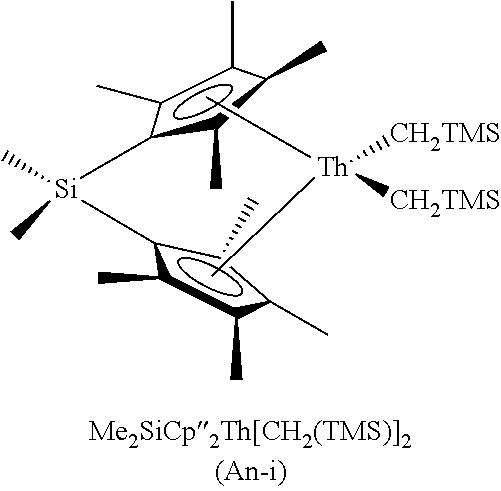
- the present invention can be directed to a method of preparing a vinyl sulfide comprising treating a thiol with a terminal alkyne in the presence of a catalyst selected from the group consisting of CGCM 1 R 1 2 , wherein M 1 is selected from an actinide metal and a Group 4 metal, and R 1 is selected from NMe 2 , NEt 2 and Me; CGCM 2 R 2 , wherein M 2 is lanthanide metal and R 2 is N(TMS) 2 ; Cp* 2 M 1 R 3 2 , wherein R 3 is selected from NMe 2 , NEt 2 , Me and CH 2 TMS; Cp* 2 M 2 R 4 , wherein R 4 is selected from N(TMS) 2 and CH(TMS) 2 ; Me 2 SiCp′′M 3 R 5 2 , wherein M 3 is an actinide metal, and R 5 is selected from CH 2 TMS and Bn; M[R 4 ] 3 ; Cp*M 4 R 6
- the present invention can also be directed to a method of preparing a vinyl sulfide comprising treating a thiol of the formula I R′′—SH I with an alkyne of formula II ⁇ -R′ II to afford a corresponding vinyl sulfide of formula III
- a catalyst selected from the group consisting of CGCM 1 R 1 2 , wherein M 1 is selected from an actinide metal and a Group IV metal, and R 1 is selected from NMe 2 , NEt 2 and Me; CGCM 2 R 2 , wherein M 2 is lanthanide metal and R 2 is N(TMS) 2 ; Cp* 2 M 1 R 3 2 , wherein R 3 is selected from NMe 2 , NEt 2 , Me and CH 2 TMS; Cp* 2 M 2 R 4 , wherein R 4 is selected from N(TMS) 2 and CH(TMS) 2 ; Me 2 SiCp′′M 3 R 5 2 , wherein M 3 is an actinide metal, and R 5 is selected from CH 2 TMS and Bn; M 1 [R 4 ] 3 ; Cp*M 4 R 6 , wherein M 4 is a Group 4 metal and R 6 is selected from Bn and Cl 2 NMe 2 ; and M 4 (R 3 ) 4 ;
- alkyl in the present invention is meant a straight or branched chain alkyl radical having 1-20, and preferably from 1-12, carbon atoms. Examples include but are not limited to methyl, ethyl, propyl, isopropyl, n-butyl, sec-butyl, tert-butyl, pentyl, 2-pentyl, isopentyl, neopentyl, hexyl, 2-hexyl, 3-hexyl, and 3-methylpentyl. Each alkyl group may be optionally substituted with one, two or three substituents such as, for example, a halo, cycloalkyl, aryl, alkenyl, hydroxy or alkoxy group and the like.
- aromatic is meant an “aryl” or “heteroaryl” group.
- aryl is meant an aromatic carbocylic radical having a single ring (e.g. phenyl), multiple rings (e.g. biphenyl) or multiple fused rings in which at least one is aromatic (e.g. 1,2,3,4-tetrahydronaphthyl).
- the aryl group can also be optionally mono-, di-, or trisubstituted with, for example, halo, alkyl, alkenyl, cycloalkyl, hydroxy or alkoxy and the like.
- heteroaryl is meant one or multiple fused aromatic ring systems of 5-, 6- or 7-membered rings containing at least one and up to four heteroatoms selected from nitrogen, oxygen or sulfur. Examples include but are not limited to furanyl, thienyl, pyridinyl, pyrimidinyl, benzimidazolyl and benzoxazolyl.
- the heteroaryl group can also be optionally mono-, di-, or trisubstituted with, for example, halo, alkyl, alkenyl, cycloalkyl, hydroxy or alkoxy and the like.
- cycloalkyl is meant a carbocylic radical having a single ring (e.g. cyclohexyl), multiple rings (e.g. bicyclohexyl) or multiple fused rings (e.g. naphthlene).
- the cycloalkyl group can optionally contain from 1 to 4 heteroatoms.
- the cycloalkyl group may have one or more double bonds.
- the cycloalkyl group can also be optionally mono-, di-, or trisubstituted with, for example, halo, alkyl, alkenyl, aryl, hydroxy or alkoxy and the like.
- alkoxy is meant an oxy-containing radical having an alkyl portion. Examples include, but are not limited to, methoxy, ethoxy, propoxy, butoxy and tert-butoxy.
- the alkoxy group can also be optionally mono-, di-, or trisubstituted with, for example, halo, aryl, cycloalkyl or hydroxy and the like.
- alkenyl is meant a straight or branched hydrocarbon radical having from 2 to 20, and preferably from 2-6, carbon atoms and from one to three double bonds and includes, for example, ethenyl, propenyl, 1-but-3-enyl, 1-pent-3-enyl, 1-hex-5-enyl.
- the alkenyl group can also be optionally mono-, di-, or trisubstituted with, for example, halo, aryl, cycloalkyl or alkoxy and the like.
- alkynyl is meant a straight or branched hydrocarbon radical having from 2 to 20, and preferably from 3-12, carbon atoms and from one to three double bonds and includes, for example, propenyl, 1-but-3-enyl, 1-pent-3-enyl, 1-hex-5-enyl.
- the alkenyl group can also be optionally mono-, di-, or trisubstituted with, for example, halo, aryl, cycloalkyl or alkoxy and the like.
- Halo is a halogen radical of fluorine, chlorine, bromine or iodine.
- Group 4 metal is meant Ti(IV), Zr(IV) and Hf(IV).
- the present invention can also be directed to a vinyl sulfide of formula III
- R′ is C 1 -C 6 -alkyl, aryl, heteroaryl, C 3 -C 7 -cycloalkyl, aryl-C 1 -C 6 -alkyl, heteroaryl-C 1 -C 6 -alkyl or C 3 -C 7 -cyloalkyl-C 1 -C 6 -alkyl.
- alkynes include 1-hexyne, ethynylcyclohexane, prop-2-ynylcyclohexane, 1-ethynylcyclohex-1-ene, 3-ethynylpyridine, prop-2-yn-1-amine or ethynylbenzene.
- R′′ is C 1 -C 12 -alkyl, aryl, heteroaryl, C 3 -C 7 -cyloalkyl or aryl-C 1 -C 6 -alkyl.
- thiols include 1-pentanethiol, 1-pentanethiol-d, 1-dodecanethiol, cyclohexanethiol, 2-methyl-2-butanethiol, benzyl mercaptan, 4-methylbenzyl mercaptan, prop-2-yn-1-amine or thiophenol.
- the present hydrothiolation process exhibits a high level of Markovnikov selectivity. This presumably reflects a four-membered transition state, with the alkyne insertion regiochemistry dictated by transition state sterics and bond polarity orientation Marks, T. J. et al., J. Am. Chem. Soc. 2009, 131, 2062-2063, incorporated in its entirety herein by reference. Additional competing, non-catalytic, anti-Markovnikov products are occasionally detected under the present reaction conditions. These products are, for the most part, formed in negligible quantities.
- Anti-Markovnikov side-products can be further suppressed with the addition of a radical inhibitor, as, for example, ⁇ -terpinene, into the reaction mixture.
- a radical inhibitor as, for example, ⁇ -terpinene
- Hydrothiolation rates appear to be dependent on the type of thiol used. Changing from primary to secondary aliphatic thiols results in significant rate depression, suggesting steric impediments in the turnover-limiting alkyne insertion. As much as 50 ⁇ rate reduction is observed in transitioning from a primary to a secondary thiol (Table 2).
- Aromatic thiol functionality also influences hydrothiolation rates. For example, use of a benzyl mercaptan (1G) or thiophenol increases the turnover frequency (N t ) greatly. The enhanced reactivity of aryl- and benzyl-thiols likely reflects electronic factors.
- Alkyne structure also affects the rate of hydrothiolation, however steric encumberance exhibits a less pronounced influence than electronic characteristics. Switching from an ⁇ -monosubstituted to an ⁇ -disubstituted alkyne results in a moderate decrease in rate (Table 2). Similar to the aforementioned trend with thiols, alkyne electronic characteristics also play a prominent role in influencing hydrothiolation rates, with conjugated alkynes exhibiting significantly enhanced rates.
- Ancillary ligand selection has consequences for the stability of organolanthanide-, organoactinide- and organozirconium-complexes in hydrothiolation catalysis. While the addition of excess thiol to Ln-iv, for example, results in immediate precipitation, Cp-based ligation delays precipitation. The non-bonded repulsions of the Cp-based ligands likely suppress the formation of insoluble, highly aggregated metal complexes. Also, metal ionic radius exerts an influence on catalyst thiolytic stability, with the smaller ions exhibiting greater resistance to precipitation.
- the rate of the conversion 1A+2A ⁇ 3AA mediated by Zr-i is analyzed from 50 to 80° C., and the data are plotted with respect to the Eyring equation.
- alkyne-mediated protonolysis as a kinetically signifigant route for the cleavage of Zr-alkyl bonds
- relative rates of alkyne- and thiol-mediated protonolysis are examined in the activation of Cp* 2 ZrMe 2 (Zr-ii).
- thiol protonolysis of the Zr-Me bonds is measured to be 150 ⁇ more rapid than the analogous alkyne protonolysis.
- Diethylether for synthesis is distilled from Na/benzophenone immediately prior to use.
- D 2 O 99+ atom % D
- Tetraglyme is vacuumed-pumped to remove volatiles.
- Ethanethiol-d (98 atom % D) is prepared according to literature methods (Marks et al., J. Am. Chem. Soc. 2009, 131, 2062-2063).
- Thiols and alkynes are transferred from multiple beds of activated Davison 4 A molecular sieves as solutions in benzene-d 6 or neat, followed by degassing (10 ⁇ 6 Torr) via freeze-pump-thaw methods. Conjugated alkynes and thiols are stored at ⁇ 10° C.
- NMR spectra are recorded on Mercury 400 (400 MHz, 1 H; 100 MHz, 13 C; 61 MHz, 2 H) and Avance III 500 (500 MHz, 1 H; 125 MHz, 13 C) NMR spectrometers. Chemical shifts ( ⁇ ) are referenced relative to internal solvent or integration standard resonances and reported relative to Me 4 Si. Spectra of air-sensitive reactions and materials are taken in airtight, Teflon-valved J. Young NMR tubes. Samples are heated in silicon oil baths with the temperature controlled by an Ika ETS-D4 probe.
- GC data for selectivity measurements are collected on a HP6890 GC-MS equipped with a HP5972 detector and an HP-5MS (5% phenyl methyl siloxane, 30 m ⁇ 250 ⁇ m ⁇ 0.25 ⁇ m) capillary column while high-resolution mass spectra are collected on an Agilent 6210 LC-TOP (ESI, APPI) and Thermo Finnegan MAT900 (EI).
- N t Turnover frequency
- the reaction mixture is cooled to room temperature and the contents are eluted through a silica gel plug with ⁇ 10 ml of hexanes to remove the catalyst.
- the filtrate is pumped with a Schlenk line to remove volatiles. Further purification by flash chromatography (ether:hexanes eluent) is performed when necessary. To avoid degradation, some products are purified by precipitating the catalyst from exposure to air, centrifuging the precipitated catalyst, and decanting the solution. Volatiles are pumped off on a Schlenk line to yield pure product.
- the vessel is opened to ambient and the catalyst is removed by filtering through silica gel, eluting with ⁇ 20 ml of hexanes.
- the volatiles are then removed under vacuum to yield pure 3AA as a yellow oil (1.08 g, 5.8 mmol, 72% yield) which is determined to be 99% Markovnikov pure by GC/MS.
- the catalyst is removed by filtering through silica gel and eluting with 20 ml hexanes.
- the volatiles are then removed under vacuum (10 ⁇ 6 mTorr) to yield 97% Markovnikov-pure 3FA as a yellow oil (0.22 g, 1.1 mmol, 41% yield).
- the product 1A-d is vacuum-transferred from the tetraglyme and dried over 4 A molecular sieves before use ( ⁇ 2.5 g, 30% yield).
- phenylacetylene (7.0 ml, 64 mmol) is dissolved in 60 ml of anhydrous diethylether.
- the flask is cooled to 0° C. before the slow addition of 45 ml of n-BuLi solution (1.6 M in hexanes, 72 mmol) and stirring for 15 minutes at 0° C., followed by 30 minutes at room temperature.
- the flask is recooled to 0° C., and D 2 O (2.5 ml, 125 mmol) is slowly added.
- the reaction is stirred overnight at room temperature before the solvent is removed in vacuo, and the product is distilled to afford a clear liquid in 57% yield.
- the deuterium incorporation is determined to be 98% atom % D by 1 H NMR.
- 1 H NMR benzene-d 6 , 500 MHz, ⁇ ): ⁇ 7.40 (m, 2H); 6.91 (m, 3H).
- 13 C NMR benzene-d 6 , 125 MHz, ⁇ ): ⁇ 132.7; 129.1; 128.9; 123.1; 83.8 (t, 7.5 Hz); 78.0 (t, 38 Hz).
- the vessel is opened to ambient surroundings and catalyst is removed by filtering through silica gel and eluting with hexanes.
- the product is purified by flash chromatography (SiO 2 , eluted with 5:1 hexanes/ethyl acetate) and pumped down on a Schlenk line to yield pure 3AA as a yellow oil (0.62 g, 3.3 mmol, 69% yield).
- Table 4 shows representative examples of compounds made and the catalyst and solvent employed. The reactions are performed at temperatures ranging from 90-120° C. While titanium is not specifically listed in the table, the metal is employed in complexes for methods of the invention. As with other Group 4 metals, optimization may vary with reaction conditions.
- the catalytic organolanthanide-, organoactinide- and organozirconium-mediated intermolecular hydrothiolathion of a wide range of terminal alkynes by aliphatic, benzylic and aromatic thiols is demonstrated by the methods disclosed herein.
- the resulting vinyl sulfides are produced with high Markovnikov selectivity. Based on kinetic experiments and deuterium labeling, the reaction is proposed to proceed through an alkyne insertion-thiol protonolysis sequence with turnover-limiting alkyne insertion.
Landscapes
- Chemical & Material Sciences (AREA)
- Organic Chemistry (AREA)
- Organic Low-Molecular-Weight Compounds And Preparation Thereof (AREA)
- Catalysts (AREA)
Abstract
Description
R″—SH I
with an alkyne of formula II
≡-R′ II
to afford a corresponding vinyl sulfide of formula III

in the presence of a catalyst selected from the group consisting of CGCM1R1 2, wherein M1 is selected from an actinide metal and a Group IV metal, and R1 is selected from NMe2, NEt2 and Me; CGCM2R2, wherein M2 is lanthanide metal and R2 is N(TMS)2; Cp*2M1R3 2, wherein R3 is selected from NMe2, NEt2, Me and CH2TMS; Cp*2M2R4, wherein R4 is selected from N(TMS)2 and CH(TMS)2; Me2SiCp″M3R5 2, wherein M3 is an actinide metal, and R5 is selected from CH2TMS and Bn; M1[R4]3; Cp*M4R6, wherein M4 is a


prepared by the steps comprising the step of reacting a thiol of formula I
R″—SH I
with a terminal alkyne of formula II
≡-R′ II
wherein R′ and R″ are independently selected from the group consisting of alkyl, aryl, heteroaryl, cycloalkyl, arylalkyl, heteroarylalkyl and cycloalkylalkyl, in the presence of a catalyst selected from the group consisting of CGCM1R1 2, wherein M1 is selected from an actinide metal and a
| TABLE 1 | |||
| | Actinide | Group | 4 |
 |
 |
 |
|
 |
 |
 |
|
 |
 |
 |
|
| La[N(TMS)2]3 (Ln-iv) |
 |
Zr[NMe2]4 (Zr-iv) | |
| Nd[N(TMS)2]3 | U(NEt2)4 | Cp*ZrCl2NMe2 | |
| (Ln-v) | (An-v) | (Zr-v) | |
| Lu[CH(TMS)2]3 (Ln-vi) |
 |
||
| Y[N(TMS)2]3 | Cp*2Th(CH2TMS)2 | ||
| (Ln-vii) | (An-vii) | ||
| Cp*2LaCH(TMS)2 | Cp*2U(CH2TMS)2 | ||
| (Ln-viii) | (An-viii) | ||
| Cp*2SmCH(TMS)2 | |||
| (Ln-ix) | |||
| CP*2LuCH(TMS)2 | |||
| (Ln-x) | |||
| TABLE 2 | |||
| Nt | |||
| Thiol | Alkyne | Product | (h−1, ° C.) |
 |
 |
 |
5(90) 0.7(120) |
 |
2A |
 |
— |
 |
2A |
 |
1(110) |
 |
2A |
 |
14(90) 27(110) |
 |
2A |
 |
4(110) |
| 1A |
 |
 |
5(90) |
| 1D | 2B |
 |
8(110) 0.2(120) |
| 1A |
 |
 |
6(110) |
| 1A |
 |
 |
4(110) |
| 1C | 2D |
 |
16(90) |
 |
2A |
 |
0.6(120) |
 |
2A |
 |
0.6(120) |
 |
2A |
 |
3(120) |
| 1A |
 |
 |
0.3(120) |
| 1A |
 |
 |
1.5(120) |
| 1A |
 |
 |
1.2(120) |
| 1A |
 |
 |
4.8(120) 4.7(120) |
| TABLE 3 | ||||
| Thiol | Alkyne | Catalyst | Selectivity (%) | Conversion (%) |
| 1E | 2A | Ln-ix | >99 | ≧95 |
| 1A | 2A | Ln-ix | >99 | 55 |
| 1B | 2A | Ln-ix | 90 | 11 |
| 1G | 2A | Ln-ix | >99 | 92 |
| 1D | 2A | Ln-ix | 91 | 48 |
| 1E | 2A | Zr-i | 96 | 95 |
| 1A | 2A | Zr-i | 94 | 95 |
| 1B | 2A | Zr-i | 59 | 55 |
| 1G | 2A | Zr-i | 95 | 95 |
| 1D | 2A | Zr-i | 94 | 94 |
| 1A | 2D | Ln-ix | 88 | 26 |
| 1A | 2E | Ln-ix | 95 | 20 |
| 1A | 2F | Ln-ix | 72 | 55 |
| 1A | 2C | Ln-ix | 77 (with γ- | 56 |
| terpinene) | ||||
| 1A | 2B | Ln-ix | 95 (with γ- | 39 |
| terpinene) | ||||
| 1A | 2D | Zr-i | 92 | 92 |
| 1A | 2E | Zr-i | 96 | 98 |
| 1A | 2F | Zr-i | 91 | 100 |
| 1A | 2C | Zr-i | 97 (with γ- | 100 |
| terpinene) | ||||
| 1A | 2B | Zr-i | 66 | 100 |
| 1A | 2D | An-vii | 94 | 32 |
| 1G | 2A | An-vii | 90 | 43 |
| 1D | 2B | An-vii | 83 (with γ- | 61 |
| terpinene) | ||||
| 1A | 2H | Zr-i | 75 | |
| 1A | 2H | Zr-iii | 98 | |
Rate=kobs[Zr-i]1[2A]1[1A]x (Equation 1a)

Rate=kobs[Sm]1[Alkyne]1[Thiol]0 (Equation 1b)

R″SH+M-C≡CR′→M-SR″+H—C≡CR′ (Equation 2)


| TABLE 4 | |||||
| Thiol | Alkyne | Catalyst | Solvent | ||
| 1H | 2B | Ln-i | Benzene-d6 | ||
| (Dodecanethiol) | |||||
| 1H | 2B | Ln-i | THF-d8 | ||
| 1H | 2B | Ln-ii | Benzene-d6 | ||
| 1H | 2A | Ln-i | Benzene-d6 | ||
| 1C | 2B | Ln-i | Benzene-d6 | ||
| 1A | 2A | Ln-v | THF-d8 | ||
| 1B | 2A | Ln-i | Benzene-d6 | ||
| 1B | 2A | Ln-ix | Benzene-d6 | ||
| 1A | 2A | Ln-iv | THF-d8 | ||
| 1D | 2A | Ln-v | THF-d8 | ||
| 1D | 2A | Ln-ix | Benzene-d6 | ||
| 1A | 2A | Ln-ii | Benzene-d6 | ||
| 1A | 2A | Ln-vi | Benzene-d6 | ||
| 1A | 2A | Ln-ix | Benzene-d6 | ||
| 1G | 2A | Ln-ix | Benzene-d6 | ||
| 1A | 2A | Zr-ii | Benzene-d6 | ||
| 1A | 2A | An-iii | Benzene-d6 | ||
| 1D | 2B | An-iv | Benzene-d6 | ||
| 1D | 2B | An-ii | Benzene-d6 | ||
| 1C | 2B | An-ii | Benzene-d6 | ||
| 1A | 2B | An-iii | Benzene-d6 | ||
| 1A | 2A | Zr-iii | Benzene-d6 | ||
| 1A | 2A | Zr-ii | Benzene-d6 | ||
| 1A | 2A | Zr-i | Benzene-d6 | ||
| 1G | 2A | Zr-i | Benzene-d6 | ||
| 1G | 2A | Zr-iii | Benzene-d6 | ||
| 1G | 2A | Zr-iv | Benzene-d6 | ||
| 1G | 2A | Zr-v | Benzene-d6 | ||
| 1D | 2A | Zr-iii | Benzene-d6 | ||
| 1A | 2D | Zr-i | Benzene-d6 | ||
| 1A | 2D | An-vii | Benzene-d6 | ||
| 1G | 2A | An-vii | Benzene-d6 | ||
| 1D | 2B | An-vii | Benzene-d6 | ||
| 1A | 2C | Zr-i | Benzene-d6 | ||
| 1A | 2B | Zr-i | Benzene-d6 | ||
| 1A | 2G | Zr-i | Benzene-d6 | ||
| 1A | 2E | Zr-i | Benzene-d6 | ||
| 1A | 2H | Zr-iii | Benzene-d6 | ||
| 1A | 2H | Zr-i | Benzene-d6 | ||
| 1B | 2A | Zr-i | Benzene-d6 | ||
| 1H | 2A | Zr-i | Benzene-d6 | ||
| 1H | 2A | Zr-iii | Benzene-d6 | ||
| 1A | 2A | Zr-iv | Benzene-d6 | ||
| 1H | 2A | Zr-iv | Benzene-d6 | ||
| 1E | 2A | Zr-i | Benzene-d6 | ||
| 1E | 2A | Ln-ix | Benzene-d6 | ||
| 1F | 2A | Zr-i | Benzene-d6 | ||
| 1D | 2A | Zr-i | Benzene-d6 | ||
| 1A | 2F | Zr-i | Benzene-d6 | ||
Claims (22)
≡-R′
R″—SH
R″—SH I
≡-R′ II

Priority Applications (2)
| Application Number | Priority Date | Filing Date | Title |
|---|---|---|---|
| US12/856,154 US8609902B2 (en) | 2009-08-13 | 2010-08-13 | Organoactinide-, organolanthanide-, and organogroup-4-mediated hydrothiolation of terminal alkynes with aliphatic, aromatic and benzylic thiols |
| US14/108,016 US20140142319A1 (en) | 2009-08-13 | 2013-12-16 | Organoactinide-, organolanthanide-, and organogroup-4-mediated hydrothiolation of terminal alkynes with aliphatic, aromatic and benzylic thiols |
Applications Claiming Priority (2)
| Application Number | Priority Date | Filing Date | Title |
|---|---|---|---|
| US23354109P | 2009-08-13 | 2009-08-13 | |
| US12/856,154 US8609902B2 (en) | 2009-08-13 | 2010-08-13 | Organoactinide-, organolanthanide-, and organogroup-4-mediated hydrothiolation of terminal alkynes with aliphatic, aromatic and benzylic thiols |
Related Child Applications (1)
| Application Number | Title | Priority Date | Filing Date |
|---|---|---|---|
| US14/108,016 Division US20140142319A1 (en) | 2009-08-13 | 2013-12-16 | Organoactinide-, organolanthanide-, and organogroup-4-mediated hydrothiolation of terminal alkynes with aliphatic, aromatic and benzylic thiols |
Publications (2)
| Publication Number | Publication Date |
|---|---|
| US20110040098A1 US20110040098A1 (en) | 2011-02-17 |
| US8609902B2 true US8609902B2 (en) | 2013-12-17 |
Family
ID=43588973
Family Applications (2)
| Application Number | Title | Priority Date | Filing Date |
|---|---|---|---|
| US12/856,154 Expired - Fee Related US8609902B2 (en) | 2009-08-13 | 2010-08-13 | Organoactinide-, organolanthanide-, and organogroup-4-mediated hydrothiolation of terminal alkynes with aliphatic, aromatic and benzylic thiols |
| US14/108,016 Abandoned US20140142319A1 (en) | 2009-08-13 | 2013-12-16 | Organoactinide-, organolanthanide-, and organogroup-4-mediated hydrothiolation of terminal alkynes with aliphatic, aromatic and benzylic thiols |
Family Applications After (1)
| Application Number | Title | Priority Date | Filing Date |
|---|---|---|---|
| US14/108,016 Abandoned US20140142319A1 (en) | 2009-08-13 | 2013-12-16 | Organoactinide-, organolanthanide-, and organogroup-4-mediated hydrothiolation of terminal alkynes with aliphatic, aromatic and benzylic thiols |
Country Status (1)
| Country | Link |
|---|---|
| US (2) | US8609902B2 (en) |
-
2010
- 2010-08-13 US US12/856,154 patent/US8609902B2/en not_active Expired - Fee Related
-
2013
- 2013-12-16 US US14/108,016 patent/US20140142319A1/en not_active Abandoned
Non-Patent Citations (76)
Also Published As
| Publication number | Publication date |
|---|---|
| US20110040098A1 (en) | 2011-02-17 |
| US20140142319A1 (en) | 2014-05-22 |
Similar Documents
| Publication | Publication Date | Title |
|---|---|---|
| Qi-Lin et al. | Chiral mercaptoaryl-oxazolines as ligands in enantioselective copper-catalyzed 1, 4-additions of Grignard reagents to enones | |
| Flood et al. | Preparation, resolution, and sulfur dioxide insertion reactions of chiral iron alkyl complexes | |
| Weiss et al. | Lanthanide-and actinide-mediated terminal alkyne hydrothiolation for the catalytic synthesis of markovnikov vinyl sulfides | |
| Goliaszewski et al. | Interception of bis (. eta. 3-allylic) palladium intermediates by maleic anhydride: a change in an overall carbon-carbon bond forming scheme using organotin reagents | |
| Yuan et al. | On the mechanism of the reduction of primary halides with Grignard reagents in the presence of (dppf) PdCl2 or (dppf) Pd (0) | |
| KR0149208B1 (en) | Enantio Selective Oxazaborolidin Catalyst | |
| US20070135395A1 (en) | Novel method for the preparation of intermediates useful for the synthesis fo vitamin d analogues | |
| KR0180262B1 (en) | Enantioselective Oxazabororidin Catalyst | |
| CN106946751B (en) | A method of preparing diaryl sulfide | |
| US20110213168A1 (en) | Deuterated vitamin d compounds | |
| CN112645909B (en) | A method for synthesizing alpha-benzylbenzofuran compounds | |
| CN118561913A (en) | Au-Cu nanocluster and its catalytic application | |
| US20110040098A1 (en) | Organoactinide-, Organolanthanide-, and OrganoGroup-4-Mediated Hydrothiolation of Terminal Alkynes with Aliphatic, Aromatic and Benzylic Thiols | |
| EP3056491B1 (en) | Synthetic intermediate of maxacalcitol, preparation method therefor and use thereof | |
| Wang et al. | Hydroboration kinetics. 3. Kinetics and mechanism of the hydroboration of alkynes with 9-borabicyclo [3.3. 1] nonane dimer. Effect of structure on the reactivity of representative alkynes | |
| WO1991001125A2 (en) | Compounds having glutathione peroxidase activity and use thereof | |
| Kawakami et al. | Rhodium-catalyzed highly selective thioformylation of acetylenes with thiols and carbon monoxide | |
| KR100859277B1 (en) | Stereoselective Synthesis of Vitamin D Analogs | |
| Akita et al. | Specific C–C coupling of the labile diruthenium bridging methylene complex, Cp2Ru2 (μ-CH2)(CO) 2 (MeCN), with diazoalkanes (R2C N2) leading to alkenyl complexes, Cp2Ru2 (μ-CH CR2)(μ-H)(CO) 2, and alkenes, CH2 CR2 | |
| US12139504B2 (en) | Vanadium alkylidene complex, synthesis and use thereof | |
| US20250153157A1 (en) | Palladium precatalyst embodiments for enantioselective chemical reactions and methods of making and using the same | |
| EP0643063B1 (en) | Process for preparing a higher cuprate complex | |
| Behloul et al. | Deallyloxy-and debenzyloxycarbonylation of protected alcohols, amines and thiols via a naphthalene-catalysed lithiation reaction | |
| Subirats et al. | Amino thiols versus amino alcohols in the asymmetric alkynylzinc addition to aldehydes | |
| US5567849A (en) | Borane-sulfide hydroboration agents |
Legal Events
| Date | Code | Title | Description |
|---|---|---|---|
| AS | Assignment |
Owner name: NORTHWESTERN UNIVERSITY, ILLINOIS Free format text: ASSIGNMENT OF ASSIGNORS INTEREST;ASSIGNORS:MARKS, TOBIN J.;WEISS, CHARLES J.;WOBSER, STEPHEN D.;SIGNING DATES FROM 20101021 TO 20101026;REEL/FRAME:025232/0720 |
|
| AS | Assignment |
Owner name: NATIONAL SCIENCE FOUNDATION, VIRGINIA Free format text: CONFIRMATORY LICENSE;ASSIGNOR:NORTHWESTERN UNIVERSITY;REEL/FRAME:025626/0122 Effective date: 20110104 |
|
| STCF | Information on status: patent grant |
Free format text: PATENTED CASE |
|
| FEPP | Fee payment procedure |
Free format text: PAT HLDR NO LONGER CLAIMS MICRO ENTITY STATE, ENTITY STATUS SET TO SMALL (ORIGINAL EVENT CODE: MTOS); ENTITY STATUS OF PATENT OWNER: SMALL ENTITY |
|
| FPAY | Fee payment |
Year of fee payment: 4 |
|
| MAFP | Maintenance fee payment |
Free format text: PAYMENT OF MAINTENANCE FEE, 8TH YR, SMALL ENTITY (ORIGINAL EVENT CODE: M2552); ENTITY STATUS OF PATENT OWNER: SMALL ENTITY Year of fee payment: 8 |
|
| FEPP | Fee payment procedure |
Free format text: MAINTENANCE FEE REMINDER MAILED (ORIGINAL EVENT CODE: REM.); ENTITY STATUS OF PATENT OWNER: SMALL ENTITY |
|
| LAPS | Lapse for failure to pay maintenance fees |
Free format text: PATENT EXPIRED FOR FAILURE TO PAY MAINTENANCE FEES (ORIGINAL EVENT CODE: EXP.); ENTITY STATUS OF PATENT OWNER: SMALL ENTITY |
|
| STCH | Information on status: patent discontinuation |
Free format text: PATENT EXPIRED DUE TO NONPAYMENT OF MAINTENANCE FEES UNDER 37 CFR 1.362 |
|
| FP | Lapsed due to failure to pay maintenance fee |
Effective date: 20251217 |