US8609638B2 - Enzyme inhibiting compounds and methods - Google Patents
Enzyme inhibiting compounds and methods Download PDFInfo
- Publication number
- US8609638B2 US8609638B2 US13/500,845 US201013500845A US8609638B2 US 8609638 B2 US8609638 B2 US 8609638B2 US 201013500845 A US201013500845 A US 201013500845A US 8609638 B2 US8609638 B2 US 8609638B2
- Authority
- US
- United States
- Prior art keywords
- compound
- alkyl
- compounds
- isph
- diphosphate
- Prior art date
- Legal status (The legal status is an assumption and is not a legal conclusion. Google has not performed a legal analysis and makes no representation as to the accuracy of the status listed.)
- Expired - Fee Related
Links
- 0 *.B.C*[U]C Chemical compound *.B.C*[U]C 0.000 description 9
- JPENBGCAMIFAEP-UHFFFAOYSA-N C#CCCOP(=O)(O)C(F)(F)P(=O)(O)O.C#CCCSP(=O)(O)OP(C)(=O)O Chemical compound C#CCCOP(=O)(O)C(F)(F)P(=O)(O)O.C#CCCSP(=O)(O)OP(C)(=O)O JPENBGCAMIFAEP-UHFFFAOYSA-N 0.000 description 2
- QQVCFEPLWBVWEN-UHFFFAOYSA-N C#CCOP(=O)(O)OP(C)(=O)O Chemical compound C#CCOP(=O)(O)OP(C)(=O)O QQVCFEPLWBVWEN-UHFFFAOYSA-N 0.000 description 2
- NNXJJGDBQVQRQI-UHFFFAOYSA-N C#CCCCOP(=O)(O)OP(C)(=O)O.C#CCCOP(=O)(O)OP(C)(=O)O.C#CCOP(=O)(O)OP(C)(=O)O Chemical compound C#CCCCOP(=O)(O)OP(C)(=O)O.C#CCCOP(=O)(O)OP(C)(=O)O.C#CCOP(=O)(O)OP(C)(=O)O NNXJJGDBQVQRQI-UHFFFAOYSA-N 0.000 description 1
- HTOPJULEDBGYFE-UHFFFAOYSA-N C.C#CCCCOP(=O)(O)OP(C)(=O)O.C#CCCOP(=O)(O)OP(C)(=O)O.C#CCOP(=O)(O)CP(C)(=O)O.C#CCOP(=O)(O)OP(C)(=O)O.CC#CCOP(=O)(O)OP(C)(=O)O.CP(=O)(O)OP(=O)(O)OCC#CCO.CP(=O)(O)OP(=O)(O)OCC#N.CP(=O)(O)OP(=O)(O)OCCC#N Chemical compound C.C#CCCCOP(=O)(O)OP(C)(=O)O.C#CCCOP(=O)(O)OP(C)(=O)O.C#CCOP(=O)(O)CP(C)(=O)O.C#CCOP(=O)(O)OP(C)(=O)O.CC#CCOP(=O)(O)OP(C)(=O)O.CP(=O)(O)OP(=O)(O)OCC#CCO.CP(=O)(O)OP(=O)(O)OCC#N.CP(=O)(O)OP(=O)(O)OCCC#N HTOPJULEDBGYFE-UHFFFAOYSA-N 0.000 description 1
- AGLJGFXQSICGMV-CSLKWDFPSA-N C/C(=C\COP(=O)(O)OP(=O)(O)O)C(=O)O.CC(=O)/C(C)=C/COP(=O)(O)OP(=O)(O)O Chemical compound C/C(=C\COP(=O)(O)OP(=O)(O)O)C(=O)O.CC(=O)/C(C)=C/COP(=O)(O)OP(=O)(O)O AGLJGFXQSICGMV-CSLKWDFPSA-N 0.000 description 1
- CCGWHNGERVQGID-WFBTUGPLSA-N C/C(=C\COPP)CO.C=C(C)CCOPP.CC(C)=CCOPP.C[C@@]1(CO)OP(=O)(O)OP(=O)(O)OC[C@H]1O Chemical compound C/C(=C\COPP)CO.C=C(C)CCOPP.CC(C)=CCOPP.C[C@@]1(CO)OP(=O)(O)OP(=O)(O)OC[C@H]1O CCGWHNGERVQGID-WFBTUGPLSA-N 0.000 description 1
- VVDOIKBIZWMICO-UHFFFAOYSA-N CC#CCOP(=O)(O)OP(C)(=O)O.CP(=O)(O)OP(=O)(O)OCC#CCO Chemical compound CC#CCOP(=O)(O)OP(C)(=O)O.CP(=O)(O)OP(=O)(O)OCC#CCO VVDOIKBIZWMICO-UHFFFAOYSA-N 0.000 description 1
- ULISRFYXQGCLBC-UHFFFAOYSA-N CC(=O)CCCCOP(=O)(O)OP(=O)(O)O.O=C(O)CCCCOP(=O)(O)OP(=O)(O)O Chemical compound CC(=O)CCCCOP(=O)(O)OP(=O)(O)O.O=C(O)CCCCOP(=O)(O)OP(=O)(O)O ULISRFYXQGCLBC-UHFFFAOYSA-N 0.000 description 1
- TVROYYWQSSQWDV-UHFFFAOYSA-N CCP(NP(C)(NCC#C)=N)(N=C)=N Chemical compound CCP(NP(C)(NCC#C)=N)(N=C)=N TVROYYWQSSQWDV-UHFFFAOYSA-N 0.000 description 1
- XVENGOKXORJZBS-UHFFFAOYSA-N CNP(NP(C)(NCC#CCC=C)=N)([U]=C)=N Chemical compound CNP(NP(C)(NCC#CCC=C)=N)([U]=C)=N XVENGOKXORJZBS-UHFFFAOYSA-N 0.000 description 1
- SULAJFZSZNMCTD-UHFFFAOYSA-N CP(=O)(O)OP(=O)(O)OCC#N.CP(=O)(O)OP(=O)(O)OCCC#N Chemical compound CP(=O)(O)OP(=O)(O)OCC#N.CP(=O)(O)OP(=O)(O)OCCC#N SULAJFZSZNMCTD-UHFFFAOYSA-N 0.000 description 1
- GIHHQYGFUOTOIX-UHFFFAOYSA-N O=P(O)(O)CP(=O)(O)CCCC[Y] Chemical compound O=P(O)(O)CP(=O)(O)CCCC[Y] GIHHQYGFUOTOIX-UHFFFAOYSA-N 0.000 description 1
Images


Classifications
-
- C—CHEMISTRY; METALLURGY
- C07—ORGANIC CHEMISTRY
- C07F—ACYCLIC, CARBOCYCLIC OR HETEROCYCLIC COMPOUNDS CONTAINING ELEMENTS OTHER THAN CARBON, HYDROGEN, HALOGEN, OXYGEN, NITROGEN, SULFUR, SELENIUM OR TELLURIUM
- C07F9/00—Compounds containing elements of Groups 5 or 15 of the Periodic Table
- C07F9/02—Phosphorus compounds
- C07F9/547—Heterocyclic compounds, e.g. containing phosphorus as a ring hetero atom
- C07F9/655—Heterocyclic compounds, e.g. containing phosphorus as a ring hetero atom having oxygen atoms, with or without sulfur, selenium, or tellurium atoms, as the only ring hetero atoms
- C07F9/65502—Heterocyclic compounds, e.g. containing phosphorus as a ring hetero atom having oxygen atoms, with or without sulfur, selenium, or tellurium atoms, as the only ring hetero atoms the oxygen atom being part of a three-membered ring
-
- A—HUMAN NECESSITIES
- A61—MEDICAL OR VETERINARY SCIENCE; HYGIENE
- A61K—PREPARATIONS FOR MEDICAL, DENTAL OR TOILETRY PURPOSES
- A61K31/00—Medicinal preparations containing organic active ingredients
- A61K31/66—Phosphorus compounds
- A61K31/661—Phosphorus acids or esters thereof not having P—C bonds, e.g. fosfosal, dichlorvos, malathion or mevinphos
- A61K31/6615—Compounds having two or more esterified phosphorus acid groups, e.g. inositol triphosphate, phytic acid
-
- A—HUMAN NECESSITIES
- A61—MEDICAL OR VETERINARY SCIENCE; HYGIENE
- A61K—PREPARATIONS FOR MEDICAL, DENTAL OR TOILETRY PURPOSES
- A61K31/00—Medicinal preparations containing organic active ingredients
- A61K31/66—Phosphorus compounds
- A61K31/662—Phosphorus acids or esters thereof having P—C bonds, e.g. foscarnet, trichlorfon
- A61K31/663—Compounds having two or more phosphorus acid groups or esters thereof, e.g. clodronic acid, pamidronic acid
-
- A—HUMAN NECESSITIES
- A61—MEDICAL OR VETERINARY SCIENCE; HYGIENE
- A61P—SPECIFIC THERAPEUTIC ACTIVITY OF CHEMICAL COMPOUNDS OR MEDICINAL PREPARATIONS
- A61P31/00—Antiinfectives, i.e. antibiotics, antiseptics, chemotherapeutics
- A61P31/04—Antibacterial agents
-
- A—HUMAN NECESSITIES
- A61—MEDICAL OR VETERINARY SCIENCE; HYGIENE
- A61P—SPECIFIC THERAPEUTIC ACTIVITY OF CHEMICAL COMPOUNDS OR MEDICINAL PREPARATIONS
- A61P33/00—Antiparasitic agents
-
- C—CHEMISTRY; METALLURGY
- C07—ORGANIC CHEMISTRY
- C07F—ACYCLIC, CARBOCYCLIC OR HETEROCYCLIC COMPOUNDS CONTAINING ELEMENTS OTHER THAN CARBON, HYDROGEN, HALOGEN, OXYGEN, NITROGEN, SULFUR, SELENIUM OR TELLURIUM
- C07F9/00—Compounds containing elements of Groups 5 or 15 of the Periodic Table
- C07F9/02—Phosphorus compounds
- C07F9/06—Phosphorus compounds without P—C bonds
- C07F9/08—Esters of oxyacids of phosphorus
- C07F9/09—Esters of phosphoric acids
- C07F9/098—Esters of polyphosphoric acids or anhydrides
-
- C—CHEMISTRY; METALLURGY
- C07—ORGANIC CHEMISTRY
- C07F—ACYCLIC, CARBOCYCLIC OR HETEROCYCLIC COMPOUNDS CONTAINING ELEMENTS OTHER THAN CARBON, HYDROGEN, HALOGEN, OXYGEN, NITROGEN, SULFUR, SELENIUM OR TELLURIUM
- C07F9/00—Compounds containing elements of Groups 5 or 15 of the Periodic Table
- C07F9/02—Phosphorus compounds
- C07F9/06—Phosphorus compounds without P—C bonds
- C07F9/08—Esters of oxyacids of phosphorus
- C07F9/141—Esters of phosphorous acids
-
- C—CHEMISTRY; METALLURGY
- C07—ORGANIC CHEMISTRY
- C07F—ACYCLIC, CARBOCYCLIC OR HETEROCYCLIC COMPOUNDS CONTAINING ELEMENTS OTHER THAN CARBON, HYDROGEN, HALOGEN, OXYGEN, NITROGEN, SULFUR, SELENIUM OR TELLURIUM
- C07F9/00—Compounds containing elements of Groups 5 or 15 of the Periodic Table
- C07F9/02—Phosphorus compounds
- C07F9/06—Phosphorus compounds without P—C bonds
- C07F9/08—Esters of oxyacids of phosphorus
- C07F9/141—Esters of phosphorous acids
- C07F9/1411—Esters of phosphorous acids with hydroxyalkyl compounds with further substituents on alkyl
-
- C—CHEMISTRY; METALLURGY
- C07—ORGANIC CHEMISTRY
- C07F—ACYCLIC, CARBOCYCLIC OR HETEROCYCLIC COMPOUNDS CONTAINING ELEMENTS OTHER THAN CARBON, HYDROGEN, HALOGEN, OXYGEN, NITROGEN, SULFUR, SELENIUM OR TELLURIUM
- C07F9/00—Compounds containing elements of Groups 5 or 15 of the Periodic Table
- C07F9/02—Phosphorus compounds
- C07F9/06—Phosphorus compounds without P—C bonds
- C07F9/08—Esters of oxyacids of phosphorus
- C07F9/141—Esters of phosphorous acids
- C07F9/142—Esters of phosphorous acids with hydroxyalkyl compounds without further substituents on alkyl
-
- C—CHEMISTRY; METALLURGY
- C07—ORGANIC CHEMISTRY
- C07F—ACYCLIC, CARBOCYCLIC OR HETEROCYCLIC COMPOUNDS CONTAINING ELEMENTS OTHER THAN CARBON, HYDROGEN, HALOGEN, OXYGEN, NITROGEN, SULFUR, SELENIUM OR TELLURIUM
- C07F9/00—Compounds containing elements of Groups 5 or 15 of the Periodic Table
- C07F9/02—Phosphorus compounds
- C07F9/06—Phosphorus compounds without P—C bonds
- C07F9/08—Esters of oxyacids of phosphorus
- C07F9/141—Esters of phosphorous acids
- C07F9/143—Esters of phosphorous acids with unsaturated acyclic alcohols
-
- C—CHEMISTRY; METALLURGY
- C07—ORGANIC CHEMISTRY
- C07F—ACYCLIC, CARBOCYCLIC OR HETEROCYCLIC COMPOUNDS CONTAINING ELEMENTS OTHER THAN CARBON, HYDROGEN, HALOGEN, OXYGEN, NITROGEN, SULFUR, SELENIUM OR TELLURIUM
- C07F9/00—Compounds containing elements of Groups 5 or 15 of the Periodic Table
- C07F9/02—Phosphorus compounds
- C07F9/547—Heterocyclic compounds, e.g. containing phosphorus as a ring hetero atom
- C07F9/553—Heterocyclic compounds, e.g. containing phosphorus as a ring hetero atom having one nitrogen atom as the only ring hetero atom
- C07F9/576—Six-membered rings
- C07F9/58—Pyridine rings
-
- Y—GENERAL TAGGING OF NEW TECHNOLOGICAL DEVELOPMENTS; GENERAL TAGGING OF CROSS-SECTIONAL TECHNOLOGIES SPANNING OVER SEVERAL SECTIONS OF THE IPC; TECHNICAL SUBJECTS COVERED BY FORMER USPC CROSS-REFERENCE ART COLLECTIONS [XRACs] AND DIGESTS
- Y02—TECHNOLOGIES OR APPLICATIONS FOR MITIGATION OR ADAPTATION AGAINST CLIMATE CHANGE
- Y02A—TECHNOLOGIES FOR ADAPTATION TO CLIMATE CHANGE
- Y02A50/00—TECHNOLOGIES FOR ADAPTATION TO CLIMATE CHANGE in human health protection, e.g. against extreme weather
- Y02A50/30—Against vector-borne diseases, e.g. mosquito-borne, fly-borne, tick-borne or waterborne diseases whose impact is exacerbated by climate change
Definitions
- Enzymes that catalyze the formation of isoprenoids are of interest as drug targets.
- the Rohmer pathway also known as the methyl erythritol phosphate or non-mevalonate pathway, is responsible for isoprenoid biosynthesis in most pathogenic bacteria and in malaria parasites, such as Plasmodium faciparum (Rohmer et al., Lipids 2008, 43(12), 1095; Wiesner and Jomaa, Current Drug Targets 2007, 8(1), 3).
- Enzymes found in the pathway are potentially important as anti-infective drug targets because isoprenoids are essential for survival of these microorganisms and because the non-mevalonate pathway is absent in humans (Williams and McCammon, Chem. Biol. Drug Des. 2009, 73(1), 26; de Ruyck and Wouters, Curr. Protein Pept. Sci. 2008, 9(2), 117).
- Fosmidomycin which inhibits the second enzyme in the pathway, has shown promising results for treating malaria (Jomaa et al., Science 1999, 285, (5433), 1573; Borrmann et al., Antimicrobial Agents and Chemotherapy 2006, 50(8), 2713).
- IspG is E-4-hydroxy-3-methyl-but-2-enyl diphosphate (HMBPP) synthase, EC 1.17.1.1, also known as GcpE.
- IspH is E-4-hydroxy-3-methyl-but-2-enyl diphosphate (HMBPP) reductase, EC 1.17.1.2, also known as LytB.
- the penultimate enzyme is IspG, which catalyzes the 2H + /2e ⁇ reduction of methylerythritol-cyclo-diphosphate (MEcPP, 1) to HMBPP (2), while the terminal enzyme, IspH, catalyzes the 2H + /2e ⁇ reduction of HMBPP (2) to isopentenyl diphosphate (IPP, 3) and dimethylallyl diphosphate (DMAPP, 4) in a ⁇ 5:1 ratio.
- IspG methylerythritol-cyclo-diphosphate
- IspG The structure of IspG has not yet been reported, while two structures have been published for IspH, one from Aquifex aeolicus (Rekittke et al., J. Am. Chem. Soc. 2008, 130, 17206), and the other from E. coli (Grawert et al., Angew. Chem. Int. Ed. Engl. 2009, 48(31), 5756). According to these reports, both structures contain Fe 3 S 4 clusters. However, these observations are in contrast to the conclusions drawn from both Mössbauer spectroscopy (Xiao et al., J. Am. Chem. Soc.
- inhibitors of isoprenoid biosynthesis enzymes are needed to further study the Rohmer pathway.
- New compounds are also needed to develop effective therapeutic methods, including methods to inhibit the activity of isoprenoid biosynthesis enzymes, and methods for treating diseases such as malaria and other infections, due to increased resistance to currently known antibiotics.
- the invention provides compounds, compositions, and methods for treating bacterial infections or parasitic infections.
- the parasitic infection can be a protozoan infection, such as malaria.
- the compounds and compositions can also be used as antibiotics, for example, to kill bacteria or parasites, or to inhibit their growth or proliferation.
- the invention further provides inhibitors of isoprenoid biosynthesis enzymes, and methods of inhibiting the activity of isoprenoid biosynthesis enzymes.
- the compounds can be, for example, alkynyl diphosphate inhibitors of the iron-sulfur proteins IspG or IspH (LytB).
- the inhibitory compounds include complexation moieties that include heteroatoms or pie systems that can complex with an Fe 4 S 4 cluster of a protein.
- the inhibitors can contain alkynyl groups that, based on EPR, 1 H, 2 H, 13 C and 57 Fe electron-nuclear double resonance (ENDOR) spectroscopy and computational docking, form ⁇ / ⁇ “metallacycle” complexes with the Fe 4 S 4 clusters of IspH. Such clusters have previously been detected by Mössbauer and EPR spectroscopy.
- the invention provides a K i ⁇ 200 nM inhibitor of the isoprenoid biosynthesis enzyme IspH.
- IspH enzyme LytB ((E)-4-hydroxy-3-methyl-but-2-enyl diphosphate reductase, EC1.17.1.2)
- active species included alkynyl diphosphate moieties, including one found to have a K i of approximately 200 nM.
- the inhibition by the alkynes can involve ⁇ / ⁇ ( ⁇ 2 -alkynyl) “metallacycle” complex formation with the unique Fe in an Fe 4 S 4 cluster.
- Several cationic species were also inhibitors, however their inhibition may be based on interaction with the active site E126. Similar ⁇ / ⁇ complexes may be involved in IspH catalysis.
- the invention provides compounds of Formula I and methods of using the compounds of Formula I:
- A is H; OH; halo; (C 1 -C 4 )alkyl; (C 3 -C 8 )cycloalkyl; CF 3 ; N(R x ) 2 ; (C 1 -C 4 )alkyl substituted by hydroxy, halo, amino, or nitro; 2-oxirane; —CO 2 R y ; —CH(CO 2 R y ) 2 ; —C( ⁇ O)CO 2 R y ; (hydroxylamino)carbonyl; hydroxylamino(sulfonyl); —S( ⁇ NH) 2 -Me; N-carbaldehye-hydroxylamino; aryl, aroyl, heteroaryl, or heterocycle; or A is —(CH 2 ) n —C ⁇ C—R 1 where n is 0-3 and R 1 is H, OH, (C 1 -C 4 )alkyl, (C 3 -C 8 )cycloalkyl
- U is —C ⁇ C—, —C ⁇ C ⁇ C—, or optionally absent if A is —(CH 2 ) n —C ⁇ C—R 1 ;
- L is a direct bond or a divalent radical of the formula —W—Z—W—;
- B is a pyrophosphate group; a phosphonic acid group; a drug moiety; a moiety of Formula I-A; a moiety of Formula I-B; or an independently defined moiety A;
- each R x is independently H, (C 1 -C 4 )alkyl, (C 1 -C 4 )alkanoyl, or —(C 1 -C 4 )alkyl(aryl);
- each R y is independently H, (C 1 -C 4 )alkyl, or (C 3 -C 8 )cycloalkyl;
- each X* is independently H, OH, NH 2 , halo, (C 1 -C 4 )alkyl, or —(CH 2 ) n —CO 2 R y wherein n is 0-2; or the two X* groups together are ⁇ C—CO 2 R y ; and
- each R′ is independently H, (C 1 -C 6 )alkyl, or a nitrogen protecting group
- any alkyl, cycloalkyl, aryl, heteroaryl, or heterocycle is optionally substituted with one or more hydroxy, halo, amino, nitro, trifluoromethyl, trifluoromethoxy, carboxy, carbonyl, thiocarbonyl, ⁇ N-Me, (C 1 -C 4 )alkyl, or (C 1 -C 4 )alkoxy groups, or a combination thereof;
- the group B can be a moiety of Formula I-A:
- R 10 is —CO 2 H or P(O)(OH) 2 ;
- each R 11 is independently H, OH, NH 2 , halo, (C 1 -C 4 )alkyl, —(CH 2 ) n —CO 2 R y where n is 0-2, or one R 11 is absent when the dashed line is a bond; or the two R 11 groups together are ⁇ C—CO 2 R y ;
- the dashed line is an optional bond that forms a double bond to C* when the bond is present.
- C* is CH when the dashed line is a bond, and is absent when the dashed line is not present.
- the group B can also be a moiety of Formula I-B:
- R 12 is H, OH, halo, or —(CH 2 ) n —CO 2 R y where n is 0-2;
- a 2 and A 3 are each independently C, CH, N, N + (O ⁇ ), or N + (Me).
- the compound of Formula I can be any one of Formulas I-1 to I-22, as illustrated in FIG. 5 , where each n is independently 0, 1, 2, 3, 4, or 5. Examples of specific A and B groups are illustrated in FIG. 6 .
- the compound of Formula I is a compound of Formula IC:
- n is 0 or 1 and the ‘drug moiety’ is a drug residue that is bonded to the alkyne moiety of the Formula I-C, wherein the drug is selected from selected from alrazagline; selegiline; terbinafine; ethinyl estradiol; norethindrone acetate; desogestrel; levonorgestrel; efavirenz; etonogestrel; norgestimate; or erlotinib.
- the drug residue is any portion of the drug that is connected to an alkyne that can be the alkyne moiety of Formula I-C.
- the compound Formula I is alrazagline; selegiline; terbinafine; ethinyl estradiol; norethindrone acetate; desogestrel; levonorgestrel; efavirenz; etonogestrel; norgestimate; or erlotinib.
- These drugs are know in the art and are further described in The Physician's Desk Reference, 63 rd ed. (2009).
- the compound of Formula I is agrocybin, alfaprostol, azafenidin, barban, beraprost, carfimate, cicutoxin, clodinafop-propargyl, danazol, desogestrel, dimethisterone, efavirenz, enanthotoxin, eniluracil, ethchlorvynol, ethinamate, ethinyl estradiol, ethisterone, ethynodiol diacetate, etonogestrel, flumioxazin, gephyrotoxin, gestodene, gestrinone, haloprogin, helenynolic acid, hexapropymate, histrionicotoxin, iloprost, lynestrenol, mepanipyrim, meparfynol, mestranol, methohex
- Yet other acetylenic compounds include the known enediyne antibiotics.
- the molecular weight of the alkyne or allene compound is less than 500. In other embodiments, the molecular weight is less than 300. In certain embodiments, the molecular weight of the alkyne or allene compound, for example, a compound of a formula described herein (e.g., any one of Formulas I-V and/or their sub-formulas (e.g., those with a letter or number following the Formula Roman numeral)) is about 100 to about 550, about 150 to about 550, about 100 to about 500, about 150 to about 500, about 175 to about 550, about 175 to about 500, about 200 to about 550, about 200 to about 500, about 250 to about 450, about 275 to about 450, about 200 to about 300, about 300 to about 400, about 400 to about 500, about 150 to about 250, about 250 to about 350, about 350 to about 450, or about 450 to about 550.
- a compound of a formula described herein e.g., any one of Formulas I
- the invention also provides compounds of Formula II:
- P x1 is —P(O)OH 2 or absent
- P x2 is a direct bond when P 1 is —P(O)OH 2 or P x2 is —P(O)(OH) when P x1 is absent;
- L is O, S, NR 2 , C(R 3 )(R 4 ) when P x1 is absent; or CH, C—OH, or C-Me when P x1 is —P(O)OH 2 ;
- each R 2 is independently H or (C 1 -C 4 )alkyl
- each R 3 is independently H, halo, or (C 1 -C 4 )alkyl
- each R 4 is independently H, halo, or (C 1 -C 4 )alkyl
- L x is moiety IIA, IIB, or IIC:
- R 1 is H; CF 3 ; N(R x ) 2 where R x is H or (C 1 -C 4 )alkyl; (C 1 -C 4 )alkyl; or (C 1 -C 4 )alkyl substituted by hydroxy, halo, amino, or nitro; or R 1 is absent when X is N;
- X is C or N
- n 0, 1, or 2;
- L 1 is O, S, NR 2 , or C(R 3 )(R 4 );
- each R 2 is independently H or (C 1 -C 4 )alkyl
- each R 3 is independently H, halo, or (C 1 -C 4 )alkyl
- each R 4 is independently H, halo, or (C 1 -C 4 )alkyl
- Y is 2-oxirane; —OH; —CO 2 R 5 where R 5 is H or (C 1 -C 4 )alkyl; —N(R 6 )(R 7 ) where R 6 and R 7 are each independently H or (C 1 -C 4 )alkyl; or aryl or heteroaryl wherein the aryl or heteroaryl is optionally substituted with one or more halo, nitro, amino, trifluoromethyl, trifluoromethoxy, or (C 1 -C 4 )alkyl groups, or a combination thereof;
- n 0, 1, or 2;
- L 1 is O, S, NR 2 , or C(R 3 )(R 4 );
- each R 2 is independently H or (C 1 -C 4 )alkyl
- each R 3 is independently H, halo, or (C 1 -C 4 )alkyl
- each R 4 is independently H, halo, or (C 1 -C 4 )alkyl
- L 3 is —(CH 2 ) m —S— where m is 0, 1, 2, or 3; —CR 8 ⁇ CR 9 — where R 8 and R 9 are each independently H or Me; or a direct bond; and
- Z is —SH; —N(R 6 )(R 7 ) where R 6 and R 7 are each independently H or (C 1 -C 4 )alkyl; aryl or heteroaryl wherein the awl or heteroaryl is optionally substituted with one or more halo, nitro, amino, trifluoromethyl, trifluoromethoxy, or (C 1 -C 4 )alkyl groups, or a combination thereof; or —C ⁇ C—R 1 where R 1 is H; CF 3 ; N(R x ) 2 where R x is H or (C 1 -C 4 )alkyl; (C 1 -C 4 )alkyl; or (C 1 -C 4 )alkyl substituted by hydroxy, halo, amino, or nitro;
- n 0, 1, 2, 3, or 4;
- L 1 is O, S, NR 2 , or C(R 3 )(R 4 );
- R 2 is H or (C 1 -C 4 )alkyl
- R 3 is H, halo, or (C 1 -C 4 )alkyl
- R 4 is H, halo, or (C 1 -C 4 )alkyl
- Examples of compounds of Formula II include compounds of Formulas III, IV, and V. Accordingly, the invention also provides compounds Formula III:
- R 1 is H; CF 3 ; N(R x ) 2 where R x is H, (C 1 -C 4 )alkyl; (C 1 -C 4 )alkanoyl; or (C 1 -C 4 )alkyl substituted by hydroxy, halo, amino, or nitro; or R 1 is absent when X is N;
- X is C or N
- n 0, 1, or 2;
- L 1 is O, S, NR 2 , or C(R 3 )(R 4 );
- L 2 is O, S, NR 2 , or C(R 3 )(R 4 );
- each R 2 is independently H or (C 1 -C 4 )alkyl
- each R 3 is independently H, halo, or (C 1 -C 4 )alkyl
- each R 4 is independently H, halo, or (C 1 -C 4 )alkyl
- L 1 can be O; and L 2 is O, CH 2 or CF 2 .
- R 1 can be H, -Me, or —CH 2 OH; and L 2 is O or CH 2 .
- the compound of Formula III can be a compound illustrated in FIG. 1 , or an anion, salt or solvate thereof.
- R 1 can be H, -Me, or —CH 2 OH; L 1 can be O or S; and L 2 can be O, CH 2 or CF 2 .
- the compound of Formula III can be
- the invention also provides compounds Formula IV:
- Y is 2-oxirane; —OH; —CO 2 R 5 where R 5 is H or (C 1 -C 4 )alkyl; —N(R 6 )(R 7 ) where R 6 and R 7 are each independently H or (C 1 -C 4 )alkyl; or aryl or heteroaryl wherein the aryl or heteroaryl is optionally substituted with one or more halo, nitro, amino, trifluoromethyl, trifluoromethoxy, or (C 1 -C 4 )alkyl groups, or a combination thereof;
- n 0, 1, or 2;
- L 1 is O, S, NR 2 , or C(R 3 )(R 4 );
- L 2 is O, S, NR 2 , or C(R 3 )(R 4 );
- each R 2 is independently H or (C 1 -C 4 )alkyl
- each R 3 is independently H, halo, or (C 1 -C 4 )alkyl
- each R 4 is independently H, halo, or (C 1 -C 4 )alkyl
- L 3 is —(CH 2 ) m —S— where m is 0, 1, 2, or 3; —CR 8 ⁇ CR 9 — where R 8 and R 9 are each independently H or Me; or a direct bond; or a cation, anion, salt or solvate thereof.
- Y can be 2-oxirane, —OH, —CO 2 H, —CO 2 Me, or —NMe 2 .
- Y can be phenyl, 1-pyridinium, 2-pyridyl, 3-pyridyl, or 4-pyridyl, wherein the phenyl, pyridinium, or pyridyl is optionally substituted by one to five halo groups.
- the compound of Formula IV can be BPH-293, 1026, 1027, 1029, 1060, 1030, 1032, 1028, 988, 991, 296, 990, 989, 432, or 1031 (see FIGS. 2 and 3 ), or a cation, anion, salt or solvate thereof.
- the invention further provides compounds Formula V:
- Z is —SH; —N(R 6 )(R 7 ) where R 6 and R 7 are each independently H or (C 1 -C 4 )alkyl; awl or heteroaryl wherein the awl or heteroaryl is optionally substituted with one or more halo, nitro, amino, trifluoromethyl, trifluoromethoxy, or (C 1 -C 4 )alkyl groups, or a combination thereof or —C ⁇ C—R 1 where R 1 is H; CF 3 ; N(R x ) 2 where R x is H or (C 1 -C 4 )alkyl; (C 1 -C 4 )alkyl; or (C 1 -C 4 )alkyl substituted by hydroxy, halo, amino, or nitro;
- n 0, 1, 2, 3, or 4;
- L 1 is O, S, NR 2 , C(R 3 )(R 4 ) or —NH—C(R 3 )(R 4 );
- R 2 is H or (C 1 -C 4 )alkyl
- R 3 is H, halo, or (C 1 -C 4 )alkyl
- R 4 is H, halo, or (C 1 -C 4 )alkyl
- R 10 is H, OH, or Me
- L 1 can be —CH 2 — or —NH—.
- Z can be —SH, —NMe 2 , phenyl, 1-pyridinium, 2-pyridyl, 3-pyridyl, or 4-pyridyl, wherein the phenyl, pyridinium, or pyridyl is optionally substituted by one to five halo, methyl, or nitro groups, or a combination thereof.
- the compound of Formula V can be BPH-2, 21, 9, 200, 290, 299, 297, 650, 639, 272, 993, or 994 (see FIGS. 2 and 3 ); or a cation, anion, salt or solvate thereof.
- the alkyne or allene compound can be a compound generically described, specifically illustrated, or recited, in U.S. Pat. Nos. 4,588,828 (Bisacchi et al.); 4,654,426 (Bisacchi et al.); or 7,253,192 (Ackermann et al.), as well as U.S. Patent Publication Nos. 2008/0214673 (Glatthar et al.); or 2009/0176781 (Wang et al.); the compounds and preparatory methods of which are incorporated herein by reference.
- a compound as described above can inhibit an isoprenoid biosynthesis enzyme when in contact with the isoprenoid biosynthesis enzyme, for example, in vitro or in vivo.
- the isoprenoid biosynthesis enzyme can be, for example, E-4-Hydroxy-3-methyl-but-2-enyl diphosphate reductase.
- the K i of the compound can be, for example, less than about 30 ⁇ M, less than about 20 ⁇ M, less than about 10 ⁇ M, less than about 5 ⁇ M, less than about 2 ⁇ M, less than about 1.5 ⁇ M, less than about 1 ⁇ M, less than about 0.5 ⁇ M, less than about 400 nM, less than about 300 nM, or less than about 250 nM.
- the invention thus provides methods of inhibiting the activity of an isoprenoid biosynthesis enzyme that has an Fe 4 S 4 cluster, for example, an Fe 4 S 4 cluster with one unique Fe—S bond.
- the methods can include contacting the enzyme with a compound that has an alkyne or an allene moiety, wherein the compound forms a bioorganometallic complex with the unique iron atom of the Fe 4 S 4 cluster of the isoprenoid biosynthesis enzyme, thereby inhibiting the activity of the enzyme.
- the invention also provides methods of treating a bacterial infection or parasitic infection in a mammal, wherein the bacterial infection or parasitic infection is caused by a bacteria or parasite that has of an isoprenoid biosynthesis enzyme that includes an Fe 4 S 4 cluster, comprising administering to a mammal in need of such treatment an effective amount of a compound described herein, wherein the compound forms a bioorganometallic complex with an iron atom of the Fe 4 S 4 cluster of the isoprenoid biosynthesis enzyme, thereby inhibiting the activity of the isoprenoid biosynthesis enzyme, thereby treating the bacterial infection or parasitic infection.
- the invention further provides methods of killing or inhibiting the growth of a bacteria or a parasite, wherein the bacteria or parasite has of an isoprenoid biosynthesis enzyme that includes an Fe 4 S 4 cluster.
- These methods can include contacting the bacteria or parasite with a compound described herein, wherein the compound forms a bioorganometallic complex with an iron atom of the Fe 4 S 4 cluster of the isoprenoid biosynthesis enzyme, thereby killing or inhibiting the growth of the bacteria or parasite.
- the distance between a ⁇ -system of the compound and the unique Fe of the Fe 4 S 4 cluster in the bioorganometallic complex can be about 4.5 ⁇ or less, 4 ⁇ or less, or about 3.6 ⁇ or less.
- the invention therefore provides useful compounds of the formulas described herein, intermediates for the synthesis of such compounds, as well as methods of preparing the compounds, and for preparing compositions of the compounds.
- the compounds can be useful as intermediates for the synthesis of other biologically active compounds.
- the compounds and compositions can also be used to manufacture medicaments useful for the treatment of a disease in a mammal, for example, an infection in a human.
- FIG. 1 illustrates several acetylene-containing compounds, according to various embodiments.
- FIG. 2 illustrates several nitrogen-containing compounds, according to various embodiments.
- FIG. 3 illustrates several phosphoric acid-containing compounds, according to various embodiments.
- FIG. 5 illustrates Formulas I-1 to I-22, where each n is independently 0, 1, 2, 3, 4, or 5, according to various embodiments.
- FIG. 6 illustrates several examples of moieties A or B that can be part of Formula I, or a sub-formula thereof, according to various embodiments.
- references in the specification to “one embodiment”, “an embodiment”, “an example embodiment”, etc., indicate that the embodiment described may include a particular aspect, feature, structure, moiety, or characteristic, but not every embodiment necessarily includes that aspect, feature, structure, moiety, or characteristic. Moreover, such phrases may, but do not necessarily, refer to the same embodiment referred to in other portions of the specification. Further, when a particular aspect, feature, structure, moiety, or characteristic is described in connection with an embodiment, it is within the knowledge of one skilled in the art to affect such aspect, feature, structure, moiety, or characteristic in connection with other embodiments, whether or not explicitly described.
- the term “about” can refer to a variation of ⁇ 5%, ⁇ 10%, ⁇ 20%, or ⁇ 25% of the value specified. For example, “about 50” percent can in some embodiments carry a variation from 45 to 55 percent.
- the term “about” can include one or two integers greater than and/or less than a recited integer. Unless indicated otherwise herein, the term “about” is intended to include values, e.g., weight percents, proximate to the recited range that are equivalent in terms of the functionality of the individual ingredient, the composition, or the embodiment.
- a recited range e.g., weight percents or carbon groups
- one or more substituents on a phenyl ring refers to one to five, or one to up to four, for example if the phenyl ring is disubstituted.
- contacting refers to the act of touching, making contact, or of bringing to immediate or close proximity, including at the molecular level, for example, to bring about a chemical reaction or physical change, e.g., in a solution or other reaction mixture, such as in a cellular assay or in the body of a mammal.
- an “effective amount” refers to an amount effective to treat a disease, disorder, and/or condition, or to bring about a recited effect.
- an amount effective can be an amount effective to reduce the progression or severity of the condition or symptoms being treated. Determination of a therapeutically effective amount is well within the capacity of persons skilled in the art.
- the term effective amount is intended to include an amount of a compound described herein, or an amount of a combination of compounds described herein, e.g., to treat or prevent a disease or disorder, or to treat the symptoms of the disease or disorder, in a host.
- an “effective amount” generally means an amount that provides the desired effect.
- treating include (i) preventing a disease, pathologic or medical condition from occurring (e.g., prophylaxis); (ii) inhibiting the disease, pathologic or medical condition or arresting its development; (iii) relieving the disease, pathologic or medical condition; and/or (iv) diminishing symptoms associated with the disease, pathologic or medical condition.
- the terms “treat”, “treatment”, and “treating” extend to prophylaxis and include prevent, prevention, preventing, lowering, stopping or reversing the progression or severity of the condition or symptoms being treated.
- treatment includes both medical, therapeutic, and/or prophylactic administration, as appropriate. Treating can also include killing or inhibiting the growth of a bacteria or a parasite in a patient that has a bacterial or parasitic infection.
- inhibitor refers to the slowing, halting, or reversing the growth or progression of a disease, infection, condition, or group of cells.
- the inhibition can be greater than about 20%, 40%, 60%, 80%, 90%, 95%, or 99%, for example, compared to the growth or progression that occurs in the absence of the treatment or contacting.
- radicals, substituents, and ranges are for illustration only; they do not exclude other defined values or other values within defined ranges for radicals and substituents.
- Generic terms include each of their species.
- halo includes and can explicitly be fluoro, chloro, bromo, or iodo.
- alkyl refers to a branched, unbranched, or cyclic hydrocarbon having, for example, from 1-20 carbon atoms, and often 1-12, 1-10, 1-8, 1-6, or 1-4 carbon atoms. Examples include, but are not limited to, methyl, ethyl, 1-propyl, 2-propyl (iso-propyl), 1-butyl, 2-methyl-1-propyl (isobutyl), 2-butyl (sec-butyl), 2-methyl-2-propyl (t-butyl), 1-pentyl, 2-pentyl, 3-pentyl, 2-methyl-2-butyl, 3-methyl-2-butyl, 3-methyl-1-butyl, 2-methyl-1-butyl, 1-hexyl, 2-hexyl, 3-hexyl, 2-methyl-2-pentyl, 3-methyl-2-pentyl, 4-methyl-2-pentyl, 3-methyl-3-pentyl, 2-methyl-3-pentyl, 2,3
- the alkyl can be unsubstituted or optionally substituted, for example, with a substituent described below.
- the alkyl can also be optionally partially or fully unsaturated.
- the recitation of an alkyl group can optionally include both alkenyl or alkynyl groups, in certain embodiments.
- the alkyl can be a monovalent hydrocarbon radical, as described and exemplified above, or it can be a divalent hydrocarbon radical (i.e., an alkylene), depending on the context of its use.
- cycloalkyl refers to cyclic alkyl groups of, for example, from 3 to 10 carbon atoms having a single cyclic ring or multiple condensed rings.
- Cycloalkyl groups include, by way of example, single ring structures such as cyclopropyl, cyclobutyl, cyclopentyl, cyclooctyl, and the like, or multiple ring structures such as adamantyl, and the like.
- the cycloalkyl group can be monovalent or divalent, and can be optionally substituted, for example, by one or more alkyl groups.
- the cycloalkyl group can optionally include one or more cites of unsaturation, for example, the cycloalkyl group can include one or more carbon-carbon double bonds, such as, for example, 1-cyclopent-1-enyl, 1-cyclopent-2-enyl, 1-cyclopent-3-enyl, cyclohexyl, 1-cyclohex-1-enyl, 1-cyclohex-2-enyl, 1-cyclohex-3-enyl, and the like.
- aryl refers to an aromatic hydrocarbon group derived from the removal of at least one hydrogen atom from a single carbon atom of a parent aromatic ring system.
- the radical attachment site can be at a saturated or unsaturated carbon atom of the parent ring system.
- the aryl group can have from 6 to 20 carbon atoms, for example, about 6-10 carbon atoms, in the cyclic skeleton.
- the aryl group can have a single ring (e.g., phenyl) or multiple condensed (fused) rings, wherein at least one ring is aromatic (e.g., naphthyl, dihydrophenanthrenyl, fluorenyl, or anthryl).
- Typical aryl groups include, but are not limited to, radicals derived from benzene, naphthalene, anthracene, biphenyl, and the like.
- the aryl can be unsubstituted or optionally substituted, as described for alkyl groups.
- aroyl refers to an aryl-C( ⁇ O)— group.
- heteroaryl refers to a monocyclic, bicyclic, or tricyclic ring system containing one, two, or three aromatic rings and containing at least one nitrogen, oxygen, or sulfur atom in an aromatic ring.
- the heteroaryl can be unsubstituted or substituted, for example, with one or more, and in particular one to three, substituents, as described in the definition of “substituted”.
- Typical heteroaryl groups contain 2-20 carbon atoms in the ring skeleton in addition to the one or more heteroatoms.
- heteroaryl groups include, but are not limited to, 2H-pyrrolyl, 3H-indolyl, 4H-quinolizinyl, acridinyl, benzo[b]thienyl, benzothiazolyl, ⁇ -carbolinyl, carbazolyl, chromenyl, cinnolinyl, dibenzo[b,d]furanyl, furazanyl, furyl, imidazolyl, imidizolyl, indazolyl, indolisinyl, indolyl, isobenzofuranyl, isoindolyl, isoquinolyl, isothiazolyl, isoxazolyl, naphthyridinyl, oxazolyl, perimidinyl, phenanthridinyl, phenanthrolinyl, phenarsazinyl, phenazinyl, phenothiazinyl, phenoxathiinyl,
- heteroaryl denotes a monocyclic aromatic ring containing five or six ring atoms containing carbon and 1, 2, 3, or 4 heteroatoms independently selected from non-peroxide oxygen, sulfur, and N(Z) wherein Z is absent or is H, O, alkyl, aryl, or (C 1 -C 6 )alkylaryl.
- heteroaryl denotes an ortho-fused bicyclic heterocycle of about eight to ten ring atoms derived therefrom, particularly a benz-derivative or one derived by fusing a propylene, trimethylene, or tetramethylene diradical thereto.
- substituted indicates that one or more (e.g., 1, 2, 3, 4, or 5; in some embodiments 1, 2, or 3; and in other embodiments 1 or 2) hydrogen atoms on the group indicated in the expression using “substituted” is replaced with a “substituent”.
- the substituent can be one of a selection of the indicated group(s), or it can be a suitable group known to those of skill in the art, provided that the substituted atom's normal valency is not exceeded, and that the substitution results in a stable compound.
- Suitable substituent groups include, e.g., alkyl, alkenyl, alkynyl, alkoxy, halo, haloalkyl, hydroxy, hydroxyalkyl, aryl, aroyl, heteroaryl, heterocycle, cycloalkyl, alkanoyl, alkoxycarbonyl, amino, alkylamino, dialkylamino, trifluoromethylthio, difluoromethyl, acylamino, nitro, trifluoromethyl, trifluoromethoxy, carboxy, carboxyalkyl, keto, thioxo, alkylthio, alkylsulfinyl, alkylsulfonyl, arylsulfinyl, arylsulfonyl, heteroarylsulfinyl, heteroarylsulfonyl, heterocyclesulfinyl, heterocyclesulfonyl, phosphate, sulfate, hydroxylamine,
- suitable substituent groups can be, e.g., —X, —R, —O ⁇ , —OR, —SR, —S ⁇ , —NR 2 , —NR 3 , ⁇ NR, —CX 3 , —CN, —OCN, —SCN, —N ⁇ C ⁇ O, —NCS, —NO, —NO 2 , ⁇ N 2 , —N 3 , NC( ⁇ O)R, —C( ⁇ O)R, —C( ⁇ O)NRR—S( ⁇ O) 2 O ⁇ , —S( ⁇ O) 2 OH, —S( ⁇ O) 2 R, —OS( ⁇ O) 2 OR, —S( ⁇ O) 2 NR, —S( ⁇ O)R, —OP( ⁇ O)O 2 RR, —P( ⁇ O)O 2 RR—P( ⁇ O)(O ⁇ ) 2 , —P( ⁇ O)(OH) 2 —
- solvate refers to a solid compound that has one or more solvent molecules associated with its solid structure. Solvates can form when a solid compound is crystallized from a solvent, wherein one or more solvent molecules become an integral part of the solid crystalline matrix.
- the compounds of the formulas described herein can be solvates, for example, ethanol solvates.
- Another type of a solvate is a hydrate.
- a “hydrate” likewise refers to a solid compound that has one or more water molecules intimately associated with its solid or crystalline structure at the molecular level.
- a hydrate is a specific type of a solvate. Hydrates can form when a compound is solidified or crystallized in water, wherein one or more water molecules become an integral part of the solid crystalline matrix.
- the compounds of the formulas described herein can be hydrates.
- any of compound described herein, which contains one or more substituents it is understood, of course, that such groups do not contain any substitution or substitution patterns that are sterically impractical and/or synthetically non-feasible.
- the total molecular weight of substituents on a single group will typically be less than about 600, 500, 400, 300, 200, or 100.
- the compounds of the invention can contain asymmetrically substituted carbon atoms, and may be isolated in optically active or racemic forms. It is well known in the art how to prepare optically active forms, such as by resolution of racemic forms or by synthesis from optically active starting materials or by the use of enantioselective catalytic reactions. All chiral, diastereomeric, racemic forms and all geometric isomeric forms of a compound are intended as part of this invention.
- One diastereomer may display superior activity compared to another.
- separation of racemic materials can be achieved by high performance liquid chromatography (HPLC) using a chiral column or by a resolution using a resolving agent such as camphonic chloride, as in Thomas J. Tucker et al., J. Med. Chem. 1994, 37, 2437-2444.
- HPLC high performance liquid chromatography
- a chiral compound may also be directly synthesized using a chiral catalyst or a chiral ligand; see, for example, Mark A. Huffman et al., J. Org. Chem. 1995, 60, 1590-1594.
- EPR spectroscopy combined with catalytic activity determinations, was used to evaluate whether active IspH contains Fe 4 S 4 clusters.
- Reduced Fe 3 S 4 clusters [Fe 3 S 4 ]) 0
- the activity A To determine to what extent the EPR spectra of IspH could be directly correlated with catalytic activity in samples, the activity A.
- aeolicus IspH that had been reconstituted with varying amounts of Fe 3+ /S 2 ⁇ , or exposed to O 2 (to breakdown the Fe/S clusters), was determined.
- E126 which is located close to the Fe 3 S 4 cluster seen in both the open and closed IspH structures, is a likely candidate for an H + source, and that the essential nature of E126 in catalysis has now been confirmed by site-directed mutagenesis (Grawert et al., Angew. Chem. Int. Ed. Engl. 2009, 48(31), 5756).
- Basic or cationic species may act as IspH inhibitors because they can engage in strong Coulombic or hydrogen bond interactions with E126.
- aromatic residues may also interact with the Fe 4 S 4 cluster, just as the cyclopentadienide ion does in model Fe 4 S 4 clusters. Accordingly, a series of aromatic, basic and cationic species were prepared ( FIG. 2 ). These compounds contain anionic backbones to bind to the “PPi” site as observed crystallographically.
- the residues H124 and H42 are also essential for catalysis. While the pK a s of these groups in IspH are not known, they may be protonated and/or act as H-bond acceptors. Accordingly, various carboxylic acids, esters, oxiranes, thiols and sulfides containing species were prepared to evaluate their inhibitory activity ( FIG. 3 ).
- IspH Inhibitors Many anti-infective drugs bind to and can inhibit Fe-containing proteins.
- anti-fungals such as miconazole, clotrimazole, ketoconazole, itraconazole and posaconazole all bind to Fe in the P450-dependent lanosterol 14 ⁇ -demethylase. These compounds are all azoles or imidazoles and bind to form Fe(heme)-N(drug) bonds.
- IspH inhibitors that contain pyridine side-chains likewise bind to Fe, but in IspH they bind to the unique Fe in the 4Fe-4S cluster.
- the compounds described herein can be azole or imidazole-based anti-bacterials analogous to the azole and imidazole anti-fungals.
- organometallic complexes between the 4Fe-4S cluster and the inhibitors described herein is a new concept in iron-sulfur protein inhibitor design. This concept can also be applicable to other 4Fe-4S proteins that have a unique 4th iron not liganded to a cysteine residue, such as GcpE (IspG).
- BPH-293 A series of pyridinium diphosphates (and one phenyl diphosphate) was then prepared: BPH-293, 1026, 1027, 1029, 1030, and 1060. Based on computational docking results, these compounds fit the IspH active site.
- a series of cationic/basic nitrogen-containing bisphosphonates and diphosphates was also investigated.
- the bisphosphonates had lower activity than the acetylenic compounds, presumably due to the orientation of the alkyl substituent at C-1.
- Bisphosphonates are potent inhibitors of many other prenyl synthases where they bind, typically, to three Mg 2+ (as do the prenyl diphosphates, during catalysis). However, it is apparent that this binding mode is not found in IspH, where no Mg 2+ is involved.
- IspH inhibition by a set of other compounds was also investigated, including acids (to bind to His), thiols, and an oxirane (to bind to the Fe 4 S 4 cluster, however activities were lower than those of several compounds described above.
- ⁇ (or ⁇ / ⁇ ) complexes may be applicable to other Fe 4 S 4 ⁇ containing proteins such as IspG, the HMBPP synthase, which is also believed to contain a catalytically active Fe 4 S 4 -cluster.
- ⁇ (or ⁇ / ⁇ , “metallacycle”) complexes are found with the allyl alcohol (the parent alcohol of HMBPP) bound to an Fe/S cluster in the nitrogenase FeMo protein cofactor (similar metallacycle complexes), they may be reactive intermediates or transition states in IspH (and IspG) catalysis.
- the compounds described herein provide new inhibitors of IspH, as well as inhibitors of other Fe 4 S 4 cluster containing proteins, such as IspG and ThiC, and other enzyme that includes an Fe 4 S 4 cluster. Accordingly, the compounds can be used to treat infections caused by microbes or parasites of a variety of genera, including Acinetobacter, Actinobacillus, Anaplasma, Bacillus, Bacteroides, Bifidobacterium, Bordetella, Brucella, Burkholderia, Campylobacter, Chlamydia, Clostridium, Corynebacterium, Ehrlichia, Escherichia, Francisella, Fusobacterium, Haemophilus, Helicobacter, Leptospira, Listeria, Mannheimia, Moraxella, Mycobacterium, Mycoplasma, Neisseria, Neorickettsia, Pasteurella, Porphyromonas, Prevotella, Pseudomonas, Psychro
- species of such genera include, for example, Acinetobacter sp., Actinobacillus pleuropneumoniae, Actinobacillus actinomycetemcomitans, Anaplasma phagocytophilum, Bacillus anthracis, Bacillus cereus, Bacteroides fragilis, Bacteroides thetaiotaomicron, Bifidobacterium longum, Bordetella bronchiseptica, Bordetella pertussis, Brucella melitensis, Brucella suis, Burkholderia cepacia, Burkholderia mallei, Burkholderia pseudomallei, Campylobacter jejuni, Chlamydia trachomatis, Chlamydophila pneumoniae, Clostridium botulinum, Clostridium perfringens, Clostridium diffcile, Clostridium tetani, Corynebacterium diphtheriae, Ehrlichia chaffe
- the compounds described herein can be used to treat infections caused by any one or more of the above genera or species, or the compounds can be used to kill or inhibit the growth of such bacteria or parasite, for example, in vivo, or in vitro, such as in a patient, in a solution, or in or on a grown medium.
- the compounds described herein can be used to prepare therapeutic pharmaceutical compositions.
- the compounds may be added to the compositions in the form of a salt or solvate.
- administration of the compounds as salts may be appropriate.
- pharmaceutically acceptable salts are organic acid addition salts formed with acids which form a physiological acceptable anion, for example, tosylate, methanesulfonate, acetate, citrate, malonate, tartrate, succinate, benzoate, ascorbate, ⁇ -ketoglutarate, and ⁇ -glycerophosphate.
- Suitable inorganic salts may also be formed, including hydrochloride, halide, sulfate, nitrate, bicarbonate, and carbonate salts.
- salts may be obtained using standard procedures well known in the art, for example by reacting a sufficiently basic compound such as an amine with a suitable acid to provide a physiologically acceptable ionic compound.
- a sufficiently basic compound such as an amine
- a suitable acid for example, a sufficiently basic compound such as an amine
- Alkali metal (for example, sodium, potassium or lithium) or alkaline earth metal (for example, calcium) salts of carboxylic acids can also be prepared by analogous methods.
- the compounds of the formulas described herein can be formulated as pharmaceutical compositions and administered to a mammalian host, such as a human patient, in a variety of forms.
- the forms can be specifically adapted to a chosen route of administration, e.g., oral or parenteral administration, by intravenous, intramuscular, topical or subcutaneous routes.
- the compounds described herein may be systemically administered in combination with a pharmaceutically acceptable vehicle, such as an inert diluent or an assimilable edible carrier.
- a pharmaceutically acceptable vehicle such as an inert diluent or an assimilable edible carrier.
- compounds can be enclosed in hard or soft shell gelatin capsules, compressed into tablets, or incorporated directly into the food of a patient's diet.
- Compounds may also be combined with one or more excipients and used in the form of ingestible tablets, buccal tablets, troches, capsules, elixirs, suspensions, syrups, wafers, and the like.
- Such compositions and preparations typically contain at least 0.1% of active compound.
- the percentage of the compositions and preparations can vary and may conveniently be from about 2% to about 60% of the weight of a given unit dosage form.
- the amount of active compound in such therapeutically useful compositions is such that an effective dosage level can be obtained.
- the tablets, troches, pills, capsules, and the like may also contain one or more of the following: binders such as gum tragacanth, acacia, corn starch or gelatin; excipients such as dicalcium phosphate; a disintegrating agent such as corn starch, potato starch, alginic acid and the like; and a lubricant such as magnesium stearate.
- binders such as gum tragacanth, acacia, corn starch or gelatin
- excipients such as dicalcium phosphate
- a disintegrating agent such as corn starch, potato starch, alginic acid and the like
- a lubricant such as magnesium stearate.
- a sweetening agent such as sucrose, fructose, lactose or aspartame
- a flavoring agent such as peppermint, oil of wintergreen, or cherry flavoring
- the unit dosage form When the unit dosage form is a capsule, it may contain, in addition to materials of the above type, a liquid carrier, such as a vegetable oil or a polyethylene glycol. Various other materials may be present as coatings or to otherwise modify the physical form of the solid unit dosage form. For instance, tablets, pills, or capsules may be coated with gelatin, wax, shellac or sugar and the like.
- a syrup or elixir may contain the active compound, sucrose or fructose as a sweetening agent, methyl and propyl parabens as preservatives, a dye and flavoring such as cherry or orange flavor. Any material used in preparing any unit dosage form should be pharmaceutically acceptable and substantially non-toxic in the amounts employed.
- the active compound may be incorporated into sustained-release preparations and devices.
- the active compound may be administered intravenously or intraperitoneally by infusion or injection.
- Solutions of the active compound or its salts can be prepared in water, optionally mixed with a nontoxic surfactant.
- Dispersions can be prepared in glycerol, liquid polyethylene glycols, triacetin, or mixtures thereof, or in a pharmaceutically acceptable oil. Under ordinary conditions of storage and use, preparations may contain a preservative to prevent the growth of microorganisms.
- compositions suitable for injection or infusion can include sterile aqueous solutions, dispersions, or sterile powders comprising the active ingredient adapted for the extemporaneous preparation of sterile injectable or infusible solutions or dispersions, optionally encapsulated in liposomes.
- the ultimate dosage form should be sterile, fluid and stable under the conditions of manufacture and storage.
- the liquid carrier or vehicle can be a solvent or liquid dispersion medium comprising, for example, water, ethanol, a polyol (for example, glycerol, propylene glycol, liquid polyethylene glycols, and the like), vegetable oils, nontoxic glyceryl esters, and suitable mixtures thereof.
- the proper fluidity can be maintained, for example, by the formation of liposomes, by the maintenance of the required particle size in the case of dispersions, or by the use of surfactants.
- the prevention of the action of microorganisms can be brought about by various antibacterial and antifungal agents, for example, parabens, chlorobutanol, phenol, sorbic acid, thiomersal, and the like. In many cases, it will be preferable to include isotonic agents, for example, sugars, buffers, or sodium chloride. Prolonged absorption of the injectable compositions can be brought about by agents delaying absorption, for example, aluminum monostearate and/or gelatin.
- Sterile injectable solutions can be prepared by incorporating the active compound in the required amount in the appropriate solvent with various of the other ingredients enumerated above, as required, followed by filter sterilization.
- methods of preparation can include vacuum drying and freeze drying techniques, which yield a powder of the active ingredient plus any additional desired ingredient present in the previously sterile-filtered solutions.
- compounds may be applied in pure form, e.g., when they are liquids.
- a dermatologically acceptable carrier which may be a solid or a liquid.
- Useful solid carriers include finely divided solids such as talc, clay, microcrystalline cellulose, silica, alumina, and the like.
- Useful liquid carriers include water, dimethyl sulfoxide (DMSO), alcohols, glycols, or water-alcohol/glycol blends, in which a compounds can be dissolved or dispersed at effective levels, optionally with the aid of non-toxic surfactants.
- Adjuvants such as fragrances and additional antimicrobial agents can be added to optimize the properties for a given use.
- the resultant liquid compositions can be applied from absorbent pads, used to impregnate bandages and other dressings, or sprayed onto the affected area using a pump-type or aerosol sprayer.
- Thickeners such as synthetic polymers, fatty acids, fatty acid salts and esters, fatty alcohols, modified celluloses, or modified mineral materials can also be employed with liquid carriers to form spreadable pastes, gels, ointments, soaps, and the like, for application directly to the skin of the user.
- Examples of dermatological compositions for delivering active agents to the skin are known to the art; for example, see U.S. Pat. No. 4,608,392 (Jacquet et al.), U.S. Pat. No. 4,992,478 (Geria), U.S. Pat. No. 4,559,157 (Smith et al.), and U.S. Pat. No. 4,820,508 (Wortzman).
- Such dermatological compositions can be used in combinations with the compounds described herein.
- Useful dosages of the compounds described herein can be determined by comparing their in vitro activity, and in vivo activity in animal models. Methods for the extrapolation of effective dosages in mice, and other animals, to humans are known to the art; for example, see U.S. Pat. No. 4,938,949 (Borch et al.).
- the amount of a compound, or an active salt or derivative thereof, required for use in treatment will vary not only with the particular compound or salt selected but also with the route of administration, the nature of the condition being treated, and the age and condition of the patient, and will be ultimately at the discretion of an attendant physician or clinician.
- the compound can be conveniently administered in a unit dosage form, for example, containing 5 to 1000 mg/m 2 , conveniently 10 to 750 mg/m 2 , most conveniently, 50 to 500 mg/m 2 of active ingredient per unit dosage form.
- the desired dose may conveniently be presented in a single dose or as divided doses administered at appropriate intervals, for example, as two, three, four or more sub-doses per day.
- the sub-dose itself may be further divided, e.g., into a number of discrete loosely spaced administrations.
- the compounds described herein can be effective antibacterial or anti-protozoan agents. Accordingly, the invention provides therapeutic methods for treating infections in a mammal. The methods can include administering to a mammal that has an infection an effective amount of a compound or composition described herein.
- a mammal includes a primate, human, rodent, canine, feline, bovine, ovine, equine, swine, caprine, bovine and the like.
- the ability of a compound described herein to treat an infection may be determined by using assays well known to the art. For example, the design of treatment protocols, toxicity evaluation, data analysis, and quantification of cell kill screens are known.
- Preparation of the compounds described herein can be prepared according to the methods in the Examples below, or may be prepared according to known techniques in the art of organic synthesis. Many alkynes, allenes, and linking groups are commercially available, and/or can be prepared as described in the art. Information regarding general synthetic methods that may be used to prepare the compounds described herein, particularly with respect employing linking groups, may be found in Greg T. Hermanson, Bioconjugate Techniques , Academic Press, San Diego, Calif. (1996). Additional useful reactions well known to those of skill in the art are referenced in March's Advanced Organic Chemistry Reactions, Mechanisms, and Structure, 5 th Ed. by Michael B. Smith and Jerry March, John Wiley & Sons, Publishers; and Wuts et al. (1999), Protective Groups in Organic Synthesis, 3 rd Ed., John Wiley & Sons, Publishers.
- the methods of preparing compounds of the invention can produce isomers in certain instances. Although the methods of the invention do not always require separation of these isomers, such separation may be accomplished, if desired, by methods known in the art. For example, preparative high performance liquid chromatography methods may be used for isomer purification, for example, by using a column with a chiral packing.
- Reagents used were typically purchased from Aldrich (Milwaukee, Wis.). The purities of compounds investigated were confirmed by either combustion analysis (for solid samples) or by 1 H and 31 P NMR spectroscopy analysis at 400 or 500 MHz on Varian (Palo Alto, Calif.) Unity spectrometers, using quantitative spin coupling with an internal (imidazole) standard. Cellulose TLC plates were visualized by using iodine or a sulfosalicylic acid-ferric chloride stain.
- Prop-2-ynyl diphosphate (BPH-1061).
- Propargyl methanesulfonate (134 mg, 1 mmol) in CH 3 CN (0.5 mL) was added dropwise to a stirred solution of 2.70 g (3.0 mmol) tris(tetra-n-butylammonium) hydrogen diphosphate in CH 3 CN (5 mL) at ⁇ 20° C.
- the reaction mixture was then slowly warmed to room temperature over 2 h and solvent removed under reduced pressure. Flash chromatography on a cellulose column (4:1:2.4 (v/v/v) 2-propanol/CH 3 CN/50 mM NH 4 HCO 3 ) yielded 47 mg (18%) of a white solid.
- Pent-4-ynyl diphosphate (BPH-1093). 1-Bromobut-2-yne (133 mg, 1 mmol) was treated with 2.70 g (3 mmol) tris(tetra-n-butylammonium) hydrogen diphosphate in CH 3 CN (4 mL). Flash chromatography on a cellulose column (2:1:1 (v/v/v) 2-propanol/CH 3 CN/50 mM NH 4 HCO 3 ) yielded 103 mg (35%) of a white solid.
- 1 H NMR 400 MHz, D 2 O
- ⁇ 1.65-1.70 (m, 2H), 2.13-2.17 (m, 3H), 3.83 (q, J 6.8 Hz, 2H).
- But-2-ynyl diphosphate (BPH-1086). 1-Bromobut-2-yne (133 mg, 1 mmol) was treated with 2.70 g (3 mmol) tris(tetra-n-butylammonium) hydrogen diphosphate in CH 3 CN (4 mL). Flash chromatography on a cellulose column (2:1:1 (v/v/v) 2-propanol/CH 3 CN/50 mM NH 4 HCO 3 ) yielded 112 mg (40%) of a white solid.
- A. aeolicus IspH Protein Purification BL-21(DE3) cells expressing IspH from A. aeolicus were grown in LB media supplemented with 150 mg/mL ampicillin at 37° C. until the OD600 reached 0.6. Cells were then induced with 200 ⁇ g/L anhydrotetracycline and then grown at 20° C. for 15 hours. Cells were harvested by centrifugation (9000 rpm, 8 min, 4° C.) and kept at ⁇ 80° C. until use. Cell pellets were resuspended and lysed in B-PER (Thermo Scientific, Rockford, Ill.) protein extraction reagent for 1 hour at 4° C.
- B-PER Thermo Scientific, Rockford, Ill.
- E. coli IspH Protein Purification BL21 DE3 (Invitrogen) cells harboring an E. coli IspH construct were grown in LB media at 37° C. until the OD600 reached 0.6. Induction was performed with 200 ng/mL anhydrotetracycline at 20° C. for 15 hours. Cells were harvested by centrifugation at 9000 rpm for 8 min and stored at ⁇ 80° C. Cell pellets were resuspended and lysed in B-PER protein extraction reagent for about 1 hour at 4° C., and then the lysate was centrifuged at 250 000 rpm for 30 minutes.
- the supernatant was collected and loaded onto an IBA Strep-tag column equilibrated with buffer W (100 mM Tris.HCl, 150 mM NaCl, pH 8.0). After washing with buffer W, protein was eluted using buffer E (buffer W containing 2.5 mM desthiobiotin). Fractions were collected and dialyzed in pH 8.0 buffer containing 50 mM Tris.HCl, 150 mM NaCl, 5% glycerol, and 1 mM DTT, twice. The purified protein was flashfrozen in liquid nitrogen and stored at ⁇ 80° C. until use.
- buffer W 100 mM Tris.HCl, 150 mM NaCl, pH 8.0
- buffer E buffer W containing 2.5 mM desthiobiotin
- IspH inhibition assays were performed anaerobically at room temperature according to the methods of Altincicek et. al. (FEBS Lett. (2002) 532: 437-440) with the following modifications. To a pH 8.0 buffer solution containing 50 mM Tris HCl, 150 mM NaCl, and 5% glycerol, sodium dithionite was added to 0.4 mM, methyl viologen was added to 2 mM, and IspH was added to 72 nM.
- test inhibitor e.g., HMBPP
- OriginPro 8 OlinLab Corporation, Northampton, Mass.
- IC 50 value For inhibition assays, various concentrations of inhibitors were added and incubated for 10 minutes prior to addition of 34 ⁇ M inhibitor (e.g., HMBPP). Initial velocities at different inhibitor concentrations were then plotted as dose-response curves, and were fitted to the following equation, from which IC 50 value were determined:
- 34 ⁇ M inhibitor e.g., HMBPP
- K i IC 50 1 + [ S ] K M
- [S] the inhibitor concentration
- K M the Michaelis constant
- EPR Spectroscopy Samples for EPR spectroscopy were typically 0.3 mM in IspH and were reduced by adding 20 equiv of sodium dithionite followed by incubating for 5 minutes. Glycerol was added to 42.5% (v/v). EPR samples were frozen in liquid nitrogen after reduction. EPR spectra were collected at X-band using a Varian E-122 spectrometer together with an Air Products (Allentown, Pa.) helium cryostat. Data acquisition parameters were typically as follow: field center, 3250 G; field sweep, 800 G; modulation, 100 kHz; modulation amplitude, 5 G; time constant, 32 ms; 60 s/scan; 8 s between scans; and temperature, 15 K. EPR spectral simulations were carried out by using the EasySpin program (Stoll, S.; Schweiger, A.; J. Magn. Reson. 2006, 178, 42).
- the IspH target protein (PDB code 3F7T) was prepared using the protein preparation wizard in Maestro 8.0 (Maestro 8.0; Schrodinger, LLC: New York, 2007). Water from the active-site region was removed, as was the diphosphate ligand.
- the Fe 3 S 4 cluster was reconstituted computationally to form the Fe 4 S 4 species as described previously (Rekittke et al., J. Am. Chem. Soc. 2008, 130, 17206), and hydrogen atoms were added to the protein. Hydrogen bonds were optimized to default values, and an energy minimization in MacroModel 9.5 (MacroModel 9.5; Schrodinger, LLC: New York, 2007) was performed only on the protein hydrogens, using default parameters.
- a receptor grid large enough to encompass all crystallographically observed binding sites was then generated from the prepared target protein.
- Geometry-optimized ligands were docked using Glide25 extra-precision (XP) mode, and no other constraints were applied.
- XP extra-precision
- Geometry optimization was performed by using the pure density functional theory (DFT) method with a BPW91 functional, a Wachter's basis (62111111/3311111/3111) for Fe, 6-311G* for all the other heavy atoms, and 6-31G* for the hydrogens, using the Gaussian 09 program (Frisch et al., Gaussian 09, Revision A.01; Gaussian, Inc.: Wallingford Conn., 2009).
- DFT pure density functional theory
- This method is similar to that used in the calculations of the ligand-bound nitrogenase structures and is the same as that used previously to make accurate predictions of NMR hyperfine shifts and ESR hyperfine couplings, as well as Mossbauer quadrupole splittings and isomer shifts, in various iron-containing proteins and model systems.
- compositions illustrate representative pharmaceutical dosage forms that may be used for the therapeutic or prophylactic administration of a compound of a formula described herein, a compound specifically disclosed herein, or a pharmaceutically acceptable salt or solvate thereof (hereinafter referred to as ‘Compound X’):
- compositions may be prepared by conventional procedures well known in the pharmaceutical art. It will be appreciated that the above compositions may be varied according to well-known pharmaceutical techniques to accommodate differing amounts of active ingredient ‘Compound X’. Aerosol formulation (vi) may be used in conjunction with, for example, a standard metered dose aerosol dispenser. The specific ingredients and proportions are for illustrative purposes. Ingredients may be exchanged for equivalents and proportions may be varied, according to the desired properties of the dosage form of interest.
Landscapes
- Chemical & Material Sciences (AREA)
- Health & Medical Sciences (AREA)
- Organic Chemistry (AREA)
- General Health & Medical Sciences (AREA)
- Life Sciences & Earth Sciences (AREA)
- Biochemistry (AREA)
- Molecular Biology (AREA)
- Veterinary Medicine (AREA)
- Pharmacology & Pharmacy (AREA)
- Animal Behavior & Ethology (AREA)
- Medicinal Chemistry (AREA)
- Public Health (AREA)
- Epidemiology (AREA)
- Nuclear Medicine, Radiotherapy & Molecular Imaging (AREA)
- General Chemical & Material Sciences (AREA)
- Chemical Kinetics & Catalysis (AREA)
- Oncology (AREA)
- Communicable Diseases (AREA)
- Tropical Medicine & Parasitology (AREA)
- Pharmaceuticals Containing Other Organic And Inorganic Compounds (AREA)
Abstract
Description


wherein
-
- wherein each W is independently —N(R′)C(═O)—, —C(═O)N(R′)—, —OC(═O)—, —C(═O)O—, —O—, —S—, —S(O)—, —S(O)2—, —N(R′)—, —C(═O)—, —(CH2)n— where n is 1-3, —(CX*2)—, —(CH2)n—(CX*2)— where n is 1-3, or a direct bond; and
- Z is a divalent moiety selected from (C1-C12)alkyl, (C2-C12)alkenyl, (C2-C12)alkynyl, (C3-C8)cycloalkyl, (C6-C10)aryl, —N(R′)C(═O)—, —C(═O)N(R′)—, —OC(═O)—, —C(═O)O—, —N(R′)—, —C(═O)—, —(CX*2)—, —(CH2)n—(CX*2)— where n is 1-3, —(OCH2—CH2)n— where n is 1 to about 10, —C(O)NH(CH2)n— where n is 1 to about 6, —OP(O)(OH)O—, —OP(O)(OH)O(CH2)n— where n is 1 to about 6, —OP(O)(OH)OCH2CH(OH)CH2—, —N+(Me)2(CH2)n— where n is 1 to about 6; or (C1-C12)alkyl, (C2-C12)alkenyl, (C2-C12)alkynyl, or —(OCH2—CH2)n— optionally interrupted between two carbons, or between a carbon and an oxygen, with a (C3-C8)cycloalkyl, heteroaryl, heterocycle, or (C6-C10)aryl group, where n is 1 to about 6; or Z is a direct bond;

wherein

wherein

where n is 0 or 1 and the ‘drug moiety’ is a drug residue that is bonded to the alkyne moiety of the Formula I-C, wherein the drug is selected from selected from alrazagline; selegiline; terbinafine; ethinyl estradiol; norethindrone acetate; desogestrel; levonorgestrel; efavirenz; etonogestrel; norgestimate; or erlotinib. The drug residue is any portion of the drug that is connected to an alkyne that can be the alkyne moiety of Formula I-C. In certain specific embodiments, the compound Formula I is alrazagline; selegiline; terbinafine; ethinyl estradiol; norethindrone acetate; desogestrel; levonorgestrel; efavirenz; etonogestrel; norgestimate; or erlotinib. These drugs are know in the art and are further described in The Physician's Desk Reference, 63rd ed. (2009).

wherein
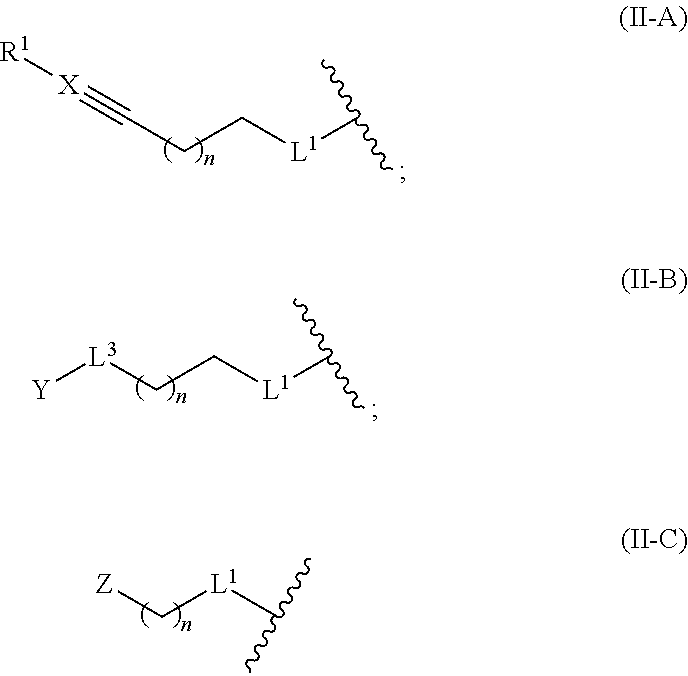
where for moiety II-A:

wherein

or an anion, salt or solvate thereof.

wherein

wherein


where y is the fraction inhibition and x is the inhibitor concentration. Ki values were then deduced from the IC50 value by using the Cheng-Prusoff equation:
where [S] is the inhibitor concentration, and KM is the Michaelis constant.
| (i) Tablet | mg/tablet | ||
| ‘Compound X’ | 100.0 | ||
| Lactose | 77.5 | ||
| Povidone | 15.0 | ||
| Croscarmellose sodium | 12.0 | ||
| Microcrystalline cellulose | 92.5 | ||
| Magnesium stearate | 3.0 | ||
| 300.0 | |||
| (iii) Capsule | mg/capsule | ||
| ‘Compound X’ | 10.0 | ||
| Colloidal silicon dioxide | 1.5 | ||
| Lactose | 465.5 | ||
| Pregelatinized starch | 120.0 | ||
| Magnesium stearate | 3.0 | ||
| 600.0 | |||
| (iii) Injection 1 (1 mg/mL) | mg/mL | ||
| ‘Compound X’ (free acid form) | 1.0 | ||
| Dibasic sodium phosphate | 12.0 | ||
| Monobasic sodium phosphate | 0.7 | ||
| Sodium chloride | 4.5 | ||
| 1.0 N Sodium hydroxide solution | q.s. | ||
| (pH adjustment to 7.0-7.5) | |||
| Water for injection | q.s. ad 1 mL | ||
| (iv) Injection 2 (10 mg/mL) | mg/mL | ||
| ‘Compound X’ (free acid form) | 10.0 | ||
| Monobasic sodium phosphate | 0.3 | ||
| Dibasic sodium phosphate | 1.1 | ||
| Polyethylene glycol 400 | 200.0 | ||
| 01 N Sodium hydroxide solution | q.s. | ||
| (pH adjustment to 7.0-7.5) | |||
| Water for injection | q.s. ad 1 mL | ||
| (v) Aerosol | mg/can | ||
| ‘Compound X’ | 20 | ||
| |
10 | ||
| Trichloromonofluoromethane | 5,000 | ||
| Dichlorodifluoromethane | 10,000 | ||
| Dichlorotetrafluoroethane | 5,000 | ||
Claims (26)


Priority Applications (1)
| Application Number | Priority Date | Filing Date | Title |
|---|---|---|---|
| US13/500,845 US8609638B2 (en) | 2009-10-08 | 2010-10-08 | Enzyme inhibiting compounds and methods |
Applications Claiming Priority (3)
| Application Number | Priority Date | Filing Date | Title |
|---|---|---|---|
| US24992909P | 2009-10-08 | 2009-10-08 | |
| PCT/US2010/052049 WO2011044505A2 (en) | 2009-10-08 | 2010-10-08 | Enzyme inhibiting compounds and methods |
| US13/500,845 US8609638B2 (en) | 2009-10-08 | 2010-10-08 | Enzyme inhibiting compounds and methods |
Related Parent Applications (1)
| Application Number | Title | Priority Date | Filing Date |
|---|---|---|---|
| PCT/US2010/052049 A-371-Of-International WO2011044505A2 (en) | 2009-10-08 | 2010-10-08 | Enzyme inhibiting compounds and methods |
Related Child Applications (1)
| Application Number | Title | Priority Date | Filing Date |
|---|---|---|---|
| US14/105,104 Continuation US20140100198A1 (en) | 2009-10-08 | 2013-12-12 | Enzyme inhibiting compounds and methods |
Publications (2)
| Publication Number | Publication Date |
|---|---|
| US20120196835A1 US20120196835A1 (en) | 2012-08-02 |
| US8609638B2 true US8609638B2 (en) | 2013-12-17 |
Family
ID=43857417
Family Applications (2)
| Application Number | Title | Priority Date | Filing Date |
|---|---|---|---|
| US13/500,845 Expired - Fee Related US8609638B2 (en) | 2009-10-08 | 2010-10-08 | Enzyme inhibiting compounds and methods |
| US14/105,104 Abandoned US20140100198A1 (en) | 2009-10-08 | 2013-12-12 | Enzyme inhibiting compounds and methods |
Family Applications After (1)
| Application Number | Title | Priority Date | Filing Date |
|---|---|---|---|
| US14/105,104 Abandoned US20140100198A1 (en) | 2009-10-08 | 2013-12-12 | Enzyme inhibiting compounds and methods |
Country Status (2)
| Country | Link |
|---|---|
| US (2) | US8609638B2 (en) |
| WO (1) | WO2011044505A2 (en) |
Families Citing this family (1)
| Publication number | Priority date | Publication date | Assignee | Title |
|---|---|---|---|---|
| WO2016154029A1 (en) * | 2015-03-20 | 2016-09-29 | Massachusetts Institute Of Technology | Formation of macromolecules using iterative growth and related compounds |
Citations (7)
| Publication number | Priority date | Publication date | Assignee | Title |
|---|---|---|---|---|
| US4588828A (en) | 1984-08-23 | 1986-05-13 | E. R. Squibb & Sons, Inc. | Acetylenic antibiotics |
| US4654426A (en) | 1984-08-23 | 1987-03-31 | E. R. Squibb & Sons, Inc. | Acetylenic antibiotics |
| US20060249067A1 (en) | 2005-05-04 | 2006-11-09 | Honeywell International, Inc. | Submersible vehicle object ejection system using a flywheel driven boost pump |
| US7286973B1 (en) | 2000-05-03 | 2007-10-23 | The Salk Institute For Biological Studies | Method of screening inhibitors of mevalonate-independent isoprenoid biosynthetic pathway |
| US7402408B2 (en) | 2003-01-22 | 2008-07-22 | Adelbert Bacher | Assay for inhibitors of ispH |
| US20080206267A1 (en) | 2001-04-23 | 2008-08-28 | Bioagency Ag | Inactivation Of Genes Of The Mep Pathway |
| US20090176781A1 (en) | 2006-05-08 | 2009-07-09 | Yihan Wang | Acetylenic Heteroaryl Compounds |
-
2010
- 2010-10-08 WO PCT/US2010/052049 patent/WO2011044505A2/en not_active Ceased
- 2010-10-08 US US13/500,845 patent/US8609638B2/en not_active Expired - Fee Related
-
2013
- 2013-12-12 US US14/105,104 patent/US20140100198A1/en not_active Abandoned
Patent Citations (7)
| Publication number | Priority date | Publication date | Assignee | Title |
|---|---|---|---|---|
| US4588828A (en) | 1984-08-23 | 1986-05-13 | E. R. Squibb & Sons, Inc. | Acetylenic antibiotics |
| US4654426A (en) | 1984-08-23 | 1987-03-31 | E. R. Squibb & Sons, Inc. | Acetylenic antibiotics |
| US7286973B1 (en) | 2000-05-03 | 2007-10-23 | The Salk Institute For Biological Studies | Method of screening inhibitors of mevalonate-independent isoprenoid biosynthetic pathway |
| US20080206267A1 (en) | 2001-04-23 | 2008-08-28 | Bioagency Ag | Inactivation Of Genes Of The Mep Pathway |
| US7402408B2 (en) | 2003-01-22 | 2008-07-22 | Adelbert Bacher | Assay for inhibitors of ispH |
| US20060249067A1 (en) | 2005-05-04 | 2006-11-09 | Honeywell International, Inc. | Submersible vehicle object ejection system using a flywheel driven boost pump |
| US20090176781A1 (en) | 2006-05-08 | 2009-07-09 | Yihan Wang | Acetylenic Heteroaryl Compounds |
Non-Patent Citations (17)
| Title |
|---|
| Eberl, M., et al. Microbial isoprenoid biosynthesis and human [gamma][delta] T cell activation. FEBS Letters, 2003, 544, pp. 4-10. |
| Ghosh, S. et al. Effects of Bisphosphonates on the Growth of Entamoeba histolytica and Plasmodium Species in Vitro and in Vivo. J. Med. Chem. 2004, 47, pp. 175-187. |
| Hosokawa, A. et al. Evaluation of an Alkyne-containing Analogue of Farnesyl Diphosphate as a Dual Substrate for Protein-prenyltransferases. International Journal of Peptide Research and Therapeutics. 2007, 13(1-2), pp. 345-354. |
| International Search Report (Form PCT/ISA/210) for corresponding International Application No. PCT/US2010/0529049. |
| Leon, A. et al. Isoprenoid Biosynthesis as a Drug Target: Bisphosphonate Inhibition ofEscherichia coli K12 Growth and Synergistic Effects of Fosmidomycin. J. Med. Chem. 2006,49, pp. 7331-7341. |
| Martin, M.B., et al. Activity of Bisphosphonates against Trypanosoma brucei rhodesiense. J. Med. Chem. 2002, 45, pp. 2904-2914. |
| Matrin, M.B., et al. Bisphosphonates Inhibit the Growth of Trypanosoma brucei, Trypanosoma cruzi, Leishmania donovani, Toxoplasma gondii, and Plasmodium falciparum: A Potential Route to Chemotherapy. J. Med. Chem. 2001, 44, pp. 909-916. |
| Nagaki, M. et al. Substrate specificities of farnesyl diphosphate synthases of Bacillus stearothermophilus and porcine liver with allylic substrate homologs having vinyl or ethynyl group. Journal of Molecular Catalysis B: Enzymatic. 2009, 59, pp. 163-167. |
| Sanders, J.M. et al. Pyridinium-1-yl Bisphosphonates are Potent Inhibitors of Farnesyl Diphosphate Synthase and Bone Resorption. J. Med. Chem. 2005, 48, pp. 2957-2963 & S1-S3. |
| Shamra, N.K. et al. Type II Isopentenyl Diphosphate Isomerase: Probing the Mechanism with Alkyne/Allene Diphosphate Substrate Analogues. Biochemistry 2010, 49, pp. 6228-6233. |
| Szabo, C. et al. An Investigation of Bone Resorption and Dictyostelium discoideum Growth Inhibition by Bisphosphonate Drugs. J. Med. Chem. 2002, 45, pp. 2894-2903. |
| Thibodeaux, C.J., Lui, H. Unraveling the Mechanisms of Isoprenoid Biosynthetic Enzymes: Mechanistic Studies of the Early Stage Enzymes. CHIMIA, 2009, 63(6), pp. 334-339. |
| Van Hoof, S., et al. Synthesis of Analogues of (E)-1-Hydroxy-2-methylbut-2-enyl 4-Diphosphate, an Isoprenoid Precursor and Human [gamma][delta] T Cell Activator. J. Org. Chem. 2008, 73, pp. 1365-1370. |
| Wang, W., Wang, K., et al. Bioorganometallic mechanism of action, and inhibition, of IspH. PANS, 2010, 107(10), pp. 4522-4527. |
| Written Opinion (Form PCT/ISA/237) for corresponding International Application No. PCT/US2010/0529049. |
| Wu, Z., Wouters, J., et al. Isopentenyl Diphosphate Isomerase. Mechanism-Based Inhibition by Diene Analogues of Isopentenyl Diphosphate and Dimethylallyl Diphosphate. J. Am. Chem. Soc. 2005, 127, pp. 17433-17438. |
| Y. Tanaka et al. Medicinal Chemistry, 2007, 3, 85-99. * |
Also Published As
| Publication number | Publication date |
|---|---|
| US20140100198A1 (en) | 2014-04-10 |
| US20120196835A1 (en) | 2012-08-02 |
| WO2011044505A3 (en) | 2011-08-18 |
| WO2011044505A2 (en) | 2011-04-14 |
Similar Documents
| Publication | Publication Date | Title |
|---|---|---|
| TWI259081B (en) | Treatment of acute myeloid leukemia with indolinone compounds | |
| KR102872871B1 (en) | Compositions and methods of modulation of hair growth | |
| Shull et al. | Synthesis and biological activity of isoprenoid bisphosphonates | |
| US20250099596A1 (en) | Tetrahydronaphthalene compound, and preparation method therefor and use thereof in medicine | |
| EP0050460A2 (en) | Tridecyloxy- or tetradecyloxy-propane derivatives, and their use | |
| US8673882B2 (en) | Inhibitors of autotaxin | |
| EA027908B1 (en) | Prmt5 inhibitors and uses thereof | |
| KR20170047396A (en) | Crystalline forms of 2-(4-(4-ethoxy-6-oxo-1,6-dihydropyridin-3-yl)-2-fluorophenyl)-n-(5-(1,1,1-trifluoro-2-methylpropan-2-yl)isoxazol-3-yl)acetamide | |
| JP2017512186A (en) | Dihydropteridinone derivatives and uses thereof | |
| EP3978488A1 (en) | Zinc chelating compounds for use in the treatment of bacterial infection | |
| KR20070018766A (en) | Mitoquinone derivatives used as mitochondrial targeting antioxidants | |
| EA027987B1 (en) | Oxazolidin-2-one-pyrimidine derivatives | |
| Ferrer-Casal et al. | New insights into molecular recognition of 1, 1-bisphosphonic acids by farnesyl diphosphate synthase | |
| US7893286B2 (en) | Method for the synthesis of phospholipid ethers | |
| JP2021514955A (en) | Small molecules that block proteasome-related ubiquitin receptor RPN13 function and their uses | |
| Gao et al. | Multi-target-directed design, syntheses, and characterization of fluorescent bisphosphonate derivatives as multifunctional enzyme inhibitors in mevalonate pathway | |
| CN103596570B (en) | Oxysqualene cyclase as a protein target for anticancer therapy | |
| KR101975299B1 (en) | Compounds containing core structure of indole acetic acid and uses thereof | |
| Knobloch et al. | Synthesis of hydrolysis-resistant pyridoxal 5′-phosphate analogs and their biochemical and X-ray crystallographic characterization with the pyridoxal phosphatase chronophin | |
| US20140100198A1 (en) | Enzyme inhibiting compounds and methods | |
| AU2012236275B2 (en) | Derivatives of sulindac, use thereof and preparation thereof | |
| US7358360B2 (en) | Risedronate sodium having a very low content of iron | |
| EP3235822B1 (en) | Novel bisphosphonic acid derivative and application for same | |
| WO2020006384A1 (en) | Carborane hydroxamic acid matrix metalloproteinase inhibitors and agents for boron neutron capture therapy | |
| Dhareshwar et al. | A novel prodrug strategy for β-dicarbonyl carbon acids: syntheses and evaluation of the physicochemical characteristics of C-phosphoryloxymethyl (POM) and phosphoryloxymethyloxymethyl (POMOM) prodrug derivatives |
Legal Events
| Date | Code | Title | Description |
|---|---|---|---|
| AS | Assignment |
Owner name: NATIONAL INSTITUTES OF HEALTH (NIH), U.S. DEPT. OF Free format text: CONFIRMATORY LICENSE;ASSIGNOR:UNIVERSITY OF ILLINOIS URBANA-CHAMPAIGN;REEL/FRAME:025761/0129 Effective date: 20101029 |
|
| AS | Assignment |
Owner name: THE BOARD OF TRUSTEES OF THE UNIVERSITY OF ILLINOI Free format text: ASSIGNMENT OF ASSIGNORS INTEREST;ASSIGNORS:OLDFIELD, ERIC;WANG, KE;WANG, WEIXUE;AND OTHERS;REEL/FRAME:028068/0491 Effective date: 20120410 |
|
| AS | Assignment |
Owner name: NATIONAL INSTITUTES OF HEALTH (NIH), U.S. DEPT. OF Free format text: CONFIRMATORY LICENSE;ASSIGNOR:UNIVERSITY OF ILLINOIS URBANA-CHAMPAIGN;REEL/FRAME:028156/0767 Effective date: 20120427 |
|
| STCF | Information on status: patent grant |
Free format text: PATENTED CASE |
|
| REMI | Maintenance fee reminder mailed | ||
| FEPP | Fee payment procedure |
Free format text: SURCHARGE FOR LATE PAYMENT, SMALL ENTITY (ORIGINAL EVENT CODE: M2554) |
|
| MAFP | Maintenance fee payment |
Free format text: PAYMENT OF MAINTENANCE FEE, 4TH YR, SMALL ENTITY (ORIGINAL EVENT CODE: M2551) Year of fee payment: 4 |
|
| FEPP | Fee payment procedure |
Free format text: MAINTENANCE FEE REMINDER MAILED (ORIGINAL EVENT CODE: REM.); ENTITY STATUS OF PATENT OWNER: SMALL ENTITY |
|
| LAPS | Lapse for failure to pay maintenance fees |
Free format text: PATENT EXPIRED FOR FAILURE TO PAY MAINTENANCE FEES (ORIGINAL EVENT CODE: EXP.); ENTITY STATUS OF PATENT OWNER: SMALL ENTITY |
|
| STCH | Information on status: patent discontinuation |
Free format text: PATENT EXPIRED DUE TO NONPAYMENT OF MAINTENANCE FEES UNDER 37 CFR 1.362 |
|
| FP | Lapsed due to failure to pay maintenance fee |
Effective date: 20211217 |