US8609628B2 - Fused pentacyclic polyethers - Google Patents
Fused pentacyclic polyethers Download PDFInfo
- Publication number
- US8609628B2 US8609628B2 US13/356,312 US201213356312A US8609628B2 US 8609628 B2 US8609628 B2 US 8609628B2 US 201213356312 A US201213356312 A US 201213356312A US 8609628 B2 US8609628 B2 US 8609628B2
- Authority
- US
- United States
- Prior art keywords
- alkyl
- compound
- alkenyl
- esters
- compounds
- Prior art date
- Legal status (The legal status is an assumption and is not a legal conclusion. Google has not performed a legal analysis and makes no representation as to the accuracy of the status listed.)
- Expired - Fee Related
Links
- 0 *C1OC2(C)CC(O[1*])C3OC4(C)CCC5OC(CC[2*])C(C)(O)CCC5OC4CC3OC2CC1C Chemical compound *C1OC2(C)CC(O[1*])C3OC4(C)CCC5OC(CC[2*])C(C)(O)CCC5OC4CC3OC2CC1C 0.000 description 7
- ZOKXHZKBUZFJPJ-VKDVCWNVSA-N C=C/C=C\CCC1OC2CCC3(C)OC4C(O)CC5(C)OC(CC/C=C(C)/C(C)=C/C(O)C6=CC=CC=C6)C(C)CC5OC4CC3OC2CCC1(C)O Chemical compound C=C/C=C\CCC1OC2CCC3(C)OC4C(O)CC5(C)OC(CC/C=C(C)/C(C)=C/C(O)C6=CC=CC=C6)C(C)CC5OC4CC3OC2CCC1(C)O ZOKXHZKBUZFJPJ-VKDVCWNVSA-N 0.000 description 2
- LYDIYOBXDACKMZ-RPRRRTEXSA-M Br[Mg]C1=CC=CC=C1.C=C/C=C\CCC1OC2CCC3(C)OC4C(O)CC5(C)OC(CC/C=C(C)/C(C)=C/C(O)C6=CC=CC=C6)C(C)CC5OC4CC3OC2CCC1(C)O.C=C/C=C\CCC1OC2CCC3(C)OC4C(O)CC5(C)OC(CC/C=C(C)/C(C)=C/C=O)C(C)CC5OC4CC3OC2CCC1(C)O.CCOCC.CNCC(O)C1=CC=CC=C1 Chemical compound Br[Mg]C1=CC=CC=C1.C=C/C=C\CCC1OC2CCC3(C)OC4C(O)CC5(C)OC(CC/C=C(C)/C(C)=C/C(O)C6=CC=CC=C6)C(C)CC5OC4CC3OC2CCC1(C)O.C=C/C=C\CCC1OC2CCC3(C)OC4C(O)CC5(C)OC(CC/C=C(C)/C(C)=C/C=O)C(C)CC5OC4CC3OC2CCC1(C)O.CCOCC.CNCC(O)C1=CC=CC=C1 LYDIYOBXDACKMZ-RPRRRTEXSA-M 0.000 description 1
- YKCQGTKPNABNLF-VOTSOKGWSA-N C=C/C=C/C(C)(C)C Chemical compound C=C/C=C/C(C)(C)C YKCQGTKPNABNLF-VOTSOKGWSA-N 0.000 description 1
- AUUZYZFYGOQUFF-BXPMAQBHSA-N C=C/C=C/C(C)(C)C.C=C/C=C\C(C)(C)C.CC(C)(C)CC1=CC=CC=C1.CC(C)(C)CC1=CN=CC=C1 Chemical compound C=C/C=C/C(C)(C)C.C=C/C=C\C(C)(C)C.CC(C)(C)CC1=CC=CC=C1.CC(C)(C)CC1=CN=CC=C1 AUUZYZFYGOQUFF-BXPMAQBHSA-N 0.000 description 1
- YKCQGTKPNABNLF-SREVYHEPSA-N C=C/C=C\C(C)(C)C Chemical compound C=C/C=C\C(C)(C)C YKCQGTKPNABNLF-SREVYHEPSA-N 0.000 description 1
- ZYCDMFHDDNPZRI-DLWKMIRMSA-N C=C/C=C\CCC1OC2CCC3(C)OC4C(O)CC5(C)OC(CC/C=C(C)/C(C)=C/C(=O)/N=C(\N)NCC6=CC=CC=C6)C(C)CC5OC4CC3OC2CCC1(C)O Chemical compound C=C/C=C\CCC1OC2CCC3(C)OC4C(O)CC5(C)OC(CC/C=C(C)/C(C)=C/C(=O)/N=C(\N)NCC6=CC=CC=C6)C(C)CC5OC4CC3OC2CCC1(C)O ZYCDMFHDDNPZRI-DLWKMIRMSA-N 0.000 description 1
- HMVFQPUQIXCCIK-VIMGWDKOSA-N C=C/C=C\CCC1OC2CCC3(C)OC4C(O)CC5(C)OC(CC/C=C(C)/C(C)=C/C(=O)/N=C(\N)NCC6=CC=CC=C6)C(C)CC5OC4CC3OC2CCC1(C)O.C=C/C=C\CCC1OC2CCC3(C)OC4C(O)CC5(C)OC(CC/C=C(C)/C(C)=C/C(=O)N=C(N)N)C(C)CC5OC4CC3OC2CCC1(C)O.C=C/C=C\CCC1OC2CCC3(C)OC4C(O)CC5(C)OC(CC/C=C(C)/C(C)=C/C=O)C(C)CC5OC4CC3OC2CCC1(C)O.CC(=C\CCC1OC(C)(C(C)C)C(C(C)C)CC1C)/C(C)=C/C(=O)O Chemical compound C=C/C=C\CCC1OC2CCC3(C)OC4C(O)CC5(C)OC(CC/C=C(C)/C(C)=C/C(=O)/N=C(\N)NCC6=CC=CC=C6)C(C)CC5OC4CC3OC2CCC1(C)O.C=C/C=C\CCC1OC2CCC3(C)OC4C(O)CC5(C)OC(CC/C=C(C)/C(C)=C/C(=O)N=C(N)N)C(C)CC5OC4CC3OC2CCC1(C)O.C=C/C=C\CCC1OC2CCC3(C)OC4C(O)CC5(C)OC(CC/C=C(C)/C(C)=C/C=O)C(C)CC5OC4CC3OC2CCC1(C)O.CC(=C\CCC1OC(C)(C(C)C)C(C(C)C)CC1C)/C(C)=C/C(=O)O HMVFQPUQIXCCIK-VIMGWDKOSA-N 0.000 description 1
- WURWAEQFEGUBKM-HTPIYINRSA-N C=C/C=C\CCC1OC2CCC3(C)OC4C(O)CC5(C)OC(CC/C=C(C)/C(C)=C/C(=O)C6=C7\C=CC=C\C7=C/C=C\6)C(C)CC5OC4CC3OC2CCC1(C)O Chemical compound C=C/C=C\CCC1OC2CCC3(C)OC4C(O)CC5(C)OC(CC/C=C(C)/C(C)=C/C(=O)C6=C7\C=CC=C\C7=C/C=C\6)C(C)CC5OC4CC3OC2CCC1(C)O WURWAEQFEGUBKM-HTPIYINRSA-N 0.000 description 1
- VNTAAXIMLNPOFS-VKDVCWNVSA-N C=C/C=C\CCC1OC2CCC3(C)OC4C(O)CC5(C)OC(CC/C=C(C)/C(C)=C/C(=O)C6=CC=CC=C6)C(C)CC5OC4CC3OC2CCC1(C)O Chemical compound C=C/C=C\CCC1OC2CCC3(C)OC4C(O)CC5(C)OC(CC/C=C(C)/C(C)=C/C(=O)C6=CC=CC=C6)C(C)CC5OC4CC3OC2CCC1(C)O VNTAAXIMLNPOFS-VKDVCWNVSA-N 0.000 description 1
- ZGJCDJQNCCKKDL-HQCQUHCQSA-N C=C/C=C\CCC1OC2CCC3(C)OC4C(O)CC5(C)OC(CC/C=C(C)/C(C)=C/C(=O)N=C(N)N)C(C)CC5OC4CC3OC2CCC1(C)O Chemical compound C=C/C=C\CCC1OC2CCC3(C)OC4C(O)CC5(C)OC(CC/C=C(C)/C(C)=C/C(=O)N=C(N)N)C(C)CC5OC4CC3OC2CCC1(C)O ZGJCDJQNCCKKDL-HQCQUHCQSA-N 0.000 description 1
- XOYBDOLYDWORDQ-NKZCGNJISA-N C=C/C=C\CCC1OC2CCC3(C)OC4C(O)CC5(C)OC(CC/C=C(C)/C(C)=C/C(C)OC)C(C)CC5OC4CC3OC2CCC1(C)O Chemical compound C=C/C=C\CCC1OC2CCC3(C)OC4C(O)CC5(C)OC(CC/C=C(C)/C(C)=C/C(C)OC)C(C)CC5OC4CC3OC2CCC1(C)O XOYBDOLYDWORDQ-NKZCGNJISA-N 0.000 description 1
- JWDCASGXKJLCIN-XAOOYXCKSA-N C=C/C=C\CCC1OC2CCC3(C)OC4C(O)CC5(C)OC(CC/C=C(C)/C(C)=C/C=C\C6=CC(N)=CC=C6)C(C)CC5OC4CC3OC2CCC1(C)O Chemical compound C=C/C=C\CCC1OC2CCC3(C)OC4C(O)CC5(C)OC(CC/C=C(C)/C(C)=C/C=C\C6=CC(N)=CC=C6)C(C)CC5OC4CC3OC2CCC1(C)O JWDCASGXKJLCIN-XAOOYXCKSA-N 0.000 description 1
- ZRASYDQIMRXRSI-XAOOYXCKSA-N C=C/C=C\CCC1OC2CCC3(C)OC4C(O)CC5(C)OC(CC/C=C(C)/C(C)=C/C=C\C6=CC(O)=CC=C6)C(C)CC5OC4CC3OC2CCC1(C)O Chemical compound C=C/C=C\CCC1OC2CCC3(C)OC4C(O)CC5(C)OC(CC/C=C(C)/C(C)=C/C=C\C6=CC(O)=CC=C6)C(C)CC5OC4CC3OC2CCC1(C)O ZRASYDQIMRXRSI-XAOOYXCKSA-N 0.000 description 1
- UJTQYHXKGGHENZ-LNDWMDEYSA-N C=C/C=C\CCC1OC2CCC3(C)OC4C(O)CC5(C)OC(CC/C=C(C)/C(C)=C/C=C\C6=CC=C(Cl)C=C6)C(C)CC5OC4CC3OC2CCC1(C)O Chemical compound C=C/C=C\CCC1OC2CCC3(C)OC4C(O)CC5(C)OC(CC/C=C(C)/C(C)=C/C=C\C6=CC=C(Cl)C=C6)C(C)CC5OC4CC3OC2CCC1(C)O UJTQYHXKGGHENZ-LNDWMDEYSA-N 0.000 description 1
- IOAZNICZHDDGAY-LNDWMDEYSA-N C=C/C=C\CCC1OC2CCC3(C)OC4C(O)CC5(C)OC(CC/C=C(C)/C(C)=C/C=C\C6=CC=C([N+](=O)[O-])C=C6)C(C)CC5OC4CC3OC2CCC1(C)O Chemical compound C=C/C=C\CCC1OC2CCC3(C)OC4C(O)CC5(C)OC(CC/C=C(C)/C(C)=C/C=C\C6=CC=C([N+](=O)[O-])C=C6)C(C)CC5OC4CC3OC2CCC1(C)O IOAZNICZHDDGAY-LNDWMDEYSA-N 0.000 description 1
- FNYHHYGOIVZXDE-PNHYNAMKSA-N C=C/C=C\CCC1OC2CCC3(C)OC4C(O)CC5(C)OC(CC/C=C(C)/C(C)=C/C=C\C6=CC=CC=C6)C(C)CC5OC4CC3OC2CCC1(C)O Chemical compound C=C/C=C\CCC1OC2CCC3(C)OC4C(O)CC5(C)OC(CC/C=C(C)/C(C)=C/C=C\C6=CC=CC=C6)C(C)CC5OC4CC3OC2CCC1(C)O FNYHHYGOIVZXDE-PNHYNAMKSA-N 0.000 description 1
- WTZCXLUAGXBEKA-XAOOYXCKSA-N C=C/C=C\CCC1OC2CCC3(C)OC4C(O)CC5(C)OC(CC/C=C(C)/C(C)=C/C=C\C6=CC=CN=C6)C(C)CC5OC4CC3OC2CCC1(C)O Chemical compound C=C/C=C\CCC1OC2CCC3(C)OC4C(O)CC5(C)OC(CC/C=C(C)/C(C)=C/C=C\C6=CC=CN=C6)C(C)CC5OC4CC3OC2CCC1(C)O WTZCXLUAGXBEKA-XAOOYXCKSA-N 0.000 description 1
- UBJROMUYTTVVAL-WQWHCABASA-N C=C/C=C\CCC1OC2CCC3(C)OC4C(O)CC5(C)OC(CC/C=C(C)/C(C)=C/CN6C(=O)NC7=C6C=CC=C7)C(C)CC5OC4CC3OC2CCC1(C)O Chemical compound C=C/C=C\CCC1OC2CCC3(C)OC4C(O)CC5(C)OC(CC/C=C(C)/C(C)=C/CN6C(=O)NC7=C6C=CC=C7)C(C)CC5OC4CC3OC2CCC1(C)O UBJROMUYTTVVAL-WQWHCABASA-N 0.000 description 1
- RZDFTOANVVWXGR-SGUVOZBVSA-N C=C/C=C\CCC1OC2CCC3(C)OC4C(O)CC5(C)OC(CC/C=C(C)/C(C)=C/CN6C(=O)NC7=C6C=CC=C7)C(C)CC5OC4CC3OC2CCC1(C)O.C=C/C=C\CCC1OC2CCC3(C)OC4C(O)CC5(C)OC(CC/C=C(C)/C(C)=C/CO)C(C)CC5OC4CC3OC2CCC1(C)O.CC(=C\CI)/C(C)=C/CCC1OC(C)(C(C)C)C(C(C)C)CC1C Chemical compound C=C/C=C\CCC1OC2CCC3(C)OC4C(O)CC5(C)OC(CC/C=C(C)/C(C)=C/CN6C(=O)NC7=C6C=CC=C7)C(C)CC5OC4CC3OC2CCC1(C)O.C=C/C=C\CCC1OC2CCC3(C)OC4C(O)CC5(C)OC(CC/C=C(C)/C(C)=C/CO)C(C)CC5OC4CC3OC2CCC1(C)O.CC(=C\CI)/C(C)=C/CCC1OC(C)(C(C)C)C(C(C)C)CC1C RZDFTOANVVWXGR-SGUVOZBVSA-N 0.000 description 1
- UZKLASXITYJUBI-RBUTXNIASA-N C=C/C=C\CCC1OC2CCC3(C)OC4C(O)CC5(C)OC(CC/C=C(C)/C(C)=C/CN6C=CC(=O)NC6=O)C(C)CC5OC4CC3OC2CCC1(C)O Chemical compound C=C/C=C\CCC1OC2CCC3(C)OC4C(O)CC5(C)OC(CC/C=C(C)/C(C)=C/CN6C=CC(=O)NC6=O)C(C)CC5OC4CC3OC2CCC1(C)O UZKLASXITYJUBI-RBUTXNIASA-N 0.000 description 1
- CSDZNGGLAYLXSS-ANYVIMDKSA-N C=C/C=C\CCC1OC2CCC3(C)OC4C(O)CC5(C)OC(CC/C=C(C)/C(C)=C/CO)C(C)CC5OC4CC3OC2CCC1(C)O Chemical compound C=C/C=C\CCC1OC2CCC3(C)OC4C(O)CC5(C)OC(CC/C=C(C)/C(C)=C/CO)C(C)CC5OC4CC3OC2CCC1(C)O CSDZNGGLAYLXSS-ANYVIMDKSA-N 0.000 description 1
- UFVKTBMUMLZLRR-LWUUDOFUSA-N C=C/C=C\CCC1OC2CCC3(C)OC4C(O)CC5(C)OC(CC/C=C(C)/C(C)=C/CO)C(C)CC5OC4CC3OC2CCC1(C)O.C=C/C=C\CCC1OC2CCC3(C)OC4C(O)CC5(C)OC(CC/C=C(C)/C(C)=C/COC(=O)C6=C/C=C7/C=CC=C/C7=C\6)C(C)CC5OC4CC3OC2CCC1(C)O.O=C(O)C1=CC2=CC=CC=C2C=C1.[2HH] Chemical compound C=C/C=C\CCC1OC2CCC3(C)OC4C(O)CC5(C)OC(CC/C=C(C)/C(C)=C/CO)C(C)CC5OC4CC3OC2CCC1(C)O.C=C/C=C\CCC1OC2CCC3(C)OC4C(O)CC5(C)OC(CC/C=C(C)/C(C)=C/COC(=O)C6=C/C=C7/C=CC=C/C7=C\6)C(C)CC5OC4CC3OC2CCC1(C)O.O=C(O)C1=CC2=CC=CC=C2C=C1.[2HH] UFVKTBMUMLZLRR-LWUUDOFUSA-N 0.000 description 1
- OQZDBRVPRKUWGF-FSZMVURNSA-N C=C/C=C\CCC1OC2CCC3(C)OC4C(O)CC5(C)OC(CC/C=C(C)/C(C)=C/COC6=C(N7=CC=C(CCl)O7)C=CC=C6)C(C)CC5OC4CC3OC2CCC1(C)O Chemical compound C=C/C=C\CCC1OC2CCC3(C)OC4C(O)CC5(C)OC(CC/C=C(C)/C(C)=C/COC6=C(N7=CC=C(CCl)O7)C=CC=C6)C(C)CC5OC4CC3OC2CCC1(C)O OQZDBRVPRKUWGF-FSZMVURNSA-N 0.000 description 1
- FPOKUUUKYDZLLP-CCZPJOQYSA-K C=C/C=C\CCC1OC2CCC3(C)OC4C(O)CC5(C)OC(CC/C=C(C)/C(C)=C/COP(=O)([O-])OP(=O)([O-])OP(=O)([O-])OCC6OC(N7C=CC(=O)NC7=O)C(O)C6O)C(C)CC5OC4CC3OC2CCC1(C)O Chemical compound C=C/C=C\CCC1OC2CCC3(C)OC4C(O)CC5(C)OC(CC/C=C(C)/C(C)=C/COP(=O)([O-])OP(=O)([O-])OP(=O)([O-])OCC6OC(N7C=CC(=O)NC7=O)C(O)C6O)C(C)CC5OC4CC3OC2CCC1(C)O FPOKUUUKYDZLLP-CCZPJOQYSA-K 0.000 description 1
- GHJMUWHIOPACJY-CPJNVISKSA-N C=C/C=C\CCC1OC2CCC3(C)OC4C(O)CC5(C)OC(CCC/C=C(C)/C(C)=C/C=O)C(C)CC5OC4CC3OC2CCC1(C)O Chemical compound C=C/C=C\CCC1OC2CCC3(C)OC4C(O)CC5(C)OC(CCC/C=C(C)/C(C)=C/C=O)C(C)CC5OC4CC3OC2CCC1(C)O GHJMUWHIOPACJY-CPJNVISKSA-N 0.000 description 1
- ZRDCPBDTFHZIIC-KTKRTIGZSA-N C=C/C=C\CCC1OC2CCC3(C)OC4C(O)CC5(C)OC(CCCC(C)C(C)CCO)C(C)CC5OC4CC3OC2CCC1(C)O Chemical compound C=C/C=C\CCC1OC2CCC3(C)OC4C(O)CC5(C)OC(CCCC(C)C(C)CCO)C(C)CC5OC4CC3OC2CCC1(C)O ZRDCPBDTFHZIIC-KTKRTIGZSA-N 0.000 description 1
- ZHVQPZLJOWKMSP-PJCCRMMCSA-N C=C/C=C\CCC1OC2CCC3(C)OC4C(OC(C)=O)CC5(C)OC(CC/C=C(C)/C(C)=C/C=O)C(C)CC5OC4CC3OC2CCC1(C)O Chemical compound C=C/C=C\CCC1OC2CCC3(C)OC4C(OC(C)=O)CC5(C)OC(CC/C=C(C)/C(C)=C/C=O)C(C)CC5OC4CC3OC2CCC1(C)O ZHVQPZLJOWKMSP-PJCCRMMCSA-N 0.000 description 1
- ZQAIAJDSLNCTDU-MYCXMZEDSA-N CC(=C\C=O)/C(C)=C/CCCC(C)(C)C.CC(=C\CCCC(C)(C)C)/C(C)=C/C1OCCO1.CC(=C\CO)/C(C)=C/CCCC(C)(C)C.COC(/C=C(C)/C(C)=C/CCCC(C)(C)C)OC Chemical compound CC(=C\C=O)/C(C)=C/CCCC(C)(C)C.CC(=C\CCCC(C)(C)C)/C(C)=C/C1OCCO1.CC(=C\CO)/C(C)=C/CCCC(C)(C)C.COC(/C=C(C)/C(C)=C/CCCC(C)(C)C)OC ZQAIAJDSLNCTDU-MYCXMZEDSA-N 0.000 description 1
- BZVRUKDWLKCOAG-NNTZBSGJSA-N CC(=C\CCCC(C)(C)C)/C(C)=C/C1OCCCO1 Chemical compound CC(=C\CCCC(C)(C)C)/C(C)=C/C1OCCCO1 BZVRUKDWLKCOAG-NNTZBSGJSA-N 0.000 description 1
- UIUPLQIPQLGJLZ-LMLHBTEYSA-N CC(=C\CCCC(C)(C)C)/C(C)=C/C1OCCO1 Chemical compound CC(=C\CCCC(C)(C)C)/C(C)=C/C1OCCO1 UIUPLQIPQLGJLZ-LMLHBTEYSA-N 0.000 description 1
- JZBRCHSCODURQE-QHKWOANTSA-N CC(=C\CO)/C(C)=C/CCCC(C)(C)C Chemical compound CC(=C\CO)/C(C)=C/CCCC(C)(C)C JZBRCHSCODURQE-QHKWOANTSA-N 0.000 description 1
- MBQOFTMENVPNQN-ADWQEOMMSA-N COC(/C=C(C)/C(C)=C/CCCC(C)(C)C)OC Chemical compound COC(/C=C(C)/C(C)=C/CCCC(C)(C)C)OC MBQOFTMENVPNQN-ADWQEOMMSA-N 0.000 description 1
- GIVDUUGMFPNBCY-RBUTXNIASA-N [H]N1C=NC(N)C2=C1N=CN2C/C=C(C)/C(C)=C/CCC1OC2(C)CC(O)C3OC4(C)CCC5OC(CC/C=C\C=C)C(C)(O)CCC5OC4CC3OC2CC1C Chemical compound [H]N1C=NC(N)C2=C1N=CN2C/C=C(C)/C(C)=C/CCC1OC2(C)CC(O)C3OC4(C)CCC5OC(CC/C=C\C=C)C(C)(O)CCC5OC4CC3OC2CC1C GIVDUUGMFPNBCY-RBUTXNIASA-N 0.000 description 1
- IHRGLJJKFZYRSE-ZWUQSRIPSA-Q [H]N1[H]C2=C(N=c(N([H])[HH+])n([H])[H]2)C2=NC(Cl)=C(N)N=C21.[H][C@@]12CC(=[NH2+])N[C@]13N(CCC3(O)O)C(=[NH2+])N[C@H]2COC(N)=O.[NH2+]=C1NC(O)C2C3OC4([O-])OC(C(O)C2(N1)[C@@H]4O)C3(O)[H]CO Chemical compound [H]N1[H]C2=C(N=c(N([H])[HH+])n([H])[H]2)C2=NC(Cl)=C(N)N=C21.[H][C@@]12CC(=[NH2+])N[C@]13N(CCC3(O)O)C(=[NH2+])N[C@H]2COC(N)=O.[NH2+]=C1NC(O)C2C3OC4([O-])OC(C(O)C2(N1)[C@@H]4O)C3(O)[H]CO IHRGLJJKFZYRSE-ZWUQSRIPSA-Q 0.000 description 1
- HRNWVGKQBDQUKC-MHPMSLHTSA-N [H][C@@]1(CC/C=C(C)/C(C)=C/C(OC)OC)O[C@]2(C)CC(O)[C@]3([H])O[C@]4(C)CC[C@]5([H])O[C@]([H])(CC/C=C\C=C)[C@](C)(O)CCC5OC4CC3OC2CC1C Chemical compound [H][C@@]1(CC/C=C(C)/C(C)=C/C(OC)OC)O[C@]2(C)CC(O)[C@]3([H])O[C@]4(C)CC[C@]5([H])O[C@]([H])(CC/C=C\C=C)[C@](C)(O)CCC5OC4CC3OC2CC1C HRNWVGKQBDQUKC-MHPMSLHTSA-N 0.000 description 1
- JPBOABGEVHVPNM-KGIMXCGWSA-N [H][C@@]1(CC/C=C(C)/C(C)=C/C=O)O[C@]2(C)C[C@]([H])(O)[C@]3([H])O[C@]4(C)CC[C@]5([H])O[C@]([H])(CC/C=C\C=C)[C@](C)(O)CC[C@@]5([H])O[C@@]4([H])C[C@@]3([H])O[C@@]2([H])C[C@@H]1C Chemical compound [H][C@@]1(CC/C=C(C)/C(C)=C/C=O)O[C@]2(C)C[C@]([H])(O)[C@]3([H])O[C@]4(C)CC[C@]5([H])O[C@]([H])(CC/C=C\C=C)[C@](C)(O)CC[C@@]5([H])O[C@@]4([H])C[C@@]3([H])O[C@@]2([H])C[C@@H]1C JPBOABGEVHVPNM-KGIMXCGWSA-N 0.000 description 1
- CSDZNGGLAYLXSS-WEWYSULJSA-N [H][C@@]1(CC/C=C(C)/C(C)=C/CO)O[C@]2(C)CC(O)[C@]3([H])O[C@]4(C)CC[C@]5([H])O[C@]([H])(CC/C=C\C=C)[C@](C)(O)CCC5OC4CC3OC2CC1C Chemical compound [H][C@@]1(CC/C=C(C)/C(C)=C/CO)O[C@]2(C)CC(O)[C@]3([H])O[C@]4(C)CC[C@]5([H])O[C@]([H])(CC/C=C\C=C)[C@](C)(O)CCC5OC4CC3OC2CC1C CSDZNGGLAYLXSS-WEWYSULJSA-N 0.000 description 1
- ZRDCPBDTFHZIIC-RXBNOFAISA-N [H][C@@]1(CCCC(C)C(C)CCO)O[C@]2(C)CC(O)[C@]3([H])O[C@]4(C)CC[C@]5([H])O[C@]([H])(CC/C=C\C=C)[C@](C)(O)CCC5OC4CC3OC2CC1C Chemical compound [H][C@@]1(CCCC(C)C(C)CCO)O[C@]2(C)CC(O)[C@]3([H])O[C@]4(C)CC[C@]5([H])O[C@]([H])(CC/C=C\C=C)[C@](C)(O)CCC5OC4CC3OC2CC1C ZRDCPBDTFHZIIC-RXBNOFAISA-N 0.000 description 1
Images


Classifications
-
- C—CHEMISTRY; METALLURGY
- C07—ORGANIC CHEMISTRY
- C07H—SUGARS; DERIVATIVES THEREOF; NUCLEOSIDES; NUCLEOTIDES; NUCLEIC ACIDS
- C07H19/00—Compounds containing a hetero ring sharing one ring hetero atom with a saccharide radical; Nucleosides; Mononucleotides; Anhydro-derivatives thereof
- C07H19/02—Compounds containing a hetero ring sharing one ring hetero atom with a saccharide radical; Nucleosides; Mononucleotides; Anhydro-derivatives thereof sharing nitrogen
- C07H19/04—Heterocyclic radicals containing only nitrogen atoms as ring hetero atom
- C07H19/16—Purine radicals
- C07H19/20—Purine radicals with the saccharide radical esterified by phosphoric or polyphosphoric acids
- C07H19/207—Purine radicals with the saccharide radical esterified by phosphoric or polyphosphoric acids the phosphoric or polyphosphoric acids being esterified by a further hydroxylic compound, e.g. flavine adenine dinucleotide or nicotinamide-adenine dinucleotide
-
- A—HUMAN NECESSITIES
- A61—MEDICAL OR VETERINARY SCIENCE; HYGIENE
- A61P—SPECIFIC THERAPEUTIC ACTIVITY OF CHEMICAL COMPOUNDS OR MEDICINAL PREPARATIONS
- A61P11/00—Drugs for disorders of the respiratory system
-
- A—HUMAN NECESSITIES
- A61—MEDICAL OR VETERINARY SCIENCE; HYGIENE
- A61P—SPECIFIC THERAPEUTIC ACTIVITY OF CHEMICAL COMPOUNDS OR MEDICINAL PREPARATIONS
- A61P11/00—Drugs for disorders of the respiratory system
- A61P11/06—Antiasthmatics
-
- A—HUMAN NECESSITIES
- A61—MEDICAL OR VETERINARY SCIENCE; HYGIENE
- A61P—SPECIFIC THERAPEUTIC ACTIVITY OF CHEMICAL COMPOUNDS OR MEDICINAL PREPARATIONS
- A61P11/00—Drugs for disorders of the respiratory system
- A61P11/12—Mucolytics
-
- A—HUMAN NECESSITIES
- A61—MEDICAL OR VETERINARY SCIENCE; HYGIENE
- A61P—SPECIFIC THERAPEUTIC ACTIVITY OF CHEMICAL COMPOUNDS OR MEDICINAL PREPARATIONS
- A61P31/00—Antiinfectives, i.e. antibiotics, antiseptics, chemotherapeutics
- A61P31/04—Antibacterial agents
-
- A—HUMAN NECESSITIES
- A61—MEDICAL OR VETERINARY SCIENCE; HYGIENE
- A61P—SPECIFIC THERAPEUTIC ACTIVITY OF CHEMICAL COMPOUNDS OR MEDICINAL PREPARATIONS
- A61P39/00—General protective or antinoxious agents
- A61P39/02—Antidotes
-
- C—CHEMISTRY; METALLURGY
- C07—ORGANIC CHEMISTRY
- C07D—HETEROCYCLIC COMPOUNDS
- C07D493/00—Heterocyclic compounds containing oxygen atoms as the only ring hetero atoms in the condensed system
- C07D493/22—Heterocyclic compounds containing oxygen atoms as the only ring hetero atoms in the condensed system in which the condensed system contains four or more hetero rings
-
- C—CHEMISTRY; METALLURGY
- C07—ORGANIC CHEMISTRY
- C07H—SUGARS; DERIVATIVES THEREOF; NUCLEOSIDES; NUCLEOTIDES; NUCLEIC ACIDS
- C07H19/00—Compounds containing a hetero ring sharing one ring hetero atom with a saccharide radical; Nucleosides; Mononucleotides; Anhydro-derivatives thereof
- C07H19/02—Compounds containing a hetero ring sharing one ring hetero atom with a saccharide radical; Nucleosides; Mononucleotides; Anhydro-derivatives thereof sharing nitrogen
- C07H19/04—Heterocyclic radicals containing only nitrogen atoms as ring hetero atom
- C07H19/06—Pyrimidine radicals
- C07H19/10—Pyrimidine radicals with the saccharide radical esterified by phosphoric or polyphosphoric acids
Definitions
- the invention relates to polycyclic polyether compounds, pharmaceutical compositions comprising the compounds, and methods of treating diseases using the compounds and pharmaceutical compositions. More specifically, the invention relates to a naturally occurring polycyclic polyether compound, “brevenal”, isolated from the marine dinoflagellate K. brevis , and derivatives thereof. It also relates to pharmaceutical compositions and methods of treating brevetoxin and ciguatoxin poisoning, and diseases that are characterized by decreased mucus clearance and mucociliary dysfunction, comprising the compounds and pharmaceutical compositions.
- cystic fibrosis is characterized by abnormal functioning of the airway epithelial cells.
- Cystic fibrosis (or “CF”) is caused by a defective gene that codes for a Na + /Cl ⁇ transporter present on the surface of the epithelial cells that line the conducting airways of the lung and other organs. Hundreds of mutations have been identified in this gene, all of which result in defective transport of sodium and chloride by epithelial cells.
- Cystic fibrosis is the most common autosomal recessive genetic disease in Caucasians causing premature death in the United States. It is caused by mutations in chromosome 7, which code for the cystic fibrosis transmembrane conductance regulator (CFTR).
- the CFTR encodes for an apical membrane epithelial protein that function as both a cCAMP-regulated chloride channel and a regulator of the epithelial sodium channel. Defects or absence of the CFTR observed in CF patients can be seen as changes in cilia ultrastructure, sodium and chloride ion transport, and water transport across airway epithelial cells. These changes can result in thickened mucous and decreased mucociliary clearance leading to airway infections. This suggests that CFTR in normal lung tissue may regulate the ENaC by down regulating its conductance of sodium ions across the airway epithelium and decreasing water transport into the cell resulting in less viscous mucous and faster mucociliary clearance.
- the second strategy is to utilize compounds targeting purinergic receptors (i.e. UTP and INS37217) which activate chloride secretion in airway epithelial cells which in turn decreases sodium absorption and increases surface liquid volume.
- Purinergic receptors are also thought to regulate mucin secretion and to be involved in activation of ciliary beating. By increasing the ciliary beat frequency, mucous transport would be increased which would clear bacteria and other particles from the lungs more rapidly.
- voltage gated sodium channels contributes to lung diseases
- effective modulation of voltage gated sodium channels can be useful in alleviating airway pathologies associated with mucociliary dysfunction, such as asthma, chronic obstructive pulmonary diseases, pulmonary infection (e.g., pneumonia, Pseudomonas ), and cystic fibrosis.
- mucociliary dysfunction such as asthma, chronic obstructive pulmonary diseases, pulmonary infection (e.g., pneumonia, Pseudomonas ), and cystic fibrosis.
- active agents that can modulate water transport across the apical membranes of epithelial cells, these compounds would be are useful in the regulation of mucus clearance, as well as treatment or prevention of conditions or diseases associated with mucociliary dysfunction.
- Florida red tides are known to have adverse effects on both marine life and humans. These tides have been linked to large fish kills, marine mammal mortality, and even human illnesses. Human illnesses caused by red tides include respiratory irritation through contact or inhalation and neurotoxic shellfish poisoning (NSP) from consumption of exposed or contaminated seafood (Purkerson-Parker, et al., Chemistry and Biology, 2000, 7: 385-393; Baden, D. G., et al., Toxicon, 1982; 20(5):929-932; Baden, D. G., et al., Int. Rev. Cytol., 1983; 82:99-150). Symptoms of NSP include nausea, vomiting, diarrhea, and bronchoconstriction (Purkerson-Parker, et al. 2000). The causative agent in the red tide organisms has been isolated and identified as brevetoxin.
- NSP neurotoxic shellfish poisoning
- Ciguatera fish poisoning is a form of human poisoning caused by the consumption of subtropical and tropical marine fish that have accumulated naturally occurring toxins through their diet.
- the toxins are known to originate from several dinoflagellate (algae) species that are common to ciguatera endemic regions in the lower latitudes.
- Marine fish most commonly implicated in ciguatera fish poisoning include groupers, barracudas, snappers, jacks, mackerel, and triggerfish. Many other species of warm-water fish can harbor ciguatera toxins.
- the occurrence of toxic fish is sporadic, and not all fish of a given species or from a given locality will be toxic.
- Initial signs of poisoning occur within six hours after consumption of toxic fish and typically include a combination of gastrointestinal (e.g., nausea, vomiting, and diarrhea), neurological (e.g., intensified paresthesia, arthralgia, myalgia, headache, temperature sensory reversal and acute sensitivity to temperature extremes, vertigo, and muscular weakness), and cardiovascular disorders (e.g., arrhythmia, bradycardia or tachycardia, and reduced blood pressure). Symptoms defined within these general categories vary with the geographic origin of toxic fish. Diagnosis of CFP remains unsatisfactory and is typically based on patient symptoms and recent dietary history.
- gastrointestinal e.g., nausea, vomiting, and diarrhea
- neurological e.g., intensified paresthesia, arthralgia, myalgia, headache, temperature sensory reversal and acute sensitivity to temperature extremes, vertigo, and muscular weakness
- cardiovascular disorders e.g., arrhythmia, bradycardia or tachy
- Ciguatera poisoning is usually self-limiting, and signs of poisoning often subside within several days from onset. However, in severe cases the neurological symptoms are known to persist from weeks to months. In a few isolated cases neurological symptoms have persisted for several years, and in other cases recovered patients have experienced recurrence of neurological symptoms months to years after recovery. Such relapses are most often associated with changes in dietary habits or with consumption of alcohol. There is a low incidence of death resulting from respiratory and cardiovascular failure.
- CFP and NSP are thought to be induced via binding at a common receptor site on voltage gated sodium channels known as site 5. Binding by brevetoxins or ciguatoxin at site 5 results in massive influx in sodium ions at normal resting potential.
- the invention provides the compound Brevenal which can be represented by the following formula:
- the invention provides compounds of Formula I:
- the compounds of the invention have activity as antagonists of brevetoxins and are therefore useful in treating brevetoxin and ciguatoxin poisoning.
- the present invention also provides compounds of Formula I where
- Hal is chloro, fluoro, iodo, or bromo
- R 3 is selected from H, OH, NH 2 , halogen, and NO 2 , and
- Y is selected from CH, N, O, and S.
- the invention also relates to pharmaceutical compositions comprising a compound of formula I, or a pharmaceutically acceptable salt, hydrate or solvate thereof, in combination with a pharmaceutically acceptable carrier, excipient, solvent, adjuvant or diluent.
- the compounds of the invention can also act as antagonists for the class of compounds known as the brevetoxins and ciguatoxin.
- the invention further relates to methods of regulating mucus clearance velocity and treating conditions or diseases associated with decreased mucus clearance and mucociliary dysfunction in a subject comprising administering to a subject a compound of formula I or a pharmaceutically acceptable salt, solvate, or hydrate thereof.
- the invention also provides methods for treating brevetoxin and ciguatoxin poisoning, comprising administering to a subject a compound of the invention or a pharmaceutically acceptable salt, solvate, or hydrate thereof, in an amount effective to treat brevetoxin or ciguatoxin poisoning.
- This method of treating brevetoxin and ciguatoxin poisoning can help prevent, treat, reduce the severity of, or delay the onset or progression of symptoms and disease states associated with brevetoxin and ciguatoxin poisoning.
- FIG. 1 illustrates the effect of brevenal concentrations (3, 10, and 100 pg/mL) on PbTx-3 induced airway constriction in sheep.
- FIG. 2 illustrates the effect of brevenal concentrations (3, 10, and 100 pg/mL) on PbTx-2 induced airway constriction in sheep.
- FIG. 3 illustrates the effect of brevenal (10 pg/mL) on hemi-brevetoxin induced airway constriction in sheep.
- FIG. 4 illustrates the effect of ⁇ -naphthoyl-PbTx-3 and brevenal (100 pg/mL) on PbTx-3 induced reduction of tracheal mucus velocity (TMV) in sheep.
- FIG. 5 illustrates the effect of PbTx-3 and PbTx-2 (CONC. 10 pg/mL) on tracheal mucus velocity (TMV) in sheep.
- a “therapeutically effective” amount is defined as an amount effective to reduce or lessen at least one symptom of the disease being treated or to reduce or delay onset of one or more clinical markers or symptoms of the disease.
- alkyl and “C 1 -C 6 alkyl” in the present invention is meant straight or branched chain alkyl groups having 1-6 carbon atoms, such as, methyl, ethyl, propyl, isopropyl, n-butyl, sec-butyl, tert-butyl, pentyl, 2-pentyl, isopentyl, neopentyl, hexyl, 2-hexyl, 3-hexyl, and 3-methylpentyl. It is understood that in cases where an alkyl chain of a substituent (e.g. of an alkyl, alkoxy or alkenyl group) is shorter or longer than 6 carbons, it will be so indicated in the second “C” as, for example, “C 1 -C 10 ” indicates a maximum of 10 carbons.
- substituent e.g. of an alkyl, alkoxy or alkenyl group
- halogen in the present invention is meant fluorine, bromine, chlorine, and iodine.
- Alkenyl and “C 2 -C n alkenyl” means straight and branched hydrocarbon groups having from 2 to n carbon atoms and from one to four double bonds and includes, for example, ethenyl, propenyl, 1-but-3-enyl, 1-pent-3-enyl, 1-hex-5-enyl, (3E,5E)-4,5-dimethyldeca-3,5-diene and the like.
- cycloalkyl refers to saturated carbocyclic groups having three to twelve carbon atoms.
- the cycloalkyl can be monocyclic, or a polycyclic fused system. Examples of such groups include cyclopropyl, cyclobutyl, cyclopentyl and cyclohexyl.
- the cycloalkyl groups herein are unsubstituted or, as specified, substituted in one or more substitutable positions with various groups.
- such cycloalkyl groups may be optionally substituted with, for example, C 1 -C 6 alkyl, C 1 -C 6 alkoxy, halogen, hydroxy, cyano, nitro, amino, mono(C 1 -C 6 ) alkylamino, di(C 1 -C 6 )alkylamino, C 2 -C 6 alkenyl, C 2 -C 6 alkynyl, C 1 -C 6 haloalkyl, C 1 -C 6 haloalkoxy, amino(C 1 -C 6 )alkyl, mono(C 1 -C 6 )alkylamino(C 1 -C 6 )alkyl or di(C 1 -C 6 )alkylamino(C 1 -C 6 )alkyl.
- aryl is meant an aromatic carbocyclic group having a single ring (e.g., phenyl), multiple rings (e.g., biphenyl), or multiple condensed rings in which at least one is aromatic, (e.g., 1,2,3,4-tetrahydronaphthyl, naphthyl), which is optionally mono-, di-, or trisubstituted.
- Preferred aryl groups of the present invention are phenyl, 1-naphthyl, 2-naphthyl, indanyl, indenyl, dihydronaphthyl, tetralinyl or 6,7,8,9-tetrahydro-5H-benzo[a]cycloheptenyl.
- the aryl groups herein are unsubstituted or, as specified, substituted in one or more substitutable positions with various groups.
- Preferred aryl groups are optionally substituted with C 1 -C 6 alkyl, C 1 -C 6 alkoxy, halogen, hydroxy, cyano, nitro, amino, mono(C 1 -C 6 )alkylamino, di(C 1 -C 6 )alkylamino, C 2 -C 6 alkenyl, C 2 -C 6 alkynyl, C 1 -C 6 haloalkyl, C 1 -C 6 haloalkoxy, amino(C 1 -C 6 ) alkyl, mono(C 1 -C 6 )alkylamino(C 1 -C 6 )alkyl or di(C 1 -C 6 ) alkylamino(C 1 -C 6 ) alkyl.
- Preferred aryl groups are phenyl and naphthyl, each of which is optionally substituted as described above.
- heteroaryl is meant one or more aromatic ring systems of 5-, 6-, or 7-membered rings which includes fused ring systems of 9-11 atoms containing at least one and up to four heteroatoms selected from nitrogen, oxygen, or sulfur.
- Preferred heteroaryl groups of the present invention include pyridinyl, pyrimidinyl, quinolinyl, benzothienyl, indolyl, indolinyl, pryidazinyl, pyrazinyl, isoindolyl, isoquinolyl, quinazolinyl, quinoxalinyl, phthalazinyl, imidazolyl, isoxazolyl, pyrazolyl, oxazolyl, thiazolyl, indolizinyl, indazolyl, benzothiazolyl, benzimidazolyl, benzofuranyl, furanyl, thienyl, pyrrolyl, oxadiazolyl,
- heteroaryl groups include oxazolyl, isoxazolyl, pyridyl, pyrimidyl, pyridazinyl, and pyrazinyl.
- the heteroaryl groups herein are unsubstituted or, as specified, substituted in one or more substitutable positions with various groups.
- Preferred heteroaryl groups are optionally substituted with C 1 -C 6 alkyl, C 1 -C 6 alkoxy, halogen, hydroxy, cyano, nitro, amino, mono(C 1 -C 6 )alkylamino, di(C 1 -C 6 )alkylamino, C 2 -C 6 alkenyl, C 2 -C 6 alkynyl, C 1 -C 6 haloalkyl, C 1 -C 6 haloalkoxy, amino(C 1 -C 6 ) alkyl, mono(C 1 -C 6 )alkylamino(C 1 -C 6 ) alkyl or di(C 1 -C 6 )alkylamino(C 1 -C 6 )alkyl.
- heterocycle By “heterocycle”, “heterocycloalkyl” or “heterocyclyl” is meant one or more carbocyclic ring systems of 4-, 5-, 6-, or 7-membered rings which includes fused ring systems of 9-11 atoms containing at least one and up to four heteroatoms selected from nitrogen, oxygen, or sulfur.
- Preferred heterocycles of the present invention include morpholinyl, thiomorpholinyl, thiomorpholinyl S-oxide, thiomorpholinyl S,S-dioxide, piperazinyl, homopiperazinyl, pyrrolidinyl, pyrrolinyl, tetrahydropyranyl, piperidinyl, tetrahydrofuranyl, pyrimidine-2,4(1H,3H)-dione, 1H-benzo[d]imidazol-2(3H)-one tetrahydrothienyl, homopiperidinyl, homomorpholinyl, homothiomorpholinyl, homothiomorpholinyl S,S-dioxide, oxazolidinonyl, dihydropyrazolyl, dihydropyrrolyl, dihydropyrazinyl, dihydropyridinyl, dihydropyrimidinyl, dihydrofuryl, dihydro
- heterocyclic groups include 1H-benzo[d]imidazol-2(3H)-onyl, pyrimidine-2,4(1H,3H)-dionyl, piperidinyl, pyrrolidinyl and piperazinyl.
- the heterocycle groups herein are unsubstituted or, as specified, substituted in one or more substitutable positions with various groups.
- Preferred heterocycle groups are optionally substituted with C 1 -C 6 alkyl, C 1 -C 6 alkoxy, halogen, hydroxy, cyano, nitro, amino, mono(C 1 -C 6 )alkylamino, di(C 1 -C 6 )alkylamino, C 2 -C 6 alkenyl, C 2 -C 6 alkynyl, C 1 -C 6 haloalkyl, C 1 -C 6 haloalkoxy, amino(C 1 -C 6 ) alkyl, mono(C 1 -C 6 ) alkylamino(C 1 -C 6 ) alkyl, di(C 1 -C 6 )alkylamino(C 1 -C 6 )alkyl or ⁇ O.
- arylester encompasses aryloxycarbonyl and arylcarbonyloxy groups.
- alkylester encompasses alkyloxycarbonyl and alkylcarbonyloxy groups.
- alkylcarbonyl carries the same meaning as alkanoyl.
- alkylamide encompasses alkylaminocarbonyl groups, dialkylcarbonyl groups, and alkanoylamino groups.
- alkenylamide encompasses alkenylaminocarbonyl groups, dialkenylcarbonyl groups, and alkenylcarbonylamino groups.
- alkenylester encompasses alkenyloxycarbonyl and alkenylcarbonyloxy groups.
- alkylarylester refers to alkyloxycarbonyl and akanoyloxy groups in which the alkyl portion carries an aryl or heteroaryl group.
- alkenylarylester refers to alkenyloxycarbonyl and alkenylcarbonyloxy groups in which the alkenyl portion carries an aryl or heteroaryl group.
- regulating mucous clearance encompasses “controlling, promoting and/or influencing mucous clearance.”
- treatment encompass prophylactic administration of the compound or a pharmaceutical composition comprising the compound (“prophylaxis”) as well as remedial therapy to reduce or eliminate a disease or disorder mentioned herein.
- Prophylactic administration is intended for preventing disorders or preventing the recurrence of disorders and may be used to treat a subject that is at risk of having or suffering from one or more disorders mentioned herein.
- the term “treatment”, or a derivative thereof contemplates partial or complete inhibition of the stated disease state, when an active ingredient of the invention is administered prophylactically or following the onset of the disease state for which such active ingredient of the is administered.
- “Prophylaxis” refers to administration of the active ingredient(s) to a mammal to protect the mammal from any of the disorders set forth herein, as well as others.
- the term “subject” encompasses animals, including mammals and fish. Preferably the term refers to mammals such as humans, cattle and horses, more preferably to humans and domestic animals such as cats, dogs, and horses, and most preferably to humans.
- the present invention relates to compounds, or pharmaceutically acceptable salts thereof, of Formula (I):
- R 1 and R 2 are as defined above and R is alkyl, halogen, alkenyl, cycloalkyl, aryl, heteroaryl, heterocycle, heterocycloalkyl or heterocyclyl.
- R is C 6 -C 12 alkyl, C 6 -C 12 alkyl esters, C 6 -C 12 alkyl amides, C 6 -C 12 alkylphenyl esters, C 1 -C 6 alkoxy, formylC 6 -C 12 alkyl, alkanoylC 6 -C 12 alkyl, carboxyC 6 -C 12 alkyl, wherein the alkyl portions are optionally substituted with 1-4 substituent groups selected from the group consisting of: C 3 -C 6 cycloalkyl, C 5 -C 6 heterocyclyl, penyl, naphthyl, pyridyl, pyrmidyl, pyridazinyl, pyrazinyl, furanyl, thienyl, quinolinyl, indolyl, C 1 -C 6 alkyl, C 1 -C 6 alkoxy, halogen, C 2 -C 6 alkenyl, OH
- R is C 6 -C 12 alkenyl, C 6 -C 12 alkenyl esters, C 6 -C 12 alkenylphenyl esters, C 6 -C 12 alkenyl amides, formylC 6 -C 12 alkenyl, alkanoylC 6 -C 12 alkyl, alkanoylC 6 -C 12 alkenyl, carboxy-C 6 -C 12 alkyl, carboxy-C 6 -C 12 alkenyl, wherein the alkenyl groups are optionally substituted with 1-4 substituent groups selected from the group consisting of: C 3 -C 6 cycloalkyl, C 5 -C 6 heterocyclyl, penyl, naphthyl, pyridyl, pyrmidyl, pyridazinyl, pyrazinyl, furanyl, thienyl, quinolinyl, indolyl, C 1 -C 6 alkyl,
- OR 1 is OH.
- R 2 is —CH ⁇ CHCH ⁇ CH 2 , —CH 2 -phenyl, or —CH 2 -pyridyl, wherein the phenyl and pyridyl groups are optionally substituted with 1, 2, or 3 groups that are independently C 1 -C 6 alkyl, C 1 -C 6 alkoxy, haloalkyl, haloalkoxy, hydroxy, hydroxyalkyl, halogen, —CO 2 H, C 1 -C 6 alkoxycarbonyl, —C(O)NH 2 , —C(O)NH(C 1 -C 6 alkyl), or —C(O)N(C 1 -C 6 alkyl) (C 1 -C 6 alkyl).
- R is C 6 -C 12 alkenyl substituted with 1, 2, or 3 groups that are independently C 1 -C 4 alkoxy, halogen, —CHO, —OCH 2 CH 2 O—, —OCH 2 CH 2 CH 2 O— or OH.
- R is C 8 -C 12 alkenyl substituted with 1, 2, or 3 groups that are independently C 1 -C 4 alkoxy, halogen, —CHO, —OCH 2 CH 2 O—, —OCH 2 CH 2 CH 2 O— or OH.
- R is C 9 -C 10 alkenyl substituted with 1, 2, or 3 groups that are independently C 1 -C 4 alkoxy, —CHO, —OCH 2 CH 2 O—, —OCH 2 CH 2 CH 2 O— or OH.
- R when R is substituted with two C 1 -C 4 alkoxy groups, they are the same. Still more preferably, when the two C 1 -C 4 alkoxy groups are the same, they are attached to the same carbon, thereby forming an acetal.
- R is N-(2-aminoethyl)-2-aminoethyl-N-(2-aminoethyl)-2-aminoethyl-N-(2-aminoethyl)-2-aminoethyl-N-(2-aminoethyl)-2-aminoethyl-N-(2-aminoethyl)-2-aminoethyl-N-phenyl
- R is N-(2-aminoethyl)-2-aminoethyl-N-(2-aminoethyl)-2-aminoethyl-N-(2-aminoethyl)-2-aminoethyl-N-(2-aminoethyl)-2-aminoethyl-N-(2-aminoethyl)-2-aminoethyl-N-phenyl
- R is N-(2-aminoethyl)-2-aminoethyl-N-(2-aminoethyl)-2-aminoethyl-N-(2-aminoethyl)-2-aminoethyl-N-(2-aminoethyl)-2-aminoethyl-N-(2-aminoethyl)-2-aminoethyl-N-phenyl
- R is
- the compound is of Formula (I), wherein R is
- Hal is chloro, fluoro, iodo, or bromo
- R 3 is selected from H, OH, NH 2 , halogen, and NO 2 , and
- Y is selected from CH, N, O, and S.
- R 2 is —CH ⁇ CHCH ⁇ CH 2 .
- R 2 in the compound of Formula (I) is —CH ⁇ CHCH ⁇ CH 2 in cis conformation.
- R 2 in the compound of Formula (I) is —CH ⁇ CHCH ⁇ CH 2 in cis conformation, and R is a C 2 -C 12 alkenyl comprising a diene.
- R 2 in the compound of Formula (I) is —CH ⁇ CHCH ⁇ CH 2 in cis conformation, and R is a C 2 -C 12 alkenyl comprising a diene, in trans conformation.
- R 2 in the compound of Formula (I) is CH ⁇ CHCH ⁇ CH 2 in the trans conformation, and R is a C 8 -C 12 alkenyl comprising a diene, in trans conformation.
- R 2 is —CH 2 -phenyl, or —CH 2 — pyridyl, wherein the phenyl and pyridyl groups are optionally substituted with 1, 2, or 3 groups that are independently C 1 -C 6 alkyl, C 1 -C 6 alkoxy, CF 3 , OCF 3 , hydroxy, hydroxy C 1 -C 6 alkyl, halogen, —CO 2 H, C 1 -C 6 alkoxycarbonyl, —C(O)NH 2 , —C(O)NH(C 1 -C 6 alkyl), or —C(O)N(C 1 -C 6 alkyl) (C 1 -C 6 alkyl).
- R 2 is —CH ⁇ CHCH ⁇ CH 2 . In still another embodiment, R 2 is
- R 2 is
- R and R 2 are as defined above and R 1 is H.
- the compound of Formula (I) is:
- the compound of Formula (I) is:
- the compound of Formula (I) is:
- the compound of Formula (I) is:
- the compound of Formula (I) is:
- the compound of Formula (I) is:
- the compound of Formula (I) is:
- the compound of Formula (I) is:
- the compound of Formula (I) is:
- the compound of Formula (I) is:
- the compound of Formula (I) is:
- the compound of Formula (I) is:
- the compound of Formula (I) is:
- the compound of Formula (I) is:
- the compound of Formula (I) is:
- the compound of Formula (I) is:
- the compound of Formula (I) is:
- the compound of Formula (I) is:
- the compound of Formula (I) is:
- the compound of Formula (I) is:
- the compound of Formula (I) is:
- the compound of Formula (I) is:
- the compound of Formula (I) is:
- the compound of Formula (I) is:
- the compounds of Formula (I) may have asymmetric centers and occur as racemates, racemic mixtures and as individual diastereomers, or enantiomers. All isomeric forms are included within the scope of the present invention.
- the compounds of the invention are based on the brevenal core, i.e., each stereocenter in the compounds of formula (I) have the same configuration as the stereocenters in brevenal.
- the invention relates to pharmaceutical compositions comprising a compound of formula I or a pharmaceutically acceptable salt, solvate, or hydrate thereof, and a pharmaceutically acceptable carrier, excipient, solvent, adjuvant or diluent.
- the invention provides methods for regulating mucus clearance comprising administering to a subject, or contacting a cell with, a compound, salt, solvate or hydrate of the invention, or a pharmaceutical composition comprising a compound, salt, hydrate, or solvate of the invention, in an amount effective to regulate mucus clearance in the subject or cell.
- TMV tracheal mucus transport
- the invention provides methods for treating conditions or diseases related to, or associated with, decreased mucus clearance comprising administering to a subject a compound of the invention, or pharmaceutical composition comprising a compound of the invention or a pharmaceutically acceptable salt, hydrate, ester, amide solvate, or mixtures thereof, in an amount effective to treat the condition or disease.
- This method of treating conditions or diseases associated with decreased mucus clearance can help prevent, treat, reduce the severity of, or delay the onset or progression of symptoms and disease states associated with decreased mucus clearance.
- Such conditions or diseases include the non-limiting examples of chronic obstructive airway disease (also known as chronic obstructive pulmonary disease (COPD)); asthma; cystic fibrosis, bronchoconstriction, and other pulmonary diseases; including pulmonary infections, such as the non-limiting examples pneumonia, Pseudomonas , and bronchitis; and cystic fibrosis.
- COPD chronic obstructive pulmonary disease
- the method of treatment can be used to treat chronic obstructive pulmonary diseases, such as emphysema, pulmonary fibrosis, and/or smokers cough.
- chronic obstructive pulmonary diseases such as emphysema, pulmonary fibrosis, and/or smokers cough.
- the method of treatment can be used to treat asthma.
- the method of treatment can be used to treat pulmonary disease.
- the method of treatment can be used to treat pulmonary infection, including, but not limited to, pneumonia, or Pseudomonas.
- the method of treatment can be used to treat poisoning by brevetoxins or ciguatoxin, and the symptoms thereof.
- the method of treatment can be used to where the disease is cystic fibrosis.
- the invention provides methods for treating the symptoms related to conditions or diseases associated with decrease mucus clearance or mucociliary dysfunction, comprising administering to a subject in need of such treatment, a therapeutically effective amount of a compound of the invention, or a pharmaceutically acceptable salt, hydrate, or solvate thereof.
- the methods of the invention can be used to treat diseases associated with mucus membranes, including such diseases involving pancreas, intestines, kidneys, fallopian tubes, and/or vas deferens.
- the method can optionally comprise, in combination with a compound of Formula (I) or a pharmaceutically acceptable salt, solvate, or hydrate thereof, an effective amount of a compound known to be useful for the treatment of conditions or diseases associated with decreased mucus clearance.
- the methods of the invention can optionally comprise additional therapeutic regimen such as supportive or adjuvant therapy.
- the subject is an animal. More preferably, the animal is a mammal. Still more preferably, the mammal is a human.
- the animal is a companion animal, such as, for example, a horse, dog or cat.
- the therapeutically effective amounts of the compounds of the invention suitable for the methods are generally from about 0.1 pg/day to about 1000 mg/day.
- the therapeutically effective amounts will vary according to various parameters including, for example, the particular therapeutic use and physical characteristics of the subject/patient, and are well within the knowledge of those skilled in the art.
- the therapeutically effective amount for oral administration is from about 1 mg/day to about 1000 mg/day. In another aspect, from about 1 mg/day to about 500 mg/day. In still another aspect, from about 1 mg/day to about 100 mg/day. In yet another aspect, from about 0.1 mg/day to about 10 mg/day.
- the therapeutically effective amount is administered in a dosage of between about 1 mg to about 500 mg per dose.
- the therapeutically effective amount comprises a dosage of between about 1 mg to about 100 mg per dose.
- Preferred dosages for administration by inhalation are from about 0.1 pg to about 1 ⁇ g per day.
- Preferred dosages for administration by injection i.e., parenteral administration, are from about 100 ng to about 1 mg per day.
- the present invention also includes the use of a compound of Formula (I), or a pharmaceutically acceptable salt thereof for the manufacture of a medicament for use in treating a subject who has, or in preventing a subject from developing, NSP and/or CFP and symptoms associated with those poisonings, and who is in need of such treatment.
- this use of a compound of formula (I) can be employed where the disease or condition is chronic obstructive pulmonary disease.
- this use of a compound of formula (I) can be employed where the disease or condition is asthma.
- this use of a compound of formula (I) can be employed where the disease or condition is pulmonary disease.
- this use of a compound of formula (I) can be employed where the disease or condition is pulmonary infection.
- this use of a compound of formula (I) can be employed where the disease or condition is cystic fibrosis.
- this use of a compound of formula (I) can be employed where the disease or condition is chronic bronchitis.
- this use of a compound of formula (I) can be employed where the disease or condition is Receiveeger's syndrome.
- this use of a compound of formula (I) can be employed where the disease or condition is bronchiectasis.
- this use of a compound of formula (I) can be employed where the disease or condition is an industrial related disease caused or exacerbated by inhaling gases, particles of textiles, grit, or other industrial particles or fumes.
- particles and grit include, for example, iron oxides, silica, talc, carbon, graphite, fibers, wood dust, grain dust, organic solvents and pollutant gases.
- the compounds of formula (I) and the pharmaceutical compositions comprising formula (I) can be employed where the disease or condition results from inhalation of bacterial or other pathogenic particles, e.g., fungal particles.
- pathogenic particles such as particles that comprise bacteria, e.g., anthrax or fungus particles.
- the present invention also includes a container kit including a plurality of containers, each container including one or more unit dose of a compound of formula (I), or a pharmaceutically acceptable salt thereof.
- this container kit includes each container adapted for oral delivery and includes a tablet, gel, or capsule or inhaler.
- this container kit includes each container adapted for parenteral delivery and includes a depot product, syringe, ampoule, or vial.
- this container kit includes each container adapted for topical delivery and includes a patch, medipad, ointment, or cream.
- the compounds of formula (I) can form salts when reacted with appropriate acids or bases.
- Pharmaceutically acceptable salts are generally preferred over the corresponding compounds of formula (I) since they frequently produce compounds that are usually more water soluble, stable and/or more crystalline.
- Pharmaceutically acceptable salts are any salt which retains the activity of the parent compound and does not impart any deleterious or undesirable effect on the subject to whom it is administered and in the context in which it is administered.
- Pharmaceutically acceptable salts include acid addition salts of both inorganic and organic acids.
- Preferred pharmaceutically acceptable salts include salts such as those described by Berge, Bighley, and Monkhouse, J. Pharm. Sci., 1977, 66, 1-19. Such salts may be formed from inorganic and organic acids.
- Representative examples thereof include maleic, fumaric, benzoic, ascorbic, pamoic, succinic, bismethylenesalicylic, methanesulfonic, ethanedisulfonic, acetic, propionic, tartaric, salicylic, citric, gluconic, aspartic, stearic, palmitic, itaconic, glycolic, p-aminobenzoic, glutamic, benzenesulfonic, hydrochloric, hydrobromic, sulfuric, cyclohexylsulfamic, phosphoric and nitric acids.
- succinic bismethylenesalicylic, methanesulfonic, ethanedisulfonic, acetic, propionic, tartaric, salicylic, citric, gluconic, aspartic, stearic, palmitic, itaconic, glycolic, p-aminobenzoic, glutamic, benzenesulfonic
- Hydrates and solvates of the compounds along with polymorphs thereof are also forms of the compounds of the invention and may be formed according to techniques known to one having ordinary skill in the pharmaceutical arts.
- the invention further includes complexes, particularly organo-metallic complexes, of the compounds of the invention. Complexes can be prepared when appropriate using processes known in the art.
- the compounds of the invention are useful for treating a subject, preferably a mammal, more preferably a human, suffering from a disease or condition associated with decreased mucus clearance, and are useful for helping to prevent or delay the onset of such a disease or condition.
- the compounds and formulations of the invention are particularly useful for treating, preventing, or slowing the progression of chronic obstructive pulmonary disease, asthma, pulmonary disease, pulmonary infection, and cystic fibrosis.
- the compounds of the invention can either be used individually or in combination, as is best for the subject.
- treating means that compounds of the invention can be used in subjects, preferably human subjects/patients, with existing condition or disease.
- the compounds of the invention will not necessarily cure the subject who has the disease but will delay or slow the progression or prevent further progression of the disease thereby giving the individual a more useful life span.
- preventing means that that if the compounds of the invention are administered to those who do not now have the disease, or symptom(s) of the condition, but who would normally develop the disease or be at increased risk for the disease, they will not develop the disease.
- preventing also includes delaying the development of the disease in an individual who will ultimately develop the disease or would be at risk for the disease due to age, familial history, genetic or chromosomal abnormalities, and/or due to the presence of one or more biological markers for the disease.
- compounds of the invention can prevent the individual from getting the disease during the period in which the individual would normally have gotten the disease or reduce the rate of development of the disease or some of its effects but for the administration of compounds of the invention up to the time the individual ultimately gets the disease.
- Preventing also includes administration of the compounds of the invention to those individuals thought to have predisposition for the disease.
- the compounds of the invention are useful for slowing the progression of disease symptoms.
- the compounds of the invention are useful for preventing the further progression of disease symptoms.
- the compounds of the invention are administered in a therapeutically effective amount.
- the therapeutically effective amount will vary depending on the particular compound used, the physical characteristics of the subject to be treated, and the route of administration, as is known to those skilled in the art.
- a physician may administer a compound of the invention immediately and continue administration indefinitely, as needed.
- the compounds of the invention can be administered by inhalation, orally, parenterally, (IV, IM, depo-IM, SQ, and depo SQ), sublingually, intranasally, intrathecally, topically, vaginally, or rectally. Dosage forms known to those of skill in the art are suitable for delivery of the compounds of the invention.
- compositions that contain therapeutically effective amounts of the compounds of the invention.
- the compounds are preferably formulated into suitable pharmaceutical preparations such as tablets, capsules, or elixirs for oral administration or in sterile solutions or suspensions for parenteral administration.
- suitable pharmaceutical preparations such as tablets, capsules, or elixirs for oral administration or in sterile solutions or suspensions for parenteral administration.
- the compounds described above are formulated into pharmaceutical compositions using techniques and procedures well known in the art.
- compositions are preferably formulated in a unit dosage form, each dosage containing from about 0.1 pg to about 100 mg, preferably about 0.1 pg to about 10 mg, more preferably about 0.1 pg to about 10 pg, or about 1 pg to about 10 mg, of the active ingredient.
- unit dosage from refers to physically discrete units suitable as unitary dosages for human subjects and other mammals, each unit containing a predetermined quantity of active material calculated to produce the desired therapeutic effect, in association with a suitable pharmaceutical excipient.
- compositions of the invention one or more compounds of the invention are mixed with a suitable pharmaceutically acceptable carrier.
- a suitable pharmaceutically acceptable carrier Upon mixing or addition of the compound(s), the resulting mixture may be a solution, suspension, emulsion, or the like.
- Liposomal suspensions may also be suitable as pharmaceutically acceptable carriers. These may be prepared according to methods known to those skilled in the art.
- the form of the resulting mixture depends upon a number of factors, including the intended mode of administration and the solubility of the compound in the selected carrier or vehicle.
- the effective concentration is sufficient for lessening or ameliorating at least one symptom of the disease, disorder, or condition treated and may be empirically determined.
- compositions suitable for administration of the compounds provided herein include any such carriers known to those skilled in the art to be suitable for the particular mode of administration.
- active materials can also be mixed with other active materials that do not impair the desired action, or with materials that supplement the desired action, or have another action.
- the compounds may be formulated as the sole pharmaceutically active ingredient in the composition or may be combined with other active ingredients.
- solubilizing may be used. Such methods are known and include, but are not limited to, using cosolvents such as dimethylsulfoxide (DMSO), using surfactants such as Tween®, and dissolution in aqueous sodium bicarbonate. Derivatives of the compounds, such as salts or prodrugs may also be used in formulating effective pharmaceutical compositions.
- cosolvents such as dimethylsulfoxide (DMSO)
- surfactants such as Tween®
- the concentration of the compound is effective for delivery of an amount upon administration that lessens or ameliorates at least one symptom of the disorder for which the compound is administered.
- the compositions are formulated for single dosage administration.
- the compounds of the invention may be prepared with carriers that protect them against rapid elimination from the body, such as time-release formulations or coatings.
- Such carriers include controlled release formulations, such as, but not limited to, microencapsulated delivery systems.
- the active compound is included in the pharmaceutically acceptable carrier in an amount sufficient to exert a therapeutically useful effect in the absence of undesirable side effects on the subject treated.
- the therapeutically effective concentration may be determined empirically by testing the compounds in known in vitro and in vivo model systems for the treated disorder.
- kits for example, including component parts that can be assembled for use.
- a compound inhibitor in lyophilized form and a suitable diluent may be provided as separated components for combination prior to use.
- a kit may include a compound inhibitor and a second therapeutic agent for co-administration. The inhibitor and second therapeutic agent may be provided as separate component parts.
- a kit may include a plurality of containers, each container holding one or more unit dose of the compound of the invention.
- the containers are preferably adapted for the desired mode of administration, including, but not limited to tablets, gel capsules, sustained-release capsules, and the like for oral administration; depot products, pre-filled syringes, ampoules, vials, and the like for parenteral administration; and patches, medipads, creams, and the like for topical administration.
- the concentration of active compound in the drug composition will depend on the route of administration, and the distribution, metabolism, and excretion rates of the compound, as well as the dosage schedule, and amount administered, together with other factors known to those of skill in the art.
- the active ingredient may be administered at once, or may be divided into a number of smaller doses to be administered at intervals of time. It is understood that the precise dosage and duration of treatment is a function of the disease being treated and may be determined empirically using known testing protocols or by extrapolation from in vivo or in vitro test data. It is to be noted that concentrations and dosage values may also vary with the severity of the condition to be alleviated. It is to be further understood that for any particular subject, specific dosage regimens should be adjusted over time according to the individual need and the professional judgment of the person administering or supervising the administration of the compositions, and that the concentration ranges set forth herein are exemplary only and are not intended to limit the scope or practice of the claimed compositions.
- the compound should be provided in a composition that protects it from the acidic environment of the stomach.
- the composition can be formulated in an enteric coating that maintains its integrity in the stomach and releases the active compound in the intestine.
- the composition may also be formulated in combination with an antacid or other such ingredient.
- Oral compositions will generally include an inert diluent or an edible carrier and may be compressed into tablets or enclosed in gelatin capsules.
- the active compound or compounds can be incorporated with excipients and used in the form of tablets, capsules, or troches.
- Pharmaceutically compatible binding agents and adjuvant materials can be included as part of the composition.
- the tablets, pills, capsules, troches, and the like can contain any of the following ingredients or compounds of a similar nature: a binder such as, but not limited to, gum tragacanth, acacia, corn starch, or gelatin; an excipient such as microcrystalline cellulose, starch, or lactose; a disintegrating agent such as, but not limited to, alginic acid and corn starch; a lubricant such as, but not limited to, magnesium stearate; a gildant, such as, but not limited to, colloidal silicon dioxide; a sweetening agent such as sucrose or saccharin; and a flavoring agent such as peppermint, methyl salicylate, or fruit flavoring.
- a binder such as, but not limited to, gum tragacanth, acacia, corn starch, or gelatin
- an excipient such as microcrystalline cellulose, starch, or lactose
- a disintegrating agent such as, but not limited to, alg
- dosage unit form When the dosage unit form is a capsule, it can contain, in addition to material of the above type, a liquid carrier such as a fatty oil.
- dosage unit forms can contain various other materials, which modify the physical form of the dosage unit, for example, coatings of sugar and other enteric agents.
- the compounds can also be administered as a component of an elixir, suspension, syrup, wafer, chewing gum or the like.
- a syrup may contain, in addition to the active compounds, sucrose as a sweetening agent and certain preservatives, dyes and colorings, and flavors.
- the active materials can also be mixed or blended with other pharmaceutically acceptable active agents that do not impair the desired action, or with materials that supplement the desired action.
- Solutions or suspensions used for parenteral, intradermal, subcutaneous, or topical application can include any of the following components: a sterile diluent such as water for injection, saline solution, fixed oil, a naturally occurring vegetable oil such as sesame oil, coconut oil, peanut oil, cottonseed oil, and the like, or a synthetic fatty vehicle such as ethyl oleate, and the like, polyethylene glycol, glycerine, propylene glycol, or other synthetic solvent; antimicrobial agents such as benzyl alcohol and methyl parabens; antioxidants such as ascorbic acid and sodium bisulfite; chelating agents such as ethylenediaminetetraacetic acid (EDTA); buffers such as acetates, citrates, and phosphates; and agents for the adjustment of tonicity such as sodium chloride and dextrose.
- Parenteral preparations can be enclosed in ampoules, disposable syringes, or multiple dose vials made of glass,
- suitable carriers include physiological saline, phosphate buffered saline (PBS), and solutions containing thickening and solubilizing agents such as glucose, polyethylene glycol, polypropyleneglycol, and mixtures thereof.
- PBS phosphate buffered saline
- suitable carriers include physiological saline, phosphate buffered saline (PBS), and solutions containing thickening and solubilizing agents such as glucose, polyethylene glycol, polypropyleneglycol, and mixtures thereof.
- Liposomal suspensions including tissue-targeted liposomes may also be suitable as pharmaceutically acceptable carriers. These may be prepared according to methods known for example, as described in U.S. Pat. No. 4,522,811.
- the active compounds may be prepared with carriers that protect the compound against rapid elimination from the body, such as time-release formulations or coatings.
- Such carriers include controlled release formulations, such as, but not limited to, implants and microencapsulated delivery systems, and biodegradable, biocompatible polymers such as collagen, ethylene vinyl acetate, polyanhydrides, polyglycolic acid, polyorthoesters, polylactic acid, and the like. Methods for preparation of such formulations are known to those skilled in the art.
- the compounds of the invention can be administered by inhalation (either orally or intranasally), orally, parenterally (IV, IM, depo-IM, SQ, and depo-SQ), sublingually, intrathecally, topically, or rectally. Dosage forms known to those skilled in the art are suitable for delivery of the compounds of the invention.
- Compounds of the invention may be administered enterally or parenterally.
- compounds of the invention can be administered in usual dosage forms for oral administration as is well known to those skilled in the art.
- dosage forms include the usual solid unit dosage forms of tablets and capsules as well as liquid dosage forms such as solutions, suspensions, and elixirs.
- solid dosage forms it is preferred that they be of the sustained release type so that the compounds of the invention need to be administered only once or twice daily.
- the oral dosage forms are administered to the subject 1, 2, 3, or 4, or more or as needed, times daily. It is preferred that the compounds of the invention be administered either three or fewer times, more preferably once or twice daily. Hence, it is preferred that the compounds of the invention be administered in oral dosage form. It is preferred that whatever oral dosage form is used, that it be designed so as to protect the compounds of the invention from the acidic environment of the stomach. Enteric coated tablets are well known to those skilled in the art. In addition, capsules filled with small spheres each coated to protect from the acidic stomach, are also well known to those skilled in the art.
- the compounds of the invention can be present as mixtures of isomers, as racemates, or in the form of pure isomers.
- Salts of compounds are preferably the pharmaceutically acceptable or non-toxic salts of compounds of formula I.
- pharmaceutically unacceptable salts for isolation and purification purposes it is also possible to use pharmaceutically unacceptable salts.
- Brevenal can be isolated and purified from native sources, such as K. brevis , or other red tide organisms. Suitable purification methodologies are well known in the art. See, for example, Baden et al, 1981, Toxicon 19:455-463; Poli et al., Molecular Pharmacology, 1986 30:129-135. The following procedure is representative.
- Brevenal is extracted from K. brevis cultures (Provasoli-Guillard National Center for Culture of Marine Phytoplankton, West Boothbay Harbor, Me.) using chloroform.
- the chloroform layers are collected, dried and partitioned between petroleum ether and aqueous methanol to remove pigments and cellular lipid debris.
- the aqueous methanol layer (90%) is dried under vacuum and the components separated using a silica gel column (mobile phase CHCl 3 :methanol:acetic acid; 100:10:1 v/v).
- Brevenal and brevetoxins coelute from the silica column; fractions containing these materials are collected and combined.
- a low-pressure C18 matrix column is used to separate the remaining pigments from brevetoxins and brevenal using an acetonitrile:water mobile phase (80:20 v/v), creating a “clarified” extract.
- the clarified extract is applied to an HPLC column, such as a Varian C18 reverse-phase column (0.8 ⁇ 25 cm) with a running buffer of 90:10 methanol:water at an appropriate pump rate (e.g., 3-4 mL/min).
- Detection of eluate peaks can be done by any method known in the art, such as UV detection at 215 nm.
- Peaks of interest are isolated and applied to another column, such as a hydrophobic interaction (HI) column (e.g., Phenomenex C18 phenyl-hexyl column 0.8 ⁇ 25 cm) in appropriate running buffer (e.g., 99% MeOH:1% H 2 O).
- HI hydrophobic interaction
- running buffer e.g., 99% MeOH:1% H 2 O.
- the fractions containing the compound(s) of interest are pooled and the compound(s) are isolated by any known method such as crystallization, evaporation of solvent (Roto-Vap).
- brevenal was determined using a number of spectroscopic methods including NMR, Mass spectroscopy and FT-IR. The exact mass of brevenal as determined by high resolution Mass Spectroscopy is 656.4043. The primary and stereospecific structure were elucidated using 1-D and 2-D NMR spectroscopy in four different solvents.
- brevenal is a suitable starting material. Suitable methodologies are known in the art. Brevenal can be used as a starting material as is or can first be protected or converted to the corresponding alcohol or carboxylic acid for subsequent elaboration. Representative synthetic procedures for preparing compounds of the invention from such starting materials are disclosed in, e.g., Mende, T. J., et al., Tetr. Lett., 1990; 31(37):5307-5310; Trainer, V. L., et al., Molec. Pharm., 1991; 40(6):988-994; Keck, G.
- Amiloride N-amidino-3,5-diamino-6-chloropyrazinecarboxamide exists in charged form under physiological conditions as shown below.
- guanidine moiety on the brevenal sidechain is performed as follows. Brevenal is treated with sodium chlorite and sodium dihydrogenphosphate in a solvent mixture of tert-butanol/2-methyl-2-butene to lead to the acid brevenal derivative 2 (scheme 2). Treatment of 2 with CDI in DMF followed by addition of guanidine (free base) or guanidine carbonate affords the guanidine compound 3.
- the synthesis is performed by essentially following the same procedure as described for the synthesis of 3 with addition of benzamyl guanidine instead of guanidine (scheme 2).
- Brevenal can be converted into the corresponding acid chloride to effectuate the conversion to the guanidine derivatives.
- ⁇ -naphthoyl brevenal is prepared as follows. A solution of carbonyldiimidazole and 2-naphthoic acid in benzene is added to brevenol and refluxed overnight to furnish ⁇ -naphthoyl brevenal 5 (scheme 3).
- Brevenal is treated with sodium borohydride and cerium chloride in a mixture of DMF/methanol. After an ether extraction, the crude extract is purified on HPLC to give brevenol with good yield. Alternatively, Brevenal can first be converted into the corresponding carboxylic acid and reacted subsequently reacted with an appropriate alcohol to afford an ester.
- a one step synthesis can be used to prepare several benzenic compounds. Using a Wittig reaction and commercially available phosphoranes, various derivatives involving a phenyl group can be made. Thus, treatment of phosphoranes 7a-7f with base followed by addition of brevenal furnishes the corresponding ethylenic compounds 8a-bf (scheme 5). Compounds may be further purified by HPLC.
- the synthesis begins by the activation of brevenol into a mesylate intermediate followed by the deplacement of the mesylate by iodide to yield to iodo-brevenal derivative 9 (scheme 6). Then treatment of the commercially available 1,3-dihydro-benzimidazl-2-one with sodium hydride in DMF followed by addition of iodo-brevenal 9 furnishes, after extraction and purification, the benzimidazolone-brevenal derivative 10.
- ATP or UTP is treated with dicyclohexylcarbodiimide in DMF to generate the reactive moiety that is then added to brevenol.
- the reaction mixture is heated under reflux and extracted. Purification of the crude extract affords the nucleotide derivatives 11 and 12 (scheme 7).
- the signals of flow and transpulmonary pressure are recorded on an oscilloscope recorder which is linked to a computer for on-line calculation of R L from transpulmonary pressure, respiratory volume (obtained by digital integration) and flow by the iso-volume technique. Analysis of 5-10 breaths is used for the determination of R L (Abraham et al., 1994).
- Aerosol Delivery Systems All aerosols are generated using a disposable medical nebulizer (Raindrop®, Puritan Bennett, Lenexa, Kans.) that provide an aerosol with a mass median aerodynamic diameter of 3.2 ⁇ m (geometric SD 1.9) as determined by an Andersen cascade impactor.
- the nebulizer is connected to a dosimeter system, consisting of a solenoid valve and a source of compressed air (20 psi).
- the output of the nebulizer was directed into a plastic T-piece, one end of which is connected to the inspiratory port of a Harvard respirator.
- the solenoid valve is activated for one second at the beginning of the inspiratory cycle of the respirator. Aerosols were delivered at a tidal volume of 500 ml and a rate of 20 breaths per minute (Abraham et al., 1994).
- Airway Responsiveness To assess airway responsive-ness, we perform cumulative dose response curves to carbachol by measuring R L immediately after inhalation of buffer and after each consecutive administration of 10 breaths of increasing concentrations of carbachol (0.25, 0.5, 1.0, 2.0 and 4.0% w/v buffered saline). The provocation test is discontinued when R L increased over 400% from the post-saline value or after the highest carbachol concentration has been administered. Airway responsiveness is estimated by determining the cumulative carbachol dose in breath units (BU) that increases R L by 400% (PC400) by interpolation from the dose response curve.
- One breath unit (BU) is defined as 1 breath of an aerosol solution containing 1% wt/vol carbachol (Abraham et al., 1994).
- the sheep's head is placed in a plexiglass hood with attachments for a faceplate containing a pneumotachograph to measure flow and two catheter ports to measure the pressure differential between nose and mouth pressure (Abraham at al., 1998).
- Tracheal Mucus Velocity Sheep are nasally intubated with an endotracheal tube 7.5 cm in diameter shortened by 6 cm., after topical anesthesia of the nasal passages with 2% lidocaine solution. The cuff of the tube is placed just below the vocal cords (verified by fluoroscopy) in order to allow for maximal exposure of the tracheal surface area. TMV is measured in vivo by a roentgenographic technique. Between 10 and 20 radiopaque Teflon/bismuth trioxide disks, 1-mm diameter, 0.8-mm thick and 1.8 mg in weight, are insufflated into the trachea via the endotracheal tube.
- the cephalad-axial velocities of the individual disks are recorded on videotape from a portable image intensifier unit. Individual disk velocities are calculated by measuring the distance traveled by each disk during a 1-min observation period. For each run, the mean value of all individual disk velocities is calculated. A collar containing radiopaque reference markers of known length are worn by the sheep, and used as a standard to correct for magnification effects inherent in the fluoroscopy unit (O'Riordan et al., 1997).
- Statistical Analysis If the data are normally distributed, then parametric statistics are used; if data do not conform to a normal distribution, non-parametric statistics are used.
- the basic statistical tests include analysis of variance (ANOVA), i.e. one-way ANOVA or two-way ANOVA with repeated measures for multipoint analysis, and unpaired or paired t-test for the appropriate single point analysis.
- ANOVA analysis of variance
- the non-parametric counterparts of these tests are: a) the Mann-Whitney test, which is the counterpart of the unpaired t-test; b) Wilcoxon's signed ranks test, the counterpart of the paired t-test; c) Friedman's Analysis of Variance for related samples, i.e.
Landscapes
- Health & Medical Sciences (AREA)
- Chemical & Material Sciences (AREA)
- Organic Chemistry (AREA)
- General Health & Medical Sciences (AREA)
- Life Sciences & Earth Sciences (AREA)
- Engineering & Computer Science (AREA)
- Veterinary Medicine (AREA)
- Medicinal Chemistry (AREA)
- Pharmacology & Pharmacy (AREA)
- General Chemical & Material Sciences (AREA)
- Animal Behavior & Ethology (AREA)
- Chemical Kinetics & Catalysis (AREA)
- Public Health (AREA)
- Nuclear Medicine, Radiotherapy & Molecular Imaging (AREA)
- Pulmonology (AREA)
- Bioinformatics & Cheminformatics (AREA)
- Biochemistry (AREA)
- Biotechnology (AREA)
- Genetics & Genomics (AREA)
- Molecular Biology (AREA)
- Communicable Diseases (AREA)
- Toxicology (AREA)
- Oncology (AREA)
- Pharmaceuticals Containing Other Organic And Inorganic Compounds (AREA)
- Polymers With Sulfur, Phosphorus Or Metals In The Main Chain (AREA)
- Organic Low-Molecular-Weight Compounds And Preparation Thereof (AREA)
- Heterocyclic Carbon Compounds Containing A Hetero Ring Having Oxygen Or Sulfur (AREA)
- Nitrogen And Oxygen Or Sulfur-Condensed Heterocyclic Ring Systems (AREA)
Abstract
Description


and pharmaceutically acceptable salts thereof, wherein
- R is C1-C12 alkyl, C2-C12 alkenyl, C1-C12 alkyl esters, C1-C12 alkyl amides, C4-C12 alkenyl esters, C1-C12 alkylaryl esters, C4-C12 alkenylaryl esters, C4-C12 alkenyl amides, C1-C12 alkoxy, formylC1-C12alkyl, formylC2-C12alkenyl, alkanoylC1-C12alkyl, alkanoylC2-C12alkenyl, carboxyC1-C12alkyl, carboxyC2-C12alkenyl, wherein the alkyl and alkenyl groups are optionally substituted with 1-6 substituent groups selected from the group consisting of: C3-C12 cycloalkyl, C3-C12 heterocyclyl, aryl, heteroaryl, C1-C6 alkyl, C1-C6 alkoxy, halogen, C2-C6 alkenyl, OH, nucleosides, nucleotides, purines, pyrimidines, aromatic esters, aryl esters, cycloalkyl esters, cycloalkenyl esters, purines, or pyrimidines;
- OR1 is OH or —O(CO)CH3; and
- R2 is —CH═CHCH═CH2, —CH2-phenyl, or —CH2-pyridyl, wherein the phenyl and pyridyl groups are optionally substituted at each substitutable position with a group that is independently C1-C6 alkyl, C1-C6 alkoxy, haloalkyl, haloalkoxy, hydroxy, hydroxyalkyl, halogen, —CO2H, C1-C6 alkoxycarbonyl, —C(O)NH2, —C(O)NH(C1-C6 alkyl), or —C(O)N(C1-C6 alkyl) (C1-C6 alkyl) or pharmaceutically acceptable salts, solvates, esters, amides, hydrates, or combinations thereof.


- wherein
- R is C1-C12 alkyl, C2-C12 alkenyl, C1-C12 alkyl esters, C1-C12 alkyl amides, C4-C12 alkenyl esters, C1-C12 alkylaryl esters, C4-C12 alkenylaryl esters, C4-C12 alkenyl amides, alkoxy, formylC1-C12alkyl, formylC2-C12alkenyl, alkanoylC1-C12alkyl, alkanoylC2-C12alkenyl, carboxyC1-C12alkyl, carboxyC2-C12alkenyl, wherein the alkyl and alkenyl groups are optionally substituted with 1-6 substituent groups selected from the group consisting of: C3-C12 cycloalkyl, C3-C12 heterocyclyl, aryl, heteroaryl, C1-C6 alkyl, C1-C6 alkoxy, halogen, C2-C6 alkenyl, OH, nucleosides, nucleotides, purines, pyrimidines, aromatic esters, aryl esters, cycloalkyl esters, cycloalkenyl esters, purines, or pyrimidines;
- OR1 is OH or —O(CO)CH3; and
- R2 is —CH═CHCH═CH2, —CH2-phenyl, or —CH2-pyridyl, wherein the phenyl and pyridyl groups are optionally substituted with 1, 2, or 3 groups that are independently C1-C6 alkyl, C1-C6 alkoxy, haloalkyl, haloalkoxy, hydroxy, hydroxyalkyl, halogen, —CO2H, C1-C6 alkoxycarbonyl, —C(O)NH2, —C(O)NH(C1-C6 alkyl), or —C(O)N(C1-C6 alkyl) (C1-C6 alkyl).

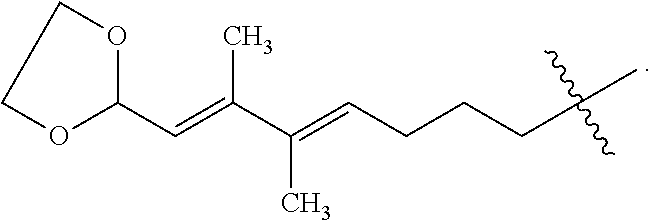


In yet another embodiment, R2 is


and
R2 is

In another embodiment R and R2 are as defined above and R1 is H.


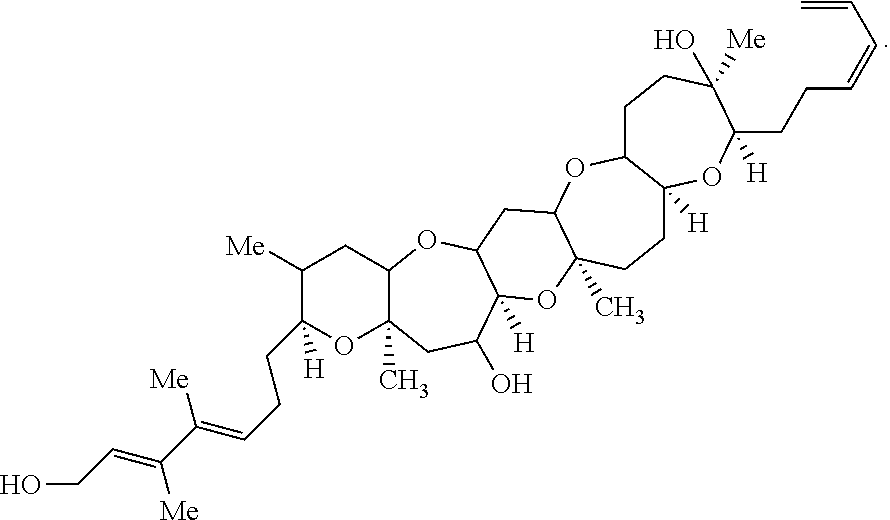


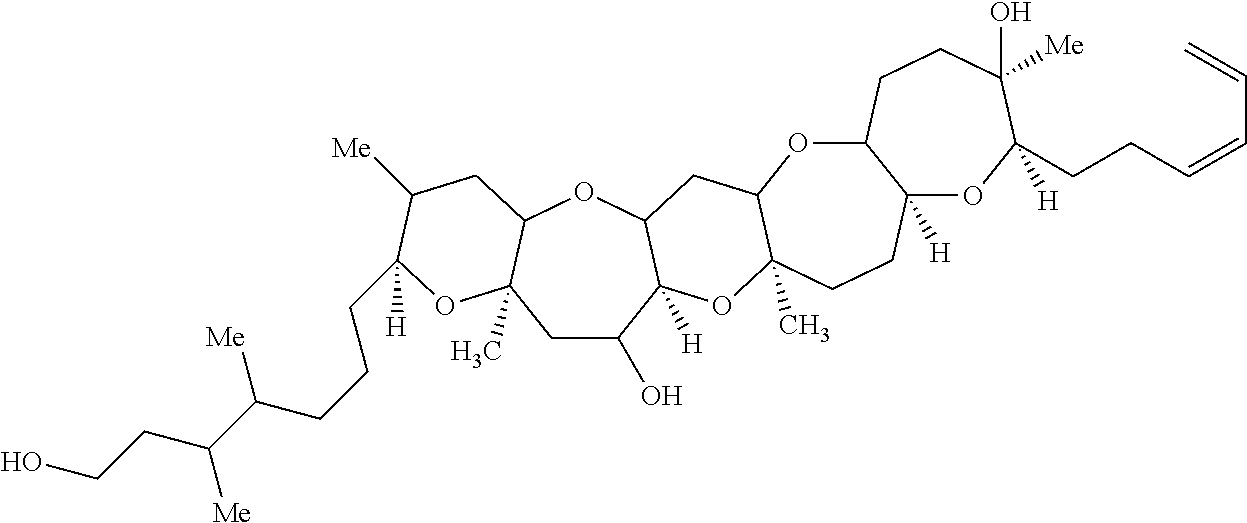


Amiloride Functionalization of Brevenal:

Preparation of Benzamyl Guanidine Brevenal:


B. A one step synthesis can be used to prepare several benzenic compounds. Using a Wittig reaction and commercially available phosphoranes, various derivatives involving a phenyl group can be made. Thus, treatment of phosphoranes 7a-7f with base followed by addition of brevenal furnishes the corresponding ethylenic compounds 8a-bf (scheme 5). Compounds may be further purified by HPLC.


Claims (4)

Priority Applications (2)
| Application Number | Priority Date | Filing Date | Title |
|---|---|---|---|
| US13/356,312 US8609628B2 (en) | 2003-09-19 | 2012-01-23 | Fused pentacyclic polyethers |
| US14/107,715 US9133232B2 (en) | 2003-09-19 | 2013-12-16 | Fused pentacyclic polyethers |
Applications Claiming Priority (5)
| Application Number | Priority Date | Filing Date | Title |
|---|---|---|---|
| US50466903P | 2003-09-19 | 2003-09-19 | |
| US10/945,471 US7202271B2 (en) | 2003-09-19 | 2004-09-20 | Fused pentacyclic polyethers |
| US11/733,601 US7638500B2 (en) | 2003-09-19 | 2007-04-10 | Fused pentacyclic polyethers |
| US12/644,238 US20100099643A1 (en) | 2003-09-19 | 2009-12-22 | Fused Pentacyclic Polyethers |
| US13/356,312 US8609628B2 (en) | 2003-09-19 | 2012-01-23 | Fused pentacyclic polyethers |
Related Parent Applications (1)
| Application Number | Title | Priority Date | Filing Date |
|---|---|---|---|
| US12/644,238 Continuation US20100099643A1 (en) | 2003-09-19 | 2009-12-22 | Fused Pentacyclic Polyethers |
Related Child Applications (1)
| Application Number | Title | Priority Date | Filing Date |
|---|---|---|---|
| US14/107,715 Continuation US9133232B2 (en) | 2003-09-19 | 2013-12-16 | Fused pentacyclic polyethers |
Publications (2)
| Publication Number | Publication Date |
|---|---|
| US20120122810A1 US20120122810A1 (en) | 2012-05-17 |
| US8609628B2 true US8609628B2 (en) | 2013-12-17 |
Family
ID=34375532
Family Applications (5)
| Application Number | Title | Priority Date | Filing Date |
|---|---|---|---|
| US10/945,471 Expired - Lifetime US7202271B2 (en) | 2003-09-19 | 2004-09-20 | Fused pentacyclic polyethers |
| US11/733,601 Expired - Lifetime US7638500B2 (en) | 2003-09-19 | 2007-04-10 | Fused pentacyclic polyethers |
| US12/644,238 Abandoned US20100099643A1 (en) | 2003-09-19 | 2009-12-22 | Fused Pentacyclic Polyethers |
| US13/356,312 Expired - Fee Related US8609628B2 (en) | 2003-09-19 | 2012-01-23 | Fused pentacyclic polyethers |
| US14/107,715 Expired - Lifetime US9133232B2 (en) | 2003-09-19 | 2013-12-16 | Fused pentacyclic polyethers |
Family Applications Before (3)
| Application Number | Title | Priority Date | Filing Date |
|---|---|---|---|
| US10/945,471 Expired - Lifetime US7202271B2 (en) | 2003-09-19 | 2004-09-20 | Fused pentacyclic polyethers |
| US11/733,601 Expired - Lifetime US7638500B2 (en) | 2003-09-19 | 2007-04-10 | Fused pentacyclic polyethers |
| US12/644,238 Abandoned US20100099643A1 (en) | 2003-09-19 | 2009-12-22 | Fused Pentacyclic Polyethers |
Family Applications After (1)
| Application Number | Title | Priority Date | Filing Date |
|---|---|---|---|
| US14/107,715 Expired - Lifetime US9133232B2 (en) | 2003-09-19 | 2013-12-16 | Fused pentacyclic polyethers |
Country Status (16)
| Country | Link |
|---|---|
| US (5) | US7202271B2 (en) |
| EP (1) | EP1664056B1 (en) |
| JP (1) | JP4742040B2 (en) |
| CN (1) | CN1882593B (en) |
| AT (1) | ATE459628T1 (en) |
| AU (1) | AU2004274480B2 (en) |
| CA (1) | CA2539588C (en) |
| DE (1) | DE602004025826D1 (en) |
| DK (1) | DK1664056T3 (en) |
| EA (1) | EA200600599A1 (en) |
| ES (1) | ES2338429T3 (en) |
| IL (1) | IL174368A (en) |
| NZ (1) | NZ546290A (en) |
| PT (1) | PT1664056E (en) |
| SI (1) | SI1664056T1 (en) |
| WO (1) | WO2005028481A2 (en) |
Cited By (1)
| Publication number | Priority date | Publication date | Assignee | Title |
|---|---|---|---|---|
| US20140107060A1 (en) * | 2003-09-19 | 2014-04-17 | University Of North Carolina At Wilmington | Fused Pentacyclic Polyethers |
Families Citing this family (4)
| Publication number | Priority date | Publication date | Assignee | Title |
|---|---|---|---|---|
| EA200600597A1 (en) * | 2003-09-19 | 2006-08-25 | Юниверсити Оф Норт Каролина Эт Вилмингтон | POLYESTER DERIVATIVES OF BREVETOXIN AS A MEANS OF THE TREATMENT OF CYSTIC FIBROSIS, RESTRICTION EPITHELIUM DYSFUNCTION AND LUNG DISEASES |
| FR2948567B1 (en) * | 2009-07-31 | 2017-11-03 | Inst De Rech Pour Le Dev | USE OF ROSMARINIC ACID AND ITS DERIVATIVES TO TREAT CIGUATERA |
| US20120077778A1 (en) * | 2010-09-29 | 2012-03-29 | Andrea Bourdelais | Ladder-Frame Polyether Conjugates |
| CN113801128A (en) * | 2020-06-12 | 2021-12-17 | 南开大学 | Method for preparing polyether with trans-fused polycyclic ether skeleton structure by one-step method |
Citations (5)
| Publication number | Priority date | Publication date | Assignee | Title |
|---|---|---|---|---|
| US4522811A (en) | 1982-07-08 | 1985-06-11 | Syntex (U.S.A.) Inc. | Serial injection of muramyldipeptides and liposomes enhances the anti-infective activity of muramyldipeptides |
| WO2003016353A1 (en) | 2001-08-16 | 2003-02-27 | Japan Science And Technology Corporation | Anti-ciguatoxin monoclonal antibody |
| WO2005027903A1 (en) | 2003-09-19 | 2005-03-31 | Univesity Of North Carolina At | Polyether brevetoxin derivatives as a treatment for neurotoxic shellfish poisoning and ciguatera fish poisoning |
| US20050124686A1 (en) | 2003-09-19 | 2005-06-09 | University Of North Carolina | Polyether brevetoxin derivatives as a treatment for cystic fibrosis, mucociliary dysfunction, and pulmonary diseases |
| US7638500B2 (en) * | 2003-09-19 | 2009-12-29 | University Of North Carolina At Wilmington | Fused pentacyclic polyethers |
-
2004
- 2004-09-20 EA EA200600599A patent/EA200600599A1/en unknown
- 2004-09-20 PT PT04788824T patent/PT1664056E/en unknown
- 2004-09-20 WO PCT/US2004/030535 patent/WO2005028481A2/en not_active Ceased
- 2004-09-20 SI SI200431408T patent/SI1664056T1/en unknown
- 2004-09-20 JP JP2006527065A patent/JP4742040B2/en not_active Expired - Fee Related
- 2004-09-20 DE DE602004025826T patent/DE602004025826D1/en not_active Expired - Lifetime
- 2004-09-20 US US10/945,471 patent/US7202271B2/en not_active Expired - Lifetime
- 2004-09-20 DK DK04788824.3T patent/DK1664056T3/en active
- 2004-09-20 AU AU2004274480A patent/AU2004274480B2/en not_active Ceased
- 2004-09-20 AT AT04788824T patent/ATE459628T1/en active
- 2004-09-20 CN CN2004800341180A patent/CN1882593B/en not_active Expired - Fee Related
- 2004-09-20 EP EP04788824A patent/EP1664056B1/en not_active Expired - Lifetime
- 2004-09-20 CA CA2539588A patent/CA2539588C/en not_active Expired - Fee Related
- 2004-09-20 ES ES04788824T patent/ES2338429T3/en not_active Expired - Lifetime
- 2004-09-20 NZ NZ546290A patent/NZ546290A/en not_active IP Right Cessation
-
2006
- 2006-03-16 IL IL174368A patent/IL174368A/en active IP Right Grant
-
2007
- 2007-04-10 US US11/733,601 patent/US7638500B2/en not_active Expired - Lifetime
-
2009
- 2009-12-22 US US12/644,238 patent/US20100099643A1/en not_active Abandoned
-
2012
- 2012-01-23 US US13/356,312 patent/US8609628B2/en not_active Expired - Fee Related
-
2013
- 2013-12-16 US US14/107,715 patent/US9133232B2/en not_active Expired - Lifetime
Patent Citations (6)
| Publication number | Priority date | Publication date | Assignee | Title |
|---|---|---|---|---|
| US4522811A (en) | 1982-07-08 | 1985-06-11 | Syntex (U.S.A.) Inc. | Serial injection of muramyldipeptides and liposomes enhances the anti-infective activity of muramyldipeptides |
| WO2003016353A1 (en) | 2001-08-16 | 2003-02-27 | Japan Science And Technology Corporation | Anti-ciguatoxin monoclonal antibody |
| WO2005027903A1 (en) | 2003-09-19 | 2005-03-31 | Univesity Of North Carolina At | Polyether brevetoxin derivatives as a treatment for neurotoxic shellfish poisoning and ciguatera fish poisoning |
| US20050124685A1 (en) | 2003-09-19 | 2005-06-09 | University Of North Carolina At Wilmington | Polyether brevetoxin derivatives as a treatment for neurotoxic shellfish poisoning and ciguatera fish poisoning |
| US20050124686A1 (en) | 2003-09-19 | 2005-06-09 | University Of North Carolina | Polyether brevetoxin derivatives as a treatment for cystic fibrosis, mucociliary dysfunction, and pulmonary diseases |
| US7638500B2 (en) * | 2003-09-19 | 2009-12-29 | University Of North Carolina At Wilmington | Fused pentacyclic polyethers |
Non-Patent Citations (61)
| Title |
|---|
| Abraham et al., American Journal of Respiratory and Critical Care Medicine, (2005), vol. 171, pp. 26-34. |
| Abraham et al., American Journal of Respiratory and Critical Care Medicine, 2005, vol. 171, pp. 26-34. |
| Alvarez et al., Chem. Rev. (1995), vol. 95:1953-1980. |
| Alvarez et al., Chem. Rev. 1995, 95:1953-1980. |
| Backer et al., Harmful Algae, (2003), vol. 2:19-28. |
| Backer et al., Harmful Algae, 2003, 2:19-28. |
| Baden et al., "Brevetoxins, Chemistry, Mechanism of Action, and Methods of Detection", Seafood and Freshwater Toxins: Pharmacology, Physiology and Detection (2000), pp. 505-532. |
| Baden et al., Toxicon 1981, 19(4):455-463. |
| Baden et al., Toxicon 1982, 20(5):929-932. |
| Baden, Brevetoxins, Chemistry, Mechanism of Action, and Methods of Detection, pp. 505-532, (2000). |
| Baden, Int. Rev. Cytol. 1983, 82:99-150. |
| Benson et al., J. of Toxicology and Environ. Health, 1999, 56:345-355. |
| Berge et al., J. Pharm. Sci. 1977, 66(1):1-19. |
| Boucher et al., Advanced Drug Delivery Reviews (2002), vol. 54, pp. 1359-1371. |
| Boucher et al., Proceedings of the American Thoracic Society, 2004, vol. 1, pp. 66-70. |
| Bourdelais et al., Cellular and Molecular Neurogiology (2004), 24(4):553-563. |
| Cheng et al., Harmful Algae, (2004), vol. 83, pp. 1-8. |
| Cheng et al., Harmful Algae, 83:1-8, (2004). |
| Conn et al., "Animal Models of Pulmonary Infection in the Compromised Host: Potential Usefulness for Studying Health Effects of Inhaled Particles," vol. 12, pp. 783-827, (2000). |
| Conn et al., "Animal Models of Pulmonry infection in the Compromised Host Potential Usefulness for Studying Health Effects of Inhaled Particles," (2000), vol. 12, pp. 783-827. |
| Craig et al., "Novel Mechanistic Targets for the Treatment of Sub-Acute and Chronic Bronchitis," Current Pharmaceutical Design, vol. 7, pp. 199-212, (2001). |
| Craig Wegner et al., "Novel Mechanistic Targets for the Treatment of Sub-Acute and Chronic Bronchitis," Current Pharmaceutical Design, (2001), vol. 7, pp. 199-212. |
| Dodd et al., Brain Res. 1981, 226(1-2):107-18. |
| Dravid, Journal of Neurochemistry, 2004, 89:739-749. |
| Edwards et al., Molecular Brain Research, 1992, 14:64-70. |
| Gawley et al., Chemistry & Biology Ltd. 1995, 2:533-541. |
| Gould, Int. J. Pharm. 1986, 33:201-217. |
| Hardy et al., J Neurochem. 1983, 40(3):608-14. |
| Hirsh et al., Advanced Drug Delivery Reviews (2002), vol. 54, pp. 1445-1462. |
| International Search Report for related PCT Application No. PCT/US2004/030535. |
| International Search Report for related PCT Application No. PCT/US2004/030637. |
| International Search Report for related PCT Application No. PCT/US2004/030665. |
| Jeglitsch, et al., J. of Pharm. & Experimental Therapeutics, 1998, 284(2):515-525. |
| Keck et al., Tetrahedron Leff. 1987, 28:139-142. |
| Keck et al., Tetrahedron Lett. 1987, 28:139-142. |
| Kimoto et al., "A New, Simple Method for Measuring Mucociliary Clearance in Guinea-pigs," Pulmonary Pharmacology & Therapeutics, (1999), vol. 12, pp. 49-54. |
| Kimoto et al., "A New, Simple Method for Measuring Mucociliary Clearance in Guinea-pigs," Pulmonary Pharmacology & Therapeutics, vol. 12, pp. 49-54, (1999). |
| Kirkpatrick, Harmful Algae, 2004, 3:99-115. |
| Kuipers et al., "Modification of Dendritic Cell Function as a Tool to Prevent and Treat Allergic Asthma," (2005), vol. 23, pp. 4577-4588. |
| Kuipers et al., "Modification of Dendritic Cell Function as a Tool to Prevent and Treat Allergic Asthma," vol. 23, pp. 4577-4588, (2005). |
| Lauredo, et al., Am J. Physiol Lung Cell Mol Physiol, 2004, 286:L734-L740. |
| LePage et al., Brain Research 2003, 959(1):120-127. |
| Liu et al., Tetrahedron Lett., 2000, 56(30):5391-5404. |
| Mall et al., Nature Medicine 2004, 10(5):487-493. |
| Mende et al., Tetrahedron Lett. 1990, 31(37):5307-5310. |
| Naumann et al., "P-glycoprotein Expression Increases ATP Release in Respiratory Cystic Fibrosis Cells," Journal of Cystic Fibrosis, (2005), vol. 4, pp. 157-168. |
| Naumann et al., "P-glycoprotein Expression Increases ATP Release in Respiratory Cystic Fibrosis Cells," Journal of Cystic Fibrosis, vol. 4, pp. 157-168, (2005). |
| Nicolaou et al., J. Am. Chem. Soc. 1995, 117:1171. |
| Poli et al., Journal of AOAC International 1995, 78(2):538-42. |
| Poli et al., Molecular Pharmacology 1986, 30:129-135. |
| Purkerson-Parker et al., 199, 20(6): 909-920, (1999). |
| Purkerson-Parker et al., Chemistry & Biology 2000, 7(6):385-393. |
| Purkerson-Parker et al., NeuroToxicology (1999), vol. 20(6): pp. 909-920. |
| Rein et al., J. Org. Chem. 1994, 59:2101-2106. |
| Rein et al., Journal of Organic Chemistry 1994, 59(8):2107-13. |
| Robers et al., Pulmonary Pharmacology & Therapeutics (2005), vol. 18, pp. 1-8. |
| Trainer et al., Molec. Pharm. 1991, 40(6):988-994. |
| Walsh, Comparative Biochemistry and Physiology Part B, 2003, 136:173-193. |
| Washburn, Toxicon, 1994, 32(7): 799-805. |
| Wegner, Current Pharmaceutical Design, 2001, 7(3):199-212. |
| Whitney, Natural Toxins, 1996, 4:261-270. |
Cited By (2)
| Publication number | Priority date | Publication date | Assignee | Title |
|---|---|---|---|---|
| US20140107060A1 (en) * | 2003-09-19 | 2014-04-17 | University Of North Carolina At Wilmington | Fused Pentacyclic Polyethers |
| US9133232B2 (en) * | 2003-09-19 | 2015-09-15 | University Of North Carolina At Wilmington | Fused pentacyclic polyethers |
Also Published As
| Publication number | Publication date |
|---|---|
| DE602004025826D1 (en) | 2010-04-15 |
| JP2007505924A (en) | 2007-03-15 |
| US9133232B2 (en) | 2015-09-15 |
| US20100099643A1 (en) | 2010-04-22 |
| US20140107060A1 (en) | 2014-04-17 |
| WO2005028481A8 (en) | 2006-06-01 |
| CA2539588C (en) | 2013-07-30 |
| US20120122810A1 (en) | 2012-05-17 |
| US20070179116A1 (en) | 2007-08-02 |
| CA2539588A1 (en) | 2005-03-31 |
| EP1664056A2 (en) | 2006-06-07 |
| WO2005028481A3 (en) | 2005-06-16 |
| DK1664056T3 (en) | 2010-04-26 |
| ES2338429T3 (en) | 2010-05-07 |
| JP4742040B2 (en) | 2011-08-10 |
| IL174368A (en) | 2015-09-24 |
| SI1664056T1 (en) | 2010-07-30 |
| AU2004274480A1 (en) | 2005-03-31 |
| US7638500B2 (en) | 2009-12-29 |
| AU2004274480B2 (en) | 2012-03-01 |
| PT1664056E (en) | 2010-06-04 |
| EP1664056B1 (en) | 2010-03-03 |
| ATE459628T1 (en) | 2010-03-15 |
| EA200600599A1 (en) | 2006-08-25 |
| WO2005028481A2 (en) | 2005-03-31 |
| CN1882593B (en) | 2011-07-06 |
| IL174368A0 (en) | 2006-08-01 |
| US7202271B2 (en) | 2007-04-10 |
| NZ546290A (en) | 2009-09-25 |
| CN1882593A (en) | 2006-12-20 |
| US20050148539A1 (en) | 2005-07-07 |
Similar Documents
| Publication | Publication Date | Title |
|---|---|---|
| US9133232B2 (en) | Fused pentacyclic polyethers | |
| CN113735862A (en) | Nucleoside compound for treating virus infection and application thereof | |
| US20230115107A1 (en) | Novel spiropyrrolidine derived antiviral agents | |
| JP2017510570A (en) | Polymyxin derivatives and their use in combination therapy with different antibiotics | |
| US20090018184A1 (en) | Polyether Brevetoxin Derivatives as a Treatment for Cystic Fibrosis, Mucociliary Dysfunction, and Pulmonary Diseases | |
| US20050124685A1 (en) | Polyether brevetoxin derivatives as a treatment for neurotoxic shellfish poisoning and ciguatera fish poisoning | |
| MXPA06003086A (en) | Fused pentacyclic polyethers | |
| US12577235B2 (en) | Crystalline form of CXCR2 antagonist and application thereof | |
| ES2355950T3 (en) | PENEM PROPHARMS. | |
| US20230068020A1 (en) | Macrolide compound and its use of treatment chronic respiratory disease | |
| CN116143744A (en) | Aromatic ester compound and application thereof | |
| EP0690714A1 (en) | 3-(7-oxo-1-aza-4-oxabicyclo 3.2.0]hept-3-yl) alanine derivative as antitumor agent |
Legal Events
| Date | Code | Title | Description |
|---|---|---|---|
| AS | Assignment |
Owner name: UNIVERSITY OF NORTH CAROLINA AT WILMINGTON, NORTH Free format text: ASSIGNMENT OF ASSIGNORS INTEREST;ASSIGNORS:BADEN, DANIEL G.;ABRAHAM, WILLIAM M.;BOURDELAIS, ANDREA J.;AND OTHERS;SIGNING DATES FROM 20070621 TO 20070629;REEL/FRAME:031601/0523 |
|
| REMI | Maintenance fee reminder mailed | ||
| LAPS | Lapse for failure to pay maintenance fees |
Free format text: PATENT EXPIRED FOR FAILURE TO PAY MAINTENANCE FEES (ORIGINAL EVENT CODE: EXP.) |
|
| PRDP | Patent reinstated due to the acceptance of a late maintenance fee |
Effective date: 20180208 |
|
| FP | Lapsed due to failure to pay maintenance fee |
Effective date: 20171217 |
|
| FEPP | Fee payment procedure |
Free format text: SURCHARGE, PETITION TO ACCEPT PYMT AFTER EXP, UNINTENTIONAL. (ORIGINAL EVENT CODE: M2558); ENTITY STATUS OF PATENT OWNER: SMALL ENTITY Free format text: PETITION RELATED TO MAINTENANCE FEES FILED (ORIGINAL EVENT CODE: PMFP) Free format text: PETITION RELATED TO MAINTENANCE FEES GRANTED (ORIGINAL EVENT CODE: PMFG) |
|
| MAFP | Maintenance fee payment |
Free format text: PAYMENT OF MAINTENANCE FEE, 4TH YR, SMALL ENTITY (ORIGINAL EVENT CODE: M2551) Year of fee payment: 4 |
|
| STCF | Information on status: patent grant |
Free format text: PATENTED CASE |
|
| AS | Assignment |
Owner name: NATIONAL INSTITUTES OF HEALTH (NIH), U.S. DEPT. OF Free format text: CONFIRMATORY LICENSE;ASSIGNOR:UNIVERSITY OF NORTH CAROLINA WILMINGTON;REEL/FRAME:049344/0187 Effective date: 20190522 |
|
| MAFP | Maintenance fee payment |
Free format text: PAYMENT OF MAINTENANCE FEE, 8TH YR, SMALL ENTITY (ORIGINAL EVENT CODE: M2552); ENTITY STATUS OF PATENT OWNER: SMALL ENTITY Year of fee payment: 8 |
|
| CC | Certificate of correction | ||
| FEPP | Fee payment procedure |
Free format text: MAINTENANCE FEE REMINDER MAILED (ORIGINAL EVENT CODE: REM.); ENTITY STATUS OF PATENT OWNER: SMALL ENTITY |
|
| LAPS | Lapse for failure to pay maintenance fees |
Free format text: PATENT EXPIRED FOR FAILURE TO PAY MAINTENANCE FEES (ORIGINAL EVENT CODE: EXP.); ENTITY STATUS OF PATENT OWNER: SMALL ENTITY |
|
| STCH | Information on status: patent discontinuation |
Free format text: PATENT EXPIRED DUE TO NONPAYMENT OF MAINTENANCE FEES UNDER 37 CFR 1.362 |
|
| FP | Lapsed due to failure to pay maintenance fee |
Effective date: 20251217 |