US8606904B2 - Apparatus and method of administering modular online environments - Google Patents
Apparatus and method of administering modular online environments Download PDFInfo
- Publication number
- US8606904B2 US8606904B2 US12/740,483 US74048308A US8606904B2 US 8606904 B2 US8606904 B2 US 8606904B2 US 74048308 A US74048308 A US 74048308A US 8606904 B2 US8606904 B2 US 8606904B2
- Authority
- US
- United States
- Prior art keywords
- module
- users
- instance
- user
- line
- Prior art date
- Legal status (The legal status is an assumption and is not a legal conclusion. Google has not performed a legal analysis and makes no representation as to the accuracy of the status listed.)
- Active, expires
Links
Images




Classifications
-
- G—PHYSICS
- G06—COMPUTING OR CALCULATING; COUNTING
- G06Q—INFORMATION AND COMMUNICATION TECHNOLOGY [ICT] SPECIALLY ADAPTED FOR ADMINISTRATIVE, COMMERCIAL, FINANCIAL, MANAGERIAL OR SUPERVISORY PURPOSES; SYSTEMS OR METHODS SPECIALLY ADAPTED FOR ADMINISTRATIVE, COMMERCIAL, FINANCIAL, MANAGERIAL OR SUPERVISORY PURPOSES, NOT OTHERWISE PROVIDED FOR
- G06Q10/00—Administration; Management
- G06Q10/10—Office automation; Time management
-
- A—HUMAN NECESSITIES
- A63—SPORTS; GAMES; AMUSEMENTS
- A63F—CARD, BOARD, OR ROULETTE GAMES; INDOOR GAMES USING SMALL MOVING PLAYING BODIES; VIDEO GAMES; GAMES NOT OTHERWISE PROVIDED FOR
- A63F13/00—Video games, i.e. games using an electronically generated display having two or more dimensions
- A63F13/30—Interconnection arrangements between game servers and game devices; Interconnection arrangements between game devices; Interconnection arrangements between game servers
- A63F13/35—Details of game servers
-
- A—HUMAN NECESSITIES
- A63—SPORTS; GAMES; AMUSEMENTS
- A63F—CARD, BOARD, OR ROULETTE GAMES; INDOOR GAMES USING SMALL MOVING PLAYING BODIES; VIDEO GAMES; GAMES NOT OTHERWISE PROVIDED FOR
- A63F13/00—Video games, i.e. games using an electronically generated display having two or more dimensions
- A63F13/70—Game security or game management aspects
- A63F13/79—Game security or game management aspects involving player-related data, e.g. identities, accounts, preferences or play histories
- A63F13/795—Game security or game management aspects involving player-related data, e.g. identities, accounts, preferences or play histories for finding other players; for building a team; for providing a buddy list
-
- A—HUMAN NECESSITIES
- A63—SPORTS; GAMES; AMUSEMENTS
- A63F—CARD, BOARD, OR ROULETTE GAMES; INDOOR GAMES USING SMALL MOVING PLAYING BODIES; VIDEO GAMES; GAMES NOT OTHERWISE PROVIDED FOR
- A63F13/00—Video games, i.e. games using an electronically generated display having two or more dimensions
- A63F13/20—Input arrangements for video game devices
- A63F13/21—Input arrangements for video game devices characterised by their sensors, purposes or types
- A63F13/215—Input arrangements for video game devices characterised by their sensors, purposes or types comprising means for detecting acoustic signals, e.g. using a microphone
-
- A—HUMAN NECESSITIES
- A63—SPORTS; GAMES; AMUSEMENTS
- A63F—CARD, BOARD, OR ROULETTE GAMES; INDOOR GAMES USING SMALL MOVING PLAYING BODIES; VIDEO GAMES; GAMES NOT OTHERWISE PROVIDED FOR
- A63F13/00—Video games, i.e. games using an electronically generated display having two or more dimensions
- A63F13/30—Interconnection arrangements between game servers and game devices; Interconnection arrangements between game devices; Interconnection arrangements between game servers
- A63F13/33—Interconnection arrangements between game servers and game devices; Interconnection arrangements between game devices; Interconnection arrangements between game servers using wide area network [WAN] connections
- A63F13/335—Interconnection arrangements between game servers and game devices; Interconnection arrangements between game devices; Interconnection arrangements between game servers using wide area network [WAN] connections using Internet
-
- A—HUMAN NECESSITIES
- A63—SPORTS; GAMES; AMUSEMENTS
- A63F—CARD, BOARD, OR ROULETTE GAMES; INDOOR GAMES USING SMALL MOVING PLAYING BODIES; VIDEO GAMES; GAMES NOT OTHERWISE PROVIDED FOR
- A63F13/00—Video games, i.e. games using an electronically generated display having two or more dimensions
- A63F13/30—Interconnection arrangements between game servers and game devices; Interconnection arrangements between game devices; Interconnection arrangements between game servers
- A63F13/34—Interconnection arrangements between game servers and game devices; Interconnection arrangements between game devices; Interconnection arrangements between game servers using peer-to-peer connections
-
- A—HUMAN NECESSITIES
- A63—SPORTS; GAMES; AMUSEMENTS
- A63F—CARD, BOARD, OR ROULETTE GAMES; INDOOR GAMES USING SMALL MOVING PLAYING BODIES; VIDEO GAMES; GAMES NOT OTHERWISE PROVIDED FOR
- A63F13/00—Video games, i.e. games using an electronically generated display having two or more dimensions
- A63F13/50—Controlling the output signals based on the game progress
- A63F13/53—Controlling the output signals based on the game progress involving additional visual information provided to the game scene, e.g. by overlay to simulate a head-up display [HUD] or displaying a laser sight in a shooting game
- A63F13/533—Controlling the output signals based on the game progress involving additional visual information provided to the game scene, e.g. by overlay to simulate a head-up display [HUD] or displaying a laser sight in a shooting game for prompting the player, e.g. by displaying a game menu
-
- A—HUMAN NECESSITIES
- A63—SPORTS; GAMES; AMUSEMENTS
- A63F—CARD, BOARD, OR ROULETTE GAMES; INDOOR GAMES USING SMALL MOVING PLAYING BODIES; VIDEO GAMES; GAMES NOT OTHERWISE PROVIDED FOR
- A63F13/00—Video games, i.e. games using an electronically generated display having two or more dimensions
- A63F13/70—Game security or game management aspects
- A63F13/79—Game security or game management aspects involving player-related data, e.g. identities, accounts, preferences or play histories
- A63F13/798—Game security or game management aspects involving player-related data, e.g. identities, accounts, preferences or play histories for assessing skills or for ranking players, e.g. for generating a hall of fame
-
- A—HUMAN NECESSITIES
- A63—SPORTS; GAMES; AMUSEMENTS
- A63F—CARD, BOARD, OR ROULETTE GAMES; INDOOR GAMES USING SMALL MOVING PLAYING BODIES; VIDEO GAMES; GAMES NOT OTHERWISE PROVIDED FOR
- A63F2300/00—Features of games using an electronically generated display having two or more dimensions, e.g. on a television screen, showing representations related to the game
- A63F2300/10—Features of games using an electronically generated display having two or more dimensions, e.g. on a television screen, showing representations related to the game characterized by input arrangements for converting player-generated signals into game device control signals
- A63F2300/1081—Input via voice recognition
-
- A—HUMAN NECESSITIES
- A63—SPORTS; GAMES; AMUSEMENTS
- A63F—CARD, BOARD, OR ROULETTE GAMES; INDOOR GAMES USING SMALL MOVING PLAYING BODIES; VIDEO GAMES; GAMES NOT OTHERWISE PROVIDED FOR
- A63F2300/00—Features of games using an electronically generated display having two or more dimensions, e.g. on a television screen, showing representations related to the game
- A63F2300/30—Features of games using an electronically generated display having two or more dimensions, e.g. on a television screen, showing representations related to the game characterized by output arrangements for receiving control signals generated by the game device
- A63F2300/308—Details of the user interface
-
- A—HUMAN NECESSITIES
- A63—SPORTS; GAMES; AMUSEMENTS
- A63F—CARD, BOARD, OR ROULETTE GAMES; INDOOR GAMES USING SMALL MOVING PLAYING BODIES; VIDEO GAMES; GAMES NOT OTHERWISE PROVIDED FOR
- A63F2300/00—Features of games using an electronically generated display having two or more dimensions, e.g. on a television screen, showing representations related to the game
- A63F2300/40—Features of games using an electronically generated display having two or more dimensions, e.g. on a television screen, showing representations related to the game characterised by details of platform network
- A63F2300/407—Data transfer via internet
-
- A—HUMAN NECESSITIES
- A63—SPORTS; GAMES; AMUSEMENTS
- A63F—CARD, BOARD, OR ROULETTE GAMES; INDOOR GAMES USING SMALL MOVING PLAYING BODIES; VIDEO GAMES; GAMES NOT OTHERWISE PROVIDED FOR
- A63F2300/00—Features of games using an electronically generated display having two or more dimensions, e.g. on a television screen, showing representations related to the game
- A63F2300/40—Features of games using an electronically generated display having two or more dimensions, e.g. on a television screen, showing representations related to the game characterised by details of platform network
- A63F2300/408—Peer to peer connection
-
- A—HUMAN NECESSITIES
- A63—SPORTS; GAMES; AMUSEMENTS
- A63F—CARD, BOARD, OR ROULETTE GAMES; INDOOR GAMES USING SMALL MOVING PLAYING BODIES; VIDEO GAMES; GAMES NOT OTHERWISE PROVIDED FOR
- A63F2300/00—Features of games using an electronically generated display having two or more dimensions, e.g. on a television screen, showing representations related to the game
- A63F2300/50—Features of games using an electronically generated display having two or more dimensions, e.g. on a television screen, showing representations related to the game characterized by details of game servers
-
- A—HUMAN NECESSITIES
- A63—SPORTS; GAMES; AMUSEMENTS
- A63F—CARD, BOARD, OR ROULETTE GAMES; INDOOR GAMES USING SMALL MOVING PLAYING BODIES; VIDEO GAMES; GAMES NOT OTHERWISE PROVIDED FOR
- A63F2300/00—Features of games using an electronically generated display having two or more dimensions, e.g. on a television screen, showing representations related to the game
- A63F2300/50—Features of games using an electronically generated display having two or more dimensions, e.g. on a television screen, showing representations related to the game characterized by details of game servers
- A63F2300/53—Features of games using an electronically generated display having two or more dimensions, e.g. on a television screen, showing representations related to the game characterized by details of game servers details of basic data processing
- A63F2300/531—Server assignment
-
- A—HUMAN NECESSITIES
- A63—SPORTS; GAMES; AMUSEMENTS
- A63F—CARD, BOARD, OR ROULETTE GAMES; INDOOR GAMES USING SMALL MOVING PLAYING BODIES; VIDEO GAMES; GAMES NOT OTHERWISE PROVIDED FOR
- A63F2300/00—Features of games using an electronically generated display having two or more dimensions, e.g. on a television screen, showing representations related to the game
- A63F2300/50—Features of games using an electronically generated display having two or more dimensions, e.g. on a television screen, showing representations related to the game characterized by details of game servers
- A63F2300/53—Features of games using an electronically generated display having two or more dimensions, e.g. on a television screen, showing representations related to the game characterized by details of game servers details of basic data processing
- A63F2300/535—Features of games using an electronically generated display having two or more dimensions, e.g. on a television screen, showing representations related to the game characterized by details of game servers details of basic data processing for monitoring, e.g. of user parameters, terminal parameters, application parameters, network parameters
-
- A—HUMAN NECESSITIES
- A63—SPORTS; GAMES; AMUSEMENTS
- A63F—CARD, BOARD, OR ROULETTE GAMES; INDOOR GAMES USING SMALL MOVING PLAYING BODIES; VIDEO GAMES; GAMES NOT OTHERWISE PROVIDED FOR
- A63F2300/00—Features of games using an electronically generated display having two or more dimensions, e.g. on a television screen, showing representations related to the game
- A63F2300/50—Features of games using an electronically generated display having two or more dimensions, e.g. on a television screen, showing representations related to the game characterized by details of game servers
- A63F2300/55—Details of game data or player data management
- A63F2300/5546—Details of game data or player data management using player registration data, e.g. identification, account, preferences, game history
- A63F2300/5553—Details of game data or player data management using player registration data, e.g. identification, account, preferences, game history user representation in the game field, e.g. avatar
-
- A—HUMAN NECESSITIES
- A63—SPORTS; GAMES; AMUSEMENTS
- A63F—CARD, BOARD, OR ROULETTE GAMES; INDOOR GAMES USING SMALL MOVING PLAYING BODIES; VIDEO GAMES; GAMES NOT OTHERWISE PROVIDED FOR
- A63F2300/00—Features of games using an electronically generated display having two or more dimensions, e.g. on a television screen, showing representations related to the game
- A63F2300/50—Features of games using an electronically generated display having two or more dimensions, e.g. on a television screen, showing representations related to the game characterized by details of game servers
- A63F2300/55—Details of game data or player data management
- A63F2300/5546—Details of game data or player data management using player registration data, e.g. identification, account, preferences, game history
- A63F2300/556—Player lists, e.g. online players, buddy list, black list
-
- A—HUMAN NECESSITIES
- A63—SPORTS; GAMES; AMUSEMENTS
- A63F—CARD, BOARD, OR ROULETTE GAMES; INDOOR GAMES USING SMALL MOVING PLAYING BODIES; VIDEO GAMES; GAMES NOT OTHERWISE PROVIDED FOR
- A63F2300/00—Features of games using an electronically generated display having two or more dimensions, e.g. on a television screen, showing representations related to the game
- A63F2300/50—Features of games using an electronically generated display having two or more dimensions, e.g. on a television screen, showing representations related to the game characterized by details of game servers
- A63F2300/55—Details of game data or player data management
- A63F2300/5546—Details of game data or player data management using player registration data, e.g. identification, account, preferences, game history
- A63F2300/5566—Details of game data or player data management using player registration data, e.g. identification, account, preferences, game history by matching opponents or finding partners to build a team, e.g. by skill level, geographical area, background, play style
-
- A—HUMAN NECESSITIES
- A63—SPORTS; GAMES; AMUSEMENTS
- A63F—CARD, BOARD, OR ROULETTE GAMES; INDOOR GAMES USING SMALL MOVING PLAYING BODIES; VIDEO GAMES; GAMES NOT OTHERWISE PROVIDED FOR
- A63F2300/00—Features of games using an electronically generated display having two or more dimensions, e.g. on a television screen, showing representations related to the game
- A63F2300/50—Features of games using an electronically generated display having two or more dimensions, e.g. on a television screen, showing representations related to the game characterized by details of game servers
- A63F2300/55—Details of game data or player data management
- A63F2300/5546—Details of game data or player data management using player registration data, e.g. identification, account, preferences, game history
- A63F2300/558—Details of game data or player data management using player registration data, e.g. identification, account, preferences, game history by assessing the players' skills or ranking
Definitions
- the present invention relates to an apparatus and method of administering modular online environments.
- One solution is to provide an overarching social structure by the provision of an external ‘friends’ management system, which can search for established friends in any online game that supports this feature.
- an external ‘friends’ management system can search for established friends in any online game that supports this feature.
- Such a system can be found, for example, in Xbox live (http://www.xbox.com/en-US/live/features/friendslist.htm).
- the present invention seeks to mitigate or alleviate the above problem.
- a server is arranged to administer a modular on-line virtual environment wherein each module of the on-line virtual environment has a plurality of parallel instances each able to host a limited number of users.
- the server comprises a network communications arrangement operable to receive data representative of the actions of users within an instance of a first module of the modular on-line virtual environment, and to transmit to each user within that instance of that module data representative of the actions of each other user within that instance of that module, behavior analysis means operable to analyze user behavior within that instance of the first module, in which if the behavior of two or more users satisfies a predetermined criterion then the two or more users are classified as belonging to a social group comprising the two or more users, module instance selection means operable to select an instance of a second module for a user when that user moves within the modular on-line virtual environment from the first module to a second module in which the module instance selection means is operable to select an instance of the second module that has the capacity to accommodate one or more further members of
- an entertainment device for interaction with a modular on-line virtual environment, wherein each module of the on-line virtual environment has a plurality of parallel instances each able to host a limited number of users.
- the entertainment device comprises a display generator arranged to generate for display a representation of an instance of a first module of the on-line virtual environment, that instance of the first module of the on-line virtual environment being able to host interactions between a user of the entertainment device and other users of one or more remote entertainment devices, a network communications arrangement operable to receive data representative of the actions of the other users within that instance of the first module of the on-line virtual environment, behavior analysis means operable to analyze user behavior within that instance of the first module, in which if the behavior of the user of the entertainment device and one or more other users of respective remote entertainment devices satisfies a predetermined criterion then these two or more users are classified as belonging to a social group comprising the two or more users, and the network communications arrangement is operable to transmit to a server administering that
- users can remain together as they are moved within a modular virtual environment, without having to explicitly declare a wish to do so.
- users can more easily develop associations and friendships with each other during an on-line encounter.
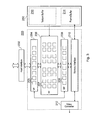
- FIG. 1 is a schematic diagram of an entertainment device
- FIG. 2 is a schematic diagram of a cell processor
- FIG. 3 is a schematic diagram of a video graphics processor
- FIG. 4 is a schematic diagram of an interconnected set of game zones in accordance with an embodiment of the present invention.
- FIG. 5 is a schematic diagram of a Home environment online client/server arrangement in accordance with an embodiment of the present invention.
- FIG. 6 a is a schematic diagram of a lobby zone in accordance with an embodiment of the present invention.
- FIG. 6 b is a schematic diagram of a lobby zone in accordance with an embodiment of the present invention.
- FIG. 6 c is a schematic diagram of a cinema zone in accordance with an embodiment of the present invention.
- FIG. 6 d is a schematic diagram of a developer/publisher zone in accordance with an embodiment of the present invention.
- FIG. 7 is a flow diagram of a method of on-line transaction in accordance with an embodiment of the present invention.
- FIG. 8 a is schematic diagram of an apartment zone in accordance with an embodiment of the present invention.
- FIG. 8 b is schematic diagram of a trophy room zone in accordance with an embodiment of the present invention.
- FIG. 9 is a schematic diagram of a communication menu in accordance with an embodiment of the present invention.
- FIG. 10 is a schematic diagram of an interactive virtual user device in accordance with an embodiment of the present invention.
- FIGS. 11A , B are schematic diagrams of social groups within a modular on-line environment
- FIG. 12 is a flow diagram of a method of administering a modular on-line environment in accordance with an embodiment of the present invention.
- FIG. 13 is a flow diagram of a method of interacting with a modular on-line environment in accordance with an embodiment of the present invention.
- a modular virtual environment comprises a plurality of separately realizable zones.
- Each zone can support a maximum of, for example, 64 users. Therefore to accommodate potentially many tens of thousands of users, multiple instances of each zone are hosted in parallel.
- a user interacting with other users in an instance of a first zone, may wish to enter a second zone—for example in order to play a game featured there with some or all of the other users they were interacting with.
- the users each represented by a respective avatar within the virtual environment, walk to an exit that automatically takes them to the second zone.
- the server that is hosting the modular virtual environment monitors such transitions between zones, and detects that a number of avatars have all left an instance of the first zone within a threshold time period.
- the server treats these avatars as a potential social group, and identifies an instance of the second zone that has sufficient capacity to accommodate all of these avatars. As a result, the potential social group is not split up by moving between instances of zones within the modular environment.
- users interact with each other using respective entertainment devices that are connected to the hosting server (and hence the virtual environment) via a network link.
- the entertainment device is a Sony® Playstation 3® (or ‘PS3’®) entertainment device.
- FIG. 1 schematically illustrates the overall system architecture of the Sony® Playstation 3® entertainment device.
- a system unit 10 is provided, with various peripheral devices connectable to the system unit.
- the system unit 10 comprises: a Cell processor 100 ; a Rambus® dynamic random access memory (XDRAM) unit 500 ; a Reality Synthesizer graphics unit 200 with a dedicated video random access memory (VRAM) unit 250 ; and an I/O bridge 700 .
- XDRAM Rambus® dynamic random access memory
- VRAM dedicated video random access memory
- the system unit 10 also comprises a Blu Ray® Disk BD-ROM® optical disk reader 430 for reading from a disk 440 and a removable slot-in hard disk drive (HDD) 400 , accessible through the I/O bridge 700 .
- the system unit also comprises a memory card reader 450 for reading compact flash memory cards, Memory Stick® memory cards and the like, which is similarly accessible through the I/O bridge 700 .
- the I/O bridge 700 also connects to four Universal Serial Bus (USB) 2.0 ports 710 ; a gigabit Ethernet port 720 ; an IEEE 802.11b/g wireless network (Wi-Fi) port 730 ; and a Bluetooth® wireless link port 740 capable of supporting up to seven Bluetooth connections.
- USB Universal Serial Bus
- Wi-Fi IEEE 802.11b/g wireless network
- the I/O bridge 700 handles all wireless, USB and Ethernet data, including data from one or more game controllers 751 .
- the I/O bridge 700 receives data from the game controller 751 via a Bluetooth link and directs it to the Cell processor 100 , which updates the current state of the game accordingly.
- the wireless, USB and Ethernet ports also provide connectivity for other peripheral devices in addition to game controllers 751 , such as: a remote control 752 ; a keyboard 753 ; a mouse 754 ; a portable entertainment device 755 such as a Sony Playstation Portable® entertainment device; a video camera such as an EyeToy® video camera 756 ; and a microphone headset 757 .
- peripheral devices may therefore in principle be connected to the system unit 10 wirelessly; for example the portable entertainment device 755 may communicate via a Wi-Fi ad-hoc connection, whilst the microphone headset 757 may communicate via a Bluetooth link.
- Playstation 3 device is also potentially compatible with other peripheral devices such as digital video recorders (DVRs), set-top boxes, digital cameras, portable media players, Voice over IP telephones, mobile telephones, printers and scanners.
- DVRs digital video recorders
- set-top boxes digital cameras
- portable media players Portable media players
- Voice over IP telephones mobile telephones, printers and scanners.
- a legacy memory card reader 410 may be connected to the system unit via a USB port 710 , enabling the reading of memory cards 420 of the kind used by the Playstation® or Playstation 2® devices.
- the game controller 751 is operable to communicate wirelessly with the system unit 10 via the Bluetooth link.
- the game controller 751 can instead be connected to a USB port, thereby also providing power by which to charge the battery of the game controller 751 .
- the game controller is sensitive to motion in 6 degrees of freedom, corresponding to translation and rotation in each axis. Consequently gestures and movements by the user of the game controller may be translated as inputs to a game in addition to or instead of conventional button or joystick commands.
- other wirelessly enabled peripheral devices such as the Playstation Portable device may be used as a controller.
- additional game or control information may be provided on the screen of the device.
- Other alternative or supplementary control devices may also be used, such as a dance mat (not shown), a light gun (not shown), a steering wheel and pedals (not shown) or bespoke controllers, such as a single or several large buttons for a rapid-response quiz game (also not shown).
- the remote control 752 is also operable to communicate wirelessly with the system unit 10 via a Bluetooth link.
- the remote control 752 comprises controls suitable for the operation of the Blu Ray Disk BD-ROM reader 430 and for the navigation of disk content.
- the Blu Ray Disk BD-ROM reader 430 is operable to read CD-ROMs compatible with the Playstation and PlayStation 2 devices, in addition to conventional pre-recorded and recordable CDs, and so-called Super Audio CDs.
- the reader 430 is also operable to read DVD-ROMs compatible with the Playstation 2 and PlayStation 3 devices, in addition to conventional pre-recorded and recordable DVDs.
- the reader 430 is further operable to read BD-ROMs compatible with the Playstation 3 device, as well as conventional pre-recorded and recordable Blu-Ray Disks.
- the system unit 10 is operable to supply audio and video, either generated or decoded by the Playstation 3 device via the Reality Synthesizer graphics unit 200 , through audio and video connectors to a display and sound output device 300 such as a monitor or television set having a display 305 and one or more loudspeakers 310 .
- the audio connectors 210 may include conventional analogue and digital outputs whilst the video connectors 220 may variously include component video, S-video, composite video and one or more High Definition Multimedia Interface (HDMI) outputs. Consequently, video output may be in formats such as PAL or NTSC, or in 720p, 1080i or 1080p high definition.
- Audio processing (generation, decoding and so on) is performed by the Cell processor 100 .
- the Playstation 3 device's operating system supports Dolby® 5.1 surround sound, Dolby® Theatre Surround (DTS), and the decoding of 7.1 surround sound from Blu-Ray® disks.
- DTS Dolby® Theatre Surround
- the video camera 756 comprises a single charge coupled device (CCD), an LED indicator, and hardware-based real-time data compression and encoding apparatus so that compressed video data may be transmitted in an appropriate format such as an intra-image based MPEG (motion picture expert group) standard for decoding by the system unit 10 .
- the camera LED indicator is arranged to illuminate in response to appropriate control data from the system unit 10 , for example to signify adverse lighting conditions.
- Embodiments of the video camera 756 may variously connect to the system unit 10 via a USB, Bluetooth or Wi-Fi communication port.
- Embodiments of the video camera may include one or more associated microphones and also be capable of transmitting audio data.
- the CCD may have a resolution suitable for high-definition video capture. In use, images captured by the video camera may for example be incorporated within a game or interpreted as game control inputs.
- a peripheral device such as a video camera or remote control via one of the communication ports of the system unit 10
- an appropriate piece of software such as a device driver should be provided.
- Device driver technology is well-known and will not be described in detail here, except to say that the skilled man will be aware that a device driver or similar software interface may be required in the present embodiment described.
- the Cell processor 100 has an architecture comprising four basic components: external input and output structures comprising a memory controller 160 and a dual bus interface controller 170 A,B; a main processor referred to as the Power Processing Element 150 ; eight co-processors referred to as Synergistic Processing Elements (SPEs) 110 A-H; and a circular data bus connecting the above components referred to as the Element Interconnect Bus 180 .
- the total floating point performance of the Cell processor is 218 GFLOPS, compared with the 6.2 GFLOPs of the Playstation 2 device's Emotion Engine.
- the Power Processing Element (PPE) 150 is based upon a two-way simultaneous multithreading Power 970 compliant PowerPC core (PPU) 155 running with an internal clock of 3.2 GHz. It comprises a 512 kB level 2 (L2) cache and a 32 kB level 1 (L1) cache.
- the PPE 150 is capable of eight single position operations per clock cycle, translating to 25.6 GFLOPs at 3.2 GHz.
- the primary role of the PPE 150 is to act as a controller for the Synergistic Processing Elements 110 A-H, which handle most of the computational workload. In operation the PPE 150 maintains a job queue, scheduling jobs for the Synergistic Processing Elements 110 A-H and monitoring their progress. Consequently each Synergistic Processing Element 110 A-H runs a kernel whose role is to fetch a job, execute it and synchronies with the PPE 150 .
- Each Synergistic Processing Element (SPE) 110 A-H comprises a respective Synergistic Processing Unit (SPU) 120 A-H, and a respective Memory Flow Controller (MFC) 140 A-H comprising in turn a respective Dynamic Memory Access Controller (DMAC) 142 A-H, a respective Memory Management Unit (MMU) 144 A-H and a bus interface (not shown).
- SPU 120 A-H is a RISC processor clocked at 3.2 GHz and comprising 256 kB local RAM 130 A-H, expandable in principle to 4 GB.
- Each SPE gives a theoretical 25.6 GFLOPS of single precision performance.
- An SPU can operate on 4 single precision floating point members, 4 32-bit numbers, 8 16-bit integers, or 16 8-bit integers in a single clock cycle. In the same clock cycle it can also perform a memory operation.
- the SPU 120 A-H does not directly access the system memory XDRAM 500 ; the 64-bit addresses formed by the SPU 120 A-H are passed to the MFC 140 A-H which instructs its DMA controller 142 A-H to access memory via the Element Interconnect Bus 180 and the memory controller 160 .
- the Element Interconnect Bus (EIB) 180 is a logically circular communication bus internal to the Cell processor 100 which connects the above processor elements, namely the PPE 150 , the memory controller 160 , the dual bus interface 170 A,B and the 8 SPEs 110 A-H, totaling 12 participants. Participants can simultaneously read and write to the bus at a rate of 8 bytes per clock cycle. As noted previously, each SPE 110 A-H comprises a DMAC 142 A-H for scheduling longer read or write sequences.
- the EIB comprises four channels, two each in clockwise and anti-clockwise directions. Consequently for twelve participants, the longest step-wise data-flow between any two participants is six steps in the appropriate direction.
- the theoretical peak instantaneous EIB bandwidth for 12 slots is therefore 96 B per clock, in the event of full utilization through arbitration between participants. This equates to a theoretical peak bandwidth of 307.2 GB/s (gigabytes per second) at a clock rate of 3.2 GHz.
- the memory controller 160 comprises an XDRAM interface 162 , developed by Rambus Incorporated.
- the memory controller interfaces with the Rambus XDRAM 500 with a theoretical peak bandwidth of 25.6 GB/s.
- the dual bus interface 170 A,B comprises a Rambus FlexIO® system interface 172 A,B.
- the interface is organized into 12 channels each being 8 bits wide, with five paths being inbound and seven outbound. This provides a theoretical peak bandwidth of 62.4 GB/s (36.4 GB/s outbound, 26 GB/s inbound) between the Cell processor and the I/O Bridge 700 via controller 170 A and the Reality Simulator graphics unit 200 via controller 170 B.
- Data sent by the Cell processor 100 to the Reality Simulator graphics unit 200 will typically comprise display lists, being a sequence of commands to draw vertices, apply textures to polygons, specify lighting conditions, and so on.
- the Reality Simulator graphics (RSX) unit 200 is a video accelerator based upon the NVidia® G70/71 architecture that processes and renders lists of commands produced by the Cell processor 100 .
- the RSX unit 200 comprises a host interface 202 operable to communicate with the bus interface controller 170 B of the Cell processor 100 ; a vertex pipeline 204 (VP) comprising eight vertex shaders 205 ; a pixel pipeline 206 (PP) comprising 24 pixel shaders 207 ; a render pipeline 208 (RP) comprising eight render output units (ROPs) 209 ; a memory interface 210 ; and a video converter 212 for generating a video output.
- VP vertex pipeline 204
- PP pixel pipeline 206
- RP render pipeline 208
- ROPs render output units
- the RSX 200 is complemented by 256 MB double data rate (DDR) video RAM (VRAM) 250 , clocked at 600 MHz and operable to interface with the RSX 200 at a theoretical peak bandwidth of 25.6 GB/s.
- the VRAM 250 maintains a frame buffer 214 and a texture buffer 216 .
- the texture buffer 216 provides textures to the pixel shaders 207 , whilst the frame buffer 214 stores results of the processing pipelines.
- the RSX can also access the main memory 500 via the EIB 180 , for example to load textures into the VRAM 250 .
- the vertex pipeline 204 primarily processes deformations and transformations of vertices defining polygons within the image to be rendered.
- the pixel pipeline 206 primarily processes the application of color, textures and lighting to these polygons, including any pixel transparency, generating red, green, blue and alpha (transparency) values for each processed pixel.
- Texture mapping may simply apply a graphic image to a surface, or may include bump-mapping (in which the notional direction of a surface is perturbed in accordance with texture values to create highlights and shade in the lighting model) or displacement mapping (in which the applied texture additionally perturbs vertex positions to generate a deformed surface consistent with the texture).
- the render pipeline 208 performs depth comparisons between pixels to determine which should be rendered in the final image.
- the render pipeline and vertex pipeline 204 can communicate depth information between them, thereby enabling the removal of occluded elements prior to pixel processing, and so improving overall rendering efficiency.
- the render pipeline 208 also applies subsequent effects such as full-screen anti-aliasing over the resulting image.
- Both the vertex shaders 205 and pixel shaders 207 are based on the shader model 3.0 standard. Up to 136 shader operations can be performed per clock cycle, with the combined pipeline therefore capable of 74.8 billion shader operations per second, outputting up to 840 million vertices and 10 billion pixels per second.
- the total floating point performance of the RSX 200 is 1.8 TFLOPS.
- the RSX 200 operates in close collaboration with the Cell processor 100 ; for example, when displaying an explosion, or weather effects such as rain or snow, a large number of particles must be tracked, updated and rendered within the scene.
- the PPU 155 of the Cell processor may schedule one or more SPEs 110 A-H to compute the trajectories of respective batches of particles.
- the RSX 200 accesses any texture data (e.g. snowflakes) not currently held in the video RAM 250 from the main system memory 500 via the element interconnect bus 180 , the memory controller 160 and a bus interface controller 170 B.
- the or each SPE 110 A-H outputs its computed particle properties (typically coordinates and normals, indicating position and attitude) directly to the video RAM 250 ; the DMA controller 142 A-H of the or each SPE 110 A-H addresses the video RAM 250 via the bus interface controller 170 B.
- the assigned SPEs become part of the video processing pipeline for the duration of the task.
- the PPU 155 can assign tasks in this fashion to six of the eight SPEs available; one SPE is reserved for the operating system, whilst one SPE is effectively disabled.
- the disabling of one SPE provides a greater level of tolerance during fabrication of the Cell processor, as it allows for one SPE to fail the fabrication process.
- the eighth SPE provides scope for redundancy in the event of subsequent failure by one of the other SPEs during the life of the Cell processor.
- the PPU 155 can assign tasks to SPEs in several ways. For example, SPEs may be chained together to handle each step in a complex operation, such as accessing a DVD, video and audio decoding, and error masking, with each step being assigned to a separate SPE. Alternatively or in addition, two or more SPEs may be assigned to operate on input data in parallel, as in the particle animation example above.
- Software instructions implemented by the Cell processor 100 and/or the RSX 200 may be supplied at manufacture and stored on the HDD 400 , and/or may be supplied on a data carrier or storage medium such as an optical disk or solid state memory, or via a transmission medium such as a wired or wireless network or internet connection, or via combinations of these.
- the software supplied at manufacture comprises system firmware and the Playstation 3 device's operating system (OS).
- the OS provides a user interface enabling a user to select from a variety of functions, including playing a game, listening to music, viewing photographs, or viewing a video.
- the interface takes the form of a so-called cross media-bar (XMB), with categories of function arranged horizontally.
- XMB cross media-bar
- the user navigates by moving through the function icons (representing the functions) horizontally using the game controller 751 , remote control 752 or other suitable control device so as to highlight a desired function icon, at which point options pertaining to that function appear as a vertically scrollable list of option icons centered on that function icon, which may be navigated in analogous fashion.
- the Playstation 3 device may select appropriate options automatically (for example, by commencing the game), or may provide relevant options (for example, to select between playing an audio disk or compressing its content to the HDD 400 ).
- the OS provides an on-line capability, including a web browser, an interface with an on-line store from which additional game content, demonstration games (demos) and other media may be downloaded, and a friends management capability, providing on-line communication with other Playstation 3 device users nominated by the user of the current device; for example, by text, audio or video depending on the peripheral devices available.
- the on-line capability also provides for on-line communication, content download and content purchase during play of a suitably configured game, and for updating the firmware and OS of the Playstation 3 device itself. It will be appreciated that the term “on-line” does not imply the physical presence of wires, as the term can also apply to wireless connections of various types.
- the above-mentioned online capability comprises interaction with a virtual environment populated by avatars (graphical representations) of the user of the PS3 10 and of other PS3 users who are currently online.
- the software to enable the virtual interactive environment is typically resident on the HDD 400 , and can be upgraded and/or expanded by software that is downloaded, or stored on optical disk 440 , or accessed by any other suitable means.
- the software may reside on a flash memory card 420 , optical disk 440 or a central server (not shown).
- the virtual interactive environment (hereafter called the ‘Home’ environment) is selected from the cross-media bar.
- the Home environment then starts in a conventional manner similar to a 3D video game by loading and executing control software, loading 3D models and textures into video memory 250 , and rendering scenes depicting the Home environment.
- the Home environment can be initiated by other programs, such as a separate game.
- FIG. 4 which displays a notional map of the Home environment
- FIG. 5 which is a schematic diagram of a Home environment online client/server arrangement
- the user's avatar is spawned within a lobby zone 1010 by default.
- a user can select among other zones 1010 - 1060 (detailed below) of the map, causing the selected zone to be loaded and the avatar to be spawned within that zone.
- the map screen further comprises a sidebar on which the available zones may be listed, together with management tools such as a ranking option, enabling zones to be listed in order of user preference, or such as most recently added and/or A-Z listings.
- a search interface may allow the user to search for a zone by name.
- the lobby zone 1010 typically resembles a covered piazza, and may comprise parkland (grass, trees, sculptures etc.), and gathering spaces (such as open areas, single benches or rows of seats etc.) where users can meet through their avatars.
- parkland grass, trees, sculptures etc.
- gathering spaces such as open areas, single benches or rows of seats etc.
- the lobby zone 1010 typically also comprises advertisement hoardings, for displaying either still or moving adverts for games or other content or products. These may be on the walls of the lobby, or may stand alone.
- the lobby zone 1010 may also include an open-air cinema 1012 showing trailers, high-profile adverts or other content from third-party providers. Such content is typically streamed or downloaded from a Home environment server 2010 to which the PS3 10 connects when the Home environment is loaded, as described in more detail later.
- the cinema screen is accompanied by seating for avatars in front of it, such that when an avatar sits down, the camera angle perceived by the user of the avatar also encompasses the screen.
- the lobby zone 1010 may also include general amusements 1014 , such as functioning pool tables, bowling alleys, and/or a video arcade. Games of pool or bowling may be conducted via the avatar, such that the avatar holds the pool cue or bowling ball, and is controlled in a conventional manner for such games.
- the Home environment may switch to a substantially full-screen representation of the videogame selected.
- Such games may, for example, be classic arcade or console games such as Space Invaders®, or Pac-Man®, which are comparatively small in terms of memory and processing and can be emulated by the PS3 within the Home environment or run as plug-ins to the Home environment.
- user-created game content may be featured on one or more of the virtual video game machines. Such content may be the subject of on-line competitions to be featured in such a manner, with new winning content downloaded on a regular basis.
- zones 1020 , 1030 , 1040 , 1050 and 1060 which may be rooms, areas or other constructs
- zones 1020 , 1030 , 1040 , 1050 and 1060 which may be rooms, areas or other constructs
- zones 1020 , 1030 , 1040 , 1050 and 1060 which may be rooms, areas or other constructs
- zones 1050 and 1060 which may be rooms, areas or other constructs
- These may be accessed either via a map screen similar in nature to that of FIG. 4 , or alternatively the user can walk to these other areas by guiding their avatar to various exits 1016 from the lobby.
- an exit 1016 takes the form of a tunnel or corridor (but may equally take the form of an anteroom) to the next area. While the avatar is within the tunnel or anteroom, the next zone is loaded into memory. Both the lobby and the next zone contain identical models of the tunnel or anteroom, or the model is a common resource to both. In either case, the user's avatar is relocated from the lobby-based version to the new zone-based version of the tunnel or anteroom at the same position. In this way the user's avatar can apparently walk seamlessly throughout the Home environment, without the need to retain the whole environment in memory at the same time.
- the Cinema zone 1020 resembles a multiplex cinema, comprising a plurality of screens that may show content such as trailers, movies, TV programmes, or adverts downloaded or streamed from a Home environment server 2010 as noted previously and detailed below, or may show content stored on the HDD 400 or on an optical disk 440 , such as a Blu-Ray disk.
- the multiplex cinema will have an entrance area featuring a screen 1022 on which high-profile trailers and adverts may be shown to all visitors, together with poster adverts 1024 , typically but not limited to featuring upcoming movies.
- Specific screens and the selection and display of the trailers and posters can each be restricted according to the age of the user, as registered with the PS3. This age restriction can be applied to any displayed content to which an age restriction tag is associated, in any of the zones within the Home environment.
- the multiplex cinema provides a number of screen rooms in which featured content is available, and amongst which the user can select.
- a screen room downloaded, streamed or locally stored media can be played within a virtual cinema environment, in which the screen is set in a room with rows of seats, screen curtains, etc.
- the cinema is potentially available to all users in the Home environment, and so the avatars of other users may also be visible, for example watching commonly streamed material such as a web broadcast.
- the user can zoom in so that the screen occupies the full viewing area.
- zone 1030 another type of zone is a developer or publisher zone 1030 .
- each may have its own exit from the lobby area 1010 , or alternatively some or all may share an exit from the lobby and then have separate exits from within a tunnel or ante-room model common to or replicated by each available zone therein.
- such zones may be selected via the map screen, resulting in the zone being loaded in to memory, and the avatar re-spawning within the selected zone.
- Developer or publisher zones 1030 provide additional virtual environments, which may reflect the look and feel of the developer or publisher's products, brands and marks.
- the developer or publisher zones 1030 are supplementary software modules to the Home environment and typically comprise additional 3D models and textures to provide the structure and appearance of the zone.
- any zone can be considered as a distinct module within an overall modular Home environment.
- the resources to represent such modules are typically loaded by the PS3 as needed upon entry by the user.
- the software operable to implement the Home environment supports the integration of third party software via an application program interface (API). Therefore, developers can integrate their own functional content within the Home environment of their own zone. This may take the form of any or all of:
- a developer's zone resembles a concourse in the developer's signature colors and featuring their logos, onto which open gaming areas, such as soccer nets, or a skeet range for shooting.
- a booth (not shown) manned by game-specific characters allows the user's avatar to enter and either temporarily change into the lead character of the game, or zoom into a first person perspective, and enter a further room resembling a scene from the featured game.
- the user interacts with other characters from the game, and plays out a key scene.
- adverts for the game and other content are displayed on the walls.
- the concourse opens up into an arena where a 5-a-side football match is being played, where the positions of the players and the ball correspond to a game currently being played by a popular group, such as a high-ranking game clan, in another country.
- developer/publisher zones are available to download.
- they may be supplied as demo content on magazine disks, or may be installed/upgraded from disk as part of the installation process for a purchased game of the developer or publisher.
- subsequent purchase or registration of the game may result in further zone content being unlocked or downloaded.
- further modifications, and timely advert and trailer media may be downloaded as required.
- a similar zone is the commercial zone 1040 .
- commercial zones 1040 may comprise representative virtual assets of one or more commercial vendors in the form of 3D models, textures etc., enabling a rendering of their real-world shops, brands and identities, and these may be geographically and/or thematically grouped within zones.
- Space within commercial zones may be rented as so-called ‘virtual real-estate’ by third parties.
- a retailer may pay to have a rendering of their shop included within a commercial zone 1040 as part of a periodic update of the Home environment supplied via the Home environment server 2010 , for example on a monthly or annual renewal basis.
- a retailer may additionally pay for the commerce facilities described above, either on a periodic basis or per item. In this way they can provide users of the Home environment with a commercial presence.
- the commercial zone comprises supplementary software that can integrate with the home environment via an API, to provide additional communication options (shop-specific names, goods, transaction options etc), and additional functionality, such as accessing an online database of goods and services for purchase, determining current prices, the availability of goods, and delivery options.
- additional communication options shop-specific names, goods, transaction options etc
- additional functionality such as accessing an online database of goods and services for purchase, determining current prices, the availability of goods, and delivery options.
- Such functions may be accessed either via a menu (either as a pop-up or within the Home environment, for example on a wall) or via communication with automated avatars. Communication between avatars is described in more detail later.
- a tunnel may link a developer zone to a store that sells the developer's games.
- Such a tunnel may be of a ‘many to one’ variety, such that exits from several zones emerge from the same tunnel in-store. In this case, if re-used, typically the tunnel would be arranged to return the user to the previous zone rather than one of the possible others.
- the software implementing the Home environment has access to an online-content purchase system provided by the PS3 OS. Developers, publishers and store owners can use this system via an interface to specify the IP address and query text that facilitates their own on-line transaction.
- the user can allow their PS3 registration details and credit card details to be used directly, such that by selecting a suitably enabled object, game, advert, trailer or movie anywhere within the Home environment, they can select to purchase that item or service.
- the Home environment server 2010 can store and optionally validate the user's credit card and other details so that the details are ready to be used in a transaction without the user having to enter them. In this way the Home environment acts as an intermediary in the transaction. Alternatively such details can be stored at the PS3 and validated either by the PS3 or by the Home environment server.
- a method of sale comprises in a step s 2102 a user selecting an item (goods or a service) within the Home environment.
- the PS3 10 transmits identification data corresponding with the object to the Home environment server 2010 , which in step s 2016 verifies the item's availability from a preferred provider (preferably within the country corresponding to the IP address of the user). If the item is unavailable then in step s 2107 it informs the user by transmitting a message to the user's PS3 10 . Alternatively, it first checks for availability from one or more secondary providers, and optionally confirms whether supply from one of these providers is acceptable to the user.
- the Home environment server retrieves from data storage the user's registered payment details and validates them. If there is no valid payment method available, then the Home environment may request that the user enters new details via a secure (i.e. encrypted) connection. Once a valid payment method is available, then in step s 2110 the Home environment server requests from the appropriate third party payment provider a transfer of payment from the user's account. Finally, in s 2112 the Home environment server places an order for the item with the preferred provider, giving the user's delivery address or IP address as applicable, and transferring appropriate payment to the preferred provider's account.
- a secure (i.e. encrypted) connection Once a valid payment method is available, then in step s 2110 the Home environment server requests from the appropriate third party payment provider a transfer of payment from the user's account. Finally, in s 2112 the Home environment server places an order for the item with the preferred provider, giving the user's delivery address or IP address as applicable, and transferring appropriate payment to the preferred provider's account.
- commerce is not limited specifically to shops. Similarly, it is not necessary for shops to provide their own commerce applications if the preferred provider for goods or services when displayed within a shop is set to be that shop's owner. Where the goods or service may be digitally provided, then optionally it is downloaded from the preferred provider directly or via a Home environment server 2010 .
- zones that are private to the individual user and may only be accessed by them or by invitation from them. These zones also have exits from the communal lobby area, but when entered by the avatar (or chosen via the map screen), load a respective version of the zone that is private to that user.
- the first of these zones is an apartment zone 1050 .
- this is a user-customizable zone in which such features 1052 as wallpaper, flooring, pictures, furniture, outside scenery and lighting may be selected and positioned.
- Some of the furniture is functional furniture 1054 , linked to PS3 functionality.
- a television may be placed in the apartment 1050 on which can be viewed one of several streamed video broadcasts, or media stored on the PS3 HDD 400 or optical disk 440 .
- a radio or hi-fi may be selected that contains pre-selected links to internet radio streams.
- user artwork or photos may be imported into the room in the form of wall hangings and pictures.
- the user may purchase a larger apartment, and/or additional goods such as a larger TV, a pool table, or automated non-player avatars.
- additional goods such as a larger TV, a pool table, or automated non-player avatars.
- Other possible items include a gym, swimming pool, or disco area.
- additional control software or configuration libraries to provide additional character functionality will integrate with the home environment via the API in a similar fashion to that described for the commercial and developer/publisher zones 1030 , 1040 described previously.
- Such purchases may be made using credit card details registered with the Home environment server.
- the server downloads an authorization key to unlock the relevant item for use within the user's apartment.
- the 3D model, textures and any software associated with an item may also be downloaded from the Home environment server or an authorized third-party server, optionally again associated with an authorization key.
- the key may, for example, require correspondence with a firmware digital serial number of the PS3 10 , thereby preventing unauthorised distribution.
- a user's apartment can only be accessed by others upon invitation from the respective user.
- This invitation can take the form of a standing invitation for particular friends from within a friends list, or in the form of a single-session pass conferred on another user, and only valid whilst that user remains in the current Home environment session.
- Such invitations may take the form of an association maintained by a Home environment server 2010 , or a digital key supplied between PS3 devices on a peer-to-peer basis that enables confirmation of status as an invitee.
- invited users can only enter the apartment when the apartment's user is present within the apartment, and are automatically returned to the lobby if the apartment's user leaves. Whilst within the apartment, all communication between the parties present (both user and positional data) is purely peer-to-peer.
- the apartment thus also provides a user with the opportunity to share home created content such as artwork, slideshows, audio or video with invited guests, and also to interact with friends without potential interference from other users within the public zones.
- the configuration of the room and the furnishings within it are transmitted in a peer-to-peer fashion between the attendees using ID codes for each object and positional data.
- the model, textures and any code required to implement it on the guest's PS3 may also be transmitted, together with a single-use key or similar constraint, such as use only whilst in the user's apartment and whilst the user and guest remain online in this session.
- a further private space that may similarly be accessed only by invitation is the user's Trophy Room 1060 .
- the Trophy Room 1060 provides a space within which trophies 1062 earned during game play may be displayed.
- a third-party game comprises seeking a magical crystal. If the player succeeds in finding the crystal, the third party game nominates this as a trophy for the Trophy Room 1060 , and places a 3D model and texture representative of the crystal in a file area accessed by the Home environment software when loading the Trophy Room 1060 . The software implementing the Home environment can then render the crystal as a trophy within the trophy Room.
- each trophy comprises an identifying code.
- a trophy room may be shared between members of a group or so-called ‘clan’, such that a trophy won by any member of the clan is transmitted to other members of the clan on a peer-to-peer basis. Therefore all members of the clan will see a common set of trophies.
- a user can have a standing invitation to all members of the Home environment, allowing anyone to visit their trophy room.
- a plurality of rooms is therefore possible, for example a private, a group-based and a public trophy room. This may be managed either by selection from a pop-up menu or signposts within the Home environment as described previously, or by identifying a relevant user by walking up to their avatar, and then selecting to enter their (public) trophy room upon using the trophy room exit from the lobby.
- a public trophy room may be provided. This room may display the trophies of the person in the current instance of the Home environment who has the most trophies or a best overall score according to a trophy value scoring scheme. Alternatively it may be an aggregate trophy room, showing the best, or a selection of, trophies from some or all of the users in that instance of the Home environment, together with the ID of the user. Thus, for example, a user could spot a trophy from a game they are having difficulty with, identify who in the Home environment won it, and then go and talk to them about how they won it.
- a public trophy room could contain the best trophies across a plurality of Home environments, identifying the best garners within a geographical, age specific or game specific group, or even worldwide.
- a leader board of the best scoring garners can be provided and updated live.
- the number of third party zones currently associated with a user's Home environment can be limited.
- a maximum memory allocation can be used to prevent additional third party zones being added until an existing one is deleted.
- third party zones may be limited according to geographical relevance or user interests (declared on registration or subsequently via an interface with the Home environment server 2010 ), such that only third party zones relevant to the user by these criteria are downloaded. Under such a system, if a new third party zone becomes available, its relevance to the user is evaluated according to the above criteria, and if it is more relevant than at least one of those currently stored, it replaces the currently least relevant third party zone stored on the user's PS3.
- Other criteria for relevance may include interests or installed zones of nominated friends, or the relevance of zones to games or other media that have been played on the user's PS3.
- the software implementing the Home environment enables the customization of a user's avatar from a selection of pre-set options in a similar manner to the customization of the user's apartment.
- the user may select gender and skin tone, and customize the facial features and hair by combining available options for each.
- the user may also select from a wide range of clothing.
- a wide range of 3D models and textures for avatars are provided.
- user may import their own textures to display on their clothing.
- the parameters defining the appearance of each avatar only occupy around 40 bytes, enabling fast distribution via the Home environment server when joining a populated Home environment.
- Each avatar in the Home environment can be identified by the user's ID or nickname, displayed in a bubble above the avatar. To limit the proliferation of bubbles, these fade into view when the avatar is close enough that the text it contains could easily be read, or alternatively when the avatar is close enough to interact with and/or is close to the centre of the user's viewpoint.
- the avatar is controlled by the user in a conventional third-person gaming manner (e.g. using the game controller 751 ), allowing them to walk around the Home environment.
- a conventional third-person gaming manner e.g. using the game controller 751 , allowing them to walk around the Home environment.
- avatar behavior is contextual; thus for example the option to sit down will only be available when the avatar is close to a seat.
- Other avatar behavior is available at all times, such as for example the expression of a selected emotion or gesture, or certain communication options.
- Avatar actions are determined by use of the game controller 751 , either directly for actions such as movement, or by the selection of actions via a pop-up menu, summoned by pressing an appropriate key on the game controller 751 .
- Options available via such a menu include further modification of the avatar's appearance and clothing, and the selection of emotions, gestures and movements. For example, the user can select that their avatar smiles, waves and jumps up and down when the user sees someone they know in the Home environment.
- messages appear in pop-up bubbles above the relevant avatar, replacing their name bubble if necessary.
- a pop-up menu 1070 in which a range of preset messages is provided.
- These may be complete messages, or alternatively or in addition may take the form of nested menus, the navigation of which generates a message by concatenating selected options.
- a virtual keyboard may be displayed, allowing free generation of text by navigation with the game controller 751 . If a real keyboard 753 is connected via Bluetooth, then text may by typed into a bubble directly.
- the lobby also provides a chat channel hosted by the Home environment server, enabling conventional chat facilities.
- a user To communicate by speech, a user must have a microphone, such as a Bluetooth headset 757 , available. Then in an embodiment of the present invention, either by selection of a speech option by pressing a button on the game controller 751 , or by use of a voice activity detector within the software implementing the Home environment, the user can speak within the Home environment. When speaking, a speech icon may appear above the head of the avatar for example to alert other users to adjust volume settings if necessary.
- the speech is sampled by the user's PS3, encoded using a Code Excited Linear Prediction (CELP) codec (or other known VoIP applicable codec), and transmitted in a peer-to-peer fashion to the eight nearest avatars (optionally provided they are within a preset area within the virtual environment surrounding the user's avatar). Where more than eight other avatars are within the preset area, one or more of the PS3s that received the speech may forward it to other PS3s having respective user avatars within the area that did not receive the speech, in an ad-hoc manner.
- CELP Code Excited Linear Prediction
- the PS3 will transmit a speech flag to all PS3s whose avatars are within the preset area, enabling them to place a speech icon above the relevant (speaking) avatars head (enabling their user to identify the speaker more easily) and also to notify the PS3s of a transmission.
- Each PS3 can determine from the relative positions of the avatars which ones will not receive the speech, and can elect to forward the speech to the PS3 of whichever avatar they are closest to within the virtual environment.
- the PS3s within the area can ping each other, and whichever PS3 has the lowest lag with a PS3 that has not received the speech can elect to forward it.
- such speech can also be relayed to other networks, such as a mobile telephony network, upon specification of a mobile phone number.
- a mobile telephony network may be achieved either by routing the speech via the Home environment server to a gateway server of the mobile network, or by Bluetooth transmission to the user's own mobile phone.
- the mobile phone may require middleware (e.g. a Java® applet) to interface with the PS3 and route the call.
- a user can contact a person on their phone from within the Home environment.
- the user can also send a text message to a person on their mobile phone.
- users whose PS3s are equipped with a video camera such as the Sony® Eye Toy® video camera can use a video chat mode, for example via a pop-up screen, or via a TV or similar device within the Home environment, such as a Sony® Playstation Portable® (PSP) held by the avatar.
- video codecs are used in addition to or instead of the audio codecs.
- the avatars of users with whom you have spoken recently can be highlighted, and those with whom you have spoken most may be highlighted more prominently, for example by an icon next to their name, or a level of glow around their avatar.
- the locally stored software when a user selects to activate the Home environment on their PS3 10 , the locally stored software generates the graphical representation of the Home environment, and connects to a Home environment server 2010 that assigns the user to one of a plurality of lobby zones in online Home environments 2021 , 2022 , 2023 , 2024 . Only four home environments are shown for clarity.
- the Home environment server 2010 will support a large plurality of separate zones for the online Home environments. Likewise, there may be many separate Home environment servers, for example in different countries.
- a PS3 Once assigned to an instance of a Home environment zone, a PS3 initially uploads information regarding the appearance of the avatar, and then in an ongoing fashion provides the Home environment server with positional data for its own avatar, and receives from the Home environment server the positional data of the other avatars within that instance of the zone in the online Home environment.
- this positional update is periodic (for example every 2 seconds) to limit bandwidth, so other PS3s must interpolate movement. Such interpolation of character movement is well-known in on-line games.
- each update can provide a series of positions, improving the replication of movement (with some lag), or improving the extrapolation of current movement.
- IP addresses of the other PS3s 2031 , 2032 , 2033 interacting within that instance is shared so that they can transmit other data such as speech in a peer-to-peer fashion between themselves, thereby reducing the required bandwidth of data handled by the Home environment server.
- each instance of a zone will support a maximum of, for example, 64 users.
- the selection of an instance of a Home environment zone to which a user will be connected can take account of a number of factors, either supplied by the PS3 and/or known to the Home environment server via a registration process. These include but are not limited to:
- a Swiss teenager may be connected to an instance of a Home environment zone on a Swiss server, with a maximum user age of 16 and a predominant language of French.
- a user with a copy of ‘Revolution’ mounted in their PS3 may be connected to an instance of a Home environment zone where a predominant number of other users also currently have the same game mounted, thereby facilitating the organization of multiplayer games.
- the PS3 10 detects the game loaded within the BD-ROM 430 and informs the Home environment server 2010 . The server then chooses an instance of a Home environment zone accordingly.
- a user is connected to an instance of a Home environment zone in which three users identified on his friends list can be found.
- the friends list is a list of user names and optionally IP addresses that have been received from other users that the user given wishes to meet regularly.
- different groups of friends are located on different Home environment servers (e.g. where the current user is the only friend common to both sets) then the user may either be connected to the one with the most friends, or given the option to choose.
- a user may invite one or more friends to switch between Home environments and join them.
- the user can view their friends list via a pop-up menu or from within the Home environment (for example via a screen on the wall or an information booth) and determine who is on-line.
- the user may then broadcast an invite to their friends, either using a peer-to-peer connection or, if the friend is within a Home environment or the IP address is unknown, via the Home environment server.
- the friend can then accept or decline the invitation to join.
- a Home environment server will assign less than the maximum supported number of users to a specific home environment, thereby allowing such additional user-initiated assignments to occur.
- This so-called ‘soft-limit’ may, for example, be 90% of capacity, and may be adaptive, for example changing in the early evening or at weekends where people are more likely to meet up with friends on-line.
- the map screen may also highlight those zones in which the friends can currently be found, either by displaying their name on the map or in association with the zone name on the side bar.
- preferences, settings, functions of the Home environment and optionally other functionality may be viewed, adjusted or accessed as appropriate by use of a virtual Sony® Playstation Portable® (PSP) entertainment device 1072 that can be summoned by use of the game controller 751 to pop-up on screen. The user can then access these options, settings and functionality via a PSP cross-media bar 1074 displayed on the virtual PSP.
- PSP Playstation Portable®
- the PSP could also be used as an interface for video chat.
- a user may do so-by selection of an appropriate key on the game controller 751 , by selection of an exit option from a pop-up menu, by selection of an exit from within the map screen, by selection of an option via their virtual PSP or by walking through a master exit within the lobby zone.
- exiting the Home environment will cause the PS3 10 to return to the PS3 cross media bar.
- a supermarket may provide a free disk upon which a Supermarket environment, supported in similar fashion by the Home environment servers, is provided.
- the user's avatar can browse displayed goods within a virtual rendition of the supermarket (either as 3D models or textures applied to shelves) and click on them to purchase as described above.
- retailers can provide and update online shopping facilities for their own user base.
- any single instance of a zone of the Home environment has a maximum capacity of say, 64 people
- a monolithic implementation of the Home environment in which instances of each zone within the environment are exclusively associated with that monolithic instance of the Home environment (and hence, where they interlink, exclusively with each other) would only allow 64 people to occupy each such a monolithic instance of the Home environment, since this is the maximum population supported by any one zone within it.
- this population of 64 people will become ever more sparse, and social interaction between them becomes more difficult.
- the Home environment is not constructed in this monolithic fashion, but rather is constructed from non-exclusive instances of each zone.
- any given instance of a zone can be kept well populated, with the number of instances of each zone preferably being dynamically adjusted according to demand in order maintain a reasonable average population per instance. As a result, however, there is no longer strictly a single, monolithic ‘instance’ of a complete Home environment.
- the instances of zones that a user visits during an online session are recorded either by the Home environment server 2010 or the PS3 10 , so that when a user revisits a zone they are returned to the same instance where possible.
- This problem of limited capacity in any given zone also affects ad-hoc social groupings of users as they traverse the many-to-many associations of zone instances within the modular home environment.
- This mechanism therefore requires two elements; a means to identify the five users as a potential social group that is to be preserved between zones where possible, and a means to select an appropriate instance of a zone when one or more of those users choose to move.
- means to identify social groups can be implemented either by the Home environment server or by the PS3s of one or more users themselves. The selection of an instance of a zone can then be determined by the Home environment server dependent upon its own identifications of social groups or those communicated to it by one or more PS3s of users.
- the Home environment server in addition to relaying data about the actions of the users between PS3s within an instance of a zone of the modular Home environment, also analyses the actions (i.e. the behavior) of the users to identify potential social groups. Users are classified as members of such a common social group if they satisfy a social criterion evaluated by the Home environment server.
- a user's PS3 in addition to transmitting information about the actions of its user and receiving information about the actions of others within an instance of a zone of the modular Home environment, also analyses the actions (i.e. the behavior) of the users to identify potential social groups. Users are classified as members of such a common social group if they satisfy a social criterion evaluated by the PS3. The PS3 then transmits data indicating the members of this group to the Home environment server and optionally the PS3s of the identified members.
- Such a social groupings can be maintained either until further user actions fulfill a further social criterion, or until a time limit for the social group runs out.
- the criterion used to classify users as part of a social group can include whether two or more users both use an exit to another zone within a predetermined time period. This can be taken as indicative that the two or more users intended to leave together.
- the criterion can be reformulated to include whether two or more users enter a region associated with (e.g. adjacent to) an exit within a predetermined period; for example, the tunnels or anterooms of exits discussed previously. It will be appreciated that this second formulation is preferable for use by a PS3 whose user was the first to exit the current zone.
- the criterion can optionally include whether two or more users remain within a predetermined distance of each other for a predetermined time period. This is indicative of the users engaging in conversation (e.g. via peer-to-peer audio link, which may be undetectable to the Home environment server) or that the users have some experience in common—for example, both are watching the same movie trailer or TV programme in the cinema zone.
- the criterion can optionally include whether two or more users communicated with each other (for example, using the text message facility disclosed previously) within a predetermined period of time prior to at least one of them moving to another zone.
- the comparatively strong social indication of such a conversation may justify a longer time limit for maintaining such a social group than, for example, the possibly coincidental exit of two users within a relatively short period of time.
- communication via a peer-to-peer method can be indicated by the PS3 to the Home environment server for this purpose.
- the criterion can optionally include whether at least one of two or more users use one of a predetermined list of keywords during communications with the other of the two or more users.
- keywords may include ‘meet’, ‘follow’, ‘come’, the names of any of the zones and various terms of assent or flattery. These can be considered strong indicators of the desire to form a social group and so the association of the users as a social group can be maintained for a comparatively long period of time.
- the criterion can also optionally include whether at least one of two or more users direct their avatar to perform one of a predetermined list of actions within a predetermined distance of the other of the two or more users. For example, a choice to wave, smile or give a thumbs up may be taken as an indicator of a desire to be friends with another user, and the instigator of the gesture and the users whose avatars were within a certain distance in front of the user's avatar at the time of the gesture can be associated as a social group.
- the criterion can optionally include whether two or more users simultaneously interact with an aspect of the Home environment, for example by both using a bowling alley, or playing pool, table tennis games or similar within the Home environment.
- a user can also be removed from a presumed social group if their actions suggest they are not in fact inclined to form a social bond with other users in the group. Such removal does not preclude the user rejoining the group if they again satisfy a criterion for doing so.
- a user may be deselected from a social group if that user does not use an exit to another zone for a predetermined period of time after at least one other member of the common social group has done so.
- a user may be deselected from a social group if they do not remain, for a first predetermined period of time, within a predetermined distance of a member of the common social group, during a second predetermined period of time.
- a user may be deselected from a social group if they do not communicate with a member of the common social group for a predetermined period of time.
- a user may optionally be deselected from a social group if they use one of a predetermined list of keywords during communications with one or more of the members of the common social group, where the keywords are negative or antisocial, such as ‘go away’ or ‘I don't like you’.
- a user may optionally be deselected from a social group if they direct their avatar to perform one of a predetermined list of actions, where the actions are antisocial—for example walking away from a member of the social group whilst that member is talking to the user.
- the Home environment server is operable to select an instance of the target zone that has sufficient capacity to accommodate all of the members of the group.
- the Home environment server selects one with sufficient capacity that if the additional members of the social group all join, the total population will still be below a soft limit that is less than the maximum possible population.
- the Home environment server could generate a new instance of the target zone and place the user there.
- this is less preferable as this first member of the social group to leave the previous zone may then find themselves alone in that instance for some period of time, depending on the criterion used to determine a social group as listed above.
- the Home environment server could select an available instance that would simply accommodate one or more further members of the social group, on the assumption that the first person to follow a user is the one the user is most likely to want to see again.
- places for users within an instance of a zone can be reserved by the Home environment server for other members of a social group for a predetermined period of time, effectively lowering the ‘soft limit’ used in that instance of the zone when determining the allocation of other users who are not members of the social group.
- a member of the social group unless a member of the social group then behaves in such a manner as to disqualify themselves from the group as disclosed previously, or optionally until a time limit for the social group as a whole runs out, that member of the social group will be transferred by the Home environment server to the same instance of the target zone as the first member, if they also exit the current zone to visit the same zone as the first member.
- a user also has the option to review the social groups they have been associated with, and to explicitly remove themselves from such groups, or from any groups containing a certain individual.
- ad-hoc social groups that are not formalized through the use of so-called ‘friends lists’ or similar can be maintained within a modular on-line environment comprising parallel instances of each module (i.e. each zone), where each has a many-to-many association.
- the Home environment server may select which group to use for the purposes of selecting an instance of the target zone, by evaluating one or more parameters associated with the criteria used to classify the user as a member of each group.
- these parameters may take the form of a hierarchy of the behaviors analyzed (for example, use of keywords like ‘follow me’ take precedence over standing next to someone for two minutes, when choosing between the resulting social groups).
- an evaluated parameter for comparative purposes may be for example the duration that users stood next to each other, or the time difference between using an exit. Such parameters may be compared to determine the relative preference of one social group over another to the user.
- FIGS. 11A and B in an instance of a zone within the Home environment, as an example a user 1 has acted with respect to three other users 2 , 3 and 4 in such a way that two social groups 3010 , 3020 have been formed.
- FIG. 11A the user 1 joined a bowling game in which two other users 2 , 3 were already engaged, such that all three were playing together for 5 minutes. All three users communicated with each other during the game, but have not communicated since. Ten minutes have elapsed since the end of the bowling game.
- Exemplary valuations of the two social groups may then be as follows:
- the first group 3010 satisfies criteria relating to communication between members of the group, and to sharing a common interactive component of the environment.
- the amount (and optionally the nature) of communication between the users, and the duration of play with the bowling alley can be used to generate a quantitative score for the first group.
- this score is then discounted over time, and hence the time limit for the social group is responsive to the nature of the actions that instigated it, and can be refreshed by further relevant activity.
- the value of the first group has reduced by 50% over the last 10 minutes. It will be appreciated that a fixed time limit is also possible.
- the second group 3020 satisfies the criterion of two avatars remaining within a threshold proximity for more than, say, three minutes.
- the actual duration can be used to generate a quantitative score for the second group.
- the first group score is greater than the second group score and so the user follows the member of the first group, from the bowling alley.
- the relative scores in the example case would mean then when the user eventually followed the others to the second zone, the user would follow the further other user 4 of the second group 3020 , with whom they had watched the cartoon.
- social groups are evaluated for a given user responsive to their current composition in the second zone.
- two social groups can coalesce to form a supra social group 3030 if two or more members of each respective group interact.
- individual members of a group can add further users to that group through their actions.
- the thresholds to satisfy the social criterion e.g. duration of close proximity, set of keywords used
- the selection of an instance of a zone for a single user can factor in user-based details such as language, age, declared preferences, and the game currently mounted in the user's PS3, etc.
- user-based details such as language, age, declared preferences, and the game currently mounted in the user's PS3, etc.
- average user-based details can be derived from a social group in order to place it in a more suitable instance of a zone, if there is a choice available.
- the majority language within the group can be a factor, as can the age of the youngest member of the group.
- a summation of preference details may also be used, as may the most commonly mounted game amongst members of a group.
- a behavior that triggers the classification of two or more users as part of a social group is where one user consults their ‘friends list’, and issues an invite to a friend to join them in their instance of a zone. If the friend accepts, then they are both are classified as belonging to a common social group for the purposes of subsequent movement between zones in the manner described herein. Chains or networks of friends that accumulate in this manner during an on-line session can all be classified within the same social group.
- a method of administering it comprises:
- a third step if the behavior of two or more users satisfies a predetermined criterion, then classifying (s. 30 ) the two or more users as belonging to a social group comprising the two or more users;
- a fourth step selecting (s. 40 ) an instance of a second module that has the capacity to accommodate one or more further members of the social group when one member of that social group moves within the modular on-line virtual environment from the first module to the second module;
- a subsequent respective user classified as a member of the same social group as the first user, moves within the modular on-line virtual environment from the first module to the second module, placing (s. 50 ) that subsequent respective user in the same selected instance of the second module as the first user,
- each module i.e., each zone
- a method of interacting with it comprises:
- a first step displaying (s. 110 ) a representation of an instance of a first module of the on-line virtual environment;
- a second step receiving (s. 120 ) data representative of the actions of the other users within that instance of the first module of the on-line virtual environment;
- a fourth step if the behavior of the user of the entertainment device and one or more other users of respective remote entertainment devices satisfies a predetermined criterion then these two or more users are classified (s 1 . 40 ) as belonging to a social group comprising the two or more users; and
- a fifth step transmitting (s 150 ) to a server administering that instance of the first module of the on-line virtual environment, data indicative of the users belonging to the social group.
- embodiments of the present invention can be implemented on a server or an entertainment device such as a PS3 as applicable in any suitable manner, including by adaptation of the existing operation of a server or PS3.
- the required adaptation to existing parts of a conventional equivalent device may be implemented in the form of a computer program product comprising processor implementable instructions stored on a data carrier such as a floppy disk, optical disk, hard disk, PROM, RAM, flash memory or any combination of these or other storage media, or transmitted via data signals on a network such as an Ethernet, a wireless network, the Internet, or any combination of these of other networks, or realized in hardware as an ASIC (application specific integrated circuit) or an FPGA (field programmable gate array) or other configurable circuit suitable to use in adapting the conventional equivalent device.
- a data carrier such as a floppy disk, optical disk, hard disk, PROM, RAM, flash memory or any combination of these or other storage media
- a network such as an Ethernet, a wireless network, the Internet, or any combination of these of other networks
- ASIC application specific integrated circuit
- FPGA field programmable gate array
Landscapes
- Engineering & Computer Science (AREA)
- Multimedia (AREA)
- Business, Economics & Management (AREA)
- Strategic Management (AREA)
- Human Resources & Organizations (AREA)
- General Business, Economics & Management (AREA)
- Entrepreneurship & Innovation (AREA)
- Marketing (AREA)
- Computer Security & Cryptography (AREA)
- Economics (AREA)
- Data Mining & Analysis (AREA)
- Operations Research (AREA)
- Quality & Reliability (AREA)
- Tourism & Hospitality (AREA)
- Physics & Mathematics (AREA)
- General Physics & Mathematics (AREA)
- Theoretical Computer Science (AREA)
- Information Transfer Between Computers (AREA)
Abstract
Description
-
- i. Downloading/streaming of specific content, such as game trailers or celebrity endorsements;
- ii. Changes in avatar appearance, behavior and/or communication options within the zone;
- iii. The provision of one or more games, such as
basketball 1032 or a golf range 1034, optionally branded or graphically reminiscent of the developer's or publisher's games; - iv. One or more interactive scenes or vignettes representative of the developer's or publisher's games, enabling the player to experience an aspect of the game, hone a specific skill of the game, or familiarize themselves with the controls of a game;
- v. An arena, ring, dojo, court or
similar area 1036 in which remotely played games may be represented live byavatars 1038, for spectators to watch.
-
- i. The geographical location of the PS3;
- ii. The user's preferred language;
- iii. The user's age;
- iv. Whether any users within the current user's ‘friends list’ are in a particular instance of a Home environment zone already;
- v. What game disk is currently within the user's PS3;
- vi. What games have recently been played on the user's PS3.
-
- the incorporation of various elements of a social grouping selection criterion as listed herein;
- the incorporation of various elements of a social grouping de-selection criterion as listed herein;
- selection amongst conflicting social groups to which a user belongs;
- selection where possible of an instance of a zone that leaves enough room to maintain a soft limit even after all members of the social group have joined; and
- selection where possible of an instance of a zone according to a group property such as majority language, geography, or averaged user preferences.
Claims (11)
Applications Claiming Priority (4)
| Application Number | Priority Date | Filing Date | Title |
|---|---|---|---|
| EP07254272.3 | 2007-10-29 | ||
| EP07254272A EP2058756A1 (en) | 2007-10-29 | 2007-10-29 | Apparatus and method of administering modular online environments |
| EP07254272 | 2007-10-29 | ||
| PCT/GB2008/003262 WO2009056787A1 (en) | 2007-10-29 | 2008-09-25 | Apparatus and method of administering modular online environments |
Publications (2)
| Publication Number | Publication Date |
|---|---|
| US20110185057A1 US20110185057A1 (en) | 2011-07-28 |
| US8606904B2 true US8606904B2 (en) | 2013-12-10 |
Family
ID=39309982
Family Applications (1)
| Application Number | Title | Priority Date | Filing Date |
|---|---|---|---|
| US12/740,483 Active 2030-04-24 US8606904B2 (en) | 2007-10-29 | 2008-09-25 | Apparatus and method of administering modular online environments |
Country Status (3)
| Country | Link |
|---|---|
| US (1) | US8606904B2 (en) |
| EP (1) | EP2058756A1 (en) |
| WO (1) | WO2009056787A1 (en) |
Cited By (2)
| Publication number | Priority date | Publication date | Assignee | Title |
|---|---|---|---|---|
| US20130296045A1 (en) * | 2012-05-04 | 2013-11-07 | Alec Dun | Cross-realm zones for interactive gameplay |
| US20220212101A1 (en) * | 2020-03-13 | 2022-07-07 | Google Llc | Peer-to-peer multiplayer cloud gaming architecture |
Families Citing this family (19)
| Publication number | Priority date | Publication date | Assignee | Title |
|---|---|---|---|---|
| US8239775B2 (en) * | 2007-12-14 | 2012-08-07 | International Business Machines Corporation | Method and apparatus for a computer simulated environment |
| US8239776B2 (en) * | 2009-01-14 | 2012-08-07 | International Business Machines Corporation | Behavior detection and alert in virtual worlds based on spatial and temporal criteria |
| US8291327B2 (en) * | 2009-01-14 | 2012-10-16 | International Business Machines Corporation | Detecting avatar following in a virtual environment |
| US20100281433A1 (en) * | 2009-04-29 | 2010-11-04 | International Business Machines Corporation | Computer Method and Apparatus Specifying Avatar Entrance and Exit |
| WO2011041587A1 (en) * | 2009-09-30 | 2011-04-07 | Zynga Game Network Inc. | Apparatuses, methods and systems for game mechanics for gifting |
| US8771064B2 (en) | 2010-05-26 | 2014-07-08 | Aristocrat Technologies Australia Pty Limited | Gaming system and a method of gaming |
| JP5134653B2 (en) * | 2010-07-08 | 2013-01-30 | 株式会社バンダイナムコゲームス | Program and user terminal |
| US8738705B2 (en) * | 2010-12-21 | 2014-05-27 | Facebook, Inc. | Categorizing social network objects based on user affiliations |
| US8832284B1 (en) | 2011-06-16 | 2014-09-09 | Google Inc. | Virtual socializing |
| JP5911221B2 (en) * | 2011-07-01 | 2016-04-27 | 株式会社スクウェア・エニックス | Content related information display system |
| US9770661B2 (en) * | 2011-08-03 | 2017-09-26 | Disney Enterprises, Inc. | Zone-based positioning for virtual worlds |
| US9022869B1 (en) | 2012-12-14 | 2015-05-05 | Kabam, Inc. | System and method for merging user accounts |
| US9128516B1 (en) * | 2013-03-07 | 2015-09-08 | Pixar | Computer-generated imagery using hierarchical models and rigging |
| WO2017128292A1 (en) * | 2016-01-29 | 2017-08-03 | 高翔 | Method, apparatus and system for generating voice video file |
| US11861255B1 (en) | 2017-06-16 | 2024-01-02 | Apple Inc. | Wearable device for facilitating enhanced interaction |
| US12498895B2 (en) | 2017-06-16 | 2025-12-16 | Apple Inc. | Head-mounted device with publicly viewable display |
| US12307066B2 (en) * | 2020-03-16 | 2025-05-20 | Apple Inc. | Devices, methods, and graphical user interfaces for providing computer-generated experiences |
| US20220044164A1 (en) * | 2020-08-10 | 2022-02-10 | Vincent Leonard Giammanco | Socially distant entertainment venue |
| CN115857856A (en) * | 2022-11-30 | 2023-03-28 | 维沃移动通信有限公司 | Information prompting method, information prompting device, electronic equipment and readable storage medium |
Citations (9)
| Publication number | Priority date | Publication date | Assignee | Title |
|---|---|---|---|---|
| US6256043B1 (en) * | 1997-09-26 | 2001-07-03 | Lucent Technologies Inc. | Three dimensional virtual reality enhancement techniques |
| US20030037149A1 (en) * | 2001-08-07 | 2003-02-20 | Hess Lawrence D. | Distributed and fault tolerant server system and method |
| US20030156134A1 (en) * | 2000-12-08 | 2003-08-21 | Kyunam Kim | Graphic chatting with organizational avatars |
| US20050172001A1 (en) * | 2004-01-30 | 2005-08-04 | Microsoft Corporation | Mobile shared group interaction |
| US20050177822A1 (en) * | 2000-04-04 | 2005-08-11 | Microsoft Corporation | Profile-driven data layout optimization |
| US20090089157A1 (en) * | 2007-09-27 | 2009-04-02 | Rajesh Narayanan | Method and apparatus for controlling an avatar's landing zone in a virtual environment |
| US20100144346A1 (en) * | 2007-02-02 | 2010-06-10 | Szabolcs Malomsoky | Home zone service |
| US20100220097A1 (en) * | 2009-02-28 | 2010-09-02 | International Business Machines Corporation | Altering avatar appearances based on avatar population in a virtual universe |
| US8047909B2 (en) * | 1998-03-31 | 2011-11-01 | Walker Digital, Llc | Method and apparatus for linked play gaming with combined outcomes and shared indicia |
-
2007
- 2007-10-29 EP EP07254272A patent/EP2058756A1/en not_active Ceased
-
2008
- 2008-09-25 US US12/740,483 patent/US8606904B2/en active Active
- 2008-09-25 WO PCT/GB2008/003262 patent/WO2009056787A1/en not_active Ceased
Patent Citations (9)
| Publication number | Priority date | Publication date | Assignee | Title |
|---|---|---|---|---|
| US6256043B1 (en) * | 1997-09-26 | 2001-07-03 | Lucent Technologies Inc. | Three dimensional virtual reality enhancement techniques |
| US8047909B2 (en) * | 1998-03-31 | 2011-11-01 | Walker Digital, Llc | Method and apparatus for linked play gaming with combined outcomes and shared indicia |
| US20050177822A1 (en) * | 2000-04-04 | 2005-08-11 | Microsoft Corporation | Profile-driven data layout optimization |
| US20030156134A1 (en) * | 2000-12-08 | 2003-08-21 | Kyunam Kim | Graphic chatting with organizational avatars |
| US20030037149A1 (en) * | 2001-08-07 | 2003-02-20 | Hess Lawrence D. | Distributed and fault tolerant server system and method |
| US20050172001A1 (en) * | 2004-01-30 | 2005-08-04 | Microsoft Corporation | Mobile shared group interaction |
| US20100144346A1 (en) * | 2007-02-02 | 2010-06-10 | Szabolcs Malomsoky | Home zone service |
| US20090089157A1 (en) * | 2007-09-27 | 2009-04-02 | Rajesh Narayanan | Method and apparatus for controlling an avatar's landing zone in a virtual environment |
| US20100220097A1 (en) * | 2009-02-28 | 2010-09-02 | International Business Machines Corporation | Altering avatar appearances based on avatar population in a virtual universe |
Non-Patent Citations (9)
| Title |
|---|
| "Online Wedding", In Wikipedia [Online][Retrieved on Sep. 11, 2007]. Retrieved from the Internet: . |
| "Online Wedding", In Wikipedia [Online][Retrieved on Sep. 11, 2007]. Retrieved from the Internet: <http://en.wikipedia.org/wiki/Online—wedding>. |
| Beans, Making a Freinds List: In Xbox.com. [Online] [Retrieved on Sep. 13, 2007]. Retrieved from the Internet: . |
| Beans, Making a Freinds List: In Xbox.com. [Online] [Retrieved on Sep. 13, 2007]. Retrieved from the Internet: <http://www.xbox.com/en-US/live/features/friendslist.htm>. |
| European Patent Office Notice, XPOO2456252. The technical aspects identified in the present application (Art. 92 EPC) are considered part of common general knowledge. Due to their notoriety no documentary evidence is found to be required. For further details see the accompanying Opinion and the reference below. (Nov. 2007). |
| European Search Report, EP 07254272, dated May 27, 2008. |
| International Search Report and Written Opinion, PCT/GB2008/003262, dated Apr. 6, 2009. |
| Terdiman, "New Gateway to Multiple Virtual Worlds?", CNET News.com. [Online]. Published Dec. 6, 2005 [Retrieved on Sep. 11, 2007]. Retrieved from the Internet: . |
| Terdiman, "New Gateway to Multiple Virtual Worlds?", CNET News.com. [Online]. Published Dec. 6, 2005 [Retrieved on Sep. 11, 2007]. Retrieved from the Internet: <http://news.com.com/New+gateway+to+multiple+virtual+worlds/2100-1043—3-5983264.html>. |
Cited By (6)
| Publication number | Priority date | Publication date | Assignee | Title |
|---|---|---|---|---|
| US20130296045A1 (en) * | 2012-05-04 | 2013-11-07 | Alec Dun | Cross-realm zones for interactive gameplay |
| US9220982B2 (en) * | 2012-05-04 | 2015-12-29 | Blizzard Entertainment, Inc. | Cross-realm zones for interactive gameplay |
| US20160121212A1 (en) * | 2012-05-04 | 2016-05-05 | Blizzard Entertainment, Inc. | Cross-realm zones for interactive gameplay |
| US10086279B2 (en) * | 2012-05-04 | 2018-10-02 | Blizzard Entertainment, Inc. | Cross-realm zones for interactive gameplay |
| US20220212101A1 (en) * | 2020-03-13 | 2022-07-07 | Google Llc | Peer-to-peer multiplayer cloud gaming architecture |
| US11752426B2 (en) * | 2020-03-13 | 2023-09-12 | Google Llc | Peer-to-peer multiplayer cloud gaming architecture |
Also Published As
| Publication number | Publication date |
|---|---|
| WO2009056787A1 (en) | 2009-05-07 |
| US20110185057A1 (en) | 2011-07-28 |
| EP2058756A1 (en) | 2009-05-13 |
Similar Documents
| Publication | Publication Date | Title |
|---|---|---|
| US8632408B2 (en) | Entertainment device and method | |
| US9345970B2 (en) | Switching operation of an entertainment device and method thereof | |
| US20110185057A1 (en) | Apparatus And Method Of Administering Modular Online Environments | |
| US8771083B2 (en) | Apparatus and method of on-line reporting | |
| EP2131935B1 (en) | Apparatus and method of data transfer | |
| US9259641B2 (en) | Entertainment device and method | |
| US20100030660A1 (en) | Apparatus and method of on-line transaction | |
| US9215276B2 (en) | Apparatus and method of data transfer | |
| US20130132837A1 (en) | Entertainment device and method | |
| WO2008104783A1 (en) | Entertainment device and method | |
| US20150231506A1 (en) | Celebrity video gaming network | |
| GB2461175A (en) | A method of transferring real-time multimedia data in a peer to peer network using polling of peer devices |
Legal Events
| Date | Code | Title | Description |
|---|---|---|---|
| AS | Assignment |
Owner name: SONY COMPUTER ENTERTAINMENT EUROPE LIMITED, UNITED Free format text: ASSIGNMENT OF ASSIGNORS INTEREST;ASSIGNORS:WAUGAMAN, SCOTT CHRISTOPHER;GOODWIN, MITCHELL ROBERT JAY;O'GRADY, ADRIAN KIERAN;AND OTHERS;SIGNING DATES FROM 20101018 TO 20120820;REEL/FRAME:028835/0468 |
|
| STCF | Information on status: patent grant |
Free format text: PATENTED CASE |
|
| FPAY | Fee payment |
Year of fee payment: 4 |
|
| AS | Assignment |
Owner name: SONY INTERACTIVE ENTERTAINMENT EUROPE LIMITED, UNITED KINGDOM Free format text: CHANGE OF NAME;ASSIGNOR:SONY COMPUTER ENTERTAINMENT EUROPE LIMITED;REEL/FRAME:043198/0110 Effective date: 20160729 Owner name: SONY INTERACTIVE ENTERTAINMENT EUROPE LIMITED, UNI Free format text: CHANGE OF NAME;ASSIGNOR:SONY COMPUTER ENTERTAINMENT EUROPE LIMITED;REEL/FRAME:043198/0110 Effective date: 20160729 |
|
| MAFP | Maintenance fee payment |
Free format text: PAYMENT OF MAINTENANCE FEE, 8TH YEAR, LARGE ENTITY (ORIGINAL EVENT CODE: M1552); ENTITY STATUS OF PATENT OWNER: LARGE ENTITY Year of fee payment: 8 |
|
| MAFP | Maintenance fee payment |
Free format text: PAYMENT OF MAINTENANCE FEE, 12TH YEAR, LARGE ENTITY (ORIGINAL EVENT CODE: M1553); ENTITY STATUS OF PATENT OWNER: LARGE ENTITY Year of fee payment: 12 |