US8605783B2 - Composite video generation - Google Patents
Composite video generation Download PDFInfo
- Publication number
- US8605783B2 US8605783B2 US12/471,118 US47111809A US8605783B2 US 8605783 B2 US8605783 B2 US 8605783B2 US 47111809 A US47111809 A US 47111809A US 8605783 B2 US8605783 B2 US 8605783B2
- Authority
- US
- United States
- Prior art keywords
- frame
- frames
- video
- composite
- alignment parameters
- Prior art date
- Legal status (The legal status is an assumption and is not a legal conclusion. Google has not performed a legal analysis and makes no representation as to the accuracy of the status listed.)
- Expired - Fee Related, expires
Links
Images


Classifications
-
- H—ELECTRICITY
- H04—ELECTRIC COMMUNICATION TECHNIQUE
- H04N—PICTORIAL COMMUNICATION, e.g. TELEVISION
- H04N21/00—Selective content distribution, e.g. interactive television or video on demand [VOD]
- H04N21/40—Client devices specifically adapted for the reception of or interaction with content, e.g. set-top-box [STB]; Operations thereof
- H04N21/43—Processing of content or additional data, e.g. demultiplexing additional data from a digital video stream; Elementary client operations, e.g. monitoring of home network or synchronising decoder's clock; Client middleware
- H04N21/44—Processing of video elementary streams, e.g. splicing a video clip retrieved from local storage with an incoming video stream or rendering scenes according to encoded video stream scene graphs
- H04N21/44012—Processing of video elementary streams, e.g. splicing a video clip retrieved from local storage with an incoming video stream or rendering scenes according to encoded video stream scene graphs involving rendering scenes according to scene graphs, e.g. MPEG-4 scene graphs
-
- H—ELECTRICITY
- H04—ELECTRIC COMMUNICATION TECHNIQUE
- H04N—PICTORIAL COMMUNICATION, e.g. TELEVISION
- H04N21/00—Selective content distribution, e.g. interactive television or video on demand [VOD]
- H04N21/20—Servers specifically adapted for the distribution of content, e.g. VOD servers; Operations thereof
- H04N21/21—Server components or server architectures
- H04N21/218—Source of audio or video content, e.g. local disk arrays
- H04N21/21805—Source of audio or video content, e.g. local disk arrays enabling multiple viewpoints, e.g. using a plurality of cameras
-
- H—ELECTRICITY
- H04—ELECTRIC COMMUNICATION TECHNIQUE
- H04N—PICTORIAL COMMUNICATION, e.g. TELEVISION
- H04N21/00—Selective content distribution, e.g. interactive television or video on demand [VOD]
- H04N21/20—Servers specifically adapted for the distribution of content, e.g. VOD servers; Operations thereof
- H04N21/23—Processing of content or additional data; Elementary server operations; Server middleware
- H04N21/234—Processing of video elementary streams, e.g. splicing of video streams or manipulating encoded video stream scene graphs
- H04N21/23412—Processing of video elementary streams, e.g. splicing of video streams or manipulating encoded video stream scene graphs for generating or manipulating the scene composition of objects, e.g. MPEG-4 objects
-
- H—ELECTRICITY
- H04—ELECTRIC COMMUNICATION TECHNIQUE
- H04N—PICTORIAL COMMUNICATION, e.g. TELEVISION
- H04N21/00—Selective content distribution, e.g. interactive television or video on demand [VOD]
- H04N21/20—Servers specifically adapted for the distribution of content, e.g. VOD servers; Operations thereof
- H04N21/23—Processing of content or additional data; Elementary server operations; Server middleware
- H04N21/234—Processing of video elementary streams, e.g. splicing of video streams or manipulating encoded video stream scene graphs
- H04N21/2343—Processing of video elementary streams, e.g. splicing of video streams or manipulating encoded video stream scene graphs involving reformatting operations of video signals for distribution or compliance with end-user requests or end-user device requirements
- H04N21/234363—Processing of video elementary streams, e.g. splicing of video streams or manipulating encoded video stream scene graphs involving reformatting operations of video signals for distribution or compliance with end-user requests or end-user device requirements by altering the spatial resolution, e.g. for clients with a lower screen resolution
-
- H—ELECTRICITY
- H04—ELECTRIC COMMUNICATION TECHNIQUE
- H04N—PICTORIAL COMMUNICATION, e.g. TELEVISION
- H04N21/00—Selective content distribution, e.g. interactive television or video on demand [VOD]
- H04N21/20—Servers specifically adapted for the distribution of content, e.g. VOD servers; Operations thereof
- H04N21/25—Management operations performed by the server for facilitating the content distribution or administrating data related to end-users or client devices, e.g. end-user or client device authentication, learning user preferences for recommending movies
- H04N21/266—Channel or content management, e.g. generation and management of keys and entitlement messages in a conditional access system, merging a VOD unicast channel into a multicast channel
- H04N21/2665—Gathering content from different sources, e.g. Internet and satellite
-
- H—ELECTRICITY
- H04—ELECTRIC COMMUNICATION TECHNIQUE
- H04N—PICTORIAL COMMUNICATION, e.g. TELEVISION
- H04N21/00—Selective content distribution, e.g. interactive television or video on demand [VOD]
- H04N21/40—Client devices specifically adapted for the reception of or interaction with content, e.g. set-top-box [STB]; Operations thereof
- H04N21/41—Structure of client; Structure of client peripherals
- H04N21/414—Specialised client platforms, e.g. receiver in car or embedded in a mobile appliance
- H04N21/41407—Specialised client platforms, e.g. receiver in car or embedded in a mobile appliance embedded in a portable device, e.g. video client on a mobile phone, PDA, laptop
-
- H—ELECTRICITY
- H04—ELECTRIC COMMUNICATION TECHNIQUE
- H04N—PICTORIAL COMMUNICATION, e.g. TELEVISION
- H04N21/00—Selective content distribution, e.g. interactive television or video on demand [VOD]
- H04N21/80—Generation or processing of content or additional data by content creator independently of the distribution process; Content per se
- H04N21/85—Assembly of content; Generation of multimedia applications
- H04N21/854—Content authoring
- H04N21/8547—Content authoring involving timestamps for synchronizing content
Definitions
- Video sharing web services enable end users to upload videos captured using their mobile telephones or other devices to a web site. The videos can then be viewed by others who access the web site. An end user is able to specify whether his or her video is to be publicly available to all visitors to the web site or whether it is to be shared only by a specified group of individuals.
- Such video sharing web services are used for many purposes such as sharing videos of family events between family members who live in different countries. Other examples include sharing videos of educational lectures or entertainment performances. Typically video is captured on a mobile telephone and at a later time is uploaded to the web service. Others are then able to download the video from the web service.
- the videos recorded by mobile telephones have low resolution. This results in the videos having a small field of view for an acceptable quality.
- the low processing power and small image sensors available on mobile telephones limits the quality of the videos captured.
- mobile video capture devices such as mobile telephones, capture video streams of a common event.
- a network node receives the video streams and time-synchronizes them. Frames from each of the video streams are then stitched together to form a composite frame, and these are added to a composite video sequence.
- the composite video sequence is encoded and streamed to a user terminal over a communications network.
- the common event is a live event and the composite video sequence is generated in real-time.
- the stitching of the video streams is performed by geometrically aligning the frames.
- three or more mobile video capture devices provide video streams.
- FIG. 1 shows a video sharing system comprising composite video generation
- FIG. 2 shows a process for streaming video performed at a mobile video capture device
- FIG. 3 shows a flowchart of a process for generating and transmitting a composite video sequence
- FIG. 4 shows a functional block diagram of a network node
- FIG. 5 shows a process for stitching a pair of frames
- FIG. 6 shows a process for stitching three or more frames
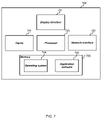
- FIG. 7 shows an exemplary computing-based device in which embodiments of a node for composite video generation can be implemented.
- FIG. 1 illustrates a video sharing system 100 comprising composite video generation.
- the system 100 comprises a plurality of mobile video capture devices 101 connected to a communication network 102 (three mobile video capture devices 101 are shown in FIG. 1 , but many more can be present).
- the mobile video capture devices 101 can be mobile telephones comprising image sensors capable of capturing video images.
- the communication network 102 is of any suitable type for communicating video streams between entities, such as the Internet, a cellular network, the public switched telephone network (PSTN), a local area network (LAN), or a combination of the above.
- PSTN public switched telephone network
- LAN local area network
- the mobile video capture devices 101 communicate wirelessly with the communication network 102 .
- the mobile video capture devices 101 can comprise a camcorder or digital camera connected to a mobile telephone, such as via a short range wireless link (e.g. Bluetooth).
- the mobile video capture devices 101 can be in the form of a camcorder or digital camera having data transmission capabilities, such as a WiFi transceiver.
- the mobile video capture devices 101 can be in the form of a portable computer having video capture capabilities.
- the mobile video capture devices 101 are able to transmit video streams over the communication network 102 to a network node 103 connected to the communication network 102 .
- the network node 103 is a server arranged to receive the video streams from each of the mobile video capture devices 101 , and generate a composite video stream in real-time.
- the structure and operation of the network node 103 is described in more detail hereinafter. Note that the functionality of the network node 103 can be distributed over a plurality of physical entities connected to the communication network 102 .
- the user terminal 104 can connect to the network node 103 over the communication network 102 and view videos streamed from the network node 103 .
- the user terminal 104 can be a personal computer, mobile telephone, or other entity capable of receiving and display video streams from the network node 103 . Note that many more user terminals can also connect to the communication network 102 and view videos streamed from the network node 103 , but these are not shown in FIG. 1 for clarity.
- Each of the mobile video capture devices 101 are capturing video of a portion of a common overall scene or event.
- FIG. 1 illustrates a first portion 105 being captured by one of the mobile video capture devices 101 , a second portion 106 being captured by another one of the mobile video capture devices 101 , and a third portion 107 being captured by a yet further one of the mobile video capture devices 101 .
- Each of the portions 105 , 106 and 107 relate to the same scene or event, but are focused on a different part.
- one of the mobile video capture devices 101 can be capturing video of a singer, whereas another is capturing video of a guitarist.
- the mobile video capture devices 101 can be capturing video of a wedding, and each of the mobile video capture devices is focused on different elements of the scene (e.g. one capturing the bride, another capturing the groom, and another capturing the wedding guests).
- the mobile video capture devices 101 are only capturing a portion of the scene because limitations of the mobile video capture devices mean that only small field of view can be captured with an acceptable quality. Because the image sensors do not have a high resolution, capturing a wider field of view results in a smaller number of pixels capturing the main focal point of the video, thereby resulting in a lower quality.
- the network node 103 is arranged to aggregate the portions 105 , 106 , 107 and generate, in real-time, a composite video which provides a panoramic video with a wider field of view at an acceptable quality, and stream the composite video over the communication network 102 .
- the user terminal 104 can receive the composite video stream and display a composite video 108 showing a panoramic view of the event to a user in real-time (i.e. substantially contemporaneously with the live events occurring, barring technical delays caused by, for example, processing and transmitting the video data). A process for achieving this is described hereinafter.
- FIG. 2 illustrates a process for streaming video which is performed at the mobile video capture devices 101 .
- the video images (for example corresponding to portion 105 , 106 , or 107 in FIG. 1 ) are captured 200 as a sequence of frames (i.e. a plurality of still images which, when displayed in sequence, produce the video).
- a timestamp indicating the time of capture of each frame is recorded 201 .
- the time of capture of each frame is provided by a clock running on each of the mobile video capture devices 101 . In the case that a clock is not present in a mobile video capture device with a sufficient resolution, the number of elapsed CPU cycles can be counted.
- the clock in each of the mobile video capture devices 101 is synchronized to a time-source, for example a network time signal from a cellular network, a time signal from a global positioning system (GPS) receiver, or a time synchronization signal provided by the network node 103 or another node in the communication network 102 . Therefore, each of the mobile video capture devices 101 has a clock which is synchronized with the clocks in each of the other mobile video capture devices 101 .
- a time-source for example a network time signal from a cellular network, a time signal from a global positioning system (GPS) receiver, or a time synchronization signal provided by the network node 103 or another node in the communication network 102 . Therefore, each of the mobile video capture devices 101 has a clock which is synchronized with the clocks in each of the other mobile video capture devices 101 .
- GPS global positioning system
- the video images are then encoded 202 .
- Any encoder suitable for producing encoded video for streaming can be used, for example H.263+ (also known as H.263v2).
- the encoder is modified to also encode the timestamp along with each frame, such that the timestamps are embedded within the video stream data.
- the timestamp information relating to the frames can be provided separately from the encoded video.
- the encoded video is then streamed 203 from the mobile video capture device 101 to the network node 103 over the communications network 102 .
- Any suitable protocol for streaming video can be used by the mobile video capture device 101 , such as the real-time protocol (RTP).
- RTP real-time protocol
- a plurality of mobile video capture devices 101 are each performing the process shown in FIG. 1 , and are capturing video of a common event or scene.
- FIG. 3 illustrates a flowchart of a process for generating and transmitting a composite video sequence at the network node 103 .
- FIG. 4 shows a functional block diagram for the network node 103 .
- the network node 103 receives 300 a plurality of video streams from mobile video capture devices 101 which relate to a common event.
- the plurality of video streams are received at a network interface 400 at the network node 103 , as shown in FIG. 4 .
- the network node 103 determines that each of the received plurality of video streams relate to a common event. This can be achieved in a number of ways. For example, each of the mobile video capture devices 101 can inform the network node 103 that they are capturing video of a specific event. This can be performed by the mobile video capture device 101 navigating to a web page provided by the network node 103 and entering an event, or selecting a predefined event from a list. The network node 103 then knows which mobile video capture devices are capturing video relating to which event. Alternatively, the mobile video capture devices 101 can be arranged to provide their location to the network node 103 , for example as determined by a GPS sensor on the mobile video capture devices 101 . The network node 103 can then determine whether a plurality of mobile video capture devices 101 are capturing video within a certain range of each other, and if so it can be deduced that the video streams from these mobile video capture devices 101 relate to the same event.
- the network node 103 decodes 301 the plurality of videos with a decoder 401 .
- the decoding can be performed on a processor 402 at the network node 103 (indicated generally by the dashed lines in FIG. 4 ), or alternatively using dedicated decoding hardware. Note that other functional blocks, such as a depacketizer, can also be included, but are not included in FIG. 4 for clarity.
- the decoder corresponds to the encoder used by the mobile video capture device, as outlined with reference to FIG. 2 . As a result of the decoding, the frames from each of the plurality of video streams are obtained. In addition, the timestamps associated with the frames are also obtained.
- the plurality of video streams are then time-synchronized 302 . This is performed by queuing the frames from each video stream in a different one of a plurality of buffers 403 (i.e. a separate buffer queue for each of the mobile video capture devices 101 ).
- a plurality of buffers 403 i.e. a separate buffer queue for each of the mobile video capture devices 101 .
- three mobile video capture devices 101 were present, each sending a video stream, and therefore three buffers 404 , 405 and 406 are shown in FIG. 4 .
- Each of the plurality of buffers 403 queues decoded frames 407 from the associated video stream.
- the decoded frames 407 are queued in the buffers 403 according to the timestamp of the frame capture time.
- the network node 103 knows that frames from different video streams having matching (to within a predefined range) timestamps were captured at substantially the same time instance. For example, timestamps within a millisecond of each other can be considered to be matching.
- the processor 402 selects a frame set 408 comprising a frame from each of the plurality of buffers 403 , such that all of the selected frames have a matching timestamp. For example, as shown in FIG. 4 , each of the three frames in the frame set 408 have timestamp “a”.
- the processor 402 at the network node 103 attempts to stitch 303 the frames in the frame set 408 together, to form a composite frame.
- the stitching operation comprises two main parts: alignment 304 of the frames (as shown performed by an alignment engine 409 on the processor 402 in FIG. 4 ) and compositing 305 of the composite frame (as shown performed by a compositing engine 410 in FIG. 4 ).
- Any suitable image stitching method for stitching the frames in the frame set 408 can be used, and an example operation is now described with reference to FIG. 5 .
- the process in FIG. 5 is performed on a pair of frames.
- a process for stitching three or more frames (such as in FIG. 4 ) is described later with reference to FIG. 6 .
- the alignment 304 process starts with interest point (IP) extraction 500 .
- IP interest point
- Interest points are characteristic points extracted in each frame and later used to match between frame pairs that can form a composite frame.
- An example interest point extractor is the Shi-Tomasi corner point detector, however other corner-like detectors can also be used.
- interest point orientation estimation 501 is performed for each extracted IP. This assigns a dominant orientation for each extracted IP. This operation is based on estimating the gradient direction for the IP.
- An interest point descriptor is then generated 502 .
- Each extracted IP is described using a local descriptor which is composed of the individual pixel values in a region (e.g. a rectangular region) around the IP location in the frame.
- the local descriptor is constructed using a rectangular region with one of the axes rotated by the IP orientation estimated previously.
- Interest point matching 503 is then performed between a pair of frames.
- a given frame pair (Frame 1 , Frame 2 ) the purpose of the interest point matching is to determine whether the two frames can be aligned together. For example, if N interest points were extracted for Frame 1 and M interest points extracted for Frame 2 , then the process attempts to match pairs of interest points from the N and M IPs. Firstly, the first IP of the N interest points of Frame 1 is selected and a search is performed for the closest IP from the M interest points of Frame 2 . The closeness of the IP pair can, for example, be determined using the Euclidean distance between the corresponding descriptors of the IPs in the two frames (as generated in 502 ).
- the Euclidean distance is therefore used to indicate a likely match between a pair of IPs. If the Euclidean distance is beyond a threshold then the match candidate is discarded. The closest IP that is within the threshold is taken to be a matching IP. The next IP of the N interest points of Frame 1 is then selected and a search is performed for the closest IP from the M interest points of Frame 2 , as above.
- the result of the interest point matching 503 is a set of matching interest points between the pair of frames. If no matching interest points can be found, then the frames cannot be aligned and the process in FIG. 5 is stopped. If, however, at least a predetermined number, P, pairs of matching interest points is found, then the process continues with a geometric transform estimation 504 .
- the purpose of the geometric transform estimation is to estimate a geometric transform to apply to the pixels of one frame to align the D matching interest points with the other frame in the pair of frames.
- transformation types can be applied such as translational, translational & rotational, affine and perspective.
- the transformation type used can depend on the application or the subject of the video streams. For example, in an indoor setting a rotational & translation transform can be sufficient, while in a soccer match a full perspective transform can be appropriate.
- the parameters for applying the transform are then determined. This can be performed by using a least squares approach, such that the matching IP pairs are compared between the pair of frames for different transformation parameters, and the sum of the squared differences is minimized. This approach reduces noise effects.
- the transform can be estimated on multiple selected random samples of the matching IP pairs (known as a RANdom SAmple Consensus (RANSAC) procedure).
- RANSAC Random SAmple Consensus
- the geometric transform can be applied to one of the pair of frames, such that it is aligned with the other frame.
- the compositing 305 process then starts.
- the purpose of the compositing process is to compose the final panoramic composite frame out of the individual aligned frames.
- a flat compositing surface can be used, such that one frame is selected as the reference frame, and the other frames are added to this frame. This provides a high-speed composition with acceptable quality.
- other compositing surfaces can be used, such as a cylindrical or spherical projection, which can reduce distortions for wide fields of view.
- the compositing process There are two main parts to the compositing process: determining distance values 505 for each pixel in the overlap area of the two frames, and applying a pixel weighting 506 in the overlap area based on the distance values. For a given pair of frames that are deemed stitchable, there exists a region of overlap where pixel values can come from either frame. The compositing process selects the pixel value for every pixel in the overlap area.
- the compositing technique in this example uses feathering based on pixel weighting.
- the distance values 505 are found for each pixel in the overlap area. This comprises a determination of the distance from each pixel in the overlap area to each of the two frame boundaries.
- the pixel weighting 506 selects a pixel value for every pixel in the overlap area based on a weighted average of pixel values from the two input frames.
- the per-pixel weighting used in the weighted average is based on the distance values indicating the location of the pixel (relative to the two frame boundaries) in each of the two frames.
- the weighting applied in the weighted average depends upon the pixel's distance from the boundary of each frame, such that pixels further from the boundary are given a higher weighting.
- composition techniques such as block-based compositing or gradient domain stitching can also be used.
- feathering generally yields acceptable composition quality and can compensate for exposure differences.
- the input frames are already time synchronized, there is no risk of ghosting. Feathering is also sufficiently computationally inexpensive to be performed in real-time.
- the result is a single composite frame made up of the frames in the frame set 408 .
- the frames in the frame set 408 have been stitched together such that, from the perspective of a user, the joins between the frames are not readily visible.
- the process described with reference to FIG. 5 applies for stitching a pair of frames. If, however, three or more frames are to be stitched together, then a process such as that shown in FIG. 6 is performed.
- the process in FIG. 6 clusters the frames in the frame set 408 , such that frames that can be stitched together are placed in the same cluster.
- the cluster with the most frames is selected to form the composite frame.
- the clusters can be maintained and the spatial stitching order reused, rather than being recalculated from scratch at every frame.
- all of the frames in the frame set 408 are initialized 600 such that they are flagged as “not done”, i.e. that they have not yet been processed.
- the first frame in the frame set 408 is then selected 601 as the “target” frame, i.e. the frame which is being processed first.
- a search 602 is performed for other frames in the frame set 408 that are able to be stitched to the target frame (i.e. the first frame at this stage).
- the search 602 can be arranged to stop as soon as another stitchable frame is found in the frame set, to ensure fast performance. Alternatively, the best matching frame from all the other frames in the frame set 408 can be found.
- the search process can comprise the operations of extraction 500 , orientation estimation 501 , descriptor generation 502 and matching 503 as described above with reference to FIG. 5 .
- the extraction 500 , orientation estimation 501 and descriptor generation 502 operations can be performed for all frames in the frame set 408 in advance of the process of FIG. 6 .
- the result of the interest point matching operation 503 is a decision as to whether two frames can be stitched together.
- the target frame is flagged 604 as “done” (i.e. processed) and a new cluster is created 605 and the target frame allocated to this cluster. This cluster will only contain the target frame, as it is not stitchable to any other frames.
- the target frame and the frame to which it is stitchable are both flagged 609 as “done”. It is then determined 610 whether one of these two frames is already allocated to a cluster. If so, then the target frame and the frame to which it is stitchable are allocated 611 to this cluster. If not, then a new cluster is created 612 , and the target frame and the frame to which it is stitchable are allocated to the new cluster.
- each of the frames in the frame set 408 are allocated to a cluster.
- Frames which cannot be stitched together are allocated to their own cluster.
- a set of frames that can be stitched together are allocated to the same cluster.
- the clustering process above has a time complexity O(N 2 ) in the worst case, where N is the number of incoming video streams.
- the cluster having the largest number of frames can be selected to form the composite frame. If several clusters have the same number of frames, then a random selection can be performed. Each of the frames allocated to the selected cluster can then be stitched to form the composite frame as per the stitching process in FIG. 5 (i.e. using the remaining steps of alignment and compositing). Note that, in alternative examples, the stitching can also be performed during the clustering process. For example, a pair of frames can be stitched as soon as they have been found by the search 602 .
- the clustering of stitchable pairs of frames happens only in the first frame of each video.
- the ordering information obtained from analyzing the first frame is utilized, and the process only ensures that the previously stitched frames are still stitchable. In case of failure of the stitching order obtained from previous frames, the ordering process would start from scratch, as in FIG. 6 .
- the resulting composite frame is added to a composite video sequence.
- the composite frames for the composite video sequence can be buffered.
- the composite video sequence comprising the composite frames is then encoded 306 using an encoder 411 (which can be implemented in the processor 402 or as dedicated hardware).
- the encoded composite video sequence can then be transmitted 307 from the network interface 400 , over the communication network using a protocol such as RTP, and can be viewed by one or more user terminals (such as the user terminal 104 ).
- the processes described above therefore enable a composite video sequence to be generated from a plurality of video streams provided by mobile video capture devices 101 .
- the use of mobile video capture devices 101 introduces a number of complexities that are overcome with the above described techniques. Because the mobile video capture devices 101 are independent devices (e.g. mobile phones) streaming data to 103 network node, the corresponding frames from each of the mobile video capture devices 101 do not necessarily arrive at the network node 103 at the same time. For example, the video streams sent by the mobile video capture devices 101 can also arrive at the network node 103 via different routes (e.g. some via one or more cellular networks, some via wireless LAN connections).
- Each of these routes can have different delays, meaning that frames corresponding to the same time-instance from the different mobile video capture devices 101 can arrive at different times at the network node 103 .
- the mobile video capture devices 101 can have different processing capabilities, resulting in different processing and encoding delays in the frames being sent from the mobile video capture devices 101 .
- the network node 103 is able to buffer the frames and ensure that they are selected such that they correspond to the same capture time.
- the above-described stitching process also enables the network node to stitch together frames from the mobile video capture devices 101 even though they are movable, and are not capturing the video from pre-known angles or distances.
- the use of geometric transforms enables the frames to be stitched together for a wide variation of relative capture positions between the mobile video capture devices 101 .
- the above-described process can be performed in real-time, such that the composite video sequence is generated on-the-fly as frames from the plurality of mobile video capture devices 101 are received. This enables a user of the user terminal 104 to view the composite video sequence of a live event substantially contemporaneously with the event occurring.
- the speed of generation of the composite video sequence can be further increased by determining whether the alignment 304 process can be skipped for some frames, and previously calculated alignment parameters used. For example, if the mobile video capture devices 101 are not moving significantly, then the alignment parameters to stitch together the frames from the mobile video capture devices 101 remains substantially constant.
- the network node 103 can monitor the movement of the mobile video capture devices (i.e. determine whether the overall frame is changing, not just a subject within the frame) and if it determines that the mobile video capture devices 101 are moving less than a threshold amount then the alignment parameters are not calculated for every frame, but only once in a predefined number of frames (e.g. every L frames). If however, it is determined that the mobile video capture devices 101 are moving more than the threshold amount then the alignment parameters are calculated for every frame.
- the value for L can be dynamically calculated, such that if the mobile video capture devices 101 are motionless, then a high value of L is used, and as the mobile video capture devices 101 move more the value of L is increased until the mobile video capture devices are moving sufficiently that the alignment parameters are calculated for every frame.
- FIG. 7 illustrates various components of an exemplary computing-based device 700 which can be implemented as any form of a computing and/or electronic device, and in which embodiments of a node for composite video sequence generation can be implemented.
- the computing-based device 700 comprises one or more inputs 701 which are of any suitable type for receiving media content, Internet Protocol (IP) input, video streams, audio streams or other input.
- IP Internet Protocol
- the device also comprises network interface 702 , to enable it to communicate over a communication network with, for example, user terminals.
- Computing-based device 700 also comprises one or more processors 703 which can be microprocessors, controllers or any other suitable type of processors for processing computing executable instructions to control the operation of the device in order to generate composite video.
- Platform software comprising an operating system 704 or any other suitable platform software can be provided at the computing-based device to enable application software 705 to be executed on the device.
- the computer executable instructions can be provided using any computer-readable media, such as memory 706 .
- the memory is of any suitable type such as random access memory (RAM), a disk storage device of any type such as a magnetic or optical storage device, a hard disk drive, or a CD, DVD or other disc drive. Flash memory, EPROM or EEPROM can also be used.
- An output 707 is also provided such as an audio and/or video output to a display system integral with or in communication with the computing-based device.
- the display system can provide a graphical user interface, or other user interface of any suitable type although this is not essential.
- computer is used herein to refer to any device with processing capability such that it can execute instructions. Those skilled in the art will realize that such processing capabilities are incorporated into many different devices and therefore the term ‘computer’ includes PCs, servers, mobile telephones, personal digital assistants and many other devices.
- the methods described herein may be performed by software in machine readable form on a tangible storage medium.
- the software can be suitable for execution on a parallel processor or a serial processor such that the method steps may be carried out in any suitable order, or substantially simultaneously.
- a remote computer may store an example of the process described as software.
- a local or terminal computer may access the remote computer and download a part or all of the software to run the program.
- the local computer may download pieces of the software as needed, or execute some software instructions at the local terminal and some at the remote computer (or computer network).
- a dedicated circuit such as a DSP, programmable logic array, or the like.
Landscapes
- Engineering & Computer Science (AREA)
- Multimedia (AREA)
- Signal Processing (AREA)
- Databases & Information Systems (AREA)
- General Engineering & Computer Science (AREA)
- Computer Security & Cryptography (AREA)
- Physics & Mathematics (AREA)
- Astronomy & Astrophysics (AREA)
- General Physics & Mathematics (AREA)
- Two-Way Televisions, Distribution Of Moving Picture Or The Like (AREA)
Abstract
Description
Claims (20)
Priority Applications (1)
| Application Number | Priority Date | Filing Date | Title |
|---|---|---|---|
| US12/471,118 US8605783B2 (en) | 2009-05-22 | 2009-05-22 | Composite video generation |
Applications Claiming Priority (1)
| Application Number | Priority Date | Filing Date | Title |
|---|---|---|---|
| US12/471,118 US8605783B2 (en) | 2009-05-22 | 2009-05-22 | Composite video generation |
Publications (2)
| Publication Number | Publication Date |
|---|---|
| US20100296571A1 US20100296571A1 (en) | 2010-11-25 |
| US8605783B2 true US8605783B2 (en) | 2013-12-10 |
Family
ID=43124547
Family Applications (1)
| Application Number | Title | Priority Date | Filing Date |
|---|---|---|---|
| US12/471,118 Expired - Fee Related US8605783B2 (en) | 2009-05-22 | 2009-05-22 | Composite video generation |
Country Status (1)
| Country | Link |
|---|---|
| US (1) | US8605783B2 (en) |
Cited By (8)
| Publication number | Priority date | Publication date | Assignee | Title |
|---|---|---|---|---|
| US20130141523A1 (en) * | 2011-12-02 | 2013-06-06 | Stealth HD Corp. | Apparatus and Method for Panoramic Video Hosting |
| US20140267779A1 (en) * | 2013-03-13 | 2014-09-18 | Verizon Patent And Licensing Inc. | Alignment of video frames |
| US9723223B1 (en) | 2011-12-02 | 2017-08-01 | Amazon Technologies, Inc. | Apparatus and method for panoramic video hosting with directional audio |
| US9781356B1 (en) | 2013-12-16 | 2017-10-03 | Amazon Technologies, Inc. | Panoramic video viewer |
| US9838687B1 (en) | 2011-12-02 | 2017-12-05 | Amazon Technologies, Inc. | Apparatus and method for panoramic video hosting with reduced bandwidth streaming |
| US9998661B1 (en) | 2014-05-13 | 2018-06-12 | Amazon Technologies, Inc. | Panoramic camera enclosure |
| US10090020B1 (en) * | 2015-06-30 | 2018-10-02 | Amazon Technologies, Inc. | Content summarization |
| US10585549B2 (en) * | 2014-09-11 | 2020-03-10 | Lg Electronics Inc. | Mobile terminal and method for controlling same |
Families Citing this family (27)
| Publication number | Priority date | Publication date | Assignee | Title |
|---|---|---|---|---|
| US8214862B1 (en) * | 2009-07-13 | 2012-07-03 | Sprint Communications Company L.P. | Conserving bandwidth by restricting videos communicated in a wireless telecommunications network |
| US20110023069A1 (en) * | 2009-07-27 | 2011-01-27 | At&T Intellectual Property I, L.P. | System and Method for Creating and Managing an Internet Protocol Television Personal Movie Library |
| US9998749B2 (en) * | 2010-10-19 | 2018-06-12 | Otoy, Inc. | Composite video streaming using stateless compression |
| US10375534B2 (en) | 2010-12-22 | 2019-08-06 | Seyyer, Inc. | Video transmission and sharing over ultra-low bitrate wireless communication channel |
| US8644673B2 (en) * | 2011-03-22 | 2014-02-04 | Fmr Llc | Augmented reality system for re-casting a seminar with private calculations |
| US9153031B2 (en) | 2011-06-22 | 2015-10-06 | Microsoft Technology Licensing, Llc | Modifying video regions using mobile device input |
| WO2013116777A1 (en) * | 2012-02-03 | 2013-08-08 | Vispx Llc | Video frame marking |
| US9052208B2 (en) | 2012-03-22 | 2015-06-09 | Nokia Technologies Oy | Method and apparatus for sensing based on route bias |
| US9148699B2 (en) * | 2012-06-01 | 2015-09-29 | Texas Instruments Incorporated | Optimized algorithm for construction of composite video from a set of discrete video sources |
| US9646650B2 (en) | 2013-05-28 | 2017-05-09 | Google Inc. | Automatically syncing recordings between two or more content recording devices |
| US9942295B2 (en) | 2013-06-28 | 2018-04-10 | Intel Corporation | Live crowdsourced media streaming |
| US10075681B2 (en) * | 2013-08-14 | 2018-09-11 | Digital Ally, Inc. | Dual lens camera unit |
| US9300713B2 (en) * | 2013-08-16 | 2016-03-29 | Qualcomm Incorporated | Clock synchronization for multi-processor/multi-chipset solution |
| US8917355B1 (en) | 2013-08-29 | 2014-12-23 | Google Inc. | Video stitching system and method |
| CN105284122B (en) * | 2014-01-24 | 2018-12-04 | Sk 普兰尼特有限公司 | For clustering the device and method to be inserted into advertisement by using frame |
| US9300882B2 (en) | 2014-02-27 | 2016-03-29 | Sony Corporation | Device and method for panoramic image processing |
| US9807336B2 (en) * | 2014-11-12 | 2017-10-31 | Mediatek Inc. | Dynamic adjustment of video frame sampling rate |
| US10853435B2 (en) | 2016-06-17 | 2020-12-01 | Axon Enterprise, Inc. | Systems and methods for aligning event data |
| US20180063428A1 (en) * | 2016-09-01 | 2018-03-01 | ORBI, Inc. | System and method for virtual reality image and video capture and stitching |
| US11113938B2 (en) * | 2016-12-09 | 2021-09-07 | Amazon Technologies, Inc. | Audio/video recording and communication devices with multiple cameras |
| US10687093B2 (en) * | 2016-12-30 | 2020-06-16 | Social Media Broadcaster, Inc. | Social-media-based TV show production, distribution, and broadcast system |
| CN109195000A (en) * | 2018-10-10 | 2019-01-11 | 深圳市创维群欣安防科技股份有限公司 | A kind of local area network multi-screen splicing synchronous display method, system and storage medium |
| RU2706576C1 (en) * | 2019-03-21 | 2019-11-19 | Общество с ограниченной ответственностью "Ай Ти Ви групп" | System and method of combining several video images into one panoramic video image |
| US11784839B2 (en) * | 2019-12-31 | 2023-10-10 | Dish Network Technologies India Private Limited | Dynamic low latency mode for a digital video production system |
| CN115484486B (en) * | 2021-05-31 | 2026-03-20 | 华为技术有限公司 | Video presentation methods, electronic devices, computer storage media, and software products |
| EP4175299A1 (en) * | 2021-11-02 | 2023-05-03 | Siemens Healthcare GmbH | Processing and transmission of video data |
| US12327318B2 (en) * | 2022-08-24 | 2025-06-10 | GameChanger Ltd | Logged reality (LR) scene generation |
Citations (13)
| Publication number | Priority date | Publication date | Assignee | Title |
|---|---|---|---|---|
| US6075905A (en) * | 1996-07-17 | 2000-06-13 | Sarnoff Corporation | Method and apparatus for mosaic image construction |
| US20070030391A1 (en) * | 2005-08-04 | 2007-02-08 | Samsung Electronics Co., Ltd. | Apparatus, medium, and method segmenting video sequences based on topic |
| US20080005767A1 (en) * | 2006-01-27 | 2008-01-03 | Samsung Electronics Co., Ltd. | Multimedia processing apparatus and method for mobile phone |
| US20080081643A1 (en) * | 2006-09-28 | 2008-04-03 | Hideki Nagata | Mobile device system and mobile device |
| US20080143875A1 (en) * | 2006-08-17 | 2008-06-19 | Scott Stacey L | Method and system for synchronous video capture and output |
| US20080170803A1 (en) | 2007-01-12 | 2008-07-17 | Babak Forutanpour | Panoramic imaging techniques |
| US20080253685A1 (en) | 2007-02-23 | 2008-10-16 | Intellivision Technologies Corporation | Image and video stitching and viewing method and system |
| US7460730B2 (en) | 2005-08-04 | 2008-12-02 | Microsoft Corporation | Video registration and image sequence stitching |
| US20090022422A1 (en) | 2007-07-18 | 2009-01-22 | Samsung Electronics Co., Ltd. | Method for constructing a composite image |
| WO2009020381A1 (en) | 2007-08-07 | 2009-02-12 | Mimos Berhad | Apparatus and method for three-dimensional panoramic image formation |
| US20090058988A1 (en) | 2007-03-16 | 2009-03-05 | Kollmorgen Corporation | System for Panoramic Image Processing |
| US20090122675A1 (en) * | 2007-11-14 | 2009-05-14 | Philips & Lite-On Digital Solutions Corporation | Method for determining optimal operating parameters for reading or writing a storage medium |
| US20110258287A1 (en) * | 2005-03-14 | 2011-10-20 | Anderson Eric C | Method And System For Collecting Contemporaneous Information Relating To An Event |
-
2009
- 2009-05-22 US US12/471,118 patent/US8605783B2/en not_active Expired - Fee Related
Patent Citations (13)
| Publication number | Priority date | Publication date | Assignee | Title |
|---|---|---|---|---|
| US6075905A (en) * | 1996-07-17 | 2000-06-13 | Sarnoff Corporation | Method and apparatus for mosaic image construction |
| US20110258287A1 (en) * | 2005-03-14 | 2011-10-20 | Anderson Eric C | Method And System For Collecting Contemporaneous Information Relating To An Event |
| US20070030391A1 (en) * | 2005-08-04 | 2007-02-08 | Samsung Electronics Co., Ltd. | Apparatus, medium, and method segmenting video sequences based on topic |
| US7460730B2 (en) | 2005-08-04 | 2008-12-02 | Microsoft Corporation | Video registration and image sequence stitching |
| US20080005767A1 (en) * | 2006-01-27 | 2008-01-03 | Samsung Electronics Co., Ltd. | Multimedia processing apparatus and method for mobile phone |
| US20080143875A1 (en) * | 2006-08-17 | 2008-06-19 | Scott Stacey L | Method and system for synchronous video capture and output |
| US20080081643A1 (en) * | 2006-09-28 | 2008-04-03 | Hideki Nagata | Mobile device system and mobile device |
| US20080170803A1 (en) | 2007-01-12 | 2008-07-17 | Babak Forutanpour | Panoramic imaging techniques |
| US20080253685A1 (en) | 2007-02-23 | 2008-10-16 | Intellivision Technologies Corporation | Image and video stitching and viewing method and system |
| US20090058988A1 (en) | 2007-03-16 | 2009-03-05 | Kollmorgen Corporation | System for Panoramic Image Processing |
| US20090022422A1 (en) | 2007-07-18 | 2009-01-22 | Samsung Electronics Co., Ltd. | Method for constructing a composite image |
| WO2009020381A1 (en) | 2007-08-07 | 2009-02-12 | Mimos Berhad | Apparatus and method for three-dimensional panoramic image formation |
| US20090122675A1 (en) * | 2007-11-14 | 2009-05-14 | Philips & Lite-On Digital Solutions Corporation | Method for determining optimal operating parameters for reading or writing a storage medium |
Non-Patent Citations (11)
| Title |
|---|
| Haenselmann, et al., "Multicamera Video-Stitching", retrieved on Mar. 16, 2009 at <<http://www.informatik.uni-mannheim.de/pi4/publications/Haenselmann2006a.pdf>>, University of Mannheim, Applied Computer Science IV, Germany, 8 pages. |
| Haenselmann, et al., "Multicamera Video-Stitching", retrieved on Mar. 16, 2009 at >, University of Mannheim, Applied Computer Science IV, Germany, 8 pages. |
| Pirillo, "Real-Time Stitching of Mobile Videos", retrieved on Mar. 17, 2009 at <<http://chris.pirillo.com/real-time-stitching-of-mobile-videos/>>, Feb. 28, 2009, 2 pages. |
| Pirillo, "Real-Time Stitching of Mobile Videos", retrieved on Mar. 17, 2009 at >, Feb. 28, 2009, 2 pages. |
| Shimizu, et al., "A fast video stitching method for motion-compensated frames in compressed video streams", International Conference on Consumer Electronics, Jan. 2006, Consumer Electronics, 2006, Digest of Technical Papers. |
| Szeliski, "Image Alignment and Stitching: A Tutorial", MSR Tech Report (last updated 2006). Retrieved Aug. 16, 2011 from http://pages.cs.wisc.edu/~dyer/ai-qual/szeliski-tr06.pdf. * |
| Szeliski, "Image Alignment and Stitching: A Tutorial", MSR Tech Report (last updated 2006). Retrieved Aug. 16, 2011 from http://pages.cs.wisc.edu/˜dyer/ai-qual/szeliski-tr06.pdf. * |
| Szeliski, "Image Alignment and Stitching: A Tutorial", MST Tech Report (last updated 2006), retrieved on May 21, 2009 at <<http://www.caam.rice.edu/˜zhang/caam699/p-files/Im-Align2005.pdf>>. |
| Szeliski, "Image Alignment and Stitching: A Tutorial", MST Tech Report (last updated 2006), retrieved on May 21, 2009 at >. |
| Uyttendaele, et al., Microsoft Research "Eliminating ghosting and exposure artifacts in image mosaics", IEEE Computer Society Conference on Computer Vision and Pattern Recognition (CVPR'2001), retrieved on May 21, 2009 at <<http://research.microsoft.com/pubs/75702/Uyttendaele-CVPR01.pdf>>. |
| Uyttendaele, et al., Microsoft Research "Eliminating ghosting and exposure artifacts in image mosaics", IEEE Computer Society Conference on Computer Vision and Pattern Recognition (CVPR'2001), retrieved on May 21, 2009 at >. |
Cited By (13)
| Publication number | Priority date | Publication date | Assignee | Title |
|---|---|---|---|---|
| US9838687B1 (en) | 2011-12-02 | 2017-12-05 | Amazon Technologies, Inc. | Apparatus and method for panoramic video hosting with reduced bandwidth streaming |
| US9516225B2 (en) * | 2011-12-02 | 2016-12-06 | Amazon Technologies, Inc. | Apparatus and method for panoramic video hosting |
| US9723223B1 (en) | 2011-12-02 | 2017-08-01 | Amazon Technologies, Inc. | Apparatus and method for panoramic video hosting with directional audio |
| US20130141523A1 (en) * | 2011-12-02 | 2013-06-06 | Stealth HD Corp. | Apparatus and Method for Panoramic Video Hosting |
| US9843840B1 (en) * | 2011-12-02 | 2017-12-12 | Amazon Technologies, Inc. | Apparatus and method for panoramic video hosting |
| US10349068B1 (en) | 2011-12-02 | 2019-07-09 | Amazon Technologies, Inc. | Apparatus and method for panoramic video hosting with reduced bandwidth streaming |
| US20140267779A1 (en) * | 2013-03-13 | 2014-09-18 | Verizon Patent And Licensing Inc. | Alignment of video frames |
| US8881213B2 (en) * | 2013-03-13 | 2014-11-04 | Verizon Patent And Licensing Inc. | Alignment of video frames |
| US9781356B1 (en) | 2013-12-16 | 2017-10-03 | Amazon Technologies, Inc. | Panoramic video viewer |
| US10015527B1 (en) | 2013-12-16 | 2018-07-03 | Amazon Technologies, Inc. | Panoramic video distribution and viewing |
| US9998661B1 (en) | 2014-05-13 | 2018-06-12 | Amazon Technologies, Inc. | Panoramic camera enclosure |
| US10585549B2 (en) * | 2014-09-11 | 2020-03-10 | Lg Electronics Inc. | Mobile terminal and method for controlling same |
| US10090020B1 (en) * | 2015-06-30 | 2018-10-02 | Amazon Technologies, Inc. | Content summarization |
Also Published As
| Publication number | Publication date |
|---|---|
| US20100296571A1 (en) | 2010-11-25 |
Similar Documents
| Publication | Publication Date | Title |
|---|---|---|
| US20100296571A1 (en) | Composite Video Generation | |
| AU2010216298B2 (en) | Video sharing | |
| US11924397B2 (en) | Generation and distribution of immersive media content from streams captured via distributed mobile devices | |
| US11381739B2 (en) | Panoramic virtual reality framework providing a dynamic user experience | |
| CN107534789B (en) | Image synchronization device and image synchronization method | |
| CN104012106B (en) | Align videos representing different viewpoints | |
| EP3384678B1 (en) | Network-based event recording | |
| JP6607433B2 (en) | Video distribution method and server | |
| JP5267396B2 (en) | Image processing apparatus and method, and program | |
| US20130133000A1 (en) | Video Interaction System | |
| US20180103197A1 (en) | Automatic Generation of Video Using Location-Based Metadata Generated from Wireless Beacons | |
| CN103959802A (en) | Video provision method, transmission device, and reception device | |
| CN110582012B (en) | Video switching method, video processing method, device and storage medium | |
| US10609440B1 (en) | Timing data anomaly detection and correction | |
| CN108881119B (en) | Method, device and system for video concentration | |
| WO2015159487A1 (en) | Image delivery method, image reception method, server, terminal apparatus, and image delivery system | |
| WO2019114330A1 (en) | Video playback method and apparatus, and terminal device | |
| WO2020017354A1 (en) | Information processing device, information processing method, and program | |
| WO2015194082A1 (en) | Image processing method and image processing system | |
| Salas et al. | Subjective quality evaluations using crowdsourcing | |
| CN107733874B (en) | Information processing method, information processing device, computer equipment and storage medium | |
| US10257395B2 (en) | Method, apparatus and computer program product for creating virtual reality content of an event | |
| WO2015182034A1 (en) | Image shooting method, image shooting system, server, image shooting apparatus, and image shooting program |
Legal Events
| Date | Code | Title | Description |
|---|---|---|---|
| AS | Assignment |
Owner name: MICROSOFT CORPORATION, WASHINGTON Free format text: ASSIGNMENT OF ASSIGNORS INTEREST;ASSIGNORS:EL-SABAN, MOTAZ AHMED;KAHEEL, AYMAN MALEK;REFAAT, MAHMOUD AHMED;AND OTHERS;REEL/FRAME:022740/0065 Effective date: 20090513 |
|
| STCF | Information on status: patent grant |
Free format text: PATENTED CASE |
|
| AS | Assignment |
Owner name: MICROSOFT TECHNOLOGY LICENSING, LLC, WASHINGTON Free format text: ASSIGNMENT OF ASSIGNORS INTEREST;ASSIGNOR:MICROSOFT CORPORATION;REEL/FRAME:034564/0001 Effective date: 20141014 |
|
| FPAY | Fee payment |
Year of fee payment: 4 |
|
| MAFP | Maintenance fee payment |
Free format text: PAYMENT OF MAINTENANCE FEE, 8TH YEAR, LARGE ENTITY (ORIGINAL EVENT CODE: M1552); ENTITY STATUS OF PATENT OWNER: LARGE ENTITY Year of fee payment: 8 |
|
| FEPP | Fee payment procedure |
Free format text: MAINTENANCE FEE REMINDER MAILED (ORIGINAL EVENT CODE: REM.); ENTITY STATUS OF PATENT OWNER: LARGE ENTITY |
|
| AS | Assignment |
Owner name: LOT NETWORK INC., ARIZONA Free format text: ASSIGNMENT OF ASSIGNORS INTEREST;ASSIGNOR:MICROSOFT TECHNOLOGY LICENSING, LLC;REEL/FRAME:073083/0947 Effective date: 20250630 |
|
| LAPS | Lapse for failure to pay maintenance fees |
Free format text: PATENT EXPIRED FOR FAILURE TO PAY MAINTENANCE FEES (ORIGINAL EVENT CODE: EXP.); ENTITY STATUS OF PATENT OWNER: LARGE ENTITY |
|
| STCH | Information on status: patent discontinuation |
Free format text: PATENT EXPIRED DUE TO NONPAYMENT OF MAINTENANCE FEES UNDER 37 CFR 1.362 |
|
| FP | Lapsed due to failure to pay maintenance fee |
Effective date: 20251210 |