US8600162B2 - Image identification device, image identification method and recording medium - Google Patents
Image identification device, image identification method and recording medium Download PDFInfo
- Publication number
- US8600162B2 US8600162B2 US13/475,152 US201213475152A US8600162B2 US 8600162 B2 US8600162 B2 US 8600162B2 US 201213475152 A US201213475152 A US 201213475152A US 8600162 B2 US8600162 B2 US 8600162B2
- Authority
- US
- United States
- Prior art keywords
- image
- feature quantity
- block images
- block
- target
- Prior art date
- Legal status (The legal status is an assumption and is not a legal conclusion. Google has not performed a legal analysis and makes no representation as to the accuracy of the status listed.)
- Expired - Fee Related, expires
Links
Images


Classifications
-
- G—PHYSICS
- G06—COMPUTING OR CALCULATING; COUNTING
- G06F—ELECTRIC DIGITAL DATA PROCESSING
- G06F16/00—Information retrieval; Database structures therefor; File system structures therefor
- G06F16/50—Information retrieval; Database structures therefor; File system structures therefor of still image data
- G06F16/58—Retrieval characterised by using metadata, e.g. metadata not derived from the content or metadata generated manually
- G06F16/583—Retrieval characterised by using metadata, e.g. metadata not derived from the content or metadata generated manually using metadata automatically derived from the content
- G06F16/5838—Retrieval characterised by using metadata, e.g. metadata not derived from the content or metadata generated manually using metadata automatically derived from the content using colour
-
- G—PHYSICS
- G06—COMPUTING OR CALCULATING; COUNTING
- G06V—IMAGE OR VIDEO RECOGNITION OR UNDERSTANDING
- G06V10/00—Arrangements for image or video recognition or understanding
- G06V10/40—Extraction of image or video features
- G06V10/50—Extraction of image or video features by performing operations within image blocks; by using histograms, e.g. histogram of oriented gradients [HoG]; by summing image-intensity values; Projection analysis
-
- G—PHYSICS
- G06—COMPUTING OR CALCULATING; COUNTING
- G06V—IMAGE OR VIDEO RECOGNITION OR UNDERSTANDING
- G06V20/00—Scenes; Scene-specific elements
- G06V20/35—Categorising the entire scene, e.g. birthday party or wedding scene
Definitions
- Various aspects and embodiments of the present invention relate to an image identification device, an image identification method and a recording medium.
- Patent Document 1 As an image identification device, conventionally known is a device that divides a target image to be identified into blocks to form block images and classifies the block images into a plurality of predetermined categories (see Patent Document 1, for example).
- a device described in Patent Document 1 uses a training image to learn a separating plane for each category in a feature quantity space using features of an image as coordinate axes and classifies block images into categories on the basis of the separating plane and coordinate positions corresponding to the magnitudes of feature quantities of the block images.
- the feature quantities of the block images are pieces of image information of these block images (color space information and frequency components).
- Patent Document 1 Japanese Unexamined Patent Application Publication No. 2010-45613
- desired is an image identification device, an image identification method, and a recording medium that can improve classification accuracy of block images obtained by dividing a target image.
- An image identification device is an image identification device that learns in advance a separating plane used for classifying images into predetermined categories in a first feature quantity space using a feature of the image as a coordinate axis and uses the separating plane to classify block images obtained by dividing a target image into the categories.
- the image identification device is configured to include an input unit that inputs the target image, a block image generation unit that divides the target image into a plurality of blocks to generate the block images, a feature quantity computing unit that computes feature quantities of the block images, and a category determination unit that determines whether the block images are classified into one of the categories or not, using the separating plane and coordinate positions corresponding to magnitudes of feature quantities of the block images in the first feature quantity space, wherein the feature quantity computing unit uses, as feature quantities for the block images, local feature quantities calculated according to image information of the block images and a global feature quantity calculated according to image information of the target image as a whole, and also in a second feature quantity space where a plurality of features of the block images are used as coordinate axes, using coordinate positions of feature quantity vectors made by combining the local feature quantities of the block images and using at least one optional area, the number of block images that have the feature quantity vectors belonging to the area is counted on an area-by-area basis to be included in the global feature quantity.
- the image identification device uses, as feature quantities of the block images, not only the local feature quantities calculated according to image information of the block images, but also the global feature quantity calculated according to image information of the target image as a whole, it is possible to classify the block images in consideration of not only information on the block images themselves but also a relationship between the block images and the target image. Accordingly, even when it is impossible to determine categories only according to block images, there is a case in which it becomes possible to determine categories of the block images by looking at the target image as a whole.
- the global feature quantity includes the number of block images that are obtained by using coordinate positions of feature quantity vectors made by combining a plurality of local feature quantities of the block images in the second feature quantity space using a plurality of features of the block images as coordinate axes, and one or a plurality of optional areas in the second feature quantity space, and counting block images having feature quantity vectors belonging to the areas on an area-by-area basis, it is possible to combine a plurality of local feature quantities into a new feature quantity to be used. Accordingly, it becomes possible to avoid classifying the block images in a biased manner toward one local feature quantity. Therefore, it is possible to improve classification accuracy of the block images.
- the global feature quantity may include out of the block images included in the target image as a whole, the number of the block images having magnitudes of the local feature quantities equal to or larger than a predetermined value or the number of the block images having magnitudes of the local feature quantities smaller than the predetermined value.
- the image identification device may include a target area image extraction unit that extracts a target area from the target image to be used as a target area image, wherein the block image generation unit may divide the target area image into a plurality of blocks to generate the block images.
- a target area image is extracted from a target image by the target area image extraction unit, and an identification process is performed for the target area image thus extracted on a block-by-block basis. Accordingly, it is possible to appropriately classify even a target image having a scale change or having a shifted subject position.
- an image identification method is an image identification method for learning in advance a separating plane used for classifying images into predetermined categories in a first feature quantity space using a feature of the image as a coordinate axis and then using the separating plane to classify block images obtained by dividing a target image into the categories.
- the image identification method is configured to include an input step of inputting the target image, a block image generation step of dividing the target image into a plurality of blocks to generate the block images, a feature quantity computing step of computing feature quantities of the block images, and a category determination step of determining whether the block images are classified into one of the categories or not, using the separating plane and coordinate positions corresponding to magnitudes of feature quantities of the block images in the first feature quantity space, wherein at the feature quantity computing step, as feature quantities for the block images, local feature quantities calculated according to image information of the block images and a global feature quantity calculated according to image information of the target image as a whole are used, and also in a second feature quantity space where a plurality of features of the block images are used as coordinate axes, using coordinate positions of feature quantity vectors made by combining the local feature quantities of the block images and using at least one optional area, the number of block images that have the feature quantity vectors belonging to the area is counted on an area-by-area basis to be included in the global feature quantity.
- a recording medium is a computer-readable recording medium in which an image identification program is stored that causes a computer to operate so as to learn in advance a separating plane used for classifying images into predetermined categories in a first feature quantity space using a feature of the image as a coordinate axis and use the separating plane to classify block images obtained by dividing a target image into the categories.
- the recording medium is configured as a recording medium in which an image identification program is stored that causes the computer to operate as an input unit that inputs the target image, a block image generation unit that divides the target image into a plurality of blocks to generate the block images, a feature quantity computing unit that computes feature quantities of the block images, and a category determination unit that determines whether the block images are classified into one of the categories or not, using the separating plane and coordinate positions corresponding to magnitudes of feature quantities of the block images in the first feature quantity space, wherein the feature quantity computing unit uses, as feature quantities for the block images, local feature quantities calculated according to image information of the block images and a global feature quantity calculated according to image information of the target image as a whole, and also in a second feature quantity space where a plurality of features of the block images are used as coordinate axes, using coordinate positions of feature quantity vectors made by combining the local feature quantities of the block images and using at least one optional area, the number of block images that have the feature quantity vectors belonging to the area is counted on an area
- the above-described image identification method and the recording medium in which the image identification program is recorded exert the same effect as the above-described image identification device according to the present invention.
- FIG. 1 is a functional block diagram of a mobile terminal incorporating an image identification device according to a first embodiment.
- FIG. 2 is a hardware block diagram of the mobile terminal in which the image identification device depicted in FIG. 1 is incorporated.
- FIGS. 3A to 3C are schematic diagrams for explaining image recognition of a target image on a block-by-block basis.
- FIG. 3A illustrates the target image
- FIG. 3B illustrates the target image divided into blocks
- FIG. 3C illustrates the target image classified on a block-by-block basis.
- FIG. 4 illustrates one example of image feature quantities for each block.
- FIG. 5 is a schematic diagram for explaining local feature quantities.
- FIGS. 6A to 6C are examples of histograms of pixel values (brightness value and color difference).
- FIG. 6A is a histogram of Y component
- FIG. 6B is a histogram of U component
- FIG. 6C is a histogram of V component.
- FIG. 7 is a schematic diagram for explaining neighbor feature quantities.
- FIGS. 8A and 8B are schematic diagrams for explaining sub-global feature quantity.
- FIG. 8A is a schematic diagram indicating an area extending vertically and horizontally
- FIG. 8B is a schematic diagram indicating an area extending vertically and an area extending horizontally.
- FIGS. 9A and 9B are schematic diagrams for explaining a global feature quantity.
- FIG. 9A is a schematic diagram indicating a whole area
- FIG. 9B is a schematic diagram indicating four corner areas.
- FIG. 10 is a schematic diagram for explaining a feature quantity of edge magnitude.
- FIG. 11A illustrates one example of a global feature quantity into which a plurality of local feature quantities are combined.
- FIG. 11B is a histogram of the global feature quantity.
- FIG. 12 illustrates one example of a global feature quantity.
- FIG. 13 is a functional block diagram of a device that learns a separating hyperplane.
- FIG. 14A illustrates one example of training data.
- FIG. 14B is a schematic diagram for explaining learning on a block-by-block basis.
- FIG. 15 is a schematic diagram for explaining a separating hyperplane.
- FIG. 16 is a flowchart illustrating operation of the image identification device depicted in FIG. 1 .
- FIG. 17 is a functional block diagram of a mobile terminal incorporating an image identification device according to a second embodiment.
- FIG. 18 is a flowchart illustrating operation of the image identification device depicted in FIG. 17 .
- FIGS. 19A to 19E are schematic diagrams for explaining a target area image extracted from a target image.
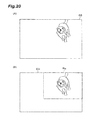
- FIGS. 20A and 20B are schematic diagrams for explaining image recognition by using a target area image.
- An image identification device is a device that divides a target image into a certain size of block images and recognizes a subject on a block-by-block basis, and can be, for example, a device incorporated in a mobile phone, a digital camera, a personal digital assistant (PDA), a conventional computer system, or the like.
- PDA personal digital assistant
- FIG. 1 is a functional block diagram of this mobile terminal 3 including this image identification device 1 according to the present embodiment.
- the mobile terminal 3 depicted in FIG. 1 is a mobile terminal carried by a user, for example, and has a hardware configuration depicted in FIG. 2 .
- FIG. 2 is a hardware block diagram of the mobile terminal 3 .
- the mobile terminal 3 is physically configured as a conventional computer system including a central processing unit (CPU) 100 , main memories such as a read only memory (ROM) 101 and a random access memory (RAM) 102 , an input device 103 such as a camera or a keyboard, an output device 104 such as a display, an auxiliary storage 105 such as a hard disk drive.
- CPU central processing unit
- main memories such as a read only memory (ROM) 101 and a random access memory (RAM) 102
- an input device 103 such as a camera or a keyboard
- an output device 104 such as a display
- an auxiliary storage 105 such as a hard disk
- Each function of the mobile terminal 3 and the image identification device 1 described later is implemented by causing the input device 103 and the output device 104 to operate under control of the CPU 100 by loading predetermined computer software into hardware such as the CPU 100 , the ROM 101 , and the RAM 102 , and additionally by reading and writing data in the main memories or the auxiliary storage 105 .
- the image identification device 1 may be configured as a conventional computer system including the CPU 100 , the main memories such as the ROM 101 and the RAM 102 , the input device 103 , the output device 104 , and the auxiliary storage 105 .
- the mobile terminal 3 may include a communication module or the like.
- the mobile terminal 3 includes the image identification device 1 , a separating hyperplane data (separating plane data) 31 , and category data 32 .
- the image identification device 1 includes a target image input unit 10 , a block image generation unit 11 , a feature quantity computing unit 12 , and a category determination unit 13 .
- the target image input unit 10 has a function of inputting a target image 30 as image data to be identified.
- the target image input unit 10 may input the target image 30 captured by a camera incorporated in the mobile terminal 3 , or may input the target image 30 via communications.
- the target image input unit 10 stores the target image 30 in the main memories or the auxiliary storage 105 of the mobile terminal 3 , for example.
- the block image generation unit 11 has a function of dividing the target image 30 input into blocks each having a certain area to generate block images. For example, the block image generation unit 11 divides a target image G 1 depicted in FIG. 3A into a plurality of block images BL as depicted in FIG. 3B . The block image generation unit 11 divides the target image G 1 into four blocks high by six blocks wide as depicted in FIG. 3B , for example. Alternatively, the block image generation unit 11 may divide the target image G 1 into 16 blocks high by 16 blocks wide, or may divide it in any other ratio.
- the block image generation unit 11 may first resize the target image G 1 such that the length of the long side thereof becomes equal to or smaller than a predetermined value and divide the target image G 1 thus resized.
- the block image generation unit 11 has a function of outputting the block images to the feature quantity computing unit 12 .
- the feature quantity computing unit 12 has a function of calculating a feature quantity for each of the block images BL.
- the feature quantity computing unit 12 calculates feature quantities from image information such as pixel values or edge information of the block images BL.
- the feature quantities are quantities in which features of a subject are reflected.
- the feature quantity computing unit 12 has a function of outputting a feature quantity of each of the block images BL to the category determination unit 13 .
- the category determination unit 13 has a function of classifying the block images BL into predetermined categories on the basis of feature quantities of the block images BL.
- predetermined categories include, for example, “sea”, “mountain”, “sky”, “evening glow”, “red leaves”, “cherry blossoms”, “snow”, “characters/memorandum”, “person”, “dishes”, “beach”, “flower”, “green”, “dog”, or “building”.
- it is acceptable to make the predetermined categories include an “empty set”.
- the separating hyperplane data 31 includes a separating hyperplane that is learned in advance for each of the above-mentioned categories on the basis of training data.
- the category determination unit 13 refers to the separating hyperplane data 31 and classifies the block images BL into the above-mentioned categories.
- the category determination unit 13 determines whether the block images BL are classified into the above-mentioned categories.
- the category determination unit 13 compares a feature quantity of each of the block images BL with a separating hyperplane for a given category and, when the magnitude of the feature quantity is larger than the separating hyperplane, determines the block image to belong to the category.
- the category determination unit 13 substitutes feature quantity data obtained from the image feature quantity computing process into the left-hand side of the above formula 1 for each category to calculate the signed distance between the separating hyperplane and coordinates ( ⁇ 1 , ⁇ 2 , . . . , ⁇ p ) in the feature quantity space, and judges the sign of the distance. Note that the category determination unit 13 , when determining that a magnitude of a feature quantity of a block image BL is not larger than any hyperplane, judges the block image BL to be “not applicable”.
- the category determination unit 13 determines that the block image BL belongs to the category into which the block image BL has been classified first in the order of comparison.
- the category determination unit 13 outputs the output results to the category data 32 .
- the feature quantity computing unit 12 adopts four feature quantities as feature quantities of a block image as depicted in FIG. 4 .
- FIG. 4 illustrates feature quantities for each of blocks No. 1 to No. 256 in a target image (image ID: OOOO).
- the first feature quantity is a local feature quantity.
- the local feature quantity is calculated according to image information of the block image itself to be classified. For example, the local feature quantity is calculated by using image information of a given target block image B 0 of the target image G 1 depicted in FIG. 5 .
- the local feature quantity includes, for example, the average and the variance of each of pixel values (Y component, U component, V component) of the target block image B 0 , the magnitude of an edge in the horizontal direction and the magnitude of the edge in the vertical direction in the target image B 0 , the ratio of the magnitude of the edge in the horizontal direction with respect to the magnitude of the edge in the vertical direction in the target block image B 0 , a histogram of Y component in the target block image B 0 , or the degree of similarity between a pixel value and skin color of the target block image B 0 .
- the degree of similarity between a pixel value and skin color of the target block image B 0 is a feature quantity included for identifying the category “person”, and it is acceptable not to adopt such feature quantity when predetermined categories do not include the “person”.
- FIGS. 6A to 6C are histograms for the respective components of the pixel values, and the abscissa represents a pixel value component and the ordinate represents frequency.
- the pixel value component is classified into classes with a predetermined range interval. For example, as depicted in FIG. 6A , pixel values 0 to 255 in Y component are classified into classes X 1 to Xn (n is an integer of two or more). As also depicted in FIG. 6B , pixel values 0 to 255 in U component are classified into classes X 1 to Xm (m is an integer of two or more).
- pixel values 0 to 255 in V component are classified into classes X 1 to Xs (s is an integer of two or more). For example, in a block image, when there are two pixels whose pixel values belong to the class X 1 in Y component, “two” becomes the feature quantity.
- the first feature quantity includes frequency for each of the classes X 1 to Xm depicted in the Y-component histogram as a feature quantity.
- the second feature quantity is a neighbor feature quantity.
- the neighbor feature quantity is calculated according to image information of neighboring block images that surround the target block image. For example, the neighbor feature quantity is calculated according to the image information of neighboring block images B 1 to B 8 that surround the predetermined target block image B 0 of the target image G 1 depicted in FIG. 7 .
- the neighbor feature quantity includes, for example, local feature quantities of the neighboring block images B 1 to B 8 , the average and the variance of pixel values (Y, U, V) in combination with the neighboring block images B 4 and B 5 , or the average and the variance of pixel values (Y, U, V) in combination with the neighboring block images B 6 and B 8 .
- Feature quantities for the neighboring block images B 4 and B 5 and feature quantities for the neighboring block images B 6 and B 8 are used for judging symmetry of the neighboring block images. For example, for the category “sky”, feature quantities tend to be uniform on average and, for the category “person”, feature quantities around the person tend to be uniform on average in the background. In this manner, it is acceptable to calculate a feature quantity by using neighboring block images selected from eight neighboring block images.
- the third feature quantity is a sub-global feature quantity.
- the sub-global feature quantity is calculated according to image information of a partial area that constructs of a plurality of block images and in which the target block image is included. For example, as depicted in FIG. 8A , the sub-global feature quantity is calculated according to image information of a partial area R 2 in which the predetermined target block image B 0 of the target image G 1 is included. Alternatively, the sub-global feature quantity may be calculated according to image information of an area within a circle having its center at the target block image and a certain diameter. As also depicted in FIG.
- the sub-global feature is calculated according to image information of a partial area in which the predetermined target block image B 0 of the target image G 1 , the partial area being a partial area R 3 constructed of a vertical array of block images or a partial area R 4 constructed of a horizontal array of block images.
- the sub-global feature quantity may be calculated according to image information of a partial area to which the target block image B 0 belongs out of areas into which the partial area R 3 or R 4 is bisected.
- the sub-global feature quantity includes, for example, the average and the variance of pixel values (Y, U, V) of all pixels in the horizontal direction and in the vertical direction within the partial areas, the average and the variance of pixel values (Y, U, V) in areas to which the target block image belong out of areas into which all pixels in the horizontal direction and in the vertical direction within the partial areas are bisected, or the average and the variance of pixel values (Y, U, V) of pixels in an area including the target block image and having a certain size.
- image information of the partial area R 3 constructed of a vertical array of block images or image information in the vertical direction within the partial area it is possible to use the sub-global feature quantity as a feature quantity in which changes in the vertical direction varying by category are reflected.
- image information of the partial area R 4 constructed of a horizontal array of block images or image information in the horizontal direction within the partial area it is possible to use the sub-global feature quantity as a feature quantity enabling easy classification of a category such as the category “sky” in which similar pixels tend to be arranged in the horizontal direction.
- the fourth feature quantity is a global feature quantity.
- the global feature quantity is calculated according to image information of the target image as a whole. For example, the global feature quantity is calculated according to image information of the target image G 1 as a whole (global area R 5 ) depicted in FIG. 9A .
- the global feature quantity is also calculated according to image information of four corner areas R 6 to R 9 in the target image G 1 being in a rectangular shape depicted in FIG. 9B .
- the global feature quantity includes, for example, the average and the variance of pixel values (Y, U, V) of the target image G 1 , the magnitude of an edge in the horizontal direction and the magnitude of the edge in the vertical direction of the target image G 1 , the frequency for each of the classes X 1 to Xm in the U-component histogram of the target image G 1 , the frequency for each of the classes X 1 to Xs in the V-component histogram of the target image G 1 , the average and the variance of pixel values (Y, U, V) in the four corner areas R 6 to R 9 of the target image G 1 , the magnitudes of edges in the horizontal direction and the magnitudes of edges in the vertical direction in the four corner areas R 6 to R 9 of the target image G 1 , or the frequency for each of classes X 1 to Xk (k is an integer of two or more) in a histogram of the magnitude of an edge in each direction at angular intervals of 45 degrees of block images included in the target image.
- k
- the pixel values (Y, U, V) in the four corner areas R 6 to R 9 of the target image G 1 By including the pixel values (Y, U, V) in the four corner areas R 6 to R 9 of the target image G 1 , the magnitude of the edge in the horizontal direction in the four corner areas R 6 to R 9 and the magnitude of the edge in the vertical direction of the target image G 1 , it is possible to classify block images by using features arising in areas at the corners of the target image G 1 .
- a person shoots an image of a circular object such as a dish, from an image-shooting aesthetic point of view, it is often the case that the person shoots the image so that the rim portion of the dish is arranged at four corners. Accordingly, it is possible to appropriately classify the circular object by using the image information in the four corner areas R 6 to R 9 .
- each of directions at angular intervals of 45 degrees (0°, 45°, 90°, 135°) of block images included in the target image in the same manner as in FIG. 6A , by representing the magnitude of the edge in each direction in the classes X 1 to Xk and defining the number of pixels belonging to each of the classes X 1 to Xk as a feature quantity, when shooting an image of a set meal with a plurality of dishes arranged from above, for example, it is possible to appropriately classify rim portions of a plurality of circular objects. Alternatively, it is acceptable to divide the whole image G 1 into 16 pieces or 9 pieces and to use the count of edge values at four corners of the divided areas to be combined to a feature quantity. In this case, it is similarly possible to appropriately classify the rim portions of the circular objects.
- the frequency for each of the classes X 1 to Xm in the U-component histogram of the target image G 1 and the frequency for each of the classes X 1 to Xs in the V-component histogram of the target image G 1 are similar to those depicted in FIGS. 6B and 6C .
- a predetermined value when the magnitude of an edge is equal to or larger than a predetermined value, it is acceptable to give low evaluation conversely.
- the global feature quantity herein includes as a feature quantity, other than the above-described feature quantities, the number of block images that satisfies a predetermined condition on the magnitude of feature quantity.
- the global feature quantity includes the number of block images having a brightness value Y whose magnitude is equal to or larger than a predetermined value.
- the global feature quantity includes as a feature quantity the number of block images having a brightness value Y whose magnitude is smaller than the predetermined value. Since it is possible to define blocks whose feature quantities are similar as a feature quantity, it is possible to strongly reflect a feature of each block image in the global feature quantity compared with the above-described global feature quantity.
- the predetermined condition may be a condition that a feature quantity belongs within a predetermined range.
- the global feature quantity may include as a feature quantity the number of block images having brightness values Y whose magnitudes are equal to or larger than a first threshold and are equal to or smaller than a second threshold.
- the global feature quantity may include as a feature quantity the number of block images that satisfy a predetermined condition on the magnitudes of a plurality of feature quantities.
- a predetermined condition on the magnitudes of a plurality of feature quantities For example, an example of pixel values (Y, U, V) will be explained.
- Y, U, V pixel values
- a plurality of classes can be set by setting a plurality of thresholds (predetermined values) for each of the feature quantities.
- a new feature quantity representing a complex feature.
- a feature quantity space using u features as coordinate axes for example, a plurality of local feature quantities as a u-dimensional feature quantity vector (f 1 , f 2 , . . . , fu) are used.
- the u-dimensional feature quantity space is divided into q regions in advance.
- each region distances between any vectors in the region are short, which results in a plurality of local feature quantities being similar to each other. Accordingly, it is easy to extract co-occurrence between the local feature quantities. Since each block image belongs to any one of the q regions, to which region all block images included in a whole image belong is determined, the number of block images belonging to an optional region Zi (1 ⁇ i ⁇ q) is counted, and this count value for each region is adopted into a global feature quantity. In this manner, by adopting a combination of various feature quantities, it is possible to simultaneously make a judgment based on not only the above-described combination of colors but also edge information, which is a completely different type of feature quantity.
- FIG. 12 illustrates a feature quantity space in which clustering is performed to recognize “dog” as depicted in FIG. 3A , for example.
- a class including a greenish image having an edge without orientation is Ca
- a class including an image looking like dog skins is Cb
- a class including a blackish image having a sharp edge is Cd
- a plurality of feature quantities to be combined are not limited to numbers.
- 3 5 243 patterns are formed.
- FIG. 13 is a functional block diagram of the mobile terminal 3 having a learning device 2 .
- the mobile terminal 3 includes the learning device 2 and the separating hyperplane data 31 .
- the learning device 2 may be fabricated by a computer other than the mobile terminal 3 as needed.
- the image identification device 1 includes a training data input unit 15 , the block image generation unit 11 , the feature quantity computing unit 12 , and a separating hyperplane computing unit 16 .
- the training data input unit 15 has a function of inputting a training image 33 as image data to be learned.
- FIG. 14A is one example of a training image G 2 for learning a correct answer for the category “flower”.
- FIG. 14B information indicating that “flower” is drawn at positions of blocks Bt is made included in training data.
- the training data in FIG. 14 is image blocks labeled with the category of the correct answer.
- the training data may include an image block labeled with a category of an incorrect answer.
- the training data is prepared for each of the predetermined categories.
- the training data input unit 15 may input the training image 33 by a camera incorporated in the mobile terminal 3 or may input the training image 33 via communications.
- the training data input unit 15 stores the target image 30 in the main memories or the auxiliary storage 105 of the mobile terminal 3 , for example.
- the block image generation unit 11 has a function of dividing the training image 33 input into blocks each having a certain area to generate block images as described above.
- the feature quantity computing unit 12 has a function of calculating a feature quantity for each of the block images as described above.
- the feature quantity computing unit 12 has a function of outputting a feature quantity of the block images to the separating hyperplane computing unit 16 .
- the separating hyperplane computing unit 16 has a function of inputting an image feature quantity for each category and calculating a separating hyperplane for each category.
- the separating hyperplane computing unit 16 calculates a separating hyperplane by using a dedicated library of a linear support vector machine (SVM) that is widely used as a learning algorithm, for example.
- SVM linear support vector machine
- a separating hyperline in a feature quantity plane in two-dimensional image feature quantities ⁇ 1 and ⁇ 2 will be described hereinafter. As depicted in FIG. 15 , with image feature quantity ⁇ 1 as abscissa and image feature quantity ⁇ 2 as ordinate, training data C 1 of correct answer and training data C 2 of incorrect answer are plotted.
- the separating hyperplane computing unit 16 learns a separating hyperline L 1 that is a straight line separating the training data C 1 of correct answer and the training data C 2 of incorrect answer by the linear SVM.
- the results of the learning are recorded as the separating hyperplane data 31 .
- the feature quantity plane becomes a feature quantity space and the separating hyperline becomes a separating hyperplane. Therefore, the separating hyperplane is a concept including the separating hyperline, and the feature quantity space is a concept including the feature quantity plane.
- FIG. 16 is a flowchart illustrating identification operation of the image identification device 1 according to the present embodiment.
- a control process depicted in FIG. 16 is performed after the execution of the above-described learning process and at the timing when a process start button included in the mobile terminal 3 is turned on, for example.
- the target image input unit 10 inputs a target image (S 10 : input step).
- the flow proceeds to a block image generation process (S 12 : block image generation step).
- the block image generation unit 11 divides the target image input in the process at S 10 to generate block images.
- the flow proceeds to a feature quantity calculation process (S 14 : feature quantity computing step).
- the feature quantity computing unit 12 calculates a feature quantity for each of the block images generated in the process at S 12 . For example, the feature quantity computing unit 12 calculates feature quantities depicted in FIG. 4 for each of the block images.
- the flow proceeds to a classification process (S 16 : category determination step).
- the category determination unit 13 compares the feature quantities calculated in the process at S 16 for each of the block images with the already-learned separating hyperplane data 31 and, with respect to block images having feature quantities of larger magnitudes than a separating hyperplane for a predetermined category, determines that these block images belong to the category.
- categories are determined for all block images, the control process depicted in FIG. 16 ends.
- the image identification program includes a main module, input module, and a computation processing module.
- the main module is a unit that controls image processing in a centralized manner.
- the input module causes the mobile terminal 3 to operate so as to acquire an input image.
- the computation processing module includes a block image dividing module, a feature quantity computing module, and a category determination module. Functions implemented by operating the main module, the input module, and the computation processing module are the same as the functions of the target image input unit 10 , the block image generation unit 11 , the feature quantity computing unit 12 , and the category determination unit 13 of the image identification device 1 described above.
- the image identification program is provided by a storage medium such as a ROM or a semiconductor memory.
- the image identification program may be provided as a data signal via a network.
- the image identification device 1 uses, as a feature quantity of the target block image B 0 , not only a local feature quantity calculated according to image information of the target block image B 0 but also a global feature quantity calculated according to image information of the target image G 1 as a whole, and thus can classify the target block image B 0 considering not only information of the target block image B 0 itself but also a relationship between the target block image B 0 and the target image G 1 . Accordingly, even when it is impossible to determine the category only according to the target block image B 0 , looking at the target image G 1 as a whole makes it possible to determine the category of the target block image B 0 .
- the target block image B 0 is blue, it is difficult to determine whether the category is “sky” or “sea” according to image information of the target block image B 0 .
- a feature quantity for determining whether it is “sky” or “sea” can be acquired in a global feature quantity, it becomes possible to determine the category of the target block image B 0 .
- the global feature quantity does not include the number of block images in which the magnitudes of local feature quantities are equal to or larger than a predetermined value
- the global feature quantity as a whole tends to represent a vague and simplified feature. For example, when an image in which images of “sea” and “beach” are captured has been learned, an overall feature indicating that “the sea lies above the beach” can be obtained.
- the block image B 0 that is incorrectly recognized when being determined according to a feature quantity of the target image G 1 as a whole can be correctly recognized by compensating with a global feature quantity having a strong influence of local feature quantities.
- the feature of the blue object is reflected in the global feature quantity as the number of blocks and the number of the blocks can be determined to be smaller than that of “sea”, it becomes possible to determine that the blue object itself is not “sea”. Accordingly, it is possible to avoid classifying the desk as “beach”. Therefore, it is possible to improve classification accuracy of block images.
- the image identification device 1 since the image identification device 1 according to the first embodiment combines a plurality of local feature quantities into a new quantity feature and can classify block images by using the new quantity feature, it becomes possible to avoid classifying the block images in a biased manner toward one local feature quantity. Therefore, it is possible to avoid a biased determination.
- the global feature quantity includes as a feature quantity the number of block images that have local feature quantities belonging to the classes, it is possible to use the global feature quantity as a finer feature quantity with a plurality of local feature quantities combined.
- An image identification device 1 according to a second embodiment is configured substantially in the same manner as the image identification device 1 according to the first embodiment and is different in that it extracts a plurality of areas from a target image, divides the areas thus extracted to generate block images to be classified.
- the following description will be made focusing on differences from the image identification device 1 according to the first embodiment, and redundant explanations are omitted.
- FIG. 17 is a functional block diagram of a mobile terminal including the image identification device 1 according to the second embodiment. Note that a hardware configuration thereof is the same as that of the image identification device 1 according to the first embodiment. As depicted in FIG. 17 , the image identification device 1 includes a target area image extraction unit 100 .
- the target area image extraction unit 100 extracts target area images having a predetermined size from a target image. For example, the target area image extraction unit 100 extracts a plurality of target areas that overlap each other from the target image to form respective target area images.
- the target area image extraction unit 100 output the target area images to the block image generation unit 11 .
- the block image generation unit 11 has a function of dividing the target area images into blocks each having a certain area to generate block images.
- the category determination unit 13 superimposes a classification result for each of the target area images to form classification results of the block images in the target image.
- the other configurations are the same as those of the image identification device 1 according to the first embodiment.
- FIG. 18 is a flowchart illustrating the operation of the image identification device 1 according to the present embodiment.
- a control process depicted in FIG. 18 is performed after the execution of the learning process described in the first embodiment and at the timing when a process start button included in the mobile terminal 3 is turned on, for example.
- the target image input unit 10 inputs a target image (S 20 ).
- the flow proceeds to an extracting process of target area images (S 22 ).
- the target area image extraction unit 100 extracts a plurality of target area images from the target image input in the process at S 20 .
- the target area image extraction unit 100 extracts a target area image Rt 1 from an upper left area of a target image G 3 .
- the target area image extraction unit 100 extracts a target area image Rt 2 from an upper right area of the target image G 3 as depicted in FIG. 19B , a target area image Rt 3 from an lower right area of the target image G 3 as depicted in FIG. 19C , a target area image Rt 4 from an lower left area of the target image G 3 as depicted in FIG.
- the target area image extraction unit 100 selects one image from the target area images Rt 1 to Rt 5 extracted in the process at S 22 .
- the flow proceeds to a block image generation process (S 26 ).
- the block image generation unit 11 divides the target area image selected in the process at S 24 to generate block images.
- the flow proceeds to a feature quantity calculation process (S 28 ).
- the feature quantity computing unit 12 calculates a feature quantity for each of the block images generated in the process at S 26 .
- the flow proceeds to a classification process (S 30 ).
- the category determination unit 13 compares the feature quantity for each of the block images calculated in the process at S 28 with the already-learned separating hyperplane data 31 and, with respect to block images having feature quantities of larger magnitude than a separating hyperplane for a predetermined category, determines that these block images belong to the category.
- categories are determined for all block images, the flow proceeds to a selection determination process (S 32 ).
- the target area image extraction unit 100 determines whether or not the classification process has been performed on all of the target area images Rt 1 to Rt 5 extracted in the process at S 22 .
- the flow goes back to the process at S 24 .
- the target area image extraction unit 100 selects a target area image that has not been selected yet.
- the processes at S 26 to S 30 are performed on the target area image thus selected. In this manner, until the classification process is performed on all of the target area images Rt 1 to Rt 5 , the processes at S 24 to S 32 are repeatedly performed.
- the target area image extraction unit 100 determines that the classification process is performed on all of the target area images Rt 1 to Rt 5 , the flow proceeds to a result output process (S 34 ).
- the category determination unit 13 superimposes a classification results on a block-by-block basis of the target area images Rt 1 to Rt 5 to be output as classification results on a block-by-block basis of the target image G 3 .
- the control process depicted in FIG. 18 ends.
- By performing the control process depicted in FIG. 18 it is possible to appropriately classify even a target image having a scale change or having a shifted subject position.
- a target image having a scale change or having a shifted subject position For example, as depicted in FIG. 20A , it is assumed that a subject is drawn on a target image G 3 in a manner shifted from the center to the upper right at a small scale. In this case, with a conventional image identification device, it is difficult to recognize the image in some cases since features concerning the shape and the like are different from those for learning.
- the target area image extracting unit 100 by the target area image extracting unit 100 , the target area images Rt 1 to Rt 5 are extracted from the target image G 3 , and the classification process is performed on a block-by-block basis on the extracted target area images Rt 1 to Rt 5 . Accordingly, as depicted in FIG. 20B , by using the target area image Rt 2 in which the subject is drawn in the center at a large scale, it is possible to perform the classification process on a block-by-block basis. Accordingly, it becomes possible to appropriately classify even a target image G 3 having a scale change or having a shifted subject position.
Landscapes
- Engineering & Computer Science (AREA)
- Theoretical Computer Science (AREA)
- Physics & Mathematics (AREA)
- General Physics & Mathematics (AREA)
- Library & Information Science (AREA)
- Multimedia (AREA)
- Data Mining & Analysis (AREA)
- Databases & Information Systems (AREA)
- General Engineering & Computer Science (AREA)
- Image Analysis (AREA)
- Studio Devices (AREA)
Abstract
Description
w 1·α1 +w 2·α2 + . . . +w p·αp +z=0 (1)
A learning process of the separating
Claims (6)
Applications Claiming Priority (2)
| Application Number | Priority Date | Filing Date | Title |
|---|---|---|---|
| JP2011114665A JP5668932B2 (en) | 2011-05-23 | 2011-05-23 | Image identification device, image identification method, image identification program, and recording medium |
| JP2011-114665 | 2011-05-23 |
Publications (2)
| Publication Number | Publication Date |
|---|---|
| US20120301015A1 US20120301015A1 (en) | 2012-11-29 |
| US8600162B2 true US8600162B2 (en) | 2013-12-03 |
Family
ID=46045720
Family Applications (1)
| Application Number | Title | Priority Date | Filing Date |
|---|---|---|---|
| US13/475,152 Expired - Fee Related US8600162B2 (en) | 2011-05-23 | 2012-05-18 | Image identification device, image identification method and recording medium |
Country Status (4)
| Country | Link |
|---|---|
| US (1) | US8600162B2 (en) |
| EP (1) | EP2528017B1 (en) |
| JP (1) | JP5668932B2 (en) |
| CN (1) | CN102799854B (en) |
Cited By (2)
| Publication number | Priority date | Publication date | Assignee | Title |
|---|---|---|---|---|
| US20120300982A1 (en) * | 2011-05-23 | 2012-11-29 | Morpho, Inc. | Image identification device, image identification method, and recording medium |
| US12400431B2 (en) | 2021-10-26 | 2025-08-26 | Canon Kabushiki Kaisha | Information processing apparatus, estimation method, training method, and storage medium |
Families Citing this family (22)
| Publication number | Priority date | Publication date | Assignee | Title |
|---|---|---|---|---|
| US9053359B2 (en) * | 2012-06-07 | 2015-06-09 | Konica Minolta Laboratory U.S.A., Inc. | Method and system for document authentication using Krawtchouk decomposition of image patches for image comparison |
| JP6137856B2 (en) * | 2013-02-07 | 2017-05-31 | キヤノン株式会社 | Image processing apparatus, control method thereof, and control program |
| US10062008B2 (en) * | 2013-06-13 | 2018-08-28 | Sicpa Holding Sa | Image based object classification |
| US9158996B2 (en) * | 2013-09-12 | 2015-10-13 | Kabushiki Kaisha Toshiba | Learning image collection apparatus, learning apparatus, and target object detection apparatus |
| JP6393982B2 (en) | 2013-12-17 | 2018-09-26 | 富士通株式会社 | Space division method, space division apparatus, and space division program |
| US9715735B2 (en) | 2014-01-30 | 2017-07-25 | Flipboard, Inc. | Identifying regions of free space within an image |
| US9818038B2 (en) * | 2016-01-06 | 2017-11-14 | Toshiba Tec Kabushiki Kaisha | Image recognition apparatus |
| JP7031584B2 (en) * | 2016-06-21 | 2022-03-08 | 日本電気株式会社 | Area identification device and area identification method and area identification program |
| CN106529546B (en) * | 2016-09-29 | 2018-05-29 | 深圳云天励飞技术有限公司 | A kind of image-recognizing method and device |
| JP6756406B2 (en) * | 2016-11-30 | 2020-09-16 | 日本電気株式会社 | Image processing equipment, image processing method and image processing program |
| CN107054937A (en) * | 2017-03-23 | 2017-08-18 | 广东数相智能科技有限公司 | A kind of refuse classification suggestion device and system based on image recognition |
| CN107231520A (en) * | 2017-04-27 | 2017-10-03 | 歌尔科技有限公司 | Camera image pickup method, device and camera |
| JP6760318B2 (en) * | 2018-03-14 | 2020-09-23 | オムロン株式会社 | Face image identification system, classifier generator, identification device, image identification system, and identification system |
| JP6984020B2 (en) * | 2018-07-31 | 2021-12-17 | オリンパス株式会社 | Image analysis device and image analysis method |
| CN109359576B (en) * | 2018-10-08 | 2021-09-03 | 北京理工大学 | Animal quantity estimation method based on image local feature recognition |
| CN111582008B (en) * | 2019-02-19 | 2023-09-08 | 富士通株式会社 | Device and method for training classification model and device for classifying using classification model |
| CN109902739A (en) * | 2019-02-27 | 2019-06-18 | 厦门理工学院 | A kind of mechanical equipment failure degree identification method, terminal equipment and storage medium |
| CN111553422A (en) * | 2020-04-28 | 2020-08-18 | 南京新空间信息科技有限公司 | Automatic identification and recovery method and system for surgical instruments |
| CN111881868B (en) * | 2020-08-03 | 2024-02-27 | 武汉百家云科技有限公司 | Automatic layer identification method and device |
| JP7412321B2 (en) * | 2020-12-08 | 2024-01-12 | 株式会社日立ハイテク | Object classification device, object classification system and object classification method |
| CN113901957B (en) * | 2021-11-19 | 2024-11-19 | 成都泰盟软件有限公司 | Animal feature point recognition method, its circling behavior measurement method and system and application |
| CN116471489A (en) * | 2023-04-25 | 2023-07-21 | 维沃移动通信有限公司 | Image preprocessing method and device thereof |
Citations (15)
| Publication number | Priority date | Publication date | Assignee | Title |
|---|---|---|---|---|
| US6195459B1 (en) * | 1995-12-21 | 2001-02-27 | Canon Kabushiki Kaisha | Zone segmentation for image display |
| US20050129311A1 (en) * | 2003-12-11 | 2005-06-16 | Haynes Simon D. | Object detection |
| US20060029276A1 (en) * | 2004-08-04 | 2006-02-09 | Toshinori Nagahashi | Object image detecting apparatus, face image detecting program and face image detecting method |
| US20060153457A1 (en) * | 2005-01-07 | 2006-07-13 | Sony Corporation | Information processing apparatus and method, and program |
| US20070165950A1 (en) * | 2006-01-18 | 2007-07-19 | Hirobumi Nishida | Image processing apparatus, image processing method, and computer program product |
| US20080037877A1 (en) * | 2006-08-14 | 2008-02-14 | Microsoft Corporation | Automatic classification of objects within images |
| US20080075336A1 (en) * | 2006-09-26 | 2008-03-27 | Huitao Luo | Extracting features from face regions and auxiliary identification regions of images for person recognition and other applications |
| US20080137954A1 (en) * | 2006-12-12 | 2008-06-12 | Yichuan Tang | Method And Apparatus For Identifying Regions Of Different Content In An Image |
| US20080137917A1 (en) * | 2006-12-08 | 2008-06-12 | Atsushi Okubo | Information Processing Apparatus and Information Processing Method, Recognition Apparatus and Information Recognition Method, and Program |
| US20080199044A1 (en) * | 2007-02-20 | 2008-08-21 | Shingo Tsurumi | Image Processing Apparatus, Image Processing Method, and Program |
| US20090074288A1 (en) * | 2007-09-19 | 2009-03-19 | Hirobumi Nishida | Data processing apparatus, computer program product, and data processing method |
| US7522772B2 (en) * | 2003-12-11 | 2009-04-21 | Sony United Kingdom Limited | Object detection |
| EP2154630A1 (en) | 2008-08-13 | 2010-02-17 | NTT DoCoMo, Inc. | Image identification method and imaging apparatus |
| US20100150410A1 (en) * | 2005-09-28 | 2010-06-17 | Facedouble Incorporated | Image Classification And Information Retrieval Over Wireless Digital Networks And The Internet |
| US20120300982A1 (en) * | 2011-05-23 | 2012-11-29 | Morpho, Inc. | Image identification device, image identification method, and recording medium |
Family Cites Families (4)
| Publication number | Priority date | Publication date | Assignee | Title |
|---|---|---|---|---|
| US8023A (en) * | 1851-04-08 | Fastening down table-leaves | ||
| WO2004047026A1 (en) * | 2002-11-20 | 2004-06-03 | Fujitsu Limited | Image search program |
| JP4826531B2 (en) * | 2007-04-16 | 2011-11-30 | セイコーエプソン株式会社 | Scene identification device and scene identification method |
| CN101488185B (en) * | 2009-01-16 | 2010-10-20 | 哈尔滨工程大学 | Gait Recognition Method Based on Block Matrix |
-
2011
- 2011-05-23 JP JP2011114665A patent/JP5668932B2/en not_active Expired - Fee Related
-
2012
- 2012-03-26 CN CN201210082473.1A patent/CN102799854B/en not_active Expired - Fee Related
- 2012-03-26 EP EP12161215.4A patent/EP2528017B1/en not_active Not-in-force
- 2012-05-18 US US13/475,152 patent/US8600162B2/en not_active Expired - Fee Related
Patent Citations (16)
| Publication number | Priority date | Publication date | Assignee | Title |
|---|---|---|---|---|
| US6195459B1 (en) * | 1995-12-21 | 2001-02-27 | Canon Kabushiki Kaisha | Zone segmentation for image display |
| US7522772B2 (en) * | 2003-12-11 | 2009-04-21 | Sony United Kingdom Limited | Object detection |
| US20050129311A1 (en) * | 2003-12-11 | 2005-06-16 | Haynes Simon D. | Object detection |
| US20060029276A1 (en) * | 2004-08-04 | 2006-02-09 | Toshinori Nagahashi | Object image detecting apparatus, face image detecting program and face image detecting method |
| US20060153457A1 (en) * | 2005-01-07 | 2006-07-13 | Sony Corporation | Information processing apparatus and method, and program |
| US20100150410A1 (en) * | 2005-09-28 | 2010-06-17 | Facedouble Incorporated | Image Classification And Information Retrieval Over Wireless Digital Networks And The Internet |
| US20070165950A1 (en) * | 2006-01-18 | 2007-07-19 | Hirobumi Nishida | Image processing apparatus, image processing method, and computer program product |
| US20080037877A1 (en) * | 2006-08-14 | 2008-02-14 | Microsoft Corporation | Automatic classification of objects within images |
| US20080075336A1 (en) * | 2006-09-26 | 2008-03-27 | Huitao Luo | Extracting features from face regions and auxiliary identification regions of images for person recognition and other applications |
| US20080137917A1 (en) * | 2006-12-08 | 2008-06-12 | Atsushi Okubo | Information Processing Apparatus and Information Processing Method, Recognition Apparatus and Information Recognition Method, and Program |
| US20080137954A1 (en) * | 2006-12-12 | 2008-06-12 | Yichuan Tang | Method And Apparatus For Identifying Regions Of Different Content In An Image |
| US20080199044A1 (en) * | 2007-02-20 | 2008-08-21 | Shingo Tsurumi | Image Processing Apparatus, Image Processing Method, and Program |
| US20090074288A1 (en) * | 2007-09-19 | 2009-03-19 | Hirobumi Nishida | Data processing apparatus, computer program product, and data processing method |
| EP2154630A1 (en) | 2008-08-13 | 2010-02-17 | NTT DoCoMo, Inc. | Image identification method and imaging apparatus |
| JP2010045613A (en) | 2008-08-13 | 2010-02-25 | Ntt Docomo Inc | Image identifying method and imaging device |
| US20120300982A1 (en) * | 2011-05-23 | 2012-11-29 | Morpho, Inc. | Image identification device, image identification method, and recording medium |
Non-Patent Citations (5)
| Title |
|---|
| "A Computationally Efficient Approach to Indoor/Outdoor Scene Classification", Serrano et al., Pattern Recognition, 2002. Proceedings. 16th International Conference on Quebec City, Quebec, Canada Aug. 11-15, 2002, Los Alamitos, CA, USA, IEEE Comput. Soc, US vol. 4, Aug. 11, 2002, p. 146-p. 149, XP010613491. |
| "Indoor-Outdoor Image Classification". Szummer et al., Content-Based Access of Image and Video Database, 1998. Proceedings, 1998 IEEE International Workshop on Bombay, India Jan. 3, 1998, Los Alamitos, CA, USA, IEEE Comput. Soc, US, Jan. 3, 1998, p. 42-p. 51, XP01026158. |
| "Learning Primitive and Scene Semantics of Images for Classification and Retrieval", Cheong Yiu Fung et al., Proceedings of the Seventh ACM International Conference on Multimedia(Part 2), Multimedia '99, Jan. 1, 1999, p. 9-p. 12, XP55035591. |
| "On Image Classification: City Images vs. Landscapes", Vailaya et al., Pattern Recognition, Elsevier, GB, vol. 31, No. 12, Dec. 1, 1998, p. 1921-p. 1935, XP027120415. |
| European Search Report issued in European Application No. 12161215.4 dated Aug. 23, 2012. |
Cited By (3)
| Publication number | Priority date | Publication date | Assignee | Title |
|---|---|---|---|---|
| US20120300982A1 (en) * | 2011-05-23 | 2012-11-29 | Morpho, Inc. | Image identification device, image identification method, and recording medium |
| US8855368B2 (en) * | 2011-05-23 | 2014-10-07 | Morpho, Inc. | Image identification device, image identification method, and recording medium |
| US12400431B2 (en) | 2021-10-26 | 2025-08-26 | Canon Kabushiki Kaisha | Information processing apparatus, estimation method, training method, and storage medium |
Also Published As
| Publication number | Publication date |
|---|---|
| US20120301015A1 (en) | 2012-11-29 |
| JP5668932B2 (en) | 2015-02-12 |
| CN102799854B (en) | 2016-09-28 |
| EP2528017A1 (en) | 2012-11-28 |
| CN102799854A (en) | 2012-11-28 |
| JP2012243197A (en) | 2012-12-10 |
| EP2528017B1 (en) | 2014-12-03 |
Similar Documents
| Publication | Publication Date | Title |
|---|---|---|
| US20120301015A1 (en) | Image identification device, image identification method and recording medium | |
| US8855368B2 (en) | Image identification device, image identification method, and recording medium | |
| US10395136B2 (en) | Image processing apparatus, image processing method, and recording medium | |
| US7627148B2 (en) | Image data processing apparatus and method, and image data processing program | |
| US8805077B2 (en) | Subject region detecting apparatus | |
| JP5929896B2 (en) | Image recognition system, image recognition method, and image recognition program | |
| US10410084B2 (en) | Devices, systems, and methods for anomaly detection | |
| US8923610B2 (en) | Image processing apparatus, image processing method, and computer readable medium | |
| KR101896357B1 (en) | Method, device and program for detecting an object | |
| WO2011042601A1 (en) | Face recognition in digital images | |
| US10810433B2 (en) | Method and system for tracking objects | |
| CN109961063B (en) | Text detection method and device, computer equipment and storage medium | |
| CN113269752A (en) | Image detection method, device terminal equipment and storage medium | |
| JP2017156988A (en) | Object detection device | |
| CN113537158B (en) | Image target detection method, device, equipment and storage medium | |
| CN112241736A (en) | A method and device for text detection | |
| JP5027201B2 (en) | Telop character area detection method, telop character area detection device, and telop character area detection program | |
| US9607398B2 (en) | Image processing apparatus and method of controlling the same | |
| KR101521136B1 (en) | Method of recognizing face and face recognition apparatus | |
| JP2014010633A (en) | Image recognition device, image recognition method, and image recognition program | |
| KR20130128097A (en) | Object recognition method and apparatus using depth information | |
| CN113095147B (en) | Skin area detection method, system, image processing terminal and storage medium | |
| JP6717769B2 (en) | Information processing device and program | |
| Wang et al. | Salient object detection by optimizing robust background detection | |
| Kikutani et al. | Hierarchical classifier with multiple feature weighted fusion for scene recognition |
Legal Events
| Date | Code | Title | Description |
|---|---|---|---|
| AS | Assignment |
Owner name: MORPHO, INC., JAPAN Free format text: ASSIGNMENT OF ASSIGNORS INTEREST;ASSIGNORS:TANASE, YASUSHI;MIURA, TAKESHI;TODOROKI, YASUHIRO;AND OTHERS;SIGNING DATES FROM 20120323 TO 20120409;REEL/FRAME:028301/0521 Owner name: NTT DOCOMO, INC., JAPAN Free format text: ASSIGNMENT OF ASSIGNORS INTEREST;ASSIGNORS:TANASE, YASUSHI;MIURA, TAKESHI;TODOROKI, YASUHIRO;AND OTHERS;SIGNING DATES FROM 20120323 TO 20120409;REEL/FRAME:028301/0521 |
|
| STCF | Information on status: patent grant |
Free format text: PATENTED CASE |
|
| AS | Assignment |
Owner name: MORPHO, INC., JAPAN Free format text: ASSIGNMENT OF ASSIGNORS INTEREST;ASSIGNOR:MORPHO, INC.;REEL/FRAME:033281/0572 Effective date: 20140428 |
|
| AS | Assignment |
Owner name: RPX CORPORATION, CALIFORNIA Free format text: ASSIGNMENT OF ASSIGNORS INTEREST;ASSIGNOR:MORPHO, INC.;REEL/FRAME:041052/0708 Effective date: 20161201 |
|
| AS | Assignment |
Owner name: RPX CORPORATION, CALIFORNIA Free format text: CORRECTIVE ASSIGNMENT TO CORRECT THE CONVEYANCE TYPE PREVIOUSLY RECORDED AT REEL 041052 FRAME 708. THE ASSIGNOR HEREBY CONFIRMS THE COVENANT NOT TO SUE;ASSIGNOR:MORPHO, INC.;REEL/FRAME:041773/0251 Effective date: 20161201 |
|
| FPAY | Fee payment |
Year of fee payment: 4 |
|
| AS | Assignment |
Owner name: BARINGS FINANCE LLC, AS COLLATERAL AGENT, NORTH CAROLINA Free format text: PATENT SECURITY AGREEMENT;ASSIGNORS:RPX CLEARINGHOUSE LLC;RPX CORPORATION;REEL/FRAME:054198/0029 Effective date: 20201023 Owner name: BARINGS FINANCE LLC, AS COLLATERAL AGENT, NORTH CAROLINA Free format text: PATENT SECURITY AGREEMENT;ASSIGNORS:RPX CLEARINGHOUSE LLC;RPX CORPORATION;REEL/FRAME:054244/0566 Effective date: 20200823 |
|
| FEPP | Fee payment procedure |
Free format text: MAINTENANCE FEE REMINDER MAILED (ORIGINAL EVENT CODE: REM.); ENTITY STATUS OF PATENT OWNER: LARGE ENTITY |
|
| LAPS | Lapse for failure to pay maintenance fees |
Free format text: PATENT EXPIRED FOR FAILURE TO PAY MAINTENANCE FEES (ORIGINAL EVENT CODE: EXP.); ENTITY STATUS OF PATENT OWNER: LARGE ENTITY |
|
| STCH | Information on status: patent discontinuation |
Free format text: PATENT EXPIRED DUE TO NONPAYMENT OF MAINTENANCE FEES UNDER 37 CFR 1.362 |
|
| FP | Lapsed due to failure to pay maintenance fee |
Effective date: 20211203 |