US8600143B1 - Method and system for hierarchical tissue analysis and classification - Google Patents
Method and system for hierarchical tissue analysis and classification Download PDFInfo
- Publication number
- US8600143B1 US8600143B1 US13/112,977 US201113112977A US8600143B1 US 8600143 B1 US8600143 B1 US 8600143B1 US 201113112977 A US201113112977 A US 201113112977A US 8600143 B1 US8600143 B1 US 8600143B1
- Authority
- US
- United States
- Prior art keywords
- segment
- clusters
- image
- user
- segmentation
- Prior art date
- Legal status (The legal status is an assumption and is not a legal conclusion. Google has not performed a legal analysis and makes no representation as to the accuracy of the status listed.)
- Expired - Fee Related, expires
Links
Images




Classifications
-
- G—PHYSICS
- G06—COMPUTING OR CALCULATING; COUNTING
- G06T—IMAGE DATA PROCESSING OR GENERATION, IN GENERAL
- G06T7/00—Image analysis
- G06T7/10—Segmentation; Edge detection
- G06T7/11—Region-based segmentation
-
- G—PHYSICS
- G06—COMPUTING OR CALCULATING; COUNTING
- G06F—ELECTRIC DIGITAL DATA PROCESSING
- G06F18/00—Pattern recognition
- G06F18/20—Analysing
- G06F18/23—Clustering techniques
- G06F18/231—Hierarchical techniques, i.e. dividing or merging pattern sets so as to obtain a dendrogram
-
- G—PHYSICS
- G06—COMPUTING OR CALCULATING; COUNTING
- G06T—IMAGE DATA PROCESSING OR GENERATION, IN GENERAL
- G06T7/00—Image analysis
- G06T7/10—Segmentation; Edge detection
- G06T7/143—Segmentation; Edge detection involving probabilistic approaches, e.g. Markov random field [MRF] modelling
-
- G—PHYSICS
- G06—COMPUTING OR CALCULATING; COUNTING
- G06V—IMAGE OR VIDEO RECOGNITION OR UNDERSTANDING
- G06V10/00—Arrangements for image or video recognition or understanding
- G06V10/20—Image preprocessing
- G06V10/26—Segmentation of patterns in the image field; Cutting or merging of image elements to establish the pattern region, e.g. clustering-based techniques; Detection of occlusion
-
- G—PHYSICS
- G06—COMPUTING OR CALCULATING; COUNTING
- G06V—IMAGE OR VIDEO RECOGNITION OR UNDERSTANDING
- G06V10/00—Arrangements for image or video recognition or understanding
- G06V10/70—Arrangements for image or video recognition or understanding using pattern recognition or machine learning
- G06V10/762—Arrangements for image or video recognition or understanding using pattern recognition or machine learning using clustering, e.g. of similar faces in social networks
- G06V10/7625—Hierarchical techniques, i.e. dividing or merging patterns to obtain a tree-like representation; Dendograms
-
- G—PHYSICS
- G06—COMPUTING OR CALCULATING; COUNTING
- G06V—IMAGE OR VIDEO RECOGNITION OR UNDERSTANDING
- G06V20/00—Scenes; Scene-specific elements
- G06V20/60—Type of objects
- G06V20/69—Microscopic objects, e.g. biological cells or cellular parts
- G06V20/698—Matching; Classification
-
- G—PHYSICS
- G06—COMPUTING OR CALCULATING; COUNTING
- G06T—IMAGE DATA PROCESSING OR GENERATION, IN GENERAL
- G06T2207/00—Indexing scheme for image analysis or image enhancement
- G06T2207/10—Image acquisition modality
- G06T2207/10004—Still image; Photographic image
-
- G—PHYSICS
- G06—COMPUTING OR CALCULATING; COUNTING
- G06T—IMAGE DATA PROCESSING OR GENERATION, IN GENERAL
- G06T2207/00—Indexing scheme for image analysis or image enhancement
- G06T2207/10—Image acquisition modality
- G06T2207/10056—Microscopic image
-
- G—PHYSICS
- G06—COMPUTING OR CALCULATING; COUNTING
- G06T—IMAGE DATA PROCESSING OR GENERATION, IN GENERAL
- G06T2207/00—Indexing scheme for image analysis or image enhancement
- G06T2207/20—Special algorithmic details
- G06T2207/20076—Probabilistic image processing
-
- G—PHYSICS
- G06—COMPUTING OR CALCULATING; COUNTING
- G06T—IMAGE DATA PROCESSING OR GENERATION, IN GENERAL
- G06T2207/00—Indexing scheme for image analysis or image enhancement
- G06T2207/20—Special algorithmic details
- G06T2207/20081—Training; Learning
-
- G—PHYSICS
- G06—COMPUTING OR CALCULATING; COUNTING
- G06T—IMAGE DATA PROCESSING OR GENERATION, IN GENERAL
- G06T2207/00—Indexing scheme for image analysis or image enhancement
- G06T2207/30—Subject of image; Context of image processing
- G06T2207/30004—Biomedical image processing
- G06T2207/30024—Cell structures in vitro; Tissue sections in vitro
Definitions
- the present invention generally relates to a method and system for digital pathology and, more particularly, to a method and system for tissue analysis and classification utilizing a hierarchical segmentation scheme in concert with pathologist provided classification feedback.
- Pathology is the study and diagnosis of disease through examination of cells, clusters of cells, tissues, organs, and body fluids.
- a pathologist may diagnose and characterize a given disease by examining a sample (e.g., tissue sample) removed from a patient.
- Tissue samples are often prepared by slicing a given tissue sample into thin slices. These thin slices are then mounted onto glass slides, which may be treated with a reagent or stain in order to improve visible contrast.
- the pathologist then analyzes the tissue sample using a microscope system.
- the pathologist may manually scan the tissue sample at various locations and various magnifications in order to identify abnormal cells or cell clusters.
- Manual pathology methods are tedious and in many cases a pathologist may need to examine hundreds of imagery fields before identifying tissue elements (e.g., cells or cell clusters) of interest. Due to this large volume of imagery fields, a pathologist is susceptible to eye strain and general fatigue. As fatigue and eye strain increase, the likelihood for errors increases. It is therefore advantageous to develop automated systems for guiding pathologist analysis and classification.
- a method may include, but is not limited to, receiving one or more images of a tissue specimen; segmenting the one or more images at a first resolution level and at least a second resolution level utilizing a segmentation algorithm, wherein one or more parameters of the segmentation algorithm are trainable via user classification feedback, wherein the image at the first resolution level is segmented into a first plurality of segment primitives and the image at the at least a second resolution level is segmented into a second plurality of segment primitives; extracting one or more features from some of the first plurality of segment primitives and some of the at least a second plurality of segment primitives utilizing a segment feature extraction algorithm, wherein one or more parameters of the segment feature extraction algorithm are trainable via user classification feedback; building a first segmentation hierarchy by generating one or more clusters of some of the first plurality of segment primitives utilizing a clustering algorithm, wherein one or more of the clustering algorithm parameters are trainable
- An apparatus hierarchical segmentation and classification of image data from a tissue specimen is disclosed.
- this may include, but is not limited to, one or more image sources; one or more user interfaces; one or more display devices; and one or more computer systems configured to: receive one or more images of a tissue specimen; segment the one or more images at a first resolution level and at least a second resolution level utilizing a segmentation algorithm, wherein one or more parameters of the segmentation algorithm are trainable via user classification feedback, wherein the image at the first resolution level is segmented into a first plurality of segment primitives and the image at the at least a second resolution level is segmented into a second plurality of segment primitives; extract one or more features from some of the first plurality of segment primitives and some of the at least a second plurality of segment primitives utilizing a segment feature extraction algorithm, wherein one or more parameters of the segment feature extraction algorithm are trainable via user classification feedback; build a first segmentation hierarchy by generating one or more clusters of some of the first plurality of segment primitive
- FIG. 1A is a block diagram illustrating a system for hierarchical segmentation and classification of image data from a tissue specimen, in accordance with one embodiment of the present invention.
- FIG. 1B is a block diagram illustrating a variety of user interface systems, in accordance with one embodiment of the present invention.
- FIG. 1C is a block diagram illustrating a variety of analysis algorithms, in accordance with one embodiment of the present invention.
- FIG. 2A is a full scale microscope image of a typical tissue specimen for use in the present invention.
- FIG. 2B is a full scale segmented microscope image of a typical tissue, in accordance with one embodiment of the present invention.
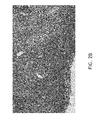
- FIG. 2C is a low scale microscope image of a typical tissue specimen for use in the present invention.
- FIG. 2D is a low scale segmented microscope image of a typical tissue, in accordance with one embodiment of the present invention.
- FIG. 2E is a full scale segmented microscope image of a typical tissue illustrating segment clusters, in accordance with one embodiment of the present invention.
- FIG. 2F is a low scale segmented microscope image of a typical tissue illustrating segment clusters, in accordance with one embodiment of the present invention.
- FIG. 3 is a block diagram illustrating a global segment-cluster hierarchy including individual hierarchies at each resolution level, in accordance with one embodiment of the present invention.
- FIG. 4 is a flow diagram depicting an illustrative method for hierarchical segmentation and classification of image data from a tissue specimen, in accordance with one embodiment of the present invention.
- Scene segmentation and user-trained classification may be utilized at various scales of an image resolution hierarchy.
- Employing scene segmentation and user-trained classification at each resolution level of a segment-cluster hierarchy allows for the rapid analysis of a given image at a low resolution level in order to identify regions of interest to the user.
- the regions of interest may then be displayed to the user at a higher resolution level.
- FIGS. 1A through 4 illustrate a system and method for hierarchical tissue analysis and classification.
- one or more computer systems 108 of the system 100 may be configured to receive one or more images of a tissue specimen from an image source 102 of the system 100 .
- the image source 102 may include an automated microscope system 104 configured to image tissues specimens prepared for general pathology studies.
- the microscope system 104 may operate in various imaging modes, including, but not limited to, visible broadband mode, fluorescence mode, immunofluorescence mode, transmission mode, bright field illumination mode, or dark field illumination mode. It should be recognized that any optical microscopy technique known in the art is suitable for implementation in the context of the present invention.
- the microscope 104 may include a CCD camera or TDI (Time Delay Integration) camera suitable for capturing digital images of the analyzed tissue specimens.
- the output of the CCD camera or TDI camera may be communicatively coupled to a computer system 108 (e.g., CPU of a computer) of the system 100 , allowing for the transfer of imagery data from the automated microscope system 104 to the computer system 108 .
- the automated microscope system 104 may be configured to accept instructions from another subsystem of the system 100 in order to carry out a chosen microscopy sampling plan.
- the microscope 104 may accept instructions from one or more computer systems 108 of the system 100 .
- the microscope system 104 may perform the selected set of imaging measurements.
- imagery data from one or more microscopes may be stored in a database (e.g., computer memory). It is recognized that any imagery data storage method known in the art is suitable for implementation in the present invention.
- imagery data from one or more microscope systems may be transferred to and stored in a database 106 on a hard drive of a communicatively coupled desktop computer.
- the imagery data may be stored on a database 106 maintained on an accessible network server.
- the imagery data stored in the database 106 may then be transferred to the computer system 108 (e.g., processor) of the system 100 for analysis, which will be discussed further herein.
- the system 100 may include a display device 110 and a user interface 114 .
- the system 100 may include a digital monitor communicatively coupled to the computer system 108 of the system 100 .
- image patches may be displayed to the user by the system 100 for review and classification.
- the extractor (e.g., 118 and 122 ) and classifier (e.g., 124 ) algorithms of the system 100 may auto-select regions (based on the training of the algorithms via user classification feedback) of interest and display those regions to a user for classification.
- the display device 110 may be utilized by the system 100 to display multiple specimens simultaneously in an image gallery.
- the same image location may be displayed in various imaging modes (e.g. bright field, dark field or fluorescence), where these image patches in different modes may be displayed side by side for user viewing, or the user may be able to toggle a given image patch by viewing the aligned (overlaid) images in different modes, similar to user techniques with a manual microscope, involving manually switching imaging modes while keeping the slide position constant.
- the display device 110 may display a companion file associated with one or more image scan files.
- a companion file associated with an image scan file may contain various pieces of information associated with the given specimen and image scan, including, but not limited to, size, count, density, text, and measurement information.
- the user may append or alter the companion file utilizing the user interface 114 of the system 100 .
- a pathologist may insert notes or data related to the image scan file into the companion file utilizing the user interface 110 . This information may then be accessed at a later time by a user or by another component (e.g., segment feature extractor 118 or classifier 124 ) of the system 100 .
- the companion file may simply accompany the image scan file and need not be displayed to the user. In this manner, the companion file may log information provided by the user by means other than traditional text and graphical user interface (GUI) input.
- GUI graphical user interface
- the user interface 114 may include any user interface known in the art.
- the user interface 114 may include, but is not limited to, a computer mouse 126 , a track pad, a trackball, a keyboard 128 , a touch screen interface 130 , a voice input system 132 (e.g., microphone) or an eye tracking system 134 .
- a voice input system 132 may be utilized to input data into the companion file of one or more image scan files.
- a voice input system 132 such as a microphone, may be utilized by a pathologist to tag one or more regions of interest (ROIs) of an image scan displayed on the display device 110 .
- ROIs regions of interest
- the voice input system 132 may be utilized to insert descriptive notes pertaining to a particular feature or region of interest into the companion file of one or more image scans. The voice inputted tags or notes may later be retrieved by another component of the system 100 (e.g., feature extraction or classifier algorithms) or by a user of the system 100 .
- an eye tracking system 134 may be utilized to input data into the companion file of one or more image scan files.
- the eye tracking system 134 may include an eye movement system configured to track the eye movement of a user. Any known eye tracking method known in the art is suitable for implantation in the present invention. Eye movement tracking is generally described in Q. Ji and X. Yang, “Real-time Eye, Gaze, and Face Pose Tracking for Monitoring Drive Vigilance,” Real - Time Imaging , Vol. 8, pp. 357-377 (2002), which is incorporated herein by reference. A method and system for eye movement sensing is also generally described in U.S. Pat. No. 5,632,742, issued on May 27, 1997, which is incorporated herein by reference. Further, an eye movement detector is generally described in U.S. Pat. No. 4,973,149, issued on Nov. 27, 1990, which is incorporated herein by reference.
- the eye tracking system 134 of the system 100 may be utilized to track and record the “moves” a user, such as a pathologist, makes when scanning a given image with his/her eye. For instance, the eye tracking system 134 uses the “moves” made by a user's eye to identify one or more ROIs of an image scan. In another instance, the eye tracking system 134 may utilize the “dwell time” by a user in order to identify one or more ROIs.
- a pathologist's “moves” and position of “dwell” may be tracked by tracking eye movements that have been mapped to the spatial coordinates of the image field, allowing the system 100 to determine where on the image field the eye (e.g., the pupil) of the pathologist is resting at a given moment in time.
- the move and dwell time information may then be stored in an associated companion file, which may later be retrieved by a subsequent user or transmitted to another component of the system, such as the feature extraction algorithms or classifier of the system 100 . It is further recognized that the move and dwell time information may be accumulated over multiple sessions by the same or multiple pathologists viewing the specimen.
- the system 100 may identify features, in subsequently analyzed tissue specimens, similar to those tagged in a current image with the “moves” and “dwell time” of the user's eye.
- the computer system 108 may be configured to perform a series of pre-processing steps to a selected image in order to prepare it for tissue element analysis.
- a global image analysis process may be performed in order to rebalance the color and dynamic range of the image.
- the global analysis may provide distortion correction.
- optical distortion in the image may be calibrated and corrected.
- a histogram equalization method may be applied to each local region of the image, as opposed to the entire image simultaneously. Local application may enhance contrast and aids a user (e.g., pathologist) in identifying and classifying tissue elements (e.g., cells, cell clusters, segments and the like).
- color images may undergo a rebalancing process without altering hue.
- the computer system 108 may be configured to segment one or more of the images at a selected resolution level (e.g., full resolution image or down sampled image) utilizing a segmentation algorithm 114 .
- a processor of the computer system 108 may execute an image segmentation algorithm stored in the carrier medium 110 of the system 110 .
- the segmentation algorithm 114 may act to segment an image scene at a given resolution level into a plurality of scene segment primitives.
- the parameters of the segmentation algorithm 114 may be trained via user input (e.g., text input, GUI input, voice input, eye movement tracking, and the like).
- the system 100 may display selected “image patches” to the user 112 (e.g., pathologist) on a display device 110 (e.g., computer screen).
- the user 112 may then identify segment primitives within the image patch by inputting data via a user interface 114 .
- the inputted data may then be used by the computer system 108 to adjust the segmentation algorithm parameters and resultantly train the segmentation algorithm 114 , which may then be applied to future images.
- segmentation algorithms 114 are suitable for implantation in the present invention.
- One such segmentation algorithm is the “mean shift” segmentation algorithm.
- the mean shift algorithm is generally described in D. Comaniciu and P. Meer, “Mean Shift: A robust approach toward feature space analysis,” IEEE Trans. On Pattern Analysis and Machine Intelligence , Vol. 24, pp. 603-619 (2002), and is incorporated herein by reference.
- the segmentation algorithm 104 executed by the system 100 to carry out method 200 is described in more detail further herein.
- FIG. 2A represents a full resolution “raw” image gathered from a typical tissue specimen utilizing an optical microscopy system (e.g., microscope 104 ).
- an optical microscopy system e.g., microscope 104
- FIG. 2B illustrates a graphical representation of the segmentation of the image carried out via a segmentation algorithm 104 .
- each differently colored portion corresponds to a different primitive segment types. Applicant notes that the various segment primitives of FIG.
- the primitive segments may correspond to different cell types, cell cluster types, and cell separating structure types.
- the tissue elements within the specimen may be identified utilizing the segmentation algorithm 116 , which may be trained via pathologist feedback.
- pathologist-labeled image segments may be used to automatically train the segmentation algorithm to recognize “good” features to utilize for discriminating between primitive segment types.
- the learned features may then be utilized by the algorithm to segment image scenes of subsequently analyzed tissue samples. For instance, various cells of the tissue specimen may be identified utilizing pathologist trained images.
- clusters of segments may be identified utilizing one or more clustering algorithms known in the art.
- a clustering method as applied to defect clustering is generally described in U.S. Pat. No. 5,991,699 to Ashok Kulkarni et al., issued on Nov. 23, 1999, and entitled “Detecting Groups of Defects in Semiconductor Feature Space,” which is incorporated above by reference.
- image artifacts may first be segmented out of the image utilizing the segmentation algorithm 116 of the system 100 .
- the image artifacts may include, but are not limited to, accumulated dirt or dust, skin fragments, blank areas within the tissue specimen, and sample labels.
- the segmentation algorithm 116 is configured to segment a given image scene at various resolution levels.
- the segmentation algorithm may segment lower resolution image scenes of the same tissue specimen into a plurality of segment primitives. For instance, as shown in FIGS. 2C and 2D , a segmentation process applied to a “down sampled” image scene of the full resolution image displayed above is shown.
- FIG. 2C represents an identical image scene as that represented in FIG. 2A , but with a resolution level reduced by a factor of 4, in a process commonly referred to herein as “down sampling” (in this instance by a scale of 4).
- FIG. 2D represents the segmentation of the image scene in FIG.
- segmentation algorithm 116 of the system 100 .
- the segmentation process of the down sampled imagine scene is performed in a manner similar to that described above for the full resolution image. While the process is similar, the segmentation results are not in fact necessarily identical (and nearly certainly will not be identical). It is recognized herein that the segmentation algorithm 116 executed at a lower resolution level will yield different segment primitives and segment primitive groupings as the pixels used to display the image scene are reduced.
- the computer system 108 may be configured to extract one or more features from the segment primitives of one or more image resolution levels utilizing a segment feature extraction algorithm 118 .
- a processor of the computer system 108 may execute a segment feature extraction algorithm 118 stored in the carrier medium 110 of the system 110 .
- the segment feature extraction algorithm 118 acts to extract one or more features from the segment primitives.
- the segment feature extraction algorithm 118 is often referred to as the “segment feature extractor” 118 .
- the extraction algorithm 118 may be configured to extract color, size, shape, texture, average hue, intensity and saturation features from the primitive segments of an image scene and/or the cells of the primitive segments of an image scene
- statistical attributes related to the above parameters may also be extracted utilizing the extraction algorithm 118 .
- the distribution of the above parameters derived from a histogram may be extracted.
- the features extracted by the segment feature extractor 118 may be extracted from multiple images of the same tissue specimen utilizing various imaging modes. For example, features may be selected from multiple images of the same tissue specimen in visible broadband mode, fluorescence mode, and transmission mode, among others.
- segment feature extraction algorithms 116 are suitable for implantation in the present invention.
- shape feature extraction from an image is generally described in U.S. Pat. No. 4,183,013, issued on Jan. 8, 1980, which is incorporated herein by reference.
- feature extraction in the context of biological cells is generally described in Ashok V. Kulkarni, “Effectiveness of Feature Groups for Automated Pairwise Leukocyte Class Discrimination,” The Journal of Histochemistry and Cytochemistry , Vol. 27, pp. 210-216 (1979), and is incorporated herein by reference.
- the parameters of the segment feature extraction algorithm 118 may be trained via user input. For instance, the system 100 may display selected “image patches” to the user 112 (e.g., pathologist). Upon reviewing the image patch on the display device 110 of the system 100 , the user may then select examples of primitive segments within the image patch. As is typically the case, a pathologist will select the most relevant aspects of each example to classify the cells and/or cell clusters. The pathologist feedback data may then be used to adjust the segment feature extraction algorithm parameters and resultantly train the extraction algorithm 118 , which may then be applied to subsequently analyzed images. In this manner, the extraction algorithm 118 may be trained to automatically select properties or features most relevant to the classification of a given segment primitive.
- the extraction algorithm 118 may automatically select properties or features of the segment primitives of the one or more images relevant to the classification of the primitive segments. Further, the extraction algorithm 118 of the system 100 may be configured to perform this function at various resolution levels (e.g., full resolution, down sized by 2, down sized by 4, down sized by 16, and etc.). At each level, the extractor 118 of the system 100 may select examples of images (e.g. by highlighting the region or by drawing a contour line around it) most relevant to cell, segment and cluster classification and display them to the user on the display device 110 , at which point the user may classify the example and that user classification data may be fed back to the extraction and classification algorithm 118 .
- various resolution levels e.g., full resolution, down sized by 2, down sized by 4, down sized by 16, and etc.
- the extractor 118 of the system 100 may select examples of images (e.g. by highlighting the region or by drawing a contour line around it) most relevant to cell, segment and cluster classification and display them to the user on
- the computer system 108 may be configured to construct a segmentation hierarchy utilizing a hierarchy builder algorithm 120 .
- the hierarchy builder algorithm 120 is commonly referred to as “hierarchy builder” 120 .
- a processor of the computer system 108 may execute a hierarchy builder algorithm 120 stored in the carrier medium 110 of the system 100 .
- the hierarchy builder 120 may act to create a segmentation hierarchy by generating one or more segmentation clusters based on the type and spatial distribution of segment primitives in a group of adjoining or nearly adjoining segment primitives. For example, as shown in FIG.
- various segment clusters may be identified in a full resolution image of a particular image segment utilizing a clustering algorithm. It is noted that each cluster 202 - 204 represents a unique combination and/or spatial arrangement of adjoining segment primitives.
- the hierarchy builder 120 may be configured to perform the segment clustering at various resolution levels. For instance, FIG. 2F illustrates a plurality of segment clusters (e.g., 208 , 210 , and 212 ) generated utilizing the hierarchy builder 120 for an image scaled down by a factor of 4 from the original full scale image. Applicant further points out that the segmentation and clustering performed at the low resolution level is carried out independently from the segmentation and clustering which occurs at the highest resolution level.
- clustering algorithms may be adapted for implementation in the present invention.
- a clustering method as applied to defect clustering is generally described in U.S. Pat. No. 5,991,699, issued on Nov. 23, 1999, which is incorporated above by reference.
- segment clustering is generally described in G. B. Coleman and H. C. Andrews, “Image Segmentation by Clustering,” Proceedingss of the IEEE , Vol. 67, pp. 773-785 (1979), and is incorporated herein by reference.
- a hierarchical clustering method is described generally in D. K. Panjwani and G. Healey, “Markov Random Field Models for Unsupervised Segmentation of Textured Colored Images,” IEEE Transactions on Pattern Analysis and Machine Intelligence , Vol. 17, pp. 939-954 (1995), and is incorporated herein by reference.
- the hierarchy builder 120 may construct an individual hierarchy for each particular resolution level.
- a global cluster-primitive segment hierarchy 300 may be constructed by building cluster-segmentation hierarchies at various resolution levels of a given tissue specimen.
- individual hierarchies 302 , 304 , and 306 represent individual level hierarchies for a full resolution image, a scaled down by 2 resolution image, and a scaled down by 4 resolution image respectively.
- the applicant again notes that the cluster types and the segment primitives that make up each cluster type are unique at each resolution level of the global hierarchy. This is a result of executing a segmentation algorithm and a segment clustering algorithm at each resolution level of the hierarchy.
- the clusters identified in a full resolution image of a particular scene may consist of Cluster Type G 308 A, Cluster Type H 308 B, and Cluster Type I 308 C.
- Each of these cluster types consists of a unique set and/or arrangement of segment primitives.
- Cluster Type G 308 may include segment types 1-1 and 1-2
- Cluster Type H may include segment types 1-3, 1-4, and 1-5
- Cluster Type I may consist of segment types 1-6 and 1-7.
- Cluster Type G, H, and I may, for example, correspond to cluster 202 , cluster 204 , and cluster 206 , respectively, as identified in FIG. 2E .
- a particular cluster type is, in part, classified based on the relative weight of its constituent segment types.
- the clustering algorithm may identify the groupings as distinct cluster types.
- two segment grouping may both consist of segment types 1 and 2.
- the clustering algorithm (and a human user), however, may classify these two groupings as two different clusters due to the relative proportion of segment type 1 to segment type 2 present in each cluster or the disparate spatial distribution of the segments in each grouping.
- cluster types and constituent segment types at various other resolution levels may be identified and included in the global hierarchy 300 .
- the various hypothetical cluster types and their constituent segment types at various resolution levels are illustrated graphically in FIG. 3 .
- the computer system 108 may be configured to extract features from the hierarchy 300 utilizing a hierarchy feature extraction algorithm 122 .
- the hierarchy feature extraction algorithm 122 is commonly referred to as “hierarchy feature extractor” 122 .
- a processor of the computer system 108 may execute a hierarchy feature extractor 122 stored in the carrier medium 110 of the system 100 .
- the hierarchy feature extractor 122 may act to extract features from the individual hierarchies 302 , 304 , and 306 of the global hierarchy 300 . These features may then be utilized to classify the clusters via a trained classifier algorithm 124 or the user, discussed in more detail further herein.
- the features extracted from the hierarchies include, but are not limited to, the relative proportion of constituent segment types and/or their spatial arrangement. It is noted herein that the structure of segments within a particular portion of the tissue specimen may identify larger segments.
- features which may be extracted from a given hierarchy include the number of hierarchy nodes, the average degree of nodes, eccentricity, clustering coefficient, or cluster diameter. Additional features which may be extracted include hue, saturation, and intensity level measurements of the pixilated display associate with a given cluster or group of clusters.
- the computer system 108 may determine the relationship between clusters of one resolution level (e.g., 302 ) and the clusters of another resolution level (e.g., 304 ).
- features related to inter-level cluster arrangement include, but are not limited to, types of intersecting clusters, spatial arrangement of the clusters, the number of each cluster type, and the like. For instance, the relationship between the clusters identified at a scaled down by 16 image and the clusters identified at a scaled down by 8 image may be identified and recorded. These features may then be utilized to train a given classifier algorithm 122 of the system or to display features of interest to a user.
- a cluster in a scaled down image (e.g., scaled down by 2, scaled down by 4, scaled down by 8, scaled down by 16 and etc.), at a higher resolution level (e.g., full resolution), may be observed to consist of clusters made of segment primitives in this scale of image.
- a cluster at a low resolution level (e.g., scaled by 16) may spatially overlap clusters of a higher resolution level (e.g., scaled by 2) when the low resolution level image is super-posed onto the higher resolution level image.
- a pathologist classifies a given cluster (e.g., 308 A) at the highest resolution level 302
- that cluster's spatial footprint may be propagated up the scaling tree of the global hierarchy 300 to lower resolution images of the same tissue specimen.
- the system 100 may identify the cluster types that intersect with the one or more clusters of interest (as identified by the user). This information may then be utilized during an image review process to analyze an image first at the lowest resolution level and then to zoom into a particular area of interest to the user.
- the computer system 108 may be configured to classify one or more features of the segment primitives or segment clusters at each level of the global hierarchy 300 utilizing an autoclassification algorithm 124 .
- a processor of the computer system 108 may execute an autoclassification algorithm 124 stored in the carrier medium 110 of the system 110 .
- the autoclassification algorithm 124 acts to classify one or more of the segments or segment clusters at each level of the global hierarchy 300 utilizing the features extracted from the segments and segment clusters of each level by the extraction algorithms (e.g., 118 and 122 ).
- the autoclassification algorithm 124 is often referred to as the “classifier” 124 .
- the classifier 124 of the system 100 may be trained via user input. For instance, the system 100 may display selected “image patches” to the user 112 (e.g., pathologist). Upon reviewing the image patch on the display device 110 of the system 100 , the user may then classify select primitive segments within the image patch. This information may then be fed back to the classifier algorithm 124 . The pathologist feedback data may then be used to adjust the classifier parameters and resultantly train the classifier 124 , which may then be applied to subsequently analyzed images. In this manner, the classifier 124 may be trained to autoclassify tissue elements (e.g., cells, segments, and clusters) by applying the trained classifier algorithm 124 to the features extracted from the segments and segment clusters.
- tissue elements e.g., cells, segments, and clusters
- the classifier 124 of the system 100 may be configured to perform this function at various resolution levels (e.g., full resolution, down sized by 2, down sized by 4, down sized by 16, and etc.). Moreover, at each level, the classifier of the system 100 may display selected classified tissue elements to the user on the display device 110 , at which point the user may review the classified tissue elements, and provide feedback to the classifier algorithm for further training. In this regard, the trained classifier 124 may be utilized on subsequent tissue specimens to quickly analyze the given image, and showing the user areas of interest without the user having to manually scan the tissue at various magnifications to locate the areas of interest, such as cells or cell aggregates.
- various resolution levels e.g., full resolution, down sized by 2, down sized by 4, down sized by 16, and etc.
- the classifier of the system 100 may display selected classified tissue elements to the user on the display device 110 , at which point the user may review the classified tissue elements, and provide feedback to the classifier algorithm for further training.
- the trained classifier 124 may
- one or more memory devices may be utilized to log all image processing operations. For example, all operations performed on the image during pre-analysis processing, segmentation, segmentation feature extraction, hierarchy building, hierarchy feature extraction, or classification may be stored in an operation log.
- segment and hierarchy feature data extracted from each resolution level of an image may be stored on a memory device.
- imagery data e.g., TIFF format images
- the computer system 108 may include, but is not limited to, a personal computer system, mainframe computer system, workstation, image computer, parallel processor, or any other device known in the art.
- the term “computer system” may be broadly defined to encompass any device having one or more processors, which execute instructions from a memory medium. It should be recognized that the steps carried out by the system 100 described above may be carried out by a single computer system, or, alternatively, a multiple computer systems. Therefore, the above description should not be interpreted as a limitation on the present invention but merely an illustration.
- Program instructions 112 implementing methods such as those described herein may be transmitted over or stored on carrier medium 110 .
- the carrier medium may be a transmission medium such as a wire, cable, or wireless transmission link.
- the carrier medium may also include a storage medium such as a read-only memory, a random access memory, a magnetic or optical disk, or a magnetic tape.
- the embodiments of the system 100 illustrated in FIG. 1A may be further configured as described herein.
- the system 100 may be configured to perform any other step(s) of any of the method embodiment(s) described herein.
- FIG. 4 is a flow diagram illustrating steps performed in a process performed utilizing various aspects of the system 100 described previously herein.
- one or more sets of imagery data (e.g., images 1 through images N) from an image source 102 (e.g., microscope 104 or database 106 ) may be selected for analysis.
- An image gallery 402 provides the ability to compare tissue sections from multiple specimens simultaneously. Moreover, various feature values, such as, but not limited to, size, count, density and texture. The image gallery further provides the ability to toggle images of the same tissue section in different imaging modes
- the segmentation algorithm 116 of the system 100 may segment the full scale image into a plurality of segment primitives.
- the system 100 may display select “image patches” 404 to the user via a display device 110 .
- the system 100 may display segments and clusters dissimilar from those tissue elements previously identified by the user for review and classification.
- the system 100 may display segments and clusters similar to those identified by the user for review and classification.
- the user may classify 404 the displayed segments by entering data via the user interface 114 (e.g, voice input, text input, eye tracking input).
- the user input data (e.g., notes on segment identification, autolog area of interest, log of operations performed on image and the like) may then be stored 408 into a memory (e.g., RAM or ROM).
- the user provided segmentation identification data may then be fed back to the segmentation algorithm 116 , allowing the algorithm to “learn” from the user input by adjusting the parameters of the segmentation algorithm, allowing for improved automatic review on subsequent tissue specimens.
- the segmented image may undergo a segment feature extraction process via the segment feature extractor 118 .
- the system 100 may again display select “image patches” 404 to the user via a display device 110 .
- the system 100 may display features both similar to and dissimilar from tissue elements previously identified by the user.
- the user may select relevant segment features for segment classification by entering data via the user interface 114 (e.g, voice input, text input, eye tracking input).
- the user input data may then be stored 408 into a memory.
- the user provided segment feature extraction data may then be fed back to the extraction algorithm 118 , allowing the algorithm to “learn” from the user input by adjusting the extraction algorithm parameters, allowing for improved automatic review on subsequent tissue specimens.
- the hierarchy builder 120 may build a segment hierarchy by clustering the segment primitives provided in the previous step into clusters. Following clustering via the hierarchy builder 120 , the system 100 may again display select “image patches” 404 to the user via a display device 110 . In this manner, the system 100 may display features both similar to and dissimilar from tissue elements previously identified by the user. As previously discussed above, the user may identify segment clusters in the tissue specimen by entering data via the user interface 114 (e.g, voice input, text input, eye tracking input). The user input data may then be stored 408 into a memory. The user-provided segment-cluster data may then be fed back to the hierarchy builder 120 , allowing the algorithm to “learn” from the user input by adjusting the algorithm's parameters, allowing for improved automatic review on subsequent tissue specimens.
- the hierarchy features may be extracted from the hierarchy utilizing the hierarchy feature extractor 122 .
- the system 100 may again display select “image patches” 404 to the user via a display device 110 .
- the system 100 may display features both similar to and dissimilar from tissue elements previously identified by the user.
- the user may provide segment-cluster classification by entering data via the user interface 114 (e.g, voice input, text input, eye tracking input).
- the user input data may then be stored 408 into a memory.
- the user provided classification data may then be fed back to the extraction algorithm 122 , allowing the algorithm to “learn” from the user input by adjusting the extraction algorithm parameters, allowing for improved automatic review on subsequent tissue specimens.
- a user trained classifier 124 of the system 100 may be utilized to analyze the segment and hierarchy features extracted in the previous steps to classify one or more of the tissue elements of the tissue specimen.
- the image may be “down scaled” 412 to a lower resolution level.
- a full scale image may be down scaled to an image scene having a resolution level scaled down by 2, 4, 8, 16 or the like.
- the process steps one through six above may be repeated.
- an image scene down scaled by 4 may undergo the steps one through six described above.
- a global hierarchy 300 may be constructed, which consists of several individual segment-cluster hierarchies for each resolution level.
- the combination of hierarchical scene segmentation and user-trained classifiers at each resolution level allow the system 100 to rapidly analyze a given image at a high level (i.e., low resolution) in order to identify areas of interest to display to the user during image review at more detail imagery levels (i.e., higher resolution).
- All of the methods described herein may include storing results of one or more steps of the method embodiments in a storage medium.
- the results may include any of the results described herein and may be stored in any manner known in the art.
- the storage medium may include any storage medium described herein or any other suitable storage medium known in the art.
- the results can be accessed in the storage medium and used by any of the method or system embodiments described herein, formatted for display to a user, used by another software module, method, or system, etc.
- the results may be stored “permanently,” “semi-permanently,” temporarily, or for some period of time.
- the storage medium may be random access memory (RAM), and the results may not necessarily persist indefinitely in the storage medium.
- each of the embodiments of the method described above may include any other step(s) of any other method(s) described herein.
- each of the embodiments of the method described above may be performed by any of the systems described herein.
- an implementer may opt for a mainly hardware and/or firmware vehicle; alternatively, if flexibility is paramount, the implementer may opt for a mainly software implementation; or, yet again alternatively, the implementer may opt for some combination of hardware, software, and/or firmware.
- any vehicle to be utilized is a choice dependent upon the context in which the vehicle will be deployed and the specific concerns (e.g., speed, flexibility, or predictability) of the implementer, any of which may vary.
- Those skilled in the art will recognize that optical aspects of implementations will typically employ optically-oriented hardware, software, and or firmware.
- a typical data processing system generally includes one or more of a system unit housing, a video display device, a memory such as volatile and non-volatile memory, processors such as microprocessors and digital signal processors, computational entities such as operating systems, drivers, graphical user interfaces, and applications programs, one or more interaction devices, such as a touch pad or screen, or voice input, or eye tracking systems, and/or control systems including feedback loops and control motors (e.g., feedback for sensing position and/or velocity; control motors for moving and/or adjusting components and/or quantities).
- a typical data processing system may be implemented utilizing any suitable commercially available components, such as those typically found in data computing/communication and/or network computing/communication systems.
Landscapes
- Engineering & Computer Science (AREA)
- Theoretical Computer Science (AREA)
- Physics & Mathematics (AREA)
- General Physics & Mathematics (AREA)
- Computer Vision & Pattern Recognition (AREA)
- Data Mining & Analysis (AREA)
- Multimedia (AREA)
- Evolutionary Computation (AREA)
- Artificial Intelligence (AREA)
- Software Systems (AREA)
- General Health & Medical Sciences (AREA)
- Health & Medical Sciences (AREA)
- Life Sciences & Earth Sciences (AREA)
- Bioinformatics & Cheminformatics (AREA)
- Computing Systems (AREA)
- Databases & Information Systems (AREA)
- Medical Informatics (AREA)
- Bioinformatics & Computational Biology (AREA)
- Evolutionary Biology (AREA)
- General Engineering & Computer Science (AREA)
- Biomedical Technology (AREA)
- Molecular Biology (AREA)
- Probability & Statistics with Applications (AREA)
- Image Analysis (AREA)
- Investigating Or Analysing Materials By Optical Means (AREA)
Abstract
Description
Claims (25)
Priority Applications (1)
| Application Number | Priority Date | Filing Date | Title |
|---|---|---|---|
| US13/112,977 US8600143B1 (en) | 2010-05-20 | 2011-05-20 | Method and system for hierarchical tissue analysis and classification |
Applications Claiming Priority (2)
| Application Number | Priority Date | Filing Date | Title |
|---|---|---|---|
| US34674810P | 2010-05-20 | 2010-05-20 | |
| US13/112,977 US8600143B1 (en) | 2010-05-20 | 2011-05-20 | Method and system for hierarchical tissue analysis and classification |
Publications (1)
| Publication Number | Publication Date |
|---|---|
| US8600143B1 true US8600143B1 (en) | 2013-12-03 |
Family
ID=49640813
Family Applications (1)
| Application Number | Title | Priority Date | Filing Date |
|---|---|---|---|
| US13/112,977 Expired - Fee Related US8600143B1 (en) | 2010-05-20 | 2011-05-20 | Method and system for hierarchical tissue analysis and classification |
Country Status (1)
| Country | Link |
|---|---|
| US (1) | US8600143B1 (en) |
Cited By (26)
| Publication number | Priority date | Publication date | Assignee | Title |
|---|---|---|---|---|
| US20120062766A1 (en) * | 2010-09-15 | 2012-03-15 | Samsung Electronics Co., Ltd. | Apparatus and method for managing image data |
| US20140105496A1 (en) * | 2012-10-17 | 2014-04-17 | Cognex Corporation | System and Method for Selecting Segmentation Parameters for Optical Character Recognition |
| CN105118049A (en) * | 2015-07-22 | 2015-12-02 | 东南大学 | Image segmentation method based on super pixel clustering |
| US9286534B2 (en) | 2012-10-17 | 2016-03-15 | Cognex Corporation | System and method for selecting and displaying segmentation parameters for optical character recognition |
| US9704066B2 (en) | 2015-03-20 | 2017-07-11 | Microsoft Technology Licensing, Llc | Multi-stage image classification |
| US9738937B1 (en) * | 2017-03-31 | 2017-08-22 | Cellmax, Ltd. | Identifying candidate cells using image analysis |
| EP3300001A3 (en) * | 2016-09-27 | 2018-05-16 | Sectra AB | Viewers and related methods, systems and circuits with patch gallery user interfaces for medical microscopy |
| US10025902B2 (en) | 2016-08-12 | 2018-07-17 | Verily Life Sciences Llc | Enhanced pathology diagnosis |
| US10203491B2 (en) | 2016-08-01 | 2019-02-12 | Verily Life Sciences Llc | Pathology data capture |
| US10366490B2 (en) * | 2017-03-27 | 2019-07-30 | Siemens Healthcare Gmbh | Highly integrated annotation and segmentation system for medical imaging |
| US11093546B2 (en) * | 2017-11-29 | 2021-08-17 | The Procter & Gamble Company | Method for categorizing digital video data |
| US11100324B2 (en) * | 2018-05-25 | 2021-08-24 | Entigenlogic Llc | Interpreting an image |
| CN113792202A (en) * | 2021-08-31 | 2021-12-14 | 中国电子科技集团公司第三十研究所 | Screening method for user classification |
| US11244195B2 (en) | 2018-05-01 | 2022-02-08 | Adobe Inc. | Iteratively applying neural networks to automatically identify pixels of salient objects portrayed in digital images |
| US20220084203A1 (en) * | 2019-05-31 | 2022-03-17 | Delphinus Medical Technologies, Inc. | System and methods for interactive lesion characterization |
| US11282208B2 (en) * | 2018-12-24 | 2022-03-22 | Adobe Inc. | Identifying target objects using scale-diverse segmentation neural networks |
| US11314982B2 (en) | 2015-11-18 | 2022-04-26 | Adobe Inc. | Utilizing interactive deep learning to select objects in digital visual media |
| US11335004B2 (en) | 2020-08-07 | 2022-05-17 | Adobe Inc. | Generating refined segmentation masks based on uncertain pixels |
| US11568627B2 (en) | 2015-11-18 | 2023-01-31 | Adobe Inc. | Utilizing interactive deep learning to select objects in digital visual media |
| US11676279B2 (en) | 2020-12-18 | 2023-06-13 | Adobe Inc. | Utilizing a segmentation neural network to process initial object segmentations and object user indicators within a digital image to generate improved object segmentations |
| US11875510B2 (en) | 2021-03-12 | 2024-01-16 | Adobe Inc. | Generating refined segmentations masks via meticulous object segmentation |
| US20240029262A1 (en) * | 2022-07-25 | 2024-01-25 | Dell Products L.P. | System and method for storage management of images |
| US12020400B2 (en) | 2021-10-23 | 2024-06-25 | Adobe Inc. | Upsampling and refining segmentation masks |
| US20240256114A1 (en) * | 2016-01-22 | 2024-08-01 | Johnson Controls Technology Company | Building system with a building graph |
| US12423938B2 (en) | 2022-07-25 | 2025-09-23 | Dell Products L.P. | System and method for identifying auxiliary areas of interest for image based on focus indicators |
| US12475564B2 (en) | 2022-02-16 | 2025-11-18 | Proscia Inc. | Digital pathology artificial intelligence quality check |
Citations (7)
| Publication number | Priority date | Publication date | Assignee | Title |
|---|---|---|---|---|
| US4183013A (en) * | 1976-11-29 | 1980-01-08 | Coulter Electronics, Inc. | System for extracting shape features from an image |
| US20010031920A1 (en) * | 1999-06-29 | 2001-10-18 | The Research Foundation Of State University Of New York | System and method for performing a three-dimensional virtual examination of objects, such as internal organs |
| US6839462B1 (en) * | 1996-12-23 | 2005-01-04 | Kitney Richard I | Image segmentation method |
| US6970587B1 (en) * | 1997-08-28 | 2005-11-29 | Icad, Inc. | Use of computer-aided detection system outputs in clinical practice |
| US20100111396A1 (en) * | 2008-11-06 | 2010-05-06 | Los Alamos National Security | Object and spatial level quantitative image analysis |
| US20100260406A1 (en) * | 2004-05-13 | 2010-10-14 | Paul Sammak | Methods and systems for imaging cells |
| US20100265267A1 (en) * | 2009-04-17 | 2010-10-21 | Definiens Ag | Analyzing pixel data by imprinting objects of a computer-implemented network structure into other objects |
-
2011
- 2011-05-20 US US13/112,977 patent/US8600143B1/en not_active Expired - Fee Related
Patent Citations (8)
| Publication number | Priority date | Publication date | Assignee | Title |
|---|---|---|---|---|
| US4183013A (en) * | 1976-11-29 | 1980-01-08 | Coulter Electronics, Inc. | System for extracting shape features from an image |
| US6839462B1 (en) * | 1996-12-23 | 2005-01-04 | Kitney Richard I | Image segmentation method |
| US6970587B1 (en) * | 1997-08-28 | 2005-11-29 | Icad, Inc. | Use of computer-aided detection system outputs in clinical practice |
| US20010031920A1 (en) * | 1999-06-29 | 2001-10-18 | The Research Foundation Of State University Of New York | System and method for performing a three-dimensional virtual examination of objects, such as internal organs |
| US20100260406A1 (en) * | 2004-05-13 | 2010-10-14 | Paul Sammak | Methods and systems for imaging cells |
| US20100111396A1 (en) * | 2008-11-06 | 2010-05-06 | Los Alamos National Security | Object and spatial level quantitative image analysis |
| US20100265267A1 (en) * | 2009-04-17 | 2010-10-21 | Definiens Ag | Analyzing pixel data by imprinting objects of a computer-implemented network structure into other objects |
| US8319793B2 (en) * | 2009-04-17 | 2012-11-27 | Definiens Ag | Analyzing pixel data by imprinting objects of a computer-implemented network structure into other objects |
Cited By (47)
| Publication number | Priority date | Publication date | Assignee | Title |
|---|---|---|---|---|
| US20120062766A1 (en) * | 2010-09-15 | 2012-03-15 | Samsung Electronics Co., Ltd. | Apparatus and method for managing image data |
| US20140105496A1 (en) * | 2012-10-17 | 2014-04-17 | Cognex Corporation | System and Method for Selecting Segmentation Parameters for Optical Character Recognition |
| US9286534B2 (en) | 2012-10-17 | 2016-03-15 | Cognex Corporation | System and method for selecting and displaying segmentation parameters for optical character recognition |
| US9317767B2 (en) * | 2012-10-17 | 2016-04-19 | Cognex Corporation | System and method for selecting segmentation parameters for optical character recognition |
| US9704066B2 (en) | 2015-03-20 | 2017-07-11 | Microsoft Technology Licensing, Llc | Multi-stage image classification |
| US9785865B2 (en) | 2015-03-20 | 2017-10-10 | Microsoft Technology Licensing, Llc | Multi-stage image classification |
| CN105118049A (en) * | 2015-07-22 | 2015-12-02 | 东南大学 | Image segmentation method based on super pixel clustering |
| US11314982B2 (en) | 2015-11-18 | 2022-04-26 | Adobe Inc. | Utilizing interactive deep learning to select objects in digital visual media |
| US12626496B2 (en) | 2015-11-18 | 2026-05-12 | Adobe Inc. | Utilizing interactive deep learning to select objects in digital visual media |
| US11568627B2 (en) | 2015-11-18 | 2023-01-31 | Adobe Inc. | Utilizing interactive deep learning to select objects in digital visual media |
| US12572267B2 (en) * | 2016-01-22 | 2026-03-10 | Johnson Controls Technology Company | Building system with a building graph |
| US20240256114A1 (en) * | 2016-01-22 | 2024-08-01 | Johnson Controls Technology Company | Building system with a building graph |
| US10203491B2 (en) | 2016-08-01 | 2019-02-12 | Verily Life Sciences Llc | Pathology data capture |
| CN109564778A (en) * | 2016-08-01 | 2019-04-02 | 威里利生命科学有限责任公司 | Pathology data capture |
| US10545327B2 (en) | 2016-08-01 | 2020-01-28 | Verily Life Sciences Llc | Pathology data capture |
| US10262757B2 (en) | 2016-08-12 | 2019-04-16 | Verily Life Sciences Llc | Enhanced pathology diagnosis |
| US10025902B2 (en) | 2016-08-12 | 2018-07-17 | Verily Life Sciences Llc | Enhanced pathology diagnosis |
| US11501871B2 (en) | 2016-08-12 | 2022-11-15 | Verily Life Sciences Llc | Enhanced pathology diagnosis |
| US10489633B2 (en) | 2016-09-27 | 2019-11-26 | Sectra Ab | Viewers and related methods, systems and circuits with patch gallery user interfaces |
| EP3300001A3 (en) * | 2016-09-27 | 2018-05-16 | Sectra AB | Viewers and related methods, systems and circuits with patch gallery user interfaces for medical microscopy |
| US10366490B2 (en) * | 2017-03-27 | 2019-07-30 | Siemens Healthcare Gmbh | Highly integrated annotation and segmentation system for medical imaging |
| US11866792B2 (en) | 2017-03-31 | 2024-01-09 | Cellmax Ltd. | Identifying candidate cells using image analysis with overlap thresholds |
| US11859253B2 (en) | 2017-03-31 | 2024-01-02 | Cellmax Ltd. | Identifying candidate cells using image analysis |
| US9738937B1 (en) * | 2017-03-31 | 2017-08-22 | Cellmax, Ltd. | Identifying candidate cells using image analysis |
| US10053739B1 (en) * | 2017-03-31 | 2018-08-21 | Cellmax, Ltd. | Identifying candidate cells using image analysis |
| US20180371552A1 (en) * | 2017-03-31 | 2018-12-27 | Cellmax Ltd | Identifying candidate cells using image analysis |
| US11866791B2 (en) | 2017-03-31 | 2024-01-09 | Cellmax Ltd. | Identifying candidate cells using image analysis with intensity levels |
| US10533230B2 (en) * | 2017-03-31 | 2020-01-14 | Cellmax Ltd. | Identifying candidate cells using image analysis |
| US11093546B2 (en) * | 2017-11-29 | 2021-08-17 | The Procter & Gamble Company | Method for categorizing digital video data |
| US11244195B2 (en) | 2018-05-01 | 2022-02-08 | Adobe Inc. | Iteratively applying neural networks to automatically identify pixels of salient objects portrayed in digital images |
| US12591950B2 (en) | 2018-05-01 | 2026-03-31 | Adobe Inc. | Iteratively applying neural networks to automatically segment objects portrayed in digital images |
| US12056914B2 (en) | 2018-05-25 | 2024-08-06 | Entigenlogic Llc | Interpreting media |
| US11100324B2 (en) * | 2018-05-25 | 2021-08-24 | Entigenlogic Llc | Interpreting an image |
| US11282208B2 (en) * | 2018-12-24 | 2022-03-22 | Adobe Inc. | Identifying target objects using scale-diverse segmentation neural networks |
| US12254633B2 (en) | 2018-12-24 | 2025-03-18 | Adobe Inc. | Segmenting objects using scale-diverse segmentation neural networks |
| US20220084203A1 (en) * | 2019-05-31 | 2022-03-17 | Delphinus Medical Technologies, Inc. | System and methods for interactive lesion characterization |
| US11676283B2 (en) | 2020-08-07 | 2023-06-13 | Adobe Inc. | Iteratively refining segmentation masks |
| US11335004B2 (en) | 2020-08-07 | 2022-05-17 | Adobe Inc. | Generating refined segmentation masks based on uncertain pixels |
| US11676279B2 (en) | 2020-12-18 | 2023-06-13 | Adobe Inc. | Utilizing a segmentation neural network to process initial object segmentations and object user indicators within a digital image to generate improved object segmentations |
| US11875510B2 (en) | 2021-03-12 | 2024-01-16 | Adobe Inc. | Generating refined segmentations masks via meticulous object segmentation |
| CN113792202A (en) * | 2021-08-31 | 2021-12-14 | 中国电子科技集团公司第三十研究所 | Screening method for user classification |
| CN113792202B (en) * | 2021-08-31 | 2023-05-05 | 中国电子科技集团公司第三十研究所 | User classification screening method |
| US12020400B2 (en) | 2021-10-23 | 2024-06-25 | Adobe Inc. | Upsampling and refining segmentation masks |
| US12475564B2 (en) | 2022-02-16 | 2025-11-18 | Proscia Inc. | Digital pathology artificial intelligence quality check |
| US12423938B2 (en) | 2022-07-25 | 2025-09-23 | Dell Products L.P. | System and method for identifying auxiliary areas of interest for image based on focus indicators |
| US12373955B2 (en) * | 2022-07-25 | 2025-07-29 | Dell Products L.P. | System and method for storage management of images |
| US20240029262A1 (en) * | 2022-07-25 | 2024-01-25 | Dell Products L.P. | System and method for storage management of images |
Similar Documents
| Publication | Publication Date | Title |
|---|---|---|
| US11681418B2 (en) | Multi-sample whole slide image processing in digital pathology via multi-resolution registration and machine learning | |
| CN114945941B (en) | Non-tumor segmentation for supporting tumor detection and analysis | |
| JP7427080B2 (en) | Weakly supervised multitask learning for cell detection and segmentation | |
| US9684960B2 (en) | Automated histological diagnosis of bacterial infection using image analysis | |
| Yogesh et al. | Computer vision based analysis and detection of defects in fruits causes due to nutrients deficiency | |
| Veta et al. | Assessment of algorithms for mitosis detection in breast cancer histopathology images | |
| Smal et al. | Quantitative comparison of spot detection methods in fluorescence microscopy | |
| US12223645B2 (en) | Method and device for identifying abnormal cell in to-be-detected sample, and storage medium | |
| US20250238900A1 (en) | Computational refocusing-assisted deep learning | |
| WO2021139258A1 (en) | Image recognition based cell recognition and counting method and apparatus, and computer device | |
| CN112215790A (en) | KI67 index analysis method based on deep learning | |
| US11610395B2 (en) | Systems and methods for generating encoded representations for multiple magnifications of image data | |
| Irshad et al. | Multi-channels statistical and morphological features based mitosis detection in breast cancer histopathology | |
| Kanwal et al. | Quantifying the effect of color processing on blood and damaged tissue detection in whole slide images | |
| Kovalev et al. | Deep Learning in Big Image Data: Histology image classification for breast cancer diagnosis | |
| Yin et al. | Automated follicle counting system (AFCS) using YOLO-based object detection algorithm and its application in the POI model | |
| Yancey | Deep feature fusion for mitosis counting | |
| Govind et al. | Automated erythrocyte detection and classification from whole slide images | |
| Shirazi et al. | Automated pathology image analysis | |
| Subramanian et al. | Web based mitosis detection on breast cancer whole slide images using faster R-CNN and YOLOv5 | |
| Le et al. | An automated framework for counting lymphocytes from microscopic images | |
| JP2018125019A (en) | Image processing apparatus and image processing method | |
| Alkrimi et al. | Isolation and classification of red blood cells in anemic microscopic images | |
| JP6329651B1 (en) | Image processing apparatus and image processing method | |
| CN111401119A (en) | Classification of cell nuclei |
Legal Events
| Date | Code | Title | Description |
|---|---|---|---|
| AS | Assignment |
Owner name: KLA-TENCOR CORPORATION, CALIFORNIA Free format text: ASSIGNMENT OF ASSIGNORS INTEREST;ASSIGNORS:KULKARNI, ASHOK V.;YOUNG, SCOTT;ROSENGAUS, ELIEZER;REEL/FRAME:026318/0694 Effective date: 20110520 |
|
| FEPP | Fee payment procedure |
Free format text: PAYOR NUMBER ASSIGNED (ORIGINAL EVENT CODE: ASPN); ENTITY STATUS OF PATENT OWNER: LARGE ENTITY |
|
| STCF | Information on status: patent grant |
Free format text: PATENTED CASE |
|
| FPAY | Fee payment |
Year of fee payment: 4 |
|
| MAFP | Maintenance fee payment |
Free format text: PAYMENT OF MAINTENANCE FEE, 8TH YEAR, LARGE ENTITY (ORIGINAL EVENT CODE: M1552); ENTITY STATUS OF PATENT OWNER: LARGE ENTITY Year of fee payment: 8 |
|
| FEPP | Fee payment procedure |
Free format text: MAINTENANCE FEE REMINDER MAILED (ORIGINAL EVENT CODE: REM.); ENTITY STATUS OF PATENT OWNER: LARGE ENTITY |
|
| LAPS | Lapse for failure to pay maintenance fees |
Free format text: PATENT EXPIRED FOR FAILURE TO PAY MAINTENANCE FEES (ORIGINAL EVENT CODE: EXP.); ENTITY STATUS OF PATENT OWNER: LARGE ENTITY |
|
| STCH | Information on status: patent discontinuation |
Free format text: PATENT EXPIRED DUE TO NONPAYMENT OF MAINTENANCE FEES UNDER 37 CFR 1.362 |
|
| FP | Lapsed due to failure to pay maintenance fee |
Effective date: 20251203 |