US8575337B2 - Oxazolidinone derivative having fused ring - Google Patents
Oxazolidinone derivative having fused ring Download PDFInfo
- Publication number
- US8575337B2 US8575337B2 US13/000,411 US200913000411A US8575337B2 US 8575337 B2 US8575337 B2 US 8575337B2 US 200913000411 A US200913000411 A US 200913000411A US 8575337 B2 US8575337 B2 US 8575337B2
- Authority
- US
- United States
- Prior art keywords
- optionally substituted
- lower alkyl
- ring
- compound
- het
- Prior art date
- Legal status (The legal status is an assumption and is not a legal conclusion. Google has not performed a legal analysis and makes no representation as to the accuracy of the status listed.)
- Expired - Fee Related, expires
Links
- 0 *.*CC.B.C.CC.CC1=CC=C(C)C=C1.[2HH] Chemical compound *.*CC.B.C.CC.CC1=CC=C(C)C=C1.[2HH] 0.000 description 122
- VQHIXMVCBRJBMT-UHFFFAOYSA-N CC(C)C1=NOc(C(C)C)c1.CC(C)C1CN(C(C)C)C(=O)O1.CC(C)c1cC(C(C)C)OC1=O.CC(C)c1cN(C(C)C)OC1=O Chemical compound CC(C)C1=NOc(C(C)C)c1.CC(C)C1CN(C(C)C)C(=O)O1.CC(C)c1cC(C(C)C)OC1=O.CC(C)c1cN(C(C)C)OC1=O VQHIXMVCBRJBMT-UHFFFAOYSA-N 0.000 description 5
- DBUKORMNFWTROO-YCNGDKIQSA-N C=C(=C)C.C=C(=C)C(=O)C1=CN(C)N=N1.C=C(=C)C(=O)C1=NN(C)N=N1.C=C(=C)C(=O)C1=NN=NN1C.C=C(=C)C(=O)CO.C=C(=C)C(=O)[C@@H](O)CO.C=C(=C)C(=O)[C@H](O)CO.C=C(=C)CC.[C-]#[N+]C(=C)=C.[C-]#[N+]C1=CC=C(C(=C)=C)O1.[C-]#[N+]C1=CN=C(C(=C)=C)S1.[C-]#[N+]C1=NN=C(C(=C)=C)S1.[H]C(=C)=C Chemical compound C=C(=C)C.C=C(=C)C(=O)C1=CN(C)N=N1.C=C(=C)C(=O)C1=NN(C)N=N1.C=C(=C)C(=O)C1=NN=NN1C.C=C(=C)C(=O)CO.C=C(=C)C(=O)[C@@H](O)CO.C=C(=C)C(=O)[C@H](O)CO.C=C(=C)CC.[C-]#[N+]C(=C)=C.[C-]#[N+]C1=CC=C(C(=C)=C)O1.[C-]#[N+]C1=CN=C(C(=C)=C)S1.[C-]#[N+]C1=NN=C(C(=C)=C)S1.[H]C(=C)=C DBUKORMNFWTROO-YCNGDKIQSA-N 0.000 description 2
- NTIZESTWPVYFNL-UHFFFAOYSA-N CC(=O)CC(C)C Chemical compound CC(=O)CC(C)C NTIZESTWPVYFNL-UHFFFAOYSA-N 0.000 description 2
- GKHLRJRORAVJRN-ZDUSSCGKSA-N CC(=O)NC[C@H]1CN(C2=CC(F)=C(C3=NN4C=CN=C4C=C3)C=C2)C(=O)O1 Chemical compound CC(=O)NC[C@H]1CN(C2=CC(F)=C(C3=NN4C=CN=C4C=C3)C=C2)C(=O)O1 GKHLRJRORAVJRN-ZDUSSCGKSA-N 0.000 description 2
- ZSXQLEFSHYULCX-UHFFFAOYSA-N *.*.C1=CC2C=CC1C2.CC1=C(C)C(C)=C(C)C(C)=C1C.CC1=C(C)C(C)=C(C)C(C)=C1C.CCN1C=CN=N1.CCN=[N+]=[N-] Chemical compound *.*.C1=CC2C=CC1C2.CC1=C(C)C(C)=C(C)C(C)=C1C.CC1=C(C)C(C)=C(C)C(C)=C1C.CCN1C=CN=N1.CCN=[N+]=[N-] ZSXQLEFSHYULCX-UHFFFAOYSA-N 0.000 description 1
- YFMFYNMEIXLOHB-PLIXHKIWSA-N B.B.B.B.B.C.C.C.C.C.CC.CC.CC.CC.CC.CC(=O)CCC1CN(C2=CC=C(C)C=C2)C(=O)O1.CC1=CC=C(N2CC(CN)OC2=O)C=C1.CC1=CC=C(N2CC(CN=[N+]=[N-])OC2=O)C=C1.CC1=CC=C(N2CC(CO)OC2=O)C=C1.CC1=CC=C(N2CC(COS(C)(=O)=O)OC2=O)C=C1.[2HH].[2HH].[2HH].[2HH].[2HH] Chemical compound B.B.B.B.B.C.C.C.C.C.CC.CC.CC.CC.CC.CC(=O)CCC1CN(C2=CC=C(C)C=C2)C(=O)O1.CC1=CC=C(N2CC(CN)OC2=O)C=C1.CC1=CC=C(N2CC(CN=[N+]=[N-])OC2=O)C=C1.CC1=CC=C(N2CC(CO)OC2=O)C=C1.CC1=CC=C(N2CC(COS(C)(=O)=O)OC2=O)C=C1.[2HH].[2HH].[2HH].[2HH].[2HH] YFMFYNMEIXLOHB-PLIXHKIWSA-N 0.000 description 1
- GJMXWCLQWYFVHN-UPWPDRQKSA-N B.B.B.C.C.C.CC.CC.CC.CC1=CC=C(N)C=C1.CC1=CC=C(N2CC(CO)OC2=O)C=C1.CC1=CC=C([N+](=O)[O-])C=C1.[2HH].[2HH].[2HH] Chemical compound B.B.B.C.C.C.CC.CC.CC.CC1=CC=C(N)C=C1.CC1=CC=C(N2CC(CO)OC2=O)C=C1.CC1=CC=C([N+](=O)[O-])C=C1.[2HH].[2HH].[2HH] GJMXWCLQWYFVHN-UPWPDRQKSA-N 0.000 description 1
- MNVKNXOLQQUVSD-UHFFFAOYSA-N BrC1=CC2=NC=NN2C=C1.C.CC1=CC(C)=C(S(=O)(=O)NO)C(C)=C1.CC1=CC(C)=C(S(=O)(=O)[O-])C(C)=C1.NC1=NC=CC(Br)=C1.NC1=[N+](N)C=CC(Br)=C1.O=CO Chemical compound BrC1=CC2=NC=NN2C=C1.C.CC1=CC(C)=C(S(=O)(=O)NO)C(C)=C1.CC1=CC(C)=C(S(=O)(=O)[O-])C(C)=C1.NC1=NC=CC(Br)=C1.NC1=[N+](N)C=CC(Br)=C1.O=CO MNVKNXOLQQUVSD-UHFFFAOYSA-N 0.000 description 1
- POKGKYQFVXWXLV-QLCUVSBJSA-N BrC1=CC2=NC=NN2C=C1.CC(=O)NC[C@H]1CN(C2=CC=C(B3OC(C)(C)C(C)(C)O3)C(F)=C2)C(=O)O1.CC(=O)NC[C@H]1CN(C2=CC=C(C3=CN4N=CN=C4C=C3)C(F)=C2)C(=O)O1 Chemical compound BrC1=CC2=NC=NN2C=C1.CC(=O)NC[C@H]1CN(C2=CC=C(B3OC(C)(C)C(C)(C)O3)C(F)=C2)C(=O)O1.CC(=O)NC[C@H]1CN(C2=CC=C(C3=CN4N=CN=C4C=C3)C(F)=C2)C(=O)O1 POKGKYQFVXWXLV-QLCUVSBJSA-N 0.000 description 1
- RGEHBKTXYDDEPK-QLCUVSBJSA-N BrC1=CC2=NC=NN2C=C1.CC1(C)OB(C2=CC=C(N3C[C@H](CN4C=CN=N4)OC3=O)C=C2F)OC1(C)C.O=C1O[C@@H](CN2C=CN=N2)CN1C1=CC=C(C2=CC3=NC=NN3C=C2)C(F)=C1 Chemical compound BrC1=CC2=NC=NN2C=C1.CC1(C)OB(C2=CC=C(N3C[C@H](CN4C=CN=N4)OC3=O)C=C2F)OC1(C)C.O=C1O[C@@H](CN2C=CN=N2)CN1C1=CC=C(C2=CC3=NC=NN3C=C2)C(F)=C1 RGEHBKTXYDDEPK-QLCUVSBJSA-N 0.000 description 1
- UHNCHYSACVEGPP-XCRQIHEVSA-N BrC1=CN2C=CN=C2C=C1.CC(=O)NC[C@H]1CN(C2=CC=C(B3OC(C)(C)C(C)(C)O3)C(F)=C2)C(=O)O1.CC(=O)NC[C@H]1CN(C2=CC=C(C3=CN4C=CN=C4C=C3)C(F)=C2)C(=O)O1 Chemical compound BrC1=CN2C=CN=C2C=C1.CC(=O)NC[C@H]1CN(C2=CC=C(B3OC(C)(C)C(C)(C)O3)C(F)=C2)C(=O)O1.CC(=O)NC[C@H]1CN(C2=CC=C(C3=CN4C=CN=C4C=C3)C(F)=C2)C(=O)O1 UHNCHYSACVEGPP-XCRQIHEVSA-N 0.000 description 1
- JDFUKTQHPOPZCA-UHFFFAOYSA-N BrC1=CN2C=CN=C2C=C1.CCO.NC1=NC=C(Br)C=C1.O=CCCl Chemical compound BrC1=CN2C=CN=C2C=C1.CCO.NC1=NC=C(Br)C=C1.O=CCCl JDFUKTQHPOPZCA-UHFFFAOYSA-N 0.000 description 1
- HRBYCKNSHPFEOB-YMKMVVMASA-N C#CCNCC(=C)=C.C=C(=C)C1=NN(C)N=N1.C=C(=C)C1=NN=NN1C.C=C(=C)C1=NNN=N1.C=C(=C)C1=NOC(C)=N1.C=C(=C)C1=NOC=N1.C=C(=C)C1=NO[C@@H](CC)C1.C=C(=C)C1=NO[C@@H](CO)C1.C=C(=C)C1=NO[C@H](CC)C1.C=C(=C)C1=NO[C@H](CO)C1.C=C(=C)CC(=O)CCC.C=C(=C)CC(=O)OCC.C=C(=C)CC(C)=O.C=C(=C)CC(C)C.C=C(=C)CC(N)=O.C=C(=C)CNCC1=CN=NC1.C=C(=C)CNCCCF.C=C(=C)CNCCS(C)(=O)=O.C=C(=C)CNCCS(C)=O.C=C(=C)CNCCSC.C=C(=C)CO.C=C(=C)COC.C=C(=C)COCCF.C=C(=C)N.C=C(=C)N(C)C.C=C(=C)N1CCOCC1.[C-]#[N+]CC(=C)=C.[C-]#[N+]CCC(=C)=C.[H]C(=C)=C Chemical compound C#CCNCC(=C)=C.C=C(=C)C1=NN(C)N=N1.C=C(=C)C1=NN=NN1C.C=C(=C)C1=NNN=N1.C=C(=C)C1=NOC(C)=N1.C=C(=C)C1=NOC=N1.C=C(=C)C1=NO[C@@H](CC)C1.C=C(=C)C1=NO[C@@H](CO)C1.C=C(=C)C1=NO[C@H](CC)C1.C=C(=C)C1=NO[C@H](CO)C1.C=C(=C)CC(=O)CCC.C=C(=C)CC(=O)OCC.C=C(=C)CC(C)=O.C=C(=C)CC(C)C.C=C(=C)CC(N)=O.C=C(=C)CNCC1=CN=NC1.C=C(=C)CNCCCF.C=C(=C)CNCCS(C)(=O)=O.C=C(=C)CNCCS(C)=O.C=C(=C)CNCCSC.C=C(=C)CO.C=C(=C)COC.C=C(=C)COCCF.C=C(=C)N.C=C(=C)N(C)C.C=C(=C)N1CCOCC1.[C-]#[N+]CC(=C)=C.[C-]#[N+]CCC(=C)=C.[H]C(=C)=C HRBYCKNSHPFEOB-YMKMVVMASA-N 0.000 description 1
- XHWJPTSQXPSSOJ-UHFFFAOYSA-N C#CCNCC(=C)=C.C=C(=C)CNC(C)=O.C=C(=C)CNC(N)=O.C=C(=C)CNS(C)(=O)=O.C=C(=C)CO.C=C(=C)COC.C=C(=C)COCCF.C=C(=C)COCCO.C=C(=C)CS(=O)(=O)CCO.C=C(=C)CS(=O)CCO.C=C(=C)CSCCO.[C-]#[N+]/N=C(\NC)NCC(=C)=C.[C-]#[N+]C(=C)=C.[C-]#[N+]CC(=C)=C.[C-]#[N+]CCC(=C)=C.[H]C(=O)NCC(=C)=C Chemical compound C#CCNCC(=C)=C.C=C(=C)CNC(C)=O.C=C(=C)CNC(N)=O.C=C(=C)CNS(C)(=O)=O.C=C(=C)CO.C=C(=C)COC.C=C(=C)COCCF.C=C(=C)COCCO.C=C(=C)CS(=O)(=O)CCO.C=C(=C)CS(=O)CCO.C=C(=C)CSCCO.[C-]#[N+]/N=C(\NC)NCC(=C)=C.[C-]#[N+]C(=C)=C.[C-]#[N+]CC(=C)=C.[C-]#[N+]CCC(=C)=C.[H]C(=O)NCC(=C)=C XHWJPTSQXPSSOJ-UHFFFAOYSA-N 0.000 description 1
- CPGHWYFPBSEYJM-FERBBOLQSA-N C.CC(=O)CC1=CN2C=C(C3=CC=C(N4C[C@H](CNC(C)=O)OC4=O)C=C3F)C=CC2=N1 Chemical compound C.CC(=O)CC1=CN2C=C(C3=CC=C(N4C[C@H](CNC(C)=O)OC4=O)C=C3F)C=CC2=N1 CPGHWYFPBSEYJM-FERBBOLQSA-N 0.000 description 1
- ASBBUGSOGMOEGT-FERBBOLQSA-N C.CC(=O)NCC1=CN2C=C(C3=C(F)C=C(N4C[C@H](CNC(C)=O)OC4=O)C=C3)C=CC2=N1.Cl Chemical compound C.CC(=O)NCC1=CN2C=C(C3=C(F)C=C(N4C[C@H](CNC(C)=O)OC4=O)C=C3)C=CC2=N1.Cl ASBBUGSOGMOEGT-FERBBOLQSA-N 0.000 description 1
- XRLSYYLFCCMVCR-NTISSMGPSA-N C.CC(=O)NC[C@H]1CN(C2=CC(F)=C(C3=CC4=NC(C#N)=CN4C=C3)C=C2)C(=O)O1 Chemical compound C.CC(=O)NC[C@H]1CN(C2=CC(F)=C(C3=CC4=NC(C#N)=CN4C=C3)C=C2)C(=O)O1 XRLSYYLFCCMVCR-NTISSMGPSA-N 0.000 description 1
- BVTGATAPJRJVGN-UQKRIMTDSA-N C.CC(=O)NC[C@H]1CN(C2=CC(F)=C(C3=CC=CC4=NC=CN34)C=C2)C(=O)O1 Chemical compound C.CC(=O)NC[C@H]1CN(C2=CC(F)=C(C3=CC=CC4=NC=CN34)C=C2)C(=O)O1 BVTGATAPJRJVGN-UQKRIMTDSA-N 0.000 description 1
- BYDAJIUDTZCYBD-NTISSMGPSA-N C.CC(=O)NC[C@H]1CN(C2=CC(F)=C(C3=CN4C=C(C(=O)N(C)C)N=C4C=C3)C=C2)C(=O)O1 Chemical compound C.CC(=O)NC[C@H]1CN(C2=CC(F)=C(C3=CN4C=C(C(=O)N(C)C)N=C4C=C3)C=C2)C(=O)O1 BYDAJIUDTZCYBD-NTISSMGPSA-N 0.000 description 1
- PUJOCAZRDGREAI-FERBBOLQSA-N C.CC(=O)NC[C@H]1CN(C2=CC(F)=C(C3=CN4C=C(C(=O)N5CCS(=O)CC5)N=C4C=C3)C=C2)C(=O)O1 Chemical compound C.CC(=O)NC[C@H]1CN(C2=CC(F)=C(C3=CN4C=C(C(=O)N5CCS(=O)CC5)N=C4C=C3)C=C2)C(=O)O1 PUJOCAZRDGREAI-FERBBOLQSA-N 0.000 description 1
- VLVPXBOBNISMCJ-UQKRIMTDSA-N C.CC(=O)NC[C@H]1CN(C2=CC(F)=C(C3=CN4C=C(C(=O)NO)N=C4C=C3)C=C2)C(=O)O1 Chemical compound C.CC(=O)NC[C@H]1CN(C2=CC(F)=C(C3=CN4C=C(C(=O)NO)N=C4C=C3)C=C2)C(=O)O1 VLVPXBOBNISMCJ-UQKRIMTDSA-N 0.000 description 1
- PBVUKGHWFBWFBC-NTISSMGPSA-N C.CC(=O)NC[C@H]1CN(C2=CC(F)=C(C3=CN4C=C(C5=NOC(C)=N5)N=C4C=C3)C=C2)C(=O)O1 Chemical compound C.CC(=O)NC[C@H]1CN(C2=CC(F)=C(C3=CN4C=C(C5=NOC(C)=N5)N=C4C=C3)C=C2)C(=O)O1 PBVUKGHWFBWFBC-NTISSMGPSA-N 0.000 description 1
- XUEPARMKGQLXGF-LMOVPXPDSA-N C.CC(=O)NC[C@H]1CN(C2=CC(F)=C(C3=CN4C=C(C=NCC(N)=O)N=C4C=C3)C=C2)C(=O)O1 Chemical compound C.CC(=O)NC[C@H]1CN(C2=CC(F)=C(C3=CN4C=C(C=NCC(N)=O)N=C4C=C3)C=C2)C(=O)O1 XUEPARMKGQLXGF-LMOVPXPDSA-N 0.000 description 1
- FIKVJFZEKOCMDL-NTISSMGPSA-N C.CC(=O)NC[C@H]1CN(C2=CC(F)=C(C3=CN4C=C(C=NO)N=C4C=C3)C=C2)C(=O)O1 Chemical compound C.CC(=O)NC[C@H]1CN(C2=CC(F)=C(C3=CN4C=C(C=NO)N=C4C=C3)C=C2)C(=O)O1 FIKVJFZEKOCMDL-NTISSMGPSA-N 0.000 description 1
- JMVSAOZLNPVJCN-NTISSMGPSA-N C.CC(=O)NC[C@H]1CN(C2=CC(F)=C(C3=CN4C=C(CN)N=C4C=C3)C=C2)C(=O)O1.Cl Chemical compound C.CC(=O)NC[C@H]1CN(C2=CC(F)=C(C3=CN4C=C(CN)N=C4C=C3)C=C2)C(=O)O1.Cl JMVSAOZLNPVJCN-NTISSMGPSA-N 0.000 description 1
- YHPWCIBMHKPGKY-NTISSMGPSA-N C.CC(=O)NC[C@H]1CN(C2=CC(F)=C(C3=CN4C=C(CNC(N)=O)N=C4C=C3)C=C2)C(=O)O1 Chemical compound C.CC(=O)NC[C@H]1CN(C2=CC(F)=C(C3=CN4C=C(CNC(N)=O)N=C4C=C3)C=C2)C(=O)O1 YHPWCIBMHKPGKY-NTISSMGPSA-N 0.000 description 1
- OWNJPXKKSARMOF-FYZYNONXSA-N C.CC(=O)NC[C@H]1CN(C2=CC(F)=C(C3=CN4C=C(CNCCCF)N=C4C=C3)C=C2)C(=O)O1 Chemical compound C.CC(=O)NC[C@H]1CN(C2=CC(F)=C(C3=CN4C=C(CNCCCF)N=C4C=C3)C=C2)C(=O)O1 OWNJPXKKSARMOF-FYZYNONXSA-N 0.000 description 1
- SCCNHUHEJRRYID-LMOVPXPDSA-N C.CC(=O)NC[C@H]1CN(C2=CC(F)=C(C3=CN4C=C(CNS(C)(=O)=O)N=C4C=C3)C=C2)C(=O)O1 Chemical compound C.CC(=O)NC[C@H]1CN(C2=CC(F)=C(C3=CN4C=C(CNS(C)(=O)=O)N=C4C=C3)C=C2)C(=O)O1 SCCNHUHEJRRYID-LMOVPXPDSA-N 0.000 description 1
- TUYIKGVEVVBMTO-UQKRIMTDSA-N C.CC(=O)NC[C@H]1CN(C2=CC(F)=C(C3=CN4C=CN=C4C(C(=O)O)=C3)C=C2)C(=O)O1 Chemical compound C.CC(=O)NC[C@H]1CN(C2=CC(F)=C(C3=CN4C=CN=C4C(C(=O)O)=C3)C=C2)C(=O)O1 TUYIKGVEVVBMTO-UQKRIMTDSA-N 0.000 description 1
- LVQOPLFYWFIWFC-UQKRIMTDSA-N C.CC(=O)NC[C@H]1CN(C2=CC=C(C3=CC4=NC(C(=O)O)=CN4C=C3)C(F)=C2)C(=O)O1 Chemical compound C.CC(=O)NC[C@H]1CN(C2=CC=C(C3=CC4=NC(C(=O)O)=CN4C=C3)C(F)=C2)C(=O)O1 LVQOPLFYWFIWFC-UQKRIMTDSA-N 0.000 description 1
- SKUXCYDIUCYAIY-UQKRIMTDSA-N C.CC(=O)NC[C@H]1CN(C2=CC=C(C3=CC4=NC(C(N)=O)=CN4C=C3)C(F)=C2)C(=O)O1 Chemical compound C.CC(=O)NC[C@H]1CN(C2=CC=C(C3=CC4=NC(C(N)=O)=CN4C=C3)C(F)=C2)C(=O)O1 SKUXCYDIUCYAIY-UQKRIMTDSA-N 0.000 description 1
- FCGXZMGIAOKORW-NTISSMGPSA-N C.CC(=O)NC[C@H]1CN(C2=CC=C(C3=CC4=NC(C)=CN4C=C3)C(F)=C2)C(=O)O1 Chemical compound C.CC(=O)NC[C@H]1CN(C2=CC=C(C3=CC4=NC(C)=CN4C=C3)C(F)=C2)C(=O)O1 FCGXZMGIAOKORW-NTISSMGPSA-N 0.000 description 1
- URMZPKAAMADUEV-RSAXXLAASA-N C.CC(=O)NC[C@H]1CN(C2=CC=C(C3=CC4=NC(C)=NN4C=C3)C(F)=C2)C(=O)O1 Chemical compound C.CC(=O)NC[C@H]1CN(C2=CC=C(C3=CC4=NC(C)=NN4C=C3)C(F)=C2)C(=O)O1 URMZPKAAMADUEV-RSAXXLAASA-N 0.000 description 1
- KNMORGGRPFBAFW-RSAXXLAASA-N C.CC(=O)NC[C@H]1CN(C2=CC=C(C3=CC4=NC(C5=NN(C)N=N5)=CN4C=C3)C(F)=C2)C(=O)O1 Chemical compound C.CC(=O)NC[C@H]1CN(C2=CC=C(C3=CC4=NC(C5=NN(C)N=N5)=CN4C=C3)C(F)=C2)C(=O)O1 KNMORGGRPFBAFW-RSAXXLAASA-N 0.000 description 1
- QDECYAJLNPOGPV-RSAXXLAASA-N C.CC(=O)NC[C@H]1CN(C2=CC=C(C3=CC4=NC(C5=NN=NN5C)=CN4C=C3)C(F)=C2)C(=O)O1 Chemical compound C.CC(=O)NC[C@H]1CN(C2=CC=C(C3=CC4=NC(C5=NN=NN5C)=CN4C=C3)C(F)=C2)C(=O)O1 QDECYAJLNPOGPV-RSAXXLAASA-N 0.000 description 1
- XJRDKKOZSCZGLA-BQAIUKQQSA-N C.CC(=O)NC[C@H]1CN(C2=CC=C(C3=CC4=NC(CC(=O)CC5=CC=CN=C5)=CN4C=C3)C(F)=C2)C(=O)O1 Chemical compound C.CC(=O)NC[C@H]1CN(C2=CC=C(C3=CC4=NC(CC(=O)CC5=CC=CN=C5)=CN4C=C3)C(F)=C2)C(=O)O1 XJRDKKOZSCZGLA-BQAIUKQQSA-N 0.000 description 1
- ICMXNNJGELAZKC-NTISSMGPSA-N C.CC(=O)NC[C@H]1CN(C2=CC=C(C3=CC4=NC(CC(=O)CO)=NN4C=C3)C(F)=C2)C(=O)O1 Chemical compound C.CC(=O)NC[C@H]1CN(C2=CC=C(C3=CC4=NC(CC(=O)CO)=NN4C=C3)C(F)=C2)C(=O)O1 ICMXNNJGELAZKC-NTISSMGPSA-N 0.000 description 1
- YFKPMMPQMFBNOJ-FTBISJDPSA-N C.CC(=O)NC[C@H]1CN(C2=CC=C(C3=CC4=NC(CC(=O)OCC5=CN=CC=C5)=CN4C=C3)C(F)=C2)C(=O)O1 Chemical compound C.CC(=O)NC[C@H]1CN(C2=CC=C(C3=CC4=NC(CC(=O)OCC5=CN=CC=C5)=CN4C=C3)C(F)=C2)C(=O)O1 YFKPMMPQMFBNOJ-FTBISJDPSA-N 0.000 description 1
- LKPXWADOXCLJJX-NTISSMGPSA-N C.CC(=O)NC[C@H]1CN(C2=CC=C(C3=CC4=NC(CO)=CN4C=C3)C(F)=C2)C(=O)O1 Chemical compound C.CC(=O)NC[C@H]1CN(C2=CC=C(C3=CC4=NC(CO)=CN4C=C3)C(F)=C2)C(=O)O1 LKPXWADOXCLJJX-NTISSMGPSA-N 0.000 description 1
- AJZUHNRLTASBPM-RSAXXLAASA-N C.CC(=O)NC[C@H]1CN(C2=CC=C(C3=CC4=NC(N(C)C)=NN4C=C3)C(F)=C2)C(=O)O1 Chemical compound C.CC(=O)NC[C@H]1CN(C2=CC=C(C3=CC4=NC(N(C)C)=NN4C=C3)C(F)=C2)C(=O)O1 AJZUHNRLTASBPM-RSAXXLAASA-N 0.000 description 1
- BAQNXEBZMOVUGD-ZOWNYOTGSA-N C.CC(=O)NC[C@H]1CN(C2=CC=C(C3=CC4=NC(N)=NN4C=C3)C(F)=C2)C(=O)O1 Chemical compound C.CC(=O)NC[C@H]1CN(C2=CC=C(C3=CC4=NC(N)=NN4C=C3)C(F)=C2)C(=O)O1 BAQNXEBZMOVUGD-ZOWNYOTGSA-N 0.000 description 1
- VZMBRLROFIUCCJ-PPJJPMNSSA-N C.CC(=O)NC[C@H]1CN(C2=CC=C(C3=CC4=NC=C(/C=N/OCC(=O)N5CCOCC5)N4C=C3)C(F)=C2)C(=O)O1 Chemical compound C.CC(=O)NC[C@H]1CN(C2=CC=C(C3=CC4=NC=C(/C=N/OCC(=O)N5CCOCC5)N4C=C3)C(F)=C2)C(=O)O1 VZMBRLROFIUCCJ-PPJJPMNSSA-N 0.000 description 1
- NOLRPBUJYIPFPQ-BDLHGKFZSA-N C.CC(=O)NC[C@H]1CN(C2=CC=C(C3=CC4=NC=C(/C=N/OCCN(C)C)N4C=C3)C(F)=C2)C(=O)O1 Chemical compound C.CC(=O)NC[C@H]1CN(C2=CC=C(C3=CC4=NC=C(/C=N/OCCN(C)C)N4C=C3)C(F)=C2)C(=O)O1 NOLRPBUJYIPFPQ-BDLHGKFZSA-N 0.000 description 1
- FCLDACBIBGATNL-NTISSMGPSA-N C.CC(=O)NC[C@H]1CN(C2=CC=C(C3=CC4=NC=C(C#N)N4C=C3)C(F)=C2)C(=O)O1 Chemical compound C.CC(=O)NC[C@H]1CN(C2=CC=C(C3=CC4=NC=C(C#N)N4C=C3)C(F)=C2)C(=O)O1 FCLDACBIBGATNL-NTISSMGPSA-N 0.000 description 1
- PFHQSYGSCMEYJM-URBRKQAFSA-N C.CC(=O)NC[C@H]1CN(C2=CC=C(C3=CC4=NC=C(C(=O)CC[C@@H](O)CO)N4C=C3)C(F)=C2)C(=O)O1 Chemical compound C.CC(=O)NC[C@H]1CN(C2=CC=C(C3=CC4=NC=C(C(=O)CC[C@@H](O)CO)N4C=C3)C(F)=C2)C(=O)O1 PFHQSYGSCMEYJM-URBRKQAFSA-N 0.000 description 1
- PFHQSYGSCMEYJM-APTPAJQOSA-N C.CC(=O)NC[C@H]1CN(C2=CC=C(C3=CC4=NC=C(C(=O)CC[C@H](O)CO)N4C=C3)C(F)=C2)C(=O)O1 Chemical compound C.CC(=O)NC[C@H]1CN(C2=CC=C(C3=CC4=NC=C(C(=O)CC[C@H](O)CO)N4C=C3)C(F)=C2)C(=O)O1 PFHQSYGSCMEYJM-APTPAJQOSA-N 0.000 description 1
- SDVMDQMSQHOTIW-UQKRIMTDSA-N C.CC(=O)NC[C@H]1CN(C2=CC=C(C3=CC4=NC=C(C(N)=O)N4C=C3)C(F)=C2)C(=O)O1 Chemical compound C.CC(=O)NC[C@H]1CN(C2=CC=C(C3=CC4=NC=C(C(N)=O)N4C=C3)C(F)=C2)C(=O)O1 SDVMDQMSQHOTIW-UQKRIMTDSA-N 0.000 description 1
- VVBUVKOQUDCXEO-UQKRIMTDSA-N C.CC(=O)NC[C@H]1CN(C2=CC=C(C3=CC4=NC=C(C5=NN(N)N=N5)N4C=C3)C(F)=C2)C(=O)O1 Chemical compound C.CC(=O)NC[C@H]1CN(C2=CC=C(C3=CC4=NC=C(C5=NN(N)N=N5)N4C=C3)C(F)=C2)C(=O)O1 VVBUVKOQUDCXEO-UQKRIMTDSA-N 0.000 description 1
- SAEATVAKRRIRBS-RSAXXLAASA-N C.CC(=O)NC[C@H]1CN(C2=CC=C(C3=CC4=NC=C(C5=NN=NC5)N4C=C3)C(F)=C2)C(=O)O1 Chemical compound C.CC(=O)NC[C@H]1CN(C2=CC=C(C3=CC4=NC=C(C5=NN=NC5)N4C=C3)C(F)=C2)C(=O)O1 SAEATVAKRRIRBS-RSAXXLAASA-N 0.000 description 1
- CXMHYWOFJVCIRA-RSAXXLAASA-N C.CC(=O)NC[C@H]1CN(C2=CC=C(C3=CC4=NC=C(C5=NN=NN5C)N4C=C3)C(F)=C2)C(=O)O1 Chemical compound C.CC(=O)NC[C@H]1CN(C2=CC=C(C3=CC4=NC=C(C5=NN=NN5C)N4C=C3)C(F)=C2)C(=O)O1 CXMHYWOFJVCIRA-RSAXXLAASA-N 0.000 description 1
- RLCLFZYDJGTUSN-NTISSMGPSA-N C.CC(=O)NC[C@H]1CN(C2=CC=C(C3=CC4=NC=C(C=NO)N4C=C3)C(F)=C2)C(=O)O1 Chemical compound C.CC(=O)NC[C@H]1CN(C2=CC=C(C3=CC4=NC=C(C=NO)N4C=C3)C(F)=C2)C(=O)O1 RLCLFZYDJGTUSN-NTISSMGPSA-N 0.000 description 1
- CBDCSTUNYLMPJD-FERBBOLQSA-N C.CC(=O)NC[C@H]1CN(C2=CC=C(C3=CC4=NC=C(C=NOCCO)N4C=C3)C(F)=C2)C(=O)O1 Chemical compound C.CC(=O)NC[C@H]1CN(C2=CC=C(C3=CC4=NC=C(C=NOCCO)N4C=C3)C(F)=C2)C(=O)O1 CBDCSTUNYLMPJD-FERBBOLQSA-N 0.000 description 1
- QFDCLSKPVOHRQW-NTISSMGPSA-N C.CC(=O)NC[C@H]1CN(C2=CC=C(C3=CC4=NC=C(C=O)N4C=C3)C(F)=C2)C(=O)O1 Chemical compound C.CC(=O)NC[C@H]1CN(C2=CC=C(C3=CC4=NC=C(C=O)N4C=C3)C(F)=C2)C(=O)O1 QFDCLSKPVOHRQW-NTISSMGPSA-N 0.000 description 1
- RKXUFXVDMLOYTN-FERBBOLQSA-N C.CC(=O)NC[C@H]1CN(C2=CC=C(C3=CC4=NC=C(CNC5=NOC=C5)N4C=C3)C(F)=C2)C(=O)O1 Chemical compound C.CC(=O)NC[C@H]1CN(C2=CC=C(C3=CC4=NC=C(CNC5=NOC=C5)N4C=C3)C(F)=C2)C(=O)O1 RKXUFXVDMLOYTN-FERBBOLQSA-N 0.000 description 1
- OYMMAENADIPBKR-NTISSMGPSA-N C.CC(=O)NC[C@H]1CN(C2=CC=C(C3=CC4=NC=C(CO)N4C=C3)C(F)=C2)C(=O)O1 Chemical compound C.CC(=O)NC[C@H]1CN(C2=CC=C(C3=CC4=NC=C(CO)N4C=C3)C(F)=C2)C(=O)O1 OYMMAENADIPBKR-NTISSMGPSA-N 0.000 description 1
- WGVVTFAMRQPIGW-BDQAORGHSA-N C.CC(=O)NC[C@H]1CN(C2=CC=C(C3=CC4=NC=C(COCCCCF)N4C=C3)C(F)=C2)C(=O)O1 Chemical compound C.CC(=O)NC[C@H]1CN(C2=CC=C(C3=CC4=NC=C(COCCCCF)N4C=C3)C(F)=C2)C(=O)O1 WGVVTFAMRQPIGW-BDQAORGHSA-N 0.000 description 1
- DTNLECLLXPNCBN-FYZYNONXSA-N C.CC(=O)NC[C@H]1CN(C2=CC=C(C3=CC4=NC=C(COCCCF)N4C=C3)C(F)=C2)C(=O)O1 Chemical compound C.CC(=O)NC[C@H]1CN(C2=CC=C(C3=CC4=NC=C(COCCCF)N4C=C3)C(F)=C2)C(=O)O1 DTNLECLLXPNCBN-FYZYNONXSA-N 0.000 description 1
- SYAVJTWKFPQKTG-FERBBOLQSA-N C.CC(=O)NC[C@H]1CN(C2=CC=C(C3=CC4=NC=C(COCCF)N4C=C3)C(F)=C2)C(=O)O1 Chemical compound C.CC(=O)NC[C@H]1CN(C2=CC=C(C3=CC4=NC=C(COCCF)N4C=C3)C(F)=C2)C(=O)O1 SYAVJTWKFPQKTG-FERBBOLQSA-N 0.000 description 1
- LIGZPWXERDDMFZ-UQKRIMTDSA-N C.CC(=O)NC[C@H]1CN(C2=CC=C(C3=CN4C=C(C(=N)NO)N=C4C=C3)C(F)=C2)C(=O)O1 Chemical compound C.CC(=O)NC[C@H]1CN(C2=CC=C(C3=CN4C=C(C(=N)NO)N=C4C=C3)C(F)=C2)C(=O)O1 LIGZPWXERDDMFZ-UQKRIMTDSA-N 0.000 description 1
- FDQFTWDSMDSVHE-FYZYNONXSA-N C.CC(=O)NC[C@H]1CN(C2=CC=C(C3=CN4C=C(C(=O)NC5=CN=CC=C5)N=C4C=C3)C(F)=C2)C(=O)O1 Chemical compound C.CC(=O)NC[C@H]1CN(C2=CC=C(C3=CN4C=C(C(=O)NC5=CN=CC=C5)N=C4C=C3)C(F)=C2)C(=O)O1 FDQFTWDSMDSVHE-FYZYNONXSA-N 0.000 description 1
- KMBJQYPLYFZYDH-BDQAORGHSA-N C.CC(=O)NC[C@H]1CN(C2=CC=C(C3=CN4C=C(C(=O)NCC5=CN=CC=C5)N=C4C=C3)C(F)=C2)C(=O)O1 Chemical compound C.CC(=O)NC[C@H]1CN(C2=CC=C(C3=CN4C=C(C(=O)NCC5=CN=CC=C5)N=C4C=C3)C(F)=C2)C(=O)O1 KMBJQYPLYFZYDH-BDQAORGHSA-N 0.000 description 1
- QWHNVPCHDMGGMP-UQKRIMTDSA-N C.CC(=O)NC[C@H]1CN(C2=CC=C(C3=CN4C=C(C(=O)NN)N=C4C=C3)C(F)=C2)C(=O)O1 Chemical compound C.CC(=O)NC[C@H]1CN(C2=CC=C(C3=CN4C=C(C(=O)NN)N=C4C=C3)C(F)=C2)C(=O)O1 QWHNVPCHDMGGMP-UQKRIMTDSA-N 0.000 description 1
- XJTDUEYQOAODHA-NTISSMGPSA-N C.CC(=O)NC[C@H]1CN(C2=CC=C(C3=CN4C=C(C)N=C4C=C3)C(F)=C2)C(=O)O1 Chemical compound C.CC(=O)NC[C@H]1CN(C2=CC=C(C3=CN4C=C(C)N=C4C=C3)C(F)=C2)C(=O)O1 XJTDUEYQOAODHA-NTISSMGPSA-N 0.000 description 1
- QJLRCTKCYRXWCQ-RSAXXLAASA-N C.CC(=O)NC[C@H]1CN(C2=CC=C(C3=CN4C=C(C5=NCN=N5)N=C4C=C3)C(F)=C2)C(=O)O1 Chemical compound C.CC(=O)NC[C@H]1CN(C2=CC=C(C3=CN4C=C(C5=NCN=N5)N=C4C=C3)C(F)=C2)C(=O)O1 QJLRCTKCYRXWCQ-RSAXXLAASA-N 0.000 description 1
- IRGNTGIMPYUUQO-RSAXXLAASA-N C.CC(=O)NC[C@H]1CN(C2=CC=C(C3=CN4C=C(C5=NN(C)N=N5)N=C4C=C3)C(F)=C2)C(=O)O1 Chemical compound C.CC(=O)NC[C@H]1CN(C2=CC=C(C3=CN4C=C(C5=NN(C)N=N5)N=C4C=C3)C(F)=C2)C(=O)O1 IRGNTGIMPYUUQO-RSAXXLAASA-N 0.000 description 1
- FZWXNIBEZVSDMJ-RSAXXLAASA-N C.CC(=O)NC[C@H]1CN(C2=CC=C(C3=CN4C=C(C5=NN=NN5C)N=C4C=C3)C(F)=C2)C(=O)O1 Chemical compound C.CC(=O)NC[C@H]1CN(C2=CC=C(C3=CN4C=C(C5=NN=NN5C)N=C4C=C3)C(F)=C2)C(=O)O1 FZWXNIBEZVSDMJ-RSAXXLAASA-N 0.000 description 1
- CBMSADBPMPYJLA-FERBBOLQSA-N C.CC(=O)NC[C@H]1CN(C2=CC=C(C3=CN4C=C(C=NCS(C)(=O)=O)N=C4C=C3)C(F)=C2)C(=O)O1 Chemical compound C.CC(=O)NC[C@H]1CN(C2=CC=C(C3=CN4C=C(C=NCS(C)(=O)=O)N=C4C=C3)C(F)=C2)C(=O)O1 CBMSADBPMPYJLA-FERBBOLQSA-N 0.000 description 1
- YLZGFAYPZOGORZ-FYZYNONXSA-N C.CC(=O)NC[C@H]1CN(C2=CC=C(C3=CN4C=C(CC(=O)OC(C)(C)C)N=C4C=C3)C(F)=C2)C(=O)O1 Chemical compound C.CC(=O)NC[C@H]1CN(C2=CC=C(C3=CN4C=C(CC(=O)OC(C)(C)C)N=C4C=C3)C(F)=C2)C(=O)O1 YLZGFAYPZOGORZ-FYZYNONXSA-N 0.000 description 1
- CVDXHDMMRRVVTA-BQAIUKQQSA-N C.CC(=O)NC[C@H]1CN(C2=CC=C(C3=CN4C=C(CC(=O)OCC5=CC=CC=C5)N=C4C=C3)C(F)=C2)C(=O)O1 Chemical compound C.CC(=O)NC[C@H]1CN(C2=CC=C(C3=CN4C=C(CC(=O)OCC5=CC=CC=C5)N=C4C=C3)C(F)=C2)C(=O)O1 CVDXHDMMRRVVTA-BQAIUKQQSA-N 0.000 description 1
- KRONHCKRIDNPIY-FERBBOLQSA-N C.CC(=O)NC[C@H]1CN(C2=CC=C(C3=CN4C=C(CN5C=CN=N5)N=C4C=C3)C(F)=C2)C(=O)O1 Chemical compound C.CC(=O)NC[C@H]1CN(C2=CC=C(C3=CN4C=C(CN5C=CN=N5)N=C4C=C3)C(F)=C2)C(=O)O1 KRONHCKRIDNPIY-FERBBOLQSA-N 0.000 description 1
- LKXLWSMYYUBWBX-LMOVPXPDSA-N C.CC(=O)NC[C@H]1CN(C2=CC=C(C3=CN4C=C(CN5C=NN=N5)N=C4C=C3)C(F)=C2)C(=O)O1 Chemical compound C.CC(=O)NC[C@H]1CN(C2=CC=C(C3=CN4C=C(CN5C=NN=N5)N=C4C=C3)C(F)=C2)C(=O)O1 LKXLWSMYYUBWBX-LMOVPXPDSA-N 0.000 description 1
- FCYUCCWAAACGFO-FYZYNONXSA-N C.CC(=O)NC[C@H]1CN(C2=CC=C(C3=CN4C=C(CNC(=O)OC(C)(C)C)N=C4C=C3)C(F)=C2)C(=O)O1 Chemical compound C.CC(=O)NC[C@H]1CN(C2=CC=C(C3=CN4C=C(CNC(=O)OC(C)(C)C)N=C4C=C3)C(F)=C2)C(=O)O1 FCYUCCWAAACGFO-FYZYNONXSA-N 0.000 description 1
- CYHNACOUHDGCLK-DOTPTTDOSA-N C.CC(=O)NC[C@H]1CN(C2=CC=C(C3=CN4C=C(CNCC5=CN(CC6=CC=CC=C6)N=N5)N=C4C=C3)C(F)=C2)C(=O)O1.CI.CI Chemical compound C.CC(=O)NC[C@H]1CN(C2=CC=C(C3=CN4C=C(CNCC5=CN(CC6=CC=CC=C6)N=N5)N=C4C=C3)C(F)=C2)C(=O)O1.CI.CI CYHNACOUHDGCLK-DOTPTTDOSA-N 0.000 description 1
- IYTGDUPVQNBURF-TXEPZDRESA-N C.CC(=O)NC[C@H]1CN(C2=CC=C(C3=CN4C=C(CNCC5=CN=NN5)N=C4C=C3)C(F)=C2)C(=O)O1.CI Chemical compound C.CC(=O)NC[C@H]1CN(C2=CC=C(C3=CN4C=C(CNCC5=CN=NN5)N=C4C=C3)C(F)=C2)C(=O)O1.CI IYTGDUPVQNBURF-TXEPZDRESA-N 0.000 description 1
- YYGJLLPOXMNKGF-BDQAORGHSA-N C.CC(=O)NC[C@H]1CN(C2=CC=C(C3=CN4C=C(COCCCCF)N=C4C=C3)C(F)=C2)C(=O)O1 Chemical compound C.CC(=O)NC[C@H]1CN(C2=CC=C(C3=CN4C=C(COCCCCF)N=C4C=C3)C(F)=C2)C(=O)O1 YYGJLLPOXMNKGF-BDQAORGHSA-N 0.000 description 1
- CQKXCDKAVPOJET-FYZYNONXSA-N C.CC(=O)NC[C@H]1CN(C2=CC=C(C3=CN4C=C(COCCCF)N=C4C=C3)C(F)=C2)C(=O)O1 Chemical compound C.CC(=O)NC[C@H]1CN(C2=CC=C(C3=CN4C=C(COCCCF)N=C4C=C3)C(F)=C2)C(=O)O1 CQKXCDKAVPOJET-FYZYNONXSA-N 0.000 description 1
- TWVRBWRVQOOBTP-FERBBOLQSA-N C.CC(=O)NC[C@H]1CN(C2=CC=C(C3=CN4C=C(COCCF)N=C4C=C3)C(F)=C2)C(=O)O1 Chemical compound C.CC(=O)NC[C@H]1CN(C2=CC=C(C3=CN4C=C(COCCF)N=C4C=C3)C(F)=C2)C(=O)O1 TWVRBWRVQOOBTP-FERBBOLQSA-N 0.000 description 1
- ZRTDGRPWZCCPOC-NTISSMGPSA-N C.CC(=O)NC[C@H]1CN(C2=CC=C(C3=CN4C=CN=C4C(C#N)=C3)C(F)=C2)C(=O)O1 Chemical compound C.CC(=O)NC[C@H]1CN(C2=CC=C(C3=CN4C=CN=C4C(C#N)=C3)C(F)=C2)C(=O)O1 ZRTDGRPWZCCPOC-NTISSMGPSA-N 0.000 description 1
- RCMSFECBOYDXNM-UQKRIMTDSA-N C.CC(=O)NC[C@H]1CN(C2=CC=C(C3=CN4C=CN=C4C(C(N)=O)=C3)C(F)=C2)C(=O)O1 Chemical compound C.CC(=O)NC[C@H]1CN(C2=CC=C(C3=CN4C=CN=C4C(C(N)=O)=C3)C(F)=C2)C(=O)O1 RCMSFECBOYDXNM-UQKRIMTDSA-N 0.000 description 1
- NOMHEOIOQUVHGT-NTISSMGPSA-N C.CC(=O)NC[C@H]1CN(C2=CC=C(C3=CN4C=CN=C4C(C=O)=C3)C(F)=C2)C(=O)O1 Chemical compound C.CC(=O)NC[C@H]1CN(C2=CC=C(C3=CN4C=CN=C4C(C=O)=C3)C(F)=C2)C(=O)O1 NOMHEOIOQUVHGT-NTISSMGPSA-N 0.000 description 1
- WLBOMHBUCXLCOK-NTISSMGPSA-N C.CC(=O)NC[C@H]1CN(C2=CC=C(C3=CN4C=CN=C4C(CO)=C3)C(F)=C2)C(=O)O1 Chemical compound C.CC(=O)NC[C@H]1CN(C2=CC=C(C3=CN4C=CN=C4C(CO)=C3)C(F)=C2)C(=O)O1 WLBOMHBUCXLCOK-NTISSMGPSA-N 0.000 description 1
- NZZOVUFZTBQCHY-UQKRIMTDSA-N C.CC(=O)NC[C@H]1CN(C2=CC=C(C3=CN4C=CN=C4C(N)=C3)C(F)=C2)C(=O)O1 Chemical compound C.CC(=O)NC[C@H]1CN(C2=CC=C(C3=CN4C=CN=C4C(N)=C3)C(F)=C2)C(=O)O1 NZZOVUFZTBQCHY-UQKRIMTDSA-N 0.000 description 1
- DYSRARJUBZXIFC-RSAXXLAASA-N C.CC(=O)NC[C@H]1CN(C2=CC=C(C3=CN4N=C(C(C)=O)N=C4C=C3)C(F)=C2)C(=O)O1 Chemical compound C.CC(=O)NC[C@H]1CN(C2=CC=C(C3=CN4N=C(C(C)=O)N=C4C=C3)C(F)=C2)C(=O)O1 DYSRARJUBZXIFC-RSAXXLAASA-N 0.000 description 1
- LLESRKQUOZVGKF-LMOVPXPDSA-N C.CC(=O)NC[C@H]1CN(C2=CC=C(C3=CN4N=C(C)N=C4C=C3)C=C2)C(=O)O1 Chemical compound C.CC(=O)NC[C@H]1CN(C2=CC=C(C3=CN4N=C(C)N=C4C=C3)C=C2)C(=O)O1 LLESRKQUOZVGKF-LMOVPXPDSA-N 0.000 description 1
- GSUVZFROGBOUCS-UQKRIMTDSA-N C.CC(=O)NC[C@H]1CN(C2=CC=C(C3=CN4N=C(C=O)N=C4C=C3)C(F)=C2)C(=O)O1 Chemical compound C.CC(=O)NC[C@H]1CN(C2=CC=C(C3=CN4N=C(C=O)N=C4C=C3)C(F)=C2)C(=O)O1 GSUVZFROGBOUCS-UQKRIMTDSA-N 0.000 description 1
- SMPDBXUJYXWZBS-UQKRIMTDSA-N C.CC(=O)NC[C@H]1CN(C2=CC=C(C3=CN4N=C(CF)N=C4C=C3)C(F)=C2)C(=O)O1 Chemical compound C.CC(=O)NC[C@H]1CN(C2=CC=C(C3=CN4N=C(CF)N=C4C=C3)C(F)=C2)C(=O)O1 SMPDBXUJYXWZBS-UQKRIMTDSA-N 0.000 description 1
- QHUDLGFYSBKHEI-NTISSMGPSA-N C.CC(=O)NC[C@H]1CN(C2=CC=C(C3=CN4N=C(CF)N=C4C=C3)C=C2)C(=O)O1 Chemical compound C.CC(=O)NC[C@H]1CN(C2=CC=C(C3=CN4N=C(CF)N=C4C=C3)C=C2)C(=O)O1 QHUDLGFYSBKHEI-NTISSMGPSA-N 0.000 description 1
- SOVSAELITKHSDI-UQKRIMTDSA-N C.CC(=O)NC[C@H]1CN(C2=CC=C(C3=CN4N=C(CO)N=C4C=C3)C(F)=C2)C(=O)O1 Chemical compound C.CC(=O)NC[C@H]1CN(C2=CC=C(C3=CN4N=C(CO)N=C4C=C3)C(F)=C2)C(=O)O1 SOVSAELITKHSDI-UQKRIMTDSA-N 0.000 description 1
- MCNPXVDIXWTKFN-UQKRIMTDSA-N C.CC(=O)NC[C@H]1CN(C2=CC=C(C3=CN4N=CN=C4C=C3)C(F)=C2)C(=O)O1 Chemical compound C.CC(=O)NC[C@H]1CN(C2=CC=C(C3=CN4N=CN=C4C=C3)C(F)=C2)C(=O)O1 MCNPXVDIXWTKFN-UQKRIMTDSA-N 0.000 description 1
- XJXDQAPVLSNTTI-NTISSMGPSA-N C.CC(=O)NC[C@H]1CN(C2=CC=C(C3=CN4N=CN=C4C=C3)C=C2)C(=O)O1 Chemical compound C.CC(=O)NC[C@H]1CN(C2=CC=C(C3=CN4N=CN=C4C=C3)C=C2)C(=O)O1 XJXDQAPVLSNTTI-NTISSMGPSA-N 0.000 description 1
- JTZWGTGBPSHUBO-RSAXXLAASA-N C.CC(=O)NC[C@H]1CN(C2=CC=C(C3=CN4N=NC(C)=C4C=C3)C(F)=C2)C(=O)O1 Chemical compound C.CC(=O)NC[C@H]1CN(C2=CC=C(C3=CN4N=NC(C)=C4C=C3)C(F)=C2)C(=O)O1 JTZWGTGBPSHUBO-RSAXXLAASA-N 0.000 description 1
- KJWSNWNTCSOQCW-RSAXXLAASA-N C.CC(=O)NC[C@H]1CN(C2=CC=C(C3=CN4N=NC=C4C=C3)C(F)=C2)C(=O)O1 Chemical compound C.CC(=O)NC[C@H]1CN(C2=CC=C(C3=CN4N=NC=C4C=C3)C(F)=C2)C(=O)O1 KJWSNWNTCSOQCW-RSAXXLAASA-N 0.000 description 1
- DATKCDZXBIVTDU-UQKRIMTDSA-N C.CC(=O)NC[C@H]1CN(C2=CC=C(C3=CN=C4C(=C3)/N=C\N4C)C(F)=C2)C(=O)O1 Chemical compound C.CC(=O)NC[C@H]1CN(C2=CC=C(C3=CN=C4C(=C3)/N=C\N4C)C(F)=C2)C(=O)O1 DATKCDZXBIVTDU-UQKRIMTDSA-N 0.000 description 1
- FAWDPHPLIHHXSS-LMOVPXPDSA-N C.CC(=O)NC[C@H]1CN(C2=CC=C(C3=CN=C4C(=C3)C(=O)N3CCN(C(=O)CO)CCN43)C(F)=C2)C(=O)O1 Chemical compound C.CC(=O)NC[C@H]1CN(C2=CC=C(C3=CN=C4C(=C3)C(=O)N3CCN(C(=O)CO)CCN43)C(F)=C2)C(=O)O1 FAWDPHPLIHHXSS-LMOVPXPDSA-N 0.000 description 1
- CIGMZEJXVHJQNB-LMOVPXPDSA-N C.CC(=O)NC[C@H]1CN(C2=CC=C(C3=CN=C4C(=C3)C(=O)N3CCN(C=O)CCN43)C(F)=C2)C(=O)O1 Chemical compound C.CC(=O)NC[C@H]1CN(C2=CC=C(C3=CN=C4C(=C3)C(=O)N3CCN(C=O)CCN43)C(F)=C2)C(=O)O1 CIGMZEJXVHJQNB-LMOVPXPDSA-N 0.000 description 1
- MNAYTFPVPHPHHP-NTISSMGPSA-N C.CC(=O)NC[C@H]1CN(C2=CC=C(C3=CN=C4C(=C3)C(=O)N3CCNCCN43)C(F)=C2)C(=O)O1 Chemical compound C.CC(=O)NC[C@H]1CN(C2=CC=C(C3=CN=C4C(=C3)C(=O)N3CCNCCN43)C(F)=C2)C(=O)O1 MNAYTFPVPHPHHP-NTISSMGPSA-N 0.000 description 1
- ZYCRBOUDHJXJIB-QSVLQNJRSA-N C.CC(=O)NC[C@H]1CN(C2=CC=C(C3=CN=C4C(=C3)CCN4C(=O)[C@@H](O)CO)C(F)=C2)C(=O)O1 Chemical compound C.CC(=O)NC[C@H]1CN(C2=CC=C(C3=CN=C4C(=C3)CCN4C(=O)[C@@H](O)CO)C(F)=C2)C(=O)O1 ZYCRBOUDHJXJIB-QSVLQNJRSA-N 0.000 description 1
- ZDUKEPFZSDXOAG-ZOWNYOTGSA-N C.CC(=O)NC[C@H]1CN(C2=CC=C(C3=CN=C4C(=C3)OC(=O)N4C)C(F)=C2)C(=O)O1 Chemical compound C.CC(=O)NC[C@H]1CN(C2=CC=C(C3=CN=C4C(=C3)OC(=O)N4C)C(F)=C2)C(=O)O1 ZDUKEPFZSDXOAG-ZOWNYOTGSA-N 0.000 description 1
- IZXPFVWUKUNZSL-YDALLXLXSA-N C.CC(=O)NC[C@H]1CN(C2=CC=C(C3=C\N=C4\N=NN\C4=C\3)C(F)=C2)C(=O)O1 Chemical compound C.CC(=O)NC[C@H]1CN(C2=CC=C(C3=C\N=C4\N=NN\C4=C\3)C(F)=C2)C(=O)O1 IZXPFVWUKUNZSL-YDALLXLXSA-N 0.000 description 1
- AYQBYAVPUTZOCL-UHFFFAOYSA-N C.CC(=O)OC(C)=O.CC1=CC(C)=C(S(=O)(=O)NO)C(C)=C1.CC1=CC(C)=C(S(=O)(=O)[O-])C(C)=C1.CC1=NN2C=C(Br)C=CC2=N1.NC1=NC=C(Br)C=C1.NC1=[N+](N)C=C(Br)C=C1 Chemical compound C.CC(=O)OC(C)=O.CC1=CC(C)=C(S(=O)(=O)NO)C(C)=C1.CC1=CC(C)=C(S(=O)(=O)[O-])C(C)=C1.CC1=NN2C=C(Br)C=CC2=N1.NC1=NC=C(Br)C=C1.NC1=[N+](N)C=C(Br)C=C1 AYQBYAVPUTZOCL-UHFFFAOYSA-N 0.000 description 1
- UKCUKXCXNMGDHY-IAUXZHMRSA-L C.CC.CC.CC.CC.CC(=O)O.CCC/C(=C\C1=CC=CN1)[N+](=O)[O-].CCC/C(CC1=CC=CN1)=N\O.C[Pd].ClCCl.N.O.O=C(O)CC[N+](=O)[O-].O=C1CCN2C=CC=C2C1.O=CC1=CC=CN1.O=CC1=CC=CN1.O=COO[K].O=NO[Na].O=[N+]([O-])/C(=C/C1=CC=CN1)CCO.O=[N+]([O-])CCCO.O=[PH]=O.[2H]CF.[KH].[NaH] Chemical compound C.CC.CC.CC.CC.CC(=O)O.CCC/C(=C\C1=CC=CN1)[N+](=O)[O-].CCC/C(CC1=CC=CN1)=N\O.C[Pd].ClCCl.N.O.O=C(O)CC[N+](=O)[O-].O=C1CCN2C=CC=C2C1.O=CC1=CC=CN1.O=CC1=CC=CN1.O=COO[K].O=NO[Na].O=[N+]([O-])/C(=C/C1=CC=CN1)CCO.O=[N+]([O-])CCCO.O=[PH]=O.[2H]CF.[KH].[NaH] UKCUKXCXNMGDHY-IAUXZHMRSA-L 0.000 description 1
- SDYNIPGUTHPZFH-LMOVPXPDSA-N C.CC1=NN2C=C(C3=CC=C(N4C[C@H](CCC5=NOC=C5)OC4=O)C=C3F)C=CC2=N1 Chemical compound C.CC1=NN2C=C(C3=CC=C(N4C[C@H](CCC5=NOC=C5)OC4=O)C=C3F)C=CC2=N1 SDYNIPGUTHPZFH-LMOVPXPDSA-N 0.000 description 1
- ACUZJHVJDONDFL-RSAXXLAASA-N C.CC1=NN2C=C(C3=CC=C(N4C[C@H](CN5C=CN=N5)OC4=O)C=C3F)C=CC2=N1 Chemical compound C.CC1=NN2C=C(C3=CC=C(N4C[C@H](CN5C=CN=N5)OC4=O)C=C3F)C=CC2=N1 ACUZJHVJDONDFL-RSAXXLAASA-N 0.000 description 1
- OZWFFPYLRYVWKH-BTQNPOSSSA-N C.CC1=NN2C=C(C3=CC=C(N4C[C@H](CO)OC4=O)C=C3F)C=CC2=N1 Chemical compound C.CC1=NN2C=C(C3=CC=C(N4C[C@H](CO)OC4=O)C=C3F)C=CC2=N1 OZWFFPYLRYVWKH-BTQNPOSSSA-N 0.000 description 1
- DWUNJTNFQXRGPC-CKUXDGONSA-N C.CCC1=NN2C=CC(C3=CC=C(N4C[C@H](CNC(C)=O)OC4=O)C=C3F)=CC2=N1.CI Chemical compound C.CCC1=NN2C=CC(C3=CC=C(N4C[C@H](CNC(C)=O)OC4=O)C=C3F)=CC2=N1.CI DWUNJTNFQXRGPC-CKUXDGONSA-N 0.000 description 1
- LPQRNDHKVSHFSV-FERBBOLQSA-N C.CCNC(=O)CC1=CN2C=C(C3=CC=C(N4C[C@H](CNC(C)=O)OC4=O)C=C3F)C=CC2=N1 Chemical compound C.CCNC(=O)CC1=CN2C=C(C3=CC=C(N4C[C@H](CNC(C)=O)OC4=O)C=C3F)C=CC2=N1 LPQRNDHKVSHFSV-FERBBOLQSA-N 0.000 description 1
- NNFFOMMUPVKVJR-FERBBOLQSA-N C.CCOC(=O)CC1=CN2C=C(C3=CC=C(N4C[C@H](CNC(C)=O)OC4=O)C=C3F)C=CC2=N1 Chemical compound C.CCOC(=O)CC1=CN2C=C(C3=CC=C(N4C[C@H](CNC(C)=O)OC4=O)C=C3F)C=CC2=N1 NNFFOMMUPVKVJR-FERBBOLQSA-N 0.000 description 1
- OQSCOCCEHKVTRJ-BTQNPOSSSA-N C.CN1N=NC(C2=CN3C=C(C4=CC=C(N5C[C@H](CO)OC5=O)C=C4F)C=CC3=N2)=N1 Chemical compound C.CN1N=NC(C2=CN3C=C(C4=CC=C(N5C[C@H](CO)OC5=O)C=C4F)C=CC3=N2)=N1 OQSCOCCEHKVTRJ-BTQNPOSSSA-N 0.000 description 1
- RBBGPGKWDNFVCR-RSAXXLAASA-N C.CNC(=O)C1=CN2C=C(C3=C(F)C=C(N4C[C@H](CNC(C)=O)OC4=O)C=C3)C=CC2=N1 Chemical compound C.CNC(=O)C1=CN2C=C(C3=C(F)C=C(N4C[C@H](CNC(C)=O)OC4=O)C=C3)C=CC2=N1 RBBGPGKWDNFVCR-RSAXXLAASA-N 0.000 description 1
- BTHJDISEDIMOMJ-LMOVPXPDSA-N C.COC(=O)CC1=CN2C=C(C3=CC=C(N4C[C@H](CNC(C)=O)OC4=O)C=C3F)C=CC2=N1 Chemical compound C.COC(=O)CC1=CN2C=C(C3=CC=C(N4C[C@H](CNC(C)=O)OC4=O)C=C3F)C=CC2=N1 BTHJDISEDIMOMJ-LMOVPXPDSA-N 0.000 description 1
- OMDVZHGVQMYOEE-LMOVPXPDSA-N C.COC(=O)CC1=CN2C=CC(C3=CC=C(N4C[C@H](CNC(C)=O)OC4=O)C=C3F)=CC2=N1 Chemical compound C.COC(=O)CC1=CN2C=CC(C3=CC=C(N4C[C@H](CNC(C)=O)OC4=O)C=C3F)=CC2=N1 OMDVZHGVQMYOEE-LMOVPXPDSA-N 0.000 description 1
- YMXJIHUZEUAHIP-BDQAORGHSA-N C.COC(=O)CCCON=CC1=CN=C2C=C(C3=CC=C(N4C[C@H](CNC(C)=O)OC4=O)C=C3F)C=CN12 Chemical compound C.COC(=O)CCCON=CC1=CN=C2C=C(C3=CC=C(N4C[C@H](CNC(C)=O)OC4=O)C=C3F)C=CN12 YMXJIHUZEUAHIP-BDQAORGHSA-N 0.000 description 1
- OGVJCISVBVULSX-RSAXXLAASA-N C.COC(=O)CC[C@H]1CN(C2=CC=C(C3=CC4=NC=CN4C=C3)C(F)=C2)C(=O)O1 Chemical compound C.COC(=O)CC[C@H]1CN(C2=CC=C(C3=CC4=NC=CN4C=C3)C(F)=C2)C(=O)O1 OGVJCISVBVULSX-RSAXXLAASA-N 0.000 description 1
- FRDIEFAHGMFGON-LMOVPXPDSA-N C.COCC1=CN2C=C(C3=C(F)C=C(N4C[C@H](CNC(C)=O)OC4=O)C=C3)C=CC2=N1 Chemical compound C.COCC1=CN2C=C(C3=C(F)C=C(N4C[C@H](CNC(C)=O)OC4=O)C=C3)C=CC2=N1 FRDIEFAHGMFGON-LMOVPXPDSA-N 0.000 description 1
- WTZMVYQNNZUVID-NTISSMGPSA-N C.O=C(CC[C@H]1CN(C2=CC=C(C3=CC4=NC=CN4C=C3)C(F)=C2)C(=O)O1)C1=CN=CS1 Chemical compound C.O=C(CC[C@H]1CN(C2=CC=C(C3=CC4=NC=CN4C=C3)C(F)=C2)C(=O)O1)C1=CN=CS1 WTZMVYQNNZUVID-NTISSMGPSA-N 0.000 description 1
- XJPVLCGVUPQMML-LMOVPXPDSA-N C.O=C(CC[C@H]1CN(C2=CC=C(C3=CC4=NC=CN4C=C3)C(F)=C2)C(=O)O1)C1=NC=CC=N1 Chemical compound C.O=C(CC[C@H]1CN(C2=CC=C(C3=CC4=NC=CN4C=C3)C(F)=C2)C(=O)O1)C1=NC=CC=N1 XJPVLCGVUPQMML-LMOVPXPDSA-N 0.000 description 1
- RJZRGCGHEMJVOQ-RSAXXLAASA-N C.O=C1O[C@@H](CN2C=CN=N2)CN1C1=CC=C(C2=CC3=NC=CN3C=C2)C(F)=C1 Chemical compound C.O=C1O[C@@H](CN2C=CN=N2)CN1C1=CC=C(C2=CC3=NC=CN3C=C2)C(F)=C1 RJZRGCGHEMJVOQ-RSAXXLAASA-N 0.000 description 1
- BVXBBOJOXUBDDG-RSAXXLAASA-N C.O=C1O[C@@H](CN2C=CN=N2)CN1C1=CC=C(C2=CN3C=CN=C3C=C2)C(F)=C1 Chemical compound C.O=C1O[C@@H](CN2C=CN=N2)CN1C1=CC=C(C2=CN3C=CN=C3C=C2)C(F)=C1 BVXBBOJOXUBDDG-RSAXXLAASA-N 0.000 description 1
- NKORPBNGSPYOKU-UQKRIMTDSA-N C.O=C1O[C@@H](CN2C=CN=N2)CN1C1=CC=C(C2=CN3N=CN=C3C=C2)C(F)=C1 Chemical compound C.O=C1O[C@@H](CN2C=CN=N2)CN1C1=CC=C(C2=CN3N=CN=C3C=C2)C(F)=C1 NKORPBNGSPYOKU-UQKRIMTDSA-N 0.000 description 1
- VPWUCRWSKFBOQJ-BTQNPOSSSA-N C.O=C1O[C@@H](CO)CN1C1=CC=C(C2=CC3=NC=CN3C=C2)C(F)=C1 Chemical compound C.O=C1O[C@@H](CO)CN1C1=CC=C(C2=CC3=NC=CN3C=C2)C(F)=C1 VPWUCRWSKFBOQJ-BTQNPOSSSA-N 0.000 description 1
- LFMYVBBIEAJAPE-XFULWGLBSA-N C.O=C1O[C@@H](COC2=NOC=C2)CN1C1=CC=C(C2=CC3=NC=CN3C=C2)C(F)=C1 Chemical compound C.O=C1O[C@@H](COC2=NOC=C2)CN1C1=CC=C(C2=CC3=NC=CN3C=C2)C(F)=C1 LFMYVBBIEAJAPE-XFULWGLBSA-N 0.000 description 1
- MNPFSHXIIOYGQB-QOAIKHJGSA-N C1=CC2C=CC1C2.O=C1O[C@@H](CN2C=CN=N2)CN1C1=CC=C(I)C(F)=C1.[N-]=[N+]=NC[C@H]1CN(C2=CC=C(I)C(F)=C2)C(=O)O1 Chemical compound C1=CC2C=CC1C2.O=C1O[C@@H](CN2C=CN=N2)CN1C1=CC=C(I)C(F)=C1.[N-]=[N+]=NC[C@H]1CN(C2=CC=C(I)C(F)=C2)C(=O)O1 MNPFSHXIIOYGQB-QOAIKHJGSA-N 0.000 description 1
- RRFYMOBYUYDOFS-NDPALAIESA-N C=C(=C)/C=C/C(N)=O.C=C(=C)/C=C/CN.C=C(=C)/C=C/CNC(C)=O.C=C(=C)/C=C/CNC(N)=O.C=C(=C)/C=C/CO.C=C(=C)C.C=C(=C)C.C=C(=C)C(C)(C)C.C=C(=C)C(C)C.C=C(=C)C1=NN(C)C(=O)O1.C=C(=C)C1=NN(C)C(=O)S1.C=C(=C)C1=NN=C(OC)O1.C=C(=C)C1=NN=C(OC)S1.C=C(=C)C1=NNC(=O)O1.C=C(=C)C1=NNC(=O)S1.C=C(=C)CC.C=C(=C)F Chemical compound C=C(=C)/C=C/C(N)=O.C=C(=C)/C=C/CN.C=C(=C)/C=C/CNC(C)=O.C=C(=C)/C=C/CNC(N)=O.C=C(=C)/C=C/CO.C=C(=C)C.C=C(=C)C.C=C(=C)C(C)(C)C.C=C(=C)C(C)C.C=C(=C)C1=NN(C)C(=O)O1.C=C(=C)C1=NN(C)C(=O)S1.C=C(=C)C1=NN=C(OC)O1.C=C(=C)C1=NN=C(OC)S1.C=C(=C)C1=NNC(=O)O1.C=C(=C)C1=NNC(=O)S1.C=C(=C)CC.C=C(=C)F RRFYMOBYUYDOFS-NDPALAIESA-N 0.000 description 1
- YZHVCBWCZQCYCY-RFPGHVSTSA-N C=C(=C)/C=C/C.C=C(=C)/C=C/C(N)=O.C=C(=C)/C=C/CN.C=C(=C)/C=C/CNC(C)=O.C=C(=C)/C=C/CNC(N)=O.C=C(=C)/C=C/CO.C=C(=C)C.C=C(=C)C.C=C(=C)C(=N)NO.C=C(=C)C(=O)N(C)C.C=C(=C)C(=O)N1CCS(=O)(=O)CC1.C=C(=C)C(=O)N1CCSCC1.C=C(=C)C(=O)N1CC[SH](O)CC1.C=C(=C)C(=O)NC.C=C(=C)C(=O)NN.C=C(=C)C(=O)NO.C=C(=C)C(=O)O.C=C(=C)C(C)(C)C.C=C(=C)C(C)C.C=C(=C)C(N)=O.C=C(=C)C1=NNC(=O)O1.C=C(=C)CC.C=C(=C)F.C=C(=C)O.C=C(=C)OC.C=C(=C)OCC.C=CC(=C)=C.[C-]#[N+]CC(=O)NCC(=C)=C.[C-]#[N+]CNCC(=C)=C.[C-]#[N+]C[C@@H](O)C(=C)=C.[C-]#[N+]C[C@H](O)C(=C)=C.[C-]#[N+]NC(=O)C(=C)=C.[C-]#[N+]NCC(=C)=C Chemical compound C=C(=C)/C=C/C.C=C(=C)/C=C/C(N)=O.C=C(=C)/C=C/CN.C=C(=C)/C=C/CNC(C)=O.C=C(=C)/C=C/CNC(N)=O.C=C(=C)/C=C/CO.C=C(=C)C.C=C(=C)C.C=C(=C)C(=N)NO.C=C(=C)C(=O)N(C)C.C=C(=C)C(=O)N1CCS(=O)(=O)CC1.C=C(=C)C(=O)N1CCSCC1.C=C(=C)C(=O)N1CC[SH](O)CC1.C=C(=C)C(=O)NC.C=C(=C)C(=O)NN.C=C(=C)C(=O)NO.C=C(=C)C(=O)O.C=C(=C)C(C)(C)C.C=C(=C)C(C)C.C=C(=C)C(N)=O.C=C(=C)C1=NNC(=O)O1.C=C(=C)CC.C=C(=C)F.C=C(=C)O.C=C(=C)OC.C=C(=C)OCC.C=CC(=C)=C.[C-]#[N+]CC(=O)NCC(=C)=C.[C-]#[N+]CNCC(=C)=C.[C-]#[N+]C[C@@H](O)C(=C)=C.[C-]#[N+]C[C@H](O)C(=C)=C.[C-]#[N+]NC(=O)C(=C)=C.[C-]#[N+]NCC(=C)=C YZHVCBWCZQCYCY-RFPGHVSTSA-N 0.000 description 1
- YGJWVUAQFRSEBC-SONYSVRGSA-N C=C(=C)/C=C/C.C=C(=C)C(=N)NO.C=C(=C)C(=O)N(C)C.C=C(=C)C(=O)N1CCS(=O)(=O)CC1.C=C(=C)C(=O)N1CCSCC1.C=C(=C)C(=O)N1CC[SH](O)CC1.C=C(=C)C(=O)NC.C=C(=C)C(=O)NN.C=C(=C)C(=O)NO.C=C(=C)C(=O)O.C=C(=C)C(N)=O.C=C(=C)CNC(C)=O.C=C(=C)CNC(N)=O.C=C(=C)CNS(C)(=O)=O.C=C(=C)COCCO.C=C(=C)CS(=O)(=O)CCO.C=C(=C)CS(=O)CCO.C=C(=C)CSCCO.C=C(=C)O.C=C(=C)OC.C=C(=C)OCC.C=CC(=C)=C.[C-]#[N+]/N=C(\NC)NCC(=C)=C.[C-]#[N+]C(=C)=C.[C-]#[N+]CC(=O)NCC(=C)=C.[C-]#[N+]CNCC(=C)=C.[C-]#[N+]C[C@@H](O)C(=C)=C.[C-]#[N+]C[C@H](O)C(=C)=C.[C-]#[N+]NC(=O)C(=C)=C.[C-]#[N+]NCC(=C)=C.[H]C(=O)NCC(=C)=C Chemical compound C=C(=C)/C=C/C.C=C(=C)C(=N)NO.C=C(=C)C(=O)N(C)C.C=C(=C)C(=O)N1CCS(=O)(=O)CC1.C=C(=C)C(=O)N1CCSCC1.C=C(=C)C(=O)N1CC[SH](O)CC1.C=C(=C)C(=O)NC.C=C(=C)C(=O)NN.C=C(=C)C(=O)NO.C=C(=C)C(=O)O.C=C(=C)C(N)=O.C=C(=C)CNC(C)=O.C=C(=C)CNC(N)=O.C=C(=C)CNS(C)(=O)=O.C=C(=C)COCCO.C=C(=C)CS(=O)(=O)CCO.C=C(=C)CS(=O)CCO.C=C(=C)CSCCO.C=C(=C)O.C=C(=C)OC.C=C(=C)OCC.C=CC(=C)=C.[C-]#[N+]/N=C(\NC)NCC(=C)=C.[C-]#[N+]C(=C)=C.[C-]#[N+]CC(=O)NCC(=C)=C.[C-]#[N+]CNCC(=C)=C.[C-]#[N+]C[C@@H](O)C(=C)=C.[C-]#[N+]C[C@H](O)C(=C)=C.[C-]#[N+]NC(=O)C(=C)=C.[C-]#[N+]NCC(=C)=C.[H]C(=O)NCC(=C)=C YGJWVUAQFRSEBC-SONYSVRGSA-N 0.000 description 1
- BBCWIFCRZMWANP-UHFFFAOYSA-N C=C(=C)C1=NN(C)C(=O)O1.C=C(=C)C1=NN(C)C(=O)S1.C=C(=C)C1=NN=C(OC)O1.C=C(=C)C1=NN=C(OC)S1.C=C(=C)C1=NNC(=O)S1 Chemical compound C=C(=C)C1=NN(C)C(=O)O1.C=C(=C)C1=NN(C)C(=O)S1.C=C(=C)C1=NN=C(OC)O1.C=C(=C)C1=NN=C(OC)S1.C=C(=C)C1=NNC(=O)S1 BBCWIFCRZMWANP-UHFFFAOYSA-N 0.000 description 1
- SKTKNGZEULZIPN-GENJNFKNSA-N C=C(=C)C1=NN(C)N=N1.C=C(=C)C1=NN=NN1C.C=C(=C)C1=NNN=N1.C=C(=C)C1=NOC(C)=N1.C=C(=C)C1=NOC=N1.C=C(=C)C1=NO[C@@H](CC)C1.C=C(=C)C1=NO[C@@H](CO)C1.C=C(=C)C1=NO[C@H](CC)C1.C=C(=C)C1=NO[C@H](CO)C1.C=C(=C)CC(=O)CCC.C=C(=C)CC(=O)OCC.C=C(=C)CC(C)=O.C=C(=C)CC(C)C.C=C(=C)CC(N)=O.C=C(=C)CNCC1=CN=NC1.C=C(=C)CNCCCF.C=C(=C)CNCCS(C)(=O)=O.C=C(=C)CNCCS(C)=O.C=C(=C)CNCCSC.C=C(=C)N.C=C(=C)N(C)C.C=C(=C)N1CCOCC1.[H]C(=C)=C Chemical compound C=C(=C)C1=NN(C)N=N1.C=C(=C)C1=NN=NN1C.C=C(=C)C1=NNN=N1.C=C(=C)C1=NOC(C)=N1.C=C(=C)C1=NOC=N1.C=C(=C)C1=NO[C@@H](CC)C1.C=C(=C)C1=NO[C@@H](CO)C1.C=C(=C)C1=NO[C@H](CC)C1.C=C(=C)C1=NO[C@H](CO)C1.C=C(=C)CC(=O)CCC.C=C(=C)CC(=O)OCC.C=C(=C)CC(C)=O.C=C(=C)CC(C)C.C=C(=C)CC(N)=O.C=C(=C)CNCC1=CN=NC1.C=C(=C)CNCCCF.C=C(=C)CNCCS(C)(=O)=O.C=C(=C)CNCCS(C)=O.C=C(=C)CNCCSC.C=C(=C)N.C=C(=C)N(C)C.C=C(=C)N1CCOCC1.[H]C(=C)=C SKTKNGZEULZIPN-GENJNFKNSA-N 0.000 description 1
- BADCGDRVWSGIQM-UHFFFAOYSA-N C=C.C=C(=C)CCC(=O)C(F)F.C=C(=C)CCC(=O)OC.C=C(=C)CCC(=S)C(F)F.C=C(=C)CCC(=S)OC.C=C(=C)CCC(C)=O.C=C(=C)CCC(C)=S.C=C(=C)CCC(C)=S.C=C(=C)CCC1=NOC=C1.C=C(=C)CN1C=CN=N1.C=C(=C)CN1N=CN=N1.C=C(=C)CN1N=NN=C1N.CCO.[H]C(=O)CCC(=C)=C Chemical compound C=C.C=C(=C)CCC(=O)C(F)F.C=C(=C)CCC(=O)OC.C=C(=C)CCC(=S)C(F)F.C=C(=C)CCC(=S)OC.C=C(=C)CCC(C)=O.C=C(=C)CCC(C)=S.C=C(=C)CCC(C)=S.C=C(=C)CCC1=NOC=C1.C=C(=C)CN1C=CN=N1.C=C(=C)CN1N=CN=N1.C=C(=C)CN1N=NN=C1N.CCO.[H]C(=O)CCC(=C)=C BADCGDRVWSGIQM-UHFFFAOYSA-N 0.000 description 1
- JZWQVRLYSFZHPS-UHFFFAOYSA-N CC(=O)CC(C)C.CC(=S)CC(C)C.CC(=S)CC(C)C.CC(C)CC(=O)C(F)F.CC(C)CC(=S)C(F)F.CC(C)CC1=NOC=C1.CC(C)N1C=CN=N1.CC(C)N1N=CN=N1.CC(C)N1N=NC=N1N.CC(C)O.COC(=O)CC(C)C.COC(=S)CC(C)C.[H]C(=O)CC(C)C Chemical compound CC(=O)CC(C)C.CC(=S)CC(C)C.CC(=S)CC(C)C.CC(C)CC(=O)C(F)F.CC(C)CC(=S)C(F)F.CC(C)CC1=NOC=C1.CC(C)N1C=CN=N1.CC(C)N1N=CN=N1.CC(C)N1N=NC=N1N.CC(C)O.COC(=O)CC(C)C.COC(=S)CC(C)C.[H]C(=O)CC(C)C JZWQVRLYSFZHPS-UHFFFAOYSA-N 0.000 description 1
- MMDWOGMSJNOROY-UHFFFAOYSA-N CC(=O)CC(C)C.CC(=S)CC(C)C.CC(C)CC(=O)C(F)F.CC(C)CC(=S)C(F)F.CC(C)CC1=NOC=C1.CC(C)N1C=CN=N1.CC(C)N1N=CN=N1.CC(C)N1N=NN=C1N.CC(C)O.COC(=O)CC(C)C.COC(=S)CC(C)C.[H]C(=O)CC(C)C.[H]C(=S)CC(C)C Chemical compound CC(=O)CC(C)C.CC(=S)CC(C)C.CC(C)CC(=O)C(F)F.CC(C)CC(=S)C(F)F.CC(C)CC1=NOC=C1.CC(C)N1C=CN=N1.CC(C)N1N=CN=N1.CC(C)N1N=NN=C1N.CC(C)O.COC(=O)CC(C)C.COC(=S)CC(C)C.[H]C(=O)CC(C)C.[H]C(=S)CC(C)C MMDWOGMSJNOROY-UHFFFAOYSA-N 0.000 description 1
- HGOHKFIOLNSNOO-MCXHNFCDSA-N CC(=O)CC[C@H]1CN(C2=CC(F)=C(B3OC(C)(C)C(C)(C)O3)C=C2)C(=O)O1.CC(=O)CC[C@H]1CN(C2=CC(F)=C(C3=CN4N=CC=C4C=C3)C=C2)C(=O)O1.IC1=CN2N=CC=C2C=C1 Chemical compound CC(=O)CC[C@H]1CN(C2=CC(F)=C(B3OC(C)(C)C(C)(C)O3)C=C2)C(=O)O1.CC(=O)CC[C@H]1CN(C2=CC(F)=C(C3=CN4N=CC=C4C=C3)C=C2)C(=O)O1.IC1=CN2N=CC=C2C=C1 HGOHKFIOLNSNOO-MCXHNFCDSA-N 0.000 description 1
- LJXZSLZBWWVWSD-GAKFRDSISA-N CC(=O)CC[C@H]1CN(C2=CC([Y])=C(B(O)O)C(C)=C2)C(=O)O1.CC(=O)CC[C@H]1CN(C2=CC([Y])=C(B(O)O)C(C)=C2)C(=O)O1.CC(=O)CC[C@H]1CN(C2=CC([Y])=C(C)C(C)=C2)C(=O)O1.CC(=O)CC[C@H]1CN(C2=CC([Y])=C(C3=CC4=cc=C=C=4CC3)C(C)=C2)C(=O)O1.O=C1CCC2=C=cc=C=2C1.O=S(=O)(OC1=CC2=cc=C=C=2CC1)C(F)(F)F.O=S(=O)(OC1=CC2=cc=C=C=2CC1)C(F)(F)F Chemical compound CC(=O)CC[C@H]1CN(C2=CC([Y])=C(B(O)O)C(C)=C2)C(=O)O1.CC(=O)CC[C@H]1CN(C2=CC([Y])=C(B(O)O)C(C)=C2)C(=O)O1.CC(=O)CC[C@H]1CN(C2=CC([Y])=C(C)C(C)=C2)C(=O)O1.CC(=O)CC[C@H]1CN(C2=CC([Y])=C(C3=CC4=cc=C=C=4CC3)C(C)=C2)C(=O)O1.O=C1CCC2=C=cc=C=2C1.O=S(=O)(OC1=CC2=cc=C=C=2CC1)C(F)(F)F.O=S(=O)(OC1=CC2=cc=C=C=2CC1)C(F)(F)F LJXZSLZBWWVWSD-GAKFRDSISA-N 0.000 description 1
- UWNDFRGJZMXKSO-WEPPFLFZSA-N CC(=O)CC[C@H]1CN(C2=CC([Y])=C(C)C(C)=C2)C(=O)O1.CC(=O)CC[C@H]1CN(C2=CC([Y])=C(C3=NCC4=C=C=C=C=4C3)C(C)=C2)C(=O)O1.COC1=NCC2=C=C=C=C=2C1.COC1=NCC2=C=C=C=C=2C1.O=C1CC2=C=C=C=C=2CN1 Chemical compound CC(=O)CC[C@H]1CN(C2=CC([Y])=C(C)C(C)=C2)C(=O)O1.CC(=O)CC[C@H]1CN(C2=CC([Y])=C(C3=NCC4=C=C=C=C=4C3)C(C)=C2)C(=O)O1.COC1=NCC2=C=C=C=C=2C1.COC1=NCC2=C=C=C=C=2C1.O=C1CC2=C=C=C=C=2CN1 UWNDFRGJZMXKSO-WEPPFLFZSA-N 0.000 description 1
- CEEUTBHPCONIQR-UHFFFAOYSA-N CC(=O)NCC1CN(C2=CC(F)=C(C3=CN4C=CN=C4C(C)=C3)C=C2)C(=O)O1 Chemical compound CC(=O)NCC1CN(C2=CC(F)=C(C3=CN4C=CN=C4C(C)=C3)C=C2)C(=O)O1 CEEUTBHPCONIQR-UHFFFAOYSA-N 0.000 description 1
- VDPUBENDRVWCKM-HNNXBMFYSA-N CC(=O)NC[C@H]1CN(C2=CC(F)=C(C3=C(C)N4C=CN=C4C=C3)C=C2)C(=O)O1 Chemical compound CC(=O)NC[C@H]1CN(C2=CC(F)=C(C3=C(C)N4C=CN=C4C=C3)C=C2)C(=O)O1 VDPUBENDRVWCKM-HNNXBMFYSA-N 0.000 description 1
- HAVYXUIKUOHVQF-INIZCTEOSA-N CC(=O)NC[C@H]1CN(C2=CC(F)=C(C3=CC4=CN=CN4C=C3)C=C2)C(=O)O1 Chemical compound CC(=O)NC[C@H]1CN(C2=CC(F)=C(C3=CC4=CN=CN4C=C3)C=C2)C(=O)O1 HAVYXUIKUOHVQF-INIZCTEOSA-N 0.000 description 1
- OMGYQMYQUBRDBB-HNNXBMFYSA-N CC(=O)NC[C@H]1CN(C2=CC(F)=C(C3=CC4=NC=CN4C=C3)C=C2)C(=O)O1 Chemical compound CC(=O)NC[C@H]1CN(C2=CC(F)=C(C3=CC4=NC=CN4C=C3)C=C2)C(=O)O1 OMGYQMYQUBRDBB-HNNXBMFYSA-N 0.000 description 1
- JAWFBWJVFYUTBZ-AWEZNQCLSA-N CC(=O)NC[C@H]1CN(C2=CC(F)=C(C3=CN4C(C(N)=O)=CN=C4C=C3)C=C2)C(=O)O1 Chemical compound CC(=O)NC[C@H]1CN(C2=CC(F)=C(C3=CN4C(C(N)=O)=CN=C4C=C3)C=C2)C(=O)O1 JAWFBWJVFYUTBZ-AWEZNQCLSA-N 0.000 description 1
- HXXCUMYFPMQNKH-INIZCTEOSA-N CC(=O)NC[C@H]1CN(C2=CC(F)=C(C3=CN4C=C(C#N)N=C4C=C3)C=C2)C(=O)O1 Chemical compound CC(=O)NC[C@H]1CN(C2=CC(F)=C(C3=CN4C=C(C#N)N=C4C=C3)C=C2)C(=O)O1 HXXCUMYFPMQNKH-INIZCTEOSA-N 0.000 description 1
- RZGZDQXKKDAAHP-SFHVURJKSA-N CC(=O)NC[C@H]1CN(C2=CC(F)=C(C3=CN4C=C(C(=O)N5CCSCC5)N=C4C=C3)C=C2)C(=O)O1 Chemical compound CC(=O)NC[C@H]1CN(C2=CC(F)=C(C3=CN4C=C(C(=O)N5CCSCC5)N=C4C=C3)C=C2)C(=O)O1 RZGZDQXKKDAAHP-SFHVURJKSA-N 0.000 description 1
- APLFANNRKLYLQH-KRWDZBQOSA-N CC(=O)NC[C@H]1CN(C2=CC(F)=C(C3=CN4C=C(C(C)(C)C)N=C4C=C3)C=C2)C(=O)O1 Chemical compound CC(=O)NC[C@H]1CN(C2=CC(F)=C(C3=CN4C=C(C(C)(C)C)N=C4C=C3)C=C2)C(=O)O1 APLFANNRKLYLQH-KRWDZBQOSA-N 0.000 description 1
- ZDYHRXNTJFCCTP-AWEZNQCLSA-N CC(=O)NC[C@H]1CN(C2=CC(F)=C(C3=CN4C=C(C(F)(F)F)N=C4C=C3)C=C2)C(=O)O1 Chemical compound CC(=O)NC[C@H]1CN(C2=CC(F)=C(C3=CN4C=C(C(F)(F)F)N=C4C=C3)C=C2)C(=O)O1 ZDYHRXNTJFCCTP-AWEZNQCLSA-N 0.000 description 1
- FUKIFZAWFITTCL-AWEZNQCLSA-N CC(=O)NC[C@H]1CN(C2=CC(F)=C(C3=CN4C=C(C(N)=O)N=C4C=C3)C=C2)C(=O)O1 Chemical compound CC(=O)NC[C@H]1CN(C2=CC(F)=C(C3=CN4C=C(C(N)=O)N=C4C=C3)C=C2)C(=O)O1 FUKIFZAWFITTCL-AWEZNQCLSA-N 0.000 description 1
- GJCRTBRTFNOFAY-INIZCTEOSA-N CC(=O)NC[C@H]1CN(C2=CC(F)=C(C3=CN4C=C(C=O)N=C4C=C3)C=C2)C(=O)O1 Chemical compound CC(=O)NC[C@H]1CN(C2=CC(F)=C(C3=CN4C=C(C=O)N=C4C=C3)C=C2)C(=O)O1 GJCRTBRTFNOFAY-INIZCTEOSA-N 0.000 description 1
- XVHLVQWOMCQVOB-FQEVSTJZSA-N CC(=O)NC[C@H]1CN(C2=CC(F)=C(C3=CN4C=C(CN5CCOCC5)N=C4C=C3)C=C2)C(=O)O1 Chemical compound CC(=O)NC[C@H]1CN(C2=CC(F)=C(C3=CN4C=C(CN5CCOCC5)N=C4C=C3)C=C2)C(=O)O1 XVHLVQWOMCQVOB-FQEVSTJZSA-N 0.000 description 1
- NBYVPWGBDFSNAF-INIZCTEOSA-N CC(=O)NC[C@H]1CN(C2=CC(F)=C(C3=CN4C=CN=C4C(C)=C3C)C=C2)C(=O)O1 Chemical compound CC(=O)NC[C@H]1CN(C2=CC(F)=C(C3=CN4C=CN=C4C(C)=C3C)C=C2)C(=O)O1 NBYVPWGBDFSNAF-INIZCTEOSA-N 0.000 description 1
- DDRKDHDONIGULZ-HNNXBMFYSA-N CC(=O)NC[C@H]1CN(C2=CC(F)=C(C3=CN4C=CN=C4C=C3C)C=C2)C(=O)O1 Chemical compound CC(=O)NC[C@H]1CN(C2=CC(F)=C(C3=CN4C=CN=C4C=C3C)C=C2)C(=O)O1 DDRKDHDONIGULZ-HNNXBMFYSA-N 0.000 description 1
- NNHYYXNJHNQTQJ-INIZCTEOSA-N CC(=O)NC[C@H]1CN(C2=CC(F)=C(C3=CN4C=NC=C4C=C3)C=C2)C(=O)O1 Chemical compound CC(=O)NC[C@H]1CN(C2=CC(F)=C(C3=CN4C=NC=C4C=C3)C=C2)C(=O)O1 NNHYYXNJHNQTQJ-INIZCTEOSA-N 0.000 description 1
- YPVNMLHQEJBSAT-INIZCTEOSA-N CC(=O)NC[C@H]1CN(C2=CC(F)=C(C3=CN=C4C(=C3)CCN4C(=O)CO)C=C2)C(=O)O1 Chemical compound CC(=O)NC[C@H]1CN(C2=CC(F)=C(C3=CN=C4C(=C3)CCN4C(=O)CO)C=C2)C(=O)O1 YPVNMLHQEJBSAT-INIZCTEOSA-N 0.000 description 1
- PTVBYJWRHXGAPC-HNNXBMFYSA-N CC(=O)NC[C@H]1CN(C2=CC(F)=C(C3=CN=C4NCCC4=C3)C=C2)C(=O)O1.Cl Chemical compound CC(=O)NC[C@H]1CN(C2=CC(F)=C(C3=CN=C4NCCC4=C3)C=C2)C(=O)O1.Cl PTVBYJWRHXGAPC-HNNXBMFYSA-N 0.000 description 1
- ZTDVOAQAEXDJQZ-XCRQIHEVSA-N CC(=O)NC[C@H]1CN(C2=CC=C(B3OC(C)(C)C(C)(C)O3)C(F)=C2)C(=O)O1.CC(=O)NC[C@H]1CN(C2=CC=C(C3=CN4N=C(C)N=C4C=C3)C(F)=C2)C(=O)O1.CC1=NN2C=C(Br)C=CC2=N1 Chemical compound CC(=O)NC[C@H]1CN(C2=CC=C(B3OC(C)(C)C(C)(C)O3)C(F)=C2)C(=O)O1.CC(=O)NC[C@H]1CN(C2=CC=C(C3=CN4N=C(C)N=C4C=C3)C(F)=C2)C(=O)O1.CC1=NN2C=C(Br)C=CC2=N1 ZTDVOAQAEXDJQZ-XCRQIHEVSA-N 0.000 description 1
- WPJDWYHNOKRIJK-WYNFFGTASA-N CC(=O)NC[C@H]1CN(C2=CC=C(B3OC(C)(C)C(C)(C)O3)C(F)=C2)C(=O)O1.CCOC(=O)C1=CN2C=C(Br)C=CC2=N1.CCOC(=O)C1=CN2C=C(C3=CC=C(N4C[C@H](CNC(C)=O)OC4=O)C=C3F)C=CC2=N1.CO Chemical compound CC(=O)NC[C@H]1CN(C2=CC=C(B3OC(C)(C)C(C)(C)O3)C(F)=C2)C(=O)O1.CCOC(=O)C1=CN2C=C(Br)C=CC2=N1.CCOC(=O)C1=CN2C=C(C3=CC=C(N4C[C@H](CNC(C)=O)OC4=O)C=C3F)C=CC2=N1.CO WPJDWYHNOKRIJK-WYNFFGTASA-N 0.000 description 1
- SNAQKCPSYYWZPY-INIZCTEOSA-N CC(=O)NC[C@H]1CN(C2=CC=C(C3=CN4C(C#N)=CN=C4C=C3)C(F)=C2)C(=O)O1 Chemical compound CC(=O)NC[C@H]1CN(C2=CC=C(C3=CN4C(C#N)=CN=C4C=C3)C(F)=C2)C(=O)O1 SNAQKCPSYYWZPY-INIZCTEOSA-N 0.000 description 1
- MSZLXESGAOXZQZ-INIZCTEOSA-N CC(=O)NC[C@H]1CN(C2=CC=C(C3=CN4C(CO)=CN=C4C=C3)C(F)=C2)C(=O)O1 Chemical compound CC(=O)NC[C@H]1CN(C2=CC=C(C3=CN4C(CO)=CN=C4C=C3)C(F)=C2)C(=O)O1 MSZLXESGAOXZQZ-INIZCTEOSA-N 0.000 description 1
- MPDSMVATXGVURQ-SFHVURJKSA-N CC(=O)NC[C@H]1CN(C2=CC=C(C3=CN4C=C(C(=O)N5CCS(=O)(=O)CC5)N=C4C=C3)C(F)=C2)C(=O)O1 Chemical compound CC(=O)NC[C@H]1CN(C2=CC=C(C3=CN4C=C(C(=O)N5CCS(=O)(=O)CC5)N=C4C=C3)C(F)=C2)C(=O)O1 MPDSMVATXGVURQ-SFHVURJKSA-N 0.000 description 1
- BYTPZFIUUCEVPD-AWEZNQCLSA-N CC(=O)NC[C@H]1CN(C2=CC=C(C3=CN4C=C(C(=O)O)N=C4C=C3)C(F)=C2)C(=O)O1 Chemical compound CC(=O)NC[C@H]1CN(C2=CC=C(C3=CN4C=C(C(=O)O)N=C4C=C3)C(F)=C2)C(=O)O1 BYTPZFIUUCEVPD-AWEZNQCLSA-N 0.000 description 1
- NLCVNMSJTOIYGP-INIZCTEOSA-N CC(=O)NC[C@H]1CN(C2=CC=C(C3=CN4C=C(CO)N=C4C=C3)C(F)=C2)C(=O)O1 Chemical compound CC(=O)NC[C@H]1CN(C2=CC=C(C3=CN4C=C(CO)N=C4C=C3)C(F)=C2)C(=O)O1 NLCVNMSJTOIYGP-INIZCTEOSA-N 0.000 description 1
- ALDKRSWLBOBIGC-KRWDZBQOSA-N CC(=O)NC[C@H]1CN(C2=CC=C(C3=CN4C=CN=C4C=C3)C=C2)C(=O)O1 Chemical compound CC(=O)NC[C@H]1CN(C2=CC=C(C3=CN4C=CN=C4C=C3)C=C2)C(=O)O1 ALDKRSWLBOBIGC-KRWDZBQOSA-N 0.000 description 1
- OAQOXOKQDWFAHS-ZDUSSCGKSA-N CC(=O)NC[C@H]1CN(C2=CC=C(C3=CN4C=CN=C4C=N3)C(F)=C2)C(=O)O1 Chemical compound CC(=O)NC[C@H]1CN(C2=CC=C(C3=CN4C=CN=C4C=N3)C(F)=C2)C(=O)O1 OAQOXOKQDWFAHS-ZDUSSCGKSA-N 0.000 description 1
- BQNACETVTVOJLW-AWEZNQCLSA-N CC(=O)NC[C@H]1CN(C2=CC=C(C3=CN4C=CN=C4N=C3)C(F)=C2)C(=O)O1 Chemical compound CC(=O)NC[C@H]1CN(C2=CC=C(C3=CN4C=CN=C4N=C3)C(F)=C2)C(=O)O1 BQNACETVTVOJLW-AWEZNQCLSA-N 0.000 description 1
- JQFKJQBOJFMOOW-AWEZNQCLSA-N CC(=O)NC[C@H]1CN(C2=CC=C(C3=CN4C=NN=C4C=C3)C(F)=C2)C(=O)O1 Chemical compound CC(=O)NC[C@H]1CN(C2=CC=C(C3=CN4C=NN=C4C=C3)C(F)=C2)C(=O)O1 JQFKJQBOJFMOOW-AWEZNQCLSA-N 0.000 description 1
- XDEOBRHKAVBRTO-ZDUSSCGKSA-N CC(=O)NC[C@H]1CN(C2=CC=C(C3=CN4N=NN=C4C=C3)C(F)=C2)C(=O)O1 Chemical compound CC(=O)NC[C@H]1CN(C2=CC=C(C3=CN4N=NN=C4C=C3)C(F)=C2)C(=O)O1 XDEOBRHKAVBRTO-ZDUSSCGKSA-N 0.000 description 1
- FDYUTLAYGJEHPC-UHFFFAOYSA-N CC(=O)OC(C)=O.CC1=CC(C)=C(S(=O)(=O)NO)C(C)=C1.CC1=CC(C)=C(S(=O)(=O)[O-])C(C)=C1.CC1=CN2N=C(C)N=C2C=C1.CC1=CN=C(N)C=C1.CC1=C[N+](N)=C(N)C=C1.ClC(Cl)Cl Chemical compound CC(=O)OC(C)=O.CC1=CC(C)=C(S(=O)(=O)NO)C(C)=C1.CC1=CC(C)=C(S(=O)(=O)[O-])C(C)=C1.CC1=CN2N=C(C)N=C2C=C1.CC1=CN=C(N)C=C1.CC1=C[N+](N)=C(N)C=C1.ClC(Cl)Cl FDYUTLAYGJEHPC-UHFFFAOYSA-N 0.000 description 1
- LXBAECCXIBMTOD-KRWDZBQOSA-N CC(C)(C)OC(Nc1c[n](cc(cc2)-c(ccc(N(C[C@H](CNC(C)=O)O3)C3=O)c3)c3F)c2n1)=O Chemical compound CC(C)(C)OC(Nc1c[n](cc(cc2)-c(ccc(N(C[C@H](CNC(C)=O)O3)C3=O)c3)c3F)c2n1)=O LXBAECCXIBMTOD-KRWDZBQOSA-N 0.000 description 1
- ANMVTDVBEDVFRB-UHFFFAOYSA-N CC(C)N1C=CC=N1 Chemical compound CC(C)N1C=CC=N1 ANMVTDVBEDVFRB-UHFFFAOYSA-N 0.000 description 1
- BSGWGQQMKGFUPS-UHFFFAOYSA-N CC(C)N1C=CN=N1 Chemical compound CC(C)N1C=CN=N1 BSGWGQQMKGFUPS-UHFFFAOYSA-N 0.000 description 1
- NFWPZOCPVUZKGU-LPHOPBHVSA-N CC(NC[C@@H](CN1c(cc2)cc(F)c2-c(cc2CC3)cnc2N3C([C@H](CO)O)=O)OC1=O)=O Chemical compound CC(NC[C@@H](CN1c(cc2)cc(F)c2-c(cc2CC3)cnc2N3C([C@H](CO)O)=O)OC1=O)=O NFWPZOCPVUZKGU-LPHOPBHVSA-N 0.000 description 1
- XHPJVDSHXMOANJ-HNNXBMFYSA-N CC(NC[C@@H](CN1c(cc2)cc(F)c2-c2cc3nc(NC(OC)=O)c[n]3cc2)OC1=O)=O Chemical compound CC(NC[C@@H](CN1c(cc2)cc(F)c2-c2cc3nc(NC(OC)=O)c[n]3cc2)OC1=O)=O XHPJVDSHXMOANJ-HNNXBMFYSA-N 0.000 description 1
- GFBBCKPGLOLALP-LBPRGKRZSA-N CC(NC[C@@H](CN1c(cc2)cc(F)c2-c2cnc3nn[nH]c3c2)OC1=O)=O Chemical compound CC(NC[C@@H](CN1c(cc2)cc(F)c2-c2cnc3nn[nH]c3c2)OC1=O)=O GFBBCKPGLOLALP-LBPRGKRZSA-N 0.000 description 1
- CODGEVCNWLEETC-HNNXBMFYSA-N CC(NC[C@@H](CN1c2ccc(-c(cc3)c[n]4c3nc(-c3nnn[n]3C)c4)c(F)c2)OC1=O)=O Chemical compound CC(NC[C@@H](CN1c2ccc(-c(cc3)c[n]4c3nc(-c3nnn[n]3C)c4)c(F)c2)OC1=O)=O CODGEVCNWLEETC-HNNXBMFYSA-N 0.000 description 1
- PZUFLMIMPCEPPS-HNNXBMFYSA-N CC(NC[C@@H](CN1c2ccc(-c3cc4nc(-c5nnn[n]5C)c[n]4cc3)c(F)c2)OC1=O)=O Chemical compound CC(NC[C@@H](CN1c2ccc(-c3cc4nc(-c5nnn[n]5C)c[n]4cc3)c(F)c2)OC1=O)=O PZUFLMIMPCEPPS-HNNXBMFYSA-N 0.000 description 1
- MNBHDZPOSKRZBM-MNUGGERSSA-N CC1(C)OB(C2=CC=C(N3C[C@H](CN4C=CN=N4)OC3=O)C=C2F)OC1(C)C.CC1(C)OBOC1(C)C.CC1(C)OBOC1(C)C.O=C1O[C@@H](CN2C=CN=N2)CN1C1=CC=C(I)C(F)=C1 Chemical compound CC1(C)OB(C2=CC=C(N3C[C@H](CN4C=CN=N4)OC3=O)C=C2F)OC1(C)C.CC1(C)OBOC1(C)C.CC1(C)OBOC1(C)C.O=C1O[C@@H](CN2C=CN=N2)CN1C1=CC=C(I)C(F)=C1 MNBHDZPOSKRZBM-MNUGGERSSA-N 0.000 description 1
- FXZVXBGQFVDGRL-XCRQIHEVSA-N CC1(C)OB(C2=CC=C(N3C[C@H](CN4C=CN=N4)OC3=O)C=C2F)OC1(C)C.CC1=NN2C=CC(Br)=CC2=N1.CC1=NN2C=CC(C3=CC=C(N4C[C@H](CN5C=CN=N5)OC4=O)C=C3F)=CC2=N1 Chemical compound CC1(C)OB(C2=CC=C(N3C[C@H](CN4C=CN=N4)OC3=O)C=C2F)OC1(C)C.CC1=NN2C=CC(Br)=CC2=N1.CC1=NN2C=CC(C3=CC=C(N4C[C@H](CN5C=CN=N5)OC4=O)C=C3F)=CC2=N1 FXZVXBGQFVDGRL-XCRQIHEVSA-N 0.000 description 1
- CAQDDMHNDCVWMM-UHFFFAOYSA-N CCC1=C2C=CC(I)=CN2N=C1.IC1=CN2N=CC=C2C=C1.O=C=O.O=S(=O)(O)O Chemical compound CCC1=C2C=CC(I)=CN2N=C1.IC1=CN2N=CC=C2C=C1.O=C=O.O=S(=O)(O)O CAQDDMHNDCVWMM-UHFFFAOYSA-N 0.000 description 1
- XRPDDDRNQJNHLQ-UHFFFAOYSA-N CCC1=CC=CN1 Chemical compound CCC1=CC=CN1 XRPDDDRNQJNHLQ-UHFFFAOYSA-N 0.000 description 1
- LUYSPNQBQQQIPT-UHFFFAOYSA-N CCO.CCOC(=O)C(=O)CBr.CCOC(=O)C1=C/N2C=C(Br)C=C\C2=N\1.NC1=NC=C(Br)C=C1 Chemical compound CCO.CCOC(=O)C(=O)CBr.CCOC(=O)C1=C/N2C=C(Br)C=C\C2=N\1.NC1=NC=C(Br)C=C1 LUYSPNQBQQQIPT-UHFFFAOYSA-N 0.000 description 1
- KGBDGOSQHFGFJT-UHFFFAOYSA-N CCOC(C1(C2C1C=C1)C=NN2C=C1I)=O Chemical compound CCOC(C1(C2C1C=C1)C=NN2C=C1I)=O KGBDGOSQHFGFJT-UHFFFAOYSA-N 0.000 description 1
- ABIBLDFXBLAZEY-RDJCKRGXSA-N CO/N=C/C1=CN2C=C(C3=CC=C(N4C[C@H](CNC(C)=O)OC4=O)C=C3F)C=CC2=N1 Chemical compound CO/N=C/C1=CN2C=C(C3=CC=C(N4C[C@H](CNC(C)=O)OC4=O)C=C3F)C=CC2=N1 ABIBLDFXBLAZEY-RDJCKRGXSA-N 0.000 description 1
- UGAYWHBMYHTNEV-UHFFFAOYSA-N Ic1c[n]2nccc2cc1 Chemical compound Ic1c[n]2nccc2cc1 UGAYWHBMYHTNEV-UHFFFAOYSA-N 0.000 description 1
- QKZSFFGNQGUMHE-UHFFFAOYSA-N O=C1CC2=CC=CN2CN1.O=C1CN2C=CC=C2CN1 Chemical compound O=C1CC2=CC=CN2CN1.O=C1CN2C=CC=C2CN1 QKZSFFGNQGUMHE-UHFFFAOYSA-N 0.000 description 1
- DJHSFYXFYZIJCE-UHFFFAOYSA-N O=C1CCC2=CC=CN2C1.O=C1CCN2C=CC=C2C1 Chemical compound O=C1CCC2=CC=CN2C1.O=C1CCN2C=CC=C2C1 DJHSFYXFYZIJCE-UHFFFAOYSA-N 0.000 description 1
- BSQWIQIKDVXUJT-CYBMUJFWSA-N O=C1O[C@@H](CO)CN1C1=CC=C(C2=CN3C=CN=C3C=C2)C(F)=C1 Chemical compound O=C1O[C@@H](CO)CN1C1=CC=C(C2=CN3C=CN=C3C=C2)C(F)=C1 BSQWIQIKDVXUJT-CYBMUJFWSA-N 0.000 description 1
Classifications
-
- C—CHEMISTRY; METALLURGY
- C07—ORGANIC CHEMISTRY
- C07D—HETEROCYCLIC COMPOUNDS
- C07D471/00—Heterocyclic compounds containing nitrogen atoms as the only ring hetero atoms in the condensed system, at least one ring being a six-membered ring with one nitrogen atom, not provided for by groups C07D451/00 - C07D463/00
- C07D471/02—Heterocyclic compounds containing nitrogen atoms as the only ring hetero atoms in the condensed system, at least one ring being a six-membered ring with one nitrogen atom, not provided for by groups C07D451/00 - C07D463/00 in which the condensed system contains two hetero rings
- C07D471/04—Ortho-condensed systems
-
- A—HUMAN NECESSITIES
- A61—MEDICAL OR VETERINARY SCIENCE; HYGIENE
- A61P—SPECIFIC THERAPEUTIC ACTIVITY OF CHEMICAL COMPOUNDS OR MEDICINAL PREPARATIONS
- A61P31/00—Antiinfectives, i.e. antibiotics, antiseptics, chemotherapeutics
- A61P31/04—Antibacterial agents
-
- C—CHEMISTRY; METALLURGY
- C07—ORGANIC CHEMISTRY
- C07D—HETEROCYCLIC COMPOUNDS
- C07D487/00—Heterocyclic compounds containing nitrogen atoms as the only ring hetero atoms in the condensed system, not provided for by groups C07D451/00 - C07D477/00
- C07D487/02—Heterocyclic compounds containing nitrogen atoms as the only ring hetero atoms in the condensed system, not provided for by groups C07D451/00 - C07D477/00 in which the condensed system contains two hetero rings
- C07D487/04—Ortho-condensed systems
Definitions
- the invention relates to oxazolidinone derivatives having a fused ring and pharmaceutical (e.g., antimicrobial) compositions comprising the same.
- oxazolidinone derivatives having antimicrobial activity were known in the art.
- linezolid methicillin-resistant Staphylococcus aureus (MRSA) and vancomycin-resistant enterococci (VRE) (e.g., see Patent Document 1), and it has been approved and commercially available as anti-VRE infection drug.
- MRSA methicillin-resistant Staphylococcus aureus
- VRE vancomycin-resistant enterococci
- oxazolidinone type antimicrobial agents having a structure as represented by the following formulae, wherein a 5-6 fused ring is connected to the benzene moiety of linezolid, have been reported (Patent Documents 2 to 7 and Non-Patent Documents 1 and 2).
- X is N or C
- Patent Document 8 kinase inhibitor
- U.S. Application Publication 2006/0035898 Patent Document 9, kinase inhibitor
- Patent Document 10 PDE7 inhibitor
- Japanese Patent Publication 08-151578 Patent Document 11, compound for liquid-crystal disclose oxazolidinone derivatives having a fused ring. However, they are not an antimicrobial agent.
- Non-Patent Documents 3 and 4 disclose other oxazolidinone type antimicrobial agents.
- Patent Document Nos. 12 and 13 and Non-Patent Document 5 disclose antimicrobial agents having a fused hetero ring moiety such as imidazopyridine.
- Patent Document 14 discloses a compound having a triazolemethyl group at the 5-position of oxazolidinone ring as an antimicrobial agent.
- the invention provides a novel oxazolidinone compound useful as an antimicrobial agent and an antimicrobial agent comprising such compound as an active ingredient. More preferably, the invention provides a compound having an advantage in solubility and in vivo pharmacokinetics, etc. Still more preferably, the invention provides a compound having a reduced side effect (e.g., myelosuppression), compared with conventional antimicrobial agents.
- ring A is any one of the groups:
- dashed line represents presence or absence of a bond
- n 0 or 1
- R represents H, —NHC( ⁇ O)R A , —NHC( ⁇ S)R A , —NH-het 1 , —O-het 1 , —S-het 1 , —S( ⁇ O)-het 1 , —S( ⁇ O) 2 -het 1 , het 2 , —CONHR A , —OH, lower alkyl, lower alkoxy or lower alkenyl;
- R A is hydrogen, lower alkyl, halogenated lower alkyl, amino, (lower alkyl)amino, lower alkenyl, heterocycle (lower)alkyl, (lower alkyl)carbonyl, (lower alkyl)carbonyl lower alkyl, lower alkoxy, cycloalkyl, cycloalkyl(lower)alkyl, arylcarbonyl, arylcarbonyl(lower)alkyl, heterocyclecarbonyl or heterocyclecarbonyl(lower)alkyl;
- het 1 and het 2 are independently heterocyclic group
- ring B is a benzene ring optionally substituted
- a 1 and A 2 are independently nitrogen atom or optionally substituted carbon atom;
- ring C is an optionally substituted six-membered heterocycle containing at least one nitrogen atom as a ring member and optionally containing one to three double bond(s) in the ring, in which the atom at the point of attachment to ring B is a carbon atom;
- ring D is an optionally substituted and optionally fused five-membered ring optionally containing one or two double bond(s) in the ring;
- dashed line represents presence or absence of a bond
- a 6 is CR 6 , CR 6 R 6 ′, N, NR 6 ′′, O or S;
- a 7 is CR 7 , CR 7 R 7 ′, N, NR 7 ′′, O or S;
- a 8 is CR 8 , CR 8 R 8 ′, N, NR 8 ′′, O or S;
- R 6 , R 6 ′, R 7 , R 7 ′, R 8 and R 8 ′ are independently selected from Substituent Group A consisting of hydrogen, optionally substituted lower alkyl, optionally substituted lower alkenyl, optionally substituted lower alkoxy, carboxy, optionally substituted carbamoyl, cyano, formyl, optionally substituted (lower alkyl)carbonyl, optionally substituted (lower alkoxy)carbonyl, optionally substituted heterocyclic group, optionally substituted heterocyclecarbonyl, optionally substituted amino, optionally substituted aminocarbonyl, optionally substituted aryl, optionally substituted arylcarbonyl, (lower alkyl)sulfonyl, (lower alkyl)sulfinyl and halogen; or
- R 6 and R 6 ′, R 7 and R 7 ′, and R 8 and R 8 ′ are respectively taken together to form oxo;
- R 6 ′′, R 7 ′′ and R 8 ′′ are independently selected from Substituent Group B consisting of hydrogen, optionally substituted lower alkyl, optionally substituted (lower alkyl) carbonyl.
- ring B is a benzene ring optionally substituted with same or different one to four substituent(s) selected from the group consisting of hydrogen, halogen, amino, hydroxy and lower alkyl;
- ring C is an optionally substituted six-membered heterocycle consisting of carbon atoms and nitrogen atoms, in which the number of nitrogen atom is 1 or 2, and optionally containing one to three double bond(s) in the ring;
- ring D is an optionally substituted five-membered ring consisting of atoms selected from the group consisting of carbon atom, nitrogen atom, oxygen atom and sulfur atom, and optionally containing one or two double bond(s) in the ring.
- ring B is a benzene ring optionally substituted with one or two halogen(s);
- ring C is an optionally substituted six-membered heterocycle consisting of carbon atoms and nitrogen atom(s), in which the number of nitrogen atom is 1 or 2, and containing one or two double bond(s) in the ring; and
- ring D is an optionally substituted five-membered ring consisting of atoms selected from the group consisting of carbon atom and nitrogen atom, in which the number of nitrogen atom is 1 to 4, optionally containing one or two double bond(s) in the ring.
- ring A is a group of the formula (A-1);
- n 1;
- R represents —NHC( ⁇ O)R A , wherein R A is lower alkyl, or a five- or six-membered heterocyclic group containing at least one nitrogen atom:
- ring B is a benzene ring optionally substituted with one or two halogen(s);
- ring C is an optionally substituted six-membered heterocycle consisting of carbon atoms and nitrogen atom(s), in which the number of nitrogen atom is 1 or 2, and optionally containing one to three double bond(s) in the ring, and
- ring D is an optionally substituted five-membered ring consisting of atoms selected from the group consisting of carbon atom, nitrogen atom, oxygen atom and sulfur atom and optionally containing one or two double bond(s) in the ring.
- ring A is a group of the formula (A-1);
- n 1;
- R represents —NHC( ⁇ O)R A , wherein R A is lower alkyl, or a five- or six-membered heterocyclic group containing at least one nitrogen atom;
- ring B is a benzene ring optionally substituted with one or two halogen(s):
- ring C is an optionally substituted six-membered heterocycle consisting of carbon atoms and nitrogen atoms, in which the number of nitrogen atom is 1 or 2, and containing two or three double bond(s) in the ring, and
- ring D is an optionally substituted five-membered ring consisting of atoms selected from the group consisting of carbon atom and nitrogen atom, in which the number of nitrogen atom is 1 to 4, and optionally containing one or two double bond(s) in the ring.
- ring A is a group of the formula (A-1);
- n 1;
- R represents —NHC( ⁇ O)R A , wherein R A is lower alkyl, or a five- or six-membered heterocyclic group containing at least one nitrogen atom:
- ring B is a benzene ring optionally substituted with one or two halogen(s):
- ring C is an optionally substituted six-membered heterocycle consisting of carbon atoms and nitrogen atoms, in which the number of the nitrogen atom is 2 and any one of A 1 and A 2 is nitrogen atom and the other is carbon atom, and containing two or three double bond(s) in the ring; and
- ring D is an optionally substituted five-membered ring consisting of atoms selected from the group consisting of carbon atom and nitrogen atom(s), in which the number of nitrogen atom is 1 to 4, and optionally containing two double bond(s) in the ring.
- ring A is a group of the formula (A-1);
- n 1;
- R represents —NHC( ⁇ O)R A , wherein R A is lower alkyl, or a five- or six-membered heterocyclic group containing at least one nitrogen atom;
- ring B is a benzene ring optionally substituted with one or two halogen(s);
- ring C is an optionally substituted six-membered heterocycle consisting of carbon atoms and nitrogen atoms, in which the number of the nitrogen atom is 1 and any one of A 1 and A 2 is nitrogen atom and the other is carbon atom, and containing two double bonds in the ring; and
- ring D is an optionally substituted five-membered ring consisting of atoms selected from the group consisting of carbon atom and nitrogen atom, in which the number of nitrogen atom is 3, and optionally containing two double bond(s) in the ring.
- ring A is any one of the groups:
- dashed line represents presence or absence of a bond
- n 0 or 1
- R represents H, —NHC( ⁇ O)R A , —NHC( ⁇ S)R A , —NH-het 1 , —O-het l , —S-het 1 , —S( ⁇ O)-het 1 , —S( ⁇ O) 2 -het 1 , het 2 , —CONHR A , —OH, lower alkyl, lower alkoxy or lower alkenyl;
- R A is hydrogen, lower alkyl, halogenated lower alkyl, amino, (lower alkyl)amino, lower alkenyl, heterocycle (lower)alkyl, (lower alkyl)carbonyl, (lower alkyl)carbonyl lower alkyl, lower alkoxy, cycloalkyl, cycloalkyl(lower)alkyl, arylcarbonyl, arylcarbonyl(lower)alkyl, heterocyclecarbonyl or heterocyclecarbonyl(lower)alkyl;
- het 1 and het 2 are independently heterocyclic group
- X 1 , X 2 , X 3 , and X 4 are independently hydrogen, halogen, amino, hydroxy or lower alkyl;
- ring C is a heterocycle
- a 1 is C, CR 1 or N;
- a 2 is C, CR 2 or N;
- a 3 is CR 3 , CR 3 R 3 ′, N or NR 3 ′′;
- a 4 is CR 4 , CR 4 R 4 ′, N or NR 4 ′′;
- a 5 is CR 5 , CR 5 R 5 ′, N or NR S ′′;
- a 6 is CR 6 , CR 6 R 6 ′, N, NR 6 ′′, O or S;
- a 7 is CR 7 , CR 7 R 7 ′, N, NR 7 ′′, O or S;
- a 8 is CR 8 , CR 8 R 8 ′, N, NR 8 ′′, O or S;
- R 1 , R 2 , R 3 , R 3 ′, R 4 , R 4 ′, R 5 , R 5 ′, R 6 , R 6 ′, R 7 , R 7 ′, R 8 and R 8 ′ are independently selected from Substituent Group A consisting of hydrogen, optionally substituted lower alkyl, optionally substituted lower alkenyl, optionally substituted lower alkoxy, carboxy, optionally substituted carbamoyl, cyano, formyl, optionally substituted (lower alkyl)carbonyl, optionally substituted (lower alkoxy)carbonyl, optionally substituted heterocyclic group, optionally substituted heterocyclecarbonyl, optionally substituted amino, optionally substituted aminocarbonyl, optionally substituted aryl, optionally substituted arylcarbonyl, (lower alkyl)sulfonyl, (lower alkyl)sulfinyl and halogen; or
- R 6 and R 6 ′, R 7 and R 7 ′, and R 8 and R 8 ′ are respectively taken together to form oxo;
- R 6 ′′ and R 7 ′′ are optionally taken together with the adjacent nitrogen atoms to which they are respectively attached to form optionally substituted heterocycle;
- R 7 ′′ and R 8 ′′ are optionally taken together with the adjacent nitrogen atoms to which they are respectively attached to form optionally substituted heterocycle;
- R 3 ′′, R 4 ′′, R 5 ′′, R 6 ′′, R 7 ′′ and R 8 ′′ are independently selected from Substituent Group B consisting of hydrogen, optionally substituted lower alkyl, optionally substituted (lower alkyl)carbonyl; and
- dashed line represents presence or absence of a bond
- ring A, m, R, X 1 , X 2 , X 3 and X 4 are as defined in [21];
- a 3 is CR 3 or N
- a 4 is CR 4 or N
- a 5 is CR 5 or N
- a 6 is CR 6 or N
- a 7 is CR 7 or N
- a 8 is CR 8 or N
- R 3 , R 4 , R 5 , R 6 , R 7 and R 8 are independently selected from Substituent Group A.
- each variable is as defined above, or a pharmaceutically acceptable salt or solvate thereof.
- ring A, m, R, X 1 , X 2 , X 3 and X 4 are as defined in [22];
- a 3 is CR 3 or N
- a 4 is CR 4 or N
- a 5 is CR 5 or N
- a 6 is CR 6 or N
- a 7 is CR 7 or N
- a 8 is CR 8 or N
- R 3 , R 4 , R 5 , R 6 , R 7 and R 8 are independently selected from Substituent Group A,
- each variable is as defined above or a pharmaceutically acceptable salt or solvate thereof.
- ring A, m, R, X 1 , X 2 , X 3 and X 4 are as defined in [22];
- a 3 is CR 3 R 3 ′ or NR 3 ′′;
- a 4 is CR 4 R 4 ′ or NR 4 ′′;
- a 5 is CR 5 R 5 ′ or NR 5 ′′;
- a 6 is CR 6 or N
- a 7 is CR 7 or N
- a 8 is CR 8 or N
- R 3 ′, R 3 ′, R 4 , R 4 ′, R 5 , R 5 ′, R 6 , R 7 and R 8 are independently selected from Substituent Group A;
- R 3 ′′, R 4 ′′ and R 5 ′′ are independently selected from Substituent Group B.
- each variable is as defined above, or a pharmaceutically acceptable salt or solvate thereof.
- ring A, m, R, X 1 , X 2 , X 3 and X 4 are as defined in [22];
- a 3 is CR 3 R 3 ′ or NR 3 ′′;
- a 4 is CR 4 R 4 ′ or NR 4 ′′;
- a 5 is CR 5 R 5 ′ or NR 5 ′′;
- a 6 is CR 6 or N
- a 7 is CR 7 or N
- a 6 is CR 8 or N
- R 3 , R 3 ′, R 4 , R 4 ′, R 5 , R 5 ′, R 6 , R 7 , and R 8 are independently selected from Substituent Group A;
- R 3 ′′, R 4 ′′ and R 5 ′′ are independently selected from Substituent Group B.
- each variable is as defined above, or a pharmaceutically acceptable salt or solvate thereof.
- ring A, m, R, X 1 , X 2 , X 3 and X 4 are as defined in [22];
- a 3 is CR 3 or N
- a 4 is CR 4 or N
- a 5 is CR 5 or N
- a 6 is CR 6 , CR 6 R 6 ′, N, NR 6 ′′, O or S;
- a 7 is CR 7 , CR 7 R 7 ′, N, NR 7 ′′, O or S;
- a 8 is CR 8 , CR 8 R 8 ′, N, NR 8 ′′, O or S;
- R 3 , R 4 , R 5 , R 6 , R 6 ′, R 7 , R 7 ′, R 8 and R 8 ′ are independently selected from Substituent Group A; or
- R 6 and R 6 ′, R 7 and R 7 ′, and R 8 and R 8 ′ are respectively taken together to form oxo;
- R 6 ′′, R 7 ′′ and R 8 ′′ are independently selected from Substituent Group B;
- dashed line represents presence or absence of a bond.
- each variable is as defined above, or a pharmaceutically acceptable salt or solvate thereof.
- ring A, m, R, X 1 , X 2 , X 3 and X 4 are as defined in [22];
- a 3 is CR 3 R 3 ′ or NR 3 ′′;
- a 5 is CR 5 R 5 ′ or NR 5 ′′;
- a 6 is CR 6 , CR 6 R 6 ′, N, NR 6 ′′, O or S;
- a 7 is CR 7 , CR 7 R 7 ′, N, NR 7 ′′, O or S;
- a 8 is CR 8 , CR 8 R 8 ′, N, NR 8 ′′, O or S;
- R 3 , R 3 ′, R 5 , R 5 ′, R 6 , R 6 ′, R 7 , R 7 ′, R 8 and R 8 ′ are independently selected from Substituent Group A; or
- R 6 and R 6 ′, R 7 and R 7 ′, and R 8 and R 8 ′ are respectively taken together to form oxo;
- R 3 ′′, R 5 ′′, R 6 ′′, R 7 ′′ and R 8 ′′ are independently selected from Substituent Group B;
- dashed line represents presence or absence of a bond.
- ring A, m, and R are as defined in [1];
- X 1 , X 2 , X 3 and X 4 are independently hydrogen, halogen, amino, hydroxy or lower alkyl;
- ring C is heterocycle
- a 1 is C, CR 1 , or N;
- a 2 is C, CR 2 , or N;
- a 3 is CR 3 , CR 3 R 3 ′, N or NR 3 ′′;
- a 4 is CR 4 , CR 4 R 4 ′, N or NR 4 ′′,
- a 5 is CR 5 , CR 5 R 5 ′, N or NR 5 ′′;
- a 6 is CR 6 , CR 6 R 6 ′, N, NR 6 ′′, O or S;
- a 7 is CR 7 , CR 7 R 7 ′, N, NR 7 ′′, O or S;
- a 8 is CR 8 , CR 8 R 8 ′, N, NR 8 ′′, O or S;
- R 1 , R 2 , R 3 , R 3 ′, R 5 , R 5 ′, R 6 , R 6 ′, R 7 , R 7 ′, R 8 , and R 8 ′ are independently selected from Substituent Group A consisting of hydrogen, optionally substituted lower alkyl, optionally substituted lower alkenyl, optionally substituted lower alkoxy, carboxy, optionally substituted carbamoyl, cyano, formyl, optionally substituted (lower alkyl)carbonyl, optionally substituted (lower alkoxy)carbonyl, optionally substituted heterocyclic group, optionally substituted heterocyclecarbonyl, optionally substituted amino, optionally substituted aminocarbonyl, optionally substituted aryl, optionally substituted arylcarbonyl, (lower alkyl)sulfonyl, (lower alkyl)sulfinyl and halogen; or
- R 6 and R 6 ′, R 7 and R 7 ′, and R 8 and R 8 ′ are respectively taken together to form oxo;
- R 3 ′′, R 4 ′′, R 5 ′′, R 6 ′′, R 7 ′′ and R 8 ′′ are independently selected from Substituent Group B consisting of hydrogen, optionally substituted lower alkyl and optionally substituted (lower alkyl)carbonyl; and
- dashed line represents presence or absence of a bond.
- each variable is as defined above, or a pharmaceutically acceptable salt or solvate thereof.
- each variable is as defined above, or a pharmaceutically acceptable salt or solvate thereof.
- the oxazolidinone derivative of the invention is useful as a drug (e.g., antimicrobials) or an intermediate for the synthesis of such drug.
- the oxazolidinone derivative of the invention has a potent antimicrobial activity against gram-positive strains and gram-negative strains.
- the compound exhibits a broad spectrum of antimicrobial activity against drug-resistant gram-positive strains, including methicillin-resistant Staphylococcus aureus (MRSA), vancomycin-resistant enterococci (VRE), penicillin-resistant pneumococcus (PRSP). More preferably, the compound of the invention is effective against linezolid resistant (LZD-R) strains.
- the compound of the invention shows good solubility or oral absorbability, which allows for administration by injection. Still more preferably, the compound of the invention reduces the side-effects concerned in conventional antimicrobial agents (e.g., linezolid), such as myelosuppression, monoamine oxidase (MAO) inhibiting activity, and neurotoxicity. Decreased MAO inhibition is preferred because side-effects, such as metabolism suppression of dopamine, serotonin, etc., blood pressure elevation, agitation, etc., are concerned by such inhibition. Additionally, preferred compound of the invention also shows good profiles in pharmacokinetics, such as CYP inhibition, PK profile, and plasma stability. Still more preferred compound of the invention has advantageous property such as short treatment period compared to conventional drugs, once-a-day dosing, low occurrence rate of resistant strain, etc.
- conventional antimicrobial agents e.g., linezolid
- MAO monoamine oxidase
- preferred compound of the invention also shows good profiles in pharmacokinetics, such as
- lower alkyl refers to C1-C6 straight or branched monovalent hydrocarbon radical, such as methyl, ethyl, n-propyl, isopropyl, n-butyl, isobutyl, sec-butyl, tert-butyl, n-pentyl, isopentyl, neo-pentyl, n-hexyl, isohexyl and the like.
- lower alkenyl refers to straight or branched chain group of 2 to 6 carbon atoms having one or more double bond(s) in the “lower alkyl” as defined above and includes, for example, vinyl, propenyl, butenyl and the like.
- lower alkylene refers to straight or branched C1-C6 alkylene and includes methylene, ethylene, trimethylene, propylene, tetramethylene, ethylethylene, pentamethylene, hexamethylene and the like.
- lower alkenylene refers to straight or branched chain group of 2 to 6 carbon atoms having one or more double bond(s) in the “lower alkylene” as defined above and includes, for example, vinylene, propenylene, butenylene and the like.
- lower alkoxy and “lower alkyloxy” refer to an oxy attached to the “lower alkyl” as defined above and include, for example, methoxy, ethoxy, n-propoxy, isopropoxy, n-butoxy, isobutoxy, sec-butoxy, tert-butoxy, n-pentoxy, isopentoxy, neopentoxy, tert-pentoxy, n-hexyloxy, isohexyloxy and the like.
- halogen means fluorine, chlorine, bromine or iodine.
- carrier refers to aryl, cycloalkyl or cycloalkenyl and includes cyclobutane, cyclopentane, cyclohexane, cycloheptane, benzene, naphthalene and the like. 5- to 7-membered ring is preferable, and 6-membered ring is especially preferable.
- aryl refers to monocyclic or fused aromatic hydrocarbon and includes phenyl, 1-naphthyl, 2-naphthyl, anthryl and the like.
- cycloalkyl includes cyclic saturated hydrocarbon of three to eight carbon atoms and includes cyclopropyl, cyclobutyl, cyclopentyl, cyclohexyl, cycloheptyl and cyclooctyl and the like.
- heterocycle and “heterocyclic group” refer to a ring wherein a carbon atom in the above “carbocycle” is replaced with at least one hetero atom independently selected from nitrogen atom, oxygen atom or sulphur atom and include heteroaryl, non-aromatic heterocycle and the like.
- heterocycle also includes those having a fused ring.
- heteroaryl refers to monocyclic aromatic heterocyclic group or fused aromatic heterocyclic group.
- the monocyclic aromatic heterocyclic group refers to a group derived from a 5- to 8-membered aromatic ring having a point of attachment at any substitutable position and containing one to four oxygen atom(s), sulfur atom and/or nitrogen atom in the ring.
- the fused aromatic heterocyclic group refers to a group having a point of attachment at any substitutable position wherein a 5- to 8-membered aromatic ring containing one to four oxygen atom(s), sulfur atom and/or nitrogen atom is fused with one to four 5- to 8-membered aromatic carbocycle(s) or other 5- to 8-membered aromatic heterocycle(s).
- Examples include furyl (e.g., 2-furyl, 3-furyl), thienyl (e.g., 2-thienyl, 3-thienyl), pyrrolyl (e.g., 1-pyrrolyl, 2-pyrrolyl, 3-pyrrolyl), imidazolyl (e.g., 1-imidazolyl, 2-imidazolyl, 4-imidazolyl), pyrazolyl (e.g., 1-pyrazolyl, 3-pyrazolyl, 4-pyrazolyl), triazolyl (e.g., 1,2,4-triazol-1-yl, 1,2,4-triazol-3-yl, 1,2,4-triazol-4-yl), tetrazolyl (e.g., 1-tetrazolyl, 2-tetrazolyl, 5-tetrazolyl), oxazolyl (e.g., 2-oxazolyl, 4-oxazolyl, 5-oxazolyl), isoxazoly
- non-aromatic heterocycle refers to a non-aromatic heterocyclic group having a point of attachment at any substitutable position and at least one nitrogen atom, oxygen atom and/or sulfur atom in the ring.
- Examples include 1-pyrrolinyl, 2-pyrrolinyl, 3-pyrrolinyl, pyrrolidino, 2-pyrrolidinyl, 3-pyrrolidinyl, 1-imidazolinyl, 2-imidazolinyl, 4-imidazolinyl, 1-imidazolidinyl, 2-imidazolidinyl, 4-imidazolidinyl, 1-pyrazolinyl, 3-pyrazolinyl, 4-pyrazolinyl, 1-pyrazolidinyl, 3-pyrazolidinyl, 4-pyrazolidinyl, piperidino, 2-piperidyl, 3-piperidyl, 4-piperidyl, piperadino, 2-piperazinyl, 2-morpholinyl, 3-morpholinyl,
- (lower alkyl)carbonyl refers to carbonyl attached to the above “lower alkyl”, “lower alkoxy”, “aryl” and “heterocyclic group”, respectively.
- halogenated lower alkyl refers to “lower alkyl” as defined above which is substituted with at least one halogen as defined above.
- heterocycle (lower)alkyl refers to “lower alkyl” as defined above attached to “heterocyclic group”, “(lower alkyl)carbonyl”, “cycloalkyl”, “arylcarbonyl”, “heterocyclecarbonyl”, respectively.
- (lower alkyl)amino refers to “lower alkyl” as defined above attached to amino, sulphonyl, sulfinyl, respectively.
- Preferred embodiment of the compound of the formula (I) includes compound (II) and (III) of the formulae:
- compound (II) includes, for example, compound (II-1), compound (II-2), compound (II-3), compound (II-4), compound (II-5), compound (II-6) and the like.
- Compound (II-1) and compound (II-2) are more preferable.
- Preferred embodiment of compound (III) includes, for example, compound (III-1), compound (III-2), compound (III-3) and the like.
- Ring A may be any group of the formula:
- dashed line represents presence or absence of a bond, and preferably, represented by the formula (A-1).
- the group-(CH 2 )mR attached to ring A is an organic residue which is able to bind to the 5-position of the oxazolidinone ring in oxazolidinone antimicrobial agents, and may be any organic group that can be attached to the 5-position of the oxazolidinone ring of an oxazolidinone antimicrobial compound, which was known as disclosed in a reference cited above or can be synthesized by a skilled person or will be found in the future.
- oxazolidinone antimicrobial agent broadly includes antimicrobial compounds having a five-membered ring of the formula (A-2), (A-3) or (A-4), instead of the formula (A-1).
- n is 0 or 1, and preferably 1.
- R represents, preferably, H, —NHC( ⁇ O)R A , —NHC( ⁇ S)R A , —NH-het 1 , —O-het 1 , —S-het 1 , —S( ⁇ O)-het 1 , —S( ⁇ O) 2 -het 1 , het 2 , —CONHR A , —OH, lower alkyl, lower alkoxy or lower alkenyl.
- R is —NHC( ⁇ O)R A , —NHC( ⁇ S)R A , —NH-het 1 , het 2 , —CONHR A or —OH. More preferably, R is —NHC( ⁇ O)R A or het 2 .
- R A is hydrogen, lower alkyl, halogenated lower alkyl, amino, (lower alkyl)amino, lower alkenyl, heterocycle (lower)alkyl, (lower alkyl)carbonyl, (lower alkyl)carbonyl lower alkyl, lower alkoxy, cycloalkyl, cycloalkyl(lower)alkyl, arylcarbonyl, arylcarbonyl(lower)alkyl, heterocyclecarbonyl or heterocyclecarbonyl(lower)alkyl, and preferably, hydrogen, lower alkyl, halogenated lower alkyl, or lower alkoxy.
- het 1 and het 2 are independently optionally substituted heterocyclic group, preferably five- or six-membered, more preferably five- or six-membered heterocyclic group containing at least nitrogen atom, and still more preferably aromatic heterocyclic group such as isoxazole, triazole, tetrazole.
- aromatic heterocyclic group such as isoxazole, triazole, tetrazole.
- substituents for such heterocycle includes lower alkyl, amino and the like.
- the group —(CH 2 )mR is any one of the following groups:
- Ring B is a benzene ring optionally substituted.
- the substituents are exemplified by X 1 , X 2 , X 3 and X 4 as described below, and specifically, include same or different one to four substituent(s) selected from the group consisting of hydrogen, halogen, amino, hydroxy and lower alkyl.
- ring B is a benzene ring optionally substituted with one or two halogen(s).
- Ring C is a saturated, unsaturated or aromatic six-membered heterocycle containing at least one nitrogen atom as a ring member, wherein the atom at the point of attachment to ring B is a carbon atom, optionally containing one to three double bond(s) in the ring and optionally substituted. Also, ring C may contain oxygen atom or sulfur atom. When only one of A 1 and A 2 is nitrogen atom, ring C is an optionally substituted six-membered ring containing two double bonds in the ring.
- ring C contains carbon atoms and nitrogen atom(s) as a ring member, and the number of the nitrogen atom is 1 or 2. More preferably, any one of A 1 and A 2 is nitrogen atom and the other is carbon atom, or A 1 and A 2 are both carbon atoms. Preferably, ring C also contains two or three double bonds in the ring. Particular preferably, only one of A 1 and A 2 is nitrogen atom and the other ring members of ring C are all carbon atoms, and ring C contains two double bonds in the ring.
- Ring D is a saturated, unsaturated or aromatic five-membered ring, preferably five-membered heterocycle, optionally containing one or two double bond(s) in the ring and optionally substituted. Also, ring D may form a fused ring. When ring D forms such fused ring, it is preferably a six- to eight-membered heterocycle, more preferably saturated heterocycle. Such six- to eight-membered heterocycle may be substituted with same or different one to three substituent(s) selected from Substituent Group A.
- Ring D consists of atoms preferably selected from the group consisting of carbon atom, nitrogen atom, oxygen atom and sulfur atom, preferably, carbon atom and nitrogen atom. More preferably, the number of the nitrogen atom is one to four, and still more preferably one to three.
- ring D preferably contains two double bonds in the ring.
- ring D preferably contains one nitrogen atom and oxygen atom(s) or sulfur atom(s) in the ring.
- Substituents for ring C and ring D include, preferably, hydrogen, halogen, amino, cyano, hydroxy, lower alkyl or the substituents of Substituent Group A as described below.
- Ring A, m and R are as defined above.
- X 1 , X 2 , X 3 and X 4 are independently hydrogen, halogen, amino, hydroxy or lower alkyl, preferably, hydrogen or halogen. More preferably, X 1 and/or X 2 is halogen (e.g., fluorine), and X 3 and X 4 are hydrogen.
- a 1 is C, CR 1 or N;
- a 2 is C, CR 2 or N;
- a 3 is CR 3 , CR 3 R 3 ′, N or NR 3 ′′;
- a 4 is CR 4 , CR 4 R 4 ′, N or NR 4 ′′;
- a 5 is CR 5 , CR 5 R 5 ′, N or NR 5 ′′.
- a 6 is CR 6 , CR 6 R 6 ′, N, NR 6 ′′, O or S;
- a 7 is CR 7 , CR 7 R 7 ′, N, NR 7 ′′, O or S;
- a 8 is CR 8 , CR 8 R 8 ′, N, NR 8 ′′, O or S.
- R 1 , R 2 , R 3 , R 3 ′, R 4 , R 4 ′, R 5 , R 5 ′, R 6 , R 6 ′, R 7 , R 7 ′, R 8 and R 8 ′ are independently selected from Substituent Group A as listed below.
- Substituent Group A hydrogen, optionally substituted lower alkyl, optionally substituted lower alkenyl, optionally substituted lower alkoxy, carboxy, optionally substituted carbamoyl, cyano, formyl, optionally substituted (lower alkyl)carbonyl, optionally substituted (lower alkoxy)carbonyl, optionally substituted heterocyclic group (preferably five- or six-membered), optionally substituted heterocyclecarbonyl (preferably five- or six-membered), optionally substituted amino, optionally substituted aminocarbonyl, optionally substituted aryl (preferably, phenyl), optionally substituted arylcarbonyl, (lower alkyl)sulfonyl, (lower alkyl)sulfinyl, halogen.
- the substituent of Substituent Group A is preferably hydrogen, optionally substituted lower alkyl, formyl, optionally substituted amino, or optionally substituted aminocarbonyl.
- Substituents for “optionally substituted lower alkyl”, “optionally substituted lower alkenyl”, “optionally substituted lower alkoxy”, “optionally substituted (lower alkyl)carbonyl”, “optionally substituted (lower alkoxy)carbonyl” in Substituent Group A are preferably halogen, hydroxy, optionally substituted amino or optionally substituted imino (example of substituents: lower alkyl, halogenated lower alkyl, (lower alkyl)thio lower alkyl, lower alkoxy lower alkyl, carbamoyl, (lower alkyl)carbamoyl, (lower alkyl)sulfonyl, (lower alkyl)sulfinyl, (lower alkyl)sulfonyl lower alkyl, (lower alkyl)sulfinyl lower alkyl, (lower alkyl)sulfonylamino, acyl (e.g
- Substituents for “optionally substituted carbamoyl”, “optionally substituted amino” in Substituent Group A preferably include lower alkyl, halogenated lower alkyl, hydroxy lower alkyl, carbamoyl, (lower alkyl)carbamoyl, arylcarbamoyl, heterocyclecarbonyl wherein the heterocycle is preferably five- or six-membered, (lower alkyl)sulfonyl, (lower alkyl)sulfinyl, acyl (e.g., (lower alkyl)carbonyl, hydroxy(lower alkyl)carbonyl), (lower alkoxy)carbonyl, aryl (lower alkoxy)carbonyl, heterocycle (lower alkoxy)carbonyl wherein the heterocycle is preferably five- or six-membered, aryl lower alkyl, heterocycle (lower)alkyl wherein the heterocycle is preferably five- or six-
- Substituents for “optionally substituted heterocyclic group”, “optionally substituted heterocyclecarbonyl”, “optionally substituted aryl”, “optionally substituted arylcarbonyl” in Substituent Group A preferably include lower alkyl, halogen, amino, (lower alkylamino, hydroxy, lower alkoxy, oxo, hydroxy lower alkyl, lower alkoxy lower alkyl, (lower alkylamino lower alkyl and the like, and preferably lower alkyl, halogen, amino, (lower alkylamino, hydroxy, lower alkoxy.
- the substituent of Substituent Group A is any one of the following substituents described in Example C and other Examples.
- R 6 and R 6 ′, R 7 and R 7 ′, and R 8 and R 8 ′ may be respectively taken together to form oxo;
- R 6 ′′ and R 7 ′′ may be taken together with the respective adjacent N atom to form a heterocycle optionally substituted
- R 7 ′′ and R 8 ′′ may be taken together with the respective adjacent N atom to form a heterocycle optionally substituted
- the substituent for such heterocycle optionally substituted is selected from Substituent Group A.
- R 1 and R 2 are preferably hydrogen.
- R 3 ′, R 4 ′ and R 5 ′ are preferably hydrogen.
- R 6 ′, R 7 ′ and R 8 ′ are preferably hydrogen.
- R 3 , R 4 and R 5 are preferably hydrogen or lower alkyl, more preferably hydrogen.
- R 6 , R 7 and R 8 are preferably, hydrogen, optionally substituted lower alkyl, carboxy, optionally substituted carbamoyl, cyano, formyl, optionally substituted heterocyclecarbonyl or optionally substituted amino as defined above for Substituent Group A, and more preferably, substituents as described below in Example C. Also, at least two of R 6 , R 7 and R 8 are preferably hydrogen.
- R 6 and R 6 ′, R 7 and R 7 ′, and R 8 and R 8 ′ may be respectively taken together to form oxo.
- R 3 ′′, R 4 ′′, R 5 ′′, R 6 ′′, R 7 ′′ and R 8 ′′ are independently selected from Substituent Group B.
- Substituent Group B hydrogen, optionally substituted lower alkyl, optionally substituted (lower alkyl)carbonyl, formyl, cyano, amino.
- Substituents for “optionally substituted lower alkyl”, “optionally substituted (lower alkyl)carbonyl in Substituent Group B preferably include hydroxy, lower alkoxy, amino, (lower alkyl)amino, carbamoyl, (lower alkyl)carbamoyl, and hydroxy is preferable.
- R 3 ′′, R 4 ′′ and R 5 ′′ are more preferably hydrogen or lower alkyl (e.g., methyl).
- R 6 ′′, R 7 ′′ and R 8 ′′ are the following substituents as described in Example E and other Examples. Also, at least one of R 6 ′′, R 7 ′′ and R 8 ′′ is preferably hydrogen. More preferably, R 7 ′′ is hydrogen or optionally substituted lower alkyl.
- dashed line represents presence or absence of a bond.
- Ring A, m, R, X 1 , X 2 , X 3 and X 4 are as defined above.
- a 3 is CR 3 or N
- a 4 is CR 4 or N
- a 5 is CR 5 or N
- a 6 is CR 6 or N
- a 7 is CR 7 or N
- a 8 is CR 8 or N.
- R 3 , R 4 , R 5 , R 6 , R 7 and R 8 are independently selected from Substituent Group A.
- the preferred fused ring consisting of ring C and ring D in compound (II-1) is any one of:
- Ring A, m, R, X 1 , X 2 , X 3 and X 4 are as defined above.
- a 3 is CR 3 or N
- a 4 is CR 4 or N
- a 5 is CR 5 or N
- a 6 is CR 6 or N
- a 7 is CR 7 or N
- a 8 is CR 8 or N.
- R 3 , R 4 , R 5 , R 6 , R 7 and R 8 are independently selected from Substituent Group A.
- preferred fused ring consisting of ring C and ring D is any one of:
- Ring A, m, R, X 1 , X 2 , X 3 and X 4 are as defined above.
- a 3 is CR 3 R 3 ′ or NR 3 ′′;
- a 4 is CR 4 R 4 or NR 4 ′′
- a 5 is CR 5 R 5 ′ or NR 5 ′′.
- At least one of A 3 , A 4 and A 5 contains nitrogen atom.
- a 6 is CR 6 or N
- a 7 is CR 7 or N
- a 8 is CR 8 or N.
- R 3 , R 3 ′, R 4 , R 4 ′, R 5 , R 5 ′, R 6 , R 7 and R 6 are independently selected from Substituent Group A.
- R 3 ′′, R 4 ′′ and R 5 ′′ are independently selected from Substituent Group B.
- preferred fused ring consisting of ring C and ring D is any one of:
- Ring A, m, R, X 1 , X 2 , X 3 and X 4 are as defined above.
- a 3 is CR 3 R 3 ′ or NR 3 ′′;
- a 4 is CR 4 R 4 ′ or NR 4 ′′;
- a 5 is CR 5 R 5 ′ or NR 5 ′′.
- At least one of A 3 , A 4 and A 5 contains nitrogen atom.
- a 6 is CR 6 or N
- a 7 is CR 7 or N
- a 8 is CR 8 or N.
- R 3 , R 4 , R 5 , R 6 , R 7 and R 8 are independently selected from Substituent Group A.
- preferred fused ring consisting of ring C and ring D is any one of:
- Ring A, m, R, X 1 , X 2 , X 3 and X 4 are as defined above.
- a 3 is CR 3 or N
- a 4 is CR 4 or N
- a 5 is CR 5 or N.
- At least one of A 3 , A 4 and A 5 contains nitrogen atom.
- a 6 is CR 6 , CR 6 R 6 ′, N, NR 6 ′′, O or S;
- a 7 is CR 7 , CR 7 R 7 ′, N, NR 7 ′′, O or S;
- a 8 is CR 8 , CR 8 R 8 ′, N, NR 8 ′′, O or S.
- R 3 , R 4 , R 5 , R 6 , R 6 ′, R 7 , R 7 ′, R 8 and R 8 ′ are independently selected from Substituent Group A.
- R 6 and R 6 ′, R 7 and R 7 ′, and R 8 and R 8 ′ may be respectively taken together to form oxo.
- R 6 ′′, R 7 ′′ and R 8 ′′ are independently selected from Substituent Group B.
- dashed line represents presence or absence of a bond.
- preferred fused ring consisting of ring C and ring D is any one of:
- ring A, m, R, X 1 , X 2 , X 3 and X 4 are as defined above;
- a 3 is CR 3 R 3 ′ or NR 3 ′′;
- a 5 is CR 5 R 5 ′ or NR 5 ′′;
- a 6 is CR 6 , CR 6 R 6 ′, N, NR 6 ′′, O or S;
- a 7 is CR 7 , CR 7 R 7 ′, N, NR 7 ′′, O or S;
- a 8 is CR 8 , CR 8 R 8 ′, N, NR 8 ′′, O or S;
- R 3 , R 3 ′, R 5 , R 5 ′, R 6 , R 6 ′, R 7 , R 7 ′, R 8 and R 8 ′ are independently selected from Substituent Group A; or
- R 6 and R 6 ′, R 7 and R 7 ′, and R 8 and R 8 ′ are respectively taken together to form oxo;
- R 3 ′′, R 5 ′′, R 6 ′′, R 7 ′′ and R 8 ′′ are independently selected from Substituent Group B;
- dashed line represents presence or absence of a bond.
- a 3 is CHR 3 ;
- a 5 is CHR 5 ;
- a 6 is CR 6 ;
- a 7 is N;
- a 8 is CR 8 ; and
- ring D contains two double bonds in the ring.
- Ring A, m, R, X 1 , X 2 , X 3 and X 4 are as defined above.
- a 1 is C, CR 1 or N;
- a 2 is C, CR 2 or N;
- a 3 is CR 3 , CR 3 R 3 ′, N or NR 3 ′′;
- a 4 is CR 4 , CR 4 R 4 ′, N or NR 4 ′′;
- a 5 is CR 5 , CR 5 R 5 ′, N or NR 5 ′′.
- a 6 is CR 6 , CR 6 R 6 ′, N, NR 6 ′′, O or S;
- a 7 is CR 7 , CR 7 R 7 ′, N, NR 7 ′′, O or S;
- a 8 is CR 8 , CR 8 R 8 ′, N, NR 8 ′′, O or S.
- R 1 , R 2 , R 3 , R 3 ′, R 4 , R 4 ′, R 5 , R 5 ′, R 6 , R 6 ′, R 7 , R 7 ′, R 8 and R 8 ′ are independently selected from Substituent Group A.
- Substituent Group A hydrogen, optionally substituted lower alkyl, optionally substituted lower alkenyl, optionally substituted lower alkoxy, carboxy, optionally substituted carbamoyl, cyano, formyl, optionally substituted (lower alkyl)carbonyl, optionally substituted (lower alkoxy)carbonyl, optionally substituted heterocyclic group, optionally substituted heterocyclecarbonyl, optionally substituted amino, optionally substituted aminocarbonyl, optionally substituted aryl, optionally substituted arylcarbonyl, (lower alkyl)sulfonyl, (lower alkyl)sulfinyl, halogen.
- Substituent for “optionally substituted lower alkyl”, “optionally substituted lower alkenyl”, “optionally substituted lower alkoxy”, “optionally substituted (lower alkyl)carbonyl”, “optionally substituted (lower alkoxy)carbonyl” in Substituent Group A includes preferably halogen, hydroxy, optionally substituted amino or optionally substituted imino (example of substituents: lower alkyl, halogenated lower alkyl, (lower alkyl)thio lower alkyl, lower alkoxy lower alkyl, carbamoyl, (lower alkyl)carbamoyl, (lower alkyl)sulfonyl, (lower alkyl)sulfinyl, (lower alkyl)sulfonyl lower alkyl, (lower alkyl)sulfinyl lower alkyl, acyl (e.g., formyl, (lower alkyl)carbonyl),
- Substituent for “optionally substituted carbamoyl”, “optionally substituted amino” in Substituent Group A includes preferably lower alkyl, halogenated lower alkyl, carbamoyl, (lower alkyl)carbamoyl, (lower alkyl)sulfonyl, (lower alkyl)sulfinyl, acyl (e.g., (lower alkyl)carbonyl), (lower alkoxy)carbonyl.
- substituent on carbamoyl may be taken together with the nitrogen atom of carbamoyl to form optionally substituted heterocycle (e.g., five- to seven-membered).
- Substituent for “optionally substituted heterocyclic group”, “optionally substituted heterocyclecarbonyl”, “optionally substituted aryl”, “optionally substituted arylcarbonyl” in Substituent Group A includes preferably lower alkyl, halogen, amino, (lower alkyl)amino, hydroxy, lower alkoxy, oxo, hydroxy lower alkyl, lower alkoxy lower alkyl, (lower alkyl)amino lower alkyl and the like.
- R 1 and R 2 are preferably hydrogen.
- R 3 ′, R 4 ′ and R 5 ′ are preferably hydrogen.
- R 6 ′, R 7 ′ and R 8 ′ are preferably hydrogen.
- R 3 , R 4 and R 5 are preferably hydrogen or lower alkyl.
- R 6 , R 7 and R 8 are preferably hydrogen, optionally substituted lower alkyl, carboxy, optionally substituted carbamoyl, cyano, formyl, optionally substituted heterocyclecarbonyl or optionally substituted amino as defined above for Substituent Group A.
- R 6 and R 6 ′, R 7 and R 7 ′, and R 8 and R 8 ′ may be respectively taken together to form oxo.
- R 3 ′′, R 4 ′′, R 5 ′′, R 6 ′′, R 7 ′′ and R 8 ′′ are independently selected from Substituent Group B.
- Substituent Group B hydrogen, optionally substituted lower alkyl, optionally substituted (lower alkyl)carbonyl.
- Substituent for “optionally substituted lower alkyl”, “optionally substituted (lower alkyl)carbonyl” in Substituent Group B includes hydroxy, lower alkoxy, amino, (lower alkyl)amino, carbamoyl, (lower alkyl)carbamoyl.
- dashed line represents presence or absence of a bond
- Ring A, m, R, X 1 , X 2 , X 3 and X 4 are as defined above.
- a 3 is CR 3 , CR 3 R 3 ′, N or NR 3 ′′;
- a 4 is CR 4 , CR 4 R 4 ′, N or NR 4 ′′;
- a 5 is CR 5 , CR 5 R 5 ′, N or NR 5 ′′.
- a 6 is CR 6 , CR 6 R 6 ′, N, NR 6 ′′, O or S;
- a 7 is CR 7 , CR 7 R 7 ′, N, NR 7 ′′, O or S;
- a 8 is CR 8 , CR 8 R 8 ′, N, NR 8 ′′, O or S.
- R 3 , R 3 ′, R 4 , R 4 ′, R 5 , R 5 ′, R 6 , R 6 ′, R 7 , R 7 ′, R 8 and R 8 ′ are independently selected from Substituent Group A.
- R 6 and R 6 ′, R 7 and R 7 ′, and R 8 and R 8 ′ may be respectively taken together to form oxo.
- R 3 ′′, R 4 ′′, R 5 ′′, R 6 ′′, R 7 ′′ and R 8 ′′ are independently selected from Substituent Group B.
- dashed line represents presence or absence of a bond.
- Compound (III-1) is preferably represented by the formulae:
- preferred fused ring consisting of ring C and ring D is any one of:
- Ring A, m, R, X 1 , X 2 , X 3 and X 4 are as defined above.
- a 3 is CR 3 , CR 3 R 3 ′, N or NR 3 ′′;
- a 4 is CR 4 , CR 4 R 4 ′, N or NR 4 ′′;
- a 5 is CR 5 , CR 5 R 5 ′, N or NR 5 ′′.
- a 6 is CR 6 , CR 6 R 6 ′, N, NR 6 ′′, O or S;
- a 7 is CR 7 , CR 7 R 7 ′, N, NR 7 ′′, O or S;
- a 8 is CR 8 , CR 8 R 8 ′, N, NR 8 ′′, O or S.
- R 3 , R 3 ′, R 4 , R 4 ′, R 5 , R 5 ′, R 6 , R 6 ′, R 7 , R 7 ′, R 8 and R 8 ′ are independently selected from Substituent Group A.
- R 6 and R 6 ′, R 7 and R 7 ′, and R 8 and R 8 ′ may be respectively taken together to form oxo.
- R 3 ′′, R 4 ′′, R 5 ′′, R 6 ′′, R 7 ′′ and R 8 ′′ are independently selected from Substituent Group B.
- dashed line represents presence or absence of a bond
- Compound (III-2) is preferably represented by the formulae:
- preferred fused ring consisting of ring C and ring D is any one of:
- Ring A, m, R, X 1 , X 2 , X 3 and X 4 are as defined above.
- a 3 is CR 3 , CR 3 R 3 ′, N or NR 3 ′′;
- a 4 is CR 4 , CR 4 R 4 ′, N or NR 4 ′′;
- a 5 is CR 5 , CR 5 R 5 ′, N or NR 5 ′′.
- At least one of A 3 , A 4 and A 5 is N.
- a 6 is CR 6 , CR 6 R 6 ′, N, NR 6 ′′, O or S;
- a 7 is CR 7 , CR 7 R 7 ′, N, NR 7 ′′, O or S;
- a 8 is CR 8 , CR 8 R 8 ′, N, NR 8 ′′, O or S.
- R 3 , R 3 ′, R 4 , R 4 ′, R 5 , R 5 ′, R 6 , R 6 ′, R 7 , R 7 ′, R 8 and R 8 ′ are independently selected from Substituent Group A.
- R 6 and R 6 ′, R 7 and R 7 ′, and R 8 and R 8 ′ may be respectively taken together to form oxo.
- R 3 ′′, R 4 ′′, R 5 ′′, R 6 ′′, R 7 ′′ and R 8 ′′ are independently selected from Substituent Group B.
- dashed line represents presence or absence of a bond.
- Compound (III-3) is preferably represented by the formulae:
- preferred fused ring consisting of ring C and ring D is any one of:
- the most distinctive feature of the compound of the formula (I) is the C-D ring moiety, which can contribute to improvement of antimicrobial activity, water solubility, in vivo pharmacokinetics and safety, etc.
- the compound of the invention can be prepared according to the procedures as described below.
- the reagents and conditions used in the reactions can be selected appropriately by a skilled person in the art, for example, as described in WO2007/114326.
- each variable is as defined above, with the proviso that compound (G1) contains a double bond between the carbon atom connected to Z 1 and A 4 or A 5 .
- Compound (II) may be preferably obtained by reacting compound (G1) with compound (G2) in the presence of a palladium catalyst under basic condition.
- Z 1 and Z 2 may be suitable group to be removed during the palladium-catalyzed coupling reaction.
- halo Cl, Br, I
- trifluoromethylsulfonyloxy trimethylstannyl
- triallkoxysilyl e.g., boronic acid residue
- alkylboronic acids e.g., cyclic boronic acids
- the coupling reaction can be conducted according to the method, for example, as described in S. P. Stanforth, Catalytic Cross-Coupling Reactions in Biary Synthesis, Tetrahedron, 54, 1998, 263-303; J. K. Stille, Angew Chem, Int, Ed, Eng., 1986, 25, 509-524; N. Miyaura and A Suzuki, Chem. Rev., 1995, 95, 2457-2483; D. Baranano, G, Mann, and J. F. Hartwing, Current Org. Chem., 1997, 1, 287-305.
- Z 1 is halogen and Z 2 is boronic acid residue, but they are interchangeable.
- the reaction may be conducted at a temperature from room temperature to 100° C., preferably 20° C. to 80° C.
- solvents such as water, organic solvents (e.g., dioxane, dimethylformamide, 1,2-dimethoxyethane) or mixed solvent thereof may be used.
- Bases such as Na 2 CO 3 , NaHCO 3 , Ba(OH) 2 , K 3 PO 4 , Cs 2 CO 3 , K 2 CO 3 , NaOH, etc., can be used.
- Silver oxide may be used in stead of such base.
- palladium[0]catalysts such as for example, palladium acetate, Pd(PPh 3 ) 4 , Pd(dba) 2 , PdCl 2 (PPh 3 ) 2 , PdCl 2 (MeCN) 2 , PPdCl(Bn)(PPh 3 ) 2 , etc.
- Ph phenyl, Me: methyl
- Bn benzyl
- dba PhCH ⁇ CHC(O)CH ⁇ CHPh).
- the reaction may be conducted for from several minutes to tens of hours, preferably about 1 hour to about 10 hours.
- Z 1 or Z 2 is a group such as trimethylstannyl
- a metal catalyst such as manganese, nickel, copper, stannum or the like, can be used in stead of Pd catalysts.
- Compound (G5) can be prepared by metal-halogen exchange of compound (G3) using an alkyl metal, such as n-BuLi, in an aprotic solvent, such as THF, at low temperature (e.g., ⁇ 30° C.) to form the lithium salt, and followed by addition of compound (G4) to react at this temperature.
- an alkyl metal such as n-BuLi
- an aprotic solvent such as THF
- Compound (G6) can be prepared by heating compound (G5) in a solvent (e.g., toluene) in the presence of an acid, such as p-toluene sulfonic acid, and followed by azeotropic dehydration.
- a solvent e.g., toluene
- an acid such as p-toluene sulfonic acid
- compound (G6) may be prepared by heating compound (G5) in alcohol (R—OH) in the presence of an acid, such as p-toluene sulfonic acid.
- compound (G6) may be prepared according to the following procedure.
- compound (G3) is subjected to metal-halogen exchange using an alkyl metal, such as n-BuLi, in an aprotic solvent, such as THF, at low temperature (e.g., ⁇ 78° C.) to form the lithium salt, and followed by reaction with trialkoxy borane, such as tri(isopropoxy)borane, to afford boronic acid (G8).
- compound (G4) is treated with trifluoromethanesulfonic anhydride and diisopropylethyl amine in dichloromethane to afford triflate (G9).
- the boronic acid (G8) and the triflate (G9) are heated with stirring in an aprotic solvent, such as dimethoxyethane, in the presence of palladium catalyst, such as tetrakis(triphenylphosphine)palladium, and a base, such as sodium carbonate, to afford compound (G6).
- an aprotic solvent such as dimethoxyethane
- palladium catalyst such as tetrakis(triphenylphosphine)palladium
- a base such as sodium carbonate
- Compound (II-3-1) can be prepared by hydrogenation of compound (G6) at room temperature in the presence of palladium on carbon under hydrogen atmosphere.
- Compound (G10) may be treated with trifluoromethanesulfonic anhydride in a solvent (e.g., pyridine) in the presence of a base (e.g., dimethylaminopyridine) to afford iminotriflate (G11). Then, a mixture of boronic acid (G8) and the iminotriflate (G11) in an aprotic solvent, such as dimethoxyethane, may be stirred under heating in the presence of a palladium catalyst, such as tetrakis(triphenylphosphine)palladium, and a base, such as sodium carbonate, to afford compound (II-3-2).
- a solvent e.g., pyridine
- a base e.g., dimethylaminopyridine
- a mixture of boronic acid (G8) and the iminotriflate (G11) in an aprotic solvent, such as dimethoxyethane may be stirred under heating in the presence of
- Compound (II-3-3) can be prepared by hydrogenation of compound (II-3-2) at room temperature in the presence of palladium on carbon under hydrogen atmosphere or by reduction with a reductant such as sodium borohydride.
- Compound (II-3-4) can be prepared by the reaction of compound (II-3-3) with an aldehyde (e.g., formaldehyde when R is methyl) to form an imine and followed by reduction in the presence of a palladium on carbon under hydrogen atmosphere or by reduction with a reductant such as sodium cyanoborohydride or sodium triacetoxyborohydride.
- an aldehyde e.g., formaldehyde when R is methyl
- compound (II-3-4) may be prepared by heating compound (II-3-3) with stirring in the presence of formic acid and formaldehyde.
- compound (II-3-2) can be prepared by metal-halogen exchange of compound (G3) using an alkyl metal, such as n-BuLi, in an aprotic solvent, such as THF, at low temperature (e.g., ⁇ 78° C.) to form salt, such as lithium salt, and followed by the reaction with cyclic imidate (G12) at room temperature.
- an alkyl metal such as n-BuLi
- an aprotic solvent such as THF
- the cyclic imidate (G12) can be prepared by the reaction under heating of compound (G10) with dimethyl sulfate in a solvent (e.g., toluene).
- a solvent e.g., toluene
- the 5-position of the oxazolidinone ring of the compounds as obtained above can be modified further with a substituent to afford various oxazolidinone derivatives.
- ring B, ring C and ring D may be further modified. Such modification is within level of ordinary skill in the art and can be readily practiced by a skilled person in the art.
- Any functional group (e.g., —OH, —NH 2 , —COON) in an intermediate may be preliminarily protected during the synthesis.
- it may be protected with an appropriate protecting group, such as t-butoxycarbonyl group, benzyloxycarbonyl group, etc., and readily removed at an appropriate time during the synthesis, as described in Greene, T. W.; Wuts, P. G. M., “Protective Groups in Organic Synthesis”, 2nd ed; John Wiley & Sons: New York (1991).
- the starting compound (G4) includes the following compounds.
- the starting compound (G10) includes the following compounds.
- compound (G10-b) According to the synthesis of compound (G10-b), compound (G10-a) can be synthesized using a compound of the formula Xi':
- Azido compound (G2′) is dissolved in dioxane, bicyclo[2,2,1]hepta-2,5-diene is added to react to afford a triazole side chain derivative (G15).
- the present invention also provides a pharmaceutical composition
- a pharmaceutical composition comprising the compound of the invention, a pharmaceutically acceptable salt or hydrate thereof as an active ingredient.
- an antimicrobial drug is an antimicrobial drug.
- a therapeutically effective amount of the compound, a salt or solvate thereof is administered to an animal, including human, which is affected with infection.
- the route of administration may be oral or parenteral.
- the compound of the invention or a salt thereof is combined with a pharmaceutically acceptable carrier, diluent or excipient, and it is incorporated into a capsule or compressed into a tablet.
- the composition may be in a dosage form such as powder or granule.
- composition for parenteral administration, it is formulated into an aqueous solution or suspension suitable for subcutaneous injection, intravenous injection, intraperitoneal injection, intramuscular injection, etc.
- the composition can be provided as suppositories, topical formulations, eye-drops and the like.
- the pharmaceutically acceptable salt of the compound of the invention include salts with an inorganic base, ammonia, organic base, inorganic acid, organic acid, basic amino acid, halogen ion, etc., or intramolecular salts.
- the inorganic base include alkali metals (Na, K, etc.), alkaline earth metals (Ca, Mg, etc.).
- the organic base include trimethylamine, triethylamine, choline, procaine, ethanolamine, etc.
- the inorganic acid include hydrochloric acid, hydrobromic acid, sulphuric acid, nitric acid, phosphoric acid and the like.
- organic acid examples include p-toluenesulphonic acid, methanesulphonic acid, formic acid, trifluoro acetate, maleic acid and the like.
- basic amino acid examples include lysine, arginine, ornithine, histidine and the like. Also, such salt may be a solvate.
- Oral administration can be practiced in a solid or liquid dosage form prepared according to a conventional method, such as tablet, powder, capsule, granule, suspension, liquid, syrup, lozenge, sublingual tablet and other dosage forms.
- unit dosage form for oral administration can be microcapsulated.
- such formulation may be coated or embedded into polymer or wax, in order to prolong the duration of activity or provide sustained release.
- Parenteral administration can be practiced in a liquid dosage form prepared according to a conventional method, such as injectable formulation in the form of solution or suspension.
- oral administration and intravenous administration by injection are preferred.
- administration should be practiced in a dosage form suitable for the route of administration.
- the daily dose may be about 10 mg to 4000 mg, preferably 100 mg to 2000 mg per day.
- the daily dose may be about 10 mg to 4000 mg, preferably 50 mg to 2000 mg per day.
- LRMS m/z 200 (45), 187, 189 (38, 37), 134 (29), 118 (100), 103 (43), 91 (56), 81 (34), 64 (50), 51 (70).
- Compound 14 as colorless needle-like crystal mp: 154.5-155° C. (Hexane-CHCl 3 );
- the present invention further provides the following compounds.
- R 6 , R 7 and/or R 8 are independently selected from the substituents as listed in Example C.
- R 6 , R 7 or R 8 are independently selected from the substituents listed in Example C.
- R 6 or R 7 is independently selected from the substituents listed in Example C.
- R 6 , R 7 and/or R 8 are independently selected from the substituents listed in Example C.
- R 7 or R 8 is independently selected from the substituents listed in Example C.
- R 6 is independently selected from the substituents listed in Example C.
- R 6 ′′, R 7 ′′ and/or R 8 ′′ are independently selected from the substituents listed in Example E.
- the present invention further provides the compounds as described in the above Examples wherein the oxazolidinone moiety is as follows.
- MIC Minimum inhibitory concentration against different strains of bacteria was determined according to the standard method recommended by CLSI (clinical and laboratory standards institute). The samples used were prepared by dissolving the compound in DMSO at the concentration 1280 ⁇ g/mL, followed by a two fold serial dilution with DMSO. The sample was added to a bacteria suspension at the concentration of 5%, and MIC was determined. Cation-adjusted Mueller Hinton Broth was used as a culture media. The inoculation concentration was about 5 ⁇ 10 5 CFU/mL.
- the compound of the invention showed a strong antimicrobial activity, which was equivalent or greater than that of conventional drugs, against various strains including methicillin-resistant Staphylococcus aureus (MRSA), linezolid-resistant strains (LZD-R) and vancomycin resistance enterococcus (VRE).
- MRSA methicillin-resistant Staphylococcus aureus
- LZD-R linezolid-resistant strains
- VRE vancomycin resistance enterococcus
- the compound of Example 18 showed a strong antimicrobial activity against these resistant strains as shown below.
- the compounds of the invention are useful as a drug or as a synthetic intermediate for such drug. Particularly, the compounds of the invention are useful as an antimicrobial drug.
Landscapes
- Chemical & Material Sciences (AREA)
- Organic Chemistry (AREA)
- Health & Medical Sciences (AREA)
- Communicable Diseases (AREA)
- Oncology (AREA)
- Chemical Kinetics & Catalysis (AREA)
- General Chemical & Material Sciences (AREA)
- Medicinal Chemistry (AREA)
- Nuclear Medicine, Radiotherapy & Molecular Imaging (AREA)
- Pharmacology & Pharmacy (AREA)
- Life Sciences & Earth Sciences (AREA)
- Animal Behavior & Ethology (AREA)
- General Health & Medical Sciences (AREA)
- Public Health (AREA)
- Veterinary Medicine (AREA)
- Pharmaceuticals Containing Other Organic And Inorganic Compounds (AREA)
- Nitrogen Condensed Heterocyclic Rings (AREA)
- Nitrogen And Oxygen Or Sulfur-Condensed Heterocyclic Ring Systems (AREA)
Abstract
The present invention provides a novel antimicrobial drug comprising an oxazolidinone derivative of the formula (I):

or a pharmaceutically acceptable salt or solvate thereof.
Description
This application is a U.S. national stage of International Application No. PCT/JP2009/061360 filed Jun. 23, 2009.
The invention relates to oxazolidinone derivatives having a fused ring and pharmaceutical (e.g., antimicrobial) compositions comprising the same.
Various oxazolidinone derivatives having antimicrobial activity were known in the art. For example, it has been known that (S)-n-[[3-[3-fluoro-4-(4-morpholinyl)phenyl]-2-oxo-5-oxazolidinyl]methyl]acetamide (“linezolid”) has potent antimicrobial activity on methicillin-resistant Staphylococcus aureus (MRSA) and vancomycin-resistant enterococci (VRE) (e.g., see Patent Document 1), and it has been approved and commercially available as anti-VRE infection drug.
Additionally, oxazolidinone type antimicrobial agents having a structure as represented by the following formulae, wherein a 5-6 fused ring is connected to the benzene moiety of linezolid, have been reported (Patent Documents 2 to 7 and Non-Patent Documents 1 and 2).
- WO2006/035283 (Patent Document 2):

- WO2005/019214 (Patent Document 3):

wherein X is N or C;
- WO99/10342 (Patent Document 4):

- WO93/09103 (Patent Document 5):

- WO2002/064574 (Patent Document 6):

-
- wherein Y is

- WO2006/109156 (Patent Document 7)

-
- wherein A is selected from

WO2008/021781 (Patent Document 8, kinase inhibitor), U.S. Application Publication 2006/0035898 (Patent Document 9, kinase inhibitor), WO2003/053975 (Patent Document 10, PDE7 inhibitor), Japanese Patent Publication 08-151578 (Patent Document 11, compound for liquid-crystal) disclose oxazolidinone derivatives having a fused ring. However, they are not an antimicrobial agent.
Non-Patent Documents 3 and 4 disclose other oxazolidinone type antimicrobial agents.
Patent Document Nos. 12 and 13 and Non-Patent Document 5 disclose antimicrobial agents having a fused hetero ring moiety such as imidazopyridine.
Patent Document 14 discloses a compound having a triazolemethyl group at the 5-position of oxazolidinone ring as an antimicrobial agent.
- [Patent Document 1] WO95/07271
- [Patent Document 2] WO2006/035283
- [Patent Document 3] WO2005/019214
- [Patent Document 4] WO99/10342
- [Patent Document 5] WO93/09103
- [Patent Document 6] WO2002/064574
- [Patent Document 7] WO2006/109156
- [Patent Document 8] WO2008/021781
- [Patent Document 9] U.S. Application Publication 2006/0035898
- [Patent Document 10] WO2003/053975
- [Patent Document 11] Japanese Patent Publication 08-151578
- [Patent Document 12] WO2005/089763
- [Patent Document 13] WO2006/038116
- [Patent Document 14] WO2001/081350
- [Non-Patent Document 1] Zhongguo Yaowu Huaxue Zazhi (2004), 14 (5), p. 263-266
- [Non-Patent Document 2] Bioorganic & Medicinal Chemistry (2004), 12 (17), p. 4557-4564
- [Non-Patent Document 3] Bioorganic & Medicinal Chemistry Letters 17 (2007) 5036-5040
- [Non-Patent Document 4] Journal of Medicinal Chemistry, 2007, Vol. 50, No 20, 4868-4881
- [Non-Patent Document 5] Bioorganic & Medicinal Chemistry Letters 19 (2009) 894-899
There is still need for further developments of antimicrobial agent having a strong and broad spectrum of antimicrobial activity. Additionally, there is need for novel antimicrobial agents effective against conventional drug-resistant strains. The invention provides a novel oxazolidinone compound useful as an antimicrobial agent and an antimicrobial agent comprising such compound as an active ingredient. More preferably, the invention provides a compound having an advantage in solubility and in vivo pharmacokinetics, etc. Still more preferably, the invention provides a compound having a reduced side effect (e.g., myelosuppression), compared with conventional antimicrobial agents.
The present inventions, as described below, have been accomplished based on the inventors' discovery of novel oxazolidinone derivatives having an antimicrobial activity.
- [1] An antimicrobial agent comprising a compound of the formula (I):

or a pharmaceutically acceptable salt or solvate thereof; wherein
ring A is any one of the groups:

in which dashed line represents presence or absence of a bond;
m is 0 or 1;
R represents H, —NHC(═O)RA, —NHC(═S)RA, —NH-het1, —O-het1, —S-het1, —S(═O)-het1, —S(═O)2-het1, het2, —CONHRA, —OH, lower alkyl, lower alkoxy or lower alkenyl;
RA is hydrogen, lower alkyl, halogenated lower alkyl, amino, (lower alkyl)amino, lower alkenyl, heterocycle (lower)alkyl, (lower alkyl)carbonyl, (lower alkyl)carbonyl lower alkyl, lower alkoxy, cycloalkyl, cycloalkyl(lower)alkyl, arylcarbonyl, arylcarbonyl(lower)alkyl, heterocyclecarbonyl or heterocyclecarbonyl(lower)alkyl;
het1 and het2 are independently heterocyclic group;
ring B is a benzene ring optionally substituted;
A1 and A2 are independently nitrogen atom or optionally substituted carbon atom;
ring C is an optionally substituted six-membered heterocycle containing at least one nitrogen atom as a ring member and optionally containing one to three double bond(s) in the ring, in which the atom at the point of attachment to ring B is a carbon atom; and
ring D is an optionally substituted and optionally fused five-membered ring optionally containing one or two double bond(s) in the ring;
with the proviso that the fused ring C-D is not:

in which
dashed line represents presence or absence of a bond;
A6 is CR6, CR6R6′, N, NR6″, O or S;
A7 is CR7, CR7R7′, N, NR7″, O or S;
A8 is CR8, CR8R8′, N, NR8″, O or S; and
R6, R6′, R7, R7′, R8 and R8′ are independently selected from Substituent Group A consisting of hydrogen, optionally substituted lower alkyl, optionally substituted lower alkenyl, optionally substituted lower alkoxy, carboxy, optionally substituted carbamoyl, cyano, formyl, optionally substituted (lower alkyl)carbonyl, optionally substituted (lower alkoxy)carbonyl, optionally substituted heterocyclic group, optionally substituted heterocyclecarbonyl, optionally substituted amino, optionally substituted aminocarbonyl, optionally substituted aryl, optionally substituted arylcarbonyl, (lower alkyl)sulfonyl, (lower alkyl)sulfinyl and halogen; or
R6 and R6′, R7 and R7′, and R8 and R8′ are respectively taken together to form oxo; and
R6″, R7″ and R8″ are independently selected from Substituent Group B consisting of hydrogen, optionally substituted lower alkyl, optionally substituted (lower alkyl) carbonyl.
- [2] The antimicrobial agent according to [1] wherein ring A is a group of the formula (A-1).
- [3] The antimicrobial agent according to [1] wherein m is 1.
- [4] The antimicrobial agent according to [1] wherein R is —NHC(═O)RA in which RA is lower alkyl.
- [5] The antimicrobial agent according to [1] wherein R is a five- or six-membered heterocyclic group containing at least one nitrogen atom.
- [6] The antimicrobial agent according to [1] wherein ring B is a benzene ring optionally substituted with same or different one to four substituent(s) selected from the group consisting of hydrogen, halogen, amino, hydroxy, and lower alkyl.
- [7] The antimicrobial agent according to [1] wherein ring B is a benzene ring optionally substituted with one or two halogen(s).
- [8] The antimicrobial agent according to [1] wherein ring C consists of carbon atoms and nitrogen atoms, in which the number of nitrogen atom is 1 or 2.
- [9] The antimicrobial agent according to [1] wherein ring C consists of carbon atoms and nitrogen atoms, in which the number of nitrogen atom is 1 or 2, and any one of A1 and A2 is nitrogen atom and the other is carbon atom.
- [10] The antimicrobial agent according to [1] wherein ring C consists of carbon atoms and nitrogen atoms, in which the number of nitrogen atom is 1 or 2, and A1 and A2 are both carbon atoms.
- [11] The antimicrobial agent according to [1] wherein ring C consists of carbon atoms and nitrogen atoms, in which the number of nitrogen atom is 1 or 2, and contains two or three double bonds.
- [12] The antimicrobial agent according to [1] wherein ring D consists of atoms selected from the group consisting of carbon atom, nitrogen atom, oxygen atom and sulfur atom.
- [13] The antimicrobial agent according to [1] wherein ring D consists of atoms selected from the group consisting of carbon atom and nitrogen atom.
- [14] The antimicrobial agent according to [1] wherein ring D consists of atoms selected from the group consisting of carbon atom and nitrogen atom, in which the number of nitrogen atom is 1 to 4.
- [15] The antimicrobial agent according to [1] wherein ring D consists of atoms selected from the group consisting of carbon atom and nitrogen atom, in which the number of nitrogen atom is 1 or 2, and contains two double bonds.
- [16] The antimicrobial agent according to [1] wherein
ring B is a benzene ring optionally substituted with same or different one to four substituent(s) selected from the group consisting of hydrogen, halogen, amino, hydroxy and lower alkyl;
ring C is an optionally substituted six-membered heterocycle consisting of carbon atoms and nitrogen atoms, in which the number of nitrogen atom is 1 or 2, and optionally containing one to three double bond(s) in the ring; and
ring D is an optionally substituted five-membered ring consisting of atoms selected from the group consisting of carbon atom, nitrogen atom, oxygen atom and sulfur atom, and optionally containing one or two double bond(s) in the ring.
- [17] The antimicrobial agent according to [1]
wherein
ring B is a benzene ring optionally substituted with one or two halogen(s);
ring C is an optionally substituted six-membered heterocycle consisting of carbon atoms and nitrogen atom(s), in which the number of nitrogen atom is 1 or 2, and containing one or two double bond(s) in the ring; and
ring D is an optionally substituted five-membered ring consisting of atoms selected from the group consisting of carbon atom and nitrogen atom, in which the number of nitrogen atom is 1 to 4, optionally containing one or two double bond(s) in the ring.
- [18] The antimicrobial agent according to [1]
wherein
ring A is a group of the formula (A-1);
m is 1;
R represents —NHC(═O)RA, wherein RA is lower alkyl, or a five- or six-membered heterocyclic group containing at least one nitrogen atom:
ring B is a benzene ring optionally substituted with one or two halogen(s);
ring C is an optionally substituted six-membered heterocycle consisting of carbon atoms and nitrogen atom(s), in which the number of nitrogen atom is 1 or 2, and optionally containing one to three double bond(s) in the ring, and
ring D is an optionally substituted five-membered ring consisting of atoms selected from the group consisting of carbon atom, nitrogen atom, oxygen atom and sulfur atom and optionally containing one or two double bond(s) in the ring.
- [19] The antimicrobial agent according to [1]
wherein
ring A is a group of the formula (A-1);
m is 1;
R represents —NHC(═O)RA, wherein RA is lower alkyl, or a five- or six-membered heterocyclic group containing at least one nitrogen atom;
ring B is a benzene ring optionally substituted with one or two halogen(s):
ring C is an optionally substituted six-membered heterocycle consisting of carbon atoms and nitrogen atoms, in which the number of nitrogen atom is 1 or 2, and containing two or three double bond(s) in the ring, and
ring D is an optionally substituted five-membered ring consisting of atoms selected from the group consisting of carbon atom and nitrogen atom, in which the number of nitrogen atom is 1 to 4, and optionally containing one or two double bond(s) in the ring.
- [20] The antimicrobial agent according to [1]
wherein
ring A is a group of the formula (A-1);
m is 1;
R represents —NHC(═O)RA, wherein RA is lower alkyl, or a five- or six-membered heterocyclic group containing at least one nitrogen atom:
ring B is a benzene ring optionally substituted with one or two halogen(s):
ring C is an optionally substituted six-membered heterocycle consisting of carbon atoms and nitrogen atoms, in which the number of the nitrogen atom is 2 and any one of A1 and A2 is nitrogen atom and the other is carbon atom, and containing two or three double bond(s) in the ring; and
ring D is an optionally substituted five-membered ring consisting of atoms selected from the group consisting of carbon atom and nitrogen atom(s), in which the number of nitrogen atom is 1 to 4, and optionally containing two double bond(s) in the ring.
- [21] The antimicrobial agent according to [1]
wherein
ring A is a group of the formula (A-1);
m is 1;
R represents —NHC(═O)RA, wherein RA is lower alkyl, or a five- or six-membered heterocyclic group containing at least one nitrogen atom;
ring B is a benzene ring optionally substituted with one or two halogen(s);
ring C is an optionally substituted six-membered heterocycle consisting of carbon atoms and nitrogen atoms, in which the number of the nitrogen atom is 1 and any one of A1 and A2 is nitrogen atom and the other is carbon atom, and containing two double bonds in the ring; and
ring D is an optionally substituted five-membered ring consisting of atoms selected from the group consisting of carbon atom and nitrogen atom, in which the number of nitrogen atom is 3, and optionally containing two double bond(s) in the ring.
- [22] A compound of the formula (I):

or a pharmaceutically acceptable salt or solvate thereof;
wherein
ring A is any one of the groups:

in which dashed line represents presence or absence of a bond;
m is 0 or 1;
R represents H, —NHC(═O)RA, —NHC(═S)RA, —NH-het1, —O-hetl, —S-het1, —S(═O)-het1, —S(═O)2-het1, het2, —CONHRA, —OH, lower alkyl, lower alkoxy or lower alkenyl;
RA is hydrogen, lower alkyl, halogenated lower alkyl, amino, (lower alkyl)amino, lower alkenyl, heterocycle (lower)alkyl, (lower alkyl)carbonyl, (lower alkyl)carbonyl lower alkyl, lower alkoxy, cycloalkyl, cycloalkyl(lower)alkyl, arylcarbonyl, arylcarbonyl(lower)alkyl, heterocyclecarbonyl or heterocyclecarbonyl(lower)alkyl;
het1 and het2 are independently heterocyclic group;
X1, X2, X3, and X4 are independently hydrogen, halogen, amino, hydroxy or lower alkyl;
ring C is a heterocycle;
A1 is C, CR1 or N;
A2 is C, CR2 or N;
A3 is CR3, CR3R3′, N or NR3″;
A4 is CR4, CR4R4′, N or NR4″;
A5 is CR5, CR5R5′, N or NRS″;
A6 is CR6, CR6R6′, N, NR6″, O or S;
A7 is CR7, CR7R7′, N, NR7″, O or S;
A8 is CR8, CR8R8′, N, NR8″, O or S;
R1, R2, R3, R3′, R4, R4′, R5, R5′, R6, R6′, R7, R7′, R8 and R8′ are independently selected from Substituent Group A consisting of hydrogen, optionally substituted lower alkyl, optionally substituted lower alkenyl, optionally substituted lower alkoxy, carboxy, optionally substituted carbamoyl, cyano, formyl, optionally substituted (lower alkyl)carbonyl, optionally substituted (lower alkoxy)carbonyl, optionally substituted heterocyclic group, optionally substituted heterocyclecarbonyl, optionally substituted amino, optionally substituted aminocarbonyl, optionally substituted aryl, optionally substituted arylcarbonyl, (lower alkyl)sulfonyl, (lower alkyl)sulfinyl and halogen; or
R6 and R6′, R7 and R7′, and R8 and R8′ are respectively taken together to form oxo;
R6″ and R7″ are optionally taken together with the adjacent nitrogen atoms to which they are respectively attached to form optionally substituted heterocycle;
R7″ and R8″ are optionally taken together with the adjacent nitrogen atoms to which they are respectively attached to form optionally substituted heterocycle;
R3″, R4″, R5″, R6″, R7″ and R8″ are independently selected from Substituent Group B consisting of hydrogen, optionally substituted lower alkyl, optionally substituted (lower alkyl)carbonyl; and
dashed line represents presence or absence of a bond;
with the proviso that the fused ring C-D is not:

in which each variable is as defined above.
- [23] The compound according to [22] wherein any one of A1 and A2 is N and ring C contains two double bonds in the ring, or a pharmaceutically acceptable salt or solvate thereof.
- [24] The compound according to [22] represented by the formula

or a pharmaceutically acceptable salt or solvate thereof; wherein
ring A, m, R, X1, X2, X3 and X4 are as defined in [21];
A3 is CR3 or N;
A4 is CR4 or N;
A5 is CR5 or N;
A6 is CR6 or N;
A7 is CR7 or N;
A8 is CR8 or N; and
R3, R4, R5, R6, R7 and R8 are independently selected from Substituent Group A.
- [25] The compound according to [24] wherein A3 is CR3; A4 is CR4; A5 is CR5; R3, R4, and R5 are independently selected from Substituent Group A, or a pharmaceutically acceptable salt or solvate thereof.
- [26] The compound according to [24] wherein A3 is CH; A4 is CH; A5 is CH, or any one or two of R3, R4 and R5 is selected from Substituent Group A excluding hydrogen, or a pharmaceutically acceptable salt or solvate thereof.
- [27] The compound according to [24] wherein any one of A3, A4 and A5 is N, or a pharmaceutically acceptable salt or solvate thereof.
- [28] The compound according to [24] wherein any one of A3, A4 and A5 is N, and the others are CH, or a pharmaceutically acceptable salt or solvate thereof.
- [29] The compound according to [24] wherein any one of A6, A7 and A8 is N, or a pharmaceutically acceptable salt or solvate thereof.
- [30] The compound according to [24] wherein A6 and/or A8 is N, A7 is CR7, or a pharmaceutically acceptable salt or solvate thereof.
- [31] The compound according to [24] wherein any two of A6, A7 and A8 are N, or a pharmaceutically acceptable salt or solvate thereof.
- [32] The compound according to [24] wherein A7 and/or A8 is N, and A6 is CR6, or a pharmaceutically acceptable salt or solvate thereof.
- [33]The compound according to [24] wherein A6 and A8 are N, A7 is CR7, or a pharmaceutically acceptable salt or solvate thereof.
- [34] The compound according to [24] wherein A6, A7 and A8 are N, or a pharmaceutically acceptable salt or solvate thereof.
- [35] The compound according to [24] wherein the fused ring C-D is any one of the rings:


wherein each variable is as defined above,
or a pharmaceutically acceptable salt or solvate thereof.
- [36] The compound according to [35] wherein the fused ring C-D in the formula (II-1) is

or a pharmaceutically acceptable salt or solvate thereof.
- [37] The compound according to [36] wherein R3, R4 and R5 are all hydrogen; R7 is hydrogen, optionally substituted lower alkyl, optionally substituted amino, formyl, or optionally substituted (lower alkyl)carbonyl, or a pharmaceutically acceptable salt or solvate thereof.
- [38] The compound according to [22] of the formula:

wherein
ring A, m, R, X1, X2, X3 and X4 are as defined in [22];
A3 is CR3 or N;
A4 is CR4 or N;
A5 is CR5 or N;
A6 is CR6 or N;
A7 is CR7 or N;
A8 is CR8 or N; and
R3, R4, R5, R6, R7 and R8 are independently selected from Substituent Group A,
or a pharmaceutically acceptable salt or solvate thereof.
- [39] The compound according to [38] wherein A3 is CR3; A4 is CR4; A5 is CR5; R3, R4, and R5 are independently selected from Substituent Group A, or a pharmaceutically acceptable salt or solvate thereof.
- [40] The compound according to [38] wherein A3 is CH; A4 is CH; A5 is CH, or any one or two of R3, R4, and R5 is selected from Substituent Group A excluding hydrogen, or a pharmaceutically acceptable salt or solvate thereof.
- [41] The compound according to [38] wherein any one of A3, A4 and A5 is N, or a pharmaceutically acceptable salt or solvate thereof.
- [42] The compound according to [38] wherein any one of A3, A4 and A5 is N, and the others are CH, or a pharmaceutically acceptable salt or solvate thereof.
- [43] The compound according to [38] wherein any one of A6, A7 and A8 is N, or a pharmaceutically acceptable salt or solvate thereof.
- [44] The compound according to [38] wherein A6 and/or A6 is N, and A7 is CR7, or a pharmaceutically acceptable salt or solvate thereof.
- [45] The compound according to [38] wherein A6 and A8 is N, A7 is CR7, or a pharmaceutically acceptable salt or solvate thereof.
- [46] The compound according to [38] wherein any two of A6, A7 and A8 are N, or a pharmaceutically acceptable salt or solvate thereof.
- [47] The compound according to [38] wherein A7 and/or A8 is N, A6 is CR6, or a pharmaceutically acceptable salt or solvate thereof.
- [48] The compound according to [38] wherein A6, A7 and A8 are N, or a pharmaceutically acceptable salt or solvate thereof.
- [49] The compound according to [38] wherein the fused ring C-D in the formula (II-2) is selected from the group consisting of:


wherein each variable is as defined above
or a pharmaceutically acceptable salt or solvate thereof.
- [50] The compound according to [49] wherein the fused ring C-D in the formula (II-2) is

or a pharmaceutically acceptable salt or solvate thereof.
- [51] The compound according to [50] wherein R3, R4 and R5 are all hydrogen; R7 is hydrogen, optionally substituted lower alkyl, optionally substituted amino, formyl, or optionally substituted (lower alkyl)carbonyl, or a pharmaceutically acceptable salt or solvate thereof.
- [52] The compound according to [22] of the formula:

or a pharmaceutically acceptable salt or solvate thereof;
wherein
ring A, m, R, X1, X2, X3 and X4 are as defined in [22];
A3 is CR3R3′ or NR3″;
A4 is CR4R4′ or NR4″;
A5 is CR5R5′ or NR5″;
with the proviso that at least one of A3, A4 and A5 contains nitrogen atom;
A6 is CR6 or N;
A7 is CR7 or N;
A8 is CR8 or N;
R3′, R3′, R4, R4′, R5, R5′, R6, R7 and R8 are independently selected from Substituent Group A;
R3″, R4″ and R5″ are independently selected from Substituent Group B.
- [53] The compound according to [52] wherein any one of A3, A4 and A5 contains nitrogen atom, and any one or two of A6, A7, and A8 is N, or a pharmaceutically acceptable salt or solvate thereof.
- [54] The compound according to [52] wherein the fused ring C-D in the formula (II-3) is selected from the group consisting of


wherein each variable is as defined above,
or a pharmaceutically acceptable salt or solvate thereof.
- [55] The compound according to [22] of the formula:

or a pharmaceutically acceptable salt or solvate thereof;
wherein
ring A, m, R, X1, X2, X3 and X4 are as defined in [22];
A3 is CR3R3′ or NR3″;
A4 is CR4R4′ or NR4″;
A5 is CR5R5′ or NR5″;
with the proviso that at least one of A3, A4 and A5 contains nitrogen atom;
A6 is CR6 or N;
A7 is CR7 or N;
A6 is CR8 or N;
R3, R3′, R4, R4′, R5, R5′, R6, R7, and R8 are independently selected from Substituent Group A; and
R3″, R4″ and R5″ are independently selected from Substituent Group B.
- [56] The compound according to [55] wherein any one of A3, A4 and A5 contains nitrogen atom, and any one or two of A6, A7, and A8 is N, or a pharmaceutically acceptable salt or solvate thereof.
- [57] The compound according to [55] wherein the fused ring C-D in the formula (II-4) is selected from the group consisting of


wherein each variable is as defined above,
or a pharmaceutically acceptable salt or solvate thereof.
- [58] The compound according to [22] of the formula:

or a pharmaceutically acceptable salt or solvate thereof;
wherein
ring A, m, R, X1, X2, X3 and X4 are as defined in [22];
A3 is CR3 or N;
A4 is CR4 or N;
A5 is CR5 or N;
with the proviso that at least one of A3, A4 and A5 contains nitrogen atom;
A6 is CR6, CR6R6′, N, NR6″, O or S;
A7 is CR7, CR7R7′, N, NR7″, O or S;
A8 is CR8, CR8R8′, N, NR8″, O or S;
R3, R4, R5, R6, R6′, R7, R7′, R8 and R8′ are independently selected from Substituent Group A; or
R6 and R6′, R7 and R7′, and R8 and R8′ are respectively taken together to form oxo;
R6″, R7″ and R8″ are independently selected from Substituent Group B; and
dashed line represents presence or absence of a bond.
- [59] The compound according to [58] wherein any one or two of A3, A4 and A5 is nitrogen atom, and any one of A6, A″ and A8 contains nitrogen atom, or a pharmaceutically acceptable salt or solvate thereof.
- [60] The compound according to [58] wherein the fused ring C-D in the formula (II-5) is selected from the group consisting of:


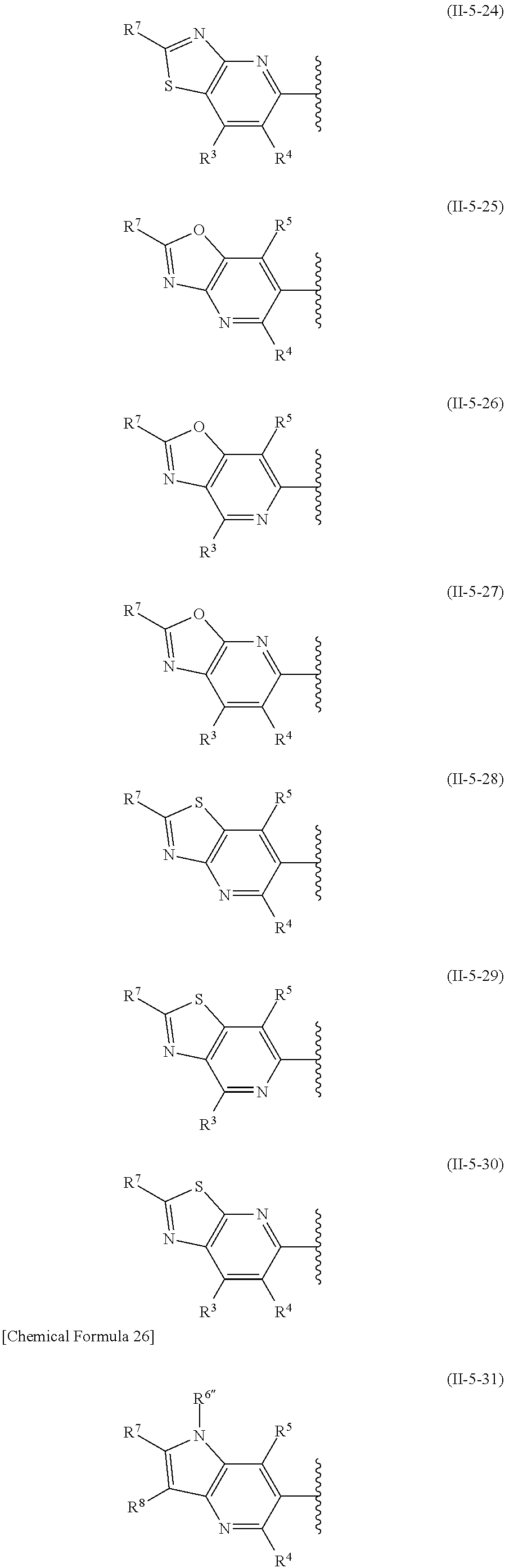


wherein each variable is as defined above,
or a pharmaceutically acceptable salt or solvate thereof.
- [61] The compound according to [22] of the formula:

or a pharmaceutically acceptable salt or solvate thereof;
wherein
ring A, m, R, X1, X2, X3 and X4 are as defined in [22];
A3 is CR3R3′ or NR3″;
A5 is CR5R5′ or NR5″;
A6 is CR6, CR6R6′, N, NR6″, O or S;
A7 is CR7, CR7R7′, N, NR7″, O or S;
A8 is CR8, CR8R8′, N, NR8″, O or S;
R3, R3′, R5, R5′, R6, R6′, R7, R7′, R8 and R8′ are independently selected from Substituent Group A; or
R6 and R6′, R7 and R7′, and R8 and R8′ are respectively taken together to form oxo;
R3″, R5″, R6″, R7″ and R8″ are independently selected from Substituent Group B; and
dashed line represents presence or absence of a bond.
- [62] The compound according to [61] wherein A3 is CHR3; A5 is CHR5; A6 is CR6; A7 is N; A8 is CR8; and ring D contains two double bonds in the ring, or a pharmaceutically acceptable salt or solvate thereof.
- [63] A compound of the formula:

or a pharmaceutically acceptable salt or solvate thereof;
wherein
ring A, m, and R are as defined in [1];
X1, X2, X3 and X4 are independently hydrogen, halogen, amino, hydroxy or lower alkyl;
ring C is heterocycle;
A1 is C, CR1, or N;
A2 is C, CR2, or N;
A3 is CR3, CR3R3′, N or NR3″;
A4 is CR4, CR4R4′, N or NR4″,
A5 is CR5, CR5R5′, N or NR5″;
A6 is CR6, CR6R6′, N, NR6″, O or S;
A7 is CR7, CR7R7′, N, NR7″, O or S;
A8 is CR8, CR8R8′, N, NR8″, O or S;
R1, R2, R3, R3′, R5, R5′, R6, R6′, R7, R7′, R8, and R8′ are independently selected from Substituent Group A consisting of hydrogen, optionally substituted lower alkyl, optionally substituted lower alkenyl, optionally substituted lower alkoxy, carboxy, optionally substituted carbamoyl, cyano, formyl, optionally substituted (lower alkyl)carbonyl, optionally substituted (lower alkoxy)carbonyl, optionally substituted heterocyclic group, optionally substituted heterocyclecarbonyl, optionally substituted amino, optionally substituted aminocarbonyl, optionally substituted aryl, optionally substituted arylcarbonyl, (lower alkyl)sulfonyl, (lower alkyl)sulfinyl and halogen; or
R6 and R6′, R7 and R7′, and R8 and R8′ are respectively taken together to form oxo;
R3″, R4″, R5″, R6″, R7″ and R8″ are independently selected from Substituent Group B consisting of hydrogen, optionally substituted lower alkyl and optionally substituted (lower alkyl)carbonyl; and
dashed line represents presence or absence of a bond.
- [64] The compound according to [63] wherein any one of A1 and A2 is N, or a pharmaceutically acceptable salt or solvate thereof.
- [65] The compound according to [63] of the formula:

wherein each variable is as defined above,
or a pharmaceutically acceptable salt or solvate thereof.
- [66] The compound according to [63] of the formula:

wherein each variable is as defined above,
or a pharmaceutically acceptable salt or solvate thereof.
- [67] The compound according to any one of [22] to [66] wherein ring A is a group of the formula (A-1), or a pharmaceutically acceptable salt or solvate thereof.
- [68] The compound according to any one of [22] to [66] wherein m is 1, or a pharmaceutically acceptable salt or solvate thereof.
- [69] The compound according to any one of [22] to [66] wherein R is —NHC(═O)RA in which RA is lower alkyl, or a pharmaceutically acceptable salt or solvate thereof.
- [70] The compound according to any one of [22] to [66] wherein R is a five- or six-membered heterocyclic group containing at least one nitrogen atom, or a pharmaceutically acceptable salt or solvate thereof.
- [71] The compound according to any one of [22] to [66] wherein R is selected from the group consisting of

or a pharmaceutically acceptable salt or solvate thereof.
- [72] The compound according to [71] wherein R is

or a pharmaceutically acceptable salt or solvate thereof.
- [73] The compound according to [71] wherein R is

or a pharmaceutically acceptable salt or solvate thereof.
The oxazolidinone derivative of the invention is useful as a drug (e.g., antimicrobials) or an intermediate for the synthesis of such drug. Also, the oxazolidinone derivative of the invention has a potent antimicrobial activity against gram-positive strains and gram-negative strains. Especially, the compound exhibits a broad spectrum of antimicrobial activity against drug-resistant gram-positive strains, including methicillin-resistant Staphylococcus aureus (MRSA), vancomycin-resistant enterococci (VRE), penicillin-resistant pneumococcus (PRSP). More preferably, the compound of the invention is effective against linezolid resistant (LZD-R) strains. More preferably, the compound of the invention shows good solubility or oral absorbability, which allows for administration by injection. Still more preferably, the compound of the invention reduces the side-effects concerned in conventional antimicrobial agents (e.g., linezolid), such as myelosuppression, monoamine oxidase (MAO) inhibiting activity, and neurotoxicity. Decreased MAO inhibition is preferred because side-effects, such as metabolism suppression of dopamine, serotonin, etc., blood pressure elevation, agitation, etc., are concerned by such inhibition. Additionally, preferred compound of the invention also shows good profiles in pharmacokinetics, such as CYP inhibition, PK profile, and plasma stability. Still more preferred compound of the invention has advantageous property such as short treatment period compared to conventional drugs, once-a-day dosing, low occurrence rate of resistant strain, etc.
The terms as used herein are described below. Each term, alone or in combination with another term, has the following meaning unless otherwise specifically indicated.
The term “lower alkyl” refers to C1-C6 straight or branched monovalent hydrocarbon radical, such as methyl, ethyl, n-propyl, isopropyl, n-butyl, isobutyl, sec-butyl, tert-butyl, n-pentyl, isopentyl, neo-pentyl, n-hexyl, isohexyl and the like.
The term “lower alkenyl” refers to straight or branched chain group of 2 to 6 carbon atoms having one or more double bond(s) in the “lower alkyl” as defined above and includes, for example, vinyl, propenyl, butenyl and the like.
The term “lower alkylene” refers to straight or branched C1-C6 alkylene and includes methylene, ethylene, trimethylene, propylene, tetramethylene, ethylethylene, pentamethylene, hexamethylene and the like.
The term “lower alkenylene” refers to straight or branched chain group of 2 to 6 carbon atoms having one or more double bond(s) in the “lower alkylene” as defined above and includes, for example, vinylene, propenylene, butenylene and the like.
The terms “lower alkoxy” and “lower alkyloxy” refer to an oxy attached to the “lower alkyl” as defined above and include, for example, methoxy, ethoxy, n-propoxy, isopropoxy, n-butoxy, isobutoxy, sec-butoxy, tert-butoxy, n-pentoxy, isopentoxy, neopentoxy, tert-pentoxy, n-hexyloxy, isohexyloxy and the like.
The term “halogen” means fluorine, chlorine, bromine or iodine.
The term “carbocycle” refers to aryl, cycloalkyl or cycloalkenyl and includes cyclobutane, cyclopentane, cyclohexane, cycloheptane, benzene, naphthalene and the like. 5- to 7-membered ring is preferable, and 6-membered ring is especially preferable.
The term “aryl” refers to monocyclic or fused aromatic hydrocarbon and includes phenyl, 1-naphthyl, 2-naphthyl, anthryl and the like.
The term “cycloalkyl” includes cyclic saturated hydrocarbon of three to eight carbon atoms and includes cyclopropyl, cyclobutyl, cyclopentyl, cyclohexyl, cycloheptyl and cyclooctyl and the like.
The term “heterocycle” and “heterocyclic group” refer to a ring wherein a carbon atom in the above “carbocycle” is replaced with at least one hetero atom independently selected from nitrogen atom, oxygen atom or sulphur atom and include heteroaryl, non-aromatic heterocycle and the like. The term “heterocycle” also includes those having a fused ring.
The term “heteroaryl” refers to monocyclic aromatic heterocyclic group or fused aromatic heterocyclic group. The monocyclic aromatic heterocyclic group refers to a group derived from a 5- to 8-membered aromatic ring having a point of attachment at any substitutable position and containing one to four oxygen atom(s), sulfur atom and/or nitrogen atom in the ring. The fused aromatic heterocyclic group refers to a group having a point of attachment at any substitutable position wherein a 5- to 8-membered aromatic ring containing one to four oxygen atom(s), sulfur atom and/or nitrogen atom is fused with one to four 5- to 8-membered aromatic carbocycle(s) or other 5- to 8-membered aromatic heterocycle(s). Examples include furyl (e.g., 2-furyl, 3-furyl), thienyl (e.g., 2-thienyl, 3-thienyl), pyrrolyl (e.g., 1-pyrrolyl, 2-pyrrolyl, 3-pyrrolyl), imidazolyl (e.g., 1-imidazolyl, 2-imidazolyl, 4-imidazolyl), pyrazolyl (e.g., 1-pyrazolyl, 3-pyrazolyl, 4-pyrazolyl), triazolyl (e.g., 1,2,4-triazol-1-yl, 1,2,4-triazol-3-yl, 1,2,4-triazol-4-yl), tetrazolyl (e.g., 1-tetrazolyl, 2-tetrazolyl, 5-tetrazolyl), oxazolyl (e.g., 2-oxazolyl, 4-oxazolyl, 5-oxazolyl), isoxazolyl (e.g., 3-isoxazolyl, 4-isoxazolyl, 5-isoxazolyl), thiazolyl (e.g., 2-thiazolyl, 4-thiazolyl, 5-thiazolyl), thiadiazolyl, isothiazolyl (e.g., 3-isothiazolyl, 4-isothiazolyl, 5-isothiazolyl), pyridyl (e.g., 2-pyridyl, 3-pyridyl, 4-pyridyl), pyridazinyl (e.g., 3-pyridazinyl, 4-pyridazinyl), pyrimidinyl (e.g., 2-pyrimidinyl, 4-pyrimidinyl, 5-pyrimidinyl), furazanyl (e.g., 3-furazanyl), pyrazinyl (e.g., 2-pyrazinyl), oxadiazolyl (e.g., 1,3,4-oxadiazole-2-yl), benzofuryl (e.g., 2-benzo[b]furyl, 3-benzo[b]furyl, 4-benzo[b]furyl, 5-benzo[b]furyl, 6-benzo[b]furyl, 7-benzo[b]furyl), benzothienyl (e.g., 2-benzo[b]thienyl, 3-benzo[b]thienyl, 4-benzo[b]thienyl, 5-benzo[b]thienyl, 6-benzo[b]thienyl, 7-benzo[b]thienyl), benzimidazolyl (e.g., 1-benzimidazolyl, 2-benzimidazolyl, 4-benzimidazolyl, 5-benzimidazolyl), dibenzofuryl, benzoxazolyl (e.g., 2-benzoxazolyl, 4-benzoxazolyl, 5-benzoxazolyl, 6-benzoxazolyl, 7-benzoxazolyl, 8-benzoxazolyl), quinoxalyl (e.g., 2-quinoxalinyl, 5-quinoxalinyl, 6-quinoxalinyl), cinnolinyl (e.g., 3-cinnolinyl, 4-cinnolinyl, 5-cinnolinyl, 6-cinnolinyl, 7-cinnolinyl, 8-cinnolinyl), quinazolyl (e.g., 2-quinazolinyl, 4-quinazolinyl, 5-quinazolinyl, 6-quinazolinyl, 7-quinazolinyl, 8-quinazolinyl), quinolyl (e.g., 2-quinolyl, 3-quinolyl, 4-quinolyl, 5-quinolyl, 6-quinolyl, 7-quinolyl, 8-quinolyl), phthalazinyl (e.g., 1-phthalazinyl, 5-phthalazinyl, 6-phthalazinyl), isoquinolyl (e.g., 1-isoquinolyl, 3-isoquinolyl, 4-isoquinolyl, 5-isoquinolyl, 6-isoquinolyl, 7-isoquinolyl, 8-isoquinolyl), puryl, pteridinyl (e.g., 2-pteridinyl, 4-pteridinyl, 6-pteridinyl, 7-pteridinyl), carbazolyl, phenanthridinyl, acridinyl (e.g., 1-acridinyl, 2-acridinyl, 3-acridinyl, 4-acridinyl, 9-acridinyl), indolyl (e.g., 1-indolyl, 2-indolyl, 3-indolyl, 4-indolyl, 5-indolyl, 6-indolyl, 7-indolyl), isoindolyl, phenazinyl (e.g., 1-phenazinyl, 2-phenazinyl) or phenothiazinyl (e.g., 1-phenothiazinyl, 2-phenothiazinyl, 3-phenothiazinyl, 4-phenothiazinyl), etc.
The term “non-aromatic heterocycle” refers to a non-aromatic heterocyclic group having a point of attachment at any substitutable position and at least one nitrogen atom, oxygen atom and/or sulfur atom in the ring. Examples include 1-pyrrolinyl, 2-pyrrolinyl, 3-pyrrolinyl, pyrrolidino, 2-pyrrolidinyl, 3-pyrrolidinyl, 1-imidazolinyl, 2-imidazolinyl, 4-imidazolinyl, 1-imidazolidinyl, 2-imidazolidinyl, 4-imidazolidinyl, 1-pyrazolinyl, 3-pyrazolinyl, 4-pyrazolinyl, 1-pyrazolidinyl, 3-pyrazolidinyl, 4-pyrazolidinyl, piperidino, 2-piperidyl, 3-piperidyl, 4-piperidyl, piperadino, 2-piperazinyl, 2-morpholinyl, 3-morpholinyl, morpholino, tetrahydropyranyl, etc. The term “non-aromatic heterocyclic group” may be saturated or unsaturated as far as it is non-aromatic.
The terms “(lower alkyl)carbonyl”, “(lower alkoxy)carbonyl”, “arylcarbonyl” and “heterocyclecarbonyl” refer to carbonyl attached to the above “lower alkyl”, “lower alkoxy”, “aryl” and “heterocyclic group”, respectively.
The term “halogenated lower alkyl” refers to “lower alkyl” as defined above which is substituted with at least one halogen as defined above.
The terms “heterocycle (lower)alkyl”, “(lower alkyl)carbonyl lower alkyl”, “cycloalkyl(lower)alkyl”, “arylcarbonyl(lower)alkyl”, “heterocyclecarbonyl(lower)alkyl” refer to “lower alkyl” as defined above attached to “heterocyclic group”, “(lower alkyl)carbonyl”, “cycloalkyl”, “arylcarbonyl”, “heterocyclecarbonyl”, respectively.
The terms “(lower alkyl)amino”, “(lower alkyl)sulfonyl”, “(lower alkyl)sulfinyl” refer to “lower alkyl” as defined above attached to amino, sulphonyl, sulfinyl, respectively.
One embodiment of the invention provides a pharmaceutical composition having an antimicrobial effect comprising a compound of the formula:

(compound (I)), or a pharmaceutically acceptable salt or solvate thereof.
Preferred embodiment of the compound of the formula (I) includes compound (II) and (III) of the formulae:

Preferred embodiment of compound (II) includes, for example, compound (II-1), compound (II-2), compound (II-3), compound (II-4), compound (II-5), compound (II-6) and the like. Compound (II-1) and compound (II-2) are more preferable.

Preferred embodiment of compound (III) includes, for example, compound (III-1), compound (III-2), compound (III-3) and the like.

The compound of the formula (I) is further described below.
Ring A may be any group of the formula:

in which dashed line represents presence or absence of a bond, and preferably, represented by the formula (A-1).
In a broad sense, the group-(CH2)mR attached to ring A is an organic residue which is able to bind to the 5-position of the oxazolidinone ring in oxazolidinone antimicrobial agents, and may be any organic group that can be attached to the 5-position of the oxazolidinone ring of an oxazolidinone antimicrobial compound, which was known as disclosed in a reference cited above or can be synthesized by a skilled person or will be found in the future.
Also, the term “oxazolidinone antimicrobial agent” broadly includes antimicrobial compounds having a five-membered ring of the formula (A-2), (A-3) or (A-4), instead of the formula (A-1).
m is 0 or 1, and preferably 1.
R represents, preferably, H, —NHC(═O)RA, —NHC(═S)RA, —NH-het1, —O-het1, —S-het1, —S(═O)-het1, —S(═O)2-het1, het2, —CONHRA, —OH, lower alkyl, lower alkoxy or lower alkenyl. Preferably, R is —NHC(═O)RA, —NHC(═S)RA, —NH-het1, het2, —CONHRA or —OH. More preferably, R is —NHC(═O)RA or het2.
RA is hydrogen, lower alkyl, halogenated lower alkyl, amino, (lower alkyl)amino, lower alkenyl, heterocycle (lower)alkyl, (lower alkyl)carbonyl, (lower alkyl)carbonyl lower alkyl, lower alkoxy, cycloalkyl, cycloalkyl(lower)alkyl, arylcarbonyl, arylcarbonyl(lower)alkyl, heterocyclecarbonyl or heterocyclecarbonyl(lower)alkyl, and preferably, hydrogen, lower alkyl, halogenated lower alkyl, or lower alkoxy.
het1 and het2 are independently optionally substituted heterocyclic group, preferably five- or six-membered, more preferably five- or six-membered heterocyclic group containing at least nitrogen atom, and still more preferably aromatic heterocyclic group such as isoxazole, triazole, tetrazole. Example of substituents for such heterocycle includes lower alkyl, amino and the like.
More preferably, the group —(CH2)mR is any one of the following groups:

Ring B is a benzene ring optionally substituted. The substituents are exemplified by X1, X2, X3 and X4 as described below, and specifically, include same or different one to four substituent(s) selected from the group consisting of hydrogen, halogen, amino, hydroxy and lower alkyl. Preferably, ring B is a benzene ring optionally substituted with one or two halogen(s).
Ring C is a saturated, unsaturated or aromatic six-membered heterocycle containing at least one nitrogen atom as a ring member, wherein the atom at the point of attachment to ring B is a carbon atom, optionally containing one to three double bond(s) in the ring and optionally substituted. Also, ring C may contain oxygen atom or sulfur atom. When only one of A1 and A2 is nitrogen atom, ring C is an optionally substituted six-membered ring containing two double bonds in the ring.
Preferably, ring C contains carbon atoms and nitrogen atom(s) as a ring member, and the number of the nitrogen atom is 1 or 2. More preferably, any one of A1 and A2 is nitrogen atom and the other is carbon atom, or A1 and A2 are both carbon atoms. Preferably, ring C also contains two or three double bonds in the ring. Particular preferably, only one of A1 and A2 is nitrogen atom and the other ring members of ring C are all carbon atoms, and ring C contains two double bonds in the ring.
Ring D is a saturated, unsaturated or aromatic five-membered ring, preferably five-membered heterocycle, optionally containing one or two double bond(s) in the ring and optionally substituted. Also, ring D may form a fused ring. When ring D forms such fused ring, it is preferably a six- to eight-membered heterocycle, more preferably saturated heterocycle. Such six- to eight-membered heterocycle may be substituted with same or different one to three substituent(s) selected from Substituent Group A.
Ring D consists of atoms preferably selected from the group consisting of carbon atom, nitrogen atom, oxygen atom and sulfur atom, preferably, carbon atom and nitrogen atom. More preferably, the number of the nitrogen atom is one to four, and still more preferably one to three.
Also, ring D preferably contains two double bonds in the ring. In another embodiment, ring D preferably contains one nitrogen atom and oxygen atom(s) or sulfur atom(s) in the ring.
Substituents for ring C and ring D include, preferably, hydrogen, halogen, amino, cyano, hydroxy, lower alkyl or the substituents of Substituent Group A as described below.
Compound (II) is further described below.

Ring A, m and R are as defined above.
X1, X2, X3 and X4 are independently hydrogen, halogen, amino, hydroxy or lower alkyl, preferably, hydrogen or halogen. More preferably, X1 and/or X2 is halogen (e.g., fluorine), and X3 and X4 are hydrogen.
A1 is C, CR1 or N;
A2 is C, CR2 or N;
A3 is CR3, CR3R3′, N or NR3″;
A4 is CR4, CR4R4′, N or NR4″;
A5 is CR5, CR5R5′, N or NR5″.
A6 is CR6, CR6R6′, N, NR6″, O or S;
A7 is CR7, CR7R7′, N, NR7″, O or S;
A8 is CR8, CR8R8′, N, NR8″, O or S.
R1, R2, R3, R3′, R4, R4′, R5, R5′, R6, R6′, R7, R7′, R8 and R8′ are independently selected from Substituent Group A as listed below.
Substituent Group A: hydrogen, optionally substituted lower alkyl, optionally substituted lower alkenyl, optionally substituted lower alkoxy, carboxy, optionally substituted carbamoyl, cyano, formyl, optionally substituted (lower alkyl)carbonyl, optionally substituted (lower alkoxy)carbonyl, optionally substituted heterocyclic group (preferably five- or six-membered), optionally substituted heterocyclecarbonyl (preferably five- or six-membered), optionally substituted amino, optionally substituted aminocarbonyl, optionally substituted aryl (preferably, phenyl), optionally substituted arylcarbonyl, (lower alkyl)sulfonyl, (lower alkyl)sulfinyl, halogen.
The substituent of Substituent Group A is preferably hydrogen, optionally substituted lower alkyl, formyl, optionally substituted amino, or optionally substituted aminocarbonyl.
Substituents for “optionally substituted lower alkyl”, “optionally substituted lower alkenyl”, “optionally substituted lower alkoxy”, “optionally substituted (lower alkyl)carbonyl”, “optionally substituted (lower alkoxy)carbonyl” in Substituent Group A are preferably halogen, hydroxy, optionally substituted amino or optionally substituted imino (example of substituents: lower alkyl, halogenated lower alkyl, (lower alkyl)thio lower alkyl, lower alkoxy lower alkyl, carbamoyl, (lower alkyl)carbamoyl, (lower alkyl)sulfonyl, (lower alkyl)sulfinyl, (lower alkyl)sulfonyl lower alkyl, (lower alkyl)sulfinyl lower alkyl, (lower alkyl)sulfonylamino, acyl (e.g., formyl, (lower alkyl)carbonyl), optionally substituted heterocyclic group (example of substituents: lower alkyl, aryl lower alkyl), optionally substituted heterocycle (lower)alkyl (example of substituents: lower alkyl, aryl lower alkyl), lower alkenyl, lower alkynyl, C(═NCN)NHCH3, cyano, cyano lower alkyl, cyano (lower alkyl)carbonyl, hydroxy, lower alkoxy, (lower alkoxy)carbonyl, NHCONH2, oxo, optionally substituted lower alkoxy (example of substituents: halogen, hydroxy, amino, (lower alkylamino, arylcarbonyl, heterocyclecarbonyl), halogenated lower alkoxy, hydroxy lower alkoxy, (lower alkyl)thio, hydroxy(lower alkyl)thio, carbamoyl, (lower alkyl)carbamoyl, (lower alkyl)sulfonyl, (lower alkyl)sulfinyl, hydroxy(lower alkyl)sulfonyl, hydroxy(lower alkyl)sulfinyl and cyano, and preferably, halogen, hydroxy, optionally substituted amino. For the heterocyclic group described above, five- or six-membered is preferable.
Substituents for “optionally substituted carbamoyl”, “optionally substituted amino” in Substituent Group A preferably include lower alkyl, halogenated lower alkyl, hydroxy lower alkyl, carbamoyl, (lower alkyl)carbamoyl, arylcarbamoyl, heterocyclecarbonyl wherein the heterocycle is preferably five- or six-membered, (lower alkyl)sulfonyl, (lower alkyl)sulfinyl, acyl (e.g., (lower alkyl)carbonyl, hydroxy(lower alkyl)carbonyl), (lower alkoxy)carbonyl, aryl (lower alkoxy)carbonyl, heterocycle (lower alkoxy)carbonyl wherein the heterocycle is preferably five- or six-membered, aryl lower alkyl, heterocycle (lower)alkyl wherein the heterocycle is preferably five- or six-membered. Substituent is preferably lower alkyl or acyl.
Substituents for “optionally substituted heterocyclic group”, “optionally substituted heterocyclecarbonyl”, “optionally substituted aryl”, “optionally substituted arylcarbonyl” in Substituent Group A preferably include lower alkyl, halogen, amino, (lower alkylamino, hydroxy, lower alkoxy, oxo, hydroxy lower alkyl, lower alkoxy lower alkyl, (lower alkylamino lower alkyl and the like, and preferably lower alkyl, halogen, amino, (lower alkylamino, hydroxy, lower alkoxy.
More preferably, the substituent of Substituent Group A is any one of the following substituents described in Example C and other Examples.


R6 and R6′, R7 and R7′, and R8 and R8′ may be respectively taken together to form oxo;
R6″ and R7″ may be taken together with the respective adjacent N atom to form a heterocycle optionally substituted;
R7″ and R8″ may be taken together with the respective adjacent N atom to form a heterocycle optionally substituted;
The substituent for such heterocycle optionally substituted is selected from Substituent Group A.
R1 and R2 are preferably hydrogen.
R3′, R4′ and R5′ are preferably hydrogen.
R6′, R7′ and R8′ are preferably hydrogen.
R3, R4 and R5 are preferably hydrogen or lower alkyl, more preferably hydrogen.
R6, R7 and R8 are preferably, hydrogen, optionally substituted lower alkyl, carboxy, optionally substituted carbamoyl, cyano, formyl, optionally substituted heterocyclecarbonyl or optionally substituted amino as defined above for Substituent Group A, and more preferably, substituents as described below in Example C. Also, at least two of R6, R7 and R8 are preferably hydrogen.
R6 and R6′, R7 and R7′, and R8 and R8′ may be respectively taken together to form oxo.
R3″, R4″, R5″, R6″, R7″ and R8″ are independently selected from Substituent Group B.
Substituent Group B: hydrogen, optionally substituted lower alkyl, optionally substituted (lower alkyl)carbonyl, formyl, cyano, amino.
Substituents for “optionally substituted lower alkyl”, “optionally substituted (lower alkyl)carbonyl in Substituent Group B preferably include hydroxy, lower alkoxy, amino, (lower alkyl)amino, carbamoyl, (lower alkyl)carbamoyl, and hydroxy is preferable.
R3″, R4″ and R5″ are more preferably hydrogen or lower alkyl (e.g., methyl).
More preferably, R6″, R7″ and R8″ are the following substituents as described in Example E and other Examples. Also, at least one of R6″, R7″ and R8″ is preferably hydrogen. More preferably, R7″ is hydrogen or optionally substituted lower alkyl.

dashed line represents presence or absence of a bond.
The following preferred embodiments are provided.
- (1) Only one of A1 and A2 is N. In this case, the dashed line between A1 and A2 represents absence of a bond. More preferably, the other of A1 and A2 is C. More preferably, ring C contains two double bonds in the ring.
- (2) A1 and A2 are both carbon atoms, and the dashed line between A1 and A2 represents presence of a bond. In this case, more preferably, any one of A3, A4 and A5 is nitrogen atom.
- (3) dashed line between A3 and A4 represents presence of a bond.
- (4) dashed line between A5 and the adjacent carbon atom represents presence of a bond.
- (5) Only one of A1 and A2 is N. In this case, the dashed line between A1 and A2 represents absence of a bond. Also, any one of A3, A4 and A5 is optionally substituted N atom. More preferably, ring C is a saturated ring or it contains one double bond. Such double bond is preferably present between A4 or A5 and the carbon atom linked to ring B.
The following more preferred embodiments are provided.
- (1) A3 is CR3; A4 is CR4; A5 is CR5; R3, R4 and R5 are independently selected from Substituent Group A.
- (2) A3 is CH; A4 is CH; A5 is CH; or any one or two of R3, R4 and R5 is selected from Substituent Group A excluding hydrogen.
- (3) Any one of A3, A4 and A5 is N.
- (4) Any one of A3, A4 and A5 is N; the others are CH optionally substituted with a substituent of Substituent Group A.
- (5) Any one of A6, A7 and A8 is N.
- (6) A6 and/or A8 is N; A7 is CR7.
- (7) Any two of A6, A7 and A8 are N.
- (8) A7 and/or A8 is N; A6 is CR6.
- (9) A6, A7 and A8 are N.
- (10) Any two of A6, A7 and A8 are N and O or N and S.
- (11) A1 and A2 are both carbon atoms, any one of A3, A4 and A5 is N, and the others are carbon atoms.
- (12) Only one of A1 and A2 is N. In this case, the dashed line between A1 and A2 represents absence of a bond. Also, A3, A4 and A5 are CH. Ring C contains two double bonds in the ring. A6 and A8 are N; A7 is CR7. R7 is preferably hydrogen, optionally substituted lower alkyl, formyl, optionally substituted amino, optionally substituted aminocarbonyl as defined above for Substituent Group A, and more preferably, hydrogen or optionally substituted lower alkyl.
Each compound included in Compound (II) is described below. Substituents for compound (II) are typically as described above.
Compound (II-1) is further described below.

Ring A, m, R, X1, X2, X3 and X4 are as defined above.
A3 is CR3 or N;
A4 is CR4 or N;
A5 is CR5 or N;
A6 is CR6 or N;
A7 is CR7 or N;
A8 is CR8 or N.
R3, R4, R5, R6, R7 and R8 are independently selected from Substituent Group A.
The following preferred embodiments are provided.
- (1) A3 is CR3; A4 is CR4; A5 is CR5; R3, R4 and R5 are independently selected from Substituent Group A.
- (2) A3 is CH; A4 is CH; A5 is CH; or any one or two of R3, R4 and R5 is selected from Substituent Group A excluding hydrogen.
- (3) Any one of A3, A4 and A5 is N.
- (4) Any one of A3, A4 and A5 is N; the others are CH optionally substituted with a substituent of Substituent Group A.
- (5) Any one of A6, A7 and A8 is N.
- (6) A6 and/or A8 is N; A7 is CR7.
- (7) Any two of A6, A7 and A8 are N.
- (8) A7 and/or A8 is N; A6 is CR6.
- (9) A6, A7 and A8 are N.
- (10) A6 and A8 are N; A7 is CR7. R7 is preferably hydrogen, optionally substituted lower alkyl, formyl, optionally substituted amino, optionally substituted aminocarbonyl as defined above for Substituent Group A, more preferably, hydrogen or optionally substituted lower alkyl. A3 is CH; A4 is CH; A5 is CH.
The preferred fused ring consisting of ring C and ring D in compound (II-1) is any one of:


wherein each variable is as defined above.
Compound (II-2) is further described below.

Ring A, m, R, X1, X2, X3 and X4 are as defined above.
A3 is CR3 or N;
A4 is CR4 or N;
A5 is CR5 or N;
A6 is CR6 or N;
A7 is CR7 or N;
A8 is CR8 or N.
R3, R4, R5, R6, R7 and R8 are independently selected from Substituent Group A.
The following preferred embodiments are provided.
- (1) A3 is CR3; A4 is CR4; A5 is CR5; R3, R4 and R5 are independently selected from Substituent Group A.
- (2) A3 is CH; A4 is CH; A5 is CH; or any one or two of R3, R4 and R5 is selected from Substituent Group A excluding hydrogen.
- (3) Any one of A3, A4 and A5 is N.
- (4) Any one of A3, A4 and A5 is N; and the others are CH.
- (5) Any one of A6, A7 and A8 is N.
- (6) A6 and/or A8 is N; A7 is CR7.
- (7) Any two of A6, A7 and A8 are N.
- (8) A7 and/or A8 is N; and A6 is CR6.
- (9) A6, A7 and A8 are N.
- (10) A6 and A8 are N; and A7 is CR7. R7 is preferably hydrogen, optionally substituted lower alkyl, formyl, optionally substituted amino, optionally substituted aminocarbonyl as defined above for Substituent Group A, and more preferably, hydrogen or optionally substituted lower alkyl. A3 is CH; A4 is CH; and A5 is CH.
In compound (II-2), preferred fused ring consisting of ring C and ring D is any one of:


wherein each variable is as defined above.
Compound (II-3) is further described below.

Ring A, m, R, X1, X2, X3 and X4 are as defined above.
A3 is CR3R3′ or NR3″;
A4 is CR4R4 or NR4″;
A5 is CR5R5′ or NR5″.
Preferably, at least one of A3, A4 and A5 contains nitrogen atom.
A6 is CR6 or N;
A7 is CR7 or N;
A8 is CR8 or N.
R3, R3′, R4, R4′, R5, R5′, R6, R7 and R6 are independently selected from Substituent Group A.
R3″, R4″ and R5″ are independently selected from Substituent Group B.
The following preferred embodiments are provided.
- (1) Any one of A3, A4 and A5 contains nitrogen atom, and any one or two of A6, A7 and A8 is N.
In compound (II-3), preferred fused ring consisting of ring C and ring D is any one of:


wherein each variable is as defined above.
Compound (II-4) is further described below.

Ring A, m, R, X1, X2, X3 and X4 are as defined above.
A3 is CR3R3′ or NR3″;
A4 is CR4R4′ or NR4″;
A5 is CR5R5′ or NR5″.
Preferably, at least one of A3, A4 and A5 contains nitrogen atom.
A6 is CR6 or N;
A7 is CR7 or N;
A8 is CR8 or N.
R3, R4, R5, R6, R7 and R8 are independently selected from Substituent Group A.
Preferred embodiments are provided below.
- (1) Any one of A3, A4 and A5 contains nitrogen atom, and any one or two of A6, A7 and A8 is N.
In compound (II-4), preferred fused ring consisting of ring C and ring D is any one of:


wherein each variable is as defined above.
Compound (II-5) is further described below.

Ring A, m, R, X1, X2, X3 and X4 are as defined above.
A3 is CR3 or N;
A4 is CR4 or N;
A5 is CR5 or N.
Preferably, at least one of A3, A4 and A5 contains nitrogen atom.
A6 is CR6, CR6R6′, N, NR6″, O or S;
A7 is CR7, CR7R7′, N, NR7″, O or S;
A8 is CR8, CR8R8′, N, NR8″, O or S.
R3, R4, R5, R6, R6′, R7, R7′, R8 and R8′ are independently selected from Substituent Group A.
R6 and R6′, R7 and R7′, and R8 and R8′ may be respectively taken together to form oxo.
R6″, R7″ and R8″ are independently selected from Substituent Group B.
dashed line represents presence or absence of a bond.
The following preferred embodiments are provided.
- (1) Any one or two of A3, A4 and A5 is nitrogen atom, and any one of A6, A7 and A8 contains nitrogen atom.
- (2) Any two of A6, A7 and A8 are nitrogen atom and oxygen atom, or nitrogen atom and sulfur atom. Each nitrogen atom is optionally substituted.
- (3) Either dashed line between A6 and A7 or A7 and A8 represents presence of a bond.
In compound (II-5), preferred fused ring consisting of ring C and ring D is any one of:


wherein each variable is as defined above.
Compound (II-6) is further described below.

wherein
ring A, m, R, X1, X2, X3 and X4 are as defined above;
A3 is CR3R3′ or NR3″;
A5 is CR5R5′ or NR5″;
A6 is CR6, CR6R6′, N, NR6″, O or S;
A7 is CR7, CR7R7′, N, NR7″, O or S;
A8 is CR8, CR8R8′, N, NR8″, O or S;
R3, R3′, R5, R5′, R6, R6′, R7, R7′, R8 and R8′ are independently selected from Substituent Group A; or
R6 and R6′, R7 and R7′, and R8 and R8′ are respectively taken together to form oxo;
R3″, R5″, R6″, R7″ and R8″ are independently selected from Substituent Group B;
dashed line represents presence or absence of a bond.
Preferably, A3 is CHR3; A5 is CHR5; A6 is CR6; A7 is N; A8 is CR8; and ring D contains two double bonds in the ring.
Compound (III) is further described below. The substituents for compound (III) is typically as described above for compound (II).

Ring A, m, R, X1, X2, X3 and X4 are as defined above.
A1 is C, CR1 or N;
A2 is C, CR2 or N;
A3 is CR3, CR3R3′, N or NR3″;
A4 is CR4, CR4R4′, N or NR4″;
A5 is CR5, CR5R5′, N or NR5″.
A6 is CR6, CR6R6′, N, NR6″, O or S;
A7 is CR7, CR7R7′, N, NR7″, O or S;
A8 is CR8, CR8R8′, N, NR8″, O or S.
R1, R2, R3, R3′, R4, R4′, R5, R5′, R6, R6′, R7, R7′, R8 and R8′ are independently selected from Substituent Group A.
Substituent Group A: hydrogen, optionally substituted lower alkyl, optionally substituted lower alkenyl, optionally substituted lower alkoxy, carboxy, optionally substituted carbamoyl, cyano, formyl, optionally substituted (lower alkyl)carbonyl, optionally substituted (lower alkoxy)carbonyl, optionally substituted heterocyclic group, optionally substituted heterocyclecarbonyl, optionally substituted amino, optionally substituted aminocarbonyl, optionally substituted aryl, optionally substituted arylcarbonyl, (lower alkyl)sulfonyl, (lower alkyl)sulfinyl, halogen.
Substituent for “optionally substituted lower alkyl”, “optionally substituted lower alkenyl”, “optionally substituted lower alkoxy”, “optionally substituted (lower alkyl)carbonyl”, “optionally substituted (lower alkoxy)carbonyl” in Substituent Group A includes preferably halogen, hydroxy, optionally substituted amino or optionally substituted imino (example of substituents: lower alkyl, halogenated lower alkyl, (lower alkyl)thio lower alkyl, lower alkoxy lower alkyl, carbamoyl, (lower alkyl)carbamoyl, (lower alkyl)sulfonyl, (lower alkyl)sulfinyl, (lower alkyl)sulfonyl lower alkyl, (lower alkyl)sulfinyl lower alkyl, acyl (e.g., formyl, (lower alkyl)carbonyl), heterocycle (lower)alkyl, lower alkenyl, lower alkynyl, C(═NCN)NHCH3, cyano, cyano lower alkyl, cyano (lower alkyl)carbonyl, hydroxy), oxo, lower alkoxy, halogenated lower alkoxy, hydroxy lower alkoxy, (lower alkyl)thio, hydroxy(lower alkyl)thio, carbamoyl, (lower alkyl)carbamoyl, (lower alkyl)sulfonyl, (lower alkyl)sulfinyl, hydroxy(lower alkyl)sulfonyl, hydroxy(lower alkyl)sulfinyl, cyano.
Substituent for “optionally substituted carbamoyl”, “optionally substituted amino” in Substituent Group A includes preferably lower alkyl, halogenated lower alkyl, carbamoyl, (lower alkyl)carbamoyl, (lower alkyl)sulfonyl, (lower alkyl)sulfinyl, acyl (e.g., (lower alkyl)carbonyl), (lower alkoxy)carbonyl. Also, substituent on carbamoyl may be taken together with the nitrogen atom of carbamoyl to form optionally substituted heterocycle (e.g., five- to seven-membered).
Substituent for “optionally substituted heterocyclic group”, “optionally substituted heterocyclecarbonyl”, “optionally substituted aryl”, “optionally substituted arylcarbonyl” in Substituent Group A includes preferably lower alkyl, halogen, amino, (lower alkyl)amino, hydroxy, lower alkoxy, oxo, hydroxy lower alkyl, lower alkoxy lower alkyl, (lower alkyl)amino lower alkyl and the like.
R1 and R2 are preferably hydrogen.
R3′, R4′ and R5′ are preferably hydrogen.
R6′, R7′ and R8′ are preferably hydrogen.
R3, R4 and R5 are preferably hydrogen or lower alkyl.
R6, R7 and R8 are preferably hydrogen, optionally substituted lower alkyl, carboxy, optionally substituted carbamoyl, cyano, formyl, optionally substituted heterocyclecarbonyl or optionally substituted amino as defined above for Substituent Group A.
R6 and R6′, R7 and R7′, and R8 and R8′ may be respectively taken together to form oxo.
R3″, R4″, R5″, R6″, R7″ and R8″ are independently selected from Substituent Group B.
Substituent Group B: hydrogen, optionally substituted lower alkyl, optionally substituted (lower alkyl)carbonyl.
Substituent for “optionally substituted lower alkyl”, “optionally substituted (lower alkyl)carbonyl” in Substituent Group B includes hydroxy, lower alkoxy, amino, (lower alkyl)amino, carbamoyl, (lower alkyl)carbamoyl.
dashed line represents presence or absence of a bond
The following preferred embodiments are provided.
- (1) Only one of A1 and A2 is N. In this case, the dashed line between A1 and A2 represents absence of a bond. More preferably, the other of A1 and A2 is C. More preferably, ring C contains two double bonds in the ring.
- (2) A1 and A2 are both carbon atoms, and the dashed line between A1 and A2 represents presence of a bond. In this case, more preferably, any one of A3, A4 and A5 is nitrogen atom.
- (3) dashed line between A3 and A4 represents presence of a bond.
- (4) dashed line between A5 and the adjacent carbon atom represents presence of a bond.
The following more preferred embodiments are provided.
- (1) A3 is CR3; A4 is CR4; A5 is CR5; R3, R4 and R5 are independently selected from Substituent Group A.
- (2) A3 is CH; A4 is CH; A5 is CH; or any one or two of R3, R4 and R5 is selected from Substituent Group A excluding hydrogen.
- (3) Any one of A3, A4 and A5 is N.
- (4) Any one of A3, A4 and A5 is N; the others are CH optionally substituted with a group selected from Substituent Group A.
- (5) Any one of A6, A7 and A8 is N.
- (6) A6 and/or A8 is N; A7 is CR7.
- (7) Any two of A6, A7 and A8 are N.
- (8) A7 and/or A8 is N; A6 is CR6.
- (9) A6, A7 and A8 are N.
- (10) Any two of A6, A7 and A8 are N and O, or N and S.
- (11) A1 and A2 are both carbon atoms, and any one of A3, A4 and A5 is N.
Compound (III-1) is further described below.

Ring A, m, R, X1, X2, X3 and X4 are as defined above.
A3 is CR3, CR3R3′, N or NR3″;
A4 is CR4, CR4R4′, N or NR4″;
A5 is CR5, CR5R5′, N or NR5″.
A6 is CR6, CR6R6′, N, NR6″, O or S;
A7 is CR7, CR7R7′, N, NR7″, O or S;
A8 is CR8, CR8R8′, N, NR8″, O or S.
R3, R3′, R4, R4′, R5, R5′, R6, R6′, R7, R7′, R8 and R8′ are independently selected from Substituent Group A.
R6 and R6′, R7 and R7′, and R8 and R8′ may be respectively taken together to form oxo.
R3″, R4″, R5″, R6″, R7″ and R8″ are independently selected from Substituent Group B.
dashed line represents presence or absence of a bond.
The following preferred embodiments are provided.
- (1) A3 is CR3; A4 is CR4; A5 is CR5, R3, R4 and R5 are preferably hydrogen or lower alkyl.
- (2) Any one of R6, R7 and R8 is preferably N.
- (3) Ring C preferably contains two double bonds.
- (4) Ring D preferably contains two double bonds.
Compound (III-1) is preferably represented by the formulae:

wherein each variable is as defined above.
In compound (III-1), preferred fused ring consisting of ring C and ring D is any one of:


wherein each variable is as defined above.
Compound (III-2) is further described below.

Ring A, m, R, X1, X2, X3 and X4 are as defined above.
A3 is CR3, CR3R3′, N or NR3″;
A4 is CR4, CR4R4′, N or NR4″;
A5 is CR5, CR5R5′, N or NR5″.
A6 is CR6, CR6R6′, N, NR6″, O or S;
A7 is CR7, CR7R7′, N, NR7″, O or S;
A8 is CR8, CR8R8′, N, NR8″, O or S.
R3, R3′, R4, R4′, R5, R5′, R6, R6′, R7, R7′, R8 and R8′ are independently selected from Substituent Group A.
R6 and R6′, R7 and R7′, and R8 and R8′ may be respectively taken together to form oxo.
R3″, R4″, R5″, R6″, R7″ and R8″ are independently selected from Substituent Group B.
dashed line represents presence or absence of a bond
Preferred embodiments are provided below.
- (1) A3 is CR3; A4 is CR4; A5 is CR5, R3, R4 and R5 are preferably hydrogen or lower alkyl.
- (2) Any one of R6, R7 and R8 is preferably N.
- (3) Ring C preferably contains two double bonds.
- (4) Ring D preferably contains two double bonds.
Compound (III-2) is preferably represented by the formulae:

wherein each variable is as defined above.
In compound (III-2), preferred fused ring consisting of ring C and ring D is any one of:


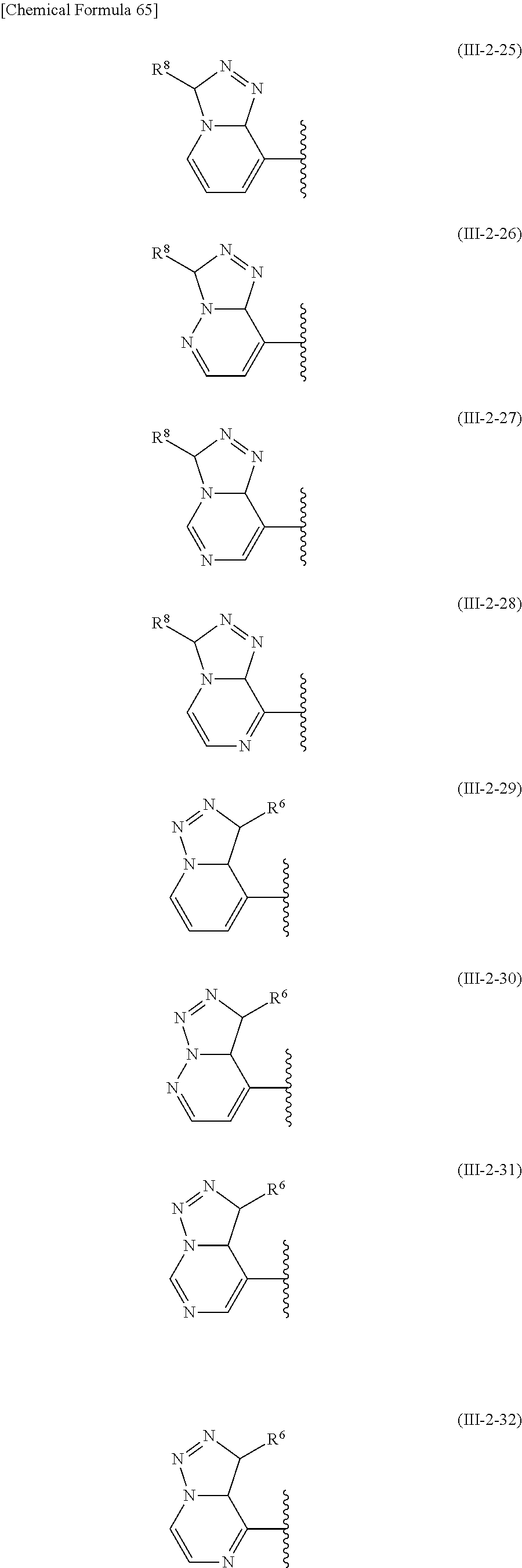


wherein each variable is as defined above.
Compound (III-3) is further described below.

Ring A, m, R, X1, X2, X3 and X4 are as defined above.
A3 is CR3, CR3R3′, N or NR3″;
A4 is CR4, CR4R4′, N or NR4″;
A5 is CR5, CR5R5′, N or NR5″.
Preferably, at least one of A3, A4 and A5 is N.
A6 is CR6, CR6R6′, N, NR6″, O or S;
A7 is CR7, CR7R7′, N, NR7″, O or S;
A8 is CR8, CR8R8′, N, NR8″, O or S.
R3, R3′, R4, R4′, R5, R5′, R6, R6′, R7, R7′, R8 and R8′ are independently selected from Substituent Group A.
R6 and R6′, R7 and R7′, and R8 and R8′ may be respectively taken together to form oxo.
R3″, R4″, R5″, R6″, R7″ and R8″ are independently selected from Substituent Group B.
dashed line represents presence or absence of a bond.
The following preferred embodiments are provided.
- (1) A3 is CR3; A4 is CR4; A5 is CR5, R3, R4 and R5 are preferably hydrogen or lower alkyl.
- (2) Any one of R6, R7 and R8 is N.
- (3) Ring C preferably contains three double bonds.
- (4) Ring D preferably contains two double bonds.
- (5) Any one of R3, R4 and R5 is N.
- (6) Any two of A6, A7 and A8 are nitrogen atom and oxygen atom or nitrogen atom and sulfur atom. Each nitrogen atom is optionally substituted.
- (7) Either dashed line between A6 and A7 or A7 and A8 represents presence of a bond.
Compound (III-3) is preferably represented by the formulae:

wherein each variable is as defined above.
In compound (III-3), preferred fused ring consisting of ring C and ring D is any one of:


wherein each variable is as defined above.
Particularly, the most distinctive feature of the compound of the formula (I) is the C-D ring moiety, which can contribute to improvement of antimicrobial activity, water solubility, in vivo pharmacokinetics and safety, etc.
Main features of the compound of the invention are as follows.
- (1) The C-D ring moiety is a 6-5 fused ring.
- (2) Ring C is heterocycle.
- (3) Ring C contains at least one nitrogen atom as a ring member.
- (4) The atom of ring C at the point of attachment to ring B is carbon atom.
More preferably,
- (5) When only A1 or A2 is nitrogen atom in ring C, ring C contains two double bonds in the ring.
- (6) The antimicrobial activity is improved by the presence of a hetero atom in the C-D ring moiety.
- (7) A substituent may be present on the C-D ring moiety.
- (8) The structure described above provides improvement of antimicrobial activity, and more preferably, as well as water solubility, oral absorbability, in vivo pharmacokinetics, safety, etc.
Typical procedures for the synthesis of the compound of the invention are described below.
(Method 1)
The compound of the invention can be prepared according to the procedures as described below. The reagents and conditions used in the reactions can be selected appropriately by a skilled person in the art, for example, as described in WO2007/114326.

wherein each variable is as defined above.
- (1) The nitro group of compound (a) is reduced to afford compound (b) according to any method for reduction, e.g., by hydrogenation with a catalyst such as platinum oxide, Raney nickel, palladium on carbon or the like, or by a reaction using iron powder and hydrochloric acid, acetic acid or the like. Compound (a) is commercially available or can be prepared easily from a reagent commercially available.
- (2) Compound (b) is urethanated using di-tert-butyl dicarbonate in an appropriate organic solvent, such as methanol, THF, etc., or urethanated using benzyloxycarbonyl chloride in water or an organic solvent, such as acetone, methanol, THF or a mixture thereof, in the presence of a base, such as triethylamine, potassium carbonate, sodium carbonate, sodium bicarbonate, etc. The resulting compound is then treated with a base, such as n-butyllithium, in an appropriate aprotic organic solvent, such as THF, N,N-dimethylformamide, etc., at a temperature from −78° C. to the reflux temperature of the solvent, and followed by reaction with glycidyl butyrate to afford compound (c).
- (3) Compound (c) may be further converted to compound (g) as shown in the following scheme:

wherein each variable is as defined above.
- (4) Compound (c) is reacted with methanesulfonyl chloride in the presence of a base, such as triethylamine, in an organic solvent, such as dichloromethane, THF, etc., at a temperature from ice-cooling to the reflux temperature of the solvent to afford compound (d).
- (5) Compound (d) is reacted with sodium azide in an organic solvent, such as THF, N,N-dimethylformamide, etc., at a temperature from ice-cooling to the reflux temperature of the solvent to afford compound (e).
- (6) The azide group of compound (e) is reduced to afford compound (f) by any appropriate method for reduction, e.g., by hydrogenation reduction with a catalyst, such as platinum oxide, palladium on carbon or the like, or by using triphenylphosphine and water.
- (7) Compound (f) is acylated with an appropriate acid anhydride, such as acetic anhydride, in a basic solvent, such as pyridine, to afford compound (g).
(Method 2)

wherein each variable is as defined above, with the proviso that compound (G1) contains a double bond between the carbon atom connected to Z1 and A4 or A5.
Compound (II) may be preferably obtained by reacting compound (G1) with compound (G2) in the presence of a palladium catalyst under basic condition.
In the above scheme, Z1 and Z2 may be suitable group to be removed during the palladium-catalyzed coupling reaction. For example, halo (Cl, Br, I), trifluoromethylsulfonyloxy, trimethylstannyl, triallkoxysilyl, boronic acid residue (e.g., alkylboronic acids, cyclic boronic acids).
The coupling reaction can be conducted according to the method, for example, as described in S. P. Stanforth, Catalytic Cross-Coupling Reactions in Biary Synthesis, Tetrahedron, 54, 1998, 263-303; J. K. Stille, Angew Chem, Int, Ed, Eng., 1986, 25, 509-524; N. Miyaura and A Suzuki, Chem. Rev., 1995, 95, 2457-2483; D. Baranano, G, Mann, and J. F. Hartwing, Current Org. Chem., 1997, 1, 287-305.
More preferably, Z1 is halogen and Z2 is boronic acid residue, but they are interchangeable.
Generally, the reaction may be conducted at a temperature from room temperature to 100° C., preferably 20° C. to 80° C.
In the reaction, solvents such as water, organic solvents (e.g., dioxane, dimethylformamide, 1,2-dimethoxyethane) or mixed solvent thereof may be used.
Bases such as Na2CO3, NaHCO3, Ba(OH)2, K3PO4, Cs2CO3, K2CO3, NaOH, etc., can be used. Silver oxide may be used in stead of such base.
For palladium catalyst, palladium[0]catalysts, such as for example, palladium acetate, Pd(PPh3)4, Pd(dba)2, PdCl2(PPh3)2, PdCl2(MeCN)2, PPdCl(Bn)(PPh3)2, etc., may be used (Ph: phenyl, Me: methyl, Bn: benzyl, dba: PhCH═CHC(O)CH═CHPh).
The reaction may be conducted for from several minutes to tens of hours, preferably about 1 hour to about 10 hours.
When Z1 or Z2 is a group such as trimethylstannyl, a metal catalyst, such as manganese, nickel, copper, stannum or the like, can be used in stead of Pd catalysts.
(Method 3)

wherein each variable is as defined above.
Compound (G5) can be prepared by metal-halogen exchange of compound (G3) using an alkyl metal, such as n-BuLi, in an aprotic solvent, such as THF, at low temperature (e.g., −30° C.) to form the lithium salt, and followed by addition of compound (G4) to react at this temperature.
Compound (G6) can be prepared by heating compound (G5) in a solvent (e.g., toluene) in the presence of an acid, such as p-toluene sulfonic acid, and followed by azeotropic dehydration.
Also, compound (G6) may be prepared by heating compound (G5) in alcohol (R—OH) in the presence of an acid, such as p-toluene sulfonic acid.

wherein each variable is as defined above.
Alternatively, compound (G6) may be prepared according to the following procedure. compound (G3) is subjected to metal-halogen exchange using an alkyl metal, such as n-BuLi, in an aprotic solvent, such as THF, at low temperature (e.g., −78° C.) to form the lithium salt, and followed by reaction with trialkoxy borane, such as tri(isopropoxy)borane, to afford boronic acid (G8). Separately, compound (G4) is treated with trifluoromethanesulfonic anhydride and diisopropylethyl amine in dichloromethane to afford triflate (G9). The boronic acid (G8) and the triflate (G9) are heated with stirring in an aprotic solvent, such as dimethoxyethane, in the presence of palladium catalyst, such as tetrakis(triphenylphosphine)palladium, and a base, such as sodium carbonate, to afford compound (G6).

wherein each variable is as defined above.
Compound (II-3-1) can be prepared by hydrogenation of compound (G6) at room temperature in the presence of palladium on carbon under hydrogen atmosphere.
(Method 4)

wherein each variable is as defined above.
Compound (G10) may be treated with trifluoromethanesulfonic anhydride in a solvent (e.g., pyridine) in the presence of a base (e.g., dimethylaminopyridine) to afford iminotriflate (G11). Then, a mixture of boronic acid (G8) and the iminotriflate (G11) in an aprotic solvent, such as dimethoxyethane, may be stirred under heating in the presence of a palladium catalyst, such as tetrakis(triphenylphosphine)palladium, and a base, such as sodium carbonate, to afford compound (II-3-2).
Compound (II-3-3) can be prepared by hydrogenation of compound (II-3-2) at room temperature in the presence of palladium on carbon under hydrogen atmosphere or by reduction with a reductant such as sodium borohydride.
Compound (II-3-4) can be prepared by the reaction of compound (II-3-3) with an aldehyde (e.g., formaldehyde when R is methyl) to form an imine and followed by reduction in the presence of a palladium on carbon under hydrogen atmosphere or by reduction with a reductant such as sodium cyanoborohydride or sodium triacetoxyborohydride. Alternatively, when R is methyl, compound (II-3-4) may be prepared by heating compound (II-3-3) with stirring in the presence of formic acid and formaldehyde.
(Method 5)

wherein each variable is as defined above.
Alternatively, compound (II-3-2) can be prepared by metal-halogen exchange of compound (G3) using an alkyl metal, such as n-BuLi, in an aprotic solvent, such as THF, at low temperature (e.g., −78° C.) to form salt, such as lithium salt, and followed by the reaction with cyclic imidate (G12) at room temperature.
The cyclic imidate (G12) can be prepared by the reaction under heating of compound (G10) with dimethyl sulfate in a solvent (e.g., toluene).
The 5-position of the oxazolidinone ring of the compounds as obtained above can be modified further with a substituent to afford various oxazolidinone derivatives. Also, ring B, ring C and ring D may be further modified. Such modification is within level of ordinary skill in the art and can be readily practiced by a skilled person in the art.
Any functional group (e.g., —OH, —NH2, —COON) in an intermediate may be preliminarily protected during the synthesis. For example, it may be protected with an appropriate protecting group, such as t-butoxycarbonyl group, benzyloxycarbonyl group, etc., and readily removed at an appropriate time during the synthesis, as described in Greene, T. W.; Wuts, P. G. M., “Protective Groups in Organic Synthesis”, 2nd ed; John Wiley & Sons: New York (1991).
Typically, the starting compound (G4) includes the following compounds.

wherein each variable is as defined above.
Typically, the starting compound (G10) includes the following compounds.

wherein each variable is as defined above.
The preparation procedures of these starting compounds are described below.
(Method 6)

wherein each variable is as defined above.
- (1) Compound (i) is dissolved in DMF, triethylamine and then trityl chloride are added. After stirring at room temperature to confirm disappearance of compound (i), the reaction mixture is poured into ice water and filtered to afford a solid precipitated, which is then washed with water and dissolved in ethyl acetate. The solution is washed with brine, dried over anhydrous sodium sulfate, filtered and concentrated. The solid residue is slurried in an organic solvent (e.g., mixture of n-hexanes/ethyl acetate) and filtered, and dried under reduced pressure to afford compound (ii).
- (2) To a mixture of compound (iii), oxalyl chloride and toluene, catalytic amount of DMF is added, and the reaction is stirred at room temperature. The reaction mixture is then concentrated to dryness, and the residue is dissolved in THF. Sodium borohydride is added under ice-cooling, and the solution is stirred at room temperature. The reaction is quenched with diluted hydrochloric acid, and it is diluted with ethyl acetate. The solution is washed with minimum quantity of brine, dried over anhydrous sodium sulfate, filtered and concentrated to afford compound (iv).
- (3) A mixture of compound (ii), compound (iv), ammonium acetate and toluene is heated with stirring under azeotropic dehydration condition. The reaction mixture is then cooled to room temperature, diluted with ethyl acetate, and washed with brine. After dryness over anhydrous sodium sulfate, filtration and concentration, the residue is purified by column chromatography to afford compound (v).
- (4) Compound (v) is dissolved in dichloromethane, and triethylamine and methanesulfonyl chloride are added under ice-cooling and the solution is stirred. The reaction mixture is then diluted with ethyl acetate and washed sequentially with diluted hydrochloric acid, aqueous 5% sodium bicarbonate and brine, and dried over anhydrous sodium sulfate, filtered and concentrated. The residue is purified by column chromatography to afford compound (vi).
- (5) To a mixture of compound (vi) and palladium on carbon in THF, aqueous sodium phosphinate is added dropwise under nitrogen stream. Then, palladium on carbon is filtered off, and the solution is diluted with ethyl acetate. The organic layer is separated and washed sequentially with saturated aqueous potassium carbonate and brine, and dried over anhydrous sodium sulfate, filtered and concentrated. The residue is purified by column chromatography to afford compound (vii).
- (6) Compound (vii) is dissolved in 20% sulfuric acid, and sodium nitrite is added under ice-cooling and the solution is stirred. Aqueous 20% potassium carbonate is added to adjust to basic pH, and the solution is stirred at room temperature. The solution is extracted with ethyl acetate, dried over anhydrous sodium sulfate, filtered, and concentrated. The residue is purified by column chromatography to afford compound (G4-a).
(Method 7)

wherein each variable is as defined above.
- (1) To a suspension of sodium hydride in THF, methyl (dimethoxyphosphoryl)acetate is added under ice-cooling, and the suspension is stirred. To the resulting slurry, compound (ii) is added and stirred at room temperature. Acetic acid is then added to neutralize, and the reaction mixture is diluted with ethyl acetate. The organic layer is washed sequentially with saturated aqueous sodium bicarbonate and brine, dried over anhydrous sodium sulfate, filtered, and concentrated. The solid residue is slurried in an organic solvent (e.g., n-hexanes/ethyl acetate (9:1)), and the slurry is filtered and dried under reduced pressure to afford compound (viii).
- (2) Compound (viii) is dissolved in methanol, palladium on carbon is added and the solution is stirred under hydrogen atmosphere at room temperature. Then, palladium on carbon is filtered off, and the solution is concentrated to dryness. The residue is purified by column chromatography to afford compound (ix).
- (3) Compound (ix) and chloroiodomethane are dissolved in THF and cooled to −78° C., and Lithium bis(trimethylsilyl)amide in THF is added and the solution is stirred at this temperature. After 30 minutes to 1 hour, acetic acid in THF is added, and stirring is continued. After 15 to 30 minutes, brine is added and the mixture is extracted with ethyl acetate. The organic layer is washed sequentially with saturated aqueous sodium bicarbonate, aqueous 5% sodium hydrogen sulfite and brine, dried over anhydrous sodium sulfate, filtered and concentrated. The residue is purified by column chromatography to afford compound (x).
- (4) Compound (x) is dissolved in dichloromethane, and trifluoroacetic acid is added and the solution is stirred at room temperature. The reaction mixture is then concentrated to dryness, and the residue is dissolved in DMF. Potassium carbonate is added, and the solution is stirred at room temperature. Then, the reaction mixture is diluted with ethyl acetate, and washed several times with brine. The resulting aqueous layers are re-extracted with ethyl acetate, and respective organic layers are combined and dried over anhydrous sodium sulfate, filtered and concentrated. The residue is purified by column chromatography to afford compound (G4-b).
(Method 8)

wherein each variable is as defined above.
- (1) Compound (xi) is dissolved in DMF, and triethylamine and then trityl chloride are added. After stirring at room temperature to confirm disappearance of compound (xi), the reaction mixture is poured into ice water, and stirring is continued. The resulting solid precipitate is filtered and washed with ice water. The filtered solid is stirred in cold dioxane, stirred, filtered and dried under reduced pressure to afford compound (xii).
- (2) To a mixture of compound (xii), phthalimido and triphenylphosphine in THF, DEAD in toluene is added under ice-cooling. After stirring overnight at room temperature, the reaction mixture is concentrated. The residue is purified by column chromatography to afford compound (xiii).
- (3) Compound (xiii) is suspended in ethanol, and hydrazine hydrate is added and the suspension is heated at reflux for 3 hours. After cooling to 40° C., hydrochloric acid is added, and stirring is continued for additional 1 hour. The reaction mixture is concentrated to dryness, and the residue is added with water and filtered. The filtrate is added with aqueous 10% sodium hydroxide to become alkaline, and extracted with diethyl ether. The extract is dried over anhydrous sodium sulfate, filtered, and concentrated to afford compound (xiv).
- (4) Compound (xiv) is dissolved in dichloromethane, and triethylamine is added. Under ice-cooling, chloroacetyl chloride is added and the solution is stirred at room temperature. The reaction mixture is then diluted with ethyl acetate, and washed sequentially with diluted hydrochloric acid, aqueous 5% sodium bicarbonate and brine. After dryness over anhydrous sodium sulfate, filtration, and concentration, the residue is purified by column chromatography to afford compound (xv).
- (5) Compound (xv) is dissolved in dichloromethane, and trifluoroacetic acid is added and the solution is stirred at room temperature. Then, the reaction mixture is concentrated to dryness, and the residue is dissolved in DMF. Potassium carbonate is added, and the solution is stirred at room temperature. The reaction mixture is then diluted with ethyl acetate and washed several times with brine. The resulting aqueous layers are re-extracted with ethyl acetate, and respective organic layers are combined and dried over anhydrous sodium sulfate, filtered and concentrated. The residue is purified by column chromatography to afford compound (G10-b).
According to the synthesis of compound (G10-b), compound (G10-a) can be synthesized using a compound of the formula Xi':

(Method 9)
Formation of triazolopyridine ring

- (1) Compound (xvi) is dissolved in chloroform, and compound (xvii) is added and the solution is stirred at room temperature. The resulting precipitate is filtered to afford N-amino compound (xviii).
- (2) The resulting compound (xviii) is dissolved in acetic anhydride, and concentrated hydrochloric acid is added, and the solution is heated at reflux. Then the reaction mixture is neutralized and extracted with methanol-chloroform. After washing with water and drying, the solvent is evaporated to afford compound (G13).
(Method 10)
Formation of boronic acid ester

wherein each variable is as defined above.
Compound (G2) is reacted with bis(pinacolato)diborane in a solvent such as DMSO in the presence of palladium catalyst to afford boronic acid ester compound (G14).
(Method 11)
Formation of triazole side chain

wherein each variable is as defined above.
Azido compound (G2′) is dissolved in dioxane, bicyclo[2,2,1]hepta-2,5-diene is added to react to afford a triazole side chain derivative (G15).
The present invention also provides a pharmaceutical composition comprising the compound of the invention, a pharmaceutically acceptable salt or hydrate thereof as an active ingredient. Based on the antimicrobial activity of the compound, one example of such pharmaceutical composition is an antimicrobial drug. When the compound of the invention is used in a treatment, a therapeutically effective amount of the compound, a salt or solvate thereof is administered to an animal, including human, which is affected with infection. The route of administration may be oral or parenteral. For this purpose, the compound of the invention or a salt thereof is combined with a pharmaceutically acceptable carrier, diluent or excipient, and it is incorporated into a capsule or compressed into a tablet. Alternatively, the composition may be in a dosage form such as powder or granule. For parenteral administration, it is formulated into an aqueous solution or suspension suitable for subcutaneous injection, intravenous injection, intraperitoneal injection, intramuscular injection, etc. Also, the composition can be provided as suppositories, topical formulations, eye-drops and the like.
The pharmaceutically acceptable salt of the compound of the invention include salts with an inorganic base, ammonia, organic base, inorganic acid, organic acid, basic amino acid, halogen ion, etc., or intramolecular salts. Examples of the inorganic base include alkali metals (Na, K, etc.), alkaline earth metals (Ca, Mg, etc.). Examples of the organic base include trimethylamine, triethylamine, choline, procaine, ethanolamine, etc. Examples of the inorganic acid include hydrochloric acid, hydrobromic acid, sulphuric acid, nitric acid, phosphoric acid and the like. Examples of organic acid include p-toluenesulphonic acid, methanesulphonic acid, formic acid, trifluoro acetate, maleic acid and the like. Examples of basic amino acid include lysine, arginine, ornithine, histidine and the like. Also, such salt may be a solvate.
Oral administration can be practiced in a solid or liquid dosage form prepared according to a conventional method, such as tablet, powder, capsule, granule, suspension, liquid, syrup, lozenge, sublingual tablet and other dosage forms. If necessary, unit dosage form for oral administration can be microcapsulated. Also, such formulation may be coated or embedded into polymer or wax, in order to prolong the duration of activity or provide sustained release.
Parenteral administration can be practiced in a liquid dosage form prepared according to a conventional method, such as injectable formulation in the form of solution or suspension.
Among the above routes of administration, oral administration and intravenous administration by injection are preferred. Of course, administration should be practiced in a dosage form suitable for the route of administration.
For oral administration, in general, the daily dose may be about 10 mg to 4000 mg, preferably 100 mg to 2000 mg per day. For parenteral administration, the daily dose may be about 10 mg to 4000 mg, preferably 50 mg to 2000 mg per day.
The present invention is described further by way of the following Examples and Test Examples.
(Abbreviation)
- AC=Acetyl
- dppf=1,1′-bis(diphenylphosphino)ferrocene

Compound 1 (96 mg) was suspended in 1 mL of sulfuric acid (40 wt %) and heated at reflux. Then, to this was added 2N sodium hydroxide to become basic and extracted with dichloromethane. The organic layer is washed with purified water and brine and dried over magnesium sulfate. After filtration, the solution is concentrated to afford 85 mg of compound 2 as brown oil.

2.00 g of 2-amino-5-bromopyridine (3) is dissolved in ethanol (35 mL), and chloroacetaldehyde in water (2.52 mL, 6.1 mol/L) was added and the reaction mixture was heated at reflux for 3 hours. The reaction mixture was concentrated, and saturated aqueous NaHCO3 was added to the residue, and it is extracted with ethyl acetate. After conventional workup afford 2.30 g of the titled compound as a brown powder (yield: 100%).
LCMS (ESI) m/z (M+H)+: 368.93

172 mg of 6-bromoimidazo[1,2-a]pyridine (4), 300 mg of (S)-n-((3-(3-fluoro-4-(4,4,5,5-tetramethyl-1,3,2-dioxaborane-2-yl)phenyl)-2-oxooxazolidine-5-yl)methyl)acetamide, 92 mg of tetrakis (triphenylphosphine)palladium (0) and 420 mg of sodium carbonate were suspended in 1,4-dioxane (3 mL) and water (0.3 mL), and the suspension was heated at reflux for 6 hours. The reaction mixture was poured into saturated aqueous NaHCO3, and extracted with ethyl acetate. After conventional workup, the resulting residue was washed with ethyl acetate to afford 85 mg of the titled compound as a brown powder (yield: 29%).
LCMS (ESI) m/z (M+H)+: 368.93
1H-NMR (DMSO-d6) δ: 1.83 (3H, s), 3.41 (2H, t, J=5.7 Hz), 3.78 (1H, dd, J=8.7, 6.3 Hz), 4.17 (1H, t, J=8.7 Hz), 4.73-4.78 (1H, m), 7.39-7.45 (2H, m), 7.60-7.68 (3H, m), 7.99 (1H, s), 8.26 (1H, t, J=5.4 Hz), 8.79 (1H, s).

15.00 g of 2-amino-5-bromopyridine (3), 16.99 g of ethyl 3-bromo-2-oxopropanoate were dissolved in ethanol (100 mL), and the solution is heated at reflux for 8 hours. The reaction mixture was concentrated, and saturated aqueous NaHCO3 was added to the residue. The resulting precipitate was isolated by filtration, and washed with water to afford 17.01 g of the titled compound as colorless powder (yield: 73%).

4.00 g of ethyl 6-bromoimidazo[1,2-a]pyridine-2-carboxylate (5), 2.85 g of (S)-n-((3-(3-fluoro-4-(4,4,5,5-tetramethyl-1,3,2-dioxaborane-2-yl)phenyl)-2-oxooxazolidine-5-yl)methyl)acetamide, 0.542 g of PdCl2 (dppf) and 4.39 g of potassium carbonate were suspended in toluene (15 mL)-ethanol (15 mL)-water (5 mL), and the suspension was heated at reflux for 4 hours. The resulting precipitate was isolated and washed with water and ethyl acetate to afford 3.46 g of the titled compound as colorless powder (yield: 74%).
LCMS (ESI) m/z (M+H)+: 441.10

Compound 6 (158 mg) was dissolved in 1,4-dioxane (2 mL), and compound 2 (85 mg) as obtained in Reference Example 1, potassium carbonate (1443 mg), and tetrakis(triphenylphosphine)palladium (20 mg) were added, and the solution was heated at reflux to complete the reaction. After cooling, purified water was added and filtered, and the resulting residue was washed with ethyl acetate and purified water to afford the desired compound (11 mg).
LCMS (ESI) m/z (M+H)+: 368.93
1H-NMR (DMSO-d6) δ: 1.84 (3H, s), 3.44 (2H, t, J=5.5 Hz), 3.80 (1H, dd, J=9.1, 6.5 Hz), 4.18 (1H, t, J=9.1 Hz), 4.72-4.82 (1H, m), 6.67 (1H, d, J=2.1 Hz), 7.38-7.47 (2H, m), 7.82-7.60 (3H, m), 8.05 (1H, d, J=2.1 Hz), 8.26 (1H, t, J=5.7 Hz), 8.87 (1H, s).

Compound 13
To 2-amino-5-bromopyridine (11, 3.05 g) in chloroform (100 mL), O-mesitylenesulfonylhydroxylamine (12, 12.91 g) was added, and the solution is heated at room temperature for 3 hours. The resulting precipitate was then filtered to afford 6.21 g of N-amino compound (13) as powder (87%). Compound 13: as colorless powder; 1H-NMR (300 MHz, CDCl3-CD3OD (5:1)) δ 2.23 (s, 3H), 2.61 (s, 6H), 6.83 (s, 2H), 7.05 (d, 9.5), 7.61 (dd, 9.5, 2, 1H), 8.13 (d, 2, 1H); IR (KBr) νmax 1666 cm−1;
LRMS m/z 200 (45), 187, 189 (38, 37), 134 (29), 118 (100), 103 (43), 91 (56), 81 (34), 64 (50), 51 (70).
Compound 14
To compound 13 (7.01 g) in acetic anhydride (9 mL), concentrated hydrochloric acid (1 mL) was added and heated at reflux for 14 hours. The reaction mixture was neutralized with aqueous NaHCO3, and extracted with methanol-chloroform (1:9). After washing with water and dryness, solvent was removed. The residue was recrystallized from ethanol to afford 2.985 g of compound 14 as colorless needle-like crystal. The mother liquid from the recrystallization was purified by column chromatography (hexane-ethyl acetate (1:1)) to afford 401 mg of compound 14. Total: 3.385 g (92%).
Compound 14: as colorless needle-like crystal mp: 154.5-155° C. (Hexane-CHCl3);
1H-NMR (300 MHz, CDCl3) 2.60 (s, 3H), 7.54 (d, 1, 2H), 8.64 (dd, 1, 1, 1H);
LRMS m/z 211, 213 (M+, 96, 100), 170, 172 (13, 12), 156, 158 (10, 7), 143, 145 (10, 6), 64 (58), 42 (18).

To boronic acid ester compound having acetamide side chain (15, 1.902 g), and 6-bromo-2-methyltriazolopyridine compound (14, 1.162 g) in dioxane (40 mL) and water (10 mL), Na2CO3 (1.85 g) and Pd(Ph3P)4 (588 mg) were added and the solution was stirred at 90 to 100° C. for 1 hour. Then, the solvent was removed under reduced pressure. The residue was dissolved in ethanol, and 1.246 g of colorless compound 16 precipitated. The mother liquid was purified by column chromatography (chloroform-methanol (9:1)). 223 mg of colorless compound 16 was precipitated from ethanol. Total: 1.469 g (76%).
Compound 16: 1H-NMR (300 MHz, CDCl3-CD3OD (9:1)) 2.04 (s, 3H), 2.62 (s, 3H), 3.60-3.72 (m, 2H), 3.87 (dd, 9, 7, 1H), 4.14 (dd, 9, 9, 1H), 4.81-4.90 (m, 1H), 7.34 (dd, 8.5, 2, 1H), 7.49 (dd, 8.5, 8.5, 1H), 7.62 (dd, 13, 2, 1H), 7.66-7.75 (m, 2H), 8.69 (d, 1, 1H);
LRMS m/z 383 (M+, 44), 339 (18), 311 (7), 280 (19), 255 (56), 242 (27), 158 (26), 85 (26), 73 (20), 56 (52), 43 (100).

Compound 18
To 2-amino-4-bromopyridine (17, 5.00 g) in chloroform (150 mL), O-mesitylenesulfonyl hydroxylamine (12, 28.0 g) was added and the solution was stirred at room temperature for 2 hours. The resulting precipitate was then filtered to afford 9.80 g of compound 18 as powder (87%).
Compound 18: as colorless powder; 1H-NMR (300 MHz, CD3OD) δ 2.24 (s, 3H), 2.63 (s, 6H), 6.85 (s, 2H), 6.91 (dd, 7, 2, 1H), 7.28 (d, 2), 7.85 (d, 7, 1H);
LRMS m/z 200(45), 187, 189 (29, 28), 134(27), 118(100), 103(43), 91(57), 81(62), 65(34), 51 (49).
Compound 19
To compound 18 in 98% formic acid (12 mL) and water (3 mL), concentrated hydrochloric acid (3 mL) was added and the solution was heated at reflux for 15 hours. Then, the reaction mixture was concentrated under reduced pressure to reduce the volume by half, neutralized with aqueous NaHCO3 and extracted with methanol-chloroform (1:9). After washing with water and drying, the solvent was evaporated. The residue was recrystallized from hexane-chloroform to afford 3.313 g of compound 19 as colorless needle-like crystal. The recrystallization mother liquid was purified by column chromatography (methanol-chloroform (1:19)). Recrystallization from hexane-chloroform afforded 977 mg of compound 19 as colorless needle-like crystal. Total: 4.290 g (84%).
Compound 19: as colorless needle-like crystal mp: 108-108.5° C. (Hexane-CHCl3);
1H-NMR (300 MHz, CDCl3) 7.15 (dd, 7, 2, 1H), 7.97 (d, 2, 1H), 8.34 (s, 1H), 8.48 (d, 7, 1H);
LRMS m/z 197, 199 (M+, 100, 97), 156, 158 (10, 11), 91(42), 64 (74).

To boronic acid ester compound having acetamide side chain (15, 1.91 g) and 7-bromotriazolopyridine compound (19, 1.08 g) in dioxane (40 mL) and water (10 mL), Na2CO3 (1.89 g) and Pd(Ph3P)4 (591 mg) were added and the solution was heated at 90° C. to 100° C. for 1 hour. The solvent was then removed under reduced pressure. The residue was dissolved in ethanol-chloroform, and 1.250 g of colorless compound 20 was precipitated. The mother liquid was purified by column chromatography (chloroform-methanol (9:1)). 134 mg of colorless compound 20 was precipitated from ethanol. Total: 1.384 g (74%).
Compound 20: 1H-NMR (300 MHz, DMSO-d6) 1.83 (s, 3H), 3.80 (dd, 9, 6.5, 1H), 4.18 (dd, 9, 9, 1H), 4.72-4.82 (m, 1H), 7.40 (br d, 7.5, 1H), 7.47 (dd, 9, 2, 1H), 7.65 (dd, 14, 2, 1H), 7.78 (dd, 9, 9, 1H), 8.01 (br s, 1H), 8.26 (br t, 6, NH), 8.54 (s, 1H), 9.01 (d, 7.5, 1H);
LRMS m/z 369 (M+, 18), 325(39), 282(9), 265(13), 241(100), 228(18), 158(24), 85(45), 73(18), 56(92), 44(36), 43 (99).

To azido compound (21, 2.11 g) in dioxane (10 mL), bicyclo[2,2,1]hepta-2,5-diene (2.0 mL) was added and the solution was heated at reflux for 15 hours. The solvent was then removed under reduced pressure, and the residue was washed with chloroform to afford 1.852 g of compound 22 as colorless powder (88%).
Compound 22: as colorless powder; 1H-NMR (300 MHz, CDCl3-CD3OD (4:1)) 3.95 (dd, 9, 6, 1H), 4.21 (dd, 9, 9, 1H), 4.80 (dd, 14.5, 4.5, 1H), 4.86 (dd, 14.5, 4, 1H), 5.12 (dddd, 9, 6, 4.5, 4, 1H), 6.95 (dd, 8.5, 3, 1H), 7.38 (dd, 7, 3, 1H), 7.70 (dd, 8.5, 7, 1H), 7.74 (br s, 1H), 7.89 (d, 0.5, 1H);
LRMS m/z 388 (M+, 48), 275 (24), 263 (19), 248 (22), 221 (22), 148 (41), 135 (27), 108 (39), 96 (33), 94 (56), 83 (39), 80 (60), 55 (87), 54 (100), 41 (52).

To triazole derivative (22, 6.91 g) in DMSO (160 mL), bis(pinacolato)diborane (10.34 g) and potassium acetate (5.81 g) were added and degassed with argon. Then, PdCl2 (pddf).CH2Cl2 (1.53 g) was added and the reaction mixture was heated at 90° C. to 100° C. for 2 hours. To this was then added ice water, extracted with ethyl acetate, washed with water and dried under reduced pressure. The solvent was removed under reduced pressure, and the residue was purified by column chromatography (ethyl acetate) to afford 4.295 g of compound 23 as pale yellow powder (63%).
Compound 23: pale yellow powder; 1H-NMR (300 MHz, CDCl3) 1.34 (s, 12H), 3.92 (dd, 9, 6, 1H), 4.19 (dd, 9, 9, 1H), 4.76 (dd, 14.5, 5, 1H), 4.82 (dd, 14.5, 4, 1H), 5.08 (dddd, 9, 6, 5, 4, 1H), 7.11 (dd, 8, 2, 1H), 7.29 (dd, 11.5, 2, 1H), 7.69 (dd, 11.5, 8, 1H), 7.71 (d, 1, 1H), 7.81 (d, 1, 1H);
LRMS m/z 388 (M+, 41), 373(7), 318(5), 289(13), 274(23), 263(19), 175(15), 148(22), 97(35), 83(71), 80(100), 69(31), 55(88), 54(74), 41 (96).

To boronic acid ester compound having triazole side chain (23, 2.63 g) and 7-bromotriazolopyridine derivative (24, 2.15 g, prepared as described in Example 4 using compound 18 of Example 5) in dioxane (50 mL) and water (12 mL), Na2CO3 (2.47 g) and Pd(Ph3P)4 (821 mg) were added and the reaction mixture was heated at 90° C. to 100° C. for 1.5 hours. The solvent was then removed under reduced pressure to reduce the volume by half, and water was added. After the resulting precipitate was filtered and dissolved in ethanol, 1.95 g of colorless compound 25 was precipitated (73%).
Compound 25: 1H-NMR (300 MHz, DMSO-d6) 2.48 (br s, 3H), 3.96 (dd, 9.5, 6, 1H), 4.30 (dd, 9.5, 9.5, 1H), 4.86 (d, 5, 2H), 5.19 (ddt, 9.5, 6, 5, 1H), 7.30 (ddd, 7, 1.5, 1.5, 1H), 7.42 (dd, 8.5, 2, 1H), 7.58 (dd, 14, 2, 1H), 7.74 (dd, 8.5, 8.5, 1H), 7.77 (d, 1, 1H), 7.86 (br s, 1H), 8.18 (d, 1, 1H), 8.88 (d, 7, 1H);
LRMS m/z 393 (M+, 7), 349 (14), 320 (6), 279 (8), 242 (10), 158 (11), 108 (21), 80 (29), 53 (100).

To boronic acid ester compound having triazole side chain (23, 3.82 g) and 7-bromotriazolopyridine compound (19, 2.32 g) in dioxane (80 mL) and water (20 mL), Na2CO3 (3.59 g) and Pd(Ph3P)4 (1.19 g) were added and heated at 90° C. to 100° C. for 1.5 hours. The solvent was removed under reduced pressure to reduce the volume by half, and water was added. After the resulting precipitation was filtered, 2.51 g of colorless compound 26 was precipitated from ethanol-chloroform (67%).
Compound 26: 1H-NMR (300 MHz, DMSO-d6) 3.97 (dd, 9.5, 5.5, 1H), 4.30 (dd, 9.5, 9.5, 1H), 4.86 (d, 5, 2H), 4.86 (ddt, 9.5, 5.5, 5, 1H), 7.37-7.46 (m, 2H), 7.60 (dd, 14, 2, 1H), 7.77 (dd, 9, 9, 1H), 7.77 (d, 1, 1H), 8.01 (br d, 1, 1H), 8.18 (d, 1, 1H), 8.54 (s, 1H), 9.02 (d, 7, 1H);
LRMS m/z 379 (M+, 11), 335 (15), 306 (7), 266 (13), 228 (13), 158 (12), 108 (30), 53 (100).
The following compounds were prepared according to the procedure as described in the above Examples.
| TABLE 1 | ||
| LCMS (ESI) | ||
| Example | Structure | m/z (M + H)+ |
| 8 |
 |
369.98 |
| 9 |
 |
369.98 |
| 10 |
 |
370.1 |
| 11 |
 |
371 |
| 12 |
 |
369.91 |
| 13 |
 |
398.93 |
| TABLE 2 | ||
| 14 |
 |
396.9 |
| 15 |
 |
437.55 |
| 16 |
 |
424.98 |
| 17 |
 |
393.9 |
| 18 |
 |
368.93 |
| 19 |
 |
411.9 |
| TABLE 3 | ||
| 20 |
 |
412.91 |
| 21 |
 |
467.99 |
| 22 |
 |
398.99 |
| 23 |
 |
368.93 |
| 24 |
 |
370.96 |
| 25 |
 |
382.99 |
| TABLE 4 | ||
| 26 |
 |
382.96 |
| 27 |
 |
328.05 |
| 28 |
 |
428.99 |
| 29 |
 |
393.96 |
| 30 |
 |
396.98 |
| 31 |
 |
383.03 |
| TABLE 5 | ||
| 32 |
 |
351.00 |
| 33 |
 |
411.97 |
| 34 |
 |
369.01 |
| 35 |
 |
498.10 |
| 36 |
 |
530.10 |
| 37 |
 |
425.99 |
| TABLE 6 | ||
| 38 |
 |
458.20 |
| 39 |
 |
514.05 |
| 40 |
 |
369.08 |
| 41 |
 |
413.45 |
| 42 |
 |
426.07 |
| 43 |
 |
440.09 |
| TABLE 7 | ||
| 44 |
 |
454.15 |
| 45 |
 |
412.10 |
| 46 |
 |
427.02 |
| 47 |
 |
450.97 |
| 48 |
 |
450.97 |
| 49 |
 |
411.97 |
| TABLE 8 | ||
| 50 |
 |
498.23 |
| 51 |
 |
398.24 |
| 52 |
 |
440.35 |
| 53 |
 |
476.10 |
| 54 |
 |
427.99 |
| 55 |
 |
413.05 |
| TABLE 9 | ||
| 56 |
 |
441.15 |
| 57 |
 |
399.00 |
| 58 |
 |
450.97 |
| 59 |
 |
393.98 |
| TABLE 10 | ||
| LCMS(ESI) | ||
| Example | Structure | m/z (M + H) + |
| 60 |
 |
397.34 |
| 61 |
 |
394.44 |
| 62 |
 |
399.41 |
| 63 |
 |
397.38 |
| 64 |
 |
394.39 |
| 65 |
 |
399.44 |
| 66 |
 |
413.47 |
| TABLE 11 | ||
| 67 |
 |
412.00 |
| 68 |
 |
378.98 |
| 69 |
 |
384.98 |
| 70 |
 |
455.06 |
| 71 |
 |
451.04 |
| 72 |
 |
451.10 |
| 73 |
 |
479.30 |
| TABLE 12 | ||
| 74 |
 |
427.30 |
| 75 |
 |
484.14 |
| 76 |
 |
489.05 |
| 77 |
 |
437.00 |
| 78 |
 |
459.22 |
| 79 |
 |
569.20 |
| 80 |
 |
445.30 |
| TABLE 13 | ||
| 81 |
 |
473.15 |
| 82 |
 |
456.19 |
| 83 |
 |
424.20 |
| 84 |
 |
410.18 |
| 85 |
 |
451.18 |
| 86 |
 |
518.15 |
| 87 |
 |
451.18 |
| 88 |
 |
451.19 |
| TABLE 14 | ||
| 89 |
 |
451.19 |
| 90 |
 |
384.16 |
| 91 |
 |
437.17 |
| 92 |
 |
395.11 |
| 93 |
 |
442.15 |
| 94 |
 |
426.22 |
| TABLE 15 | ||
| 95 |
 |
442.12 |
| 96 |
 |
519.15 |
| 97 |
 |
504.20 |
| 98 |
 |
445.05 |
| 99 |
 |
328.08 |
| 100 |
 |
459.10 |
| 101 |
 |
412.05 |
| 102 |
 |
513.05 |
| 103 |
 |
412.13 |
| TABLE 16 | ||
| 104 |
 |
456.14 |
| 105 |
 |
486.21 |
| 106 |
 |
486.21 |
| 107 |
 |
539.10 |
| 108 |
 |
483.10 |
| 109 |
 |
465.09 |
| 110 |
 |
459.05 |
| 111 |
 |
473.10 |
| 112 |
 |
456.05 |
| TABLE 17 | ||
| 113 |
 |
438.07 |
| 114 |
 |
433.12 |
| 115 |
 |
383.11 |
| 116 |
 |
383.11 |
| 117 |
 |
489.14 |
| 118 |
 |
503.16 |
| 119 |
 |
455.16 |
| TABLE 18 | ||
| 120 |
 |
483.16 |
| 121 |
 |
513.20 |
| 122 |
 |
401.10 |
| 123 |
 |
384.16 |
| TABLE 19 | ||
| LCMS (ESI) | ||
| Example | Structure | m/z (M + H) + |
| 124 |
 |
385.14 |
| 125 |
 |
370.14 |
| 126 |
 |
443. 21 |
| 127 |
 |
370.14 |
| 128 |
 |
398.10 |
| 129 |
 |
413.19 |
| 130 |
 |
384.14 |
| 131 |
 |
412.12 |
| TABLE 20 | ||
| 132 |
 |
394.13 |
| 133 |
 |
343.11 |
| 134 |
 |
399.10 |
| 135 |
 |
402.13 |
| 136 |
 |
400.13 |
| 137 |
 |
384.16 |
| 138 |
 |
371.11 |
| 139 |
 |
409.12 |
| 140 |
 |
352.14 |
| TABLE 21 | ||
| 141 |
 |
366.16 |
| 142 |
 |
384.16 |
| 143 |
 |
380.13 |
The present invention further provides the following compounds.


wherein R6, R7 and/or R8 are independently selected from the substituents as listed in Example C.
The following preferred embodiments of the compounds of Example A are provided.


wherein R6, R7 or R8 are independently selected from the substituents listed in Example C.
The following preferred embodiments of the compounds of Example A are provided.


wherein R6 or R7 is independently selected from the substituents listed in Example C.


wherein R6, R7 and/or R8 are independently selected from the substituents listed in Example C.
The following preferred embodiments of the compounds of Example B are provided.


wherein R7 or R8 is independently selected from the substituents listed in Example C.
The following preferred embodiments of the compounds of Example B are provided.


wherein R6 is independently selected from the substituents listed in Example C.
The following examples of the substituents R6, R7 and R8 on ring D of the compounds of the invention are provided.


wherein R6″, R7″ and/or R8″ are independently selected from the substituents listed in Example E.
The following examples of the substituents R6″, R7″ and R8″ on ring D of the compounds of the invention are provided.

The present invention further provides the compounds as described in the above Examples wherein the oxazolidinone moiety is as follows.

The compounds of the above Examples were tested for antimicrobial activity.
(Test Method)
Minimal inhibitory concentration (MIC: μg/ml) against different strains of bacteria was determined according to the standard method recommended by CLSI (clinical and laboratory standards institute). The samples used were prepared by dissolving the compound in DMSO at the concentration 1280 μg/mL, followed by a two fold serial dilution with DMSO. The sample was added to a bacteria suspension at the concentration of 5%, and MIC was determined. Cation-adjusted Mueller Hinton Broth was used as a culture media. The inoculation concentration was about 5×10⁵ CFU/mL.
(Result)
The compound of the invention showed a strong antimicrobial activity, which was equivalent or greater than that of conventional drugs, against various strains including methicillin-resistant Staphylococcus aureus (MRSA), linezolid-resistant strains (LZD-R) and vancomycin resistance enterococcus (VRE). For example, the compound of Example 18 showed a strong antimicrobial activity against these resistant strains as shown below.
| TABLE 22 | |||
| MIC (μg/mL) | |||
| Strain | Example 18 | Linezolid | ||
| S. aureus SR3637 (MRSA) | 0.25 | 2 | ||
| S. aureus NRS271 (LZD-R) | 2 | 32 | ||
| E. faecium SR7940 (VRE) | 0.25 | 2 | ||
[Industrial Applicability]
The compounds of the invention are useful as a drug or as a synthetic intermediate for such drug. Particularly, the compounds of the invention are useful as an antimicrobial drug.
Claims (23)
1. An antimicrobial composition comprising a compound of the formula (I):

or a pharmaceutically acceptable salt thereof, and a pharmaceutically acceptable carrier, diluent or excipient;
wherein:
ring A is any one of the groups:

in which the dashed line represents the presence or absence of a bond;
m is 0 or 1;
R is H, —NHC(═O)RA, —NHC(═S)RA, —NH-het1, —O-het1, —S-het1, —S(═O)-het1, —S(═O)2-het1, het2, —CONHRA, —OH, lower alkyl, lower alkoxy or lower alkenyl;
RA is hydrogen, lower alkyl, halogenated lower alkyl, amino, (lower alkyl)amino, lower alkenyl, heterocycle (lower)alkyl, (lower alkyl)carbonyl, (lower alkyl)carbonyl lower alkyl, lower alkoxy, cycloalkyl, cycloalkyl(lower)alkyl, arylcarbonyl, arylcarbonyl(lower)alkyl, heterocyclecarbonyl or heterocyclecarbonyl(lower)alkyl;
het1 and het2 are independently a heterocyclic group;
ring B is a benzene ring optionally substituted;
A1 and A2 are independently a nitrogen atom or a carbon atom;
the dashed line represents the presence or absence of a bond;
the fused ring C-D,

is a fused ring of the formula (II-1-14) or the formula (II-2-14),

R3 , R4 , R5 , and R7 are independently selected from Substituent Group A consisting of hydrogen, optionally substituted lower alkyl, optionally substituted lower alkenyl, optionally substituted lower alkoxy, carboxy, optionally substituted carbamoyl, cyano, formyl, optionally substituted (lower alkyl)carbonyl, optionally substituted (lower alkoxy)carbonyl, optionally substituted heterocyclic group, optionally substituted heterocyclecarbonyl, optionally substituted amino, optionally substituted aminocarbonyl, optionally substituted aryl, optionally substituted arylcarbonyl, (lower alkyl)sulfonyl, (lower alkyl)sulfinyl and halogen.
2. The antimicrobial composition according to claim 1 wherein ring A is the group of the formula (A-1).
3. The antimicrobial composition according to claim 1 wherein m is 1.
4. The antimicrobial composition according to claim 1 wherein R is —NHC(═O)RA in which RA is lower alkyl.
5. The antimicrobial composition according to claim 1 wherein R is —NH-het1 , —O-het1 , —S-het1, —S(═O)-het1 , —S(═O)2-het1 or het2 , wherein het1 and het2 are each independently a five- or six-membered heterocyclic group containing at least one nitrogen atom.
6. The antimicrobial composition according to claim 1 wherein ring B is a benzene ring optionally substituted with the same or different one to four substituent(s) selected from the group consisting of hydrogen, halogen, amino, hydroxy and lower alkyl.
7. The antimicrobial composition according to claim 1 wherein ring B is a benzene ring optionally substituted with one or two halogen(s).
8. The antimicrobial composition according to claim 1 wherein
ring A is the group of the formula (A-1);
m is 1;
R is —NHC(═O)RA , wherein RA is lower alkyl, or a five- or six-membered heterocyclic group containing at least one nitrogen atom; and
ring B is a benzene ring optionally substituted with one or two halogen(s).
9. A compound of the formula (II):

or a pharmaceutically acceptable salt thereof;
wherein:
ring A is any one of the groups:

in which the dashed line represents the presence or absence of a bond;
m is 0 or 1;
R is H, —NHC(═O)RA, —NHC(═S)RA, —NH-het1, —O-het1, —S-het1, —S(═O)-het1, —S(═O)2-het1, het2, —CONHRA, —OH, lower alkyl, lower alkoxy or lower alkenyl;
RA is hydrogen, lower alkyl, halogenated lower alkyl, amino, (lower alkyl)amino, lower alkenyl, heterocycle (lower)alkyl, (lower alkyl)carbonyl, (lower alkyl)carbonyl lower alkyl, lower alkoxy, cycloalkyl, cycloalkyl(lower)alkyl, arylcarbonyl, arylcarbonyl(lower)alkyl, heterocyclecarbonyl or heterocyclecarbonyl(lower)alkyl;
het1 and het2 are independently a heterocyclic group;
X1, X2, X3, and X4 are independently hydrogen, halogen, amino, hydroxy or lower alkyl;
A1 and A2 are independently a nitrogen atom or a carbon atom;
the dashed line represents the presence or absence of a bond;
the fused ring C-D,

is a fused ring of the formula (II-1-14) or the formula (II-2-14),

R3 , R4 , R5 , and R7 are independently selected from Substituent Group A consisting of hydrogen, optionally substituted lower alkyl, optionally substituted lower alkenyl, optionally substituted lower alkoxy, carboxy, optionally substituted carbamoyl, cyano, formyl, optionally substituted (lower alkyl)carbonyl, optionally substituted (lower alkoxy)carbonyl, optionally substituted heterocyclic group, optionally substituted heterocyclecarbonyl, optionally substituted amino, optionally substituted aminocarbonyl, optionally substituted aryl, optionally substituted arylcarbonyl, (lower alkyl)sulfonyl, (lower alkyl)sulfinyl and halogen.
10. The compound according to claim 9 wherein any one or two of R3 , R4 and R5 is selected from Substituent Group A, excluding hydrogen, or a pharmaceutically acceptable salt thereof.
11. The compound according to claim 9 wherein the fused ring C-D is

or a pharmaceutically acceptable salt thereof.
12. The compound according to claim 11 wherein R3, R4 and R5 are all hydrogen; and R7 is hydrogen, optionally substituted lower alkyl, optionally substituted amino, formyl, or optionally substituted (lower alkyl)carbonyl, or a pharmaceutically acceptable salt thereof.
13. The compound according to claim 9 wherein the fused ring C-D is

or a pharmaceutically acceptable salt thereof.
14. The compound according to claim 13 wherein R3 , R4 and R5 are all hydrogen; and R7 is hydrogen, optionally substituted lower alkyl, optionally substituted amino, formyl, or optionally substituted (lower alkyl)carbonyl, or a pharmaceutically acceptable salt thereof.
15. The compound according to claim 9 wherein ring A is the group of the formula (A-1), or a pharmaceutically acceptable salt thereof.
16. The compound according to claim 9 wherein m is 1, or a pharmaceutically acceptable salt thereof.
17. The compound according to claim 9 wherein R is —NHC(═O)RA in which RA is lower alkyl, or a pharmaceutically acceptable salt thereof.
18. The compound according to claim 9 wherein R is —NH-het1 , —O-het1 , —S-het1 , —S(═O)-het1 , —S(═O)2-het1 or het2 , wherein het1 and het2 are each independently a five- or six-membered heterocyclic group containing at least one nitrogen atom, or a pharmaceutically acceptable salt thereof.
19. The compound according to claim 9 wherein R is selected from the group consisting of:

or a pharmaceutically acceptable salt thereof.
20. The compound according to claim 19 wherein R is

or a pharmaceutically acceptable salt thereof.
21. The compound according to claim 19 wherein R is

or a pharmaceutically acceptable salt thereof.
22. A method of using the antimicrobial composition according to claim 1 against bacteria, comprising contacting the antimicrobial composition with the bacteria.
23. A method of using the compound of formula (II) according to claim 9 against bacteria, comprising contacting the compound with the bacteria.
Applications Claiming Priority (3)
| Application Number | Priority Date | Filing Date | Title |
|---|---|---|---|
| JP2008-164255 | 2008-06-24 | ||
| JP2008164255 | 2008-06-24 | ||
| PCT/JP2009/061360 WO2009157423A1 (en) | 2008-06-24 | 2009-06-23 | Oxazolidinone derivative having fused ring |
Publications (2)
| Publication Number | Publication Date |
|---|---|
| US20110098471A1 US20110098471A1 (en) | 2011-04-28 |
| US8575337B2 true US8575337B2 (en) | 2013-11-05 |
Family
ID=41444489
Family Applications (1)
| Application Number | Title | Priority Date | Filing Date |
|---|---|---|---|
| US13/000,411 Expired - Fee Related US8575337B2 (en) | 2008-06-24 | 2009-06-23 | Oxazolidinone derivative having fused ring |
Country Status (5)
| Country | Link |
|---|---|
| US (1) | US8575337B2 (en) |
| JP (1) | JPWO2009157423A1 (en) |
| CN (1) | CN102131811A (en) |
| TW (1) | TW201004958A (en) |
| WO (1) | WO2009157423A1 (en) |
Cited By (4)
| Publication number | Priority date | Publication date | Assignee | Title |
|---|---|---|---|---|
| US20190218214A1 (en) * | 2016-09-14 | 2019-07-18 | Vanderbilt University | Inhibition of BMP Signaling Compounds, Compositions and Uses Thereof |
| US10947205B2 (en) | 2015-10-22 | 2021-03-16 | Merck Sharp & Dohme Corp. | Oxazolidinone compounds and methods of use thereof as antibacterial agents |
| US12365656B2 (en) | 2019-01-18 | 2025-07-22 | Merck Sharp & Dohme Llc | Oxazolidinone compounds and methods of use thereof as antibacterial agents |
| US12435077B2 (en) | 2020-03-20 | 2025-10-07 | Merck Sharp & Dohme Llc | Oxazolidinone compound and methods of use thereof as an antibacterial agent |
Families Citing this family (36)
| Publication number | Priority date | Publication date | Assignee | Title |
|---|---|---|---|---|
| CN102153547A (en) * | 2010-02-11 | 2011-08-17 | 山东轩竹医药科技有限公司 | Oxazolidinone antibiotic containing parallel rings |
| WO2012088266A2 (en) | 2010-12-22 | 2012-06-28 | Incyte Corporation | Substituted imidazopyridazines and benzimidazoles as inhibitors of fgfr3 |
| WO2013044845A1 (en) * | 2011-09-29 | 2013-04-04 | 山东轩竹医药科技有限公司 | Biaryl heterocycle substituted oxazolidinon antibacterial drug |
| CN103030634B (en) * | 2011-09-30 | 2015-07-15 | 山东轩竹医药科技有限公司 | Bicyclo-containing oxazolidinone antibiotics |
| LT3495367T (en) | 2012-06-13 | 2021-02-25 | Incyte Holdings Corporation | MODIFIED TRICYCLIC COMPOUNDS AS FGFR INHIBITORS |
| WO2014026125A1 (en) | 2012-08-10 | 2014-02-13 | Incyte Corporation | Pyrazine derivatives as fgfr inhibitors |
| EP2900238B1 (en) | 2012-09-28 | 2017-12-06 | Vanderbilt University | Fused heterocyclic compounds as selective bmp inhibitors |
| US9266892B2 (en) | 2012-12-19 | 2016-02-23 | Incyte Holdings Corporation | Fused pyrazoles as FGFR inhibitors |
| LT2986610T (en) | 2013-04-19 | 2018-04-10 | Incyte Holdings Corporation | Bicyclic heterocycles as fgfr inhibitors |
| EP2818471A1 (en) * | 2013-06-27 | 2014-12-31 | Max-Planck-Gesellschaft zur Förderung der Wissenschaften e.V. | Nitrogen bicyclic compounds as inhibitors for Scyl1 and Grk5 |
| CN103483329B (en) * | 2013-09-07 | 2015-08-05 | 吉首大学 | Furanone-aryl-oxazolidone type compound and method for making thereof and purposes |
| CN103420995B (en) * | 2013-09-07 | 2015-07-01 | 吉首大学 | Oxazolidinone-alkyl amine group-furanone type compound and preparation method and application thereof |
| US10851105B2 (en) | 2014-10-22 | 2020-12-01 | Incyte Corporation | Bicyclic heterocycles as FGFR4 inhibitors |
| SG11201706287PA (en) | 2015-02-20 | 2017-09-28 | Incyte Corp | Bicyclic heterocycles as fgfr inhibitors |
| WO2016134294A1 (en) | 2015-02-20 | 2016-08-25 | Incyte Corporation | Bicyclic heterocycles as fgfr4 inhibitors |
| MA41551A (en) | 2015-02-20 | 2017-12-26 | Incyte Corp | BICYCLIC HETEROCYCLES USED AS FGFR4 INHIBITORS |
| AR111960A1 (en) | 2017-05-26 | 2019-09-04 | Incyte Corp | CRYSTALLINE FORMS OF A FGFR INHIBITOR AND PROCESSES FOR ITS PREPARATION |
| US10745400B2 (en) | 2018-03-14 | 2020-08-18 | Vanderbuilt University | Inhibition of BMP signaling, compounds, compositions and uses thereof |
| ES3061844T3 (en) | 2018-05-04 | 2026-04-07 | Incyte Corp | Salts of an fgfr inhibitor |
| MX2020011718A (en) | 2018-05-04 | 2021-02-15 | Incyte Corp | SOLID FORMS OF A FIBROBLAST GROWTH FACTOR RECEPTOR (FGFR) INHIBITOR AND PROCESSES FOR PREPARING THEM. |
| TW202028209A (en) * | 2018-09-27 | 2020-08-01 | 大陸商重慶複創醫藥研究有限公司 | Substituted imidazo[1,2-a]pyridine and [1,2,4]triazolo[1,5-a]pyridine compounds as ret kinase inhibitors |
| US11628162B2 (en) | 2019-03-08 | 2023-04-18 | Incyte Corporation | Methods of treating cancer with an FGFR inhibitor |
| US11591329B2 (en) | 2019-07-09 | 2023-02-28 | Incyte Corporation | Bicyclic heterocycles as FGFR inhibitors |
| US12122767B2 (en) | 2019-10-01 | 2024-10-22 | Incyte Corporation | Bicyclic heterocycles as FGFR inhibitors |
| TWI891666B (en) | 2019-10-14 | 2025-08-01 | 美商英塞特公司 | Bicyclic heterocycles as fgfr inhibitors |
| US11566028B2 (en) | 2019-10-16 | 2023-01-31 | Incyte Corporation | Bicyclic heterocycles as FGFR inhibitors |
| CA3163875A1 (en) | 2019-12-04 | 2021-06-10 | Incyte Corporation | Tricyclic heterocycles as fgfr inhibitors |
| WO2021113462A1 (en) | 2019-12-04 | 2021-06-10 | Incyte Corporation | Derivatives of an fgfr inhibitor |
| US12012409B2 (en) | 2020-01-15 | 2024-06-18 | Incyte Corporation | Bicyclic heterocycles as FGFR inhibitors |
| TW202304459A (en) | 2021-04-12 | 2023-02-01 | 美商英塞特公司 | Combination therapy comprising an fgfr inhibitor and a nectin-4 targeting agent |
| EP4352060A1 (en) | 2021-06-09 | 2024-04-17 | Incyte Corporation | Tricyclic heterocycles as fgfr inhibitors |
| JP2024522189A (en) | 2021-06-09 | 2024-06-11 | インサイト・コーポレイション | Tricyclic Heterocycles as FGFR Inhibitors |
| CN115677679A (en) * | 2021-07-26 | 2023-02-03 | 沈阳药科大学 | Oxazolidinone compound containing biarylhydrazone structure and its preparation method and application |
| WO2023118011A1 (en) | 2021-12-22 | 2023-06-29 | Syngenta Crop Protection Ag | Microbiocidal aza-heterobiaryl derivatives |
| WO2025222103A1 (en) * | 2024-04-19 | 2025-10-23 | Raythera, Inc. | Stat6 modulators and methods of uses thereof |
| WO2025264818A1 (en) * | 2024-06-20 | 2025-12-26 | Raythera, Inc. | Stat6 modulators and methods of uses thereof |
Citations (16)
| Publication number | Priority date | Publication date | Assignee | Title |
|---|---|---|---|---|
| EP0352781A2 (en) | 1988-07-29 | 1990-01-31 | The Du Pont Merck Pharmaceutical Company | Aminomethyloxooxazolidinyl arylbenzene derivatives useful as antibacterial agents |
| WO1993009103A1 (en) | 1991-11-01 | 1993-05-13 | The Upjohn Company | Substituted aryl- and heteroarylphenyloxazolidinones useful as antibacterial agents |
| WO1995007271A1 (en) | 1993-09-09 | 1995-03-16 | The Upjohn Company | Substituted oxazine and thiazine oxazolidinone antimicrobials |
| JPH08151578A (en) | 1994-11-30 | 1996-06-11 | Canon Inc | Optically active compound, liquid crystal composition containing the same, liquid crystal element having the same, display method using the same, and liquid crystal device |
| WO1999010342A1 (en) | 1997-08-22 | 1999-03-04 | Zeneca Limited | Antibiotic oxazolidinone derivatives |
| WO2001081350A1 (en) | 2000-04-25 | 2001-11-01 | Astrazeneca Ab | Oxazolidinone derivatives with antibiotic activity |
| WO2002064574A2 (en) | 2001-02-07 | 2002-08-22 | Ortho-Mcneil Pharmaceutical, Inc. | Pyridoarylphenyl oxazolidinone antibacterials, and related compositions and methods |
| WO2003053975A1 (en) | 2001-12-13 | 2003-07-03 | Daiichi Suntory Pharma Co., Ltd. | Pyrazolopyrimidinone derivatives having pde7-inhibitory activity |
| WO2005005399A1 (en) | 2003-07-02 | 2005-01-20 | Merck & Co., Inc. | Oxazolidinone antibiotics and derivatives thereof |
| WO2005019214A1 (en) | 2003-08-25 | 2005-03-03 | Warner-Lambert Company Llc | Novel antimicrobial aryloxazolidinone compounds |
| WO2005089763A1 (en) | 2004-03-19 | 2005-09-29 | Warner-Lambert Company Llc | Imidazopyridine and imidazopyrimidine derivatives as antibacterial agents |
| US20060035898A1 (en) | 2004-07-27 | 2006-02-16 | Structural Genomix, Inc. | Fused ring heterocycle kinase modulators |
| WO2006035283A1 (en) | 2004-09-27 | 2006-04-06 | Ranbaxy Laboratories Limited | Oxazolidinone derivatives as antimicrobials |
| WO2006038116A2 (en) | 2004-10-07 | 2006-04-13 | Warner-Lambert Company Llc | Triazolopyridine derivatives as antibacterial agents |
| WO2006109156A1 (en) | 2005-04-15 | 2006-10-19 | Ranbaxy Laboratories Limited | Oxazolidinone derivatives as antimicrobials |
| WO2008021781A1 (en) | 2006-08-07 | 2008-02-21 | Incyte Corporation | Triazolotriazines as kinase inhibitors |
Family Cites Families (1)
| Publication number | Priority date | Publication date | Assignee | Title |
|---|---|---|---|---|
| CN1816534A (en) * | 2003-07-02 | 2006-08-09 | 默克制药公司 | Oxazolidinone antibiotics and derivatives thereof |
-
2009
- 2009-06-23 WO PCT/JP2009/061360 patent/WO2009157423A1/en not_active Ceased
- 2009-06-23 JP JP2010518015A patent/JPWO2009157423A1/en not_active Withdrawn
- 2009-06-23 CN CN200980133800.8A patent/CN102131811A/en active Pending
- 2009-06-23 TW TW098120988A patent/TW201004958A/en unknown
- 2009-06-23 US US13/000,411 patent/US8575337B2/en not_active Expired - Fee Related
Patent Citations (21)
| Publication number | Priority date | Publication date | Assignee | Title |
|---|---|---|---|---|
| EP0352781A2 (en) | 1988-07-29 | 1990-01-31 | The Du Pont Merck Pharmaceutical Company | Aminomethyloxooxazolidinyl arylbenzene derivatives useful as antibacterial agents |
| JPH02124877A (en) | 1988-07-29 | 1990-05-14 | E I Du Pont De Nemours & Co | Aminomethyloxooxazolidinylarylbenzene derivatives |
| WO1993009103A1 (en) | 1991-11-01 | 1993-05-13 | The Upjohn Company | Substituted aryl- and heteroarylphenyloxazolidinones useful as antibacterial agents |
| JPH07500603A (en) | 1991-11-01 | 1995-01-19 | ファルマシア・アンド・アップジョン・カンパニー | Substituted aryl- and heteroarylphenyl oxazolidinones useful as antibacterial agents |
| WO1995007271A1 (en) | 1993-09-09 | 1995-03-16 | The Upjohn Company | Substituted oxazine and thiazine oxazolidinone antimicrobials |
| JPH08151578A (en) | 1994-11-30 | 1996-06-11 | Canon Inc | Optically active compound, liquid crystal composition containing the same, liquid crystal element having the same, display method using the same, and liquid crystal device |
| WO1999010342A1 (en) | 1997-08-22 | 1999-03-04 | Zeneca Limited | Antibiotic oxazolidinone derivatives |
| JP2001514178A (en) | 1997-08-22 | 2001-09-11 | ゼネカ・リミテッド | Antibiotic oxazolidinone derivatives |
| WO2001081350A1 (en) | 2000-04-25 | 2001-11-01 | Astrazeneca Ab | Oxazolidinone derivatives with antibiotic activity |
| WO2002064574A2 (en) | 2001-02-07 | 2002-08-22 | Ortho-Mcneil Pharmaceutical, Inc. | Pyridoarylphenyl oxazolidinone antibacterials, and related compositions and methods |
| WO2003053975A1 (en) | 2001-12-13 | 2003-07-03 | Daiichi Suntory Pharma Co., Ltd. | Pyrazolopyrimidinone derivatives having pde7-inhibitory activity |
| US20050148604A1 (en) | 2001-12-13 | 2005-07-07 | Hidekazu Inoue | Pyrazolopyrimidinone derivatives having PDE7 inhibiting action |
| WO2005005399A1 (en) | 2003-07-02 | 2005-01-20 | Merck & Co., Inc. | Oxazolidinone antibiotics and derivatives thereof |
| JP2007521282A (en) | 2003-07-02 | 2007-08-02 | メルク アンド カンパニー インコーポレーテッド | Oxazolidinone antibiotics and their derivatives |
| WO2005019214A1 (en) | 2003-08-25 | 2005-03-03 | Warner-Lambert Company Llc | Novel antimicrobial aryloxazolidinone compounds |
| WO2005089763A1 (en) | 2004-03-19 | 2005-09-29 | Warner-Lambert Company Llc | Imidazopyridine and imidazopyrimidine derivatives as antibacterial agents |
| US20060035898A1 (en) | 2004-07-27 | 2006-02-16 | Structural Genomix, Inc. | Fused ring heterocycle kinase modulators |
| WO2006035283A1 (en) | 2004-09-27 | 2006-04-06 | Ranbaxy Laboratories Limited | Oxazolidinone derivatives as antimicrobials |
| WO2006038116A2 (en) | 2004-10-07 | 2006-04-13 | Warner-Lambert Company Llc | Triazolopyridine derivatives as antibacterial agents |
| WO2006109156A1 (en) | 2005-04-15 | 2006-10-19 | Ranbaxy Laboratories Limited | Oxazolidinone derivatives as antimicrobials |
| WO2008021781A1 (en) | 2006-08-07 | 2008-02-21 | Incyte Corporation | Triazolotriazines as kinase inhibitors |
Non-Patent Citations (10)
| Title |
|---|
| A. R. Renslo et al., "A Distal Methyl Substituent Attenuates Mitochondrial Protein Synthesis Inhibition in Oxazolidinone Antibacterials", Bioorganic & Medicinal Chemistry Letters, vol. 17, pp. 5036-5040, 2007. |
| B. B Lohray et al., "Novel Tetrahydro-Thieno Pyridyl Oxazolidinone: An Antibacterial Agent", Bioorganic & Medicinal Chemistry, vol. 12, No. 17, pp. 4557-4564, 2004. |
| Dorwald F. A. Side Reactions in Organic Synthesis, 2005, Wiley: VCH, Weinheim p. IX of Preface p. 1-15. * |
| English translation of the International Preliminary Report on Patentability and Written Opinion dated Feb. 8, 2011. |
| F. Reck et al., "Novel Substituted (Pyridin-3-yl)phenyloxazolidinones: Antibacterial Agents with Reduced Activity Against Monoamine Oxidase A and Increased Solubility", J. Med. Chem., vol. 50, No. 20, pp. 4868-4881, 2007. |
| R. Griera et al., "New Potential Antibacterials: A Synthetic Route to N-Aryloxazolidinone/3-aryltetrahydroisoquinoline Hybrids", Bioorganic & Medicinal Chemistry Letters, vol. 16, pp. 529-531, 2006. |
| S. P. East et al., "DNA Gyrase (GyrB)/topoisomerase IV (ParE) Inhibitors: Synthesis and Antibacterial Activity", Bioorganic & Medicinal Chemistry Letters, vol. 19, pp. 894-899, 2009. |
| Venkatesh et al., J. Pharm. Sci. 89, 145-54 (2000). * |
| West, Solid State Chemistry and Its Applications, John Wiley & Sons, 1984. * |
| Zhongguo Yaowu Huaxue Zazhi, Chinese Journal of Medicinal Chemistry, vol. 14, No. 5, pp. 263-266, Oct. 2004. |
Cited By (4)
| Publication number | Priority date | Publication date | Assignee | Title |
|---|---|---|---|---|
| US10947205B2 (en) | 2015-10-22 | 2021-03-16 | Merck Sharp & Dohme Corp. | Oxazolidinone compounds and methods of use thereof as antibacterial agents |
| US20190218214A1 (en) * | 2016-09-14 | 2019-07-18 | Vanderbilt University | Inhibition of BMP Signaling Compounds, Compositions and Uses Thereof |
| US12365656B2 (en) | 2019-01-18 | 2025-07-22 | Merck Sharp & Dohme Llc | Oxazolidinone compounds and methods of use thereof as antibacterial agents |
| US12435077B2 (en) | 2020-03-20 | 2025-10-07 | Merck Sharp & Dohme Llc | Oxazolidinone compound and methods of use thereof as an antibacterial agent |
Also Published As
| Publication number | Publication date |
|---|---|
| WO2009157423A1 (en) | 2009-12-30 |
| JPWO2009157423A1 (en) | 2011-12-15 |
| US20110098471A1 (en) | 2011-04-28 |
| TW201004958A (en) | 2010-02-01 |
| CN102131811A (en) | 2011-07-20 |
Similar Documents
| Publication | Publication Date | Title |
|---|---|---|
| US20110098471A1 (en) | Oxazolidinone derivative having fused ring | |
| JP6163428B2 (en) | Polycyclic pyridone derivatives having integrase inhibitory activity | |
| US10202404B2 (en) | Polycyclic pyridone derivative having integrase inhibitory activity | |
| US9216995B2 (en) | Pyridone derivative having integrase inhibitory activity | |
| US8957219B2 (en) | Acetic acid amide derivative having inhibitory activity on endothelial lipase | |
| US10406140B2 (en) | 5-substituted benzimidazole and 5-substituted azabenzimidazole derivative both having AMPK activation effect | |
| US20100113448A1 (en) | Oxazolidinone derivative having inhibitory activity on 11beta-hydroxysteroid dehydrogenase type 1 | |
| US10478425B2 (en) | 5-phenylazaindole derivative having AMPK-activating activity | |
| US20190135834A1 (en) | 5-substituted azabenzimidazole derivative having ???? activation action | |
| US8785625B2 (en) | Compound having heterocyclic ring | |
| JPWO2016068099A1 (en) | Heterocyclic derivatives having AMPK activating action | |
| US20140323722A1 (en) | Oxadiazole derivative having endothelial lipase inhibitory activity | |
| JP5160827B2 (en) | Glycopeptide antibiotic derivatives | |
| US8933012B2 (en) | Glycopeptide antibiotic derivative | |
| JPWO2007116960A1 (en) | Oxazolidinone derivatives having carbocyclic rings |
Legal Events
| Date | Code | Title | Description |
|---|---|---|---|
| AS | Assignment |
Owner name: RESEARCH FOUNDATION ITSUU LABORATORY, JAPAN Free format text: ASSIGNMENT OF ASSIGNORS INTEREST;ASSIGNORS:KATOH, ISSEI;AOKI, TOSHIAKI;SUZUKI, HIDEYUKI;AND OTHERS;SIGNING DATES FROM 20101217 TO 20101227;REEL/FRAME:025616/0334 |
|
| REMI | Maintenance fee reminder mailed | ||
| LAPS | Lapse for failure to pay maintenance fees |
Free format text: PATENT EXPIRED FOR FAILURE TO PAY MAINTENANCE FEES (ORIGINAL EVENT CODE: EXP.) |
|
| STCH | Information on status: patent discontinuation |
Free format text: PATENT EXPIRED DUE TO NONPAYMENT OF MAINTENANCE FEES UNDER 37 CFR 1.362 |
|
| FP | Lapsed due to failure to pay maintenance fee |
Effective date: 20171105 |