US8557559B2 - Self-dying recombinant microorganism for measuring soil and water contamination - Google Patents

Self-dying recombinant microorganism for measuring soil and water contamination Download PDF

Info

Publication number
US8557559B2
US8557559B2 US13/034,198 US201113034198A US8557559B2 US 8557559 B2 US8557559 B2 US 8557559B2 US 201113034198 A US201113034198 A US 201113034198A US 8557559 B2 US8557559 B2 US 8557559B2
Authority
US
United States
Prior art keywords
soil
phenanthrene
recombinant strain
contaminant
reaction
Prior art date
Legal status (The legal status is an assumption and is not a legal conclusion. Google has not performed a legal analysis and makes no representation as to the accuracy of the status listed.)
Active, expires
Application number
US13/034,198
Other versions
US20120135502A1 (en
Inventor
Kyoung Phile NAM
Doyun SHIN
Current Assignee (The listed assignees may be inaccurate. Google has not performed a legal analysis and makes no representation or warranty as to the accuracy of the list.)
SNU R&DB Foundation
Original Assignee
SNU R&DB Foundation
Priority date (The priority date is an assumption and is not a legal conclusion. Google has not performed a legal analysis and makes no representation as to the accuracy of the date listed.)
Filing date
Publication date
Application filed by SNU R&DB Foundation filed Critical SNU R&DB Foundation
Assigned to SNU R&DB FOUNDATION reassignment SNU R&DB FOUNDATION ASSIGNMENT OF ASSIGNORS INTEREST (SEE DOCUMENT FOR DETAILS). Assignors: NAM, KYOUNG PHILE, SHIN, DO YUN
Publication of US20120135502A1 publication Critical patent/US20120135502A1/en
Application granted granted Critical
Publication of US8557559B2 publication Critical patent/US8557559B2/en
Active legal-status Critical Current
Adjusted expiration legal-status Critical

Links

Images

Classifications

    • CCHEMISTRY; METALLURGY
    • C12BIOCHEMISTRY; BEER; SPIRITS; WINE; VINEGAR; MICROBIOLOGY; ENZYMOLOGY; MUTATION OR GENETIC ENGINEERING
    • C12NMICROORGANISMS OR ENZYMES; COMPOSITIONS THEREOF; PROPAGATING, PRESERVING, OR MAINTAINING MICROORGANISMS; MUTATION OR GENETIC ENGINEERING; CULTURE MEDIA
    • C12N1/00Microorganisms; Compositions thereof; Processes of propagating, maintaining or preserving microorganisms or compositions thereof; Processes of preparing or isolating a composition containing a microorganism; Culture media therefor
    • C12N1/20Bacteria; Culture media therefor
    • C12N1/205Bacterial isolates
    • CCHEMISTRY; METALLURGY
    • C12BIOCHEMISTRY; BEER; SPIRITS; WINE; VINEGAR; MICROBIOLOGY; ENZYMOLOGY; MUTATION OR GENETIC ENGINEERING
    • C12RINDEXING SCHEME ASSOCIATED WITH SUBCLASSES C12C - C12Q, RELATING TO MICROORGANISMS
    • C12R2001/00Microorganisms ; Processes using microorganisms
    • C12R2001/01Bacteria or Actinomycetales ; using bacteria or Actinomycetales

Definitions

  • the present invention relates to a self-dying recombinant strain for measuring contamination of soil or water.
  • the schemes may not be compound-specific, the schemes may need to be compared with an organism-based detection scheme, or the schemes may not directly measure the contaminant when the contaminant is in soil. Therefore, the schemes may not take account of interaction between organisms existing in soil or water and the contaminant.
  • a contaminant detection scheme using a recombinant microorganism has drawn attention since G. Sayler suggested the scheme in the early 1990s.
  • a microorganism is used as a device for specifically and sensitively detecting the contaminant.
  • the contaminant detection scheme may be based on a scheme of measuring an amount of luminescence or fluorescence.
  • a promoter of a gene expressed by a target contaminant is combined with a luminescent or fluorescent gene and thus, as an amount of contaminant increases, an amount of luminescence or fluorescence also increases.
  • An aspect of the present invention provides a novel strain that may detect, as an indicator of contamination, aromatic hydrocarbons existing in soil contaminated by oil or existing in oil in water and thus, may measure soil or water contamination and may predict a residual toxicity and a bioavailability of oil contaminated soil or water.
  • Sphingomonas paucimobilis SEQ ID NO. 1 having base sequences of which a sequence number is 1, being deposited at the Korea Research Institute of Bioscience and Biotechnology (KRIBB), located at 111 Gwanhongno, Yuseong-gu, Daejeon 305-806, Republic of Korea, with a deposition number KCTC 11771BP (deposited Oct. 1, 2010), and being used for specifically measuring aromatic hydrocarbons as a contaminant in a sample.
  • KRIBB Korea Research Institute of Bioscience and Biotechnology
  • a technology for constructing the plasmid for the novel recombinant microorganism is different from a conventional technology.
  • the self-dying recombinant microorganism may be *shown* dead by a portion indicating a toxicity of the aromatic hydrocarbon existing in soil and water.
  • a fluorescence reaction of a conventional fluorescence-emitting recombinant strain with respect to a contaminant existing in soil may be difficult to be measured and thus, the contaminant is extracted from soil to measure the reaction.
  • a toxicity and a bioavailability of a contaminant may be measured without an extracting process.
  • a microorganism is used as a detecting device and thus, a toxicity that affects organisms may be measured.
  • FIG. 2 is a graph illustrating a reaction of a recombinant strain with respect to phenanthrene, toluene, hexane, and hexadecane;
  • FIG. 3 is a picture, photographed by a confocal laser scanning microscope (CLSM), of a reaction of a recombinant strain with respect to phenanthrene contaminated Ottawa sand;
  • CLSM confocal laser scanning microscope
  • FIG. 4 is a graph quantitatively illustrating a reaction of a recombinant strain with respect to phenanthrene concentrations in Ottawa sand;
  • FIG. 5 is a picture, photographed by a CLSM, of a reaction of a recombinant strain with respect to phenanthrene contaminating a real soil;
  • FIG. 6 is a graph quantitatively illustrating a reaction of a recombinant strain with respect to phenanthrene concentrations in a real soil
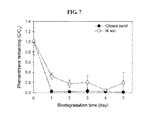
  • FIG. 7 is a graph illustrating a biodegradation by a recombinant strain with respect to phenanthrene of about 500 mg/kg per day in a model soil and a real soil;
  • FIG. 8 is a graph comparing a reaction of a recombinant strain with respect to phenanthrene remaining in a model soil with a reaction of the recombinant strain with respect to phenanthrene remaining in a real soil, an amount of phenanthrene remaining in each of the model soil and the real soil being calculated based on a corresponding biodegradation.
  • Example embodiments may provide Sphingomonas paucimobilis SEQ ID NO. 1 having base sequences of which a sequence number is 1, being deposited with a deposition number KCTC 11771BP (deposited Oct. 1, 2010), and specifically measuring aromatic hydrocarbons as a contaminant in a sample.
  • An index of the contaminant, which is measured by the strain, may be the aromatic hydrocarbon, particularly, phenanthrene.
  • the aromatic hydrocarbon may be a component having a high residual toxicity among components of oil when soil or water is contaminated by oil.
  • Phenanthrene may be a representative of polycyclic aromatic hydrocarbons (PAHs) among aromatic hydrocarbons.
  • Sphingomonas paucimobilis SEQ ID NO. 1
  • the sample may be mixed, the mixture may be stained using the LIVE/DEAD BacLight bacterial viability kit (molecular probes, L7012) of INVITROGEN, and a fluorescence reaction may be measured by a micro-plate reader.
  • the LIVE/DEAD BacLight bacterial viability kit may label, using a DNA-binding dye, DNA of a live microorganism with green fluorescence and may label, using the DNA-binding dye, DNA of a dead microorganism with red fluorescence. Therefore, as an amount of red fluorescence increases, a degree of contamination of the sample also increases.
  • Microorganisms may die on the initiation of phenanthrene biodegradation and thus, may be labeled as dead microorganisms.
  • the contaminant included in the mixture may be quantified based on an image analysis.
  • a confocal laser scanning microscope may measure a fluorescence reaction of the mixture of a soil sample and microorganisms to analyze phenanthrene in the soil sample.
  • An image including measured green fluorescence and measured red fluorescence may be converted into a grayscale image after removing the measured red fluorescence from the image based on Adobe Photoshop CS4 (Adobe Systems, CA, USA).
  • An integrated fluorescence intensity in an image of 254 ⁇ 254 pixels was quantified using a measure function of ImageJ program (ImageJ; Rasband, 1997-2009).
  • the integrated fluorescence intensity may be a value obtained by dividing sum of illuminance of all the pixels by a number of the pixels in the image.
  • Sphingomonas paucimobilis (SEQ ID NO. 1) was constructed using Sphingomonas paucimobilis EPA505 that is a microorganism degrading aromatic hydrocarbons.
  • pBBR1-MCS2 that is a broad-host range vector was used as a vector for construction of the recombinant strain.
  • a recombinant plasmid was obtained by recombining a promoter site of pbhA gene that is expressed by aromatic hydrocarbons and gef gene that is a microorganism-killing gene, using pBBR1-MCS2 .
  • Sphingomonas paucimobilis SQL2 was constructed by inserting the recombinant plasmid to Sphingomonas paucimobilis EPA505.
  • FIG. 1 illustrates a structure of a recombinant gene fragment according to an embodiment of the present invention.
  • PpbhA1 may denote a putative promoter region of pbhA gene
  • Km R may denote a kanamycin-resistance gene
  • gef may denote a microorganism-killing gene (gene expression fatal)
  • rep may denote an origin of replication.
  • the recombinant strain Sphingomonas paucimobilis (SEQ ID NO. 1), may be designed to express gef gene that kills the microorganism when pbhA gene is expressed by available phenanthrene.
  • Phenanthrene was added to an inorganic medium including pyruvate as a carbon source, up to phenanthrene concentrations of about 50 mg/L through about 500 mg/L, the recombinant strain was inoculated, and a sample was taken every 24-hour and stained using LIVE/DEAD BacLight bacterial viability kit (Molecular Probes, L7012) and a fluorescence reaction was measured by a micro-plate reader.
  • LIVE/DEAD BacLight bacterial viability kit Molecular Probes, L7012
  • the LIVE/DEAD BacLight bacterial viability kit is a dying scheme that labels, using a DNA-binding dye, DNA of a live microorganism with green fluorescence and labels, using the DNA-binding dye, DNA of dead microorganism with red fluorescence and thus, indicates a viability of microorganisms.
  • the reaction of the recombinant strain was expressed by a relative fluorescence intensity FL/FL 0 , that is, a value obtained by dividing a fluorescence reaction value FL of a recombinant strain exposed to a target contaminant by a fluorescence reaction value FL 0 of a recombinant strain that is not exposed to the target contaminant.
  • the relative fluorescence intensity FL/FL 0 expresses the reaction of the recombinant strain, which is based on a concentration of contaminant, with a rate of decreasing fluorescence and thus, an error rate may be reduced during a test, and a concentration of toxicity may be expressed with a standardized fluorescence intensity value.
  • FIG. 2 illustrates a response of a recombinant strain with respect to phenanthrene, toluene, hexane, and hexadecane.
  • the recombinant strain may not respond with hexane and hexadecane that are aliphatic hydrocarbon, and may show a death response with respect to phenanthrene that is aromatic hydrocarbons and thus, may show that a fluorescence response is specifically decreased.
  • the reaction may be quantitatively and linearly performed with respect to a concentration of phenanthrene.
  • a reaction with respect to toluene is measured in a low toluene concentration, that is, toluene concentrations of about 1 mg/L through 50 mg/L, since a high toluene concentration may be toxic to a microorganism.
  • the recombinant strain specifically detects a toxicity and a bioavailability of aromatic hydrocarbons included in oil.
  • Ottawa sand was used as a model soil.
  • the model soil was contaminated with phenanthrene up to concentrations from 50 mg/kg to 1000 mg/kg, an inorganic medium including pyruvate as a source of carbon was added, the inorganic medium of 10 mL per the model soil of 2 g, the recombinant strain was inoculated, and a sample was taken every 24-hour to measure a fluorescence response.
  • a fluorescence response was photographed by a CLSM to directly measure a mixture of the model soil, the liquid medium, and the recombinant strain, and the measured fluorescence reaction was quantified using an ImageJ program.
  • Table 1 compares characteristics of the model soil and characteristics of a real soil (M soil).
  • FIG. 3 is a picture, photographed by a CLSM, of a response of a recombinant strain with respect to phenanthrene contaminating Ottawa sand.
  • a magnification may be 200
  • a value in parentheses may denote a relative fluorescence intensity (FL/FL 0 ) with a standard deviation.
  • the relative fluorescence intensity (FL/FL 0 ) of the recombinant strain may represent a concentration of toxicity of phenanthrene.
  • a reaction of the recombinant strain becomes lower, and the reaction may be quantitatively and linearly performed with respect to the concentration.
  • Phenanthrene was added to soil that had not been contaminated with phenanthrene up to concentrations from 50 mg/kg to 1000 mg/kg, an inorganic medium was added, the inorganic medium of 10 mL per soil of 2 g, the recombinant strain was inoculated and cultivated for 24-hours, and a reaction was measured in the same manner as Example 3.
  • FIG. 5 is a picture, photographed by a CLSM, of a reaction of a recombinant strain with respect to phenanthrene contaminating a real soil.
  • a magnification may be 200
  • a value in parentheses may denote a relative fluorescence intensity (FL/FL 0 ) with a standard deviation.
  • FIG. 6 is a graph quantitatively illustrating a reaction of a recombinant strain with respect to phenanthrene concentrations in a real soil.
  • the reaction of the recombinant strain may be quantitatively and linearly performed in the same manner as in the Ottawa sand, and the reaction may be significantly sensitive to phenanthrene concentrations.
  • Conventional contaminant detecting methods using a fluorescence-emitting microorganism may show great performance in a model soil, such as Ottawa sand and the like, but have difficulty in detecting a contaminant in a real soil.
  • a reaction of the recombinant strain with respect to phenanthrene may be measured in the real soil without difficulty.
  • Conventional fluorescence-emitting recombinant microorganism strains are able to measure only phenanthrene of at least about 1,000 mg/kg, whereas the recombinant strain of the present invention is able to measure from phenanthrene of about 50 mg/kg.
  • FIG. 7 is a graph illustrating a biodegradation by a recombinant strain with respect to phenanthrene of about 500 mg/kg per day in a model soil and a real soil.
  • the biodegradation of phenanthrene of about 500 mg/kg per day in the model soil and the biodegradation of phenanthrene of about 500 mg/kg per day in the real soil are 97.2% and 68.2%, respectively.
  • phenanthrene of about 500 mg/kg in the model soil is degraded based on the biodegradation of 97.2%, phenanthrene of about 486 mg/kg may remain.
  • phenanthrene of about 500 mg/kg in the real soil is degraded based on the decomposition efficiency of 68.2%, phenanthrene of about 341 mg/kg may remain.

Landscapes

  • Life Sciences & Earth Sciences (AREA)
  • Chemical & Material Sciences (AREA)
  • Engineering & Computer Science (AREA)
  • Health & Medical Sciences (AREA)
  • Genetics & Genomics (AREA)
  • Biotechnology (AREA)
  • Organic Chemistry (AREA)
  • Zoology (AREA)
  • Bioinformatics & Cheminformatics (AREA)
  • Wood Science & Technology (AREA)
  • Medicinal Chemistry (AREA)
  • Microbiology (AREA)
  • Biomedical Technology (AREA)
  • Virology (AREA)
  • Biochemistry (AREA)
  • General Engineering & Computer Science (AREA)
  • General Health & Medical Sciences (AREA)
  • Tropical Medicine & Parasitology (AREA)
  • Measuring Or Testing Involving Enzymes Or Micro-Organisms (AREA)
  • Investigating, Analyzing Materials By Fluorescence Or Luminescence (AREA)

Abstract

Provided is Sphingomonas paucimobilis (SEQ ID NO. 1) having base sequences of which a sequence number is 1, being deposited with a deposition number KCTC 11771BP, and being used for specifically measuring aromatic hydrocarbons as a contaminant in a sample.

Description

CROSS-REFERENCE TO RELATED APPLICATION
This application claims the benefit of Korean Patent Application No. 10-2010-0118540, filed on Nov. 26, 2010, in the Korean Intellectual Property Office, the disclosure of which is incorporated herein by reference.
A Sequence Listing appended to the present specification is herein incorporated by reference in its entirety.
BACKGROUND
1. Field of the Invention
The present invention relates to a self-dying recombinant strain for measuring contamination of soil or water.
2. Description of the Related Art
A concentration of a contaminant in soil or ground water, a bioavailable concentration, and a concentration of toxicity are different from each other, since a toxicity and a bioavailability of the contaminant is reduced by a process, such as, sorption and the like, performed after the contaminant is released into soil. Therefore, when a toxicity with respect to a receptor is measured, analyzing a toxicity and a bioavailability of a target contaminant may be significantly important.
Various schemes for measuring the toxicity and the bioavailability of the contaminant in soil or groundwater have been developed. Microtox is a toxicity measuring scheme that measures the toxicity of the contaminant based on a degree of inhibition of luminance of a bioluminescent microorganism (Palmer et al., 1998; Sousa et al., 1998). In addition, measuring a biodegradability (Weissenfels et al., 1992; Tang and Alexander, 1999) or a mild extraction (Alexander and Alexander, 2000; Reid et al., 2000) have been widely used. The above mentioned schemes have drawbacks. For example, the schemes may not be compound-specific, the schemes may need to be compared with an organism-based detection scheme, or the schemes may not directly measure the contaminant when the contaminant is in soil. Therefore, the schemes may not take account of interaction between organisms existing in soil or water and the contaminant.
A contaminant detection scheme using a recombinant microorganism has drawn attention since G. Sayler suggested the scheme in the early 1990s. A microorganism is used as a device for specifically and sensitively detecting the contaminant. In most cases, the contaminant detection scheme may be based on a scheme of measuring an amount of luminescence or fluorescence. A promoter of a gene expressed by a target contaminant is combined with a luminescent or fluorescent gene and thus, as an amount of contaminant increases, an amount of luminescence or fluorescence also increases.
When the contaminant contained in soil or water is measured using a recombinant microorganism, the contaminant is extracted from soil, the extracted contaminant is reacted with a recombinant strain, and the reaction is measured. According to the study of Willardson et al. in 1998, BTEX concentrations in soil were measured using a bioreporter Pseudomonas putida mt-2, and a reaction of the bioreporter is measured using soil-ethanol extract to remove the disturbance of soil particles. According to the study of Gu and Chang in 2001, all phenanthrene is extracted using a surfactant, and a toxicity of phenanthrene in soil is measured. However, the above mentioned studies include an extracting process and thus, may not appropriately show the bioavailability and the toxicity of the contaminant.
SUMMARY
An aspect of the present invention provides a novel strain that may detect, as an indicator of contamination, aromatic hydrocarbons existing in soil contaminated by oil or existing in oil in water and thus, may measure soil or water contamination and may predict a residual toxicity and a bioavailability of oil contaminated soil or water.
According to an aspect of the present invention, there is provided Sphingomonas paucimobilis SEQ ID NO. 1 having base sequences of which a sequence number is 1, being deposited at the Korea Research Institute of Bioscience and Biotechnology (KRIBB), located at 111 Gwanhongno, Yuseong-gu, Daejeon 305-806, Republic of Korea, with a deposition number KCTC 11771BP (deposited Oct. 1, 2010), and being used for specifically measuring aromatic hydrocarbons as a contaminant in a sample.
Additional aspects, features, and/or advantages of the invention will be set forth in part in the description which follows and, in part, will be apparent from the description, or may be learned by practice of the invention.
EFFECT
According to the present invention, a self-dying recombinant strain may quantitatively visualize a toxicity and a bioavailability of aromatic hydrocarbons, as an index of contaminant. The recombinant strain shows a death reaction based on an amount of an available aromatic hydrocarbon and thus, a dyeing scheme shows that an amount of fluorescence of microorganisms may be reduced when the amount of an available aromatic hydrocarbon decreases.
As a concentration of the available aromatic hydrocarbon is higher, a number of dead novel recombinant microorganisms increases, as opposed to a conventional fluorescence-emitting recombinant microorganism for detecting a contaminant. Accordingly, when the residual toxicity of the aromatic hydrocarbon is visualized, soil or water contamination may be measurable. A technology for constructing the plasmid for the novel recombinant microorganism is different from a conventional technology. The self-dying recombinant microorganism may be *shown* dead by a portion indicating a toxicity of the aromatic hydrocarbon existing in soil and water.
A fluorescence reaction of a conventional fluorescence-emitting recombinant strain with respect to a contaminant existing in soil may be difficult to be measured and thus, the contaminant is extracted from soil to measure the reaction. According to the present invention, after a sample soil and a recombinant strain are mixed, a toxicity and a bioavailability of a contaminant may be measured without an extracting process. Also, a microorganism is used as a detecting device and thus, a toxicity that affects organisms may be measured.
BRIEF DESCRIPTION OF THE DRAWINGS
The patent or application file contains at least one drawing executed in color. Copies of this patent or patent application publication with color drawing(s) will be provided by the Office upon request and payment of the necessary fee. These and/or other aspects, features, and advantages of the invention will become apparent and more readily appreciated from the following description of embodiments, taken in conjunction with the accompanying drawings of which:
FIG. 1 is a diagram illustrating a structure of a recombinant gene fragment according to an embodiment of the present invention;
FIG. 2 is a graph illustrating a reaction of a recombinant strain with respect to phenanthrene, toluene, hexane, and hexadecane;
FIG. 3 is a picture, photographed by a confocal laser scanning microscope (CLSM), of a reaction of a recombinant strain with respect to phenanthrene contaminated Ottawa sand;
FIG. 4 is a graph quantitatively illustrating a reaction of a recombinant strain with respect to phenanthrene concentrations in Ottawa sand;
FIG. 5 is a picture, photographed by a CLSM, of a reaction of a recombinant strain with respect to phenanthrene contaminating a real soil;
FIG. 6 is a graph quantitatively illustrating a reaction of a recombinant strain with respect to phenanthrene concentrations in a real soil;
FIG. 7 is a graph illustrating a biodegradation by a recombinant strain with respect to phenanthrene of about 500 mg/kg per day in a model soil and a real soil; and
FIG. 8 is a graph comparing a reaction of a recombinant strain with respect to phenanthrene remaining in a model soil with a reaction of the recombinant strain with respect to phenanthrene remaining in a real soil, an amount of phenanthrene remaining in each of the model soil and the real soil being calculated based on a corresponding biodegradation.
DETAILED DESCRIPTION
Reference will now be made in detail to embodiments of the present invention, examples of which are illustrated in the accompanying drawings, wherein like reference numerals refer to the like elements throughout. Embodiments are described below to explain the present invention by referring to the figures.
Example embodiments may provide Sphingomonas paucimobilis SEQ ID NO. 1 having base sequences of which a sequence number is 1, being deposited with a deposition number KCTC 11771BP (deposited Oct. 1, 2010), and specifically measuring aromatic hydrocarbons as a contaminant in a sample. An index of the contaminant, which is measured by the strain, may be the aromatic hydrocarbon, particularly, phenanthrene. The aromatic hydrocarbon may be a component having a high residual toxicity among components of oil when soil or water is contaminated by oil. Phenanthrene may be a representative of polycyclic aromatic hydrocarbons (PAHs) among aromatic hydrocarbons.
Sphingomonas paucimobilis (SEQ ID NO. 1) and the sample may be mixed, the mixture may be stained using the LIVE/DEAD BacLight bacterial viability kit (molecular probes, L7012) of INVITROGEN, and a fluorescence reaction may be measured by a micro-plate reader. The LIVE/DEAD BacLight bacterial viability kit may label, using a DNA-binding dye, DNA of a live microorganism with green fluorescence and may label, using the DNA-binding dye, DNA of a dead microorganism with red fluorescence. Therefore, as an amount of red fluorescence increases, a degree of contamination of the sample also increases. Microorganisms may die on the initiation of phenanthrene biodegradation and thus, may be labeled as dead microorganisms. The contaminant included in the mixture may be quantified based on an image analysis.
A confocal laser scanning microscope (CLSM) may measure a fluorescence reaction of the mixture of a soil sample and microorganisms to analyze phenanthrene in the soil sample. An image including measured green fluorescence and measured red fluorescence may be converted into a grayscale image after removing the measured red fluorescence from the image based on Adobe Photoshop CS4 (Adobe Systems, CA, USA). An integrated fluorescence intensity in an image of 254×254 pixels was quantified using a measure function of ImageJ program (ImageJ; Rasband, 1997-2009). The integrated fluorescence intensity may be a value obtained by dividing sum of illuminance of all the pixels by a number of the pixels in the image.
EXAMPLE Example 1 Construction of Recombinant Strain
A recombinant strain, Sphingomonas paucimobilis (SEQ ID NO. 1), was constructed using Sphingomonas paucimobilis EPA505 that is a microorganism degrading aromatic hydrocarbons.
pBBR1-MCS2 that is a broad-host range vector was used as a vector for construction of the recombinant strain. A recombinant plasmid was obtained by recombining a promoter site of pbhA gene that is expressed by aromatic hydrocarbons and gef gene that is a microorganism-killing gene, using pBBR1-MCS2. Sphingomonas paucimobilis SQL2 was constructed by inserting the recombinant plasmid to Sphingomonas paucimobilis EPA505.
FIG. 1 illustrates a structure of a recombinant gene fragment according to an embodiment of the present invention.
Referring to FIG. 1, PpbhA1 may denote a putative promoter region of pbhA gene, KmR may denote a kanamycin-resistance gene, gef may denote a microorganism-killing gene (gene expression fatal), and rep may denote an origin of replication.
The recombinant strain, Sphingomonas paucimobilis (SEQ ID NO. 1), may be designed to express gef gene that kills the microorganism when pbhA gene is expressed by available phenanthrene.
Example 2 Verification of Substrate Specificity
Phenanthrene was added to an inorganic medium including pyruvate as a carbon source, up to phenanthrene concentrations of about 50 mg/L through about 500 mg/L, the recombinant strain was inoculated, and a sample was taken every 24-hour and stained using LIVE/DEAD BacLight bacterial viability kit (Molecular Probes, L7012) and a fluorescence reaction was measured by a micro-plate reader.
A reaction of the recombinant strain with respect to an inorganic medium including hexane and hexadecane that are aliphatic hydrocarbon having the equivalent concentration, hexane concentrations being about 50 mg/L through about 500 mg/L and hexadecane concentrations being about 50 mg/L through about 500 mg/L, and a reaction of the recombinant strain with respect to an inorganic medium including toluene that is a monoaromatic hydrocarbon, toluene concentrations being about 1 mg/L through about 50 mg/L, were respectively measured for comparison.
The aliphatic hydrocarbon which is a component of oil, along with aromatic hydrocarbons, was selected to show that the recombinant strain selectively detects aromatic hydrocarbons included in oil. The LIVE/DEAD BacLight bacterial viability kit is a dying scheme that labels, using a DNA-binding dye, DNA of a live microorganism with green fluorescence and labels, using the DNA-binding dye, DNA of dead microorganism with red fluorescence and thus, indicates a viability of microorganisms.
The reaction of the recombinant strain was expressed by a relative fluorescence intensity FL/FL0, that is, a value obtained by dividing a fluorescence reaction value FL of a recombinant strain exposed to a target contaminant by a fluorescence reaction value FL0 of a recombinant strain that is not exposed to the target contaminant. The relative fluorescence intensity FL/FL0 expresses the reaction of the recombinant strain, which is based on a concentration of contaminant, with a rate of decreasing fluorescence and thus, an error rate may be reduced during a test, and a concentration of toxicity may be expressed with a standardized fluorescence intensity value.
FIG. 2 illustrates a response of a recombinant strain with respect to phenanthrene, toluene, hexane, and hexadecane.
Referring to FIG. 2, the recombinant strain may not respond with hexane and hexadecane that are aliphatic hydrocarbon, and may show a death response with respect to phenanthrene that is aromatic hydrocarbons and thus, may show that a fluorescence response is specifically decreased. The reaction may be quantitatively and linearly performed with respect to a concentration of phenanthrene. In a case of toluene, a reaction with respect to toluene is measured in a low toluene concentration, that is, toluene concentrations of about 1 mg/L through 50 mg/L, since a high toluene concentration may be toxic to a microorganism.
Therefore, it is verified that the recombinant strain specifically detects a toxicity and a bioavailability of aromatic hydrocarbons included in oil.
Example 3 Verification of Performance of Recombinant Strain in Model Soil
Ottawa sand was used as a model soil. The model soil was contaminated with phenanthrene up to concentrations from 50 mg/kg to 1000 mg/kg, an inorganic medium including pyruvate as a source of carbon was added, the inorganic medium of 10 mL per the model soil of 2 g, the recombinant strain was inoculated, and a sample was taken every 24-hour to measure a fluorescence response.
A fluorescence response was photographed by a CLSM to directly measure a mixture of the model soil, the liquid medium, and the recombinant strain, and the measured fluorescence reaction was quantified using an ImageJ program. Table 1 compares characteristics of the model soil and characteristics of a real soil (M soil).
TABLE 1
Organic Hydrogen
matter Field ion con-
Soil content in moisture centration Area
texture soil (%) capacity (pH) (m2/g)a
Ottawa sand Sand 0 0.050 7.0 0.13
M soil Sandy loam 11.5 0.358 6.8 2.4
FIG. 3 is a picture, photographed by a CLSM, of a response of a recombinant strain with respect to phenanthrene contaminating Ottawa sand. In this example, a magnification may be 200, and a value in parentheses may denote a relative fluorescence intensity (FL/FL0) with a standard deviation.
Referring to FIG. 3, as phenanthrene concentrations increase, a number of live microorganisms decrease. Therefore, it is verified that the recombinant strain successfully detects phenanthrene in Ottawa sand. As phenanthrene concentrations become higher, a number of dead microorganisms become higher and thus, the recombinant strain represents a toxicity of phenanthrene. Therefore, the relative fluorescence intensity (FL/FL0) of the recombinant strain may represent a concentration of toxicity of phenanthrene.
FIG. 4 is a graph quantitatively illustrating a reaction of a recombinant strain with respect to phenanthrene concentrations in Ottawa sand.
Referring to FIG. 4, as phenanthrene concentrations becomes higher, a reaction of the recombinant strain becomes lower, and the reaction may be quantitatively and linearly performed with respect to the concentration.
Example 4 Verification of Performance of Recombinant Strain in Real Soil
Phenanthrene was added to soil that had not been contaminated with phenanthrene up to concentrations from 50 mg/kg to 1000 mg/kg, an inorganic medium was added, the inorganic medium of 10 mL per soil of 2 g, the recombinant strain was inoculated and cultivated for 24-hours, and a reaction was measured in the same manner as Example 3.
FIG. 5 is a picture, photographed by a CLSM, of a reaction of a recombinant strain with respect to phenanthrene contaminating a real soil. In this example, a magnification may be 200, and a value in parentheses may denote a relative fluorescence intensity (FL/FL0) with a standard deviation.
FIG. 6 is a graph quantitatively illustrating a reaction of a recombinant strain with respect to phenanthrene concentrations in a real soil.
Referring to FIGS. 5 and 6, the reaction of the recombinant strain may be quantitatively and linearly performed in the same manner as in the Ottawa sand, and the reaction may be significantly sensitive to phenanthrene concentrations.
Conventional contaminant detecting methods using a fluorescence-emitting microorganism may show great performance in a model soil, such as Ottawa sand and the like, but have difficulty in detecting a contaminant in a real soil. Conversely, according to the present invention, a reaction of the recombinant strain with respect to phenanthrene may be measured in the real soil without difficulty. Conventional fluorescence-emitting recombinant microorganism strains are able to measure only phenanthrene of at least about 1,000 mg/kg, whereas the recombinant strain of the present invention is able to measure from phenanthrene of about 50 mg/kg.
Example 5 Comparison of Biodegradation of Phenanthrene in Model Soil and Real Soil Using a Recombinant Strain
Phenanthrene was added to each of the model soil and the real soil up to phenanthrene concentrations of about 500 mg/kg, an inorganic medium was added, the inorganic medium of 10 mL per soil of 2 g, the recombinant strain was inoculated, and an amount of residual phenanthrene was extracted and measured every 24-hour. Extraction of phenanthrene was performed based on the Environmental Protection Agency (EPA) method 3545 to extract all extractable phenanthrene in soil.
An applicability of the recombinant strain in the real soil and an applicability of the recombinant strain in the model soil was compared and analyzed to measure a residual toxicity and a bioavailability of oil contaminating the real soil.
The reaction of the recombinant strain is controlled by a promoter of pbhA gene. The pbhA gene is associated with a first operation of biodegradation of phenanthrene and thus, pbhA gene may express to be proportional to an amount of phenanthrene degraded by the recombinant strain. Accordingly, when an amount of degraded phenanthrene is measured under a given condition, a response of the recombinant strain with respect to phenanthrene may be predicted. When the reaction is different from the predicted amount of biodegradation, it is determined that a performance of the recombinant strain for detecting phenanthrene is reduced by an external condition.
FIG. 7 is a graph illustrating a biodegradation by a recombinant strain with respect to phenanthrene of about 500 mg/kg per day in a model soil and a real soil.
Referring to FIG. 7, the biodegradation of phenanthrene of about 500 mg/kg per day in the model soil and the biodegradation of phenanthrene of about 500 mg/kg per day in the real soil are 97.2% and 68.2%, respectively. When phenanthrene of about 500 mg/kg in the model soil is degraded based on the biodegradation of 97.2%, phenanthrene of about 486 mg/kg may remain. When phenanthrene of about 500 mg/kg in the real soil is degraded based on the decomposition efficiency of 68.2%, phenanthrene of about 341 mg/kg may remain. In this example, it is assumed that phenanthrene with phenanthrene concentrations of below about 500 mg/kg, for example, phenanthrene concentrations of about 50 mg/kg through about 250 mg/kg, is all degraded.
FIG. 8 is a graph comparing a reaction of a recombinant strain with respect to phenanthrene remaining in a model soil with a reaction of the recombinant strain with respect to phenanthrene remaining in a real soil, an amount of phenanthrene remaining in each of the model soil and the real soil being calculated based on a corresponding biodegradation.
Referring to FIG. 8, a difference between the reaction of the recombinant strain measured in the model soil and the reaction of the recombinant strain measured in the real soil does not exist. Soil particles may not affect measuring of a fluorescence reaction of the recombinant strain and thus, the reaction of the recombinant strain may be measured based on an availability of phenanthrene. Therefore, an applicability of the recombinant strain with respect to the real soil is verified.
The recombinant strain adopts a new detection mechanism, and visualizes and quantifies a toxicity and a bioavailability of aromatic hydrocarbons and thus, may provide a digitalized microorganism-based system that visualizes and quantifies a state of oil contamination and a residual toxicity.
Although a few embodiments of the present invention have been shown and described, the present invention is not limited to the described embodiments. Instead, it would be appreciated by those skilled in the art that changes may be made to these embodiments without departing from the principles and spirit of the invention, the scope of which is defined by the claims and their equivalents.

Claims (4)

What is claimed is:
1. An isolated Sphingomonas paucimobilis comprising SEQ ID NO. 1, being deposited with a deposition number KCTC 11771BP.
2. The isolated Sphingomonas paucimobilis of claim 1, wherein Sphingomonas paucimobilis cell death measures a contaminant included in soil or water sample, wherein the contaminant is an aromatic hydrocarbon.
3. The Sphingomonas paucimobilis of claim 2, wherein the aromatic hydrocarbon is phenanthrene.
4. A method of specifically measuring aromatic hydrocarbons as a contaminant in a sample using an isolated number of dead Sphingomonas paucimobilis of claim 1.
US13/034,198 2010-11-26 2011-02-24 Self-dying recombinant microorganism for measuring soil and water contamination Active 2032-01-04 US8557559B2 (en)

Applications Claiming Priority (2)

Application Number Priority Date Filing Date Title
KR1020100118540A KR101249514B1 (en) 2010-11-26 2010-11-26 Novel self-dying recombinant microorganism for measuring soil and water contamination
KR10-2010-0118540 2010-11-26

Publications (2)

Publication Number Publication Date
US20120135502A1 US20120135502A1 (en) 2012-05-31
US8557559B2 true US8557559B2 (en) 2013-10-15

Family

ID=46126925

Family Applications (1)

Application Number Title Priority Date Filing Date
US13/034,198 Active 2032-01-04 US8557559B2 (en) 2010-11-26 2011-02-24 Self-dying recombinant microorganism for measuring soil and water contamination

Country Status (2)

Country Link
US (1) US8557559B2 (en)
KR (1) KR101249514B1 (en)

Cited By (1)

* Cited by examiner, † Cited by third party
Publication number Priority date Publication date Assignee Title
CN105199988A (en) * 2015-09-29 2015-12-30 南京农业大学 Root surface film forming bacterium RS2 with phenanthrene degradation function and application of root surface film forming bacterium RS2

Family Cites Families (1)

* Cited by examiner, † Cited by third party
Publication number Priority date Publication date Assignee Title
EP1367134A1 (en) * 2002-05-31 2003-12-03 EAWAG Eidg.Anstalt für Wasserversorgung Abwasserreinigung u. Gewässerschutz Method of detecting arsenic ions with indicator bacteria

Non-Patent Citations (10)

* Cited by examiner, † Cited by third party
Title
Alexander, et al., Bioavailability of Genotoxic Compounds in Soils, Environmental Science & Technology, vol. 34, No. 8, pp. 1589-1593, 2000, USA.
Gu, et al., Soil Biosensor for the Detection of PAH Toxicity Using an Immobilized Recombinant Bacterium and a Biosurfactant, Biosensors & Bioelectronics, vol. 16, pp. 667-674, 2001 Elsevier, South Korea.
King, et al., Rapid, Sensitive Bioluminescent Reporter Technology for Naphthalene Exposure and Biodegradation, Science, vol. 249, pp. 778-781, Aug. 17, 1990, USA.
Palmer, et al., Use of Lux-Based Biosensors for Rapid Diagnosis of Pollutants in Arable Soils, Chemosphere, vol. 36, No. 12, pp. 2683-2697, 1998 Elsevier Science Ltd., Great Britain.
Reid, et al., Nonexhaustive Cyclodextrin-Based Extraction Technique for the Evaluation of PAH Bioavailability, Environmental Science & Technology, vol. 34, No. 15, pp. 3174-3179, 2000 USA.
Shin, Doyun, "Microbial Visualization System to Identify the Relative Location and Toxicity of Phenanthrene," Department of Civil and Environmental Engineering, Seoul National University, Aug. 2010 (60 pgs.).
Sousa, et al., Use of a Lux-Modified Bacterial Biosensor to Identify Constraints to Bioremediation of BTEX-Contaminated Sites, Environmental Toxicology and Chemistry, vol. 17, No. 6, pp. 1039-1045, 1998 SETAC, USA.
Tang, et al., Mild Extractability and Bioavailability of Polycyclic Aromatic Hydrocarbons in Soil, Environmental Toxicology and Chemistry, vol. 18, No. 12, pp. 2711-2714, 1999 SETAC, USA.
Weissenfels, et al., Adsorption of Polycyclic Aromatic Hydrocarbons (PAHs) by Soil Particles; Influence on Biodegradability and Biotoxicity, Applied Microbiology Biotechnology, 36:689-696, 1992 Springer-Verlag, Federal Republic of Germany.
Willardson, et al., Development and Testing of a Bacterial Biosensor for Toluene-Based Environmental Contaminants, Applied and Environmental Microbiology, vol. 64, No. 3, pp. 1006-1012, 1998 American Society for Microbiology, USA.

Cited By (2)

* Cited by examiner, † Cited by third party
Publication number Priority date Publication date Assignee Title
CN105199988A (en) * 2015-09-29 2015-12-30 南京农业大学 Root surface film forming bacterium RS2 with phenanthrene degradation function and application of root surface film forming bacterium RS2
CN105199988B (en) * 2015-09-29 2018-07-13 南京农业大学 One plant of root telogenesis film bacterium RS2 with luxuriant and rich with fragrance degradation function and its application

Also Published As

Publication number Publication date
KR101249514B1 (en) 2013-04-01
US20120135502A1 (en) 2012-05-31
KR20120057011A (en) 2012-06-05

Similar Documents

Publication Publication Date Title
Medaura et al. Bioaugmentation of native fungi, an efficient strategy for the bioremediation of an aged industrially polluted soil with heavy hydrocarbons
Cébron et al. Root exudates modify bacterial diversity of phenanthrene degraders in PAH‐polluted soil but not phenanthrene degradation rates
Winderl et al. Depth-resolved quantification of anaerobic toluene degraders and aquifer microbial community patterns in distinct redox zones of a tar oil contaminant plume
Kim et al. Microbial diversity in natural asphalts of the Rancho La Brea Tar Pits
Ma et al. Elucidation of fluoranthene degradative characteristics in a newly isolated Achromobacter xylosoxidans DN002
Sipilä et al. High aromatic ring-cleavage diversity in birch rhizosphere: PAH treatment-specific changes of IE 3 group extradiol dioxygenases and 16S rRNA bacterial communities in soil
Hesham et al. Biodegradation ability and catabolic genes of petroleum‐degrading Sphingomonas koreensis strain ASU‐06 isolated from Egyptian oily soil
Kleinsteuber et al. Key players and team play: anaerobic microbial communities in hydrocarbon-contaminated aquifers
Himmelberg et al. Anaerobic degradation of phenanthrene by a sulfate‐reducing enrichment culture
Chen et al. Novel clades of soil biphenyl degraders revealed by integrating isotope probing, multi-omics, and single-cell analyses
Pedetta et al. Phenanthrene degradation and strategies to improve its bioavailability to microorganisms isolated from brackish sediments
Tang et al. Exploring diversity patterns and driving mechanisms of the antibiotic resistome and microbiome in saline groundwater
Imfeld et al. Assessment of in situ degradation of chlorinated ethenes and bacterial community structure in a complex contaminated groundwater system
Kabelitz et al. Enhancement of the microbial community biomass and diversity during air sparging bioremediation of a soil highly contaminated with kerosene and BTEX
Jones et al. Multiple DNA extractions coupled with stable-isotope probing of anthracene-degrading bacteria in contaminated soil
Vogt et al. Stable isotope probing approaches to study anaerobic hydrocarbon degradation and degraders
Bruckberger et al. Biodegradability of polar compounds formed from weathered diesel
Lyu et al. Characterization of chlorinated paraffin-degrading bacteria from marine estuarine sediments
Bučková et al. A simple strategy for investigating the diversity and hydrocarbon degradation abilities of cultivable bacteria from contaminated soil
Cauduro et al. New benzo (a) pyrene-degrading strains of the Burkholderia cepacia complex prospected from activated sludge in a petrochemical wastewater treatment plant
Chelaliche et al. Proteomic insight on the polychlorinated biphenyl degrading mechanism of Pleurotus pulmonarius LBM 105
Wang et al. Biodegradation performance and diversity of enriched bacterial consortia capable of degrading high-molecular-weight polycyclic aromatic hydrocarbons
Sperfeld et al. Community dynamics in a nitrate-reducing microbial consortium cultivated with p-alkylated vs. non-p-alkylated aromatic compounds
Zhu et al. Integration of physiology, genomics and microbiomics analyses reveal the biodegradation mechanism of petroleum hydrocarbons by Medicago sativa L. and growth-promoting bacterium Rhodococcus erythropolis KB1
US8557559B2 (en) Self-dying recombinant microorganism for measuring soil and water contamination

Legal Events

Date Code Title Description
AS Assignment

Owner name: SNU R&DB FOUNDATION, KOREA, DEMOCRATIC PEOPLE'S RE

Free format text: ASSIGNMENT OF ASSIGNORS INTEREST;ASSIGNORS:NAM, KYOUNG PHILE;SHIN, DO YUN;REEL/FRAME:026362/0179

Effective date: 20110217

STCF Information on status: patent grant

Free format text: PATENTED CASE

FEPP Fee payment procedure

Free format text: PAYOR NUMBER ASSIGNED (ORIGINAL EVENT CODE: ASPN); ENTITY STATUS OF PATENT OWNER: SMALL ENTITY

FPAY Fee payment

Year of fee payment: 4

MAFP Maintenance fee payment

Free format text: PAYMENT OF MAINTENANCE FEE, 8TH YR, SMALL ENTITY (ORIGINAL EVENT CODE: M2552); ENTITY STATUS OF PATENT OWNER: SMALL ENTITY

Year of fee payment: 8

MAFP Maintenance fee payment

Free format text: PAYMENT OF MAINTENANCE FEE, 12TH YR, SMALL ENTITY (ORIGINAL EVENT CODE: M2553); ENTITY STATUS OF PATENT OWNER: SMALL ENTITY

Year of fee payment: 12