US8557338B1 - Corrosion control - Google Patents
Corrosion control Download PDFInfo
- Publication number
- US8557338B1 US8557338B1 US13/662,660 US201213662660A US8557338B1 US 8557338 B1 US8557338 B1 US 8557338B1 US 201213662660 A US201213662660 A US 201213662660A US 8557338 B1 US8557338 B1 US 8557338B1
- Authority
- US
- United States
- Prior art keywords
- pipeline
- slurry
- corrosion
- inhibitor
- corrosion inhibitor
- Prior art date
- Legal status (The legal status is an assumption and is not a legal conclusion. Google has not performed a legal analysis and makes no representation as to the accuracy of the status listed.)
- Active
Links
- YFSHZZQOHFZBRS-MRGJLVNDSA-N CC(C)C1=CC2=C(CC1)[C@@]1(C)CCC[C@@](C)(C(=O)O)C1CC2.[H][C@@]12CCC(=C(C)C)C=C1CCC1[C@]2(C)CCC[C@@]1(C)C(=O)O.[H][C@@]12CCC(C(C)C)=CC1=CCC1[C@@](C)(C(=O)O)CCC[C@@]12C.[H][C@@]12CC[C@@](C)(C=C)C=C1CCC1[C@]2(C)CCC[C@@]1(C)C(=O)O.[H][C@]12CCC3=C(C=CC(C(C)C)=C3)[C@@]1(C)CCC[C@]2(C)C(=O)O Chemical compound CC(C)C1=CC2=C(CC1)[C@@]1(C)CCC[C@@](C)(C(=O)O)C1CC2.[H][C@@]12CCC(=C(C)C)C=C1CCC1[C@]2(C)CCC[C@@]1(C)C(=O)O.[H][C@@]12CCC(C(C)C)=CC1=CCC1[C@@](C)(C(=O)O)CCC[C@@]12C.[H][C@@]12CC[C@@](C)(C=C)C=C1CCC1[C@]2(C)CCC[C@@]1(C)C(=O)O.[H][C@]12CCC3=C(C=CC(C(C)C)=C3)[C@@]1(C)CCC[C@]2(C)C(=O)O YFSHZZQOHFZBRS-MRGJLVNDSA-N 0.000 description 1
- VZXJEBBMKYACRV-UHFFFAOYSA-N CC(C)CCCCCCCCCC1=CC=C(S(=O)(=O)[O-])C=C1.[H][N+](C)(C)CCO Chemical compound CC(C)CCCCCCCCCC1=CC=C(S(=O)(=O)[O-])C=C1.[H][N+](C)(C)CCO VZXJEBBMKYACRV-UHFFFAOYSA-N 0.000 description 1
- PKWAQUOCUZHFNO-UHFFFAOYSA-N CC(C)CCCCCCCCCC1=CC=C(S(=O)(=O)[O-])C=C1.[H][N+](C)(C)CCOCCO Chemical compound CC(C)CCCCCCCCCC1=CC=C(S(=O)(=O)[O-])C=C1.[H][N+](C)(C)CCOCCO PKWAQUOCUZHFNO-UHFFFAOYSA-N 0.000 description 1
- 0 CC(C)CCCCCCCCCc(cc1)ccc1S(*)(=O)=O Chemical compound CC(C)CCCCCCCCCc(cc1)ccc1S(*)(=O)=O 0.000 description 1
- SIEYZMJDONSCCO-UZIAROSKSA-N CCCCC/C=C\C/C=C\CCCCCCCC(=O)O.CCCCCC/C=C\CCCCCCCC(=O)O.CCCCCCCC/C=C\CCCCCCCC(=O)O.CCCCCCCCCCCCCCCC(=O)O.CCCCCCCCCCCCCCCCCC(=O)O Chemical compound CCCCC/C=C\C/C=C\CCCCCCCC(=O)O.CCCCCC/C=C\CCCCCCCC(=O)O.CCCCCCCC/C=C\CCCCCCCC(=O)O.CCCCCCCCCCCCCCCC(=O)O.CCCCCCCCCCCCCCCCCC(=O)O SIEYZMJDONSCCO-UZIAROSKSA-N 0.000 description 1
- JEZMJCAPCOOJNW-KGIODEGISA-N CCCCCCCC/C(=C/CCCCCCCC(=O)O)C(CCCCCCCC)C(CCCCCCCC(=O)O)C(CCCCCCCC)CCCCCCCCC(=O)[O-].[H][N+](C)(C)CCO Chemical compound CCCCCCCC/C(=C/CCCCCCCC(=O)O)C(CCCCCCCC)C(CCCCCCCC(=O)O)C(CCCCCCCC)CCCCCCCCC(=O)[O-].[H][N+](C)(C)CCO JEZMJCAPCOOJNW-KGIODEGISA-N 0.000 description 1
- DJMADPVPJZONPJ-KGIODEGISA-N CCCCCCCC/C(=C/CCCCCCCC(=O)O)C(CCCCCCCC)C(CCCCCCCC(=O)O)C(CCCCCCCC)CCCCCCCCC(=O)[O-].[H][N+](C)(C)CCOCCO Chemical compound CCCCCCCC/C(=C/CCCCCCCC(=O)O)C(CCCCCCCC)C(CCCCCCCC(=O)O)C(CCCCCCCC)CCCCCCCCC(=O)[O-].[H][N+](C)(C)CCOCCO DJMADPVPJZONPJ-KGIODEGISA-N 0.000 description 1
- HAGAOFOSQOINSY-KVVVOXFISA-N CCCCCCCC/C=C\CCCCCCCC(=O)[O-].[H][N+](C)(C)CCO Chemical compound CCCCCCCC/C=C\CCCCCCCC(=O)[O-].[H][N+](C)(C)CCO HAGAOFOSQOINSY-KVVVOXFISA-N 0.000 description 1
- VXICDKNRSWMYLI-KVVVOXFISA-N CCCCCCCC/C=C\CCCCCCCC(=O)[O-].[H][N+](C)(C)CCOCCO Chemical compound CCCCCCCC/C=C\CCCCCCCC(=O)[O-].[H][N+](C)(C)CCOCCO VXICDKNRSWMYLI-KVVVOXFISA-N 0.000 description 1
- RGCHZUGJUALDLJ-UHFFFAOYSA-N C[N+](C)(CCOCCO)[O-] Chemical compound C[N+](C)(CCOCCO)[O-] RGCHZUGJUALDLJ-UHFFFAOYSA-N 0.000 description 1
Images


Classifications
-
- B—PERFORMING OPERATIONS; TRANSPORTING
- B05—SPRAYING OR ATOMISING IN GENERAL; APPLYING FLUENT MATERIALS TO SURFACES, IN GENERAL
- B05D—PROCESSES FOR APPLYING FLUENT MATERIALS TO SURFACES, IN GENERAL
- B05D7/00—Processes, other than flocking, specially adapted for applying liquids or other fluent materials to particular surfaces or for applying particular liquids or other fluent materials
- B05D7/22—Processes, other than flocking, specially adapted for applying liquids or other fluent materials to particular surfaces or for applying particular liquids or other fluent materials to internal surfaces, e.g. of tubes
-
- C—CHEMISTRY; METALLURGY
- C23—COATING METALLIC MATERIAL; COATING MATERIAL WITH METALLIC MATERIAL; CHEMICAL SURFACE TREATMENT; DIFFUSION TREATMENT OF METALLIC MATERIAL; COATING BY VACUUM EVAPORATION, BY SPUTTERING, BY ION IMPLANTATION OR BY CHEMICAL VAPOUR DEPOSITION, IN GENERAL; INHIBITING CORROSION OF METALLIC MATERIAL OR INCRUSTATION IN GENERAL
- C23F—NON-MECHANICAL REMOVAL OF METALLIC MATERIAL FROM SURFACE; INHIBITING CORROSION OF METALLIC MATERIAL OR INCRUSTATION IN GENERAL; MULTI-STEP PROCESSES FOR SURFACE TREATMENT OF METALLIC MATERIAL INVOLVING AT LEAST ONE PROCESS PROVIDED FOR IN CLASS C23 AND AT LEAST ONE PROCESS COVERED BY SUBCLASS C21D OR C22F OR CLASS C25
- C23F11/00—Inhibiting corrosion of metallic material by applying inhibitors to the surface in danger of corrosion or adding them to the corrosive agent
- C23F11/08—Inhibiting corrosion of metallic material by applying inhibitors to the surface in danger of corrosion or adding them to the corrosive agent in other liquids
- C23F11/10—Inhibiting corrosion of metallic material by applying inhibitors to the surface in danger of corrosion or adding them to the corrosive agent in other liquids using organic inhibitors
- C23F11/14—Nitrogen-containing compounds
- C23F11/141—Amines; Quaternary ammonium compounds
- C23F11/143—Salts of amines
-
- C—CHEMISTRY; METALLURGY
- C23—COATING METALLIC MATERIAL; COATING MATERIAL WITH METALLIC MATERIAL; CHEMICAL SURFACE TREATMENT; DIFFUSION TREATMENT OF METALLIC MATERIAL; COATING BY VACUUM EVAPORATION, BY SPUTTERING, BY ION IMPLANTATION OR BY CHEMICAL VAPOUR DEPOSITION, IN GENERAL; INHIBITING CORROSION OF METALLIC MATERIAL OR INCRUSTATION IN GENERAL
- C23F—NON-MECHANICAL REMOVAL OF METALLIC MATERIAL FROM SURFACE; INHIBITING CORROSION OF METALLIC MATERIAL OR INCRUSTATION IN GENERAL; MULTI-STEP PROCESSES FOR SURFACE TREATMENT OF METALLIC MATERIAL INVOLVING AT LEAST ONE PROCESS PROVIDED FOR IN CLASS C23 AND AT LEAST ONE PROCESS COVERED BY SUBCLASS C21D OR C22F OR CLASS C25
- C23F11/00—Inhibiting corrosion of metallic material by applying inhibitors to the surface in danger of corrosion or adding them to the corrosive agent
- C23F11/08—Inhibiting corrosion of metallic material by applying inhibitors to the surface in danger of corrosion or adding them to the corrosive agent in other liquids
- C23F11/18—Inhibiting corrosion of metallic material by applying inhibitors to the surface in danger of corrosion or adding them to the corrosive agent in other liquids using inorganic inhibitors
- C23F11/187—Mixtures of inorganic inhibitors
- C23F11/188—Mixtures of inorganic inhibitors containing phosphates
Definitions
- This invention relates generally to novel methods, apparatuses, and compositions of matter useful in controlling the corrosion of slurry transporting pipelines.
- the transport of many slurries is commonly accomplished using mild steel pipelines. Essentially, the ore is grinded and mixed with water in order to form a mud that can then be pumped through the pipeline. These pipelines are therefore subjected to both corrosive and erosive effects.
- Corrosion is a very well know process by which a chemical reaction takes place on the surface of the metallic material. As a result of this reaction there is a loss of material from the metal surface to the medium in contact which such metal. From practical point of view this phenomenon damages the equipment and reduces its useful lifetime.
- Erosion is also a well-known phenomenon by which a mechanical agent physically removes material from a certain surface due to repeated abrasive impacts against the surface. The final consequence also is equipment damage and reduction of useful lifetime.
- the prior art contains a number of strategies for separately addressing corrosion and separately addressing erosion.
- the prior art lacks a strategy that directly and efficiently addresses corrosion-erosion when erosion component is aggressive enough to remove the protective layer provided by the corrosion inhibitor and instead relies upon ever greater applications of erosion countering strategies with corrosion countering strategies.
- Corrosion is commonly addressed by adding to the slurry a corrosion inhibitor whose chemical properties competes with or neutralizes the chemical reactions causing corrosion. Erosion is commonly handled by the careful choice of types and amounts of materials used to make the pipeline components. Often this involves the combination of layered materials and sometimes special coatings over the pipe surfaces.
- At least one embodiment of the invention is directed towards a method of inhibiting corrosion in a slurry transporting pipeline.
- the method comprises the steps of: contacting for a period of at least 1 hour (or even as low as 15 minutes) an inner surface of the pipeline with a composition of matter, the composition being at least one corrosion inhibitor within a water solvent in the absence of any slurry, pumping in an ore slurry into the pipeline, and transporting the slurry through the pipeline.
- the water may be purged from the pipeline before the slurry is introduced.
- the corrosion inhibitor may comprise at least 60% water, 1-20% zinc chloride and 1-20% phosphoric acid.
- the corrosion inhibitor may comprise: zinc compounds including but not limited to zinc phosphates, zinc sulfates, zinc halogenates, etc.
- the pipeline and the inhibitor may be in contact for between 3 and 24 hours prior to the introduction of the slurry to the pipeline.
- the slurry may comprise a solid material harder than coal.
- the efficiency of inhibition may be at least 40%.
- the inhibitor may be added in a dosage of between 30 (or as low as 5 or 1) ppm and 800 ppm.
- the pH of the water the inhibitor is within may be adjusted to a pH of between 7.0 and 7.2 and even between 5 and 9.
- the slurry may comprise bauxite particles.
- FIG. 1 illustrates microscopy images of (40 ⁇ magnification) for RCE coupons after 19 hours average of experiment for different dosages of corrosion inhibitor.
- FIG. 2 illustrates a comparison of microscopy (40 ⁇ magnification) for RCE coupons after 19 hours of experiment using corrosion inhibitor (A) in bauxite slurry.
- Corrosion means a chemical process which takes place on the surface of the solid material in contact with a fluidic medium, the process causes a loss of material from the surface to the medium, and it excludes erosion type processes.
- Corrosion-Erosion means a process in which both corrosion and erosion are occurring simultaneously, often corrosion-erosion results in a synergistic effect resulting in greater mass loss than the sum of the corrosion with the erosion expected for a given medium.
- Corrosion Inhibitor means a composition of matter known in the art to inhibit the rate of corrosion on a surface in contact with a corrosive fluid.
- Erosion means a physical abrasive process which takes place on the surface of the solid material in contact with a fluidic medium, the process causes a loss of material from the surface to the medium, and it excludes corrosion type processes.
- Hard means the measure of how resistant a particular kind of solid matter is to various kinds of permanent shape change when a force is applied, hardness is generally characterized by strong intermolecular bonds, but the behavior of solid materials under force is complex; therefore, there are different measurements of hardness including: scratch hardness, indentation hardness, and rebound hardness.
- Mild Steel means an iron alloy that contains less than 1.65% of manganese, less than 0.60% of silicon and less than 0.60% of copper, and has a carbon content of between 0.05% and 0.29%, mild steel includes steel alloys with no minimum amount of chromium, cobalt, molybdenum, nickel, niobium, titanium, tungsten, vanadium or zirconium, or any other element. Mild steel undergoes more corrosion under such atmospheric conditions than stainless steel (which has higher nickel and chromium content) does.
- “Slurry” means medium comprising a fluidic carrier within which is suspended a number of solid particles, the solid particles include but are not limited to ground rock such as ore, coal ore, bauxite, iron ore, and the like and the fluid is often a liquid such as water, the amount of solid is such that the fluidic carrier has properties associated with a fluid thicker than the carrier alone, slurries include but are not limited to dispersions, solutions, and can have liquid or water carrier fluids.
- At least one embodiment of the invention is directed to a method which minimizes corrosion-erosion in pipelines during ore slurry transport. It has the advantage of allowing for the construction of pipelines with cheaper materials than erosion resistance steels. It also eliminates the need of coating mild steel pipelines built for ore slurry transport and it can be used in existing pipelines as mild steel pipelines.
- the method comprises the steps of flowing through a pipeline for a period of 3 to 24 hours a fluid containing at least one corrosion inhibitor and then allowing the slurry that may also contain corrosion inhibitor to pass through the pipe.
- This invention is completely different than the technique described in p. 61 section 2.6 of Corrosion inhibitors in the mirror of five decades by Gunter Schmitt. Schmitt described an especial type of coating which present corrosion inhibitors in its composition. This technique present therefore all already described disadvantages of using coating protection. It just has the advantage over regular coatings of prevent corrosion for some time if the coating is physically damaged.
- CE is the corrosion-erosion rate of the ore slurry without any treatment and CE CI is the corrosion erosion rate determined using a specific treatment.
- Pre-treating the pipes with the corrosion inhibitor causes the corrosion inhibitor to also form a protective barrier along the pipe surface that resists erosion to a greater extent than if the inhibitor were present alongside the slurry.
- This is utterly unexpected as, despite inhibitors are known to form films or barriers along the pipe's surfaces, this films or barriers are extremely thin and are not expected to aid against erosion.
- some inhibitors are highly basic or acidic, it would be expected that in the absence of a neutralizing material (such as slurry components) the inhibitor in the absence of slurry could be expected to corrode the pipeline by itself
- the inhibitor is one that would be expected to corrode the pipeline.
- the inhibitor is basic or acidic.
- the corrosion inhibitor used is at least one of the compositions of matter and the relevant dosages and introduction methods, and/or its effectiveness is assessed according to the methods described in U.S. Pat. No. 2,791,742 and scientific papers: Corrosion Inhibitors in the Mirror of Five Decades , by Schmitt, G., Progress in Corrosion—The First 50 Years of the EFC: (EFC 52 ). Maney Publishing, (2009), The control of erosion - corrosion in slurry pipelines , by Postlethwaite, J. Materials Performance, v. 26, p. 41-5, (1987), Erosion - Corrosion in Slurry Pipelines , by Postlethwaite, J., Corrosion-NACE, Vol.
- the corrosion inhibiter is a composition comprising at least 60% water, 1-20% zinc chloride and 1-20% phosphoric acid.
- the corrosion inhibiter is a composition comprising at least one of: methoxypropylamine and monoethanolamine.
- the corrosion inhibitor of the invention comprises a product of dimethylaminoethoxyethanol, dimethylethanolamine, tall oil, C 18 -unsaturated fatty acid trimers, and branched dodecylbenzenesulfonic acid (DDBSA).
- the corrosion inhibitor of the invention comprises a product of tall oil, reaction products with 2[2-(dimethylamino)ethoxy]ethanol, 2-(dimethylamino)ethanol, C 18 -unsaturated fatty acid trimers, and branched DDBSA.
- alkanolamines include N,N-dimethylethanolamines, such as (N,N-dimethylaminoethoxy)ethanol; dimethylethanolamine; triethanolamine; methyldiethanolamine; ethanolamine; diethanolamine; other cyclic amines including morpholine, methylmorpholine, ethylmorpholine, piperidine, alkylpiperidines, piperazine, alkylpiperazines; ethyleneamines including DETA, TETA, TEPA, and the like; alkylamines including methylamine, dimethylamine, alkylmethylamines, dimethylalkylamines; methylaminopropylamine; dimethylaminopropylamine; dimethylaminoethylamine; methylaminoethylamine; the like; and combinations thereof.
- N,N-dimethylethanolamines such as (N,N-dimethylaminoethoxy)ethanol; dimethylethanolamine; triethanolamine; methyldiethanolamine;
- Representative fatty acids include trimeric C 18 unsaturated fatty acid (e.g., CAS 68937-90-6), dimer acids, polymerized tall-oil fatty acids, one or more components of a crude tall oil composition, branched DDBSA, the like, and any combination of the foregoing.
- trimeric C 18 unsaturated fatty acid e.g., CAS 68937-90-6
- dimer acids dimer acids
- polymerized tall-oil fatty acids one or more components of a crude tall oil composition
- branched DDBSA branched DDBSA
- a crude tall oil composition may include abietic acid; neoabietic acid; palustric acid; pimaric acid; dehydroabietic acid; palmitic acid; stearic acid; palmitoleic acid; linoleic acid; 5,9,12-octadecatrienoic acid; linolenic acid; 5,11,14-eicosadienoic acid; cis,cis-5,9-octadecadienoic acid; eicosadienoic acid; elaidic acid; cis-1,1-octadecanoic acid, C 20 -C 24 saturated acids; the like; and any combination of the foregoing.
- the corrosion inhibitor composition of the invention includes the following formula (1) using dimethylalkanolamines with trimer acid [CAS 68937-90-6].
- the corrosion inhibitor composition of the invention includes the following formula (2) dimethylalkanolamines with trimer acid [CAS 68937-90-6].
- trimer acid contains variable percentages of dimers and trimers, adding to the complexity.
- a typical composition can include approximately 40% dimer and 60% trimer with insignificant percentages of the monomer.
- the corrosion inhibitor composition of the invention includes the following formula (3) using dimethylalkanolamines with tall oil [CAS 8002-26-4].
- the corrosion inhibitor composition of the invention includes the following formula (4) using dimethylalkanolamines with tall oil [CAS 8002-26-4].
- the second group of salts which can form in this blend is with tall oil, exemplified in formulas (3) and (4) above.
- Crude tall oil is for example, a by-product of the pulp and paper industry and yields another complex mixture of fatty acids, rosin acids, and lesser amounts of terpenes and sterols.
- the composition of tall oil is variable with differences seen in regional sources and manufacturing processes as well as seasonal influences. Crude tall oil and distilled tall oil can also be very different. These differences are well known in the art.
- the structures above provide a representation of the salts formed from dimethylalkanolamines and tall oil (oleic acid is shown).
- Tall oil fatty acids include 5,9,12-octadecatrienoic acid; linolenic acid; 5,11,14-eicosatrenoic acid; cis,cis-5,9-octadecadienoic acid; eicosadienoic acid; elaidic acid; cis-11-octadecanoic acid; and C 20 , C 22 , C 24 saturated acids.
- Tall oil fatty acids may comprise any combination of the foregoing examples and others known in the art.
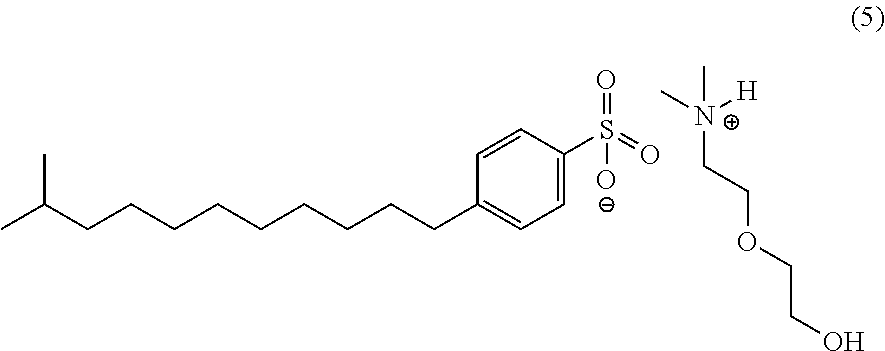
- the corrosion inhibitor composition of the invention includes the following formula (5) using dimethylalkanolamines with branched dodecylbenzene sulfonic acid [CAS 68411-32-5].
- the corrosion inhibitor composition of the invention includes the following formula (6) using dimethylalkanolamines with branched dodecylbenzene sulfonic acid [CAS 68411-32-5].
- DBSA dodecylbenzene sulfonic acid
- the product of the invention comprises about 10 wt % to about 100 wt % active ingredient.
- the amount of active is from about 10 wt % to about 36 wt %.
- the amount ranges from about 15 wt % to about 30 wt % active.
- the product comprises about 27 wt % of the active.
- the corrosion inhibitor composition of the invention may include at least one solvent.
- Representative solvents include methanol, ethanol, propanol, isopropanol, butanol, isobutanol, aromatic hydrocarbons, isoparaffinic solvents, monoethyleneglycol, ethylene glycol monobutyl ether, the like, water (water can also be used to emulsify the corrosion inhibitor), and combinations thereof.
- a solvent component aids in corrosion inhibitor delivery and helps provide desirable secondary properties of the product, such as desired viscosity, temperature stability, and the like.
- the amount of solvent may range from about 8.5 wt % to about 90 wt %. In other embodiments, the amount of solvent may range from about 30 wt % to about 40 wt %.
- the corrosion inhibitor composition of the invention may include at least one dispersant.
- the dispersant is preferably an oxyalkylate polymer (i.e., polyoxyethylene) such as ethoxylated sorbitan monolaurate. This may include varying oxyalkylated sorbitan esters (e.g., mono, di-, and tri-esters) and non-oxyalkylated sorbitan esters as well.
- the amount of polyoxyalkylate can vary from about 1-2 mol % up to about 80 mol %, preferably 20 mol %.
- the amount of oxyalkylated sorbitan esters in the final product ranges from about 1 wt % to about 10 wt %, preferred about 1 wt % to about 5 wt %.
- the corrosion inhibitor composition of the invention further comprises at least one quaternary ammonium compound in the range of about 5-35 wt %, preferred about 5-20 wt %.
- the corrosion inhibitor composition of the invention includes at least one solvent and at least one dispersant.
- Performance evaluation of a corrosion inhibitor in bauxite slurry was accomplished by using an additive containing ⁇ 74% water, ⁇ 10.5% zinc chloride and ⁇ 15.5% phosphoric acid.
- the additive was dosed at 60 ppm and 300 ppm in fresh slurry.
- the mass loss data balance, as well surface visual analysis, was compared with the trial in absence of an anticorrosive. The results are shown in Table 1 and FIG. 1 .
- the corrosion inhibitor presented a modest corrosion inhibition, with the best performance achieved at 300 ppm, reaching only 20%.
- the coupon's surface showed clear signs of localized corrosion even in the presence of the inhibitor.
- the electrode surface presented similar characteristics observed for river water corrosion, but, in this case, some scratches were also present. This observation suggests that erosion is occurring.
- Slurry Erosion Uses, Applications, and Test Methods: a Symposium , by Mille, J. E.
- a metallic coupon was pre-treated and then submitted to corrosion trials using bauxite slurry with the additive (60 ppm) after pH adjustment to 7.0-7.2 with Ca(OH) 2 .
- the pre-treatment consists on the submersion of the coupon into an aqueous solution of inhibitor (120 ppm) at room temperature for 6 hours.
- the test results were then compared to the results obtained earlier for untreated slurry, under cathodic protection conditions. Results obtained for untreated slurry cover the effect of chemical corrosion, erosion, and synergy (if any exists). While results obtained under cathodic protection conditions should have eliminated chemical corrosion and, therefore, synergy. Results obtained after pre-treat the electrode are shown in Table 2 and FIG. 2 .
- Cathodic polarization is a way to prevent corrosion by application of a reducing electric current in a metallic material. It is not practical to use this method to prevent corrosion INSIDE a pipeline because typically current density migrates to the EXTERNAL surface of the pipeline. It is however a useful reference to demonstrate that the invention achieves a very high degree of corrosion protection.
- Corrosion-erosion rates for bauxite pulp and effect of corrosion inhibitor (A) after pre-treatment Corrosion-erosion Corrosion inhibition Treatment rate (mm/yr) (%) Untreated 2.78 — Pre-treatment and 1.42 49* Additive (60 mg/L) Cathodic polarization 1.05 62 *Average of two trials, 46% and 52%, respectively.
- Canadian Patent CA 959642 described a process in which a corrosion inhibitor added to coal slurry helped address both corrosion and erosion.
- the inhibitors mentioned in that Canadian patent do not inhibit erosion when added to slurries which have harder constituents such as bauxite slurries. This suggests that the relationship between erosion control and inhibitor effect is related to the hardness of the suspended in the slurry.
- This invention however has been shown to be effective in embodiments where the solid is extremely hard (such as suspended bauxite) and the inhibitor would not be expected to provide any protection against erosion.
- the method involves using the corrosion inhibitor on a slurry containing a solid which is so hard that the corrosion inhibitor provides no protection against erosion when added to the slurry.
- the method for inhibiting corrosion of a solid by contacting the solid with an effective amount of the compound or composition in the manner described above may be applied in a number of other uses.
- the methods, compounds and compositions of the present invention are useful for corrosion inhibition of containers, processing facilities, or equipment in the food service or food processing industries.
- the methods, compounds and compositions have particular value for use on food packaging materials and equipment, and especially for cold or hot aseptic packaging.
- process facilities in which the compound of the invention can be employed include a milk line dairy, a continuous brewing system, food processing lines such as pumpable food systems and beverage lines, ware wash machines, low temperature ware wash machines, dishware, bottle washers, bottle chillers, warmers, third sink washers, processing equipment such as tanks, vats, lines, pumps and hoses (e.g., dairy processing equipment for processing milk, cheese, ice cream and other dairy products), and transportation vehicles.
- the methods, compounds and compositions of the invention can be used to inhibit corrosion in tanks, lines, pumps, and other equipment used for the manufacture and storage of soft drink materials, and also used in the bottling or containers for the beverages.
- the methods, compounds and compositions can also be used on or in other industrial equipment and in other industrial process streams such as heaters, cooling towers, boilers, retort waters, rinse waters, aseptic packaging wash waters, and the like.
- the methods, compounds and compositions can be used to treat surfaces in recreational waters such as in pools, spas, recreational flumes and water slides, fountains, and the like.
- the corrosion inhibitor compositions and the claimed methods of use to inhibit the corrosion of metal surfaces contacted with cleaners in surfaces found in janitorial and/or housekeeping applications, food processing equipment and/or plant applications, and in laundry applications.
- the corrosion of washers such as tunnel washers for washing textiles, may be inhibited according to methods of the claimed invention.
- surfaces may be contacted according to the methods of the present invention for use in low temperature dish and/or warewash sanitizing final rinse, toilet bowl cleaners, and laundry bleaches.
- the methods are used to treat metal surfaces, such as ware, cleaned and/or sanitized with corrosive sources.
Landscapes
- Chemical & Material Sciences (AREA)
- Engineering & Computer Science (AREA)
- Materials Engineering (AREA)
- Mechanical Engineering (AREA)
- Metallurgy (AREA)
- Organic Chemistry (AREA)
- Inorganic Chemistry (AREA)
- Life Sciences & Earth Sciences (AREA)
- Wood Science & Technology (AREA)
- Preventing Corrosion Or Incrustation Of Metals (AREA)
Abstract
Description
Efficiency of inhibition(%)=((CE−CECI)×100)/CE (equation 1),



| TABLE 1 |
| Corrosion rates for bauxite pulp and effect of corrosion inhibitor |
| Treatment | Corrosion rate (mm/yr) | Corrosion inhibition (%) |
| Untreated | 2.78 | — |
| Additive (60 mg/L) | 2.36 | 15 |
| Additive (300 mg/L) | 2.22 | 20 |
| TABLE 2 |
| Corrosion-erosion rates for bauxite pulp and effect |
| of corrosion inhibitor (A) after pre-treatment. |
| Corrosion-erosion | Corrosion inhibition | |||
| Treatment | rate (mm/yr) | (%) | ||
| Untreated | 2.78 | — | ||
| Pre-treatment and | 1.42 | 49* | ||
| Additive (60 mg/L) | ||||
| Cathodic polarization | 1.05 | 62 | ||
| *Average of two trials, 46% and 52%, respectively. | ||||
Claims (14)
Priority Applications (2)
| Application Number | Priority Date | Filing Date | Title |
|---|---|---|---|
| US13/662,660 US8557338B1 (en) | 2012-10-29 | 2012-10-29 | Corrosion control |
| BR102013033609A BR102013033609A2 (en) | 2012-10-29 | 2013-10-14 | corrosion control |
Applications Claiming Priority (1)
| Application Number | Priority Date | Filing Date | Title |
|---|---|---|---|
| US13/662,660 US8557338B1 (en) | 2012-10-29 | 2012-10-29 | Corrosion control |
Publications (1)
| Publication Number | Publication Date |
|---|---|
| US8557338B1 true US8557338B1 (en) | 2013-10-15 |
Family
ID=49321437
Family Applications (1)
| Application Number | Title | Priority Date | Filing Date |
|---|---|---|---|
| US13/662,660 Active US8557338B1 (en) | 2012-10-29 | 2012-10-29 | Corrosion control |
Country Status (2)
| Country | Link |
|---|---|
| US (1) | US8557338B1 (en) |
| BR (1) | BR102013033609A2 (en) |
Cited By (1)
| Publication number | Priority date | Publication date | Assignee | Title |
|---|---|---|---|---|
| WO2015160487A1 (en) | 2014-04-14 | 2015-10-22 | Ecolab Usa Inc. | Slurry biocide |
Citations (26)
| Publication number | Priority date | Publication date | Assignee | Title |
|---|---|---|---|---|
| US2346151A (en) * | 1940-05-18 | 1944-04-11 | Standard Oil Co | Process of treating coal |
| US2791742A (en) | 1953-05-21 | 1957-05-07 | Bendix Aviat Corp | Magnetic amplifier |
| US3062684A (en) * | 1957-09-03 | 1962-11-06 | Shell Oil Co | Method of inhibiting corrosion of iron and steel |
| US3347699A (en) * | 1964-01-09 | 1967-10-17 | Phillips Petroleum Co | Corrosion protection |
| US3837899A (en) * | 1972-06-14 | 1974-09-24 | Continental Oil Co | Method of coating the interior surface of a metal vessel and the coated vessel |
| CA959642A (en) | 1970-05-13 | 1974-12-24 | Richard J. Horvath | Sulfur-hydrocarbon slurry pipeline transportation containing an inorganic corrosion inhibitor |
| US3999058A (en) * | 1974-07-03 | 1976-12-21 | Cibie Projecteurs | Motor vehicle headlamp system |
| US4000076A (en) * | 1974-06-14 | 1976-12-28 | Phillips Petroleum Company | Drilling mud having reduced corrosiveness |
| US4110128A (en) * | 1975-12-17 | 1978-08-29 | International Lead Zinc Research Organization, Inc. | Solution and procedure for depositing a protective coating on galvanized steel parts, and solution regeneration procedure |
| US4206610A (en) * | 1978-04-14 | 1980-06-10 | Arthur D. Little, Inc. | Method and apparatus for transporting coal as a coal/liquid carbon dioxide slurry |
| US4282006A (en) * | 1978-11-02 | 1981-08-04 | Alfred University Research Foundation Inc. | Coal-water slurry and method for its preparation |
| US4500445A (en) * | 1982-03-10 | 1985-02-19 | Petrolite Corporation | Corrosion inhibited aqueous slurries |
| US4546612A (en) * | 1984-02-21 | 1985-10-15 | Arthur D. Little, Inc. | Method of producing free flowing solids |
| US4624680A (en) * | 1978-11-02 | 1986-11-25 | Alfred University Research Foundation, Inc. | Coal-water slurry and method for its preparation |
| US4728546A (en) * | 1983-04-06 | 1988-03-01 | Rasmussen Oeystein | Method and substance for protection of free metallic surfaces, especially steel surfaces against corrosion |
| US4779453A (en) | 1987-11-18 | 1988-10-25 | Joram Hopenfeld | Method for monitoring thinning of pipe walls |
| US4935195A (en) | 1988-08-29 | 1990-06-19 | Westinghouse Electric Corp. | Corrosion-erosion trend monitoring and diagnostic system |
| JPH08178172A (en) | 1994-12-27 | 1996-07-12 | Toshiba Corp | Erosion / corrosion thinning calculation and evaluation method for machinery and piping equipment |
| US5690704A (en) * | 1994-07-05 | 1997-11-25 | Nippon Shokubai Co., Ltd. | Additive for carbonaceous solid-water slurry, method for production thereof, and carbonaceous solid-water slurry compositions |
| US5709731A (en) | 1993-09-03 | 1998-01-20 | Cominco Ltd. | Slurry pipeline leaching method |
| US5858443A (en) * | 1996-05-13 | 1999-01-12 | Ecolab, Inc. | Process for effecting microbial control and reducing slime growth on hard surfaces in food processing equipment using inline ozonation |
| US6146522A (en) * | 1998-05-20 | 2000-11-14 | Ecolab Inc. | Method for controlling odor in waste handling systems |
| US6297295B1 (en) * | 1999-03-03 | 2001-10-02 | Mbt Holding Ag | Transport of solid particulates |
| US6391384B1 (en) * | 2000-07-10 | 2002-05-21 | Carus Corporation | Method for providing a corrosion inhibiting solution |
| US7398193B2 (en) | 2000-03-31 | 2008-07-08 | Hitachi-Ge Nuclear Energy, Ltd. | Method of offering wall-thickness thinning prediction information, and computer-readable recording medium storing wall-thickness thinning prediction program, and method of planning piping work plan |
| US8168071B2 (en) * | 2005-11-09 | 2012-05-01 | Suncor Energy Inc. | Process and apparatus for treating a heavy hydrocarbon feedstock |
-
2012
- 2012-10-29 US US13/662,660 patent/US8557338B1/en active Active
-
2013
- 2013-10-14 BR BR102013033609A patent/BR102013033609A2/en active Search and Examination
Patent Citations (29)
| Publication number | Priority date | Publication date | Assignee | Title |
|---|---|---|---|---|
| US2346151A (en) * | 1940-05-18 | 1944-04-11 | Standard Oil Co | Process of treating coal |
| US2791742A (en) | 1953-05-21 | 1957-05-07 | Bendix Aviat Corp | Magnetic amplifier |
| US3062684A (en) * | 1957-09-03 | 1962-11-06 | Shell Oil Co | Method of inhibiting corrosion of iron and steel |
| US3347699A (en) * | 1964-01-09 | 1967-10-17 | Phillips Petroleum Co | Corrosion protection |
| CA959642A (en) | 1970-05-13 | 1974-12-24 | Richard J. Horvath | Sulfur-hydrocarbon slurry pipeline transportation containing an inorganic corrosion inhibitor |
| US3837899A (en) * | 1972-06-14 | 1974-09-24 | Continental Oil Co | Method of coating the interior surface of a metal vessel and the coated vessel |
| US4000076A (en) * | 1974-06-14 | 1976-12-28 | Phillips Petroleum Company | Drilling mud having reduced corrosiveness |
| US3999058A (en) * | 1974-07-03 | 1976-12-21 | Cibie Projecteurs | Motor vehicle headlamp system |
| US4110128A (en) * | 1975-12-17 | 1978-08-29 | International Lead Zinc Research Organization, Inc. | Solution and procedure for depositing a protective coating on galvanized steel parts, and solution regeneration procedure |
| US4206610A (en) * | 1978-04-14 | 1980-06-10 | Arthur D. Little, Inc. | Method and apparatus for transporting coal as a coal/liquid carbon dioxide slurry |
| US4282006A (en) * | 1978-11-02 | 1981-08-04 | Alfred University Research Foundation Inc. | Coal-water slurry and method for its preparation |
| US4624680A (en) * | 1978-11-02 | 1986-11-25 | Alfred University Research Foundation, Inc. | Coal-water slurry and method for its preparation |
| US4500445A (en) * | 1982-03-10 | 1985-02-19 | Petrolite Corporation | Corrosion inhibited aqueous slurries |
| US4728546A (en) * | 1983-04-06 | 1988-03-01 | Rasmussen Oeystein | Method and substance for protection of free metallic surfaces, especially steel surfaces against corrosion |
| US4546612A (en) * | 1984-02-21 | 1985-10-15 | Arthur D. Little, Inc. | Method of producing free flowing solids |
| US4546612B1 (en) * | 1984-02-21 | 1988-07-05 | ||
| US4779453A (en) | 1987-11-18 | 1988-10-25 | Joram Hopenfeld | Method for monitoring thinning of pipe walls |
| US4935195A (en) | 1988-08-29 | 1990-06-19 | Westinghouse Electric Corp. | Corrosion-erosion trend monitoring and diagnostic system |
| US5709731A (en) | 1993-09-03 | 1998-01-20 | Cominco Ltd. | Slurry pipeline leaching method |
| US5690704A (en) * | 1994-07-05 | 1997-11-25 | Nippon Shokubai Co., Ltd. | Additive for carbonaceous solid-water slurry, method for production thereof, and carbonaceous solid-water slurry compositions |
| JPH08178172A (en) | 1994-12-27 | 1996-07-12 | Toshiba Corp | Erosion / corrosion thinning calculation and evaluation method for machinery and piping equipment |
| US5858443A (en) * | 1996-05-13 | 1999-01-12 | Ecolab, Inc. | Process for effecting microbial control and reducing slime growth on hard surfaces in food processing equipment using inline ozonation |
| US6146522A (en) * | 1998-05-20 | 2000-11-14 | Ecolab Inc. | Method for controlling odor in waste handling systems |
| US6297295B1 (en) * | 1999-03-03 | 2001-10-02 | Mbt Holding Ag | Transport of solid particulates |
| US6586497B2 (en) * | 1999-03-03 | 2003-07-01 | Mbt Holdingag | Transport of solid particulates |
| US7398193B2 (en) | 2000-03-31 | 2008-07-08 | Hitachi-Ge Nuclear Energy, Ltd. | Method of offering wall-thickness thinning prediction information, and computer-readable recording medium storing wall-thickness thinning prediction program, and method of planning piping work plan |
| US6391384B1 (en) * | 2000-07-10 | 2002-05-21 | Carus Corporation | Method for providing a corrosion inhibiting solution |
| US6620340B2 (en) * | 2000-07-10 | 2003-09-16 | Carus Corporation | Method for providing a corrosion inhibiting solution |
| US8168071B2 (en) * | 2005-11-09 | 2012-05-01 | Suncor Energy Inc. | Process and apparatus for treating a heavy hydrocarbon feedstock |
Non-Patent Citations (8)
| Title |
|---|
| Control of corrosion-erosion in slurry pipelines, Proc. Int. Conf. Intern. External Prot. Pipes, 1st (1975), Paper No. G4, pp. 39-52, Published by BHRA Fluid Eng., Cranfield, England, CODEN:36AKAD. |
| Erosion-corroision study in fly ash slurry transportation, CEW Chemical Engineering World (1998), vol. 23, (6), pp. 47-48, CODEN:CEWOAY ISSN:0009-2517. |
| G. Schmitt, Corrosion Inhibitors in the Mirror of Five Decades; Progress in Corrosion-The First 50 Years of the EFC: (EFC 52), 2009, Maney Publishing. |
| J. Postlethwaite, Effect of Chromate Inhibitor on the Mechanical and Electrochemical Components of Erosion-Corrosion in Aqueous Slurries of Sand, Corrosion, vol. 37, p. 2, 1981. |
| J. Postlethwaite, Erosion-Corrosion in Slurry Pipelines; Corrosion-NACE, vol. 30 No. 8, pp. 285-290, 1974. |
| J. Postlethwaite, The Control of Erosion-Corrosion in Slurry Pipelines; Materials Performance, v. 26, pp. 41-45, 1987. |
| John E. Miller, Slurry Eroision: Uses, Applications, and Test Methods, ASTM Special Technical Publication 946, ASTM Publication Code No. (PCN) 04-946000-29, 1984. |
| M. Jones, Erosion-corrosion assessment of materials for use in the resources industry, Wear, vol. 267, pp. 2003-2009, 2009. |
Cited By (3)
| Publication number | Priority date | Publication date | Assignee | Title |
|---|---|---|---|---|
| WO2015160487A1 (en) | 2014-04-14 | 2015-10-22 | Ecolab Usa Inc. | Slurry biocide |
| EP3131854A4 (en) * | 2014-04-14 | 2018-01-10 | Ecolab USA Inc. | Slurry biocide |
| US9909219B2 (en) | 2014-04-14 | 2018-03-06 | Ecolab Usa Inc. | Slurry biocide |
Also Published As
| Publication number | Publication date |
|---|---|
| BR102013033609A2 (en) | 2016-10-25 |
Similar Documents
| Publication | Publication Date | Title |
|---|---|---|
| US11319427B2 (en) | Quaternary cationic polymers | |
| US11565958B2 (en) | Use of di-ionic compounds as corrosion inhibitors in a water system | |
| US11359291B2 (en) | Use of multiple charged cationic compounds derived from polyamines and compositions thereof for corrosion inhibition in a water system | |
| US9434911B2 (en) | Oilfield cleaner and corrosion inhibitor comprising a polyamine sulfonic acid salt | |
| US10604710B2 (en) | Corrosion inhibiting compositions to mitigate corrosion in environments containing elemental sulfur and/or polysulfides | |
| US9382467B2 (en) | Corrosion inhibitors for oil and gas applications | |
| US11242480B2 (en) | Thiol adducts for corrosion inhibition | |
| CN104053632A (en) | Compositions and methods for treating biofilms | |
| US11932795B2 (en) | Aromatic amine epoxide adducts for corrosion inhibition | |
| EP3491171B1 (en) | Benzotriazole and tolyltriazole derivatives for corrosion mitigation | |
| AU2016261315A1 (en) | Corrosion inhibitor formulations | |
| US11339320B2 (en) | Thiol-formyl hemiacetal corrosion inhibitors | |
| BR102013033609A2 (en) | corrosion control | |
| WO2025024511A1 (en) | Multi-ionic surfactants | |
| CA3071545C (en) | Thiol adducts for corrosion inhibition |
Legal Events
| Date | Code | Title | Description |
|---|---|---|---|
| AS | Assignment |
Owner name: ECOLAB USA INC, ILLINOIS Free format text: ASSIGNMENT OF ASSIGNORS INTEREST;ASSIGNORS:ZIM, DANILO;PASCHOALINO, MATHEUS P;PASSOS, RAFAELA F.C.;REEL/FRAME:029204/0285 Effective date: 20121026 |
|
| STCF | Information on status: patent grant |
Free format text: PATENTED CASE |
|
| FPAY | Fee payment |
Year of fee payment: 4 |
|
| AS | Assignment |
Owner name: BANK OF AMERICA, N.A., NORTH CAROLINA Free format text: SECURITY INTEREST;ASSIGNOR:CHAMPIONX USA INC.;REEL/FRAME:052848/0368 Effective date: 20200603 Owner name: JPMORGAN CHASE BANK, N.A., NEW YORK Free format text: SECURITY INTEREST;ASSIGNOR:CHAMPIONX USA INC.;REEL/FRAME:053250/0001 Effective date: 20200603 |
|
| MAFP | Maintenance fee payment |
Free format text: PAYMENT OF MAINTENANCE FEE, 8TH YEAR, LARGE ENTITY (ORIGINAL EVENT CODE: M1552); ENTITY STATUS OF PATENT OWNER: LARGE ENTITY Year of fee payment: 8 |
|
| AS | Assignment |
Owner name: CHAMPIONX USA INC., TEXAS Free format text: ASSIGNMENT OF ASSIGNORS INTEREST;ASSIGNOR:ECOLAB USA INC.;REEL/FRAME:060264/0563 Effective date: 20200825 Owner name: ECOLAB USA INC., MINNESOTA Free format text: CHANGE OF ADDRESS;ASSIGNOR:ECOLAB USA INC.;REEL/FRAME:059567/0831 Effective date: 20200417 |
|
| AS | Assignment |
Owner name: CHAMPIONX USA INC., TEXAS Free format text: RELEASE BY SECURED PARTY;ASSIGNOR:BANK OF AMERICA, N.A.;REEL/FRAME:060304/0267 Effective date: 20220607 Owner name: CHAMPIONX USA INC., TEXAS Free format text: RELEASE OF SECURITY INTEREST;ASSIGNOR:BANK OF AMERICA, N.A.;REEL/FRAME:060304/0267 Effective date: 20220607 |
|
| MAFP | Maintenance fee payment |
Free format text: PAYMENT OF MAINTENANCE FEE, 12TH YEAR, LARGE ENTITY (ORIGINAL EVENT CODE: M1553); ENTITY STATUS OF PATENT OWNER: LARGE ENTITY Year of fee payment: 12 |
|
| AS | Assignment |
Owner name: CHAMPIONX LLC, TEXAS Free format text: RELEASE OF SECURITY INTEREST IN PATENTS;ASSIGNOR:JPMORGAN CHASE BANK, N.A.;REEL/FRAME:072004/0019 Effective date: 20250716 Owner name: APERGY ESP SYSTEMS, LLC, TEXAS Free format text: RELEASE OF SECURITY INTEREST IN PATENTS;ASSIGNOR:JPMORGAN CHASE BANK, N.A.;REEL/FRAME:072004/0019 Effective date: 20250716 Owner name: APERGY BMCS ACQUISITION CORP, TEXAS Free format text: RELEASE OF SECURITY INTEREST IN PATENTS;ASSIGNOR:JPMORGAN CHASE BANK, N.A.;REEL/FRAME:072004/0019 Effective date: 20250716 Owner name: HARBISON-FISCHER, INC., TEXAS Free format text: RELEASE OF SECURITY INTEREST IN PATENTS;ASSIGNOR:JPMORGAN CHASE BANK, N.A.;REEL/FRAME:072004/0019 Effective date: 20250716 Owner name: NORRIS RODS, INC.,, TEXAS Free format text: RELEASE OF SECURITY INTEREST IN PATENTS;ASSIGNOR:JPMORGAN CHASE BANK, N.A.;REEL/FRAME:072004/0019 Effective date: 20250716 Owner name: NORRISEAL-WELLMARK, INC., TEXAS Free format text: RELEASE OF SECURITY INTEREST IN PATENTS;ASSIGNOR:JPMORGAN CHASE BANK, N.A.;REEL/FRAME:072004/0019 Effective date: 20250716 Owner name: PCS FERGUSON, INC., TEXAS Free format text: RELEASE OF SECURITY INTEREST IN PATENTS;ASSIGNOR:JPMORGAN CHASE BANK, N.A.;REEL/FRAME:072004/0019 Effective date: 20250716 Owner name: QUARTZDYNE, INC., TEXAS Free format text: RELEASE OF SECURITY INTEREST IN PATENTS;ASSIGNOR:JPMORGAN CHASE BANK, N.A.;REEL/FRAME:072004/0019 Effective date: 20250716 Owner name: US SYNTHETIC CORPORATION, TEXAS Free format text: RELEASE OF SECURITY INTEREST IN PATENTS;ASSIGNOR:JPMORGAN CHASE BANK, N.A.;REEL/FRAME:072004/0019 Effective date: 20250716 |