US8552072B2 - Diamino-alcohol compounds, their manufacture and use in high solids mineral slurries - Google Patents
Diamino-alcohol compounds, their manufacture and use in high solids mineral slurries Download PDFInfo
- Publication number
- US8552072B2 US8552072B2 US12/928,584 US92858410A US8552072B2 US 8552072 B2 US8552072 B2 US 8552072B2 US 92858410 A US92858410 A US 92858410A US 8552072 B2 US8552072 B2 US 8552072B2
- Authority
- US
- United States
- Prior art keywords
- alkyl
- independently hydrogen
- weight
- phenyl
- diamino
- Prior art date
- Legal status (The legal status is an assumption and is not a legal conclusion. Google has not performed a legal analysis and makes no representation as to the accuracy of the status listed.)
- Active, expires
Links
- 0 *C([1*])(N)C(O)CC([2*])C([3*])([4*])N Chemical compound *C([1*])(N)C(O)CC([2*])C([3*])([4*])N 0.000 description 9
- LIWQCNIMKKBWIJ-UHFFFAOYSA-N CC(C)(C(O)CC(C1=CC=CC=C1)C(C)(C)[N+](=O)[O-])[N+](=O)[O-].CC(C)(N)C(O)CC(C1=CC=CC=C1)C(C)(C)N Chemical compound CC(C)(C(O)CC(C1=CC=CC=C1)C(C)(C)[N+](=O)[O-])[N+](=O)[O-].CC(C)(N)C(O)CC(C1=CC=CC=C1)C(C)(C)N LIWQCNIMKKBWIJ-UHFFFAOYSA-N 0.000 description 1
- LSRAVNUYRDEASJ-FHVKFMIDSA-N CC(C)(C(O)CC(C1=CC=CC=C1)C(C)(C)[N+](=O)[O-])[N+](=O)[O-].CC(C)[N+](=O)[O-].O=C/C=C/C1=CC=CC=C1 Chemical compound CC(C)(C(O)CC(C1=CC=CC=C1)C(C)(C)[N+](=O)[O-])[N+](=O)[O-].CC(C)[N+](=O)[O-].O=C/C=C/C1=CC=CC=C1 LSRAVNUYRDEASJ-FHVKFMIDSA-N 0.000 description 1
- DNDXJHQMOCJJLD-VQSZBRBVSA-N CC(C)[N+](=O)[O-].CC(CC(O)C(C)(C)[N+](=O)[O-])C(C)(C)[N+](=O)[O-].[H]C(=O)/C=C/C Chemical compound CC(C)[N+](=O)[O-].CC(CC(O)C(C)(C)[N+](=O)[O-])C(C)(C)[N+](=O)[O-].[H]C(=O)/C=C/C DNDXJHQMOCJJLD-VQSZBRBVSA-N 0.000 description 1
- KNGHAWMXOIHFEN-UHFFFAOYSA-N CC(CC(O)C(C)(C)N)C(C)(C)N.CC(CC(O)C(C)(C)[N+](=O)[O-])C(C)(C)[N+](=O)[O-] Chemical compound CC(CC(O)C(C)(C)N)C(C)(C)N.CC(CC(O)C(C)(C)[N+](=O)[O-])C(C)(C)[N+](=O)[O-] KNGHAWMXOIHFEN-UHFFFAOYSA-N 0.000 description 1
- DCUUVBYIFJPYFK-UHFFFAOYSA-N CCC(C(C)CC(O)C(CC)[N+](=O)[O-])[N+](=O)[O-].CCC(N)C(C)CC(O)C(N)CC Chemical compound CCC(C(C)CC(O)C(CC)[N+](=O)[O-])[N+](=O)[O-].CCC(N)C(C)CC(O)C(N)CC DCUUVBYIFJPYFK-UHFFFAOYSA-N 0.000 description 1
- ZGMOMFMWINVTSU-VQSZBRBVSA-N CCC(C(C)CC(O)C(CC)[N+](=O)[O-])[N+](=O)[O-].CCC[N+](=O)[O-].[H]C(=O)/C=C/C Chemical compound CCC(C(C)CC(O)C(CC)[N+](=O)[O-])[N+](=O)[O-].CCC[N+](=O)[O-].[H]C(=O)/C=C/C ZGMOMFMWINVTSU-VQSZBRBVSA-N 0.000 description 1
Classifications
-
- C—CHEMISTRY; METALLURGY
- C09—DYES; PAINTS; POLISHES; NATURAL RESINS; ADHESIVES; COMPOSITIONS NOT OTHERWISE PROVIDED FOR; APPLICATIONS OF MATERIALS NOT OTHERWISE PROVIDED FOR
- C09C—TREATMENT OF INORGANIC MATERIALS, OTHER THAN FIBROUS FILLERS, TO ENHANCE THEIR PIGMENTING OR FILLING PROPERTIES ; PREPARATION OF CARBON BLACK ; PREPARATION OF INORGANIC MATERIALS WHICH ARE NO SINGLE CHEMICAL COMPOUNDS AND WHICH ARE MAINLY USED AS PIGMENTS OR FILLERS
- C09C1/00—Treatment of specific inorganic materials other than fibrous fillers; Preparation of carbon black
- C09C1/40—Compounds of aluminium
- C09C1/42—Clays
-
- C—CHEMISTRY; METALLURGY
- C01—INORGANIC CHEMISTRY
- C01P—INDEXING SCHEME RELATING TO STRUCTURAL AND PHYSICAL ASPECTS OF SOLID INORGANIC COMPOUNDS
- C01P2006/00—Physical properties of inorganic compounds
- C01P2006/22—Rheological behaviour as dispersion, e.g. viscosity, sedimentation stability
Definitions
- the present invention relates to a new class of compounds, namely diamino-alcohols, a process for producing same, and their use as rheology modifiers in high solids mineral slurries.
- Simple amine compounds are known to provide neutralizing, dispersant and hardening properties when added to coatings, mineral slurries and epoxy formulations. Methods for simple amine compound manufacture are well-documented and known in the art, and when the goal is to prepare primary amines, the preferred routes often involve intermediate nitro alcohol compounds. For various reasons, it would be advantageous to have compounds with more than one amino group and low volatile organic compound (“VOC”) content.
- VOC volatile organic compound
- Volatile organic compounds are organic chemical compounds that have high enough vapor pressures under normal conditions (i.e., 1 atmosphere and 25° C.) to significantly vaporize and enter the atmosphere. They include a variety of chemicals, many of which have adverse health effects, and are emitted by a wide variety of products including but not limited to: paints and lacquers, paint strippers, cleaning supplies, pesticides, building materials and furnishings, office equipment such as copiers and printers, correction fluids and carbonless copy paper, graphics and craft materials including glues and adhesives, permanent markers, and photographic solutions. Minimization of VOC content has become the focus of public attention as well as government regulation.
- This nitro alcohol is also prepared as an intermediate to making a vasopeptidase inhibitor, as discussed in Efficient Asymmetric Synthesis of the Vasopeptidase Inhibitor BMS-189921 by Janak Singh et al., Org. Lett. (2003), 5, 17, 3155-3158.
- manufacture of the nitro alcohol compound 2,6-dinitro-5-phenyl-heptan-3-ol has been described in David St. Clair Black et. al. Australian Journal of Chemistry, 1976, 29(11), 2511.
- nitro alcohol compounds may be readily converted to the aminoalcohol compounds by hydrogenation with hydrogen over a suitable catalyst, for example Raney nickel or a platinum- or palladium-based catalyst (Pt or Pd in elemental form or as oxides, with or without supports, e.g., carbon).
- a suitable catalyst for example Raney nickel or a platinum- or palladium-based catalyst (Pt or Pd in elemental form or as oxides, with or without supports, e.g., carbon).
- reducing agents which will reduce nitroalkanes to primary amines include metal/acid combinations, e.g., iron/acetic acid; and aluminum hydrides.
- the preferred reducing agents include hydrogen gas in combination with any of the following catalysts: Raney nickel, platinum or palladium.
- the diamino alcohol compounds described herein will perform excellently as dispersants in mineral slurry systems, particularly in aqueous kaolin clay slurries having high solids content (i.e., greater than 50 weight % solids) while maintaining fluidity necessary for handling.
- Calcined kaolin is an anhydrous aluminium silicate produced by calcining (heating) ultrafine natural kaolin material to high temperatures (700° C.-1000° C.) in a kiln. The calcination process increases whiteness and hardness, improves electrical properties, and alters the size and shape of the kaolin particles.
- Calcined kaolin is useful for improving the thermal properties of agricultural films, improving the electrical performance of poly(vinyl)chloride cable, providing a functional filler in thermoplastic materials, and as an additive to impart opacity to paints.
- polyacrylate salts have been employed as dispersing agents in mineral slurries, such as kaolin clays, to impart fluidity since the system will not flow in the absence of a dispersing agent.
- Polyacrylate salts have good handling and safety characteristics, but only allow for limited dispersive capabilities as the content of solids in the system is increased.
- Simple diamines such as ethylenediamine have rheological limitations when higher solids loadings are encountered, while longer-chain diamines become highly colored and have a very offensive odor.
- Simple amino alcohols such as 2-amino-2-methyl-1-propanol (AMP), do not have a high degree of adsorption to the surface of calcined clay, and have low efficiency as surface treatments or sole dispersants.
- AMP 2-amino-2-methyl-1-propanol
- the present invention provides a mineral slurry comprising: (a) 40 to 55% by weight water; (b) 45 to 58% by weight of a solid particulate clay material; and (c) up to 2% by weight of a diamino alcohol compound having the formula:
- R is independently hydrogen, alkyl, aryl, or —CH 2 OH;
- R 1 is independently hydrogen, alkyl, or —CH 2 OH; alternatively, R and R 1 may be linked together to form a cycloalkyl;
- R 2 is independently hydrogen, methyl, alkyl, phenyl or substituted phenyl;
- R 3 is independently hydrogen, alkyl, phenyl or substituted phenyl, or —CH 2 OH;
- R 4 is independently hydrogen, alkyl, or —CH 2 OH; and alternatively, R 3 and R 4 may be linked together to form a cycloalkyl; wherein all weight percents are based on the total weight of the mineral slurry.
- the solid particulate clay material may comprise clay, for example, without limitation kaolin clay.
- diamino alcohols A new and useful class of amino compound, namely diamino alcohols, has been discovered, along with processes for their manufacture. These compounds are produced by tandem Michael and Henry reaction of nitroalkanes with one or more ⁇ , ⁇ -unsaturated aldehydes and, optionally, post reacted with an aldehyde such as formaldehyde. As a result, the diamino alcohol compounds produced have primary amine groups, preferably bonded to tertiary carbon atoms, with low content of volatile organic compounds (VOCs). They may be represented by the following formula:
- R is independently hydrogen, alkyl, aryl, or —CH 2 OH;
- R 1 is independently hydrogen, alkyl, or —CH 2 OH; alternatively, R and R 1 may be linked together to form a cycloalkyl;
- R 2 is independently hydrogen, methyl, alkyl, phenyl or substituted phenyl;
- R 3 is independently hydrogen, alkyl, phenyl or substituted phenyl, or —CH 2 OH;
- R 4 is independently hydrogen, alkyl, or —CH 2 OH; and alternatively, R 3 and R 4 may be linked together to form a cycloalkyl.
- diamino alcohols includes various degrees of poly-alcohols (“polyols”) as well as simple diamino mono-alcohols.
- polyols poly-alcohols
- simple diamino mono-alcohols simple diamino mono-alcohols.
- the simpler diamino mono-alcohols would have the following formula:
- R is independently hydrogen, alkyl, phenyl or substituted phenyl;
- R 1 is independently hydrogen or alkyl; alternatively, R and R 1 may be linked together to form a cycloalkyl;
- R 2 is independently hydrogen, alkyl, or phenyl or substituted phenyl;
- R 3 is independently hydrogen, alkyl, or aryl;
- R 4 is independently hydrogen or alkyl; and alternatively, R 3 and R 4 may be linked together to form a cycloalkyl.
- the diamino mono-alcohols of the present invention may be produced by reaction of a nitroalkane and an ⁇ , ⁇ -unsaturated aldehyde which produces an intermediate dinitro alcohol compound.
- This reaction is typically operated at temperatures between 0° C. and 100° C. under atmospheric pressure, for example, without limitation between 0° C. and 50° C.
- Applicants have surprisingly and conveniently found that this reaction proceeds sequentially with Michael addition of nitroalkane to the olefin occurring first, followed by aldol (Henry) reaction in which the second nitroalkane is added to the aldehyde, to produce a single species of dinitro mono-alcohol intermediate.
- the nitroalkane may be a primary or secondary nitroalkane having the formula:
- R is hydrogen, R 1 is hydrogen, alkyl, phenyl or substituted phenyl; or wherein R is alkyl, phenyl, or substituted phenyl, and R 1 is alkyl, or R and R 1 may be linked together to form a cycloalkyl.
- nitromethane, nitroethane, 2-nitropropane, nitrocyclohexane etc. are all suitable nitroalkanes for use as starting materials to prepare the diamino alcohol compounds in accordance with the present invention. More particularly, the primary or secondary nitroalkane may be a C 1 -C 20 nitroalkane, a C 1 -C 10 nitroalkane, or even a C 2 -C 6 nitroalkane.
- Suitable ⁇ , ⁇ -unstaturated aldehydes have the following formula:
- R is hydrogen, methyl(alkyl), phenyl, or substituted phenyl.
- Suitable unsaturated aldehydes include, but are not limited to, acrolein, crotonaldehyde, cinnamaldehyde, derivatives of cinnamaldehyde substituted at the aromatic ring, etc.
- a suitable catalyst including, but not limited to, organic bases such as 1,8-Diazabicyclo[5.4.0]undec-7-ene (“DBU”), 2-dimethylamino-2-methyl-1-propanol (“DMAMP”), trimethylamine (TMA), dimethylisopropylamine (DMIPA), N,N,N′,N′-tetramethylguanidine (TMG), Verkade's base, etc.
- organic bases such as 1,8-Diazabicyclo[5.4.0]undec-7-ene (“DBU”), 2-dimethylamino-2-methyl-1-propanol (“DMAMP”), trimethylamine (TMA), dimethylisopropylamine (DMIPA), N,N,N′,N′-tetramethylguanidine (TMG), Verkade's base, etc.
- inorganic bases such as potassium carbonate, and sodium hydroxide may also be used as catalysts for the sequential Michael-Henry reaction described above.
- the starting materials are provided at a molar ratio of nitroalkane to aldehyde of typically 2:1.
- the reaction may be performed with or without a solvent, according to the preference of the practitioner.
- Suitable solvents include but are not limited to tetrahydrofuran, 2-methyltetrahydrofuran, dioxane.
- the (1) nitroalkane is a primary nitroalkane and the process for production of the diamino poly-alcohol compound further comprises, after reacting the (1) primary nitroalkane and (2) ⁇ , ⁇ -unstaturated aldehyde, but prior to reducing the resulting nitro alcohol, further reacting the resulting nitro alcohol with (3) an aldehyde, such as formaldehyde, to form a dinitro poly-alcohol compound, which is then further reduced under hydrogenation conditions and in the presence of a catalyst.
- an aldehyde such as formaldehyde
- diamino poly-alcohol (polyol) compounds proceeds as follows: (A) reacting (1) a primary nitroalkane and (2) an ⁇ , ⁇ -unsaturated aldehyde to form a dinitroalcohol; (B) further reacting the dinitroalcohol with (3) an aldehyde, such as formaldehyde, to form a dinitro poly-alcohol (e.g., a dintro-dialcohol or dinitro-trialcohol) product; and (C) then further reducing the dinitro poly-alcohol product to the corresponding diamino poly-alcohol product under hydrogenation conditions, in the presence of a catalyst.
- A reacting (1) a primary nitroalkane and (2) an ⁇ , ⁇ -unsaturated aldehyde to form a dinitroalcohol
- an aldehyde such as formaldehyde
- the reaction is performed under conditions in which the Michael addition of the nitroalkane occurs more rapidly than the Henry reaction (i.e., temperatures between 0° C. and 100° C. under atmospheric pressure, for example, without limitation, between 0° C. and 50° C.), allowing for the sequential reactions to produce the dinitro poly-alcohol.
- the (1) nitroalkane and the (2) aldehyde are provided at a molar ratio of 2:1 during the first reaction step which produces the dinitro alcohol.
- the primary nitroalkane may be a primary C 1 -C 20 nitroalkane, for example, without limitation, a primary C 1 -C 10 nitroalkane.
- the ⁇ , ⁇ -unsaturated aldehyde may be selected from the group consisting of: acrolein, crotonaldehyde, cinnamaldehyde, and derivatives of cinnamaldehyde substituted at the aromatic ring.
- the ratio of the formaldehyde to the dinitro alcohol is typically 2:1 for this sequential reaction step.
- this reaction may be performed with or without a solvent, according to the preference of the practitioner, such as, without limitation, tetrahydrofuran, 2-methyltetrahydrofuran, dioxane.
- the intermediate dinitro alcohol compound produced by either of the above-described sequential Michael-Henry reactions has the following formula:
- R is independently hydrogen, alkyl, aryl, or —CH 2 OH;
- R 1 is independently hydrogen, alkyl, or —CH 2 OH; alternatively, R and R 1 may be linked together to form a cycloalkyl;
- R 2 is independently hydrogen, methyl, alkyl, phenyl or substituted phenyl;
- R 3 is independently hydrogen, alkyl, aryl, or —CH 2 OH;
- R 4 is independently hydrogen, alkyl, or —CH 2 OH; and alternatively, R 3 and R 4 may be linked together to form a cycloalkyl.
- the nitroalkane is 2-nitropropane and the ⁇ , ⁇ -unsaturated aldehyde is either crotonaldehyde or cinnamaldehyde, which would produce a dinitro mono-alcohol compound.
- the dinitro alcohol intermediate is then further reduced under hydrogenation conditions in the presence of a suitable catalyst to produce the desired diamino alcohol comprising two amino groups, each of which is bonded to a tertiary carbon atom.
- suitable dehydrogenation catalysts include, without limitation, Raney nickel, or a platinum- or palladium-based catalyst, (e.g., platinum or palladium in elemental form or as oxides, with or without supports, e.g., carbon).
- Other suitable reducing agents include, without limitation, metal/acid combinations, e.g., iron/acetic acid; and aluminum hydrides.
- An example of a dehydrogenation catalyst system suitable for use in accordance with the present invention is hydrogen gas in combination with any of Raney nickel, platinum or palladium.
- the hydrogenation of dinitro alcohol to produce the diaminoalcohol may be performed at pressures between 100 and 1000 pounds per square inch (“psi”) and temperatures between 30° C. and 100° C.
- a solvent may be used, such as, without limitation, tetrahydrofuran or methanol.
- the resulting diamino alcohol compounds provide improved characteristics when used as dispersants in mineral slurries, such as clay slurries.
- the novel diamino alcohol compounds of the present invention are effective dispersing agents for kaolin clay slurries, particularly calcined kaolin clay slurries.
- These previously unknown multifunctional amino-alcohols are low VOC and low odor, and when applied as dispersing agents for calcined clays, these materials afford dispersive capabilities which allow for improved solids loadings of aqueous slurries while maintaining desirable fluidity at the increased solids levels, without the application of additional dispersant technologies.
- Calcined kaolin-containing clay is typically obtained by heating a hydrous kaolin-containing clay, in a kiln or similar apparatus. Typically full calcination occurs at temperatures near or greater than 900° C.
- the kaolin-containing clay may include, without limitation, any kaolin clay, crude, processed or partially processed.
- the kaolin clay can be a crude kaolin clay, whole or partially.
- the crude clay may comprise grey clay, or cream clay, and thus, the crude clay can be a combination of clays, and it may be a hard or soft clay.
- the crude clay may contain organic matter (i.e., grey crude) or it may substantially lack organic matter (i.e., cream, tan, brown, or red crudes).
- Other materials may also be present in the hydrous kaolin-containing clay, such as one or more of silica, crystalline silica, or any other material, compound, or composition found or used in ceramic body material.
- the kaolin used in any of the claimed methods can be a fractionated clay, having a particle size distribution that has been modified or aggregated, such as by mechanical methods or by alternative methods such as chemical fractionation or aggregation, which methods are all known in the art. Fractionation can be performed at any desired step in the method, such as prior to or after calcining the kaolin-containing clay.
- the clay (or crude), kaolin or other clay can be ground, e.g., delaminated to modify its particle size and/or shape. Delamination methods are well known in the art. Additionally, modification of a resultant at least partially calcined kaolin can be made, by for example, grinding. Grinding procedures are well known in the art, and can include, for example, mechanical grinding or attrition grinding.
- calcined clay pigment in its dry form, may be surface treated by the addition of up to 2% by weight of the diamino alcohol compounds, based on the total weight of the clay pigment, in a simple mechanical mixing operation.
- the dry calcined clay pigment may be surface treated by any means generally known or developed by persons of ordinary skill in the art (e.g., spray drying, blending, etc.).
- the treated calcined clay is then added to water under agitation to form a slurry, which may then be used in any number of applications including but not limited to coatings and paint formulations, formation of casting slips, paper fillers and plastics additives.
- a mineral slurry in accordance with one embodiment of the present invention comprises (a) 40 to 55% by weight water; (b) 45 to 58% by weight of a solid particulate clay material; and (c) up to 2% by weight of a diamino-alcohol compound having the formula:
- R is independently hydrogen, alkyl, aryl, or —CH 2 OH;
- R 1 is independently hydrogen, alkyl, or —CH 2 OH; alternatively, R and R 1 may be linked together to form a cycloalkyl;
- R 2 is independently hydrogen, methyl, alkyl, phenyl or substituted phenyl;
- R 3 is independently hydrogen, alkyl, phenyl or substituted phenyl, or —CH 2 OH;
- R 4 is independently hydrogen, alkyl, or —CH 2 OH; and alternatively, R 3 and R 4 may be linked together to form a cycloalkyl; wherein all weight percents are based on the total weight of the mineral slurry.
- the solid particulate material may comprise clay, such as, without limitation, kaolin clay, crude or uncalcined, colored or not.
- Another embodiment of the present invention is a method for preparing a mineral slurry having greater than 50% by weight solids content, based on the total weight of the mineral slurry comprising combining (a) 40 to 55% by weight water; (b) 45 to 58% by weight of a solid particulate clay material; and (c) up to 2% by weight of the above-described novel diamino alcohol compound.
- a three neck round bottom flask equipped with a stir bar, thermocouple, dropping funnel capped with nitrogen inlet and condenser was charged with 2-Nitropropane (50 g, 0.56 mols, 5.0 equivalents) and catalytic amount of DBU.
- the deep yellow solution was mixed under nitrogen for about thirty minutes.
- crotonaldehyde (7.9 g, 9.2 mL, 0.112 moles, 1.0 equivalent) drop-wise over a period of twenty minutes.
- the addition of crotonaldehyde in this case was done at room temperature and during addition, exotherm of about 12° C.-15° C. was observed. After complete addition, the reaction was stirred at room temperature for 6 hours.
- VOC Volatile Organic Content
- VOC is measure following modified EPA Method 24.
- the VOC was measured for the neat amine only and not the fully formulated system.
- the amines are weighed in a pan and kept in an oven for 1 h at 105-110° C.
- the percent weight loss is reported as the VOC, corrected for the water content in the sample which can be measured by Karl Fisher Titration.
- 2,6-diamino-2,5,6-trimethylheptan-3-ol prepared in Example 1 was used as a rheology stabilizer for an aqueous kaolin suspension as follows.
- a control slurry of kaolin was prepared by first mixing water with Dispex N40V (polyacrylate dispersant commercially available from Allied Colloids) in a vessel with an agitator for mixing. To this admixture, dry untreated kaolin pigment was added under agitation to a suitable solids and fluidity level typical of calcined clay slurries as referenced as the Control in the Table below.
- test slurries were prepared by utilizing dry kaolin pigment that was first surface treated by simple blending of the pigment in a vessel with the diaminoalcohol. This operation consisted of mixing the kaolin with diaminoalcohol in a vessel which was capped, and placed on a roller mill for 8 hours to allow the diaminoalcohol to adequately treat the surface of the kaolin. The treated calcined clay was then added incrementally to a vessel containing water with agitation. Viscosity values were recorded at 1% incremental dosages of kaolin above 50% solids loading. The data shows that a minimum of 2% increase in solids is obtainable while maintaining the fluidity of the slurry at comparable viscosity.
Landscapes
- Chemical & Material Sciences (AREA)
- Dispersion Chemistry (AREA)
- Organic Chemistry (AREA)
- Organic Low-Molecular-Weight Compounds And Preparation Thereof (AREA)
- Low-Molecular Organic Synthesis Reactions Using Catalysts (AREA)
- Preparation Of Clay, And Manufacture Of Mixtures Containing Clay Or Cement (AREA)
- Silicates, Zeolites, And Molecular Sieves (AREA)
Abstract
Description
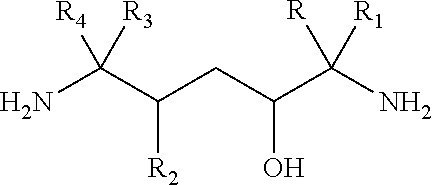
wherein R is independently hydrogen, alkyl, aryl, or —CH2OH; R1 is independently hydrogen, alkyl, or —CH2OH; alternatively, R and R1 may be linked together to form a cycloalkyl; R2 is independently hydrogen, methyl, alkyl, phenyl or substituted phenyl; R3 is independently hydrogen, alkyl, phenyl or substituted phenyl, or —CH2OH; R4 is independently hydrogen, alkyl, or —CH2OH; and alternatively, R3 and R4 may be linked together to form a cycloalkyl; wherein all weight percents are based on the total weight of the mineral slurry.

wherein R is independently hydrogen, alkyl, aryl, or —CH2OH; R1 is independently hydrogen, alkyl, or —CH2OH; alternatively, R and R1 may be linked together to form a cycloalkyl; R2 is independently hydrogen, methyl, alkyl, phenyl or substituted phenyl; R3 is independently hydrogen, alkyl, phenyl or substituted phenyl, or —CH2OH; R4 is independently hydrogen, alkyl, or —CH2OH; and alternatively, R3 and R4 may be linked together to form a cycloalkyl.

wherein R is independently hydrogen, alkyl, phenyl or substituted phenyl; R1 is independently hydrogen or alkyl; alternatively, R and R1 may be linked together to form a cycloalkyl; R2 is independently hydrogen, alkyl, or phenyl or substituted phenyl; R3 is independently hydrogen, alkyl, or aryl; R4 is independently hydrogen or alkyl; and alternatively, R3 and R4 may be linked together to form a cycloalkyl.

wherein R is hydrogen, R1 is hydrogen, alkyl, phenyl or substituted phenyl; or wherein R is alkyl, phenyl, or substituted phenyl, and R1 is alkyl, or R and R1 may be linked together to form a cycloalkyl. For example, without limitation, nitromethane, nitroethane, 2-nitropropane, nitrocyclohexane etc. are all suitable nitroalkanes for use as starting materials to prepare the diamino alcohol compounds in accordance with the present invention. More particularly, the primary or secondary nitroalkane may be a C1-C20 nitroalkane, a C1-C10 nitroalkane, or even a C2-C6 nitroalkane.

wherein R is hydrogen, methyl(alkyl), phenyl, or substituted phenyl. Suitable unsaturated aldehydes include, but are not limited to, acrolein, crotonaldehyde, cinnamaldehyde, derivatives of cinnamaldehyde substituted at the aromatic ring, etc.

wherein R is independently hydrogen, alkyl, aryl, or —CH2OH; R1 is independently hydrogen, alkyl, or —CH2OH; alternatively, R and R1 may be linked together to form a cycloalkyl; R2 is independently hydrogen, methyl, alkyl, phenyl or substituted phenyl; R3 is independently hydrogen, alkyl, aryl, or —CH2OH; R4 is independently hydrogen, alkyl, or —CH2OH; and alternatively, R3 and R4 may be linked together to form a cycloalkyl.

wherein R is independently hydrogen, alkyl, aryl, or —CH2OH; R1 is independently hydrogen, alkyl, or —CH2OH; alternatively, R and R1 may be linked together to form a cycloalkyl; R2 is independently hydrogen, methyl, alkyl, phenyl or substituted phenyl; R3 is independently hydrogen, alkyl, phenyl or substituted phenyl, or —CH2OH; R4 is independently hydrogen, alkyl, or —CH2OH; and alternatively, R3 and R4 may be linked together to form a cycloalkyl;
wherein all weight percents are based on the total weight of the mineral slurry.


| TABLE |
| performance of CROT-AMP-NH2 in calcined kaolin clay |
| Viscosity, cP, 100 rpm | ||
| clay solids (wt %) |
| Control | diamine-treated | |
| Test | (Dispex N40V only) | (no Dispex N40V) |
| 50.0 | 41 | 36 |
| dilatancy vs. control | — | slightly less |
| 51.0 | 46 | 40 |
| 52.0 | 54 | 44 |
| 53.0 | 58 | 50 |
| 54.0 | 64 | 55 |
Claims (7)


Priority Applications (1)
| Application Number | Priority Date | Filing Date | Title |
|---|---|---|---|
| US12/928,584 US8552072B2 (en) | 2009-12-22 | 2010-12-15 | Diamino-alcohol compounds, their manufacture and use in high solids mineral slurries |
Applications Claiming Priority (2)
| Application Number | Priority Date | Filing Date | Title |
|---|---|---|---|
| US28463609P | 2009-12-22 | 2009-12-22 | |
| US12/928,584 US8552072B2 (en) | 2009-12-22 | 2010-12-15 | Diamino-alcohol compounds, their manufacture and use in high solids mineral slurries |
Publications (2)
| Publication Number | Publication Date |
|---|---|
| US20110147649A1 US20110147649A1 (en) | 2011-06-23 |
| US8552072B2 true US8552072B2 (en) | 2013-10-08 |
Family
ID=43838058
Family Applications (1)
| Application Number | Title | Priority Date | Filing Date |
|---|---|---|---|
| US12/928,584 Active 2032-01-26 US8552072B2 (en) | 2009-12-22 | 2010-12-15 | Diamino-alcohol compounds, their manufacture and use in high solids mineral slurries |
Country Status (6)
| Country | Link |
|---|---|
| US (1) | US8552072B2 (en) |
| EP (1) | EP2348073B1 (en) |
| CN (1) | CN102249607B (en) |
| BR (1) | BRPI1004970B8 (en) |
| CA (1) | CA2723493C (en) |
| MX (1) | MX2010014001A (en) |
Families Citing this family (1)
| Publication number | Priority date | Publication date | Assignee | Title |
|---|---|---|---|---|
| US9228074B2 (en) | 2012-05-07 | 2016-01-05 | Burgess Pigment Company | Spray-dried, hydrous, kaolin clay and methods of making same |
Citations (6)
| Publication number | Priority date | Publication date | Assignee | Title |
|---|---|---|---|---|
| US2994660A (en) * | 1957-05-27 | 1961-08-01 | Magnet Cove Barium Corp | Water-in-oil emulsion drilling fluid |
| US20110152401A1 (en) * | 2009-12-22 | 2011-06-23 | Peera Asghar A | Novel diamino-alcohol compounds, their manufacture and use in coatings applications |
| US20110152574A1 (en) * | 2009-12-22 | 2011-06-23 | Peera Asghar A | Novel diamino-alcohol compounds and processes for their manufacture |
| US20110152407A1 (en) * | 2009-12-22 | 2011-06-23 | Asghar Akber Peera | Novel diamino-alcohol compounds, their manufacture and use in epoxy resins |
| US8070045B1 (en) * | 2010-12-02 | 2011-12-06 | Rohm And Haas Electronic Materials Llc | Curable amine flux composition and method of soldering |
| US8070044B1 (en) * | 2010-12-02 | 2011-12-06 | Rohm And Haas Electronic Materials Llc | Polyamine flux composition and method of soldering |
Family Cites Families (4)
| Publication number | Priority date | Publication date | Assignee | Title |
|---|---|---|---|---|
| US2475996A (en) | 1946-11-02 | 1949-07-12 | Shell Dev | Dinitro alcohols and process of producing the same from unsaturated aldehydes |
| US3112345A (en) * | 1960-04-08 | 1963-11-26 | Union Carbide Corp | Diamino cyclohexanols |
| US4017324A (en) * | 1974-02-19 | 1977-04-12 | Imc Chemical Group, Inc. | Clay slurries |
| DE10161818A1 (en) * | 2001-12-14 | 2003-06-26 | Gruenenthal Gmbh | New 1,5-diamino-pentan-3-ol derivatives, useful e.g. for the treatment of arrhythmia, emesis, migraine, narcolepsy, obesity, diarrhea, inflammation, asthma, glaucoma, depression or especially pain |
-
2010
- 2010-12-03 CA CA2723493A patent/CA2723493C/en active Active
- 2010-12-08 EP EP10194229A patent/EP2348073B1/en active Active
- 2010-12-15 US US12/928,584 patent/US8552072B2/en active Active
- 2010-12-16 MX MX2010014001A patent/MX2010014001A/en active IP Right Grant
- 2010-12-21 CN CN2010106251715A patent/CN102249607B/en active Active
- 2010-12-21 BR BRPI1004970A patent/BRPI1004970B8/en active IP Right Grant
Patent Citations (6)
| Publication number | Priority date | Publication date | Assignee | Title |
|---|---|---|---|---|
| US2994660A (en) * | 1957-05-27 | 1961-08-01 | Magnet Cove Barium Corp | Water-in-oil emulsion drilling fluid |
| US20110152401A1 (en) * | 2009-12-22 | 2011-06-23 | Peera Asghar A | Novel diamino-alcohol compounds, their manufacture and use in coatings applications |
| US20110152574A1 (en) * | 2009-12-22 | 2011-06-23 | Peera Asghar A | Novel diamino-alcohol compounds and processes for their manufacture |
| US20110152407A1 (en) * | 2009-12-22 | 2011-06-23 | Asghar Akber Peera | Novel diamino-alcohol compounds, their manufacture and use in epoxy resins |
| US8070045B1 (en) * | 2010-12-02 | 2011-12-06 | Rohm And Haas Electronic Materials Llc | Curable amine flux composition and method of soldering |
| US8070044B1 (en) * | 2010-12-02 | 2011-12-06 | Rohm And Haas Electronic Materials Llc | Polyamine flux composition and method of soldering |
Also Published As
| Publication number | Publication date |
|---|---|
| BRPI1004970B1 (en) | 2019-07-02 |
| CN102249607A (en) | 2011-11-23 |
| BRPI1004970A2 (en) | 2013-03-26 |
| CA2723493A1 (en) | 2011-06-22 |
| MX2010014001A (en) | 2011-07-19 |
| EP2348073A1 (en) | 2011-07-27 |
| BRPI1004970B8 (en) | 2019-07-30 |
| EP2348073B1 (en) | 2012-06-06 |
| CA2723493C (en) | 2013-08-06 |
| CN102249607B (en) | 2013-11-13 |
| US20110147649A1 (en) | 2011-06-23 |
Similar Documents
| Publication | Publication Date | Title |
|---|---|---|
| JP5628900B2 (en) | Polyhydroxy-diamines as multifunctional additives for paints, coatings and epoxy resins | |
| US8697915B2 (en) | Diamino-alcohol compounds and processes for their manufacture | |
| JP5890315B2 (en) | Amino alcohol compounds, precursors, and methods of preparation and use | |
| TWI580665B (en) | Styrenated phenol compound and method of preparing the same | |
| EP2348073B1 (en) | Use of diamino-alcohol compouds in high solids mineral slurries | |
| CN102666473B (en) | Low-voc polyamines | |
| EP2338941B1 (en) | Novel diamino-alcohol compounds, their manufacture and use in coatings applications | |
| US9469587B2 (en) | Styrenated phenol compound and a method of preparing the same | |
| EP2464621B1 (en) | Method for preparing polyamine compounds | |
| CN118895068A (en) | A kind of odorless industrial water-based anticorrosive paint and preparation method thereof |
Legal Events
| Date | Code | Title | Description |
|---|---|---|---|
| STCF | Information on status: patent grant |
Free format text: PATENTED CASE |
|
| AS | Assignment |
Owner name: DOW GLOBAL TECHNOLOGIES LLC, MICHIGAN Free format text: ASSIGNMENT OF ASSIGNORS INTEREST;ASSIGNOR:THE DOW CHEMICAL COMPANY;REEL/FRAME:034237/0601 Effective date: 20141112 Owner name: ANGUS CHEMICAL COMPANY, ILLINOIS Free format text: ASSIGNMENT OF ASSIGNORS INTEREST;ASSIGNOR:PEERA, ASGHAR;REEL/FRAME:034160/0624 Effective date: 20110215 Owner name: THE DOW CHEMICAL COMPANY, MICHIGAN Free format text: ASSIGNMENT OF ASSIGNORS INTEREST;ASSIGNORS:TOMLINSON, IAN A.;ROBINSON, GLENN;SIGNING DATES FROM 20110224 TO 20110307;REEL/FRAME:034160/0660 |
|
| AS | Assignment |
Owner name: JPMORGAN CHASE BANK, N.A., AS COLLATERAL AGENT, IL Free format text: SECURITY AGREEMENT;ASSIGNOR:ANGUS CHEMICAL COMPANY;REEL/FRAME:034881/0001 Effective date: 20150202 |
|
| AS | Assignment |
Owner name: ANGUS CHEMICAL COMPANY, ILLINOIS Free format text: ASSIGNMENT OF ASSIGNORS INTEREST;ASSIGNOR:DOW GLOBAL TECHNOLOGIES LLC;REEL/FRAME:035213/0405 Effective date: 20150202 |
|
| FEPP | Fee payment procedure |
Free format text: PAT HOLDER CLAIMS SMALL ENTITY STATUS, ENTITY STATUS SET TO SMALL (ORIGINAL EVENT CODE: LTOS); ENTITY STATUS OF PATENT OWNER: SMALL ENTITY |
|
| FPAY | Fee payment |
Year of fee payment: 4 |
|
| AS | Assignment |
Owner name: ANGUS CHEMICAL COMPANY, ILLINOIS Free format text: RELEASE BY SECURED PARTY;ASSIGNOR:JPMORGAN CHASE BANK, N.A.;REEL/FRAME:054586/0231 Effective date: 20201124 |
|
| AS | Assignment |
Owner name: JPMORGAN CHASE BANK, N.A., AS COLLATERAL AGENT, NEW YORK Free format text: PATENT SECURITY AGREEMENT (1ST LIEN);ASSIGNOR:ANGUS CHEMICAL COMPANY;REEL/FRAME:054553/0706 Effective date: 20201124 Owner name: JEFFERIES FINANCE LLC, AS COLLATERAL AGENT, NEW YORK Free format text: PATENT SECURITY AGREEMENT (2ND LIEN);ASSIGNOR:ANGUS CHEMICAL COMPANY;REEL/FRAME:054553/0719 Effective date: 20201124 |
|
| MAFP | Maintenance fee payment |
Free format text: PAYMENT OF MAINTENANCE FEE, 8TH YR, SMALL ENTITY (ORIGINAL EVENT CODE: M2552); ENTITY STATUS OF PATENT OWNER: SMALL ENTITY Year of fee payment: 8 |
|
| AS | Assignment |
Owner name: ADVANCION CORPORATION, ILLINOIS Free format text: CHANGE OF NAME;ASSIGNOR:ANGUS CHEMICAL COMPANY;REEL/FRAME:066697/0518 Effective date: 20230901 |
|
| MAFP | Maintenance fee payment |
Free format text: PAYMENT OF MAINTENANCE FEE, 12TH YR, SMALL ENTITY (ORIGINAL EVENT CODE: M2553); ENTITY STATUS OF PATENT OWNER: SMALL ENTITY Year of fee payment: 12 |