US8548044B2 - Rate control in a video encoder according to a bit count estimate - Google Patents
Rate control in a video encoder according to a bit count estimate Download PDFInfo
- Publication number
- US8548044B2 US8548044B2 US11/043,575 US4357505A US8548044B2 US 8548044 B2 US8548044 B2 US 8548044B2 US 4357505 A US4357505 A US 4357505A US 8548044 B2 US8548044 B2 US 8548044B2
- Authority
- US
- United States
- Prior art keywords
- encoder
- bit count
- estimate
- bit
- rate controller
- Prior art date
- Legal status (The legal status is an assumption and is not a legal conclusion. Google has not performed a legal analysis and makes no representation as to the accuracy of the status listed.)
- Active, expires
Links
Images



Classifications
-
- H—ELECTRICITY
- H04—ELECTRIC COMMUNICATION TECHNIQUE
- H04N—PICTORIAL COMMUNICATION, e.g. TELEVISION
- H04N19/00—Methods or arrangements for coding, decoding, compressing or decompressing digital video signals
- H04N19/10—Methods or arrangements for coding, decoding, compressing or decompressing digital video signals using adaptive coding
- H04N19/189—Methods or arrangements for coding, decoding, compressing or decompressing digital video signals using adaptive coding characterised by the adaptation method, adaptation tool or adaptation type used for the adaptive coding
- H04N19/192—Methods or arrangements for coding, decoding, compressing or decompressing digital video signals using adaptive coding characterised by the adaptation method, adaptation tool or adaptation type used for the adaptive coding the adaptation method, adaptation tool or adaptation type being iterative or recursive
- H04N19/194—Methods or arrangements for coding, decoding, compressing or decompressing digital video signals using adaptive coding characterised by the adaptation method, adaptation tool or adaptation type used for the adaptive coding the adaptation method, adaptation tool or adaptation type being iterative or recursive involving only two passes
-
- H—ELECTRICITY
- H04—ELECTRIC COMMUNICATION TECHNIQUE
- H04N—PICTORIAL COMMUNICATION, e.g. TELEVISION
- H04N19/00—Methods or arrangements for coding, decoding, compressing or decompressing digital video signals
- H04N19/10—Methods or arrangements for coding, decoding, compressing or decompressing digital video signals using adaptive coding
- H04N19/102—Methods or arrangements for coding, decoding, compressing or decompressing digital video signals using adaptive coding characterised by the element, parameter or selection affected or controlled by the adaptive coding
- H04N19/124—Quantisation
-
- H—ELECTRICITY
- H04—ELECTRIC COMMUNICATION TECHNIQUE
- H04N—PICTORIAL COMMUNICATION, e.g. TELEVISION
- H04N19/00—Methods or arrangements for coding, decoding, compressing or decompressing digital video signals
- H04N19/10—Methods or arrangements for coding, decoding, compressing or decompressing digital video signals using adaptive coding
- H04N19/134—Methods or arrangements for coding, decoding, compressing or decompressing digital video signals using adaptive coding characterised by the element, parameter or criterion affecting or controlling the adaptive coding
- H04N19/146—Data rate or code amount at the encoder output
- H04N19/149—Data rate or code amount at the encoder output by estimating the code amount by means of a model, e.g. mathematical model or statistical model
-
- H—ELECTRICITY
- H04—ELECTRIC COMMUNICATION TECHNIQUE
- H04N—PICTORIAL COMMUNICATION, e.g. TELEVISION
- H04N19/00—Methods or arrangements for coding, decoding, compressing or decompressing digital video signals
- H04N19/10—Methods or arrangements for coding, decoding, compressing or decompressing digital video signals using adaptive coding
- H04N19/134—Methods or arrangements for coding, decoding, compressing or decompressing digital video signals using adaptive coding characterised by the element, parameter or criterion affecting or controlling the adaptive coding
- H04N19/146—Data rate or code amount at the encoder output
- H04N19/15—Data rate or code amount at the encoder output by monitoring actual compressed data size at the memory before deciding storage at the transmission buffer
-
- H—ELECTRICITY
- H04—ELECTRIC COMMUNICATION TECHNIQUE
- H04N—PICTORIAL COMMUNICATION, e.g. TELEVISION
- H04N19/00—Methods or arrangements for coding, decoding, compressing or decompressing digital video signals
- H04N19/10—Methods or arrangements for coding, decoding, compressing or decompressing digital video signals using adaptive coding
- H04N19/169—Methods or arrangements for coding, decoding, compressing or decompressing digital video signals using adaptive coding characterised by the coding unit, i.e. the structural portion or semantic portion of the video signal being the object or the subject of the adaptive coding
- H04N19/17—Methods or arrangements for coding, decoding, compressing or decompressing digital video signals using adaptive coding characterised by the coding unit, i.e. the structural portion or semantic portion of the video signal being the object or the subject of the adaptive coding the unit being an image region, e.g. an object
- H04N19/176—Methods or arrangements for coding, decoding, compressing or decompressing digital video signals using adaptive coding characterised by the coding unit, i.e. the structural portion or semantic portion of the video signal being the object or the subject of the adaptive coding the unit being an image region, e.g. an object the region being a block, e.g. a macroblock
-
- H—ELECTRICITY
- H04—ELECTRIC COMMUNICATION TECHNIQUE
- H04N—PICTORIAL COMMUNICATION, e.g. TELEVISION
- H04N19/00—Methods or arrangements for coding, decoding, compressing or decompressing digital video signals
- H04N19/60—Methods or arrangements for coding, decoding, compressing or decompressing digital video signals using transform coding
- H04N19/61—Methods or arrangements for coding, decoding, compressing or decompressing digital video signals using transform coding in combination with predictive coding
Definitions
- One of the key components of a video encoder is a robust rate control technology that can intelligently maximize output video quality while meeting the stringent requirements of a system or product design. For example, in video communications applications it is often necessary to transmit at a fixed bit rate. Any extra amount of information transmitted beyond this fixed bit rate would be discarded, and transmitting at a lower bit rate would be a waste of bandwidth. When the bandwidth is wasted, video quality is less than ideal. Similarly, preparing a video stream for media storage (e.g. DVD) necessitates the population of a disk to the maximum capacity such that no disk partition is wasted.
- media storage e.g. DVD
- Encoded video should minimize spatial and temporal redundancies to achieve compression and optimize bandwidth usage.
- QoS Quality of Service
- video compression systems exploit the statistical redundancies in video sources by entropy encoding.
- cutting edge video encoders make use of sophisticated tools to de-correlate spatial, temporal, and spectral sample dependencies, there are still some hidden statistical redundancies which remain embedded in the stream. Thorough identification of such redundancies plays a major role in reducing the size of the final output video stream.
- These redundancies are higher order correlations that are next to impossible to distinguish with low order predictors and are best identified via entropy coders. Since video sources are non-stationary in statistical sense, advanced entropy coders can take advantage of context modeling to adapt to changes in the source and achieve better compaction.
- bit rate controller uses these deviations for future adjustments.
- bits output from a video encoder can be delayed by the inherent complexity of this encoding technique. Therefore, a new approach is required for controlling bit rate in a video encoder that uses an advanced entropy engine.
- rate controllers for use in encoding video data.
- a rate controller in a video encoder system is presented.
- the rate controller is comprised of a bit count estimator and a quantization selector.
- the bit count estimator receives an input to an encoder and generates a bit count estimate.
- the bit count estimate is an approximation of a bit count at an output of the encoder.
- the quantization selector sets a quantization value based on the bit count estimate.
- a method for rate control is presented.
- a bit count estimate is generated based on an input to an encoder.
- the bit count estimate is an estimate of a bit count at an output of the encoder.
- a quantizer level is selected based on the bit count estimate.
- an integrated circuit for controlling bit rate in a video encoder comprises arithmetic logic and memory.
- the arithmetic logic is operable to calculate a bit count estimate for a picture or portion of a picture.
- the memory is operable to store quantization levels that may be used by the video encoder.
- the arithmetic logic selects a quantization level to be used by the video encoder based on the bit count estimate.
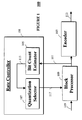
- FIG. 1 is a block diagram of an exemplary video system with a rate controller in accordance with an embodiment of the present invention
- FIG. 2 is another block diagram of an exemplary video system with a rate controller in accordance with an embodiment of the present invention
- FIG. 3 is a flow diagram of an exemplary method for rate control in accordance with an embodiment of the present invention.
- FIG. 4 is another flow diagram of an exemplary method for rate control in accordance with an embodiment of the present invention.
- a target bit rate can be met since an estimate of bit count is generated in real-time even while advanced entropy encoders are enabled.
- a video encoder performs the task of compression.
- the video encoder minimizes spatial, temporal, spectral, and statistical redundancies to achieve compression.
- Entropy encoding is well suited for the removal of statistical redundancies. With advanced entropy encoding, the number of bits (or bit rate) output from an entropy encoder in the video encoder must be fed back to a rate controller quickly, but the inherent complexity of advanced entropy encoding will delay the generation of these output bits.
- the video encoder would have to resort to using a simpler (less efficient) entropy encoder to generate the video encoder output.
- the use of less efficient entropy encoders reduces the overall compression ratio of a system, and output quality suffers.
- FIG. 1 a block diagram of an exemplary video system 100 with a rate controller 101 is presented.
- the video system 100 includes an encoder 103 and block processor 109 .
- Source video 119 is input to a block processor 109 .
- the block processor 109 may be responsible for transformation, quantization, motion estimation, motion compensation, and inverse transformation.
- a block processor output 111 enters the encoder 103 , and a video encoder output 113 is produced.
- the encoder 103 is complicated, there could be a processing delay that prohibits a direct count of the bits in the video encoder output 113 in real-time.
- the processing delay can be a function of aspects such as bit rate and picture complexity, and during a scene change, the encoder 103 can fall behind the block processor 109 .
- a bit count estimator 105 can be used to generate a bit count estimate 115 .
- a quantization selector 107 uses the bit count estimate 115 .
- a series of quantization levels may be precomputed and stored in memory.
- the bit count estimator 105 can compensate for the processing delay and provide a seamless transition in video quality at data boundaries where there could be a bottleneck. Design of the bit count estimator 105 can be done off-line and have either constant or picture adaptive parameters. The bit count estimator 105 may be designed in arithmetic logic as a co-processor.
- MPEG Moving Picture Experts Group
- the Moving Picture Experts Group standardizes digital video encoding.
- One exemplary standard is the ITU-H.264 Standard (H.264).
- H.264 is also known as MPEG-4, Part 10, and Advanced Video Coding.
- video is encoded on a picture-by-picture basis, and pictures are encoded on a macroblock by macroblock basis.
- H.264 specifies the use of spatial prediction, temporal prediction, transformation, interlaced coding, and lossless entropy coding to compress the macroblocks.
- picture is used throughout this specification to generically refer to frames, fields, macroblocks, or portions thereof.
- MPEG-4 Part 10 specifies two types of entropy coding: Context-based Adaptive Binary Arithmetic Coding (CABAC) and Context-based Adaptive Variable-Length Coding (CAVLC).
- CABAC Context-based Adaptive Binary Arithmetic Coding
- CAVLC Context-based Adaptive Variable-Length Coding
- CABAC Context-Based Adaptive Arithmetic Coding
- the stages of CABAC are Binarization, Context Model Selection, Arithmetic Encoding, and Context Model Updating.
- Binarization converts a non-binary-valued symbol into a binary code prior to arithmetic coding. Quantized input values are reduced in range to create symbols of one's and zeros for each input value. The result of Binarization is called a bin string or bins.
- Context Model Selection is used to determine an accurate probability model for one or more bins of the bin string.
- the context modeler samples the input bins and assigns probability models based on a frequency of observed bins. This model may be chosen from a selection of available models depending on the statistics of recently coded data symbols.
- the context model stores the probability of each bin being “1” or “0”.
- each bin is encoded according to the selected context model. There are just two sub-ranges for each bin: corresponding to “0” and “1”.
- a mapping engine utilizes the context model and assigns bits to input bins. Generated bits are to be embedded in an outgoing video stream. Context model updating is based on the actual coded value (e.g. if the bit value was “1”, the frequency count of “1”s is increased). The same generated bits that are to be embedded in the outgoing video stream are fed back to context modeling to update probabilities of observed events.
- FIG. 2 another block diagram of an exemplary video system 200 with a rate controller 207 is presented.
- the rate controller 207 is comprised of a bit count estimator 205 , a bit comparator 217 , a bit assigner 219 , and a quantization selector 209 .
- the video system 200 includes an encoder 203 , a block processor 211 , and a binarizer 201 .
- Source video 221 is input to a block processor 211 .
- a block processor output 223 enters the binarizer 201 , and a bin string 225 is produced.
- the binarizer 201 , a context modeler 213 , and an arithmetic encoder 215 perform the stages of CABAC as described previously.
- the arithmetic encoder 215 uses a context model 229 .
- the encoder output 227 is used to update the context modeler 213 , and in some cases, the encoder output 227 can be used by the bit count estimator 205 as a part of the bit count estimate 231 or to update a bins-to-bits function in the bit count estimator 205 .
- Coefficients, a 0 , a 1 , a 2 , . . . a N can remain constant or adapt to the content of the video in real-time.
- the video encoder output 113 of the encoder 103 is supplied to the bins-to-bits function in the bit count estimator 105 to fine-tune coefficients, a 0 , a 1 , a 2 , . . . a N , as the statistical nature of the source changes over time.
- the bins-to-bits function may keep useful operating points and discard unnecessary data. For example, points taken from a certain scene should not be used to estimate bits in another scene, and different bins-to-bits functions can be adopted to accommodate delays in different picture types.
- the binarizer 201 is relatively fast while the context modeler 213 and the arithmetic encoder 215 can take more time.
- the complexity of an adaptive entropy encoder may be due to silicon technology limitations and the fact that accurate probability models require the processing of a large number of samples. While the context adaptive entropy engine is occupied with digesting the sample field, the rest of the video encoder hardware or software blocks will move forward in time. Very large pictures or very high bit rates further advance the delay. Further, some static sequences might be comprised of a super-sized picture. Consequently, the encoder output 227 can be delayed from time to time when certain modules of the video encoders would want to sample them instantly.
- the rate controller 207 is responsible for meeting a set bit-rate for the compressed video stream. However, due to the complexity of the encoder 203 , it might take significant clock cycles to process enough bins to deduce reliable probability functions for the context modeler 213 . In this case, the encoder output 227 is not accessible by the rate controller 207 . This means the encoder output 227 would be ready sometimes in the future as a feedback. The rate controller 207 solves this delay bottleneck by sampling the binarizer output 225 that is instantly available. Bins are fed to a bins-to-bits function to generate a bit count estimate 231 (or portion thereof).
- the bit assigner 219 of the rate controller 207 computes a balance defined as ideal bits 233 against which the bit count estimate 231 is compared.
- the bit assigner 219 could be different for a group of pictures, a picture, a series of macroblocks, or other collection of image samples.
- the comparison in the form of delta bits 235 is input back to the bit assigner 219 .
- Another bit assigner output 237 is used to select a quantization level 239 for the block processor 211 .
- the ideal bits 233 may be assigned for an accumulated number of macroblocks. If the block processor 211 has just finished processing the n th macroblock and another series of calculations for macroblock n+1 begins, the rate controller 207 requires the encoder output 227 . There are three scenarios:
- Partial bits would be available when the output of the bit encoder 203 (or entropy engine) lags the block processor 223 by a few macroblocks, but not exceeding the boundary of the picture. Partial bits can be combined with the bit count estimate to produce a new bit count estimate. For the scenario when no count is available, the delay of entropy engine is larger than n macroblocks, and the entropy engine is still busy processing data in a previous picture. Therefore, sampling of a current picture has not begun. Since a lag is created, there is no contribution from an actual bit count in the bit count estimate 231 , and the best estimate of delayed bits is wholly provided by the bins-to-bits function.
- bit count estimate 231 of delayed bits is compared against ideal bits 233 and a difference in the form of delta bits 235 is fed back to the bit assigner 219 to set (by way of the quantization selector 209 ) a proper quantizer value 239 for encoding of the next macroblock indexed by n+1.
- FIG. 3 is a flow diagram of an exemplary method for rate control 300 .
- a bit count estimate of an encoder output is generated based on an encoder input 305 .
- a quantization level is selected based on the bit count estimate 310 .
- FIG. 4 is another flow diagram of an exemplary method for rate control 400 .
- First binarize one or more symbols to generate a encoder input 405 .
- the embodiments described herein may be implemented as a board level product, as a single chip, application specific integrated circuit (ASIC), or with varying levels of a video classification circuit integrated with other portions of the system as separate components.
- ASIC application specific integrated circuit
- the degree of integration of the video classification circuit will primarily be determined by the speed and cost considerations. Because of the sophisticated nature of modern processors, it is possible to utilize a commercially available processor, which may be implemented external to an ASIC implementation.
- processor is available as an ASIC core or logic block, then the commercially available processor can be implemented as part of an ASIC device wherein certain functions can be implemented in firmware as instructions stored in a memory. Alternatively, the functions can be implemented as hardware accelerator units controlled by the processor.
Landscapes
- Engineering & Computer Science (AREA)
- Multimedia (AREA)
- Signal Processing (AREA)
- Physics & Mathematics (AREA)
- Algebra (AREA)
- General Physics & Mathematics (AREA)
- Mathematical Analysis (AREA)
- Mathematical Optimization (AREA)
- Pure & Applied Mathematics (AREA)
- Compression Or Coding Systems Of Tv Signals (AREA)
Abstract
Description
-
- 1) The total accumulated number of bits at the
encoder output 227 for macroblocks 1 through n is available, and this value is provided to therate controller 207; - 2) Only the total accumulated number of bits at the
encoder output 227 for macroblocks 1 through m (m<n) is available; and - 3) No count is available.
- 1) The total accumulated number of bits at the
Claims (18)
Priority Applications (2)
| Application Number | Priority Date | Filing Date | Title |
|---|---|---|---|
| US11/043,575 US8548044B2 (en) | 2005-01-26 | 2005-01-26 | Rate control in a video encoder according to a bit count estimate |
| US11/412,268 US9781433B2 (en) | 2005-01-26 | 2006-04-27 | Systems, methods, and apparatus for real-time video encoding |
Applications Claiming Priority (1)
| Application Number | Priority Date | Filing Date | Title |
|---|---|---|---|
| US11/043,575 US8548044B2 (en) | 2005-01-26 | 2005-01-26 | Rate control in a video encoder according to a bit count estimate |
Related Child Applications (1)
| Application Number | Title | Priority Date | Filing Date |
|---|---|---|---|
| US11/412,268 Continuation-In-Part US9781433B2 (en) | 2005-01-26 | 2006-04-27 | Systems, methods, and apparatus for real-time video encoding |
Publications (2)
| Publication Number | Publication Date |
|---|---|
| US20060165165A1 US20060165165A1 (en) | 2006-07-27 |
| US8548044B2 true US8548044B2 (en) | 2013-10-01 |
Family
ID=36696734
Family Applications (1)
| Application Number | Title | Priority Date | Filing Date |
|---|---|---|---|
| US11/043,575 Active 2033-05-14 US8548044B2 (en) | 2005-01-26 | 2005-01-26 | Rate control in a video encoder according to a bit count estimate |
Country Status (1)
| Country | Link |
|---|---|
| US (1) | US8548044B2 (en) |
Families Citing this family (6)
| Publication number | Priority date | Publication date | Assignee | Title |
|---|---|---|---|---|
| US9781433B2 (en) * | 2005-01-26 | 2017-10-03 | Avago Technologies General Ip (Singapore) Pte. Ltd. | Systems, methods, and apparatus for real-time video encoding |
| CN100425079C (en) * | 2006-08-07 | 2008-10-08 | 浙江大学 | Video Compression Rate Control Method Based on Low Memory Consumption Lookup Table |
| JP5330672B2 (en) * | 2007-10-29 | 2013-10-30 | パナソニック株式会社 | Video encoding apparatus and video encoding method |
| JP4915350B2 (en) * | 2008-01-16 | 2012-04-11 | 日本電気株式会社 | Entropy encoder, video encoding device, video encoding method, and video encoding program |
| US8711927B2 (en) * | 2008-12-11 | 2014-04-29 | Stmicroelectronics International N.V. | System and method for video encoding |
| US10021409B2 (en) * | 2012-05-09 | 2018-07-10 | Integrated Device Technology, Inc. | Apparatuses and methods for estimating bitstream bit counts |
Citations (2)
| Publication number | Priority date | Publication date | Assignee | Title |
|---|---|---|---|---|
| US20050084007A1 (en) * | 2003-10-16 | 2005-04-21 | Lightstone Michael L. | Apparatus, system, and method for video encoder rate control |
| US20060159355A1 (en) * | 2005-01-19 | 2006-07-20 | Mega Chips Lsi Solutions Inc. | Rate control system |
-
2005
- 2005-01-26 US US11/043,575 patent/US8548044B2/en active Active
Patent Citations (2)
| Publication number | Priority date | Publication date | Assignee | Title |
|---|---|---|---|---|
| US20050084007A1 (en) * | 2003-10-16 | 2005-04-21 | Lightstone Michael L. | Apparatus, system, and method for video encoder rate control |
| US20060159355A1 (en) * | 2005-01-19 | 2006-07-20 | Mega Chips Lsi Solutions Inc. | Rate control system |
Non-Patent Citations (1)
| Title |
|---|
| D. Marpe, H. Schwarz and T. Weigand, "Context-Based Adaptive Binary Arithmetic Coding in the H.264/AVC Video Comression Standard", IEEE Trans.Circuits Syst. Video Technol., vol. 13, No. 7, pp. 620-636, Jul. 2003. * |
Also Published As
| Publication number | Publication date |
|---|---|
| US20060165165A1 (en) | 2006-07-27 |
Similar Documents
| Publication | Publication Date | Title |
|---|---|---|
| US20060176953A1 (en) | Method and system for video encoding with rate control | |
| KR100585901B1 (en) | Digital signal coding device, digital signal decoding device, digital signal arithmetic coding method and digital signal arithmetic decoding method | |
| JP2007158430A (en) | Image information encoding device | |
| US10021409B2 (en) | Apparatuses and methods for estimating bitstream bit counts | |
| US20060165165A1 (en) | Rate control in a video encoder | |
| US7864839B2 (en) | Method and system for rate control in a video encoder | |
| Im et al. | More probability estimators for CABAC in versatile video coding | |
| US9781433B2 (en) | Systems, methods, and apparatus for real-time video encoding | |
| US20060222251A1 (en) | Method and system for frame/field coding | |
| US7924915B2 (en) | Method and system for encoding video data | |
| JP5632328B2 (en) | Code amount prediction apparatus and program |
Legal Events
| Date | Code | Title | Description |
|---|---|---|---|
| AS | Assignment |
Owner name: BROADCOM ADVANCED COMPRESSION GROUP, LLC, MASSACHU Free format text: ASSIGNMENT OF ASSIGNORS INTEREST;ASSIGNOR:MOHSENIAN, NADER;REEL/FRAME:015909/0811 Effective date: 20050125 |
|
| AS | Assignment |
Owner name: BROADCOM CORPORATION, CALIFORNIA Free format text: ASSIGNMENT OF ASSIGNORS INTEREST;ASSIGNOR:BROADCOM ADVANCED COMPRESSION GROUP, LLC;REEL/FRAME:022299/0916 Effective date: 20090212 Owner name: BROADCOM CORPORATION,CALIFORNIA Free format text: ASSIGNMENT OF ASSIGNORS INTEREST;ASSIGNOR:BROADCOM ADVANCED COMPRESSION GROUP, LLC;REEL/FRAME:022299/0916 Effective date: 20090212 |
|
| STCF | Information on status: patent grant |
Free format text: PATENTED CASE |
|
| AS | Assignment |
Owner name: BANK OF AMERICA, N.A., AS COLLATERAL AGENT, NORTH CAROLINA Free format text: PATENT SECURITY AGREEMENT;ASSIGNOR:BROADCOM CORPORATION;REEL/FRAME:037806/0001 Effective date: 20160201 Owner name: BANK OF AMERICA, N.A., AS COLLATERAL AGENT, NORTH Free format text: PATENT SECURITY AGREEMENT;ASSIGNOR:BROADCOM CORPORATION;REEL/FRAME:037806/0001 Effective date: 20160201 |
|
| AS | Assignment |
Owner name: AVAGO TECHNOLOGIES GENERAL IP (SINGAPORE) PTE. LTD., SINGAPORE Free format text: ASSIGNMENT OF ASSIGNORS INTEREST;ASSIGNOR:BROADCOM CORPORATION;REEL/FRAME:041706/0001 Effective date: 20170120 Owner name: AVAGO TECHNOLOGIES GENERAL IP (SINGAPORE) PTE. LTD Free format text: ASSIGNMENT OF ASSIGNORS INTEREST;ASSIGNOR:BROADCOM CORPORATION;REEL/FRAME:041706/0001 Effective date: 20170120 |
|
| AS | Assignment |
Owner name: BROADCOM CORPORATION, CALIFORNIA Free format text: TERMINATION AND RELEASE OF SECURITY INTEREST IN PATENTS;ASSIGNOR:BANK OF AMERICA, N.A., AS COLLATERAL AGENT;REEL/FRAME:041712/0001 Effective date: 20170119 |
|
| FPAY | Fee payment |
Year of fee payment: 4 |
|
| AS | Assignment |
Owner name: AVAGO TECHNOLOGIES INTERNATIONAL SALES PTE. LIMITE Free format text: MERGER;ASSIGNOR:AVAGO TECHNOLOGIES GENERAL IP (SINGAPORE) PTE. LTD.;REEL/FRAME:047230/0910 Effective date: 20180509 |
|
| AS | Assignment |
Owner name: AVAGO TECHNOLOGIES INTERNATIONAL SALES PTE. LIMITE Free format text: CORRECTIVE ASSIGNMENT TO CORRECT THE EFFECTIVE DATE OF THE MERGER PREVIOUSLY RECORDED AT REEL: 047230 FRAME: 0910. ASSIGNOR(S) HEREBY CONFIRMS THE MERGER;ASSIGNOR:AVAGO TECHNOLOGIES GENERAL IP (SINGAPORE) PTE. LTD.;REEL/FRAME:047351/0384 Effective date: 20180905 |
|
| AS | Assignment |
Owner name: AVAGO TECHNOLOGIES INTERNATIONAL SALES PTE. LIMITE Free format text: CORRECTIVE ASSIGNMENT TO CORRECT THE ERROR IN RECORDING THE MERGER IN THE INCORRECT US PATENT NO. 8,876,094 PREVIOUSLY RECORDED ON REEL 047351 FRAME 0384. ASSIGNOR(S) HEREBY CONFIRMS THE MERGER;ASSIGNOR:AVAGO TECHNOLOGIES GENERAL IP (SINGAPORE) PTE. LTD.;REEL/FRAME:049248/0558 Effective date: 20180905 |
|
| MAFP | Maintenance fee payment |
Free format text: PAYMENT OF MAINTENANCE FEE, 8TH YEAR, LARGE ENTITY (ORIGINAL EVENT CODE: M1552); ENTITY STATUS OF PATENT OWNER: LARGE ENTITY Year of fee payment: 8 |
|
| MAFP | Maintenance fee payment |
Free format text: PAYMENT OF MAINTENANCE FEE, 12TH YEAR, LARGE ENTITY (ORIGINAL EVENT CODE: M1553); ENTITY STATUS OF PATENT OWNER: LARGE ENTITY Year of fee payment: 12 |