US8546404B2 - Compounds that are ERK inhibitors - Google Patents
Compounds that are ERK inhibitorsInfo
- Publication number
- US8546404B2 US8546404B2 US11/810,282 US81028207A US8546404B2 US 8546404 B2 US8546404 B2 US 8546404B2 US 81028207 A US81028207 A US 81028207A US 8546404 B2 US8546404 B2 US 8546404B2
- Authority
- US
- United States
- Prior art keywords
- compound
- group
- substituted
- alkyl
- formula
- Prior art date
- Legal status (The legal status is an assumption and is not a legal conclusion. Google has not performed a legal analysis and makes no representation as to the accuracy of the status listed.)
- Active, expires
Links
- 0 [1*]C1=NNC2=C1C=C(NC(=O)C1([2*])CN(C([35*])([35*])C(C)=O)CC1[8*])C=C2 Chemical compound [1*]C1=NNC2=C1C=C(NC(=O)C1([2*])CN(C([35*])([35*])C(C)=O)CC1[8*])C=C2 0.000 description 148
- WYYCGJHDDHWKSD-LHTANEHXSA-N C#CC1(C(=O)NC2=CC=C3NN=C(C4=CC=C(F)C=C4)C3=C2)CCN(CC(=O)N2CCN(C3=CC=C(C4=NC=CC=N4)C=N3)C[C@H]2C)C1 Chemical compound C#CC1(C(=O)NC2=CC=C3NN=C(C4=CC=C(F)C=C4)C3=C2)CCN(CC(=O)N2CCN(C3=CC=C(C4=NC=CC=N4)C=N3)C[C@H]2C)C1 WYYCGJHDDHWKSD-LHTANEHXSA-N 0.000 description 5
- RPVRYVTWDMJMTB-UHFFFAOYSA-N CC(C)C1=CC=NC(C2CC2)=C1 Chemical compound CC(C)C1=CC=NC(C2CC2)=C1 RPVRYVTWDMJMTB-UHFFFAOYSA-N 0.000 description 5
- YWVVIBOXHWIQMY-UHFFFAOYSA-N CC1=CC(C(C)C)=CC=N1 Chemical compound CC1=CC(C(C)C)=CC=N1 YWVVIBOXHWIQMY-UHFFFAOYSA-N 0.000 description 5
- DPZYBMURJGUYOT-DIPNUNPCSA-N COC[C@@]1(C(=O)NC2=CC=C3NN=C(C4=CC=C(F)C=C4)C3=C2)CCN(CC(=O)N2CC=C(C3=CC=C(C4=NC=CC=N4)C=C3)CC2)C1 Chemical compound COC[C@@]1(C(=O)NC2=CC=C3NN=C(C4=CC=C(F)C=C4)C3=C2)CCN(CC(=O)N2CC=C(C3=CC=C(C4=NC=CC=N4)C=C3)CC2)C1 DPZYBMURJGUYOT-DIPNUNPCSA-N 0.000 description 5
- PYLWMHQQBFSUBP-UHFFFAOYSA-N FC1=CC=CC=C1 Chemical compound FC1=CC=CC=C1 PYLWMHQQBFSUBP-UHFFFAOYSA-N 0.000 description 5
- HRSRBPFPKWZUOU-UHFFFAOYSA-N C#CC1(C(=O)NC2=CC3=C(C=C2)NN=C3C2=CC=NC(C)=C2)CCN(CC(=O)N2CCN(C3=CC=C(C4=NC=CC=N4)C=C3)CC2)C1 Chemical compound C#CC1(C(=O)NC2=CC3=C(C=C2)NN=C3C2=CC=NC(C)=C2)CCN(CC(=O)N2CCN(C3=CC=C(C4=NC=CC=N4)C=C3)CC2)C1 HRSRBPFPKWZUOU-UHFFFAOYSA-N 0.000 description 4
- ODTSUCBJCBEESS-UHFFFAOYSA-N C#CCC1(C(=O)NC2=CC=C3NN=C(C4=CC=C(F)C=C4)C3=C2)CCN(CC(=O)N2CCN(C3=CC=C(C4=NC=C(F)C=N4)C=C3)CC2)C1 Chemical compound C#CCC1(C(=O)NC2=CC=C3NN=C(C4=CC=C(F)C=C4)C3=C2)CCN(CC(=O)N2CCN(C3=CC=C(C4=NC=C(F)C=N4)C=C3)CC2)C1 ODTSUCBJCBEESS-UHFFFAOYSA-N 0.000 description 4
- NJDYAKTZJWXXDG-UHFFFAOYSA-N CC(O)C1(C(=O)NC2=CC3=C(C=C2)NN=C3C2=CC=C(F)C=C2)CCN(CC(=O)N2CCN(C3=CC=C(C4=NC=CC=N4)C=C3)CC2)C1 Chemical compound CC(O)C1(C(=O)NC2=CC3=C(C=C2)NN=C3C2=CC=C(F)C=C2)CCN(CC(=O)N2CCN(C3=CC=C(C4=NC=CC=N4)C=C3)CC2)C1 NJDYAKTZJWXXDG-UHFFFAOYSA-N 0.000 description 4
- HFPZCAJZSCWRBC-UHFFFAOYSA-N CC1=CC=C(C(C)C)C=C1 Chemical compound CC1=CC=C(C(C)C)C=C1 HFPZCAJZSCWRBC-UHFFFAOYSA-N 0.000 description 4
- AJLWDJDWMFJLHM-BHVANESWSA-N CO[C@@]1(C(=O)NC2=C/C3=C(\C=C/2)NN=C3C2=CC=C(F)C=C2)CCN(CC(=O)N2CC=C(C3=CC=C(C4=NC=CC=N4)C=C3F)CC2)C1 Chemical compound CO[C@@]1(C(=O)NC2=C/C3=C(\C=C/2)NN=C3C2=CC=C(F)C=C2)CCN(CC(=O)N2CC=C(C3=CC=C(C4=NC=CC=N4)C=C3F)CC2)C1 AJLWDJDWMFJLHM-BHVANESWSA-N 0.000 description 4
- ZVFXNLFEOUJYLZ-BHVANESWSA-N CO[C@@]1(C(=O)NC2=CC=C3NN=C(C4=CC=C(F)C=C4)C3=C2)CCN(CC(=O)N2CCC(C3=CC=C(C4=NC=CC=N4)C=C3)CC2)C1 Chemical compound CO[C@@]1(C(=O)NC2=CC=C3NN=C(C4=CC=C(F)C=C4)C3=C2)CCN(CC(=O)N2CCC(C3=CC=C(C4=NC=CC=N4)C=C3)CC2)C1 ZVFXNLFEOUJYLZ-BHVANESWSA-N 0.000 description 4
- UHRFQLODOGBNCC-BHVANESWSA-N CS[C@@]1(C(=O)NC2=C/C3=C(\C=C/2)NN=C3C2=CC=C(F)C=C2)CCN(CC(=O)N2CC=C(C3=CC=C(C4=NC=CC=N4)C=C3)CC2)C1 Chemical compound CS[C@@]1(C(=O)NC2=C/C3=C(\C=C/2)NN=C3C2=CC=C(F)C=C2)CCN(CC(=O)N2CC=C(C3=CC=C(C4=NC=CC=N4)C=C3)CC2)C1 UHRFQLODOGBNCC-BHVANESWSA-N 0.000 description 4
- WUOYJERXLMUUTF-UHFFFAOYSA-N C#CC1(C(=O)NC2=CC3=C(C=C2)NN=C3C2=CC=NC(C)=C2)CCN(CC(=O)N2CC=C(C3=NC=CS3)CC2)C1 Chemical compound C#CC1(C(=O)NC2=CC3=C(C=C2)NN=C3C2=CC=NC(C)=C2)CCN(CC(=O)N2CC=C(C3=NC=CS3)CC2)C1 WUOYJERXLMUUTF-UHFFFAOYSA-N 0.000 description 3
- KJAQJICZHHVMHU-UHFFFAOYSA-N C.C#CC(C)C.CC(C)C.COC(C)C Chemical compound C.C#CC(C)C.CC(C)C.COC(C)C KJAQJICZHHVMHU-UHFFFAOYSA-N 0.000 description 3
- JUJWROOIHBZHMG-UHFFFAOYSA-N C1=CC=NC=C1 Chemical compound C1=CC=NC=C1 JUJWROOIHBZHMG-UHFFFAOYSA-N 0.000 description 3
- BZFIPFGRXRRZSP-UHFFFAOYSA-N CC(C)C1=NC=CS1 Chemical compound CC(C)C1=NC=CS1 BZFIPFGRXRRZSP-UHFFFAOYSA-N 0.000 description 3
- KYBBJZAEUJTXRV-MJZSQRDVSA-N CC1=CN=C(C2=CC=C(N3CCN(C(=O)CN4CCC(C(=O)NC5=C/C6=C(\C=C/5)NN=C6C5=CC=C(F)C=C5)(N(C)C)C4)[C@H](C)C3)C=C2)N=C1 Chemical compound CC1=CN=C(C2=CC=C(N3CCN(C(=O)CN4CCC(C(=O)NC5=C/C6=C(\C=C/5)NN=C6C5=CC=C(F)C=C5)(N(C)C)C4)[C@H](C)C3)C=C2)N=C1 KYBBJZAEUJTXRV-MJZSQRDVSA-N 0.000 description 3
- JSELOTWNNQWQRQ-KXQOOQHDSA-N CCNC1=CC(C2=NNC3=C2C=C(NC(=O)[C@]2(COC)CCN(CC(=O)N4CC=C(C5=CC=C(C6=NC=CC=N6)C=C5)CC4)C2)C=C3)=CC=N1 Chemical compound CCNC1=CC(C2=NNC3=C2C=C(NC(=O)[C@]2(COC)CCN(CC(=O)N4CC=C(C5=CC=C(C6=NC=CC=N6)C=C5)CC4)C2)C=C3)=CC=N1 JSELOTWNNQWQRQ-KXQOOQHDSA-N 0.000 description 3
- LKDDLRNTWQGUHF-BHVANESWSA-N CCNC1=NN=C(C2=CC=C(C3=CCN(C(=O)CN4CC[C@@](OC)(C(=O)NC5=CC6=C(C=C5)NN=C6C5=CC=C(F)C=C5)C4)CC3)C(F)=C2)O1 Chemical compound CCNC1=NN=C(C2=CC=C(C3=CCN(C(=O)CN4CC[C@@](OC)(C(=O)NC5=CC6=C(C=C5)NN=C6C5=CC=C(F)C=C5)C4)CC3)C(F)=C2)O1 LKDDLRNTWQGUHF-BHVANESWSA-N 0.000 description 3
- HRFZRSUNKXLENE-DHUJRADRSA-N CNC1=NN=C(C2=CC=C(C3CCN(C(=O)CN4CC[C@@](OC)(C(=O)NC5=CC6=C(C=C5)NN=C6C5=CC=C(F)C=C5)C4)CC3)C=C2)O1 Chemical compound CNC1=NN=C(C2=CC=C(C3CCN(C(=O)CN4CC[C@@](OC)(C(=O)NC5=CC6=C(C=C5)NN=C6C5=CC=C(F)C=C5)C4)CC3)C=C2)O1 HRFZRSUNKXLENE-DHUJRADRSA-N 0.000 description 3
- DPFIJKMYYYWYII-UHFFFAOYSA-N COCC1(C(=O)NC2=CC3=C(C=C2)NN=C3C2=CC=C(F)C=C2)CCN(CC(=O)N2CCN(C3=CC=C(C4=NC=CC=N4)C=C3)CC2)C1 Chemical compound COCC1(C(=O)NC2=CC3=C(C=C2)NN=C3C2=CC=C(F)C=C2)CCN(CC(=O)N2CCN(C3=CC=C(C4=NC=CC=N4)C=C3)CC2)C1 DPFIJKMYYYWYII-UHFFFAOYSA-N 0.000 description 3
- IHMAMKWGPOIPPH-PSXMRANNSA-N COC[C@@]1(C(=O)NC2=CC=C3NN=C(C4=CC=C(F)C=C4)C3=N2)CCN(CC(=O)N2CC=C(C3=CC=C(C4=NC=CC=N4)C=C3)CC2)C1 Chemical compound COC[C@@]1(C(=O)NC2=CC=C3NN=C(C4=CC=C(F)C=C4)C3=N2)CCN(CC(=O)N2CC=C(C3=CC=C(C4=NC=CC=N4)C=C3)CC2)C1 IHMAMKWGPOIPPH-PSXMRANNSA-N 0.000 description 3
- HGMNTONUIRWZDC-LHEWISCISA-N CO[C@@]1(C(=O)NC2=C/C3=C(\C=C/2)NN=C3C2=CC=NC(C3CC3)=C2)CCN(CC(=O)N2CC=C(C3=CC=C(C4=NC=CC=N4)C=C3)CC2)C1 Chemical compound CO[C@@]1(C(=O)NC2=C/C3=C(\C=C/2)NN=C3C2=CC=NC(C3CC3)=C2)CCN(CC(=O)N2CC=C(C3=CC=C(C4=NC=CC=N4)C=C3)CC2)C1 HGMNTONUIRWZDC-LHEWISCISA-N 0.000 description 3
- UKVHZKDIIKSUPY-BHVANESWSA-N CO[C@@]1(C(=O)NC2=CC3=C(C=C2)NN=C3C2=CC(C)=NC=C2)CCN(CC(=O)N2CC=C(C3=CC=C(C4=NC=CC=N4)C=C3)CC2)C1 Chemical compound CO[C@@]1(C(=O)NC2=CC3=C(C=C2)NN=C3C2=CC(C)=NC=C2)CCN(CC(=O)N2CC=C(C3=CC=C(C4=NC=CC=N4)C=C3)CC2)C1 UKVHZKDIIKSUPY-BHVANESWSA-N 0.000 description 3
- NPKOFFCRAWEURV-LHEWISCISA-N CO[C@@]1(C(=O)NC2=CC=C3NN=C(C4=CC=C(OC(C)C)C=C4)C3=C2)CCN(CC(=O)N2CCN(C3=CC=C(C4=NC=CC=N4)C(F)=C3)CC2)C1 Chemical compound CO[C@@]1(C(=O)NC2=CC=C3NN=C(C4=CC=C(OC(C)C)C=C4)C3=C2)CCN(CC(=O)N2CCN(C3=CC=C(C4=NC=CC=N4)C(F)=C3)CC2)C1 NPKOFFCRAWEURV-LHEWISCISA-N 0.000 description 3
- BJXMGRKLACFHBJ-JOCHJYFZSA-N O=C(NC1=C/C=C2/NN=C(C3=CNN=C3)/C2=C\1)[C@@H]1CCN(CC(=O)N2CCN(C3=CC=C(C4=NC=CC=N4)C=C3)CC2)C1 Chemical compound O=C(NC1=C/C=C2/NN=C(C3=CNN=C3)/C2=C\1)[C@@H]1CCN(CC(=O)N2CCN(C3=CC=C(C4=NC=CC=N4)C=C3)CC2)C1 BJXMGRKLACFHBJ-JOCHJYFZSA-N 0.000 description 3
- PGFIHORVILKHIA-UHFFFAOYSA-N Brc1ncccn1 Chemical compound Brc1ncccn1 PGFIHORVILKHIA-UHFFFAOYSA-N 0.000 description 2
- USCSRAJGJYMJFZ-UHFFFAOYSA-N C#CC(C)C Chemical compound C#CC(C)C USCSRAJGJYMJFZ-UHFFFAOYSA-N 0.000 description 2
- GBKDEHVADYXCJQ-UHFFFAOYSA-N C#CC1(C(=O)NC2=C/C=C3\NN=C(C4=CC=C(F)C=C4)\C3=C\2)CCN(CC(=O)N2CCC(F)(C3=NC=CS3)CC2)C1 Chemical compound C#CC1(C(=O)NC2=C/C=C3\NN=C(C4=CC=C(F)C=C4)\C3=C\2)CCN(CC(=O)N2CCC(F)(C3=NC=CS3)CC2)C1 GBKDEHVADYXCJQ-UHFFFAOYSA-N 0.000 description 2
- UECFPOPMNUXYTP-UHFFFAOYSA-N C#CC1(C(=O)NC2=CC3=C(C=C2)NN=C3C2=CC=C(F)C=C2)CCN(CC(=O)N2CCN(C3=CC=C(C4=NC=CC=N4)C=C3)CC2)C1 Chemical compound C#CC1(C(=O)NC2=CC3=C(C=C2)NN=C3C2=CC=C(F)C=C2)CCN(CC(=O)N2CCN(C3=CC=C(C4=NC=CC=N4)C=C3)CC2)C1 UECFPOPMNUXYTP-UHFFFAOYSA-N 0.000 description 2
- QYYDMHZNVIDGFN-UHFFFAOYSA-N C#CC1(C(=O)NC2=CC3=C(C=C2)NN=C3C2=CC=NC(C#N)=C2)CCN(CC(=O)N2CCN(C3=CC=C(C4=NC=CC=N4)C=C3)CC2)C1 Chemical compound C#CC1(C(=O)NC2=CC3=C(C=C2)NN=C3C2=CC=NC(C#N)=C2)CCN(CC(=O)N2CCN(C3=CC=C(C4=NC=CC=N4)C=C3)CC2)C1 QYYDMHZNVIDGFN-UHFFFAOYSA-N 0.000 description 2
- LSTWDDRRLVLNTQ-UHFFFAOYSA-N C#CC1(C(=O)NC2=CC3=C(C=C2)NN=C3C2=CC=NC(C3CC3)=C2)CCN(CC(=O)N2CCN(C3=CC=C(C4=NC=CC=N4)C=C3)CC2)C1 Chemical compound C#CC1(C(=O)NC2=CC3=C(C=C2)NN=C3C2=CC=NC(C3CC3)=C2)CCN(CC(=O)N2CCN(C3=CC=C(C4=NC=CC=N4)C=C3)CC2)C1 LSTWDDRRLVLNTQ-UHFFFAOYSA-N 0.000 description 2
- WOTVSUMZPZGBGY-UHFFFAOYSA-N C#CC1(C(=O)NC2=CC=C3NN=C(C4=CC=NC(C)=C4)C3=C2)CCN(CC(=O)N2CCC(C3=CSC=C3)CC2)C1 Chemical compound C#CC1(C(=O)NC2=CC=C3NN=C(C4=CC=NC(C)=C4)C3=C2)CCN(CC(=O)N2CCC(C3=CSC=C3)CC2)C1 WOTVSUMZPZGBGY-UHFFFAOYSA-N 0.000 description 2
- WRWXKDCTWXGRPL-UHFFFAOYSA-N C#CCC1(C(=O)NC2=CC=C3NN=C(C4=CC(C)=NC=C4)C3=C2)CCN(CC(=O)N2CC=C(C3=CSC=C3)CC2)C1 Chemical compound C#CCC1(C(=O)NC2=CC=C3NN=C(C4=CC(C)=NC=C4)C3=C2)CCN(CC(=O)N2CC=C(C3=CSC=C3)CC2)C1 WRWXKDCTWXGRPL-UHFFFAOYSA-N 0.000 description 2
- CATJKHZHBTWTHL-UHFFFAOYSA-N C#CCC1(C(=O)NC2=CC=C3NN=C(C4=CC(C)=NC=C4)C3=C2)CCN(CC(=O)N2CC=C(C3=NC=CS3)CC2)C1 Chemical compound C#CCC1(C(=O)NC2=CC=C3NN=C(C4=CC(C)=NC=C4)C3=C2)CCN(CC(=O)N2CC=C(C3=NC=CS3)CC2)C1 CATJKHZHBTWTHL-UHFFFAOYSA-N 0.000 description 2
- NNPPKTXUTXGELO-UHFFFAOYSA-N C#CCC1(C(=O)NC2=CC=C3NN=C(C4=CC(C)=NC=C4)C3=C2)CCN(CC(=O)N2CCN(C3=CC=C(C4=NC=C(F)C=N4)C=C3)CC2)C1 Chemical compound C#CCC1(C(=O)NC2=CC=C3NN=C(C4=CC(C)=NC=C4)C3=C2)CCN(CC(=O)N2CCN(C3=CC=C(C4=NC=C(F)C=N4)C=C3)CC2)C1 NNPPKTXUTXGELO-UHFFFAOYSA-N 0.000 description 2
- JDNQWAADQHUMMJ-UHFFFAOYSA-N C#CCC1(C(=O)NC2=CC=C3NN=C(C4=CC(Cl)=NC=C4)C3=C2)CCN(CC(=O)N2CC=C(C3=CSC=C3)CC2)C1 Chemical compound C#CCC1(C(=O)NC2=CC=C3NN=C(C4=CC(Cl)=NC=C4)C3=C2)CCN(CC(=O)N2CC=C(C3=CSC=C3)CC2)C1 JDNQWAADQHUMMJ-UHFFFAOYSA-N 0.000 description 2
- JHCZOYWHJKUVGB-UHFFFAOYSA-N C#CCC1(C(=O)NC2=CC=C3NN=C(C4=CC(OC)=NC=C4)C3=C2)CCN(CC(=O)N2CC=C(C3=CCC=C3)CC2)C1.C#CCC1(C(=O)NC2=CC=C3NN=C(C4=CC(OC)=NC=C4)C3=C2)CCN(CC(=O)N2CC=C(C3=NC=CS3)CC2)C1.CC#CCC1(C(=O)NC2=CC=C3NN=C(C4=CC(Cl)=NC=C4)C3=C2)CCN(CC(=O)N2CC=C(C3=CCC=C3)CC2)C1 Chemical compound C#CCC1(C(=O)NC2=CC=C3NN=C(C4=CC(OC)=NC=C4)C3=C2)CCN(CC(=O)N2CC=C(C3=CCC=C3)CC2)C1.C#CCC1(C(=O)NC2=CC=C3NN=C(C4=CC(OC)=NC=C4)C3=C2)CCN(CC(=O)N2CC=C(C3=NC=CS3)CC2)C1.CC#CCC1(C(=O)NC2=CC=C3NN=C(C4=CC(Cl)=NC=C4)C3=C2)CCN(CC(=O)N2CC=C(C3=CCC=C3)CC2)C1 JHCZOYWHJKUVGB-UHFFFAOYSA-N 0.000 description 2
- OMWDUGYCXWXGRR-UHFFFAOYSA-N C.CC1(C)OB(B2OC(C)(C)C(C)(C)O2)OC1(C)C.CC1(C)OB(C2=CCOCC2)OC1(C)C.CN1N=C(Br)C2=C1C=CC([N+](=O)[O-])=C2.CN1N=C(C2=CCOCC2)C2=C1C=CC(N)=C2.CN1N=C(C2=CCOCC2)C2=C1C=CC([N+](=O)[O-])=C2.CN1N=C(C2CCOCC2)C2=C1C=CC(N)=C2.CO.O=C1CCOCC1.O=S(=O)(N(C1=NC=C(Cl)C=C1)S(=O)(=O)C(F)(F)F)C(F)(F)F.O=S(=O)(OC1=CCOCC1)C(F)(F)F Chemical compound C.CC1(C)OB(B2OC(C)(C)C(C)(C)O2)OC1(C)C.CC1(C)OB(C2=CCOCC2)OC1(C)C.CN1N=C(Br)C2=C1C=CC([N+](=O)[O-])=C2.CN1N=C(C2=CCOCC2)C2=C1C=CC(N)=C2.CN1N=C(C2=CCOCC2)C2=C1C=CC([N+](=O)[O-])=C2.CN1N=C(C2CCOCC2)C2=C1C=CC(N)=C2.CO.O=C1CCOCC1.O=S(=O)(N(C1=NC=C(Cl)C=C1)S(=O)(=O)C(F)(F)F)C(F)(F)F.O=S(=O)(OC1=CCOCC1)C(F)(F)F OMWDUGYCXWXGRR-UHFFFAOYSA-N 0.000 description 2
- TVSQNQYMRHYYPQ-KGLWNCEWSA-N C.CO[C@@]1(C(=O)NC2=C/C=C3\NN=C(C4=CC=C(F)C=C4)\C3=C\2)CCN(CC(=O)N2CCC(C3=CC=C(C4=NC=CC=N4)C=C3)CC2)C1 Chemical compound C.CO[C@@]1(C(=O)NC2=C/C=C3\NN=C(C4=CC=C(F)C=C4)\C3=C\2)CCN(CC(=O)N2CCC(C3=CC=C(C4=NC=CC=N4)C=C3)CC2)C1 TVSQNQYMRHYYPQ-KGLWNCEWSA-N 0.000 description 2
- JSKCUSTWUVRIGF-LJBSOROUSA-N C/C=C\C1=NNC2=CC=C(NC(=O)[C@@H]3CCN(CC(=O)N4CCN(C5=CC=C(C(C)=O)C=C5)CC4)C3)C=C21 Chemical compound C/C=C\C1=NNC2=CC=C(NC(=O)[C@@H]3CCN(CC(=O)N4CCN(C5=CC=C(C(C)=O)C=C5)CC4)C3)C=C21 JSKCUSTWUVRIGF-LJBSOROUSA-N 0.000 description 2
- FQIMPUOQPQNHRX-GQCTYLIASA-N C/N=C/C(C)C Chemical compound C/N=C/C(C)C FQIMPUOQPQNHRX-GQCTYLIASA-N 0.000 description 2
- NPZOAQDJAOWOAU-UHFFFAOYSA-N C=CCC1(C(=O)NC2=C/C3=C(\C=C/2)NN=C3C2=CC=NC(C3CC3)=C2)CCN(CC(=O)N2CCN(C3=CC=C(C4=NC=C(F)C=N4)C=C3)CC2)C1 Chemical compound C=CCC1(C(=O)NC2=C/C3=C(\C=C/2)NN=C3C2=CC=NC(C3CC3)=C2)CCN(CC(=O)N2CCN(C3=CC=C(C4=NC=C(F)C=N4)C=C3)CC2)C1 NPZOAQDJAOWOAU-UHFFFAOYSA-N 0.000 description 2
- OFBASULYXZDQQX-UHFFFAOYSA-N CC(C)(C)C1(C(=O)NC2=C/C=C3\NN=C(C4=CC=C(F)C=C4)\C3=C\2)CCN(CC(=O)N2CCN(C3=CC=C(C4=NC=C(F)C=N4)C=C3)CC2)C1 Chemical compound CC(C)(C)C1(C(=O)NC2=C/C=C3\NN=C(C4=CC=C(F)C=C4)\C3=C\2)CCN(CC(=O)N2CCN(C3=CC=C(C4=NC=C(F)C=N4)C=C3)CC2)C1 OFBASULYXZDQQX-UHFFFAOYSA-N 0.000 description 2
- FDWOOGPITSCIOH-QPJJXVBHSA-N CC(C)/C=N/N(C)C=O Chemical compound CC(C)/C=N/N(C)C=O FDWOOGPITSCIOH-QPJJXVBHSA-N 0.000 description 2
- IDTFXLGCCJHYRS-ZZXKWVIFSA-N CC(C)/C=N/NC=O Chemical compound CC(C)/C=N/NC=O IDTFXLGCCJHYRS-ZZXKWVIFSA-N 0.000 description 2
- CKABARUORCUAGG-UHFFFAOYSA-N CC(C)C(=O)C1CC1 Chemical compound CC(C)C(=O)C1CC1 CKABARUORCUAGG-UHFFFAOYSA-N 0.000 description 2
- NJQNZZAFLJDKGI-UHFFFAOYSA-N CC(C)C1=CC(F)=C(C2=NC=CC=N2)C=C1F Chemical compound CC(C)C1=CC(F)=C(C2=NC=CC=N2)C=C1F NJQNZZAFLJDKGI-UHFFFAOYSA-N 0.000 description 2
- GFFKQVPOXJSTPQ-UHFFFAOYSA-N CC(C)C1=CC=C(C2=NC=CC=N2)C=C1 Chemical compound CC(C)C1=CC=C(C2=NC=CC=N2)C=C1 GFFKQVPOXJSTPQ-UHFFFAOYSA-N 0.000 description 2
- RMBMECDJOBDOKM-UHFFFAOYSA-N CC(C)C1=CC=C(C2=NC=CC=N2)C=C1F Chemical compound CC(C)C1=CC=C(C2=NC=CC=N2)C=C1F RMBMECDJOBDOKM-UHFFFAOYSA-N 0.000 description 2
- SGDAXRGTUWBCAP-UHFFFAOYSA-N CC(C)C1=CC=C(C2=NC=CC=N2)C=N1 Chemical compound CC(C)C1=CC=C(C2=NC=CC=N2)C=N1 SGDAXRGTUWBCAP-UHFFFAOYSA-N 0.000 description 2
- JHUBNQSPUZXGKI-UHFFFAOYSA-N CC(C)C1=CC=C2OCOC2=C1 Chemical compound CC(C)C1=CC=C2OCOC2=C1 JHUBNQSPUZXGKI-UHFFFAOYSA-N 0.000 description 2
- RWGFKTVRMDUZSP-UHFFFAOYSA-N CC(C)C1=CC=CC=C1 Chemical compound CC(C)C1=CC=CC=C1 RWGFKTVRMDUZSP-UHFFFAOYSA-N 0.000 description 2
- ICTCCOUARBGHFR-UHFFFAOYSA-N CC(C)C1=CC=CC=C1F Chemical compound CC(C)C1=CC=CC=C1F ICTCCOUARBGHFR-UHFFFAOYSA-N 0.000 description 2
- FRGXNJWEDDQLFH-UHFFFAOYSA-N CC(C)C1=CC=NC=C1 Chemical compound CC(C)C1=CC=NC=C1 FRGXNJWEDDQLFH-UHFFFAOYSA-N 0.000 description 2
- BTYIFQSAIPDZQW-UHFFFAOYSA-N CC(C)C1=NCCN1 Chemical compound CC(C)C1=NCCN1 BTYIFQSAIPDZQW-UHFFFAOYSA-N 0.000 description 2
- BNBLWPUWMNURAX-UHFFFAOYSA-N CC(C)CN1CCCCC1 Chemical compound CC(C)CN1CCCCC1 BNBLWPUWMNURAX-UHFFFAOYSA-N 0.000 description 2
- VTWYQAQIXXAXOR-UHFFFAOYSA-N CC(C)S(C)(=O)=O Chemical compound CC(C)S(C)(=O)=O VTWYQAQIXXAXOR-UHFFFAOYSA-N 0.000 description 2
- HIUSIRFVRKCCMH-UHFFFAOYSA-N CC1=CC(C2=NNC3=C2C=C(NC(=O)C2(CN4CCOCC4)CCN(CC(=O)N4CC=C(C5=CSC=C5)CC4)C2)C=C3)=CC=N1 Chemical compound CC1=CC(C2=NNC3=C2C=C(NC(=O)C2(CN4CCOCC4)CCN(CC(=O)N4CC=C(C5=CSC=C5)CC4)C2)C=C3)=CC=N1 HIUSIRFVRKCCMH-UHFFFAOYSA-N 0.000 description 2
- XCYJPXQACVEIOS-UHFFFAOYSA-N CC1=CC=CC(C(C)C)=C1 Chemical compound CC1=CC=CC(C(C)C)=C1 XCYJPXQACVEIOS-UHFFFAOYSA-N 0.000 description 2
- IJBPJQCEJPAOIJ-SHQCIBLASA-N CC1=CN=C(C2=CC=C(N3CCN(C(=O)CN4CC[C@@H](C(=O)NC5=CC=C6NN=C(C7=CC=NC=C7)C6=C5)C4)[C@H](C)C3)C=C2)N=C1 Chemical compound CC1=CN=C(C2=CC=C(N3CCN(C(=O)CN4CC[C@@H](C(=O)NC5=CC=C6NN=C(C7=CC=NC=C7)C6=C5)C4)[C@H](C)C3)C=C2)N=C1 IJBPJQCEJPAOIJ-SHQCIBLASA-N 0.000 description 2
- NPJRIYCRWJGCLR-QNGWXLTQSA-N CCC1=CC(C2=NNC3=CC=C(NC(=O)[C@]4(OC)CCN(CC(=O)N5CCC(C6=CC=C(C7=NC=CC=N7)C=C6)CC5)C4)C=C32)=CC=N1 Chemical compound CCC1=CC(C2=NNC3=CC=C(NC(=O)[C@]4(OC)CCN(CC(=O)N5CCC(C6=CC=C(C7=NC=CC=N7)C=C6)CC5)C4)C=C32)=CC=N1 NPJRIYCRWJGCLR-QNGWXLTQSA-N 0.000 description 2
- CRSIMCYIBSVMGQ-QNGWXLTQSA-N CCC1=CC(C2=NNC3=CC=C(NC(=O)[C@]4(SC)CCN(CC(=O)N5CCC(C6=CC=C(C7=NC=CC=N7)C=C6)CC5)C4)C=C32)=CC=N1 Chemical compound CCC1=CC(C2=NNC3=CC=C(NC(=O)[C@]4(SC)CCN(CC(=O)N5CCC(C6=CC=C(C7=NC=CC=N7)C=C6)CC5)C4)C=C32)=CC=N1 CRSIMCYIBSVMGQ-QNGWXLTQSA-N 0.000 description 2
- JXNWZVVGUKBFIW-OAQYLSRUSA-N CCC1=NNC2=CC=C(NC(=O)[C@@H]3CCN(CC(=O)N4CCN(C5=CC=C(C(C)=O)C=C5)CC4)C3)C=C21 Chemical compound CCC1=NNC2=CC=C(NC(=O)[C@@H]3CCN(CC(=O)N4CCN(C5=CC=C(C(C)=O)C=C5)CC4)C3)C=C21 JXNWZVVGUKBFIW-OAQYLSRUSA-N 0.000 description 2
- TWJYKDXHMIJHEZ-UHFFFAOYSA-N CCCC1(C(=O)NC2=C/C=C3\NN=C(C4=CC(C)=NC=C4)\C3=C\2)CCN(CC(=O)N2CCC(C3=CSC=C3)CC2)C1 Chemical compound CCCC1(C(=O)NC2=C/C=C3\NN=C(C4=CC(C)=NC=C4)\C3=C\2)CCN(CC(=O)N2CCC(C3=CSC=C3)CC2)C1 TWJYKDXHMIJHEZ-UHFFFAOYSA-N 0.000 description 2
- OWNSAYKQTUGMTA-UHFFFAOYSA-N CCCC1=NN=C(C2=C(F)C=C(C(C)C)C=C2)O1.CCNC1=NN=C(C2=C(F)C=C(C(C)C)C(F)=C2)O1 Chemical compound CCCC1=NN=C(C2=C(F)C=C(C(C)C)C=C2)O1.CCNC1=NN=C(C2=C(F)C=C(C(C)C)C(F)=C2)O1 OWNSAYKQTUGMTA-UHFFFAOYSA-N 0.000 description 2
- WQLQCNJDXCGKIL-UHFFFAOYSA-N CCNC(=O)C(C)C Chemical compound CCNC(=O)C(C)C WQLQCNJDXCGKIL-UHFFFAOYSA-N 0.000 description 2
- KXHQTNHJLPVPHN-SOGNIYTQSA-N CCNC1=CC(C2=NNC3=C2/C=C(NC(=O)[C@]2(COC)CCN(CC(=O)N4CC=C(C5=CC=C(C6=NC=CC=N6)C=C5)CC4)C2)\C=C/3)=CC=N1.COCC1(C(=O)NC2=CC3=C(C=C2)NN=C3C2=CC=C(F)C=C2)CCN(CC(=O)N2CCC(C3=NC=CS3)CC2)C1.COC[C@@]1(C(=O)NC2=CC3=C(C=C2)NN=C3C2=CC(C(F)(F)F)=NC=C2)CCN(CC(=O)N2CC=C(C3=CCC=C3)CC2)C1 Chemical compound CCNC1=CC(C2=NNC3=C2/C=C(NC(=O)[C@]2(COC)CCN(CC(=O)N4CC=C(C5=CC=C(C6=NC=CC=N6)C=C5)CC4)C2)\C=C/3)=CC=N1.COCC1(C(=O)NC2=CC3=C(C=C2)NN=C3C2=CC=C(F)C=C2)CCN(CC(=O)N2CCC(C3=NC=CS3)CC2)C1.COC[C@@]1(C(=O)NC2=CC3=C(C=C2)NN=C3C2=CC(C(F)(F)F)=NC=C2)CCN(CC(=O)N2CC=C(C3=CCC=C3)CC2)C1 KXHQTNHJLPVPHN-SOGNIYTQSA-N 0.000 description 2
- LCWASPUWWHZBBA-YDUUKFHDSA-N CCNC1=CC(C2=NNC3=C2/C=C(NC(=O)[C@]2(OC)CCN(CC(=O)N4CC=C(C5=CC=C(C6=NC=CC=N6)C=C5)CC4)C2)\C=C/3)=CC=N1.CCNC1=CN=C(C2=CC=C(C3=CCN(C(=O)CN4CC[C@@](OC)(C(=O)NC5=C/C=C6/NN=C(C7=CC=C(F)C=C7)/C6=C\5)C4)CC3)C=C2)O1.CO[C@@]1(C(=O)NC2=C/C3=C(\C=C/2)NN=C3C2=CC=NC(C3CC3)=C2)CCN(CC(=O)N2CCC(F)(C3=NC=CS3)CC2)C1 Chemical compound CCNC1=CC(C2=NNC3=C2/C=C(NC(=O)[C@]2(OC)CCN(CC(=O)N4CC=C(C5=CC=C(C6=NC=CC=N6)C=C5)CC4)C2)\C=C/3)=CC=N1.CCNC1=CN=C(C2=CC=C(C3=CCN(C(=O)CN4CC[C@@](OC)(C(=O)NC5=C/C=C6/NN=C(C7=CC=C(F)C=C7)/C6=C\5)C4)CC3)C=C2)O1.CO[C@@]1(C(=O)NC2=C/C3=C(\C=C/2)NN=C3C2=CC=NC(C3CC3)=C2)CCN(CC(=O)N2CCC(F)(C3=NC=CS3)CC2)C1 LCWASPUWWHZBBA-YDUUKFHDSA-N 0.000 description 2
- CJWQXAYYDDPQDR-QNGWXLTQSA-N CCNC1=CC(C2=NNC3=C2C=C(NC(=O)[C@]2(OC)CCN(CC(=O)N4CC=C(C5=CC=C(C6=NC=CC=N6)C=C5)CC4)C2)C=C3)=CC=N1 Chemical compound CCNC1=CC(C2=NNC3=C2C=C(NC(=O)[C@]2(OC)CCN(CC(=O)N4CC=C(C5=CC=C(C6=NC=CC=N6)C=C5)CC4)C2)C=C3)=CC=N1 CJWQXAYYDDPQDR-QNGWXLTQSA-N 0.000 description 2
- UNBGQMUZUJAKEQ-UHFFFAOYSA-N CCNC1=NN=C(C2=C(F)C=C(C(C)C)C=C2)O1 Chemical compound CCNC1=NN=C(C2=C(F)C=C(C(C)C)C=C2)O1 UNBGQMUZUJAKEQ-UHFFFAOYSA-N 0.000 description 2
- CXILTMXOGJCWOZ-BHVANESWSA-N CCNC1=NN=C(C2=CC=C(C3CCN(C(=O)CN4CC[C@@](OC)(C(=O)NC5=CC6=C(C=C5)NN=C6C5=CC=C(F)C=C5)C4)CC3)C=C2)O1 Chemical compound CCNC1=NN=C(C2=CC=C(C3CCN(C(=O)CN4CC[C@@](OC)(C(=O)NC5=CC6=C(C=C5)NN=C6C5=CC=C(F)C=C5)C4)CC3)C=C2)O1 CXILTMXOGJCWOZ-BHVANESWSA-N 0.000 description 2
- ZGZXALKAFACQQR-UHFFFAOYSA-N CN(C)C1(C(=O)NC2=C/C3=C(\C=C/2)NN=C3C2=CC=C(F)C=C2)CCN(CC(=O)N2CC=C(C3=CC=C(C4=NC=CC=N4)C=C3)CC2)C1 Chemical compound CN(C)C1(C(=O)NC2=C/C3=C(\C=C/2)NN=C3C2=CC=C(F)C=C2)CCN(CC(=O)N2CC=C(C3=CC=C(C4=NC=CC=N4)C=C3)CC2)C1 ZGZXALKAFACQQR-UHFFFAOYSA-N 0.000 description 2
- SSABXRKIUSYVFB-UHFFFAOYSA-N CN(C)C1(C(=O)NC2=C/C3=C(\C=C/2)NN=C3C2=CC=C(F)C=C2)CCN(CC(=O)N2CC=C(C3=CC=C(C4=NC=CC=N4)C=C3F)CC2)C1 Chemical compound CN(C)C1(C(=O)NC2=C/C3=C(\C=C/2)NN=C3C2=CC=C(F)C=C2)CCN(CC(=O)N2CC=C(C3=CC=C(C4=NC=CC=N4)C=C3F)CC2)C1 SSABXRKIUSYVFB-UHFFFAOYSA-N 0.000 description 2
- JQWLBGCJRXEICD-UHFFFAOYSA-N CN(C)CC1(C(=O)NC2=CC3=C(C=C2)NN=C3C2=CC=C(F)C=C2)CCN(CC(=O)N2CC=C(C3=CC=C(C4=NC=CC=N4)C=C3)CC2)C1 Chemical compound CN(C)CC1(C(=O)NC2=CC3=C(C=C2)NN=C3C2=CC=C(F)C=C2)CCN(CC(=O)N2CC=C(C3=CC=C(C4=NC=CC=N4)C=C3)CC2)C1 JQWLBGCJRXEICD-UHFFFAOYSA-N 0.000 description 2
- XIGTVBFRIUCNMH-UHFFFAOYSA-N CN(C)CC1(C(=O)NC2=CC3=C(C=C2)NN=C3C2=CC=NC(C3CC3)=C2)CCN(CC(=O)N2CC=C(C3=CC=C(C4=NC=CC=N4)C=C3)CC2)C1 Chemical compound CN(C)CC1(C(=O)NC2=CC3=C(C=C2)NN=C3C2=CC=NC(C3CC3)=C2)CCN(CC(=O)N2CC=C(C3=CC=C(C4=NC=CC=N4)C=C3)CC2)C1 XIGTVBFRIUCNMH-UHFFFAOYSA-N 0.000 description 2
- SUDXHQJCMCMSQK-UHFFFAOYSA-N CN(C)CC1(CN(Cc2ccccc2)CC1)C(OC)=O Chemical compound CN(C)CC1(CN(Cc2ccccc2)CC1)C(OC)=O SUDXHQJCMCMSQK-UHFFFAOYSA-N 0.000 description 2
- MCTWTZJPVLRJOU-UHFFFAOYSA-N CN1C=CN=C1 Chemical compound CN1C=CN=C1 MCTWTZJPVLRJOU-UHFFFAOYSA-N 0.000 description 2
- VUTMOZHUTQONFE-HSZRJFAPSA-N CNC(=O)C1=NNC2=CC=C(NC(=O)[C@@H]3CCN(CC(=O)N4CCC(C5=CC=C(C6=NC=CC=N6)C=C5)CC4)C3)C=C21 Chemical compound CNC(=O)C1=NNC2=CC=C(NC(=O)[C@@H]3CCN(CC(=O)N4CCC(C5=CC=C(C6=NC=CC=N6)C=C5)CC4)C3)C=C21 VUTMOZHUTQONFE-HSZRJFAPSA-N 0.000 description 2
- XICSZWCBVCKHFU-DIPNUNPCSA-N CNC1=CC(C2=NNC3=C2C=C(NC(=O)[C@]2(COC)CCN(CC(=O)N4CC=C(C5=CC=C(C6=NC=CC=N6)C=C5)CC4)C2)C=C3)=CC=N1 Chemical compound CNC1=CC(C2=NNC3=C2C=C(NC(=O)[C@]2(COC)CCN(CC(=O)N4CC=C(C5=CC=C(C6=NC=CC=N6)C=C5)CC4)C2)C=C3)=CC=N1 XICSZWCBVCKHFU-DIPNUNPCSA-N 0.000 description 2
- WYLZLLLKMMVUBV-DSSMUECRSA-N CNC1=CC(C2=NNC3=C2C=C(NC(=O)[C@]2(COC)CCN(CC(=O)N4CC=C(C5=CC=C(C6=NC=CC=N6)C=C5)CC4)C2)C=C3)=CC=N1.COCC1(C(=O)NC2=CC3=C(C=C2)NN=C3C2=CC=NC(C3CC3)=C2)CCN(CC(=O)N2CC=C(C3=NC=CS3)CC2)C1.COC[C@@]1(C(=O)NC2=CC=C3N/N=C(/C4=CC=NC(C(C)C)=C4)C3=C2)CCN(CC(=O)N2CC=C(C3=CC=C(C4=NC=CC=N4)C=C3)CC2)C1 Chemical compound CNC1=CC(C2=NNC3=C2C=C(NC(=O)[C@]2(COC)CCN(CC(=O)N4CC=C(C5=CC=C(C6=NC=CC=N6)C=C5)CC4)C2)C=C3)=CC=N1.COCC1(C(=O)NC2=CC3=C(C=C2)NN=C3C2=CC=NC(C3CC3)=C2)CCN(CC(=O)N2CC=C(C3=NC=CS3)CC2)C1.COC[C@@]1(C(=O)NC2=CC=C3N/N=C(/C4=CC=NC(C(C)C)=C4)C3=C2)CCN(CC(=O)N2CC=C(C3=CC=C(C4=NC=CC=N4)C=C3)CC2)C1 WYLZLLLKMMVUBV-DSSMUECRSA-N 0.000 description 2
- GLQLDUWYXJEMIN-UHFFFAOYSA-N COC1(C(=O)NC2=C/C3=C(\C=C/2)NN=C3C2=CC=C(F)C=C2)CCN(CC(=O)N2CCN(C3=CC=C(C4=NC=CC=N4)C=C3)CC2)C1 Chemical compound COC1(C(=O)NC2=C/C3=C(\C=C/2)NN=C3C2=CC=C(F)C=C2)CCN(CC(=O)N2CCN(C3=CC=C(C4=NC=CC=N4)C=C3)CC2)C1 GLQLDUWYXJEMIN-UHFFFAOYSA-N 0.000 description 2
- YWHPUPBGGRNVMY-KHOHMMQWSA-N COC1(C(=O)NC2=CC3=C(C=C2)NN=C3C2=CC=NC(C)=C2)CCN(CC(=O)N2CC=C(C3=CCC=N3)CC2)C1.CO[C@@]1(C(=O)NC2=C/C3=C(\C=C/2)NN=C3C2=CC=C(F)C=C2)CCN(CC(=O)N2CC=C(C3=CC=C(C4=NC=CC=N4)C=C3)CC2)C1.CO[C@@]1(C(=O)NC2=CC=C3NN=C(C4=CC=NC(C5CC5)=C4)C3=C2)CCN(CC(=O)N2CCC(C3=CC=C(C4=NC=CC=N4)C=C3)CC2)C1 Chemical compound COC1(C(=O)NC2=CC3=C(C=C2)NN=C3C2=CC=NC(C)=C2)CCN(CC(=O)N2CC=C(C3=CCC=N3)CC2)C1.CO[C@@]1(C(=O)NC2=C/C3=C(\C=C/2)NN=C3C2=CC=C(F)C=C2)CCN(CC(=O)N2CC=C(C3=CC=C(C4=NC=CC=N4)C=C3)CC2)C1.CO[C@@]1(C(=O)NC2=CC=C3NN=C(C4=CC=NC(C5CC5)=C4)C3=C2)CCN(CC(=O)N2CCC(C3=CC=C(C4=NC=CC=N4)C=C3)CC2)C1 YWHPUPBGGRNVMY-KHOHMMQWSA-N 0.000 description 2
- XPYZHBHXYVPMKR-YBWJLEAWSA-N COC1(C(=O)NC2=CC3=C(C=C2)NN=C3C2=CC=NC(C)=C2)CCN(CC(=O)N2CCC(C3=CCC=N3)CC2)C1.CO[C@@]1(C(=O)NC2=C/C3=C(\C=C/2)NN=C3C2=CC=NC(C(F)(F)F)=C2)CCN(CC(=O)N2CC=C(C3=CC=C(C4=NC=CC=N4)C=C3)CC2)C1.CO[C@@]1(C(=O)NC2=CC=C3NN=C(C4=CC=C(F)C=C4)C3=C2)CCN(CC(=O)N2CCC(C3=CC=C(C4=NC=CC=N4)C=C3)CC2)C1 Chemical compound COC1(C(=O)NC2=CC3=C(C=C2)NN=C3C2=CC=NC(C)=C2)CCN(CC(=O)N2CCC(C3=CCC=N3)CC2)C1.CO[C@@]1(C(=O)NC2=C/C3=C(\C=C/2)NN=C3C2=CC=NC(C(F)(F)F)=C2)CCN(CC(=O)N2CC=C(C3=CC=C(C4=NC=CC=N4)C=C3)CC2)C1.CO[C@@]1(C(=O)NC2=CC=C3NN=C(C4=CC=C(F)C=C4)C3=C2)CCN(CC(=O)N2CCC(C3=CC=C(C4=NC=CC=N4)C=C3)CC2)C1 XPYZHBHXYVPMKR-YBWJLEAWSA-N 0.000 description 2
- NEZIKVPFEDOYMZ-BSULKJBYSA-N COC1=C(F)C=CC(C2=NNC3=CC=C(NC(=O)[C@]4(OC)CCN(CC(=O)N5CC=C(C6=CC=C(C7=NC=CC=N7)C=C6)CC5)C4)C=C32)=C1.CO[C@@]1(C(=O)NC2=C/C3=C(\C=C/2)NN=C3C2=CC(C)=NC(C)=C2)CCN(CC(=O)N2CCC(F)(C3=NC=CS3)CC2)C1.CO[C@@]1(C(=O)NC2=C/C3=C(\C=C/2)NN=C3C2=CC(C)=NC=C2)CCN(CC(=O)N2CC=C(C3=CC=C(C4=NC=CC=N4)C=C3)CC2)C1 Chemical compound COC1=C(F)C=CC(C2=NNC3=CC=C(NC(=O)[C@]4(OC)CCN(CC(=O)N5CC=C(C6=CC=C(C7=NC=CC=N7)C=C6)CC5)C4)C=C32)=C1.CO[C@@]1(C(=O)NC2=C/C3=C(\C=C/2)NN=C3C2=CC(C)=NC(C)=C2)CCN(CC(=O)N2CCC(F)(C3=NC=CS3)CC2)C1.CO[C@@]1(C(=O)NC2=C/C3=C(\C=C/2)NN=C3C2=CC(C)=NC=C2)CCN(CC(=O)N2CC=C(C3=CC=C(C4=NC=CC=N4)C=C3)CC2)C1 NEZIKVPFEDOYMZ-BSULKJBYSA-N 0.000 description 2
- JULZQKLZSNOEEJ-UHFFFAOYSA-N COC1=CC=C(C(C)C)C=C1 Chemical compound COC1=CC=C(C(C)C)C=C1 JULZQKLZSNOEEJ-UHFFFAOYSA-N 0.000 description 2
- DPGLPFXHCLBBBD-PJYVLHICSA-N COCC1(C(=O)NC2=C/C3=C(\C=C/2)NN=C3C2=CC=C(F)C=C2)CCN(CC(=O)N2CC=C(C3=CCC=C3)CC2)C1.COC[C@@]1(C(=O)NC2=CC=C3NN=C(C4=C(F)C=C(F)C=C4)C3=C2)CCN(CC(=O)N2CCC(F)(C3=CC=C(C4=NC=CC=N4)C=C3)CC2)C1.COC[C@@]1(C(=O)NC2=CC=C3NN=C(C4=CC(C)=C(F)C=C4)C3=C2)CCN(CC(=O)N2CCC(F)(C3=CC=C(C4=NC=CC=N4)C=C3)CC2)C1 Chemical compound COCC1(C(=O)NC2=C/C3=C(\C=C/2)NN=C3C2=CC=C(F)C=C2)CCN(CC(=O)N2CC=C(C3=CCC=C3)CC2)C1.COC[C@@]1(C(=O)NC2=CC=C3NN=C(C4=C(F)C=C(F)C=C4)C3=C2)CCN(CC(=O)N2CCC(F)(C3=CC=C(C4=NC=CC=N4)C=C3)CC2)C1.COC[C@@]1(C(=O)NC2=CC=C3NN=C(C4=CC(C)=C(F)C=C4)C3=C2)CCN(CC(=O)N2CCC(F)(C3=CC=C(C4=NC=CC=N4)C=C3)CC2)C1 DPGLPFXHCLBBBD-PJYVLHICSA-N 0.000 description 2
- CQOVNRGZCSLNBN-LHTANEHXSA-N COCC1(C(=O)NC2=C/C3=C(\C=C/2)NN=C3C2=CC=C(F)C=C2)CCN(CC(=O)N2CCN(C3=CC=C(C4=NC=CC=N4)C=N3)C[C@H]2C)C1 Chemical compound COCC1(C(=O)NC2=C/C3=C(\C=C/2)NN=C3C2=CC=C(F)C=C2)CCN(CC(=O)N2CCN(C3=CC=C(C4=NC=CC=N4)C=N3)C[C@H]2C)C1 CQOVNRGZCSLNBN-LHTANEHXSA-N 0.000 description 2
- IFJSUWORLMMYTB-UHFFFAOYSA-N COCC1(C(=O)NC2=C/C3=C(\C=C/2)NN=C3C2=CC=NC=C2)CCN(CC(=O)N2CCN(C3=CC=C(C4=NC=C(F)C=N4)C=C3)CC2)C1 Chemical compound COCC1(C(=O)NC2=C/C3=C(\C=C/2)NN=C3C2=CC=NC=C2)CCN(CC(=O)N2CCN(C3=CC=C(C4=NC=C(F)C=N4)C=C3)CC2)C1 IFJSUWORLMMYTB-UHFFFAOYSA-N 0.000 description 2
- OZNKVXMALZKQDB-NPPSSSKMSA-N COCC1(C(=O)NC2=C/C3=C(\C=C/2)NN=C3C2=CC=NC=C2)CCN(CC(=O)N2C[C@@H]3C[C@H]2CN3C2=CC=C(C3=NC=C(F)C=N3)C=C2)C1 Chemical compound COCC1(C(=O)NC2=C/C3=C(\C=C/2)NN=C3C2=CC=NC=C2)CCN(CC(=O)N2C[C@@H]3C[C@H]2CN3C2=CC=C(C3=NC=C(F)C=N3)C=C2)C1 OZNKVXMALZKQDB-NPPSSSKMSA-N 0.000 description 2
- JAVMNDJYLQGLOM-UHFFFAOYSA-N COCC1(C(=O)NC2=C/C=C3\NN=C(C4=CC(C5CC5)=NC=C4)\C3=C\2)CCN(CC(=O)N2CCC(F)(C3=NC=CS3)CC2)C1.COCC1(C(=O)NC2=CC3=C(C=C2)NN=C3C2=CC=C(F)C=C2)CCN(CC(=O)N2CC=C(C3=CC=CS3)CC2)C1.COCC1(C(=O)NC2=CC3=C(C=C2)NN=C3C2=CC=NC(C)=C2)CCN(CC(=O)N2CCC(F)(C3=NC=CC3)CC2)C1 Chemical compound COCC1(C(=O)NC2=C/C=C3\NN=C(C4=CC(C5CC5)=NC=C4)\C3=C\2)CCN(CC(=O)N2CCC(F)(C3=NC=CS3)CC2)C1.COCC1(C(=O)NC2=CC3=C(C=C2)NN=C3C2=CC=C(F)C=C2)CCN(CC(=O)N2CC=C(C3=CC=CS3)CC2)C1.COCC1(C(=O)NC2=CC3=C(C=C2)NN=C3C2=CC=NC(C)=C2)CCN(CC(=O)N2CCC(F)(C3=NC=CC3)CC2)C1 JAVMNDJYLQGLOM-UHFFFAOYSA-N 0.000 description 2
- LGFTUAGJJBCGQN-UHFFFAOYSA-N COCC1(C(=O)NC2=CC3=C(C=C2)NN=C3C2=CC=C(F)C=C2)CCN(CC(=O)N2CCC(C3=NC=CS3)CC2)C1 Chemical compound COCC1(C(=O)NC2=CC3=C(C=C2)NN=C3C2=CC=C(F)C=C2)CCN(CC(=O)N2CCC(C3=NC=CS3)CC2)C1 LGFTUAGJJBCGQN-UHFFFAOYSA-N 0.000 description 2
- CNGFQMZOAQXUPG-UHFFFAOYSA-N COCC1(C(=O)NC2=CC3=C(C=C2)NN=C3C2=CC=C(F)C=C2)CCN(CC(=O)N2CCN(C3=CC=C(C4=CC=NC=N4)C=C3)CC2)C1 Chemical compound COCC1(C(=O)NC2=CC3=C(C=C2)NN=C3C2=CC=C(F)C=C2)CCN(CC(=O)N2CCN(C3=CC=C(C4=CC=NC=N4)C=C3)CC2)C1 CNGFQMZOAQXUPG-UHFFFAOYSA-N 0.000 description 2
- HCWVKKXBJAQBPY-UHFFFAOYSA-N COCC1(C(=O)NC2=CC3=C(C=C2)NN=C3C2=CC=NC(C)=C2)CCN(CC(=O)N2CC=C(C3=NC=CS3)CC2)C1 Chemical compound COCC1(C(=O)NC2=CC3=C(C=C2)NN=C3C2=CC=NC(C)=C2)CCN(CC(=O)N2CC=C(C3=NC=CS3)CC2)C1 HCWVKKXBJAQBPY-UHFFFAOYSA-N 0.000 description 2
- UCLVWIOJFMMKCV-KXQOOQHDSA-N COCC1=CC(C2=NN/C3=C\C=C(NC(=O)[C@]4(COC)CCN(CC(=O)N5CC=C(C6=CC=C(C7=NC=CC=N7)C=C6)CC5)C4)/C=C\23)=CC=N1 Chemical compound COCC1=CC(C2=NN/C3=C\C=C(NC(=O)[C@]4(COC)CCN(CC(=O)N5CC=C(C6=CC=C(C7=NC=CC=N7)C=C6)CC5)C4)/C=C\23)=CC=N1 UCLVWIOJFMMKCV-KXQOOQHDSA-N 0.000 description 2
- IYTIQLDSYGZDBQ-DHUJRADRSA-N COCC1=CC(C2=NNC3=CC=C(NC(=O)[C@]4(OC)CCN(CC(=O)N5CC=C(C6=NC=C(C7=NC=CC=N7)S6)CC5)C4)C=C32)=CC=C1F Chemical compound COCC1=CC(C2=NNC3=CC=C(NC(=O)[C@]4(OC)CCN(CC(=O)N5CC=C(C6=NC=C(C7=NC=CC=N7)S6)CC5)C4)C=C32)=CC=C1F IYTIQLDSYGZDBQ-DHUJRADRSA-N 0.000 description 2
- DSGCYIPUQSREEO-UHFFFAOYSA-N COCCCC1(C(=O)NC2=CC=C3NN=C(C4=CC=C(F)C=C4)C3=C2)CCN(CC(=O)N2CCN(C3=CC=C(C4=NC=CC=N4)C=C3)CC2)C1 Chemical compound COCCCC1(C(=O)NC2=CC=C3NN=C(C4=CC=C(F)C=C4)C3=C2)CCN(CC(=O)N2CCN(C3=CC=C(C4=NC=CC=N4)C=C3)CC2)C1 DSGCYIPUQSREEO-UHFFFAOYSA-N 0.000 description 2
- PJINWDNLONSQPE-BVFDSDPOSA-N COCCOC1=CC=C(C2=NNC3=C2/C=C(NC(=O)[C@]2(OC)CCN(CC(=O)N4CCN(C5=CC=C(C6=NC=CC=N6)C=N5)C[C@H]4C)C2)\C=C/3)C=C1 Chemical compound COCCOC1=CC=C(C2=NNC3=C2/C=C(NC(=O)[C@]2(OC)CCN(CC(=O)N4CCN(C5=CC=C(C6=NC=CC=N6)C=N5)C[C@H]4C)C2)\C=C/3)C=C1 PJINWDNLONSQPE-BVFDSDPOSA-N 0.000 description 2
- GWKLAGXKBFAEOO-KDXMTYKHSA-N COCCOC1=CC=C(C2=NNC3=C2C=C(NC(=O)[C@]2(SC)CCN(CC(=O)N4CCC(C5=CC=C(C6=NC=CC=N6)C=C5)CC4)C2)C=C3)C=C1 Chemical compound COCCOC1=CC=C(C2=NNC3=C2C=C(NC(=O)[C@]2(SC)CCN(CC(=O)N4CCC(C5=CC=C(C6=NC=CC=N6)C=C5)CC4)C2)C=C3)C=C1 GWKLAGXKBFAEOO-KDXMTYKHSA-N 0.000 description 2
- CPKIAKGAQHZVEG-LHEWISCISA-N COCCOC1=CC=C(C2=NNC3=CC=C(NC(=O)[C@]4(OC)CCN(CC(=O)N5CC=C(C6=C(F)C=C(C7=NC=CC=N7)C=N6)CC5)C4)C=C32)C=C1 Chemical compound COCCOC1=CC=C(C2=NNC3=CC=C(NC(=O)[C@]4(OC)CCN(CC(=O)N5CC=C(C6=C(F)C=C(C7=NC=CC=N7)C=N6)CC5)C4)C=C32)C=C1 CPKIAKGAQHZVEG-LHEWISCISA-N 0.000 description 2
- LJKFKUOASPNKAI-LHEWISCISA-N COCCOC1=CC=C(C2=NNC3=CC=C(NC(=O)[C@]4(OC)CCN(CC(=O)N5CCN(C6=CC=C(C7=NC=CC=N7)C(F)=C6)CC5)C4)C=C32)C=C1 Chemical compound COCCOC1=CC=C(C2=NNC3=CC=C(NC(=O)[C@]4(OC)CCN(CC(=O)N5CCN(C6=CC=C(C7=NC=CC=N7)C(F)=C6)CC5)C4)C=C32)C=C1 LJKFKUOASPNKAI-LHEWISCISA-N 0.000 description 2
- CHMAGMLNBZRYBT-PGUFJCEWSA-N COC[C@@]1(C(=O)NC2=C/C3=C(\C=C/2)NN=C3N2CCOCC2)CCN(CC(=O)N2CC=C(C3=CC=C(C4=NC=CC=N4)C=C3)CC2)C1 Chemical compound COC[C@@]1(C(=O)NC2=C/C3=C(\C=C/2)NN=C3N2CCOCC2)CCN(CC(=O)N2CC=C(C3=CC=C(C4=NC=CC=N4)C=C3)CC2)C1 CHMAGMLNBZRYBT-PGUFJCEWSA-N 0.000 description 2
- MFDFTCIWRNMBAU-KXQOOQHDSA-N COC[C@@]1(C(=O)NC2=CC3=C(C=C2)NN=C3C2=CC(C3CC3)=NC=C2)CCN(CC(=O)N2CCC(F)(C3=CC=C(C4=NC=CC=N4)C=C3)CC2)C1 Chemical compound COC[C@@]1(C(=O)NC2=CC3=C(C=C2)NN=C3C2=CC(C3CC3)=NC=C2)CCN(CC(=O)N2CCC(F)(C3=CC=C(C4=NC=CC=N4)C=C3)CC2)C1 MFDFTCIWRNMBAU-KXQOOQHDSA-N 0.000 description 2
- GQACPLIEBNKMJD-QCUFTNIJSA-N COC[C@@]1(C(=O)NC2=CC3=C(C=C2)NN=C3C2=CC=NC(C(F)(F)F)=C2)CCN(CC(=O)N2CC=C(C3=CC=C(C4=NC=CC=N4)C=C3)CC2)C1.COC[C@@]1(C(=O)NC2=CC3=C(C=C2)NN=C3C2=CC=NC(C3CC3)=C2)CCN(CC(=O)N2CC=C(C3=CC=C(C4=NC=CC=N4)C=N3)CC2)C1.COC[C@@]1(C(=O)NC2=CC=C3NN=C(C4=CC=C(F)C=C4)C3=C2)CCN(CC(=O)N2CC=C(C3=CC=C(C4=NC=CC=N4)C=C3)CC2)C1 Chemical compound COC[C@@]1(C(=O)NC2=CC3=C(C=C2)NN=C3C2=CC=NC(C(F)(F)F)=C2)CCN(CC(=O)N2CC=C(C3=CC=C(C4=NC=CC=N4)C=C3)CC2)C1.COC[C@@]1(C(=O)NC2=CC3=C(C=C2)NN=C3C2=CC=NC(C3CC3)=C2)CCN(CC(=O)N2CC=C(C3=CC=C(C4=NC=CC=N4)C=N3)CC2)C1.COC[C@@]1(C(=O)NC2=CC=C3NN=C(C4=CC=C(F)C=C4)C3=C2)CCN(CC(=O)N2CC=C(C3=CC=C(C4=NC=CC=N4)C=C3)CC2)C1 GQACPLIEBNKMJD-QCUFTNIJSA-N 0.000 description 2
- BKXLFFPCBZIJGN-KXQOOQHDSA-N COC[C@@]1(C(=O)NC2=CC3=C(C=C2)NN=C3C2=CC=NC(C3CC3)=C2)CCN(CC(=O)N2CC=C(C3=CC=C(C4=NC=CC=N4)C=N3)CC2)C1 Chemical compound COC[C@@]1(C(=O)NC2=CC3=C(C=C2)NN=C3C2=CC=NC(C3CC3)=C2)CCN(CC(=O)N2CC=C(C3=CC=C(C4=NC=CC=N4)C=N3)CC2)C1 BKXLFFPCBZIJGN-KXQOOQHDSA-N 0.000 description 2
- LOXIKPKSDKZFMC-KXQOOQHDSA-N COC[C@@]1(C(=O)NC2=CC3=C(C=C2)NN=C3C2=CC=NC(C3CC3)=C2)CCN(CC(=O)N2CCN(C3=CC=C(C4=NC=CC=N4)C=C3)CC2)C1 Chemical compound COC[C@@]1(C(=O)NC2=CC3=C(C=C2)NN=C3C2=CC=NC(C3CC3)=C2)CCN(CC(=O)N2CCN(C3=CC=C(C4=NC=CC=N4)C=C3)CC2)C1 LOXIKPKSDKZFMC-KXQOOQHDSA-N 0.000 description 2
- SJANTQDXOWITLC-PSXMRANNSA-N COC[C@@]1(C(=O)NC2=CC3=C(C=C2)NN=C3C2=CCOCC2)CCN(CC(=O)N2CC=C(C3=CC=C(C4=NC=CC=N4)C=C3)CC2)C1 Chemical compound COC[C@@]1(C(=O)NC2=CC3=C(C=C2)NN=C3C2=CCOCC2)CCN(CC(=O)N2CC=C(C3=CC=C(C4=NC=CC=N4)C=C3)CC2)C1 SJANTQDXOWITLC-PSXMRANNSA-N 0.000 description 2
- HWEFAUJMNBOZQJ-BTCJDDPTSA-N COC[C@@]1(C(=O)NC2=CC3=C(C=C2)NN=C3C2=CCOCC2)CCN(CC(=O)N2CC=C(C3=CC=C(C4=NC=CC=N4)C=C3)CC2)C1.COC[C@@]1(C(=O)NC2=CC3=C(C=C2)NN=C3C2CCOCC2)CCN(CC(=O)N2CC=C(C3=CC=C(C4=NC=CC=N4)C=C3)CC2)C1.O=C(CN1CCC(COC(F)F)(C(=O)NC2=CC=C3NN=C(C4=CC=C(F)C=C4)C3=C2)C1)N1CC=C(C2=NC=CS2)CC1 Chemical compound COC[C@@]1(C(=O)NC2=CC3=C(C=C2)NN=C3C2=CCOCC2)CCN(CC(=O)N2CC=C(C3=CC=C(C4=NC=CC=N4)C=C3)CC2)C1.COC[C@@]1(C(=O)NC2=CC3=C(C=C2)NN=C3C2CCOCC2)CCN(CC(=O)N2CC=C(C3=CC=C(C4=NC=CC=N4)C=C3)CC2)C1.O=C(CN1CCC(COC(F)F)(C(=O)NC2=CC=C3NN=C(C4=CC=C(F)C=C4)C3=C2)C1)N1CC=C(C2=NC=CS2)CC1 HWEFAUJMNBOZQJ-BTCJDDPTSA-N 0.000 description 2
- HZNWIYHYMQAMQP-PSXMRANNSA-N COC[C@@]1(C(=O)NC2=CC=C3NN=C(C4=CC=C(F)N=C4)C3=C2)CCN(CC(=O)N2CC=C(C3=CC=C(C4=NC=CC=N4)C=C3)CC2)C1 Chemical compound COC[C@@]1(C(=O)NC2=CC=C3NN=C(C4=CC=C(F)N=C4)C3=C2)CCN(CC(=O)N2CC=C(C3=CC=C(C4=NC=CC=N4)C=C3)CC2)C1 HZNWIYHYMQAMQP-PSXMRANNSA-N 0.000 description 2
- UQHSATVOWVCQCL-UHFFFAOYSA-N COCc1cc(-c(c2cc([N+]([O-])=O)ccc22)n[n]2[Tl])ccc1F Chemical compound COCc1cc(-c(c2cc([N+]([O-])=O)ccc22)n[n]2[Tl])ccc1F UQHSATVOWVCQCL-UHFFFAOYSA-N 0.000 description 2
- BPCJNWRJIHFXJW-BHVANESWSA-N CO[C@@]1(C(=O)NC2=C/C3=C(\C=C/2)NN=C3C2=CC(C)=NC(C)=C2)CCN(CC(=O)N2CCN(C3=CC=C(C4=NC=CC=N4)C=C3)CC2)C1 Chemical compound CO[C@@]1(C(=O)NC2=C/C3=C(\C=C/2)NN=C3C2=CC(C)=NC(C)=C2)CCN(CC(=O)N2CCN(C3=CC=C(C4=NC=CC=N4)C=C3)CC2)C1 BPCJNWRJIHFXJW-BHVANESWSA-N 0.000 description 2
- DKQOSEOEWRNWGZ-BHVANESWSA-N CO[C@@]1(C(=O)NC2=C/C3=C(\C=C/2)NN=C3C2=CC=C(F)C(N)=C2)CCN(CC(=O)N2CC=C(C3=CC=C(C4=NC=CC=N4)C=C3)CC2)C1 Chemical compound CO[C@@]1(C(=O)NC2=C/C3=C(\C=C/2)NN=C3C2=CC=C(F)C(N)=C2)CCN(CC(=O)N2CC=C(C3=CC=C(C4=NC=CC=N4)C=C3)CC2)C1 DKQOSEOEWRNWGZ-BHVANESWSA-N 0.000 description 2
- HSCTUJQWIDFEDA-LHEWISCISA-N CO[C@@]1(C(=O)NC2=C/C3=C(\C=C/2)NN=C3C2=CC=C(F)C(NCCO)=C2)CCN(CC(=O)N2CC=C(C3=CC=C(C4=NC=CC=N4)C=C3)CC2)C1 Chemical compound CO[C@@]1(C(=O)NC2=C/C3=C(\C=C/2)NN=C3C2=CC=C(F)C(NCCO)=C2)CCN(CC(=O)N2CC=C(C3=CC=C(C4=NC=CC=N4)C=C3)CC2)C1 HSCTUJQWIDFEDA-LHEWISCISA-N 0.000 description 2
- UYMULJDBJSFVTR-BHVANESWSA-N CO[C@@]1(C(=O)NC2=C/C3=C(\C=C/2)NN=C3C2=CC=C(F)C=C2)CCN(CC(=O)N2CC=C(C3=C(F)C=C(C4=NC=CC=N4)C(F)=C3)CC2)C1 Chemical compound CO[C@@]1(C(=O)NC2=C/C3=C(\C=C/2)NN=C3C2=CC=C(F)C=C2)CCN(CC(=O)N2CC=C(C3=C(F)C=C(C4=NC=CC=N4)C(F)=C3)CC2)C1 UYMULJDBJSFVTR-BHVANESWSA-N 0.000 description 2
- HBSAGEADSOENTM-BHVANESWSA-N CO[C@@]1(C(=O)NC2=C/C3=C(\C=C/2)NN=C3C2=CC=C(F)C=C2)CCN(CC(=O)N2CC=C(C3=CC=C(C4=NC=CC=N4)C=C3)CC2)C1 Chemical compound CO[C@@]1(C(=O)NC2=C/C3=C(\C=C/2)NN=C3C2=CC=C(F)C=C2)CCN(CC(=O)N2CC=C(C3=CC=C(C4=NC=CC=N4)C=C3)CC2)C1 HBSAGEADSOENTM-BHVANESWSA-N 0.000 description 2
- MEKHMPQITQJBQL-DHUJRADRSA-N CO[C@@]1(C(=O)NC2=C/C3=C(\C=C/2)NN=C3C2=CC=C(F)C=C2)CCN(CC(=O)N2CCN(C3=CC=C(C4=NC=C(F)C=N4)C=C3)CC2)C1 Chemical compound CO[C@@]1(C(=O)NC2=C/C3=C(\C=C/2)NN=C3C2=CC=C(F)C=C2)CCN(CC(=O)N2CCN(C3=CC=C(C4=NC=C(F)C=N4)C=C3)CC2)C1 MEKHMPQITQJBQL-DHUJRADRSA-N 0.000 description 2
- GLQLDUWYXJEMIN-DHUJRADRSA-N CO[C@@]1(C(=O)NC2=C/C3=C(\C=C/2)NN=C3C2=CC=C(F)C=C2)CCN(CC(=O)N2CCN(C3=CC=C(C4=NC=CC=N4)C=C3)CC2)C1 Chemical compound CO[C@@]1(C(=O)NC2=C/C3=C(\C=C/2)NN=C3C2=CC=C(F)C=C2)CCN(CC(=O)N2CCN(C3=CC=C(C4=NC=CC=N4)C=C3)CC2)C1 GLQLDUWYXJEMIN-DHUJRADRSA-N 0.000 description 2
- RYRJJPHLIVNNGZ-LUWBXXKHSA-N CO[C@@]1(C(=O)NC2=C/C3=C(\C=C/2)NN=C3C2=CC=NC(Cl)=C2)CCN(CC(=O)N2CCN(C3=CC=C(C4=NC=CC=N4)C=C3)C[C@H]2C)C1 Chemical compound CO[C@@]1(C(=O)NC2=C/C3=C(\C=C/2)NN=C3C2=CC=NC(Cl)=C2)CCN(CC(=O)N2CCN(C3=CC=C(C4=NC=CC=N4)C=C3)C[C@H]2C)C1 RYRJJPHLIVNNGZ-LUWBXXKHSA-N 0.000 description 2
- VPQQRYMYNQBHMQ-ZNOBWFDFSA-N CO[C@@]1(C(=O)NC2=C/C=C3\NN=C(C4=CC=NC(C5CC5)=C4)\C3=C\2)CCN(CC(=O)N2CC=C(C3=CC=C(C4=NC=C(C)C=N4)C=C3)CC2)C1.CO[C@@]1(C(=O)NC2=CC=C3NN=C(C4=C(F)C=C(F)C=C4)C3=C2)CCN(CC(=O)N2CC=C(C3=CC=C(C4=NC=CC=N4)C=C3)CC2)C1.CO[C@@]1(C(=O)NC2=CC=C3NN=C(C4=CC=C(F)C(C)=C4)C3=C2)CCN(CC(=O)N2CC=C(C3=CC=C(C4=NC=CC=N4)C=C3)CC2)C1 Chemical compound CO[C@@]1(C(=O)NC2=C/C=C3\NN=C(C4=CC=NC(C5CC5)=C4)\C3=C\2)CCN(CC(=O)N2CC=C(C3=CC=C(C4=NC=C(C)C=N4)C=C3)CC2)C1.CO[C@@]1(C(=O)NC2=CC=C3NN=C(C4=C(F)C=C(F)C=C4)C3=C2)CCN(CC(=O)N2CC=C(C3=CC=C(C4=NC=CC=N4)C=C3)CC2)C1.CO[C@@]1(C(=O)NC2=CC=C3NN=C(C4=CC=C(F)C(C)=C4)C3=C2)CCN(CC(=O)N2CC=C(C3=CC=C(C4=NC=CC=N4)C=C3)CC2)C1 VPQQRYMYNQBHMQ-ZNOBWFDFSA-N 0.000 description 2
- ZSGAZOOVDUACGD-UMSFTDKQSA-N CO[C@@]1(C(=O)NC2=CC3=C(C=C2)NN=C3C2=CC=C(F)C(CO)=C2)CCN(CC(=O)N2CC=C(C3=NC=C(C4=NC=CC=N4)S3)CC2)C1 Chemical compound CO[C@@]1(C(=O)NC2=CC3=C(C=C2)NN=C3C2=CC=C(F)C(CO)=C2)CCN(CC(=O)N2CC=C(C3=NC=C(C4=NC=CC=N4)S3)CC2)C1 ZSGAZOOVDUACGD-UMSFTDKQSA-N 0.000 description 2
- SNHLRBUBBUCOTM-BHVANESWSA-N CO[C@@]1(C(=O)NC2=CC3=C(C=C2)NN=C3C2=CC=NC(C(F)F)=C2)CCN(CC(=O)N2CC=C(C3=CC=C(C4=NC=CC=N4)C=C3)CC2)C1 Chemical compound CO[C@@]1(C(=O)NC2=CC3=C(C=C2)NN=C3C2=CC=NC(C(F)F)=C2)CCN(CC(=O)N2CC=C(C3=CC=C(C4=NC=CC=N4)C=C3)CC2)C1 SNHLRBUBBUCOTM-BHVANESWSA-N 0.000 description 2
- ABCGLTSBGZLABE-DHUJRADRSA-N CO[C@@]1(C(=O)NC2=CC=C3NN=C(C4=CC=C(F)C=C4)C3=C2)CCN(CC(=O)N2CCN(C3=CC=C(C4=NC=CC=N4)C=C3F)CC2)C1 Chemical compound CO[C@@]1(C(=O)NC2=CC=C3NN=C(C4=CC=C(F)C=C4)C3=C2)CCN(CC(=O)N2CCN(C3=CC=C(C4=NC=CC=N4)C=C3F)CC2)C1 ABCGLTSBGZLABE-DHUJRADRSA-N 0.000 description 2
- DJTRYLASMNYQKM-HKBQPEDESA-N CO[C@@]1(C(=O)NC2=CC=C3NN=C(C4=CC=C(F)N=C4)C3=C2)CCN(CC(=O)N2CC=C(C3=CC(F)=CC=C3)CC2)C1 Chemical compound CO[C@@]1(C(=O)NC2=CC=C3NN=C(C4=CC=C(F)N=C4)C3=C2)CCN(CC(=O)N2CC=C(C3=CC(F)=CC=C3)CC2)C1 DJTRYLASMNYQKM-HKBQPEDESA-N 0.000 description 2
- DVTQIDNSXQEBDX-BHVANESWSA-N CS[C@@]1(C(=O)NC2=C/C3=C(\C=C/2)NN=C3C2=CC=NC(C)=C2)CCN(CC(=O)N2CC=C(C3=CC=C(C4=NC=CC=N4)C=C3)CC2)C1 Chemical compound CS[C@@]1(C(=O)NC2=C/C3=C(\C=C/2)NN=C3C2=CC=NC(C)=C2)CCN(CC(=O)N2CC=C(C3=CC=C(C4=NC=CC=N4)C=C3)CC2)C1 DVTQIDNSXQEBDX-BHVANESWSA-N 0.000 description 2
- XVNQAIGIXHVATO-QNGWXLTQSA-N CS[C@@]1(C(=O)NC2=CC=C3NN=C(C4=CC(CO)=C(F)C=C4)C3=C2)CCN(CC(=O)N2CC=C(C3=CC=C(C4=NC=CC=N4)C=C3F)CC2)C1 Chemical compound CS[C@@]1(C(=O)NC2=CC=C3NN=C(C4=CC(CO)=C(F)C=C4)C3=C2)CCN(CC(=O)N2CC=C(C3=CC=C(C4=NC=CC=N4)C=C3F)CC2)C1 XVNQAIGIXHVATO-QNGWXLTQSA-N 0.000 description 2
- DRGUHQMVYJIWCL-FYYLOGMGSA-N C[C@@H]1CN(C2=CN=C(C3=NC=CC=N3)C=N2)CCN1C(=O)CN1CC[C@@H](C(=O)NC2=CC=C3NN=C(C4=CC=C(F)C=C4)C3=C2)C1 Chemical compound C[C@@H]1CN(C2=CN=C(C3=NC=CC=N3)C=N2)CCN1C(=O)CN1CC[C@@H](C(=O)NC2=CC=C3NN=C(C4=CC=C(F)C=C4)C3=C2)C1 DRGUHQMVYJIWCL-FYYLOGMGSA-N 0.000 description 2
- LJJGJUVYZNTOSJ-PZJWPPBQSA-N C[C@H]1CN(C2=NC=CC=N2)CCN1C(=O)CN1CC[C@@H](C(=O)NC2=CC=C3NN=C(C4=CC=C(F)C=C4)C3=C2)C1 Chemical compound C[C@H]1CN(C2=NC=CC=N2)CCN1C(=O)CN1CC[C@@H](C(=O)NC2=CC=C3NN=C(C4=CC=C(F)C=C4)C3=C2)C1 LJJGJUVYZNTOSJ-PZJWPPBQSA-N 0.000 description 2
- GETTZEONDQJALK-UHFFFAOYSA-N FC(F)(F)C1=CC=CC=C1 Chemical compound FC(F)(F)C1=CC=CC=C1 GETTZEONDQJALK-UHFFFAOYSA-N 0.000 description 2
- DHUIKENZCZOZFH-UHFFFAOYSA-N N#CCC1(C(=O)NC2=CC=C3N/N=C(/C4=CC=C(F)C=C4)C3=C2)CCN(CC(=O)N2CCN(C3=CC=C(C4=NC=CC=N4)C=C3)CC2)C1 Chemical compound N#CCC1(C(=O)NC2=CC=C3N/N=C(/C4=CC=C(F)C=C4)C3=C2)CCN(CC(=O)N2CCN(C3=CC=C(C4=NC=CC=N4)C=C3)CC2)C1 DHUIKENZCZOZFH-UHFFFAOYSA-N 0.000 description 2
- KQIJLTZCMLGEGM-DFYGCWKOSA-N O=C(CN1CCC(CF)(C(=O)NC2=C/C3=C(\C=C/2)NN=C3C2=CC=NC=C2)C1)N1C[C@@H]2C[C@H]1CN2C1=CC=C(C2=NC=CC=N2)C=C1 Chemical compound O=C(CN1CCC(CF)(C(=O)NC2=C/C3=C(\C=C/2)NN=C3C2=CC=NC=C2)C1)N1C[C@@H]2C[C@H]1CN2C1=CC=C(C2=NC=CC=N2)C=C1 KQIJLTZCMLGEGM-DFYGCWKOSA-N 0.000 description 2
- RELQYWYYCHWXNJ-NPPSSSKMSA-N O=C(CN1CCC(CF)(C(=O)NC2=CC3=C(C=C2)NN=C3C2=CC=C(F)C=C2)C1)N1C[C@@H]2C[C@H]1CN2C1=CC=C(C2=NC=CC=N2)C=C1 Chemical compound O=C(CN1CCC(CF)(C(=O)NC2=CC3=C(C=C2)NN=C3C2=CC=C(F)C=C2)C1)N1C[C@@H]2C[C@H]1CN2C1=CC=C(C2=NC=CC=N2)C=C1 RELQYWYYCHWXNJ-NPPSSSKMSA-N 0.000 description 2
- DZOKQAMSTQCHTR-UHFFFAOYSA-N O=C(CN1CCC(CO)(C(=O)NC2=CC3=C(C=C2)NN=C3C2=CC=C(F)C=C2)C1)N1CCN(C2=NC=CS2)CC1 Chemical compound O=C(CN1CCC(CO)(C(=O)NC2=CC3=C(C=C2)NN=C3C2=CC=C(F)C=C2)C1)N1CCN(C2=NC=CS2)CC1 DZOKQAMSTQCHTR-UHFFFAOYSA-N 0.000 description 2
- QRSLOYYEWVWSLD-NPPSSSKMSA-N O=C(CN1CCC(CO)(C(=O)NC2=CC3=C(C=C2)NN=C3C2=CC=C(F)C=C2)C1)N1C[C@@H]2C[C@H]1CN2C1=CC=C(C2=NC=CC=N2)C=C1 Chemical compound O=C(CN1CCC(CO)(C(=O)NC2=CC3=C(C=C2)NN=C3C2=CC=C(F)C=C2)C1)N1C[C@@H]2C[C@H]1CN2C1=CC=C(C2=NC=CC=N2)C=C1 QRSLOYYEWVWSLD-NPPSSSKMSA-N 0.000 description 2
- SXMZHVNCWSKKEL-UHFFFAOYSA-N O=C(CN1CCC(COC(F)F)(C(=O)NC2=CC=C3NN=C(C4=CC=C(F)C=C4)C3=C2)C1)N1CCN(C2=CC=C(C3=NC=CC=N3)C=C2)CC1 Chemical compound O=C(CN1CCC(COC(F)F)(C(=O)NC2=CC=C3NN=C(C4=CC=C(F)C=C4)C3=C2)C1)N1CCN(C2=CC=C(C3=NC=CC=N3)C=C2)CC1 SXMZHVNCWSKKEL-UHFFFAOYSA-N 0.000 description 2
- JFMFGYAWFOZLPR-UHFFFAOYSA-N O=C(CN1CCC(F)(C(=O)NC2=CC=C3NN=C(C4=CC=C(F)C=C4)C3=C2)C1)N1CCN(C2=CC=C(C3=NC=CC=N3)C=N2)CC1 Chemical compound O=C(CN1CCC(F)(C(=O)NC2=CC=C3NN=C(C4=CC=C(F)C=C4)C3=C2)C1)N1CCN(C2=CC=C(C3=NC=CC=N3)C=N2)CC1 JFMFGYAWFOZLPR-UHFFFAOYSA-N 0.000 description 2
- PGDNLYNHWTUNCE-UHFFFAOYSA-N O=C(CN1CCC(O)(C(=O)NC2=CC3=C(C=C2)NN=C3C2=CC=NC=C2)C1)N1CCN(C2=CC=C(C3=NC=CC=N3)C=C2)CC1 Chemical compound O=C(CN1CCC(O)(C(=O)NC2=CC3=C(C=C2)NN=C3C2=CC=NC=C2)C1)N1CCN(C2=CC=C(C3=NC=CC=N3)C=C2)CC1 PGDNLYNHWTUNCE-UHFFFAOYSA-N 0.000 description 2
- HPMRBCHOTVLWBC-UHFFFAOYSA-N O=C(CN1CCC(OC(F)F)(C(=O)NC2=C/C3=C(\C=C/2)NN=C3C2=CC=C(F)C=C2)C1)N1CCN(C2=CC=C(C3=NC=CC=N3)C=C2)CC1 Chemical compound O=C(CN1CCC(OC(F)F)(C(=O)NC2=C/C3=C(\C=C/2)NN=C3C2=CC=C(F)C=C2)C1)N1CCN(C2=CC=C(C3=NC=CC=N3)C=C2)CC1 HPMRBCHOTVLWBC-UHFFFAOYSA-N 0.000 description 2
- RHIPWCJHUPSUGZ-LHEWISCISA-N O=C(CN1CC[C@@](OC(F)F)(C(=O)NC2=C/C3=C(\C=C/2)NN=C3C2=CC=NC(C3CC3)=C2)C1)N1CC=C(C2=CC=C(C3=NC=CC=N3)C=C2)CC1 Chemical compound O=C(CN1CC[C@@](OC(F)F)(C(=O)NC2=C/C3=C(\C=C/2)NN=C3C2=CC=NC(C3CC3)=C2)C1)N1CC=C(C2=CC=C(C3=NC=CC=N3)C=C2)CC1 RHIPWCJHUPSUGZ-LHEWISCISA-N 0.000 description 2
- ZRFLUAPLDRCFOO-XMMPIXPASA-N O=C(NC1=C/C2=C(\C=C/1)NN=C2C1=CC=C(F)C=C1)[C@@H]1CCN(CC(=O)N2CC=C(C3=CC=C(C4=NC=C(F)C=N4)C(F)=C3)CC2)C1 Chemical compound O=C(NC1=C/C2=C(\C=C/1)NN=C2C1=CC=C(F)C=C1)[C@@H]1CCN(CC(=O)N2CC=C(C3=CC=C(C4=NC=C(F)C=N4)C(F)=C3)CC2)C1 ZRFLUAPLDRCFOO-XMMPIXPASA-N 0.000 description 2
- UERGTDBRRGBLED-XMMPIXPASA-N O=C(NC1=CC=C2NN=C(N3CCOCC3)C2=C1)[C@@H]1CCN(CC(=O)N2CCN(C3=CC=C(C4=NC=CC=N4)C=C3)CC2)C1 Chemical compound O=C(NC1=CC=C2NN=C(N3CCOCC3)C2=C1)[C@@H]1CCN(CC(=O)N2CCN(C3=CC=C(C4=NC=CC=N4)C=C3)CC2)C1 UERGTDBRRGBLED-XMMPIXPASA-N 0.000 description 2
- MYXSIOLDLPZLDU-PSDZMVHGSA-N [H]N1N=C(C2=CC=C(F)C=C2)C2=C1C=CC(NC(=O)C1CCN(CC(=O)N3CCN(C4=NC=C(C5=NC=CC=N5)S4)C[C@H]3C)C1)=C2 Chemical compound [H]N1N=C(C2=CC=C(F)C=C2)C2=C1C=CC(NC(=O)C1CCN(CC(=O)N3CCN(C4=NC=C(C5=NC=CC=N5)S4)C[C@H]3C)C1)=C2 MYXSIOLDLPZLDU-PSDZMVHGSA-N 0.000 description 2
- YUBRXKLJJVPPFT-UHFFFAOYSA-N [O-][N+](c(cc1)cc(c(-c2cc(C(F)(F)F)ccc2)n2)c1[n]2[Tl])=O Chemical compound [O-][N+](c(cc1)cc(c(-c2cc(C(F)(F)F)ccc2)n2)c1[n]2[Tl])=O YUBRXKLJJVPPFT-UHFFFAOYSA-N 0.000 description 2
- SYTGRKBQTUKOAI-UHFFFAOYSA-N [O-][N+](c(cc1)cc2c1[nH]nc2Br)=O Chemical compound [O-][N+](c(cc1)cc2c1[nH]nc2Br)=O SYTGRKBQTUKOAI-UHFFFAOYSA-N 0.000 description 2
- RJBMLCDOTXXSIP-UHFFFAOYSA-N B.COC(=O)C1=NC=CC(I)=C1.OCC1=NC=CC(I)=C1.[NaH] Chemical compound B.COC(=O)C1=NC=CC(I)=C1.OCC1=NC=CC(I)=C1.[NaH] RJBMLCDOTXXSIP-UHFFFAOYSA-N 0.000 description 1
- MGLXSOXRLVHNRU-UHFFFAOYSA-N BB(B)B(B(B)B)B(B(B(B)B)B(B)B)B(B(B(B)B)B(B)B)B(B(B)B)B(B)B.BB(B)B(B)B(B(B)B)B(B(B(B)B)B(B)B)B(B(B(B)B)B(B)B)B(B(B)B)B(B)B.BBB(B(B)B)B(B(B(B)B)B(B)B)B(B(B(B)B)B(B)B)B(B(B)B)B(B)B.BBB(B)B(B(B)B)B(B(B(B)B)B(B)B)B(B(B(B)B)B(B)B)B(B(B)B)B(B)B.C=C(CC)C(=O)OCC.CCC.CCOC(=O)C1(CC)CCN(CC2=CC=CC=C2)C1.CCOC(=O)C1(CC)CCNC1.COCN(CC1=CC=CC=C1)C[Si](C)(C)C.[2*].[HH] Chemical compound BB(B)B(B(B)B)B(B(B(B)B)B(B)B)B(B(B(B)B)B(B)B)B(B(B)B)B(B)B.BB(B)B(B)B(B(B)B)B(B(B(B)B)B(B)B)B(B(B(B)B)B(B)B)B(B(B)B)B(B)B.BBB(B(B)B)B(B(B(B)B)B(B)B)B(B(B(B)B)B(B)B)B(B(B)B)B(B)B.BBB(B)B(B(B)B)B(B(B(B)B)B(B)B)B(B(B(B)B)B(B)B)B(B(B)B)B(B)B.C=C(CC)C(=O)OCC.CCC.CCOC(=O)C1(CC)CCN(CC2=CC=CC=C2)C1.CCOC(=O)C1(CC)CCNC1.COCN(CC1=CC=CC=C1)C[Si](C)(C)C.[2*].[HH] MGLXSOXRLVHNRU-UHFFFAOYSA-N 0.000 description 1
- NTYWAHMKHRGPFI-UHFFFAOYSA-N BB(B)B(B(B)B)B(B(B)B)B(B(B(B)B)B(B)B)B(B(B(B)B)B(B)B)B(B(B)B)B(B)B.BB(B)B(B)B(B(B)B)B(B(B(B)B)B(B)B)B(B(B(B)B)B(B)B)B(B(B)B)B(B)B.BBB(B(B)B)B(B(B)B)B(B(B(B)B)B(B)B)B(B(B(B)B)B(B)B)B(B(B)B)B(B)B.CCOC(=O)C1(CC)CCN(C(=O)OC(C)(C)C)C1.CCOC(=O)C1(CC)CCNC1.CCOC(=O)C1CCN(C(=O)OC(C)(C)C)C1 Chemical compound BB(B)B(B(B)B)B(B(B)B)B(B(B(B)B)B(B)B)B(B(B(B)B)B(B)B)B(B(B)B)B(B)B.BB(B)B(B)B(B(B)B)B(B(B(B)B)B(B)B)B(B(B(B)B)B(B)B)B(B(B)B)B(B)B.BBB(B(B)B)B(B(B)B)B(B(B(B)B)B(B)B)B(B(B(B)B)B(B)B)B(B(B)B)B(B)B.CCOC(=O)C1(CC)CCN(C(=O)OC(C)(C)C)C1.CCOC(=O)C1(CC)CCNC1.CCOC(=O)C1CCN(C(=O)OC(C)(C)C)C1 NTYWAHMKHRGPFI-UHFFFAOYSA-N 0.000 description 1
- YFRWJGRNWKTPBV-UHFFFAOYSA-N BB(B)B(B)B(B)B.BBB(B(B)B)B(B)B.NC1=CC2=C(C=C1)NN=C2Br.O=[N+]([O-])C1=CC2=C(C=C1)NN=C2Br Chemical compound BB(B)B(B)B(B)B.BBB(B(B)B)B(B)B.NC1=CC2=C(C=C1)NN=C2Br.O=[N+]([O-])C1=CC2=C(C=C1)NN=C2Br YFRWJGRNWKTPBV-UHFFFAOYSA-N 0.000 description 1
- SFNLFCILWZTYKU-UHFFFAOYSA-N BBB(B)B(BB)B(B(BB)B(BB)BB)B(B(BB)B(BB)BB)B(B(BB)B(BB)BB)B(BB)B(BB)BB.BBBB(BB)B(BB)B(B(BB)B(BB)BB)B(B(BB)B(BB)BB)B(B(BB)B(BB)BB)B(BB)B(BB)BB.BrC1=NC2=C(C=CC=C2)S1.CC(C)(C)OC(=O)N1CC=C(B2OC(C)(C)C(C)(C)O2)CC1.CC(C)(C)OC(=O)N1CC=C(C2=NC3=C(C=CC=C3)S2)CC1 Chemical compound BBB(B)B(BB)B(B(BB)B(BB)BB)B(B(BB)B(BB)BB)B(B(BB)B(BB)BB)B(BB)B(BB)BB.BBBB(BB)B(BB)B(B(BB)B(BB)BB)B(B(BB)B(BB)BB)B(B(BB)B(BB)BB)B(BB)B(BB)BB.BrC1=NC2=C(C=CC=C2)S1.CC(C)(C)OC(=O)N1CC=C(B2OC(C)(C)C(C)(C)O2)CC1.CC(C)(C)OC(=O)N1CC=C(C2=NC3=C(C=CC=C3)S2)CC1 SFNLFCILWZTYKU-UHFFFAOYSA-N 0.000 description 1
- OUASATWEVOBKCP-UHFFFAOYSA-N BC(=O)N1CCC(C#CC2=CC=CC=C2)CC1.C#CC1CCN(B(C)O)CC1.IC1=CC=CC=C1 Chemical compound BC(=O)N1CCC(C#CC2=CC=CC=C2)CC1.C#CC1CCN(B(C)O)CC1.IC1=CC=CC=C1 OUASATWEVOBKCP-UHFFFAOYSA-N 0.000 description 1
- FTJSHFZWRYVEBJ-UHFFFAOYSA-N BC(=O)N1CCC(C#CC2=CC=CC=C2)CC1.C(#CC1CCNCC1)C1=CC=CC=C1 Chemical compound BC(=O)N1CCC(C#CC2=CC=CC=C2)CC1.C(#CC1CCNCC1)C1=CC=CC=C1 FTJSHFZWRYVEBJ-UHFFFAOYSA-N 0.000 description 1
- LDRSHGIMVVBXQZ-UHFFFAOYSA-N BC(=O)N1CCC(C#CC2=NC=CC=N2)CC1.BrC1=NC=CC=N1.C#CC1CCN(B(C)O)CC1 Chemical compound BC(=O)N1CCC(C#CC2=NC=CC=N2)CC1.BrC1=NC=CC=N1.C#CC1CCN(B(C)O)CC1 LDRSHGIMVVBXQZ-UHFFFAOYSA-N 0.000 description 1
- AHBVNAUZFYNDOP-UHFFFAOYSA-N BC(=O)N1CCC(C#CC2=NC=CC=N2)CC1.C(#CC1CCNCC1)C1=NC=CC=N1 Chemical compound BC(=O)N1CCC(C#CC2=NC=CC=N2)CC1.C(#CC1CCNCC1)C1=NC=CC=N1 AHBVNAUZFYNDOP-UHFFFAOYSA-N 0.000 description 1
- SRLRYDDCOWYWDA-UHFFFAOYSA-N BrC1=CC2=C(C=C1)N=CC=N2.C.CC(C)(C)OC(=O)N1CC=C(B2OC(C)(C)C(C)(C)O2)CC1.CC(C)(C)OC(=O)N1CC=C(C2=CC3=C(C=C2)N=CC=N3)CC1 Chemical compound BrC1=CC2=C(C=C1)N=CC=N2.C.CC(C)(C)OC(=O)N1CC=C(B2OC(C)(C)C(C)(C)O2)CC1.CC(C)(C)OC(=O)N1CC=C(C2=CC3=C(C=C2)N=CC=N3)CC1 SRLRYDDCOWYWDA-UHFFFAOYSA-N 0.000 description 1
- UABHMVVYAQWSAG-UHFFFAOYSA-N BrC1=CC=C(Br)C=C1.CC(C)(C)OC(=O)N1CCC(=O)CC1.CC(C)(C)OC(=O)N1CCC(O)(C2=CC=C(Br)C=C2)CC1 Chemical compound BrC1=CC=C(Br)C=C1.CC(C)(C)OC(=O)N1CCC(=O)CC1.CC(C)(C)OC(=O)N1CCC(O)(C2=CC=C(Br)C=C2)CC1 UABHMVVYAQWSAG-UHFFFAOYSA-N 0.000 description 1
- ISULGCPQQRABQM-UHFFFAOYSA-N BrC1=CC=C(C2=NC=CC=N2)C=N1.BrC1=NC=CC=N1.OB(O)C1=CN=C(Br)C=C1 Chemical compound BrC1=CC=C(C2=NC=CC=N2)C=N1.BrC1=NC=CC=N1.OB(O)C1=CN=C(Br)C=C1 ISULGCPQQRABQM-UHFFFAOYSA-N 0.000 description 1
- PXCSIFHDMUSITM-UHFFFAOYSA-N BrC1=CC=C(C2=NC=CC=N2)C=N1.C1=CN=C(C2=CC=C(N3CCNCC3)N=C2)N=C1.C1CNCCN1 Chemical compound BrC1=CC=C(C2=NC=CC=N2)C=N1.C1=CN=C(C2=CC=C(N3CCNCC3)N=C2)N=C1.C1CNCCN1 PXCSIFHDMUSITM-UHFFFAOYSA-N 0.000 description 1
- TZDMNRXXUQWXML-UHFFFAOYSA-N BrC1=CC=C(C2=NC=CC=N2)C=N1.CC(C)(C)OC(=O)N1CC=C(B2OC(C)(C)O2)CC1.CC(C)(C)OC(=O)N1CC=C(C2=CC=C(C3=NC=CC=N3)C=N2)CC1 Chemical compound BrC1=CC=C(C2=NC=CC=N2)C=N1.CC(C)(C)OC(=O)N1CC=C(B2OC(C)(C)O2)CC1.CC(C)(C)OC(=O)N1CC=C(C2=CC=C(C3=NC=CC=N3)C=N2)CC1 TZDMNRXXUQWXML-UHFFFAOYSA-N 0.000 description 1
- FNHDZIIZBISFBK-IMNSEVPDSA-N BrC1=CC=C(C2=NC=CC=N2)C=N1.[H]N1CCN(C2=CC=C(C3=NC=CC=N3)C=N2)C[C@H]1C.[H]N1CCN([H])[C@H](C)C1 Chemical compound BrC1=CC=C(C2=NC=CC=N2)C=N1.[H]N1CCN(C2=CC=C(C3=NC=CC=N3)C=N2)C[C@H]1C.[H]N1CCN([H])[C@H](C)C1 FNHDZIIZBISFBK-IMNSEVPDSA-N 0.000 description 1
- JNHVVSAFMIBWJG-UHFFFAOYSA-M BrC1=CC=C(C2=NC=CC=N2)S1.BrC1=NC=CC=N1.Br[Zn]C1=CC=C(Br)S1.C1=CC=C(P(C2=CC=CC=C2)C2=CC=CC=C2)C=C1.C1=CC=C(P(C2=CC=CC=C2)C2=CC=CC=C2)C=C1.C1=CC=C(P(C2=CC=CC=C2)C2=CC=CC=C2)C=C1.C1=CC=C(P(C2=CC=CC=C2)C2=CC=CC=C2)C=C1.C1=CN=C(C2=CC=C(C3=CCNCC3)S2)N=C1.C1CCOC1.CC(C)(C)OC(=O)N1CC=C(B2OC(C)(C)C(C)(C)O2)CC1.CC(C)(C)OC(=O)N1CC=C(C2=CC=C(C3=NC=CC=N3)S2)CC1.[Pd] Chemical compound BrC1=CC=C(C2=NC=CC=N2)S1.BrC1=NC=CC=N1.Br[Zn]C1=CC=C(Br)S1.C1=CC=C(P(C2=CC=CC=C2)C2=CC=CC=C2)C=C1.C1=CC=C(P(C2=CC=CC=C2)C2=CC=CC=C2)C=C1.C1=CC=C(P(C2=CC=CC=C2)C2=CC=CC=C2)C=C1.C1=CC=C(P(C2=CC=CC=C2)C2=CC=CC=C2)C=C1.C1=CN=C(C2=CC=C(C3=CCNCC3)S2)N=C1.C1CCOC1.CC(C)(C)OC(=O)N1CC=C(B2OC(C)(C)C(C)(C)O2)CC1.CC(C)(C)OC(=O)N1CC=C(C2=CC=C(C3=NC=CC=N3)S2)CC1.[Pd] JNHVVSAFMIBWJG-UHFFFAOYSA-M 0.000 description 1
- IGIDVACZQIJVSR-UHFFFAOYSA-N BrC1=CC=C(C2CCNCC2)C=C1.CC(C)(C)OC(=O)N1CCC(C2=CC=C(Br)C=C2)CC1 Chemical compound BrC1=CC=C(C2CCNCC2)C=C1.CC(C)(C)OC(=O)N1CCC(C2=CC=C(Br)C=C2)CC1 IGIDVACZQIJVSR-UHFFFAOYSA-N 0.000 description 1
- HMQVSWJHZGINMI-UHFFFAOYSA-N BrC1=CC=C(N2CCNCC2)C=C1.CC(C)(C)OC(=O)N1CCN(C2=CC=C(Br)C=C2)CC1.Cl Chemical compound BrC1=CC=C(N2CCNCC2)C=C1.CC(C)(C)OC(=O)N1CCN(C2=CC=C(Br)C=C2)CC1.Cl HMQVSWJHZGINMI-UHFFFAOYSA-N 0.000 description 1
- USJIEEDRKYMBHW-YFDXKITBSA-N BrC1=CC=CC=C1.BrC1=NC=CS1.C.C.CNC(=O)C1=NNC2=CC=C(NC(=O)[C@@H]3CCN(CC(=O)N4CC=C(C5=CC=CC=C5)CC4)C3)C=C21 Chemical compound BrC1=CC=CC=C1.BrC1=NC=CS1.C.C.CNC(=O)C1=NNC2=CC=C(NC(=O)[C@@H]3CCN(CC(=O)N4CC=C(C5=CC=CC=C5)CC4)C3)C=C21 USJIEEDRKYMBHW-YFDXKITBSA-N 0.000 description 1
- AUJNCYDEOVJRQU-UHFFFAOYSA-K BrC1=CC=CC=C1.CC1(C2=CC=C(Br)C=C2)CCN(CC2=CC=CC=C2)CC1.CC1(O)CCN(CC2=CC=CC=C2)CC1.Cl[Al](Cl)Cl Chemical compound BrC1=CC=CC=C1.CC1(C2=CC=C(Br)C=C2)CCN(CC2=CC=CC=C2)CC1.CC1(O)CCN(CC2=CC=CC=C2)CC1.Cl[Al](Cl)Cl AUJNCYDEOVJRQU-UHFFFAOYSA-K 0.000 description 1
- PLMYHODERHXEBP-UHFFFAOYSA-N BrC1=CN(C2=NC=CC=N2)N=C1.C.C1=CN=C(N2C=C(C3=CCNCC3)C=N2)N=C1.CC(C)(C)OC(=O)N1CC=C(B2OC(C)(C)C(C)(C)O2)CC1.CC(C)(C)OC(=O)N1CC=C(C2=CN(C3=NC=CC=N3)N=C2)CC1 Chemical compound BrC1=CN(C2=NC=CC=N2)N=C1.C.C1=CN=C(N2C=C(C3=CCNCC3)C=N2)N=C1.CC(C)(C)OC(=O)N1CC=C(B2OC(C)(C)C(C)(C)O2)CC1.CC(C)(C)OC(=O)N1CC=C(C2=CN(C3=NC=CC=N3)N=C2)CC1 PLMYHODERHXEBP-UHFFFAOYSA-N 0.000 description 1
- PJSYEAIOHZNOMN-UHFFFAOYSA-N BrC1=CN(C2=NC=CC=N2)N=C1.C1=CN=C(N2C=CC=N2)N=C1 Chemical compound BrC1=CN(C2=NC=CC=N2)N=C1.C1=CN=C(N2C=CC=N2)N=C1 PJSYEAIOHZNOMN-UHFFFAOYSA-N 0.000 description 1
- GAAAWCHXFOMKII-MNSRQFJYSA-N BrC1=NC=C(I)N=C1.C[C@@H]1CNCCN1.[H]N1CCN(C2=CN=C(I)C=N2)C[C@H]1C Chemical compound BrC1=NC=C(I)N=C1.C[C@@H]1CNCCN1.[H]N1CCN(C2=CN=C(I)C=N2)C[C@H]1C GAAAWCHXFOMKII-MNSRQFJYSA-N 0.000 description 1
- DGHVMKCDNLZYIK-UHFFFAOYSA-N BrC1=NC=CC=N1.C.C1=CN=C(N2C=CC=N2)N=C1.C1=CNN=C1 Chemical compound BrC1=NC=CC=N1.C.C1=CN=C(N2C=CC=N2)N=C1.C1=CNN=C1 DGHVMKCDNLZYIK-UHFFFAOYSA-N 0.000 description 1
- CXRMYAMZEIBTPJ-AQJWJFRJSA-N BrC1=NC=CC=N1.C1=CC=C(P(C2=CC=CC=C2)C2=CC=CC=C2)C=C1.C1=CC=C(P(C2=CC=CC=C2)C2=CC=CC=C2)C=C1.C1=CC=C(P(C2=CC=CC=C2)C2=CC=CC=C2)C=C1.C1=CC=C(P(C2=CC=CC=C2)C2=CC=CC=C2)C=C1.C1=CN=C(C2=CN=C(C3=CCNCC3)S2)N=C1.C1=CN=C(C2=CN=CS2)N=C1.CC(C)(C)OC(=O)C/C=C(\CCN)C1=NC=C(C2=NC=CC=N2)S1.CC(C)(C)OC(=O)CCC(O)(CCN)C1=NC=C(C2=NC=CC=N2)S1.CC(C)(C)OC(=O)N1CCC(=O)CC1.C[Si](C)(C)C1=NC=CS1.[Pd] Chemical compound BrC1=NC=CC=N1.C1=CC=C(P(C2=CC=CC=C2)C2=CC=CC=C2)C=C1.C1=CC=C(P(C2=CC=CC=C2)C2=CC=CC=C2)C=C1.C1=CC=C(P(C2=CC=CC=C2)C2=CC=CC=C2)C=C1.C1=CC=C(P(C2=CC=CC=C2)C2=CC=CC=C2)C=C1.C1=CN=C(C2=CN=C(C3=CCNCC3)S2)N=C1.C1=CN=C(C2=CN=CS2)N=C1.CC(C)(C)OC(=O)C/C=C(\CCN)C1=NC=C(C2=NC=CC=N2)S1.CC(C)(C)OC(=O)CCC(O)(CCN)C1=NC=C(C2=NC=CC=N2)S1.CC(C)(C)OC(=O)N1CCC(=O)CC1.C[Si](C)(C)C1=NC=CS1.[Pd] CXRMYAMZEIBTPJ-AQJWJFRJSA-N 0.000 description 1
- GJODNJTYOGGAFV-UHFFFAOYSA-N BrC1=NC=CC=N1.C1=CC=C(P(C2=CC=CC=C2)C2=CC=CC=C2)C=C1.C1=CC=C(P(C2=CC=CC=C2)C2=CC=CC=C2)C=C1.C1=CC=C(P(C2=CC=CC=C2)C2=CC=CC=C2)C=C1.C1=CC=C(P(C2=CC=CC=C2)C2=CC=CC=C2)C=C1.FC1=CC(Br)=CC=C1C1=NC=CC=N1.OB(O)C1=CC=C(Br)C=C1F.[Pd] Chemical compound BrC1=NC=CC=N1.C1=CC=C(P(C2=CC=CC=C2)C2=CC=CC=C2)C=C1.C1=CC=C(P(C2=CC=CC=C2)C2=CC=CC=C2)C=C1.C1=CC=C(P(C2=CC=CC=C2)C2=CC=CC=C2)C=C1.C1=CC=C(P(C2=CC=CC=C2)C2=CC=CC=C2)C=C1.FC1=CC(Br)=CC=C1C1=NC=CC=N1.OB(O)C1=CC=C(Br)C=C1F.[Pd] GJODNJTYOGGAFV-UHFFFAOYSA-N 0.000 description 1
- UZSHFHWPZTYAPE-UHFFFAOYSA-N BrC1=NC=CC=N1.C1=CC=C(P(C2=CC=CC=C2)C2=CC=CC=C2)C=C1.C1=CC=C(P(C2=CC=CC=C2)C2=CC=CC=C2)C=C1.C1=CC=C(P(C2=CC=CC=C2)C2=CC=CC=C2)C=C1.C1=CC=C(P(C2=CC=CC=C2)C2=CC=CC=C2)C=C1.FC1=CC(C2=NC=CC=N2)=CC=C1Br.OB(O)C1=CC=C(Br)C(F)=C1.[Pd] Chemical compound BrC1=NC=CC=N1.C1=CC=C(P(C2=CC=CC=C2)C2=CC=CC=C2)C=C1.C1=CC=C(P(C2=CC=CC=C2)C2=CC=CC=C2)C=C1.C1=CC=C(P(C2=CC=CC=C2)C2=CC=CC=C2)C=C1.C1=CC=C(P(C2=CC=CC=C2)C2=CC=CC=C2)C=C1.FC1=CC(C2=NC=CC=N2)=CC=C1Br.OB(O)C1=CC=C(Br)C(F)=C1.[Pd] UZSHFHWPZTYAPE-UHFFFAOYSA-N 0.000 description 1
- CBHCZRSVXIFRBS-UHFFFAOYSA-N BrC1=NC=CC=N1.CC(C)(C)OC(=O)N1CC=C(C2=CC=C(Br)C=C2F)CC1.CC(C)(C)OC(=O)N1CC=C(C2=CC=C(C3=NC=CC=N3)C=C2F)CC1.CC1(C)OB(B2OC(C)(C)C(C)(C)O2)OC1(C)C.[W].[W].[W].[W].[W].[W].[W].[W].[W].[W].[W].[W].[W].[W].[W] Chemical compound BrC1=NC=CC=N1.CC(C)(C)OC(=O)N1CC=C(C2=CC=C(Br)C=C2F)CC1.CC(C)(C)OC(=O)N1CC=C(C2=CC=C(C3=NC=CC=N3)C=C2F)CC1.CC1(C)OB(B2OC(C)(C)C(C)(C)O2)OC1(C)C.[W].[W].[W].[W].[W].[W].[W].[W].[W].[W].[W].[W].[W].[W].[W] CBHCZRSVXIFRBS-UHFFFAOYSA-N 0.000 description 1
- PYZSVZTTYHNWKZ-OLDKDWSDSA-N BrC1=NC=CC=N1.CNC(=O)C1=NNC2=CC=C(NC(=O)[C@@H]3CCN(CC(=O)N4C[C@@H]5C[C@H]4CN5C4=CC=C(C5=NC=CC=N5)C=C4)C3)C=C21.FC1=CN=C(Cl)N=C1 Chemical compound BrC1=NC=CC=N1.CNC(=O)C1=NNC2=CC=C(NC(=O)[C@@H]3CCN(CC(=O)N4C[C@@H]5C[C@H]4CN5C4=CC=C(C5=NC=CC=N5)C=C4)C3)C=C21.FC1=CN=C(Cl)N=C1 PYZSVZTTYHNWKZ-OLDKDWSDSA-N 0.000 description 1
- CDQSJLJQUKSDCU-UHFFFAOYSA-N BrC1=NC=CC=N1.FC1=C(Br)C=CC(C2=NC=CC=N2)=C1F.OB(O)C1=C(F)C(F)=C(Br)C=C1 Chemical compound BrC1=NC=CC=N1.FC1=C(Br)C=CC(C2=NC=CC=N2)=C1F.OB(O)C1=C(F)C(F)=C(Br)C=C1 CDQSJLJQUKSDCU-UHFFFAOYSA-N 0.000 description 1
- YFWMKRAPVAHROP-UQCKVXOXSA-N BrC1=NC=CS1.C.C.C.C.C.COC1=CC=C(B(O)O)C=C1.COC1=CC=C(C2=NN/C3=C/C=C(NC(=O)[C@@H]4CCN(CC(=O)N5CC=C(C6=CC=C(F)C=C6)CC5)C4)\C=C\23)C=C1.FC1=CC=C(Br)C=C1.OB(O)C1=CC=C(F)C=C1 Chemical compound BrC1=NC=CS1.C.C.C.C.C.COC1=CC=C(B(O)O)C=C1.COC1=CC=C(C2=NN/C3=C/C=C(NC(=O)[C@@H]4CCN(CC(=O)N5CC=C(C6=CC=C(F)C=C6)CC5)C4)\C=C\23)C=C1.FC1=CC=C(Br)C=C1.OB(O)C1=CC=C(F)C=C1 YFWMKRAPVAHROP-UQCKVXOXSA-N 0.000 description 1
- NSMMJDGVWXMEGQ-YLLQWZTBSA-N BrC1=NC=CS1.C.C.C.C.C.FC1=CC=C(Br)C=C1.O=C(NC1=C/C=C2/NN=C(C3=CC(F)=C(F)C=C3)/C2=C\1)[C@@H]1CCN(CC(=O)N2CC=C(C3=CC=C(F)C=C3)CC2)C1.OB(O)C1=CC(F)=C(F)C=C1.OB(O)C1=CC=C(F)C=C1 Chemical compound BrC1=NC=CS1.C.C.C.C.C.FC1=CC=C(Br)C=C1.O=C(NC1=C/C=C2/NN=C(C3=CC(F)=C(F)C=C3)/C2=C\1)[C@@H]1CCN(CC(=O)N2CC=C(C3=CC=C(F)C=C3)CC2)C1.OB(O)C1=CC(F)=C(F)C=C1.OB(O)C1=CC=C(F)C=C1 NSMMJDGVWXMEGQ-YLLQWZTBSA-N 0.000 description 1
- SQJXDSVZVFFTJH-HRACBDAPSA-N BrC1=NC=CS1.C.C.C.C.C.FC1=CC=C(Br)C=C1.O=C(NC1=CC=C2NN=C(C3=CN=CN=C3)C2=C1)[C@@H]1CCN(CC(=O)N2CC=C(C3=CC=C(F)C=C3)CC2)C1.OB(O)C1=CC=C(F)C=C1.OB(O)C1=CN=CN=C1 Chemical compound BrC1=NC=CS1.C.C.C.C.C.FC1=CC=C(Br)C=C1.O=C(NC1=CC=C2NN=C(C3=CN=CN=C3)C2=C1)[C@@H]1CCN(CC(=O)N2CC=C(C3=CC=C(F)C=C3)CC2)C1.OB(O)C1=CC=C(F)C=C1.OB(O)C1=CN=CN=C1 SQJXDSVZVFFTJH-HRACBDAPSA-N 0.000 description 1
- KUZHUZPXSCSCHV-LRBLJGQSSA-N BrC1=NC=CS1.C.C.C.FC1=CC=C(Br)C=C1.O=C(NC1=CC=C2N/N=C(/C3=CC=C(F)C=C3)C2=C1)[C@@H]1CCN(CC(=O)N2CC=C(C3=CC=C(F)C=C3)CC2)C1 Chemical compound BrC1=NC=CS1.C.C.C.FC1=CC=C(Br)C=C1.O=C(NC1=CC=C2N/N=C(/C3=CC=C(F)C=C3)C2=C1)[C@@H]1CCN(CC(=O)N2CC=C(C3=CC=C(F)C=C3)CC2)C1 KUZHUZPXSCSCHV-LRBLJGQSSA-N 0.000 description 1
- AIWVSDGWVPZJMF-MXFMKSRJSA-N BrC1=NC=CS1.C.C.CNC(=O)C1=NNC2=CC=C(NC(=O)[C@@H]3CCN(CC(=O)N4CC=C(C5=CC=C(F)C=C5)CC4)C3)C=C21.FC1=CC=C(Br)C=C1 Chemical compound BrC1=NC=CS1.C.C.CNC(=O)C1=NNC2=CC=C(NC(=O)[C@@H]3CCN(CC(=O)N4CC=C(C5=CC=C(F)C=C5)CC4)C3)C=C21.FC1=CC=C(Br)C=C1 AIWVSDGWVPZJMF-MXFMKSRJSA-N 0.000 description 1
- ODFRYYVEJSZHSC-UHFFFAOYSA-N BrC1=NC=CS1.CC(C)(C)OC(=O)N1CCC(=O)CC1.CC(C)(C)OC(=O)N1CCC(O)(C2=NC=CS2)CC1.[Li]CCCC Chemical compound BrC1=NC=CS1.CC(C)(C)OC(=O)N1CCC(=O)CC1.CC(C)(C)OC(=O)N1CCC(O)(C2=NC=CS2)CC1.[Li]CCCC ODFRYYVEJSZHSC-UHFFFAOYSA-N 0.000 description 1
- BPSILRMLHXDRKZ-UHFFFAOYSA-N BrC1=NC=CS1.CC(C)(C)OC(=O)N1CCC(O)(C2=NC=CS2)CC1 Chemical compound BrC1=NC=CS1.CC(C)(C)OC(=O)N1CCC(O)(C2=NC=CS2)CC1 BPSILRMLHXDRKZ-UHFFFAOYSA-N 0.000 description 1
- WOSOPWKOOCVPJN-KDBMBNOUSA-N BrC1=NC=CS1.CP(C)C1=C(C2=CC=CC=C2)C=CC=C1.C[C@@H]1CN(C2=NC=CS2)CCN1.[H]N1CCN([H])[C@H](C)C1 Chemical compound BrC1=NC=CS1.CP(C)C1=C(C2=CC=CC=C2)C=CC=C1.C[C@@H]1CN(C2=NC=CS2)CCN1.[H]N1CCN([H])[C@H](C)C1 WOSOPWKOOCVPJN-KDBMBNOUSA-N 0.000 description 1
- SVZBRTRVLQZNSK-UHFFFAOYSA-N BrC1=NNC2=CC=CN=C21.FC1=CC=C(C2=NNC3=CC=CN=C32)C=C1.OB(O)C1=CC=C(F)C=C1.[U].[U].[U].[U].[U] Chemical compound BrC1=NNC2=CC=CN=C21.FC1=CC=C(C2=NNC3=CC=CN=C32)C=C1.OB(O)C1=CC=C(F)C=C1.[U].[U].[U].[U].[U] SVZBRTRVLQZNSK-UHFFFAOYSA-N 0.000 description 1
- ZEWRGWPGHGGQPI-UHFFFAOYSA-N BrC1=NNC2=CC=CN=C21.O=CC1=NC=CC=C1F.[U].[U].[U] Chemical compound BrC1=NNC2=CC=CN=C21.O=CC1=NC=CC=C1F.[U].[U].[U] ZEWRGWPGHGGQPI-UHFFFAOYSA-N 0.000 description 1
- MWRCUNUKKKHSRK-UHFFFAOYSA-K Br[Mg]C1CC1.Cl[Zn]Cl.O=[N+]([O-])C1=CC2=C(C=C1)N(C(C1=CC=CC=C1)(C1=CC=CC=C1)C1=CC=CC=C1)N=C2C1=CC=NC(C2CC2)=C1.O=[N+]([O-])C1=CC2=C(C=C1)N(C(C1=CC=CC=C1)(C1=CC=CC=C1)C1=CC=CC=C1)N=C2C1=CC=NC(Cl)=C1 Chemical compound Br[Mg]C1CC1.Cl[Zn]Cl.O=[N+]([O-])C1=CC2=C(C=C1)N(C(C1=CC=CC=C1)(C1=CC=CC=C1)C1=CC=CC=C1)N=C2C1=CC=NC(C2CC2)=C1.O=[N+]([O-])C1=CC2=C(C=C1)N(C(C1=CC=CC=C1)(C1=CC=CC=C1)C1=CC=CC=C1)N=C2C1=CC=NC(Cl)=C1 MWRCUNUKKKHSRK-UHFFFAOYSA-K 0.000 description 1
- IGIPHKXBELQYTI-UHFFFAOYSA-N C#CC(=O)C1=NN(C)C2=C1C=C([N+](=O)[O-])C=C2.C#C[Si](C)(C)C.CC#CC.CON(C)C(=O)C1=NN(C)C2=C1C=C([N+](=O)[O-])C=C2 Chemical compound C#CC(=O)C1=NN(C)C2=C1C=C([N+](=O)[O-])C=C2.C#C[Si](C)(C)C.CC#CC.CON(C)C(=O)C1=NN(C)C2=C1C=C([N+](=O)[O-])C=C2 IGIPHKXBELQYTI-UHFFFAOYSA-N 0.000 description 1
- AQNSUVRKXZFPEZ-JLMMQWLNSA-N C#CC(=O)C1=NN(C)C2=C1C=C([N+](=O)[O-])C=C2.CN1C=CC(C2=NN(C)C3=C2C=C([N+](=O)[O-])C=C3)=N1.CNN.[2H]B[U] Chemical compound C#CC(=O)C1=NN(C)C2=C1C=C([N+](=O)[O-])C=C2.CN1C=CC(C2=NN(C)C3=C2C=C([N+](=O)[O-])C=C3)=N1.CNN.[2H]B[U] AQNSUVRKXZFPEZ-JLMMQWLNSA-N 0.000 description 1
- KHIQWXAEBQNTEI-UHFFFAOYSA-N C#CC1(C(=O)NC2=C/C3=C(\C=C/2)NN=C3C2=CC=NC(C)=C2)CCN(CC(=O)N2CCC(C3=NC=CS3)CC2)C1.C#CC1(C(=O)NC2=CC3=C(C=C2)NN=C3C2=CC=NC(C)=C2)CCN(CC(=O)N2CC=C(C3=NC=CS3)CC2)C1.C#CC1(C(=O)NC2=CC=C3NN=C(C4=CC=NC(C)=C4)C3=C2)CCN(CC(=O)N2CCC(C3=CCC=C3)CC2)C1 Chemical compound C#CC1(C(=O)NC2=C/C3=C(\C=C/2)NN=C3C2=CC=NC(C)=C2)CCN(CC(=O)N2CCC(C3=NC=CS3)CC2)C1.C#CC1(C(=O)NC2=CC3=C(C=C2)NN=C3C2=CC=NC(C)=C2)CCN(CC(=O)N2CC=C(C3=NC=CS3)CC2)C1.C#CC1(C(=O)NC2=CC=C3NN=C(C4=CC=NC(C)=C4)C3=C2)CCN(CC(=O)N2CCC(C3=CCC=C3)CC2)C1 KHIQWXAEBQNTEI-UHFFFAOYSA-N 0.000 description 1
- YIUBGESJBLGOAL-UHFFFAOYSA-N C#CC1(C(=O)NC2=C/C=C3\NN=C(C4=CC(C)=NC=C4)\C3=C\2)CCN(CC(=O)N2CCC(F)(C3=NC=CS3)CC2)C1.C#CC1(C(=O)NC2=CC3=C(C=C2)NN=C3C2=CC=C(F)C=C2)CCN(CC(=O)N2CC=C(C3=NC=CS3)CC2)C1.C=CCC1(C(=O)NC2=C/C=C3\NN=C(C4=CC(C)=NC=C4)\C3=C\2)CCN(CC(=O)N2CC=C(C3=CCC=C3)CC2)C1 Chemical compound C#CC1(C(=O)NC2=C/C=C3\NN=C(C4=CC(C)=NC=C4)\C3=C\2)CCN(CC(=O)N2CCC(F)(C3=NC=CS3)CC2)C1.C#CC1(C(=O)NC2=CC3=C(C=C2)NN=C3C2=CC=C(F)C=C2)CCN(CC(=O)N2CC=C(C3=NC=CS3)CC2)C1.C=CCC1(C(=O)NC2=C/C=C3\NN=C(C4=CC(C)=NC=C4)\C3=C\2)CCN(CC(=O)N2CC=C(C3=CCC=C3)CC2)C1 YIUBGESJBLGOAL-UHFFFAOYSA-N 0.000 description 1
- LMRRENQQEPLNLH-UHFFFAOYSA-N C#CC1(C(=O)NC2=C/C=C3\NN=C(C4=CC(C)=NC=C4)\C3=C\2)CCN(CC(=O)N2CCC(F)(C3=NC=CS3)CC2)C1.C#CC1(C(=O)NC2=CC3=C(C=C2)NN=C3C2=CC=C(F)C=C2)CCN(CC(=O)N2CC=C(C3=NC=CS3)CC2)C1.CC1=CC(C2=NNC3=C2/C=C(CC(=O)C2(CN4CCOCC4)CCN(CC(=O)N4CC=C(C5=CCC=C5)CC4)C2)\C=C/3)=CC=N1 Chemical compound C#CC1(C(=O)NC2=C/C=C3\NN=C(C4=CC(C)=NC=C4)\C3=C\2)CCN(CC(=O)N2CCC(F)(C3=NC=CS3)CC2)C1.C#CC1(C(=O)NC2=CC3=C(C=C2)NN=C3C2=CC=C(F)C=C2)CCN(CC(=O)N2CC=C(C3=NC=CS3)CC2)C1.CC1=CC(C2=NNC3=C2/C=C(CC(=O)C2(CN4CCOCC4)CCN(CC(=O)N4CC=C(C5=CCC=C5)CC4)C2)\C=C/3)=CC=N1 LMRRENQQEPLNLH-UHFFFAOYSA-N 0.000 description 1
- FIKWZRXLUKBBKV-HHZQUVNXSA-N C#CC1(C(=O)NC2=C/C=C3\NN=C(C4=CC=C(F)C=C4)\C3=C\2)CCN(CC(=O)N2CCC(F)(C3=NC=CS3)CC2)C1.CC(O)C1(C(=O)NC2=C/C3=C(\C=C/2)NN=C3C2=CC=C(F)C=C2)CCN(CC(=O)N2CC=C(C3=CC=C(C4=NC=CC=N4)C=C3)CC2)C1.CN(C)[C@]1(C(=O)NC2=C/C3=C(\C=C/2)NN=C3C2=CC=C(F)C=C2)CCN(CC(=O)N2CC=C(C3=CC=C(C4=NC=CC=N4)C=N3)CC2)C1 Chemical compound C#CC1(C(=O)NC2=C/C=C3\NN=C(C4=CC=C(F)C=C4)\C3=C\2)CCN(CC(=O)N2CCC(F)(C3=NC=CS3)CC2)C1.CC(O)C1(C(=O)NC2=C/C3=C(\C=C/2)NN=C3C2=CC=C(F)C=C2)CCN(CC(=O)N2CC=C(C3=CC=C(C4=NC=CC=N4)C=C3)CC2)C1.CN(C)[C@]1(C(=O)NC2=C/C3=C(\C=C/2)NN=C3C2=CC=C(F)C=C2)CCN(CC(=O)N2CC=C(C3=CC=C(C4=NC=CC=N4)C=N3)CC2)C1 FIKWZRXLUKBBKV-HHZQUVNXSA-N 0.000 description 1
- ZLONHJCQFHNBMT-UHFFFAOYSA-N C#CC1(C(=O)NC2=C/C=C3\NN=C(C4=CC=CC(C#N)=C4)\C3=C\2)CCN(CC(=O)N2CCN(C3=CC=C(C4=NC=CC=N4)C=C3)CC2)C1 Chemical compound C#CC1(C(=O)NC2=C/C=C3\NN=C(C4=CC=CC(C#N)=C4)\C3=C\2)CCN(CC(=O)N2CCN(C3=CC=C(C4=NC=CC=N4)C=C3)CC2)C1 ZLONHJCQFHNBMT-UHFFFAOYSA-N 0.000 description 1
- BZBZFWRVNRHUMD-UHFFFAOYSA-N C#CC1(C(=O)NC2=C/C=C3\NN=C(C4=CC=CC(F)=C4)\C3=C\2)CCN(CC(=O)N2CCN(C3=CC=C(C4=NC=CC=N4)C=C3)CC2)C1 Chemical compound C#CC1(C(=O)NC2=C/C=C3\NN=C(C4=CC=CC(F)=C4)\C3=C\2)CCN(CC(=O)N2CCN(C3=CC=C(C4=NC=CC=N4)C=C3)CC2)C1 BZBZFWRVNRHUMD-UHFFFAOYSA-N 0.000 description 1
- CSMACUJYVSTVRB-UHFFFAOYSA-N C#CC1(C(=O)NC2=C/C=C3\NN=C(C4=CC=NC(C)=C4)\C3=C\2)CCN(CC(=O)N2CC3CC2CN3C2=NC=C(F)C=N2)C1 Chemical compound C#CC1(C(=O)NC2=C/C=C3\NN=C(C4=CC=NC(C)=C4)\C3=C\2)CCN(CC(=O)N2CC3CC2CN3C2=NC=C(F)C=N2)C1 CSMACUJYVSTVRB-UHFFFAOYSA-N 0.000 description 1
- RAGVCPVMSZZJAI-UHFFFAOYSA-N C#CC1(C(=O)NC2=C/C=C3\NN=C(C4=CC=NC(C)=C4)\C3=C\2)CCN(CC(=O)N2CCN(C3=CC=C(C4=NC=C(F)C=C4)C=C3)CC2)C1 Chemical compound C#CC1(C(=O)NC2=C/C=C3\NN=C(C4=CC=NC(C)=C4)\C3=C\2)CCN(CC(=O)N2CCN(C3=CC=C(C4=NC=C(F)C=C4)C=C3)CC2)C1 RAGVCPVMSZZJAI-UHFFFAOYSA-N 0.000 description 1
- GNYVLSSWZIQXAC-UHFFFAOYSA-N C#CC1(C(=O)NC2=C/C=C3\NN=C(C4=CC=NC(C)=C4)\C3=C\2)CCN(CC(=O)N2CCN(C3=NC=CS3)CC2)C1 Chemical compound C#CC1(C(=O)NC2=C/C=C3\NN=C(C4=CC=NC(C)=C4)\C3=C\2)CCN(CC(=O)N2CCN(C3=NC=CS3)CC2)C1 GNYVLSSWZIQXAC-UHFFFAOYSA-N 0.000 description 1
- UDFZBBDLTZVERX-UHFFFAOYSA-N C#CC1(C(=O)NC2=C/C=C3\NN=C(C4=CC=NC(Cl)=C4)\C3=C\2)CCN(CC(=O)N2CCN(C3=CC=C(C4=NC=CC=N4)C=C3)CC2)C1 Chemical compound C#CC1(C(=O)NC2=C/C=C3\NN=C(C4=CC=NC(Cl)=C4)\C3=C\2)CCN(CC(=O)N2CCN(C3=CC=C(C4=NC=CC=N4)C=C3)CC2)C1 UDFZBBDLTZVERX-UHFFFAOYSA-N 0.000 description 1
- QTJZTPKTVHNFFN-UHFFFAOYSA-N C#CC1(C(=O)NC2=C/C=C3\NN=C(C4=CC=NC(F)=C4)\C3=C\2)CCN(CC(=O)N2CCN(C3=CC=C(C4=NC=CC=N4)C=C3)CC2)C1 Chemical compound C#CC1(C(=O)NC2=C/C=C3\NN=C(C4=CC=NC(F)=C4)\C3=C\2)CCN(CC(=O)N2CCN(C3=CC=C(C4=NC=CC=N4)C=C3)CC2)C1 QTJZTPKTVHNFFN-UHFFFAOYSA-N 0.000 description 1
- FAFKZJXDEDRAAG-UHFFFAOYSA-N C#CC1(C(=O)NC2=CC3=C(C=C2)NN=C3C2=CC=C(C#N)C=C2)CCN(CC(=O)N2CCN(C3=CC=C(C4=NC=CC=N4)C=C3)CC2)C1 Chemical compound C#CC1(C(=O)NC2=CC3=C(C=C2)NN=C3C2=CC=C(C#N)C=C2)CCN(CC(=O)N2CCN(C3=CC=C(C4=NC=CC=N4)C=C3)CC2)C1 FAFKZJXDEDRAAG-UHFFFAOYSA-N 0.000 description 1
- KUGXEKDOIOXJER-UHFFFAOYSA-N C#CC1(C(=O)NC2=CC3=C(C=C2)NN=C3C2=CC=C(F)C=C2)CCN(CC(=O)N2CC=C(C3=NC=CS3)CC2)C1 Chemical compound C#CC1(C(=O)NC2=CC3=C(C=C2)NN=C3C2=CC=C(F)C=C2)CCN(CC(=O)N2CC=C(C3=NC=CS3)CC2)C1 KUGXEKDOIOXJER-UHFFFAOYSA-N 0.000 description 1
- CKBVAUIWMFGUAD-UHFFFAOYSA-N C#CC1(C(=O)NC2=CC3=C(C=C2)NN=C3C2=CC=C(F)C=C2)CCN(CC(=O)N2CCC(C3=NC=CS3)CC2)C1 Chemical compound C#CC1(C(=O)NC2=CC3=C(C=C2)NN=C3C2=CC=C(F)C=C2)CCN(CC(=O)N2CCC(C3=NC=CS3)CC2)C1 CKBVAUIWMFGUAD-UHFFFAOYSA-N 0.000 description 1
- HRUNJOLBRNBVTN-UHFFFAOYSA-N C#CC1(C(=O)NC2=CC3=C(C=C2)NN=C3C2=CC=C(F)C=C2)CCN(CC(=O)N2CCC(C3=NC=CS3)CC2)C1.C#CC1(C(=O)NC2=CC3=C(C=C2)NN=C3C2=CC=NC(C#N)=C2)CCN(CC(=O)N2CC=C(C3=CSC=C3)CC2)C1.C=CCC1(C(=O)NC2=C/C=C3\NN=C(C4=CC(C)=NC=C4)\C3=C\2)CCN(CC(=O)N2CC=C(C3=CCC=C3)CC2)C1 Chemical compound C#CC1(C(=O)NC2=CC3=C(C=C2)NN=C3C2=CC=C(F)C=C2)CCN(CC(=O)N2CCC(C3=NC=CS3)CC2)C1.C#CC1(C(=O)NC2=CC3=C(C=C2)NN=C3C2=CC=NC(C#N)=C2)CCN(CC(=O)N2CC=C(C3=CSC=C3)CC2)C1.C=CCC1(C(=O)NC2=C/C=C3\NN=C(C4=CC(C)=NC=C4)\C3=C\2)CCN(CC(=O)N2CC=C(C3=CCC=C3)CC2)C1 HRUNJOLBRNBVTN-UHFFFAOYSA-N 0.000 description 1
- UVKRFXJNJDBTGQ-UHFFFAOYSA-N C#CC1(C(=O)NC2=CC3=C(C=C2)NN=C3C2=CC=C(F)C=C2)CCN(CC(=O)N2CCC(C3=NC=CS3)CC2)C1.C#CC1(C(=O)NC2=CC3=C(C=C2)NN=C3C2=CC=NC(C#N)=C2)CCN(CC(=O)N2CC=C(C3=CSC=C3)CC2)C1.CN(C)C1(C(=O)NC2=C/C3=C(\C=C/2)NN=C3C2=CC=C(F)C=C2)CCN(CC(=O)N2CC=C(C3=CC=C(C4=NC=CC=N4)C=N3)CC2)C1 Chemical compound C#CC1(C(=O)NC2=CC3=C(C=C2)NN=C3C2=CC=C(F)C=C2)CCN(CC(=O)N2CCC(C3=NC=CS3)CC2)C1.C#CC1(C(=O)NC2=CC3=C(C=C2)NN=C3C2=CC=NC(C#N)=C2)CCN(CC(=O)N2CC=C(C3=CSC=C3)CC2)C1.CN(C)C1(C(=O)NC2=C/C3=C(\C=C/2)NN=C3C2=CC=C(F)C=C2)CCN(CC(=O)N2CC=C(C3=CC=C(C4=NC=CC=N4)C=N3)CC2)C1 UVKRFXJNJDBTGQ-UHFFFAOYSA-N 0.000 description 1
- VXLHKLVYPMZXGB-UHFFFAOYSA-N C#CC1(C(=O)NC2=CC3=C(C=C2)NN=C3C2=CC=C(F)C=C2)CCN(CC(=O)N2CCN(C3=CC=C(C4=NC=C(F)C=N4)C=C3)CC2)C1 Chemical compound C#CC1(C(=O)NC2=CC3=C(C=C2)NN=C3C2=CC=C(F)C=C2)CCN(CC(=O)N2CCN(C3=CC=C(C4=NC=C(F)C=N4)C=C3)CC2)C1 VXLHKLVYPMZXGB-UHFFFAOYSA-N 0.000 description 1
- CTHSYNXIRDNCCZ-UBIBJYAGSA-N C#CC1(C(=O)NC2=CC3=C(C=C2)NN=C3C2=CC=C(F)C=C2)CCN(CC(=O)N2CCN(C3=NC=CC=N3)C[C@H]2C)C1 Chemical compound C#CC1(C(=O)NC2=CC3=C(C=C2)NN=C3C2=CC=C(F)C=C2)CCN(CC(=O)N2CCN(C3=NC=CC=N3)C[C@H]2C)C1 CTHSYNXIRDNCCZ-UBIBJYAGSA-N 0.000 description 1
- JIUXGUOBQRWJJP-UHFFFAOYSA-N C#CC1(C(=O)NC2=CC3=C(C=C2)NN=C3C2=CC=C(OC)C=C2)CCN(CC(=O)N2CCN(C3=CC=C(C4=NC=CC=N4)C=C3)CC2)C1 Chemical compound C#CC1(C(=O)NC2=CC3=C(C=C2)NN=C3C2=CC=C(OC)C=C2)CCN(CC(=O)N2CCN(C3=CC=C(C4=NC=CC=N4)C=C3)CC2)C1 JIUXGUOBQRWJJP-UHFFFAOYSA-N 0.000 description 1
- ZOTNDWKLWFAAST-UHFFFAOYSA-N C#CC1(C(=O)NC2=CC3=C(C=C2)NN=C3C2=CC=NC(C#N)=C2)CCN(CC(=O)N2CC=C(C3=CSC=C3)CC2)C1 Chemical compound C#CC1(C(=O)NC2=CC3=C(C=C2)NN=C3C2=CC=NC(C#N)=C2)CCN(CC(=O)N2CC=C(C3=CSC=C3)CC2)C1 ZOTNDWKLWFAAST-UHFFFAOYSA-N 0.000 description 1
- FRCGJYNRFYTBQO-UHFFFAOYSA-N C#CC1(C(=O)NC2=CC3=C(C=C2)NN=C3C2=CC=NC(C)=C2)CCN(CC(=O)N2CC3CC2CN3C2=CC=C(C3=NC=CC=N3)C=C2)C1 Chemical compound C#CC1(C(=O)NC2=CC3=C(C=C2)NN=C3C2=CC=NC(C)=C2)CCN(CC(=O)N2CC3CC2CN3C2=CC=C(C3=NC=CC=N3)C=C2)C1 FRCGJYNRFYTBQO-UHFFFAOYSA-N 0.000 description 1
- XCIAWXUVAPBQHD-UHFFFAOYSA-N C#CC1(C(=O)NC2=CC3=C(C=C2)NN=C3C2=CC=NC(C)=C2)CCN(CC(=O)N2CC=C(C3=CC=C(C4=NC=CC=N4)C=C3)CC2)C1.C#CC1(C(=O)NC2=CC3=C(C=C2)NN=C3C2=CC=NC(C)=C2)CCN(CC(=O)N2CC=C(C3=CCC=C3)CC2)C1.C#CC1(C(=O)NC2=CC3=C(C=C2)NN=C3C2=CC=NC(C)=C2)CCN(CC(=O)N2CC=C(C3=NC=CS3)CC2)C1.C#CC1(C(=O)NC2=CC3=C(C=C2)NN=C3C2=CC=NC(C)=C2)CCN(CC(=O)N2CCC(C3=CC=C(C4=NC=CC=N4)C=C3)CC2)C1 Chemical compound C#CC1(C(=O)NC2=CC3=C(C=C2)NN=C3C2=CC=NC(C)=C2)CCN(CC(=O)N2CC=C(C3=CC=C(C4=NC=CC=N4)C=C3)CC2)C1.C#CC1(C(=O)NC2=CC3=C(C=C2)NN=C3C2=CC=NC(C)=C2)CCN(CC(=O)N2CC=C(C3=CCC=C3)CC2)C1.C#CC1(C(=O)NC2=CC3=C(C=C2)NN=C3C2=CC=NC(C)=C2)CCN(CC(=O)N2CC=C(C3=NC=CS3)CC2)C1.C#CC1(C(=O)NC2=CC3=C(C=C2)NN=C3C2=CC=NC(C)=C2)CCN(CC(=O)N2CCC(C3=CC=C(C4=NC=CC=N4)C=C3)CC2)C1 XCIAWXUVAPBQHD-UHFFFAOYSA-N 0.000 description 1
- LGLUMIDWDTUCLH-UHFFFAOYSA-N C#CC1(C(=O)NC2=CC3=C(C=C2)NN=C3C2=CC=NC(C)=C2)CCN(CC(=O)N2CC=C(C3=CC=C(C4=NC=CC=N4)C=C3)CC2)C1.C#CC1(C(=O)NC2=CC3=C(C=C2)NN=C3C2=CC=NC(C)=C2)CCN(CC(=O)N2CCC(C3=CC=C(C4=NC=CC=N4)C=C3)CC2)C1.C#CC1(C(=O)NC2=CC=C3NN=C(C4=CC=NC(C)=C4)C3=C2)CCN(CC(=O)N2CC=C(C3=CCC=C3)CC2)C1.CC1=CC(C2=NNC3=C2/C=C(NC(=O)C2(CN4CCOCC4)CCN(CC(=O)N4CC=C(C5=CCC=C5)CC4)C2)\C=C/3)=CC=N1 Chemical compound C#CC1(C(=O)NC2=CC3=C(C=C2)NN=C3C2=CC=NC(C)=C2)CCN(CC(=O)N2CC=C(C3=CC=C(C4=NC=CC=N4)C=C3)CC2)C1.C#CC1(C(=O)NC2=CC3=C(C=C2)NN=C3C2=CC=NC(C)=C2)CCN(CC(=O)N2CCC(C3=CC=C(C4=NC=CC=N4)C=C3)CC2)C1.C#CC1(C(=O)NC2=CC=C3NN=C(C4=CC=NC(C)=C4)C3=C2)CCN(CC(=O)N2CC=C(C3=CCC=C3)CC2)C1.CC1=CC(C2=NNC3=C2/C=C(NC(=O)C2(CN4CCOCC4)CCN(CC(=O)N4CC=C(C5=CCC=C5)CC4)C2)\C=C/3)=CC=N1 LGLUMIDWDTUCLH-UHFFFAOYSA-N 0.000 description 1
- FEEQHYXBMYFCJH-GLQAAZLXSA-N C#CC1(C(=O)NC2=CC3=C(C=C2)NN=C3C2=CC=NC(C)=C2)CCN(CC(=O)N2CCC(C3=NC=CS3)CC2)C1.C#CC1(C(=O)NC2=CC=C3NN=C(C4=CC=NC(C)=C4)C3=C2)CCN(CC(=O)N2CCC(C3=CCC=C3)CC2)C1.COC[C@@]1(C(=O)NC2=CC=C3NN=C(C4=CC=C(F)C=C4)C3=N2)CCN(CC(=O)N2CC=C(C3=CC=C(C4=NC=CC=N4)C=C3)CC2)C1 Chemical compound C#CC1(C(=O)NC2=CC3=C(C=C2)NN=C3C2=CC=NC(C)=C2)CCN(CC(=O)N2CCC(C3=NC=CS3)CC2)C1.C#CC1(C(=O)NC2=CC=C3NN=C(C4=CC=NC(C)=C4)C3=C2)CCN(CC(=O)N2CCC(C3=CCC=C3)CC2)C1.COC[C@@]1(C(=O)NC2=CC=C3NN=C(C4=CC=C(F)C=C4)C3=N2)CCN(CC(=O)N2CC=C(C3=CC=C(C4=NC=CC=N4)C=C3)CC2)C1 FEEQHYXBMYFCJH-GLQAAZLXSA-N 0.000 description 1
- KKJWBCBXQCKOLF-UHFFFAOYSA-N C#CC1(C(=O)NC2=CC3=C(C=C2)NN=C3C2=CC=NC(C)=C2)CCN(CC(=O)N2CCN(C3=NC=C(C4=NC=CC=N4)C=N3)CC2)C1 Chemical compound C#CC1(C(=O)NC2=CC3=C(C=C2)NN=C3C2=CC=NC(C)=C2)CCN(CC(=O)N2CCN(C3=NC=C(C4=NC=CC=N4)C=N3)CC2)C1 KKJWBCBXQCKOLF-UHFFFAOYSA-N 0.000 description 1
- ZVNLVKAAXWJJJC-PXWGLLCJSA-N C#CC1(C(=O)NC2=CC3=C(C=C2)NN=C3C2=CC=NC(C)=C2)CCN(CC(=O)N2CCN(C3=NC=C(CC)C=N3)C[C@H]2C)C1 Chemical compound C#CC1(C(=O)NC2=CC3=C(C=C2)NN=C3C2=CC=NC(C)=C2)CCN(CC(=O)N2CCN(C3=NC=C(CC)C=N3)C[C@H]2C)C1 ZVNLVKAAXWJJJC-PXWGLLCJSA-N 0.000 description 1
- BVKMOIRLCPIPQQ-UHFFFAOYSA-N C#CC1(C(=O)NC2=CC3=C(C=C2)NN=C3C2=CC=NC(C)=C2)CCN(CC(=O)N2CCN(C3=NC=C(F)C=N3)CC2)C1 Chemical compound C#CC1(C(=O)NC2=CC3=C(C=C2)NN=C3C2=CC=NC(C)=C2)CCN(CC(=O)N2CCN(C3=NC=C(F)C=N3)CC2)C1 BVKMOIRLCPIPQQ-UHFFFAOYSA-N 0.000 description 1
- JLPVXLVJPLFYPM-HJZHLRNFSA-N C#CC1(C(=O)NC2=CC3=C(C=C2)NN=C3C2=CC=NC(C)=C2)CCN(CC(=O)N2CCN(C3=NC=CC=N3)C[C@H]2C)C1 Chemical compound C#CC1(C(=O)NC2=CC3=C(C=C2)NN=C3C2=CC=NC(C)=C2)CCN(CC(=O)N2CCN(C3=NC=CC=N3)C[C@H]2C)C1 JLPVXLVJPLFYPM-HJZHLRNFSA-N 0.000 description 1
- QCINIWPZVRUISD-MMUFMWAESA-N C#CC1(C(=O)NC2=CC3=C(C=C2)NN=C3C2=CC=NC(C)=C2)CCN(CC(=O)N2C[C@@H]3C[C@H]2CN3C2=CC=C(C3=NC=C(C)C=N3)C=C2)C1 Chemical compound C#CC1(C(=O)NC2=CC3=C(C=C2)NN=C3C2=CC=NC(C)=C2)CCN(CC(=O)N2C[C@@H]3C[C@H]2CN3C2=CC=C(C3=NC=C(C)C=N3)C=C2)C1 QCINIWPZVRUISD-MMUFMWAESA-N 0.000 description 1
- BVEVSBVDFWGDPE-UHFFFAOYSA-N C#CC1(C(=O)NC2=CC3=C(C=C2)NN=C3C2=CC=NC=C2)CCN(CC(=O)N2CCN(C3=CC=C(C4=NC=CC=N4)C=C3)CC2)C1 Chemical compound C#CC1(C(=O)NC2=CC3=C(C=C2)NN=C3C2=CC=NC=C2)CCN(CC(=O)N2CCN(C3=CC=C(C4=NC=CC=N4)C=C3)CC2)C1 BVEVSBVDFWGDPE-UHFFFAOYSA-N 0.000 description 1
- ALJSHPVIQAGWMU-NNHKGWTCSA-N C#CC1(C(=O)NC2=CC=C3NN=C(C4=CC(C)=NC=C4)C3=C2)CCN(CC(=O)N2CCN(C3=CC=C(C4=NC=CC=N4)C=N3)C[C@H]2C)C1 Chemical compound C#CC1(C(=O)NC2=CC=C3NN=C(C4=CC(C)=NC=C4)C3=C2)CCN(CC(=O)N2CCN(C3=CC=C(C4=NC=CC=N4)C=N3)C[C@H]2C)C1 ALJSHPVIQAGWMU-NNHKGWTCSA-N 0.000 description 1
- XCINTAJEIJQHOD-UHFFFAOYSA-N C#CC1(C(=O)NC2=CC=C3NN=C(C4=CC=C(F)C=C4)C3=C2)CCN(CC(=O)N2CCC(F)(C3=NC=CS3)CC2)C1.C=CCC1(C(=O)NC2=CC=C3NN=C(C4=CC(OC)=NC=C4)C3=C2)CCN(CC(=O)N2CC=C(C3=CCC=C3)CC2)C1.CCCC1(C(=O)NC2=CC=C3NN=C(C4=CC(OC)=NC=C4)C3=C2)CCN(CC(=O)N2CCC(C3=CCC=C3)CC2)C1 Chemical compound C#CC1(C(=O)NC2=CC=C3NN=C(C4=CC=C(F)C=C4)C3=C2)CCN(CC(=O)N2CCC(F)(C3=NC=CS3)CC2)C1.C=CCC1(C(=O)NC2=CC=C3NN=C(C4=CC(OC)=NC=C4)C3=C2)CCN(CC(=O)N2CC=C(C3=CCC=C3)CC2)C1.CCCC1(C(=O)NC2=CC=C3NN=C(C4=CC(OC)=NC=C4)C3=C2)CCN(CC(=O)N2CCC(C3=CCC=C3)CC2)C1 XCINTAJEIJQHOD-UHFFFAOYSA-N 0.000 description 1
- CHFCJLFOPQENPY-UHFFFAOYSA-N C#CC1(C(=O)NC2=CC=C3NN=C(C4=CC=C(OC)C=C4)C3=C2)CCN(CC(=O)N2CCN(C3=CC=C(C4=NN=C(NCC)O4)C=C3)CC2)C1 Chemical compound C#CC1(C(=O)NC2=CC=C3NN=C(C4=CC=C(OC)C=C4)C3=C2)CCN(CC(=O)N2CCN(C3=CC=C(C4=NN=C(NCC)O4)C=C3)CC2)C1 CHFCJLFOPQENPY-UHFFFAOYSA-N 0.000 description 1
- BGKHDODLIOMDJX-UHFFFAOYSA-N C#CC1(C(=O)NC2=CC=C3NN=C(C4=CC=NC(C)=C4)C3=C2)CCN(CC(=O)N2CC=C(C3=CCC=C3)CC2)C1 Chemical compound C#CC1(C(=O)NC2=CC=C3NN=C(C4=CC=NC(C)=C4)C3=C2)CCN(CC(=O)N2CC=C(C3=CCC=C3)CC2)C1 BGKHDODLIOMDJX-UHFFFAOYSA-N 0.000 description 1
- VHWMLJWOUYACKE-UHFFFAOYSA-N C#CC1(C(=O)NC2=CC=C3NN=C(C4=CC=NC(C)=C4)C3=C2)CCN(CC(=O)N2CCN(C3=CC=C(C4=NC=C(C#N)C=C4)C=C3)CC2)C1 Chemical compound C#CC1(C(=O)NC2=CC=C3NN=C(C4=CC=NC(C)=C4)C3=C2)CCN(CC(=O)N2CCN(C3=CC=C(C4=NC=C(C#N)C=C4)C=C3)CC2)C1 VHWMLJWOUYACKE-UHFFFAOYSA-N 0.000 description 1
- GTPCZKFXKBGKCH-UHFFFAOYSA-N C#CC1(C(=O)NC2=CC=C3NN=C(C4=CC=NC(C)=C4)C3=C2)CCN(CC(=O)N2CCN(C3=CSC=C3)CC2)C1 Chemical compound C#CC1(C(=O)NC2=CC=C3NN=C(C4=CC=NC(C)=C4)C3=C2)CCN(CC(=O)N2CCN(C3=CSC=C3)CC2)C1 GTPCZKFXKBGKCH-UHFFFAOYSA-N 0.000 description 1
- OPMFUGJEMIKWTH-UHFFFAOYSA-N C#CC1=C(F)C=CC=C1.O=[N+]([O-])C1=CC(C#CC2=C(F)C=CC=C2)=C(Cl)C=C1.O=[N+]([O-])C1=CC(I)=C(Cl)C=C1 Chemical compound C#CC1=C(F)C=CC=C1.O=[N+]([O-])C1=CC(C#CC2=C(F)C=CC=C2)=C(Cl)C=C1.O=[N+]([O-])C1=CC(I)=C(Cl)C=C1 OPMFUGJEMIKWTH-UHFFFAOYSA-N 0.000 description 1
- SGOHYCHZUWQAOW-UHFFFAOYSA-N C#CC1=NN(C(C2=CC=CC=C2)(C2=CC=CC=C2)C2=CC=CC=C2)C2=CC=C([N+](=O)[O-])C=C21.C[Si](C)(C)C#CC1=NN(C(C2=CC=CC=C2)(C2=CC=CC=C2)C2=CC=CC=C2)C2=CC=C([N+](=O)[O-])C=C21 Chemical compound C#CC1=NN(C(C2=CC=CC=C2)(C2=CC=CC=C2)C2=CC=CC=C2)C2=CC=C([N+](=O)[O-])C=C21.C[Si](C)(C)C#CC1=NN(C(C2=CC=CC=C2)(C2=CC=CC=C2)C2=CC=CC=C2)C2=CC=C([N+](=O)[O-])C=C21 SGOHYCHZUWQAOW-UHFFFAOYSA-N 0.000 description 1
- LCCDLYKTOGNLGS-UHFFFAOYSA-N C#CC1=NN(C(C2=CC=CC=C2)(C2=CC=CC=C2)C2=CC=CC=C2)C2=CC=C([N+](=O)[O-])C=C21.O=[N+]([O-])C1=CC=C2C(=C1)C(C1=CC3=C(C=CN=C3)O1)=NN2C(C1=CC=CC=C1)(C1=CC=CC=C1)C1=CC=CC=C1.OC1=CC=NC=C1I Chemical compound C#CC1=NN(C(C2=CC=CC=C2)(C2=CC=CC=C2)C2=CC=CC=C2)C2=CC=C([N+](=O)[O-])C=C21.O=[N+]([O-])C1=CC=C2C(=C1)C(C1=CC3=C(C=CN=C3)O1)=NN2C(C1=CC=CC=C1)(C1=CC=CC=C1)C1=CC=CC=C1.OC1=CC=NC=C1I LCCDLYKTOGNLGS-UHFFFAOYSA-N 0.000 description 1
- MXLLNACZTXFHCS-UHFFFAOYSA-N C#CC1CCN(B(C)O)CC1.CB(O)N1CCC(C=O)CC1.COP(=O)(OC)C(=[N+]=[N-])C(C)=O Chemical compound C#CC1CCN(B(C)O)CC1.CB(O)N1CCC(C=O)CC1.COP(=O)(OC)C(=[N+]=[N-])C(C)=O MXLLNACZTXFHCS-UHFFFAOYSA-N 0.000 description 1
- OXRWICUICBZVAE-UHFFFAOYSA-N C#CCC(C)C Chemical compound C#CCC(C)C OXRWICUICBZVAE-UHFFFAOYSA-N 0.000 description 1
- HPSUQTSILKSUJD-UHFFFAOYSA-N C#CCC1(C(=O)CC2=CC=C3NN=C(C4=CC(Cl)=NC=C4)C3=C2)CCN(CC(=O)N2CC=C(C3=CCC=C3)CC2)C1.CC#CCC1(C(=O)NC2=CC=C3NN=C(C4=CC(C)=NC=C4)C3=C2)CCN(CC(=O)N2CC=C(C3=CCC=C3)CC2)C1.CC#CCC1(C(=O)NC2=CC=C3NN=C(C4=CC(OC)=NC=C4)C3=C2)CCN(CC(=O)N2CC=C(C3=CCC=C3)CC2)C1 Chemical compound C#CCC1(C(=O)CC2=CC=C3NN=C(C4=CC(Cl)=NC=C4)C3=C2)CCN(CC(=O)N2CC=C(C3=CCC=C3)CC2)C1.CC#CCC1(C(=O)NC2=CC=C3NN=C(C4=CC(C)=NC=C4)C3=C2)CCN(CC(=O)N2CC=C(C3=CCC=C3)CC2)C1.CC#CCC1(C(=O)NC2=CC=C3NN=C(C4=CC(OC)=NC=C4)C3=C2)CCN(CC(=O)N2CC=C(C3=CCC=C3)CC2)C1 HPSUQTSILKSUJD-UHFFFAOYSA-N 0.000 description 1
- CYKOCZBFPHDUGS-UHFFFAOYSA-N C#CCC1(C(=O)NC2=C/C=C3/NN=C(C4=CC(Cl)=NC=C4)/C3=C\2)CCN(CC(=O)N2CC=C(C3=CSC=C3)CC2)C1.CC#CCC1(C(=O)NC2=CC=C3N/N=C(/C4=CC(C)=NC=C4)C3=C2)CCN(CC(=O)N2CC=C(C3=CCC=C3)CC2)C1.CC#CCC1(C(=O)NC2=CC=C3NN=C(C4=CC(OC)=NC=C4)C3=C2)CCN(CC(=O)N2CC=C(C3=CCC=C3)CC2)C1 Chemical compound C#CCC1(C(=O)NC2=C/C=C3/NN=C(C4=CC(Cl)=NC=C4)/C3=C\2)CCN(CC(=O)N2CC=C(C3=CSC=C3)CC2)C1.CC#CCC1(C(=O)NC2=CC=C3N/N=C(/C4=CC(C)=NC=C4)C3=C2)CCN(CC(=O)N2CC=C(C3=CCC=C3)CC2)C1.CC#CCC1(C(=O)NC2=CC=C3NN=C(C4=CC(OC)=NC=C4)C3=C2)CCN(CC(=O)N2CC=C(C3=CCC=C3)CC2)C1 CYKOCZBFPHDUGS-UHFFFAOYSA-N 0.000 description 1
- CLAFEDMARMLDNB-UHFFFAOYSA-N C#CCC1(C(=O)NC2=CC=C3N/N=C(/C4=CC(C)=NC=C4)C3=C2)CCN(CC(=O)N2CC=C(C3=NC=CS3)CC2)C1.C#CCC1(C(=O)NC2=CC=C3NN=C(C4=CC(C)=NC=C4)C3=C2)CCN(CC(=O)N2CC=C(C3=CCC=C3)CC2)C1.CSC1(C(=O)NC2=CC=C3NN=C(C4=CC=C(F)C=C4)C3=C2)CCN(CC(=O)N2CC=C(C3=CC=C(C4=NC=CC=N4)C=C3)CC2)C1 Chemical compound C#CCC1(C(=O)NC2=CC=C3N/N=C(/C4=CC(C)=NC=C4)C3=C2)CCN(CC(=O)N2CC=C(C3=NC=CS3)CC2)C1.C#CCC1(C(=O)NC2=CC=C3NN=C(C4=CC(C)=NC=C4)C3=C2)CCN(CC(=O)N2CC=C(C3=CCC=C3)CC2)C1.CSC1(C(=O)NC2=CC=C3NN=C(C4=CC=C(F)C=C4)C3=C2)CCN(CC(=O)N2CC=C(C3=CC=C(C4=NC=CC=N4)C=C3)CC2)C1 CLAFEDMARMLDNB-UHFFFAOYSA-N 0.000 description 1
- SUVGWQDXNJPLPG-RDUHGXITSA-N C#CCC1(C(=O)NC2=CC=C3N/N=C(/C4=CC=C(F)C=C4)C3=C2)CCN(CC(=O)N2CC=C(C3=NC=CS3)CC2)C1.COC[C@@]1(C(=O)NC2=C/C3=C(\C=C/2)NN=C3C2=CC=NC(C3CC3)=C2)CCN(CC(=O)N2CC=C(C3=NC=CS3)CC2)C1.COC[C@@]1(C(=O)NC2=CC3=C(C=C2)NN=C3C2=CC=NC=C2)CCN(CC(=O)N2CC=C(C3=CC=C(C4=NC=CC=N4)C=C3)CC2)C1 Chemical compound C#CCC1(C(=O)NC2=CC=C3N/N=C(/C4=CC=C(F)C=C4)C3=C2)CCN(CC(=O)N2CC=C(C3=NC=CS3)CC2)C1.COC[C@@]1(C(=O)NC2=C/C3=C(\C=C/2)NN=C3C2=CC=NC(C3CC3)=C2)CCN(CC(=O)N2CC=C(C3=NC=CS3)CC2)C1.COC[C@@]1(C(=O)NC2=CC3=C(C=C2)NN=C3C2=CC=NC=C2)CCN(CC(=O)N2CC=C(C3=CC=C(C4=NC=CC=N4)C=C3)CC2)C1 SUVGWQDXNJPLPG-RDUHGXITSA-N 0.000 description 1
- SQLVODKLCKQPSL-UHFFFAOYSA-N C#CCC1(C(=O)NC2=CC=C3NN=C(C4=C(F)C=NC=C4)C3=C2)CCN(CC(=O)N2CCN(C3=CC=C(C4=NC=C(F)C=N4)C=C3)CC2)C1 Chemical compound C#CCC1(C(=O)NC2=CC=C3NN=C(C4=C(F)C=NC=C4)C3=C2)CCN(CC(=O)N2CCN(C3=CC=C(C4=NC=C(F)C=N4)C=C3)CC2)C1 SQLVODKLCKQPSL-UHFFFAOYSA-N 0.000 description 1
- XBCFQVHWCDAHSX-CHKASDEDSA-N C#CCC1(C(=O)NC2=CC=C3NN=C(C4=CC(C)=NC=C4)C3=C2)CCN(CC(=O)N2CC=C(C3=CCC=C3)CC2)C1.C#CCC1(C(=O)NC2=CC=C3NN=C(C4=CC(C)=NC=C4)C3=C2)CCN(CC(=O)N2CC=C(C3=NC=CS3)CC2)C1.COC[C@@]1(C(=O)CC2=CC=C3N/N=C(/C4=CC=C(F)C=C4)C3=N2)CCN(CC(=O)N2CC=C(C3=CC=C(C4=NC=CC=N4)C=C3)CC2)C1 Chemical compound C#CCC1(C(=O)NC2=CC=C3NN=C(C4=CC(C)=NC=C4)C3=C2)CCN(CC(=O)N2CC=C(C3=CCC=C3)CC2)C1.C#CCC1(C(=O)NC2=CC=C3NN=C(C4=CC(C)=NC=C4)C3=C2)CCN(CC(=O)N2CC=C(C3=NC=CS3)CC2)C1.COC[C@@]1(C(=O)CC2=CC=C3N/N=C(/C4=CC=C(F)C=C4)C3=N2)CCN(CC(=O)N2CC=C(C3=CC=C(C4=NC=CC=N4)C=C3)CC2)C1 XBCFQVHWCDAHSX-CHKASDEDSA-N 0.000 description 1
- NUXFBLMCZYEQNU-UHFFFAOYSA-N C#CCC1(C(=O)NC2=CC=C3NN=C(C4=CC(Cl)=NC=C4)C3=C2)CCN(CC(=O)N2CCN(C3=CC=C(C4=NC=C(F)C=N4)C=C3)CC2)C1 Chemical compound C#CCC1(C(=O)NC2=CC=C3NN=C(C4=CC(Cl)=NC=C4)C3=C2)CCN(CC(=O)N2CCN(C3=CC=C(C4=NC=C(F)C=N4)C=C3)CC2)C1 NUXFBLMCZYEQNU-UHFFFAOYSA-N 0.000 description 1
- WFNCPKOTKKLDBK-UHFFFAOYSA-N C#CCC1(C(=O)NC2=CC=C3NN=C(C4=CC(OC)=NC=C4)C3=C2)CCN(CC(=O)N2CC=C(C3=CSC=C3)CC2)C1 Chemical compound C#CCC1(C(=O)NC2=CC=C3NN=C(C4=CC(OC)=NC=C4)C3=C2)CCN(CC(=O)N2CC=C(C3=CSC=C3)CC2)C1 WFNCPKOTKKLDBK-UHFFFAOYSA-N 0.000 description 1
- ZMINWKYVSSLRKB-UHFFFAOYSA-N C#CCC1(C(=O)NC2=CC=C3NN=C(C4=CC(OC)=NC=C4)C3=C2)CCN(CC(=O)N2CC=C(C3=NC=CS3)CC2)C1 Chemical compound C#CCC1(C(=O)NC2=CC=C3NN=C(C4=CC(OC)=NC=C4)C3=C2)CCN(CC(=O)N2CC=C(C3=NC=CS3)CC2)C1 ZMINWKYVSSLRKB-UHFFFAOYSA-N 0.000 description 1
- QTNHKCHZIVGSMK-UHFFFAOYSA-N C#CCC1(C(=O)NC2=CC=C3NN=C(C4=CC(OC)=NC=C4)C3=C2)CCN(CC(=O)N2CCN(C3=CC=C(C4=NC=C(F)C=N4)C=C3)CC2)C1 Chemical compound C#CCC1(C(=O)NC2=CC=C3NN=C(C4=CC(OC)=NC=C4)C3=C2)CCN(CC(=O)N2CCN(C3=CC=C(C4=NC=C(F)C=N4)C=C3)CC2)C1 QTNHKCHZIVGSMK-UHFFFAOYSA-N 0.000 description 1
- JINONCVHAYPWLT-AGYFHCNHSA-N C#CCC1(C(=O)NC2=CC=C3NN=C(C4=CC=C(F)C=C4)C3=C2)CCN(CC(=O)N2CC=C(C3=CCC=C3)CC2)C1.COC[C@@]1(C(=O)CC2=CC3=C(C=C2)NNC=3C2=CC=NC(C3CC3)=C2)CCN(CC(=O)N2CC=C(C3=CC=C(C4=NC=CC=N4)C=C3)CC2)C1.CSC1(C(=O)NC2=CC=C3NN=C(C4=CC=NC(C5CC5)=C4)C3=C2)CCN(CC(=O)N2CC=C(C3=CC=C(C4=NC=CC=N4)C=C3)CC2)C1 Chemical compound C#CCC1(C(=O)NC2=CC=C3NN=C(C4=CC=C(F)C=C4)C3=C2)CCN(CC(=O)N2CC=C(C3=CCC=C3)CC2)C1.COC[C@@]1(C(=O)CC2=CC3=C(C=C2)NNC=3C2=CC=NC(C3CC3)=C2)CCN(CC(=O)N2CC=C(C3=CC=C(C4=NC=CC=N4)C=C3)CC2)C1.CSC1(C(=O)NC2=CC=C3NN=C(C4=CC=NC(C5CC5)=C4)C3=C2)CCN(CC(=O)N2CC=C(C3=CC=C(C4=NC=CC=N4)C=C3)CC2)C1 JINONCVHAYPWLT-AGYFHCNHSA-N 0.000 description 1
- ICTVQWBAQYNQDD-UHFFFAOYSA-N C#CCC1(C(=O)NC2=CC=C3NN=C(C4=CC=C(F)C=C4)C3=C2)CCN(CC(=O)N2CC=C(C3=CSC=C3)CC2)C1 Chemical compound C#CCC1(C(=O)NC2=CC=C3NN=C(C4=CC=C(F)C=C4)C3=C2)CCN(CC(=O)N2CC=C(C3=CSC=C3)CC2)C1 ICTVQWBAQYNQDD-UHFFFAOYSA-N 0.000 description 1
- DOLFCSLFDSGWLB-UHFFFAOYSA-N C#CCC1(C(=O)NC2=CC=C3NN=C(C4=CC=C(F)C=C4)C3=C2)CCN(CC(=O)N2CC=C(C3=NC=CS3)CC2)C1 Chemical compound C#CCC1(C(=O)NC2=CC=C3NN=C(C4=CC=C(F)C=C4)C3=C2)CCN(CC(=O)N2CC=C(C3=NC=CS3)CC2)C1 DOLFCSLFDSGWLB-UHFFFAOYSA-N 0.000 description 1
- UINKPTIVZWNDKB-RDUHGXITSA-N C#CCC1(C(=O)NC2=CC=C3NN=C(C4=CC=C(F)C=C4)C3=C2)CCN(CC(=O)N2CC=C(C3=NCC=[SH]3)CC2)C1.COC[C@@]1(C(=O)NC2=CC3=C(C=C2)NN=C3C2=CC=NC(C3CC3)=C2)CCN(CC(=O)N2CC=C(C3=NC=CS3)CC2)C1.COC[C@@]1(C(=O)NC2=CC3=C(C=C2)NN=C3C2=CC=NC=C2)CCN(CC(=O)N2CC=C(C3=CC=C(C4=NC=CC=N4)C=C3)CC2)C1 Chemical compound C#CCC1(C(=O)NC2=CC=C3NN=C(C4=CC=C(F)C=C4)C3=C2)CCN(CC(=O)N2CC=C(C3=NCC=[SH]3)CC2)C1.COC[C@@]1(C(=O)NC2=CC3=C(C=C2)NN=C3C2=CC=NC(C3CC3)=C2)CCN(CC(=O)N2CC=C(C3=NC=CS3)CC2)C1.COC[C@@]1(C(=O)NC2=CC3=C(C=C2)NN=C3C2=CC=NC=C2)CCN(CC(=O)N2CC=C(C3=CC=C(C4=NC=CC=N4)C=C3)CC2)C1 UINKPTIVZWNDKB-RDUHGXITSA-N 0.000 description 1
- GRLNHHXIIZXVCJ-UHFFFAOYSA-N C#CCC1(C(=O)NC2=CC=C3NN=C(C4=CC=C(F)C=C4)C3=C2)CCN(CC(=O)N2CCN(C3=CC=C(C4=NC=CC=N4)C=C3)CC2)C1 Chemical compound C#CCC1(C(=O)NC2=CC=C3NN=C(C4=CC=C(F)C=C4)C3=C2)CCN(CC(=O)N2CCN(C3=CC=C(C4=NC=CC=N4)C=C3)CC2)C1 GRLNHHXIIZXVCJ-UHFFFAOYSA-N 0.000 description 1
- LMRVXGGBZSBYIK-JWPKJQAESA-N C#CCC1(C(=O)NC2=CC=C3NN=C(C4=CC=C(F)C=C4)C3=C2)CCN(CC(=O)N2CCN(C3=CC=C(C4=NC=CC=N4)C=N3)C[C@H]2C)C1 Chemical compound C#CCC1(C(=O)NC2=CC=C3NN=C(C4=CC=C(F)C=C4)C3=C2)CCN(CC(=O)N2CCN(C3=CC=C(C4=NC=CC=N4)C=N3)C[C@H]2C)C1 LMRVXGGBZSBYIK-JWPKJQAESA-N 0.000 description 1
- DWWTXFOZTHWOPM-GFTAOQHMSA-N C#CCC1(C(=O)NC2=CC=C3NN=C(C4=CC=C(F)C=C4)C3=C2)CCN(CC(=O)N2CCN(C3=NC=CC=N3)C[C@H]2C)C1 Chemical compound C#CCC1(C(=O)NC2=CC=C3NN=C(C4=CC=C(F)C=C4)C3=C2)CCN(CC(=O)N2CCN(C3=NC=CC=N3)C[C@H]2C)C1 DWWTXFOZTHWOPM-GFTAOQHMSA-N 0.000 description 1
- BVEYBCVSHXRXPY-UHFFFAOYSA-N C#CCC1(C(=O)NC2=CC=C3NN=C(C4=CC=NC=C4)C3=C2)CCN(CC(=O)N2CCN(C3=CC=C(C4=NC=CC=N4)C=C3)CC2)C1 Chemical compound C#CCC1(C(=O)NC2=CC=C3NN=C(C4=CC=NC=C4)C3=C2)CCN(CC(=O)N2CCN(C3=CC=C(C4=NC=CC=N4)C=C3)CC2)C1 BVEYBCVSHXRXPY-UHFFFAOYSA-N 0.000 description 1
- GUSIMSVJBUMRIH-UHFFFAOYSA-N C#C[Si](C)(C)C.CN1N=C(Br)C2=CC([N+](=O)[O-])=CC=C21.C[Si](C)(C)C#CC1=NN(C(C2=CC=CC=C2)(C2=CC=CC=C2)C2=CC=CC=C2)C2=CC=C([N+](=O)[O-])C=C21 Chemical compound C#C[Si](C)(C)C.CN1N=C(Br)C2=CC([N+](=O)[O-])=CC=C21.C[Si](C)(C)C#CC1=NN(C(C2=CC=CC=C2)(C2=CC=CC=C2)C2=CC=CC=C2)C2=CC=C([N+](=O)[O-])C=C21 GUSIMSVJBUMRIH-UHFFFAOYSA-N 0.000 description 1
- MSIRHWMSVKKVLD-UHFFFAOYSA-N C(CNC1)c2c1ccc(-c1ncccn1)c2 Chemical compound C(CNC1)c2c1ccc(-c1ncccn1)c2 MSIRHWMSVKKVLD-UHFFFAOYSA-N 0.000 description 1
- UWSUOJLHQGNIGW-UHFFFAOYSA-N C.C#CC1(C(=O)NC2=C/C3=C(\C=C/2)NN=C3C2=CC=NC(C)=C2)CCN(CC(=O)N2CCC(C3=NC=CS3)CC2)C1.C#CC1(C(=O)NC2=CC3=C(C=C2)NN=C3C2=CC=NC(C)=C2)CCN(CC(=O)N2CC=C(C3=NC=CS3)CC2)C1.C#CC1(C(=O)NC2=CC=C3N/N=C(/C4=CC=NC(C)=C4)C3=C2)CCN(CC(=O)N2CCC(C3=CCC=C3)CC2)C1 Chemical compound C.C#CC1(C(=O)NC2=C/C3=C(\C=C/2)NN=C3C2=CC=NC(C)=C2)CCN(CC(=O)N2CCC(C3=NC=CS3)CC2)C1.C#CC1(C(=O)NC2=CC3=C(C=C2)NN=C3C2=CC=NC(C)=C2)CCN(CC(=O)N2CC=C(C3=NC=CS3)CC2)C1.C#CC1(C(=O)NC2=CC=C3N/N=C(/C4=CC=NC(C)=C4)C3=C2)CCN(CC(=O)N2CCC(C3=CCC=C3)CC2)C1 UWSUOJLHQGNIGW-UHFFFAOYSA-N 0.000 description 1
- HPQCGZSFBMRBGT-UHFFFAOYSA-N C.C#CC1(C(=O)NC2=CC3=C(C=C2)CN=C3C2=CC=C(F)C=C2)CCN(CC(=O)N2CCN(C3=CC=C(C4=NC=CC=N4)C=C3)CC2)C1.C#CC1(C(=O)NC2=CC=C3CN=C(C4=CC=C(F)C=C4)C3=C2)CCN(C(=O)OC(C)(C)C)C1 Chemical compound C.C#CC1(C(=O)NC2=CC3=C(C=C2)CN=C3C2=CC=C(F)C=C2)CCN(CC(=O)N2CCN(C3=CC=C(C4=NC=CC=N4)C=C3)CC2)C1.C#CC1(C(=O)NC2=CC=C3CN=C(C4=CC=C(F)C=C4)C3=C2)CCN(C(=O)OC(C)(C)C)C1 HPQCGZSFBMRBGT-UHFFFAOYSA-N 0.000 description 1
- TUMLPUVXKXAITJ-HRPHXNEXSA-N C.C#CC1(C(=O)NC2=CC3=C(C=C2)NN=C3C2=CC=C(F)C=C2)CCN(CC(=O)N2CCN(C3=CC=C(C4=NC=CC=N4)C=N3)C[C@H]2C)C1.C#CC1(C(=O)NC2=CC=C3CN=C(C4=CC=C(F)C=C4)C3=C2)CCN(C(=O)OC(C)(C)C)C1 Chemical compound C.C#CC1(C(=O)NC2=CC3=C(C=C2)NN=C3C2=CC=C(F)C=C2)CCN(CC(=O)N2CCN(C3=CC=C(C4=NC=CC=N4)C=N3)C[C@H]2C)C1.C#CC1(C(=O)NC2=CC=C3CN=C(C4=CC=C(F)C=C4)C3=C2)CCN(C(=O)OC(C)(C)C)C1 TUMLPUVXKXAITJ-HRPHXNEXSA-N 0.000 description 1
- NZMCAWHTFFACMA-SGNQUONSSA-N C.C#CCC1(C(=O)OC)CCN(C(=O)OC(C)(C)C)C1.COC(=O)C1CCN(C(=O)OC(C)(C)C)C1.[2HH] Chemical compound C.C#CCC1(C(=O)OC)CCN(C(=O)OC(C)(C)C)C1.COC(=O)C1CCN(C(=O)OC(C)(C)C)C1.[2HH] NZMCAWHTFFACMA-SGNQUONSSA-N 0.000 description 1
- VSJJJJDNIZHTOR-UHFFFAOYSA-N C.C.C#CC(C)C.CC(=N)C(C)C.CC(=O)C(C)C.CC(=O)C(NC(=O)C(C)C)C(C)C.CC(=O)CC(C)C.CC(=O)CC(C)C.CC(=O)CC(C)C.CC(=O)CCC(C)C.CC(=O)CCC(C)C.CC(=O)CNC(=O)C(C)C.CC(C)C.CC(C)C.CC(C)C.CC(C)C.CC(C)C.CC(C)C.CC(C)C(=O)CCC1=C(F)C=CC=C1.CC(C)CC(=O)C1=CC=CC=C1.CC(C)CC(=O)C1CC1.CC(C)CC(=O)CC1=CC=CC=C1.CC(C)CCC(=O)C1CC1.CC(C)CN1C(=O)C2=C(C=CC=C2)C1=O.CC(C)CS(C)(=O)=O.CC=CC(C)C.CCC(=N)C(C)C.CCC(=O)C(C)C.CCC(=O)C(C)C.CCC(=O)C(C)C.CCC(=O)CC(C)C.CCC(=O)CCC(C)C.CCCC(=O)NC.CCCC(C)C.CCCNC(=O)C(C)C.COC(=O)C(C)C.COCCNC(=O)C(C)C Chemical compound C.C.C#CC(C)C.CC(=N)C(C)C.CC(=O)C(C)C.CC(=O)C(NC(=O)C(C)C)C(C)C.CC(=O)CC(C)C.CC(=O)CC(C)C.CC(=O)CC(C)C.CC(=O)CCC(C)C.CC(=O)CCC(C)C.CC(=O)CNC(=O)C(C)C.CC(C)C.CC(C)C.CC(C)C.CC(C)C.CC(C)C.CC(C)C.CC(C)C(=O)CCC1=C(F)C=CC=C1.CC(C)CC(=O)C1=CC=CC=C1.CC(C)CC(=O)C1CC1.CC(C)CC(=O)CC1=CC=CC=C1.CC(C)CCC(=O)C1CC1.CC(C)CN1C(=O)C2=C(C=CC=C2)C1=O.CC(C)CS(C)(=O)=O.CC=CC(C)C.CCC(=N)C(C)C.CCC(=O)C(C)C.CCC(=O)C(C)C.CCC(=O)C(C)C.CCC(=O)CC(C)C.CCC(=O)CCC(C)C.CCCC(=O)NC.CCCC(C)C.CCCNC(=O)C(C)C.COC(=O)C(C)C.COCCNC(=O)C(C)C VSJJJJDNIZHTOR-UHFFFAOYSA-N 0.000 description 1
- XIHKXAITDBQKNH-UHFFFAOYSA-N C.C.C#CC1(C(=O)NC2=CC=C3CN=C(C4=CC=C(F)C=C4)C3=C2)CCN(C(=O)OC(C)(C)C)C1.CC(C)(C)OC(=O)N1CCC(C=O)(C(=O)NC2=CC=C3CN=C(C4=CC=C(F)C=C4)C3=C2)C1 Chemical compound C.C.C#CC1(C(=O)NC2=CC=C3CN=C(C4=CC=C(F)C=C4)C3=C2)CCN(C(=O)OC(C)(C)C)C1.CC(C)(C)OC(=O)N1CCC(C=O)(C(=O)NC2=CC=C3CN=C(C4=CC=C(F)C=C4)C3=C2)C1 XIHKXAITDBQKNH-UHFFFAOYSA-N 0.000 description 1
- MXAFUGFXFOFHPS-UHFFFAOYSA-N C.C.C.C.C.CC(=O)C1=CC=C(C(C)C)C=C1.CC(C)C1=CC(C(=O)NCCN(C)C)=CC=C1.CC(C)C1=CC(C(=O)NCCN)=CC=C1.CC(C)C1=CC=C(F)C=C1.CC(C)C1=CC=CC(Cl)=C1.CC(C)C1=CC=CC=C1.CC(C)C1=CC=NC(C(C)(C)C)=C1.CC(C)C1=CC=NC(C(C)C)=C1.CC(C)C1=CC=NC(O)=C1.CC(C)C1=CC=[N+](C)C=C1.CC(C)C1=CN=CC=C1.CC(C)CC1=CC=CC=C1.CC(C)CC1=CC=NC=C1.CC1=C(F)C=C(C(C)C)C=C1.CC1=CC(C(C)C)=CC=C1.CC1=CC(C(C)C)=CC=N1.CC1=CC(C(C)C)=CC=N1.CC1=CC(C(C)C)=CC=N1.CC1=CC=C(C(C)C)C=C1.CC1=CC=C(C(C)C)C=C1.CNC(=N)C1=CC=CC(C(C)C)=C1.COC1=CC=C(C(C)C)C=C1C.COC1=CC=C(C(C)C)C=N1.COC1=CC=NC=C1C(C)C.COC1=NC=C(C(C)C)C=C1 Chemical compound C.C.C.C.C.CC(=O)C1=CC=C(C(C)C)C=C1.CC(C)C1=CC(C(=O)NCCN(C)C)=CC=C1.CC(C)C1=CC(C(=O)NCCN)=CC=C1.CC(C)C1=CC=C(F)C=C1.CC(C)C1=CC=CC(Cl)=C1.CC(C)C1=CC=CC=C1.CC(C)C1=CC=NC(C(C)(C)C)=C1.CC(C)C1=CC=NC(C(C)C)=C1.CC(C)C1=CC=NC(O)=C1.CC(C)C1=CC=[N+](C)C=C1.CC(C)C1=CN=CC=C1.CC(C)CC1=CC=CC=C1.CC(C)CC1=CC=NC=C1.CC1=C(F)C=C(C(C)C)C=C1.CC1=CC(C(C)C)=CC=C1.CC1=CC(C(C)C)=CC=N1.CC1=CC(C(C)C)=CC=N1.CC1=CC(C(C)C)=CC=N1.CC1=CC=C(C(C)C)C=C1.CC1=CC=C(C(C)C)C=C1.CNC(=N)C1=CC=CC(C(C)C)=C1.COC1=CC=C(C(C)C)C=C1C.COC1=CC=C(C(C)C)C=N1.COC1=CC=NC=C1C(C)C.COC1=NC=C(C(C)C)C=C1 MXAFUGFXFOFHPS-UHFFFAOYSA-N 0.000 description 1
- NOQJTPIXXCOERY-UHFFFAOYSA-N C.C.C.C.CC(C)C1=NC=CC=C1.CC(C)C1=NN=CN1.CC(C)C1CCCCC1.CC1=C(C(F)(F)F)C=C(C(C)C)C=C1.CC1=CC(C)=C(C(C)C)C=C1.CC1=CC(CO)=C(C(C)C)C=C1.CC1=CC=C(C(C)C)C(F)=C1.CC1CC(C(C)C)CCN1 Chemical compound C.C.C.C.CC(C)C1=NC=CC=C1.CC(C)C1=NN=CN1.CC(C)C1CCCCC1.CC1=C(C(F)(F)F)C=C(C(C)C)C=C1.CC1=CC(C)=C(C(C)C)C=C1.CC1=CC(CO)=C(C(C)C)C=C1.CC1=CC=C(C(C)C)C(F)=C1.CC1CC(C(C)C)CCN1 NOQJTPIXXCOERY-UHFFFAOYSA-N 0.000 description 1
- KKLCJFDTPHMEPS-UHFFFAOYSA-N C.C.C.C=CCC1(C(=O)OC)CCN(C(=O)OC(C)(C)C)C1.COC(=O)C1(CCCO)CCN(C(=O)OC(C)(C)C)C1.COCCCC1(C(=O)OC)CCN(C(=O)OC(C)(C)C)C1 Chemical compound C.C.C.C=CCC1(C(=O)OC)CCN(C(=O)OC(C)(C)C)C1.COC(=O)C1(CCCO)CCN(C(=O)OC(C)(C)C)C1.COCCCC1(C(=O)OC)CCN(C(=O)OC(C)(C)C)C1 KKLCJFDTPHMEPS-UHFFFAOYSA-N 0.000 description 1
- KFXHYBJLYUQOGI-UHFFFAOYSA-N C.C.C.CC(=O)C1=CC=CC=C1C(C)C.CC(C)C1=CC2=C(C=C1)OCO2.CC(C)C1=CC=C([N+](=O)[O-])C=C1.CC1=CC(C(C)C)=CC=C1.CC1=CC=CC=C1C(C)C Chemical compound C.C.C.CC(=O)C1=CC=CC=C1C(C)C.CC(C)C1=CC2=C(C=C1)OCO2.CC(C)C1=CC=C([N+](=O)[O-])C=C1.CC1=CC(C(C)C)=CC=C1.CC1=CC=CC=C1C(C)C KFXHYBJLYUQOGI-UHFFFAOYSA-N 0.000 description 1
- RFNCTUVSLOORDT-BWWDSFFGSA-N C.C.C.CC(=O)OC1(N)CCN(C(=O)OC(C)(C)C)C1.[3HH].[3H][3H].[H]C(=O)NC1(C(=O)OC)CCN(C(=O)OC(C)(C)C)C1 Chemical compound C.C.C.CC(=O)OC1(N)CCN(C(=O)OC(C)(C)C)C1.[3HH].[3H][3H].[H]C(=O)NC1(C(=O)OC)CCN(C(=O)OC(C)(C)C)C1 RFNCTUVSLOORDT-BWWDSFFGSA-N 0.000 description 1
- UJFUVZHYGWMOIR-UHFFFAOYSA-M C.C.C.CC(C)(C)OC(=O)N1CCC(F)(C2=NC=C(C3=NC=CC=N3)S2)CC1.CCCC[Sn](CCCC)(CCCC)C1=NC=CC=N1.[Cu]I Chemical compound C.C.C.CC(C)(C)OC(=O)N1CCC(F)(C2=NC=C(C3=NC=CC=N3)S2)CC1.CCCC[Sn](CCCC)(CCCC)C1=NC=CC=N1.[Cu]I UJFUVZHYGWMOIR-UHFFFAOYSA-M 0.000 description 1
- LRMPATDYQAWXFG-UHFFFAOYSA-N C.C.C.CC(C)CN1CCCCC1.CC(C)CN1CCCCC1.CC(C)CN1CCCCC1 Chemical compound C.C.C.CC(C)CN1CCCCC1.CC(C)CN1CCCCC1.CC(C)CN1CCCCC1 LRMPATDYQAWXFG-UHFFFAOYSA-N 0.000 description 1
- VKMOMKZHCVUMHM-UHFFFAOYSA-N C.C.C.CC(Cl)OC(=O)Cl.CC1(C2=CC=C(C3=NC=CC=N3)C=C2)CCNCC1 Chemical compound C.C.C.CC(Cl)OC(=O)Cl.CC1(C2=CC=C(C3=NC=CC=N3)C=C2)CCNCC1 VKMOMKZHCVUMHM-UHFFFAOYSA-N 0.000 description 1
- AOJAUISNYOOZEV-UHFFFAOYSA-N C.C.C.CC1(C2=CC=C(C3=NC=CC=N3)C=C2)CCN(C(=O)CCl)CC1.O=C(Cl)CCl Chemical compound C.C.C.CC1(C2=CC=C(C3=NC=CC=N3)C=C2)CCN(C(=O)CCl)CC1.O=C(Cl)CCl AOJAUISNYOOZEV-UHFFFAOYSA-N 0.000 description 1
- ZJRVEBFSADACJW-UHFFFAOYSA-N C.C.C.CC1=CC=C2C(=C1)C(C1=CC=NC=C1)=NN2C(C1=CC=CC=C1)(C1=CC=CC=C1)C1=CC=CC=C1.NC1=CC=C2C(=C1)C(C1=CC=NC=C1)=NN2C(C1=CC=CC=C1)(C1=CC=CC=C1)C1=CC=CC=C1.ONC1=CC=C2C(=C1)C(C1=CC=NC=C1)=NN2C(C1=CC=CC=C1)(C1=CC=CC=C1)C1=CC=CC=C1 Chemical compound C.C.C.CC1=CC=C2C(=C1)C(C1=CC=NC=C1)=NN2C(C1=CC=CC=C1)(C1=CC=CC=C1)C1=CC=CC=C1.NC1=CC=C2C(=C1)C(C1=CC=NC=C1)=NN2C(C1=CC=CC=C1)(C1=CC=CC=C1)C1=CC=CC=C1.ONC1=CC=C2C(=C1)C(C1=CC=NC=C1)=NN2C(C1=CC=CC=C1)(C1=CC=CC=C1)C1=CC=CC=C1 ZJRVEBFSADACJW-UHFFFAOYSA-N 0.000 description 1
- ROBKIRKRKRGEDD-UHFFFAOYSA-N C.C.C.CN1N=C(C2=CC=C(F)C=C2)C2=CC(N)=CC=C21.CN1N=C(C2=CC=C(F)C=C2)C2=CC(NC(=O)C3(N(C)C=O)CCN(CC(=O)N4CC=C(C5=CC=C(C6=NC=CC=N6)C=C5)CC4)C3)=CC=C21 Chemical compound C.C.C.CN1N=C(C2=CC=C(F)C=C2)C2=CC(N)=CC=C21.CN1N=C(C2=CC=C(F)C=C2)C2=CC(NC(=O)C3(N(C)C=O)CCN(CC(=O)N4CC=C(C5=CC=C(C6=NC=CC=N6)C=C5)CC4)C3)=CC=C21 ROBKIRKRKRGEDD-UHFFFAOYSA-N 0.000 description 1
- UZWSKCBHNSDTGG-UHFFFAOYSA-N C.C.C.NC1=CC2=C(C=C1)NN=C2C1=CN=CS1.O=[N+]([O-])C1=CC2=C(C=C1)NN=C2C1=CN=CS1 Chemical compound C.C.C.NC1=CC2=C(C=C1)NN=C2C1=CN=CS1.O=[N+]([O-])C1=CC2=C(C=C1)NN=C2C1=CN=CS1 UZWSKCBHNSDTGG-UHFFFAOYSA-N 0.000 description 1
- BKLAALNHSJFRRN-UHFFFAOYSA-N C.C.C1CNCCN1.FC1=CC(Br)=CC=C1C1=NC=CC=N1.FC1=CC(N2CCNCC2)=CC=C1C1=NC=CC=N1 Chemical compound C.C.C1CNCCN1.FC1=CC(Br)=CC=C1C1=NC=CC=N1.FC1=CC(N2CCNCC2)=CC=C1C1=NC=CC=N1 BKLAALNHSJFRRN-UHFFFAOYSA-N 0.000 description 1
- MPMBJFWSHIXMHU-UHFFFAOYSA-N C.C.C=CC1(C(=O)NC2=CC=C3CN=C(C4=CC=C(F)C=C4)C3=C2)CCN(C(=O)OC(C)(C)C)C1.CC(C)(C)OC(=O)N1CCC(C=O)(C(=O)NC2=CC=C3CN=C(C4=CC=C(F)C=C4)C3=C2)C1 Chemical compound C.C.C=CC1(C(=O)NC2=CC=C3CN=C(C4=CC=C(F)C=C4)C3=C2)CCN(C(=O)OC(C)(C)C)C1.CC(C)(C)OC(=O)N1CCC(C=O)(C(=O)NC2=CC=C3CN=C(C4=CC=C(F)C=C4)C3=C2)C1 MPMBJFWSHIXMHU-UHFFFAOYSA-N 0.000 description 1
- BXPRKCHTADMNSR-UHFFFAOYSA-N C.C.C=CC1(C(=O)NC2=CC=C3CN=C(C4=CC=C(F)C=C4)C3=C2)CCN(C(=O)OC(C)(C)C)C1.CCC1(C(=O)NC2=CC=C3CN=C(C4=CC=C(F)C=C4)C3=C2)CCN(C(=O)OC(C)(C)C)C1 Chemical compound C.C.C=CC1(C(=O)NC2=CC=C3CN=C(C4=CC=C(F)C=C4)C3=C2)CCN(C(=O)OC(C)(C)C)C1.CCC1(C(=O)NC2=CC=C3CN=C(C4=CC=C(F)C=C4)C3=C2)CCN(C(=O)OC(C)(C)C)C1 BXPRKCHTADMNSR-UHFFFAOYSA-N 0.000 description 1
- MXGQZTUYVYNWFB-UHFFFAOYSA-N C.C.CC(=O)C1=CC(C(C)C)=CC=C1.CC(=O)NC1=CC=C(C(C)C)C=C1.CC(C)C1=CC(F)=C(F)C=C1.CC1=C(Cl)C=C(C(C)C)C=C1.CC1=CC(C(C)C)=CC=C1.CC1=CC(C(C)C)=CC=C1.CC1=CC=C(C(C)C)C=C1.CC1=CC=C(C(C)C)C=C1.CC1=CC=C(C(C)C)C=C1.CC1=CC=C(C(C)C)C=C1.CC1=CC=C(C(C)C)C=C1 Chemical compound C.C.CC(=O)C1=CC(C(C)C)=CC=C1.CC(=O)NC1=CC=C(C(C)C)C=C1.CC(C)C1=CC(F)=C(F)C=C1.CC1=C(Cl)C=C(C(C)C)C=C1.CC1=CC(C(C)C)=CC=C1.CC1=CC(C(C)C)=CC=C1.CC1=CC=C(C(C)C)C=C1.CC1=CC=C(C(C)C)C=C1.CC1=CC=C(C(C)C)C=C1.CC1=CC=C(C(C)C)C=C1.CC1=CC=C(C(C)C)C=C1 MXGQZTUYVYNWFB-UHFFFAOYSA-N 0.000 description 1
- LQZDIJRGMBRENJ-UHFFFAOYSA-N C.C.CC(C)(C)OC(=O)N1CCC(C=O)(C(=O)NC2=CC=C3CN=C(C4=CC=C(F)C=C4)C3=C2)C1.CC(C)(C)OC(=O)N1CCC(CO)(C(=O)NC2=CC=C3CN=C(C4=CC=C(F)C=C4)C3=C2)C1 Chemical compound C.C.CC(C)(C)OC(=O)N1CCC(C=O)(C(=O)NC2=CC=C3CN=C(C4=CC=C(F)C=C4)C3=C2)C1.CC(C)(C)OC(=O)N1CCC(CO)(C(=O)NC2=CC=C3CN=C(C4=CC=C(F)C=C4)C3=C2)C1 LQZDIJRGMBRENJ-UHFFFAOYSA-N 0.000 description 1
- QMKDIOWMQFEVPQ-UHFFFAOYSA-N C.C.CC(C)(C)OC(=O)N1CCC(C=O)(C(=O)NC2=CC=C3CN=C(C4=CC=C(F)C=C4)C3=C2)C1.[C-]#[N+]C1(C(=O)NC2=CC=C3CN=C(C4=CC=C(F)C=C4)C3=C2)CCN(C(=O)OC(C)(C)C)C1 Chemical compound C.C.CC(C)(C)OC(=O)N1CCC(C=O)(C(=O)NC2=CC=C3CN=C(C4=CC=C(F)C=C4)C3=C2)C1.[C-]#[N+]C1(C(=O)NC2=CC=C3CN=C(C4=CC=C(F)C=C4)C3=C2)CCN(C(=O)OC(C)(C)C)C1 QMKDIOWMQFEVPQ-UHFFFAOYSA-N 0.000 description 1
- QCPQHWQIKSDWTD-FYUVRKHHSA-N C.C.CC(C)(C)OC(=O)N1CCC(CO)(C(=O)NC2=CC=C3CN=C(C4=CC=C(F)C=C4)C3=C2)C1.CC(C)(C)OC(=O)N1CCC(CO)(C(=O)O)C1.NC1=CC=C2CN=C(C3=CC=C(F)C=C3)C2=C1.[2HH].[2H][2H].[2H][2H].[2H][2H] Chemical compound C.C.CC(C)(C)OC(=O)N1CCC(CO)(C(=O)NC2=CC=C3CN=C(C4=CC=C(F)C=C4)C3=C2)C1.CC(C)(C)OC(=O)N1CCC(CO)(C(=O)O)C1.NC1=CC=C2CN=C(C3=CC=C(F)C=C3)C2=C1.[2HH].[2H][2H].[2H][2H].[2H][2H] QCPQHWQIKSDWTD-FYUVRKHHSA-N 0.000 description 1
- WXTARGHIRCNWEZ-UHFFFAOYSA-N C.C.CC(C)(C)OC(=O)N1CCC(F)(C2=NC=CS2)CC1.CC(C)(C)OC(=O)N1CCC(O)(C2=NC=CS2)CC1 Chemical compound C.C.CC(C)(C)OC(=O)N1CCC(F)(C2=NC=CS2)CC1.CC(C)(C)OC(=O)N1CCC(O)(C2=NC=CS2)CC1 WXTARGHIRCNWEZ-UHFFFAOYSA-N 0.000 description 1
- QNHVRYRDYRRIMB-FIXKXVDVSA-N C.C.CC(C)(C)OC(=O)N1CCC(N)(C(=O)O)C1.CO.COC(=O)C1(N)CCN(C(=O)OC(C)(C)C)C1.[3HH] Chemical compound C.C.CC(C)(C)OC(=O)N1CCC(N)(C(=O)O)C1.CO.COC(=O)C1(N)CCN(C(=O)OC(C)(C)C)C1.[3HH] QNHVRYRDYRRIMB-FIXKXVDVSA-N 0.000 description 1
- YRWAHNSWQRBDPE-UHFFFAOYSA-N C.C.CC(C)(C)OC(=O)N1CCC(O)(C2=CC=C(C3=NC=CC=N3)C=C2)CC1.COC1(C2=CC=C(C3=NC=CC=N3)C=C2)CCN(C(=O)OC(C)(C)C)CC1 Chemical compound C.C.CC(C)(C)OC(=O)N1CCC(O)(C2=CC=C(C3=NC=CC=N3)C=C2)CC1.COC1(C2=CC=C(C3=NC=CC=N3)C=C2)CCN(C(=O)OC(C)(C)C)CC1 YRWAHNSWQRBDPE-UHFFFAOYSA-N 0.000 description 1
- IEPSAHUXUITLFN-XPLGDTCLSA-N C.C.CC(C)(C)OC(=O)N1CC[C@@H](C(=O)N(O)C2=CC=C3C(=C2)C(C2=CC=NC=C2)=NN3C(C2=CC=CC=C2)(C2=CC=CC=C2)C2=CC=CC=C2)C1.CC(C)(C)OC(=O)N1CC[C@@H](C(=O)NC2=CC=C3C(=C2)C(C2=CC=NC=C2)=NN3C(C2=CC=CC=C2)(C2=CC=CC=C2)C2=CC=CC=C2)C1.CC(C)(C)OC(=O)N1CC[C@@H](C(=O)O)C1 Chemical compound C.C.CC(C)(C)OC(=O)N1CC[C@@H](C(=O)N(O)C2=CC=C3C(=C2)C(C2=CC=NC=C2)=NN3C(C2=CC=CC=C2)(C2=CC=CC=C2)C2=CC=CC=C2)C1.CC(C)(C)OC(=O)N1CC[C@@H](C(=O)NC2=CC=C3C(=C2)C(C2=CC=NC=C2)=NN3C(C2=CC=CC=C2)(C2=CC=CC=C2)C2=CC=CC=C2)C1.CC(C)(C)OC(=O)N1CC[C@@H](C(=O)O)C1 IEPSAHUXUITLFN-XPLGDTCLSA-N 0.000 description 1
- MUDKOTOLLMBTIV-ZKCQCMSCSA-N C.C.CC(C)(C)OC(=O)N1CC[C@@H](C(=O)N(O)C2=CC=C3C(=C2)C(C2=CC=NC=C2)=NN3C(C2=CC=CC=C2)(C2=CC=CC=C2)C2=CC=CC=C2)C1.CON(C(=O)C1CCN(C(=O)OC(C)(C)C)C1)C1=CC=C2C(=C1)C(C1=CC=NC=C1)=NN2C(C1=CC=CC=C1)(C1=CC=CC=C1)C1=CC=CC=C1 Chemical compound C.C.CC(C)(C)OC(=O)N1CC[C@@H](C(=O)N(O)C2=CC=C3C(=C2)C(C2=CC=NC=C2)=NN3C(C2=CC=CC=C2)(C2=CC=CC=C2)C2=CC=CC=C2)C1.CON(C(=O)C1CCN(C(=O)OC(C)(C)C)C1)C1=CC=C2C(=C1)C(C1=CC=NC=C1)=NN2C(C1=CC=CC=C1)(C1=CC=CC=C1)C1=CC=CC=C1 MUDKOTOLLMBTIV-ZKCQCMSCSA-N 0.000 description 1
- ZWSSWUXEGGMMFC-UHFFFAOYSA-N C.C.CC(C)C1=CC(N2CCOC2=O)=C(F)C=C1.CC(C)C1=CC2=C(C=CN=C2)O1.CC(C)C1=CC=C(N2CCCC2=O)C=C1.CC(C)C1=CC=NC(C(F)F)=C1.CC(C)C1=CC=NC(C2CC2)=N1.CC(C)C1=CC=NC=N1.CC(C)CC1=NC=C(C(C)C)S1.CC1=CC(C(C)C)=CC=N1.CC1=NC(C(C)C)=CC=N1.CC1=NC(C(C)C)=CC=N1.CC1=NC=C(C(C)C)S1 Chemical compound C.C.CC(C)C1=CC(N2CCOC2=O)=C(F)C=C1.CC(C)C1=CC2=C(C=CN=C2)O1.CC(C)C1=CC=C(N2CCCC2=O)C=C1.CC(C)C1=CC=NC(C(F)F)=C1.CC(C)C1=CC=NC(C2CC2)=N1.CC(C)C1=CC=NC=N1.CC(C)CC1=NC=C(C(C)C)S1.CC1=CC(C(C)C)=CC=N1.CC1=NC(C(C)C)=CC=N1.CC1=NC(C(C)C)=CC=N1.CC1=NC=C(C(C)C)S1 ZWSSWUXEGGMMFC-UHFFFAOYSA-N 0.000 description 1
- XFTZAGWZLBNTAW-UHFFFAOYSA-N C.C.CC(C)C1=CC(N2CCOC2=O)=C(F)C=C1.CC(C)C1=CC2=C(C=CN=C2)O1.CC(C)C1=CC=C(N2CCCC2=O)C=C1.CC(C)C1=CC=NC(C2CC2)=N1.CC(C)C1=CC=NC=N1.CC(C)CC1=NC=C(C(C)C)S1.CC1=CC(C(C)C)=CC=N1.CC1=CC(C(C)C)=CC=N1.CC1=CC=C(C(C)C)S1 Chemical compound C.C.CC(C)C1=CC(N2CCOC2=O)=C(F)C=C1.CC(C)C1=CC2=C(C=CN=C2)O1.CC(C)C1=CC=C(N2CCCC2=O)C=C1.CC(C)C1=CC=NC(C2CC2)=N1.CC(C)C1=CC=NC=N1.CC(C)CC1=NC=C(C(C)C)S1.CC1=CC(C(C)C)=CC=N1.CC1=CC(C(C)C)=CC=N1.CC1=CC=C(C(C)C)S1 XFTZAGWZLBNTAW-UHFFFAOYSA-N 0.000 description 1
- CJCUOKSBUPQPHS-UHFFFAOYSA-N C.C.CC(C)C1=CC2=C(C=CN=C2)O1 Chemical compound C.C.CC(C)C1=CC2=C(C=CN=C2)O1 CJCUOKSBUPQPHS-UHFFFAOYSA-N 0.000 description 1
- RVIKZRHVUZZQNA-UHFFFAOYSA-N C.C.CC(C)C1=CCOCC1 Chemical compound C.C.CC(C)C1=CCOCC1 RVIKZRHVUZZQNA-UHFFFAOYSA-N 0.000 description 1
- WAGIHQLCIFOPAR-UHFFFAOYSA-N C.C.CC(C)N1CCC(C)(C2=CC=C(C3=NC=CC=N3)C=C2)CC1.CC(C)N1CCC(F)(C2=CC=C(C3=NC=CC=N3)C=C2)CC1.CC(C)N1CCC(F)(C2=NC=C(C3=NC=CC=N3)S2)CC1 Chemical compound C.C.CC(C)N1CCC(C)(C2=CC=C(C3=NC=CC=N3)C=C2)CC1.CC(C)N1CCC(F)(C2=CC=C(C3=NC=CC=N3)C=C2)CC1.CC(C)N1CCC(F)(C2=NC=C(C3=NC=CC=N3)S2)CC1 WAGIHQLCIFOPAR-UHFFFAOYSA-N 0.000 description 1
- FQNUZJYPYREXHW-UHFFFAOYSA-N C.C.CC1=CC(B(O)O)=CC(C)=N1.CC1=CC(Br)=CC(C)=N1 Chemical compound C.C.CC1=CC(B(O)O)=CC(C)=N1.CC1=CC(Br)=CC(C)=N1 FQNUZJYPYREXHW-UHFFFAOYSA-N 0.000 description 1
- OFVQVVOIRBYSOT-UHFFFAOYSA-N C.C.CC1=CC(Br)=CC(C)=N1.CC1=CC(O)=CC(C)=N1 Chemical compound C.C.CC1=CC(Br)=CC(C)=N1.CC1=CC(O)=CC(C)=N1 OFVQVVOIRBYSOT-UHFFFAOYSA-N 0.000 description 1
- QJZCMGMKRLDCIE-UHFFFAOYSA-N C.C.CN1N=C(C2=CC=C(F)C=C2)C2=CC(NC(=O)C3(N)CCN(C(=O)OC(C)(C)C)C3)=CC=C21.CN1N=C(C2=CC=C(F)C=C2)C2=CC(NC(=O)C3(NC=O)CCN(C(=O)OC(C)(C)C)C3)=CC=C21.PP(P)P Chemical compound C.C.CN1N=C(C2=CC=C(F)C=C2)C2=CC(NC(=O)C3(N)CCN(C(=O)OC(C)(C)C)C3)=CC=C21.CN1N=C(C2=CC=C(F)C=C2)C2=CC(NC(=O)C3(NC=O)CCN(C(=O)OC(C)(C)C)C3)=CC=C21.PP(P)P QJZCMGMKRLDCIE-UHFFFAOYSA-N 0.000 description 1
- DGFQNQFSXIOVHW-UHFFFAOYSA-N C.C.CN1N=C(C2=CC=CC(C(F)(F)F)=C2)C2=C1C=CC(N)=C2.CN1N=C(C2=CC=CC(C(F)(F)F)=C2)C2=C1C=CC([N+](=O)[O-])=C2.CO Chemical compound C.C.CN1N=C(C2=CC=CC(C(F)(F)F)=C2)C2=C1C=CC(N)=C2.CN1N=C(C2=CC=CC(C(F)(F)F)=C2)C2=C1C=CC([N+](=O)[O-])=C2.CO DGFQNQFSXIOVHW-UHFFFAOYSA-N 0.000 description 1
- CHQMFBDIPXXTSV-UHFFFAOYSA-N C.C.CN1N=C(C2=CC=CC(C(F)(F)F)=C2)C2=C1C=CC(N)=C2.NC1=CC2=C(C=C1)NN=C2C1=CC=CC(C(F)(F)F)=C1 Chemical compound C.C.CN1N=C(C2=CC=CC(C(F)(F)F)=C2)C2=C1C=CC(N)=C2.NC1=CC2=C(C=C1)NN=C2C1=CC=CC(C(F)(F)F)=C1 CHQMFBDIPXXTSV-UHFFFAOYSA-N 0.000 description 1
- AYQKGMFJXMEZML-YFDXKITBSA-N C.C.COC1=CC=C(B(O)O)C=C1.COC1=CC=C(C2=NN/C3=C/C=C(NC(=O)[C@@H]4CCN(CC(=O)N5CCN(C6=NC=CS6)CC5)C4)\C=C\23)C=C1.OB(O)C1=CC=C(F)C=C1 Chemical compound C.C.COC1=CC=C(B(O)O)C=C1.COC1=CC=C(C2=NN/C3=C/C=C(NC(=O)[C@@H]4CCN(CC(=O)N5CCN(C6=NC=CS6)CC5)C4)\C=C\23)C=C1.OB(O)C1=CC=C(F)C=C1 AYQKGMFJXMEZML-YFDXKITBSA-N 0.000 description 1
- BRHYFCHJXYJNKZ-RAGZWKNESA-N C.C.COCCOC1=CC=C(C2=NNC3=CC=C(NC(=O)[C@]4(OC)CCN(CC(=O)N5CCN(C6=CC=C(C7=NC=CC=N7)C(F)=C6)CC5)C4)C=C32)C=C1.COCCOC1=CC=C(C2=NNC3=CC=C(NC(=O)[C@]4(OC)CCNC4)C=C32)C=C1 Chemical compound C.C.COCCOC1=CC=C(C2=NNC3=CC=C(NC(=O)[C@]4(OC)CCN(CC(=O)N5CCN(C6=CC=C(C7=NC=CC=N7)C(F)=C6)CC5)C4)C=C32)C=C1.COCCOC1=CC=C(C2=NNC3=CC=C(NC(=O)[C@]4(OC)CCNC4)C=C32)C=C1 BRHYFCHJXYJNKZ-RAGZWKNESA-N 0.000 description 1
- PBUMSXBEECUGGB-UHFFFAOYSA-N C.C.CON(C(=O)C1CCN(C(=O)OC(C)(C)C)C1)C1=CC=C2C(=C1)C(C1=CC=NC=C1)=NN2C(C1=CC=CC=C1)(C1=CC=CC=C1)C1=CC=CC=C1.CON(C(=O)C1CCNC1)C1=CC=C2NN=C(C3=CC=NC=C3)C2=C1 Chemical compound C.C.CON(C(=O)C1CCN(C(=O)OC(C)(C)C)C1)C1=CC=C2C(=C1)C(C1=CC=NC=C1)=NN2C(C1=CC=CC=C1)(C1=CC=CC=C1)C1=CC=CC=C1.CON(C(=O)C1CCNC1)C1=CC=C2NN=C(C3=CC=NC=C3)C2=C1 PBUMSXBEECUGGB-UHFFFAOYSA-N 0.000 description 1
- SRLPVRIARDDRQS-RAGZWKNESA-N C.C.CO[C@@]1(C(=O)NC2=CC=C3NN=C(C4=CC=C(OC(C)C)C=C4)C3=C2)CCN(CC(=O)N2CCN(C3=CC=C(C4=NC=CC=N4)C(F)=C3)CC2)C1.CO[C@@]1(C(=O)NC2=CC=C3NN=C(C4=CC=C(OC(C)C)C=C4)C3=C2)CCNC1 Chemical compound C.C.CO[C@@]1(C(=O)NC2=CC=C3NN=C(C4=CC=C(OC(C)C)C=C4)C3=C2)CCN(CC(=O)N2CCN(C3=CC=C(C4=NC=CC=N4)C(F)=C3)CC2)C1.CO[C@@]1(C(=O)NC2=CC=C3NN=C(C4=CC=C(OC(C)C)C=C4)C3=C2)CCNC1 SRLPVRIARDDRQS-RAGZWKNESA-N 0.000 description 1
- OAWYXTYPMKRGBE-YGEMNEKTSA-N C.C.C[Si](C)(C)CCOCN1N=C(C#N)C2=CC(NC(=O)[C@@H]3CCN(CC(=O)N4CCN(C5=CC=C(C6=NC=CC=N6)C=C5)CC4)C3)=CC=C21.[C-]#[N+]C1=NN(COCC[Si](C)(C)C)C2=C1C=C(N)C=C2 Chemical compound C.C.C[Si](C)(C)CCOCN1N=C(C#N)C2=CC(NC(=O)[C@@H]3CCN(CC(=O)N4CCN(C5=CC=C(C6=NC=CC=N6)C=C5)CC4)C3)=CC=C21.[C-]#[N+]C1=NN(COCC[Si](C)(C)C)C2=C1C=C(N)C=C2 OAWYXTYPMKRGBE-YGEMNEKTSA-N 0.000 description 1
- IEZRNJVPYPDBRW-KCORAVMQSA-N C.C.N#CC1=CC(B(O)O)=CC=C1.N#CC1=CC(C2=NNC3=CC=C(CC(=O)[C@@H]4CCN(CC(=O)N5CCN(C6=CC=C(C7=NC=CC=N7)C=C6)CC5)C4)C=C32)=CC=C1 Chemical compound C.C.N#CC1=CC(B(O)O)=CC=C1.N#CC1=CC(C2=NNC3=CC=C(CC(=O)[C@@H]4CCN(CC(=O)N5CCN(C6=CC=C(C7=NC=CC=N7)C=C6)CC5)C4)C=C32)=CC=C1 IEZRNJVPYPDBRW-KCORAVMQSA-N 0.000 description 1
- ODCVNQOCZUZZAB-YJZWPAEXSA-N C.C.NC1=CC2=C(C=C1)CN=C2Br.O=C(CC1=CC=C2NN=C(Br)C2=C1)[C@@H]1CCN(CC(=O)N2CCN(C3=CC=C(C4=NC=CC=N4)C=C3)CC2)C1 Chemical compound C.C.NC1=CC2=C(C=C1)CN=C2Br.O=C(CC1=CC=C2NN=C(Br)C2=C1)[C@@H]1CCN(CC(=O)N2CCN(C3=CC=C(C4=NC=CC=N4)C=C3)CC2)C1 ODCVNQOCZUZZAB-YJZWPAEXSA-N 0.000 description 1
- NFVVXTGYSXHQDS-YJZWPAEXSA-N C.C.NC1=CC2=C(C=C1)NN=C2C1=CNC=N1.O=C(NC1=CC=C2NN=C(C3=CNC=N3)C2=C1)[C@@H]1CCN(CC(=O)N2CCN(C3=CC=C(C4=NC=CC=N4)C=C3)CC2)C1 Chemical compound C.C.NC1=CC2=C(C=C1)NN=C2C1=CNC=N1.O=C(NC1=CC=C2NN=C(C3=CNC=N3)C2=C1)[C@@H]1CCN(CC(=O)N2CCN(C3=CC=C(C4=NC=CC=N4)C=C3)CC2)C1 NFVVXTGYSXHQDS-YJZWPAEXSA-N 0.000 description 1
- PTEPRRXYXFLATO-HHCAGHIBSA-N C.C.O=C(CCl)N1CC=C(C2=CC=C(C3=NC=CC=N3)C=C2)CC1.[3H][3H].[3H][3H].[H]C(=O)N(C)C1(OC(C)=O)CCN(CC(=O)N2CC=C(C3=CC=C(C4=NC=CC=N4)C=C3)CC2)C1 Chemical compound C.C.O=C(CCl)N1CC=C(C2=CC=C(C3=NC=CC=N3)C=C2)CC1.[3H][3H].[3H][3H].[H]C(=O)N(C)C1(OC(C)=O)CCN(CC(=O)N2CC=C(C3=CC=C(C4=NC=CC=N4)C=C3)CC2)C1 PTEPRRXYXFLATO-HHCAGHIBSA-N 0.000 description 1
- MDGHRRPMMOFQKI-UHFFFAOYSA-N C.C.O=C(CCl)N1CCN(C2=CC=C(C3=NC=CC=N3)C(F)=C2)CC1.O=C(Cl)CCl Chemical compound C.C.O=C(CCl)N1CCN(C2=CC=C(C3=NC=CC=N3)C(F)=C2)CC1.O=C(Cl)CCl MDGHRRPMMOFQKI-UHFFFAOYSA-N 0.000 description 1
- IQQMCGJQTBIEPH-HHVPYRKWSA-N C.C.O=C(NC1=C/C=C2/NN=C(C3=CC(F)=C(F)C=C3)/C2=C\1)[C@@H]1CCN(CC(=O)N2CCN(C3=NC=CS3)CC2)C1.OB(O)C1=CC(F)=C(F)C=C1.OB(O)C1=CC=C(F)C=C1 Chemical compound C.C.O=C(NC1=C/C=C2/NN=C(C3=CC(F)=C(F)C=C3)/C2=C\1)[C@@H]1CCN(CC(=O)N2CCN(C3=NC=CS3)CC2)C1.OB(O)C1=CC(F)=C(F)C=C1.OB(O)C1=CC=C(F)C=C1 IQQMCGJQTBIEPH-HHVPYRKWSA-N 0.000 description 1
- BTNAZOFHMUGSQX-GIZSFIMASA-N C.C.O=C(NC1=C/C=C2/NN=C(C3=CN=CN=C3)/C2=C\1)[C@@H]1CCN(CC(=O)N2CCN(C3=NC=CS3)CC2)C1.OB(O)C1=CC=C(F)C=C1.OB(O)C1=CN=CN=C1 Chemical compound C.C.O=C(NC1=C/C=C2/NN=C(C3=CN=CN=C3)/C2=C\1)[C@@H]1CCN(CC(=O)N2CCN(C3=NC=CS3)CC2)C1.OB(O)C1=CC=C(F)C=C1.OB(O)C1=CN=CN=C1 BTNAZOFHMUGSQX-GIZSFIMASA-N 0.000 description 1
- KDDJSNBFQCLAMV-VTTXPQSASA-N C.C.O=C(NC1=CC=C2NN=C(C3=CC=CC=C3)C2=C1)[C@@H]1CCN(CC(=O)N2CCN(C3=NC=C(C4=CN=CC=N4)S3)CC2)C1.OB(O)C1=CC=C(F)C=C1.OB(O)C1=CC=CC=C1 Chemical compound C.C.O=C(NC1=CC=C2NN=C(C3=CC=CC=C3)C2=C1)[C@@H]1CCN(CC(=O)N2CCN(C3=NC=C(C4=CN=CC=N4)S3)CC2)C1.OB(O)C1=CC=C(F)C=C1.OB(O)C1=CC=CC=C1 KDDJSNBFQCLAMV-VTTXPQSASA-N 0.000 description 1
- IVUUHOVLPPGCPC-UHFFFAOYSA-N C.C.OB(O)C1=CC=NC(C(F)(F)F)=C1.OC1=CC=NC(C(F)(F)F)=C1 Chemical compound C.C.OB(O)C1=CC=NC(C(F)(F)F)=C1.OC1=CC=NC(C(F)(F)F)=C1 IVUUHOVLPPGCPC-UHFFFAOYSA-N 0.000 description 1
- ALCVICBLLMXXHK-UHFFFAOYSA-N C.C.[H]C(=O)N(C)C1(C(=O)O)CCN(CC(=O)N2CC=C(C3=CC=C(C4=NC=CC=N4)C=C3)CC2)C1.[LiH] Chemical compound C.C.[H]C(=O)N(C)C1(C(=O)O)CCN(CC(=O)N2CC=C(C3=CC=C(C4=NC=CC=N4)C=C3)CC2)C1.[LiH] ALCVICBLLMXXHK-UHFFFAOYSA-N 0.000 description 1
- RUBUFZXAIHBLIB-UHFFFAOYSA-N C.C.[H]N1N=C(C2=CC=C(F)C=C2)C2=CC(NC(=O)C3(N(C)C=O)CCN(CC(=O)N4CC=C(C5=CC=C(C6=NC=CC=N6)C=C5)CC4)C3)=CC=C21 Chemical compound C.C.[H]N1N=C(C2=CC=C(F)C=C2)C2=CC(NC(=O)C3(N(C)C=O)CCN(CC(=O)N4CC=C(C5=CC=C(C6=NC=CC=N6)C=C5)CC4)C3)=CC=C21 RUBUFZXAIHBLIB-UHFFFAOYSA-N 0.000 description 1
- NVTVEPYKUWEQOL-UHFFFAOYSA-N C.C.[H]N1N=C(C2=CC=C(F)C=C2)C2=CC(NC(=O)C3(NC)CCN(CC(=O)N4CC=C(C5=CC=C(C6=NC=CC=N6)C=C5)CC4)C3)=CC=C21 Chemical compound C.C.[H]N1N=C(C2=CC=C(F)C=C2)C2=CC(NC(=O)C3(NC)CCN(CC(=O)N4CC=C(C5=CC=C(C6=NC=CC=N6)C=C5)CC4)C3)=CC=C21 NVTVEPYKUWEQOL-UHFFFAOYSA-N 0.000 description 1
- IILJHBRCQYXOLT-UHFFFAOYSA-M C.C1=CC2=C(C=C1)C(C1=CN=CS1)=NN2.O=NOO[K].O=S(=O)(O)O.O=[N+]([O-])C1=CC2=C(C=C1)NN=C2C1=CN=CS1.[HH].[HH] Chemical compound C.C1=CC2=C(C=C1)C(C1=CN=CS1)=NN2.O=NOO[K].O=S(=O)(O)O.O=[N+]([O-])C1=CC2=C(C=C1)NN=C2C1=CN=CS1.[HH].[HH] IILJHBRCQYXOLT-UHFFFAOYSA-M 0.000 description 1
- CDZRYTOEOLURMF-UHFFFAOYSA-N C.C1CNCCN1.FC1=CC(C2=NC=CC=N2)=CC=C1Br.FC1=CC(C2=NC=CC=N2)=CC=C1N1CCNCC1 Chemical compound C.C1CNCCN1.FC1=CC(C2=NC=CC=N2)=CC=C1Br.FC1=CC(C2=NC=CC=N2)=CC=C1N1CCNCC1 CDZRYTOEOLURMF-UHFFFAOYSA-N 0.000 description 1
- YAKQWMWGDAQOGQ-UHFFFAOYSA-N C.C=C(OC)C(=O)OC.COC(=O)C1(OC)CCN(CC2=CC=CC=C2)C1.COCN(CC1=CC=CC=C1)C[Si](C)(C)C Chemical compound C.C=C(OC)C(=O)OC.COC(=O)C1(OC)CCN(CC2=CC=CC=C2)C1.COCN(CC1=CC=CC=C1)C[Si](C)(C)C YAKQWMWGDAQOGQ-UHFFFAOYSA-N 0.000 description 1
- KOVVYIQVCOWOTN-UHFFFAOYSA-N C.C=CC1=CN=C(C(C)C)N=C1.C=CCC(C)C.CC(=O)C(C)C.CC(=O)C1=CC=C(C(C)C)C=C1.CC(C)C#CC1=CC=CC=C1.CC(C)C#CC1=NC=CC=N1.CC(C)C1=CC=CS1.CC(C)C1=CCC=C1.CC(C)C1=NC(C2=CC=CC=C2)=NS1.CC(C)C1=NC2=C(C=CC=C2)S1.CC(C)C1=NC=C(Br)C=N1.CC(C)C1=NC=C(Br)S1.CC(C)C1=NC=C(C2=NC=CC=N2)C=C1.CC(C)C1=NC=C(C2=NC=CC=N2)S1.CC(C)C1=NC=C(F)C=N1.CC(C)C1=NC=CC=C1.CC(C)C1=NC=CC=N1.CC(C)C1=NC=CS1.CC(C)C1=NN=C(CC2=CC=CC=C2)O1.CCC(=O)C1=CC=C(C(C)C)C=C1.COC(=O)C1=CC(C(C)C)=CC=C1.COC(=O)C1=CC=C(C(C)C)C=C1 Chemical compound C.C=CC1=CN=C(C(C)C)N=C1.C=CCC(C)C.CC(=O)C(C)C.CC(=O)C1=CC=C(C(C)C)C=C1.CC(C)C#CC1=CC=CC=C1.CC(C)C#CC1=NC=CC=N1.CC(C)C1=CC=CS1.CC(C)C1=CCC=C1.CC(C)C1=NC(C2=CC=CC=C2)=NS1.CC(C)C1=NC2=C(C=CC=C2)S1.CC(C)C1=NC=C(Br)C=N1.CC(C)C1=NC=C(Br)S1.CC(C)C1=NC=C(C2=NC=CC=N2)C=C1.CC(C)C1=NC=C(C2=NC=CC=N2)S1.CC(C)C1=NC=C(F)C=N1.CC(C)C1=NC=CC=C1.CC(C)C1=NC=CC=N1.CC(C)C1=NC=CS1.CC(C)C1=NN=C(CC2=CC=CC=C2)O1.CCC(=O)C1=CC=C(C(C)C)C=C1.COC(=O)C1=CC(C(C)C)=CC=C1.COC(=O)C1=CC=C(C(C)C)C=C1 KOVVYIQVCOWOTN-UHFFFAOYSA-N 0.000 description 1
- MQFLKTYZWHWIAV-UHFFFAOYSA-N C.C=CCOC(=C)C(=O)OCC.C=CCOC1(C(=O)OCC)CCN(CC2=CC=CC=C2)C1.COCN(CC1=CC=CC=C1)C[Si](C)(C)C Chemical compound C.C=CCOC(=C)C(=O)OCC.C=CCOC1(C(=O)OCC)CCN(CC2=CC=CC=C2)C1.COCN(CC1=CC=CC=C1)C[Si](C)(C)C MQFLKTYZWHWIAV-UHFFFAOYSA-N 0.000 description 1
- PUHDUMUTPIFBRW-UHFFFAOYSA-N C.CC(C)(C)OC(=O)N1CCC(N)(C(=O)O)C1.CN1N=C(C2=CC=C(F)C=C2)C2=CC(N)=CC=C21.CN1N=C(C2=CC=C(F)C=C2)C2=CC(NC(=O)C3(N)CCN(C(=O)OC(C)(C)C)C3)=CC=C21.P Chemical compound C.CC(C)(C)OC(=O)N1CCC(N)(C(=O)O)C1.CN1N=C(C2=CC=C(F)C=C2)C2=CC(N)=CC=C21.CN1N=C(C2=CC=C(F)C=C2)C2=CC(NC(=O)C3(N)CCN(C(=O)OC(C)(C)C)C3)=CC=C21.P PUHDUMUTPIFBRW-UHFFFAOYSA-N 0.000 description 1
- UMOCEPOKXMLQDR-KEBJVIRWSA-N C.CC(C)(C)OC(=O)OC(=O)OC(C)(C)C.COC(=O)[C@]1(SC)CCN(C(=O)OC(C)(C)C)C1.COC(=O)[C@]1(SC)CCNC1 Chemical compound C.CC(C)(C)OC(=O)OC(=O)OC(C)(C)C.COC(=O)[C@]1(SC)CCN(C(=O)OC(C)(C)C)C1.COC(=O)[C@]1(SC)CCNC1 UMOCEPOKXMLQDR-KEBJVIRWSA-N 0.000 description 1
- TXFSZZMMDUJTMZ-UHFFFAOYSA-N C.CC(C)C(=O)NC1=CC=NC=C1 Chemical compound C.CC(C)C(=O)NC1=CC=NC=C1 TXFSZZMMDUJTMZ-UHFFFAOYSA-N 0.000 description 1
- IJYKVDPFYBMXDR-UHFFFAOYSA-N C.CC(C)C1=C(F)C=C(C2=NC=CC=N2)C(F)=C1.CCCC1=NN=C(C2=C(F)C=C(C(C)C)C=C2)O1.CCNC1=NN=C(C2=C(F)C=C(C(C)C)C(F)=C2)O1 Chemical compound C.CC(C)C1=C(F)C=C(C2=NC=CC=N2)C(F)=C1.CCCC1=NN=C(C2=C(F)C=C(C(C)C)C=C2)O1.CCNC1=NN=C(C2=C(F)C=C(C(C)C)C(F)=C2)O1 IJYKVDPFYBMXDR-UHFFFAOYSA-N 0.000 description 1
- RTEYCQLUHSJGKX-UHFFFAOYSA-N C.CC(C)C1=C(F)C=C(C2=NC=CC=N2)C=C1.CC1=CN=C(C2=C(F)C=C(C(C)C)C=C2)N=C1 Chemical compound C.CC(C)C1=C(F)C=C(C2=NC=CC=N2)C=C1.CC1=CN=C(C2=C(F)C=C(C(C)C)C=C2)N=C1 RTEYCQLUHSJGKX-UHFFFAOYSA-N 0.000 description 1
- LDQORPVXYRYQRL-UHFFFAOYSA-N C.CC(C)C1=C(F)C=CC=C1.CC(C)C1=CC=NC(C#N)=C1.CC(C)C1=CC=NC(C2CC2)=C1.CC(C)C1=CC=NC(F)=C1.CC(C)C1=CCOCC1.CC(C)C1CCOCC1.CC(C)C=CC1=CC=CC=C1.CC(C)CC1=CC(F)=CC(F)=C1.CC(C)CC1=CC=C(C(F)(F)F)C=C1.CC(C)CC1=CC=C(F)C=C1.CC(C)CC1=CC=CC(F)=C1.CC(C)CC1=CC=CC=C1.CC(C)CC1=CC=CC=C1F.CC(C)CCC1CC1.CC1=C(C)C=C(C(C)C)C=C1.CC1=C(F)C=C(C(C)C)C=C1.CC1=CC(C(C)C)=CC(C)=N1.CC1=CC(C(C)C)=CC=N1.CC1=CC=C(CC(C)C)C=C1.CCC1=CC(C(C)C)=CC=N1.CCC1=CC(C(C)C)=CC=N1.COC1=CC=C(CC(C)C)C=C1.COC1=CC=CC(C(C)C)=C1.COC1=NC=C(F)C(C(C)C)=C1 Chemical compound C.CC(C)C1=C(F)C=CC=C1.CC(C)C1=CC=NC(C#N)=C1.CC(C)C1=CC=NC(C2CC2)=C1.CC(C)C1=CC=NC(F)=C1.CC(C)C1=CCOCC1.CC(C)C1CCOCC1.CC(C)C=CC1=CC=CC=C1.CC(C)CC1=CC(F)=CC(F)=C1.CC(C)CC1=CC=C(C(F)(F)F)C=C1.CC(C)CC1=CC=C(F)C=C1.CC(C)CC1=CC=CC(F)=C1.CC(C)CC1=CC=CC=C1.CC(C)CC1=CC=CC=C1F.CC(C)CCC1CC1.CC1=C(C)C=C(C(C)C)C=C1.CC1=C(F)C=C(C(C)C)C=C1.CC1=CC(C(C)C)=CC(C)=N1.CC1=CC(C(C)C)=CC=N1.CC1=CC=C(CC(C)C)C=C1.CCC1=CC(C(C)C)=CC=N1.CCC1=CC(C(C)C)=CC=N1.COC1=CC=C(CC(C)C)C=C1.COC1=CC=CC(C(C)C)=C1.COC1=NC=C(F)C(C(C)C)=C1 LDQORPVXYRYQRL-UHFFFAOYSA-N 0.000 description 1
- HTTJMRQHRRHGPA-UHFFFAOYSA-N C.CC(C)C1=CC(F)=C(C2=NC=CC=N2)C=C1F.CC(C)C1=CC(F)=C(C2=NC=CC=N2)C=C1F.CC(C)C1=CC=C(C2=NC=CC=N2)C=C1.CC(C)C1=CC=C(C2=NC=CC=N2)C=C1F.CC(C)C1=CC=C(C2=NC=CC=N2)C=N1.CC(C)C1=NC=C(C2=NC=CC=N2)S1.CCCC1=NN=C(C2=C(F)C=C(C(C)C)C(F)=C2)O1.CCCC1=NN=C(C2=C(F)C=C(C(C)C)C=C2)O1.CCNC1=NN=C(C2=CC=C(C(C)C)C(F)=C2)O1 Chemical compound C.CC(C)C1=CC(F)=C(C2=NC=CC=N2)C=C1F.CC(C)C1=CC(F)=C(C2=NC=CC=N2)C=C1F.CC(C)C1=CC=C(C2=NC=CC=N2)C=C1.CC(C)C1=CC=C(C2=NC=CC=N2)C=C1F.CC(C)C1=CC=C(C2=NC=CC=N2)C=N1.CC(C)C1=NC=C(C2=NC=CC=N2)S1.CCCC1=NN=C(C2=C(F)C=C(C(C)C)C(F)=C2)O1.CCCC1=NN=C(C2=C(F)C=C(C(C)C)C=C2)O1.CCNC1=NN=C(C2=CC=C(C(C)C)C(F)=C2)O1 HTTJMRQHRRHGPA-UHFFFAOYSA-N 0.000 description 1
- CUIDTSDEQZXKDE-UHFFFAOYSA-N C.CC(C)C1=CC=C2OCOC2=C1.CC(C)C1=CC=CC=N1.CC(C)C1=CC=NC(C(C)(C)C)=N1.CC(C)C1=CC=NC(C(C)C)=C1.CC(C)C1=CC=NC(C(C)C)=N1.CC(C)C1=CC=NC(C2CC2)=C1.CC(C)C1=CC=NC(C2CC2)=N1.CC(C)C1=CC=NC=C1.CC(C)N1CCOCC1.CC(C)OC1=CC=C(C(C)C)C=C1.CC1=CC(C(C)C)=CC=C1F.CC1=CC(C(C)C)=CC=N1.CC1=CC(C(C)C)=CC=N1.CC1=CC(C(C)C)=CC=N1.CC1=CC=C(C(C)C)C=C1.CC1=NC(C(C)C)=CC=N1.CCC1=CC(C(C)C)=CC=N1.CCC1=NC(C(C)C)=CC=N1.CCCCOC1=CC=C(C(C)C)C=C1.CCCCOC1=CC=C(C(C)C)C=C1F.COC1=CC=C(C(C)C)C=C1.COCC1=CC(C(C)C)=CC=N1 Chemical compound C.CC(C)C1=CC=C2OCOC2=C1.CC(C)C1=CC=CC=N1.CC(C)C1=CC=NC(C(C)(C)C)=N1.CC(C)C1=CC=NC(C(C)C)=C1.CC(C)C1=CC=NC(C(C)C)=N1.CC(C)C1=CC=NC(C2CC2)=C1.CC(C)C1=CC=NC(C2CC2)=N1.CC(C)C1=CC=NC=C1.CC(C)N1CCOCC1.CC(C)OC1=CC=C(C(C)C)C=C1.CC1=CC(C(C)C)=CC=C1F.CC1=CC(C(C)C)=CC=N1.CC1=CC(C(C)C)=CC=N1.CC1=CC(C(C)C)=CC=N1.CC1=CC=C(C(C)C)C=C1.CC1=NC(C(C)C)=CC=N1.CCC1=CC(C(C)C)=CC=N1.CCC1=NC(C(C)C)=CC=N1.CCCCOC1=CC=C(C(C)C)C=C1.CCCCOC1=CC=C(C(C)C)C=C1F.COC1=CC=C(C(C)C)C=C1.COCC1=CC(C(C)C)=CC=N1 CUIDTSDEQZXKDE-UHFFFAOYSA-N 0.000 description 1
- XDYFXEHQCOOSLD-UHFFFAOYSA-N C.CC(C)C1=CC=NC=C1 Chemical compound C.CC(C)C1=CC=NC=C1 XDYFXEHQCOOSLD-UHFFFAOYSA-N 0.000 description 1
- LDFALJDKXASXKG-UHFFFAOYSA-N C.CC(C)CN1C(=O)C2=C(C=CC=C2)C1=O Chemical compound C.CC(C)CN1C(=O)C2=C(C=CC=C2)C1=O LDFALJDKXASXKG-UHFFFAOYSA-N 0.000 description 1
- NBSCJPVENLXSAN-UHFFFAOYSA-N C.CC(C)N1CCC(C)(C2=CC=C(C3=NC=CC=N3)C=C2)CC1 Chemical compound C.CC(C)N1CCC(C)(C2=CC=C(C3=NC=CC=N3)C=C2)CC1 NBSCJPVENLXSAN-UHFFFAOYSA-N 0.000 description 1
- JMRBYFWDYILQFS-UHFFFAOYSA-N C.CC(C)N1CCC(F)(C2=CC=C(C3=NC=CC=N3)C=C2)CC1 Chemical compound C.CC(C)N1CCC(F)(C2=CC=C(C3=NC=CC=N3)C=C2)CC1 JMRBYFWDYILQFS-UHFFFAOYSA-N 0.000 description 1
- HJJHJKRDUPVPDA-UHFFFAOYSA-N C.CC(C)S(=O)(=O)C1=CC=C(B(O)O)C=C1.CC(C)S(=O)(=O)C1=CC=C(C2=NN(C)C3=C2C=C([N+](=O)[O-])C=C3)C=C1.CN1N=C(Br)C2=C1C=CC([N+](=O)[O-])=C2 Chemical compound C.CC(C)S(=O)(=O)C1=CC=C(B(O)O)C=C1.CC(C)S(=O)(=O)C1=CC=C(C2=NN(C)C3=C2C=C([N+](=O)[O-])C=C3)C=C1.CN1N=C(Br)C2=C1C=CC([N+](=O)[O-])=C2 HJJHJKRDUPVPDA-UHFFFAOYSA-N 0.000 description 1
- JFXDEGFVUCTJOZ-UHFFFAOYSA-N C.CC1=CCC=N1.O=[N+]([O-])C1=CC2=C(C=C1)CN=C2Br.O=[N+]([O-])C1=CC2=C(C=C1)CN=C2C1=CCC=N1 Chemical compound C.CC1=CCC=N1.O=[N+]([O-])C1=CC2=C(C=C1)CN=C2Br.O=[N+]([O-])C1=CC2=C(C=C1)CN=C2C1=CCC=N1 JFXDEGFVUCTJOZ-UHFFFAOYSA-N 0.000 description 1
- QHYGVEILSSXLIW-UHFFFAOYSA-N C.CCCC[Sn](CCCC)(CCCC)C1=CC(C(=O)OC)=NC=C1.COC(=O)C1=NC=CC(I)=C1 Chemical compound C.CCCC[Sn](CCCC)(CCCC)C1=CC(C(=O)OC)=NC=C1.COC(=O)C1=NC=CC(I)=C1 QHYGVEILSSXLIW-UHFFFAOYSA-N 0.000 description 1
- IGPJREZWQTWNOW-UHFFFAOYSA-N C.CCCC[Sn](CCCC)(CCCC)C1=CC(COC)=NC=C1.COCC1=NC=CC(I)=C1 Chemical compound C.CCCC[Sn](CCCC)(CCCC)C1=CC(COC)=NC=C1.COCC1=NC=CC(I)=C1 IGPJREZWQTWNOW-UHFFFAOYSA-N 0.000 description 1
- HLRJJWNGRGKLQB-RJKGELHRSA-N C.CCN(C(C)C)C(C)C.C[C@@H]1CN(C2=CC=C(C3=NC=CC=N3)C=C2)CCN1C(=O)CCl.PP(P)P(P)P(P)P.PPP(P)P.[H]N1N=C(C2=CC=C(F)C=C2)C2=CC(NC(=O)C3(NC=O)CCN(CC(=O)N4CCN(C5=CC=C(C6=NC=C(C)C=N6)C=C5)C[C@H]4C)C3)=CC=C21 Chemical compound C.CCN(C(C)C)C(C)C.C[C@@H]1CN(C2=CC=C(C3=NC=CC=N3)C=C2)CCN1C(=O)CCl.PP(P)P(P)P(P)P.PPP(P)P.[H]N1N=C(C2=CC=C(F)C=C2)C2=CC(NC(=O)C3(NC=O)CCN(CC(=O)N4CCN(C5=CC=C(C6=NC=C(C)C=N6)C=C5)C[C@H]4C)C3)=CC=C21 HLRJJWNGRGKLQB-RJKGELHRSA-N 0.000 description 1
- NZRLNYVQBULUOT-UHFFFAOYSA-N C.CCN(C(C)C)C(C)C.O=C(CCl)N1CCN(C2=CC=C(C3=NC=CC=N3)C=C2)CC1.PP(P)P(P)P.PPP(P)P.[H]N1N=C(C2=CC=C(F)C=C2)C2=CC(NC(=O)C3(NC=O)CCN(CC(=O)N4CCN(C5=CC=C(C6=NC=CC=N6)C=C5)CC4)C3)=CC=C21 Chemical compound C.CCN(C(C)C)C(C)C.O=C(CCl)N1CCN(C2=CC=C(C3=NC=CC=N3)C=C2)CC1.PP(P)P(P)P.PPP(P)P.[H]N1N=C(C2=CC=C(F)C=C2)C2=CC(NC(=O)C3(NC=O)CCN(CC(=O)N4CCN(C5=CC=C(C6=NC=CC=N6)C=C5)CC4)C3)=CC=C21 NZRLNYVQBULUOT-UHFFFAOYSA-N 0.000 description 1
- CIVOVLKTPCHIOI-UHFFFAOYSA-N C.CCN(C(C)C)C(C)C.O=C(CCl)N1CCN(C2=CC=C(C3=NC=CC=N3)C=C2)CC1.PP.PPP.[H]N1N=C(C2=CC=C(F)C=C2)C2=CC(NC(=O)C3(N)CCN(CC(=O)N4CCN(C5=CC=C(C6=NC=CC=N6)C=C5)CC4)C3)=CC=C21 Chemical compound C.CCN(C(C)C)C(C)C.O=C(CCl)N1CCN(C2=CC=C(C3=NC=CC=N3)C=C2)CC1.PP.PPP.[H]N1N=C(C2=CC=C(F)C=C2)C2=CC(NC(=O)C3(N)CCN(CC(=O)N4CCN(C5=CC=C(C6=NC=CC=N6)C=C5)CC4)C3)=CC=C21 CIVOVLKTPCHIOI-UHFFFAOYSA-N 0.000 description 1
- RJUNYYPRNOXPTE-OWXZKMBNSA-N C.CI.[3HH].[3H][3H].[3H][3H].[H]C(=O)N(C)C1(C(=O)OC)CCN(C(=O)OC(C)(C)C)C1.[H]C(=O)NC1(C(=O)OC)CCN(C(=O)OC(C)(C)C)C1 Chemical compound C.CI.[3HH].[3H][3H].[3H][3H].[H]C(=O)N(C)C1(C(=O)OC)CCN(C(=O)OC(C)(C)C)C1.[H]C(=O)NC1(C(=O)OC)CCN(C(=O)OC(C)(C)C)C1 RJUNYYPRNOXPTE-OWXZKMBNSA-N 0.000 description 1
- OOGCCMUOLQFQMA-UHFFFAOYSA-N C.CN1N=C(C(=O)O)C2=C1C=CC([N+](=O)[O-])=C2.CNOC.CON(C)C(=O)C1=NN(C)C2=C1C=C([N+](=O)[O-])C=C2 Chemical compound C.CN1N=C(C(=O)O)C2=C1C=CC([N+](=O)[O-])=C2.CNOC.CON(C)C(=O)C1=NN(C)C2=C1C=C([N+](=O)[O-])C=C2 OOGCCMUOLQFQMA-UHFFFAOYSA-N 0.000 description 1
- PBYZXIKAXGQCBE-QTPLPEIMSA-N C.CO.COC(=O)C1(SC)CCNC1.COC(=O)[C@]1(SC)CCNC1 Chemical compound C.CO.COC(=O)C1(SC)CCNC1.COC(=O)[C@]1(SC)CCNC1 PBYZXIKAXGQCBE-QTPLPEIMSA-N 0.000 description 1
- KOMCHJJOSYWCJB-GIKSNDPCSA-N C.COC(=O)C1(OC)CCN(CC2=CC=CC=C2)C1.COC(=O)C1(OC)CCNC1.COC(=O)[C@]1(OC)CCNC1.O=C([O-])[C@H](O)[C@@H](O)C(=O)O.[HH].[V].[V].[V].[V].[V].[V] Chemical compound C.COC(=O)C1(OC)CCN(CC2=CC=CC=C2)C1.COC(=O)C1(OC)CCNC1.COC(=O)[C@]1(OC)CCNC1.O=C([O-])[C@H](O)[C@@H](O)C(=O)O.[HH].[V].[V].[V].[V].[V].[V] KOMCHJJOSYWCJB-GIKSNDPCSA-N 0.000 description 1
- ZZKBOFOUZWDVCV-RXTYAQLLSA-N C.COC(=O)[C@]1(SC)CCN(C(=O)OC(C)(C)C)C1.CS[C@@]1(C(=O)O)CCN(C(=O)OC(C)(C)C)C1 Chemical compound C.COC(=O)[C@]1(SC)CCN(C(=O)OC(C)(C)C)C1.CS[C@@]1(C(=O)O)CCN(C(=O)OC(C)(C)C)C1 ZZKBOFOUZWDVCV-RXTYAQLLSA-N 0.000 description 1
- YUFPMARJLLOLDN-WHNQQGKUSA-N C.COC1=C(C2=NC=CC=N2)C=CC(C2=CCN(C(=O)CN3CC[C@@](OC)(C(=O)NC4=CC5=C(C=C4)NN=C5C4=CC(C5CC5)=NC=C4)C3)CC2)=C1.CO[C@@]1(C(=O)CC2=CC3=C(C=C2)NN=C3C2=CC=C(F)C(CO)=C2)CCN(CC(=O)N2CC=C(C3=NC=C(C4=NC=CC=N4)S3)CC2)C1.CO[C@@]1(C(=O)NC2=CC3=C(C=C2)NN=C3C2=CC=NC(C(F)F)=C2)CCN(CC(=O)N2CCC(F)(C3=CC=C(C4=NC=CC=N4)C=C3)CC2)C1 Chemical compound C.COC1=C(C2=NC=CC=N2)C=CC(C2=CCN(C(=O)CN3CC[C@@](OC)(C(=O)NC4=CC5=C(C=C4)NN=C5C4=CC(C5CC5)=NC=C4)C3)CC2)=C1.CO[C@@]1(C(=O)CC2=CC3=C(C=C2)NN=C3C2=CC=C(F)C(CO)=C2)CCN(CC(=O)N2CC=C(C3=NC=C(C4=NC=CC=N4)S3)CC2)C1.CO[C@@]1(C(=O)NC2=CC3=C(C=C2)NN=C3C2=CC=NC(C(F)F)=C2)CCN(CC(=O)N2CCC(F)(C3=CC=C(C4=NC=CC=N4)C=C3)CC2)C1 YUFPMARJLLOLDN-WHNQQGKUSA-N 0.000 description 1
- OJPZZEFZLQLMDI-SKRAEFHRSA-N C.COC[C@@]1(C(=O)NC2=CC3=C(C=C2)NN=C3C2=CC=NC(C(F)(F)F)=C2)CCN(CC(=O)N2CC=C(C3=CC=C(C4=NC=CC=N4)C=C3)CC2)C1 Chemical compound C.COC[C@@]1(C(=O)NC2=CC3=C(C=C2)NN=C3C2=CC=NC(C(F)(F)F)=C2)CCN(CC(=O)N2CC=C(C3=CC=C(C4=NC=CC=N4)C=C3)CC2)C1 OJPZZEFZLQLMDI-SKRAEFHRSA-N 0.000 description 1
- MEBJMAFLQMLMOH-DRRLCDGFSA-N C.COC[C@@]1(C(=O)NC2=CC3=C(C=C2)NN=C3C2=CC=NC(C3CC3)=C2)CCN(CC(=O)N2CC=C(C3=CC=C(C4=NC=CC=N4)C=C3)CC2)C1 Chemical compound C.COC[C@@]1(C(=O)NC2=CC3=C(C=C2)NN=C3C2=CC=NC(C3CC3)=C2)CCN(CC(=O)N2CC=C(C3=CC=C(C4=NC=CC=N4)C=C3)CC2)C1 MEBJMAFLQMLMOH-DRRLCDGFSA-N 0.000 description 1
- HHXIAVGPNLTAEH-KGLWNCEWSA-N C.CO[C@@]1(C(=O)NC2=C/C3=C(\C=C/2)NN=C3C2=CC=C(F)C=C2)CCN(CC(=O)N2CC=C(C3=CC=C(C4=NC=CC=N4)C=C3)CC2)C1 Chemical compound C.CO[C@@]1(C(=O)NC2=C/C3=C(\C=C/2)NN=C3C2=CC=C(F)C=C2)CCN(CC(=O)N2CC=C(C3=CC=C(C4=NC=CC=N4)C=C3)CC2)C1 HHXIAVGPNLTAEH-KGLWNCEWSA-N 0.000 description 1
- DQASACLOEXOSFJ-KYYDUREMSA-N C.CO[C@@]1(C(=O)NC2=C/C3=C(\C=C/2)NN=C3C2=CC=NC(C3CC3)=C2)CCN(CC(=O)N2CC=C(C3=CC=C(C4=NC=CC=N4)C=C3)CC2)C1 Chemical compound C.CO[C@@]1(C(=O)NC2=C/C3=C(\C=C/2)NN=C3C2=CC=NC(C3CC3)=C2)CCN(CC(=O)N2CC=C(C3=CC=C(C4=NC=CC=N4)C=C3)CC2)C1 DQASACLOEXOSFJ-KYYDUREMSA-N 0.000 description 1
- XHDLDHVZGQWYFH-KGLWNCEWSA-N C.CO[C@@]1(C(=O)NC2=CC3=C(C=C2)NN=C3C2=CC=C(F)C=C2)CCN(CC(=O)N2CC=C(C3=CC=C(C4=NC=CC=N4)C=C3F)CC2)C1 Chemical compound C.CO[C@@]1(C(=O)NC2=CC3=C(C=C2)NN=C3C2=CC=C(F)C=C2)CCN(CC(=O)N2CC=C(C3=CC=C(C4=NC=CC=N4)C=C3F)CC2)C1 XHDLDHVZGQWYFH-KGLWNCEWSA-N 0.000 description 1
- QZWBBBHLXMHJQI-UFTMZEDQSA-N C.C[Si](C)(C)CCOCN1N=C(C2=NN=NN2)C2=CC(NC(=O)[C@@H]3CCN(CC(=O)N4CCN(C5=CC=C(C6=NC=CC=N6)C=C5)CC4)C3)=CC=C21 Chemical compound C.C[Si](C)(C)CCOCN1N=C(C2=NN=NN2)C2=CC(NC(=O)[C@@H]3CCN(CC(=O)N4CCN(C5=CC=C(C6=NC=CC=N6)C=C5)CC4)C3)=CC=C21 QZWBBBHLXMHJQI-UFTMZEDQSA-N 0.000 description 1
- WDVCZBJMDTUROR-PJSYAZAKSA-N C.Cl.[3HH].[3H][3H].[3H][3H].[3H][3H].[H]C(=O)N(C)C1(C(=O)OC)CCN(C(=O)OC(C)(C)C)C1.[H]C(=O)N(C)C1(C(=O)OC)CCN([H])C1 Chemical compound C.Cl.[3HH].[3H][3H].[3H][3H].[3H][3H].[H]C(=O)N(C)C1(C(=O)OC)CCN(C(=O)OC(C)(C)C)C1.[H]C(=O)N(C)C1(C(=O)OC)CCN([H])C1 WDVCZBJMDTUROR-PJSYAZAKSA-N 0.000 description 1
- QGUIMZZJMVYMCP-ZMBIFBSDSA-N C.N#CC1=NNC2=CC=C(NC(=O)[C@@H]3CCN(CC(=O)N4CCN(C5=CC=C(C6=NC=CC=N6)C=C5)CC4)C3)C=C21 Chemical compound C.N#CC1=NNC2=CC=C(NC(=O)[C@@H]3CCN(CC(=O)N4CCN(C5=CC=C(C6=NC=CC=N6)C=C5)CC4)C3)C=C21 QGUIMZZJMVYMCP-ZMBIFBSDSA-N 0.000 description 1
- XYGDIFVCGVKAQG-UHFFFAOYSA-N C.NC1=CC2=C(C=C1)N(C(C1=CC=CC=C1)(C1=CC=CC=C1)C1=CC=CC=C1)N=C2C1=CC=NC(C2CC2)=C1.O=[N+]([O-])C1=CC2=C(C=C1)N(C(C1=CC=CC=C1)(C1=CC=CC=C1)C1=CC=CC=C1)N=C2C1=CC=NC(C2CC2)=C1 Chemical compound C.NC1=CC2=C(C=C1)N(C(C1=CC=CC=C1)(C1=CC=CC=C1)C1=CC=CC=C1)N=C2C1=CC=NC(C2CC2)=C1.O=[N+]([O-])C1=CC2=C(C=C1)N(C(C1=CC=CC=C1)(C1=CC=CC=C1)C1=CC=CC=C1)N=C2C1=CC=NC(C2CC2)=C1 XYGDIFVCGVKAQG-UHFFFAOYSA-N 0.000 description 1
- XHEBEVYZVWKUCR-UHFFFAOYSA-N C.O=C(CCl)N1CC=C(C2=CC=C(C3=NC=CC=N3)C=N2)CC1.O=C(Cl)CCl.[H]N1CC=C(C2=CC=C(C3=NC=CC=N3)C=N2)CC1 Chemical compound C.O=C(CCl)N1CC=C(C2=CC=C(C3=NC=CC=N3)C=N2)CC1.O=C(Cl)CCl.[H]N1CC=C(C2=CC=C(C3=NC=CC=N3)C=N2)CC1 XHEBEVYZVWKUCR-UHFFFAOYSA-N 0.000 description 1
- YEKPIBUPBZGQSU-UHFFFAOYSA-N C.OC1=NC=CC=C1.[H]N1C=CC=CC1=O Chemical compound C.OC1=NC=CC=C1.[H]N1C=CC=CC1=O YEKPIBUPBZGQSU-UHFFFAOYSA-N 0.000 description 1
- MTEPOAZVAXOURN-UHFFFAOYSA-N C1=CC2=C(C=C1)C(C1=CN=CS1)=NN2.NC1=CC=CC=C1C(=O)C1=CN=CS1.[HH].[HH].[HH].[HH] Chemical compound C1=CC2=C(C=C1)C(C1=CN=CS1)=NN2.NC1=CC=CC=C1C(=O)C1=CN=CS1.[HH].[HH].[HH].[HH] MTEPOAZVAXOURN-UHFFFAOYSA-N 0.000 description 1
- NSMKMWYEGLCUSL-CMMHCEDYSA-N C1=CC=C(P(C2=CC=CC=C2)C2=CC=CC=C2)C=C1.C1=CC=C(P(C2=CC=CC=C2)C2=CC=CC=C2)C=C1.C1=CC=C(P(C2=CC=CC=C2)C2=CC=CC=C2)C=C1.C1=CC=C(P(C2=CC=CC=C2)C2=CC=CC=C2)C=C1.CCCC[Sn](CCCC)(CCCC)C1=NC=CC=N1.[H]N1CCN(C2=CN=C(C3=NC=CC=N3)C=N2)C[C@H]1C.[Pd] Chemical compound C1=CC=C(P(C2=CC=CC=C2)C2=CC=CC=C2)C=C1.C1=CC=C(P(C2=CC=CC=C2)C2=CC=CC=C2)C=C1.C1=CC=C(P(C2=CC=CC=C2)C2=CC=CC=C2)C=C1.C1=CC=C(P(C2=CC=CC=C2)C2=CC=CC=C2)C=C1.CCCC[Sn](CCCC)(CCCC)C1=NC=CC=N1.[H]N1CCN(C2=CN=C(C3=NC=CC=N3)C=N2)C[C@H]1C.[Pd] NSMKMWYEGLCUSL-CMMHCEDYSA-N 0.000 description 1
- VNNHXPSCJDQKQA-UHFFFAOYSA-N C1=CC=C(P(C2=CC=CC=C2)C2=CC=CC=C2)C=C1.C1=CC=C(P(C2=CC=CC=C2)C2=CC=CC=C2)C=C1.C1=CC=C(P(C2=CC=CC=C2)C2=CC=CC=C2)C=C1.C1=CC=C(P(C2=CC=CC=C2)C2=CC=CC=C2)C=C1.NC1=NC=C(Br)C=N1.NC1=NC=C(C2=CC=C(Br)C=C2)C=N1.OB(O)C1=CC=C(Br)C=C1.[Pd] Chemical compound C1=CC=C(P(C2=CC=CC=C2)C2=CC=CC=C2)C=C1.C1=CC=C(P(C2=CC=CC=C2)C2=CC=CC=C2)C=C1.C1=CC=C(P(C2=CC=CC=C2)C2=CC=CC=C2)C=C1.C1=CC=C(P(C2=CC=CC=C2)C2=CC=CC=C2)C=C1.NC1=NC=C(Br)C=N1.NC1=NC=C(C2=CC=C(Br)C=C2)C=N1.OB(O)C1=CC=C(Br)C=C1.[Pd] VNNHXPSCJDQKQA-UHFFFAOYSA-N 0.000 description 1
- ZWFMXJUZXLIADY-UHFFFAOYSA-N C1=CC=C2SCSC2=C1.COC(=O)C1(O)CCN(C(=O)OC(C)(C)C)C1.COC(=O)C1(OC2SC3=CC=CC=C3S2)CCN(C(=O)OC(C)(C)C)C1.[W].[W].[W].[W].[W].[W].[W] Chemical compound C1=CC=C2SCSC2=C1.COC(=O)C1(O)CCN(C(=O)OC(C)(C)C)C1.COC(=O)C1(OC2SC3=CC=CC=C3S2)CCN(C(=O)OC(C)(C)C)C1.[W].[W].[W].[W].[W].[W].[W] ZWFMXJUZXLIADY-UHFFFAOYSA-N 0.000 description 1
- UHOVQNZJYSORNB-UHFFFAOYSA-N C1=CC=CC=C1 Chemical compound C1=CC=CC=C1 UHOVQNZJYSORNB-UHFFFAOYSA-N 0.000 description 1
- POMCCCIPWIVFCB-UHFFFAOYSA-N C1=CN=C(C2=CC3=C(C=C2)CNCC3)N=C1.C1=CN=C(C2=CC3=C(C=C2)CNCC3)N=C1.CC(C)(C)OC(=O)N1CCC2=C(C=CC(Br)=C2)C1.CCCC[Sn](CCCC)(CCCC)C1=NC=CC=N1.Cl Chemical compound C1=CN=C(C2=CC3=C(C=C2)CNCC3)N=C1.C1=CN=C(C2=CC3=C(C=C2)CNCC3)N=C1.CC(C)(C)OC(=O)N1CCC2=C(C=CC(Br)=C2)C1.CCCC[Sn](CCCC)(CCCC)C1=NC=CC=N1.Cl POMCCCIPWIVFCB-UHFFFAOYSA-N 0.000 description 1
- TWUOLFUDRKQASV-UHFFFAOYSA-N C1=CN=C(C2=CC3=C(C=C2)CNCC3)N=C1.CC(C)(C)OC(=O)N1CCC2=C(C=CC(Br)=C2)C1.CCCC[Sn](CCCC)(CCCC)C1=NC=CC=N1.Cl Chemical compound C1=CN=C(C2=CC3=C(C=C2)CNCC3)N=C1.CC(C)(C)OC(=O)N1CCC2=C(C=CC(Br)=C2)C1.CCCC[Sn](CCCC)(CCCC)C1=NC=CC=N1.Cl TWUOLFUDRKQASV-UHFFFAOYSA-N 0.000 description 1
- GYJLQPWGRISSBK-UHFFFAOYSA-N C1=CN=C(C2=CC=C(C3=CCNCC3)C=C2)N=C1.CC(C)(C)OC(=O)N1CC=C(C2=CC=C(Br)C=C2)CC1 Chemical compound C1=CN=C(C2=CC=C(C3=CCNCC3)C=C2)N=C1.CC(C)(C)OC(=O)N1CC=C(C2=CC=C(Br)C=C2)CC1 GYJLQPWGRISSBK-UHFFFAOYSA-N 0.000 description 1
- HFRBVZXHEATRDY-NMAFAFAYSA-M C1=CN=C(C2=CC=C(C3=CCNCC3)C=C2)N=C1.CC(C)(C)OC(=O)N1CC=C(C2=CC=C(Br)C=C2)CC1.CCN(CC)CC.COCC1(C(=O)OC)CCCC1.COC[C@@]1(C(=O)CC2=CC3=C(C=C2)NN=C3C2=CC=NC(C3CC3)=C2)CCN(CC(=O)N2CC=C(C3=CC=C(C4=NC=CC=N4)C=C3)CC2)C1.COC[C@@]1(C(=O)O)CCN(C(=O)CN2CC=C(C3=CC=C(C4=NC=CC=N4)C=C3)CC2)C1.COC[C@@]1(C(=O)OC)CCN(C(=O)CN2CC=C(C3=CC=C(C4=NC=CC=N4)C=C3)CC2)C1.O=C(CCl)N1CC=C(C2=CC=C(C3=NC=CC=N3)C=C2)CC1.O=C(Cl)CCl.OC1(C2=CC=C(Br)C=C2)CCNCC1.O[Na] Chemical compound C1=CN=C(C2=CC=C(C3=CCNCC3)C=C2)N=C1.CC(C)(C)OC(=O)N1CC=C(C2=CC=C(Br)C=C2)CC1.CCN(CC)CC.COCC1(C(=O)OC)CCCC1.COC[C@@]1(C(=O)CC2=CC3=C(C=C2)NN=C3C2=CC=NC(C3CC3)=C2)CCN(CC(=O)N2CC=C(C3=CC=C(C4=NC=CC=N4)C=C3)CC2)C1.COC[C@@]1(C(=O)O)CCN(C(=O)CN2CC=C(C3=CC=C(C4=NC=CC=N4)C=C3)CC2)C1.COC[C@@]1(C(=O)OC)CCN(C(=O)CN2CC=C(C3=CC=C(C4=NC=CC=N4)C=C3)CC2)C1.O=C(CCl)N1CC=C(C2=CC=C(C3=NC=CC=N3)C=C2)CC1.O=C(Cl)CCl.OC1(C2=CC=C(Br)C=C2)CCNCC1.O[Na] HFRBVZXHEATRDY-NMAFAFAYSA-M 0.000 description 1
- JVGDXRQNCUMQCF-UHFFFAOYSA-N C1=CN=C(C2=CC=C(C3=CCNCC3)C=C2)N=C1.CCN(CC)CC.O=C(CCl)N1CC=C(C2=CC=C(C3=NC=CC=N3)C=C2)CC1.O=C(Cl)CCl Chemical compound C1=CN=C(C2=CC=C(C3=CCNCC3)C=C2)N=C1.CCN(CC)CC.O=C(CCl)N1CC=C(C2=CC=C(C3=NC=CC=N3)C=C2)CC1.O=C(Cl)CCl JVGDXRQNCUMQCF-UHFFFAOYSA-N 0.000 description 1
- PYXJXSLMVZNSJL-UHFFFAOYSA-N C1=CN=C(C2=CC=C(C3CCNCC3)C=C2)N=C1.CC(C)(C)OC(=O)N1CCC(C2=CC=C(C3=NC=CC=N3)C=C2)CC1 Chemical compound C1=CN=C(C2=CC=C(C3CCNCC3)C=C2)N=C1.CC(C)(C)OC(=O)N1CCC(C2=CC=C(C3=NC=CC=N3)C=C2)CC1 PYXJXSLMVZNSJL-UHFFFAOYSA-N 0.000 description 1
- IWJSSNNCAZKIJK-UHFFFAOYSA-N C1=CN=C(C2=CC=C(N3CCNCC3)C=C2)N=C1.CC(C)(C)OC(=O)N1CCN(C2=CC=C(C3=NC=CC=N3)C=C2)CC1.Cl Chemical compound C1=CN=C(C2=CC=C(N3CCNCC3)C=C2)N=C1.CC(C)(C)OC(=O)N1CCN(C2=CC=C(C3=NC=CC=N3)C=C2)CC1.Cl IWJSSNNCAZKIJK-UHFFFAOYSA-N 0.000 description 1
- CWSUIQTYRDSDTR-UHFFFAOYSA-N C1=CN=C(C2=CC=C(N3CCNCC3)C=C2)N=C1.O=C(CCl)N1CCN(C2=CC=C(C3=NC=CC=N3)C=C2)CC1 Chemical compound C1=CN=C(C2=CC=C(N3CCNCC3)C=C2)N=C1.O=C(CCl)N1CCN(C2=CC=C(C3=NC=CC=N3)C=C2)CC1 CWSUIQTYRDSDTR-UHFFFAOYSA-N 0.000 description 1
- VZZWGNUCJQQTRZ-UHFFFAOYSA-N C1=CN=C(C2=CN=C(C3CCNCC3)S2)N=C1.CC(C)(C)OC(=O)CCC(CCN)C1=NC=C(C2=NC=CC=N2)S1 Chemical compound C1=CN=C(C2=CN=C(C3CCNCC3)S2)N=C1.CC(C)(C)OC(=O)CCC(CCN)C1=NC=C(C2=NC=CC=N2)S1 VZZWGNUCJQQTRZ-UHFFFAOYSA-N 0.000 description 1
- AAPUZGWVZRYVNO-UHFFFAOYSA-N C1=CN=C(C2=CN=C(N3CCNCC3)S2)N=C1.CC(C)(C)OC(=O)N1CCN(C2=NC=C(C3=NC=CC=N3)S2)CC1 Chemical compound C1=CN=C(C2=CN=C(N3CCNCC3)S2)N=C1.CC(C)(C)OC(=O)N1CCN(C2=NC=C(C3=NC=CC=N3)S2)CC1 AAPUZGWVZRYVNO-UHFFFAOYSA-N 0.000 description 1
- UZKHIEQWBIQQBW-UHFFFAOYSA-N C1=CSC(C2=CCNCC2)=N1.CC(C)(C)OC(=O)N1CC=C(C2=NC=CS2)CC1 Chemical compound C1=CSC(C2=CCNCC2)=N1.CC(C)(C)OC(=O)N1CC=C(C2=NC=CS2)CC1 UZKHIEQWBIQQBW-UHFFFAOYSA-N 0.000 description 1
- NTYJEDLRCUEHFJ-UHFFFAOYSA-N C1=CSC(N2CCNCC2)=N1.CC(C)(C)OC(=O)N1CCN(C2=NC=CS2)CC1 Chemical compound C1=CSC(N2CCNCC2)=N1.CC(C)(C)OC(=O)N1CCN(C2=NC=CS2)CC1 NTYJEDLRCUEHFJ-UHFFFAOYSA-N 0.000 description 1
- YXCVYMNLBHDXOA-UHFFFAOYSA-N C1CCOC1.CC(C)COC(=O)Cl.[H]C1N=C(C2=CC=C(F)C=C2)C2=C1C=CC(CC(=O)C1CCN(CC(=O)OC(C)(C)C)C1)=C2 Chemical compound C1CCOC1.CC(C)COC(=O)Cl.[H]C1N=C(C2=CC=C(F)C=C2)C2=C1C=CC(CC(=O)C1CCN(CC(=O)OC(C)(C)C)C1)=C2 YXCVYMNLBHDXOA-UHFFFAOYSA-N 0.000 description 1
- ZOKHPIPMQVSFOI-RORZRARGSA-N C1CCOC1.COC(=O)C1(F)CCN(C(=O)OC(C)(C)C)C1.COC(=O)[C@@H]1CCN(C(=O)OC(C)(C)C)C1 Chemical compound C1CCOC1.COC(=O)C1(F)CCN(C(=O)OC(C)(C)C)C1.COC(=O)[C@@H]1CCN(C(=O)OC(C)(C)C)C1 ZOKHPIPMQVSFOI-RORZRARGSA-N 0.000 description 1
- RGGKEVUIQLCCFX-UHFFFAOYSA-L C1CNCCN1.CC(=O)O[Pd]OC(C)=O.NC1=NC=C(C2=CC=C(Br)C=C2)C=N1.NC1=NC=C(C2=CC=C(N3CCNCC3)C=C2)C=N1 Chemical compound C1CNCCN1.CC(=O)O[Pd]OC(C)=O.NC1=NC=C(C2=CC=C(Br)C=C2)C=N1.NC1=NC=C(C2=CC=C(N3CCNCC3)C=C2)C=N1 RGGKEVUIQLCCFX-UHFFFAOYSA-L 0.000 description 1
- QAQCFTQDTIIQTI-UHFFFAOYSA-N C1COCCN1.C=C(CBr)C(=O)OC.C=C(CN1CCOCC1)C(=O)OC Chemical compound C1COCCN1.C=C(CBr)C(=O)OC.C=C(CN1CCOCC1)C(=O)OC QAQCFTQDTIIQTI-UHFFFAOYSA-N 0.000 description 1
- YNAVUWVOSKDBBP-UHFFFAOYSA-N C1NCCOC1 Chemical compound C1NCCOC1 YNAVUWVOSKDBBP-UHFFFAOYSA-N 0.000 description 1
- BDZZNRIFZQCWBD-UHFFFAOYSA-N C=C(C(=O)OC)C(C)OC(C)=O.COC(=O)C1(C(C)OC(C)=O)CCN(CC2=CC=CC=C2)C1.COC(CC1=CC=CC=C1)NC[Si](C)(C)C.NN Chemical compound C=C(C(=O)OC)C(C)OC(C)=O.COC(=O)C1(C(C)OC(C)=O)CCN(CC2=CC=CC=C2)C1.COC(CC1=CC=CC=C1)NC[Si](C)(C)C.NN BDZZNRIFZQCWBD-UHFFFAOYSA-N 0.000 description 1
- YQWODDQOXBWQPA-UHFFFAOYSA-N C=C(C(=O)OC)C(C)OC(C)=O.COC(=O)C1(C(C)OC(C)=O)CCN(CC2=CC=CC=C2)C1.COCN(CC1=CC=CC=C1)C[Si](C)(C)C.F.FF.FF Chemical compound C=C(C(=O)OC)C(C)OC(C)=O.COC(=O)C1(C(C)OC(C)=O)CCN(CC2=CC=CC=C2)C1.COCN(CC1=CC=CC=C1)C[Si](C)(C)C.F.FF.FF YQWODDQOXBWQPA-UHFFFAOYSA-N 0.000 description 1
- DKWPQRGFZQWRDB-UHFFFAOYSA-N C=C(C(=O)OC)C(F)(F)F.COC(=O)C1(C(F)(F)F)CCN(CC2=CC=CC=C2)C1.COCN(CC1=CC=CC=C1)C[Si](C)(C)C.O=C(CC1CCC(C(=O)NC2=C/C3=C(\C=C/2)NN=C3C2=CC=C(F)C=C2)(C(F)(F)F)C1)N1CCN(C2=CC=C(C3=NC=CC=N3)C=C2)CC1 Chemical compound C=C(C(=O)OC)C(F)(F)F.COC(=O)C1(C(F)(F)F)CCN(CC2=CC=CC=C2)C1.COCN(CC1=CC=CC=C1)C[Si](C)(C)C.O=C(CC1CCC(C(=O)NC2=C/C3=C(\C=C/2)NN=C3C2=CC=C(F)C=C2)(C(F)(F)F)C1)N1CCN(C2=CC=C(C3=NC=CC=N3)C=C2)CC1 DKWPQRGFZQWRDB-UHFFFAOYSA-N 0.000 description 1
- GUGDCDGNJHKYRN-UHFFFAOYSA-N C=C(C)B1OC(C)(C)C(C)(C)O1.C=C(C)C1=CC(C2=NN(C)C3=C2C=C([N+](=O)[O-])C=C3)=CC=N1.CN1N=C(Br)C2=C1C=CC([N+](=O)[O-])=C2.CN1N=C(C2=CC=NC(Cl)=C2)C2=C1C=CC([N+](=O)[O-])=C2.OB(O)C1=CC(Cl)=NC=C1 Chemical compound C=C(C)B1OC(C)(C)C(C)(C)O1.C=C(C)C1=CC(C2=NN(C)C3=C2C=C([N+](=O)[O-])C=C3)=CC=N1.CN1N=C(Br)C2=C1C=CC([N+](=O)[O-])=C2.CN1N=C(C2=CC=NC(Cl)=C2)C2=C1C=CC([N+](=O)[O-])=C2.OB(O)C1=CC(Cl)=NC=C1 GUGDCDGNJHKYRN-UHFFFAOYSA-N 0.000 description 1
- LPSFPZMVKUQPCK-UHFFFAOYSA-N C=C(C)C1(C(=O)NC2=C/C=C3\NN=C(C4=CC=C(F)C=C4)\C3=C\2)CCN(CC(=O)N2CCN(C3=CC=C(C4=NC=C(F)C=N4)C=C3)CC2)C1 Chemical compound C=C(C)C1(C(=O)NC2=C/C=C3\NN=C(C4=CC=C(F)C=C4)\C3=C\2)CCN(CC(=O)N2CCN(C3=CC=C(C4=NC=C(F)C=N4)C=C3)CC2)C1 LPSFPZMVKUQPCK-UHFFFAOYSA-N 0.000 description 1
- VXJPWEJXHHXRPY-UHFFFAOYSA-N C=C(C)C1=CC(C2=NN(C)C3=C2C=C([N+](=O)[O-])C=C3)=CC=N1.CC(C)C1=CC(C2=NN(C)C3=C2C=C(N)C=C3)=CC=N1 Chemical compound C=C(C)C1=CC(C2=NN(C)C3=C2C=C([N+](=O)[O-])C=C3)=CC=N1.CC(C)C1=CC(C2=NN(C)C3=C2C=C(N)C=C3)=CC=N1 VXJPWEJXHHXRPY-UHFFFAOYSA-N 0.000 description 1
- NALOAARCQQWLCO-UHFFFAOYSA-N C=C(C)CC1(C(=O)NC2=CC=C3NN=C(C4=CC=C(F)C=C4)C3=C2)CCN(CC(=O)N2CCN(C3=CC=C(C4=NC=CC=N4)C=C3)CC2)C1 Chemical compound C=C(C)CC1(C(=O)NC2=CC=C3NN=C(C4=CC=C(F)C=C4)C3=C2)CCN(CC(=O)N2CCN(C3=CC=C(C4=NC=CC=N4)C=C3)CC2)C1 NALOAARCQQWLCO-UHFFFAOYSA-N 0.000 description 1
- XCSQPUFHHVTHFL-UHFFFAOYSA-M C=C(CBr)C(=O)OC.C=C(CN(C)C)C(=O)OC.CNC.O=COO[K].[KH] Chemical compound C=C(CBr)C(=O)OC.C=C(CN(C)C)C(=O)OC.CNC.O=COO[K].[KH] XCSQPUFHHVTHFL-UHFFFAOYSA-M 0.000 description 1
- PNYPMUYFWYYVBO-UHFFFAOYSA-N C=C(CBr)C(=O)OC.C=C(COC)C(=O)OC.CO[Na] Chemical compound C=C(CBr)C(=O)OC.C=C(COC)C(=O)OC.CO[Na] PNYPMUYFWYYVBO-UHFFFAOYSA-N 0.000 description 1
- CBRZLGYYIKRSTP-UHFFFAOYSA-N C=C(CF)C(=O)OCC.C=C(CO)C(=O)OCC Chemical compound C=C(CF)C(=O)OCC.C=C(CO)C(=O)OCC CBRZLGYYIKRSTP-UHFFFAOYSA-N 0.000 description 1
- PSJNHLDSRNMXEK-UHFFFAOYSA-N C=C(CF)C(=O)OCC.CCOC(=O)C1(CF)CCN(CC2=CC=CC=C2)C1.COCN(CC1=CC=CC=C1)C[Si](C)(C)C Chemical compound C=C(CF)C(=O)OCC.CCOC(=O)C1(CF)CCN(CC2=CC=CC=C2)C1.COCN(CC1=CC=CC=C1)C[Si](C)(C)C PSJNHLDSRNMXEK-UHFFFAOYSA-N 0.000 description 1
- QWJNHODXCBRWBK-UHFFFAOYSA-N C=C(CN(C)C)C(=O)OC.COC(=O)C1(CN(C)C)CCN(CC2=CC=CC=C2)C1.COCN(CC1=CC=CC=C1)C[Si](C)(C)C Chemical compound C=C(CN(C)C)C(=O)OC.COC(=O)C1(CN(C)C)CCN(CC2=CC=CC=C2)C1.COCN(CC1=CC=CC=C1)C[Si](C)(C)C QWJNHODXCBRWBK-UHFFFAOYSA-N 0.000 description 1
- BQWZVVJVHXLYSG-UHFFFAOYSA-N C=C(CN1CCOCC1)C(=O)OC.COC(=O)C1(CN2CCOCC2)CCN(CC2=CC=CC=C2)C1.COCN(CC1=CC=CC=C1)C[Si](C)(C)C Chemical compound C=C(CN1CCOCC1)C(=O)OC.COC(=O)C1(CN2CCOCC2)CCN(CC2=CC=CC=C2)C1.COCN(CC1=CC=CC=C1)C[Si](C)(C)C BQWZVVJVHXLYSG-UHFFFAOYSA-N 0.000 description 1
- JBEFAHIWWKZMHX-UHFFFAOYSA-N C=C(CO)C(=O)OCC.C=C(CO[Si](C)(C)C(C)(C)C)C(=O)OCC Chemical compound C=C(CO)C(=O)OCC.C=C(CO[Si](C)(C)C(C)(C)C)C(=O)OCC JBEFAHIWWKZMHX-UHFFFAOYSA-N 0.000 description 1
- KPOAUUABWUVIDK-UHFFFAOYSA-N C=C(CO[Si](C)(C)C(C)(C)C)C(=O)OCC.CCOC(=O)C1(CO[Si](C)(C)C(C)(C)C)CCN(CC2=CC=CC=C2)C1.COCN(CC1=CC=CC=C1)C[Si](C)(C)C Chemical compound C=C(CO[Si](C)(C)C(C)(C)C)C(=O)OCC.CCOC(=O)C1(CO[Si](C)(C)C(C)(C)C)CCN(CC2=CC=CC=C2)C1.COCN(CC1=CC=CC=C1)C[Si](C)(C)C KPOAUUABWUVIDK-UHFFFAOYSA-N 0.000 description 1
- MVSBSLVLTYZLCT-UHFFFAOYSA-N C=C(OC(C)C)C(=O)OC.COC(=O)C1(OC(C)C)CCN(CC2=CC=CC=C2)C1.COCN(CC1=CC=CC=C1)C[Si](C)(C)C.[KH].[KH].[KH].[KH].[KH].[KH].[KH].[KH].[KH].[KH].[KH].[KH].[KH].[KH].[KH].[KH].[KH].[KH].[KH].[KH] Chemical compound C=C(OC(C)C)C(=O)OC.COC(=O)C1(OC(C)C)CCN(CC2=CC=CC=C2)C1.COCN(CC1=CC=CC=C1)C[Si](C)(C)C.[KH].[KH].[KH].[KH].[KH].[KH].[KH].[KH].[KH].[KH].[KH].[KH].[KH].[KH].[KH].[KH].[KH].[KH].[KH].[KH] MVSBSLVLTYZLCT-UHFFFAOYSA-N 0.000 description 1
- JMIWDWUIAZEFLH-UHFFFAOYSA-N C=C(OC)C(=O)OC.CC1=CC=C(S(=O)(=O)O)C=C1.COC(=O)C(C)(OC)OC Chemical compound C=C(OC)C(=O)OC.CC1=CC=C(S(=O)(=O)O)C=C1.COC(=O)C(C)(OC)OC JMIWDWUIAZEFLH-UHFFFAOYSA-N 0.000 description 1
- JATKXQGJZWFWDB-UHFFFAOYSA-N C=C(OC)C(=O)OC.COCC1(C(=O)OC)CCN(CC2=CC=CC=C2)C1.COCN(CC1=CC=CC=C1)C[Si](C)(C)C Chemical compound C=C(OC)C(=O)OC.COCC1(C(=O)OC)CCN(CC2=CC=CC=C2)C1.COCN(CC1=CC=CC=C1)C[Si](C)(C)C JATKXQGJZWFWDB-UHFFFAOYSA-N 0.000 description 1
- ZIGVTIDKYCLCHW-UHFFFAOYSA-N C=C(OCC)C(=O)OCC.CCOC(=O)C1(OCC)CCN(CC2=CC=CC=C2)C1.COCN(CC1=CC=CC=C1)C[Si](C)(C)C.[KH].[KH].[KH].[KH].[KH].[KH].[KH].[KH].[KH].[KH].[KH].[KH].[KH].[KH].[KH] Chemical compound C=C(OCC)C(=O)OCC.CCOC(=O)C1(OCC)CCN(CC2=CC=CC=C2)C1.COCN(CC1=CC=CC=C1)C[Si](C)(C)C.[KH].[KH].[KH].[KH].[KH].[KH].[KH].[KH].[KH].[KH].[KH].[KH].[KH].[KH].[KH] ZIGVTIDKYCLCHW-UHFFFAOYSA-N 0.000 description 1
- WNDMZKZZEQDPNU-UHFFFAOYSA-N C=CC1(C(=O)NC2=C/C=C3\NN=C(C4=CC=C(F)C=C4)\C3=C\2)CCN(CC(=O)N2CCN(C3=CC=C(C4=NC=C(F)C=N4)C=C3)CC2)C1 Chemical compound C=CC1(C(=O)NC2=C/C=C3\NN=C(C4=CC=C(F)C=C4)\C3=C\2)CCN(CC(=O)N2CCN(C3=CC=C(C4=NC=C(F)C=N4)C=C3)CC2)C1 WNDMZKZZEQDPNU-UHFFFAOYSA-N 0.000 description 1
- CWAWRIOWJXNAOO-UHFFFAOYSA-N C=CC1=CC(C2=NN(C)C3=C2C=C([N+](=O)[O-])C=C3)=CC=N1.CCC1=CC(C2=NN(C)C3=C2C=C(N)C=C3)=CC=N1 Chemical compound C=CC1=CC(C2=NN(C)C3=C2C=C([N+](=O)[O-])C=C3)=CC=N1.CCC1=CC(C2=NN(C)C3=C2C=C(N)C=C3)=CC=N1 CWAWRIOWJXNAOO-UHFFFAOYSA-N 0.000 description 1
- VWNCKJPEKIMOTC-NHTMILBNSA-N C=CC1=CN=C(N2C[C@@H]3C[C@H]2CN3C(=O)CN2CC[C@@H](C(=O)NC3=CC4=C(C=C3)NN=C4C3=CC=NC=C3)C2)N=C1 Chemical compound C=CC1=CN=C(N2C[C@@H]3C[C@H]2CN3C(=O)CN2CC[C@@H](C(=O)NC3=CC4=C(C=C3)NN=C4C3=CC=NC=C3)C2)N=C1 VWNCKJPEKIMOTC-NHTMILBNSA-N 0.000 description 1
- KGPRRHSZFAEYRJ-UHASPBAKSA-N C=CC1=CN=C(N2C[C@@H]3C[C@H]2CN3C(=O)OC(C)(C)C)N=C1.CC(C)(C)OC(=O)N1C[C@@H]2C[C@H]1CN2C1=NC=C(Br)C=N1 Chemical compound C=CC1=CN=C(N2C[C@@H]3C[C@H]2CN3C(=O)OC(C)(C)C)N=C1.CC(C)(C)OC(=O)N1C[C@@H]2C[C@H]1CN2C1=NC=C(Br)C=N1 KGPRRHSZFAEYRJ-UHASPBAKSA-N 0.000 description 1
- INXXKONSNCCPKH-UHFFFAOYSA-N C=CCC1(C(=O)NC2=C/C3=C(\C=C/2)NN=C3C2=CC=NC=C2)CCN(CC(=O)N2CCN(C3=NC=CC(C(F)(F)F)=N3)CC2)C1 Chemical compound C=CCC1(C(=O)NC2=C/C3=C(\C=C/2)NN=C3C2=CC=NC=C2)CCN(CC(=O)N2CCN(C3=NC=CC(C(F)(F)F)=N3)CC2)C1 INXXKONSNCCPKH-UHFFFAOYSA-N 0.000 description 1
- DZSVBDFOKSLJGV-UHFFFAOYSA-N C=CCC1(C(=O)NC2=C/C=C3/NN=C(C4=CC(C)=NC=C4)/C3=C\2)CCN(CC(=O)N2CCC(F)(C3=NC=CS3)CC2)C1 Chemical compound C=CCC1(C(=O)NC2=C/C=C3/NN=C(C4=CC(C)=NC=C4)/C3=C\2)CCN(CC(=O)N2CCC(F)(C3=NC=CS3)CC2)C1 DZSVBDFOKSLJGV-UHFFFAOYSA-N 0.000 description 1
- JGGNALYXHHCRPC-UHFFFAOYSA-N C=CCC1(C(=O)NC2=C/C=C3/NN=C(C4=CC(C)=NC=C4)/C3=C\2)CCN(CC(=O)N2CCN(C3=CC=C(C4=NC=CC=N4)C=C3)CC2)C1 Chemical compound C=CCC1(C(=O)NC2=C/C=C3/NN=C(C4=CC(C)=NC=C4)/C3=C\2)CCN(CC(=O)N2CCN(C3=CC=C(C4=NC=CC=N4)C=C3)CC2)C1 JGGNALYXHHCRPC-UHFFFAOYSA-N 0.000 description 1
- OTYVZNJAQLFHSE-UHFFFAOYSA-N C=CCC1(C(=O)NC2=C/C=C3/NN=C(C4=CC(OC)=NC=C4)/C3=C\2)CCN(CC(=O)N2CCC(C3=CC=C(C4=NC=CC=N4)C=C3)CC2)C1 Chemical compound C=CCC1(C(=O)NC2=C/C=C3/NN=C(C4=CC(OC)=NC=C4)/C3=C\2)CCN(CC(=O)N2CCC(C3=CC=C(C4=NC=CC=N4)C=C3)CC2)C1 OTYVZNJAQLFHSE-UHFFFAOYSA-N 0.000 description 1
- FLWKQUZFFPKUJS-FCWGVDTNSA-N C=CCC1(C(=O)NC2=C/C=C3\NN=C(C4=C(C)C=NC=C4)\C3=C\2)CCN(CC(=O)N2CC=C(C3=CCC=C3)CC2)C1.CCCC1(C(=O)NC2=C/C=C3\NN=C(C4=CC(C)=NC=C4)\C3=C\2)CCN(CC(=O)N2CCC(C3=CCC=C3)CC2)C1.CN(C)CC1(C(=O)NC2=C/C3=C(\C=C/2)NN=C3C2=CC=C(F)C=C2)CCN(CC(=O)N2CC=C(C3=CC=C(C4=NC=CC=N4)C=C3)CC2)C1.CO[C@@]1(C(=O)CC2=C/C3=C(\C=C/2)NN=C3C2=CC=C(F)C=C2)CCN(CC(=O)N2CC=C(C3=CC=C(C4=NC=CC=N4)C=C3F)CC2)C1 Chemical compound C=CCC1(C(=O)NC2=C/C=C3\NN=C(C4=C(C)C=NC=C4)\C3=C\2)CCN(CC(=O)N2CC=C(C3=CCC=C3)CC2)C1.CCCC1(C(=O)NC2=C/C=C3\NN=C(C4=CC(C)=NC=C4)\C3=C\2)CCN(CC(=O)N2CCC(C3=CCC=C3)CC2)C1.CN(C)CC1(C(=O)NC2=C/C3=C(\C=C/2)NN=C3C2=CC=C(F)C=C2)CCN(CC(=O)N2CC=C(C3=CC=C(C4=NC=CC=N4)C=C3)CC2)C1.CO[C@@]1(C(=O)CC2=C/C3=C(\C=C/2)NN=C3C2=CC=C(F)C=C2)CCN(CC(=O)N2CC=C(C3=CC=C(C4=NC=CC=N4)C=C3F)CC2)C1 FLWKQUZFFPKUJS-FCWGVDTNSA-N 0.000 description 1
- DCVMCCFTWRZIJN-UHFFFAOYSA-N C=CCC1(C(=O)NC2=C/C=C3\NN=C(C4=C(C)C=NC=C4)\C3=C\2)CCN(CC(=O)N2CC=C(C3=CSC=C3)CC2)C1 Chemical compound C=CCC1(C(=O)NC2=C/C=C3\NN=C(C4=C(C)C=NC=C4)\C3=C\2)CCN(CC(=O)N2CC=C(C3=CSC=C3)CC2)C1 DCVMCCFTWRZIJN-UHFFFAOYSA-N 0.000 description 1
- BMHOGYCRKNKGRN-UHFFFAOYSA-N C=CCC1(C(=O)NC2=C/C=C3\NN=C(C4=CC(C)=NC=C4)\C3=C\2)CCN(CC(=O)N2CC=C(C3=CSC=C3)CC2)C1 Chemical compound C=CCC1(C(=O)NC2=C/C=C3\NN=C(C4=CC(C)=NC=C4)\C3=C\2)CCN(CC(=O)N2CC=C(C3=CSC=C3)CC2)C1 BMHOGYCRKNKGRN-UHFFFAOYSA-N 0.000 description 1
- QUDBZTVUIJEBTE-UHFFFAOYSA-N C=CCC1(C(=O)NC2=C/C=C3\NN=C(C4=CC(OC)=NC=C4)\C3=C\2)CCN(CC(=O)N2CC=C(C3=CC=CC3)CC2)C1.CCCC1(C(=O)NC2=C/C=C3\NN=C(C4=CC(OC)=NC=C4)\C3=C\2)CCN(CC(=O)N2CCC(C3=CCC=C3)CC2)C1.CN(C)CC1(C(=O)NC2=C/C3=C(\C=C/2)NN=C3C2=CC=NC(C3CC3)=C2)CCN(CC(=O)N2CC=C(C3=CC=C(C4=NC=CC=N4)C=C3)CC2)C1 Chemical compound C=CCC1(C(=O)NC2=C/C=C3\NN=C(C4=CC(OC)=NC=C4)\C3=C\2)CCN(CC(=O)N2CC=C(C3=CC=CC3)CC2)C1.CCCC1(C(=O)NC2=C/C=C3\NN=C(C4=CC(OC)=NC=C4)\C3=C\2)CCN(CC(=O)N2CCC(C3=CCC=C3)CC2)C1.CN(C)CC1(C(=O)NC2=C/C3=C(\C=C/2)NN=C3C2=CC=NC(C3CC3)=C2)CCN(CC(=O)N2CC=C(C3=CC=C(C4=NC=CC=N4)C=C3)CC2)C1 QUDBZTVUIJEBTE-UHFFFAOYSA-N 0.000 description 1
- CEJCTYLRALZOGU-UHFFFAOYSA-N C=CCC1(C(=O)NC2=C/C=C3\NN=C(C4=CC(OC)=NC=C4)\C3=C\2)CCN(CC(=O)N2CC=C(C3=CSC=C3)CC2)C1 Chemical compound C=CCC1(C(=O)NC2=C/C=C3\NN=C(C4=CC(OC)=NC=C4)\C3=C\2)CCN(CC(=O)N2CC=C(C3=CSC=C3)CC2)C1 CEJCTYLRALZOGU-UHFFFAOYSA-N 0.000 description 1
- MYULVIYHDOSIER-KLCUDZNTSA-N C=CCC1(C(=O)NC2=CC3=C(C=C2)NN=C3C2=CC=NC=C2)CCN(CC(=O)N2C[C@@H]3C[C@H]2CN3C2=CC=C(C3=NC=C(F)C=N3)C=C2)C1 Chemical compound C=CCC1(C(=O)NC2=CC3=C(C=C2)NN=C3C2=CC=NC=C2)CCN(CC(=O)N2C[C@@H]3C[C@H]2CN3C2=CC=C(C3=NC=C(F)C=N3)C=C2)C1 MYULVIYHDOSIER-KLCUDZNTSA-N 0.000 description 1
- LAOXNHXIXMOACA-UHFFFAOYSA-N C=CCC1(C(=O)NC2=CC=C3N/N=C(/C4=CC=C(F)C=C4)C3=C2)CCN(CC(=O)N2CCN(C3=CC=C(C4=CN=CC=N4)C=C3)CC2)C1 Chemical compound C=CCC1(C(=O)NC2=CC=C3N/N=C(/C4=CC=C(F)C=C4)C3=C2)CCN(CC(=O)N2CCN(C3=CC=C(C4=CN=CC=N4)C=C3)CC2)C1 LAOXNHXIXMOACA-UHFFFAOYSA-N 0.000 description 1
- GZFOGMXSPGKOBU-UHFFFAOYSA-N C=CCC1(C(=O)NC2=CC=C3N/N=C(/C4=CC=NC=C4)C3=C2)CCN(CC(=O)N2CCN(C3=CC=C(C4=CN=CC=N4)C=C3)CC2)C1 Chemical compound C=CCC1(C(=O)NC2=CC=C3N/N=C(/C4=CC=NC=C4)C3=C2)CCN(CC(=O)N2CCN(C3=CC=C(C4=CN=CC=N4)C=C3)CC2)C1 GZFOGMXSPGKOBU-UHFFFAOYSA-N 0.000 description 1
- QZVMCIYRSMWWSB-IPFWBZOMSA-N C=CCC1(C(=O)NC2=CC=C3NN=C(C4=C(C)C=NC=C4)C3=C2)CCN(CC(=O)N2CC=C(C3=CCC=C3)CC2)C1.CO[C@@]1(C(=O)CC2=CC3=C(C=C2)NN=C3C2=CC=C(F)C=C2)CCN(CC(=O)N2CC=C(C3=CC=C(C4=NC=CC=N4)C=C3F)CC2)C1.O=C(CN1CCC(OC(F)F)(C(=O)CC2=CC3=C(C=C2)NN=C3C2=CC=C(F)C=C2)C1)N1CC=C(C2=CC=C(C3=NC=CC=N3)C=C2)CC1.O=C(CN1CCC(OC(F)F)(C(=O)CC2=CC3=C(C=C2)NN=C3C2=CC=C(F)C=C2)C1)N1CCC(C2=CC=C(C3=NC=CC=N3)C=C2)CC1 Chemical compound C=CCC1(C(=O)NC2=CC=C3NN=C(C4=C(C)C=NC=C4)C3=C2)CCN(CC(=O)N2CC=C(C3=CCC=C3)CC2)C1.CO[C@@]1(C(=O)CC2=CC3=C(C=C2)NN=C3C2=CC=C(F)C=C2)CCN(CC(=O)N2CC=C(C3=CC=C(C4=NC=CC=N4)C=C3F)CC2)C1.O=C(CN1CCC(OC(F)F)(C(=O)CC2=CC3=C(C=C2)NN=C3C2=CC=C(F)C=C2)C1)N1CC=C(C2=CC=C(C3=NC=CC=N3)C=C2)CC1.O=C(CN1CCC(OC(F)F)(C(=O)CC2=CC3=C(C=C2)NN=C3C2=CC=C(F)C=C2)C1)N1CCC(C2=CC=C(C3=NC=CC=N3)C=C2)CC1 QZVMCIYRSMWWSB-IPFWBZOMSA-N 0.000 description 1
- QJOFBWCTCJFOHW-UHFFFAOYSA-N C=CCC1(C(=O)NC2=CC=C3NN=C(C4=CC=C(F)C=C4)C3=C2)CCN(CC(=O)N2CCN(C3=CC=C(C4=NC=C(F)C=N4)C=C3)CC2)C1 Chemical compound C=CCC1(C(=O)NC2=CC=C3NN=C(C4=CC=C(F)C=C4)C3=C2)CCN(CC(=O)N2CCN(C3=CC=C(C4=NC=C(F)C=N4)C=C3)CC2)C1 QJOFBWCTCJFOHW-UHFFFAOYSA-N 0.000 description 1
- SKSXBNCUSQEOSY-UHFFFAOYSA-N C=CCC1(C(=O)NC2=CC=C3NN=C(C4=CC=NC=C4)C3=C2)CCN(CC(=O)N2CCN(C3=CC=C(C4=NC=C(F)C=N4)C=C3)CC2)C1 Chemical compound C=CCC1(C(=O)NC2=CC=C3NN=C(C4=CC=NC=C4)C3=C2)CCN(CC(=O)N2CCN(C3=CC=C(C4=NC=C(F)C=N4)C=C3)CC2)C1 SKSXBNCUSQEOSY-UHFFFAOYSA-N 0.000 description 1
- GXAWFIDNIOJXFO-UHFFFAOYSA-N C=CCC1(C(=O)NC2=CC=C3NN=C(C4=CC=NC=C4)C3=C2)CCN(CC(=O)N2CCN(C3=CC=C(C4=NC=CC=N4)C=C3)CC2)C1 Chemical compound C=CCC1(C(=O)NC2=CC=C3NN=C(C4=CC=NC=C4)C3=C2)CCN(CC(=O)N2CCN(C3=CC=C(C4=NC=CC=N4)C=C3)CC2)C1 GXAWFIDNIOJXFO-UHFFFAOYSA-N 0.000 description 1
- QCLGODGLIWOAGS-UHFFFAOYSA-N C=CCC1(C(=O)OC)CCN(C(=O)OC(C)(C)C)C1.COC(=O)C1CCN(C(=O)OC(C)(C)C)C1 Chemical compound C=CCC1(C(=O)OC)CCN(C(=O)OC(C)(C)C)C1.COC(=O)C1CCN(C(=O)OC(C)(C)C)C1 QCLGODGLIWOAGS-UHFFFAOYSA-N 0.000 description 1
- ABWPFCBHMQMGRR-HXUWFJFHSA-N C=CCN1CCN(C(=O)CN2CC[C@@H](C(=O)NC3=CC=C4NN=C(C5=CC=NC=C5)C4=C3)C2)CC1 Chemical compound C=CCN1CCN(C(=O)CN2CC[C@@H](C(=O)NC3=CC=C4NN=C(C5=CC=NC=C5)C4=C3)C2)CC1 ABWPFCBHMQMGRR-HXUWFJFHSA-N 0.000 description 1
- WZCORWFPTFNHJR-UHFFFAOYSA-M C=CCOC(=C)C(=O)OCC.C=CCOC(CN(C)(C)C)(C(=O)OCC)C(=O)OCC.O[Na] Chemical compound C=CCOC(=C)C(=O)OCC.C=CCOC(CN(C)(C)C)(C(=O)OCC)C(=O)OCC.O[Na] WZCORWFPTFNHJR-UHFFFAOYSA-M 0.000 description 1
- VOKJGESIBGSOGI-UHFFFAOYSA-N C=CCOC1(C(=O)OCC)CCN(CC2=CC=CC=C2)C1.CCCOC1(C(=O)OCC)CCNC1 Chemical compound C=CCOC1(C(=O)OCC)CCN(CC2=CC=CC=C2)C1.CCCOC1(C(=O)OCC)CCNC1 VOKJGESIBGSOGI-UHFFFAOYSA-N 0.000 description 1
- FQRHVPGMBIBSLS-UHFFFAOYSA-N CB(O)N1CCC(C(=O)O)CC1.CON(C)C(=O)C1CCN(B(C)O)CC1 Chemical compound CB(O)N1CCC(C(=O)O)CC1.CON(C)C(=O)C1CCN(B(C)O)CC1 FQRHVPGMBIBSLS-UHFFFAOYSA-N 0.000 description 1
- HHKVIDQZSNLNKB-UHFFFAOYSA-N CB(O)N1CCC(C=O)CC1.CON(C)C(=O)C1CCN(B(C)O)CC1 Chemical compound CB(O)N1CCC(C=O)CC1.CON(C)C(=O)C1CCN(B(C)O)CC1 HHKVIDQZSNLNKB-UHFFFAOYSA-N 0.000 description 1
- UYOQKPITLYICRR-SAMCATKDSA-N CB(O)N1CCC(CO)(C(=O)O)C1.COC(=O)C1(CO)CCN(B(C)O)C1.[2HH].[2H][2H].[2H][2H] Chemical compound CB(O)N1CCC(CO)(C(=O)O)C1.COC(=O)C1(CO)CCN(B(C)O)C1.[2HH].[2H][2H].[2H][2H] UYOQKPITLYICRR-SAMCATKDSA-N 0.000 description 1
- XRMDDBWJBGEILA-LSZKEZIXSA-N CBB(B(B(BC)C(BC)(BC)BC)C(BC)(BC)B(BC)C(BC)BC)C(BC)(BC)BC.CBCB(BC)C(BC)(BC)B(B(BC)C(BC)(BC)BC)B(BC)C(BC)(BC)BC.COC(=O)C1(OC(F)F)CCN(C(=O)OCC2=CC=CC=C2)C1.COC(=O)[C@]1(OC(F)F)CCN(C(=O)OCC2=CC=CC=C2)C1.COC(=O)[C@]1(OC(F)F)CCN(C(=O)OCC2=CC=CC=C2)C1 Chemical compound CBB(B(B(BC)C(BC)(BC)BC)C(BC)(BC)B(BC)C(BC)BC)C(BC)(BC)BC.CBCB(BC)C(BC)(BC)B(B(BC)C(BC)(BC)BC)B(BC)C(BC)(BC)BC.COC(=O)C1(OC(F)F)CCN(C(=O)OCC2=CC=CC=C2)C1.COC(=O)[C@]1(OC(F)F)CCN(C(=O)OCC2=CC=CC=C2)C1.COC(=O)[C@]1(OC(F)F)CCN(C(=O)OCC2=CC=CC=C2)C1 XRMDDBWJBGEILA-LSZKEZIXSA-N 0.000 description 1
- PZDZFLCMHOIHEJ-UHFFFAOYSA-N CC#CCC1(C(=O)NC2=CC=C3NN=C(C4=CC(C)=NC=C4)C3=C2)CCN(CC(=O)N2CC=C(C3=CSC=C3)CC2)C1 Chemical compound CC#CCC1(C(=O)NC2=CC=C3NN=C(C4=CC(C)=NC=C4)C3=C2)CCN(CC(=O)N2CC=C(C3=CSC=C3)CC2)C1 PZDZFLCMHOIHEJ-UHFFFAOYSA-N 0.000 description 1
- ASKAQKGMKGBWGJ-UHFFFAOYSA-N CC#CCC1(C(=O)NC2=CC=C3NN=C(C4=CC(OC)=NC=C4)C3=C2)CCN(CC(=O)N2CC=C(C3=CSC=C3)CC2)C1 Chemical compound CC#CCC1(C(=O)NC2=CC=C3NN=C(C4=CC(OC)=NC=C4)C3=C2)CCN(CC(=O)N2CC=C(C3=CSC=C3)CC2)C1 ASKAQKGMKGBWGJ-UHFFFAOYSA-N 0.000 description 1
- ZNRUYUJEFGODKZ-UHFFFAOYSA-N CC#CCC1(C(=O)OC)CCN(C(=O)OC(C)(C)C)C1 Chemical compound CC#CCC1(C(=O)OC)CCN(C(=O)OC(C)(C)C)C1 ZNRUYUJEFGODKZ-UHFFFAOYSA-N 0.000 description 1
- OTYQVOMIDPMRGO-UHFFFAOYSA-N CC(=O)C1(C(=O)NC2=C/C=C3\NN=C(C4=CC=C(F)C=C4)\C3=C\2)CCN(CC(=O)N2CCN(C3=CC=C(C4=NC=CC=N4)C=C3)CC2)C1 Chemical compound CC(=O)C1(C(=O)NC2=C/C=C3\NN=C(C4=CC=C(F)C=C4)\C3=C\2)CCN(CC(=O)N2CCN(C3=CC=C(C4=NC=CC=N4)C=C3)CC2)C1 OTYQVOMIDPMRGO-UHFFFAOYSA-N 0.000 description 1
- WHQGWHFPTCWPRP-NGZJWEDDSA-N CC(=O)C1(C(=O)NC2=CC=C3C(=C2)C(C2=CC=C(F)C=C2)=NN3C)CCN(CC(=O)N2CCN(C3=CC=C(C4=NC=CC=N4)C=N3)C[C@H]2C)C1.N/N=N/N=N/N=N/N=N/N.N=N/N=N/N=N/N=N/N Chemical compound CC(=O)C1(C(=O)NC2=CC=C3C(=C2)C(C2=CC=C(F)C=C2)=NN3C)CCN(CC(=O)N2CCN(C3=CC=C(C4=NC=CC=N4)C=N3)C[C@H]2C)C1.N/N=N/N=N/N=N/N=N/N.N=N/N=N/N=N/N=N/N WHQGWHFPTCWPRP-NGZJWEDDSA-N 0.000 description 1
- JYTHSLNJXAEHQT-UHFFFAOYSA-N CC(=O)C1=CC(C(C)C)=CC=C1 Chemical compound CC(=O)C1=CC(C(C)C)=CC=C1 JYTHSLNJXAEHQT-UHFFFAOYSA-N 0.000 description 1
- FNQSLUZLSAUUDA-UHFFFAOYSA-N CC(=O)C1=CC(C(C)C)=CS1 Chemical compound CC(=O)C1=CC(C(C)C)=CS1 FNQSLUZLSAUUDA-UHFFFAOYSA-N 0.000 description 1
- PDLCCNYKIIUWHA-UHFFFAOYSA-N CC(=O)C1=CC=C(C(C)C)C=C1 Chemical compound CC(=O)C1=CC=C(C(C)C)C=C1 PDLCCNYKIIUWHA-UHFFFAOYSA-N 0.000 description 1
- DBFPJZGKLNGNCE-CIIIEEEISA-N CC(=O)C1=CC=C(C(C)C)S1.CC(=O)CNC(=O)C(C)C.CC(C)C(=O)CC(CO)C1=CC=CC=C1.CC(C)C(=O)CC1=CC=CC=C1.CC(C)C(=O)CC1=CC=CC=C1.CC(C)C(=O)CC1CC1.CC(C)C(=O)CCC1=CC=CC=C1.CC(C)C(=O)C[C@@H](CO)C1=CC=CC=C1.CC(C)C1=CC=CN1.CC(C)C1=CC=CN1.CC(C)C1=CC=CN=C1.CC(C)C1=CC=NC=C1.CC(C)C1=CN=CS1.CC(C)C1=CNN=C1.CC(C)C1=COC=C1.CC(C)C1=CSC=C1.CC(C)C1=NC=CS1.CC(C)C1=NC=NN1.CC(C)C1=NCCN1.CC(C)C1CC1.CC(C)N1CCCC1.CC(C)N1CCCCC1.CCCNC(=O)C(C)C.CNC1=NC(C(C)C)=CS1.COC(=O)C(CC(=O)C(C)C)CC1=CC=C(C)C=C1.COC(=O)[C@@H](CC(=O)C(C)C)CC1=CC=C(C)C=C1.COCCNC(=O)C(C)C Chemical compound CC(=O)C1=CC=C(C(C)C)S1.CC(=O)CNC(=O)C(C)C.CC(C)C(=O)CC(CO)C1=CC=CC=C1.CC(C)C(=O)CC1=CC=CC=C1.CC(C)C(=O)CC1=CC=CC=C1.CC(C)C(=O)CC1CC1.CC(C)C(=O)CCC1=CC=CC=C1.CC(C)C(=O)C[C@@H](CO)C1=CC=CC=C1.CC(C)C1=CC=CN1.CC(C)C1=CC=CN1.CC(C)C1=CC=CN=C1.CC(C)C1=CC=NC=C1.CC(C)C1=CN=CS1.CC(C)C1=CNN=C1.CC(C)C1=COC=C1.CC(C)C1=CSC=C1.CC(C)C1=NC=CS1.CC(C)C1=NC=NN1.CC(C)C1=NCCN1.CC(C)C1CC1.CC(C)N1CCCC1.CC(C)N1CCCCC1.CCCNC(=O)C(C)C.CNC1=NC(C(C)C)=CS1.COC(=O)C(CC(=O)C(C)C)CC1=CC=C(C)C=C1.COC(=O)[C@@H](CC(=O)C(C)C)CC1=CC=C(C)C=C1.COCCNC(=O)C(C)C DBFPJZGKLNGNCE-CIIIEEEISA-N 0.000 description 1
- BAEKJQHQBDYGJG-XMMPIXPASA-N CC(=O)C1=CC=C(C2=NNC3=C2C=C(NC(=O)[C@@H]2CCN(CC(=O)N4CCN(C5=CC=C(C6=NC=CC=N6)C=C5)CC4)C2)C=C3)S1 Chemical compound CC(=O)C1=CC=C(C2=NNC3=C2C=C(NC(=O)[C@@H]2CCN(CC(=O)N4CCN(C5=CC=C(C6=NC=CC=N6)C=C5)CC4)C2)C=C3)S1 BAEKJQHQBDYGJG-XMMPIXPASA-N 0.000 description 1
- UGQCBSVSOJLFRX-JOCHJYFZSA-N CC(=O)C1=CC=C(N2CCN(C(=O)CN3CC[C@@H](C(=O)NC4=C/C5=C(\C=C/4)NN=C5C4=COC=C4)C3)CC2)C=C1 Chemical compound CC(=O)C1=CC=C(N2CCN(C(=O)CN3CC[C@@H](C(=O)NC4=C/C5=C(\C=C/4)NN=C5C4=COC=C4)C3)CC2)C=C1 UGQCBSVSOJLFRX-JOCHJYFZSA-N 0.000 description 1
- UQWKLFRHHRJHKS-JOCHJYFZSA-N CC(=O)C1=CC=C(N2CCN(C(=O)CN3CC[C@@H](C(=O)NC4=C/C5=C(\C=C/4)NN=C5C4=CSC=C4)C3)CC2)C=C1 Chemical compound CC(=O)C1=CC=C(N2CCN(C(=O)CN3CC[C@@H](C(=O)NC4=C/C5=C(\C=C/4)NN=C5C4=CSC=C4)C3)CC2)C=C1 UQWKLFRHHRJHKS-JOCHJYFZSA-N 0.000 description 1
- CHRDPPDLLOURDO-LJQANCHMSA-N CC(=O)C1=CC=C(N2CCN(C(=O)CN3CC[C@@H](C(=O)NC4=CC5=C(C=C4)NN=C5C(N)=O)C3)CC2)C=C1 Chemical compound CC(=O)C1=CC=C(N2CCN(C(=O)CN3CC[C@@H](C(=O)NC4=CC5=C(C=C4)NN=C5C(N)=O)C3)CC2)C=C1 CHRDPPDLLOURDO-LJQANCHMSA-N 0.000 description 1
- GQUJVSJWEJERNX-XMMPIXPASA-N CC(=O)C1=CC=C(N2CCN(C(=O)CN3CC[C@@H](C(=O)NC4=CC5=C(C=C4)NN=C5C4=CC=C(F)C=C4)C3)CC2)C=C1 Chemical compound CC(=O)C1=CC=C(N2CCN(C(=O)CN3CC[C@@H](C(=O)NC4=CC5=C(C=C4)NN=C5C4=CC=C(F)C=C4)C3)CC2)C=C1 GQUJVSJWEJERNX-XMMPIXPASA-N 0.000 description 1
- CEZDVSUAIHXJQX-RUZDIDTESA-N CC(=O)C1=CC=C(N2CCN(C(=O)CN3CC[C@@H](C(=O)NC4=CC=C5NN=C(C6=CC=CC=C6)C5=C4)C3)CC2)C=C1 Chemical compound CC(=O)C1=CC=C(N2CCN(C(=O)CN3CC[C@@H](C(=O)NC4=CC=C5NN=C(C6=CC=CC=C6)C5=C4)C3)CC2)C=C1 CEZDVSUAIHXJQX-RUZDIDTESA-N 0.000 description 1
- OYTWUWCBDACBOW-HXUWFJFHSA-N CC(=O)C1=CC=C(N2CCN(C(=O)CN3CC[C@@H](C(=O)NC4=CC=C5NN=C(CO)C5=C4)C3)CC2)C=C1 Chemical compound CC(=O)C1=CC=C(N2CCN(C(=O)CN3CC[C@@H](C(=O)NC4=CC=C5NN=C(CO)C5=C4)C3)CC2)C=C1 OYTWUWCBDACBOW-HXUWFJFHSA-N 0.000 description 1
- YKILJGWOUPELQS-UHFFFAOYSA-N CC(=O)C1=CC=CC=C1C(C)C Chemical compound CC(=O)C1=CC=CC=C1C(C)C YKILJGWOUPELQS-UHFFFAOYSA-N 0.000 description 1
- CQANRRSELJYWNA-UHFFFAOYSA-N CC(=O)C1=NNC2=C1C=C(NC(=O)C1CCN(CC(=O)N3CCN(C4=CC=C(C5=NC=CC=N5)C=C4)CC3)C1)C=C2 Chemical compound CC(=O)C1=NNC2=C1C=C(NC(=O)C1CCN(CC(=O)N3CCN(C4=CC=C(C5=NC=CC=N5)C=C4)CC3)C1)C=C2 CQANRRSELJYWNA-UHFFFAOYSA-N 0.000 description 1
- ZFJVIHLHSWSUSL-HXUWFJFHSA-N CC(=O)N1CCN(C(=O)CN2CC[C@@H](C(=O)NC3=CC=C4NN=C(C5=CC=CC=C5)C4=C3)C2)CC1 Chemical compound CC(=O)N1CCN(C(=O)CN2CC[C@@H](C(=O)NC3=CC=C4NN=C(C5=CC=CC=C5)C4=C3)C2)CC1 ZFJVIHLHSWSUSL-HXUWFJFHSA-N 0.000 description 1
- LUNKJUYJCPWUIM-UHFFFAOYSA-N CC(=O)NC1(C(=O)NC2=CC=C3NN=C(C4=CC=C(F)C=C4)C3=C2)CCN(CC(=O)N2CCN(C3=CC=C(C4=NC=CC=N4)C=C3)CC2)C1 Chemical compound CC(=O)NC1(C(=O)NC2=CC=C3NN=C(C4=CC=C(F)C=C4)C3=C2)CCN(CC(=O)N2CCN(C3=CC=C(C4=NC=CC=N4)C=C3)CC2)C1 LUNKJUYJCPWUIM-UHFFFAOYSA-N 0.000 description 1
- MNWGCHCKGJDTGT-UHFFFAOYSA-N CC(=O)NC1=C(C(C)C)C=CC=C1.CC(=O)NC1=CC=CC(C(C)C)=C1.CC(C)C1=C(Cl)C=CC=C1.CC(C)C1=C(F)C=CC=C1.CC(C)C1=C(F)C=CC=C1F.CC(C)C1=CC=C(OC(F)(F)F)C=C1.CC(C)C1=CC=CC(C[SH](=O)=O)=C1.CC(C)C1=CC=CC([N+](=O)[O-])=C1.CC(C)C1=CC=CC=C1C(F)(F)F.CC1=CC(C(C)C)=CC=C1.CC1=CC(C(C)C)=CC=C1.CC1=CC(F)=CC(C(C)C)=C1.CC1=CC=C(C(C)C)C=C1.CC1=CC=C(C(C)C)C=C1.CC1=CC=C(C(C)C)C=C1.CCCC1=CC(C(C)C)=CC=C1.CNC(=O)C1=CC=CC(C(C)C)=C1.COC(=O)C1=CC(C(C)C)=CC=C1.COC(=O)C1=CC=CC=C1C(C)C.COC1=C(C(C)C)C=CC(C)=C1.COC1=C(C(C)C)C=CC=C1.COC1=CC(C(C)C)=CC=C1 Chemical compound CC(=O)NC1=C(C(C)C)C=CC=C1.CC(=O)NC1=CC=CC(C(C)C)=C1.CC(C)C1=C(Cl)C=CC=C1.CC(C)C1=C(F)C=CC=C1.CC(C)C1=C(F)C=CC=C1F.CC(C)C1=CC=C(OC(F)(F)F)C=C1.CC(C)C1=CC=CC(C[SH](=O)=O)=C1.CC(C)C1=CC=CC([N+](=O)[O-])=C1.CC(C)C1=CC=CC=C1C(F)(F)F.CC1=CC(C(C)C)=CC=C1.CC1=CC(C(C)C)=CC=C1.CC1=CC(F)=CC(C(C)C)=C1.CC1=CC=C(C(C)C)C=C1.CC1=CC=C(C(C)C)C=C1.CC1=CC=C(C(C)C)C=C1.CCCC1=CC(C(C)C)=CC=C1.CNC(=O)C1=CC=CC(C(C)C)=C1.COC(=O)C1=CC(C(C)C)=CC=C1.COC(=O)C1=CC=CC=C1C(C)C.COC1=C(C(C)C)C=CC(C)=C1.COC1=C(C(C)C)C=CC=C1.COC1=CC(C(C)C)=CC=C1 MNWGCHCKGJDTGT-UHFFFAOYSA-N 0.000 description 1
- WAGUWLSTIVCYLG-UHFFFAOYSA-N CC(=O)NC1=CC=CC(C(C)C)=C1 Chemical compound CC(=O)NC1=CC=CC(C(C)C)=C1 WAGUWLSTIVCYLG-UHFFFAOYSA-N 0.000 description 1
- UXRKJPKAOLRJLW-UHFFFAOYSA-N CC(=O)NC1=CC=CC=C1C(C)C.CCOC Chemical compound CC(=O)NC1=CC=CC=C1C(C)C.CCOC UXRKJPKAOLRJLW-UHFFFAOYSA-N 0.000 description 1
- KUQFHAPDVGEKML-RUZDIDTESA-N CC(=O)NC1=NN(C(=O)OC(C)(C)C)C2=CC=C(NC(=O)[C@@H]3CCN(CC(=O)N4CCN(C5=CC=C(C6=NC=CC=N6)C=C5)CC4)C3)C=C21 Chemical compound CC(=O)NC1=NN(C(=O)OC(C)(C)C)C2=CC=C(NC(=O)[C@@H]3CCN(CC(=O)N4CCN(C5=CC=C(C6=NC=CC=N6)C=C5)CC4)C3)C=C21 KUQFHAPDVGEKML-RUZDIDTESA-N 0.000 description 1
- HWJDWBKKNYSQCD-JOCHJYFZSA-N CC(=O)NC1=NNC2=CC=C(NC(=O)[C@@H]3CCN(CC(=O)N4CCN(C5=CC=C(C6=NC=CC=N6)C=C5)CC4)C3)C=C21 Chemical compound CC(=O)NC1=NNC2=CC=C(NC(=O)[C@@H]3CCN(CC(=O)N4CCN(C5=CC=C(C6=NC=CC=N6)C=C5)CC4)C3)C=C21 HWJDWBKKNYSQCD-JOCHJYFZSA-N 0.000 description 1
- NXKFXBWHBJKOGW-PRDZVPDTSA-N CC(=O)NN.N/N=N/N=N/N=N/N=N/N=N/N=N/N.N=N/N=N/N=N/N=N/N=N/N.[H]N1N=C(C2=CC=C(F)C=C2)C2=CC(NC(=O)C3(/C(C)=N/NC(C)=O)CCN(CC(=O)N4CCN(C5=CC=C(C6=NC=CC=N6)C=N5)C[C@H]4C)C3)=CC=C21 Chemical compound CC(=O)NN.N/N=N/N=N/N=N/N=N/N=N/N=N/N.N=N/N=N/N=N/N=N/N=N/N.[H]N1N=C(C2=CC=C(F)C=C2)C2=CC(NC(=O)C3(/C(C)=N/NC(C)=O)CCN(CC(=O)N4CCN(C5=CC=C(C6=NC=CC=N6)C=N5)C[C@H]4C)C3)=CC=C21 NXKFXBWHBJKOGW-PRDZVPDTSA-N 0.000 description 1
- SKRFYMPDTOUAAR-UHFFFAOYSA-N CC(C)(C)OC(=O)C1=NN(C(=O)OC(C)(C)C)C2=C1C=C(N)C=C2.CC(C)(C)OC(=O)C1=NN(C(=O)OC(C)(C)C)C2=C1C=C([N+](=O)[O-])C=C2 Chemical compound CC(C)(C)OC(=O)C1=NN(C(=O)OC(C)(C)C)C2=C1C=C(N)C=C2.CC(C)(C)OC(=O)C1=NN(C(=O)OC(C)(C)C)C2=C1C=C([N+](=O)[O-])C=C2 SKRFYMPDTOUAAR-UHFFFAOYSA-N 0.000 description 1
- SEGWJYHVPYSRES-UHFFFAOYSA-N CC(C)(C)OC(=O)C1=NN(C(=O)OC(C)(C)C)C2=C1C=C(NC(=O)C1CCN(CC(=O)N3CCN(C4=CC=C(C5=NC=CC=N5)C=C4)CC3)C1)C=C2 Chemical compound CC(C)(C)OC(=O)C1=NN(C(=O)OC(C)(C)C)C2=C1C=C(NC(=O)C1CCN(CC(=O)N3CCN(C4=CC=C(C5=NC=CC=N5)C=C4)CC3)C1)C=C2 SEGWJYHVPYSRES-UHFFFAOYSA-N 0.000 description 1
- IMSRVLYDPGRVHQ-UHFFFAOYSA-N CC(C)(C)OC(=O)C1=NN(C(=O)OC(C)(C)C)C2=C1C=C([N+](=O)[O-])C=C2.CC(C)(C)OC(=O)N1N=C(C(=O)O)C2=C1C=CC([N+](=O)[O-])=C2 Chemical compound CC(C)(C)OC(=O)C1=NN(C(=O)OC(C)(C)C)C2=C1C=C([N+](=O)[O-])C=C2.CC(C)(C)OC(=O)N1N=C(C(=O)O)C2=C1C=CC([N+](=O)[O-])=C2 IMSRVLYDPGRVHQ-UHFFFAOYSA-N 0.000 description 1
- KBYQCEZJAQGPHY-BCZQOBHSSA-N CC(C)(C)OC(=O)CBr.COC(=O)[C@@H]1CCN(CC(=O)OC(C)(C)C)C1.COC(=O)[C@@H]1CCNC1.Cl Chemical compound CC(C)(C)OC(=O)CBr.COC(=O)[C@@H]1CCN(CC(=O)OC(C)(C)C)C1.COC(=O)[C@@H]1CCNC1.Cl KBYQCEZJAQGPHY-BCZQOBHSSA-N 0.000 description 1
- YOZUGPUDPSIOFN-UHFFFAOYSA-N CC(C)(C)OC(=O)CBr.COCC1(C(=O)OC)CCN(CC(=O)OC(C)(C)C)C1.COCC1(C(=O)OC)CCNC1 Chemical compound CC(C)(C)OC(=O)CBr.COCC1(C(=O)OC)CCN(CC(=O)OC(C)(C)C)C1.COCC1(C(=O)OC)CCNC1 YOZUGPUDPSIOFN-UHFFFAOYSA-N 0.000 description 1
- JAOGPQPLFNOHDN-UHFFFAOYSA-N CC(C)(C)OC(=O)CN1CCC(C(=O)NC2=CC3=C(C=C2)CN=C3C2=CC=C(F)C=C2)C1.[H]OC(=O)CN1CCC(C(=O)NC2=CC3=C(C=C2)CN=C3C2=CC=C(F)C=C2)C1 Chemical compound CC(C)(C)OC(=O)CN1CCC(C(=O)NC2=CC3=C(C=C2)CN=C3C2=CC=C(F)C=C2)C1.[H]OC(=O)CN1CCC(C(=O)NC2=CC3=C(C=C2)CN=C3C2=CC=C(F)C=C2)C1 JAOGPQPLFNOHDN-UHFFFAOYSA-N 0.000 description 1
- GPSSUCZJHJNCNF-UHFFFAOYSA-N CC(C)(C)OC(=O)N1CC=C(B2OC(C)(C)C(C)(C)O2)CC1.CC(C)(C)OC(=O)N1CC=C(C2=CC=C(Br)C(F)=C2)CC1.FC1=CC(I)=CC=C1Br Chemical compound CC(C)(C)OC(=O)N1CC=C(B2OC(C)(C)C(C)(C)O2)CC1.CC(C)(C)OC(=O)N1CC=C(C2=CC=C(Br)C(F)=C2)CC1.FC1=CC(I)=CC=C1Br GPSSUCZJHJNCNF-UHFFFAOYSA-N 0.000 description 1
- XOHCAJNYLBAVAJ-UHFFFAOYSA-N CC(C)(C)OC(=O)N1CC=C(B2OC(C)(C)C(C)(C)O2)CC1.CC(C)(C)OC(=O)N1CC=C(C2=CC=C(Br)C(F)=C2)CC1.FC1=CC(I)=CC=C1Br.[W].[W].[W].[W].[W].[W].[W].[W].[W].[W].[W].[W].[W].[W].[W] Chemical compound CC(C)(C)OC(=O)N1CC=C(B2OC(C)(C)C(C)(C)O2)CC1.CC(C)(C)OC(=O)N1CC=C(C2=CC=C(Br)C(F)=C2)CC1.FC1=CC(I)=CC=C1Br.[W].[W].[W].[W].[W].[W].[W].[W].[W].[W].[W].[W].[W].[W].[W] XOHCAJNYLBAVAJ-UHFFFAOYSA-N 0.000 description 1
- JDSQUJAOHDEFEQ-UHFFFAOYSA-N CC(C)(C)OC(=O)N1CC=C(B2OC(C)(C)C(C)(C)O2)CC1.CC(C)(C)OC(=O)N1CC=C(C2=CC=C(Br)C=C2F)CC1.FC1=CC(Br)=CC=C1I.[W].[W].[W].[W].[W].[W].[W].[W].[W].[W].[W].[W].[W] Chemical compound CC(C)(C)OC(=O)N1CC=C(B2OC(C)(C)C(C)(C)O2)CC1.CC(C)(C)OC(=O)N1CC=C(C2=CC=C(Br)C=C2F)CC1.FC1=CC(Br)=CC=C1I.[W].[W].[W].[W].[W].[W].[W].[W].[W].[W].[W].[W].[W] JDSQUJAOHDEFEQ-UHFFFAOYSA-N 0.000 description 1
- WRDSNXPOSLACKA-UHFFFAOYSA-N CC(C)(C)OC(=O)N1CC=C(B2OC(C)(C)C(C)(C)O2)CC1.CC(C)(C)OC(=O)N1CC=C(C2=NC=CS2)CC1 Chemical compound CC(C)(C)OC(=O)N1CC=C(B2OC(C)(C)C(C)(C)O2)CC1.CC(C)(C)OC(=O)N1CC=C(C2=NC=CS2)CC1 WRDSNXPOSLACKA-UHFFFAOYSA-N 0.000 description 1
- IQHVSYRUEIOLDQ-UHFFFAOYSA-N CC(C)(C)OC(=O)N1CC=C(B2OC(C)(C)C(C)(C)O2)CC1.CC1=NN=C(C2=CC=C(C3=CCN(C(=O)OC(C)(C)C)CC3)C(F)=C2)O1.FBB(F)B(F)B(F)B(F)B(F)B(F)B(F)B(F)B(F)B(F)B(F)B(F)B(F)B(F)B(F)B(F)BF.FBB(F)B(F)B(F)B(F)B(F)B(F)B(F)B(F)B(F)B(F)B(F)B(F)B(F)B(F)B(F)BF Chemical compound CC(C)(C)OC(=O)N1CC=C(B2OC(C)(C)C(C)(C)O2)CC1.CC1=NN=C(C2=CC=C(C3=CCN(C(=O)OC(C)(C)C)CC3)C(F)=C2)O1.FBB(F)B(F)B(F)B(F)B(F)B(F)B(F)B(F)B(F)B(F)B(F)B(F)B(F)B(F)B(F)B(F)BF.FBB(F)B(F)B(F)B(F)B(F)B(F)B(F)B(F)B(F)B(F)B(F)B(F)B(F)B(F)B(F)BF IQHVSYRUEIOLDQ-UHFFFAOYSA-N 0.000 description 1
- CICUOCRXRGERNA-UHFFFAOYSA-N CC(C)(C)OC(=O)N1CC=C(B2OC(C)(C)C(C)(C)O2)CC1.CCNC1=NN=C(C2=CC=C(C3=CCN(C(=O)OC(C)(C)C)CC3)C(F)=C2)O1 Chemical compound CC(C)(C)OC(=O)N1CC=C(B2OC(C)(C)C(C)(C)O2)CC1.CCNC1=NN=C(C2=CC=C(C3=CCN(C(=O)OC(C)(C)C)CC3)C(F)=C2)O1 CICUOCRXRGERNA-UHFFFAOYSA-N 0.000 description 1
- CSILVOHPASSJPD-UHFFFAOYSA-N CC(C)(C)OC(=O)N1CC=C(C2=CC(F)=C(C3=NC=CC=N3)C=C2F)CC1 Chemical compound CC(C)(C)OC(=O)N1CC=C(C2=CC(F)=C(C3=NC=CC=N3)C=C2F)CC1 CSILVOHPASSJPD-UHFFFAOYSA-N 0.000 description 1
- WQKKBTSDPKRFGY-UHFFFAOYSA-N CC(C)(C)OC(=O)N1CC=C(C2=CC=C(Br)C(F)=C2)CC1.CC(C)(C)OC(=O)N1CC=C(C2=CC=C(C3=NC=C(F)C=N3)C(F)=C2)CC1.CC1(C)COB(B2OCC(C)(C)CO2)OC1.FC1=CN=C(Br)N=C1.[W].[W].[W].[W].[W].[W].[W].[W].[W].[W].[W].[W].[W].[W].[W].[W].[W].[W].[W] Chemical compound CC(C)(C)OC(=O)N1CC=C(C2=CC=C(Br)C(F)=C2)CC1.CC(C)(C)OC(=O)N1CC=C(C2=CC=C(C3=NC=C(F)C=N3)C(F)=C2)CC1.CC1(C)COB(B2OCC(C)(C)CO2)OC1.FC1=CN=C(Br)N=C1.[W].[W].[W].[W].[W].[W].[W].[W].[W].[W].[W].[W].[W].[W].[W].[W].[W].[W].[W] WQKKBTSDPKRFGY-UHFFFAOYSA-N 0.000 description 1
- SQWVASIYMKSUQL-UHFFFAOYSA-N CC(C)(C)OC(=O)N1CC=C(C2=CC=C(Br)C=C2)CC1.OC1(C2=CC=C(Br)C=C2)CCNCC1 Chemical compound CC(C)(C)OC(=O)N1CC=C(C2=CC=C(Br)C=C2)CC1.OC1(C2=CC=C(Br)C=C2)CCNCC1 SQWVASIYMKSUQL-UHFFFAOYSA-N 0.000 description 1
- XWEBQLORWVCSMB-UHFFFAOYSA-N CC(C)(C)OC(=O)N1CC=C(C2=CC=C(C3=NC=C(F)C=N3)C(F)=C2)CC1.CC1(C)COB(C2=CC=C(C3=CCN(C(=O)OC(C)(C)C)CC3)C=C2F)OC1.FC1=CN=C(Cl)N=C1 Chemical compound CC(C)(C)OC(=O)N1CC=C(C2=CC=C(C3=NC=C(F)C=N3)C(F)=C2)CC1.CC1(C)COB(C2=CC=C(C3=CCN(C(=O)OC(C)(C)C)CC3)C=C2F)OC1.FC1=CN=C(Cl)N=C1 XWEBQLORWVCSMB-UHFFFAOYSA-N 0.000 description 1
- DXMHOEZDMLXBQX-UHFFFAOYSA-N CC(C)(C)OC(=O)N1CC=C(C2=CC=C(C3=NC=C(F)C=N3)C(F)=C2)CC1.FC1=CN=C(C2=CC=C(C3=CCNCC3)C=C2F)N=C1 Chemical compound CC(C)(C)OC(=O)N1CC=C(C2=CC=C(C3=NC=C(F)C=N3)C(F)=C2)CC1.FC1=CN=C(C2=CC=C(C3=CCNCC3)C=C2F)N=C1 DXMHOEZDMLXBQX-UHFFFAOYSA-N 0.000 description 1
- NIDXUYXPQUDFEM-UHFFFAOYSA-N CC(C)(C)OC(=O)N1CC=C(C2=CC=C(C3=NC=CC=N3)C=N2)CC1.Cl.[H]N1CC=C(C2=CC=C(C3=NC=CC=N3)C=N2)CC1 Chemical compound CC(C)(C)OC(=O)N1CC=C(C2=CC=C(C3=NC=CC=N3)C=N2)CC1.Cl.[H]N1CC=C(C2=CC=C(C3=NC=CC=N3)C=N2)CC1 NIDXUYXPQUDFEM-UHFFFAOYSA-N 0.000 description 1
- MRKRZMKBVVKLEV-UHFFFAOYSA-N CC(C)(C)OC(=O)N1CCC(=O)C1.[C-]#[N+]C1(O[Si](C)(C)C)CCN(C(=O)OC(C)(C)C)C1.[W].[W].[W] Chemical compound CC(C)(C)OC(=O)N1CCC(=O)C1.[C-]#[N+]C1(O[Si](C)(C)C)CCN(C(=O)OC(C)(C)C)C1.[W].[W].[W] MRKRZMKBVVKLEV-UHFFFAOYSA-N 0.000 description 1
- MBSNTZHQZJJKHR-UHFFFAOYSA-N CC(C)(C)OC(=O)N1CCC(C(=O)O)C1.COC(=O)C1(SC)CCN(C(=O)OC(C)(C)C)C1.COC(=O)C1CCN(C(=O)OC(C)(C)C)C1.CS(C)=S.[KH].[KH].[KH].[KH].[KH].[KH] Chemical compound CC(C)(C)OC(=O)N1CCC(C(=O)O)C1.COC(=O)C1(SC)CCN(C(=O)OC(C)(C)C)C1.COC(=O)C1CCN(C(=O)OC(C)(C)C)C1.CS(C)=S.[KH].[KH].[KH].[KH].[KH].[KH] MBSNTZHQZJJKHR-UHFFFAOYSA-N 0.000 description 1
- YPBLWAHKPGADLI-UHFFFAOYSA-N CC(C)(C)OC(=O)N1CCC(C(=O)O)C1.COC(=O)C1CCN(C(=O)OC(C)(C)C)C1 Chemical compound CC(C)(C)OC(=O)N1CCC(C(=O)O)C1.COC(=O)C1CCN(C(=O)OC(C)(C)C)C1 YPBLWAHKPGADLI-UHFFFAOYSA-N 0.000 description 1
- DDQXYUPWJCFAFP-UHFFFAOYSA-N CC(C)(C)OC(=O)N1CCC(C2=CC=C(Br)C=C2)CC1.CC(C)(C)OC(=O)N1CCC(C2=CC=C(C3=NC=CC=N3)C=C2)CC1 Chemical compound CC(C)(C)OC(=O)N1CCC(C2=CC=C(Br)C=C2)CC1.CC(C)(C)OC(=O)N1CCC(C2=CC=C(C3=NC=CC=N3)C=C2)CC1 DDQXYUPWJCFAFP-UHFFFAOYSA-N 0.000 description 1
- KNDDRYKWINDFSI-UHFFFAOYSA-N CC(C)(C)OC(=O)N1CCC(C2=CC=C(C(=O)NN)C=C2)CC1 Chemical compound CC(C)(C)OC(=O)N1CCC(C2=CC=C(C(=O)NN)C=C2)CC1 KNDDRYKWINDFSI-UHFFFAOYSA-N 0.000 description 1
- SVVKQYYZTKQBIS-UHFFFAOYSA-N CC(C)(C)OC(=O)N1CCC(F)(C2=CC=C(C3=NC=CC=N3)C=C2)CC1 Chemical compound CC(C)(C)OC(=O)N1CCC(F)(C2=CC=C(C3=NC=CC=N3)C=C2)CC1 SVVKQYYZTKQBIS-UHFFFAOYSA-N 0.000 description 1
- GOUGXLBNWNTPGJ-UHFFFAOYSA-N CC(C)(C)OC(=O)N1CCC(F)(C2=NC=C(Br)S2)CC1.CC(C)(C)OC(=O)N1CCC(O)(C2=NC=C(Br)S2)CC1.CCN(CC)S(F)(F)F Chemical compound CC(C)(C)OC(=O)N1CCC(F)(C2=NC=C(Br)S2)CC1.CC(C)(C)OC(=O)N1CCC(O)(C2=NC=C(Br)S2)CC1.CCN(CC)S(F)(F)F GOUGXLBNWNTPGJ-UHFFFAOYSA-N 0.000 description 1
- PHNPYFTZJGBDMN-UHFFFAOYSA-N CC(C)(C)OC(=O)N1CCC(O)(C2=NC=C(Br)S2)CC1.CC(C)(C)OC(=O)N1CCC(O)(C2=NC=CS2)CC1.O=C1CCC(=O)N1Br Chemical compound CC(C)(C)OC(=O)N1CCC(O)(C2=NC=C(Br)S2)CC1.CC(C)(C)OC(=O)N1CCC(O)(C2=NC=CS2)CC1.O=C1CCC(=O)N1Br PHNPYFTZJGBDMN-UHFFFAOYSA-N 0.000 description 1
- SPKFBZSZURFOAJ-UHFFFAOYSA-N CC(C)(C)OC(=O)N1CCN(C2=CC=C(B(O)O)C=C2)CC1.CC(C)(C)OC(=O)N1CCN(C2=CC=C(C3=NC=C(F)C=N3)C=C2)CC1 Chemical compound CC(C)(C)OC(=O)N1CCN(C2=CC=C(B(O)O)C=C2)CC1.CC(C)(C)OC(=O)N1CCN(C2=CC=C(C3=NC=C(F)C=N3)C=C2)CC1 SPKFBZSZURFOAJ-UHFFFAOYSA-N 0.000 description 1
- MVEUFNSISXYIFW-UHFFFAOYSA-N CC(C)(C)OC(=O)N1CCN(C2=CC=C(Br)C=C2)CC1.[H]OB(O[H])C1=CC=C(N2CCN(C(=O)OC(C)(C)C)CC2)C=C1 Chemical compound CC(C)(C)OC(=O)N1CCN(C2=CC=C(Br)C=C2)CC1.[H]OB(O[H])C1=CC=C(N2CCN(C(=O)OC(C)(C)C)CC2)C=C1 MVEUFNSISXYIFW-UHFFFAOYSA-N 0.000 description 1
- WNQFLVARMOEVRR-UHFFFAOYSA-N CC(C)(C)OC(=O)N1CCN(C2=CC=C(C3=NC=CC=N3)C=C2)CC1.[H]OB(O[H])C1=CC=C(N2CCN(C(=O)OC(C)(C)C)CC2)C=C1 Chemical compound CC(C)(C)OC(=O)N1CCN(C2=CC=C(C3=NC=CC=N3)C=C2)CC1.[H]OB(O[H])C1=CC=C(N2CCN(C(=O)OC(C)(C)C)CC2)C=C1 WNQFLVARMOEVRR-UHFFFAOYSA-N 0.000 description 1
- RBYCNQBMESDZOR-UHFFFAOYSA-N CC(C)(C)OC(=O)N1CCN(C2=NC=C(Br)S2)CC1.CC(C)(C)OC(=O)N1CCN(C2=NC=C(C3=NC=CC=N3)S2)CC1 Chemical compound CC(C)(C)OC(=O)N1CCN(C2=NC=C(Br)S2)CC1.CC(C)(C)OC(=O)N1CCN(C2=NC=C(C3=NC=CC=N3)S2)CC1 RBYCNQBMESDZOR-UHFFFAOYSA-N 0.000 description 1
- KQTHMFXKJQZHAC-UHFFFAOYSA-N CC(C)(C)OC(=O)N1CCN(C2=NC=C(Br)S2)CC1.CC(C)(C)OC(=O)N1CCN(C2=NC=CS2)CC1 Chemical compound CC(C)(C)OC(=O)N1CCN(C2=NC=C(Br)S2)CC1.CC(C)(C)OC(=O)N1CCN(C2=NC=CS2)CC1 KQTHMFXKJQZHAC-UHFFFAOYSA-N 0.000 description 1
- SUNWRSSKQBKPJE-GLZVHXSWSA-N CC(C)(C)OC(=O)N1CC[C@@H](C(=O)O)C1.COC(=O)[C@@H]1CCN(C(=O)OC(C)(C)C)C1.COC(=O)[C@@H]1CCNC1.Cl.Cl Chemical compound CC(C)(C)OC(=O)N1CC[C@@H](C(=O)O)C1.COC(=O)[C@@H]1CCN(C(=O)OC(C)(C)C)C1.COC(=O)[C@@H]1CCNC1.Cl.Cl SUNWRSSKQBKPJE-GLZVHXSWSA-N 0.000 description 1
- HQYTVHGBFIMBGG-WBCKFURZSA-N CC(C)(C)OC(=O)N1CC[C@](C(=O)NC2=CC=C3C(=C2)C(C2=CC=C(F)C=C2)=N[N-]3C(C2=CC=CC=C2)(C2=CC=CC=C2)C2=CC=CC=C2)(S(C)(=O)=O)C1 Chemical compound CC(C)(C)OC(=O)N1CC[C@](C(=O)NC2=CC=C3C(=C2)C(C2=CC=C(F)C=C2)=N[N-]3C(C2=CC=CC=C2)(C2=CC=CC=C2)C2=CC=CC=C2)(S(C)(=O)=O)C1 HQYTVHGBFIMBGG-WBCKFURZSA-N 0.000 description 1
- SWTWVXVXDMHKHU-PQXJTRLCSA-N CC(C)(C)OC(=O)N1C[C@@H]2C[C@H]1CN2.CC(C)(C)OC(=O)N1C[C@@H]2C[C@H]1CN2C1=NC=CS1.S.S Chemical compound CC(C)(C)OC(=O)N1C[C@@H]2C[C@H]1CN2.CC(C)(C)OC(=O)N1C[C@@H]2C[C@H]1CN2C1=NC=CS1.S.S SWTWVXVXDMHKHU-PQXJTRLCSA-N 0.000 description 1
- RMWJBXJZMZPDKS-DFXQNLBESA-N CC(C)(C)OC(=O)N1C[C@@H]2C[C@H]1CN2C1=CC=C(B2OC(C)(C)C(C)(C)O2)C=C1.CC(C)(C)OC(=O)N1C[C@@H]2C[C@H]1CN2C1=CC=C(Br)C=C1 Chemical compound CC(C)(C)OC(=O)N1C[C@@H]2C[C@H]1CN2C1=CC=C(B2OC(C)(C)C(C)(C)O2)C=C1.CC(C)(C)OC(=O)N1C[C@@H]2C[C@H]1CN2C1=CC=C(Br)C=C1 RMWJBXJZMZPDKS-DFXQNLBESA-N 0.000 description 1
- IMLDQRSUURFARJ-KDBMAPCHSA-N CC(C)(C)OC(=O)N1C[C@@H]2C[C@H]1CN2C1=CC=C(B2OC(C)(C)C(C)(C)O2)C=C1.CC(C)(C)OC(=O)N1C[C@@H]2C[C@H]1CN2C1=CC=C(C2=NC=C(F)C=N2)C=C1 Chemical compound CC(C)(C)OC(=O)N1C[C@@H]2C[C@H]1CN2C1=CC=C(B2OC(C)(C)C(C)(C)O2)C=C1.CC(C)(C)OC(=O)N1C[C@@H]2C[C@H]1CN2C1=CC=C(C2=NC=C(F)C=N2)C=C1 IMLDQRSUURFARJ-KDBMAPCHSA-N 0.000 description 1
- ZWDGZNKETZUBTN-IRXDYDNUSA-N CC(C)(C)OC(=O)N1C[C@@H]2C[C@H]1CN2C1=CC=C(C2=NC=CC=N2)C=C1 Chemical compound CC(C)(C)OC(=O)N1C[C@@H]2C[C@H]1CN2C1=CC=C(C2=NC=CC=N2)C=C1 ZWDGZNKETZUBTN-IRXDYDNUSA-N 0.000 description 1
- ILAUMIFZACYHTD-UHFFFAOYSA-N CC(C)(C)OC(=O)N1N=C(C(=O)O)C2=C1C=CC([N+](=O)[O-])=C2.O=C(O)C1=NNC2=C1/C=C([N+](=O)[O-])\C=C/2 Chemical compound CC(C)(C)OC(=O)N1N=C(C(=O)O)C2=C1C=CC([N+](=O)[O-])=C2.O=C(O)C1=NNC2=C1/C=C([N+](=O)[O-])\C=C/2 ILAUMIFZACYHTD-UHFFFAOYSA-N 0.000 description 1
- LFPZRODUCWUVRW-UHFFFAOYSA-N CC(C)(C)OC(=O)N1N=C(CBr)C2=CC([N+](=O)[O-])=CC=C21.CC1=NN(C(=O)OC(C)(C)C)C2=CC=C([N+](=O)[O-])C=C21.CC1=NNC2=CC=C([N+](=O)[O-])C=C21 Chemical compound CC(C)(C)OC(=O)N1N=C(CBr)C2=CC([N+](=O)[O-])=CC=C21.CC1=NN(C(=O)OC(C)(C)C)C2=CC=C([N+](=O)[O-])C=C21.CC1=NNC2=CC=C([N+](=O)[O-])C=C21 LFPZRODUCWUVRW-UHFFFAOYSA-N 0.000 description 1
- LZLRLDOCTVELKP-UHFFFAOYSA-N CC(C)(C)OC(=O)N1N=C(CBr)C2=CC([N+](=O)[O-])=CC=C21.O=C1C2=C(C=CC=C2)C(=O)N1CC1=NNC2=CC=C([N+](=O)[O-])C=C21 Chemical compound CC(C)(C)OC(=O)N1N=C(CBr)C2=CC([N+](=O)[O-])=CC=C21.O=C1C2=C(C=CC=C2)C(=O)N1CC1=NNC2=CC=C([N+](=O)[O-])C=C21 LZLRLDOCTVELKP-UHFFFAOYSA-N 0.000 description 1
- QFZYYAAAOGQBAR-GNAFDRTKSA-N CC(C)(C)OC(=O)N1N=C(N)C2=C1C=CC(N)=C2.CC(C)(C)OC(=O)N1N=C(N)C2=CC(NC(=O)[C@@H]3CCN(CC(=O)N4CCN(C5=CC=C(C6=NC=CC=N6)C=C5)CC4)C3)=CC=C21 Chemical compound CC(C)(C)OC(=O)N1N=C(N)C2=C1C=CC(N)=C2.CC(C)(C)OC(=O)N1N=C(N)C2=CC(NC(=O)[C@@H]3CCN(CC(=O)N4CCN(C5=CC=C(C6=NC=CC=N6)C=C5)CC4)C3)=CC=C21 QFZYYAAAOGQBAR-GNAFDRTKSA-N 0.000 description 1
- SDJMBBSKCJRKJK-UHFFFAOYSA-M CC(C)(C)OC(N(CC1)CC1(C(Nc(cc1)cc(c(-c(cc2)ccc2F)n2)c1[n]2[Tl])=O)NC=O)=O Chemical compound CC(C)(C)OC(N(CC1)CC1(C(Nc(cc1)cc(c(-c(cc2)ccc2F)n2)c1[n]2[Tl])=O)NC=O)=O SDJMBBSKCJRKJK-UHFFFAOYSA-M 0.000 description 1
- NFBCVOBHDHLJPD-UHFFFAOYSA-N CC(C)(C)OC(N(CC1)CC1(C(OC)=O)N(C)C=O)=O Chemical compound CC(C)(C)OC(N(CC1)CC1(C(OC)=O)N(C)C=O)=O NFBCVOBHDHLJPD-UHFFFAOYSA-N 0.000 description 1
- DBJVFXCOVNCCOQ-UHFFFAOYSA-N CC(C)(C)OC(N(CC1)CC1(C(OC)=O)NC=O)=O Chemical compound CC(C)(C)OC(N(CC1)CC1(C(OC)=O)NC=O)=O DBJVFXCOVNCCOQ-UHFFFAOYSA-N 0.000 description 1
- AUUNARNZCBXEBG-UHFFFAOYSA-N CC(C)(C)OC(N(CC1)CCN1c([s]1)ncc1Br)=O Chemical compound CC(C)(C)OC(N(CC1)CCN1c([s]1)ncc1Br)=O AUUNARNZCBXEBG-UHFFFAOYSA-N 0.000 description 1
- ISULHNPSGLJUHE-UHFFFAOYSA-N CC(C)(C)OC(N(CC1)CCN1c1ncc(-c2ncccn2)[s]1)=O Chemical compound CC(C)(C)OC(N(CC1)CCN1c1ncc(-c2ncccn2)[s]1)=O ISULHNPSGLJUHE-UHFFFAOYSA-N 0.000 description 1
- LAPBQATWKRUGOK-HSZRJFAPSA-N CC(C)(C)OC([n](c(cc1)c2cc1NC([C@H]1CN(CC(N(CC3)CCN3c(cc3)ccc3-c3ncccn3)=O)CC1)=O)nc2N)=O Chemical compound CC(C)(C)OC([n](c(cc1)c2cc1NC([C@H]1CN(CC(N(CC3)CCN3c(cc3)ccc3-c3ncccn3)=O)CC1)=O)nc2N)=O LAPBQATWKRUGOK-HSZRJFAPSA-N 0.000 description 1
- HXVNBWAKAOHACI-UHFFFAOYSA-N CC(C)C(=O)C(C)C Chemical compound CC(C)C(=O)C(C)C HXVNBWAKAOHACI-UHFFFAOYSA-N 0.000 description 1
- BSMGLVDZZMBWQB-UHFFFAOYSA-N CC(C)C(=O)C1=CC=CC=C1 Chemical compound CC(C)C(=O)C1=CC=CC=C1 BSMGLVDZZMBWQB-UHFFFAOYSA-N 0.000 description 1
- WDRCPKDLZOQCFU-UHFFFAOYSA-N CC(C)C(=O)NC1=CC=CC=C1 Chemical compound CC(C)C(=O)NC1=CC=CC=C1 WDRCPKDLZOQCFU-UHFFFAOYSA-N 0.000 description 1
- CQRSHVURMMWFLE-XMMPIXPASA-N CC(C)C(=O)NCC1=NN/C2=C\C=C(NC(=O)[C@@H]3CCN(CC(=O)N4CCN(C5=CC=C(C6=NC=CC=N6)C=C5)CC4)C3)/C=C\12 Chemical compound CC(C)C(=O)NCC1=NN/C2=C\C=C(NC(=O)[C@@H]3CCN(CC(=O)N4CCN(C5=CC=C(C6=NC=CC=N6)C=C5)CC4)C3)/C=C\12 CQRSHVURMMWFLE-XMMPIXPASA-N 0.000 description 1
- WFKAJVHLWXSISD-UHFFFAOYSA-N CC(C)C(N)=O Chemical compound CC(C)C(N)=O WFKAJVHLWXSISD-UHFFFAOYSA-N 0.000 description 1
- VSRDPSOTSLVBED-UHFFFAOYSA-N CC(C)C1(C(=O)NC2=CC3=C(C=C2)NN=C3C2=CC=C(F)C=C2)CCN(CC(=O)N2CC=C(C3=CC=C(C4=NC=CC=N4)C=C3)CC2)C1 Chemical compound CC(C)C1(C(=O)NC2=CC3=C(C=C2)NN=C3C2=CC=C(F)C=C2)CCN(CC(=O)N2CC=C(C3=CC=C(C4=NC=CC=N4)C=C3)CC2)C1 VSRDPSOTSLVBED-UHFFFAOYSA-N 0.000 description 1
- IVTRVKXZKAITJN-XGMPZDOPSA-N CC(C)C1(C(=O)NC2=CC3=C(C=C2)NN=C3C2=CC=C(F)C=C2)CCN(CC(=O)N2CC=C(C3=CC=C(C4=NC=CC=N4)C=C3)CC2)C1.CC(C)[C@@]1(C(=O)NC2=CC3=C(C=C2)NN=C3C2=CC=C(F)C=C2)CCN(CC(=O)N2CC=C(C3=CC=C(C4=NC=CC=N4)C=N3)CC2)C1.CCCC1(C(=O)NC2=CC=C3NN=C(C4=CC(C)=NC=C4)C3=C2)CCN(CC(=O)N2CCC(C3=CCC=C3)CC2)C1 Chemical compound CC(C)C1(C(=O)NC2=CC3=C(C=C2)NN=C3C2=CC=C(F)C=C2)CCN(CC(=O)N2CC=C(C3=CC=C(C4=NC=CC=N4)C=C3)CC2)C1.CC(C)[C@@]1(C(=O)NC2=CC3=C(C=C2)NN=C3C2=CC=C(F)C=C2)CCN(CC(=O)N2CC=C(C3=CC=C(C4=NC=CC=N4)C=N3)CC2)C1.CCCC1(C(=O)NC2=CC=C3NN=C(C4=CC(C)=NC=C4)C3=C2)CCN(CC(=O)N2CCC(C3=CCC=C3)CC2)C1 IVTRVKXZKAITJN-XGMPZDOPSA-N 0.000 description 1
- MOEDPCJRRAYBBW-FCWGVDTNSA-N CC(C)C1(C(=O)NC2=CC3=C(C=C2)NN=C3C2=CC=C(F)C=C2)CCN(CC(=O)N2CC=C(C3=CC=C(C4=NC=CC=N4)C=C3)CC2)C1.CC(C)[C@]1(C(=O)NC2=CC3=C(C=C2)NN=C3C2=CC=C(F)C=C2)CCN(CC(=O)N2CC=C(C3=CC=C(C4=NC=CC=N4)C=N3)CC2)C1.CC(O)C1(C(=O)NC2=C/C3=C(\C=C/2)NN=C3C2=CC=C(F)C=C2)CCN(CC(=O)N2CC=C(C3=CC=C(C4=NC=CC=N4)C=C3)CC2)C1.CC(O)C1(C(=O)NC2=C/C3=C(\C=C/2)NN=C3C2=CC=C(F)C=C2)CCN(CC(=O)N2CC=C(C3=CC=C(C4=NC=CC=N4)C=C3)CC2)C1 Chemical compound CC(C)C1(C(=O)NC2=CC3=C(C=C2)NN=C3C2=CC=C(F)C=C2)CCN(CC(=O)N2CC=C(C3=CC=C(C4=NC=CC=N4)C=C3)CC2)C1.CC(C)[C@]1(C(=O)NC2=CC3=C(C=C2)NN=C3C2=CC=C(F)C=C2)CCN(CC(=O)N2CC=C(C3=CC=C(C4=NC=CC=N4)C=N3)CC2)C1.CC(O)C1(C(=O)NC2=C/C3=C(\C=C/2)NN=C3C2=CC=C(F)C=C2)CCN(CC(=O)N2CC=C(C3=CC=C(C4=NC=CC=N4)C=C3)CC2)C1.CC(O)C1(C(=O)NC2=C/C3=C(\C=C/2)NN=C3C2=CC=C(F)C=C2)CCN(CC(=O)N2CC=C(C3=CC=C(C4=NC=CC=N4)C=C3)CC2)C1 MOEDPCJRRAYBBW-FCWGVDTNSA-N 0.000 description 1
- QREHGOMKQPUJMP-UHFFFAOYSA-N CC(C)C1(C(=O)NC2=CC=C3NN=C(C4=CC=C(F)C=C4)C3=C2)CCN(CC(=O)N2CCN(C3=CC=C(C4=NC=C(F)C=N4)C=C3)CC2)C1 Chemical compound CC(C)C1(C(=O)NC2=CC=C3NN=C(C4=CC=C(F)C=C4)C3=C2)CCN(CC(=O)N2CCN(C3=CC=C(C4=NC=C(F)C=N4)C=C3)CC2)C1 QREHGOMKQPUJMP-UHFFFAOYSA-N 0.000 description 1
- LXKUVNGNGDXMGV-UHFFFAOYSA-N CC(C)C1=C(C(C)C)C2=C(C=C1)OCC2.CC(C)C1C2CCC(O2)C1C(C)C Chemical compound CC(C)C1=C(C(C)C)C2=C(C=C1)OCC2.CC(C)C1C2CCC(O2)C1C(C)C LXKUVNGNGDXMGV-UHFFFAOYSA-N 0.000 description 1
- LTOKEBBIDLXBQN-UHFFFAOYSA-N CC(C)C1=C(F)C=CC=C1F Chemical compound CC(C)C1=C(F)C=CC=C1F LTOKEBBIDLXBQN-UHFFFAOYSA-N 0.000 description 1
- JUIUTKXUXSQISO-UHFFFAOYSA-N CC(C)C1=CC(C(F)(F)F)=CC=C1.CC(C)C1=CC=C(C2=CC=CC=C2)C=C1.CC(C)C1=CC=C(C2=CC=CC=N2)C=C1.CC(C)C1=CC=C(C2=CN=CC=N2)C=C1.CC(C)C1=CC=C(C2=NC=C(F)C=N2)C=C1.CC(C)C1=CC=C(C2=NC=CC=N2)C=C1.CC(C)C1=CC=C(C2=NC=CS2)C=C1.CC(C)C1=CC=CC(C2=CC=CS2)=C1.CC(C)C1=CC=CC(C2=COC=C2)=C1.CC(C)C1=CC=CC(C2=CSC=C2)=C1.CC(C)C1=CC=CC(Cl)=C1.CC(C)C1=CC=CC(F)=C1.CC(C)C1=CC=CC=C1.CC1=CC=C(C(C)C)C=C1.CC1=CN=C(C2=CC=C(C(C)C)C=C2)N=C1.CC1=CN=C(C2=CC=C(C(C)C)C=C2)N=C1.CC1=NC=C(C2=CC=C(C(C)C)C=C2)C=N1.CNC(=O)C1=CC(C(C)C)=CC=C1 Chemical compound CC(C)C1=CC(C(F)(F)F)=CC=C1.CC(C)C1=CC=C(C2=CC=CC=C2)C=C1.CC(C)C1=CC=C(C2=CC=CC=N2)C=C1.CC(C)C1=CC=C(C2=CN=CC=N2)C=C1.CC(C)C1=CC=C(C2=NC=C(F)C=N2)C=C1.CC(C)C1=CC=C(C2=NC=CC=N2)C=C1.CC(C)C1=CC=C(C2=NC=CS2)C=C1.CC(C)C1=CC=CC(C2=CC=CS2)=C1.CC(C)C1=CC=CC(C2=COC=C2)=C1.CC(C)C1=CC=CC(C2=CSC=C2)=C1.CC(C)C1=CC=CC(Cl)=C1.CC(C)C1=CC=CC(F)=C1.CC(C)C1=CC=CC=C1.CC1=CC=C(C(C)C)C=C1.CC1=CN=C(C2=CC=C(C(C)C)C=C2)N=C1.CC1=CN=C(C2=CC=C(C(C)C)C=C2)N=C1.CC1=NC=C(C2=CC=C(C(C)C)C=C2)C=N1.CNC(=O)C1=CC(C(C)C)=CC=C1 JUIUTKXUXSQISO-UHFFFAOYSA-N 0.000 description 1
- VCQGGRUPKXCGJN-UHFFFAOYSA-N CC(C)C1=CC(Cl)=NC=C1 Chemical compound CC(C)C1=CC(Cl)=NC=C1 VCQGGRUPKXCGJN-UHFFFAOYSA-N 0.000 description 1
- DBJPSXMQULNSML-UHFFFAOYSA-N CC(C)C1=CC(F)=CC(F)=C1 Chemical compound CC(C)C1=CC(F)=CC(F)=C1 DBJPSXMQULNSML-UHFFFAOYSA-N 0.000 description 1
- VLJSLTNSFSOYQR-UHFFFAOYSA-N CC(C)C1=CC(O)=CC=C1 Chemical compound CC(C)C1=CC(O)=CC=C1 VLJSLTNSFSOYQR-UHFFFAOYSA-N 0.000 description 1
- SGPFUCRQUZMQCP-UHFFFAOYSA-N CC(C)C1=CC(S(C)(=O)=O)=CC=C1 Chemical compound CC(C)C1=CC(S(C)(=O)=O)=CC=C1 SGPFUCRQUZMQCP-UHFFFAOYSA-N 0.000 description 1
- TURKHLNQWNENEU-UHFFFAOYSA-N CC(C)C1=CC2=C(C=CN=C2)O1 Chemical compound CC(C)C1=CC2=C(C=CN=C2)O1 TURKHLNQWNENEU-UHFFFAOYSA-N 0.000 description 1
- YFDJCWXBKWRDPW-UHFFFAOYSA-N CC(C)C1=CC=C(C#N)C=C1 Chemical compound CC(C)C1=CC=C(C#N)C=C1 YFDJCWXBKWRDPW-UHFFFAOYSA-N 0.000 description 1
- SPPWGCYEYAMHDT-UHFFFAOYSA-N CC(C)C1=CC=C(C(C)C)C=C1 Chemical compound CC(C)C1=CC=C(C(C)C)C=C1 SPPWGCYEYAMHDT-UHFFFAOYSA-N 0.000 description 1
- RPQZZDWFWOIRAN-UHFFFAOYSA-N CC(C)C1=CC=C(C(F)(F)F)C=C1 Chemical compound CC(C)C1=CC=C(C(F)(F)F)C=C1 RPQZZDWFWOIRAN-UHFFFAOYSA-N 0.000 description 1
- DQZUIRYHGMGWFY-UHFFFAOYSA-N CC(C)C1=CC=C(Cl)C(Cl)=C1 Chemical compound CC(C)C1=CC=C(Cl)C(Cl)=C1 DQZUIRYHGMGWFY-UHFFFAOYSA-N 0.000 description 1
- FHBSIIZALGOVLM-UHFFFAOYSA-N CC(C)C1=CC=C(Cl)C=C1 Chemical compound CC(C)C1=CC=C(Cl)C=C1 FHBSIIZALGOVLM-UHFFFAOYSA-N 0.000 description 1
- FGCURPSLFUFTIF-UHFFFAOYSA-N CC(C)C1=CC=C(F)C(F)=C1 Chemical compound CC(C)C1=CC=C(F)C(F)=C1 FGCURPSLFUFTIF-UHFFFAOYSA-N 0.000 description 1
- XZISOEPNTDOUEA-UHFFFAOYSA-N CC(C)C1=CC=C(F)C=C1 Chemical compound CC(C)C1=CC=C(F)C=C1 XZISOEPNTDOUEA-UHFFFAOYSA-N 0.000 description 1
- YQUQWHNMBPIWGK-UHFFFAOYSA-N CC(C)C1=CC=C(O)C=C1 Chemical compound CC(C)C1=CC=C(O)C=C1 YQUQWHNMBPIWGK-UHFFFAOYSA-N 0.000 description 1
- GTADDTOGTOQQMD-UHFFFAOYSA-N CC(C)C1=CC=C(OC(F)(F)F)C=C1 Chemical compound CC(C)C1=CC=C(OC(F)(F)F)C=C1 GTADDTOGTOQQMD-UHFFFAOYSA-N 0.000 description 1
- JXMYUMNAEKRMIP-UHFFFAOYSA-N CC(C)C1=CC=C([N+](=O)[O-])C=C1 Chemical compound CC(C)C1=CC=C([N+](=O)[O-])C=C1 JXMYUMNAEKRMIP-UHFFFAOYSA-N 0.000 description 1
- UNEATYXSUBPPKP-UHFFFAOYSA-N CC(C)C1=CC=CC(C(C)C)=C1 Chemical compound CC(C)C1=CC=CC(C(C)C)=C1 UNEATYXSUBPPKP-UHFFFAOYSA-N 0.000 description 1
- BYPOENRTPJTXAT-UHFFFAOYSA-N CC(C)C1=CC=CC(C(F)(F)F)=C1 Chemical compound CC(C)C1=CC=CC(C(F)(F)F)=C1 BYPOENRTPJTXAT-UHFFFAOYSA-N 0.000 description 1
- MCGSDKVOKTWDRB-UHFFFAOYSA-N CC(C)C1=CC=CC(Cl)=C1 Chemical compound CC(C)C1=CC=CC(Cl)=C1 MCGSDKVOKTWDRB-UHFFFAOYSA-N 0.000 description 1
- NAYXHKRRAWPEKG-UHFFFAOYSA-N CC(C)C1=CC=CC(F)=C1 Chemical compound CC(C)C1=CC=CC(F)=C1 NAYXHKRRAWPEKG-UHFFFAOYSA-N 0.000 description 1
- NRKSONABASVOGU-UHFFFAOYSA-N CC(C)C1=CC=CC([N+](=O)[O-])=C1 Chemical compound CC(C)C1=CC=CC([N+](=O)[O-])=C1 NRKSONABASVOGU-UHFFFAOYSA-N 0.000 description 1
- LRMXTWCDIPSDCW-UHFFFAOYSA-N CC(C)C1=CC=CC=C1C(F)(F)F Chemical compound CC(C)C1=CC=CC=C1C(F)(F)F LRMXTWCDIPSDCW-UHFFFAOYSA-N 0.000 description 1
- RNEMUWDQJSRDMQ-UHFFFAOYSA-N CC(C)C1=CC=CC=C1Cl Chemical compound CC(C)C1=CC=CC=C1Cl RNEMUWDQJSRDMQ-UHFFFAOYSA-N 0.000 description 1
- PFYPDUUXDADWKC-UHFFFAOYSA-N CC(C)C1=CC=CC=N1 Chemical compound CC(C)C1=CC=CC=N1 PFYPDUUXDADWKC-UHFFFAOYSA-N 0.000 description 1
- YYUISDWOKJLVMA-UHFFFAOYSA-N CC(C)C1=CC=CN1 Chemical compound CC(C)C1=CC=CN1 YYUISDWOKJLVMA-UHFFFAOYSA-N 0.000 description 1
- LOXBELRNKUFSRD-UHFFFAOYSA-N CC(C)C1=CC=CS1 Chemical compound CC(C)C1=CC=CS1 LOXBELRNKUFSRD-UHFFFAOYSA-N 0.000 description 1
- FMFHPFUWSYGBHV-UHFFFAOYSA-N CC(C)C1=CC=NC(C(C)(C)C)=N1 Chemical compound CC(C)C1=CC=NC(C(C)(C)C)=N1 FMFHPFUWSYGBHV-UHFFFAOYSA-N 0.000 description 1
- NFIUUQAMXPUCEX-UHFFFAOYSA-N CC(C)C1=CC=NC(C(C)C)=C1 Chemical compound CC(C)C1=CC=NC(C(C)C)=C1 NFIUUQAMXPUCEX-UHFFFAOYSA-N 0.000 description 1
- UUHJUJUUJHECOS-UHFFFAOYSA-N CC(C)C1=CC=NC(C(C)C)=N1 Chemical compound CC(C)C1=CC=NC(C(C)C)=N1 UUHJUJUUJHECOS-UHFFFAOYSA-N 0.000 description 1
- NKTYHULEFBISKJ-UHFFFAOYSA-N CC(C)C1=CC=NC(C2CC2)=N1 Chemical compound CC(C)C1=CC=NC(C2CC2)=N1 NKTYHULEFBISKJ-UHFFFAOYSA-N 0.000 description 1
- IQMQSPGKWQJYFX-UHFFFAOYSA-N CC(C)C1=CCC=C1 Chemical compound CC(C)C1=CCC=C1 IQMQSPGKWQJYFX-UHFFFAOYSA-N 0.000 description 1
- PUACTIIESPYWSI-UHFFFAOYSA-N CC(C)C1=CN=CC=C1 Chemical compound CC(C)C1=CN=CC=C1 PUACTIIESPYWSI-UHFFFAOYSA-N 0.000 description 1
- BAUXVVCVEDWRGY-UHFFFAOYSA-N CC(C)C1=CN=CN=C1 Chemical compound CC(C)C1=CN=CN=C1 BAUXVVCVEDWRGY-UHFFFAOYSA-N 0.000 description 1
- GUCKIHDYYQOYJB-UHFFFAOYSA-N CC(C)C1=CN=CS1 Chemical compound CC(C)C1=CN=CS1 GUCKIHDYYQOYJB-UHFFFAOYSA-N 0.000 description 1
- WVMBISZHWMJNNM-UHFFFAOYSA-N CC(C)C1=CNN=C1 Chemical compound CC(C)C1=CNN=C1 WVMBISZHWMJNNM-UHFFFAOYSA-N 0.000 description 1
- LVEIJLGSXRYDEY-UHFFFAOYSA-N CC(C)C1=CNN=N1 Chemical compound CC(C)C1=CNN=N1 LVEIJLGSXRYDEY-UHFFFAOYSA-N 0.000 description 1
- OCPIUNDNMUWFLF-UHFFFAOYSA-N CC(C)C1=NC=C(C2=NC=CC=N2)C=N1.CC1=CN=C(C(C)C)N=C1.CC1=CN=C(C2=CC=C(C(C)C)C=C2)C=C1.CC1=CN=C(C2=CC=C(C(C)C)C=C2)C=C1.CC1=NN=C(C2=CC=C(C(C)C)C=C2)O1 Chemical compound CC(C)C1=NC=C(C2=NC=CC=N2)C=N1.CC1=CN=C(C(C)C)N=C1.CC1=CN=C(C2=CC=C(C(C)C)C=C2)C=C1.CC1=CN=C(C2=CC=C(C(C)C)C=C2)C=C1.CC1=NN=C(C2=CC=C(C(C)C)C=C2)O1 OCPIUNDNMUWFLF-UHFFFAOYSA-N 0.000 description 1
- JGQCEAHUDPDOTQ-UHFFFAOYSA-N CC(C)C1=NC=C(C2=NC=CC=N2)S1 Chemical compound CC(C)C1=NC=C(C2=NC=CC=N2)S1 JGQCEAHUDPDOTQ-UHFFFAOYSA-N 0.000 description 1
- HPBROFGYTXOJIO-UHFFFAOYSA-N CC(C)C1CC1 Chemical compound CC(C)C1CC1 HPBROFGYTXOJIO-UHFFFAOYSA-N 0.000 description 1
- UOADRGAJWNJVGC-UHFFFAOYSA-N CC(C)C1CCCN1 Chemical compound CC(C)C1CCCN1 UOADRGAJWNJVGC-UHFFFAOYSA-N 0.000 description 1
- IHXHTJFCWCWMIK-UHFFFAOYSA-N CC(C)CC1=CCN=N1 Chemical compound CC(C)CC1=CCN=N1 IHXHTJFCWCWMIK-UHFFFAOYSA-N 0.000 description 1
- YRKMBTMKRVQLQX-UHFFFAOYSA-N CC(C)CC1=NC=C(C2=NN(C(C3=CC=CC=C3)(C3=CC=CC=C3)C3=CC=CC=C3)C3=CC=C(N)C=C32)S1 Chemical compound CC(C)CC1=NC=C(C2=NN(C(C3=CC=CC=C3)(C3=CC=CC=C3)C3=CC=CC=C3)C3=CC=C(N)C=C32)S1 YRKMBTMKRVQLQX-UHFFFAOYSA-N 0.000 description 1
- MFOZGQWWRYVFNA-UHFFFAOYSA-N CC(C)CC1=NC=C(C2=NN(C(C3=CC=CC=C3)(C3=CC=CC=C3)C3=CC=CC=C3)C3=CC=C(N)C=C32)S1.CC(C)CC1=NC=C(C2=NN(C(C3=CC=CC=C3)(C3=CC=CC=C3)C3=CC=CC=C3)C3=CC=C([N+](=O)[O-])C=C32)S1 Chemical compound CC(C)CC1=NC=C(C2=NN(C(C3=CC=CC=C3)(C3=CC=CC=C3)C3=CC=CC=C3)C3=CC=C(N)C=C32)S1.CC(C)CC1=NC=C(C2=NN(C(C3=CC=CC=C3)(C3=CC=CC=C3)C3=CC=CC=C3)C3=CC=C([N+](=O)[O-])C=C32)S1 MFOZGQWWRYVFNA-UHFFFAOYSA-N 0.000 description 1
- GPMVNZXZILIOSV-UHFFFAOYSA-N CC(C)CC1=NC=C(C2=NN(C(C3=CC=CC=C3)(C3=CC=CC=C3)C3=CC=CC=C3)C3=CC=C([N+](=O)[O-])C=C32)S1.CC(C)CC1=NC=CS1.O=[N+]([O-])C1=CC=C2C(=C1)C(Br)=NN2C(C1=CC=CC=C1)(C1=CC=CC=C1)C1=CC=CC=C1 Chemical compound CC(C)CC1=NC=C(C2=NN(C(C3=CC=CC=C3)(C3=CC=CC=C3)C3=CC=CC=C3)C3=CC=C([N+](=O)[O-])C=C32)S1.CC(C)CC1=NC=CS1.O=[N+]([O-])C1=CC=C2C(=C1)C(Br)=NN2C(C1=CC=CC=C1)(C1=CC=CC=C1)C1=CC=CC=C1 GPMVNZXZILIOSV-UHFFFAOYSA-N 0.000 description 1
- QXDZLCAQUQSWRF-UHFFFAOYSA-N CC(C)N1CC=C(C2=CC(F)=C(C3=NC=CC=N3)C=C2F)CC1 Chemical compound CC(C)N1CC=C(C2=CC(F)=C(C3=NC=CC=N3)C=C2F)CC1 QXDZLCAQUQSWRF-UHFFFAOYSA-N 0.000 description 1
- BWDAGFZCKBJSFV-UHFFFAOYSA-N CC(C)N1CC=C(C2=CC=C(C3=NC=CC=N3)C=C2)CC1 Chemical compound CC(C)N1CC=C(C2=CC=C(C3=NC=CC=N3)C=C2)CC1 BWDAGFZCKBJSFV-UHFFFAOYSA-N 0.000 description 1
- YJMVWFWTIHKICQ-UHFFFAOYSA-N CC(C)N1CC=C(C2=CC=C(C3=NC=CC=N3)C=C2F)CC1 Chemical compound CC(C)N1CC=C(C2=CC=C(C3=NC=CC=N3)C=C2F)CC1 YJMVWFWTIHKICQ-UHFFFAOYSA-N 0.000 description 1
- JWRWFLUIRUGCSZ-UHFFFAOYSA-N CC(C)N1CC=C(C2=CC=C(C3=NC=CC=N3)C=N2)CC1 Chemical compound CC(C)N1CC=C(C2=CC=C(C3=NC=CC=N3)C=N2)CC1 JWRWFLUIRUGCSZ-UHFFFAOYSA-N 0.000 description 1
- GCNIWKUDWUEVHM-UHFFFAOYSA-N CC(C)N1CC=C(C2=NC=C(C3=NC=CC=N3)S2)CC1 Chemical compound CC(C)N1CC=C(C2=NC=C(C3=NC=CC=N3)S2)CC1 GCNIWKUDWUEVHM-UHFFFAOYSA-N 0.000 description 1
- JBFNYSIULYLASY-UHFFFAOYSA-N CC(C)N1CCC(F)(C2=NC=C(C3=NC=CC=N3)S2)CC1 Chemical compound CC(C)N1CCC(F)(C2=NC=C(C3=NC=CC=N3)S2)CC1 JBFNYSIULYLASY-UHFFFAOYSA-N 0.000 description 1
- ZPUTWNOQIBPXPH-UHFFFAOYSA-N CC(C)N1CCC2=C(C1)C(F)=CC=C2F Chemical compound CC(C)N1CCC2=C(C1)C(F)=CC=C2F ZPUTWNOQIBPXPH-UHFFFAOYSA-N 0.000 description 1
- UBHUOXMYGPYUSA-UHFFFAOYSA-N CC(C)N1CCC2=C(C1)[SH]=CN2 Chemical compound CC(C)N1CCC2=C(C1)[SH]=CN2 UBHUOXMYGPYUSA-UHFFFAOYSA-N 0.000 description 1
- LLACNAHHURJERF-UHFFFAOYSA-N CC(C)N1CCC2=C(C=CC(C3=CN=CN=C3)=C2)C1 Chemical compound CC(C)N1CCC2=C(C=CC(C3=CN=CN=C3)=C2)C1 LLACNAHHURJERF-UHFFFAOYSA-N 0.000 description 1
- SLDIXOGHKWDNEB-UHFFFAOYSA-N CC(C)N1CCC2=C(C=CC(C3=NC=CC=N3)=C2)C1 Chemical compound CC(C)N1CCC2=C(C=CC(C3=NC=CC=N3)=C2)C1 SLDIXOGHKWDNEB-UHFFFAOYSA-N 0.000 description 1
- UKXXZHBWKKSUGE-UHFFFAOYSA-N CC(C)N1CCC2=CC=CC=C2C1 Chemical compound CC(C)N1CCC2=CC=CC=C2C1 UKXXZHBWKKSUGE-UHFFFAOYSA-N 0.000 description 1
- YYVYGHCUPRKQTQ-UHFFFAOYSA-N CC(C)N1CCC2=NC=CC=C2C1 Chemical compound CC(C)N1CCC2=NC=CC=C2C1 YYVYGHCUPRKQTQ-UHFFFAOYSA-N 0.000 description 1
- GHELJWBGTIKZQW-UHFFFAOYSA-N CC(C)N1CCCC1=O Chemical compound CC(C)N1CCCC1=O GHELJWBGTIKZQW-UHFFFAOYSA-N 0.000 description 1
- KXIXHISTUVHOCY-UHFFFAOYSA-N CC(C)N1CCCCC1 Chemical compound CC(C)N1CCCCC1 KXIXHISTUVHOCY-UHFFFAOYSA-N 0.000 description 1
- SQFXSLLINBNYRP-UHFFFAOYSA-N CC(C)N1CCN(C2=CC(F)=C(C3=NC=CC=N3)C=C2F)CC1 Chemical compound CC(C)N1CCN(C2=CC(F)=C(C3=NC=CC=N3)C=C2F)CC1 SQFXSLLINBNYRP-UHFFFAOYSA-N 0.000 description 1
- IGZDXYHMGWRJAZ-UHFFFAOYSA-N CC(C)NC(=O)C(C)C Chemical compound CC(C)NC(=O)C(C)C IGZDXYHMGWRJAZ-UHFFFAOYSA-N 0.000 description 1
- UAOMVDZJSHZZME-UHFFFAOYSA-N CC(C)NC(C)C Chemical compound CC(C)NC(C)C UAOMVDZJSHZZME-UHFFFAOYSA-N 0.000 description 1
- FRCFWPVMFJMNDP-UHFFFAOYSA-N CC(C)NC1=CC=CC=C1 Chemical compound CC(C)NC1=CC=CC=C1 FRCFWPVMFJMNDP-UHFFFAOYSA-N 0.000 description 1
- XWGXFOVSOYMSGT-UHFFFAOYSA-N CC(C)NC1CC1 Chemical compound CC(C)NC1CC1 XWGXFOVSOYMSGT-UHFFFAOYSA-N 0.000 description 1
- BKDSFWIFBDVZHY-UHFFFAOYSA-N CC(C)NCC(N)=O Chemical compound CC(C)NCC(N)=O BKDSFWIFBDVZHY-UHFFFAOYSA-N 0.000 description 1
- KECOIFWUUTVTTN-UHFFFAOYSA-N CC(C)NCC1=CC=CC=C1F Chemical compound CC(C)NCC1=CC=CC=C1F KECOIFWUUTVTTN-UHFFFAOYSA-N 0.000 description 1
- WRVHNIRQQJQUBS-UHFFFAOYSA-N CC(C)NCC1=CC=NC=C1 Chemical compound CC(C)NCC1=CC=NC=C1 WRVHNIRQQJQUBS-UHFFFAOYSA-N 0.000 description 1
- RILLZYSZSDGYGV-UHFFFAOYSA-N CC(C)NCCO Chemical compound CC(C)NCCO RILLZYSZSDGYGV-UHFFFAOYSA-N 0.000 description 1
- XFSCVCVPECOHBL-NSHDSACASA-N CC(C)N[C@@H](CO)C1=CC=CC=C1 Chemical compound CC(C)N[C@@H](CO)C1=CC=CC=C1 XFSCVCVPECOHBL-NSHDSACASA-N 0.000 description 1
- LKTUHSWRBNFTLF-UHFFFAOYSA-N CC(C)OC1(C(=O)NC2=C/C=C3/NN=C(C4=CC=C(F)C=C4)/C3=C\2)CCN(CC(=O)N2CCN(C3=CC=C(C4=NC=CC=N4)C=C3)CC2)C1 Chemical compound CC(C)OC1(C(=O)NC2=C/C=C3/NN=C(C4=CC=C(F)C=C4)/C3=C\2)CCN(CC(=O)N2CCN(C3=CC=C(C4=NC=CC=N4)C=C3)CC2)C1 LKTUHSWRBNFTLF-UHFFFAOYSA-N 0.000 description 1
- PEFPFAHNYDLNFQ-UHFFFAOYSA-N CC(C)OC1=CC=C(B(O)O)C=C1.CC(C)OC1=CC=C(C2=NN(C(C3=CC=CC=C3)(C3=CC=CC=C3)C3=CC=CC=C3)C3=CC=C([N+](=O)[O-])C=C32)C=C1.O=[N+]([O-])C1=CC=C2C(=C1)C(Br)=NN2C(C1=CC=CC=C1)(C1=CC=CC=C1)C1=CC=CC=C1 Chemical compound CC(C)OC1=CC=C(B(O)O)C=C1.CC(C)OC1=CC=C(C2=NN(C(C3=CC=CC=C3)(C3=CC=CC=C3)C3=CC=CC=C3)C3=CC=C([N+](=O)[O-])C=C32)C=C1.O=[N+]([O-])C1=CC=C2C(=C1)C(Br)=NN2C(C1=CC=CC=C1)(C1=CC=CC=C1)C1=CC=CC=C1 PEFPFAHNYDLNFQ-UHFFFAOYSA-N 0.000 description 1
- SQDJMAPNQCRHEZ-UHFFFAOYSA-N CC(C)OC1=CC=C(C(C)C)C=C1 Chemical compound CC(C)OC1=CC=C(C(C)C)C=C1 SQDJMAPNQCRHEZ-UHFFFAOYSA-N 0.000 description 1
- WDNRCWKCFXPYHB-UHFFFAOYSA-N CC(C)OC1=CC=C(C2=NN(C(C3=CC=CC=C3)(C3=CC=CC=C3)C3=CC=CC=C3)C3=CC=C(N)C=C32)C=C1.CC(C)OC1=CC=C(C2=NN(C(C3=CC=CC=C3)(C3=CC=CC=C3)C3=CC=CC=C3)C3=CC=C([N+](=O)[O-])C=C32)C=C1 Chemical compound CC(C)OC1=CC=C(C2=NN(C(C3=CC=CC=C3)(C3=CC=CC=C3)C3=CC=CC=C3)C3=CC=C(N)C=C32)C=C1.CC(C)OC1=CC=C(C2=NN(C(C3=CC=CC=C3)(C3=CC=CC=C3)C3=CC=CC=C3)C3=CC=C([N+](=O)[O-])C=C32)C=C1 WDNRCWKCFXPYHB-UHFFFAOYSA-N 0.000 description 1
- ILNMZLDQTJLORN-QFIPXVFZSA-N CC(C)Oc(cc1)ccc1-c1n[nH]c(cc2)c1cc2NC([C@]1(CNCC1)OC)=O Chemical compound CC(C)Oc(cc1)ccc1-c1n[nH]c(cc2)c1cc2NC([C@]1(CNCC1)OC)=O ILNMZLDQTJLORN-QFIPXVFZSA-N 0.000 description 1
- PDYOMJUUFCTNTR-UHFFFAOYSA-N CC(C)Oc(cc1)ccc1-c1n[n](C(c2ccccc2)(c2ccccc2)c2ccccc2)c(cc2)c1cc2[N+]([O-])=O Chemical compound CC(C)Oc(cc1)ccc1-c1n[n](C(c2ccccc2)(c2ccccc2)c2ccccc2)c(cc2)c1cc2[N+]([O-])=O PDYOMJUUFCTNTR-UHFFFAOYSA-N 0.000 description 1
- CJUHQADBFQRIMC-UHFFFAOYSA-N CC(C)Oc1ccc(B(O)O)cc1 Chemical compound CC(C)Oc1ccc(B(O)O)cc1 CJUHQADBFQRIMC-UHFFFAOYSA-N 0.000 description 1
- WKLTUHGAGGSVAV-UHFFFAOYSA-N CC(C)S(=O)(=O)C1=CC=C(C2=NN(C)C3=C2C=C(N)C=C3)C=C1.CC(C)S(=O)(=O)C1=CC=C(C2=NN(C)C3=C2C=C([N+](=O)[O-])C=C3)C=C1 Chemical compound CC(C)S(=O)(=O)C1=CC=C(C2=NN(C)C3=C2C=C(N)C=C3)C=C1.CC(C)S(=O)(=O)C1=CC=C(C2=NN(C)C3=C2C=C([N+](=O)[O-])C=C3)C=C1 WKLTUHGAGGSVAV-UHFFFAOYSA-N 0.000 description 1
- NYEKGYSKWWYNCO-BTYSJIOQSA-N CC(C)[C@H](NC(=O)C1=NNC2=C1/C=C(NC(=O)[C@@H]1CCN(CC(=O)N3CCN(C4=CC=C(C5=NC=CC=N5)C=C4)CC3)C1)\C=C/2)C(N)=O Chemical compound CC(C)[C@H](NC(=O)C1=NNC2=C1/C=C(NC(=O)[C@@H]1CCN(CC(=O)N3CCN(C4=CC=C(C5=NC=CC=N5)C=C4)CC3)C1)\C=C/2)C(N)=O NYEKGYSKWWYNCO-BTYSJIOQSA-N 0.000 description 1
- MSLKIIXMRFKNAO-UHFFFAOYSA-M CC(C1(CN(Cc2ccccc2)CC1)C(Nc(cc1)cc(c(-c(cc2)ccc2F)n2)c1[n]2[Tl])=O)O Chemical compound CC(C1(CN(Cc2ccccc2)CC1)C(Nc(cc1)cc(c(-c(cc2)ccc2F)n2)c1[n]2[Tl])=O)O MSLKIIXMRFKNAO-UHFFFAOYSA-M 0.000 description 1
- DEDQTHSNHURDRR-UHFFFAOYSA-M CC(C1(CNCC1)C(Nc(cc1)cc(c(-c(cc2)ccc2F)n2)c1[n]2[Tl])=O)O Chemical compound CC(C1(CNCC1)C(Nc(cc1)cc(c(-c(cc2)ccc2F)n2)c1[n]2[Tl])=O)O DEDQTHSNHURDRR-UHFFFAOYSA-M 0.000 description 1
- AJJRCTDEFILIQJ-LNUKNOTLSA-N CC(O)C1(C(=O)NC2=C/C3=C(\C=C/2)NN=C3C2=CC=C(F)C=C2)CCN(CC(=O)N2CC=C(C3=CC=C(C4=NC=CC=N4)C=C3)CC2)C1.CC(O)C1(C(=O)NC2=C/C3=C(\C=C/2)NN=C3C2=CC=C(F)C=C2)CCN(CC(=O)N2CC=C(C3=CC=C(C4=NC=CC=N4)C=C3)CC2)C1.CN(C)C1(C(=O)NC2=C/C3=C(\C=C/2)NN=C3C2=CC=C(F)C=C2)CCN(CC(=O)N2CC=C(C3=CC=C(C4=NC=CC=N4)C=C3)CC2)C1.CN(C)[C@@]1(C(=O)NC2=C/C3=C(\C=C/2)NN=C3C2=CC=C(F)C=C2)CCN(CC(=O)N2CC=C(C3=CC=C(C4=NC=CC=N4)C=N3)CC2)C1 Chemical compound CC(O)C1(C(=O)NC2=C/C3=C(\C=C/2)NN=C3C2=CC=C(F)C=C2)CCN(CC(=O)N2CC=C(C3=CC=C(C4=NC=CC=N4)C=C3)CC2)C1.CC(O)C1(C(=O)NC2=C/C3=C(\C=C/2)NN=C3C2=CC=C(F)C=C2)CCN(CC(=O)N2CC=C(C3=CC=C(C4=NC=CC=N4)C=C3)CC2)C1.CN(C)C1(C(=O)NC2=C/C3=C(\C=C/2)NN=C3C2=CC=C(F)C=C2)CCN(CC(=O)N2CC=C(C3=CC=C(C4=NC=CC=N4)C=C3)CC2)C1.CN(C)[C@@]1(C(=O)NC2=C/C3=C(\C=C/2)NN=C3C2=CC=C(F)C=C2)CCN(CC(=O)N2CC=C(C3=CC=C(C4=NC=CC=N4)C=N3)CC2)C1 AJJRCTDEFILIQJ-LNUKNOTLSA-N 0.000 description 1
- FJWSBSYVOUZCGP-UHFFFAOYSA-N CC(O)C1(C(=O)NC2=CC3=C(C=C2)NN=C3C2=CC=C(F)C=C2)CCN(CC(=O)N2CC=C(C3=CC=C(C4=NC=CC=N4)C=C3)CC2)C1 Chemical compound CC(O)C1(C(=O)NC2=CC3=C(C=C2)NN=C3C2=CC=C(F)C=C2)CCN(CC(=O)N2CC=C(C3=CC=C(C4=NC=CC=N4)C=C3)CC2)C1 FJWSBSYVOUZCGP-UHFFFAOYSA-N 0.000 description 1
- IZSJVCDZOVWTLO-UHFFFAOYSA-N CC(O)C1(C(=O)NC2=CC=C3C(=C2)C(C2=CC=C(F)C=C2)=NN3C)CCN(CC(=O)N2CCN(C3=CC=C(C4=NC=CC=N4)C=C3)CC2)C1.N/N=N/N=N/N.N=N/N=N/N=N/N.O=C(CCl)N1CCN(C2=CC=C(C3=NC=CC=N3)C=C2)CC1.[H]N1CCC(C(=O)NC2=CC=C3C(=C2)C(C2=CC=C(F)C=C2)=NN3C)(C(C)O)C1 Chemical compound CC(O)C1(C(=O)NC2=CC=C3C(=C2)C(C2=CC=C(F)C=C2)=NN3C)CCN(CC(=O)N2CCN(C3=CC=C(C4=NC=CC=N4)C=C3)CC2)C1.N/N=N/N=N/N.N=N/N=N/N=N/N.O=C(CCl)N1CCN(C2=CC=C(C3=NC=CC=N3)C=C2)CC1.[H]N1CCC(C(=O)NC2=CC=C3C(=C2)C(C2=CC=C(F)C=C2)=NN3C)(C(C)O)C1 IZSJVCDZOVWTLO-UHFFFAOYSA-N 0.000 description 1
- RWVOOGYMCJIQKG-RBAAIJSASA-N CC(O)C1(C(=O)NC2=CC=C3C(=C2)C(C2=CC=C(F)C=C2)=NN3C)CCN(CC(=O)N2CCN(C3=CC=C(C4=NC=CC=N4)C=N3)C[C@H]2C)C1.CCN(C(C)C)C(C)C.C[C@@H]1CN(C2=CC=C(C3=NC=CC=N3)C=N2)CCN1C(=O)CCl.N/N=N/N=N/N.N=N/N=N/N=N/N=N/N.[H]N1CCC(C(=O)NC2=CC=C3C(=C2)C(C2=CC=C(F)C=C2)=NN3C)(C(C)O)C1 Chemical compound CC(O)C1(C(=O)NC2=CC=C3C(=C2)C(C2=CC=C(F)C=C2)=NN3C)CCN(CC(=O)N2CCN(C3=CC=C(C4=NC=CC=N4)C=N3)C[C@H]2C)C1.CCN(C(C)C)C(C)C.C[C@@H]1CN(C2=CC=C(C3=NC=CC=N3)C=N2)CCN1C(=O)CCl.N/N=N/N=N/N.N=N/N=N/N=N/N=N/N.[H]N1CCC(C(=O)NC2=CC=C3C(=C2)C(C2=CC=C(F)C=C2)=NN3C)(C(C)O)C1 RWVOOGYMCJIQKG-RBAAIJSASA-N 0.000 description 1
- RSEUZPBOSBZVQE-UHFFFAOYSA-N CC(O)C1(C(=O)NC2=CC=C3C(=C2)C(C2=CC=C(F)C=C2)=NN3C)CCN(CC2=CC=CC=C2)C1.CN1N=C(C2=CC=C(F)C=C2)C2=CC(N)=CC=C21.N=N/N=N/N.N=NN=N.[H]OC(C)C1(C(=O)O)CCN(CC2=CC=CC=C2)C1.[LiH] Chemical compound CC(O)C1(C(=O)NC2=CC=C3C(=C2)C(C2=CC=C(F)C=C2)=NN3C)CCN(CC2=CC=CC=C2)C1.CN1N=C(C2=CC=C(F)C=C2)C2=CC(N)=CC=C21.N=N/N=N/N.N=NN=N.[H]OC(C)C1(C(=O)O)CCN(CC2=CC=CC=C2)C1.[LiH] RSEUZPBOSBZVQE-UHFFFAOYSA-N 0.000 description 1
- BUTARPUQOOCWIW-UHFFFAOYSA-N CC(O)C1(C(=O)NC2=CC=C3C(=C2)C(C2=CC=C(F)C=C2)=NN3C)CCN(CC2=CC=CC=C2)C1.CO.N/N=N/N=N/N.N=N/N=N/N.[H]N1CCC(C(=O)NC2=CC=C3C(=C2)C(C2=CC=C(F)C=C2)=NN3C)(C(C)O)C1 Chemical compound CC(O)C1(C(=O)NC2=CC=C3C(=C2)C(C2=CC=C(F)C=C2)=NN3C)CCN(CC2=CC=CC=C2)C1.CO.N/N=N/N=N/N.N=N/N=N/N.[H]N1CCC(C(=O)NC2=CC=C3C(=C2)C(C2=CC=C(F)C=C2)=NN3C)(C(C)O)C1 BUTARPUQOOCWIW-UHFFFAOYSA-N 0.000 description 1
- GFZAZUZKUCTZFO-FRMQRXHYSA-N CC(O)C1(C(=O)NC2=CC=C3NN=C(C4=CC=C(F)C=C4)C3=C2)CCN(CC(=O)N2CCN(C3=NC=CC=N3)C[C@H]2C)C1 Chemical compound CC(O)C1(C(=O)NC2=CC=C3NN=C(C4=CC=C(F)C=C4)C3=C2)CCN(CC(=O)N2CCN(C3=NC=CC=N3)C[C@H]2C)C1 GFZAZUZKUCTZFO-FRMQRXHYSA-N 0.000 description 1
- GAGCQUZJVWLEMC-UHFFFAOYSA-N CC1(C(=O)NC2=CC3=C(C=C2)NN=C3C2=CC=C(F)C=C2)CCN(CC(=O)N2CCN(C3=CC=C(C4=NC=CC=N4)C=C3)CC2)C1 Chemical compound CC1(C(=O)NC2=CC3=C(C=C2)NN=C3C2=CC=C(F)C=C2)CCN(CC(=O)N2CCN(C3=CC=C(C4=NC=CC=N4)C=C3)CC2)C1 GAGCQUZJVWLEMC-UHFFFAOYSA-N 0.000 description 1
- ICFAHIZFMRWOCC-UHFFFAOYSA-N CC1(C)COB(B2COC(C)(C)OC2)OC1.CC1(C)COB(C2=CC=C(C3=CCN(C(=O)OC(C)(C)C)CC3)C=C2F)OC1 Chemical compound CC1(C)COB(B2COC(C)(C)OC2)OC1.CC1(C)COB(C2=CC=C(C3=CCN(C(=O)OC(C)(C)C)CC3)C=C2F)OC1 ICFAHIZFMRWOCC-UHFFFAOYSA-N 0.000 description 1
- IPWKHHSGDUIRAH-UHFFFAOYSA-N CC1(C)OB(B2OC(C)(C)C(C)(C)O2)OC1(C)C Chemical compound CC1(C)OB(B2OC(C)(C)C(C)(C)O2)OC1(C)C IPWKHHSGDUIRAH-UHFFFAOYSA-N 0.000 description 1
- VIADWDPYVVOIMU-UHFFFAOYSA-N CC1(C)OB(C2=CC3=C(C=C2)OCO3)OC1(C)C.CN1N=C(Br)C2=CC([N+](=O)[O-])=CC=C21.CN1N=C(C2=CC3=C(C=C2)OCO3)C2=CC(N)=CC=C21.CN1N=C(C2=CC3=C(C=C2)OCO3)C2=CC([N+](=O)[O-])=CC=C21 Chemical compound CC1(C)OB(C2=CC3=C(C=C2)OCO3)OC1(C)C.CN1N=C(Br)C2=CC([N+](=O)[O-])=CC=C21.CN1N=C(C2=CC3=C(C=C2)OCO3)C2=CC(N)=CC=C21.CN1N=C(C2=CC3=C(C=C2)OCO3)C2=CC([N+](=O)[O-])=CC=C21 VIADWDPYVVOIMU-UHFFFAOYSA-N 0.000 description 1
- YWJHCKYAWXOCSC-UHFFFAOYSA-N CC1(C)OB(C2=CC=C(N)C=C2)OC1(C)C.NC1=CC=C(C2=NN(C(C3=CC=CC=C3)(C3=CC=CC=C3)C3=CC=CC=C3)C3=CC=C([N+](=O)[O-])C=C32)C=C1.O=[N+]([O-])C1=CC=C2C(=C1)C(Br)=NN2C(C1=CC=CC=C1)(C1=CC=CC=C1)C1=CC=CC=C1 Chemical compound CC1(C)OB(C2=CC=C(N)C=C2)OC1(C)C.NC1=CC=C(C2=NN(C(C3=CC=CC=C3)(C3=CC=CC=C3)C3=CC=CC=C3)C3=CC=C([N+](=O)[O-])C=C32)C=C1.O=[N+]([O-])C1=CC=C2C(=C1)C(Br)=NN2C(C1=CC=CC=C1)(C1=CC=CC=C1)C1=CC=CC=C1 YWJHCKYAWXOCSC-UHFFFAOYSA-N 0.000 description 1
- OTRJOVOLKQBHHR-UHFFFAOYSA-N CC1(C)OB(C2=CNN=C2)OC1(C)C.CN1N=C(Br)C2=CC([N+](=O)[O-])=CC=C21.CN1N=C(C2=CNN=C2)C2=CC([N+](=O)[O-])=CC=C21 Chemical compound CC1(C)OB(C2=CNN=C2)OC1(C)C.CN1N=C(Br)C2=CC([N+](=O)[O-])=CC=C21.CN1N=C(C2=CNN=C2)C2=CC([N+](=O)[O-])=CC=C21 OTRJOVOLKQBHHR-UHFFFAOYSA-N 0.000 description 1
- BBNIQOUMZTWBBG-UHFFFAOYSA-M CC1=CC(C(C)(C)O)=NC=C1.COC(=O)C1=NC=CC(C)=C1.C[Mg]Br Chemical compound CC1=CC(C(C)(C)O)=NC=C1.COC(=O)C1=NC=CC(C)=C1.C[Mg]Br BBNIQOUMZTWBBG-UHFFFAOYSA-M 0.000 description 1
- UVOHILCGUIFKKX-UHFFFAOYSA-N CC1=CC(C2=NN/C3=C/C=C(NC(=O)C4(OC(C)C)CCN(CC(=O)N5CCN(C6=CC=C(C7=NC=CC=N7)C=C6)CC5)C4)\C=C\23)=CC=N1 Chemical compound CC1=CC(C2=NN/C3=C/C=C(NC(=O)C4(OC(C)C)CCN(CC(=O)N5CCN(C6=CC=C(C7=NC=CC=N7)C=C6)CC5)C4)\C=C\23)=CC=N1 UVOHILCGUIFKKX-UHFFFAOYSA-N 0.000 description 1
- ZBCUATBNGAMNLJ-UHFFFAOYSA-N CC1=CC(C2=NNC3=C2/C=C(NC(=O)C2(CN4CCOCC4)CCN(CC(=O)N4CCN(C5=CC=C(C6=NC=CC=N6)C=C5)CC4)C2)\C=C/3)=CC=N1 Chemical compound CC1=CC(C2=NNC3=C2/C=C(NC(=O)C2(CN4CCOCC4)CCN(CC(=O)N4CCN(C5=CC=C(C6=NC=CC=N6)C=C5)CC4)C2)\C=C/3)=CC=N1 ZBCUATBNGAMNLJ-UHFFFAOYSA-N 0.000 description 1
- QEYUABOKSVLZDA-UHFFFAOYSA-N CC1=CC(F)=NC=C1.CC1=CC2=C(C=C1)N(C(C1=CC=CC=C1)(C1=CC=CC=C1)C1=CC=CC=C1)N=C2Br.CC1=CC2=C(C=C1)N(C(C1=CC=CC=C1)(C1=CC=CC=C1)C1=CC=CC=C1)N=C2C1=CC=NC(F)=C1.[Y].[Y].[Y] Chemical compound CC1=CC(F)=NC=C1.CC1=CC2=C(C=C1)N(C(C1=CC=CC=C1)(C1=CC=CC=C1)C1=CC=CC=C1)N=C2Br.CC1=CC2=C(C=C1)N(C(C1=CC=CC=C1)(C1=CC=CC=C1)C1=CC=CC=C1)N=C2C1=CC=NC(F)=C1.[Y].[Y].[Y] QEYUABOKSVLZDA-UHFFFAOYSA-N 0.000 description 1
- LSDFAFNBNKFIID-UHFFFAOYSA-N CC1=CC2=C(C=C1)N(C(C1=CC=CC=C1)(C1=CC=CC=C1)C1=CC=CC=C1)N=C2C1=CC=NC(F)=C1.CCNC1=CC(C2=NN(C(C3=CC=CC=C3)(C3=CC=CC=C3)C3=CC=CC=C3)C3=C2C=C(C)C=C3)=CC=N1.[Y].[Y].[Y].[Y].[Y] Chemical compound CC1=CC2=C(C=C1)N(C(C1=CC=CC=C1)(C1=CC=CC=C1)C1=CC=CC=C1)N=C2C1=CC=NC(F)=C1.CCNC1=CC(C2=NN(C(C3=CC=CC=C3)(C3=CC=CC=C3)C3=CC=CC=C3)C3=C2C=C(C)C=C3)=CC=N1.[Y].[Y].[Y].[Y].[Y] LSDFAFNBNKFIID-UHFFFAOYSA-N 0.000 description 1
- MGMSKQZIAGFMRU-UHFFFAOYSA-N CC1=CC=C(C(C)C)C=C1C Chemical compound CC1=CC=C(C(C)C)C=C1C MGMSKQZIAGFMRU-UHFFFAOYSA-N 0.000 description 1
- XUXXYTUOVZPHBX-LIAHDTCFSA-N CC1=CC=C(C2=CCN(C(=O)CN3CC[C@@H](C(=O)NC4=CC=C5N/N=C(/C6=CC=C(F)C=C6)C5=C4)C3)CC2)C=C1.CC1=CC=C(C2=CCN(C(=O)CN3CC[C@@H](C(=O)NC4=CC=C5NN=C(C6=CN=CN=C6)C5=C4)C3)CC2)C=C1.CNC(=O)/C1=N/NC2=C1C=C(NC(=O)[C@@H]1CCN(CC(=O)N3CCC(C#CC4=NC=CC=N4)CC3)C1)C=C2.CNC(=O)C1=NNC2=CC=C(NC(=O)[C@@H]3CCN(CC(=O)N4CCC(C5=CC=C(C6=NC=CC=N6)C=C5)CC4)C3)C=C21 Chemical compound CC1=CC=C(C2=CCN(C(=O)CN3CC[C@@H](C(=O)NC4=CC=C5N/N=C(/C6=CC=C(F)C=C6)C5=C4)C3)CC2)C=C1.CC1=CC=C(C2=CCN(C(=O)CN3CC[C@@H](C(=O)NC4=CC=C5NN=C(C6=CN=CN=C6)C5=C4)C3)CC2)C=C1.CNC(=O)/C1=N/NC2=C1C=C(NC(=O)[C@@H]1CCN(CC(=O)N3CCC(C#CC4=NC=CC=N4)CC3)C1)C=C2.CNC(=O)C1=NNC2=CC=C(NC(=O)[C@@H]3CCN(CC(=O)N4CCC(C5=CC=C(C6=NC=CC=N6)C=C5)CC4)C3)C=C21 XUXXYTUOVZPHBX-LIAHDTCFSA-N 0.000 description 1
- MOCBSMFDUYTNJY-QKJVDTSHSA-N CC1=CC=C(C2=CCN(C(=O)CN3CC[C@@H](C(=O)NC4=CC=C5N/N=C(/C6=CC=C(F)C=C6)C5=C4)C3)CC2)C=C1.CC1=CC=C(C2=CCN(C(=O)CN3CC[C@@H](C(=O)NC4=CC=C5NN=C(C6=CN=CN=C6)C5=C4)C3)CC2)C=C1.CNC(=O)C1=NNC2=CC=C(NC(=O)[C@@H]3CCN(CC(=O)N4CCC(C5=CC=C(C6=NC=CC=N6)C=C5)CC4)C3)C=C21.COC1=CC=C(C2=NNC3=CC=C(NC(=O)[C@@H]4CCN(CC(=O)N5CC=C(C6=CC=C(C)C=C6)CC5)C4)C=C32)C=C1.O=C(CN1CCC(CO)(C(=O)NC2=CC=C3NN=C(C4=CC=C(F)C=C4)C3=C2)C1)N1CC=C(C2=CC=CC=C2)CC1 Chemical compound CC1=CC=C(C2=CCN(C(=O)CN3CC[C@@H](C(=O)NC4=CC=C5N/N=C(/C6=CC=C(F)C=C6)C5=C4)C3)CC2)C=C1.CC1=CC=C(C2=CCN(C(=O)CN3CC[C@@H](C(=O)NC4=CC=C5NN=C(C6=CN=CN=C6)C5=C4)C3)CC2)C=C1.CNC(=O)C1=NNC2=CC=C(NC(=O)[C@@H]3CCN(CC(=O)N4CCC(C5=CC=C(C6=NC=CC=N6)C=C5)CC4)C3)C=C21.COC1=CC=C(C2=NNC3=CC=C(NC(=O)[C@@H]4CCN(CC(=O)N5CC=C(C6=CC=C(C)C=C6)CC5)C4)C=C32)C=C1.O=C(CN1CCC(CO)(C(=O)NC2=CC=C3NN=C(C4=CC=C(F)C=C4)C3=C2)C1)N1CC=C(C2=CC=CC=C2)CC1 MOCBSMFDUYTNJY-QKJVDTSHSA-N 0.000 description 1
- YTDKHLUJLYHXDB-UPJOLLODSA-N CC1=CC=C(C2=CCN(C(=O)CN3CC[C@@H](C(=O)NC4=CC=C5NN=C(C6=CC(F)=C(F)C=C6)C5=C4)C3)CC2)C=C1.CNC(=O)/C1=N/NC2=CC=C(NC(=O)[C@@H]3CCN(CC(=O)N4CC=C(C5=CC=CC=C5)CC4)C3)C=C21.CNC(=O)C1=NNC2=C1C=C(NC(=O)C1CCN(CC(=O)N3CCC(C#CC4=NC=CC=N4)CC3)C1)C=C2.CNC(=O)C1=NNC2=CC=C(NC(=O)[C@@H]3CCN(CC(=O)N4CC=C(C5=NC=CS5)CC4)C3)C=C21 Chemical compound CC1=CC=C(C2=CCN(C(=O)CN3CC[C@@H](C(=O)NC4=CC=C5NN=C(C6=CC(F)=C(F)C=C6)C5=C4)C3)CC2)C=C1.CNC(=O)/C1=N/NC2=CC=C(NC(=O)[C@@H]3CCN(CC(=O)N4CC=C(C5=CC=CC=C5)CC4)C3)C=C21.CNC(=O)C1=NNC2=C1C=C(NC(=O)C1CCN(CC(=O)N3CCC(C#CC4=NC=CC=N4)CC3)C1)C=C2.CNC(=O)C1=NNC2=CC=C(NC(=O)[C@@H]3CCN(CC(=O)N4CC=C(C5=NC=CS5)CC4)C3)C=C21 YTDKHLUJLYHXDB-UPJOLLODSA-N 0.000 description 1
- UXYQCUDGPQVQDM-ICEKAPSMSA-N CC1=CC=C(C2=CCN(C(=O)CN3CC[C@@H](C(=O)NC4=CC=C5NN=C(C6=CC(F)=C(F)C=C6)C5=C4)C3)CC2)C=C1.CNC(=O)C1=NNC2=CC=C(NC(=O)[C@@H]3CCN(CC(=O)N4CC=C(C5=CC=C(C)C=C5)CC4)C3)C=C21.CNC(=O)C1=NNC2=CC=C(NC(=O)[C@@H]3CCN(CC(=O)N4CC=C(C5=CC=CC=C5)CC4)C3)C=C21.CNC(=O)C1=NNC2=CC=C(NC(=O)[C@@H]3CCN(CC(=O)N4CC=C(C5=NC=CS5)CC4)C3)C=C21.COC1=CC=C(C2=NNC3=CC=C(NC(=O)[C@@H]4CCN(CC(=O)N5CC=C(C6=CC=C(C)C=C6)CC5)C4)C=C32)C=C1 Chemical compound CC1=CC=C(C2=CCN(C(=O)CN3CC[C@@H](C(=O)NC4=CC=C5NN=C(C6=CC(F)=C(F)C=C6)C5=C4)C3)CC2)C=C1.CNC(=O)C1=NNC2=CC=C(NC(=O)[C@@H]3CCN(CC(=O)N4CC=C(C5=CC=C(C)C=C5)CC4)C3)C=C21.CNC(=O)C1=NNC2=CC=C(NC(=O)[C@@H]3CCN(CC(=O)N4CC=C(C5=CC=CC=C5)CC4)C3)C=C21.CNC(=O)C1=NNC2=CC=C(NC(=O)[C@@H]3CCN(CC(=O)N4CC=C(C5=NC=CS5)CC4)C3)C=C21.COC1=CC=C(C2=NNC3=CC=C(NC(=O)[C@@H]4CCN(CC(=O)N5CC=C(C6=CC=C(C)C=C6)CC5)C4)C=C32)C=C1 UXYQCUDGPQVQDM-ICEKAPSMSA-N 0.000 description 1
- AEVHTVJIIUOAOW-UHFFFAOYSA-N CC1=CC=C(S(=O)(=O)Cl)C=C1.CC1=CC=C(S(=O)(=O)N=[N+]=[N-])C=C1 Chemical compound CC1=CC=C(S(=O)(=O)Cl)C=C1.CC1=CC=C(S(=O)(=O)N=[N+]=[N-])C=C1 AEVHTVJIIUOAOW-UHFFFAOYSA-N 0.000 description 1
- DEMQMAPGEDMWNI-UHFFFAOYSA-N CC1=CC=C(S(=O)(=O)N=[N+]=[N-])C=C1.COP(=O)(CC(C)=O)OC.COP(=O)(OC)C(=[N+]=[N-])C(C)=O Chemical compound CC1=CC=C(S(=O)(=O)N=[N+]=[N-])C=C1.COP(=O)(CC(C)=O)OC.COP(=O)(OC)C(=[N+]=[N-])C(C)=O DEMQMAPGEDMWNI-UHFFFAOYSA-N 0.000 description 1
- YXFVVABEGXRONW-UHFFFAOYSA-N CC1=CC=CC=C1 Chemical compound CC1=CC=CC=C1 YXFVVABEGXRONW-UHFFFAOYSA-N 0.000 description 1
- WWRCMNKATXZARA-UHFFFAOYSA-N CC1=CC=CC=C1C(C)C Chemical compound CC1=CC=CC=C1C(C)C WWRCMNKATXZARA-UHFFFAOYSA-N 0.000 description 1
- AZZXGDSEVXMARL-ZAQZFHOHSA-N CC1=CN=C(Br)N=C1.CNC(=O)C1=NNC2=CC=C(NC(=O)[C@@H]3CCN(CC(=O)N4C[C@@H]5C[C@H]4CN5C4=CC=C(C5=NC=C(C)C=N5)C=C4)C3)C=C21.FC1=CN=C(Cl)N=C1 Chemical compound CC1=CN=C(Br)N=C1.CNC(=O)C1=NNC2=CC=C(NC(=O)[C@@H]3CCN(CC(=O)N4C[C@@H]5C[C@H]4CN5C4=CC=C(C5=NC=C(C)C=N5)C=C4)C3)C=C21.FC1=CN=C(Cl)N=C1 AZZXGDSEVXMARL-ZAQZFHOHSA-N 0.000 description 1
- FHLBRSKPHLITDV-UHFFFAOYSA-N CC1=CN=C(C2=C(F)C=C(C(C)C)C=C2)N=C1 Chemical compound CC1=CN=C(C2=C(F)C=C(C(C)C)C=C2)N=C1 FHLBRSKPHLITDV-UHFFFAOYSA-N 0.000 description 1
- ZIPSCGQHRBILIU-WDXSOXSKSA-N CC1=CN=C(C2=CC=C(Br)C=C2)N=C1.CC1=CN=C(C2=CC=C(N3CCN[C@@H](C)C3)C=C2)N=C1.C[C@H]1CNCCN1 Chemical compound CC1=CN=C(C2=CC=C(Br)C=C2)N=C1.CC1=CN=C(C2=CC=C(N3CCN[C@@H](C)C3)C=C2)N=C1.C[C@H]1CNCCN1 ZIPSCGQHRBILIU-WDXSOXSKSA-N 0.000 description 1
- FJFDFHWRLSEOHI-XIPOIRHVSA-N CC1=CN=C(C2=CC=C(C3=CCN(C(=O)CN4CC[C@@H](C(=O)CC5=CC6=C(C=C5)NN=C6C5=CC=C(F)C=C5)C4)CC3)C=C2F)N=C1.CCNC1=CC(C2=NNC3=C2C=C(NC(=O)[C@]2(COC)CCN(CC(=O)N4CC=C(C5=CC=C(C6=NC=CC=N6)C=C5)CC4)C2)C=C3)=CC=N1.COC[C@@]1(C(=O)CC2=CC3=C(C=C2)NN=C3C2=CC=NC(C3CC3)=C2)CCN(CC(=O)N2CC=C(C3=CC=C(C4=NC=CC=N4)C=C3F)CC2)C1.CO[C@@]1(C(=O)NC2=CC3=C(C=C2)NN=C3C2=CC=NC(NC3CC3)=C2)CCN(CC(=O)N2CC=C(C3=CC=C(C4=NC=CC=N4)C=C3)CC2)C1 Chemical compound CC1=CN=C(C2=CC=C(C3=CCN(C(=O)CN4CC[C@@H](C(=O)CC5=CC6=C(C=C5)NN=C6C5=CC=C(F)C=C5)C4)CC3)C=C2F)N=C1.CCNC1=CC(C2=NNC3=C2C=C(NC(=O)[C@]2(COC)CCN(CC(=O)N4CC=C(C5=CC=C(C6=NC=CC=N6)C=C5)CC4)C2)C=C3)=CC=N1.COC[C@@]1(C(=O)CC2=CC3=C(C=C2)NN=C3C2=CC=NC(C3CC3)=C2)CCN(CC(=O)N2CC=C(C3=CC=C(C4=NC=CC=N4)C=C3F)CC2)C1.CO[C@@]1(C(=O)NC2=CC3=C(C=C2)NN=C3C2=CC=NC(NC3CC3)=C2)CCN(CC(=O)N2CC=C(C3=CC=C(C4=NC=CC=N4)C=C3)CC2)C1 FJFDFHWRLSEOHI-XIPOIRHVSA-N 0.000 description 1
- AZSFXSPABGKXRU-BGMZAMAWSA-N CC1=CN=C(C2=CC=C(C3=CCN(C(=O)CN4CC[C@@H](C(=O)CC5=CC=C6NN=C(C7=CC=C(F)C=C7)C6=C5)C4)CC3)C=C2F)N=C1.COC[C@@]1(C(=O)CC2=CC=C3NN=C(C4=CC(C5CC5)=NC=C4)C3=C2)CCN(CC(=O)N2CC=C(C3=CC=C(C4=NC=C(C)C=N4)C(F)=C3)CC2)C1.CO[C@@]1(C(=O)NC2=CC3=C(C=C2)N/N=C\3C2=CC=C(F)C=C2)CCN(CC(=O)N2CC=C(C3=CC=C(C4=NN=C(C)O4)C=C3F)CC2)C1 Chemical compound CC1=CN=C(C2=CC=C(C3=CCN(C(=O)CN4CC[C@@H](C(=O)CC5=CC=C6NN=C(C7=CC=C(F)C=C7)C6=C5)C4)CC3)C=C2F)N=C1.COC[C@@]1(C(=O)CC2=CC=C3NN=C(C4=CC(C5CC5)=NC=C4)C3=C2)CCN(CC(=O)N2CC=C(C3=CC=C(C4=NC=C(C)C=N4)C(F)=C3)CC2)C1.CO[C@@]1(C(=O)NC2=CC3=C(C=C2)N/N=C\3C2=CC=C(F)C=C2)CCN(CC(=O)N2CC=C(C3=CC=C(C4=NN=C(C)O4)C=C3F)CC2)C1 AZSFXSPABGKXRU-BGMZAMAWSA-N 0.000 description 1
- UZTZDUKPMWJEGB-ZANQNMEGSA-N CC1=CN=C(C2=CC=C(C3=CCN(C(=O)CN4CC[C@@H](C(=O)CC5=CC=C6NN=C(C7=CC=C(F)C=C7)C6=C5)C4)CC3)C=C2F)N=C1.CON(C(=O)[C@@H]1CCN(CC(=O)N2CC=C(C3=CC=C(C4=NC=CC=N4)C=C3)CC2)C1)C1=C/C2=C(\C=C/1)NN=C2C1=CC=NC=C1.CS(=O)(=O)[C@@]1(C(=O)CC2=C/C=C3/NN=C(C4=CC=C(F)C=C4)/C3=C\2)CCN(CC(=O)N2CC=C(C3=CC=C(C4=NC=CC=N4)C=C3)CC2)C1.CS[C@@]1(C(=O)CC2=C/C=C3\NN=C(C4=CC=C(F)C=C4)\C3=C\2)CCN(CC(=O)N2CC=C(C3=CC=C(C4=NC=CC=N4)C=C3)CC2)C1 Chemical compound CC1=CN=C(C2=CC=C(C3=CCN(C(=O)CN4CC[C@@H](C(=O)CC5=CC=C6NN=C(C7=CC=C(F)C=C7)C6=C5)C4)CC3)C=C2F)N=C1.CON(C(=O)[C@@H]1CCN(CC(=O)N2CC=C(C3=CC=C(C4=NC=CC=N4)C=C3)CC2)C1)C1=C/C2=C(\C=C/1)NN=C2C1=CC=NC=C1.CS(=O)(=O)[C@@]1(C(=O)CC2=C/C=C3/NN=C(C4=CC=C(F)C=C4)/C3=C\2)CCN(CC(=O)N2CC=C(C3=CC=C(C4=NC=CC=N4)C=C3)CC2)C1.CS[C@@]1(C(=O)CC2=C/C=C3\NN=C(C4=CC=C(F)C=C4)\C3=C\2)CCN(CC(=O)N2CC=C(C3=CC=C(C4=NC=CC=N4)C=C3)CC2)C1 UZTZDUKPMWJEGB-ZANQNMEGSA-N 0.000 description 1
- KDINUQFMJWWFSM-LHTANEHXSA-N CC1=CN=C(C2=CC=C(N3CCN(C(=O)CN4CCC(F)(C(=O)NC5=C/C=C6\NN=C(C7=CC=C(F)C=C7)\C6=C\5)C4)[C@H](C)C3)C=C2)N=C1 Chemical compound CC1=CN=C(C2=CC=C(N3CCN(C(=O)CN4CCC(F)(C(=O)NC5=C/C=C6\NN=C(C7=CC=C(F)C=C7)\C6=C\5)C4)[C@H](C)C3)C=C2)N=C1 KDINUQFMJWWFSM-LHTANEHXSA-N 0.000 description 1
- RBTONWNAZVLZML-LHTANEHXSA-N CC1=CN=C(C2=CC=C(N3CCN(C(=O)CN4CCC(N)(C(=O)NC5=C/C=C6\NN=C(C7=CC=C(F)C=C7)\C6=C\5)C4)[C@H](C)C3)C=C2)N=C1 Chemical compound CC1=CN=C(C2=CC=C(N3CCN(C(=O)CN4CCC(N)(C(=O)NC5=C/C=C6\NN=C(C7=CC=C(F)C=C7)\C6=C\5)C4)[C@H](C)C3)C=C2)N=C1 RBTONWNAZVLZML-LHTANEHXSA-N 0.000 description 1
- NXGLNUXFODBVNF-SHQCIBLASA-N CC1=CN=C(C2=CC=C(N3CCN(C(=O)CN4CC[C@@H](C(=O)NC5=CC=C6NN=C(C7=CC=C(F)C=C7)C6=C5)C4)[C@H](C)C3)C=C2)N=C1 Chemical compound CC1=CN=C(C2=CC=C(N3CCN(C(=O)CN4CC[C@@H](C(=O)NC5=CC=C6NN=C(C7=CC=C(F)C=C7)C6=C5)C4)[C@H](C)C3)C=C2)N=C1 NXGLNUXFODBVNF-SHQCIBLASA-N 0.000 description 1
- YSKFRMCEXJAXSI-SLDJGRCMSA-N CC1=CN=C(C2=CC=C(N3CCN(C(=O)CN4CC[C@@](N)(C(=O)NC5=C/C=C6\NN=C(C7=CC=C(F)C=C7)\C6=C\5)C4)[C@H](C)C3)C=C2)N=C1.PP(P)P(P)P(P(P)P)P(P)P.PPP(P(P)P)P(P)P.[H]N1N=C(C2=CC=C(F)C=C2)C2=CC(NC(=O)[C@]3(NC=O)CCN(CC(=O)N4CCN(C5=CC=C(C6=NC=C(C)C=N6)C=C5)C[C@H]4C)C3)=CC=C21 Chemical compound CC1=CN=C(C2=CC=C(N3CCN(C(=O)CN4CC[C@@](N)(C(=O)NC5=C/C=C6\NN=C(C7=CC=C(F)C=C7)\C6=C\5)C4)[C@H](C)C3)C=C2)N=C1.PP(P)P(P)P(P(P)P)P(P)P.PPP(P(P)P)P(P)P.[H]N1N=C(C2=CC=C(F)C=C2)C2=CC(NC(=O)[C@]3(NC=O)CCN(CC(=O)N4CCN(C5=CC=C(C6=NC=C(C)C=N6)C=C5)C[C@H]4C)C3)=CC=C21 YSKFRMCEXJAXSI-SLDJGRCMSA-N 0.000 description 1
- WXKUCTYDCCZFHV-WRAWZCCESA-N CC1=CN=C(C2=CC=C(N3CCN(C(=O)CN4CC[C@@](NC=O)(C(=O)NC5=C/C=C6\NN=C(C7=CC=C(F)C=C7)\C6=C\5)C4)[C@H](C)C3)C=C2)N=C1 Chemical compound CC1=CN=C(C2=CC=C(N3CCN(C(=O)CN4CC[C@@](NC=O)(C(=O)NC5=C/C=C6\NN=C(C7=CC=C(F)C=C7)\C6=C\5)C4)[C@H](C)C3)C=C2)N=C1 WXKUCTYDCCZFHV-WRAWZCCESA-N 0.000 description 1
- GOQQMTINTWFIQA-UHFFFAOYSA-N CC1=NC(C(C)C)=CC=N1 Chemical compound CC1=NC(C(C)C)=CC=N1 GOQQMTINTWFIQA-UHFFFAOYSA-N 0.000 description 1
- PEIFLBABKDEBOS-UHFFFAOYSA-N CC1=NC=C(C2=NN(C(C3=CC=CC=C3)(C3=CC=CC=C3)C3=CC=CC=C3)C3=CC=C(N)C=C32)S1 Chemical compound CC1=NC=C(C2=NN(C(C3=CC=CC=C3)(C3=CC=CC=C3)C3=CC=CC=C3)C3=CC=C(N)C=C32)S1 PEIFLBABKDEBOS-UHFFFAOYSA-N 0.000 description 1
- QBKZQQKUOIJIBJ-UHFFFAOYSA-N CC1=NC=CC(C2=NN/C3=C\C=C(NC(=O)C4(C(F)F)CCN(CC(=O)N5CCN(C6=CC=C(C7=NC=CC=N7)C=C6)CC5)C4)/C=C\23)=C1 Chemical compound CC1=NC=CC(C2=NN/C3=C\C=C(NC(=O)C4(C(F)F)CCN(CC(=O)N5CCN(C6=CC=C(C7=NC=CC=N7)C=C6)CC5)C4)/C=C\23)=C1 QBKZQQKUOIJIBJ-UHFFFAOYSA-N 0.000 description 1
- ZJVPGSYMJFJJLK-JOCHJYFZSA-N CC1=NN/C2=C\C=C(NC(=O)[C@@H]3CCN(CC(=O)N4CCN(C5=CC=C(C6=NC=CC=N6)C=C5)CC4)C3)/C=C\12 Chemical compound CC1=NN/C2=C\C=C(NC(=O)[C@@H]3CCN(CC(=O)N4CCN(C5=CC=C(C6=NC=CC=N6)C=C5)CC4)C3)/C=C\12 ZJVPGSYMJFJJLK-JOCHJYFZSA-N 0.000 description 1
- ROFRWEBGHXHIRR-UHFFFAOYSA-N CC1=NN=C(C2=CC=C(Br)C(F)=C2)O1.FBB(F)B(F)B(F)B(F)B(F)B(F)B(F)B(F)B(F)B(F)B(F)B(F)B(F)B(F)B(F)BF.FBBF.NNC(=O)C1=CC=C(Br)C(F)=C1 Chemical compound CC1=NN=C(C2=CC=C(Br)C(F)=C2)O1.FBB(F)B(F)B(F)B(F)B(F)B(F)B(F)B(F)B(F)B(F)B(F)B(F)B(F)B(F)B(F)BF.FBBF.NNC(=O)C1=CC=C(Br)C(F)=C1 ROFRWEBGHXHIRR-UHFFFAOYSA-N 0.000 description 1
- KUMKFAOPVHLMRE-UHFFFAOYSA-N CC1=NN=C(C2=CC=C(C3=CCN(C(=O)CCl)CC3)C(F)=C2)O1 Chemical compound CC1=NN=C(C2=CC=C(C3=CCN(C(=O)CCl)CC3)C(F)=C2)O1 KUMKFAOPVHLMRE-UHFFFAOYSA-N 0.000 description 1
- RYCGSKVQOKPOMN-UHFFFAOYSA-N CC1=NN=C(C2=CC=C(C3=CCN(C(=O)CCl)CC3)C(F)=C2)O1.FBB(F)B(F)B(F)B(F)B(F)B(F)B(F)B(F)B(F)B(F)B(F)B(F)B(F)B(F)B(F)B(F)B(F)B(F)BF.FBB(F)B(F)B(F)B(F)B(F)B(F)B(F)B(F)B(F)B(F)B(F)B(F)B(F)B(F)B(F)B(F)B(F)BF.O=C(Cl)CCl Chemical compound CC1=NN=C(C2=CC=C(C3=CCN(C(=O)CCl)CC3)C(F)=C2)O1.FBB(F)B(F)B(F)B(F)B(F)B(F)B(F)B(F)B(F)B(F)B(F)B(F)B(F)B(F)B(F)B(F)B(F)B(F)BF.FBB(F)B(F)B(F)B(F)B(F)B(F)B(F)B(F)B(F)B(F)B(F)B(F)B(F)B(F)B(F)B(F)B(F)BF.O=C(Cl)CCl RYCGSKVQOKPOMN-UHFFFAOYSA-N 0.000 description 1
- ZCYCTHMQSXQGJP-UHFFFAOYSA-N CC1=NN=C(C2=CC=C(C3=CCNCC3)C(F)=C2)O1.FBB(F)B(F)B(F)B(F)B(F)B(F)B(F)B(F)B(F)B(F)B(F)B(F)B(F)B(F)B(F)B(F)B(F)BF.FBB(F)B(F)B(F)B(F)B(F)B(F)B(F)B(F)B(F)B(F)B(F)B(F)B(F)B(F)B(F)B(F)BF Chemical compound CC1=NN=C(C2=CC=C(C3=CCNCC3)C(F)=C2)O1.FBB(F)B(F)B(F)B(F)B(F)B(F)B(F)B(F)B(F)B(F)B(F)B(F)B(F)B(F)B(F)B(F)B(F)BF.FBB(F)B(F)B(F)B(F)B(F)B(F)B(F)B(F)B(F)B(F)B(F)B(F)B(F)B(F)B(F)B(F)BF ZCYCTHMQSXQGJP-UHFFFAOYSA-N 0.000 description 1
- NROOVYQESTYMKU-GOSISDBHSA-N CC1=NNC2=C1C=C(NC(=O)[C@@H]1CCN(CC(=O)N3CCN(C4=CC(Cl)=CC=C4)CC3)C1)C=C2 Chemical compound CC1=NNC2=C1C=C(NC(=O)[C@@H]1CCN(CC(=O)N3CCN(C4=CC(Cl)=CC=C4)CC3)C1)C=C2 NROOVYQESTYMKU-GOSISDBHSA-N 0.000 description 1
- IAYUINSARFIXIH-UHFFFAOYSA-N CCC1(C(=O)NC2=C/C=C3\NN=C(C4=CC=C(F)C=C4)\C3=C\2)CCN(CC(=O)N2CCN(C3=CC=C(C4=NC=C(F)C=N4)C=C3)CC2)C1 Chemical compound CCC1(C(=O)NC2=C/C=C3\NN=C(C4=CC=C(F)C=C4)\C3=C\2)CCN(CC(=O)N2CCN(C3=CC=C(C4=NC=C(F)C=N4)C=C3)CC2)C1 IAYUINSARFIXIH-UHFFFAOYSA-N 0.000 description 1
- YWCOLMBQSGTRGT-UHFFFAOYSA-N CCC1=CC(C(C)C)=CC=N1 Chemical compound CCC1=CC(C(C)C)=CC=N1 YWCOLMBQSGTRGT-UHFFFAOYSA-N 0.000 description 1
- KQKYVRACMVSATL-TWSZCOTHSA-N CCC1=CC(C2=NN/C3=C/C=C(NC(=O)[C@]4(COC)CCN(CC(=O)N5CC=C(C6=NC=CS6)CC5)C4)/C=C\23)=CC=N1.CO[C@@]1(C(=O)NC2=CC=C3NN=C(C4=CC=C(F)N=C4)C3=C2)CCN(CC(=O)N2CC=C(C3=CC=C(C4=NC=CC=N4)C=C3F)CC2)C1.CO[C@@]1(C(=O)NC2=CC=C3NN=C(C4=CC=NC(C(C)(C)O)=C4)C3=C2)CCN(CC(=O)N2CC=C(C3=CC=C(C4=NC=CC=N4)C=C3)CC2)C1 Chemical compound CCC1=CC(C2=NN/C3=C/C=C(NC(=O)[C@]4(COC)CCN(CC(=O)N5CC=C(C6=NC=CS6)CC5)C4)/C=C\23)=CC=N1.CO[C@@]1(C(=O)NC2=CC=C3NN=C(C4=CC=C(F)N=C4)C3=C2)CCN(CC(=O)N2CC=C(C3=CC=C(C4=NC=CC=N4)C=C3F)CC2)C1.CO[C@@]1(C(=O)NC2=CC=C3NN=C(C4=CC=NC(C(C)(C)O)=C4)C3=C2)CCN(CC(=O)N2CC=C(C3=CC=C(C4=NC=CC=N4)C=C3)CC2)C1 KQKYVRACMVSATL-TWSZCOTHSA-N 0.000 description 1
- HMIDKXBPFYBVIO-WJOKGBTCSA-N CCC1=CC(C2=NN/C3=C\C=C(NC(=O)[C@]4(COC)CCN(CC(=O)N5CC=C(C6=NC=CS6)CC5)C4)/C=C\23)=CC=N1 Chemical compound CCC1=CC(C2=NN/C3=C\C=C(NC(=O)[C@]4(COC)CCN(CC(=O)N5CC=C(C6=NC=CS6)CC5)C4)/C=C\23)=CC=N1 HMIDKXBPFYBVIO-WJOKGBTCSA-N 0.000 description 1
- WJDILCCVQZFSDW-QTQQUEPJSA-N CCC1=CC(C2=NN/C3=C\C=C(NC(=O)[C@]4(COC)CCN(CC(=O)N5CC=C(C6=NC=CS6)CC5)C4)/C=C\23)=CC=N1.CCC1=CC(C2=NNC3=CC=C(NC(=O)[C@]4(OC)CCN(CC(=O)N5CC=C(C6=CC=C(C7=NC=CC=N7)C=C6)CC5)C4)C=C32)=CC=N1.CO[C@@]1(C(=O)NC2=CC=C3NN=C(C4=CC=C(F)N=C4)C3=C2)CCN(CC(=O)N2CC=C(C3=CC=C(C4=NC=CC=N4)C=C3F)CC2)C1 Chemical compound CCC1=CC(C2=NN/C3=C\C=C(NC(=O)[C@]4(COC)CCN(CC(=O)N5CC=C(C6=NC=CS6)CC5)C4)/C=C\23)=CC=N1.CCC1=CC(C2=NNC3=CC=C(NC(=O)[C@]4(OC)CCN(CC(=O)N5CC=C(C6=CC=C(C7=NC=CC=N7)C=C6)CC5)C4)C=C32)=CC=N1.CO[C@@]1(C(=O)NC2=CC=C3NN=C(C4=CC=C(F)N=C4)C3=C2)CCN(CC(=O)N2CC=C(C3=CC=C(C4=NC=CC=N4)C=C3F)CC2)C1 WJDILCCVQZFSDW-QTQQUEPJSA-N 0.000 description 1
- NHMDCISERUPSAN-BQHSRGOZSA-N CCC1=CC(C2=NNC3=C2C=C(CC(=O)[C@]2(COC)CCN(CC(=O)N4CC=C(C5=CC=C(C6=NC=CC=N6)C=C5)CC4)C2)C=C3)=CC=N1.CCCC1=CC(C2=NNC3=C2C=C(CC(=O)[C@]2(OC)CCN(CC(=O)N4CC=C(C5=CC=C(C6=NC=CC=N6)C=C5)CC4)C2)C=C3)=CC=N1.[H]N1N=C(C2=CC=C(F)C=C2)C2=CC(NC(=O)C3(N(C)C=O)CCN(CC(=O)N4CC=C(C5=CC=C(C6=NC=CC=N6)C=C5)CC4)C3)=CC=C21.[H]N1N=C(C2=CC=C(F)C=C2)C2=CC(NC(=O)C3(NC)CCN(CC(=O)N4CC=C(C5=CC=C(C6=NC=CC=N6)C=C5)CC4)C3)=CC=C21 Chemical compound CCC1=CC(C2=NNC3=C2C=C(CC(=O)[C@]2(COC)CCN(CC(=O)N4CC=C(C5=CC=C(C6=NC=CC=N6)C=C5)CC4)C2)C=C3)=CC=N1.CCCC1=CC(C2=NNC3=C2C=C(CC(=O)[C@]2(OC)CCN(CC(=O)N4CC=C(C5=CC=C(C6=NC=CC=N6)C=C5)CC4)C2)C=C3)=CC=N1.[H]N1N=C(C2=CC=C(F)C=C2)C2=CC(NC(=O)C3(N(C)C=O)CCN(CC(=O)N4CC=C(C5=CC=C(C6=NC=CC=N6)C=C5)CC4)C3)=CC=C21.[H]N1N=C(C2=CC=C(F)C=C2)C2=CC(NC(=O)C3(NC)CCN(CC(=O)N4CC=C(C5=CC=C(C6=NC=CC=N6)C=C5)CC4)C3)=CC=C21 NHMDCISERUPSAN-BQHSRGOZSA-N 0.000 description 1
- DQUMPUPNEQJYNX-UHFFFAOYSA-N CCC1=CC(C2=NNC3=C2C=C(NC(=O)C2(COC)CCN(CC(=O)N4CCN(C5=CC=C(C6=NC=CC=N6)C=C5)CC4)C2)C=C3)=CC=N1 Chemical compound CCC1=CC(C2=NNC3=C2C=C(NC(=O)C2(COC)CCN(CC(=O)N4CCN(C5=CC=C(C6=NC=CC=N6)C=C5)CC4)C2)C=C3)=CC=N1 DQUMPUPNEQJYNX-UHFFFAOYSA-N 0.000 description 1
- RAGBMUNBAJALSN-QNGWXLTQSA-N CCC1=CC(C2=NNC3=CC=C(NC(=O)[C@]4(OC)CCN(CC(=O)N5CC=C(C6=CC=C(C7=NC=CC=N7)C=C6)CC5)C4)C=C32)=CC=N1 Chemical compound CCC1=CC(C2=NNC3=CC=C(NC(=O)[C@]4(OC)CCN(CC(=O)N5CC=C(C6=CC=C(C7=NC=CC=N7)C=C6)CC5)C4)C=C32)=CC=N1 RAGBMUNBAJALSN-QNGWXLTQSA-N 0.000 description 1
- IBPUHTNAJMRONI-NSCMKCCUSA-N CCC1=CC(C2=NNC3=CC=C(NC(=O)[C@]4(OC)CCN(CC(=O)N5CC=C(C6=CC=C(C7=NC=CC=N7)C=C6)CC5)C4)C=C32)=CC=N1.CCC1=CC(C2=NNC3=CC=C(NC(=O)[C@]4(OC)CCN(CC(=O)N5CC=C(C6=NC=CS6)CC5)C4)C=C32)=CC=N1.CCC1=CC(C2=NNC3=CC=C(NC(=O)[C@]4(OC)CCN(CC(=O)N5CCC(C6=CC=C(C7=NC=CC=N7)C=C6)CC5)C4)C=C32)=CC=N1 Chemical compound CCC1=CC(C2=NNC3=CC=C(NC(=O)[C@]4(OC)CCN(CC(=O)N5CC=C(C6=CC=C(C7=NC=CC=N7)C=C6)CC5)C4)C=C32)=CC=N1.CCC1=CC(C2=NNC3=CC=C(NC(=O)[C@]4(OC)CCN(CC(=O)N5CC=C(C6=NC=CS6)CC5)C4)C=C32)=CC=N1.CCC1=CC(C2=NNC3=CC=C(NC(=O)[C@]4(OC)CCN(CC(=O)N5CCC(C6=CC=C(C7=NC=CC=N7)C=C6)CC5)C4)C=C32)=CC=N1 IBPUHTNAJMRONI-NSCMKCCUSA-N 0.000 description 1
- IFSKNDLGUNKWPE-QNGWXLTQSA-N CCC1=CC(C2=NNC3=CC=C(NC(=O)[C@]4(OC)CCN(CC(=O)N5CC=C(C6=CC=C(C7=NC=CC=N7)C=C6F)CC5)C4)C=C32)=CC=N1 Chemical compound CCC1=CC(C2=NNC3=CC=C(NC(=O)[C@]4(OC)CCN(CC(=O)N5CC=C(C6=CC=C(C7=NC=CC=N7)C=C6F)CC5)C4)C=C32)=CC=N1 IFSKNDLGUNKWPE-QNGWXLTQSA-N 0.000 description 1
- HQHSOYAFQZQOOH-KNPQPCRVSA-N CCC1=CC(C2=NNC3=CC=C(NC(=O)[C@]4(OC)CCN(CC(=O)N5CC=C(C6=CC=C(C7=NC=CC=N7)C=C6F)CC5)C4)C=C32)=CC=N1.COC[C@@]1(C(=O)CC2=C/C3=C(\C=C/2)NN=C3N2CCOCC2)CCN(CC(=O)N2CC=C(C3=CC=C(C4=NC=CC=N4)C=C3)CC2)C1.CO[C@@]1(C(=O)NC2=CC=C3NN=C(C4=CC=C(OC(C)C)C=C4)C3=C2)CCN(CC(=O)N2CC=C(C3=CC=C(C4=NC=CC=N4)C=C3)CC2)C1 Chemical compound CCC1=CC(C2=NNC3=CC=C(NC(=O)[C@]4(OC)CCN(CC(=O)N5CC=C(C6=CC=C(C7=NC=CC=N7)C=C6F)CC5)C4)C=C32)=CC=N1.COC[C@@]1(C(=O)CC2=C/C3=C(\C=C/2)NN=C3N2CCOCC2)CCN(CC(=O)N2CC=C(C3=CC=C(C4=NC=CC=N4)C=C3)CC2)C1.CO[C@@]1(C(=O)NC2=CC=C3NN=C(C4=CC=C(OC(C)C)C=C4)C3=C2)CCN(CC(=O)N2CC=C(C3=CC=C(C4=NC=CC=N4)C=C3)CC2)C1 HQHSOYAFQZQOOH-KNPQPCRVSA-N 0.000 description 1
- HSPIVJUSNFOBSC-KSUHKZOHSA-N CCC1=CC(C2=NNC3=CC=C(NC(=O)[C@]4(OC)CCN(CC(=O)N5CC=C(C6=CC=C(C7=NC=CC=N7)C=C6F)CC5)C4)C=C32)=CC=N1.CO[C@@]1(C(=O)NC2=CC3=C(C=C2)NN=C3C2=CC=C(N(C)C)C=C2)CCN(CC(=O)N2CC=C(C3=CC=C(C4=NC=CC=N4)C=C3F)CC2)C1.CO[C@@]1(C(=O)NC2=CC=C3NN=C(C4=CC=NC(C(F)(F)F)=C4)C3=C2)CCN(CC(=O)N2CC=C(C3=CC=C(C4=NC=CC=N4)C=C3F)CC2)C1 Chemical compound CCC1=CC(C2=NNC3=CC=C(NC(=O)[C@]4(OC)CCN(CC(=O)N5CC=C(C6=CC=C(C7=NC=CC=N7)C=C6F)CC5)C4)C=C32)=CC=N1.CO[C@@]1(C(=O)NC2=CC3=C(C=C2)NN=C3C2=CC=C(N(C)C)C=C2)CCN(CC(=O)N2CC=C(C3=CC=C(C4=NC=CC=N4)C=C3F)CC2)C1.CO[C@@]1(C(=O)NC2=CC=C3NN=C(C4=CC=NC(C(F)(F)F)=C4)C3=C2)CCN(CC(=O)N2CC=C(C3=CC=C(C4=NC=CC=N4)C=C3F)CC2)C1 HSPIVJUSNFOBSC-KSUHKZOHSA-N 0.000 description 1
- CBEBCLYOURIJGX-ZAZLWNBQSA-N CCC1=CC(C2=NNC3=CC=C(NC(=O)[C@]4(OC)CCN(CC(=O)N5CC=C(C6=CC=CC(C)=C6)CC5)C4)C=C32)=CC=N1.CCC1=CC(C2=NNC3=CC=C(NC(=O)[C@]4(OC)CCN(CC(=O)N5CC=C(C6=CN(C7=NC=CC=N7)N=C6)CC5)C4)C=C32)=CC=N1.CO[C@@]1(C(=O)NC2=C/C3=C(\C=C/2)NN=C3C2=CC=C(S(=O)(=O)C(C)C)C=C2)CCN(CC(=O)N2CC=C(C3=CC=C(C4=NC=CC=N4)C=C3)CC2)C1 Chemical compound CCC1=CC(C2=NNC3=CC=C(NC(=O)[C@]4(OC)CCN(CC(=O)N5CC=C(C6=CC=CC(C)=C6)CC5)C4)C=C32)=CC=N1.CCC1=CC(C2=NNC3=CC=C(NC(=O)[C@]4(OC)CCN(CC(=O)N5CC=C(C6=CN(C7=NC=CC=N7)N=C6)CC5)C4)C=C32)=CC=N1.CO[C@@]1(C(=O)NC2=C/C3=C(\C=C/2)NN=C3C2=CC=C(S(=O)(=O)C(C)C)C=C2)CCN(CC(=O)N2CC=C(C3=CC=C(C4=NC=CC=N4)C=C3)CC2)C1 CBEBCLYOURIJGX-ZAZLWNBQSA-N 0.000 description 1
- PKAMADOCBFWYEJ-PYXINEEPSA-N CCC1=CC(C2=NNC3=CC=C(NC(=O)[C@]4(OC)CCN(CC(=O)N5CC=C(C6=CC=CC(C)=C6)CC5)C4)C=C32)=CC=N1.COCC1=CC(C2=NN/C3=C\C=C(NC(=O)[C@]4(COC)CCN(CC(=O)N5CC=C(C6=CC=C(C7=NC=CC=N7)C=C6)CC5)C4)/C=C\23)=CC=N1.CO[C@@]1(C(=O)NC2=C/C3=C(\C=C/2)NN=C3C2=CC=C(S(=O)(=O)C(C)C)C=C2)CCN(CC(=O)N2CC=C(C3=CC=C(C4=NC=CC=N4)C=C3)CC2)C1 Chemical compound CCC1=CC(C2=NNC3=CC=C(NC(=O)[C@]4(OC)CCN(CC(=O)N5CC=C(C6=CC=CC(C)=C6)CC5)C4)C=C32)=CC=N1.COCC1=CC(C2=NN/C3=C\C=C(NC(=O)[C@]4(COC)CCN(CC(=O)N5CC=C(C6=CC=C(C7=NC=CC=N7)C=C6)CC5)C4)/C=C\23)=CC=N1.CO[C@@]1(C(=O)NC2=C/C3=C(\C=C/2)NN=C3C2=CC=C(S(=O)(=O)C(C)C)C=C2)CCN(CC(=O)N2CC=C(C3=CC=C(C4=NC=CC=N4)C=C3)CC2)C1 PKAMADOCBFWYEJ-PYXINEEPSA-N 0.000 description 1
- HEIBWOZREXGSIR-XIFFEERXSA-N CCC1=CC(C2=NNC3=CC=C(NC(=O)[C@]4(OC)CCN(CC(=O)N5CC=C(C6=CC=CC(F)=C6)CC5)C4)C=C32)=CC=N1 Chemical compound CCC1=CC(C2=NNC3=CC=C(NC(=O)[C@]4(OC)CCN(CC(=O)N5CC=C(C6=CC=CC(F)=C6)CC5)C4)C=C32)=CC=N1 HEIBWOZREXGSIR-XIFFEERXSA-N 0.000 description 1
- WWRHCYWNHOXHKA-UMSFTDKQSA-N CCC1=CC(C2=NNC3=CC=C(NC(=O)[C@]4(OC)CCN(CC(=O)N5CC=C(C6=CN(C7=NC=CC=N7)N=C6)CC5)C4)C=C32)=CC=N1 Chemical compound CCC1=CC(C2=NNC3=CC=C(NC(=O)[C@]4(OC)CCN(CC(=O)N5CC=C(C6=CN(C7=NC=CC=N7)N=C6)CC5)C4)C=C32)=CC=N1 WWRHCYWNHOXHKA-UMSFTDKQSA-N 0.000 description 1
- JIJSICPSUYUMOT-KWDVKHGKSA-N CCC1=CC(C2=NNC3=CC=C(NC(=O)[C@]4(OC)CCN(CC(=O)N5CC=C(C6=CN(C7=NC=CC=N7)N=C6)CC5)C4)C=C32)=CC=N1.COC[C@@]1(C(=O)NC2=CC=C3NN=C(C4=CC=C(F)N=C4)C3=C2)CCN(CC(=O)N2CC=C(C3=CC=C(C4=NC=CC=N4)C=C3)CC2)C1.CO[C@@]1(C(=O)NC2=CC=C3NN=C(C4=CC=C(F)N=C4)C3=C2)CCN(CC(=O)N2CC=C(C3=CC(F)=CC=C3)CC2)C1 Chemical compound CCC1=CC(C2=NNC3=CC=C(NC(=O)[C@]4(OC)CCN(CC(=O)N5CC=C(C6=CN(C7=NC=CC=N7)N=C6)CC5)C4)C=C32)=CC=N1.COC[C@@]1(C(=O)NC2=CC=C3NN=C(C4=CC=C(F)N=C4)C3=C2)CCN(CC(=O)N2CC=C(C3=CC=C(C4=NC=CC=N4)C=C3)CC2)C1.CO[C@@]1(C(=O)NC2=CC=C3NN=C(C4=CC=C(F)N=C4)C3=C2)CCN(CC(=O)N2CC=C(C3=CC(F)=CC=C3)CC2)C1 JIJSICPSUYUMOT-KWDVKHGKSA-N 0.000 description 1
- SMDAGCPHDMOYPQ-PMERELPUSA-N CCC1=CC(C2=NNC3=CC=C(NC(=O)[C@]4(OC)CCN(CC(=O)N5CC=C(C6=NC=CS6)CC5)C4)C=C32)=CC=N1 Chemical compound CCC1=CC(C2=NNC3=CC=C(NC(=O)[C@]4(OC)CCN(CC(=O)N5CC=C(C6=NC=CS6)CC5)C4)C=C32)=CC=N1 SMDAGCPHDMOYPQ-PMERELPUSA-N 0.000 description 1
- SWUSUPJRACVLDW-RVTZTBDCSA-N CCC1=CC(C2=NNC3=CC=C(NC(=O)[C@]4(OC)CCN(CC(=O)N5CC=C(C6=NC=CS6)CC5)C4)C=C32)=CC=N1.CCC1=CC(C2=NNC3=CC=C(NC(=O)[C@]4(OC)CCN(CC(=O)N5CCC(C6=CC=C(C7=NC=CC=N7)C=C6)CC5)C4)C=C32)=CC=N1.CN(C)C1(C(=O)NC2=C/C3=C(\C=C/2)NN=C3C2=CC=C(F)C=C2)CCN(CC(=O)N2CC=C(C3=CC=C(C4=NC=CC=N4)C=C3F)CC2)C1 Chemical compound CCC1=CC(C2=NNC3=CC=C(NC(=O)[C@]4(OC)CCN(CC(=O)N5CC=C(C6=NC=CS6)CC5)C4)C=C32)=CC=N1.CCC1=CC(C2=NNC3=CC=C(NC(=O)[C@]4(OC)CCN(CC(=O)N5CCC(C6=CC=C(C7=NC=CC=N7)C=C6)CC5)C4)C=C32)=CC=N1.CN(C)C1(C(=O)NC2=C/C3=C(\C=C/2)NN=C3C2=CC=C(F)C=C2)CCN(CC(=O)N2CC=C(C3=CC=C(C4=NC=CC=N4)C=C3F)CC2)C1 SWUSUPJRACVLDW-RVTZTBDCSA-N 0.000 description 1
- KMOTVUPWZFHFKU-NDEPHWFRSA-N CCC1=CC(C2=NNC3=CC=C(NC(=O)[C@]4(OC)CCN(CC(=O)N5CCC6=C(C5)SC=N6)C4)C=C32)=CC=N1 Chemical compound CCC1=CC(C2=NNC3=CC=C(NC(=O)[C@]4(OC)CCN(CC(=O)N5CCC6=C(C5)SC=N6)C4)C=C32)=CC=N1 KMOTVUPWZFHFKU-NDEPHWFRSA-N 0.000 description 1
- YYKRLGDVIPUEPB-BHVANESWSA-N CCC1=CC(C2=NNC3=CC=C(NC(=O)[C@]4(OC)CCN(CC(=O)N5CCN(C6=CC=C(C7=NC=CC=N7)C=C6)CC5)C4)C=C32)=CC=N1 Chemical compound CCC1=CC(C2=NNC3=CC=C(NC(=O)[C@]4(OC)CCN(CC(=O)N5CCN(C6=CC=C(C7=NC=CC=N7)C=C6)CC5)C4)C=C32)=CC=N1 YYKRLGDVIPUEPB-BHVANESWSA-N 0.000 description 1
- UQPNPHVKELHWPU-WRAWZCCESA-N CCC1=CC(C2=NNC3=CC=C(NC(=O)[C@]4(OC)CCN(CC(=O)N5CCN(C6=CC=C(C7=NC=CC=N7)C=C6)C[C@H]5C)C4)C=C32)=CC=N1 Chemical compound CCC1=CC(C2=NNC3=CC=C(NC(=O)[C@]4(OC)CCN(CC(=O)N5CCN(C6=CC=C(C7=NC=CC=N7)C=C6)C[C@H]5C)C4)C=C32)=CC=N1 UQPNPHVKELHWPU-WRAWZCCESA-N 0.000 description 1
- HRBOLQAJDVAZEQ-PEWNMUGKSA-N CCC1=CC(C2=NNC3=CC=C(NC(=O)[C@]4(OC)CCN(CC(=O)N5C[C@@H]6C[C@H]5CN6C5=CC=C(C6=NC=CC=N6)C=C5)C4)C=C32)=CC=N1 Chemical compound CCC1=CC(C2=NNC3=CC=C(NC(=O)[C@]4(OC)CCN(CC(=O)N5C[C@@H]6C[C@H]5CN6C5=CC=C(C6=NC=CC=N6)C=C5)C4)C=C32)=CC=N1 HRBOLQAJDVAZEQ-PEWNMUGKSA-N 0.000 description 1
- UXXXEJZMBHJASN-QNGWXLTQSA-N CCC1=CC(C2=NNC3=CC=C(NC(=O)[C@]4(SC)CCN(CC(=O)N5CC=C(C6=CC(F)=C(C7=NC=CC=N7)C=C6F)CC5)C4)C=C32)=CC=N1 Chemical compound CCC1=CC(C2=NNC3=CC=C(NC(=O)[C@]4(SC)CCN(CC(=O)N5CC=C(C6=CC(F)=C(C7=NC=CC=N7)C=C6F)CC5)C4)C=C32)=CC=N1 UXXXEJZMBHJASN-QNGWXLTQSA-N 0.000 description 1
- SFXMDVQFXRDWMT-VBVNZTKNSA-N CCC1=CC(C2=NNC3=CC=C(NC(=O)[C@]4(SC)CCN(CC(=O)N5CC=C(C6=CC(F)=C(C7=NC=CC=N7)C=C6F)CC5)C4)C=C32)=CC=N1.CCC1=CC(C2=NNC3=CC=C(NC(=O)[C@]4(SC)CCN(CC(=O)N5CC=C(C6=NC=C(C7=CC=CC=N7)S6)CC5)C4)C=C32)=CC=N1.CCC1=CC(C2=NNC3=CC=C(NC(=O)[C@]4(SC)CCN(CC(=O)N5CCC(C6=CC=C(C7=NC=CC=N7)C=C6)CC5)C4)C=C32)=CC=N1 Chemical compound CCC1=CC(C2=NNC3=CC=C(NC(=O)[C@]4(SC)CCN(CC(=O)N5CC=C(C6=CC(F)=C(C7=NC=CC=N7)C=C6F)CC5)C4)C=C32)=CC=N1.CCC1=CC(C2=NNC3=CC=C(NC(=O)[C@]4(SC)CCN(CC(=O)N5CC=C(C6=NC=C(C7=CC=CC=N7)S6)CC5)C4)C=C32)=CC=N1.CCC1=CC(C2=NNC3=CC=C(NC(=O)[C@]4(SC)CCN(CC(=O)N5CCC(C6=CC=C(C7=NC=CC=N7)C=C6)CC5)C4)C=C32)=CC=N1 SFXMDVQFXRDWMT-VBVNZTKNSA-N 0.000 description 1
- WHTPZDJOSRYIKK-NGXMKPHPSA-N CCC1=CC(C2=NNC3=CC=C(NC(=O)[C@]4(SC)CCN(CC(=O)N5CC=C(C6=CC(F)=C(C7=NC=CC=N7)C=C6F)CC5)C4)C=C32)=CC=N1.CCC1=CC(C2=NNC3=CC=C(NC(=O)[C@]4(SC)CCN(CC(=O)N5CC=C(C6=NC=C(C7=NC=CC=N7)S6)CC5)C4)C=C32)=CC=N1.COC(=O)C1=CC(C2=NNC3=CC=C(NC(=O)[C@]4(SC)CCN(CC(=O)N5CCC(C6=CC=C(C7=NC=CC=N7)C=C6)CC5)C4)C=C32)=CC=C1F Chemical compound CCC1=CC(C2=NNC3=CC=C(NC(=O)[C@]4(SC)CCN(CC(=O)N5CC=C(C6=CC(F)=C(C7=NC=CC=N7)C=C6F)CC5)C4)C=C32)=CC=N1.CCC1=CC(C2=NNC3=CC=C(NC(=O)[C@]4(SC)CCN(CC(=O)N5CC=C(C6=NC=C(C7=NC=CC=N7)S6)CC5)C4)C=C32)=CC=N1.COC(=O)C1=CC(C2=NNC3=CC=C(NC(=O)[C@]4(SC)CCN(CC(=O)N5CCC(C6=CC=C(C7=NC=CC=N7)C=C6)CC5)C4)C=C32)=CC=C1F WHTPZDJOSRYIKK-NGXMKPHPSA-N 0.000 description 1
- LKOIONWCTKGDOS-UMSFTDKQSA-N CCC1=CC(C2=NNC3=CC=C(NC(=O)[C@]4(SC)CCN(CC(=O)N5CC=C(C6=NC=C(C7=NC=CC=N7)S6)CC5)C4)C=C32)=CC=N1 Chemical compound CCC1=CC(C2=NNC3=CC=C(NC(=O)[C@]4(SC)CCN(CC(=O)N5CC=C(C6=NC=C(C7=NC=CC=N7)S6)CC5)C4)C=C32)=CC=N1 LKOIONWCTKGDOS-UMSFTDKQSA-N 0.000 description 1
- PZEZEQOGMYEVIM-AOEAVUQFSA-N CCC1=CC(C2=NNC3=CC=C(NC(=O)[C@]4(SC)CCN(CC(=O)N5CCC(C6=CC=C(C7=NC=CC=N7)C=C6)CC5)C4)C=C32)=CC=N1.CS[C@@]1(C(=O)NC2=CC=C3NN=C(C4=CC=NC(C5CC5)=C4)C3=C2)CCN(CC(=O)N2CC=C(C3=CC=C(C4=NC=CC=N4)C=C3F)CC2)C1.CS[C@@]1(C(=O)NC2=CC=C3NN=C(C4=CC=NC(C5CC5)=C4)C3=C2)CCN(CC(=O)N2CC=C(C3=CC=C(C4=NC=CC=N4)C=N3)CC2)C1 Chemical compound CCC1=CC(C2=NNC3=CC=C(NC(=O)[C@]4(SC)CCN(CC(=O)N5CCC(C6=CC=C(C7=NC=CC=N7)C=C6)CC5)C4)C=C32)=CC=N1.CS[C@@]1(C(=O)NC2=CC=C3NN=C(C4=CC=NC(C5CC5)=C4)C3=C2)CCN(CC(=O)N2CC=C(C3=CC=C(C4=NC=CC=N4)C=C3F)CC2)C1.CS[C@@]1(C(=O)NC2=CC=C3NN=C(C4=CC=NC(C5CC5)=C4)C3=C2)CCN(CC(=O)N2CC=C(C3=CC=C(C4=NC=CC=N4)C=N3)CC2)C1 PZEZEQOGMYEVIM-AOEAVUQFSA-N 0.000 description 1
- GUUDUUDWUWUTPD-UHFFFAOYSA-N CCC1=CC=C(C(C)C)C=C1 Chemical compound CCC1=CC=C(C(C)C)C=C1 GUUDUUDWUWUTPD-UHFFFAOYSA-N 0.000 description 1
- QEFLFFQVCYOEQW-UHFFFAOYSA-N CCC1=NC(C(C)C)=CC=N1 Chemical compound CCC1=NC(C(C)C)=CC=N1 QEFLFFQVCYOEQW-UHFFFAOYSA-N 0.000 description 1
- OESUDZQEJNJBJU-BHVANESWSA-N CCC1=NC(C2=NNC3=C2/C=C(NC(=O)[C@]2(OC)CCN(CC(=O)N4CC=C(C5=CC(F)=C(C6=NC=CC=N6)C=C5F)CC4)C2)\C=C/3)=CC=N1 Chemical compound CCC1=NC(C2=NNC3=C2/C=C(NC(=O)[C@]2(OC)CCN(CC(=O)N4CC=C(C5=CC(F)=C(C6=NC=CC=N6)C=C5F)CC4)C2)\C=C/3)=CC=N1 OESUDZQEJNJBJU-BHVANESWSA-N 0.000 description 1
- DCOHZQLAOJQJOR-JMQMTYAOSA-N CCC1=NC(C2=NNC3=C2/C=C(NC(=O)[C@]2(OC)CCN(CC(=O)N4CC=C(C5=CC(F)=C(C6=NC=CC=N6)C=C5F)CC4)C2)\C=C/3)=CC=N1.CCC1=NC(C2=NNC3=C2C=C(NC(=O)[C@]2(SC)CCN(CC(=O)N4CC=C(C5=CC(F)=C(C6=NC=CC=N6)C=C5F)CC4)C2)C=C3)=CC=N1.CO[C@@]1(C(=O)NC2=CC=C3NN=C(C4=CC=NC(C(C)(C)C)=N4)C3=C2)CCN(CC(=O)N2CC=C(C3=CC(F)=C(C4=NC=CC=N4)C=C3F)CC2)C1 Chemical compound CCC1=NC(C2=NNC3=C2/C=C(NC(=O)[C@]2(OC)CCN(CC(=O)N4CC=C(C5=CC(F)=C(C6=NC=CC=N6)C=C5F)CC4)C2)\C=C/3)=CC=N1.CCC1=NC(C2=NNC3=C2C=C(NC(=O)[C@]2(SC)CCN(CC(=O)N4CC=C(C5=CC(F)=C(C6=NC=CC=N6)C=C5F)CC4)C2)C=C3)=CC=N1.CO[C@@]1(C(=O)NC2=CC=C3NN=C(C4=CC=NC(C(C)(C)C)=N4)C3=C2)CCN(CC(=O)N2CC=C(C3=CC(F)=C(C4=NC=CC=N4)C=C3F)CC2)C1 DCOHZQLAOJQJOR-JMQMTYAOSA-N 0.000 description 1
- IGEJNNBEQOEVDV-LDCAJGFUSA-N CCC1=NC(C2=NNC3=C2/C=C(NC(=O)[C@]2(OC)CCN(CC(=O)N4CC=C(C5=CC(F)=C(C6=NC=CC=N6)C=C5F)CC4)C2)\C=C/3)=CC=N1.CO[C@@]1(C(=O)NC2=C/C3=C(\C=C/2)NN=C3C2=CC=CC(C(C)C)=N2)CCN(CC(=O)N2CC=C(C3=CC(F)=C(C4=NC=CC=N4)C=C3F)CC2)C1.CO[C@@]1(C(=O)NC2=CC=C3NN=C(C4=CC=NC(C(C)(C)C)=N4)C3=C2)CCN(CC(=O)N2CC=C(C3=CC(F)=C(C4=NC=CC=N4)C=C3F)CC2)C1 Chemical compound CCC1=NC(C2=NNC3=C2/C=C(NC(=O)[C@]2(OC)CCN(CC(=O)N4CC=C(C5=CC(F)=C(C6=NC=CC=N6)C=C5F)CC4)C2)\C=C/3)=CC=N1.CO[C@@]1(C(=O)NC2=C/C3=C(\C=C/2)NN=C3C2=CC=CC(C(C)C)=N2)CCN(CC(=O)N2CC=C(C3=CC(F)=C(C4=NC=CC=N4)C=C3F)CC2)C1.CO[C@@]1(C(=O)NC2=CC=C3NN=C(C4=CC=NC(C(C)(C)C)=N4)C3=C2)CCN(CC(=O)N2CC=C(C3=CC(F)=C(C4=NC=CC=N4)C=C3F)CC2)C1 IGEJNNBEQOEVDV-LDCAJGFUSA-N 0.000 description 1
- NLFBCPKTWSWLLU-BHVANESWSA-N CCC1=NC(C2=NNC3=C2/C=C(NC(=O)[C@]2(SC)CCN(CC(=O)N4CC=C(C5=CC(F)=C(C6=NC=CC=N6)C=C5F)CC4)C2)\C=C/3)=CC=N1 Chemical compound CCC1=NC(C2=NNC3=C2/C=C(NC(=O)[C@]2(SC)CCN(CC(=O)N4CC=C(C5=CC(F)=C(C6=NC=CC=N6)C=C5F)CC4)C2)\C=C/3)=CC=N1 NLFBCPKTWSWLLU-BHVANESWSA-N 0.000 description 1
- PBMDLVIQRKFRJB-BHVANESWSA-N CCC1=NC(C2=NNC3=C2C=C(NC(=O)[C@]2(OC)CCN(CC(=O)N4CC=C(C5=CC=C(C6=NC=CC=N6)C=C5)CC4)C2)C=C3)=CC=N1 Chemical compound CCC1=NC(C2=NNC3=C2C=C(NC(=O)[C@]2(OC)CCN(CC(=O)N4CC=C(C5=CC=C(C6=NC=CC=N6)C=C5)CC4)C2)C=C3)=CC=N1 PBMDLVIQRKFRJB-BHVANESWSA-N 0.000 description 1
- AHURDORVYRYYPG-IVMFTHMKSA-N CCC1=NC(C2=NNC3=C2C=C(NC(=O)[C@]2(OC)CCN(CC(=O)N4CC=C(C5=CC=C(C6=NC=CC=N6)C=C5)CC4)C2)C=C3)=CC=N1.COC(C)(C)C1=CC(C2=NN/C3=C\C=C(NC(=O)[C@]4(OC)CCN(CC(=O)N5CC=C(C6=CC=C(C7=NC=CC=N7)C=C6)CC5)C4)/C=C\23)=CC=N1.COCC1=CC(C2=NN/C3=C\C=C(NC(=O)[C@]4(COC)CCN(CC(=O)N5CC=C(C6=CC=C(C7=NC=CC=N7)C=C6)CC5)C4)/C=C\23)=CC=N1 Chemical compound CCC1=NC(C2=NNC3=C2C=C(NC(=O)[C@]2(OC)CCN(CC(=O)N4CC=C(C5=CC=C(C6=NC=CC=N6)C=C5)CC4)C2)C=C3)=CC=N1.COC(C)(C)C1=CC(C2=NN/C3=C\C=C(NC(=O)[C@]4(OC)CCN(CC(=O)N5CC=C(C6=CC=C(C7=NC=CC=N7)C=C6)CC5)C4)/C=C\23)=CC=N1.COCC1=CC(C2=NN/C3=C\C=C(NC(=O)[C@]4(COC)CCN(CC(=O)N5CC=C(C6=CC=C(C7=NC=CC=N7)C=C6)CC5)C4)/C=C\23)=CC=N1 AHURDORVYRYYPG-IVMFTHMKSA-N 0.000 description 1
- LQZKJSMFNTZXGV-ZNOBWFDFSA-N CCC1=NC(C2=NNC3=C2C=C(NC(=O)[C@]2(OC)CCN(CC(=O)N4CC=C(C5=CC=C(C6=NC=CC=N6)C=C5)CC4)C2)C=C3)=CC=N1.COC(C)(C)C1=CC(C2=NN/C3=C\C=C(NC(=O)[C@]4(OC)CCN(CC(=O)N5CC=C(C6=CC=C(C7=NC=CC=N7)C=C6)CC5)C4)/C=C\23)=CC=N1.CO[C@@]1(C(=O)NC2=C/C3=C(\C=C/2)NN=C3C2=CC=NC(C(C)C)=N2)CCN(CC(=O)N2CC=C(C3=CC(F)=C(C4=NC=CC=N4)C=C3F)CC2)C1 Chemical compound CCC1=NC(C2=NNC3=C2C=C(NC(=O)[C@]2(OC)CCN(CC(=O)N4CC=C(C5=CC=C(C6=NC=CC=N6)C=C5)CC4)C2)C=C3)=CC=N1.COC(C)(C)C1=CC(C2=NN/C3=C\C=C(NC(=O)[C@]4(OC)CCN(CC(=O)N5CC=C(C6=CC=C(C7=NC=CC=N7)C=C6)CC5)C4)/C=C\23)=CC=N1.CO[C@@]1(C(=O)NC2=C/C3=C(\C=C/2)NN=C3C2=CC=NC(C(C)C)=N2)CCN(CC(=O)N2CC=C(C3=CC(F)=C(C4=NC=CC=N4)C=C3F)CC2)C1 LQZKJSMFNTZXGV-ZNOBWFDFSA-N 0.000 description 1
- IKDTWEZDNRAYEY-UIFDBPKPSA-N CCC1=NC(C2=NNC3=C2C=C(NC(=O)[C@]2(SC)CCN(CC(=O)N4CC=C(C5=CC(F)=C(C6=NC=CC=N6)C=C5F)CC4)C2)C=C3)=CC=N1.CS[C@@]1(C(=O)NC2=CC=C3NN=C(C4=CC=NC(C)=N4)C3=C2)CCN(CC(=O)N2CC=C(C3=CC(F)=C(C4=NC=CC=N4)C=C3F)CC2)C1.CS[C@@]1(C(=O)NC2=CC=C3NN=C(C4=CC=NC(C)=N4)C3=C2)CCN(CC(=O)N2CCC(C3=CC=C(C4=NC=CC=N4)C=C3)CC2)C1 Chemical compound CCC1=NC(C2=NNC3=C2C=C(NC(=O)[C@]2(SC)CCN(CC(=O)N4CC=C(C5=CC(F)=C(C6=NC=CC=N6)C=C5F)CC4)C2)C=C3)=CC=N1.CS[C@@]1(C(=O)NC2=CC=C3NN=C(C4=CC=NC(C)=N4)C3=C2)CCN(CC(=O)N2CC=C(C3=CC(F)=C(C4=NC=CC=N4)C=C3F)CC2)C1.CS[C@@]1(C(=O)NC2=CC=C3NN=C(C4=CC=NC(C)=N4)C3=C2)CCN(CC(=O)N2CCC(C3=CC=C(C4=NC=CC=N4)C=C3)CC2)C1 IKDTWEZDNRAYEY-UIFDBPKPSA-N 0.000 description 1
- IROKOCXHIVGKGH-BHVANESWSA-N CCC1=NC(C2=NNC3=CC=C(NC(=O)[C@]4(SC)CCN(CC(=O)N5CCC(C6=CC=C(C7=NC=CC=N7)C=C6)CC5)C4)C=C32)=CC=N1 Chemical compound CCC1=NC(C2=NNC3=CC=C(NC(=O)[C@]4(SC)CCN(CC(=O)N5CCC(C6=CC=C(C7=NC=CC=N7)C=C6)CC5)C4)C=C32)=CC=N1 IROKOCXHIVGKGH-BHVANESWSA-N 0.000 description 1
- ITXPNMNSHIGOKW-DRPFIRNOSA-N CCC1=NC(C2=NNC3=CC=C(NC(=O)[C@]4(SC)CCN(CC(=O)N5CCC(C6=CC=C(C7=NC=CC=N7)C=C6)CC5)C4)C=C32)=CC=N1.CO[C@@]1(C(=O)NC2=C/C3=C(\C=C/2)NN=C3C2=CC=C(F)C=C2)CCN(CC(=O)N2CC=C(C3=C(F)C=C(C4=NC=CC=N4)C(F)=C3)CC2)C1.CO[C@@]1(C(=O)NC2=C/C3=C(\C=C/2)NN=C3C2=CC=NC(C)=N2)CCN(CC(=O)N2CC=C(C3=CC=C(C4=NC=CC=N4)C=C3)CC2)C1 Chemical compound CCC1=NC(C2=NNC3=CC=C(NC(=O)[C@]4(SC)CCN(CC(=O)N5CCC(C6=CC=C(C7=NC=CC=N7)C=C6)CC5)C4)C=C32)=CC=N1.CO[C@@]1(C(=O)NC2=C/C3=C(\C=C/2)NN=C3C2=CC=C(F)C=C2)CCN(CC(=O)N2CC=C(C3=C(F)C=C(C4=NC=CC=N4)C(F)=C3)CC2)C1.CO[C@@]1(C(=O)NC2=C/C3=C(\C=C/2)NN=C3C2=CC=NC(C)=N2)CCN(CC(=O)N2CC=C(C3=CC=C(C4=NC=CC=N4)C=C3)CC2)C1 ITXPNMNSHIGOKW-DRPFIRNOSA-N 0.000 description 1
- ZCYCDBQOFCXJQJ-UIFDBPKPSA-N CCC1=NC(C2=NNC3=CC=C(NC(=O)[C@]4(SC)CCN(CC(=O)N5CCC(C6=CC=C(C7=NC=CC=N7)C=C6)CC5)C4)C=C32)=CC=N1.CS[C@@]1(C(=O)NC2=CC=C3NN=C(C4=CC=NC(C)=N4)C3=C2)CCN(CC(=O)N2CC=C(C3=CC(F)=C(C4=NC=CC=N4)C=C3F)CC2)C1.CS[C@@]1(C(=O)NC2=CC=C3NN=C(C4=CC=NC(C)=N4)C3=C2)CCN(CC(=O)N2CCC(C3=CC=C(C4=NC=CC=N4)C=C3)CC2)C1 Chemical compound CCC1=NC(C2=NNC3=CC=C(NC(=O)[C@]4(SC)CCN(CC(=O)N5CCC(C6=CC=C(C7=NC=CC=N7)C=C6)CC5)C4)C=C32)=CC=N1.CS[C@@]1(C(=O)NC2=CC=C3NN=C(C4=CC=NC(C)=N4)C3=C2)CCN(CC(=O)N2CC=C(C3=CC(F)=C(C4=NC=CC=N4)C=C3F)CC2)C1.CS[C@@]1(C(=O)NC2=CC=C3NN=C(C4=CC=NC(C)=N4)C3=C2)CCN(CC(=O)N2CCC(C3=CC=C(C4=NC=CC=N4)C=C3)CC2)C1 ZCYCDBQOFCXJQJ-UIFDBPKPSA-N 0.000 description 1
- OQGQSHRKPXNIAD-UHFFFAOYSA-N CCC1=NCC2=C1C=C(NC(=O)C1CCN(CC(=O)N3CCN(C4=CC(Cl)=CC=C4)CC3)C1)C=C2 Chemical compound CCC1=NCC2=C1C=C(NC(=O)C1CCN(CC(=O)N3CCN(C4=CC(Cl)=CC=C4)CC3)C1)C=C2 OQGQSHRKPXNIAD-UHFFFAOYSA-N 0.000 description 1
- WNJCDTPHSOEWBN-UHFFFAOYSA-N CCC1=NCC2=C1C=C(NC(=O)C1CCN(CC(=O)N3CCN(C4=CC=C(C5=NC=CC=N5)C=C4)CC3)C1)C=C2 Chemical compound CCC1=NCC2=C1C=C(NC(=O)C1CCN(CC(=O)N3CCN(C4=CC=C(C5=NC=CC=N5)C=C4)CC3)C1)C=C2 WNJCDTPHSOEWBN-UHFFFAOYSA-N 0.000 description 1
- JOKXYBNDOVXGNV-LPASPNRUSA-N CCC1=NN=C(C2=CC=C(C3CCN(C(=O)CN4CC[C@@](OC)(C(=O)NC5=C/C6=C(\C=C/5)NN=C6C5=CC=C(F)C=C5)C4)CC3)C=C2)O1.CCC1=NN=C(C2=CC=C(C3CCN(C(=O)CN4CC[C@@](SC)(C(=O)NC5=C/C6=C(\C=C/5)NN=C6C5=CC=C(F)C=C5)C4)CC3)C=C2)O1.CO[C@@]1(C(=O)NC2=C/C=C3\NN=C(C4=CC=C(F)C=C4)\C3=C\2)CCN(CC(=O)N2CC=C(C3=NC=C(C4=NC=CC=N4)S3)CC2)C1 Chemical compound CCC1=NN=C(C2=CC=C(C3CCN(C(=O)CN4CC[C@@](OC)(C(=O)NC5=C/C6=C(\C=C/5)NN=C6C5=CC=C(F)C=C5)C4)CC3)C=C2)O1.CCC1=NN=C(C2=CC=C(C3CCN(C(=O)CN4CC[C@@](SC)(C(=O)NC5=C/C6=C(\C=C/5)NN=C6C5=CC=C(F)C=C5)C4)CC3)C=C2)O1.CO[C@@]1(C(=O)NC2=C/C=C3\NN=C(C4=CC=C(F)C=C4)\C3=C\2)CCN(CC(=O)N2CC=C(C3=NC=C(C4=NC=CC=N4)S3)CC2)C1 JOKXYBNDOVXGNV-LPASPNRUSA-N 0.000 description 1
- AJFDTIFXRWMJCY-PTHJEKTLSA-N CCC1=NN=C(C2=CC=C(C3CCN(C(=O)CN4CC[C@@](OC)(C(=O)NC5=CC6=C(C=C5)NN=C6C5=CC=C(F)C=C5)C4)CC3)C=C2)O1.CCC1=NN=C(C2=CC=C(C3CCN(C(=O)CN4CC[C@@](SC)(C(=O)NC5=CC6=C(C=C5)NN=C6C5=CC=C(F)C=C5)C4)CC3)C=C2)O1.CCNC1=NN=C(C2=CC=C(C3CCN(C(=O)CN4CC[C@@](SC)(C(=O)NC5=C/C6=C(\C=C/5)NN=C6C5=CC=C(F)C=C5)C4)CC3)C=C2)O1 Chemical compound CCC1=NN=C(C2=CC=C(C3CCN(C(=O)CN4CC[C@@](OC)(C(=O)NC5=CC6=C(C=C5)NN=C6C5=CC=C(F)C=C5)C4)CC3)C=C2)O1.CCC1=NN=C(C2=CC=C(C3CCN(C(=O)CN4CC[C@@](SC)(C(=O)NC5=CC6=C(C=C5)NN=C6C5=CC=C(F)C=C5)C4)CC3)C=C2)O1.CCNC1=NN=C(C2=CC=C(C3CCN(C(=O)CN4CC[C@@](SC)(C(=O)NC5=C/C6=C(\C=C/5)NN=C6C5=CC=C(F)C=C5)C4)CC3)C=C2)O1 AJFDTIFXRWMJCY-PTHJEKTLSA-N 0.000 description 1
- XNLICIUVMPYHGG-UHFFFAOYSA-N CCCC(C)=O Chemical compound CCCC(C)=O XNLICIUVMPYHGG-UHFFFAOYSA-N 0.000 description 1
- YIJFDEPSBZIPBF-UHFFFAOYSA-N CCCC1(C(=O)NC2=C/C3=C(\C=C/2)NN=C3C2=CC=NC=C2)CCN(CC(=O)N2CCN(C3=NC=CC(C(F)(F)F)=N3)CC2)C1 Chemical compound CCCC1(C(=O)NC2=C/C3=C(\C=C/2)NN=C3C2=CC=NC=C2)CCN(CC(=O)N2CCN(C3=NC=CC(C(F)(F)F)=N3)CC2)C1 YIJFDEPSBZIPBF-UHFFFAOYSA-N 0.000 description 1
- HULVAHNEVSPGLV-VROLVAQFSA-N CCCC1(C(=O)NC2=C/C=C3\NN=C(C4=CC(C)=NC=C4)\C3=C\2)CCN(CC(=O)N2CCC(C3=CCC=C3)CC2)C1.CCCC1(C(=O)NC2=C/C=C3\NN=C(C4=CC(C)=NC=C4)\C3=C\2)CCN(CC(=O)N2CCC(C3=CCC=C3)CC2)C1.O=C(CN1CC[C@@](CO)(C(=O)NC2=CC3=C(C=C2)NN=C3C2=CC=NC(C3CC3)=C2)C1)N1CC=C(C2=CC=C(C3=NC=CC=N3)C=C2)CC1 Chemical compound CCCC1(C(=O)NC2=C/C=C3\NN=C(C4=CC(C)=NC=C4)\C3=C\2)CCN(CC(=O)N2CCC(C3=CCC=C3)CC2)C1.CCCC1(C(=O)NC2=C/C=C3\NN=C(C4=CC(C)=NC=C4)\C3=C\2)CCN(CC(=O)N2CCC(C3=CCC=C3)CC2)C1.O=C(CN1CC[C@@](CO)(C(=O)NC2=CC3=C(C=C2)NN=C3C2=CC=NC(C3CC3)=C2)C1)N1CC=C(C2=CC=C(C3=NC=CC=N3)C=C2)CC1 HULVAHNEVSPGLV-VROLVAQFSA-N 0.000 description 1
- RGOWKEDOAQGJQR-VROLVAQFSA-N CCCC1(C(=O)NC2=C/C=C3\NN=C(C4=CC(C)=NC=C4)\C3=C\2)CCN(CC(=O)N2CCC(C3=CCC=C3)CC2)C1.CN(C)C1(C(=O)NC2=C/C3=C(\C=C/2)NN=C3C2=CC=C(F)C=C2)CCN(CC(=O)N2CC=C(C3=CC=C(C4=NC=CC=N4)C=N3)CC2)C1.O=C(CN1CC[C@@](CO)(C(=O)NC2=CC3=C(C=C2)NN=C3C2=CC=NC(C3CC3)=C2)C1)N1CC=C(C2=CC=C(C3=NC=CC=N3)C=C2)CC1 Chemical compound CCCC1(C(=O)NC2=C/C=C3\NN=C(C4=CC(C)=NC=C4)\C3=C\2)CCN(CC(=O)N2CCC(C3=CCC=C3)CC2)C1.CN(C)C1(C(=O)NC2=C/C3=C(\C=C/2)NN=C3C2=CC=C(F)C=C2)CCN(CC(=O)N2CC=C(C3=CC=C(C4=NC=CC=N4)C=N3)CC2)C1.O=C(CN1CC[C@@](CO)(C(=O)NC2=CC3=C(C=C2)NN=C3C2=CC=NC(C3CC3)=C2)C1)N1CC=C(C2=CC=C(C3=NC=CC=N3)C=C2)CC1 RGOWKEDOAQGJQR-VROLVAQFSA-N 0.000 description 1
- UXZJLDCXYZUBSZ-UHFFFAOYSA-N CCCC1(C(=O)NC2=C/C=C3\NN=C(C4=CC(C)=NC=C4)\C3=C\2)CCN(CC(=O)N2CCN(C3=CSC=C3)CC2)C1 Chemical compound CCCC1(C(=O)NC2=C/C=C3\NN=C(C4=CC(C)=NC=C4)\C3=C\2)CCN(CC(=O)N2CCN(C3=CSC=C3)CC2)C1 UXZJLDCXYZUBSZ-UHFFFAOYSA-N 0.000 description 1
- FVNFIIIMJKWLFX-UHFFFAOYSA-N CCCC1(C(=O)NC2=C/C=C3\NN=C(C4=CC(OC)=NC=C4)\C3=C\2)CCN(CC(=O)N2CCC(C3=CSC=C3)CC2)C1 Chemical compound CCCC1(C(=O)NC2=C/C=C3\NN=C(C4=CC(OC)=NC=C4)\C3=C\2)CCN(CC(=O)N2CCC(C3=CSC=C3)CC2)C1 FVNFIIIMJKWLFX-UHFFFAOYSA-N 0.000 description 1
- SXXPSNJTXSOVMJ-KLCUDZNTSA-N CCCC1(C(=O)NC2=CC3=C(C=C2)NN=C3C2=CC=NC=C2)CCN(CC(=O)N2C[C@@H]3C[C@H]2CN3C2=CC=C(C3=NC=C(F)C=N3)C=C2)C1 Chemical compound CCCC1(C(=O)NC2=CC3=C(C=C2)NN=C3C2=CC=NC=C2)CCN(CC(=O)N2C[C@@H]3C[C@H]2CN3C2=CC=C(C3=NC=C(F)C=N3)C=C2)C1 SXXPSNJTXSOVMJ-KLCUDZNTSA-N 0.000 description 1
- UAYNZCAAHSROAS-UHFFFAOYSA-N CCCC1(C(=O)NC2=CC=C3NN=C(C4=CC(C)=NC=C4)C3=C2)CCN(CC(=O)N2CCC(C3=CCC=C3)CC2)C1.CN(C)CC1(C(=O)NC2=CC3=C(C=C2)NN=C3C2=CC=C(F)C=C2)CCN(CC(=O)N2CC=C(C3=CC=C(C4=NC=CC=N4)C=C3)CC2)C1.CN(C)CC1(C(=O)NC2=CC3=C(C=C2)NN=C3C2=CC=NC(C3CC3)=C2)CCN(CC(=O)N2CC=C(C3=CC=C(C4=NC=CC=N4)C=C3)CC2)C1 Chemical compound CCCC1(C(=O)NC2=CC=C3NN=C(C4=CC(C)=NC=C4)C3=C2)CCN(CC(=O)N2CCC(C3=CCC=C3)CC2)C1.CN(C)CC1(C(=O)NC2=CC3=C(C=C2)NN=C3C2=CC=C(F)C=C2)CCN(CC(=O)N2CC=C(C3=CC=C(C4=NC=CC=N4)C=C3)CC2)C1.CN(C)CC1(C(=O)NC2=CC3=C(C=C2)NN=C3C2=CC=NC(C3CC3)=C2)CCN(CC(=O)N2CC=C(C3=CC=C(C4=NC=CC=N4)C=C3)CC2)C1 UAYNZCAAHSROAS-UHFFFAOYSA-N 0.000 description 1
- ZCNVDHIRWCVNQW-UHFFFAOYSA-N CCCC1(C(=O)NC2=CC=C3NN=C(C4=CC(C)=NC=C4)C3=C2)CCN(CC(=O)N2CCN(C3=CC=C(C4=NC=CC=N4)C=C3)CC2)C1 Chemical compound CCCC1(C(=O)NC2=CC=C3NN=C(C4=CC(C)=NC=C4)C3=C2)CCN(CC(=O)N2CCN(C3=CC=C(C4=NC=CC=N4)C=C3)CC2)C1 ZCNVDHIRWCVNQW-UHFFFAOYSA-N 0.000 description 1
- APANAYIKXOJFAS-UHFFFAOYSA-N CCCC1(C(=O)NC2=CC=C3NN=C(C4=CC(OC)=CC=C4)C3=C2)CCN(CC(=O)N2CCN(C3=CC=C(C4=NC=CC=N4)C=C3)CC2)C1 Chemical compound CCCC1(C(=O)NC2=CC=C3NN=C(C4=CC(OC)=CC=C4)C3=C2)CCN(CC(=O)N2CCN(C3=CC=C(C4=NC=CC=N4)C=C3)CC2)C1 APANAYIKXOJFAS-UHFFFAOYSA-N 0.000 description 1
- ZPVDVPWJBAAKJY-UHFFFAOYSA-N CCCC1(C(=O)NC2=CC=C3NN=C(C4=CC(OC)=NC=C4F)C3=C2)CCN(CC(=O)N2CCN(C3=CC=C(C4=NC=CC=N4)C=C3)CC2)C1 Chemical compound CCCC1(C(=O)NC2=CC=C3NN=C(C4=CC(OC)=NC=C4F)C3=C2)CCN(CC(=O)N2CCN(C3=CC=C(C4=NC=CC=N4)C=C3)CC2)C1 ZPVDVPWJBAAKJY-UHFFFAOYSA-N 0.000 description 1
- LWSAVJFXCUVJSL-UHFFFAOYSA-N CCCC1(C(=O)NC2=CC=C3NN=C(C4=CC=C(F)C=C4)C3=C2)CCN(CC(=O)N2CCN(C3=CC=C(C4=NC=C(F)C=N4)C=C3)CC2)C1 Chemical compound CCCC1(C(=O)NC2=CC=C3NN=C(C4=CC=C(F)C=C4)C3=C2)CCN(CC(=O)N2CCN(C3=CC=C(C4=NC=C(F)C=N4)C=C3)CC2)C1 LWSAVJFXCUVJSL-UHFFFAOYSA-N 0.000 description 1
- MICVLQIXBJBYTP-UHFFFAOYSA-N CCCC1(C(=O)NC2=CC=C3NN=C(C4=CC=C(F)C=C4)C3=C2)CCN(CC(=O)N2CCN(C3=CC=C(C4=NC=CC=N4)C=C3)CC2)C1 Chemical compound CCCC1(C(=O)NC2=CC=C3NN=C(C4=CC=C(F)C=C4)C3=C2)CCN(CC(=O)N2CCN(C3=CC=C(C4=NC=CC=N4)C=C3)CC2)C1 MICVLQIXBJBYTP-UHFFFAOYSA-N 0.000 description 1
- XYNUVADQQDPVET-UHFFFAOYSA-N CCCC1(C(=O)NC2=CC=C3NN=C(C4=CC=NC=C4)C3=C2)CCN(CC(=O)N2CCN(C3=CC=C(C4=NC=CC=N4)C=C3)CC2)C1 Chemical compound CCCC1(C(=O)NC2=CC=C3NN=C(C4=CC=NC=C4)C3=C2)CCN(CC(=O)N2CCN(C3=CC=C(C4=NC=CC=N4)C=C3)CC2)C1 XYNUVADQQDPVET-UHFFFAOYSA-N 0.000 description 1
- YVJYDERIBLJBLZ-CNMDNFGOSA-N CCCC1=CC(C2=NNC3=C2C=C(CC(=O)[C@]2(COC)CCN(CC(=O)N4CC=C(C5=CC=C(C6=NC=CC=N6)C=C5)CC4)C2)C=C3)=CC=N1.CN(C)CC1(C(=O)CC2=CC3=C(C=C2)NN=C3C2=CC=C(F)C=C2)CCN(CC(=O)N2CC=C(C3=CC=C(C4=NC=CC=N4)C=C3)CC2)C1.CN(C)CC1(C(=O)CC2=CC3=C(C=C2)NN=C3C2=CC=NC(C3CC3)=C2)CCN(CC(=O)N2CC=C(C3=CC=C(C4=NC=CC=N4)C=C3)CC2)C1.CSC1(C(=O)NC2=CC=C3NN=C(C4=CC=C(F)C=C4)C3=C2)CCN(CC(=O)N2CC=C(C3=CC=C(C4=NC=CC=N4)C=C3)CC2)C1 Chemical compound CCCC1=CC(C2=NNC3=C2C=C(CC(=O)[C@]2(COC)CCN(CC(=O)N4CC=C(C5=CC=C(C6=NC=CC=N6)C=C5)CC4)C2)C=C3)=CC=N1.CN(C)CC1(C(=O)CC2=CC3=C(C=C2)NN=C3C2=CC=C(F)C=C2)CCN(CC(=O)N2CC=C(C3=CC=C(C4=NC=CC=N4)C=C3)CC2)C1.CN(C)CC1(C(=O)CC2=CC3=C(C=C2)NN=C3C2=CC=NC(C3CC3)=C2)CCN(CC(=O)N2CC=C(C3=CC=C(C4=NC=CC=N4)C=C3)CC2)C1.CSC1(C(=O)NC2=CC=C3NN=C(C4=CC=C(F)C=C4)C3=C2)CCN(CC(=O)N2CC=C(C3=CC=C(C4=NC=CC=N4)C=C3)CC2)C1 YVJYDERIBLJBLZ-CNMDNFGOSA-N 0.000 description 1
- NUQIHHRPBRDACI-UHFFFAOYSA-N CCCC1=NN=C(C2=C(F)C=C(C3=CCN(C(C)C)CC3)C(F)=C2)O1 Chemical compound CCCC1=NN=C(C2=C(F)C=C(C3=CCN(C(C)C)CC3)C(F)=C2)O1 NUQIHHRPBRDACI-UHFFFAOYSA-N 0.000 description 1
- WZRBGKHBXDDHKG-UHFFFAOYSA-N CCCC1=NN=C(C2=C(F)C=C(C3=CCN(C(C)C)CC3)C=C2)O1 Chemical compound CCCC1=NN=C(C2=C(F)C=C(C3=CCN(C(C)C)CC3)C=C2)O1 WZRBGKHBXDDHKG-UHFFFAOYSA-N 0.000 description 1
- QWGGUFUYCJUPOQ-UHFFFAOYSA-N CCCC1=NN=C(C2=CC=C(C3=CCN(C(C)C)CC3)C(F)=C2)O1 Chemical compound CCCC1=NN=C(C2=CC=C(C3=CCN(C(C)C)CC3)C(F)=C2)O1 QWGGUFUYCJUPOQ-UHFFFAOYSA-N 0.000 description 1
- GPAQQIQZXMWSHS-UHFFFAOYSA-N CCCCNC(=O)C1=NNC2=C1C=C(NC(=O)C1CCN(CC(=O)N3CCN(C4=CC=C(C5=NC=CC=N5)C=C4)CC3)C1)C=C2 Chemical compound CCCCNC(=O)C1=NNC2=C1C=C(NC(=O)C1CCN(CC(=O)N3CCN(C4=CC=C(C5=NC=CC=N5)C=C4)CC3)C1)C=C2 GPAQQIQZXMWSHS-UHFFFAOYSA-N 0.000 description 1
- WUGAEFVHWRKYBC-UHFFFAOYSA-N CCCCO.N=N.O=[N+]([O-])C1=CC(C#CC2=C(F)C=CC=C2)=C(Cl)C=C1.O=[N+]([O-])C1=CC=C2NN=C(CC3=C(F)C=CC=C3)C2=C1.[HH] Chemical compound CCCCO.N=N.O=[N+]([O-])C1=CC(C#CC2=C(F)C=CC=C2)=C(Cl)C=C1.O=[N+]([O-])C1=CC=C2NN=C(CC3=C(F)C=CC=C3)C2=C1.[HH] WUGAEFVHWRKYBC-UHFFFAOYSA-N 0.000 description 1
- ZWBXGMNUQKYQSF-UHFFFAOYSA-N CCCCOC1=CC=C(C(C)C)C=C1 Chemical compound CCCCOC1=CC=C(C(C)C)C=C1 ZWBXGMNUQKYQSF-UHFFFAOYSA-N 0.000 description 1
- KVZGWIBGWKDYBJ-UHFFFAOYSA-N CCCCOC1=CC=C(C(C)C)C=C1F Chemical compound CCCCOC1=CC=C(C(C)C)C=C1F KVZGWIBGWKDYBJ-UHFFFAOYSA-N 0.000 description 1
- UFYYBTBFMOOCHD-UHFFFAOYSA-N CCCC[Sn](CCCC)(CCCC)C1=NC=CC=N1.FC1=CC(Br)=C(F)C=C1Br.FC1=CC(C2=NC=CC=N2)=C(F)C=C1Br Chemical compound CCCC[Sn](CCCC)(CCCC)C1=NC=CC=N1.FC1=CC(Br)=C(F)C=C1Br.FC1=CC(C2=NC=CC=N2)=C(F)C=C1Br UFYYBTBFMOOCHD-UHFFFAOYSA-N 0.000 description 1
- VUTWCGMKZOZCEC-UHFFFAOYSA-N CCCNC(=O)C1=CC=CC(C(C)C)=C1 Chemical compound CCCNC(=O)C1=CC=CC(C(C)C)=C1 VUTWCGMKZOZCEC-UHFFFAOYSA-N 0.000 description 1
- GBVYTAPCOOTXBF-UHFFFAOYSA-N CCCOC1(C(=O)NC2=C/C3=C(\C=C/2)NN=C3C2=CC=C(F)C=C2)CCN(CC(=O)N2CCN(C3=CC=C(C4=NC=CC=N4)C=C3)CC2)C1.CCCOC1(C(=O)OCC)CCNC1 Chemical compound CCCOC1(C(=O)NC2=C/C3=C(\C=C/2)NN=C3C2=CC=C(F)C=C2)CCN(CC(=O)N2CCN(C3=CC=C(C4=NC=CC=N4)C=C3)CC2)C1.CCCOC1(C(=O)OCC)CCNC1 GBVYTAPCOOTXBF-UHFFFAOYSA-N 0.000 description 1
- XJCFEKCHMYDRDE-UHFFFAOYSA-N CCCOC1(C(=O)NC2=CC3=C(C=C2)NN=C3C2=CC=C(F)C=C2)CCN(CC(=O)N2CCN(C3=CC=C(C4=NC=CC=N4)C=C3)CC2)C1 Chemical compound CCCOC1(C(=O)NC2=CC3=C(C=C2)NN=C3C2=CC=C(F)C=C2)CCN(CC(=O)N2CCN(C3=CC=C(C4=NC=CC=N4)C=C3)CC2)C1 XJCFEKCHMYDRDE-UHFFFAOYSA-N 0.000 description 1
- XZBQAZTVHPWYBI-UHFFFAOYSA-N CCNC1=CC(C2=NN(C(C3=CC=CC=C3)(C3=CC=CC=C3)C3=CC=CC=C3)C3=C2C=C(C)C=C3)=CC=N1.CCNC1=CC(C2=NN(C(C3=CC=CC=C3)(C3=CC=CC=C3)C3=CC=CC=C3)C3=C2C=C(N)C=C3)=CC=N1.[Y].[Y].[Y].[Y].[Y].[Y].[Y] Chemical compound CCNC1=CC(C2=NN(C(C3=CC=CC=C3)(C3=CC=CC=C3)C3=CC=CC=C3)C3=C2C=C(C)C=C3)=CC=N1.CCNC1=CC(C2=NN(C(C3=CC=CC=C3)(C3=CC=CC=C3)C3=CC=CC=C3)C3=C2C=C(N)C=C3)=CC=N1.[Y].[Y].[Y].[Y].[Y].[Y].[Y] XZBQAZTVHPWYBI-UHFFFAOYSA-N 0.000 description 1
- VTKXTDPQXYASSV-UHFFFAOYSA-N CCNC1=CC(C2=NN(C(C3=CC=CC=C3)(C3=CC=CC=C3)C3=CC=CC=C3)C3=C2C=C(N)C=C3)=CC=N1 Chemical compound CCNC1=CC(C2=NN(C(C3=CC=CC=C3)(C3=CC=CC=C3)C3=CC=CC=C3)C3=C2C=C(N)C=C3)=CC=N1 VTKXTDPQXYASSV-UHFFFAOYSA-N 0.000 description 1
- PTLODDLWPUVUEO-XIPOIRHVSA-N CCNC1=CC(C2=NNC3=C2/C=C(NC(=O)[C@]2(COC)CCN(CC(=O)N4CC=C(C5=CC=C(C6=NC=CC=N6)C=C5)CC4)C2)\C=C/3)=CC=N1.COC[C@@]1(C(=O)CC2=C/C3=C(\C=C/2)NN=C3C2=CC=NC(C3CC3)=C2)CCN(CC(=O)N2CC=C(C3=CC=C(C4=NC=CC=N4)C=C3F)CC2)C1.CON(C(=O)[C@@H]1CCN(CC(=O)N2CC=C(C3=CC=C(C4=NC=CC=N4)C=C3)CC2)C1)C1=C/C2=C(\C=C/1)NN=C2C1=CC=NC=C1.CO[C@@]1(C(=O)NC2=C/C3=C(\C=C/2)NN=C3C2=CC=NC(NC3CC3)=C2)CCN(CC(=O)N2CC=C(C3=CC=C(C4=NC=CC=N4)C=C3)CC2)C1 Chemical compound CCNC1=CC(C2=NNC3=C2/C=C(NC(=O)[C@]2(COC)CCN(CC(=O)N4CC=C(C5=CC=C(C6=NC=CC=N6)C=C5)CC4)C2)\C=C/3)=CC=N1.COC[C@@]1(C(=O)CC2=C/C3=C(\C=C/2)NN=C3C2=CC=NC(C3CC3)=C2)CCN(CC(=O)N2CC=C(C3=CC=C(C4=NC=CC=N4)C=C3F)CC2)C1.CON(C(=O)[C@@H]1CCN(CC(=O)N2CC=C(C3=CC=C(C4=NC=CC=N4)C=C3)CC2)C1)C1=C/C2=C(\C=C/1)NN=C2C1=CC=NC=C1.CO[C@@]1(C(=O)NC2=C/C3=C(\C=C/2)NN=C3C2=CC=NC(NC3CC3)=C2)CCN(CC(=O)N2CC=C(C3=CC=C(C4=NC=CC=N4)C=C3)CC2)C1 PTLODDLWPUVUEO-XIPOIRHVSA-N 0.000 description 1
- LUKKVMRNMGSEDB-QNGWXLTQSA-N CCNC1=CN=C(C2=CC=C(C3=CCN(C(=O)CN4CC[C@@](OC)(C(=O)NC5=C/C=C6\NN=C(C7=CC=C(F)C=C7)\C6=C\5)C4)CC3)C(F)=C2)O1 Chemical compound CCNC1=CN=C(C2=CC=C(C3=CCN(C(=O)CN4CC[C@@](OC)(C(=O)NC5=C/C=C6\NN=C(C7=CC=C(F)C=C7)\C6=C\5)C4)CC3)C(F)=C2)O1 LUKKVMRNMGSEDB-QNGWXLTQSA-N 0.000 description 1
- KMMLPPZYISNQCK-UHFFFAOYSA-N CCNC1=NN=C(C2=C(F)C=C(C(C)C)C(F)=C2)O1 Chemical compound CCNC1=NN=C(C2=C(F)C=C(C(C)C)C(F)=C2)O1 KMMLPPZYISNQCK-UHFFFAOYSA-N 0.000 description 1
- GTUCZYRFCLVLLX-UHFFFAOYSA-N CCNC1=NN=C(C2=CC=C(Br)C(F)=C2)O1.NNC(=O)C1=CC=C(Br)C(F)=C1 Chemical compound CCNC1=NN=C(C2=CC=C(Br)C(F)=C2)O1.NNC(=O)C1=CC=C(Br)C(F)=C1 GTUCZYRFCLVLLX-UHFFFAOYSA-N 0.000 description 1
- OKRPSQMZDGJMJF-UHFFFAOYSA-N CCNC1=NN=C(C2=CC=C(C(C)C)C(F)=C2)O1 Chemical compound CCNC1=NN=C(C2=CC=C(C(C)C)C(F)=C2)O1 OKRPSQMZDGJMJF-UHFFFAOYSA-N 0.000 description 1
- HSYHGZMOPOZUSU-UHFFFAOYSA-N CCNC1=NN=C(C2=CC=C(C3=CCN(C(=O)CCl)CC3)C(F)=C2)O1.O=C(Cl)CCl Chemical compound CCNC1=NN=C(C2=CC=C(C3=CCN(C(=O)CCl)CC3)C(F)=C2)O1.O=C(Cl)CCl HSYHGZMOPOZUSU-UHFFFAOYSA-N 0.000 description 1
- FEYAOKAWSXFKSN-QKMGRGPUSA-N CCNC1=NN=C(C2=CC=C(C3=CCN(C(=O)CN4CC[C@@](OC)(C(=O)NC5=C/C6=C(\C=C/5)NN=C6C5=CC=C(F)C=C5)C4)CC3)C(F)=C2)O1.CO[C@@]1(C(=O)NC2=C/C3=C(\C=C/2)NN=C3C2=CC=C(F)C=C2)CCNC1.Cl Chemical compound CCNC1=NN=C(C2=CC=C(C3=CCN(C(=O)CN4CC[C@@](OC)(C(=O)NC5=C/C6=C(\C=C/5)NN=C6C5=CC=C(F)C=C5)C4)CC3)C(F)=C2)O1.CO[C@@]1(C(=O)NC2=C/C3=C(\C=C/2)NN=C3C2=CC=C(F)C=C2)CCNC1.Cl FEYAOKAWSXFKSN-QKMGRGPUSA-N 0.000 description 1
- QPRJXFNHBPGPBG-BHVANESWSA-N CCNC1=NN=C(C2=CC=C(C3=CCN(C(=O)CN4CC[C@@](OC)(C(=O)NC5=CC=C6NN=C(C7=CC=C(F)C=C7)C6=C5)C4)CC3)C=C2)O1 Chemical compound CCNC1=NN=C(C2=CC=C(C3=CCN(C(=O)CN4CC[C@@](OC)(C(=O)NC5=CC=C6NN=C(C7=CC=C(F)C=C7)C6=C5)C4)CC3)C=C2)O1 QPRJXFNHBPGPBG-BHVANESWSA-N 0.000 description 1
- NATNKTKNLMBGFM-BHVANESWSA-N CCNC1=NN=C(C2=CC=C(C3=CCN(C(=O)CN4CC[C@@](SC)(C(=O)NC5=C/C=C6\NN=C(C7=CC=C(F)C=C7)\C6=C\5)C4)CC3)C(F)=C2)O1 Chemical compound CCNC1=NN=C(C2=CC=C(C3=CCN(C(=O)CN4CC[C@@](SC)(C(=O)NC5=C/C=C6\NN=C(C7=CC=C(F)C=C7)\C6=C\5)C4)CC3)C(F)=C2)O1 NATNKTKNLMBGFM-BHVANESWSA-N 0.000 description 1
- GEHJGGXPXHMAFO-MONKHHDQSA-N CCNC1=NN=C(C2=CC=C(C3=CCN(C(=O)CN4CC[C@@](SC)(C(=O)NC5=C/C=C6\NN=C(C7=CC=C(F)C=C7)\C6=C\5)C4)CC3)C(F)=C2)O1.COCCOC1=CC=C(C2=NNC3=C2C=C(NC(=O)[C@]2(OC)CCN(CC(=O)N4CCC(C5=NC=C(C6=NC=CC=N6)S5)CC4)C2)C=C3)C=C1.CO[C@@]1(C(=O)NC2=CC3=C(C=C2)NN=C3C2=CC(F)=C(F)C=C2)CCN(CC(=O)N2CC=C(C3=NC=C(C4=NC=CC=C4)S3)CC2)C1 Chemical compound CCNC1=NN=C(C2=CC=C(C3=CCN(C(=O)CN4CC[C@@](SC)(C(=O)NC5=C/C=C6\NN=C(C7=CC=C(F)C=C7)\C6=C\5)C4)CC3)C(F)=C2)O1.COCCOC1=CC=C(C2=NNC3=C2C=C(NC(=O)[C@]2(OC)CCN(CC(=O)N4CCC(C5=NC=C(C6=NC=CC=N6)S5)CC4)C2)C=C3)C=C1.CO[C@@]1(C(=O)NC2=CC3=C(C=C2)NN=C3C2=CC(F)=C(F)C=C2)CCN(CC(=O)N2CC=C(C3=NC=C(C4=NC=CC=C4)S3)CC2)C1 GEHJGGXPXHMAFO-MONKHHDQSA-N 0.000 description 1
- MLIVXHJQOVIBHU-UWMKYBDZSA-N CCNC1=NN=C(C2=CC=C(C3=CCN(C(=O)CN4CC[C@@](SC)(C(=O)NC5=C/C=C6\NN=C(C7=CC=C(F)C=C7)\C6=C\5)C4)CC3)C(F)=C2)O1.CO[C@@]1(C(=O)NC2=C/C3=C(\C=C/2)NN=C3C2=CC=C(F)C=C2)CCN(CC(=O)N2CC=C(C3=CC=C(C4=NN=C(C)O4)C=C3F)CC2)C1.CO[C@@]1(C(=O)NC2=CC3=C(C=C2)NN=C3C2=CC(F)=C(F)C=C2)CCN(CC(=O)N2CC=C(C3=NC=C(C4=NC=CC=N4)S3)CC2)C1 Chemical compound CCNC1=NN=C(C2=CC=C(C3=CCN(C(=O)CN4CC[C@@](SC)(C(=O)NC5=C/C=C6\NN=C(C7=CC=C(F)C=C7)\C6=C\5)C4)CC3)C(F)=C2)O1.CO[C@@]1(C(=O)NC2=C/C3=C(\C=C/2)NN=C3C2=CC=C(F)C=C2)CCN(CC(=O)N2CC=C(C3=CC=C(C4=NN=C(C)O4)C=C3F)CC2)C1.CO[C@@]1(C(=O)NC2=CC3=C(C=C2)NN=C3C2=CC(F)=C(F)C=C2)CCN(CC(=O)N2CC=C(C3=NC=C(C4=NC=CC=N4)S3)CC2)C1 MLIVXHJQOVIBHU-UWMKYBDZSA-N 0.000 description 1
- WEFRPSGHGCIFOT-UHFFFAOYSA-N CCNC1=NN=C(C2=CC=C(C3=CCNCC3)C(F)=C2)O1 Chemical compound CCNC1=NN=C(C2=CC=C(C3=CCNCC3)C(F)=C2)O1 WEFRPSGHGCIFOT-UHFFFAOYSA-N 0.000 description 1
- XYVPAHCHNGSYNE-KDXMTYKHSA-N CCNC1=NN=C(C2=CC=C(C3CCN(C(=O)CN4CC[C@@](OC)(C(=O)NC5=C/C6=C(\C=C/5)NN=C6C5=CC=C(OCCOC)C=C5)C4)CC3)C=C2)O1 Chemical compound CCNC1=NN=C(C2=CC=C(C3CCN(C(=O)CN4CC[C@@](OC)(C(=O)NC5=C/C6=C(\C=C/5)NN=C6C5=CC=C(OCCOC)C=C5)C4)CC3)C=C2)O1 XYVPAHCHNGSYNE-KDXMTYKHSA-N 0.000 description 1
- UHSJOWVSWPAOEQ-LFEYVEAVSA-N CCNC1=NN=C(C2=CC=C(C3CCN(C(=O)CN4CC[C@@](OC)(C(=O)NC5=C/C6=C(\C=C/5)NN=C6C5=CC=C(OCCOC)C=C5)C4)CC3)C=C2)O1.CCNC1=NN=C(C2=CC=C(C3CCN(C(=O)CN4CC[C@@](SC)(C(=O)NC5=C/C6=C(\C=C/5)NN=C6C5=CC=C(F)C=C5)C4)CC3)C=C2)O1.CO[C@@]1(C(=O)NC2=C/C3=C(\C=C/2)NN=C3N2CCC(F)(F)CC2)CCN(CC(=O)N2CC=C(C3=CC=C(C4=NC=CC=N4)C=C3)CC2)C1 Chemical compound CCNC1=NN=C(C2=CC=C(C3CCN(C(=O)CN4CC[C@@](OC)(C(=O)NC5=C/C6=C(\C=C/5)NN=C6C5=CC=C(OCCOC)C=C5)C4)CC3)C=C2)O1.CCNC1=NN=C(C2=CC=C(C3CCN(C(=O)CN4CC[C@@](SC)(C(=O)NC5=C/C6=C(\C=C/5)NN=C6C5=CC=C(F)C=C5)C4)CC3)C=C2)O1.CO[C@@]1(C(=O)NC2=C/C3=C(\C=C/2)NN=C3N2CCC(F)(F)CC2)CCN(CC(=O)N2CC=C(C3=CC=C(C4=NC=CC=N4)C=C3)CC2)C1 UHSJOWVSWPAOEQ-LFEYVEAVSA-N 0.000 description 1
- XWIRLSLEESRXKG-CLTJVCCVSA-N CCNC1=NN=C(C2=CC=C(C3CCN(C(=O)CN4CC[C@@](OC)(C(=O)NC5=C/C6=C(\C=C/5)NN=C6C5=CC=C(OCCOC)C=C5)C4)CC3)C=C2)O1.CO[C@@]1(C(=O)NC2=C/C3=C(\C=C/2)NN=C3N2CCC(F)(F)CC2)CCN(CC(=O)N2CC=C(C3=CC=C(C4=NC=CC=N4)C=C3)CC2)C1.O=C(CN1CC[C@@](OC(F)F)(C(=O)NC2=C/C3=C(\C=C/2)NN=C3C2=CC=NC(C3CC3)=C2)C1)N1CC=C(C2=CC=C(C3=NC=CC=N3)C=C2)CC1 Chemical compound CCNC1=NN=C(C2=CC=C(C3CCN(C(=O)CN4CC[C@@](OC)(C(=O)NC5=C/C6=C(\C=C/5)NN=C6C5=CC=C(OCCOC)C=C5)C4)CC3)C=C2)O1.CO[C@@]1(C(=O)NC2=C/C3=C(\C=C/2)NN=C3N2CCC(F)(F)CC2)CCN(CC(=O)N2CC=C(C3=CC=C(C4=NC=CC=N4)C=C3)CC2)C1.O=C(CN1CC[C@@](OC(F)F)(C(=O)NC2=C/C3=C(\C=C/2)NN=C3C2=CC=NC(C3CC3)=C2)C1)N1CC=C(C2=CC=C(C3=NC=CC=N3)C=C2)CC1 XWIRLSLEESRXKG-CLTJVCCVSA-N 0.000 description 1
- LRDBTEKXQQJXOE-BHVANESWSA-N CCNC1=NN=C(C2=CC=C(C3CCN(C(=O)CN4CC[C@@](SC)(C(=O)NC5=C/C6=C(\C=C/5)NN=C6C5=CC=C(F)C=C5)C4)CC3)C=C2)O1 Chemical compound CCNC1=NN=C(C2=CC=C(C3CCN(C(=O)CN4CC[C@@](SC)(C(=O)NC5=C/C6=C(\C=C/5)NN=C6C5=CC=C(F)C=C5)C4)CC3)C=C2)O1 LRDBTEKXQQJXOE-BHVANESWSA-N 0.000 description 1
- UOMPZHALFDNRNF-UHFFFAOYSA-N CCNC1=NN=C(C2=CC=C(C3CCN(C(=O)OC(C)(C)C)CC3)C=C2)O1 Chemical compound CCNC1=NN=C(C2=CC=C(C3CCN(C(=O)OC(C)(C)C)CC3)C=C2)O1 UOMPZHALFDNRNF-UHFFFAOYSA-N 0.000 description 1
- MZSCAQTZNXJKMM-UHFFFAOYSA-N CCO.C[Si](C)(C)C1=NC=C(C(=O)C2=CC=CC=C2[N+](=O)[O-])S1.NC1=CC=CC=C1C(=O)C1=CN=CS1.[HH].[HH].[HH] Chemical compound CCO.C[Si](C)(C)C1=NC=C(C(=O)C2=CC=CC=C2[N+](=O)[O-])S1.NC1=CC=CC=C1C(=O)C1=CN=CS1.[HH].[HH].[HH] MZSCAQTZNXJKMM-UHFFFAOYSA-N 0.000 description 1
- PFCKFNKILLUSBG-UHFFFAOYSA-N CCOC(=O)C1(C(F)F)CCN(C(=O)OC(C)(C)C)C1.[H]C(=O)C1(C(=O)OCC)CCN(C(=O)OC(C)(C)C)C1 Chemical compound CCOC(=O)C1(C(F)F)CCN(C(=O)OC(C)(C)C)C1.[H]C(=O)C1(C(=O)OCC)CCN(C(=O)OC(C)(C)C)C1 PFCKFNKILLUSBG-UHFFFAOYSA-N 0.000 description 1
- HLADSXADOOGIMM-UHFFFAOYSA-N CCOC(=O)C1(CO)CCN(CC(=O)OC(C)(C)C)C1.CCOC(=O)C1(CO[Si](C)(C)C(C)(C)C)CCN(CC(=O)OC(C)(C)C)C1 Chemical compound CCOC(=O)C1(CO)CCN(CC(=O)OC(C)(C)C)C1.CCOC(=O)C1(CO[Si](C)(C)C(C)(C)C)CCN(CC(=O)OC(C)(C)C)C1 HLADSXADOOGIMM-UHFFFAOYSA-N 0.000 description 1
- WHMNKCKIJFAESO-UHFFFAOYSA-N CCOC(=O)C1(CO[Si](C)(C)C(C)(C)C)CCN(CC(=O)OC(C)(C)C)C1.CCOC(=O)C1(CO[Si](C)(C)C(C)(C)C)CCNC1 Chemical compound CCOC(=O)C1(CO[Si](C)(C)C(C)(C)C)CCN(CC(=O)OC(C)(C)C)C1.CCOC(=O)C1(CO[Si](C)(C)C(C)(C)C)CCNC1 WHMNKCKIJFAESO-UHFFFAOYSA-N 0.000 description 1
- WJTAYYZJCLOJKG-UHFFFAOYSA-N CCOC(=O)C1(CO[Si](C)(C)C(C)(C)C)CCN(CC2=CC=CC=C2)C1.CCOC(=O)C1(CO[Si](C)(C)C(C)(C)C)CCNC1.N.O=CO Chemical compound CCOC(=O)C1(CO[Si](C)(C)C(C)(C)C)CCN(CC2=CC=CC=C2)C1.CCOC(=O)C1(CO[Si](C)(C)C(C)(C)C)CCNC1.N.O=CO WJTAYYZJCLOJKG-UHFFFAOYSA-N 0.000 description 1
- GJZYBEVOCXBQGZ-UHFFFAOYSA-N CCOC1(C(=O)NC2=C/C=C3/NN=C(C4=CC=C(F)C=C4)/C3=C\2)CCN(CC(=O)N2CCN(C3=CC=C(C4=NC=CC=N4)C=C3)CC2)C1 Chemical compound CCOC1(C(=O)NC2=C/C=C3/NN=C(C4=CC=C(F)C=C4)/C3=C\2)CCN(CC(=O)N2CCN(C3=CC=C(C4=NC=CC=N4)C=C3)CC2)C1 GJZYBEVOCXBQGZ-UHFFFAOYSA-N 0.000 description 1
- PZWLVXMKFGCKIV-UHFFFAOYSA-N CCOC1(C(=O)NC2=C/C=C3/NN=C(C4=CC=NC(C)=C4)/C3=C\2)CCN(CC(=O)N2CCN(C3=CC=C(C4=NC=CC=N4)C=C3)CC2)C1 Chemical compound CCOC1(C(=O)NC2=C/C=C3/NN=C(C4=CC=NC(C)=C4)/C3=C\2)CCN(CC(=O)N2CCN(C3=CC=C(C4=NC=CC=N4)C=C3)CC2)C1 PZWLVXMKFGCKIV-UHFFFAOYSA-N 0.000 description 1
- ASIXNMMPXMGGCW-UHFFFAOYSA-N CCOC1(C(=O)NC2=C/C=C3/NN=C(C4=CC=NC(C5CC5)=C4)/C3=C\2)CCN(CC(=O)N2CCN(C3=CC=C(C4=NC=CC=N4)C=C3)CC2)C1 Chemical compound CCOC1(C(=O)NC2=C/C=C3/NN=C(C4=CC=NC(C5CC5)=C4)/C3=C\2)CCN(CC(=O)N2CCN(C3=CC=C(C4=NC=CC=N4)C=C3)CC2)C1 ASIXNMMPXMGGCW-UHFFFAOYSA-N 0.000 description 1
- GKDWDNZOCKBXMO-UHFFFAOYSA-N CCOC1=CC=C(C(C)C)C=C1 Chemical compound CCOC1=CC=C(C(C)C)C=C1 GKDWDNZOCKBXMO-UHFFFAOYSA-N 0.000 description 1
- OLXVELPQZXYTOL-UHFFFAOYSA-N CCOCC1(C(=O)NC2=CC3=C(C=C2)NN=C3C2=CC=C(F)C=C2)CCN(CC(=O)N2CCN(C3=CC=C(C4=NC=CC=N4)C=C3)CC2)C1 Chemical compound CCOCC1(C(=O)NC2=CC3=C(C=C2)NN=C3C2=CC=C(F)C=C2)CCN(CC(=O)N2CCN(C3=CC=C(C4=NC=CC=N4)C=C3)CC2)C1 OLXVELPQZXYTOL-UHFFFAOYSA-N 0.000 description 1
- GLOHIUOOXVZSOV-FAIXQHPJSA-N CCO[C@@]1(C(=O)CC2=C/C3=C(\C=C/2)NN=C3C2=CC=NC(C3CC3)=C2)CCN(CC(=O)N2CC=C(C3=CC=C(C4=NC=CC=N4)C=C3F)CC2)C1 Chemical compound CCO[C@@]1(C(=O)CC2=C/C3=C(\C=C/2)NN=C3C2=CC=NC(C3CC3)=C2)CCN(CC(=O)N2CC=C(C3=CC=C(C4=NC=CC=N4)C=C3F)CC2)C1 GLOHIUOOXVZSOV-FAIXQHPJSA-N 0.000 description 1
- CWDWBPAVBRQOCE-BHVANESWSA-N CCO[C@@]1(C(=O)NC2=C/C=C3\NN=C(C4=CC=[N+]([O-])C=C4)\C3=C\2)CCN(CC(=O)N2CCC(C3=CC=C(C4=NC=CC=N4)C=C3)CC2)C1 Chemical compound CCO[C@@]1(C(=O)NC2=C/C=C3\NN=C(C4=CC=[N+]([O-])C=C4)\C3=C\2)CCN(CC(=O)N2CCC(C3=CC=C(C4=NC=CC=N4)C=C3)CC2)C1 CWDWBPAVBRQOCE-BHVANESWSA-N 0.000 description 1
- CKMMPHZYDMXZQK-DHUJRADRSA-N CCO[C@@]1(C(=O)NC2=C/C=C3\NN=C(C4=CC=[N+]([O-])C=C4)\C3=C\2)CCN(CC(=O)N2CCN(C3=CC=C(C4=NC=CC=N4)C=C3)CC2)C1 Chemical compound CCO[C@@]1(C(=O)NC2=C/C=C3\NN=C(C4=CC=[N+]([O-])C=C4)\C3=C\2)CCN(CC(=O)N2CCN(C3=CC=C(C4=NC=CC=N4)C=C3)CC2)C1 CKMMPHZYDMXZQK-DHUJRADRSA-N 0.000 description 1
- VSFRYANEMFQFDN-PSHWTRLISA-N CC[C@@]1(C(=O)NC2=C/C3=C(\C=C/2)NN=C3C2=CC=C(OCCOC)C=C2)CCN(CC(=O)N2CC=C(C3=NC=C(C4=NC=CC=N4)S3)CC2)C1.COCCOC1=CC=C(C2=NNC3=C2/C=C(NC(=O)[C@]2(CO)CCN(CC(=O)N4CC=C(C5=CC=C(C6=NC=CC=N6)C=C5)CC4)C2)\C=C/3)C=C1.COCCOC1=CC=C(C2=NNC3=C2/C=C(NC(=O)[C@]2(OC)CCN(CC(=O)N4CC=C(C5=C(F)C=C(C6=NC=CC=N6)C=C5)CC4)C2)\C=C/3)C=C1 Chemical compound CC[C@@]1(C(=O)NC2=C/C3=C(\C=C/2)NN=C3C2=CC=C(OCCOC)C=C2)CCN(CC(=O)N2CC=C(C3=NC=C(C4=NC=CC=N4)S3)CC2)C1.COCCOC1=CC=C(C2=NNC3=C2/C=C(NC(=O)[C@]2(CO)CCN(CC(=O)N4CC=C(C5=CC=C(C6=NC=CC=N6)C=C5)CC4)C2)\C=C/3)C=C1.COCCOC1=CC=C(C2=NNC3=C2/C=C(NC(=O)[C@]2(OC)CCN(CC(=O)N4CC=C(C5=C(F)C=C(C6=NC=CC=N6)C=C5)CC4)C2)\C=C/3)C=C1 VSFRYANEMFQFDN-PSHWTRLISA-N 0.000 description 1
- XEQMXFAQLFDEGE-SDBDQNFDSA-N CC[C@@]1(C(=O)NC2=C/C=C3\NN=C(C4=CC(C5CC5)=[N+]([O-])C=C4)\C3=C\2)CCN(CC(=O)N2C=CC(C3=CC=C(C4=NC=CC=N4)C=C3)CC2)C1.CC[C@@]1(C(=O)NC2=C/C=C3\NN=C(C4=CC(C5CC5)=[N+]([O-])C=C4)\C3=C\2)CCN(CC(=O)N2CCC(C3=CC=C(C4=NC=CC=N4)C=C3)CC2)C1.COCCOC1=CC=C(C2=NNC3=CC=C(NC(=O)[C@]4(OC)CCN(CC(=O)N5CC=C(C6=CC=C(C7=NC=CC=N7)C(OC)=C6)CC5)C4)C=C32)C=C1 Chemical compound CC[C@@]1(C(=O)NC2=C/C=C3\NN=C(C4=CC(C5CC5)=[N+]([O-])C=C4)\C3=C\2)CCN(CC(=O)N2C=CC(C3=CC=C(C4=NC=CC=N4)C=C3)CC2)C1.CC[C@@]1(C(=O)NC2=C/C=C3\NN=C(C4=CC(C5CC5)=[N+]([O-])C=C4)\C3=C\2)CCN(CC(=O)N2CCC(C3=CC=C(C4=NC=CC=N4)C=C3)CC2)C1.COCCOC1=CC=C(C2=NNC3=CC=C(NC(=O)[C@]4(OC)CCN(CC(=O)N5CC=C(C6=CC=C(C7=NC=CC=N7)C(OC)=C6)CC5)C4)C=C32)C=C1 XEQMXFAQLFDEGE-SDBDQNFDSA-N 0.000 description 1
- MPZRYMWEOIYGDQ-KHQHYLJRSA-N CC[C@@]1(C(=O)NC2=C/C=C3\NN=C(C4=CC=NC(C(F)(F)F)=C4)\C3=C\2)CCN(CC(=O)N2CCC(C3=CC=C(C4=NC=CC=N4)C=C3)CC2)C1.CO[C@@]1(C(=O)NC2=C/C=C3\NN=C(C4=CC(CO)=C(F)C=C4)\C3=C\2)CCN(CC(=O)N2CC=C(C3=CC=C(C4=NC=CC=N4)C=C3)CC2)C1.CO[C@@]1(C(=O)NC2=C/C=C3\NN=C(C4=CC=NC(C(F)F)=C4)\C3=C\2)CCN(CC(=O)N2CC=C(C3=CC=C(C4=NC=CC=N4)C=C3)CC2)C1 Chemical compound CC[C@@]1(C(=O)NC2=C/C=C3\NN=C(C4=CC=NC(C(F)(F)F)=C4)\C3=C\2)CCN(CC(=O)N2CCC(C3=CC=C(C4=NC=CC=N4)C=C3)CC2)C1.CO[C@@]1(C(=O)NC2=C/C=C3\NN=C(C4=CC(CO)=C(F)C=C4)\C3=C\2)CCN(CC(=O)N2CC=C(C3=CC=C(C4=NC=CC=N4)C=C3)CC2)C1.CO[C@@]1(C(=O)NC2=C/C=C3\NN=C(C4=CC=NC(C(F)F)=C4)\C3=C\2)CCN(CC(=O)N2CC=C(C3=CC=C(C4=NC=CC=N4)C=C3)CC2)C1 MPZRYMWEOIYGDQ-KHQHYLJRSA-N 0.000 description 1
- TVSZBRVRMSMFGO-NVQBRILOSA-N CC[C@@]1(C(=O)NC2=CC3=C(C=C2)NN=C3C2=CC=C(OCCOC)C=C2)CCN(CC(=O)N2CC=C(C3=CC=C(C4=NC=CC=N4)C=C3)CC2)C1.COCCOC1=CC=C(C2=NNC3=C2C=C(NC(=O)[C@]2(OC)CCN(CC(=O)N4CC=C(C5=NC=C(C6=NC=CC=N6)S5)CC4)C2)C=C3)C=C1.COCCOC1=CC=C(C2=NNC3=C2C=C(NC(=O)[C@]2(OC)CCN(CC(=O)N4CCC(C5=CC=C(C6=NC=CC=N6)C=C5)CC4)C2)C=C3)C=C1 Chemical compound CC[C@@]1(C(=O)NC2=CC3=C(C=C2)NN=C3C2=CC=C(OCCOC)C=C2)CCN(CC(=O)N2CC=C(C3=CC=C(C4=NC=CC=N4)C=C3)CC2)C1.COCCOC1=CC=C(C2=NNC3=C2C=C(NC(=O)[C@]2(OC)CCN(CC(=O)N4CC=C(C5=NC=C(C6=NC=CC=N6)S5)CC4)C2)C=C3)C=C1.COCCOC1=CC=C(C2=NNC3=C2C=C(NC(=O)[C@]2(OC)CCN(CC(=O)N4CCC(C5=CC=C(C6=NC=CC=N6)C=C5)CC4)C2)C=C3)C=C1 TVSZBRVRMSMFGO-NVQBRILOSA-N 0.000 description 1
- UPJHONFRMCCDGK-OGCBTBFQSA-N CN(C(=O)C1CCN(CC(=O)N2C[C@@H]3C[C@H]2CN3C2=CC=C(C3=NC=CC=N3)C=C2)C1)C1=CC=C2NN=C(C3=CC=CC=C3)C2=C1 Chemical compound CN(C(=O)C1CCN(CC(=O)N2C[C@@H]3C[C@H]2CN3C2=CC=C(C3=NC=CC=N3)C=C2)C1)C1=CC=C2NN=C(C3=CC=CC=C3)C2=C1 UPJHONFRMCCDGK-OGCBTBFQSA-N 0.000 description 1
- OARCKTDDAXSYRK-MUUNZHRXSA-N CN(C(=O)[C@@H]1CCN(CC(=O)N2CCN(C3=CC=C(C4=NC=CC=N4)C=C3)CC2)C1)C1=CC=C2NN=C(C3=CC=NC(C4CC4)=C3)C2=C1 Chemical compound CN(C(=O)[C@@H]1CCN(CC(=O)N2CCN(C3=CC=C(C4=NC=CC=N4)C=C3)CC2)C1)C1=CC=C2NN=C(C3=CC=NC(C4CC4)=C3)C2=C1 OARCKTDDAXSYRK-MUUNZHRXSA-N 0.000 description 1
- VKHHUZQTUZPSHG-JOCHJYFZSA-N CN(C)C(=O)C1=NNC2=C1C=C(NC(=O)[C@@H]1CCN(CC(=O)N3CCN(C4=CC=C(C5=NC=CC=N5)C=C4)CC3)C1)C=C2 Chemical compound CN(C)C(=O)C1=NNC2=C1C=C(NC(=O)[C@@H]1CCN(CC(=O)N3CCN(C4=CC=C(C5=NC=CC=N5)C=C4)CC3)C1)C=C2 VKHHUZQTUZPSHG-JOCHJYFZSA-N 0.000 description 1
- OLPWGLGCIQQKQH-HWNSHCLVSA-N CN(C)C1(C(=O)NC2=C/C3=C(\C=C/2)NN=C3C2=CC=C(F)C=C2)CCN(CC(=O)N2CC=C(C3=CC=C(C4=NC=CC=N4)C=C3F)CC2)C1.CN(C)C1(C(=O)NC2=C/C3=C(\C=C/2)NN=C3C2=CC=C(F)C=C2)CCN(CC(=O)N2CC=C(C3=CC=C(C4=NC=CC=N4)C=C3F)CC2)C1.CO[C@@]1(C(=O)NC2=C/C=C3\NN=C(C4=CNN=C4)\C3=C\2)CCN(CC(=O)N2CC=C(C3=CC=C(C4=NC=CC=N4)C=C3)CC2)C1 Chemical compound CN(C)C1(C(=O)NC2=C/C3=C(\C=C/2)NN=C3C2=CC=C(F)C=C2)CCN(CC(=O)N2CC=C(C3=CC=C(C4=NC=CC=N4)C=C3F)CC2)C1.CN(C)C1(C(=O)NC2=C/C3=C(\C=C/2)NN=C3C2=CC=C(F)C=C2)CCN(CC(=O)N2CC=C(C3=CC=C(C4=NC=CC=N4)C=C3F)CC2)C1.CO[C@@]1(C(=O)NC2=C/C=C3\NN=C(C4=CNN=C4)\C3=C\2)CCN(CC(=O)N2CC=C(C3=CC=C(C4=NC=CC=N4)C=C3)CC2)C1 OLPWGLGCIQQKQH-HWNSHCLVSA-N 0.000 description 1
- GATQFAGEEXYJLQ-UQLUMKIXSA-N CN(C)C1(C(=O)NC2=C/C3=C(\C=C/2)NN=C3C2=CC=C(F)C=C2)CCN(CC(=O)N2CC=C(C3=CC=C(C4=NC=CC=N4)C=C3F)CC2)C1.COC[C@@]1(C(=O)NC2=C/C3=C(\C=C/2)NN=C3C2=CC=NC(C3CC3)=C2)CCN(CC(=O)N2CCC(C3=CC=C(C4=NC=CC=N4)C=C3)CC2)C1.CO[C@@]1(C(=O)NC2=C/C=C3\NN=C(C4=CNN=C4)\C3=C\2)CCN(CC(=O)N2CCC(C3=CC=C(C4=NC=CC=N4)C=C3)CC2)C1 Chemical compound CN(C)C1(C(=O)NC2=C/C3=C(\C=C/2)NN=C3C2=CC=C(F)C=C2)CCN(CC(=O)N2CC=C(C3=CC=C(C4=NC=CC=N4)C=C3F)CC2)C1.COC[C@@]1(C(=O)NC2=C/C3=C(\C=C/2)NN=C3C2=CC=NC(C3CC3)=C2)CCN(CC(=O)N2CCC(C3=CC=C(C4=NC=CC=N4)C=C3)CC2)C1.CO[C@@]1(C(=O)NC2=C/C=C3\NN=C(C4=CNN=C4)\C3=C\2)CCN(CC(=O)N2CCC(C3=CC=C(C4=NC=CC=N4)C=C3)CC2)C1 GATQFAGEEXYJLQ-UQLUMKIXSA-N 0.000 description 1
- DJELYBOJXBJOQU-UHFFFAOYSA-N CN(C)C1(C(=O)NC2=C/C3=C(\C=C/2)NN=C3C2=CC=C(F)C=C2)CCN(CC(=O)N2CC=C(C3=CC=C(C4=NC=CC=N4)C=N3)CC2)C1 Chemical compound CN(C)C1(C(=O)NC2=C/C3=C(\C=C/2)NN=C3C2=CC=C(F)C=C2)CCN(CC(=O)N2CC=C(C3=CC=C(C4=NC=CC=N4)C=N3)CC2)C1 DJELYBOJXBJOQU-UHFFFAOYSA-N 0.000 description 1
- NQAOGOORVDPORJ-UHFFFAOYSA-N CN(C)C1(C(=O)NC2=CC3=C(C=C2)NN=C3C2=CC=C(F)C=C2)CCN(CC(=O)N2CCN(C3=CC=C(C4=NC=CC=N4)C=C3)CC2)C1 Chemical compound CN(C)C1(C(=O)NC2=CC3=C(C=C2)NN=C3C2=CC=C(F)C=C2)CCN(CC(=O)N2CCN(C3=CC=C(C4=NC=CC=N4)C=C3)CC2)C1 NQAOGOORVDPORJ-UHFFFAOYSA-N 0.000 description 1
- FQBIDMPCAOHIFW-UHFFFAOYSA-N CN(C)CC1(CNCC1)C(OC)=O Chemical compound CN(C)CC1(CNCC1)C(OC)=O FQBIDMPCAOHIFW-UHFFFAOYSA-N 0.000 description 1
- JTNIWHXCJIFTSO-SSEXGKCCSA-N CN(C)CCNC(=O)C1=CC(C2=NNC3=C2C=C(NC(=O)[C@@H]2CCN(CC(=O)N4CCN(C5=CC=C(C6=NC=CC=N6)C=C5)CC4)C2)C=C3)=CC=C1 Chemical compound CN(C)CCNC(=O)C1=CC(C2=NNC3=C2C=C(NC(=O)[C@@H]2CCN(CC(=O)N4CCN(C5=CC=C(C6=NC=CC=N6)C=C5)CC4)C2)C=C3)=CC=C1 JTNIWHXCJIFTSO-SSEXGKCCSA-N 0.000 description 1
- DJELYBOJXBJOQU-BHVANESWSA-N CN(C)[C@@]1(C(=O)NC2=C/C3=C(\C=C/2)NN=C3C2=CC=C(F)C=C2)CCN(CC(=O)N2CC=C(C3=CC=C(C4=NC=CC=N4)C=N3)CC2)C1 Chemical compound CN(C)[C@@]1(C(=O)NC2=C/C3=C(\C=C/2)NN=C3C2=CC=C(F)C=C2)CCN(CC(=O)N2CC=C(C3=CC=C(C4=NC=CC=N4)C=N3)CC2)C1 DJELYBOJXBJOQU-BHVANESWSA-N 0.000 description 1
- DJELYBOJXBJOQU-PSXMRANNSA-N CN(C)[C@]1(C(=O)NC2=C/C3=C(\C=C/2)NN=C3C2=CC=C(F)C=C2)CCN(CC(=O)N2CC=C(C3=CC=C(C4=NC=CC=N4)C=N3)CC2)C1 Chemical compound CN(C)[C@]1(C(=O)NC2=C/C3=C(\C=C/2)NN=C3C2=CC=C(F)C=C2)CCN(CC(=O)N2CC=C(C3=CC=C(C4=NC=CC=N4)C=N3)CC2)C1 DJELYBOJXBJOQU-PSXMRANNSA-N 0.000 description 1
- OBHBSOQAXUQJJL-UHFFFAOYSA-N CN1N=C(Br)C2=C1C=CC([N+](=O)[O-])=C2.CN1N=C(C2=CC=C(F)N=C2)C2=C1C=CC([N+](=O)[O-])=C2.OB(O)C1=CN=C(F)C=C1 Chemical compound CN1N=C(Br)C2=C1C=CC([N+](=O)[O-])=C2.CN1N=C(C2=CC=C(F)N=C2)C2=C1C=CC([N+](=O)[O-])=C2.OB(O)C1=CN=C(F)C=C1 OBHBSOQAXUQJJL-UHFFFAOYSA-N 0.000 description 1
- QZUPPKSCZWNAPW-UHFFFAOYSA-N CN1N=C(Br)C2=CC([N+](=O)[O-])=CC=C21.CN1N=C(C2=CC(CO)=C(F)C=C2)C2=CC([N+](=O)[O-])=CC=C21.OCC1=C(F)C=CC(B(O)O)=C1 Chemical compound CN1N=C(Br)C2=CC([N+](=O)[O-])=CC=C21.CN1N=C(C2=CC(CO)=C(F)C=C2)C2=CC([N+](=O)[O-])=CC=C21.OCC1=C(F)C=CC(B(O)O)=C1 QZUPPKSCZWNAPW-UHFFFAOYSA-N 0.000 description 1
- KEFQEQXRIGFRTL-UHFFFAOYSA-N CN1N=C(Br)C2=CC([N+](=O)[O-])=CC=C21.CN1N=C(C2=CC(F)=C(O)C=C2)C2=CC([N+](=O)[O-])=CC=C21.OB(O)C1=CC(F)=C(O)C=C1 Chemical compound CN1N=C(Br)C2=CC([N+](=O)[O-])=CC=C21.CN1N=C(C2=CC(F)=C(O)C=C2)C2=CC([N+](=O)[O-])=CC=C21.OB(O)C1=CC(F)=C(O)C=C1 KEFQEQXRIGFRTL-UHFFFAOYSA-N 0.000 description 1
- BHRVXWJCLBBTIR-UHFFFAOYSA-N CN1N=C(Br)C2=CC([N+](=O)[O-])=CC=C21.CN1N=C(C2=CC(O)=C(F)C=C2)C2=CC([N+](=O)[O-])=CC=C21.OB(O)C1=CC(O)=C(F)C=C1 Chemical compound CN1N=C(Br)C2=CC([N+](=O)[O-])=CC=C21.CN1N=C(C2=CC(O)=C(F)C=C2)C2=CC([N+](=O)[O-])=CC=C21.OB(O)C1=CC(O)=C(F)C=C1 BHRVXWJCLBBTIR-UHFFFAOYSA-N 0.000 description 1
- WNKWMGGCEPZORL-UHFFFAOYSA-M CN1N=C(C(=O)O)C2=C1C=CC([N+](=O)[O-])=C2.COC(=O)C1=NN(C)C2=C1C=C([N+](=O)[O-])C=C2.O.[Li]O Chemical compound CN1N=C(C(=O)O)C2=C1C=CC([N+](=O)[O-])=C2.COC(=O)C1=NN(C)C2=C1C=C([N+](=O)[O-])C=C2.O.[Li]O WNKWMGGCEPZORL-UHFFFAOYSA-M 0.000 description 1
- SFTABSYDDPHGLF-UHFFFAOYSA-N CN1N=C(C2=CC(CO)=C(F)C=C2)C2=CC([N+](=O)[O-])=CC=C21.COCC1=C(F)C=CC(C2=NN(C)C3=CC=C([N+](=O)[O-])C=C32)=C1 Chemical compound CN1N=C(C2=CC(CO)=C(F)C=C2)C2=CC([N+](=O)[O-])=CC=C21.COCC1=C(F)C=CC(C2=NN(C)C3=CC=C([N+](=O)[O-])C=C32)=C1 SFTABSYDDPHGLF-UHFFFAOYSA-N 0.000 description 1
- GGOSRABWYJDAEK-UHFFFAOYSA-N CN1N=C(C2=CC(F)=C(O)C=C2)C2=CC([N+](=O)[O-])=CC=C21.COCCBr.COCCOC1=C(F)C=C(C2=NN(C)C3=CC=C([N+](=O)[O-])C=C32)C=C1 Chemical compound CN1N=C(C2=CC(F)=C(O)C=C2)C2=CC([N+](=O)[O-])=CC=C21.COCCBr.COCCOC1=C(F)C=C(C2=NN(C)C3=CC=C([N+](=O)[O-])C=C32)C=C1 GGOSRABWYJDAEK-UHFFFAOYSA-N 0.000 description 1
- OWVHIYUIIWFDHE-UHFFFAOYSA-N CN1N=C(C2=CC(O)=C(F)C=C2)C2=CC([N+](=O)[O-])=CC=C21.CN1N=C(C2=CC(OCCO)=C(F)C=C2)C2=CC([N+](=O)[O-])=CC=C21 Chemical compound CN1N=C(C2=CC(O)=C(F)C=C2)C2=CC([N+](=O)[O-])=CC=C21.CN1N=C(C2=CC(OCCO)=C(F)C=C2)C2=CC([N+](=O)[O-])=CC=C21 OWVHIYUIIWFDHE-UHFFFAOYSA-N 0.000 description 1
- OFYBUGPGJLFHRX-UHFFFAOYSA-N CN1N=C(C2=CC(O)=C(F)C=C2)C2=CC([N+](=O)[O-])=CC=C21.COCCBr.COCCOC1=C(F)C=CC(C2=NN(C)C3=CC=C([N+](=O)[O-])C=C32)=C1 Chemical compound CN1N=C(C2=CC(O)=C(F)C=C2)C2=CC([N+](=O)[O-])=CC=C21.COCCBr.COCCOC1=C(F)C=CC(C2=NN(C)C3=CC=C([N+](=O)[O-])C=C32)=C1 OFYBUGPGJLFHRX-UHFFFAOYSA-N 0.000 description 1
- OKXPKLYYGWVJTL-UHFFFAOYSA-N CN1N=C(C2=CC(OCCO)=C(F)C=C2)C2=CC(N)=CC=C21.CN1N=C(C2=CC(OCCO)=C(F)C=C2)C2=CC([N+](=O)[O-])=CC=C21 Chemical compound CN1N=C(C2=CC(OCCO)=C(F)C=C2)C2=CC(N)=CC=C21.CN1N=C(C2=CC(OCCO)=C(F)C=C2)C2=CC([N+](=O)[O-])=CC=C21 OKXPKLYYGWVJTL-UHFFFAOYSA-N 0.000 description 1
- PKQFNKFANWVVET-UHFFFAOYSA-N CN1N=C(C2=CC=C(F)C=C2)C2=CC(NC(=O)C3(N)CCN(C(=O)OC(C)(C)C)C3)=CC=C21.Cl.P.PP.[H]N1CCC(N)(C(=O)NC2=CC=C3C(=C2)C(C2=CC=C(F)C=C2)=NN3[H])C1 Chemical compound CN1N=C(C2=CC=C(F)C=C2)C2=CC(NC(=O)C3(N)CCN(C(=O)OC(C)(C)C)C3)=CC=C21.Cl.P.PP.[H]N1CCC(N)(C(=O)NC2=CC=C3C(=C2)C(C2=CC=C(F)C=C2)=NN3[H])C1 PKQFNKFANWVVET-UHFFFAOYSA-N 0.000 description 1
- HHOIJNZTIYCSHP-UHFFFAOYSA-N CN1N=C(C2=CC=C(F)C=C2)C2=CC(NC(=O)C3(NC=O)CCN(C(=O)OC(C)(C)C)C3)=CC=C21.Cl.PP(P)P.PPP(P)P.[H]N1CCC(NC=O)(C(=O)NC2=CC=C3C(=C2)C(C2=CC=C(F)C=C2)=NN3[H])C1 Chemical compound CN1N=C(C2=CC=C(F)C=C2)C2=CC(NC(=O)C3(NC=O)CCN(C(=O)OC(C)(C)C)C3)=CC=C21.Cl.PP(P)P.PPP(P)P.[H]N1CCC(NC=O)(C(=O)NC2=CC=C3C(=C2)C(C2=CC=C(F)C=C2)=NN3[H])C1 HHOIJNZTIYCSHP-UHFFFAOYSA-N 0.000 description 1
- CTVLUOFFRDWTAO-UHFFFAOYSA-N CN1N=C(C2=CC=C(F)C=C2)C2=NC(N)=CC=C21.CN1N=C(C2=CC=C(F)C=C2)C2=[N+]([O-])C=CC=C21.[U].[U].[U].[U].[U].[U].[U].[U].[U] Chemical compound CN1N=C(C2=CC=C(F)C=C2)C2=NC(N)=CC=C21.CN1N=C(C2=CC=C(F)C=C2)C2=[N+]([O-])C=CC=C21.[U].[U].[U].[U].[U].[U].[U].[U].[U] CTVLUOFFRDWTAO-UHFFFAOYSA-N 0.000 description 1
- ZZXZOQMIGFXYOK-UHFFFAOYSA-N CN1N=C(C2=CC=C(F)C=C2)C2=NC(N)=CC=C21.NC1=CC=C2NN=C(C3=CC=C(F)C=C3)C2=N1.[U].[U].[U].[U].[U].[U].[U].[U].[U].[U].[U] Chemical compound CN1N=C(C2=CC=C(F)C=C2)C2=NC(N)=CC=C21.NC1=CC=C2NN=C(C3=CC=C(F)C=C3)C2=N1.[U].[U].[U].[U].[U].[U].[U].[U].[U].[U].[U] ZZXZOQMIGFXYOK-UHFFFAOYSA-N 0.000 description 1
- HTQSHPOIDISYGP-UHFFFAOYSA-N CN1N=C(C2=CC=C(F)C=C2)C2=[N+]([O-])C=CC=C21.FC1=CC=C(C2=NNC3=CC=CN=C32)C=C1.[U].[U].[U].[U].[U].[U].[U] Chemical compound CN1N=C(C2=CC=C(F)C=C2)C2=[N+]([O-])C=CC=C21.FC1=CC=C(C2=NNC3=CC=CN=C32)C=C1.[U].[U].[U].[U].[U].[U].[U] HTQSHPOIDISYGP-UHFFFAOYSA-N 0.000 description 1
- VQTIKHHQQXGSPB-UHFFFAOYSA-N CN1N=C(C2=CC=C(F)N=C2)C2=C1C=CC(N)=C2.CN1N=C(C2=CC=C(F)N=C2)C2=C1C=CC([N+](=O)[O-])=C2 Chemical compound CN1N=C(C2=CC=C(F)N=C2)C2=C1C=CC(N)=C2.CN1N=C(C2=CC=C(F)N=C2)C2=C1C=CC([N+](=O)[O-])=C2 VQTIKHHQQXGSPB-UHFFFAOYSA-N 0.000 description 1
- OPXCHDQLLRMKIH-UHFFFAOYSA-N CN1N=C(C2=CN(C(=O)OC(C)(C)C)N=C2)C2=CC(N)=CC=C21.CN1N=C(C2=CN(C(=O)OC(C)(C)C)N=C2)C2=CC([N+](=O)[O-])=CC=C21 Chemical compound CN1N=C(C2=CN(C(=O)OC(C)(C)C)N=C2)C2=CC(N)=CC=C21.CN1N=C(C2=CN(C(=O)OC(C)(C)C)N=C2)C2=CC([N+](=O)[O-])=CC=C21 OPXCHDQLLRMKIH-UHFFFAOYSA-N 0.000 description 1
- JFFGVYCBTFYDRL-UHFFFAOYSA-N CN1N=C(C2=CN(C(=O)OC(C)(C)C)N=C2)C2=CC([N+](=O)[O-])=CC=C21.CN1N=C(C2=CNN=C2)C2=CC([N+](=O)[O-])=CC=C21 Chemical compound CN1N=C(C2=CN(C(=O)OC(C)(C)C)N=C2)C2=CC([N+](=O)[O-])=CC=C21.CN1N=C(C2=CNN=C2)C2=CC([N+](=O)[O-])=CC=C21 JFFGVYCBTFYDRL-UHFFFAOYSA-N 0.000 description 1
- AQGHTHBDQYIYEW-HSZRJFAPSA-N CNC(=O)C1=CC=C(N2CCN(C(=O)CN3CC[C@@H](C(=O)NC4=CC=C5NN=C(C6=CC=C(F)C=C6)C5=C4)C3)CC2)C=C1 Chemical compound CNC(=O)C1=CC=C(N2CCN(C(=O)CN3CC[C@@H](C(=O)NC4=CC=C5NN=C(C6=CC=C(F)C=C6)C5=C4)C3)CC2)C=C1 AQGHTHBDQYIYEW-HSZRJFAPSA-N 0.000 description 1
- LGTAWFCLKOCKDD-ZODMCCGTSA-N CNC(=O)C1=NN/C2=C/C=C(NC(=O)[C@@H]3CCN(CC(=O)N4C[C@@H]5C[C@H]4CN5C4=CC=C(C5=NC=C(C)C=N5)C=C4)C3)\C=C\12 Chemical compound CNC(=O)C1=NN/C2=C/C=C(NC(=O)[C@@H]3CCN(CC(=O)N4C[C@@H]5C[C@H]4CN5C4=CC=C(C5=NC=C(C)C=N5)C=C4)C3)\C=C\12 LGTAWFCLKOCKDD-ZODMCCGTSA-N 0.000 description 1
- QVWRWOFGJXIHDA-PVAVHDDUSA-N CNC(=O)C1=NN/C2=C/C=C(NC(=O)[C@@H]3CCN(CC(=O)N4C[C@@H]5C[C@H]4CN5C4=NC=CS4)C3)\C=C\12 Chemical compound CNC(=O)C1=NN/C2=C/C=C(NC(=O)[C@@H]3CCN(CC(=O)N4C[C@@H]5C[C@H]4CN5C4=NC=CS4)C3)\C=C\12 QVWRWOFGJXIHDA-PVAVHDDUSA-N 0.000 description 1
- CPDXKGAIOPTYBL-MRXNPFEDSA-N CNC(=O)C1=NN/C2=C\C=C(NC(=O)[C@@H]3CCN(CC(=O)N4CC=C(C5=NC=CS5)CC4)C3)/C=C\12 Chemical compound CNC(=O)C1=NN/C2=C\C=C(NC(=O)[C@@H]3CCN(CC(=O)N4CC=C(C5=NC=CS5)CC4)C3)/C=C\12 CPDXKGAIOPTYBL-MRXNPFEDSA-N 0.000 description 1
- XMBGXJSLYGQBJG-UHFFFAOYSA-N CNC(=O)C1=NNC2=C1/C=C(NC(=O)C1CCN(CC(=O)O)C1)\C=C/2.CNC(=O)C1=NNC2=C1C=C(NC(=O)C1CCN(CC(=O)N3CCC(C#CC4=CC=CC=C4)CC3)C1)C=C2 Chemical compound CNC(=O)C1=NNC2=C1/C=C(NC(=O)C1CCN(CC(=O)O)C1)\C=C/2.CNC(=O)C1=NNC2=C1C=C(NC(=O)C1CCN(CC(=O)N3CCC(C#CC4=CC=CC=C4)CC3)C1)C=C2 XMBGXJSLYGQBJG-UHFFFAOYSA-N 0.000 description 1
- OCTBVPACUZWFAA-UHFFFAOYSA-N CNC(=O)C1=NNC2=C1/C=C(NC(=O)C1CCN(CC(=O)O)C1)\C=C/2.CNC(=O)C1=NNC2=C1C=C(NC(=O)C1CCN(CC(=O)N3CCC(C#CC4=NC=CC=N4)CC3)C1)C=C2 Chemical compound CNC(=O)C1=NNC2=C1/C=C(NC(=O)C1CCN(CC(=O)O)C1)\C=C/2.CNC(=O)C1=NNC2=C1C=C(NC(=O)C1CCN(CC(=O)N3CCC(C#CC4=NC=CC=N4)CC3)C1)C=C2 OCTBVPACUZWFAA-UHFFFAOYSA-N 0.000 description 1
- FFOLFALLZHBTGB-UHFFFAOYSA-N CNC(=O)C1=NNC2=C1/C=C(NC(=O)C1CCN(CC(=O)O)C1)\C=C/2.CNC(=O)C1=NNC2=C1C=C(NC(=O)C1CCN(CC(=O)N3CCN(C4=NC=C(C5=NC=CC=N5)S4)CC3)C1)C=C2 Chemical compound CNC(=O)C1=NNC2=C1/C=C(NC(=O)C1CCN(CC(=O)O)C1)\C=C/2.CNC(=O)C1=NNC2=C1C=C(NC(=O)C1CCN(CC(=O)N3CCN(C4=NC=C(C5=NC=CC=N5)S4)CC3)C1)C=C2 FFOLFALLZHBTGB-UHFFFAOYSA-N 0.000 description 1
- UIJKBFLZDQYSBK-LJQANCHMSA-N CNC(=O)C1=NNC2=C1/C=C(NC(=O)[C@@H]1CCN(CC(=O)N3CCC(C#CC4=NC=CC=N4)CC3)C1)\C=C/2 Chemical compound CNC(=O)C1=NNC2=C1/C=C(NC(=O)[C@@H]1CCN(CC(=O)N3CCC(C#CC4=NC=CC=N4)CC3)C1)\C=C/2 UIJKBFLZDQYSBK-LJQANCHMSA-N 0.000 description 1
- QAXUGADQOLCPJO-UHFFFAOYSA-N CNC(=O)C1=NNC2=C1C=C(NC(=O)C1CCN(CC(=O)N3CCC(C#CC4=CC=CC=C4)CC3)C1)C=C2.CNC(=O)C1=NNC2=C1C=C(NC(=O)C1CCN(CC(=O)N3CCC(C#CC4=NC=CC=N4)CC3)C1)C=C2 Chemical compound CNC(=O)C1=NNC2=C1C=C(NC(=O)C1CCN(CC(=O)N3CCC(C#CC4=CC=CC=C4)CC3)C1)C=C2.CNC(=O)C1=NNC2=C1C=C(NC(=O)C1CCN(CC(=O)N3CCC(C#CC4=NC=CC=N4)CC3)C1)C=C2 QAXUGADQOLCPJO-UHFFFAOYSA-N 0.000 description 1
- OAMGFHZTOIHFOP-UHFFFAOYSA-N CNC(=O)C1=NNC2=C1C=C(NC(=O)C1CCN(CC(=O)N3CCN(C4=CC=C(C5=NC=CC=N5)C=C4)CC3)C1)C=C2.CNC(=O)C1=NNC2=CC=C(N)C=C21.CNC(=O)C1=NNC2=CC=C([N+](=O)[O-])C=C21.O=C(O)C1=NNC2=CC=C([N+](=O)[O-])C=C21.O=C(O)C1=NNC2=CC=CC=C21 Chemical compound CNC(=O)C1=NNC2=C1C=C(NC(=O)C1CCN(CC(=O)N3CCN(C4=CC=C(C5=NC=CC=N5)C=C4)CC3)C1)C=C2.CNC(=O)C1=NNC2=CC=C(N)C=C21.CNC(=O)C1=NNC2=CC=C([N+](=O)[O-])C=C21.O=C(O)C1=NNC2=CC=C([N+](=O)[O-])C=C21.O=C(O)C1=NNC2=CC=CC=C21 OAMGFHZTOIHFOP-UHFFFAOYSA-N 0.000 description 1
- CSQFWBJCYOWHIK-HXUWFJFHSA-N CNC(=O)C1=NNC2=C1C=C(NC(=O)[C@@H]1CCN(CC(=O)N3CCN(C4=CC=C(C(C)=O)C=C4)CC3)C1)C=C2 Chemical compound CNC(=O)C1=NNC2=C1C=C(NC(=O)[C@@H]1CCN(CC(=O)N3CCN(C4=CC=C(C(C)=O)C=C4)CC3)C1)C=C2 CSQFWBJCYOWHIK-HXUWFJFHSA-N 0.000 description 1
- CZRZWQQHHWTGHD-UHFFFAOYSA-N CNC(=O)C1=NNC2=CC=C(N)C=C21.CNC(=O)C1=NNC2=CC=C([N+](=O)[O-])C=C21.O=C(O)C1=NNC2=CC=C([N+](=O)[O-])C=C21.O=C(O)C1=NNC2=CC=CC=C21 Chemical compound CNC(=O)C1=NNC2=CC=C(N)C=C21.CNC(=O)C1=NNC2=CC=C([N+](=O)[O-])C=C21.O=C(O)C1=NNC2=CC=C([N+](=O)[O-])C=C21.O=C(O)C1=NNC2=CC=CC=C21 CZRZWQQHHWTGHD-UHFFFAOYSA-N 0.000 description 1
- ZZUHKBULZIDAIL-UHFFFAOYSA-N CNC(=O)C1=NNC2=CC=C(NC(=O)C3(COC)CCN(CC(=O)N4CCN(C5=CC=C(C6=NC=CC=N6)C=C5)CC4)C3)C=C21 Chemical compound CNC(=O)C1=NNC2=CC=C(NC(=O)C3(COC)CCN(CC(=O)N4CCN(C5=CC=C(C6=NC=CC=N6)C=C5)CC4)C3)C=C21 ZZUHKBULZIDAIL-UHFFFAOYSA-N 0.000 description 1
- XJZCTGQPHYGGQC-QGZVFWFLSA-N CNC(=O)C1=NNC2=CC=C(NC(=O)[C@@H]3CCN(CC(=O)N4CCN(/C5=N/C6=C(C=CC=C6)S5)CC4)C3)C=C21 Chemical compound CNC(=O)C1=NNC2=CC=C(NC(=O)[C@@H]3CCN(CC(=O)N4CCN(/C5=N/C6=C(C=CC=C6)S5)CC4)C3)C=C21 XJZCTGQPHYGGQC-QGZVFWFLSA-N 0.000 description 1
- NCGFKUYBTBKBLO-CQSZACIVSA-N CNC(=O)C1=NNC2=CC=C(NC(=O)[C@@H]3CCN(CC(=O)N4CCN(C5=NC=C(Br)S5)CC4)C3)C=C21 Chemical compound CNC(=O)C1=NNC2=CC=C(NC(=O)[C@@H]3CCN(CC(=O)N4CCN(C5=NC=C(Br)S5)CC4)C3)C=C21 NCGFKUYBTBKBLO-CQSZACIVSA-N 0.000 description 1
- ZRXUOROTJKUIKV-QGZVFWFLSA-N CNC(=O)C1=NNC2=CC=C(NC(=O)[C@@H]3CCN(CC(=O)N4CCN(C5=NC=C(C6=NC=CC=N6)S5)CC4)C3)C=C21 Chemical compound CNC(=O)C1=NNC2=CC=C(NC(=O)[C@@H]3CCN(CC(=O)N4CCN(C5=NC=C(C6=NC=CC=N6)S5)CC4)C3)C=C21 ZRXUOROTJKUIKV-QGZVFWFLSA-N 0.000 description 1
- NFEMEAREIADKGO-OAHLLOKOSA-N CNC(=O)C1=NNC2=CC=C(NC(=O)[C@@H]3CCN(CC(=O)N4CCN(C5=NC=CS5)CC4)C3)C=C21 Chemical compound CNC(=O)C1=NNC2=CC=C(NC(=O)[C@@H]3CCN(CC(=O)N4CCN(C5=NC=CS5)CC4)C3)C=C21 NFEMEAREIADKGO-OAHLLOKOSA-N 0.000 description 1
- LSHGJQVGEUKBQR-QDSKXPNFSA-N CNC(=O)C1=NNC2=CC=C(NC(=O)[C@@H]3CCN(CC(=O)N4C[C@@H]5C[C@H]4CN5C4=CC=C(C5=NC=CC=N5)C=C4)C3)C=C21 Chemical compound CNC(=O)C1=NNC2=CC=C(NC(=O)[C@@H]3CCN(CC(=O)N4C[C@@H]5C[C@H]4CN5C4=CC=C(C5=NC=CC=N5)C=C4)C3)C=C21 LSHGJQVGEUKBQR-QDSKXPNFSA-N 0.000 description 1
- WBMAQZMJIPMQFJ-CZAAIQMYSA-N CNC(=O)C1=NNC2=CC=C(NC(=O)[C@@H]3CCN(CC(=O)N4C[C@@H]5C[C@H]4CN5C4=CC=CC(F)=C4)C3)C=C21 Chemical compound CNC(=O)C1=NNC2=CC=C(NC(=O)[C@@H]3CCN(CC(=O)N4C[C@@H]5C[C@H]4CN5C4=CC=CC(F)=C4)C3)C=C21 WBMAQZMJIPMQFJ-CZAAIQMYSA-N 0.000 description 1
- OHLUUHNLEMFGTQ-UHFFFAOYSA-N CNC(C)=O Chemical compound CNC(C)=O OHLUUHNLEMFGTQ-UHFFFAOYSA-N 0.000 description 1
- XHFGWHUWQXTGAT-UHFFFAOYSA-N CNC(C)C Chemical compound CNC(C)C XHFGWHUWQXTGAT-UHFFFAOYSA-N 0.000 description 1
- GVNZPLYKQOWTFC-UHFFFAOYSA-N CNC1=CC(C2=NN(C(C3=CC=CC=C3)(C3=CC=CC=C3)C3=CC=CC=C3)C3=C2C=C(N)C=C3)=CC=N1 Chemical compound CNC1=CC(C2=NN(C(C3=CC=CC=C3)(C3=CC=CC=C3)C3=CC=CC=C3)C3=C2C=C(N)C=C3)=CC=N1 GVNZPLYKQOWTFC-UHFFFAOYSA-N 0.000 description 1
- QSHXHSQXSDIPSL-ZODMCCGTSA-N CNC1=NC(C2=NNC3=C2C=C(NC(=O)[C@@H]2CCN(CC(=O)N4C[C@@H]5C[C@H]4CN5C4=CC=C(C5=NC=CC=N5)C=C4)C2)C=C3)=CS1 Chemical compound CNC1=NC(C2=NNC3=C2C=C(NC(=O)[C@@H]2CCN(CC(=O)N4C[C@@H]5C[C@H]4CN5C4=CC=C(C5=NC=CC=N5)C=C4)C2)C=C3)=CS1 QSHXHSQXSDIPSL-ZODMCCGTSA-N 0.000 description 1
- CPRCGKPZSSVPPG-DHUJRADRSA-N CNC1=NN=C(C2=CC=C(C3CCN(C(=O)CN4CC[C@@](SC)(C(=O)NC5=C/C6=C(\C=C/5)NN=C6C5=CC=C(F)C=C5)C4)CC3)C=C2)O1 Chemical compound CNC1=NN=C(C2=CC=C(C3CCN(C(=O)CN4CC[C@@](SC)(C(=O)NC5=C/C6=C(\C=C/5)NN=C6C5=CC=C(F)C=C5)C4)CC3)C=C2)O1 CPRCGKPZSSVPPG-DHUJRADRSA-N 0.000 description 1
- BANQOAZBVLENQF-JOCHJYFZSA-N CNCC1=NNC2=CC=C(NC(=O)[C@@H]3CCN(CC(=O)N4CCN(C5=CC=C(C6=NC=CC=N6)C=C5)CC4)C3)C=C21 Chemical compound CNCC1=NNC2=CC=C(NC(=O)[C@@H]3CCN(CC(=O)N4CCN(C5=CC=C(C6=NC=CC=N6)C=C5)CC4)C3)C=C21 BANQOAZBVLENQF-JOCHJYFZSA-N 0.000 description 1
- AUFBLYAGCSMRAS-UHFFFAOYSA-N CO.COC(=O)C(C)(OC)OC.COC(=O)C(C)=O.COC(OC)OC Chemical compound CO.COC(=O)C(C)(OC)OC.COC(=O)C(C)=O.COC(OC)OC AUFBLYAGCSMRAS-UHFFFAOYSA-N 0.000 description 1
- UJBLZARZAPVNCQ-WQLSENKSSA-N CO/C=N\C1=CC=C(C(C)C)C=C1 Chemical compound CO/C=N\C1=CC=C(C(C)C)C=C1 UJBLZARZAPVNCQ-WQLSENKSSA-N 0.000 description 1
- HKXUFNUQSLXISV-YNBIHHNOSA-N CO/N=C(/C)C1(C(=O)NC2=C/C=C3\NN=C(C4=CC=C(F)C=C4)\C3=C\2)CCN(CC(=O)N2CCN(C3=CC=C(C4=NC=CC=N4)C=C3)CC2)C1 Chemical compound CO/N=C(/C)C1(C(=O)NC2=C/C=C3\NN=C(C4=CC=C(F)C=C4)\C3=C\2)CCN(CC(=O)N2CCN(C3=CC=C(C4=NC=CC=N4)C=C3)CC2)C1 HKXUFNUQSLXISV-YNBIHHNOSA-N 0.000 description 1
- HKXUFNUQSLXISV-KUZBLNJWSA-N CO/N=C(\C)C1(C(=O)NC2=C/C=C3\NN=C(C4=CC=C(F)C=C4)\C3=C\2)CCN(CC(=O)N2CCN(C3=CC=C(C4=NC=CC=N4)C=C3)CC2)C1 Chemical compound CO/N=C(\C)C1(C(=O)NC2=C/C=C3\NN=C(C4=CC=C(F)C=C4)\C3=C\2)CCN(CC(=O)N2CCN(C3=CC=C(C4=NC=CC=N4)C=C3)CC2)C1 HKXUFNUQSLXISV-KUZBLNJWSA-N 0.000 description 1
- HUBZKBMUZQGNRW-UHFFFAOYSA-N COC(=O)C1(C(C)OC(C)=O)CCN(CC2=CC=CC=C2)C1.F.FF.FF.FF.[H]OC(C)C1(C(=O)OC)CCN(CC2=CC=CC=C2)C1 Chemical compound COC(=O)C1(C(C)OC(C)=O)CCN(CC2=CC=CC=C2)C1.F.FF.FF.FF.[H]OC(C)C1(C(=O)OC)CCN(CC2=CC=CC=C2)C1 HUBZKBMUZQGNRW-UHFFFAOYSA-N 0.000 description 1
- BVOBQUWXTGUZHL-UHFFFAOYSA-N COC(=O)C1(C(C)OC(C)=O)CCN(CC2=CC=CC=C2)C1.N=NN.NN.[H]OC(C)C1(C(=O)OC)CCN(CC2=CC=CC=C2)C1 Chemical compound COC(=O)C1(C(C)OC(C)=O)CCN(CC2=CC=CC=C2)C1.N=NN.NN.[H]OC(C)C1(C(=O)OC)CCN(CC2=CC=CC=C2)C1 BVOBQUWXTGUZHL-UHFFFAOYSA-N 0.000 description 1
- UKSCRYOEMJWUMU-UHFFFAOYSA-N COC(=O)C1(CN(C)C)CCN(CC2=CC=CC=C2)C1.COC(=O)C1(CN(C)C)CCNC1 Chemical compound COC(=O)C1(CN(C)C)CCN(CC2=CC=CC=C2)C1.COC(=O)C1(CN(C)C)CCNC1 UKSCRYOEMJWUMU-UHFFFAOYSA-N 0.000 description 1
- NCMSPLUJLACMJQ-SLQCOAEISA-N COC(=O)C1(CO)CCN(C(=O)OC(C)(C)C)C1.COC(=O)C1CCN(C(=O)OC(C)(C)C)C1.[2HH].[2H][2H] Chemical compound COC(=O)C1(CO)CCN(C(=O)OC(C)(C)C)C1.COC(=O)C1CCN(C(=O)OC(C)(C)C)C1.[2HH].[2H][2H] NCMSPLUJLACMJQ-SLQCOAEISA-N 0.000 description 1
- ZXEAGDOAAGCDLY-UHFFFAOYSA-N COC(=O)C1(O)CCN(C(=O)OC(C)(C)C)C1.[C-]#[N+]C1(O[Si](C)(C)C)CCN(C(=O)OC(C)(C)C)C1.[W].[W].[W].[W].[W] Chemical compound COC(=O)C1(O)CCN(C(=O)OC(C)(C)C)C1.[C-]#[N+]C1(O[Si](C)(C)C)CCN(C(=O)OC(C)(C)C)C1.[W].[W].[W].[W].[W] ZXEAGDOAAGCDLY-UHFFFAOYSA-N 0.000 description 1
- BDLYEHCOCOROPD-UHFFFAOYSA-N COC(=O)C1(OC(F)F)CCN(C(=O)OC(C)(C)C)C1.COC(=O)C1(OC2SC3=CC=CC=C3S2)CCN(C(=O)OC(C)(C)C)C1.[W].[W].[W].[W].[W].[W].[W].[W].[W] Chemical compound COC(=O)C1(OC(F)F)CCN(C(=O)OC(C)(C)C)C1.COC(=O)C1(OC2SC3=CC=CC=C3S2)CCN(C(=O)OC(C)(C)C)C1.[W].[W].[W].[W].[W].[W].[W].[W].[W] BDLYEHCOCOROPD-UHFFFAOYSA-N 0.000 description 1
- LQMDWCRBWRXJPO-IXSARBFQSA-N COC(=O)C1(OC)CCN(CC2=CC=CC=C2)C1.[H]N1CCC(OC)(C(=O)OC)C1.[H]N1CC[C@@](OC)(C(=O)OC)C1 Chemical compound COC(=O)C1(OC)CCN(CC2=CC=CC=C2)C1.[H]N1CCC(OC)(C(=O)OC)C1.[H]N1CC[C@@](OC)(C(=O)OC)C1 LQMDWCRBWRXJPO-IXSARBFQSA-N 0.000 description 1
- MXGHDHLAQOHZMQ-UHFFFAOYSA-N COC(=O)C1(SC)CCN(C(=O)OC(C)(C)C)C1.COC(=O)C1(SC)CCNC1 Chemical compound COC(=O)C1(SC)CCN(C(=O)OC(C)(C)C)C1.COC(=O)C1(SC)CCNC1 MXGHDHLAQOHZMQ-UHFFFAOYSA-N 0.000 description 1
- MFHMEWNANQGUTQ-UHFFFAOYSA-N COC(=O)C1(SC)CCN(C(=O)OC(C)(C)C)C1.COC(=O)C1CCN(C(=O)OC(C)(C)C)C1 Chemical compound COC(=O)C1(SC)CCN(C(=O)OC(C)(C)C)C1.COC(=O)C1CCN(C(=O)OC(C)(C)C)C1 MFHMEWNANQGUTQ-UHFFFAOYSA-N 0.000 description 1
- RBKMWZMEMRRTJJ-UHFFFAOYSA-N COC(=O)C1=C([N+](=O)[O-])C=CC=C1.C[Si](C)(C)C1=NC=C(C(=O)C2=CC=CC=C2[N+](=O)[O-])S1.C[Si](C)(C)C1=NC=CS1.[HH].[HH].[Li]CCCC Chemical compound COC(=O)C1=C([N+](=O)[O-])C=CC=C1.C[Si](C)(C)C1=NC=C(C(=O)C2=CC=CC=C2[N+](=O)[O-])S1.C[Si](C)(C)C1=NC=CS1.[HH].[HH].[Li]CCCC RBKMWZMEMRRTJJ-UHFFFAOYSA-N 0.000 description 1
- AQKZQUOQUQYUHB-HNCLDQFQSA-N COC(=O)C1=CC(C2=NNC3=CC=C(NC(=O)[C@]4(OC)CCN(CC(=O)N5CCC(C6=CC=C(C7=NC=CC=N7)C=C6)CC5)C4)C=C32)=CC=C1F.COCCOC1=CC=C(C2=NNC3=CC=C(NC(=O)[C@]4(S(C)(=O)=O)CCN(CC(=O)N5CC=C(C6=CC=C(C7=NC=CC=N7)C=C6)CC5)C4)C=C32)C=C1 Chemical compound COC(=O)C1=CC(C2=NNC3=CC=C(NC(=O)[C@]4(OC)CCN(CC(=O)N5CCC(C6=CC=C(C7=NC=CC=N7)C=C6)CC5)C4)C=C32)=CC=C1F.COCCOC1=CC=C(C2=NNC3=CC=C(NC(=O)[C@]4(S(C)(=O)=O)CCN(CC(=O)N5CC=C(C6=CC=C(C7=NC=CC=N7)C=C6)CC5)C4)C=C32)C=C1 AQKZQUOQUQYUHB-HNCLDQFQSA-N 0.000 description 1
- HSBWXXGWPBRRDF-LHEWISCISA-N COC(=O)C1=CC(C2=NNC3=CC=C(NC(=O)[C@]4(SC)CCN(CC(=O)N5CCC(C6=CC=C(C7=NC=CC=N7)C=C6)CC5)C4)C=C32)=CC=C1F Chemical compound COC(=O)C1=CC(C2=NNC3=CC=C(NC(=O)[C@]4(SC)CCN(CC(=O)N5CCC(C6=CC=C(C7=NC=CC=N7)C=C6)CC5)C4)C=C32)=CC=C1F HSBWXXGWPBRRDF-LHEWISCISA-N 0.000 description 1
- KYSFQEGGTIYANV-UHFFFAOYSA-N COC(=O)C1=CC(C2=N[N-](C(C3=CC=CC=C3)(C3=CC=CC=C3)C3=CC=CC=C3)C3=CC=C(N)C=C32)=CC=C1F.COC(=O)C1=CC(C2=N[N-](C(C3=CC=CC=C3)(C3=CC=CC=C3)C3=CC=CC=C3)C3=CC=C([N+](=O)[O-])C=C32)=CC=C1F Chemical compound COC(=O)C1=CC(C2=N[N-](C(C3=CC=CC=C3)(C3=CC=CC=C3)C3=CC=CC=C3)C3=CC=C(N)C=C32)=CC=C1F.COC(=O)C1=CC(C2=N[N-](C(C3=CC=CC=C3)(C3=CC=CC=C3)C3=CC=CC=C3)C3=CC=C([N+](=O)[O-])C=C32)=CC=C1F KYSFQEGGTIYANV-UHFFFAOYSA-N 0.000 description 1
- UZKGNYOZPQQRPK-UHFFFAOYSA-N COC(=O)C1=CC(C2=N[N-](C(C3=CC=CC=C3)(C3=CC=CC=C3)C3=CC=CC=C3)C3=CC=C([N+](=O)[O-])C=C32)=CC=C1F.O=[N+]([O-])C1=CC=C2C(=C1)C(Br)=N[N-]2C(C1=CC=CC=C1)(C1=CC=CC=C1)C1=CC=CC=C1 Chemical compound COC(=O)C1=CC(C2=N[N-](C(C3=CC=CC=C3)(C3=CC=CC=C3)C3=CC=CC=C3)C3=CC=C([N+](=O)[O-])C=C32)=CC=C1F.O=[N+]([O-])C1=CC=C2C(=C1)C(Br)=N[N-]2C(C1=CC=CC=C1)(C1=CC=CC=C1)C1=CC=CC=C1 UZKGNYOZPQQRPK-UHFFFAOYSA-N 0.000 description 1
- GXZHYSJDQDTXOG-UHFFFAOYSA-N COC(=O)C1=CC=C(Br)C(F)=C1.NNC(=O)C1=CC=C(Br)C(F)=C1 Chemical compound COC(=O)C1=CC=C(Br)C(F)=C1.NNC(=O)C1=CC=C(Br)C(F)=C1 GXZHYSJDQDTXOG-UHFFFAOYSA-N 0.000 description 1
- CDOQLFNWTJLNNQ-UHFFFAOYSA-N COC(=O)C1=CC=C(C2CCN(C(=O)OC(C)(C)C)CC2)C=C1.COC(=O)C1=CC=C(C2CCNCC2)C=C1.Cl Chemical compound COC(=O)C1=CC=C(C2CCN(C(=O)OC(C)(C)C)CC2)C=C1.COC(=O)C1=CC=C(C2CCNCC2)C=C1.Cl CDOQLFNWTJLNNQ-UHFFFAOYSA-N 0.000 description 1
- FFNIYWLDIAVNNV-HSZRJFAPSA-N COC(=O)C1=CC=C(N2CCN(C(=O)CN3CC[C@@H](C(=O)NC4=CC=C5NN=C(C6=CC=C(F)C=C6)C5=C4)C3)CC2)C=C1 Chemical compound COC(=O)C1=CC=C(N2CCN(C(=O)CN3CC[C@@H](C(=O)NC4=CC=C5NN=C(C6=CC=C(F)C=C6)C5=C4)C3)CC2)C=C1 FFNIYWLDIAVNNV-HSZRJFAPSA-N 0.000 description 1
- FDXFTILZIXUGKL-UHFFFAOYSA-N COC(=O)C1=CC=CC(C(C)C)=C1 Chemical compound COC(=O)C1=CC=CC(C(C)C)=C1 FDXFTILZIXUGKL-UHFFFAOYSA-N 0.000 description 1
- IXWYTYPBELXGLA-UHFFFAOYSA-N COC(=O)C1=CC=CC=C1C(C)C Chemical compound COC(=O)C1=CC=CC=C1C(C)C IXWYTYPBELXGLA-UHFFFAOYSA-N 0.000 description 1
- QZKQFKLLWLYDMB-UHFFFAOYSA-N COC(=O)C1=NN(C)C2=C1C=C([N+](=O)[O-])C=C2.COC(=O)C1=NNC2=C1C=C([N+](=O)[O-])C=C2 Chemical compound COC(=O)C1=NN(C)C2=C1C=C([N+](=O)[O-])C=C2.COC(=O)C1=NNC2=C1C=C([N+](=O)[O-])C=C2 QZKQFKLLWLYDMB-UHFFFAOYSA-N 0.000 description 1
- SHBHFSNBWNCUGQ-OAQYLSRUSA-N COC(=O)C1=NN/C2=C/C=C(NC(=O)[C@@H]3CCN(CC(=O)N4CCN(C5=CC=C(C6=NC=CC=N6)C=C5)CC4)C3)\C=C\12 Chemical compound COC(=O)C1=NN/C2=C/C=C(NC(=O)[C@@H]3CCN(CC(=O)N4CCN(C5=CC=C(C6=NC=CC=N6)C=C5)CC4)C3)\C=C\12 SHBHFSNBWNCUGQ-OAQYLSRUSA-N 0.000 description 1
- SBJGEFJXOJHARZ-UHFFFAOYSA-N COC(=O)C1=NNC2=C1C=C([N+](=O)[O-])C=C2.O=C(O)C1=NNC2=C1C=C([N+](=O)[O-])C=C2 Chemical compound COC(=O)C1=NNC2=C1C=C([N+](=O)[O-])C=C2.O=C(O)C1=NNC2=C1C=C([N+](=O)[O-])C=C2 SBJGEFJXOJHARZ-UHFFFAOYSA-N 0.000 description 1
- LQUJQJPFOKOJIR-GOSISDBHSA-N COC(=O)[C@@H]1CCN(CC(=O)N2CCN(C3=CC=C(C4=NC=CC=N4)C=C3)CC2)C1 Chemical compound COC(=O)[C@@H]1CCN(CC(=O)N2CCN(C3=CC=C(C4=NC=CC=N4)C=C3)CC2)C1 LQUJQJPFOKOJIR-GOSISDBHSA-N 0.000 description 1
- XFIWUBLTZGIQCX-ZJGKRQRUSA-M COC(=O)[C@@H]1CCN(CC(=O)N2CCN(C3=CC=C(C4=NC=CC=N4)C=C3)CC2)C1.O=C(O)[C@@H]1CCN(CC(=O)N2CCN(C3=CC=C(C4=NC=CC=N4)C=C3)CC2)C1.[Li]O Chemical compound COC(=O)[C@@H]1CCN(CC(=O)N2CCN(C3=CC=C(C4=NC=CC=N4)C=C3)CC2)C1.O=C(O)[C@@H]1CCN(CC(=O)N2CCN(C3=CC=C(C4=NC=CC=N4)C=C3)CC2)C1.[Li]O XFIWUBLTZGIQCX-ZJGKRQRUSA-M 0.000 description 1
- BIZKUEPXOVXLKA-WHASPQHYSA-N COC(=O)[C@@H]1CCN(CC(=O)O)C1.COC(=O)[C@@H]1CCN(CC(=O)OC(C)(C)C)C1 Chemical compound COC(=O)[C@@H]1CCN(CC(=O)O)C1.COC(=O)[C@@H]1CCN(CC(=O)OC(C)(C)C)C1 BIZKUEPXOVXLKA-WHASPQHYSA-N 0.000 description 1
- DXNFJXDMZPDRGJ-VOWNYPQQSA-M COC(=O)[C@@H]1CCN(CC(=O)OC(C)(C)C)C1.[Li]OC(=O)[C@@H]1CCN(CC(=O)OC(C)(C)C)C1 Chemical compound COC(=O)[C@@H]1CCN(CC(=O)OC(C)(C)C)C1.[Li]OC(=O)[C@@H]1CCN(CC(=O)OC(C)(C)C)C1 DXNFJXDMZPDRGJ-VOWNYPQQSA-M 0.000 description 1
- VYVORDOPCCJTRX-SYBRLPANSA-N COC(=O)[C@H](CC1=CC=C(O)C=C1)NC(=O)C1=NNC2=C1C=C(NC(=O)[C@@H]1CCN(CC(=O)N3CCN(C4=CC=C(C5=NC=CC=N5)C=C4)CC3)C1)C=C2 Chemical compound COC(=O)[C@H](CC1=CC=C(O)C=C1)NC(=O)C1=NNC2=C1C=C(NC(=O)[C@@H]1CCN(CC(=O)N3CCN(C4=CC=C(C5=NC=CC=N5)C=C4)CC3)C1)C=C2 VYVORDOPCCJTRX-SYBRLPANSA-N 0.000 description 1
- SYVLPTKBFVGYCM-UHFFFAOYSA-N COC(C(CN1CCOCC1)=C)=O Chemical compound COC(C(CN1CCOCC1)=C)=O SYVLPTKBFVGYCM-UHFFFAOYSA-N 0.000 description 1
- OCEHLCQLPPQYIB-KDXMTYKHSA-N COC(C)(C)C1=CC(C2=NN/C3=C\C=C(NC(=O)[C@]4(OC)CCN(CC(=O)N5CC=C(C6=CC=C(C7=NC=CC=N7)C=C6)CC5)C4)/C=C\23)=CC=N1 Chemical compound COC(C)(C)C1=CC(C2=NN/C3=C\C=C(NC(=O)[C@]4(OC)CCN(CC(=O)N5CC=C(C6=CC=C(C7=NC=CC=N7)C=C6)CC5)C4)/C=C\23)=CC=N1 OCEHLCQLPPQYIB-KDXMTYKHSA-N 0.000 description 1
- LUPSQHKGSWDCOE-UHFFFAOYSA-N COC(C)(C)C1=NC=CC(C2=NN(C)C3=C2/C=C(N)\C=C/3)=C1.COC(C)(C)C1=NC=CC(C2=NN(C)C3=C2/C=C([N+](=O)[O-])\C=C/3)=C1 Chemical compound COC(C)(C)C1=NC=CC(C2=NN(C)C3=C2/C=C(N)\C=C/3)=C1.COC(C)(C)C1=NC=CC(C2=NN(C)C3=C2/C=C([N+](=O)[O-])\C=C/3)=C1 LUPSQHKGSWDCOE-UHFFFAOYSA-N 0.000 description 1
- ATSSFJUWSVMUHN-UHFFFAOYSA-N COC1(C(=O)NC2=C/C3=C(\C=C/2)NN=C3C2=CC=NC(C)=C2)CCN(CC(=O)N2CC=C(C3=CSC=C3)CC2)C1 Chemical compound COC1(C(=O)NC2=C/C3=C(\C=C/2)NN=C3C2=CC=NC(C)=C2)CCN(CC(=O)N2CC=C(C3=CSC=C3)CC2)C1 ATSSFJUWSVMUHN-UHFFFAOYSA-N 0.000 description 1
- VJISBIXUIGHNEO-UHFFFAOYSA-N COC1(C(=O)NC2=C/C3=C(\C=C/2)NN=C3C2=CC=NC(C3CC3)=C2)CCN(CC(=O)N2CCN(C3=CC=C(C4=NC=CC=N4)C=C3)CC2)C1 Chemical compound COC1(C(=O)NC2=C/C3=C(\C=C/2)NN=C3C2=CC=NC(C3CC3)=C2)CCN(CC(=O)N2CCN(C3=CC=C(C4=NC=CC=N4)C=C3)CC2)C1 VJISBIXUIGHNEO-UHFFFAOYSA-N 0.000 description 1
- LNWYTZCIEIFVNO-PNRFPLAFSA-N COC1(C(=O)NC2=C/C3=C(\C=C/2)NN=C3C2=CC=NC(C3CC3)=C2)CCN(CC(=O)N2CCN(C3=CC=C(C4=NC=CC=N4)C=C3)C[C@H]2C)C1 Chemical compound COC1(C(=O)NC2=C/C3=C(\C=C/2)NN=C3C2=CC=NC(C3CC3)=C2)CCN(CC(=O)N2CCN(C3=CC=C(C4=NC=CC=N4)C=C3)C[C@H]2C)C1 LNWYTZCIEIFVNO-PNRFPLAFSA-N 0.000 description 1
- FMSMNLANVXXOQE-GUFWCXGZSA-N COC1(C(=O)NC2=C/C3=C(\C=C/2)NN=C3C2=CC=NC(C3CC3)=C2)CCN(CC(=O)N2C[C@@H]3C[C@H]2CN3C2=CC=C(C3=NC=CC=N3)C=C2)C1 Chemical compound COC1(C(=O)NC2=C/C3=C(\C=C/2)NN=C3C2=CC=NC(C3CC3)=C2)CCN(CC(=O)N2C[C@@H]3C[C@H]2CN3C2=CC=C(C3=NC=CC=N3)C=C2)C1 FMSMNLANVXXOQE-GUFWCXGZSA-N 0.000 description 1
- VYZGAYBDQFLXOX-QMDWWVSTSA-N COC1(C(=O)NC2=CC3=C(C=C2)N/N=C\3C2=CC=NC(C)=C2)CCN(CC(=O)N2CC=C(C3=CSC=C3)CC2)C1.CO[C@@]1(C(=O)NC2=C/C3=C(\C=C/2)NN=C3C2=CC=NC(Cl)=C2)CCN(CC(=O)N2CC=C(C3=NC=CS3)CC2)C1.CO[C@@]1(C(=O)NC2=C/C=C3\NN=C(C4=CC=NC(C5CC5)=C4)\C3=C\2)CCN(CC(=O)N2CC=C(C3=NC=CS3)CC2)C1 Chemical compound COC1(C(=O)NC2=CC3=C(C=C2)N/N=C\3C2=CC=NC(C)=C2)CCN(CC(=O)N2CC=C(C3=CSC=C3)CC2)C1.CO[C@@]1(C(=O)NC2=C/C3=C(\C=C/2)NN=C3C2=CC=NC(Cl)=C2)CCN(CC(=O)N2CC=C(C3=NC=CS3)CC2)C1.CO[C@@]1(C(=O)NC2=C/C=C3\NN=C(C4=CC=NC(C5CC5)=C4)\C3=C\2)CCN(CC(=O)N2CC=C(C3=NC=CS3)CC2)C1 VYZGAYBDQFLXOX-QMDWWVSTSA-N 0.000 description 1
- BZKNGTUNEQVMPM-GLQAAZLXSA-N COC1(C(=O)NC2=CC3=C(C=C2)N/N=C\3C2=CC=NC(C)=C2)CCN(CC(=O)N2CC=C(C3=NC=CS3)CC2)C1.COC1(C(=O)NC2=CC3=C(C=C2)N/N=C\3C2=CC=NC(C)=C2)CCN(CC(=O)N2CCC(C3=NC=CS3)CC2)C1.COC[C@@]1(C(=O)NC2=CC=C3NN=C(C4=CC=C(F)C=C4)C3=N2)CCN(CC(=O)N2CC=C(C3=CC=C(C4=NC=CC=N4)C=C3)CC2)C1 Chemical compound COC1(C(=O)NC2=CC3=C(C=C2)N/N=C\3C2=CC=NC(C)=C2)CCN(CC(=O)N2CC=C(C3=NC=CS3)CC2)C1.COC1(C(=O)NC2=CC3=C(C=C2)N/N=C\3C2=CC=NC(C)=C2)CCN(CC(=O)N2CCC(C3=NC=CS3)CC2)C1.COC[C@@]1(C(=O)NC2=CC=C3NN=C(C4=CC=C(F)C=C4)C3=N2)CCN(CC(=O)N2CC=C(C3=CC=C(C4=NC=CC=N4)C=C3)CC2)C1 BZKNGTUNEQVMPM-GLQAAZLXSA-N 0.000 description 1
- WKPWSHJRBVUPAR-ATQCJDTDSA-N COC1(C(=O)NC2=CC3=C(C=C2)NN=C3C2=CC=NC(C)=C2)CCN(CC(=O)N2CC=C(C3=CSC=C3)CC2)C1.COCC1(C(=O)NC2=C/C3=C(\C=C/2)NN=C3C2=CC=C(F)C=C2)CCN(CC(=O)N2CCC(F)(C3=NC=CS3)CC2)C1.CO[C@@]1(C(=O)NC2=C/C=C3\NN=C(C4=CC=NC(C5CC5)=C4)\C3=C\2)CCN(CC(=O)N2CC=C(C3=NC=CS3)CC2)C1 Chemical compound COC1(C(=O)NC2=CC3=C(C=C2)NN=C3C2=CC=NC(C)=C2)CCN(CC(=O)N2CC=C(C3=CSC=C3)CC2)C1.COCC1(C(=O)NC2=C/C3=C(\C=C/2)NN=C3C2=CC=C(F)C=C2)CCN(CC(=O)N2CCC(F)(C3=NC=CS3)CC2)C1.CO[C@@]1(C(=O)NC2=C/C=C3\NN=C(C4=CC=NC(C5CC5)=C4)\C3=C\2)CCN(CC(=O)N2CC=C(C3=NC=CS3)CC2)C1 WKPWSHJRBVUPAR-ATQCJDTDSA-N 0.000 description 1
- RPMYNKYWSKWTHC-UOLCAVDJSA-N COC1(C(=O)NC2=CC3=C(C=C2)NN=C3C2=CC=NC(C)=C2)CCN(CC(=O)N2CC=C(C3=CSC=C3)CC2)C1.COCC1(C(=O)NC2=C/C=C3\NN=C(C4=CC=C(F)C=C4)\C3=C\2)CCN(CC(=O)N2CCC(F)(C3=NC=CS3)CC2)C1.CO[C@@]1(C(=O)NC2=CC3=C(C=C2)NN=C3C2=CC(C(F)(F)F)=NC=C2)CCN(CC(=O)N2CC=C(C3=NC=CS3)CC2)C1 Chemical compound COC1(C(=O)NC2=CC3=C(C=C2)NN=C3C2=CC=NC(C)=C2)CCN(CC(=O)N2CC=C(C3=CSC=C3)CC2)C1.COCC1(C(=O)NC2=C/C=C3\NN=C(C4=CC=C(F)C=C4)\C3=C\2)CCN(CC(=O)N2CCC(F)(C3=NC=CS3)CC2)C1.CO[C@@]1(C(=O)NC2=CC3=C(C=C2)NN=C3C2=CC(C(F)(F)F)=NC=C2)CCN(CC(=O)N2CC=C(C3=NC=CS3)CC2)C1 RPMYNKYWSKWTHC-UOLCAVDJSA-N 0.000 description 1
- MPBNEIYVONOOKZ-UHFFFAOYSA-N COC1(C(=O)NC2=CC3=C(C=C2)NN=C3C2=CC=NC(C)=C2)CCN(CC(=O)N2CC=C(C3=CSC=N3)CC2)C1 Chemical compound COC1(C(=O)NC2=CC3=C(C=C2)NN=C3C2=CC=NC(C)=C2)CCN(CC(=O)N2CC=C(C3=CSC=N3)CC2)C1 MPBNEIYVONOOKZ-UHFFFAOYSA-N 0.000 description 1
- FMCBCNUTCLKSFZ-UHFFFAOYSA-N COC1(C(=O)NC2=CC3=C(C=C2)NN=C3C2=CC=NC(C)=C2)CCN(CC(=O)N2CC=C(C3=NC=CS3)CC2)C1 Chemical compound COC1(C(=O)NC2=CC3=C(C=C2)NN=C3C2=CC=NC(C)=C2)CCN(CC(=O)N2CC=C(C3=NC=CS3)CC2)C1 FMCBCNUTCLKSFZ-UHFFFAOYSA-N 0.000 description 1
- CGPZKUSCWLNHOZ-UOLCAVDJSA-N COC1(C(=O)NC2=CC3=C(C=C2)NN=C3C2=CC=NC(C)=C2)CCN(CC(=O)N2CC=C(C3=NC=CS3)CC2)C1.COC1(C(=O)NC2=CC3=C(C=C2)NN=C3C2=CC=NC(C)=C2)CCN(CC(=O)N2CCC(C3=NC=CS3)CC2)C1.CO[C@@]1(C(=O)NC2=C/C3=C(\C=C/2)NN=C3C2=CC=NC(Cl)=C2)CCN(CC(=O)N2CC=C(C3=NC=CS3)CC2)C1 Chemical compound COC1(C(=O)NC2=CC3=C(C=C2)NN=C3C2=CC=NC(C)=C2)CCN(CC(=O)N2CC=C(C3=NC=CS3)CC2)C1.COC1(C(=O)NC2=CC3=C(C=C2)NN=C3C2=CC=NC(C)=C2)CCN(CC(=O)N2CCC(C3=NC=CS3)CC2)C1.CO[C@@]1(C(=O)NC2=C/C3=C(\C=C/2)NN=C3C2=CC=NC(Cl)=C2)CCN(CC(=O)N2CC=C(C3=NC=CS3)CC2)C1 CGPZKUSCWLNHOZ-UOLCAVDJSA-N 0.000 description 1
- XVNWQVULOFLZEV-QMDWWVSTSA-N COC1(C(=O)NC2=CC3=C(C=C2)NN=C3C2=CC=NC(C)=C2)CCN(CC(=O)N2CC=C(C3=NC=CS3)CC2)C1.CO[C@@]1(C(=O)NC2=C/C=C3/NN=C(C4=CC=NC(C5CC5)=C4)/C3=C\2)CCN(CC(=O)N2CC=C(C3=NC=CS3)CC2)C1.CO[C@@]1(C(=O)NC2=CC3=C(C=C2)NN=C3C2=CC=NC(Cl)=C2)CCN(CC(=O)N2CC=C(C3=NC=CS3)CC2)C1 Chemical compound COC1(C(=O)NC2=CC3=C(C=C2)NN=C3C2=CC=NC(C)=C2)CCN(CC(=O)N2CC=C(C3=NC=CS3)CC2)C1.CO[C@@]1(C(=O)NC2=C/C=C3/NN=C(C4=CC=NC(C5CC5)=C4)/C3=C\2)CCN(CC(=O)N2CC=C(C3=NC=CS3)CC2)C1.CO[C@@]1(C(=O)NC2=CC3=C(C=C2)NN=C3C2=CC=NC(Cl)=C2)CCN(CC(=O)N2CC=C(C3=NC=CS3)CC2)C1 XVNWQVULOFLZEV-QMDWWVSTSA-N 0.000 description 1
- PLCRYGJFDXDVTG-UHFFFAOYSA-N COC1(C(=O)NC2=CC3=C(C=C2)NN=C3C2=CC=NC(C)=C2)CCN(CC(=O)N2CCC(C3=CSC=N3)CC2)C1 Chemical compound COC1(C(=O)NC2=CC3=C(C=C2)NN=C3C2=CC=NC(C)=C2)CCN(CC(=O)N2CCC(C3=CSC=N3)CC2)C1 PLCRYGJFDXDVTG-UHFFFAOYSA-N 0.000 description 1
- GCIQDKIYORVOOP-UHFFFAOYSA-N COC1(C(=O)NC2=CC3=C(C=C2)NN=C3C2=CC=NC(C)=C2)CCN(CC(=O)N2CCC(C3=NC=CS3)CC2)C1 Chemical compound COC1(C(=O)NC2=CC3=C(C=C2)NN=C3C2=CC=NC(C)=C2)CCN(CC(=O)N2CCC(C3=NC=CS3)CC2)C1 GCIQDKIYORVOOP-UHFFFAOYSA-N 0.000 description 1
- NSQGVVCCQYSSAE-VMGAERHZSA-N COC1(C(=O)NC2=CC3=C(C=C2)NN=C3C2=CC=NC(C)=C2)CCN(CC(=O)N2CCC(C3=NC=CS3)CC2)C1.COC1[C@H](C(=O)NC2=CC3=C(C=C2)NN=C3C2=CC=C(F)C=C2)CCN1CC(=O)N1CC=C(C2=NC=CS2)CC1.CO[C@@]1(C(=O)NC2=C/C3=C(\C=C/2)NN=C3C2=CC=NC(C3CC3)=C2)CCN(CC(=O)N2CC=C(C3=CC=C(C4=NC=CC=N4)C=C3)CC2)C1.CO[C@@]1(C(=O)NC2=CC3=C(C=C2)NN=C3C2=CC=NC(C#N)=C2)CCN(CC(=O)N2CC=C(C3=CC=C(C4=NC=CC=N4)C=C3)CC2)C1 Chemical compound COC1(C(=O)NC2=CC3=C(C=C2)NN=C3C2=CC=NC(C)=C2)CCN(CC(=O)N2CCC(C3=NC=CS3)CC2)C1.COC1[C@H](C(=O)NC2=CC3=C(C=C2)NN=C3C2=CC=C(F)C=C2)CCN1CC(=O)N1CC=C(C2=NC=CS2)CC1.CO[C@@]1(C(=O)NC2=C/C3=C(\C=C/2)NN=C3C2=CC=NC(C3CC3)=C2)CCN(CC(=O)N2CC=C(C3=CC=C(C4=NC=CC=N4)C=C3)CC2)C1.CO[C@@]1(C(=O)NC2=CC3=C(C=C2)NN=C3C2=CC=NC(C#N)=C2)CCN(CC(=O)N2CC=C(C3=CC=C(C4=NC=CC=N4)C=C3)CC2)C1 NSQGVVCCQYSSAE-VMGAERHZSA-N 0.000 description 1
- JPRFRXJOELGTPZ-UHFFFAOYSA-N COC1(C(=O)NC2=CC3=C(C=C2)NN=C3C2=CC=NC(C)=C2)CCN(CC(=O)N2CCC3=C(C2)SC=N3)C1 Chemical compound COC1(C(=O)NC2=CC3=C(C=C2)NN=C3C2=CC=NC(C)=C2)CCN(CC(=O)N2CCC3=C(C2)SC=N3)C1 JPRFRXJOELGTPZ-UHFFFAOYSA-N 0.000 description 1
- OUGBVHGEBWYUCX-NPPSSSKMSA-N COC1(C(=O)NC2=CC3=C(C=C2)NN=C3C2=CC=NC(C)=C2)CCN(CC(=O)N2C[C@@H]3C[C@H]2CN3C2=CC=C(C3=NC=C(F)C=N3)C=C2)C1 Chemical compound COC1(C(=O)NC2=CC3=C(C=C2)NN=C3C2=CC=NC(C)=C2)CCN(CC(=O)N2C[C@@H]3C[C@H]2CN3C2=CC=C(C3=NC=C(F)C=N3)C=C2)C1 OUGBVHGEBWYUCX-NPPSSSKMSA-N 0.000 description 1
- YCYUEBNWVUUCPS-DXHYANOHSA-N COC1(C(=O)NC2=CC3=C(C=C2)NN=C3C2=CC=NC(C3CC3)=C2)CCN(CC(=O)N2CCN(C3=NC=CS3)C[C@H]2C)C1 Chemical compound COC1(C(=O)NC2=CC3=C(C=C2)NN=C3C2=CC=NC(C3CC3)=C2)CCN(CC(=O)N2CCN(C3=NC=CS3)C[C@H]2C)C1 YCYUEBNWVUUCPS-DXHYANOHSA-N 0.000 description 1
- CUDAXIWRPRPWMO-AMWRWOEBSA-N COC1(C2=CC=C(C3=NC=CC=N3)C=C2)CCN(C(=O)CN2CC[C@@](OC)(C(=O)NC3=CC4=C(C=C3)N/N=C\4C3=CC(C4CC4)=NC=C3)C2)CC1.CO[C@@]1(C(=O)NC2=CC=C3NN=C(C4=C(C)C=C(F)C=C4)C3=C2)CCN(CC(=O)N2CC=C(C3=CC=C(C4=NC=CC=N4)C=C3)CC2)C1.CO[C@@]1(C(=O)NC2=CC=C3NN=C(C4=C(C)C=C(F)C=C4)C3=C2)CCN(CC(=O)N2CCC(C3=CC=C(C4=NC=CC=N4)C=C3)CC2)C1 Chemical compound COC1(C2=CC=C(C3=NC=CC=N3)C=C2)CCN(C(=O)CN2CC[C@@](OC)(C(=O)NC3=CC4=C(C=C3)N/N=C\4C3=CC(C4CC4)=NC=C3)C2)CC1.CO[C@@]1(C(=O)NC2=CC=C3NN=C(C4=C(C)C=C(F)C=C4)C3=C2)CCN(CC(=O)N2CC=C(C3=CC=C(C4=NC=CC=N4)C=C3)CC2)C1.CO[C@@]1(C(=O)NC2=CC=C3NN=C(C4=C(C)C=C(F)C=C4)C3=C2)CCN(CC(=O)N2CCC(C3=CC=C(C4=NC=CC=N4)C=C3)CC2)C1 CUDAXIWRPRPWMO-AMWRWOEBSA-N 0.000 description 1
- VEDWQOYASWICLU-KDXMTYKHSA-N COC1(C2=CC=C(C3=NC=CC=N3)C=C2)CCN(C(=O)CN2CC[C@@](OC)(C(=O)NC3=CC4=C(C=C3)NN=C4C3=CC(C4CC4)=NC=C3)C2)CC1 Chemical compound COC1(C2=CC=C(C3=NC=CC=N3)C=C2)CCN(C(=O)CN2CC[C@@](OC)(C(=O)NC3=CC4=C(C=C3)NN=C4C3=CC(C4CC4)=NC=C3)C2)CC1 VEDWQOYASWICLU-KDXMTYKHSA-N 0.000 description 1
- QVJWJUCFOORNDC-AMWRWOEBSA-N COC1(C2=CC=C(C3=NC=CC=N3)C=C2)CCN(C(=O)CN2CC[C@@](OC)(C(=O)NC3=CC4=C(C=C3)NN=C4C3=CC(C4CC4)=NC=C3)C2)CC1.COC1=C(C2=NNC3=CC=C(NC(=O)[C@]4(OC)CCN(CC(=O)N5CCC(C6=CC=C(C7=NC=CC=N7)C=C6)CC5)C4)C=C32)C=CC(F)=C1.CO[C@@]1(C(=O)NC2=CC=C3NN=C(C4=C(C)C=C(F)C=C4)C3=C2)CCN(CC(=O)N2CC=C(C3=CC=C(C4=NC=CC=N4)C=C3)CC2)C1 Chemical compound COC1(C2=CC=C(C3=NC=CC=N3)C=C2)CCN(C(=O)CN2CC[C@@](OC)(C(=O)NC3=CC4=C(C=C3)NN=C4C3=CC(C4CC4)=NC=C3)C2)CC1.COC1=C(C2=NNC3=CC=C(NC(=O)[C@]4(OC)CCN(CC(=O)N5CCC(C6=CC=C(C7=NC=CC=N7)C=C6)CC5)C4)C=C32)C=CC(F)=C1.CO[C@@]1(C(=O)NC2=CC=C3NN=C(C4=C(C)C=C(F)C=C4)C3=C2)CCN(CC(=O)N2CC=C(C3=CC=C(C4=NC=CC=N4)C=C3)CC2)C1 QVJWJUCFOORNDC-AMWRWOEBSA-N 0.000 description 1
- IEMPCTRLFIRYGW-UHFFFAOYSA-N COC1(CN(CC(N(CC2)CCN2c(cc2)ccc2-c2ncccn2)O)CC1)C(Nc(cc1)cc2c1[nH]nc2-c(cc1)ccc1F)=O Chemical compound COC1(CN(CC(N(CC2)CCN2c(cc2)ccc2-c2ncccn2)O)CC1)C(Nc(cc1)cc2c1[nH]nc2-c(cc1)ccc1F)=O IEMPCTRLFIRYGW-UHFFFAOYSA-N 0.000 description 1
- IZCZZVPUXSQCCM-UHFFFAOYSA-N COC1(CNCC1)C(OC)=O Chemical compound COC1(CNCC1)C(OC)=O IZCZZVPUXSQCCM-UHFFFAOYSA-N 0.000 description 1
- SVFLKSYPDGLPQZ-KDXMTYKHSA-N COC1=C(C2=NC=CC=N2)C=CC(C2=CCN(C(=O)CN3CC[C@@](OC)(C(=O)NC4=C/C5=C(\C=C/4)NN=C5C4=CC(C5CC5)=NC=C4)C3)CC2)=C1 Chemical compound COC1=C(C2=NC=CC=N2)C=CC(C2=CCN(C(=O)CN3CC[C@@](OC)(C(=O)NC4=C/C5=C(\C=C/4)NN=C5C4=CC(C5CC5)=NC=C4)C3)CC2)=C1 SVFLKSYPDGLPQZ-KDXMTYKHSA-N 0.000 description 1
- FNXKSFCOQHZZMW-PTMKFRSPSA-N COC1=C(C2=NC=CC=N2)C=CC(C2=CCN(C(=O)CN3CC[C@@](OC)(C(=O)NC4=CC5=C(C=C4)NN=C5C4=CC(C5CC5)=NC=C4)C3)CC2)=C1.COC1=C(C2=NC=CC=N2)C=CC(C2CCN(C(=O)CN3CC[C@@](OC)(C(=O)NC4=CC5=C(C=C4)NN=C5C4=CC(C5CC5)=NC=C4)C3)CC2)=C1.CO[C@@]1(C(=O)NC2=C/C3=C(\C=C/2)NN=C3C2=CC=C(F)C(CO)=C2)CCN(CC(=O)N2CC=C(C3=NC=C(C4=NC=CC=N4)S3)CC2)C1 Chemical compound COC1=C(C2=NC=CC=N2)C=CC(C2=CCN(C(=O)CN3CC[C@@](OC)(C(=O)NC4=CC5=C(C=C4)NN=C5C4=CC(C5CC5)=NC=C4)C3)CC2)=C1.COC1=C(C2=NC=CC=N2)C=CC(C2CCN(C(=O)CN3CC[C@@](OC)(C(=O)NC4=CC5=C(C=C4)NN=C5C4=CC(C5CC5)=NC=C4)C3)CC2)=C1.CO[C@@]1(C(=O)NC2=C/C3=C(\C=C/2)NN=C3C2=CC=C(F)C(CO)=C2)CCN(CC(=O)N2CC=C(C3=NC=C(C4=NC=CC=N4)S3)CC2)C1 FNXKSFCOQHZZMW-PTMKFRSPSA-N 0.000 description 1
- LEGALVVMFYGKDH-KDXMTYKHSA-N COC1=C(C2=NC=CC=N2)C=CC(C2CCN(C(=O)CN3CC[C@@](OC)(C(=O)NC4=C/C5=C(\C=C/4)NN=C5C4=CC(C5CC5)=NC=C4)C3)CC2)=C1 Chemical compound COC1=C(C2=NC=CC=N2)C=CC(C2CCN(C(=O)CN3CC[C@@](OC)(C(=O)NC4=C/C5=C(\C=C/4)NN=C5C4=CC(C5CC5)=NC=C4)C3)CC2)=C1 LEGALVVMFYGKDH-KDXMTYKHSA-N 0.000 description 1
- MCKIWZUISJHKKE-ABZBMBMUSA-N COC1=C(C2=NC=CC=N2)C=CC(C2CCN(C(=O)CN3CC[C@@](OC)(C(=O)NC4=C/C5=C(\C=C/4)NN=C5C4=CC(C5CC5)=NC=C4)C3)CC2)=C1.COCCOC1=CC=C(C2=NNC3=CC=C(NC(=O)[C@]4(OC)CCN(CC(=O)N5CC=C(C6=CC=C(C7=NC=CC=N7)C(OC)=C6)CC5)C4)C=C32)C=C1.CO[C@@]1(C(=O)NC2=C/C=C3/NN=C(C4=CC(C5CC5)=[N+]([O-])C=C4)/C3=C\2)CCN(CC(=O)N2CC=C(C3=CC=C(C4=NC=CC=N4)C=C3)CC2)C1 Chemical compound COC1=C(C2=NC=CC=N2)C=CC(C2CCN(C(=O)CN3CC[C@@](OC)(C(=O)NC4=C/C5=C(\C=C/4)NN=C5C4=CC(C5CC5)=NC=C4)C3)CC2)=C1.COCCOC1=CC=C(C2=NNC3=CC=C(NC(=O)[C@]4(OC)CCN(CC(=O)N5CC=C(C6=CC=C(C7=NC=CC=N7)C(OC)=C6)CC5)C4)C=C32)C=C1.CO[C@@]1(C(=O)NC2=C/C=C3/NN=C(C4=CC(C5CC5)=[N+]([O-])C=C4)/C3=C\2)CCN(CC(=O)N2CC=C(C3=CC=C(C4=NC=CC=N4)C=C3)CC2)C1 MCKIWZUISJHKKE-ABZBMBMUSA-N 0.000 description 1
- VKSJVJSAIIALNG-QNGWXLTQSA-N COC1=C(C2=NNC3=CC=C(NC(=O)[C@]4(OC)CCN(CC(=O)N5CC=C(C6=CC=C(C7=NC=CC=N7)C=C6)CC5)C4)C=C32)C=CC(F)=C1 Chemical compound COC1=C(C2=NNC3=CC=C(NC(=O)[C@]4(OC)CCN(CC(=O)N5CC=C(C6=CC=C(C7=NC=CC=N7)C=C6)CC5)C4)C=C32)C=CC(F)=C1 VKSJVJSAIIALNG-QNGWXLTQSA-N 0.000 description 1
- BSIKNGYTLULNCK-LBQQVWHYSA-N COC1=C(C2=NNC3=CC=C(NC(=O)[C@]4(OC)CCN(CC(=O)N5CC=C(C6=CC=C(C7=NC=CC=N7)C=C6)CC5)C4)C=C32)C=CC(F)=C1.CO[C@@]1(C(=O)NC2=CC=C3NN=C(C4=CC=NC(C5CC5)=C4)C3=C2)CCN(CC(=O)N2CC=C(O)(C3=CC=C(C4=NC=CC=N4)C=C3)CC2)C1.CO[C@@]1(C(=O)NC2=CC=C3NN=C(C4CCNC(C(F)(F)F)C4)C3=C2)CCN(CC(=O)N2CC=C(C3=CC=C(C4=NC=CC=N4)C=C3)CC2)C1 Chemical compound COC1=C(C2=NNC3=CC=C(NC(=O)[C@]4(OC)CCN(CC(=O)N5CC=C(C6=CC=C(C7=NC=CC=N7)C=C6)CC5)C4)C=C32)C=CC(F)=C1.CO[C@@]1(C(=O)NC2=CC=C3NN=C(C4=CC=NC(C5CC5)=C4)C3=C2)CCN(CC(=O)N2CC=C(O)(C3=CC=C(C4=NC=CC=N4)C=C3)CC2)C1.CO[C@@]1(C(=O)NC2=CC=C3NN=C(C4CCNC(C(F)(F)F)C4)C3=C2)CCN(CC(=O)N2CC=C(C3=CC=C(C4=NC=CC=N4)C=C3)CC2)C1 BSIKNGYTLULNCK-LBQQVWHYSA-N 0.000 description 1
- LZYIRWXJFVVNIU-LBQQVWHYSA-N COC1=C(C2=NNC3=CC=C(NC(=O)[C@]4(OC)CCN(CC(=O)N5CC=C(C6=CC=C(C7=NC=CC=N7)C=C6)CC5)C4)C=C32)C=CC(F)=C1.CO[C@@]1(C(=O)NC2=CC=C3NN=C(C4=CC=NC(C5CC5)=C4)C3=C2)CCN(CC(=O)N2CCC(O)(C3=CC=C(C4=NC=CC=N4)C=C3)CC2)C1.CO[C@@]1(C(=O)NC2=CC=C3NN=C(C4CCNC(C(F)(F)F)C4)C3=C2)CCN(CC(=O)N2CC=C(C3=CC=C(C4=NC=CC=N4)C=C3)CC2)C1 Chemical compound COC1=C(C2=NNC3=CC=C(NC(=O)[C@]4(OC)CCN(CC(=O)N5CC=C(C6=CC=C(C7=NC=CC=N7)C=C6)CC5)C4)C=C32)C=CC(F)=C1.CO[C@@]1(C(=O)NC2=CC=C3NN=C(C4=CC=NC(C5CC5)=C4)C3=C2)CCN(CC(=O)N2CCC(O)(C3=CC=C(C4=NC=CC=N4)C=C3)CC2)C1.CO[C@@]1(C(=O)NC2=CC=C3NN=C(C4CCNC(C(F)(F)F)C4)C3=C2)CCN(CC(=O)N2CC=C(C3=CC=C(C4=NC=CC=N4)C=C3)CC2)C1 LZYIRWXJFVVNIU-LBQQVWHYSA-N 0.000 description 1
- AYQAUOBHRNBDND-QNGWXLTQSA-N COC1=C(C2=NNC3=CC=C(NC(=O)[C@]4(OC)CCN(CC(=O)N5CCC(C6=CC=C(C7=NC=CC=N7)C=C6)CC5)C4)C=C32)C=CC(F)=C1 Chemical compound COC1=C(C2=NNC3=CC=C(NC(=O)[C@]4(OC)CCN(CC(=O)N5CCC(C6=CC=C(C7=NC=CC=N7)C=C6)CC5)C4)C=C32)C=CC(F)=C1 AYQAUOBHRNBDND-QNGWXLTQSA-N 0.000 description 1
- BAQVIBWNWKYDAY-RUZDIDTESA-N COC1=C(F)C=C(/C2=N/NC3=CC=C(NC(=O)[C@@H]4CCN(CC(=O)N5CCN(C6=CC=C(C7=NC=CC=N7)C=C6)CC5)C4)C=C32)C=C1 Chemical compound COC1=C(F)C=C(/C2=N/NC3=CC=C(NC(=O)[C@@H]4CCN(CC(=O)N5CCN(C6=CC=C(C7=NC=CC=N7)C=C6)CC5)C4)C=C32)C=C1 BAQVIBWNWKYDAY-RUZDIDTESA-N 0.000 description 1
- KOIYWWJBCHAFDX-QNGWXLTQSA-N COC1=C(F)C=CC(C2=NNC3=CC=C(NC(=O)[C@]4(OC)CCN(CC(=O)N5CC=C(C6=CC=C(C7=NC=CC=N7)C=C6)CC5)C4)C=C32)=C1 Chemical compound COC1=C(F)C=CC(C2=NNC3=CC=C(NC(=O)[C@]4(OC)CCN(CC(=O)N5CC=C(C6=CC=C(C7=NC=CC=N7)C=C6)CC5)C4)C=C32)=C1 KOIYWWJBCHAFDX-QNGWXLTQSA-N 0.000 description 1
- HWINBBUYLKWIBO-UHFFFAOYSA-N COC1=CC(C(C)C)=CC=C1 Chemical compound COC1=CC(C(C)C)=CC=C1 HWINBBUYLKWIBO-UHFFFAOYSA-N 0.000 description 1
- MDTPGRDMXVUHPI-UHFFFAOYSA-N COC1=CC(C2=CCN(C(=O)OC(C)(C)C)CC2)=CC=C1C1=NC=CC=N1 Chemical compound COC1=CC(C2=CCN(C(=O)OC(C)(C)C)CC2)=CC=C1C1=NC=CC=N1 MDTPGRDMXVUHPI-UHFFFAOYSA-N 0.000 description 1
- ZSRHOISGDCJOAT-UHFFFAOYSA-N COC1=CC=C(C(C)C)C(OC)=C1 Chemical compound COC1=CC=C(C(C)C)C(OC)=C1 ZSRHOISGDCJOAT-UHFFFAOYSA-N 0.000 description 1
- BLJMXQUORADXKE-UHFFFAOYSA-N COC1=CC=C(C(C)C)C=C1F Chemical compound COC1=CC=C(C(C)C)C=C1F BLJMXQUORADXKE-UHFFFAOYSA-N 0.000 description 1
- KRLRXJANBUGNSF-UHFFFAOYSA-N COC1=CC=C(C(C)C)C=C1OC Chemical compound COC1=CC=C(C(C)C)C=C1OC KRLRXJANBUGNSF-UHFFFAOYSA-N 0.000 description 1
- ITNOEJGXVQVWTA-BHVANESWSA-N COC1=CC=C(C2=NN/C3=C\C=C(NC(=O)[C@]4(OC)CCN(CC(=O)N5CCN(C6=CC=C(C7=NC=CC=N7)C=C6)CC5)C4)/C=C\23)C=C1C(F)(F)F Chemical compound COC1=CC=C(C2=NN/C3=C\C=C(NC(=O)[C@]4(OC)CCN(CC(=O)N5CCN(C6=CC=C(C7=NC=CC=N7)C=C6)CC5)C4)/C=C\23)C=C1C(F)(F)F ITNOEJGXVQVWTA-BHVANESWSA-N 0.000 description 1
- ZODCLEBOGBLDEB-KBBXKMFBSA-N COC1=CC=C(C2=NNC3=C2/C=C(NC(=O)[C@]2(OC)CCN(CC(=O)N4CC=C(C5=CC=C(C6=NC=CC=N6)C=C5)CC4)C2)\C=C/3)C=C1.CO[C@@]1(C(=O)CC2=CC3=C(C=C2)NN=C3C2=CC(C(F)(F)F)=NC=C2)CCN(CC(=O)N2CC=C(C3=CCC=C3)CC2)C1.CO[C@@]1(C(=O)NC2=C/C3=C(\C=C/2)NN=C3C2=CC=C(F)C(F)=C2)CCN(CC(=O)N2CC=C(C3=CC=C(C4=NC=CC=N4)C=C3)CC2)C1 Chemical compound COC1=CC=C(C2=NNC3=C2/C=C(NC(=O)[C@]2(OC)CCN(CC(=O)N4CC=C(C5=CC=C(C6=NC=CC=N6)C=C5)CC4)C2)\C=C/3)C=C1.CO[C@@]1(C(=O)CC2=CC3=C(C=C2)NN=C3C2=CC(C(F)(F)F)=NC=C2)CCN(CC(=O)N2CC=C(C3=CCC=C3)CC2)C1.CO[C@@]1(C(=O)NC2=C/C3=C(\C=C/2)NN=C3C2=CC=C(F)C(F)=C2)CCN(CC(=O)N2CC=C(C3=CC=C(C4=NC=CC=N4)C=C3)CC2)C1 ZODCLEBOGBLDEB-KBBXKMFBSA-N 0.000 description 1
- CDRJFOJNAJIKQL-BHVANESWSA-N COC1=CC=C(C2=NNC3=C2/C=C(NC(=O)[C@]2(OC)CCN(CC(=O)N4CCN(C5=CC=C(C6=NC=CC=N6)C=C5)CC4)C2)\C=C/3)C=C1 Chemical compound COC1=CC=C(C2=NNC3=C2/C=C(NC(=O)[C@]2(OC)CCN(CC(=O)N4CCN(C5=CC=C(C6=NC=CC=N6)C=C5)CC4)C2)\C=C/3)C=C1 CDRJFOJNAJIKQL-BHVANESWSA-N 0.000 description 1
- JZDIJLGDDDLELE-UHFFFAOYSA-N COC1=CC=C(C2=NNC3=C2C=C(N)C=C3)C=C1C(F)(F)F Chemical compound COC1=CC=C(C2=NNC3=C2C=C(N)C=C3)C=C1C(F)(F)F JZDIJLGDDDLELE-UHFFFAOYSA-N 0.000 description 1
- IWPYMHGUBWKNHV-BSULKJBYSA-N COC1=CC=C(C2=NNC3=C2C=C(NC(=O)[C@]2(OC)CCN(CC(=O)N4CC=C(C5=CC=C(C6=NC=CC=N6)C=C5)CC4)C2)C=C3)C=C1.CO[C@@]1(C(=O)NC2=CC3=C(C=C2)N/N=C\3C2=CC(C(F)(F)F)=NC=C2)CCN(CC(=O)N2CC=C(C3=CCC=C3)CC2)C1.CO[C@@]1(C(=O)NC2=CC3=C(C=C2)NN=C3C2=CC=C(F)C(F)=C2)CCN(CC(=O)N2CC=C(C3=CC=C(C4=NC=CC=N4)C=C3)CC2)C1 Chemical compound COC1=CC=C(C2=NNC3=C2C=C(NC(=O)[C@]2(OC)CCN(CC(=O)N4CC=C(C5=CC=C(C6=NC=CC=N6)C=C5)CC4)C2)C=C3)C=C1.CO[C@@]1(C(=O)NC2=CC3=C(C=C2)N/N=C\3C2=CC(C(F)(F)F)=NC=C2)CCN(CC(=O)N2CC=C(C3=CCC=C3)CC2)C1.CO[C@@]1(C(=O)NC2=CC3=C(C=C2)NN=C3C2=CC=C(F)C(F)=C2)CCN(CC(=O)N2CC=C(C3=CC=C(C4=NC=CC=N4)C=C3)CC2)C1 IWPYMHGUBWKNHV-BSULKJBYSA-N 0.000 description 1
- JKZVKQHLKQPFPX-BHVANESWSA-N COC1=CC=C(C2=NNC3=C2C=C(NC(=O)[C@]2(OC)CCN(CC(=O)N4CC=C(C5=CC=C(C6=NC=CC=N6)C=N5)CC4)C2)C=C3)C=C1 Chemical compound COC1=CC=C(C2=NNC3=C2C=C(NC(=O)[C@]2(OC)CCN(CC(=O)N4CC=C(C5=CC=C(C6=NC=CC=N6)C=N5)CC4)C2)C=C3)C=C1 JKZVKQHLKQPFPX-BHVANESWSA-N 0.000 description 1
- RDOXTESZEPMUJZ-UHFFFAOYSA-N COC1=CC=CC=C1 Chemical compound COC1=CC=CC=C1 RDOXTESZEPMUJZ-UHFFFAOYSA-N 0.000 description 1
- NNZRVXTXKISCGS-UHFFFAOYSA-N COC1=CC=CC=C1C(C)C Chemical compound COC1=CC=CC=C1C(C)C NNZRVXTXKISCGS-UHFFFAOYSA-N 0.000 description 1
- HPQRMXUUINHYND-UHFFFAOYSA-N COC1=CC=NC=C1C(C)C Chemical compound COC1=CC=NC=C1C(C)C HPQRMXUUINHYND-UHFFFAOYSA-N 0.000 description 1
- VYMGIRPPVPZABJ-HSZRJFAPSA-N COC1=NC=C(/C2=N/NC3=CC=C(NC(=O)[C@@H]4CCN(CC(=O)N5CCN(C6=CC=C(C7=NC=CC=N7)C=C6)CC5)C4)C=C32)C=N1 Chemical compound COC1=NC=C(/C2=N/NC3=CC=C(NC(=O)[C@@H]4CCN(CC(=O)N5CCN(C6=CC=C(C7=NC=CC=N7)C=C6)CC5)C4)C=C32)C=N1 VYMGIRPPVPZABJ-HSZRJFAPSA-N 0.000 description 1
- WKVJISDVJWJDAC-UHFFFAOYSA-N COC1=NC=C(C(C)C)C=C1 Chemical compound COC1=NC=C(C(C)C)C=C1 WKVJISDVJWJDAC-UHFFFAOYSA-N 0.000 description 1
- SRBLBFMPBRNXPR-UHFFFAOYSA-N COC1=NC=C(C(C)C)C=N1 Chemical compound COC1=NC=C(C(C)C)C=N1 SRBLBFMPBRNXPR-UHFFFAOYSA-N 0.000 description 1
- NKTAQHKKDPOPJT-GLQAAZLXSA-N COCC1(C(=O)NC2=C/C3=C(\C=C/2)NN=C3C2=CC=C(F)C=C2)CCN(CC(=O)N2CC=C(C3=CC=CC(C)=C3)CC2)C1.COCC1(C(=O)NC2=C/C3=C(\C=C/2)NN=C3C2=CC=C(F)C=C2)CCN(CC(=O)N2CCC(C3=CSC=C3)CC2)C1.COC[C@@]1(C(=O)NC2=C/C3=C(\C=C/2)NN=C3C2=CC=C(F)C=C2)CCN(CC(=O)N2CCC(F)(C3=CC=C(C4=NC=CC=N4)C=C3)CC2)C1 Chemical compound COCC1(C(=O)NC2=C/C3=C(\C=C/2)NN=C3C2=CC=C(F)C=C2)CCN(CC(=O)N2CC=C(C3=CC=CC(C)=C3)CC2)C1.COCC1(C(=O)NC2=C/C3=C(\C=C/2)NN=C3C2=CC=C(F)C=C2)CCN(CC(=O)N2CCC(C3=CSC=C3)CC2)C1.COC[C@@]1(C(=O)NC2=C/C3=C(\C=C/2)NN=C3C2=CC=C(F)C=C2)CCN(CC(=O)N2CCC(F)(C3=CC=C(C4=NC=CC=N4)C=C3)CC2)C1 NKTAQHKKDPOPJT-GLQAAZLXSA-N 0.000 description 1
- RSTKKKYJUDUBKQ-GLQAAZLXSA-N COCC1(C(=O)NC2=C/C3=C(\C=C/2)NN=C3C2=CC=C(F)C=C2)CCN(CC(=O)N2CC=C(C3=CC=CC(F)=C3)CC2)C1.COCC1(C(=O)NC2=C/C3=C(\C=C/2)NN=C3C2=CC=C(F)C=C2)CCN(CC(=O)N2CCC(C3=CSC=C3)CC2)C1.COC[C@@]1(C(=O)NC2=CC3=C(C=C2)NN=C3C2=CC=C(F)C=C2)CCN(CC(=O)N2CCC(F)(C3=CC=C(C4=NC=CC=N4)C=C3)CC2)C1 Chemical compound COCC1(C(=O)NC2=C/C3=C(\C=C/2)NN=C3C2=CC=C(F)C=C2)CCN(CC(=O)N2CC=C(C3=CC=CC(F)=C3)CC2)C1.COCC1(C(=O)NC2=C/C3=C(\C=C/2)NN=C3C2=CC=C(F)C=C2)CCN(CC(=O)N2CCC(C3=CSC=C3)CC2)C1.COC[C@@]1(C(=O)NC2=CC3=C(C=C2)NN=C3C2=CC=C(F)C=C2)CCN(CC(=O)N2CCC(F)(C3=CC=C(C4=NC=CC=N4)C=C3)CC2)C1 RSTKKKYJUDUBKQ-GLQAAZLXSA-N 0.000 description 1
- VMIBQXNFQHZHKY-UHFFFAOYSA-N COCC1(C(=O)NC2=C/C3=C(\C=C/2)NN=C3C2=CC=C(F)C=C2)CCN(CC(=O)N2CC=C(C3=NC=CS3)CC2)C1 Chemical compound COCC1(C(=O)NC2=C/C3=C(\C=C/2)NN=C3C2=CC=C(F)C=C2)CCN(CC(=O)N2CC=C(C3=NC=CS3)CC2)C1 VMIBQXNFQHZHKY-UHFFFAOYSA-N 0.000 description 1
- OJLHWKQWZOXLSJ-UHFFFAOYSA-N COCC1(C(=O)NC2=C/C3=C(\C=C/2)NN=C3C2=CC=C(F)C=C2)CCN(CC(=O)N2CC=C(C3=NC=CS3)CC2)C1.COCC1(C(=O)NC2=C/C3=C(\C=C/2)NN=C3C2=CC=CC=C2)CCN(CC(=O)N2CC=C(C3=NC=CS3)CC2)C1.O=C(CN1CCC(CN2CCNCC2)(C(=O)CC2=C/C=C3\NN=C(C4=CC=NC=C4)\C3=C\2)C1)N1CC=C(C2=CCC=C2)CC1.O=C(CN1CCC(CN2CCOCC2)(C(=O)NC2=CC=C3NN=C(C4=CC=NC=C4)C3=C2)C1)N1CC=C(C2=CCC=C2)CC1 Chemical compound COCC1(C(=O)NC2=C/C3=C(\C=C/2)NN=C3C2=CC=C(F)C=C2)CCN(CC(=O)N2CC=C(C3=NC=CS3)CC2)C1.COCC1(C(=O)NC2=C/C3=C(\C=C/2)NN=C3C2=CC=CC=C2)CCN(CC(=O)N2CC=C(C3=NC=CS3)CC2)C1.O=C(CN1CCC(CN2CCNCC2)(C(=O)CC2=C/C=C3\NN=C(C4=CC=NC=C4)\C3=C\2)C1)N1CC=C(C2=CCC=C2)CC1.O=C(CN1CCC(CN2CCOCC2)(C(=O)NC2=CC=C3NN=C(C4=CC=NC=C4)C3=C2)C1)N1CC=C(C2=CCC=C2)CC1 OJLHWKQWZOXLSJ-UHFFFAOYSA-N 0.000 description 1
- ZQDWIOFFAARGNE-HKJALNQWSA-N COCC1(C(=O)NC2=C/C3=C(\C=C/2)NN=C3C2=CC=C(F)C=C2)CCN(CC(=O)N2CCC(C3=CC=CS3)CC2)C1.COC[C@@]1(C(=O)CC2=CC3=C(C=C2)NN=C3C2=CC(C3CC3)=NC=C2)CCN(CC(=O)N2CCC(F)(C3=CC=C(C4=NC=CC=N4)C=C3)CC2)C1.O=C(CN1CCC(COC(F)F)(C(=O)CC2=CC=C3NN=C(C4=CC(C5CC5)=NC=C4)C3=C2)C1)N1CC=C(C2=CC=C(C3=NC=CC=N3)C=C2)CC1 Chemical compound COCC1(C(=O)NC2=C/C3=C(\C=C/2)NN=C3C2=CC=C(F)C=C2)CCN(CC(=O)N2CCC(C3=CC=CS3)CC2)C1.COC[C@@]1(C(=O)CC2=CC3=C(C=C2)NN=C3C2=CC(C3CC3)=NC=C2)CCN(CC(=O)N2CCC(F)(C3=CC=C(C4=NC=CC=N4)C=C3)CC2)C1.O=C(CN1CCC(COC(F)F)(C(=O)CC2=CC=C3NN=C(C4=CC(C5CC5)=NC=C4)C3=C2)C1)N1CC=C(C2=CC=C(C3=NC=CC=N3)C=C2)CC1 ZQDWIOFFAARGNE-HKJALNQWSA-N 0.000 description 1
- HUXFDUUMWKCHJM-YTHXELHTSA-N COCC1(C(=O)NC2=C/C3=C(\C=C/2)NN=C3C2=CC=C(F)C=C2)CCN(CC(=O)N2CCC(C3=CC=CS3)CC2)C1.COC[C@@]1(C(=O)NC2=CC3=C(C=C2)NN=C3C2=CC(C3CC3)=NC=C2)CCN(CC(=O)N2CCC(F)(C3=CC=C(C4=NC=CC=N4)C=C3)CC2)C1.O=C(CN1CCC(COC(F)F)(C(=O)NC2=C/C=C3\NN=C(C4=CC(C5CC5)=NC=C4)\C3=C\2)C1)N1CC=C(C2=CC=C(C3=NC=CC=N3)C=C2)CC1 Chemical compound COCC1(C(=O)NC2=C/C3=C(\C=C/2)NN=C3C2=CC=C(F)C=C2)CCN(CC(=O)N2CCC(C3=CC=CS3)CC2)C1.COC[C@@]1(C(=O)NC2=CC3=C(C=C2)NN=C3C2=CC(C3CC3)=NC=C2)CCN(CC(=O)N2CCC(F)(C3=CC=C(C4=NC=CC=N4)C=C3)CC2)C1.O=C(CN1CCC(COC(F)F)(C(=O)NC2=C/C=C3\NN=C(C4=CC(C5CC5)=NC=C4)\C3=C\2)C1)N1CC=C(C2=CC=C(C3=NC=CC=N3)C=C2)CC1 HUXFDUUMWKCHJM-YTHXELHTSA-N 0.000 description 1
- UEQJYWNHNKNQPG-UHFFFAOYSA-N COCC1(C(=O)NC2=C/C3=C(\C=C/2)NN=C3C2=CC=C(F)C=C2)CCN(CC(=O)N2CCC3=C(C=CC=C3)C2)C1 Chemical compound COCC1(C(=O)NC2=C/C3=C(\C=C/2)NN=C3C2=CC=C(F)C=C2)CCN(CC(=O)N2CCC3=C(C=CC=C3)C2)C1 UEQJYWNHNKNQPG-UHFFFAOYSA-N 0.000 description 1
- XBKJUZUKKAUITN-UHFFFAOYSA-N COCC1(C(=O)NC2=C/C3=C(\C=C/2)NN=C3C2=CC=C(F)C=C2)CCN(CC(=O)N2CCC3=C(C=CC=N3)C2)C1 Chemical compound COCC1(C(=O)NC2=C/C3=C(\C=C/2)NN=C3C2=CC=C(F)C=C2)CCN(CC(=O)N2CCC3=C(C=CC=N3)C2)C1 XBKJUZUKKAUITN-UHFFFAOYSA-N 0.000 description 1
- YLDUOTFIAFOOQS-UHFFFAOYSA-N COCC1(C(=O)NC2=C/C3=C(\C=C/2)NN=C3C2=CC=C(F)C=C2)CCN(CC(=O)N2CCN(C3=CC=C(C4=NC=C(F)C=N4)C=C3)CC2)C1 Chemical compound COCC1(C(=O)NC2=C/C3=C(\C=C/2)NN=C3C2=CC=C(F)C=C2)CCN(CC(=O)N2CCN(C3=CC=C(C4=NC=C(F)C=N4)C=C3)CC2)C1 YLDUOTFIAFOOQS-UHFFFAOYSA-N 0.000 description 1
- DPZBMXZGOJGXKE-UHFFFAOYSA-N COCC1(C(=O)NC2=C/C3=C(\C=C/2)NN=C3C2=CC=C(F)C=C2)CCN(CC(=O)N2CCN(C3=NC=CS3)CC2)C1 Chemical compound COCC1(C(=O)NC2=C/C3=C(\C=C/2)NN=C3C2=CC=C(F)C=C2)CCN(CC(=O)N2CCN(C3=NC=CS3)CC2)C1 DPZBMXZGOJGXKE-UHFFFAOYSA-N 0.000 description 1
- SMXDCCYXUFXNIO-LHBGPJLGSA-N COCC1(C(=O)NC2=C/C3=C(\C=C/2)NN=C3C2=CC=NC(C)=C2)CCN(CC(=O)N2CC=C(C3=NC=CS3)CC2)C1.COC[C@@]1(C(=O)CC2=C/C3=C(\C=C/2)NN=C3C2=CC=NC(C)=C2)CCN(CC(=O)N2CC=C(C3=CC=C(C4=NC=CC=N4)C=C3)CC2)C1.COC[C@@]1(C(=O)CC2=C/C=C3\NN=C(C4=CC(C5CC5)=NC=C4)\C3=C\2)CCN(CC(=O)N2CCC(F)(C3=NC=CS3)CC2)C1 Chemical compound COCC1(C(=O)NC2=C/C3=C(\C=C/2)NN=C3C2=CC=NC(C)=C2)CCN(CC(=O)N2CC=C(C3=NC=CS3)CC2)C1.COC[C@@]1(C(=O)CC2=C/C3=C(\C=C/2)NN=C3C2=CC=NC(C)=C2)CCN(CC(=O)N2CC=C(C3=CC=C(C4=NC=CC=N4)C=C3)CC2)C1.COC[C@@]1(C(=O)CC2=C/C=C3\NN=C(C4=CC(C5CC5)=NC=C4)\C3=C\2)CCN(CC(=O)N2CCC(F)(C3=NC=CS3)CC2)C1 SMXDCCYXUFXNIO-LHBGPJLGSA-N 0.000 description 1
- RDWRHYIWXGXMHZ-UHFFFAOYSA-N COCC1(C(=O)NC2=C/C3=C(\C=C/2)NN=C3C2=CC=NC=C2)CCN(CC(=O)N2CC=C(C3=NC=CS3)CC2)C1 Chemical compound COCC1(C(=O)NC2=C/C3=C(\C=C/2)NN=C3C2=CC=NC=C2)CCN(CC(=O)N2CC=C(C3=NC=CS3)CC2)C1 RDWRHYIWXGXMHZ-UHFFFAOYSA-N 0.000 description 1
- ARHUFYQIQOOFCN-UHFFFAOYSA-N COCC1(C(=O)NC2=C/C3=C(\C=C/2)NN=C3C2=CC=NC=C2)CCN(CC(=O)N2CCC3=C(C=CC=C3)C2)C1 Chemical compound COCC1(C(=O)NC2=C/C3=C(\C=C/2)NN=C3C2=CC=NC=C2)CCN(CC(=O)N2CCC3=C(C=CC=C3)C2)C1 ARHUFYQIQOOFCN-UHFFFAOYSA-N 0.000 description 1
- GIXXUYDGTBZVGD-MFZKXUBOSA-N COCC1(C(=O)NC2=C/C3=C(\C=C/2)NN=C3C2=CC=NC=C2)CCN(CC(=O)N2CCN(C3=CC=C(C4=NC=C(C)C=N4)C=C3)C[C@H]2C)C1 Chemical compound COCC1(C(=O)NC2=C/C3=C(\C=C/2)NN=C3C2=CC=NC=C2)CCN(CC(=O)N2CCN(C3=CC=C(C4=NC=C(C)C=N4)C=C3)C[C@H]2C)C1 GIXXUYDGTBZVGD-MFZKXUBOSA-N 0.000 description 1
- ZDFYEMRZOUSSAJ-YAYCPNDQSA-N COCC1(C(=O)NC2=C/C3=C(\C=C/2)NN=C3C2=CC=NC=C2)CCN(CC(=O)N2CCN(C3=CC=C(C4=NC=CC=N4)C=N3)C[C@H]2C)C1 Chemical compound COCC1(C(=O)NC2=C/C3=C(\C=C/2)NN=C3C2=CC=NC=C2)CCN(CC(=O)N2CCN(C3=CC=C(C4=NC=CC=N4)C=N3)C[C@H]2C)C1 ZDFYEMRZOUSSAJ-YAYCPNDQSA-N 0.000 description 1
- NNMRXCSOAZURDO-UHFFFAOYSA-N COCC1(C(=O)NC2=C/C3=C(\C=C/2)NN=C3C2=CC=NC=C2)CCN(CC(=O)N2CCN(C3=NC=CS3)CC2)C1 Chemical compound COCC1(C(=O)NC2=C/C3=C(\C=C/2)NN=C3C2=CC=NC=C2)CCN(CC(=O)N2CCN(C3=NC=CS3)CC2)C1 NNMRXCSOAZURDO-UHFFFAOYSA-N 0.000 description 1
- AILXNOYFEIHDGZ-UHFFFAOYSA-N COCC1(C(=O)NC2=CC3=C(C=C2)NN=C3C2=CC(C)=NC(C)=C2)CCN(CC(=O)N2CCN(C3=CC=C(C4=NC=CC=N4)C=C3)CC2)C1 Chemical compound COCC1(C(=O)NC2=CC3=C(C=C2)NN=C3C2=CC(C)=NC(C)=C2)CCN(CC(=O)N2CCN(C3=CC=C(C4=NC=CC=N4)C=C3)CC2)C1 AILXNOYFEIHDGZ-UHFFFAOYSA-N 0.000 description 1
- VMBZURAYJGTMSP-UHFFFAOYSA-N COCC1(C(=O)NC2=CC3=C(C=C2)NN=C3C2=CC=C(F)C=C2)CCN(CC(=O)N2CC=C(C3=CC=CC(F)=C3)CC2)C1 Chemical compound COCC1(C(=O)NC2=CC3=C(C=C2)NN=C3C2=CC=C(F)C=C2)CCN(CC(=O)N2CC=C(C3=CC=CC(F)=C3)CC2)C1 VMBZURAYJGTMSP-UHFFFAOYSA-N 0.000 description 1
- ZSGWVSIDTTYJET-UHFFFAOYSA-N COCC1(C(=O)NC2=CC3=C(C=C2)NN=C3C2=CC=C(F)C=C2)CCN(CC(=O)N2CC=C(C3=CC=CS3)CC2)C1 Chemical compound COCC1(C(=O)NC2=CC3=C(C=C2)NN=C3C2=CC=C(F)C=C2)CCN(CC(=O)N2CC=C(C3=CC=CS3)CC2)C1 ZSGWVSIDTTYJET-UHFFFAOYSA-N 0.000 description 1
- WCENYZWMFAWKDV-UHFFFAOYSA-N COCC1(C(=O)NC2=CC3=C(C=C2)NN=C3C2=CC=C(F)C=C2)CCN(CC(=O)N2CC=C(C3=CSC=C3)CC2)C1 Chemical compound COCC1(C(=O)NC2=CC3=C(C=C2)NN=C3C2=CC=C(F)C=C2)CCN(CC(=O)N2CC=C(C3=CSC=C3)CC2)C1 WCENYZWMFAWKDV-UHFFFAOYSA-N 0.000 description 1
- QQTQMJUQHUEZPL-AGYFHCNHSA-N COCC1(C(=O)NC2=CC3=C(C=C2)NN=C3C2=CC=C(F)C=C2)CCN(CC(=O)N2CC=C(C3=NC=CS3)CC2)C1.COC[C@@]1(C(=O)CC2=CC3=C(C=C2)NN=C3C2=CC=NC(C3CC3)=C2)CCN(CC(=O)N2CC=C(C3=CC=C(C4=NC=CC=N4)C=C3)CC2)C1.CSC1(C(=O)NC2=CC=C3NN=C(C4=CC=NC(C5CC5)=C4)C3=C2)CCN(CC(=O)N2CC=C(C3=CC=C(C4=NC=CC=N4)C=C3)CC2)C1 Chemical compound COCC1(C(=O)NC2=CC3=C(C=C2)NN=C3C2=CC=C(F)C=C2)CCN(CC(=O)N2CC=C(C3=NC=CS3)CC2)C1.COC[C@@]1(C(=O)CC2=CC3=C(C=C2)NN=C3C2=CC=NC(C3CC3)=C2)CCN(CC(=O)N2CC=C(C3=CC=C(C4=NC=CC=N4)C=C3)CC2)C1.CSC1(C(=O)NC2=CC=C3NN=C(C4=CC=NC(C5CC5)=C4)C3=C2)CCN(CC(=O)N2CC=C(C3=CC=C(C4=NC=CC=N4)C=C3)CC2)C1 QQTQMJUQHUEZPL-AGYFHCNHSA-N 0.000 description 1
- ZTWPJKLOAKNAKP-UHFFFAOYSA-N COCC1(C(=O)NC2=CC3=C(C=C2)NN=C3C2=CC=C(F)C=C2)CCN(CC(=O)N2CCC(C3=CC=CS3)CC2)C1 Chemical compound COCC1(C(=O)NC2=CC3=C(C=C2)NN=C3C2=CC=C(F)C=C2)CCN(CC(=O)N2CCC(C3=CC=CS3)CC2)C1 ZTWPJKLOAKNAKP-UHFFFAOYSA-N 0.000 description 1
- DCZIDAWGXTYMHS-UHFFFAOYSA-N COCC1(C(=O)NC2=CC3=C(C=C2)NN=C3C2=CC=C(F)C=C2)CCN(CC(=O)N2CCC(C3=CSC=C3)CC2)C1 Chemical compound COCC1(C(=O)NC2=CC3=C(C=C2)NN=C3C2=CC=C(F)C=C2)CCN(CC(=O)N2CCC(C3=CSC=C3)CC2)C1 DCZIDAWGXTYMHS-UHFFFAOYSA-N 0.000 description 1
- HQOGQKOEFXRFMD-UHFFFAOYSA-N COCC1(C(=O)NC2=CC3=C(C=C2)NN=C3C2=CC=C(F)C=C2)CCN(CC(=O)N2CCC3=C(C2)SC=N3)C1 Chemical compound COCC1(C(=O)NC2=CC3=C(C=C2)NN=C3C2=CC=C(F)C=C2)CCN(CC(=O)N2CCC3=C(C2)SC=N3)C1 HQOGQKOEFXRFMD-UHFFFAOYSA-N 0.000 description 1
- SYMMXIBSFYMWDR-UHFFFAOYSA-N COCC1(C(=O)NC2=CC3=C(C=C2)NN=C3C2=CC=NC(C(C)C)=C2)CCN(CC(=O)N2CCN(C3=CC=C(C4=NC=CC=N4)C=C3)CC2)C1 Chemical compound COCC1(C(=O)NC2=CC3=C(C=C2)NN=C3C2=CC=NC(C(C)C)=C2)CCN(CC(=O)N2CCN(C3=CC=C(C4=NC=CC=N4)C=C3)CC2)C1 SYMMXIBSFYMWDR-UHFFFAOYSA-N 0.000 description 1
- XTQPEGYSWDBFQI-UHFFFAOYSA-N COCC1(C(=O)NC2=CC3=C(C=C2)NN=C3C2=CC=NC(C(F)(F)F)=C2)CCN(CC(=O)N2CCN(C3=CC=C(C4=NC=CC=N4)C=C3)CC2)C1 Chemical compound COCC1(C(=O)NC2=CC3=C(C=C2)NN=C3C2=CC=NC(C(F)(F)F)=C2)CCN(CC(=O)N2CCN(C3=CC=C(C4=NC=CC=N4)C=C3)CC2)C1 XTQPEGYSWDBFQI-UHFFFAOYSA-N 0.000 description 1
- JZDDDROCJRIAGN-VPRZWIOYSA-N COCC1(C(=O)NC2=CC3=C(C=C2)NN=C3C2=CC=NC(C)=C2)CCN(CC(=O)N2CC=C(C3=NC=CS3)CC2)C1.COC[C@@]1(C(=O)NC2=CC3=C(C=C2)NN=C3C2=CC(C3CC3)=NC=C2)CCN(CC(=O)N2CC=C(F)(C3=NC=CS3)CC2)C1.COC[C@@]1(C(=O)NC2=CC3=C(C=C2)NN=C3C2=CC=NC(C)=C2)CCN(CC(=O)N2CC=C(C3=CC=C(C4=NC=CC=N4)C=C3)CC2)C1 Chemical compound COCC1(C(=O)NC2=CC3=C(C=C2)NN=C3C2=CC=NC(C)=C2)CCN(CC(=O)N2CC=C(C3=NC=CS3)CC2)C1.COC[C@@]1(C(=O)NC2=CC3=C(C=C2)NN=C3C2=CC(C3CC3)=NC=C2)CCN(CC(=O)N2CC=C(F)(C3=NC=CS3)CC2)C1.COC[C@@]1(C(=O)NC2=CC3=C(C=C2)NN=C3C2=CC=NC(C)=C2)CCN(CC(=O)N2CC=C(C3=CC=C(C4=NC=CC=N4)C=C3)CC2)C1 JZDDDROCJRIAGN-VPRZWIOYSA-N 0.000 description 1
- FAGHPPAFFDZHPR-UHFFFAOYSA-N COCC1(C(=O)NC2=CC3=C(C=C2)NN=C3C2=CC=NC(C)=C2)CCN(CC(=O)N2CCC(F)(C3=NC=CS3)CC2)C1 Chemical compound COCC1(C(=O)NC2=CC3=C(C=C2)NN=C3C2=CC=NC(C)=C2)CCN(CC(=O)N2CCC(F)(C3=NC=CS3)CC2)C1 FAGHPPAFFDZHPR-UHFFFAOYSA-N 0.000 description 1
- WNRWQUYVXVHKDX-UHFFFAOYSA-N COCC1(C(=O)NC2=CC3=C(C=C2)NN=C3C2=CC=NC(C3CC3)=C2)CCN(CC(=O)N2CC=C(C3=NC=CS3)CC2)C1 Chemical compound COCC1(C(=O)NC2=CC3=C(C=C2)NN=C3C2=CC=NC(C3CC3)=C2)CCN(CC(=O)N2CC=C(C3=NC=CS3)CC2)C1 WNRWQUYVXVHKDX-UHFFFAOYSA-N 0.000 description 1
- LOXIKPKSDKZFMC-UHFFFAOYSA-N COCC1(C(=O)NC2=CC3=C(C=C2)NN=C3C2=CC=NC(C3CC3)=C2)CCN(CC(=O)N2CCN(C3=CC=C(C4=NC=CC=N4)C=C3)CC2)C1 Chemical compound COCC1(C(=O)NC2=CC3=C(C=C2)NN=C3C2=CC=NC(C3CC3)=C2)CCN(CC(=O)N2CCN(C3=CC=C(C4=NC=CC=N4)C=C3)CC2)C1 LOXIKPKSDKZFMC-UHFFFAOYSA-N 0.000 description 1
- LXHQLHWYTIDPKB-UHFFFAOYSA-N COCC1(C(=O)NC2=CC=C3NN=C(C4=CC(C5CC5)=NC=C4)C3=C2)CCN(CC(=O)N2CCC(F)(C3=NC=CS3)CC2)C1 Chemical compound COCC1(C(=O)NC2=CC=C3NN=C(C4=CC(C5CC5)=NC=C4)C3=C2)CCN(CC(=O)N2CCC(F)(C3=NC=CS3)CC2)C1 LXHQLHWYTIDPKB-UHFFFAOYSA-N 0.000 description 1
- SGYCEBNPTNORGC-UHFFFAOYSA-N COCC1(C(=O)NC2=CC=C3NN=C(C4=CC(OC)=NC=C4F)C3=C2)CCN(CC(=O)N2CCN(C3=CC=C(C4=NC=CC=N4)C=C3)CC2)C1 Chemical compound COCC1(C(=O)NC2=CC=C3NN=C(C4=CC(OC)=NC=C4F)C3=C2)CCN(CC(=O)N2CCN(C3=CC=C(C4=NC=CC=N4)C=C3)CC2)C1 SGYCEBNPTNORGC-UHFFFAOYSA-N 0.000 description 1
- HASXOHUQUVPFDA-UHFFFAOYSA-N COCC1(C(=O)NC2=CC=C3NN=C(C4=CC=C(F)C=C4)C3=C2)CCN(CC(=O)N2CCC(F)(C3=NC=CS3)CC2)C1 Chemical compound COCC1(C(=O)NC2=CC=C3NN=C(C4=CC=C(F)C=C4)C3=C2)CCN(CC(=O)N2CCC(F)(C3=NC=CS3)CC2)C1 HASXOHUQUVPFDA-UHFFFAOYSA-N 0.000 description 1
- MPAJURRSHHLZKI-UHFFFAOYSA-N COCC1(C(=O)NC2=CC=C3NN=C(C4=CC=NC(C)=C4)C3=C2)CCN(CC(=O)N2CCN(C3=CC=C(C4=NC=CC=N4)C=C3)CC2)C1 Chemical compound COCC1(C(=O)NC2=CC=C3NN=C(C4=CC=NC(C)=C4)C3=C2)CCN(CC(=O)N2CCN(C3=CC=C(C4=NC=CC=N4)C=C3)CC2)C1 MPAJURRSHHLZKI-UHFFFAOYSA-N 0.000 description 1
- HLCWKNXOBWYABW-UHFFFAOYSA-N COCC1(C(=O)NC2=CC=C3NN=C(C4=CC=NC(Cl)=C4)C3=C2)CCN(CC(=O)N2CCN(C3=CC=C(C4=NC=CC=N4)C=C3)CC2)C1 Chemical compound COCC1(C(=O)NC2=CC=C3NN=C(C4=CC=NC(Cl)=C4)C3=C2)CCN(CC(=O)N2CCN(C3=CC=C(C4=NC=CC=N4)C=C3)CC2)C1 HLCWKNXOBWYABW-UHFFFAOYSA-N 0.000 description 1
- PMTGVZTWNRUPOS-UHFFFAOYSA-N COCC1(C(=O)NC2=CC=C3NN=C(C4=CC=NC(F)=C4)C3=C2)CCN(CC(=O)N2CCN(C3=CC=C(C4=NC=CC=C4)C=C3)CC2)C1 Chemical compound COCC1(C(=O)NC2=CC=C3NN=C(C4=CC=NC(F)=C4)C3=C2)CCN(CC(=O)N2CCN(C3=CC=C(C4=NC=CC=C4)C=C3)CC2)C1 PMTGVZTWNRUPOS-UHFFFAOYSA-N 0.000 description 1
- PMWGIEFOQUMZHW-UHFFFAOYSA-N COCC1(C(=O)NC2=CC=C3NN=C(C4=CC=NC=C4)C3=C2)CCN(CC(=O)N2CC=C(C3=NC=CS3)CC2)C1.O=C(CN1CCC(CN2CCNCC2)(C(=O)NC2=CC=C3NN=C(C4=CC=NC=C4)C3=C2)C1)N1CC=C(C2=CCC=C2)CC1.O=C(CN1CCC(CN2CCOCC2)(C(=O)NC2=CC=C3NN=C(C4=CC=NC=C4)C3=C2)C1)N1CC=C(C2=CCC=C2)CC1.O=C(CN1CCC(CO)(C(=O)NC2=CC=C3NN=C(C4=CC=C(F)C=C4)C3=C2)C1)N1CC=C(C2=CC=CC=C2)CC1 Chemical compound COCC1(C(=O)NC2=CC=C3NN=C(C4=CC=NC=C4)C3=C2)CCN(CC(=O)N2CC=C(C3=NC=CS3)CC2)C1.O=C(CN1CCC(CN2CCNCC2)(C(=O)NC2=CC=C3NN=C(C4=CC=NC=C4)C3=C2)C1)N1CC=C(C2=CCC=C2)CC1.O=C(CN1CCC(CN2CCOCC2)(C(=O)NC2=CC=C3NN=C(C4=CC=NC=C4)C3=C2)C1)N1CC=C(C2=CCC=C2)CC1.O=C(CN1CCC(CO)(C(=O)NC2=CC=C3NN=C(C4=CC=C(F)C=C4)C3=C2)C1)N1CC=C(C2=CC=CC=C2)CC1 PMWGIEFOQUMZHW-UHFFFAOYSA-N 0.000 description 1
- BFJVBKONKZLWFJ-UHFFFAOYSA-N COCC1(C(=O)NC2=CC=C3NN=C(C4=CC=NC=C4)C3=C2)CCN(CC(=O)N2CCN(C3=CC=C(C4=NC=CC=N4)C=C3)CC2)C1 Chemical compound COCC1(C(=O)NC2=CC=C3NN=C(C4=CC=NC=C4)C3=C2)CCN(CC(=O)N2CCN(C3=CC=C(C4=NC=CC=N4)C=C3)CC2)C1 BFJVBKONKZLWFJ-UHFFFAOYSA-N 0.000 description 1
- NSCPDCKENBLZQO-UHFFFAOYSA-N COCC1(C(=O)NC2=CC=C3NN=C(C4=CC=NC=C4F)C3=C2)CCN(CC(=O)N2CCN(C3=CC=C(C4=NC=CC=N4)C=C3)CC2)C1 Chemical compound COCC1(C(=O)NC2=CC=C3NN=C(C4=CC=NC=C4F)C3=C2)CCN(CC(=O)N2CCN(C3=CC=C(C4=NC=CC=N4)C=C3)CC2)C1 NSCPDCKENBLZQO-UHFFFAOYSA-N 0.000 description 1
- ZCPZUOBTNNSSND-UHFFFAOYSA-N COCC1(C(=O)NC2=CC=C3NN=C(C4=NC=NC=C4)C3=C2)CCN(CC(=O)N2CCN(C3=CC=C(C4=NC=CC=N4)C=C3)CC2)C1 Chemical compound COCC1(C(=O)NC2=CC=C3NN=C(C4=NC=NC=C4)C3=C2)CCN(CC(=O)N2CCN(C3=CC=C(C4=NC=CC=N4)C=C3)CC2)C1 ZCPZUOBTNNSSND-UHFFFAOYSA-N 0.000 description 1
- YCDAKAZVSVLUJA-UHFFFAOYSA-N COCC1(C(=O)O)CCN(CC(=O)N2CCN(C3=CC=C(C4=NC=CC=N4)C=C3)CC2)C1.COCC1(C(=O)OC)CCN(CC(=O)N2CCN(C3=CC=C(C4=NC=CC=N4)C=C3)CC2)C1 Chemical compound COCC1(C(=O)O)CCN(CC(=O)N2CCN(C3=CC=C(C4=NC=CC=N4)C=C3)CC2)C1.COCC1(C(=O)OC)CCN(CC(=O)N2CCN(C3=CC=C(C4=NC=CC=N4)C=C3)CC2)C1 YCDAKAZVSVLUJA-UHFFFAOYSA-N 0.000 description 1
- UKCJFCLRNNJLRU-KHZPMNTOSA-N COCC1(C(=O)OC)CCCC1.COC[C@@]1(C(=O)OC)CCN(C(=O)CN2CC=C(C3=CC=C(C4=NC=CC=N4)C=C3)CC2)C1.O=C(CCl)N1CC=C(C2=CC=C(C3=NC=CC=N3)C=C2)CC1 Chemical compound COCC1(C(=O)OC)CCCC1.COC[C@@]1(C(=O)OC)CCN(C(=O)CN2CC=C(C3=CC=C(C4=NC=CC=N4)C=C3)CC2)C1.O=C(CCl)N1CC=C(C2=CC=C(C3=NC=CC=N3)C=C2)CC1 UKCJFCLRNNJLRU-KHZPMNTOSA-N 0.000 description 1
- JVOTXQVJMQGHAV-UHFFFAOYSA-N COCC1(C(=O)OC)CCN(CC(=O)N2CCN(C3=CC=C(C4=NC=CC=N4)C=C3)CC2)C1 Chemical compound COCC1(C(=O)OC)CCN(CC(=O)N2CCN(C3=CC=C(C4=NC=CC=N4)C=C3)CC2)C1 JVOTXQVJMQGHAV-UHFFFAOYSA-N 0.000 description 1
- QEIMVBYFMBAGDS-UHFFFAOYSA-N COCC1(C(=O)OC)CCN(CC(=O)O)C1.COCC1(C(=O)OC)CCN(CC(=O)OC(C)(C)C)C1 Chemical compound COCC1(C(=O)OC)CCN(CC(=O)O)C1.COCC1(C(=O)OC)CCN(CC(=O)OC(C)(C)C)C1 QEIMVBYFMBAGDS-UHFFFAOYSA-N 0.000 description 1
- UTXHMCWXVRQDKK-UHFFFAOYSA-N COCC1(C(=O)OC)CCN(CC2=CC=CC=C2)C1.COCC1(C(=O)OC)CCNC1.N.O=CO Chemical compound COCC1(C(=O)OC)CCN(CC2=CC=CC=C2)C1.COCC1(C(=O)OC)CCNC1.N.O=CO UTXHMCWXVRQDKK-UHFFFAOYSA-N 0.000 description 1
- DANCBLWWDXPGQG-DDWIOCJRSA-O COCC1(C(=O)OC)CCNC1.COC[C@@]1(C(=O)OC)CC[NH2+]C1.O=C(O)[C@H](O)[C@@H](O)C(=O)O.O=C([O-])[C@H](O)[C@@H](O)C(=O)O Chemical compound COCC1(C(=O)OC)CCNC1.COC[C@@]1(C(=O)OC)CC[NH2+]C1.O=C(O)[C@H](O)[C@@H](O)C(=O)O.O=C([O-])[C@H](O)[C@@H](O)C(=O)O DANCBLWWDXPGQG-DDWIOCJRSA-O 0.000 description 1
- PZLBXYHQYFRCAO-UHFFFAOYSA-N COCC1(CN(Cc2ccccc2)CC1)C(OC)=O Chemical compound COCC1(CN(Cc2ccccc2)CC1)C(OC)=O PZLBXYHQYFRCAO-UHFFFAOYSA-N 0.000 description 1
- CDHPYWUCTLWZFU-UHFFFAOYSA-N COCC1(CNCC1)C(OC)=O Chemical compound COCC1(CNCC1)C(OC)=O CDHPYWUCTLWZFU-UHFFFAOYSA-N 0.000 description 1
- PAZLOSJOTTYSMH-UHFFFAOYSA-N COCC1=C(F)C=CC(C2=NN(C)C3=CC=C(N)C=C32)=C1.COCC1=C(F)C=CC(C2=NN(C)C3=CC=C([N+](=O)[O-])C=C32)=C1 Chemical compound COCC1=C(F)C=CC(C2=NN(C)C3=CC=C(N)C=C32)=C1.COCC1=C(F)C=CC(C2=NN(C)C3=CC=C([N+](=O)[O-])C=C32)=C1 PAZLOSJOTTYSMH-UHFFFAOYSA-N 0.000 description 1
- CDSRNEBHFDPFDY-LDCAJGFUSA-N COCC1=C(F)C=CC(C2=NN/C3=C/C=C(NC(=O)[C@]4(OC)CCN(CC(=O)N5CC=C(C6=CC=C(C7=NC=CC=N7)C=C6)CC5)C4)\C=C\23)=C1.COCC1=C(F)C=CC(C2=NN/C3=C/C=C(NC(=O)[C@]4(OC)CCN(CC(=O)N5CCC(C6=CC=C(C7=NC=CC=N7)C=C6)CC5)C4)\C=C\23)=C1.COCCOC1=CC(C2=NNC3=CC=C(NC(=O)[C@]4(OC)CCN(CC(=O)N5CC=C(C6=NC=C(C7=NC=CC=N7)S6)CC5)C4)C=C32)=CC=C1F Chemical compound COCC1=C(F)C=CC(C2=NN/C3=C/C=C(NC(=O)[C@]4(OC)CCN(CC(=O)N5CC=C(C6=CC=C(C7=NC=CC=N7)C=C6)CC5)C4)\C=C\23)=C1.COCC1=C(F)C=CC(C2=NN/C3=C/C=C(NC(=O)[C@]4(OC)CCN(CC(=O)N5CCC(C6=CC=C(C7=NC=CC=N7)C=C6)CC5)C4)\C=C\23)=C1.COCCOC1=CC(C2=NNC3=CC=C(NC(=O)[C@]4(OC)CCN(CC(=O)N5CC=C(C6=NC=C(C7=NC=CC=N7)S6)CC5)C4)C=C32)=CC=C1F CDSRNEBHFDPFDY-LDCAJGFUSA-N 0.000 description 1
- PABVQGAMBCRQHJ-AQYXWCPYSA-N COCC1=C(F)C=CC(C2=NN/C3=C/C=C(NC(=O)[C@]4(OC)CCN(CC(=O)N5CC=C(C6=CC=C(C7=NC=CC=N7)C=C6)CC5)C4)\C=C\23)=C1.COCC1=C(F)C=CC(C2=NN/C3=C\C=C(NC(=O)[C@]4(SC)CCN(CC(=O)N5CC=C(C6=CC=C(C7=NC=CC=N7)C=C6)CC5)C4)/C=C\23)=C1.COCC1=CC(C2=NNC3=CC=C(NC(=O)[C@]4(OC)CCN(CC(=O)N5CC=C(C6=NC=C(C7=NC=CC=N7)S6)CC5)C4)C=C32)=CC=C1F Chemical compound COCC1=C(F)C=CC(C2=NN/C3=C/C=C(NC(=O)[C@]4(OC)CCN(CC(=O)N5CC=C(C6=CC=C(C7=NC=CC=N7)C=C6)CC5)C4)\C=C\23)=C1.COCC1=C(F)C=CC(C2=NN/C3=C\C=C(NC(=O)[C@]4(SC)CCN(CC(=O)N5CC=C(C6=CC=C(C7=NC=CC=N7)C=C6)CC5)C4)/C=C\23)=C1.COCC1=CC(C2=NNC3=CC=C(NC(=O)[C@]4(OC)CCN(CC(=O)N5CC=C(C6=NC=C(C7=NC=CC=N7)S6)CC5)C4)C=C32)=CC=C1F PABVQGAMBCRQHJ-AQYXWCPYSA-N 0.000 description 1
- BJOKAEMAHBGIDC-AQYXWCPYSA-N COCC1=C(F)C=CC(C2=NN/C3=C/C=C(NC(=O)[C@]4(OC)CCN(CC(=O)N5CC=C(C6=CC=C(C7=NC=CC=N7)C=C6F)CC5)C4)\C=C\23)=C1.COCC1=C(F)C=CC(C2=NN/C3=C/C=C(NC(=O)[C@]4(SC)CCN(CC(=O)N5CC=C(C6=CC=C(C7=NC=CC=N7)C=C6)CC5)C4)\C=C\23)=C1.COCC1=CC(C2=NNC3=CC=C(NC(=O)[C@]4(OC)CCN(CC(=O)N5CC=C(C6=NC=C(C7=NC=CC=N7)S6)CC5)C4)C=C32)=CC=C1F Chemical compound COCC1=C(F)C=CC(C2=NN/C3=C/C=C(NC(=O)[C@]4(OC)CCN(CC(=O)N5CC=C(C6=CC=C(C7=NC=CC=N7)C=C6F)CC5)C4)\C=C\23)=C1.COCC1=C(F)C=CC(C2=NN/C3=C/C=C(NC(=O)[C@]4(SC)CCN(CC(=O)N5CC=C(C6=CC=C(C7=NC=CC=N7)C=C6)CC5)C4)\C=C\23)=C1.COCC1=CC(C2=NNC3=CC=C(NC(=O)[C@]4(OC)CCN(CC(=O)N5CC=C(C6=NC=C(C7=NC=CC=N7)S6)CC5)C4)C=C32)=CC=C1F BJOKAEMAHBGIDC-AQYXWCPYSA-N 0.000 description 1
- QPCPGPLYHBORJG-LHEWISCISA-N COCC1=C(F)C=CC(C2=NN/C3=C\C=C(NC(=O)[C@]4(OC)CCN(CC(=O)N5CC=C(C6=CC=C(C7=NC=CC=N7)C=C6)CC5)C4)/C=C\23)=C1 Chemical compound COCC1=C(F)C=CC(C2=NN/C3=C\C=C(NC(=O)[C@]4(OC)CCN(CC(=O)N5CC=C(C6=CC=C(C7=NC=CC=N7)C=C6)CC5)C4)/C=C\23)=C1 QPCPGPLYHBORJG-LHEWISCISA-N 0.000 description 1
- JJQXEDODSQKRGJ-LHEWISCISA-N COCC1=C(F)C=CC(C2=NN/C3=C\C=C(NC(=O)[C@]4(OC)CCN(CC(=O)N5CC=C(C6=CC=C(C7=NC=CC=N7)C=C6F)CC5)C4)/C=C\23)=C1 Chemical compound COCC1=C(F)C=CC(C2=NN/C3=C\C=C(NC(=O)[C@]4(OC)CCN(CC(=O)N5CC=C(C6=CC=C(C7=NC=CC=N7)C=C6F)CC5)C4)/C=C\23)=C1 JJQXEDODSQKRGJ-LHEWISCISA-N 0.000 description 1
- JSNHUSVFZJXBQT-RFFNNKCOSA-N COCC1=C(F)C=CC(C2=NN/C3=C\C=C(NC(=O)[C@]4(OC)CCN(CC(=O)N5CC=C(C6=CC=C(C7=NC=CC=N7)C=C6F)CC5)C4)/C=C\23)=C1.COCCOC1=C(F)C=C(C2=NN/C3=C\C=C(NC(=O)[C@]4(OC)CCN(CC(=O)N5CC=C(C6=CC=C(C7=NC=CC=N7)C=C6)CC5)C4)/C=C\23)C=C1.COCCOC1=C(F)C=C(C2=NN/C3=C\C=C(NC(=O)[C@]4(OC)CCN(CC(=O)N5CCC(C6=CC=C(C7=NC=CC=N7)C=C6)CC5)C4)/C=C\23)C=C1 Chemical compound COCC1=C(F)C=CC(C2=NN/C3=C\C=C(NC(=O)[C@]4(OC)CCN(CC(=O)N5CC=C(C6=CC=C(C7=NC=CC=N7)C=C6F)CC5)C4)/C=C\23)=C1.COCCOC1=C(F)C=C(C2=NN/C3=C\C=C(NC(=O)[C@]4(OC)CCN(CC(=O)N5CC=C(C6=CC=C(C7=NC=CC=N7)C=C6)CC5)C4)/C=C\23)C=C1.COCCOC1=C(F)C=C(C2=NN/C3=C\C=C(NC(=O)[C@]4(OC)CCN(CC(=O)N5CCC(C6=CC=C(C7=NC=CC=N7)C=C6)CC5)C4)/C=C\23)C=C1 JSNHUSVFZJXBQT-RFFNNKCOSA-N 0.000 description 1
- XBRFSQANQSLYBG-VOYFRNHDSA-N COCC1=C(F)C=CC(C2=NN/C3=C\C=C(NC(=O)[C@]4(OC)CCN(CC(=O)N5CCC(C6=CC=C(C7=NC=CC=N7)C=C6)CC5)C4)/C=C\23)=C1.COCCOC1=C(F)C=CC(C2=NN/C3=C\C=C(NC(=O)[C@]4(OC)CCN(CC(=O)N5CC=C(C6=CC=C(C7=NC=CC=N7)C=C6)CC5)C4)/C=C\23)=C1.COCCOC1=CC(C2=NNC3=CC=C(NC(=O)[C@]4(OC)CCN(CC(=O)N5CC=C(C6=NC=C(C7=NC=CC=N7)S6)CC5)C4)C=C32)=CC=C1F Chemical compound COCC1=C(F)C=CC(C2=NN/C3=C\C=C(NC(=O)[C@]4(OC)CCN(CC(=O)N5CCC(C6=CC=C(C7=NC=CC=N7)C=C6)CC5)C4)/C=C\23)=C1.COCCOC1=C(F)C=CC(C2=NN/C3=C\C=C(NC(=O)[C@]4(OC)CCN(CC(=O)N5CC=C(C6=CC=C(C7=NC=CC=N7)C=C6)CC5)C4)/C=C\23)=C1.COCCOC1=CC(C2=NNC3=CC=C(NC(=O)[C@]4(OC)CCN(CC(=O)N5CC=C(C6=NC=C(C7=NC=CC=N7)S6)CC5)C4)C=C32)=CC=C1F XBRFSQANQSLYBG-VOYFRNHDSA-N 0.000 description 1
- UHQLANVBGLLSCA-LHEWISCISA-N COCC1=C(F)C=CC(C2=NN/C3=C\C=C(NC(=O)[C@]4(SC)CCN(CC(=O)N5CC=C(C6=CC=C(C7=NC=CC=N7)C=C6)CC5)C4)/C=C\23)=C1 Chemical compound COCC1=C(F)C=CC(C2=NN/C3=C\C=C(NC(=O)[C@]4(SC)CCN(CC(=O)N5CC=C(C6=CC=C(C7=NC=CC=N7)C=C6)CC5)C4)/C=C\23)=C1 UHQLANVBGLLSCA-LHEWISCISA-N 0.000 description 1
- PFRWFRAQXVWLGK-UHFFFAOYSA-N COCC1=CC(C(C)C)=CC=N1 Chemical compound COCC1=CC(C(C)C)=CC=N1 PFRWFRAQXVWLGK-UHFFFAOYSA-N 0.000 description 1
- MWRMMFADNPZJPR-UHFFFAOYSA-N COCC1=NC=CC(C2=NN(C)C3=C2/C=C(N)\C=C/3)=C1.COCC1=NC=CC(C2=NN(C)C3=C2/C=C([N+](=O)[O-])\C=C/3)=C1 Chemical compound COCC1=NC=CC(C2=NN(C)C3=C2/C=C(N)\C=C/3)=C1.COCC1=NC=CC(C2=NN(C)C3=C2/C=C([N+](=O)[O-])\C=C/3)=C1 MWRMMFADNPZJPR-UHFFFAOYSA-N 0.000 description 1
- BNJCRRMIGOXHOL-UHFFFAOYSA-N COCCCC1(C(=O)NC2=CC=C3NN=C(C4=CC=NC=C4)C3=C2)CCN(CC(=O)N2CCN(C3=CC=C(C4=NC=CC=N4)C=C3)CC2)C1 Chemical compound COCCCC1(C(=O)NC2=CC=C3NN=C(C4=CC=NC=C4)C3=C2)CCN(CC(=O)N2CCN(C3=CC=C(C4=NC=CC=N4)C=C3)CC2)C1 BNJCRRMIGOXHOL-UHFFFAOYSA-N 0.000 description 1
- UMCVTLHNNUEZDO-UHFFFAOYSA-N COCCNC(C)C Chemical compound COCCNC(C)C UMCVTLHNNUEZDO-UHFFFAOYSA-N 0.000 description 1
- DSPWSQHDZCKUKT-UHFFFAOYSA-N COCCOC1=C(F)C=C(C2=NN(C)C3=CC=C(N)C=C32)C=C1.COCCOC1=C(F)C=C(C2=NN(C)C3=CC=C([N+](=O)[O-])C=C32)C=C1 Chemical compound COCCOC1=C(F)C=C(C2=NN(C)C3=CC=C(N)C=C32)C=C1.COCCOC1=C(F)C=C(C2=NN(C)C3=CC=C([N+](=O)[O-])C=C32)C=C1 DSPWSQHDZCKUKT-UHFFFAOYSA-N 0.000 description 1
- XNFAYRGBYOQFLV-MFPMLOTISA-N COCCOC1=C(F)C=C(C2=NN/C3=C/C=C(NC(=O)[C@]4(OC)CCN(CC(=O)N5CC=C(C6=CC=C(C7=NC=CC=N7)C=C6)CC5)C4)\C=C\23)C=C1.COCCOC1=C(F)C=C(C2=NN/C3=C/C=C(NC(=O)[C@]4(OC)CCN(CC(=O)N5CCC(C6=CC=C(C7=NC=CC=N7)C=C6)CC5)C4)\C=C\23)C=C1.COCCOC1=CC=C(C2=NNC3=CC=C(NC(=O)[C@]4(OC)CCN(CC(=O)N5CC=C(C6=NC=C(C7=NC=CC=N7)S6)CC5)C4)C=C32)C=C1F Chemical compound COCCOC1=C(F)C=C(C2=NN/C3=C/C=C(NC(=O)[C@]4(OC)CCN(CC(=O)N5CC=C(C6=CC=C(C7=NC=CC=N7)C=C6)CC5)C4)\C=C\23)C=C1.COCCOC1=C(F)C=C(C2=NN/C3=C/C=C(NC(=O)[C@]4(OC)CCN(CC(=O)N5CCC(C6=CC=C(C7=NC=CC=N7)C=C6)CC5)C4)\C=C\23)C=C1.COCCOC1=CC=C(C2=NNC3=CC=C(NC(=O)[C@]4(OC)CCN(CC(=O)N5CC=C(C6=NC=C(C7=NC=CC=N7)S6)CC5)C4)C=C32)C=C1F XNFAYRGBYOQFLV-MFPMLOTISA-N 0.000 description 1
- KJJJKQXXWFWQRT-KDXMTYKHSA-N COCCOC1=C(F)C=C(C2=NN/C3=C\C=C(NC(=O)[C@]4(OC)CCN(CC(=O)N5CC=C(C6=CC=C(C7=NC=CC=N7)C=C6)CC5)C4)/C=C\23)C=C1 Chemical compound COCCOC1=C(F)C=C(C2=NN/C3=C\C=C(NC(=O)[C@]4(OC)CCN(CC(=O)N5CC=C(C6=CC=C(C7=NC=CC=N7)C=C6)CC5)C4)/C=C\23)C=C1 KJJJKQXXWFWQRT-KDXMTYKHSA-N 0.000 description 1
- IEQSNIWJACKKFC-KDXMTYKHSA-N COCCOC1=C(F)C=C(C2=NN/C3=C\C=C(NC(=O)[C@]4(OC)CCN(CC(=O)N5CCC(C6=CC=C(C7=NC=CC=N7)C=C6)CC5)C4)/C=C\23)C=C1 Chemical compound COCCOC1=C(F)C=C(C2=NN/C3=C\C=C(NC(=O)[C@]4(OC)CCN(CC(=O)N5CCC(C6=CC=C(C7=NC=CC=N7)C=C6)CC5)C4)/C=C\23)C=C1 IEQSNIWJACKKFC-KDXMTYKHSA-N 0.000 description 1
- QQXOOWAUOTYKQB-KDXMTYKHSA-N COCCOC1=C(F)C=C(C2=NN/C3=C\C=C(NC(=O)[C@]4(SC)CCN(CC(=O)N5CC=C(C6=CC=C(C7=NC=CC=N7)C=C6)CC5)C4)/C=C\23)C=C1 Chemical compound COCCOC1=C(F)C=C(C2=NN/C3=C\C=C(NC(=O)[C@]4(SC)CCN(CC(=O)N5CC=C(C6=CC=C(C7=NC=CC=N7)C=C6)CC5)C4)/C=C\23)C=C1 QQXOOWAUOTYKQB-KDXMTYKHSA-N 0.000 description 1
- BAOHRZGSVQPJAK-RJXOLPLKSA-N COCCOC1=C(F)C=C(C2=NN/C3=C\C=C(NC(=O)[C@]4(SC)CCN(CC(=O)N5CC=C(C6=CC=C(C7=NC=CC=N7)C=C6)CC5)C4)/C=C\23)C=C1.COCCOC1=C(F)C=C(C2=NN/C3=C\C=C(NC(=O)[C@]4(SC)CCN(CC(=O)N5CCC(C6=CC=C(C7=NC=CC=N7)C=C6)CC5)C4)/C=C\23)C=C1.COCCOC1=CC=C(C2=NNC3=CC=C(CC(=O)[C@]4(OC)CCC(CC(=O)N5CC=C(C6=NC=C(C7=NC=CC=N7)S6)CC5)C4)C=C32)C=C1F Chemical compound COCCOC1=C(F)C=C(C2=NN/C3=C\C=C(NC(=O)[C@]4(SC)CCN(CC(=O)N5CC=C(C6=CC=C(C7=NC=CC=N7)C=C6)CC5)C4)/C=C\23)C=C1.COCCOC1=C(F)C=C(C2=NN/C3=C\C=C(NC(=O)[C@]4(SC)CCN(CC(=O)N5CCC(C6=CC=C(C7=NC=CC=N7)C=C6)CC5)C4)/C=C\23)C=C1.COCCOC1=CC=C(C2=NNC3=CC=C(CC(=O)[C@]4(OC)CCC(CC(=O)N5CC=C(C6=NC=C(C7=NC=CC=N7)S6)CC5)C4)C=C32)C=C1F BAOHRZGSVQPJAK-RJXOLPLKSA-N 0.000 description 1
- NRRUQLUESNQZBB-RFFNNKCOSA-N COCCOC1=C(F)C=C(C2=NN/C3=C\C=C(NC(=O)[C@]4(SC)CCN(CC(=O)N5CC=C(C6=CC=C(C7=NC=CC=N7)C=C6)CC5)C4)/C=C\23)C=C1.COCCOC1=C(F)C=C(C2=NN/C3=C\C=C(NC(=O)[C@]4(SC)CCN(CC(=O)N5CCC(C6=CC=C(C7=NC=CC=N7)C=C6)CC5)C4)/C=C\23)C=C1.CO[C@@]1(C(=O)NC2=C/C=C3\NN=C(C4=CC(OCCO)=C(F)C=C4)\C3=C\2)CCN(CC(=O)N2CCC(C3=CC=C(C4=NC=CC=N4)C=C3)CC2)C1 Chemical compound COCCOC1=C(F)C=C(C2=NN/C3=C\C=C(NC(=O)[C@]4(SC)CCN(CC(=O)N5CC=C(C6=CC=C(C7=NC=CC=N7)C=C6)CC5)C4)/C=C\23)C=C1.COCCOC1=C(F)C=C(C2=NN/C3=C\C=C(NC(=O)[C@]4(SC)CCN(CC(=O)N5CCC(C6=CC=C(C7=NC=CC=N7)C=C6)CC5)C4)/C=C\23)C=C1.CO[C@@]1(C(=O)NC2=C/C=C3\NN=C(C4=CC(OCCO)=C(F)C=C4)\C3=C\2)CCN(CC(=O)N2CCC(C3=CC=C(C4=NC=CC=N4)C=C3)CC2)C1 NRRUQLUESNQZBB-RFFNNKCOSA-N 0.000 description 1
- YIBKKKRVZOSQNW-KDXMTYKHSA-N COCCOC1=C(F)C=C(C2=NN/C3=C\C=C(NC(=O)[C@]4(SC)CCN(CC(=O)N5CCC(C6=CC=C(C7=NC=CC=N7)C=C6)CC5)C4)/C=C\23)C=C1 Chemical compound COCCOC1=C(F)C=C(C2=NN/C3=C\C=C(NC(=O)[C@]4(SC)CCN(CC(=O)N5CCC(C6=CC=C(C7=NC=CC=N7)C=C6)CC5)C4)/C=C\23)C=C1 YIBKKKRVZOSQNW-KDXMTYKHSA-N 0.000 description 1
- YQSAXROOZYFLON-BHVANESWSA-N COCCOC1=C(F)C=C(C2=NNC3=C2/C=C(NC(=O)[C@]2(SC)CCN(CC(=O)N4CCC(F)(C5=NC=C(C6=NC=CC=N6)S5)CC4)C2)\C=C/3)C=C1 Chemical compound COCCOC1=C(F)C=C(C2=NNC3=C2/C=C(NC(=O)[C@]2(SC)CCN(CC(=O)N4CCC(F)(C5=NC=C(C6=NC=CC=N6)S5)CC4)C2)\C=C/3)C=C1 YQSAXROOZYFLON-BHVANESWSA-N 0.000 description 1
- ZVDLWTVUVGQBHF-SHHALYJKSA-N COCCOC1=C(F)C=C(C2=NNC3=C2C=C(NC(=O)[C@]2(SC)CCN(CC(=O)N4CCC(F)(C5=NC=C(C6=NC=CC=N6)S5)CC4)C2)C=C3)C=C1.CO[C@@]1(C(=O)NC2=CC3=C(C=C2)NN=C3C2=CC=C(F)C=C2)CCN(CC(=O)N2CCC(F)(C3=NC=C(C4=NC=CC=C4)S3)CC2)C1.CS[C@@]1(C(=O)NC2=CC3=C(C=C2)NN=C3C2=CC=NC(C)=C2)CCN(CC(=O)N2CCC(F)(C3=NC=C(C4=NC=CC=N4)S3)CC2)C1 Chemical compound COCCOC1=C(F)C=C(C2=NNC3=C2C=C(NC(=O)[C@]2(SC)CCN(CC(=O)N4CCC(F)(C5=NC=C(C6=NC=CC=N6)S5)CC4)C2)C=C3)C=C1.CO[C@@]1(C(=O)NC2=CC3=C(C=C2)NN=C3C2=CC=C(F)C=C2)CCN(CC(=O)N2CCC(F)(C3=NC=C(C4=NC=CC=C4)S3)CC2)C1.CS[C@@]1(C(=O)NC2=CC3=C(C=C2)NN=C3C2=CC=NC(C)=C2)CCN(CC(=O)N2CCC(F)(C3=NC=C(C4=NC=CC=N4)S3)CC2)C1 ZVDLWTVUVGQBHF-SHHALYJKSA-N 0.000 description 1
- XKVCNIWUJKNHDI-ZNOBWFDFSA-N COCCOC1=C(F)C=C(C2=NNC3=C2C=C(NC(=O)[C@]2(SC)CCN(CC(=O)N4CCC(F)(C5=NC=C(C6=NC=CC=N6)S5)CC4)C2)C=C3)C=C1.CO[C@@]1(C(=O)NC2=CC3=C(C=C2)NN=C3C2=CC=NC(C(F)F)=C2)CCN(CC(=O)N2CCC(C)(C3=CC=C(C4=NC=CC=N4)C=C3)CC2)C1.CO[C@@]1(C(=O)NC2=CC3=C(C=C2)NN=C3C2=CC=NC(C3CC3)=C2)CCN(CC(=O)N2CCC(C)(C3=CC=C(C4=NC=CC=N4)C=C3)CC2)C1 Chemical compound COCCOC1=C(F)C=C(C2=NNC3=C2C=C(NC(=O)[C@]2(SC)CCN(CC(=O)N4CCC(F)(C5=NC=C(C6=NC=CC=N6)S5)CC4)C2)C=C3)C=C1.CO[C@@]1(C(=O)NC2=CC3=C(C=C2)NN=C3C2=CC=NC(C(F)F)=C2)CCN(CC(=O)N2CCC(C)(C3=CC=C(C4=NC=CC=N4)C=C3)CC2)C1.CO[C@@]1(C(=O)NC2=CC3=C(C=C2)NN=C3C2=CC=NC(C3CC3)=C2)CCN(CC(=O)N2CCC(C)(C3=CC=C(C4=NC=CC=N4)C=C3)CC2)C1 XKVCNIWUJKNHDI-ZNOBWFDFSA-N 0.000 description 1
- VPOHQLZBGTXTNS-UHFFFAOYSA-N COCCOC1=C(F)C=CC(C2=NN(C)C3=CC=C(N)C=C32)=C1.COCCOC1=C(F)C=CC(C2=NN(C)C3=CC=C([N+](=O)[O-])C=C32)=C1 Chemical compound COCCOC1=C(F)C=CC(C2=NN(C)C3=CC=C(N)C=C32)=C1.COCCOC1=C(F)C=CC(C2=NN(C)C3=CC=C([N+](=O)[O-])C=C32)=C1 VPOHQLZBGTXTNS-UHFFFAOYSA-N 0.000 description 1
- LZIQJQLHCRYROU-ZNOBWFDFSA-N COCCOC1=C(F)C=CC(C2=NN/C3=C/C=C(NC(=O)[C@]4(OC)CCN(CC(=O)N5CCC(C6=CC=C(C7=NC=CC=N7)C=C6)CC5)C4)\C=C\23)=C1.CO[C@@]1(C(=O)NC2=C/C=C3\NN=C(C4=CC(F)=C(F)C=C4)\C3=C\2)CCN(CC(=O)N2CC=C(C3=CC=C(C4=NC=CC=N4)C=C3F)CC2)C1.CS[C@@]1(C(=O)NC2=CC=C3NN=C(C4=CC(CO)=C(F)C=C4)C3=C2)CCN(CC(=O)N2CC=C(C3=CC=C(C4=NC=CC=N4)C=C3F)CC2)C1 Chemical compound COCCOC1=C(F)C=CC(C2=NN/C3=C/C=C(NC(=O)[C@]4(OC)CCN(CC(=O)N5CCC(C6=CC=C(C7=NC=CC=N7)C=C6)CC5)C4)\C=C\23)=C1.CO[C@@]1(C(=O)NC2=C/C=C3\NN=C(C4=CC(F)=C(F)C=C4)\C3=C\2)CCN(CC(=O)N2CC=C(C3=CC=C(C4=NC=CC=N4)C=C3F)CC2)C1.CS[C@@]1(C(=O)NC2=CC=C3NN=C(C4=CC(CO)=C(F)C=C4)C3=C2)CCN(CC(=O)N2CC=C(C3=CC=C(C4=NC=CC=N4)C=C3F)CC2)C1 LZIQJQLHCRYROU-ZNOBWFDFSA-N 0.000 description 1
- QGYRJERNDJYSML-FAIXQHPJSA-N COCCOC1=C(F)C=CC(C2=NN/C3=C\C=C(CC(=O)[C@]4(OC)CCN(CC(=O)N5CC=C(C6=CC=C(C7=NC=CC=N7)C=C6F)CC5)C4)/C=C\23)=C1 Chemical compound COCCOC1=C(F)C=CC(C2=NN/C3=C\C=C(CC(=O)[C@]4(OC)CCN(CC(=O)N5CC=C(C6=CC=C(C7=NC=CC=N7)C=C6F)CC5)C4)/C=C\23)=C1 QGYRJERNDJYSML-FAIXQHPJSA-N 0.000 description 1
- FQTREPASLJKTRN-KDXMTYKHSA-N COCCOC1=C(F)C=CC(C2=NN/C3=C\C=C(NC(=O)[C@]4(OC)CCN(CC(=O)N5CC=C(C6=CC=C(C7=NC=CC=N7)C=C6)CC5)C4)/C=C\23)=C1 Chemical compound COCCOC1=C(F)C=CC(C2=NN/C3=C\C=C(NC(=O)[C@]4(OC)CCN(CC(=O)N5CC=C(C6=CC=C(C7=NC=CC=N7)C=C6)CC5)C4)/C=C\23)=C1 FQTREPASLJKTRN-KDXMTYKHSA-N 0.000 description 1
- PPZWRQMDWXPBCD-DQFKFWGOSA-N COCCOC1=C(F)C=CC(C2=NN/C3=C\C=C(NC(=O)[C@]4(OC)CCN(CC(=O)N5CC=C(C6=CC=C(C7=NC=CC=N7)C=C6)CC5)C4)/C=C\23)=C1.COCCOC1=C(F)C=CC(C2=NN/C3=C\C=C(NC(=O)[C@]4(OC)CCN(CC(=O)N5CC=C(C6=CC=C(C7=NC=CC=N7)C=C6F)CC5)C4)/C=C\23)=C1.CO[C@@]1(C(=O)NC2=CC=C3NN=C(C4=CC=C(F)C=C4)C3=C2)CCN(CC(=O)N2CC=C(C3=C(F)C=C(C4=NC=CC=N4)C=N3)CC2)C1 Chemical compound COCCOC1=C(F)C=CC(C2=NN/C3=C\C=C(NC(=O)[C@]4(OC)CCN(CC(=O)N5CC=C(C6=CC=C(C7=NC=CC=N7)C=C6)CC5)C4)/C=C\23)=C1.COCCOC1=C(F)C=CC(C2=NN/C3=C\C=C(NC(=O)[C@]4(OC)CCN(CC(=O)N5CC=C(C6=CC=C(C7=NC=CC=N7)C=C6F)CC5)C4)/C=C\23)=C1.CO[C@@]1(C(=O)NC2=CC=C3NN=C(C4=CC=C(F)C=C4)C3=C2)CCN(CC(=O)N2CC=C(C3=C(F)C=C(C4=NC=CC=N4)C=N3)CC2)C1 PPZWRQMDWXPBCD-DQFKFWGOSA-N 0.000 description 1
- DNKITFGXAQEDFO-VENNFFCOSA-N COCCOC1=C(F)C=CC(C2=NN/C3=C\C=C(NC(=O)[C@]4(OC)CCN(CC(=O)N5CC=C(C6=CC=C(C7=NC=CC=N7)C=C6F)CC5)C4)/C=C\23)=C1.COCCOC1=CC=C(C2=NNC3=CC=C(NC(=O)[C@]4(OC)CCN(CC(=O)N5CC=C(C6=C(F)C=C(C7=NC=CC=N7)C=N6)CC5)C4)C=C32)C=C1.CO[C@@]1(C(=O)NC2=CC=C3NN=C(C4=CC=C(F)C=C4)C3=C2)CCN(CC(=O)N2CC=C(C3=C(F)C=C(C4=NC=CC=N4)C=N3)CC2)C1 Chemical compound COCCOC1=C(F)C=CC(C2=NN/C3=C\C=C(NC(=O)[C@]4(OC)CCN(CC(=O)N5CC=C(C6=CC=C(C7=NC=CC=N7)C=C6F)CC5)C4)/C=C\23)=C1.COCCOC1=CC=C(C2=NNC3=CC=C(NC(=O)[C@]4(OC)CCN(CC(=O)N5CC=C(C6=C(F)C=C(C7=NC=CC=N7)C=N6)CC5)C4)C=C32)C=C1.CO[C@@]1(C(=O)NC2=CC=C3NN=C(C4=CC=C(F)C=C4)C3=C2)CCN(CC(=O)N2CC=C(C3=C(F)C=C(C4=NC=CC=N4)C=N3)CC2)C1 DNKITFGXAQEDFO-VENNFFCOSA-N 0.000 description 1
- HSZQOEPKTOBNDL-KDXMTYKHSA-N COCCOC1=C(F)C=CC(C2=NN/C3=C\C=C(NC(=O)[C@]4(OC)CCN(CC(=O)N5CCC(C6=CC=C(C7=NC=CC=N7)C=C6)CC5)C4)/C=C\23)=C1 Chemical compound COCCOC1=C(F)C=CC(C2=NN/C3=C\C=C(NC(=O)[C@]4(OC)CCN(CC(=O)N5CCC(C6=CC=C(C7=NC=CC=N7)C=C6)CC5)C4)/C=C\23)=C1 HSZQOEPKTOBNDL-KDXMTYKHSA-N 0.000 description 1
- ZMDVMZHBISSOKA-ZNOBWFDFSA-N COCCOC1=C(F)C=CC(C2=NN/C3=C\C=C(NC(=O)[C@]4(OC)CCN(CC(=O)N5CCC(C6=CC=C(C7=NC=CC=N7)C=C6)CC5)C4)/C=C\23)=C1.CO[C@@]1(C(=O)NC2=C/C=C3\NN=C(C4=CC(CO)=C(F)C=C4)\C3=C\2)CCN(CC(=O)N2CC=C(C3=CC=C(C4=NC=CC=N4)C=C3F)CC2)C1.CO[C@@]1(C(=O)NC2=C/C=C3\NN=C(C4=CC(F)=C(F)C=C4)\C3=C\2)CCN(CC(=O)N2CC=C(C3=CC=C(C4=NC=CC=N4)C=C3F)CC2)C1 Chemical compound COCCOC1=C(F)C=CC(C2=NN/C3=C\C=C(NC(=O)[C@]4(OC)CCN(CC(=O)N5CCC(C6=CC=C(C7=NC=CC=N7)C=C6)CC5)C4)/C=C\23)=C1.CO[C@@]1(C(=O)NC2=C/C=C3\NN=C(C4=CC(CO)=C(F)C=C4)\C3=C\2)CCN(CC(=O)N2CC=C(C3=CC=C(C4=NC=CC=N4)C=C3F)CC2)C1.CO[C@@]1(C(=O)NC2=C/C=C3\NN=C(C4=CC(F)=C(F)C=C4)\C3=C\2)CCN(CC(=O)N2CC=C(C3=CC=C(C4=NC=CC=N4)C=C3F)CC2)C1 ZMDVMZHBISSOKA-ZNOBWFDFSA-N 0.000 description 1
- VSRIMKKDEKWRLV-BHVANESWSA-N COCCOC1=CC(C2=NNC3=CC=C(NC(=O)[C@]4(OC)CCN(CC(=O)N5CC=C(C6=NC=C(C7=NC=CC=N7)S6)CC5)C4)C=C32)=CC=C1F Chemical compound COCCOC1=CC(C2=NNC3=CC=C(NC(=O)[C@]4(OC)CCN(CC(=O)N5CC=C(C6=NC=C(C7=NC=CC=N7)S6)CC5)C4)C=C32)=CC=C1F VSRIMKKDEKWRLV-BHVANESWSA-N 0.000 description 1
- ROPCVRRLWUOBRH-NGXMKPHPSA-N COCCOC1=CC=C(C2=NN/C3=C\C=C(NC(=O)[C@]4(OC)CCN(CC(=O)N5CC=C(C6=C(F)C=C(C7=NC=CC=N7)C=N6)CC5)C4)/C=C\23)C=C1.COCCOC1=CC=C(C2=NNC3=C2C=C(NC(=O)[C@]2(OC)CCN(CC(=O)N4CC=C(C5=CC=C(C6=NC=CC=N6)S5)CC4)C2)C=C3)C=C1.CO[C@@]1(C(=O)NC2=CC3=C(C=C2)NN=C3C2=CC=C(F)C=C2)CCN(CC(=O)N2CC=C(C3=CC=C(C4=NC=CC=N4)S3)CC2)C1 Chemical compound COCCOC1=CC=C(C2=NN/C3=C\C=C(NC(=O)[C@]4(OC)CCN(CC(=O)N5CC=C(C6=C(F)C=C(C7=NC=CC=N7)C=N6)CC5)C4)/C=C\23)C=C1.COCCOC1=CC=C(C2=NNC3=C2C=C(NC(=O)[C@]2(OC)CCN(CC(=O)N4CC=C(C5=CC=C(C6=NC=CC=N6)S5)CC4)C2)C=C3)C=C1.CO[C@@]1(C(=O)NC2=CC3=C(C=C2)NN=C3C2=CC=C(F)C=C2)CCN(CC(=O)N2CC=C(C3=CC=C(C4=NC=CC=N4)S3)CC2)C1 ROPCVRRLWUOBRH-NGXMKPHPSA-N 0.000 description 1
- LVCITKHESOYUNK-LDLOPFEMSA-N COCCOC1=CC=C(C2=NNC3=C2/C=C(NC(=O)[C@]2(CO)CCN(CC(=O)N4CC=C(C5=CC=C(C6=NC=CC=N6)C=C5)CC4)C2)\C=C/3)C=C1 Chemical compound COCCOC1=CC=C(C2=NNC3=C2/C=C(NC(=O)[C@]2(CO)CCN(CC(=O)N4CC=C(C5=CC=C(C6=NC=CC=N6)C=C5)CC4)C2)\C=C/3)C=C1 LVCITKHESOYUNK-LDLOPFEMSA-N 0.000 description 1
- FSBZXWHMVBWFKO-KDXMTYKHSA-N COCCOC1=CC=C(C2=NNC3=C2/C=C(NC(=O)[C@]2(OC)CCN(CC(=O)N4CC=C(C5=C(F)C=C(C6=NC=CC=N6)C=C5)CC4)C2)\C=C/3)C=C1 Chemical compound COCCOC1=CC=C(C2=NNC3=C2/C=C(NC(=O)[C@]2(OC)CCN(CC(=O)N4CC=C(C5=C(F)C=C(C6=NC=CC=N6)C=C5)CC4)C2)\C=C/3)C=C1 FSBZXWHMVBWFKO-KDXMTYKHSA-N 0.000 description 1
- JJKWDWRLKDRAIT-GPQUYRDPSA-N COCCOC1=CC=C(C2=NNC3=C2/C=C(NC(=O)[C@]2(OC)CCN(CC(=O)N4CC=C(C5=C(F)C=C(C6=NC=CC=N6)C=C5)CC4)C2)\C=C/3)C=C1.CO[C@@]1(C(=O)NC2=C/C3=C(\C=C/2)NN=C3C2=CC=C(F)C=C2)CCN(CC(=O)N2CC=C(C3=NC4=C(C=CC=C4)S3)CC2)C1.O=C(CN1CCC(OC(F)F)(C(=O)NC2=C/C3=C(\C=C/2)NN=C3C2=CC=NC(C3CC3)=C2)C1)N1CC=C(C2=CC=C(C3=NC=CC=N3)C=C2)CC1 Chemical compound COCCOC1=CC=C(C2=NNC3=C2/C=C(NC(=O)[C@]2(OC)CCN(CC(=O)N4CC=C(C5=C(F)C=C(C6=NC=CC=N6)C=C5)CC4)C2)\C=C/3)C=C1.CO[C@@]1(C(=O)NC2=C/C3=C(\C=C/2)NN=C3C2=CC=C(F)C=C2)CCN(CC(=O)N2CC=C(C3=NC4=C(C=CC=C4)S3)CC2)C1.O=C(CN1CCC(OC(F)F)(C(=O)NC2=C/C3=C(\C=C/2)NN=C3C2=CC=NC(C3CC3)=C2)C1)N1CC=C(C2=CC=C(C3=NC=CC=N3)C=C2)CC1 JJKWDWRLKDRAIT-GPQUYRDPSA-N 0.000 description 1
- PHHVNRRERHLWLO-QNGWXLTQSA-N COCCOC1=CC=C(C2=NNC3=C2/C=C(NC(=O)[C@]2(OC)CCN(CC(=O)N4CC=C(C5=CC=C(C6=NC=CC=N6)S5)CC4)C2)\C=C/3)C=C1 Chemical compound COCCOC1=CC=C(C2=NNC3=C2/C=C(NC(=O)[C@]2(OC)CCN(CC(=O)N4CC=C(C5=CC=C(C6=NC=CC=N6)S5)CC4)C2)\C=C/3)C=C1 PHHVNRRERHLWLO-QNGWXLTQSA-N 0.000 description 1
- JOFDPDZJVCBWBM-GAKUTALUSA-N COCCOC1=CC=C(C2=NNC3=C2/C=C(NC(=O)[C@]2(OC)CCN(CC(=O)N4CC=C(C5=CC=C(C6=NC=CC=N6)S5)CC4)C2)\C=C/3)C=C1.COCCOC1=CC=C(C2=NNC3=C2/C=C(NC(=O)[C@]2(OC)CCN(CC(=O)N4CCC(C5=NC=C(C6=NC=CC=N6)S5)CC4)C2)\C=C/3)C=C1.CO[C@@]1(C(=O)NC2=C/C3=C(\C=C/2)NN=C3C2=CC=C(F)C=C2)CCN(CC(=O)N2CC=C(C3=CC=C(C4=NC=CC=N4)S3)CC2)C1 Chemical compound COCCOC1=CC=C(C2=NNC3=C2/C=C(NC(=O)[C@]2(OC)CCN(CC(=O)N4CC=C(C5=CC=C(C6=NC=CC=N6)S5)CC4)C2)\C=C/3)C=C1.COCCOC1=CC=C(C2=NNC3=C2/C=C(NC(=O)[C@]2(OC)CCN(CC(=O)N4CCC(C5=NC=C(C6=NC=CC=N6)S5)CC4)C2)\C=C/3)C=C1.CO[C@@]1(C(=O)NC2=C/C3=C(\C=C/2)NN=C3C2=CC=C(F)C=C2)CCN(CC(=O)N2CC=C(C3=CC=C(C4=NC=CC=N4)S3)CC2)C1 JOFDPDZJVCBWBM-GAKUTALUSA-N 0.000 description 1
- ZSGKAFWFILWLNV-BHVANESWSA-N COCCOC1=CC=C(C2=NNC3=C2/C=C(NC(=O)[C@]2(OC)CCN(CC(=O)N4CC=C(C5=NC=C(C6=NC=CC=N6)S5)CC4)C2)\C=C/3)C=C1 Chemical compound COCCOC1=CC=C(C2=NNC3=C2/C=C(NC(=O)[C@]2(OC)CCN(CC(=O)N4CC=C(C5=NC=C(C6=NC=CC=N6)S5)CC4)C2)\C=C/3)C=C1 ZSGKAFWFILWLNV-BHVANESWSA-N 0.000 description 1
- RYJBBGXAFJKEKJ-KDXMTYKHSA-N COCCOC1=CC=C(C2=NNC3=C2/C=C(NC(=O)[C@]2(OC)CCN(CC(=O)N4CCC(C5=CC=C(C6=NC=CC=N6)C=C5)CC4)C2)\C=C/3)C=C1 Chemical compound COCCOC1=CC=C(C2=NNC3=C2/C=C(NC(=O)[C@]2(OC)CCN(CC(=O)N4CCC(C5=CC=C(C6=NC=CC=N6)C=C5)CC4)C2)\C=C/3)C=C1 RYJBBGXAFJKEKJ-KDXMTYKHSA-N 0.000 description 1
- VBGPANCXIACTIJ-UFLMBKNBSA-N COCCOC1=CC=C(C2=NNC3=C2/C=C(NC(=O)[C@]2(OC)CCN(CC(=O)N4CCC(C5=CC=C(C6=NC=CC=N6)C=C5)CC4)C2)\C=C/3)C=C1.CO[C@@]1(C(=O)NC2=C/C=C3\NN=C(C4=CC=C(F)C(N5CCOC5=O)=C4)\C3=C\2)CCN(CC(=O)N2CC=C(C3=CC=C(C4=NC=CC=N4)C=C3)CC2)C1.CO[C@@]1(C(=O)NC2=C/C=C3\NN=C(C4=CC=C(N5CCOC5=O)C=C4)\C3=C\2)CCN(CC(=O)N2CC=C(C3=CC=C(C4=NC=CC=N4)C=C3)CC2)C1 Chemical compound COCCOC1=CC=C(C2=NNC3=C2/C=C(NC(=O)[C@]2(OC)CCN(CC(=O)N4CCC(C5=CC=C(C6=NC=CC=N6)C=C5)CC4)C2)\C=C/3)C=C1.CO[C@@]1(C(=O)NC2=C/C=C3\NN=C(C4=CC=C(F)C(N5CCOC5=O)=C4)\C3=C\2)CCN(CC(=O)N2CC=C(C3=CC=C(C4=NC=CC=N4)C=C3)CC2)C1.CO[C@@]1(C(=O)NC2=C/C=C3\NN=C(C4=CC=C(N5CCOC5=O)C=C4)\C3=C\2)CCN(CC(=O)N2CC=C(C3=CC=C(C4=NC=CC=N4)C=C3)CC2)C1 VBGPANCXIACTIJ-UFLMBKNBSA-N 0.000 description 1
- LYJWGSBCVVDQJB-LHEWISCISA-N COCCOC1=CC=C(C2=NNC3=C2/C=C(NC(=O)[C@]2(OC)CCN(CC(=O)N4CCC(C5=CC=C(C6=NN=C(C)O6)C=C5)CC4)C2)\C=C/3)C=C1 Chemical compound COCCOC1=CC=C(C2=NNC3=C2/C=C(NC(=O)[C@]2(OC)CCN(CC(=O)N4CCC(C5=CC=C(C6=NN=C(C)O6)C=C5)CC4)C2)\C=C/3)C=C1 LYJWGSBCVVDQJB-LHEWISCISA-N 0.000 description 1
- YBMWIJRQMQFTES-NAHXKJMFSA-N COCCOC1=CC=C(C2=NNC3=C2/C=C(NC(=O)[C@]2(OC)CCN(CC(=O)N4CCC(C5=CC=C(C6=NN=C(C)O6)C=C5)CC4)C2)\C=C/3)C=C1.CO[C@@]1(C(=O)NC2=C/C3=C(\C=C/2)NN=C3C2=CC=C(F)C=C2)CCN(CC(=O)N2CC=C(C3=CC=C(C4=NN=CO4)C=C3F)CC2)C1.CO[C@@]1(C(=O)NC2=C/C3=C(\C=C/2)NN=C3C2=CC=C(OCCO)C=C2)CCN(CC(=O)N2CC=C(C3=CC=C(C4=NC=CC=N4)C=C3)CC2)C1.CO[C@@]1(C(=O)NC2=C/C3=C(\C=C/2)NN=C3C2=CC=C3OCOC3=C2)CCN(CC(=O)N2CC=C(C3=CC=C(C4=NC=CC=N4)C=C3F)CC2)C1 Chemical compound COCCOC1=CC=C(C2=NNC3=C2/C=C(NC(=O)[C@]2(OC)CCN(CC(=O)N4CCC(C5=CC=C(C6=NN=C(C)O6)C=C5)CC4)C2)\C=C/3)C=C1.CO[C@@]1(C(=O)NC2=C/C3=C(\C=C/2)NN=C3C2=CC=C(F)C=C2)CCN(CC(=O)N2CC=C(C3=CC=C(C4=NN=CO4)C=C3F)CC2)C1.CO[C@@]1(C(=O)NC2=C/C3=C(\C=C/2)NN=C3C2=CC=C(OCCO)C=C2)CCN(CC(=O)N2CC=C(C3=CC=C(C4=NC=CC=N4)C=C3)CC2)C1.CO[C@@]1(C(=O)NC2=C/C3=C(\C=C/2)NN=C3C2=CC=C3OCOC3=C2)CCN(CC(=O)N2CC=C(C3=CC=C(C4=NC=CC=N4)C=C3F)CC2)C1 YBMWIJRQMQFTES-NAHXKJMFSA-N 0.000 description 1
- CTEPJRQKRJKLSE-PWXBTPNNSA-N COCCOC1=CC=C(C2=NNC3=C2/C=C(NC(=O)[C@]2(OC)CCN(CC(=O)N4CCC(C5=CC=C(C6=OC(C)=NN6)C=C5)CC4)C2)\C=C/3)C=C1.CO[C@@]1(C(=O)NC2=C/C3=C(\C=C/2)NN=C3C2=CC=C(F)C=C2)CCN(CC(=O)N2CC=C(C3=CC=C(C4=NN=CO4)C=C3F)CC2)C1.CO[C@@]1(C(=O)NC2=C/C3=C(\C=C/2)NN=C3C2=CC=C3OCOC3=C2)CCN(CC(=O)N2CC=C(C3=CC=C(C4=NC=CC=N4)C=C3)CC2)C1.CO[C@@]1(C(=O)NC2=C/C3=C(\C=C/2)NN=C3C2=CC=C3OCOC3=C2)CCN(CC(=O)N2CC=C(C3=CC=C(C4=NC=CC=N4)C=C3F)CC2)C1 Chemical compound COCCOC1=CC=C(C2=NNC3=C2/C=C(NC(=O)[C@]2(OC)CCN(CC(=O)N4CCC(C5=CC=C(C6=OC(C)=NN6)C=C5)CC4)C2)\C=C/3)C=C1.CO[C@@]1(C(=O)NC2=C/C3=C(\C=C/2)NN=C3C2=CC=C(F)C=C2)CCN(CC(=O)N2CC=C(C3=CC=C(C4=NN=CO4)C=C3F)CC2)C1.CO[C@@]1(C(=O)NC2=C/C3=C(\C=C/2)NN=C3C2=CC=C3OCOC3=C2)CCN(CC(=O)N2CC=C(C3=CC=C(C4=NC=CC=N4)C=C3)CC2)C1.CO[C@@]1(C(=O)NC2=C/C3=C(\C=C/2)NN=C3C2=CC=C3OCOC3=C2)CCN(CC(=O)N2CC=C(C3=CC=C(C4=NC=CC=N4)C=C3F)CC2)C1 CTEPJRQKRJKLSE-PWXBTPNNSA-N 0.000 description 1
- JQHJGJKJEXBIHO-BHVANESWSA-N COCCOC1=CC=C(C2=NNC3=C2/C=C(NC(=O)[C@]2(OC)CCN(CC(=O)N4CCC(C5=NC=C(C6=NC=CC=N6)S5)CC4)C2)\C=C/3)C=C1 Chemical compound COCCOC1=CC=C(C2=NNC3=C2/C=C(NC(=O)[C@]2(OC)CCN(CC(=O)N4CCC(C5=NC=C(C6=NC=CC=N6)S5)CC4)C2)\C=C/3)C=C1 JQHJGJKJEXBIHO-BHVANESWSA-N 0.000 description 1
- GVYOHZAOBWUOFX-GNKGTNRTSA-N COCCOC1=CC=C(C2=NNC3=C2/C=C(NC(=O)[C@]2(SC)CCN(CC(=O)N4CC=C(C5=CC=C(C6=NC=CC=N6)C=C5)CC4)C2)\C=C/3)C=C1.CS[C@@]1(C(=O)NC2=CC3=C(C=C2)NN=C3C2=CC=NC(C)=C2)CCN(CC(=O)N2CC=C(C3=CC=C(C4=NC=CC=N4)C=C3)CC2)C1.CS[C@@]1(C(=O)NC2=CC3=C(C=C2)NN=C3C2=CC=NC(C)=C2)CCN(CC(=O)N2CC=C(C3=CC=C(C4=NC=CC=N4)C=C3F)CC2)C1 Chemical compound COCCOC1=CC=C(C2=NNC3=C2/C=C(NC(=O)[C@]2(SC)CCN(CC(=O)N4CC=C(C5=CC=C(C6=NC=CC=N6)C=C5)CC4)C2)\C=C/3)C=C1.CS[C@@]1(C(=O)NC2=CC3=C(C=C2)NN=C3C2=CC=NC(C)=C2)CCN(CC(=O)N2CC=C(C3=CC=C(C4=NC=CC=N4)C=C3)CC2)C1.CS[C@@]1(C(=O)NC2=CC3=C(C=C2)NN=C3C2=CC=NC(C)=C2)CCN(CC(=O)N2CC=C(C3=CC=C(C4=NC=CC=N4)C=C3F)CC2)C1 GVYOHZAOBWUOFX-GNKGTNRTSA-N 0.000 description 1
- IPMIHVGLDQNAAB-DIFMNIPASA-N COCCOC1=CC=C(C2=NNC3=C2/C=C(NC(=O)[C@]2(SC)CCN(CC(=O)N4CCC(C5=CC=C(C6=NC=CC=N6)C=C5)CC4)C2)\C=C/3)C=C1.CS[C@@]1(C(=O)NC2=C/C3=C(\C=C/2)NN=C3C2=CC=C(F)C=C2)CCN(CC(=O)N2CC=C(C3=NC=C(C4=NC=CC=N4)S3)CC2)C1.CS[C@@]1(C(=O)NC2=CC=C3NN=C(C4=CC=NC(C5CC5)=C4)C3=C2)CCN(CC(=O)N2CCC(C3=CC=C(C4=NC=CC=N4)C=C3)CC2)C1 Chemical compound COCCOC1=CC=C(C2=NNC3=C2/C=C(NC(=O)[C@]2(SC)CCN(CC(=O)N4CCC(C5=CC=C(C6=NC=CC=N6)C=C5)CC4)C2)\C=C/3)C=C1.CS[C@@]1(C(=O)NC2=C/C3=C(\C=C/2)NN=C3C2=CC=C(F)C=C2)CCN(CC(=O)N2CC=C(C3=NC=C(C4=NC=CC=N4)S3)CC2)C1.CS[C@@]1(C(=O)NC2=CC=C3NN=C(C4=CC=NC(C5CC5)=C4)C3=C2)CCN(CC(=O)N2CCC(C3=CC=C(C4=NC=CC=N4)C=C3)CC2)C1 IPMIHVGLDQNAAB-DIFMNIPASA-N 0.000 description 1
- YDACUMVUQPRMGU-KDXMTYKHSA-N COCCOC1=CC=C(C2=NNC3=C2C=C(NC(=O)[C@]2(SC)CCN(CC(=O)N4CC=C(C5=CC=C(C6=NC=CC=N6)C=C5)CC4)C2)C=C3)C=C1 Chemical compound COCCOC1=CC=C(C2=NNC3=C2C=C(NC(=O)[C@]2(SC)CCN(CC(=O)N4CC=C(C5=CC=C(C6=NC=CC=N6)C=C5)CC4)C2)C=C3)C=C1 YDACUMVUQPRMGU-KDXMTYKHSA-N 0.000 description 1
- HWVYMQSYQHNJFK-JRZZROESSA-N COCCOC1=CC=C(C2=NNC3=C2C=C(NC(=O)[C@]2(SC)CCN(CC(=O)N4CC=C(C5=CC=C(C6=NC=CC=N6)C=C5)CC4)C2)C=C3)C=C1.COCCOC1=CC=C(C2=NNC3=C2C=C(NC(=O)[C@]2(SC)CCN(CC(=O)N4CCC(C5=CC=C(C6=NC=CC=N6)C=C5)CC4)C2)C=C3)C=C1.CS[C@@]1(C(=O)NC2=CC3=C(C=C2)NN=C3C2=CC=C(F)C=C2)CCN(CC(=O)N2CC=C(C3=NC=C(C4=NC=CC=N4)S3)CC2)C1 Chemical compound COCCOC1=CC=C(C2=NNC3=C2C=C(NC(=O)[C@]2(SC)CCN(CC(=O)N4CC=C(C5=CC=C(C6=NC=CC=N6)C=C5)CC4)C2)C=C3)C=C1.COCCOC1=CC=C(C2=NNC3=C2C=C(NC(=O)[C@]2(SC)CCN(CC(=O)N4CCC(C5=CC=C(C6=NC=CC=N6)C=C5)CC4)C2)C=C3)C=C1.CS[C@@]1(C(=O)NC2=CC3=C(C=C2)NN=C3C2=CC=C(F)C=C2)CCN(CC(=O)N2CC=C(C3=NC=C(C4=NC=CC=N4)S3)CC2)C1 HWVYMQSYQHNJFK-JRZZROESSA-N 0.000 description 1
- LVUGYHORRKZZJO-FAIXQHPJSA-N COCCOC1=CC=C(C2=NNC3=CC=C(NC(=O)[C@]4(OC)CCN(CC(=O)N5CC=C(C6=CC=C(C7=NC=CC=N7)C(OC)=C6)CC5)C4)C=C32)C=C1 Chemical compound COCCOC1=CC=C(C2=NNC3=CC=C(NC(=O)[C@]4(OC)CCN(CC(=O)N5CC=C(C6=CC=C(C7=NC=CC=N7)C(OC)=C6)CC5)C4)C=C32)C=C1 LVUGYHORRKZZJO-FAIXQHPJSA-N 0.000 description 1
- PLQYUKHACBPEMP-BHVANESWSA-N COCCOC1=CC=C(C2=NNC3=CC=C(NC(=O)[C@]4(OC)CCN(CC(=O)N5CC=C(C6=NC=C(C7=NC=CC=N7)S6)CC5)C4)C=C32)C=C1F Chemical compound COCCOC1=CC=C(C2=NNC3=CC=C(NC(=O)[C@]4(OC)CCN(CC(=O)N5CC=C(C6=NC=C(C7=NC=CC=N7)S6)CC5)C4)C=C32)C=C1F PLQYUKHACBPEMP-BHVANESWSA-N 0.000 description 1
- RJTVMJDALZZSJI-KDXMTYKHSA-N COCCOC1=CC=C(C2=NNC3=CC=C(NC(=O)[C@]4(S(C)(=O)=O)CCN(CC(=O)N5CC=C(C6=CC=C(C7=NC=CC=N7)C=C6)CC5)C4)C=C32)C=C1 Chemical compound COCCOC1=CC=C(C2=NNC3=CC=C(NC(=O)[C@]4(S(C)(=O)=O)CCN(CC(=O)N5CC=C(C6=CC=C(C7=NC=CC=N7)C=C6)CC5)C4)C=C32)C=C1 RJTVMJDALZZSJI-KDXMTYKHSA-N 0.000 description 1
- CKIYYOKKMBCWON-VMCLKETQSA-N COCCOC1=CC=C(C2=NNC3=CC=C(NC(=O)[C@]4(S(C)(=O)=O)CCN(CC(=O)N5CC=C(C6=CC=C(C7=NC=CC=N7)C=C6)CC5)C4)C=C32)C=C1.COC[C@]1(C(=O)NC2=CC=C3NN=C(C4=CC=NC(C5CC5)=C4)C3=C2)CCN(CC(=O)N2CC=C(C3=CC=C(C4=NC=C(C)C=N4)C(F)=C3)CC2)C1.CO[C@@]1(C(=O)NC2=C/C3=C(\C=C/2)NN=C3C2=CC=C(F)C=C2)CCN(CC(=O)N2CC=C(C3=CC=C(C4=NC=C(C)C=N4)C(F)=C3)CC2)C1 Chemical compound COCCOC1=CC=C(C2=NNC3=CC=C(NC(=O)[C@]4(S(C)(=O)=O)CCN(CC(=O)N5CC=C(C6=CC=C(C7=NC=CC=N7)C=C6)CC5)C4)C=C32)C=C1.COC[C@]1(C(=O)NC2=CC=C3NN=C(C4=CC=NC(C5CC5)=C4)C3=C2)CCN(CC(=O)N2CC=C(C3=CC=C(C4=NC=C(C)C=N4)C(F)=C3)CC2)C1.CO[C@@]1(C(=O)NC2=C/C3=C(\C=C/2)NN=C3C2=CC=C(F)C=C2)CCN(CC(=O)N2CC=C(C3=CC=C(C4=NC=C(C)C=N4)C(F)=C3)CC2)C1 CKIYYOKKMBCWON-VMCLKETQSA-N 0.000 description 1
- RPZAAFUKDPKTKP-UHFFFAOYSA-N COCN(Cc1ccccc1)C[Si](C)(C)C Chemical compound COCN(Cc1ccccc1)C[Si](C)(C)C RPZAAFUKDPKTKP-UHFFFAOYSA-N 0.000 description 1
- PNFBUBMCFXQWAN-CZDSGKGGSA-L COC[C@@]1(C(=O)CC2=CC3=C(C=C2)N(C(C2=CC=CC=C2)(C2=CC=CC=C2)C2=CC=CC=C2)N=C3C2=CC=NC(C3CC3)=C2)CCN(CC(=O)N2CC=C(C3=CC=C(C4=NC=CC=N4)C=C3)CC2)C1.COC[C@@]1(C(=O)CC2=CC3=C(C=C2)N(C(C2=CC=CC=C2)(C2=CC=CC=C2)C2=CC=CC=C2)N=C3C2=CC=NC(C3CC3)=C2)CCN(CC(=O)N2CC=C(C3=CC=C(C4=NC=CC=N4)C=C3)CC2)C1.COC[C@@]1(C(=O)O)CCN(C(=O)CN2CC=C(C3=CC=C(C4=NC=CC=N4)C=C3)CC2)C1.Cl[Zn]Cl.NC1=CC2=C(C=C1)N(C(C1=CC=CC=C1)(C1=CC=CC=C1)C1=CC=CC=C1)N=C2C1=CC=NC(C2CC2)=C1.NC1=CC2=C(C=C1)N(C(C1=CC=CC=C1)(C1=CC=CC=C1)C1=CC=CC=C1)N=C2C1=CC=NC(C2CC2)=C1.O=[N+]([O-])C1=CC2=C(C=C1)N(C(C1=CC=CC=C1)(C1=CC=CC=C1)C1=CC=CC=C1)N=C2Br.O=[N+]([O-])C1=CC2=C(C=C1)N(C(C1=CC=CC=C1)(C1=CC=CC=C1)C1=CC=CC=C1)N=C2C1=CC=NC(C2CC2)=C1.O=[N+]([O-])C1=CC2=C(C=C1)N(C(C1=CC=CC=C1)(C1=CC=CC=C1)C1=CC=CC=C1)N=C2C1=CC=NC(Cl)=C1.OB(O)C1=CC=NC(Cl)=C1.[MgH]BrC1CC1 Chemical compound COC[C@@]1(C(=O)CC2=CC3=C(C=C2)N(C(C2=CC=CC=C2)(C2=CC=CC=C2)C2=CC=CC=C2)N=C3C2=CC=NC(C3CC3)=C2)CCN(CC(=O)N2CC=C(C3=CC=C(C4=NC=CC=N4)C=C3)CC2)C1.COC[C@@]1(C(=O)CC2=CC3=C(C=C2)N(C(C2=CC=CC=C2)(C2=CC=CC=C2)C2=CC=CC=C2)N=C3C2=CC=NC(C3CC3)=C2)CCN(CC(=O)N2CC=C(C3=CC=C(C4=NC=CC=N4)C=C3)CC2)C1.COC[C@@]1(C(=O)O)CCN(C(=O)CN2CC=C(C3=CC=C(C4=NC=CC=N4)C=C3)CC2)C1.Cl[Zn]Cl.NC1=CC2=C(C=C1)N(C(C1=CC=CC=C1)(C1=CC=CC=C1)C1=CC=CC=C1)N=C2C1=CC=NC(C2CC2)=C1.NC1=CC2=C(C=C1)N(C(C1=CC=CC=C1)(C1=CC=CC=C1)C1=CC=CC=C1)N=C2C1=CC=NC(C2CC2)=C1.O=[N+]([O-])C1=CC2=C(C=C1)N(C(C1=CC=CC=C1)(C1=CC=CC=C1)C1=CC=CC=C1)N=C2Br.O=[N+]([O-])C1=CC2=C(C=C1)N(C(C1=CC=CC=C1)(C1=CC=CC=C1)C1=CC=CC=C1)N=C2C1=CC=NC(C2CC2)=C1.O=[N+]([O-])C1=CC2=C(C=C1)N(C(C1=CC=CC=C1)(C1=CC=CC=C1)C1=CC=CC=C1)N=C2C1=CC=NC(Cl)=C1.OB(O)C1=CC=NC(Cl)=C1.[MgH]BrC1CC1 PNFBUBMCFXQWAN-CZDSGKGGSA-L 0.000 description 1
- IHHUKXACKQFVMW-RHHSTCEJSA-N COC[C@@]1(C(=O)CC2=CC3=C(C=C2)NN=C3C2=CC=NC(C(F)F)=C2)CCN(CC(=O)N2CCC(F)(C3=CC=C(C4=NC=CC=N4)C=C3)CC2)C1.COO[C@@]1(C(=O)NC2=CC3=C(C=C2)NN=C3C2=CC=C(F)C=C2)CCN(CC(=O)N2CCC(C3=CC=C(C4=NC=CC=N4)C=C3)CC2)C1.CO[C@@]1(C(=O)NC2=CC3=C(C=C2)NN=C3C2=CC=NC(C(F)F)=C2)CCN(CC(=O)N2CC=C(C3=CC=C(C4=NC=CC=N4)C=C3)CC2)C1 Chemical compound COC[C@@]1(C(=O)CC2=CC3=C(C=C2)NN=C3C2=CC=NC(C(F)F)=C2)CCN(CC(=O)N2CCC(F)(C3=CC=C(C4=NC=CC=N4)C=C3)CC2)C1.COO[C@@]1(C(=O)NC2=CC3=C(C=C2)NN=C3C2=CC=C(F)C=C2)CCN(CC(=O)N2CCC(C3=CC=C(C4=NC=CC=N4)C=C3)CC2)C1.CO[C@@]1(C(=O)NC2=CC3=C(C=C2)NN=C3C2=CC=NC(C(F)F)=C2)CCN(CC(=O)N2CC=C(C3=CC=C(C4=NC=CC=N4)C=C3)CC2)C1 IHHUKXACKQFVMW-RHHSTCEJSA-N 0.000 description 1
- XUNDKFWRXWBIRW-RHHSTCEJSA-N COC[C@@]1(C(=O)CC2=CC3=C(C=C2)NN=C3C2=CC=NC(C(F)F)=C2)CCN(CC(=O)N2CCC(F)(C3=CC=C(C4=NC=CC=N4)C=C3)CC2)C1.CO[C@@]1(C(=O)NC2=CC3=C(C=C2)NN=C3C2=CC=NC(C(F)F)=C2)CCN(CC(=O)N2CC=C(C3=CC=C(C4=NC=CC=N4)C=C3)CC2)C1.CO[C@@]1(C(=O)NC2=CC=C3NN=C(C4=CC=NC(C(F)F)=C4)C3=C2)CCN(CC(=O)N2CCC(C3=CC=C(C4=NC=CC=N4)C=C3)CC2)C1 Chemical compound COC[C@@]1(C(=O)CC2=CC3=C(C=C2)NN=C3C2=CC=NC(C(F)F)=C2)CCN(CC(=O)N2CCC(F)(C3=CC=C(C4=NC=CC=N4)C=C3)CC2)C1.CO[C@@]1(C(=O)NC2=CC3=C(C=C2)NN=C3C2=CC=NC(C(F)F)=C2)CCN(CC(=O)N2CC=C(C3=CC=C(C4=NC=CC=N4)C=C3)CC2)C1.CO[C@@]1(C(=O)NC2=CC=C3NN=C(C4=CC=NC(C(F)F)=C4)C3=C2)CCN(CC(=O)N2CCC(C3=CC=C(C4=NC=CC=N4)C=C3)CC2)C1 XUNDKFWRXWBIRW-RHHSTCEJSA-N 0.000 description 1
- BEEHCTIMWINVSS-AZHLMTQTSA-N COC[C@@]1(C(=O)CC2=CC=C3NN=C(C4=CC(C5CC5)=NC=C4)C3=C2)CCN(CC(=O)N2CC=C(C3=CC=C(C4=NC=C(C)C=N4)C(F)=C3)CC2)C1.CO[C@@]1(C(=O)NC2=C/C3=C(\C=C/2)NN=C3C2=CC=C(F)C=C2)CCN(CC(=O)N2CC=C(C3=CC=C(C4=NN=C(C)O4)C=C3F)CC2)C1.CO[C@@]1(C(=O)NC2=C/C3=C(\C=C/2)NN=C3C2=CC=C(F)C=C2)CCN(CC(=O)N2CCC(C3=CC=C(C4=NN=C(C)O4)C=C3)CC2)C1 Chemical compound COC[C@@]1(C(=O)CC2=CC=C3NN=C(C4=CC(C5CC5)=NC=C4)C3=C2)CCN(CC(=O)N2CC=C(C3=CC=C(C4=NC=C(C)C=N4)C(F)=C3)CC2)C1.CO[C@@]1(C(=O)NC2=C/C3=C(\C=C/2)NN=C3C2=CC=C(F)C=C2)CCN(CC(=O)N2CC=C(C3=CC=C(C4=NN=C(C)O4)C=C3F)CC2)C1.CO[C@@]1(C(=O)NC2=C/C3=C(\C=C/2)NN=C3C2=CC=C(F)C=C2)CCN(CC(=O)N2CCC(C3=CC=C(C4=NN=C(C)O4)C=C3)CC2)C1 BEEHCTIMWINVSS-AZHLMTQTSA-N 0.000 description 1
- SNDXDCVDKHATAL-ZAPNFMFSSA-N COC[C@@]1(C(=O)NC2=C/C3=C(\C=C/2)N(C(C2=CC=CC=C2)(C2=CC=CC=C2)C2=CC=CC=C2)N=C3C2=CC=NC(C3CC3)=C2)CCN(C(=O)CN2CC=C(C3=CC=C(C4=NC=CC=N4)C=C3)CC2)C1.COC[C@@]1(C(=O)NC2=C/C3=C(\C=C/2)NN=C3C2=CC=NC(C3CC3)=C2)CCN(C(=O)CN2CC=C(C3=CC=C(C4=NC=CC=N4)C=C3)CC2)C1 Chemical compound COC[C@@]1(C(=O)NC2=C/C3=C(\C=C/2)N(C(C2=CC=CC=C2)(C2=CC=CC=C2)C2=CC=CC=C2)N=C3C2=CC=NC(C3CC3)=C2)CCN(C(=O)CN2CC=C(C3=CC=C(C4=NC=CC=N4)C=C3)CC2)C1.COC[C@@]1(C(=O)NC2=C/C3=C(\C=C/2)NN=C3C2=CC=NC(C3CC3)=C2)CCN(C(=O)CN2CC=C(C3=CC=C(C4=NC=CC=N4)C=C3)CC2)C1 SNDXDCVDKHATAL-ZAPNFMFSSA-N 0.000 description 1
- CVNKZRQQZYXYOA-RXQOTRCKSA-N COC[C@@]1(C(=O)NC2=C/C3=C(\C=C/2)N(C(C2=CC=CC=C2)(C2=CC=CC=C2)C2=CC=CC=C2)N=C3C2=CC=NC(C3CC3)=C2)CCN(C(=O)CN2CC=C(C3=CC=C(C4=NC=CC=N4)C=C3)CC2)C1.COC[C@@]1(C(=O)OC)CCN(C(=O)CN2CC=C(C3=CC=C(C4=NC=CC=N4)C=C3)CC2)C1.NC1=CC2=C(C=C1)N(C(C1=CC=CC=C1)(C1=CC=CC=C1)C1=CC=CC=C1)N=C2C1=CC=NC(C2CC2)=C1 Chemical compound COC[C@@]1(C(=O)NC2=C/C3=C(\C=C/2)N(C(C2=CC=CC=C2)(C2=CC=CC=C2)C2=CC=CC=C2)N=C3C2=CC=NC(C3CC3)=C2)CCN(C(=O)CN2CC=C(C3=CC=C(C4=NC=CC=N4)C=C3)CC2)C1.COC[C@@]1(C(=O)OC)CCN(C(=O)CN2CC=C(C3=CC=C(C4=NC=CC=N4)C=C3)CC2)C1.NC1=CC2=C(C=C1)N(C(C1=CC=CC=C1)(C1=CC=CC=C1)C1=CC=CC=C1)N=C2C1=CC=NC(C2CC2)=C1 CVNKZRQQZYXYOA-RXQOTRCKSA-N 0.000 description 1
- AIWMYHAUEVLGFD-ZPPNIKDMSA-N COC[C@@]1(C(=O)NC2=C/C3=C(\C=C/2)NN=C3C2=CC=C(F)C=C2)CCN(CC(=O)N2CCC(C3=CC=C(C4=NC=CC=N4)C=C3)CC2)C1.CO[C@@]1(C(=O)NC2=C/C3=C(\C=C/2)NN=C3C2=CC=C(F)C=C2)CCN(CC(=O)N2CCC(C3=C(F)C=C(C4=NC=CC=N4)C=C3)CC2)C1.CO[C@@]1(C(=O)NC2=C/C3=C(\C=C/2)NN=C3C2CCOCC2)CCN(CC(=O)N2CC=C(C3=CC=C(C4=NC=CC=N4)C=C3F)CC2)C1.CO[C@@]1(C(=O)NC2=C/C3=C(\C=C/2)NN=C3C2CCOCC2)CCN(CC(=O)N2CCC(C3=CC=C(C4=NC=CC=N4)C=C3)CC2)C1 Chemical compound COC[C@@]1(C(=O)NC2=C/C3=C(\C=C/2)NN=C3C2=CC=C(F)C=C2)CCN(CC(=O)N2CCC(C3=CC=C(C4=NC=CC=N4)C=C3)CC2)C1.CO[C@@]1(C(=O)NC2=C/C3=C(\C=C/2)NN=C3C2=CC=C(F)C=C2)CCN(CC(=O)N2CCC(C3=C(F)C=C(C4=NC=CC=N4)C=C3)CC2)C1.CO[C@@]1(C(=O)NC2=C/C3=C(\C=C/2)NN=C3C2CCOCC2)CCN(CC(=O)N2CC=C(C3=CC=C(C4=NC=CC=N4)C=C3F)CC2)C1.CO[C@@]1(C(=O)NC2=C/C3=C(\C=C/2)NN=C3C2CCOCC2)CCN(CC(=O)N2CCC(C3=CC=C(C4=NC=CC=N4)C=C3)CC2)C1 AIWMYHAUEVLGFD-ZPPNIKDMSA-N 0.000 description 1
- YLDUOTFIAFOOQS-PSXMRANNSA-N COC[C@@]1(C(=O)NC2=C/C3=C(\C=C/2)NN=C3C2=CC=C(F)C=C2)CCN(CC(=O)N2CCN(C3=CC=C(C4=NC=C(F)C=N4)C=C3)CC2)C1 Chemical compound COC[C@@]1(C(=O)NC2=C/C3=C(\C=C/2)NN=C3C2=CC=C(F)C=C2)CCN(CC(=O)N2CCN(C3=CC=C(C4=NC=C(F)C=N4)C=C3)CC2)C1 YLDUOTFIAFOOQS-PSXMRANNSA-N 0.000 description 1
- FSTCYTJKYVEAES-LDLOPFEMSA-N COC[C@@]1(C(=O)NC2=C/C3=C(\C=C/2)NN=C3C2=CC=NC(C3CC3)=C2)CCN(CC(=O)N2CC=C(C3=CC=C(C4=NC=CC=N4)C=C3)CC2)C1 Chemical compound COC[C@@]1(C(=O)NC2=C/C3=C(\C=C/2)NN=C3C2=CC=NC(C3CC3)=C2)CCN(CC(=O)N2CC=C(C3=CC=C(C4=NC=CC=N4)C=C3)CC2)C1 FSTCYTJKYVEAES-LDLOPFEMSA-N 0.000 description 1
- ZMJFCQPNXUUBCS-LDLOPFEMSA-N COC[C@@]1(C(=O)NC2=C/C3=C(\C=C/2)NN=C3C2=CC=NC(C3CC3)=C2)CCN(CC(=O)N2CCC(C3=CC=C(C4=NC=CC=N4)C=C3)CC2)C1 Chemical compound COC[C@@]1(C(=O)NC2=C/C3=C(\C=C/2)NN=C3C2=CC=NC(C3CC3)=C2)CCN(CC(=O)N2CCC(C3=CC=C(C4=NC=CC=N4)C=C3)CC2)C1 ZMJFCQPNXUUBCS-LDLOPFEMSA-N 0.000 description 1
- NUHMTVLHRSGFRR-ZNDDOGNZSA-N COC[C@@]1(C(=O)NC2=C/C3=C(\C=C/2)NN=C3C2=CC=NC(C3CC3)=C2)CCN(CC(=O)N2CCC(C3=CC=C(C4=NC=CC=N4)C=C3)CC2)C1.CO[C@@]1(C(=O)NC2=CC3=C(C=C2)NN=C3C2=CC(CO)=C(F)C=C2)CCN(CC(=O)N2CCC(C3=CC=C(C4=NC=CC=N4)C=C3)CC2)C1.CO[C@@]1(C(=O)NC2=CC3=C(C=C2)NN=C3C2=CC=C(N(C)C)C=C2)CCN(CC(=O)N2CCC(C3=CC=C(C4=NC=CC=N4)C=C3)CC2)C1 Chemical compound COC[C@@]1(C(=O)NC2=C/C3=C(\C=C/2)NN=C3C2=CC=NC(C3CC3)=C2)CCN(CC(=O)N2CCC(C3=CC=C(C4=NC=CC=N4)C=C3)CC2)C1.CO[C@@]1(C(=O)NC2=CC3=C(C=C2)NN=C3C2=CC(CO)=C(F)C=C2)CCN(CC(=O)N2CCC(C3=CC=C(C4=NC=CC=N4)C=C3)CC2)C1.CO[C@@]1(C(=O)NC2=CC3=C(C=C2)NN=C3C2=CC=C(N(C)C)C=C2)CCN(CC(=O)N2CCC(C3=CC=C(C4=NC=CC=N4)C=C3)CC2)C1 NUHMTVLHRSGFRR-ZNDDOGNZSA-N 0.000 description 1
- OHDHNIPDBFUCHZ-KDCMEJMPSA-N COC[C@@]1(C(=O)NC2=C/C3=C(\C=C/2)NN=C3C2=CC=[N+]([O-])C(C)=C2)CCN(CC(=O)N2CC=C(C3=CC=C(C4=NC=CC=N4)C=C3)CC2)C1.COC[C@@]1(C(=O)NC2=C/C=C3\NN=C(C4=CC=[N+]([O-])C=C4)\C3=C\2)CCN(CC(=O)N2CCC(C3=CC=C(C4=NC=CC=N4)C=C3)CC2)C1.COC[C@@]1(C(=O)NC2=CC3=C(C=C2)NN=C3C2=CC=[N+]([O-])C=C2)CCN(CC(=O)N2CC=C(C3=CC=C(C4=NC=CC=N4)C=C3)CC2)C1 Chemical compound COC[C@@]1(C(=O)NC2=C/C3=C(\C=C/2)NN=C3C2=CC=[N+]([O-])C(C)=C2)CCN(CC(=O)N2CC=C(C3=CC=C(C4=NC=CC=N4)C=C3)CC2)C1.COC[C@@]1(C(=O)NC2=C/C=C3\NN=C(C4=CC=[N+]([O-])C=C4)\C3=C\2)CCN(CC(=O)N2CCC(C3=CC=C(C4=NC=CC=N4)C=C3)CC2)C1.COC[C@@]1(C(=O)NC2=CC3=C(C=C2)NN=C3C2=CC=[N+]([O-])C=C2)CCN(CC(=O)N2CC=C(C3=CC=C(C4=NC=CC=N4)C=C3)CC2)C1 OHDHNIPDBFUCHZ-KDCMEJMPSA-N 0.000 description 1
- FQFYCHGCWOUADZ-CCVCYNAOSA-N COC[C@@]1(C(=O)NC2=C/C3=C(\C=C/2)NN=C3N2CCOCC2)CCN(CC(=O)N2CC=C(C3=CC=C(C4=NC=CC=N4)C=C3)CC2)C1.CO[C@@]1(C(=O)NC2=CC=C3NN=C(C4=CC=C(OC(C)C)C=C4)C3=C2)CCN(CC(=O)N2CC=C(C3=CC=C(C4=NC=CC=N4)C=C3)CC2)C1.CO[C@@]1(C(=O)NC2=CC=C3NN=C(N4CCOCC4)C3=C2)CCN(CC(=O)N2CCC(C3=CC=C(C4=NC=CC=N4)C=C3)CC2)C1 Chemical compound COC[C@@]1(C(=O)NC2=C/C3=C(\C=C/2)NN=C3N2CCOCC2)CCN(CC(=O)N2CC=C(C3=CC=C(C4=NC=CC=N4)C=C3)CC2)C1.CO[C@@]1(C(=O)NC2=CC=C3NN=C(C4=CC=C(OC(C)C)C=C4)C3=C2)CCN(CC(=O)N2CC=C(C3=CC=C(C4=NC=CC=N4)C=C3)CC2)C1.CO[C@@]1(C(=O)NC2=CC=C3NN=C(N4CCOCC4)C3=C2)CCN(CC(=O)N2CCC(C3=CC=C(C4=NC=CC=N4)C=C3)CC2)C1 FQFYCHGCWOUADZ-CCVCYNAOSA-N 0.000 description 1
- OCVHTHKBOQPLEE-MWGWWUMOSA-N COC[C@@]1(C(=O)NC2=C/C=C3/NN=C(C4=CC=C(F)C=C4)/C3=N\2)CCN(CC(=O)N2CC=C(C3=CC=C(C4=NC=CC=N4)C=C3)CC2)C1.COC[C@@]1(C(=O)O)CCN(CC(=O)N2CC=C(C3=CC=C(C4=NC=CC=N4)C=C3)CC2)C1.OC1=C(F)C(F)=C(F)C(F)=C1F.[U].[U].[U].[U].[U].[U].[U].[U].[U].[U].[U].[U].[U].[U].[U] Chemical compound COC[C@@]1(C(=O)NC2=C/C=C3/NN=C(C4=CC=C(F)C=C4)/C3=N\2)CCN(CC(=O)N2CC=C(C3=CC=C(C4=NC=CC=N4)C=C3)CC2)C1.COC[C@@]1(C(=O)O)CCN(CC(=O)N2CC=C(C3=CC=C(C4=NC=CC=N4)C=C3)CC2)C1.OC1=C(F)C(F)=C(F)C(F)=C1F.[U].[U].[U].[U].[U].[U].[U].[U].[U].[U].[U].[U].[U].[U].[U] OCVHTHKBOQPLEE-MWGWWUMOSA-N 0.000 description 1
- OQBUSQYKDBWEAT-HXFFARMRSA-N COC[C@@]1(C(=O)NC2=C/C=C3/NN=C(C4=CC=[N+]([O-])C=C4)/C3=C\2)CCN(CC(=O)N2CCC(C3=CC=C(C4=NC=CC=N4)C=C3)CC2)C1.CO[C@@]1(C(=O)NC2=C/C3=C(\C=C/2)NN=C3C2=CC=[N+]([O-])C(C)=C2)CCC(CC(=O)N2CC=C(C3=CC=C(C4=NC=CC=N4)C=C3)CC2)C1.CO[C@@]1(C(=O)NC2=C/C=C3/NN=C(C4=CC(C5CC5)=[N+]([O-])C=C4)/C3=C\2)CCN(CC(=O)N2CCC(C3=CC=C(C4=NC=CC=N4)C=C3)CC2)C1 Chemical compound COC[C@@]1(C(=O)NC2=C/C=C3/NN=C(C4=CC=[N+]([O-])C=C4)/C3=C\2)CCN(CC(=O)N2CCC(C3=CC=C(C4=NC=CC=N4)C=C3)CC2)C1.CO[C@@]1(C(=O)NC2=C/C3=C(\C=C/2)NN=C3C2=CC=[N+]([O-])C(C)=C2)CCC(CC(=O)N2CC=C(C3=CC=C(C4=NC=CC=N4)C=C3)CC2)C1.CO[C@@]1(C(=O)NC2=C/C=C3/NN=C(C4=CC(C5CC5)=[N+]([O-])C=C4)/C3=C\2)CCN(CC(=O)N2CCC(C3=CC=C(C4=NC=CC=N4)C=C3)CC2)C1 OQBUSQYKDBWEAT-HXFFARMRSA-N 0.000 description 1
- OEKOKAHPBJYVQL-PSXMRANNSA-N COC[C@@]1(C(=O)NC2=C/C=C3\NN=C(C4=CC=NC=C4)\C3=C\2)CCN(CC(=O)N2CCC(C3=CC=C(C4=NC=CC=N4)C=C3)CC2)C1 Chemical compound COC[C@@]1(C(=O)NC2=C/C=C3\NN=C(C4=CC=NC=C4)\C3=C\2)CCN(CC(=O)N2CCC(C3=CC=C(C4=NC=CC=N4)C=C3)CC2)C1 OEKOKAHPBJYVQL-PSXMRANNSA-N 0.000 description 1
- MFMPVXCOIHEMQR-VSKZZKBCSA-N COC[C@@]1(C(=O)NC2=C/C=C3\NN=C(C4=CC=NC=C4)\C3=C\2)CCN(CC(=O)N2CCC(C3=CC=C(C4=NC=CC=N4)C=C3)CC2)C1.CO[C@@]1(C(=O)NC2=C/C=C3/NN=C(C4=CC(CO)=C(F)C=C4)/C3=C\2)CCN(CC(=O)N2CC=C(C3=CC=C(C4=NC=CC=N4)C=C3F)CC2)C1.O=C(CN1CC[C@@](CO)(C(=O)NC2=CC=C3NN=C(C4=CC=C(F)C=C4)C3=C2)C1)N1CCC(C2=CC=C(C3=NC=CC=N3)C=C2)CC1 Chemical compound COC[C@@]1(C(=O)NC2=C/C=C3\NN=C(C4=CC=NC=C4)\C3=C\2)CCN(CC(=O)N2CCC(C3=CC=C(C4=NC=CC=N4)C=C3)CC2)C1.CO[C@@]1(C(=O)NC2=C/C=C3/NN=C(C4=CC(CO)=C(F)C=C4)/C3=C\2)CCN(CC(=O)N2CC=C(C3=CC=C(C4=NC=CC=N4)C=C3F)CC2)C1.O=C(CN1CC[C@@](CO)(C(=O)NC2=CC=C3NN=C(C4=CC=C(F)C=C4)C3=C2)C1)N1CCC(C2=CC=C(C3=NC=CC=N3)C=C2)CC1 MFMPVXCOIHEMQR-VSKZZKBCSA-N 0.000 description 1
- XQGXHJINEPWUII-SSEXGKCCSA-N COC[C@@]1(C(=O)NC2=CC3=C(C=C2)NN=C3C2=CC(C(F)(F)F)=NC=C2)CCN(CC(=O)N2CC=C(C3=CSC=C3)CC2)C1 Chemical compound COC[C@@]1(C(=O)NC2=CC3=C(C=C2)NN=C3C2=CC(C(F)(F)F)=NC=C2)CCN(CC(=O)N2CC=C(C3=CSC=C3)CC2)C1 XQGXHJINEPWUII-SSEXGKCCSA-N 0.000 description 1
- NAWQBVFABAISDJ-PSXMRANNSA-N COC[C@@]1(C(=O)NC2=CC3=C(C=C2)NN=C3C2=CC=C(F)C=C2)CCN(CC(=O)N2CCC(F)(C3=CC=C(C4=NC=CC=N4)C=C3)CC2)C1 Chemical compound COC[C@@]1(C(=O)NC2=CC3=C(C=C2)NN=C3C2=CC=C(F)C=C2)CCN(CC(=O)N2CCC(F)(C3=CC=C(C4=NC=CC=N4)C=C3)CC2)C1 NAWQBVFABAISDJ-PSXMRANNSA-N 0.000 description 1
- VJJPYILNMJPJTO-TWEZTRHFSA-N COC[C@@]1(C(=O)NC2=CC3=C(C=C2)NN=C3C2=CC=C(F)C=C2)CCN(CC(=O)N2CCN(C3=CC=C(C4=NC=CC=N4)C=C3)C[C@H]2C)C1 Chemical compound COC[C@@]1(C(=O)NC2=CC3=C(C=C2)NN=C3C2=CC=C(F)C=C2)CCN(CC(=O)N2CCN(C3=CC=C(C4=NC=CC=N4)C=C3)C[C@H]2C)C1 VJJPYILNMJPJTO-TWEZTRHFSA-N 0.000 description 1
- LUYNUXMXRMDOMC-PSXMRANNSA-N COC[C@@]1(C(=O)NC2=CC3=C(C=C2)NN=C3C2=CC=NC(C(F)(F)F)=C2)CCN(CC(=O)N2CC=C(C3=CC=C(C4=NC=CC=N4)C=C3)CC2)C1 Chemical compound COC[C@@]1(C(=O)NC2=CC3=C(C=C2)NN=C3C2=CC=NC(C(F)(F)F)=C2)CCN(CC(=O)N2CC=C(C3=CC=C(C4=NC=CC=N4)C=C3)CC2)C1 LUYNUXMXRMDOMC-PSXMRANNSA-N 0.000 description 1
- CZSWJELPUPWMJY-PSXMRANNSA-N COC[C@@]1(C(=O)NC2=CC3=C(C=C2)NN=C3C2=CC=NC(C(F)F)=C2)CCN(CC(=O)N2CCC(F)(C3=CC=C(C4=NC=CC=N4)C=C3)CC2)C1 Chemical compound COC[C@@]1(C(=O)NC2=CC3=C(C=C2)NN=C3C2=CC=NC(C(F)F)=C2)CCN(CC(=O)N2CCC(F)(C3=CC=C(C4=NC=CC=N4)C=C3)CC2)C1 CZSWJELPUPWMJY-PSXMRANNSA-N 0.000 description 1
- WGEVDFGZYGFPBI-DIPNUNPCSA-N COC[C@@]1(C(=O)NC2=CC3=C(C=C2)NN=C3C2=CC=NC(C)=C2)CCN(CC(=O)N2CC=C(C3=CC=C(C4=NC=CC=N4)C=C3)CC2)C1 Chemical compound COC[C@@]1(C(=O)NC2=CC3=C(C=C2)NN=C3C2=CC=NC(C)=C2)CCN(CC(=O)N2CC=C(C3=CC=C(C4=NC=CC=N4)C=C3)CC2)C1 WGEVDFGZYGFPBI-DIPNUNPCSA-N 0.000 description 1
- PPJVHIQAEIYYEJ-SSEXGKCCSA-N COC[C@@]1(C(=O)NC2=CC3=C(C=C2)NN=C3C2=CC=NC(C3CC3)=C2)CCN(CC(=O)N(C)CC2=CC=CS2)C1 Chemical compound COC[C@@]1(C(=O)NC2=CC3=C(C=C2)NN=C3C2=CC=NC(C3CC3)=C2)CCN(CC(=O)N(C)CC2=CC=CS2)C1 PPJVHIQAEIYYEJ-SSEXGKCCSA-N 0.000 description 1
- QJHGAYRHWANJBA-PGUFJCEWSA-N COC[C@@]1(C(=O)NC2=CC3=C(C=C2)NN=C3C2=CC=NC(C3CC3)=C2)CCN(CC(=O)N(C)CCC2=CC(OC)=C(OC)C=C2)C1 Chemical compound COC[C@@]1(C(=O)NC2=CC3=C(C=C2)NN=C3C2=CC=NC(C3CC3)=C2)CCN(CC(=O)N(C)CCC2=CC(OC)=C(OC)C=C2)C1 QJHGAYRHWANJBA-PGUFJCEWSA-N 0.000 description 1
- WNRWQUYVXVHKDX-JGCGQSQUSA-N COC[C@@]1(C(=O)NC2=CC3=C(C=C2)NN=C3C2=CC=NC(C3CC3)=C2)CCN(CC(=O)N2CC=C(C3=NC=CS3)CC2)C1 Chemical compound COC[C@@]1(C(=O)NC2=CC3=C(C=C2)NN=C3C2=CC=NC(C3CC3)=C2)CCN(CC(=O)N2CC=C(C3=NC=CS3)CC2)C1 WNRWQUYVXVHKDX-JGCGQSQUSA-N 0.000 description 1
- MYRHUMUNQVZOPU-KXQOOQHDSA-N COC[C@@]1(C(=O)NC2=CC3=C(C=C2)NN=C3C2=CC=NC(C3CC3)=C2)CCN(CC(=O)N2CCN(C3=CC=C(C4=NC=C(F)C=N4)C=C3)CC2)C1 Chemical compound COC[C@@]1(C(=O)NC2=CC3=C(C=C2)NN=C3C2=CC=NC(C3CC3)=C2)CCN(CC(=O)N2CCN(C3=CC=C(C4=NC=C(F)C=N4)C=C3)CC2)C1 MYRHUMUNQVZOPU-KXQOOQHDSA-N 0.000 description 1
- DFOPMUQBEMZSJN-KXQOOQHDSA-N COC[C@@]1(C(=O)NC2=CC3=C(C=C2)NN=C3C2=CC=NC(C3CC3)=C2)CCN(CC(=O)N2CCN(C3=CC=C(C4=NC=CC=N4)C=C3)C(=O)C2)C1 Chemical compound COC[C@@]1(C(=O)NC2=CC3=C(C=C2)NN=C3C2=CC=NC(C3CC3)=C2)CCN(CC(=O)N2CCN(C3=CC=C(C4=NC=CC=N4)C=C3)C(=O)C2)C1 DFOPMUQBEMZSJN-KXQOOQHDSA-N 0.000 description 1
- DUOFEKRMBJOUKO-FMARWTIOSA-N COC[C@@]1(C(=O)NC2=CC3=C(C=C2)NN=C3C2=CC=NC(C3CC3)=C2)CCN(CC(=O)N2CCN(C3=CC=C(C4=NC=CC=N4)C=C3)C[C@H]2C)C1 Chemical compound COC[C@@]1(C(=O)NC2=CC3=C(C=C2)NN=C3C2=CC=NC(C3CC3)=C2)CCN(CC(=O)N2CCN(C3=CC=C(C4=NC=CC=N4)C=C3)C[C@H]2C)C1 DUOFEKRMBJOUKO-FMARWTIOSA-N 0.000 description 1
- ZGAFWHHRFKBGLH-PSXMRANNSA-N COC[C@@]1(C(=O)NC2=CC3=C(C=C2)NN=C3C2=CC=NC=C2)CCN(CC(=O)N2CC=C(C3=CC=C(C4=NC=CC=N4)C=C3)CC2)C1 Chemical compound COC[C@@]1(C(=O)NC2=CC3=C(C=C2)NN=C3C2=CC=NC=C2)CCN(CC(=O)N2CC=C(C3=CC=C(C4=NC=CC=N4)C=C3)CC2)C1 ZGAFWHHRFKBGLH-PSXMRANNSA-N 0.000 description 1
- VFUNSPZZTUECSE-PSXMRANNSA-N COC[C@@]1(C(=O)NC2=CC3=C(C=C2)NN=C3C2=CC=[N+]([O-])C=C2)CCN(CC(=O)N2CC=C(C3=CC=C(C4=NC=CC=N4)C=C3)CC2)C1 Chemical compound COC[C@@]1(C(=O)NC2=CC3=C(C=C2)NN=C3C2=CC=[N+]([O-])C=C2)CCN(CC(=O)N2CC=C(C3=CC=C(C4=NC=CC=N4)C=C3)CC2)C1 VFUNSPZZTUECSE-PSXMRANNSA-N 0.000 description 1
- KYDZSHATYNLGSF-VPJAOOCMSA-N COC[C@@]1(C(=O)NC2=CC3=C(C=C2)NN=C3C2=CC=[N+]([O-])C=C2)CCN(CC(=O)N2CC=C(C3=CC=C(C4=NC=CC=N4)C=C3)CC2)C1.COC[C@]1(C(=O)NC2=C/C=C3/NN=C(C4=CC=NC(C5CC5)=C4)/C3=C\2)CCN(CC(=O)N2CC=C(C3=CC=C(C4=NC=C(C)C=N4)C(F)=C3)CC2)C1.CO[C@@]1(C(=O)NC2=CC3=C(C=C2)NN=C3C2=CC=C(F)C=C2)CCN(CC(=O)N2CC=C(C3=CC=C(C4=NC=C(C)C=N4)C(F)=C3)CC2)C1 Chemical compound COC[C@@]1(C(=O)NC2=CC3=C(C=C2)NN=C3C2=CC=[N+]([O-])C=C2)CCN(CC(=O)N2CC=C(C3=CC=C(C4=NC=CC=N4)C=C3)CC2)C1.COC[C@]1(C(=O)NC2=C/C=C3/NN=C(C4=CC=NC(C5CC5)=C4)/C3=C\2)CCN(CC(=O)N2CC=C(C3=CC=C(C4=NC=C(C)C=N4)C(F)=C3)CC2)C1.CO[C@@]1(C(=O)NC2=CC3=C(C=C2)NN=C3C2=CC=C(F)C=C2)CCN(CC(=O)N2CC=C(C3=CC=C(C4=NC=C(C)C=N4)C(F)=C3)CC2)C1 KYDZSHATYNLGSF-VPJAOOCMSA-N 0.000 description 1
- CCPWBMOIMYPQJI-PSXMRANNSA-N COC[C@@]1(C(=O)NC2=CC3=C(C=C2)NN=C3C2CCOCC2)CCN(CC(=O)N2CC=C(C3=CC=C(C4=NC=CC=N4)C=C3)CC2)C1 Chemical compound COC[C@@]1(C(=O)NC2=CC3=C(C=C2)NN=C3C2CCOCC2)CCN(CC(=O)N2CC=C(C3=CC=C(C4=NC=CC=N4)C=C3)CC2)C1 CCPWBMOIMYPQJI-PSXMRANNSA-N 0.000 description 1
- RSWJLIJGTQMDTI-PSXMRANNSA-N COC[C@@]1(C(=O)NC2=CC=C3NN=C(C4=C(F)C=C(F)C=C4)C3=C2)CCN(CC(=O)N2CCC(F)(C3=CC=C(C4=NC=CC=N4)C=C3)CC2)C1 Chemical compound COC[C@@]1(C(=O)NC2=CC=C3NN=C(C4=C(F)C=C(F)C=C4)C3=C2)CCN(CC(=O)N2CCC(F)(C3=CC=C(C4=NC=CC=N4)C=C3)CC2)C1 RSWJLIJGTQMDTI-PSXMRANNSA-N 0.000 description 1
- BCGNZGMOOSKAJB-DIPNUNPCSA-N COC[C@@]1(C(=O)NC2=CC=C3NN=C(C4=CC(C)=C(F)C=C4)C3=C2)CCN(CC(=O)N2CCC(F)(C3=CC=C(C4=NC=CC=N4)C=C3)CC2)C1 Chemical compound COC[C@@]1(C(=O)NC2=CC=C3NN=C(C4=CC(C)=C(F)C=C4)C3=C2)CCN(CC(=O)N2CCC(F)(C3=CC=C(C4=NC=CC=N4)C=C3)CC2)C1 BCGNZGMOOSKAJB-DIPNUNPCSA-N 0.000 description 1
- OZVZPXKRSQWXGW-MFWGUCPGSA-N COC[C@@]1(C(=O)NC2=CC=C3NN=C(C4=CC(C5CC5)=NC=C4)C3=C2)CCN(CC(=O)N2CC=C(C3=CC=C(C4=NC=C(F)C=N4)C(F)=C3)CC2)C1.COC[C@@]1(C(=O)NC2=CC=C3NN=C(C4=CC(C5CC5)=NC=C4)C3=C2)CCN(CC(=O)N2CC=C(C3=CC=C(C4=NC=C(F)C=N4)C(F)=C3)CC2)C1.COC[C@@]1(C(=O)NC2=CC=C3NN=C(C4=CC(C5CC5)=NC=C4)C3=C2)CCNC1 Chemical compound COC[C@@]1(C(=O)NC2=CC=C3NN=C(C4=CC(C5CC5)=NC=C4)C3=C2)CCN(CC(=O)N2CC=C(C3=CC=C(C4=NC=C(F)C=N4)C(F)=C3)CC2)C1.COC[C@@]1(C(=O)NC2=CC=C3NN=C(C4=CC(C5CC5)=NC=C4)C3=C2)CCN(CC(=O)N2CC=C(C3=CC=C(C4=NC=C(F)C=N4)C(F)=C3)CC2)C1.COC[C@@]1(C(=O)NC2=CC=C3NN=C(C4=CC(C5CC5)=NC=C4)C3=C2)CCNC1 OZVZPXKRSQWXGW-MFWGUCPGSA-N 0.000 description 1
- LXHQLHWYTIDPKB-WJOKGBTCSA-N COC[C@@]1(C(=O)NC2=CC=C3NN=C(C4=CC(C5CC5)=NC=C4)C3=C2)CCN(CC(=O)N2CCC(F)(C3=NC=CS3)CC2)C1 Chemical compound COC[C@@]1(C(=O)NC2=CC=C3NN=C(C4=CC(C5CC5)=NC=C4)C3=C2)CCN(CC(=O)N2CCC(F)(C3=NC=CS3)CC2)C1 LXHQLHWYTIDPKB-WJOKGBTCSA-N 0.000 description 1
- QWXJULVIVSFDFD-JGCGQSQUSA-N COC[C@@]1(C(=O)NC2=CC=C3NN=C(C4=CC=C(F)N=C4)C3=C2)CCN(CC(=O)N2CC=C(C3=CC(F)=CC=C3)CC2)C1 Chemical compound COC[C@@]1(C(=O)NC2=CC=C3NN=C(C4=CC=C(F)N=C4)C3=C2)CCN(CC(=O)N2CC=C(C3=CC(F)=CC=C3)CC2)C1 QWXJULVIVSFDFD-JGCGQSQUSA-N 0.000 description 1
- RMWHNLXPJOSZDW-CAFYCMRNSA-N COC[C@@]1(C(=O)NC2=CC=C3NN=C(C4=CC=C(F)N=C4)C3=C2)CCN(CC(=O)N2CC=C(C3=CC(F)=CC=C3)CC2)C1.COC[C@@]1(C(=O)NC2=CC=C3NN=C(C4=CC=C(F)N=C4)C3=C2)CCN(CC(=O)N2CC=C(C3=CC=C(C4=NC=CC=N4)C=C3)CC2)C1.CO[C@@]1(C(=O)NC2=CC=C3NN=C(C4=CC=C(F)N=C4)C3=C2)CCN(CC(=O)N2CC=C(C3=CC(F)=CC=C3)CC2)C1 Chemical compound COC[C@@]1(C(=O)NC2=CC=C3NN=C(C4=CC=C(F)N=C4)C3=C2)CCN(CC(=O)N2CC=C(C3=CC(F)=CC=C3)CC2)C1.COC[C@@]1(C(=O)NC2=CC=C3NN=C(C4=CC=C(F)N=C4)C3=C2)CCN(CC(=O)N2CC=C(C3=CC=C(C4=NC=CC=N4)C=C3)CC2)C1.CO[C@@]1(C(=O)NC2=CC=C3NN=C(C4=CC=C(F)N=C4)C3=C2)CCN(CC(=O)N2CC=C(C3=CC(F)=CC=C3)CC2)C1 RMWHNLXPJOSZDW-CAFYCMRNSA-N 0.000 description 1
- ACTQTJACVCSBIO-UONFUVRTSA-N COC[C@@]1(C(=O)NC2=CC=C3NN=C(C4=CC=C(F)N=C4)C3=C2)CCN(CC(=O)N2CC=C(C3=CC(F)=CC=C3)CC2)C1.COC[C@@]1(C(=O)NC2=CC=C3NN=C(C4=CC=C(F)N=C4)C3=C2)CCN(CC(=O)N2CC=C(C3=NC=CS3)CC2)C1.COC[C@@]1(C(=O)NC2=CC=C3NN=C(C4=CC=C(F)N=C4)C3=C2)CCN(CC(=O)N2CCC(C3=CC=C(C4=NC=CC=N4)C=C3)CC2)C1 Chemical compound COC[C@@]1(C(=O)NC2=CC=C3NN=C(C4=CC=C(F)N=C4)C3=C2)CCN(CC(=O)N2CC=C(C3=CC(F)=CC=C3)CC2)C1.COC[C@@]1(C(=O)NC2=CC=C3NN=C(C4=CC=C(F)N=C4)C3=C2)CCN(CC(=O)N2CC=C(C3=NC=CS3)CC2)C1.COC[C@@]1(C(=O)NC2=CC=C3NN=C(C4=CC=C(F)N=C4)C3=C2)CCN(CC(=O)N2CCC(C3=CC=C(C4=NC=CC=N4)C=C3)CC2)C1 ACTQTJACVCSBIO-UONFUVRTSA-N 0.000 description 1
- QXYZCDITTHIIMF-IUGPYEHRSA-N COC[C@@]1(C(=O)NC2=CC=C3NN=C(C4=CC=C(F)N=C4)C3=C2)CCN(CC(=O)N2CC=C(C3=CC=C(C4=NC=CC=N4)C=C3)CC2)C1.COC[C@@]1(C(=O)NC2=CC=C3NN=C(C4=CC=C(F)N=C4)C3=C2)CCN(CC(=O)N2CC=C(C3=NC=CS3)CC2)C1.CO[C@@]1(C(=O)NC2=CC=C3NN=C(C4=CC=C(F)N=C4)C3=C2)CCN(CC(=O)N2CC=C(C3=CN(C4=NC=CC=N4)N=C3)CC2)C1 Chemical compound COC[C@@]1(C(=O)NC2=CC=C3NN=C(C4=CC=C(F)N=C4)C3=C2)CCN(CC(=O)N2CC=C(C3=CC=C(C4=NC=CC=N4)C=C3)CC2)C1.COC[C@@]1(C(=O)NC2=CC=C3NN=C(C4=CC=C(F)N=C4)C3=C2)CCN(CC(=O)N2CC=C(C3=NC=CS3)CC2)C1.CO[C@@]1(C(=O)NC2=CC=C3NN=C(C4=CC=C(F)N=C4)C3=C2)CCN(CC(=O)N2CC=C(C3=CN(C4=NC=CC=N4)N=C3)CC2)C1 QXYZCDITTHIIMF-IUGPYEHRSA-N 0.000 description 1
- XQWGRCMHODBBDT-GDLZYMKVSA-N COC[C@@]1(C(=O)NC2=CC=C3NN=C(C4=CC=C(F)N=C4)C3=C2)CCN(CC(=O)N2CC=C(C3=NC=CS3)CC2)C1 Chemical compound COC[C@@]1(C(=O)NC2=CC=C3NN=C(C4=CC=C(F)N=C4)C3=C2)CCN(CC(=O)N2CC=C(C3=NC=CS3)CC2)C1 XQWGRCMHODBBDT-GDLZYMKVSA-N 0.000 description 1
- ALYISQXSLAFYQI-PSXMRANNSA-N COC[C@@]1(C(=O)NC2=CC=C3NN=C(C4=CC=C(F)N=C4)C3=C2)CCN(CC(=O)N2CCC(C3=CC=C(C4=NC=CC=N4)C=C3)CC2)C1 Chemical compound COC[C@@]1(C(=O)NC2=CC=C3NN=C(C4=CC=C(F)N=C4)C3=C2)CCN(CC(=O)N2CCC(C3=CC=C(C4=NC=CC=N4)C=C3)CC2)C1 ALYISQXSLAFYQI-PSXMRANNSA-N 0.000 description 1
- JVESTNOLBJQZDA-PGUFJCEWSA-N COC[C@@]1(C(=O)NC2=CC=C3NN=C(C4=CC=C(F)N=C4)C3=C2)CCN(CC(=O)N2CCN(C3=CC=C(C4=NC=CC=N4)C=C3)CC2)C1 Chemical compound COC[C@@]1(C(=O)NC2=CC=C3NN=C(C4=CC=C(F)N=C4)C3=C2)CCN(CC(=O)N2CCN(C3=CC=C(C4=NC=CC=N4)C=C3)CC2)C1 JVESTNOLBJQZDA-PGUFJCEWSA-N 0.000 description 1
- UBLDNZMRAMIKDE-GPJMPKJXSA-N COC[C@@]1(C(=O)NC2=CC=C3NN=C(C4=CC=C(F)N=C4)C3=C2)CCN(CC(=O)N2CCN(C3=CC=C(C4=NC=CC=N4)C=C3)C[C@H]2C)C1 Chemical compound COC[C@@]1(C(=O)NC2=CC=C3NN=C(C4=CC=C(F)N=C4)C3=C2)CCN(CC(=O)N2CCN(C3=CC=C(C4=NC=CC=N4)C=C3)C[C@H]2C)C1 UBLDNZMRAMIKDE-GPJMPKJXSA-N 0.000 description 1
- IXUNMQCVFXJXTM-KAUPTSPVSA-N COC[C@@]1(C(=O)NC2=CC=C3NN=C(C4=CC=C(F)N=C4)C3=C2)CCN(CC(=O)N2C[C@@H]3C[C@H]2CN3C2=CC=C(C3=NC=CC=N3)C=C2)C1 Chemical compound COC[C@@]1(C(=O)NC2=CC=C3NN=C(C4=CC=C(F)N=C4)C3=C2)CCN(CC(=O)N2C[C@@H]3C[C@H]2CN3C2=CC=C(C3=NC=CC=N3)C=C2)C1 IXUNMQCVFXJXTM-KAUPTSPVSA-N 0.000 description 1
- UKNKGGIFDCYQAY-LDLOPFEMSA-N COC[C@@]1(C(=O)NC2=CC=C3NN=C(C4=CC=NC(C(C)C)=C4)C3=C2)CCN(CC(=O)N2CC=C(C3=CC=C(C4=NC=CC=N4)C=C3)CC2)C1 Chemical compound COC[C@@]1(C(=O)NC2=CC=C3NN=C(C4=CC=NC(C(C)C)=C4)C3=C2)CCN(CC(=O)N2CC=C(C3=CC=C(C4=NC=CC=N4)C=C3)CC2)C1 UKNKGGIFDCYQAY-LDLOPFEMSA-N 0.000 description 1
- LOOVJNWAWKZDOZ-JOHRDUBCSA-N COC[C@@]1(C(=O)NC2=CC=C3NN=C(C4=CC=NC=C4)C3=C2)CCN(CC(=O)N2CCC(C3=CC=C(C4=NC=CC=N4)C=C3)CC2)C1.CO[C@@]1(C(=O)NC2=C/C=C3\NN=C(C4=CC=NC(C(C)(C)C)=C4)\C3=C\2)CCN(CC(=O)N2CC=C(C3=CC=C(C4=NC=CC=N4)C=C3)CC2)C1.O=C(CN1CC[C@@](CO)(C(=O)NC2=C/C=C3\NN=C(C4=CC=C(F)C=C4)\C3=C\2)C1)N1CCC(C2=CC=C(C3=NC=CC=N3)C=C2)CC1 Chemical compound COC[C@@]1(C(=O)NC2=CC=C3NN=C(C4=CC=NC=C4)C3=C2)CCN(CC(=O)N2CCC(C3=CC=C(C4=NC=CC=N4)C=C3)CC2)C1.CO[C@@]1(C(=O)NC2=C/C=C3\NN=C(C4=CC=NC(C(C)(C)C)=C4)\C3=C\2)CCN(CC(=O)N2CC=C(C3=CC=C(C4=NC=CC=N4)C=C3)CC2)C1.O=C(CN1CC[C@@](CO)(C(=O)NC2=C/C=C3\NN=C(C4=CC=C(F)C=C4)\C3=C\2)C1)N1CCC(C2=CC=C(C3=NC=CC=N3)C=C2)CC1 LOOVJNWAWKZDOZ-JOHRDUBCSA-N 0.000 description 1
- XYROUTDKKFUQOO-KDXMTYKHSA-N COC[C@]1(C(=O)NC2=C/C=C3\NN=C(C4=CC=NC(C5CC5)=C4)\C3=C\2)CCN(CC(=O)N2CC=C(C3=CC=C(C4=NC=C(F)C=N4)C(F)=C3)CC2)C1 Chemical compound COC[C@]1(C(=O)NC2=C/C=C3\NN=C(C4=CC=NC(C5CC5)=C4)\C3=C\2)CCN(CC(=O)N2CC=C(C3=CC=C(C4=NC=C(F)C=N4)C(F)=C3)CC2)C1 XYROUTDKKFUQOO-KDXMTYKHSA-N 0.000 description 1
- ZCOMXWGTOUDYGE-UHFFFAOYSA-N COCc1cc(-c(c2cc(N)ccc22)n[n]2[Tl])ccc1F Chemical compound COCc1cc(-c(c2cc(N)ccc22)n[n]2[Tl])ccc1F ZCOMXWGTOUDYGE-UHFFFAOYSA-N 0.000 description 1
- DPAGCOUYJIMHBS-UHFFFAOYSA-N CON(C(=O)C1CCN(CC(=O)N2CC=C(C3=CC=C(C4=NC=CC=N4)C=C3)CC2)C1)C1=C/C=C2\NN=C(C3=CC=NC=C3)\C2=C\1.O=C(CCl)N1CC=C(C2=CC=C(C3=NC=CC=N3)C=C2)CC1 Chemical compound CON(C(=O)C1CCN(CC(=O)N2CC=C(C3=CC=C(C4=NC=CC=N4)C=C3)CC2)C1)C1=C/C=C2\NN=C(C3=CC=NC=C3)\C2=C\1.O=C(CCl)N1CC=C(C2=CC=C(C3=NC=CC=N3)C=C2)CC1 DPAGCOUYJIMHBS-UHFFFAOYSA-N 0.000 description 1
- FDVBNLXFIPJOEX-MUUNZHRXSA-N CON(C(=O)[C@@H]1CCN(CC(=O)N2CC=C(C3=CC=C(C4=NC=CC=N4)C=C3)CC2)C1)C1=C/C2=C(\C=C/1)NN=C2C1=CC=NC=C1 Chemical compound CON(C(=O)[C@@H]1CCN(CC(=O)N2CC=C(C3=CC=C(C4=NC=CC=N4)C=C3)CC2)C1)C1=C/C2=C(\C=C/1)NN=C2C1=CC=NC=C1 FDVBNLXFIPJOEX-MUUNZHRXSA-N 0.000 description 1
- TVEUZZUJYRAVQP-GSQCWFKFSA-N CON.N=N/N=N/N=N/N=N/N=N/N.N=N/N=N/N=N/N=N/N=N/N=N.[H]N1N=C(C2=CC=C(F)C=C2)C2=CC(NC(=O)C3(C(C)=NOC)CCN(CC(=O)N4CCN(C5=CC=C(C6=NC=CC=N6)C=N5)C[C@H]4C)C3)=CC=C21 Chemical compound CON.N=N/N=N/N=N/N=N/N=N/N.N=N/N=N/N=N/N=N/N=N/N=N.[H]N1N=C(C2=CC=C(F)C=C2)C2=CC(NC(=O)C3(C(C)=NOC)CCN(CC(=O)N4CCN(C5=CC=C(C6=NC=CC=N6)C=N5)C[C@H]4C)C3)=CC=C21 TVEUZZUJYRAVQP-GSQCWFKFSA-N 0.000 description 1
- DCOMZUFRZPMXBZ-JKAXLSCRSA-N CO[C@@]1(C(=O)CC2=C/C=C3\NN=C(C4=CC5=C(C=CN=C5)O4)\C3=C\2)CCN(CC(=O)N2CC=C(C3=CC=C(C4=NC=CC=N4)C=C3)CC2)C1.CO[C@@]1(C(=O)CC2=C/C=C3\NN=C(C4=CC5=C(C=CN=C5)O4)\C3=C\2)CCN(CC(=O)N2CC=C(C3=NC=CS3)CC2)C1 Chemical compound CO[C@@]1(C(=O)CC2=C/C=C3\NN=C(C4=CC5=C(C=CN=C5)O4)\C3=C\2)CCN(CC(=O)N2CC=C(C3=CC=C(C4=NC=CC=N4)C=C3)CC2)C1.CO[C@@]1(C(=O)CC2=C/C=C3\NN=C(C4=CC5=C(C=CN=C5)O4)\C3=C\2)CCN(CC(=O)N2CC=C(C3=NC=CS3)CC2)C1 DCOMZUFRZPMXBZ-JKAXLSCRSA-N 0.000 description 1
- DODVJKQDCOMKAC-JJULTFQBSA-N CO[C@@]1(C(=O)CC2=C/C=C3\NN=C(C4=CC5=C(C=CN=C5)O4)\C3=C\2)CCN(CC(=O)N2CC=C(C3=CC=C(C4=NC=CC=N4)C=C3)CC2)C1.CO[C@@]1(C(=O)CC2=C/C=C3\NN=C(C4=CC5=C(C=CN=C5)O4)\C3=C\2)CCN(CC(=O)N2CC=C(C3=NC=CS3)CC2)C1.CO[C@@]1(C(=O)NC2=C/C3=C(\C=C/2)NN=C3C2=CC=C(F)C=C2)CCN(CC(=O)N2CC=C(C3=CC=C(C4=NC=CC=N4)C=C3F)CC2)C1 Chemical compound CO[C@@]1(C(=O)CC2=C/C=C3\NN=C(C4=CC5=C(C=CN=C5)O4)\C3=C\2)CCN(CC(=O)N2CC=C(C3=CC=C(C4=NC=CC=N4)C=C3)CC2)C1.CO[C@@]1(C(=O)CC2=C/C=C3\NN=C(C4=CC5=C(C=CN=C5)O4)\C3=C\2)CCN(CC(=O)N2CC=C(C3=NC=CS3)CC2)C1.CO[C@@]1(C(=O)NC2=C/C3=C(\C=C/2)NN=C3C2=CC=C(F)C=C2)CCN(CC(=O)N2CC=C(C3=CC=C(C4=NC=CC=N4)C=C3F)CC2)C1 DODVJKQDCOMKAC-JJULTFQBSA-N 0.000 description 1
- FJOQCMAPPBSIME-GSHXVVNKSA-N CO[C@@]1(C(=O)CC2=CC=C3NN=C(C4=CC=C(F)N=C4)C3=C2)CCN(CC(=O)N2CC=C(C3=CC=C(C4=NC=CC=N4)C=C3)CC2)C1.CO[C@@]1(C(=O)NC2=CC=C3NN=C(C4=CC=C(F)N=C4)C3=C2)CCN(CC(=O)N2CCC(C3=CC=C(C4=NC=CC=N4)C=C3)CC2)C1.CS[C@@]1(C(=O)NC2=CC=C3NN=C(N4CCOCC4)C3=C2)CCN(CC(=O)N2CCC(C3=CC=C(C4=NC=CC=N4)C=C3)CC2)C1 Chemical compound CO[C@@]1(C(=O)CC2=CC=C3NN=C(C4=CC=C(F)N=C4)C3=C2)CCN(CC(=O)N2CC=C(C3=CC=C(C4=NC=CC=N4)C=C3)CC2)C1.CO[C@@]1(C(=O)NC2=CC=C3NN=C(C4=CC=C(F)N=C4)C3=C2)CCN(CC(=O)N2CCC(C3=CC=C(C4=NC=CC=N4)C=C3)CC2)C1.CS[C@@]1(C(=O)NC2=CC=C3NN=C(N4CCOCC4)C3=C2)CCN(CC(=O)N2CCC(C3=CC=C(C4=NC=CC=N4)C=C3)CC2)C1 FJOQCMAPPBSIME-GSHXVVNKSA-N 0.000 description 1
- PPRVIWIVKDBETO-XIFFEERXSA-N CO[C@@]1(C(=O)CC2=CC=C3NN=C(C4=CN=CS4)C3=C2)CCN(CC(=O)N2CCN(C3=CC=C(C4=NC=CC=N4)C=C3)CC2)C1 Chemical compound CO[C@@]1(C(=O)CC2=CC=C3NN=C(C4=CN=CS4)C3=C2)CCN(CC(=O)N2CCN(C3=CC=C(C4=NC=CC=N4)C=C3)CC2)C1 PPRVIWIVKDBETO-XIFFEERXSA-N 0.000 description 1
- YFSCUNMYZYSMFG-NVCXNZPWSA-N CO[C@@]1(C(=O)N(C)C2=CC3=C(C=C2)C(C2=CC=NC(C4CC4)=C2)=NC3)CCN(C(=O)OC(C)(C)C)C1.CO[C@@]1(C(=O)NC2=CC3=C(C=C2)C(C2=CC=NC(C4CC4)=C2)=NC3)CCN(C(=O)OC(C)(C)C)C1 Chemical compound CO[C@@]1(C(=O)N(C)C2=CC3=C(C=C2)C(C2=CC=NC(C4CC4)=C2)=NC3)CCN(C(=O)OC(C)(C)C)C1.CO[C@@]1(C(=O)NC2=CC3=C(C=C2)C(C2=CC=NC(C4CC4)=C2)=NC3)CCN(C(=O)OC(C)(C)C)C1 YFSCUNMYZYSMFG-NVCXNZPWSA-N 0.000 description 1
- QRQQADMUQDMLND-QNGWXLTQSA-N CO[C@@]1(C(=O)N(C)C2=CC=C3NN=C(C4=CC=NC(C5CC5)=C4)C3=C2)CCN(CC(=O)N2CCN(C3=CC=C(C4=NC=CC=N4)C=N3)CC2)C1 Chemical compound CO[C@@]1(C(=O)N(C)C2=CC=C3NN=C(C4=CC=NC(C5CC5)=C4)C3=C2)CCN(CC(=O)N2CCN(C3=CC=C(C4=NC=CC=N4)C=N3)CC2)C1 QRQQADMUQDMLND-QNGWXLTQSA-N 0.000 description 1
- YIAHJELHJPHAKF-NDEPHWFRSA-N CO[C@@]1(C(=O)NC2=C/C3=C(\C=C/2)NN=C3C2=CC(C(F)(F)F)=NC=C2)CCN(CC(=O)N2CC=C(C3=NC=CS3)CC2)C1 Chemical compound CO[C@@]1(C(=O)NC2=C/C3=C(\C=C/2)NN=C3C2=CC(C(F)(F)F)=NC=C2)CCN(CC(=O)N2CC=C(C3=NC=CS3)CC2)C1 YIAHJELHJPHAKF-NDEPHWFRSA-N 0.000 description 1
- BWHGVGBYBUHZFK-LHEWISCISA-N CO[C@@]1(C(=O)NC2=C/C3=C(\C=C/2)NN=C3C2=CC(C3CC3)=NC=C2)CCN(CC(=O)N2CCN(C3=CC=C(C4=CN=C(NC(C)=O)S4)C=C3)CC2)C1 Chemical compound CO[C@@]1(C(=O)NC2=C/C3=C(\C=C/2)NN=C3C2=CC(C3CC3)=NC=C2)CCN(CC(=O)N2CCN(C3=CC=C(C4=CN=C(NC(C)=O)S4)C=C3)CC2)C1 BWHGVGBYBUHZFK-LHEWISCISA-N 0.000 description 1
- OOMLVCWKKLQXAT-XIFFEERXSA-N CO[C@@]1(C(=O)NC2=C/C3=C(\C=C/2)NN=C3C2=CC(F)=C(F)C=C2)CCN(CC(=O)N2CC=C(C3=NC=C(C4=NC=CC=N4)S3)CC2)C1 Chemical compound CO[C@@]1(C(=O)NC2=C/C3=C(\C=C/2)NN=C3C2=CC(F)=C(F)C=C2)CCN(CC(=O)N2CC=C(C3=NC=C(C4=NC=CC=N4)S3)CC2)C1 OOMLVCWKKLQXAT-XIFFEERXSA-N 0.000 description 1
- LDRBYEDYAUREAV-JRTUOMDPSA-N CO[C@@]1(C(=O)NC2=C/C3=C(\C=C/2)NN=C3C2=CC3=C(C=C2)OCO3)CCN(CC(=O)N2CCN(C3=CC=C(C4=NC=CC=N4)C=N3)C[C@H]2C)C1 Chemical compound CO[C@@]1(C(=O)NC2=C/C3=C(\C=C/2)NN=C3C2=CC3=C(C=C2)OCO3)CCN(CC(=O)N2CCN(C3=CC=C(C4=NC=CC=N4)C=N3)C[C@H]2C)C1 LDRBYEDYAUREAV-JRTUOMDPSA-N 0.000 description 1
- VVZQTZCWMFMUKS-KJFUYKKYSA-N CO[C@@]1(C(=O)NC2=C/C3=C(\C=C/2)NN=C3C2=CC=C(F)C(N)=C2)CCN(CC(=O)N2CC=C(C3=CC=C(C4=NC=CC=N4)C=C3)CC2)C1.CO[C@@]1(C(=O)NC2=C/C3=C(\C=C/2)NN=C3C2=CC=C(F)C=C2)CCN(CC(=O)N2CC=C(C3=CC=C(C4=NC=CS4)C=C3)CC2)C1.CO[C@@]1(C(=O)NC2=C/C3=C(\C=C/2)NN=C3C2=CC=C3OCOC3=C2)CCN(CC(=O)N2CC=C(C3=CC=C(C4=NC=CC=N4)C=C3)CC2)C1 Chemical compound CO[C@@]1(C(=O)NC2=C/C3=C(\C=C/2)NN=C3C2=CC=C(F)C(N)=C2)CCN(CC(=O)N2CC=C(C3=CC=C(C4=NC=CC=N4)C=C3)CC2)C1.CO[C@@]1(C(=O)NC2=C/C3=C(\C=C/2)NN=C3C2=CC=C(F)C=C2)CCN(CC(=O)N2CC=C(C3=CC=C(C4=NC=CS4)C=C3)CC2)C1.CO[C@@]1(C(=O)NC2=C/C3=C(\C=C/2)NN=C3C2=CC=C3OCOC3=C2)CCN(CC(=O)N2CC=C(C3=CC=C(C4=NC=CC=N4)C=C3)CC2)C1 VVZQTZCWMFMUKS-KJFUYKKYSA-N 0.000 description 1
- BGBULPYIJFNGJF-AQYXWCPYSA-N CO[C@@]1(C(=O)NC2=C/C3=C(\C=C/2)NN=C3C2=CC=C(F)C(NCCO)=C2)CCN(CC(=O)N2CC=C(C3=CC=C(C4=NC=CC=N4)C=C3)CC2)C1.CO[C@@]1(C(=O)NC2=C/C=C3/NN=C(C4=CC(OCCO)=C(F)C=C4)/C3=C\2)CCN(CC(=O)N2CC=C(C3=CC=C(C4=NC=CC=N4)C=C3)CC2)C1.CO[C@@]1(C(=O)NC2=CC=C3NN=C(C4=CC=C(F)C(OCCO)=C4)C3=C2)CCN(CC(=O)N2CC=C(C3=NC=C(C4=NC=CC=N4)S3)CC2)C1 Chemical compound CO[C@@]1(C(=O)NC2=C/C3=C(\C=C/2)NN=C3C2=CC=C(F)C(NCCO)=C2)CCN(CC(=O)N2CC=C(C3=CC=C(C4=NC=CC=N4)C=C3)CC2)C1.CO[C@@]1(C(=O)NC2=C/C=C3/NN=C(C4=CC(OCCO)=C(F)C=C4)/C3=C\2)CCN(CC(=O)N2CC=C(C3=CC=C(C4=NC=CC=N4)C=C3)CC2)C1.CO[C@@]1(C(=O)NC2=CC=C3NN=C(C4=CC=C(F)C(OCCO)=C4)C3=C2)CCN(CC(=O)N2CC=C(C3=NC=C(C4=NC=CC=N4)S3)CC2)C1 BGBULPYIJFNGJF-AQYXWCPYSA-N 0.000 description 1
- VYEGOYMGAHUMBX-AWIPXVHMSA-N CO[C@@]1(C(=O)NC2=C/C3=C(\C=C/2)NN=C3C2=CC=C(F)C(NCCO)=C2)CCN(CC(=O)N2CC=C(C3=CC=C(C4=NC=CC=N4)C=C3)CC2)C1.CO[C@@]1(C(=O)NC2=C/C=C3\NN=C(C4=CN=C(CC(C)C)S4)\C3=C\2)CCN(CC(=O)N2CC=C(C3=CC=C(C4=NC=CC=N4)C=C3)CC2)C1.CO[C@@]1(C(O)NC2=C/C3=C(\C=C/2)NN=C3C2=CC=C(NCCO)C=C2)CCN(CC(=O)N2CC=C(C3=CC=C(C4=NC=CC=N4)C=C3)CC2)C1 Chemical compound CO[C@@]1(C(=O)NC2=C/C3=C(\C=C/2)NN=C3C2=CC=C(F)C(NCCO)=C2)CCN(CC(=O)N2CC=C(C3=CC=C(C4=NC=CC=N4)C=C3)CC2)C1.CO[C@@]1(C(=O)NC2=C/C=C3\NN=C(C4=CN=C(CC(C)C)S4)\C3=C\2)CCN(CC(=O)N2CC=C(C3=CC=C(C4=NC=CC=N4)C=C3)CC2)C1.CO[C@@]1(C(O)NC2=C/C3=C(\C=C/2)NN=C3C2=CC=C(NCCO)C=C2)CCN(CC(=O)N2CC=C(C3=CC=C(C4=NC=CC=N4)C=C3)CC2)C1 VYEGOYMGAHUMBX-AWIPXVHMSA-N 0.000 description 1
- HZBGGMDVTUHIRN-KMBGJSRTSA-N CO[C@@]1(C(=O)NC2=C/C3=C(\C=C/2)NN=C3C2=CC=C(F)C=C2)CCN(CC(=O)N2CC=C(C3=C(F)C=C(C4=NC=CC=N4)C(F)=C3)CC2)C1.CO[C@@]1(C(=O)NC2=C/C3=C(\C=C/2)NN=C3C2=CC=NC(C3CC3)=N2)CCN(CC(=O)N2CCC(C3=CC=C(C4=NC=CC=N4)C=C3)CC2)C1.CO[C@@]1(C(=O)NC2=C/C=C3\NN=C(C4=CC=NC(C)=N4)\C3=C\2)CCN(CC(=O)N2CC=C(C3=CC=C(C4=NC=CC=N4)C=C3)CC2)C1.CO[C@@]1(C(=O)NC2=C/C=C3\NN=C(C4=CC=NC(C5CC5)=N4)\C3=C\2)CCN(CC(=O)N2CC=C(C3=CC=C(C4=NC=CC=N4)C=C3)CC2)C1 Chemical compound CO[C@@]1(C(=O)NC2=C/C3=C(\C=C/2)NN=C3C2=CC=C(F)C=C2)CCN(CC(=O)N2CC=C(C3=C(F)C=C(C4=NC=CC=N4)C(F)=C3)CC2)C1.CO[C@@]1(C(=O)NC2=C/C3=C(\C=C/2)NN=C3C2=CC=NC(C3CC3)=N2)CCN(CC(=O)N2CCC(C3=CC=C(C4=NC=CC=N4)C=C3)CC2)C1.CO[C@@]1(C(=O)NC2=C/C=C3\NN=C(C4=CC=NC(C)=N4)\C3=C\2)CCN(CC(=O)N2CC=C(C3=CC=C(C4=NC=CC=N4)C=C3)CC2)C1.CO[C@@]1(C(=O)NC2=C/C=C3\NN=C(C4=CC=NC(C5CC5)=N4)\C3=C\2)CCN(CC(=O)N2CC=C(C3=CC=C(C4=NC=CC=N4)C=C3)CC2)C1 HZBGGMDVTUHIRN-KMBGJSRTSA-N 0.000 description 1
- TZBKKHGEBAHKQR-XLBHKLKWSA-N CO[C@@]1(C(=O)NC2=C/C3=C(\C=C/2)NN=C3C2=CC=C(F)C=C2)CCN(CC(=O)N2CC=C(C3=C(F)C=C(C4=NC=CC=N4)C=C3)CC2)C1.CO[C@@]1(C(=O)NC2=C/C3=C(\C=C/2)NN=C3C2CCOCC2)CCN(CC(=O)N2CC=C(C3=CC=C(C4=NC=CC=N4)C=C3)CC2)C1.CO[C@@]1(C(=O)NC2=C/C3=C(\C=C/2)NN=C3C2CCOCC2)CCN(CC(=O)N2CC=C(C3=CC=C(C4=NC=CC=N4)C=C3F)CC2)C1.CO[C@@]1(C(=O)NC2=C/C3=C(\C=C/2)NN=C3C2CCOCC2)CCN(CC(=O)N2CCC(C3=CC=C(C4=NC=CC=N4)C=C3)CC2)C1 Chemical compound CO[C@@]1(C(=O)NC2=C/C3=C(\C=C/2)NN=C3C2=CC=C(F)C=C2)CCN(CC(=O)N2CC=C(C3=C(F)C=C(C4=NC=CC=N4)C=C3)CC2)C1.CO[C@@]1(C(=O)NC2=C/C3=C(\C=C/2)NN=C3C2CCOCC2)CCN(CC(=O)N2CC=C(C3=CC=C(C4=NC=CC=N4)C=C3)CC2)C1.CO[C@@]1(C(=O)NC2=C/C3=C(\C=C/2)NN=C3C2CCOCC2)CCN(CC(=O)N2CC=C(C3=CC=C(C4=NC=CC=N4)C=C3F)CC2)C1.CO[C@@]1(C(=O)NC2=C/C3=C(\C=C/2)NN=C3C2CCOCC2)CCN(CC(=O)N2CCC(C3=CC=C(C4=NC=CC=N4)C=C3)CC2)C1 TZBKKHGEBAHKQR-XLBHKLKWSA-N 0.000 description 1
- KSYFJCXXZYASCP-BHVANESWSA-N CO[C@@]1(C(=O)NC2=C/C3=C(\C=C/2)NN=C3C2=CC=C(F)C=C2)CCN(CC(=O)N2CC=C(C3=CC=C(C4=NC=C(F)C=N4)C(F)=C3)CC2)C1 Chemical compound CO[C@@]1(C(=O)NC2=C/C3=C(\C=C/2)NN=C3C2=CC=C(F)C=C2)CCN(CC(=O)N2CC=C(C3=CC=C(C4=NC=C(F)C=N4)C(F)=C3)CC2)C1 KSYFJCXXZYASCP-BHVANESWSA-N 0.000 description 1
- JRJDWPDSCIGVMF-BHVANESWSA-N CO[C@@]1(C(=O)NC2=C/C3=C(\C=C/2)NN=C3C2=CC=C(F)C=C2)CCN(CC(=O)N2CC=C(C3=CC=C(C4=NC=C(N)C=N4)C=C3)CC2)C1 Chemical compound CO[C@@]1(C(=O)NC2=C/C3=C(\C=C/2)NN=C3C2=CC=C(F)C=C2)CCN(CC(=O)N2CC=C(C3=CC=C(C4=NC=C(N)C=N4)C=C3)CC2)C1 JRJDWPDSCIGVMF-BHVANESWSA-N 0.000 description 1
- OCPVZTOJKVMRGU-GAKUTALUSA-N CO[C@@]1(C(=O)NC2=C/C3=C(\C=C/2)NN=C3C2=CC=C(F)C=C2)CCN(CC(=O)N2CC=C(C3=CC=C(C4=NC=CC=N4)C=C3F)CC2)C1.CO[C@@]1(C(=O)NC2=C/C3=C(\C=C/2)NN=C3C2=CC=C(F)C=C2)CCN(CC(=O)N2CC=C(C3=CC=C(C4=NN=C(C)C=C4)C=C3)CC2)C1.CO[C@@]1(C(=O)NC2=CC3=C(C=C2)N/N=C\3C2=CC=C(F)C=C2)CCN(CC(=O)N2CC=C(C3=CC=C4N=CC=NC4=C3)CC2)C1 Chemical compound CO[C@@]1(C(=O)NC2=C/C3=C(\C=C/2)NN=C3C2=CC=C(F)C=C2)CCN(CC(=O)N2CC=C(C3=CC=C(C4=NC=CC=N4)C=C3F)CC2)C1.CO[C@@]1(C(=O)NC2=C/C3=C(\C=C/2)NN=C3C2=CC=C(F)C=C2)CCN(CC(=O)N2CC=C(C3=CC=C(C4=NN=C(C)C=C4)C=C3)CC2)C1.CO[C@@]1(C(=O)NC2=CC3=C(C=C2)N/N=C\3C2=CC=C(F)C=C2)CCN(CC(=O)N2CC=C(C3=CC=C4N=CC=NC4=C3)CC2)C1 OCPVZTOJKVMRGU-GAKUTALUSA-N 0.000 description 1
- BRUIMCOHBYILIC-UMSFTDKQSA-N CO[C@@]1(C(=O)NC2=C/C3=C(\C=C/2)NN=C3C2=CC=C(F)C=C2)CCN(CC(=O)N2CC=C(C3=CC=C(C4=NC=CC=N4)S3)CC2)C1 Chemical compound CO[C@@]1(C(=O)NC2=C/C3=C(\C=C/2)NN=C3C2=CC=C(F)C=C2)CCN(CC(=O)N2CC=C(C3=CC=C(C4=NC=CC=N4)S3)CC2)C1 BRUIMCOHBYILIC-UMSFTDKQSA-N 0.000 description 1
- ZSXKLPDHHBEBSC-DHUJRADRSA-N CO[C@@]1(C(=O)NC2=C/C3=C(\C=C/2)NN=C3C2=CC=C(F)C=C2)CCN(CC(=O)N2CC=C(C3=CC=C(C4=NC=CS4)C=C3)CC2)C1 Chemical compound CO[C@@]1(C(=O)NC2=C/C3=C(\C=C/2)NN=C3C2=CC=C(F)C=C2)CCN(CC(=O)N2CC=C(C3=CC=C(C4=NC=CS4)C=C3)CC2)C1 ZSXKLPDHHBEBSC-DHUJRADRSA-N 0.000 description 1
- VHTOYQXXLRHPRF-KJFUYKKYSA-N CO[C@@]1(C(=O)NC2=C/C3=C(\C=C/2)NN=C3C2=CC=C(F)C=C2)CCN(CC(=O)N2CC=C(C3=CC=C(C4=NC=CS4)C=C3)CC2)C1.CS[C@@]1(C(=O)NC2=C/C3=C(\C=C/2)NN=C3C2=CC=C(F)C(N)=C2)CCN(CC(=O)N2CC=C(C3=CC=C(C4=NC=CC=N4)C=C3)CC2)C1.CS[C@@]1(C(=O)NC2=CC=C3NN=C(C4=CC(CO)=C(F)C=C4)C3=C2)CCN(CC(=O)N2CC=C(C3=CC=C(C4=NC=CC=N4)C=C3F)CC2)C1 Chemical compound CO[C@@]1(C(=O)NC2=C/C3=C(\C=C/2)NN=C3C2=CC=C(F)C=C2)CCN(CC(=O)N2CC=C(C3=CC=C(C4=NC=CS4)C=C3)CC2)C1.CS[C@@]1(C(=O)NC2=C/C3=C(\C=C/2)NN=C3C2=CC=C(F)C(N)=C2)CCN(CC(=O)N2CC=C(C3=CC=C(C4=NC=CC=N4)C=C3)CC2)C1.CS[C@@]1(C(=O)NC2=CC=C3NN=C(C4=CC(CO)=C(F)C=C4)C3=C2)CCN(CC(=O)N2CC=C(C3=CC=C(C4=NC=CC=N4)C=C3F)CC2)C1 VHTOYQXXLRHPRF-KJFUYKKYSA-N 0.000 description 1
- YLNKAAAFNDFWDR-NGXMKPHPSA-N CO[C@@]1(C(=O)NC2=C/C3=C(\C=C/2)NN=C3C2=CC=C(F)C=C2)CCN(CC(=O)N2CC=C(C3=CC=C(C4=NN=C(C)C=C4)C=C3)CC2)C1.CO[C@@]1(C(=O)NC2=C/C3=C(\C=C/2)NN=C3C2=CC=C(F)C=C2)CCN(CC(=O)N2CC=C(C3=CC=C4N=CC=NC4=C3)CC2)C1.CO[C@@]1(C(=O)NC2=C/C3=C(\C=C/2)NN=C3C2=CC=C(OCCO)C=C2)CCN(CC(=O)N2CC=C(C3=CC=C(C4=NC=CC=N4)C=C3)CC2)C1 Chemical compound CO[C@@]1(C(=O)NC2=C/C3=C(\C=C/2)NN=C3C2=CC=C(F)C=C2)CCN(CC(=O)N2CC=C(C3=CC=C(C4=NN=C(C)C=C4)C=C3)CC2)C1.CO[C@@]1(C(=O)NC2=C/C3=C(\C=C/2)NN=C3C2=CC=C(F)C=C2)CCN(CC(=O)N2CC=C(C3=CC=C4N=CC=NC4=C3)CC2)C1.CO[C@@]1(C(=O)NC2=C/C3=C(\C=C/2)NN=C3C2=CC=C(OCCO)C=C2)CCN(CC(=O)N2CC=C(C3=CC=C(C4=NC=CC=N4)C=C3)CC2)C1 YLNKAAAFNDFWDR-NGXMKPHPSA-N 0.000 description 1
- NLARNRZHYQEBGP-DHUJRADRSA-N CO[C@@]1(C(=O)NC2=C/C3=C(\C=C/2)NN=C3C2=CC=C(F)C=C2)CCN(CC(=O)N2CC=C(C3=CC=C(C4=NN=C(C)O4)C=C3F)CC2)C1 Chemical compound CO[C@@]1(C(=O)NC2=C/C3=C(\C=C/2)NN=C3C2=CC=C(F)C=C2)CCN(CC(=O)N2CC=C(C3=CC=C(C4=NN=C(C)O4)C=C3F)CC2)C1 NLARNRZHYQEBGP-DHUJRADRSA-N 0.000 description 1
- NREOIYFNCATLGU-VBVNZTKNSA-N CO[C@@]1(C(=O)NC2=C/C3=C(\C=C/2)NN=C3C2=CC=C(F)C=C2)CCN(CC(=O)N2CC=C(C3=CC=C(C4=NN=C(C)O4)C=C3F)CC2)C1.CO[C@@]1(C(=O)NC2=C/C3=C(\C=C/2)NN=C3C2=CC=NC(C3CC3)=N2)CCN(CC(=O)N2CC=C(C3=CC(F)=C(C4=NC=CC=N4)C=C3F)CC2)C1.CO[C@@]1(C(=O)NC2=C/C3=C(\C=C/2)NN=C3C2=CC=NC(C3CC3)=N2)CCN(CC(=O)N2CC=C(C3=CC=C(C4=NC=CC=N4)C=C3F)CC2)C1 Chemical compound CO[C@@]1(C(=O)NC2=C/C3=C(\C=C/2)NN=C3C2=CC=C(F)C=C2)CCN(CC(=O)N2CC=C(C3=CC=C(C4=NN=C(C)O4)C=C3F)CC2)C1.CO[C@@]1(C(=O)NC2=C/C3=C(\C=C/2)NN=C3C2=CC=NC(C3CC3)=N2)CCN(CC(=O)N2CC=C(C3=CC(F)=C(C4=NC=CC=N4)C=C3F)CC2)C1.CO[C@@]1(C(=O)NC2=C/C3=C(\C=C/2)NN=C3C2=CC=NC(C3CC3)=N2)CCN(CC(=O)N2CC=C(C3=CC=C(C4=NC=CC=N4)C=C3F)CC2)C1 NREOIYFNCATLGU-VBVNZTKNSA-N 0.000 description 1
- XBOFHTKJLOGKOU-UMSFTDKQSA-N CO[C@@]1(C(=O)NC2=C/C3=C(\C=C/2)NN=C3C2=CC=C(F)C=C2)CCN(CC(=O)N2CC=C(C3=CC=C(C4=NN=CO4)C=C3F)CC2)C1 Chemical compound CO[C@@]1(C(=O)NC2=C/C3=C(\C=C/2)NN=C3C2=CC=C(F)C=C2)CCN(CC(=O)N2CC=C(C3=CC=C(C4=NN=CO4)C=C3F)CC2)C1 XBOFHTKJLOGKOU-UMSFTDKQSA-N 0.000 description 1
- WLZZVWKVVCKJBW-UMSFTDKQSA-N CO[C@@]1(C(=O)NC2=C/C3=C(\C=C/2)NN=C3C2=CC=C(F)C=C2)CCN(CC(=O)N2CC=C(C3=CC=C4N=CC=NC4=C3)CC2)C1 Chemical compound CO[C@@]1(C(=O)NC2=C/C3=C(\C=C/2)NN=C3C2=CC=C(F)C=C2)CCN(CC(=O)N2CC=C(C3=CC=C4N=CC=NC4=C3)CC2)C1 WLZZVWKVVCKJBW-UMSFTDKQSA-N 0.000 description 1
- MFIOARYUAIOMLG-XIFFEERXSA-N CO[C@@]1(C(=O)NC2=C/C3=C(\C=C/2)NN=C3C2=CC=C(F)C=C2)CCN(CC(=O)N2CC=C(C3=NC4=C(C=CC=C4)S3)CC2)C1 Chemical compound CO[C@@]1(C(=O)NC2=C/C3=C(\C=C/2)NN=C3C2=CC=C(F)C=C2)CCN(CC(=O)N2CC=C(C3=NC4=C(C=CC=C4)S3)CC2)C1 MFIOARYUAIOMLG-XIFFEERXSA-N 0.000 description 1
- RINFBRSMIVETSH-OSLMSBQUSA-N CO[C@@]1(C(=O)NC2=C/C3=C(\C=C/2)NN=C3C2=CC=C(F)C=C2)CCN(CC(=O)N2CC=C(C3=NC4=C(C=CC=C4)S3)CC2)C1.O=C(CN1CCC(OC(F)F)(C(=O)NC2=C/C3=C(\C=C/2)NN=C3C2=CC=NC(C3CC3)=C2)C1)N1CC=C(C2=CC=C(C3=NC=CC=N3)C=C2)CC1.O=C(CN1CC[C@@](OC(F)F)(C(=O)NC2=C/C3=C(\C=C/2)NN=C3C2=CC=NC(C3CC3)=C2)C1)N1CC=C(C2=CC=C(C3=NC=CC=N3)C=C2)CC1 Chemical compound CO[C@@]1(C(=O)NC2=C/C3=C(\C=C/2)NN=C3C2=CC=C(F)C=C2)CCN(CC(=O)N2CC=C(C3=NC4=C(C=CC=C4)S3)CC2)C1.O=C(CN1CCC(OC(F)F)(C(=O)NC2=C/C3=C(\C=C/2)NN=C3C2=CC=NC(C3CC3)=C2)C1)N1CC=C(C2=CC=C(C3=NC=CC=N3)C=C2)CC1.O=C(CN1CC[C@@](OC(F)F)(C(=O)NC2=C/C3=C(\C=C/2)NN=C3C2=CC=NC(C3CC3)=C2)C1)N1CC=C(C2=CC=C(C3=NC=CC=N3)C=C2)CC1 RINFBRSMIVETSH-OSLMSBQUSA-N 0.000 description 1
- OJEWGPNBBWNMIT-LJAQVGFWSA-N CO[C@@]1(C(=O)NC2=C/C3=C(\C=C/2)NN=C3C2=CC=C(F)C=C2)CCN(CC(=O)N2CC=C(C3=NC=CS3)CC2)C1 Chemical compound CO[C@@]1(C(=O)NC2=C/C3=C(\C=C/2)NN=C3C2=CC=C(F)C=C2)CCN(CC(=O)N2CC=C(C3=NC=CS3)CC2)C1 OJEWGPNBBWNMIT-LJAQVGFWSA-N 0.000 description 1
- UIGLXDGMIVJTPF-QBKHREQFSA-N CO[C@@]1(C(=O)NC2=C/C3=C(\C=C/2)NN=C3C2=CC=C(F)C=C2)CCN(CC(=O)N2CC=C(C3=NC=CS3)CC2)C1.CO[C@@]1(C(=O)NC2=CC3=C(C=C2)NN=C3C2=CC=NC(C#N)=C2)CCN(CC(=O)N2CC=C(C3=CC=C(C4=NC=CC=N4)C=C3)CC2)C1.CO[C@@]1(C(=O)NC2=CC3=C(C=C2)NN=C3C2=CC=NC(C3CC3)=C2)CCN(CC(=O)N2CC=C(C3=CC=C(C4=NC=CC=N4)C=C3)CC2)C1 Chemical compound CO[C@@]1(C(=O)NC2=C/C3=C(\C=C/2)NN=C3C2=CC=C(F)C=C2)CCN(CC(=O)N2CC=C(C3=NC=CS3)CC2)C1.CO[C@@]1(C(=O)NC2=CC3=C(C=C2)NN=C3C2=CC=NC(C#N)=C2)CCN(CC(=O)N2CC=C(C3=CC=C(C4=NC=CC=N4)C=C3)CC2)C1.CO[C@@]1(C(=O)NC2=CC3=C(C=C2)NN=C3C2=CC=NC(C3CC3)=C2)CCN(CC(=O)N2CC=C(C3=CC=C(C4=NC=CC=N4)C=C3)CC2)C1 UIGLXDGMIVJTPF-QBKHREQFSA-N 0.000 description 1
- FFQAHEMCGHGNOH-QNGWXLTQSA-N CO[C@@]1(C(=O)NC2=C/C3=C(\C=C/2)NN=C3C2=CC=C(F)C=C2)CCN(CC(=O)N2CCC(C)(C3=CC=C(C4=NC=CC=N4)C=C3)CC2)C1 Chemical compound CO[C@@]1(C(=O)NC2=C/C3=C(\C=C/2)NN=C3C2=CC=C(F)C=C2)CCN(CC(=O)N2CCC(C)(C3=CC=C(C4=NC=CC=N4)C=C3)CC2)C1 FFQAHEMCGHGNOH-QNGWXLTQSA-N 0.000 description 1
- MFBXBWJDPMQFFY-ZIXZTBQXSA-N CO[C@@]1(C(=O)NC2=C/C3=C(\C=C/2)NN=C3C2=CC=C(F)C=C2)CCN(CC(=O)N2CCC(C3=CC=C(C4=NN=C(C)O4)C=C3)CC2)C1.CO[C@@]1(C(=O)NC2=C/C3=C(\C=C/2)NN=C3C2=CC=C(F)C=C2)CCN(CC(=O)N2CCC(C3=CC=C(C4=NN=C(C)O4)C=C3)CC2)C1.CS(=O)(=O)C1(C(=O)NC2=CC=C3NN=C(C4=CC=C(F)C=C4)C3=C2)CCN(CC(=O)N2CC=C(C3=CC=C(C4=NC=CC=N4)C=C3)CC2)C1 Chemical compound CO[C@@]1(C(=O)NC2=C/C3=C(\C=C/2)NN=C3C2=CC=C(F)C=C2)CCN(CC(=O)N2CCC(C3=CC=C(C4=NN=C(C)O4)C=C3)CC2)C1.CO[C@@]1(C(=O)NC2=C/C3=C(\C=C/2)NN=C3C2=CC=C(F)C=C2)CCN(CC(=O)N2CCC(C3=CC=C(C4=NN=C(C)O4)C=C3)CC2)C1.CS(=O)(=O)C1(C(=O)NC2=CC=C3NN=C(C4=CC=C(F)C=C4)C3=C2)CCN(CC(=O)N2CC=C(C3=CC=C(C4=NC=CC=N4)C=C3)CC2)C1 MFBXBWJDPMQFFY-ZIXZTBQXSA-N 0.000 description 1
- VVHIQKOQIBLICK-UPARZEDQSA-N CO[C@@]1(C(=O)NC2=C/C3=C(\C=C/2)NN=C3C2=CC=C(F)C=C2)CCN(CC(=O)N2CCC(C3=CC=C(C4=NN=C(C)O4)C=C3)CC2)C1.CS(=O)(=O)C1(C(=O)NC2=CC=C3NN=C(C4=CC=C(F)C=C4)C3=C2)CCN(CC(=O)N2CC=C(C3=CC=C(C4=NC=CC=N4)C=C3)CC2)C1.CS(=O)(=O)[C@@]1(C(=O)NC2=CC=C3NN=C(C4=CC=C(F)C=C4)C3=C2)CCN(CC(=O)N2CC=C(C3=CC=C(C4=NC=CC=N4)C=C3)CC2)C1 Chemical compound CO[C@@]1(C(=O)NC2=C/C3=C(\C=C/2)NN=C3C2=CC=C(F)C=C2)CCN(CC(=O)N2CCC(C3=CC=C(C4=NN=C(C)O4)C=C3)CC2)C1.CS(=O)(=O)C1(C(=O)NC2=CC=C3NN=C(C4=CC=C(F)C=C4)C3=C2)CCN(CC(=O)N2CC=C(C3=CC=C(C4=NC=CC=N4)C=C3)CC2)C1.CS(=O)(=O)[C@@]1(C(=O)NC2=CC=C3NN=C(C4=CC=C(F)C=C4)C3=C2)CCN(CC(=O)N2CC=C(C3=CC=C(C4=NC=CC=N4)C=C3)CC2)C1 VVHIQKOQIBLICK-UPARZEDQSA-N 0.000 description 1
- YGJZKUPAUVWJFQ-XIFFEERXSA-N CO[C@@]1(C(=O)NC2=C/C3=C(\C=C/2)NN=C3C2=CC=C(F)C=C2)CCN(CC(=O)N2CCC(F)(C3=NC=C(C4=NC=CC=N4)S3)CC2)C1 Chemical compound CO[C@@]1(C(=O)NC2=C/C3=C(\C=C/2)NN=C3C2=CC=C(F)C=C2)CCN(CC(=O)N2CCC(F)(C3=NC=C(C4=NC=CC=N4)S3)CC2)C1 YGJZKUPAUVWJFQ-XIFFEERXSA-N 0.000 description 1
- XUYMMIARLGOFJA-DHUJRADRSA-N CO[C@@]1(C(=O)NC2=C/C3=C(\C=C/2)NN=C3C2=CC=C(F)C=C2)CCN(CC(=O)N2CCN(C3=C(F)C(F)=C(C4=NC=CC=N4)C=C3)CC2)C1 Chemical compound CO[C@@]1(C(=O)NC2=C/C3=C(\C=C/2)NN=C3C2=CC=C(F)C=C2)CCN(CC(=O)N2CCN(C3=C(F)C(F)=C(C4=NC=CC=N4)C=C3)CC2)C1 XUYMMIARLGOFJA-DHUJRADRSA-N 0.000 description 1
- XOYSCDKQPRMCEQ-DHUJRADRSA-N CO[C@@]1(C(=O)NC2=C/C3=C(\C=C/2)NN=C3C2=CC=C(F)C=C2)CCN(CC(=O)N2CCN(C3=CC(F)=C(C4=NC=CC=N4)C=C3F)CC2)C1 Chemical compound CO[C@@]1(C(=O)NC2=C/C3=C(\C=C/2)NN=C3C2=CC=C(F)C=C2)CCN(CC(=O)N2CCN(C3=CC(F)=C(C4=NC=CC=N4)C=C3F)CC2)C1 XOYSCDKQPRMCEQ-DHUJRADRSA-N 0.000 description 1
- ZPNAHIHGYMSXBK-PNBVQZGLSA-N CO[C@@]1(C(=O)NC2=C/C3=C(\C=C/2)NN=C3C2=CC=C(F)C=C2)CCN(CC(=O)N2CCN(C3=CC=C(C4=NC=CC=N4)C=C3)C[C@H]2C)C1 Chemical compound CO[C@@]1(C(=O)NC2=C/C3=C(\C=C/2)NN=C3C2=CC=C(F)C=C2)CCN(CC(=O)N2CCN(C3=CC=C(C4=NC=CC=N4)C=C3)C[C@H]2C)C1 ZPNAHIHGYMSXBK-PNBVQZGLSA-N 0.000 description 1
- NUBVJFPUHYDUIS-XBBWARJSSA-N CO[C@@]1(C(=O)NC2=C/C3=C(\C=C/2)NN=C3C2=CC=C(F)C=C2)CCN(CC(=O)N2CCN(C3=NC=CS3)C[C@H]2C)C1 Chemical compound CO[C@@]1(C(=O)NC2=C/C3=C(\C=C/2)NN=C3C2=CC=C(F)C=C2)CCN(CC(=O)N2CCN(C3=NC=CS3)C[C@H]2C)C1 NUBVJFPUHYDUIS-XBBWARJSSA-N 0.000 description 1
- BPYKCLOECVITPP-IAQPGQJMSA-N CO[C@@]1(C(=O)NC2=C/C3=C(\C=C/2)NN=C3C2=CC=C(F)C=C2)CCN(CC(=O)N2C[C@@H]3C[C@H]2CN3C2=CC=C(C3=NC=CC=N3)C=C2)C1 Chemical compound CO[C@@]1(C(=O)NC2=C/C3=C(\C=C/2)NN=C3C2=CC=C(F)C=C2)CCN(CC(=O)N2C[C@@H]3C[C@H]2CN3C2=CC=C(C3=NC=CC=N3)C=C2)C1 BPYKCLOECVITPP-IAQPGQJMSA-N 0.000 description 1
- DIJATZLIGLXHBW-LHEWISCISA-N CO[C@@]1(C(=O)NC2=C/C3=C(\C=C/2)NN=C3C2=CC=C(N(C)C)C=C2)CCN(CC(=O)N2CC=C(C3=CC=C(C4=NC=CC=N4)C=C3F)CC2)C1 Chemical compound CO[C@@]1(C(=O)NC2=C/C3=C(\C=C/2)NN=C3C2=CC=C(N(C)C)C=C2)CCN(CC(=O)N2CC=C(C3=CC=C(C4=NC=CC=N4)C=C3F)CC2)C1 DIJATZLIGLXHBW-LHEWISCISA-N 0.000 description 1
- PXNYGVDFCUPQJN-LHEWISCISA-N CO[C@@]1(C(=O)NC2=C/C3=C(\C=C/2)NN=C3C2=CC=C(NCCO)C=C2)CCN(CC(=O)N2CC=C(C3=CC=C(C4=NC=CC=N4)C=C3)CC2)C1 Chemical compound CO[C@@]1(C(=O)NC2=C/C3=C(\C=C/2)NN=C3C2=CC=C(NCCO)C=C2)CCN(CC(=O)N2CC=C(C3=CC=C(C4=NC=CC=N4)C=C3)CC2)C1 PXNYGVDFCUPQJN-LHEWISCISA-N 0.000 description 1
- MNCMQQPTFICNOJ-NGXMKPHPSA-N CO[C@@]1(C(=O)NC2=C/C3=C(\C=C/2)NN=C3C2=CC=C(NCCO)C=C2)CCN(CC(=O)N2CC=C(C3=CC=C(C4=NC=CC=N4)C=C3)CC2)C1.CO[C@@]1(C(=O)NC2=C/C=C3\NN=C(C4=CN=C(C)S4)\C3=C\2)CCN(CC(=O)N2CC=C(C3=CC=C(C4=NC=CC=N4)C=C3)CC2)C1.CO[C@@]1(C(=O)NC2=C/C=C3\NN=C(C4=CN=C(CC(C)C)S4)\C3=C\2)CCN(CC(=O)N2CC=C(C3=CC=C(C4=NC=CC=N4)C=C3)CC2)C1 Chemical compound CO[C@@]1(C(=O)NC2=C/C3=C(\C=C/2)NN=C3C2=CC=C(NCCO)C=C2)CCN(CC(=O)N2CC=C(C3=CC=C(C4=NC=CC=N4)C=C3)CC2)C1.CO[C@@]1(C(=O)NC2=C/C=C3\NN=C(C4=CN=C(C)S4)\C3=C\2)CCN(CC(=O)N2CC=C(C3=CC=C(C4=NC=CC=N4)C=C3)CC2)C1.CO[C@@]1(C(=O)NC2=C/C=C3\NN=C(C4=CN=C(CC(C)C)S4)\C3=C\2)CCN(CC(=O)N2CC=C(C3=CC=C(C4=NC=CC=N4)C=C3)CC2)C1 MNCMQQPTFICNOJ-NGXMKPHPSA-N 0.000 description 1
- XDRZGWHEMBAXRY-LHEWISCISA-N CO[C@@]1(C(=O)NC2=C/C3=C(\C=C/2)NN=C3C2=CC=C(OCCO)C=C2)CCN(CC(=O)N2CC=C(C3=CC=C(C4=NC=CC=N4)C=C3)CC2)C1 Chemical compound CO[C@@]1(C(=O)NC2=C/C3=C(\C=C/2)NN=C3C2=CC=C(OCCO)C=C2)CCN(CC(=O)N2CC=C(C3=CC=C(C4=NC=CC=N4)C=C3)CC2)C1 XDRZGWHEMBAXRY-LHEWISCISA-N 0.000 description 1
- KEADMBOPJFSQRV-KDXMTYKHSA-N CO[C@@]1(C(=O)NC2=C/C3=C(\C=C/2)NN=C3C2=CC=C(S(=O)(=O)C(C)C)C=C2)CCN(CC(=O)N2CC=C(C3=CC=C(C4=NC=CC=N4)C=C3)CC2)C1 Chemical compound CO[C@@]1(C(=O)NC2=C/C3=C(\C=C/2)NN=C3C2=CC=C(S(=O)(=O)C(C)C)C=C2)CCN(CC(=O)N2CC=C(C3=CC=C(C4=NC=CC=N4)C=C3)CC2)C1 KEADMBOPJFSQRV-KDXMTYKHSA-N 0.000 description 1
- ZUHMFONUYRYCBS-QNGWXLTQSA-N CO[C@@]1(C(=O)NC2=C/C3=C(\C=C/2)NN=C3C2=CC=C3OCOC3=C2)CCN(CC(=O)N2CC=C(C3=CC=C(C4=NC=CC=N4)C=C3)CC2)C1 Chemical compound CO[C@@]1(C(=O)NC2=C/C3=C(\C=C/2)NN=C3C2=CC=C3OCOC3=C2)CCN(CC(=O)N2CC=C(C3=CC=C(C4=NC=CC=N4)C=C3)CC2)C1 ZUHMFONUYRYCBS-QNGWXLTQSA-N 0.000 description 1
- PSSWOUOJSPBKHR-QNGWXLTQSA-N CO[C@@]1(C(=O)NC2=C/C3=C(\C=C/2)NN=C3C2=CC=C3OCOC3=C2)CCN(CC(=O)N2CC=C(C3=CC=C(C4=NC=CC=N4)C=C3F)CC2)C1 Chemical compound CO[C@@]1(C(=O)NC2=C/C3=C(\C=C/2)NN=C3C2=CC=C3OCOC3=C2)CCN(CC(=O)N2CC=C(C3=CC=C(C4=NC=CC=N4)C=C3F)CC2)C1 PSSWOUOJSPBKHR-QNGWXLTQSA-N 0.000 description 1
- VFDJVZSHMRNILL-QNGWXLTQSA-N CO[C@@]1(C(=O)NC2=C/C3=C(\C=C/2)NN=C3C2=CC=NC(C(C)C)=N2)CCN(CC(=O)N2CC=C(C3=CC(F)=C(C4=NC=CC=N4)C=C3F)CC2)C1 Chemical compound CO[C@@]1(C(=O)NC2=C/C3=C(\C=C/2)NN=C3C2=CC=NC(C(C)C)=N2)CCN(CC(=O)N2CC=C(C3=CC(F)=C(C4=NC=CC=N4)C=C3F)CC2)C1 VFDJVZSHMRNILL-QNGWXLTQSA-N 0.000 description 1
- LZJXSRKFNXRIME-QNGWXLTQSA-N CO[C@@]1(C(=O)NC2=C/C3=C(\C=C/2)NN=C3C2=CC=NC(C(F)F)=C2)CCN(CC(=O)N2CCC(C)(C3=CC=C(C4=NC=CC=N4)C=C3)CC2)C1 Chemical compound CO[C@@]1(C(=O)NC2=C/C3=C(\C=C/2)NN=C3C2=CC=NC(C(F)F)=C2)CCN(CC(=O)N2CCC(C)(C3=CC=C(C4=NC=CC=N4)C=C3)CC2)C1 LZJXSRKFNXRIME-QNGWXLTQSA-N 0.000 description 1
- CYZPOPLMRHMPKB-BHVANESWSA-N CO[C@@]1(C(=O)NC2=C/C3=C(\C=C/2)NN=C3C2=CC=NC(C(F)F)=C2)CCN(CC(=O)N2CCC(F)(C3=CC=C(C4=NC=CC=N4)C=C3)CC2)C1 Chemical compound CO[C@@]1(C(=O)NC2=C/C3=C(\C=C/2)NN=C3C2=CC=NC(C(F)F)=C2)CCN(CC(=O)N2CCC(F)(C3=CC=C(C4=NC=CC=N4)C=C3)CC2)C1 CYZPOPLMRHMPKB-BHVANESWSA-N 0.000 description 1
- RHAZUKVBTJKRBB-ANQTWUIJSA-N CO[C@@]1(C(=O)NC2=C/C3=C(\C=C/2)NN=C3C2=CC=NC(C3CC3)=C2)CCN(CC(=O)N2CC=C(C3=NC=C(C4=NC=CC=N4)S3)CC2)C1.CO[C@@]1(C(=O)NC2=C/C3=C(\C=C/2)NN=C3C2CCOCC2)CCN(CC(=O)N2CC=C(C3=CC=C(C4=NC=CC=N4)C=C3)CC2)C1.CO[C@@]1(C(=O)NC2=C/C=C3\NN=C(C4=NN(C)C=C4)\C3=C\2)CCN(CC(=O)N2CC=C(C3=CC=C(C4=NC=CC=N4)C=C3)CC2)C1 Chemical compound CO[C@@]1(C(=O)NC2=C/C3=C(\C=C/2)NN=C3C2=CC=NC(C3CC3)=C2)CCN(CC(=O)N2CC=C(C3=NC=C(C4=NC=CC=N4)S3)CC2)C1.CO[C@@]1(C(=O)NC2=C/C3=C(\C=C/2)NN=C3C2CCOCC2)CCN(CC(=O)N2CC=C(C3=CC=C(C4=NC=CC=N4)C=C3)CC2)C1.CO[C@@]1(C(=O)NC2=C/C=C3\NN=C(C4=NN(C)C=C4)\C3=C\2)CCN(CC(=O)N2CC=C(C3=CC=C(C4=NC=CC=N4)C=C3)CC2)C1 RHAZUKVBTJKRBB-ANQTWUIJSA-N 0.000 description 1
- DACCXXQYBGFNKJ-KDXMTYKHSA-N CO[C@@]1(C(=O)NC2=C/C3=C(\C=C/2)NN=C3C2=CC=NC(C3CC3)=C2)CCN(CC(=O)N2CCC(C)(C3=CC=C(C4=NC=CC=N4)C=C3)CC2)C1 Chemical compound CO[C@@]1(C(=O)NC2=C/C3=C(\C=C/2)NN=C3C2=CC=NC(C3CC3)=C2)CCN(CC(=O)N2CCC(C)(C3=CC=C(C4=NC=CC=N4)C=C3)CC2)C1 DACCXXQYBGFNKJ-KDXMTYKHSA-N 0.000 description 1
- RDXUUMQBCIMZSB-HKBQPEDESA-N CO[C@@]1(C(=O)NC2=C/C3=C(\C=C/2)NN=C3C2=CC=NC(C3CC3)=C2)CCN(CC(=O)N2CCC(F)(C3=NC=CS3)CC2)C1 Chemical compound CO[C@@]1(C(=O)NC2=C/C3=C(\C=C/2)NN=C3C2=CC=NC(C3CC3)=C2)CCN(CC(=O)N2CCC(F)(C3=NC=CS3)CC2)C1 RDXUUMQBCIMZSB-HKBQPEDESA-N 0.000 description 1
- WBFHMRUVNHHUOS-YTTGMZPUSA-N CO[C@@]1(C(=O)NC2=C/C3=C(\C=C/2)NN=C3C2=CC=NC(C3CC3)=C2)CCN(CC(=O)N2CCC3=C(C2)C(F)=CC=C3F)C1 Chemical compound CO[C@@]1(C(=O)NC2=C/C3=C(\C=C/2)NN=C3C2=CC=NC(C3CC3)=C2)CCN(CC(=O)N2CCC3=C(C2)C(F)=CC=C3F)C1 WBFHMRUVNHHUOS-YTTGMZPUSA-N 0.000 description 1
- KVXREYPKCRFITN-BHVANESWSA-N CO[C@@]1(C(=O)NC2=C/C3=C(\C=C/2)NN=C3C2=CC=NC(C3CC3)=C2)CCN(CC(=O)N2CCC3=C(C=CC(C4=CN=CN=C4)=C3)C2)C1 Chemical compound CO[C@@]1(C(=O)NC2=C/C3=C(\C=C/2)NN=C3C2=CC=NC(C3CC3)=C2)CCN(CC(=O)N2CCC3=C(C=CC(C4=CN=CN=C4)=C3)C2)C1 KVXREYPKCRFITN-BHVANESWSA-N 0.000 description 1
- XIJCNBPLPKFVSQ-QNGWXLTQSA-N CO[C@@]1(C(=O)NC2=C/C3=C(\C=C/2)NN=C3C2=CC=NC(C3CC3)=C2)CCN(CC(=O)N2CCN(C3=CC=C(C4=NC=C(F)C=N4)C=C3)CC2)C1 Chemical compound CO[C@@]1(C(=O)NC2=C/C3=C(\C=C/2)NN=C3C2=CC=NC(C3CC3)=C2)CCN(CC(=O)N2CCN(C3=CC=C(C4=NC=C(F)C=N4)C=C3)CC2)C1 XIJCNBPLPKFVSQ-QNGWXLTQSA-N 0.000 description 1
- QFSOWYDEDFGBIS-QNGWXLTQSA-N CO[C@@]1(C(=O)NC2=C/C3=C(\C=C/2)NN=C3C2=CC=NC(C3CC3)=N2)CCN(CC(=O)N2CC=C(C3=CC(F)=C(C4=NC=CC=N4)C=C3F)CC2)C1 Chemical compound CO[C@@]1(C(=O)NC2=C/C3=C(\C=C/2)NN=C3C2=CC=NC(C3CC3)=N2)CCN(CC(=O)N2CC=C(C3=CC(F)=C(C4=NC=CC=N4)C=C3F)CC2)C1 QFSOWYDEDFGBIS-QNGWXLTQSA-N 0.000 description 1
- AUCKYZWJRZREPQ-HVEJYFRXSA-N CO[C@@]1(C(=O)NC2=C/C3=C(\C=C/2)NN=C3C2=CC=NC(C3CC3)=N2)CCN(CC(=O)N2CC=C(C3=CC(F)=C(C4=NC=CC=N4)C=C3F)CC2)C1.CO[C@@]1(C(=O)NC2=C/C3=C(\C=C/2)NN=C3C2=CC=NC(C3CC3)=N2)CCN(CC(=O)N2CC=C(C3=CC=C(C4=NC=CC=N4)C=C3)CC2)C1.CO[C@@]1(C(=O)NC2=C/C3=C(\C=C/2)NN=C3C2=CC=NC(C3CC3)=N2)CCN(CC(=O)N2CC=C(C3=CC=C(C4=NC=CC=N4)C=C3)CC2)C1.CO[C@@]1(C(=O)NC2=C/C3=C(\C=C/2)NN=C3C2=CC=NC(C3CC3)=N2)CCN(CC(=O)N2CC=C(C3=CC=C(C4=NC=CC=N4)C=C3F)CC2)C1 Chemical compound CO[C@@]1(C(=O)NC2=C/C3=C(\C=C/2)NN=C3C2=CC=NC(C3CC3)=N2)CCN(CC(=O)N2CC=C(C3=CC(F)=C(C4=NC=CC=N4)C=C3F)CC2)C1.CO[C@@]1(C(=O)NC2=C/C3=C(\C=C/2)NN=C3C2=CC=NC(C3CC3)=N2)CCN(CC(=O)N2CC=C(C3=CC=C(C4=NC=CC=N4)C=C3)CC2)C1.CO[C@@]1(C(=O)NC2=C/C3=C(\C=C/2)NN=C3C2=CC=NC(C3CC3)=N2)CCN(CC(=O)N2CC=C(C3=CC=C(C4=NC=CC=N4)C=C3)CC2)C1.CO[C@@]1(C(=O)NC2=C/C3=C(\C=C/2)NN=C3C2=CC=NC(C3CC3)=N2)CCN(CC(=O)N2CC=C(C3=CC=C(C4=NC=CC=N4)C=C3F)CC2)C1 AUCKYZWJRZREPQ-HVEJYFRXSA-N 0.000 description 1
- YVPBSOGMCBHSRZ-QNGWXLTQSA-N CO[C@@]1(C(=O)NC2=C/C3=C(\C=C/2)NN=C3C2=CC=NC(C3CC3)=N2)CCN(CC(=O)N2CC=C(C3=CC=C(C4=NC=CC=N4)C=C3F)CC2)C1 Chemical compound CO[C@@]1(C(=O)NC2=C/C3=C(\C=C/2)NN=C3C2=CC=NC(C3CC3)=N2)CCN(CC(=O)N2CC=C(C3=CC=C(C4=NC=CC=N4)C=C3F)CC2)C1 YVPBSOGMCBHSRZ-QNGWXLTQSA-N 0.000 description 1
- DNSJHNUBBFHIKB-QNGWXLTQSA-N CO[C@@]1(C(=O)NC2=C/C3=C(\C=C/2)NN=C3C2=CC=NC(C3CC3)=N2)CCN(CC(=O)N2CCC(C3=CC=C(C4=NC=CC=N4)C=C3)CC2)C1 Chemical compound CO[C@@]1(C(=O)NC2=C/C3=C(\C=C/2)NN=C3C2=CC=NC(C3CC3)=N2)CCN(CC(=O)N2CCC(C3=CC=C(C4=NC=CC=N4)C=C3)CC2)C1 DNSJHNUBBFHIKB-QNGWXLTQSA-N 0.000 description 1
- ZSUDVJSIBJDLJY-NDEPHWFRSA-N CO[C@@]1(C(=O)NC2=C/C3=C(\C=C/2)NN=C3C2=CC=NC(Cl)=C2)CCN(CC(=O)N2CC=C(C3=NC=CS3)CC2)C1 Chemical compound CO[C@@]1(C(=O)NC2=C/C3=C(\C=C/2)NN=C3C2=CC=NC(Cl)=C2)CCN(CC(=O)N2CC=C(C3=NC=CS3)CC2)C1 ZSUDVJSIBJDLJY-NDEPHWFRSA-N 0.000 description 1
- KYVAPLRBMOOMIG-UMSFTDKQSA-N CO[C@@]1(C(=O)NC2=C/C3=C(\C=C/2)NN=C3C2=CC=NC(Cl)=C2)CCN(CC(=O)N2CCN(C3=CC=C(C4=NC=C(F)C=N4)C=C3)CC2)C1 Chemical compound CO[C@@]1(C(=O)NC2=C/C3=C(\C=C/2)NN=C3C2=CC=NC(Cl)=C2)CCN(CC(=O)N2CCN(C3=CC=C(C4=NC=C(F)C=N4)C=C3)CC2)C1 KYVAPLRBMOOMIG-UMSFTDKQSA-N 0.000 description 1
- CHPMCALJAAEFTK-LHEWISCISA-N CO[C@@]1(C(=O)NC2=C/C3=C(\C=C/2)NN=C3C2=CC=NC(NC3CC3)=C2)CCN(CC(=O)N2CC=C(C3=CC=C(C4=NC=CC=N4)C=C3)CC2)C1 Chemical compound CO[C@@]1(C(=O)NC2=C/C3=C(\C=C/2)NN=C3C2=CC=NC(NC3CC3)=C2)CCN(CC(=O)N2CC=C(C3=CC=C(C4=NC=CC=N4)C=C3)CC2)C1 CHPMCALJAAEFTK-LHEWISCISA-N 0.000 description 1
- DWPOUDBYOPXNJJ-BHVANESWSA-O CO[C@@]1(C(=O)NC2=C/C3=C(\C=C/2)NN=C3C2=CC=[N+](C)C(C)=C2)CCN(CC(=O)N2CCN(C3=CC=C(C4=NC=CC=N4)C=C3)CC2)C1 Chemical compound CO[C@@]1(C(=O)NC2=C/C3=C(\C=C/2)NN=C3C2=CC=[N+](C)C(C)=C2)CCN(CC(=O)N2CCN(C3=CC=C(C4=NC=CC=N4)C=C3)CC2)C1 DWPOUDBYOPXNJJ-BHVANESWSA-O 0.000 description 1
- KRBDILNMOCILLN-BHVANESWSA-N CO[C@@]1(C(=O)NC2=C/C3=C(\C=C/2)NN=C3C2=CC=[N+]([O-])C(C)=C2)CCN(CC(=O)N2CC=C(C3=CC=C(C4=NC=CC=N4)C=C3)CC2)C1 Chemical compound CO[C@@]1(C(=O)NC2=C/C3=C(\C=C/2)NN=C3C2=CC=[N+]([O-])C(C)=C2)CCN(CC(=O)N2CC=C(C3=CC=C(C4=NC=CC=N4)C=C3)CC2)C1 KRBDILNMOCILLN-BHVANESWSA-N 0.000 description 1
- OLTUJMBYRRVCEI-HKBQPEDESA-N CO[C@@]1(C(=O)NC2=C/C3=C(\C=C/2)NN=C3C2=NN=CN2)CCN(CC(=O)N2CCN(C3=CC=C(C4=NC=CC=N4)C=C3)CC2)C1 Chemical compound CO[C@@]1(C(=O)NC2=C/C3=C(\C=C/2)NN=C3C2=NN=CN2)CCN(CC(=O)N2CCN(C3=CC=C(C4=NC=CC=N4)C=C3)CC2)C1 OLTUJMBYRRVCEI-HKBQPEDESA-N 0.000 description 1
- SCXOKIFWQVVWIE-DHUJRADRSA-N CO[C@@]1(C(=O)NC2=C/C3=C(\C=C/2)NN=C3C2CCC(F)(F)CC2)CCN(CC(=O)N2CC=C(C3=CC=C(C4=NC=CC=N4)C=C3)CC2)C1 Chemical compound CO[C@@]1(C(=O)NC2=C/C3=C(\C=C/2)NN=C3C2CCC(F)(F)CC2)CCN(CC(=O)N2CC=C(C3=CC=C(C4=NC=CC=N4)C=C3)CC2)C1 SCXOKIFWQVVWIE-DHUJRADRSA-N 0.000 description 1
- MLFBKZFRCFMPIY-DHUJRADRSA-N CO[C@@]1(C(=O)NC2=C/C3=C(\C=C/2)NN=C3C2CCOCC2)CCN(CC(=O)N2CC=C(C3=CC=C(C4=NC=CC=N4)C=C3)CC2)C1 Chemical compound CO[C@@]1(C(=O)NC2=C/C3=C(\C=C/2)NN=C3C2CCOCC2)CCN(CC(=O)N2CC=C(C3=CC=C(C4=NC=CC=N4)C=C3)CC2)C1 MLFBKZFRCFMPIY-DHUJRADRSA-N 0.000 description 1
- IUHWMUZYQOAVHY-DHUJRADRSA-N CO[C@@]1(C(=O)NC2=C/C3=C(\C=C/2)NN=C3C2CCOCC2)CCN(CC(=O)N2CC=C(C3=CC=C(C4=NC=CC=N4)C=C3F)CC2)C1 Chemical compound CO[C@@]1(C(=O)NC2=C/C3=C(\C=C/2)NN=C3C2CCOCC2)CCN(CC(=O)N2CC=C(C3=CC=C(C4=NC=CC=N4)C=C3F)CC2)C1 IUHWMUZYQOAVHY-DHUJRADRSA-N 0.000 description 1
- VRIMJGZVWNRVQG-DHUJRADRSA-N CO[C@@]1(C(=O)NC2=C/C3=C(\C=C/2)NN=C3C2CCOCC2)CCN(CC(=O)N2CCC(C3=CC=C(C4=NC=CC=N4)C=C3)CC2)C1 Chemical compound CO[C@@]1(C(=O)NC2=C/C3=C(\C=C/2)NN=C3C2CCOCC2)CCN(CC(=O)N2CCC(C3=CC=C(C4=NC=CC=N4)C=C3)CC2)C1 VRIMJGZVWNRVQG-DHUJRADRSA-N 0.000 description 1
- FIJBQCUQEUYJQT-QNGWXLTQSA-N CO[C@@]1(C(=O)NC2=C/C=C3/NN=C(C4=CC(CO)=C(F)C=C4)/C3=C\2)CCN(CC(=O)N2CC=C(C3=CC=C(C4=NC=CC=N4)C=C3F)CC2)C1 Chemical compound CO[C@@]1(C(=O)NC2=C/C=C3/NN=C(C4=CC(CO)=C(F)C=C4)/C3=C\2)CCN(CC(=O)N2CC=C(C3=CC=C(C4=NC=CC=N4)C=C3F)CC2)C1 FIJBQCUQEUYJQT-QNGWXLTQSA-N 0.000 description 1
- WQUJUSQXBAIJOJ-BHVANESWSA-N CO[C@@]1(C(=O)NC2=C/C=C3/NN=C(C4=CC(F)=C(F)C=C4)/C3=C\2)CCN(CC(=O)N2CC=C(C3=CC=C(C4=NC=CC=N4)C=C3F)CC2)C1 Chemical compound CO[C@@]1(C(=O)NC2=C/C=C3/NN=C(C4=CC(F)=C(F)C=C4)/C3=C\2)CCN(CC(=O)N2CC=C(C3=CC=C(C4=NC=CC=N4)C=C3F)CC2)C1 WQUJUSQXBAIJOJ-BHVANESWSA-N 0.000 description 1
- XGZFQOAWTNFQCY-AQYXWCPYSA-N CO[C@@]1(C(=O)NC2=C/C=C3/NN=C(C4=CC(OCCO)=C(F)C=C4)/C3=C\2)CCN(CC(=O)N2CC=C(C3=CC=C(C4=NC=CC=N4)C=C3)CC2)C1.CO[C@@]1(C(=O)NC2=C/C=C3/NN=C(C4=CC(OCCO)=C(F)C=C4)/C3=C\2)CCN(CC(=O)N2CCC(C3=CC=C(C4=NC=CC=N4)C=C3)CC2)C1.CO[C@@]1(C(=O)NC2=CC=C3NN=C(C4=CC=C(F)C(OCCO)=C4)C3=C2)CCN(CC(=O)N2CC=C(C3=NC=C(C4=NC=CC=N4)S3)CC2)C1 Chemical compound CO[C@@]1(C(=O)NC2=C/C=C3/NN=C(C4=CC(OCCO)=C(F)C=C4)/C3=C\2)CCN(CC(=O)N2CC=C(C3=CC=C(C4=NC=CC=N4)C=C3)CC2)C1.CO[C@@]1(C(=O)NC2=C/C=C3/NN=C(C4=CC(OCCO)=C(F)C=C4)/C3=C\2)CCN(CC(=O)N2CCC(C3=CC=C(C4=NC=CC=N4)C=C3)CC2)C1.CO[C@@]1(C(=O)NC2=CC=C3NN=C(C4=CC=C(F)C(OCCO)=C4)C3=C2)CCN(CC(=O)N2CC=C(C3=NC=C(C4=NC=CC=N4)S3)CC2)C1 XGZFQOAWTNFQCY-AQYXWCPYSA-N 0.000 description 1
- WWZAKYWHOWVQPS-XNGTZZNQSA-N CO[C@@]1(C(=O)NC2=C/C=C3/NN=C(C4=CC=C(F)C=C4)/C3=C\2)CCN(CC(=O)N2CC=C(C3=CC=C(C4=NC=C(C)C=N4)C=C3)CC2)C1.CO[C@@]1(C(=O)NC2=CC3=C(C=C2)NN=C3C2=CC(C3CC3)=NC=C2)CCN(CC(=O)N2CCC(F)(C3=CC=C(C4=NC=CC=N4)C=C3)CC2)C1.CO[C@@]1(C(=O)NC2=CC=C3NN=C(C4=CC=C(F)C=C4)C3=C2)CCN(CC(=O)N2CC=C(C3=CC=C(C4=CC=CC=C4)C=C3)CC2)C1 Chemical compound CO[C@@]1(C(=O)NC2=C/C=C3/NN=C(C4=CC=C(F)C=C4)/C3=C\2)CCN(CC(=O)N2CC=C(C3=CC=C(C4=NC=C(C)C=N4)C=C3)CC2)C1.CO[C@@]1(C(=O)NC2=CC3=C(C=C2)NN=C3C2=CC(C3CC3)=NC=C2)CCN(CC(=O)N2CCC(F)(C3=CC=C(C4=NC=CC=N4)C=C3)CC2)C1.CO[C@@]1(C(=O)NC2=CC=C3NN=C(C4=CC=C(F)C=C4)C3=C2)CCN(CC(=O)N2CC=C(C3=CC=C(C4=CC=CC=C4)C=C3)CC2)C1 WWZAKYWHOWVQPS-XNGTZZNQSA-N 0.000 description 1
- ZIPCILVRIHUJKQ-KDXMTYKHSA-N CO[C@@]1(C(=O)NC2=C/C=C3/NN=C(C4=CC=C(OC(C)C)C=C4)/C3=C\2)CCN(CC(=O)N2CC=C(C3=CC=C(C4=NC=CC=N4)C=C3)CC2)C1 Chemical compound CO[C@@]1(C(=O)NC2=C/C=C3/NN=C(C4=CC=C(OC(C)C)C=C4)/C3=C\2)CCN(CC(=O)N2CC=C(C3=CC=C(C4=NC=CC=N4)C=C3)CC2)C1 ZIPCILVRIHUJKQ-KDXMTYKHSA-N 0.000 description 1
- FMBRZFJATFCDGW-DHUJRADRSA-N CO[C@@]1(C(=O)NC2=C/C=C3/NN=C(C4=CC=CC(C(F)(F)F)=C4)/C3=C\2)CCN(CC(=O)N2CCN(C3=CC=C(C4=NC=CC=N4)C=C3)CC2)C1 Chemical compound CO[C@@]1(C(=O)NC2=C/C=C3/NN=C(C4=CC=CC(C(F)(F)F)=C4)/C3=C\2)CCN(CC(=O)N2CCN(C3=CC=C(C4=NC=CC=N4)C=C3)CC2)C1 FMBRZFJATFCDGW-DHUJRADRSA-N 0.000 description 1
- JYOHBDYZTKPTQY-DHUJRADRSA-N CO[C@@]1(C(=O)NC2=C/C=C3/NN=C(C4CCCCC4)/C3=C\2)CCN(CC(=O)N2CCN(C3=CC=C(C4=NC=CC=N4)C=C3)CC2)C1 Chemical compound CO[C@@]1(C(=O)NC2=C/C=C3/NN=C(C4CCCCC4)/C3=C\2)CCN(CC(=O)N2CCN(C3=CC=C(C4=NC=CC=N4)C=C3)CC2)C1 JYOHBDYZTKPTQY-DHUJRADRSA-N 0.000 description 1
- WVLBKBWEJPRJIW-UMSFTDKQSA-N CO[C@@]1(C(=O)NC2=C/C=C3/NN=C(N4CCOCC4)/C3=C\2)CCN(CC(=O)N2CC=C(C3=CC=C(C4=NC=CC=N4)C=C3)CC2)C1 Chemical compound CO[C@@]1(C(=O)NC2=C/C=C3/NN=C(N4CCOCC4)/C3=C\2)CCN(CC(=O)N2CC=C(C3=CC=C(C4=NC=CC=N4)C=C3)CC2)C1 WVLBKBWEJPRJIW-UMSFTDKQSA-N 0.000 description 1
- KXOOKLDWLNCUET-UMSFTDKQSA-N CO[C@@]1(C(=O)NC2=C/C=C3/NN=C(N4CCOCC4)/C3=C\2)CCN(CC(=O)N2CCC(C3=CC=C(C4=NC=CC=N4)C=C3)CC2)C1 Chemical compound CO[C@@]1(C(=O)NC2=C/C=C3/NN=C(N4CCOCC4)/C3=C\2)CCN(CC(=O)N2CCC(C3=CC=C(C4=NC=CC=N4)C=C3)CC2)C1 KXOOKLDWLNCUET-UMSFTDKQSA-N 0.000 description 1
- OFWNVJKRIKZESC-MHZLTWQESA-N CO[C@@]1(C(=O)NC2=C/C=C3\NN=C(C4=CC(C(F)(F)F)=NC=C4)\C3=C\2)CCN(CC(=O)N2CCN(C3=NC=CS3)CC2)C1 Chemical compound CO[C@@]1(C(=O)NC2=C/C=C3\NN=C(C4=CC(C(F)(F)F)=NC=C4)\C3=C\2)CCN(CC(=O)N2CCN(C3=NC=CS3)CC2)C1 OFWNVJKRIKZESC-MHZLTWQESA-N 0.000 description 1
- NYIOWYZQJKKGHC-YRIKJYJLSA-N CO[C@@]1(C(=O)NC2=C/C=C3\NN=C(C4=CC(C)=NC=C4)\C3=C\2)CCN(CC(=O)N2CCC(C3=CC=C(C4=NC=CC=N4)C=C3)CC2)C1.CO[C@@]1(C(=O)NC2=CC=C3NN=C(C4=CC=NC(C(F)(F)F)=C4)C3=C2)CCN(CC(=O)N2CC=C(C3=NC=C(C4=NC=CC=N4)S3)CC2)C1.CS[C@@]1(C(=O)NC2=CC=C3NN=C(C4=CC=NC(C)=C4)C3=C2)CCN(CC(=O)N2CC=C(C3=NC=C(C4=NC=CC=N4)S3)CC2)C1 Chemical compound CO[C@@]1(C(=O)NC2=C/C=C3\NN=C(C4=CC(C)=NC=C4)\C3=C\2)CCN(CC(=O)N2CCC(C3=CC=C(C4=NC=CC=N4)C=C3)CC2)C1.CO[C@@]1(C(=O)NC2=CC=C3NN=C(C4=CC=NC(C(F)(F)F)=C4)C3=C2)CCN(CC(=O)N2CC=C(C3=NC=C(C4=NC=CC=N4)S3)CC2)C1.CS[C@@]1(C(=O)NC2=CC=C3NN=C(C4=CC=NC(C)=C4)C3=C2)CCN(CC(=O)N2CC=C(C3=NC=C(C4=NC=CC=N4)S3)CC2)C1 NYIOWYZQJKKGHC-YRIKJYJLSA-N 0.000 description 1
- DXKNTILHAIGYDV-LHEWISCISA-N CO[C@@]1(C(=O)NC2=C/C=C3\NN=C(C4=CC(C5CC5)=[N+]([O-])C=C4)\C3=C\2)CCN(CC(=O)N2CC=C(C3=CC=C(C4=NC=CC=N4)C=C3)CC2)C1 Chemical compound CO[C@@]1(C(=O)NC2=C/C=C3\NN=C(C4=CC(C5CC5)=[N+]([O-])C=C4)\C3=C\2)CCN(CC(=O)N2CC=C(C3=CC=C(C4=NC=CC=N4)C=C3)CC2)C1 DXKNTILHAIGYDV-LHEWISCISA-N 0.000 description 1
- CDSIXBYKVDPKSO-LHEWISCISA-N CO[C@@]1(C(=O)NC2=C/C=C3\NN=C(C4=CC(C5CC5)=[N+]([O-])C=C4)\C3=C\2)CCN(CC(=O)N2CCC(C3=CC=C(C4=NC=CC=N4)C=C3)CC2)C1 Chemical compound CO[C@@]1(C(=O)NC2=C/C=C3\NN=C(C4=CC(C5CC5)=[N+]([O-])C=C4)\C3=C\2)CCN(CC(=O)N2CCC(C3=CC=C(C4=NC=CC=N4)C=C3)CC2)C1 CDSIXBYKVDPKSO-LHEWISCISA-N 0.000 description 1
- NUKABPVPMVAAKD-QNGWXLTQSA-N CO[C@@]1(C(=O)NC2=C/C=C3\NN=C(C4=CC(CO)=C(F)C=C4)\C3=C\2)CCN(CC(=O)N2CC=C(C3=CC=C(C4=NC=CC=N4)C=C3)CC2)C1 Chemical compound CO[C@@]1(C(=O)NC2=C/C=C3\NN=C(C4=CC(CO)=C(F)C=C4)\C3=C\2)CCN(CC(=O)N2CC=C(C3=CC=C(C4=NC=CC=N4)C=C3)CC2)C1 NUKABPVPMVAAKD-QNGWXLTQSA-N 0.000 description 1
- POHSFXLOFCAUTK-LHEWISCISA-N CO[C@@]1(C(=O)NC2=C/C=C3\NN=C(C4=CC(OCCO)=C(F)C=C4)\C3=C\2)CCN(CC(=O)N2CC=C(C3=CC=C(C4=NC=CC=N4)C=C3)CC2)C1 Chemical compound CO[C@@]1(C(=O)NC2=C/C=C3\NN=C(C4=CC(OCCO)=C(F)C=C4)\C3=C\2)CCN(CC(=O)N2CC=C(C3=CC=C(C4=NC=CC=N4)C=C3)CC2)C1 POHSFXLOFCAUTK-LHEWISCISA-N 0.000 description 1
- YRNBNQVYICKZFG-LHEWISCISA-N CO[C@@]1(C(=O)NC2=C/C=C3\NN=C(C4=CC(OCCO)=C(F)C=C4)\C3=C\2)CCN(CC(=O)N2CCC(C3=CC=C(C4=NC=CC=N4)C=C3)CC2)C1 Chemical compound CO[C@@]1(C(=O)NC2=C/C=C3\NN=C(C4=CC(OCCO)=C(F)C=C4)\C3=C\2)CCN(CC(=O)N2CCC(C3=CC=C(C4=NC=CC=N4)C=C3)CC2)C1 YRNBNQVYICKZFG-LHEWISCISA-N 0.000 description 1
- ANNGXNQPWIPQQU-QNGWXLTQSA-N CO[C@@]1(C(=O)NC2=C/C=C3\NN=C(C4=CC5=C(C=CN=C5)O4)\C3=C\2)CCN(CC(=O)N2CC=C(C3=CC=C(C4=NC=CC=N4)C=C3)CC2)C1 Chemical compound CO[C@@]1(C(=O)NC2=C/C=C3\NN=C(C4=CC5=C(C=CN=C5)O4)\C3=C\2)CCN(CC(=O)N2CC=C(C3=CC=C(C4=NC=CC=N4)C=C3)CC2)C1 ANNGXNQPWIPQQU-QNGWXLTQSA-N 0.000 description 1
- LZFNGQHVZGLSQV-PMERELPUSA-N CO[C@@]1(C(=O)NC2=C/C=C3\NN=C(C4=CC5=C(C=CN=C5)O4)\C3=C\2)CCN(CC(=O)N2CC=C(C3=NC=CS3)CC2)C1 Chemical compound CO[C@@]1(C(=O)NC2=C/C=C3\NN=C(C4=CC5=C(C=CN=C5)O4)\C3=C\2)CCN(CC(=O)N2CC=C(C3=NC=CS3)CC2)C1 LZFNGQHVZGLSQV-PMERELPUSA-N 0.000 description 1
- DJZPNZMPIOSJRU-KDXMTYKHSA-N CO[C@@]1(C(=O)NC2=C/C=C3\NN=C(C4=CC=C(F)C(N5CCOC5=O)=C4)\C3=C\2)CCN(CC(=O)N2CC=C(C3=CC=C(C4=NC=CC=N4)C=C3)CC2)C1 Chemical compound CO[C@@]1(C(=O)NC2=C/C=C3\NN=C(C4=CC=C(F)C(N5CCOC5=O)=C4)\C3=C\2)CCN(CC(=O)N2CC=C(C3=CC=C(C4=NC=CC=N4)C=C3)CC2)C1 DJZPNZMPIOSJRU-KDXMTYKHSA-N 0.000 description 1
- MLSPWWHHWLMGSU-PTMKFRSPSA-N CO[C@@]1(C(=O)NC2=C/C=C3\NN=C(C4=CC=C(F)C(N5CCOC5=O)=C4)\C3=C\2)CCN(CC(=O)N2CC=C(C3=CC=C(C4=NC=CC=N4)C=C3)CC2)C1.CO[C@@]1(C(=O)NC2=C/C=C3\NN=C(C4=CC=C(N5CCOC5=O)C=C4)\C3=C\2)CCN(CC(=O)N2CC=C(C3=CC=C(C4=NC=CC=N4)C=C3)CC2)C1.CO[C@@]1(C(=O)NC2=C/C=C3\NN=C(C4=CN=C(C)S4)\C3=C\2)CCN(CC(=O)N2CC=C(C3=CC=C(C4=NC=CC=N4)C=C3)CC2)C1 Chemical compound CO[C@@]1(C(=O)NC2=C/C=C3\NN=C(C4=CC=C(F)C(N5CCOC5=O)=C4)\C3=C\2)CCN(CC(=O)N2CC=C(C3=CC=C(C4=NC=CC=N4)C=C3)CC2)C1.CO[C@@]1(C(=O)NC2=C/C=C3\NN=C(C4=CC=C(N5CCOC5=O)C=C4)\C3=C\2)CCN(CC(=O)N2CC=C(C3=CC=C(C4=NC=CC=N4)C=C3)CC2)C1.CO[C@@]1(C(=O)NC2=C/C=C3\NN=C(C4=CN=C(C)S4)\C3=C\2)CCN(CC(=O)N2CC=C(C3=CC=C(C4=NC=CC=N4)C=C3)CC2)C1 MLSPWWHHWLMGSU-PTMKFRSPSA-N 0.000 description 1
- UJDIBCJHIGQNBB-KSUHKZOHSA-N CO[C@@]1(C(=O)NC2=C/C=C3\NN=C(C4=CC=C(F)C=C4)\C3=C\2)CCN(CC(=O)N2CC=C(C3=CC=C(C4=NC=C(C)C=N4)C=C3)CC2)C1.CO[C@@]1(C(=O)NC2=C/C=C3\NN=C(C4=CC=C(F)C=C4)\C3=C\2)CCN(CC(=O)N2CC=C(C3=NC=C(C4=NC=CC=N4)C=C3)CC2)C1.CO[C@@]1(C(=O)NC2=CC3=C(C=C2)NN=C3C2=CC(C3CC3)=NC=C2)CCN(CC(=O)N2CCC(F)(C3=CC=C(C4=NC=CC=N4)C=C3)CC2)C1 Chemical compound CO[C@@]1(C(=O)NC2=C/C=C3\NN=C(C4=CC=C(F)C=C4)\C3=C\2)CCN(CC(=O)N2CC=C(C3=CC=C(C4=NC=C(C)C=N4)C=C3)CC2)C1.CO[C@@]1(C(=O)NC2=C/C=C3\NN=C(C4=CC=C(F)C=C4)\C3=C\2)CCN(CC(=O)N2CC=C(C3=NC=C(C4=NC=CC=N4)C=C3)CC2)C1.CO[C@@]1(C(=O)NC2=CC3=C(C=C2)NN=C3C2=CC(C3CC3)=NC=C2)CCN(CC(=O)N2CCC(F)(C3=CC=C(C4=NC=CC=N4)C=C3)CC2)C1 UJDIBCJHIGQNBB-KSUHKZOHSA-N 0.000 description 1
- ZBUFETFAWUQQIJ-DHUJRADRSA-N CO[C@@]1(C(=O)NC2=C/C=C3\NN=C(C4=CC=C(F)C=C4)\C3=C\2)CCN(CC(=O)N2CC=C(C3=NC=C(C4=NC=CC=N4)C=C3)CC2)C1 Chemical compound CO[C@@]1(C(=O)NC2=C/C=C3\NN=C(C4=CC=C(F)C=C4)\C3=C\2)CCN(CC(=O)N2CC=C(C3=NC=C(C4=NC=CC=N4)C=C3)CC2)C1 ZBUFETFAWUQQIJ-DHUJRADRSA-N 0.000 description 1
- UYPJMTYNHLIXQP-ORCPBYJTSA-N CO[C@@]1(C(=O)NC2=C/C=C3\NN=C(C4=CC=C(F)C=C4)\C3=C\2)CCN(CC(=O)N2CCN(C3=CC=C(C4=NC=CC=N4)C=C3F)CC2)C1.CO[C@@]1(C(=O)NC2=CC=C3NN=C(C4=CC=C(F)C=C4)C3=C2)CCNC1.Cl.Cl Chemical compound CO[C@@]1(C(=O)NC2=C/C=C3\NN=C(C4=CC=C(F)C=C4)\C3=C\2)CCN(CC(=O)N2CCN(C3=CC=C(C4=NC=CC=N4)C=C3F)CC2)C1.CO[C@@]1(C(=O)NC2=CC=C3NN=C(C4=CC=C(F)C=C4)C3=C2)CCNC1.Cl.Cl UYPJMTYNHLIXQP-ORCPBYJTSA-N 0.000 description 1
- LVUNTNFVKCHAQT-KDXMTYKHSA-N CO[C@@]1(C(=O)NC2=C/C=C3\NN=C(C4=CC=C(N5CCOC5=O)C=C4)\C3=C\2)CCN(CC(=O)N2CC=C(C3=CC=C(C4=NC=CC=N4)C=C3)CC2)C1 Chemical compound CO[C@@]1(C(=O)NC2=C/C=C3\NN=C(C4=CC=C(N5CCOC5=O)C=C4)\C3=C\2)CCN(CC(=O)N2CC=C(C3=CC=C(C4=NC=CC=N4)C=C3)CC2)C1 LVUNTNFVKCHAQT-KDXMTYKHSA-N 0.000 description 1
- ZPKLOTHYXQGLQI-KDXMTYKHSA-N CO[C@@]1(C(=O)NC2=C/C=C3\NN=C(C4=CC=NC(C(C)(C)C)=C4)\C3=C\2)CCN(CC(=O)N2CC=C(C3=CC=C(C4=NC=CC=N4)C=C3)CC2)C1 Chemical compound CO[C@@]1(C(=O)NC2=C/C=C3\NN=C(C4=CC=NC(C(C)(C)C)=C4)\C3=C\2)CCN(CC(=O)N2CC=C(C3=CC=C(C4=NC=CC=N4)C=C3)CC2)C1 ZPKLOTHYXQGLQI-KDXMTYKHSA-N 0.000 description 1
- RLFLESBTYSZGST-DHUJRADRSA-N CO[C@@]1(C(=O)NC2=C/C=C3\NN=C(C4=CC=NC(C(F)(F)F)=C4)\C3=C\2)CCN(CC(=O)N2CC=C(C3=CC=C(C4=NC=CC=N4)C=C3F)CC2)C1 Chemical compound CO[C@@]1(C(=O)NC2=C/C=C3\NN=C(C4=CC=NC(C(F)(F)F)=C4)\C3=C\2)CCN(CC(=O)N2CC=C(C3=CC=C(C4=NC=CC=N4)C=C3F)CC2)C1 RLFLESBTYSZGST-DHUJRADRSA-N 0.000 description 1
- CAPBWPVOBHSKDW-DHUJRADRSA-N CO[C@@]1(C(=O)NC2=C/C=C3\NN=C(C4=CC=NC(C(F)(F)F)=C4)\C3=C\2)CCN(CC(=O)N2CCC(C3=CC=C(C4=NC=CC=N4)C=C3)CC2)C1 Chemical compound CO[C@@]1(C(=O)NC2=C/C=C3\NN=C(C4=CC=NC(C(F)(F)F)=C4)\C3=C\2)CCN(CC(=O)N2CCC(C3=CC=C(C4=NC=CC=N4)C=C3)CC2)C1 CAPBWPVOBHSKDW-DHUJRADRSA-N 0.000 description 1
- FDMWBKAZBGFPID-LHEWISCISA-N CO[C@@]1(C(=O)NC2=C/C=C3\NN=C(C4=CC=NC(C5CC5)=C4)\C3=C\2)CCN(CC(=O)N2CC=C(C3=CC=C(C4=NC=C(F)C=N4)C=C3)CC2)C1 Chemical compound CO[C@@]1(C(=O)NC2=C/C=C3\NN=C(C4=CC=NC(C5CC5)=C4)\C3=C\2)CCN(CC(=O)N2CC=C(C3=CC=C(C4=NC=C(F)C=N4)C=C3)CC2)C1 FDMWBKAZBGFPID-LHEWISCISA-N 0.000 description 1
- KHPAMOUVXPTWJY-HKBQPEDESA-N CO[C@@]1(C(=O)NC2=C/C=C3\NN=C(C4=CC=NC(C5CC5)=C4)\C3=C\2)CCN(CC(=O)N2CC=C(C3=NC=CS3)CC2)C1 Chemical compound CO[C@@]1(C(=O)NC2=C/C=C3\NN=C(C4=CC=NC(C5CC5)=C4)\C3=C\2)CCN(CC(=O)N2CC=C(C3=NC=CS3)CC2)C1 KHPAMOUVXPTWJY-HKBQPEDESA-N 0.000 description 1
- PLWWMLKFJZRSNN-LHEWISCISA-N CO[C@@]1(C(=O)NC2=C/C=C3\NN=C(C4=CC=NC(C5CC5)=C4)\C3=C\2)CCN(CC(=O)N2CCC(C3=CC=C(C4=NC=CC=N4)C=C3)CC2)C1 Chemical compound CO[C@@]1(C(=O)NC2=C/C=C3\NN=C(C4=CC=NC(C5CC5)=C4)\C3=C\2)CCN(CC(=O)N2CCC(C3=CC=C(C4=NC=CC=N4)C=C3)CC2)C1 PLWWMLKFJZRSNN-LHEWISCISA-N 0.000 description 1
- LNWYTZCIEIFVNO-MGPFPDDXSA-N CO[C@@]1(C(=O)NC2=C/C=C3\NN=C(C4=CC=NC(C5CC5)=C4)\C3=C\2)CCN(CC(=O)N2CCN(C3=CC=C(C4=NC=CC=N4)C=C3)C[C@H]2C)C1 Chemical compound CO[C@@]1(C(=O)NC2=C/C=C3\NN=C(C4=CC=NC(C5CC5)=C4)\C3=C\2)CCN(CC(=O)N2CCN(C3=CC=C(C4=NC=CC=N4)C=C3)C[C@H]2C)C1 LNWYTZCIEIFVNO-MGPFPDDXSA-N 0.000 description 1
- FMSMNLANVXXOQE-PJWSZRIZSA-N CO[C@@]1(C(=O)NC2=C/C=C3\NN=C(C4=CC=NC(C5CC5)=C4)\C3=C\2)CCN(CC(=O)N2C[C@@H]3C[C@H]2CN3C2=CC=C(C3=NC=CC=N3)C=C2)C1 Chemical compound CO[C@@]1(C(=O)NC2=C/C=C3\NN=C(C4=CC=NC(C5CC5)=C4)\C3=C\2)CCN(CC(=O)N2C[C@@H]3C[C@H]2CN3C2=CC=C(C3=NC=CC=N3)C=C2)C1 FMSMNLANVXXOQE-PJWSZRIZSA-N 0.000 description 1
- PRZYYPIMOMPEOO-QNGWXLTQSA-N CO[C@@]1(C(=O)NC2=C/C=C3\NN=C(C4=CC=NC(C5CC5)=N4)\C3=C\2)CCN(CC(=O)N2CC=C(C3=CC=C(C4=NC=CC=N4)C=C3)CC2)C1 Chemical compound CO[C@@]1(C(=O)NC2=C/C=C3\NN=C(C4=CC=NC(C5CC5)=N4)\C3=C\2)CCN(CC(=O)N2CC=C(C3=CC=C(C4=NC=CC=N4)C=C3)CC2)C1 PRZYYPIMOMPEOO-QNGWXLTQSA-N 0.000 description 1
- SAYUTRRIULRSSY-UMSFTDKQSA-N CO[C@@]1(C(=O)NC2=C/C=C3\NN=C(C4=CC=NC(Cl)=C4)\C3=C\2)CCN(CC(=O)N2CCN(C3=CC=C(C4=NC=CC=N4)C=C3)CC2)C1 Chemical compound CO[C@@]1(C(=O)NC2=C/C=C3\NN=C(C4=CC=NC(Cl)=C4)\C3=C\2)CCN(CC(=O)N2CCN(C3=CC=C(C4=NC=CC=N4)C=C3)CC2)C1 SAYUTRRIULRSSY-UMSFTDKQSA-N 0.000 description 1
- IXQYEBRKIMUZFZ-TVUFSCHNSA-N CO[C@@]1(C(=O)NC2=C/C=C3\NN=C(C4=CC=NC(Cl)=C4)\C3=C\2)CCN(CC(=O)N2C[C@@H]3C[C@H]2CN3C2=CC=C(C3=NC=CC=N3)C=C2)C1 Chemical compound CO[C@@]1(C(=O)NC2=C/C=C3\NN=C(C4=CC=NC(Cl)=C4)\C3=C\2)CCN(CC(=O)N2C[C@@H]3C[C@H]2CN3C2=CC=C(C3=NC=CC=N3)C=C2)C1 IXQYEBRKIMUZFZ-TVUFSCHNSA-N 0.000 description 1
- JDMWSEYDRNKKHH-UMSFTDKQSA-N CO[C@@]1(C(=O)NC2=C/C=C3\NN=C(C4=CN=C(C)S4)\C3=C\2)CCN(CC(=O)N2CC=C(C3=CC=C(C4=NC=CC=N4)C=C3)CC2)C1 Chemical compound CO[C@@]1(C(=O)NC2=C/C=C3\NN=C(C4=CN=C(C)S4)\C3=C\2)CCN(CC(=O)N2CC=C(C3=CC=C(C4=NC=CC=N4)C=C3)CC2)C1 JDMWSEYDRNKKHH-UMSFTDKQSA-N 0.000 description 1
- MHDLPTQZGWQCHG-QNGWXLTQSA-N CO[C@@]1(C(=O)NC2=C/C=C3\NN=C(C4=CN=C(CC(C)C)S4)\C3=C\2)CCN(CC(=O)N2CC=C(C3=CC=C(C4=NC=CC=N4)C=C3)CC2)C1 Chemical compound CO[C@@]1(C(=O)NC2=C/C=C3\NN=C(C4=CN=C(CC(C)C)S4)\C3=C\2)CCN(CC(=O)N2CC=C(C3=CC=C(C4=NC=CC=N4)C=C3)CC2)C1 MHDLPTQZGWQCHG-QNGWXLTQSA-N 0.000 description 1
- AGTXYXAHFYSHIL-XIFFEERXSA-N CO[C@@]1(C(=O)NC2=C/C=C3\NN=C(C4=CNN=C4)\C3=C\2)CCN(CC(=O)N2CC=C(C3=CC=C(C4=NC=CC=N4)C=C3)CC2)C1 Chemical compound CO[C@@]1(C(=O)NC2=C/C=C3\NN=C(C4=CNN=C4)\C3=C\2)CCN(CC(=O)N2CC=C(C3=CC=C(C4=NC=CC=N4)C=C3)CC2)C1 AGTXYXAHFYSHIL-XIFFEERXSA-N 0.000 description 1
- FRSAXPQDSOVMDV-UMSFTDKQSA-N CO[C@@]1(C(=O)NC2=C/C=C3\NN=C(C4=NN(C)C=C4)\C3=C\2)CCN(CC(=O)N2CC=C(C3=CC=C(C4=NC=CC=N4)C=C3)CC2)C1 Chemical compound CO[C@@]1(C(=O)NC2=C/C=C3\NN=C(C4=NN(C)C=C4)\C3=C\2)CCN(CC(=O)N2CC=C(C3=CC=C(C4=NC=CC=N4)C=C3)CC2)C1 FRSAXPQDSOVMDV-UMSFTDKQSA-N 0.000 description 1
- WCBMZDOGJAUSLM-MUYZBBEASA-N CO[C@@]1(C(=O)NC2=C/C=C3\NN=C(C4=NN(C)C=C4)\C3=C\2)CCN(CC(=O)N2CC=C(C3=CC=C(C4=NC=CC=N4)C=C3)CC2)C1.CO[C@@]1(C(=O)NC2=CC3=C(C=C2)NN=C3C2=CC=NC(C3CC3)=C2)CCN(CC(=O)N2CC=C(C3=NC=C(C4=NC=CC=N4)S3)CC2)C1.CO[C@@]1(C(=O)NC2=CC=C3NN=C(C4=CC=C(F)C=C4)C3=C2)CCN(CC(=O)N2CC=C(C3=NC=C(C4=NC=CC=N4)S3)CC2)C1 Chemical compound CO[C@@]1(C(=O)NC2=C/C=C3\NN=C(C4=NN(C)C=C4)\C3=C\2)CCN(CC(=O)N2CC=C(C3=CC=C(C4=NC=CC=N4)C=C3)CC2)C1.CO[C@@]1(C(=O)NC2=CC3=C(C=C2)NN=C3C2=CC=NC(C3CC3)=C2)CCN(CC(=O)N2CC=C(C3=NC=C(C4=NC=CC=N4)S3)CC2)C1.CO[C@@]1(C(=O)NC2=CC=C3NN=C(C4=CC=C(F)C=C4)C3=C2)CCN(CC(=O)N2CC=C(C3=NC=C(C4=NC=CC=N4)S3)CC2)C1 WCBMZDOGJAUSLM-MUYZBBEASA-N 0.000 description 1
- DVSCSMGUYRWCMR-LJAQVGFWSA-N CO[C@@]1(C(=O)NC2=CC3=C(C=C2)NN=C3C2=CC(C(F)(F)F)=NC=C2)CCN(CC(=O)N2CC=C(C3=CSC=C3)CC2)C1 Chemical compound CO[C@@]1(C(=O)NC2=CC3=C(C=C2)NN=C3C2=CC(C(F)(F)F)=NC=C2)CCN(CC(=O)N2CC=C(C3=CSC=C3)CC2)C1 DVSCSMGUYRWCMR-LJAQVGFWSA-N 0.000 description 1
- YQYCFVUYZGYPKA-PMERELPUSA-N CO[C@@]1(C(=O)NC2=CC3=C(C=C2)NN=C3C2=CC(C)=NC(C)=C2)CCN(CC(=O)N2CCC(F)(C3=NC=CS3)CC2)C1 Chemical compound CO[C@@]1(C(=O)NC2=CC3=C(C=C2)NN=C3C2=CC(C)=NC(C)=C2)CCN(CC(=O)N2CCC(F)(C3=NC=CS3)CC2)C1 YQYCFVUYZGYPKA-PMERELPUSA-N 0.000 description 1
- QMPCLQOCXYQUSI-LHEWISCISA-N CO[C@@]1(C(=O)NC2=CC3=C(C=C2)NN=C3C2=CC(C3CC3)=NC=C2)CCN(CC(=O)N2CCC(F)(C3=CC=C(C4=NC=CC=N4)C=C3)CC2)C1 Chemical compound CO[C@@]1(C(=O)NC2=CC3=C(C=C2)NN=C3C2=CC(C3CC3)=NC=C2)CCN(CC(=O)N2CCC(F)(C3=CC=C(C4=NC=CC=N4)C=C3)CC2)C1 QMPCLQOCXYQUSI-LHEWISCISA-N 0.000 description 1
- JBSBTAZMKWFRRD-QNGWXLTQSA-N CO[C@@]1(C(=O)NC2=CC3=C(C=C2)NN=C3C2=CC(CO)=C(F)C=C2)CCN(CC(=O)N2CCC(C3=CC=C(C4=NC=CC=N4)C=C3)CC2)C1 Chemical compound CO[C@@]1(C(=O)NC2=CC3=C(C=C2)NN=C3C2=CC(CO)=C(F)C=C2)CCN(CC(=O)N2CCC(C3=CC=C(C4=NC=CC=N4)C=C3)CC2)C1 JBSBTAZMKWFRRD-QNGWXLTQSA-N 0.000 description 1
- MIKMLPUDMMWTMJ-OYBRCAHASA-N CO[C@@]1(C(=O)NC2=CC3=C(C=C2)NN=C3C2=CC(CO)=C(F)C=C2)CCN(CC(=O)N2CCC(C3=CC=C(C4=NC=CC=N4)C=C3)CC2)C1.CO[C@@]1(C(=O)NC2=CC3=C(C=C2)NN=C3C2=CC(F)=C(F)C=C2)CCN(CC(=O)N2CCC(C3=CC=C(C4=NC=CC=N4)C=C3)CC2)C1.CO[C@@]1(C(=O)NC2=CC3=C(C=C2)NN=C3C2=CC=C(N(C)C)C=C2)CCN(CC(=O)N2CCC(C3=CC=C(C4=NC=CC=N4)C=C3)CC2)C1 Chemical compound CO[C@@]1(C(=O)NC2=CC3=C(C=C2)NN=C3C2=CC(CO)=C(F)C=C2)CCN(CC(=O)N2CCC(C3=CC=C(C4=NC=CC=N4)C=C3)CC2)C1.CO[C@@]1(C(=O)NC2=CC3=C(C=C2)NN=C3C2=CC(F)=C(F)C=C2)CCN(CC(=O)N2CCC(C3=CC=C(C4=NC=CC=N4)C=C3)CC2)C1.CO[C@@]1(C(=O)NC2=CC3=C(C=C2)NN=C3C2=CC=C(N(C)C)C=C2)CCN(CC(=O)N2CCC(C3=CC=C(C4=NC=CC=N4)C=C3)CC2)C1 MIKMLPUDMMWTMJ-OYBRCAHASA-N 0.000 description 1
- HTOKOUTVUHMPKI-BHVANESWSA-N CO[C@@]1(C(=O)NC2=CC3=C(C=C2)NN=C3C2=CC(F)=C(F)C=C2)CCN(CC(=O)N2CCC(C3=CC=C(C4=NC=CC=N4)C=C3)CC2)C1 Chemical compound CO[C@@]1(C(=O)NC2=CC3=C(C=C2)NN=C3C2=CC(F)=C(F)C=C2)CCN(CC(=O)N2CCC(C3=CC=C(C4=NC=CC=N4)C=C3)CC2)C1 HTOKOUTVUHMPKI-BHVANESWSA-N 0.000 description 1
- QRDUIEFVYJCWKB-YRIKJYJLSA-N CO[C@@]1(C(=O)NC2=CC3=C(C=C2)NN=C3C2=CC(F)=C(F)C=C2)CCN(CC(=O)N2CCC(C3=CC=C(C4=NC=CC=N4)C=C3)CC2)C1.CO[C@@]1(C(=O)NC2=CC=C3NN=C(C4=CC=NC(C(F)(F)F)=C4)C3=C2)CCN(CC(=O)N2CC=C(C3=NC=C(C4=NC=CC=N4)S3)CC2)C1.CS[C@@]1(C(=O)NC2=CC=C3NN=C(C4=CC=NC(C)=C4)C3=C2)CCN(CC(=O)N2CC=C(C3=NC=C(C4=NC=CC=N4)S3)CC2)C1 Chemical compound CO[C@@]1(C(=O)NC2=CC3=C(C=C2)NN=C3C2=CC(F)=C(F)C=C2)CCN(CC(=O)N2CCC(C3=CC=C(C4=NC=CC=N4)C=C3)CC2)C1.CO[C@@]1(C(=O)NC2=CC=C3NN=C(C4=CC=NC(C(F)(F)F)=C4)C3=C2)CCN(CC(=O)N2CC=C(C3=NC=C(C4=NC=CC=N4)S3)CC2)C1.CS[C@@]1(C(=O)NC2=CC=C3NN=C(C4=CC=NC(C)=C4)C3=C2)CCN(CC(=O)N2CC=C(C3=NC=C(C4=NC=CC=N4)S3)CC2)C1 QRDUIEFVYJCWKB-YRIKJYJLSA-N 0.000 description 1
- DWRILEWUUNPZAQ-BHVANESWSA-N CO[C@@]1(C(=O)NC2=CC3=C(C=C2)NN=C3C2=CC=C(F)C(F)=C2)CCN(CC(=O)N2CC=C(C3=CC=C(C4=NC=CC=N4)C=C3)CC2)C1 Chemical compound CO[C@@]1(C(=O)NC2=CC3=C(C=C2)NN=C3C2=CC=C(F)C(F)=C2)CCN(CC(=O)N2CC=C(C3=CC=C(C4=NC=CC=N4)C=C3)CC2)C1 DWRILEWUUNPZAQ-BHVANESWSA-N 0.000 description 1
- SWYFASXYZOSEPN-KSUHKZOHSA-N CO[C@@]1(C(=O)NC2=CC3=C(C=C2)NN=C3C2=CC=C(F)C=C2)CCN(CC(=O)N2CCC(C)(C3=CC=C(C4=NC=CC=N4)C=C3)CC2)C1.CO[C@@]1(C(=O)NC2=CC3=C(C=C2)NN=C3C2=CC=C(N(C)C)C=C2)CCN(CC(=O)N2CC=C(C3=CC=C(C4=NC=CC=N4)C=C3F)CC2)C1.CO[C@@]1(C(=O)NC2=CC3=C(C=C2)NN=C3C2=CC=NC(C(F)(F)F)=C2)CCN(CC(=O)N2CC=C(C3=CC=C(C4=NC=CC=N4)C=C3F)CC2)C1 Chemical compound CO[C@@]1(C(=O)NC2=CC3=C(C=C2)NN=C3C2=CC=C(F)C=C2)CCN(CC(=O)N2CCC(C)(C3=CC=C(C4=NC=CC=N4)C=C3)CC2)C1.CO[C@@]1(C(=O)NC2=CC3=C(C=C2)NN=C3C2=CC=C(N(C)C)C=C2)CCN(CC(=O)N2CC=C(C3=CC=C(C4=NC=CC=N4)C=C3F)CC2)C1.CO[C@@]1(C(=O)NC2=CC3=C(C=C2)NN=C3C2=CC=NC(C(F)(F)F)=C2)CCN(CC(=O)N2CC=C(C3=CC=C(C4=NC=CC=N4)C=C3F)CC2)C1 SWYFASXYZOSEPN-KSUHKZOHSA-N 0.000 description 1
- VXOTXTIWYZUNCM-AMWRWOEBSA-N CO[C@@]1(C(=O)NC2=CC3=C(C=C2)NN=C3C2=CC=C(F)C=C2)CCN(CC(=O)N2CCC(C)(C3=CC=C(C4=NC=CC=N4)C=C3)CC2)C1.CO[C@@]1(C(=O)NC2=CC3=C(C=C2)NN=C3C2=CC=NC(C(F)F)=C2)CCN(CC(=O)N2CCC(C)(C3=CC=C(C4=NC=CC=N4)C=C3)CC2)C1.CO[C@@]1(C(=O)NC2=CC3=C(C=C2)NN=C3C2=CC=NC(C3CC3)=C2)CCN(CC(=O)N2CCC(C)(C3=CC=C(C4=NC=CC=N4)C=C3)CC2)C1 Chemical compound CO[C@@]1(C(=O)NC2=CC3=C(C=C2)NN=C3C2=CC=C(F)C=C2)CCN(CC(=O)N2CCC(C)(C3=CC=C(C4=NC=CC=N4)C=C3)CC2)C1.CO[C@@]1(C(=O)NC2=CC3=C(C=C2)NN=C3C2=CC=NC(C(F)F)=C2)CCN(CC(=O)N2CCC(C)(C3=CC=C(C4=NC=CC=N4)C=C3)CC2)C1.CO[C@@]1(C(=O)NC2=CC3=C(C=C2)NN=C3C2=CC=NC(C3CC3)=C2)CCN(CC(=O)N2CCC(C)(C3=CC=C(C4=NC=CC=N4)C=C3)CC2)C1 VXOTXTIWYZUNCM-AMWRWOEBSA-N 0.000 description 1
- FQSJAWNLLWDPNR-SHHALYJKSA-N CO[C@@]1(C(=O)NC2=CC3=C(C=C2)NN=C3C2=CC=C(F)C=C2)CCN(CC(=O)N2CCC(F)(C3=NC=C(C4=NC=CC=C4)S3)CC2)C1.CO[C@@]1(C(=O)NC2=CC3=C(C=C2)NN=C3C2=CC=NC(C(F)F)=C2)CCN(CC(=O)N2CCC(F)(C3=CC=C(C4=NC=CC=N4)C=C3)CC2)C1.CS[C@@]1(C(=O)NC2=CC3=C(C=C2)NN=C3C2=CC=NC(C)=C2)CCN(CC(=O)N2CCC(F)(C3=NC=C(C4=NC=CC=N4)S3)CC2)C1 Chemical compound CO[C@@]1(C(=O)NC2=CC3=C(C=C2)NN=C3C2=CC=C(F)C=C2)CCN(CC(=O)N2CCC(F)(C3=NC=C(C4=NC=CC=C4)S3)CC2)C1.CO[C@@]1(C(=O)NC2=CC3=C(C=C2)NN=C3C2=CC=NC(C(F)F)=C2)CCN(CC(=O)N2CCC(F)(C3=CC=C(C4=NC=CC=N4)C=C3)CC2)C1.CS[C@@]1(C(=O)NC2=CC3=C(C=C2)NN=C3C2=CC=NC(C)=C2)CCN(CC(=O)N2CCC(F)(C3=NC=C(C4=NC=CC=N4)S3)CC2)C1 FQSJAWNLLWDPNR-SHHALYJKSA-N 0.000 description 1
- QAYYPEALXMRHIS-WRAWZCCESA-N CO[C@@]1(C(=O)NC2=CC3=C(C=C2)NN=C3C2=CC=C(F)C=C2)CCN(CC(=O)N2CCN(C3=CC=C(C4=NC=C(C)C=N4)C=C3)C[C@H]2C)C1 Chemical compound CO[C@@]1(C(=O)NC2=CC3=C(C=C2)NN=C3C2=CC=C(F)C=C2)CCN(CC(=O)N2CCN(C3=CC=C(C4=NC=C(C)C=N4)C=C3)C[C@H]2C)C1 QAYYPEALXMRHIS-WRAWZCCESA-N 0.000 description 1
- SNWOMYHCPSAWFW-LUWBXXKHSA-N CO[C@@]1(C(=O)NC2=CC3=C(C=C2)NN=C3C2=CC=C(F)C=C2)CCN(CC(=O)N2CCN(C3=CC=C(C4=NC=CC=N4)C=N3)C[C@H]2C)C1 Chemical compound CO[C@@]1(C(=O)NC2=CC3=C(C=C2)NN=C3C2=CC=C(F)C=C2)CCN(CC(=O)N2CCN(C3=CC=C(C4=NC=CC=N4)C=N3)C[C@H]2C)C1 SNWOMYHCPSAWFW-LUWBXXKHSA-N 0.000 description 1
- IGBYDCSFQGOSNP-LHEWISCISA-N CO[C@@]1(C(=O)NC2=CC3=C(C=C2)NN=C3C2=CC=C(N(C)C)C=C2)CCN(CC(=O)N2CCC(C3=CC=C(C4=NC=CC=N4)C=C3)CC2)C1 Chemical compound CO[C@@]1(C(=O)NC2=CC3=C(C=C2)NN=C3C2=CC=C(N(C)C)C=C2)CCN(CC(=O)N2CCC(C3=CC=C(C4=NC=CC=N4)C=C3)CC2)C1 IGBYDCSFQGOSNP-LHEWISCISA-N 0.000 description 1
- CXLPAAOPBFDYLS-BHVANESWSA-N CO[C@@]1(C(=O)NC2=CC3=C(C=C2)NN=C3C2=CC=NC(C#N)=C2)CCN(CC(=O)N2CC=C(C3=CC=C(C4=NC=CC=N4)C=C3)CC2)C1 Chemical compound CO[C@@]1(C(=O)NC2=CC3=C(C=C2)NN=C3C2=CC=NC(C#N)=C2)CCN(CC(=O)N2CC=C(C3=CC=C(C4=NC=CC=N4)C=C3)CC2)C1 CXLPAAOPBFDYLS-BHVANESWSA-N 0.000 description 1
- BWNBGLCQCQEALX-DHUJRADRSA-N CO[C@@]1(C(=O)NC2=CC3=C(C=C2)NN=C3C2=CC=NC(C(F)(F)F)=C2)CCN(CC(=O)N2CC=C(C3=CC=C(C4=NC=CC=N4)C=C3)CC2)C1 Chemical compound CO[C@@]1(C(=O)NC2=CC3=C(C=C2)NN=C3C2=CC=NC(C(F)(F)F)=C2)CCN(CC(=O)N2CC=C(C3=CC=C(C4=NC=CC=N4)C=C3)CC2)C1 BWNBGLCQCQEALX-DHUJRADRSA-N 0.000 description 1
- RDOFWRSMFGRCTA-UMSFTDKQSA-N CO[C@@]1(C(=O)NC2=CC3=C(C=C2)NN=C3C2=CC=NC(C(F)(F)F)=C2)CCN(CC(=O)N2CCN(C3=CC=C(C4=NC=CC=N4)C=C3)CC2)C1 Chemical compound CO[C@@]1(C(=O)NC2=CC3=C(C=C2)NN=C3C2=CC=NC(C(F)(F)F)=C2)CCN(CC(=O)N2CCN(C3=CC=C(C4=NC=CC=N4)C=C3)CC2)C1 RDOFWRSMFGRCTA-UMSFTDKQSA-N 0.000 description 1
- UXIBZKXWMKWOAZ-DHUJRADRSA-N CO[C@@]1(C(=O)NC2=CC3=C(C=C2)NN=C3C2=CC=NC(C3CC3)=C2)CCN(CC(=O)N2CC=C(C3=NC=C(C4=NC=CC=N4)S3)CC2)C1 Chemical compound CO[C@@]1(C(=O)NC2=CC3=C(C=C2)NN=C3C2=CC=NC(C3CC3)=C2)CCN(CC(=O)N2CC=C(C3=NC=C(C4=NC=CC=N4)S3)CC2)C1 UXIBZKXWMKWOAZ-DHUJRADRSA-N 0.000 description 1
- VJISBIXUIGHNEO-QNGWXLTQSA-N CO[C@@]1(C(=O)NC2=CC3=C(C=C2)NN=C3C2=CC=NC(C3CC3)=C2)CCN(CC(=O)N2CCN(C3=CC=C(C4=NC=CC=N4)C=C3)CC2)C1 Chemical compound CO[C@@]1(C(=O)NC2=CC3=C(C=C2)NN=C3C2=CC=NC(C3CC3)=C2)CCN(CC(=O)N2CCN(C3=CC=C(C4=NC=CC=N4)C=C3)CC2)C1 VJISBIXUIGHNEO-QNGWXLTQSA-N 0.000 description 1
- VSYYZDQJEBXIOD-UMSFTDKQSA-N CO[C@@]1(C(=O)NC2=CC3=C(C=C2)NN=C3C2=CN=C(F)C=C2)CCN(CC(=O)N2CCN(C3=CC=C(C4=NC=CC=N4)C=C3)CC2)C1 Chemical compound CO[C@@]1(C(=O)NC2=CC3=C(C=C2)NN=C3C2=CN=C(F)C=C2)CCN(CC(=O)N2CCN(C3=CC=C(C4=NC=CC=N4)C=C3)CC2)C1 VSYYZDQJEBXIOD-UMSFTDKQSA-N 0.000 description 1
- QSNUTXGNZIJZKH-WBCKFURZSA-N CO[C@@]1(C(=O)NC2=CC=C3C(=C2)C(C2=CC=N(O)C(C)=C2)=NN3C(C2=CC=CC=C2)(C2=CC=CC=C2)C2=CC=CC=C2)CCN(C(=O)OC(C)(C)C)C1 Chemical compound CO[C@@]1(C(=O)NC2=CC=C3C(=C2)C(C2=CC=N(O)C(C)=C2)=NN3C(C2=CC=CC=C2)(C2=CC=CC=C2)C2=CC=CC=C2)CCN(C(=O)OC(C)(C)C)C1 QSNUTXGNZIJZKH-WBCKFURZSA-N 0.000 description 1
- JJAJTSHKIMVKCF-QNGWXLTQSA-N CO[C@@]1(C(=O)NC2=CC=C3NN=C(C4=C(C)C=C(F)C=C4)C3=C2)CCN(CC(=O)N2CC=C(C3=CC=C(C4=NC=CC=N4)C=C3)CC2)C1 Chemical compound CO[C@@]1(C(=O)NC2=CC=C3NN=C(C4=C(C)C=C(F)C=C4)C3=C2)CCN(CC(=O)N2CC=C(C3=CC=C(C4=NC=CC=N4)C=C3)CC2)C1 JJAJTSHKIMVKCF-QNGWXLTQSA-N 0.000 description 1
- VAFFYYVHHJFMFE-BHVANESWSA-N CO[C@@]1(C(=O)NC2=CC=C3NN=C(C4=C(F)C=C(F)C=C4)C3=C2)CCN(CC(=O)N2CC=C(C3=CC=C(C4=NC=CC=N4)C=C3)CC2)C1 Chemical compound CO[C@@]1(C(=O)NC2=CC=C3NN=C(C4=C(F)C=C(F)C=C4)C3=C2)CCN(CC(=O)N2CC=C(C3=CC=C(C4=NC=CC=N4)C=C3)CC2)C1 VAFFYYVHHJFMFE-BHVANESWSA-N 0.000 description 1
- XQLVGLJFBUBCIU-BHVANESWSA-N CO[C@@]1(C(=O)NC2=CC=C3NN=C(C4=CC(C)=NC=C4)C3=C2)CCN(CC(=O)N2CCC(C3=CC=C(C4=NC=CC=N4)C=C3)CC2)C1 Chemical compound CO[C@@]1(C(=O)NC2=CC=C3NN=C(C4=CC(C)=NC=C4)C3=C2)CCN(CC(=O)N2CCC(C3=CC=C(C4=NC=CC=N4)C=C3)CC2)C1 XQLVGLJFBUBCIU-BHVANESWSA-N 0.000 description 1
- KXZDSBZBWHSIKS-OTVWJQRRSA-N CO[C@@]1(C(=O)NC2=CC=C3NN=C(C4=CC(C)=NC=C4)C3=C2)CCN(CC(=O)N2CCC(C3=CC=C(C4=NC=CC=N4)C=C3)CC2)C1.CO[C@@]1(C(=O)NC2=CC=C3NN=C(C4=CC(CO)=C(F)C=C4)C3=C2)CCN(CC(=O)N2CC=C(C3=CC=C(C4=NC=CC=N4)C=C3)CC2)C1.CO[C@@]1(C(=O)NC2=CC=C3NN=C(C4=CC=NC(C(F)(F)F)=C4)C3=C2)CCN(CC(=O)N2CCC(C3=CC=C(C4=NC=CC=N4)C=C3)CC2)C1 Chemical compound CO[C@@]1(C(=O)NC2=CC=C3NN=C(C4=CC(C)=NC=C4)C3=C2)CCN(CC(=O)N2CCC(C3=CC=C(C4=NC=CC=N4)C=C3)CC2)C1.CO[C@@]1(C(=O)NC2=CC=C3NN=C(C4=CC(CO)=C(F)C=C4)C3=C2)CCN(CC(=O)N2CC=C(C3=CC=C(C4=NC=CC=N4)C=C3)CC2)C1.CO[C@@]1(C(=O)NC2=CC=C3NN=C(C4=CC=NC(C(F)(F)F)=C4)C3=C2)CCN(CC(=O)N2CCC(C3=CC=C(C4=NC=CC=N4)C=C3)CC2)C1 KXZDSBZBWHSIKS-OTVWJQRRSA-N 0.000 description 1
- JTLWITZIHMLFDO-QNGWXLTQSA-N CO[C@@]1(C(=O)NC2=CC=C3NN=C(C4=CC=C(F)C(C)=C4)C3=C2)CCN(CC(=O)N2CC=C(C3=CC=C(C4=NC=CC=N4)C=C3)CC2)C1 Chemical compound CO[C@@]1(C(=O)NC2=CC=C3NN=C(C4=CC=C(F)C(C)=C4)C3=C2)CCN(CC(=O)N2CC=C(C3=CC=C(C4=NC=CC=N4)C=C3)CC2)C1 JTLWITZIHMLFDO-QNGWXLTQSA-N 0.000 description 1
- YPMIXYQYUBWDIY-DHUJRADRSA-N CO[C@@]1(C(=O)NC2=CC=C3NN=C(C4=CC=C(F)C(OCCO)=C4)C3=C2)CCN(CC(=O)N2CC=C(C3=NC=C(C4=NC=CC=N4)S3)CC2)C1 Chemical compound CO[C@@]1(C(=O)NC2=CC=C3NN=C(C4=CC=C(F)C(OCCO)=C4)C3=C2)CCN(CC(=O)N2CC=C(C3=NC=C(C4=NC=CC=N4)S3)CC2)C1 YPMIXYQYUBWDIY-DHUJRADRSA-N 0.000 description 1
- YXEXYIGHSFDZKX-DHUJRADRSA-N CO[C@@]1(C(=O)NC2=CC=C3NN=C(C4=CC=C(F)C=C4)C3=C2)CCN(CC(=O)N2CC=C(C3=C(F)C=C(C4=NC=CC=N4)C=N3)CC2)C1 Chemical compound CO[C@@]1(C(=O)NC2=CC=C3NN=C(C4=CC=C(F)C=C4)C3=C2)CCN(CC(=O)N2CC=C(C3=C(F)C=C(C4=NC=CC=N4)C=N3)CC2)C1 YXEXYIGHSFDZKX-DHUJRADRSA-N 0.000 description 1
- MCHNNJWEMWTGTM-BHVANESWSA-N CO[C@@]1(C(=O)NC2=CC=C3NN=C(C4=CC=C(F)C=C4)C3=C2)CCN(CC(=O)N2CC=C(C3=CC=C(C4=NC=C(F)C=N4)C=C3)CC2)C1 Chemical compound CO[C@@]1(C(=O)NC2=CC=C3NN=C(C4=CC=C(F)C=C4)C3=C2)CCN(CC(=O)N2CC=C(C3=CC=C(C4=NC=C(F)C=N4)C=C3)CC2)C1 MCHNNJWEMWTGTM-BHVANESWSA-N 0.000 description 1
- PCYLCLABIAWKQJ-XIFFEERXSA-N CO[C@@]1(C(=O)NC2=CC=C3NN=C(C4=CC=C(F)C=C4)C3=C2)CCN(CC(=O)N2CC=C(C3=NC=C(C4=NC=CC=N4)S3)CC2)C1 Chemical compound CO[C@@]1(C(=O)NC2=CC=C3NN=C(C4=CC=C(F)C=C4)C3=C2)CCN(CC(=O)N2CC=C(C3=NC=C(C4=NC=CC=N4)S3)CC2)C1 PCYLCLABIAWKQJ-XIFFEERXSA-N 0.000 description 1
- RIWQUZMULZJDDE-DHUJRADRSA-N CO[C@@]1(C(=O)NC2=CC=C3NN=C(C4=CC=C(F)N=C4)C3=C2)CCN(CC(=O)N2CC=C(C3=CC=C(C4=NC=CC=N4)C=C3)CC2)C1 Chemical compound CO[C@@]1(C(=O)NC2=CC=C3NN=C(C4=CC=C(F)N=C4)C3=C2)CCN(CC(=O)N2CC=C(C3=CC=C(C4=NC=CC=N4)C=C3)CC2)C1 RIWQUZMULZJDDE-DHUJRADRSA-N 0.000 description 1
- PNIZQQPDDSOFCB-FKHHHWQTSA-N CO[C@@]1(C(=O)NC2=CC=C3NN=C(C4=CC=C(F)N=C4)C3=C2)CCN(CC(=O)N2CC=C(C3=CC=C(C4=NC=CC=N4)C=C3)CC2)C1.CO[C@@]1(C(=O)NC2=CC=C3NN=C(C4=CC=C(F)N=C4)C3=C2)CCN(CC(=O)N2CC=C(C3=NC=C(C4=NC=CC=N4)S3)CC2)C1.CO[C@@]1(C(=O)NC2=CC=C3NN=C(C4=CC=C(F)N=C4)C3=C2)CCN(CC(=O)N2CC=C(C3=NC=CS3)CC2)C1 Chemical compound CO[C@@]1(C(=O)NC2=CC=C3NN=C(C4=CC=C(F)N=C4)C3=C2)CCN(CC(=O)N2CC=C(C3=CC=C(C4=NC=CC=N4)C=C3)CC2)C1.CO[C@@]1(C(=O)NC2=CC=C3NN=C(C4=CC=C(F)N=C4)C3=C2)CCN(CC(=O)N2CC=C(C3=NC=C(C4=NC=CC=N4)S3)CC2)C1.CO[C@@]1(C(=O)NC2=CC=C3NN=C(C4=CC=C(F)N=C4)C3=C2)CCN(CC(=O)N2CC=C(C3=NC=CS3)CC2)C1 PNIZQQPDDSOFCB-FKHHHWQTSA-N 0.000 description 1
- FCVWLTDPGKROQW-XMDBCIGGSA-N CO[C@@]1(C(=O)NC2=CC=C3NN=C(C4=CC=C(F)N=C4)C3=C2)CCN(CC(=O)N2CC=C(C3=CC=C(C4=NC=CC=N4)C=C3)CC2)C1.CO[C@@]1(C(=O)NC2=CC=C3NN=C(N4CCOCC4)C3=C2)CCN(CC(=O)N2CC=C(C3=CC=C(C4=NC=CC=N4)C=C3F)CC2)C1.CS[C@@]1(C(=O)NC2=CC=C3NN=C(N4CCOCC4)C3=C2)CCN(CC(=O)N2CCC(C3=CC=C(C4=NC=CC=N4)C=C3)CC2)C1 Chemical compound CO[C@@]1(C(=O)NC2=CC=C3NN=C(C4=CC=C(F)N=C4)C3=C2)CCN(CC(=O)N2CC=C(C3=CC=C(C4=NC=CC=N4)C=C3)CC2)C1.CO[C@@]1(C(=O)NC2=CC=C3NN=C(N4CCOCC4)C3=C2)CCN(CC(=O)N2CC=C(C3=CC=C(C4=NC=CC=N4)C=C3F)CC2)C1.CS[C@@]1(C(=O)NC2=CC=C3NN=C(N4CCOCC4)C3=C2)CCN(CC(=O)N2CCC(C3=CC=C(C4=NC=CC=N4)C=C3)CC2)C1 FCVWLTDPGKROQW-XMDBCIGGSA-N 0.000 description 1
- XCQIYGHJCQQZCW-DHUJRADRSA-N CO[C@@]1(C(=O)NC2=CC=C3NN=C(C4=CC=C(F)N=C4)C3=C2)CCN(CC(=O)N2CC=C(C3=CC=C(C4=NC=CC=N4)C=C3F)CC2)C1 Chemical compound CO[C@@]1(C(=O)NC2=CC=C3NN=C(C4=CC=C(F)N=C4)C3=C2)CCN(CC(=O)N2CC=C(C3=CC=C(C4=NC=CC=N4)C=C3F)CC2)C1 XCQIYGHJCQQZCW-DHUJRADRSA-N 0.000 description 1
- RWGHIURQICKHOK-YTTGMZPUSA-N CO[C@@]1(C(=O)NC2=CC=C3NN=C(C4=CC=C(F)N=C4)C3=C2)CCN(CC(=O)N2CC=C(C3=CN(C4=NC=CC=N4)N=C3)CC2)C1 Chemical compound CO[C@@]1(C(=O)NC2=CC=C3NN=C(C4=CC=C(F)N=C4)C3=C2)CCN(CC(=O)N2CC=C(C3=CN(C4=NC=CC=N4)N=C3)CC2)C1 RWGHIURQICKHOK-YTTGMZPUSA-N 0.000 description 1
- HTLFIUKOSAHMSK-FGHKSONBSA-N CO[C@@]1(C(=O)NC2=CC=C3NN=C(C4=CC=C(F)N=C4)C3=C2)CCN(CC(=O)N2CC=C(C3=CN(C4=NC=CC=N4)N=C3)CC2)C1.CO[C@@]1(C(=O)NC2=CC=C3NN=C(C4=CC=C(F)N=C4)C3=C2)CCN(CC(=O)N2CC=C(C3=NC=C(C4=NC=CC=N4)S3)CC2)C1.CO[C@@]1(C(=O)NC2=CC=C3NN=C(C4=CC=C(F)N=C4)C3=C2)CCN(CC(=O)N2CC=C(C3=NC=CS3)CC2)C1 Chemical compound CO[C@@]1(C(=O)NC2=CC=C3NN=C(C4=CC=C(F)N=C4)C3=C2)CCN(CC(=O)N2CC=C(C3=CN(C4=NC=CC=N4)N=C3)CC2)C1.CO[C@@]1(C(=O)NC2=CC=C3NN=C(C4=CC=C(F)N=C4)C3=C2)CCN(CC(=O)N2CC=C(C3=NC=C(C4=NC=CC=N4)S3)CC2)C1.CO[C@@]1(C(=O)NC2=CC=C3NN=C(C4=CC=C(F)N=C4)C3=C2)CCN(CC(=O)N2CC=C(C3=NC=CS3)CC2)C1 HTLFIUKOSAHMSK-FGHKSONBSA-N 0.000 description 1
- PAXNWDNDKKDLOU-YTTGMZPUSA-N CO[C@@]1(C(=O)NC2=CC=C3NN=C(C4=CC=C(F)N=C4)C3=C2)CCN(CC(=O)N2CC=C(C3=NC=C(C4=NC=CC=N4)S3)CC2)C1 Chemical compound CO[C@@]1(C(=O)NC2=CC=C3NN=C(C4=CC=C(F)N=C4)C3=C2)CCN(CC(=O)N2CC=C(C3=NC=C(C4=NC=CC=N4)S3)CC2)C1 PAXNWDNDKKDLOU-YTTGMZPUSA-N 0.000 description 1
- BPUSCQYFQVSFAO-NDEPHWFRSA-N CO[C@@]1(C(=O)NC2=CC=C3NN=C(C4=CC=C(F)N=C4)C3=C2)CCN(CC(=O)N2CC=C(C3=NC=CS3)CC2)C1 Chemical compound CO[C@@]1(C(=O)NC2=CC=C3NN=C(C4=CC=C(F)N=C4)C3=C2)CCN(CC(=O)N2CC=C(C3=NC=CS3)CC2)C1 BPUSCQYFQVSFAO-NDEPHWFRSA-N 0.000 description 1
- ANQJVOPKEVMUNK-DHUJRADRSA-N CO[C@@]1(C(=O)NC2=CC=C3NN=C(C4=CC=C(F)N=C4)C3=C2)CCN(CC(=O)N2CCC(C3=CC=C(C4=NC=CC=N4)C=C3)CC2)C1 Chemical compound CO[C@@]1(C(=O)NC2=CC=C3NN=C(C4=CC=C(F)N=C4)C3=C2)CCN(CC(=O)N2CCC(C3=CC=C(C4=NC=CC=N4)C=C3)CC2)C1 ANQJVOPKEVMUNK-DHUJRADRSA-N 0.000 description 1
- AWUPHAXQDPLXLB-LUWBXXKHSA-N CO[C@@]1(C(=O)NC2=CC=C3NN=C(C4=CC=C(F)N=C4)C3=C2)CCN(CC(=O)N2CCN(C3=CC=C(C4=NC=CC=N4)C=C3)C[C@H]2C)C1 Chemical compound CO[C@@]1(C(=O)NC2=CC=C3NN=C(C4=CC=C(F)N=C4)C3=C2)CCN(CC(=O)N2CCN(C3=CC=C(C4=NC=CC=N4)C=C3)C[C@H]2C)C1 AWUPHAXQDPLXLB-LUWBXXKHSA-N 0.000 description 1
- BPRQCOCRWIEBGO-TVUFSCHNSA-N CO[C@@]1(C(=O)NC2=CC=C3NN=C(C4=CC=C(F)N=C4)C3=C2)CCN(CC(=O)N2C[C@@H]3C[C@H]2CN3C2=CC=C(C3=NC=CC=N3)C=C2)C1 Chemical compound CO[C@@]1(C(=O)NC2=CC=C3NN=C(C4=CC=C(F)N=C4)C3=C2)CCN(CC(=O)N2C[C@@H]3C[C@H]2CN3C2=CC=C(C3=NC=CC=N3)C=C2)C1 BPRQCOCRWIEBGO-TVUFSCHNSA-N 0.000 description 1
- WARMGOLOXUWMHU-DHUJRADRSA-N CO[C@@]1(C(=O)NC2=CC=C3NN=C(C4=CC=N(O)C(C)=C4)C3=C2)CCN(CC(=O)N2CCN(C3=CC=C(C4=NC=CC=N4)C=C3)CC2)C1 Chemical compound CO[C@@]1(C(=O)NC2=CC=C3NN=C(C4=CC=N(O)C(C)=C4)C3=C2)CCN(CC(=O)N2CCN(C3=CC=C(C4=NC=CC=N4)C=C3)CC2)C1 WARMGOLOXUWMHU-DHUJRADRSA-N 0.000 description 1
- WNTNHBPFIHLYOE-LHEWISCISA-N CO[C@@]1(C(=O)NC2=CC=C3NN=C(C4=CC=NC(C(C)(C)C)=N4)C3=C2)CCN(CC(=O)N2CC=C(C3=CC(F)=C(C4=NC=CC=N4)C=C3F)CC2)C1 Chemical compound CO[C@@]1(C(=O)NC2=CC=C3NN=C(C4=CC=NC(C(C)(C)C)=N4)C3=C2)CCN(CC(=O)N2CC=C(C3=CC(F)=C(C4=NC=CC=N4)C=C3F)CC2)C1 WNTNHBPFIHLYOE-LHEWISCISA-N 0.000 description 1
- AVBXUVRVMCXNBV-YTTGMZPUSA-N CO[C@@]1(C(=O)NC2=CC=C3NN=C(C4=CC=NC(C(F)(F)F)=C4)C3=C2)CCN(CC(=O)N2CC=C(C3=NC=C(C4=NC=CC=N4)S3)CC2)C1 Chemical compound CO[C@@]1(C(=O)NC2=CC=C3NN=C(C4=CC=NC(C(F)(F)F)=C4)C3=C2)CCN(CC(=O)N2CC=C(C3=NC=C(C4=NC=CC=N4)S3)CC2)C1 AVBXUVRVMCXNBV-YTTGMZPUSA-N 0.000 description 1
- ZAZJMCTXAAAKDN-BHVANESWSA-N CO[C@@]1(C(=O)NC2=CC=C3NN=C(C4=CC=NC(C(F)F)=C4)C3=C2)CCN(CC(=O)N2CCC(C3=CC=C(C4=NC=CC=N4)C=C3)CC2)C1 Chemical compound CO[C@@]1(C(=O)NC2=CC=C3NN=C(C4=CC=NC(C(F)F)=C4)C3=C2)CCN(CC(=O)N2CCC(C3=CC=C(C4=NC=CC=N4)C=C3)CC2)C1 ZAZJMCTXAAAKDN-BHVANESWSA-N 0.000 description 1
- PPIGKAVLNYVSDW-LHEWISCISA-N CO[C@@]1(C(=O)NC2=CC=C3NN=C(C4=CC=NC(C5CC5)=C4)C3=C2)CCN(CC(=O)N2CCC(O)(C3=CC=C(C4=NC=CC=N4)C=C3)CC2)C1 Chemical compound CO[C@@]1(C(=O)NC2=CC=C3NN=C(C4=CC=NC(C5CC5)=C4)C3=C2)CCN(CC(=O)N2CCC(O)(C3=CC=C(C4=NC=CC=N4)C=C3)CC2)C1 PPIGKAVLNYVSDW-LHEWISCISA-N 0.000 description 1
- YCYUEBNWVUUCPS-QJWGWKRISA-N CO[C@@]1(C(=O)NC2=CC=C3NN=C(C4=CC=NC(C5CC5)=C4)C3=C2)CCN(CC(=O)N2CCN(C3=NC=CS3)C[C@H]2C)C1 Chemical compound CO[C@@]1(C(=O)NC2=CC=C3NN=C(C4=CC=NC(C5CC5)=C4)C3=C2)CCN(CC(=O)N2CCN(C3=NC=CS3)C[C@H]2C)C1 YCYUEBNWVUUCPS-QJWGWKRISA-N 0.000 description 1
- ZVSYOFQNAWORFN-FEXPOBHUSA-N CO[C@@]1(C(=O)NC2=CC=C3NN=C(C4CCNC(C(F)(F)F)C4)C3=C2)CCN(CC(=O)N2CC=C(C3=CC=C(C4=NC=CC=N4)C=C3)CC2)C1 Chemical compound CO[C@@]1(C(=O)NC2=CC=C3NN=C(C4CCNC(C(F)(F)F)C4)C3=C2)CCN(CC(=O)N2CC=C(C3=CC=C(C4=NC=CC=N4)C=C3)CC2)C1 ZVSYOFQNAWORFN-FEXPOBHUSA-N 0.000 description 1
- PAMYTXMMTYCOLR-UMSFTDKQSA-N CO[C@@]1(C(=O)NC2=CC=C3NN=C(CCC4CC4)C3=C2)CCN(CC(=O)N2CCN(C3=CC=C(C4=NC=CC=N4)C=C3)CC2)C1 Chemical compound CO[C@@]1(C(=O)NC2=CC=C3NN=C(CCC4CC4)C3=C2)CCN(CC(=O)N2CCN(C3=CC=C(C4=NC=CC=N4)C=C3)CC2)C1 PAMYTXMMTYCOLR-UMSFTDKQSA-N 0.000 description 1
- CFTZGSDMVAYLAU-XAMNNWGNSA-N CO[C@@]1(C(=O)NC2=CC=C3NN=C(N4CCOCC4)C3=C2)CCN(CC(=O)N2CC=C(C3=CC=C(C4=NC=CC=N4)C=C3)CC2)C1.CO[C@@]1(C(=O)NC2=CC=C3NN=C(N4CCOCC4)C3=C2)CCN(CC(=O)N2CC=C(C3=NC=C(C4=NC=CC=N4)S3)CC2)C1.CS[C@@]1(C(=O)NC2=CC=C3NN=C(N4CCOCC4)C3=C2)CCN(CC(=O)N2CC=C(C3=CC=C(C4=NC=CC=N4)C=C3F)CC2)C1 Chemical compound CO[C@@]1(C(=O)NC2=CC=C3NN=C(N4CCOCC4)C3=C2)CCN(CC(=O)N2CC=C(C3=CC=C(C4=NC=CC=N4)C=C3)CC2)C1.CO[C@@]1(C(=O)NC2=CC=C3NN=C(N4CCOCC4)C3=C2)CCN(CC(=O)N2CC=C(C3=NC=C(C4=NC=CC=N4)S3)CC2)C1.CS[C@@]1(C(=O)NC2=CC=C3NN=C(N4CCOCC4)C3=C2)CCN(CC(=O)N2CC=C(C3=CC=C(C4=NC=CC=N4)C=C3F)CC2)C1 CFTZGSDMVAYLAU-XAMNNWGNSA-N 0.000 description 1
- JGHSZKBWRVMMHZ-AJFLEGOSSA-N CO[C@@]1(C(=O)NC2=CC=C3NN=C(N4CCOCC4)C3=C2)CCN(CC(=O)N2CC=C(C3=CC=C(C4=NC=CC=N4)C=C3)CC2)C1.CO[C@@]1(C(=O)NC2=CC=C3NN=C(N4CCOCC4)C3=C2)CCN(CC(=O)N2CCC(C3=CC=C(C4=NC=CC=N4)C=C3)CC2)C1.CS[C@@]1(C(=O)NC2=CC=C3NN=C(N4CCOCC4)C3=C2)CCN(CC(=O)N2CC=C(C3=CC=C(C4=NC=CC=N4)C=C3F)CC2)C1 Chemical compound CO[C@@]1(C(=O)NC2=CC=C3NN=C(N4CCOCC4)C3=C2)CCN(CC(=O)N2CC=C(C3=CC=C(C4=NC=CC=N4)C=C3)CC2)C1.CO[C@@]1(C(=O)NC2=CC=C3NN=C(N4CCOCC4)C3=C2)CCN(CC(=O)N2CCC(C3=CC=C(C4=NC=CC=N4)C=C3)CC2)C1.CS[C@@]1(C(=O)NC2=CC=C3NN=C(N4CCOCC4)C3=C2)CCN(CC(=O)N2CC=C(C3=CC=C(C4=NC=CC=N4)C=C3F)CC2)C1 JGHSZKBWRVMMHZ-AJFLEGOSSA-N 0.000 description 1
- HMSQMPZZBUFKES-UMSFTDKQSA-N CO[C@@]1(C(=O)NC2=CC=C3NN=C(N4CCOCC4)C3=C2)CCN(CC(=O)N2CC=C(C3=CC=C(C4=NC=CC=N4)C=C3F)CC2)C1 Chemical compound CO[C@@]1(C(=O)NC2=CC=C3NN=C(N4CCOCC4)C3=C2)CCN(CC(=O)N2CC=C(C3=CC=C(C4=NC=CC=N4)C=C3F)CC2)C1 HMSQMPZZBUFKES-UMSFTDKQSA-N 0.000 description 1
- WDGXTUIUEHCULF-XAMNNWGNSA-N CO[C@@]1(C(=O)NC2=CC=C3NN=C(N4CCOCC4)C3=C2)CCN(CC(=O)N2CC=C(C3=CC=C(C4=NC=CC=N4)C=C3F)CC2)C1.CS[C@@]1(C(=O)NC2=CC=C3NN=C(N4CCOCC4)C3=C2)CCN(CC(=O)N2CC=C(C3=CC=C(C4=NC=CC=N4)C=C3)CC2)C1.CS[C@@]1(C(=O)NC2=CC=C3NN=C(N4CCOCC4)C3=C2)CCN(CC(=O)N2CC=C(C3=NC=C(C4=NC=CC=N4)S3)CC2)C1 Chemical compound CO[C@@]1(C(=O)NC2=CC=C3NN=C(N4CCOCC4)C3=C2)CCN(CC(=O)N2CC=C(C3=CC=C(C4=NC=CC=N4)C=C3F)CC2)C1.CS[C@@]1(C(=O)NC2=CC=C3NN=C(N4CCOCC4)C3=C2)CCN(CC(=O)N2CC=C(C3=CC=C(C4=NC=CC=N4)C=C3)CC2)C1.CS[C@@]1(C(=O)NC2=CC=C3NN=C(N4CCOCC4)C3=C2)CCN(CC(=O)N2CC=C(C3=NC=C(C4=NC=CC=N4)S3)CC2)C1 WDGXTUIUEHCULF-XAMNNWGNSA-N 0.000 description 1
- ZVEUPPKQXVYWMF-HKBQPEDESA-N CO[C@@]1(C(=O)NC2=CC=C3NN=C(N4CCOCC4)C3=C2)CCN(CC(=O)N2CC=C(C3=NC=C(C4=NC=CC=N4)S3)CC2)C1 Chemical compound CO[C@@]1(C(=O)NC2=CC=C3NN=C(N4CCOCC4)C3=C2)CCN(CC(=O)N2CC=C(C3=NC=C(C4=NC=CC=N4)S3)CC2)C1 ZVEUPPKQXVYWMF-HKBQPEDESA-N 0.000 description 1
- XDRWUGJBSNZWLH-MZVNDFJDSA-N CO[C@@]1(C(=O)NC2=CC=C3NN=C(N4CCOCC4)C3=C2)CCN(CC(=O)N2CC=C(C3=NC=C(C4=NC=CC=N4)S3)CC2)C1.CS[C@@]1(C(=O)NC2=CC=C3NN=C(N4CCOCC4)C3=C2)CCN(CC(=O)N2CC=C(C3=CC=C(C4=NC=CC=N4)C=C3)CC2)C1.CS[C@@]1(C(=O)NC2=CC=C3NN=C(N4CCOCC4)C3=C2)CCN(CC(=O)N2CC=C(C3=NC=C(C4=NC=CC=N4)S3)CC2)C1 Chemical compound CO[C@@]1(C(=O)NC2=CC=C3NN=C(N4CCOCC4)C3=C2)CCN(CC(=O)N2CC=C(C3=NC=C(C4=NC=CC=N4)S3)CC2)C1.CS[C@@]1(C(=O)NC2=CC=C3NN=C(N4CCOCC4)C3=C2)CCN(CC(=O)N2CC=C(C3=CC=C(C4=NC=CC=N4)C=C3)CC2)C1.CS[C@@]1(C(=O)NC2=CC=C3NN=C(N4CCOCC4)C3=C2)CCN(CC(=O)N2CC=C(C3=NC=C(C4=NC=CC=N4)S3)CC2)C1 XDRWUGJBSNZWLH-MZVNDFJDSA-N 0.000 description 1
- IZCZZVPUXSQCCM-ZETCQYMHSA-N CO[C@@]1(CNCC1)C(OC)=O Chemical compound CO[C@@]1(CNCC1)C(OC)=O IZCZZVPUXSQCCM-ZETCQYMHSA-N 0.000 description 1
- GNLHOOGXAUDUJF-UUWRZZSWSA-N CO[C@]1(C(=O)NC2=C/C3=C(\C=C/2)NN=C3C2=CCOCC2)CCN(CC(=O)N2CCN(C3=CC=C(C4=NC=CC=N4)C=C3)CC2)C1 Chemical compound CO[C@]1(C(=O)NC2=C/C3=C(\C=C/2)NN=C3C2=CCOCC2)CCN(CC(=O)N2CCN(C3=CC=C(C4=NC=CC=N4)C=C3)CC2)C1 GNLHOOGXAUDUJF-UUWRZZSWSA-N 0.000 description 1
- BNHSXNWYDCPIBS-UUWRZZSWSA-N CO[C@]1(C(=O)NC2=C/C3=C(\C=C/2)NN=C3C2CCOCC2)CCN(CC(=O)N2CCN(C3=CC=C(C4=NC=CC=N4)C=C3)CC2)C1 Chemical compound CO[C@]1(C(=O)NC2=C/C3=C(\C=C/2)NN=C3C2CCOCC2)CCN(CC(=O)N2CCN(C3=CC=C(C4=NC=CC=N4)C=C3)CC2)C1 BNHSXNWYDCPIBS-UUWRZZSWSA-N 0.000 description 1
- FYIVIVARADFZKS-UHFFFAOYSA-N CS(=O)(=O)C1(C(=O)NC2=CC=C3NN=C(C4=CC=C(F)C=C4)C3=C2)CCN(CC(=O)N2CC=C(C3=CC=C(C4=NC=CC=N4)C=C3)CC2)C1 Chemical compound CS(=O)(=O)C1(C(=O)NC2=CC=C3NN=C(C4=CC=C(F)C=C4)C3=C2)CCN(CC(=O)N2CC=C(C3=CC=C(C4=NC=CC=N4)C=C3)CC2)C1 FYIVIVARADFZKS-UHFFFAOYSA-N 0.000 description 1
- KXTXCKSNIXDFLC-UHFFFAOYSA-N CS(=O)(=O)C1(C(=O)NC2=CC=C3NN=C(C4=CC=C(F)C=C4)C3=C2)CCN(CC(=O)N2CCN(C3=CC=C(C4=NC=C(F)C=N4)C=C3)CC2)C1 Chemical compound CS(=O)(=O)C1(C(=O)NC2=CC=C3NN=C(C4=CC=C(F)C=C4)C3=C2)CCN(CC(=O)N2CCN(C3=CC=C(C4=NC=C(F)C=N4)C=C3)CC2)C1 KXTXCKSNIXDFLC-UHFFFAOYSA-N 0.000 description 1
- GVCRMWWZSIFRKT-DNBRDVKJSA-N CS(=O)(=O)[C@@]1(C(=O)CC2=CC=C3NN=C(C4=CC=C(F)C=C4)C3=C2)CCN(CC(=O)N2CC=C(C3=CC=C(C4=NC=CC=N4)C=C3)CC2)C1.CS[C@@]1(C(=O)CC2=CC=C3NN=C(C4=CC=C(F)C=C4)C3=C2)CCN(CC(=O)N2CC=C(C3=CC=C(C4=NC=CC=N4)C=C3)CC2)C1 Chemical compound CS(=O)(=O)[C@@]1(C(=O)CC2=CC=C3NN=C(C4=CC=C(F)C=C4)C3=C2)CCN(CC(=O)N2CC=C(C3=CC=C(C4=NC=CC=N4)C=C3)CC2)C1.CS[C@@]1(C(=O)CC2=CC=C3NN=C(C4=CC=C(F)C=C4)C3=C2)CCN(CC(=O)N2CC=C(C3=CC=C(C4=NC=CC=N4)C=C3)CC2)C1 GVCRMWWZSIFRKT-DNBRDVKJSA-N 0.000 description 1
- HGJGOVQWFHYMAU-XLQCLRHOSA-N CS(=O)(=O)[C@@]1(C(=O)NC2=CC=C3NN=C(C4=CC=C(F)C=C4)C3=C2)CCN(C(=O)N2CC=C(C3=CC=C(C4=NC=CC=N4)C=C3)CC2)C1.O=C(CCl)N1CC=C(C2=CC=C(C3=NC=CC=N3)C=C2)CC1 Chemical compound CS(=O)(=O)[C@@]1(C(=O)NC2=CC=C3NN=C(C4=CC=C(F)C=C4)C3=C2)CCN(C(=O)N2CC=C(C3=CC=C(C4=NC=CC=N4)C=C3)CC2)C1.O=C(CCl)N1CC=C(C2=CC=C(C3=NC=CC=N3)C=C2)CC1 HGJGOVQWFHYMAU-XLQCLRHOSA-N 0.000 description 1
- FYIVIVARADFZKS-BHVANESWSA-N CS(=O)(=O)[C@@]1(C(=O)NC2=CC=C3NN=C(C4=CC=C(F)C=C4)C3=C2)CCN(CC(=O)N2CC=C(C3=CC=C(C4=NC=CC=N4)C=C3)CC2)C1 Chemical compound CS(=O)(=O)[C@@]1(C(=O)NC2=CC=C3NN=C(C4=CC=C(F)C=C4)C3=C2)CCN(CC(=O)N2CC=C(C3=CC=C(C4=NC=CC=N4)C=C3)CC2)C1 FYIVIVARADFZKS-BHVANESWSA-N 0.000 description 1
- GYLMMXHEZYNBBU-PTHJEKTLSA-N CS(=O)(=O)[C@@]1(C(=O)NC2=CC=C3NN=C(C4=CC=C(F)C=C4)C3=C2)CCN(CC(=O)N2CC=C(C3=CC=C(C4=NC=CC=N4)C=C3)CC2)C1.CS(=O)(=O)[C@@]1(C(=O)NC2=CC=C3NN=C(C4=CC=C(F)C=C4)C3=C2)CCN(CC(=O)N2CC=C(C3=CC=C(C4=NC=CC=N4)C=C3F)CC2)C1.CS(=O)(=O)[C@@]1(C(=O)NC2=CC=C3NN=C(C4=CC=C(F)C=C4)C3=C2)CCN(CC(=O)N2CCC(C3=CC=C(C4=NC=CC=N4)C=C3)CC2)C1 Chemical compound CS(=O)(=O)[C@@]1(C(=O)NC2=CC=C3NN=C(C4=CC=C(F)C=C4)C3=C2)CCN(CC(=O)N2CC=C(C3=CC=C(C4=NC=CC=N4)C=C3)CC2)C1.CS(=O)(=O)[C@@]1(C(=O)NC2=CC=C3NN=C(C4=CC=C(F)C=C4)C3=C2)CCN(CC(=O)N2CC=C(C3=CC=C(C4=NC=CC=N4)C=C3F)CC2)C1.CS(=O)(=O)[C@@]1(C(=O)NC2=CC=C3NN=C(C4=CC=C(F)C=C4)C3=C2)CCN(CC(=O)N2CCC(C3=CC=C(C4=NC=CC=N4)C=C3)CC2)C1 GYLMMXHEZYNBBU-PTHJEKTLSA-N 0.000 description 1
- FWQBOPIVZNEBJM-BHVANESWSA-N CS(=O)(=O)[C@@]1(C(=O)NC2=CC=C3NN=C(C4=CC=C(F)C=C4)C3=C2)CCN(CC(=O)N2CC=C(C3=CC=C(C4=NC=CC=N4)C=C3F)CC2)C1 Chemical compound CS(=O)(=O)[C@@]1(C(=O)NC2=CC=C3NN=C(C4=CC=C(F)C=C4)C3=C2)CCN(CC(=O)N2CC=C(C3=CC=C(C4=NC=CC=N4)C=C3F)CC2)C1 FWQBOPIVZNEBJM-BHVANESWSA-N 0.000 description 1
- SFOWBTZZTPFYDH-DRPFIRNOSA-N CS(=O)(=O)[C@@]1(C(=O)NC2=CC=C3NN=C(C4=CC=C(F)C=C4)C3=C2)CCN(CC(=O)N2CC=C(C3=CC=C(C4=NC=CC=N4)C=C3F)CC2)C1.CS(=O)(=O)[C@@]1(C(=O)NC2=CC=C3NN=C(C4=CC=C(F)C=C4)C3=C2)CCN(CC(=O)N2CC=C(C3=CC=C(C4=NC=CC=N4)C=N3)CC2)C1.CS(=O)(=O)[C@@]1(C(=O)NC2=CC=C3NN=C(C4=CC=C(F)C=C4)C3=C2)CCN(CC(=O)N2CCC(C3=CC=C(C4=NC=CC=N4)C=C3)CC2)C1 Chemical compound CS(=O)(=O)[C@@]1(C(=O)NC2=CC=C3NN=C(C4=CC=C(F)C=C4)C3=C2)CCN(CC(=O)N2CC=C(C3=CC=C(C4=NC=CC=N4)C=C3F)CC2)C1.CS(=O)(=O)[C@@]1(C(=O)NC2=CC=C3NN=C(C4=CC=C(F)C=C4)C3=C2)CCN(CC(=O)N2CC=C(C3=CC=C(C4=NC=CC=N4)C=N3)CC2)C1.CS(=O)(=O)[C@@]1(C(=O)NC2=CC=C3NN=C(C4=CC=C(F)C=C4)C3=C2)CCN(CC(=O)N2CCC(C3=CC=C(C4=NC=CC=N4)C=C3)CC2)C1 SFOWBTZZTPFYDH-DRPFIRNOSA-N 0.000 description 1
- UBBAWFFBMRIUIZ-DHUJRADRSA-N CS(=O)(=O)[C@@]1(C(=O)NC2=CC=C3NN=C(C4=CC=C(F)C=C4)C3=C2)CCN(CC(=O)N2CC=C(C3=CC=C(C4=NC=CC=N4)C=N3)CC2)C1 Chemical compound CS(=O)(=O)[C@@]1(C(=O)NC2=CC=C3NN=C(C4=CC=C(F)C=C4)C3=C2)CCN(CC(=O)N2CC=C(C3=CC=C(C4=NC=CC=N4)C=N3)CC2)C1 UBBAWFFBMRIUIZ-DHUJRADRSA-N 0.000 description 1
- LXRNPCUKTQHKRI-JEYJFZGESA-N CS(=O)(=O)[C@@]1(C(=O)NC2=CC=C3NN=C(C4=CC=C(F)C=C4)C3=C2)CCN(CC(=O)N2CC=C(C3=CC=C(C4=NC=CC=N4)C=N3)CC2)C1.CS(=O)(=O)[C@@]1(C(=O)NC2=CC=C3NN=C(C4=CC=C(F)C=C4)C3=C2)CCN(CC(=O)N2CC=C(C3=NC=C(C4=NC=CC=N4)S3)CC2)C1.CS(=O)(=O)[C@@]1(C(=O)NC2=CC=C3NN=C(C4=CC=NC(C5CC5)=C4)C3=C2)CCN(CC(=O)N2CC=C(C3=CC=C(C4=NC=CC=N4)C=C3)CC2)C1 Chemical compound CS(=O)(=O)[C@@]1(C(=O)NC2=CC=C3NN=C(C4=CC=C(F)C=C4)C3=C2)CCN(CC(=O)N2CC=C(C3=CC=C(C4=NC=CC=N4)C=N3)CC2)C1.CS(=O)(=O)[C@@]1(C(=O)NC2=CC=C3NN=C(C4=CC=C(F)C=C4)C3=C2)CCN(CC(=O)N2CC=C(C3=NC=C(C4=NC=CC=N4)S3)CC2)C1.CS(=O)(=O)[C@@]1(C(=O)NC2=CC=C3NN=C(C4=CC=NC(C5CC5)=C4)C3=C2)CCN(CC(=O)N2CC=C(C3=CC=C(C4=NC=CC=N4)C=C3)CC2)C1 LXRNPCUKTQHKRI-JEYJFZGESA-N 0.000 description 1
- BLAIFTKGEMMNGO-XIFFEERXSA-N CS(=O)(=O)[C@@]1(C(=O)NC2=CC=C3NN=C(C4=CC=C(F)C=C4)C3=C2)CCN(CC(=O)N2CC=C(C3=NC=C(C4=NC=CC=N4)S3)CC2)C1 Chemical compound CS(=O)(=O)[C@@]1(C(=O)NC2=CC=C3NN=C(C4=CC=C(F)C=C4)C3=C2)CCN(CC(=O)N2CC=C(C3=NC=C(C4=NC=CC=N4)S3)CC2)C1 BLAIFTKGEMMNGO-XIFFEERXSA-N 0.000 description 1
- NHJFUPYXGNPVRC-DIFMNIPASA-N CS(=O)(=O)[C@@]1(C(=O)NC2=CC=C3NN=C(C4=CC=C(F)C=C4)C3=C2)CCN(CC(=O)N2CC=C(C3=NC=C(C4=NC=CC=N4)S3)CC2)C1.CS(=O)(=O)[C@@]1(C(=O)NC2=CC=C3NN=C(C4=CC=CC(C5CC5)=C4)C3=C2)CCN(CC(=O)N2CC=C(C3=CC=C(C4=NC=CC=N4)C=C3)CC2)C1.CS(=O)(=O)[C@@]1(C(=O)NC2=CC=C3NN=C(C4=CC=NC(C5CC5)=C4)C3=C2)CCN(CC(=O)N2CCC(C3=CC=C(C4=NC=CC=N4)C=C3)CC2)C1 Chemical compound CS(=O)(=O)[C@@]1(C(=O)NC2=CC=C3NN=C(C4=CC=C(F)C=C4)C3=C2)CCN(CC(=O)N2CC=C(C3=NC=C(C4=NC=CC=N4)S3)CC2)C1.CS(=O)(=O)[C@@]1(C(=O)NC2=CC=C3NN=C(C4=CC=CC(C5CC5)=C4)C3=C2)CCN(CC(=O)N2CC=C(C3=CC=C(C4=NC=CC=N4)C=C3)CC2)C1.CS(=O)(=O)[C@@]1(C(=O)NC2=CC=C3NN=C(C4=CC=NC(C5CC5)=C4)C3=C2)CCN(CC(=O)N2CCC(C3=CC=C(C4=NC=CC=N4)C=C3)CC2)C1 NHJFUPYXGNPVRC-DIFMNIPASA-N 0.000 description 1
- WYCCAOOLXCEFTB-BHVANESWSA-N CS(=O)(=O)[C@@]1(C(=O)NC2=CC=C3NN=C(C4=CC=C(F)C=C4)C3=C2)CCN(CC(=O)N2CCC(C3=CC=C(C4=NC=CC=N4)C=C3)CC2)C1 Chemical compound CS(=O)(=O)[C@@]1(C(=O)NC2=CC=C3NN=C(C4=CC=C(F)C=C4)C3=C2)CCN(CC(=O)N2CCC(C3=CC=C(C4=NC=CC=N4)C=C3)CC2)C1 WYCCAOOLXCEFTB-BHVANESWSA-N 0.000 description 1
- KXTXCKSNIXDFLC-DHUJRADRSA-N CS(=O)(=O)[C@@]1(C(=O)NC2=CC=C3NN=C(C4=CC=C(F)C=C4)C3=C2)CCN(CC(=O)N2CCN(C3=CC=C(C4=NC=C(F)C=N4)C=C3)CC2)C1 Chemical compound CS(=O)(=O)[C@@]1(C(=O)NC2=CC=C3NN=C(C4=CC=C(F)C=C4)C3=C2)CCN(CC(=O)N2CCN(C3=CC=C(C4=NC=C(F)C=N4)C=C3)CC2)C1 KXTXCKSNIXDFLC-DHUJRADRSA-N 0.000 description 1
- DFOQBAVBHFJDFW-DHUJRADRSA-N CS(=O)(=O)[C@@]1(C(=O)NC2=CC=C3NN=C(C4=CC=C(F)C=C4)C3=C2)CCN(CC(=O)N2CCN(C3=CC=C(C4=NC=CC=N4)C=C3)CC2)C1 Chemical compound CS(=O)(=O)[C@@]1(C(=O)NC2=CC=C3NN=C(C4=CC=C(F)C=C4)C3=C2)CCN(CC(=O)N2CCN(C3=CC=C(C4=NC=CC=N4)C=C3)CC2)C1 DFOQBAVBHFJDFW-DHUJRADRSA-N 0.000 description 1
- KUZRIHGBHRHBLW-IBGZPJMESA-N CS(=O)(=O)[C@@]1(C(=O)NC2=CC=C3NN=C(C4=CC=C(F)C=C4)C3=C2)CCNC1 Chemical compound CS(=O)(=O)[C@@]1(C(=O)NC2=CC=C3NN=C(C4=CC=C(F)C=C4)C3=C2)CCNC1 KUZRIHGBHRHBLW-IBGZPJMESA-N 0.000 description 1
- LEBZRAMCTYNDLQ-LHEWISCISA-N CS(=O)(=O)[C@@]1(C(=O)NC2=CC=C3NN=C(C4=CC=NC(C5CC5)=C4)C3=C2)CCN(CC(=O)N2CC=C(C3=CC=C(C4=NC=CC=N4)C=C3)CC2)C1 Chemical compound CS(=O)(=O)[C@@]1(C(=O)NC2=CC=C3NN=C(C4=CC=NC(C5CC5)=C4)C3=C2)CCN(CC(=O)N2CC=C(C3=CC=C(C4=NC=CC=N4)C=C3)CC2)C1 LEBZRAMCTYNDLQ-LHEWISCISA-N 0.000 description 1
- XUOZEPROHCBKTN-LHEWISCISA-N CS(=O)(=O)[C@@]1(C(=O)NC2=CC=C3NN=C(C4=CC=NC(C5CC5)=C4)C3=C2)CCN(CC(=O)N2CC=C(C3=CC=C(C4=NC=CC=N4)C=C3F)CC2)C1 Chemical compound CS(=O)(=O)[C@@]1(C(=O)NC2=CC=C3NN=C(C4=CC=NC(C5CC5)=C4)C3=C2)CCN(CC(=O)N2CC=C(C3=CC=C(C4=NC=CC=N4)C=C3F)CC2)C1 XUOZEPROHCBKTN-LHEWISCISA-N 0.000 description 1
- JLRBRUVUCBLJPH-XNGTZZNQSA-N CS(=O)(=O)[C@@]1(C(=O)NC2=CC=C3NN=C(C4=CC=NC(C5CC5)=C4)C3=C2)CCN(CC(=O)N2CC=C(C3=CC=C(C4=NC=CC=N4)C=C3F)CC2)C1.CS(=O)(=O)[C@@]1(C(=O)NC2=CC=C3NN=C(C4=CC=NC(C5CC5)=C4)C3=C2)CCN(CC(=O)N2CC=C(C3=CC=C(C4=NC=CC=N4)C=N3)CC2)C1.CS(=O)(=O)[C@@]1(C(=O)NC2=CC=C3NN=C(C4=CC=NC(C5CC5)=C4)C3=C2)CCN(CC(=O)N2CCC(C3=CC=C(C4=NC=CC=N4)C=C3)CC2)C1 Chemical compound CS(=O)(=O)[C@@]1(C(=O)NC2=CC=C3NN=C(C4=CC=NC(C5CC5)=C4)C3=C2)CCN(CC(=O)N2CC=C(C3=CC=C(C4=NC=CC=N4)C=C3F)CC2)C1.CS(=O)(=O)[C@@]1(C(=O)NC2=CC=C3NN=C(C4=CC=NC(C5CC5)=C4)C3=C2)CCN(CC(=O)N2CC=C(C3=CC=C(C4=NC=CC=N4)C=N3)CC2)C1.CS(=O)(=O)[C@@]1(C(=O)NC2=CC=C3NN=C(C4=CC=NC(C5CC5)=C4)C3=C2)CCN(CC(=O)N2CCC(C3=CC=C(C4=NC=CC=N4)C=C3)CC2)C1 JLRBRUVUCBLJPH-XNGTZZNQSA-N 0.000 description 1
- NQEGLMRVAVSIMR-XNGTZZNQSA-N CS(=O)(=O)[C@@]1(C(=O)NC2=CC=C3NN=C(C4=CC=NC(C5CC5)=C4)C3=C2)CCN(CC(=O)N2CC=C(C3=CC=C(C4=NC=CC=N4)C=C3F)CC2)C1.CS(=O)(=O)[C@@]1(C(=O)NC2=CC=C3NN=C(C4=CC=NC(C5CC5)=C4)C3=C2)CCN(CC(=O)N2CC=C(C3=CC=C(C4=NC=CC=N4)C=N3)CC2)C1.CS[C@@]1(C(=O)NC2=CC=C3NN=C(C4=CC=NC(C5CC5)=C4)C3=C2)CCN(CC(=O)N2CC=C(C3=CC=C(C4=NC=CC=N4)C=C3)CC2)C1 Chemical compound CS(=O)(=O)[C@@]1(C(=O)NC2=CC=C3NN=C(C4=CC=NC(C5CC5)=C4)C3=C2)CCN(CC(=O)N2CC=C(C3=CC=C(C4=NC=CC=N4)C=C3F)CC2)C1.CS(=O)(=O)[C@@]1(C(=O)NC2=CC=C3NN=C(C4=CC=NC(C5CC5)=C4)C3=C2)CCN(CC(=O)N2CC=C(C3=CC=C(C4=NC=CC=N4)C=N3)CC2)C1.CS[C@@]1(C(=O)NC2=CC=C3NN=C(C4=CC=NC(C5CC5)=C4)C3=C2)CCN(CC(=O)N2CC=C(C3=CC=C(C4=NC=CC=N4)C=C3)CC2)C1 NQEGLMRVAVSIMR-XNGTZZNQSA-N 0.000 description 1
- XOKLINUASGNMJM-QNGWXLTQSA-N CS(=O)(=O)[C@@]1(C(=O)NC2=CC=C3NN=C(C4=CC=NC(C5CC5)=C4)C3=C2)CCN(CC(=O)N2CC=C(C3=CC=C(C4=NC=CC=N4)C=N3)CC2)C1 Chemical compound CS(=O)(=O)[C@@]1(C(=O)NC2=CC=C3NN=C(C4=CC=NC(C5CC5)=C4)C3=C2)CCN(CC(=O)N2CC=C(C3=CC=C(C4=NC=CC=N4)C=N3)CC2)C1 XOKLINUASGNMJM-QNGWXLTQSA-N 0.000 description 1
- VNGGLEBIWSPUKD-LHEWISCISA-N CS(=O)(=O)[C@@]1(C(=O)NC2=CC=C3NN=C(C4=CC=NC(C5CC5)=C4)C3=C2)CCN(CC(=O)N2CCC(C3=CC=C(C4=NC=CC=N4)C=C3)CC2)C1 Chemical compound CS(=O)(=O)[C@@]1(C(=O)NC2=CC=C3NN=C(C4=CC=NC(C5CC5)=C4)C3=C2)CCN(CC(=O)N2CCC(C3=CC=C(C4=NC=CC=N4)C=C3)CC2)C1 VNGGLEBIWSPUKD-LHEWISCISA-N 0.000 description 1
- ZMVPIKLBBDIUGY-QNGWXLTQSA-N CS(=O)(=O)[C@@]1(C(=O)NC2=CC=C3NN=C(C4=CC=NC(C5CC5)=C4)C3=C2)CCN(CC(=O)N2CCN(C3=CC=C(C4=NC=CC=N4)C=C3)CC2)C1 Chemical compound CS(=O)(=O)[C@@]1(C(=O)NC2=CC=C3NN=C(C4=CC=NC(C5CC5)=C4)C3=C2)CCN(CC(=O)N2CCN(C3=CC=C(C4=NC=CC=N4)C=C3)CC2)C1 ZMVPIKLBBDIUGY-QNGWXLTQSA-N 0.000 description 1
- UHRFQLODOGBNCC-UHFFFAOYSA-N CSC1(C(=O)NC2=C/C=C3/NN=C(C4=CC=C(F)C=C4)/C3=C\2)CCN(CC(=O)N2CC=C(C3=CC=C(C4=NC=CC=N4)C=C3)CC2)C1 Chemical compound CSC1(C(=O)NC2=C/C=C3/NN=C(C4=CC=C(F)C=C4)/C3=C\2)CCN(CC(=O)N2CC=C(C3=CC=C(C4=NC=CC=N4)C=C3)CC2)C1 UHRFQLODOGBNCC-UHFFFAOYSA-N 0.000 description 1
- YTSBGDFPUQBXCE-UHFFFAOYSA-N CSC1(C(=O)NC2=C/C=C3/NN=C(C4=CC=NC(C5CC5)=C4)/C3=C\2)CCN(CC(=O)N2CC=C(C3=CC=C(C4=NC=CC=N4)C=C3)CC2)C1 Chemical compound CSC1(C(=O)NC2=C/C=C3/NN=C(C4=CC=NC(C5CC5)=C4)/C3=C\2)CCN(CC(=O)N2CC=C(C3=CC=C(C4=NC=CC=N4)C=C3)CC2)C1 YTSBGDFPUQBXCE-UHFFFAOYSA-N 0.000 description 1
- MRHUCFAJTNKMCG-UHFFFAOYSA-N CSC1(C(=O)NC2=CC=C3NN=C(C4=CC=C(F)C=C4)C3=C2)CCN(CC(=O)N2CCN(C3=CC=C(C4=NC=CC=N4)C=C3)CC2)C1 Chemical compound CSC1(C(=O)NC2=CC=C3NN=C(C4=CC=C(F)C=C4)C3=C2)CCN(CC(=O)N2CCN(C3=CC=C(C4=NC=CC=N4)C=C3)CC2)C1 MRHUCFAJTNKMCG-UHFFFAOYSA-N 0.000 description 1
- CVZLARBLDDTDSP-UHFFFAOYSA-N CSC1(C(=O)NC2=CC=C3NN=C(C4=CC=NC(C5CC5)=C4)C3=C2)CCN(CC(=O)N2CCN(C3=CC=C(C4=NC=CC=N4)C=C3)CC2)C1 Chemical compound CSC1(C(=O)NC2=CC=C3NN=C(C4=CC=NC(C5CC5)=C4)C3=C2)CCN(CC(=O)N2CCN(C3=CC=C(C4=NC=CC=N4)C=C3)CC2)C1 CVZLARBLDDTDSP-UHFFFAOYSA-N 0.000 description 1
- JXQBUWBMBKOROK-UHFFFAOYSA-N CSCC1(C(=O)NC2=C/C=C3/NN=C(C4=CC=C(F)C=C4)/C3=C\2)CCN(CC(=O)N2CCN(C3=CC=C(C4=NC=CC=N4)C=C3)CC2)C1 Chemical compound CSCC1(C(=O)NC2=C/C=C3/NN=C(C4=CC=C(F)C=C4)/C3=C\2)CCN(CC(=O)N2CCN(C3=CC=C(C4=NC=CC=N4)C=C3)CC2)C1 JXQBUWBMBKOROK-UHFFFAOYSA-N 0.000 description 1
- LSOVTLIXWBGLBL-DHUJRADRSA-N CS[C@@]1(C(=O)NC2=C/C3=C(\C=C/2)NN=C3C2=CC=C(F)C=C2)CCN(CC(=O)N2CCN(C3=CC=C(C4=NC=C(F)C=N4)C=C3)CC2)C1 Chemical compound CS[C@@]1(C(=O)NC2=C/C3=C(\C=C/2)NN=C3C2=CC=C(F)C=C2)CCN(CC(=O)N2CCN(C3=CC=C(C4=NC=C(F)C=N4)C=C3)CC2)C1 LSOVTLIXWBGLBL-DHUJRADRSA-N 0.000 description 1
- ZNXXITSFUUFVKM-BHVANESWSA-N CS[C@@]1(C(=O)NC2=C/C3=C(\C=C/2)NN=C3C2=CC=NC(C)=C2)CCN(CC(=O)N2CC=C(C3=CC=C(C4=NC=CC=N4)C=C3F)CC2)C1 Chemical compound CS[C@@]1(C(=O)NC2=C/C3=C(\C=C/2)NN=C3C2=CC=NC(C)=C2)CCN(CC(=O)N2CC=C(C3=CC=C(C4=NC=CC=N4)C=C3F)CC2)C1 ZNXXITSFUUFVKM-BHVANESWSA-N 0.000 description 1
- KHZIQMNRRZECFD-BHVANESWSA-N CS[C@@]1(C(=O)NC2=C/C3=C(\C=C/2)NN=C3C2=CC=NC(C)=C2)CCN(CC(=O)N2CCC(C3=CC=C(C4=NC=CC=N4)C=C3)CC2)C1 Chemical compound CS[C@@]1(C(=O)NC2=C/C3=C(\C=C/2)NN=C3C2=CC=NC(C)=C2)CCN(CC(=O)N2CCC(C3=CC=C(C4=NC=CC=N4)C=C3)CC2)C1 KHZIQMNRRZECFD-BHVANESWSA-N 0.000 description 1
- MFXJFHPUIXSUOA-XIFFEERXSA-N CS[C@@]1(C(=O)NC2=C/C3=C(\C=C/2)NN=C3C2=CC=NC(C)=C2)CCN(CC(=O)N2CCC(F)(C3=NC=C(C4=NC=CC=N4)S3)CC2)C1 Chemical compound CS[C@@]1(C(=O)NC2=C/C3=C(\C=C/2)NN=C3C2=CC=NC(C)=C2)CCN(CC(=O)N2CCC(F)(C3=NC=C(C4=NC=CC=N4)S3)CC2)C1 MFXJFHPUIXSUOA-XIFFEERXSA-N 0.000 description 1
- VSWCCUMLCKLTHQ-ORCPBYJTSA-N CS[C@@]1(C(=O)NC2=C/C=C3\NN=C(C4=CC=C(F)C=C4)\C3=C\2)CCN(CC(=O)N2CCN(C3=CC=C(C4=NC=CC=N4)C(F)=C3)CC2)C1.CS[C@@]1(C(=O)NC2=C/C=C3\NN=C(C4=CC=C(F)C=C4)\C3=C\2)CCNC1 Chemical compound CS[C@@]1(C(=O)NC2=C/C=C3\NN=C(C4=CC=C(F)C=C4)\C3=C\2)CCN(CC(=O)N2CCN(C3=CC=C(C4=NC=CC=N4)C(F)=C3)CC2)C1.CS[C@@]1(C(=O)NC2=C/C=C3\NN=C(C4=CC=C(F)C=C4)\C3=C\2)CCNC1 VSWCCUMLCKLTHQ-ORCPBYJTSA-N 0.000 description 1
- PAXPTRBBTQPICQ-XIFFEERXSA-N CS[C@@]1(C(=O)NC2=CC3=C(C=C2)NN=C3C2=CC=C(F)C=C2)CCN(CC(=O)N2CC=C(C3=NC=C(C4=NC=CC=N4)S3)CC2)C1 Chemical compound CS[C@@]1(C(=O)NC2=CC3=C(C=C2)NN=C3C2=CC=C(F)C=C2)CCN(CC(=O)N2CC=C(C3=NC=C(C4=NC=CC=N4)S3)CC2)C1 PAXPTRBBTQPICQ-XIFFEERXSA-N 0.000 description 1
- MRHUCFAJTNKMCG-DHUJRADRSA-N CS[C@@]1(C(=O)NC2=CC3=C(C=C2)NN=C3C2=CC=C(F)C=C2)CCN(CC(=O)N2CCN(C3=CC=C(C4=NC=CC=N4)C=C3)CC2)C1 Chemical compound CS[C@@]1(C(=O)NC2=CC3=C(C=C2)NN=C3C2=CC=C(F)C=C2)CCN(CC(=O)N2CCN(C3=CC=C(C4=NC=CC=N4)C=C3)CC2)C1 MRHUCFAJTNKMCG-DHUJRADRSA-N 0.000 description 1
- MWFWTJRBBCWDRS-PTHJEKTLSA-N CS[C@@]1(C(=O)NC2=CC3=C(C=C2)NN=C3C2=CC=NC(C)=C2)CCN(CC(=O)N2CC=C(C3=CC=C(C4=NC=CC=N4)C=C3)CC2)C1.CS[C@@]1(C(=O)NC2=CC3=C(C=C2)NN=C3C2=CC=NC(C)=C2)CCN(CC(=O)N2CC=C(C3=CC=C(C4=NC=CC=N4)C=C3F)CC2)C1.CS[C@@]1(C(=O)NC2=CC3=C(C=C2)NN=C3C2=CC=NC(C)=C2)CCN(CC(=O)N2CCC(C3=CC=C(C4=NC=CC=N4)C=C3)CC2)C1 Chemical compound CS[C@@]1(C(=O)NC2=CC3=C(C=C2)NN=C3C2=CC=NC(C)=C2)CCN(CC(=O)N2CC=C(C3=CC=C(C4=NC=CC=N4)C=C3)CC2)C1.CS[C@@]1(C(=O)NC2=CC3=C(C=C2)NN=C3C2=CC=NC(C)=C2)CCN(CC(=O)N2CC=C(C3=CC=C(C4=NC=CC=N4)C=C3F)CC2)C1.CS[C@@]1(C(=O)NC2=CC3=C(C=C2)NN=C3C2=CC=NC(C)=C2)CCN(CC(=O)N2CCC(C3=CC=C(C4=NC=CC=N4)C=C3)CC2)C1 MWFWTJRBBCWDRS-PTHJEKTLSA-N 0.000 description 1
- OYCXLYLHFYRLOP-PTHJEKTLSA-N CS[C@@]1(C(=O)NC2=CC3=C(C=C2)NN=C3C2=CC=NC(C)=C2)CCN(CC(=O)N2CCC(C3=CC=C(C4=NC=CC=N4)C=C3)CC2)C1.CS[C@@]1(C(=O)NC2=CC=C3NN=C(C4=CC=C(F)C=C4)C3=C2)CCN(CC(=O)N2CC=C(C3=CC=C(C4=NC=CC=N4)C=C3)CC2)C1.CS[C@@]1(C(=O)NC2=CC=C3NN=C(C4=CC=C(F)C=C4)C3=C2)CCN(CC(=O)N2CC=C(C3=CC=C(C4=NC=CC=N4)C=C3F)CC2)C1 Chemical compound CS[C@@]1(C(=O)NC2=CC3=C(C=C2)NN=C3C2=CC=NC(C)=C2)CCN(CC(=O)N2CCC(C3=CC=C(C4=NC=CC=N4)C=C3)CC2)C1.CS[C@@]1(C(=O)NC2=CC=C3NN=C(C4=CC=C(F)C=C4)C3=C2)CCN(CC(=O)N2CC=C(C3=CC=C(C4=NC=CC=N4)C=C3)CC2)C1.CS[C@@]1(C(=O)NC2=CC=C3NN=C(C4=CC=C(F)C=C4)C3=C2)CCN(CC(=O)N2CC=C(C3=CC=C(C4=NC=CC=N4)C=C3F)CC2)C1 OYCXLYLHFYRLOP-PTHJEKTLSA-N 0.000 description 1
- OZGDAZVTJXLZCI-SSRBEJHDSA-N CS[C@@]1(C(=O)NC2=CC=C3C(=C2)C(C2=CC=C(F)C=C2)=N[N-]3C(C2=CC=CC=C2)(C2=CC=CC=C2)C2=CC=CC=C2)CCN(C(=O)OC(C)(C)C)C1.NC1=CC=C2C(=C1)C(C1=CC=C(F)C=C1)=N[N-]2C(C1=CC=CC=C1)(C1=CC=CC=C1)C1=CC=CC=C1 Chemical compound CS[C@@]1(C(=O)NC2=CC=C3C(=C2)C(C2=CC=C(F)C=C2)=N[N-]3C(C2=CC=CC=C2)(C2=CC=CC=C2)C2=CC=CC=C2)CCN(C(=O)OC(C)(C)C)C1.NC1=CC=C2C(=C1)C(C1=CC=C(F)C=C1)=N[N-]2C(C1=CC=CC=C1)(C1=CC=CC=C1)C1=CC=CC=C1 OZGDAZVTJXLZCI-SSRBEJHDSA-N 0.000 description 1
- CEBTWIXNNFRMDT-XLQCLRHOSA-N CS[C@@]1(C(=O)NC2=CC=C3NN=C(C4=CC=C(F)C=C4)C3=C2)CCN(C(=O)N2CC=C(C3=CC=C(C4=NC=CC=N4)C=C3)CC2)C1.O=C(CCl)N1CC=C(C2=CC=C(C3=NC=CC=N3)C=C2)CC1 Chemical compound CS[C@@]1(C(=O)NC2=CC=C3NN=C(C4=CC=C(F)C=C4)C3=C2)CCN(C(=O)N2CC=C(C3=CC=C(C4=NC=CC=N4)C=C3)CC2)C1.O=C(CCl)N1CC=C(C2=CC=C(C3=NC=CC=N3)C=C2)CC1 CEBTWIXNNFRMDT-XLQCLRHOSA-N 0.000 description 1
- OBSIBNUUUPFPFL-BHVANESWSA-N CS[C@@]1(C(=O)NC2=CC=C3NN=C(C4=CC=C(F)C=C4)C3=C2)CCN(CC(=O)N2CC=C(C3=CC=C(C4=NC=CC=N4)C=C3F)CC2)C1 Chemical compound CS[C@@]1(C(=O)NC2=CC=C3NN=C(C4=CC=C(F)C=C4)C3=C2)CCN(CC(=O)N2CC=C(C3=CC=C(C4=NC=CC=N4)C=C3F)CC2)C1 OBSIBNUUUPFPFL-BHVANESWSA-N 0.000 description 1
- NNGCDOKWRUWPCN-JMQMTYAOSA-N CS[C@@]1(C(=O)NC2=CC=C3NN=C(C4=CC=C(F)C=C4)C3=C2)CCN(CC(=O)N2CC=C(C3=CC=C(C4=NC=CC=N4)C=C3F)CC2)C1.CS[C@@]1(C(=O)NC2=CC=C3NN=C(C4=CC=C(F)C=C4)C3=C2)CCN(CC(=O)N2CCC(C3=CC=C(C4=NC=CC=N4)C=C3)CC2)C1.CS[C@@]1(C(=O)NC2=CC=C3NN=C(C4=CC=NC(C5CC5)=C4)C3=C2)CCN(CC(=O)N2CC=C(C3=CC=C(C4=NC=CC=N4)C=C3)CC2)C1 Chemical compound CS[C@@]1(C(=O)NC2=CC=C3NN=C(C4=CC=C(F)C=C4)C3=C2)CCN(CC(=O)N2CC=C(C3=CC=C(C4=NC=CC=N4)C=C3F)CC2)C1.CS[C@@]1(C(=O)NC2=CC=C3NN=C(C4=CC=C(F)C=C4)C3=C2)CCN(CC(=O)N2CCC(C3=CC=C(C4=NC=CC=N4)C=C3)CC2)C1.CS[C@@]1(C(=O)NC2=CC=C3NN=C(C4=CC=NC(C5CC5)=C4)C3=C2)CCN(CC(=O)N2CC=C(C3=CC=C(C4=NC=CC=N4)C=C3)CC2)C1 NNGCDOKWRUWPCN-JMQMTYAOSA-N 0.000 description 1
- NMVOJGCTNLHEFK-BHVANESWSA-N CS[C@@]1(C(=O)NC2=CC=C3NN=C(C4=CC=C(F)C=C4)C3=C2)CCN(CC(=O)N2CCC(C3=CC=C(C4=NC=CC=N4)C=C3)CC2)C1 Chemical compound CS[C@@]1(C(=O)NC2=CC=C3NN=C(C4=CC=C(F)C=C4)C3=C2)CCN(CC(=O)N2CCC(C3=CC=C(C4=NC=CC=N4)C=C3)CC2)C1 NMVOJGCTNLHEFK-BHVANESWSA-N 0.000 description 1
- FAJJUCWEXQHJCS-UMSFTDKQSA-N CS[C@@]1(C(=O)NC2=CC=C3NN=C(C4=CC=C(F)C=C4)C3=C2)CCN(CC(=O)N2CCC3=CC(C4=NC=CC=N4)=CC=C3C2)C1 Chemical compound CS[C@@]1(C(=O)NC2=CC=C3NN=C(C4=CC=C(F)C=C4)C3=C2)CCN(CC(=O)N2CCC3=CC(C4=NC=CC=N4)=CC=C3C2)C1 FAJJUCWEXQHJCS-UMSFTDKQSA-N 0.000 description 1
- NVNXEJZJLLRQGE-DHUJRADRSA-N CS[C@@]1(C(=O)NC2=CC=C3NN=C(C4=CC=C(F)C=C4)C3=C2)CCN(CC(=O)N2CCN(C3=CC=C(C4=NC=CC=N4)C(F)=C3)CC2)C1 Chemical compound CS[C@@]1(C(=O)NC2=CC=C3NN=C(C4=CC=C(F)C=C4)C3=C2)CCN(CC(=O)N2CCN(C3=CC=C(C4=NC=CC=N4)C(F)=C3)CC2)C1 NVNXEJZJLLRQGE-DHUJRADRSA-N 0.000 description 1
- FYLHAVQYZIYJKO-DKIKHZDKSA-N CS[C@@]1(C(=O)NC2=CC=C3NN=C(C4=CC=C(F)C=C4)C3=C2)CCN(CC(=O)N2CCN(C3=CC=C(C4=NC=CC=N4)C=N3)CC2C)C1 Chemical compound CS[C@@]1(C(=O)NC2=CC=C3NN=C(C4=CC=C(F)C=C4)C3=C2)CCN(CC(=O)N2CCN(C3=CC=C(C4=NC=CC=N4)C=N3)CC2C)C1 FYLHAVQYZIYJKO-DKIKHZDKSA-N 0.000 description 1
- JUWBTXIKEDSJAF-XIFFEERXSA-N CS[C@@]1(C(=O)NC2=CC=C3NN=C(C4=CC=NC(C)=C4)C3=C2)CCN(CC(=O)N2CC=C(C3=NC=C(C4=NC=CC=N4)S3)CC2)C1 Chemical compound CS[C@@]1(C(=O)NC2=CC=C3NN=C(C4=CC=NC(C)=C4)C3=C2)CCN(CC(=O)N2CC=C(C3=NC=C(C4=NC=CC=N4)S3)CC2)C1 JUWBTXIKEDSJAF-XIFFEERXSA-N 0.000 description 1
- QUOJKKSVZAMVOA-DHUJRADRSA-N CS[C@@]1(C(=O)NC2=CC=C3NN=C(C4=CC=NC(C)=N4)C3=C2)CCN(CC(=O)N2CC=C(C3=CC(F)=C(C4=NC=CC=N4)C=C3F)CC2)C1 Chemical compound CS[C@@]1(C(=O)NC2=CC=C3NN=C(C4=CC=NC(C)=N4)C3=C2)CCN(CC(=O)N2CC=C(C3=CC(F)=C(C4=NC=CC=N4)C=C3F)CC2)C1 QUOJKKSVZAMVOA-DHUJRADRSA-N 0.000 description 1
- AKKQERJAUGAKCG-DHUJRADRSA-N CS[C@@]1(C(=O)NC2=CC=C3NN=C(C4=CC=NC(C)=N4)C3=C2)CCN(CC(=O)N2CCC(C3=CC=C(C4=NC=CC=N4)C=C3)CC2)C1 Chemical compound CS[C@@]1(C(=O)NC2=CC=C3NN=C(C4=CC=NC(C)=N4)C3=C2)CCN(CC(=O)N2CCC(C3=CC=C(C4=NC=CC=N4)C=C3)CC2)C1 AKKQERJAUGAKCG-DHUJRADRSA-N 0.000 description 1
- YTSBGDFPUQBXCE-LHEWISCISA-N CS[C@@]1(C(=O)NC2=CC=C3NN=C(C4=CC=NC(C5CC5)=C4)C3=C2)CCN(CC(=O)N2CC=C(C3=CC=C(C4=NC=CC=N4)C=C3)CC2)C1 Chemical compound CS[C@@]1(C(=O)NC2=CC=C3NN=C(C4=CC=NC(C5CC5)=C4)C3=C2)CCN(CC(=O)N2CC=C(C3=CC=C(C4=NC=CC=N4)C=C3)CC2)C1 YTSBGDFPUQBXCE-LHEWISCISA-N 0.000 description 1
- UIPRBELZTMULGY-LHEWISCISA-N CS[C@@]1(C(=O)NC2=CC=C3NN=C(C4=CC=NC(C5CC5)=C4)C3=C2)CCN(CC(=O)N2CC=C(C3=CC=C(C4=NC=CC=N4)C=C3F)CC2)C1 Chemical compound CS[C@@]1(C(=O)NC2=CC=C3NN=C(C4=CC=NC(C5CC5)=C4)C3=C2)CCN(CC(=O)N2CC=C(C3=CC=C(C4=NC=CC=N4)C=C3F)CC2)C1 UIPRBELZTMULGY-LHEWISCISA-N 0.000 description 1
- NUILVBDVHGGNIL-XNGTZZNQSA-N CS[C@@]1(C(=O)NC2=CC=C3NN=C(C4=CC=NC(C5CC5)=C4)C3=C2)CCN(CC(=O)N2CC=C(C3=CC=C(C4=NC=CC=N4)C=C3F)CC2)C1.CS[C@@]1(C(=O)NC2=CC=C3NN=C(C4=CC=NC(C5CC5)=C4)C3=C2)CCN(CC(=O)N2CC=C(C3=CC=C(C4=NC=CC=N4)C=N3)CC2)C1.CS[C@@]1(C(=O)NC2=CC=C3NN=C(C4=CC=NC(C5CC5)=C4)C3=C2)CCN(CC(=O)N2CCC(C3=CC=C(C4=NC=CC=N4)C=C3)CC2)C1 Chemical compound CS[C@@]1(C(=O)NC2=CC=C3NN=C(C4=CC=NC(C5CC5)=C4)C3=C2)CCN(CC(=O)N2CC=C(C3=CC=C(C4=NC=CC=N4)C=C3F)CC2)C1.CS[C@@]1(C(=O)NC2=CC=C3NN=C(C4=CC=NC(C5CC5)=C4)C3=C2)CCN(CC(=O)N2CC=C(C3=CC=C(C4=NC=CC=N4)C=N3)CC2)C1.CS[C@@]1(C(=O)NC2=CC=C3NN=C(C4=CC=NC(C5CC5)=C4)C3=C2)CCN(CC(=O)N2CCC(C3=CC=C(C4=NC=CC=N4)C=C3)CC2)C1 NUILVBDVHGGNIL-XNGTZZNQSA-N 0.000 description 1
- ZDSVJXMTUPKGGA-QNGWXLTQSA-N CS[C@@]1(C(=O)NC2=CC=C3NN=C(C4=CC=NC(C5CC5)=C4)C3=C2)CCN(CC(=O)N2CC=C(C3=CC=C(C4=NC=CC=N4)C=N3)CC2)C1 Chemical compound CS[C@@]1(C(=O)NC2=CC=C3NN=C(C4=CC=NC(C5CC5)=C4)C3=C2)CCN(CC(=O)N2CC=C(C3=CC=C(C4=NC=CC=N4)C=N3)CC2)C1 ZDSVJXMTUPKGGA-QNGWXLTQSA-N 0.000 description 1
- IQAQTKHRTAIHEN-LHEWISCISA-N CS[C@@]1(C(=O)NC2=CC=C3NN=C(C4=CC=NC(C5CC5)=C4)C3=C2)CCN(CC(=O)N2CCC(C3=CC=C(C4=NC=CC=N4)C=C3)CC2)C1 Chemical compound CS[C@@]1(C(=O)NC2=CC=C3NN=C(C4=CC=NC(C5CC5)=C4)C3=C2)CCN(CC(=O)N2CCC(C3=CC=C(C4=NC=CC=N4)C=C3)CC2)C1 IQAQTKHRTAIHEN-LHEWISCISA-N 0.000 description 1
- CVZLARBLDDTDSP-QNGWXLTQSA-N CS[C@@]1(C(=O)NC2=CC=C3NN=C(C4=CC=NC(C5CC5)=C4)C3=C2)CCN(CC(=O)N2CCN(C3=CC=C(C4=NC=CC=N4)C=C3)CC2)C1 Chemical compound CS[C@@]1(C(=O)NC2=CC=C3NN=C(C4=CC=NC(C5CC5)=C4)C3=C2)CCN(CC(=O)N2CCN(C3=CC=C(C4=NC=CC=N4)C=C3)CC2)C1 CVZLARBLDDTDSP-QNGWXLTQSA-N 0.000 description 1
- AHHSQOBJFTZBDB-UMSFTDKQSA-N CS[C@@]1(C(=O)NC2=CC=C3NN=C(N4CCOCC4)C3=C2)CCN(CC(=O)N2CC=C(C3=CC=C(C4=NC=CC=N4)C=C3)CC2)C1 Chemical compound CS[C@@]1(C(=O)NC2=CC=C3NN=C(N4CCOCC4)C3=C2)CCN(CC(=O)N2CC=C(C3=CC=C(C4=NC=CC=N4)C=C3)CC2)C1 AHHSQOBJFTZBDB-UMSFTDKQSA-N 0.000 description 1
- VRMXQKJKVLACNM-UMSFTDKQSA-N CS[C@@]1(C(=O)NC2=CC=C3NN=C(N4CCOCC4)C3=C2)CCN(CC(=O)N2CC=C(C3=CC=C(C4=NC=CC=N4)C=C3F)CC2)C1 Chemical compound CS[C@@]1(C(=O)NC2=CC=C3NN=C(N4CCOCC4)C3=C2)CCN(CC(=O)N2CC=C(C3=CC=C(C4=NC=CC=N4)C=C3F)CC2)C1 VRMXQKJKVLACNM-UMSFTDKQSA-N 0.000 description 1
- SUKVXJWPIZJRGM-HKBQPEDESA-N CS[C@@]1(C(=O)NC2=CC=C3NN=C(N4CCOCC4)C3=C2)CCN(CC(=O)N2CC=C(C3=NC=C(C4=NC=CC=N4)S3)CC2)C1 Chemical compound CS[C@@]1(C(=O)NC2=CC=C3NN=C(N4CCOCC4)C3=C2)CCN(CC(=O)N2CC=C(C3=NC=C(C4=NC=CC=N4)S3)CC2)C1 SUKVXJWPIZJRGM-HKBQPEDESA-N 0.000 description 1
- LBYJBMZHALVTLB-UMSFTDKQSA-N CS[C@@]1(C(=O)NC2=CC=C3NN=C(N4CCOCC4)C3=C2)CCN(CC(=O)N2CCC(C3=CC=C(C4=NC=CC=N4)C=C3)CC2)C1 Chemical compound CS[C@@]1(C(=O)NC2=CC=C3NN=C(N4CCOCC4)C3=C2)CCN(CC(=O)N2CCC(C3=CC=C(C4=NC=CC=N4)C=C3)CC2)C1 LBYJBMZHALVTLB-UMSFTDKQSA-N 0.000 description 1
- LQAOMOVEHAFUAM-KUFXBUICSA-N C[C@@H]1CN(C(=O)CN2CCC(F)(C(=O)NC3=CC=C4NN=C(C5=CC=C(F)C=C5)C4=C3)C2)CCN1C1=NC=CS1 Chemical compound C[C@@H]1CN(C(=O)CN2CCC(F)(C(=O)NC3=CC=C4NN=C(C5=CC=C(F)C=C5)C4=C3)C2)CCN1C1=NC=CS1 LQAOMOVEHAFUAM-KUFXBUICSA-N 0.000 description 1
- UFRZRCUIHFEMRC-PVFJFFHYSA-N C[C@@H]1CN(C2=CC=C(C3=NC=CC=N3)C=N2)CCN1C(=O)CN1CCC(F)(C(=O)NC2=CC=C3NN=C(C4=CC=C(F)C=C4)C3=C2)C1 Chemical compound C[C@@H]1CN(C2=CC=C(C3=NC=CC=N3)C=N2)CCN1C(=O)CN1CCC(F)(C(=O)NC2=CC=C3NN=C(C4=CC=C(F)C=C4)C3=C2)C1 UFRZRCUIHFEMRC-PVFJFFHYSA-N 0.000 description 1
- IOYGEAXZJZJDQQ-RCZVLFRGSA-N C[C@@H]1CN(C2=CC=C(C3=NC=CC=N3)C=N2)CCN1C(=O)CN1CC[C@@H](C(=O)NC2=CC=C3NN=C(C4=CC=C(F)C=C4)C3=C2)C1 Chemical compound C[C@@H]1CN(C2=CC=C(C3=NC=CC=N3)C=N2)CCN1C(=O)CN1CC[C@@H](C(=O)NC2=CC=C3NN=C(C4=CC=C(F)C=C4)C3=C2)C1 IOYGEAXZJZJDQQ-RCZVLFRGSA-N 0.000 description 1
- UXRLMLHBGZZVAX-RCZVLFRGSA-N C[C@@H]1CN(C2=CC=C(C3=NC=CC=N3)C=N2)CCN1C(=O)CN1CC[C@@H](C(=O)NC2=CC=C3NN=C(C4=CC=NC=C4)C3=C2)C1 Chemical compound C[C@@H]1CN(C2=CC=C(C3=NC=CC=N3)C=N2)CCN1C(=O)CN1CC[C@@H](C(=O)NC2=CC=C3NN=C(C4=CC=NC=C4)C3=C2)C1 UXRLMLHBGZZVAX-RCZVLFRGSA-N 0.000 description 1
- RPGAJUYMCONTMG-MMORRHJASA-N C[C@@H]1CN(C2=CN=C(C3=NC=CC=N3)C=N2)CCN1C(=O)CN1CC[C@@H](C(=O)NC2=CC=C3NN=C(C4=CC=C(F)C=C4)C3=C2)C1.O=C(O)CN1CC[C@@H](C(=O)NC2=CC=C3NN=C(C4=CC=C(F)C=C4)C3=C2)C1 Chemical compound C[C@@H]1CN(C2=CN=C(C3=NC=CC=N3)C=N2)CCN1C(=O)CN1CC[C@@H](C(=O)NC2=CC=C3NN=C(C4=CC=C(F)C=C4)C3=C2)C1.O=C(O)CN1CC[C@@H](C(=O)NC2=CC=C3NN=C(C4=CC=C(F)C=C4)C3=C2)C1 RPGAJUYMCONTMG-MMORRHJASA-N 0.000 description 1
- VYGVTAFRNMAQOM-UYAOXDASSA-N C[C@@H]1CN(C2=NC=C(Br)C=N2)CCN1C(=O)CN1CC[C@@H](C(=O)NC2=CC=C3NN=C(C4=CC=NC=C4)C3=C2)C1 Chemical compound C[C@@H]1CN(C2=NC=C(Br)C=N2)CCN1C(=O)CN1CC[C@@H](C(=O)NC2=CC=C3NN=C(C4=CC=NC=C4)C3=C2)C1 VYGVTAFRNMAQOM-UYAOXDASSA-N 0.000 description 1
- OXTHAEOMTMHAMY-UYAOXDASSA-N C[C@@H]1CN(C2=NC=C(F)C=N2)CCN1C(=O)CN1CC[C@@H](C(=O)NC2=CC=C3NN=C(C4=CC=NC=C4)C3=C2)C1 Chemical compound C[C@@H]1CN(C2=NC=C(F)C=N2)CCN1C(=O)CN1CC[C@@H](C(=O)NC2=CC=C3NN=C(C4=CC=NC=C4)C3=C2)C1 OXTHAEOMTMHAMY-UYAOXDASSA-N 0.000 description 1
- FDVDHQIBPOYYSS-UBIBJYAGSA-N C[C@@H]1CN(C2=NC=CC=N2)CCN1C(=O)CN1CCC(C(=O)NC2=CC3=C(C=C2)NN=C3C2=CC=C(F)C=C2)(N(C)C)C1 Chemical compound C[C@@H]1CN(C2=NC=CC=N2)CCN1C(=O)CN1CCC(C(=O)NC2=CC3=C(C=C2)NN=C3C2=CC=C(F)C=C2)(N(C)C)C1 FDVDHQIBPOYYSS-UBIBJYAGSA-N 0.000 description 1
- VTJQONYSBAFQGB-COBFLCELSA-N C[C@@H]1CN(C2=NC=CC=N2)CCN1C(=O)CN1CCC(F)(C(=O)NC2=CC3=C(C=C2)NN=C3C2=CC=C(F)C=C2)C1 Chemical compound C[C@@H]1CN(C2=NC=CC=N2)CCN1C(=O)CN1CCC(F)(C(=O)NC2=CC3=C(C=C2)NN=C3C2=CC=C(F)C=C2)C1 VTJQONYSBAFQGB-COBFLCELSA-N 0.000 description 1
- TWVJPMNEMDHDKN-TZIWHRDSSA-N C[C@@H]1CN(C2=NC=CC=N2)CCN1C(=O)CN1CC[C@@H](C(=O)NC2=CC3=C(C=C2)NN=C3C2=CC=NC=C2)C1 Chemical compound C[C@@H]1CN(C2=NC=CC=N2)CCN1C(=O)CN1CC[C@@H](C(=O)NC2=CC3=C(C=C2)NN=C3C2=CC=NC=C2)C1 TWVJPMNEMDHDKN-TZIWHRDSSA-N 0.000 description 1
- MBFNEGFKGHMAEC-RVGWLBIHSA-N C[C@@H]1CN(C2=NC=CS2)CCN1.C[C@@H]1CN(C2=NC=CS2)CCN1C(=O)CN1CCC(C(=O)NC2=CC3=C(C=C2)C(C2=CC=C(F)C=C2)=NN3)C1.[H]OC(=O)CN1CCC(C(=O)NC2=CC3=C(C=C2)C(C2=CC=C(F)C=C2)=NN3)C1 Chemical compound C[C@@H]1CN(C2=NC=CS2)CCN1.C[C@@H]1CN(C2=NC=CS2)CCN1C(=O)CN1CCC(C(=O)NC2=CC3=C(C=C2)C(C2=CC=C(F)C=C2)=NN3)C1.[H]OC(=O)CN1CCC(C(=O)NC2=CC3=C(C=C2)C(C2=CC=C(F)C=C2)=NN3)C1 MBFNEGFKGHMAEC-RVGWLBIHSA-N 0.000 description 1
- RIZYHJLZJVPHTL-UYAOXDASSA-N C[C@@H]1CN(C2=NC=CS2)CCN1C(=O)CN1CC[C@@H](C(=O)NC2=CC=C3NN=C(C4=CC=C(F)C=C4)C3=C2)C1 Chemical compound C[C@@H]1CN(C2=NC=CS2)CCN1C(=O)CN1CC[C@@H](C(=O)NC2=CC=C3NN=C(C4=CC=C(F)C=C4)C3=C2)C1 RIZYHJLZJVPHTL-UYAOXDASSA-N 0.000 description 1
- XGWBNWKLXIVWRK-DJUQAAIZSA-N C[C@@H]1CN(CC(=O)N2CCN(C3=CC=C(C4=NC=CC=N4)C=C3)CC2)C[C@@H]1C(=O)NC1=CC=C2NN=C(C3=CC=C(F)C=C3)C2=C1 Chemical compound C[C@@H]1CN(CC(=O)N2CCN(C3=CC=C(C4=NC=CC=N4)C=C3)CC2)C[C@@H]1C(=O)NC1=CC=C2NN=C(C3=CC=C(F)C=C3)C2=C1 XGWBNWKLXIVWRK-DJUQAAIZSA-N 0.000 description 1
- ZFDNZLXAHSWAKZ-UFHPHHKVSA-N C[C@H](CN(CC1)c(cc2)ccc2-c2ncc(C)cn2)N1C(CN(CC1)C[C@@H]1[IH](Nc(cc1)cc2c1[nH]nc2-c(cc1)ccc1F)=O)=O Chemical compound C[C@H](CN(CC1)c(cc2)ccc2-c2ncc(C)cn2)N1C(CN(CC1)C[C@@H]1[IH](Nc(cc1)cc2c1[nH]nc2-c(cc1)ccc1F)=O)=O ZFDNZLXAHSWAKZ-UFHPHHKVSA-N 0.000 description 1
- FEFJVZISKNYKBA-DLBTVBLFSA-N C[C@H](CN(CC1)c(nc2)ccc2-c2ncccn2)N1C(CN(CC1)CC1(/C(/C)=N/NC(C)=O)C(Nc(cc1)cc2c1[nH]nc2-c(cc1)ccc1F)=O)=O Chemical compound C[C@H](CN(CC1)c(nc2)ccc2-c2ncccn2)N1C(CN(CC1)CC1(/C(/C)=N/NC(C)=O)C(Nc(cc1)cc2c1[nH]nc2-c(cc1)ccc1F)=O)=O FEFJVZISKNYKBA-DLBTVBLFSA-N 0.000 description 1
- GSFASJNFZUVGRD-AZUAARDMSA-N C[C@H]1CN(C(=O)CN2CC[C@@H](C(=O)NC3=CC=C4NN=C(C5=CC=C(F)C=C5)C4=C3)C2)CCN1C1=NC=CS1 Chemical compound C[C@H]1CN(C(=O)CN2CC[C@@H](C(=O)NC3=CC=C4NN=C(C5=CC=C(F)C=C5)C4=C3)C2)CCN1C1=NC=CS1 GSFASJNFZUVGRD-AZUAARDMSA-N 0.000 description 1
- HLNVTMBCXODYHC-UHFFFAOYSA-N C[Si](C)(C)CCOCN1N=C(Br)C2=C1C=CC([N+](=O)[O-])=C2.O=[N+]([O-])C1=CC2=C(C=C1)NN=C2Br Chemical compound C[Si](C)(C)CCOCN1N=C(Br)C2=C1C=CC([N+](=O)[O-])=C2.O=[N+]([O-])C1=CC2=C(C=C1)NN=C2Br HLNVTMBCXODYHC-UHFFFAOYSA-N 0.000 description 1
- KIKJLFCACINHMZ-UHFFFAOYSA-N C[Si](C)(C)CCOCN1N=C(Br)C2=C1C=CC([N+](=O)[O-])=C2.[C-]#[N+]C1=NN(COCC[Si](C)(C)C)C2=C1C=C([N+](=O)[O-])C=C2 Chemical compound C[Si](C)(C)CCOCN1N=C(Br)C2=C1C=CC([N+](=O)[O-])=C2.[C-]#[N+]C1=NN(COCC[Si](C)(C)C)C2=C1C=C([N+](=O)[O-])C=C2 KIKJLFCACINHMZ-UHFFFAOYSA-N 0.000 description 1
- AREFWGMUDWDUFT-AREMUKBSSA-N C[Si](C)(C)CCOCN1N=C(C(=N)NO)C2=CC(NC(=O)[C@@H]3CCN(CC(=O)N4CCN(C5=CC=C(C6=NC=CC=N6)C=C5)CC4)C3)=CC=C21 Chemical compound C[Si](C)(C)CCOCN1N=C(C(=N)NO)C2=CC(NC(=O)[C@@H]3CCN(CC(=O)N4CCN(C5=CC=C(C6=NC=CC=N6)C=C5)CC4)C3)=CC=C21 AREFWGMUDWDUFT-AREMUKBSSA-N 0.000 description 1
- YQHSRAQHJSBAEO-UHFFFAOYSA-N Cc(cc1)ccc1-c1ncccn1 Chemical compound Cc(cc1)ccc1-c1ncccn1 YQHSRAQHJSBAEO-UHFFFAOYSA-N 0.000 description 1
- HUWOKTULFHQONC-KQRKPQIOSA-N Cc1cnc(-c(cc2)ccc2N(C2)C(C3)[C@@H]2N3C(CN(CC2)C[C@@H]2C(Nc2ccc3[nH]nc(C(NC)=O)c3c2)=O)=O)nc1 Chemical compound Cc1cnc(-c(cc2)ccc2N(C2)C(C3)[C@@H]2N3C(CN(CC2)C[C@@H]2C(Nc2ccc3[nH]nc(C(NC)=O)c3c2)=O)=O)nc1 HUWOKTULFHQONC-KQRKPQIOSA-N 0.000 description 1
- HMOUHCLOPASPHQ-DHUJRADRSA-N Cc1nc(-c2n[nH]c(cc3)c2cc3NC([C@]2(CN(CC(N(CC3)CC=C3c(cc3)ccc3-c3ncccn3)=O)CC2)OC)=O)ccn1 Chemical compound Cc1nc(-c2n[nH]c(cc3)c2cc3NC([C@]2(CN(CC(N(CC3)CC=C3c(cc3)ccc3-c3ncccn3)=O)CC2)OC)=O)ccn1 HMOUHCLOPASPHQ-DHUJRADRSA-N 0.000 description 1
- LJFJGIOCRNSQRH-UHFFFAOYSA-N Cc1nc(SS)ccn1 Chemical compound Cc1nc(SS)ccn1 LJFJGIOCRNSQRH-UHFFFAOYSA-N 0.000 description 1
- NQHVQYXIXRHADD-MPMXKZKQSA-N Cl.FC1(F)CCNCC1.O=[N+]([O-])C1=CC2=C(C=C1)N(C(C1=CC=CC=C1)(C1=CC=CC=C1)C1=CC=CC=C1)N=C2Br.O=[N+]([O-])C1=CC2=C(C=C1)N(C(C1=CC=CC=C1)(C1=CC=CC=C1)C1=CC=CC=C1)N=C2N1CCC(F)(F)CC1.[2H]BB([2H])B([2H])B([2H])B([2H])B([2H])B([2H])B([2H])B([2H])B([2H])B([2H])B([2H])B([2H])B([2H])B[2H].[2H]BB([2H])B([2H])B([2H])B([2H])B([2H])B([2H])B([2H])B([2H])B([2H])B([2H])B([2H])B([2H])B[2H] Chemical compound Cl.FC1(F)CCNCC1.O=[N+]([O-])C1=CC2=C(C=C1)N(C(C1=CC=CC=C1)(C1=CC=CC=C1)C1=CC=CC=C1)N=C2Br.O=[N+]([O-])C1=CC2=C(C=C1)N(C(C1=CC=CC=C1)(C1=CC=CC=C1)C1=CC=CC=C1)N=C2N1CCC(F)(F)CC1.[2H]BB([2H])B([2H])B([2H])B([2H])B([2H])B([2H])B([2H])B([2H])B([2H])B([2H])B([2H])B([2H])B([2H])B[2H].[2H]BB([2H])B([2H])B([2H])B([2H])B([2H])B([2H])B([2H])B([2H])B([2H])B([2H])B([2H])B([2H])B[2H] NQHVQYXIXRHADD-MPMXKZKQSA-N 0.000 description 1
- PSGFJUZOMNZHJS-UHFFFAOYSA-N Cl.FC1=CC=C(F)C2=C1CCNC2.O=C(CCl)N1CCC2=C(C1)C(F)=CC=C2F Chemical compound Cl.FC1=CC=C(F)C2=C1CCNC2.O=C(CCl)N1CCC2=C(C1)C(F)=CC=C2F PSGFJUZOMNZHJS-UHFFFAOYSA-N 0.000 description 1
- LLLFNMQIZXYBHK-KHZPMNTOSA-N ClC1=CN=CC=N1.ClC1=NC=CC=N1.O=C(NC1=CC=C2NN=C(C3=CC=NC=C3)C2=C1)[C@@H]1CCN(CC(=O)N2CCN(C3=CC=C(C4=CN=CC=N4)C=C3)CC2)C1 Chemical compound ClC1=CN=CC=N1.ClC1=NC=CC=N1.O=C(NC1=CC=C2NN=C(C3=CC=NC=C3)C2=C1)[C@@H]1CCN(CC(=O)N2CCN(C3=CC=C(C4=CN=CC=N4)C=C3)CC2)C1 LLLFNMQIZXYBHK-KHZPMNTOSA-N 0.000 description 1
- CRMWCHPKNAHCSA-QNRXVFKCSA-N ClC1=NC=CC=N1.FC1=CN=C(Cl)N=C1.O=C(NC1=CC=C2NN=C(C3=CC=C(F)C=C3)C2=C1)[C@@H]1CCN(CC(=O)N2C[C@@H]3C[C@H]2CN3C2=CC=C(C3=NC=CC=N3)C=C2)C1 Chemical compound ClC1=NC=CC=N1.FC1=CN=C(Cl)N=C1.O=C(NC1=CC=C2NN=C(C3=CC=C(F)C=C3)C2=C1)[C@@H]1CCN(CC(=O)N2C[C@@H]3C[C@H]2CN3C2=CC=C(C3=NC=CC=N3)C=C2)C1 CRMWCHPKNAHCSA-QNRXVFKCSA-N 0.000 description 1
- PWIWECLYZYLQTK-UHFFFAOYSA-N FC1=C(Br)C=CC(C2=NC=CC=N2)=C1F.FC1=C(C2=NC=CC=N2)C=CC(N2CCNCC2)=C1F Chemical compound FC1=C(Br)C=CC(C2=NC=CC=N2)=C1F.FC1=C(C2=NC=CC=N2)C=CC(N2CCNCC2)=C1F PWIWECLYZYLQTK-UHFFFAOYSA-N 0.000 description 1
- JMAMPIYHABKHME-UHFFFAOYSA-N FC1=C(C2=NC=CC=N2)C=CC(N2CCNCC2)=C1F.O=C(CCl)N1CCN(C2=C(F)C(F)=C(C3=NC=CC=N3)C=C2)CC1 Chemical compound FC1=C(C2=NC=CC=N2)C=CC(N2CCNCC2)=C1F.O=C(CCl)N1CCN(C2=C(F)C(F)=C(C3=NC=CC=N3)C=C2)CC1 JMAMPIYHABKHME-UHFFFAOYSA-N 0.000 description 1
- CIKZYDOEZHMEOK-UHFFFAOYSA-N FC1=CC(C2=NC=CC=N2)=C(F)C=C1Br.FC1=CC(C2=NC=CC=N2)=C(F)C=C1N1CCNCC1 Chemical compound FC1=CC(C2=NC=CC=N2)=C(F)C=C1Br.FC1=CC(C2=NC=CC=N2)=C(F)C=C1N1CCNCC1 CIKZYDOEZHMEOK-UHFFFAOYSA-N 0.000 description 1
- UWWLDYQJCVDNAW-UHFFFAOYSA-N FC1=CC(C2=NC=CC=N2)=C(F)C=C1N1CCNCC1.O=C(CCl)N1CCN(C2=CC(F)=C(C3=NC=CC=N3)C=C2F)CC1 Chemical compound FC1=CC(C2=NC=CC=N2)=C(F)C=C1N1CCNCC1.O=C(CCl)N1CCN(C2=CC(F)=C(C3=NC=CC=N3)C=C2F)CC1 UWWLDYQJCVDNAW-UHFFFAOYSA-N 0.000 description 1
- UEMGWPRHOOEKTA-UHFFFAOYSA-N FC1=CC=CC(F)=C1 Chemical compound FC1=CC=CC(F)=C1 UEMGWPRHOOEKTA-UHFFFAOYSA-N 0.000 description 1
- RURBLIAUDIZQDA-UHFFFAOYSA-N Fc(cc(cc1)-c2ncccn2)c1Br Chemical compound Fc(cc(cc1)-c2ncccn2)c1Br RURBLIAUDIZQDA-UHFFFAOYSA-N 0.000 description 1
- YQDBXOUQRZLAAT-UHFFFAOYSA-N Fc(cc1)ccc1-c1n[nH]c2cccnc12 Chemical compound Fc(cc1)ccc1-c1n[nH]c2cccnc12 YQDBXOUQRZLAAT-UHFFFAOYSA-N 0.000 description 1
- RWAZIFSEWYSLBG-UHFFFAOYSA-N N#CC1(C(=O)NC2=CC=C3NN=C(C4=CC=C(F)C=C4)C3=C2)CCN(CC(=O)N2CCN(C3=CC=C(C4=NC=C(F)C=N4)C=C3)CC2)C1 Chemical compound N#CC1(C(=O)NC2=CC=C3NN=C(C4=CC=C(F)C=C4)C3=C2)CCN(CC(=O)N2CCN(C3=CC=C(C4=NC=C(F)C=N4)C=C3)CC2)C1 RWAZIFSEWYSLBG-UHFFFAOYSA-N 0.000 description 1
- OLCWFLWEHWLBTO-HSZRJFAPSA-N N#CC1=CC2=C(C=C1)N(CC1=CN=CN1)C[C@@H](CC1=CC=CC=C1)N(S(=O)(=O)C1=CC=CS1)C2 Chemical compound N#CC1=CC2=C(C=C1)N(CC1=CN=CN1)C[C@@H](CC1=CC=CC=C1)N(S(=O)(=O)C1=CC=CS1)C2 OLCWFLWEHWLBTO-HSZRJFAPSA-N 0.000 description 1
- QKUDDGQUNCUYTR-UHFFFAOYSA-N N.N=N/N=N/N=N/N.[H]N1N=C(C2=CC=C(F)C=C2)C2=CC(NC(=O)C3(C(C)O)CCN(CC(=O)N4CCN(C5=CC=C(C6=NC=CC=N6)C=C5)CC4)C3)=CC=C21 Chemical compound N.N=N/N=N/N=N/N.[H]N1N=C(C2=CC=C(F)C=C2)C2=CC(NC(=O)C3(C(C)O)CCN(CC(=O)N4CCN(C5=CC=C(C6=NC=CC=N6)C=C5)CC4)C3)=CC=C21 QKUDDGQUNCUYTR-UHFFFAOYSA-N 0.000 description 1
- PVAGWGZNZWZHLN-ODRAWPTCSA-N N/N=N/N=N/N=N/N=N/N.N=N/N=N/N=N/N=N/N=N/N.[H]N1N=C(C2=CC=C(F)C=C2)C2=CC(NC(=O)C3(C(C)=O)CCN(CC(=O)N4CCN(C5=CC=C(C6=NC=CC=N6)C=N5)C[C@H]4C)C3)=CC=C21 Chemical compound N/N=N/N=N/N=N/N=N/N.N=N/N=N/N=N/N=N/N=N/N.[H]N1N=C(C2=CC=C(F)C=C2)C2=CC(NC(=O)C3(C(C)=O)CCN(CC(=O)N4CCN(C5=CC=C(C6=NC=CC=N6)C=N5)C[C@H]4C)C3)=CC=C21 PVAGWGZNZWZHLN-ODRAWPTCSA-N 0.000 description 1
- NPHFNBZTCNFJDD-AREMUKBSSA-N N=C(NO)C1=CC(C2=NNC3=C2C=C(NC(=O)[C@@H]2CCN(CC(=O)N4CCN(C5=CC=C(C6=NC=CC=N6)C=C5)CC4)C2)C=C3)=CC=C1 Chemical compound N=C(NO)C1=CC(C2=NNC3=C2C=C(NC(=O)[C@@H]2CCN(CC(=O)N4CCN(C5=CC=C(C6=NC=CC=N6)C=C5)CC4)C2)C=C3)=CC=C1 NPHFNBZTCNFJDD-AREMUKBSSA-N 0.000 description 1
- QAILHMRROOSXOJ-HXUWFJFHSA-N N=C(NO)C1=NNC2=CC=C(NC(=O)[C@@H]3CCN(CC(=O)N4CCN(C5=CC=C(C6=NC=CC=N6)C=C5)CC4)C3)C=C21 Chemical compound N=C(NO)C1=NNC2=CC=C(NC(=O)[C@@H]3CCN(CC(=O)N4CCN(C5=CC=C(C6=NC=CC=N6)C=C5)CC4)C3)C=C21 QAILHMRROOSXOJ-HXUWFJFHSA-N 0.000 description 1
- XEKDLOVVILEDKD-HXUWFJFHSA-N N=C(O)C1=NNC2=CC=C(NC(=O)[C@@H]3CCN(CC(=O)N4CCN(C5=CC=C(C6=NC=CC=N6)C=C5)CC4)C3)C=C21 Chemical compound N=C(O)C1=NNC2=CC=C(NC(=O)[C@@H]3CCN(CC(=O)N4CCN(C5=CC=C(C6=NC=CC=N6)C=C5)CC4)C3)C=C21 XEKDLOVVILEDKD-HXUWFJFHSA-N 0.000 description 1
- LVZWEPZSVOWRLW-BJZUXDQDSA-N N=N/N=N/N=N/N=N/N=N/N.N=N/N=N/N=N/N=N/N=N/N=N/N.NO.[H]N1N=C(C2=CC=C(F)C=C2)C2=CC(NC(=O)C3(C(C)=NO)CCN(CC(=O)N4CCN(C5=CC=C(C6=NC=CC=N6)C=N5)C[C@H]4C)C3)=CC=C21 Chemical compound N=N/N=N/N=N/N=N/N=N/N.N=N/N=N/N=N/N=N/N=N/N=N/N.NO.[H]N1N=C(C2=CC=C(F)C=C2)C2=CC(NC(=O)C3(C(C)=NO)CCN(CC(=O)N4CCN(C5=CC=C(C6=NC=CC=N6)C=N5)C[C@H]4C)C3)=CC=C21 LVZWEPZSVOWRLW-BJZUXDQDSA-N 0.000 description 1
- WYMPADHMDZJOBR-UHFFFAOYSA-M N=NN.N=NN=N.[H]OC(C)C1(C(=O)O)CCN(CC2=CC=CC=C2)C1.[H]OC(C)C1(C(=O)OC)CCN(CC2=CC=CC=C2)C1.[LiH].[Li]O Chemical compound N=NN.N=NN=N.[H]OC(C)C1(C(=O)O)CCN(CC2=CC=CC=C2)C1.[H]OC(C)C1(C(=O)OC)CCN(CC2=CC=CC=C2)C1.[LiH].[Li]O WYMPADHMDZJOBR-UHFFFAOYSA-M 0.000 description 1
- CISUOQGCOVKAGO-UHFFFAOYSA-N NC1=C(F)C=CC(B(O)O)=C1.NC1=C(F)C=CC(C2=NN(C(C3=CC=CC=C3)(C3=CC=CC=C3)C3=CC=CC=C3)C3=CC=C([N+](=O)[O-])C=C32)=C1.O=[N+]([O-])C1=CC=C2C(=C1)C(Br)=NN2C(C1=CC=CC=C1)(C1=CC=CC=C1)C1=CC=CC=C1 Chemical compound NC1=C(F)C=CC(B(O)O)=C1.NC1=C(F)C=CC(C2=NN(C(C3=CC=CC=C3)(C3=CC=CC=C3)C3=CC=CC=C3)C3=CC=C([N+](=O)[O-])C=C32)=C1.O=[N+]([O-])C1=CC=C2C(=C1)C(Br)=NN2C(C1=CC=CC=C1)(C1=CC=CC=C1)C1=CC=CC=C1 CISUOQGCOVKAGO-UHFFFAOYSA-N 0.000 description 1
- XYPLDWZKAJOEOM-UHFFFAOYSA-N NC1=C(F)C=CC(C2=NN(C(C3=CC=CC=C3)(C3=CC=CC=C3)C3=CC=CC=C3)C3=CC=C([N+](=O)[O-])C=C32)=C1.O=C(Cl)OCCCl.O=C1OCCN1C1=C(F)C=CC(C2=NN(C(C3=CC=CC=C3)(C3=CC=CC=C3)C3=CC=CC=C3)C3=CC=C([N+](=O)[O-])C=C32)=C1 Chemical compound NC1=C(F)C=CC(C2=NN(C(C3=CC=CC=C3)(C3=CC=CC=C3)C3=CC=CC=C3)C3=CC=C([N+](=O)[O-])C=C32)=C1.O=C(Cl)OCCCl.O=C1OCCN1C1=C(F)C=CC(C2=NN(C(C3=CC=CC=C3)(C3=CC=CC=C3)C3=CC=CC=C3)C3=CC=C([N+](=O)[O-])C=C32)=C1 XYPLDWZKAJOEOM-UHFFFAOYSA-N 0.000 description 1
- JRLJGQZDRWUXMD-UHFFFAOYSA-N NC1=CC2=C(C=C1)CN=C2Br.O=[N+]([O-])C1=CC2=C(C=C1)CN=C2Br Chemical compound NC1=CC2=C(C=C1)CN=C2Br.O=[N+]([O-])C1=CC2=C(C=C1)CN=C2Br JRLJGQZDRWUXMD-UHFFFAOYSA-N 0.000 description 1
- DBZDUMZXYIOQIZ-UHFFFAOYSA-N NC1=CC2=C(C=C1)CN=C2C1=CCC=N1.NC1=CC2=C(C=C1)NN=C2C1=CNC=N1 Chemical compound NC1=CC2=C(C=C1)CN=C2C1=CCC=N1.NC1=CC2=C(C=C1)NN=C2C1=CNC=N1 DBZDUMZXYIOQIZ-UHFFFAOYSA-N 0.000 description 1
- YJPHUPKRQIRLGU-UHFFFAOYSA-N NC1=CC2=C(C=C1)CN=C2C1=CCC=N1.O=[N+]([O-])C1=CC2=C(C=C1)CN=C2C1=CCC=N1 Chemical compound NC1=CC2=C(C=C1)CN=C2C1=CCC=N1.O=[N+]([O-])C1=CC2=C(C=C1)CN=C2C1=CCC=N1 YJPHUPKRQIRLGU-UHFFFAOYSA-N 0.000 description 1
- LNRJLCJGTJXMQH-UHFFFAOYSA-N NC1=CC2=C(C=C1)N(C(C1=CC=CC=C1)(C1=CC=CC=C1)C1=CC=CC=C1)N=C2N1CCC(F)(F)CC1 Chemical compound NC1=CC2=C(C=C1)N(C(C1=CC=CC=C1)(C1=CC=CC=C1)C1=CC=CC=C1)N=C2N1CCC(F)(F)CC1 LNRJLCJGTJXMQH-UHFFFAOYSA-N 0.000 description 1
- ZXUSPUCLIVOUGP-OHYWIPOZSA-N NC1=CC2=C(C=C1)N(C(C1=CC=CC=C1)(C1=CC=CC=C1)C1=CC=CC=C1)N=C2N1CCC(F)(F)CC1.O=[N+]([O-])C1=CC2=C(C=C1)N(C(C1=CC=CC=C1)(C1=CC=CC=C1)C1=CC=CC=C1)N=C2N1CCC(F)(F)CC1.[2H]BB([2H])B([2H])B([2H])B([2H])B([2H])B([2H])B([2H])B([2H])B([2H])B([2H])B([2H])B([2H])B([2H])B[2H].[2H]BB([2H])B([2H])B([2H])B([2H])B([2H])B([2H])B([2H])B([2H])B([2H])B([2H])B([2H])B[2H] Chemical compound NC1=CC2=C(C=C1)N(C(C1=CC=CC=C1)(C1=CC=CC=C1)C1=CC=CC=C1)N=C2N1CCC(F)(F)CC1.O=[N+]([O-])C1=CC2=C(C=C1)N(C(C1=CC=CC=C1)(C1=CC=CC=C1)C1=CC=CC=C1)N=C2N1CCC(F)(F)CC1.[2H]BB([2H])B([2H])B([2H])B([2H])B([2H])B([2H])B([2H])B([2H])B([2H])B([2H])B([2H])B([2H])B([2H])B[2H].[2H]BB([2H])B([2H])B([2H])B([2H])B([2H])B([2H])B([2H])B([2H])B([2H])B([2H])B([2H])B[2H] ZXUSPUCLIVOUGP-OHYWIPOZSA-N 0.000 description 1
- NEOBSRWHAXSPCF-VQIWEWKSSA-N NC1=CC2=C(C=C1)NN=C2C1=CC=C(F)C=C1.O=C(NC1=CC2=C(C=C1)NN=C2C1=CC=C(F)C=C1)[C@@H]1CCN(CC(=O)N2CCN(C3=CC=C(C4=NC=CC=N4)C=C3)CC2)C1 Chemical compound NC1=CC2=C(C=C1)NN=C2C1=CC=C(F)C=C1.O=C(NC1=CC2=C(C=C1)NN=C2C1=CC=C(F)C=C1)[C@@H]1CCN(CC(=O)N2CCN(C3=CC=C(C4=NC=CC=N4)C=C3)CC2)C1 NEOBSRWHAXSPCF-VQIWEWKSSA-N 0.000 description 1
- GUMPUYSXZFJKFW-UHFFFAOYSA-N NC1=CC2=C(C=C1)NN=C2C1=CC=C(F)C=C1.O=[N+]([O-])C1=CC2=C(C=C1)NN=C2C1=CC=C(F)C=C1 Chemical compound NC1=CC2=C(C=C1)NN=C2C1=CC=C(F)C=C1.O=[N+]([O-])C1=CC2=C(C=C1)NN=C2C1=CC=C(F)C=C1 GUMPUYSXZFJKFW-UHFFFAOYSA-N 0.000 description 1
- PZUWKTQRAMPWNG-UHFFFAOYSA-N NC1=CC2=C(C=C1)NN=C2C1=CC=NC(F)=C1 Chemical compound NC1=CC2=C(C=C1)NN=C2C1=CC=NC(F)=C1 PZUWKTQRAMPWNG-UHFFFAOYSA-N 0.000 description 1
- AZXXMUMRRPYWTJ-UHFFFAOYSA-N NC1=CC2=C(C=C1)NN=C2C1CCCCC1 Chemical compound NC1=CC2=C(C=C1)NN=C2C1CCCCC1 AZXXMUMRRPYWTJ-UHFFFAOYSA-N 0.000 description 1
- MNXBDERXKZGNFL-UHFFFAOYSA-N NC1=CC2=C(C=C1)NN=C2N1CCOCC1.O=[N+]([O-])C1=CC2=C(C=C1)NN=C2N1CCOCC1 Chemical compound NC1=CC2=C(C=C1)NN=C2N1CCOCC1.O=[N+]([O-])C1=CC2=C(C=C1)NN=C2N1CCOCC1 MNXBDERXKZGNFL-UHFFFAOYSA-N 0.000 description 1
- YROXKXUPXYTQFU-UHFFFAOYSA-N NC1=CC=C(C2=NN(C(C3=CC=CC=C3)(C3=CC=CC=C3)C3=CC=CC=C3)C3=CC=C([N+](=O)[O-])C=C32)C=C1.O=C(Cl)OCCCl.O=C1OCCN1C1=CC=C(C2=NN(C(C3=CC=CC=C3)(C3=CC=CC=C3)C3=CC=CC=C3)C3=CC=C([N+](=O)[O-])C=C32)C=C1 Chemical compound NC1=CC=C(C2=NN(C(C3=CC=CC=C3)(C3=CC=CC=C3)C3=CC=CC=C3)C3=CC=C([N+](=O)[O-])C=C32)C=C1.O=C(Cl)OCCCl.O=C1OCCN1C1=CC=C(C2=NN(C(C3=CC=CC=C3)(C3=CC=CC=C3)C3=CC=CC=C3)C3=CC=C([N+](=O)[O-])C=C32)C=C1 YROXKXUPXYTQFU-UHFFFAOYSA-N 0.000 description 1
- OVYLSPBIHPTHQP-UHFFFAOYSA-N NC1=CC=C2C(=C1)C(C1=CC(N3CCOC3=O)=C(F)C=C1)=NN2C(C1=CC=CC=C1)(C1=CC=CC=C1)C1=CC=CC=C1.NC1=CC=C2C(=C1)C(C1=CC(N3CCOC3=O)=C(F)C=C1)=NN2C(C1=CC=CC=C1)(C1=CC=CC=C1)C1=CC=CC=C1.O=C1OCCN1C1=C(F)C=CC(C2=NN(C(C3=CC=CC=C3)(C3=CC=CC=C3)C3=CC=CC=C3)C3=CC=C([N+](=O)[O-])C=C32)=C1.[HH] Chemical compound NC1=CC=C2C(=C1)C(C1=CC(N3CCOC3=O)=C(F)C=C1)=NN2C(C1=CC=CC=C1)(C1=CC=CC=C1)C1=CC=CC=C1.NC1=CC=C2C(=C1)C(C1=CC(N3CCOC3=O)=C(F)C=C1)=NN2C(C1=CC=CC=C1)(C1=CC=CC=C1)C1=CC=CC=C1.O=C1OCCN1C1=C(F)C=CC(C2=NN(C(C3=CC=CC=C3)(C3=CC=CC=C3)C3=CC=CC=C3)C3=CC=C([N+](=O)[O-])C=C32)=C1.[HH] OVYLSPBIHPTHQP-UHFFFAOYSA-N 0.000 description 1
- KSXFPLYAUYGGDB-UHFFFAOYSA-N NC1=CC=C2C(=C1)C(C1=CC(NCCO)=C(F)C=C1)=NN2C(C1=CC=CC=C1)(C1=CC=CC=C1)C1=CC=CC=C1 Chemical compound NC1=CC=C2C(=C1)C(C1=CC(NCCO)=C(F)C=C1)=NN2C(C1=CC=CC=C1)(C1=CC=CC=C1)C1=CC=CC=C1 KSXFPLYAUYGGDB-UHFFFAOYSA-N 0.000 description 1
- DIMAPLUCVMZVLG-UHFFFAOYSA-N NC1=CC=C2C(=C1)C(C1=CC(NCCO)=C(F)C=C1)=NN2C(C1=CC=CC=C1)(C1=CC=CC=C1)C1=CC=CC=C1.O=[N+]([O-])C1=CC=C2C(=C1)C(C1=CC(NCCO)=C(F)C=C1)=NN2C(C1=CC=CC=C1)(C1=CC=CC=C1)C1=CC=CC=C1.[HH] Chemical compound NC1=CC=C2C(=C1)C(C1=CC(NCCO)=C(F)C=C1)=NN2C(C1=CC=CC=C1)(C1=CC=CC=C1)C1=CC=CC=C1.O=[N+]([O-])C1=CC=C2C(=C1)C(C1=CC(NCCO)=C(F)C=C1)=NN2C(C1=CC=CC=C1)(C1=CC=CC=C1)C1=CC=CC=C1.[HH] DIMAPLUCVMZVLG-UHFFFAOYSA-N 0.000 description 1
- WYFGPUQREXCQEZ-UHFFFAOYSA-N NC1=CC=C2C(=C1)C(C1=CC3=C(C=CN=C3)O1)=NN2C(C1=CC=CC=C1)(C1=CC=CC=C1)C1=CC=CC=C1.O=[N+]([O-])C1=CC=C2C(=C1)C(C1=CC3=C(C=CN=C3)O1)=NN2C(C1=CC=CC=C1)(C1=CC=CC=C1)C1=CC=CC=C1 Chemical compound NC1=CC=C2C(=C1)C(C1=CC3=C(C=CN=C3)O1)=NN2C(C1=CC=CC=C1)(C1=CC=CC=C1)C1=CC=CC=C1.O=[N+]([O-])C1=CC=C2C(=C1)C(C1=CC3=C(C=CN=C3)O1)=NN2C(C1=CC=CC=C1)(C1=CC=CC=C1)C1=CC=CC=C1 WYFGPUQREXCQEZ-UHFFFAOYSA-N 0.000 description 1
- TYZJSTPRDLZNKB-UHFFFAOYSA-N NC1=CC=C2C(=C1)C(C1=CC=C(N3CCOC3=O)C=C1)=NN2C(C1=CC=CC=C1)(C1=CC=CC=C1)C1=CC=CC=C1.NC1=CC=C2C(=C1)C(C1=CC=C(N3CCOC3=O)C=C1)=NN2C(C1=CC=CC=C1)(C1=CC=CC=C1)C1=CC=CC=C1.O=C1OCCN1C1=CC=C(C2=NN(C(C3=CC=CC=C3)(C3=CC=CC=C3)C3=CC=CC=C3)C3=CC=C([N+](=O)[O-])C=C32)C=C1.[HH] Chemical compound NC1=CC=C2C(=C1)C(C1=CC=C(N3CCOC3=O)C=C1)=NN2C(C1=CC=CC=C1)(C1=CC=CC=C1)C1=CC=CC=C1.NC1=CC=C2C(=C1)C(C1=CC=C(N3CCOC3=O)C=C1)=NN2C(C1=CC=CC=C1)(C1=CC=CC=C1)C1=CC=CC=C1.O=C1OCCN1C1=CC=C(C2=NN(C(C3=CC=CC=C3)(C3=CC=CC=C3)C3=CC=CC=C3)C3=CC=C([N+](=O)[O-])C=C32)C=C1.[HH] TYZJSTPRDLZNKB-UHFFFAOYSA-N 0.000 description 1
- JJJPGZBFYBAWPQ-UHFFFAOYSA-N NC1=CC=C2C(=C1)C(C1=CC=C(NCCO)C=C1)=NN2C(C1=CC=CC=C1)(C1=CC=CC=C1)C1=CC=CC=C1 Chemical compound NC1=CC=C2C(=C1)C(C1=CC=C(NCCO)C=C1)=NN2C(C1=CC=CC=C1)(C1=CC=CC=C1)C1=CC=CC=C1 JJJPGZBFYBAWPQ-UHFFFAOYSA-N 0.000 description 1
- HBJANYFYBGWYSQ-UHFFFAOYSA-N NC1=CC=C2C(=C1)C(C1=CC=C(NCCO)C=C1)=NN2C(C1=CC=CC=C1)(C1=CC=CC=C1)C1=CC=CC=C1.O=[N+]([O-])C1=CC=C2C(=C1)C(C1=CC=C(NCCO)C=C1)=NN2C(C1=CC=CC=C1)(C1=CC=CC=C1)C1=CC=CC=C1 Chemical compound NC1=CC=C2C(=C1)C(C1=CC=C(NCCO)C=C1)=NN2C(C1=CC=CC=C1)(C1=CC=CC=C1)C1=CC=CC=C1.O=[N+]([O-])C1=CC=C2C(=C1)C(C1=CC=C(NCCO)C=C1)=NN2C(C1=CC=CC=C1)(C1=CC=CC=C1)C1=CC=CC=C1 HBJANYFYBGWYSQ-UHFFFAOYSA-N 0.000 description 1
- IUCAYBYKLUBMHV-UHFFFAOYSA-N NC1=CC=C2NN=C(C3=CC=C(F)C(CO)=C3)C2=C1 Chemical compound NC1=CC=C2NN=C(C3=CC=C(F)C(CO)=C3)C2=C1 IUCAYBYKLUBMHV-UHFFFAOYSA-N 0.000 description 1
- OQUFFESMXVHPFJ-UHFFFAOYSA-N NC1=CC=C2NN=C(C3=CC=NC(C(F)(F)F)=C3)C2=C1.OB(O)C1=CC=NC(C(F)F)=C1 Chemical compound NC1=CC=C2NN=C(C3=CC=NC(C(F)(F)F)=C3)C2=C1.OB(O)C1=CC=NC(C(F)F)=C1 OQUFFESMXVHPFJ-UHFFFAOYSA-N 0.000 description 1
- YCQMCMUGAKYGJO-UHFFFAOYSA-N NC1=CC=C2NN=C(CC3=C(F)C=CC=C3)C2=C1.O=[N+]([O-])C1=CC=C2NN=C(CC3=C(F)C=CC=C3)C2=C1 Chemical compound NC1=CC=C2NN=C(CC3=C(F)C=CC=C3)C2=C1.O=[N+]([O-])C1=CC=C2NN=C(CC3=C(F)C=CC=C3)C2=C1 YCQMCMUGAKYGJO-UHFFFAOYSA-N 0.000 description 1
- OMKJYGUZPZHMIC-UHFFFAOYSA-N NC1=CC=C2NN=C(CN3C(=O)C4=C(C=CC=C4)C3=O)C2=C1.O=C1C2=C(C=CC=C2)C(=O)N1CC1=NNC2=CC=C([N+](=O)[O-])C=C21 Chemical compound NC1=CC=C2NN=C(CN3C(=O)C4=C(C=CC=C4)C3=O)C2=C1.O=C1C2=C(C=CC=C2)C(=O)N1CC1=NNC2=CC=C([N+](=O)[O-])C=C21 OMKJYGUZPZHMIC-UHFFFAOYSA-N 0.000 description 1
- PZNZHDMLUWPFDC-UHFFFAOYSA-N NC1=CN=C2NN=CC2=C1.O=[N+]([O-])C1=CN=C2NN=CC2=C1 Chemical compound NC1=CN=C2NN=CC2=C1.O=[N+]([O-])C1=CN=C2NN=CC2=C1 PZNZHDMLUWPFDC-UHFFFAOYSA-N 0.000 description 1
- OVFAVVDACXCXMN-MUUNZHRXSA-N NCCNC(=O)C1=CC(C2=NNC3=C2C=C(NC(=O)[C@@H]2CCN(CC(=O)N4CCN(C5=CC=C(C6=NC=CC=N6)C=C5)CC4)C2)C=C3)=CC=C1 Chemical compound NCCNC(=O)C1=CC(C2=NNC3=C2C=C(NC(=O)[C@@H]2CCN(CC(=O)N4CCN(C5=CC=C(C6=NC=CC=N6)C=C5)CC4)C2)C=C3)=CC=C1 OVFAVVDACXCXMN-MUUNZHRXSA-N 0.000 description 1
- WJYAZALWNCIXIV-HXUWFJFHSA-N NNC1=NNC2=CC=C(NC(=O)[C@@H]3CCN(CC(=O)N4CCN(C5=CC=C(C6=NC=CC=N6)C=C5)CC4)C3)C=C21 Chemical compound NNC1=NNC2=CC=C(NC(=O)[C@@H]3CCN(CC(=O)N4CCN(C5=CC=C(C6=NC=CC=N6)C=C5)CC4)C3)C=C21 WJYAZALWNCIXIV-HXUWFJFHSA-N 0.000 description 1
- CRYZSWVLNIVZOO-UHFFFAOYSA-N Nc(cc1)cc(c(-c2cc(C(F)(F)F)ccc2)n2)c1[n]2[Tl] Chemical compound Nc(cc1)cc(c(-c2cc(C(F)(F)F)ccc2)n2)c1[n]2[Tl] CRYZSWVLNIVZOO-UHFFFAOYSA-N 0.000 description 1
- AOKHRTSXJINPPJ-UHFFFAOYSA-N Nc(cc1)cc2c1[nH]nc2Br Chemical compound Nc(cc1)cc2c1[nH]nc2Br AOKHRTSXJINPPJ-UHFFFAOYSA-N 0.000 description 1
- QWQTZIZRLSAMRQ-UHFFFAOYSA-N O=C(C(=O)C(F)(F)F)C(F)(F)F.O=C(O)C1=NNC2=C1C=C(NC(=O)C1CCN(CC(=O)N3CCN(C4=CC=C(C5=NC=CC=N5)C=C4)CC3)C1)C=C2 Chemical compound O=C(C(=O)C(F)(F)F)C(F)(F)F.O=C(O)C1=NNC2=C1C=C(NC(=O)C1CCN(CC(=O)N3CCN(C4=CC=C(C5=NC=CC=N5)C=C4)CC3)C1)C=C2 QWQTZIZRLSAMRQ-UHFFFAOYSA-N 0.000 description 1
- MPYJUDDLSIZJBH-UHFFFAOYSA-N O=C(CCl)N1CC=C(C2=CC=C(C3=NC=C(F)C=N3)C(F)=C2)CC1.O=C(Cl)CCl Chemical compound O=C(CCl)N1CC=C(C2=CC=C(C3=NC=C(F)C=N3)C(F)=C2)CC1.O=C(Cl)CCl MPYJUDDLSIZJBH-UHFFFAOYSA-N 0.000 description 1
- YDESVLUPPZGYIE-UHFFFAOYSA-N O=C(CCl)N1CCN(C2=CC=C(C3=NC=CC=N3)C=C2F)CC1.O=C(Cl)CCl Chemical compound O=C(CCl)N1CCN(C2=CC=C(C3=NC=CC=N3)C=C2F)CC1.O=C(Cl)CCl YDESVLUPPZGYIE-UHFFFAOYSA-N 0.000 description 1
- PPCARBRZBJOWGI-DHUJRADRSA-N O=C(CN(CC1)C[C@@]1(C(Nc(cc12)ccc1[nH]nc2-c(cc1)ccc1F)=[O]=C1)S1(=O)=O)N(CC1)CCN1c(cc1)ccc1-c1ncccn1 Chemical compound O=C(CN(CC1)C[C@@]1(C(Nc(cc12)ccc1[nH]nc2-c(cc1)ccc1F)=[O]=C1)S1(=O)=O)N(CC1)CCN1c(cc1)ccc1-c1ncccn1 PPCARBRZBJOWGI-DHUJRADRSA-N 0.000 description 1
- LKQDNRXIKKBTTB-UHFFFAOYSA-N O=C(CN1CCC(C(=O)NC2=C/C=C3\NN=C(C4=CC=C(F)C=C4)\C3=C\2)(C(F)(F)F)C1)N1CCN(C2=CC=C(C3=NC=CC=N3)C=C2)CC1 Chemical compound O=C(CN1CCC(C(=O)NC2=C/C=C3\NN=C(C4=CC=C(F)C=C4)\C3=C\2)(C(F)(F)F)C1)N1CCN(C2=CC=C(C3=NC=CC=N3)C=C2)CC1 LKQDNRXIKKBTTB-UHFFFAOYSA-N 0.000 description 1
- BUSFWEYJNAVIHE-UHFFFAOYSA-N O=C(CN1CCC(C(=O)NC2=C/C=C3\NN=C(C4=CC=C(F)C=C4)\C3=C\2)(C(F)F)C1)N1CCN(C2=CC=C(C3=NC=CC=N3)C=C2)CC1 Chemical compound O=C(CN1CCC(C(=O)NC2=C/C=C3\NN=C(C4=CC=C(F)C=C4)\C3=C\2)(C(F)F)C1)N1CCN(C2=CC=C(C3=NC=CC=N3)C=C2)CC1 BUSFWEYJNAVIHE-UHFFFAOYSA-N 0.000 description 1
- OLJSINWASNRKOS-UHFFFAOYSA-N O=C(CN1CCC(C(=O)NC2=C/C=C3\NN=C(C4=CC=C(F)C=C4)\C3=C\2)(C2=CC=CC=C2)C1)N1CCN(C2=CC=C(C3=NC=CC=N3)C=C2)CC1 Chemical compound O=C(CN1CCC(C(=O)NC2=C/C=C3\NN=C(C4=CC=C(F)C=C4)\C3=C\2)(C2=CC=CC=C2)C1)N1CCN(C2=CC=C(C3=NC=CC=N3)C=C2)CC1 OLJSINWASNRKOS-UHFFFAOYSA-N 0.000 description 1
- CTYYOWKJQQXOIS-UHFFFAOYSA-N O=C(CN1CCC(CC2=CNN=N2)(C(=O)NC2=CC=C3NN=C(C4=CC=C(F)C=C4)C3=C2)C1)N1CCN(C2=CC=C(C3=NC=CC=N3)C=C2)CC1 Chemical compound O=C(CN1CCC(CC2=CNN=N2)(C(=O)NC2=CC=C3NN=C(C4=CC=C(F)C=C4)C3=C2)C1)N1CCN(C2=CC=C(C3=NC=CC=N3)C=C2)CC1 CTYYOWKJQQXOIS-UHFFFAOYSA-N 0.000 description 1
- MXFJBIXHIRDHDM-UHFFFAOYSA-N O=C(CN1CCC(CF)(C(=O)NC2=C/C3=C(\C=C/2)NN=C3C2=CC=NC=C2)C1)N1CCC2=C(C1)N=CC=C2 Chemical compound O=C(CN1CCC(CF)(C(=O)NC2=C/C3=C(\C=C/2)NN=C3C2=CC=NC=C2)C1)N1CCC2=C(C1)N=CC=C2 MXFJBIXHIRDHDM-UHFFFAOYSA-N 0.000 description 1
- UJKDMOYXUFFRAN-UHFFFAOYSA-N O=C(CN1CCC(CF)(C(=O)NC2=C/C3=C(\C=C/2)NN=C3C2=CC=NC=C2)C1)N1CCC2=C(C=NC=N2)C1 Chemical compound O=C(CN1CCC(CF)(C(=O)NC2=C/C3=C(\C=C/2)NN=C3C2=CC=NC=C2)C1)N1CCC2=C(C=NC=N2)C1 UJKDMOYXUFFRAN-UHFFFAOYSA-N 0.000 description 1
- QKLLOXDOIGMYLA-UHFFFAOYSA-N O=C(CN1CCC(CF)(C(=O)NC2=C/C3=C(\C=C/2)NN=C3C2=CC=NC=C2)C1)N1CCN(C2=CC=C(C3=NC=C(F)C=N3)C=C2)CC1 Chemical compound O=C(CN1CCC(CF)(C(=O)NC2=C/C3=C(\C=C/2)NN=C3C2=CC=NC=C2)C1)N1CCN(C2=CC=C(C3=NC=C(F)C=N3)C=C2)CC1 QKLLOXDOIGMYLA-UHFFFAOYSA-N 0.000 description 1
- XRDBMXDQRKQODR-UHFFFAOYSA-N O=C(CN1CCC(CF)(C(=O)NC2=C/C3=C(\C=C/2)NN=C3C2=CC=NC=C2)C1)N1CCN(C2=NC=CS2)CC1 Chemical compound O=C(CN1CCC(CF)(C(=O)NC2=C/C3=C(\C=C/2)NN=C3C2=CC=NC=C2)C1)N1CCN(C2=NC=CS2)CC1 XRDBMXDQRKQODR-UHFFFAOYSA-N 0.000 description 1
- ZAUCNTBPICPHAR-UHFFFAOYSA-N O=C(CN1CCC(CF)(C(=O)NC2=C/C3=C(\C=C/2)NN=C3C2=CC=NC=C2)C1)N1CCN2C=CN=C2C1 Chemical compound O=C(CN1CCC(CF)(C(=O)NC2=C/C3=C(\C=C/2)NN=C3C2=CC=NC=C2)C1)N1CCN2C=CN=C2C1 ZAUCNTBPICPHAR-UHFFFAOYSA-N 0.000 description 1
- UIBNNWPFKOEIHL-UHFFFAOYSA-N O=C(CN1CCC(CF)(C(=O)NC2=CC=C3NN=C(C4=CC=NC=C4)C3=C2)C1)N1CCC2=C(C=CC=C2)C1 Chemical compound O=C(CN1CCC(CF)(C(=O)NC2=CC=C3NN=C(C4=CC=NC=C4)C3=C2)C1)N1CCC2=C(C=CC=C2)C1 UIBNNWPFKOEIHL-UHFFFAOYSA-N 0.000 description 1
- QARDTZCNFNXMLD-UHFFFAOYSA-N O=C(CN1CCC(CN2CCCCC2)(C(=O)NC2=CC=C3NN=C(C4=CC=C(F)C=C4)C3=C2)C1)N1CCN(C2=CC=C(C3=NC=CC=N3)C=C2)CC1 Chemical compound O=C(CN1CCC(CN2CCCCC2)(C(=O)NC2=CC=C3NN=C(C4=CC=C(F)C=C4)C3=C2)C1)N1CCN(C2=CC=C(C3=NC=CC=N3)C=C2)CC1 QARDTZCNFNXMLD-UHFFFAOYSA-N 0.000 description 1
- NOHOAKMRKLODMS-UHFFFAOYSA-N O=C(CN1CCC(CN2CCNCC2)(C(=O)NC2=CC=C3NN=C(C4=CC=NC=C4)C3=C2)C1)N1CC=C(C2=CSC=C2)CC1 Chemical compound O=C(CN1CCC(CN2CCNCC2)(C(=O)NC2=CC=C3NN=C(C4=CC=NC=C4)C3=C2)C1)N1CC=C(C2=CSC=C2)CC1 NOHOAKMRKLODMS-UHFFFAOYSA-N 0.000 description 1
- ZWNSHZRMPNRRBT-UHFFFAOYSA-N O=C(CN1CCC(CN2CCNCC2)(C(=O)NC2=CC=C3NN=C(C4=CC=NC=C4)C3=C2)C1)N1CCN(C2=CC=C(C3=NC=C(F)C=N3)C=C2)CC1 Chemical compound O=C(CN1CCC(CN2CCNCC2)(C(=O)NC2=CC=C3NN=C(C4=CC=NC=C4)C3=C2)C1)N1CCN(C2=CC=C(C3=NC=C(F)C=N3)C=C2)CC1 ZWNSHZRMPNRRBT-UHFFFAOYSA-N 0.000 description 1
- JFKZTOZLYOICFC-UHFFFAOYSA-N O=C(CN1CCC(CN2CCOCC2)(C(=O)NC2=C/C3=C(\C=C/2)NN=C3C2=CC=C(F)C=C2)C1)N1CCN(C2=CC=C(C3=NC=CC=N3)C=C2)CC1 Chemical compound O=C(CN1CCC(CN2CCOCC2)(C(=O)NC2=C/C3=C(\C=C/2)NN=C3C2=CC=C(F)C=C2)C1)N1CCN(C2=CC=C(C3=NC=CC=N3)C=C2)CC1 JFKZTOZLYOICFC-UHFFFAOYSA-N 0.000 description 1
- JYWLGFQVNYPVIP-UHFFFAOYSA-N O=C(CN1CCC(CN2CCOCC2)(C(=O)NC2=CC=C3NN=C(C4=CC=NC=C4)C3=C2)C1)N1CC=C(C2=CSC=C2)CC1 Chemical compound O=C(CN1CCC(CN2CCOCC2)(C(=O)NC2=CC=C3NN=C(C4=CC=NC=C4)C3=C2)C1)N1CC=C(C2=CSC=C2)CC1 JYWLGFQVNYPVIP-UHFFFAOYSA-N 0.000 description 1
- WJGYVDKZNRKAKM-UHFFFAOYSA-N O=C(CN1CCC(CN2CCOCC2)(C(=O)NC2=CC=C3NN=C(C4=CC=NC=C4)C3=C2)C1)N1CCN(C2=NC=CS2)CC1 Chemical compound O=C(CN1CCC(CN2CCOCC2)(C(=O)NC2=CC=C3NN=C(C4=CC=NC=C4)C3=C2)C1)N1CCN(C2=NC=CS2)CC1 WJGYVDKZNRKAKM-UHFFFAOYSA-N 0.000 description 1
- YSFGYEPIGIQXHK-UHFFFAOYSA-N O=C(CN1CCC(CO)(C(=O)NC2=CC=C3NN=C(C4=CC=C(F)C=C4)C3=C2)C1)N1CC=C(C2=CC=CC=C2)CC1 Chemical compound O=C(CN1CCC(CO)(C(=O)NC2=CC=C3NN=C(C4=CC=C(F)C=C4)C3=C2)C1)N1CC=C(C2=CC=CC=C2)CC1 YSFGYEPIGIQXHK-UHFFFAOYSA-N 0.000 description 1
- UMAHBTJUTIOBKI-UHFFFAOYSA-N O=C(CN1CCC(COC(F)F)(C(=O)NC2=CC=C3NN=C(C4=CC(C5CC5)=NC=C4)C3=C2)C1)N1CC=C(C2=CC=C(C3=NC=CC=N3)C=C2)CC1 Chemical compound O=C(CN1CCC(COC(F)F)(C(=O)NC2=CC=C3NN=C(C4=CC(C5CC5)=NC=C4)C3=C2)C1)N1CC=C(C2=CC=C(C3=NC=CC=N3)C=C2)CC1 UMAHBTJUTIOBKI-UHFFFAOYSA-N 0.000 description 1
- MJZCNEDZTCDIOO-UHFFFAOYSA-N O=C(CN1CCC(COC(F)F)(C(=O)NC2=CC=C3NN=C(C4=CC=C(F)C=C4)C3=C2)C1)N1CC=C(C2=NC=CS2)CC1 Chemical compound O=C(CN1CCC(COC(F)F)(C(=O)NC2=CC=C3NN=C(C4=CC=C(F)C=C4)C3=C2)C1)N1CC=C(C2=NC=CS2)CC1 MJZCNEDZTCDIOO-UHFFFAOYSA-N 0.000 description 1
- IEYCLTSVPJBGMX-KDDHFQHMSA-N O=C(CN1CCC(COC(F)F)(C(=O)NC2=CC=C3NN=C(C4=CC=C(F)C=C4)C3=C2)C1)N1C[C@@H]2C[C@H]1CN2C1=CC=C(C2=NC=CC=N2)C=C1 Chemical compound O=C(CN1CCC(COC(F)F)(C(=O)NC2=CC=C3NN=C(C4=CC=C(F)C=C4)C3=C2)C1)N1C[C@@H]2C[C@H]1CN2C1=CC=C(C2=NC=CC=N2)C=C1 IEYCLTSVPJBGMX-KDDHFQHMSA-N 0.000 description 1
- UPKQVRNQVPGWID-UHFFFAOYSA-N O=C(CN1CCC(COCC2CC2)(C(=O)NC2=CC=C3NN=C(C4=CC=C(F)C=C4)C3=C2)C1)N1CCN(C2=CC=C(C3=NC=CC=N3)C=C2)CC1 Chemical compound O=C(CN1CCC(COCC2CC2)(C(=O)NC2=CC=C3NN=C(C4=CC=C(F)C=C4)C3=C2)C1)N1CCN(C2=CC=C(C3=NC=CC=N3)C=C2)CC1 UPKQVRNQVPGWID-UHFFFAOYSA-N 0.000 description 1
- XQAKXDPJQHPURW-UHFFFAOYSA-N O=C(CN1CCC(F)(C(=O)NC2=CC3=C(C=C2)NN=C3C2=CC=C(F)C=C2)C1)N1CCN(C2=CC=CC=N2)CC1 Chemical compound O=C(CN1CCC(F)(C(=O)NC2=CC3=C(C=C2)NN=C3C2=CC=C(F)C=C2)C1)N1CCN(C2=CC=CC=N2)CC1 XQAKXDPJQHPURW-UHFFFAOYSA-N 0.000 description 1
- WDTSKXDTNIPSFA-UHFFFAOYSA-N O=C(CN1CCC(O)(C(=O)NC2=CC=C3NN=C(C4=CC=C(F)C=C4)C3=C2)C1)N1CCN(C2=CC=C(C3=NC=CC=N3)C=C2)CC1 Chemical compound O=C(CN1CCC(O)(C(=O)NC2=CC=C3NN=C(C4=CC=C(F)C=C4)C3=C2)C1)N1CCN(C2=CC=C(C3=NC=CC=N3)C=C2)CC1 WDTSKXDTNIPSFA-UHFFFAOYSA-N 0.000 description 1
- JHJVKKPWQVETNA-UHFFFAOYSA-N O=C(CN1CCC(OC(F)F)(C(=O)NC2=C/C3=C(\C=C/2)NN=C3C2=CC=C(F)C=C2)C1)N1CC=C(C2=CC=C(C3=NC=CC=N3)C=C2)CC1 Chemical compound O=C(CN1CCC(OC(F)F)(C(=O)NC2=C/C3=C(\C=C/2)NN=C3C2=CC=C(F)C=C2)C1)N1CC=C(C2=CC=C(C3=NC=CC=N3)C=C2)CC1 JHJVKKPWQVETNA-UHFFFAOYSA-N 0.000 description 1
- WQIYBSVLEUUOPD-UHFFFAOYSA-N O=C(CN1CCC(OC(F)F)(C(=O)NC2=C/C3=C(\C=C/2)NN=C3C2=CC=C(F)C=C2)C1)N1CCC(C2=CC=C(C3=NC=CC=N3)C=C2)CC1 Chemical compound O=C(CN1CCC(OC(F)F)(C(=O)NC2=C/C3=C(\C=C/2)NN=C3C2=CC=C(F)C=C2)C1)N1CCC(C2=CC=C(C3=NC=CC=N3)C=C2)CC1 WQIYBSVLEUUOPD-UHFFFAOYSA-N 0.000 description 1
- RHIPWCJHUPSUGZ-UHFFFAOYSA-N O=C(CN1CCC(OC(F)F)(C(=O)NC2=C/C3=C(\C=C/2)NN=C3C2=CC=NC(C3CC3)=C2)C1)N1CC=C(C2=CC=C(C3=NC=CC=N3)C=C2)CC1 Chemical compound O=C(CN1CCC(OC(F)F)(C(=O)NC2=C/C3=C(\C=C/2)NN=C3C2=CC=NC(C3CC3)=C2)C1)N1CC=C(C2=CC=C(C3=NC=CC=N3)C=C2)CC1 RHIPWCJHUPSUGZ-UHFFFAOYSA-N 0.000 description 1
- ZLYPXKDLYCJOOS-UHFFFAOYSA-N O=C(CN1CCC(OC2=CC=CC=C2)(C(=O)NC2=C/C3=C(\C=C/2)NN=C3C2=CC=C(F)C=C2)C1)N1CCN(C2=CC=C(C3=NC=CC=N3)C=C2)CC1 Chemical compound O=C(CN1CCC(OC2=CC=CC=C2)(C(=O)NC2=C/C3=C(\C=C/2)NN=C3C2=CC=C(F)C=C2)C1)N1CCN(C2=CC=C(C3=NC=CC=N3)C=C2)CC1 ZLYPXKDLYCJOOS-UHFFFAOYSA-N 0.000 description 1
- YZDDMINFHPTINV-PSXMRANNSA-N O=C(CN1CC[C@@](CO)(C(=O)NC2=C/C=C3\NN=C(C4=CC=C(F)C=C4)\C3=C\2)C1)N1CCC(C2=CC=C(C3=NC=CC=N3)C=C2)CC1 Chemical compound O=C(CN1CC[C@@](CO)(C(=O)NC2=C/C=C3\NN=C(C4=CC=C(F)C=C4)\C3=C\2)C1)N1CCC(C2=CC=C(C3=NC=CC=N3)C=C2)CC1 YZDDMINFHPTINV-PSXMRANNSA-N 0.000 description 1
- XFUOCLDGSIXVTI-KXQOOQHDSA-N O=C(CN1CC[C@@](CO)(C(=O)NC2=CC3=C(C=C2)NN=C3C2=CN=CC(C3CC3)=C2)C1)N1CC=C(C2=CC=C(C3=NC=CC=N3)C=C2)CC1 Chemical compound O=C(CN1CC[C@@](CO)(C(=O)NC2=CC3=C(C=C2)NN=C3C2=CN=CC(C3CC3)=C2)C1)N1CC=C(C2=CC=C(C3=NC=CC=N3)C=C2)CC1 XFUOCLDGSIXVTI-KXQOOQHDSA-N 0.000 description 1
- YHARDNMLAHXNCC-PPLJNSMQSA-N O=C(NC1=C/C=C2\NN=C(C3=CC=CC=C3)\C2=C\1)[C@@H]1CCN(CC(=O)N2CCC(C3=CC=CC(C(F)(F)F)=C3)CC2)C1.OB(O)C1=CC=C(F)C=C1.OB(O)C1=CC=CC=C1 Chemical compound O=C(NC1=C/C=C2\NN=C(C3=CC=CC=C3)\C2=C\1)[C@@H]1CCN(CC(=O)N2CCC(C3=CC=CC(C(F)(F)F)=C3)CC2)C1.OB(O)C1=CC=C(F)C=C1.OB(O)C1=CC=CC=C1 YHARDNMLAHXNCC-PPLJNSMQSA-N 0.000 description 1
- JUFUIIRSBPETOL-PPLJNSMQSA-N O=C(NC1=C/C=C2\NN=C(C3=CC=CC=C3)\C2=C\1)[C@@H]1CCN(CC(=O)N2CCC(C3=CC=CC(Cl)=C3)CC2)C1.OB(O)C1=CC=C(F)C=C1.OB(O)C1=CC=CC=C1 Chemical compound O=C(NC1=C/C=C2\NN=C(C3=CC=CC=C3)\C2=C\1)[C@@H]1CCN(CC(=O)N2CCC(C3=CC=CC(Cl)=C3)CC2)C1.OB(O)C1=CC=C(F)C=C1.OB(O)C1=CC=CC=C1 JUFUIIRSBPETOL-PPLJNSMQSA-N 0.000 description 1
- MZLXLDIIHABTHB-PPLJNSMQSA-N O=C(NC1=C/C=C2\NN=C(C3=CC=CC=C3)\C2=C\1)[C@@H]1CCN(CC(=O)N2CCC(C3=CC=CC(F)=C3)CC2)C1.OB(O)C1=CC=C(F)C=C1.OB(O)C1=CC=CC=C1 Chemical compound O=C(NC1=C/C=C2\NN=C(C3=CC=CC=C3)\C2=C\1)[C@@H]1CCN(CC(=O)N2CCC(C3=CC=CC(F)=C3)CC2)C1.OB(O)C1=CC=C(F)C=C1.OB(O)C1=CC=CC=C1 MZLXLDIIHABTHB-PPLJNSMQSA-N 0.000 description 1
- XQMGFNGNMRQFBV-HHHXNRCGSA-N O=C(NC1=C/C=C2\NN=C(C3=CC=CC=C3)\C2=C\1)[C@@H]1CCN(CC(=O)N2CCN(C3=CC=C(C4=CC=CC=N4)C=C3)CC2)C1 Chemical compound O=C(NC1=C/C=C2\NN=C(C3=CC=CC=C3)\C2=C\1)[C@@H]1CCN(CC(=O)N2CCN(C3=CC=C(C4=CC=CC=N4)C=C3)CC2)C1 XQMGFNGNMRQFBV-HHHXNRCGSA-N 0.000 description 1
- FZJJSCOJUWWQPZ-UHFFFAOYSA-N O=C(NC1=CC2=C(C=C1)CN=C2CC1=CC=CC=C1F)C1CCN(CC(=O)N2CCN(C3=CC=C(C4=NC=CC=N4)C=C3)CC2)C1 Chemical compound O=C(NC1=CC2=C(C=C1)CN=C2CC1=CC=CC=C1F)C1CCN(CC(=O)N2CCN(C3=CC=C(C4=NC=CC=N4)C=C3)CC2)C1 FZJJSCOJUWWQPZ-UHFFFAOYSA-N 0.000 description 1
- MZHAXWRSTRIWPP-LNEBVUMSSA-N O=C(NC1=CC2=C(C=C1)NN=C2/C=C/C1=CC=CC=C1)[C@@H]1CCN(CC(=O)N2C[C@@H]3C[C@H]2CN3C2=CC=C(C3=NC=CC=N3)C=C2)C1 Chemical compound O=C(NC1=CC2=C(C=C1)NN=C2/C=C/C1=CC=CC=C1)[C@@H]1CCN(CC(=O)N2C[C@@H]3C[C@H]2CN3C2=CC=C(C3=NC=CC=N3)C=C2)C1 MZHAXWRSTRIWPP-LNEBVUMSSA-N 0.000 description 1
- BBXNESCKWNRUDD-LJQANCHMSA-N O=C(NC1=CC2=C(C=C1)NN=C2C1=CC=C(F)C(F)=C1)[C@@H]1CCN(CC(=O)N2CCC3=C(C=CC=N3)C2)C1 Chemical compound O=C(NC1=CC2=C(C=C1)NN=C2C1=CC=C(F)C(F)=C1)[C@@H]1CCN(CC(=O)N2CCC3=C(C=CC=N3)C2)C1 BBXNESCKWNRUDD-LJQANCHMSA-N 0.000 description 1
- ZZAKHXSHHUOTFU-UHFFFAOYSA-N O=C(NC1=CC2=C(C=C1)NN=C2C1=CC=C(F)C=C1)C1CCN(CC(=O)N2CCN(C3=CC=C(C4=NC=CC=N4)C=N3)CC2)C1 Chemical compound O=C(NC1=CC2=C(C=C1)NN=C2C1=CC=C(F)C=C1)C1CCN(CC(=O)N2CCN(C3=CC=C(C4=NC=CC=N4)C=N3)CC2)C1 ZZAKHXSHHUOTFU-UHFFFAOYSA-N 0.000 description 1
- RUJDGWJHPSKUNO-HSZRJFAPSA-N O=C(NC1=CC2=C(C=C1)NN=C2C1=CC=C(F)C=C1)[C@@H]1CCN(CC(=O)N2CCC(C3=NN=C(NC4=CC=CC=C4)O3)CC2)C1 Chemical compound O=C(NC1=CC2=C(C=C1)NN=C2C1=CC=C(F)C=C1)[C@@H]1CCN(CC(=O)N2CCC(C3=NN=C(NC4=CC=CC=C4)O3)CC2)C1 RUJDGWJHPSKUNO-HSZRJFAPSA-N 0.000 description 1
- BDGNYCOQXVDIRB-OAQYLSRUSA-N O=C(NC1=CC2=C(C=C1)NN=C2C1=CC=C(F)C=C1)[C@@H]1CCN(CC(=O)N2CCN(C3=CC=CC=N3)CC2)C1 Chemical compound O=C(NC1=CC2=C(C=C1)NN=C2C1=CC=C(F)C=C1)[C@@H]1CCN(CC(=O)N2CCN(C3=CC=CC=N3)CC2)C1 BDGNYCOQXVDIRB-OAQYLSRUSA-N 0.000 description 1
- MCXRLEFTVXZNDF-GOSISDBHSA-N O=C(NC1=CC2=C(C=C1)NN=C2C1=CC=CC=C1)[C@@H]1CCN(CC(=O)N2CCNCC2)C1 Chemical compound O=C(NC1=CC2=C(C=C1)NN=C2C1=CC=CC=C1)[C@@H]1CCN(CC(=O)N2CCNCC2)C1 MCXRLEFTVXZNDF-GOSISDBHSA-N 0.000 description 1
- BXQCHSOFPCBBLW-JOCHJYFZSA-N O=C(NC1=CC2=C(C=C1)NN=C2C1=CC=NC=C1)[C@@H]1CCN(CC(=O)N2CCC3=C(C=CC=C3)C2)C1 Chemical compound O=C(NC1=CC2=C(C=C1)NN=C2C1=CC=NC=C1)[C@@H]1CCN(CC(=O)N2CCC3=C(C=CC=C3)C2)C1 BXQCHSOFPCBBLW-JOCHJYFZSA-N 0.000 description 1
- AHSSTCRTAYHPEM-HXUWFJFHSA-N O=C(NC1=CC2=C(C=C1)NN=C2C1=CC=NC=C1)[C@@H]1CCN(CC(=O)N2CCC3=C(C=CC=N3)C2)C1 Chemical compound O=C(NC1=CC2=C(C=C1)NN=C2C1=CC=NC=C1)[C@@H]1CCN(CC(=O)N2CCC3=C(C=CC=N3)C2)C1 AHSSTCRTAYHPEM-HXUWFJFHSA-N 0.000 description 1
- PWSYLDLIFTZXPN-HXUWFJFHSA-N O=C(NC1=CC2=C(C=C1)NN=C2C1=CC=NC=C1)[C@@H]1CCN(CC(=O)N2CCN(C3=NC=CC=N3)CC2)C1 Chemical compound O=C(NC1=CC2=C(C=C1)NN=C2C1=CC=NC=C1)[C@@H]1CCN(CC(=O)N2CCN(C3=NC=CC=N3)CC2)C1 PWSYLDLIFTZXPN-HXUWFJFHSA-N 0.000 description 1
- QFDIZKFPYUETPJ-KGPYPHOUSA-N O=C(NC1=CC2=C(C=C1)NN=C2C1=CC=NC=C1)[C@@H]1CCN(CC(=O)N2C[C@@H]3C[C@H]2CN3C2=CC=C(C3=NC=CC=N3)C=C2)C1 Chemical compound O=C(NC1=CC2=C(C=C1)NN=C2C1=CC=NC=C1)[C@@H]1CCN(CC(=O)N2C[C@@H]3C[C@H]2CN3C2=CC=C(C3=NC=CC=N3)C=C2)C1 QFDIZKFPYUETPJ-KGPYPHOUSA-N 0.000 description 1
- FOLNHNBKWFCNBC-COPCDDAFSA-N O=C(NC1=CC2=C(C=C1)NN=C2C1=CC=NC=C1)[C@@H]1CCN(CC(=O)N2C[C@@H]3C[C@H]2CN3C2=NC=C(Br)C=N2)C1 Chemical compound O=C(NC1=CC2=C(C=C1)NN=C2C1=CC=NC=C1)[C@@H]1CCN(CC(=O)N2C[C@@H]3C[C@H]2CN3C2=NC=C(Br)C=N2)C1 FOLNHNBKWFCNBC-COPCDDAFSA-N 0.000 description 1
- LBTSIPGOTBTPIC-LJQANCHMSA-N O=C(NC1=CC=C2N/N=C(/C3=CC=C(F)C=C3)C2=C1)[C@@H]1CCN(CC(=O)N2CCN(C3=NC=CS3)CC2)C1 Chemical compound O=C(NC1=CC=C2N/N=C(/C3=CC=C(F)C=C3)C2=C1)[C@@H]1CCN(CC(=O)N2CCN(C3=NC=CS3)CC2)C1 LBTSIPGOTBTPIC-LJQANCHMSA-N 0.000 description 1
- LJQBPJIVNQZEQW-QDSLRZTOSA-N O=C(NC1=CC=C2N/N=C(/C3=CC=CC=C3)C2=C1)[C@@H]1CCN(CC(=O)N2CCC(C3=CC=C(C4=NC=CC=N4)C=C3)CC2)C1.OB(O)C1=CC=C(F)C=C1.OB(O)C1=CC=CC=C1 Chemical compound O=C(NC1=CC=C2N/N=C(/C3=CC=CC=C3)C2=C1)[C@@H]1CCN(CC(=O)N2CCC(C3=CC=C(C4=NC=CC=N4)C=C3)CC2)C1.OB(O)C1=CC=C(F)C=C1.OB(O)C1=CC=CC=C1 LJQBPJIVNQZEQW-QDSLRZTOSA-N 0.000 description 1
- WDVSQBWOBWUIPT-JOCHJYFZSA-N O=C(NC1=CC=C2N/N=C(/C3=CC=CC=C3)C2=C1)[C@@H]1CCN(CC(=O)N2CCN(/C3=N/C4=C(C=CC=C4)S3)CC2)C1 Chemical compound O=C(NC1=CC=C2N/N=C(/C3=CC=CC=C3)C2=C1)[C@@H]1CCN(CC(=O)N2CCN(/C3=N/C4=C(C=CC=C4)S3)CC2)C1 WDVSQBWOBWUIPT-JOCHJYFZSA-N 0.000 description 1
- LNKHQZQFVLQGFK-MUUNZHRXSA-N O=C(NC1=CC=C2N/N=C(/C3=CC=CC=C3)C2=C1)[C@@H]1CCN(CC(=O)N2CCN(C3=CC=C(C4=CC=CN=C4)C=C3)CC2)C1 Chemical compound O=C(NC1=CC=C2N/N=C(/C3=CC=CC=C3)C2=C1)[C@@H]1CCN(CC(=O)N2CCN(C3=CC=C(C4=CC=CN=C4)C=C3)CC2)C1 LNKHQZQFVLQGFK-MUUNZHRXSA-N 0.000 description 1
- BQTGGVFZSYWVDP-RUZDIDTESA-N O=C(NC1=CC=C2N/N=C(/C3=CC=CC=C3)C2=C1)[C@@H]1CCN(CC(=O)N2CCN(C3=CC=C(C4=NC=CS4)C=C3)CC2)C1 Chemical compound O=C(NC1=CC=C2N/N=C(/C3=CC=CC=C3)C2=C1)[C@@H]1CCN(CC(=O)N2CCN(C3=CC=C(C4=NC=CS4)C=C3)CC2)C1 BQTGGVFZSYWVDP-RUZDIDTESA-N 0.000 description 1
- RSHFTRNJDLBDDT-JOCHJYFZSA-N O=C(NC1=CC=C2N/N=C(/C3=CC=CC=C3)C2=C1)[C@@H]1CCN(CC(=O)N2CCN(C3=CC=CC(Cl)=C3)CC2)C1 Chemical compound O=C(NC1=CC=C2N/N=C(/C3=CC=CC=C3)C2=C1)[C@@H]1CCN(CC(=O)N2CCN(C3=CC=CC(Cl)=C3)CC2)C1 RSHFTRNJDLBDDT-JOCHJYFZSA-N 0.000 description 1
- LUYTWXPMGIXLJD-HSZRJFAPSA-N O=C(NC1=CC=C2N/N=C(/C3=CC=CC=C3)C2=C1)[C@@H]1CCN(CC(=O)N2CCN(C3=CC=CC=C3)CC2)C1 Chemical compound O=C(NC1=CC=C2N/N=C(/C3=CC=CC=C3)C2=C1)[C@@H]1CCN(CC(=O)N2CCN(C3=CC=CC=C3)CC2)C1 LUYTWXPMGIXLJD-HSZRJFAPSA-N 0.000 description 1
- CCFSATBAXDDQSC-HXUWFJFHSA-N O=C(NC1=CC=C2N/N=C(/C3=CC=CC=C3)C2=C1)[C@@H]1CCN(CC(=O)N2CCN(C3=NC=CS3)CC2)C1 Chemical compound O=C(NC1=CC=C2N/N=C(/C3=CC=CC=C3)C2=C1)[C@@H]1CCN(CC(=O)N2CCN(C3=NC=CS3)CC2)C1 CCFSATBAXDDQSC-HXUWFJFHSA-N 0.000 description 1
- IXFRQABAYBRDPC-NYMACZPPSA-N O=C(NC1=CC=C2N/N=C(/C3=CC=CC=C3)C2=C1)[C@@H]1CCN(CC(=O)N2C[C@@H]3C[C@H]2CN3C2=CC=CC(F)=C2)C1 Chemical compound O=C(NC1=CC=C2N/N=C(/C3=CC=CC=C3)C2=C1)[C@@H]1CCN(CC(=O)N2C[C@@H]3C[C@H]2CN3C2=CC=CC(F)=C2)C1 IXFRQABAYBRDPC-NYMACZPPSA-N 0.000 description 1
- OJXUARDXTPLCCR-RUZDIDTESA-N O=C(NC1=CC=C2N/N=C(/C3=CC=CN=C3)C2=C1)[C@@H]1CCN(CC(=O)N2CCN(C3=CC=C(C4=NC=CC=N4)C=C3)CC2)C1 Chemical compound O=C(NC1=CC=C2N/N=C(/C3=CC=CN=C3)C2=C1)[C@@H]1CCN(CC(=O)N2CCN(C3=CC=C(C4=NC=CC=N4)C=C3)CC2)C1 OJXUARDXTPLCCR-RUZDIDTESA-N 0.000 description 1
- HDAJDNHIBCDLQF-RUZDIDTESA-N O=C(NC1=CC=C2N/N=C(/C3=CC=NC=C3)C2=C1)[C@@H]1CCN(CC(=O)N2CCN(C3=CC=C(C4=NC=CC=N4)C=C3)CC2)C1 Chemical compound O=C(NC1=CC=C2N/N=C(/C3=CC=NC=C3)C2=C1)[C@@H]1CCN(CC(=O)N2CCN(C3=CC=C(C4=NC=CC=N4)C=C3)CC2)C1 HDAJDNHIBCDLQF-RUZDIDTESA-N 0.000 description 1
- HJYJAFHNUZBXTL-LZHXYWBISA-N O=C(NC1=CC=C2N/N=C(/C3=CC=NC=C3)C2=C1)[C@@H]1CCN(CC(=O)N2C[C@@H]3C[C@H]2CN3C2=CC=C(C3=NC=C(F)C=N3)C=C2)C1.OB(O)C1=CC=C(F)C=C1.OB(O)C1=CC=NC=C1 Chemical compound O=C(NC1=CC=C2N/N=C(/C3=CC=NC=C3)C2=C1)[C@@H]1CCN(CC(=O)N2C[C@@H]3C[C@H]2CN3C2=CC=C(C3=NC=C(F)C=N3)C=C2)C1.OB(O)C1=CC=C(F)C=C1.OB(O)C1=CC=NC=C1 HJYJAFHNUZBXTL-LZHXYWBISA-N 0.000 description 1
- DWLDTZLNMLKMIJ-HXUWFJFHSA-N O=C(NC1=CC=C2NN=C(C(F)(F)F)C2=C1)[C@@H]1CCN(CC(=O)N2CCN(C3=CC=C(C4=NC=CC=N4)C=C3)CC2)C1 Chemical compound O=C(NC1=CC=C2NN=C(C(F)(F)F)C2=C1)[C@@H]1CCN(CC(=O)N2CCN(C3=CC=C(C4=NC=CC=N4)C=C3)CC2)C1 DWLDTZLNMLKMIJ-HXUWFJFHSA-N 0.000 description 1
- ZDKMPGJXLQZYRF-RUZDIDTESA-N O=C(NC1=CC=C2NN=C(C3=C/C4=C(\C=C/3)OCO4)C2=C1)[C@@H]1CCN(CC(=O)N2CCN(C3=CC=C(C4=NC=CC=N4)C=C3)CC2)C1 Chemical compound O=C(NC1=CC=C2NN=C(C3=C/C4=C(\C=C/3)OCO4)C2=C1)[C@@H]1CCN(CC(=O)N2CCN(C3=CC=C(C4=NC=CC=N4)C=C3)CC2)C1 ZDKMPGJXLQZYRF-RUZDIDTESA-N 0.000 description 1
- PRGXQEYKWRXZQB-RNHWVVAQSA-N O=C(NC1=CC=C2NN=C(C3=CC=C(F)C=C3)C2=C1)[C@@H]1CCN(CC(=O)N2CC=C(C3=CC=C(C4=NC=C(F)C=N4)C(F)=C3)CC2)C1.O=C(NC1=CC=C2NN=C(C3=CC=C(F)C=C3)C2=C1)[C@@H]1CCNC1 Chemical compound O=C(NC1=CC=C2NN=C(C3=CC=C(F)C=C3)C2=C1)[C@@H]1CCN(CC(=O)N2CC=C(C3=CC=C(C4=NC=C(F)C=N4)C(F)=C3)CC2)C1.O=C(NC1=CC=C2NN=C(C3=CC=C(F)C=C3)C2=C1)[C@@H]1CCNC1 PRGXQEYKWRXZQB-RNHWVVAQSA-N 0.000 description 1
- AZZLUURMOJWOPX-RUZDIDTESA-N O=C(NC1=CC=C2NN=C(C3=CC=C(F)C=C3)C2=C1)[C@@H]1CCN(CC(=O)N2CCN(C3=CC=C(C4=CN=CC=N4)C=C3)CC2)C1 Chemical compound O=C(NC1=CC=C2NN=C(C3=CC=C(F)C=C3)C2=C1)[C@@H]1CCN(CC(=O)N2CCN(C3=CC=C(C4=CN=CC=N4)C=C3)CC2)C1 AZZLUURMOJWOPX-RUZDIDTESA-N 0.000 description 1
- YDJOXFMISVCXLH-BQQUOAEZSA-N O=C(NC1=CC=C2NN=C(C3=CC=C(F)C=C3)C2=C1)[C@@H]1CCN(CC(=O)N2C[C@@H]3C[C@H]2CN3C2=CC=CC(F)=C2)C1 Chemical compound O=C(NC1=CC=C2NN=C(C3=CC=C(F)C=C3)C2=C1)[C@@H]1CCN(CC(=O)N2C[C@@H]3C[C@H]2CN3C2=CC=CC(F)=C2)C1 YDJOXFMISVCXLH-BQQUOAEZSA-N 0.000 description 1
- JBUSHQOOZCVEJV-RUZDIDTESA-N O=C(NC1=CC=C2NN=C(C3=CC=C(OC(F)(F)F)C=C3)C2=C1)[C@@H]1CCN(CC(=O)N2CCN(C3=CC=C(C4=CN=CC=N4)C=C3)CC2)C1 Chemical compound O=C(NC1=CC=C2NN=C(C3=CC=C(OC(F)(F)F)C=C3)C2=C1)[C@@H]1CCN(CC(=O)N2CCN(C3=CC=C(C4=CN=CC=N4)C=C3)CC2)C1 JBUSHQOOZCVEJV-RUZDIDTESA-N 0.000 description 1
- FNZMOCRKICBCJE-AREMUKBSSA-N O=C(NC1=CC=C2NN=C(C3=CC=CC=C3)C2=C1)[C@@H]1CCN(CC(=O)N2CCN(C3=CC=CC(C4=CC=CS4)=C3)CC2)C1 Chemical compound O=C(NC1=CC=C2NN=C(C3=CC=CC=C3)C2=C1)[C@@H]1CCN(CC(=O)N2CCN(C3=CC=CC(C4=CC=CS4)=C3)CC2)C1 FNZMOCRKICBCJE-AREMUKBSSA-N 0.000 description 1
- WNKHQARLJXLRRP-AREMUKBSSA-N O=C(NC1=CC=C2NN=C(C3=CC=CC=C3)C2=C1)[C@@H]1CCN(CC(=O)N2CCN(C3=CC=CC(C4=COC=C4)=C3)CC2)C1 Chemical compound O=C(NC1=CC=C2NN=C(C3=CC=CC=C3)C2=C1)[C@@H]1CCN(CC(=O)N2CCN(C3=CC=CC(C4=COC=C4)=C3)CC2)C1 WNKHQARLJXLRRP-AREMUKBSSA-N 0.000 description 1
- OHCODMLKHATOGM-AREMUKBSSA-N O=C(NC1=CC=C2NN=C(C3=CC=CC=C3)C2=C1)[C@@H]1CCN(CC(=O)N2CCN(C3=CC=CC(C4=CSC=C4)=C3)CC2)C1 Chemical compound O=C(NC1=CC=C2NN=C(C3=CC=CC=C3)C2=C1)[C@@H]1CCN(CC(=O)N2CCN(C3=CC=CC(C4=CSC=C4)=C3)CC2)C1 OHCODMLKHATOGM-AREMUKBSSA-N 0.000 description 1
- SNXWWVFXQPPBGT-IGBKUBFESA-N O=C(NC1=CC=C2NN=C(C3=CC=CC=C3)C2=C1)[C@@H]1CCN(CC(=O)N2C[C@@H]3C[C@H]2CN3C2=CC=C(C3=NC=CC=N3)C=C2)C1 Chemical compound O=C(NC1=CC=C2NN=C(C3=CC=CC=C3)C2=C1)[C@@H]1CCN(CC(=O)N2C[C@@H]3C[C@H]2CN3C2=CC=C(C3=NC=CC=N3)C=C2)C1 SNXWWVFXQPPBGT-IGBKUBFESA-N 0.000 description 1
- DREHDZCBJHUIHX-NYMACZPPSA-N O=C(NC1=CC=C2NN=C(C3=CC=CC=C3)C2=C1)[C@@H]1CCN(CC(=O)N2C[C@@H]3C[C@H]2CN3C2=CC=CC(Cl)=C2)C1 Chemical compound O=C(NC1=CC=C2NN=C(C3=CC=CC=C3)C2=C1)[C@@H]1CCN(CC(=O)N2C[C@@H]3C[C@H]2CN3C2=CC=CC(Cl)=C2)C1 DREHDZCBJHUIHX-NYMACZPPSA-N 0.000 description 1
- JGPVHDHTQANVKW-MOZWKJSSSA-N O=C(NC1=CC=C2NN=C(C3=CC=CC=C3)C2=C1)[C@@H]1CCN(CC(=O)N2C[C@H]3C[C@@H]2CN3C2=CC=C(C3=CN=CC=N3)C=C2)C1 Chemical compound O=C(NC1=CC=C2NN=C(C3=CC=CC=C3)C2=C1)[C@@H]1CCN(CC(=O)N2C[C@H]3C[C@@H]2CN3C2=CC=C(C3=CN=CC=N3)C=C2)C1 JGPVHDHTQANVKW-MOZWKJSSSA-N 0.000 description 1
- KMAOGWBLXSNQDR-JQDLGSOUSA-N O=C(NC1=CC=C2NN=C(C3=CC=NC=C3)C2=C1)[C@@H]1CCN(CC(=O)N2CCC(O)(C3=NC=CS3)CC2)C1.OB(O)C1=CC=C(F)C=C1.OB(O)C1=CC=NC=C1 Chemical compound O=C(NC1=CC=C2NN=C(C3=CC=NC=C3)C2=C1)[C@@H]1CCN(CC(=O)N2CCC(O)(C3=NC=CS3)CC2)C1.OB(O)C1=CC=C(F)C=C1.OB(O)C1=CC=NC=C1 KMAOGWBLXSNQDR-JQDLGSOUSA-N 0.000 description 1
- IWKOEPYPEMUZHE-XMMPIXPASA-N O=C(NC1=CC=C2NN=C(C3=CC=NC=C3)C2=C1)[C@@H]1CCN(CC(=O)N2CCN(C3=CC=C(C4=NC=C(F)C=N4)C=C3)CC2)C1 Chemical compound O=C(NC1=CC=C2NN=C(C3=CC=NC=C3)C2=C1)[C@@H]1CCN(CC(=O)N2CCN(C3=CC=C(C4=NC=C(F)C=N4)C=C3)CC2)C1 IWKOEPYPEMUZHE-XMMPIXPASA-N 0.000 description 1
- FEVTZANDWDXRDV-HSZRJFAPSA-N O=C(NC1=CC=C2NN=C(C3=CC=NC=C3)C2=C1)[C@@H]1CCN(CC(=O)N2CCN(C3=NC(C4=CC=CC=C4)=NS3)CC2)C1 Chemical compound O=C(NC1=CC=C2NN=C(C3=CC=NC=C3)C2=C1)[C@@H]1CCN(CC(=O)N2CCN(C3=NC(C4=CC=CC=C4)=NS3)CC2)C1 FEVTZANDWDXRDV-HSZRJFAPSA-N 0.000 description 1
- LJUOSWSPXDQGSL-RUZDIDTESA-N O=C(NC1=CC=C2NN=C(C3=CC=[N+]([O-])C=C3)C2=C1)[C@@H]1CCN(CC(=O)N2CCN(C3=CC=C(C4=NC=CC=N4)C=C3)CC2)C1 Chemical compound O=C(NC1=CC=C2NN=C(C3=CC=[N+]([O-])C=C3)C2=C1)[C@@H]1CCN(CC(=O)N2CCN(C3=CC=C(C4=NC=CC=N4)C=C3)CC2)C1 LJUOSWSPXDQGSL-RUZDIDTESA-N 0.000 description 1
- XFFMWHUNMMGMLC-ICTDUYRTSA-N O=C(NC1=CC=C2NN=C(C3=COC=C3)C2=C1)[C@@H]1CCN(CC(=O)N2C[C@@H]3C[C@H]2CN3C2=CC=C(C3=NC=CC=N3)C=C2)C1 Chemical compound O=C(NC1=CC=C2NN=C(C3=COC=C3)C2=C1)[C@@H]1CCN(CC(=O)N2C[C@@H]3C[C@H]2CN3C2=CC=C(C3=NC=CC=N3)C=C2)C1 XFFMWHUNMMGMLC-ICTDUYRTSA-N 0.000 description 1
- SJXNIMXIUMUNBF-JOCHJYFZSA-N O=C(NC1=CC=C2NN=C(C3=NCCN3)C2=C1)[C@@H]1CCN(CC(=O)N2CCN(C3=CC=C(C4=NC=CC=N4)C=C3)CC2)C1 Chemical compound O=C(NC1=CC=C2NN=C(C3=NCCN3)C2=C1)[C@@H]1CCN(CC(=O)N2CCN(C3=CC=C(C4=NC=CC=N4)C=C3)CC2)C1 SJXNIMXIUMUNBF-JOCHJYFZSA-N 0.000 description 1
- RPPDHPXNAQLIQE-HXUWFJFHSA-N O=C(NC1=CC=C2NN=C(C3=NN=NN3)C2=C1)[C@@H]1CCN(CC(=O)N2CCN(C3=CC=C(C4=NC=CC=N4)C=C3)CC2)C1 Chemical compound O=C(NC1=CC=C2NN=C(C3=NN=NN3)C2=C1)[C@@H]1CCN(CC(=O)N2CCN(C3=CC=C(C4=NC=CC=N4)C=C3)CC2)C1 RPPDHPXNAQLIQE-HXUWFJFHSA-N 0.000 description 1
- ZOFGRSYWGYSNFY-AREMUKBSSA-N O=C(NC1=CC=C2NN=C(CC3=CC=CN=C3)C2=C1)[C@@H]1CCN(CC(=O)N2CCN(C3=CC=C(C4=NC=CC=N4)C=C3)CC2)C1 Chemical compound O=C(NC1=CC=C2NN=C(CC3=CC=CN=C3)C2=C1)[C@@H]1CCN(CC(=O)N2CCN(C3=CC=C(C4=NC=CC=N4)C=C3)CC2)C1 ZOFGRSYWGYSNFY-AREMUKBSSA-N 0.000 description 1
- PWXCZBLJFZXMNQ-RUZDIDTESA-N O=C(NC1=CC=C2NN=C(CN3C(=O)C4=C(C=CC=C4)C3=O)C2=C1)[C@@H]1CCN(CC(=O)N2CCN(C3=CC=C(C4=NC=CC=N4)C=C3)CC2)C1 Chemical compound O=C(NC1=CC=C2NN=C(CN3C(=O)C4=C(C=CC=C4)C3=O)C2=C1)[C@@H]1CCN(CC(=O)N2CCN(C3=CC=C(C4=NC=CC=N4)C=C3)CC2)C1 PWXCZBLJFZXMNQ-RUZDIDTESA-N 0.000 description 1
- BCLYAAWWRMGSQW-XMMPIXPASA-N O=C(NC1=CC=C2NN=C(N3CCCC3)C2=C1)[C@@H]1CCN(CC(=O)N2CCN(C3=CC=C(C4=NC=CC=N4)C=C3)CC2)C1 Chemical compound O=C(NC1=CC=C2NN=C(N3CCCC3)C2=C1)[C@@H]1CCN(CC(=O)N2CCN(C3=CC=C(C4=NC=CC=N4)C=C3)CC2)C1 BCLYAAWWRMGSQW-XMMPIXPASA-N 0.000 description 1
- KZCUGCHFVVIPPG-XMMPIXPASA-N O=C(NC1=CC=NC=C1)C1=NNC2=C1C=C(NC(=O)[C@@H]1CCN(CC(=O)N3CCN(C4=CC=C(C5=NC=CC=N5)C=C4)CC3)C1)C=C2 Chemical compound O=C(NC1=CC=NC=C1)C1=NNC2=C1C=C(NC(=O)[C@@H]1CCN(CC(=O)N3CCN(C4=CC=C(C5=NC=CC=N5)C=C4)CC3)C1)C=C2 KZCUGCHFVVIPPG-XMMPIXPASA-N 0.000 description 1
- LNYODPKKDXUOQG-UHFFFAOYSA-M O=C(O)C1=NNC2=C1/C=C([N+](=O)[O-])\C=C/2.O=C(O)C1=NNC2=C1/C=C\C=C/2.O=NOO[K].O=S(=O)(O)O Chemical compound O=C(O)C1=NNC2=C1/C=C([N+](=O)[O-])\C=C/2.O=C(O)C1=NNC2=C1/C=C\C=C/2.O=NOO[K].O=S(=O)(O)O LNYODPKKDXUOQG-UHFFFAOYSA-M 0.000 description 1
- MVMIHBCTUUSHMH-HXUWFJFHSA-N O=C(O)C1=NNC2=C1C=C(NC(=O)[C@@H]1CCN(CC(=O)N3CCN(C4=CC=C(C5=NC=CC=N5)C=C4)CC3)C1)C=C2 Chemical compound O=C(O)C1=NNC2=C1C=C(NC(=O)[C@@H]1CCN(CC(=O)N3CCN(C4=CC=C(C5=NC=CC=N5)C=C4)CC3)C1)C=C2 MVMIHBCTUUSHMH-HXUWFJFHSA-N 0.000 description 1
- CRCIVVOOYPGGIQ-UHFFFAOYSA-N O=C(O)C1=NNC2=C1C=C([N+](=O)[O-])C=C2.O=C(O)C1=NNC2=C1C=CC=C2 Chemical compound O=C(O)C1=NNC2=C1C=C([N+](=O)[O-])C=C2.O=C(O)C1=NNC2=C1C=CC=C2 CRCIVVOOYPGGIQ-UHFFFAOYSA-N 0.000 description 1
- WYRDQKWRNPFNOD-UHFFFAOYSA-N O=C(O)C1CCN(CC(=O)N2CCN(C3=CC(Cl)=CC=C3)CC2)C1 Chemical compound O=C(O)C1CCN(CC(=O)N2CCN(C3=CC(Cl)=CC=C3)CC2)C1 WYRDQKWRNPFNOD-UHFFFAOYSA-N 0.000 description 1
- VPIKETHFBAPJDO-UHFFFAOYSA-M O=C1OCCN1C1=C(F)C=CC(C2=NN(C(C3=CC=CC=C3)(C3=CC=CC=C3)C3=CC=CC=C3)C3=CC=C([N+](=O)[O-])C=C32)=C1.O=[N+]([O-])C1=CC=C2C(=C1)C(C1=CC(NCCO)=C(F)C=C1)=NN2C(C1=CC=CC=C1)(C1=CC=CC=C1)C1=CC=CC=C1.O[K] Chemical compound O=C1OCCN1C1=C(F)C=CC(C2=NN(C(C3=CC=CC=C3)(C3=CC=CC=C3)C3=CC=CC=C3)C3=CC=C([N+](=O)[O-])C=C32)=C1.O=[N+]([O-])C1=CC=C2C(=C1)C(C1=CC(NCCO)=C(F)C=C1)=NN2C(C1=CC=CC=C1)(C1=CC=CC=C1)C1=CC=CC=C1.O[K] VPIKETHFBAPJDO-UHFFFAOYSA-M 0.000 description 1
- ABZYRCLFXJJVMK-UHFFFAOYSA-M O=C1OCCN1C1=CC=C(C2=NN(C(C3=CC=CC=C3)(C3=CC=CC=C3)C3=CC=CC=C3)C3=CC=C([N+](=O)[O-])C=C32)C=C1.O=[N+]([O-])C1=CC=C2C(=C1)C(C1=CC=C(NCCO)C=C1)=NN2C(C1=CC=CC=C1)(C1=CC=CC=C1)C1=CC=CC=C1.O[K] Chemical compound O=C1OCCN1C1=CC=C(C2=NN(C(C3=CC=CC=C3)(C3=CC=CC=C3)C3=CC=CC=C3)C3=CC=C([N+](=O)[O-])C=C32)C=C1.O=[N+]([O-])C1=CC=C2C(=C1)C(C1=CC=C(NCCO)C=C1)=NN2C(C1=CC=CC=C1)(C1=CC=CC=C1)C1=CC=CC=C1.O[K] ABZYRCLFXJJVMK-UHFFFAOYSA-M 0.000 description 1
- QHHSMQGZSAUPQE-UHFFFAOYSA-N O=CNC1(CNCC1)C(Nc(cc12)ccc1[nH]nc2-c(cc1)ccc1F)=O Chemical compound O=CNC1(CNCC1)C(Nc(cc12)ccc1[nH]nc2-c(cc1)ccc1F)=O QHHSMQGZSAUPQE-UHFFFAOYSA-N 0.000 description 1
- VVBOEDVCNLYVKM-UHFFFAOYSA-N O=[N+]([O-])C1=CC(I)=C(Cl)C=C1.O=[N+]([O-])C1=CC=C(Cl)C=C1 Chemical compound O=[N+]([O-])C1=CC(I)=C(Cl)C=C1.O=[N+]([O-])C1=CC=C(Cl)C=C1 VVBOEDVCNLYVKM-UHFFFAOYSA-N 0.000 description 1
- KDSVXDBVCRVXHL-UHFFFAOYSA-N O=[N+]([O-])C1=CC2=C(C=C1)CN=C2Br.O=[N+]([O-])C1=CC2=C(C=C1)NN=C2Br Chemical compound O=[N+]([O-])C1=CC2=C(C=C1)CN=C2Br.O=[N+]([O-])C1=CC2=C(C=C1)NN=C2Br KDSVXDBVCRVXHL-UHFFFAOYSA-N 0.000 description 1
- RJSTUNDXHSPTTQ-UHFFFAOYSA-N O=[N+]([O-])C1=CC2=C(C=C1)N(C(C1=CC=CC=C1)(C1=CC=CC=C1)C1=CC=CC=C1)N=C2Br.O=[N+]([O-])C1=CC2=C(C=C1)N(C(C1=CC=CC=C1)(C1=CC=CC=C1)C1=CC=CC=C1)N=C2C1=CC=NC(Cl)=C1.OB(O)C1=CC=NC(Cl)=C1 Chemical compound O=[N+]([O-])C1=CC2=C(C=C1)N(C(C1=CC=CC=C1)(C1=CC=CC=C1)C1=CC=CC=C1)N=C2Br.O=[N+]([O-])C1=CC2=C(C=C1)N(C(C1=CC=CC=C1)(C1=CC=CC=C1)C1=CC=CC=C1)N=C2C1=CC=NC(Cl)=C1.OB(O)C1=CC=NC(Cl)=C1 RJSTUNDXHSPTTQ-UHFFFAOYSA-N 0.000 description 1
- AYDXNJYTNYOCIN-UHFFFAOYSA-N O=[N+]([O-])C1=CC2=C(C=C1)NN=C2Br.O=[N+]([O-])C1=CC2=C(C=C1)NN=C2C1=CC=C(F)C=C1.OB(O)C1=CC=C(F)C=C1 Chemical compound O=[N+]([O-])C1=CC2=C(C=C1)NN=C2Br.O=[N+]([O-])C1=CC2=C(C=C1)NN=C2C1=CC=C(F)C=C1.OB(O)C1=CC=C(F)C=C1 AYDXNJYTNYOCIN-UHFFFAOYSA-N 0.000 description 1
- GGZSBJONSQPTFD-UHFFFAOYSA-N O=[N+]([O-])C1=CC2=C(C=C1)NN=C2Br.O=[N+]([O-])C1=CC2=C(C=C1)NN=C2N1CCOCC1 Chemical compound O=[N+]([O-])C1=CC2=C(C=C1)NN=C2Br.O=[N+]([O-])C1=CC2=C(C=C1)NN=C2N1CCOCC1 GGZSBJONSQPTFD-UHFFFAOYSA-N 0.000 description 1
- ACLQPRPXJMWADE-UHFFFAOYSA-N OB(c(cc1)cc(F)c1Br)O Chemical compound OB(c(cc1)cc(F)c1Br)O ACLQPRPXJMWADE-UHFFFAOYSA-N 0.000 description 1
- MVMIHBCTUUSHMH-UHFFFAOYSA-N OC(c(c1c2)n[nH]c1ccc2NC(C1CN(CC(N(CC2)CCN2c(cc2)ccc2-c2ncccn2)=O)CC1)=O)=O Chemical compound OC(c(c1c2)n[nH]c1ccc2NC(C1CN(CC(N(CC2)CCN2c(cc2)ccc2-c2ncccn2)=O)CC1)=O)=O MVMIHBCTUUSHMH-UHFFFAOYSA-N 0.000 description 1
- GEKTVHORUOPAJJ-HRPHXNEXSA-N PP(P)P(P)P(P)P.PPP(P)P(P(P)P)P(P)P.[H]N1N=C(C2=CC=C(F)C=C2)C2=CC(NC(=O)C3(N)CCN(CC(=O)N4CCN(C5=CC=C(C6=NC=C(C)C=N6)C=C5)C[C@H]4C)C3)=CC=C21 Chemical compound PP(P)P(P)P(P)P.PPP(P)P(P(P)P)P(P)P.[H]N1N=C(C2=CC=C(F)C=C2)C2=CC(NC(=O)C3(N)CCN(CC(=O)N4CCN(C5=CC=C(C6=NC=C(C)C=N6)C=C5)C[C@H]4C)C3)=CC=C21 GEKTVHORUOPAJJ-HRPHXNEXSA-N 0.000 description 1
- AJLDCARLSGDYAF-UHFFFAOYSA-N PP(P)P(P)P.PPP(P)P(P)P.[H]N1N=C(C2=CC=C(F)C=C2)C2=CC(NC(=O)C3(N)CCN(CC(=O)N4CCN(C5=CC=C(C6=NC=CC=N6)C=C5)CC4)C3)=CC=C21 Chemical compound PP(P)P(P)P.PPP(P)P(P)P.[H]N1N=C(C2=CC=C(F)C=C2)C2=CC(NC(=O)C3(N)CCN(CC(=O)N4CCN(C5=CC=C(C6=NC=CC=N6)C=C5)CC4)C3)=CC=C21 AJLDCARLSGDYAF-UHFFFAOYSA-N 0.000 description 1
- CARFETJZUQORNQ-UHFFFAOYSA-N Sc1ccc[nH]1 Chemical compound Sc1ccc[nH]1 CARFETJZUQORNQ-UHFFFAOYSA-N 0.000 description 1
- FFWJHVGUAKWTKW-UHFFFAOYSA-N Sc1cnccc1 Chemical compound Sc1cnccc1 FFWJHVGUAKWTKW-UHFFFAOYSA-N 0.000 description 1
- RMLRUFHLRPMXCO-UHFFFAOYSA-N [C-]#[N+]C1=NN(COCC[Si](C)(C)C)C2=C1C=C(N)C=C2.[C-]#[N+]C1=NN(COCC[Si](C)(C)C)C2=C1C=C([N+](=O)[O-])C=C2 Chemical compound [C-]#[N+]C1=NN(COCC[Si](C)(C)C)C2=C1C=C(N)C=C2.[C-]#[N+]C1=NN(COCC[Si](C)(C)C)C2=C1C=C([N+](=O)[O-])C=C2 RMLRUFHLRPMXCO-UHFFFAOYSA-N 0.000 description 1
- CJVJKBZZQSJUSK-UHFFFAOYSA-N [H]N(C(=O)C1(CC#C)CCN(CC(=O)N2CCN(C3=CC=C(C4=NC=CC=N4)C=C3)CC2)C1)C1=CC2=C(C=C1)NN=C2C1=CC=C(F)C=C1.[H]N(C(=O)C1(CC2=CN=NN2)CCN(CC(=O)N2CCN(C3=CC=C(C4=NC=CC=N4)C=C3)CC2)C1)C1=CC2=C(C=C1)NN=C2C1=CC=C(F)C=C1 Chemical compound [H]N(C(=O)C1(CC#C)CCN(CC(=O)N2CCN(C3=CC=C(C4=NC=CC=N4)C=C3)CC2)C1)C1=CC2=C(C=C1)NN=C2C1=CC=C(F)C=C1.[H]N(C(=O)C1(CC2=CN=NN2)CCN(CC(=O)N2CCN(C3=CC=C(C4=NC=CC=N4)C=C3)CC2)C1)C1=CC2=C(C=C1)NN=C2C1=CC=C(F)C=C1 CJVJKBZZQSJUSK-UHFFFAOYSA-N 0.000 description 1
- JEJMWTFYHQSQBB-GMMLNUAGSA-N [H]N1N=C(C2=CC=C(F)C=C2)C2=C1C=CC(CC(=O)C1CCN(CC(=O)N3CCN(C4=CC=C(C5=NC=C(C)C=N5)C=C4)C[C@@H]3C)C1)=C2 Chemical compound [H]N1N=C(C2=CC=C(F)C=C2)C2=C1C=CC(CC(=O)C1CCN(CC(=O)N3CCN(C4=CC=C(C5=NC=C(C)C=N5)C=C4)C[C@@H]3C)C1)=C2 JEJMWTFYHQSQBB-GMMLNUAGSA-N 0.000 description 1
- JEJMWTFYHQSQBB-MIJJZIGMSA-N [H]N1N=C(C2=CC=C(F)C=C2)C2=C1C=CC(CC(=O)C1CCN(CC(=O)N3CCN(C4=CC=C(C5=NC=C(C)C=N5)C=C4)C[C@H]3C)C1)=C2 Chemical compound [H]N1N=C(C2=CC=C(F)C=C2)C2=C1C=CC(CC(=O)C1CCN(CC(=O)N3CCN(C4=CC=C(C5=NC=C(C)C=N5)C=C4)C[C@H]3C)C1)=C2 JEJMWTFYHQSQBB-MIJJZIGMSA-N 0.000 description 1
- DQXLXJCVNJKEQB-UHFFFAOYSA-N [H]N1N=C(C2=CC=C(F)C=C2)C2=C1C=CC(CC(=O)C1CCN(CC(=O)N3CCN(C4=NC=C(C5=NC=CC=N5)C=C4)CC3)C1)=C2 Chemical compound [H]N1N=C(C2=CC=C(F)C=C2)C2=C1C=CC(CC(=O)C1CCN(CC(=O)N3CCN(C4=NC=C(C5=NC=CC=N5)C=C4)CC3)C1)=C2 DQXLXJCVNJKEQB-UHFFFAOYSA-N 0.000 description 1
- HLUOJZRCXZHZDZ-DCCUJTHKSA-N [H]N1N=C(C2=CC=C(F)C=C2)C2=C1C=CC(CC(=O)C1CCN(CC(=O)N3CCN(C4=NC=C(C5=NC=CC=N5)C=C4)C[C@@H]3C)C1)=C2 Chemical compound [H]N1N=C(C2=CC=C(F)C=C2)C2=C1C=CC(CC(=O)C1CCN(CC(=O)N3CCN(C4=NC=C(C5=NC=CC=N5)C=C4)C[C@@H]3C)C1)=C2 HLUOJZRCXZHZDZ-DCCUJTHKSA-N 0.000 description 1
- HLUOJZRCXZHZDZ-BRIWLPCBSA-N [H]N1N=C(C2=CC=C(F)C=C2)C2=C1C=CC(CC(=O)C1CCN(CC(=O)N3CCN(C4=NC=C(C5=NC=CC=N5)C=C4)C[C@H]3C)C1)=C2 Chemical compound [H]N1N=C(C2=CC=C(F)C=C2)C2=C1C=CC(CC(=O)C1CCN(CC(=O)N3CCN(C4=NC=C(C5=NC=CC=N5)C=C4)C[C@H]3C)C1)=C2 HLUOJZRCXZHZDZ-BRIWLPCBSA-N 0.000 description 1
- SCIZMRHEMIUFLC-TYZCMFQESA-N [H]N1N=C(C2=CC=C(F)C=C2)C2=C1C=CC(CC(=O)C1CCN(CC(=O)N3C[C@@H](C)N(C4=NC=C(C5=NC=CC=N5)C=C4)C[C@@H]3C)C1)=C2 Chemical compound [H]N1N=C(C2=CC=C(F)C=C2)C2=C1C=CC(CC(=O)C1CCN(CC(=O)N3C[C@@H](C)N(C4=NC=C(C5=NC=CC=N5)C=C4)C[C@@H]3C)C1)=C2 SCIZMRHEMIUFLC-TYZCMFQESA-N 0.000 description 1
- OXPZWIMJRVCMLT-UHFFFAOYSA-N [H]N1N=C(C2=CC=C(F)C=C2)C2=C1C=CC(NC(=O)C1CCN(CC(=O)N3CCN(C4=CC=C(C5=CN=C(N)N=C5)C=C4)CC3)C1)=C2 Chemical compound [H]N1N=C(C2=CC=C(F)C=C2)C2=C1C=CC(NC(=O)C1CCN(CC(=O)N3CCN(C4=CC=C(C5=CN=C(N)N=C5)C=C4)CC3)C1)=C2 OXPZWIMJRVCMLT-UHFFFAOYSA-N 0.000 description 1
- RIZYHJLZJVPHTL-QSVWIEALSA-N [H]N1N=C(C2=CC=C(F)C=C2)C2=C1C=CC(NC(=O)C1CCN(CC(=O)N3CCN(C4=NC=CS4)C[C@H]3C)C1)=C2 Chemical compound [H]N1N=C(C2=CC=C(F)C=C2)C2=C1C=CC(NC(=O)C1CCN(CC(=O)N3CCN(C4=NC=CS4)C[C@H]3C)C1)=C2 RIZYHJLZJVPHTL-QSVWIEALSA-N 0.000 description 1
- UQHVMADOOIHBAH-UJAFYSHSSA-N [H]N1N=C(C2=CC=C(F)C=C2)C2=C1C=CC(NC(=O)C1CCN(CC(=O)N3C[C@H](C)N(C4=CC=C(C5=NC=C(C)C=N5)C=C4)C[C@H]3C)C1)=C2 Chemical compound [H]N1N=C(C2=CC=C(F)C=C2)C2=C1C=CC(NC(=O)C1CCN(CC(=O)N3C[C@H](C)N(C4=CC=C(C5=NC=C(C)C=N5)C=C4)C[C@H]3C)C1)=C2 UQHVMADOOIHBAH-UJAFYSHSSA-N 0.000 description 1
- PLYCQXWOWUKKDD-UHFFFAOYSA-N [H]N1N=C(C2=CC=C(F)C=C2)C2=CC(NC(=O)C3(N)CCN(CC(=O)N4CCN(C5=CC=C(C6=NC=CC=N6)C=C5)CC4)C3)=CC=C21 Chemical compound [H]N1N=C(C2=CC=C(F)C=C2)C2=CC(NC(=O)C3(N)CCN(CC(=O)N4CCN(C5=CC=C(C6=NC=CC=N6)C=C5)CC4)C3)=CC=C21 PLYCQXWOWUKKDD-UHFFFAOYSA-N 0.000 description 1
- YJCOIPUKRLNRNY-IBGZPJMESA-N [H]N1N=C(C2=CC=C(F)C=C2)C2=CC(NC(=O)[C@]3(SC)CCNC3)=CC=C21 Chemical compound [H]N1N=C(C2=CC=C(F)C=C2)C2=CC(NC(=O)[C@]3(SC)CCNC3)=CC=C21 YJCOIPUKRLNRNY-IBGZPJMESA-N 0.000 description 1
- SYJPAKDNFZLSMV-HWKANZROSA-N [H]O/N=C/C(C)C Chemical compound [H]O/N=C/C(C)C SYJPAKDNFZLSMV-HWKANZROSA-N 0.000 description 1
- CFARWDHXQHABFA-KUVJNVSYSA-N [H][C@@]12CC[C@@]([H])(CN1C(=O)CN1CCC(F)(C(=O)NC3=C/C4=C(\C=C/3)NN=C4C3=CC=C(F)C=C3)C1)N(C1=CC=CC=N1)C2 Chemical compound [H][C@@]12CC[C@@]([H])(CN1C(=O)CN1CCC(F)(C(=O)NC3=C/C4=C(\C=C/3)NN=C4C3=CC=C(F)C=C3)C1)N(C1=CC=CC=N1)C2 CFARWDHXQHABFA-KUVJNVSYSA-N 0.000 description 1
- IFMLTICHJVWMBM-VWLOTQADSA-N [H][C@]1(C(=O)NC2=CC=C3NN=C(C4=CC=C(F)C=C4)C3=C2)CCN(CC(=O)N2CCN(C3=CC=C(C4=NC=CC=N4)C=C3)CC2)C1 Chemical compound [H][C@]1(C(=O)NC2=CC=C3NN=C(C4=CC=C(F)C=C4)C3=C2)CCN(CC(=O)N2CCN(C3=CC=C(C4=NC=CC=N4)C=C3)CC2)C1 IFMLTICHJVWMBM-VWLOTQADSA-N 0.000 description 1
- LEZIPOFOGAUCBX-ADQBINQZSA-N [H][C@]12CN(C3=CC=CC=N3)[C@]([H])(CN1C(=O)CN1CCC(F)(C(=O)NC3=C/C4=C(\C=C/3)NN=C4C3=CC=C(F)C=C3)C1)C2 Chemical compound [H][C@]12CN(C3=CC=CC=N3)[C@]([H])(CN1C(=O)CN1CCC(F)(C(=O)NC3=C/C4=C(\C=C/3)NN=C4C3=CC=C(F)C=C3)C1)C2 LEZIPOFOGAUCBX-ADQBINQZSA-N 0.000 description 1
- FLZJIFKQOWJQOG-OIBXWCBGSA-N [H][C@]12CN(C3=NC=CC=N3)[C@]([H])(CN1C(=O)CN1CC[C@@H](C(=O)NC3=CC4=C(C=C3)NN=C4C3=CC=C(F)C=C3)C1)C2 Chemical compound [H][C@]12CN(C3=NC=CC=N3)[C@]([H])(CN1C(=O)CN1CC[C@@H](C(=O)NC3=CC4=C(C=C3)NN=C4C3=CC=C(F)C=C3)C1)C2 FLZJIFKQOWJQOG-OIBXWCBGSA-N 0.000 description 1
- HEKZUHMNQWHORE-UHFFFAOYSA-N [O-][N+](c(cc1)cc(c(Br)n2)c1[n]2[Tl])=O Chemical compound [O-][N+](c(cc1)cc(c(Br)n2)c1[n]2[Tl])=O HEKZUHMNQWHORE-UHFFFAOYSA-N 0.000 description 1
- MLTOGNYOQHDCAN-UHFFFAOYSA-N [O-][N+](c(cc1)cc2c1[nH]nc2C(O)=O)=O Chemical compound [O-][N+](c(cc1)cc2c1[nH]nc2C(O)=O)=O MLTOGNYOQHDCAN-UHFFFAOYSA-N 0.000 description 1
- PDUHZXZECHMGLL-UHFFFAOYSA-N [O-][N+](c(cc1)cc2c1[n](C(c1ccccc1)(c1ccccc1)c1ccccc1)nc2Br)=O Chemical compound [O-][N+](c(cc1)cc2c1[n](C(c1ccccc1)(c1ccccc1)c1ccccc1)nc2Br)=O PDUHZXZECHMGLL-UHFFFAOYSA-N 0.000 description 1
- JXZSHEAWGMIFCZ-UHFFFAOYSA-N [O-][N+](c(cc1c(-c(cc2CO)ccc2F)n2)ccc1[n]2[Tl])=O Chemical compound [O-][N+](c(cc1c(-c(cc2CO)ccc2F)n2)ccc1[n]2[Tl])=O JXZSHEAWGMIFCZ-UHFFFAOYSA-N 0.000 description 1
Classifications
-
- C—CHEMISTRY; METALLURGY
- C07—ORGANIC CHEMISTRY
- C07D—HETEROCYCLIC COMPOUNDS
- C07D231/00—Heterocyclic compounds containing 1,2-diazole or hydrogenated 1,2-diazole rings
- C07D231/54—Heterocyclic compounds containing 1,2-diazole or hydrogenated 1,2-diazole rings condensed with carbocyclic rings or ring systems
- C07D231/56—Benzopyrazoles; Hydrogenated benzopyrazoles
-
- A—HUMAN NECESSITIES
- A61—MEDICAL OR VETERINARY SCIENCE; HYGIENE
- A61P—SPECIFIC THERAPEUTIC ACTIVITY OF CHEMICAL COMPOUNDS OR MEDICINAL PREPARATIONS
- A61P35/00—Antineoplastic agents
-
- A—HUMAN NECESSITIES
- A61—MEDICAL OR VETERINARY SCIENCE; HYGIENE
- A61P—SPECIFIC THERAPEUTIC ACTIVITY OF CHEMICAL COMPOUNDS OR MEDICINAL PREPARATIONS
- A61P35/00—Antineoplastic agents
- A61P35/02—Antineoplastic agents specific for leukemia
-
- C—CHEMISTRY; METALLURGY
- C07—ORGANIC CHEMISTRY
- C07D—HETEROCYCLIC COMPOUNDS
- C07D401/00—Heterocyclic compounds containing two or more hetero rings, having nitrogen atoms as the only ring hetero atoms, at least one ring being a six-membered ring with only one nitrogen atom
- C07D401/14—Heterocyclic compounds containing two or more hetero rings, having nitrogen atoms as the only ring hetero atoms, at least one ring being a six-membered ring with only one nitrogen atom containing three or more hetero rings
-
- C—CHEMISTRY; METALLURGY
- C07—ORGANIC CHEMISTRY
- C07D—HETEROCYCLIC COMPOUNDS
- C07D403/00—Heterocyclic compounds containing two or more hetero rings, having nitrogen atoms as the only ring hetero atoms, not provided for by group C07D401/00
- C07D403/02—Heterocyclic compounds containing two or more hetero rings, having nitrogen atoms as the only ring hetero atoms, not provided for by group C07D401/00 containing two hetero rings
- C07D403/12—Heterocyclic compounds containing two or more hetero rings, having nitrogen atoms as the only ring hetero atoms, not provided for by group C07D401/00 containing two hetero rings linked by a chain containing hetero atoms as chain links
-
- C—CHEMISTRY; METALLURGY
- C07—ORGANIC CHEMISTRY
- C07D—HETEROCYCLIC COMPOUNDS
- C07D403/00—Heterocyclic compounds containing two or more hetero rings, having nitrogen atoms as the only ring hetero atoms, not provided for by group C07D401/00
- C07D403/14—Heterocyclic compounds containing two or more hetero rings, having nitrogen atoms as the only ring hetero atoms, not provided for by group C07D401/00 containing three or more hetero rings
-
- C—CHEMISTRY; METALLURGY
- C07—ORGANIC CHEMISTRY
- C07D—HETEROCYCLIC COMPOUNDS
- C07D405/00—Heterocyclic compounds containing both one or more hetero rings having oxygen atoms as the only ring hetero atoms, and one or more rings having nitrogen as the only ring hetero atom
- C07D405/14—Heterocyclic compounds containing both one or more hetero rings having oxygen atoms as the only ring hetero atoms, and one or more rings having nitrogen as the only ring hetero atom containing three or more hetero rings
-
- C—CHEMISTRY; METALLURGY
- C07—ORGANIC CHEMISTRY
- C07D—HETEROCYCLIC COMPOUNDS
- C07D409/00—Heterocyclic compounds containing two or more hetero rings, at least one ring having sulfur atoms as the only ring hetero atoms
- C07D409/02—Heterocyclic compounds containing two or more hetero rings, at least one ring having sulfur atoms as the only ring hetero atoms containing two hetero rings
- C07D409/12—Heterocyclic compounds containing two or more hetero rings, at least one ring having sulfur atoms as the only ring hetero atoms containing two hetero rings linked by a chain containing hetero atoms as chain links
-
- C—CHEMISTRY; METALLURGY
- C07—ORGANIC CHEMISTRY
- C07D—HETEROCYCLIC COMPOUNDS
- C07D409/00—Heterocyclic compounds containing two or more hetero rings, at least one ring having sulfur atoms as the only ring hetero atoms
- C07D409/14—Heterocyclic compounds containing two or more hetero rings, at least one ring having sulfur atoms as the only ring hetero atoms containing three or more hetero rings
-
- C—CHEMISTRY; METALLURGY
- C07—ORGANIC CHEMISTRY
- C07D—HETEROCYCLIC COMPOUNDS
- C07D413/00—Heterocyclic compounds containing two or more hetero rings, at least one ring having nitrogen and oxygen atoms as the only ring hetero atoms
- C07D413/02—Heterocyclic compounds containing two or more hetero rings, at least one ring having nitrogen and oxygen atoms as the only ring hetero atoms containing two hetero rings
- C07D413/12—Heterocyclic compounds containing two or more hetero rings, at least one ring having nitrogen and oxygen atoms as the only ring hetero atoms containing two hetero rings linked by a chain containing hetero atoms as chain links
-
- C—CHEMISTRY; METALLURGY
- C07—ORGANIC CHEMISTRY
- C07D—HETEROCYCLIC COMPOUNDS
- C07D417/00—Heterocyclic compounds containing two or more hetero rings, at least one ring having nitrogen and sulfur atoms as the only ring hetero atoms, not provided for by group C07D415/00
- C07D417/14—Heterocyclic compounds containing two or more hetero rings, at least one ring having nitrogen and sulfur atoms as the only ring hetero atoms, not provided for by group C07D415/00 containing three or more hetero rings
Definitions
- the processes involved in tumor growth, progression, and metastasis are mediated by signaling pathways that are activated in cancer cells.
- the ERK pathway plays a central role in regulating mammalian cell growth by relaying extracellular signals from ligand-bound cell surface tyrosine kinase receptors such as erbB family, PDGF, FGF, and VEGF receptor tyrosine kinase.
- ligand-bound cell surface tyrosine kinase receptors such as erbB family, PDGF, FGF, and VEGF receptor tyrosine kinase.
- Activation of the ERK pathway is via a cascade of phosphorylation events that begins with activation of Ras.
- Activation of Ras leads to the recruitment and activation of Raf, a serine-threonine kinase.
- Raf Activated Raf then phosphorylates and activates MEK1/2, which then phosphorylates and activates ERK1/2.
- ERK1/2 phosphorylates several downstream targets involved in a multitude of cellular events including cytoskeletal changes and transcriptional activation.
- the ERK/MAPK pathway is one of the most important for cell proliferation, and it is believed that the ERK/MAPK pathway is frequently activated in many tumors.
- Ras genes, which are upstream of ERK1/2, are mutated in several cancers including colorectal, melanoma, breast and pancreatic tumors. The high Ras activity is accompanied by elevated ERK activity in many human tumors.
- BRAF a serine-threonine kinase of the Raf family
- ERK1/2 signalling pathway is an attractive pathway for anticancer therapies in a broad spectrum of human tumours.
- small-molecules i.e., compounds that inhibit ERK activity (i.e., ERK1 and ERK2 activity), which small-molecules would be useful for treating a broad spectrum of cancers, such as, for example, melanoma, pancreatic cancer, thyroid cancer, colorectal cancer, lung cancer, breast cancer, and ovarian cancer.
- ERK activity i.e., ERK1 and ERK2 activity
- cancers such as, for example, melanoma, pancreatic cancer, thyroid cancer, colorectal cancer, lung cancer, breast cancer, and ovarian cancer.
- This invention provides compounds that inhibit the activity of ERK1 and/or the activity of ERK2.
- the compounds of this invention also inhibit the phosphorylation of ERK1 and ERK2.
- this invention provides compounds that are ERK inhibitors (i.e., ERK1 inhibitors and/or ERK2 inhibitors), said compounds being of the formula 1.0:
- Y 1 , Y 2 , and Y 3 are each independently selected from the group consisting of: C, N and substituted carbon;
- Q is selected from the group consisting of: piperidinyl, piperazinyl, tetrahydropyridinyl (e.g., 1,2,3,6-tetrahydropyridinyl), bridged piperazinyl, bridged piperidinyl, bridged tetrahydropyridinyl, substituted piperidinyl, substituted piperazinyl, substituted tetrahydropyridinyl (e.g., a substituted 1,2,3,6-tetrahydro-pyridinyl), bridged substituted piperazinyl, bridged substituted piperidinyl, and bridged substituted tetrahydropyridinyl;
- z is 1 to 3 (and preferably 1);
- R 1 , R 2 , R 8 , R 35 and R 36 are as defined below.
- This invention provides compounds of formula 1.0 (for example, as described in any one of Embodiment Nos. 1 to 165) in pure or isolated form.
- This invention provides compounds of formula 1.0 (for example, as described in any one of Embodiment Nos. 1 to 165) in pure form.
- This invention provides compounds of formula 1.0 (for example, as described in any one of Embodiment Nos. 1 to 165) in isolated form.
- This invention provides compounds of formula 1.0.
- This invention provides pharmaceutically acceptable salts of the compounds of formula 1.0.
- This invention provides pharmaceutically acceptable esters of the compounds of formula 1.0.
- This invention provides solvates of the compounds of formula 1.0.
- This invention provides the final compounds of Examples 1 to 827.
- This invention also provides a pharmaceutical composition
- a pharmaceutical composition comprising an effective amount of at least one (e.g., 1, 2 or 3, 1 or 2, and usually 1) compound of formula 1.0 (for example, as described in any one of Embodiment Nos. 1 to 166) and a pharmaceutically acceptable carrier.
- This invention also provides a pharmaceutical composition
- a pharmaceutical composition comprising an effective amount of at least one (e.g., 1, 2 or 3, 1 or 2, and usually 1) compound of formula 1.0 (for example, as described in any one of Embodiment Nos. 1 to 166) and an effective amount of at least one other (e.g., 1, 2 or 3, 1 or 2, and usually 1) pharmaceutically active ingredient (such as, for example, a chemotherapeutic agent), and a pharmaceutically acceptable carrier.
- This invention also provides a method of inhibiting ERK (i.e., inhibiting the activity of ERK) in a patient in need of such treatment comprising administering to said patient an effective amount of at least one (e.g., 1, 2 or 3, 1 or 2, and usually 1) compound of formula 1.0 (for example, as described in any one of Embodiment Nos. 1 to 166).
- ERK i.e., inhibiting the activity of ERK
- This invention also provides a method of inhibiting ERK1 (i.e., inhibiting the activity of ERK1) in a patient in need of such treatment comprising administering to said patient an effective amount of at least one (e.g., 1, 2 or 3, 1 or 2, and usually 1) compound of formula 1.0 (for example, as described in any one of Embodiment Nos. 1 to 166).
- ERK1 i.e., inhibiting the activity of ERK1
- administering an effective amount of at least one (e.g., 1, 2 or 3, 1 or 2, and usually 1) compound of formula 1.0 (for example, as described in any one of Embodiment Nos. 1 to 166).
- This invention also provides a method of inhibiting ERK2 (i.e., inhibiting the activity of ERK2) in a patient in need of such treatment comprising administering to said patient an effective amount of at least one (e.g., 1, 2 or 3, 1 or 2, and usually 1) compound of formula 1.0 (for example, as described in any one of Embodiment Nos. 1 to 166).
- ERK2 i.e., inhibiting the activity of ERK2
- administering an effective amount of at least one (e.g., 1, 2 or 3, 1 or 2, and usually 1) compound of formula 1.0 (for example, as described in any one of Embodiment Nos. 1 to 166).
- This invention also provides a method of inhibiting ERK1 and ERK2 (i.e., inhibiting the activity of ERK1 and ERK2) in a patient in need of such treatment comprising administering to said patient an effective amount of at least one (e.g., 1, 2 or 3, 1 or 2, and usually 1) compound of formula 1.0 (for example, as described in any one of Embodiment Nos. 1 to 166).
- a method of inhibiting ERK1 and ERK2 i.e., inhibiting the activity of ERK1 and ERK2
- administering an effective amount of at least one (e.g., 1, 2 or 3, 1 or 2, and usually 1) compound of formula 1.0 (for example, as described in any one of Embodiment Nos. 1 to 166).
- This invention also provides a method for treating cancer in a patient in need of such treatment, said method comprising administering to said patient an effective amount of at least one (e.g., 1, 2 or 3, 1 or 2, and usually 1) compound of formula 1.0 (for example, as described in any one of Embodiment Nos. 1 to 166).
- at least one e.g., 1, 2 or 3, 1 or 2, and usually 1 compound of formula 1.0
- This invention also provides a method for treating cancer in a patient in need of such treatment, said method comprising administering to said patient an effective amount of a pharmaceutical composition comprising an effective amount of at least one (e.g., 1, 2 or 3, 1 or 2, and usually 1) compound of formula 1.0 (for example, as described in any one of Embodiment Nos. 1 to 166).
- a pharmaceutical composition comprising an effective amount of at least one (e.g., 1, 2 or 3, 1 or 2, and usually 1) compound of formula 1.0 (for example, as described in any one of Embodiment Nos. 1 to 166).
- This invention also provides a method for treating cancer in a patient in need of such treatment, said method comprising administering to said patient an effective amount of at least one (e.g., 1, 2 or 3, 1 or 2, and usually 1) compound of formula 1.0 (for example, as described in any one of Embodiment Nos. 1 to 166), in combination with an effective amount of at least one (e.g., 1, 2 or 3, 1 or 2, or 1) chemotherapeutic agent.
- at least one e.g., 1, 2 or 3, 1 or 2, and usually 1 compound of formula 1.0 (for example, as described in any one of Embodiment Nos. 1 to 166)
- an effective amount of at least one e.g., 1, 2 or 3, 1 or 2, or 1 chemotherapeutic agent.
- This invention also provides a method for treating cancer in a patient in need of such treatment, said method comprising administering to said patient an effective amount of a pharmaceutical composition comprising an effective amount of at least one (e.g., 1, 2 or 3, 1 or 2, and usually 1) compound of formula 1.0 (for example, as described in any one of Embodiment Nos. 1 to 166), in combination with an effective amount of at least one (e.g., 1, 2 or 3, 1 or 2, or 1) chemotherapeutic agent.
- a pharmaceutical composition comprising an effective amount of at least one (e.g., 1, 2 or 3, 1 or 2, and usually 1) compound of formula 1.0 (for example, as described in any one of Embodiment Nos. 1 to 166), in combination with an effective amount of at least one (e.g., 1, 2 or 3, 1 or 2, or 1) chemotherapeutic agent.
- This invention also provides a method of treating cancer in a patient in need of such treatment, said method comprising administering to said patient an effective amount of at least one (e.g., 1, 2 or 3, 1 or 2, and usually 1) compound of formula 1.0 (for example, as described in any one of Embodiment Nos. 1 to 166) in combination with at least one (e.g., 1, 2 or 3, 1 or 2, and usually 1) signal transduction inhibitor.
- at least one e.g., 1, 2 or 3, 1 or 2, and usually 1 compound of formula 1.0
- at least one e.g., 1, 2 or 3, 1 or 2, and usually 1 signal transduction inhibitor.
- This invention also provides a method of treating cancer in a patient in need of such treatment, said method comprising administering to said patient an effective amount of a pharmaceutical composition comprising an effective amount of at least one (e.g., 1, 2 or 3, 1 or 2, and usually 1) compound of formula 1.0 (for example, as described in any one of Embodiment Nos. 1 to 166) in combination with at least one (e.g., 1, 2 or 3, 1 or 2, and usually 1) signal transduction inhibitor.
- a pharmaceutical composition comprising an effective amount of at least one (e.g., 1, 2 or 3, 1 or 2, and usually 1) compound of formula 1.0 (for example, as described in any one of Embodiment Nos. 1 to 166) in combination with at least one (e.g., 1, 2 or 3, 1 or 2, and usually 1) signal transduction inhibitor.
- This invention also provides a method for treating lung cancer, pancreatic cancer, colon cancer (e.g., colorectal cancer), myeloid leukemias (e.g., AML, CML, and CMML), thyroid cancer, myelodysplastic syndrome (MDS), bladder carcinoma, epidermal carcinoma, melanoma, breast cancer, prostate cancer, head and neck cancers (e.g., squamous cell cancer of the head and neck), ovarian cancer, brain cancers (e.g., gliomas, such as glioma blastoma multiforme), cancers of mesenchymal origin (e.g., fibrosarcomas and rhabdomyosarcomas), sarcomas, tetracarcinomas, nuroblastomas, kidney carcinomas, hepatomas, non-Hodgkin's lymphoma, multiple myeloma, or anaplastic thyroid carcinoma, in a patient in need of such treatment, said method
- This invention also provides a method for treating lung cancer, pancreatic cancer, colon cancer (e.g., colorectal cancer), myeloid leukemias (e.g., AML, CML, and CMML), thyroid cancer, myelodysplastic syndrome (MDS), bladder carcinoma, epidermal carcinoma, melanoma, breast cancer, prostate cancer, head and neck cancers (e.g., squamous cell cancer of the head and neck), ovarian cancer, brain cancers (e.g., gliomas, such as glioma blastoma multiforme), cancers of mesenchymal origin (e.g., fibrosarcomas and rhabdomyosarcomas), sarcomas, tetracarcinomas, nuroblastomas, kidney carcinomas, hepatomas, non-Hodgkin's lymphoma, multiple myeloma, or anaplastic thyroid carcinoma in a patient in need of such treatment, said method compris
- This invention also provides a method for treating lung cancer, pancreatic cancer, colon cancer (e.g., colorectal cancer), myeloid leukemias (e.g., AML, CML, and CMML), thyroid cancer, myelodysplastic syndrome (MDS), bladder carcinoma, epidermal carcinoma, melanoma, breast cancer, prostate cancer, head and neck cancers (e.g., squamous cell cancer of the head and neck), ovarian cancer, brain cancers (e.g., gliomas, such as glioma blastoma multiforme), cancers of mesenchymal origin (e.g., fibrosarcomas and rhabdomyosarcomas), sarcomas, tetracarcinomas, nuroblastomas, kidney carcinomas, hepatomas, non-Hodgkin's lymphoma, multiple myeloma, or anaplastic thyroid carcinoma in a patient in need of such treatment, said method compris
- This invention also provides a method for treating lung cancer, pancreatic cancer, colon cancer (e.g., colorectal cancer), myeloid leukemias (e.g., AML, CML, and CMML), thyroid cancer, myelodysplastic syndrome (MDS), bladder carcinoma, epidermal carcinoma, melanoma, breast cancer, prostate cancer, head and neck cancers (e.g., squamous cell cancer of the head and neck), ovarian cancer, brain cancers (e.g., gliomas, such as glioma blastoma multiforme), cancers of mesenchymal origin (e.g., fibrosarcomas and rhabdomyosarcomas), sarcomas, tetracarcinomas, nuroblastomas, kidney carcinomas, hepatomas, non-Hodgkin's lymphoma, multiple myeloma, or anaplastic thyroid carcinoma in a patient in need of such treatment, said method compris
- This invention also provides a method for treating cancer in a patient in need of such treatment, said method comprising administering to said patient an effective amount of at least one (e.g., 1, 2 or 3, 1 or 2, and usually 1) compound of formula 1.0 (for example, as described in any one of Embodiment Nos. 1 to 166), wherein said cancer is selected from the group consisting of: melanoma, pancreatic cancer, thyroid cancer, colorectal cancer, lung cancer, breast cancer, and ovarian cancer.
- at least one e.g., 1, 2 or 3, 1 or 2, and usually 1 compound of formula 1.0
- This invention also provides a method for treating cancer in a patient in need of such treatment, said method comprising administering to said patient an effective amount of at least one (e.g., 1, 2 or 3, 1 or 2, and usually 1) compound of formula 1.0 (for example, as described in any one of Embodiment Nos. 1 to 166), in combination with an effective amount of at least one (e.g., 1, 2 or 3, 1 or 2, or 1) chemotherapeutic agent wherein said cancer is selected from the group consisting of: melanoma, pancreatic cancer, thyroid cancer, colorectal cancer, lung cancer, breast cancer, and ovarian cancer.
- This invention also provides a method for treating cancer in a patient in need of such treatment, said method comprising administering to said patient an effective amount of a pharmaceutical composition comprising an effective amount of at least one (e.g., 1, 2 or 3, 1 or 2, and usually 1) compound of formula 1.0 (for example, as described in any one of Embodiment Nos. 1 to 166), wherein said cancer is selected from the group consisting of: melanoma, pancreatic cancer, thyroid cancer, colorectal cancer, lung cancer, breast cancer, and ovarian cancer.
- a pharmaceutical composition comprising an effective amount of at least one (e.g., 1, 2 or 3, 1 or 2, and usually 1) compound of formula 1.0 (for example, as described in any one of Embodiment Nos. 1 to 166), wherein said cancer is selected from the group consisting of: melanoma, pancreatic cancer, thyroid cancer, colorectal cancer, lung cancer, breast cancer, and ovarian cancer.
- This invention also provides a method for treating cancer in a patient in need of such treatment, said method comprising administering to said patient an effective amount of a pharmaceutical composition comprising an effective amount of at least one (e.g., 1, 2 or 3, 1 or 2, and usually 1) compound of formula 1.0 (for example, as described in any one of Embodiment Nos. 1 to 166), in combination with an effective amount of at least one (e.g., 1, 2 or 3, 1 or 2, or 1) chemotherapeutic agent wherein said cancer is selected from the group consisting of: melanoma, pancreatic cancer, thyroid cancer, colorectal cancer, lung cancer, breast cancer, and ovarian cancer.
- a pharmaceutical composition comprising an effective amount of at least one (e.g., 1, 2 or 3, 1 or 2, and usually 1) compound of formula 1.0 (for example, as described in any one of Embodiment Nos. 1 to 166), in combination with an effective amount of at least one (e.g., 1, 2 or 3, 1 or 2, or 1) chemotherapeutic agent
- This invention also provides a method for treating melanoma in a patient in need of such treatment, said method comprising administering to said patient an effective amount of at least one (e.g., 1, 2 or 3, 1 or 2, and usually 1) compound of formula 1.0 (for example, as described in any one of Embodiment Nos. 1 to 166).
- at least one e.g., 1, 2 or 3, 1 or 2, and usually 1 compound of formula 1.0
- This invention also provides a method for treating melanoma in a patient in need of such treatment, said method comprising administering to said patient an effective amount of at least one (e.g., 1, 2 or 3, 1 or 2, and usually 1) compound of formula 1.0 (for example, as described in any one of Embodiment Nos. 1 to 166), in combination with an effective amount of at least one (e.g., 1, 2 or 3, 1 or 2, or 1) chemotherapeutic agent.
- at least one e.g., 1, 2 or 3, 1 or 2, and usually 1 compound of formula 1.0
- This invention also provides a method for treating melanoma in a patient in need of such treatment, said method comprising administering to said patient an effective amount of a pharmaceutical composition comprising an effective amount of at least one (e.g., 1, 2 or 3, 1 or 2, and usually 1) compound of formula 1.0 (for example, as described in any one of Embodiment Nos. 1 to 166).
- a pharmaceutical composition comprising an effective amount of at least one (e.g., 1, 2 or 3, 1 or 2, and usually 1) compound of formula 1.0 (for example, as described in any one of Embodiment Nos. 1 to 166).
- This invention also provides a method for treating melanoma in a patient in need of such treatment, said method comprising administering to said patient an effective amount of a pharmaceutical composition comprising an effective amount of at least one (e.g., 1, 2 or 3, 1 or 2, and usually 1) compound of formula 1.0 (for example, as described in any one of Embodiment Nos. 1 to 166), in combination with an effective amount of at least one (e.g., 1, 2 or 3, 1 or 2, or 1) chemotherapeutic agent.
- a pharmaceutical composition comprising an effective amount of at least one (e.g., 1, 2 or 3, 1 or 2, and usually 1) compound of formula 1.0 (for example, as described in any one of Embodiment Nos. 1 to 166), in combination with an effective amount of at least one (e.g., 1, 2 or 3, 1 or 2, or 1) chemotherapeutic agent.
- This invention also provides a method for treating pancreatic cancer in a patient in need of such treatment, said method comprising administering to said patient an effective amount of at least one (e.g., 1, 2 or 3, 1 or 2, and usually 1) compound of formula 1.0 (for example, as described in any one of Embodiment Nos. 1 to 166).
- at least one e.g., 1, 2 or 3, 1 or 2, and usually 1 compound of formula 1.0
- This invention also provides a method for treating pancreatic cancer in a patient in need of such treatment, said method comprising administering to said patient an effective amount of at least one (e.g., 1, 2 or 3, 1 or 2, and usually 1) compound of formula 1.0 (for example, as described in any one of Embodiment Nos. 1 to 166), in combination with an effective amount of at least one (e.g., 1, 2 or 3, 1 or 2, or 1) chemotherapeutic agent.
- at least one e.g., 1, 2 or 3, 1 or 2, and usually 1 compound of formula 1.0
- This invention also provides a method for treating pancreatic cancer in a patient in need of such treatment, said method comprising administering to said patient an effective amount of a pharmaceutical composition comprising an effective amount of at least one (e.g., 1, 2 or 3, 1 or 2, and usually 1) compound of formula 1.0 (for example, as described in any one of Embodiment Nos. 1 to 166).
- a pharmaceutical composition comprising an effective amount of at least one (e.g., 1, 2 or 3, 1 or 2, and usually 1) compound of formula 1.0 (for example, as described in any one of Embodiment Nos. 1 to 166).
- This invention also provides a method for treating pancreatic cancer in a patient in need of such treatment, said method comprising administering to said patient an effective amount of a pharmaceutical composition comprising an effective amount of at least one (e.g., 1, 2 or 3, 1 or 2, and usually 1) compound of formula 1.0 (for example, as described in any one of Embodiment Nos. 1 to 166), in combination with an effective amount of at least one (e.g., 1, 2 or 3, 1 or 2, or 1) chemotherapeutic agent.
- a pharmaceutical composition comprising an effective amount of at least one (e.g., 1, 2 or 3, 1 or 2, and usually 1) compound of formula 1.0 (for example, as described in any one of Embodiment Nos. 1 to 166), in combination with an effective amount of at least one (e.g., 1, 2 or 3, 1 or 2, or 1) chemotherapeutic agent.
- This invention also provides a method for treating thyroid cancer in a patient in need of such treatment, said method comprising administering to said patient an effective amount of at least one (e.g., 1, 2 or 3, 1 or 2, and usually 1) compound of formula 1.0 (for example, as described in any one of Embodiment Nos. 1 to 166).
- at least one e.g., 1, 2 or 3, 1 or 2, and usually 1 compound of formula 1.0
- This invention also provides a method for treating thyroid cancer in a patient in need of such treatment, said method comprising administering to said patient an effective amount of at least one (e.g., 1, 2 or 3, 1 or 2, and usually 1) compound of formula 1.0 (for example, as described in any one of Embodiment Nos. 1 to 1661), in combination with an effective amount of at least one (e.g., 1, 2 or 3, 1 or 2, or 1) chemotherapeutic agent.
- at least one e.g., 1, 2 or 3, 1 or 2, and usually 1 compound of formula 1.0 (for example, as described in any one of Embodiment Nos. 1 to 1661)
- an effective amount of at least one e.g., 1, 2 or 3, 1 or 2, or 1 chemotherapeutic agent.
- This invention also provides a method for treating thyroid cancer in a patient in need of such treatment, said method comprising administering to said patient an effective amount of a pharmaceutical composition comprising an effective amount of at least one (e.g., 1, 2 or 3, 1 or 2, and usually 1) compound of formula 1.0 (for example, as described in any one of Embodiment Nos. 1 to 166).
- a pharmaceutical composition comprising an effective amount of at least one (e.g., 1, 2 or 3, 1 or 2, and usually 1) compound of formula 1.0 (for example, as described in any one of Embodiment Nos. 1 to 166).
- This invention also provides a method for treating thyroid cancer in a patient in need of such treatment, said method comprising administering to said patient an effective amount of a pharmaceutical composition comprising an effective amount of at least one (e.g., 1, 2 or 3, 1 or 2, and usually 1) compound of formula 1.0 (for example, as described in any one of Embodiment Nos. 1 to 166), in combination with an effective amount of at least one (e.g., 1, 2 or 3, 1 or 2, or 1) chemotherapeutic agent.
- a pharmaceutical composition comprising an effective amount of at least one (e.g., 1, 2 or 3, 1 or 2, and usually 1) compound of formula 1.0 (for example, as described in any one of Embodiment Nos. 1 to 166), in combination with an effective amount of at least one (e.g., 1, 2 or 3, 1 or 2, or 1) chemotherapeutic agent.
- This invention also provides a method for treating colorectal cancer in a patient in need of such treatment, said method comprising administering to said patient an effective amount of at least one (e.g., 1, 2 or 3, 1 or 2, and usually 1) compound of formula 1.0 (for example, as described in any one of Embodiment Nos. 1 to 166).
- at least one e.g., 1, 2 or 3, 1 or 2, and usually 1 compound of formula 1.0
- This invention also provides a method for treating colorectal cancer in a patient in need of such treatment, said method comprising administering to said patient an effective amount of at least one (e.g., 1, 2 or 3, 1 or 2, and usually 1) compound of formula 1.0 (for example, as described in any one of Embodiment Nos. 1 to 166), in combination with an effective amount of at least one (e.g., 1, 2 or 3, 1 or 2, or 1) chemotherapeutic agent.
- at least one e.g., 1, 2 or 3, 1 or 2, and usually 1 compound of formula 1.0
- This invention also provides a method for treating colorectal cancer in a patient in need of such treatment, said method comprising administering to said patient an effective amount of a pharmaceutical composition comprising an effective amount of at least one (e.g., 1, 2 or 3, 1 or 2, and usually 1) compound of formula 1.0 (for example, as described in any one of Embodiment Nos. 1 to 166).
- a pharmaceutical composition comprising an effective amount of at least one (e.g., 1, 2 or 3, 1 or 2, and usually 1) compound of formula 1.0 (for example, as described in any one of Embodiment Nos. 1 to 166).
- This invention also provides a method for treating colorectal cancer in a patient in need of such treatment, said method comprising administering to said patient an effective amount of a pharmaceutical composition comprising an effective amount of at least one (e.g., 1, 2 or 3, 1 or 2, and usually 1) compound of formula 1.0 (for example, as described in any one of Embodiment Nos. 1 to 166), in combination with an effective amount of at least one (e.g., 1, 2 or 3, 1 or 2, or 1) chemotherapeutic agent.
- a pharmaceutical composition comprising an effective amount of at least one (e.g., 1, 2 or 3, 1 or 2, and usually 1) compound of formula 1.0 (for example, as described in any one of Embodiment Nos. 1 to 166), in combination with an effective amount of at least one (e.g., 1, 2 or 3, 1 or 2, or 1) chemotherapeutic agent.
- This invention also provides a method for treating lung cancer in a patient in need of such treatment, said method comprising administering to said patient an effective amount of at least one (e.g., 1, 2 or 3, 1 or 2, and usually 1) compound of formula 1.0 (for example, as described in any one of Embodiment Nos. 1 to 166).
- at least one e.g., 1, 2 or 3, 1 or 2, and usually 1 compound of formula 1.0
- This invention also provides a method for treating lung cancer in a patient in need of such treatment, said method comprising administering to said patient an effective amount of at least one (e.g., 1, 2 or 3, 1 or 2, and usually 1) compound of formula 1.0 (for example, as described in any one of Embodiment Nos. 1 to 166), in combination with an effective amount of at least one (e.g., 1, 2 or 3, 1 or 2, or 1) chemotherapeutic agent.
- at least one e.g., 1, 2 or 3, 1 or 2, and usually 1 compound of formula 1.0 (for example, as described in any one of Embodiment Nos. 1 to 166)
- an effective amount of at least one e.g., 1, 2 or 3, 1 or 2, or 1 chemotherapeutic agent.
- This invention also provides a method for treating lung cancer in a patient in need of such treatment, said method comprising administering to said patient an effective amount of a pharmaceutical composition comprising an effective amount of at least one (e.g., 1, 2 or 3, 1 or 2, and usually 1) compound of formula 1.0 (for example, as described in any one of Embodiment Nos. 1 to 166).
- a pharmaceutical composition comprising an effective amount of at least one (e.g., 1, 2 or 3, 1 or 2, and usually 1) compound of formula 1.0 (for example, as described in any one of Embodiment Nos. 1 to 166).
- This invention also provides a method for treating lung cancer in a patient in need of such treatment, said method comprising administering to said patient an effective amount of a pharmaceutical composition comprising an effective amount of at least one (e.g., 1, 2 or 3, 1 or 2, and usually 1) compound of formula 1.0 (for example, as described in any one of Embodiment Nos. 1 to 166), in combination with an effective amount of at least one (e.g., 1, 2 or 3, 1 or 2, or 1) chemotherapeutic agent.
- a pharmaceutical composition comprising an effective amount of at least one (e.g., 1, 2 or 3, 1 or 2, and usually 1) compound of formula 1.0 (for example, as described in any one of Embodiment Nos. 1 to 166), in combination with an effective amount of at least one (e.g., 1, 2 or 3, 1 or 2, or 1) chemotherapeutic agent.
- This invention also provides a method for treating breast cancer in a patient in need of such treatment, said method comprising administering to said patient an effective amount of at least one (e.g., 1, 2 or 3, 1 or 2, and usually 1) compound of formula 1.0 (for example, as described in any one of Embodiment Nos. 1 to 166).
- at least one e.g., 1, 2 or 3, 1 or 2, and usually 1 compound of formula 1.0
- This invention also provides a method for treating breast cancer in a patient in need of such treatment, said method comprising administering to said patient an effective amount of at least one (e.g., 1, 2 or 3, 1 or 2, and usually 1) compound of formula 1.0 (for example, as described in any one of Embodiment Nos. 1 to 166), in combination with an effective amount of at least one (e.g., 1, 2 or 3, 1 or 2, or 1) chemotherapeutic agent.
- at least one e.g., 1, 2 or 3, 1 or 2, and usually 1 compound of formula 1.0 (for example, as described in any one of Embodiment Nos. 1 to 166)
- an effective amount of at least one e.g., 1, 2 or 3, 1 or 2, or 1 chemotherapeutic agent.
- This invention also provides a method for treating breast cancer in a patient in need of such treatment, said method comprising administering to said patient an effective amount of a pharmaceutical composition comprising an effective amount of at least one (e.g., 1, 2 or 3, 1 or 2, and usually 1) compound of formula 1.0 (for example, as described in any one of Embodiment Nos. 1 to 166).
- a pharmaceutical composition comprising an effective amount of at least one (e.g., 1, 2 or 3, 1 or 2, and usually 1) compound of formula 1.0 (for example, as described in any one of Embodiment Nos. 1 to 166).
- This invention also provides a method for treating breast cancer in a patient in need of such treatment, said method comprising administering to said patient an effective amount of a pharmaceutical composition comprising an effective amount of at least one (e.g., 1, 2 or 3, 1 or 2, and usually 1) compound of formula 1.0 (for example, as described in any one of Embodiment Nos. 1 to 166), in combination with an effective amount of at least one (e.g., 1, 2 or 3, 1 or 2, or 1) chemotherapeutic agent.
- a pharmaceutical composition comprising an effective amount of at least one (e.g., 1, 2 or 3, 1 or 2, and usually 1) compound of formula 1.0 (for example, as described in any one of Embodiment Nos. 1 to 166), in combination with an effective amount of at least one (e.g., 1, 2 or 3, 1 or 2, or 1) chemotherapeutic agent.
- This invention also provides a method for treating ovarian cancer in a patient in need of such treatment, said method comprising administering to said patient an effective amount of at least one (e.g., 1, 2 or 3, 1 or 2, and usually 1) compound of formula 1.0 (for example, as described in any one of Embodiment Nos. 1 to 166).
- at least one e.g., 1, 2 or 3, 1 or 2, and usually 1 compound of formula 1.0
- This invention also provides a method for treating ovarian cancer in a patient in need of such treatment, said method comprising administering to said patient an effective amount of at least one (e.g., 1, 2 or 3, 1 or 2, and usually 1) compound of formula 1.0 (for example, as described in any one of Embodiment Nos. 1 to 166), in combination with an effective amount of at least one (e.g., 1, 2 or 3, 1 or 2, or 1) chemotherapeutic agent.
- at least one e.g., 1, 2 or 3, 1 or 2, and usually 1 compound of formula 1.0
- This invention also provides a method for treating ovarian cancer in a patient in need of such treatment, said method comprising administering to said patient an effective amount of a pharmaceutical composition comprising an effective amount of at least one (e.g., 1, 2 or 3, 1 or 2, and usually 1) compound of formula 1.0 (for example, as described in any one of Embodiment Nos. 1 to 166).
- a pharmaceutical composition comprising an effective amount of at least one (e.g., 1, 2 or 3, 1 or 2, and usually 1) compound of formula 1.0 (for example, as described in any one of Embodiment Nos. 1 to 166).
- This invention also provides a method for treating ovarian cancer in a patient in need of such treatment, said method comprising administering to said patient an effective amount of a pharmaceutical composition comprising an effective amount of at least one (e.g., 1, 2 or 3, 1 or 2, and usually 1) compound of formula 1.0 (for example, as described in any one of Embodiment Nos. 1 to 166), in combination with an effective amount of at least one (e.g., 1, 2 or 3, 1 or 2, or 1) chemotherapeutic agent.
- a pharmaceutical composition comprising an effective amount of at least one (e.g., 1, 2 or 3, 1 or 2, and usually 1) compound of formula 1.0 (for example, as described in any one of Embodiment Nos. 1 to 166), in combination with an effective amount of at least one (e.g., 1, 2 or 3, 1 or 2, or 1) chemotherapeutic agent.
- This invention also provides methods of treating breast cancer (i.e., post-menopausal and premenopausal breast cancer, e.g., hormone-dependent breast cancer) in a patient in need of such treatment, said treatment comprising the administration of an effective amount of at least one (e.g., 1, 2 or 3, 1 or 2, and usually 1) compound of formula 1.0 (for example, as described in any one of Embodiment Nos. 1 to 166) in combination with hormonal therapies (i.e., antihormonal agents).
- breast cancer i.e., post-menopausal and premenopausal breast cancer, e.g., hormone-dependent breast cancer
- said treatment comprising the administration of an effective amount of at least one (e.g., 1, 2 or 3, 1 or 2, and usually 1) compound of formula 1.0 (for example, as described in any one of Embodiment Nos. 1 to 166) in combination with hormonal therapies (i.e., antihormonal agents).
- This invention also provides methods of treating breast cancer (i.e., post-menopausal and premenopausal breast cancer, e.g., hormone-dependent breast cancer) in a patient in need of such treatment, said treatment comprising the administration of an effective amount of a pharmaceutical composition comprising an effective amount of at least one (e.g., 1, 2 or 3, 1 or 2, and usually 1) compound of formula 1.0 (for example, as described in any one of Embodiment Nos. 1 to 166) in combination with hormonal therapies (i.e., antihormonal agents).
- a pharmaceutical composition comprising an effective amount of at least one (e.g., 1, 2 or 3, 1 or 2, and usually 1) compound of formula 1.0 (for example, as described in any one of Embodiment Nos. 1 to 166) in combination with hormonal therapies (i.e., antihormonal agents).
- This invention also provides methods of treating breast cancer (i.e., post-menopausal and premenopausal breast cancer, e.g., hormone-dependent breast cancer) in a patient in need of such treatment, said treatment comprising the administration of an effective amount of at least one (e.g., 1, 2 or 3, 1 or 2, and usually 1) compound of formula 1.0 (for example, as described in any one of Embodiment Nos. 1 to 166) in combination with hormonal therapies (i.e., antihormonal agents), and in combination with an effective amount of at least one (e.g., 1, 2 or 3, 1 or 2, or 1) chemotherapeutic agent.
- at least one e.g., 1, 2 or 3, 1 or 2, and usually 1 compound of formula 1.0
- hormonal therapies i.e., antihormonal agents
- This invention also provides methods of treating breast cancer (i.e., post-menopausal and premenopausal breast cancer, e.g., hormone-dependent breast cancer) in a patient in need of such treatment, said treatment comprising the administration of an effective amount of a pharmaceutical composition comprising an effective amount of at least one (e.g., 1, 2 or 3, 1 or 2, and usually 1) compound of formula 1.0 (for example, as described in any one of Embodiment Nos. 1 to 166) in combination with hormonal therapies (i.e., antihormonal agents), and in combination with an effective amount of at least one (e.g., 1, 2 or 3, 1 or 2, or 1) chemotherapeutic agent.
- a pharmaceutical composition comprising an effective amount of at least one (e.g., 1, 2 or 3, 1 or 2, and usually 1) compound of formula 1.0 (for example, as described in any one of Embodiment Nos. 1 to 166) in combination with hormonal therapies (i.e., antihormonal agents), and in combination with an effective amount of at least one (
- the methods of treating breast cancer described herein include the treatment of hormone-dependent metastatic and advanced breast cancer, adjuvant therapy for hormone-dependent primary and early breast cancer, the treatment of ductal carcinoma in situ, and the treatment of inflammatory breast cancer in situ.
- the methods of treating hormone-dependent breast cancer can also be used to prevent breast cancer in patients having a high risk of developing breast cancer.
- this invention also provides methods of preventing breast cancer (i.e., post-menopausal and premenopausal breast cancer, e.g., hormone-dependent breast cancer) in a patient in need of such treatment, said treatment comprising the administration of an effective amount of at least one (e.g., 1, 2 or 3, 1 or 2, and usually 1) compound of formula 1.0 (for example, as described in any one of Embodiment Nos. 1 to 166) in combination with hormonal therapies (i.e., antihormonal agents).
- at least one e.g., 1, 2 or 3, 1 or 2, and usually 1 compound of formula 1.0
- hormonal therapies i.e., antihormonal agents
- This invention also provides methods of preventing breast cancer (i.e., post-menopausal and premenopausal breast cancer, e.g., hormone-dependent breast cancer) in a patient in need of such treatment, said treatment comprising the administration of an effective amount of a pharmaceutical composition comprising an effective amount of at least one (e.g., 1, 2 or 3, 1 or 2, and usually 1) compound of formula 1.0 (for example, as described in any one of Embodiment Nos. 1 to 166) in combination with hormonal therapies (i.e., antihormonal agents).
- a pharmaceutical composition comprising an effective amount of at least one (e.g., 1, 2 or 3, 1 or 2, and usually 1) compound of formula 1.0 (for example, as described in any one of Embodiment Nos. 1 to 166) in combination with hormonal therapies (i.e., antihormonal agents).
- This invention also provides methods of preventing breast cancer (i.e., post-menopausal and premenopausal breast cancer, e.g., hormone-dependent breast cancer) in a patient in need of such treatment, said treatment comprising the administration of an effective amount of at least one (e.g., 1, 2 or 3, 1 or 2, and usually 1) compound of formula 1.0 (for example, as described in any one of Embodiment Nos. 1 to 166) in combination with hormonal therapies (i.e., antihormonal agents), and in combination with an effective amount of at least one (e.g., 1, 2 or 3, 1 or 2, or 1) chemotherapeutic agent.
- at least one e.g., 1, 2 or 3, 1 or 2, and usually 1 compound of formula 1.0
- hormonal therapies i.e., antihormonal agents
- This invention also provides methods of preventing breast cancer (i.e., post-menopausal and premenopausal breast cancer, e.g., hormone-dependent breast cancer) in a patient in need of such treatment, said treatment comprising the administration of an effective amount of a pharmaceutical composition comprising an effective amount of at least one (e.g., 1, 2 or 3, 1 or 2, and usually 1) compound of formula 1.0 (for example, as described in any one of Embodiment Nos. 1 to 166) in combination with hormonal therapies (i.e., antihormonal agents), and in combination with an effective amount of at least one (e.g., 1, 2 or 3, 1 or 2, or 1) chemotherapeutic agent.
- a pharmaceutical composition comprising an effective amount of at least one (e.g., 1, 2 or 3, 1 or 2, and usually 1) compound of formula 1.0 (for example, as described in any one of Embodiment Nos. 1 to 166) in combination with hormonal therapies (i.e., antihormonal agents), and in combination with an effective amount of at least one
- This invention also provides a method for treating brain cancer (e.g., glioma, such as glioma blastoma multiforme) in a patient in need of such treatment, said method comprising administering to said patient an effective amount of at least one (e.g., 1, 2 or 3, 1 or 2, and usually 1) compound of formula 1.0 (for example, as described in any one of Embodiment Nos. 1 to 166).
- brain cancer e.g., glioma, such as glioma blastoma multiforme
- This invention also provides a method for treating brain cancer (e.g., glioma, such as glioma blastoma multiforme) in a patient in need of such treatment, said method comprising administering to said patient an effective amount of at least one (e.g., 1, 2 or 3, 1 or 2, and usually 1) compound of formula 1.0 (for example, as described in any one of Embodiment Nos. 1 to 166), in combination with an effective amount of at least one (e.g., 1, 2 or 3, 1 or 2, or 1) chemotherapeutic agent.
- glioma such as glioma blastoma multiforme
- This invention also provides a method for treating brain cancer (e.g., glioma, such as glioma blastoma multiforme) a in a patient in need of such treatment, said method comprising administering to said patient an effective amount of a pharmaceutical composition comprising an effective amount of at least one (e.g., 1, 2 or 3, 1 or 2, and usually 1) compound of formula 1.0 (for example, as described in any one of Embodiment Nos. 1 to 166).
- a pharmaceutical composition comprising an effective amount of at least one (e.g., 1, 2 or 3, 1 or 2, and usually 1) compound of formula 1.0 (for example, as described in any one of Embodiment Nos. 1 to 166).
- This invention also provides a method for treating brain cancer (e.g., glioma, such as glioma blastoma multiforme) in a patient in need of such treatment, said method comprising administering to said patient an effective amount of a pharmaceutical composition comprising an effective amount of at least one (e.g., 1, 2 or 3, 1 or 2, and usually 1) compound of formula 1.0 (for example, as described in any one of Embodiment Nos. 1 to 166), in combination with an effective amount of at least one (e.g., 1, 2 or 3, 1 or 2, or 1) chemotherapeutic agent.
- a pharmaceutical composition comprising an effective amount of at least one (e.g., 1, 2 or 3, 1 or 2, and usually 1) compound of formula 1.0 (for example, as described in any one of Embodiment Nos. 1 to 166), in combination with an effective amount of at least one (e.g., 1, 2 or 3, 1 or 2, or 1) chemotherapeutic agent.
- This invention also provides a method for treating brain cancer (e.g., glioma, such as glioma blastoma multiforme) in a patient in need of such treatment, said method comprising administering to said patient an effective amount of at least one (e.g., 1, 2 or 3, 1 or 2, and usually 1) compound of formula 1.0 (for example, as described in any one of Embodiment Nos. 1 to 166), in combination with an effective amount of a chemotherapeutic agent wherein said chemotherapeutic agent is temozolomide.
- brain cancer e.g., glioma, such as glioma blastoma multiforme
- This invention also provides a method for treating brain cancer (e.g., glioma, such as glioma blastoma multiforme) in a patient in need of such treatment, said method comprising administering to said patient an effective amount of a pharmaceutical composition comprising an effective amount of at least one (e.g., 1, 2 or 3, 1 or 2, and usually 1) compound of formula 1.0 (for example, as described in any one of Embodiment Nos. 1 to 166), in combination with an effective amount of a chemotherapeutic agent, wherein said chemotherapeutic agent is temozolomide.
- a pharmaceutical composition comprising an effective amount of at least one (e.g., 1, 2 or 3, 1 or 2, and usually 1) compound of formula 1.0 (for example, as described in any one of Embodiment Nos. 1 to 166), in combination with an effective amount of a chemotherapeutic agent, wherein said chemotherapeutic agent is temozolomide.
- This invention also provides a method for treating prostate cancer in a patient in need of such treatment, said method comprising administering to said patient an effective amount of at least one (e.g., 1, 2 or 3, 1 or 2, and usually 1) compound of formula 1.0 (for example, as described in any one of Embodiment Nos. 1 to 166).
- at least one e.g., 1, 2 or 3, 1 or 2, and usually 1 compound of formula 1.0
- This invention also provides a method for treating prostate cancer in a patient in need of such treatment, said method comprising administering to said patient an effective amount of at least one (e.g., 1, 2 or 3, 1 or 2, and usually 1) compound of formula 1.0 (for example, as described in any one of Embodiment Nos. 1 to 166), in combination with an effective amount of at least one (e.g., 1, 2 or 3, 1 or 2, or 1) chemotherapeutic agent.
- at least one e.g., 1, 2 or 3, 1 or 2, and usually 1 compound of formula 1.0 (for example, as described in any one of Embodiment Nos. 1 to 166)
- an effective amount of at least one e.g., 1, 2 or 3, 1 or 2, or 1 chemotherapeutic agent.
- This invention also provides a method for treating prostate cancer in a patient in need of such treatment, said method comprising administering to said patient an effective amount of a pharmaceutical composition comprising an effective amount of at least one (e.g., 1, 2 or 3, 1 or 2, and usually 1) compound of formula 1.0 (for example, as described in any one of Embodiment Nos. 1 to 166).
- a pharmaceutical composition comprising an effective amount of at least one (e.g., 1, 2 or 3, 1 or 2, and usually 1) compound of formula 1.0 (for example, as described in any one of Embodiment Nos. 1 to 166).
- This invention also provides a method for treating prostate cancer in a patient in need of such treatment, said method comprising administering to said patient an effective amount of a pharmaceutical composition comprising an effective amount of at least one (e.g., 1, 2 or 3, 1 or 2, and usually 1) compound of formula 1.0 (for example, as described in any one of Embodiment Nos. 1 to 166), in combination with an effective amount of at least one (e.g., 1, 2 or 3, 1 or 2, or 1) chemotherapeutic agent.
- a pharmaceutical composition comprising an effective amount of at least one (e.g., 1, 2 or 3, 1 or 2, and usually 1) compound of formula 1.0 (for example, as described in any one of Embodiment Nos. 1 to 166), in combination with an effective amount of at least one (e.g., 1, 2 or 3, 1 or 2, or 1) chemotherapeutic agent.
- This invention also provides a method for treating myelodysplastic syndrome in a patient in need of such treatment, said method comprising administering to said patient an effective amount of at least one (e.g., 1, 2 or 3, 1 or 2, and usually 1) compound of formula 1.0 (for example, as described in any one of Embodiment Nos. 1 to 166).
- at least one e.g., 1, 2 or 3, 1 or 2, and usually 1 compound of formula 1.0
- This invention also provides a method for treating myelodysplastic syndrome in a patient in need of such treatment, said method comprising administering to said patient an effective amount of at least one (e.g., 1, 2 or 3, 1 or 2, and usually 1) compound of formula 1.0 (for example, as described in any one of Embodiment Nos. 1 to 166), in combination with an effective amount of at least one (e.g., 1, 2 or 3, 1 or 2, or 1) chemotherapeutic agent.
- at least one e.g., 1, 2 or 3, 1 or 2, and usually 1 compound of formula 1.0
- This invention also provides a method for treating myelodysplastic syndrome in a patient in need of such treatment, said method comprising administering to said patient an effective amount of a pharmaceutical composition comprising an effective amount of at least one (e.g., 1, 2 or 3, 1 or 2, and usually 1) compound of formula 1.0 (for example, as described in any one of Embodiment Nos. 1 to 166).
- a pharmaceutical composition comprising an effective amount of at least one (e.g., 1, 2 or 3, 1 or 2, and usually 1) compound of formula 1.0 (for example, as described in any one of Embodiment Nos. 1 to 166).
- This invention also provides a method for treating myelodysplastic syndrome in a patient in need of such treatment, said method comprising administering to said patient an effective amount of a pharmaceutical composition comprising an effective amount of at least one (e.g., 1, 2 or 3, 1 or 2, and usually 1) compound of formula 1.0 (for example, as described in any one of Embodiment Nos. 1 to 166), in combination with an effective amount of at least one (e.g., 1, 2 or 3, 1 or 2, or 1) chemotherapeutic agent.
- a pharmaceutical composition comprising an effective amount of at least one (e.g., 1, 2 or 3, 1 or 2, and usually 1) compound of formula 1.0 (for example, as described in any one of Embodiment Nos. 1 to 166), in combination with an effective amount of at least one (e.g., 1, 2 or 3, 1 or 2, or 1) chemotherapeutic agent.
- This invention also provides a method for treating myeloid leukemias in a patient in need of such treatment, said method comprising administering to said patient an effective amount of at least one (e.g., 1, 2 or 3, 1 or 2, and usually 1) compound of formula 1.0 (for example, as described in any one of Embodiment Nos. 1 to 166).
- at least one e.g., 1, 2 or 3, 1 or 2, and usually 1 compound of formula 1.0
- This invention also provides a method for treating myeloid leukemias in a patient in need of such treatment, said method comprising administering to said patient an effective amount of at least one (e.g., 1, 2 or 3, 1 or 2, and usually 1) compound of formula 1.0 (for example, as described in any one of Embodiment Nos. 1 to 166), in combination with an effective amount of at least one (e.g., 1, 2 or 3, 1 or 2, or 1) chemotherapeutic agent.
- at least one e.g., 1, 2 or 3, 1 or 2, and usually 1 compound of formula 1.0
- This invention also provides a method for treating myeloid leukemias in a patient in need of such treatment, said method comprising administering to said patient an effective amount of a pharmaceutical composition comprising an effective amount of at least one (e.g., 1, 2 or 3, 1 or 2, and usually 1) compound of formula 1.0 (for example, as described in any one of Embodiment Nos. 1 to 166).
- a pharmaceutical composition comprising an effective amount of at least one (e.g., 1, 2 or 3, 1 or 2, and usually 1) compound of formula 1.0 (for example, as described in any one of Embodiment Nos. 1 to 166).
- This invention also provides a method for treating myeloid leukemias in a patient in need of such treatment, said method comprising administering to said patient an effective amount of a pharmaceutical composition comprising an effective amount of at least one (e.g., 1, 2 or 3, 1 or 2, and usually 1) compound of formula 1.0 (for example, as described in any one of Embodiment Nos. 1 to 166), in combination with an effective amount of at least one (e.g., 1, 2 or 3, 1 or 2, or 1) chemotherapeutic agent.
- a pharmaceutical composition comprising an effective amount of at least one (e.g., 1, 2 or 3, 1 or 2, and usually 1) compound of formula 1.0 (for example, as described in any one of Embodiment Nos. 1 to 166), in combination with an effective amount of at least one (e.g., 1, 2 or 3, 1 or 2, or 1) chemotherapeutic agent.
- This invention also provides a method for treating acute myelogenous leukemia (AML) in a patient in need of such treatment, said method comprising administering to said patient an effective amount of at least one (e.g., 1, 2 or 3, 1 or 2, and usually 1) compound of formula 1.0 (for example, as described in any one of Embodiment Nos. 1 to 166).
- AML acute myelogenous leukemia
- This invention also provides a method for treating acute myelogenous leukemia (AML) in a patient in need of such treatment, said method comprising administering to said patient an effective amount of at least one (e.g., 1, 2 or 3, 1 or 2, and usually 1) compound of formula 1.0 (for example, as described in any one of Embodiment Nos. 1 to 166), in combination with an effective amount of at least one (e.g., 1, 2 or 3, 1 or 2, or 1) chemotherapeutic agent.
- AML acute myelogenous leukemia
- This invention also provides a method for treating acute myelogenous leukemia (AML) in a patient in need of such treatment, said method comprising administering to said patient an effective amount of a pharmaceutical composition comprising an effective amount of at least one (e.g., 1, 2 or 3, 1 or 2, and usually 1) compound of formula 1.0 (for example, as described in any one of Embodiment Nos. 1 to 166).
- AML acute myelogenous leukemia
- This invention also provides a method for treating acute myelogenous leukemia (AML) in a patient in need of such treatment, said method comprising administering to said patient an effective amount of a pharmaceutical composition comprising an effective amount of at least one (e.g., 1, 2 or 3, 1 or 2, and usually 1) compound of formula 1.0 (for example, as described in any one of Embodiment Nos. 1 to 166), in combination with an effective amount of at least one (e.g., 1, 2 or 3, 1 or 2, or 1) chemotherapeutic agent.
- AML acute myelogenous leukemia
- This invention also provides a method for treating chronic myelomonocytic leukemia (CMML) in a patient in need of such treatment, said method comprising administering to said patient an effective amount of at least one (e.g., 1, 2 or 3, 1 or 2, and usually 1) compound of formula 1.0 (for example, as described in any one of Embodiment Nos. 1 to 166).
- CMML chronic myelomonocytic leukemia
- This invention also provides a method for treating chronic myelomonocytic leukemia (CMML) in a patient in need of such treatment, said method comprising administering to said patient an effective amount of at least one (e.g., 1, 2 or 3, 1 or 2, and usually 1) compound of formula 1.0 (for example, as described in any one of Embodiment Nos. 1 to 166), in combination with an effective amount of at least one (e.g., 1, 2 or 3, 1 or 2, or 1) chemotherapeutic agent.
- CMML chronic myelomonocytic leukemia
- This invention also provides a method for treating chronic myelomonocytic leukemia (CMML) in a patient in need of such treatment, said method comprising administering to said patient an effective amount of a pharmaceutical composition comprising an effective amount of at least one (e.g., 1, 2 or 3, 1 or 2, and usually 1) compound of formula 1.0 (for example, as described in any one of Embodiment Nos. 1 to 166).
- CMML chronic myelomonocytic leukemia
- This invention also provides a method for treating chronic myelomonocytic leukemia (CMML) in a patient in need of such treatment, said method comprising administering to said patient an effective amount of a pharmaceutical composition comprising an effective amount of at least one (e.g., 1, 2 or 3, 1 or 2, and usually 1) compound of formula 1.0 (for example, as described in any one of Embodiment Nos. 1 to 166), in combination with an effective amount of at least one (e.g., 1, 2 or 3, 1 or 2, or 1) chemotherapeutic agent.
- CMML chronic myelomonocytic leukemia
- This invention also provides a method for treating chronic myelogenous leukemia (chronic myeloid leukemia, CML) in a patient in need of such treatment, said method comprising administering to said patient an effective amount of at least one (e.g., 1, 2 or 3, 1 or 2, and usually 1) compound of formula 1.0 (for example, as described in any one of Embodiment Nos. 1 to 166).
- CML chronic myelogenous leukemia
- This invention also provides a method for treating chronic myelogenous leukemia (chronic myeloid leukemia, CML) in a patient in need of such treatment, said method comprising administering to said patient an effective amount of at least one (e.g., 1, 2 or 3, 1 or 2, and usually 1) compound of formula 1.0 (for example, as described in any one of Embodiment Nos. 1 to 166), in combination with an effective amount of at least one (e.g., 1, 2 or 3, 1 or 2, or 1) chemotherapeutic agent.
- CML chronic myelogenous leukemia
- This invention also provides a method for treating chronic myelogenous leukemia (chronic myeloid leukemia, CML) in a patient in need of such treatment, said method comprising administering to said patient an effective amount of a pharmaceutical composition comprising an effective amount of at least one (e.g., 1, 2 or 3, 1 or 2, and usually 1) compound of formula 1.0 (for example, as described in any one of Embodiment Nos. 1 to 166).
- CML chronic myelogenous leukemia
- This invention also provides a method for treating chronic myelogenous leukemia (chronic myeloid leukemia, CML) in a patient in need of such treatment, said method comprising administering to said patient an effective amount of a pharmaceutical composition comprising an effective amount of at least one (e.g., 1, 2 or 3, 1 or 2, and usually 1) compound of formula 1.0 (for example, as described in any one of Embodiment Nos. 1 to 166), in combination with an effective amount of at least one (e.g., 1, 2 or 3, 1 or 2, or 1) chemotherapeutic agent.
- a pharmaceutical composition comprising an effective amount of at least one (e.g., 1, 2 or 3, 1 or 2, and usually 1) compound of formula 1.0 (for example, as described in any one of Embodiment Nos. 1 to 166), in combination with an effective amount of at least one (e.g., 1, 2 or 3, 1 or 2, or 1) chemotherapeutic agent.
- This invention also provides a method for treating myeloid leukemias in a patient in need of such treatment, said method comprising administering to said patient an effective amount of at least one (e.g., 1, 2 or 3, 1 or 2, and usually 1) compound of formula 1.0 (for example, as described in any one of Embodiment Nos. 1 to 166).
- at least one e.g., 1, 2 or 3, 1 or 2, and usually 1 compound of formula 1.0
- This invention also provides a method for treating myeloid leukemias in a patient in need of such treatment, said method comprising administering to said patient an effective amount of at least one (e.g., 1, 2 or 3, 1 or 2, and usually 1) compound of formula 1.0 (for example, as described in any one of Embodiment Nos. 1 to 166), in combination with an effective amount of at least one (e.g., 1, 2 or 3, 1 or 2, or 1) chemotherapeutic agent.
- at least one e.g., 1, 2 or 3, 1 or 2, and usually 1 compound of formula 1.0
- This invention also provides a method for treating myeloid leukemias in a patient in need of such treatment, said method comprising administering to said patient an effective amount of a pharmaceutical composition comprising an effective amount of at least one (e.g., 1, 2 or 3, 1 or 2, and usually 1) compound of formula 1.0 (for example, as described in any one of Embodiment Nos. 1 to 166).
- a pharmaceutical composition comprising an effective amount of at least one (e.g., 1, 2 or 3, 1 or 2, and usually 1) compound of formula 1.0 (for example, as described in any one of Embodiment Nos. 1 to 166).
- This invention also provides a method for treating myeloid leukemias in a patient in need of such treatment, said method comprising administering to said patient an effective amount of a pharmaceutical composition comprising an effective amount of at least one (e.g., 1, 2 or 3, 1 or 2, and usually 1) compound of formula 1.0 (for example, as described in any one of Embodiment Nos. 1 to 166), in combination with an effective amount of at least one (e.g., 1, 2 or 3, 1 or 2, or 1) chemotherapeutic agent.
- a pharmaceutical composition comprising an effective amount of at least one (e.g., 1, 2 or 3, 1 or 2, and usually 1) compound of formula 1.0 (for example, as described in any one of Embodiment Nos. 1 to 166), in combination with an effective amount of at least one (e.g., 1, 2 or 3, 1 or 2, or 1) chemotherapeutic agent.
- This invention also provides a method for treating bladder cancer in a patient in need of such treatment, said method comprising administering to said patient an effective amount of at least one (e.g., 1, 2 or 3, 1 or 2, and usually 1) compound of formula 1.0 (for example, as described in any one of Embodiment Nos. 1 to 166).
- at least one e.g., 1, 2 or 3, 1 or 2, and usually 1 compound of formula 1.0
- This invention also provides a method for treating bladder cancer in a patient in need of such treatment, said method comprising administering to said patient an effective amount of at least one (e.g., 1, 2 or 3, 1 or 2, and usually 1) compound of formula 1.0 (for example, as described in any one of Embodiment Nos. 1 to 166), in combination with an effective amount of at least one (e.g., 1, 2 or 3, 1 or 2, or 1) chemotherapeutic agent.
- at least one e.g., 1, 2 or 3, 1 or 2, and usually 1 compound of formula 1.0 (for example, as described in any one of Embodiment Nos. 1 to 166)
- an effective amount of at least one e.g., 1, 2 or 3, 1 or 2, or 1 chemotherapeutic agent.
- This invention also provides a method for treating bladder cancer in a patient in need of such treatment, said method comprising administering to said patient an effective amount of a pharmaceutical composition comprising an effective amount of at least one (e.g., 1, 2 or 3, 1 or 2, and usually 1) compound of formula 1.0 (for example, as described in any one of Embodiment Nos. 1 to 166).
- a pharmaceutical composition comprising an effective amount of at least one (e.g., 1, 2 or 3, 1 or 2, and usually 1) compound of formula 1.0 (for example, as described in any one of Embodiment Nos. 1 to 166).
- This invention also provides a method for treating bladder cancer in a patient in need of such treatment, said method comprising administering to said patient an effective amount of a pharmaceutical composition comprising an effective amount of at least one (e.g., 1, 2 or 3, 1 or 2, and usually 1) compound of formula 1.0 (for example, as described in any one of Embodiment Nos. 1 to 166), in combination with an effective amount of at least one (e.g., 1, 2 or 3, 1 or 2, or 1) chemotherapeutic agent.
- a pharmaceutical composition comprising an effective amount of at least one (e.g., 1, 2 or 3, 1 or 2, and usually 1) compound of formula 1.0 (for example, as described in any one of Embodiment Nos. 1 to 166), in combination with an effective amount of at least one (e.g., 1, 2 or 3, 1 or 2, or 1) chemotherapeutic agent.
- This invention also provides a method for treating non-Hodgkin's lymphoma in a patient in need of such treatment, said method comprising administering to said patient an effective amount of at least one (e.g., 1, 2 or 3, 1 or 2, and usually 1) compound of formula 1.0 (for example, as described in any one of Embodiment Nos. 1 to 166).
- at least one e.g., 1, 2 or 3, 1 or 2, and usually 1 compound of formula 1.0
- This invention also provides a method for treating non-Hodgkin's lymphoma in a patient in need of such treatment, said method comprising administering to said patient an effective amount of at least one (e.g., 1, 2 or 3, 1 or 2, and usually 1) compound of formula 1.0 (for example, as described in any one of Embodiment Nos. 1 to 166), in combination with an effective amount of at least one (e.g., 1, 2 or 3, 1 or 2, or 1) chemotherapeutic agent.
- at least one e.g., 1, 2 or 3, 1 or 2, and usually 1 compound of formula 1.0 (for example, as described in any one of Embodiment Nos. 1 to 166)
- an effective amount of at least one e.g., 1, 2 or 3, 1 or 2, or 1 chemotherapeutic agent.
- This invention also provides a method for treating non-Hodgkin's lymphoma in a patient in need of such treatment, said method comprising administering to said patient an effective amount of a pharmaceutical composition comprising an effective amount of at least one (e.g., 1, 2 or 3, 1 or 2, and usually 1) compound of formula 1.0 (for example, as described in any one of Embodiment Nos. 1 to 166).
- a pharmaceutical composition comprising an effective amount of at least one (e.g., 1, 2 or 3, 1 or 2, and usually 1) compound of formula 1.0 (for example, as described in any one of Embodiment Nos. 1 to 166).
- This invention also provides a method for treating non-Hodgkin's lymphoma in a patient in need of such treatment, said method comprising administering to said patient an effective amount of a pharmaceutical composition comprising an effective amount of at least one (e.g., 1, 2 or 3, 1 or 2, and usually 1) compound of formula 1.0 (for example, as described in any one of Embodiment Nos. 1 to 166), in combination with an effective amount of at least one (e.g., 1, 2 or 3, 1 or 2, or 1) chemotherapeutic agent.
- a pharmaceutical composition comprising an effective amount of at least one (e.g., 1, 2 or 3, 1 or 2, and usually 1) compound of formula 1.0 (for example, as described in any one of Embodiment Nos. 1 to 166), in combination with an effective amount of at least one (e.g., 1, 2 or 3, 1 or 2, or 1) chemotherapeutic agent.
- This invention also provides a method for treating multiple myeloma in a patient in need of such treatment, said method comprising administering to said patient an effective amount of at least one (e.g., 1, 2 or 3, 1 or 2, and usually 1) compound of formula 1.0 (for example, as described in any one of Embodiment Nos. 1 to 166).
- at least one e.g., 1, 2 or 3, 1 or 2, and usually 1 compound of formula 1.0
- This invention also provides a method for treating multiple myeloma in a patient in need of such treatment, said method comprising administering to said patient an effective amount of at least one (e.g., 1, 2 or 3, 1 or 2, and usually 1) compound of formula 1.0 (for example, as described in any one of Embodiment Nos. 1 to 166), in combination with an effective amount of at least one (e.g., 1, 2 or 3, 1 or 2, or 1) chemotherapeutic agent.
- at least one e.g., 1, 2 or 3, 1 or 2, and usually 1 compound of formula 1.0
- This invention also provides a method for treating multiple myeloma in a patient in need of such treatment, said method comprising administering to said patient an effective amount of a pharmaceutical composition comprising an effective amount of at least one (e.g., 1, 2 or 3, 1 or 2, and usually 1) compound of formula 1.0 (for example, as described in any one of Embodiment Nos. 1 to 166).
- a pharmaceutical composition comprising an effective amount of at least one (e.g., 1, 2 or 3, 1 or 2, and usually 1) compound of formula 1.0 (for example, as described in any one of Embodiment Nos. 1 to 166).
- This invention also provides a method for treating multiple myeloma in a patient in need of such treatment, said method comprising administering to said patient an effective amount of a pharmaceutical composition comprising an effective amount of at least one (e.g., 1, 2 or 3, 1 or 2, and usually 1) compound of formula 1.0 (for example, as described in any one of Embodiment Nos. 1 to 166), in combination with an effective amount of at least one (e.g., 1, 2 or 3, 1 or 2, or 1) chemotherapeutic agent.
- a pharmaceutical composition comprising an effective amount of at least one (e.g., 1, 2 or 3, 1 or 2, and usually 1) compound of formula 1.0 (for example, as described in any one of Embodiment Nos. 1 to 166), in combination with an effective amount of at least one (e.g., 1, 2 or 3, 1 or 2, or 1) chemotherapeutic agent.
- the compounds of this invention can be administered concurrently or sequentially (i.e., consecutively) with the chemotherapeutic agents or the signal transduction inhibitor.
- the methods of treating cancers described herein can optionally include the administration of an effective amount of radiation (i.e., the methods of treating cancers described herein optionally include the administration of radiation therapy).
- a drug or compound in a specified period is per treatment cycle. For example, once a day means once per day of each day of the treatment cycle. Twice a day means twice per day each day of the treatment cycle. Once a week means one time per week during the treatment cycle. Once every three weeks means once per three weeks during the treatment cycle.
- Lines drawn into a ring mean that the indicated bond may be attached to any of the substitutable ring carbon atoms.
- One or more compounds of the invention may also exist as, or optionally converted to, a solvate.
- Preparation of solvates is generally known.
- M. Caira et al, J. Pharmaceutical Sci., 93(3), 601-611 (2004) describe the preparation of the solvates of the antifungal fluconazole in ethyl acetate as well as from water.
- Similar preparations of solvates, hemisolvate, hydrates and the like are described by E. C. van Tonder et al, AAPS PharmSciTech., 5(1), article 12 (2004); and A. L. Bingham et al, Chem. Commun., 603-604 (2001).
- a typical, non-limiting, process involves dissolving the inventive compound in desired amounts of the desired solvent (organic or water or mixtures thereof) at a higher than ambient temperature, and cooling the solution at a rate sufficient to form crystals which are then isolated by standard methods.
- Analytical techniques such as, for example I. R. spectroscopy, show the presence of the solvent (or water) in the crystals as a solvate (or hydrate).
- pharmaceutical composition is also intended to encompass both the bulk composition and individual dosage units comprised of more than one (e.g., two) pharmaceutically active agents such as, for example, a compound of the present invention and an additional agent selected from the lists of the additional agents described herein, along with any pharmaceutically inactive excipients.
- the bulk composition and each individual dosage unit can contain fixed amounts of the afore-said “more than one pharmaceutically active agents”.
- the bulk composition is material that has not yet been formed into individual dosage units.
- An illustrative dosage unit is an oral dosage unit such as tablets, capsules, pills and the like.
- the herein-described methods of treating a patient by administering a pharmaceutical composition of the present invention is also intended to encompass the administration of the afore-said bulk composition and individual dosage units.
- Prodrugs of the compounds of the invention are also contemplated herein.
- the term “prodrug”, as employed herein, denotes a compound that is a drug precursor which, upon administration to a subject, undergoes chemical conversion by metabolic or chemical processes to yield a compound of formula 1.0 or a salt and/or solvate thereof.
- a discussion of prodrugs is provided in T. Higuchi and V. Stella, Prodrugs as Novel Delivery Systems (1987) 14 of the A.C.S. Symposium Series, and in Bioreversible Carriers in Drug Design , (1987) Edward B. Roche, ed., American Pharmaceutical Association and Pergamon Press, both of which are incorporated herein by reference thereto.
- a prodrug can comprise an ester formed by the replacement of the hydrogen atom of the acid group with a group such as, for example, (C 1 -C 8 )alkyl, (C 2 -C 12 )alkanoyloxy-methyl, 1-(alkanoyloxy)ethyl having from 4 to 9 carbon atoms, 1-methyl-1-(alkanoyloxy)-ethyl having from 5 to 10 carbon atoms, alkoxycarbonyloxymethyl having from 3 to 6 carbon atoms, 1-(alkoxycarbonyloxy)ethyl having from 4 to 7 carbon atoms, 1-methyl-1-(alkoxycarbonyloxy)ethyl having from 5 to 8 carbon atoms, N-(alkoxycarbonyl)aminomethyl having from 3 to 9 carbon atoms, 1-(N-(alk)alkyl, (C 1 -C 8 )alkyl, (C 2 -C 12 )alkanoyloxy-methyl, 1-(alkan
- a prodrug can be formed by the replacement of the hydrogen atom of the alcohol group with a group such as, for example, (C 1 -C 6 )alkanoyloxymethyl, 1-((C 1 -C 6 )alkanoyl-oxy)ethyl, 1-methyl-1-((C 1 -C 6 )alkanoyloxy)ethyl, (C 1 -C 6 )alkoxycarbonyloxymethyl, N—(C 1 -C 6 )alkoxycarbonylaminomethyl, succinoyl, (C 1 -C 6 )alkanoyl, ⁇ -amino(C 1 -C 4 )alkanyl, arylacyl and ⁇ -aminoacyl, or ⁇ -aminoacyl- ⁇ -aminoacyl, where each ⁇ -aminoacyl group is independently selected from the naturally occurring L-amino acids, P(O)
- a prodrug can be formed by the replacement of a hydrogen atom in the amine group with a group such as, for example, R 70 -carbonyl, R 70 O-carbonyl, NR 70 R 75 -carbonyl where R 70 and R 75 are each independently (C 1 -C 10 )alkyl, (C 3 -C 7 )cycloalkyl, benzyl, or R 70 -carbonyl is a natural ⁇ -aminoacyl or natural ⁇ -aminoacyl, —C(OH)C(O)OY 80 wherein Y 80 is H, (C 1 -C 6 )alkyl or benzyl, —C(OY 82 )Y 84 wherein Y 82 is (C 1 -C 4 )alkyl and Y 84 is (C 1 -C 6 )alkyl, carboxy (C 1 -C 6 )alkyl, amino(C
- This invention also includes the compounds of this invention in isolated and purified form.
- Polymorphic forms of the compounds of formula 1.0, and of the salts, solvates and prodrugs of the compounds of formula 1.0, are intended to be included in the present invention.
- Certain compounds of the invention may exist in different isomeric (e.g., enantiomers, diastereoisomers, atropisomers) forms.
- the invention contemplates all such isomers both in pure form and in admixture, including racemic mixtures. Enol forms are also included.
- All stereoisomers (for example, geometric isomers, optical isomers and the like) of the present compounds including those of the salts, solvates and prodrugs of the compounds as well as the salts and solvates of the prodrugs), such as those which may exist due to asymmetric carbons on various substituents, including enantiomeric forms (which may exist even in the absence of asymmetric carbons), rotameric forms, atropisomers, and diastereomeric forms, are contemplated within the scope of this invention.
- Individual stereoisomers of the compounds of the invention may, for example, be substantially free of other isomers, or may be admixed, for example, as racemates or with all other, or other selected, stereoisomers.
- the chiral centers of the present invention can have the S or R configuration as defined by the IUPAC 1974 Recommendations.
- the use of the terms “salt”, “solvate” “prodrug” and the like, is intended to equally apply to the salt, solvate and prodrug of enantiomers, stereoisomers, rotamers, tautomers, racemates or prodrugs of the inventive compounds.
- Diasteromeric mixtures can be separated into their individual diastereomers on the basis of their physical chemical differences by methods well known to those skilled in the art, such as, for example, by chromatography and/or fractional crystallization.
- Enantiomers can be separated by converting the enantiomeric mixture into a diasteromeric mixture by reaction with an appropriate optically active compound (e.g., chiral auxiliary such as a chiral alcohol or Mosher's acid chloride), separating the diastereomers and converting (e.g., hydrolyzing) the individual diastereomers to the corresponding pure enantiomers.
- an appropriate optically active compound e.g., chiral auxiliary such as a chiral alcohol or Mosher's acid chloride
- some of the compounds of Formula (I) may be atropisomers (e.g., substituted biaryls) and are considered as part of this invention.
- Enantiomers can also be separated by use of chiral HPLC column.
- the compounds of formula 1.0 form salts that are also within the scope of this invention.
- Reference to a compound of formula 1.0 herein is understood to include reference to salts thereof, unless otherwise indicated.
- the term “salt(s)”, as employed herein, denotes acidic salts formed with inorganic and/or organic acids, as well as basic salts formed with inorganic and/or organic bases.
- zwitterions inner salts may be formed and are included within the term “salt(s)” as used herein.
- Salts of the compounds of the formula 1.0 may be formed, for example, by reacting a compound of formula 1.0 with an amount of acid or base, such as an equivalent amount, in a medium such as one in which the salt precipitates or in an aqueous medium followed by lyophilization.
- Acids (and bases) which are generally considered suitable for the formation of pharmaceutically useful salts from basic (or acidic) pharmaceutical compounds are discussed, for example, by S. Berge et al, Journal of Pharmaceutical Sciences (1977) 66(1) 1-19; P. Gould, International J.
- Exemplary acid addition salts include acetates, adipates, alginates, ascorbates, aspartates, benzoates, benzenesulfonates, bisulfates, borates, butyrates, citrates, camphorates, camphorsulfonates, cyclopentanepropionates, digluconates, dodecylsulfates, ethanesulfonates, fumarates, glucoheptanoates, glycerophosphates, hemisulfates, heptanoates, hexanoates, hydrochlorides, hydrobromides, hydroiodides, 2-hydroxyethanesulfonates, lactates, maleates, methanesulfonates, methyl sulfates, 2-naphthalenesulfonates, nicotinates, nitrates, oxalates, pamoates, pectinates, persulfates, 3-
- Exemplary basic salts include ammonium salts, alkali metal salts such as sodium, lithium, and potassium salts, alkaline earth metal salts such as calcium and magnesium salts, aluminum salts, zinc salts, salts with organic bases (for example, organic amines) such as benzathines, diethylamine, dicyclohexylamines, hydrabamines (formed with N,N-bis(dehydroabietyl)ethylenediamine), N-methyl-D-glucamines, N-methyl-D-glucamides, t-butyl amines, piperazine, phenylcyclohexyl-amine, choline, tromethamine, and salts with amino acids such as arginine, lysine and the like.
- organic bases for example, organic amines
- organic bases for example, organic amines
- benzathines diethylamine, dicyclohexylamines, hydrabamines (formed with N,N-
- Basic nitrogen-containing groups may be quarternized with agents such as lower alkyl halides (e.g. methyl, ethyl, propyl, and butyl chlorides, bromides and iodides), dialkyl sulfates (e.g. dimethyl, diethyl, dibutyl, and diamyl sulfates), long chain halides (e.g. decyl, lauryl, myristyl and stearyl chlorides, bromides and iodides), aralkyl halides (e.g. benzyl and phenethyl bromides), and others.
- lower alkyl halides e.g. methyl, ethyl, propyl, and butyl chlorides, bromides and iodides
- dialkyl sulfates e.g. dimethyl, diethyl, dibutyl, and diamyl sulfates
- long chain halides
- hetero-atom containing ring systems of this invention there are no hydroxyl groups on carbon atoms adjacent to a N, O or S, and there are no N or S groups on carbon adjacent to another heteroatom.
- the compounds of formula 1.0 may exist in different tautomeric forms, and all such forms are embraced within the scope of the invention. Also, for example, all keto-enol and imine-enamine forms of the compounds are included in the invention.
- substituted means that one or more hydrogens on the designated atom is replaced with a selection from the indicated group, provided that the designated atom's normal valency under the existing circumstances is not exceeded, and that the substitution results in a stable compound. Combinations of substituents and/or variables are permissible only if such combinations result in stable compounds.
- stable compound or “stable structure” is meant a compound that is sufficiently robust to survive isolation to a useful degree of purity from a reaction mixture, and formulation into an efficacious therapeutic agent.
- purified refers to the physical state of said compound after being isolated from a synthetic process or natural source or combination thereof.
- purified refers to the physical state of said compound after being obtained from a purification process or processes described herein or well known to the skilled artisan, in sufficient purity to be characterizable by standard analytical techniques described herein or well known to the skilled artisan.
- protecting groups When a functional group in a compound is termed “protected”, this means that the group is in modified form to preclude undesired side reactions at the protected site when the compound is subjected to a reaction. Suitable protecting groups will be recognized by those with ordinary skill in the art as well as by reference to standard textbooks such as, for example, T. W. Greene et al, Protective Groups in organic Synthesis (1991), Wiley, New York.
- variable e.g., aryl, heterocycle, R 3 , etc.
- its definition on each occurrence is independent of its definition at every other occurrence.
- composition is intended to encompass a product comprising the specified ingredients in the specified amounts, as well as any product which results, directly or indirectly, from combination of the specified ingredients in the specified amounts.
- the present invention also embraces isotopically-labelled compounds of the present invention which are identical to those recited herein, but for the fact that one or more atoms are replaced by an atom having an atomic mass or mass number different from the atomic mass or mass number usually found in nature.
- isotopes that can be incorporated into compounds of the invention include isotopes of hydrogen, carbon, nitrogen, oxygen, phosphorus, fluorine and chlorine, such as 2 H, 3 H, 13 C, 14 C, 15 N, 18 O, 17 O, 31 P, 32 P, 35 S, 18 F, and 36 Cl, respectively.
- Certain isotopically-labelled compounds of formula 1.0 are useful in compound and/or substrate tissue distribution assays. Tritiated (i.e., 3 H) and carbon-14 (i.e., 14 C) isotopes are particularly preferred for their ease of preparation and detectability. Further, substitution with heavier isotopes such as deuterium (i.e., 2 H) may afford certain therapeutic advantages resulting from greater metabolic stability (e.g., increased in vivo half-life or reduced dosage requirements) and hence may be preferred in some circumstances.
- Isotopically labelled compounds of formula 1.0 can generally be prepared by following procedures analogous to those disclosed in the Schemes and/or in the Examples hereinbelow, by substituting an appropriate isotopically labelled reagent for a non-isotopically labelled reagent.
- This invention provides compounds of formula 1.0:
- Y 1 , Y 2 , and Y 3 are each independently selected from the group consisting of: —CH ⁇ , —N ⁇ and —CR 9 ⁇ (preferably Y 1 , Y 2 , and Y 3 are each —CH ⁇ );
- z is 1 to 3 (i.e., 1, 2 or 3, and preferably 1);
- Q is a substituent selected from the group consisting of:
- Each Q 1 represents a ring independently selected from the group consisting of: cycloalkyl, substituted cycloalkyl, heterocycloalkyl, substituted heterocycloalkyl, aryl, substituted aryl, heteroaryl, and substituted heteroaryl, wherein said substituted rings are substituted with 1 to 3 substituents independently selected from the group consisting of: halo (e.g., Cl, F, Br) and the R 10 moieties; provided that when Q 1 is aryl, heteroaryl, substituted aryl or substituted heteroaryl then the carbon atoms at the ring junction (i.e., the two carbon atoms common to the fused rings) are not substituted;
- halo e.g., Cl, F, Br
- Q 2 represents a ring selected from the group consisting of: cycloalkyl, substituted cycloalkyl, heterocycloalkyl, and substituted heterocycloalkyl, wherein said substituted rings are substituted with 1 to 3 substituents independently selected from the group consisting of: the R 10 moieties;
- Z 1 represents —(C(R 24 ) 2 ) w — wherein each R 24 is independently selected from the group consisting of: H, alkyl (e.g., C 1 to C 6 alkyl, for example methyl) and F, and wherein w is 1, 2 or 3, and generally w is 1 or 2, and usually w is 1, and wherein in one example each R 24 is H, and in another example w is 1, and in another example each R 24 is H and w is 1, preferably w is 1 and each R 24 is H (i.e., preferably Z 1 is —CH 2 —);
- Z 2 is selected from the group consisting of: —N(R 44 )—, —O— and —C(R 46 ) 2 — (e.g., Z 2 is —NH—, —O— or —CH 2 —);
- n 1 to 6;
- n 1 to 6;
- p 0 to 6;
- t 0, 1, or 2;
- R 1 is selected from the group consisting of:
- n 1 and each R 30 is H, i.e., a moiety of the formula:
- each R 10 is independently selected, for example:
- each R 10 is independently selected
- R 10 is selected from the group consisting of: aryl (e.g., phenyl) and alkyl (e.g., ethyl, and preferably R 10 is phenyl or ethyl,
- each R 10 is independently selected, and wherein in one example each R 10 is independently selected and t is 2, and wherein in another example moiety (18) is —NH—S(O) t —R 10 , and wherein in another example moiety (18) is —NH—S(O) t —R 10 wherein t is 2, and wherein in another example moiety (18) is —NH—S(O) t —R 10 .
- t is 2, and R 10 is alkyl (e.g., methyl),
- r is 1 to 3, and wherein in one example r is 1, i.e., in one example the heterocycloalkenyl is dihydroimidazolyl, such as, for example:
- R 2 is selected from the group consisting of:
- alkyl wherein each alkyl is independently selected, examples of this moiety include, but are not limited to:
- each alkyl is independently selected
- each R 3 , R 4 , R 5 , R 6 and R 7 is independently selected from the group consisting of:
- R 3 , R 4 , R 5 , R 6 and R 7 substituted groups (7), (9), (11), (13), (16), (18), (20), (22), (24), (26), (28) and (30) are substituted with 1 to 3 substituents independently selected from the group consisting of: —NH 2 , —NHR 20 (e.g., —NHCH 2 CH 3 and —NHCH 3 ), —N(R 20 ) 2 wherein each R 20 is independently selected, alkyl (e.g., C 1 to C 6 alkyl, e.g., methyl, ethyl, and i-propyl), alkenyl (e.g., C 2 to C 6 alkenyl, such as, for example —CH ⁇ CH 2 ), halo (e.g., F, Cl and Br, and in another example F), —C(O)—NH—R 28 (e.g., —C(O)—NH—CH 3 ), —C(O)OR
- R 3 , R 4 , R 5 , R 6 and R 7 substituted groups (3) and (5) are substituted with 1 to 3 substituents independently selected from the group consisting of: —NH 2 , halo (e.g., F, Cl and Br, and in another example F), —C(O)—NH—R 28 (e.g., —C(O)—NH—CH 3 ), —C(O)OR 28 (e.g., —C(O)OC 2 H 5 ), and —C(O)R 28 (e.g., —C(O)CH 3 ), and
- R 5A is selected from the group consisting of: halo (for example, F, Cl, and Br, and in another example F), —OH, alkyl (e.g., C 1 to C 6 alkyl, such as, for example, —CH 3 ), —O-alkyl (such as, for example, —O—(C 1 to C 6 alkyl), also, for example, —O—(C 1 to C 3 alkyl), also for example, —O—(C 1 to C 2 alkyl), and in one example —O—CH 3 );
- alkyl e.g., C 1 to C 6 alkyl, such as, for example, —CH 3
- —O-alkyl such as, for example, —O—(C 1 to C 6 alkyl), also, for example, —O—(C 1 to C 3 alkyl), also for example, —O—(C 1 to C 2 alkyl), and in one example —O—CH 3 );
- R 8 is selected from the group consisting of: H, —OH, —N(R 10 ) 2 (e.g., —NH 2 ), —NR 10 C(O)R 12 (e.g., —NHC(O)CH 3 ), and alkyl (e.g., methyl);
- each R 9 is independently selected from the group consisting of: halogen, —CN, —NO 2 , —OR 10 , —SR 10 , —N(R 10 ) 2 , and R 10 ;
- each R 10 is independently selected from the group consisting of: H, alkyl, aryl, arylalkyl, heteroaryl, heteroarylalkyl, cycloalkyl, cycloalkylalkyl, heterocycloalkyl, heterocycloalkylalkyl, alkylheteroaryl-, alkylaryl-, substituted alkyl, substituted aryl, substituted arylalkyl, substituted heteroaryl, substituted heteroarylalkyl, substituted cycloalkyl, substituted cycloalkylalkyl, substituted heterocycloalkyl, substituted heterocycloalkylalkyl, substituted alkylheteroaryl-, substituted alkylaryl-, heterocycloalkenyl
- R 10 substituted alkyl is substituted with 1 to 3 substituents independently selected from the group consisting of: —NH 2 , —NHR 20 , —NO 2 , —CN, —OR 26 , halo (e.g., F, Cl and Br, and in another example F), —C(O)—NH—R 26 (e.g., —C(O)—NH—CH 3 , i.e., R 26 is alkyl, such as methyl), —C(O)OR 26 (e.g., —C(O)OC 2 H 5 , i.e., R 26 is alkyl, such as ethyl), and —C(O)R 26 (e.g., —C(O)CH 3 , i.e., R 26 is alkyl, such as methyl), and
- R 10 substituted aryl, substituted arylalkyl, substituted heteroaryl, substituted heteroarylalkyl, substituted cycloalkyl, substituted cycloalkylalkyl, substituted heterocycloalkyl, substituted heterocycloalkylalkyl, substituted alkylheteroaryl- and substituted alkylaryl- are substituted with 1 to 3 substituents independently selected from the group consisting of: (1) —NH 2 , (2) —NO 2 , (3) —CN, (4) —OH, (5) —OR 20 , (6) —OCF 3 , (7) alkyl (e.g., C 1 to C 6 alkyl) substituted with 1 to 3 independently selected halo atoms (e.g., F, Cl and Br), examples of the substituted alkyl include, but are not limited to, —CF 3 , —CHF 2 and —CH 2 F, (8) —C(O)R 38 (e.g., R 38 is H
- R 32 is H, in another example R 38 is H, and in another example R 32 is H and R 38 is H
- (19) —NHR 20 e.g., —NHCH 3 , —NHC 2 H 5
- cycloalkyl e.g., C 3 to C 6 cycloalkyl, such as, for example, cyclopropyl
- (21) —O-alkyl-O—R 20 e.g., —O—(C 1 to C 6 )alkyl-OR 20 , such as, for example, —O—CH 2 CH 2 —OCH 3
- (22) hydroxyalkyl e.g., hydroxy(C 1 to C 6 )alkyl, such as, for example, —CH 2 OH and —C(CH 3 ) 2 OH
- R 11 is selected from the group consisting of: F, —OH, —CN, —OR 10 , —NHNR 1 R 10 , —SR 10 and heteroaryl (e.g., triazolyl, such as, for example,
- R 12 is selected from the group consisting of: alkyl, aryl, heteroaryl, cycloalkyl, cycloalkylalkyl, heterocycloalkyl and heterocycloalkylalkyl;
- R 14 is selected from the group consisting of: alkyl, aryl, heteroaryl, cycloalkyl, cycloalkylalkyl-, heterocycloalkyl, alkylheterocycloalkyl, heterocycloalkylalkyl-, alkylheteroaryl- and alkylaryl-;
- R 15 is selected from the group consisting of: H, —OH, alkyl, aryl, heteroaryl, cycloalkyl, cycloalkylalkyl-, heterocycloalkyl and heterocycloalkylalkyl-, alkylheteroaryl- and alkylaryl-;
- R 20 represents alkyl (e.g., C 1 to C 6 alkyl, such as, for example, methyl, ethyl or isopropyl);
- R 23 is selected from the group consisting of: H, alkyl (e.g., C 1 to C 6 alkyl, such as, for example, methyl and i-propyl), aryl (e.g., phenyl), cycloalkyl (e.g., C 3 to C 6 cycloalkyl, such as, for example, cyclopropyl and cyclohexyl), and cycloalkylalkyl- (e.g., C 3 to C 6 cycloalkylalkyl-, such as —(CH 2 ) n -cycloalkyl, such as —(CH 2 ) n —(C 3 to C 6 )cycloalkyl, wherein each H of each —(CH 2 ) n — moiety can independently be substituted with an alkyl group (e.g., C 1 to C 6 alkyl, such as, for example, methyl), and wherein in one example n is 1 and the —CH
- each R 26 is independently selected from the group consisting of: H and alkyl (e.g., C 1 to C 6 alkyl, such as, for example, methyl and ethyl);
- R 28 is alkyl (e.g., C 1 to C 6 alkyl, such as, for example, methyl or ethyl);
- each R 30 is independently selected from the group consisting of: H, alkyl (e.g., C 1 to C 6 alkyl, such as, for example methyl, ethyl and i-propyl), and F, and wherein in one example each R 30 is H;
- each R 32 is independently selected from the group consisting of: H and alkyl (e.g., C 1 to C 6 alkyl, such as, for example methyl, ethyl and propyl), and wherein each R 32 is generally H;
- each R 35 is independently selected from the group consisting of: H and C 1 to C 6 alkyl (e.g., methyl, ethyl, i-propyl, and propyl), and wherein in one example both R 35 substitutents are the same or different alkyl groups (e.g., both R 35 groups are the same alkyl group, such as methyl), and in another example one R 35 group is H and the other R 35 group is alkyl, such as methyl), and in another example each R 35 is preferably H;
- R 36 is selected from the group consisting of: H, alkyl (e.g., C 1 to C 6 alkyl, such as, for example, methyl, ethyl and propyl), and —O-alkyl (e.g., —O—(C 1 to C 6 ) alkyl, such as, for example, —O—(C 1 to C 2 ) alkyl, such as, for example, —OCH 3 ), and preferably R 36 is selected from the group consisting of H and methyl, and more preferably R 36 is H;
- alkyl e.g., C 1 to C 6 alkyl, such as, for example, methyl, ethyl and propyl
- —O-alkyl e.g., —O—(C 1 to C 6 ) alkyl, such as, for example, —O—(C 1 to C 2 ) alkyl, such as, for example, —OCH 3
- R 36 is selected from the group consist
- each R 38 is independently selected from the group consisting of: H, alkyl, aryl, arylalkyl, heteroaryl, heteroarylalkyl, cycloalkyl, cycloalkylalkyl, heterocycloalkyl, heterocycloalkylalkyl, alkylheteroaryl-, alkylaryl-, substituted alkyl, substituted aryl, substituted arylalkyl, substituted heteroaryl, substituted heteroarylalkyl, substituted cycloalkyl, substituted cycloalkylalkyl, substituted heterocycloalkyl, substituted heterocycloalkylalkyl, substituted alkylheteroaryl- and substituted alkylaryl-, and wherein:
- R 38 substituted alkyl is substituted with 1 to 3 substituents independently selected from the group consisting of: —NH 2 , —NO 2 , —CN, —OR 26 , halo (e.g., F, Cl and Br, and in another example F), —C(O)—NH—R 28 (e.g., —C(O)—NH—CH 3 ), —C(O)OR 28 (e.g., —C(O)OC 2 H 5 ), and —C(O)R 28 (e.g., —C(O)CH 3 ), and
- R 38 substituted aryl, substituted arylalkyl, substituted heteroaryl, substituted heteroarylalkyl, substituted cycloalkyl, substituted cycloalkylalkyl, substituted heterocycloalkyl, substituted heterocycloalkylalkyl, substituted alkylheteroaryl- and substituted alkylaryl- are substituted with 1 to 3 substituents independently selected from the group consisting of: (1) —NH 2 , (2) —NO 2 , (3) —CN, (4) —OH, (5) —OR 20 , (6) —OCF 3 , (7) —CF 3 , (8) —C(O)R 26 (e.g., R 26 is H or C 1 to C 6 alkyl, such as, for example, methyl or ethyl, for example, R 26 is alkyl (e.g., methyl), thus, an example of —C(O)R 26 is —C(O)CH 3 ), (9) alkyl
- R 42 is selected from the group consisting of: alkyl (e.g., C 1 to C 6 alkyl, such as, for example —CH 3 ), aryl (e.g., phenyl), heteroaryl (e.g., thiazolyl and pyridyl), and cycloalkyl (e.g., C 3 to C 6 cycloalkyl, such as, for example, cyclopropyl);
- alkyl e.g., C 1 to C 6 alkyl, such as, for example —CH 3
- aryl e.g., phenyl
- heteroaryl e.g., thiazolyl and pyridyl
- cycloalkyl e.g., C 3 to C 6 cycloalkyl, such as, for example, cyclopropyl
- R 44 is selected from the group consisting of: H, alkyl (e.g., C 1 to C 6 alkyl, such as, for example, C 1 to C 3 alkyl, such as, for example, methyl, ethyl and i-propyl), cycloalkyl (e.g., C 3 to C 6 cycloalkyl, such as, for example, cyclopropyl and cyclohexyl), and cycloalkylalkyl (e.g., (C 3 to C 6 )cycloalkyl(C 1 to C 6 )alkyl, such as, for example, (C 3 to C 6 )cycloalkyl(C 1 to C 3 )alkyl, such as, for example, (C 3 to C 6 )cycloalkyl-methyl-, such as, for example, cyclopropyl-methyl- and cyclohexyl-methyl-), and in one example, R 44 is H; and
- Each R 46 is independently selected from the group consisting of: H, alkyl (e.g., C 1 to C 6 alkyl, such as, for example, C 1 to C 3 alkyl, such as, for example, methyl, ethyl and i-propyl), cycloalkyl (e.g., C 3 to C 6 cycloalkyl, such as, for example, cyclopropyl and cyclohexyl), and cycloalkylalkyl (e.g., (C 3 to C 6 )cycloalkyl(C 1 to C 6 )alkyl, such as, for example, (C 3 to C 6 )cycloalkyl(C 1 to C 3 )alkyl, such as, for example, (C 3 to C 6 )cycloalkyl-methyl-, such as, for example, cyclopropyl-methyl- and cyclohexyl-methyl-), and in one example, each R 46 is H.
- alkyl
- R 1 is a cycloalkyl group (i.e., R 1 is R 10 wherein R 10 is cycloalkyl)
- examples of said cycloalkyl group include, but are limited to, cyclopropyl and cyclobutyl.
- R 1 is a heterocycloalkyl group (i.e., R 1 is R 10 wherein R 10 is heterocycloalkyl)
- examples of said heterocycloalkyl group include, but are limited to, morpholinyl, pyrrolidinyl, piperidinyl and piperazinyl.
- R 1 is a heteroaryl group (i.e., R 1 is R 10 and R 10 is heteroaryl)
- heteroaryl group examples include, but are not limited to,
- R 1 is a heteroarylalkyl group (i.e., R 1 is R 10 and R 10 is heteroarylalkyl)
- examples of said heteroarylalkyl group include, but are not limited to,
- R 1 is an aryl group (i.e., R 1 is R 10 and R 10 is aryl)
- examples of said aryl group include, but are not limited to, phenyl and naphthyl, and preferably phenyl.
- R 1 is an arylalkyl group (i.e., R 1 is R 10 and R 10 is arylalkyl)
- examples of said arylalkyl group include, but are not limited to, —(C(R 30 ) 2 ) n phenyl (e.g., —(CH 2 ) n phenyl), wherein in one example said arylalkyl- is —(C(R 30 ) 2 ) n phenyl wherein n is 1, and in another example said arylalkyl- is —(CH 2 ) n phenyl wherein n is 1 (i.e., said arylalkyl- is benzyl).
- R 1 is a substituted arylalkyl group (i.e., R 1 is R 10 and R 10 is a substituted arylalkyl)
- substituted arylalkyl group include, but are not limited to, —(C(R 30 ) 2 ) n substituted phenyl (e.g., —(CH 2 ) n substituted phenyl), wherein in one example said substituted arylalkyl- is —(C(R 30 ) 2 ) n substituted phenyl wherein n is 1, and in another example said substituted arylalkyl- is —(CH 2 ) n substituted phenyl wherein n is 1 (i.e., said substituted arylalkyl- is substituted benzyl), wherein the aryl moiety of said substituted arylalkyl is substituted with 1 to 3 substituents independently selected from the group consisting of: halo (e.g., F, Cl and
- z is 1.
- the compounds of formula 1.0 have the formula 1.0A1:
- Z is 1 and R 36 is —OCH 3 .
- each R 35 is independently selected from the group consisting of: H, methyl, ethyl, i-propyl and propyl (e.g., one R 35 is H and the other is methyl, or both R 35 substituents are methyl, or preferably both R 35 substitutents are H).
- each R 35 is independently selected from the group consisting of: H, methyl, ethyl, i-propyl and propyl (e.g., one R 35 is H and the other is methyl, or both R 35 substituents are methyl, or preferably both R 35 substitutents are H), and R 36 is selected from the group consisting of: H, methyl, ethyl and propyl.
- each R 35 is independently selected from the group consisting of: H, methyl, ethyl, i-propyl and propyl (e.g., one R 35 is H and the other is methyl, or both R 35 substituents are methyl, or preferably both R 35 substitutents are H), and R 36 is selected from the group consisting of: H and methyl.
- each R 35 is independently selected from the group consisting of: H, methyl, ethyl, i-propyl and propyl (e.g., one R 35 is H and the other is methyl, or both R 35 substituents are methyl, or preferably both R 35 substitutents are H), and R 36 is: H.
- each R 35 is H.
- the compounds of formula 1.0 have the formula 1.0B1:
- each R 35 is H and R 36 is H.
- the compounds of formula 1.0 have the formula 1.0B:
- each R 35 is preferably H.
- the compounds of formula 1.0 have the formula 1.0C1:
- each R 35 is preferably H, and R 36 is H.
- the compounds of formula 1.0 have the formula 1.0C:
- Another embodiment of this invention is directed to compounds of formula 1.0 having the formula 1.1A:
- Another embodiment of this invention is directed to compounds of formula 1.0 having the formula 1.1:
- Another embodiment of this invention is directed to compounds of formulas 1.0 and 1.1A wherein Y 1 , Y 2 and Y 3 are —CH ⁇ .
- one embodiment of this invention is directed to compounds of formula 1.2A:
- Another embodiment of this invention is directed to compounds of formulas 1.0 and 1.1 wherein Y 1 , Y 2 , and Y 3 are —CH ⁇ .
- one embodiment of this invention is directed to compounds of formula 1.2:
- Another embodiment of this invention is directed to compounds of formula 1.0 having the formula 1.3A:
- Another embodiment of this invention is directed to compounds of formula 1.0 having the formula 1.3:
- Examples of Q include, but are not limited to: moieties 2.1, 2.2, 2.3, 2.4, 2.5, 2.6, 2.7, 2.8, 2.9, 2.10, 2.11, 2.14, or 2.15 wherein each R 3 , R 4 , R 6 , and R 7 is independently selected from the group consisting of: H and alkyl (e.g., C 1 to C 6 alkyl, such as, for example methyl).
- R 3 , R 4 , R 6 , and R 7 is independently selected from the group consisting of: H and alkyl (e.g., C 1 to C 6 alkyl, such as, for example methyl).
- Examples of Q also include, but are not limited to: moieties 2.1, 2.2, 2.3, 2.4, 2.5, 2.6, 2.7, 2.8, 2.9, 2.10, 2.11, 2.14, or 2.15 wherein each R 3 , R 4 , R 6 , and R 7 is H.
- Examples of Q also include, but are not limited to: moieties 2.17, 2.18, 2.19, 2.20 and 2.21 wherein each R 3 , R 4 , R 6 , and R 7 is independently selected from the group consisting of: H and alkyl (e.g., C 1 to C 6 alkyl, such as, for example methyl).
- R 3 , R 4 , R 6 , and R 7 is independently selected from the group consisting of: H and alkyl (e.g., C 1 to C 6 alkyl, such as, for example methyl).
- Examples of Q also include, but are not limited to: moieties 2.17, 2.18, 2.19, 2.20 and 2.21 wherein each R 3 , R 4 , R 6 , and R 7 is H.
- Q examples include, but are not limited to: moieties 2.12, 2.13, or 2.16 wherein each R 3 , R 4 , and R 7 is independently selected from the group consisting of: H and alkyl (e.g., C 1 to C 6 alkyl, such as, for example methyl).
- alkyl e.g., C 1 to C 6 alkyl, such as, for example methyl
- Examples of Q also include, but are not limited to: moieties 2.12, 2.13, or 2.16 wherein each R 3 , R 4 , and R 7 is H.
- Q examples include, but are not limited to: moiety 2.22 wherein each R 3 , R 4 , and R 7 is independently selected from the group consisting of: H and alkyl (e.g., C 1 to C 6 alkyl, such as, for example methyl).
- alkyl e.g., C 1 to C 6 alkyl, such as, for example methyl
- Examples of Q also include, but are not limited to: moiety 2.22 wherein each R 3 , R 4 , and R 7 is H.
- Q is moiety 2.1 wherein each R 3 , R 4 , R 6 , and R 7 is independently selected from the group consisting of: H and alkyl (e.g., C 1 to C 6 alkyl, such as, for example methyl).
- Q is moiety 2.1 wherein each R 3 , R 4 , R 6 , and R 7 is independently selected from the group consisting of: H and methyl.
- Q is moiety 2.1 wherein each R 3 , R 4 , R 6 , and R 7 is H.
- Q is moiety 2.2 wherein each R 3 , R 4 , R 6 , and R 7 is independently selected from the group consisting of: H and alkyl (e.g., C 1 to C 6 alkyl, such as, for example methyl).
- Q is moiety 2.2 wherein each R 3 , R 4 , R 6 , and R 7 is independently selected from the group consisting of: H and methyl.
- Q is moiety 2.2 wherein each R 3 , R 4 , R 6 , and R 7 is H.
- Q is moiety 2.3 wherein each R 3 , R 4 , R 6 , and R 7 is independently selected from the group consisting of: H and alkyl (e.g., C 1 to C 6 alkyl, such as, for example methyl).
- Q is moiety 2.3 wherein each R 3 , R 4 , R 6 , and R 7 is independently selected from the group consisting of: H and methyl.
- Q is moiety 2.3 wherein each R 3 , R 4 , R 6 , and R 7 is H.
- Q is moiety 2.4 wherein each R 3 , R 4 , R 6 , and R 7 is independently selected from the group consisting of: H and alkyl (e.g., C 1 to C 6 alkyl, such as, for example methyl).
- Q is moiety 2.4 wherein each R 3 , R 4 , R 6 , and R 7 is independently selected from the group consisting of: H and methyl.
- Q is moiety 2.4 wherein each R 3 , R 4 , R 6 , and R 7 is H.
- Q is moiety 2.5 wherein each R 3 , R 4 , R 6 , and R 7 is independently selected from the group consisting of: H and alkyl (e.g., C 1 to C 6 alkyl, such as, for example methyl).
- Q is moiety 2.5 wherein each R 3 , R 4 , R 6 , and R 7 is independently selected from the group consisting of: H and methyl.
- Q is moiety 2.5 wherein each R 3 , R 4 , R 6 , and R 7 is H.
- Q is moiety 2.6 wherein each R 3 , R 4 , R 6 , and R 7 is independently selected from the group consisting of: H and alkyl (e.g., C 1 to C 6 alkyl, such as, for example methyl).
- Q is moiety 2.6 wherein each R 3 , R 4 , R 6 , and R 7 is independently selected from the group consisting of: H and methyl.
- Q is moiety 2.7 wherein each R 3 , R 4 , R 6 , and R 7 is independently selected from the group consisting of: H and alkyl (e.g., C 1 to C 6 alkyl, such as, for example methyl).
- Q is moiety 2.7 wherein each R 3 , R 4 , R 6 , and R 7 is independently selected from the group consisting of: H and methyl.
- Q is moiety 2.7 wherein each R 3 , R 4 , R 6 , and R 7 is H.
- Q is moiety 2.8 wherein each R 3 , R 4 , R 6 , and R 7 is independently selected from the group consisting of: H and alkyl (e.g., C 1 to C 6 alkyl, such as, for example methyl).
- Q is moiety 2.8 wherein each R 3 , R 4 , R 6 , and R 7 is independently selected from the group consisting of: H and methyl.
- Q is moiety 2.8 wherein each R 3 , R 4 , R 6 , and R 7 is H.
- Q is moiety 2.9 or 2.10 wherein each R 3 , R 4 , R 6 , and
- R 7 is independently selected from the group consisting of: H and alkyl (e.g., C 1 to C 6 alkyl, such as, for example methyl).
- Q is moiety 2.9 or 2.10 wherein each R 3 , R 4 , R 6 , and
- R 7 is independently selected from the group consisting of: H and methyl.
- Q is moiety 2.9 or 2.10 wherein each R 3 , R 4 , R 6 , and
- R 7 is H.
- Q is moiety 2.11 wherein each R 3 , R 4 , R 6 , and R 7 is independently selected from the group consisting of: H and alkyl (e.g., C 1 to C 6 alkyl, such as, for example methyl).
- Q is moiety 2.11 wherein each R 3 , R 4 , R 6 , and R 7 is independently selected from the group consisting of: H and methyl.
- Q is moiety 2.11 wherein each R 3 , R 4 , R 6 , and R 7 is H.
- Q is moiety 2.12 or 2.13 wherein each R 3 , R 4 , and R 7 is independently selected from the group consisting of: H and alkyl (e.g., C 1 to C 6 alkyl, such as, for example methyl).
- Q is moiety 2.12 or 2.13 wherein each R 3 , R 4 , and R 7 is independently selected from the group consisting of: H and methyl.
- Q is moiety 2.12 or 2.13 wherein each R 3 , R 4 , and R 7 is H.
- Q is moiety 2.14 or 2.15 wherein each R 3 , R 4 , R 6 , and R 7 is independently selected from the group consisting of: H and alkyl (e.g., C 1 to C 6 alkyl, such as, for example methyl).
- Q is moiety 2.14 or 2.15 wherein each R 3 , R 4 , R 6 , and R 7 is independently selected from the group consisting of: H and methyl.
- Q is moiety 2.14 or 2.15 wherein each R 3 , R 4 , R 6 , and R 7 is H.
- Q is moiety 2.16 wherein each R 3 , R 4 , and R 7 is H.
- Q is moiety 2.17 wherein each R 3 , R 4 , R 6 , and R 7 is independently selected from the group consisting of: H and alkyl (e.g., C 1 to C 6 alkyl, such as, for example methyl).
- Q is moiety 2.17 wherein each R 3 , R 4 , R 6 , and R 7 is independently selected from the group consisting of: H and methyl.
- Q is moiety 2.17 wherein each R 3 , R 4 , R 6 , and R 7 is H.
- Q is moiety 2.18 wherein each R 3 , R 4 , R 6 , and R 7 is independently selected from the group consisting of: H and alkyl (e.g., C 1 to C 6 alkyl, such as, for example methyl).
- Q is moiety 2.18 wherein each R 3 , R 4 , R 6 , and R 7 is independently selected from the group consisting of: H and methyl.
- Q is moiety 2.18 wherein each R 3 , R 4 , R 6 , and R 7 is H.
- Q is moiety 2.19 wherein each R 3 , R 4 , R 6 , and R 7 is independently selected from the group consisting of: H and alkyl (e.g., C 1 to C 6 alkyl, such as, for example methyl).
- Q is moiety 2.19 wherein each R 3 , R 4 , R 6 , and R 7 is independently selected from the group consisting of: H and methyl.
- Q is moiety 2.19 wherein each R 3 , R 4 , R 6 and R 7 is H.
- Q is moiety 2.20 wherein each R 3 , R 4 , R 6 , and R 7 is independently selected from the group consisting of: H and alkyl (e.g., C 1 to C 6 alkyl, such as, for example methyl).
- Q is moiety 2.20 wherein each R 3 , R 4 , R 6 , and R 7 is independently selected from the group consisting of: H and methyl.
- Q is moiety 2.20 wherein each R 3 , R 4 , R 6 , and R 7 is H.
- Q is moiety 2.21 wherein each R 3 , R 4 , R 6 , and R 7 is independently selected from the group consisting of: H and alkyl (e.g., C 1 to C 6 alkyl, such as, for example methyl).
- Q is moiety 2.21 wherein each R 3 , R 4 , R 6 , and R 7 is independently selected from the group consisting of: H and methyl.
- Q is moiety 2.21 wherein each R 3 , R 4 , R 6 , and R 7 is H.
- Q is moiety 2.22 wherein each R 3 , R 4 , and R 7 is independently selected from the group consisting of: H and alkyl (e.g., C 1 to C 6 alkyl, such as, for example methyl).
- Q is moiety 2.22 wherein each R 3 , R 4 , and R 7 is independently selected from the group consisting of: H and methyl.
- Q is moiety 2.22 wherein each R 3 , R 4 , and R 7 is H.
- each R 24 is H and w is 1).
- each R 24 is H and w is 1).
- Another example of the Q substitutent 2.3 is:
- each R 24 is H and w is 1).
- each R 24 is H and w is 1).
- each R 24 is H and w is 1).
- each R 24 is H and w is 1).
- each R 24 is H and w is 1).
- each R 24 is H and w is 1).
- each R 24 is H and w is 1).
- each R 24 is H and w is 1).
- each R 24 is H and w is 1).
- each R 24 is H and w is 1).
- each R 24 is H and w is 1).
- each R 24 is H and w is 1).
- each R 24 is H and w is 1).
- Q substitutent is the piperazine ring:
- substituents independently selected from the group consisting of R 3 groups, provided that said one or two substitutents are not H.
- said substituents are selected from the group consisting of alkyl groups (e.g., C 1 to C 6 alkyl, e.g., methyl).
- there is one substituent on said piperazine ring and said substituent is methyl.
- Q substituent is the piperazine ring:
- Q substitutent is the piperidine ring:
- substituents independently selected from the group consisting of R 3 groups, provided that said one or two substitutents are not H.
- said substituents are selected from the group consisting of alkyl groups (e.g., C 1 to C 6 alkyl, e.g., methyl).
- there is one substituent on said piperidine ring and said substituent is methyl.
- Q 1 is heteroaryl
- Q 1 is aryl
- the Q substituent 2.16 is 2.16A1:
- each Q 1 ring is independently selected.
- the Q 1 cycloalkyl rings and the Q 1 substituted cycloalkyl rings comprise 5 to 7 ring carbons.
- the heterocycloalkyl Q 1 rings and the substituted heterocycloalkyl Q 1 rings comprise 5 to 7 ring carbons and comprise 1 to 3 (generally 1 or 2, or generally 1) ring heteroatoms selected from the group consisting of: O, N and S.
- the heteroaryl Q 1 rings and the substituted heteroaryl Q 1 rings comprise 5 to 7 ring carbons and comprise 1 to 3 (generally 1 or 2, or generally 1) ring heteroatoms selected from the group consisting of: O, N and S.
- Q 1 rings examples include, but are not limited to: piperidinyl, piperazinyl, pyranyl, pyrrolidinyl, morpholinyl, thiomorpholinyl, pyridyl, pyrimidinyl, pyrrolyl, pyrazolyl, furanyl, thienyl, thiazolyl, imidazolyl, cyclopentyl, cyclohexyl and cycloheptyl.
- Examples of the Q 1 rings also include, but are not limited to: substituted piperidinyl, substituted piperazinyl, substituted pyranyl, substituted pyrrolidinyl, substituted morpholinyl, substituted thiomorpholinyl, substituted pyridyl, substituted pyrimidinyl, substituted pyrrolyl, substituted pyrazolyl, substituted furanyl, substituted thienyl, substituted thiazolyl, substituted imidazolyl, substituted cyclopentyl, substituted cyclohexyl and substituted cycloheptyl wherein said substituted Q 1 rings are substituted with 1 to 3 substitutents selected from the R 10 moieties.
- the Q 2 cycloalkyl rings and the Q 2 substituted cycloalkyl rings comprise 5 to 7 ring carbons.
- the heterocycloalkyl Q 2 rings and the substituted heterocycloalkyl Q 1 rings comprise 5 to 7 ring carbons and comprise 1 to 3 (generally 1 or 2, or generally 1) ring heteroatoms selected from the group consisting of: O, N and S.
- Examples of the Q 2 rings include, but are not limited to: piperidinyl, piperazinyl, pyranyl, pyrrolidinyl, cyclopentyl, cyclohexyl and cycloheptyl.
- Examples of the Q 2 rings also include, but are not limited to: substituted piperidinyl, substituted piperazinyl, substituted pyranyl, substituted pyrrolidinyl, substituted morpholinyl, substituted thiomorpholinyl, substituted cyclopentyl, substituted cyclohexyl and substituted cycloheptyl wherein said substituted Q 1 rings are substituted with 1 to 3 substitutents selected from the R 10 moieties.
- R 5A is halo
- R 5A is alkoxy, i.e., —O—(C 1 to C 6 )alkyl, such as, for example, —O—(C 1 to C 3 )alkyl, or —O—(C 1 to C 2 )alkyl.
- R 5A is alkyl (e.g., —(C 1 to C 6 )alkyl, such as, for example, —(C 1 to C 3 )alkyl, or —(C 1 to C 2 )alkyl).
- R 1 for the compounds of this invention include, but are not limited to:
- R 1 is selected from the group consisting of:
- R 1 in one embodiment of this invention, is aryl (e.g., phenyl).
- R 1 in one embodiment of this invention is substituted aryl, such as,
- R 1 in another embodiment of this invention, is heteroaryl (e.g., in one embodiment R 1 is pyridyl N-oxide, and in another embodiment R 1 is pyridyl, such as
- R 1 in one embodiment of this invention, is substituted heteroaryl (e.g., substituted pyridyl).
- R 1 in one embodiment of this invention, is substituted heteroaryl (e.g., substituted pyridyl), such as, for example:
- R 1 is:
- R 1 is:
- R 1 is:
- R 1 is:
- R 1 is:
- R 1 is:
- R 1 is:
- R 1 is:
- R 1 is:
- R 1 is:
- R 1 is:
- R 1 is:
- R 1 is:
- R 1 is:
- R 1 is:
- R 1 is:
- R 1 is:
- R 1 is:
- R 1 is:
- R 1 is:
- R 1 is:
- R 1 is:
- R 1 is:
- R 5 for the compounds of this invention include but are not limited to:
- R 5 is selected from the group consisting of:
- R 5 is selected from the group consisting of:
- R 5 is selected from the group consisting of:
- R 5 is:
- R 5 is:
- R 5 is:
- R 5 is:
- R 5 is:
- R 5 is:
- R 5 is:
- R 5 is:
- R 5 is:
- R 5 is:
- R 5 is:
- R 5 is:
- R 2 in one embodiment of this invention, is —(CH 2 ) m R 11 , wherein R 11 is —OR 10 .
- alkynyl group is propynyl:
- R 2 in another embodiment of this invention, is alkenyl.
- An example of an alkenyl group is —CH 2 —CH ⁇ CH 2 .
- R 2 in another embodiment of this invention, is —OCH 3 .
- R 2 in another embodiment of this invention, is —S(O) t -alkyl.
- R 2 in another embodiment of this invention, is —S-alkyl (i.e., t is 0) such as, for example, —S—CH 3 .
- R 2 in another embodiment of this invention, is —S(O) 2 -alkyl (i.e., t is 2) such as, for example, —S(O) 2 CH 3 .
- R 2 in another embodiment of this invention, is —SCH 3 .
- R 2 in another embodiment of this invention, is —S(O) 2 CH 3 .
- R 2 in another embodiment of this invention, is ethynyl
- R 2 in another embodiment of this invention, is —CH 2 OCH 3 .
- R 2 is selected from the group consisting of: ethynyl, —OCH 3 , and —CH 2 OCH 3 .
- R 2 —(CH 2 ) m R 11 group examples include, but are not limited to —CH 2 OH, —CH 2 CN, —CH 2 OC 2 H 5 , —(CH 2 ) 3 OCH 3 , —CH 2 F and —CH 2 -triazolyl, such as,
- R 2 include, but are not limited to, H, —CH 2 -morpholinyl, —SCH 3 , —OC 2 H 5 , —OCH(CH 3 ) 2 , —CH 2 N(CH 3 ) 2 , —CN, —CH(OH)CH 3 , —C(O)CH 3 , —CH 2 C ⁇ CCH 3 , —CH(CH 3 ) 2 , —C(CH 3 ) ⁇ CH 2 , —C(CH 3 ) ⁇ NOCH 3 , —C(CH 3 ) ⁇ NOH, —C(CH 3 ) ⁇ NNHC(O)CH 3 , —NH 2 , —NHC(O)H, —NHCH 3 , —CH 2 —O—CH 2 -cyclopropyl, —CH 2 —O—CHF 2 , —OCHF 2 , —CHF 2 , —CH 2 C(CH 3 ) ⁇ CH 3 , —CH 2 CH
- R 3 in one embodiment of this invention, is independently selected from the group consisting of: H and alkyl.
- R 3 in another embodiment of this invention, is independently selected from the group consisting of: H and methyl.
- R 3 in another embodiment of this invention, is H.
- R 4 in one embodiment of this invention, R 4 H.
- R 4 in another embodiment of this invention, is selected from the group consisting of: H and alkyl.
- R 4 in another embodiment of this invention, is selected from the group consisting of: H and methyl.
- R 6 in one embodiment of this invention, is R 6 H.
- R 7 in one embodiment of this invention, is independently selected from the group consisting of: H and alkyl.
- R 7 in another embodiment of this invention, is independently selected from the group consisting of: H and methyl.
- R 7 in one embodiment of this invention, is H.
- R 8 in one embodiment of this invention, is H.
- Y 1 in one embodiment of this invention, is carbon.
- Y 2 in one embodiment of this invention, is carbon.
- Y 3 in one embodiment of this invention is carbon.
- Y 1 , Y 2 and Y 3 in one embodiment of this invention, are carbon.
- One embodiment of this invention is directed to a compound of formula 1.0, preferably a compound of formula 1.0C1 and more preferably a compound of formula 1.0C, (e.g., 1.1, 1.1A, 1.2, 1.2A, 1.3 or 1.3A) wherein substituent Q is 2.16, and each R 3 , R 4 , and R 7 is independently selected from the group consisting of: H and methyl.
- One embodiment of this invention is directed to a compound of formula 1.0, preferably a compound of formula 1.0C1 and more preferably a compound of formula 1.0C, (e.g., 1.1, 1.1A, 1.2, 1.2A, 1.3 or 1.3A) wherein substituent Q is 2.16A, and each R 3 , R 4 , and R 7 is independently selected from the group consisting of: H and methyl.
- One embodiment of this invention is directed to a compound of formula 1.0, preferably a compound of formula 1.0C1 and more preferably a compound of formula 1.0C, (e.g., 1.1, 1.1A, 1.2, 1.2A, 1.3 or 1.3A) wherein substituent Q is 2.16B, and each R 3 , R 4 , and R 7 is independently selected from the group consisting of: H and methyl.
- One embodiment of this invention is directed to a compound of formula 1.0, preferably a compound of formula 1.0C1 and more preferably a compound of formula 1.0C, (e.g., 1.1, 1.1A, 1.2, 1.2A, 1.3 or 1.3A) wherein substituent Q is 2.16, and each R 3 , R 4 , and R 7 is H.
- a compound of formula 1.0 preferably a compound of formula 1.0C1 and more preferably a compound of formula 1.0C, (e.g., 1.1, 1.1A, 1.2, 1.2A, 1.3 or 1.3A) wherein substituent Q is 2.16, and each R 3 , R 4 , and R 7 is H.
- One embodiment of this invention is directed to a compound of formula 1.0, preferably a compound of formula 1.0C1 and more preferably a compound of formula 1.0C, (e.g., 1.1, 1.1A, 1.2, 1.2A, 1.3 or 1.3A) wherein substituent Q is 2.16A, and each R 3 , R 4 , and R 7 is H.
- a compound of formula 1.0 preferably a compound of formula 1.0C1 and more preferably a compound of formula 1.0C, (e.g., 1.1, 1.1A, 1.2, 1.2A, 1.3 or 1.3A) wherein substituent Q is 2.16A, and each R 3 , R 4 , and R 7 is H.
- One embodiment of this invention is directed to a compound of formula 1.0, preferably a compound of formula 1.0C1 and more preferably a compound of formula 1.0C, (e.g., 1.1, 1.1A, 1.2, 1.2A, 1.3 or 1.3A) wherein substituent Q is 2.16B, and each R 3 , R 4 , and R 7 is H.
- a compound of formula 1.0 preferably a compound of formula 1.0C1 and more preferably a compound of formula 1.0C, (e.g., 1.1, 1.1A, 1.2, 1.2A, 1.3 or 1.3A) wherein substituent Q is 2.16B, and each R 3 , R 4 , and R 7 is H.
- this invention further provides a method of inhibiting ERK in mammals, especially humans, by the administration of an effective amount (e.g., a therapeutically effective amount) of one or more (e.g., one) compounds of this invention.
- an effective amount e.g., a therapeutically effective amount
- the methods can optionally include the administration of an effective amount of one or more (e.g., 1, 2 or 3, or 1 or 2, or 1) chemotherapeutic agents.
- the chemotherapeutic agents can be administered currently or sequentially with the compounds of this invention.
- the methods of treating cancer described herein include methods wherein a combination of drugs (i.e., compounds, or pharmaceutically active ingredients, or pharmaceutical compositions) are used (i.e., the methods of treating cancer of this invention include combination therapies).
- drugs i.e., compounds, or pharmaceutically active ingredients, or pharmaceutical compositions
- the methods of treating cancer of this invention include combination therapies.
- the drugs are generally administered individually as a pharmaceutical composition.
- the use of a pharmaceutical composition comprising more than one drug is within the scope of this invention.
- the methods can optionally include the administration of an effective amount of radiation therapy.
- an effective amount of radiation therapy for radiation therapy, ⁇ -radiation is preferred.
- cancers which may be treated by the methods of this invention include, but are not limited to: (A) lung cancer (e.g., lung adenocarcinoma and non small cell lung cancer), (B) pancreatic cancers (e.g., pancreatic carcinoma such as, for example, exocrine pancreatic carcinoma), (C) colon cancers (e.g., colorectal carcinomas, such as, for example, colon adenocarcinoma and colon adenoma), (D) myeloid leukemias (for example, acute myelogenous leukemia (AML), CML, and CMML), (E) thyroid cancer, (F) myelodysplastic syndrome (MDS), (G) bladder carcinoma, (H) epidermal carcinoma, (I) melanoma, (J) breast cancer, (K) prostate cancer, (L) head and neck cancers (e.g., squamous cell cancer of the head and neck), (M) ovarian cancer, (N) brain cancers
- Chemotherapeutic agents include but are not limited to: microtubule affecting agents, alkylating agents, antimetabolites, natural products and their derivatives, hormones and steroids (including synthetic analogs), and synthetics.
- alkylating agents include nitrogen mustards, ethylenimine derivatives, alkyl sulfonates, nitrosoureas and triazenes
- alkylating agents include: Uracil mustard, Chlormethine, Cyclophosphamide (Cytoxan®), Ifosfamide, Melphalan, Chlorambucil, Pipobroman, Triethylene-melamine, Triethylenethiophosphoramine, Busulfan, Carmustine, Lomustine, Streptozocin, dacarbazine, and Temozolomide.
- antimetabolites include folic acid antagonists, pyrimidine analogs, purine analogs and adenosine deaminase inhibitors
- examples of antimetabolites include: Methotrexate, 5-Fluorouracil, Floxuridine, Cytarabine, 6-Mercaptopurine, 6-Thioguanine, Fludarabine phosphate, Pentostatine, and Gemcitabine.
- Examples of natural products and their derivatives include: Vinblastine, Vincristine, Vindesine, Bleomycin, Dactinomycin, Daunorubicin, Doxorubicin, Epirubicin, Idarubicin, Paclitaxel (paclitaxel is a microtubule affecting agent and is commercially available as Taxol®), Paclitaxel derivatives (e.g. taxotere), Mithramycin, Deoxyco-formycin, Mitomycin-C, L-Asparaginase, Interferons (especially IFN-a), Etoposide, and Teniposide.
- Vinblastine Vincristine
- Vindesine Bleomycin
- Dactinomycin Daunorubicin
- Doxorubicin Doxorubicin
- Epirubicin Idarubicin
- Paclitaxel Paclitaxel is a microtubule affecting agent and is commercially available as Taxol®
- Paclitaxel derivatives e.g. taxo
- hormones and steroids include: 17 ⁇ -Ethinylestradiol, Diethylstilbestrol, Testosterone, Prednisone, Fluoxymesterone, Dromostanolone propionate, Testolactone, Megestrolacetate, Tamoxifen, Methylprednisolone, Methyl-testosterone, Prednisolone, Triamcinolone, Chlorotrianisene, Hydroxyprogesterone, Aminoglutethimide, Estramustine, Medroxyprogesteroneacetate, Leuprolide, Flutamide, Toremifene, and Zoladex.
- Examples of synthetics including inorganic complexes such as platinum coordination complexes: Cisplatin, Carboplatin, Hydroxyurea, Amsacrine, Procarbazine, Mitotane, Mitoxantrone, Levamisole, and Hexamethylmelamine.
- chemotherapeutics examples include: Navelbene, CPT-11, Anastrazole, Letrazole, Capecitabinbe, Reloxafine, and Droloxafine.
- a microtubule affecting agent e.g., paclitaxel, a paclitaxel derivative or a paclitaxel-like compound
- paclitaxel e.g., paclitaxel, a paclitaxel derivative or a paclitaxel-like compound
- agents can be, for instance, microtubule stabilizing agents or agents which disrupt microtubule formation.
- Microtubule affecting agents useful in the methods of this invention, are well known to those skilled in the art and include, but are not limited to: Allocolchicine (NSC 406042), Halichondrin B (NSC 609395), Colchicine (NSC 757), Colchicine derivatives (e.g., NSC 33410), Dolastatin 10 (NSC 376128), Maytansine (NSC 153858), Rhizoxin (NSC 332598), Paclitaxel (Taxol®, NSC 125973), Paclitaxel derivatives (e.g., Taxotere, NSC 608832), Thiocolchicine (NSC 361792), Trityl Cysteine (NSC 83265), Vinblastine Sulfate (NSC 49842), Vincristine Sulfate (NSC 67574), Epothilone A, Epothilone, Discodermolide (see Service, (1996) Science, 274:2009), Estramustine, Nocodazole,
- Chemotherapeutic agents with paclitaxel-like activity include, but are not limited to, paclitaxel and paclitaxel derivatives (paclitaxel-like compounds) and analogues.
- Paclitaxel and its derivatives e.g. Taxol and Taxotere
- methods of making paclitaxel and paclitaxel derivatives and analogues are well known to those of skill in the art (see, e.g., U.S. Pat. Nos.
- paclitaxel refers to the drug commercially available as Taxol® (NSC number: 125973). Taxol® inhibits eukaryotic cell replication by enhancing polymerization of tubulin moieties into stabilized microtubule bundles that are unable to reorganize into the proper structures for mitosis.
- Taxol® inhibits eukaryotic cell replication by enhancing polymerization of tubulin moieties into stabilized microtubule bundles that are unable to reorganize into the proper structures for mitosis.
- chemotherapeutic drugs paclitaxel has generated interest because of its efficacy in clinical trials against drug-refractory tumors, including ovarian and mammary gland tumors (Hawkins (1992) Oncology, 6: 17-23, Horwitz (1992) Trends Pharmacol. Sci. 13: 134-146, Rowinsky (1990) J. Natl. Canc. Inst. 82: 1247-1259).
- microtubule affecting agents can be assessed using one of many such assays known in the art, e.g., a semiautomated assay which measures the tubulin-polymerizing activity of paclitaxel analogs in combination with a cellular assay to measure the potential of these compounds to block cells in mitosis (see Lopes (1997) Cancer Chemother. Pharmacol. 41:37-47).
- activity of a test compound is determined by contacting a cell with that compound and determining whether or not the cell cycle is disrupted, in particular, through the inhibition of a mitotic event.
- Such inhibition may be mediated by disruption of the mitotic apparatus, e.g., disruption of normal spindle formation.
- Cells in which mitosis is interrupted may be characterized by altered morphology (e.g., microtubule compaction, increased chromosome number, etc.).
- Compounds with possible tubulin polymerization activity can be screened in vitro.
- the compounds are screened against cultured WR21 cells (derived from line 69-2 wap-ras mice) for inhibition of proliferation and/or for altered cellular morphology, in particular for microtubule compaction.
- In vivo screening of positive-testing compounds can then be performed using nude mice bearing the WR21 tumor cells. Detailed protocols for this screening method are described by Porter (1995) Lab. Anim. Sci., 45(2):145-150.
- chemotherapeutic agents include those selected from the group consisting of: microtubule affecting agents, alkylating agents, antimetabolites, natural products and their derivatives, hormones and steroids (including synthetic analogs), and synthetics.
- examples of said chemotherapeutic agents also include: (1) taxanes, (2) platinum coordinator compounds, (3) epidermal growth factor (EGF) inhibitors that are antibodies, (4) EGF inhibitors that are small molecules, (5) vascular endolithial growth factor (VEGF) inhibitors that are antibodies, (6) VEGF kinase inhibitors that are small molecules, (7) estrogen receptor antagonists or selective estrogen receptor modulators (SERMs), (8) anti-tumor nucleoside derivatives, (9) epothilones, (10) topoisomerase inhibitors, (11) vinca alkaloids, (12) antibodies that are inhibitors of ⁇ V ⁇ 3 integrins, (13) folate antagonists, (14) ribonucleotide reductase inhibitors, (15) anthracyclines, (16) biologics; (17) inhibitors of angiogenesis and/or suppressors of tumor necrosis factor alpha (TNF-alpha) such as thal
- chemotherapeutic agents include:
- taxanes such as paclitaxel (TAXOL®) and/or docetaxel (Taxotere®);
- platinum coordinator compounds such as, for example, carboplatin, cisplatin and oxaliplatin (e.g. Eloxatin);
- EGF inhibitors that are antibodies, such as: HER2 antibodies (such as, for example trastuzumab (Herceptin®), Genentech, Inc.), Cetuximab (Erbitux, IMC-C225, ImClone Systems), EMD 72000 (Merck KGaA), anti-EFGR monoclonal antibody ABX (Abgenix), TheraCIM-h-R3 (Center of Molecular Immunology), monoclonal antibody 425 (Merck KGaA), monoclonal antibody ICR-62 (ICR, Sutton, England); Herzyme (Elan Pharmaceutical Technologies and Ribozyme Pharmaceuticals), PKI 166 (Novartis), EKB 569 (Wyeth-Ayerst), GW 572016 (GlaxoSmithKline), CI 1033 (Pfizer Global Research and Development), trastuzmab-maytansinoid conjugate (Genentech, Inc.), mitumomab (Imclone Systems and Merck KGa
- EGF inhibitors that are small molecules, such as, TarcevaTM (OSI-774, OSI Pharmaceuticals, Inc.), and Iressa (ZD 1839, Astra Zeneca);
- VEGF inhibitors that are antibodies such as: bevacizumab (Genentech, Inc.), and IMC-1C11 (ImClone Systems), DC 101 (a KDR VEGF Receptor 2 from ImClone Systems);
- VEGF kinase inhibitors that are small molecules such as SU 5416 (from Sugen, Inc), SU 6688 (from Sugen, Inc.), Bay 43-9006 (a dual VEGF and bRAF inhibitor from Bayer Pharmaceuticals and Onyx Pharmaceuticals);
- estrogen receptor antagonists or selective estrogen receptor modulators such as tamoxifen, idoxifene, raloxifene, trans-2,3-dihydroraloxifene, levormeloxifene, droloxifene, MDL 103,323, and acolbifene (Schering Corp.);
- anti-tumor nucleoside derivatives such as 5-fluorouracil, gemcitabine, capecitabine, cytarabine (Ara-C), fludarabine (F-Ara-A), decitabine, and chlorodeoxyadenosine (Cda, 2-Cda);
- epothilones such as BMS-247550 (Bristol-Myers Squibb), and EPO906 (Novartis Pharmaceuticals);
- topoisomerase inhibitors such as topotecan (Glaxo SmithKline), and Camptosar (Pharmacia);
- vinca alkaloids such as, navelbine (Anvar and Fabre, France), vincristine and vinblastine;
- folate antagonists such as Methotrexate (MTX), and Premetrexed (Alimta);
- ribonucleotide reductase inhibitors such as Hydroxyurea (HU);
- anthracyclines such as Daunorubicin, Doxorubicin (Adriamycin), and Idarubicin;
- biologics such as interferon (e.g., Intron-A and Roferon), pegylated interferon (e.g., Peg-Intron and Pegasys), and Rituximab (Rituxan, antibody used for the treatment of non-Hodgkin's lymphoma);
- interferon e.g., Intron-A and Roferon
- pegylated interferon e.g., Peg-Intron and Pegasys
- Rituximab Rituxan, antibody used for the treatment of non-Hodgkin's lymphoma
- Bcr/abl kinase inhibitors such as, for example Gleevec (STI-571), AMN-17, ONO12380, SU11248 (Sunitinib) and BMS-354825
- MEK1 and/or MEK2 inhibitors such as PD0325901 and Arry-142886 (AZD6244);
- IGF-1 and IGF-2 inhibitors that are small molecules, such as, for example, NVP-AEW541;
- (21) small molecule inhibitors of RAF and BRAF kinases such as, for example, BAY 43-9006 (Sorafenib);
- (22) small molecule inhibitors of cell cycle dependent kinases such as CDK1, CDK2, CDK4 and CDK6, such as, for example, CYC202, BMS387032, and Flavopiridol;
- (23) alkylating agents such as, for example, Temodar® brand of temozolomide
- chemotherapeutic agents include signal transduction inhibitors.
- Typical signal transduction inhibitors that are chemotherapeutic agents, include but are not limited to: (i) Bcr/abl kinase inhibitors such as, for example, STI 571 (Gleevec), (ii) Epidermal growth factor (EGF) receptor inhibitor such as, for example, Kinase inhibitors (Iressa, OSI-774) and antibodies (Imclone: C225 [Goldstein et al. (1995), Clin Cancer Res. 1:1311-1318], and Abgenix: ABX-EGF) and (iii) HER-2/neu receptor inhibitors such as, for example, Herceptin® (trastuzumab).
- Bcr/abl kinase inhibitors such as, for example, STI 571 (Gleevec)
- EGF Epidermal growth factor
- HER-2/neu receptor inhibitors such as, for example, Herceptin® (trastuzumab).
- chemotherapeutic agents are known to those skilled in the art. In addition, their administration is described in the standard literature. For example, the administration of many of the chemotherapeutic agents is described in the “Physicians' Desk Reference” (PDR), e.g., 1996 edition (Medical Economics Company, Montvale, N.J. 07645-1742, USA), the Physician's Desk Reference, 56 th Edition, 2002 (published by Medical Economics company, Inc. Montvale, N.J. 07645-1742), and the Physician's Desk Reference, 57 th Edition, 2003 (published by Thompson PDR, Montvale, N.J. 07645-1742); the disclosures of which is incorporated herein by reference thereto.
- PDR Physical Economics Company, Montvale, N.J. 07645-1742
- the compound of formula 1.0 e.g., a pharmaceutical composition comprising the compound of formula 1.0
- a pharmaceutical composition comprising more than one drug is within the scope of this invention.
- the compound of formula 1.0 and the chemotherapeutic agents are administered in therapeutically effective dosages to obtain clinically acceptable results, e.g., reduction or elimination of symptoms or of the tumor.
- the compound of formula 1.0 and chemotherapeutic agents can be administered concurrently or consecutively in a treatment protocol.
- the administration of the chemotherapeutic agents can be made according to treatment protocols already known in the art.
- the chemotherapeutic agents are administered on the same day either concurrently or consecutively in their standard dosage form.
- the chemotherapeutic agents are usually administered intravenously, preferably by an IV drip using IV solutions well known in the art (e.g., isotonic saline (0.9% NaCl) or dextrose solution (e.g., 5% dextrose)).
- the chemotherapeutic agents are generally administered on the same day; however, those skilled in the art will appreciate that the chemotherapeutic agents can be administered on different days and in different weeks.
- the skilled clinician can administer the chemotherapeutic agents according to their recommended dosage schedule from the manufacturer of the agent and can adjust the schedule according to the needs of the patient, e.g., based on the patient's response to the treatment.
- gemcitabine is used in combination with a platinum coordinator compound, such as, for example, cisplatin, to treat lung cancer
- a platinum coordinator compound such as, for example, cisplatin
- the compounds of this invention and chemotherapeutic agents can be administered in a treatment protocol that usually lasts one to seven weeks, and is repeated typically from 6 to 12 times. Generally the treatment protocol can last one to four weeks. Treatment protocols of one to three weeks can also be used. A treatment protocol of one to two weeks can also be used. During this treatment protocol or cycle the compounds of this invention can be administered daily while the chemotherapeutic agents can be administered one or more times a week. Generally, a compound of this invention can be administered daily (i.e., once per day), and in one embodiment twice per day, and the chemotherapeutic agent is administered once a week or once every three weeks.
- the taxanes e.g., Paclitaxel (e.g., Taxol®) or Docetaxel (e.g., Taxotere®)
- treatment protocols can be varied according to the needs of the patient.
- the combination of compounds (drugs) used in the methods of this invention can be administered in variations of the protocols described above.
- the compounds of this invention can be administered discontinuously rather than continuously during the treatment cycle.
- the compounds of this invention can be administered daily for a week and then discontinued for a week, with this administration repeating during the treatment cycle.
- the compounds of this invention can be administered daily for two weeks and discontinued for a week, with this administration repeating during the treatment cycle.
- the compounds of this invention can be administered daily for one or more weeks during the cycle and discontinued for one or more weeks during the cycle, with this pattern of administration repeating during the treatment cycle.
- This discontinuous treatment can also be based upon numbers of days rather than a full week. For example, daily dosing for 1 to 6 days, no dosing for 1 to 6 days with this pattern repeating during the treatment protocol.
- the number of days (or weeks) wherein the compounds of this invention are not dosed do not have to equal the number of days (or weeks) wherein the compounds of this invention are dosed.
- the number of days or weeks that the compounds of this invention are dosed is at least equal or greater than the number of days or weeks that the compounds of this invention are not dosed.
- the chemotherapeutic agent could be given by bolus or continuous infusion.
- the chemotherapeutic agent could be given daily to once every week, or once every two weeks, or once every three weeks, or once every four weeks during the treatment cycle. If administered daily during a treatment cycle, this daily dosing can be discontinuous over the number of weeks of the treatment cycle. For example, dosed for a week (or a number of days), no dosing for a week (or a number of days, with the pattern repeating during the treatment cycle.
- the compounds of this invention can be administered orally, preferably as a solid dosage form, and in one embodiment as a capsule, and while the total therapeutically effective daily dose can be administered in one to four, or one to two divided doses per day, generally, the therapeutically effective dose is given once or twice a day, and in one embodiment twice a day.
- the compounds of this invention can be administered in an amount of about 50 to about 400 mg once per day, and can be administered in an amount of about 50 to about 300 mg once per day.
- the compounds of this invention are generally administered in an amount of about 50 to about 350 mg twice a day, usually 50 mg to about 200 mg twice a day, and in one embodiment about 75 mg to about 125 mg administered twice a day, and in another embodiment about 100 mg administered twice a day.
- the therapy cycle can be repeated according to the judgment of the skilled clinician.
- the patient can be continued on the compounds of this invention at the same dose that was administered in the treatment protocol, or, if the dose was less than 200 mg twice a day, the dose can be raised to 200 mg twice a day.
- This maintenance dose can be continued until the patient progresses or can no longer tolerate the dose (in which case the dose can be reduced and the patient can be continued on the reduced dose).
- chemotherapeutic agents used with the compounds of this invention, are administered in their normally prescribed dosages during the treatment cycle (i.e., the chemotherapeutic agents are administered according to the standard of practice for the administration of these drugs).
- the chemotherapeutic agents are administered according to the standard of practice for the administration of these drugs.
- the chemotherapeutic agents are administered according to the standard of practice for the administration of these drugs.
- the chemotherapeutic agents are administered according to the standard of practice for the administration of these drugs.
- the chemotherapeutic agents are administered according to the standard of practice for the administration of these drugs.
- the chemotherapeutic agents are administered according to the standard of practice for the administration of these drugs.
- the chemotherapeutic agents are administered according to the standard of practice for the administration of these drugs.
- the chemotherapeutic agents are administered according to the standard of practice for the administration of these drugs.
- the chemotherapeutic agents are administered according to the standard of practice for the administration of these drugs.
- Gleevec can be used orally in an amount of about 200 to about 800 mg/day.
- Thalidomide and related imids can be used orally in amounts of about 200 to about 800 mg/day, and can be continuously dosed or used until releapse or toxicity. See for example Mitsiades et al., “Apoptotic signaling induced by immunomodulatory thalidomide analoqs in human multiple myeloma cells; therapeutic implications”, Blood, 99(12):4525-30, Jun. 15, 2002, the disclosure of which is incorporated herein by reference thereto.
- the FPT inhibitor Sarasar® (brand of Ionifarnib) can be administered orally (e.g., capsule) in amounts of about 50 to about 200 mg given twice a day, or in amounts of about 75 to about 125 mg given twice a day, or in amounts of about 100 to about 200 mg given twice a day, or in an amount of about 100 mg given twice a day.
- Paclitaxel e.g., Taxol®
- Paclitaxel can be administered once per week in an amount of about 50 to about 100 mg/m 2 and in another example about 60 to about 80 mg/m 2 .
- Paclitaxel e.g., Taxol®
- Paclitaxel can be administered once every three weeks in an amount of about 150 to about 250 mg/m 2 and in another example about 175 to about 225 mg/m 2 .
- Docetaxel e.g., Taxotere®
- Docetaxel can be administered once per week in an amount of about 10 to about 45 mg/m 2 .
- Docetaxel e.g., Taxotere®
- Docetaxel can be administered once every three weeks in an amount of about 50 to about 100 mg/m 2 .
- Cisplatin can be administered once per week in an amount of about 20 to about 40 mg/m 2 . In another example Cisplatin can be administered once every three weeks in an amount of about 60 to about 100 mg/m 2 .
- Carboplatin in another example can be administered once per week in an amount to provide an AUC of about 2 to about 3. In another example Carboplatin can be administered once every three weeks in an amount to provide an AUC of about 5 to about 8.
- Embodiment No. 1 is directed to a compound of formula 1.0, preferably a compound of formula 1.0C, wherein Q is selected from the group consisting of substituents 2.1, 2.2, 2.3, 2.3A, 2.3B, 2.3C, 2.4A, 2.4B, 2.4C, 2.5A, 2.5B, 2.5C, 2.6A, 2.7A, 2.7B, 2.7C, 2.8A, 2.8B, 2.8C, 2.9 to 2.14, 2.15, 2.16 (e.g., 2.16A or 2.16B), 2.17, 2.17A, 2.17B, 2.17C, 2.17D, 2.17E, 2.18, 2.19, 2.20, 2.21 and 2.22.
- Q is selected from the group consisting of substituents 2.1, 2.2, 2.3, 2.3A, 2.3B, 2.3C, 2.4A, 2.4B, 2.4C, 2.5A, 2.5B, 2.5C, 2.6A, 2.7A, 2.7B, 2.7C, 2.8A, 2.8
- Embodiment No. 2 is directed to a compound of formula 1.1 wherein Q is selected from the group consisting of substituents 2.1, 2.2, 2.3, 2.3A, 2.3B, 2.3C, 2.4A, 2.4B, 2.4C, 2.5A, 2.5B, 2.5C, 2.6A, 2.7A, 2.7B, 2.7C, 2.8A, 2.8B, 2.8C, 2.9 to 2.14, 2.15, 2.16 (e.g., 2.16A or 2.16B), 2.17, 2.17A, 2.17B, 2.17C, 2.17D, 2.17E, 2.18, 2.19, 2.20, 2.21 and 2.22.
- Q is selected from the group consisting of substituents 2.1, 2.2, 2.3, 2.3A, 2.3B, 2.3C, 2.4A, 2.4B, 2.4C, 2.5A, 2.5B, 2.5C, 2.6A, 2.7A, 2.7B, 2.7C, 2.8A, 2.8B, 2.8C, 2.9 to 2.14,
- Embodiment No. 3 is directed to a compound of formula 1.2 wherein Q is selected from the group consisting of substituents 2.1, 2.2, 2.3, 2.3A, 2.3B, 2.3C, 2.4A, 2.4B, 2.4C, 2.5A, 2.5B, 2.5C, 2.6A, 2.7A, 2.7B, 2.7C, 2.8A, 2.8B, 2.8C, 2.9 to 2.14, 2.15, 2.16 (e.g., 2.16A or 2.16B), 2.17, 2.17A, 2.17B, 2.17C, 2.17D, 2.17E, 2.18, 2.19, 2.20, 2.21 and 2.22.
- Q is selected from the group consisting of substituents 2.1, 2.2, 2.3, 2.3A, 2.3B, 2.3C, 2.4A, 2.4B, 2.4C, 2.5A, 2.5B, 2.5C, 2.6A, 2.7A, 2.7B, 2.7C, 2.8A, 2.8B, 2.8C, 2.9 to 2.14,
- Embodiment No. 4 is directed to a compound of formula 1.3 wherein Q is selected from the group consisting of substituents 2.1, 2.2, 2.3, 2.3A, 2.3B, 2.3C, 2.4A, 2.4B, 2.4C, 2.5A, 2.5B, 2.5C, 2.6A, 2.7A, 2.7B, 2.7C, 2.8A, 2.8B, 2.8C, 2.9 to 2.14, 2.15, 2.16 (e.g., 2.16A or 2.16B), 2.17, 2.17A, 2.17B, 2.17C, 2.17D, 2.17E, 2.18, 2.19, 2.20, 2.21 and 2.22.
- Q is selected from the group consisting of substituents 2.1, 2.2, 2.3, 2.3A, 2.3B, 2.3C, 2.4A, 2.4B, 2.4C, 2.5A, 2.5B, 2.5C, 2.6A, 2.7A, 2.7B, 2.7C, 2.8A, 2.8B, 2.8C, 2.9 to 2.14,
- Embodiment No. 5 is directed to a compound of formula 1.0, preferably a compound of formula 1.0C1 and more preferably a compound of formula 1.0C, (e.g., 1.1, 1.1A, 1.2, 1.2A, 1.3 or 1.3A) wherein substituent Q is 2.1.
- a compound of formula 1.0 preferably a compound of formula 1.0C1 and more preferably a compound of formula 1.0C, (e.g., 1.1, 1.1A, 1.2, 1.2A, 1.3 or 1.3A) wherein substituent Q is 2.1.
- Embodiment No. 6 is directed to a compound of formula 1.0, preferably a compound of formula 1.0C1 and more preferably a compound of formula 1.0C, (e.g., 1.1, 1.1A, 1.2, 1.2A, 1.3 or 1.3A) wherein substituent 0 is 2.2.
- a compound of formula 1.0 preferably a compound of formula 1.0C1 and more preferably a compound of formula 1.0C, (e.g., 1.1, 1.1A, 1.2, 1.2A, 1.3 or 1.3A) wherein substituent 0 is 2.2.
- Embodiment No. 7 is directed to a compound of formula 1.0 (e.g., 1.1, 1.1A, 1.2, 1.2A, 1.3 or 1.3A) wherein substituent Q is 2.3 (e.g., 2.3A, 2.3B or 2.3C).
- Embodiment No. 8 is directed to a compound of formula 1.0, preferably a compound of formula 1.0C, (e.g., 1.1, 1.1A, 1.2, 1.2A, 1.3 or 1.3A) wherein substituent Q is 2.4 (e.g., 2.4A, 2.4B or 2.4C).
- a compound of formula 1.0C e.g., 1.1, 1.1A, 1.2, 1.2A, 1.3 or 1.3A
- substituent Q is 2.4 (e.g., 2.4A, 2.4B or 2.4C).
- Embodiment No. 9 is directed to a compound of formula 1.0, preferably a compound of formula 1.0C1 and more preferably a compound of formula 1.0C, (e.g., 1.1, 1.1A, 1.2, 1.2A, 1.3 or 1.3A) wherein substituent Q is 2.5 (e.g., 2.5A, 2.5B or 2.5C).
- a compound of formula 1.0 preferably a compound of formula 1.0C1 and more preferably a compound of formula 1.0C, (e.g., 1.1, 1.1A, 1.2, 1.2A, 1.3 or 1.3A) wherein substituent Q is 2.5 (e.g., 2.5A, 2.5B or 2.5C).
- Embodiment No. 10 is directed to any of compounds of formulas to a compound of formula 1.0, preferably a compound of formula 1.0C1 and more preferably a compound of formula 1.0C, (e.g., 1.1, 1.1A, 1.2, 1.2A, 1.3 or 1.3A) wherein substituent 0 is 2.6 (e.g., 2.6A).
- a compound of formula 1.0 preferably a compound of formula 1.0C1 and more preferably a compound of formula 1.0C, (e.g., 1.1, 1.1A, 1.2, 1.2A, 1.3 or 1.3A) wherein substituent 0 is 2.6 (e.g., 2.6A).
- Embodiment No. 11 is directed to a compound of formula 1.0, preferably a compound of formula 1.0C1 and more preferably a compound of formula 1.0C, (e.g., 1.1, 1.1A, 1.2, 1.2A, 1.3 or 1.3A) wherein substituent Q is 2.7.
- a compound of formula 1.0 preferably a compound of formula 1.0C1 and more preferably a compound of formula 1.0C, (e.g., 1.1, 1.1A, 1.2, 1.2A, 1.3 or 1.3A) wherein substituent Q is 2.7.
- Embodiment No. 12 is directed to a compound of formula 1.0, preferably a compound of formula 1.0C1 and more preferably a compound of formula 1.0C, (e.g., 1.1, 1.1A, 1.2, 1.2A, 1.3 or 1.3A) wherein substituent Q is 2.8.
- a compound of formula 1.0 preferably a compound of formula 1.0C1 and more preferably a compound of formula 1.0C, (e.g., 1.1, 1.1A, 1.2, 1.2A, 1.3 or 1.3A) wherein substituent Q is 2.8.
- Embodiment No. 13 is directed to a compound of formula 1.0, preferably a compound of formula 1.0C1 and more preferably a compound of formula 1.0C, (e.g., 1.1, 1.1A, 1.2, 1.2A, 1.3 or 1.3A) wherein substituent Q is 2.9.
- a compound of formula 1.0 preferably a compound of formula 1.0C1 and more preferably a compound of formula 1.0C, (e.g., 1.1, 1.1A, 1.2, 1.2A, 1.3 or 1.3A) wherein substituent Q is 2.9.
- Embodiment No. 14 is directed to a compound of formula 1.0, preferably a compound of formula 1.0C1 and more preferably a compound of formula 1.0C, (e.g., 1.1, 1.1A, 1.2, 1.2A, 1.3 or 1.3A) wherein substituent Q is 2.10.
- a compound of formula 1.0 preferably a compound of formula 1.0C1 and more preferably a compound of formula 1.0C, (e.g., 1.1, 1.1A, 1.2, 1.2A, 1.3 or 1.3A) wherein substituent Q is 2.10.
- Embodiment No. 15 is directed to a compound of formula 1.0, preferably a compound of formula 1.0C1 and more preferably a compound of formula 1.0C, (e.g., 1.1, 1.1A, 1.2, 1.2A, 1.3 or 1.3A) wherein substituent Q is 2.11.
- a compound of formula 1.0 preferably a compound of formula 1.0C1 and more preferably a compound of formula 1.0C, (e.g., 1.1, 1.1A, 1.2, 1.2A, 1.3 or 1.3A) wherein substituent Q is 2.11.
- Embodiment No. 16 is directed to a compound of formula 1.0, preferably a compound of formula 1.0C1 and more preferably a compound of formula 1.0C, (e.g., 1.1, 1.1A, 1.2, 1.2A, 1.3 or 1.3A) wherein substituent Q is 2.12.
- Embodiment No. 17 is directed to a compound of formula 1.0, preferably a compound of formula 1.0C1 and more preferably a compound of formula 1.0C, (e.g., 1.1, 1.1A, 1.2, 1.2A, 1.3 or 1.3A) wherein substituent Q is 2.13.
- a compound of formula 1.0 preferably a compound of formula 1.0C1 and more preferably a compound of formula 1.0C, (e.g., 1.1, 1.1A, 1.2, 1.2A, 1.3 or 1.3A) wherein substituent Q is 2.13.
- Embodiment No. 18 is directed to a compound of formula 1.0, preferably a compound of formula 1.0C1 and more preferably a compound of formula 1.0C, (e.g., 1.1, 1.1A, 1.2, 1.2A, 1.3 or 1.3A) wherein substituent Q is 2.14.
- a compound of formula 1.0 preferably a compound of formula 1.0C1 and more preferably a compound of formula 1.0C, (e.g., 1.1, 1.1A, 1.2, 1.2A, 1.3 or 1.3A) wherein substituent Q is 2.14.
- Embodiment No. 19 is directed to a compound of formula 1.0, preferably a compound of formula 1.0C1 and more preferably a compound of formula 1.0C, (e.g., 1.1, 1.1A, 1.2, 1.2A, 1.3 or 1.3A) wherein substituent Q is 2.15.
- a compound of formula 1.0 preferably a compound of formula 1.0C1 and more preferably a compound of formula 1.0C, (e.g., 1.1, 1.1A, 1.2, 1.2A, 1.3 or 1.3A) wherein substituent Q is 2.15.
- Embodiment No. 20 is directed to a compound of formula 1.0, preferably a compound of formula 1.0C1 and more preferably a compound of formula 1.0C, (e.g., 1.1, 1.1A, 1.2, 1.2A, 1.3 or 1.3A) wherein substituent Q is 2.16.
- a compound of formula 1.0 preferably a compound of formula 1.0C1 and more preferably a compound of formula 1.0C, (e.g., 1.1, 1.1A, 1.2, 1.2A, 1.3 or 1.3A) wherein substituent Q is 2.16.
- Embodiment No. 21 is directed to a compound of formula 1.0, preferably a compound of formula 1.0C1 and more preferably a compound of formula 1.0C, (e.g., 1.1, 1.1A, 1.2, 1.2A, 1.3 or 1.3A) wherein substituent 0 is 2.17 (e.g., 2.17A, 2.17B, 2.17C, 2.17D, or 2.17E).
- a compound of formula 1.0 preferably a compound of formula 1.0C1 and more preferably a compound of formula 1.0C, (e.g., 1.1, 1.1A, 1.2, 1.2A, 1.3 or 1.3A) wherein substituent 0 is 2.17 (e.g., 2.17A, 2.17B, 2.17C, 2.17D, or 2.17E).
- Embodiment No. 22 is directed to a compound of formula 1.0, preferably a compound of formula 1.0C1 and more preferably a compound of formula 1.0C, (e.g., 1.1, 1.1A, 1.2, 1.2A, 1.3 or 1.3A) wherein substituent Q is 2.18.
- a compound of formula 1.0 preferably a compound of formula 1.0C1 and more preferably a compound of formula 1.0C, (e.g., 1.1, 1.1A, 1.2, 1.2A, 1.3 or 1.3A) wherein substituent Q is 2.18.
- Embodiment No. 23 is directed to a compound of formula 1.0, preferably a compound of formula 1.0C1 and more preferably a compound of formula 1.0C, (e.g., 1.1, 1.1A, 1.2, 1.2A, 1.3 or 1.3A) wherein substituent Q is 2.19.
- a compound of formula 1.0 preferably a compound of formula 1.0C1 and more preferably a compound of formula 1.0C, (e.g., 1.1, 1.1A, 1.2, 1.2A, 1.3 or 1.3A) wherein substituent Q is 2.19.
- Embodiment No. 24 is directed to a compound of formula 1.0, preferably a compound of formula 1.0C1 and more preferably a compound of formula 1.0C, (e.g., 1.1, 1.1A, 1.2, 1.2A, 1.3 or 1.3A) wherein substituent Q is 2.20.
- a compound of formula 1.0 preferably a compound of formula 1.0C1 and more preferably a compound of formula 1.0C, (e.g., 1.1, 1.1A, 1.2, 1.2A, 1.3 or 1.3A) wherein substituent Q is 2.20.
- Embodiment No. 25 is directed to a compound of formula 1.0, preferably a compound of formula 1.0C1 and more preferably a compound of formula 1.0C, (e.g., 1.1, 1.1A, 1.2, 1.2A, 1.3 or 1.3A) wherein substituent Q is 2.21.
- a compound of formula 1.0 preferably a compound of formula 1.0C1 and more preferably a compound of formula 1.0C, (e.g., 1.1, 1.1A, 1.2, 1.2A, 1.3 or 1.3A) wherein substituent Q is 2.21.
- Embodiment No. 26 is directed to a compound of formula 1.0, preferably a compound of formula 1.0C1 and more preferably a compound of formula 1.0C, (e.g., 1.1, 1.1A, 1.2, 1.2A, 1.3 or 1.3A) wherein substituent Q is 2.22.
- a compound of formula 1.0 preferably a compound of formula 1.0C1 and more preferably a compound of formula 1.0C, (e.g., 1.1, 1.1A, 1.2, 1.2A, 1.3 or 1.3A) wherein substituent Q is 2.22.
- Embodiment No. 27 is directed to a compound of formula 1.3 wherein substituent Q is 2.1.
- Embodiment No. 28 is directed to a compound of formula 1.3 wherein substituent Q is 2.2.
- Embodiment No. 29 is directed to a compound of formula 1.3 wherein substituent Q is 2.3.
- Embodiment No. 30 is directed to a compound of formula 1.3 wherein substituent Q is 2.6.
- Embodiment No. 31 is directed to a compound of formula 1.3 wherein substituent Q is 2.6A.
- Embodiment No. 32 is directed to a compound of formula 1.3 wherein substituent Q is 2.7A.
- Embodiment No. 33 is directed to a compound of formula 1.3 wherein substituent Q is 2.7B.
- Embodiment No. 34 is directed to a compound of formula 1.3 wherein substituent Q is 2.7C.
- Embodiment No. 35 is directed to a compound of formula 1.3 wherein substituent Q is 2.17.
- Embodiment No. 36 is directed to a compound of formula 1.3 wherein substituent Q is 2.17A.
- Embodiment No. 37 is directed to a compound of formula 1.3 wherein substituent Q is 2.17B.
- Embodiment No. 38 is directed to a compound of formula 1.3 wherein substituent Q is 2.17C.
- Embodiment No. 39 is directed to a compound of formula 1.3 wherein substituent Q is 2.17D.
- Embodiment No. 40 is directed to a compound of formula 1.3 wherein substituent Q is 2.17E.
- Embodiment No. 41 is directed to a compound of formula 1.0, preferably a compound of formula 1.0C1 and more preferably a compound of formula 1.0C, (e.g., 1.1, 1.1A, 1.2, 1.2A, 1.3 or 1.3A) wherein each R 3 , R 4 , R 6 , and R 7 is independently selected from the group consisting of: H and alkyl.
- Embodiment No. 42 is directed to a compound of formula 1.0, preferably a compound of formula 1.0C1 and more preferably a compound of formula 1.0C, (e.g., 1.1, 1.1A, 1.2, 1.2A, 1.3 or 1.3A) wherein each R 3 , R 4 , R 6 , and R 7 is independently selected from the group consisting of: H and methyl.
- Embodiment No. 43 is directed to a compound of formula 1.0, preferably a compound of formula 1.0C1 and more preferably a compound of formula 1.0C, (e.g., 1.1, 1.1A, 1.2, 1.2A, 1.3 or 1.3A) wherein each R 3 , R 4 , R 6 , and R 7 is H.
- a compound of formula 1.0 preferably a compound of formula 1.0C1 and more preferably a compound of formula 1.0C, (e.g., 1.1, 1.1A, 1.2, 1.2A, 1.3 or 1.3A) wherein each R 3 , R 4 , R 6 , and R 7 is H.
- Embodiment No. 44 is directed to a compound of formula 1.0, preferably a compound of formula 1.0C1 and more preferably a compound of formula 1.0C, (e.g., 1.1, 1.1A, 1.2, 1.2A, 1.3 or 1.3A) wherein substituent Q is selected from the group consisting of: moieties 2.1, 2.2, 2.3A, 2.3B, and 2.3C.
- Embodiment No. 45 is directed to a compound of formula 1.0, preferably a compound of formula 1.0C1 and more preferably a compound of formula 1.0C, (e.g., 1.1, 1.1A, 1.2, 1.2A, 1.3 or 1.3A) wherein substituent Q is selected from the group consisting of: moieties 2.1, 2.2, 2.3A, 2.3B, and 2.3C, and each R 3 , R 4 , R 6 , and R 7 is independently selected from the group consisting of: H and alkyl.
- Embodiment No. 46 is directed to a compound of formula 1.0, preferably a compound of formula 1.0C1 and more preferably a compound of formula 1.0C, (e.g., 1.1, 1.1A, 1.2, 1.2A, 1.3 or 1.3A) wherein substituent Q is selected from the group consisting of: moieties 2.1, 2.2, 2.3A, 2.3B, and 2.3C, and each R 3 , R 4 , R 6 , and R 7 is independently selected from the group consisting of: H and methyl.
- Embodiment No. 47 is directed to a compound of formula 1.0, preferably a compound of formula 1.0C1 and more preferably a compound of formula 1.0C, (e.g., 1.1, 1.1A, 1.2, 1.2A, 1.3 or 1.3A) wherein substituent Q is selected from the group consisting of: moieties 2.1, 2.2, 2.3A, 2.3B, and 2.3C, and each R 3 , R 4 , R 6 , and R 7 is H.
- Embodiment No. 48 is directed to a compound of formula 1.0, preferably a compound of formula 1.0C1 and more preferably a compound of formula 1.0C, (e.g., 1.1, 1.1A, 1.2, 1.2A, 1.3 or 1.3A) wherein substituent Q is selected from the group consisting of: moiety 2.17.
- a compound of formula 1.0 preferably a compound of formula 1.0C1 and more preferably a compound of formula 1.0C, (e.g., 1.1, 1.1A, 1.2, 1.2A, 1.3 or 1.3A) wherein substituent Q is selected from the group consisting of: moiety 2.17.
- Embodiment No. 49 is directed to a compound of formula 1.0, preferably a compound of formula 1.0C1 and more preferably a compound of formula 1.0C, (e.g., 1.1, 1.1A, 1.2, 1.2A, 1.3 or 1.3A) wherein substituent Q is selected from the group consisting of: moiety 2.17, and each R 3 , R 4 , R 6 , and R 7 is independently selected from the group consisting of: H and alkyl.
- Embodiment No. 50 is directed to a compound of formula 1.0, preferably a compound of formula 1.0C1 and more preferably a compound of formula 1.0C, (e.g., 1.1, 1.1A, 1.2, 1.2A, 1.3 or 1.3A) wherein substituent Q is selected from the group consisting of: moiety 2.17, and each R 3 , R 4 , R 6 , and R 7 is independently selected from the group consisting of: H and methyl.
- Embodiment No. 51 is directed to a compound of formula 1.0, preferably a compound of formula 1.0C1 and more preferably a compound of formula 1.0C, (e.g., 1.1, 1.1A, 1.2, 1.2A, 1.3 or 1.3A) wherein substituent Q is selected from the group consisting of: moiety 2.17, and each R 3 , R 4 , R 6 , and R 7 is H.
- Embodiment No. 52 is directed to a compound of formula 1.0, preferably a compound of formula 1.0C1 and more preferably a compound of formula 1.0C, (e.g., 1.1, 1.1A, 1.2, 1.2A, 1.3 or 1.3A) wherein substituent Q is selected from the group consisting of: moieties 2.1, and: (1) each R 3 , R 4 , R 6 , and R 7 is independently selected from the group consisting of: H and alkyl, or (2) each R 3 , R 4 , R 6 , and R 7 is independently selected from the group consisting of: H and methyl, or (3) each R 3 , R 4 , R 6 , and R 7 is H.
- substituent Q is selected from the group consisting of: moieties 2.1, and: (1) each R 3 , R 4 , R 6 , and R 7 is independently selected from the group consisting of: H and alkyl, or (2) each R 3 , R 4 , R 6 , and R 7 is independently selected
- Embodiment No. 53 is directed to a compound of formula 1.0, preferably a compound of formula 1.0C1 and more preferably a compound of formula 1.0C, (e.g., 1.1, 1.1A, 1.2, 1.2A, 1.3 or 1.3A) wherein substituent Q is selected from the group consisting of: moieties 2.2, and: (1) each R 3 , R 4 , R 6 , and R 7 is independently selected from the group consisting of: H and alkyl, or (2) each R 3 , R 4 , R 6 , and R 7 is independently selected from the group consisting of: H and methyl, or (3) each R 3 , R 4 , R 6 , and R 7 is H.
- substituent Q is selected from the group consisting of: moieties 2.2, and: (1) each R 3 , R 4 , R 6 , and R 7 is independently selected from the group consisting of: H and alkyl, or (2) each R 3 , R 4 , R 6 , and R 7 is independently selected
- Embodiment No. 54 is directed to a compound of formula 1.0, preferably a compound of formula 1.0C1 and more preferably a compound of formula 1.0C, (e.g., 1.1, 1.1A, 1.2, 1.2A, 1.3 or 1.3A) wherein substituent Q is selected from the group consisting of: moieties 2.3A, 2.3B, 2.3C, and: (1) each R 3 , R 4 , R 6 , and R 7 is independently selected from the group consisting of: H and alkyl, or (2) each R 3 , R 4 , R 6 , and R 7 is independently selected from the group consisting of: H and methyl, or (3) each R 3 , R 4 , R 6 , and R 7 is H.
- substituent Q is selected from the group consisting of: moieties 2.3A, 2.3B, 2.3C, and: (1) each R 3 , R 4 , R 6 , and R 7 is independently selected from the group consisting of: H and alkyl, or (2) each
- Embodiment No. 55 is directed to a compound of formula 1.2 or 1.3 wherein each R 3 , R 4 , R 6 , and R 7 is independently selected from the group consisting of: H and alkyl.
- Embodiment No. 56 is directed to a compound of formula 1.2 or 1.3 wherein each R 3 , R 4 , R 6 , and R 7 is independently selected from the group consisting of: H and methyl.
- Embodiment No. 57 is directed to a compound of formula 1.2 or 1.3 wherein each R 3 , R 4 , R 6 , and R 7 is H.
- Embodiment No. 58 is directed to a compound of formula 1.2 or 1.3 wherein Q is selected from the group consisting of: moieties 2.1, 2.2, 2.3A, 2.3B and 2.3C.
- Embodiment No. 59 is directed to a compound of formula 1.2 or 1.3 wherein substituent Q is selected from the group consisting of: moieties 2.1, 2.2, 2.3A, 2.3B and 2.3C, and each R 3 , R 4 , R 6 , and R 7 is independently selected from the group consisting of: H and alkyl.
- Embodiment No. 60 is directed to a compound of formula 1.2 or 1.3 wherein substituent Q is selected from the group consisting of: moieties 2.1, 2.2, 2.3A, 2.3B and 2.3C, and each R 3 , R 4 , R 6 , and R 7 is independently selected from the group consisting of: H and methyl.
- Embodiment No. 61 is directed to a compound of formula 1.2 or 1.3 wherein Q is selected from the group consisting of: moieties 2.1, 2.2, 2.3A, 2.3B and 2.3C, and each R 3 , R 4 , R 6 , and R 7 is H.
- Embodiment No. 62 is directed to a compound of formula 1.2 or 1.3 wherein substituent Q is moiety 2.17.
- Embodiment No. 63 is directed to a compound of formula 1.2 or 1.3 wherein substituent Q is moiety 2.17, and each R 3 , R 4 , R 6 , and R 7 is independently selected from the group consisting of: H and alkyl.
- Embodiment No. 64 is directed to a compound of formula 1.2 or 1.3 wherein substituent Q is moiety 2.17, and each R 3 , R 4 , R 6 , and R 7 is independently selected from the group consisting of: H and methyl.
- Embodiment No. 65 is directed to a compound of formula 1.2 or 1.3 wherein substituent Q is moiety 2.17, and each R 3 , R 4 , R 6 , and R 7 is H.
- Embodiment No. 66 is directed to a compound of formula 1.2 or 1.3 wherein substituent Q is selected from the group consisting of: moiety 2.1, and: (1) each R 3 , R 4 , R 6 , and R 7 is independently selected from the group consisting of: H and alkyl, or (2) each R 3 , R 4 , R 6 , and R 7 is independently selected from the group consisting of: H and methyl, or (3) each R 3 , R 4 , R 6 , and R 7 is H.
- Embodiment No. 67 is directed to a compound of formula 1.2 or 1.3 wherein Q is selected from the group consisting of: moiety 2.2, and: (1) each R 3 , R 4 , R 6 , and R 7 is independently selected from the group consisting of: H and alkyl, or (2) each R 3 , R 4 , R 6 , and R 7 is independently selected from the group consisting of: H and methyl, or (3) each R 3 , R 4 , R 6 , and R 7 is H.
- Embodiment No. 68 is directed to a compound of formula 1.2 or 1.3 wherein substituent Q is selected from the group consisting of: moieties 2.3A, 2.3B and 2.3C, and: (1) each R 3 , R 4 , R 6 , and R 7 is independently selected from the group consisting of: H and alkyl, or (2) each R 3 , R 4 , R 6 , and R 7 is independently selected from the group consisting of: H and methyl, or (3) each R 3 , R 4 , R 6 , and R 7 is H.
- Embodiment No. 69 is directed to a compound of formula 1.3 wherein each R 3 , R 4 , R 6 , and R 7 is independently selected from the group consisting of: H and alkyl.
- Embodiment No. 70 is directed to a compound of formula 1.3 wherein each R 3 , R 4 , R 6 , and R 7 is independently selected from the group consisting of: H and methyl.
- Embodiment No. 71 is directed to a compound of formula 1.3 wherein each R 3 , R 4 , R 6 , and R 7 is H.
- Embodiment No. 72 is directed to a compound of formula 1.3 wherein substituent Q is selected from the group consisting of: moieties 2.1, 2.2, 2.3A, 2.3B and 2.3C.
- Embodiment No. 73 is directed to a compound of formula 1.3 wherein Q is selected from the group consisting of: moieties 2.1, 2.2, 2.3A, 2.3B and 2.3C, and each R 3 , R 4 , R 6 , and R 7 is independently selected from the group consisting of: H and alkyl.
- Embodiment No. 74 is directed to a compound of formula 1.3 wherein Q is selected from the group consisting of: moieties 2.1, 2.2, 2.3A, 2.3B and 2.3C, and each R 3 , R 4 , R 6 , and R 7 is independently selected from the group consisting of: H and methyl.
- Embodiment No. 75 is directed to a compound of formula 1.3 wherein substituent Q is selected from the group consisting of: moieties 2.1, 2.2, 2.3A, 2.3B and 2.3C, and each R 3 , R 4 , R 6 , and R 7 is H.
- Embodiment No. 76 is directed to a compound of formula 1.3 wherein Q is moiety 2.17.
- Embodiment No. 77 is directed to a compound of formula 1.3 wherein substituent Q is moiety 2.17, and each R 3 , R 4 , R 6 , and R 7 is independently selected from the group consisting of: H and alkyl.
- Embodiment No. 78 is directed to a compound of formula 1.3 wherein substituent Q is moiety 2.17, and each R 3 , R 4 , R 6 , and R 7 is independently selected from the group consisting of: H and methyl.
- Embodiment No. 79 is directed to a compound of formula 1.3 wherein Q is moiety 2.17, and each R 3 , R 4 , R 6 , and R 7 is H.
- Embodiment No. 80 is directed to a compound of formula 1.3 wherein Q is selected from the group consisting of: moiety 2.1, and: (1) each R 3 , R 4 , R 6 , and R 7 is independently selected from the group consisting of: H and alkyl, or (2) each R 3 , R 4 , R 6 , and R 7 is independently selected from the group consisting of: H and methyl, or (3) each R 3 , R 4 , R 6 , and R 7 is H.
- Embodiment No. 81 is directed to a compound of formula 1.3 wherein substituent Q is selected from the group consisting of: moiety 2.2, and: (1) each R 3 , R 4 , R 6 , and R 7 is independently selected from the group consisting of: H and alkyl, or (2) each R 3 , R 4 , R 6 , and R 7 is independently selected from the group consisting of: H and methyl, or (3) each R 3 , R 4 , R 6 , and R 7 is H.
- Embodiment No. 82 is directed to a compound of formula 1.3 wherein substituent Q is selected from the group consisting of: moieties 2.3A1, 2.3B and 2.3C, and: (1) each R 3 , R 4 , R 6 , and R 7 is independently selected from the group consisting of: H and alkyl, or (2) each R 3 , R 4 , R 6 , and R 7 is independently selected from the group consisting of: H and methyl, or (3) each R 3 , R 4 , R 6 , and R 7 is H.
- Embodiment No. 83 is directed to a compound of formula 1.0, preferably a compound of formula 1.0C1 and more preferably a compound of formula 1.0C, (e.g., 1.1, 1.1A, 1.2, 1.2A, 1.3 or 1.3A) wherein substituent Q is selected from the group consisting of: moieties 2.6, 2.7A, 2.7B and 2.7C.
- Embodiment No. 84 is directed to a compound of formula 1.0, preferably a compound of formula 1.0C1 and more preferably a compound of formula 1.0C, (e.g., 1.1, 1.1A, 1.2, 1.2A, 1.3 or 1.3A) wherein substituent Q is selected from the group consisting of: moieties 2.6, 2.7A, 2.7B and 2.7C, and each R 3 , R 4 , R 6 , and R 7 is independently selected from the group consisting of: H and alkyl.
- Embodiment No. 85 is directed to a compound of formula 1.0, preferably a compound of formula 1.0C1 and more preferably a compound of formula 1.0C, (e.g., 1.1, 1.1A, 1.2, 1.2A, 1.3 or 1.3A) wherein substituent Q is selected from the group consisting of: moieties 2.6, 2.7A, 2.7B and 2.7C, and each R 3 , R 4 , R 6 , and R 7 is independently selected from the group consisting of: H and methyl.
- Embodiment No. 86 is directed to a compound of formula 1.0, preferably a compound of formula 1.0C1 and more preferably a compound of formula 1.0C, (e.g., 1.1, 1.1A, 1.2, 1.2A, 1.3 or 1.3A) wherein substituent Q is selected from the group consisting of: moieties 2.6, 2.7A, 2.7B and 2.7C, and each R 3 , R 4 , R 6 , and R 7 is H.
- Embodiment No. 87 is directed to a compound of formula 1.0, preferably a compound of formula 1.0C1 and more preferably a compound of formula 1.0C, (e.g., 1.1, 1.1A, 1.2, 1.2A, 1.3 or 1.3A) wherein substituent Q is selected from the group consisting of: moiety 2.6, and: (1) each R 3 , R 4 , R 6 , and R 7 is independently selected from the group consisting of: H and alkyl, or (2) each R 3 , R 4 , R 6 , and R 7 is independently selected from the group consisting of: H and methyl, or (3) each R 3 , R 4 , R 6 , and R 7 is H.
- Embodiment No. 88 is directed to a compound of formula 1.0, preferably a compound of formula 1.0C1 and more preferably a compound of formula 1.0C, (e.g., 1.1, 1.1A, 1.2, 1.2A, 1.3 or 1.3A) wherein substituent Q is selected from the group consisting of: moiety 2.7A, and: (1) each R 3 , R 4 , R 6 , and R 7 is independently selected from the group consisting of: H and alkyl, or (2) each R 3 , R 4 , R 6 , and R 7 is independently selected from the group consisting of: H and methyl, or (3) each R 3 , R 4 , R 6 , and R 7 is H.
- Embodiment No. 89 is directed to a compound of formula 1.0, preferably a compound of formula 1.0C1 and more preferably a compound of formula 1.0C, (e.g., 1.1, 1.1A, 1.2, 1.2A, 1.3 or 1.3A) wherein substituent Q is selected from the group consisting of: moieties 2.7B and 2.7C, and: (1) each R 3 , R 4 , R 6 , and R 7 is independently selected from the group consisting of: H and alkyl, or (2) each R 3 , R 4 , R 6 , and R 7 is independently selected from the group consisting of: H and methyl, or (3) each R 3 , R 4 , R 6 , and R 7 is H.
- substituent Q is selected from the group consisting of: moieties 2.7B and 2.7C, and: (1) each R 3 , R 4 , R 6 , and R 7 is independently selected from the group consisting of: H and alkyl, or (2) each R 3 , R 4
- Embodiment No. 90 is directed to a compound of formula 1.2 or 1.3 wherein substituent Q is selected from the group consisting of: moieties 2.6, 2.7A, 2.7B and 2.7C.
- Embodiment No. 91 is directed to a compound of formula 1.2 or 1.3 wherein substituent Q is selected from the group consisting of: moieties 2.6, 2.7A, 2.7B and 2.7C, and each R 3 , R 4 , R 6 , and R 7 is independently selected from the group consisting of: H and alkyl.
- Embodiment No. 92 is directed to a compound of formula 1.2 or 1.3 wherein substituent Q is selected from the group consisting of: moieties 2.6, 2.7A, 2.7B and 2.7C, and each R 3 , R 4 , R 6 , and R 7 is independently selected from the group consisting of: H and methyl.
- Embodiment No. 93 is directed to a compound of formula 1.2 or 1.3 wherein substituent Q is selected from the group consisting of: moieties 2.6, 2.7A, 2.7B and 2.7C, and each R 3 , R 4 , R 6 , and R 7 is independently selected from the group consisting of: H.
- Embodiment No. 94 is directed to a compound of formula 1.2 or 1.3 wherein Q is selected from the group consisting of: moiety 2.6, and: (1) each R 3 , R 4 , R 6 , and R 7 is independently selected from the group consisting of: H and alkyl, or (2) each R 3 , R 4 , R 6 , and R 7 is independently selected from the group consisting of: H and methyl, or (3) each R 3 , R 4 , R 6 , and R 7 is H.
- Embodiment No. 95 is directed to a compound of formula 1.2 or 1.3 wherein Q is selected from the group consisting of: moiety 2.7A, and: (1) each R 3 , R 4 , R 6 , and R 7 is independently selected from the group consisting of: H and alkyl, or (2) each R 3 , R 4 , R 6 , and R 7 is independently selected from the group consisting of: H and methyl, or (3) each R 3 , R 4 , R 6 , and R 7 is H.
- Embodiment No. 96 is directed to a compound of formula 1.2 or 1.3 wherein substituent Q is selected from the group consisting of: moieties 2.7A and 2.7B, and: (1) each R 3 , R 4 , R 6 , and R 7 is independently selected from the group consisting of: H and alkyl, or (2) each R 3 , R 4 , R 6 , and R 7 is independently selected from the group consisting of: H and methyl, or (3) each R 3 , R 4 , R 6 , and R 7 is H.
- Embodiment No. 97 is directed to a compound of formula 1.3 wherein substituent Q is selected from the group consisting of: moieties 2.6, 2.7A, 2.7B and 2.7C.
- Embodiment No. 98 is directed to a compound of formula 1.3 wherein substituent Q is selected from the group consisting of: moieties 2.6, 2.7A, 2.7B and 2.7C, and each R 3 , R 4 , R 6 , and R 7 is independently selected from the group consisting of: H and alkyl.
- Embodiment No. 99 is directed to a compound of formula 1.3 wherein substituent Q is selected from the group consisting of: moieties 2.6, 2.7A, 2.7B and 2.7C, and each R 3 , R 4 , R 6 , and R 7 is independently selected from the group consisting of: H and methyl.
- Embodiment No. 100 is directed to a compound of formula 1.3 wherein Q is selected from the group consisting of: moieties 2.6, 2.7A, 2.7B and 2.7C, and each R 3 , R 4 , R 6 , and R 7 is H.
- Embodiment No. 101 is directed to a compound of formula 1.3 wherein substituent Q is selected from the group consisting of: moiety 2.6, and: (1) each R 3 , R 4 , R 6 , and R 7 is independently selected from the group consisting of: H and alkyl, or (2) each R 3 , R 4 , R 6 , and R 7 is independently selected from the group consisting of: H and methyl, or (3) each R 3 , R 4 , R 6 , and R 7 is H.
- Embodiment No. 102 is directed to a compound of formula 1.3 wherein substituent Q is selected from the group consisting of: moiety 2.7A, and: (1) each R 3 , R 4 , R 6 , and R 7 is independently selected from the group consisting of: H and alkyl, or (2) each R 3 , R 4 , R 6 , and R 7 is independently selected from the group consisting of: H and methyl, or (3) each R 3 , R 4 , R 6 , and R 7 is H.
- Embodiment No. 103 is directed to a compound of formula 1.3 wherein substituent Q is selected from the group consisting of: moieties 2.7B and 2.7C, and: (1) each R 3 , R 4 , R 6 , and R 7 is independently selected from the group consisting of: H and alkyl, or (2) each R 3 , R 4 , R 6 , and R 7 is independently selected from the group consisting of: H and methyl, or (3) each R 3 , R 4 , R 6 , and R 7 is H.
- substituent Q is selected from the group consisting of: moieties 2.7B and 2.7C, and: (1) each R 3 , R 4 , R 6 , and R 7 is independently selected from the group consisting of: H and alkyl, or (2) each R 3 , R 4 , R 6 , and R 7 is independently selected from the group consisting of: H and methyl, or (3) each R 3 , R 4 , R 6 , and R 7 is H.
- Embodiment No. 104 is directed to a compound of any one of Embodiment Nos. 1 to 103, wherein R 1 is selected from the group consisting of:
- Embodiment No. 105 is directed to a compound of any one of Embodiment Nos. 1 to 103, wherein R 1 is aryl (e.g., phenyl).
- Embodiment No. 106 is directed to a compound of any one of Embodiment Nos. 1 to 103, wherein R 1 is substituted aryl (e.g., substituted phenyl).
- Embodiment No. 107 is directed to a compound of any one of Embodiment Nos. 1 to 103, wherein R 1 is heteroaryl (e.g., pyridyl, such as
- Embodiment No. 108 is directed to a compound of any one of Embodiment Nos. 1 to 103, wherein R 1 is substituted heteroaryl (e.g., substituted pyridyl).
- R 1 is substituted heteroaryl (e.g., substituted pyridyl).
- Embodiment No. 109 is directed to a compound of any one of Embodiment Nos. 1 to 103, wherein R 1 is pyridyl substituted with cycloalkyl (e.g., cyclopropyl).
- R 1 is pyridyl substituted with cycloalkyl (e.g., cyclopropyl).
- Embodiment No. 110 is directed to a compound of any one of Embodiment Nos. 1 to 103, wherein R 1 is pyridyl substituted with cyclopropyl.
- Embodiment No. 111 is directed to a compound of any one of Embodiment Nos. 1 to 103, wherein R 1 is:
- Embodiment No. 112 is directed to a compound of any one of Embodiment Nos. 1 to 103, wherein R 1 is phenyl substituted with halo.
- Embodiment No. 113 is directed to a compound of any one of Embodiment Nos. 1 to 103, wherein R 1 is phenyl substituted with F.
- Embodiment No. 114 is directed to a compound of any one of Embodiment Nos. 1 to 103, wherein R 1 is p-F-phenyl.
- Embodiment No. 115 is directed to a compound of any one of Embodiment Nos. 1 to 103, wherein R 1 is pyridyl substituted with —CF 3 .
- Embodiment No. 116 is directed to a compound of any one of Embodiment Nos. 1 to 103, wherein R 1 is:
- Embodiment No. 117 is directed to a compound of any one of Embodiment Nos. 1 to 103, wherein R 1 is pyridyl substituted with alkyl.
- Embodiment No. 118 is directed to a compound of any one of Embodiment Nos. 1 to 103, wherein R 1 is pyridyl substituted with methyl.
- Embodiment No. 119 is directed to a compound of any one of Embodiment Nos. 1 to 103, wherein R 1 is:
- Embodiment No. 120 is directed to a compound of any one of Embodiment Nos. 1 to 103 wherein R 5 is selected from the group consisting of:
- Embodiment No. 121 is directed to a compound of any one of Embodiment Nos. 1 to 103 wherein R 5 is selected from the group consisting of:
- Embodiment No. 122 is directed to a compound of any one of Embodiment Nos. 1 to 103 wherein R 5 is selected from the group consisting of:
- Embodiment No. 123 is directed to a compound of any one of Embodiment Nos. 1 to 103 wherein R 5 is
- Embodiment No. 124 is directed to a compound of any one of Embodiment Nos. 1 to 103 wherein R 5 is
- Embodiment No. 125 is directed to a compound of any one of Embodiment Nos. 1 to 103 wherein R 5 is
- Embodiment No. 126 is directed to a compound of any one of Embodiment Nos. 1 to 103 wherein R 5 is
- Embodiment No. 127 is directed to a compound of any one of Embodiment Nos. 1 to 103 wherein R 5 is
- Embodiment No. 128 is directed to a compound of any one of Embodiment Nos. 1 to 103 wherein R 1 is selected from the group consisting of the R 1 groups of anyone of Embodiment Nos. 104, 105, 106, 107, 108, 109, 110, 111, 112, 113, 114, 115, 116, 117, 118, or 119 and wherein R 5 is selected from the group consisting of the R 5 groups in any one of Embodiment Nos. 120, 121, 122, 123, 124, 125, 126, or 127.
- Embodiment No. 129 is directed to a compound of any one of Embodiment Nos. 1 to 128 wherein R 2 is selected from the group consisting of H, —CH 2 OH and —CH 2 F.
- Embodiment No. 130 is directed to a compound of any one of Embodiment Nos. 1 to 128 wherein R 2 is H.
- Embodiment No. 131 is directed to a compound of any one of Embodiment Nos. 1 to 128 wherein R 2 is —OR 23 wherein R 23 is alkyl.
- Embodiment No. 132 is directed to a compound of any one of Embodiment Nos. 1 to 128 wherein R 2 is —OCH 3 .
- Embodiment No. 133 is directed to a compound of any one of Embodiment Nos. 1 to 128 wherein R 2 is —CN.
- Embodiment No. 134 is directed to a compound of any one of Embodiment Nos. 1 to 128 wherein R 2 is —OCHF 2 .
- Embodiment No. 135 is directed to a compound of any one of Embodiment Nos. 1 to 30, 32 to 35, 41, 42, 44 to 46, 48 to 50, 52 to 56, 58 to 60, 62 to 64, 66 to 70, 72 to 74, 76 to 78, 80 to 85, 87 to 92, 94 to 99 and 101 to 134 wherein R 3 is —CH 3 , provided that, as those skilled in the art will appreciate, Embodiment No. 135 does not apply to any previous embodiment wherein R 3 has already been limited to H.
- Embodiment No. 136 is directed to a compound of any one of Embodiment Nos. 1 to 30, 32 to 35, 41, 42, 44 to 46, 48 to 50, 52 to 56, 58 to 60, 62 to 64, 66 to 70, 72 to 74, 76 to 78, 80 to 85, 87 to 92, 94 to 99 and 101 to 134 wherein R 4 is —CH 3 , provided that, as those skilled in the art will appreciate, Embodiment No. 135 does not apply to any previous embodiment wherein R 4 has already been limited to H.
- Embodiment No. 137 is directed to a compound of any one of Embodiment Nos. 1 to 15, 18 to 19, 21 to 30, 32 to 35, 41 to 42, 44 to 46, 48 to 50, 52 to 56, 58 to 60, 62, 64, 66 to 70, 72 to 74, 76 to 78, 80 to 85, 87 to 92, 94 to 99 and 101 to 134 wherein R 6 is —CH 3 , provided that, as those skilled in the art will appreciate, Embodiment No. 135 does not apply to any previous embodiment wherein R 6 has already been limited to H, or wherein R 6 is absent from the formula (e.g., when Q is 2.12, 2.13 or 2.16).
- Embodiment No. 138 is directed to a compound of any one of Embodiment Nos. 1 to 30, 32 to 35, 41, 42, 44 to 46, 48 to 50, 52 to 56, 58 to 60, 62 to 64, 66 to 70, 72 to 74, 76 to 78, 80 to 85, 87 to 92, 94 to 99 and 101 to 134 wherein R 7 is —CH 3 , provided that, as those skilled in the art will appreciate, Embodiment No. 135 does not apply to any previous embodiment wherein R 7 has already been limited to H.
- Embodiment No. 139 is directed to a compound selected from the group consisting of the final compounds of Examples 1 to 610, and 611.
- Embodiment No. 140 is directed to a compound selected from the group consisting of the final compounds of Examples 6, 336, 412, 413, 462, 469, 480, 487, 489, and 571.
- Embodiment No. 141 is directed to a compound selected from the group consisting of the final compounds of Examples 1, 2, 5, 6, 7, 9, 11, 12, 13, 18, 19, 22, 23, 24, 25, 26, 27, 28, 61, 88, 89, 183, 184, 186, 188, 189, 190, 191, 192, 193, 196, 197, 198, 199, 202, 203, 204, 205, 250, 251, 253, 254, 255, 256, 257, 258 and 259.
- Embodiment No. 142 is directed to the final compound of Example 6.
- Embodiment No. 143 is directed to the final compound of Example 183.
- Embodiment No. 144 is directed to the final compound of Example 184.
- Embodiment No. 145 is directed to the final compound of Example 186.
- Embodiment No. 146 is directed to the final compound of Example 188.
- Embodiment No. 147 is directed to the final compound of Example 189.
- Embodiment No. 148 is directed to the final compound of Example 190.
- Embodiment No. 149 is directed to the final compound of Example 191.
- Embodiment No. 150 is directed to the final compound of Example 192.
- Embodiment No. 151 is directed to the final compound of Example 193.
- Embodiment No. 152 is directed to the final compound of Example 336.
- Embodiment No. 153 is directed to the final compound of Example 412.
- Embodiment No. 154 is directed to the final compound of Example 413.
- Embodiment No. 155 is directed to the final compound of Example 462.
- Embodiment No. 156 is directed to the final compound of Example 469.
- Embodiment No. 157 is directed to the final compound of Example 480.
- Embodiment No. 158 is directed to the final compound of Example 487.
- Embodiment No. 159 is directed to the final compound of Example 489.
- Embodiment No. 160 is directed to the final compound of Example 571.
- Embodiment No. 161 is directed to the final compound of Example 459.
- Embodiment No. 162 is directed to the final compound of Example 622.
- Embodiment No. 163 is directed to the final compound of Example 613.
- Embodiment No. 164 is directed to the final compound of Example 825.
- Embodiment No. 165 is directed to the final compound of Example 479.
- Embodiment No. 166 is directed to a compound of any one of Embodiment Nos. 1 to 165 in pure and isolated form.
- Embodiment No. 167 is directed to a pharmaceutical composition
- a pharmaceutical composition comprising an effective amount of at least one compound (e.g., 1, 2 or 3, or 1 or 2, or 1, and usually 1) of formula 1.0, preferably a compound of formula 1.0C, and a pharmaceutically acceptable carrier.
- at least one compound e.g., 1, 2 or 3, or 1 or 2, or 1, and usually 1 of formula 1.0, preferably a compound of formula 1.0C, and a pharmaceutically acceptable carrier.
- Embodiment No. 168 is directed to a pharmaceutical composition
- a pharmaceutical composition comprising an effective amount of a compound of formula 1.0, preferably a compound of formula 1.0C, and a pharmaceutically acceptable carrier.
- Embodiment No. 169 is directed to a pharmaceutical composition
- a pharmaceutical composition comprising an effective amount of at least one compound (e.g., 1, 2 or 3, or 1 or 2, or 1, and usually 1) of formula 1.1, and a pharmaceutically acceptable carrier.
- Embodiment No. 170 is directed to a pharmaceutical composition comprising an effective amount of a compound of formula 1.1 and a pharmaceutically acceptable carrier.
- Embodiment No. 171 is directed to a pharmaceutical composition
- a pharmaceutical composition comprising an effective amount of at least one compound (e.g., 1, 2 or 3, or 1 or 2, or 1, and usually 1) of formula 1.2, and a pharmaceutically acceptable carrier.
- Embodiment No. 172 is directed to a pharmaceutical composition comprising an effective amount of a compound of formula 1.2 and a pharmaceutically acceptable carrier.
- Embodiment No. 173 is directed to a pharmaceutical composition
- a pharmaceutical composition comprising an effective amount of at least one compound (e.g., 1, 2 or 3, or 1 or 2, or 1, and usually 1) of formula 1.3, and a pharmaceutically acceptable carrier.
- Embodiment No. 174 is directed to a pharmaceutical composition comprising an effective amount of a compound of formula 1.3 and a pharmaceutically acceptable carrier.
- Embodiment No. 175 is directed to a pharmaceutical composition
- a pharmaceutical composition comprising an effective amount of at least one compound (e.g., 1, 2 or 3, or 1 or 2, or 1, and usually 1) of any one of Embodiment Nos. 1 to 165 and a pharmaceutically acceptable carrier.
- Embodiment No. 176 is directed to a pharmaceutical composition comprising an effective amount of a compound of any one of Embodiment Nos. 1 to 165 and a pharmaceutically acceptable carrier.
- Embodiment No. 177 is directed to a pharmaceutical composition comprising an effective amount of at least one compound (e.g., 1, 2 or 3, or 1 or 2, or 1, and usually 1) of Embodiment No. 166 and a pharmaceutically acceptable carrier.
- a pharmaceutical composition comprising an effective amount of at least one compound (e.g., 1, 2 or 3, or 1 or 2, or 1, and usually 1) of Embodiment No. 166 and a pharmaceutically acceptable carrier.
- Embodiment No. 178 is directed to a pharmaceutical composition comprising an effective amount of one compound of Embodiment No. 166 and a pharmaceutically acceptable carrier.
- Embodiment No. 179 is directed to a pharmaceutical composition of any one of Embodiment Nos. 167 to 178 further comprising an effective amount of at least one (e.g., 1, 2 or 3, or 1 or 2, or 1, and usually 1) other active pharmaceutically active ingredient.
- at least one e.g., 1, 2 or 3, or 1 or 2, or 1, and usually 1
- Embodiment No. 180 is directed to a pharmaceutical composition of any one of Embodiment Nos. 167 to 178 further comprising an effective amount of another (i.e., one other) pharmaceutically active ingredient.
- Embodiment No. 181 is directed to a pharmaceutical composition of any one of Embodiment Nos. 167 to 178 further comprising an effective amount of at least one (e.g., 1, 2 or 3, or 1 or 2, or 1, and usually 1) chemotherapeutic agent.
- at least one e.g., 1, 2 or 3, or 1 or 2, or 1, and usually 1
- Embodiment No. 182 is directed to a pharmaceutical composition of any one of Embodiment Nos. 167 to 178 further comprising an effective amount of a chemotherapeutic agent.
- Embodiment No. 183 is directed to a method of treating cancer in a patient in need of such treatment, said method comprising administering to said patient an effective amount of at least one (1, 2 or 3, or 1 or 2, or 1, and usually 1) compound of formula 1.0 (preferably formula 1.0C).
- Embodiment No. 184 is directed to a method of treating cancer in a patient in need of such treatment, said method comprising administering to said patient an effective amount of one compound of formula 1.0 (preferably formula 1.0C).
- Embodiment No. 185 is directed to a method of treating cancer in a patient in need of such treatment, said method comprising administering to said patient an effective amount of at least one (1, 2 or 3, or 1 or 2, or 1, and usually 1) compound of formula 1.1.
- Embodiment No. 186 is directed to a method of treating cancer in a patient in need of such treatment, said method comprising administering to said patient an effective amount of one compound of formula 1.1.
- Embodiment No. 187 is directed to a method of treating cancer in a patient in need of such treatment, said method comprising administering to said patient an effective amount of at least one (1, 2 or 3, or 1 or 2, or 1, and usually 1) compound of formula 1.2.
- Embodiment No. 188 is directed to a method of treating cancer in a patient in need of such treatment, said method comprising administering to said patient an effective amount of one compound of formula 1.2.
- Embodiment No. 189 is directed to a method of treating cancer in a patient in need of such treatment, said method comprising administering to said patient an effective amount of at least one (1, 2 or 3, or 1 or 2, or 1, and usually 1) compound of formula 1.3.
- Embodiment No. 190 is directed to a method of treating cancer in a patient in need of such treatment, said method comprising administering to said patient an effective amount of one compound of formula 1.3.
- Embodiment No. 191 is directed to a method of treating cancer in a patient in need of such treatment, said method comprising administering to said patient an effective amount of at least one (1, 2 or 3, or 1 or 2, or 1, and usually 1) compound of any one of Embodiment Nos. 1 to 166.
- Embodiment No. 192 is directed to a method of treating cancer in a patient in need of such treatment, said method comprising administering to said patient an effective amount of a compound of any one of Embodiment Nos. 1 to 166.
- Embodiment No. 193 is directed to a method of treating cancer in any one of Embodiment Nos. 183 to 192 further comprising the administration of an effective amount of at least one (1, 2 or 3, or 1 or 2, or 1, and usually 1) chemotherapeutic agent.
- Embodiment No. 194 is directed to a method of treating cancer in any one of Embodiment Nos. 183 to 192 further comprising the administration of an effective amount of a chemotherapeutic agent.
- Embodiment No. 195 is directed to a method of treating cancer in a patient in need of such treatment comprising administering to said patient an effective amount of a pharmaceutical composition of any one of Embodiment Nos. 167 to 182.
- Embodiment No. 196 is directed to a method of treating cancer in a patient in need of such treatment comprising administering to said patient an effective amount of a pharmaceutical composition of any one of Embodiment Nos. 167 to 178.
- Embodiment No. 197 is directed to a method of treating cancer in a patient in need of such treatment comprising administering to said patient an effective amount of a pharmaceutical composition of any one of Embodiment Nos. 167 to 178, in combination with an effective amount of at least one (1, 2 or 3, or 1 or 2, or 1, and usually 1) chemotherapeutic agent
- Embodiment No. 198 is directed to a method of treating cancer in a patient in need of such treatment comprising administering to said patient an effective amount of a pharmaceutical composition of any one of Embodiment Nos. 167 to 178, in combination with an effective amount of one chemotherapeutic agent.
- Embodiment No. 199 is directed to a method of treating cancer of any one of Embodiment Nos. 193, 194, 197 and 198 wherein the chemotherapeutic agent is selected from the group consisting of: paclitaxel, docetaxel, carboplatin, cisplatin, gemcitabine, tamoxifen, Herceptin, Cetuximab, Tarceva, Iressa, bevacizumab, navelbine, IMC-1C11, SU5416 and SU6688.
- the chemotherapeutic agent is selected from the group consisting of: paclitaxel, docetaxel, carboplatin, cisplatin, gemcitabine, tamoxifen, Herceptin, Cetuximab, Tarceva, Iressa, bevacizumab, navelbine, IMC-1C11, SU5416 and SU6688.
- Embodiment No. 200 is directed to a method of treating cancer of any one of Embodiment Nos. 193, 194, 197 and 198 wherein the chemotherapeutic agent is selected from the group consisting of: paclitaxel, docetaxel, carboplatin, cisplatin, navelbine, gemcitabine, and Herceptin.
- the chemotherapeutic agent is selected from the group consisting of: paclitaxel, docetaxel, carboplatin, cisplatin, navelbine, gemcitabine, and Herceptin.
- Embodiment No. 201 is directed to a method of treating cancer of any one of Embodiment Nos. 193, 194, 197 and 198 wherein the chemotherapeutic agent is selected from the group consisting of: Cyclophasphamide, 5-Fluorouracil, Temozolomide, Vincristine, Cisplatin, Carboplatin, and Gemcitabine.
- the chemotherapeutic agent is selected from the group consisting of: Cyclophasphamide, 5-Fluorouracil, Temozolomide, Vincristine, Cisplatin, Carboplatin, and Gemcitabine.
- Embodiment No. 202 is directed to a method of treating cancer of any one of Embodiment Nos. 193, 194, 197 and 198 wherein the chemotherapeutic agent is selected from the group consisting of: Gemcitabine, Cisplatin and Carboplatin.
- This invention also provides a method of treating cancer in a patient in need of such treatment, said treatment comprising administering to said patient a therapeutically effective amount at least one (e.g., 1, 2 or 3, or 1 or 2, or 1, and usually 1) compound of formula 1.0 (for example, as described in any one of Embodiment Nos.
- a therapeutically effective amount at least one (e.g., 1, 2 or 3, or 1 or 2, or 1, and usually 1) compound of formula 1.0 (for example, as described in any one of Embodiment Nos.
- chemotherapeutic agent selected from the group consisting of: (1) taxanes, (2) platinum coordinator compounds, (3) epidermal growth factor (EGF) inhibitors that are antibodies, (4) EGF inhibitors that are small molecules, (5) vascular endolithial growth factor (VEGF) inhibitors that are antibodies, (6) VEGF kinase inhibitors that are small molecules, (7) estrogen receptor antagonists or selective estrogen receptor modulators (SERMs), (8) anti-tumor nucleoside derivatives, (9) epothilones, (10) topoisomerase inhibitors, (11) vinca alkaloids, (12) antibodies that are inhibitors of ⁇ V ⁇ 3 integrins, (13) folate antagonists, (14) ribonucleotide reductase inhibitors, (15) anthracyclines, (16) biologics; (17) inhibitors of angiogenesis and/or suppressors of tumor necrosis
- chemotherapeutic agent selected from the group consisting of: (1) taxanes, (2) platinum coordinator compounds, (3) epidermal growth
- This invention also provides a method of treating cancer in a patient in need of such treatment, said treatment comprising administering to said patient a therapeutically effective amount at least one (e.g., 1, 2 or 3, or 1 or 2, or 1, and usually 1) compound of formula 1.0 (for example, as described in any one of Embodiment Nos.
- a therapeutically effective amount at least one (e.g., 1, 2 or 3, or 1 or 2, or 1, and usually 1) compound of formula 1.0 (for example, as described in any one of Embodiment Nos.
- VEGF vascular endolithial growth factor
- SERM selective estrogen receptor modulators
- anti-tumor nucleoside derivatives (9) epothilones, (10) topoisomerase inhibitors, (11) vinca alkaloids, (12) antibodies that are inhibitors of ⁇ V ⁇ 3 integrins, (13) folate antagonists, (14) ribonucleotide reductase inhibitors, (15) anthracyclines, (16) biologics; (17) inhibitors of angiogenesis and/or suppressors of tumor necrosis factor alpha (
- This invention also provides a method of treating cancer in a patient in need of such treatment, said method comprising administering to said patient therapeutically effective amounts at least one (e.g., 1, 2 or 3, or 1 or 2, or 1, and usually 1) compound of formula 1.0 (for example, as described in any one of Embodiment Nos. 1 to 166), and an antineoplastic agent selected from the group consisting of: (1) EGF inhibitors that are antibodies, (2) EGF inhibitors that are small molecules, (3) VEGF inhibitors that are antibodies, and (4) VEGF inhibitors that are small molecules.
- Radiation therapy can also be used in conjunction with this above combination therapy, i.e., the above method using a combination of compounds of the invention and antineoplastic agent can also comprise the administration of a therapeutically effect amount of radiation.
- This invention also provides a method of treating leukemias (e.g., acute myeloid leukemia (AML), and chronic myeloid leukemia (CML)) in a patient in need of such treatment, said method comprising administering to said patient therapeutically effective amounts at least one (e.g., 1, 2 or 3, or 1 or 2, or 1, and usually 1) compound of formula 1.0 (for example, as described in any one of Embodiment Nos.
- leukemias e.g., acute myeloid leukemia (AML), and chronic myeloid leukemia (CML)
- AML acute myeloid leukemia
- CML chronic myeloid leukemia
- Gleevec and interferon to treat CML
- Gleevec and pegylated interferon to treat CML
- Gleevec to treat CML
- an anti-tumor nucleoside derivative e.g., Ara-C
- an anti-tumor nucleoside derivative e.g., Ara-C
- an anti-tumor nucleoside derivative e.g., Ara-C
- This invention also provides a method of treating non-Hodgkin's lymphoma in a patient in need of such treatment, said method comprising administering therapeutically effective amounts at least one (e.g., 1, 2 or 3, or 1 or 2, or 1, and usually 1) compound of formula 1.0 (for example, as described in any one of Embodiment Nos. 1 to 166) and: (1) a biologic (e.g., Rituxan); (2) a biologic (e.g., Rituxan) and an anti-tumor nucleoside derivative (e.g., Fludarabine); or (3) Genasense (antisense to BCL-2).
- a biologic e.g., Rituxan
- an anti-tumor nucleoside derivative e.g., Fludarabine
- Genasense antisense to BCL-2
- This invention also provides a method of treating multiple myeloma in a patient in need of such treatment, said method comprising administering to said patient therapeutically effective amounts of at least one (e.g., 1, 2 or 3, or 1 or 2, or 1, and usually 1) compound of formula 1.0 (for example, as described in any one of Embodiment Nos. 1 to 166) and: (1) a proteosome inhibitor (e.g., PS-341 from Millenium); or (2) Thalidomide (or related imid).
- a proteosome inhibitor e.g., PS-341 from Millenium
- Thalidomide or related imid
- This invention also provides a method of treating cancer in a patient in need of such treatment, said method comprising administering to said patient therapeutically effective amounts of: (a) at least one (e.g., 1, 2 or 3, or 1 or 2, or 1, and usually 1) compound of formula 1.0 (for example, as described in any one of Embodiment Nos.
- antineoplastic agent selected from the group consisting of: (1) taxanes, (2) platinum coordinator compounds, (3) EGF inhibitors that are antibodies, (4) EGF inhibitors that are small molecules, (5) VEGF inhibitors that are antibodies, (6) VEGF kinase inhibitors that are small molecules, (7) estrogen receptor antagonists or selective estrogen receptor modulators, (8) anti-tumor nucleoside derivatives, (9) epothilones, (10) topoisomerase inhibitors, (11) vinca alkaloids, and (12) antibodies that are inhibitors of ⁇ V ⁇ 3 integrins.
- antineoplastic agent selected from the group consisting of: (1) taxanes, (2) platinum coordinator compounds, (3) EGF inhibitors that are antibodies, (4) EGF inhibitors that are small molecules, (5) VEGF inhibitors that are antibodies, (6) VEGF kinase inhibitors that are small molecules, (7) estrogen receptor antagonists or selective estrogen receptor modulators, (8) anti-tumor nucleoside derivatives, (9) epothilones
- This invention also provides a method of treating non small cell lung cancer in a patient in need of such treatment, said method comprising administering to said patient therapeutically effective amounts of: (a) at least one (e.g., 1, 2 or 3, or 1 or 2, or 1, and usually 1) compound of formula 1.0 (for example, as described in any one of Embodiment Nos.
- antineoplastic agent selected from the group consisting of: (1) taxanes, (2) platinum coordinator compounds, (3) EGF inhibitors that are antibodies, (4) EGF inhibitors that are small molecules, (5) VEGF inhibitors that are antibodies, (6) VEGF kinase inhibitors that are small molecules, (7) estrogen receptor antagonists or selective estrogen receptor modulators, (8) anti-tumor nucleoside derivatives, (9) epothilones, (10) topoisomerase inhibitors, (11) vinca alkaloids, and (12) antibodies that are inhibitors of ⁇ V ⁇ 3 integrins.
- antineoplastic agent selected from the group consisting of: (1) taxanes, (2) platinum coordinator compounds, (3) EGF inhibitors that are antibodies, (4) EGF inhibitors that are small molecules, (5) VEGF inhibitors that are antibodies, (6) VEGF kinase inhibitors that are small molecules, (7) estrogen receptor antagonists or selective estrogen receptor modulators, (8) anti-tumor nucleoside derivatives, (9) epothilones
- This invention also provides a method of treating non small cell lung cancer in a patient in need of such treatment, said method comprising administering to said patient therapeutically effective amounts of: (a) at least one (e.g., 1, 2 or 3, or 1 or 2, or 1, and usually 1) compound of formula 1.0 (for example, as described in any one of Embodiment Nos. 1 to 166), and (b) at least one (e.g., 1, 2 or 3, or 1 or 2, or 2, or 1) antineoplastic agent selected from the group consisting of: (1) taxanes, (2) platinum coordinator compounds, (3) anti-tumor nucleoside derivatives, (4) topoisomerase inhibitors, and (5) vinca alkaloids.
- antineoplastic agent selected from the group consisting of: (1) taxanes, (2) platinum coordinator compounds, (3) anti-tumor nucleoside derivatives, (4) topoisomerase inhibitors, and (5) vinca alkaloids.
- This invention also provides a method of treating non small cell lung cancer in a patient in need of such treatment, said method comprising administering therapeutically effective amounts of: (a) at least one (e.g., 1, 2 or 3, or 1 or 2, or 1, and usually 1) compound of formula 1.0 (for example, as described in any one of Embodiment Nos. 1 to 166), (b) carboplatin, and (c) paclitaxel.
- at least one e.g., 1, 2 or 3, or 1 or 2, or 1, and usually
- compound of formula 1.0 for example, as described in any one of Embodiment Nos. 1 to 166
- carboplatin for example, as described in any one of Embodiment Nos. 1 to 166
- paclitaxel for example, as described in any one of Embodiment Nos. 1 to 166
- This invention also provides a method of treating non small cell lung cancer in a patient in need of such treatment, said method comprising administering to said patient therapeutically effective amounts of: (a) at least one (e.g., 1, 2 or 3, or 1 or 2, or 1, and usually 1) compound of formula 1.0 (for example, as described in any one of Embodiment Nos. 1 to 166), (b) cisplatin, and (c) gemcitabine.
- at least one e.g., 1, 2 or 3, or 1 or 2, or 1, and usually
- compound of formula 1.0 for example, as described in any one of Embodiment Nos. 1 to 166
- cisplatin for example, as described in any one of Embodiment Nos. 1 to 166
- gemcitabine gemcitabine
- This invention also provides a method of treating non small cell lung cancer in a patient in need of such treatment, said method comprising administering therapeutically effective amounts of: (a) at least one (e.g., 1, 2 or 3, or 1 or 2, or 1, and usually 1) compound of formula 1.0 (for example, as described in any one of Embodiment Nos. 1 to 166), (b) carboplatin, and (c) gemcitabine.
- at least one e.g., 1, 2 or 3, or 1 or 2, or 1, and usually
- compound of formula 1.0 for example, as described in any one of Embodiment Nos. 1 to 166
- carboplatin for example, as described in any one of Embodiment Nos. 1 to 166
- gemcitabine gemcitabine
- This invention also provides a method of treating non small cell lung cancer in a patient in need of such treatment, said method comprising administering therapeutically effective amounts of: (a) at least one (e.g., 1, 2 or 3, or 1 or 2, or 1, and usually 1) compound of formula 1.0 (for example, as described in any one of Embodiment Nos. 1 to 166), (b) Carboplatin, and (c) Docetaxel.
- at least one e.g., 1, 2 or 3, or 1 or 2, or 1, and usually
- compound of formula 1.0 for example, as described in any one of Embodiment Nos. 1 to 166
- Carboplatin for example, as described in any one of Embodiment Nos. 1 to 166
- Docetaxel for example, as described in any one of Embodiment Nos. 1 to 166
- This invention also provides a method of treating cancer in a patient in need of such treatment, said method comprising administering therapeutically effective amounts of: (a) at least one (e.g., 1, 2 or 3, or 1 or 2, or 1, and usually 1) compound of formula 1.0 (for example, as described in any one of Embodiment Nos. 1 to 166), and (b) an antineoplastic agent selected from the group consisting of: (1) EGF inhibitors that are antibodies, (2) EGF inhibitors that are small molecules, (3) VEGF inhibitors that are antibodies, (4) VEGF kinase inhibitors that are small molecules.
- an antineoplastic agent selected from the group consisting of: (1) EGF inhibitors that are antibodies, (2) EGF inhibitors that are small molecules, (3) VEGF inhibitors that are antibodies, (4) VEGF kinase inhibitors that are small molecules.
- This invention also provides a method of treating squamous cell cancer of the head and neck, in a patient in need of such treatment, said method comprising administering to said patient therapeutically effective amounts of: (a) at least one (e.g., 1, 2 or 3, or 1 or 2, or 1, and usually 1) compound of formula 1.0 (for example, as described in any one of Embodiment Nos. 1 to 166), and (b) at least one (e.g., 1, 2 or 3, or 1 or 2, or 2, or 1) antineoplastic agent selected from the group consisting of: (1) taxanes, and (2) platinum coordinator compounds.
- at least one e.g., 1, 2 or 3, or 1 or 2, or 1, and usually
- compound of formula 1.0 for example, as described in any one of Embodiment Nos. 1 to 166
- antineoplastic agent selected from the group consisting of: (1) taxanes, and (2) platinum coordinator compounds.
- This invention also provides a method of treating squamous cell cancer of the head and neck, in a patient in need of such treatment, said method comprising administering to said patient therapeutically effective amounts of: (a) at least one (e.g., 1, 2 or 3, or 1 or 2, or 1, and usually 1) compound of formula 1.0 (for example, as described in any one of Embodiment Nos. 1 to 166), and (b) at least one (e.g., 1, 2 or 3, or 1 or 2, or 2, or 1) antineoplastic agent selected from the group consisting of: (1) taxanes, (2) platinum coordinator compounds, and (3) anti-tumor nucleoside derivatives (e.g., 5-Fluorouracil).
- antineoplastic agent selected from the group consisting of: (1) taxanes, (2) platinum coordinator compounds, and (3) anti-tumor nucleoside derivatives (e.g., 5-Fluorouracil).
- This invention also provides a method of treating CML in a patient in need of such treatment, said method comprising administering therapeutically effective amounts of: (a) at least one (e.g., 1, 2 or 3, or 1 or 2, or 1, and usually 1) compound of formula 1.0 (for example, as described in any one of Embodiment Nos. 1 to 166), (b) Gleevec, and (c) interferon (e.g., Intron-A).
- at least one e.g., 1, 2 or 3, or 1 or 2, or 1, and usually
- compound of formula 1.0 for example, as described in any one of Embodiment Nos. 1 to 166
- interferon e.g., Intron-A
- This invention also provides a method of treating CML in a patient in need of such treatment comprising administering therapeutically effective amounts of: (a) at least one (e.g., 1, 2 or 3, or 1 or 2, or 1, and usually 1) compound of formula 1.0 (for example, as described in any one of Embodiment Nos. 1 to 166), (b) Gleevec; and (c) pegylated interferon (e.g., Peg-Intron, and Pegasys).
- at least one e.g., 1, 2 or 3, or 1 or 2, or 1, and usually
- compound of formula 1.0 for example, as described in any one of Embodiment Nos. 1 to 166
- Gleevec for example, as described in any one of Embodiment Nos. 1 to 166
- pegylated interferon e.g., Peg-Intron, and Pegasys
- This invention also provides a method of treating CML in a patient in need of such treatment comprising administering therapeutically effective amounts of: (a) at least one (e.g., 1, 2 or 3, or 1 or 2, or 1, and usually 1) compound of formula 1.0 (for example, as described in any one of Embodiment Nos. 1 to 166) and (b) Gleevec.
- This invention also provides a method of treating CMML in a patient in need of such treatment, said method comprising administering to said patient therapeutically effective amounts of at least one (e.g., 1, 2 or 3, or 1 or 2, or 1, and usually 1) compound of formula 1.0 (for example, as described in any one of Embodiment Nos. 1 to 166).
- at least one e.g., 1, 2 or 3, or 1 or 2, or 1, and usually 1
- compound of formula 1.0 for example, as described in any one of Embodiment Nos. 1 to 166.
- This invention also provides a method of treating AML in a patient in need of such treatment, said method comprising administering to said patient therapeutically effective amounts of: (a) at least one (e.g., 1, 2 or 3, or 1 or 2, or 1, and usually 1) compound of formula 1.0 (for example, as described in any one of Embodiment Nos. 1 to 166), and (b) an anti-tumor nucleoside derivative (e.g., Cytarabine (i.e., Ara-C)).
- a compound of formula 1.0 for example, as described in any one of Embodiment Nos. 1 to 166
- an anti-tumor nucleoside derivative e.g., Cytarabine (i.e., Ara-C)
- This invention also provides a method of treating AML in a patient in need of such treatment, said method comprising administering to said patient therapeutically effective amounts of: (a) at least one (e.g., 1, 2 or 3, or 1 or 2, or 1, and usually 1) compound of formula 1.0 (for example, as described in any one of Embodiment Nos. 1 to 166), (b) an anti-tumor nucleoside derivative (e.g., Cytarabine (i.e., Ara-C)), and (c) an anthracycline.
- a at least one
- compound of formula 1.0 for example, as described in any one of Embodiment Nos. 1 to 166
- an anti-tumor nucleoside derivative e.g., Cytarabine (i.e., Ara-C)
- an anthracycline e.g., Cytarabine (i.e., Ara-C)
- This invention also provides a method of treating non-Hodgkin's lymphoma in a patient in need of such treatment, said method comprising administering to said patient therapeutically effective amounts of: (a) at least one (e.g., 1, 2 or 3, or 1 or 2, or 1, and usually 1) compound of formula 1.0 (for example, as described in any one of Embodiment Nos. 1 to 166), and (b) Rituximab (Rituxan).
- at least one e.g., 1, 2 or 3, or 1 or 2, or 1, and usually
- compound of formula 1.0 for example, as described in any one of Embodiment Nos. 1 to 166
- Rituximab Rituximab
- This invention also provides a method of treating non-Hodgkin's lymphoma in a patient in need of such treatment, said method comprising administering to said patient therapeutically effective amounts of: (a) at least one (e.g., 1, 2 or 3, or 1 or 2, or 1, and usually 1) compound of formula 1.0 (for example, as described in any one of Embodiment Nos. 1 to 166), (b) Rituximab (Rituxan), and (c) an anti-tumor nucleoside derivative (e.g., Fludarabine (i.e., F-ara-A).
- a) at least one e.g., 1, 2 or 3, or 1 or 2, or 1, and usually
- compound of formula 1.0 for example, as described in any one of Embodiment Nos. 1 to 166
- Rituximab Rituxan
- an anti-tumor nucleoside derivative e.g., Fludarabine (i.e., F-ara-A).
- This invention also provides a method of treating non-Hodgkin's lymphoma in a patient in need of such treatment, said method comprising administering to said patient therapeutically effective amounts of: (a) at least one (e.g., 1, 2 or 3, or 1 or 2, or 1, and usually 1) compound of formula 1.0 (for example, as described in any one of Embodiment Nos. 1 to 166), and (b) Genasense (antisense to BCL-2).
- at least one e.g., 1, 2 or 3, or 1 or 2, or 1, and usually
- compound of formula 1.0 for example, as described in any one of Embodiment Nos. 1 to 166
- Genasense antisense to BCL-2
- This invention also provides a method of treating multiple myeloma in a patient in need of such treatment, said method comprising administering therapeutically effective amounts of: (a) at least one (e.g., 1, 2 or 3, or 1 or 2, or 1, and usually 1) compound of formula 1.0 (for example, as described in any one of Embodiment Nos. 1 to 166), and (b) a proteosome inhibitor (e.g., PS-341 (Millenium)).
- at least one e.g., 1, 2 or 3, or 1 or 2, or 1, and usually
- compound of formula 1.0 for example, as described in any one of Embodiment Nos. 1 to 166
- a proteosome inhibitor e.g., PS-341 (Millenium
- This invention also provides a method of treating multiple myeloma in a patient in need of such treatment, said method comprising administering to said patient therapeutically effective amounts of: (a) at least one (e.g., 1, 2 or 3, or 1 or 2, or 1, and usually 1) compound of formula 1.0 (for example, as described in any one of Embodiment Nos. 1 to 166), and (b) Thalidomide or related imid.
- at least one e.g., 1, 2 or 3, or 1 or 2, or 1, and usually
- compound of formula 1.0 for example, as described in any one of Embodiment Nos. 1 to 166
- Thalidomide or related imid for example, as described in any one of Embodiment Nos. 1 to 166
- This invention also provides a method of treating multiple myeloma in a patient in need of such treatment, said method comprising administering therapeutically effective amounts of: (a) at least one (e.g., 1, 2 or 3, or 1 or 2, or 1, and usually 1) compound of formula 1.0 (for example, as described in any one of Embodiment Nos. 1 to 166), and (b) Thalidomide.
- at least one e.g., 1, 2 or 3, or 1 or 2, or 1, and usually
- compound of formula 1.0 for example, as described in any one of Embodiment Nos. 1 to 166
- Thalidomide for example, as described in any one of Embodiment Nos. 1 to 166
- This invention is also directed to the methods of treating cancer described herein, particularly those described above, wherein in addition to the administration of the compound of formula 1.0 (for example, as described in any one of Embodiment Nos. 1 to 166) and antineoplastic agents, radiation therapy is also administered prior to, during, or after the treatment cycle.
- the compound of formula 1.0 for example, as described in any one of Embodiment Nos. 1 to 166
- antineoplastic agents for example, as described in any one of Embodiment Nos. 1 to 166
- radiation therapy is also administered prior to, during, or after the treatment cycle.
- This invention also provides a method for treating cancer (e.g., lung cancer, prostate cancer and myeloid leukemias) in a patient in need of such treatment, said method comprising administering to said patient (1) an effective amount of at least one (e.g., 1, 2 or 3, or 1 or 2, or 1, and usually 1) compound of formula 1.0 (for example, as described in any one of Embodiment Nos. 1 to 166), in combination with (2) at least one (e.g., 1, 2 or 3, or 1 or 2, or 2, or 1) antineoplastic agent, microtubule affecting agent and/or radiation therapy.
- cancer e.g., lung cancer, prostate cancer and myeloid leukemias
- This invention also provides a method of treating cancer in a patient in need of such treatment, said method comprising administering to said patient an effective amount of at least one (e.g., 1, 2 or 3, or 1 or 2, or 1, and usually 1) compound of formula 1.0 (for example, as described in any one of Embodiment Nos. 1 to 166) in combination with an effective amount of at least one (e.g., 1, 2 or 3, or 1 or 2, or 1, and usually 1) signal transduction inhibitor.
- at least one e.g., 1, 2 or 3, or 1 or 2, or 1, and usually 1
- compound of formula 1.0 for example, as described in any one of Embodiment Nos. 1 to 166
- the compound of formula 1.0 (for example, as described in any one of Embodiment Nos. 1 to 166) is administered in an amount of about 50 mg to about 200 mg twice a day, and in another example about 75 mg to about 125 mg administered twice a day, and in yet another example about 100 mg administered twice a day, (2) Paclitaxel (e.g., Taxol® is administered once per week in an amount of about 50 to about 100 mg/m 2 , and in another example about 60 to about 80 mg/m 2 , and (3) Carboplatin is administered once per week in an amount to provide an AUC of about 2 to about 3.
- Paclitaxel e.g., Taxol® is administered once per week in an amount of about 50 to about 100 mg/m 2 , and in another example about 60 to about 80 mg/m 2
- Carboplatin is administered once per week in an amount to provide an AUC of about 2 to about 3.
- the compound of formula 1.0 (for example, as described in any one of Embodiment Nos. 1 to 166) is administered in an amount of about 50 mg to about 200 mg twice a day, and in another example about 75 mg to about 125 mg administered twice a day, and yet in another example about 100 mg administered twice a day, (2) Paclitaxel (e.g., Taxol® is administered once per week in an amount of about 50 to about 100 mg/m 2 , and in another example about 60 to about 80 mg/m 2 , and (3) Cisplatin is administered once per week in an amount of about 20 to about 40 mg/m 2 .
- Paclitaxel e.g., Taxol® is administered once per week in an amount of about 50 to about 100 mg/m 2 , and in another example about 60 to about 80 mg/m 2
- Cisplatin is administered once per week in an amount of about 20 to about 40 mg/m 2 .
- the compound of formula 1.0 (for example, as described in any one of Embodiment Nos. 1 to 166) is administered in an amount of about 50 mg to about 200 mg twice a day, and in another example about 75 mg to about 125 mg administered twice a day, and in yet another example about 100 mg administered twice a day, (2) Docetaxel (e.g., Taxotere®) is administered once per week in an amount of about 10 to about 45 mg/m 2 , and (3) Carboplatin is administered once per week in an amount to provide an AUC of about 2 to about 3.
- Docetaxel e.g., Taxotere®
- Carboplatin is administered once per week in an amount to provide an AUC of about 2 to about 3.
- the compound of formula 1.0 (for example, as described in any one of Embodiment Nos. 1 to 166) is administered in an amount of about 50 mg to about 200 mg twice a day, and in another example about 75 mg to about 125 mg administered twice a day, and in yet another example about 100 mg administered twice a day, (2) Docetaxel (e.g., Taxotere®) is administered once per week in an amount of about 10 to about 45 mg/m 2 , and (3) Cisplatin is administered once per week in an amount of about 20 to about 40 mg/m 2 .
- Docetaxel e.g., Taxotere®
- Cisplatin is administered once per week in an amount of about 20 to about 40 mg/m 2 .
- the compound of formula 1.0 (for example, as described in any one of Embodiment Nos. 1 to 166) is administered in an amount of about 50 mg to about 200 mg twice a day, and in another example about 75 mg to about 125 mg administered twice a day, and in yet another example about 100 mg administered twice a day, (2) Paclitaxel (e.g., Taxol® is administered once every three weeks in an amount of about 150 to about 250 mg/m 2 , and in another example about 175 to about 225 mg/m 2 , and in yet another example 175 mg/m 2 , and (3) Carboplatin is administered once every three weeks in an amount to provide an AUC of about 5 to about 8, and in another example 6.
- Paclitaxel e.g., Taxol® is administered once every three weeks in an amount of about 150 to about 250 mg/m 2 , and in another example about 175 to about 225 mg/m 2 , and in yet another example 175 mg/m 2
- Carboplatin is administered once every three weeks in
- the compound of formula 1.0 (for example, as described in any one of Embodiment Nos. 1 to 166) is administered in an amount of 100 mg administered twice a day, (2) Paclitaxel (e.g., Taxol® is administered once every three weeks in an amount of 175 mg/m 2 , and (3) Carboplatin is administered once every three weeks in an amount to provide an AUC of 6.
- Paclitaxel e.g., Taxol® is administered once every three weeks in an amount of 175 mg/m 2
- Carboplatin is administered once every three weeks in an amount to provide an AUC of 6.
- the compound of formula 1.0 (for example, as described in any one of Embodiment Nos. 1 to 166) is administered in an amount of about 50 mg to about 200 mg twice a day, and in another example about 75 mg to about 125 mg administered twice a day, and in yet another example about 100 mg administered twice a day, (2) Paclitaxel (e.g., Taxol® is administered once every three weeks in an amount of about 150 to about 250 mg/m 2 , and in another example about 175 to about 225 mg/m 2 , and (3) Cisplatin is administered once every three weeks in an amount of about 60 to about 100 mg/m 2 .
- Paclitaxel e.g., Taxol® is administered once every three weeks in an amount of about 150 to about 250 mg/m 2 , and in another example about 175 to about 225 mg/m 2
- Cisplatin is administered once every three weeks in an amount of about 60 to about 100 mg/m 2 .
- the compound of formula 1.0 (for example, as described in any one of Embodiment Nos. 1 to 166) is administered in an amount of about 50 mg to about 200 mg twice a day, and in another example about 75 mg to about 125 mg administered twice a day, and in yet another example about 100 mg administered twice a day, (2) Docetaxel (e.g., Taxotere® is administered once every three weeks in an amount of about 50 to about 100 mg/m 2 , and (3) Carboplatin is administered once every three weeks in an amount to provide an AUC of about 5 to about 8.
- Docetaxel e.g., Taxotere® is administered once every three weeks in an amount of about 50 to about 100 mg/m 2
- Carboplatin is administered once every three weeks in an amount to provide an AUC of about 5 to about 8.
- the compound of formula 1.0 (for example, as described in any one of Embodiment Nos. 1 to 166) is administered in an amount of about 50 mg to about 200 mg twice a day,
- Docetaxel e.g., Taxotere® is administered once every three weeks in an amount of about 50 to about 100 mg/m 2
- Cisplatin is administered once every three weeks in an amount of about 60 to about 100 mg/m 2 .
- the compound of formula 1.0 (for example, as described in any one of Embodiment Nos. 1 to 166) is administered in an amount of about 50 mg to about 200 mg twice a day, and in another example about 75 mg to about 125 mg administered twice a day, and in yet another example about 100 mg administered twice a day, (2) Docetaxel (e.g., Taxotere® is administered once every three weeks in an amount of about 75 mg/m 2 , and (3) Carboplatin is administered once every three weeks in an amount to provide an AUC of about 6.
- Docetaxel e.g., Taxotere® is administered once every three weeks in an amount of about 75 mg/m 2
- Carboplatin is administered once every three weeks in an amount to provide an AUC of about 6.
- the Docetaxel e.g., Taxotere®
- Cisplatin the Docetaxel (e.g., Taxotere®) and Carboplatin
- the Paclitaxel e.g., Taxol®
- Carboplatin the Paclitaxel (e.g., Taxol®) and Carboplatin
- the Paclitaxel e.g., Taxol®
- Cisplatin are administered on the same day.
- the compound of formula 1.0 (for example, as described in any one of Embodiment Nos. 1 to 166) is administered in an amount of about 100 mg to about 200 mg administered twice a day, (2) Gleevec is administered in an amount of about 400 to about 800 mg/day orally, and (3) interferon (Intron-A) is administered in an amount of about 5 to about 20 million IU three times per week.
- the compound of formula 1.0 (for example, as described in any one of Embodiment Nos. 1 to 166) is administered in an amount of about 100 mg to about 200 mg administered twice a day, (2) Gleevec is administered in an amount of about 400 to about 800 mg/day orally, and (3) pegylated interferon (Peg-Intron or Pegasys) is administered in an amount of about 3 to about 6 micrograms/kg/day.
- pegylated interferon Peg-Intron or Pegasys
- non-Hodgkin's lymphoma (1) the compound of formula 1.0 (for example, as described in any one of Embodiment Nos. 1 to 166) is administered in an amount of about 50 mg to about 200 mg twice a day, and in another example about 75 mg to about 125 mg administered twice a day, and in yet another example about 100 mg administered twice a day, and (2) Genasense (antisense to BCL-2) is administered as a continuous IV infusion at a dose of about 2 to about 5 mg/kg/day (e.g., 3 mg/kg/day) for 5 to 7 days every 3 to 4 weeks.
- Genasense antisense to BCL-2
- the compound of formula 1.0 (for example, as described in any one of Embodiment Nos. 1 to 166) is administered in an amount of about 50 mg to about 200 mg twice a day, and in another example about 75 mg to about 125 mg administered twice a day, and in yet another example about 100 mg administered twice a day, and (2) the proteosome inhibitor (e.g., PS-341-Millenium) is administered in an amount of about 1.5 mg/m 2 twice weekly for two consecutive weeks with a one week rest period.
- the proteosome inhibitor e.g., PS-341-Millenium
- the compound of formula 1.0 (for example, as described in any one of Embodiment Nos. 1 to 166) is administered in an amount of about 50 mg to about 200 mg twice a day, and in another example about 75 mg to about 125 mg administered twice a day, and in yet another example about 100 mg administered twice a day, and (2) the Thalidomide (or related imid) is administered orally in an amount of about 200 to about 800 mg/day, with dosing being continuous until relapse or toxicity.
- the compound of formula 1.0 for example, as described in any one of Embodiment Nos. 1 to 166
- the Thalidomide or related imid
- the chemotherapeutic agents are selected from the group consisting of: paclitaxel, docetaxel, carboplatin, cisplatin, gemcitabine, tamoxifen, Herceptin, Cetuximab, Tarceva, Iressa, bevacizumab, navelbine, IMC-1C11, SU5416 and SU6688.
- the chemotherapeutic agents are selected from the group consisting of: paclitaxel, docetaxel, carboplatin, cisplatin, navelbine, gemcitabine, and Herceptin.
- one embodiment of this invention is directed to a method of treating cancer comprising administering to a patient in need of such treatment therapeutically effective amounts of the compound of formula 1.0 (for example, as described in any one of Embodiment Nos. 1 to 166), a taxane, and a platinum coordination compound.
- the compound of formula 1.0 for example, as described in any one of Embodiment Nos. 1 to 166
- a taxane for example, as described in any one of Embodiment Nos. 1 to 166
- platinum coordination compound for example, as described in any one of Embodiment Nos. 1 to 166
- Another embodiment of this invention is directed to a method of treating cancer comprising administering to a patient in need of such treatment therapeutically effective amounts of the compound of formula 1.0 (for example, as described in any one of Embodiment Nos. 1 to 166), a taxane, and a platinum coordination compound, wherein said compound of formula 1.0 is administered every day, said taxane is administered once per week per cycle, and said platinum coordinator compound is administered once per week per cycle.
- the treatment is for one to four weeks per cycle.
- Another embodiment of this invention is directed to a method of treating cancer comprising administering to a patient in need of such treatment therapeutically effective amounts of the compound of formula 1.0 (for example, as described in any one of Embodiment Nos. 1 to 166), a taxane, and a platinum coordination compound, wherein said compound of formula 1.0 is administered every day, said taxane is administered once every three weeks per cycle, and said platinum coordinator compound is administered once every three weeks per cycle.
- the treatment is for one to three weeks per cycle.
- Another embodiment of this invention is directed to a method of treating cancer comprising administering to a patient in need of such treatment therapeutically effective amounts of the compound of formula 1.0 (for example, as described in any one of Embodiment Nos. 1 to 166), paclitaxel, and carboplatin.
- said compound of formula 1.0 is administered every day, said paclitaxel is administered once per week per cycle, and said carboplatin is administered once per week per cycle.
- the treatment is for one to four weeks per cycle.
- Another embodiment of this invention is directed to a method of treating cancer comprising administering to a patient in need of such treatment therapeutically effective amounts of the compound of formula 1.0 (for example, as described in any one of Embodiment Nos. 1 to 166), paclitaxel, and carboplatin.
- said compound of formula 1.0 is administered every day, said paclitaxel is administered once every three weeks per cycle, and said carboplatin is administered once every three weeks per cycle.
- the treatment is for one to three weeks per cycle.
- Another embodiment of this invention is directed to a method for treating non small cell lung cancer in a patient in need of such treatment comprising administering daily a therapeutically effective amount of the compound of formula 1.0 (for example, as described in any one of Embodiment Nos. 1 to 166), administering a therapeutically effective amount of carboplatin once a week per cycle, and administering a therapeutically effective amount of paclitaxel once a week per cycle, wherein the treatment is given for one to four weeks per cycle.
- said compound of formula 1.0 is administered twice per day.
- said carboplatin and said paclitaxel are administered on the same day, and in another embodiment said carboplatin and said paclitaxel are administered consecutively, and in another embodiment said carboplatin is administered after said paclitaxel.
- Another embodiment of this invention is directed to a method for treating non small cell lung cancer in a patient in need of such treatment comprising administering daily a therapeutically effective amount of a compound of formula 1.0 (for example, as described in any one of Embodiment Nos. 1 to 166), administering a therapeutically effective amount of carboplatin once every three weeks per cycle, and administering a therapeutically effective amount of paclitaxel once every three weeks per cycle, wherein the treatment is given for one to three weeks.
- compound of formula 1.0 is administered twice per day.
- said carboplatin and said paclitaxel are administered on the same day, and in another embodiment said carboplatin and said paclitaxel are administered consecutively, and in another embodiment said carboplatin is administered after said paclitaxel.
- Another embodiment of this invention is directed to a method for treating non small cell lung cancer in a patient in need of such treatment comprising administering about 50 to about 200 mg of a compound of formula 1.0 (for example, as described in any one of Embodiment Nos. 1 to 166) twice a day, administering carboplatin once per week per cycle in an amount to provide an AUC of about 2 to about 8 (and in another embodiment about 2 to about 3), and administering once per week per cycle about 60 to about 300 mg/m 2 (and in another embodiment about 50 to 100 mg/m 2 , and in yet another embodiment about 60 to about 80 mg/m 2 ) of paclitaxel, wherein the treatment is given for one to four weeks per cycle.
- a compound of formula 1.0 for example, as described in any one of Embodiment Nos. 1 to 166
- carboplatin once per week per cycle in an amount to provide an AUC of about 2 to about 8 (and in another embodiment about 2 to about 3)
- administering once per week per cycle about 60 to about
- said compound of formula 1.0 is administered in amount of about 75 to about 125 mg twice a day, and in another embodiment about 100 mg twice a day.
- said carboplatin and said paclitaxel are administered on the same day, and in another embodiment said carboplatin and said paclitaxel are administered consecutively, and in another embodiment said carboplatin is administered after said paclitaxel.
- this invention is directed to a method for treating non small cell lung cancer in a patient in need of such treatment comprising administering about 50 to about 200 mg of a compound of formula 1.0 (for example, as described in any one of Embodiment Nos. 1 to 166) twice a day, administering carboplatin once every three weeks per cycle in an amount to provide an AUC of about 2 to about 8 (in another embodiment about 5 to about 8, and in another embodiment 6), and administering once every three weeks per cycle about 150 to about 250 mg/m 2 (and in another embodiment about 175 to about 225 mg/m 2 , and in another embodiment 175 mg/m 2 ) of paclitaxel, wherein the treatment is given for one to three weeks.
- a compound of formula 1.0 for example, as described in any one of Embodiment Nos. 1 to 166
- carboplatin once every three weeks per cycle in an amount to provide an AUC of about 2 to about 8 (in another embodiment about 5 to about 8, and in another embodiment 6)
- said compound of formula 1.0 is administered in an amount of about 75 to about 125 mg twice a day, and in another embodiment about 100 mg twice a day.
- said carboplatin and said paclitaxel are administered on the same day, and in another embodiment said carboplatin and said paclitaxel are administered consecutively, and in another embodiment said carboplatin is administered after said paclitaxel.
- embodiments of this invention are directed to methods of treating cancer as described in the above embodiments (i.e., the embodiments directed to treating cancer and to treating non small cell lung cancer with a taxane and platinum coordinator compound) except that in place of paclitaxel and carboplatin the taxanes and platinum coordinator compounds used together in the methods are: (1) docetaxel (Taxotere®) and cisplatin; (2) paclitaxel and cisplatin; and (3) docetaxel and carboplatin.
- cisplatin is used in amounts of about 30 to about 100 mg/m 2 .
- docetaxel is used in amounts of about 30 to about 100 mg/m 2 .
- this invention is directed to a method of treating cancer comprising administering to a patient in need of such treatment therapeutically effective amounts of a compound of formula 1.0 (for example, as described in any one of Embodiment Nos. 1 to 166), a taxane, and an EGF inhibitor that is an antibody.
- a compound of formula 1.0 for example, as described in any one of Embodiment Nos. 1 to 166
- a taxane for example, as described in any one of Embodiment Nos. 1 to 166
- EGF inhibitor that is an antibody.
- the taxane used is paclitaxel
- the EGF inhibitor is a HER2 antibody (in one embodiment Herceptin) or Cetuximab, and in another embodiment Herceptin is used.
- the length of treatment, and the amounts and administration of said compound of formula 1.0 and the taxane are as described in the embodiments above.
- the EGF inhibitor that is an antibody is administered once a week per cycle, and in another embodiment is administered on the same day as the taxane, and in another embodiment is administered consecutively with the taxane.
- Herceptin is administered in a loading dose of about 3 to about 5 mg/m 2 (in another embodiment about 4 mg/m 2 ), and then is administered in a maintenance dose of about 2 mg/m 2 once per week per cycle for the remainder of the treatment cycle (usually the cycle is 1 to 4 weeks).
- the cancer treated is breast cancer.
- this invention is directed to a method of treating cancer comprising administering to a patient in need of such treatment therapeutically effective amounts of: (1) a compound of formula 1.0 (for example, as described in any one of Embodiment Nos. 1 to 166), (2) a taxane, and (3) an antineoplastic agent selected from the group consisting of: (a) an EGF inhibitor that is a small molecule, (b) a VEGF inhibitor that is an antibody, and (c) a VEGF kinase inhibitor that is a small molecule.
- the taxane paclitaxel or docetaxel is used.
- the antineoplastic agent is selected from the group consisting of: tarceva, Iressa, bevacizumab, SU5416, SU6688 and BAY 43-9006.
- the length of treatment, and the amounts and administration of said compound of formula 1.0 and the taxane are as described in the embodiments above.
- the VEGF kinase inhibitor that is an antibody is usually given once per week per cycle.
- the EGF and VEGF inhibitors that are small molecules are usually given daily per cycle.
- the VEGF inhibitor that is an antibody is given on the same day as the taxane, and in another embodiment is administered concurrently with the taxane.
- the administration is concurrently with the taxane.
- the EGF or VEGF kinase inhibitor is generally administered in an amount of about 10 to about 500 mg/m 2 .
- this invention is directed to a method of treating cancer comprising administering to a patient in need of such treatment therapeutically effective amounts of a compound of formula 1.0 (for example, as described in any one of Embodiment Nos. 1 to 166), an anti-tumor nucleoside derivative, and a platinum coordination compound.
- a compound of formula 1.0 for example, as described in any one of Embodiment Nos. 1 to 166
- an anti-tumor nucleoside derivative for example, as described in any one of Embodiment Nos. 1 to 166
- a platinum coordination compound for example, as described in any one of Embodiment Nos. 1 to 166
- Another embodiment of this invention is directed to a method of treating cancer comprising administering to a patient in need of such treatment therapeutically effective amounts of a compound of formula 1.0 (for example, as described in any one of Embodiment Nos. 1 to 166), an anti-tumor nucleoside derivative, and a platinum coordination compound, wherein said compound of formula 1.0 is administered every day, said anti-tumor nucleoside derivative is administered once per week per cycle, and said platinum coordinator compound is administered once per week per cycle.
- the treatment can be for one to four weeks per cycle, in one embodiment the treatment is for one to seven weeks per cycle.
- Another embodiment of this invention is directed to a method of treating cancer comprising administering to a patient in need of such treatment therapeutically effective amounts of a compound of formula 1.0 (for example, as described in any one of Embodiment Nos. 1 to 166), an anti-tumor nucleoside derivative, and a platinum coordination compound, wherein said compound of formula 1.0 is administered every day, said an anti-tumor nucleoside derivative is administered once per week per cycle, and said platinum coordinator compound is administered once every three weeks per cycle.
- the treatment can be for one to four weeks per cycle, in one embodiment the treatment is for one to seven weeks per cycle.
- Another embodiment of this invention is directed to a method of treating cancer comprising administering to a patient in need of such treatment therapeutically effective amounts of a compound of formula 1.0 (for example, as described in any one of Embodiment Nos. 1 to 166), gemcitabine, and cisplatin.
- a compound of formula 1.0 for example, as described in any one of Embodiment Nos. 1 to 166
- gemcitabine for example, as described in any one of Embodiment Nos. 1 to 166
- gemcitabine gemcitabine
- cisplatin is administered once per week per cycle.
- the treatment is for one to seven weeks per cycle.
- Another embodiment of this invention is directed to a method of treating cancer comprising administering to a patient in need of such treatment therapeutically effective amounts of a compound of formula 1.0 (for example, as described in any one of Embodiment Nos. 1 to 166), gemcitabine, and cisplatin.
- a compound of formula 1.0 for example, as described in any one of Embodiment Nos. 1 to 166
- gemcitabine for example, as described in any one of Embodiment Nos. 1 to 166
- gemcitabine gemcitabine
- cisplatin is administered once every three weeks per cycle.
- the treatment is for one to seven weeks.
- Another embodiment of this invention is directed to a method of treating cancer comprising administering to a patient in need of such treatment therapeutically effective amounts of a compound of formula 1.0 (for example, as described in any one of Embodiment Nos. 1 to 166), gemcitabine, and carboplatin.
- a compound of formula 1.0 for example, as described in any one of Embodiment Nos. 1 to 166
- gemcitabine for example, as described in any one of Embodiment Nos. 1 to 166
- carboplatin is administered once per week per cycle.
- the treatment is for one to seven weeks per cycle.
- Another embodiment of this invention is directed to a method of treating cancer comprising administering to a patient in need of such treatment therapeutically effective amounts of a compound of formula 1.0 (for example, as described in any one of Embodiment Nos. 1 to 166), gemcitabine, and carboplatin.
- a compound of formula 1.0 for example, as described in any one of Embodiment Nos. 1 to 166
- gemcitabine for example, as described in any one of Embodiment Nos. 1 to 166
- carboplatin carboplatin.
- said compound of formula 1.0 is administered every day, said gemcitabine is administered once per week per cycle, and said carboplatin is administered once every three weeks per cycle.
- the treatment is for one to seven weeks per cycle.
- the compound of formula 1.0 (for example, as described in any one of Embodiment Nos. 1 to 166) and the platinum coordinator compound are administered as described above for the embodiments using taxanes.
- Gemcitabine is administered in an amount of about 500 to about 1250 mg/m 2 .
- the gemcitabine is administered on the same day as the platinum coordinator compound, and in another embodiment consecutively with the platinum coordinator compound, and in another embodiment the gemcitabine is administered after the platinum coordinator compound.
- Another embodiment of this invention is directed to a method of treating cancer in a patient in need of such treatment comprising administering to said patient a compound of formula 1.0 (for example, as described in any one of Embodiment Nos. 1 to 166) and an antineoplastic agent selected from: (1) EGF inhibitors that are antibodies, (2) EGF inhibitors that are small molecules, (3) VEGF inhibitors that are antibodies, and (4) VEGF kinase inhibitors that are small molecules all as described above.
- the treatment is for one to seven weeks per cycle, and generally for one to four weeks per cycle.
- the compound of formula 1.0 is administered in the same manner as described above for the other embodiments of this invention.
- the small molecule antineoplastic agents are usually administered daily, and the antibody antineoplastic agents are usually administered once per week per cycle.
- the antineoplastic agents are selected from the group consisting of: Herceptin, Cetuximab, Tarceva, Iressa, bevacizumab, IMC-1C11, SU5416, SU6688 and BAY 43-9006.
- the platinum coordinator compound is generally administered after the other antineoplastic agents have been administered.
- inventions of this invention include the administration of a therapeutically effective amount of radiation to the patient in addition to the administration of a compound of formula 1.0 (for example, as described in any one of Embodiment Nos. 1 to 166) and antineoplastic agents in the embodiments described above. Radiation is administered according to techniques and protocols well know to those skilled in the art.
- Another embodiment of this invention is directed to a pharmaceutical composition
- a pharmaceutical composition comprising at least two different chemotherapeutic agents and a pharmaceutically acceptable carrier for intravenous administration.
- the pharmaceutically acceptable carrier is an isotonic saline solution (0.9% NaCl) or a dextrose solution (e.g., 5% dextrose).
- Another embodiment of this invention is directed to a pharmaceutical composition
- a pharmaceutical composition comprising a compound of formula 1.0 (for example, as described in any one of Embodiment Nos. 1 to 166) and at least two different antineoplastic agents and a pharmaceutically acceptable carrier for intravenous administration.
- the pharmaceutically acceptable carrier is an isotonic saline solution (0.9% NaCl) or a dextrose solution (e.g., 5% dextrose).
- Another embodiment of this invention is directed to a pharmaceutical composition
- a pharmaceutical composition comprising a compound of formula 1.0 (for example, as described in any one of Embodiment Nos. 1 to 166) and at least one antineoplastic agent and a pharmaceutically acceptable carrier for intravenous administration.
- the pharmaceutically acceptable carrier is an isotonic saline solution (0.9% NaCl) or a dextrose solution (e.g., 5% dextrose).
- inventions of this invention are directed to the use of a combination of at least one (e.g., one) compound of formula 1.0 (for example, as described in any one of Embodiment Nos. 1 to 166) and drugs for the treatment of breast cancer, i.e., this invention is directed to a combination therapy for the treatment of breast cancer.
- compounds of formula 1.0 and drugs are generally administered as individual pharmaceutical compositions.
- the use of a pharmaceutical composition comprising more than one drug is within the scope of this invention.
- another embodiment of this invention is directed to a method of treating (or preventing) breast cancer (i.e., postmenopausal and premenopausal breast cancer, e.g., hormone-dependent breast cancer) in a patient in need of such treatment comprising administering to said patient a therapeutically effective amount of at least one (e.g., one) compound of formula 1.0 (for example, as described in any one of Embodiment Nos. 1 to 166) and a therapeutically effective amount of at least one antihormonal agent selected from the group consisting of: (a) aromatase inhibitors, (b) antiestrogens, and (c) LHRH analogues; and said treatment optionally including the administration of at least one chemotherapeutic agent.
- a therapeutically effective amount of at least one (e.g., one) compound of formula 1.0 for example, as described in any one of Embodiment Nos. 1 to 166)
- at least one antihormonal agent selected from the group consisting of: (a) aroma
- the compound of formula 1.0 is preferably administered orally, and in one embodiment is administered in capsule form.
- aromatase inhibitors include but are not limited to: Anastrozole (e.g., Arimidex), Letrozole (e.g., Femara), Exemestane (Aromasin), Fadrozole and Formestane (e.g., Lentaron).
- Anastrozole e.g., Arimidex
- Letrozole e.g., Femara
- Exemestane e.g., Fadrozole
- Formestane e.g., Lentaron
- antiestrogens include but are not limited to: Tamoxifen (e.g., Nolvadex), Fulvestrant (e.g., Faslodex), Raloxifene (e.g., Evista), and Acolbifene.
- LHRH analogues include but are not limited to: Goserelin (e.g., Zoladex) and Leuprolide (e.g., Leuprolide Acetate, such as Lupron or Lupron Depot).
- Goserelin e.g., Zoladex
- Leuprolide e.g., Leuprolide Acetate, such as Lupron or Lupron Depot.
- chemotherapeutic agents include but are not limited to: Trastuzumab (e.g., Herceptin), Gefitinib (e.g., Iressa), Erlotinib (e.g., Erlotinib HCl, such as Tarceva), Bevacizumab (e.g., Avastin), Cetuximab (e.g., Erbitux), and Bortezomib (e.g., Velcade).
- Trastuzumab e.g., Herceptin
- Gefitinib e.g., Iressa
- Erlotinib e.g., Erlotinib HCl, such as Tarceva
- Bevacizumab e.g., Avastin
- Cetuximab e.g., Erbitux
- Bortezomib e.g., Velcade
- each agent is selected from a different category of agent.
- one agent is an aromatase inhibitor (e.g., Anastrozole, Letrozole, or Exemestane) and one agent is an antiestrogen (e.g., Tamoxifen or Fulvestrant).
- Another embodiment of this invention is directed to a method of treating or preventing breast cancer in a patient in need of such treatment wherein said treatment comprises administering a therapeutically effective amount of at least one (e.g., one) compound of formula 1.0 (for example, as described in any one of Embodiment Nos. 1 to 166) and at least one antihormonal agent selected from the group consisting of: (a) aromatase inhibitors, (b) antiestrogens, and (c) LHRH analogues; and administering an effective amount of at least one chemotherapeutic agent.
- at least one e.g., one
- at least one antihormonal agent selected from the group consisting of: (a) aromatase inhibitors, (b) antiestrogens, and (c) LHRH analogues
- Another embodiment of this invention is directed to a method of treating or preventing breast cancer in a patient in need of such treatment wherein said treatment comprises administering a therapeutically effective amount of at least one (e.g., one) compound of formula 1.0 (for example, as described in any one of Embodiment Nos. 1 to 166) and at least one antihormonal agent selected from the group consisting of: (a) aromatase inhibitors, (b) antiestrogens, and (c) LHRH analogues.
- at least one e.g., one
- at least one antihormonal agent selected from the group consisting of: (a) aromatase inhibitors, (b) antiestrogens, and (c) LHRH analogues.
- Another embodiment of this invention is directed to a method of treating or preventing breast cancer in a patient in need of such treatment wherein said treatment comprises administering a therapeutically effective amount of at least one (e.g., one) compound of formula 1.0 (for example, as described in any one of Embodiment Nos. 1 to 166) and at least one antihormonal agent selected from the group consisting of: (a) aromatase inhibitors, and (b) antiestrogens.
- at least one e.g., one
- compound of formula 1.0 for example, as described in any one of Embodiment Nos. 1 to 166
- at least one antihormonal agent selected from the group consisting of: (a) aromatase inhibitors, and (b) antiestrogens.
- Another embodiment of this invention is directed to a method of treating or preventing breast cancer in a patient in need of such treatment wherein said treatment comprises administering a therapeutically effective amount of at least one (e.g., one) compound of formula 1.0 (for example, as described in any one of Embodiment Nos. 1 to 166), at least one antihormonal agent selected from the group consisting of: (a) aromatase inhibitors and (b) antiestrogens; and at least one chemotherapeutic agent.
- at least one antihormonal agent selected from the group consisting of: (a) aromatase inhibitors and (b) antiestrogens; and at least one chemotherapeutic agent.
- Another embodiment of this invention is directed to a method of treating or preventing breast cancer in a patient in need of such treatment wherein said treatment comprises administering a therapeutically effective amount of at least one (e.g., one) compound of formula 1.0 (for example, as described in any one of Embodiment Nos. 1 to 166) and at least one aromatase inhibitor.
- at least one e.g., one
- compound of formula 1.0 for example, as described in any one of Embodiment Nos. 1 to 166
- aromatase inhibitor for example, as described in any one of Embodiment Nos. 1 to 166
- Another embodiment of this invention is directed to a method of treating or preventing breast cancer in a patient in need of such treatment wherein said treatment comprises administering a therapeutically effective amount of at least one (e.g., one) compound of formula 1.0 (for example, as described in any one of Embodiment Nos. 1 to 166), at least one aromatase inhibitor, and at least one chemotherapeutic agent.
- at least one e.g., one
- compound of formula 1.0 for example, as described in any one of Embodiment Nos. 1 to 166
- at least one aromatase inhibitor for example, as described in any one of Embodiment Nos. 1 to 166
- at least one chemotherapeutic agent for example, as described in any one of Embodiment Nos. 1 to 166
- Another embodiment of this invention is directed to a method of treating or preventing breast cancer in a patient in need of such treatment wherein said treatment comprises administering a therapeutically effective amount of: (1) at least one (e.g., one) compound of formula 1.0 (for example, as described in any one of Embodiment Nos.
- At least one antihormonal agent selected from the group consisting of: (a) aromatase inhibitors that are selected from the group consisting of Anastrozole, Letrozole, Exemestane, Fadrozole and Formestane, (b) antiestrogens that are selected from the group consisting of: Tamoxifen, Fulvestrant, Raloxifene, and Acolbifene, and (c) LHRH analogues that are selected from the group consisting of: Goserelin and Leuprolide; and administering an effective amount of at least one chemotherapeutic agent selected from the group consisting of: Trastuzumab, Gefitinib, Erlotinib, Bevacizumab, Cetuximab, and Bortezomib.
- Another embodiment of this invention is directed to a method of treating or preventing breast cancer in a patient in need of such treatment wherein said treatment comprises administering a therapeutically effective amount of: (1) at least one (e.g., one) compound of formula 1.0 (for example, as described in any one of Embodiment Nos.
- At least one antihormonal agent selected from the group consisting of: (a) aromatase inhibitors that are selected from the group consisting of Anastrozole, Letrozole, Exemestane, Fadrozole and Formestane, (b) antiestrogens that are selected from the group consisting of: Tamoxifen, Fulvestrant, Raloxifene, and Acolbifene, and (c) LHRH analogues that are selected from the group consisting of: Goserelin and Leuprolide.
- an antihormonal agent selected from the group consisting of: (a) aromatase inhibitors that are selected from the group consisting of Anastrozole, Letrozole, Exemestane, Fadrozole and Formestane
- antiestrogens that are selected from the group consisting of: Tamoxifen, Fulvestrant, Raloxifene, and Acolbifene
- LHRH analogues that are selected from the group consisting of: Gos
- Another embodiment of this invention is directed to a method of treating or preventing breast cancer in a patient in need of such treatment wherein said treatment comprises administering a therapeutically effective amount of: (1) at least one (e.g., one) compound of formula 1.0 (for example, as described in any one of Embodiment Nos. 1 to 166); and (2) at least one antihormonal agent selected from the group consisting of: (a) aromatase inhibitors that are selected from the group consisting of Anastrozole, Letrozole, Exemestane, Fadrozole and Formestane, and (b) antiestrogens that are selected from the group consisting of: Tamoxifen, Fulvestrant, Raloxifene, and Acolbifene.
- at least one compound of formula 1.0 for example, as described in any one of Embodiment Nos. 1 to 166
- at least one antihormonal agent selected from the group consisting of: (a) aromatase inhibitors that are selected from the group consisting of Anastro
- Another embodiment of this invention is directed to a method of treating or preventing breast cancer in a patient in need of such treatment wherein said treatment comprises administering a therapeutically effective amount of: (1) at least one (e.g., one) compound of formula 1.0 (for example, as described in any one of Embodiment Nos.
- At least one antihormonal agent selected from the group consisting of: (a) aromatase inhibitors that are selected from the group consisting of Anastrozole, Letrozole, Exemestane, Fadrozole and Formestane, (b) antiestrogens that are selected from the group consisting of: Tamoxifen, Fulvestrant, Raloxifene, and Acolbifene; and administering an effective amount of at least one chemotherapeutic agents are selected from the group consisting of: Trastuzumab, Gefitinib, Erlotinib, Bevacizumab, Cetuximab, and Bortezomib.
- Another embodiment of this invention is directed to a method of treating or preventing breast cancer in a patient in need of such treatment wherein said treatment comprises administering a therapeutically effective amount of: (1) at least one (e.g., one) compound of formula 1.0 (for example, as described in any one of Embodiment Nos. 1 to 166); and (2) at least one aromatase inhibitor selected from the group consisting of Anastrozole, Letrozole, Exemestane, Fadrozole and Formestane.
- Another embodiment of this invention is directed to a method of treating or preventing breast cancer in a patient in need of such treatment wherein said treatment comprises administering a therapeutically effective amount of: (1) at least one (e.g., one) compound of formula 1.0 (for example, as described in any one of Embodiment Nos.
- At least one aromatase inhibitor that is selected from the group consisting of Anastrozole, Letrozole, Exemestane, Fadrozole and Formestane; and (3) administering an effective amount of at least one chemotherapeutic agent selected from the group consisting of: Trastuzumab, Gefitinib, Erlotinib, Bevacizumab, Cetuximab, and Bortezomib.
- Another embodiment of this invention is directed to a method of treating or preventing breast cancer in a patient in need of such treatment wherein said treatment comprises administering a therapeutically effective amount of: (1) at least one (e.g., one) compound of formula 1.0 (for example, as described in any one of Embodiment Nos. 1 to 166); (2) at least one aromatase inhibitor; and (3) at least one LHRH analogue.
- Another embodiment of this invention is directed to a method of treating or preventing breast cancer in a patient in need of such treatment wherein said treatment comprises administering a therapeutically effective amount of: (1) at least one (e.g., one) compound of formula 1.0 (for example, as described in any one of Embodiment Nos. 1 to 166); (2) at least one antiestrogen; and (3) at least one LHRH analogue.
- Another embodiment of this invention is directed to a method of treating or preventing breast cancer in a patient in need of such treatment wherein said treatment comprises administering a therapeutically effective amount of: (1) at least one (e.g., one) compound of formula 1.0 (for example, as described in any one of Embodiment Nos. 1 to 166); (2) at least one aromatase inhibitor that is selected from the group consisting of Anastrozole, Letrozole, Exemestane, Fadrozole and Formestane; and (3) at least one LHRH analogue that is selected from the group consisting of: Goserelin and Leuprolide.
- at least one (e.g., one) compound of formula 1.0 for example, as described in any one of Embodiment Nos. 1 to 166
- at least one aromatase inhibitor that is selected from the group consisting of Anastrozole, Letrozole, Exemestane, Fadrozole and Formestane
- LHRH analogue that is selected
- Another embodiment of this invention is directed to a method of treating or preventing breast cancer in a patient in need of such treatment wherein said treatment comprises administering a therapeutically effective amount of: (1) at least one (e.g., one) compound of formula 1.0 (for example, as described in any one of Embodiment Nos. 1 to 166); (2) at least one antiestrogen that is selected from the group consisting of: Tamoxifen, Fulvestrant, Raloxifene, and Acolbifene; and (3) at least one LHRH analogue that is selected from the group consisting of: Goserelin and Leuprolide.
- at least one compound of formula 1.0 for example, as described in any one of Embodiment Nos. 1 to 166
- at least one antiestrogen that is selected from the group consisting of: Tamoxifen, Fulvestrant, Raloxifene, and Acolbifene
- LHRH analogue that is selected from the group consisting of: Goserelin and Leuprolide.
- Another embodiment of this invention is directed to a method of treating or preventing breast cancer in a patient in need of such treatment wherein said treatment comprises administering a therapeutically effective amount of at least one (e.g., one) compound of formula 1.0 (for example, as described in any one of Embodiment Nos. 1 to 166) and Anastrozole.
- at least one e.g., one
- compound of formula 1.0 for example, as described in any one of Embodiment Nos. 1 to 166
- Anastrozole for example, as described in any one of Embodiment Nos. 1 to 166
- Another embodiment of this invention is directed to a method of treating or preventing breast cancer in a patient in need of such treatment wherein said treatment comprises administering a therapeutically effective amount of at least one (e.g., one) compound of formula 1.0 (for example, as described in any one of Embodiment Nos. 1 to 166) and Letrazole.
- at least one e.g., one
- compound of formula 1.0 for example, as described in any one of Embodiment Nos. 1 to 166
- Letrazole for example, as described in any one of Embodiment Nos. 1 to 166
- Another embodiment of this invention is directed to a method of treating or preventing breast cancer in a patient in need of such treatment wherein said treatment comprises administering a therapeutically effective amount of at least one (e.g., one) compound of formula 1.0 (for example, as described in any one of Embodiment Nos. 1 to 166) and Exemestane.
- at least one e.g., one
- compound of formula 1.0 for example, as described in any one of Embodiment Nos. 1 to 166
- Another embodiment of this invention is directed to a method of treating or preventing breast cancer in a patient in need of such treatment wherein said treatment comprises administering a therapeutically effective amount of at least one (e.g., one) compound of formula 1.0 (for example, as described in any one of Embodiment Nos. 1 to 166) and Fadrozole.
- at least one e.g., one
- compound of formula 1.0 for example, as described in any one of Embodiment Nos. 1 to 166
- Another embodiment of this invention is directed to a method of treating or preventing breast cancer in a patient in need of such treatment wherein said treatment comprises administering a therapeutically effective amount of at least one (e.g., one) compound of formula 1.0 (for example, as described in any one of Embodiment Nos. 1 to 166) and Formestane.
- at least one e.g., one
- compound of formula 1.0 for example, as described in any one of Embodiment Nos. 1 to 166
- Formestane for example, as described in any one of Embodiment Nos. 1 to 166
- Another embodiment of this invention is directed to a method of treating or preventing breast cancer in a patient in need of such treatment wherein said treatment comprises administering a therapeutically effective amount of at least one (e.g., one) compound of formula 1.0 (for example, as described in any one of Embodiment Nos. 1 to 166) and Tamoxifen.
- at least one e.g., one
- compound of formula 1.0 for example, as described in any one of Embodiment Nos. 1 to 166
- Tamoxifen for example, as described in any one of Embodiment Nos. 1 to 166
- Another embodiment of this invention is directed to a method of treating or preventing breast cancer in a patient in need of such treatment wherein said treatment comprises administering a therapeutically effective amount of at least one (e.g., one) compound of formula 1.0 (for example, as described in any one of Embodiment Nos. 1 to 166) Fulvestrant.
- at least one e.g., one
- compound of formula 1.0 for example, as described in any one of Embodiment Nos. 1 to 166) Fulvestrant.
- Another embodiment of this invention is directed to a method of treating or preventing breast cancer in a patient in need of such treatment wherein said treatment comprises administering a therapeutically effective amount of at least one (e.g., one) compound of formula 1.0 (for example, as described in any one of Embodiment Nos. 1 to 166) and Raloxifene.
- at least one e.g., one
- compound of formula 1.0 for example, as described in any one of Embodiment Nos. 1 to 166
- Raloxifene for example, as described in any one of Embodiment Nos. 1 to 166
- Another embodiment of this invention is directed to a method of treating or preventing breast cancer in a patient in need of such treatment wherein said treatment comprises administering a therapeutically effective amount of at least one (e.g., one) compound of formula 1.0 (for example, as described in any one of Embodiment Nos. 1 to 166) and Acolbifene.
- at least one e.g., one
- compound of formula 1.0 for example, as described in any one of Embodiment Nos. 1 to 166
- Acolbifene for example, as described in any one of Embodiment Nos. 1 to 166
- Another embodiment of this invention is directed to a method of treating or preventing breast cancer in a patient in need of such treatment wherein said treatment comprises administering a therapeutically effective amount of at least one (e.g., one) compound of formula 1.0 (for example, as described in any one of Embodiment Nos. 1 to 166) and Goserelin.
- at least one e.g., one
- compound of formula 1.0 for example, as described in any one of Embodiment Nos. 1 to 166
- Goserelin for example, as described in any one of Embodiment Nos. 1 to 166
- Another embodiment of this invention is directed to a method of treating or preventing breast cancer in a patient in need of such treatment wherein said treatment comprises administering a therapeutically effective amount of at least one (e.g., one) compound of formula 1.0 (for example, as described in any one of Embodiment Nos. 1 to 166) and Leuprolide.
- at least one e.g., one
- compound of formula 1.0 for example, as described in any one of Embodiment Nos. 1 to 166
- Leuprolide for example, as described in any one of Embodiment Nos. 1 to 166
- Another embodiment of this invention is directed to a method of treating or preventing breast cancer in a patient in need of such treatment wherein said treatment comprises administering a therapeutically effective amount of at least one (e.g., one) compound of formula 1.0 (for example, as described in any one of Embodiment Nos. 1 to 166), Anastrozole, and an antiestrogen selected from the group consisting of: Tamoxifen, Fulvestrant, Raloxifene, and Acolbifene.
- at least one e.g., one
- Anastrozole for example, as described in any one of Embodiment Nos. 1 to 166
- an antiestrogen selected from the group consisting of: Tamoxifen, Fulvestrant, Raloxifene, and Acolbifene.
- Another embodiment of this invention is directed to a method of treating or preventing breast cancer in a patient in need of such treatment wherein said treatment comprises administering a therapeutically effective amount of at least one (e.g., one) compound of formula 1.0 (for example, as described in any one of Embodiment Nos. 1 to 166), Letrozole, and an antiestrogen selected from the group consisting of: Tamoxifen, Fulvestrant, Raloxifene, and Acolbifene.
- at least one e.g., one
- an antiestrogen selected from the group consisting of: Tamoxifen, Fulvestrant, Raloxifene, and Acolbifene.
- Another embodiment of this invention is directed to a method of treating or preventing breast cancer in a patient in need of such treatment wherein said treatment comprises administering a therapeutically effective amount of at least one (e.g., one) compound of formula 1.0 (for example, as described in any one of Embodiment Nos. 1 to 166), Exemestane, and an antiestrogen selected from the group consisting of: Tamoxifen, Fulvestrant, Raloxifene, and Acolbifene.
- at least one e.g., one
- an antiestrogen selected from the group consisting of: Tamoxifen, Fulvestrant, Raloxifene, and Acolbifene.
- Another embodiment of this invention is directed to a method of treating or preventing breast cancer in a patient in need of such treatment wherein said treatment comprises administering a therapeutically effective amount of at least one (e.g., one) compound of formula 1.0 (for example, as described in any one of Embodiment Nos. 1 to 166), Fadrozole, and an antiestrogen selected from the group consisting of: Tamoxifen, Fulvestrant, Raloxifene, and Acolbifene.
- at least one e.g., one
- Fadrozole Fadrozole
- an antiestrogen selected from the group consisting of: Tamoxifen, Fulvestrant, Raloxifene, and Acolbifene.
- Another embodiment of this invention is directed to a method of treating or preventing breast cancer in a patient in need of such treatment wherein said treatment comprises administering a therapeutically effective amount of at least one (e.g., one) compound of formula 1.0 (for example, as described in any one of Embodiment Nos. 1 to 166), Formestane, and an antiestrogen selected from the group consisting of: Tamoxifen, Fulvestrant, Raloxifene, and Acolbifene.
- at least one e.g., one
- an antiestrogen selected from the group consisting of: Tamoxifen, Fulvestrant, Raloxifene, and Acolbifene.
- Another embodiment of this invention is directed to a method of treating or preventing breast cancer in a patient in need of such treatment wherein said treatment comprises administering a therapeutically effective amount of at least one (e.g., one) compound of formula 1.0 (for example, as described in any one of Embodiment Nos. 1 to 166), Anastrozole, and Tamoxifen.
- at least one e.g., one
- compound of formula 1.0 for example, as described in any one of Embodiment Nos. 1 to 166
- Anastrozole for example, as described in any one of Embodiment Nos. 1 to 166
- Tamoxifen for example, as described in any one of Embodiment Nos. 1 to 166
- Another embodiment of this invention is directed to a method of treating or preventing breast cancer in a patient in need of such treatment wherein said treatment comprises administering a therapeutically effective amount of at least one (e.g., one) compound of formula 1.0 (for example, as described in any one of Embodiment Nos. 1 to 166), Letrozole, and Tamoxifen.
- at least one e.g., one
- compound of formula 1.0 for example, as described in any one of Embodiment Nos. 1 to 166
- Letrozole Letrozole
- Tamoxifen for example, as described in any one of Embodiment Nos. 1 to 166
- Another embodiment of this invention is directed to a method of treating or preventing breast cancer in a patient in need of such treatment wherein said treatment comprises administering a therapeutically effective amount of at least one (e.g., one) compound of formula 1.0 (for example, as described in any one of Embodiment Nos. 1 to 166), Exemestane, and Tamoxifen.
- at least one e.g., one
- compound of formula 1.0 for example, as described in any one of Embodiment Nos. 1 to 166
- Exemestane Exemestane
- Tamoxifen for example, as described in any one of Embodiment Nos. 1 to 166
- Another embodiment of this invention is directed to a method of treating or preventing breast cancer in a patient in need of such treatment wherein said treatment comprises administering a therapeutically effective amount of at least one (e.g., one) compound of formula 1.0 (for example, as described in any one of Embodiment Nos. 1 to 166), Fadrozole, and Tamoxifen.
- at least one e.g., one
- compound of formula 1.0 for example, as described in any one of Embodiment Nos. 1 to 166
- Fadrozole for example, as described in any one of Embodiment Nos. 1 to 166
- Tamoxifen for example, as described in any one of Embodiment Nos. 1 to 166
- Another embodiment of this invention is directed to a method of treating or preventing breast cancer in a patient in need of such treatment wherein said treatment comprises administering a therapeutically effective amount of at least one (e.g., one) compound of formula 1.0 (for example, as described in any one of Embodiment Nos. 1 to 166), Formestane, and Tamoxifen.
- at least one e.g., one
- compound of formula 1.0 for example, as described in any one of Embodiment Nos. 1 to 166
- Formestane for example, as described in any one of Embodiment Nos. 1 to 166
- Tamoxifen for example, as described in any one of Embodiment Nos. 1 to 166
Landscapes
- Chemical & Material Sciences (AREA)
- Organic Chemistry (AREA)
- Health & Medical Sciences (AREA)
- Chemical Kinetics & Catalysis (AREA)
- General Chemical & Material Sciences (AREA)
- Medicinal Chemistry (AREA)
- Nuclear Medicine, Radiotherapy & Molecular Imaging (AREA)
- Pharmacology & Pharmacy (AREA)
- Life Sciences & Earth Sciences (AREA)
- Animal Behavior & Ethology (AREA)
- General Health & Medical Sciences (AREA)
- Public Health (AREA)
- Veterinary Medicine (AREA)
- Hematology (AREA)
- Oncology (AREA)
- Pharmaceuticals Containing Other Organic And Inorganic Compounds (AREA)
Abstract

and the pharmaceutically acceptable salts, esters and solvates thereof. Q is a piperidine or piperazine ring that can have a bridge or a fused ring. The piperidine ring can have a double bond in the ring. All other substitutents are as defined herein. Also disclosed are methods of treating cancer using the compounds of formula 1.0.
Description

or the pharmaceutically acceptable salts, esters and solvates thereof, wherein:
-
- ACN Acetonitrile
- AcOH Acetic acid
- DAST (diethylamino)sulfur trifluoride
- DCC Dicyclohexylcarbodiimide
- DCU Dicyclohexylurea
- DCM Dichloromethane
- DI Deionized water
- DIAD Diisopropylazodicarboxylate
- DIEA Diisopropylethylamine
- DMAP 4-Dimethylaminopyridine
- DME Dimethoxyethane
- DMF Dimethylformamide
- DMFDMA N,N-Dimethylformamide dimethylacetal
- DMSO Dimethyl sulfoxide
- DTT Dithiothreitol
- EDCl 1-(3-dimethylamino-propyl)-3-ethylcarbodiimide hydrochloride
- EtOAc Ethyl acetate
- EtOH Ethanol
- HATU N,N,N′,N′-Tetramethyl-O-(7-Azabenzotriazol-1-yl)Uronium hexafluorophosphate
- Hex hexanes
- HOBt 1-Hydroxylbenzotriazole
- HPLC High pressure liquid chromatography
- LCMS Liquid chromatography mass spectrometry
- LDA Lithium diisopropylamide
- mCPBA meta-Chloroperoxybenzoic acid
- MeOH Methanol
- MTT (3-[4,5-dimethyl-thiazol-2-yl]-2,5-diphenyltetrazolium bromide, Thiazolyl blue)
- NMR Nuclear magnetic resonance
- PFP Pentafluorophenol
- PMB p-methoxybenzyl
- Pyr Pyridine
- Rb Round bottom flask
- Rbt Round bottom flask
- RT Room temperature
- SEMCl 2-(Trimethylsily)ethoxy methyl chloride
- TEA Triethylamine
- Tr Triphenyl methane
- Trt Triphenyl methane
- TrCl Triphenyl methane chloride
- TFA Trifluoroacetic acid
- THF Tetrahydrofuran
- TLC Thin layer chromatography
- TMS Trimethylsilyl
-
- “anti-cancer agent” means a drug (medicament or pharmaceutically active ingredient) for treating cancer;
- “antineoplastic agent” means a drug (medicament or pharmaceutically active ingredient) for treating cancer (i.e., a chemotherapeutic agent);
- “at least one”, as used in reference to the number of compounds of this invention means for example 1-6, generally 1-4, more generally 1, 2 or 3, and usually one or two, and more usually one;
- “at least one”, as used in reference to the number of chemotherapeutic agents used, means for example 1-6, generally 1-4, more generally 1, 2 or 3, and usually one or two, or one;
- “chemotherapeutic agent” means a drug (medicament or pharmaceutically active ingredient) for treating cancer (i.e., and antineeoplastic agent);
- “compound” with reference to the antineoplastic agents, includes the agents that are antibodies;
- “concurrently” means (1) simultaneously in time (e.g., at the same time); or (2) at different times during the course of a common treatment schedule;
- “consecutively” means one following the other;
- “different” as used in the phrase “different antineoplastic agents” means that the agents are not the same compound or structure; preferably, “different” as used in the phrase “different antineoplastic agents” means not from the same class of antineoplastic agents; for example, one antineoplastic agent is a taxane, and another antineoplastic agent is a platinum coordinator compound;
- “effective amount” or “therapeutically effective amount” is meant to describe an amount of compound or a composition of the present invention, or an amount of radiation, effective in treating or inhibiting the diseases or conditions described herein, and thus producing the desired therapeutic, ameliorative, inhibitory or preventative effect; thus, for example, in the methods of treating cancer described herein “effective amount” (or “therapeutically effective amount”) means, for example, the amount of the compound (or drug), or radiation, that results in: (a) the reduction, alleviation or disappearance of one or more symptoms caused by the cancer, (b) the reduction of tumor size, (c) the elimination of the tumor, and/or (d) long-term disease stabilization (growth arrest) of the tumor; for example, in the treatment of lung cancer (e.g., non small cell lung cancer) a therapeutically effective amount is that amount that alleviates or eliminates cough, shortness of breath and/or pain; also, for example, an effective amount, or a therapeutically effective amount of the ERK inhibitor (i.e., a compound of this invention) is that amount which results in the reduction in ERK (ERK1 and/or ERK2) activity and phosphorylation; the reduction in ERK activity may be determined by the analysis of pharmacodynamic markers such as phosphorylated RSK1,2 and phosphorylated ERK1,2, using techniques well known in the art;
- “Ex” in the tables represents “Example”;
- “one or more” has the same meaning as “at least one”;
- “patient” means an animal, such as a mammal (e.g., a human being, and preferably a human being);
- “prodrug” means compounds that are rapidly transformed, for example, by hydrolysis in blood, in vivo to the parent compound, i.e., to the compounds of formula 1.0 or to a salt and/or to a solvate thereof; a thorough discussion is provided in T. Higuchi and V. Stella, Pro-drugs as Novel Delivery Systems, Vol. 14 of the A.C.S. Symposium Series, and in Edward B. Roche, ed., Bioreversible Carriers in Drug Design, American Pharmaceutical Association and Pergamon Press, 1987, both of which are incorporated herein by reference; the scope of this invention includes Prodrugs of the novel compounds of this invention;
- sequentially-represents (1) administration of one component of the method ((a) compound of the invention, or (b) chemotherapeutic agent, signal transduction inhibitor and/or radiation therapy) followed by administration of the other component or components; after administration of one component, the next component can be administered substantially immediately after the first component, or the next component can be administered after an effective time period after the first component; the effective time period is the amount of time given for realization of maximum benefit from the administration of the first component; and
- “solvate” means a physical association of a compound of this invention with one or more solvent molecules; this physical association involves varying degrees of ionic and covalent bonding, including hydrogen bonding; in certain instances the solvate will be capable of isolation, for example when one or more solvent molecules are incorporated in the crystal lattice of the crystalline solid; “solvate” encompasses both solution-phase and isolatable solvates; non-limiting examples of suitable solvates include ethanolates, methanolates, and the like; “hydrate” is a solvate wherein the solvent molecule is H2O.
-
- “acyl” means an H—C(O)—, alkyl-C(O)—, alkenyl-C(O)—, Alkynyl-C(O)—, cycloalkyl-C(O)—, cycloalkenyl-C(O)—, or cycloalkynyl-C(O)— group in which the various groups are as defined below (and as defined below, the alkyl, alkenyl, alkynyl, cycloalkyl, cycloalkenyl and cycloalkynyl moieties can be substituted); the bond to the parent moiety is through the carbonyl; preferred acyls contain a lower alkyl; Non-limiting examples of suitable acyl groups include formyl, acetyl, propanoyl, 2-methylpropanoyl, butanoyl and cyclohexanoyl;
- “alkenyl” means an aliphatic hydrocarbon group (chain) comprising at least one carbon to carbon double bond, wherein the chain can be straight or branched, and wherein said group comprises about 2 to about 15 carbon atoms; Preferred alkenyl groups comprise about 2 to about 12 carbon atoms in the chain; and more preferably about 2 to about 6 carbon atoms in the chain; branched means that one or more lower alkyl groups, such as methyl, ethyl or propyl, or alkenyl groups are attached to a linear alkenyl chain; “lower alkenyl” means an alkenyl group comprising about 2 to about 6 carbon atoms in the chain, and the chain can be straight or branched; the term “substituted alkenyl” means that the alkenyl group is substituted by one or more independently selected substituents, and each substituent is independently selected from the group consisting of: halo, alkyl, aryl, cycloalkyl, cyano, alkoxy and —S(alkyl); non-limiting examples of suitable alkenyl groups include ethenyl, propenyl, n-butenyl, 3-methylbut-2-enyl, n-pentenyl, octenyl and decenyl;
- “alkoxy” means an alkyl-O— group (i.e., the bond to the parent moiety is through the ether oxygen) in which the alkyl group is unsubstituted or substituted as described below; non-limiting examples of suitable alkoxy groups include methoxy, ethoxy, n-propoxy, isopropoxy, n-butoxy and heptoxy;
- “alkoxycarbonyl” means an alkyl-O—CO— group (i.e., the bond to the parent moiety is through the carbonyl) wherein the alkyl group is unsubstituted or substituted as previously defined; non-limiting examples of suitable alkoxycarbonyl groups include methoxycarbonyl and ethoxycarbonyl;
- “alkyl” (including the alkyl portions of other moieties, such as trifluoroalkyl and alkyloxy) means an aliphatic hydrocarbon group (chain) that can be straight or branched wherein said group comprises about 1 to about 20 carbon atoms in the chain; preferred alkyl groups comprise about 1 to about 12 carbon atoms in the chain; more preferred alkyl groups comprise about 1 to about 6 carbon atoms in the chain; branched means that one or more lower alkyl groups, such as methyl, ethyl or propyl, are attached to a linear alkyl chain; “lower alkyl” means a group comprising about 1 to about 6 carbon atoms in the chain, and said chain can be straight or branched; the term “substituted alkyl” means that the alkyl group is substituted by one or more independently selected substituents, and wherein each substituent is independently selected from the group consisting of: halo, aryl, cycloalkyl, cyano, hydroxy, alkoxy, alkylthio, amino, —NH(alkyl), —NH(cycloalkyl), —N(alkyl)2, carboxy, —C(O)O-alkyl and —S(alkyl); non-limiting examples of suitable alkyl groups include methyl, ethyl, n-propyl, isopropyl, n-butyl, t-butyl, n-pentyl, heptyl, nonyl, decyl, fluoromethyl, trifluoromethyl and cyclopropylmethyl;
- “alkylaryl” (or alkaryl) means an alkyl-aryl-group (i.e., the bond to the parent moiety is through the aryl group) wherein the alkyl group is unsubstituted or substituted as defined above, and the aryl group is unsubstituted or substituted as defined below; preferred alkylaryls comprise a lower alkyl group; non-limiting examples of suitable alkylaryl groups include o-tolyl, p-tolyl and xylyl;
- “alkylheteroaryl” means an alkyl-heteroaryl-group (i.e., the bond to the parent moiety is through the heteroaryl group) wherein the alkyl is unsubstituted or substituted as defined above and the heteroaryl group is unsubstituted or substituted as defined below;
- “alkylsulfinyl” means an alkyl-S(O)— group (i.e., the bond to the parent moiety is through the sulfinyl) wherein the alkyl group is unsubstituted or substituted as previously defined; preferred groups are those in which the alkyl group is lower alkyl;
- “alkylsulfonyl” means an alkyl-S(O2)— group (i.e., the bond to the parent moiety is through the sulfonyl) wherein the alkyl group is unsubstituted or substituted as previously defined; preferred groups are those in which the alkyl group is lower alkyl;
- “alkylthio” means an alkyl-S— group (i.e., the bond to the parent moiety is through the sulfur) wherein the alkyl group is unsubstituted or substituted as previously described; non-limiting examples of suitable alkylthio groups include methylthio, ethylthio, i-propylthio and heptylthio;
- “alkynyl” means an aliphatic hydrocarbon group (chain) comprising at least one carbon to carbon triple bond, wherein the chain can be straight or branched, and wherein the group comprises about 2 to about 15 carbon atoms in the; preferred alkynyl groups comprise about 2 to about 12 carbon atoms in the chain; and more preferably about 2 to about 4 carbon atoms in the chain; Branched means that one or more lower alkyl groups, such as methyl, ethyl or propyl, are attached to a linear alkynyl chain; “lower alkynyl” means an alkynyl group comprising about 2 to about 6 carbon atoms in the chain, and the chain can be straight or branched; non-limiting examples of suitable alkynyl groups include ethynyl, propynyl, 2-butynyl, 3-methylbutynyl, n-pentynyl, and decynyl; the term “substituted alkynyl” means that the alkynyl group is substituted by one or more independently selected, and each substituent is independently selected from the group consisting of alkyl; aryl and cycloalkyl;
- “amino means a —NH2 group;
- “aralkenyl” (or arylalkenyl) means an aryl-alkenyl-group (i.e., the bond to the parent moiety is through the alkenyl group) wherein the aryl group is unsubstituted or substituted as defined below, and the alkenyl group is unsubstituted or substituted as defined above; preferred aralkenyls contain a lower alkenyl group; non-limiting examples of suitable aralkenyl groups include 2-phenethenyl and 2-naphthylethenyl;
- “aralkyl” (or arylalkyl) means an aryl-alkyl-group (i.e., the bond to the parent moiety is through the alkyl group) wherein the aryl is unsubstituted or substituted as defined below and the alkyl is unsubstituted or substituted as defined above; preferred aralkyls comprise a lower alkyl group; non-limiting examples of suitable aralkyl groups include benzyl, 2-phenethyl and naphthalenylmethyl;
- “aralkyloxy” (or arylalkyloxy) means an aralkyl-O— group (i.e., the bond to the parent moiety is through the ether oxygen) wherein the aralkyl group is unsubstituted or substituted as previously described; non-limiting examples of suitable aralkyloxy groups include benzyloxy and 1- or 2-naphthalenemethoxy;
- “aralkoxycarbonyl” means an aralkyl-O—C(O)— group (i.e., the bond to the parent moiety is through the carbonyl) wherein the aralkyl group is unsubstituted or substituted as previously defined; a non-limiting example of a suitable aralkoxycarbonyl group is benzyloxycarbonyl;
- “aralkylthio” means an aralkyl-S— group (i.e., the bond to the parent moiety is through the sulfur) wherein the aralkyl group is unsubstituted or substituted as previously described; a non-limiting example of a suitable aralkylthio group is benzylthio;
- “aroyl” means an aryl-C(O)— group (i.e., the bond to the parent moiety is through the carbonyl) wherein the aryl group is unsubstituted or substituted as defined below; non-limiting examples of suitable groups include benzoyl and 1- and 2-naphthoyl;
- “aryl” (sometimes abbreviated “ar”) means an aromatic monocyclic or multicyclic ring system comprising about 6 to about 14 carbon atoms, preferably about 6 to about 10 carbon atoms; the aryl group can be optionally substituted with one or more independently selected “ring system substituents” (defined below). Non-limiting examples of suitable aryl groups include phenyl and naphthyl;
- “arylalkynyl” means an aryl-alkynyl-group (i.e., the bond to the parent moiety is through the alkynyl group) wherein the aryl group is unsubstituted or substituted as defined above, and the alkynyl group is unsubstituted or substituted as defined above;
- “arylaminoheteroaryl” means an aryl-amino-heteroaryl group (i.e., the bond to the parent moiety is through the heteroaryl group) wherein the aryl group is unsubstituted or substituted as defined above, the amino group is as defined above (i.e., a —NH— here), and the heteroaryl group is unsubstituted or substituted as defined below;
- “arylheteroaryl” means an aryl-heteroaryl group- (i.e., the bond to the parent moiety is through the heteroaryl group) wherein the aryl group is unsubstituted or substituted as defined above, and the heteroaryl group is unsubstituted or substituted as defined below;
- “aryloxy” means an aryl-O— group (i.e., the bond to the parent moiety is through the ether oxygen) wherein the aryl group is unsubstituted or substituted as defined above; non-limiting examples of suitable aryloxy groups include phenoxy and naphthoxy;
- “aryloxycarbonyl” means an aryl-O—C(O)— group (i.e., the bond to the parent moiety is through the carbonyl) wherein the aryl group is unsubstituted or substituted as previously defined; non-limiting examples of suitable aryloxycarbonyl groups include phenoxycarbonyl and naphthoxycarbonyl;
- “arylsulfinyl” means an aryl-S(O)— group (i.e., the bond to the parent moiety is through the sulfinyl) wherein aryl is unsubstituted or substituted as previously defined;
- “arylsulfonyl” means an aryl-S(O2)— group (i.e., the bond to the parent moiety is through the sulfonyl) wherein aryl is unsubstituted or substituted as previously defined;
- “arylthio” means an aryl-S— group (i.e., the bond to the parent moiety is through the sulfur) wherein the aryl group is unsubstituted or substituted as previously described; non-limiting examples of suitable arylthio groups include phenylthio and naphthylthio;
- “cycloalkenyl” means a non-aromatic mono or multicyclic ring system comprising about 3 to about 10 carbon atoms, preferably about 5 to about 10 carbon atoms that contains at least one carbon-carbon double bond; preferred cycloalkenyl rings contain about 5 to about 7 ring atoms; the cycloalkenyl can be optionally substituted with one or more independently selected “ring system substituents” (defined below); Non-limiting examples of suitable monocyclic cycloalkenyls include cyclopentenyl, cyclohexenyl, cycloheptenyl, and the like; a non-limiting example of a suitable multicyclic cycloalkenyl is norbornylenyl;
- “cycloalkyl” means a non-aromatic mono- or multicyclic ring system comprising about 3 to about 7 carbon atoms, preferably about 3 to about 6 carbon atoms; the cycloalkyl can be optionally substituted with one or more independently selected “ring system substituents” (defined below); non-limiting examples of suitable monocyclic cycloalkyls include cyclopropyl, cyclopentyl, cyclohexyl, cycloheptyl and the like; non-limiting examples of suitable multicyclic cycloalkyls include 1-decalin, norbornyl, adamantyl and the like;
- “cycloalkylalkyl” means a cycloalkyl-alkyl-group (i.e., the bond to the parent moiety is through the alkyl group) wherein the cycloalkyl moiety is unsubstituted or substituted as defined above, and the alkyl moiety is unsubstituted or substituted as defined above;
- “halo” means fluoro, chloro, bromo, or iodo groups; preferred halos are fluoro, chloro or bromo, and more preferred are fluoro and chloro;
- “halogen” means fluorine, chlorine, bromine, or iodine; preferred halogens are fluorine, chlorine and bromine;
- “haloalkyl” means an alkyl, as defined above, wherein one or more hydrogen atoms on the alkyl is replaced by a halo group, as defined above;
- “heteroaralkenyl” means a heteroaryl-alkenyl-group (i.e., the bond to the parent moiety is through the alkenyl group) wherein the heteroaryl group is unsubstituted or substituted as defined below, and the alkenyl group is unsubstituted or substituted as defined above;
- “heteroaralkyl” (or heteroarylalkyl) means a heteroaryl-alkyl-group (i.e., the bond to the parent moiety is through the alkyl group) in which the heteroaryl is unsubstituted or substituted as defined below, and the alkyl group is unsubstituted or substituted as defined above; preferred heteroaralkyls comprise an alkyl group that is a lower alkyl group; non-limiting examples of suitable aralkyl groups include pyridylmethyl, 2-(furan-3-yl)ethyl and quinolin-3-ylmethyl;
- “heteroaralkylthio” means a heteroaralkyl-S— group wherein the heteroaralkyl group is unsubstituted or substituted as defined above;
- “heteroaryl” means an aromatic monocyclic or multicyclic ring system comprising about 5 to about 14 ring atoms, preferably about 5 to about 10 ring atoms, in which one or more of the ring atoms is an element other than carbon, for example nitrogen, oxygen or sulfur, alone or in combination; preferred heteroaryls comprise about 5 to about 6 ring atoms; the “heteroaryl” can be optionally substituted by one or more independently selected “ring system substituents” (defined below); the prefix aza, oxa or thia before the heteroaryl root name means that at least a nitrogen, oxygen or sulfur atom, respectively, is present as a ring atom; a nitrogen atom of a heteroaryl can be optionally oxidized to the corresponding N-oxide; non-limiting examples of suitable heteroaryls include pyridyl, pyrazinyl, furanyl, thienyl, pyrimidinyl, isoxazolyl, isothiazolyl, oxazolyl, thiazolyl, pyrazolyl, furazanyl, pyrrolyl, pyrazolyl, triazolyl, 1,2,4-thiadiazolyl, pyrazinyl, pyridazinyl, quinoxalinyl, phthalazinyl, imidazo[1,2-a]pyridinyl, imidazo[2,1-b]thiazolyl, benzofurazanyl, indolyl, azaindolyl, benzimidazolyl, benzothienyl, quinolinyl, imidazolyl, thienopyridyl, quinazolinyl, thienopyrimidyl, pyrrolopyridyl, imidazopyridyl, isoquinolinyl, benzoazaindolyl, 1,2,4-triazinyl, benzothiazolyl, fluoropyridine

and the like;
-
- “heteroarylalkynyl” (or heteroaralkynyl) means a heteroaryl-alkynyl-group (i.e., the bond to the parent moiety is through the alkynyl group) wherein the heteroaryl group is unsubstituted or substituted as defined above, and the alkynyl group is unsubstituted or substituted as defined above;
- “heteroarylaryl” (or heteroararyl) means a heteroaryl-aryl-group (i.e., the bond to the parent moiety is through the aryl group) wherein the heteroaryl group is unsubstituted or substituted as defined above, and the aryl group is unsubstituted or substituted as defined above;
- “heteroarylheteroarylaryl” means a heteroaryl-heteroaryl-group (i.e., the bond to the parent moiety is through the last heteroaryl group) wherein each heteroaryl group is independently unsubstituted or substituted as defined above;
- “heteroarylsulfinyl” means a heteroaryl-SO— group wherein the heteroaryl group is unsubstituted or substituted as defined above;
- “heteroarylsulfonyl” means a heteroaryl-SO2— group wherein the heteroaryl group is unsubstituted or substituted as defined above;
- “heteroarylthio” means a heteroaryl-S— group wherein the heteroaryl group is unsubstituted or substituted as defined above;
- “heterocyclenyl” (or heterocycloalkenyl) means a non-aromatic monocyclic or multicyclic ring system comprising about 3 to about 10 ring atoms, preferably about 5 to about 10 ring atoms, in which one or more of the atoms in the ring system is an element other than carbon (for example one or more heteroatoms independently selected from the group consisting of nitrogen, oxygen and sulfur atom), and which contains at least one carbon-carbon double bond or carbon-nitrogen double bond; there are no adjacent oxygen and/or sulfur atoms present in the ring system; Preferred heterocyclenyl rings contain about 5 to about 6 ring atoms; the prefix aza, oxa or thia before the heterocyclenyl root name means that at least a nitrogen, oxygen or sulfur atom, respectively, is present as a ring atom; the heterocyclenyl can be optionally substituted by one or more independently selected “Ring system substituents” (defined below); the nitrogen or sulfur atom of the heterocyclenyl can be optionally oxidized to the corresponding N-oxide, S-oxide or S,S-dioxide; non-limiting examples of suitable monocyclic azaheterocyclenyl groups include 1,2,3,4-tetrahydropyridine, 1,2-dihydropyridyl, 1,4-dihydropyridyl, 1,2,3,6-tetrahydropyridine, 1,4,5,6-tetrahydropyrimidine, 2-pyrrolinyl, 3-pyrrolinyl, 2-imidazolinyl, 2-pyrazolinyl, and the like; Non-limiting examples of suitable oxaheterocyclenyl groups include 3,4-dihydro-2H-pyran, dihydrofuranyl, fluorodihydrofuranyl, and the like; A non-limiting example of a suitable multicyclic oxaheterocyclenyl group is 7-oxabicyclo[2.2.1]heptenyl; non-limiting examples of suitable monocyclic thiaheterocyclenyl rings include dihydrothiophenyl, dihydrothiopyranyl, and the like;
- “heterocycloalkylalkyl” (or heterocyclylalkyl) means a heterocycloalkyl-alkyl-group (i.e., the bond to the parent moiety is through the alkyl group) wherein the heterocycloalkyl group (i.e., the heterocyclyl group) is unsubstituted or substituted as defined below, and the alkyl group is unsubstituted or substituted as defined above;
- “heterocyclyl” (or heterocycloalkyl) means a non-aromatic saturated monocyclic or multicyclic ring system comprising about 3 to about 10 ring atoms, preferably about 5 to about 10 ring atoms, in which one or more of the atoms in the ring system is an element other than carbon, for example nitrogen, oxygen or sulfur, alone or in combination; there are no adjacent oxygen and/or sulfur atoms present in the ring system; preferred heterocyclyls contain about 5 to about 6 ring atoms; the prefix aza, oxa or thia before the heterocyclyl root name means that at least a nitrogen, oxygen or sulfur atom respectively is present as a ring atom; the heterocyclyl can be optionally substituted by one or more independently selected “ring system substituents” (defined below); the nitrogen or sulfur atom of the heterocyclyl can be optionally oxidized to the corresponding N-oxide, S-oxide or S,S-dioxide; non-limiting examples of suitable monocyclic heterocyclyl rings include piperidyl, pyrrolidinyl, piperazinyl, morpholinyl, thiomorpholinyl, thiazolidinyl, 1,3-dioxolanyl, 1,4-dioxanyl, tetrahydrofuranyl, tetrahydrothiophenyl, tetrahydrothiopyranyl, and the like;
- “hydroxyalkyl” means a HO-alkyl-group wherein the alkyl group is substituted or unsubstituted as defined above; preferred hydroxyalkyls comprise a lower alkyl; Non-limiting examples of suitable hydroxyalkyl groups include hydroxymethyl and 2-hydroxyethyl; and
- “ring system substituent” means a substituent attached to an aromatic or non-aromatic ring system that, for example, replaces an available hydrogen on the ring system; ring system substituents are each independently selected from the group consisting of: alkyl, aryl, heteroaryl, aralkyl, alkylaryl, aralkenyl, heteroaralkyl, alkylheteroaryl, heteroaralkenyl, hydroxy, hydroxyalkyl, alkoxy, aryloxy, aralkoxy, acyl, aroyl, halo, nitro, cyano, carboxy, alkoxycarbonyl, aryloxycarbonyl, aralkoxycarbonyl, alkylsulfonyl, arylsulfonyl, heteroarylsulfonyl, alkylsulfinyl, arylsulfinyl, heteroarylsulfinyl, alkylthio, arylthio, heteroarylthio, aralkylthio, heteroaralkylthio, cycloalkyl, cycloalkenyl, heterocyclyl, heterocyclenyl, R60R65N—, R60R65N-alkyl-, R60R65NC(O)— and R60R65NSO2—, wherein R60 and R65 are each independently selected from the group consisting of: hydrogen, alkyl, aryl, and aralkyl; “Ring system substituent” also means a cyclic ring of 3 to 7 ring atoms, wherein 1-2 ring atoms can be heteroatoms, attached to an aryl, heteroaryl, heterocyclyl or heterocyclenyl ring by simultaneously substituting two ring hydrogen atoms on said aryl, heteroaryl, heterocyclyl or heterocyclenyl ring; Non-limiting examples include:

and the like.

there is no —OH attached directly to carbons marked 2 and 5.

are considered equivalent in certain embodiments of this invention.

or the pharmaceutically acceptable salts, esters or solvates thereof, wherein:


-
- (1) —CN,
- (2) —NO2,
- (3) —OR10,
- (4) —SR10,
- (5) —N(R10)2,
- (6) R10,
- (7) —C(O)R10 (in one example R10 is a 4 to 6 membered heterocycloalkyl ring, in another example R10 is a 4 to 6 membered heterocycloalkyl ring comprising one nitrogen atom, and in another example R10 is a 4 to 6 membered heterocycloalkyl ring comprising one nitrogen atom wherein said ring is bound to the carbonyl moiety (—C(O)—) through the ring nitrogen),
- (8) —(C(R30)2)n—NR32—C(O)—R10 (e.g., —(CH2)n—NH—C(O)—R10, for example wherein n is 1), wherein in one example n is 1, each R30 is H, R32 is H, and R10 is selected from the group consisting of: cycloalkyl (e.g., cyclopropyl) and alkyl (e.g., methyl and i-propyl), and wherein in another example n is 1, each R30 is H, R32 is H, and R10 is selected from the group consisting of: methyl, i-propyl and cyclopropyl,
- (9) —(C(R30)2)n—NR32—S(O)t—R10 (e.g., —(CH2)n—NH—S(O)t—R10, for example wherein n is 1 and t is 2) wherein in one example n is 1, each R30 is H, R32 is H, t is 2, and R10 is selected from the group consisting of: cycloalkyl (e.g., cyclopropyl) and alkyl (e.g., methyl and i-propyl), and wherein in another example n is 1, each R30 is H, R32 is H, t is 2, R10 is selected from the group consisting of: methyl, i-propyl and cyclopropyl, and wherein in another example n is 1, each R30 is H, R32 is H, t is 2, and R10 is methyl,
- (10) —(C(R30)2)—NR32—C(O)—N(R32)—R10 (e.g., —(CH2)n—NH—C(O)—NH—R10, for example wherein n is 1) wherein in one example n is 1, each R30 is H, each R32 is H, and R10 is alkyl (e.g., methyl and i-propyl), and wherein in another example n is 1, each R30 is H, each R32 is H, and R10 is selected from the group consisting of: methyl and i-propyl,
- (11)

wherein in one example n is 1 and each R30 is H, i.e., a moiety of the formula:

-
- (12) —CF3,
- (13) —C(O)OR10 wherein in one example R10 is selected from the group consisting of: H, alkyl (e.g., methyl and isopropyl) and cyclopropyl (e.g., cyclopropyl), and wherein in another example R10 is selected from the group consisting of: H and alkyl, and wherein in another example R10 is selected from the group consisting of: H and methyl,
- (14) —(C(R30)2)nR13 (e.g., —(CH2)nR13) wherein in one example n is 1, each R30 is H, and R13 is selected from the group consisting of: —OH and —N(R10)2, wherein each R10 is independently selected, and wherein in another example n is 1, each R30 is H, and R13 is selected from the group consisting of: —OH and —N(R10)2, and each R10 is H (i.e., R13 is —OH or —NH2),
- (15) alkenyl (e.g., —CH═CHCH3),
- (16) —NR32—C(O)—R14 (e.g., —NH—C(O)—R14) wherein in one example R32 is H and R14 is selected from the group consisting of: cycloalkyl (e.g., cyclopropyl), alkyl (e.g., methyl and propyl), aryl (e.g., phenyl), amino (i.e., —NH2), and heteroaryl (e.g., pyridyl, such as, for example 2-pyridyl, 3-pyridyl, 4-pyridyl, pyrazolyl and imidazolyl), and wherein in another example R32 is H and R14 is selected from the group consisting of: cyclopropyl, methyl, propyl, phenyl, and amino,
- (17)

wherein each R10 is independently selected, for example:
-
- (a) in one example moiety (20) is:

wherein each R10 is independently selected,
-
- (b) in another example moiety (20) is:

-
- (c) in another example moiety (20) is:

wherein R10 is selected from the group consisting of: aryl (e.g., phenyl) and alkyl (e.g., ethyl, and preferably R10 is phenyl or ethyl,
-
- (18)

wherein each R10 is independently selected, and wherein in one example each R10 is independently selected and t is 2, and wherein in another example moiety (18) is —NH—S(O)t—R10, and wherein in another example moiety (18) is —NH—S(O)t—R10 wherein t is 2, and wherein in another example moiety (18) is —NH—S(O)t—R10. t is 2, and R10 is alkyl (e.g., methyl),
-
- (19)

(also written as —C(NH)N(R15)R32 and —C(NH)NH(R15), respectively), wherein in one example R15 is —OH, and in another example R32 is H and R15 is —OH,
-
- (20) —C(O)—NR32—(C(R30)2)p—OR10 (e.g., —C(O)—NH—(CH2)p—OR10, and, for example, —C(O)—NH—(CH2)p—OR10 wherein p is 2) wherein:
- (a) in one example p is 2,
- (b) in another example R32 is H,
- (c) in another example R10 is selected from the group consisting of: H and alkyl (e.g., methyl),
- (d) in another example R10 is selected from the group consisting of: H and alkyl (e.g., methyl), and R32 is H,
- (e) in another example R10 is selected from the group consisting of: H and alkyl (e.g., methyl), R32 is H, an p is 2,
- (f) in another example R32 is H, each R30 is H, and R10 is alkyl,
- (g) in another example R32 is H, each R30 is H, and R10 is methyl,
- (h) in another example R32 is H, each R30 is H, p is 2 and R10 is alkyl, and
- (i) in another example R32 is H, each R30 is H, p is 2 and R10 is methyl,
- (21) —C(O)N(R10)2 wherein each R10 is independently selected, and preferably each R10 is independently selected from the group consisting of: (a) H, (b) alkyl (e.g., methyl, butyl, and i-propyl), (c) heteroaryl (e.g., pyridyl), (d) aryl (e.g., phenyl), and (e) cycloalkyl (e.g., cyclopropyl), wherein for example, each R10 is selected from the group consisting of: H, methyl, butyl, i-propyl, pyridyl, phenyl and cyclopropyl, wherein, for example, said —C(O)N(R10)2 moiety is selected from the group consisting of: —C(O)NH2, —C(O)NH(CH3), —C(O)NH(CH)(CH3)2 (i.e., —C(O)NH(i-propyl)), —C(O)NH(C4H9), —C(O)NH(C6H5) (i.e., —C(O)NH(phenyl)), —C(O)NH(C3H5) (i.e., —C(O)NH(cyclopropyl), and —C(O)NH(C5H4N) (i.e., —C(O)NH(pyridyl), such as
- (20) —C(O)—NR32—(C(R30)2)p—OR10 (e.g., —C(O)—NH—(CH2)p—OR10, and, for example, —C(O)—NH—(CH2)p—OR10 wherein p is 2) wherein:

-
- (22) —C(O)—NR32—C(R18)3 (e.g., —C(O)—NH—C(R18)3) wherein each R18 is independently selected from the group consisting of: R10 and —C(O)OR19, and R19 is selected from the group consisting of: alkyl (e.g., methyl) and substituted arylalkyl (e.g., —CH2C6H4OH (i.e., hydroxybenzyl) such as, for example, -p-CH2C6H4OH (i.e., p-OHbenzyl), and wherein:
- (a) in one example R18 and R19 are as defined above with the proviso that at least one R18 substitutent is other than H (e.g., in one example one R18 is H and the remaining two R18 groups are other than H, and in another example two R18 substituents are H and the remaining R18 substituent is other than H),
- (b) in another example R18 is selected from the group consisting of: H, aryl (e.g., phenyl), substituted aryl (e.g., substituted phenyl, such as, for example halophenyl-, such as, for example, fluorophenyl (e.g., o-F-phenyl)), and —C(O)OR19,
- (c) in another example R18 is selected from the group consisting of: H, phenyl, fluorophenyl (e.g., o-F-phenyl), —C(O)OCH3, —C(O)OCH2C6H4OH (i.e., —C(O)O(OHbenzyl), such as, —C(O)O(p-OHbenzyl)),
- (d) in another example R18 is selected from the group consisting of: H, aryl (e.g., phenyl), substituted aryl (e.g., substituted phenyl, such as, for example halophenyl-, such as, for example, fluorophenyl (e.g., o-F-phenyl)), and —C(O)OR19, provided that at least one R18 substitutent is other than H (e.g., in one example one R18 is H and the remaining two R18 groups are other than H, and in another example two R18 substituents are H and the remaining R18 substituent is other than H),
- (e) in another example R18 is selected from the group consisting of: H, phenyl, fluorophenyl (e.g., o-F-phenyl), —C(O)OCH3, —C(O)OCH2C6H4OH (i.e., —C(O)O(OHbenzyl), such as, —C(O)O(p-OHbenzyl)), provided that at least one R18 substitutent is other than H (e.g., in one example one R18 is H and the remaining two R18 groups are other than H, and in another example two R18 substituents are H and the remaining R18 substituent is other than H),
- (f) in another example R32 is H, and each R18 is independently selected from the group consisting of: R10 and —C(O)OR19, and R19 is selected from the group consisting of: alkyl (e.g., methyl) and substituted arylalkyl (e.g., —CH2C6H4OH (i.e., hydroxybenzyl) such as, for example, -p-CH2C6H4OH (i.e., p-OHbenzyl),
- (g) in another example R32 is H and R18 and R19 are as defined in paragraph (a),
- (h) in another example R32 is H and R18 and R19 are as defined in paragraph (b),
- (i) in another example R32 is H and R18 and R19 are as defined in paragraph (c),
- (j) in another example R32 is H and R18 and R19 are as defined in paragraph (d),
- (k) in another example R32 is H and R18 and R19 are as defined in paragraph (e), and
- (l) in another example R32 is H and R18 and R19 are as defined in paragraph (f),
- (23) —C(O)—NR32—(C(R30)2)n—C(O)—N(R10)2 (e.g., —C(O)—NH—(CH2)n—C(O)—NH2), and wherein:
- in one example R32 is H,
- in another example each R30 is H,
- in another example n is 1,
- in another example n is 1 and R32 is H,
- in another example each R10 is H,
- in another example R32 is H and each R30 is H,
- in another example R32 is H, each R30 is H and n is 1,
- in another example R32 is H, each R30 is H, n is 1, and each R10 is H,
- in another example R32 is H, n is 1, each R30 is independently selected from the group consisting of: H and alkyl, and each R10 is independently selected from the group consisting of: H and alkyl, and
- in another example R32 is H, n is 1, and each R30 is independently selected from the group consisting of: H, methyl, ethyl and i-propyl (or each R30 is independently selected from the group consisting of H and i-propyl, or one R30 is i-propyl and the other R30 is H), and each R10 is independently selected from the group consisting of: H methyl, ethyl and i-propyl (or each R10 is H),
- (24) heterocycloalkenyl, such as, for example:
- (22) —C(O)—NR32—C(R18)3 (e.g., —C(O)—NH—C(R18)3) wherein each R18 is independently selected from the group consisting of: R10 and —C(O)OR19, and R19 is selected from the group consisting of: alkyl (e.g., methyl) and substituted arylalkyl (e.g., —CH2C6H4OH (i.e., hydroxybenzyl) such as, for example, -p-CH2C6H4OH (i.e., p-OHbenzyl), and wherein:

wherein r is 1 to 3, and wherein in one example r is 1, i.e., in one example the heterocycloalkenyl is dihydroimidazolyl, such as, for example:

-
- (25)

-
- (26) arylalkenyl-(aralkenyl-), for example, aryl(C2 to C6)alkenyl-, such as for example, —CH═CH-phenyl;
-
- (1) H,
- (2) —CN,
- (3) halo (e.g., F),
- (4) alkyl (e.g., C1 to C6 alkyl, such as, for example, methyl, ethyl and propyl),
- (5) substituted alkyl (e.g., substituted C1 to C6 alkyl, such as, for example, substituted methyl and substituted ethyl) wherein said substituted alkyl is substituted with 1 to 3 substitutents (e.g., 1 substituent) selected from the group consisting of: (a) —OH, (b) —O-alkyl (e.g., —O—(C1-C3alkyl), such as, for example, —OCH3), (c) —O-alkyl (e.g., —O—(C1-C3alkyl)) substituted with 1 to 3 F atoms (examples of said —O-substituted alkyl portion include, but are not limited to, —OCHF2 and —OCF3), and (d) —N(R40)2 wherein each R40 is independently selected from the group consisting of: (i) H, (ii) C1-C3 alkyl (e.g., methyl), (iii) —CF3, and (e) halo (for example F, Cl, and Br, and also for example F, examples of a halo substituted alkyl group include, but are not limited to, —CHF2), (examples of said substituted alkyl groups described in (5) include but are not limited to —CH(OH)CH3, —CH2OH, and —CH2OCH3),
- (6) alkynyl (e.g., ethynyl),
- (7) alkenyl (e.g., —CH2—CH═CH2),
- (8) —(CH2)mR11,
- (9) —N(R26)2,
- (10) —OR23 (e.g., —OH, —OCH3 and —O-phenyl),
- (11) —N(R26)C(O)R42 wherein in one example R26 is H or C1 to C6 alkyl (e.g., methyl) and R42 is alkyl (e.g., methyl), and in another example —N(R26)C(O)R42 is —NHC(O)CH3,
- (12) cycloalkyl (e.g., C3 to C6 cycloalkyl, such as, for example, cyclopropyl and cyclohexyl),
- (13) cycloalkylalkyl (e.g., C3 to C6 cycloalkyl-(C1 to C3)alkyl-, such as, for example, cyclopropyl-CH2— and cyclohexyl-CH2—),
- (14)

-
- (15) —O-(substituted alkyl) wherein said substituted alkyl is substituted with 1 to 3 F atoms (examples of said —O-(substituted alkyl) moiety include, but are not limited to, —OCHF2 and —OCF3),
- (16) —S(O)t-alkyl, such as, for example, (a) —S-alkyl (i.e., t is 0) such as, for example, —S—CH3, and (b) —S(O)2-alkyl (i.e., t is 2) such as, for example, —S(O)2CH3,
- (17) —C(O)-alkyl (e.g., —C(O)CH3),
- (18)

wherein methyl is an example of said alkyl moiety,
-
- (19)

wherein each alkyl is independently selected, examples of this moiety include, but are not limited to:

-
- (20)

which each alkyl is independently selected, examples of this moiety include, but are not limited to,

-
- (21)

wherein each alkyl is independently selected,
-
- (22) —N(R48)—C(O)—R48 wherein each R48 is independently selected from the group consisting of: H and alkyl (e.g., C1 to C6 alkyl, such as, for example, methyl), and wherein examples of this moiety include, but are not limited to, —NH—C(O)—H, and —N(CH3)—C(O)H, and
- (23) —C(O)-alkyl, such as, for example, —C(O)—(C1-C6 alkyl), such as, for example, —C(O)CH3; and
-
- (a) in one example said (14) moiety is
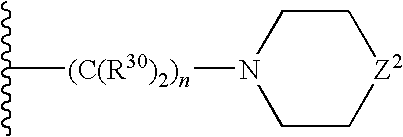
and n is 1,
-
- (b) in another example said (14) moiety is

(i.e., n is 1, and each R30 is H),
-
- (c) in another example Z2 is —NH— in (a),
- (d) in another example Z2 is —NH— in (b),
- (e) in another example Z2 is —NH— in (a),
- (f) in another example Z2 is —O— in (b),
- (g) in another example Z2 is —CH2— in (a),
- (h) in another example Z2 is —CH2— in (b),
- (i) in another example R2 is —(CH2)mR11 and m is 1,
- (j) in another example R2 is —N(R26)2,
- (k) in another example R2 is —N(R26)2, and each R26 is H (i.e., R2 is —NH2),
- (l) in another example R2 is —OR23, and
- (m) in another example R2 is —OH (i.e., R23 is H);
-
- (1) H,
- (2) alkenyl (e.g., —CH2CH═CH2),
- (3) substituted alkenyl,
- (4) alkyl,
- (5) substituted alkyl,
- (6) cycloalkyl,
- (7) substituted cycloalkyl,
- (8) cycloalkylalkyl-,
- (9) substituted cycloalkylalkyl-,
- (10) heterocycloalkyl,
- (11) substituted heterocycloalkyl,
- (12) heterocycloalkylalkyl-,
- (13) substituted heterocycloalkylalkyl-,
- (14) —C(O)R10 wherein in one example R10 is selected from the group consisting of: alkyl (e.g., C1 to C6, e.g., methyl),
- (15) arylheteroaryl- (e.g., phenylthiadiazolyl-),
- (16) substituted arylheteroaryl- (e.g., substituted phenylthiadiazolyl-),
- (17) heteroarylaryl-, such as, for example, pyrimidinylphenyl-, pyrazinylphenyl-, pyridinylphenyl- (i.e., pyridylphenyl-), furanylphenyl-, thienylphenyl-, thiazolylphenyl-, oxadiazolylphenyl-, and pyridazinylphenyl-,
- (18) substituted heteroarylaryl-, such as, for example, substituted pyrimidinylphenyl-, substituted pyrazinylphenyl-, substituted pyridinylphenyl- (i.e., substituted pyridylphenyl-), substituted furanylphenyl-, substituted thienylphenyl-, substituted thiazolylphenyl-, substituted pyrimidinylphenyl, substituted oxadiazolylphenyl-, and substituted pyridazinylphenyl-,
- (19) aryl (e.g., phenyl),
- (20) substituted aryl (e.g., substituted phenyl),
- (21) heteroaryl (e.g., thiazolyl, thienyl, pyridyl, and pyrimidinyl),
- (22) substituted heteroaryl (e.g., substituted thiazolyl, substituted pyridyl and substituted pyrimidinyl), examples of substituted heteroaryl groups include, for example bromothiazolyl-, bromopyrimidinyl-, fluoropyrimidinyl-, and ethenylpyrimidinyl-,
- (23) heteroarylheteroaryl- (e.g., pyrimidinylpyridyl-, pyrimidinylthiazolyl-, and pyrimidinylpyrazinyl-),
- (24) substituted heteroarylheteroaryl- (e.g., substituted pyrimidinylpyridyl-, and substituted pyrimidinylpyrazinyl-),
- (25) arylaminoheteroaryl- (e.g., phenyl-NH-oxadiazolyl-),
- (26) substituted arylaminoheteroaryl- (e.g., substituted phenyl-NH-oxadiazolyl-),
- (27) arylalkynyl- (e.g., aryl(C2 to C4)alkynyl such as, for example phenylethynyl-),
- (28) substituted arylalkynyl- (e.g., substituted aryl(C2 to C4)alkynyl-, such as, for example, substituted phenylethynyl-),
- (29) heteroarylalkynyl- (e.g., heteroaryl(C2 to C4)alkynyl-, such as, for example, pyrimidinylethynyl-),
- (30) substituted heteroarylalkynyl- (e.g., substituted heteroaryl(C2 to C4)alkynyl-, such as, for example substituted pyrimidinylethynyl-),
- (31) benzoheteroaryl (i.e., a fused phenyl and heteroaryl rings), such as, for example, benzothiazole and quinoxaline;
-
- in one example said substituted heteroarylaryl (moiety (18) above) is substituted with 1 to 3 substituents independently selected from the group consisting of: —NH2, alkyl (e.g., C1 to C6 alkyl, e.g., methyl), halo (e.g., F, Cl and Br, such as, for example F),
- in another example said substituted aryl (moiety (20) above) is substituted with 1 to 3 substituents independently selected from the group consisting of halo (e.g., F, Cl and Br), —C(O)—NH—R28 (e.g., —C(O)—NH—CH3), —C(O)OR28 (e.g., —C(O)O—C2H5), and —C(O)R28 (e.g., —C(O)CH3), and
- in another example said substituted heteroaryl (moiety (22) above) is substituted with 1 to 3 substitutents selected from the group consisting of: halo (e.g., Br, F, and Cl), alkenyl (e.g., C2 to C6 alkenyl, such as, for example, —CH═CH2);

and substituted heterocycloalkenyl, and wherein:

(wherein in one example R32 is H, in another example R38 is H, and in another example R32 is H and R38 is H), (19) —NHR20 (e.g., —NHCH3, —NHC2H5), (20) cycloalkyl (e.g., C3 to C6 cycloalkyl, such as, for example, cyclopropyl), (21) —O-alkyl-O—R20 (e.g., —O—(C1 to C6)alkyl-OR20, such as, for example, —O—CH2CH2—OCH3), (22) hydroxyalkyl (e.g., hydroxy(C1 to C6)alkyl, such as, for example, —CH2OH and —C(CH3)2OH), (23) —N(R20)2 wherein each R20 is independently selected (e.g., —N(CH3)2), (24) -alkyl-OR20 (e.g., —(C1 to C6)alkyl-OR20, such as, for example, —CH2OCH3), (25) —O-alkyl-OH (e.g., —O—(C1 to C6)alkyl-OH, such as, for example, —O—CH2—CH2—OH), (26) —NH(hydroxyalkyl) (e.g., —NH(hydroxy(C1 to C6)alkyl, such as, for example, —NH(CH2CH2OH)), and (27) oxazolidinone, such as, for example,


(wherein in one example R32 is H, in another example R26 is H, and in another example R32 is H and R26 is H); and (19) —NHR20;
-
- (a) unsubstituted heteroaryl,
- (b) heteroaryl substituted with 1 to 3 substituents independently selected from the group consisting of: —C(O)R38 (e.g., R38 is alkyl such as methyl), —NHR20 (e.g., —NHCH3), —OR20 (e.g., —OCH3), cycloalkyl (e.g., cyclopropyl) and halo (e.g., Cl),
- (c) heteroaryl selected from the group consisting of: pyrrolyl, pyrazolyl, imidazolyl, furanyl, thienyl, thiazolyl, pyridyl, pyridyl N—O, and pyrimidinyl,
- (d) heteroaryl selected from the group consisting of: pyrrolyl, pyrazolyl, imidazolyl, furanyl, thienyl, thiazolyl, pyridyl, pyridyl N—O, and pyrimidinyl, wherein said heteroaryl is substituted with 1 to 3 substituents independently selected from the group consisting of: —C(O)R38 (e.g., R38 is alkyl such as methyl), —NHR20 (e.g., —NHCH3), —OR20 (e.g., —OCH3), cycloalkyl (e.g., cyclopropyl) and halo (e.g., Cl), and
- (e) heteroaryl selected from the group consisting of: thienyl substituted with —C(O)R38 (such as, for example, thienyl substituted with —C(O)CH3), thiazolyl substituted with —NHR20 such as, for example (thazolyl substituted with —NHCH3), pyridyl substituted with halo (such as, for example, pyridyl substituted with —Cl), pyridyl substituted with —OR20 (such as, for example, pyridyl substituted with methyl), and pyrimidinyl substituted with —OR20 (such as, for example, pyrimidinyl substituted with —OCH3).
-
- (a) unsubstituted heteroarylalkyl-
- (b) heteroarylalkyl-substituted with 1 to 3 substituents independently selected from the group consisting of: —C(O)R38 (e.g., R38 is alkyl such as methyl), —NHR20 (e.g., —NHCH3), —OR20 (e.g., —OCH3), and halo (e.g., Cl),
- (c) heteroarylalkyl-selected from the group consisting of: pyrrolylalkyl- (e.g., pyrrolylCH2—), pyrazolylalkyl- (e.g., pyrazolylCH2—), imidazolylalkyl- (e.g., imdazolyl-CH2—), furanylalkyl- (e.g., furanylCH2—), thienylalkyl- (e.g., thienylCH2—), thiazolylalkyl- (e.g., thiazolylCH2—), pyridylalkyl- (e.g., pyridylCH2—), pyridyl N—O alkyl- (e.g., pyridyl(N—O)CH2—), and pyrimidinylalkyl- (e.g., pyrimidinylCH2—),
- (d) heteroarylalkyl-selected from the group consisting of: pyrrolylalkyl- (e.g., pyrrolylCH2—), pyrazolylalkyl- (e.g., pyrazolylCH2—), imidazolylalkyl- (e.g., imdazolylCH2—), furanylalkyl- (e.g., furanylCH2—), thienylalkyl- (e.g., thienylCH2—), thiazolylalkyl- (e.g., thiazolylCH2—), pyridylalkyl- (e.g., pyridylCH2—), pyridyl N—O alkyl- (e.g., pyridyl(N—O)CH2—), and pyrimidinylalkyl- (e.g., pyrimidinylCH2—), wherein said heteroaryl is substituted with 1 to 3 substituents independently selected from the group consisting of: —C(O)R38 (e.g., R38 is alkyl such as methyl), —NHR20 (e.g., —NHCH3), —OR20 (e.g., —OCH3), and halo (e.g., Cl), and
- (e) heteroarylalkyl-selected from the group consisting of: thienylalkyl-substituted with a —C(O)R20 group (such as, for example, thienylCH2— substituted with —C(O)CH3), thiazolylalkyl-substituted with —NHR20 such as, for example (thazolylCH2-substituted with —NHCH3), pyridylalkyl-substituted with halo (such as, for example, pyridylCH2-substituted with —Cl), pyridylalkyl-substituted with —OR20 (such as, for example, pyridylCH2— substituted with methyl), and pyrimidinylalky-substituted with —OR20 (such as, for example, pyrimidinylCH2— substituted with —OCH3).


wherein all substituents are as defined for formula 1.0.


wherein all substitutents are as defined for formula 1.0.


wherein all substituents are as defined for formula 1.0.

(i.e., each R24 is H and w is 1).

(i.e., each R24 is H and w is 1).

(i.e., each R24 is H and w is 1).

(i.e., each R24 is H and w is 1).

(i.e., each R24 is H and w is 1).

(i.e., each R24 is H and w is 1).

(i.e., each R24 is H and w is 1).

(i.e., each R24 is H and w is 1).

(i.e., each R24 is H and w is 1).


(i.e., each R24 is H and w is 1).

(i.e., each R24 is H and w is 1).

(i.e., each R24 is H and w is 1).

(i.e., each R24 is H and w is 1).

(i.e., each R24 is H and w is 1).

(i.e., each R24 is H and w is 1).


substituted with one or two substituents independently selected from the group consisting of R3 groups, provided that said one or two substitutents are not H. In one embodiment said substituents are selected from the group consisting of alkyl groups (e.g., C1 to C6 alkyl, e.g., methyl). In another embodiment there is one substituent on said piperazine ring. In another embodiment there is one substituent on said piperazine ring and said substituent is methyl.


substituted with one or two substituents independently selected from the group consisting of R3 groups, provided that said one or two substitutents are not H. In one embodiment said substituents are selected from the group consisting of alkyl groups (e.g., C1 to C6 alkyl, e.g., methyl). In another embodiment there is one substituent on said piperidine ring. In another embodiment there is one substituent on said piperidine ring and said substituent is methyl.

Q1 is heteroaryl.

(i.e., Q1 is pyridyl, and each R3, R4 and R7 is H).


(i.e., Q1 is phenyl, and each R3, R4 and R7 is H).

(i.e., Q1 is substituted phenyl, and each R3, R4 and R7 is H).

(i.e., Q1 is substituted phenyl, and each R3, R4 and R7 is H).


wherein R5A is halo.


wherein R5A is alkoxy, i.e., —O—(C1 to C6)alkyl, such as, for example, —O—(C1 to C3)alkyl, or —O—(C1 to C2)alkyl.


wherein R5A is alkyl (e.g., —(C1 to C6)alkyl, such as, for example, —(C1 to C3)alkyl, or —(C1 to C2)alkyl).


-
- R2, in another embodiment of this invention, is —(CH2)mR11, wherein R11 is —OR10, and R10 is H or alkyl.
- R2, in another embodiment of this invention, is —(CH2)mR11, wherein R11 is —OR10, and R10 alkyl (e.g., methyl).
- R2, in another embodiment of this invention, is —(CH2)mR11, wherein m is 1 and R11 is —OR10.
- R2, in another embodiment of this invention, is —(CH2)mR11, wherein m is 1, R11 is —OR10, and R10 is H or alkyl.
- R2, in another embodiment of this invention, is —(CH2)mR11, wherein m is 1, R11 is —OR10, and R10 alkyl.
- R2, in another embodiment of this invention, is —(CH2)mR11 wherein m is 1, R11 is —OR10, and R10 methyl (i.e., R2 is —CH2OCH3).
- R2, in another embodiment of this invention, is —OR23 wherein R23 is alkyl, and said alkyl is methyl (i.e., R2 is —OCH3).
- R2, in another embodiment of this invention, is alkynyl. An example of an alkynyl group is ethynyl:

Another example of an alkynyl group is propynyl:


-
- (a) Sarasar® brand of Ionifarnib (i.e., 4-[2-[4-(3,10-dibromo-8-chloro-6,11-dihydro-5H-benzo[5,6]cyclohepta[1,2-b]hyridin-11-yl)-1-piperidinyl)-2-oxoethyl]-1-piperidinecarboxamide, see for example, U.S. Pat. No. 5,874,442 issued Feb. 23, 1999, and U.S. Pat. No. 6,632,455 issued Oct. 14, 2003 the disclosures of each being incorporated herein by reference thereto),
- (b) Zarnestra® brand of tipifarnib (i.e., (R)-6-amino[(4-chlorophenyl)(1-methyl-1H-imidazol-5-yl)methyl]-4-(3-chlorophenyl)-1-methyl-2(1H)-quinolinone, see for example, WO 97/16443 published May 9, 1997 and U.S. Pat. No. 5,968,952 issued Oct. 19, 1999, the disclosures of each being incorporated herein by reference thereto), and
- (c) Bristol-Myers Squibb 214662:

(see WO97/30992 published Aug. 28, 1997, U.S. Pat. No. 6,011,029 issued Jan. 4, 2000, and U.S. Pat. No. 6,455,523, the disclosures of each being incorporated herein by reference thereto).


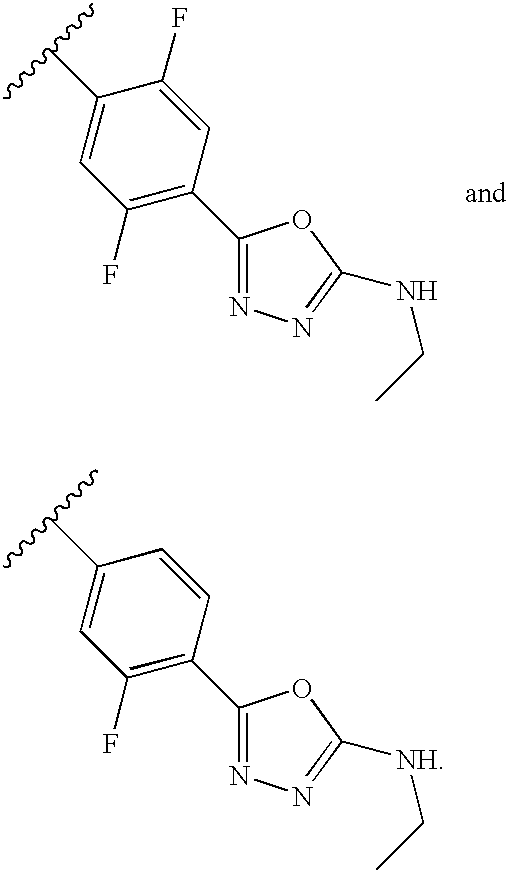


Aryl or heteroaryl substituted piperidines can be prepared by Suzuki coupling of an aryl or heteroaryl halide with the pinicolboronate 34B to obtain 35B. The ring double bond can then be hydrogenated to obtain 36B followed by removal of the Boc protecting group under trifluoroacetic acid conditions. Alternatively the double bond can be retained and the Boc group removed to give 38B.


wherein R1 is defined in Table 1. In Table 1 “Ex” represents “Example”.
| TABLE 1 | ||||
| LCMass | ||||
| Spec | ||||
| M + 1 | ||||
| @ ret. | ||||
| Ex | R1 | time | ||
| 3 |
 |
587 @ 3.61 mi | ||
| 4 |
 |
— | ||
| 5 |
 |
617.1 @ 2.86 min | ||
| 6 |
 |
— | ||
| 7 |
 |
647.2 @ 2.83 | ||
| 8 |
 |
— | ||
| 9 |
 |
— | ||
| 10 |
 |
— | ||
| 11 |
 |
612.1 @ 3.09 | ||
| 12 |
 |
576.3 @ 2.5 | ||
| 13 |
 |
629.3 @ 2.57 | ||
| 14 |
 |
— | ||
| 15 |
 |
— | ||
| 16 |
 |
— | ||
| 17 |
 |
— | ||
| 18 |
 |
— | ||
| 19 |
 |
603.1 @ 2.87 | ||
| 20 |
 |
— | ||
| 21 |
 |
635.2 @ 3.13 | ||
| 22 |
 |
— | ||
| 23 |
 |
— | ||
| 24 |
 |
617.1 @ 3.24 | ||
| 25 |
 |
605.1 @ 3.24 | ||
| 26 |
 |
644.2 @ 2.87 | ||
| 27 |
 |
601.1 @ 3.29 | ||
| 28 |
 |
— | ||
| 29 |
 |
601.1 @ 2.81 | ||
| 30 |
 |
631.2 @ 3.13 | ||
| 31 |
 |
601.1 @ 3.27 | ||
| 32 |
 |
629.1 @ 3.02 | ||
| 33 |
 |
594 @ 3.35 | ||
| 34 |
 |
621.1 @ 3.40 | ||
| 35 |
 |
632.1 @ 3.31 | ||
| 36 |
 |
645.2 @ 3.22 | ||
| 37 |
 |
— | ||
| 38 |
 |
632.1 @ 3.29 | ||
| 39 |
 |
615.1 @ 3.24 | ||
| 40 |
 |
655.1 @ 3.48 | ||
| 41 |
 |
621.1 @ 3.38 | ||
| 42 |
 |
652 @ 2.97 | ||
| 43 |
 |
605.1 @ 2.94 | ||
| 44 |
 |
594 @ 3.13 | ||
| 45 |
 |
655.1 @ 3.48 | ||
| 46 |
 |
629.1 @ 3.51 | ||
| 47 |
 |
— | ||
| 48 |
 |
— | ||
| 49 |
 |
644.1 @ 3.54 | ||
| 50 |
 |
629.1 @ 3.56 | ||
| 51 |
 |
647.2 @ 2.9 | ||
| 52 |
 |
621.1 @ 2.73 | ||
| 53 |
 |
601.1 @ 3.13 | ||
| 54 |
 |
629.1 @ 2.98 | ||
| 55 |
 |
623.1 @ 3.08 | ||
| 56 |
 |
644.2 @ 2.85 | ||
| 57 |
 |
655.1 @ 3.38 | ||
| 58 |
 |
645.2 @ 3.05 | ||
| 59 |
 |
617.1 @ 2.83 | ||
| 60 |
 |
605.1 @ 2.94 | ||


| TABLE 2 | |||
| LCMass | |||
| Spec | |||
| M + 1 @ | |||
| Ex | X1 | ret. time | |
| 66 | H | 526.1 @ 2.13 | |
| 67 |
 |
630.1 @ 2.71 | |
| 68 |
 |
594.3 @ 2.12 | |
| 69 |
 |
596.3 @ 2.15 | |
| 70 |
 |
645.4 @ 2.60 | |
| 71 |
 |
604.3 @ 2.10 | |
| 72 |
 |
597.3 @ 2.20 | |
| 73 |
 |
669.3 @ 1.98 | |


| TABLE 3 |
| 52 |
 |
| Ex | X2 |
| 78 | —C(O)CH3 |
| 79 | —C(O)NH2 |
| 80 |
 |
| 81 |
 |
| 82 |
 |
| 83 |
 |
| 84 |
 |


wherein X3 is defined in Table 4 were prepared from compound 59 (from Example 86 Step 6) following a procedure similar to that described in Example 86 Step 7 and using the corresponding amine of X3. In Table 4 “Ex” represents “Example”.
| TABLE 4 | ||||
| Retention | ||||
| time | Mass | |||
| Ex | X3 | (min) | Spec | |
| 88 |
 |
3.33 | 596 | |
| 89 |
 |
2.84 | 568 | |
| 90 |
 |
3.11 | 594 | |
| 91 |
 |
2.42 | 612 | |
| 92 |
 |
3.71 | 662 | |
| 93 |
 |
2.44 | 645 | |
| 94 |
 |
2.63 | 598 | |
| 95 |
 |
2.54 | 611 | |
| 96 |
 |
3.28 | 674 | |
| 97 |
 |
3.72 | 630 | |


| TABLE 5 | |||
| Mass | Retention | ||
| Spec | time | ||
| Ex | Compound | LCMS MH | Minutes |
| 99 |
 |
620 | 2.45 |
| 100 |
 |
620 | 2.43 |
| 101 |
 |
647 | 3.23 |


wherein X4 is defined in Table 6 were prepared. The arrow indicates the point of attachment of the X4 substitutent to the rest of the molecule. No arrow is shown for Example 109 because attachment to any of the carbons of the X4 phenyl group results in the same final compound of formula 74. In Table 6 “Ex” represents “Example”.
| TABLE 6 | ||||
| Retention | ||||
| Mass Spec | time | |||
| Ex | X4 | (ESMS, MH) | minutes | |
| 103 |
 |
619 | 3.10 | |
| 104 |
 |
619 | 2.79 | |
| 105 |
 |
606 | 2.31 | |
| 106 |
 |
637 | 3.43 | |
| 107 |
 |
615 | 3.13 | |
| 108 |
 |
631 | 3.17 | |
| 109 |
 |
601 | 2.70 | |
| 110 |
 |
602 | 2.36 | |
| 111 |
 |
602 | 2.41 | |
| 112 |
 |
669 | 3.24 | |

in place of 12, the compounds of formula 76:

wherein X5 is defined in Table 7 were prepared. The arrow indicates the point of attachment of the X5 substitutent to the rest of the molecule. In Table 7 “Ex” represents “Example”.
| TABLE 7 | ||||
| Retention | ||||
| Mass Spec | time | |||
| Ex | X5 | ESMS (MH) | (minutes) | |
| 113 |
 |
561 | 2.63 | |
| 114 |
 |
558 | 2.67 | |
| 115 |
 |
575 | 3.40 | |
| 116 |
 |
625 | 3.59 | |
| 117 |
 |
575 | 3.30 | |
| 118 |
 |
575 | 3.52 | |


| TABLE 8 | |||
| Mass | Retention | ||
| spec | time | ||
| Ex | Compound | LCMS MH | (minutes) |
| 120 |
 |
633 | 3.45 |
| 121 |
 |
548 | 2.36 |
| 122 |
 |
— | — |
| 123 |
 |
647 | 3.23 |


was prepared by substituting 2-chloropyrimidine for 2-chloro-5-fluoro-pyrimidine.


| TABLE 9 | |
| Example | COMPOUND |
| 143 |
 |
| 144 |
 |
| 145 |
 |
| 146 |
 |
| 147 |
 |
| 148 |
 |
| 149 |
 |
| 150 |
 |
| 151 |
 |
| TABLE 10 | |
| Example | COMPOUND |
| 152 |
 |
| 153 |
 |
| 154 |
 |
| 155 |
 |
| TABLE 11 | |||
| Retention | |||
| Mass | time | ||
| Example | Compound | Spec | (minutes) |
| 156 |
 |
564 | 2.68 |
| TABLE 12 | |||
| Retention | |||
| Mass | time | ||
| Ex | Compound | Spec | (minutes) |
| 157 |
 |
649 | 3.74 |
| 158 |
 |
647 | 3.56 |
| TABLE 13 | |||
| MS | Retention | ||
| (ESMS, | time | ||
| EX | Structure | MH) | (min.) |
| 159 |
 |
594 | 3.25 |
| 160 |
 |
516 | 2.65 |
| 161 |
 |
534 | 2.8 |
| 162 |
 |
552 | 2.95 |
| 163 |
 |
546 | 3.02 |
| 164 |
 |
518 | 1.93 |


| TABLE 14 | |||
| MS | Retention | ||
| (ESMS, | time | ||
| EX | Structure | MH) | (min.) |
| 166 |
 |
505 | 3.42 |
| 167 |
 |
487 | 3.34 |
| 168 |
 |
494 | 2.43 |
| 169 |
 |
560 | 4.27 |
| 170 |
 |
554 | 4.01 |
| 171 |
 |
542 | 4.11 |
| 172 |
 |
526 | 3.35 |
| 173 |
 |
526 | 1.51 |
| 174 |
 |
542 | 1.59 |
| 175 |
 |
576 | 1.64 |
| 176 |
 |
567 | 3.16 |
| 177 |
 |
586 | 3.85 |
| 178 |
 |
||
| 179 |
 |
||
| TABLE 15 | |
| EX | COMPOUND |
| 181 |
 |
| 183 |
 |
| 184 |
 |
| 185 |
 |
| 186 |
 |
| 187 |
 |
| 188 |
 |
| 189 |
 |
| 190 |
 |
| 191 |
 |
| 192 |
 |
| 193 |
 |
| 194 |
 |
| 195 |
 |
| 196 |
 |
| 197 |
 |
| 198 |
 |
| 199 |
 |
| 200 |
 |
| 201 |
 |
| 202 |
 |
| 203 |
 |
| 204 |
 |
| 205 |
 |
| 206 |
 |
| 207 |
 |
| 208 |
 |
| 209 |
 |
| 210 |
 |
| 211 |
 |
| 212 |
 |
| 213 |
 |
| 214 |
 |
| 215 |
 |
| 216 |
 |
| 217 |
 |
| 218 |
 |
| 219 |
 |
| 220 |
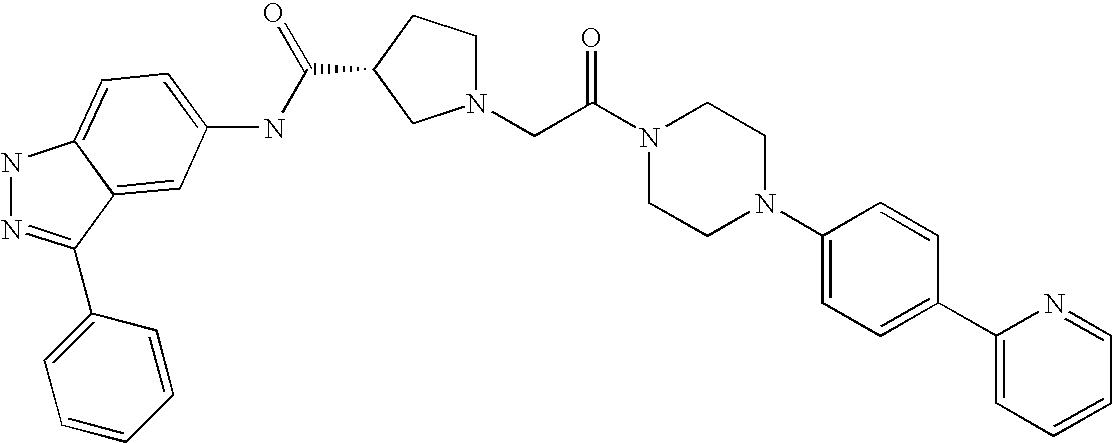 |
| 221 |
 |
| 222 |
 |
| 223 |
 |
| 224 |
 |
| 225 |
 |
| 226 |
 |
| 227 |
 |
| 228 |
 |
| 229 |
 |
| 230 |
 |
| 231 |
 |
| 232 |
 |
| 233 |
 |
| 234 |
 |
| 235 |
 |
| 236 |
 |
| 237 |
 |
| 238 |
 |
| 239 |
 |
| 240 |
 |
| 241 |
 |
| 242 |
 |
| 243 |
 |
| 244 |
 |
| 245 |
 |
| 246 |
 |
| 247 |
 |
| 248 |
 |
| 249 |
 |
| 250 |
 |
| 251 |
 |
| 252 |
 |
| 253 |
 |
| 254 |
 |
| 255 |
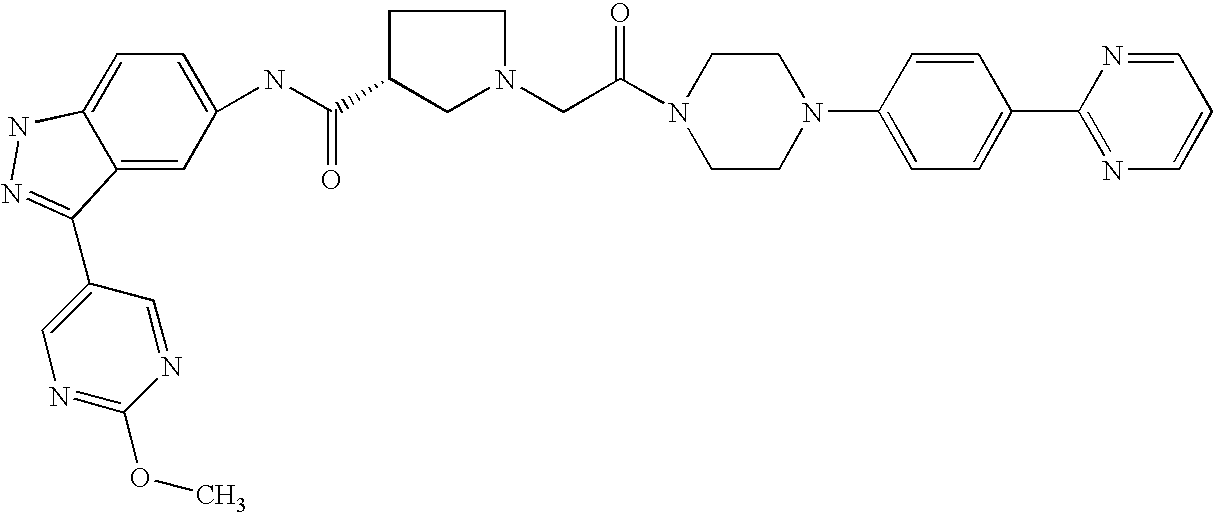 |
| 256 |
 |
| 257 |
 |
| 258 |
 |
| 259 |
 |


| TABLE 16 | |
| Ex | Compound |
| 260 |
 |
| 261 |
 |
| Mass Spec (ESMS, MH): 628 | |
| Retention Time minutes: 2.27 | |
| 262 |
 |
| Mass Spec (ESMS, MH): 645 | |
| Retention Time minutes: 2.96 | |
| 263 |
 |
| Mass Spec (ESMS, MH): 564 | |
| Retention Time minutes: 2.68 | |
| 264 |
 |
| Mass Spec (ESMS, MH): 632 | |
| Retention Time minutes: 2.67 | |
| 265 |
 |
| Mass Spec (ESMS, MH): 612 | |
| Retention Time minutes: 3.01 | |
| 266 |
 |
| Mass Spec (ESMS, MH): 572 | |
| Retention Time minutes: 2.5 | |
| 267 |
 |
| Mass Spec (ESMS, MH): 638 | |
| Retention Time minutes: 2.68 | |
| 268 |
 |
| Mass Spec (ESMS, MH): 624 | |
| Retention Time minutes: 2.61 | |
| 269 |
 |
| Mass Spec (ESMS, MH): 632 | |
| Retention Time minutes: 2.51 | |
| 270 |
 |
| Mass Spec (ESMS, MH): 546 | |
| Retention Time minutes: 2.70 | |
| 271 |
 |
| Mass Spec (ESMS, MH): 658 | |
| Retention Time minutes: 2.88 | |
| 272 |
 |
| Mass Spec (ESMS, MH): 566 | |
| Retention Time minutes: 2.66 | |
| 273 |
 |
| Mass Spec (ESMS, MH): 558 | |
| Retention Time minutes: 2.49 | |
| 274 |
 |
| Mass Spec (ESMS, MH): 660 | |
| Retention Time minutes: 2.54 | |
| 275 |
 |
| Mass Spec (ESMS, MH): 704 | |
| Retention Time minutes: 3.72 | |
| 276 |
 |
| Mass Spec (ESMS, MH): 638 | |
| Retention Time minutes: 2.82 | |
| 277 |
 |
| Mass Spec (ESMS, MH): 514 | |
| Retention Time minutes: 1.64 | |
| 278 |
 |
| Mass Spec (ESMS, MH): 620 | |
| Retention Time minutes: 3.25 | |
| 279 |
 |
| Mass Spec (ESMS, MH): 622 | |
| Retention Time minutes: 3.27 | |
| 280 |
 |
| Mass Spec (ESMS, MH): 515 | |
| Retention Time minutes: 1.75 | |
| 281 |
 |
| Mass Spec (ESMS, MH): 503 | |
| Retention Time minutes: 1.44 | |
| 282 |
 |
| Mass Spec (ESMS, MH): 549 | |
| Retention Time minutes: 1.73 | |
| 283 |
 |
| Mass Spec (ESMS, MH): 651 | |
| Retention Time minutes: 3.09 | |
| 284 |
 |
| Mass Spec (ESMS, MH): 561 | |
| Retention Time minutes: 2.62 | |
| 285 |
 |
| Mass Spec (ESMS, MH): 612 | |
| Retention Time minutes: 2.84 | |
| 286 |
 |
| Mass Spec (ESMS, MH): 616 | |
| Retention Time minutes: 1.89 | |
| 287 |
 |
| Mass Spec (ESMS, MH): 704 | |
| Retention Time minutes: 2.59 | |
| 288 |
 |
| Mass Spec (ESMS, MH): 611 | |
| Retention Time minutes: 2.30 | |
| 289 |
 |
| Mass Spec (ESMS, MH): 628 | |
| Retention Time minutes: 2.25 | |
| 290 |
 |
| Mass Spec (ESMS, MH): 630 | |
| Retention Time minutes: 2.54 | |
| 291 |
 |
| Mass Spec (ESMS, MH): 663 | |
| Retention Time minutes: 3.22 | |
| 292 |
 |
| Mass Spec (ESMS, MH): 626 | |
| Retention Time minutes: 2.31 | |
| 293 |
 |
| Mass Spec (ESMS, MH): 643 | |
| Retention Time minutes: 3.22 | |
| 294 |
 |
| Mass Spec (ESMS, MH): 646 | |
| Retention Time minutes: 2.26 | |
| 295 |
 |
| Mass Spec (ESMS, MH): 665 | |
| Retention Time minutes: 3.24 | |
| 296 |
 |
| Mass Spec (ESMS, MH): 649 | |
| Retention Time minutes: 3.15 | |
| 297 |
 |
| Mass Spec (ESMS, MH): 649 | |
| Retention Time minutes: 3.16 | |
| 298 |
 |
| Mass Spec (ESMS, MH): 513 | |
| Retention Time minutes: 2.66 | |
| 299 |
 |
| Mass Spec (ESMS, MH): 644 | |
| Retention Time minutes: 3.14 | |
| 300 |
 |
| 301 |
 |
| Mass Spec (ESMS, MH): 686 | |
| Retention Time minutes: 2.79 | |
| 302 |
 |
| Mass Spec (ESMS, MH): 650 | |
| Retention Time minutes: 3.07 | |
| 303 |
 |
| Mass Spec (ESMS, MH): 662 | |
| Retention Time minutes: 3.05 | |
| 304 |
 |
| Mass Spec (ESMS, MH): 647 | |
| Retention Time minutes: 2.23 | |
| 305 |
 |
| Mass Spec (ESMS, MH): 561 | |
| Retention Time minutes: 1.86 | |
| 306 |
 |
| Mass Spec (ESMS, MH): 5.58 | |
| Retention Time minutes: 2.37 | |
| 307 |
 |
| Mass Spec (ESMS, MH): 525 | |
| Retention Time minutes: 2.68 | |
| 308 |
 |
| 309 |
 |
| 310 |
 |
| 311 |
 |
| 312 |
 |
| 313 |
 |
| 314 |
 |
| Mass Spec (ESMS, MH): 666 | |
| Retention Time minutes: 3.70 | |
| 315 |
 |
| Mass Spec (ESMS, MH): 646 | |
| Retention Time minutes: 2.70 | |
| 316 |
 |
| Mass Spec (ESMS, MH): 660 | |
| Retention Time minutes: 2.48 | |
| 317 |
 |
| Mass Spec (ESMS, MH): 647 | |
| Retention Time minutes: 2.98 | |
| 318 |
 |
| Mass Spec (ESMS, MH): 663 | |
| Retention Time minutes: 2.79 | |
| 319 |
 |
| 320 |
 |
| Mass Spec (ESMS, MH): 662 | |
| Retention Time minutes: 2.73 | |
| 321 |
 |
| Mass Spec (ESMS, MH): 660 | |
| Retention Time minutes: 1.93 | |
| 322 |
 |
| Mass Spec (ESMS, MH): 677 | |
| Retention Time minutes: 2.70 | |
| 323 |
 |
| Mass Spec (ESMS, MH): 649 | |
| Retention Time minutes: 2.72 | |
| 324 |
 |
| Mass Spec (ESMS, MH): 619 | |
| Retention Time minutes: 3.61 | |
| 325 |
 |
| Mass Spec (ESMS, MH): 621 | |
| Retention Time minutes: 3.69 | |
| 326 |
 |
| Mass Spec (ESMS, MH): 568 | |
| Retention Time minutes: 3.52 | |
| 327 |
 |
| Mass Spec (ESMS, MH): 658 | |
| Retention Time minutes: 2.68 | |
| 328 |
 |
| Mass Spec (ESMS, MH): 581 | |
| Retention Time minutes: 2.95 | |
| 329 |
 |
| Mass Spec (ESMS, MH): 648 | |
| Retention Time minutes: 3.18 | |
| 330 |
 |
| Mass Spec (ESMS, MH): 635 | |
| Retention Time minutes: 3.82 | |
| 331 |
 |
| 332 |
 |
| Mass Spec (ESMS, MH): 481 | |
| Retention Time minutes: 2.55 | |
| 333 |
 |
| 334 |
 |


| TABLE 17 | |||
| Mass Spec | Retention | ||
| LCMS | time | ||
| Ex. | Compound | MH | Minutes |
| 338 |
 |
651 | 2.89 |
| 339 |
 |
671 | 2.30 |
| 340 |
 |
648 | 3.10 |
| 341 |
 |
674 | 2.17 |
| 342 |
 |
665 | 1.42 |
| 343 |
 |
646 | 2.19 |
| 344 |
 |
676 | 2.31 |
| 345 |
 |
649 | 3.01 |
| 346 |
 |
663 | 3.21 |
| 347 |
 |
672 | 3.32 |


| TABLE 18 | |||
| Retention | |||
| Mass spec | time | ||
| Ex | Compound | LCMS MH | (minutes) |
| 348 |
 |
659 | 2.55 |
| 349 |
 |
682 | 2.07 |
| TABLE 19 | |||
| Retention | |||
| Mass spec | time | ||
| Ex | Compound | LCMS MH | (minutes) |
| 350 |
 |
672 | 2.38 |
| 351 |
 |
658 | 2.43 |
| 352 |
 |
658 | 2.28 |


| TABLE 20 | |||
| Retention | |||
| Ex | Compound | M + 1 | time (min) |
| 368 |
 |
678.4 | 3.18 |
| 369 |
 |
566.3 | 1.8 |
| 370 |
 |
565.3 | 2.14 |
| 371 |
 |
579.3 | 2.24 |
| 372 |
 |
674.4 | 2.74 |
| 373 |
 |
662.4 | 2.68 |
| 374 |
 |
585.3 | 2.9 |
| 375 |
 |
595.3 | 2.78 |
| 376 |
 |
661.4 | 3.16 |
| 377 |
 |
582.4 | 2.23 |
| 378 |
 |
581.3 | 2.65 |
| 379 |
 |
658.4 | 2.61 |
| 380 |
 |
599.3 | 3.45 |
| 381 |
 |
569.3 | 2.62 |
| 382 |
 |
661.4 | 3.21 |
| 383 |
 |
661.4 | 3.16 |
| TABLE 21 | |||
| Retention | |||
| Ex. | Compound | M + 1 | time (min) |
| 384 |
 |
629.2 | 2.94 |
| 385 |
 |
||
| 386 |
 |
598.25 | 2.67 |
| 387 |
 |
650.3 | 3.55 |
| 388 |
 |
||
| 389 |
 |
669 | 2.34 |
| 390 |
 |
672.34 | 2.88 |
| 391 |
 |
||
| 392 |
 |
690.32 | 3.26 |
| 393 |
 |
598.4 | 2.61 |
| 394 |
 |
643.4 | 2.38 |
| 395 |
 |
686.35 | 3.1 |
| 396 |
 |
650.3 | 3.09 |
| 397 |
 |
618.3 | 2.31 |
| 398 |
 |
660.4 | 2.21 |
| 399 |
 |
572.13 | 2.45 |
| 400 |
 |
633.3 | 3.11 |
| 401 |
 |
670 | 2.11 |
| 402 |
 |
640 | 3.1 |
| 403 |
 |
697 | 3.15 |
| 404 |
 |
689 | 3.05 |
| 405 |
 |
672 | 2.38 |
| 406 |
 |
667.28 | 3.98 |
| 407 |
 |
||
| 408 |
 |
||
| 409 |
 |
625.3 | 3.15 |
| 410 |
 |
686.2 | 3.55 |
| 411 |
 |
685.2 | 4 |
| 412 |
 |
697.4 | 3.85 |
| 413 |
 |
663.31 | 3.8 |
| 414 |
 |
634.3 | 3.53 |
| 415 |
 |
611.4 | 3.75 |
| 416 |
 |
636.32 | 3.46 |
| 417 |
 |
549.2 | 3.42 |
| 418 |
 |
705.5 | 3.2 |
| 419 |
 |
686.31 | 2.64 |
| 420 |
 |
689.4 | 2.47 |
| 421 |
 |
576.2 | 4.3 |
| 422 |
 |
592.3 | 1.8 |
| 423 |
 |
685.2 | 4 |
| 424 |
 |
700.4 | 2.72 |
| 425 |
 |
618.3 | 2.25 |
| 426 |
 |
680.4 | 3.74 |
| 427 |
 |
574.22 | 4.06 |
| 428 |
 |
574.22 | 4.04 |
| 429 |
 |
680.4 | 3.35 |
| 430 |
 |
559.4 | 2.61 |
| 431 1376872 |
 |
684.4 | 2.94 |
| 432 1338111 |
 |
575.2 | 4.3 |
| 433 |
 |
627.4 | 2.7 |
| 434 |
 |
586.1 | 4.2 |
| 435 |
 |
666.4 | 3.23 |
| 436 |
 |
595.3 | 2.88 |
| TABLE 22 | |||
| Retention | |||
| time | |||
| Ex. | Compound | M + 1 | (min) |
| 437 |
 |
646.4 | 1.85 |
| 438 |
 |
612.3 | 2.7 |
| 439 |
 |
720.4 | 2.12 |
| 440 |
 |
557.3 | 2.34 |
| 441 |
 |
670.4 | 4.03 |
| 442 1364199 |
 |
666.4 | 3.81 |
| 443 |
 |
652.3 | 3.63 |
| 444 |
 |
584.3 | 2.64 |
| 445 |
 |
578.3 | 3.4 |
| 446 |
 |
658.4 | 2.96 |
| 447 |
 |
664.3 | 3.55 |
| 448 |
 |
676.4 | 3.27 |
| 449 |
 |
558.2 | 2.35 |
| 450 |
 |
560.3 | 2.27 |
| 451 |
 |
647.1 | 3.81 |
| 452 |
 |
672.4 | 3.07 |
| 453 |
 |
658.4 | 2.88 |
| 454 |
 |
561.1 | 3.67 |
| 455 |
 |
||
| 456 |
 |
649.3 | 4.09 |
| 457 |
 |
||
| 458 |
 |
||
| 459 |
 |
655 | 2.11 |
| 460 |
 |
640 | 2.75 |
| 461 1375417 |
 |
604.3 | 2.19 |
| 462 |
 |
662.2 | 3.04 |
| 463 |
 |
647.4 | 3.73 |
| 464 |
 |
||
| 465 |
 |
665 | 2.6 |
| 466 |
 |
615.3 | 2.24 |
| 467 |
 |
658 | 2.28 |
| 468 |
 |
||
| 469 |
 |
558.1 | 2.35 |
| 470 |
 |
632 | 3.09 |
| 471 |
 |
686.4 | 2.7 |
| 472 |
 |
||
| 473 |
 |
657 | 2.35 |
| 474 |
 |
592.3 | 1.82 |
| 475 |
 |
||
| 476 |
 |
623.3 | 3.17 |
| 477 |
 |
−2.18 | 2.18 |
| 478 |
 |
662.4 | 3.33 |
| 479 |
 |
634 | 3.09 |
| 480 |
 |
663 | 3.21 |
| 481 |
 |
685.4 | 4.18 |
| 482 |
 |
||
| 483 |
 |
683 | 2.89 |
| 484 |
 |
646.4 | 3.12 |
| 485 |
 |
650 | 2.58 |
| 486 |
 |
650.4 | 2.96 |
| 487 |
 |
||
| 488 |
 |
673 | 2.63 |
| 489 |
 |
650.4 | 3.11 |
| 490 |
 |
611.3 | 3.37 |
| 491 |
 |
||
| 492 |
 |
644 | 2.75 |
| 493 |
 |
||
| 494 |
 |
672.4 | 2.11 |
| 495 |
 |
650 | 3.47 |
| 496 |
 |
649.3 | 4.08 |
| 497 |
 |
675.4 | 2.46 |
| 498 |
 |
||
| 499 |
 |
||
| 500 |
 |
633 | 2.73 |
| 501 |
 |
||
| 502 |
 |
689 | 2.22 |
| 503 |
 |
622.2 | 2.68 |
| 504 |
 |
673.4 | 1.79 |
| 505 |
 |
||
| 506 |
 |
||
| 507 |
 |
646.4 | 3.03 |
| 508 |
 |
664.4 | 3.02 |
| 509 |
 |
687.4 | 2.34 |
| TABLE 23 | |||
| Retention | |||
| time | |||
| Ex. | Compound | M + 1 | (min) |
| 510 |
 |
647.3 | 3.7 |
| 511 |
 |
553 | 2.42 |
| 512 |
 |
554 | 1.88 |
| 513 |
 |
626 | 1.9 |
| 514 |
 |
551 | 2.94 |
| 515 |
 |
626 | 1.9 |
| 516 |
 |
652 | 2.19 |
| 517 |
 |
638 | 1.84 |
| 518 |
 |
641 | 2.93 |
| 519 |
 |
623 | 1.97 |
| 520 |
 |
644 | 2.53 |
| 521 |
 |
564 | 1.74 |
| 522 |
 |
665 | 3.17 |
| 523 |
 |
612 | 1.97 |
| 524 |
 |
630 | 2.59 |
| 525 |
 |
663 | 3.17 |
| 526 |
 |
637 | 2.5 |
| 527 |
 |
701.4 | 2.64 |
| 528 |
 |
||
| 529 |
 |
625 | 2.57 |
| 530 |
 |
644 | 2.53 |
| 531 |
 |
658.4 | 2.68 |
| 532 |
 |
652 | 2.26 |
| 533 |
 |
646 | 2.86 |
| 534 |
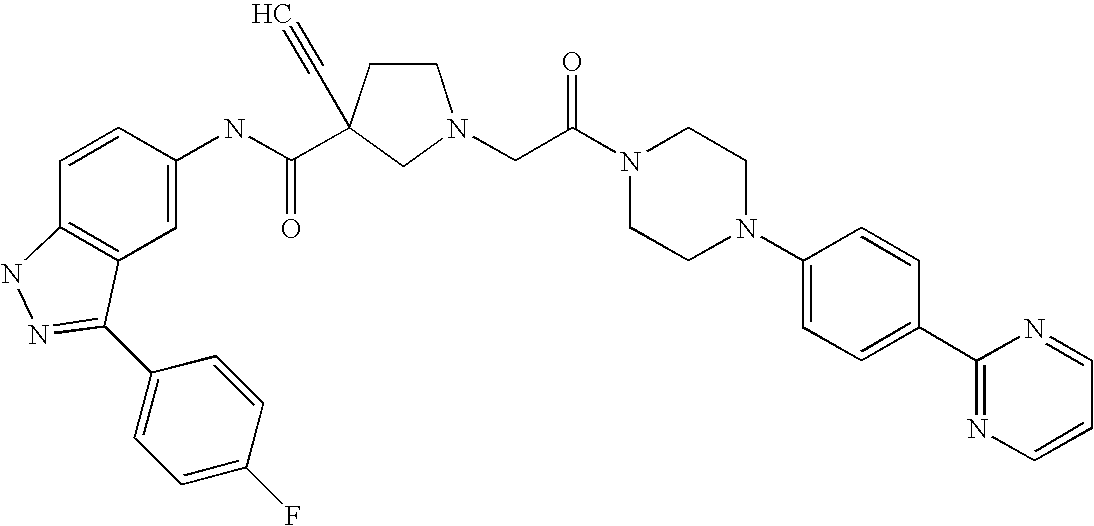 |
629 | 2.85 |
| 535 |
 |
626.3 | 2.87 |
| 536 |
 |
642.4 | 2.25 |
| 537 |
 |
572.3 | 2.06 |
| 538 |
 |
||
| 539 |
 |
649 | 2.68 |
| 540 |
 |
652 | 1.98 |
| 541 |
 |
555 | 2.7 |
| 542 |
 |
||
| 543 |
 |
555 | 1.43 |
| 544 |
 |
652.4 (2.21) | 2.21 |
| 545 |
 |
567.3 | |
| 546 |
 |
562 | 2.76 |
| 547 |
 |
526 | 0.82 |
| 548 |
 |
644.4 | 2.26 |
| 549 |
 |
557 | 2.61 |
| 550 |
 |
646 | 2.8 |
| 551 |
 |
676 | 3.12 |
| 552 |
 |
643 | 2.02 |
| 553 |
 |
571.3 | 2.55 |
| 554 |
 |
655.4 | 2.87 |
| 555 |
 |
649 | 3.1 |
| 556 |
 |
650 | 2.57 |
| 557 |
 |
571.3 | 2.16 |
| 558 |
 |
648 | 3.85 |
| 559 |
 |
660.4 | 2.72 |
| 560 |
 |
644 | 2.53 |
| 561 |
 |
592 | 1.88 |
| 562 |
 |
580 | 1.94 |
| 563 |
 |
674 | 2.42 |
| 564 |
 |
645 | 3.35 |
| 565 |
 |
646 | 2.8 |
| 566 |
 |
||
| 567 |
 |
646 | 3.15 |
| 568 |
 |
676 | 3.12 |
| 569 |
 |
645 | 3.34 |
| 570 |
 |
676 | 3.4 |
| 571 |
 |
686.4 | 2.57 |
| 572 |
 |
646 | 3.17 |
| 573 |
 |
681 | 3.05 |
| 574 |
 |
646 | 2.8 |
| 575 |
 |
676 | 3.35 |
| 576 |
 |
629 | 2.72 |
| 577 |
 |
567 | 2.61 |
| 578 |
 |
628 | 2.27 |
| 579 |
 |
651 | 3.48 |
| 580 |
 |
636 | 2.69 |
| 581 |
 |
605.4 | 3.72 |
| 582 |
 |
575.3 | 2.98 |
| 583 |
 |
583.3 | 2.91 |
| 584 |
 |
587.3 | 2.76 |
| 585 |
 |
||
| 586 |
 |
647.4 | 3.08 |
| 587 |
 |
||
| 588 |
 |
568 | 1.96 |
| 589 |
 |
||
| 590 |
 |
541 | 2.18 |
| 591 |
 |
681.2 | 4.21 |
| 592 |
 |
678.4 | 2.95 |
| 593 |
 |
571.3 | 2.61 |
| 594 |
 |
567.3 | 2.1 |
| 595 |
 |
629 | 2.78 |
| 596 |
 |
655.4 | |
| 597 |
 |
642.4 | 1.85 |
| 598 |
 |
619.4 | 3.71 |
| 599 |
 |
659 | 2.94 |
| 600 |
 |
647 | 2.91 |
| 601 |
 |
||
| 602 |
 |
||


| TABLE 23 | |||
| Mass spec | Retention | ||
| LCMS | time | ||
| Ex | Compound | MH | (minutes) |
| 603 |
 |
668 | 3.16 |
| 604 |
 |
670 | 3.14 |
| 605 |
 |
671 | 3.13 |


| TABLE 25 | |||
| Mass spec | Retention | ||
| LCMS | time | ||
| Ex | Compound | MH | (minutes) |
| 606 |
 |
650 | 3.28 |
| 607 |
 |
687 | 2.55 |
| 608 |
 |
638 | 3.33 |


| TABLE 26 | |
| Ex | Compound |
| 609 |
 |
| 610 |
 |
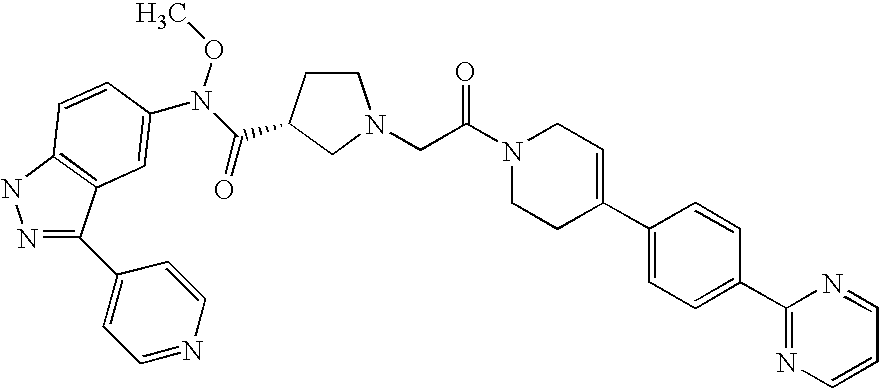


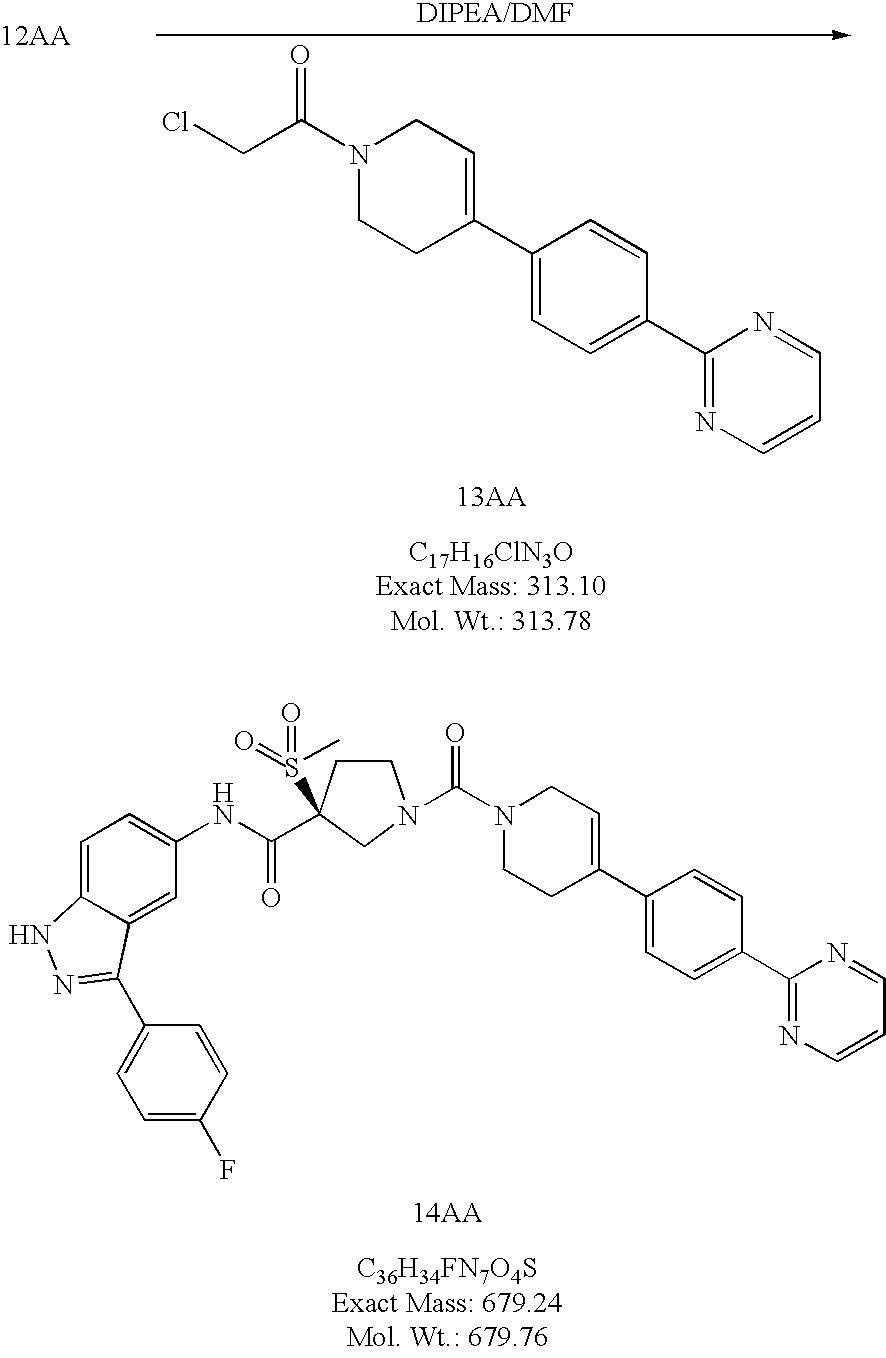


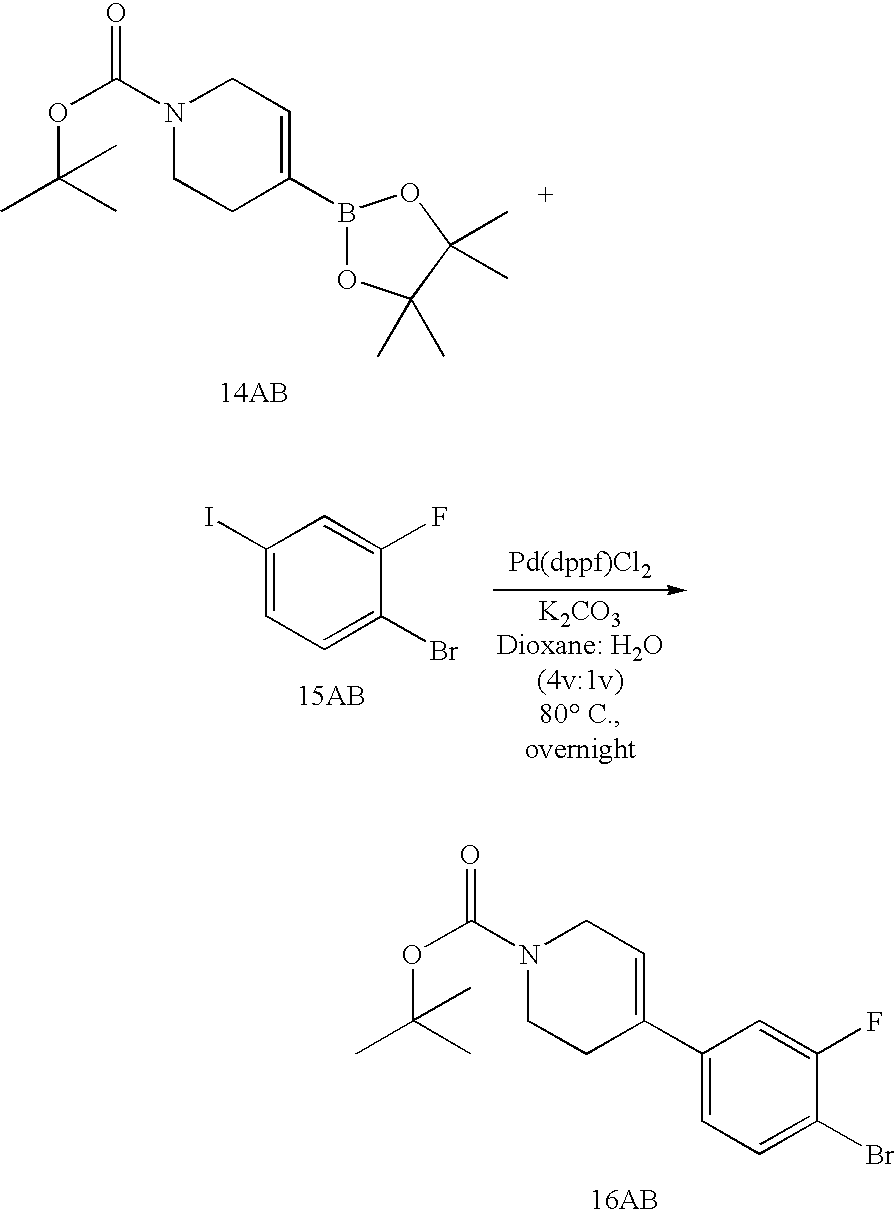


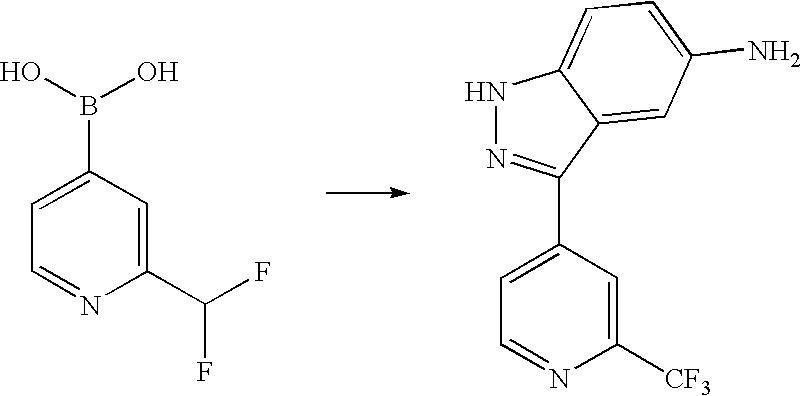


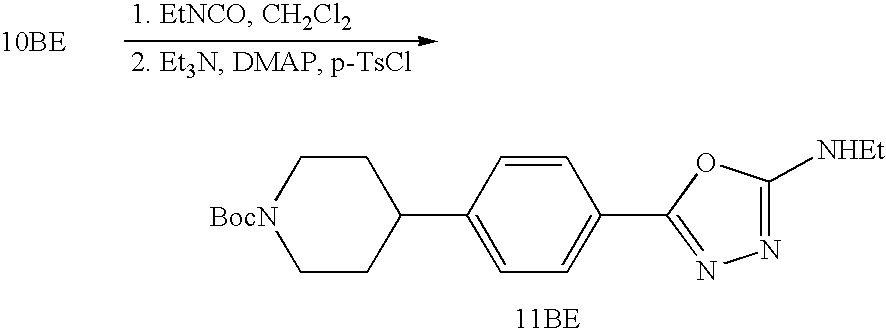


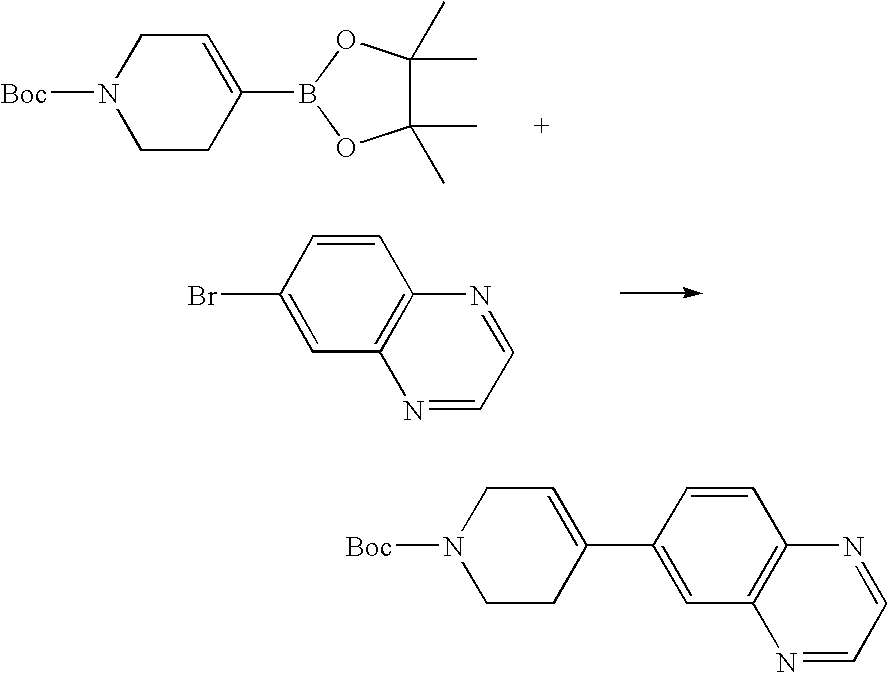


| TABLE 27 | |||
| Retention | |||
| Ex | Time | ||
| No. | COMPOUND | M + 1 | (min) |
| 613 (16AA) |
 |
648.4 | 2.8 |
| 614 (9AB) |
 |
693.4 | 2.84 |
| 615 11AB |
 |
709.4 | 2.54 |
| 616 (13AB) |
 |
669.4 | 2.75 |
| 617 (25AB) |
 |
638.4 | 3.33 |
| 619 (33AB) |
 |
653.4 | 2.89 |
| 620 |
 |
648.4 | 2.12 |
| 621 |
 |
623 | 2.42 |
| 622 |
 |
683.4 | 2.98 |
| 623 |
 |
667.4 | 2.69 |
| TABLE 28 | |||
| Retention | |||
| Ex | Time | ||
| No. | COMPOUND | M + 1 | (min) |
| 625 |
 |
701.4 | 3.05 |
| 626 |
 |
680.4 | 2.99 |
| 627 |
 |
680.4 | 2.8 |
| (see also Example 619) | |||
| 628 |
 |
683.4 | 2.93 |
| 629 |
 |
682.4 | 2.83 |
| 630 |
 |
701.4 | 3.04 |
| 631 |
 |
698.4 | 3.1 |
| 632 |
 |
681.4 | 2.5 |
| 633 |
 |
687.4 | 2.54 |
| 634 |
 |
703.4 | 2.33 |
| 635 |
 |
705.4 | 2.25 |
| 636 |
 |
721.4 | 2.38 |
| 637 |
 |
706.4 | 2.14 |
| 638 |
 |
704.4 | 1.93 |
| 639 |
 |
671.4 | 2.31 |
| 640 |
 |
650.4 | 2.8 |
| 641 |
 |
666.4 | 2.37 |
| 642 |
 |
666.4 | 3.14 |
| 643 |
 |
647.4 | 2.16 |
| 644 |
 |
645.4 | 2.03 |
| 645 |
 |
663.4 | 2.14 |
| 646 |
 |
704.4 | 2.72 |
| 647 |
 |
651.4 | 2.74 |
| 648 |
 |
655.4 | 2.72 |
| 649 |
 |
706.4 | 2.8 |
| 650 |
 |
673.4 | 2.29 |
| 651 |
 |
689.4 | 2.4 |
| 652 |
 |
674.4 | 2.17 |
| 653 |
 |
672.4 | 2.01 |
| 654 |
 |
669.4 | 3.16 |
| 655 |
 |
661.4 | 2.82 |
| 656 |
 |
666.3 | 2.66 |
| 657 |
 |
695.3 | 2.83 |
| 658 |
 |
692.4 | 2.92 |
| (see also Preparation 46) | |||
| 659 |
 |
736.4 | 2.8 |
| 660 |
 |
705.4 | 2.51 |
| (see also Example 618) | |||
| 661 |
 |
668.4 | 3.06 |
| 662 |
 |
587.3 | 2.46 |
| (see also Preparation 47) | |||
| 663 |
 |
671.4 | 2.8 |
| (see also Preparation 49) | |||
| 664 |
 |
671.4 | 2.78 |
| (see also Preparation 48) | |||
| 665 1389076 |
 |
645.4 | 2.48 |
| 666 1394448 |  |
645.4 | 2.31 |
| 667 |
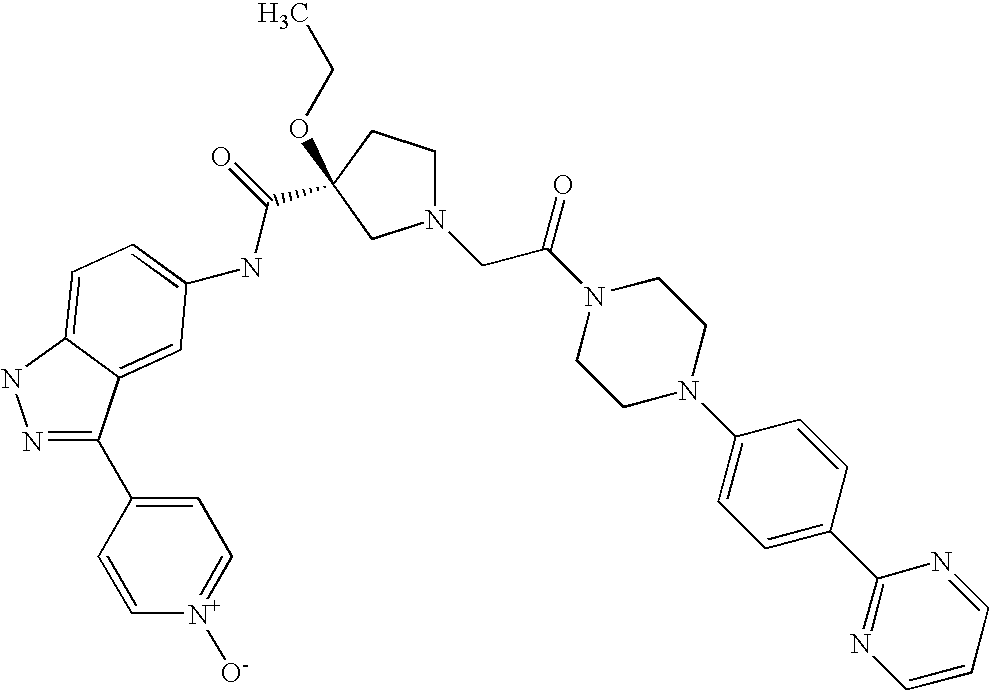 |
648.4 | 2.15 |
| 668 |
 |
647.4 | 2.28 |
| 669 |
 |
673.4 | 2.56 |
| 670 |
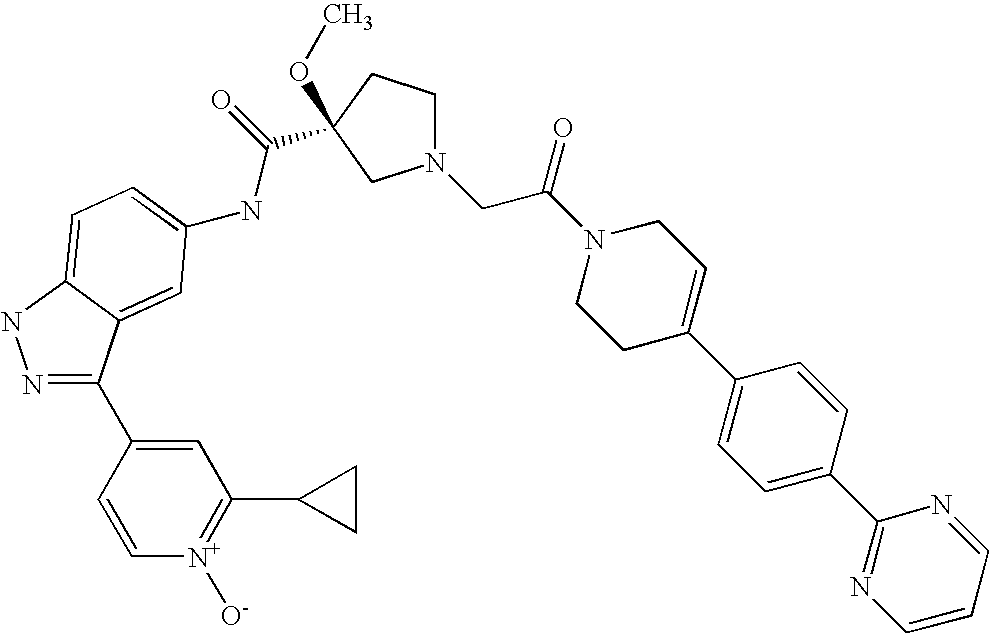 |
671.4 | 2.58 |
| 671 |
 |
718.4 | 2.67 |
| (see also Preparation 50) | |||
| 672 |
 |
687.4 | 2.18 |
| 673 |
 |
685.4 | 2.13 |
| 674 |
 |
669.4 | 2.45 |
| (see also Preparation 51) | |||
| 675 |
 |
685.4 | 2.98 |
| (see also Preparation 52) | |||
| 676 |
 |
659.4 | 2.86 |
| (see also Preparation 54) | |||
| 677 |
 |
672.4 | 2.01 |
| 678 |
 |
749.4 | 2.9 |
| 679 |
 |
681.4 | 2.85 |
| 680 |
 |
671.4 | 2.47 |
| (see also Preparation 55) | |||
| 681 |
 |
648.4 | 2.87 |
| 682 |
 |
701.4 | 3.36 |
| 683 |
 |
675.4 | 2.33 |
| 684 |
 |
661.7 | 3.21 |
| 685 |
 |
623 | 2.41 |
| (see also Preparation 56) | |||
| 686 |
 |
637 | 2.65 |
| 687 |
 |
625 | 2.47 |
| 688 |
 |
672 | 3.08 |
| 689 |
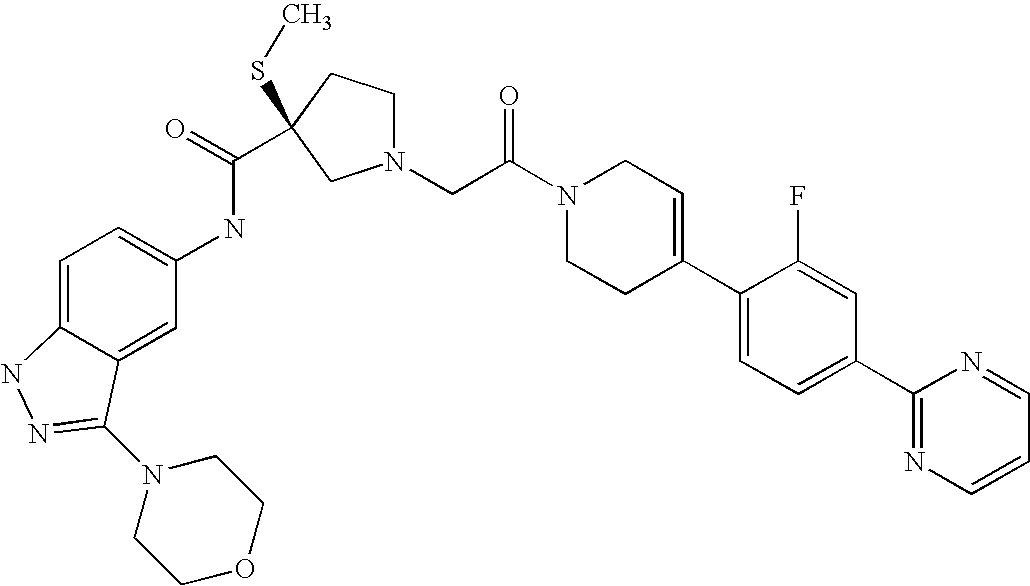 |
657 | 2.63 |
| 690 |
 |
630 | 2.18 |
| 691 |
 |
646 | 2.29 |
| 692 |
 |
639 | 2.46 |
| 693 |
 |
641 | 2.51 |
| 694 |
 |
641 | 2.49 |
| 695 |
 |
586 | 2.62 |
| 696 |
 |
706 | 2.46 |
| (see also Preparation 57) | |||
| 697 |
 |
636.7 | 3.12 |
| 698 |
 |
633.7 | 3.46 |
| 699 |
 |
635.7 | 3.33 |
| 700 |
 |
650.7 | 3.24 |
| (see also Preparation 58) | |||
| 701 |
 |
648.7 | 3.05 |
| 702 |
 |
562.6 | 2.83 |
| 703 |
 |
640.7 | 3.12 |
| 704 |
 |
623.7 | 2.88 |
| (see also Preparation 59) | |||
| 705 |
 |
664.7 | 3.4 |
| 706 |
 |
662.7 | 3.16 |
| 707 |
 |
576.7 | 2.97 |
| 708 |
 |
649.7 | 3.45 |
| 709 |
 |
587.6 | 3.58 |
| 710 |
 |
647.7 | 3.49 |
| 711 |
 |
650.7 | 3.23 |
| 712 |
 |
573.6 | 3.45 |
| 713 |
 |
633.7 | 2.34 |
| 714 |
 |
583.7 | 2.81 |
| (see also Preparation 60) | |||
| 715 |
 |
602.8 | 3.65 |
| (see also Preparation 62) | |||
| 716 |
 |
709.8 | 2.62 |
| (see also Preparation 63) | |||
| 717 |
 |
683.9 | 3 |
| (see also Preparation 64) | |||
| 718 1396854 |  |
676.8 | 3.09 |
| 719 |
 |
694.3 | 3.71 |
| (see also Preparation 65) | |||
| 720 |
 |
708.4 | 4.08 |
| (see also Preparation 65) | |||
| 721 |
 |
680.3 | 3.09 |
| (see also Preparation 65) | |||
| 722 |
 |
696.2 | 3.52 |
| 723 |
 |
648.3 | 2.98 |
| 724 |
 |
682.2 | 3.01 |
| 725 |
 |
667.3 | 3.12 |
| 726 |
 |
668.4 | 3.21 |
| (see also Preparation 66) | |||
| 727 |
 |
630.3 | 3.29 |
| 728 |
 |
656 | 3.22 |
| 729 |
 |
658.3 | 3.38 |
| 730 |
 |
674 | 3.84 |
| 731 |
 |
692 | 3.41 |
| 732 |
 |
654.4 | 3.02 |
| (see also Preparation 84) | |||
| 733 |
 |
699.4 | 2.9 |
| 734 |
 |
657.4 | 2.73 |
| (see also Preparation 67) | |||
| 735 |
 |
697.3 | 3.31 |
| (see also Preparation 67) | |||
| 736 |
 |
694.2 | 4.07 |
| (see also Preparation 68) | |||
| 737 |
 |
638.3 | 3.56 |
| 738 |
 |
707.3 | 3.57 |
| 739 |
 |
651.3 | 3.69 |
| 740 |
 |
724.4 | 3.16 |
| (see also Preparation 69) | |||
| 741 |
 |
706.4 | 3.24 |
| 742 |
 |
713.4 | 2.7 |
| 743 |
 |
678.4 | 3.2 |
| (see also Preparation 70) | |||
| 744 |
 |
676.4 | 3.18 |
| 745 |
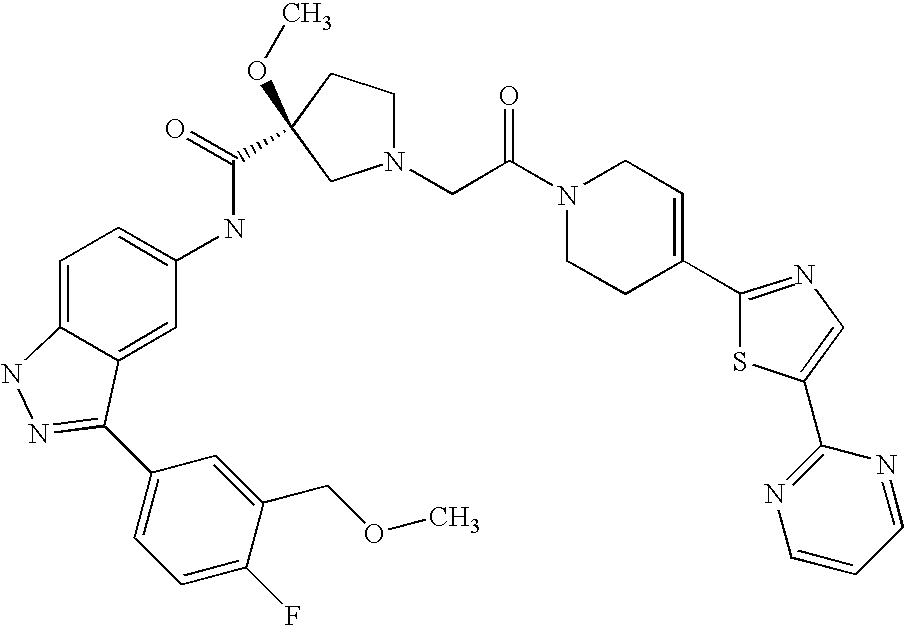 |
683.4 | 2.71 |
| 746 |
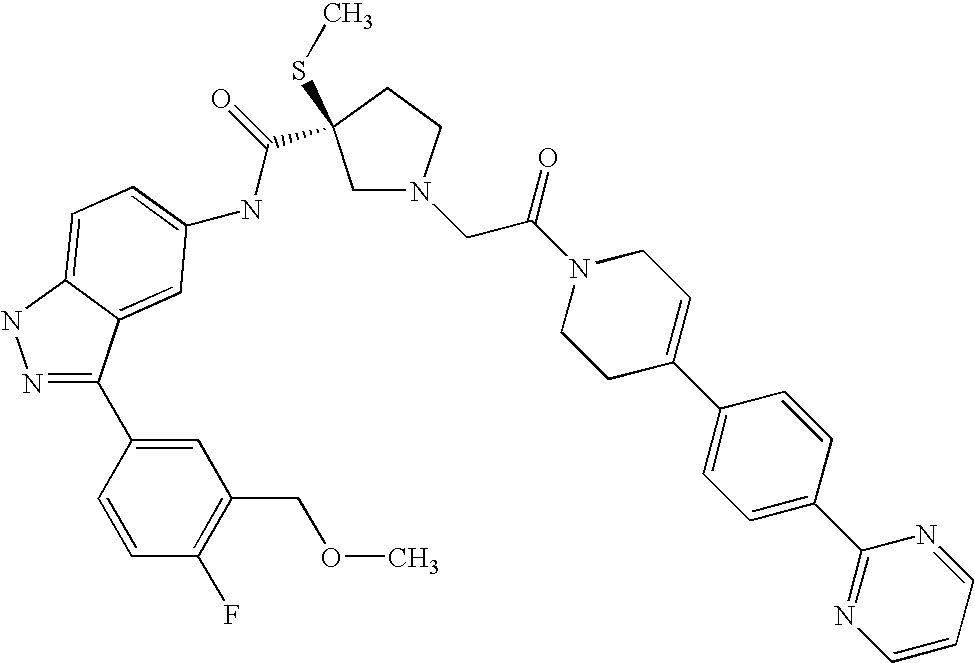 |
692.4 | 2.91 |
| 747 |
 |
694.4 | 2.91 |
| 748 |
 |
708.4 | 2.81 |
| 749 |
 |
706.4 | 2.85 |
| (see also Preparation 71) | |||
| 750 |
 |
713.4 | 2.68 |
| 751 |
 |
724.4 | 2.94 |
| 752 |
 |
722.4 | 2.97 |
| 753 |
 |
694.4 | 2.62 |
| (see also Preparation 72) | |||
| 754 |
 |
699.4 | 2.44 |
| 755 |
 |
692.4 | 2.65 |
| 756 |
 |
629.7 | 2.57 |
| (see also Preparation 73) | |||
| 757 |
 |
691.2 | 3.54 |
| (see also Preparation 74) | |||
| 758 |
 |
673.2 | 2.92 |
| 759 |
 |
677.2 | 3.93 |
| (see also Preparation 76) | |||
| 760 |
 |
635.2 | 3.33 |
| (see also Preparation 77) | |||
| 761 |
 |
717.2 | 3.8 |
| (see also Preparation 78) | |||
| 762 |
 |
699.7 | 3.31 |
| (see also Preparation 79) | |||
| 763 |
 |
622.3 | 3.52 |
| (see also Preparation 80) | |||
| 764 |
 |
690.3 | 3.8 |
| 765 |
 |
695.3 | 3.56 |
| 766 |
 |
688.4 | 3.43 |
| 767 |
 |
706.4 | 3.05 |
| 768 |
 |
611.3 | 3.17 |
| (see also Preparation 81) | |||
| 769 |
 |
691.4 | 2.44 |
| 770 |
 |
691.4 | 2.31 |
| (see also Preparation 82) | |||
| 771 |
 |
657.4 | 2.78 |
| (see also Preparation 83) | |||
| 772 |
 |
723.4 | 2.64 |
| 773 |
 |
683.4 | 2.67 |
| 774 |
 |
653.4 | 2.54 |
| (see also Example 624) | |||
| 775 |
 |
669.4 | 2.58 |
| 776 |
 |
639.7 | 3.41 |
| 777 |
 |
662 | 2.72 |
| (see also Preparation 67) | |||
| 778 |
 |
618 | 3.19 |
| (see also Preparation 85) | |||
| 779 |
 |
622 | 3.16 |
| (see also Preparation 86) | |||
| 780 |
 |
624 | 3.13 |
| 781 |
 |
640 | 3.37 |
| 782 |
 |
652.4 | 3.35 |
| 783 |
 |
648.4 | 3.11 |
| 784 |
 |
699.4 | 3 |
| 785 |
 |
665.4 | 2.97 |
| 786 |
 |
667.4 | 2.89 |
| 787 |
 |
662.4 | 2.84 |
| 788 |
 |
685.4 | 2.92 |
| 789 |
 |
631.3 | 2.07 |
| 790 |
 |
690.4 | 2.75 |
| 791 |
 |
652.4 | 1.83 |
| 792 |
 |
652.4 | 2.94 |
| 793 |
 |
659.4 | 2.41 |
| 794 |
 |
664.4 | 2.76 |
| 795 |
 |
671 | 2.59 |
| 796 |
 |
604 | 2.33 |
| 797 |
 |
663 | 3.26 |
| 798 |
 |
663 | 3.26 |
| 799 |
 |
676 | 2.49 |
| 800 |
 |
660.8 | 2.71 |
| 801 |
 |
658.8 | 2.5 |
| 802 |
 |
572.7 | 2.27 |
| 803 |
 |
645.8 | 2.73 |
| 804 |
 |
546.7 | 2.02 |
| 805 |
 |
643.7 | 2.76 |
| 806 |
 |
646.8 | 2.55 |
| 807 |
 |
651.7 | 3.99 |
| 808 |
 |
586.7 | 2.28 |
| 809 |
 |
576.7 | 2.75 |
| 810 |
 |
634.3 | 3.52 |
| 811 |
 |
631.3 | 2.25 |
| 812 |
 |
680.4 | 2.91 |
| 813 |
 |
668.4 | 3.31 |
| 814 |
 |
708.4 | 3.07 |
| 815 |
 |
696.4 | 2.84 |
| 816 |
 |
647.2 | 3.34 |
| 817 |
 |
637.4 | 3.34 |
| 818 |
 |
658.4 | 3.13 |
| (see also Preparation 89) | |||
| 819 |
 |
676.4 | 3.11 |
| 820 |
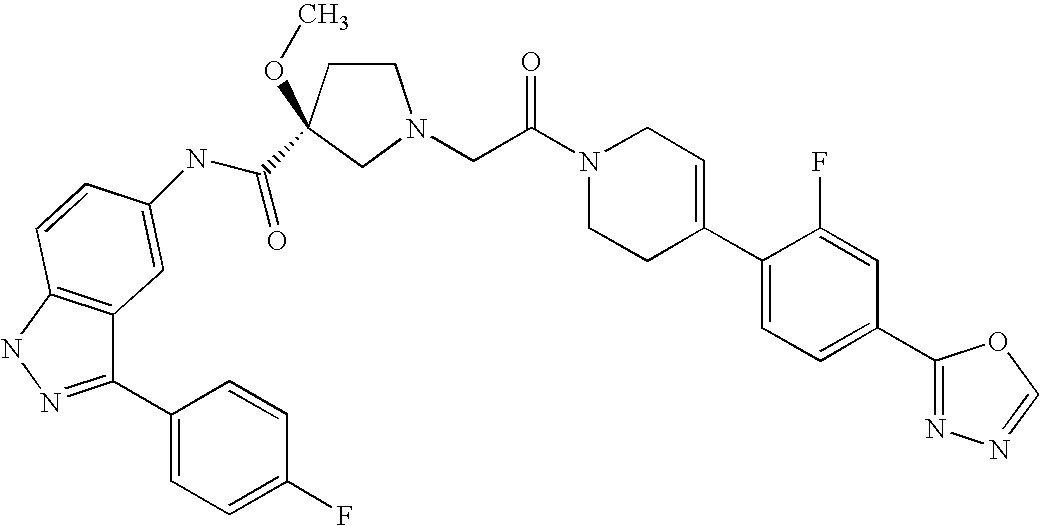 |
640.4 | 2.78 |
| 821 |
 |
694.4 | 2.64 |
| 822 |
 |
674.4 | 2.53 |
| 823 |
 |
647.4 | 2.38 |
| 824 |
 |
606 | 3.32 |
| (see also Preparation 87) | |||
| 825 |
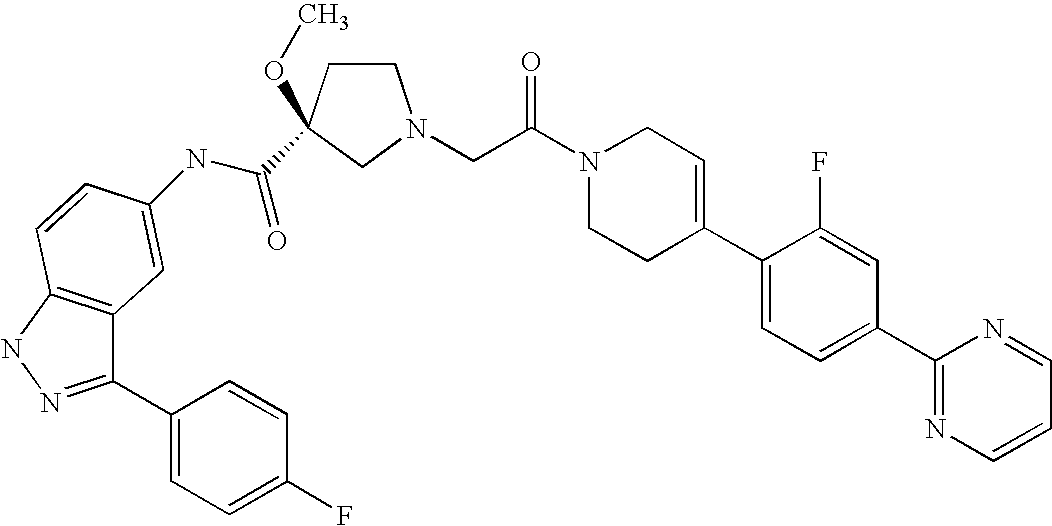 |
650.4 | 3.28 |


| TABLE 29 | ||
| Retention | ||
| Time | ||
| Compound | (min) | M + 1 |
 |
2.67 | 655 |
| (Example 826) | ||
 |
2.18 | 584 |
| (Example 827) | ||
| TABLE 30 | |||
| Rat | |||
| AERK2 | AUC | ||
| IC50 | PO | ||
| Ex. | Compound | (nM) | (nM · h) |
| 336 |
 |
18.1 | 7219 |
| 469 |
 |
2.5 | 1200 |
| 480 |
 |
4.8 | 1880 |
| 489 |
 |
9.1 | 723 |
| 571 |
 |
19.5 | 6466 |
| 413 |
 |
37.6 | 8946 |
| 412 |
 |
38.45 | 7836 |
| 462 |
 |
2.1 | 352 |
| 487 |
 |
8.2 | 38 |
| 6 |
 |
0.8 | 0 |
| 622 |
 |
5 | 1128 |
| 613 |
 |
10 | 25914 |
| 825 |
 |
20 | 1101 |
| 479 |
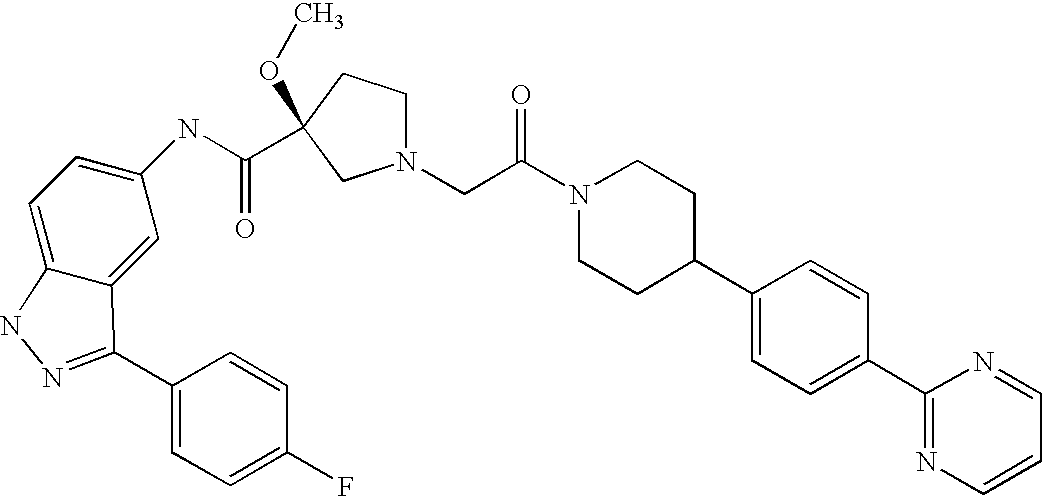 |
9.1 | 2200 |
| 459 |
 |
2.5 | 1200 |
Claims (76)
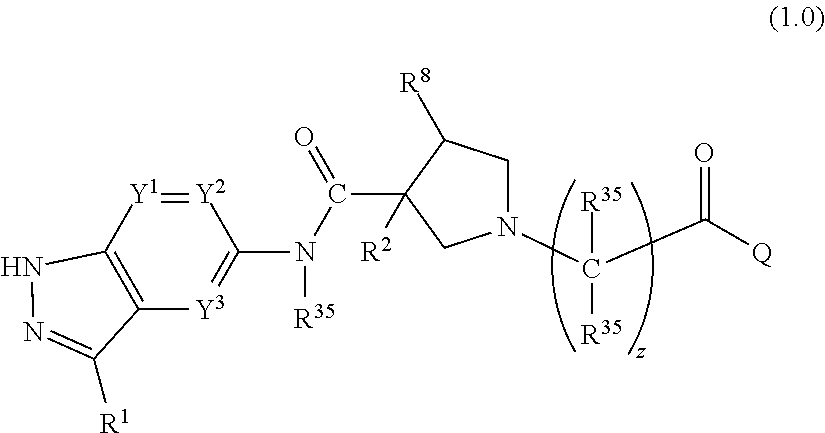


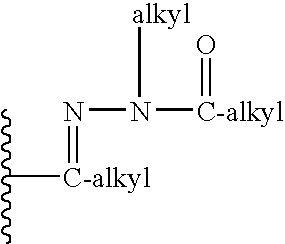





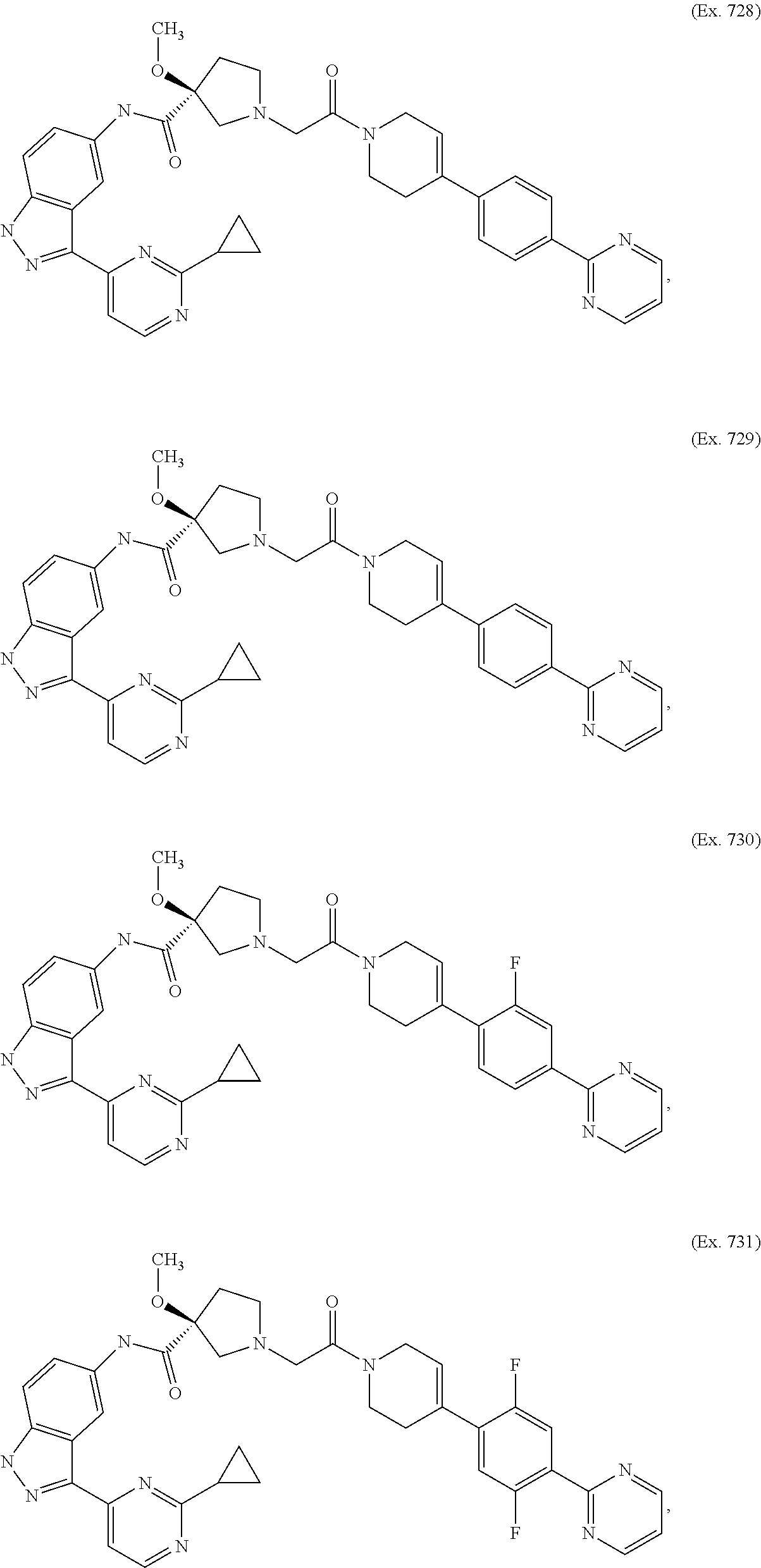


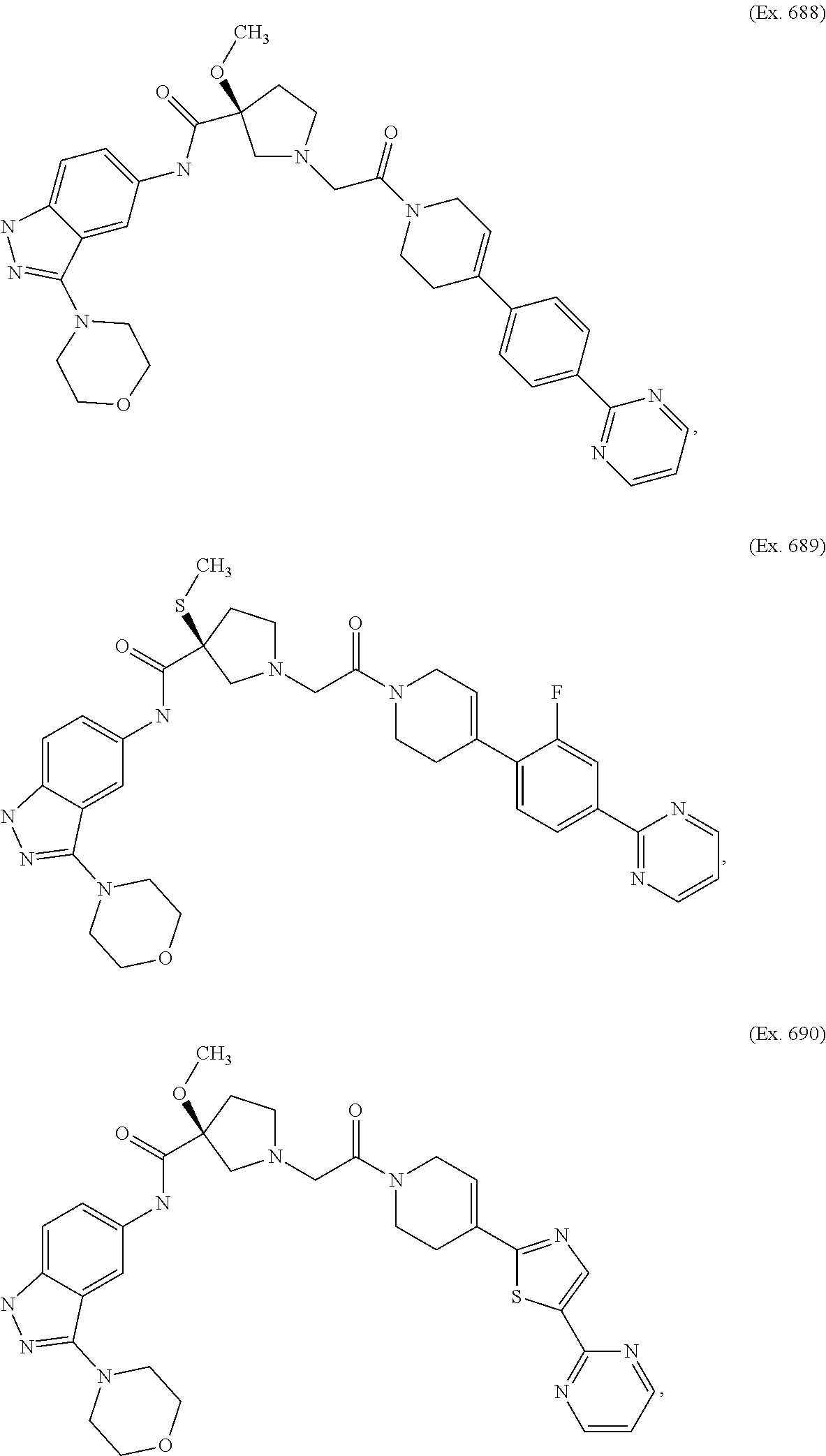


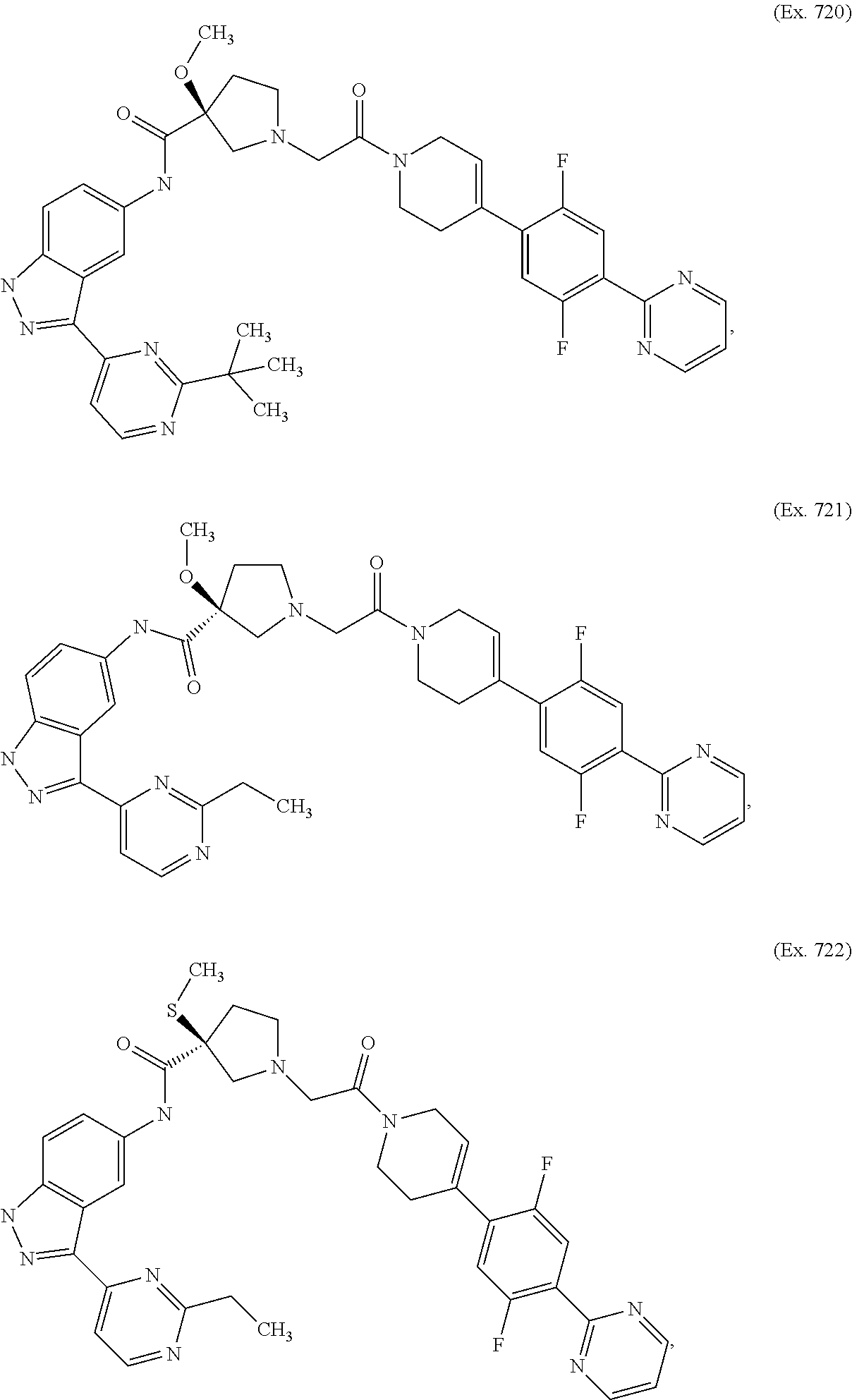

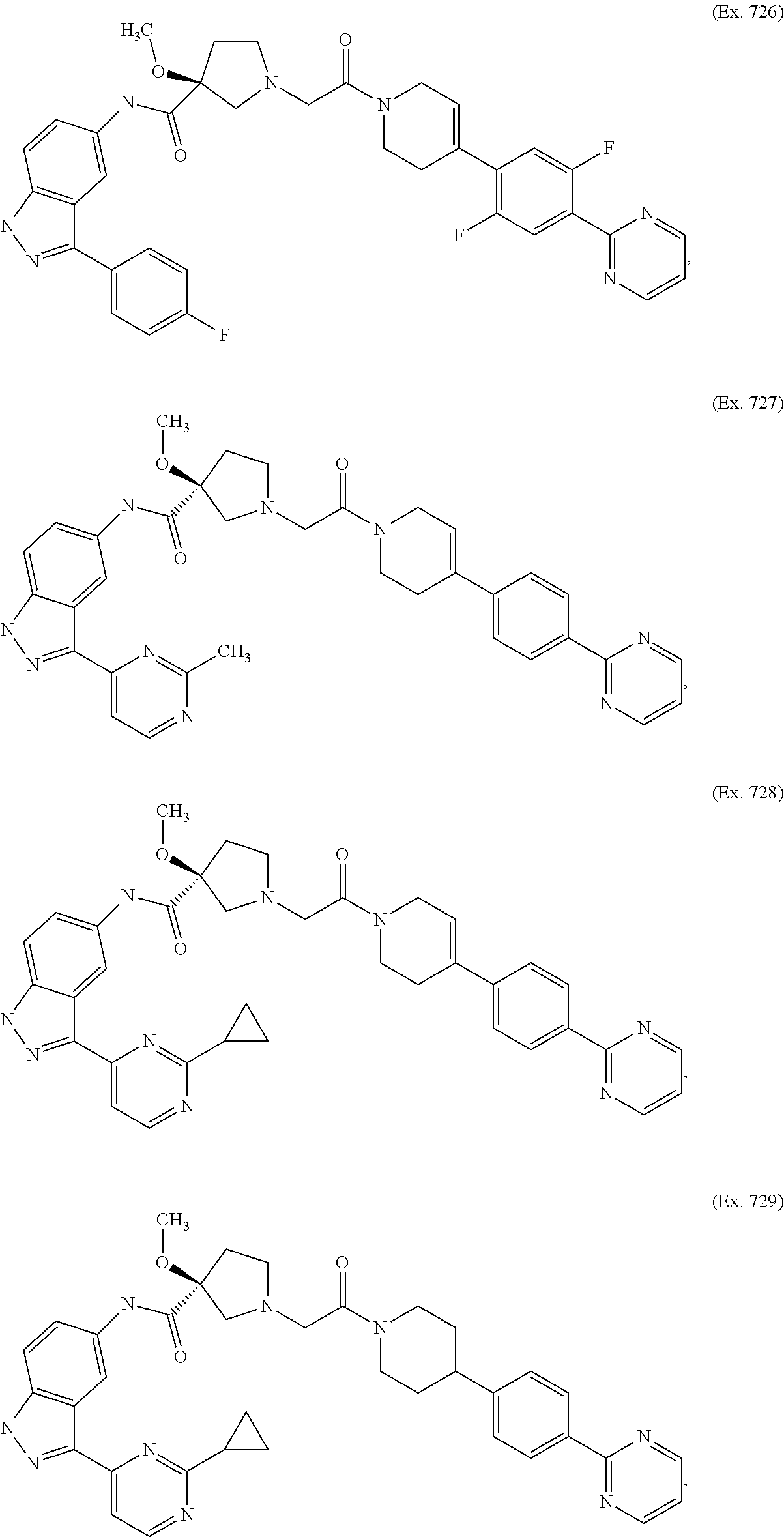


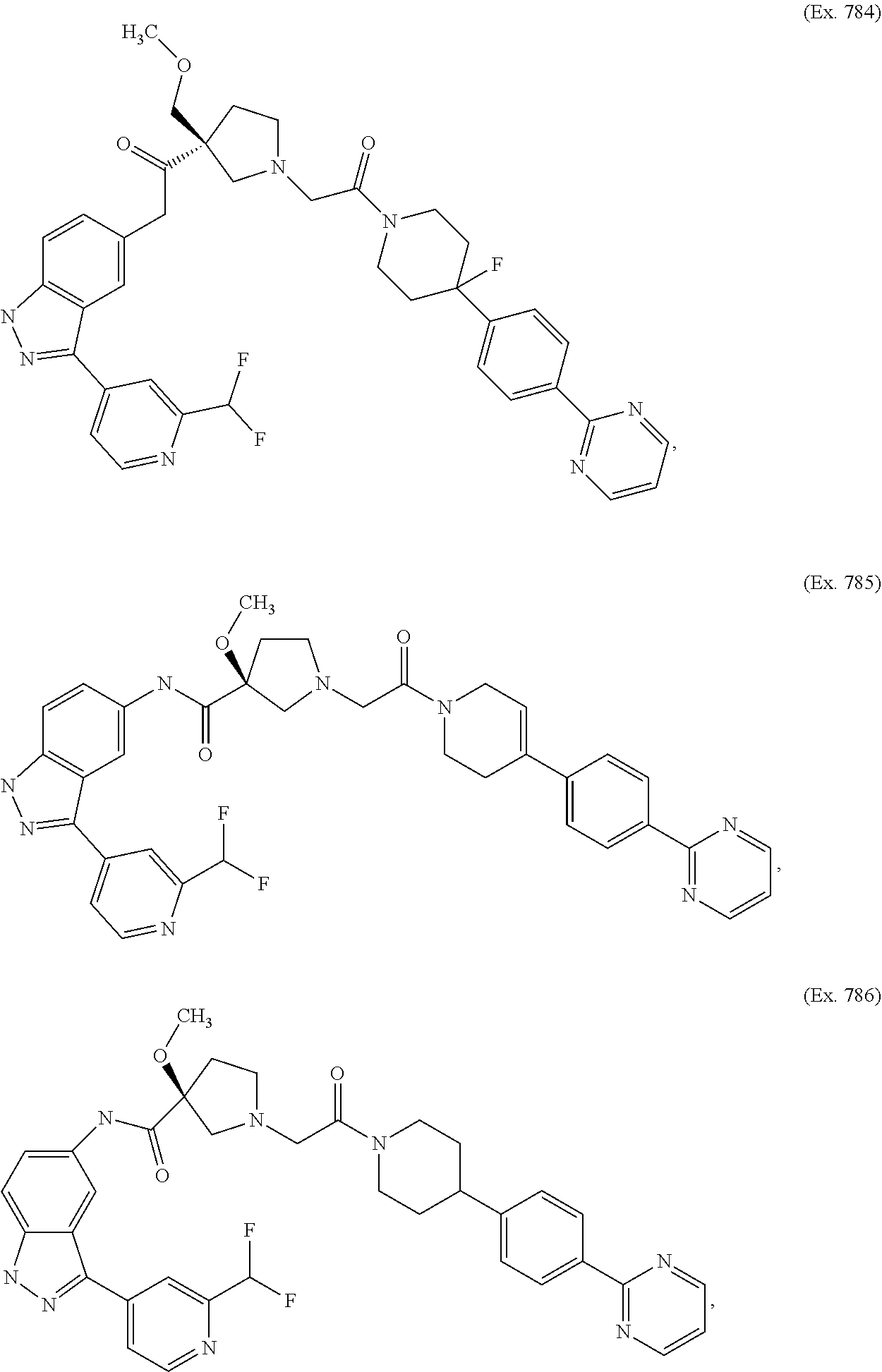


Priority Applications (21)
| Application Number | Priority Date | Filing Date | Title |
|---|---|---|---|
| US11/810,282 US8546404B2 (en) | 2005-12-13 | 2007-06-05 | Compounds that are ERK inhibitors |
| EP08768067.4A EP2155722B1 (en) | 2007-06-05 | 2008-06-04 | Polycyclic indazole derivatives and their use as erk inhibitors for the treatment of cancer |
| PCT/US2008/006979 WO2008153858A1 (en) | 2007-06-05 | 2008-06-04 | Polycyclic indazole derivatives and their use as erk inhibitors for the treatment of cancer |
| BRPI0812450A BRPI0812450A2 (en) | 2007-06-05 | 2008-06-04 | polycyclic indazole derivatives and their use as erk inhibitors for cancer treatment |
| CL2008001633A CL2008001633A1 (en) | 2007-06-05 | 2008-06-04 | Compounds derived from pyrrolidin-3-carboxamide; pharmaceutical composition; and use as erk inhibitors for the treatment of cancer. |
| JP2010511172A JP2010529122A (en) | 2007-06-05 | 2008-06-04 | Polycyclic indazole derivatives and their use as ERK inhibitors for the treatment of cancer |
| AU2008262412A AU2008262412A1 (en) | 2007-06-05 | 2008-06-04 | Polycyclic indazole derivatives and their use as ERK inhibitors for the treatment of cancer |
| ARP080102366A AR068046A1 (en) | 2007-06-05 | 2008-06-04 | INDAZOL POLICY DERIVATIVES AND ITS USE AS ERK INHIBITORS FOR CANCER TREATMENT |
| TW097120755A TW200911262A (en) | 2007-06-05 | 2008-06-04 | Novel compounds that are ERK inhibitors |
| NZ581698A NZ581698A (en) | 2007-06-05 | 2008-06-04 | Polycyclic indazole derivatives and their use as erk inhibitors for the treatment of cancer |
| CN200880100968A CN101815711A (en) | 2007-06-05 | 2008-06-04 | Polycyclic indazole derivatives and their use as erk inhibitors for the treatment of cancer |
| KR1020097027487A KR20100025553A (en) | 2007-06-05 | 2008-06-04 | Polycyclic indazole derivatives and their use as erk inhibitors for the treatment of cancer |
| MX2009013333A MX2009013333A (en) | 2007-06-05 | 2008-06-04 | Polycyclic indazole derivatives and their use as erk inhibitors for the treatment of cancer. |
| RU2009148867/04A RU2475484C2 (en) | 2007-06-05 | 2008-06-04 | Polycyclic indazole-derivatives and their application as erk inhibitors for cancer treatment |
| PE2008000942A PE20090326A1 (en) | 2007-06-05 | 2008-06-04 | HETEROCYCLES COMPOUNDS AS ERK INHIBITORS |
| CA2694860A CA2694860A1 (en) | 2007-06-05 | 2008-06-04 | Polycyclic indazole derivatives and their use as erk inhibitors for the treatment of cancer |
| MYPI20095228A MY148609A (en) | 2007-06-05 | 2008-06-04 | Polycyclic indazole derivatives and their use as erk inhibitors for the treatment of cancer |
| IL202317A IL202317A0 (en) | 2007-06-05 | 2009-11-24 | Polycyclic indazole derivatives and their use as erk inhibitors for the treatment of cancer |
| ZA2009/08477A ZA200908477B (en) | 2007-06-05 | 2009-11-30 | Polycyclic indazole derivatives and their use as erk inhibitors for the treatment of cancer |
| EC2009009781A ECSP099781A (en) | 2007-06-05 | 2009-12-03 | NEW COMPOUNDS THAT ARE ERK INHIBITORS |
| CO09139231A CO6251261A2 (en) | 2007-06-05 | 2009-12-04 | DERIVATIVES OF 1- 82-AMINO-2-OXOALQUIL) -N (1H-INDAZOL-5-IL) PIRROLIDINA-3-CARBOXAMIDA |
Applications Claiming Priority (3)
| Application Number | Priority Date | Filing Date | Title |
|---|---|---|---|
| US74985605P | 2005-12-13 | 2005-12-13 | |
| US11/636,954 US20070191604A1 (en) | 2005-12-13 | 2006-12-11 | Novel compounds that are ERK inhibitors |
| US11/810,282 US8546404B2 (en) | 2005-12-13 | 2007-06-05 | Compounds that are ERK inhibitors |
Related Parent Applications (1)
| Application Number | Title | Priority Date | Filing Date |
|---|---|---|---|
| US11/636,954 Continuation-In-Part US20070191604A1 (en) | 2005-12-13 | 2006-12-11 | Novel compounds that are ERK inhibitors |
Publications (2)
| Publication Number | Publication Date |
|---|---|
| US20090118284A1 US20090118284A1 (en) | 2009-05-07 |
| US8546404B2 true US8546404B2 (en) | 2013-10-01 |
Family
ID=46888723
Family Applications (1)
| Application Number | Title | Priority Date | Filing Date |
|---|---|---|---|
| US11/810,282 Active 2031-07-31 US8546404B2 (en) | 2005-12-13 | 2007-06-05 | Compounds that are ERK inhibitors |
Country Status (1)
| Country | Link |
|---|---|
| US (1) | US8546404B2 (en) |
Cited By (3)
| Publication number | Priority date | Publication date | Assignee | Title |
|---|---|---|---|---|
| WO2016205418A1 (en) | 2015-06-15 | 2016-12-22 | Asana Biosciences, Llc | Heterocyclic inhibitors of erk1 and erk2 and their use in the treatment of cancer |
| WO2018183762A1 (en) | 2017-03-29 | 2018-10-04 | United States Government As Represented By The Department Of Veterans Affairs | Methods and compositions for treating cancer |
| WO2021086726A1 (en) | 2019-10-28 | 2021-05-06 | Asan BioSciences, LLC | Improved methods, kits, compositions and dosing regimens for the use of heterocyclic inhibitors of erk1 and erk2 |
Families Citing this family (15)
| Publication number | Priority date | Publication date | Assignee | Title |
|---|---|---|---|---|
| US8546404B2 (en) | 2005-12-13 | 2013-10-01 | Merck Sharp & Dohme | Compounds that are ERK inhibitors |
| JP2009528280A (en) * | 2006-02-16 | 2009-08-06 | シェーリング コーポレイション | Pyrrolidine derivatives as ERK inhibitors |
| CN102015693B (en) * | 2008-02-21 | 2014-10-29 | 默沙东公司 | Compounds as ERK inhibitors |
| EP2316031B1 (en) | 2008-08-19 | 2016-09-14 | Merck Sharp & Dohme Corp. | IL-8 biomarker for monitoring cancer treatment |
| US9229008B2 (en) | 2008-08-19 | 2016-01-05 | Merck Sharp & Dohme Corp. | IL-8 level as a determinant of responsivity of a cancer to treatment |
| WO2011002067A1 (en) * | 2009-07-02 | 2011-01-06 | 武田薬品工業株式会社 | Heterocyclic compound and use thereof |
| CA2774769A1 (en) | 2009-09-30 | 2011-04-07 | Schering Corporation | Novel compounds that are erk inhibitors |
| EP2632268A4 (en) * | 2010-10-29 | 2014-09-10 | Merck Sharp & Dohme | NOVEL COMPOUNDS THAT ARE ERK INHIBITORS |
| JP2014500277A (en) | 2010-12-09 | 2014-01-09 | アムジエン・インコーポレーテツド | Bicyclic compounds as PIM inhibitors |
| WO2012129338A1 (en) | 2011-03-22 | 2012-09-27 | Amgen Inc. | Azole compounds as pim inhibitors |
| WO2013169858A1 (en) | 2012-05-08 | 2013-11-14 | The Broad Institute, Inc. | Diagnostic and treatment methods in patients having or at risk of developing resistance to cancer therapy |
| EP3277690B1 (en) | 2015-04-03 | 2020-02-26 | Recurium IP Holdings, LLC | Spirocyclic compounds |
| CN105061316B (en) * | 2015-07-17 | 2017-12-22 | 苏州大学 | Thick cyclics, preparation method and purposes |
| BR112021022255A2 (en) * | 2019-05-08 | 2022-01-18 | Tyk Medicines Inc | Compound used as a kinase inhibitor and its application |
| KR20250079173A (en) | 2022-10-03 | 2025-06-04 | 고리츠다이가쿠호진 요코하마시리츠다이가쿠 | Imidazopyridine derivatives having a cyclic structure |
Citations (57)
| Publication number | Priority date | Publication date | Assignee | Title |
|---|---|---|---|---|
| GB2306108A (en) | 1995-10-13 | 1997-04-30 | Merck & Co Inc | Treatment of Raf-mediated cancers with imidazole derivatives |
| WO1997045412A1 (en) | 1996-05-30 | 1997-12-04 | Merck & Co., Inc. | A method of treating cancer |
| GB2323845A (en) | 1997-03-31 | 1998-10-07 | Merck & Co Inc | MEK inhibiting lactones |
| WO1999003498A1 (en) | 1997-07-18 | 1999-01-28 | Novo Nordisk A/S | USE OF FVIIa OR FVIIai FOR THE TREATMENT OF ADVERSE CONDITIONS RELATED TO THE FVIIa MEDIATED INTRACELLULAR SIGNALLING PATHWAY |
| WO1999010325A1 (en) | 1997-08-06 | 1999-03-04 | Glaxo Group Limited | Benzylidene-1,3-dihydro-indol-2-one derivatives as receptor tyrosine kinase inhibitors, particularly of raf kinases |
| WO2001056557A2 (en) | 2000-02-05 | 2001-08-09 | Vertex Pharmaceuticals Incorporated | Compositions useful as inhibitors of erk |
| WO2001057022A2 (en) | 2000-02-05 | 2001-08-09 | Vertex Pharmaceuticals Incorporated | Pyrazole compositions useful as inhibitors of erk |
| WO2001068619A1 (en) | 2000-03-15 | 2001-09-20 | Warner-Lambert Company | 5-amide substituted diarylamines as mex inhibitors |
| WO2001072721A2 (en) | 2000-03-27 | 2001-10-04 | Bristol-Myers Squibb Company | Synergistic methods and compositions for treating cancer |
| WO2002010137A2 (en) | 2000-07-31 | 2002-02-07 | Signal Pharmaceuticals, Inc. | Indazole derivatives as jnk inhibitors |
| WO2002022604A1 (en) | 2000-09-15 | 2002-03-21 | Vertex Pharmaceuticals Incorporated | Pyrazole compounds useful as protein kinase inhibitors |
| WO2002022610A1 (en) | 2000-09-15 | 2002-03-21 | Vertex Pharmaceuticals Incorporated | Isoxazoles and their use as inhibitors of erk |
| WO2002046158A2 (en) | 2000-11-20 | 2002-06-13 | Scios Inc. | Piperidine/piperazine-type inhibitors of p38 kinase |
| WO2002050065A2 (en) | 2000-12-21 | 2002-06-27 | Vertex Pharmaceuticals Incorporated | Pyrazole compounds useful as protein kinase inhibitors |
| WO2002064586A2 (en) | 2001-02-09 | 2002-08-22 | Vertex Pharmaceuticals Incorporated | Heterocyclic inhibitors of erk2 and uses thereof |
| WO2002088090A2 (en) | 2001-04-27 | 2002-11-07 | Vertex Pharmaceuticals Incorporated | Pyrazole derived kinase inhibitors |
| WO2002088097A1 (en) | 2001-04-27 | 2002-11-07 | Vertex Pharmaceuticals Incorporated | Triazole-derived kinase inhibitors and uses thereof |
| WO2003011854A1 (en) | 2001-08-03 | 2003-02-13 | Vertex Pharmaceuticals Incorporated | Pyrazole-derived kinase inhibitors and uses thereof |
| WO2003011855A2 (en) | 2001-08-03 | 2003-02-13 | Vertex Pharmaceuticals Incorporated | Pyrazole-derived kinase inhibitors and uses thereof |
| WO2003035626A2 (en) | 2001-10-23 | 2003-05-01 | Applied Research Systems Ars Holding N.V. | Azole derivatives and pharmaceutical compositions containing them |
| US20030187026A1 (en) | 2001-12-13 | 2003-10-02 | Qun Li | Kinase inhibitors |
| WO2003091246A1 (en) | 2002-04-26 | 2003-11-06 | Vertex Pharmaceuticals Incorporated | Pyrrole derivatives as inhibitors of erk2 and uses thereof |
| WO2003099212A2 (en) | 2002-05-24 | 2003-12-04 | The University Of Utah Research Foundation | Mitogen activated protein kinase inhibitor compositions for lymphoma therapy |
| WO2004026867A2 (en) | 2002-09-19 | 2004-04-01 | Schering Corporation | Imidazopyridines as cyclin dependent kinase inhibitors |
| US20040127536A1 (en) | 2000-07-31 | 2004-07-01 | Bhagwat Shripad S. | Methods for treating an inflammatory condition or inhibiting JNK |
| US20040127538A1 (en) | 2001-04-16 | 2004-07-01 | Hitoshi Oinuma | Novel 1h-indazole compound |
| WO2004083203A1 (en) | 2003-03-13 | 2004-09-30 | Vertex Pharmaceuticals Incorporated | Compositions useful as protein kinase inhibitors |
| GB2400101A (en) | 2003-03-28 | 2004-10-06 | Biofocus Discovery Ltd | Compounds capable of binding to the active site of protein kinases |
| WO2005002673A1 (en) | 2003-07-03 | 2005-01-13 | Astex Therapeutics Limited | Raf kinase inhibitors |
| US20050009876A1 (en) | 2000-07-31 | 2005-01-13 | Bhagwat Shripad S. | Indazole compounds, compositions thereof and methods of treatment therewith |
| US20050107386A1 (en) | 2003-11-19 | 2005-05-19 | Rama Krishna Narla | Methods of treating diseases and disorders by targeting multiple kinases |
| WO2005063258A1 (en) | 2003-12-22 | 2005-07-14 | Gilead Sciences, Inc. | Kinase inhibitor phosphonate conjugates |
| WO2005100338A1 (en) | 2004-04-13 | 2005-10-27 | Astex Therapeutics Limited | 5-morpholinylmethylthiophenyl pharmaceutial compounds as p38 map kinase modulators |
| WO2005100342A1 (en) | 2004-03-26 | 2005-10-27 | Vertex Pharmaceuticals, Incorporated | Pyridine inhibitors of erk2 and uses thereof |
| WO2005113541A1 (en) | 2004-05-14 | 2005-12-01 | Vertex Pharmaceuticals, Incorporated | Pyrrole compounds as inhibitors of erk protein kinase, synthesis thereof and intermediates thereto |
| WO2005113546A1 (en) | 2004-05-14 | 2005-12-01 | Vertex Pharmaceuticals, Incorporated | Prodrugs of pyrrolylpyrimidine erk protein kinase inhibitors |
| WO2006071644A1 (en) | 2004-12-23 | 2006-07-06 | Vertex Pharmaceuticals Incorporated | Selective inhibitors of erk protein kinases and uses therof |
| WO2006104056A1 (en) | 2005-03-28 | 2006-10-05 | Ferrotec Corporation | Droplet removal device and droplet removal method in plasma generation device |
| WO2006136008A1 (en) | 2005-05-24 | 2006-12-28 | University Health Network | Salicylic acid hydrazones as inhibitors of the erk mapkinase pathway and for the treatment of cancer |
| WO2007044401A2 (en) | 2005-10-06 | 2007-04-19 | Schering Corporation | Novel pyrazolopyrimidines as cyclin dependent kinase inhibitors |
| WO2007044420A1 (en) | 2005-10-06 | 2007-04-19 | Schering Corporation | Pyrazolopyrimidines as cyclin dependent kinase inhibitors for the treatment of cancer |
| WO2007070398A1 (en) | 2005-12-13 | 2007-06-21 | Schering Corporation | Polycyclic indazole derivatives that are erk inhibitors |
| US20070149484A1 (en) | 2005-11-11 | 2007-06-28 | Zentaris Gmbh | Novel pyridopyrazines and their use as modulators of kinases |
| WO2007097937A1 (en) | 2006-02-16 | 2007-08-30 | Schering Corporation | Pyrrolidine derivatives as erk inhibitors |
| US20070265333A1 (en) | 2006-05-11 | 2007-11-15 | Hong Fu | Macrocyclic kinase inhibitors |
| US20080004287A1 (en) | 2006-06-30 | 2008-01-03 | Schering Corporation | Substituted Piperidines that Increase P53 Activity and the Uses Thereof |
| US20080007509A1 (en) | 2006-07-10 | 2008-01-10 | Philips Lumileds Lighting Company, Llc | Multi-Colored LED Backlight with Color-Compensated Clusters Near Edge |
| US7429609B2 (en) | 2002-05-31 | 2008-09-30 | Eisai R & D Management Co., Ltd. | Pyrazole compound and medicinal composition containing the same |
| WO2008121742A2 (en) | 2007-03-28 | 2008-10-09 | Pharmacyclics, Inc. | Inhibitors of bruton's tyrosine kinase |
| WO2008154241A1 (en) | 2007-06-08 | 2008-12-18 | Abbott Laboratories | 5-heteroaryl substituted indazoles as kinase inhibitors |
| WO2008153858A1 (en) | 2007-06-05 | 2008-12-18 | Schering Corporation | Polycyclic indazole derivatives and their use as erk inhibitors for the treatment of cancer |
| WO2008156739A1 (en) | 2007-06-18 | 2008-12-24 | Schering Corporation | Heterocyclic compounds and use thereof as erk inhibitors |
| US20090011284A1 (en) | 2005-03-24 | 2009-01-08 | Tianxing Wang | Core Composite Film for a Magnetic/Nonmagnetic/Magnetic Multilayer Thin Film and Its Useage |
| US20090062355A1 (en) | 2006-04-20 | 2009-03-05 | Takeda Pharmaceutical Company Limited | Pharmaceutical Product |
| US20090118284A1 (en) | 2005-12-13 | 2009-05-07 | Cooper Alan B | Novel compounds that are ERK inhibitors |
| WO2009105500A1 (en) | 2008-02-21 | 2009-08-27 | Schering Corporation | Compounds that are erk inhibitors |
| WO2011041152A1 (en) | 2009-09-30 | 2011-04-07 | Schering Corporation | Novel compounds that are erk inhibitors |
-
2007
- 2007-06-05 US US11/810,282 patent/US8546404B2/en active Active
Patent Citations (73)
| Publication number | Priority date | Publication date | Assignee | Title |
|---|---|---|---|---|
| GB2306108A (en) | 1995-10-13 | 1997-04-30 | Merck & Co Inc | Treatment of Raf-mediated cancers with imidazole derivatives |
| WO1997045412A1 (en) | 1996-05-30 | 1997-12-04 | Merck & Co., Inc. | A method of treating cancer |
| GB2323845A (en) | 1997-03-31 | 1998-10-07 | Merck & Co Inc | MEK inhibiting lactones |
| WO1999003498A1 (en) | 1997-07-18 | 1999-01-28 | Novo Nordisk A/S | USE OF FVIIa OR FVIIai FOR THE TREATMENT OF ADVERSE CONDITIONS RELATED TO THE FVIIa MEDIATED INTRACELLULAR SIGNALLING PATHWAY |
| WO1999010325A1 (en) | 1997-08-06 | 1999-03-04 | Glaxo Group Limited | Benzylidene-1,3-dihydro-indol-2-one derivatives as receptor tyrosine kinase inhibitors, particularly of raf kinases |
| WO2001056557A2 (en) | 2000-02-05 | 2001-08-09 | Vertex Pharmaceuticals Incorporated | Compositions useful as inhibitors of erk |
| WO2001057022A2 (en) | 2000-02-05 | 2001-08-09 | Vertex Pharmaceuticals Incorporated | Pyrazole compositions useful as inhibitors of erk |
| WO2001068619A1 (en) | 2000-03-15 | 2001-09-20 | Warner-Lambert Company | 5-amide substituted diarylamines as mex inhibitors |
| WO2001072721A2 (en) | 2000-03-27 | 2001-10-04 | Bristol-Myers Squibb Company | Synergistic methods and compositions for treating cancer |
| US20020103229A1 (en) | 2000-07-31 | 2002-08-01 | Bhagwat Shripad S. | Indazole derivatives as JNK inhibitors and compositions and methods related thereto |
| US7211594B2 (en) | 2000-07-31 | 2007-05-01 | Signal Pharmaceuticals, Llc | Indazole compounds and compositions thereof as JNK inhibitors and for the treatment of diseases associated therewith |
| US20040127536A1 (en) | 2000-07-31 | 2004-07-01 | Bhagwat Shripad S. | Methods for treating an inflammatory condition or inhibiting JNK |
| US20040077877A1 (en) | 2000-07-31 | 2004-04-22 | Signal Pharmaceuticals, Inc. | Indazole derivatives as JNK inhibitors and compositions and methods related thereto |
| US20050009876A1 (en) | 2000-07-31 | 2005-01-13 | Bhagwat Shripad S. | Indazole compounds, compositions thereof and methods of treatment therewith |
| US20050107457A1 (en) | 2000-07-31 | 2005-05-19 | Singnal Pharmaceuticals, Inc. | Indazole derivatives as JNK inhibitors and compositions and methods related thereto |
| US6897231B2 (en) | 2000-07-31 | 2005-05-24 | Signal Pharmaceuticals, Inc. | Indazole derivatives as JNK inhibitors and compositions and methods related thereto |
| WO2002010137A2 (en) | 2000-07-31 | 2002-02-07 | Signal Pharmaceuticals, Inc. | Indazole derivatives as jnk inhibitors |
| US20070060616A1 (en) | 2000-07-31 | 2007-03-15 | Signal Pharmaceuticals, Llc | Methods for treating, preventing and managing chronic lymphocytic leukemia with indazole compounds |
| US7220771B2 (en) | 2000-07-31 | 2007-05-22 | Signal Pharmaceuticals, Llc | Methods of using indazole derivatives as JNK inhibitors |
| US7208513B2 (en) | 2000-07-31 | 2007-04-24 | Signal Pharmaceuticals, Llc | Indazole compounds and compositions thereof as JNK inhibitors and for the treatment of diseases associated therewith |
| WO2002022610A1 (en) | 2000-09-15 | 2002-03-21 | Vertex Pharmaceuticals Incorporated | Isoxazoles and their use as inhibitors of erk |
| WO2002022604A1 (en) | 2000-09-15 | 2002-03-21 | Vertex Pharmaceuticals Incorporated | Pyrazole compounds useful as protein kinase inhibitors |
| US7214679B2 (en) | 2000-11-20 | 2007-05-08 | Scios, Inc. | Piperidine/piperazine-type inhibitors of p38 kinase |
| US20020198214A1 (en) | 2000-11-20 | 2002-12-26 | Babu Mavunkel | Piperidine/piperazine-type inhibitors of p38 kinase |
| US20070185112A1 (en) | 2000-11-20 | 2007-08-09 | Babu Mavunkel | Piperidine/piperazine-type inhibitors of p38 kinase |
| US6696443B2 (en) | 2000-11-20 | 2004-02-24 | Scios, Inc. | Piperidine/piperazine-type inhibitors of p38 kinase |
| WO2002046158A2 (en) | 2000-11-20 | 2002-06-13 | Scios Inc. | Piperidine/piperazine-type inhibitors of p38 kinase |
| US20030055068A1 (en) | 2000-12-21 | 2003-03-20 | David Bebbington | Pyrazole compounds useful as protein kinase inhibitors |
| WO2002050065A2 (en) | 2000-12-21 | 2002-06-27 | Vertex Pharmaceuticals Incorporated | Pyrazole compounds useful as protein kinase inhibitors |
| WO2002064586A2 (en) | 2001-02-09 | 2002-08-22 | Vertex Pharmaceuticals Incorporated | Heterocyclic inhibitors of erk2 and uses thereof |
| US20040127538A1 (en) | 2001-04-16 | 2004-07-01 | Hitoshi Oinuma | Novel 1h-indazole compound |
| WO2002088097A1 (en) | 2001-04-27 | 2002-11-07 | Vertex Pharmaceuticals Incorporated | Triazole-derived kinase inhibitors and uses thereof |
| WO2002088090A2 (en) | 2001-04-27 | 2002-11-07 | Vertex Pharmaceuticals Incorporated | Pyrazole derived kinase inhibitors |
| WO2003011855A2 (en) | 2001-08-03 | 2003-02-13 | Vertex Pharmaceuticals Incorporated | Pyrazole-derived kinase inhibitors and uses thereof |
| WO2003011854A1 (en) | 2001-08-03 | 2003-02-13 | Vertex Pharmaceuticals Incorporated | Pyrazole-derived kinase inhibitors and uses thereof |
| WO2003035626A2 (en) | 2001-10-23 | 2003-05-01 | Applied Research Systems Ars Holding N.V. | Azole derivatives and pharmaceutical compositions containing them |
| US6831175B2 (en) | 2001-12-13 | 2004-12-14 | Abbott Laboratories | Kinase inhibitors |
| US20030187026A1 (en) | 2001-12-13 | 2003-10-02 | Qun Li | Kinase inhibitors |
| WO2003091246A1 (en) | 2002-04-26 | 2003-11-06 | Vertex Pharmaceuticals Incorporated | Pyrrole derivatives as inhibitors of erk2 and uses thereof |
| WO2003099212A2 (en) | 2002-05-24 | 2003-12-04 | The University Of Utah Research Foundation | Mitogen activated protein kinase inhibitor compositions for lymphoma therapy |
| US7429609B2 (en) | 2002-05-31 | 2008-09-30 | Eisai R & D Management Co., Ltd. | Pyrazole compound and medicinal composition containing the same |
| WO2004026867A2 (en) | 2002-09-19 | 2004-04-01 | Schering Corporation | Imidazopyridines as cyclin dependent kinase inhibitors |
| WO2004083203A1 (en) | 2003-03-13 | 2004-09-30 | Vertex Pharmaceuticals Incorporated | Compositions useful as protein kinase inhibitors |
| GB2400101A (en) | 2003-03-28 | 2004-10-06 | Biofocus Discovery Ltd | Compounds capable of binding to the active site of protein kinases |
| WO2005002673A1 (en) | 2003-07-03 | 2005-01-13 | Astex Therapeutics Limited | Raf kinase inhibitors |
| US20050107386A1 (en) | 2003-11-19 | 2005-05-19 | Rama Krishna Narla | Methods of treating diseases and disorders by targeting multiple kinases |
| WO2005063258A1 (en) | 2003-12-22 | 2005-07-14 | Gilead Sciences, Inc. | Kinase inhibitor phosphonate conjugates |
| WO2005100342A1 (en) | 2004-03-26 | 2005-10-27 | Vertex Pharmaceuticals, Incorporated | Pyridine inhibitors of erk2 and uses thereof |
| WO2005100338A1 (en) | 2004-04-13 | 2005-10-27 | Astex Therapeutics Limited | 5-morpholinylmethylthiophenyl pharmaceutial compounds as p38 map kinase modulators |
| WO2005113541A1 (en) | 2004-05-14 | 2005-12-01 | Vertex Pharmaceuticals, Incorporated | Pyrrole compounds as inhibitors of erk protein kinase, synthesis thereof and intermediates thereto |
| WO2005113546A1 (en) | 2004-05-14 | 2005-12-01 | Vertex Pharmaceuticals, Incorporated | Prodrugs of pyrrolylpyrimidine erk protein kinase inhibitors |
| WO2006071644A1 (en) | 2004-12-23 | 2006-07-06 | Vertex Pharmaceuticals Incorporated | Selective inhibitors of erk protein kinases and uses therof |
| US20090011284A1 (en) | 2005-03-24 | 2009-01-08 | Tianxing Wang | Core Composite Film for a Magnetic/Nonmagnetic/Magnetic Multilayer Thin Film and Its Useage |
| WO2006104056A1 (en) | 2005-03-28 | 2006-10-05 | Ferrotec Corporation | Droplet removal device and droplet removal method in plasma generation device |
| WO2006136008A1 (en) | 2005-05-24 | 2006-12-28 | University Health Network | Salicylic acid hydrazones as inhibitors of the erk mapkinase pathway and for the treatment of cancer |
| WO2007044420A1 (en) | 2005-10-06 | 2007-04-19 | Schering Corporation | Pyrazolopyrimidines as cyclin dependent kinase inhibitors for the treatment of cancer |
| WO2007044401A2 (en) | 2005-10-06 | 2007-04-19 | Schering Corporation | Novel pyrazolopyrimidines as cyclin dependent kinase inhibitors |
| US20070149484A1 (en) | 2005-11-11 | 2007-06-28 | Zentaris Gmbh | Novel pyridopyrazines and their use as modulators of kinases |
| WO2007070398A1 (en) | 2005-12-13 | 2007-06-21 | Schering Corporation | Polycyclic indazole derivatives that are erk inhibitors |
| US20070191604A1 (en) | 2005-12-13 | 2007-08-16 | Alan Cooper | Novel compounds that are ERK inhibitors |
| US20090118284A1 (en) | 2005-12-13 | 2009-05-07 | Cooper Alan B | Novel compounds that are ERK inhibitors |
| WO2007097937A1 (en) | 2006-02-16 | 2007-08-30 | Schering Corporation | Pyrrolidine derivatives as erk inhibitors |
| US20070232610A1 (en) | 2006-02-16 | 2007-10-04 | Yongqi Deng | Novel compounds that are ERK inhibitors |
| US20090062355A1 (en) | 2006-04-20 | 2009-03-05 | Takeda Pharmaceutical Company Limited | Pharmaceutical Product |
| US20070265333A1 (en) | 2006-05-11 | 2007-11-15 | Hong Fu | Macrocyclic kinase inhibitors |
| US20080004287A1 (en) | 2006-06-30 | 2008-01-03 | Schering Corporation | Substituted Piperidines that Increase P53 Activity and the Uses Thereof |
| US20080007509A1 (en) | 2006-07-10 | 2008-01-10 | Philips Lumileds Lighting Company, Llc | Multi-Colored LED Backlight with Color-Compensated Clusters Near Edge |
| WO2008121742A2 (en) | 2007-03-28 | 2008-10-09 | Pharmacyclics, Inc. | Inhibitors of bruton's tyrosine kinase |
| WO2008153858A1 (en) | 2007-06-05 | 2008-12-18 | Schering Corporation | Polycyclic indazole derivatives and their use as erk inhibitors for the treatment of cancer |
| WO2008154241A1 (en) | 2007-06-08 | 2008-12-18 | Abbott Laboratories | 5-heteroaryl substituted indazoles as kinase inhibitors |
| WO2008156739A1 (en) | 2007-06-18 | 2008-12-24 | Schering Corporation | Heterocyclic compounds and use thereof as erk inhibitors |
| WO2009105500A1 (en) | 2008-02-21 | 2009-08-27 | Schering Corporation | Compounds that are erk inhibitors |
| WO2011041152A1 (en) | 2009-09-30 | 2011-04-07 | Schering Corporation | Novel compounds that are erk inhibitors |
Non-Patent Citations (14)
| Title |
|---|
| Banker et al., "Modern Pharmaceuticals", 3rd Ed., p. 596 (1996). * |
| McMahon, G., VEGF Receptor Signaling in Tumor Angiogenisis. The Oncologist 2000;5(suppl 1):3-10. [www.TheOncologist.com]. * |
| PCT International Search Report for PCT Application No. PCT/US2006/046959 (WO 2007/070398) . Mailed date: May 18, 2007. |
| PCT International Search Report for PCT Application No. PCT/US2006/046959 of the above identified application. Mailed date: May 18, 2007. |
| PCT International Search Report for PCT Application No. PCT/US2007/003665 (WO 2007/097937). Mailed date: Jul. 9, 2007. |
| PCT International Search Report for PCT Application No. PCT/US2007/003665 of the above identified application. Mailed date: Jul. 9, 2007. |
| PCT International Search Report for PCT Application No. PCT/US2008/006979 (WO 2008/153858). Mailed date: Oct. 8, 2008. |
| PCT International Search Report for PCT Application No. PCT/US2008/006979 of the above identified application. Mailed date: Oct. 8, 2008. |
| PCT International Search Report for PCT Application No. PCT/US2008/007509 (WO 2008/156739). Mailed date: Sep. 30, 2008. |
| PCT International Search Report for PCT Application No. PCT/US2008/007509 of the above identified application. Mailed date: Sep. 30, 2008. |
| PCT International Search Report for PCT Application No. PCT/US2009/034447 (WO 2009/105500). Mailed date: Jun. 10, 2009. |
| PCT International Search Report for PCT Application No. PCT/US2009/034447 of the above identified application. Mailed date: Jun. 10, 2009. |
| Pinedo et al, "Translational Research . . . ", The Oncologist 2000; 5(suppl1); 1-2. [www.The Oncologist.com]. * |
| Wolff, M.E., "Burger's Medicinal Chemistry", 5th Ed., Part 1, pp. 975-977 (1995). * |
Cited By (9)
| Publication number | Priority date | Publication date | Assignee | Title |
|---|---|---|---|---|
| WO2016205418A1 (en) | 2015-06-15 | 2016-12-22 | Asana Biosciences, Llc | Heterocyclic inhibitors of erk1 and erk2 and their use in the treatment of cancer |
| US9896445B2 (en) | 2015-06-15 | 2018-02-20 | Ansana BioSciences, LLC | Heterocyclic inhibitors of ERK1 and ERK2 and their use in the treatment of cancer |
| US10471051B2 (en) | 2015-06-15 | 2019-11-12 | Asana Biosciences, Llc | Heterocyclic inhibitors of ERK1 and ERK2 and their use in the treatment of cancer |
| US10751332B2 (en) | 2015-06-15 | 2020-08-25 | Asana Biosciences, Llc | Heterocyclic inhibitors of ERK1 and ERK2 and their use in the treatment of cancer |
| EP3842429A1 (en) | 2015-06-15 | 2021-06-30 | Asana BioSciences, LLC | Heterocyclic inhibitors of erk1 and erk2 and their use in the treatment of cancer |
| US11103491B2 (en) | 2015-06-15 | 2021-08-31 | Asana Biosciences, Llc | Heterocyclic inhibitors of ERK1 and ERK2 and their use in the treatment of cancer |
| US11925629B2 (en) | 2015-06-15 | 2024-03-12 | Asana Biosciences, Llc | Heterocyclic inhibitors of ERK1 and ERK2 and their use in the treatment of cancer |
| WO2018183762A1 (en) | 2017-03-29 | 2018-10-04 | United States Government As Represented By The Department Of Veterans Affairs | Methods and compositions for treating cancer |
| WO2021086726A1 (en) | 2019-10-28 | 2021-05-06 | Asan BioSciences, LLC | Improved methods, kits, compositions and dosing regimens for the use of heterocyclic inhibitors of erk1 and erk2 |
Also Published As
| Publication number | Publication date |
|---|---|
| US20090118284A1 (en) | 2009-05-07 |
Similar Documents
| Publication | Publication Date | Title |
|---|---|---|
| EP1966151B1 (en) | Polycyclic indazole derivatives that are erk inhibitors | |
| US20090118284A1 (en) | Novel compounds that are ERK inhibitors | |
| US8716483B2 (en) | Compounds that are ERK inhibitors | |
| US20110038876A1 (en) | Heterocyclic compounds and use thereof as erk inhibitors | |
| EP2155722B1 (en) | Polycyclic indazole derivatives and their use as erk inhibitors for the treatment of cancer | |
| US7807672B2 (en) | Compounds that are ERK inhibitors | |
| US8658651B2 (en) | Compounds that are ERK inhibitors | |
| HK1114851B (en) | Polycyclic indazole derivatives that are erk inhibitors | |
| HK1117159B (en) | Pyrrolidine derivatives as erk inhibitors | |
| MX2008007801A (en) | Polycyclic indazole derivatives that are erk inhibitors |
Legal Events
| Date | Code | Title | Description |
|---|---|---|---|
| AS | Assignment |
Owner name: SCHERING CORPORATION, NEW JERSEY Free format text: ASSIGNMENT OF ASSIGNORS INTEREST;ASSIGNORS:COOPER, ALAN B.;DENG, YOUGQI;SHIPPS, GERALD W., JR.;AND OTHERS;REEL/FRAME:021014/0512;SIGNING DATES FROM 20070712 TO 20080515 Owner name: SCHERING CORPORATION, NEW JERSEY Free format text: ASSIGNMENT OF ASSIGNORS INTEREST;ASSIGNORS:COOPER, ALAN B.;DENG, YOUGQI;SHIPPS, GERALD W., JR.;AND OTHERS;SIGNING DATES FROM 20070712 TO 20080515;REEL/FRAME:021014/0512 |
|
| AS | Assignment |
Owner name: SCHERING CORPORATION, NEW JERSEY Free format text: CORRECTIVE ASSIGNMENT TO CORRECT THE ASSIGNOR: DENG, YOUGQI PREVIOUSLY RECORDED ON REEL 021014 FRAME 0512. ASSIGNOR(S) HEREBY CONFIRMS THE ASSIGNOR: SHOULD READ AS DENG, YONGQI;ASSIGNORS:COOPER, ALAN B.;DENG, YONGQI;SHIPPS, GERALD W., JR.;AND OTHERS;SIGNING DATES FROM 20070712 TO 20080515;REEL/FRAME:021052/0598 Owner name: SCHERING CORPORATION, NEW JERSEY Free format text: CORRECTIVE ASSIGNMENT TO CORRECT THE ASSIGNOR;ASSIGNORS:COOPER, ALAN B.;DENG, YONGQI;SHIPPS, GERALD W., JR.;AND OTHERS;REEL/FRAME:021052/0598;SIGNING DATES FROM 20070712 TO 20080515 |
|
| AS | Assignment |
Owner name: SCHERING CORPORATION, NEW JERSEY Free format text: ASSIGNMENT OF ASSIGNORS INTEREST;ASSIGNOR:PATEL, MEHUL;REEL/FRAME:021086/0724 Effective date: 20080604 |
|
| AS | Assignment |
Owner name: MERCK SHARP & DOHME CORP., NEW JERSEY Free format text: CHANGE OF NAME;ASSIGNOR:SCHERING CORPORATION;REEL/FRAME:028884/0151 Effective date: 20120502 |
|
| STCF | Information on status: patent grant |
Free format text: PATENTED CASE |
|
| CC | Certificate of correction | ||
| FPAY | Fee payment |
Year of fee payment: 4 |
|
| MAFP | Maintenance fee payment |
Free format text: PAYMENT OF MAINTENANCE FEE, 8TH YEAR, LARGE ENTITY (ORIGINAL EVENT CODE: M1552); ENTITY STATUS OF PATENT OWNER: LARGE ENTITY Year of fee payment: 8 |
|
| AS | Assignment |
Owner name: MERCK SHARP & DOHME LLC, NEW JERSEY Free format text: MERGER;ASSIGNOR:MERCK SHARP & DOHME CORP.;REEL/FRAME:061102/0145 Effective date: 20220407 |
|
| MAFP | Maintenance fee payment |
Free format text: PAYMENT OF MAINTENANCE FEE, 12TH YEAR, LARGE ENTITY (ORIGINAL EVENT CODE: M1553); ENTITY STATUS OF PATENT OWNER: LARGE ENTITY Year of fee payment: 12 |