US8546357B2 - Boron-containing small molecules for controlling ectoparasites - Google Patents
Boron-containing small molecules for controlling ectoparasites Download PDFInfo
- Publication number
- US8546357B2 US8546357B2 US13/678,578 US201213678578A US8546357B2 US 8546357 B2 US8546357 B2 US 8546357B2 US 201213678578 A US201213678578 A US 201213678578A US 8546357 B2 US8546357 B2 US 8546357B2
- Authority
- US
- United States
- Prior art keywords
- methyl
- trifluoromethyl
- oxaborol
- dihydroisoxazol
- hydroxy
- Prior art date
- Legal status (The legal status is an assumption and is not a legal conclusion. Google has not performed a legal analysis and makes no representation as to the accuracy of the status listed.)
- Expired - Fee Related
Links
- ZWFAXUFKIOFCIU-UHFFFAOYSA-N CC(C)(C)C1=CC=C(C(C)(C)C)N2C=CC=C12 Chemical compound CC(C)(C)C1=CC=C(C(C)(C)C)N2C=CC=C12 ZWFAXUFKIOFCIU-UHFFFAOYSA-N 0.000 description 105
- GRNRDBVZCUJXDJ-UHFFFAOYSA-N CC1=CC(C(C)(C)C)=CC=C1C(C)(C)C Chemical compound CC1=CC(C(C)(C)C)=CC=C1C(C)(C)C GRNRDBVZCUJXDJ-UHFFFAOYSA-N 0.000 description 54
- 0 *C1(*)OB(O)C2=C1C=C(C[6*]NC(=O)*C1=NOC([1*])([2*])C1)C=C2.*C1(*)OB(O)C2=C1C=CC(C[6*]NC(=O)*C1=NOC([1*])([2*])C1)=C2.C[Y].C[Y] Chemical compound *C1(*)OB(O)C2=C1C=C(C[6*]NC(=O)*C1=NOC([1*])([2*])C1)C=C2.*C1(*)OB(O)C2=C1C=CC(C[6*]NC(=O)*C1=NOC([1*])([2*])C1)=C2.C[Y].C[Y] 0.000 description 42
- GHFSEIKGEZZJBE-UHFFFAOYSA-N CC(C)(C)C1=CC=C(C(C)(C)C)N2C=CC=C12.CC(C)(C)C1=CC=C(C(C)(C)C)N2C=CC=C12 Chemical compound CC(C)(C)C1=CC=C(C(C)(C)C)N2C=CC=C12.CC(C)(C)C1=CC=C(C(C)(C)C)N2C=CC=C12 GHFSEIKGEZZJBE-UHFFFAOYSA-N 0.000 description 2
- LDLAHAJQANCAHZ-UHFFFAOYSA-N CC(C)(C)C1=CC=C(C(C)(C)C)N2C=CC=C12.CC(C)(C)C1=CC=C(C(C)(C)C)N2C=CC=C12.CC1=CC(C(C)(C)C)=CC=C1C(C)(C)C Chemical compound CC(C)(C)C1=CC=C(C(C)(C)C)N2C=CC=C12.CC(C)(C)C1=CC=C(C(C)(C)C)N2C=CC=C12.CC1=CC(C(C)(C)C)=CC=C1C(C)(C)C LDLAHAJQANCAHZ-UHFFFAOYSA-N 0.000 description 2
- ZZVOYVDTNWOQEV-UHFFFAOYSA-N CC1(C)OB(O)C2=C1C(F)=CC(CNC(=O)C1=CC=C(C3=NOC(C4=CC(Cl)=C(Cl)C(Cl)=C4)(C(F)(F)F)C3)N3C=CC=C13)=C2 Chemical compound CC1(C)OB(O)C2=C1C(F)=CC(CNC(=O)C1=CC=C(C3=NOC(C4=CC(Cl)=C(Cl)C(Cl)=C4)(C(F)(F)F)C3)N3C=CC=C13)=C2 ZZVOYVDTNWOQEV-UHFFFAOYSA-N 0.000 description 2
- XOHWVKGMWDWSAJ-UHFFFAOYSA-N CC1(C)OB(O)C2=CC(CCNC(=O)C3=CC=C(C4=NOC(C5=CC(Cl)=C(F)C(Cl)=C5)(C(F)(F)F)C4)N4C=CC=C34)=CC=C21 Chemical compound CC1(C)OB(O)C2=CC(CCNC(=O)C3=CC=C(C4=NOC(C5=CC(Cl)=C(F)C(Cl)=C5)(C(F)(F)F)C4)N4C=CC=C34)=CC=C21 XOHWVKGMWDWSAJ-UHFFFAOYSA-N 0.000 description 2
- DRSSDJNBXSPBBE-UHFFFAOYSA-N CC1(C)OB(O)C2=CC(CCNC(=O)C3=CC=C(C4=NOC(C5=CC(Cl)=CC(Cl)=C5)(C(F)(F)F)C4)N4C=CC=C34)=CC=C21 Chemical compound CC1(C)OB(O)C2=CC(CCNC(=O)C3=CC=C(C4=NOC(C5=CC(Cl)=CC(Cl)=C5)(C(F)(F)F)C4)N4C=CC=C34)=CC=C21 DRSSDJNBXSPBBE-UHFFFAOYSA-N 0.000 description 2
- ZBCVQEXKMLGOKJ-UHFFFAOYSA-N CC1(C)OB(O)C2=CC(CNC(=O)C3=CC=C(C4=NOC(C)(C5=CC(Cl)=CC(Cl)=C5)C4)N4C=CC=C34)=CC=C21 Chemical compound CC1(C)OB(O)C2=CC(CNC(=O)C3=CC=C(C4=NOC(C)(C5=CC(Cl)=CC(Cl)=C5)C4)N4C=CC=C34)=CC=C21 ZBCVQEXKMLGOKJ-UHFFFAOYSA-N 0.000 description 2
- MQHCFEPUYFZUCA-UHFFFAOYSA-N CCC1(CC)OB(O)C2=CC(CNC(=O)C3=CC=C(C4=NOC(C5=CC(Cl)=CC(Cl)=C5)(C(F)(F)F)C4)C4=CC=CN34)=CC=C21 Chemical compound CCC1(CC)OB(O)C2=CC(CNC(=O)C3=CC=C(C4=NOC(C5=CC(Cl)=CC(Cl)=C5)(C(F)(F)F)C4)C4=CC=CN34)=CC=C21 MQHCFEPUYFZUCA-UHFFFAOYSA-N 0.000 description 2
- HGPIPRDIKJGMRM-GDLZYMKVSA-N *.CC1(C)OB(O)C2=CC(CNC(=O)C3=CC=C(C4=NO[C@@](C)(C5=CC(Cl)=C(Cl)C(Cl)=C5)C4)C4=CC=CN34)=CC=C21 Chemical compound *.CC1(C)OB(O)C2=CC(CNC(=O)C3=CC=C(C4=NO[C@@](C)(C5=CC(Cl)=C(Cl)C(Cl)=C5)C4)C4=CC=CN34)=CC=C21 HGPIPRDIKJGMRM-GDLZYMKVSA-N 0.000 description 1
- XZDUFGAWGXTUFY-GDLZYMKVSA-N *.CC1(C)OB(O)C2=CC(CNC(=O)C3=CC=C(C4=NO[C@@](C)(C5=CC(Cl)=C(Cl)C(Cl)=C5)C4)N4C=CC=C34)=CC=C21 Chemical compound *.CC1(C)OB(O)C2=CC(CNC(=O)C3=CC=C(C4=NO[C@@](C)(C5=CC(Cl)=C(Cl)C(Cl)=C5)C4)N4C=CC=C34)=CC=C21 XZDUFGAWGXTUFY-GDLZYMKVSA-N 0.000 description 1
- CDPQICDRDJZVBK-GDLZYMKVSA-N *.CC1(C)OB(O)C2=CC(CNC(=O)C3=CC=C(C4=NO[C@@](C)(C5=CC(Cl)=C(F)C(Cl)=C5)C4)C4=CC=CN34)=CC=C21 Chemical compound *.CC1(C)OB(O)C2=CC(CNC(=O)C3=CC=C(C4=NO[C@@](C)(C5=CC(Cl)=C(F)C(Cl)=C5)C4)C4=CC=CN34)=CC=C21 CDPQICDRDJZVBK-GDLZYMKVSA-N 0.000 description 1
- LDSUKHHGFILEKB-GDLZYMKVSA-N *.CC1(C)OB(O)C2=CC(CNC(=O)C3=CC=C(C4=NO[C@@](C)(C5=CC(Cl)=C(F)C(Cl)=C5)C4)N4C=CC=C34)=CC=C21 Chemical compound *.CC1(C)OB(O)C2=CC(CNC(=O)C3=CC=C(C4=NO[C@@](C)(C5=CC(Cl)=C(F)C(Cl)=C5)C4)N4C=CC=C34)=CC=C21 LDSUKHHGFILEKB-GDLZYMKVSA-N 0.000 description 1
- HTLFXOQCZJIVKK-XJZGNORXSA-N B.C=C(C1=CC(Cl)=CC(Cl)=C1)C(F)(F)F.CC(=O)C1=CC=C(OS(=O)(=O)C(F)(F)F)C2=CC=CN12.CC1(C)OB(O)C2=CC(CN)=CC=C21.CC1(C2=CC(Cl)=CC(Cl)=C2)CC(C2=CC=C(C(=O)O)C3=CC=CN32)=NO1.COC(=O)C1=CC=C(C2=NOC(C)(C3=CC(Cl)=CC(Cl)=C3)C2)N2C=CC=C12.COC(=O)C1=CC=C(CO)N2C=CC=C12.Cl.O=S(=O)(OC1=CC=C(CO)N2C=CC=C12)C(F)(F)F.O=[Mn]=O.[H]/C(=N\O)C1=CC=C(C(=O)OC)C2=CC=CN21.[H]C(=O)C1=CC=C(C(=O)OC)C2=CC=CN12.[NaH] Chemical compound B.C=C(C1=CC(Cl)=CC(Cl)=C1)C(F)(F)F.CC(=O)C1=CC=C(OS(=O)(=O)C(F)(F)F)C2=CC=CN12.CC1(C)OB(O)C2=CC(CN)=CC=C21.CC1(C2=CC(Cl)=CC(Cl)=C2)CC(C2=CC=C(C(=O)O)C3=CC=CN32)=NO1.COC(=O)C1=CC=C(C2=NOC(C)(C3=CC(Cl)=CC(Cl)=C3)C2)N2C=CC=C12.COC(=O)C1=CC=C(CO)N2C=CC=C12.Cl.O=S(=O)(OC1=CC=C(CO)N2C=CC=C12)C(F)(F)F.O=[Mn]=O.[H]/C(=N\O)C1=CC=C(C(=O)OC)C2=CC=CN21.[H]C(=O)C1=CC=C(C(=O)OC)C2=CC=CN12.[NaH] HTLFXOQCZJIVKK-XJZGNORXSA-N 0.000 description 1
- PUXRHVYQZOFXTI-UHFFFAOYSA-N C.CC1(C)OB(O)C2=CC(CNC(=O)C3=CC=C(C4=NOC(C)(C5=CC(Cl)=CC(Cl)=C5)C4)N4C=CC=C34)=CC=C21.CC1(C2=CC(Cl)=CC(Cl)=C2)CC(C2=CC=C(C(=O)O)C3=CC=CN32)=NO1.CNCC1=CC=C2C(=C1)B(O)OC2(C)C.Cl Chemical compound C.CC1(C)OB(O)C2=CC(CNC(=O)C3=CC=C(C4=NOC(C)(C5=CC(Cl)=CC(Cl)=C5)C4)N4C=CC=C34)=CC=C21.CC1(C2=CC(Cl)=CC(Cl)=C2)CC(C2=CC=C(C(=O)O)C3=CC=CN32)=NO1.CNCC1=CC=C2C(=C1)B(O)OC2(C)C.Cl PUXRHVYQZOFXTI-UHFFFAOYSA-N 0.000 description 1
- VALNXFNMGYNRFK-UHFFFAOYSA-N C.CC1(C)OB(O)C2=CC=C(CN)C=C21.CC1(C)OB(O)C2=CC=C(CNC(=O)C3=CC=C(C4=NOC(C)(C5=CC(Cl)=C(F)C(Cl)=C5)C4)N4C=CC=C34)C=C21.CC1(C2=CC(Cl)=C(F)C(Cl)=C2)CC(C2=CC=C(C(=O)O)C3=CC=CN32)=NO1.Cl Chemical compound C.CC1(C)OB(O)C2=CC=C(CN)C=C21.CC1(C)OB(O)C2=CC=C(CNC(=O)C3=CC=C(C4=NOC(C)(C5=CC(Cl)=C(F)C(Cl)=C5)C4)N4C=CC=C34)C=C21.CC1(C2=CC(Cl)=C(F)C(Cl)=C2)CC(C2=CC=C(C(=O)O)C3=CC=CN32)=NO1.Cl VALNXFNMGYNRFK-UHFFFAOYSA-N 0.000 description 1
- XEXLQBYHWIGMQS-UHFFFAOYSA-N C.CC1(C2=CC(Cl)=C(Cl)C(Cl)=C2)CC(C2=CC=C(C(=O)NCC3=CC=C4C(=C3)B(O)OC4(CF)CF)C3=CC=CN32)=NO1.CC1(C2=CC(Cl)=C(Cl)C(Cl)=C2)CC(C2=CC=C(C(=O)O)C3=CC=CN32)=NO1.Cl.NCC1=CC=C2C(=C1)B(O)OC2(CF)CF Chemical compound C.CC1(C2=CC(Cl)=C(Cl)C(Cl)=C2)CC(C2=CC=C(C(=O)NCC3=CC=C4C(=C3)B(O)OC4(CF)CF)C3=CC=CN32)=NO1.CC1(C2=CC(Cl)=C(Cl)C(Cl)=C2)CC(C2=CC=C(C(=O)O)C3=CC=CN32)=NO1.Cl.NCC1=CC=C2C(=C1)B(O)OC2(CF)CF XEXLQBYHWIGMQS-UHFFFAOYSA-N 0.000 description 1
- VSCUHHMHSVLIAN-UHFFFAOYSA-N C.CC1(C2=CC(Cl)=C(Cl)C(Cl)=C2)CC(C2=CC=C(C(=O)NCC3=CC=C4C(=C3)B(O)OC4(CF)CF)N3C=CC=C23)=NO1.CC1(C2=CC(Cl)=C(Cl)C(Cl)=C2)CC(C2=CC=C(C(=O)O)N3C=CC=C23)=NO1.Cl.NCC1=CC=C2C(=C1)B(O)OC2(CF)CF Chemical compound C.CC1(C2=CC(Cl)=C(Cl)C(Cl)=C2)CC(C2=CC=C(C(=O)NCC3=CC=C4C(=C3)B(O)OC4(CF)CF)N3C=CC=C23)=NO1.CC1(C2=CC(Cl)=C(Cl)C(Cl)=C2)CC(C2=CC=C(C(=O)O)N3C=CC=C23)=NO1.Cl.NCC1=CC=C2C(=C1)B(O)OC2(CF)CF VSCUHHMHSVLIAN-UHFFFAOYSA-N 0.000 description 1
- IPIOWKJBFNZFDK-UHFFFAOYSA-N C.CC1(C2=CC(Cl)=C(Cl)C(Cl)=C2)CC(C2=CC=C(C(=O)O)C3=CC=CN32)=NO1.CCC1(CC)OB(O)C2=CC(CN)=CC=C21.CCC1(CC)OB(O)C2=CC(CNC(=O)C3=CC=C(C4=NOC(C)(C5=CC(Cl)=C(Cl)C(Cl)=C5)C4)N4C=CC=C34)=CC=C21.Cl Chemical compound C.CC1(C2=CC(Cl)=C(Cl)C(Cl)=C2)CC(C2=CC=C(C(=O)O)C3=CC=CN32)=NO1.CCC1(CC)OB(O)C2=CC(CN)=CC=C21.CCC1(CC)OB(O)C2=CC(CNC(=O)C3=CC=C(C4=NOC(C)(C5=CC(Cl)=C(Cl)C(Cl)=C5)C4)N4C=CC=C34)=CC=C21.Cl IPIOWKJBFNZFDK-UHFFFAOYSA-N 0.000 description 1
- OMOCITUNXIUFMU-UHFFFAOYSA-N C.CC1(C2=CC(Cl)=C(Cl)C(Cl)=C2)CC(C2=CC=C(C(=O)O)N3C=CC=C23)=NO1.CCC1(CC)OB(O)C2=CC(CN)=CC=C21.CCC1(CC)OB(O)C2=CC(CNC(=O)C3=CC=C(C4=NOC(C)(C5=CC(Cl)=C(Cl)C(Cl)=C5)C4)C4=CC=CN34)=CC=C21.Cl Chemical compound C.CC1(C2=CC(Cl)=C(Cl)C(Cl)=C2)CC(C2=CC=C(C(=O)O)N3C=CC=C23)=NO1.CCC1(CC)OB(O)C2=CC(CN)=CC=C21.CCC1(CC)OB(O)C2=CC(CNC(=O)C3=CC=C(C4=NOC(C)(C5=CC(Cl)=C(Cl)C(Cl)=C5)C4)C4=CC=CN34)=CC=C21.Cl OMOCITUNXIUFMU-UHFFFAOYSA-N 0.000 description 1
- DKVDWNNXPSTPTH-UHFFFAOYSA-N C.CC1(C2=CC(Cl)=C(F)C(Cl)=C2)CC(C2=CC=C(C(=O)O)C3=CC=CN32)=NO1.CCC1(CC)OB(O)C2=CC(CN)=CC=C21.CCC1(CC)OB(O)C2=CC(CNC(=O)C3=CC=C(C4=NOC(C)(C5=CC(Cl)=C(F)C(Cl)=C5)C4)N4C=CC=C34)=CC=C21.Cl Chemical compound C.CC1(C2=CC(Cl)=C(F)C(Cl)=C2)CC(C2=CC=C(C(=O)O)C3=CC=CN32)=NO1.CCC1(CC)OB(O)C2=CC(CN)=CC=C21.CCC1(CC)OB(O)C2=CC(CNC(=O)C3=CC=C(C4=NOC(C)(C5=CC(Cl)=C(F)C(Cl)=C5)C4)N4C=CC=C34)=CC=C21.Cl DKVDWNNXPSTPTH-UHFFFAOYSA-N 0.000 description 1
- YOEUZFMTTTXPQG-UHFFFAOYSA-N C.CC1(C2=CC(Cl)=C(F)C(Cl)=C2)CC(C2=CC=C(C(=O)O)N3C=CC=C23)=NO1.CCC1(CC)OB(O)C2=CC(CN)=CC=C21.CCC1(CC)OB(O)C2=CC(CNC(=O)C3=CC=C(C4=NOC(C)(C5=CC(Cl)=C(F)C(Cl)=C5)C4)C4=CC=CN34)=CC=C21.Cl Chemical compound C.CC1(C2=CC(Cl)=C(F)C(Cl)=C2)CC(C2=CC=C(C(=O)O)N3C=CC=C23)=NO1.CCC1(CC)OB(O)C2=CC(CN)=CC=C21.CCC1(CC)OB(O)C2=CC(CNC(=O)C3=CC=C(C4=NOC(C)(C5=CC(Cl)=C(F)C(Cl)=C5)C4)C4=CC=CN34)=CC=C21.Cl YOEUZFMTTTXPQG-UHFFFAOYSA-N 0.000 description 1
- LTKGKVQYVZOECX-UHFFFAOYSA-N C.CC1(C2=CC(Cl)=CC(Cl)=C2)CC(C2=CC=C(C(=O)NCC3=CC=C4C(=C3)B(O)OC4(CF)CF)C3=CC=CN32)=NO1.CC1(C2=CC(Cl)=CC(Cl)=C2)CC(C2=CC=C(C(=O)O)C3=CC=CN32)=NO1.Cl.NCC1=CC=C2C(=C1)B(O)OC2(CF)CF Chemical compound C.CC1(C2=CC(Cl)=CC(Cl)=C2)CC(C2=CC=C(C(=O)NCC3=CC=C4C(=C3)B(O)OC4(CF)CF)C3=CC=CN32)=NO1.CC1(C2=CC(Cl)=CC(Cl)=C2)CC(C2=CC=C(C(=O)O)C3=CC=CN32)=NO1.Cl.NCC1=CC=C2C(=C1)B(O)OC2(CF)CF LTKGKVQYVZOECX-UHFFFAOYSA-N 0.000 description 1
- BVIOVJCSNFOXET-UHFFFAOYSA-N C.CC1(C2=CC(Cl)=CC(Cl)=C2)CC(C2=CC=C(C(=O)NCC3=CC=C4C(=C3)B(O)OC4(CF)CF)N3C=CC=C23)=NO1.CC1(C2=CC(Cl)=CC(Cl)=C2)CC(C2=CC=C(C(=O)O)N3C=CC=C23)=NO1.Cl.NCC1=CC=C2C(=C1)B(O)OC2(CF)CF Chemical compound C.CC1(C2=CC(Cl)=CC(Cl)=C2)CC(C2=CC=C(C(=O)NCC3=CC=C4C(=C3)B(O)OC4(CF)CF)N3C=CC=C23)=NO1.CC1(C2=CC(Cl)=CC(Cl)=C2)CC(C2=CC=C(C(=O)O)N3C=CC=C23)=NO1.Cl.NCC1=CC=C2C(=C1)B(O)OC2(CF)CF BVIOVJCSNFOXET-UHFFFAOYSA-N 0.000 description 1
- LHQLRYLQJPLPIS-UHFFFAOYSA-N C.CC1(C2=CC(Cl)=CC(Cl)=C2)CC(C2=CC=C(C(=O)NCC3=CC=C4COB(O)C4=C3)C3=CC=CN32)=NO1.CC1(C2=CC(Cl)=CC(Cl)=C2)CC(C2=CC=C(C(=O)O)C3=CC=CN32)=NO1.Cl.NCC1=CC=C2COB(O)C2=C1 Chemical compound C.CC1(C2=CC(Cl)=CC(Cl)=C2)CC(C2=CC=C(C(=O)NCC3=CC=C4COB(O)C4=C3)C3=CC=CN32)=NO1.CC1(C2=CC(Cl)=CC(Cl)=C2)CC(C2=CC=C(C(=O)O)C3=CC=CN32)=NO1.Cl.NCC1=CC=C2COB(O)C2=C1 LHQLRYLQJPLPIS-UHFFFAOYSA-N 0.000 description 1
- ACKHFOWBVMWRNB-UHFFFAOYSA-N C.CC1(C2=CC(Cl)=CC(Cl)=C2)CC(C2=CC=C(C(=O)NCC3=CC=C4COB(O)C4=C3)N3C=CC=C23)=NO1.CC1(C2=CC(Cl)=CC(Cl)=C2)CC(C2=CC=C(C(=O)O)N3C=CC=C23)=NO1.Cl.NCC1=CC=C2COB(O)C2=C1 Chemical compound C.CC1(C2=CC(Cl)=CC(Cl)=C2)CC(C2=CC=C(C(=O)NCC3=CC=C4COB(O)C4=C3)N3C=CC=C23)=NO1.CC1(C2=CC(Cl)=CC(Cl)=C2)CC(C2=CC=C(C(=O)O)N3C=CC=C23)=NO1.Cl.NCC1=CC=C2COB(O)C2=C1 ACKHFOWBVMWRNB-UHFFFAOYSA-N 0.000 description 1
- BPPOMGHJQKDWPG-UHFFFAOYSA-N C.CC1(C2=CC(Cl)=CC(Cl)=C2)CC(C2=CC=C(C(=O)O)C3=CC=CN32)=NO1.CCC1(CC)OB(O)C2=CC(CN)=CC=C21.CCC1(CC)OB(O)C2=CC(CNC(=O)C3=CC=C(C4=NOC(C)(C5=CC(Cl)=CC(Cl)=C5)C4)N4C=CC=C34)=CC=C21.Cl Chemical compound C.CC1(C2=CC(Cl)=CC(Cl)=C2)CC(C2=CC=C(C(=O)O)C3=CC=CN32)=NO1.CCC1(CC)OB(O)C2=CC(CN)=CC=C21.CCC1(CC)OB(O)C2=CC(CNC(=O)C3=CC=C(C4=NOC(C)(C5=CC(Cl)=CC(Cl)=C5)C4)N4C=CC=C34)=CC=C21.Cl BPPOMGHJQKDWPG-UHFFFAOYSA-N 0.000 description 1
- IVRPEYRHIVHPAK-UHFFFAOYSA-N C.CC1(C2=CC(Cl)=CC(Cl)=C2)CC(C2=CC=C(C(=O)O)N3C=CC=C23)=NO1.CCC1(CC)OB(O)C2=CC(CN)=CC=C21.CCC1(CC)OB(O)C2=CC(CNC(=O)C3=CC=C(C4=NOC(C)(C5=CC(Cl)=CC(Cl)=C5)C4)C4=CC=CN34)=CC=C21.Cl Chemical compound C.CC1(C2=CC(Cl)=CC(Cl)=C2)CC(C2=CC=C(C(=O)O)N3C=CC=C23)=NO1.CCC1(CC)OB(O)C2=CC(CN)=CC=C21.CCC1(CC)OB(O)C2=CC(CNC(=O)C3=CC=C(C4=NOC(C)(C5=CC(Cl)=CC(Cl)=C5)C4)C4=CC=CN34)=CC=C21.Cl IVRPEYRHIVHPAK-UHFFFAOYSA-N 0.000 description 1
- ZEXCCQBSBWBRSY-UHFFFAOYSA-N C.CC1(C2=CC(Cl)=CC(Cl)=C2)CC(C2=CC=C(C(=O)O)N3C=CC=C23)=NO1.CN(CC1=CC=C2C(=C1)B(O)OC2(C)C)C(=O)C1=CC=C(C2=NOC(C)(C3=CC(Cl)=CC(Cl)=C3)C2)C2=CC=CN12.CNCC1=CC=C2C(=C1)B(O)OC2(C)C.Cl Chemical compound C.CC1(C2=CC(Cl)=CC(Cl)=C2)CC(C2=CC=C(C(=O)O)N3C=CC=C23)=NO1.CN(CC1=CC=C2C(=C1)B(O)OC2(C)C)C(=O)C1=CC=C(C2=NOC(C)(C3=CC(Cl)=CC(Cl)=C3)C2)C2=CC=CN12.CNCC1=CC=C2C(=C1)B(O)OC2(C)C.Cl ZEXCCQBSBWBRSY-UHFFFAOYSA-N 0.000 description 1
- CNGKHXHILSGXNM-QYBANTNTSA-M C1CCOC1.CC1(C)OB(B2OC(C)(C)C(C)(C)O2)OC1(C)C.CC1(C)OB(O)C2=CC(/C=N/O)=CC=C21.CC1(C)OB(O)C2=CC(C=O)=CC=C21.CC1(C)OB(O)C2=CC(CN)=CC=C21.CC1=CC=C(C(=O)O)C(Br)=C1.CC1=CC=C(C(C)(C)O)C(Br)=C1.CC1=CC=C2C(=C1)B(O)OC2(C)C.CCOCCl.CCOCOC(C)(C)C1=CC=C(C)C=C1B1OC(C)(C)C(C)(C)O1.CCOCOC(C)(C)C1=CC=C(C)C=C1Br.COC(=O)C1=CC=C(C)C=C1Br.O=COO[Na].O=S(Cl)Cl.[NaH] Chemical compound C1CCOC1.CC1(C)OB(B2OC(C)(C)C(C)(C)O2)OC1(C)C.CC1(C)OB(O)C2=CC(/C=N/O)=CC=C21.CC1(C)OB(O)C2=CC(C=O)=CC=C21.CC1(C)OB(O)C2=CC(CN)=CC=C21.CC1=CC=C(C(=O)O)C(Br)=C1.CC1=CC=C(C(C)(C)O)C(Br)=C1.CC1=CC=C2C(=C1)B(O)OC2(C)C.CCOCCl.CCOCOC(C)(C)C1=CC=C(C)C=C1B1OC(C)(C)C(C)(C)O1.CCOCOC(C)(C)C1=CC=C(C)C=C1Br.COC(=O)C1=CC=C(C)C=C1Br.O=COO[Na].O=S(Cl)Cl.[NaH] CNGKHXHILSGXNM-QYBANTNTSA-M 0.000 description 1
- ZMTAGOUHUHRVCG-NDJOBHHWSA-N C=C(C)Br.C=C(C1=CC(Cl)=C(Cl)C(Cl)=C1)C(F)(F)F.CC1(C)OB(O)C2=CC(CN)=CC=C21.CC1(C)OB(O)C2=CC(CNC(=O)C3=CC=C(C4=NOC(C)(C5=CC(Cl)=C(Cl)C(Cl)=C5)C4)C4=CC=CN34)=CC=C21.CC1(C2=CC(Cl)=C(Cl)C(Cl)=C2)CC(C2=CC=C(C(=O)O)N3C=CC=C23)=NO1.CCOC(=O)C1=CC=C(C2=NOC(C)(C3=CC(Cl)=C(Cl)C(Cl)=C3)C2)C2=CC=CN12.Cl.OB(O)C1=CC(Cl)=C(Cl)C(Cl)=C1.[H]/C(=N\O)C1=CC=C(C(=O)OCC)N2C=CC=C12 Chemical compound C=C(C)Br.C=C(C1=CC(Cl)=C(Cl)C(Cl)=C1)C(F)(F)F.CC1(C)OB(O)C2=CC(CN)=CC=C21.CC1(C)OB(O)C2=CC(CNC(=O)C3=CC=C(C4=NOC(C)(C5=CC(Cl)=C(Cl)C(Cl)=C5)C4)C4=CC=CN34)=CC=C21.CC1(C2=CC(Cl)=C(Cl)C(Cl)=C2)CC(C2=CC=C(C(=O)O)N3C=CC=C23)=NO1.CCOC(=O)C1=CC=C(C2=NOC(C)(C3=CC(Cl)=C(Cl)C(Cl)=C3)C2)C2=CC=CN12.Cl.OB(O)C1=CC(Cl)=C(Cl)C(Cl)=C1.[H]/C(=N\O)C1=CC=C(C(=O)OCC)N2C=CC=C12 ZMTAGOUHUHRVCG-NDJOBHHWSA-N 0.000 description 1
- UJOYETRZXLCTSH-ZTDWQAOISA-N C=C(C)Br.C=C(C1=CC(Cl)=CC(Cl)=C1)C(F)(F)F.C=C(C1=CC(Cl)=CC(Cl)=C1)C(F)(F)F.CC(C)(C)OC(=O)NCC1=CC=C2C(=C1)B(O)OC2(C)C.CC1(C)OB(O)C2=CC(CN)=CC=C21.CCOC(=O)C1=CC=C(C)C2=CC=CN12.CCOC(=O)C1=CC=C(C2=NOC(C)(C3=CC(Cl)=CC(Cl)=C3)C2)C2=CC=CN12.CO.Cl.OB(O)C1=CC(Cl)=CC(Cl)=C1.[H]/C(=N/O)C1=CC=C(C(=O)OCC)N2C=CC=C12.[H]C(=O)C1=CC=C(C(=O)OCC)N2C=CC=C12 Chemical compound C=C(C)Br.C=C(C1=CC(Cl)=CC(Cl)=C1)C(F)(F)F.C=C(C1=CC(Cl)=CC(Cl)=C1)C(F)(F)F.CC(C)(C)OC(=O)NCC1=CC=C2C(=C1)B(O)OC2(C)C.CC1(C)OB(O)C2=CC(CN)=CC=C21.CCOC(=O)C1=CC=C(C)C2=CC=CN12.CCOC(=O)C1=CC=C(C2=NOC(C)(C3=CC(Cl)=CC(Cl)=C3)C2)C2=CC=CN12.CO.Cl.OB(O)C1=CC(Cl)=CC(Cl)=C1.[H]/C(=N/O)C1=CC=C(C(=O)OCC)N2C=CC=C12.[H]C(=O)C1=CC=C(C(=O)OCC)N2C=CC=C12 UJOYETRZXLCTSH-ZTDWQAOISA-N 0.000 description 1
- ZEEDUCDQIRNTAX-KNHYZAEPSA-N C=C(C1=CC(Cl)=C(Cl)C(Cl)=C1)C(F)(F)F.CC1(C)OB(O)C2=CC(CN)=CC=C21.CC1(C)OB(O)C2=CC(CNC(=O)C3=CC=C(C4=NOC(C)(C5=CC(Cl)=C(Cl)C(Cl)=C5)C4)N4C=CC=C34)=CC=C21.CC1(C2=CC(Cl)=C(Cl)C(Cl)=C2)CC(C2=CC=C(C(=O)O)C3=CC=CN32)=NO1.COC(=O)C1=CC=C(C2=NOC(C)(C3=CC(Cl)=C(Cl)C(Cl)=C3)C2)N2C=CC=C12.Cl.[H]/C(=N\O)C1=CC=C(C(=O)OC)C2=CC=CN21 Chemical compound C=C(C1=CC(Cl)=C(Cl)C(Cl)=C1)C(F)(F)F.CC1(C)OB(O)C2=CC(CN)=CC=C21.CC1(C)OB(O)C2=CC(CNC(=O)C3=CC=C(C4=NOC(C)(C5=CC(Cl)=C(Cl)C(Cl)=C5)C4)N4C=CC=C34)=CC=C21.CC1(C2=CC(Cl)=C(Cl)C(Cl)=C2)CC(C2=CC=C(C(=O)O)C3=CC=CN32)=NO1.COC(=O)C1=CC=C(C2=NOC(C)(C3=CC(Cl)=C(Cl)C(Cl)=C3)C2)N2C=CC=C12.Cl.[H]/C(=N\O)C1=CC=C(C(=O)OC)C2=CC=CN21 ZEEDUCDQIRNTAX-KNHYZAEPSA-N 0.000 description 1
- FTJOBWUZLCSKOA-MUUNZHRXSA-N CB1OC(CF)(CF)C2=C1C=C(CNC(=O)C1=CC=C(C3=NO[C@](C4=CC(Cl)=C(Cl)C(Cl)=C4)(C(F)(F)F)C3)C=C1C)C=C2 Chemical compound CB1OC(CF)(CF)C2=C1C=C(CNC(=O)C1=CC=C(C3=NO[C@](C4=CC(Cl)=C(Cl)C(Cl)=C4)(C(F)(F)F)C3)C=C1C)C=C2 FTJOBWUZLCSKOA-MUUNZHRXSA-N 0.000 description 1
- SSVJIMUMIMABEB-UHFFFAOYSA-N CC(C)(N)C1=CC=C2C(=C1)B(O)OC2(C)C.CC(C)(NC(=O)C1=CC=C(C2=NOC(C)(C3=CC(Cl)=C(Cl)C(Cl)=C3)C2)C2=CC=CN12)C1=CC=C2C(=C1)B(O)OC2(C)C.CC1(C2=CC(Cl)=C(Cl)C(Cl)=C2)CC(C2=CC=C(C(=O)O)N3C=CC=C23)=NO1.Cl Chemical compound CC(C)(N)C1=CC=C2C(=C1)B(O)OC2(C)C.CC(C)(NC(=O)C1=CC=C(C2=NOC(C)(C3=CC(Cl)=C(Cl)C(Cl)=C3)C2)C2=CC=CN12)C1=CC=C2C(=C1)B(O)OC2(C)C.CC1(C2=CC(Cl)=C(Cl)C(Cl)=C2)CC(C2=CC=C(C(=O)O)N3C=CC=C23)=NO1.Cl SSVJIMUMIMABEB-UHFFFAOYSA-N 0.000 description 1
- FFIGFXRPLKYXIZ-UHFFFAOYSA-N CC(C)(N)C1=CC=C2C(=C1)B(O)OC2(C)C.CC(C)(NC(=O)C1=CC=C(C2=NOC(C)(C3=CC(Cl)=C(Cl)C(Cl)=C3)C2)N2C=CC=C12)C1=CC=C2C(=C1)B(O)OC2(C)C.CC1(C2=CC(Cl)=C(Cl)C(Cl)=C2)CC(C2=CC=C(C(=O)O)C3=CC=CN32)=NO1.Cl Chemical compound CC(C)(N)C1=CC=C2C(=C1)B(O)OC2(C)C.CC(C)(NC(=O)C1=CC=C(C2=NOC(C)(C3=CC(Cl)=C(Cl)C(Cl)=C3)C2)N2C=CC=C12)C1=CC=C2C(=C1)B(O)OC2(C)C.CC1(C2=CC(Cl)=C(Cl)C(Cl)=C2)CC(C2=CC=C(C(=O)O)C3=CC=CN32)=NO1.Cl FFIGFXRPLKYXIZ-UHFFFAOYSA-N 0.000 description 1
- ADVLWEZOCAVXPX-UHFFFAOYSA-N CC(C)(NC(=O)C1=CC=C(C2=NOC(C3=CC(Cl)=C(Cl)C(Cl)=C3)(C(F)(F)F)C2)C2=CC=CN12)C1=CC=C2C(=C1)B(O)OC2(C)C Chemical compound CC(C)(NC(=O)C1=CC=C(C2=NOC(C3=CC(Cl)=C(Cl)C(Cl)=C3)(C(F)(F)F)C2)C2=CC=CN12)C1=CC=C2C(=C1)B(O)OC2(C)C ADVLWEZOCAVXPX-UHFFFAOYSA-N 0.000 description 1
- GIDKINZEUWZNPD-UHFFFAOYSA-N CC(C)(NC(=O)C1=CC=C(C2=NOC(C3=CC(Cl)=C(Cl)C(Cl)=C3)(C(F)(F)F)C2)N2C=CC=C12)C1=CC=C2C(=C1)B(O)OC2(C)C Chemical compound CC(C)(NC(=O)C1=CC=C(C2=NOC(C3=CC(Cl)=C(Cl)C(Cl)=C3)(C(F)(F)F)C2)N2C=CC=C12)C1=CC=C2C(=C1)B(O)OC2(C)C GIDKINZEUWZNPD-UHFFFAOYSA-N 0.000 description 1
- QOAVPCQFNAMGNK-UHFFFAOYSA-N CC(C)(c1c2ccc(CNC(c3ccc(C(C4)=NOC4(C(F)(F)F)c(cc4Cl)cc(Cl)c4F)c4ccc[n]34)=O)c1)OB2O Chemical compound CC(C)(c1c2ccc(CNC(c3ccc(C(C4)=NOC4(C(F)(F)F)c(cc4Cl)cc(Cl)c4F)c4ccc[n]34)=O)c1)OB2O QOAVPCQFNAMGNK-UHFFFAOYSA-N 0.000 description 1
- CCAAFPXWVZQFQO-UHFFFAOYSA-N CC(C)(c1ccc(CCN)cc11)OB1O Chemical compound CC(C)(c1ccc(CCN)cc11)OB1O CCAAFPXWVZQFQO-UHFFFAOYSA-N 0.000 description 1
- NRKMLWKCZFGVIK-UHFFFAOYSA-N CC(C)(c1ccc(CNC(c2ccc(C(C3)=NOC3(C(F)(F)F)c3cc(Cl)cc(Cl)c3)[n]3c2ccc3)=O)cc11)OB1O Chemical compound CC(C)(c1ccc(CNC(c2ccc(C(C3)=NOC3(C(F)(F)F)c3cc(Cl)cc(Cl)c3)[n]3c2ccc3)=O)cc11)OB1O NRKMLWKCZFGVIK-UHFFFAOYSA-N 0.000 description 1
- ONAZGIICBUNCDQ-NDEPHWFRSA-N CC(C)(c1ccc(CNC(c2ccc(C(C3)=NO[C@]3(C(F)(F)F)c(cc3Cl)cc(Cl)c3Cl)c3ccc[n]23)=O)cc11)OB1O Chemical compound CC(C)(c1ccc(CNC(c2ccc(C(C3)=NO[C@]3(C(F)(F)F)c(cc3Cl)cc(Cl)c3Cl)c3ccc[n]23)=O)cc11)OB1O ONAZGIICBUNCDQ-NDEPHWFRSA-N 0.000 description 1
- NRZKRBVBAVXDNW-UHFFFAOYSA-N CC(N)C1=CC=C2C(=C1)B(O)OC2(C)C.CC(NC(=O)C1=CC=C(C2=NOC(C)(C3=CC(Cl)=C(Cl)C(Cl)=C3)C2)C2=CC=CN12)C1=CC=C2C(=C1)B(O)OC2(C)C.CC1(C2=CC(Cl)=C(Cl)C(Cl)=C2)CC(C2=CC=C(C(=O)O)N3C=CC=C23)=NO1.Cl Chemical compound CC(N)C1=CC=C2C(=C1)B(O)OC2(C)C.CC(NC(=O)C1=CC=C(C2=NOC(C)(C3=CC(Cl)=C(Cl)C(Cl)=C3)C2)C2=CC=CN12)C1=CC=C2C(=C1)B(O)OC2(C)C.CC1(C2=CC(Cl)=C(Cl)C(Cl)=C2)CC(C2=CC=C(C(=O)O)N3C=CC=C23)=NO1.Cl NRZKRBVBAVXDNW-UHFFFAOYSA-N 0.000 description 1
- YIAHYHYEQSITFR-UHFFFAOYSA-N CC(N)C1=CC=C2C(=C1)B(O)OC2(C)C.CC(NC(=O)C1=CC=C(C2=NOC(C)(C3=CC(Cl)=C(Cl)C(Cl)=C3)C2)N2C=CC=C12)C1=CC=C2C(=C1)B(O)OC2(C)C.CC1(C2=CC(Cl)=C(Cl)C(Cl)=C2)CC(C2=CC=C(C(=O)O)C3=CC=CN32)=NO1.Cl Chemical compound CC(N)C1=CC=C2C(=C1)B(O)OC2(C)C.CC(NC(=O)C1=CC=C(C2=NOC(C)(C3=CC(Cl)=C(Cl)C(Cl)=C3)C2)N2C=CC=C12)C1=CC=C2C(=C1)B(O)OC2(C)C.CC1(C2=CC(Cl)=C(Cl)C(Cl)=C2)CC(C2=CC=C(C(=O)O)C3=CC=CN32)=NO1.Cl YIAHYHYEQSITFR-UHFFFAOYSA-N 0.000 description 1
- AAQKNTGOMKSCGI-UHFFFAOYSA-N CC(NC(=O)C1=CC=C(C2=NOC(C3=CC(Cl)=C(Cl)C(Cl)=C3)(C(F)(F)F)C2)C2=CC=CN12)C1=CC=C2C(=C1)B(O)OC2(C)C Chemical compound CC(NC(=O)C1=CC=C(C2=NOC(C3=CC(Cl)=C(Cl)C(Cl)=C3)(C(F)(F)F)C2)C2=CC=CN12)C1=CC=C2C(=C1)B(O)OC2(C)C AAQKNTGOMKSCGI-UHFFFAOYSA-N 0.000 description 1
- NEOOJWPLCVBZBE-UHFFFAOYSA-N CC(NC(=O)C1=CC=C(C2=NOC(C3=CC(Cl)=C(Cl)C(Cl)=C3)(C(F)(F)F)C2)N2C=CC=C12)C1=CC=C2C(=C1)B(O)OC2(C)C Chemical compound CC(NC(=O)C1=CC=C(C2=NOC(C3=CC(Cl)=C(Cl)C(Cl)=C3)(C(F)(F)F)C2)N2C=CC=C12)C1=CC=C2C(=C1)B(O)OC2(C)C NEOOJWPLCVBZBE-UHFFFAOYSA-N 0.000 description 1
- BCXGUNIONHPGPP-UYQOUVJESA-N CC(O)(CC(=N)C1=CC=C(C(=O)O)C2=CC=CN12)C1=CC(Cl)=C(Cl)C(Cl)=C1.CC1(C)OB(O)C2=C1C(F)=CC(/C=N/O)=C2.CC1(C)OB(O)C2=C1C(F)=CC(C=O)=C2.CC1(C)OB(O)C2=C1C(F)=CC(CNC(=O)C1=CC=C(C3=NOC(C4=CC(Cl)=C(Cl)C(Cl)=C4)(C(F)(F)F)C3)N3C=CC=C13)=C2.CC1=CC(F)=C(C(C)(C)O)C(Br)=C1.CC1=CC(F)=CC(Br)=C1.CC1=CC2=C(C(F)=C1)C(C)(C)OB2O.CCC1=CC2=C(C(F)=C1)C(C)(C)OB2O.COCOC(C)(C)C1=C(F)C=C(C)C=C1B1OC(C)(C)C(C)(C)O1.COCOC(C)(C)C1=C(F)C=C(C)C=C1Br Chemical compound CC(O)(CC(=N)C1=CC=C(C(=O)O)C2=CC=CN12)C1=CC(Cl)=C(Cl)C(Cl)=C1.CC1(C)OB(O)C2=C1C(F)=CC(/C=N/O)=C2.CC1(C)OB(O)C2=C1C(F)=CC(C=O)=C2.CC1(C)OB(O)C2=C1C(F)=CC(CNC(=O)C1=CC=C(C3=NOC(C4=CC(Cl)=C(Cl)C(Cl)=C4)(C(F)(F)F)C3)N3C=CC=C13)=C2.CC1=CC(F)=C(C(C)(C)O)C(Br)=C1.CC1=CC(F)=CC(Br)=C1.CC1=CC2=C(C(F)=C1)C(C)(C)OB2O.CCC1=CC2=C(C(F)=C1)C(C)(C)OB2O.COCOC(C)(C)C1=C(F)C=C(C)C=C1B1OC(C)(C)C(C)(C)O1.COCOC(C)(C)C1=C(F)C=C(C)C=C1Br BCXGUNIONHPGPP-UYQOUVJESA-N 0.000 description 1
- JEZLMMWLLVUZKA-UHFFFAOYSA-N CC1(C)OB(O)C2=C1C(F)=CC(CN)=C2.CC1(C)OB(O)C2=C1C(F)=CC(CNC(=O)C1=CC=C(C3=NOC(C4=CC(Cl)=C(Cl)C(Cl)=C4)(C(F)(F)F)C3)C3=CC=CN13)=C2.CC1(C2=CC(Cl)=C(Cl)C(Cl)=C2)CC(C2=CC=C(C(=O)O)N3C=CC=C23)=NO1 Chemical compound CC1(C)OB(O)C2=C1C(F)=CC(CN)=C2.CC1(C)OB(O)C2=C1C(F)=CC(CNC(=O)C1=CC=C(C3=NOC(C4=CC(Cl)=C(Cl)C(Cl)=C4)(C(F)(F)F)C3)C3=CC=CN13)=C2.CC1(C2=CC(Cl)=C(Cl)C(Cl)=C2)CC(C2=CC=C(C(=O)O)N3C=CC=C23)=NO1 JEZLMMWLLVUZKA-UHFFFAOYSA-N 0.000 description 1
- LMFDQRYHICDPOX-UHFFFAOYSA-N CC1(C)OB(O)C2=C1C(F)=CC(CNC(=O)C1=CC=C(C3=NOC(C4=CC(Cl)=C(Cl)C(Cl)=C4)(C(F)(F)F)C3)C3=CC=CN13)=C2 Chemical compound CC1(C)OB(O)C2=C1C(F)=CC(CNC(=O)C1=CC=C(C3=NOC(C4=CC(Cl)=C(Cl)C(Cl)=C4)(C(F)(F)F)C3)C3=CC=CN13)=C2 LMFDQRYHICDPOX-UHFFFAOYSA-N 0.000 description 1
- GLFJFKJYWZNLBX-UHFFFAOYSA-N CC1(C)OB(O)C2=C1C=C(CCC(=O)C1=CC=C(C3=NOC(C4=CC(Cl)=C(Cl)C(Cl)=C4)(C(F)(F)F)C3)C3=CC=CN13)C=C2 Chemical compound CC1(C)OB(O)C2=C1C=C(CCC(=O)C1=CC=C(C3=NOC(C4=CC(Cl)=C(Cl)C(Cl)=C4)(C(F)(F)F)C3)C3=CC=CN13)C=C2 GLFJFKJYWZNLBX-UHFFFAOYSA-N 0.000 description 1
- CZMYTUWRZSHSII-UHFFFAOYSA-N CC1(C)OB(O)C2=C1C=C(CCC(=O)C1=CC=C(C3=NOC(C4=CC(Cl)=C(Cl)C(Cl)=C4)(C(F)(F)F)C3)N3C=CC=C13)C=C2 Chemical compound CC1(C)OB(O)C2=C1C=C(CCC(=O)C1=CC=C(C3=NOC(C4=CC(Cl)=C(Cl)C(Cl)=C4)(C(F)(F)F)C3)N3C=CC=C13)C=C2 CZMYTUWRZSHSII-UHFFFAOYSA-N 0.000 description 1
- SUQCABQJVLIFHZ-UHFFFAOYSA-N CC1(C)OB(O)C2=C1C=C(CCC(=O)C1=CC=C(C3=NOC(C4=CC(Cl)=C(F)C(Cl)=C4)(C(F)(F)F)C3)C3=CC=CN13)C=C2 Chemical compound CC1(C)OB(O)C2=C1C=C(CCC(=O)C1=CC=C(C3=NOC(C4=CC(Cl)=C(F)C(Cl)=C4)(C(F)(F)F)C3)C3=CC=CN13)C=C2 SUQCABQJVLIFHZ-UHFFFAOYSA-N 0.000 description 1
- ONFZUMQCWMOGGD-UHFFFAOYSA-N CC1(C)OB(O)C2=C1C=C(CCC(=O)C1=CC=C(C3=NOC(C4=CC(Cl)=C(F)C(Cl)=C4)(C(F)(F)F)C3)N3C=CC=C13)C=C2 Chemical compound CC1(C)OB(O)C2=C1C=C(CCC(=O)C1=CC=C(C3=NOC(C4=CC(Cl)=C(F)C(Cl)=C4)(C(F)(F)F)C3)N3C=CC=C13)C=C2 ONFZUMQCWMOGGD-UHFFFAOYSA-N 0.000 description 1
- GRGWNRSKIXTDFG-UHFFFAOYSA-N CC1(C)OB(O)C2=C1C=C(CCC(=O)C1=CC=C(C3=NOC(C4=CC(Cl)=CC(Cl)=C4)(C(F)(F)F)C3)C3=CC=CN13)C=C2 Chemical compound CC1(C)OB(O)C2=C1C=C(CCC(=O)C1=CC=C(C3=NOC(C4=CC(Cl)=CC(Cl)=C4)(C(F)(F)F)C3)C3=CC=CN13)C=C2 GRGWNRSKIXTDFG-UHFFFAOYSA-N 0.000 description 1
- CWMUPFMUIPRFDI-UHFFFAOYSA-N CC1(C)OB(O)C2=C1C=C(CCC(=O)C1=CC=C(C3=NOC(C4=CC(Cl)=CC(Cl)=C4)(C(F)(F)F)C3)N3C=CC=C13)C=C2 Chemical compound CC1(C)OB(O)C2=C1C=C(CCC(=O)C1=CC=C(C3=NOC(C4=CC(Cl)=CC(Cl)=C4)(C(F)(F)F)C3)N3C=CC=C13)C=C2 CWMUPFMUIPRFDI-UHFFFAOYSA-N 0.000 description 1
- QXSBJJXAZVTGHD-UHFFFAOYSA-N CC1(C)OB(O)C2=C1C=C(Cl)C(CN)=C2.CC1(C)OB(O)C2=C1C=C(Cl)C(CNC(=O)C1=CC=C(C3=NOC(C4=CC(Cl)=C(Cl)C(Cl)=C4)(C(F)(F)F)C3)C3=CC=CN13)=C2.CC1(C2=CC(Cl)=C(Cl)C(Cl)=C2)CC(C2=CC=C(C(=O)O)N3C=CC=C23)=NO1 Chemical compound CC1(C)OB(O)C2=C1C=C(Cl)C(CN)=C2.CC1(C)OB(O)C2=C1C=C(Cl)C(CNC(=O)C1=CC=C(C3=NOC(C4=CC(Cl)=C(Cl)C(Cl)=C4)(C(F)(F)F)C3)C3=CC=CN13)=C2.CC1(C2=CC(Cl)=C(Cl)C(Cl)=C2)CC(C2=CC=C(C(=O)O)N3C=CC=C23)=NO1 QXSBJJXAZVTGHD-UHFFFAOYSA-N 0.000 description 1
- XNYXHWGYRYOLLC-UHFFFAOYSA-N CC1(C)OB(O)C2=CC(CCN)=CC=C21.CC1(C)OB(O)C2=CC(CCNC(=O)C3=CC=C(C4=NOC(C)(C5=CC(Cl)=C(Cl)C(Cl)=C5)C4)C4=CC=CN34)=CC=C21.CC1(C2=CC(Cl)=C(Cl)C(Cl)=C2)CC(C2=CC=C(C(=O)O)N3C=CC=C23)=NO1.Cl Chemical compound CC1(C)OB(O)C2=CC(CCN)=CC=C21.CC1(C)OB(O)C2=CC(CCNC(=O)C3=CC=C(C4=NOC(C)(C5=CC(Cl)=C(Cl)C(Cl)=C5)C4)C4=CC=CN34)=CC=C21.CC1(C2=CC(Cl)=C(Cl)C(Cl)=C2)CC(C2=CC=C(C(=O)O)N3C=CC=C23)=NO1.Cl XNYXHWGYRYOLLC-UHFFFAOYSA-N 0.000 description 1
- QKUDFJSENFSZHD-UHFFFAOYSA-N CC1(C)OB(O)C2=CC(CCN)=CC=C21.CC1(C)OB(O)C2=CC(CCNC(=O)C3=CC=C(C4=NOC(C)(C5=CC(Cl)=C(Cl)C(Cl)=C5)C4)N4C=CC=C34)=CC=C21.CC1(C2=CC(Cl)=C(Cl)C(Cl)=C2)CC(C2=CC=C(C(=O)O)C3=CC=CN32)=NO1.Cl Chemical compound CC1(C)OB(O)C2=CC(CCN)=CC=C21.CC1(C)OB(O)C2=CC(CCNC(=O)C3=CC=C(C4=NOC(C)(C5=CC(Cl)=C(Cl)C(Cl)=C5)C4)N4C=CC=C34)=CC=C21.CC1(C2=CC(Cl)=C(Cl)C(Cl)=C2)CC(C2=CC=C(C(=O)O)C3=CC=CN32)=NO1.Cl QKUDFJSENFSZHD-UHFFFAOYSA-N 0.000 description 1
- GYJFQZLBLJODQM-UHFFFAOYSA-N CC1(C)OB(O)C2=CC(CCN)=CC=C21.CC1(C)OB(O)C2=CC(CCNC(=O)C3=CC=C(C4=NOC(C)(C5=CC(Cl)=C(F)C(Cl)=C5)C4)C4=CC=CN34)=CC=C21.CC1(C2=CC(Cl)=C(F)C(Cl)=C2)CC(C2=CC=C(C(=O)O)N3C=CC=C23)=NO1.Cl Chemical compound CC1(C)OB(O)C2=CC(CCN)=CC=C21.CC1(C)OB(O)C2=CC(CCNC(=O)C3=CC=C(C4=NOC(C)(C5=CC(Cl)=C(F)C(Cl)=C5)C4)C4=CC=CN34)=CC=C21.CC1(C2=CC(Cl)=C(F)C(Cl)=C2)CC(C2=CC=C(C(=O)O)N3C=CC=C23)=NO1.Cl GYJFQZLBLJODQM-UHFFFAOYSA-N 0.000 description 1
- VELGAHYNMCUQAK-UHFFFAOYSA-N CC1(C)OB(O)C2=CC(CCN)=CC=C21.CC1(C)OB(O)C2=CC(CCNC(=O)C3=CC=C(C4=NOC(C)(C5=CC(Cl)=C(F)C(Cl)=C5)C4)N4C=CC=C34)=CC=C21.CC1(C2=CC(Cl)=C(F)C(Cl)=C2)CC(C2=CC=C(C(=O)O)C3=CC=CN32)=NO1.Cl Chemical compound CC1(C)OB(O)C2=CC(CCN)=CC=C21.CC1(C)OB(O)C2=CC(CCNC(=O)C3=CC=C(C4=NOC(C)(C5=CC(Cl)=C(F)C(Cl)=C5)C4)N4C=CC=C34)=CC=C21.CC1(C2=CC(Cl)=C(F)C(Cl)=C2)CC(C2=CC=C(C(=O)O)C3=CC=CN32)=NO1.Cl VELGAHYNMCUQAK-UHFFFAOYSA-N 0.000 description 1
- DSBNLYWTJNOFIP-UHFFFAOYSA-N CC1(C)OB(O)C2=CC(CCN)=CC=C21.CC1(C)OB(O)C2=CC(CCNC(=O)C3=CC=C(C4=NOC(C)(C5=CC(Cl)=CC(Cl)=C5)C4)C4=CC=CN34)=CC=C21.CC1(C2=CC(Cl)=CC(Cl)=C2)CC(C2=CC=C(C(=O)O)N3C=CC=C23)=NO1.Cl Chemical compound CC1(C)OB(O)C2=CC(CCN)=CC=C21.CC1(C)OB(O)C2=CC(CCNC(=O)C3=CC=C(C4=NOC(C)(C5=CC(Cl)=CC(Cl)=C5)C4)C4=CC=CN34)=CC=C21.CC1(C2=CC(Cl)=CC(Cl)=C2)CC(C2=CC=C(C(=O)O)N3C=CC=C23)=NO1.Cl DSBNLYWTJNOFIP-UHFFFAOYSA-N 0.000 description 1
- AIRGRXSRMBVQDT-UHFFFAOYSA-N CC1(C)OB(O)C2=CC(CCN)=CC=C21.CC1(C)OB(O)C2=CC(CCNC(=O)C3=CC=C(C4=NOC(C)(C5=CC(Cl)=CC(Cl)=C5)C4)N4C=CC=C34)=CC=C21.CC1(C2=CC(Cl)=CC(Cl)=C2)CC(C2=CC=C(C(=O)O)C3=CC=CN32)=NO1.Cl Chemical compound CC1(C)OB(O)C2=CC(CCN)=CC=C21.CC1(C)OB(O)C2=CC(CCNC(=O)C3=CC=C(C4=NOC(C)(C5=CC(Cl)=CC(Cl)=C5)C4)N4C=CC=C34)=CC=C21.CC1(C2=CC(Cl)=CC(Cl)=C2)CC(C2=CC=C(C(=O)O)C3=CC=CN32)=NO1.Cl AIRGRXSRMBVQDT-UHFFFAOYSA-N 0.000 description 1
- QLJYPHJKFJKLPF-UHFFFAOYSA-N CC1(C)OB(O)C2=CC(CCNC(=O)C3=CC=C(C4=NOC(C5=CC(Cl)=C(Cl)C(Cl)=C5)(C(F)(F)F)C4)C4=CC=CN34)=CC=C21 Chemical compound CC1(C)OB(O)C2=CC(CCNC(=O)C3=CC=C(C4=NOC(C5=CC(Cl)=C(Cl)C(Cl)=C5)(C(F)(F)F)C4)C4=CC=CN34)=CC=C21 QLJYPHJKFJKLPF-UHFFFAOYSA-N 0.000 description 1
- DKRGAMRBGFYZDC-UHFFFAOYSA-N CC1(C)OB(O)C2=CC(CCNC(=O)C3=CC=C(C4=NOC(C5=CC(Cl)=C(Cl)C(Cl)=C5)(C(F)(F)F)C4)N4C=CC=C34)=CC=C21 Chemical compound CC1(C)OB(O)C2=CC(CCNC(=O)C3=CC=C(C4=NOC(C5=CC(Cl)=C(Cl)C(Cl)=C5)(C(F)(F)F)C4)N4C=CC=C34)=CC=C21 DKRGAMRBGFYZDC-UHFFFAOYSA-N 0.000 description 1
- JQFBWUPRFXYUFW-UHFFFAOYSA-N CC1(C)OB(O)C2=CC(CCNC(=O)C3=CC=C(C4=NOC(C5=CC(Cl)=C(F)C(Cl)=C5)(C(F)(F)F)C4)C4=CC=CN34)=CC=C21 Chemical compound CC1(C)OB(O)C2=CC(CCNC(=O)C3=CC=C(C4=NOC(C5=CC(Cl)=C(F)C(Cl)=C5)(C(F)(F)F)C4)C4=CC=CN34)=CC=C21 JQFBWUPRFXYUFW-UHFFFAOYSA-N 0.000 description 1
- OOJHLFQPNSNIPZ-UHFFFAOYSA-N CC1(C)OB(O)C2=CC(CCNC(=O)C3=CC=C(C4=NOC(C5=CC(Cl)=CC(Cl)=C5)(C(F)(F)F)C4)C4=CC=CN34)=CC=C21 Chemical compound CC1(C)OB(O)C2=CC(CCNC(=O)C3=CC=C(C4=NOC(C5=CC(Cl)=CC(Cl)=C5)(C(F)(F)F)C4)C4=CC=CN34)=CC=C21 OOJHLFQPNSNIPZ-UHFFFAOYSA-N 0.000 description 1
- WCKPJCYHTZVKDX-UHFFFAOYSA-N CC1(C)OB(O)C2=CC(CN)=CC=C21.CC1(C)OB(O)C2=CC(CNC(=O)C3=CC=C(C4=NOC(C)(C5=CC(Cl)=CC(Cl)=C5)C4)C4=CC=CN34)=CC=C21.CC1(C2=CC(Cl)=CC(Cl)=C2)CC(C2=CC=C(C(=O)O)N3C=CC=C23)=NO1.Cl Chemical compound CC1(C)OB(O)C2=CC(CN)=CC=C21.CC1(C)OB(O)C2=CC(CNC(=O)C3=CC=C(C4=NOC(C)(C5=CC(Cl)=CC(Cl)=C5)C4)C4=CC=CN34)=CC=C21.CC1(C2=CC(Cl)=CC(Cl)=C2)CC(C2=CC=C(C(=O)O)N3C=CC=C23)=NO1.Cl WCKPJCYHTZVKDX-UHFFFAOYSA-N 0.000 description 1
- HGPIPRDIKJGMRM-UHFFFAOYSA-N CC1(C)OB(O)C2=CC(CNC(=O)C3=CC=C(C4=NOC(C)(C5=CC(Cl)=C(Cl)C(Cl)=C5)C4)C4=CC=CN34)=CC=C21 Chemical compound CC1(C)OB(O)C2=CC(CNC(=O)C3=CC=C(C4=NOC(C)(C5=CC(Cl)=C(Cl)C(Cl)=C5)C4)C4=CC=CN34)=CC=C21 HGPIPRDIKJGMRM-UHFFFAOYSA-N 0.000 description 1
- XZDUFGAWGXTUFY-UHFFFAOYSA-N CC1(C)OB(O)C2=CC(CNC(=O)C3=CC=C(C4=NOC(C)(C5=CC(Cl)=C(Cl)C(Cl)=C5)C4)N4C=CC=C34)=CC=C21 Chemical compound CC1(C)OB(O)C2=CC(CNC(=O)C3=CC=C(C4=NOC(C)(C5=CC(Cl)=C(Cl)C(Cl)=C5)C4)N4C=CC=C34)=CC=C21 XZDUFGAWGXTUFY-UHFFFAOYSA-N 0.000 description 1
- CDPQICDRDJZVBK-UHFFFAOYSA-N CC1(C)OB(O)C2=CC(CNC(=O)C3=CC=C(C4=NOC(C)(C5=CC(Cl)=C(F)C(Cl)=C5)C4)C4=CC=CN34)=CC=C21 Chemical compound CC1(C)OB(O)C2=CC(CNC(=O)C3=CC=C(C4=NOC(C)(C5=CC(Cl)=C(F)C(Cl)=C5)C4)C4=CC=CN34)=CC=C21 CDPQICDRDJZVBK-UHFFFAOYSA-N 0.000 description 1
- LDSUKHHGFILEKB-UHFFFAOYSA-N CC1(C)OB(O)C2=CC(CNC(=O)C3=CC=C(C4=NOC(C)(C5=CC(Cl)=C(F)C(Cl)=C5)C4)N4C=CC=C34)=CC=C21 Chemical compound CC1(C)OB(O)C2=CC(CNC(=O)C3=CC=C(C4=NOC(C)(C5=CC(Cl)=C(F)C(Cl)=C5)C4)N4C=CC=C34)=CC=C21 LDSUKHHGFILEKB-UHFFFAOYSA-N 0.000 description 1
- VQURHQSJCJVCBS-UHFFFAOYSA-N CC1(C)OB(O)C2=CC(CNC(=O)C3=CC=C(C4=NOC(C)(C5=CC(Cl)=CC(Cl)=C5)C4)C4=CC=CN34)=CC=C21 Chemical compound CC1(C)OB(O)C2=CC(CNC(=O)C3=CC=C(C4=NOC(C)(C5=CC(Cl)=CC(Cl)=C5)C4)C4=CC=CN34)=CC=C21 VQURHQSJCJVCBS-UHFFFAOYSA-N 0.000 description 1
- YJFWBJOQJYTLNK-UHFFFAOYSA-N CC1(C)OB(O)C2=CC(CNC(=O)C3=CC=C(C4=NOC(C5=CC(Cl)=C(Cl)C(Cl)=C5)(C(F)(F)F)C4)C4=CC=CN34)=C(Cl)C=C21 Chemical compound CC1(C)OB(O)C2=CC(CNC(=O)C3=CC=C(C4=NOC(C5=CC(Cl)=C(Cl)C(Cl)=C5)(C(F)(F)F)C4)C4=CC=CN34)=C(Cl)C=C21 YJFWBJOQJYTLNK-UHFFFAOYSA-N 0.000 description 1
- HRMIVQUCDIEWRD-UHFFFAOYSA-N CC1(C)OB(O)C2=CC(CNC(=O)C3=CC=C(C4=NOC(C5=CC(Cl)=C(Cl)C(Cl)=C5)(C(F)(F)F)C4)N4C=CC=C34)=C(Cl)C=C21 Chemical compound CC1(C)OB(O)C2=CC(CNC(=O)C3=CC=C(C4=NOC(C5=CC(Cl)=C(Cl)C(Cl)=C5)(C(F)(F)F)C4)N4C=CC=C34)=C(Cl)C=C21 HRMIVQUCDIEWRD-UHFFFAOYSA-N 0.000 description 1
- PIGUSZOXNOKPEN-JMAPEOGHSA-N CC1(C)OB(O)C2=CC(CNC(=O)C3=CC=C(C4=NO[C@](C)(C5=CC(Cl)=C(Cl)C(Cl)=C5)C4)C4=CC=CN34)=CC=C21.S Chemical compound CC1(C)OB(O)C2=CC(CNC(=O)C3=CC=C(C4=NO[C@](C)(C5=CC(Cl)=C(Cl)C(Cl)=C5)C4)C4=CC=CN34)=CC=C21.S PIGUSZOXNOKPEN-JMAPEOGHSA-N 0.000 description 1
- CIAYXUCOJKJINL-JMAPEOGHSA-N CC1(C)OB(O)C2=CC(CNC(=O)C3=CC=C(C4=NO[C@](C)(C5=CC(Cl)=C(Cl)C(Cl)=C5)C4)N4C=CC=C34)=CC=C21.S Chemical compound CC1(C)OB(O)C2=CC(CNC(=O)C3=CC=C(C4=NO[C@](C)(C5=CC(Cl)=C(Cl)C(Cl)=C5)C4)N4C=CC=C34)=CC=C21.S CIAYXUCOJKJINL-JMAPEOGHSA-N 0.000 description 1
- XXSPFASYJJNUJK-JMAPEOGHSA-N CC1(C)OB(O)C2=CC(CNC(=O)C3=CC=C(C4=NO[C@](C)(C5=CC(Cl)=C(F)C(Cl)=C5)C4)C4=CC=CN34)=CC=C21.S Chemical compound CC1(C)OB(O)C2=CC(CNC(=O)C3=CC=C(C4=NO[C@](C)(C5=CC(Cl)=C(F)C(Cl)=C5)C4)C4=CC=CN34)=CC=C21.S XXSPFASYJJNUJK-JMAPEOGHSA-N 0.000 description 1
- JSOTZPMNWLGKKS-JMAPEOGHSA-N CC1(C)OB(O)C2=CC(CNC(=O)C3=CC=C(C4=NO[C@](C)(C5=CC(Cl)=C(F)C(Cl)=C5)C4)N4C=CC=C34)=CC=C21.S Chemical compound CC1(C)OB(O)C2=CC(CNC(=O)C3=CC=C(C4=NO[C@](C)(C5=CC(Cl)=C(F)C(Cl)=C5)C4)N4C=CC=C34)=CC=C21.S JSOTZPMNWLGKKS-JMAPEOGHSA-N 0.000 description 1
- GCWMIRLIEVWACM-UHFFFAOYSA-N CC1(C)OB(O)C2=CC=C(CN)C=C21.CC1(C)OB(O)C2=CC=C(CNC(=O)C3=CC=C(C4=NOC(C)(C5=CC(Cl)=C(Cl)C(Cl)=C5)C4)C4=CC=CN34)C=C21.CC1(C2=CC(Cl)=C(Cl)C(Cl)=C2)CC(C2=CC=C(C(=O)O)N3C=CC=C23)=NO1.Cl Chemical compound CC1(C)OB(O)C2=CC=C(CN)C=C21.CC1(C)OB(O)C2=CC=C(CNC(=O)C3=CC=C(C4=NOC(C)(C5=CC(Cl)=C(Cl)C(Cl)=C5)C4)C4=CC=CN34)C=C21.CC1(C2=CC(Cl)=C(Cl)C(Cl)=C2)CC(C2=CC=C(C(=O)O)N3C=CC=C23)=NO1.Cl GCWMIRLIEVWACM-UHFFFAOYSA-N 0.000 description 1
- MVFDBWWBJOWLIL-UHFFFAOYSA-N CC1(C)OB(O)C2=CC=C(CN)C=C21.CC1(C)OB(O)C2=CC=C(CNC(=O)C3=CC=C(C4=NOC(C)(C5=CC(Cl)=C(Cl)C(Cl)=C5)C4)N4C=CC=C34)C=C21.CC1(C2=CC(Cl)=C(Cl)C(Cl)=C2)CC(C2=CC=C(C(=O)O)C3=CC=CN32)=NO1.Cl Chemical compound CC1(C)OB(O)C2=CC=C(CN)C=C21.CC1(C)OB(O)C2=CC=C(CNC(=O)C3=CC=C(C4=NOC(C)(C5=CC(Cl)=C(Cl)C(Cl)=C5)C4)N4C=CC=C34)C=C21.CC1(C2=CC(Cl)=C(Cl)C(Cl)=C2)CC(C2=CC=C(C(=O)O)C3=CC=CN32)=NO1.Cl MVFDBWWBJOWLIL-UHFFFAOYSA-N 0.000 description 1
- HHSAKEMTCOEBCR-UHFFFAOYSA-N CC1(C)OB(O)C2=CC=C(CN)C=C21.CC1(C)OB(O)C2=CC=C(CNC(=O)C3=CC=C(C4=NOC(C)(C5=CC(Cl)=C(F)C(Cl)=C5)C4)N4C=CC=C34)C=C21.CC1(C2=CC(Cl)=C(F)C(Cl)=C2)CC(C2=CC=C(C(=O)O)C3=CC=CN32)=NO1.Cl Chemical compound CC1(C)OB(O)C2=CC=C(CN)C=C21.CC1(C)OB(O)C2=CC=C(CNC(=O)C3=CC=C(C4=NOC(C)(C5=CC(Cl)=C(F)C(Cl)=C5)C4)N4C=CC=C34)C=C21.CC1(C2=CC(Cl)=C(F)C(Cl)=C2)CC(C2=CC=C(C(=O)O)C3=CC=CN32)=NO1.Cl HHSAKEMTCOEBCR-UHFFFAOYSA-N 0.000 description 1
- SCTMUYKKEJVWBG-UHFFFAOYSA-N CC1(C)OB(O)C2=CC=C(CN)C=C21.CC1(C)OB(O)C2=CC=C(CNC(=O)C3=CC=C(C4=NOC(C)(C5=CC(Cl)=CC(Cl)=C5)C4)C4=CC=CN34)C=C21.CC1(C2=CC(Cl)=CC(Cl)=C2)CC(C2=CC=C(C(=O)O)N3C=CC=C23)=NO1.Cl Chemical compound CC1(C)OB(O)C2=CC=C(CN)C=C21.CC1(C)OB(O)C2=CC=C(CNC(=O)C3=CC=C(C4=NOC(C)(C5=CC(Cl)=CC(Cl)=C5)C4)C4=CC=CN34)C=C21.CC1(C2=CC(Cl)=CC(Cl)=C2)CC(C2=CC=C(C(=O)O)N3C=CC=C23)=NO1.Cl SCTMUYKKEJVWBG-UHFFFAOYSA-N 0.000 description 1
- PHJGFNSAQFZONF-UHFFFAOYSA-N CC1(C)OB(O)C2=CC=C(CN)C=C21.CC1(C)OB(O)C2=CC=C(CNC(=O)C3=CC=C(C4=NOC(C)(C5=CC(Cl)=CC(Cl)=C5)C4)N4C=CC=C34)C=C21.CC1(C2=CC(Cl)=CC(Cl)=C2)CC(C2=CC=C(C(=O)O)C3=CC=CN32)=NO1.Cl Chemical compound CC1(C)OB(O)C2=CC=C(CN)C=C21.CC1(C)OB(O)C2=CC=C(CNC(=O)C3=CC=C(C4=NOC(C)(C5=CC(Cl)=CC(Cl)=C5)C4)N4C=CC=C34)C=C21.CC1(C2=CC(Cl)=CC(Cl)=C2)CC(C2=CC=C(C(=O)O)C3=CC=CN32)=NO1.Cl PHJGFNSAQFZONF-UHFFFAOYSA-N 0.000 description 1
- GGHRWZJOECFPIX-UHFFFAOYSA-N CC1(C2=CC(Cl)=C(Cl)C(Cl)=C2)CC(C2=CC=C(C(=O)NCC3=CC=C4C(=C3)B(O)OC43CCCC3)C3=CC=CN32)=NO1.CC1(C2=CC(Cl)=C(Cl)C(Cl)=C2)CC(C2=CC=C(C(=O)O)C3=CC=CN32)=NO1.Cl.NCC1=CC=C2C(=C1)B(O)OC21CCCC1 Chemical compound CC1(C2=CC(Cl)=C(Cl)C(Cl)=C2)CC(C2=CC=C(C(=O)NCC3=CC=C4C(=C3)B(O)OC43CCCC3)C3=CC=CN32)=NO1.CC1(C2=CC(Cl)=C(Cl)C(Cl)=C2)CC(C2=CC=C(C(=O)O)C3=CC=CN32)=NO1.Cl.NCC1=CC=C2C(=C1)B(O)OC21CCCC1 GGHRWZJOECFPIX-UHFFFAOYSA-N 0.000 description 1
- DMMDNRSBCACEMW-UHFFFAOYSA-N CC1(C2=CC(Cl)=C(Cl)C(Cl)=C2)CC(C2=CC=C(C(=O)NCC3=CC=C4C(=C3)B(O)OC43CCCC3)N3C=CC=C23)=NO1.CC1(C2=CC(Cl)=C(Cl)C(Cl)=C2)CC(C2=CC=C(C(=O)O)N3C=CC=C23)=NO1.Cl.NCC1=CC=C2C(=C1)B(O)OC21CCCC1 Chemical compound CC1(C2=CC(Cl)=C(Cl)C(Cl)=C2)CC(C2=CC=C(C(=O)NCC3=CC=C4C(=C3)B(O)OC43CCCC3)N3C=CC=C23)=NO1.CC1(C2=CC(Cl)=C(Cl)C(Cl)=C2)CC(C2=CC=C(C(=O)O)N3C=CC=C23)=NO1.Cl.NCC1=CC=C2C(=C1)B(O)OC21CCCC1 DMMDNRSBCACEMW-UHFFFAOYSA-N 0.000 description 1
- DRZSOVIXEXOEEX-UHFFFAOYSA-N CC1(C2=CC(Cl)=CC(Cl)=C2)CC(C2=CC=C(C(=O)NCC3=CC=C4COB(O)C4=C3)C3=CC=CN32)=NO1 Chemical compound CC1(C2=CC(Cl)=CC(Cl)=C2)CC(C2=CC=C(C(=O)NCC3=CC=C4COB(O)C4=C3)C3=CC=CN32)=NO1 DRZSOVIXEXOEEX-UHFFFAOYSA-N 0.000 description 1
- YGXAIIYQBBFXQM-UHFFFAOYSA-N CC1(C2=CC(Cl)=CC(Cl)=C2)CC(C2=CC=C(C(=O)NCC3=CC=C4COB(O)C4=C3)N3C=CC=C23)=NO1 Chemical compound CC1(C2=CC(Cl)=CC(Cl)=C2)CC(C2=CC=C(C(=O)NCC3=CC=C4COB(O)C4=C3)N3C=CC=C23)=NO1 YGXAIIYQBBFXQM-UHFFFAOYSA-N 0.000 description 1
- NRANRDSILCCRFI-UHFFFAOYSA-N CC1=C(C(=O)CCC2=CC3=C(C=C2)B(O)OC3(C)C)C=CC(C2=NOC(C)(C3=CC(Cl)=C(F)C(Cl)=C3)C2)=C1 Chemical compound CC1=C(C(=O)CCC2=CC3=C(C=C2)B(O)OC3(C)C)C=CC(C2=NOC(C)(C3=CC(Cl)=C(F)C(Cl)=C3)C2)=C1 NRANRDSILCCRFI-UHFFFAOYSA-N 0.000 description 1
- XUKLKPZFYSGODD-GPZCPBGDSA-N CC1=C(C(=O)NC(C)C2=C(Cl)C=C3C(=C2)B(O)OC3(C)C)C=CC(C2=NO[C@@](C3=CC(Cl)=C(Cl)C(Cl)=C3)(C(F)(F)F)C2)=C1 Chemical compound CC1=C(C(=O)NC(C)C2=C(Cl)C=C3C(=C2)B(O)OC3(C)C)C=CC(C2=NO[C@@](C3=CC(Cl)=C(Cl)C(Cl)=C3)(C(F)(F)F)C2)=C1 XUKLKPZFYSGODD-GPZCPBGDSA-N 0.000 description 1
- QHUFYSMDBUYFQO-UHFFFAOYSA-N CC1=C(C(=O)NC(C)C2=CC=C3C(=C2)B(O)OC3(C)C)C=CC(C2=NOC(C3=CC(Cl)=C(Cl)C(Cl)=C3)(C(F)(F)F)C2)=C1 Chemical compound CC1=C(C(=O)NC(C)C2=CC=C3C(=C2)B(O)OC3(C)C)C=CC(C2=NOC(C3=CC(Cl)=C(Cl)C(Cl)=C3)(C(F)(F)F)C2)=C1 QHUFYSMDBUYFQO-UHFFFAOYSA-N 0.000 description 1
- QHUFYSMDBUYFQO-HYLFTZOBSA-N CC1=C(C(=O)NC(C)C2=CC=C3C(=C2)B(O)OC3(C)C)C=CC(C2=NO[C@@](C3=CC(Cl)=C(Cl)C(Cl)=C3)(C(F)(F)F)C2)=C1 Chemical compound CC1=C(C(=O)NC(C)C2=CC=C3C(=C2)B(O)OC3(C)C)C=CC(C2=NO[C@@](C3=CC(Cl)=C(Cl)C(Cl)=C3)(C(F)(F)F)C2)=C1 QHUFYSMDBUYFQO-HYLFTZOBSA-N 0.000 description 1
- UKVLVZALTPPSBE-UHFFFAOYSA-N CC1=C(C(=O)NCC2=C(Cl)C=C3C(=C2)B(O)OC3(C)C)C=CC(C2=NOC(C3=CC(Cl)=C(Cl)C(Cl)=C3)(C(F)(F)F)C2)=C1 Chemical compound CC1=C(C(=O)NCC2=C(Cl)C=C3C(=C2)B(O)OC3(C)C)C=CC(C2=NOC(C3=CC(Cl)=C(Cl)C(Cl)=C3)(C(F)(F)F)C2)=C1 UKVLVZALTPPSBE-UHFFFAOYSA-N 0.000 description 1
- QLFJERNXNNGSJZ-UHFFFAOYSA-N CC1=C(C(=O)NCC2=CC3=C(C(F)=C2)C(C)(C)OB3O)C=CC(C2=NOC(C3=CC(Cl)=C(Cl)C(Cl)=C3)(C(F)(F)F)C2)=C1 Chemical compound CC1=C(C(=O)NCC2=CC3=C(C(F)=C2)C(C)(C)OB3O)C=CC(C2=NOC(C3=CC(Cl)=C(Cl)C(Cl)=C3)(C(F)(F)F)C2)=C1 QLFJERNXNNGSJZ-UHFFFAOYSA-N 0.000 description 1
- FSKQTHUKKCVYEC-UHFFFAOYSA-N CC1=C(C(=O)NCC2=CC=C3COB(O)C3=C2)C=CC(C2=NOC(C)(C3=CC(Cl)=CC(Cl)=C3)C2)=C1 Chemical compound CC1=C(C(=O)NCC2=CC=C3COB(O)C3=C2)C=CC(C2=NOC(C)(C3=CC(Cl)=CC(Cl)=C3)C2)=C1 FSKQTHUKKCVYEC-UHFFFAOYSA-N 0.000 description 1
- VQORINXTVDGXLO-UHFFFAOYSA-N CC1=CC(C2=NOC(C)(C3=CC(Cl)=CC(Cl)=C3)C2)=CC=C1C(=O)NCC1=CC=C2C(=C1)B(O)OC2(C)C Chemical compound CC1=CC(C2=NOC(C)(C3=CC(Cl)=CC(Cl)=C3)C2)=CC=C1C(=O)NCC1=CC=C2C(=C1)B(O)OC2(C)C VQORINXTVDGXLO-UHFFFAOYSA-N 0.000 description 1
- DSSIBZBNRKBTAG-UHFFFAOYSA-N CC1=CC(C2=NOC(C3=CC(Cl)=C(Cl)C(Cl)=C3)(C(F)(F)F)C2)=CC=C1C(=O)CCC1=CC2=C(C=C1)B(O)OC2(C)C Chemical compound CC1=CC(C2=NOC(C3=CC(Cl)=C(Cl)C(Cl)=C3)(C(F)(F)F)C2)=CC=C1C(=O)CCC1=CC2=C(C=C1)B(O)OC2(C)C DSSIBZBNRKBTAG-UHFFFAOYSA-N 0.000 description 1
- LQLCMOCBMNPELX-UHFFFAOYSA-N CC1=CC(C2=NOC(C3=CC(Cl)=C(Cl)C(Cl)=C3)(C(F)(F)F)C2)=CC=C1C(=O)N(C)CC1=CC=C2C(=C1)B(O)OC2(C)C Chemical compound CC1=CC(C2=NOC(C3=CC(Cl)=C(Cl)C(Cl)=C3)(C(F)(F)F)C2)=CC=C1C(=O)N(C)CC1=CC=C2C(=C1)B(O)OC2(C)C LQLCMOCBMNPELX-UHFFFAOYSA-N 0.000 description 1
- VPQNDPOHIIMDEO-UHFFFAOYSA-N CC1=CC(C2=NOC(C3=CC(Cl)=C(Cl)C(Cl)=C3)(C(F)(F)F)C2)=CC=C1C(=O)NC(C)(C)C1=CC=C2C(=C1)B(O)OC2(C)C Chemical compound CC1=CC(C2=NOC(C3=CC(Cl)=C(Cl)C(Cl)=C3)(C(F)(F)F)C2)=CC=C1C(=O)NC(C)(C)C1=CC=C2C(=C1)B(O)OC2(C)C VPQNDPOHIIMDEO-UHFFFAOYSA-N 0.000 description 1
- ORHHPNUAFYWHDD-UHFFFAOYSA-N CC1=CC(C2=NOC(C3=CC(Cl)=C(Cl)C(Cl)=C3)(C(F)(F)F)C2)=CC=C1C(=O)NCC1=CC=C2C(=C1)B(O)OC2(CF)CF Chemical compound CC1=CC(C2=NOC(C3=CC(Cl)=C(Cl)C(Cl)=C3)(C(F)(F)F)C2)=CC=C1C(=O)NCC1=CC=C2C(=C1)B(O)OC2(CF)CF ORHHPNUAFYWHDD-UHFFFAOYSA-N 0.000 description 1
- JCPYFQKZWFTNPK-UHFFFAOYSA-N CC1=CC(C2=NOC(C3=CC(Cl)=C(Cl)C(Cl)=C3)(C(F)(F)F)C2)=CC=C1C(=O)NCC1=CC=C2C(=C1)B(O)OC21CCCC1 Chemical compound CC1=CC(C2=NOC(C3=CC(Cl)=C(Cl)C(Cl)=C3)(C(F)(F)F)C2)=CC=C1C(=O)NCC1=CC=C2C(=C1)B(O)OC21CCCC1 JCPYFQKZWFTNPK-UHFFFAOYSA-N 0.000 description 1
- HDWRWGDNZIRRAC-UHFFFAOYSA-N CC1=CC(C2=NOC(C3=CC(Cl)=C(Cl)C(Cl)=C3)(C(F)(F)F)C2)=CC=C1C(=O)NCCC1=CC=C2C(=C1)B(O)OC2(C)C Chemical compound CC1=CC(C2=NOC(C3=CC(Cl)=C(Cl)C(Cl)=C3)(C(F)(F)F)C2)=CC=C1C(=O)NCCC1=CC=C2C(=C1)B(O)OC2(C)C HDWRWGDNZIRRAC-UHFFFAOYSA-N 0.000 description 1
- GPAHVPNPFANFBV-UHFFFAOYSA-N CC1=CC(C2=NOC(C3=CC(Cl)=C(F)C(Cl)=C3)(C(F)(F)F)C2)=CC=C1C(=O)NCC1=CC=C2C(=C1)B(O)OC2(C)C Chemical compound CC1=CC(C2=NOC(C3=CC(Cl)=C(F)C(Cl)=C3)(C(F)(F)F)C2)=CC=C1C(=O)NCC1=CC=C2C(=C1)B(O)OC2(C)C GPAHVPNPFANFBV-UHFFFAOYSA-N 0.000 description 1
- PPILBMLJGXHPIW-UHFFFAOYSA-N CC1=CC(C2=NOC(C3=CC(Cl)=C(F)C(Cl)=C3)(C(F)(F)F)C2)=CC=C1C(=O)NCCC1=CC=C2C(=C1)B(O)OC2(C)C Chemical compound CC1=CC(C2=NOC(C3=CC(Cl)=C(F)C(Cl)=C3)(C(F)(F)F)C2)=CC=C1C(=O)NCCC1=CC=C2C(=C1)B(O)OC2(C)C PPILBMLJGXHPIW-UHFFFAOYSA-N 0.000 description 1
- ONTZRDSJXJGZPX-UHFFFAOYSA-N CC1=CC(C2=NOC(C3=CC(Cl)=CC(Cl)=C3)(C(F)(F)F)C2)=CC=C1C(=O)CCC1=CC2=C(C=C1)B(O)OC2(C)C Chemical compound CC1=CC(C2=NOC(C3=CC(Cl)=CC(Cl)=C3)(C(F)(F)F)C2)=CC=C1C(=O)CCC1=CC2=C(C=C1)B(O)OC2(C)C ONTZRDSJXJGZPX-UHFFFAOYSA-N 0.000 description 1
- FNOBQUBRUSKYBT-UHFFFAOYSA-N CC1=CC(C2=NOC(C3=CC(Cl)=CC(Cl)=C3)(C(F)(F)F)C2)=CC=C1C(=O)N(C)CC1=CC=C2C(=C1)B(O)OC2(C)C Chemical compound CC1=CC(C2=NOC(C3=CC(Cl)=CC(Cl)=C3)(C(F)(F)F)C2)=CC=C1C(=O)N(C)CC1=CC=C2C(=C1)B(O)OC2(C)C FNOBQUBRUSKYBT-UHFFFAOYSA-N 0.000 description 1
- JOWMCYONOJMTFI-UHFFFAOYSA-N CC1=CC(C2=NOC(C3=CC(Cl)=CC(Cl)=C3)(C(F)(F)F)C2)=CC=C1C(=O)NCC1=CC=C2C(=C1)B(O)OC2(CF)CF Chemical compound CC1=CC(C2=NOC(C3=CC(Cl)=CC(Cl)=C3)(C(F)(F)F)C2)=CC=C1C(=O)NCC1=CC=C2C(=C1)B(O)OC2(CF)CF JOWMCYONOJMTFI-UHFFFAOYSA-N 0.000 description 1
- BDVZXAMKOHFKNH-UHFFFAOYSA-N CC1=CC(C2=NOC(C3=CC(Cl)=CC(Cl)=C3)(C(F)(F)F)C2)=CC=C1C(=O)NCCC1=CC=C2C(=C1)B(O)OC2(C)C Chemical compound CC1=CC(C2=NOC(C3=CC(Cl)=CC(Cl)=C3)(C(F)(F)F)C2)=CC=C1C(=O)NCCC1=CC=C2C(=C1)B(O)OC2(C)C BDVZXAMKOHFKNH-UHFFFAOYSA-N 0.000 description 1
- KVQRJKXUWMIGHS-MHZLTWQESA-N CC1=CC(C2=NO[C@@](C3=CC(Cl)=C(Cl)C(Cl)=C3)(C(F)(F)F)C2)=CC=C1C(=O)NCC1=CC=C2C(=C1)B(O)OC2(C)C Chemical compound CC1=CC(C2=NO[C@@](C3=CC(Cl)=C(Cl)C(Cl)=C3)(C(F)(F)F)C2)=CC=C1C(=O)NCC1=CC=C2C(=C1)B(O)OC2(C)C KVQRJKXUWMIGHS-MHZLTWQESA-N 0.000 description 1
- GPAHVPNPFANFBV-MHZLTWQESA-N CC1=CC(C2=NO[C@@](C3=CC(Cl)=C(F)C(Cl)=C3)(C(F)(F)F)C2)=CC=C1C(=O)NCC1=CC=C2C(=C1)B(O)OC2(C)C Chemical compound CC1=CC(C2=NO[C@@](C3=CC(Cl)=C(F)C(Cl)=C3)(C(F)(F)F)C2)=CC=C1C(=O)NCC1=CC=C2C(=C1)B(O)OC2(C)C GPAHVPNPFANFBV-MHZLTWQESA-N 0.000 description 1
- KVQRJKXUWMIGHS-HHHXNRCGSA-N CC1=CC(C2=NO[C@](C3=CC(Cl)=C(Cl)C(Cl)=C3)(C(F)(F)F)C2)=CC=C1C(=O)NCC1=CC=C2C(=C1)B(O)OC2(C)C Chemical compound CC1=CC(C2=NO[C@](C3=CC(Cl)=C(Cl)C(Cl)=C3)(C(F)(F)F)C2)=CC=C1C(=O)NCC1=CC=C2C(=C1)B(O)OC2(C)C KVQRJKXUWMIGHS-HHHXNRCGSA-N 0.000 description 1
- GPAHVPNPFANFBV-HHHXNRCGSA-N CC1=CC(C2=NO[C@](C3=CC(Cl)=C(F)C(Cl)=C3)(C(F)(F)F)C2)=CC=C1C(=O)NCC1=CC=C2C(=C1)B(O)OC2(C)C Chemical compound CC1=CC(C2=NO[C@](C3=CC(Cl)=C(F)C(Cl)=C3)(C(F)(F)F)C2)=CC=C1C(=O)NCC1=CC=C2C(=C1)B(O)OC2(C)C GPAHVPNPFANFBV-HHHXNRCGSA-N 0.000 description 1
- BGEOAAIUFHTYFJ-UHFFFAOYSA-N CCC1(CC)OB(O)C2=C/C(CNC(=O)C3=CC=C(C4=NOC(C5=CC(Cl)=C(Cl)C(Cl)=C5)(C(F)(F)F)C4)C=C3C)=C\C=C\21 Chemical compound CCC1(CC)OB(O)C2=C/C(CNC(=O)C3=CC=C(C4=NOC(C5=CC(Cl)=C(Cl)C(Cl)=C5)(C(F)(F)F)C4)C=C3C)=C\C=C\21 BGEOAAIUFHTYFJ-UHFFFAOYSA-N 0.000 description 1
- CAARPIKZHHHQCO-UHFFFAOYSA-N CCC1(CC)OB(O)C2=C/C(CNC(=O)C3=CC=C(C4=NOC(C5=CC(Cl)=C(F)C(Cl)=C5)(C(F)(F)F)C4)C=C3C)=C\C=C\21 Chemical compound CCC1(CC)OB(O)C2=C/C(CNC(=O)C3=CC=C(C4=NOC(C5=CC(Cl)=C(F)C(Cl)=C5)(C(F)(F)F)C4)C=C3C)=C\C=C\21 CAARPIKZHHHQCO-UHFFFAOYSA-N 0.000 description 1
- RXFLQKWWTNABBP-UHFFFAOYSA-N CCC1(CC)OB(O)C2=C/C(CNC(=O)C3=CC=C(C4=NOC(C5=CC(Cl)=CC(Cl)=C5)(C(F)(F)F)C4)C=C3C)=C\C=C\21 Chemical compound CCC1(CC)OB(O)C2=C/C(CNC(=O)C3=CC=C(C4=NOC(C5=CC(Cl)=CC(Cl)=C5)(C(F)(F)F)C4)C=C3C)=C\C=C\21 RXFLQKWWTNABBP-UHFFFAOYSA-N 0.000 description 1
- AOCHAYJYJHJKGJ-UHFFFAOYSA-N CCC1(CC)OB(O)C2=CC(CNC(=O)C3=CC=C(C4=NOC(C5=CC(Cl)=C(Cl)C(Cl)=C5)(C(F)(F)F)C4)C4=CC=CN34)=CC=C21 Chemical compound CCC1(CC)OB(O)C2=CC(CNC(=O)C3=CC=C(C4=NOC(C5=CC(Cl)=C(Cl)C(Cl)=C5)(C(F)(F)F)C4)C4=CC=CN34)=CC=C21 AOCHAYJYJHJKGJ-UHFFFAOYSA-N 0.000 description 1
- QYPLIZATKJEGEN-UHFFFAOYSA-N CCC1(CC)OB(O)C2=CC(CNC(=O)C3=CC=C(C4=NOC(C5=CC(Cl)=C(Cl)C(Cl)=C5)(C(F)(F)F)C4)N4C=CC=C34)=CC=C21 Chemical compound CCC1(CC)OB(O)C2=CC(CNC(=O)C3=CC=C(C4=NOC(C5=CC(Cl)=C(Cl)C(Cl)=C5)(C(F)(F)F)C4)N4C=CC=C34)=CC=C21 QYPLIZATKJEGEN-UHFFFAOYSA-N 0.000 description 1
- QPERRXGQPASKEG-UHFFFAOYSA-N CCC1(CC)OB(O)C2=CC(CNC(=O)C3=CC=C(C4=NOC(C5=CC(Cl)=C(F)C(Cl)=C5)(C(F)(F)F)C4)C4=CC=CN34)=CC=C21 Chemical compound CCC1(CC)OB(O)C2=CC(CNC(=O)C3=CC=C(C4=NOC(C5=CC(Cl)=C(F)C(Cl)=C5)(C(F)(F)F)C4)C4=CC=CN34)=CC=C21 QPERRXGQPASKEG-UHFFFAOYSA-N 0.000 description 1
- PDPJUDWMYVLCLN-UHFFFAOYSA-N CCC1(CC)OB(O)C2=CC(CNC(=O)C3=CC=C(C4=NOC(C5=CC(Cl)=C(F)C(Cl)=C5)(C(F)(F)F)C4)N4C=CC=C34)=CC=C21 Chemical compound CCC1(CC)OB(O)C2=CC(CNC(=O)C3=CC=C(C4=NOC(C5=CC(Cl)=C(F)C(Cl)=C5)(C(F)(F)F)C4)N4C=CC=C34)=CC=C21 PDPJUDWMYVLCLN-UHFFFAOYSA-N 0.000 description 1
- ISGWISPOHGLKIC-UHFFFAOYSA-N CCC1(CC)OB(O)C2=CC(CNC(=O)C3=CC=C(C4=NOC(C5=CC(Cl)=CC(Cl)=C5)(C(F)(F)F)C4)N4C=CC=C34)=CC=C21 Chemical compound CCC1(CC)OB(O)C2=CC(CNC(=O)C3=CC=C(C4=NOC(C5=CC(Cl)=CC(Cl)=C5)(C(F)(F)F)C4)N4C=CC=C34)=CC=C21 ISGWISPOHGLKIC-UHFFFAOYSA-N 0.000 description 1
- NCCRJVCBGLYKNS-UHFFFAOYSA-N CN(CC1=CC=C2C(=C1)B(O)OC2(C)C)C(=O)C1=CC=C(C2=NOC(C3=CC(Cl)=CC(Cl)=C3)(C(F)(F)F)C2)C2=CC=CN12 Chemical compound CN(CC1=CC=C2C(=C1)B(O)OC2(C)C)C(=O)C1=CC=C(C2=NOC(C3=CC(Cl)=CC(Cl)=C3)(C(F)(F)F)C2)C2=CC=CN12 NCCRJVCBGLYKNS-UHFFFAOYSA-N 0.000 description 1
- MIHIWFYAAINFFY-UHFFFAOYSA-N CN(CC1=CC=C2C(=C1)B(O)OC2(C)C)C(=O)C1=CC=C(C2=NOC(C3=CC(Cl)=CC(Cl)=C3)(C(F)(F)F)C2)N2C=CC=C12 Chemical compound CN(CC1=CC=C2C(=C1)B(O)OC2(C)C)C(=O)C1=CC=C(C2=NOC(C3=CC(Cl)=CC(Cl)=C3)(C(F)(F)F)C2)N2C=CC=C12 MIHIWFYAAINFFY-UHFFFAOYSA-N 0.000 description 1
- SKTYGWSPXWDGEY-UHFFFAOYSA-N O=C(NCC1=CC=C2C(=C1)B(O)OC2(CF)CF)C1=CC=C(C2=NOC(C3=CC(Cl)=C(Cl)C(Cl)=C3)(C(F)(F)F)C2)C2=CC=CN12 Chemical compound O=C(NCC1=CC=C2C(=C1)B(O)OC2(CF)CF)C1=CC=C(C2=NOC(C3=CC(Cl)=C(Cl)C(Cl)=C3)(C(F)(F)F)C2)C2=CC=CN12 SKTYGWSPXWDGEY-UHFFFAOYSA-N 0.000 description 1
- RSWJYSNWAVDKOS-UHFFFAOYSA-N O=C(NCC1=CC=C2C(=C1)B(O)OC2(CF)CF)C1=CC=C(C2=NOC(C3=CC(Cl)=C(Cl)C(Cl)=C3)(C(F)(F)F)C2)N2C=CC=C12 Chemical compound O=C(NCC1=CC=C2C(=C1)B(O)OC2(CF)CF)C1=CC=C(C2=NOC(C3=CC(Cl)=C(Cl)C(Cl)=C3)(C(F)(F)F)C2)N2C=CC=C12 RSWJYSNWAVDKOS-UHFFFAOYSA-N 0.000 description 1
- WLMPNOMIGVJBMS-UHFFFAOYSA-N O=C(NCC1=CC=C2C(=C1)B(O)OC2(CF)CF)C1=CC=C(C2=NOC(C3=CC(Cl)=CC(Cl)=C3)(C(F)(F)F)C2)C2=CC=CN12 Chemical compound O=C(NCC1=CC=C2C(=C1)B(O)OC2(CF)CF)C1=CC=C(C2=NOC(C3=CC(Cl)=CC(Cl)=C3)(C(F)(F)F)C2)C2=CC=CN12 WLMPNOMIGVJBMS-UHFFFAOYSA-N 0.000 description 1
- FZEKPQYXTICHQC-UHFFFAOYSA-N O=C(NCC1=CC=C2C(=C1)B(O)OC2(CF)CF)C1=CC=C(C2=NOC(C3=CC(Cl)=CC(Cl)=C3)(C(F)(F)F)C2)N2C=CC=C12 Chemical compound O=C(NCC1=CC=C2C(=C1)B(O)OC2(CF)CF)C1=CC=C(C2=NOC(C3=CC(Cl)=CC(Cl)=C3)(C(F)(F)F)C2)N2C=CC=C12 FZEKPQYXTICHQC-UHFFFAOYSA-N 0.000 description 1
- ZGWYDPGFZKPDDX-UHFFFAOYSA-N O=C(NCC1=CC=C2C(=C1)B(O)OC21CCCC1)C1=CC=C(C2=NOC(C3=CC(Cl)=C(Cl)C(Cl)=C3)(C(F)(F)F)C2)C2=CC=CN12 Chemical compound O=C(NCC1=CC=C2C(=C1)B(O)OC21CCCC1)C1=CC=C(C2=NOC(C3=CC(Cl)=C(Cl)C(Cl)=C3)(C(F)(F)F)C2)C2=CC=CN12 ZGWYDPGFZKPDDX-UHFFFAOYSA-N 0.000 description 1
- BCZXLWVFYWGRAH-UHFFFAOYSA-N O=C(NCC1=CC=C2C(=C1)B(O)OC21CCCC1)C1=CC=C(C2=NOC(C3=CC(Cl)=C(Cl)C(Cl)=C3)(C(F)(F)F)C2)N2C=CC=C12 Chemical compound O=C(NCC1=CC=C2C(=C1)B(O)OC21CCCC1)C1=CC=C(C2=NOC(C3=CC(Cl)=C(Cl)C(Cl)=C3)(C(F)(F)F)C2)N2C=CC=C12 BCZXLWVFYWGRAH-UHFFFAOYSA-N 0.000 description 1
- NTOCSVQZZLNHGF-UHFFFAOYSA-N OC(c1ccc(C(C2)=NOC2(C(F)(F)F)c(cc2Cl)cc(Cl)c2F)[n]2c1ccc2)=O Chemical compound OC(c1ccc(C(C2)=NOC2(C(F)(F)F)c(cc2Cl)cc(Cl)c2F)[n]2c1ccc2)=O NTOCSVQZZLNHGF-UHFFFAOYSA-N 0.000 description 1
Classifications
-
- C—CHEMISTRY; METALLURGY
- C07—ORGANIC CHEMISTRY
- C07F—ACYCLIC, CARBOCYCLIC OR HETEROCYCLIC COMPOUNDS CONTAINING ELEMENTS OTHER THAN CARBON, HYDROGEN, HALOGEN, OXYGEN, NITROGEN, SULFUR, SELENIUM OR TELLURIUM
- C07F5/00—Compounds containing elements of Groups 3 or 13 of the Periodic Table
- C07F5/02—Boron compounds
-
- C—CHEMISTRY; METALLURGY
- C07—ORGANIC CHEMISTRY
- C07F—ACYCLIC, CARBOCYCLIC OR HETEROCYCLIC COMPOUNDS CONTAINING ELEMENTS OTHER THAN CARBON, HYDROGEN, HALOGEN, OXYGEN, NITROGEN, SULFUR, SELENIUM OR TELLURIUM
- C07F5/00—Compounds containing elements of Groups 3 or 13 of the Periodic Table
- C07F5/02—Boron compounds
- C07F5/04—Esters of boric acids
-
- A—HUMAN NECESSITIES
- A01—AGRICULTURE; FORESTRY; ANIMAL HUSBANDRY; HUNTING; TRAPPING; FISHING
- A01N—PRESERVATION OF BODIES OF HUMANS OR ANIMALS OR PLANTS OR PARTS THEREOF; BIOCIDES, e.g. AS DISINFECTANTS, AS PESTICIDES OR AS HERBICIDES; PEST REPELLANTS OR ATTRACTANTS; PLANT GROWTH REGULATORS
- A01N55/00—Biocides, pest repellants or attractants, or plant growth regulators, containing organic compounds containing elements other than carbon, hydrogen, halogen, oxygen, nitrogen and sulfur
- A01N55/08—Biocides, pest repellants or attractants, or plant growth regulators, containing organic compounds containing elements other than carbon, hydrogen, halogen, oxygen, nitrogen and sulfur containing boron
-
- A—HUMAN NECESSITIES
- A61—MEDICAL OR VETERINARY SCIENCE; HYGIENE
- A61K—PREPARATIONS FOR MEDICAL, DENTAL OR TOILETRY PURPOSES
- A61K31/00—Medicinal preparations containing organic active ingredients
- A61K31/69—Boron compounds
-
- A—HUMAN NECESSITIES
- A61—MEDICAL OR VETERINARY SCIENCE; HYGIENE
- A61K—PREPARATIONS FOR MEDICAL, DENTAL OR TOILETRY PURPOSES
- A61K45/00—Medicinal preparations containing active ingredients not provided for in groups A61K31/00 - A61K41/00
- A61K45/06—Mixtures of active ingredients without chemical characterisation, e.g. antiphlogistics and cardiaca
-
- A—HUMAN NECESSITIES
- A61—MEDICAL OR VETERINARY SCIENCE; HYGIENE
- A61P—SPECIFIC THERAPEUTIC ACTIVITY OF CHEMICAL COMPOUNDS OR MEDICINAL PREPARATIONS
- A61P33/00—Antiparasitic agents
-
- A—HUMAN NECESSITIES
- A61—MEDICAL OR VETERINARY SCIENCE; HYGIENE
- A61P—SPECIFIC THERAPEUTIC ACTIVITY OF CHEMICAL COMPOUNDS OR MEDICINAL PREPARATIONS
- A61P33/00—Antiparasitic agents
- A61P33/02—Antiprotozoals, e.g. for leishmaniasis, trichomoniasis, toxoplasmosis
- A61P33/06—Antimalarials
-
- A—HUMAN NECESSITIES
- A61—MEDICAL OR VETERINARY SCIENCE; HYGIENE
- A61P—SPECIFIC THERAPEUTIC ACTIVITY OF CHEMICAL COMPOUNDS OR MEDICINAL PREPARATIONS
- A61P33/00—Antiparasitic agents
- A61P33/10—Anthelmintics
-
- A—HUMAN NECESSITIES
- A61—MEDICAL OR VETERINARY SCIENCE; HYGIENE
- A61P—SPECIFIC THERAPEUTIC ACTIVITY OF CHEMICAL COMPOUNDS OR MEDICINAL PREPARATIONS
- A61P33/00—Antiparasitic agents
- A61P33/14—Ectoparasiticides, e.g. scabicides
-
- C—CHEMISTRY; METALLURGY
- C07—ORGANIC CHEMISTRY
- C07F—ACYCLIC, CARBOCYCLIC OR HETEROCYCLIC COMPOUNDS CONTAINING ELEMENTS OTHER THAN CARBON, HYDROGEN, HALOGEN, OXYGEN, NITROGEN, SULFUR, SELENIUM OR TELLURIUM
- C07F5/00—Compounds containing elements of Groups 3 or 13 of the Periodic Table
- C07F5/02—Boron compounds
- C07F5/025—Boronic and borinic acid compounds
Definitions
- Ectoparasites such as fleas, lice, flies, mosquitoes, ticks and mites are problematic for man and animal alike. Such ectoparasites seriously impact productivity in the domesticated animal industry by reducing weight gain, causing poor quality hide, wool, and meat, and in some cases resulting in death. Ectoparasites are also responsible, in part, for the spread of disease and discomfort in food and companion animals. Ectoparasites in particular are known to harbor and transmit a variety of microbial pathogens, including bacteria, viruses and protozoan parasites, many of which are pathogenic to humans, other warm-blooded mammals and birds.
- ectoparasites in which ectoparasites have been implicated include, but are not limited to, malaria, scabies, rosacea, lymphatic- and blood-born filariasis, trachoma, trypanosomiasis, Leishmaniasis, Rocky Mountain Spotted Fever, Lyme Disease, babesiosis, and food-borne illnesses due to Salmonella, E. coli and Campylobacter , for example.
- ticks parasitize wild as well as domesticated animals and humans, and are known or suspected to be responsible for the transmission of pathogens including bacteria, viruses and protozoan parasites.
- pathogens including bacteria, viruses and protozoan parasites.
- ticks are considered to be second in the world to mosquitoes as vectors of human diseases, but they are considered to be the most important vector of pathogens in North America. Effective elimination of tick infestations is difficult and often impractical, due to the need for concomitant treatment of the immediate host as well as the environmental reservoir.
- tick control is effected by integrated pest management in which different control methods are adapted to one area or against one tick species with due consideration to their environmental effects.
- Desirable compounds, formulations, and methods would not only provide alternative therapies, but would also overcome at least some limitations of current approaches. Such limitations include toxicity and safety of both the animal and the user/owner, limited efficacy (potency and duration), and resistance issues. Also impacting the beneficial use of insecticides and pesticides are administration obstacles, which include mode and recurrence of administration. For example, reducing the frequency of administration while maintaining efficacy is desirable, as excessive and repeated treatment of animals is often inconvenient and/or difficult.
- an active agent includes a single active agent as well as two or more different active agents in combination. It is to be understood that present teaching is not limited to the specific dosage forms, pharmaceutically acceptable excipients, or the like, disclosed herein and as such may vary.
- Ac is acetyl
- AcOH is acetic acid
- ACTBr is acetyltrimethylammonium bromide
- AIBN is azobisisobutyronitrile or 2,2 azobisisobutyronitrile
- BnS is benzyl disulfide
- BnSH is benzyl thiol or benzyl mercaptan
- BnBr is benzyl bromide
- Boc is tert-butoxy carbonyl
- Boc 2 O is di-tert-butyl dicarbonate
- Bz is, in general, benzoyl
- BzOOH is benzoyl peroxide
- Cbz or Z is benzyloxycarbonyl or carboxybenzyl
- Cs 2 CO 3 is cesium carbonate
- CSA camphor sulfonic acid
- CTAB is cetyltrimethylammonium bromide
- Cy is cyclohexyl
- DABCO is 1,4-diazabicyclo[2.2.2]octane
- DCM is dichlor
- pyridine RT or rt or r.t. is room temperature; sat. is saturated; Si-amine or Si—NH 2 is amino-functionalized silica, available from SiliCycle; Si-pyr is pyridyl-functionalized silica, available from SiliCycle; TEA or Et 3 N is triethylamine; TFA is trifluoroacetic acid; Tf 2 O is trifluoromethanesulfonic anhydride; THF is tetrahydrofuran; TFAA is trifluoroacetic anhydride; THP is tetrahydropyranyl; TMSI is trimethylsilyl iodide; H 2 O is water; diNO 2 PhSO 2 Cl is dinitrophenyl sulfonyl chloride; 3-F-4-NO 2 -PhSO 2 Cl is 3-fluoro-4-nitrophenylsulfonyl chloride; 2-MeO-4-
- Compound of the invention refers to the compounds discussed herein, salts (e.g. pharmaceutically acceptable salts), prodrugs, solvates and hydrates of these compounds.
- an “additional therapeutic agent” refers to a compound (or a salt, (e.g. pharmaceutically acceptable salt), prodrug, solvate and hydrate thereof) that is administered in combination with a compound of the invention or with a compound described herein.
- the additional therapeutic agent exhibits activity against an ectoparasite, such as a tick and/or flea, and therefore has the potential to kill and/or inhibit the growth of an ectoparasite.
- the additional therapeutic agent is a compound (or a salt, (e.g. pharmaceutically acceptable salt), prodrug, solvate and hydrate thereof) described herein.
- the additional therapeutic agent is a compound (or a salt, (e.g. pharmaceutically acceptable salt), prodrug, solvate and hydrate thereof) known in the art.
- An additional therapeutic agent can itself be formulated for administration according to methods described herein or known in the art.
- poly as used herein means at least 2.
- a polyvalent metal ion is a metal ion having a valency of at least 2.
- Moiety refers to a radical of a molecule that is attached to the remainder of the molecule.
- the symbol whether utilized as a bond or displayed perpendicular to a bond, indicates the point at which the displayed moiety is attached to the remainder of the molecule.
- alkyl by itself or as part of another substituent, means, unless otherwise stated, a straight or branched chain, or cyclic hydrocarbon radical, or combination thereof, which may be fully saturated, mono- or polyunsaturated and can include di- and multivalent radicals, having the number of carbon atoms designated (i.e. C 1 -C 10 means one to ten carbons).
- the term “alkyl” means a straight or branched chain, or combinations thereof, which may be fully saturated, mono- or polyunsaturated and can include di- and multivalent radicals.
- saturated hydrocarbon radicals include, but are not limited to, groups such as methyl, ethyl, n-propyl, isopropyl, n-butyl, t-butyl, isobutyl, sec-butyl, cyclohexyl, (cyclohexyl)methyl, cyclopropylmethyl, homologs and isomers of, for example, n-pentyl, n-hexyl, n-heptyl, n-octyl, and the like.
- An unsaturated alkyl group is one having one or more double bonds or triple bonds.
- unsaturated alkyl groups include, but are not limited to, vinyl, 2-propenyl, crotyl, 2-isopentenyl, 2-(butadienyl), 2,4-pentadienyl, 3-(1,4-pentadienyl), ethynyl, 1- and 3-propynyl, 3-butynyl, and the higher homologs and isomers.
- alkylene by itself or as part of another substituent means a divalent radical derived from an alkane, as exemplified, but not limited, by —CH 2 CH 2 CH 2 CH 2 —.
- an alkyl (or alkylene) group will have from 1 to 24 carbon atoms, with those groups having 10 or fewer carbon atoms being preferred in the invention.
- a “lower alkyl” or “lower alkylene” is a shorter chain alkyl or alkylene group, generally having eight or fewer carbon atoms.
- alkenylene by itself or as part of another substituent means a divalent radical derived from an alkene.
- cycloalkylene by itself or as part of another substituent means a divalent radical derived from a cycloalkyl.
- heteroalkylene by itself or as part of another substituent means a divalent radical derived from an heteroalkane.
- heterocycloalkylene by itself or as part of another substituent means a divalent radical derived from an heterocycloalkane.
- arylene by itself or as part of another substituent means a divalent radical derived from an aryl.
- heteroarylene by itself or as part of another substituent means a divalent radical derived from heteroaryl.
- alkoxy alkylamino and “alkylthio” (or thioalkoxy) are used in their conventional sense, and refer to those alkyl groups attached to the remainder of the molecule via an oxygen atom, an amino group, or a sulfur atom, respectively.
- heteroalkyl by itself or in combination with another term, means, unless otherwise stated, a stable straight or branched chain, or cyclic hydrocarbon radical, or combinations thereof, consisting of the stated number of carbon atoms and at least one heteroatom.
- the term “heteroalkyl,” by itself or in combination with another term means a stable straight or branched chain, or combinations thereof, consisting of the stated number of carbon atoms and at least one heteroatom.
- the heteroatoms can be selected from the group consisting of B, O, N and S, and wherein the nitrogen and sulfur atoms may optionally be oxidized and the nitrogen heteroatom may optionally be quaternized.
- the heteroatom(s) B, O, N and S may be placed at any interior position of the heteroalkyl group or at the position at which the alkyl group is attached to the remainder of the molecule.
- Examples include, but are not limited to, —CH 2 —CH 2 —O—CH 3 , —CH 2 —CH 2 —NH—CH 3 , —CH 2 —CH 2 —N(CH 3 )—CH 3 , —CH 2 —S—CH 2 —CH 3 , —CH 2 —CH 2 , —S(O)—CH 3 , —CH 2 —CH 2 —S(O) 2 —CH 3 , —CH ⁇ CH—O—CH 3 , —CH 2 —CH ⁇ N—OCH 3 , and —CH ⁇ CH—N(CH 3 )—CH 3 .
- heteroalkylene by itself or as part of another substituent means a divalent radical derived from heteroalkyl, as exemplified, but not limited by, —CH 2 —CH 2 —S—CH 2 —CH 2 — and —CH 2 —S—CH 2 —CH 2 —NH—CH 2 —.
- heteroatoms can also occupy either or both of the chain termini (e.g., alkyleneoxy, alkylenedioxy, alkyleneamino, alkylenediamino, and the like).
- cycloalkyl and “heterocycloalkyl”, by themselves or in combination with other terms, represent, unless otherwise stated, cyclic versions of “alkyl” and “heteroalkyl”, respectively. Additionally, for heterocycloalkyl, a heteroatom can occupy the position at which the heterocycle is attached to the remainder of the molecule. Examples of cycloalkyl include, but are not limited to, cyclopentyl, cyclohexyl, 1-cyclohexenyl, 3-cyclohexenyl, cycloheptyl, and the like.
- heterocycloalkyl examples include, but are not limited to, 1-(1,2,5,6-tetrahydropyridyl), 1-piperidinyl, 2-piperidinyl, 3-piperidinyl, 4-morpholinyl, 3-morpholinyl, tetrahydrofuran-2-yl, tetrahydrofuran-3-yl, tetrahydrothien-2-yl, tetrahydrothien-3-yl, 1-piperazinyl, 2-piperazinyl, and the like.
- halo or “halogen,” by themselves or as part of another substituent, mean, unless otherwise stated, a fluorine, chlorine, bromine, or iodine atom. Additionally, terms such as “haloalkyl,” are meant to include monohaloalkyl and polyhaloalkyl.
- halo(C 1 -C 4 )alkyl is mean to include, but not be limited to, trifluoromethyl, 2,2,2-trifluoroethyl, 4-chlorobutyl, 3-bromopropyl, and the like.
- aryl means, unless otherwise stated, a polyunsaturated, aromatic, substituent that can be a single ring or multiple rings (preferably from 1 or 2 or 3 rings), which are fused together or linked covalently.
- heteroaryl refers to aryl groups (or rings) that contain from one to four heteroatoms.
- the heteroatom is selected from B, N, O, and S, wherein the nitrogen and sulfur atoms are optionally oxidized, and the nitrogen atom(s) are optionally quaternized.
- a heteroaryl group can be attached to the remainder of the molecule through a heteroatom.
- Non-limiting examples of aryl and heteroaryl groups include phenyl, 1-naphthyl, 2-naphthyl, 4-biphenyl, 1-pyrrolyl, 2-pyrrolyl, 3-pyrrolyl, 3-pyrazolyl, 2-imidazolyl, 4-imidazolyl, pyrazinyl, 2-oxazolyl, 4-oxazolyl, 2-phenyl-4-oxazolyl, 5-oxazolyl, 3-isoxazolyl, 4-isoxazolyl, 5-isoxazolyl, 2-thiazolyl, 4-thiazolyl, 5-thiazolyl, 2-furyl, 3-furyl, 2-thienyl, 3-thienyl, 2-pyridyl, 3-pyridyl, 4-pyridyl, 2-pyrimidyl, 4-pyrimidyl, 5-benzothiazolyl, purinyl, 2-benzimidazolyl, 5-indolyl, 1-isoquinoly
- aryl when used in combination with other terms (e.g., aryloxy, arylthioxy, arylalkyl) includes both aryl and heteroaryl rings as defined herein.
- arylalkyl is meant to include those radicals in which an aryl group is attached to an alkyl group (e.g., benzyl, phenethyl, pyridylethyl and the like) including those alkyl groups in which a carbon atom (e.g. a methylene group) has been replaced by, for example, an oxygen atom (e.g., phenoxymethyl, 2-pyridyloxymethyl, 3-(1-naphthyloxy)propyl, and the like).
- alkyl group e.g., benzyl, phenethyl, pyridylethyl and the like
- an oxygen atom e.g., phenoxymethyl, 2-pyridyloxymethyl, 3-(1-
- heteroaryl when used in combination with other terms (e.g., heteroaryloxy, heteroarylthioxy, heteroarylalkyl) includes those radicals in which a heteroaryl group is attached through the next moiety to the rest of the molecule.
- heteroarylalkyl is meant to include those radicals in which a heteroaryl group is attached to an alkyl group (e.g., pyridylmethyl and the like).
- heteroaryloxy is meant to include those radicals in which a heteroaryl group is attached to an oxygen atom.
- heteroaryloxyalkyl is meant to include those radicals in which an aryl group is attached to an oxygen atom which is then attached to an alkyl group. (e.g., 2-pyridyloxymethyl and the like).
- alkyl e.g., “alkyl,” “heteroalkyl,” “aryl” and “heteroaryl” are meant to include both substituted and unsubstituted forms of the indicated radical.
- Preferred substituents for each type of radical are provided below.
- alkyl and heteroalkyl radicals are generically referred to as “alkyl group substituents,” and they can be one or more of a variety of groups selected from, but not limited to: —R′, —OR′, ⁇ O, ⁇ NR′, ⁇ N—OR′, —NR′R′′, —SR′, -halogen, —SiR′R′′R′′′, —OC(O)R′, —C(O)R′, —CO 2 R′, —CONR′R′′, —OC(O)NR′R′′, —NR′′C(O)R′, —NR′—C(O)NR′′R′′′, —NR′′C(O) 2
- R′, R′′, R′′′, R′′′′ and R′′′′′ each preferably independently refer to hydrogen, substituted or unsubstituted heteroalkyl, substituted or unsubstituted aryl, e.g., aryl substituted with 1 or 2 or 3 halogens, substituted or unsubstituted alkyl, alkoxy or thioalkoxy groups, or arylalkyl groups.
- each of the R groups is independently selected as are each R′, R′′, R′′′, R′′′′ and R′′′′′ groups when more than one of these groups is present.
- R′ and R′′ are attached to the same nitrogen atom, they can be combined with the nitrogen atom to form a 5-, 6-, or 7-membered ring.
- —NR′R′′ is meant to include, but not be limited to, 1-pyrrolidinyl and 4-morpholinyl.
- alkyl is meant to include groups including carbon atoms bound to groups other than hydrogen groups, such as haloalkyl (e.g., —CF 3 and —CH 2 CF 3 ) and acyl (e.g., —C(O)CH 3 , —C(O)CF 3 , —C(O)CH 2 OCH 3 , and the like).
- haloalkyl e.g., —CF 3 and —CH 2 CF 3
- acyl e.g., —C(O)CH 3 , —C(O)CF 3 , —C(O)CH 2 OCH 3 , and the like.
- substituents for the aryl and heteroaryl groups are generically referred to as “aryl group substituents.”
- the substituents are selected from, for example: —R′, —OR′, ⁇ O, ⁇ NR′, ⁇ N—OR′, —NR′R′′, —SR′, -halogen, —SiR′R′′R′′′, —OC(O)R′, —C(O)R′, —CO 2 R′, —CONR′R′′, —OC(O)NR′R′′, —NR′′C(O)R′, —NR′—C(O)NR′′R′′′, —NR′′C(O) 2 R′, —NR′′′′′—C(NR′R′′R′′′) ⁇ NR′′′′, —NR′′′′—C(NR′R′′) ⁇ NR′′′, —S(O)R′, —S(O) 2 R′, —S(O)
- Two of the substituents on adjacent atoms of the aryl or heteroaryl ring may optionally be replaced with a substituent of the formula -T-C(O)—(CRR′) q -U-, wherein T and U are independently —NR—, —O—, —CRR′— or a single bond, and q is an integer from 0 or 1 or 2 or 3.
- two of the substituents on adjacent atoms of the aryl or heteroaryl ring may optionally be replaced with a substituent of the formula -A-(CH 2 ) r —B—, wherein A and B are independently —CRR′—, —O—, —NR—, —S—, —S(O)—, —S(O) 2 —, —S(O) 2 NR′— or a single bond, and r is an integer from 1 or 2 or 3 or 4.
- One of the single bonds of the new ring so formed may optionally be replaced with a double bond.
- two of the substituents on adjacent atoms of the aryl or heteroaryl ring may optionally be replaced with a substituent of the formula —(CRR′) s —X—(CR′′R′′′) d —, where s and d are independently integers from 0 or 1 or 2 or 3, and X is —O—, —NR′—, —S—, —S(O)—, —S(O) 2 —, or —S(O) 2 NR′—.
- the substituents R, R′, R′′ and R′′′ are preferably independently selected from hydrogen or substituted or unsubstituted (C 1 or C 2 or C 3 or C 4 or C 5 or C 6 )alkyl.
- Ring as used herein, means a substituted or unsubstituted cycloalkyl, substituted or unsubstituted heterocycloalkyl, substituted or unsubstituted aryl, or substituted or unsubstituted heteroaryl.
- a ring includes fused ring moieties. The number of atoms in a ring is typically defined by the number of members in the ring. For example, a “5- to 7-membered ring” means there are 5 or 6 or 7 atoms in the encircling arrangement. Unless otherwise specified, the ring optionally includes a heteroatom.
- the term “5- to 7-membered ring” includes, for example phenyl, pyridinyl and piperidinyl.
- the term “ring” further includes a ring system comprising more than one “ring”, wherein each “ring” is independently defined as above.
- heteroatom includes atoms other than carbon (C) and hydrogen (H). Examples include oxygen (O), nitrogen (N) sulfur (S), silicon (Si), and boron (B).
- leaving group means a functional group or atom which can be displaced by another functional group or atom in a substitution reaction, such as a nucleophilic substitution reaction.
- representative leaving groups include triflate, chloro, bromo and iodo groups; sulfonic ester groups, such as mesylate, tosylate, brosylate, nosylate and the like; and acyloxy groups, such as acetoxy, trifluoroacetoxy and the like.
- R is a general abbreviation that represents a substituent group that is selected from substituted or unsubstituted alkyl, substituted or unsubstituted heteroalkyl, substituted or unsubstituted aryl, substituted or unsubstituted heteroaryl, substituted or unsubstituted cycloalkyl and substituted or unsubstituted heterocycloalkyl groups.
- ⁇ ективное amount of a drug, formulation, or permeant is meant a sufficient amount of an active agent to provide the desired local or systemic effect.
- a “Topically effective” or “therapeutically effective” amount refers to the amount of drug needed to effect the desired therapeutic result.
- pharmaceutically acceptable salt is meant to include a salt of a compound of the invention which are prepared with relatively nontoxic acids or bases, depending on the particular substituents found on the compounds described herein.
- base addition salts can be obtained by contacting the neutral form of such compounds with a sufficient amount of the desired base, either neat or in a suitable inert solvent.
- pharmaceutically acceptable base addition salts include sodium, potassium, calcium, ammonium, organic amino (such as choline or diethylamine or amino acids such as d-arginine, l-arginine, d-lysine, or l-lysine), or magnesium salt, or a similar salt.
- acid addition salts can be obtained by contacting the neutral form of such compounds with a sufficient amount of the desired acid, either neat or in a suitable inert solvent.
- pharmaceutically acceptable acid addition salts include those derived from inorganic acids like hydrochloric, hydrobromic, nitric, carbonic, monohydrogencarbonic, phosphoric, monohydrogenphosphoric, dihydrogenphosphoric, sulfuric, monohydrogensulfuric, hydriodic, or phosphorous acids and the like, as well as the salts derived from relatively nontoxic organic acids like acetic, propionic, isobutyric, maleic, malonic, benzoic, succinic, suberic, fumaric, lactic, mandelic, phthalic, benzenesulfonic, p-tolylsulfonic, citric, tartaric, methanesulfonic, and the like.
- salts of amino acids such as arginate and the like, and salts of organic acids like glucuronic or galactunoric acids and the like (see, for example, Berge et al., “Pharmaceutical Salts”, Journal of Pharmaceutical Science 66: 1-19 (1977)).
- Certain specific compounds of the invention contain both basic and acidic functionalities that allow the compounds to be converted into either base or acid addition salts.
- the neutral forms of the compounds are preferably regenerated by contacting the salt with a base or acid and isolating the parent compounds in the conventional manner.
- the parent form of the compound differs from the various salt forms in certain physical properties, such as solubility in polar solvents.
- the invention provides compounds which are in a prodrug form.
- Prodrugs of the compounds described herein readily undergo chemical changes under physiological conditions to provide the compounds of the invention. Additionally, prodrugs can be converted to the compounds of the invention by chemical or biochemical methods in an ex vivo environment.
- Certain compounds of the invention can exist in unsolvated forms as well as solvated forms, including hydrated forms. In general, the solvated forms are equivalent to unsolvated forms and are encompassed within the scope of the invention. Certain compounds of the invention may exist in multiple crystalline or amorphous forms.
- Certain compounds of the invention possess asymmetric carbon atoms (optical centers) or double bonds; the racemates, diastereomers, geometric isomers and individual isomers are encompassed within the scope of the invention.
- the graphic representations of racemic, ambiscalemic and scalemic or enantiomerically pure compounds used herein are taken from Maehr, J. Chem. Ed. 1985, 62: 114-120. Solid and broken wedges are used to denote the absolute configuration of a stereocenter unless otherwise noted.
- the compounds described herein contain olefinic double bonds or other centers of geometric asymmetry, and unless specified otherwise, it is intended that the compounds include both E and Z geometric isomers. Likewise, all tautomeric forms are included.
- Compounds of the invention can exist in particular geometric or stereoisomeric forms.
- the invention contemplates all such compounds, including cis- and trans-isomers, ( ⁇ )- and (+)-enantiomers, (R)- and (S)-enantiomers, diastereomers, (D)-isomers, (L)-isomers, the racemic mixtures thereof, and other mixtures thereof, such as enantiomerically or diastereomerically enriched mixtures, as falling within the scope of the invention.
- Additional asymmetric carbon atoms can be present in a substituent such as an alkyl group. All such isomers, as well as mixtures thereof, are intended to be included in this invention.
- Optically active (R)- and (S)-isomers and d and l isomers can be prepared using chiral synthons, chiral catalysts, or chiral reagents, or resolved using conventional techniques. If, for instance, a particular enantiomer of a compound of the invention is desired, it can be prepared by asymmetric synthesis, or by derivatization with a chiral auxiliary, where the resulting diastereomeric mixture is separated and the auxiliary group cleaved to provide the pure desired enantiomers.
- diastereomeric salts can be formed with an appropriate optically active acid or base, followed by resolution of the diastereomers thus formed by fractional crystallization or chromatographic means known in the art, and subsequent recovery of the pure enantiomers.
- separation of enantiomers and diastereomers is frequently accomplished using chromatography employing chiral, stationary phases, optionally in combination with chemical derivatization (e.g., formation of carbamates from amines).
- the compounds of the invention may also contain unnatural proportions of atomic isotopes at one or more of the atoms that constitute such compounds.
- the compounds may be radiolabeled with radioactive isotopes, such as for example deuterium ( 2 H), tritium ( 3 H), iodine-125 ( 125 I) or carbon-14 ( 14 C). All isotopic variations of the compounds of the invention, whether radioactive or not, are intended to be encompassed within the scope of the invention.
- pharmaceutically acceptable carrier or “pharmaceutically acceptable vehicle” refers to any formulation or carrier medium that provides the appropriate delivery of an effective amount of an active agent as defined herein, does not negatively interfere with the effectiveness of the biological activity of the active agent, and that is sufficiently non-toxic to the host.
- Representative carriers include water, oils, both vegetable and mineral, cream bases, lotion bases, ointment bases and the like. These bases include suspending agents, thickeners, penetration enhancers, and the like. Their formulation is well known to those in the art of topical pharmaceuticals. Additional information concerning carriers can be found in Remington: The Science and Practice of Pharmacy, 21st Ed., Lippincott, Williams & Wilkins (2005) which is incorporated herein by reference.
- pharmaceutically acceptable excipient is conventionally known to mean pharmaceutically acceptable carriers, pharmaceutically acceptable diluents and/or pharmaceutically acceptable vehicles used in formulating drug compositions effective for the desired use.
- Bio medium refers to both in vitro and in vivo biological milieus.
- exemplary in vitro “biological media” include, but are not limited to, cell culture, tissue culture, homogenates, plasma and blood. In vivo applications are generally performed in mammals, preferably humans.
- the dosage form includes a compound of the invention in one capsule or tablet. This is a single unit. In some embodiments, the dosage form includes a compound of the invention as part of a therapeutically effective dosage of a cream or gel or ointment. This is also a single unit. In some embodiments, the dosage form includes a compound of the invention and at least one additional therapeutic agent contained within one capsule or tablet, or as part of a therapeutically effective dosage of a cream or gel or ointment. This is a single unit, whether or not the interior of the capsule includes multiple discrete granules of the active ingredient(s).
- the dosage form includes a compound of the invention in one capsule or tablet, and at least one additional therapeutic agent in a second capsule or tablet.
- This is a two unit dosage form, such as two capsules or tablets, and so such units are contained in a single package.
- unit refers to the object which is administered to the animal, not to the interior components of the object.
- prodrug is a derivative of a parent drug molecule that exerts its pharmacological effect only after chemical and/or enzymatic conversion to its active form in vivo.
- Prodrugs include those designed to circumvent problems associated with delivery of the parent drug. This may be due to poor physicochemical properties, such as poor chemical stability or low aqueous solubility, and may also be due to poor pharmacokinetic properties, such as poor bioavailability or poor half-life. Thus, certain advantages of prodrugs may include improved chemical stability, absorption, and/or PK properties of the parent carboxylic acids.
- Prodrugs may also be used to make drugs more “patient friendly,” by minimizing the frequency (e.g., once daily) or route of dosing (e.g., oral), or to improve the taste or odor if given orally, or to minimize pain if given parenterally.
- the prodrugs are chemically more stable than the active drug, thereby improving formulation and delivery of the parent drug, compared to the drug alone.
- Prodrugs for carboxylic acid analogs of the invention may include a variety of esters.
- the pharmaceutical compositions of the invention include a carboxylic acid ester.
- the prodrug is suitable for treatment/prevention of those diseases and conditions that require the drug molecule to cross the blood brain barrier.
- the prodrug enters the brain, where it is converted into the active form of the drug molecule.
- a prodrug is used to enable an active drug molecule to reach the inside of the eye after topical application of the prodrug to the eye.
- a prodrug can be converted to its parent compound by chemical or biochemical methods in an ex vivo environment. For example, a prodrug can be slowly converted to its parent compound when placed in a transdermal patch reservoir with a suitable enzyme or chemical reagent.
- Boron is able to form additional covalent or dative bonds with oxygen, sulfur or nitrogen under some circumstances in this invention.
- Embodiments of the invention also encompass compounds that are poly- or multi-valent species, including, for example, species such as dimers, trimers, tetramers and higher homologs of the compounds of use in the invention or reactive analogues thereof.
- Salt counterion refers to positively charged ions that associate with a compound of the invention when the boron is fully negatively or partially negatively charged.
- salt counterions include H + , H 3 O + , ammonium, potassium, calcium, magnesium, organic amino (such as choline or diethylamine or amino acids such as d-arginine, l-arginine, d-lysine, or l-lysine) and sodium.
- the compounds comprising a boron bonded to a carbon and three heteroatoms (such as three oxygens described in this section) can optionally contain a fully negatively charged boron or partially negatively charged boron. Due to the negative charge, a positively charged counterion may associate with this compound, thus forming a salt.
- positively charged counterions include H + , H 3 O + , ammonium, potassium, calcium, magnesium, organic amino (such as choline or diethylamine or amino acids such as d-arginine, l-arginine, d-lysine, l-lysine), and sodium.
- the invention provides, among other aspects, novel boron compounds.
- the invention provides a compound of the invention.
- the invention provides a compound described herein.
- the invention is a compound according to a formula described herein.
- the invention provides compounds having a structure of formula I or II:
- the invention provides compounds of the formula I or II, above, wherein
- Y, Z, R 1 , R 2 , R 3a , R 3b , and R 6 are as described herein, and A is
- Y, Z, R 1 , R 2 , R 3a , R 3b , and R 6 are as described herein, and A is
- Y, Z, R 1 , R 2 , R 3a , R 3b , and R 6 are as described herein, and A is
- A, Z, R 1 , R 2 , R 3a , R 3b , and R 6 are as described herein, and Y is H.
- A, Z, R 1 , R 2 , R 3a , R 3b , and R 6 are as described herein, and Y is F.
- A, Z, R 1 , R 2 , R 3a , R 3b , and R 6 are as described herein, and Y is Cl.
- A, Z, R 1 , R 2 , R 3a , R 3b , and R 6 are as described herein, and Y is Br.
- A, Z, Y, R 1 , R 2 , and R 6 are as described herein, and R 3a and R 3b combine with the carbon to which they are attached to form a cyclopentyl ring.
- A, Z, Y, R 1 , R 2 , and R 6 are as described herein, and R 3a and R 3b combine with the carbon to which they are attached to form a cyclohexyl ring.
- A, Z, Y, R 1 , R 2 , and R 6 are as described herein, and R 3a and R 3b are the same and are H.
- A, Z, Y, R 1 , R 2 , and R 6 are as described herein, and R 3a and R 3b are the same and are methyl.
- A, Z, Y, R 1 , R 2 , and R 6 are as described herein, and R 3a and R 3b are the same and are ethyl.
- A, Z, Y, R 1 , R 2 , and R 6 are as described herein, and R 3a and R 3b are the same and are fluoromethyl.
- A, Z, Y, R 1 , R 2 , R 6 and R 3a are as described herein, and R 3b is H.
- A, Z, Y, R 1 , R 2 , R 6 and R 3a are as described herein, and R 3b is unsubstituted alkyl.
- A, Z, Y, R 1 , R 2 , R 6 and R 3a are as described herein, and R 3b is methyl or ethyl or propyl or isopropyl.
- A, Z, Y, R 1 , R 2 , R 6 and R 3a are as described herein, and R 3b is methyl.
- A, Z, Y, R 1 , R 2 , R 6 and R 3a are as described herein, and R 3b is ethyl.
- A, Z, Y, R 1 , R 2 , R 6 and R 3a are as described herein, and R 3b is fluoromethyl.
- R 3a is methyl and R 3b is ethyl.
- A, Z, Y, R 1 , R 2 , and R 6 are as described herein, R 3a is methyl and R 3b is fluoromethyl.
- A, Z, Y, R 1 , R 2 , and R 6 are as described herein, R 3a is ethyl and R 3b is fluoromethyl.
- R 3a is ethyl and R 3b is fluoromethyl.
- A, Y, R 1 , R 2 , R 3a and R 3b are as described herein, R 6 is H, and Z is —CH 2 —.
- R 6 is methyl
- Z is —CH 2 —.
- R 6 is H
- Z is —CH 2 —CH 2 —.
- A, Y, R 1 , R 2 , R 3a and R 3b are as described herein, R 6 is methyl, Z is —CH 2 —CH 2 —. In an exemplary embodiment, A, Y, R 1 , R 2 , R 3a and R 3b are as described herein, R 6 is H, Z is —CH(CH 3 )—. In an exemplary embodiment, A, Y, R 1 , R 2 , R 3a and R 3b are as described herein, R 6 is methyl, Z is —CH(CH 3 )—.
- A, Y, R 1 , R 2 , R 3a and R 3b are as described herein, R 6 is H, Z is —C(CH 3 ) 2 —. In an exemplary embodiment, A, Y, R 1 , R 2 , R 3a and R 3b are as described herein, R 6 is methyl, Z is —C(CH 3 ) 2 —.
- A, Y, R 1 , and R 2 are as described herein, R 6 is H, Z is —CH 2 —, and R 3a and R 3b are the same and are H.
- A, Y, R 1 , and R 2 are as described herein, R 6 is H, Z is —CH 2 —, and R 3a and R 3b are the same and are methyl.
- A, Y, R 1 , and R 2 are as described herein, R 6 is H, Z is —CH 2 —, and R 3a and R 3b are the same and are ethyl.
- A, Y, R 1 , and R 2 are as described herein, R 6 is H, Z is —CH 2 —, and R 3a and R 3b are the same and are fluoromethyl.
- A, Y, R 1 , and R 2 are as described herein, R 6 is H, Z is —CH 2 —, and R 3a is H and R 3b is methyl.
- A, Y, R 1 , and R 2 are as described herein, R 6 is H, Z is —CH 2 —, and R 3a is H and R 3b is ethyl.
- A, Y, R 1 , and R 2 are as described herein, R 6 is H, Z is —CH 2 —, and R 3a is H and R 3b is fluoromethyl.
- A, Y, R 1 , and R 2 are as described herein, R 6 is methyl, Z is —CH 2 —, and R 3a and R 3b are the same and are H.
- A, Y, R 1 , and R 2 are as described herein, R 6 is methyl, Z is —CH 2 —, and R 3a and R 3b are the same and are methyl.
- A, Y, R 1 , and R 2 are as described herein, R 6 is methyl, Z is —CH 2 —, and R 3a and R 3b are the same and are ethyl.
- A, Y, R 1 , and R 2 are as described herein, R 6 is methyl, Z is —CH 2 —, and R 3a and R 3b are the same and are fluoromethyl.
- A, Y, R 1 , and R 2 are as described herein, R 6 is methyl, Z is —CH 2 —, and R 3a is H and R 3b is methyl.
- A, Y, R 1 , and R 2 are as described herein, R 6 is methyl, Z is —CH 2 —, and R 3a is H and R 3b is ethyl.
- A, Y, R 1 , and R 2 are as described herein, R 6 is methyl, Z is —CH 2 —, and R 3a is H and R 3b is fluoromethyl.
- A, Y, R 1 , and R 2 are as described herein, R 6 is H, Z is —CH 2 —CH 2 —, and R 3a and R 3b are the same and are H.
- R 6 is H, Z is —CH 2 —CH 2 —, and R 3a and R 3b are the same and are methyl.
- A, Y, R 1 , and R 2 are as described herein, R 6 is H, Z is —CH 2 —CH 2 —, and R 3a and R 3b are the same and are ethyl.
- A, Y, R 1 , and R 2 are as described herein, R 6 is H, Z is —CH 2 —CH 2 —, and R 3a and R 3b are the same and are fluoromethyl.
- A, Y, R 1 , and R 2 are as described herein, R 6 is methyl, Z is —CH 2 —CH 2 —, and R 3a and R 3b are the same and are H.
- A, Y, R 1 , and R 2 are as described herein, R 6 is methyl, Z is —CH 2 —CH 2 —, and R 3a and R 3b are the same and are methyl.
- A, Y, R 1 , and R 2 are as described herein, R 6 is methyl, Z is —CH 2 —CH 2 —, and R 3a and R 3b are the same and are ethyl.
- A, Y, R 1 , and R 2 are as described herein, R 6 is methyl, Z is —CH 2 —CH 2 —, and R 3a and R 3b are the same and are fluoromethyl.
- A, Y, R 1 , and R 2 are as described herein, R 6 is H, Z is —CH(CH 3 )—, and R 3a and R 3b are the same and are H.
- R 6 is H, Z is —CH(CH 3 )—, and R 3a and R 3b are the same and are methyl.
- R 6 is H, Z is —CH(CH 3 )—, and R 3a and R 3b are the same and are ethyl.
- A, Y, R 1 , and R 2 are as described herein, R 6 is H, Z is —CH(CH 3 )—, and R 3a and R 3b are the same and are fluoromethyl.
- A, Y, R 1 , and R 2 are as described herein, R 6 is H, Z is —CH(CH 3 )—, and R 3a is H and R 3b is methyl.
- A, Y, R 1 , and R 2 are as described herein, R 6 is H, Z is —CH(CH 3 )—, and R 3a is H and R 3b is ethyl.
- A, Y, R 1 , and R 2 are as described herein, R 6 is H, Z is —CH(CH 3 )—, and R 3a is H and R 3b is fluoromethyl.
- R 6 is methyl, Z is —CH(CH 3 )—, and R 3a and R 3b are the same and are H.
- A, Y, R 1 , and R 2 are as described herein, R 6 is methyl, Z is —CH(CH 3 )—, and R 3a and R 3b are the same and are methyl.
- A, Y, R 1 , and R 2 are as described herein, R 6 is methyl, Z is —CH(CH 3 )—, and R 3a and R 3b are the same and are ethyl.
- A, Y, R 1 , and R 2 are as described herein, R 6 is methyl, Z is —CH(CH 3 )—, and R 3a and R 3b are the same and are fluoromethyl.
- A, Y, R 1 , and R 2 are as described herein, R 6 is methyl, Z is —CH(CH 3 )—, and R 3a is H and R 3b is methyl.
- A, Y, R 1 , and R 2 are as described herein, R 6 is methyl, Z is —CH(CH 3 )—, and R 3a is H and R 3b is ethyl.
- A, Y, R 1 , and R 2 are as described herein, R 6 is methyl, Z is —CH(CH 3 )—, and R 3a is H and R 3b is fluoromethyl.
- A, Y, R 1 , and R 2 are as described herein, R 6 is H, Z is —C(CH 3 ) 2 —, and R 3a and R 3b are the same and are H.
- A, Y, R 1 , and R 2 are as described herein, R 6 is H, Z is —C(CH 3 ) 2 —, and R 3a and R 3b are the same and are methyl.
- A, Y, R 1 , and R 2 are as described herein, R 6 is H, Z is —C(CH 3 ) 2 —, and R 3a and R 3b are the same and are ethyl.
- A, Y, R 1 , and R 2 are as described herein, R 6 is H, Z is —C(CH 3 ) 2 —, and R 3a and R 3b are the same and are fluoromethyl.
- A, Y, R 1 , and R 2 are as described herein, R 6 is methyl, Z is —C(CH 3 ) 2 —, and R 3a and R 3b are the same and are H.
- A, Y, R 1 , and R 2 are as described herein, R 6 is methyl, Z is —C(CH 3 ) 2 —, and R 3a and R 3b are the same and are methyl.
- A, Y, R 1 , and R 2 are as described herein, R 6 is methyl, Z is —C(CH 3 ) 2 —, and R 3a and R 3b are the same and are ethyl.
- A, Y, R 1 , and R 2 are as described herein, R 6 is methyl, Z is —C(CH 3 ) 2 —, and R 3a and R 3b are the same and are fluoromethyl.
- A, Z, Y, R 1 , R 3a , R 3b , and R 6 are as described herein, and R 2 is methyl.
- R 3a is H
- R 3b is H
- R 2 is methyl.
- A, Z, Y, R 1 , and R 6 are as described herein, R 3a is methyl
- R 3b is methyl
- R 2 is methyl.
- A, Z, Y, R 1 , and R 6 are as described herein, R 3a is methyl, R 3b is methyl, and R 2 is methyl.
- A, Z, Y, R 1 , and R 6 are as described herein, R 3a is ethyl, R 3b is ethyl, and R 2 is methyl.
- R 3a is fluoromethyl
- R 3b is fluoromethyl
- R 2 is methyl.
- A, Z, Y, R 1 , R 3a , R 3b , and R 6 are as described herein, and R 2 is fluoromethyl.
- R 3a is H
- R 3b is H
- R 2 is fluoromethyl.
- A, Z, Y, R 1 , and R 6 are as described herein, R 3a is methyl, R 3b is methyl, and R 2 is fluoromethyl.
- A, Z, Y, R 1 , and R 6 are as described herein, R 3a is ethyl, R 3b is ethyl, and R 2 is fluoromethyl.
- R 3a is fluoromethyl
- R 3b is fluoromethyl
- R 2 is fluoromethyl.
- A, Z, Y, R 1 , R 3a , R 3b , and R 6 are as described herein, and R 2 is trifluoromethyl.
- R 3a is H
- R 3b is H
- R 2 is trifluoromethyl.
- A, Z, Y, R 1 , and R 6 are as described herein, R 3a is methyl, R 3b is methyl, and R 2 is trifluoromethyl.
- A, Z, Y, R 1 , and R 6 are as described herein, R 3a is ethyl, R 3b is ethyl, and R 2 is trifluoromethyl.
- R 3a is fluoromethyl
- R 3b is fluoromethyl
- R 2 is trifluoromethyl.
- A, Z, Y, R 1 , R 3a , R 3b , and R 6 are as described herein, and R 2 is perfluoromethyl.
- R 3a is H
- R 3b is H
- R 2 is perfluoromethyl.
- A, Z, Y, R 1 , and R 6 are as described herein, R 3a is methyl, R 3b is methyl, and R 2 is perfluoromethyl.
- A, Z, Y, R 1 , and R 6 are as described herein, R 3a is ethyl, R 3b is ethyl, and R 2 is perfluoromethyl.
- R 3a is fluoromethyl
- R 3b is fluoromethyl
- R 2 is perfluoromethyl.
- Z, Y, R 1 , R 3a , R 3b , and R 6 are as described herein, A is
- R 1 and R 3a are as described herein, Z is —CH 2 —, R 6 is H, Y is H, A is
- R 3b is H, and R 2 is trifluoromethyl.
- R 1 is as described herein, Z is —CH 2 —, R 6 is H, Y is H, A is
- R 3a is H, R 3b is H, and R 2 is trifluoromethyl.
- R 1 and R 3a are as described herein, Z is —CH 2 —, R 6 is H, Y is H, A is
- R 3b is methyl, and R 2 is trifluoromethyl.
- R 1 is as described herein, Z is —CH 2 —, R 6 is H, Y is H, A is
- R 3a is methyl, R 3b is methyl, and R 2 is trifluoromethyl.
- R 1 and R 3a are as described herein, Z is —CH 2 —, R 6 is H, Y is H, A is
- R 3b is ethyl, and R 2 is trifluoromethyl.
- R 1 is as described herein, Z is —CH 2 —, R 6 is H, Y is H, A is
- R 3a is ethyl
- R 3b is ethyl
- R 2 is trifluoromethyl.
- R 1 and R 3a are as described herein, Z is —CH 2 —, R 6 is H, Y is H, A is
- R 3b is fluoromethyl, and R 2 is trifluoromethyl.
- R 1 is as described herein, Z is —CH 2 —, R 6 is H, Y is H, A is
- R 3a is fluoromethyl
- R 3b is fluoromethyl
- R 2 is trifluoromethyl
- R 1 and R 3a are as described herein, Z is —CH(CH 3 )—, R 6 is H, Y is H, A is
- R 3b is H, and R 2 is trifluoromethyl.
- R 1 is as described herein, Z is —CH(CH 3 )—, R 6 is H, Y is H, A is
- R 3a is H, R 3b is H, and R 2 is trifluoromethyl.
- R 1 and R 3a are as described herein, Z is —CH(CH 3 )—, R 6 is H, Y is H, A is
- R 3b is methyl, and R 2 is trifluoromethyl.
- R 1 is as described herein, Z is —CH(CH 3 )—, R 6 is H, Y is H, A is
- R 3a is methyl, R 3b is methyl, and R 2 is trifluoromethyl.
- R 1 and R 3a are as described herein, Z is —CH(CH 3 )—, R 6 is H, Y is H, A is
- R 3b is ethyl, and R 2 is trifluoromethyl.
- R 1 is as described herein, Z is —CH(CH 3 )—, R 6 is H, Y is H, A is
- R 3a is ethyl
- R 3b is ethyl
- R 2 is trifluoromethyl.
- R 1 and R 3a are as described herein, Z is —CH(CH 3 )—, R 6 is H, Y is H, A is
- R 3b is fluoromethyl, and R 2 is trifluoromethyl.
- R 1 is as described herein, Z is —CH(CH 3 )—, R 6 is H, Y is H, A is
- R 3a is fluoromethyl
- R 3b is fluoromethyl
- R 2 is trifluoromethyl
- Z, Y, R 1 , R 3a , R 3b , and R 6 are as described herein, A is
- R 1 and R 3a are as described herein, Z is —CH 2 —, R 6 is H, Y is F, A is
- R 3b is H, and R 2 is trifluoromethyl.
- R 1 is as described herein, Z is —CH 2 —, R 6 is H, Y is F, A is
- R 3a is H, R 3b is H, and R 2 is trifluoromethyl.
- R 1 and R 3a are as described herein, Z is —CH 2 —, R 6 is H, Y is F, A is
- R 3b is methyl, and R 2 is trifluoromethyl.
- R 1 is as described herein, Z is —CH 2 —, R 6 is H, Y is F, A is
- R 3a is methyl, R 3b is methyl, and R 2 is trifluoromethyl.
- R 1 and R 3a are as described herein, Z is —CH 2 —, R 6 is H, Y is F, A is
- R 3b is ethyl, and R 2 is trifluoromethyl.
- R 1 is as described herein, Z is —CH 2 —, R 6 is H, Y is F, A is
- R 3a is ethyl
- R 3b is ethyl
- R 2 is trifluoromethyl.
- R 1 and R 3a are as described herein, Z is —CH 2 —, R 6 is H, Y is F, A is
- R 3b is fluoromethyl, and R 2 is trifluoromethyl.
- R 1 is as described herein, Z is —CH 2 —, R 6 is H, Y is F, A is
- R 3a is fluoromethyl
- R 3b is fluoromethyl
- R 2 is trifluoromethyl
- R 1 and R 3a are as described herein, Z is —CH(CH 3 )—, R 6 is H, Y is F, A is
- R 3b is H, and R 2 is trifluoromethyl.
- R 1 is as described herein, Z is —CH(CH 3 )—, R 6 is H, Y is F, A is
- R 3a is H, R 3b is H, and R 2 is trifluoromethyl.
- R 1 and R 3a are as described herein, Z is —CH(CH 3 )—, R 6 is H, Y is F, A is
- R 3b is methyl, and R 2 is trifluoromethyl.
- R 1 is as described herein, Z is —CH(CH 3 )—, R 6 is H, Y is F, A is
- R 3a is methyl, R 3b is methyl, and R 2 is trifluoromethyl.
- R 1 and R 3a are as described herein, Z is —CH(CH 3 )—, R 6 is H, Y is F, A is
- R 3b is ethyl, and R 2 is trifluoromethyl.
- R 1 is as described herein, Z is —CH(CH 3 )—, R 6 is H, Y is F, A is
- R 3a is ethyl
- R 3b is ethyl
- R 2 is trifluoromethyl.
- R 1 and R 3a are as described herein, Z is —CH(CH 3 )—, R 6 is H, Y is F, A is
- R 3b is fluoromethyl, and R 2 is trifluoromethyl.
- R 1 is as described herein, Z is —CH(CH 3 )—, R 6 is H, Y is F, A is
- R 3a is fluoromethyl
- R 3b is fluoromethyl
- R 2 is trifluoromethyl
- R 1 and R 3a are as described herein, Z is —CH 2 —, R 6 is H, Y is Cl, A is
- R 3b is H, and R 2 is trifluoromethyl.
- R 1 is as described herein, Z is —CH 2 —, R 6 is H, Y is Cl, A is
- R 3a is H, R 3b is H, and R 2 is trifluoromethyl.
- R 1 and R 3a are as described herein, Z is —CH 2 —, R 6 is H, Y is Cl, A is
- R 3b is methyl, and R 2 is trifluoromethyl.
- R 1 is as described herein, Z is —CH 2 —, R 6 is H, Y is Cl, A is
- R 3a is methyl, R 3b is methyl, and R 2 is trifluoromethyl.
- R 1 and R 3a are as described herein, Z is —CH 2 —, R 6 is H, Y is Cl, A is
- R 3b is ethyl, and R 2 is trifluoromethyl.
- R 1 is as described herein, Z is —CH 2 —, R 6 is H, Y is Cl, A is
- R 3a is ethyl
- R 3b is ethyl
- R 2 is trifluoromethyl.
- R 1 and R 3a are as described herein, Z is —CH 2 —, R 6 is H, Y is Cl, A is
- R 3b is fluoromethyl, and R 2 is trifluoromethyl.
- R 1 is as described herein, Z is —CH 2 —, R 6 is H, Y is Cl, A is
- R 3a is fluoromethyl
- R 3b is fluoromethyl
- R 2 is trifluoromethyl
- R 1 and R 3a are as described herein, Z is —CH(CH 3 )—, R 6 is H, Y is Cl, A is
- R 3b is H, and R 2 is trifluoromethyl.
- R 1 is as described herein, Z is —CH(CH 3 )—, R 6 is H, Y is Cl, A is
- R 3a is H, R 3b is H, and R 2 is trifluoromethyl.
- R 1 and R 3a are as described herein, Z is —CH(CH 3 )—, R 6 is H, Y is Cl, A is
- R 3b is methyl, and R 2 is trifluoromethyl.
- R 1 is as described herein, Z is —CH(CH 3 )—, R 6 is H, Y is Cl, A is
- R 3a is methyl, R 3b is methyl, and R 2 is trifluoromethyl.
- R 1 and R 3a are as described herein, Z is —CH(CH 3 )—, R 6 is H, Y is Cl, A is
- R 3b is ethyl, and R 2 is trifluoromethyl.
- R 1 is as described herein, Z is —CH(CH 3 )—, R 6 is H, Y is Cl, A is
- R 3a is ethyl
- R 3b is ethyl
- R 2 is trifluoromethyl.
- R 1 and R 3a are as described herein, Z is —CH(CH 3 )—, R 6 is H, Y is Cl, A is
- R 3b is fluoromethyl, and R 2 is trifluoromethyl.
- R 1 is as described herein, Z is —CH(CH 3 )—, R 6 is H, Y is Cl, A is
- R 3a is fluoromethyl
- R 3b is fluoromethyl
- R 2 is trifluoromethyl
- Z, Y, R 1 , R 3a , R 3b , and R 6 are as described herein, A is
- R 1 and R 3a are as described herein, Z is —CH 2 —, R 6 is H, Y is H, A is
- R 3b is H, and R 2 is trifluoromethyl.
- R 1 is as described herein, Z is —CH 2 —, R 6 is H, Y is H, A is
- R 3a is H, R 3b is H, and R 2 is trifluoromethyl.
- R 1 and R 3a are as described herein, Z is —CH 2 —, R 6 is H, Y is H, A is
- R 3b is methyl, and R 2 is trifluoromethyl.
- R 1 is as described herein, Z is —CH 2 —, R 6 is H, Y is H, A is
- R 3a is methyl, R 3b is methyl, and R 2 is trifluoromethyl.
- R 1 and R 3a are as described herein, Z is —CH 2 —, R 6 is H, Y is H, A is
- R 3b is ethyl, and R 2 is trifluoromethyl.
- R 1 is as described herein, Z is —CH 2 —, R 6 is H, Y is H, A is
- R 3a is ethyl
- R 3b is ethyl
- R 2 is trifluoromethyl.
- R 1 and R 3a are as described herein, Z is —CH 2 —, R 6 is H, Y is H, A is
- R 3b is fluoromethyl, and R 2 is trifluoromethyl.
- R 1 is as described herein, Z is —CH 2 —, R 6 is H, Y is H, A is
- R 3a is fluoromethyl
- R 3b is fluoromethyl
- R 2 is trifluoromethyl
- R 1 and R 3a are as described herein, Z is —CH(CH 3 )—, R 6 is H, Y is H, A is
- R 3b is H, and R 2 is trifluoromethyl.
- R 1 is as described herein, Z is —CH(CH 3 )—, R 6 is H, Y is H, A is
- R 3a is H, R 3b is H, and R 2 is trifluoromethyl.
- R 1 and R 3a are as described herein, Z is —CH(CH 3 )—, R 6 is H, Y is H, A is
- R 3b is methyl, and R 2 is trifluoromethyl.
- R 1 is as described herein, Z is —CH(CH 3 )—, R 6 is H, Y is H, A is
- R 3a is methyl, R 3b is methyl, and R 2 is trifluoromethyl.
- R 1 and R 3a are as described herein, Z is —CH(CH 3 )—, R 6 is H, Y is H, A is
- R 3b is ethyl, and R 2 is trifluoromethyl.
- R 1 is as described herein, Z is —CH(CH 3 )—, R 6 is H, Y is H, A is
- R 3a is ethyl
- R 3b is ethyl
- R 2 is trifluoromethyl.
- R 1 and R 3a are as described herein, Z is —CH(CH 3 )—, R 6 is H, Y is H, A is
- R 3b is fluoromethyl, and R 2 is trifluoromethyl.
- R 1 is as described herein, Z is —CH(CH 3 )—, R 6 is H, Y is H, A is
- R 3a is fluoromethyl
- R 3b is fluoromethyl
- R 2 is trifluoromethyl
- R 1 and R 3a are as described herein, Z is —CH 2 —, R 6 is H, Y is F, A is
- R 3b is H, and R 2 is trifluoromethyl.
- R 1 is as described herein, Z is —CH 2 —, R 6 is H, Y is F, A is
- R 3a is H, R 3b is H, and R 2 is trifluoromethyl.
- R 1 and R 3a are as described herein, Z is —CH 2 —, R 6 is H, Y is F, A is
- R 3b is methyl, and R 2 is trifluoromethyl.
- R 1 is as described herein, Z is —CH 2 —, R 6 is H, Y is F, A is
- R 3a is methyl, R 3b is methyl, and R 2 is trifluoromethyl.
- R 1 and R 3a are as described herein, Z is —CH 2 —, R 6 is H, Y is F, A is
- R 3b is ethyl, and R 2 is trifluoromethyl.
- R 1 is as described herein, Z is —CH 2 —, R 6 is H, Y is F, A is
- R 3a is ethyl
- R 3b is ethyl
- R 2 is trifluoromethyl.
- R 1 and R 3a are as described herein, Z is —CH 2 —, R 6 is H, Y is F, A is
- R 3b is fluoromethyl, and R 2 is trifluoromethyl.
- R 1 is as described herein, Z is —CH 2 —, R 6 is H, Y is F, A is
- R 3a is fluoromethyl
- R 3b is fluoromethyl
- R 2 is trifluoromethyl
- R 1 and R 3a are as described herein, Z is —CH(CH 3 )—, R 6 is H, Y is F, A is
- R 3b is H, and R 2 is trifluoromethyl.
- R 1 is as described herein, Z is —CH(CH 3 )—, R 6 is H, Y is F, A is
- R 3a is H, R 3b is H, and R 2 is trifluoromethyl.
- R 1 and R 3a are as described herein, Z is —CH(CH 3 )—, R 6 is H, Y is F, A is
- R 3b is methyl, and R 2 is trifluoromethyl.
- R 1 is as described herein, Z is —CH(CH 3 )—, R 6 is H, Y is F, A is
- R 3a is methyl, R 3b is methyl, and R 2 is trifluoromethyl.
- R 1 and R 3a are as described herein, Z is —CH(CH 3 )—, R 6 is H, Y is F, A is
- R 3b is ethyl, and R 2 is trifluoromethyl.
- R 1 is as described herein, Z is —CH(CH 3 )—, R 6 is H, Y is F, A is
- R 3a is ethyl
- R 3b is ethyl
- R 2 is trifluoromethyl.
- R 1 and R 3a are as described herein, Z is —CH(CH 3 )—, R 6 is H, Y is F, A is
- R 3b is fluoromethyl, and R 2 is trifluoromethyl.
- R 1 is as described herein, Z is —CH(CH 3 )—, R 6 is H, Y is F, A is
- R 3a is fluoromethyl
- R 3b is fluoromethyl
- R 2 is trifluoromethyl
- R 1 and R 3a are as described herein, Z is —CH 2 —, R 6 is H, Y is Cl, A is
- R 3b is H, and R 2 is trifluoromethyl.
- R 1 is as described herein, Z is —CH 2 —, R 6 is H, Y is Cl, A is
- R 3a is H, R 3b is H, and R 2 is trifluoromethyl.
- R 1 and R 3a are as described herein, Z is —CH 2 —, R 6 is H, Y is Cl, A is
- R 3b is methyl, and R 2 is trifluoromethyl.
- R 1 is as described herein, Z is —CH 2 —, R 6 is H, Y is Cl, A is
- R 3a is methyl, R 3b is methyl, and R 2 is trifluoromethyl.
- R 1 and R 3a are as described herein, Z is —CH 2 —, R 6 is H, Y is Cl, A is
- R 3b is ethyl, and R 2 is trifluoromethyl.
- R 1 is as described herein, Z is —CH 2 —, R 6 is H, Y is Cl, A is
- R 3a is ethyl
- R 3b is ethyl
- R 2 is trifluoromethyl.
- R 1 and R 3a are as described herein, Z is —CH 2 —, R 6 is H, Y is Cl, A is
- R 3b is fluoromethyl, and R 2 is trifluoromethyl.
- R 1 is as described herein, Z is —CH 2 —, R 6 is H, Y is Cl, A is
- R 3a is fluoromethyl
- R 3b is fluoromethyl
- R 2 is trifluoromethyl
- R 1 and R 3a are as described herein, Z is —CH(CH 3 )—, R 6 is H, Y is Cl, A is
- R 3b is H, and R 2 is trifluoromethyl.
- R 1 is as described herein, Z is —CH(CH 3 )—, R 6 is H, Y is Cl, A is
- R 3a is H, R 3b is H, and R 2 is trifluoromethyl.
- R 1 and R 3a are as described herein, Z is —CH(CH 3 )—, R 6 is H, Y is Cl, A is
- R 3b is methyl, and R 2 is trifluoromethyl.
- R 1 is as described herein, Z is —CH(CH 3 )—, R 6 is H, Y is Cl, A is
- R 3a is methyl, R 3b is methyl, and R 2 is trifluoromethyl.
- R 1 and R 3a are as described herein, Z is —CH(CH 3 )—, R 6 is H, Y is Cl, A is
- R 3b is ethyl, and R 2 is trifluoromethyl.
- R 1 is as described herein, Z is —CH(CH 3 )—, R 6 is H, Y is Cl, A is
- R 3a is ethyl
- R 3b is ethyl
- R 2 is trifluoromethyl.
- R 1 and R 3a are as described herein, Z is —CH(CH 3 )—, R 6 is H, Y is Cl, A is
- R 3b is fluoromethyl, and R 2 is trifluoromethyl.
- R 1 is as described herein, Z is —CH(CH 3 )—, R 6 is H, Y is Cl, A is
- R 3a is fluoromethyl
- R 3b is fluoromethyl
- R 2 is trifluoromethyl
- R 1 , R 3a , and R 3b are as described herein, Z is —CH 2 —, R 6 is H, Y is H, A is
- R 1 and R 3a are as described herein, Z is —CH 2 —, R 6 is H, Y is H, A is
- R 3b is H, and R 2 is trifluoromethyl.
- R 1 is as described herein, Z is —CH 2 —, R 6 is H, Y is H, A is
- R 3a is H, R 3b is H, and R 2 is trifluoromethyl.
- R 1 and R 3a are as described herein, Z is —CH 2 —, R 6 is H, Y is H, A is
- R 3b is methyl, and R 2 is trifluoromethyl.
- R 1 is as described herein, Z is —CH 2 —, R 6 is H, Y is H, A is
- R 3a is methyl, R 3b is methyl, and R 2 is trifluoromethyl.
- R 1 and R 3a are as described herein, Z is —CH 2 —, R 6 is H, Y is H, A is
- R 3b is ethyl, and R 2 is trifluoromethyl.
- R 1 is as described herein, Z is —CH 2 —, R 6 is H, Y is H, A is
- R 3a is ethyl
- R 3b is ethyl
- R 2 is trifluoromethyl.
- R 1 and R 3a are as described herein, Z is —CH 2 —, R 6 is H, Y is H, A is
- R 3b is fluoromethyl, and R 2 is trifluoromethyl.
- R 1 is as described herein, Z is —CH 2 —, R 6 is H, Y is H, A is
- R 3a is fluoromethyl
- R 3b is fluoromethyl
- R 2 is trifluoromethyl
- R 1 , R 3a , and R 3b are as described herein, Z is —CH(CH 3 )—, R 6 is H, Y is H, A is
- R 1 and R 3a are as described herein, Z is —CH(CH 3 )—, R 6 is H, Y is H, A is
- R 3b is H, and R 2 is trifluoromethyl.
- R 1 is as described herein, Z is —CH(CH 3 )—, R 6 is H, Y is H, A is
- R 3a is H, R 3b is H, and R 2 is trifluoromethyl.
- R 1 and R 3a are as described herein, Z is —CH(CH 3 )—, R 6 is H, Y is H, A is
- R 3b is methyl, and R 2 is trifluoromethyl.
- R 1 is as described herein, Z is —CH(CH 3 )—, R 6 is H, Y is H, A is
- R 3a is methyl, R 3b is methyl, and R 2 is trifluoromethyl.
- R 1 and R 3a are as described herein, Z is —CH(CH 3 )—, R 6 is H, Y is H, A is
- R 3b is ethyl, and R 2 is trifluoromethyl.
- R 1 is as described herein, Z is —CH(CH 3 )—, R 6 is H, Y is H, A is
- R 3a is ethyl
- R 3b is ethyl
- R 2 is trifluoromethyl.
- R 1 and R 3a are as described herein, Z is —CH(CH 3 )—, R 6 is H, Y is H, A is
- R 3b is fluoromethyl, and R 2 is trifluoromethyl.
- R 1 is as described herein, Z is —CH(CH 3 )—, R 6 is H, Y is H, A is
- R 3a is fluoromethyl
- R 3b is fluoromethyl
- R 2 is trifluoromethyl
- R 1 , R 3a , and R 3b are as described herein, Z is —CH 2 —, R 6 is H, Y is F, A is
- R 1 and R 3a are as described herein, Z is —CH 2 —, R 6 is H, Y is F, A is
- R 3b is H, and R 2 is trifluoromethyl.
- R 1 is as described herein, Z is —CH 2 —, R 6 is H, Y is F, A is
- R 3a is H, R 3b is H, and R 2 is trifluoromethyl.
- R 1 and R 3a are as described herein, Z is —CH 2 —, R 6 is H, Y is F, A is
- R 3b is methyl, and R 2 is trifluoromethyl.
- R 1 is as described herein, Z is —CH 2 —, R 6 is H, Y is F, A is
- R 3a is methyl, R 3b is methyl, and R 2 is trifluoromethyl.
- R 1 and R 3a are as described herein, Z is —CH 2 —, R 6 is H, Y is F, A is
- R 3b is ethyl, and R 2 is trifluoromethyl.
- R 1 is as described herein, Z is —CH 2 —, R 6 is H, Y is F, A is
- R 3a is ethyl
- R 3b is ethyl
- R 2 is trifluoromethyl.
- R 1 and R 3a are as described herein, Z is —CH 2 —, R 6 is H, Y is F, A is
- R 3b is fluoromethyl, and R 2 is trifluoromethyl.
- R 1 is as described herein, Z is —CH 2 —, R 6 is H, Y is F, A is
- R 3a is fluoromethyl
- R 3b is fluoromethyl
- R 2 is trifluoromethyl
- R 1 , R 3a and R 3b are as described herein, Z is —CH(CH 3 )—, R 6 is H, Y is F, A is
- R 1 and R 3a are as described herein, Z is —CH(CH 3 )—, R 6 is H, Y is F, A is
- R 3b is H, and R 2 is trifluoromethyl.
- R 1 is as described herein, Z is —CH(CH 3 )—, R 6 is H, Y is F, A is
- R 3a is H, R 3b is H, and R 2 is trifluoromethyl.
- R 1 and R 3a are as described herein, Z is —CH(CH 3 )—, R 6 is H, Y is F, A is
- R 3b is methyl, and R 2 is trifluoromethyl.
- R 1 is as described herein, Z is —CH(CH 3 )—, R 6 is H, Y is F, A is
- R 3a is methyl, R 3b is methyl, and R 2 is trifluoromethyl.
- R 1 and R 3a are as described herein, Z is —CH(CH 3 )—, R 6 is H, Y is F, A is
- R 3b is ethyl, and R 2 is trifluoromethyl.
- R 1 is as described herein, Z is —CH(CH 3 )—, R 6 is H, Y is F, A is
- R 3a is ethyl
- R 3b is ethyl
- R 2 is trifluoromethyl.
- R 1 and R 3a are as described herein, Z is —CH(CH 3 )—, R 6 is H, Y is F, A is
- R 3b is fluoromethyl, and R 2 is trifluoromethyl.
- R 1 is as described herein, Z is —CH(CH 3 )—, R 6 is H, Y is F, A is
- R 3a is fluoromethyl
- R 3b is fluoromethyl
- R 2 is trifluoromethyl
- R 1 , R 3a , and R 3b are as described herein, Z is —CH 2 —, R 6 is H, Y is Cl, A is
- R 1 and R 3a are as described herein, Z is —CH 2 —, R 6 is H, Y is Cl, A is
- R 3b is H, and R 2 is trifluoromethyl.
- R 1 is as described herein, Z is —CH 2 —, R 6 is H, Y is Cl, A is
- R 3a is H, R 3b is H, and R 2 is trifluoromethyl.
- R 1 and R 3a are as described herein, Z is —CH 2 —, R 6 is H, Y is Cl, A is
- R 3b is methyl, and R 2 is trifluoromethyl.
- R 1 is as described herein, Z is —CH 2 —, R 6 is H, Y is Cl, A is
- R 3a is methyl, R 3b is methyl, and R 2 is trifluoromethyl.
- R 1 and R 3a are as described herein, Z is —CH 2 —, R 6 is H, Y is Cl, A is
- R 3b is ethyl, and R 2 is trifluoromethyl.
- R 1 is as described herein, Z is —CH 2 —, R 6 is H, Y is Cl, A is
- R 3a is ethyl
- R 3b is ethyl
- R 2 is trifluoromethyl.
- R 1 and R 3a are as described herein, Z is —CH 2 —, R 6 is H, Y is Cl, A is
- R 3b is fluoromethyl, and R 2 is trifluoromethyl.
- R 1 is as described herein, Z is —CH 2 —, R 6 is H, Y is Cl, A is
- R 3a is fluoromethyl
- R 3b is fluoromethyl
- R 2 is trifluoromethyl
- R 1 , R 3a , and R 3b are as described herein, Z is —CH(CH 3 )—, R 6 is H, Y is Cl, A is
- R 1 and R 3a are as described herein, Z is —CH(CH 3 )—, R 6 is H, Y is Cl, A is
- R 3b is H, and R 2 is trifluoromethyl.
- R 1 is as described herein, Z is —CH(CH 3 )—, R 6 is H, Y is Cl, A is
- R 3a is H, R 3b is H, and R 2 is trifluoromethyl.
- R 1 and R 3a are as described herein, Z is —CH(CH 3 )—, R 6 is H, Y is Cl, A is
- R 3b is methyl, and R 2 is trifluoromethyl.
- R 1 is as described herein, Z is —CH(CH 3 )—, R 6 is H, Y is Cl, A is
- R 3a is methyl, R 3b is methyl, and R 2 is trifluoromethyl.
- R 1 and R 3a are as described herein, Z is —CH(CH 3 )—, R 6 is H, Y is Cl, A is
- R 3b is ethyl, and R 2 is trifluoromethyl.
- R 1 is as described herein, Z is —CH(CH 3 )—, R 6 is H, Y is Cl, A is
- R 3a is ethyl
- R 3b is ethyl
- R 2 is trifluoromethyl.
- R 1 and R 3a are as described herein, Z is —CH(CH 3 )—, R 6 is H, Y is Cl, A is
- R 3b is fluoromethyl, and R 2 is trifluoromethyl.
- R 1 is as described herein, Z is —CH(CH 3 )—, R 6 is H, Y is Cl, A is
- R 3a is fluoromethyl
- R 3b is fluoromethyl
- R 2 is trifluoromethyl
- the compound has a structure according to the following formula:
- A, Y, Z, R 1 , R 2 , R 3a , R 3b , and R 6 are as described herein, and C* is a carbon atom which is a stereocenter having a configuration which is (R) or (S).
- A, Y, Z, R 1 , R 2 , R 3a , R 3b , and R 6 are as described herein, and C* is a stereocenter with a (R) configuration.
- A, Y, Z, R 1 , R 2 , R 3a , R 3b , and R 6 are as described herein, and C* is a stereocenter with a (S) configuration.
- the invention provides compounds having a structure which is:
- C* is a carbon atom which is a stereocenter having a (S) configuration.
- the invention provides compounds, or a salt thereof, having a structure which is:
- Y is hydrogen, fluoro, or chloro
- the invention provides compounds, or a salt thereof, having a structure which is:
- Y is hydrogen, fluoro, or chloro
- the invention provides compounds, or a salt thereof, having a structure which is:
- Y is hydrogen, fluoro, or chloro
- the invention provides compounds, or a salt thereof, having a structure which is:
- Y is hydrogen, fluoro, or chloro
- the invention provides compounds, or a salt thereof, having a structure which is:
- Y is hydrogen, fluoro, or chloro
- the invention provides compounds, or a salt thereof, having a structure which is:
- Y is hydrogen, fluoro, or chloro
- the invention provides compounds, or a salt thereof, having a structure which is:
- Y is hydrogen, R 3a and R 3b are each methyl, R 1b is chloro, R 1c is chloro or fluoro; and R 1d is chloro.
- R 1a is H
- R 1e is H
- R 1b , R 1c , and R 1d are according to the entries in the following Table A:
- R 1a is H
- R 1c is H
- R 1b , R 1c , and R 1d are according to the entries in the following Table B:
- Y is as described herein, R 2 is CF 3 , R 3a is unsubstituted alkyl and R 3b is unsubstituted alkyl.
- R 2 is CF 3
- R 3a is ethyl
- R 3b is ethyl.
- Y is as described herein, R 2 is CF 3
- R 3a is CH 3
- R 3b is CH 3 .
- R 2 , R 3a , and R 3b are as described herein, and Y is H.
- R 2 , R 3a , and R 3b are as described herein, and Y is F.
- R 2 , R 3a , and R 3b are as described herein, and Y is Cl.
- R 2 is as described herein, R 3a is CH 3 or CH 2 F and R 3b is CH 3 or CH 2 F, and Y is H.
- R 3a is CH 3 or CH 2 F and R 3b is CH 3 or CH 2 F
- Y is F.
- R 2 is as described herein, R 3a is CH 3 or CH 2 F and R 3b is CH 3 or CH 2 F, and Y is Cl.
- R 2 is CF 3
- R 3a is CH 3 or CH 2 F and R 3b is CH 3 or CH 2 F
- Y is H.
- R 2 is CF 3
- R 3a is CH 3 or CH 2 F and R 3b is CH 3 or CH 2 F
- Y is F.
- R 2 is CF 3
- R 3a is CH 3 or CH 2 F and R 3b is CH 3 or CH 2 F
- Y is F.
- R 2 is CF 3
- R 3a is CH 3 or CH 2 F and R 3b is CH 3 or CH 2 F
- Y is Cl.
- the invention provides a compound described herein, or a salt, hydrate or solvate thereof, or a combination thereof.
- the invention provides a compound described herein, or a salt, hydrate or solvate thereof.
- the invention provides a compound described herein, or a salt thereof.
- the salt is a pharmaceutically acceptable salt.
- the invention provides a compound described herein, or a hydrate thereof.
- the invention provides a compound described herein, or a solvate thereof.
- the invention provides a compound described herein, or a prodrug thereof.
- the invention provides a salt of a compound described herein. In an exemplary embodiment, the invention provides a pharmaceutically acceptable salt of a compound described herein. In an exemplary embodiment, the invention provides a hydrate of a compound described herein. In an exemplary embodiment, the invention provides a solvate of a compound described herein. In an exemplary embodiment, the invention provides a prodrug of a compound described herein.
- alkyl is linear alkyl. In another exemplary embodiment, alkyl is branched alkyl.
- heteroalkyl is linear heteroalkyl. In another exemplary embodiment, heteroalkyl is branched heteroalkyl.
- chiral refers to a composition having an enantiomeric excess (ee) or a diastereomeric excess (de) of greater than about 50%, preferably greater than about 70% and more preferably greater than about 90%.
- ee enantiomeric excess
- diastereomeric excess de
- higher than about 90% enantiomeric or diastereomeric excess is particularly preferred, e.g., those compositions with greater than about 95%, greater than about 97% and greater than about 99% ee or de.
- first compound and a second compound are present in a composition, and the first compound is a non-superimposable mirror image of the second compound, and the first compound is present in the composition in a greater amount than the second compound, then the first compound is referred to herein as being present in “enantiomeric excess”.
- ee z ( conc . ⁇ of ⁇ ⁇ z - conc . ⁇ of ⁇ ⁇ y conc . ⁇ of ⁇ ⁇ z + conc . ⁇ of ⁇ ⁇ y ) ⁇ 100 wherein z is a first compound in a composition, y is a second compound in the composition, and the first compound is a non-superimposable mirror image of the second compound.
- enantiomeric excess is related to the older term “optical purity” in that both are measures of the same phenomenon.
- the value of ee will be a number from 0 to 100, zero being racemic and 100 being enantiomerically pure.
- a composition which in the past might have been called 98% optically pure is now more precisely characterized by 96% ee.
- a 90% ee reflects the presence of 95% of one enantiomer and 5% of the other(s) in the material in question.
- first compound and at least one additional compound are present in a composition, and the first compound and each of the additional compounds are stereoisomers, but not mirror images, of one another, and the first compound is present in the composition in a greater amount than each of the additional compounds, then the first compound is referred to herein as being present in “diastereomeric excess”.
- de w ( conc . ⁇ of ⁇ ⁇ major ⁇ ⁇ diastereomer - conc . ⁇ of ⁇ ⁇ min ⁇ or ⁇ ⁇ diastereomer ⁇ ( s ) conc . ⁇ of ⁇ ⁇ major ⁇ ⁇ diastereomer ⁇ + conc . ⁇ of ⁇ ⁇ min ⁇ or ⁇ ⁇ diastereomer ⁇ ( s ) ) ⁇ 100 wherein the major diastereomer is a first compound in a composition, and the minor diastereomer(s) is at least one additional compound in the composition, and the major diastereomer and minor diastereomer(s) are stereoisomers, but not mirror images, of one another.
- de will likewise be a number from 0 to 100, zero being an equal mixture of a first diastereomer and the remaining diastereomer(s), and 100 being 100% of a single diastereomer and zero % of the other(s)—i.e. diastereomerically pure.
- 90% de reflects the presence of 95% of one diastereomer and 5% of the other diastereomer(s) in the material in question.
- the invention provides a composition including a first compound of the invention, wherein the first compound of the invention has at least one stereocenter, and at least one stereoisomer of the first compound of the invention.
- the invention provides a composition including a first compound of the invention, wherein the first compound of the invention has at least one stereocenter, and a second compound of the invention, wherein the first compound of the invention is a stereoisomer of the second compound of the invention.
- the invention provides a composition including a first compound of the invention, wherein the first compound of the invention has at least one stereocenter, and only one stereoisomer of the first compound of the invention.
- the invention provides a composition including a first compound of the invention, wherein the first compound of the invention has only one stereocenter, and an enantiomer of the first compound of the invention.
- the invention provides a composition including a first compound of the invention, wherein the first compound of the invention has two stereocenters, and an enantiomer of the first compound of the invention.
- the invention provides a composition including a first compound of the invention, wherein the first compound of the invention has two stereocenters, and at least one diasteromer of the first compound of the invention.
- the invention provides a composition including a first compound of the invention, wherein the first compound of the invention has two stereocenters, and only one diasteromer of the first compound of the invention.
- the first compound of the invention can be present in an enantiomeric excess of at least about 80%, or at least about 90%, or at least about 92% or at least about 95%. In another embodiment, where the first compound of the invention and its enantiomer are present in a composition, the first compound of the invention can be present in an enantiomeric excess of at least about 96%, at least about 97%, at least about 98%, at least about 99% or at least about 99.5%. In another embodiment, the first compound of the invention has at least one stereocenter and is enantiomerically pure (enantiomeric excess is about 100%).
- the first compound of the invention can be present in a diastereomeric excess of at least about 80%, or at least about 90%, or at least about 92% or at least about 95%. In situations where the first compound of the invention and at least one diastereomer of the first compound of the invention are present in a composition, the first compound of the invention can be present in a diastereomeric excess of at least about 96%, at least about 97%, at least about 98%, at least about 99% or at least about 99.5%. In another embodiment, the first compound of the invention has at least two stereocenters and is diastereomerically pure (diastereomeric excess is about 100%).
- Enantiomeric or diastereomeric excess can be determined relative to exactly one other stereoisomer, or can be determined relative to the sum of at least two other stereoisomers. In an exemplary embodiment, enantiomeric or diastereomeric excess is determined relative to all other detectable stereoisomers, which are present in the mixture. Stereoisomers are detectable if a concentration of such stereoisomer in the analyzed mixture can be determined using common analytical methods, such as chiral HPLC.
- composition that is “substantially free” of a compound means that the composition contains less than about 20% by weight, or less than about 15% by weight, or less than about 10% by weight, or less than about 5% by weight, or less than about 3% by weight, or less than about 2% by weight, or less than about 1% by weight of the compound.
- the term “substantially free of the (or its) enantiomer” means that a composition contains a significantly greater proportion of a first compound of the invention than a second compound of the invention, wherein the first compound is a non-superimposable mirror image of the second compound.
- the term “substantially free of the enantiomer” means that the composition is made up of at least about 90% by weight of a first compound of the invention, and about 10% by weight or less of a second compound of the invention, wherein the first compound is a non-superimposable mirror image of the second compound.
- the term “substantially free of the (R) enantiomer” means that the composition is made up of at least about 90% by weight of a first compound of the invention which has only one stereocenter and the stereocenter is in an (S) configuration, and about 10% by weight or less of a second compound of the invention, wherein the second compound is the enantiomer of the first compound.
- the term “substantially free of the enantiomer” means that the composition is made up of at least about 95% by weight of a first compound of the invention, and about 5% by weight or less of a second compound of the invention, wherein the first compound is a non-superimposable mirror image of the second compound.
- the term “substantially free of the (R) enantiomer” means that the composition is made up of at least about 95% by weight of a first compound of the invention which has only one stereocenter and the stereocenter is in an (S) configuration, and about 5% by weight or less of a second compound of the invention, wherein the second compound is the enantiomer of the first compound.
- the term “substantially free of the enantiomer” means that the composition is made up of at least about 98% by weight of a first compound of the invention, and about 2% by weight or less of a second compound of the invention, wherein the first compound is a non-superimposable mirror image of the second compound.
- the term “substantially free of the (R) enantiomer” means that the composition is made up of at least about 98% by weight of a first compound of the invention which has only one stereocenter and the stereocenter is in an (S) configuration, and about 2% by weight or less of a second compound of the invention, wherein the second compound is the enantiomer of the first compound.
- the term “substantially free of the enantiomer” means that the composition is made up of at least about 99% by weight of a first compound of the invention, and about 1% by weight or less of a second compound of the invention, wherein the first compound is a non-superimposable mirror image of the second compound.
- the term “substantially free of the (R) enantiomer” means that the composition is made up of at least about 99% by weight of a first compound of the invention which has only one stereocenter and the stereocenter is in an (S) configuration, and about 1% by weight or less of a second compound of the invention, wherein the second compound is the enantiomer of the first compound.
- the invention provides a composition comprising a) first compound described herein; and b) the enantiomer of the first compound, wherein the first compound described herein is present in an enantiomeric excess of at least 80%. In an exemplary embodiment, the enantiomeric excess is at least 92%.
- the first compound described herein has an isoxazolinyl moiety, and one carbon atom in the isoxazolinyl moiety is a stereocenter, and the stereocenter is in a (S) configuration, and the stereocenter is the only stereocenter in the first compound.
- the first compound described herein has an isoxazolinyl moiety, and one carbon atom in the isoxazolinyl moiety is a stereocenter, and the stereocenter is in a (R) configuration, and the stereocenter is the only stereocenter in the first compound.
- the invention provides a composition comprising a first compound described herein with an isoxazolinyl moiety, and one carbon atom in the isoxazolinyl moiety is a stereocenter, and the stereocenter is in a (S) configuration, and said composition is substantially free of the enantiomer of the first compound described herein.
- the invention provides a composition comprising a first compound described herein with an isoxazolinyl moiety, and one carbon atom in the isoxazolinyl moiety is a stereocenter, and the stereocenter is in a (R) configuration, and said composition is substantially free of the enantiomer of the first compound described herein.
- the compounds of the invention may also be used in combination with additional therapeutic agents.
- the invention thus provides, in a further aspect, a combination comprising a compound described herein or a pharmaceutically acceptable salt thereof together with at least one additional therapeutic agent.
- the invention thus provides, in a further aspect, a combination comprising a compound described herein or a pharmaceutically acceptable salt thereof together with one additional therapeutic agent.
- the invention thus provides, in a further aspect, a combination comprising a compound described herein or a pharmaceutically acceptable salt thereof together with two additional therapeutic agents.
- the invention thus provides, in a further aspect, a combination comprising a compound described herein or a pharmaceutically acceptable salt thereof together with a first additional therapeutic agent and a second additional therapeutic agent.
- the additional therapeutic agent is a compound of the invention.
- the additional therapeutic agent includes a boron atom.
- the additional therapeutic agent does not contain a boron atom.
- the dose of each compound may differ from that when the compound is used alone. Appropriate doses will be readily appreciated by those skilled in the art. It will be appreciated that the amount of a compound of the invention required for use in treatment will vary with the nature of the condition being treated and the age and the condition of the patient and will be ultimately at the discretion of the attendant physician or veterinarian.
- the additional therapeutic agent is an acaricide.
- the additional therapeutic agent is an ixodicide.
- the additional therapeutic agent is a miticide.
- the additional therapeutic agent is pyrethrine.
- the additional therapeutic agent is permethin or pyrethrum or phenothrin. In an exemplary embodiment, the additional therapeutic agent is a chloride channel inhibitor. In an exemplary embodiment, the additional therapeutic agent is an avermectin. In an exemplary embodiment, the additional therapeutic agent is selamectin or doramectin or abamectin. In an exemplary embodiment, the additional therapeutic agent is ivermectin. In an exemplary embodiment, the additional therapeutic agent is a milbemycin. In an exemplary embodiment, the additional therapeutic agent is milbemectin or moxidectin or nemadectin. In an exemplary embodiment, the additional therapeutic agent is milbemycin oxime.
- a first additional therapeutic agent is milbemycin oxime and a second additional therapeutic agent is a spinosad.
- the additional therapeutic agent is an organophosphate.
- the additional therapeutic agent is malathion.
- the additional therapeutic agent is lindane.
- the additional therapeutic agent is disulfuram.
- the additional therapeutic agent is benzyl benzoate.
- the additional therapeutic agent is fipronil.
- the additional therapeutic agent comprises an isoxazoline moiety.
- the additional therapeutic agent is Nissan A1443.
- the additional therapeutic agent is a spinosad.
- the additional therapeutic agent is a spinosad or a salt, (e.g. pharmaceutically acceptable salt), prodrug, solvate or hydrate thereof.
- Spinosad is a member of the spinosyns class of insecticides, which are non-antibacterial tetracyclic macrolides. Spinosad contains two major factors, spinosyn A and spinosyn D.
- the additional therapeutic agent is spinetoram.
- the additional therapeutic agent is spinosyn A.
- the additional therapeutic agent is spinosyn A or a salt, (e.g. pharmaceutically acceptable salt), prodrug, solvate or hydrate thereof.
- the additional therapeutic agent is spinosyn D.
- the additional therapeutic agent is spinosyn D or a salt, (e.g. pharmaceutically acceptable salt), prodrug, solvate or hydrate thereof.
- Comfortis® is administered in combination with a compound described herein, optionally with a pharmaceutically acceptable excipient.
- any pharmaceutical formulation comprising a spinosad e.g., a pharmaceutical formulation comprising (a) a pharmaceutically acceptable excipient; (b) a compound of the invention and (c) a spinosad (e.g., spinosyn A or spinosyn D) is administered orally.
- a pharmaceutical formulation comprising a spinosad is administered to kill or inhibit the growth of fleas.
- any pharmaceutical formulation comprising a spinosad is administered to kill or inhibit the growth of ticks.
- the individual components of such combinations may be administered either simultaneously or sequentially in a unit dosage form.
- the unit dosage form may be a single or multiple unit dosage forms.
- the invention provides a combination in a single unit dosage form.
- An example of a single unit dosage form is a capsule wherein both the compound of the invention and the additional therapeutic agent are contained within the same capsule.
- the invention provides a combination in a two unit dosage form.
- An example of a two unit dosage form is a first capsule which contains the compound of the invention and a second capsule which contains the additional therapeutic agent.
- the term ‘single unit’ or ‘two units’ or ‘multiple unit’ refers to the object which the patient ingests, not to the interior components of the object. Appropriate doses of known therapeutic agents will be readily appreciated by those skilled in the art.
- an exemplary embodiment of the invention is a pharmaceutical formulation comprising a) a compound of the invention; b) an additional therapeutic agent and c) a pharmaceutically acceptable excipient.
- an exemplary embodiment of the invention is a pharmaceutical formulation comprising a) a compound of the invention; b) a first additional therapeutic agent; c) a second additional therapeutic agent and d) a pharmaceutically acceptable excipient.
- the pharmaceutical formulation is a unit dosage form.
- the pharmaceutical formulation is a single unit dosage form.
- the pharmaceutical formulation is a two unit dosage form.
- the pharmaceutical formulation is a two unit dosage form comprising a first unit dosage form and a second unit dosage form, wherein the first unit dosage form includes a) a compound of the invention and b) a first pharmaceutically acceptable excipient; and the second unit dosage form includes c) an additional therapeutic agent and d) a second pharmaceutically acceptable excipient.
- the invention is a combination comprising: a) a compound of the invention; and b) at least one additional therapeutic agent.
- the invention is a combination comprising: a) a compound of the invention; and b) an additional therapeutic agent.
- the combination comprises: a) a compound of the invention; b) a first additional therapeutic agent; and c) a second additional therapeutic agent.
- the combination comprises: a) a compound of the invention; b) a first additional therapeutic agent; c) a second additional therapeutic agent; and d) a third additional therapeutic agent.
- the first additional therapeutic agent or second additional therapeutic agent or third additional therapeutic agent can be selected from the additional therapeutic agents described in this document.
- the carboxylic acid intermediate I used for the preparation of the compound of the invention can be synthesized according to the following scheme:
- boronic acid-related A is commercially available from, for example, Sigma-Aldrich.
- A can also be synthesized from the corresponding aryl bromide using well known conventional methods available in the literature.
- A can be converted to B through Suzuki coupling reaction.
- C is commercially available from, for example, Sigma-Aldrich.
- C can be converted to D through subjecting it to formylation reaction conditions, such as those involving BuLi and DMF.
- D can be converted to E through subjecting it to esterification reaction conditions, such as those involving thionyl chloride and alcohol.
- E can be converted to F through subjecting it to oxime-forming conditions, such as those involving NH 2 OH.
- F can be converted to G through subjecting it to chlorination reaction conditions, such as those involving NCS.
- G can be converted to H through subjecting it to cyclization reaction with B.
- H can be converted to I through subjecting it to hydrolysis reaction conditions, such as those involving aqueous LiOH.
- the carboxylic acid intermediate I used for the preparation of the compound of the invention can be synthesized according to the following scheme:
- D can be prepared by the method previously described.
- D can be converted to J through subjecting it to oxime-forming conditions, such as those involving NH 2 OH.
- J can be converted to K through subjecting it to chlorination reaction conditions, such as those involving NCS.
- K can be converted to I through subjecting it to cyclization reaction with B.
- the carboxylic acid intermediate Q′ used for the preparation of the compound of the invention can be synthesized according to the following scheme:
- boronic acid-related A′ is commercially available from, for example, Sigma-Aldrich.
- A′ can be converted to B′ through Grignard reaction by reacting A′ with magnesium metal or BuLi and then reacting with alkylcarboxylic acid chloride such as 2,2,2-trifluoroacetyl chloride, or with alkylcarboxylic acid ester such as ethyl 2,2,2-trifluoroacetate, or with alkylcarboxylic acid amide such as 2,2,2-trifluoro-1-(piperidin-1-yl)ethanone and 2,2,2-trifluoro-N-methoxy-N-methylacetamide.
- C′ is commercially available from, for example, Sigma-Aldrich.
- C′ can be converted to D′ through subjecting it to substitution reaction with 5-methyldihydrofuran-2(3H)-one under basic conditions, such as those involving NaH.
- D′ can be converted to E′ through subjecting it to esterification reaction conditions, such as those involving MeI.
- E′ can be converted to F′ through subjecting it to cyclization reaction conditions, such as those involving BBr 3 .
- F′ can be converted to G′ through subjecting it to oxidation reaction conditions, such as those involving KMnO 4 .
- G′ can be converted to H′ through subjecting it to bromination reaction conditions, such as those involving phenyltrimethylammonium tribromide (PTT).
- PTT phenyltrimethylammonium tribromide
- H′ can be converted to I′ through subjecting it to basic reaction conditions such as 2,3,4,6,7,8,9,10-octahydropyrimido[1,2-a]azepine (DBU).
- DBU 2,3,4,6,7,8,9,10-octahydropyrimido[1,2-a]azepine
- I′ can be converted to J′ through subjecting it to reductive debromination reaction conditions, such as those involving H 2 and Pd/C in EtOAc.
- J′ can be converted to K′ through subjecting it to triflating reaction conditions, such as those involving Tf 2 O.
- K′ can be converted to L′ through subjecting it to coupling reaction conditions, such as those involving tributyl(1-ethoxyvinyl)stannane.
- L′ can be converted to M′ through subjecting it to dealkylation reaction conditions, such as those involving aqueous HCl.
- M′ can be converted to N′ through subjecting it to addition reaction conditions with B′, such as those involving triethylamine
- N′ can be converted to O′ through subjecting it to dehydration reaction conditions, such as those involving Ac 2 O.
- O′ can be converted to P′ through subjecting it to cyclization reaction conditions, such as those involving NH 2 OH.
- P′ can be converted to Q′ through subjecting it to hydrolysis reaction conditions, such as those involving KOH.
- the carboxylic acid intermediate used for the preparation of the compound of the invention can be synthesized according to the following scheme:
- R′ is commercially available from, for example, Sigma-Aldrich.
- R′ can also be synthesized from the corresponding aryl bromide using well known conventional methods available in the literature.
- R′ can be converted to S′ through Suzuki coupling reaction.
- K′ can be converted to T′ through subjecting it to catalytic carbonylation reaction conditions, such as those involving carbon monoxide.
- T′ can be converted to U′ through subjecting it to condensation reaction conditions, such as those involving NH 2 OH.
- U′ can be converted to P′ through subjecting it to cyclization reaction with S′ in the presence of iodobenzene diacetate (DIB).
- DIB iodobenzene diacetate
- P′ can be converted to Q′ through subjecting it to hydrolysis reaction conditions, such as those involving NaOH or KOH or LiOH.
- the carboxylic acid intermediate AA′ used for the preparation of the compound of the invention can be synthesized according to the following scheme:
- K′ can be converted to V′ through reduction reaction, such as those involving NaBH 4 .
- V′ can be converted to W′ through subjecting it to catalytic carbonylation reaction conditions, such as those involving carbon monoxide.
- W′ can be converted to X′ through subjecting it to oxidation reaction conditions, such as those involving MnO 2 .
- X′ can be converted to Y′ through subjecting it to condensation reaction conditions, such as those involving NH 2 OH.
- Y′ can be converted to Z′ through subjecting it to cyclization reaction with S in the presence of iodobenzene diacetate (DIB).
- DIB iodobenzene diacetate
- Z′ can be converted to AA′ through subjecting it to hydrolysis reaction conditions, such as those involving NaOH.
- the amine intermediate V for the preparation of the compound of the invention can be synthesized according to the following scheme:
- L is commercially available from, for example, Sigma-Aldrich.
- L can be converted to M through subjecting it to esterification reaction conditions, such as those involving thionyl chloride and alcohol.
- M can be converted to N through subjecting it to Grignard reaction conditions, such as that involving alkyl magnesium bromide (R 3a and R 3b are same in this scheme).
- N can be converted to O through subjecting it to boronylation conditions.
- O can be converted to P through subjecting it to dibromination and hydrolysis conditions, such as those involving 2 eq NBS and then aqueous sodium carbonate.
- P can be converted to Q through subjecting it to reductive amination reaction conditions, such as those involving methyl amine and NaBH(OAc) 3 .
- O can be converted to R through subjecting it to mono-bromination reaction conditions, such as that involving NBS.
- R can be converted to T through subjecting it to amination reaction conditions, such as that involving NH 3 in methanol.
- P can be converted to S through subjecting it to oxime-forming reaction conditions, such as those involving NH 2 OH.
- S can be converted to T through subjecting it to reduction conditions, such as those involving zinc and acetic acid.
- P can be converted to U through subjecting it to double-forming reaction conditions, such as those involving nitromethane, AcOH and NH 4 OAc.
- U can be converted to V through subjecting it to reduction conditions, such as those involving H 2 and Pd(OH) 2 .
- the key aldehyde intermediate used for the preparation of the amine intermediate and the compound of the invention can be synthesized according to the following scheme:
- W is commercially available from, for example, Sigma-Aldrich.
- W can be converted to X through subjecting it to iodination reaction conditions, such as those involving I 2 .
- X can be converted to Y through subjecting it to Sandmeyer reaction conditions, such as those involving HNO 2 and then CuBr.
- Y can be converted to N through subjecting it to Grignard-reagent-forming condition and then addition reaction to ketones (R 3a and R 3b can be same or different in this scheme). The rest of the reaction conditions in this scheme are same as described in the previous scheme.
- the amine intermediate AG for the preparation of the compound of the invention can be synthesized according to the following scheme:
- M can be made by the method described previously.
- M can be converted to Z through subjecting it to oxidation reaction conditions, such as those involving KMnO 4 .
- Z can be converted to AA through subjecting it to esterification reaction conditions, such as those involving thionyl chloride and alcohol.
- AA can be converted to AB through subjecting it to Grignard reaction conditions, such as those involving alkyl magnesium bromide (R 4 , R 5 , R 3a and R 3b are same in this scheme).
- AB can be converted to AC through subjecting it to protection reaction conditions, such as those involving ethoxymethyl chloride and DIPEA.
- AC can be converted to AD through subjecting it to boronylation reaction conditions, such as those involving bis(pinacolato)diboron.
- AD can be converted to AE through subjecting it to hydrolysis reaction conditions, such as that involving aqueous hydrochloric acid.
- AE can be converted to AF through subjecting it to substitution reaction conditions, such as that involving NaN 3 in TFA.
- AF can be converted to AG through subjecting it to reduction reaction conditions, such as those involving H 2 and Pd/C.
- the amine intermediate AO for the preparation of the compound of the invention can be synthesized according to the following scheme:
- Z can be made by the method described previously.
- Z can be converted to AH through subjecting it to amide-forming reaction conditions, such as those involving NH 4 Cl, HATU and DIPEA.
- AH can be converted to AI through subjecting it to dehydration reaction conditions, such as those involving (CNCl) 3 .
- AI can be converted to AJ through subjecting it to Grignard reaction conditions, such as those involving alkyl magnesium bromide (R 4 , R 3a and R 3b are same in this scheme).
- AJ can be converted to AK through subjecting it to protection reaction conditions, such as those involving ethoxymethyl chloride and DIPEA.
- AK can be converted to AL through subjecting it to boronylation reaction conditions, such as those involving bis(pinacolato)diboron.
- AL can be converted to AM through subjecting it to hydrolysis reaction conditions, such as that involving aqueous hydrochloric acid.
- AM can be converted to AN through subjecting it to oxime-forming reaction conditions, such as that involving NH 2 OH.
- AN can be converted to AO through subjecting it to reduction reaction conditions, such as those involving zinc and acetic acid.
- I and AP (R 3a , R 3b , R 4 , R 5 and R 6 can be same or different in this scheme) can be made by the methods described above.
- AQ can be formed from I and AP by using amide-forming reaction conditions, such as those involving HATU and DIPEA.
- the compounds of the invention exhibit potency against ectoparasites and therefore have the potential to kill and/or inhibit the growth of ectoparasites.
- the compounds of the invention exhibit potency against insects and thus have the potential to kill and/or inhibit the growth of insects.
- the invention provides a method of killing and/or inhibiting the growth of an ectoparasite, said method comprising: contacting said ectoparasite with an effective amount of a compound of the invention, thereby killing and/or inhibiting the growth of the ectoparasite.
- the ectoparasite is an acari.
- the ectoparasite is a tick.
- the ectoparasite is a mite.
- the compound is described herein, or a salt, prodrug, hydrate or solvate thereof, or a combination thereof.
- the invention provides a compound described herein, or a salt, hydrate or solvate thereof.
- the invention provides a compound described herein, or a prodrug thereof.
- the invention provides a compound described herein, or a salt thereof.
- the compound of the invention is a compound described herein, or a pharmaceutically acceptable salt thereof.
- the compound is described by a formula listed herein, or a pharmaceutically acceptable salt thereof.
- the compound is part of a pharmaceutical formulation described herein.
- the contacting occurs under conditions which permit entry of the compound into the organism.
- the ectoparasite is on the surface of an animal. In another aspect, the ectoparasite is in an animal. In an exemplary embodiment, the animal is selected from the group consisting of human, cattle, deer, reindeer, goat, honey bee, pig, sheep, horse, cow, bull, dog, guinea pig, gerbil, rabbit, cat, camel, yak, elephant, ostrich, otter, chicken, duck, goose, guinea fowl, pigeon, swan, and turkey. In another exemplary embodiment, the animal is a human. In an exemplary embodiment, the animal is a warm-blooded animal.
- the ectoparasite is on the surface of a plant. In another aspect, the ectoparasite is in a plant.
- the ectoparasite is killed or its growth is inhibited through oral administration of the compound of the invention. In an exemplary embodiment, the ectoparasite is killed or its growth is inhibited through intravenous administration of the compound of the invention. In an exemplary embodiment, the ectoparasite is killed or its growth is inhibited through subcutaneous administration of the compound of the invention.
- the ectoparasite is an insect.
- the insect is selected from the group consisting of Lepidoptera, Coleoptera, Homoptera, Hemiptera, Heteroptera, Diptera, Dictyoptera, Thysanoptera, Orthoptera, Anoplura, Siphonaptera, Mallophaga, Thysanura, Isoptera, Psocoptera and Hymenoptera.
- the ectoparasites which may be mentioned in particular are those which trouble humans or animals and carry pathogens, for example flies such as Musca domestica, Musca vetustissima, Musca autumnalis, Fannie canicularis, Sarcophage carnaria, Lucilia cuprina, Lucilia sericata, Hypoderma bovis, Hypoderma lineatum, Chrysomyia chloropyga, Dermatobie hominis, Cochliomyia hominivorax, Gasterophilus intestinaiis, Oestrus ovis , biting flies such as Haematobia irritans irritans, Haematobia irritans exigua, Stomoxys calcitrans , horse-flies (Tabanids) with the sublarnilies of Tabanidae such as Haematopota spp.
- flies such as Musca domestica, Musca vetustissima, Musca autumnali
- Chrysopsinee such as Chrysops spp.
- Chrysops caecutlens Hippoboscids such as Melophagus ovinus (sheep ked); tsetse flies, such as Glossinia sop,; other biting insects like midges, such as Ceratopogonidae (biting midges), Simuliidse (Blackflies), Psychodidae (Sandflies); but also blood-sucking insects, for example mosquitoes, such as Anopheles spp, Aedes sop and Culex spp, fleas, such as Ctenocephalides felis and Ctenocephalides canis (cat and dog fleas, respectively), Xenopsylla cheopis, Pulex irritans, Ceratophyilus galfinae, Dermatophilus penetrans , blood-sucking lice (Anoplura) such as Linognathus spp, Haematopinus spp, Olenopotes
- Ectoparasites also include members of the order Acarina, such as mites (e.g. Chorioptes bovis, Cheyletiella spp., Dermanyasus galiinae, Ortnithonyssus spp., Demodex cants, Sarcoptes scabiei, Psoroptes ovis and Psorergates spp.
- mites e.g. Chorioptes bovis, Cheyletiella spp., Dermanyasus galiinae, Ortnithonyssus spp.
- Demodex cants Sarcoptes scabiei
- Psoroptes ovis e.g. Archergates s
- Psorergates spp e.g. Chorioptes bovis, Cheyletiella spp., Dermanyasus galiinae, Ortnithonyssus spp.
- the ectoparasite is a fly. In an exemplary embodiment, the ectoparasite is a member of the Oestridae family. In an exemplary embodiment, the ectoparasite is a bot. In an exemplary embodiment, the ectoparasite is a horse bot. In an exemplary embodiment, the insect is a member of the Gasterophilus genus. In an exemplary embodiment, the insect is Gasterophilus nasalis or Gasterophilus intestinalis or Gasterophilus haemorrhoidalis or Gasterophilus inermis or Gasterophilus nigricomis or Gasterophilus pecorum . In an exemplary embodiment, the insect is Gasterophilus nasalis or Gasterophilus intestinalis or Gasterophilus haemorrhoidalis.
- the tick is a hard tick. In an exemplary embodiment, the tick is a soft tick. In an exemplary embodiment, the tick is a Nuttalliellidae tick. In an exemplary embodiment, the tick is an Argasidae tick. In an exemplary embodiment, the tick is an Antricola tick or Argas tick or Nothaspis tick or Ornithodoros tick or Otobius tick. In an exemplary embodiment, the tick is an Ixodidae tick. In an exemplary embodiment, the tick is an Amblyomma tick. In an exemplary embodiment, the tick is a Dermacentor tick. In an exemplary embodiment, the tick is a Rhipicephalus tick.
- the tick is a Rhipicephalus tick.
- the tick is an Anomalohimalaya tick or Bothriocroton tick or Cosmiomma tick or Cornupalpatum tick or Compluriscutula tick or Haemaphysalis tick or Hyalomma tick or Ixodes tick or Margaropus tick or Nosomma tick or Rhipicentor tick.
- the tick is an Ornithodorus tick.
- the ectoparasite is a Boophilus tick or an Anocentor tick.
- the ectoparasite is a tick which is selected from the group consisting of Ixodes scapularis, Ixodes holocyclus, Ixodes pacificus, Rhiphicephalus sanguineus, Dermacentor andersoni, Dermacentor variabilis, Amblyomma americanum, Amblyomma maculatum, Ornithodorus hermsi, Ornithodorus turicata.
- the ectoparasite is a mite which is selected from the group consisting of Parasitiformes and Mesostigmata.
- the ectoparasite is a mite which is Ornithonyssus bacoti or Dermanyssus gallinae.
- the ectoparasite is a mite.
- the mite is Arcarina or Tetranychidae.
- the mite is Tetranychus spp. or Panonychus spp.
- the mite is a trombiculid mite.
- the mite is chigger.
- the ectoparasite is a flea.
- the flea (Siphonaptera) is a Ctenocephalides flea or Xenopsylla flea or Pulex flea or Tunga flea or Dasypsyllus flea or Nosopsyllus flea.
- the flea (Siphonaptera) is Ctenocephalides felis or Ctenocephalides canis or Xenopsylla cheopis or Pulex irritan or Tunga penetrans or Dasypsyllus gallinulae or Nosopsyllus fasciatus.
- the compounds described herein according to the invention are also active against all or individual development stages of animal pests showing normal sensitivity, as well as those showing resistance to widely used parasiticides. This is especially true for resistant insects and members of the order Acarina.
- the insecticidal, ovicidal and/or acaricidal effect of the active substances of the invention can manifest itself directly, i.e. killing the pests either immediately or after some time has elapsed, for example when moulting occurs, or by destroying their eggs, or indirectly, e.g. reducing the number of eggs laid and/or the hatching rate.
- the compounds described herein can also be used against hygiene pests, especially of the order Diptera of the families Muscidae, Saroophagidae, Anophilidae and Cuticidae; the orders Orthoptera, Dictyoptera (e.g. the family Blattidae (cockroaches), such as Blatella germanica, Blatta onentalis, Periplaneta americana ) and Hymenoptera (e.g. the families Formicidae (ants) and Vespidae (wasps)).
- Dictyoptera e.g. the family Blattidae (cockroaches), such as Blatella germanica, Blatta onentalis, Periplaneta americana
- Hymenoptera e.g. the families Formicidae (ants) and Vespidae (wasps)
- the insect has high activity against sucking insects of the order Hornoptera, especially against pests of the families Aphididee, Delphacidae, Cicadellidea Psyllidae, Diaspididae and Eriophydidae (e.g. rust mite on citrus fruits); the orders Hemiptera, Hetsroptera and Thysenoptera, and on the plant-eating insects of the orders Lepidoptera, Coleoptera, Diptera and Orthoptera.
- the insect is Cimicidae.
- the insect is Cimex lectularius .
- the insect is a bed bug.
- the ectoparasite is lice.
- the lice e.g. Pediculus humanus capitis, Pediculus humanus corporis, Pthirus pubis, Haematopinus eurysternus, Haematopinus suis, Linognathus vituli, Bovicola bovis, Menopon gallinae, Menacanthus stramineus and Solenopotes capillatus.
- the ectoparasite is an ectoparasite of fishes.
- the ectoparasite is Copepoda (e.g. order of Siphonostomatoidae) (sea lice).
- Non-vector born pathological conditions associated with ectoparasite infestations include, for example, flea-allergy dermatitis (FAD) associated with flea infestations; secondary dermatological infections associated with heavy ectoparasite burden (i.e., face-fly infestations in cattle herds and ear-mite induced otitis externa in dogs), and tick paralysis associated with various tick species. Mites are implicated in scabies and rosacea.
- the compounds of the invention are effective in the treatment and control of ectoparasites implicated or suspected in development of diseases in animals, such as mammals and birds, and therefore have the potential to indirectly ameliorate, reduce or prevent such diseases associated with ectoparasite infestations in the animals described herein.
- the compounds of the invention are effective in the treatment and control of ectoparasites implicated or suspected in development of diseases in plants, and therefore have the potential to indirectly ameliorate, reduce or prevent such diseases associated with ectoparasite infestations in the plants described herein.
- arbovirus (arthropod-borne virus) diseases associated with an ectoparasite include, for example, Crimean-Congo Hemmorhagic Fever (CCHF), Febrile illness, Papataci fever, Encephalitis and Meningitis, which are caused by Bunyaviridae such as Bunyavirus, Nairovirus and Phlebovirus ; Bluetongue, meningoencephalits, Febrile illness, hemorhagic fever, which are caused by Reoviridae such as Orbivirus and Colitivirus; Febrile illness, rash, encephalitis, polyarthritis, lymphadenitis which are caused by Togaviridae, such as Sindbisvirus and Chikungunya Virus; tick-borne meningoencephalitis, Dengue hemmorhagic fever, encephalitis, Febrile illness or West Nile Fever, and Yellow fever which are caused by Flaviviridae, such as Flavivirus (including diverse sub-groups); West Nile virus.
- bacterial diseases transmitted by ectoparasites include, for example, Rocky Mountain spotted fever, tick typhus caused by infection through Rickettsia spp; Q-fever caused by Coxiella burnetii ; Tularemia caused by infection through Francisella tularensis ; Borreliosis or Spirochaetosis, such as Lyme disease, or relapsing fever, caused by infection through Borrelia spp.; Ehrlichiosis caused by infection through Ehrlichia spp.; Plague, caused by infection through Yersinia pestis .
- protozoan or rickettsial diseases transmitted by ectoparasites include, for example, Babesiosis, such as Texas fever, red water disease, caused by infection through Babesia spp.; Theileriosis, such as east coast fever, Mediterranean coast fever, caused by infection through Theileria spp.; Nagana disease, Sleeping sickness caused by infection through Trypanosoma spp., Anaplasmosis caused by infection through Anaplasma spp.; Malaria caused by infection through Plasmodium spp.; Leishmaniasis caused by infection through Leishmania spp.
- the invention provides a method of reducing the size of an ectoparasitic infestation in or on an animal in need of treatment thereof.
- the method includes administering to the animal a therapeutically effective amount of the compound of the invention, sufficient to reduce the size of the ectoparasitic infestation.
- the invention provides a method of reducing the size of an ectoparasitic infestation in or on a plant in need of treatment thereof.
- the method includes administering to the plant a therapeutically effective amount of the compound of the invention, sufficient to reduce the size of the ectoparasitic infestation.
- the invention provides a method of controlling an ectoparasitic infestation in or on an animal in need of treatment thereof.
- the method includes administering to the animal a therapeutically effective amount of the compound of the invention, sufficient to control the ectoparasitic infestation.
- controlling an ectoparasitic infestation is reducing the number of ectoparasites in or on an animal.
- the invention provides a method of controlling an ectoparasitic infestation in or on a plant in need of treatment thereof.
- the method includes administering to the plant a therapeutically effective amount of the compound of the invention, sufficient to control the ectoparasitic infestation.
- controlling an ectoparasitic infestation is reducing the number of ectoparasites in or on a plant.
- the invention provides a method of preventing an ectoparasitic infestation in or on an animal in need of treatment thereof.
- the method includes administering to the animal a prophylactically effective amount of the compound of the invention, sufficient to prevent the ectoparasitic infestation.
- the invention provides a method of preventing an ectoparasitic infestation in or on a plant in need of treatment thereof.
- the method includes administering to the plant a prophylactically effective amount of the compound of the invention, sufficient to prevent the ectoparasitic infestation.
- the invention provides a method of reducing the transmission, in an animal, of a disease transmitted through an ectoparasite.
- the method includes administering to the animal in need thereof a therapeutically effective amount of the compound of the invention, sufficient to reduce the spread of the disease-causing agent from the ectoparasite to the animal.
- the invention provides a method of reducing the transmission, in a plant, of a disease transmitted through an ectoparasite.
- the method includes administering to the plant in need thereof a therapeutically effective amount of the compound of the invention, sufficient to reduce the spread of the disease-causing agent from the ectoparasite to the plant.
- the compound is described herein, or a salt, prodrug, hydrate or solvate thereof, or a combination thereof.
- the invention provides a compound described herein, or a salt, hydrate or solvate thereof.
- the invention provides a compound described herein, or a prodrug thereof.
- the invention provides a compound described herein, or a salt thereof.
- the compound of the invention is a compound described herein, or a pharmaceutically acceptable salt thereof.
- the compound is described by a formula listed herein, or a pharmaceutically acceptable salt thereof.
- the compound is part of a pharmaceutical formulation described herein. Such conditions are known to one skilled in the art and specific conditions are set forth in the Examples appended hereto.
- the compound is described herein, or a salt, prodrug, hydrate or solvate thereof, or a combination thereof.
- the invention provides a compound described herein, or a salt, hydrate or solvate thereof.
- the invention provides a compound described herein, or a prodrug thereof.
- the invention provides a compound described herein, or a salt thereof.
- the compound of the invention is a compound described herein, or a pharmaceutically acceptable salt thereof.
- the compound is described by a formula listed herein, or a pharmaceutically acceptable salt thereof.
- the compound is part of a pharmaceutical formulation described herein. Such conditions are known to one skilled in the art and specific conditions are set forth in the Examples appended hereto.
- the animal is a member selected from human, cattle, deer, reindeer, goat, honey bee, pig, sheep, horse, cow, bull, dog, guinea pig, gerbil, rabbit, cat, camel, yak, elephant, ostrich, otter, chicken, duck, goose, guinea fowl, pigeon, swan, and turkey.
- the animal is a human.
- the animal is a non-human mammal.
- the animal is a mammal.
- the animal is a domestic animal.
- the animal is a domestic mammal.
- the animal is a companion animal.
- the animal is a companion mammal. In another exemplary embodiment, the animal is a dog. In another exemplary embodiment, the animal is a cat. In another exemplary embodiment, the animal is a rodent. In another exemplary embodiment, the animal is a rat. In another exemplary embodiment, the animal is a mouse. In another exemplary embodiment, the animal is a member selected from goat, pig, sheep, horse, cow, bull, dog, guinea pig, gerbil, rabbit, cat, chicken and turkey. In another exemplary embodiment, the animal is an ungulate.
- the ungulate is selected from the group consisting of horse, zebra, donkey, cattle/bison, rhinoceros, camel, hippopotamus, goat, pig, sheep, giraffe, okapi, moose, elk, deer, tapir, antelope, and gazelle.
- the ungulate is cattle.
- the ungulate is selected from the group consisting of goat, pig, and sheep.
- the animal is a ruminant.
- the ruminant is selected from the group consisting of cattle, goats, sheep, giraffes, bison, yaks, water buffalo, deer, camels, alpacas, llamas, wildebeast, antelope, pronghorn, and nilgai.
- the cattle is a cow.
- the cattle is a bull.
- the cattle is a calf.
- the animal is an equine.
- the animal is selected from the group consisting of horse, donkey, caribou and reindeer.
- the animal is a horse.
- the animal is a snail.
- the animal is an insect.
- the animal is a mosquito.
- the animal is a fly.
- the disease is treated through oral administration of the compound of the invention. In an exemplary embodiment, the disease is treated through intravenous administration of the compound of the invention. In an exemplary embodiment, the disease is treated through topical administration of the compound of the invention. In an exemplary embodiment, the disease is treated through intraperitoneal administration of the compound of the invention. In an exemplary embodiment, the disease is treated through subcutaneous injection of the compound of the invention. In an exemplary embodiment, the compound is administered in a topically effective amount. In an exemplary embodiment, the pharmaceutical formulation is administered in an orally effective amount. In an exemplary embodiment, the compound is administered in an effective amount via subcutaneous injection.
- the compounds of the invention are suitable as soil insecticides against pests in the soil, as well as insecticides for plants, such as cereals, cotton, rice, maize, soya, potatoes, vegetables, fruit, tobacco, hops, citrus, and avocados.
- the compounds according to the invention are suitable for protecting plants and plant organs, for increasing the harvest yields, and for improving the quality of the harvested material which are encountered in agriculture, in horticulture, in forests, in gardens, and leisure facilities, and in the protection of stored products and of materials. They may be employed as plant protection agents. Therefore, the compounds of the invention can be used to treat a disease in a plant, or kill or inhibit the growth of a worm that affects a plant.
- Plants are to be understood as meaning in the present context all plants and plant populations such as desired and undesired wild plants or crop plants (including naturally occurring crop plants).
- Crop plants can be plants which can be obtained by conventional plant breeding and optimization methods or by biotechnological and genetic engineering methods or by combinations of these methods, including the transgenic plants and including the plant cultivars protectable or not protectable by plant breeders' rights.
- Plant parts are to be understood as meaning all parts and organs of plants above and below the ground, such as shoot, leaf, flower and root, examples which may be mentioned being leaves, needles, stalks, stems, flowers, fruit bodies, fruits, seeds, roots, tubers and rhizomes.
- the plant parts also include harvested material, and vegetative and generative propagation material, for example cuttings, tubers, rhizomes, offshoots and seeds.
- Treatment according to the invention of the plants and plant parts with the active compounds is carried out by conventional and known means, including directly acting on, or by allowing the compounds to act on, the surroundings, habitat or storage space by the customary treatment methods, for example by immersion, spraying, evaporation, fogging, scattering, painting on, injection and, in the case of propagation material, in particular in the case of seeds, also by applying one or more coats.
- the active compounds can be converted to the customary formulations, such as solutions, emulsions, wettable powders, water- and oil-based suspensions, powders, dusts, pastes, soluble powders, soluble granules, granules for broadcasting, suspension-emulsion concentrates, natural materials impregnated with active compound, synthetic materials impregnated with active compound, fertilizers and microencapsulations in polymeric substances.
- customary formulations such as solutions, emulsions, wettable powders, water- and oil-based suspensions, powders, dusts, pastes, soluble powders, soluble granules, granules for broadcasting, suspension-emulsion concentrates, natural materials impregnated with active compound, synthetic materials impregnated with active compound, fertilizers and microencapsulations in polymeric substances.
- the invention is a pharmaceutical formulation which includes: (a) a pharmaceutically acceptable excipient; and (b) a compound of the invention.
- the pharmaceutical formulation includes: (a) a pharmaceutically acceptable excipient; and (b) a compound according to a formula described herein.
- the pharmaceutical formulation includes: (a) a pharmaceutically acceptable excipient; and (b) a compound described herein, or a salt, prodrug, hydrate or solvate thereof, or a combination thereof.
- the pharmaceutical formulation includes: (a) a pharmaceutically acceptable excipient; and (b) a compound described herein, or a salt, hydrate or solvate thereof, or a combination thereof.
- the pharmaceutical formulation includes: (a) a pharmaceutically acceptable excipient; and (b) a compound described herein, or a salt, hydrate or solvate thereof.
- the pharmaceutical formulation includes: (a) a pharmaceutically acceptable excipient; and (b) a salt of a compound described herein.
- the salt is a pharmaceutically acceptable salt.
- the pharmaceutically acceptable excipient is a pharmaceutically acceptable carrier.
- the pharmaceutically acceptable excipient is a pharmaceutically acceptable diluent.
- the pharmaceutically acceptable excipient is a pharmaceutically acceptable vehicle.
- the pharmaceutical formulation includes: (a) a pharmaceutically acceptable excipient; and (b) a prodrug of a compound described herein.
- the pharmaceutical formulation includes: (a) a pharmaceutically acceptable excipient; and (b) a compound described herein.
- the pharmaceutical formulation is a unit dosage form.
- the pharmaceutical formulation is a single unit dosage form.
- a pharmaceutical formulation described herein can be administered to an animal described herein.
- a pharmaceutical formulation described herein can be administered to a human.
- a pharmaceutical formulation described herein is administered to a non-human mammal described herein.
- a pharmaceutical formulations described herein can be administered to a plant described herein.
- the pharmaceutical formulations of the invention can take a variety of forms adapted to the chosen route of administration. Those skilled in the art will recognize various synthetic methodologies that may be employed to prepare non-toxic pharmaceutical formulations incorporating the compounds described herein. Those skilled in the art will recognize a wide variety of non-toxic pharmaceutically acceptable solvents that may be used to prepare solvates of the compounds of the invention, such as water, ethanol, propylene glycol, mineral oil, vegetable oil and dimethylsulfoxide (DMSO).
- DMSO dimethylsulfoxide
- the pharmaceutical formulation of the invention may be administered orally, topically, intraperitoneally, parenterally, by inhalation or spray or rectally in unit dosage forms containing conventional non-toxic pharmaceutically acceptable carriers, adjuvants and vehicles. It is further understood that the best method of administration may be a combination of methods. Oral administration in the form of a pill, chewable tablet, capsule, elixir, syrup, spray, lozenge, troche, or the like is particularly preferred.
- parenteral as used herein includes subcutaneous injections, intradermal, intravascular (e.g., intravenous), intramuscular, spinal, intrathecal injection or like injection or infusion techniques.
- Topical administration as used herein includes application of liquid and/or solid and/or semi-solid formulations as dermal spot-ons, sprays, dips, pour-ons, dusts or powders, ointments, and feed-throughs.
- the pharmaceutical formulation is administered orally.
- the pharmaceutical formulation is administered intravenously.
- the pharmaceutical formulation is administered in a topically effective dose.
- the pharmaceutical formulation is administered in an orally effective dose.
- the pharmaceutical formulations containing compounds of the invention can be in a form suitable for oral use, for example, as tablets, troches, lozenges, aqueous or oily suspensions, dispersible powders or granules, emulsion, hard or soft capsules, or syrups or elixirs.
- compositions intended for oral use may be prepared according to any method known in the art for the manufacture of pharmaceutical formulations, and such compositions may contain one or more agents selected from the group consisting of sweetening agents, flavoring agents, coloring agents and preserving agents in order to provide pharmaceutically elegant and palatable preparations.
- Tablets may contain the active ingredient in admixture with non-toxic pharmaceutically acceptable excipients that are suitable for the manufacture of tablets.
- excipients may be for example, inert diluents, such as calcium carbonate, sodium carbonate, lactose, calcium phosphate or sodium phosphate; granulating and disintegrating agents, for example, corn starch, or alginic acid; binding agents, for example starch, gelatin or acacia; and lubricating agents, for example magnesium stearate, stearic acid or talc.
- the tablets may be uncoated or they may be coated by known techniques to delay disintegration and absorption in the gastrointestinal tract and thereby provide a sustained action over a longer period.
- a time delay material such as glyceryl monostearate or glyceryl distearate may be employed.
- Formulations for oral use may also be presented as hard gelatin capsules wherein the active ingredient is mixed with an inert solid diluent, for example, calcium carbonate, calcium phosphate or kaolin, or as soft gelatin capsules wherein the active ingredient is mixed with water or an oil medium, for example peanut oil, liquid paraffin or olive oil.
- an inert solid diluent for example, calcium carbonate, calcium phosphate or kaolin
- water or an oil medium for example peanut oil, liquid paraffin or olive oil.
- Aqueous suspensions contain the active materials in admixture with pharmaceutically acceptable excipients suitable for the manufacture of aqueous suspensions.
- excipients are suspending agents, for example sodium carboxymethylcellulose, methylcellulose, hydroxypropylmethylcellulose, sodium alginate, polyvinylpyrrolidone, gum tragacanth and gum acacia; and dispersing or wetting agents, which may be a naturally-occurring phosphatide, for example, lecithin, or condensation products of an alkylene oxide with fatty acids, for example polyoxyethylene stearate, or condensation products of ethylene oxide with long chain aliphatic alcohols, for example heptadecaethyleneoxycetanol, or condensation products of ethylene oxide with partial esters derived from fatty acids and a hexitol such as polyoxyethylene sorbitol monooleate, or condensation products of ethylene oxide with partial esters derived from fatty acids and hexitol anhydrides, for example polyethylene
- the aqueous suspensions may also contain one or more preservatives, for example ethyl, or n-propyl p-hydroxybenzoate, one or more coloring agents, one or more flavoring agents, and one or more sweetening agents, such as sucrose or saccharin.
- preservatives for example ethyl, or n-propyl p-hydroxybenzoate
- coloring agents for example ethyl, or n-propyl p-hydroxybenzoate
- flavoring agents for example ethyl, or n-propyl p-hydroxybenzoate
- sweetening agents such as sucrose or saccharin.
- Oily suspensions may be formulated by suspending the active ingredients in a vegetable oil, for example arachis oil, olive oil, sesame oil or coconut oil, or in a mineral oil such as liquid paraffin.
- the oily suspensions may contain a thickening agent, for example beeswax, hard paraffin or cetyl alcohol. Sweetening agents such as those set forth above, and flavoring agents may be added to provide palatable oral preparations. These compositions may be preserved by the addition of an anti-oxidant such as ascorbic acid.
- Dispersible powders and granules suitable for preparation of an aqueous suspension by the addition of water provide the active ingredient in admixture with a dispersing or wetting agent, suspending agent and one or more preservatives.
- a dispersing or wetting agent e.g., kaolin, kaolin, kaolin, kaolin, kaolin, kaolin, kaolin, kaolin, kaolin, kaolin, kaolin, kaolin, kaolin, kaolin, kaolin, kaolin, kaolin, kaolin, kaolin, kaolin, kaolin, kaolin, kaolin, kaolin, kaolin, kaolin, kaolin, kaolin, kaolin, kaolin, kaolin, kaolin, kaolin, kaolin, kaolin, kaolin, kaolin, kaolin, kaolin, kaolin, kaolin, kaolin, kaolin, kaolin, ka
- compositions of the invention may also be in the form of oil-in-water emulsions and water-in-oil emulsions.
- the oily phase may be a vegetable oil, for example olive oil or arachis oil, or a mineral oil, for example liquid paraffin or mixtures of these.
- Suitable emulsifying agents may be naturally-occurring gums, for example gum acacia or gum tragacanth; naturally-occurring phosphatides, for example soy bean, lecithin, and esters or partial esters derived from fatty acids and hexitol; anhydrides, for example sorbitan monooleate; and condensation products of the said partial esters with ethylene oxide, for example polyoxyethylene sorbitan monooleate.
- the emulsions may also contain sweetening and flavoring agents.
- Syrups and elixirs may be formulated with sweetening agents, for example glycerol, propylene glycol, sorbitol or sucrose. Such formulations may also contain a demulcent, a preservative, and flavoring and coloring agents.
- the pharmaceutical formulations may be in the form of a sterile injectable aqueous or oleaginous suspension. This suspension may be formulated according to the known art using those suitable dispersing or wetting agents and suspending agents, which have been mentioned above.
- the sterile injectable preparation may also be a sterile injectable solution or suspension in a non-toxic parenterally acceptable diluent or solvent, for example as a solution in 1,3-butanediol.
- Suitable vehicles and solvents that may be employed are water, Ringer's solution and isotonic sodium chloride solution.
- sterile, fixed oils are conventionally employed as a solvent or suspending medium.
- any bland fixed oil may be employed including synthetic mono- or diglycerides.
- fatty acids such as oleic acid find use in the preparation of injectables.
- composition of the invention may also be administered in the form of suppositories, e.g., for rectal administration of the drug.
- suppositories e.g., for rectal administration of the drug.
- These compositions can be prepared by mixing the drug with a suitable non-irritating pharmaceutically acceptable excipient that is solid at ordinary temperatures but liquid at the rectal temperature and will therefore melt in the rectum to release the drug.
- suitable non-irritating pharmaceutically acceptable excipient that is solid at ordinary temperatures but liquid at the rectal temperature and will therefore melt in the rectum to release the drug.
- Such materials are cocoa butter and polyethylene glycols.
- compositions can be administered parenterally in a sterile medium.
- the drug depending on the vehicle and concentration used, can either be suspended or dissolved in the vehicle.
- the composition containing the therapeutic compound may be added to the animal's feed or drinking water. Also, it will be convenient to formulate animal feed and drinking water products so that the animal takes in an appropriate quantity of the compound in its diet. It will further be convenient to present the compound in a composition as a premix for addition to the feed or drinking water. The composition can also added as a food or drink supplement for humans.
- the amount of active ingredient that may be combined with the carrier materials to produce a unit dosage form will vary depending upon the condition being treated and the particular mode of administration. Unit dosage forms will generally contain between from about 1 mg to about 3500 mg of an active ingredient. In an exemplary embodiment, an effective amount can be selected from a dosage range provided in this document.
- a therapeutically effective amount can be selected from a dosage range provided in this document.
- a prophylactically effective amount can be selected from a dosage range provided in this document.
- an orally effective amount can be selected from a dosage range provided in this document.
- a topically effective amount can be selected from a dosage range provided in this document.
- Frequency of dosage may also vary depending on the compound used and the particular disease treated.
- the composition of the invention is administered once a day or twice a day or three times a day or four times a day.
- the composition of the invention is administered once a week or twice a week or three times a week or four times a week.
- the composition of the invention is administered once a month or twice a month or three times a month or four times a month.
- the unit dosage form contains from about 1 mg to about 800 mg of a compound of the invention. In an exemplary embodiment, the unit dosage form contains from about 1 mg to about 500 mg of an active ingredient. In an exemplary embodiment, the unit dosage form contains from about 100 mg to about 800 mg of a compound of the invention. In an exemplary embodiment, the unit dosage form contains from about 200 mg to about 500 mg of a compound of the invention. In an exemplary embodiment, the unit dosage form contains from about 500 mg to about 800 mg of a compound of the invention. In an exemplary embodiment, the unit dosage form contains from about 1 mg to about 100 mg of a compound of the invention. In an exemplary embodiment, the unit dosage form contains from about 10 mg to about 100 mg of a compound of the invention.
- the unit dosage form contains from about 50 mg to about 100 mg of a compound of the invention. In an exemplary embodiment, the unit dosage form contains from about 75 mg to about 200 mg of a compound of the invention. In an exemplary embodiment, the unit dosage form contains from about 1 mg to about 5 mg of a compound of the invention. In an exemplary embodiment, the unit dosage form contains from about 10 mg to about 25 mg of a compound of the invention. In an exemplary embodiment, the unit dosage form contains from about 50 mg to about 350 mg of a compound of the invention. In an exemplary embodiment, the unit dosage form contains from about 200 mg to about 400 mg of a compound of the invention. In an exemplary embodiment, the unit dosage form contains from about 800 mg to about 3500 mg of a compound of the invention.
- the unit dosage form contains from about 800 mg to about 3000 mg of a compound of the invention. In an exemplary embodiment, the unit dosage form contains from about 2000 mg to about 3000 mg of a compound of the invention. In an exemplary embodiment, the unit dosage form contains from about 950 mg to about 1450 mg of a compound of the invention. In an exemplary embodiment, the unit dosage form contains from about 1450 mg to about 1950 mg of a compound of the invention. In an exemplary embodiment, the unit dosage form contains from about 1950 mg to about 2450 mg of a compound of the invention. In an exemplary embodiment, the unit dosage form contains from about 2450 mg to about 2950 mg of a compound of the invention.
- the daily dosage contains from about 1 mg to about 800 mg of a compound of the invention. In an exemplary embodiment, the daily dosage contains from about 1 mg to about 500 mg of an active ingredient. In an exemplary embodiment, the daily dosage contains from about 100 mg to about 800 mg of a compound of the invention. In an exemplary embodiment, the daily dosage contains from about 200 mg to about 500 mg of a compound of the invention. In an exemplary embodiment, the daily dosage contains from about 500 mg to about 800 mg of a compound of the invention. In an exemplary embodiment, the daily dosage contains from about 1 mg to about 100 mg of a compound of the invention. In an exemplary embodiment, the daily dosage contains from about 10 mg to about 100 mg of a compound of the invention.
- the daily dosage contains from about 50 mg to about 100 mg of a compound of the invention. In an exemplary embodiment, the daily dosage contains from about 75 mg to about 200 mg of a compound of the invention. In an exemplary embodiment, the daily dosage contains from about 1 mg to about 5 mg of a compound of the invention. In an exemplary embodiment, the daily dosage contains from about 10 mg to about 25 mg of a compound of the invention. In an exemplary embodiment, the daily dosage contains from about 50 mg to about 350 mg of a compound of the invention. In an exemplary embodiment, the daily dosage contains from about 200 mg to about 400 mg of a compound of the invention. In an exemplary embodiment, the daily dosage contains from about 800 mg to about 3500 mg of a compound of the invention.
- the daily dosage contains from about 800 mg to about 3000 mg of a compound of the invention. In an exemplary embodiment, the daily dosage contains from about 2000 mg to about 3000 mg of a compound of the invention. In an exemplary embodiment, the daily dosage contains from about 950 mg to about 1450 mg of a compound of the invention. In an exemplary embodiment, the daily dosage contains from about 1450 mg to about 1950 mg of a compound of the invention. In an exemplary embodiment, the daily dosage contains from about 1950 mg to about 2450 mg of a compound of the invention. In an exemplary embodiment, the daily dosage contains from about 2450 mg to about 2950 mg of a compound of the invention.
- Preferred compounds of the invention will have desirable pharmacological properties that include, but are not limited to, oral bioavailability, low toxicity, low serum protein binding and desirable in vitro and in vivo half-lives. Penetration of the blood brain barrier for compounds used to treat CNS disorders is necessary, while low brain levels of compounds used to treat peripheral disorders are often preferred.
- Assays may be used to predict these desirable pharmacological properties. Assays used to predict bioavailability include transport across human intestinal cell monolayers, including Caco-2 cell monolayers. Toxicity to cultured hepatocycles may be used to predict compound toxicity. Penetration of the blood brain barrier of a compound in humans may be predicted from the brain levels of laboratory animals that receive the compound intravenously.
- Serum protein binding may be predicted from albumin binding assays. Such assays are described in a review by Oravcova, et al. (Journal of Chromatography B (1996) volume 677, pages 1-27).
- compositions required for use in treatment will vary not only with the particular compound selected but also with the route of administration, the nature of the condition being treated and the age and condition of the animal or plant and will ultimately be at the discretion of the attendant physician or veterinarian or agronomist.
- Preferred compounds for use in the pharmaceutical formulations described herein will have certain pharmacological properties. Such properties include, but are not limited to, low toxicity, low serum protein binding and desirable in vitro and in vivo half-lives. Assays may be used to predict these desirable pharmacological properties. Assays used to predict bioavailability include transport across human intestinal cell monolayers, including Caco-2 cell monolayers. Serum protein binding may be predicted from albumin binding assays. Such assays are described in a review by Oravcova et al. (1996 , J. Chromat. B 677: 1-27). Compound half-life is inversely proportional to the frequency of dosage of a compound. In vitro half-lives of compounds may be predicted from assays of microsomal half-life as described by Kuhnz and Gleschen (Drug Metabolism and Disposition, (1998) volume 26, pages 1120-1127).
- Toxicity and therapeutic efficacy of such compounds can be determined by standard pharmaceutical procedures in cell cultures or experimental animals, e.g., for determining the LD50 (the dose lethal to 50% of the population) and the ED 50 (the dose therapeutically effective in 50% of the population).
- the dose ratio between toxic and therapeutic effects is the therapeutic index and it can be expressed as the ratio between LD 50 and ED 50 .
- Compounds that exhibit high therapeutic indices are preferred.
- the data obtained from these cell culture assays and animal studies can be used in formulating a range of dosage for use in animals (such as humans) or plants.
- the dosage of such compounds can lie within a range of circulating concentrations that include the ED 50 with little or no toxicity.
- the dosage can vary within this range depending upon the unit dosage form employed and the route of administration utilized.
- the exact formulation, route of administration and dosage can be chosen by the individual physician in view of the patient's condition. (See, e.g. Fingl et al., 1975, in “The Pharmacological Basis of Therapeutics”, Ch. 1, p. 1).
- the therapeutically effective dose can be estimated initially from various in vitro assays, as disclosed herein.
- a dose can be formulated in animal models to achieve a circulating concentration range that includes the EC 50 (effective dose for 50% increase) as determined in vitro, i.e., the concentration of the test compound which achieves a half-maximal lethality toward a parasite, pest or other organism of interest.
- EC 50 effective dose for 50% increase
- Such information can be used to more accurately determine useful doses.
- the compounds prepared by the methods, and from the intermediates, described herein will be administered in a therapeutically effective amount by any of the accepted modes of administration for agents that serve similar utilities. It will be understood, however, that the specific dose level for any particular animal or plant will depend upon a variety of factors including the activity of the specific compound employed, the age, body weight, general health, sex, diet, time of administration, route of administration, and rate of excretion, drug combination, the severity of the particular disease undergoing therapy and the judgment of the prescribing entity.
- the drug can be administered once a day or twice a day or three times a day or four times a day, or once a week or twice a week or three times a week or four times a week or once a month or twice a month or three times a month or four times a month.
- Dosage amount and interval can be adjusted individually to provide plasma levels of the active moiety that are sufficient to maintain therapeutic effects.
- the amount of the compound in a formulation can vary within the full range employed by those skilled in the art.
- the formulation will contain, on a weight percent (wt %) basis, from about 0.01-60 wt % of the drug based on the total formulation, with the balance being one or more suitable pharmaceutically acceptable excipients.
- the compound, or salt thereof is N-((1-Hydroxy-3,3-dimethyl-1,3-dihydrobenzo[c][1,2]oxaborol-5-yl)methyl)-2-methyl-4-(5-(3,4,5-trichlorophenyl)-5-(trifluoromethyl)-4,5-dihydroisoxazol-3-yl)benzamide; or 4-(5-(3,5-Dichlorophenyl)-5-(trifluoromethyl)-4,5-dihydroisoxazol-3-yl)-N-((1-hydroxy-3,3-dimethyl-1,3-dihydrobenzo[c][1,2]oxaborol-5-yl)methyl)-2-methylbenzamide; or 4-(5-(3,5-Dichloro-4-fluorophenyl)-5-(trifluoromethyl)-4,5-dihydroisoxazol-3-yl)-N-((1-hydroxy-3,3-
- the compound, or salt thereof is 5-(5-(3,5-Dichlorophenyl)-5-(trifluoromethyl)-4,5-dihydroisoxazol-3-yl)-N-((1-hydroxy-3,3-dimethyl-1,3-dihydrobenzo[c][1,2]oxaborol-6-yl)methyl)indolizine-8-carboxamide; or 8-(5-(3,5-Dichlorophenyl)-5-(trifluoromethyl)-4,5-dihydroisoxazol-3-yl)-N-((1-hydroxy-3,3-dimethyl-1,3-dihydrobenzo[c][1,2]oxaborol-6-yl)methyl)indolizine-5-carboxamide; or N-((1-hydroxy-3,3-dimethyl-1,3-dihydrobenzo[c][1,2]oxaborol-6-yl)methyl)-5-(5-(3,4,5-t
- the invention is a combination comprising a compound according to any of the above paragraphs, or a salt thereof, together with at least one additional therapeutic agent.
- the invention is a pharmaceutical formulation comprising: a) the compound according to any of the above paragraphs, or a salt thereof; and b) a pharmaceutically acceptable excipient.
- the pharmaceutical formulation is a unit dosage form.
- the salt of the compound of any of the above paragraphs is a pharmaceutically acceptable salt.
- the invention provides a method of killing and/or preventing the growth of an ectoparasite, comprising: contacting the ectoparasite with an effective amount of a compound according to any of the above paragraphs, thereby killing and/or preventing the growth of the ectoparasite.
- the ectoparasite is a tick or a flea.
- the ectoparasite is in or on an animal.
- the invention provides a method of controlling an ectoparasitic infestation in or on an animal in need of treatment thereof, comprising: administering to the animal a therapeutically effective amount of a compound according to any of the above paragraphs, sufficient to control the ectoparasitic infestation.
- the animal is a dog or a cat.
- the invention provides a use of a compound according to any of the above paragraphs in the manufacture of a medicament for the treatment and/or prophylaxis of ectoparasitic infection.
- Mass spectra were recorded on a Waters MS consisting of an Alliance 2795 (LC) and Waters Micromass ZQ detector at 120° C.
- the mass spectrometer was equipped with an electrospray ion source (ESI) operated in a positive or negative mode.
- Elemental Analysis for C, H and N composition was performed using a Costech Instrument Elemental Combustion System ECS4010 with a helium flow of 100 mL/min (14 psi), oxygen 20 mL/min (10 psi), air 25 psi and purge of 50 mL/min.
- the reported analyses are an average of two runs.
- HPLC analyses were performed on a Water 600 Controller system with a Waters 717 Plus Autosampler and a Waters 2996 Photodiode Array Detector.
- the column used was an ACE C 18 , 5 ⁇ m, 4.6 ⁇ 150 mm.
- a linear gradient was applied, starting at 95% A (A: 0.1% H 3 PO 4 in water) and ending at 90% B (B: MeCN) over 6 min and then maintained at 90% B until the 10 min mark.
- the column was then re-equilibrated over 3 min to 95:5 with a total run time of 20 min.
- the column temperature was at rt with the flow rate of 1.0 mL/min.
- the Diode Array Detector was scanned from 200-400 nm.
- TLC Thin layer chromatography
- Alugram® Silica gel 60 F 254
- UV was typically used to visualize the spots. Additional visualization methods were also employed in some cases.
- the TLC plate was developed with iodine (generated by adding approximately 1 g of I 2 to 10 g silica gel and thoroughly mixing), vanillin (generated by dissolving about 1 g vanillin in 100 mL 10% H 2 SO 4 ), potassium permanganate (generated by dissolving 1.5 g KMnO 4 and 10 g K 2 CO 3 in 1.25 mL NaOH and 200 mL H 2 O), ninhydrin (available commercially from Aldrich), or Magic Stain (generated by thoroughly mixing 25 g (NH 4 ) 6 Mo 2 O 24 .4H 2 O, 5 g (NH 4 ) 2 Ce(IV)(NO 3 ) 6 in 450 mL H 2 O and 50 mL conc H 2 SO 4 ) to visualize the
- Flash chromatography was preformed using typically 40-63 ⁇ m (230-400 mesh) silica gel from Silicycle following analogous techniques to those disclosed by Still et al.
- Typical solvents used for flash chromatography or thin layer chromatography (TLC) were mixtures of CHCl 3 /MeOH, CH 2 Cl 2 /MeOH, EtOAc/MeOH and hexane/EtOAc.
- Reverse phase flash chromatography were performed on a Biotage® using a Biotage C 18 cartridges and a H 2 O/MeOH gradient (typically eluting from 5% MeOH/H 2 O to 90% MeOH/H 2 O).
- Preparative chromatography was performed on either a Waters Prep LC 4000 System using a Waters 2487 Diode Array or on a Waters LC Module 1 plus.
- the column used were either a Waters ⁇ Terra Prep C 18 , 5 ⁇ m, 30 ⁇ 100 mm, Phenomenex Luna C 18 , 5 ⁇ m, 21.6 ⁇ 250 mm, or a Phenomenex Gemini C 18 , 5 ⁇ m, 100 ⁇ 30 mm.
- Narrow gradients with MeCN/H 2 O water containing either 0.1% TFA, 0.1% AcOH, 0.1% HCO 2 H or 0.1% NH 4 OAc) were used to elute the compound at a flow rate of approximately 20 mL/min and a total run time between 20-30 min.
- chiral HPLC analysis was performed on a Waters 600 Controller and Multisolvent Delivery System using a Waters 717+ Autosampler and a Waters 996 Photodiode Array Detector with a Crownpak CR(+) column, eluting with 85:15 pH 1 perchloric acid in H 2 O/MeOH mobile phase.
- the pH 1 perchloric acid was generated by adding 16.3 g of 70% perchloric acid to 1 L of distilled H 2 O.
- 6-aminobenzo[c][1,2]oxaborol-1(3H)-ol for example, can be synthesized according to the methods described in U.S. patent application Ser. No. 12/142,692, as well as U.S. Pat. Pubs. US20060234981 and US20070155699.
- Step 3 Preparation of N-((1-hydroxy-3,3-dimethyl-1,3-dihydrobenzo[c][1,2]oxaborol-5-yl)methyl)-2-methyl-4-(5-(3,4,5-trichlorophenyl)-5-(trifluoromethyl)-4,5-dihydroisoxazol-3-yl)benzamide
- HATU 350 mg, 0.92 mmol
- CH 3 CN 5 mL
- 4-(5-(3,5-dichloro-4-fluorophenyl)-5-(trifluoromethyl)-4,5-dihydroisoxazol-3-yl)-2-methylbenzoic acid 200 mg, 0.46 mmol
- 5-(aminomethyl)-3,3-dimethylbenzo[c][1,2]oxaborol-1(3H)-ol hydrochloride 157 mg, 0.69 mmol
- TEA 186 mg, 1.83 mmol
- the title compound was prepared from 4-(5-(3,5-dichlorophenyl)-5-(trifluoromethyl)-4,5-dihydroisoxazol-3-yl)-2-methylbenzoic acid and 6-(aminomethyl)benzo[c][1,2]oxaborol-1(3H)-ol by the same method as described for 4-(5-(3,5-dichlorophenyl)-5-(trifluoromethyl)-4,5-dihydroisoxazol-3-yl)-N-(1-hydroxy-1,3-dihydrobenzo[c][1,2]oxaborol-6-yl)-2-methylbenzamide. It was obtained as a white solid.
- Step 5 Preparation of 4-(5-(3,5-dichlorophenyl)-5-(trifluoromethyl)-4,5-dihydro-isoxazol-3-yl)-N-((1-hydroxy-3,3-dimethyl-1,3-dihydrobenzo[c][1,2]oxaborol-6-yl)-methyl)-2-methylbenzamide
- Step 2 Preparation of 4-(5-(3,5-dichlorophenyl)-5-(trifluoromethyl)-4,5-dihydroisoxazol-3-yl)-N-((1-hydroxy-3,3-dimethyl-1,3-dihydrobenzo[c][1,2]oxaborol-6-yl)methyl)-N,2-dimethylbenzamide
- Step 2 Preparation of tert-butyl ((1-hydroxy-3,3-dimethyl-1,3-dihydrobenzo[c][1,2]oxaborol-6-yl)methyl)carbamate
- Step 5 Preparation of methyl 4-(5-(3,4,5-trichlorophenyl)-5-(trifluoromethyl)-4,5-dihydroisoxazol-3-yl)-2-methylbenzoate
- Step 6 Preparation of 4-(5-(3,4,5-trichlorophenyl)-5-(trifluoromethyl)-4-5-dihydroisoxazol-3-yl)-2-methylbenzoic acid
- Step 7 Preparation of N-((1-hydroxy-3,3-dimethyl-1,3-dihydrobenzo[c][1,2]oxaborol-6-yl)methyl)-2-methyl-4-(5-(3,4,5-trichlorophenyl)-5-(trifluoromethyl)-4,5-dihydroisoxazol-3-yl)benzamide
- Step 4 Preparation of 4-(5-(3,5-dichloro-4-fluorophenyl)-5-(trifluoromethyl)-4,5-dihydroisoxazol-3-yl)-2-methylbenzoic acid
- Step 5 Preparation of 4-(5-(3,5-dichloro-4-fluorophenyl)-5-(trifluoromethyl)-4,5-dihydroisoxazol-3-yl)-N-((1-hydroxy-3,3-dimethyl-1,3-dihydrobenzo[c][1,2]oxaborol-6-yl)methyl)-2-methylbenzamide
- the title compound was obtained by separation of the racemic mixture of N-((1-hydroxy-3,3-dimethyl-1,3-dihydrobenzo[c][1,2]oxaborol-6-yl)methyl)-2-methyl-4-(5-(3,4,5-trichlorophenyl)-5-(trifluoromethyl)-4,5-dihydroisoxazol-3-yl)benzamide with chiral column chromatography.
- the racemic mixture was dissolved in the solvent of mobile phase and separated by supercritical fluid (SFC) chiral chromatography.
- the title compound was obtained by separation of the racemic mixture of N-((1-hydroxy-3,3-dimethyl-1,3-dihydrobenzo[c][1,2]oxaborol-6-yl)methyl)-2-methyl-4-(5-(3,4,5-trichlorophenyl)-5-(trifluoromethyl)-4,5-dihydroisoxazol-3-yl)benzamide with chiral column chromatography.
- the racemic mixture was dissolved in the solvent of mobile phase and separated by supercritical fluid (SFC) chiral chromatography.
- the title compound was obtained by separation of the racemic mixture of 4-(5-(3,5-dichloro-4-fluorophenyl)-5-(trifluoromethyl)-4,5-dihydroisoxazol-3-yl)-N-((1-hydroxy-3,3-dimethyl-1,3-di-hydrobenzo[c][1,2]oxaborol-6-yl)methyl)-2-methylbenzamide with chiral column chromatography.
- the racemic mixture was dissolved in the solvent of mobile phase and separated by supercritical fluid (SFC) chiral chromatography.
- the title compound was obtained by separation of the racemic mixture of 4-(5-(3,5-dichloro-4-fluorophenyl)-5-(trifluoromethyl)-4,5-dihydroisoxazol-3-yl)-N-((1-hydroxy-3,3-dimethyl-1,3-dihydrobenzo[c][1,2]oxaborol-6-yl)methyl)-2-methylbenzamide with chiral column chromatography.
- the racemic mixture was dissolved in the solvent of mobile phase and separated by supercritical fluid (SFC) chiral chromatography.
- Step 7 Preparation of 4-(5-(3,5-dichlorophenyl)-5-(trifluoromethyl)-4,5-dihydroisoxazol-3-yl)-N-((3,3-diethyl-1-hydroxy-1,3-dihydrobenzo[c][1,2]oxaborol-6-yl)methyl)-2-methylbenzamide
- Step 5 and Step 6 Preparation of 6-(aminomethyl)-3,3-bis(fluoromethyl)benzo[c][1,2]oxaborol-1(3H)-ol hydrochloride
- Step 7 Preparation of N-((3,3-bis(fluoromethyl)-1-hydroxy-1,3-dihydrobenzo[c][1,2]oxaborol-6-yl)methyl)-4-(5-(3,5-dichlorophenyl)-5-(trifluoromethyl)-4,5-dihydroisoxazol-3-yl)-2-methyl-benzamide
- the title compound is obtained by separation of the racemic mixture of N-((3,3-bis(fluoromethyl)-1-hydroxy-1,3-dihydrobenzo[c][1,2]oxaborol-6-yl)methyl)-2-methyl-4-(5-(3,4,5-trichlorophenyl)-5-(trifluoromethyl)-4,5-dihydroisoxazol-3-yl)benzamide with chiral column chromatography.
- the racemic mixture is dissolved in the solvent of mobile phase and separated by supercritical fluid (SFC) chiral chromatography.
- Step 5 and Step 6 Preparation of 6-(aminomethyl)-1H-spiro[benzo[c][1,2]oxaborole-3,1′-cyclopentan]-1-ol hydrochloride
- Step 7 Preparation of N-((1-hydroxy-1H-spiro[benzo[c][1,2]oxaborole-3,1′-cyclopentan]-6-yl)methyl)-2-methyl-4-(5-(3,4,5-trichlorophenyl)-5-(trifluoromethyl)-4,5-dihydroisoxazol-3-yl)benzamide
- Step 3 Preparation of N-(2-(1-hydroxy-3,3-dimethyl-1,3-dihydrobenzo[c][1,2]oxaborol-6-yl)ethyl)-2-methyl-4-(5-(3,4,5-trichlorophenyl)-5-(trifluoromethyl)-4,5-dihydroisoxazol-3-yl)benzamide
- Step 5 Preparation of 1-(4-(2-(ethoxymethoxy)propan-2-yl)-3-(4,4,5,5-tetramethyl-1,3,2-dioxaborolan-2-yl)phenyl)ethanone
- Step 7 Preparation of (E)-1-(1-hydroxy-3,3-dimethyl-1,3-dihydrobenzo[c][1,2]-oxaborol-6-yl)ethanone oxime
- Step 8 Preparation of 6-(1-aminoethyl)-3,3-dimethylbenzo[c][1,2]oxaborol-1(3H)-ol
- Step 9 Preparation of tert-butyl 1-(1-hydroxy-3,3-dimethyl-1,3-dihydrobenzo [c][1,2]oxaborol-6-yl)ethylcarbamate
- Step 11 Preparation of N-(1-(1-hydroxy-3,3-dimethyl-1,3-dihydrobenzo[c][1,2]oxaborol-6-yl)ethyl)-2-methyl-4-(5-(3,4,5-trichlorophenyl)-5-(trifluoromethyl)-4,5-dihydroisoxazol-3-yl)benzamide
- the title compound is obtained by separation of the racemic mixture of N-(1-(1-hydroxy-3,3-dimethyl-1,3-dihydrobenzo[c][1,2]oxaborol-6-yl)ethyl)-2-methyl-4-(5-(3,4,5-trichlorophenyl)-5-(trifluoromethyl)-4,5-dihydro is oxazol-3-yl)benzamide with chiral column chromatography.
- the racemic mixture is dissolved in the solvent of mobile phase and separated by supercritical fluid (SFC) chiral chromatography.
- Step 5 Preparation of 2-(2,5-bis(2-(ethoxymethoxy)propan-2-yl)phenyl)-4,4,5,5-tetramethyl-1,3,2-dioxaborolane
- Step 8 Preparation of 6-(2-aminopropan-2-yl)-3,3-dimethylbenzo[c][1,2]oxaborol-1(3H)-ol
- Step 9 Preparation of N-(2-(1-hydroxy-3,3-dimethyl-1,3-dihydrobenzo[c][1,2]-oxaborol-6-yl)propan-2-yl)-2-methyl-4-(5-(3,4,5-trichlorophenyl)-5-(trifluoromethyl)-4,5-dihydroisoxazol-3-yl)benzamide
- Step 3 Preparation of 2-(3-fluoro-2-(2-(methoxymethoxy)propan-2-yl)-5-methylphenyl)-4,4,5,5-tetramethyl-1,3,2-dioxaborolane
- Step 5 Preparation of 4-fluoro-1-hydroxy-3,3-dimethyl-1,3-dihydrobenzo[c][1,2]oxaborole-6-carbaldehyde
- Step 6 Preparation of (E)-4-fluoro-1-hydroxy-3,3-dimethyl-1,3-dihydrobenzo[c][1,2]oxaborole-6-carbaldehyde oxime
- Step 8 Preparation of N-((4-fluoro-1-hydroxy-3,3-dimethyl-1,3-dihydrobenzo[c][1,2]oxaborol-6-yl)methyl)-2-methyl-4-(5-(3,4,5-trichlorophenyl)-5-(trifluoromethyl)-4,5-dihydroisoxazol-3-yl)benzamide
- reaction mixture was purified by chromatography over silica gel eluted with PE-DCM (1:1) to give an activated intermediate from acid, which was used directly to mix with 6-(aminomethyl)-4-fluoro-3,3-dimethylbenzo[c][1,2]oxaborol-1(3H)-ol (0.3 g, 1.44 mmol) in 5 mL of DMF.
- the reaction mixture was stirred at rt overnight.
- the reaction was monitored by LC-MS.
- the reaction solution was purified by pre-HPLC to give the final title compound (260 mg, 40.4% yield) as a white solid.
- Step 6 Preparation of 2-(4-chloro-2-(2-(ethoxymethoxy)propan-2-yl)-5-ethylphenyl)-4,4,5,5-tetramethyl-1,3,2-dioxaborolane
- Step 8 Preparation of 5-chloro-1-hydroxy-3,3-dimethyl-1,3-dihydrobenzo[c][1,2]oxaborole-6-carbaldehyde
- Step 9 Preparation of 5-chloro-1-hydroxy-3,3-dimethyl-1,3-dihydrobenzo[c][1,2]oxaborole-6-carbaldehyde oxime
- Step 11 Preparation of N-((5-chloro-1-hydroxy-3,3-dimethyl-1,3-dihydrobenzo-[c][1,2]oxaborol-6-yl)methyl)-2-methyl-4-(5-(3,4,5-trichlorophenyl)-5-(trifluoromethyl)-4,5-dihydroisoxazol-3-yl)benzamide
- the title compound is obtained by separation of the racemic mixture of N-((5-chloro-1-hydroxy-3,3-dimethyl-1,3-dihydrobenzo[c][1,2]oxaborol-6-yl)methyl)-2-methyl-4-(5-(3,4,5-trichlorophenyl)-5-(trifluoromethyl)-4,5-dihydroisoxazol-3-yl)benzamide with chiral column chromatography.
- the racemic mixture is dissolved in the solvent of mobile phase and separated by supercritical fluid (SFC) chiral chromatography.
- Step 5 Preparation of methyl 5-(5-(3,5-dichlorophenyl)-5-(trifluoromethyl)-4,5-dihydroisoxazol-3-yl)indolizine-8-carboxylate
- Step 6 Preparation of 5-(5-(3,5-dichlorophenyl)-5-(trifluoromethyl)-4,5-dihydroisoxazol-3-yl)indolizine-8-carboxylic acid
- Step 7 Preparation of 5-(5-(3,5-dichlorophenyl)-5-(trifluoromethyl)-4,5-dihydroisoxazol-3-yl)-N-((1-hydroxy-3,3-dimethyl-1,3-dihydrobenzo[c][1,2]oxaborol-6-yl)methyl)indolizine-8-carboxamide
- Step 4 Preparation of 2-(2-(2-(ethoxymethoxy)propan-2-yl)-5-methylphenyl)-4,4,5,5-tetramethyl-1,3,2-dioxaborolane
- Step 7 Preparation of (E)-1-hydroxy-3,3-dimethyl-1,3-dihydrobenzo[c][1,2]-oxaborole-6-carbaldehyde oxime
- Step 9 Preparation of tert-butyl (1-hydroxy-3,3-dimethyl-1,3-dihydrobenzo[c][1,2]-oxaborol-6-yl)methylcarbamate
- Step 12 Preparation of ethyl 8-formylindolizine-5-carboxylate
- Step 14 Preparation of ethyl 8-(5-(3,5-dichlorophenyl)-5-(trifluoromethyl)-4,5-dihydroisoxazol-3-yl)indolizine-5-carboxylate
- Step 15 Preparation of 8-(5-(3,5-dichlorophenyl)-5-(trifluoromethyl)-4,5-dihydroisoxazol-3-yl)indolizine-5-carboxylic acid
- Step 16 Preparation of 8-(5-(3,5-dichlorophenyl)-5-(trifluoromethyl)-4,5-dihydroisoxazol-3-yl)-N-((1-hydroxy-3,3-dimethyl-1,3-dihydrobenzo[c][1,2]oxaborol-6-yl)methyl)indolizine-5-carboxamide
- Step 1 Preparation of methyl 5-(5-(3,4,5-trichlorophenyl)-5-(trifluoromethyl)-4,5-dihydroisoxazol-3-yl)indolizine-8-carboxylate
- Step 2 Preparation of 5-(5-(3,4,5-trichlorophenyl)-5-(trifluoromethyl)-4,5-dihydroisoxazol-3-yl)indolizine-8-carboxylic acid
- Step 3 Preparation of N-((1-hydroxy-3,3-dimethyl-1,3-dihydrobenzo[c][1,2]-oxaborol-6-yl)methyl)-5-(5-(3,4,5-trichlorophenyl)-5-(trifluoromethyl)-4,5-dihydroisoxazol-3-yl)indolizine-8-carboxamide
- Step 2 Preparation of ethyl 8-(5-(3,4,5-trichlorophenyl)-5-(trifluoromethyl)-4,5-dihydroisoxazol-3-yl)indolizine-5-carboxylate
- Step 3 Preparation of 8-(5-(3,4,5-trichlorophenyl)-5-(trifluoromethyl)-4,5-dihydroisoxazol-3-yl)indolizine-5-carboxylic acid
- Step 4 Preparation of N-((1-hydroxy-3,3-dimethyl-1,3-dihydrobenzo[c][1,2]-oxa borol-6-yl)methyl)-8-(5-(3,4,5-trichlorophenyl)-5-(trifluoromethyl)-4,5-dihydroisoxazol-3-yl)indolizine-5-carboxamide
- the title compound can be made by following the methods described above and using a different starting material (3,5-dichloro-4-fluorophenyl)boronic acid.
- the title compound can be made by following the methods described above and using a different starting material (3,5-dichloro-4-fluorophenyl)boronic acid.
- the title compound can be obtained by separation of the racemic mixture of 5-(5-(3,4,5-trichlorophenyl)-5-(trifluoromethyl)-4,5-dihydroisoxazol-3-yl)-N-((1-hydroxy-3,3-dimethyl-1,3-dihydrobenzo[c][1,2]oxaborol-6-yl)methyl)indolizine-8-carboxamide with chiral column chromatography.
- the racemic mixture can be dissolved in the solvent of mobile phase and can be separated by supercritical fluid (SFC) chiral chromatography.
- the title compound can be obtained by separation of the racemic mixture of 8-(5-(3,4,5-trichlorophenyl)-5-(trifluoromethyl)-4,5-dihydroisoxazol-3-yl)-N-((1-hydroxy-3,3-dimethyl-1,3-dihydrobenzo[c][1,2]oxaborol-6-yl)methyl)indolizine-5-carboxamide with chiral column chromatography.
- the racemic mixture can be dissolved in the solvent of mobile phase and can be separated by supercritical fluid (SFC) chiral chromatography.
- the title compound can be obtained by separation of the racemic mixture of 5-(5-(3,4,5-trichlorophenyl)-5-(trifluoromethyl)-4,5-dihydroisoxazol-3-yl)-N-((1-hydroxy-3,3-dimethyl-1,3-dihydrobenzo[c][1,2]oxaborol-6-yl)methyl)indolizine-8-carboxamide with chiral column chromatography.
- the racemic mixture can be dissolved in the solvent of mobile phase and can be separated by supercritical fluid (SFC) chiral chromatography.
- the title compound can be obtained by separation of the racemic mixture of 8-(5-(3,4,5-trichlorophenyl)-5-(trifluoromethyl)-4,5-dihydroisoxazol-3-yl)-N-((1-hydroxy-3,3-dimethyl-1,3-dihydrobenzo[c][1,2]oxaborol-6-yl)methyl)indolizine-5-carboxamide with chiral column chromatography.
- the racemic mixture can be dissolved in the solvent of mobile phase and can be separated by supercritical fluid (SFC) chiral chromatography.
- the title compound can be obtained by separation of the racemic mixture of 5-(5-(3,5-dichloro-4-fluorophenyl)-5-(trifluoromethyl)-4,5-dihydroisoxazol-3-yl)-N-((1-hydroxy-3,3-dimethyl-1,3-dihydrobenzo[c][1,2]oxaborol-6-yl)methyl)indolizine-8-carboxamide with chiral column chromatography.
- the racemic mixture can be dissolved in the solvent of mobile phase and can be separated by supercritical fluid (SFC) chiral chromatography.
- the title compound can be obtained by separation of the racemic mixture of 8-(5-(3,5-dichloro-4-fluorophenyl)-5-(trifluoromethyl)-4,5-dihydroisoxazol-3-yl)-N-((1-hydroxy-3,3-dimethyl-1,3-dihydrobenzo[c][1,2]oxaborol-6-yl)methyl)indolizine-5-carboxamide with chiral column chromatography.
- the racemic mixture can be dissolved in the solvent of mobile phase and can be separated by supercritical fluid (SFC) chiral chromatography.
- the title compound can be obtained by separation of the racemic mixture of 5-(5-(3,5-dichloro-4-fluorophenyl)-5-(trifluoromethyl)-4,5-dihydroisoxazol-3-yl)-N-((1-hydroxy-3,3-dimethyl-1,3-dihydrobenzo[c][1,2]oxaborol-6-yl)methyl)indolizine-8-carboxamide with chiral column chromatography.
- the racemic mixture can be dissolved in the solvent of mobile phase and can be separated by supercritical fluid (SFC) chiral chromatography.
- the title compound can be obtained by separation of the racemic mixture of 8-(5-(3,5-dichloro-4-fluorophenyl)-5-(trifluoromethyl)-4,5-dihydroisoxazol-3-yl)-N-((1-hydroxy-3,3-dimethyl-1,3-dihydrobenzo[c][1,2]oxaborol-6-yl)methyl)indolizine-5-carboxamide with chiral column chromatography.
- the racemic mixture can be dissolved in the solvent of mobile phase and can be separated by supercritical fluid (SFC) chiral chromatography.
- Step 3 Preparation of N-((1-hydroxy-3,3-dimethyl-1,3-dihydrobenzo[c][1,2]oxaborol-5-yl)methyl)-5-(5-(3,4,5-trichlorophenyl)-5-(trifluoromethyl)-4,5-dihydroisoxazol-3-yl)indolizine-8-carboxamide
- the mixture can be stirred at rt for 2 h.
- the solution can be acidified with HCl (1 N) and extracted with EA.
- the combined organic layers can be washed with brine, dried over Na 2 SO 4 , and concentrated under reduced pressure.
- the residue can be purified by prep-TLC to give the final title compound.
- the mixture can be poured into 1N HCl solution and extracted with EA (20 ml ⁇ 3).
- the combined organic layers can be washed with brine, dried over Na 2 SO 4 , filtered and concentrated under reduced pressure.
- the residue can be purified by prep-TLC and prep-HPLC to give the final title compound.
- HATU 350 mg, 0.92 mmol
- CH 3 CN 5 mL
- HATU a solution of 5-(5-(3,5-dichloro-4-fluorophenyl)-5-(trifluoromethyl)-4,5-dihydroisoxazol-3-yl)indolizine-8-carboxylic acid (0.46 mmol), 5-(aminomethyl)-3,3-dimethylbenzo[c][1,2]oxaborol-1(3H)-ol hydrochloride (157 mg, 0.69 mmol), and TEA (186 mg, 1.83 mmol) in CH 3 CN (8 mL).
- the solution can be stirred at rt for 2 h.
- the solution can be acidified with HCl (1 N) and extracted with EA.
- the combined organic layers can be washed with brine, dried over Na 2 SO 4 , and concentrated under reduced pressure.
- the residue can be purified by prep-TLC to give the final title compound.
- the title compound can be prepared from 5-(5-(3,5-dichlorophenyl)-5-(trifluoro-methyl)-4,5-dihydroisoxazol-3-yl)indolizine-8-carboxylic acid and 6-(aminomethyl)benzo[c][1,2]oxaborol-1(3H)-ol as shown by the following scheme:
Landscapes
- Health & Medical Sciences (AREA)
- Chemical & Material Sciences (AREA)
- Life Sciences & Earth Sciences (AREA)
- Organic Chemistry (AREA)
- Veterinary Medicine (AREA)
- General Health & Medical Sciences (AREA)
- Medicinal Chemistry (AREA)
- Pharmacology & Pharmacy (AREA)
- Animal Behavior & Ethology (AREA)
- Public Health (AREA)
- Tropical Medicine & Parasitology (AREA)
- Nuclear Medicine, Radiotherapy & Molecular Imaging (AREA)
- General Chemical & Material Sciences (AREA)
- Chemical Kinetics & Catalysis (AREA)
- Epidemiology (AREA)
- Plant Pathology (AREA)
- Pest Control & Pesticides (AREA)
- Agronomy & Crop Science (AREA)
- Engineering & Computer Science (AREA)
- Dentistry (AREA)
- Wood Science & Technology (AREA)
- Zoology (AREA)
- Environmental Sciences (AREA)
- Pharmaceuticals Containing Other Organic And Inorganic Compounds (AREA)
- Heterocyclic Carbon Compounds Containing A Hetero Ring Having Nitrogen And Oxygen As The Only Ring Hetero Atoms (AREA)
- Medicines That Contain Protein Lipid Enzymes And Other Medicines (AREA)
- Agricultural Chemicals And Associated Chemicals (AREA)
Abstract
Description


wherein
-
- A is

-
- where * is bonded to the carbonyl;
- Y is hydrogen, fluoro, chloro, or bromo;
- R1 is phenyl substituted 2-4 times, said substitutions comprising i) 1-4 substitutions with the same or different of halo (preferably fluoro, chloro, or bromo), and 0-1 substitutions with methyl, difluoromethyl, trifluoromethyl, methoxy, trifluoromethoxy, or trifluoroethoxy, or ii) 2 trifluoromethyl groups;
- R2 is methyl, fluoromethyl, trifluoromethyl, or perfluoroethyl;
- R3a and R3b are independently selected from hydrogen, methyl, ethyl, fluoromethyl, or R3a and R3b combine with the carbon to which they are attached to form a cyclopentyl ring or a cyclohexyl ring;
- Z is —CH2—, —CH2—CH2—, —CH(CH3)—, or —C(CH3)2—; and
- R6 is hydrogen or methyl;
or a salt thereof. Preferably, R1 is phenyl substituted 2-4 times, said substitutions comprising i) 1-4 substitutions with the same or different of fluoro, chloro, or bromo, and 0-1 substitutions with methyl, difluoromethyl, trifluoromethyl, methoxy, trifluoromethoxy, or trifluoroethoxy, or ii) 2 trifluoromethyl groups;
-
- Y is hydrogen, fluoro, or chloro;
- R1 is phenyl substituted 2-3 times with the same or different of chloro or fluoro;
- R2 is trifluoromethyl; and
- R3a and R3b are the same and are selected from hydrogen, methyl, ethyl, fluoromethyl, or R3a and R3b combine with the carbon to which they are attached to form a cyclopentyl ring.


and R2 is trifluoromethyl. In an exemplary embodiment, R1 and R3a are as described herein, Z is —CH2—, R6 is H, Y is H, A is

R3b is H, and R2 is trifluoromethyl. In an exemplary embodiment, R1 is as described herein, Z is —CH2—, R6 is H, Y is H, A is

R3a is H, R3b is H, and R2 is trifluoromethyl. In an exemplary embodiment, R1 and R3a are as described herein, Z is —CH2—, R6 is H, Y is H, A is

R3b is methyl, and R2 is trifluoromethyl. In an exemplary embodiment, R1 is as described herein, Z is —CH2—, R6 is H, Y is H, A is

R3a is methyl, R3b is methyl, and R2 is trifluoromethyl. In an exemplary embodiment, R1 and R3a are as described herein, Z is —CH2—, R6 is H, Y is H, A is

R3b is ethyl, and R2 is trifluoromethyl. In an exemplary embodiment, R1 is as described herein, Z is —CH2—, R6 is H, Y is H, A is

R3a is ethyl, R3b is ethyl, and R2 is trifluoromethyl. In an exemplary embodiment, R1 and R3a are as described herein, Z is —CH2—, R6 is H, Y is H, A is

R3b is fluoromethyl, and R2 is trifluoromethyl. In an exemplary embodiment, R1 is as described herein, Z is —CH2—, R6 is H, Y is H, A is

R3a is fluoromethyl, R3b is fluoromethyl, and R2 is trifluoromethyl.

R3b is H, and R2 is trifluoromethyl. In an exemplary embodiment, R1 is as described herein, Z is —CH(CH3)—, R6 is H, Y is H, A is

R3a is H, R3b is H, and R2 is trifluoromethyl. In an exemplary embodiment, R1 and R3a are as described herein, Z is —CH(CH3)—, R6 is H, Y is H, A is

R3b is methyl, and R2 is trifluoromethyl. In an exemplary embodiment, R1 is as described herein, Z is —CH(CH3)—, R6 is H, Y is H, A is

R3a is methyl, R3b is methyl, and R2 is trifluoromethyl. In an exemplary embodiment, R1 and R3a are as described herein, Z is —CH(CH3)—, R6 is H, Y is H, A is

R3b is ethyl, and R2 is trifluoromethyl. In an exemplary embodiment, R1 is as described herein, Z is —CH(CH3)—, R6 is H, Y is H, A is

R3a is ethyl, R3b is ethyl, and R2 is trifluoromethyl. In an exemplary embodiment, R1 and R3a are as described herein, Z is —CH(CH3)—, R6 is H, Y is H, A is

R3b is fluoromethyl, and R2 is trifluoromethyl. In an exemplary embodiment, R1 is as described herein, Z is —CH(CH3)—, R6 is H, Y is H, A is

R3a is fluoromethyl, R3b is fluoromethyl, and R2 is trifluoromethyl.

and R2 is trifluoromethyl. In an exemplary embodiment, R1 and R3a are as described herein, Z is —CH2—, R6 is H, Y is F, A is

R3b is H, and R2 is trifluoromethyl. In an exemplary embodiment, R1 is as described herein, Z is —CH2—, R6 is H, Y is F, A is

R3a is H, R3b is H, and R2 is trifluoromethyl. In an exemplary embodiment, R1 and R3a are as described herein, Z is —CH2—, R6 is H, Y is F, A is

R3b is methyl, and R2 is trifluoromethyl. In an exemplary embodiment, R1 is as described herein, Z is —CH2—, R6 is H, Y is F, A is

R3a is methyl, R3b is methyl, and R2 is trifluoromethyl. In an exemplary embodiment, R1 and R3a are as described herein, Z is —CH2—, R6 is H, Y is F, A is

R3b is ethyl, and R2 is trifluoromethyl. In an exemplary embodiment, R1 is as described herein, Z is —CH2—, R6 is H, Y is F, A is

R3a is ethyl, R3b is ethyl, and R2 is trifluoromethyl. In an exemplary embodiment, R1 and R3a are as described herein, Z is —CH2—, R6 is H, Y is F, A is

R3b is fluoromethyl, and R2 is trifluoromethyl. In an exemplary embodiment, R1 is as described herein, Z is —CH2—, R6 is H, Y is F, A is

R3a is fluoromethyl, R3b is fluoromethyl, and R2 is trifluoromethyl.

R3b is H, and R2 is trifluoromethyl. In an exemplary embodiment, R1 is as described herein, Z is —CH(CH3)—, R6 is H, Y is F, A is

R3a is H, R3b is H, and R2 is trifluoromethyl. In an exemplary embodiment, R1 and R3a are as described herein, Z is —CH(CH3)—, R6 is H, Y is F, A is

R3b is methyl, and R2 is trifluoromethyl. In an exemplary embodiment, R1 is as described herein, Z is —CH(CH3)—, R6 is H, Y is F, A is

R3a is methyl, R3b is methyl, and R2 is trifluoromethyl. In an exemplary embodiment, R1 and R3a are as described herein, Z is —CH(CH3)—, R6 is H, Y is F, A is

R3b is ethyl, and R2 is trifluoromethyl. In an exemplary embodiment, R1 is as described herein, Z is —CH(CH3)—, R6 is H, Y is F, A is

R3a is ethyl, R3b is ethyl, and R2 is trifluoromethyl. In an exemplary embodiment, R1 and R3a are as described herein, Z is —CH(CH3)—, R6 is H, Y is F, A is

R3b is fluoromethyl, and R2 is trifluoromethyl. In an exemplary embodiment, R1 is as described herein, Z is —CH(CH3)—, R6 is H, Y is F, A is

R3a is fluoromethyl, R3b is fluoromethyl, and R2 is trifluoromethyl.

R3b is H, and R2 is trifluoromethyl. In an exemplary embodiment, R1 is as described herein, Z is —CH2—, R6 is H, Y is Cl, A is

R3a is H, R3b is H, and R2 is trifluoromethyl. In an exemplary embodiment, R1 and R3a are as described herein, Z is —CH2—, R6 is H, Y is Cl, A is

R3b is methyl, and R2 is trifluoromethyl. In an exemplary embodiment, R1 is as described herein, Z is —CH2—, R6 is H, Y is Cl, A is

R3a is methyl, R3b is methyl, and R2 is trifluoromethyl. In an exemplary embodiment, R1 and R3a are as described herein, Z is —CH2—, R6 is H, Y is Cl, A is

R3b is ethyl, and R2 is trifluoromethyl. In an exemplary embodiment, R1 is as described herein, Z is —CH2—, R6 is H, Y is Cl, A is

R3a is ethyl, R3b is ethyl, and R2 is trifluoromethyl. In an exemplary embodiment, R1 and R3a are as described herein, Z is —CH2—, R6 is H, Y is Cl, A is

R3b is fluoromethyl, and R2 is trifluoromethyl. In an exemplary embodiment, R1 is as described herein, Z is —CH2—, R6 is H, Y is Cl, A is

R3a is fluoromethyl, R3b is fluoromethyl, and R2 is trifluoromethyl.

R3b is H, and R2 is trifluoromethyl. In an exemplary embodiment, R1 is as described herein, Z is —CH(CH3)—, R6 is H, Y is Cl, A is

R3a is H, R3b is H, and R2 is trifluoromethyl. In an exemplary embodiment, R1 and R3a are as described herein, Z is —CH(CH3)—, R6 is H, Y is Cl, A is

R3b is methyl, and R2 is trifluoromethyl. In an exemplary embodiment, R1 is as described herein, Z is —CH(CH3)—, R6 is H, Y is Cl, A is

R3a is methyl, R3b is methyl, and R2 is trifluoromethyl. In an exemplary embodiment, R1 and R3a are as described herein, Z is —CH(CH3)—, R6 is H, Y is Cl, A is

R3b is ethyl, and R2 is trifluoromethyl. In an exemplary embodiment, R1 is as described herein, Z is —CH(CH3)—, R6 is H, Y is Cl, A is

R3a is ethyl, R3b is ethyl, and R2 is trifluoromethyl. In an exemplary embodiment, R1 and R3a are as described herein, Z is —CH(CH3)—, R6 is H, Y is Cl, A is

R3b is fluoromethyl, and R2 is trifluoromethyl. In an exemplary embodiment, R1 is as described herein, Z is —CH(CH3)—, R6 is H, Y is Cl, A is

R3a is fluoromethyl, R3b is fluoromethyl, and R2 is trifluoromethyl.

and R2 is trifluoromethyl. In an exemplary embodiment, R1 and R3a are as described herein, Z is —CH2—, R6 is H, Y is H, A is
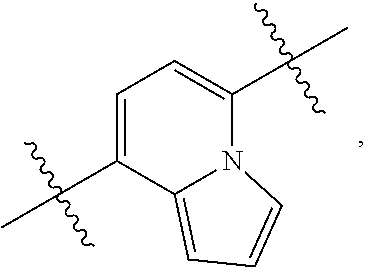
R3b is H, and R2 is trifluoromethyl. In an exemplary embodiment, R1 is as described herein, Z is —CH2—, R6 is H, Y is H, A is

R3a is H, R3b is H, and R2 is trifluoromethyl. In an exemplary embodiment, R1 and R3a are as described herein, Z is —CH2—, R6 is H, Y is H, A is

R3b is methyl, and R2 is trifluoromethyl. In an exemplary embodiment, R1 is as described herein, Z is —CH2—, R6 is H, Y is H, A is

R3a is methyl, R3b is methyl, and R2 is trifluoromethyl. In an exemplary embodiment, R1 and R3a are as described herein, Z is —CH2—, R6 is H, Y is H, A is

R3b is ethyl, and R2 is trifluoromethyl. In an exemplary embodiment, R1 is as described herein, Z is —CH2—, R6 is H, Y is H, A is

R3a is ethyl, R3b is ethyl, and R2 is trifluoromethyl. In an exemplary embodiment, R1 and R3a are as described herein, Z is —CH2—, R6 is H, Y is H, A is

R3b is fluoromethyl, and R2 is trifluoromethyl. In an exemplary embodiment, R1 is as described herein, Z is —CH2—, R6 is H, Y is H, A is

R3a is fluoromethyl, R3b is fluoromethyl, and R2 is trifluoromethyl.

R3b is H, and R2 is trifluoromethyl. In an exemplary embodiment, R1 is as described herein, Z is —CH(CH3)—, R6 is H, Y is H, A is

R3a is H, R3b is H, and R2 is trifluoromethyl. In an exemplary embodiment, R1 and R3a are as described herein, Z is —CH(CH3)—, R6 is H, Y is H, A is

R3b is methyl, and R2 is trifluoromethyl. In an exemplary embodiment, R1 is as described herein, Z is —CH(CH3)—, R6 is H, Y is H, A is

R3a is methyl, R3b is methyl, and R2 is trifluoromethyl. In an exemplary embodiment, R1 and R3a are as described herein, Z is —CH(CH3)—, R6 is H, Y is H, A is

R3b is ethyl, and R2 is trifluoromethyl. In an exemplary embodiment, R1 is as described herein, Z is —CH(CH3)—, R6 is H, Y is H, A is

R3a is ethyl, R3b is ethyl, and R2 is trifluoromethyl. In an exemplary embodiment, R1 and R3a are as described herein, Z is —CH(CH3)—, R6 is H, Y is H, A is

R3b is fluoromethyl, and R2 is trifluoromethyl. In an exemplary embodiment, R1 is as described herein, Z is —CH(CH3)—, R6 is H, Y is H, A is

R3a is fluoromethyl, R3b is fluoromethyl, and R2 is trifluoromethyl.

R3b is H, and R2 is trifluoromethyl. In an exemplary embodiment, R1 is as described herein, Z is —CH2—, R6 is H, Y is F, A is

R3a is H, R3b is H, and R2 is trifluoromethyl. In an exemplary embodiment, R1 and R3a are as described herein, Z is —CH2—, R6 is H, Y is F, A is

R3b is methyl, and R2 is trifluoromethyl. In an exemplary embodiment, R1 is as described herein, Z is —CH2—, R6 is H, Y is F, A is

R3a is methyl, R3b is methyl, and R2 is trifluoromethyl. In an exemplary embodiment, R1 and R3a are as described herein, Z is —CH2—, R6 is H, Y is F, A is

R3b is ethyl, and R2 is trifluoromethyl. In an exemplary embodiment, R1 is as described herein, Z is —CH2—, R6 is H, Y is F, A is

R3a is ethyl, R3b is ethyl, and R2 is trifluoromethyl. In an exemplary embodiment, R1 and R3a are as described herein, Z is —CH2—, R6 is H, Y is F, A is

R3b is fluoromethyl, and R2 is trifluoromethyl. In an exemplary embodiment, R1 is as described herein, Z is —CH2—, R6 is H, Y is F, A is

R3a is fluoromethyl, R3b is fluoromethyl, and R2 is trifluoromethyl.

R3b is H, and R2 is trifluoromethyl. In an exemplary embodiment, R1 is as described herein, Z is —CH(CH3)—, R6 is H, Y is F, A is

R3a is H, R3b is H, and R2 is trifluoromethyl. In an exemplary embodiment, R1 and R3a are as described herein, Z is —CH(CH3)—, R6 is H, Y is F, A is

R3b is methyl, and R2 is trifluoromethyl. In an exemplary embodiment, R1 is as described herein, Z is —CH(CH3)—, R6 is H, Y is F, A is

R3a is methyl, R3b is methyl, and R2 is trifluoromethyl. In an exemplary embodiment, R1 and R3a are as described herein, Z is —CH(CH3)—, R6 is H, Y is F, A is

R3b is ethyl, and R2 is trifluoromethyl. In an exemplary embodiment, R1 is as described herein, Z is —CH(CH3)—, R6 is H, Y is F, A is

R3a is ethyl, R3b is ethyl, and R2 is trifluoromethyl. In an exemplary embodiment, R1 and R3a are as described herein, Z is —CH(CH3)—, R6 is H, Y is F, A is

R3b is fluoromethyl, and R2 is trifluoromethyl. In an exemplary embodiment, R1 is as described herein, Z is —CH(CH3)—, R6 is H, Y is F, A is

R3a is fluoromethyl, R3b is fluoromethyl, and R2 is trifluoromethyl.

R3b is H, and R2 is trifluoromethyl. In an exemplary embodiment, R1 is as described herein, Z is —CH2—, R6 is H, Y is Cl, A is

R3a is H, R3b is H, and R2 is trifluoromethyl. In an exemplary embodiment, R1 and R3a are as described herein, Z is —CH2—, R6 is H, Y is Cl, A is

R3b is methyl, and R2 is trifluoromethyl. In an exemplary embodiment, R1 is as described herein, Z is —CH2—, R6 is H, Y is Cl, A is

R3a is methyl, R3b is methyl, and R2 is trifluoromethyl. In an exemplary embodiment, R1 and R3a are as described herein, Z is —CH2—, R6 is H, Y is Cl, A is

R3b is ethyl, and R2 is trifluoromethyl. In an exemplary embodiment, R1 is as described herein, Z is —CH2—, R6 is H, Y is Cl, A is

R3a is ethyl, R3b is ethyl, and R2 is trifluoromethyl. In an exemplary embodiment, R1 and R3a are as described herein, Z is —CH2—, R6 is H, Y is Cl, A is

R3b is fluoromethyl, and R2 is trifluoromethyl. In an exemplary embodiment, R1 is as described herein, Z is —CH2—, R6 is H, Y is Cl, A is

R3a is fluoromethyl, R3b is fluoromethyl, and R2 is trifluoromethyl.

R3b is H, and R2 is trifluoromethyl. In an exemplary embodiment, R1 is as described herein, Z is —CH(CH3)—, R6 is H, Y is Cl, A is

R3a is H, R3b is H, and R2 is trifluoromethyl. In an exemplary embodiment, R1 and R3a are as described herein, Z is —CH(CH3)—, R6 is H, Y is Cl, A is

R3b is methyl, and R2 is trifluoromethyl. In an exemplary embodiment, R1 is as described herein, Z is —CH(CH3)—, R6 is H, Y is Cl, A is

R3a is methyl, R3b is methyl, and R2 is trifluoromethyl. In an exemplary embodiment, R1 and R3a are as described herein, Z is —CH(CH3)—, R6 is H, Y is Cl, A is
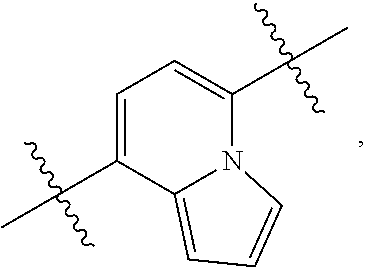
R3b is ethyl, and R2 is trifluoromethyl. In an exemplary embodiment, R1 is as described herein, Z is —CH(CH3)—, R6 is H, Y is Cl, A is

R3a is ethyl, R3b is ethyl, and R2 is trifluoromethyl. In an exemplary embodiment, R1 and R3a are as described herein, Z is —CH(CH3)—, R6 is H, Y is Cl, A is

R3b is fluoromethyl, and R2 is trifluoromethyl. In an exemplary embodiment, R1 is as described herein, Z is —CH(CH3)—, R6 is H, Y is Cl, A is

R3a is fluoromethyl, R3b is fluoromethyl, and R2 is trifluoromethyl.

and R2 is trifluoromethyl. In an exemplary embodiment, R1 and R3a are as described herein, Z is —CH2—, R6 is H, Y is H, A is

R3b is H, and R2 is trifluoromethyl. In an exemplary embodiment, R1 is as described herein, Z is —CH2—, R6 is H, Y is H, A is

R3a is H, R3b is H, and R2 is trifluoromethyl. In an exemplary embodiment, R1 and R3a are as described herein, Z is —CH2—, R6 is H, Y is H, A is

R3b is methyl, and R2 is trifluoromethyl. In an exemplary embodiment, R1 is as described herein, Z is —CH2—, R6 is H, Y is H, A is

R3a is methyl, R3b is methyl, and R2 is trifluoromethyl. In an exemplary embodiment, R1 and R3a are as described herein, Z is —CH2—, R6 is H, Y is H, A is

R3b is ethyl, and R2 is trifluoromethyl. In an exemplary embodiment, R1 is as described herein, Z is —CH2—, R6 is H, Y is H, A is

R3a is ethyl, R3b is ethyl, and R2 is trifluoromethyl. In an exemplary embodiment, R1 and R3a are as described herein, Z is —CH2—, R6 is H, Y is H, A is

R3b is fluoromethyl, and R2 is trifluoromethyl. In an exemplary embodiment, R1 is as described herein, Z is —CH2—, R6 is H, Y is H, A is

R3a is fluoromethyl, R3b is fluoromethyl, and R2 is trifluoromethyl.

and R2 is trifluoromethyl. In an exemplary embodiment, R1 and R3a are as described herein, Z is —CH(CH3)—, R6 is H, Y is H, A is

R3b is H, and R2 is trifluoromethyl. In an exemplary embodiment, R1 is as described herein, Z is —CH(CH3)—, R6 is H, Y is H, A is

R3a is H, R3b is H, and R2 is trifluoromethyl. In an exemplary embodiment, R1 and R3a are as described herein, Z is —CH(CH3)—, R6 is H, Y is H, A is

R3b is methyl, and R2 is trifluoromethyl. In an exemplary embodiment, R1 is as described herein, Z is —CH(CH3)—, R6 is H, Y is H, A is

R3a is methyl, R3b is methyl, and R2 is trifluoromethyl. In an exemplary embodiment, R1 and R3a are as described herein, Z is —CH(CH3)—, R6 is H, Y is H, A is

R3b is ethyl, and R2 is trifluoromethyl. In an exemplary embodiment, R1 is as described herein, Z is —CH(CH3)—, R6 is H, Y is H, A is

R3a is ethyl, R3b is ethyl, and R2 is trifluoromethyl. In an exemplary embodiment, R1 and R3a are as described herein, Z is —CH(CH3)—, R6 is H, Y is H, A is

R3b is fluoromethyl, and R2 is trifluoromethyl. In an exemplary embodiment, R1 is as described herein, Z is —CH(CH3)—, R6 is H, Y is H, A is

R3a is fluoromethyl, R3b is fluoromethyl, and R2 is trifluoromethyl.

and R2 is trifluoromethyl. In an exemplary embodiment, R1 and R3a are as described herein, Z is —CH2—, R6 is H, Y is F, A is

R3b is H, and R2 is trifluoromethyl. In an exemplary embodiment, R1 is as described herein, Z is —CH2—, R6 is H, Y is F, A is

R3a is H, R3b is H, and R2 is trifluoromethyl. In an exemplary embodiment, R1 and R3a are as described herein, Z is —CH2—, R6 is H, Y is F, A is

R3b is methyl, and R2 is trifluoromethyl. In an exemplary embodiment, R1 is as described herein, Z is —CH2—, R6 is H, Y is F, A is

R3a is methyl, R3b is methyl, and R2 is trifluoromethyl. In an exemplary embodiment, R1 and R3a are as described herein, Z is —CH2—, R6 is H, Y is F, A is

R3b is ethyl, and R2 is trifluoromethyl. In an exemplary embodiment, R1 is as described herein, Z is —CH2—, R6 is H, Y is F, A is

R3a is ethyl, R3b is ethyl, and R2 is trifluoromethyl. In an exemplary embodiment, R1 and R3a are as described herein, Z is —CH2—, R6 is H, Y is F, A is

R3b is fluoromethyl, and R2 is trifluoromethyl. In an exemplary embodiment, R1 is as described herein, Z is —CH2—, R6 is H, Y is F, A is

R3a is fluoromethyl, R3b is fluoromethyl, and R2 is trifluoromethyl.

and R2 is trifluoromethyl. In an exemplary embodiment, R1 and R3a are as described herein, Z is —CH(CH3)—, R6 is H, Y is F, A is

R3b is H, and R2 is trifluoromethyl. In an exemplary embodiment, R1 is as described herein, Z is —CH(CH3)—, R6 is H, Y is F, A is

R3a is H, R3b is H, and R2 is trifluoromethyl. In an exemplary embodiment, R1 and R3a are as described herein, Z is —CH(CH3)—, R6 is H, Y is F, A is

R3b is methyl, and R2 is trifluoromethyl. In an exemplary embodiment, R1 is as described herein, Z is —CH(CH3)—, R6 is H, Y is F, A is

R3a is methyl, R3b is methyl, and R2 is trifluoromethyl. In an exemplary embodiment, R1 and R3a are as described herein, Z is —CH(CH3)—, R6 is H, Y is F, A is

R3b is ethyl, and R2 is trifluoromethyl. In an exemplary embodiment, R1 is as described herein, Z is —CH(CH3)—, R6 is H, Y is F, A is

R3a is ethyl, R3b is ethyl, and R2 is trifluoromethyl. In an exemplary embodiment, R1 and R3a are as described herein, Z is —CH(CH3)—, R6 is H, Y is F, A is

R3b is fluoromethyl, and R2 is trifluoromethyl. In an exemplary embodiment, R1 is as described herein, Z is —CH(CH3)—, R6 is H, Y is F, A is

R3a is fluoromethyl, R3b is fluoromethyl, and R2 is trifluoromethyl.

and R2 is trifluoromethyl. In an exemplary embodiment, R1 and R3a are as described herein, Z is —CH2—, R6 is H, Y is Cl, A is

R3b is H, and R2 is trifluoromethyl. In an exemplary embodiment, R1 is as described herein, Z is —CH2—, R6 is H, Y is Cl, A is

R3a is H, R3b is H, and R2 is trifluoromethyl. In an exemplary embodiment, R1 and R3a are as described herein, Z is —CH2—, R6 is H, Y is Cl, A is

R3b is methyl, and R2 is trifluoromethyl. In an exemplary embodiment, R1 is as described herein, Z is —CH2—, R6 is H, Y is Cl, A is

R3a is methyl, R3b is methyl, and R2 is trifluoromethyl. In an exemplary embodiment, R1 and R3a are as described herein, Z is —CH2—, R6 is H, Y is Cl, A is

R3b is ethyl, and R2 is trifluoromethyl. In an exemplary embodiment, R1 is as described herein, Z is —CH2—, R6 is H, Y is Cl, A is

R3a is ethyl, R3b is ethyl, and R2 is trifluoromethyl. In an exemplary embodiment, R1 and R3a are as described herein, Z is —CH2—, R6 is H, Y is Cl, A is

R3b is fluoromethyl, and R2 is trifluoromethyl. In an exemplary embodiment, R1 is as described herein, Z is —CH2—, R6 is H, Y is Cl, A is
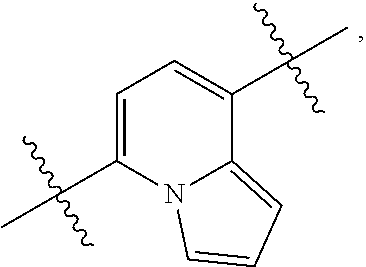
R3a is fluoromethyl, R3b is fluoromethyl, and R2 is trifluoromethyl.

and R2 is trifluoromethyl. In an exemplary embodiment, R1 and R3a are as described herein, Z is —CH(CH3)—, R6 is H, Y is Cl, A is

R3b is H, and R2 is trifluoromethyl. In an exemplary embodiment, R1 is as described herein, Z is —CH(CH3)—, R6 is H, Y is Cl, A is

R3a is H, R3b is H, and R2 is trifluoromethyl. In an exemplary embodiment, R1 and R3a are as described herein, Z is —CH(CH3)—, R6 is H, Y is Cl, A is
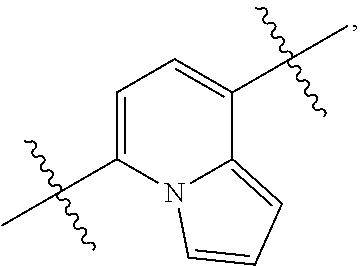
R3b is methyl, and R2 is trifluoromethyl. In an exemplary embodiment, R1 is as described herein, Z is —CH(CH3)—, R6 is H, Y is Cl, A is

R3a is methyl, R3b is methyl, and R2 is trifluoromethyl. In an exemplary embodiment, R1 and R3a are as described herein, Z is —CH(CH3)—, R6 is H, Y is Cl, A is

R3b is ethyl, and R2 is trifluoromethyl. In an exemplary embodiment, R1 is as described herein, Z is —CH(CH3)—, R6 is H, Y is Cl, A is

R3a is ethyl, R3b is ethyl, and R2 is trifluoromethyl. In an exemplary embodiment R1 and R3a are as described herein, Z is —CH(CH3)—, R6 is H, Y is Cl, A is

R3b is fluoromethyl, and R2 is trifluoromethyl. In an exemplary embodiment, R1 is as described herein, Z is —CH(CH3)—, R6 is H, Y is Cl, A is

R3a is fluoromethyl, R3b is fluoromethyl, and R2 is trifluoromethyl.

wherein A, Y, Z, R1, R2, R3a, R3b, and R6 are as described herein, and C* is a carbon atom which is a stereocenter having a configuration which is (R) or (S). In an exemplary embodiment, A, Y, Z, R1, R2, R3a, R3b, and R6 are as described herein, and C* is a stereocenter with a (R) configuration. In an exemplary embodiment, A, Y, Z, R1, R2, R3a, R3b, and R6 are as described herein, and C* is a stereocenter with a (S) configuration.

wherein C* is a carbon atom which is a stereocenter having a (S) configuration.

wherein Y is hydrogen, fluoro, or chloro;
-
- R2 is trifluoromethyl;
- R3a and R3b are each hydrogen, methyl, or fluoromethyl; and
R1a, R1b, R1c, R1d, and R1e are each independently selected from hydrogen, fluoro, chloro, bromo, methyl, difluoromethyl, trifluoromethyl, methoxy, trifluoromethoxy, or trifluoroethoxy.

wherein Y is hydrogen, fluoro, or chloro;
-
- R2 is trifluoromethyl;
- R3a and R3b are each hydrogen, methyl, or fluoromethyl; and
- R1b, R1c, and R1d are each independently selected from hydrogen, fluoro, chloro, bromo, methyl, difluoromethyl, trifluoromethyl, methoxy, trifluoromethoxy, or trifluoroethoxy.

wherein Y is hydrogen, fluoro, or chloro;
-
- R2 is trifluoromethyl;
- R3a and R3b are each hydrogen, methyl, or fluoromethyl; and
- R1b, R1c, and R1d are each independently selected from hydrogen, fluoro, chloro, bromo, methyl, difluoromethyl, trifluoromethyl, methoxy, trifluoromethoxy, or trifluoroethoxy.

wherein Y is hydrogen, fluoro, or chloro;
-
- R2 is trifluoromethyl;
- R3a and R3b are each hydrogen, methyl, or fluoromethyl; and
- R1b, R1c, and R1d are each independently selected from hydrogen, fluoro, chloro, bromo, methyl, difluoromethyl, trifluoromethyl, methoxy, trifluoromethoxy, or trifluoroethoxy.

wherein Y is hydrogen, fluoro, or chloro;
-
- R2 is trifluoromethyl;
- R3a and R3b are each hydrogen, methyl, or fluoromethyl; and
- R1b, R1c, and R1d are each independently selected from hydrogen, fluoro, chloro, bromo, methyl, difluoromethyl, trifluoromethyl, methoxy, trifluoromethoxy, or trifluoroethoxy.

wherein Y is hydrogen, fluoro, or chloro;
-
- R3a and R3b are each methyl or fluoromethyl; and
- R1b, R1c, and R1d are each independently selected from hydrogen, chloro, or fluoro.

wherein Y is hydrogen, R3a and R3b are each methyl, R1b is chloro, R1c is chloro or fluoro; and R1d is chloro.

Y is as described herein, R1a is H, R1e is H, and R1b, R1c, and R1d are according to the entries in the following Table A:
| TABLE A | |||||
| R1b | R1c | R1d | |||
| F | F | H | H | ||
| H | F | H | |||
| H | H | F | |||
| F | F | H | |||
| F | H | F | |||
| H | F | F | |||
| F | F | F | |||
| Cl | Cl | H | H | ||
| H | Cl | H | |||
| H | H | Cl | |||
| Cl | Cl | H | |||
| Cl | H | Cl | |||
| H | Cl | Cl | |||
| Cl | Cl | Cl | |||
| Br | Br | H | H | ||
| H | Br | H | |||
| H | H | Br | |||
| Br | Br | H | |||
| Br | H | Br | |||
| H | Br | Br | |||
| Br | Br | Br | |||
| F, Cl | F | Cl | H | ||
| Cl | F | H | |||
| F | H | Cl | |||
| Cl | H | F | |||
| H | F | Cl | |||
| H | Cl | F | |||
| Cl | F | F | |||
| F | Cl | F | |||
| F | F | Cl | |||
| Cl | Cl | F | |||
| Cl | F | Cl | |||
| F | Cl | C1 | |||
| F, Br | F | Br | H | ||
| Br | F | H | |||
| F | H | Br | |||
| Br | H | F | |||
| H | F | Br | |||
| H | Br | F | |||
| Br | F | F | |||
| F | Br | F | |||
| F | F | Br | |||
| Br | Br | F | |||
| Br | F | Br | |||
| F | Br | Br | |||
| Br, Cl | Br | Cl | H | ||
| Cl | Br | H | |||
| Br | H | Cl | |||
| Cl | H | Br | |||
| H | Br | Cl | |||
| H | Cl | Br | |||
| Cl | Br | Br | |||
| Br | Cl | Br | |||
| Br | Br | Cl | |||
| Cl | Cl | Br | |||
| Cl | Br | Cl | |||
| Br | Cl | Cl | |||

Y is as described herein, R1a is H, R1c is H, and R1b, R1c, and R1d are according to the entries in the following Table B:
| TABLE B | |||||
| R1b | R1c | R1d | |||
| F | F | H | H | ||
| H | F | H | |||
| H | H | F | |||
| F | F | H | |||
| F | H | F | |||
| H | F | F | |||
| F | F | F | |||
| Cl | Cl | H | H | ||
| H | Cl | H | |||
| H | H | Cl | |||
| Cl | Cl | H | |||
| Cl | H | Cl | |||
| H | Cl | Cl | |||
| Cl | Cl | Cl | |||
| Br | Br | H | H | ||
| H | Br | H | |||
| H | H | Br | |||
| Br | Br | H | |||
| Br | H | Br | |||
| H | Br | Br | |||
| Br | Br | Br | |||
| F, Cl | F | Cl | H | ||
| Cl | F | H | |||
| F | H | Cl | |||
| Cl | H | F | |||
| H | F | Cl | |||
| H | Cl | F | |||
| Cl | F | F | |||
| F | Cl | F | |||
| F | F | Cl | |||
| Cl | Cl | F | |||
| Cl | F | Cl | |||
| F | Cl | Cl | |||
| F, Br | F | Br | H | ||
| Br | F | H | |||
| F | H | Br | |||
| Br | H | F | |||
| H | F | Br | |||
| H | Br | F | |||
| Br | F | F | |||
| F | Br | F | |||
| F | F | Br | |||
| Br | Br | F | |||
| Br | F | Br | |||
| F | Br | Br | |||
| Br, Cl | Br | Cl | H | ||
| Cl | Br | H | |||
| Br | H | Cl | |||
| Cl | H | Br | |||
| H | Br | Cl | |||
| H | Cl | Br | |||
| Cl | Br | Br | |||
| Br | Cl | Br | |||
| Br | Br | Cl | |||
| Cl | Cl | Br | |||
| Cl | Br | Cl | |||
| Br | Cl | Cl | |||
In an exemplary embodiment, according to any entries in Table A or B, Y is as described herein, R2 is CF3 or CHF2 or CH2F, R3a is CH3 and R3b is CH3. In an exemplary embodiment, according to any entries in this table, Y is as described herein, R2 is CF3, R3a is unsubstituted alkyl and R3b is unsubstituted alkyl. In an exemplary embodiment, according to any entries in this table, Y is as described herein, R2 is CF3, R3a is ethyl and R3b is ethyl. In an exemplary embodiment, according to any entries in this table, Y is as described herein, R2 is CF3, R3a is CH3 and R3b is CH3. In an exemplary embodiment, according to any entries in this table, R2, R3a, and R3b are as described herein, and Y is H. In an exemplary embodiment, according to any entries in this table, R2, R3a, and R3b are as described herein, and Y is F. In an exemplary embodiment, according to any entries in this table, R2, R3a, and R3b are as described herein, and Y is Cl. In an exemplary embodiment, according to any entries in this table, R2 is as described herein, R3a is CH3 or CH2F and R3b is CH3 or CH2F, and Y is H. In an exemplary embodiment, according to any entries in this table, R2 is as described herein, R3a is CH3 or CH2F and R3b is CH3 or CH2F, and Y is F. In an exemplary embodiment, according to any entries in this table, R2 is as described herein, R3a is CH3 or CH2F and R3b is CH3 or CH2F, and Y is Cl. In an exemplary embodiment, according to any entries in this table, R2 is CF3, R3a is CH3 or CH2F and R3b is CH3 or CH2F, and Y is H. In an exemplary embodiment, according to any entries in this table, R2 is CF3, R3a is CH3 or CH2F and R3b is CH3 or CH2F, and Y is F. In an exemplary embodiment, according to any entries in this table, R2 is CF3, R3a is CH3 or CH2F and R3b is CH3 or CH2F, and Y is Cl.
wherein z is a first compound in a composition, y is a second compound in the composition, and the first compound is a non-superimposable mirror image of the second compound.
wherein the major diastereomer is a first compound in a composition, and the minor diastereomer(s) is at least one additional compound in the composition, and the major diastereomer and minor diastereomer(s) are stereoisomers, but not mirror images, of one another.


wherein boronic acid-related A is commercially available from, for example, Sigma-Aldrich. A can also be synthesized from the corresponding aryl bromide using well known conventional methods available in the literature. A can be converted to B through Suzuki coupling reaction. C is commercially available from, for example, Sigma-Aldrich. C can be converted to D through subjecting it to formylation reaction conditions, such as those involving BuLi and DMF. D can be converted to E through subjecting it to esterification reaction conditions, such as those involving thionyl chloride and alcohol. E can be converted to F through subjecting it to oxime-forming conditions, such as those involving NH2OH. F can be converted to G through subjecting it to chlorination reaction conditions, such as those involving NCS. G can be converted to H through subjecting it to cyclization reaction with B. H can be converted to I through subjecting it to hydrolysis reaction conditions, such as those involving aqueous LiOH.

wherein D can be prepared by the method previously described. D can be converted to J through subjecting it to oxime-forming conditions, such as those involving NH2OH. J can be converted to K through subjecting it to chlorination reaction conditions, such as those involving NCS. K can be converted to I through subjecting it to cyclization reaction with B.


wherein boronic acid-related A′ is commercially available from, for example, Sigma-Aldrich. A′ can be converted to B′ through Grignard reaction by reacting A′ with magnesium metal or BuLi and then reacting with alkylcarboxylic acid chloride such as 2,2,2-trifluoroacetyl chloride, or with alkylcarboxylic acid ester such as ethyl 2,2,2-trifluoroacetate, or with alkylcarboxylic acid amide such as 2,2,2-trifluoro-1-(piperidin-1-yl)ethanone and 2,2,2-trifluoro-N-methoxy-N-methylacetamide. C′ is commercially available from, for example, Sigma-Aldrich. C′ can be converted to D′ through subjecting it to substitution reaction with 5-methyldihydrofuran-2(3H)-one under basic conditions, such as those involving NaH. D′ can be converted to E′ through subjecting it to esterification reaction conditions, such as those involving MeI. E′ can be converted to F′ through subjecting it to cyclization reaction conditions, such as those involving BBr3. F′ can be converted to G′ through subjecting it to oxidation reaction conditions, such as those involving KMnO4. G′ can be converted to H′ through subjecting it to bromination reaction conditions, such as those involving phenyltrimethylammonium tribromide (PTT). H′ can be converted to I′ through subjecting it to basic reaction conditions such as 2,3,4,6,7,8,9,10-octahydropyrimido[1,2-a]azepine (DBU). I′ can be converted to J′ through subjecting it to reductive debromination reaction conditions, such as those involving H2 and Pd/C in EtOAc. J′ can be converted to K′ through subjecting it to triflating reaction conditions, such as those involving Tf2O. K′ can be converted to L′ through subjecting it to coupling reaction conditions, such as those involving tributyl(1-ethoxyvinyl)stannane. L′ can be converted to M′ through subjecting it to dealkylation reaction conditions, such as those involving aqueous HCl. M′ can be converted to N′ through subjecting it to addition reaction conditions with B′, such as those involving triethylamine N′ can be converted to O′ through subjecting it to dehydration reaction conditions, such as those involving Ac2O. O′ can be converted to P′ through subjecting it to cyclization reaction conditions, such as those involving NH2OH. P′ can be converted to Q′ through subjecting it to hydrolysis reaction conditions, such as those involving KOH.

wherein boronic acid-related R′ is commercially available from, for example, Sigma-Aldrich. R′ can also be synthesized from the corresponding aryl bromide using well known conventional methods available in the literature. R′ can be converted to S′ through Suzuki coupling reaction. K′ can be converted to T′ through subjecting it to catalytic carbonylation reaction conditions, such as those involving carbon monoxide. T′ can be converted to U′ through subjecting it to condensation reaction conditions, such as those involving NH2OH. U′ can be converted to P′ through subjecting it to cyclization reaction with S′ in the presence of iodobenzene diacetate (DIB). P′ can be converted to Q′ through subjecting it to hydrolysis reaction conditions, such as those involving NaOH or KOH or LiOH.

wherein K′ can be converted to V′ through reduction reaction, such as those involving NaBH4. V′ can be converted to W′ through subjecting it to catalytic carbonylation reaction conditions, such as those involving carbon monoxide. W′ can be converted to X′ through subjecting it to oxidation reaction conditions, such as those involving MnO2. X′ can be converted to Y′ through subjecting it to condensation reaction conditions, such as those involving NH2OH. Y′ can be converted to Z′ through subjecting it to cyclization reaction with S in the presence of iodobenzene diacetate (DIB). Z′ can be converted to AA′ through subjecting it to hydrolysis reaction conditions, such as those involving NaOH.

wherein L is commercially available from, for example, Sigma-Aldrich. L can be converted to M through subjecting it to esterification reaction conditions, such as those involving thionyl chloride and alcohol. M can be converted to N through subjecting it to Grignard reaction conditions, such as that involving alkyl magnesium bromide (R3a and R3b are same in this scheme). N can be converted to O through subjecting it to boronylation conditions. O can be converted to P through subjecting it to dibromination and hydrolysis conditions, such as those involving 2 eq NBS and then aqueous sodium carbonate. P can be converted to Q through subjecting it to reductive amination reaction conditions, such as those involving methyl amine and NaBH(OAc)3. O can be converted to R through subjecting it to mono-bromination reaction conditions, such as that involving NBS. R can be converted to T through subjecting it to amination reaction conditions, such as that involving NH3 in methanol. P can be converted to S through subjecting it to oxime-forming reaction conditions, such as those involving NH2OH. S can be converted to T through subjecting it to reduction conditions, such as those involving zinc and acetic acid. P can be converted to U through subjecting it to double-forming reaction conditions, such as those involving nitromethane, AcOH and NH4OAc. U can be converted to V through subjecting it to reduction conditions, such as those involving H2 and Pd(OH)2.

wherein W is commercially available from, for example, Sigma-Aldrich. W can be converted to X through subjecting it to iodination reaction conditions, such as those involving I2. X can be converted to Y through subjecting it to Sandmeyer reaction conditions, such as those involving HNO2 and then CuBr. Y can be converted to N through subjecting it to Grignard-reagent-forming condition and then addition reaction to ketones (R3a and R3b can be same or different in this scheme). The rest of the reaction conditions in this scheme are same as described in the previous scheme.


(where R4 and R5 may be hydrogen or lower alkyl) wherein M can be made by the method described previously. M can be converted to Z through subjecting it to oxidation reaction conditions, such as those involving KMnO4. Z can be converted to AA through subjecting it to esterification reaction conditions, such as those involving thionyl chloride and alcohol. AA can be converted to AB through subjecting it to Grignard reaction conditions, such as those involving alkyl magnesium bromide (R4, R5, R3a and R3b are same in this scheme). AB can be converted to AC through subjecting it to protection reaction conditions, such as those involving ethoxymethyl chloride and DIPEA. AC can be converted to AD through subjecting it to boronylation reaction conditions, such as those involving bis(pinacolato)diboron. AD can be converted to AE through subjecting it to hydrolysis reaction conditions, such as that involving aqueous hydrochloric acid. AE can be converted to AF through subjecting it to substitution reaction conditions, such as that involving NaN3 in TFA. AF can be converted to AG through subjecting it to reduction reaction conditions, such as those involving H2 and Pd/C.


wherein Z can be made by the method described previously. Z can be converted to AH through subjecting it to amide-forming reaction conditions, such as those involving NH4Cl, HATU and DIPEA. AH can be converted to AI through subjecting it to dehydration reaction conditions, such as those involving (CNCl)3. AI can be converted to AJ through subjecting it to Grignard reaction conditions, such as those involving alkyl magnesium bromide (R4, R3a and R3b are same in this scheme). AJ can be converted to AK through subjecting it to protection reaction conditions, such as those involving ethoxymethyl chloride and DIPEA. AK can be converted to AL through subjecting it to boronylation reaction conditions, such as those involving bis(pinacolato)diboron. AL can be converted to AM through subjecting it to hydrolysis reaction conditions, such as that involving aqueous hydrochloric acid. AM can be converted to AN through subjecting it to oxime-forming reaction conditions, such as that involving NH2OH. AN can be converted to AO through subjecting it to reduction reaction conditions, such as those involving zinc and acetic acid.

but understanding the other definitions for A may be employed as well, a compound of the invention can be synthesized according to the following scheme:
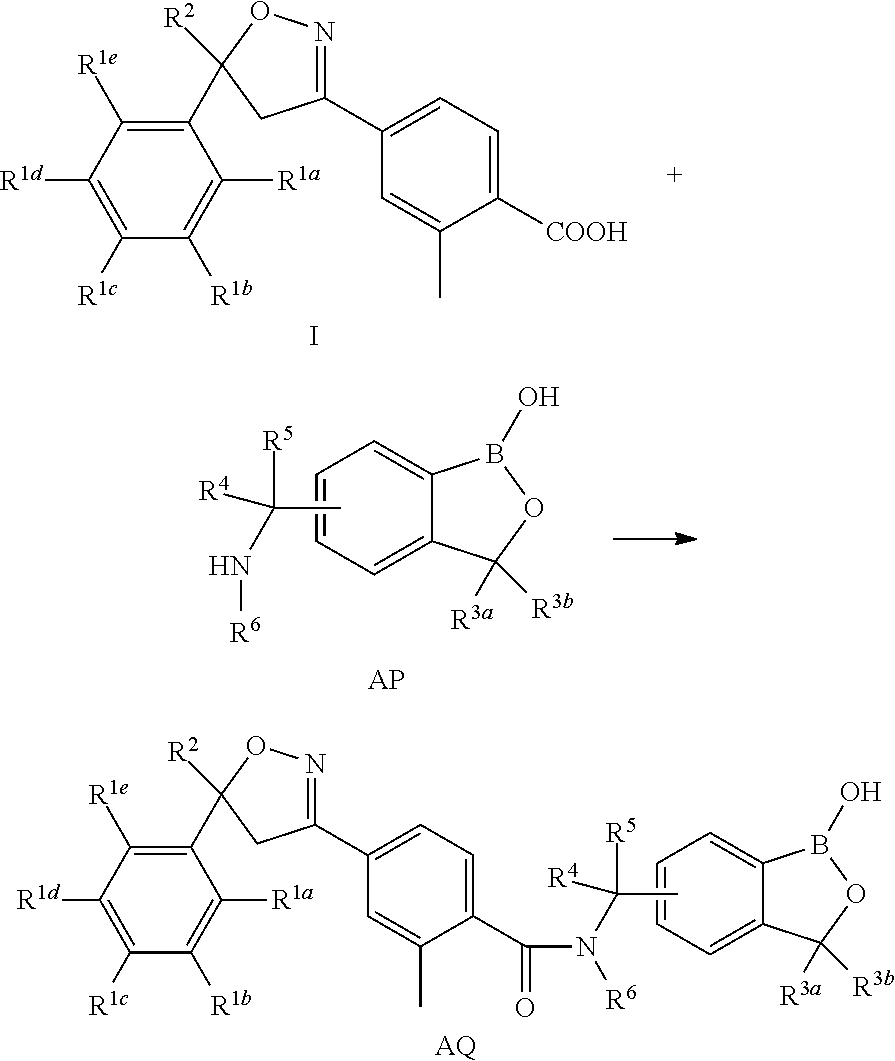
wherein I and AP (R3a, R3b, R4, R5 and R6 can be same or different in this scheme) can be made by the methods described above. AQ can be formed from I and AP by using amide-forming reaction conditions, such as those involving HATU and DIPEA.

the compound, or salt thereof, is N-((1-Hydroxy-3,3-dimethyl-1,3-dihydrobenzo[c][1,2]oxaborol-5-yl)methyl)-2-methyl-4-(5-(3,4,5-trichlorophenyl)-5-(trifluoromethyl)-4,5-dihydroisoxazol-3-yl)benzamide; or 4-(5-(3,5-Dichlorophenyl)-5-(trifluoromethyl)-4,5-dihydroisoxazol-3-yl)-N-((1-hydroxy-3,3-dimethyl-1,3-dihydrobenzo[c][1,2]oxaborol-5-yl)methyl)-2-methylbenzamide; or 4-(5-(3,5-Dichloro-4-fluorophenyl)-5-(trifluoromethyl)-4,5-dihydroisoxazol-3-yl)-N-((1-hydroxy-3,3-dimethyl-1,3-dihydrobenzo[c][1,2]oxaborol-5-yl)methyl)-2-methylbenzamide; or 4-(5-(3,5-Dichlorophenyl)-5-(trifluoromethyl)-4,5-dihydroisoxazol-3-yl)-N-((1-hydroxy-1,3-dihydrobenzo[c][1,2]oxaborol-6-yl)methyl)-2-methylbenzamide; or 4-(5-(3,5-Dichlorophenyl)-5-(trifluoromethyl)-4,5-dihydroisoxazol-3-yl)-N-(2-((1-hydroxy-1,3-dihydrobenzo[c][1,2]oxaborol-6-yl)methylamino)-2-oxoethyl)-2-methylbenzamide; or 4-(5-(3,5-Dichlorophenyl)-5-(trifluoromethyl)-4,5-dihydroisoxazol-3-yl)-N-((1-hydroxy-3,3-dimethyl-1,3-dihydrobenzo[c][1,2]oxaborol-6-yl)methyl)-2-methyl benzamide; or 4-(5-(3,5-Dichlorophenyl)-5-(trifluoromethyl)-4,5-dihydroisoxazol-3-yl)-N-((1-hydroxy-3,3-dimethyl-1,3-dihydrobenzo[c][1,2]oxaborol-6-yl)methyl)-N,2-dimethylbenzamide; or N-((1-Hydroxy-3,3-dimethyl-1,3-dihydrobenzo[c][1,2]oxaborol-6-yl)methyl)-2-methyl-4-(5-(3,4,5-trichlorophenyl)-5-(trifluoromethyl)-4,5-dihydroisoxazol-3-yl)benzamide; or 4-(5-(3,5-Dichloro-4-fluorophenyl)-5-(trifluoromethyl)-4,5-dihydroisoxazol-3-yl)-N-((1-hydroxy-3,3-dimethyl-1,3-dihydrobenzo[c][1,2]oxaborol-6-yl)methyl)-2-methylbenzamide; or (S)-N-((1-hydroxy-3,3-dimethyl-1,3-dihydrobenzo[c][1,2]oxaborol-6-yl)methyl)-2-methyl-4-(5-(3,4,5-trichlorophenyl)-5-(trifluoromethyl)-4,5-dihydroisoxazol-3-yl)benzamide; or (R)-N-((1-hydroxy-3,3-dimethyl-1,3-dihydrobenzo[c][1,2]oxaborol-6-yl)methyl)-2-methyl-4-(5-(3,4,5-trichlorophenyl)-5-(trifluoromethyl)-4,5-dihydroisoxazol-3-yl)benzamide; or (S)-4-(5-(3,5-Dichloro-4-fluorophenyl)-5-(trifluoromethyl)-4,5-dihydroisoxazol-3-yl)-N-((1-hydroxy-3,3-dimethyl-1,3-dihydrobenzo[c][1,2]oxaborol-6-yl)methyl)-2-methylbenzamide; or (R)-4-(5-(3,5-Dichloro-4-fluorophenyl)-5-(trifluoromethyl)-4,5-dihydroisoxazol-3-yl)-N-((1-hydroxy-3,3-dimethyl-1,3-dihydrobenzo[c][1,2]oxaborol-6-yl)methyl)-2-methylbenzamide; or 4-(5-(3,5-Dichlorophenyl)-5-(trifluoromethyl)-4,5-dihydroisoxazol-3-yl)-N-((3,3-diethyl-1-hydroxy-1,3-dihydrobenzo[c][1,2]oxaborol-6-yl)methyl)-2-methylbenzamide; or 4-(5-(3,5-Dichloro-4-fluorophenyl)-5-(trifluoromethyl)-4,5-dihydroisoxazol-3-yl)-N-((3,3-diethyl-1-hydroxy-1,3-dihydrobenzo[c][1,2]oxaborol-6-yl)methyl)-2-methylbenzamide; or 4-(5-(3,4,5-Trichlorophenyl)-5-(trifluoromethyl)-4,5-dihydroisoxazol-3-yl)-N-((3,3-diethyl-1-hydroxy-1,3-dihydrobenzo[c][1,2]oxaborol-6-yl)methyl)-2-methylbenzamide; or N-((3,3-Bis(fluoromethyl)-1-hydroxy-1,3-dihydrobenzo[c][1,2]oxaborol-6-yl)methyl)-4-(5-(3,5-dichlorophenyl)-5-(trifluoromethyl)-4,5-dihydroisoxazol-3-yl)-2-methylbenzamide; or N-((3,3-Bis(fluoromethyl)-1-hydroxy-1,3-dihydrobenzo[c][1,2]oxaborol-6-yl)methyl)-2-methyl-4-(5-(3,4,5-trichlorophenyl)-5-(trifluoromethyl)-4,5-dihydroisoxazol-3-yl)benzamide; or (S)-N-((3,3-Bis(fluoromethyl)-1-hydroxy-1,3-dihydrobenzo[c][1,2]oxaborol-6-yl)methyl)-2-methyl-4-(5-(3,4,5-trichlorophenyl)-5-(trifluoromethyl)-4,5-dihydroisoxazol-3-yl)benzamide; or N-((1-Hydroxy-1H-spiro[benzo[c][1,2]oxaborole-3,1′-cyclopentan]-6-yl)methyl)-2-methyl-4-(5-(3,4,5-trichlorophenyl)-5-(trifluoromethyl)-4,5-dihydroisoxazol-3-yl)benzamide; or N-(2-(1-Hydroxy-3,3-dimethyl-1,3-dihydrobenzo[c][1,2]oxaborol-6-yl)ethyl)-2-methyl-4-(5-(3,4,5-trichlorophenyl)-5-(trifluoromethyl)-4,5-dihydroisoxazol-3-yl)benzamide; or 4-(5-(3,5-Dichloro-4-fluorophenyl)-5-(trifluoromethyl)-4,5-dihydroisoxazol-3-yl)-N-(2-(1-hydroxy-3,3-dimethyl-1,3-dihydrobenzo[c][1,2]oxaborol-6-yl)ethyl)-2-methylbenzamide; or 4-(5-(3,5-Dichlorophenyl)-5-(trifluoromethyl)-4,5-dihydroisoxazol-3-yl)-N-(2-(1-hydroxy-3,3-dimethyl-1,3-dihydrobenzo[c][1,2]oxaborol-6-yl)ethyl)-2-methylbenzamide; or N-(1-(1-Hydroxy-3,3-dimethyl-1,3-dihydrobenzo[c][1,2]oxaborol-6-yl)ethyl)-2-methyl-4-(5-(3,4,5-trichlorophenyl)-5-(trifluoromethyl)-4,5-dihydroisoxazol-3-yl)benzamide; or (S)-N-(1-(1-Hydroxy-3,3-dimethyl-1,3-dihydrobenzo[c][1,2]oxaborol-6-yl)ethyl)-2-methyl-4-(5-(3,4,5-trichlorophenyl)-5-(trifluoromethyl)-4,5-dihydroisoxazol-3-yl)benzamide; or N-(2-(1-Hydroxy-3,3-dimethyl-1,3-dihydrobenzo[c][1,2]oxaborol-6-yl)propan-2-yl)-2-methyl-4-(5-(3,4,5-trichlorophenyl)-5-(trifluoromethyl)-4,5-dihydroisoxazol-3-yl)benzamide; or N-((4-fluoro-1-hydroxy-3,3-dimethyl-1,3-dihydrobenzo[c][1,2]oxaborol-6-yl)methyl)-2-methyl-4-(5-(3,4,5-trichlorophenyl)-5-(trifluoromethyl)-4,5-dihydroisoxazol-3-yl)benzamide; or N-((5-chloro-1-hydroxy-3,3-dimethyl-1,3-dihydrobenzo[c][1,2]oxaborol-6-yl)methyl)-2-methyl-4-(5-(3,4,5-trichlorophenyl)-5-(trifluoromethyl)-4,5-dihydroisoxazol-3-yl)benzamide; or (S)-N-((5-chloro-1-hydroxy-3,3-dimethyl-1,3-dihydrobenzo[c][1,2]oxaborol-6-yl)methyl)-2-methyl-4-(5-(3,4,5-trichlorophenyl)-5-(trifluoromethyl)-4,5-dihydroisoxazol-3-yl)benzamide.

the compound, or salt thereof, is 5-(5-(3,5-Dichlorophenyl)-5-(trifluoromethyl)-4,5-dihydroisoxazol-3-yl)-N-((1-hydroxy-3,3-dimethyl-1,3-dihydrobenzo[c][1,2]oxaborol-6-yl)methyl)indolizine-8-carboxamide; or 8-(5-(3,5-Dichlorophenyl)-5-(trifluoromethyl)-4,5-dihydroisoxazol-3-yl)-N-((1-hydroxy-3,3-dimethyl-1,3-dihydrobenzo[c][1,2]oxaborol-6-yl)methyl)indolizine-5-carboxamide; or N-((1-hydroxy-3,3-dimethyl-1,3-dihydrobenzo[c][1,2]oxaborol-6-yl)methyl)-5-(5-(3,4,5-trichlorophenyl)-5-(trifluoromethyl)-4,5-dihydroisoxazol-3-yl)indolizine-8-carboxamide; or N-((1-Hydroxy-3,3-dimethyl-1,3-dihydrobenzo[c][1,2]oxaborol-6-yl)methyl)-8-(5-(3,4,5-trichlorophenyl)-5-(trifluoromethyl)-4,5-dihydroisoxazol-3-yl)indolizine-5-carboxamide; or 5-(5-(3,5-dichloro-4-fluorophenyl)-5-(trifluoromethyl)-4,5-dihydroisoxazol-3-yl)-N-((1-hydroxy-3,3-dimethyl-1,3-dihydrobenzo[c][1,2]oxaborol-6-yl)methyl)indolizine-8-carboxamide; or 8-(5-(3,5-dichloro-4-fluorophenyl)-5-(trifluoromethyl)-4,5-dihydroisoxazol-3-yl)-N-((1-hydroxy-3,3-dimethyl-1,3-dihydrobenzo[c][1,2]oxaborol-6-yl)methyl)indolizine-5-carboxamide; or (S)-N-((1-hydroxy-3,3-dimethyl-1,3-dihydrobenzo[c][1,2]oxaborol-6-yl)methyl)-5-(5-(3,4,5-trichlorophenyl)-5-(trifluoromethyl)-4,5-dihydroisoxazol-3-yl)indolizine-8-carboxamide; or (S)-N-((1-hydroxy-3,3-dimethyl-1,3-dihydrobenzo[c][1,2]oxaborol-6-yl)methyl)-8-(5-(3,4,5-trichlorophenyl)-5-(trifluoromethyl)-4,5-dihydroisoxazol-3-yl)indolizine-5-carboxamide; or (R)-N-((1-hydroxy-3,3-dimethyl-1,3-dihydrobenzo[c][1,2]oxaborol-6-yl)methyl)-5-(5-(3,4,5-trichlorophenyl)-5-(trifluoromethyl)-4,5-dihydroisoxazol-3-yl)indolizine-8-carboxamide; or (R)-N-((1-hydroxy-3,3-dimethyl-1,3-dihydrobenzo[c][1,2]oxaborol-6-yl)methyl)-8-(5-(3,4,5-trichlorophenyl)-5-(trifluoromethyl)-4,5-dihydroisoxazol-3-yl)indolizine-5-carboxamide; or (S)-5-(5-(3,5-dichloro-4-fluorophenyl)-5-(trifluoromethyl)-4,5-dihydroisoxazol-3-yl)-N-((1-hydroxy-3,3-dimethyl-1,3-dihydrobenzo[c][1,2]oxaborol-6-yl)methyl)indolizine-8-carboxamide; or (S)-8-(5-(3,5-dichloro-4-fluorophenyl)-5-(trifluoromethyl)-4,5-dihydroisoxazol-3-yl)-N-((1-hydroxy-3,3-dimethyl-1,3-dihydrobenzo[c][1,2]oxaborol-6-yl)methyl)indolizine-5-carboxamide; or (R)-5-(5-(3,5-dichloro-4-fluorophenyl)-5-(trifluoromethyl)-4,5-dihydroisoxazol-3-yl)-N-((1-hydroxy-3,3-dimethyl-1,3-dihydrobenzo[c][1,2]oxaborol-6-yl)methyl)indolizine-8-carboxamide; or (R)-8-(5-(3,5-dichloro-4-fluorophenyl)-5-(trifluoromethyl)-4,5-dihydroisoxazol-3-yl)-N-((1-hydroxy-3,3-dimethyl-1,3-dihydrobenzo[c][1,2]oxaborol-6-yl)methyl)indolizine-5-carboxamide; or N-((1-hydroxy-3,3-dimethyl-1,3-dihydrobenzo[c][1,2]oxaborol-5-yl)methyl)-5-(5-(3,4,5-trichlorophenyl)-5-(trifluoromethyl)-4,5-dihydroisoxazol-3-yl)indolizine-8-carboxamide; or N-((1-hydroxy-3,3-dimethyl-1,3-dihydrobenzo[c][1,2]oxaborol-5-yl)methyl)-8-(5-(3,4,5-trichlorophenyl)-5-(trifluoromethyl)-4,5-dihydroisoxazol-3-yl)indolizine-5-carboxamide; or 5-(5-(3,5-dichlorophenyl)-5-(trifluoromethyl)-4,5-dihydroisoxazol-3-yl)-N-((1-hydroxy-3,3-dimethyl-1,3-dihydrobenzo[c][1,2]oxaborol-5-yl)methyl)indolizine-8-carboxamide; or 8-(5-(3,5-dichlorophenyl)-5-(trifluoromethyl)-4,5-dihydroisoxazol-3-yl)-N-((1-hydroxy-3,3-dimethyl-1,3-dihydrobenzo[c][1,2]oxaborol-5-yl)methyl)indolizine-5-carboxamide; or 5-(5-(3,5-dichloro-4-fluorophenyl)-5-(trifluoromethyl)-4,5-dihydroisoxazol-3-yl)-N-((1-hydroxy-3,3-dimethyl-1,3-dihydrobenzo[c][1,2]oxaborol-5-yl)methyl)indolizine-8-carboxamide; or 8-(5-(3,5-dichloro-4-fluorophenyl)-5-(trifluoromethyl)-4,5-dihydroisoxazol-3-yl)-N-((1-hydroxy-3,3-dimethyl-1,3-dihydrobenzo[c][1,2]oxaborol-5-yl)methyl)indolizine-5-carboxamide; or 5-(5-(3,5-dichlorophenyl)-5-(trifluoromethyl)-4,5-dihydroisoxazol-3-yl)-N-((1-hydroxy-1,3-dihydrobenzo[c][1,2]oxaborol-6-yl)methyl)indolizine-8-carboxamide; or 8-(5-(3,5-dichlorophenyl)-5-(trifluoromethyl)-4,5-dihydroisoxazol-3-yl)-N-((1-hydroxy-1,3-dihydrobenzo[c][1,2]oxaborol-6-yl)methyl)indolizine-5-carboxamide; or 5-(5-(3,5-dichlorophenyl)-5-(trifluoromethyl)-4,5-dihydroisoxazol-3-yl)-N-((1-hydroxy-3,3-dimethyl-1,3-dihydrobenzo[c][1,2]oxaborol-6-yl)methyl)-N-methylindolizine-8-carboxamide; or 8-(5-(3,5-dichlorophenyl)-5-(trifluoromethyl)-4,5-dihydroisoxazol-3-yl)-N-((1-hydroxy-3,3-dimethyl-1,3-dihydrobenzo[c][1,2]oxaborol-6-yl)methyl)-N-methylindolizine-5-carboxamide; or 5-(5-(3,5-dichlorophenyl)-5-(trifluoromethyl)-4,5-dihydroisoxazol-3-yl)-N-((3,3-diethyl-1-hydroxy-1,3-dihydrobenzo[c][1,2]oxaborol-6-yl)methyl)indolizine-8-carboxamide; or 8-(5-(3,5-dichlorophenyl)-5-(trifluoromethyl)-4,5-dihydroisoxazol-3-yl)-N-((3,3-diethyl-1-hydroxy-1,3-dihydrobenzo[c][1,2]oxaborol-6-yl)methyl)indolizine-5-carboxamide; or 5-(5-(3,5-dichloro-4-fluorophenyl)-5-(trifluoromethyl)-4,5-dihydroisoxazol-3-yl)-N-((3,3-diethyl-1-hydroxy-1,3-dihydrobenzo[c][1,2]oxaborol-6-yl)methyl)indolizine-8-carboxamide; or 8-(5-(3,5-dichloro-4-fluorophenyl)-5-(trifluoromethyl)-4,5-dihydroisoxazol-3-yl)-N-((3,3-diethyl-1-hydroxy-1,3-dihydrobenzo[c][1,2]oxaborol-6-yl)methyl)indolizine-5-carboxamide; or N-((3,3-diethyl-1-hydroxy-1,3-dihydrobenzo[c][1,2]oxaborol-6-yl)methyl)-5-(5-(3,4,5-trichlorophenyl)-5-(trifluoromethyl)-4,5-dihydroisoxazol-3-yl)indolizine-8-carboxamide; or N-((3,3-diethyl-1-hydroxy-1,3-dihydrobenzo[c][1,2]oxaborol-6-yl)methyl)-8-(5-(3,4,5-trichlorophenyl)-5-(trifluoromethyl)-4,5-dihydroisoxazol-3-yl)indolizine-5-carboxamide; or N-((3,3-bis(fluoromethyl)-1-hydroxy-1,3-dihydrobenzo[c][1,2]oxaborol-6-yl)methyl)-5-(5-(3,5-dichlorophenyl)-5-(trifluoromethyl)-4,5-dihydroisoxazol-3-yl)indolizine-8-carboxamide; or N-((3,3-bis(fluoromethyl)-1-hydroxy-1,3-dihydrobenzo[c][1,2]oxaborol-6-yl)methyl)-8-(5-(3,5-dichlorophenyl)-5-(trifluoromethyl)-4,5-dihydroisoxazol-3-yl)indolizine-5-carboxamide; or N-((3,3-bis(fluoromethyl)-1-hydroxy-1,3-dihydrobenzo[c][1,2]oxaborol-6-yl)methyl)-5-(5-(3,4,5-trichlorophenyl)-5-(trifluoromethyl)-4,5-dihydroisoxazol-3-yl)indolizine-8-carboxamide; or N-((3,3-bis(fluoromethyl)-1-hydroxy-1,3-dihydrobenzo[c][1,2]oxaborol-6-yl)methyl)-8-(5-(3,4,5-trichlorophenyl)-5-(trifluoromethyl)-4,5-dihydroisoxazol-3-yl)indolizine-5-carboxamide; or N-((1-hydroxy-1H-spiro[benzo[c][1,2]oxaborole-3,1′-cyclopentan]-6-yl)methyl)-5-(5-(3,4,5-trichlorophenyl)-5-(trifluoromethyl)-4,5-dihydroisoxazol-3-yl)indolizine-8-carboxamide; or N-((1-hydroxy-1H-spiro[benzo[c][1,2]oxaborole-3,1′-cyclopentan]-6-yl)methyl)-8-(5-(3,4,5-trichlorophenyl)-5-(trifluoromethyl)-4,5-dihydroisoxazol-3-yl)indolizine-5-carboxamide; or N-(2-(1-hydroxy-3,3-dimethyl-1,3-dihydrobenzo[c][1,2]oxaborol-6-yl)ethyl)-5-(5-(3,4,5-trichlorophenyl)-5-(trifluoromethyl)-4,5-dihydroisoxazol-3-yl)indolizine-8-carboxamide; or N-(2-(1-hydroxy-3,3-dimethyl-1,3-dihydrobenzo[c][1,2]oxaborol-6-yl)ethyl)-8-(5-(3,4,5-trichlorophenyl)-5-(trifluoromethyl)-4,5-dihydroisoxazol-3-yl)indolizine-5-carboxamide; or 5-(5-(3,5-dichloro-4-fluorophenyl)-5-(trifluoromethyl)-4,5-dihydroisoxazol-3-yl)-N-(2-(1-hydroxy-3,3-dimethyl-1,3-dihydrobenzo[c][1,2]oxaborol-6-yl)ethyl)indolizine-8-carboxamide; or 8-(5-(3,5-dichloro-4-fluorophenyl)-5-(trifluoromethyl)-4,5-dihydroisoxazol-3-yl)-N-(2-(1-hydroxy-3,3-dimethyl-1,3-dihydrobenzo[c][1,2]oxaborol-6-yl)ethyl)indolizine-5-carboxamide; or 5-(5-(3,5-dichlorophenyl)-5-(trifluoromethyl)-4,5-dihydroisoxazol-3-yl)-N-(2-(1-hydroxy-3,3-dimethyl-1,3-dihydrobenzo[c][1,2]oxaborol-6-yl)ethyl)indolizine-8-carboxamide; or 8-(5-(3,5-dichlorophenyl)-5-(trifluoromethyl)-4,5-dihydroisoxazol-3-yl)-N-(2-(1-hydroxy-3,3-dimethyl-1,3-dihydrobenzo[c][1,2]oxaborol-6-yl)ethyl)indolizine-5-carboxamide; or N-(1-(1-hydroxy-3,3-dimethyl-1,3-dihydrobenzo[c][1,2]oxaborol-6-yl)ethyl)-5-(5-(3,4,5-trichlorophenyl)-5-(trifluoromethyl)-4,5-dihydroisoxazol-3-yl)indolizine-8-carboxamide; or N-(1-(1-hydroxy-3,3-dimethyl-1,3-dihydrobenzo[c][1,2]oxaborol-6-yl)ethyl)-8-(5-(3,4,5-trichlorophenyl)-5-(trifluoromethyl)-4,5-dihydroisoxazol-3-yl)indolizine-5-carboxamide; or N-(2-(1-hydroxy-3,3-dimethyl-1,3-dihydrobenzo[c][1,2]oxaborol-6-yl)propan-2-yl)-5-(5-(3,4,5-trichlorophenyl)-5-(trifluoromethyl)-4,5-dihydroisoxazol-3-yl)indolizine-8-carboxamide; or N-(2-(1-hydroxy-3,3-dimethyl-1,3-dihydrobenzo[c][1,2]oxaborol-6-yl)propan-2-yl)-8-(5-(3,4,5-trichlorophenyl)-5-(trifluoromethyl)-4,5-dihydroisoxazol-3-yl)indolizine-5-carboxamide; or N-((4-fluoro-1-hydroxy-3,3-dimethyl-1,3-dihydrobenzo[c][1,2]oxaborol-6-yl)methyl)-2-methyl-4-(5-(3,4,5-trichlorophenyl)-5-(trifluoromethyl)-4,5-dihydroisoxazol-3-yl)indolizine-8-carboxamide; or N-((4-fluoro-1-hydroxy-3,3-dimethyl-1,3-dihydrobenzo[c][1,2]oxaborol-6-yl)methyl)-8-(5-(3,4,5-trichlorophenyl)-5-(trifluoromethyl)-4,5-dihydroisoxazol-3-yl)indolizine-5-carboxamide; or N-((5-chloro-1-hydroxy-3,3-dimethyl-1,3-dihydrobenzo[c][1,2]oxaborol-6-yl)methyl)-2-methyl-4-(5-(3,4,5-trichlorophenyl)-5-(trifluoromethyl)-4,5-dihydroisoxazol-3-yl)indolizine-8-carboxamide; or N-((5-chloro-1-hydroxy-3,3-dimethyl-1,3-dihydrobenzo[c][1,2]oxaborol-6-yl)methyl)-8-(5-(3,4,5-trichlorophenyl)-5-(trifluoromethyl)-4,5-dihydroisoxazol-3-yl)indolizine-5-carboxamide.
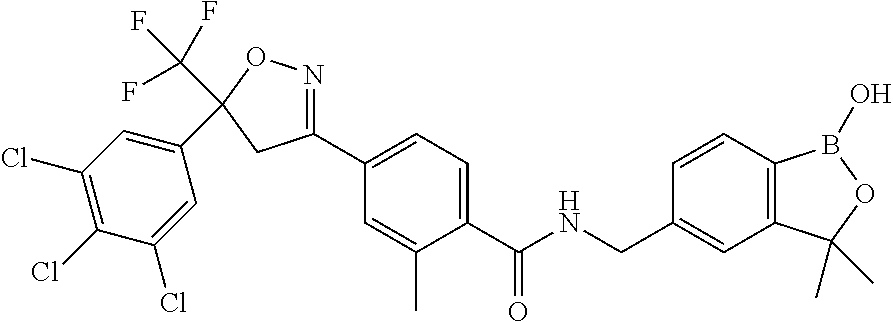


The title compound is obtained by separation of the racemic mixture of N-((5-chloro-1-hydroxy-3,3-dimethyl-1,3-dihydrobenzo[c][1,2]oxaborol-6-yl)methyl)-2-methyl-4-(5-(3,4,5-trichlorophenyl)-5-(trifluoromethyl)-4,5-dihydroisoxazol-3-yl)benzamide with chiral column chromatography. The racemic mixture is dissolved in the solvent of mobile phase and separated by supercritical fluid (SFC) chiral chromatography. The chromatography conditions are: column CHIRALCEL OJ-H (column size: 0.46 cm I.D.×15 cm length), mobile phase CO2/MeOH=70/30 (w/w), flow rate 2.0 mL/min, detector wave length UV 220 nm, and temperature 35° C.


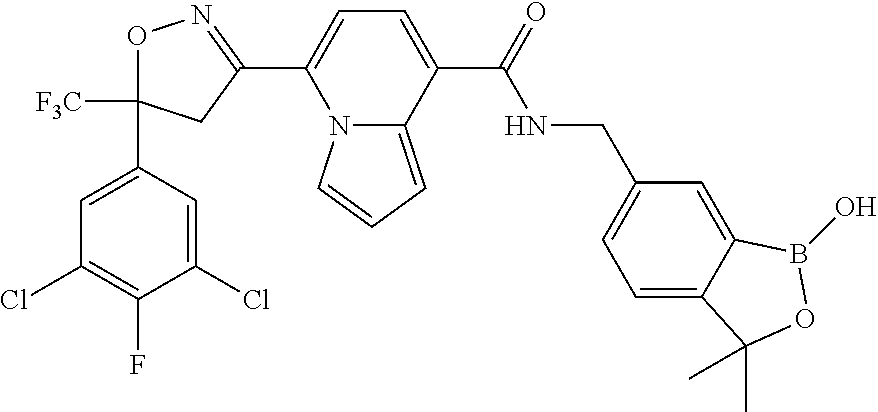


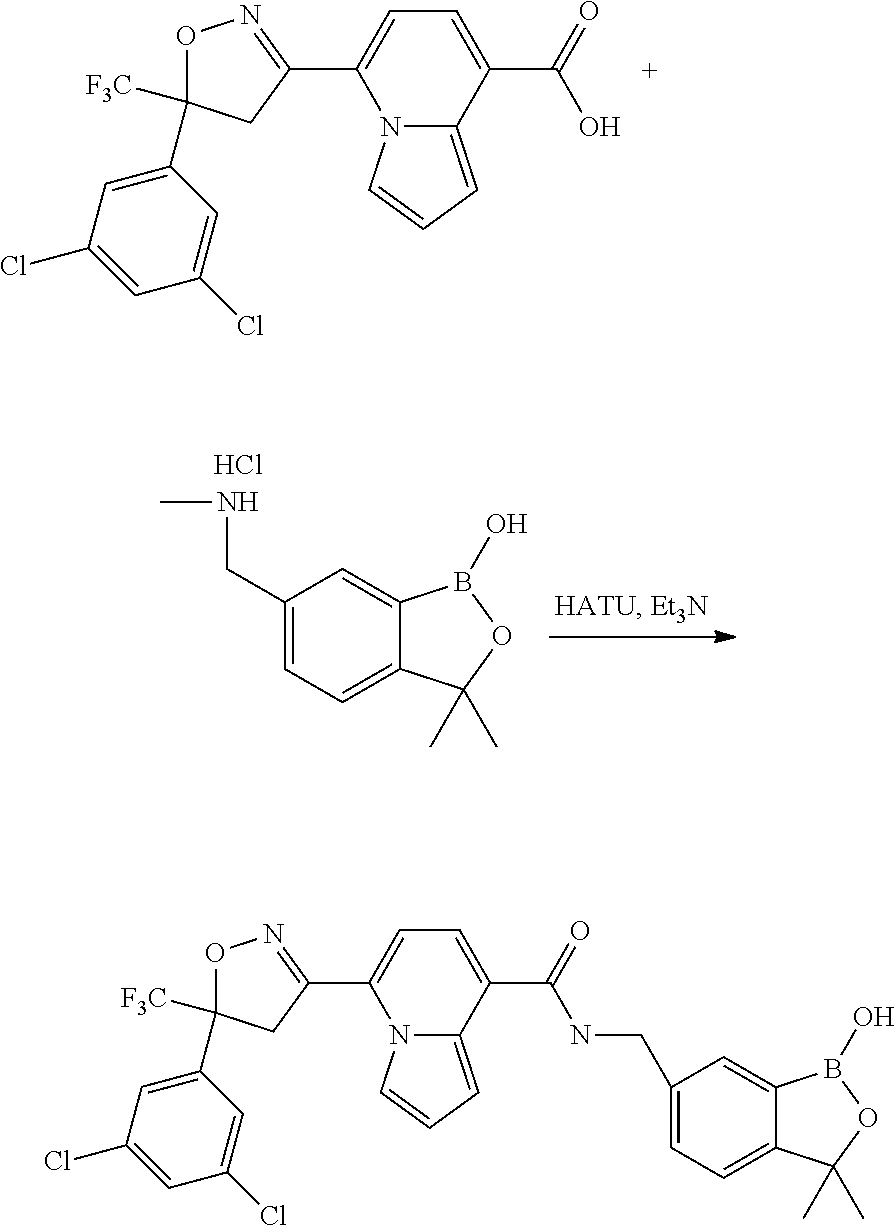

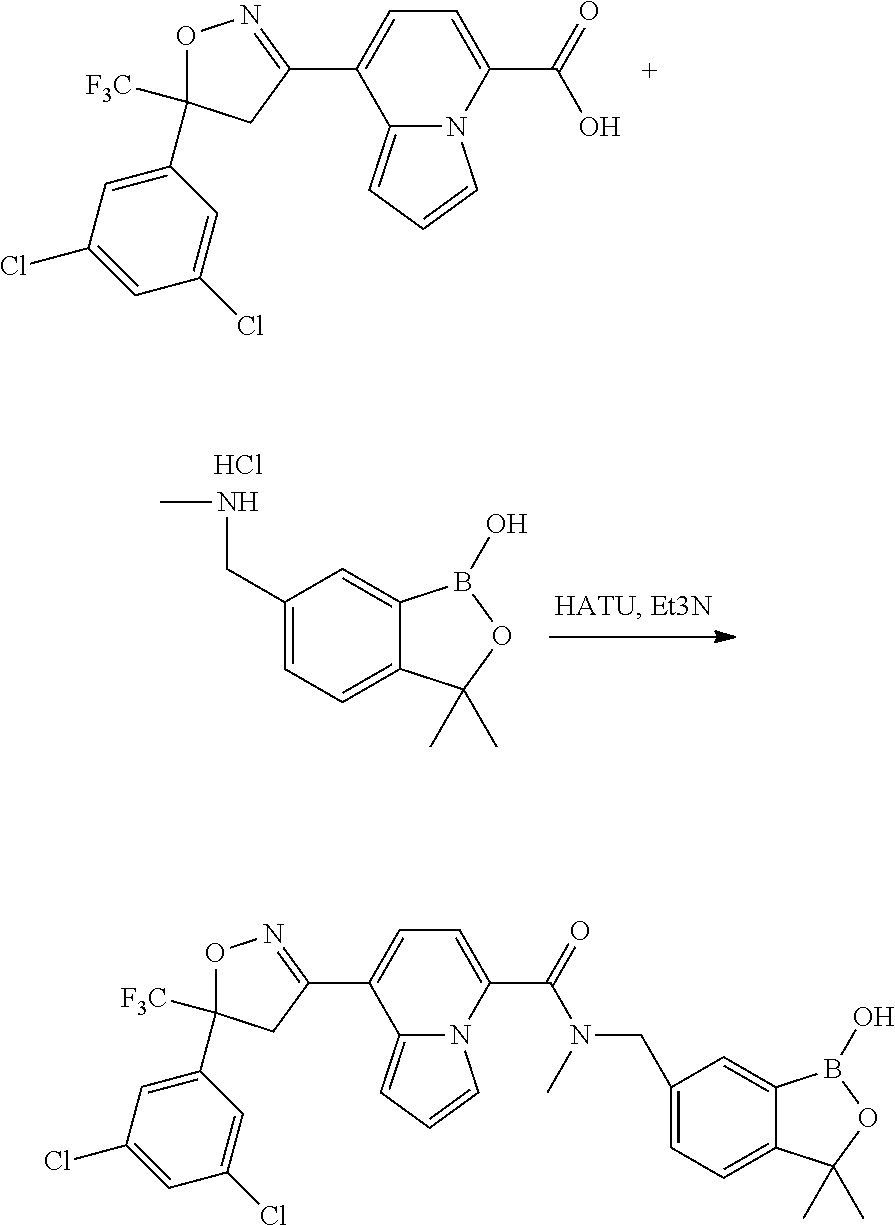


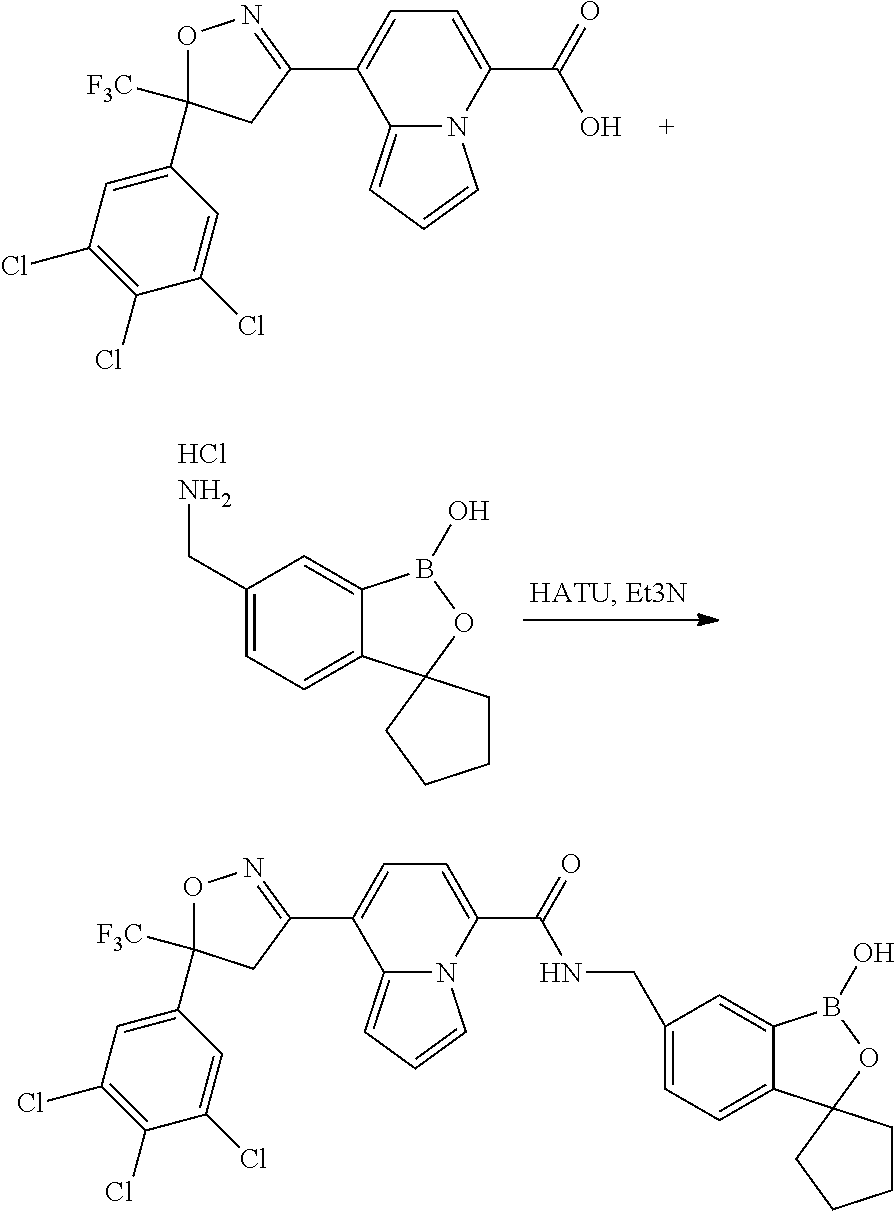


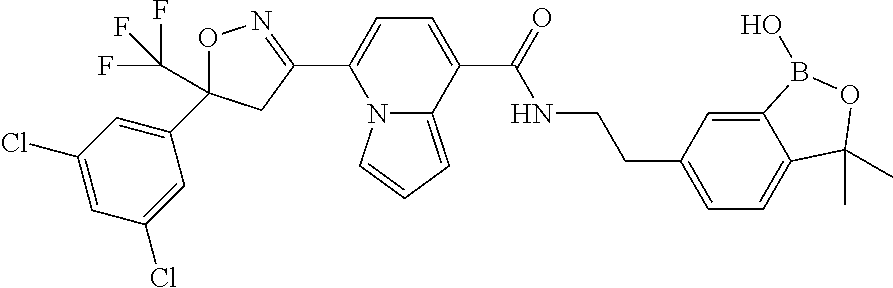


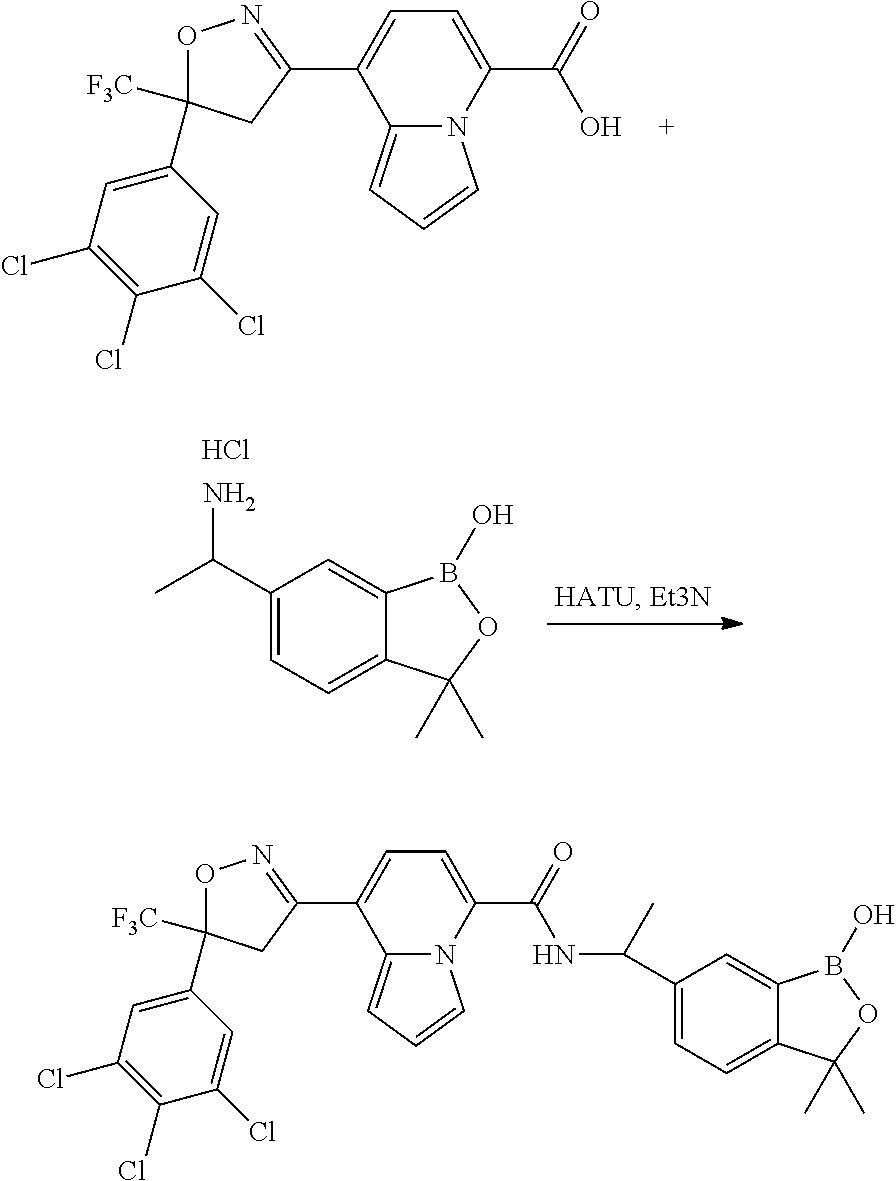


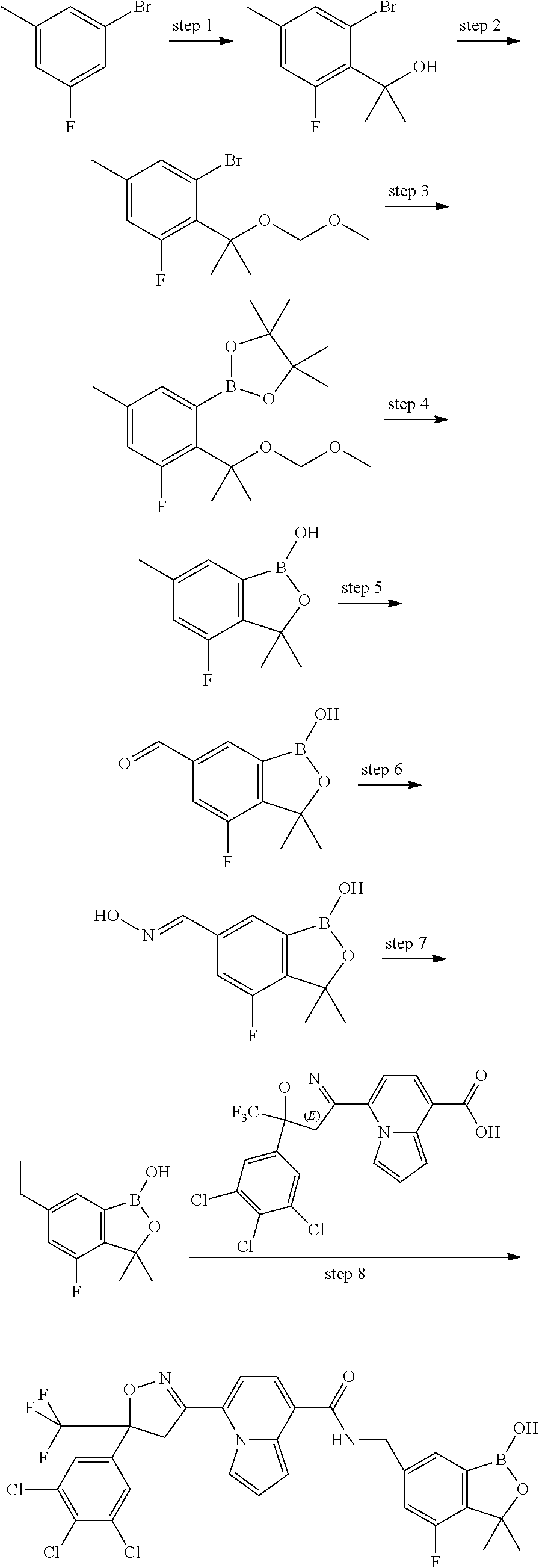


| TABLE 1 |
| Maximum in vivo efficacy obtained against Dermacentor variabilis |
| ticks on rats for compounds administered orally at a point dose of between |
| 5-25 mg/kg bodyweight. |
| Compounds exhibiting | Compounds exhibiting | Compounds exhibiting |
| efficacy < 40% | 40% ≦ efficacy < 80% | efficacy ≧ 80% |
| 10 (0.0%), 12 (0.0%), | 14 (74.3%) | 1 (100%), 2 (96.0%), |
| 18 (32.7%), 21 (0.0%), | 3 (100%), 4 (93.0%), | |
| 23 (22.9%) | 5 (100%), 6 (100%), | |
| 7 (100%), 8 (100%), | ||
| 9 (100%), 11 (100%), | ||
| 13 (97.3%), 15 (89.4%), | ||
| 17 (100%), 19 (97.3%), | ||
| 20 (100%), 22 (100%), | ||
| 24 (100%), 25 (100%) | ||
| TABLE 2 |
| Geometric mean group live parasite counts (% efficacy) of 7 and 8, |
| administered orally at 25 mg/kg bodyweight, against tick |
| (Dermacentor variabilis and Rhipicephalus sanguineus) and |
| cat flea (Ctenocephalides felis) infestations on dogs. |
| R. | C. |
| Treat- | D. variabilis | sanguineus | felis |
| ment | Day | Day | Day | Day | Day | Day | Day | Day |
| Group | 1 | 2 | 7 | 14 | 21 | 30 | 32 | 32 |
| Negative | 26.8 | 36.9 | 28.2 | 35.7 | 42.7 | 35.4 | 45.1 | 68.0 |
| Control | (—) | (—) | (—) | (—) | (—) | (—) | (—) | (—) |
| 7 | 0.0 | 0.0 | 0.0 | 0.0 | 0.3 | 9.5 | 4.8 | 0.9 |
| 25 mg/kg | (100) | (100) | (100) | (100) | (99.3) | (73.2) | (89.7) | (98.7) |
| 8 | 0.0 | 0.0 | 0.0 | 0.0 | 0.7 | 6.7 | 4.1 | 7.1 |
| 25 mg/kg | (100) | (100) | (100) | (100) | (98.4) | (81.0) | (91.0) | (89.5) |
| TABLE 3 |
| Geometric mean group live parasite counts (% efficacy) of 7, |
| administered orally at 35 mg/kg bodyweight, against American |
| dog tick (Dermacentor variabilis) infestations on dogs. |
| Treat- | D. variabilis |
| ment | Day | Day | Day | Day | Day | Day | Day | Day |
| Group | 1 | 2 | 7 | 14 | 21 | 30 | 37 | 44 |
| Negative | 23.5 | 29.5 | 29.3 | 18.6 | 12.6 | 27.7 | 28.5 | 28.3 |
| Control | (—) | (—) | (—) | (—) | (—) | (—) | (—) | (—) |
| 7 | 0.1 | 0.0 | 0.3 | 0.0 | 0.2 | 0.4 | 1.2 | 9.3 |
| 35 mg/kg | (99.5) | (100) | (99.1) | (100) | (98.4) | (98.7) | (95.7) | (67.2) |
| TABLE 4 |
| Geometric mean group live flea counts (% efficacy) of 7, administered |
| orally at 20 mg/kg bodyweight, against cat flea (C. felis) infestations on |
| dogs at the indicated post-treatment interval. |
| Treatment | Post-Treatment Interval |
| Group | 8 hours | 12 hours | 24 hours |
| Negative | 81.8 | 78.5 | 79.8 |
| Control | (—) | (—) | (—) |
| 7 | 7.9 | 0.0 | 0.0 |
| 20 mg/kg | (90.4) | (100) | (100) |
| TABLE 5 |
| In vitro and in vivo comparative activity of R and S enantiomers against tick |
| larvae and nymphs. |
| In vitro activity at | % Efficacy at Dose of | ||
| Compound ID | Enantiomer | 0.3 mM | 5-25 mg/kg |
| Racemate Parent Compound 7 |
| 9 | S | 100% | ≧80% |
| 10 | R | 0.0% | ≦10% |
| Racemate Parent Compound 8 |
| 11 | S | 100% | ≧80% |
| 12 | R | 0.0% | ≦10% |
| TABLE 6 |
| Geometric mean group live parasite counts (% efficacy) of 9 |
| administered orally at 25 mg/kg bodyweight, against tick |
| (Dermacentor variabilis and Rhipicephalus sanguineus) |
| and cat flea (Ctenocephalides felis) infestations on dogs. |
| R. | C. |
| Treat- | D. variabilis | sanguineus | felis |
| ment | Day | Day | Day | Day | Day | Day | Day | Day |
| Group | 1 | 2 | 7 | 14 | 21 | 30 | 32 | 32 |
| Negative | 31.6 | 39.1 | 43.3 | 39.1 | 31.8 | 34.2 | 16.0 | 49.1 |
| Control | (—) | (—) | (—) | (—) | (—) | (—) | (—) | (—) |
| 9 | 0.0 | 0.0 | 0.0 | 0.0 | 0.0 | 1.1 | 0.5 | 0.9 |
| 25 mg/kg | (100) | (100) | (100) | (100) | (100) | (96.8) | (96.7) | (98.2) |
| TABLE 7 |
| Geometric mean group live parasite counts (% efficacy) of 3 and 11, |
| administered orally at 25 mg/kg bodyweight, against tick |
| (Dermacentor variabilis and Rhipicephalus sanguineus) and cat flea |
| (Ctenocephalides felis) infestations on dogs. |
| R. | C. |
| Treat- | D. variabilis | sanguineus | felis |
| ment | Day | Day | Day | Day | Day | Day | Day | Day |
| Group | 1 | 2 | 7 | 14 | 21 | 30 | 32 | 32 |
| Negative | 25.0 | 41.0 | 26.8 | 36.0 | 18.1 | 25.6 | 33.9 | 90.4 |
| Control | (—) | (—) | (—) | (—) | (—) | (—) | (—) | (—) |
| 3 | 0.0 | 0.0 | 1.2 | 13.3 | nd* | nd | nd | nd |
| 25 mg/kg | (100) | (100) | (95.5) | (63.1) | ||||
| 11 | 0.0 | 0.0 | 0.3 | 0.3 | 0.2 | 1.1 | 2.8 | 2.5 |
| 25 mg/kg | (100) | (100) | (98.8) | (99.1) | (99.0) | (95.6) | (91.8) | (97.2) |
| *nd, denotes not determined | ||||||||
Claims (36)


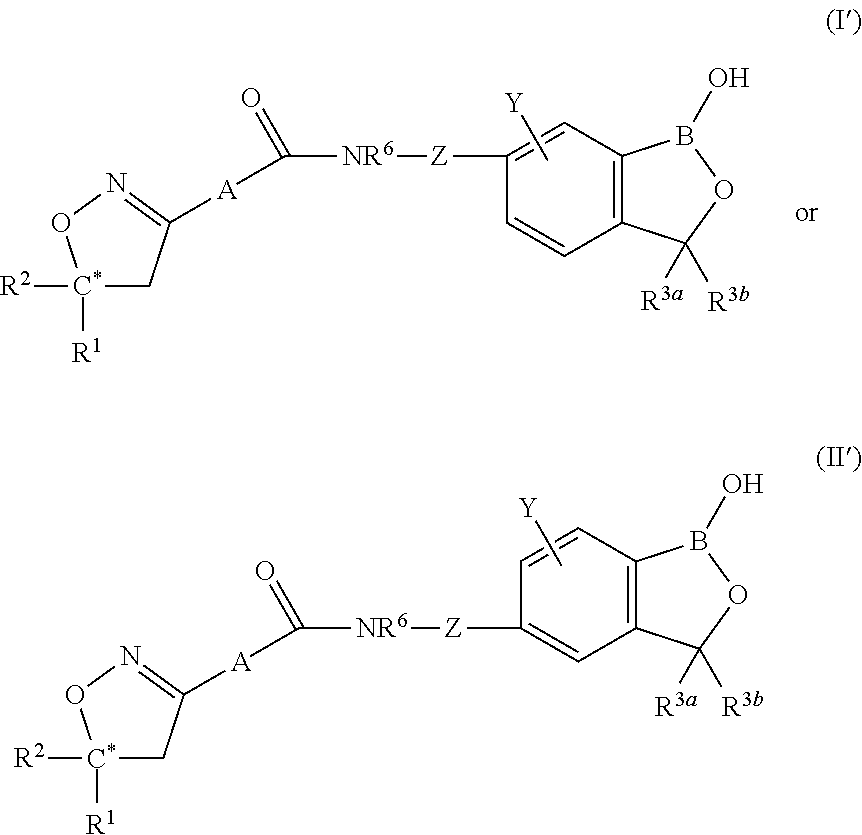


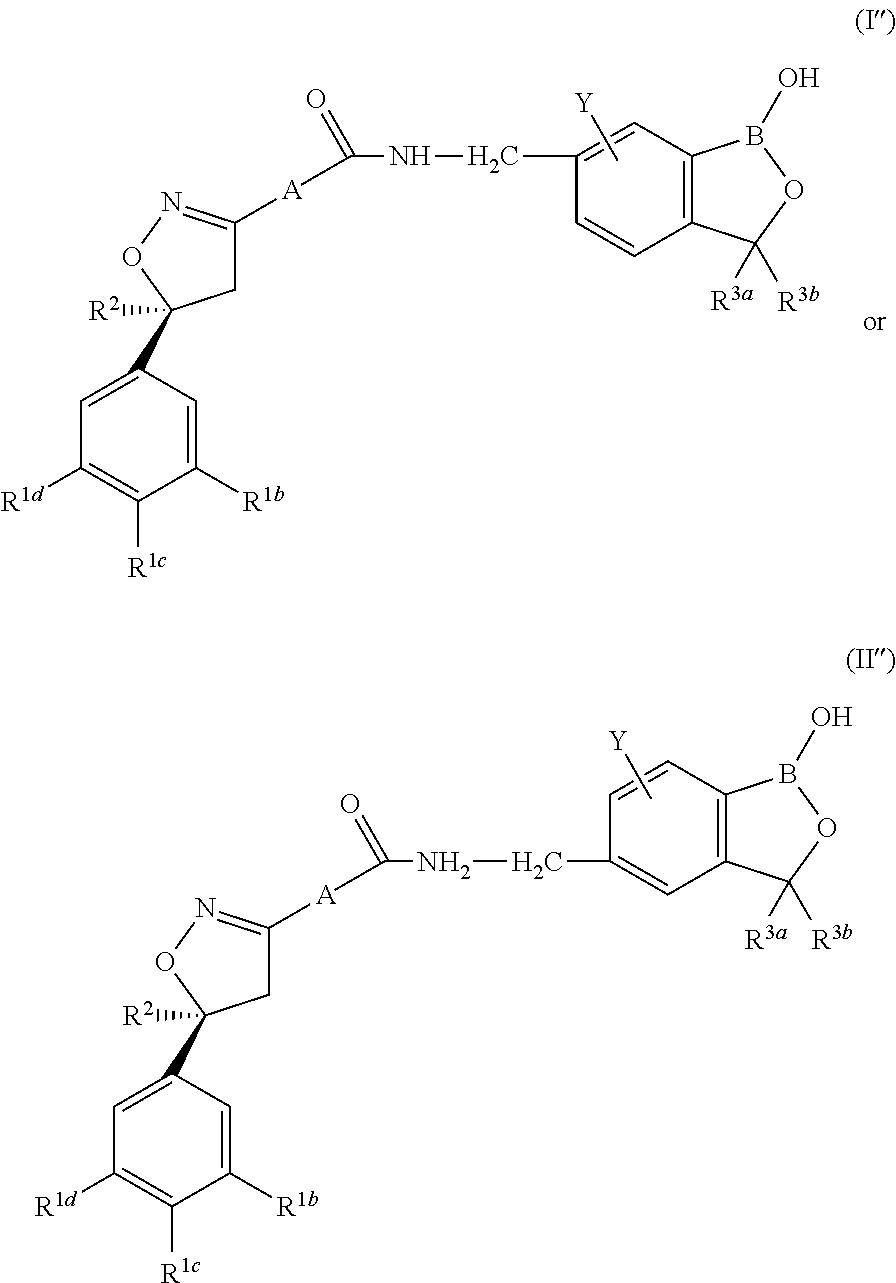


Priority Applications (1)
| Application Number | Priority Date | Filing Date | Title |
|---|---|---|---|
| US13/678,578 US8546357B2 (en) | 2011-11-21 | 2012-11-16 | Boron-containing small molecules for controlling ectoparasites |
Applications Claiming Priority (3)
| Application Number | Priority Date | Filing Date | Title |
|---|---|---|---|
| US201161562428P | 2011-11-21 | 2011-11-21 | |
| US201161562383P | 2011-11-21 | 2011-11-21 | |
| US13/678,578 US8546357B2 (en) | 2011-11-21 | 2012-11-16 | Boron-containing small molecules for controlling ectoparasites |
Publications (2)
| Publication Number | Publication Date |
|---|---|
| US20130131017A1 US20130131017A1 (en) | 2013-05-23 |
| US8546357B2 true US8546357B2 (en) | 2013-10-01 |
Family
ID=47279084
Family Applications (1)
| Application Number | Title | Priority Date | Filing Date |
|---|---|---|---|
| US13/678,578 Expired - Fee Related US8546357B2 (en) | 2011-11-21 | 2012-11-16 | Boron-containing small molecules for controlling ectoparasites |
Country Status (11)
| Country | Link |
|---|---|
| US (1) | US8546357B2 (en) |
| EP (1) | EP2782449B1 (en) |
| JP (1) | JP6118812B2 (en) |
| CN (2) | CN104066330B (en) |
| AR (1) | AR088669A1 (en) |
| AU (2) | AU2012327171B2 (en) |
| CA (1) | CA2891530A1 (en) |
| DK (1) | DK2782449T3 (en) |
| ES (1) | ES2599728T3 (en) |
| TW (1) | TW201333022A (en) |
| WO (1) | WO2013078071A1 (en) |
Cited By (14)
| Publication number | Priority date | Publication date | Assignee | Title |
|---|---|---|---|---|
| US9138002B2 (en) | 2013-01-30 | 2015-09-22 | Agrofresh Inc. | Compounds and compositions |
| US9426996B2 (en) | 2013-01-30 | 2016-08-30 | Agrofresh Inc. | Use of benzoxaboroles as volatile antimicrobial agents on meats, plants, or plant parts |
| US9499570B2 (en) | 2010-01-27 | 2016-11-22 | Anacor Pharmaceuticals, Inc. | Boron containing small molecules |
| US9566290B2 (en) | 2005-02-16 | 2017-02-14 | Anacor Pharmaceuticals, Inc. | Boron-containing small molecules |
| US9585396B2 (en) | 2013-01-30 | 2017-03-07 | Agrofresh Inc. | Volatile applications against pathogens |
| US9815857B2 (en) | 2013-02-01 | 2017-11-14 | Anacor Pharmaceuticals, Inc. | Boron-containing small molecules as antiprotozoal agents |
| US10070649B2 (en) | 2013-01-30 | 2018-09-11 | Agrofresh Inc. | Volatile applications against pathogens |
| US10500183B2 (en) | 2014-06-19 | 2019-12-10 | Attillaps Holdings | Acetylcholinesterase inhibitors for treatment of dermatological conditions |
| US10709135B2 (en) | 2013-07-29 | 2020-07-14 | Attillaps Holdings | Organophosphates for treating afflictions of the skin |
| US10730901B2 (en) | 2018-07-27 | 2020-08-04 | Aperta Biosciences, Llc | Spinosyn formulations for treatment of demodex-induced ocular and facial conditions |
| US20210070780A1 (en) * | 2005-02-16 | 2021-03-11 | Anacor Pharmaceuticals, Inc. | Boron-Containing Small Molecules |
| US10966429B2 (en) | 2016-03-07 | 2021-04-06 | Agrofresh Inc. | Synergistic methods of using benzoxaborole compounds and preservative gases as an antimicrobial for crops |
| US11039617B2 (en) | 2013-01-30 | 2021-06-22 | Agrofresh Inc. | Large scale methods of uniformly coating packaging surfaces with a volatile antimicrobial to preserve food freshness |
| US11446241B2 (en) | 2013-07-29 | 2022-09-20 | Attillaps Holdings Inc. | Treatment of ophthalmological conditions with acetylcholinesterase inhibitors |
Families Citing this family (24)
| Publication number | Priority date | Publication date | Assignee | Title |
|---|---|---|---|---|
| RU2595831C2 (en) * | 2014-11-06 | 2016-08-27 | Федеральное государственное бюджетное научное учреждение Якутский научно-исследовательский институт сельского хозяйства | Method for domestic reindeer protection against gnat attack |
| EP3280413A1 (en) * | 2015-04-08 | 2018-02-14 | Merial, Inc. | Extended release injectable formulations comprising an isoxazoline active agent, methods and uses thereof |
| HK1258717A1 (en) | 2016-05-12 | 2019-11-15 | 安纳考尔医药公司 | Oxaborole esters and uses thereof |
| WO2018024793A1 (en) * | 2016-08-03 | 2018-02-08 | Galderma Research & Development | Method of crosslinking glycosaminoglycans |
| BR112019002284A2 (en) * | 2016-08-03 | 2019-06-18 | Centre Nat Rech Scient | cross-linked glycosaminoglycans, method for cross-linking a first glycosaminoglycan with a main chain diol function and a second glycosaminoglycan being grafted with a boronate hemiester, use of a boronate hemiester, and, polymer composition |
| US20200002441A1 (en) * | 2016-08-03 | 2020-01-02 | Galderma Research & Development | Method of crosslinking glycosaminoglycans |
| EP3609504A4 (en) | 2017-03-01 | 2021-03-03 | Anacor Pharmaceuticals, Inc. | NOVEL OXABOROL ANALOGA AND USES THEREOF |
| CN109879826B (en) * | 2019-03-18 | 2021-04-13 | 丽珠集团新北江制药股份有限公司 | Preparation method of isoxazoline insecticide |
| CN110028462B (en) * | 2019-04-12 | 2021-03-23 | 丽珠集团新北江制药股份有限公司 | Method for preparing isoxazoline intermediate and isoxazoline |
| CN110684000B (en) * | 2019-10-18 | 2021-08-31 | 上海皓元医药股份有限公司 | Process for preparing benzofuran derivatives |
| MX2022007455A (en) | 2019-12-18 | 2022-08-15 | Elanco Tiergesundheit Ag | ISOXAZOLINE DERIVATIVES AS PESTICIDES. |
| CN111909143B (en) * | 2020-07-30 | 2021-10-29 | 山东省联合农药工业有限公司 | A kind of isoxazoline substituted benzamide derivatives and preparation method and use thereof |
| EP4204012A1 (en) | 2020-08-31 | 2023-07-05 | Pfizer Inc. | Methods of protecting rna |
| CN112552252B (en) * | 2020-09-30 | 2024-01-02 | 浙江美诺华药物化学有限公司 | Preparation method of fluororalrana intermediate |
| EP4304571A4 (en) * | 2021-03-11 | 2025-01-22 | In the Bowl Animal Health, Inc. | ORAL DOG FOOD AND METHODS FOR CONTROLLING FLEA INFECTION IN DOGS |
| BR112023017446A2 (en) * | 2021-03-11 | 2023-11-07 | In The Bowl Animal Health Inc | ORAL DOG FOOD AND METHODS FOR CONTROLLING FLEA INFESTATIONS IN A CANINE |
| CA3211576A1 (en) * | 2021-03-11 | 2022-09-15 | In The Bowl Animal Health, Inc. | Oral canine feed and methods for controlling tick infestations in a canine |
| CN117500800A (en) | 2021-06-16 | 2024-02-02 | 礼蓝动物保健有限公司 | (thio) oxazoline insecticide |
| BR112023026357A2 (en) | 2021-06-16 | 2024-03-05 | Bayer Animal Health Gmbh | ISOXAZOLINE DERIVATIVES |
| CN113735681B (en) * | 2021-10-11 | 2023-12-12 | 丽珠集团新北江制药股份有限公司 | Florarana intermediate and method for preparing same |
| WO2023118434A1 (en) * | 2021-12-22 | 2023-06-29 | Globachem Nv | Pesticidally active amide compounds |
| CN116102511A (en) * | 2023-02-10 | 2023-05-12 | 河北圣雪大成制药有限责任公司 | A kind of preparation method of high-purity Frellaner intermediate |
| WO2026006412A1 (en) | 2024-06-25 | 2026-01-02 | Elanco Us Inc. | Isooxazoline compounds as antiparasitic agents |
| WO2026006414A1 (en) | 2024-06-25 | 2026-01-02 | Elanco Us Inc. | Isoxazol-benzamide compounds as antiparasitic compounds |
Citations (3)
| Publication number | Priority date | Publication date | Assignee | Title |
|---|---|---|---|---|
| WO2007079162A1 (en) | 2005-12-30 | 2007-07-12 | E. I. Du Pont De Nemours And Company | Isoxazolines for controlling invertebrate pests |
| WO2009024541A2 (en) | 2007-08-17 | 2009-02-26 | Intervet International B.V. | Isoxazoline compositions and their use as antiparasitics |
| US20110207702A1 (en) * | 2008-10-15 | 2011-08-25 | Anacor Pharmaceuticals, Inc. | Boron-containing small molecules as anti-protozoal agents |
Family Cites Families (7)
| Publication number | Priority date | Publication date | Assignee | Title |
|---|---|---|---|---|
| CN101768129B (en) * | 2004-03-05 | 2012-05-23 | 日产化学工业株式会社 | Preparation intermediate of isoxazoline substituted benzamide compound |
| US7767657B2 (en) * | 2005-02-16 | 2010-08-03 | Anacor Pharmaceuticals, Inc. | Boron-containing small molecules |
| JP5038912B2 (en) | 2005-02-16 | 2012-10-03 | アナコール ファーマシューティカルズ,インコーポレイテッド | Boron-containing small molecule |
| WO2007069533A1 (en) * | 2005-12-15 | 2007-06-21 | Chuo University | Metal complex compound and organic electroluminescent device using same |
| NZ570257A (en) | 2006-02-16 | 2011-11-25 | Anacor Pharmaceuticals Inc | Boron-containing small molecules as anti-inflammatory agents |
| JO3396B1 (en) | 2007-06-20 | 2019-10-20 | Anacor Pharmaceuticals Inc | Boron-containing small molecules |
| AP4039A (en) * | 2009-08-14 | 2017-02-28 | Daitao Chen | Boron-containing small molecules as antiprotozoal agents |
-
2012
- 2012-11-06 AR ARP120104167A patent/AR088669A1/en unknown
- 2012-11-09 TW TW101141930A patent/TW201333022A/en unknown
- 2012-11-16 CA CA2891530A patent/CA2891530A1/en not_active Abandoned
- 2012-11-16 ES ES12795228.1T patent/ES2599728T3/en active Active
- 2012-11-16 AU AU2012327171A patent/AU2012327171B2/en not_active Ceased
- 2012-11-16 CN CN201280066186.XA patent/CN104066330B/en not_active Expired - Fee Related
- 2012-11-16 US US13/678,578 patent/US8546357B2/en not_active Expired - Fee Related
- 2012-11-16 WO PCT/US2012/065397 patent/WO2013078071A1/en not_active Ceased
- 2012-11-16 CN CN201610243119.0A patent/CN105906655A/en active Pending
- 2012-11-16 DK DK12795228.1T patent/DK2782449T3/en active
- 2012-11-16 JP JP2014543503A patent/JP6118812B2/en active Active
- 2012-11-16 EP EP12795228.1A patent/EP2782449B1/en not_active Not-in-force
-
2016
- 2016-06-22 AU AU2016204248A patent/AU2016204248A1/en not_active Abandoned
Patent Citations (3)
| Publication number | Priority date | Publication date | Assignee | Title |
|---|---|---|---|---|
| WO2007079162A1 (en) | 2005-12-30 | 2007-07-12 | E. I. Du Pont De Nemours And Company | Isoxazolines for controlling invertebrate pests |
| WO2009024541A2 (en) | 2007-08-17 | 2009-02-26 | Intervet International B.V. | Isoxazoline compositions and their use as antiparasitics |
| US20110207702A1 (en) * | 2008-10-15 | 2011-08-25 | Anacor Pharmaceuticals, Inc. | Boron-containing small molecules as anti-protozoal agents |
Cited By (23)
| Publication number | Priority date | Publication date | Assignee | Title |
|---|---|---|---|---|
| US20210070780A1 (en) * | 2005-02-16 | 2021-03-11 | Anacor Pharmaceuticals, Inc. | Boron-Containing Small Molecules |
| US9566289B2 (en) | 2005-02-16 | 2017-02-14 | Anacor Pharmaceuticals, Inc. | Boron-containing small molecules |
| US9566290B2 (en) | 2005-02-16 | 2017-02-14 | Anacor Pharmaceuticals, Inc. | Boron-containing small molecules |
| US9499570B2 (en) | 2010-01-27 | 2016-11-22 | Anacor Pharmaceuticals, Inc. | Boron containing small molecules |
| US12329158B2 (en) | 2013-01-30 | 2025-06-17 | Agrofresh Inc. | Large-scale methods of uniformly coating packaging surfaces with a volatile antimicrobial to preserve food freshness |
| US10765117B2 (en) | 2013-01-30 | 2020-09-08 | Agrofresh Inc. | Volatile applications against pathogens |
| US11771089B2 (en) | 2013-01-30 | 2023-10-03 | Agrofresh Inc. | Large-scale methods of uniformly coating packaging surfaces with a volatile antimicrobial to preserve food freshness |
| US10070649B2 (en) | 2013-01-30 | 2018-09-11 | Agrofresh Inc. | Volatile applications against pathogens |
| US9426996B2 (en) | 2013-01-30 | 2016-08-30 | Agrofresh Inc. | Use of benzoxaboroles as volatile antimicrobial agents on meats, plants, or plant parts |
| US12490742B2 (en) | 2013-01-30 | 2025-12-09 | Agrofresh Inc. | Volatile applications against pathogens |
| US11202448B2 (en) | 2013-01-30 | 2021-12-21 | Agrofresh Inc. | Volatile applications against pathogens |
| US9585396B2 (en) | 2013-01-30 | 2017-03-07 | Agrofresh Inc. | Volatile applications against pathogens |
| US9138002B2 (en) | 2013-01-30 | 2015-09-22 | Agrofresh Inc. | Compounds and compositions |
| US11917997B2 (en) | 2013-01-30 | 2024-03-05 | Agrofresh Inc. | Volatile applications against pathogens |
| US11039617B2 (en) | 2013-01-30 | 2021-06-22 | Agrofresh Inc. | Large scale methods of uniformly coating packaging surfaces with a volatile antimicrobial to preserve food freshness |
| US9815857B2 (en) | 2013-02-01 | 2017-11-14 | Anacor Pharmaceuticals, Inc. | Boron-containing small molecules as antiprotozoal agents |
| US11446241B2 (en) | 2013-07-29 | 2022-09-20 | Attillaps Holdings Inc. | Treatment of ophthalmological conditions with acetylcholinesterase inhibitors |
| US10709135B2 (en) | 2013-07-29 | 2020-07-14 | Attillaps Holdings | Organophosphates for treating afflictions of the skin |
| US11045442B2 (en) | 2014-06-19 | 2021-06-29 | Attillaps Holdings | Acetylcholinesterase inhibitors for treatment of dermatological conditions |
| US10500183B2 (en) | 2014-06-19 | 2019-12-10 | Attillaps Holdings | Acetylcholinesterase inhibitors for treatment of dermatological conditions |
| US10966429B2 (en) | 2016-03-07 | 2021-04-06 | Agrofresh Inc. | Synergistic methods of using benzoxaborole compounds and preservative gases as an antimicrobial for crops |
| US11254701B2 (en) | 2018-07-27 | 2022-02-22 | Aperta Biosciences, Llc | Spinosyn formulations for treatment of Demodex-induced ocular and facial conditions |
| US10730901B2 (en) | 2018-07-27 | 2020-08-04 | Aperta Biosciences, Llc | Spinosyn formulations for treatment of demodex-induced ocular and facial conditions |
Also Published As
| Publication number | Publication date |
|---|---|
| EP2782449B1 (en) | 2016-08-03 |
| CA2891530A1 (en) | 2013-05-30 |
| US20130131017A1 (en) | 2013-05-23 |
| AU2012327171B2 (en) | 2016-03-31 |
| AU2016204248A1 (en) | 2016-07-14 |
| JP6118812B2 (en) | 2017-04-19 |
| CN105906655A (en) | 2016-08-31 |
| CN104066330B (en) | 2016-05-18 |
| CN104066330A (en) | 2014-09-24 |
| AR088669A1 (en) | 2014-06-25 |
| WO2013078071A1 (en) | 2013-05-30 |
| ES2599728T3 (en) | 2017-02-02 |
| AU2012327171A1 (en) | 2013-06-06 |
| HK1202774A1 (en) | 2015-10-09 |
| DK2782449T3 (en) | 2016-11-14 |
| JP2014534260A (en) | 2014-12-18 |
| EP2782449A1 (en) | 2014-10-01 |
| TW201333022A (en) | 2013-08-16 |
Similar Documents
| Publication | Publication Date | Title |
|---|---|---|
| US9156860B2 (en) | Boron-containing small molecules | |
| EP2782449B1 (en) | Isoxazoline derivatives used in the control of ectoparasites | |
| JP6233855B2 (en) | Substituted azines as insecticides | |
| HUE026021T2 (en) | Biocidal boron phthalide (boronophthalide) compounds | |
| JP2011042643A (en) | Insecticidal carboxamides | |
| DK201770249A1 (en) | Diaryl isoxazoline compounds | |
| JP2015516397A (en) | Ring-restricted analogs as arginase inhibitors | |
| DK3071559T3 (en) | (Hetero) arylamides for the control of endoparasites | |
| HK1202774B (en) | Isoxazoline derivatives used in the control of ectoparasites | |
| WO2026041112A1 (en) | Sulfur-containing substituted meta-diamide compound, preparation method therefor, composition, and use | |
| CN121779316A (en) | Preparation and application of novel trifluorothiophenyl-containing heterocyclic derivative |
Legal Events
| Date | Code | Title | Description |
|---|---|---|---|
| AS | Assignment |
Owner name: ANACOR PHARMACEUTICALS, INC., CALIFORNIA Free format text: ASSIGNMENT OF ASSIGNORS INTEREST;ASSIGNORS:ZHANG, YONG-KANG;PLATTNER, JACOB J.;ZHOU, YASHEEN;AND OTHERS;SIGNING DATES FROM 20130115 TO 20130118;REEL/FRAME:029669/0686 |
|
| AS | Assignment |
Owner name: ELI LILLY AND COMPANY, INDIANA Free format text: ASSIGNMENT OF ASSIGNORS INTEREST;ASSIGNORS:BALKO, TERRY WILLIAM;DEFAUW, JEAN MARIE;WHITE, WILLIAM HUNTER;AND OTHERS;SIGNING DATES FROM 20121015 TO 20121016;REEL/FRAME:030046/0077 |
|
| STCF | Information on status: patent grant |
Free format text: PATENTED CASE |
|
| FEPP | Fee payment procedure |
Free format text: PAT HOLDER CLAIMS SMALL ENTITY STATUS, ENTITY STATUS SET TO SMALL (ORIGINAL EVENT CODE: LTOS); ENTITY STATUS OF PATENT OWNER: LARGE ENTITY |
|
| AS | Assignment |
Owner name: ANACOR PHARMACEUTICALS, INC., CALIFORNIA Free format text: ASSIGNMENT OF ASSIGNORS INTEREST;ASSIGNOR:ELI LILLY AND COMPANY;REEL/FRAME:032659/0288 Effective date: 20140313 |
|
| FEPP | Fee payment procedure |
Free format text: PAYOR NUMBER ASSIGNED (ORIGINAL EVENT CODE: ASPN); ENTITY STATUS OF PATENT OWNER: LARGE ENTITY |
|
| FEPP | Fee payment procedure |
Free format text: PAT HOLDER NO LONGER CLAIMS SMALL ENTITY STATUS, ENTITY STATUS SET TO UNDISCOUNTED (ORIGINAL EVENT CODE: STOL); ENTITY STATUS OF PATENT OWNER: LARGE ENTITY |
|
| FPAY | Fee payment |
Year of fee payment: 4 |
|
| FEPP | Fee payment procedure |
Free format text: MAINTENANCE FEE REMINDER MAILED (ORIGINAL EVENT CODE: REM.); ENTITY STATUS OF PATENT OWNER: LARGE ENTITY |
|
| LAPS | Lapse for failure to pay maintenance fees |
Free format text: PATENT EXPIRED FOR FAILURE TO PAY MAINTENANCE FEES (ORIGINAL EVENT CODE: EXP.); ENTITY STATUS OF PATENT OWNER: LARGE ENTITY |
|
| STCH | Information on status: patent discontinuation |
Free format text: PATENT EXPIRED DUE TO NONPAYMENT OF MAINTENANCE FEES UNDER 37 CFR 1.362 |
|
| FP | Lapsed due to failure to pay maintenance fee |
Effective date: 20211001 |