US8545218B2 - Label manufacturing method and label manufacturing apparatus - Google Patents

Label manufacturing method and label manufacturing apparatus Download PDF

Info

Publication number
US8545218B2
US8545218B2 US12/386,842 US38684209A US8545218B2 US 8545218 B2 US8545218 B2 US 8545218B2 US 38684209 A US38684209 A US 38684209A US 8545218 B2 US8545218 B2 US 8545218B2
Authority
US
United States
Prior art keywords
heating
heat sensitive
sensitive adhesive
thermal head
adhesive sheet
Prior art date
Legal status (The legal status is an assumption and is not a legal conclusion. Google has not performed a legal analysis and makes no representation as to the accuracy of the status listed.)
Expired - Fee Related, expires
Application number
US12/386,842
Other versions
US20090274987A1 (en
Inventor
Tatsuya Obuchi
Current Assignee (The listed assignees may be inaccurate. Google has not performed a legal analysis and makes no representation or warranty as to the accuracy of the list.)
Seiko Instruments Inc
Original Assignee
Seiko Instruments Inc
Priority date (The priority date is an assumption and is not a legal conclusion. Google has not performed a legal analysis and makes no representation as to the accuracy of the date listed.)
Filing date
Publication date
Application filed by Seiko Instruments Inc filed Critical Seiko Instruments Inc
Assigned to SEIKO INSTRUMENTS INC. reassignment SEIKO INSTRUMENTS INC. ASSIGNMENT OF ASSIGNORS INTEREST (SEE DOCUMENT FOR DETAILS). Assignors: OBUCHI, TATSUYA
Publication of US20090274987A1 publication Critical patent/US20090274987A1/en
Application granted granted Critical
Publication of US8545218B2 publication Critical patent/US8545218B2/en
Expired - Fee Related legal-status Critical Current
Adjusted expiration legal-status Critical

Links

Images

Classifications

    • BPERFORMING OPERATIONS; TRANSPORTING
    • B65CONVEYING; PACKING; STORING; HANDLING THIN OR FILAMENTARY MATERIAL
    • B65CLABELLING OR TAGGING MACHINES, APPARATUS, OR PROCESSES
    • B65C9/00Details of labelling machines or apparatus
    • B65C9/20Gluing the labels or articles
    • B65C9/24Gluing the labels or articles by heat
    • B65C9/25Gluing the labels or articles by heat by thermo-activating the glue

Definitions

  • the present invention relates to a label manufacturing method and a label manufacturing system for manufacturing a label made of a heat sensitive adhesive sheet having a heat sensitive adhesive layer formed on a single side of a sheet-like substrate, which normally exhibits no adhesive properties but develops adhesive properties when being heated.
  • a heat sensitive adhesive sheet having a heat sensitive adhesive layer that develops adhesive properties when being heated has been commercialized.
  • a heat sensitive adhesive sheet as described above has advantages that the sheet before being heated can be handled easily because the sheet does not have the adhesive properties and that the heat sensitive adhesive sheet does not need release paper and industrial waste is thus not produced.
  • a label made of the heat sensitive adhesive sheet is attached onto various articles and is used in many fields such as a display like a bar code or the like for a point of sale (POS) of products such as foods, a shipping tag for distribution and delivery, a baggage tag in a hotel or a vehicle, or a display of contents of a bottle, a can, a cartridge or the like.
  • POS point of sale
  • the heat sensitive adhesive sheet is transported while heating means heats the heat sensitive adhesive layer to develop adhesive properties, whereby a desired label is manufactured.
  • Some of the labels manufactured from the heat sensitive adhesive sheet in a certain use may be formed to include an adhesive portion and a non-adhesive portion disposed in a mixed manner instead of having the adhesive properties in an entire surface thereof. For instance, it is considered that a rim portion of the label is the adhesive portion while an inside portion thereof is the non-adhesive portion. In addition, it is considered that a part of the label, which is cut off and saved as a copy, is the non-adhesive portion.
  • the adhesive portion that is heated so as to develop the adhesive properties and the non-adhesive portion that is not heated so as not to develop the adhesive properties may be disposed in a mixed manner in one label.
  • a thermal head that is usually used as a recording head of a thermal printer is used as heating means for heating the heat sensitive adhesive layer of the heat sensitive adhesive sheet in many cases (see Patent Documents JP 2004-243606 A and JP 2004-136972 A).
  • the heat sensitive adhesive layer of the heat sensitive adhesive sheet is pressed to the thermal head while the heat sensitive adhesive sheet is transported, whereby the entire surface or a part of the surface of the heat sensitive adhesive layer is thermally activated so as to develop adhesive strength.
  • the thermal head it is relatively easy to dispose a heated part and a non-heated part mixedly in the heat sensitive adhesive layer.
  • a period of actuating the heating means is determined based on a desired label size. More specifically, operation of the heating means is stopped substantially at the same time when a trailing end portion of the heat sensitive adhesive sheet has passed through a position contacting with the heating means.
  • a mechanical error may occur in operation of a label manufacturing apparatus (a transport error of the heat sensitive adhesive sheet, or the like). For instance, if the trailing end portion of the heat sensitive adhesive sheet reaches the position contacting with the heating means later than a calculated timing in the case where a transporting amount per row of the heat sensitive adhesive sheet has decreased or in other case, the operation of the heating means may be stopped before the trailing end portion of the heat sensitive adhesive sheet reaches the position contacting with the heating means. As a result, the trailing end portion of the heat sensitive adhesive sheet is not heated and is not thermally activated, with the result that the adhesive properties are not developed.
  • the mechanical error itself is substantially constant within a tolerance, and can be reduced sufficiently by adjusting a heating pattern in accordance with the error before output thereof.
  • an unintentional non-adhesive portion may be generated largely in the trailing end portion in a transporting direction of the heat sensitive adhesive sheet.
  • an error in the transporting amount per row is accumulated while the transporting of the heat sensitive adhesive sheet per row is repeated, and hence a position error of the heat sensitive adhesive sheet at the trailing end portion in the transporting direction is apt to be larger than that at other portion of the heating pattern (portion other than the trailing end portion).
  • it is difficult to predict the position error because an extent of the position error varies depending on a transport length.
  • a feature of the present invention resides in a label manufacturing method for heating at least a part of a heat sensitive adhesive sheet to develop adhesive properties by using a thermal head having a plurality of heating elements and by using transporting means for transporting the heat sensitive adhesive sheet so as to pass the heat sensitive adhesive sheet through a position contacting with the heating elements of the thermal head, the method including: driving the thermal head and the transporting means based on a set heating pattern and selectively operating the plurality of heating elements of the thermal head in synchronization with timing of transporting of the heat sensitive adhesive sheet by the transporting means, to thereby heat the at least a part of the heat sensitive adhesive sheet to develop the adhesive properties; and if heating based on a last row of the heating pattern is completed before a trailing end portion in a transporting direction of the heat sensitive adhesive sheet reaches the position contacting with the heating elements of the thermal head, transporting the heat sensitive adhesive sheet and repeating the heating based on the last row of the heating pattern until the trailing end portion passes through the position contacting with the heating elements of the thermal
  • a label manufacturing method for heating at least a part of a heat sensitive adhesive sheet to develop adhesive properties by using a thermal head having a plurality of heating elements and by using transporting means for transporting the heat sensitive adhesive sheet so as to pass the heat sensitive adhesive sheet through a position contacting with the heating elements of the thermal head the method including: driving the thermal head and the transporting means based on a set heating pattern and selectively operating the plurality of heating elements of the thermal head in synchronization with timing of transporting of the heat sensitive adhesive sheet by the transporting means, to thereby heat the at least a part of the heat sensitive adhesive sheet to develop the adhesive properties; and if heating based on a last row of the heating pattern is completed before a trailing end portion in a transporting direction of the heat sensitive adhesive sheet reaches a position that is a predetermined distance before the position contacting with the heating elements of the thermal head, transporting the heat sensitive adhesive sheet and repeating the heating based on the last row of the heating pattern, and if the trailing
  • the heating pattern may be a matrix-like pattern that is divided into dots having substantially the same size as a size of one of the heating elements.
  • the trailing end portion of the heat sensitive adhesive sheet be detected by a sheet detecting sensor disposed in a transporting path of the heat sensitive adhesive sheet by the transporting means on an upstream side of the thermal head in the transporting direction of the heat sensitive adhesive sheet, and a timing when the trailing end portion reaches the position contacting with the heating elements of the thermal head or a timing when the trailing end portion reaches the position that is the predetermined distance before the position contacting with the heating elements of the thermal head be determined based on a distance between the sheet detecting sensor disposed in the transporting path and the heating element of the thermal head.
  • the present invention it is possible to suppress occurrence of an unintentional non-heated part at the trailing end portion in the transporting direction of the heat sensitive adhesive sheet due to a certain mechanical error or the like when at least a part of the heat sensitive adhesive sheet is heated to be thermally activated.
  • the same heating pattern as the last row of the set desired heating pattern can be formed at the trailing end portion of the heat sensitive adhesive sheet.
  • a desired heating pattern can be formed at the trailing end portion of the heat sensitive adhesive sheet regardless of a mechanical error or the like, and hence a fear of easily peeling off from the trailing end portion can be reduced.
  • FIG. 1 is a schematic cross section illustrating an example of a label manufacturing apparatus that is used for a label manufacturing method of the present invention
  • FIG. 2 is a block diagram illustrating the example of the label manufacturing apparatus of the present invention
  • FIG. 3 is a flowchart illustrating basic steps of the label manufacturing method of the present invention.
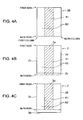
  • FIG. 4A is a schematic diagram illustrating an image of a desired heating pattern
  • FIG. 4B is a schematic diagram illustrating a heating pattern of a heat sensitive adhesive sheet when an error has occurred
  • FIG. 4C is a schematic diagram illustrating a heating pattern of a conventional heat sensitive adhesive sheet when an error different from that in FIG. 4B has occurred;
  • FIG. 5 is a schematic diagram illustrating a heating pattern of a heat sensitive adhesive sheet dealing with an error in the example illustrated in FIG. 4C by the label manufacturing method according to a first embodiment of the present invention
  • FIG. 6 is a schematic diagram illustrating a heating step of a trailing end portion of the heat sensitive adhesive sheet in the conventional label manufacturing method
  • FIG. 7 is a schematic diagram illustrating a heating pattern of a heat sensitive adhesive sheet by a label manufacturing method according to a second embodiment of the present invention.
  • FIG. 8 is a schematic diagram illustrating a heating step of a trailing end portion of the heat sensitive adhesive sheet in the label manufacturing method according to the second embodiment of the present invention.
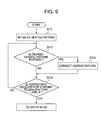
  • FIG. 9 is a flowchart illustrating steps performed before the basic steps illustrated in FIG. 3 of the label manufacturing method of the present invention.
  • FIGS. 10A-10E are schematic diagrams illustrating screens for inputting the desired heating pattern of the label manufacturing method illustrated in FIG. 9 ;
  • FIG. 11 is a flowchart illustrating detailed steps of inputting the desired heating pattern of the embodiment of the label manufacturing method illustrated in FIG. 9 ;
  • FIG. 12 is a schematic diagram illustrating a heating pattern after a correction according to an example of the present invention.
  • FIG. 13 is a flowchart illustrating detailed steps for thermal activation of the label manufacturing method illustrated in FIGS. 3 and 9 ;
  • FIG. 14 is a schematic diagram illustrating an example of a label including an adhesive portion and a non-adhesive portion disposed in a mixed manner.
  • This label manufacturing apparatus 1 includes a pair of insertion rollers 3 for leading a heat sensitive adhesive sheet 2 to the inside the label manufacturing apparatus 1 , a thermal head 4 for heating the heat sensitive adhesive layer of the heat sensitive adhesive sheet 2 so as to thermally activate the same, a platen roller 5 for sandwiching the heat sensitive adhesive sheet 2 between the same and the thermal head 4 , a pair of discharge rollers 6 disposed on the downstream side of the thermal head 4 , and sensors 7 , 8 , and 9 . These members are described one by one from the upstream side in the transporting direction.
  • a sheet insertion detecting sensor 7 is disposed at the vicinity of a lead inlet 10 of the label manufacturing apparatus 1 .
  • the sheet insertion detecting sensor 7 is disposed so that its sensor portion faces a transporting path 11 of the heat sensitive adhesive sheet 2 , and detects the presence or absence of the heat sensitive adhesive sheet 2 inserted from the lead inlet 10 to the vicinity of the insertion rollers 3 .
  • the pair of insertion rollers 3 is disposed on the downstream side of the sheet insertion detecting sensor 7 , and a contact between the rollers 3 is a part of the transporting path 11 .
  • One of the insertion rollers 3 may be a drive roller while the other may be a driven roller.
  • a sheet detecting sensor 8 is disposed on the downstream side of the insertion rollers 3 .
  • the sheet detecting sensor 8 is disposed so that its sensor portion faces the transporting path 11 , and detects a leading end portion 2 a and trailing end portion 2 b (see FIGS. 4B and 4C ) of the heat sensitive adhesive sheet 2 transported from the insertion rollers 3 to the vicinity of the thermal head 4 and the platen roller 5 .
  • the thermal head 4 and the platen roller 5 are disposed at the position to which the heat sensitive adhesive sheet 2 is led by the insertion rollers 3 .
  • the thermal head 4 may have a structure similar to that of a recording head that is used for a general thermal printer, and has a heat-generating portion 4 a in which a plurality of heating elements, each of which is made of a small resistor, are arranged in the width direction (direction perpendicular to FIG. 1 ), for instance.
  • the platen roller 5 is disposed to be opposed to the thermal head 4 so that the thermal head 4 and the platen roller 5 sandwich the heat sensitive adhesive sheet 2 on the transporting path 11 .
  • the platen roller 5 works as pressing means for pressing the heat sensitive adhesive sheet 2 to the heat-generating portion 4 a of the thermal head 4 so as to perform good thermal activation, and rotates so as to transport the heat sensitive adhesive sheet 2 .
  • the pair of discharge rollers 6 for discharging the heat sensitive adhesive sheet 2 from a discharging outlet 12 to the outside is disposed on the downstream side of the thermal head 4 . Further, a sheet removal detecting sensor 9 is disposed at the vicinity of the discharge rollers 6 . The sheet removal detecting sensor 9 is disposed so that its sensor portion faces the transporting path 11 of the heat sensitive adhesive sheet 2 , and detects presence or absence of the heat sensitive adhesive sheet 2 before it is removed from the discharging outlet 12 to the outside.
  • FIG. 2 illustrates a block diagram of this label manufacturing apparatus 1 .
  • a CPU (control means) 13 in the label manufacturing apparatus 1 refers to various data stored in a read only memory (ROM) 14 that is storage means while reading and writing data stored in a random access memory (RAM) 15 that is another storage means, so as to control the overall operation of the label manufacturing apparatus 1 .
  • the label manufacturing apparatus 1 further includes input means 16 and display means 17 . It is possible to use a touch panel or the like made of a liquid crystal display panel or the like in which the input means 16 and the display means 17 are integrally provided.
  • the CPU 13 , the ROM 14 , the RAM 15 , the input means 16 , and the display means 17 are connected to a motor driving circuit 19 , a head driving circuit 20 , and a sensor circuit 21 via an interface (IF) 18 .
  • a transport motor 22 that is a stepping motor is connected to the motor driving circuit 19
  • the thermal head 4 is connected to the head driving circuit 20
  • the three sensors 7 , 8 , and 9 are connected to the sensor circuit 21 .
  • the transporting means the insertion rollers 3 , the platen roller 5 , and the discharge roller 6 are connected to the transport motor 22 of this embodiment via drive transmission means 23 , 24 , and 25 , respectively.
  • all the structural elements are disposed in the label manufacturing apparatus 1 as illustrated in FIG. 2 , and the single label manufacturing apparatus 1 constitutes the label manufacturing system.
  • the label manufacturing apparatus 1 is connected to a host computer (not shown) so as to constitute the label manufacturing system.
  • the input means 16 and the display means 17 in the structure illustrated in FIG. 2 not in the label manufacturing apparatus 1 but in the host computer.
  • the sheet insertion detecting sensor 7 confirms that the heat sensitive adhesive sheet 2 is inserted from the lead inlet 10 (Step S 1 ). Then, the CPU 13 activates the transport motor 22 via the IF 18 and the motor driving circuit 19 , whereby the rollers (transporting means) 3 , 5 , and 6 are rotated via the drive transmission means 23 to 25 . Thus, the heat sensitive adhesive sheet 2 is transported along the transporting path 11 by one line toward between the thermal head 4 and the platen roller 5 (Step S 2 ).
  • the CPU 13 drives the thermal head 4 via the IF 18 and the head driving circuit 20 at an appropriate timing.
  • the heat-generating portion 4 a of the thermal head 4 is heated.
  • the heating of the heat sensitive adhesive sheet 2 by the heat-generating portion 4 a of the thermal head 4 and the transporting of the heat sensitive adhesive sheet 2 by the insertion rollers 3 , the platen roller 5 , and the discharge rollers 6 one by one line are repeated alternately, whereby the thermal activation of the heat sensitive adhesive layer of the heat sensitive adhesive sheet 2 is performed (Step S 4 ).
  • the heat sensitive adhesive sheet 2 is discharged from the discharging outlet 12 to the outside one by one sheet by the rotation of the discharge rollers 6 (Step S 5 ).
  • the heat sensitive adhesive sheets 2 that are cut in a desired label size are usually supplied to the label manufacturing apparatus 1
  • the heat sensitive adhesive sheet 2 like a long continuous paper sheet may be supplied to the label manufacturing apparatus 1 .
  • the heat sensitive adhesive sheet 2 is cut into a desired label size appropriately by cutter means (not shown) disposed on the upstream side or the downstream side of the thermal head 4 .
  • the basic steps of the label manufacturing method of this embodiment are as described above.
  • this embodiment has a main feature of controlling heating of the heat sensitive adhesive sheet 2 at the trailing end portion 2 b in the transporting direction.
  • a desired heating pattern 26 like a matrix of M0 columns ⁇ N0 rows, for example, is set in advance, and the transporting means (rollers 3 , 5 , and 6 ) and the thermal head 4 are driven in accordance with the heating pattern 26 .
  • a label having the adhesive portion (heated part R 1 illustrated with hatching) and the non-adhesive portion (non-heated part R 2 illustrated without hatching) is manufactured in accordance with the set heating pattern 26 (of course, it is possible that the entire surface is the adhesive portion (heated part R 1 )).
  • a mechanical error, an assembly error of the apparatus, or the like may cause a deviation between the set heating pattern 26 (see FIG.
  • the trailing end portion 2 b in the transporting direction of the heat sensitive adhesive sheet 2 passes through the position contacting with the thermal head 4 before the heating based on the last row (N0th row) in the set heating pattern 26 is performed as schematically illustrated in FIG. 4B .
  • An end portion of the label may be heated and thermally activated to be an adhesive state by a heating pattern different from the heating pattern 26 set in advance.
  • the heating based on the last row (N0th row) in the set heating pattern 26 is finished before the trailing end portion 2 b in the transporting direction of the heat sensitive adhesive sheet 2 passes through the position contacting with the thermal head 4 , as schematically illustrated in FIG. 4C .
  • an end portion of the label (trailing end portion 2 b ) is not heated and is not thermally activated at all so as to be the non-adhesive portion. If this label is attached to an article, the label has a defect that the label is easily removed from the end (trailing end portion 2 b ) in the non-adhesive state over the entire width.
  • the conventional method may cause a malfunction that the trailing end portion 2 b in the transporting direction of the heat sensitive adhesive sheet 2 becomes the non-adhesive portion over the entire width unlike the set heating pattern 26 due to a mechanical error or the like.
  • the inventor of the present invention has developed a method by which the heating by the thermal head 4 is continued without stopping the same until the trailing end portion 2 b in the transporting direction of the heat sensitive adhesive sheet 2 passes through the position contacting with the heating element of the thermal head 4 even after the heating based on the last row (N0th row) in the set heating pattern 26 is finished, in order to prevent the above-mentioned malfunction (see FIG. 5 ). Then, there is no pattern for the heating after the heating based on the last row (N0th row) in the set heating pattern 26 is finished, but the heating based on the heating pattern of the last row (N0th row) is repeated so that the heated part (adhesive portion) R 1 is formed.
  • This is a technical concept of the present invention.
  • FIGS. 4 to 8 , 12 , and the like Note that some of scales of dimensions are not correct in some drawings (for example, FIGS. 4 to 8 , 12 , and the like) so that the drawings can be seen easily.
  • Step S 3 the sheet detecting sensor 8 detects the leading end portion 2 a of the heat sensitive adhesive sheet 2 .
  • the CPU (control means) 13 determines by how many rows the heat sensitive adhesive sheet 2 should be transported from the time point when the sheet detecting sensor 8 detects the leading end portion 2 a of the heat sensitive adhesive sheet 2 (see FIGS. 4( b ) and 4 ( c )) so that the leading end portion 2 a of the heat sensitive adhesive sheet 2 reaches the position contacting with the heat-generating portion 4 a , based on the known distance between the sheet detecting sensor 8 and the heat-generating portion 4 a of the thermal head 4 .
  • the thermal head 4 is actuated in accordance with the preset heating pattern 26 from the time point when the leading end portion 2 a of the heat sensitive adhesive sheet 2 is decided to have reached the position contacting with the heat-generating portion 4 a , and the heat sensitive adhesive sheet 2 is heated.
  • the set heating pattern 26 (see FIG. 4A ) is usually a set of dots each having the same size as that of one of the heating elements, and the dots are arranged like a matrix of M0 columns ⁇ N0 rows, for example. Further, it is repeated that the thermal head 4 heats the heat sensitive adhesive sheet 2 in accordance with the heating pattern of one row in the set heating pattern 26 and that the transporting means (rollers 3 , 5 , and 6 ) transports the heat sensitive adhesive sheet 2 by one row after the heating of one row is finished. Thus, by repeating the heating and transporting of one row, the heating of the heat sensitive adhesive sheet 2 is performed one by one row in accordance with the heating pattern 26 like a matrix of M0 columns ⁇ N0 rows.
  • the heating is performed based on the heating pattern of the last row (N0th row) in the set matrix-like heating pattern 26 when the trailing end portion 2 b in the transporting direction of the heat sensitive adhesive sheet 2 is at the position contacting with the heat-generating portion of the thermal head 4 , and the heating step is finished.
  • the heated part R 1 is formed on the heat sensitive adhesive sheet 2 in accordance with the heating pattern 26 illustrated in FIG. 4A as an ideal state.
  • the trailing end portion 2 b in the transporting direction of the heat sensitive adhesive sheet 2 may pass through the position contacting with the heat-generating portion 4 a of the thermal head 4 before the heating is performed in accordance with the heating pattern of the last row (N0th row) in the set matrix-like heating pattern 26 .
  • the set heating pattern 26 is formed only partway on the heat sensitive adhesive sheet 2 (see FIG. 4B ).
  • the malfunction that the end portion of the heat sensitive adhesive sheet 2 (trailing end portion 2 b ) cannot be heated over the entire width does not occur, and hence it is decided that there is no practical problem. Therefore, a correction or the like is not performed.
  • the heating based on the heating pattern of the last row (N0th row) and the transporting of one row are repeated until the trailing end portion 2 b in the transporting direction of the heat sensitive adhesive sheet 2 passes through the position contacting with the heat-generating portion 4 a of the thermal head 4 after the heating based on the heating pattern of the last row (N0th row) in the set heating pattern 26 is finished.
  • the malfunction that the end portion of the heat sensitive adhesive sheet 2 (trailing end portion 2 b ) is not heated over the entire width does not occur.
  • the desired heating pattern may be an error between the desired heating pattern and the actual heated part R 1 at the middle portion in the transporting direction of the heat sensitive adhesive sheet 2 in some cases, but the desired heating pattern always agrees with the actual heated part R 1 at the trailing end portion 2 b .
  • the heating pattern of the last row (N0th row) has the heated part (adhesive portion) R 1 at the middle in the width direction, and the non-heated part (non-adhesive portion) R 2 exists on each side thereof.
  • the heated part (adhesive portion) R 1 is formed at the middle in the width direction of the trailing end portion 2 b
  • the non-heated part (non-adhesive portion) R 2 is formed on each side thereof.
  • a desired heating pattern can be realized at the end portion (trailing end portion 2 b ) that is significantly related to an unintentional exfoliation of the label so that the exfoliation can be suppressed.
  • the error is smaller in many cases at end portions other than the trailing end portion 2 b (leading end portion 2 a and end portions 2 c and 2 d in the width direction) than the error at the trailing end portion 2 b . Therefore, even if an unintentional non-adhesive portion is generated in the other end portions, a size thereof is small so that the label is not so easily removed.
  • the heating by the thermal head 4 is stopped in a predetermined range of the trailing end portion 2 b of the heat sensitive adhesive sheet 2 unlike the first embodiment described above. This point is described below.
  • the heating based on the heating pattern of the last row (N0th row) in the set heating pattern 26 is finished before the trailing end portion 2 b in the transporting direction of the heat sensitive adhesive sheet 2 reaches the position contacting with the heat-generating portion 4 a of the thermal head 4 because of a certain error or the like, it is effective to prevent the unintentional non-adhesive portion R 2 from being generated at the trailing end portion 2 b for preventing that the label is easily removed.
  • the heating of the heat sensitive adhesive sheet 2 is performed until the time point when the trailing end portion in the transporting direction of the heat sensitive adhesive sheet 2 passes through the position contacting with the heat-generating portion 4 a of the thermal head 4 , there may be a problem in some cases that a heat sensitive adhesive 2 e on the trailing end portion 2 b of the heat sensitive adhesive sheet 2 adheres to the thermal head 4 .
  • the heat sensitive adhesive 2 e disposed on the heat sensitive adhesive sheet 2 is heated and thermally activated to develop the adhesive properties at the portion contacting with the heat-generating portion (heating element) 4 a of the thermal head 4 .
  • the heat sensitive adhesive 2 e with developed adhesive properties is in the state of easily adhering to the thermal head 4 .
  • the heat sensitive adhesive 2 e with the developed adhesive properties tends to adhere to the thermal head 4 , the heat sensitive adhesive 2 e is peeled away from the thermal head 4 as the heat sensitive adhesive sheet 4 is transported, resulting in moving to the trailing end side of the heat sensitive adhesive sheet 2 a little by being dragged by the thermal head 4 in some degrees.
  • the heat sensitive adhesive 2 e with the developed adhesive properties is dragged by the thermal head 4 even in some degrees, the heat sensitive adhesive 2 e is pushed off the heat sensitive adhesive sheet 2 .
  • the pushed-off heat sensitive adhesive 2 e does not sufficiently receive a force accompanying the transporting of the heat sensitive adhesive sheet 2 so that the heat sensitive adhesive 2 e may adhere to the thermal head 4 and remain thereon. If the manufacturing of the label is repeated, the heat sensitive adhesive 2 e adhering to and remaining on the thermal head 4 as described above may be accumulated, which may be a factor of preventing smooth transporting of the heat sensitive adhesive sheet 2 . Therefore, if many labels are manufactured, it is necessary to perform a maintenance work for cleaning the thermal head 4 so as to remove the heat sensitive adhesive 2 e adhering to the same. This maintenance work prevents continuous manufacturing of many labels and decreases the efficiency.
  • the inventor of the present invention conceived the idea of stopping the heating of the trailing end portion 2 b of the heat sensitive adhesive sheet 2 that can easily cause the remaining of the heat sensitive adhesive 2 e on the thermal head 4 .
  • the region from the trailing end portion 2 b of the heat sensitive adhesive sheet 2 to the position a predetermined distance (for example, 2 mm) before the same is set as a non-heated part R 2 ′.
  • the heating based on the heating pattern of the last row (N0th row) in the set heating pattern 26 is finished before the position a predetermined distance (for example, 2 mm) before the trailing end portion 2 b of the heat sensitive adhesive sheet 2 contacts with the heat-generating portion 4 a of the thermal head 4 , the heating of the heat sensitive adhesive sheet 2 based on the heating pattern of the last row (N0th row) is repeated similarly to the first embodiment. Then, the operation of the thermal head 4 is completely stopped at the time point when the position a predetermined distance (for example, 2 mm) before the trailing end portion 2 b of the heat sensitive adhesive sheet 2 contacts with the heat-generating portion 4 a of the thermal head 4 .
  • a predetermined distance for example, 2 mm
  • the predetermined range in the trailing end portion 2 b of the heat sensitive adhesive sheet 2 is not heated and is not thermally activated. Therefore, the heat sensitive adhesive 2 e of this portion does not have adhesive properties and has hardly flowability, and hence the heat sensitive adhesive 2 e does not tend to adhere to the thermal head 4 as illustrated in FIG. 8 . Also, the heat sensitive adhesive 2 e is not dragged by the thermal head 4 so as to come off from the heat sensitive adhesive sheet 2 . Then, the heat sensitive adhesive 2 e does not stick to the thermal head 4 and remain thereon. Also, the heat sensitive adhesive 2 e does not disturb smooth transporting of the heat sensitive adhesive sheet 2 to be processed after that.
  • this non-heated part R 2 ′ is basically the non-adhesive portion, but as described above, the heat sensitive adhesive 2 e that is heated and is thermally activated to develop adhesive properties and flowability is dragged by the thermal head 4 so as to move a little toward the trailing end side of the heat sensitive adhesive sheet 2 . Therefore, it is considered that a part of the heat sensitive adhesive 2 e that is heated and thermally activated at the position much before the position a predetermined distance (for example, 2 mm) before the trailing end portion 2 b of the heat sensitive adhesive sheet 2 moves to the non-heated part R 2 ′. Then, there is a part having adhesive properties due to the moved heat sensitive adhesive 2 e even in the non-heated part R 2 ′, which means not the entire surface is the non-adhesive portion.
  • a predetermined distance for example, 2 mm
  • the adhesive portion is formed in the heat sensitive adhesive sheet not in accordance with any one of the plurality of control data (plurality of heating patterns) stored in advance like the invention described in Patent Document 2, but the user can set the heating pattern freely.
  • the pattern of heating the heat sensitive adhesive sheet 2 by the thermal head 4 is regarded as one image region on the heat sensitive adhesive sheet 2 for generating the image, whereby the pattern can be processed similarly to a so-called bit map image.
  • Step S 11 when the label manufacturing apparatus 1 starts to operate, initialization of the heating pattern is performed (Step S 11 ).
  • data such as the heating pattern in the past manufacture of the label, which remains in the RAM 15 , is erased so that the heating pattern (default heating pattern) of the initial data is once registered in the RAM 15 .
  • the heating pattern of the initial data can be one for heating the entire surface. In this state, a new input of the heating pattern is waited.
  • Step S 12 when it is detected that the user has input the desired heating pattern by using the display means 17 and the input means 16 (Step S 12 ), the heating pattern is corrected and is registered in the RAM 15 (Step S 13 ).
  • FIGS. 10 and 11 a specific example of inputting the desired heating pattern by the user is described with reference to FIGS. 10 and 11 .
  • a liquid crystal touch panel is used, which works as the input means 16 as well as the display means 17 .
  • the input means 16 and the display means 17 are described as separate components for convenience sake. This is to distinguish the individual functions of input and display different from each other.
  • editing pattern selection is designated by the input means 16 in the state where an initial menu screen (see FIG. 10A ) is displayed on the display means 17 (Step S 21 ). Then, a selection screen illustrated in FIG. 10B is displayed on the display means 17 .
  • any one of generation of a new heating pattern and change of an existing heating pattern can be selected.
  • “new” is selected by the input means 16 .
  • the number of the heating pattern to be changed is entered by the input means 16 (Step S 22 ). If the “new” is selected here, a size of the label to be manufactured is entered from the input means 16 on an input screen illustrated in FIG. 10C (Step S 23 ).
  • an image edit screen 17 a Based on this operation, a size and a shape of an image edit screen 17 a are decided. Then, as illustrated in FIG. 10D , the image edit screen (binary image) 17 a is displayed on the display means 17 , “add or correct heated part”, “delete heated part”, “change label size”, “register heating pattern” are shown as options of the next process. Therefore, “add or correct heated part” and “delete heated part” are selected appropriately, and the part displayed in black in the image edit screen 17 a (heated part R 1 ) is moved, deformed, expanded or contracted arbitrarily for deciding a desired location of the heated part R 1 (Step S 24 ).
  • the moving process, the deforming process, or the expansion or contraction process may be performed on the image edit screen 17 a as described above, but it is possible to enter the coordinates or the size of the adhesive portion directly as illustrated in FIG. 10E for deciding the desired location of the heated part R 1 .
  • the correction or the deletion of the heated part R 1 can be set in detail by a unit of one dot corresponding to the position and the size of the heating element. Then, if a size of the image edit screen 17 a , i.e., the heat sensitive adhesive sheet 2 should be changed, “change label size” is selected on the screen illustrated in FIG. 10D . Then, the screen returns to the input screen illustrated in FIG.
  • the desired location of the heated part R 1 is decided and then “register heating pattern” is selected so that the edited image is stored in the RAM 15 as the heating pattern (Step S 25 ).
  • the desired heating pattern is image data shown as a binary image in matrix of M0 ⁇ N0, which is divided into total N0 rows from the first row to the N0th row and the number of heating elements of the thermal head 4 (here, regarded as total M0) as illustrated in FIG. 4A .
  • Step S 22 the number of the heating pattern to be changed is entered in Step S 22 .
  • Step S 23 input of the size of the label to be manufactured
  • Step S 23 input of the size of the label to be manufactured
  • Step S 23 input of the size of the label to be manufactured
  • Step S 23 input of the size of the label to be manufactured
  • Step S 23 input of the size of the label to be manufactured
  • Step S 25 the desired location of the heated part R 1 is decided similarly to the above-mentioned description
  • Step S 25 the desired heating pattern
  • the heating pattern input by the user in accordance with Steps S 21 to S 25 as described above is the desired heating pattern 26 on the basis of computation (theory) for manufacturing the desired label as illustrated in FIG. 4A , for instance.
  • this input desired heating pattern is corrected (Step S 13 ).
  • the contents of the correction is to expand the heating pattern outward at each of the rim portions by a few millimeters (e.g., 2 mm), and to change the position of the edge portion of the heated part R 1 to be set back from a predetermined position by a few millimeters (e.g., 2 mm) at the boundary portion between the heated part (adhesive portion) R 1 and the non-heated part (non-adhesive portion) R 2 .
  • the heating pattern after the correction is image data in matrix of (N0 rows plus 4 mm) ⁇ (M0 columns plus 4 mm) in size as illustrated in FIG. 12 .
  • one row and one column are set to be 1 ⁇ 8 mm each in this example, and hence it becomes (N0+32) rows ⁇ (M0+32) columns. If the sizes of the one row and one column are not 1 ⁇ 8 mm, the number of rows and the number of columns should be changed as a matter of course.
  • the set heating pattern 26 is corrected for the heating of wide range so that the heated part R 1 extends to the outside of the rim portion of the heat sensitive adhesive sheet 2 .
  • This is because that even if some error occurs at the heating position, the heating over the outside of the heat sensitive adhesive sheet 2 suppresses occurrence of the unintentional non-adhesive portion R 2 in the rim portion of the label, and hence a fear of the label being easily removed can be reduced.
  • this correction it is controlled so that the edge portion of the adhesive portion (heated part) R 1 is set back from a predetermined position in the boundary portion between the adhesive portion R 1 and the non-adhesive portion R 2 .
  • the boundary line between the adhesive portion R 1 and the non-adhesive portion R 2 is shifted a little (approximately a few millimeters) from the precise position determined corresponding to a shape and a size of the label to be manufactured toward the adhesive portion R 1 . Therefore, if a perforation P is provided, the boundary line between the adhesive portion R 1 and the non-adhesive portion R 2 is located at a position shifted from the perforation P toward the adhesive portion.
  • a position error of the boundary line between the adhesive portion R 1 and the non-adhesive portion R 2 occurs due to a mechanical error in the operation of the label manufacturing apparatus (transport error of the heat sensitive adhesive sheet) or the like, a fear of forming the adhesive portion R 1 beyond a predetermined position of the boundary line can be reduced to be significantly small.
  • This is particularly effective in the case where the perforation P is formed in the heat sensitive adhesive sheet 2 , and can reduce a fear of forming the adhesive portion over the perforation P, thereby a fear of tearing the label because of a difficulty of being separated along the perforation P can be reduced.
  • This instruction may be a signal that is generated when the user operates a specific switch (not shown) of the label manufacturing apparatus 1 or may be a signal sent out from the sheet insertion detecting sensor 7 when the sheet insertion detecting sensor 7 detects the heat sensitive adhesive sheet 2 that is inserted by the user from the lead inlet 10 to the inside of the label manufacturing apparatus 1 (in this case, the step corresponds to Step S 1 illustrated in FIG. 3 ).
  • the instruction to start manufacturing of the label is received (Step S 14 )
  • the label is manufactured in accordance with Steps S 2 to S 5 illustrated in FIG. 3 .
  • Step S 4 the heating is performed in accordance with the heating pattern after the correction that is corrected in Step S 13 and the controlling method that is set in Step S 13 .
  • This heating method performed in accordance with the heating pattern after the correction and the set controlling method is described in detail with reference to FIG. 13 .
  • the transport motor 22 that is a stepping motor drives the rollers 3 , 5 , and 6 from the timing when the sheet detecting sensor 8 detects the leading end portion 2 a of the heat sensitive adhesive sheet 2 in Step S 3 , and the number of rows until the leading end portion 2 a of the heat sensitive adhesive sheet 2 reaches a computational position of a few millimeters (e.g., 2 mm) before the position contacting with the heat-generating portion 4 a of the thermal head 4 is calculated in advance.
  • a computational position of a few millimeters e.g., 2 mm
  • Step S 4 a the heat sensitive adhesive sheet 2 is transported from the detected position by the number of rows decided in advance (64 rows in the example described above) (Step S 4 a ).
  • the thermal head 4 performs the heating in accordance with the data indicating the heating pattern of the heating pattern after the correction at the leading end position (first row) transmitted by the CPU 13 from the RAM 15 to the thermal head 4 (Step S 4 c ). Then, the rollers 3 , 5 , and 6 transport the heat sensitive adhesive sheet 2 by one row (Step S 4 d ).
  • Step S 4 c the heating (Step S 4 c ), the transporting (Step S 4 d ), the comparison between the variable n and the row number N of the last row (Step S 4 e ), the increment of the variable n (Step S 4 f ), and the confirmation that the sheet detecting sensor 8 has not detected the trailing end portion 2 b of the heat sensitive adhesive sheet 2 (Step S 4 g ) are repeated for each row of the heat sensitive adhesive sheet 2 .
  • Step S 4 c data of each row in the heating pattern after the correction are transmitted appropriately by the CPU 13 from the RAM 15 to the thermal head 4 , and the thermal head performs the heating in accordance with the transmitted data in Step S 4 c .
  • the control for each of the heating elements to be heated or not in accordance with the transmitted data is performed.
  • the data transmission is performed at an appropriate timing before the heating (Step S 4 c ), for instance, during the transporting (Step S 4 d ) or during the heating (Step S 4 c ) of the preceding row.
  • the heating patterns of the first row to the 16th row after the correction are all the same heating pattern, in which the heating pattern of the first row in the desired heating pattern 26 (heating pattern before correction) input in Step S 12 is expanded to both sides in the width direction by 2 mm (16 columns) each.
  • this heating pattern from the first column to the 16th column are all the same heating pattern as the 17th column (corresponding to first column of the heating pattern before correction), and from the (M-16)th column to the M-th column are all the same heating pattern as the (M-17)th column (corresponding to M0th column of heating pattern before correction).
  • From the 17th row to the (N-17)th row are rows in which the heating pattern from the first row to the last row (N0th row) in the heating pattern before the correction are expanded on both sides in the width direction by 2 mm (16 columns) each.
  • the matrix of (17th row to (N-17)th row) ⁇ (17th column to (M-17)th column) in the heating pattern after the correction is completely the same as the matrix of (first row to N0th row) ⁇ (first column to M0th column) in the heating pattern before the correction.
  • the first row to the 16th row, the (N-16)th row to the N-th row, the first column to the 16th column, and the (M-16)th column to the M-th column in the heating pattern after the correction are portions obtained by correcting the input heating pattern 26 to be expanded in four directions.
  • Step S 4 c to S 4 g sequentially.
  • Step S 4 e the sheet detecting sensor 8 has not detected the trailing end portion 2 b of the heat sensitive adhesive sheet 2 (Step S 4 g ) without performing the increment of the variable n (Step S 4 f ).
  • Step S 4 g When the sheet detecting sensor 8 detects the trailing end portion 2 b of the heat sensitive adhesive sheet 2 (Step S 4 g ), the number of rows is counted from the time point of the detection until the portion of 2 mm before the trailing end portion 2 b of the heat sensitive adhesive sheet 2 reaches the position contacting with the heat-generating portion 4 a of the thermal head 4 .
  • the number of rows from the time point when the sheet detecting sensor 8 detects the trailing end portion 2 b of the heat sensitive adhesive sheet 2 in Step S 4 g to the timing when the portion of 2 mm before the trailing end portion 2 b of the heat sensitive adhesive sheet 2 reaches the computational position facing the heat-generating portion 4 a of the thermal head 4 after the transport motor 22 that is the stepping motor drives the rollers 3 , 5 , and 6 , is determined in advance. This can be determined based on a distance between the sheet detecting sensor 8 and the heat-generating portion 4 a of the thermal head 4 (e.g., 10 mm) and a transport length per row (e.g., 1 ⁇ 8 mm).
  • Step S 4 c the heating (Step S 4 c ) and the transporting (Step S 4 d ) are repeated for 64 rows from the time point when the sheet detecting sensor 8 detects the trailing end portion 2 b of the heat sensitive adhesive sheet 2 in Step S 4 g .
  • Step S 4 f the heating based on the heating pattern of the N-th row is repeated without performing the increment of the variable n (Step S 4 f ).
  • Step S 4 e the heating based on the heating pattern of the N-th row is repeated from the time point of the confirmation without performing the increment of the variable n (Step S 4 f ).
  • Step S 4 g the process passes each time through Step S 4 g in which it is confirmed whether or not the sheet detecting sensor 8 has detected the trailing end portion 2 b of the heat sensitive adhesive sheet 2 while the heating (Step S 4 c ) and the transporting are repeated for 64 rows as described above.
  • Step S 4 g it is already confirmed that the sheet detecting sensor 8 has detected the trailing end portion 2 b of the heat sensitive adhesive sheet 2 (Step S 4 g ), and hence it should be decided that the detection has been performed (Yes) when the process passes through Step S 4 g after that. Otherwise, no decision is performed in Step S 4 g .
  • the counting is continued without resetting the number of rows that are already counted at the time point.
  • Step S 4 h when the heat sensitive adhesive sheet 2 is transported by 64 rows from the time point when the sheet detecting sensor 8 detects the trailing end portion 2 b of the heat sensitive adhesive sheet 2 in Step S 4 g (Step S 4 h ), the discharge roller 6 transports the heat sensitive adhesive sheet 2 so as to discharge the same from the discharging outlet 12 to the outside without performing the heating (corresponding to Step S 5 of FIG. 3 ).
  • This is the controlling method for stopping all the heating from the timing when the trailing end portion 2 b of the heat sensitive adhesive sheet 2 reaches the position of a few millimeters (e.g., 2 mm) before the position facing the thermal head 4 as described above.
  • the heating based on the heating pattern of the N-th row and the transporting of one row are repeated continuously in accordance with Step S 4 c and Step S 4 d .
  • the heating pattern of the last row is repeated continuously until the timing when the portion of 2 mm before the trailing end portion 2 b of the heat sensitive adhesive sheet 2 actually passes through the position facing the thermal head 4 in accordance with the second embodiment.
  • the edge portion of the adhesive portion R 1 i.e., the heated part is set back by a predetermined distance (e.g., 2 mm) at the position corresponding to the boundary line between the adhesive portion R 1 and the non-adhesive portion R 2 of the heat sensitive adhesive sheet 2 , from the heating pattern before the correction in this example.
  • a predetermined distance e.g. 2 mm
  • the heated part R 1 is formed to be narrow so that the edge portion of the heated part R 1 is located at the position shifted by approximately 2 mm to the heated part R 1 side from the perforation P (boundary line of desired heating pattern 26 before the correction) (see FIG. 12 ).
  • Those corrections are already performed on the heating pattern after the correction that was corrected in Step S 13 and is used in Step S 4 c . Therefore, if the thermal head 4 works in accordance with the heating pattern after the correction, the heating control described above is performed automatically. The correction of the heating pattern is not performed every time the thermal head 4 performs the heating in Step S 4 c.
  • the heating is controlled so as to repeat the heating pattern of the last row continuously.
  • the adhesive portion R 1 it is avoided to provide the adhesive portion R 1 more than necessary because the entire row is not always made the adhesive portion R 1 .
  • the entire heating is stopped from the timing when the trailing end portion 2 b of the heat sensitive adhesive sheet 2 is located at the position a little before (for example, 2 mm before) the position facing the thermal head 4 , whereby it is prevented that the heat sensitive adhesive 2 e coming off the heat sensitive adhesive sheet 2 adheres to the thermal head 4 and remains thereon.
  • Step S 13 the correction process is performed so that the rim portion of the desired heating pattern 26 is expanded outward, and the boundary line between the heated part R 1 (adhesive portion) and the non-heated part R 2 (non-adhesive portion) is moved toward the heated part R 1 (edge portion of the heated part R 1 is set back). Then, the heat sensitive adhesive sheet 2 is heated based on the pattern after the correction.
  • the correction of the heating pattern and the heating control are performed by the CPU 13 incorporated in the label manufacturing apparatus 1 itself.
  • a host computer (not shown) to this label manufacturing apparatus 1 so as to constitute the label manufacturing system.
  • the CPU 13 incorporated in the label manufacturing apparatus 1 itself controls the heating and the transporting, while the setting and the correction of the heating pattern (Steps S 11 to S 13 ) are performed by the host computer.
  • the host computer includes the CPU, the ROM, the RAM, the input means 16 such as a mouse or a keyboard, and the display means 17 such as a liquid crystal display or a cathode ray tube.
  • the label manufacturing apparatus 1 includes the CPU (control means) 13 , the ROM (storage means) 14 , and the RAM (storage means) 15 for controlling the operations of the transport motor 22 , the thermal head 4 , and the sensors 7 , 8 , and 9 , but those components do not have functions of setting and correcting the heating pattern. Further, the host computer performs the setting and the correction of the heating pattern, and the heating data after the correction is transmitted from the host computer to the label manufacturing apparatus 1 .
  • the CPU 13 of the label manufacturing apparatus 1 controls the operations of the transport motor 22 , the thermal head 4 , and the sensors 7 , 8 , and 9 in accordance with the transmitted heating pattern.
  • setting of the CPU 13 , the ROM 14 , and the RAM 15 of the host computer may be performed for the setting and the correction of the heating pattern as described above.
  • application software that is installed in the host computer may include a program for performing the setting and the correction of the heating pattern, whereby the CPU 13 of the host computer can perform the setting and the correction of the heating pattern in the state where the software is installed.
  • Steps S 11 to S 13 the setting and the correction of the heating pattern are performed by the CPU 13 of the label manufacturing apparatus 1 itself, and only the input means 16 and the display means 17 are connected to the label manufacturing apparatus 1 as separate components.
  • a label L illustrated in FIG. 14 includes four portions L 1 to L 4 . Only the fourth portion L 4 is the adhesive portion (heated part R 1 illustrated with hatching), and other portions L 1 , L 2 , and L 3 are all the non-adhesive portions (non-heated part R 2 illustrated without hatching).
  • This label L is a slip for delivering a package, and the four portions L 1 to L 4 have substantially the same described contents, i.e., addresses, names, and telephone numbers of the sender and the receiver, and information necessary for the delivery (desired date and time of delivery, delivery fee, type of contents, and the like).
  • the perforations P as tear-off lines are provided to the boundaries between the respective portions of the label L.
  • a delivery company which received a request for delivery from a sender who requests the delivery, manufactures the label illustrated in FIG. 14 in accordance with the manufacturing method described above. Then, the sender who requests the delivery or the delivery company fills in the portions L 1 to L 4 of the label L with necessary items, and the first portion L 1 that is the non-adhesive portion is cut off and saved by the sender who requests the delivery as a copy for sender. On the other hand, the fourth portion L 4 that is the adhesive portion is attached onto the package, and the delivery company carries the package holding the second to the fourth portions L 2 to L 4 thereon.
  • the delivery company cuts off the second portion L 2 that is the non-adhesive portion at an appropriate timing as necessary so as to save it as a copy for pickup and delivery.
  • the receiver cuts off the third portion L 3 that is the non-adhesive portion so as to save it as a copy for receiver.
  • the fourth portion L 4 that is the adhesive portion remains held on the package.
  • the heated part R 1 (illustrated with hatching) extends to the outside of the label from end portions e 3 and e 4 in the width direction (left and right direction) in the fourth portion L 4 and is the range from the perforations P to the inside of the fourth portion L 4 . Therefore, even if the heated part is shifted in the width direction (left and right direction) due to some mechanical error or the like, substantially the entire of the fourth portion L 4 is thermally activated so as to develop adhesive properties. However, the vicinity of the perforation P in the fourth portion L 4 is not activated and is in the non-adhesive state.
  • the example of the label L illustrated in FIG. 14 has no adhesive portion in a leading end portion e 1 of the label L. Therefore, the correction of expanding the heating pattern at the leading end portion e 1 has no meaning in particular, and hence the correction can be omitted.
  • the heating based on the last row of the heating pattern is finished before the trailing end portion 2 b in the transporting direction of the heat sensitive adhesive sheet 2 reaches the position a predetermined distance (for example, 2 mm) before the position contacting with the heat-generating portion 4 a of the thermal head 4 , the heating based on the last row of the heating pattern is repeated.
  • a predetermined distance for example, 2 mm

Landscapes

  • Labeling Devices (AREA)
  • Electronic Switches (AREA)

Abstract

A label manufacturing apparatus includes a thermal head and a device for transporting a heat sensitive adhesive sheet. The control device operates the head in synchronization with timing of transporting of the sheet to activate the adhesive, determines if heating based on a last row of a heating pattern is completed before a trailing end of the sheet reaches a set position contacting the head, controls driving of the transporting device so that when it is determined that the heating based on the heating pattern last row is completed, the sheet is transported until the trailing end passes through the set position, and controls driving of the head so that when it is determined that the heating based on the last row of the heating pattern is completed, the heating based on the last row of the heating pattern is repeated until the trailing end passes through the set position.

Description

BACKGROUND OF THE INVENTION
1. Field of the Invention
The present invention relates to a label manufacturing method and a label manufacturing system for manufacturing a label made of a heat sensitive adhesive sheet having a heat sensitive adhesive layer formed on a single side of a sheet-like substrate, which normally exhibits no adhesive properties but develops adhesive properties when being heated.
2. Description of the Related Art
Conventionally, a heat sensitive adhesive sheet having a heat sensitive adhesive layer that develops adhesive properties when being heated has been commercialized. Such a heat sensitive adhesive sheet as described above has advantages that the sheet before being heated can be handled easily because the sheet does not have the adhesive properties and that the heat sensitive adhesive sheet does not need release paper and industrial waste is thus not produced. Further, a label made of the heat sensitive adhesive sheet is attached onto various articles and is used in many fields such as a display like a bar code or the like for a point of sale (POS) of products such as foods, a shipping tag for distribution and delivery, a baggage tag in a hotel or a vehicle, or a display of contents of a bottle, a can, a cartridge or the like.
In general, the heat sensitive adhesive sheet is transported while heating means heats the heat sensitive adhesive layer to develop adhesive properties, whereby a desired label is manufactured. Some of the labels manufactured from the heat sensitive adhesive sheet in a certain use may be formed to include an adhesive portion and a non-adhesive portion disposed in a mixed manner instead of having the adhesive properties in an entire surface thereof. For instance, it is considered that a rim portion of the label is the adhesive portion while an inside portion thereof is the non-adhesive portion. In addition, it is considered that a part of the label, which is cut off and saved as a copy, is the non-adhesive portion. As described above, the adhesive portion that is heated so as to develop the adhesive properties and the non-adhesive portion that is not heated so as not to develop the adhesive properties may be disposed in a mixed manner in one label.
Note that a thermal head that is usually used as a recording head of a thermal printer is used as heating means for heating the heat sensitive adhesive layer of the heat sensitive adhesive sheet in many cases (see Patent Documents JP 2004-243606 A and JP 2004-136972 A). In this case, the heat sensitive adhesive layer of the heat sensitive adhesive sheet is pressed to the thermal head while the heat sensitive adhesive sheet is transported, whereby the entire surface or a part of the surface of the heat sensitive adhesive layer is thermally activated so as to develop adhesive strength. When the thermal head is used, it is relatively easy to dispose a heated part and a non-heated part mixedly in the heat sensitive adhesive layer.
When the heat sensitive adhesive sheet is transported while the heating means is actuated to heat the heat sensitive adhesive layer to be thermally activated as described above, a period of actuating the heating means is determined based on a desired label size. More specifically, operation of the heating means is stopped substantially at the same time when a trailing end portion of the heat sensitive adhesive sheet has passed through a position contacting with the heating means.
However, a mechanical error may occur in operation of a label manufacturing apparatus (a transport error of the heat sensitive adhesive sheet, or the like). For instance, if the trailing end portion of the heat sensitive adhesive sheet reaches the position contacting with the heating means later than a calculated timing in the case where a transporting amount per row of the heat sensitive adhesive sheet has decreased or in other case, the operation of the heating means may be stopped before the trailing end portion of the heat sensitive adhesive sheet reaches the position contacting with the heating means. As a result, the trailing end portion of the heat sensitive adhesive sheet is not heated and is not thermally activated, with the result that the adhesive properties are not developed.
The mechanical error itself is substantially constant within a tolerance, and can be reduced sufficiently by adjusting a heating pattern in accordance with the error before output thereof. However, even if the same adjustment as described above is performed, an unintentional non-adhesive portion may be generated largely in the trailing end portion in a transporting direction of the heat sensitive adhesive sheet. In particular, an error in the transporting amount per row is accumulated while the transporting of the heat sensitive adhesive sheet per row is repeated, and hence a position error of the heat sensitive adhesive sheet at the trailing end portion in the transporting direction is apt to be larger than that at other portion of the heating pattern (portion other than the trailing end portion). In addition, it is difficult to predict the position error because an extent of the position error varies depending on a transport length. Therefore, it is not easy to deal with the position error in advance by adjusting the heating pattern. As a result, if an unintentional non-adhesive portion is generated in the trailing end portion in the transporting direction of the heat sensitive adhesive sheet, a problem may occur that a label made of this heat sensitive adhesive sheet is removed easily after being attached to an article.
SUMMARY OF THE INVENTION
Therefore, it is an object of the present invention to provide a label manufacturing method and a label manufacturing apparatus that are capable of suppressing occurrence of an unintentional non-adhesive portion at the trailing end portion in the transporting direction of the heat sensitive adhesive sheet.
A feature of the present invention resides in a label manufacturing method for heating at least a part of a heat sensitive adhesive sheet to develop adhesive properties by using a thermal head having a plurality of heating elements and by using transporting means for transporting the heat sensitive adhesive sheet so as to pass the heat sensitive adhesive sheet through a position contacting with the heating elements of the thermal head, the method including: driving the thermal head and the transporting means based on a set heating pattern and selectively operating the plurality of heating elements of the thermal head in synchronization with timing of transporting of the heat sensitive adhesive sheet by the transporting means, to thereby heat the at least a part of the heat sensitive adhesive sheet to develop the adhesive properties; and if heating based on a last row of the heating pattern is completed before a trailing end portion in a transporting direction of the heat sensitive adhesive sheet reaches the position contacting with the heating elements of the thermal head, transporting the heat sensitive adhesive sheet and repeating the heating based on the last row of the heating pattern until the trailing end portion passes through the position contacting with the heating elements of the thermal head.
Further, another feature of the present invention resides in a label manufacturing method for heating at least a part of a heat sensitive adhesive sheet to develop adhesive properties by using a thermal head having a plurality of heating elements and by using transporting means for transporting the heat sensitive adhesive sheet so as to pass the heat sensitive adhesive sheet through a position contacting with the heating elements of the thermal head, the method including: driving the thermal head and the transporting means based on a set heating pattern and selectively operating the plurality of heating elements of the thermal head in synchronization with timing of transporting of the heat sensitive adhesive sheet by the transporting means, to thereby heat the at least a part of the heat sensitive adhesive sheet to develop the adhesive properties; and if heating based on a last row of the heating pattern is completed before a trailing end portion in a transporting direction of the heat sensitive adhesive sheet reaches a position that is a predetermined distance before the position contacting with the heating elements of the thermal head, transporting the heat sensitive adhesive sheet and repeating the heating based on the last row of the heating pattern, and if the trailing end portion reaches the position that is the predetermined distance before the position contacting with the heating elements of the thermal head, stopping the heating by the thermal head and continuing to transport the heat sensitive adhesive sheet until at least the trailing end portion passes through the position contacting with the heating elements of the thermal head.
The heating pattern may be a matrix-like pattern that is divided into dots having substantially the same size as a size of one of the heating elements.
It is preferable that the trailing end portion of the heat sensitive adhesive sheet be detected by a sheet detecting sensor disposed in a transporting path of the heat sensitive adhesive sheet by the transporting means on an upstream side of the thermal head in the transporting direction of the heat sensitive adhesive sheet, and a timing when the trailing end portion reaches the position contacting with the heating elements of the thermal head or a timing when the trailing end portion reaches the position that is the predetermined distance before the position contacting with the heating elements of the thermal head be determined based on a distance between the sheet detecting sensor disposed in the transporting path and the heating element of the thermal head.
According to the present invention, it is possible to suppress occurrence of an unintentional non-heated part at the trailing end portion in the transporting direction of the heat sensitive adhesive sheet due to a certain mechanical error or the like when at least a part of the heat sensitive adhesive sheet is heated to be thermally activated. In addition, the same heating pattern as the last row of the set desired heating pattern can be formed at the trailing end portion of the heat sensitive adhesive sheet. In other words, a desired heating pattern can be formed at the trailing end portion of the heat sensitive adhesive sheet regardless of a mechanical error or the like, and hence a fear of easily peeling off from the trailing end portion can be reduced.
BRIEF DESCRIPTION OF THE DRAWINGS
In the accompanying drawings:
FIG. 1 is a schematic cross section illustrating an example of a label manufacturing apparatus that is used for a label manufacturing method of the present invention;
FIG. 2 is a block diagram illustrating the example of the label manufacturing apparatus of the present invention;
FIG. 3 is a flowchart illustrating basic steps of the label manufacturing method of the present invention;
FIG. 4A is a schematic diagram illustrating an image of a desired heating pattern, FIG. 4B is a schematic diagram illustrating a heating pattern of a heat sensitive adhesive sheet when an error has occurred, and FIG. 4C is a schematic diagram illustrating a heating pattern of a conventional heat sensitive adhesive sheet when an error different from that in FIG. 4B has occurred;
FIG. 5 is a schematic diagram illustrating a heating pattern of a heat sensitive adhesive sheet dealing with an error in the example illustrated in FIG. 4C by the label manufacturing method according to a first embodiment of the present invention;
FIG. 6 is a schematic diagram illustrating a heating step of a trailing end portion of the heat sensitive adhesive sheet in the conventional label manufacturing method;
FIG. 7 is a schematic diagram illustrating a heating pattern of a heat sensitive adhesive sheet by a label manufacturing method according to a second embodiment of the present invention;
FIG. 8 is a schematic diagram illustrating a heating step of a trailing end portion of the heat sensitive adhesive sheet in the label manufacturing method according to the second embodiment of the present invention;
FIG. 9 is a flowchart illustrating steps performed before the basic steps illustrated in FIG. 3 of the label manufacturing method of the present invention;
FIGS. 10A-10E are schematic diagrams illustrating screens for inputting the desired heating pattern of the label manufacturing method illustrated in FIG. 9;
FIG. 11 is a flowchart illustrating detailed steps of inputting the desired heating pattern of the embodiment of the label manufacturing method illustrated in FIG. 9;
FIG. 12 is a schematic diagram illustrating a heating pattern after a correction according to an example of the present invention;
FIG. 13 is a flowchart illustrating detailed steps for thermal activation of the label manufacturing method illustrated in FIGS. 3 and 9; and
FIG. 14 is a schematic diagram illustrating an example of a label including an adhesive portion and a non-adhesive portion disposed in a mixed manner.
DETAILED DESCRIPTION OF THE INVENTION
Hereinafter, embodiments of the present invention are described with reference to the drawings.
First, a basic structure of a label manufacturing apparatus 1 that is used in the present invention is described with reference to FIG. 1. This label manufacturing apparatus 1 includes a pair of insertion rollers 3 for leading a heat sensitive adhesive sheet 2 to the inside the label manufacturing apparatus 1, a thermal head 4 for heating the heat sensitive adhesive layer of the heat sensitive adhesive sheet 2 so as to thermally activate the same, a platen roller 5 for sandwiching the heat sensitive adhesive sheet 2 between the same and the thermal head 4, a pair of discharge rollers 6 disposed on the downstream side of the thermal head 4, and sensors 7, 8, and 9. These members are described one by one from the upstream side in the transporting direction.
A sheet insertion detecting sensor 7 is disposed at the vicinity of a lead inlet 10 of the label manufacturing apparatus 1. The sheet insertion detecting sensor 7 is disposed so that its sensor portion faces a transporting path 11 of the heat sensitive adhesive sheet 2, and detects the presence or absence of the heat sensitive adhesive sheet 2 inserted from the lead inlet 10 to the vicinity of the insertion rollers 3.
The pair of insertion rollers 3 is disposed on the downstream side of the sheet insertion detecting sensor 7, and a contact between the rollers 3 is a part of the transporting path 11. One of the insertion rollers 3 may be a drive roller while the other may be a driven roller. A sheet detecting sensor 8 is disposed on the downstream side of the insertion rollers 3. The sheet detecting sensor 8 is disposed so that its sensor portion faces the transporting path 11, and detects a leading end portion 2 a and trailing end portion 2 b (see FIGS. 4B and 4C) of the heat sensitive adhesive sheet 2 transported from the insertion rollers 3 to the vicinity of the thermal head 4 and the platen roller 5.
The thermal head 4 and the platen roller 5 are disposed at the position to which the heat sensitive adhesive sheet 2 is led by the insertion rollers 3. The thermal head 4 may have a structure similar to that of a recording head that is used for a general thermal printer, and has a heat-generating portion 4 a in which a plurality of heating elements, each of which is made of a small resistor, are arranged in the width direction (direction perpendicular to FIG. 1), for instance. The platen roller 5 is disposed to be opposed to the thermal head 4 so that the thermal head 4 and the platen roller 5 sandwich the heat sensitive adhesive sheet 2 on the transporting path 11. The platen roller 5 works as pressing means for pressing the heat sensitive adhesive sheet 2 to the heat-generating portion 4 a of the thermal head 4 so as to perform good thermal activation, and rotates so as to transport the heat sensitive adhesive sheet 2.
The pair of discharge rollers 6 for discharging the heat sensitive adhesive sheet 2 from a discharging outlet 12 to the outside is disposed on the downstream side of the thermal head 4. Further, a sheet removal detecting sensor 9 is disposed at the vicinity of the discharge rollers 6. The sheet removal detecting sensor 9 is disposed so that its sensor portion faces the transporting path 11 of the heat sensitive adhesive sheet 2, and detects presence or absence of the heat sensitive adhesive sheet 2 before it is removed from the discharging outlet 12 to the outside.
FIG. 2 illustrates a block diagram of this label manufacturing apparatus 1. A CPU (control means) 13 in the label manufacturing apparatus 1 refers to various data stored in a read only memory (ROM) 14 that is storage means while reading and writing data stored in a random access memory (RAM) 15 that is another storage means, so as to control the overall operation of the label manufacturing apparatus 1. The label manufacturing apparatus 1 further includes input means 16 and display means 17. It is possible to use a touch panel or the like made of a liquid crystal display panel or the like in which the input means 16 and the display means 17 are integrally provided. The CPU 13, the ROM 14, the RAM 15, the input means 16, and the display means 17 are connected to a motor driving circuit 19, a head driving circuit 20, and a sensor circuit 21 via an interface (IF) 18. Further, a transport motor 22 that is a stepping motor is connected to the motor driving circuit 19, the thermal head 4 is connected to the head driving circuit 20, and the three sensors 7, 8, and 9 are connected to the sensor circuit 21. As the transporting means, the insertion rollers 3, the platen roller 5, and the discharge roller 6 are connected to the transport motor 22 of this embodiment via drive transmission means 23, 24, and 25, respectively. In this embodiment, all the structural elements are disposed in the label manufacturing apparatus 1 as illustrated in FIG. 2, and the single label manufacturing apparatus 1 constitutes the label manufacturing system. However, it is possible to adopt another structure in which the label manufacturing apparatus 1 is connected to a host computer (not shown) so as to constitute the label manufacturing system. In this case, it is possible to dispose the input means 16 and the display means 17 in the structure illustrated in FIG. 2 not in the label manufacturing apparatus 1 but in the host computer.
Basic steps of manufacturing the label by the label manufacturing system described above are described with reference to the flowchart illustrated in FIG. 3.
First, the sheet insertion detecting sensor 7 confirms that the heat sensitive adhesive sheet 2 is inserted from the lead inlet 10 (Step S1). Then, the CPU 13 activates the transport motor 22 via the IF 18 and the motor driving circuit 19, whereby the rollers (transporting means) 3, 5, and 6 are rotated via the drive transmission means 23 to 25. Thus, the heat sensitive adhesive sheet 2 is transported along the transporting path 11 by one line toward between the thermal head 4 and the platen roller 5 (Step S2).
When the sheet detecting sensor 8 detects the leading end portion 2 a (see FIGS. 4( b) and 4(c)) of the heat sensitive adhesive sheet 2 (Step S3), the CPU 13 drives the thermal head 4 via the IF 18 and the head driving circuit 20 at an appropriate timing. Thus, the heat-generating portion 4 a of the thermal head 4 is heated. Though described more specifically later, the heating of the heat sensitive adhesive sheet 2 by the heat-generating portion 4 a of the thermal head 4 and the transporting of the heat sensitive adhesive sheet 2 by the insertion rollers 3, the platen roller 5, and the discharge rollers 6 one by one line are repeated alternately, whereby the thermal activation of the heat sensitive adhesive layer of the heat sensitive adhesive sheet 2 is performed (Step S4).
After that, the heat sensitive adhesive sheet 2 is discharged from the discharging outlet 12 to the outside one by one sheet by the rotation of the discharge rollers 6 (Step S5). Further, although the heat sensitive adhesive sheets 2 that are cut in a desired label size are usually supplied to the label manufacturing apparatus 1, the heat sensitive adhesive sheet 2 like a long continuous paper sheet may be supplied to the label manufacturing apparatus 1. In the latter case, the heat sensitive adhesive sheet 2 is cut into a desired label size appropriately by cutter means (not shown) disposed on the upstream side or the downstream side of the thermal head 4. The basic steps of the label manufacturing method of this embodiment are as described above.
In the label manufacturing method described above, this embodiment has a main feature of controlling heating of the heat sensitive adhesive sheet 2 at the trailing end portion 2 b in the transporting direction. First, details of the progress by which the inventor of the present invention has invented the heating method of this embodiment is described below.
Conventionally, when a label is manufactured, a desired heating pattern 26 (see FIG. 4A) like a matrix of M0 columns×N0 rows, for example, is set in advance, and the transporting means ( rollers 3, 5, and 6) and the thermal head 4 are driven in accordance with the heating pattern 26. Thus, a label having the adhesive portion (heated part R1 illustrated with hatching) and the non-adhesive portion (non-heated part R2 illustrated without hatching) is manufactured in accordance with the set heating pattern 26 (of course, it is possible that the entire surface is the adhesive portion (heated part R1)). However, a mechanical error, an assembly error of the apparatus, or the like may cause a deviation between the set heating pattern 26 (see FIG. 4A) and a heating pattern formed on an actual label. For instance, if a transporting amount per row of the heat sensitive adhesive sheet 2 becomes out of control, a large error may occur at the trailing end portion 2 b in the transporting direction in spite of a negligible error at the leading end portion 2 a in the transporting direction of the heat sensitive adhesive sheet 2.
For instance, if the transporting amount per row of the heat sensitive adhesive sheet 2 increases, the trailing end portion 2 b in the transporting direction of the heat sensitive adhesive sheet 2 passes through the position contacting with the thermal head 4 before the heating based on the last row (N0th row) in the set heating pattern 26 is performed as schematically illustrated in FIG. 4B. In other words, only a part of the set heating pattern 26 before the last row (N0th row) can be reflected to the heat sensitive adhesive sheet 2. An end portion of the label (trailing end portion 2 b) may be heated and thermally activated to be an adhesive state by a heating pattern different from the heating pattern 26 set in advance. In this case, there is a problem that the heat sensitive adhesive sheet 2 is not heated precisely in accordance with the set heating pattern 26, but at least a part of the trailing end portion 2 b is heated with high possibility while there is little fear of the entire area not being heated. As a result, a difference between the actual heating pattern of the heat sensitive adhesive sheet 2 and the set heating pattern 26 is relatively small, and hence there may be no practical problem.
In contrast, if the transporting amount per row of the heat sensitive adhesive sheet 2 decreases, the heating based on the last row (N0th row) in the set heating pattern 26 is finished before the trailing end portion 2 b in the transporting direction of the heat sensitive adhesive sheet 2 passes through the position contacting with the thermal head 4, as schematically illustrated in FIG. 4C. In this case, there is no pattern for the heating thereafter, and hence the heating is not performed at all until reaching the trailing end portion 2 b of the heat sensitive adhesive sheet 2. In other words, an end portion of the label (trailing end portion 2 b) is not heated and is not thermally activated at all so as to be the non-adhesive portion. If this label is attached to an article, the label has a defect that the label is easily removed from the end (trailing end portion 2 b) in the non-adhesive state over the entire width.
In this way, the conventional method may cause a malfunction that the trailing end portion 2 b in the transporting direction of the heat sensitive adhesive sheet 2 becomes the non-adhesive portion over the entire width unlike the set heating pattern 26 due to a mechanical error or the like.
Therefore, the inventor of the present invention has developed a method by which the heating by the thermal head 4 is continued without stopping the same until the trailing end portion 2 b in the transporting direction of the heat sensitive adhesive sheet 2 passes through the position contacting with the heating element of the thermal head 4 even after the heating based on the last row (N0th row) in the set heating pattern 26 is finished, in order to prevent the above-mentioned malfunction (see FIG. 5). Then, there is no pattern for the heating after the heating based on the last row (N0th row) in the set heating pattern 26 is finished, but the heating based on the heating pattern of the last row (N0th row) is repeated so that the heated part (adhesive portion) R1 is formed. This is a technical concept of the present invention.
Note that some of scales of dimensions are not correct in some drawings (for example, FIGS. 4 to 8, 12, and the like) so that the drawings can be seen easily.
The embodiment of the label manufacturing method of the present invention is described again. In Step S3 (see FIG. 3) as described above, the sheet detecting sensor 8 detects the leading end portion 2 a of the heat sensitive adhesive sheet 2. Then, the CPU (control means) 13 determines by how many rows the heat sensitive adhesive sheet 2 should be transported from the time point when the sheet detecting sensor 8 detects the leading end portion 2 a of the heat sensitive adhesive sheet 2 (see FIGS. 4( b) and 4(c)) so that the leading end portion 2 a of the heat sensitive adhesive sheet 2 reaches the position contacting with the heat-generating portion 4 a, based on the known distance between the sheet detecting sensor 8 and the heat-generating portion 4 a of the thermal head 4. Based on the timing determined in this way, the thermal head 4 is actuated in accordance with the preset heating pattern 26 from the time point when the leading end portion 2 a of the heat sensitive adhesive sheet 2 is decided to have reached the position contacting with the heat-generating portion 4 a, and the heat sensitive adhesive sheet 2 is heated.
The set heating pattern 26 (see FIG. 4A) is usually a set of dots each having the same size as that of one of the heating elements, and the dots are arranged like a matrix of M0 columns×N0 rows, for example. Further, it is repeated that the thermal head 4 heats the heat sensitive adhesive sheet 2 in accordance with the heating pattern of one row in the set heating pattern 26 and that the transporting means ( rollers 3, 5, and 6) transports the heat sensitive adhesive sheet 2 by one row after the heating of one row is finished. Thus, by repeating the heating and transporting of one row, the heating of the heat sensitive adhesive sheet 2 is performed one by one row in accordance with the heating pattern 26 like a matrix of M0 columns×N0 rows. If there is no error in this case, the heating is performed based on the heating pattern of the last row (N0th row) in the set matrix-like heating pattern 26 when the trailing end portion 2 b in the transporting direction of the heat sensitive adhesive sheet 2 is at the position contacting with the heat-generating portion of the thermal head 4, and the heating step is finished. In this case, the heated part R1 is formed on the heat sensitive adhesive sheet 2 in accordance with the heating pattern 26 illustrated in FIG. 4A as an ideal state.
Because of a certain error or the like, the trailing end portion 2 b in the transporting direction of the heat sensitive adhesive sheet 2 may pass through the position contacting with the heat-generating portion 4 a of the thermal head 4 before the heating is performed in accordance with the heating pattern of the last row (N0th row) in the set matrix-like heating pattern 26. In that case, the set heating pattern 26 is formed only partway on the heat sensitive adhesive sheet 2 (see FIG. 4B). However, the malfunction that the end portion of the heat sensitive adhesive sheet 2 (trailing end portion 2 b) cannot be heated over the entire width does not occur, and hence it is decided that there is no practical problem. Therefore, a correction or the like is not performed.
On the other hand, there is a fear that the heating based on the heating pattern of the last row (N0th row) in the set matrix-like heating pattern 26 is finished before the trailing end portion 2 b in the transporting direction of the heat sensitive adhesive sheet 2 reaches the position contacting with the heat-generating portion 4 a of the thermal head 4 due to a certain error or the like. According to this embodiment in that case, the heating based on the heating pattern of the last row (N0th row) and the transporting of one row are repeated until the trailing end portion 2 b in the transporting direction of the heat sensitive adhesive sheet 2 passes through the position contacting with the heat-generating portion 4 a of the thermal head 4 after the heating based on the heating pattern of the last row (N0th row) in the set heating pattern 26 is finished. As illustrated in FIG. 5, according to this method of this embodiment, the malfunction that the end portion of the heat sensitive adhesive sheet 2 (trailing end portion 2 b) is not heated over the entire width does not occur. In addition, there may be an error between the desired heating pattern and the actual heated part R1 at the middle portion in the transporting direction of the heat sensitive adhesive sheet 2 in some cases, but the desired heating pattern always agrees with the actual heated part R1 at the trailing end portion 2 b. For instance, in the example illustrated in FIG. 4A, the heating pattern of the last row (N0th row) has the heated part (adhesive portion) R1 at the middle in the width direction, and the non-heated part (non-adhesive portion) R2 exists on each side thereof. Further, also in the heat sensitive adhesive sheet 2 of FIG. 4C, in the same manner as the last row (N0th row) of the heating pattern 26 illustrated in FIG. 4A the heated part (adhesive portion) R1 is formed at the middle in the width direction of the trailing end portion 2 b, and the non-heated part (non-adhesive portion) R2 is formed on each side thereof.
According to this embodiment, a desired heating pattern can be realized at the end portion (trailing end portion 2 b) that is significantly related to an unintentional exfoliation of the label so that the exfoliation can be suppressed. Note that the error is smaller in many cases at end portions other than the trailing end portion 2 b (leading end portion 2 a and end portions 2 c and 2 d in the width direction) than the error at the trailing end portion 2 b. Therefore, even if an unintentional non-adhesive portion is generated in the other end portions, a size thereof is small so that the label is not so easily removed. In this way, according to this embodiment, even if the desired heating pattern 26 cannot be realized precisely on the actual heat sensitive adhesive sheet 2 because of a certain error, it can be suppressed that an unintentional non-adhesive portion (non-adhesive portion over the entire width, in particular) is caused at the end portion of the label by that reason, and it can be reduced that the label can be removed easily.
Next, a second embodiment of the label manufacturing method of the present invention is described. According to this embodiment, the heating by the thermal head 4 is stopped in a predetermined range of the trailing end portion 2 b of the heat sensitive adhesive sheet 2 unlike the first embodiment described above. This point is described below.
As described above, if the heating based on the heating pattern of the last row (N0th row) in the set heating pattern 26 is finished before the trailing end portion 2 b in the transporting direction of the heat sensitive adhesive sheet 2 reaches the position contacting with the heat-generating portion 4 a of the thermal head 4 because of a certain error or the like, it is effective to prevent the unintentional non-adhesive portion R2 from being generated at the trailing end portion 2 b for preventing that the label is easily removed.
On the other hand, if the heating of the heat sensitive adhesive sheet 2 is performed until the time point when the trailing end portion in the transporting direction of the heat sensitive adhesive sheet 2 passes through the position contacting with the heat-generating portion 4 a of the thermal head 4, there may be a problem in some cases that a heat sensitive adhesive 2 e on the trailing end portion 2 b of the heat sensitive adhesive sheet 2 adheres to the thermal head 4. Specifically, the heat sensitive adhesive 2 e disposed on the heat sensitive adhesive sheet 2 is heated and thermally activated to develop the adhesive properties at the portion contacting with the heat-generating portion (heating element) 4 a of the thermal head 4. The heat sensitive adhesive 2 e with developed adhesive properties is in the state of easily adhering to the thermal head 4. Usually, even if the heat sensitive adhesive 2 e with the developed adhesive properties tends to adhere to the thermal head 4, the heat sensitive adhesive 2 e is peeled away from the thermal head 4 as the heat sensitive adhesive sheet 4 is transported, resulting in moving to the trailing end side of the heat sensitive adhesive sheet 2 a little by being dragged by the thermal head 4 in some degrees. However, as illustrated in FIG. 6, at the trailing end portion 2 b of the heat sensitive adhesive sheet 2, if the heat sensitive adhesive 2 e with the developed adhesive properties is dragged by the thermal head 4 even in some degrees, the heat sensitive adhesive 2 e is pushed off the heat sensitive adhesive sheet 2. Then, the pushed-off heat sensitive adhesive 2 e does not sufficiently receive a force accompanying the transporting of the heat sensitive adhesive sheet 2 so that the heat sensitive adhesive 2 e may adhere to the thermal head 4 and remain thereon. If the manufacturing of the label is repeated, the heat sensitive adhesive 2 e adhering to and remaining on the thermal head 4 as described above may be accumulated, which may be a factor of preventing smooth transporting of the heat sensitive adhesive sheet 2. Therefore, if many labels are manufactured, it is necessary to perform a maintenance work for cleaning the thermal head 4 so as to remove the heat sensitive adhesive 2 e adhering to the same. This maintenance work prevents continuous manufacturing of many labels and decreases the efficiency.
Therefore, the inventor of the present invention conceived the idea of stopping the heating of the trailing end portion 2 b of the heat sensitive adhesive sheet 2 that can easily cause the remaining of the heat sensitive adhesive 2 e on the thermal head 4. As illustrated in FIG. 7, the region from the trailing end portion 2 b of the heat sensitive adhesive sheet 2 to the position a predetermined distance (for example, 2 mm) before the same is set as a non-heated part R2′. Specifically, if the heating based on the heating pattern of the last row (N0th row) in the set heating pattern 26 is finished before the position a predetermined distance (for example, 2 mm) before the trailing end portion 2 b of the heat sensitive adhesive sheet 2 contacts with the heat-generating portion 4 a of the thermal head 4, the heating of the heat sensitive adhesive sheet 2 based on the heating pattern of the last row (N0th row) is repeated similarly to the first embodiment. Then, the operation of the thermal head 4 is completely stopped at the time point when the position a predetermined distance (for example, 2 mm) before the trailing end portion 2 b of the heat sensitive adhesive sheet 2 contacts with the heat-generating portion 4 a of the thermal head 4. Then, the transporting of the heat sensitive adhesive sheet 2 by the transporting means ( rollers 3, 5, and 6) is continued, and the heat sensitive adhesive sheet 2 is discharged from the discharging outlet 12. Thus, the label of this embodiment illustrated in FIG. 7 is completed.
According to this embodiment, the predetermined range in the trailing end portion 2 b of the heat sensitive adhesive sheet 2 (non-heated part R2′) is not heated and is not thermally activated. Therefore, the heat sensitive adhesive 2 e of this portion does not have adhesive properties and has hardly flowability, and hence the heat sensitive adhesive 2 e does not tend to adhere to the thermal head 4 as illustrated in FIG. 8. Also, the heat sensitive adhesive 2 e is not dragged by the thermal head 4 so as to come off from the heat sensitive adhesive sheet 2. Then, the heat sensitive adhesive 2 e does not stick to the thermal head 4 and remain thereon. Also, the heat sensitive adhesive 2 e does not disturb smooth transporting of the heat sensitive adhesive sheet 2 to be processed after that. Note that this non-heated part R2′ is basically the non-adhesive portion, but as described above, the heat sensitive adhesive 2 e that is heated and is thermally activated to develop adhesive properties and flowability is dragged by the thermal head 4 so as to move a little toward the trailing end side of the heat sensitive adhesive sheet 2. Therefore, it is considered that a part of the heat sensitive adhesive 2 e that is heated and thermally activated at the position much before the position a predetermined distance (for example, 2 mm) before the trailing end portion 2 b of the heat sensitive adhesive sheet 2 moves to the non-heated part R2′. Then, there is a part having adhesive properties due to the moved heat sensitive adhesive 2 e even in the non-heated part R2′, which means not the entire surface is the non-adhesive portion.
In this way, according to this embodiment, similarly to the first embodiment, it is possible to prevent the unintentional non-adhesive portion from being formed at the trailing end portion 2 b of the heat sensitive adhesive sheet 2 because of a certain cause such as a transport error or the like. Thus, it is possible to reduce the fear that the label can be easily removed and to prevent the heat sensitive adhesive 2 e from adhering to and remaining on the thermal head 4. Thus, it is possible to reduce the fear to disturb smooth transporting of the heat sensitive adhesive sheet 2 to be processed after that.
EXAMPLE
A more concrete example of the label manufacturing method of the present invention is described. The example described below is based on the second embodiment described above.
Note that, in this example, the adhesive portion is formed in the heat sensitive adhesive sheet not in accordance with any one of the plurality of control data (plurality of heating patterns) stored in advance like the invention described in Patent Document 2, but the user can set the heating pattern freely. Specifically, in this example, the pattern of heating the heat sensitive adhesive sheet 2 by the thermal head 4 is regarded as one image region on the heat sensitive adhesive sheet 2 for generating the image, whereby the pattern can be processed similarly to a so-called bit map image.
In this example, as illustrated in FIG. 9, when the label manufacturing apparatus 1 starts to operate, initialization of the heating pattern is performed (Step S11). This means that data such as the heating pattern in the past manufacture of the label, which remains in the RAM 15, is erased so that the heating pattern (default heating pattern) of the initial data is once registered in the RAM 15. Note that the heating pattern of the initial data can be one for heating the entire surface. In this state, a new input of the heating pattern is waited. Then, when it is detected that the user has input the desired heating pattern by using the display means 17 and the input means 16 (Step S12), the heating pattern is corrected and is registered in the RAM 15 (Step S13).
Here, a specific example of inputting the desired heating pattern by the user is described with reference to FIGS. 10 and 11. In this example, a liquid crystal touch panel is used, which works as the input means 16 as well as the display means 17. However, in the following description, the input means 16 and the display means 17 are described as separate components for convenience sake. This is to distinguish the individual functions of input and display different from each other.
First, editing pattern selection is designated by the input means 16 in the state where an initial menu screen (see FIG. 10A) is displayed on the display means 17 (Step S21). Then, a selection screen illustrated in FIG. 10B is displayed on the display means 17. On this stage, any one of generation of a new heating pattern and change of an existing heating pattern can be selected. In the former case, “new” is selected by the input means 16. In the latter case, the number of the heating pattern to be changed (heating pattern that is already stored) is entered by the input means 16 (Step S22). If the “new” is selected here, a size of the label to be manufactured is entered from the input means 16 on an input screen illustrated in FIG. 10C (Step S23). Based on this operation, a size and a shape of an image edit screen 17 a are decided. Then, as illustrated in FIG. 10D, the image edit screen (binary image) 17 a is displayed on the display means 17, “add or correct heated part”, “delete heated part”, “change label size”, “register heating pattern” are shown as options of the next process. Therefore, “add or correct heated part” and “delete heated part” are selected appropriately, and the part displayed in black in the image edit screen 17 a (heated part R1) is moved, deformed, expanded or contracted arbitrarily for deciding a desired location of the heated part R1 (Step S24). Further, the moving process, the deforming process, or the expansion or contraction process may be performed on the image edit screen 17 a as described above, but it is possible to enter the coordinates or the size of the adhesive portion directly as illustrated in FIG. 10E for deciding the desired location of the heated part R1. The addition, the correction or the deletion of the heated part R1 can be set in detail by a unit of one dot corresponding to the position and the size of the heating element. Then, if a size of the image edit screen 17 a, i.e., the heat sensitive adhesive sheet 2 should be changed, “change label size” is selected on the screen illustrated in FIG. 10D. Then, the screen returns to the input screen illustrated in FIG. 10C, in which the size of the desired label should be entered again. In this way, the desired location of the heated part R1 is decided and then “register heating pattern” is selected so that the edited image is stored in the RAM 15 as the heating pattern (Step S25). Thus, input of the desired heating pattern is completed. Further, in this example, the desired heating pattern is image data shown as a binary image in matrix of M0×N0, which is divided into total N0 rows from the first row to the N0th row and the number of heating elements of the thermal head 4 (here, regarded as total M0) as illustrated in FIG. 4A.
Note that if the existing heating pattern should be changed, the number of the heating pattern to be changed is entered in Step S22. Then, input of the size of the label to be manufactured (Step S23) is omitted, and the image edit screen (binary image) 17 a is displayed on the display means 17 as illustrated in FIG. 10D. Therefore, the desired location of the heated part R1 is decided similarly to the above-mentioned description (Step S24), and is registered as the desired heating pattern (Step S25). In this case, when the changed image is registered as the desired heating pattern, it is possible to adopt the structure in which to overwrite or to register as new data can be selected, although the structure is not illustrated.
The heating pattern input by the user in accordance with Steps S21 to S25 as described above is the desired heating pattern 26 on the basis of computation (theory) for manufacturing the desired label as illustrated in FIG. 4A, for instance. In this example, this input desired heating pattern is corrected (Step S13). The contents of the correction is to expand the heating pattern outward at each of the rim portions by a few millimeters (e.g., 2 mm), and to change the position of the edge portion of the heated part R1 to be set back from a predetermined position by a few millimeters (e.g., 2 mm) at the boundary portion between the heated part (adhesive portion) R1 and the non-heated part (non-adhesive portion) R2. The heating pattern after the correction is image data in matrix of (N0 rows plus 4 mm)×(M0 columns plus 4 mm) in size as illustrated in FIG. 12. Further, one row and one column are set to be ⅛ mm each in this example, and hence it becomes (N0+32) rows×(M0+32) columns. If the sizes of the one row and one column are not ⅛ mm, the number of rows and the number of columns should be changed as a matter of course. This heating pattern after the correction is like a matrix of N rows×M columns (here, N=N0+32, and M=M0+32).
As described above, according to this example, the set heating pattern 26 is corrected for the heating of wide range so that the heated part R1 extends to the outside of the rim portion of the heat sensitive adhesive sheet 2. This is because that even if some error occurs at the heating position, the heating over the outside of the heat sensitive adhesive sheet 2 suppresses occurrence of the unintentional non-adhesive portion R2 in the rim portion of the label, and hence a fear of the label being easily removed can be reduced. In addition, when this correction is performed, it is controlled so that the edge portion of the adhesive portion (heated part) R1 is set back from a predetermined position in the boundary portion between the adhesive portion R1 and the non-adhesive portion R2. In other words, the boundary line between the adhesive portion R1 and the non-adhesive portion R2 is shifted a little (approximately a few millimeters) from the precise position determined corresponding to a shape and a size of the label to be manufactured toward the adhesive portion R1. Therefore, if a perforation P is provided, the boundary line between the adhesive portion R1 and the non-adhesive portion R2 is located at a position shifted from the perforation P toward the adhesive portion. Thus, even if a position error of the boundary line between the adhesive portion R1 and the non-adhesive portion R2 occurs due to a mechanical error in the operation of the label manufacturing apparatus (transport error of the heat sensitive adhesive sheet) or the like, a fear of forming the adhesive portion R1 beyond a predetermined position of the boundary line can be reduced to be significantly small. This is particularly effective in the case where the perforation P is formed in the heat sensitive adhesive sheet 2, and can reduce a fear of forming the adhesive portion over the perforation P, thereby a fear of tearing the label because of a difficulty of being separated along the perforation P can be reduced.
As described above, after the correction of the heating pattern 26 is performed, an instruction to start manufacturing the label actually is waited. This instruction may be a signal that is generated when the user operates a specific switch (not shown) of the label manufacturing apparatus 1 or may be a signal sent out from the sheet insertion detecting sensor 7 when the sheet insertion detecting sensor 7 detects the heat sensitive adhesive sheet 2 that is inserted by the user from the lead inlet 10 to the inside of the label manufacturing apparatus 1 (in this case, the step corresponds to Step S1 illustrated in FIG. 3). When such the instruction to start manufacturing of the label is received (Step S14), the label is manufactured in accordance with Steps S2 to S5 illustrated in FIG. 3. In Step S4, the heating is performed in accordance with the heating pattern after the correction that is corrected in Step S13 and the controlling method that is set in Step S13. This heating method performed in accordance with the heating pattern after the correction and the set controlling method is described in detail with reference to FIG. 13.
First, the transport motor 22 that is a stepping motor drives the rollers 3, 5, and 6 from the timing when the sheet detecting sensor 8 detects the leading end portion 2 a of the heat sensitive adhesive sheet 2 in Step S3, and the number of rows until the leading end portion 2 a of the heat sensitive adhesive sheet 2 reaches a computational position of a few millimeters (e.g., 2 mm) before the position contacting with the heat-generating portion 4 a of the thermal head 4 is calculated in advance. This value can be calculated based on a distance between the sheet detecting sensor 8 and the heat-generating portion 4 a of the thermal head 4 (e.g., 10 mm) and a transport distance of the heat sensitive adhesive sheet 2 per row (e.g., ⅛ mm). For instance, supposing that the distance between the sheet detecting sensor 8 and the heat-generating portion 4 a of the thermal head 4 is 10 mm and the transport distance per row is ⅛ mm, the value is (10 mm−2 mm)/(⅛ mm)=64 rows.
Therefore, when the sheet detecting sensor 8 detects the leading end portion 2 a of the heat sensitive adhesive sheet 2 in Step S3, the heat sensitive adhesive sheet 2 is transported from the detected position by the number of rows decided in advance (64 rows in the example described above) (Step S4 a). The position where the transporting is completed is a leading end position (first row) of the heating pattern after the correction (see FIG. 12). Therefore, a variable n indicating the row number in the heating pattern is set as n=1 (Step S4 b). Further, if this position is shown in the heating pattern before the correction (input desired heating pattern) illustrated in FIG. 4A, it is −2 mm, i.e., −16th row from the leading end position.
As described above, when the leading end portion 2 a of the heat sensitive adhesive sheet 2 reaches the position of 2 mm before the computational position contacting with the heat-generating portion 4 a of the thermal head 4, the thermal head 4 performs the heating in accordance with the data indicating the heating pattern of the heating pattern after the correction at the leading end position (first row) transmitted by the CPU 13 from the RAM 15 to the thermal head 4 (Step S4 c). Then, the rollers 3, 5, and 6 transport the heat sensitive adhesive sheet 2 by one row (Step S4 d). Then, if it is confirmed that the variable n indicating the row number does not match a row number N of the last row (Step S4 e), the variable n is incremented by one to be set as n=n+1 (Step S4 f). Then, it is confirmed that the sheet detecting sensor 8 has not detected the trailing end portion 2 b of the heat sensitive adhesive sheet 2 (Step S4 g).
After that, the heating (Step S4 c), the transporting (Step S4 d), the comparison between the variable n and the row number N of the last row (Step S4 e), the increment of the variable n (Step S4 f), and the confirmation that the sheet detecting sensor 8 has not detected the trailing end portion 2 b of the heat sensitive adhesive sheet 2 (Step S4 g) are repeated for each row of the heat sensitive adhesive sheet 2.
Further, data of each row in the heating pattern after the correction are transmitted appropriately by the CPU 13 from the RAM 15 to the thermal head 4, and the thermal head performs the heating in accordance with the transmitted data in Step S4 c. In other words, the control for each of the heating elements to be heated or not in accordance with the transmitted data is performed. The data transmission is performed at an appropriate timing before the heating (Step S4 c), for instance, during the transporting (Step S4 d) or during the heating (Step S4 c) of the preceding row.
Here, the heating patterns of the first row to the 16th row after the correction are all the same heating pattern, in which the heating pattern of the first row in the desired heating pattern 26 (heating pattern before correction) input in Step S12 is expanded to both sides in the width direction by 2 mm (16 columns) each. In this heating pattern, from the first column to the 16th column are all the same heating pattern as the 17th column (corresponding to first column of the heating pattern before correction), and from the (M-16)th column to the M-th column are all the same heating pattern as the (M-17)th column (corresponding to M0th column of heating pattern before correction). Therefore, in the same row, from the first column to the 17th column are all the same heating or non-heating column, and from the (M-17)th column to the M-th column are all the same heating or non-heating column. As described above, as a result of the expansion of the heating pattern in the width direction, from the first column to the 17th column are all the same heating or non-heating column, and from the (M-17)th column to the M-th column are all the same heating or non-heating column in the same row. The same is true for all the rows in the heating pattern after the correction.
From the 17th row to the (N-17)th row are rows in which the heating pattern from the first row to the last row (N0th row) in the heating pattern before the correction are expanded on both sides in the width direction by 2 mm (16 columns) each. In other words, the matrix of (17th row to (N-17)th row)×(17th column to (M-17)th column) in the heating pattern after the correction is completely the same as the matrix of (first row to N0th row)×(first column to M0th column) in the heating pattern before the correction. Further, the first row to the 16th row, the (N-16)th row to the N-th row, the first column to the 16th column, and the (M-16)th column to the M-th column in the heating pattern after the correction are portions obtained by correcting the input heating pattern 26 to be expanded in four directions.
In this way, the thermal activation of each row of the heat sensitive adhesive sheet 2 is performed in Steps S4 c to S4 g sequentially. When the variable n indicating the row number reaches the row number N of the last row (Step S4 e), it is confirmed that the sheet detecting sensor 8 has not detected the trailing end portion 2 b of the heat sensitive adhesive sheet 2 (Step S4 g) without performing the increment of the variable n (Step S4 f). After that, with the variable n being fixed to N (in other words, it is confirmed that “n=N” holds in Step S4 e, omitting Step S4 f), the heating in accordance with the heating pattern of the N-th row (Step S4 c), the transporting (Step S4 d), and the confirmation that the sheet detecting sensor 8 has not detected the trailing end portion 2 b of the heat sensitive adhesive sheet 2 (Step S4 g) are repeated.
When the sheet detecting sensor 8 detects the trailing end portion 2 b of the heat sensitive adhesive sheet 2 (Step S4 g), the number of rows is counted from the time point of the detection until the portion of 2 mm before the trailing end portion 2 b of the heat sensitive adhesive sheet 2 reaches the position contacting with the heat-generating portion 4 a of the thermal head 4. Further, the number of rows from the time point when the sheet detecting sensor 8 detects the trailing end portion 2 b of the heat sensitive adhesive sheet 2 in Step S4 g to the timing when the portion of 2 mm before the trailing end portion 2 b of the heat sensitive adhesive sheet 2 reaches the computational position facing the heat-generating portion 4 a of the thermal head 4 after the transport motor 22 that is the stepping motor drives the rollers 3, 5, and 6, is determined in advance. This can be determined based on a distance between the sheet detecting sensor 8 and the heat-generating portion 4 a of the thermal head 4 (e.g., 10 mm) and a transport length per row (e.g., ⅛ mm). For instance, if the distance between the sheet detecting sensor 8 and the heat-generating portion 4 a of the thermal head 4 is 10 mm and the transport length per row is ⅛ mm, the value becomes as (10 mm−2 mm)/(⅛ mm)=64 rows.
Therefore, the heating (Step S4 c) and the transporting (Step S4 d) are repeated for 64 rows from the time point when the sheet detecting sensor 8 detects the trailing end portion 2 b of the heat sensitive adhesive sheet 2 in Step S4 g. On this occasion, if it is already confirmed that “n=N” holds in Step S4 e that was performed before, the heating based on the heating pattern of the N-th row is repeated without performing the increment of the variable n (Step S4 f).
On the other hand, if it is not confirmed that “n=N” holds in Step S4 e that was performed before while the sheet detecting sensor 8 detects the trailing end portion 2 b of the heat sensitive adhesive sheet 2 in Step S4 g, “n=N” does not hold yet at the time point when the heating (Step S4 c) and the transporting are started to repeat for 64 rows as described above. In this case, every time when the heating (Step S4 c) and the transporting (Step S4 d) are performed, the increment of the variable n (Step S4 f) is performed. Then, if it is confirmed that “n=N” holds (Step S4 e), the heating based on the heating pattern of the N-th row is repeated from the time point of the confirmation without performing the increment of the variable n (Step S4 f).
Further, according to the flowchart illustrated in FIG. 13, the process passes each time through Step S4 g in which it is confirmed whether or not the sheet detecting sensor 8 has detected the trailing end portion 2 b of the heat sensitive adhesive sheet 2 while the heating (Step S4 c) and the transporting are repeated for 64 rows as described above. However, it is already confirmed that the sheet detecting sensor 8 has detected the trailing end portion 2 b of the heat sensitive adhesive sheet 2 (Step S4 g), and hence it should be decided that the detection has been performed (Yes) when the process passes through Step S4 g after that. Otherwise, no decision is performed in Step S4 g. In any case, the counting is continued without resetting the number of rows that are already counted at the time point.
Further, in any one of the cases described above, when the heat sensitive adhesive sheet 2 is transported by 64 rows from the time point when the sheet detecting sensor 8 detects the trailing end portion 2 b of the heat sensitive adhesive sheet 2 in Step S4 g (Step S4 h), the discharge roller 6 transports the heat sensitive adhesive sheet 2 so as to discharge the same from the discharging outlet 12 to the outside without performing the heating (corresponding to Step S5 of FIG. 3). This is the controlling method for stopping all the heating from the timing when the trailing end portion 2 b of the heat sensitive adhesive sheet 2 reaches the position of a few millimeters (e.g., 2 mm) before the position facing the thermal head 4 as described above.
Further, in the flowchart illustrated in FIG. 13, there may be the case where the sheet detecting sensor 8 cannot detect the trailing end portion 2 b of the heat sensitive adhesive sheet 2 even if it is confirmed that “n=N” holds in Step S4 e and then the heating (Step S4 c) based on the heating pattern of the N-th row, the transporting (Step S4 d), and the confirmation that the sheet detecting sensor 8 has not detected the trailing end portion 2 b of the heat sensitive adhesive sheet 2 (Step S4 g) are repeated continuously. In such a case, the heating based on the heating pattern of the N-th row and the transporting of one row are repeated continuously in accordance with Step S4 c and Step S4 d. This is the technical concept corresponding to the first embodiment described above. However, in this example, the heating pattern of the last row is repeated continuously until the timing when the portion of 2 mm before the trailing end portion 2 b of the heat sensitive adhesive sheet 2 actually passes through the position facing the thermal head 4 in accordance with the second embodiment.
Further, although it is not referred to in the above-mentioned description with reference to FIG. 13, the edge portion of the adhesive portion R1, i.e., the heated part is set back by a predetermined distance (e.g., 2 mm) at the position corresponding to the boundary line between the adhesive portion R1 and the non-adhesive portion R2 of the heat sensitive adhesive sheet 2, from the heating pattern before the correction in this example. This is caused by the correction for setting back the edge portion of the heated part by a predetermined distance at the boundary line between the heated part and the non-heated part of the heating pattern before the correction, which was performed together with the correction for expanding the heating pattern before the correction outward by a predetermined distance each in Step S13. In particular, if a perforation P is provided to at least a part of the position corresponding to the boundary line between the adhesive portion and the non-adhesive portion of the heat sensitive adhesive sheet 2, the heated part R1 is formed to be narrow so that the edge portion of the heated part R1 is located at the position shifted by approximately 2 mm to the heated part R1 side from the perforation P (boundary line of desired heating pattern 26 before the correction) (see FIG. 12). Those corrections are already performed on the heating pattern after the correction that was corrected in Step S13 and is used in Step S4 c. Therefore, if the thermal head 4 works in accordance with the heating pattern after the correction, the heating control described above is performed automatically. The correction of the heating pattern is not performed every time the thermal head 4 performs the heating in Step S4 c.
As described above in detail, according to this example, if the trailing end portion 2 b of the heat sensitive adhesive sheet 2 moves slowly because of a certain reason and it is therefore necessary to heat the heat sensitive adhesive sheet 2 even after the last row (N-th row) of the desired heating pattern, the heating is controlled so as to repeat the heating pattern of the last row continuously. Thus, even if a relatively large error occurs, it is possible to prevent an unintentional non-adhesive portion from occurring at the rim portion of the label. In addition, it is avoided to provide the adhesive portion R1 more than necessary because the entire row is not always made the adhesive portion R1. Further, the entire heating is stopped from the timing when the trailing end portion 2 b of the heat sensitive adhesive sheet 2 is located at the position a little before (for example, 2 mm before) the position facing the thermal head 4, whereby it is prevented that the heat sensitive adhesive 2 e coming off the heat sensitive adhesive sheet 2 adheres to the thermal head 4 and remains thereon.
Further, as to this example, in Step S13, the correction process is performed so that the rim portion of the desired heating pattern 26 is expanded outward, and the boundary line between the heated part R1 (adhesive portion) and the non-heated part R2 (non-adhesive portion) is moved toward the heated part R1 (edge portion of the heated part R1 is set back). Then, the heat sensitive adhesive sheet 2 is heated based on the pattern after the correction. By correcting the desired heating pattern 26 in this way, it is prevented that an unintentional non-adhesive portion occurs at the rim portion of the label, whereby a fear of the label being easily removed can be reduced. In addition, it is possible to prevent the adhesive portion from being formed over a cutting off line, and hence the non-adhesive portion can be cut off easily and a fear of tearing the label can be reduced. This setting back of the edge portion of the heated part is effective particularly in the case where the perforation P is formed as the cutting off line. Note that as so the trailing end portion 2 b in the transporting direction of the heat sensitive adhesive sheet 2, the heating control as described above is performed, and hence the heating is not performed in the manner as the corrected heating pattern. Therefore, it is not always necessary to expand the rim portion of the desired heating pattern outward in all directions in Step S13. It is possible to expand the rim portion outward only in a particular direction (for example, in the directions except the trailing end portion 2 b).
In the above-mentioned description, the correction of the heating pattern and the heating control are performed by the CPU 13 incorporated in the label manufacturing apparatus 1 itself. However, it is possible to connect a host computer (not shown) to this label manufacturing apparatus 1 so as to constitute the label manufacturing system. In this case, the CPU 13 incorporated in the label manufacturing apparatus 1 itself controls the heating and the transporting, while the setting and the correction of the heating pattern (Steps S11 to S13) are performed by the host computer. In other words, the host computer includes the CPU, the ROM, the RAM, the input means 16 such as a mouse or a keyboard, and the display means 17 such as a liquid crystal display or a cathode ray tube. The label manufacturing apparatus 1 includes the CPU (control means) 13, the ROM (storage means) 14, and the RAM (storage means) 15 for controlling the operations of the transport motor 22, the thermal head 4, and the sensors 7, 8, and 9, but those components do not have functions of setting and correcting the heating pattern. Further, the host computer performs the setting and the correction of the heating pattern, and the heating data after the correction is transmitted from the host computer to the label manufacturing apparatus 1. The CPU 13 of the label manufacturing apparatus 1 controls the operations of the transport motor 22, the thermal head 4, and the sensors 7, 8, and 9 in accordance with the transmitted heating pattern. Further, in this case, setting of the CPU 13, the ROM 14, and the RAM 15 of the host computer may be performed for the setting and the correction of the heating pattern as described above. Alternatively, application software that is installed in the host computer may include a program for performing the setting and the correction of the heating pattern, whereby the CPU 13 of the host computer can perform the setting and the correction of the heating pattern in the state where the software is installed.
As still another example of the structure, the setting and the correction of the heating pattern (Steps S11 to S13) are performed by the CPU 13 of the label manufacturing apparatus 1 itself, and only the input means 16 and the display means 17 are connected to the label manufacturing apparatus 1 as separate components.
Lastly, an example of application of the label including the adhesive portion and the non-adhesive portion disposed in a mixed manner is described. A label L illustrated in FIG. 14 includes four portions L1 to L4. Only the fourth portion L4 is the adhesive portion (heated part R1 illustrated with hatching), and other portions L1, L2, and L3 are all the non-adhesive portions (non-heated part R2 illustrated without hatching). This label L is a slip for delivering a package, and the four portions L1 to L4 have substantially the same described contents, i.e., addresses, names, and telephone numbers of the sender and the receiver, and information necessary for the delivery (desired date and time of delivery, delivery fee, type of contents, and the like). The perforations P as tear-off lines are provided to the boundaries between the respective portions of the label L.
An example of a using method of this label L is described. First, a delivery company, which received a request for delivery from a sender who requests the delivery, manufactures the label illustrated in FIG. 14 in accordance with the manufacturing method described above. Then, the sender who requests the delivery or the delivery company fills in the portions L1 to L4 of the label L with necessary items, and the first portion L1 that is the non-adhesive portion is cut off and saved by the sender who requests the delivery as a copy for sender. On the other hand, the fourth portion L4 that is the adhesive portion is attached onto the package, and the delivery company carries the package holding the second to the fourth portions L2 to L4 thereon. The delivery company cuts off the second portion L2 that is the non-adhesive portion at an appropriate timing as necessary so as to save it as a copy for pickup and delivery. When the package holding the third portion L3 and the fourth portion L4 is carried and delivered to the receiver in this way, the receiver cuts off the third portion L3 that is the non-adhesive portion so as to save it as a copy for receiver. Finally, only the fourth portion L4 that is the adhesive portion remains held on the package.
In such the label L, by adopting the manufacturing method described above, the heated part R1 (illustrated with hatching) extends to the outside of the label from end portions e3 and e4 in the width direction (left and right direction) in the fourth portion L4 and is the range from the perforations P to the inside of the fourth portion L4. Therefore, even if the heated part is shifted in the width direction (left and right direction) due to some mechanical error or the like, substantially the entire of the fourth portion L4 is thermally activated so as to develop adhesive properties. However, the vicinity of the perforation P in the fourth portion L4 is not activated and is in the non-adhesive state. For this reason, even if some mechanical error or the like exists, it is not necessary to peel off the portion stuck to the package when the third portion L3 is cut off. Therefore, the cutting off can be performed easily, and a risk of tearing the label at a part other than the perforation by mistake can be prevented. Further, the example of the label L illustrated in FIG. 14 has no adhesive portion in a leading end portion e1 of the label L. Therefore, the correction of expanding the heating pattern at the leading end portion e1 has no meaning in particular, and hence the correction can be omitted.
Further, also in this example, similarly to the embodiment described above, if the heating based on the last row of the heating pattern is finished before the trailing end portion 2 b in the transporting direction of the heat sensitive adhesive sheet 2 reaches the position a predetermined distance (for example, 2 mm) before the position contacting with the heat-generating portion 4 a of the thermal head 4, the heating based on the last row of the heating pattern is repeated. When the trailing end portion 2 b in the transporting direction of the heat sensitive adhesive sheet 2 reaches the position the predetermined distance (for example, 2 mm) before the position contacting with the heat-generating portion 4 a of the thermal head 4, driving of the heat-generating portion 4 a of the thermal head 4 is completely stopped while the transporting of the heat sensitive adhesive sheet 2 is continued. Thus, it is prevented that an unintentional non-adhesive portion is formed at the trailing end portion 2 b of the heat sensitive adhesive sheet 2, and a fear of the label being easily removed is reduced. In addition, it is prevented that the heat sensitive adhesive 2 e adheres to the thermal head 4 and remains thereon, and a fear of disturbing smooth transporting of the heat sensitive adhesive sheet 2 to be processed after that is reduced.

Claims (9)

What is claimed is:
1. A label manufacturing apparatus, comprising:
a thermal head having a plurality of heating elements;
transporting means for transporting a heat sensitive adhesive sheet so as to pass the heat sensitive adhesive sheet through a position contacting with the heating elements of the thermal head; and
a control device that controls driving of the thermal head and the transporting means based on a set heating pattern and that selectively controls operation of the plurality of heating elements of the thermal head in synchronization with timing of transporting of the heat sensitive adhesive sheet by the transporting means, to thereby heat at least a part of the heat sensitive adhesive sheet to develop adhesive properties;
wherein the control device comprises means for determining if heating based on a last row of the heating pattern is completed before a trailing end portion in a transporting direction of the heat sensitive adhesive sheet reaches the position contacting with the heating elements of the thermal head; means for driving the transporting means so that, when the determining means determines that the heating based on the last row of the heating pattern is completed, the heat sensitive adhesive sheet is transported until the trailing end portion passes through the position contacting with the heating elements of the thermal head; and means for driving the thermal head so that, when the determining means determines that the heating based on the last row of the heating pattern is completed, the heating based on the last row of the heating pattern is repeated until the trailing end portion passes through the position contacting with the heating elements of the thermal head.
2. A label manufacturing apparatus, comprising:
a thermal head having a plurality of heating elements;
transporting means for transporting a heat sensitive adhesive sheet so as to pass the heat sensitive adhesive sheet through a position contacting with the heating elements of the thermal head; and
a control device that controls driving of the thermal head and the transporting means based on a set heating pattern and that selectively controls operation of the plurality of heating elements of the thermal head in synchronization with timing of transporting of the heat sensitive adhesive sheet by the transporting means, to thereby heat at least a part of the heat sensitive adhesive sheet to develop adhesive properties;
wherein the control device comprises means for determining if heating based on a last row of the heating pattern is completed before a trailing end portion in a transporting direction of the heat sensitive adhesive sheet reaches a position that is a predetermined distance before the position contacting with the heating elements of the thermal head; means for driving the transporting means so that, when the determining means determines that the heating based on the last row of the heating pattern is completed, the heat sensitive adhesive sheet is transported until the trailing end portion passes through the position contacting with the heating elements of the thermal head; and means for driving the thermal head so that, when the determining means determines that the heating based on the last row of the heating pattern is completed, the heating based on the last row of the heating pattern is repeated, and so that, if the trailing end portion reaches the position that is the predetermined distance before the position contacting with the heating elements of the thermal head, the heating by the thermal head is stopped.
3. A label manufacturing apparatus according to claim 1, wherein the heating pattern is a matrix-like pattern that is divided into dots having substantially the same size as a size of one of the heating elements.
4. A label manufacturing apparatus according to claim 2, wherein the heating pattern is a matrix-like pattern that is divided into dots having substantially the same size as a size of one of the heating elements.
5. A label manufacturing apparatus according claim 1, further comprising a sheet detecting sensor disposed in a transporting path of the heat sensitive adhesive sheet transported by the transporting means on an upstream side of the thermal head in the transporting direction of the heat sensitive adhesive sheet;
wherein the control device determines a timing when the trailing end portion of the heat sensitive sheet passes through the position contacting with the heating elements of the thermal head or a timing when the trailing end portion reaches the position that is the predetermined distance before the position contacting with the heating elements of the thermal head based on a distance between the sheet detecting sensor and the heating element of the thermal head when the sheet detecting sensor detects the trailing end portion of the heat sensitive adhesive sheet.
6. A label manufacturing apparatus according claim 2, further comprising a sheet detecting sensor disposed in a transporting path of the heat sensitive adhesive sheet transported by the transporting means on an upstream side of the thermal head in the transporting direction of the heat sensitive adhesive sheet;
wherein the control device determines a timing when the trailing end portion of the heat sensitive sheet passes through the position contacting with the heating elements of the thermal head or a timing when the trailing end portion reaches the position that is the predetermined distance before the position contacting with the heating elements of the thermal head based on a distance between the sheet detecting sensor and the heating element of the thermal head when the sheet detecting sensor detects the trailing end portion of the heat sensitive adhesive sheet.
7. A label manufacturing apparatus, comprising:
a thermal head having a plurality of heating elements;
a transporting device configured to transports a heat sensitive adhesive sheet so as to pass the heat sensitive adhesive sheet through a position contacting with the heating elements of the thermal head; and
a control device configured to control driving of drive the thermal head and the transporting device based on a set heating pattern; selectively operate the plurality of heating elements of the thermal head in synchronization with timing of transporting of the heat sensitive adhesive sheet by the transporting device, to thereby heat at least a part of the heat sensitive adhesive sheet to thermally activate the adhesive; determine if heating based on a last row of the heating pattern is completed before a trailing end portion of the heat sensitive sheet in a transporting direction thereof reaches the position contacting with the heating elements of the thermal head; control driving of the transporting device so that, when it is determined that the heating based on the last row of the heating pattern is completed, the heat sensitive adhesive sheet is transported until the trailing end portion passes through the position contacting with the heating elements of the thermal head; and control driving of the thermal head so that, when it is determined that the heating based on the last row of the heating pattern is completed, the heating based on the last row of the heating pattern is repeated until the trailing end portion passes through the position contacting with the heating elements of the thermal head.
8. A label manufacturing apparatus according to claim 7, wherein the heating pattern is a matrix-like pattern that is divided into dots having substantially the same size as a size of one of the heating elements.
9. A label manufacturing apparatus according claim 7, further comprising a sheet detecting sensor disposed in a transporting path of the heat sensitive adhesive sheet transported by the transporting means on an upstream side of the thermal head in the transporting direction of the heat sensitive adhesive sheet; wherein the control device is configured to determine a timing when the trailing end portion of the heat sensitive sheet passes through the position contacting with the heating elements of the thermal head or a timing when the trailing end portion reaches the position that is the predetermined distance before the position contacting with the heating elements of the thermal head based on a distance between the sheet detecting sensor and the heating element of the thermal head when the sheet detecting sensor detects the trailing end portion of the heat sensitive adhesive sheet.
US12/386,842 2008-04-30 2009-04-23 Label manufacturing method and label manufacturing apparatus Expired - Fee Related US8545218B2 (en)

Applications Claiming Priority (2)

Application Number Priority Date Filing Date Title
JP2008-118430 2008-04-30
JP2008118430A JP5207292B2 (en) 2008-04-30 2008-04-30 Label manufacturing method and label manufacturing apparatus

Publications (2)

Publication Number Publication Date
US20090274987A1 US20090274987A1 (en) 2009-11-05
US8545218B2 true US8545218B2 (en) 2013-10-01

Family

ID=40937573

Family Applications (1)

Application Number Title Priority Date Filing Date
US12/386,842 Expired - Fee Related US8545218B2 (en) 2008-04-30 2009-04-23 Label manufacturing method and label manufacturing apparatus

Country Status (3)

Country Link
US (1) US8545218B2 (en)
EP (1) EP2113464A1 (en)
JP (1) JP5207292B2 (en)

Families Citing this family (1)

* Cited by examiner, † Cited by third party
Publication number Priority date Publication date Assignee Title
JP2014026235A (en) * 2012-07-30 2014-02-06 Seiko Instruments Inc Adhesive label and label issuance apparatus

Citations (5)

* Cited by examiner, † Cited by third party
Publication number Priority date Publication date Assignee Title
US6497468B1 (en) * 1999-07-06 2002-12-24 Canon Kabushiki Kaisha Printing apparatus, and method for controlling the power of the printing apparatus
US20040257424A1 (en) * 2003-06-10 2004-12-23 Shinji Nureki Thermal activation apparatus for a heat-sensitive adhesive sheet
EP1602500A2 (en) 2004-06-01 2005-12-07 Seiko Instruments Inc. Thermal activation device and method of conveying sheet material
EP1602496A1 (en) 2004-06-01 2005-12-07 Seiko Instruments Inc. Thermal activation method, processing method, thermal activation device and printer for a heat-sensitive adhesive sheet
EP2096036A1 (en) 2008-02-27 2009-09-02 Seiko Instruments Inc. Label Manufacturing Method and Label Manufacturing System

Family Cites Families (4)

* Cited by examiner, † Cited by third party
Publication number Priority date Publication date Assignee Title
JP4201246B2 (en) * 2002-07-17 2008-12-24 セイコーインスツル株式会社 Thermal activation apparatus and printer apparatus for heat-sensitive adhesive sheet
JP4137564B2 (en) * 2002-09-13 2008-08-20 セイコーインスツル株式会社 Thermal activation apparatus for heat-sensitive adhesive sheet and printer apparatus using the thermal activation apparatus
JP4068472B2 (en) 2003-02-13 2008-03-26 セイコーインスツル株式会社 Printer for heat-sensitive adhesive sheet
JP3960272B2 (en) 2003-08-11 2007-08-15 株式会社寺岡精工 Tag issuing device

Patent Citations (5)

* Cited by examiner, † Cited by third party
Publication number Priority date Publication date Assignee Title
US6497468B1 (en) * 1999-07-06 2002-12-24 Canon Kabushiki Kaisha Printing apparatus, and method for controlling the power of the printing apparatus
US20040257424A1 (en) * 2003-06-10 2004-12-23 Shinji Nureki Thermal activation apparatus for a heat-sensitive adhesive sheet
EP1602500A2 (en) 2004-06-01 2005-12-07 Seiko Instruments Inc. Thermal activation device and method of conveying sheet material
EP1602496A1 (en) 2004-06-01 2005-12-07 Seiko Instruments Inc. Thermal activation method, processing method, thermal activation device and printer for a heat-sensitive adhesive sheet
EP2096036A1 (en) 2008-02-27 2009-09-02 Seiko Instruments Inc. Label Manufacturing Method and Label Manufacturing System

Also Published As

Publication number Publication date
EP2113464A1 (en) 2009-11-04
US20090274987A1 (en) 2009-11-05
JP2009262996A (en) 2009-11-12
JP5207292B2 (en) 2013-06-12

Similar Documents

Publication Publication Date Title
JP2007320253A (en) Duplex printing device
JP2010082915A (en) Label printer
EP2181928B1 (en) Label manufacturing method and label manufacturing system
US8545218B2 (en) Label manufacturing method and label manufacturing apparatus
JP5034179B2 (en) Mountless label printer and cutting method of mountless label paper
JP4655316B2 (en) Label issuing device
JP4527522B2 (en) Thermal activation device and sheet material conveying method
US8545217B2 (en) Label manufacturing method and label manufacturing apparatus
JP5549358B2 (en) Printing device
JP2016040135A (en) Printing device
JP6716880B2 (en) Printed matter issuing device
JP6187082B2 (en) Printing device and packaging device
JP2002178577A (en) Label printer and its cutting method
JP4848247B2 (en) Printing apparatus and printing method
JP2001301255A (en) Paper cutting control method of printer and printer
JP2013010275A (en) Printing apparatus
JP2001335016A (en) Label printer
JP6059547B2 (en) Printing device
JP2010184381A (en) Label issuing apparatus and control program used therefor
JP2002361954A (en) Label printer
JP2025172650A (en) Printing device, printing control method and program
JP2018176751A (en) Label issuing device
JP2025167411A (en) Recording method and recording apparatus
JPH0624627A (en) Label printer
JP2025167410A (en) Image recording apparatus and recording method

Legal Events

Date Code Title Description
AS Assignment

Owner name: SEIKO INSTRUMENTS INC., JAPAN

Free format text: ASSIGNMENT OF ASSIGNORS INTEREST;ASSIGNOR:OBUCHI, TATSUYA;REEL/FRAME:022737/0214

Effective date: 20090519

FEPP Fee payment procedure

Free format text: PAYOR NUMBER ASSIGNED (ORIGINAL EVENT CODE: ASPN); ENTITY STATUS OF PATENT OWNER: LARGE ENTITY

REMI Maintenance fee reminder mailed
LAPS Lapse for failure to pay maintenance fees

Free format text: PATENT EXPIRED FOR FAILURE TO PAY MAINTENANCE FEES (ORIGINAL EVENT CODE: EXP.)

STCH Information on status: patent discontinuation

Free format text: PATENT EXPIRED DUE TO NONPAYMENT OF MAINTENANCE FEES UNDER 37 CFR 1.362

FP Lapsed due to failure to pay maintenance fee

Effective date: 20171001