US8541525B2 - Compound comprising phenyl pyridine units - Google Patents
Compound comprising phenyl pyridine units Download PDFInfo
- Publication number
- US8541525B2 US8541525B2 US13/056,539 US200913056539A US8541525B2 US 8541525 B2 US8541525 B2 US 8541525B2 US 200913056539 A US200913056539 A US 200913056539A US 8541525 B2 US8541525 B2 US 8541525B2
- Authority
- US
- United States
- Prior art keywords
- radical
- layer
- formula
- groups
- aromatic
- Prior art date
- Legal status (The legal status is an assumption and is not a legal conclusion. Google has not performed a legal analysis and makes no representation as to the accuracy of the status listed.)
- Active, expires
Links
- 0 *C.*C.*C.*C.*C.*C.C1=CC=C(B(C2=CC=CC=C2)C2=CC=CC=C2)C=C1.C1=CC=CC=C1.C1=CC=NC=C1.C1=CC=NC=C1.C=CC.CC.CC.CC Chemical compound *C.*C.*C.*C.*C.*C.C1=CC=C(B(C2=CC=CC=C2)C2=CC=CC=C2)C=C1.C1=CC=CC=C1.C1=CC=NC=C1.C1=CC=NC=C1.C=CC.CC.CC.CC 0.000 description 5
- PLZKMXQHZOKWBZ-UHFFFAOYSA-N CCC(C)C1=CC=C(C2=CC=CN=C2)C=C1 Chemical compound CCC(C)C1=CC=C(C2=CC=CN=C2)C=C1 PLZKMXQHZOKWBZ-UHFFFAOYSA-N 0.000 description 5
- MORIQFBDLISZNO-UHFFFAOYSA-N C=CC1=CC=C(C2=C(C)C=C(C)C(B(C3=C(C)C=C(C)C(C4=CN=CC=C4)=C3C)C3=C(C)C(C4=CC=CN=C4)=C(C)C=C3C)=C2C)C=C1 Chemical compound C=CC1=CC=C(C2=C(C)C=C(C)C(B(C3=C(C)C=C(C)C(C4=CN=CC=C4)=C3C)C3=C(C)C(C4=CC=CN=C4)=C(C)C=C3C)=C2C)C=C1 MORIQFBDLISZNO-UHFFFAOYSA-N 0.000 description 4
- QCFPITUIZLXPSS-UHFFFAOYSA-N BrC1=CC=CN=C1.C=CC1=CC=C(B(O)O)C=C1.C=CC1=CC=C(C2=CC=CN=C2)C=C1 Chemical compound BrC1=CC=CN=C1.C=CC1=CC=C(B(O)O)C=C1.C=CC1=CC=C(C2=CC=CN=C2)C=C1 QCFPITUIZLXPSS-UHFFFAOYSA-N 0.000 description 1
- SNBIHXGEGOCEMT-UHFFFAOYSA-N C.C=CC1=CC=C(C2=C(C)C=C(C)C(B(C3=C(C)C=C(C)C(C4=CN=CC=C4)=C3C)C3=C(C)C(C4=CC=CN=C4)=C(C)C=C3C)=C2C)C=C1.CC1=CC(C)=C(C2=CC=C(C=O)C=C2)C(C)=C1B(C1=C(C)C=C(C)C(C2=CN=CC=C2)=C1C)C1=C(C)C(C2=CC=CN=C2)=C(C)C=C1C.II Chemical compound C.C=CC1=CC=C(C2=C(C)C=C(C)C(B(C3=C(C)C=C(C)C(C4=CN=CC=C4)=C3C)C3=C(C)C(C4=CC=CN=C4)=C(C)C=C3C)=C2C)C=C1.CC1=CC(C)=C(C2=CC=C(C=O)C=C2)C(C)=C1B(C1=C(C)C=C(C)C(C2=CN=CC=C2)=C1C)C1=C(C)C(C2=CC=CN=C2)=C(C)C=C1C.II SNBIHXGEGOCEMT-UHFFFAOYSA-N 0.000 description 1
- SBSNELKEEPHSNC-UHFFFAOYSA-N C.CC1=CC(C)=C(Br)C(C)=C1B(C1=C(C)C=C(C)C(C2=CN=CC=C2)=C1C)C1=C(C)C(C2=CC=CN=C2)=C(C)C=C1C.CC1=CC(C)=C(C2=CC=C(C=O)C=C2)C(C)=C1B(C1=C(C)C=C(C)C(C2=CN=CC=C2)=C1C)C1=C(C)C(C2=CC=CN=C2)=C(C)C=C1C.O=CC1=CC=C(B(O)O)C=C1 Chemical compound C.CC1=CC(C)=C(Br)C(C)=C1B(C1=C(C)C=C(C)C(C2=CN=CC=C2)=C1C)C1=C(C)C(C2=CC=CN=C2)=C(C)C=C1C.CC1=CC(C)=C(C2=CC=C(C=O)C=C2)C(C)=C1B(C1=C(C)C=C(C)C(C2=CN=CC=C2)=C1C)C1=C(C)C(C2=CC=CN=C2)=C(C)C=C1C.O=CC1=CC=C(B(O)O)C=C1 SBSNELKEEPHSNC-UHFFFAOYSA-N 0.000 description 1
- RGLUYSDLTJTEML-UHFFFAOYSA-N C1=CC=C(C2=C(P(C3CCCCC3)C3CCCCC3)C=CC=C2)C=C1.CC(C)C1=CC(C(C)C)=C(C2=C(P(C3CCCCC3)C3CCCCC3)C=CC=C2)C(C(C)C)=C1.CC1=CC=CC=C1C1=C(P(C2CCCCC2)C2CCCCC2)C=CC=C1.CCCC[Pt](CCCC)C1=C(C2=CC=CC=C2)C=CC=C1.COC1=C(C2=C(P(C3CCCCC3)C3CCCCC3)C=CC=C2)C(C)=CC=C1 Chemical compound C1=CC=C(C2=C(P(C3CCCCC3)C3CCCCC3)C=CC=C2)C=C1.CC(C)C1=CC(C(C)C)=C(C2=C(P(C3CCCCC3)C3CCCCC3)C=CC=C2)C(C(C)C)=C1.CC1=CC=CC=C1C1=C(P(C2CCCCC2)C2CCCCC2)C=CC=C1.CCCC[Pt](CCCC)C1=C(C2=CC=CC=C2)C=CC=C1.COC1=C(C2=C(P(C3CCCCC3)C3CCCCC3)C=CC=C2)C(C)=CC=C1 RGLUYSDLTJTEML-UHFFFAOYSA-N 0.000 description 1
- GRCALVGDWIETST-UHFFFAOYSA-N C=CC1=CC=C(B(O)O)C=C1.C=CC1=CC=C(C2=C(C)C=C(C)C(B(C3=C(C)C=C(C)C(C4=CN=CC=C4)=C3C)C3=C(C)C(C4=CC=CN=C4)=C(C)C=C3C)=C2C)C=C1.CC1=CC(C)=C(Br)C(C)=C1B(C1=C(C)C=C(C)C(C2=CN=CC=C2)=C1C)C1=C(C)C(C2=CC=CN=C2)=C(C)C=C1C.II Chemical compound C=CC1=CC=C(B(O)O)C=C1.C=CC1=CC=C(C2=C(C)C=C(C)C(B(C3=C(C)C=C(C)C(C4=CN=CC=C4)=C3C)C3=C(C)C(C4=CC=CN=C4)=C(C)C=C3C)=C2C)C=C1.CC1=CC(C)=C(Br)C(C)=C1B(C1=C(C)C=C(C)C(C2=CN=CC=C2)=C1C)C1=C(C)C(C2=CC=CN=C2)=C(C)C=C1C.II GRCALVGDWIETST-UHFFFAOYSA-N 0.000 description 1
- NDWAFNXFUKXRDB-UHFFFAOYSA-N C=CC1=CC=C(C2=C(C)C=C(C)C(B(C3=C(C)C=C(C)C(C4=CN=CC=C4)=C3C)C3=C(C)C(C4=CC=CN=C4)=C(C)C=C3C)=C2C)C=C1.C=CC1=CC=C(C2=CC=CN=C2)C=C1.CCC(CC(C)C1=CC=C(C2=CC=CN=C2)C=C1)C1=CC=C(C2=C(C)C=C(C)C(B(C3=C(C)C=C(C)C(C4=CN=CC=C4)=C3C)C3=C(C)C(C4=CC=CN=C4)=C(C)C=C3C)=C2C)C=C1.II Chemical compound C=CC1=CC=C(C2=C(C)C=C(C)C(B(C3=C(C)C=C(C)C(C4=CN=CC=C4)=C3C)C3=C(C)C(C4=CC=CN=C4)=C(C)C=C3C)=C2C)C=C1.C=CC1=CC=C(C2=CC=CN=C2)C=C1.CCC(CC(C)C1=CC=C(C2=CC=CN=C2)C=C1)C1=CC=C(C2=C(C)C=C(C)C(B(C3=C(C)C=C(C)C(C4=CN=CC=C4)=C3C)C3=C(C)C(C4=CC=CN=C4)=C(C)C=C3C)=C2C)C=C1.II NDWAFNXFUKXRDB-UHFFFAOYSA-N 0.000 description 1
- LJZFUNNIYOQKHC-UHFFFAOYSA-N CC1(C)OB(C2=CC=CN=C2)OC1(C)C.CC1=CC(C)=C(B(C2=C(C)C(Br)=C(C)C=C2C)C2=C(C)C(Br)=C(C)C=C2C)C(C)=C1Br.CC1=CC(C)=C(Br)C(C)=C1B(C1=C(C)C=C(C)C(C2=CN=CC=C2)=C1C)C1=C(C)C(C2=CC=CN=C2)=C(C)C=C1C Chemical compound CC1(C)OB(C2=CC=CN=C2)OC1(C)C.CC1=CC(C)=C(B(C2=C(C)C(Br)=C(C)C=C2C)C2=C(C)C(Br)=C(C)C=C2C)C(C)=C1Br.CC1=CC(C)=C(Br)C(C)=C1B(C1=C(C)C=C(C)C(C2=CN=CC=C2)=C1C)C1=C(C)C(C2=CC=CN=C2)=C(C)C=C1C LJZFUNNIYOQKHC-UHFFFAOYSA-N 0.000 description 1
- RQGKILCOMSERLN-UHFFFAOYSA-N CC1=CC(C)=C(B(C2=C(C)C(Br)=C(C)C=C2C)C2=C(C)C(Br)=C(C)C=C2C)C(C)=C1Br.CC1=CC(C)=C(Br)C(C)=C1Br.[Li]CCCC Chemical compound CC1=CC(C)=C(B(C2=C(C)C(Br)=C(C)C=C2C)C2=C(C)C(Br)=C(C)C=C2C)C(C)=C1Br.CC1=CC(C)=C(Br)C(C)=C1Br.[Li]CCCC RQGKILCOMSERLN-UHFFFAOYSA-N 0.000 description 1
Classifications
-
- C—CHEMISTRY; METALLURGY
- C07—ORGANIC CHEMISTRY
- C07F—ACYCLIC, CARBOCYCLIC OR HETEROCYCLIC COMPOUNDS CONTAINING ELEMENTS OTHER THAN CARBON, HYDROGEN, HALOGEN, OXYGEN, NITROGEN, SULFUR, SELENIUM OR TELLURIUM
- C07F5/00—Compounds containing elements of Groups 3 or 13 of the Periodic Table
- C07F5/02—Boron compounds
- C07F5/027—Organoboranes and organoborohydrides
-
- C—CHEMISTRY; METALLURGY
- C08—ORGANIC MACROMOLECULAR COMPOUNDS; THEIR PREPARATION OR CHEMICAL WORKING-UP; COMPOSITIONS BASED THEREON
- C08G—MACROMOLECULAR COMPOUNDS OBTAINED OTHERWISE THAN BY REACTIONS ONLY INVOLVING UNSATURATED CARBON-TO-CARBON BONDS
- C08G79/00—Macromolecular compounds obtained by reactions forming a linkage containing atoms other than silicon, sulfur, nitrogen, oxygen, and carbon with or without the latter elements in the main chain of the macromolecule
- C08G79/08—Macromolecular compounds obtained by reactions forming a linkage containing atoms other than silicon, sulfur, nitrogen, oxygen, and carbon with or without the latter elements in the main chain of the macromolecule a linkage containing boron
-
- H—ELECTRICITY
- H10—SEMICONDUCTOR DEVICES; ELECTRIC SOLID-STATE DEVICES NOT OTHERWISE PROVIDED FOR
- H10K—ORGANIC ELECTRIC SOLID-STATE DEVICES
- H10K50/00—Organic light-emitting devices
- H10K50/10—OLEDs or polymer light-emitting diodes [PLED]
- H10K50/14—Carrier transporting layers
- H10K50/16—Electron transporting layers
-
- H—ELECTRICITY
- H10—SEMICONDUCTOR DEVICES; ELECTRIC SOLID-STATE DEVICES NOT OTHERWISE PROVIDED FOR
- H10K—ORGANIC ELECTRIC SOLID-STATE DEVICES
- H10K85/00—Organic materials used in the body or electrodes of devices covered by this subclass
- H10K85/10—Organic polymers or oligomers
- H10K85/151—Copolymers
-
- H—ELECTRICITY
- H10—SEMICONDUCTOR DEVICES; ELECTRIC SOLID-STATE DEVICES NOT OTHERWISE PROVIDED FOR
- H10K—ORGANIC ELECTRIC SOLID-STATE DEVICES
- H10K85/00—Organic materials used in the body or electrodes of devices covered by this subclass
- H10K85/30—Coordination compounds
- H10K85/321—Metal complexes comprising a group IIIA element, e.g. Tris (8-hydroxyquinoline) gallium [Gaq3]
- H10K85/322—Metal complexes comprising a group IIIA element, e.g. Tris (8-hydroxyquinoline) gallium [Gaq3] comprising boron
-
- H—ELECTRICITY
- H10—SEMICONDUCTOR DEVICES; ELECTRIC SOLID-STATE DEVICES NOT OTHERWISE PROVIDED FOR
- H10K—ORGANIC ELECTRIC SOLID-STATE DEVICES
- H10K85/00—Organic materials used in the body or electrodes of devices covered by this subclass
- H10K85/60—Organic compounds having low molecular weight
- H10K85/658—Organoboranes
-
- H—ELECTRICITY
- H10—SEMICONDUCTOR DEVICES; ELECTRIC SOLID-STATE DEVICES NOT OTHERWISE PROVIDED FOR
- H10K—ORGANIC ELECTRIC SOLID-STATE DEVICES
- H10K50/00—Organic light-emitting devices
- H10K50/10—OLEDs or polymer light-emitting diodes [PLED]
- H10K50/11—OLEDs or polymer light-emitting diodes [PLED] characterised by the electroluminescent [EL] layers
-
- H—ELECTRICITY
- H10—SEMICONDUCTOR DEVICES; ELECTRIC SOLID-STATE DEVICES NOT OTHERWISE PROVIDED FOR
- H10K—ORGANIC ELECTRIC SOLID-STATE DEVICES
- H10K50/00—Organic light-emitting devices
- H10K50/10—OLEDs or polymer light-emitting diodes [PLED]
- H10K50/14—Carrier transporting layers
-
- H—ELECTRICITY
- H10—SEMICONDUCTOR DEVICES; ELECTRIC SOLID-STATE DEVICES NOT OTHERWISE PROVIDED FOR
- H10K—ORGANIC ELECTRIC SOLID-STATE DEVICES
- H10K50/00—Organic light-emitting devices
- H10K50/10—OLEDs or polymer light-emitting diodes [PLED]
- H10K50/17—Carrier injection layers
- H10K50/171—Electron injection layers
Definitions
- the invention relates generally to compounds, and particularly to compounds comprising phenyl pyridine units, polymers comprising structural units derived from the compounds and optoelectronic devices using the same.
- Optoelectronic devices e.g. Organic Light Emitting Devices (OLEDs), which make use of thin film materials that emit light when subjected to a voltage bias, are expected to become an increasingly popular form of flat panel display technology.
- OLEDs have a wide variety of potential applications, including cell phones, personal digital assistants (PDAs), computer displays, informational displays in vehicles, television monitors, as well as light sources for general illumination. Due to their bright colors, wide viewing angle, compatibility with full motion video, broad temperature ranges, thin and conformable form factor, low power requirements and the potential for low cost manufacturing processes, OLEDs are seen as a future replacement technology for cathode ray tubes (CRTs) and liquid crystal displays (LCDs). Due to their high luminous efficiencies, OLEDs are seen as having the potential to replace incandescent, and perhaps even fluorescent, lamps for certain types of applications.
- CTRs cathode ray tubes
- LCDs liquid crystal displays
- OLEDs possess a sandwiched structure, which consists of one or more organic layers between two opposite electrodes.
- multi-layered devices usually comprise at least three layers: a hole injection/transport layer, an emissive layer and an electron transport layer (ETL).
- the hole injection/transport layer serves as an electron blocking layer and the ETL as a hole blocking layer.
- Single-layered OLEDs comprise only one layer of materials between two opposite electrodes.
- the invention relates to compounds of formula I:
- the invention relates to optoelectronic devices comprising at least one compound of formula I and/or polymer comprising structural units derived from the compound, particularly where the polymer is present in an electron-transporting layer.
- Polymers comprising structural units derived from compounds of formula I have properties useful in optoelectronic devices, e.g., organic light emitting devices (OLEDs), and are particularly well suited for use in electron-transporting layers thereof.
- OLEDs organic light emitting devices
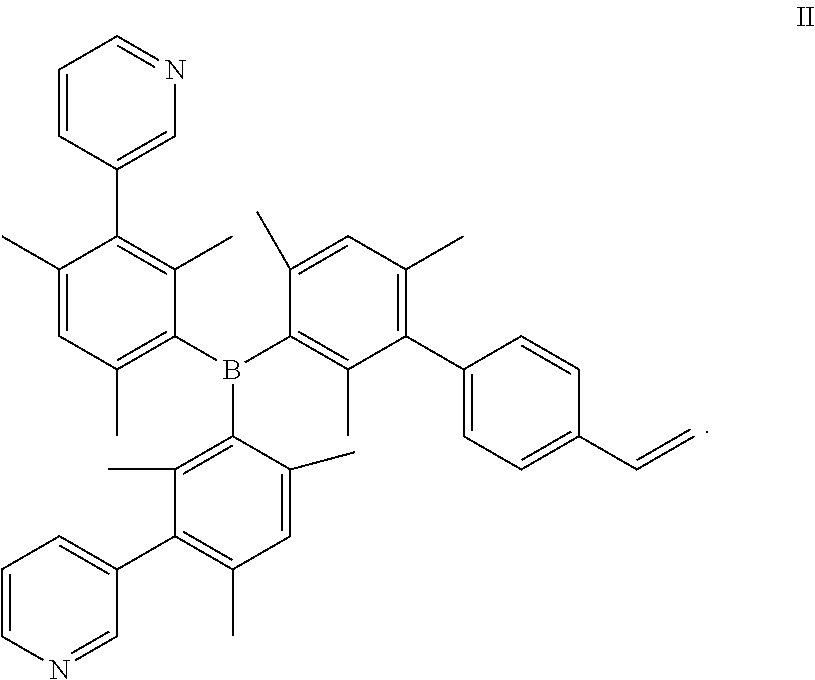
- the present invention relates to compounds of formula II and polymers derived therefrom and optoelectronic devices using the same
- the compounds of formula I and II may be prepared by employing Suzuki cross-coupling reactions.
- the general procedure for Suzuki cross-coupling reactions includes mixing an aryl halide and aryl borate (or boronic acid) in a suitable solvent, in the presence of a base and Pd catalyst. The reaction mixture is heated under an inert atmosphere for a period of time.
- Suitable solvents include but are not limited to Dioxane, THF, EtOH, toluene and mixtures thereof.
- Exemplary bases include Na 2 CO 3 , K 2 CO 3 , Cs 2 CO 3 , Potassium phosphate and hydrates thereof.
- the bases can be added to the reaction as a solid powder or as an aqueous solution.
- the most commonly used catalysts include Pd(PPh 3 ) 4 , or Pd(OAc) 2 , Pd(dba) 2 with the addition of a secondary ligand.
- exemplary ligands include dialkylphosphinobiphenyl ligands, such as structures III-VII shown below, in which Cy is cyclohexyl.
- Polymers having structural units of formula I or II may additionally include structural units derived from comonomers containing pendant heteroaromatic groups, such as vinylpyridine, vinylcarbazole, vinylphenylcarbazole and vinylphenylpyridine.
- structural units of formula VIII derived from vinylphenylpyridine, may be included.
- comonomers that may be used include, but are not limited to, (meth)acrylic acid and derivatives thereof, vinyl compounds including vinyl methyl ether, vinyl esters, such as, for example, vinyl acetate and vinyl propionate, vinyl aromatic monomers, such as, for example, styrene and substituted styrenes having one or more alkyl, alkoxy, hydroxy or halo substituent groups attached to the aromatic ring, including, but not limited to, alpha-methyl styrene, p-methyl styrene, 3,5-diethylstyrene, 4-n-propylstyrene, vinyl toluene, alpha-methyl vinyltoluene, vinyl xylene, trimethyl styrene, butyl styrene, t-butyl styrene, chlorostyrene, alpha-chlorostyrene, dichlorostyrene, tetrachloro st
- Any radical polymerization method known in the art can be used in the present application. All monomers were weighed out and dissolved in a vial using minimum amount of solvent and the solution were transferred to a schlenk tube using pipette. Suitable solvents include THF, NMP etc. Some solvent was used to rinse the vial and aid transfer.
- the radical initiator was added to the schlenk tube via a syringe. The solution was degassed by a freeze-pump-thaw cycle three times and kept sealed under vacuum during the reaction. The schlenk tube was then immersed into a pre-heated oil bath set to 65-180° C. and left to stir. The tube was then removed from the bath and let cool.
- the polymer was then precipitated into anti-solvent such as ether, hexanes, methanol or acetone.
- anti-solvent such as ether, hexanes, methanol or acetone.
- Monomers synthesized in house were used without further purification, as they do not contain any radical inhibitors. All thermal initiators such as AIBN and BPO can be used in.
- Monomers obtained commercially would be purified through an AlO 2 plug to remove radical inhibitors before use.
- An optoelectronic device typically includes in the simplest case, an anode layer and a corresponding cathode layer with an organic electroluminescent layer disposed between said anode and said cathode.
- an OLED typically includes in the simplest case, an anode layer and a corresponding cathode layer with an organic electroluminescent layer disposed between said anode and said cathode.
- a voltage bias is applied across the electrodes, electrons are injected by the cathode into the electroluminescent layer while electrons are removed from (or “holes” are “injected” into) the electroluminescent layer from the anode.
- Light emission occurs as holes combine with electrons within the electroluminescent layer to form singlet or triplet excitons, light emission occurring as singlet and/or triplet excitons decay to their ground states via radiative decay.
- Other components which may be present in an OLED in addition to the anode, cathode and light emitting material include a hole injection layer, an electron injection layer, and an electron transport layer.
- the electron transport layer need not be in direct contact with the cathode, and frequently the electron transport layer also serves as a hole blocking layer to prevent holes migrating toward the cathode.
- Additional components which may be present in an organic light-emitting device include hole transporting layers, hole transporting emission (emitting) layers and electron transporting emission (emitting) layers.
- the OLEDs comprising the organic compounds of the invention may be a fluorescent OLED comprising a singlet emitter.
- the OLEDs comprising the organic compounds of the invention may be a phosphorescent OLED comprising at least one triplet emitter.
- the OLEDs comprising the organic compounds of the invention comprise at least one singlet emitter and at least one triplet emitter.
- the OLEDs comprising the organic compounds of the invention may contain one or more, any or a combination of blue, yellow, orange, red phosphorescent dyes, including complexes of transition metals such as Ir, Os and Pt.
- electrophosphorescent and electrofluorescent metal complexes such as those supplied by American Dye Source, Inc., Quebec, Canada may be used.
- Polymers comprising structural units deriving from compounds of the formula I and II may be part of an emissive layer, or hole transporting layer or electron transporting layer, or electron injection layer of an OLED or any combination thereof.
- the organic electroluminescent layer i.e., the emissive layer
- the organic electroluminescent layer is a layer within an organic light emitting device which when in operation contains a significant concentration of both electrons and holes and provides sites for exciton formation and light emission.
- a hole injection layer is a layer in contact with the anode which promotes the injection of holes from the anode into the interior layers of the OLED; and an electron injection layer is a layer in contact with the cathode that promotes the injection of electrons from the cathode into the OLED;
- an electron transport layer is a layer which facilitates conduction of electrons from the cathode and/or the electron injection layer to a charge recombination site.
- a hole transporting layer is a layer which when the OLED is in operation facilitates conduction of holes from the anode and/or the hole injection layer to charge recombination sites and which need not be in direct contact with the anode.
- a hole transporting emission layer is a layer in which when the OLED is in operation facilitates the conduction of holes to charge recombination sites, and in which the majority of charge carriers are holes, and in which emission occurs not only through recombination with residual electrons, but also through the transfer of energy from a charge recombination zone elsewhere in the device.
- An electron transporting emission layer is a layer in which when the OLED is in operation facilitates the conduction of electrons to charge recombination sites, and in which the majority of charge carriers are electrons, and in which emission occurs not only through recombination with residual holes, but also through the transfer of energy from a charge recombination zone elsewhere in the device.
- Materials suitable for use as the anode includes materials having a bulk resistivity of preferred about 1000 ohms per square, as measured by a four-point probe technique.
- Indium tin oxide (ITO) is frequently used as the anode because it is substantially transparent to light transmission and thus facilitates the escape of light emitted from electro-active organic layer.
- Other materials, which may be utilized as the anode layer include tin oxide, indium oxide, zinc oxide, indium zinc oxide, zinc indium tin oxide, antimony oxide, and mixtures thereof.
- Materials suitable for use as the cathode include general electrical conductors including, but not limited to metals and metal oxides such as ITO etc which can inject negative charge carriers (electrons) into the inner layer(s) of the OLED.
- Various metals suitable for use as the cathode 20 include K, Li, Na, Cs, Mg, Ca, Sr, Ba, Al, Ag, Au, In, Sn, Zn, Zr, Sc, Y, elements of the lanthanide series, alloys thereof, and mixtures thereof.
- Suitable alloy materials for use as the cathode layer include Ag—Mg, Al—Li, In—Mg, Al—Ca, and Al—Au alloys.
- Layered non-alloy structures may also be employed in the cathode, such as a thin layer of a metal such as calcium, or a metal fluoride, such as LiF, covered by a thicker layer of a metal, such as aluminum or silver.
- the cathode may be composed of a single metal, and especially of aluminum metal.
- Polymers comprising structural units derived from compounds of formula I and II may be used in electron transport layers in place of, or in addition to traditional materials such as poly(9,9-dioctyl fluorene), tris(8-hydroxyquinolato) aluminum (Alq 3 ), 2,9-dimethyl-4,7-diphenyl-1,1-phenanthroline, 4,7-diphenyl-1,10-phenanthroline, 2-(4-biphenylyl)-5-(4-t-butylphenyl)-1,3,4-oxadiazole, 3-(4-biphenylyl)-4-phenyl-5-(4-t-butylphenyl)-1,2,4-triazole, 1,3,4-oxadiazole-containing polymers, 1,3,4-triazole-containing polymers, quinoxaline-containing polymers, and cyano-PPV.
- poly(9,9-dioctyl fluorene) tris(8-hydroxyquino
- Materials suitable for use in hole transporting layers include 1,1-bis((di-4-tolylamino) phenyl)cyclohexane, N,N′-bis(4-methylphenyl)-N,N′-bis(4-ethylphenyl)-(1,1′-(3,3′-dimethyl)biphenyl)-4,4′-diamine, tetrakis-(3-methylphenyl)-N,N,N′,N′-2,5-phenylenediamine, phenyl-4-N,N-diphenylaminostyrene, p-(diethylamino) benzaldehyde diphenylhydrazone, triphenylamine, 1-phenyl-3-(p-(diethylamino)styryl)-5-(p-(diethylamino)phenyl)pyrazoline, 1,2-trans-bis(9H-carbazol-9-yl)cyclobutane,
- Materials suitable for use in the light emitting layer include electroluminescent polymers such as polyfluorenes, preferably poly(9,9-dioctyl fluorene) and copolymers thereof, such as poly(9,9′-dioctylfluorene-co-bis-N,N′-(4-butylphenyl)diphenylamine) (F8-TFB); poly(vinylcarbazole) and polyphenylenevinylene and their derivatives.
- the light emitting layer may include a blue, yellow, orange, green or red phosphorescent dye or metal complex, or a combination thereof.
- Materials suitable for use as the phosphorescent dye include, but are not limited to, tris(1-phenylisoquinoline) iridium (III) (red dye), tris(2-phenylpyridine) iridium (green dye) and Iridium (III) bis(2-(4,6-difluorephenyl)pyridinato-N,C2) (blue dye).
- commercially available electrofluorescent and electrophosphorescent metal complexes from ADS may also be used.
- ADS green dyes include ADS060GE, ADS061GE, ADS063GE, and ADS066GE, ADS078GE, and ADS090GE.
- ADS blue dyes include ADS064BE, ADS065BE, and ADS070BE.
- ADS red dyes include ADS067RE, ADS068RE, ADS069RE, ADS075RE, ADS076RE, ADS067RE, and ADS077RE.
- Organic compounds of formula I and II may form part of the electron transport layer or electron injection layer or light emissive layer.
- the present invention relates to more efficient optoelectronic devices, e.g., OLEDs comprising organic compounds of formula I and II.
- the OLEDs may be phosphorescent containing one or more, any or a combination of, blue, yellow, orange, green, red phosphorescent dyes.
- aromatic radical refers to an array of atoms having a valence of at least one comprising at least one aromatic group.
- the array of atoms having a valence of at least one comprising at least one aromatic group may include heteroatoms such as nitrogen, sulfur, selenium, silicon and oxygen, or may be composed exclusively of carbon and hydrogen.
- aromatic radical includes but is not limited to phenyl, pyridyl, furanyl, thienyl, naphthyl, phenylene, and biphenyl radicals.
- the aromatic radical contains at least one aromatic group.
- the aromatic radical may also include nonaromatic components.
- a benzyl group is an aromatic radical which comprises a phenyl ring (the aromatic group) and a methylene group (the nonaromatic component).
- a tetrahydronaphthyl radical is an aromatic radical comprising an aromatic group (C 6 H 3 ) fused to a nonaromatic component —(CH 2 ) 4 —.
- aromatic radical is defined herein to encompass a wide range of functional groups such as alkyl groups, alkenyl groups, alkynyl groups, haloalkyl groups, haloaromatic groups, conjugated dienyl groups, alcohol groups, ether groups, aldehydes groups, ketone groups, carboxylic acid groups, acyl groups (for example carboxylic acid derivatives such as esters and amides), amine groups, nitro groups, and the like.
- the 4-methylphenyl radical is a C 7 aromatic radical comprising a methyl group, the methyl group being a functional group which is an alkyl group.
- the 2-nitrophenyl group is a C 6 aromatic radical comprising a nitro group, the nitro group being a functional group.
- Aromatic radicals include halogenated aromatic radicals such as 4-trifluoromethylphenyl, hexafluoroisopropylidenebis(4-phen-1-yloxy) (i.e., —OPhC(CF 3 ) 2 PhO—), 4-chloromethylphen-1-yl, 3-trifluorovinyl-2-thienyl, 3-trichloromethylphen-1-yl (i.e., 3-CCl 3 Ph-), 4-(3-bromoprop-1-yl)phen-1-yl (i.e., 4-BrCH 2 CH 2 CH 2 Ph-), and the like.
- halogenated aromatic radicals such as 4-trifluoromethylphenyl, hexafluoroisopropylidenebis(4-phen-1-yloxy) (i.e., —OPhC(CF 3 ) 2 PhO—), 4-chloromethylphen-1-yl, 3-trifluorovinyl-2-thienyl, 3-trich
- aromatic radicals include 4-allyloxyphen-1-oxy, 4-aminophen-1-yl (i.e., 4-H 2 NPh-), 3-aminocarbonylphen-1-yl (i.e., NH 2 COPh-), 4-benzoylphen-1-yl, dicyanomethylidenebis(4-phen-1-yloxy) (i.e., —OPhC(CN) 2 PhO—), 3-methylphen-1-yl, methylenebis(4-phen-1-yloxy) (i.e., —OPhCH 2 PhO—), 2-ethylphen-1-yl, phenylethenyl, 3-formyl-2-thienyl, 2-hexyl-5-furanyl, hexamethylene-1,6-bis(4-phen-1-yloxy) (i.e., —OPh(CH 2 ) 6 PhO—), 4-hydroxymethylphen-1-yl (i.e., 4-HOCH 2 Ph-), 4-mer
- a C 3 -C 10 aromatic radical includes aromatic radicals containing at least three but no more than 10 carbon atoms.
- the aromatic radical 1-imidazolyl (C 3 H 2 N 2 —) represents a C 3 aromatic radical.
- the benzyl radical (C 7 H 7 —) represents a C 7 aromatic radical.
- cycloaliphatic radical refers to a radical having a valence of at least one, and comprising an array of atoms which is cyclic but which is not aromatic. As defined herein a “cycloaliphatic radical” does not contain an aromatic group.
- a “cycloaliphatic radical” may comprise one or more noncyclic components.
- a cyclohexylmethyl group (C 6 H 11 CH 2 —) is an cycloaliphatic radical which comprises a cyclohexyl ring (the array of atoms which is cyclic but which is not aromatic) and a methylene group (the noncyclic component).
- the cycloaliphatic radical may include heteroatoms such as nitrogen, sulfur, selenium, silicon and oxygen, or may be composed exclusively of carbon and hydrogen.
- the term “cycloaliphatic radical” is defined herein to encompass a wide range of functional groups such as alkyl groups, alkenyl groups, alkynyl groups, haloalkyl groups, conjugated dienyl groups, alcohol groups, ether groups, aldehyde groups, ketone groups, carboxylic acid groups, acyl groups (for example carboxylic acid derivatives such as esters and amides), amine groups, nitro groups, and the like.
- the 4-methylcyclopent-1-yl radical is a C 6 cycloaliphatic radical comprising a methyl group, the methyl group being a functional group which is an alkyl group.
- the 2-nitrocyclobut-1-yl radical is a C 4 cycloaliphatic radical comprising a nitro group, the nitro group being a functional group.
- a cycloaliphatic radical may comprise one or more halogen atoms which may be the same or different. Halogen atoms include, for example; fluorine, chlorine, bromine, and iodine.
- Cycloaliphatic radicals comprising one or more halogen atoms include 2-trifluoromethylcyclohex-1-yl, 4-bromodifluoromethylcyclooct-1-yl, 2-chlorodifluoromethylcyclohex-1-yl, hexafluoroisopropylidene-2,2-bis(cyclohex-4-yl) (i.e., —C 6 H 10 C(CF 3 ) 2 C 6 H 10 —), 2-chloromethylcyclohex-1-yl, 3-difluoromethylenecyclohex-1-yl, 4-trichloromethylcyclohex-1-yloxy, 4-bromodichloromethylcyclohex-1-ylthio, 2-bromoethylcyclopent-1-yl, 2-bromopropylcyclohex-1-yloxy (e.g.
- cycloaliphatic radicals include 4-allyloxycyclohex-1-yl, 4-aminocyclohex-1-yl (i.e., H 2 C 6 H 10 —), 4-aminocarbonylcyclopent-1-yl (i.e., NH 2 COO 5 H 8 —), 4-acetyloxycyclohex-1-yl, 2,2-dicyanoisopropylidenebis(cyclohex-4-yloxy) (i.e., —OC 6 H 10 C(CN) 2 C 6 H 10 O—), 3-methylcyclohex-1-yl, methylenebis(cyclohex-4-yloxy) (i.e., —OC 6 H 10 CH 2 C 6 H 10 O—), 1-ethylcyclobut-1-yl, cyclopropylethenyl, 3-formyl-2-terahydrofuranyl, 2-hexyl-5
- a C 3 -C 10 cycloaliphatic radical includes cycloaliphatic radicals containing at least three but no more than 10 carbon atoms.
- the cycloaliphatic radical 2-tetrahydrofuranyl (C 4 H 7 O—) represents a C 4 cycloaliphatic radical.
- the cyclohexylmethyl radical (C 6 H 11 CH 2 —) represents a C 7 cycloaliphatic radical.
- aliphatic radical refers to an organic radical having a valence of at least one consisting of a linear or branched array of atoms which is not cyclic. Aliphatic radicals are defined to comprise at least one carbon atom. The array of atoms comprising the aliphatic radical may include heteroatoms such as nitrogen, sulfur, silicon, selenium and oxygen or may be composed exclusively of carbon and hydrogen.
- aliphatic radical is defined herein to encompass, as part of the “linear or branched array of atoms which is not cyclic” organic radicals substituted with a wide range of functional groups such as alkyl groups, alkenyl groups, alkynyl groups, haloalkyl groups, conjugated dienyl groups, alcohol groups, ether groups, aldehyde groups, ketone groups, carboxylic acid groups, acyl groups (for example carboxylic acid derivatives such as esters and amides), amine groups, nitro groups, and the like.
- functional groups such as alkyl groups, alkenyl groups, alkynyl groups, haloalkyl groups, conjugated dienyl groups, alcohol groups, ether groups, aldehyde groups, ketone groups, carboxylic acid groups, acyl groups (for example carboxylic acid derivatives such as esters and amides), amine groups, nitro groups, and the like.
- the 4-methylpent-1-yl radical is a C 6 aliphatic radical comprising a methyl group, the methyl group being a functional group which is an alkyl group.
- the 4-nitrobut-1-yl group is a C 4 aliphatic radical comprising a nitro group, the nitro group being a functional group.
- An aliphatic radical may be a haloalkyl group which comprises one or more halogen atoms which may be the same or different. Halogen atoms include, for example; fluorine, chlorine, bromine, and iodine.
- Aliphatic radicals comprising one or more halogen atoms include the alkyl halides trifluoromethyl, bromodifluoromethyl, chlorodifluoromethyl, hexafluoroisopropylidene, chloromethyl, difluorovinylidene, trichloromethyl, bromodichloromethyl, bromoethyl, 2-bromotrimethylene (e.g. —CH 2 CHBrCH 2 —), and the like.
- aliphatic radicals include allyl, aminocarbonyl (i.e., —CONH 2 ), carbonyl, 2,2-dicyanoisopropylidene (i.e., —CH 2 C(CN) 2 CH 2 —), methyl (i.e., —CH 3 ), methylene (i.e., —CH 2 —), ethyl, ethylene, formyl (i.e.—CHO), hexyl, hexamethylene, hydroxymethyl (i.e.
- —CH 2 OH mercaptomethyl
- methylthio i.e., —SCH 3
- methylthiomethyl i.e., —CH 2 SCH 3
- methoxy, methoxycarbonyl i.e., CH 3 OCO—
- nitromethyl i.e., —CH 2 NO 2
- thiocarbonyl trimethylsilyl (i.e., (CH 3 ) 3 Si—), t-butyldimethylsilyl, 3-trimethyoxysilypropyl (i.e., (CH 3 O) 3 SiCH 2 CH 2 CH 2 —) 5 vinyl, vinylidene, and the like.
- a C 1 -C 10 aliphatic radical contains at least one but no more than 10 carbon atoms.
- a methyl group i.e., CH 3 —
- a decyl group i.e., CH 3 (CH 2 ) 9 —
- CH 3 (CH 2 ) 9 — is an example of a C 10 aliphatic radical.
- heteroaryl refers to aromatic or unsaturated rings in which one or more carbon atoms of the aromatic ring(s) are replaced by a heteroatom(s) such as nitrogen, oxygen, boron, selenium, phosphorus, silicon or sulfur.
- Heteroaryl refers to structures that may be a single aromatic ring, multiple aromatic ring(s), or one or more aromatic rings coupled to one or more non-aromatic ring(s). In structures having multiple rings, the rings can be fused together, linked covalently, or linked to a common group such as an ether, methylene or ethylene moiety.
- the common linking group may also be a carbonyl as in phenyl pyridyl ketone.
- rings such as thiophene, pyridine, isoxazole, pyrazole, pyrrole, furan, etc. or benzo-fused analogues of these rings are defined by the term “heteroaryl.”
- aryl is used herein to refer to an aromatic substituent which may be a single aromatic ring or multiple aromatic rings which are fused together, linked covalently, or linked to a common group such as an ether, methylene or ethylene moiety.
- the aromatic ring(s) may include phenyl, naphthyl, anthracenyl, and biphenyl, among others.
- aryls have between 1 and 200 carbon atoms, between 1 and 50 carbon atoms or between 1 and 20 carbon atoms.
- alkyl is used herein to refer to a branched or unbranched, saturated or unsaturated acyclic hydrocarbon radical. Suitable alkyl radicals include, for example, methyl, ethyl, n-propyl, i-propyl, 2-propenyl (or allyl), vinyl, n-butyl, t-butyl, i-butyl (or 2-methylpropyl), etc. In particular embodiments, alkyls have between 1 and 200 carbon atoms, between 1 and 50 carbon atoms or between 1 and 20 carbon atoms.
- cycloalkyl is used herein to refer to a saturated or unsaturated cyclic non-aromatic hydrocarbon radical having a single ring or multiple condensed rings.
- Suitable cycloalkyl radicals include, for example, cyclopentyl, cyclohexyl, cyclooctenyl, bicyclooctyl, etc.
- cycloalkyls have between 3 and 200 carbon atoms, between 3 and 50 carbon atoms or between 3 and 20 carbon atoms.
- any numerical values recited herein include all values from the lower value to the upper value in increments of one unit provided that there is a separation of at least 2 units between any lower value and any higher value.
- the amount of a component or a value of a process variable such as, for example, temperature, pressure, time and the like is, for example, from 1 to 90, preferably from 20 to 80, more preferably from 30 to 70, it is intended that values such as 15 to 85, 22 to 68, 43 to 51, 30 to 32 etc. are expressly enumerated in this specification.
- one unit is considered to be 0.0001, 0.001, 0.01 or 0.1 as appropriate.
- Examples 1-7 describe the syntheses of compounds of formula II, polymers and intermediates used in making them. All reagents were purchased from Aldrich Chemical Co., Milwaukee, Wis., USA and Acros Organics unless other wise specified and were used without further purification. All compounds were characterized by 1 H-NMR and found to correspond to the structures shown.
- Mono-bromide precursor (Compound 1, 1.2 g, 2 mmol) and 4-phenylvinyl boronic acid (0.441 g, 3 mmol) were added into a 50 mL of 3-neck round bottom flask.
- Pd(OAc) 2 (3.4 mg, 0.015 mmol)
- ligand 2-dicyclohexylphosphino-2′,6′-dimethyoxybiphenyl 22 mg, 0.053 mmol
- 20 mL of toluene was added. This solution was degassed using a stream of argon for 15 min.
- Tris(bromomesityl) borane (compound 2) (11.1 g., 18.4 mmol) and 7.57 g of 3-pyridylboronic acid pinacol ester (36.9 mmol) were added into 50 mL of dioxane along with 20 mL of Na 2 CO 3 solution (2N).
- the reaction vessel was evacuated and purged with argon three times.
- 160 mg of Pd(PPh 3 ) 4 was added and the flask was evacuated and purged with argon three times.
- the reaction mixture was heated at 90° C. for 48 hours. After the reaction was cooled to room temperature, dioxane was removed by rotoevaporation.
- Mono-bromide precursor (compound 1, 1.21 g, 2 mmol) and 4-formylphenyl boronic acid (1.6 g, 10.6 mmol) were added into a 50 mL of 3-neck round bottom flask.
- Vinyl monomer II (0.1252 g, 0.2 mmol) and vinyl phenyl pyridine (compound 4, 0.0036 g, 0.2 mmol) were added to a schlenk tube with 3 mL of NMP.
- AIBN in NMP (15 ⁇ l, 0.05 g/mL) was added via a syringe.
- the polymer was precipitated out into 10 mL of ether, and collected by centrifuge.
Landscapes
- Chemical & Material Sciences (AREA)
- Engineering & Computer Science (AREA)
- Materials Engineering (AREA)
- Organic Chemistry (AREA)
- Physics & Mathematics (AREA)
- Spectroscopy & Molecular Physics (AREA)
- Chemical Kinetics & Catalysis (AREA)
- Health & Medical Sciences (AREA)
- Optics & Photonics (AREA)
- Medicinal Chemistry (AREA)
- Polymers & Plastics (AREA)
- Inorganic Chemistry (AREA)
- Pyridine Compounds (AREA)
- Electroluminescent Light Sources (AREA)
- Organic Low-Molecular-Weight Compounds And Preparation Thereof (AREA)
- Addition Polymer Or Copolymer, Post-Treatments, Or Chemical Modifications (AREA)
Abstract

wherein
-
- R1 is independently at each occurrence a C1-C20 aliphatic radical, a C3-C20 aromatic radical, or a C3-C20 cycloaliphatic radical; and a is independently at each occurrence 0, or an integer ranging from 1 to 4.
Description

wherein
-
- R1 is independently at each occurrence a C1-C20 aliphatic radical, a C3-C20 aromatic radical, or a C3-C20 cycloaliphatic radical; and
- a is independently at each occurrence 0, or an integer ranging from 1 to 4.


Claims (12)



Applications Claiming Priority (4)
| Application Number | Priority Date | Filing Date | Title |
|---|---|---|---|
| CN200810129825.8 | 2008-08-07 | ||
| CN2008101298258A CN101643479B (en) | 2008-08-07 | 2008-08-07 | Compound containing benzene pyridine unit |
| CN200810129825 | 2008-08-07 | ||
| PCT/US2009/049990 WO2010016991A1 (en) | 2008-08-07 | 2009-07-09 | Compound comprising phenyl pyridine units |
Publications (2)
| Publication Number | Publication Date |
|---|---|
| US20110207877A1 US20110207877A1 (en) | 2011-08-25 |
| US8541525B2 true US8541525B2 (en) | 2013-09-24 |
Family
ID=41066098
Family Applications (1)
| Application Number | Title | Priority Date | Filing Date |
|---|---|---|---|
| US13/056,539 Active 2029-11-18 US8541525B2 (en) | 2008-08-07 | 2009-07-09 | Compound comprising phenyl pyridine units |
Country Status (6)
| Country | Link |
|---|---|
| US (1) | US8541525B2 (en) |
| EP (1) | EP2324038B1 (en) |
| JP (1) | JP5607623B2 (en) |
| KR (1) | KR101661371B1 (en) |
| CN (1) | CN101643479B (en) |
| WO (1) | WO2010016991A1 (en) |
Families Citing this family (4)
| Publication number | Priority date | Publication date | Assignee | Title |
|---|---|---|---|---|
| CN101633668B (en) * | 2008-07-24 | 2015-06-03 | 通用电气公司 | Compound comprising phenylpyridine unit |
| CN102754236A (en) * | 2010-02-23 | 2012-10-24 | 佛罗里达大学研究基金会公司 | Microcavity OLEDs for Lighting |
| JP7102299B2 (en) * | 2018-09-06 | 2022-07-19 | 日本放送協会 | Organic electroluminescence elements, display devices, and lighting devices |
| CN110423243B (en) * | 2018-09-10 | 2022-06-10 | 广东聚华印刷显示技术有限公司 | Electron transport material, preparation method thereof and organic electroluminescent device |
Citations (2)
| Publication number | Priority date | Publication date | Assignee | Title |
|---|---|---|---|---|
| WO2006135076A1 (en) | 2005-06-14 | 2006-12-21 | Showa Denko K.K. | Light emitting polymer material, organic electroluminescence device and display device comprising light emitting polymer material |
| US20090208776A1 (en) * | 2008-02-19 | 2009-08-20 | General Electric Company | Organic optoelectronic device and method for manufacturing the same |
Family Cites Families (8)
| Publication number | Priority date | Publication date | Assignee | Title |
|---|---|---|---|---|
| US6627177B2 (en) * | 2000-12-05 | 2003-09-30 | The Regents Of The University Of California | Polyhydroxyl-substituted organic molecule sensing optical in vivo method utilizing a boronic acid adduct and the device thereof |
| CN1193049C (en) * | 2003-04-23 | 2005-03-16 | 武汉大学 | Conjugated polymer containing pyridine on main chain, preparation process and use thereof |
| JP5031276B2 (en) * | 2005-06-14 | 2012-09-19 | 昭和電工株式会社 | POLYMER LIGHT EMITTING MATERIAL, ORGANIC ELECTROLUMINESCENT ELEMENT AND DISPLAY DEVICE USING POLYMER LIGHT EMITTING MATERIAL |
| JP5247024B2 (en) | 2005-12-22 | 2013-07-24 | 昭和電工株式会社 | Organic light emitting device |
| WO2007086505A1 (en) * | 2006-01-27 | 2007-08-02 | Idemitsu Kosan Co., Ltd. | Transition metal complex compound and organic electroluminescent device using same |
| CN101469038B (en) * | 2007-12-25 | 2012-03-28 | 通用电气公司 | Polymer containing benzene pyridine unit |
| CN101633668B (en) * | 2008-07-24 | 2015-06-03 | 通用电气公司 | Compound comprising phenylpyridine unit |
| JP5466747B2 (en) | 2012-10-17 | 2014-04-09 | 昭和電工株式会社 | High molecular compound |
-
2008
- 2008-08-07 CN CN2008101298258A patent/CN101643479B/en active Active
-
2009
- 2009-07-09 EP EP09790173.0A patent/EP2324038B1/en active Active
- 2009-07-09 WO PCT/US2009/049990 patent/WO2010016991A1/en not_active Ceased
- 2009-07-09 JP JP2011522087A patent/JP5607623B2/en active Active
- 2009-07-09 KR KR1020117005166A patent/KR101661371B1/en active Active
- 2009-07-09 US US13/056,539 patent/US8541525B2/en active Active
Patent Citations (3)
| Publication number | Priority date | Publication date | Assignee | Title |
|---|---|---|---|---|
| WO2006135076A1 (en) | 2005-06-14 | 2006-12-21 | Showa Denko K.K. | Light emitting polymer material, organic electroluminescence device and display device comprising light emitting polymer material |
| US8025987B2 (en) * | 2005-06-14 | 2011-09-27 | Showa Denko K.K. | Light emitting polymer material, organic electroluminescence device and display device comprising light emitting polymer material |
| US20090208776A1 (en) * | 2008-02-19 | 2009-08-20 | General Electric Company | Organic optoelectronic device and method for manufacturing the same |
Non-Patent Citations (2)
| Title |
|---|
| International Search Report and Written Opinion, Oct. 19, 2009. |
| Tanaka, Takeda, Chiba, Watanabe, Kido: "Novel Electron Transport Material containing Boron Atom with a High Triplett Excited Energy Level" Chemistry Letters vol. 36, 2007. |
Also Published As
| Publication number | Publication date |
|---|---|
| WO2010016991A1 (en) | 2010-02-11 |
| KR20110044276A (en) | 2011-04-28 |
| JP2011530622A (en) | 2011-12-22 |
| KR101661371B1 (en) | 2016-09-29 |
| CN101643479B (en) | 2012-07-18 |
| EP2324038A1 (en) | 2011-05-25 |
| EP2324038B1 (en) | 2014-09-10 |
| JP5607623B2 (en) | 2014-10-15 |
| CN101643479A (en) | 2010-02-10 |
| US20110207877A1 (en) | 2011-08-25 |
Similar Documents
| Publication | Publication Date | Title |
|---|---|---|
| US8062768B2 (en) | Compound comprising phenyl pyridine units | |
| US8039125B2 (en) | Compound comprising phenyl pyridine units | |
| US8512879B2 (en) | Polymer for optoelectronic device | |
| US8691399B2 (en) | Electron-transporting materials and processes for making the same | |
| US8962157B2 (en) | Electron-transporting materials | |
| US8541525B2 (en) | Compound comprising phenyl pyridine units | |
| US7989476B2 (en) | Electron-transporting materials and processes for making the same | |
| US8053095B2 (en) | Compound comprising phenyl pyridine units | |
| KR20100097712A (en) | Polymer comprising phenyl pyridine units | |
| US7955720B2 (en) | Polymer comprising phenyl pyridine units | |
| EP2373700B1 (en) | Electron-transporting polymers | |
| US8865905B2 (en) | Organic compounds | |
| US20100270537A1 (en) | Optoelectronic devices and organic compounds used therein | |
| US20110077373A1 (en) | Polymer and optoelectronic device comprising the same |
Legal Events
| Date | Code | Title | Description |
|---|---|---|---|
| AS | Assignment |
Owner name: GENERAL ELECTRIC COMPANY, NEW YORK Free format text: ASSIGNMENT OF ASSIGNORS INTEREST;ASSIGNORS:YE, QING;LIU, JIE;SIGNING DATES FROM 20090220 TO 20090225;REEL/FRAME:025715/0619 |
|
| STCF | Information on status: patent grant |
Free format text: PATENTED CASE |
|
| CC | Certificate of correction | ||
| AS | Assignment |
Owner name: BOE TECHNOLOGY GROUP CO., LTD., CHINA Free format text: ASSIGNMENT OF ASSIGNORS INTEREST;ASSIGNOR:GENERAL ELECTRIC COMPANY;REEL/FRAME:038439/0315 Effective date: 20151222 |
|
| AS | Assignment |
Owner name: BOE TECHNOLOGY GROUP CO., LTD., CHINA Free format text: ASSIGNMENT OF ASSIGNORS INTEREST;ASSIGNOR:GENERAL ELECTRIC COMPANY;REEL/FRAME:038490/0022 Effective date: 20151222 |
|
| FPAY | Fee payment |
Year of fee payment: 4 |
|
| MAFP | Maintenance fee payment |
Free format text: PAYMENT OF MAINTENANCE FEE, 8TH YEAR, LARGE ENTITY (ORIGINAL EVENT CODE: M1552); ENTITY STATUS OF PATENT OWNER: LARGE ENTITY Year of fee payment: 8 |
|
| MAFP | Maintenance fee payment |
Free format text: PAYMENT OF MAINTENANCE FEE, 12TH YEAR, LARGE ENTITY (ORIGINAL EVENT CODE: M1553); ENTITY STATUS OF PATENT OWNER: LARGE ENTITY Year of fee payment: 12 |