US8538446B2 - Method and apparatus for allocating cell ID in self-organizing network - Google Patents
Method and apparatus for allocating cell ID in self-organizing network Download PDFInfo
- Publication number
- US8538446B2 US8538446B2 US12/807,600 US80760010A US8538446B2 US 8538446 B2 US8538446 B2 US 8538446B2 US 80760010 A US80760010 A US 80760010A US 8538446 B2 US8538446 B2 US 8538446B2
- Authority
- US
- United States
- Prior art keywords
- pcid
- femto base
- base station
- permutation
- pcids
- Prior art date
- Legal status (The legal status is an assumption and is not a legal conclusion. Google has not performed a legal analysis and makes no representation as to the accuracy of the status listed.)
- Active, expires
Links
Images



Classifications
-
- H—ELECTRICITY
- H04—ELECTRIC COMMUNICATION TECHNIQUE
- H04W—WIRELESS COMMUNICATION NETWORKS
- H04W8/00—Network data management
- H04W8/26—Network addressing or numbering for mobility support
-
- H—ELECTRICITY
- H04—ELECTRIC COMMUNICATION TECHNIQUE
- H04W—WIRELESS COMMUNICATION NETWORKS
- H04W64/00—Locating users or terminals or network equipment for network management purposes, e.g. mobility management
- H04W64/003—Locating users or terminals or network equipment for network management purposes, e.g. mobility management locating network equipment
Definitions
- the present invention relates to a method and an apparatus for allocating a cell Identifier (ID) in a self-organizing network. More particularly, the present invention relates to a method and an apparatus for allocating a dynamic Physical Cell ID (PCID) using a Merge Table (MT) representing a relation between a femto base station and a PCID.
- PCID Cell Identifier
- MT Merge Table
- SoN Self-organizing Network
- the SoN network is discussed at a 3rd Generation Partnership Project (3GPP) Long Term Evolution (LTE) standard and an Institute of Electrical and Electronics Engineers (IEEE) 802.16 standard.
- 3GPP 3rd Generation Partnership Project
- LTE Long Term Evolution
- IEEE Institute of Electrical and Electronics Engineers
- FIG. 1 illustrates an LTE system whose standardization is in progress at a 3GPP according to the conventional art.
- the femto cell denotes a small mobile communication base station (referred to as a femto base station hereinafter) that accesses a mobile communication core network via a broadband network installed in an indoor space such as a household and an office (or a femto cell may directly access an existing mobile communication network). That is, the femto base station denotes a base station that can provide coverage of less than 10 meters in cell radius.
- a self-configuration function of self-generating installation parameters that depend on a configuration inside a base station when additionally installing the base station, identifying a neighbor base station, setting/registering a relation, and setting connection with a core network at an initial automatic installation and pre-operation process, and a self-optimization function of controlling a base station signal strength by utilizing an inter-neighbor base station signal and traffic type information and optimizing a handover parameter should be provided.
- femto cells are connected with a Mobility Management Entity (MME) 102 or 104 sequentially connected with a SoN server 130 via a gateway 120 .
- MME Mobility Management Entity
- the SoN server 130 controls a self-configuration function and a self-optimization function.
- the femto cell is divided into a PCID. Assuming that the number of provided PCIDs is n, n is equal to or less than the number (m) of actual femto cells. Therefore, the same PCID needs to be allocated to femto cells inside the macro cell 100 .
- the PCID allocation has to be “collision free” and “confusion free”.
- the collision free allows the same PCID not to be allocated to neighbor femto cells because the femto cells that use the same PCID may collide with one another when the femto cells that use the same PCID are adjacent to one another.
- the confusion free allows the same PCID not to be allocated to neighbor femto cells of a femto cell to be additionally installed because a terminal may confuse the neighbor femto cells during a handover procedure when a new femto cell is installed and the neighbor femto cells of the femto cell to be installed use the same PCID.
- an aspect of the present invention is to provide a method and an apparatus for allocating a PCID in a self-organizing network.
- Another aspect of the present invention is to provide a method and an apparatus for configuring a Merge Table (MT) for allocating a PCID in a self-organizing network.
- MT Merge Table
- Still another aspect of the present invention is to provide a method and an apparatus for updating an MT as a femto cell increases in a self-organizing network.
- a method for configuring a Merge Table (MT) for allocating a cell identifier in a self-organizing network includes obtaining position information of a plurality of femto base stations and configuring an initial MT including allocation information of a Physical Cell Identifier (PCID) based on the position information of the femto base station.
- the method also includes minimizing the number of rows or columns according to at least one permutation in the initial MT.
- a method for allocating a cell identifier in a self-organizing network includes, when topology by a new femto cell changes, determining whether to optimize cell identifier allocation.
- a Physical Cell Identifier (PCID) is allocated using a Merge Table (MT).
- MT Merge Table
- an apparatus for configuring a Merge Table (MT) for allocating a cell identifier in a self-organizing network includes a database for obtaining and storing position information of a plurality of femto base stations.
- the apparatus also includes a Physical Cell Identifier (PCID) reconfiguring unit for configuring an initial MT including allocation information of a Physical Cell Identifier (PCID) based on the position information of the femto base station and minimizing the number of rows or columns according to at least one permutation in the initial MT.
- PCID Physical Cell Identifier
- an apparatus for allocating a cell identifier in a self-organizing network includes a controller for, when topology by a new femto cell changes, determining whether to optimize cell identifier allocation.
- the apparatus also includes a Physical Cell Identifier (PCID) selector for allocating a PCID using a Merge Table (MT) when optimizing the cell identifier allocation, and selecting and allocating one of available PCIDs when not optimizing the cell identifier allocation.
- PCID Physical Cell Identifier
- FIG. 1 illustrates an LTE system according to the present disclosure
- FIG. 2 illustrates a process for generating an MT for dynamically allocating, at a SoN, a PCID according to an embodiment of the present invention
- FIG. 3 illustrates a process for allocating a dynamic PCID at a SoN according to an embodiment of the present invention
- FIG. 4 illustrates a process for allocating a dynamic PCID at a SoN according to an embodiment of the present invention
- FIG. 5 illustrates a process for performing a merge operation at a SoN according to an embodiment of the present invention
- FIG. 6 illustrates MT initialization according to an embodiment of the present invention
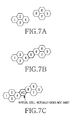
- FIGS. 7A-7C illustrate a virtual cell for updating an MT according to an embodiment of the present invention
- FIG. 8 illustrates updating of an MT according to an embodiment of the present invention
- FIG. 9 illustrates reducing of the number of rows of an MT updated according to an embodiment of the present invention.
- FIG. 10 illustrates a SoN server and a femto base station according to an embodiment of the present invention.
- FIGS. 2 through 10 discussed below, and the various embodiments used to describe the principles of the present disclosure in this patent document are by way of illustration only and should not be construed in any way to limit the scope of the disclosure. Those skilled in the art will understand that the principles of the present disclosure may be implemented in any suitably arranged communication system.
- Exemplary embodiments of the present invention provide a method and an apparatus for allocating a PCID at a SoN.
- FIG. 2 illustrates a process for generating a Merge Table (MT) for dynamically allocating, at a SoN, a PCID according to an embodiment of the present invention.
- MT Merge Table
- the SoN server initializes system parameters required for a self-configuration function or a self-optimization function of a femto base station in block 200 .
- the SoN server obtains inter-neighbor base station relation information for configuring an initial MT in block 202 .
- the inter-neighbor base station relation information is used for determining PCIDs to be allocated to a plurality of femto base stations based on automatic neighbor relation and inter-femto base station distance information or reception strength information. For example, when an n-th PCID is allocated to a first femto base station, an m-th PCID instead of the n-th PCID is allocated to a second femto base station adjacent to the first femto base station.
- a third femto base station adjacent to the second femto base station may be a neighbor femto base station of the first femto base station, and so a different PCID excluding the n-th PCID is allocated to the third femto base station.
- different PCIDs are allocated to neighbor femto base stations of a relevant femto base station, but when a distance between femto base stations is far away, the same PCID may be reallocated to the femto base stations. For example, when a distance between the first femto base station and the third femto base station is greater than a threshold, the same PCID may be allocated to the first femto base station and the third femto base station.
- the inter-femto base station distance information is based on Global Positioning System (GPS) position information of a femto base station reported to the SoN server by each femto base station.
- GPS Global Positioning System
- the SoN server initializes an MT based on the inter-neighbor base station relation information in block 204 .
- the MT is defined by relation between a PCID index and a femto base station index, and represents PCID information allocated to a relevant femto base station.
- the MT initialization is described with reference to FIG. 6 .
- the SoN server updates an initial MT using a virtual cell in block 206 .
- the initial MT is updated using the virtual cell because, when a femto base station is additionally installed in a virtual cell area (that is, a femto base station is additionally installed between cells that use the same PCID), a confusion problem may occur between cells that use the same PCID.
- the initial MT is updated to reflect this confusion into the MT.
- the MT update is described with reference to FIG. 7 .
- block 206 may be omitted in some embodiments.
- the SoN server merges rows according to a predetermined rule in order to reduce the number of rows (that is, PCID indexes) of the updated MT in block 208 .
- This operation is referred to as a merge operation hereinafter.
- the merge operation is described with reference to FIG. 9 .
- the number of allocated PCIDs may be reduced by reducing the number of rows of the MT. Consequently, PCID sets in use and available PCID sets are configured from rows (PCID indexes) of the MT merged according to the predetermined rule.
- blocks 202 to 208 are referred to as a Permutation Merge Model with Guided Random Search (PMM-GRS) algorithm.
- PMM-GRS Permutation Merge Model with Guided Random Search
- the SoN server performs a dynamic PCID allocation using an MT generated by the PMM-GRS algorithm in block 210 .
- the dynamic PCID allocation is described in more detail with reference to FIGS. 3 and 4 .
- the SoN server ends the procedure according to an embodiment of the present invention.
- FIG. 3 illustrates a process for allocating a dynamic PCID at a SoN according to an embodiment of the present invention.
- the SoN server determines whether a topology is changed by a new femto cell or a new femto base station in block 300 . That is, the SoN server determines whether a new femto base station is additionally installed inside a relevant macro cell by a user. According to the topology change, the SoN server may recognize the additionally installed femto base station through a relevant process procedure (e.g., an access procedure) between the SoN server and the new femto base station.
- a relevant process procedure e.g., an access procedure
- the SoN server determines whether to optimize a PCID set to be allocated according to the topology change by the new femto cell in block 302 .
- the SoN server performs the PMM-GRS algorithm to optimize the PCID set in block 308 .
- the PMM-GRS algorithm initializes the MT, updates the MT, and merges rows of the updated MT with consideration of PCID reuse.
- the SoN server determines whether available PCIDs exist from the present PCID set (or rows of a present MT) in block 304 . When the available PCIDs exist, the SoN server allocates an available PCID from the present PCID set to be allocated to a femto base station in block 306 .
- the SoN server When there is no PCID available in block 304 , the SoN server performs the PMM-GRS algorithm to generate an optimized MT in block 308 .
- the MT optimized by the PMM-GRS algorithm includes PCID allocation information of the newly installed femto base station.
- the SoN server determines whether there is a femto cell that uses the same PCID as that of a femto cell to be removed in block 310 .
- the SoN server maintains the present state.
- the SoN server removes the PCID of the femto base station to be removed from the present PCID set and adds the removed PCID to an available PCID list.
- the SoN server may perform the PMM-GRS algorithm to optimize a PCID set.
- FIG. 4 illustrates a process for allocating a dynamic PCID at a SoN according to an embodiment of the present invention.
- the SoN server determines whether a topology is changed by a new femto cell or a new femto base station in block 400 . That is, the SoN server determines whether a new femto base station is additionally installed inside a relevant macro cell by a user.
- the SoN server determines whether to optimize a PCID set according to the topology change by the new femto cell in block 402 .
- the SoN server performs the PMM-GRS algorithm to optimize the PCID set in step 408 .
- the SoN server determines whether available PCIDs exist from the present PCID set in block 404 . When the available PCIDs exist, the SoN server allocates an available PCID from the present PCID set to be allocated to a femto base station in block 406 .
- the SoN server When no available PCID exists in block 404 , the SoN server performs the PMM-GRS algorithm to generate an optimized MT in block 408 .
- the MT optimized by the PMM-GRS algorithm includes PCID allocation information of the newly installed femto base station.
- the SoN server When the topology is not changed by the new femto cell (that is, at least one femto cell is removed from a relevant macro cell) in block 400 , the SoN server performs the PMM-GRS algorithm in block 408 .
- FIG. 5 illustrates a process for performing a merge operation at a SoN according to an embodiment of the present invention.
- the merge operation is performed to configure an optimized PCID set.
- the SoN server determines n candidate PCID sets according to n initial permutations with respect to rows of an updated MT in block 500 .
- the SoN server determines whether to repeatedly perform in block 502 .
- the SoN server swaps positions R i and R j at respective n candidate PCID sets in block 504 .
- R i and R j denote an i-th element and a j-th element of a PCID set, respectively.
- positions of m elements of the PCID set may be swapped.
- m is an integer less than n.
- the frequency of repeated performance is determined with consideration of a system performance and complexity.
- the SoN server selects n candidate PCID sets in an order of least use from the total of 2n candidate PCID sets in block 506 .
- the SoN server selects at least one candidate PCID set that includes a least number of PCIDs from n candidate PCID sets.
- the SoN server ends the present algorithm according to an embodiment of the present invention.
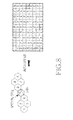
- FIG. 6 illustrates an example of MT initialization according to an embodiment of the present invention.
- the SoN server configures an MT based on GPS position information of femto cells 1 to 8 .
- a horizontal axis of the MT denotes a femto base station index
- a vertical axis denotes a PCID index.
- “1” denotes PCID use
- “0” denotes PCID use restriction due to PCID use by a neighbor femto cell
- “x” denotes an available PCID.
- the femto base station 1 uses a PCID corresponding to an index 1 , use of PCID indexes 2 to 4 is restricted due to use of the neighbor femto cell, and PCIDs 5 to 8 are reused. This may be represented on the MT by 1000xxxx.
- the femto base station 2 uses a PCID corresponding to an index 2 , use of PCID indexes 1 , 3 , and 4 is restricted due to use of the neighbor femto cell, and PCIDs 5 to 8 are reused.
- the femto base station 3 uses a PCID corresponding to an index 3 , use of PCID indexes 1 , 2 , and 4 is restricted due to use of the neighbor femto cell, and PCIDs 5 to 8 are reused.
- the femto base station 4 uses a PCID corresponding to an index 4 , and use of PCID indexes 1 to 3 is restricted due to use of the neighbor femto cell, and PCIDs 5 to 8 are reused.
- the femto base station 5 uses a PCID corresponding to an index 5 , use of PCID indexes 6 to 8 is restricted due to use of the neighbor femto cell, and PCIDs 1 to 4 are reused.
- the femto base station 6 uses a PCID corresponding to an index 6 , use of PCID indexes 5 , 7 , and 8 is restricted due to use of the neighbor femto cell, and PCIDs 1 to 4 are reused.
- the femto base station 7 uses a PCID corresponding to an index 7 , use of PCID indexes 5 , 6 , and 8 is restricted due to use of the neighbor femto cell, and PCIDs 1 to 4 are reused.
- the femto base station 8 uses a PCID corresponding to an index 8 , use of PCID indexes 5 , 6 , and 7 is restricted due to use of the neighbor femto cell, and PCIDs 1 to 4 are reused.
- FIG. 7 illustrates a virtual cell for updating an MT according to an embodiment of the present invention.
- a confusion problem occurs between the femto base station 4 and the femto base station 8 . That is, the femto base station 9 may not discriminate the femto base station 4 and the femto base station 8 that use the same PCID. Therefore, in this situation, one of the two femto base stations needs to change the existing PCID to meet the conditions of collision free and confusion free. Since the change of the existing PCID may generate a disorder to the existing system operation, it should be avoided.
- a virtual cell that is, a virtual femto base station between the femto base stations 4 and 8 are considered.
- the initial MT that considers a virtual cell between two cells is made to perform PCID allocation that meets the conditions of collision free and confusion free.
- FIG. 8 illustrates updating of an MT according to an embodiment of the present invention.
- the MT is updated.
- the existing value of the MT(4,8) is updated from x to 0, and the value of the MT(8,4) is updated from x to 0. That is, though a femto base station 9 is not additionally installed between the femto base station 4 and the femto base station 8 , use of a PCID index 4 of the femto base station 8 is restricted and use of a PCID index 8 of the femto base station 4 is restricted with consideration of a virtual cell between the femto base stations 4 and 8 . According to the above example, confusion occurrence may be suppressed beforehand by considering a virtual cell.
- MT(4,8) and MT(8,4) are not updated.
- the MT may be updated with consideration of a plurality of virtual cell groups or clusters.
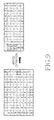
- FIG. 9 illustrates reducing of the number of rows (that is, PCID indexes) of an MT updated according to an embodiment of the present invention.
- rows of an MT are aligned according to a predefined permutation rule (1,5,2,6,3,7,4,8), such that a plurality of PCIDs are merged. That is, the merging of the plurality of PCIDs denotes determining femto base stations that use the same PCID.
- a permutation rule (1,5,2,6,3,7,4,8).
- the femto base station 1 does not merge a PCID 1 , a PCID 5 , and a PCID 2 .
- the femto base station 1 merges a PCID 2 and a PCID 6 , and merges a PCID 3 and a PCID 7 .
- each of femto base stations 2 to 8 performs a merge operation according to a permutation rule (1,5,2,6,3,7,4,8).
- FIG. 9 illustrates an example of a merge operation according to one permutation rule (1,5,2,6,3,7,4,8).
- a method for optimizing an MT that is, a method for allocating a least number of PCIDs to a femto base station) applies a permutation rule of all possible situations to select an MT where at least number of PCIDs is designed.
- an MT to which a least number of PCIDs is allocated is selected from m! candidate MTs.
- an amount of calculation increases.
- an MT is made based on Equation (1) by repeatedly swapping positions of two elements in each permutation.
- FIG. 10 illustrates a SoN server and a femto base station according to an embodiment of the present invention.
- the SoN server 1000 includes a cell information database 1004 , a PCID selector 1002 , and a PCID reconfiguring unit 1006 .
- the cell information database 1004 obtains and stores position information of a plurality of femto base stations 1010 and 1020 , and provides the position information to the PCID selector 1002 and the PCID reconfiguring unit 1006 .
- the PCID reconfiguring unit 1006 configures an initial MT including allocation information of a PCID based on position information of the femto base stations 1010 and 1020 , updates the initial MT with consideration of at least one virtual cell, and minimizes the number of rows and columns in the initial MT.
- the initial MT includes PCID information allocated to a relevant femto base station, information of a PCID whose use by the relevant femto base station is restricted, and PCID reuse information of the relevant femto base station.
- the PCID reconfiguring unit 1006 measures a distance between neighbor femto base stations that can reuse a PCID based on GPS position information, and when the measured distance between the neighbor femto base stations that can reuse the PCID is equal to or less than a threshold, changes a PCID reuse information value of the neighbor femto base stations to information of a PCID whose use is restricted in the initial MT. In addition, when the measured distance between the neighbor femto base stations that can reuse the PCID is greater than the threshold, the PCID reconfiguring unit 1006 does not change the PCID reuse information value of the neighbor femto base stations in the initial MT.
- the PCID reconfiguring unit 1006 aligns the rows or columns in the initial MT according to a plurality of predefined permutation rules, swaps at least two elements of rows or columns in a plurality of the aligned initial MTs to merge rows or columns in the initial MT, and selects a row or a column of at least one MT that includes a least number of rows or columns from the plurality of merged initial MTs.
- the PCID reconfiguring unit 1006 swaps at least two elements in a row or a column of the plurality of aligned initial MTs to merge a row or a column of the initial MT, and repeatedly perform by a predetermined number of times selecting a row or a column of at least one initial MT that includes a least number of rows or columns from the plurality of merged initial MTs.
- the PCID selector 1002 When optimizing the cell identifier allocation as a topology by a new femto cell changes, the PCID selector 1002 allocates a PCID using an MT. When not optimizing the cell identifier allocation, the PCID selector 1002 selects one of available PCIDs and allocates the same.
- the femto base station 1010 includes a self configuring unit 1012 , a PCID manager 1014 , a controller 1016 , and a call processor 1018 .
- the controller 1016 receives PCID information from the PCID manager 1014 to perform an overall control of the femto base station 1010 .
- the self configuring unit 1012 provides position information to the SoN server 1000 , and receives an initial PCID/PCID black list from the SoN server 1000 to generate installation parameters corresponding to an inner construction of the base station in itself, and performs base station initial automatic installation and operations of identifying a neighbor base station, relation setting/registration, and connection settings with a core network in a pre-operation process.
- the PCID manager 1014 requests the SoN server 1000 to change a PCID including an old PCID, a new PCID, and neighbor PCID list information, and receives a response to the PCID change including a new PCID and a PCID black list from the SoN server 1000 .
- the call processor 1018 exchanges a neighbor PCID list by exchanging an X2 setup request/response message via an X2 interface with a call processor 1022 of the neighbor femto base station 1020 .
- the call processor 1018 provides a neighbor PCID list obtained from the neighbor femto base station 1020 to the PCID manager 1014 .
- a self-organizing network may efficiently allocate a PCID by using an MT for PCID allocation.
- an algorithm for optimized PCID allocation does not need to be performed whenever a femto cell is installed or removed.
Landscapes
- Engineering & Computer Science (AREA)
- Databases & Information Systems (AREA)
- Computer Networks & Wireless Communication (AREA)
- Signal Processing (AREA)
- Mobile Radio Communication Systems (AREA)
Abstract
Description
1∩X=1;
1∩1=1;
0∩X=0;
0∩0=0
X∩X=X; and
1∩0=Merge is NOT allowed. [Eqn. 1]
Claims (40)
MO(MO(MO(MO(c1,c2),c3),c4) . . . ck),
1∩X=1,
1∩1=1,
0∩X=0,
0∩0=0,
X∩X=X, and
1∩0=Merge is not allowed,
MO(MO(MO(MO(c1,c2),c3),c4) . . . ck),
1∩X=1,
1∩1=1,
0∩X=0,
0∩0=0,
X∩X=X, and
1∩0=Merge is not allowed,
MO(MO(MO(MO(c1,c2),c3),c4) . . . ck),
1∩X=1,
1∩1=1,
0∩X=0,
0∩0=0,
X∩X=X, and
1∩0=Merge is not allowed,
MO(MO(MO(MO(c1,c2),c3),c4) . . . ck),
1∩X=1,
1∩1=1,
0∩X=0,
0∩0=0,
X∩X=X, and
1∩0=Merge is not allowed,
Applications Claiming Priority (2)
| Application Number | Priority Date | Filing Date | Title |
|---|---|---|---|
| KR1020090085253A KR101613848B1 (en) | 2009-09-10 | 2009-09-10 | Method and apparatus for allocating cell id in self-organizing network |
| KR10-2009-0085253 | 2009-09-10 |
Publications (2)
| Publication Number | Publication Date |
|---|---|
| US20110059744A1 US20110059744A1 (en) | 2011-03-10 |
| US8538446B2 true US8538446B2 (en) | 2013-09-17 |
Family
ID=43648170
Family Applications (1)
| Application Number | Title | Priority Date | Filing Date |
|---|---|---|---|
| US12/807,600 Active 2031-09-06 US8538446B2 (en) | 2009-09-10 | 2010-09-09 | Method and apparatus for allocating cell ID in self-organizing network |
Country Status (2)
| Country | Link |
|---|---|
| US (1) | US8538446B2 (en) |
| KR (1) | KR101613848B1 (en) |
Cited By (1)
| Publication number | Priority date | Publication date | Assignee | Title |
|---|---|---|---|---|
| US20140215028A1 (en) * | 2013-01-25 | 2014-07-31 | Cisco Technology, Inc. | Shared information distribution in a computer network |
Families Citing this family (31)
| Publication number | Priority date | Publication date | Assignee | Title |
|---|---|---|---|---|
| US20110090820A1 (en) | 2009-10-16 | 2011-04-21 | Osama Hussein | Self-optimizing wireless network |
| KR101626989B1 (en) * | 2010-02-01 | 2016-06-13 | 삼성전자주식회사 | Method and appratus for allocation identifier of base station in a communicaiton system |
| JP5704281B2 (en) | 2011-04-29 | 2015-04-22 | 富士通株式会社 | Cell identifier assigning apparatus, method, base station, and readable program and medium thereof |
| US8509762B2 (en) | 2011-05-20 | 2013-08-13 | ReVerb Networks, Inc. | Methods and apparatus for underperforming cell detection and recovery in a wireless network |
| WO2012106884A1 (en) * | 2011-07-13 | 2012-08-16 | 华为技术有限公司 | Method for establishing x2 connection between base stations, base station and communication system |
| EP2568749B1 (en) * | 2011-09-06 | 2018-01-31 | Alcatel Lucent | Method of providing communication over a mobile communication network |
| EP2754271B1 (en) | 2011-09-09 | 2019-11-13 | Reverb Networks Inc. | Methods and apparatus for implementing a self optimizing-organizing network manager |
| US9258719B2 (en) | 2011-11-08 | 2016-02-09 | Viavi Solutions Inc. | Methods and apparatus for partitioning wireless network cells into time-based clusters |
| CN104025636B (en) * | 2011-12-02 | 2017-09-29 | 爱立信(中国)通信有限公司 | Physical Cell Identity Assignment |
| US9007935B2 (en) | 2012-02-16 | 2015-04-14 | Nokia Solutions And Networks Oy | Environmental aware PCI management |
| US9008722B2 (en) | 2012-02-17 | 2015-04-14 | ReVerb Networks, Inc. | Methods and apparatus for coordination in multi-mode networks |
| KR101406355B1 (en) * | 2012-07-03 | 2014-06-13 | 한국과학기술원 | Mobile Communication System for utilizing distributed small Base Station in High Speed Mobile Environment and Method for Providing Mobile Communication Service |
| KR101420628B1 (en) * | 2012-08-13 | 2014-07-17 | 에스케이텔레콤 주식회사 | Base station identification allocating apparatus and control method thereof |
| KR20140033657A (en) * | 2012-09-10 | 2014-03-19 | 삼성전자주식회사 | Appataus and method for proving cooperative communiation service between macro base station and small cell base station in mobile communication system |
| US9420511B2 (en) | 2012-11-01 | 2016-08-16 | Intel Corporation | Signaling QoS requirements and UE power preference in LTE-A networks |
| GB2512371A (en) | 2013-03-28 | 2014-10-01 | Ubiquisys Ltd | Selection of a basestation physical layer identifier |
| US10390231B2 (en) * | 2013-05-29 | 2019-08-20 | Rivada Networks, Llc | Methods and systems for using location based service information to enable self-realized leases |
| CN104244264B (en) * | 2013-06-09 | 2019-05-03 | 索尼公司 | Apparatus, method and user equipment in wireless communication system |
| KR102049048B1 (en) * | 2013-07-11 | 2019-11-26 | 한국전자통신연구원 | Method and system for providing physical cell identity assignment in heterogeneous networks |
| US9479947B2 (en) * | 2014-02-18 | 2016-10-25 | Verizon Patent And Licensing Inc. | Network data optimization |
| EP3111687B1 (en) | 2014-02-25 | 2019-10-09 | British Telecommunications public limited company | Physical cell id allocation |
| US9113353B1 (en) | 2015-02-27 | 2015-08-18 | ReVerb Networks, Inc. | Methods and apparatus for improving coverage and capacity in a wireless network |
| KR101878874B1 (en) * | 2015-07-27 | 2018-07-16 | 주식회사 케이티 | Server and system for managing pci and computer program |
| FR3053563B1 (en) * | 2016-06-30 | 2019-07-26 | Red Technologies Sas | PCI SELECTION USING A RADIO ENVIRONMENT CARD |
| CN112913274B (en) * | 2018-09-06 | 2024-04-23 | 诺基亚技术有限公司 | Optimized process for self-organizing networks |
| USD930630S1 (en) | 2019-01-04 | 2021-09-14 | Samsung Electronics Co., Ltd. | Modular display |
| USD930632S1 (en) | 2019-01-04 | 2021-09-14 | Samsung Electronics Co., Ltd. | Modular display |
| USD930631S1 (en) | 2019-01-04 | 2021-09-14 | Samsung Electronics Co., Ltd. | Modular display |
| USD931262S1 (en) | 2019-01-04 | 2021-09-21 | Samsung Electronics Co., Ltd. | Modular display |
| CN111918297B (en) * | 2019-05-07 | 2022-08-09 | 华为技术有限公司 | Method and device for cell merging under CU-DU (control Unit-data Unit) architecture |
| US12328603B2 (en) | 2019-08-20 | 2025-06-10 | Telefonaktiebolaget Lm Ericsson (Publ) | Method and apparatus for physical cell identifier collision detection |
Citations (1)
| Publication number | Priority date | Publication date | Assignee | Title |
|---|---|---|---|---|
| US20080025274A1 (en) * | 2006-07-27 | 2008-01-31 | Jian Gang Cheng | Method of generating a polling schedule for a wireless local area network |
-
2009
- 2009-09-10 KR KR1020090085253A patent/KR101613848B1/en active Active
-
2010
- 2010-09-09 US US12/807,600 patent/US8538446B2/en active Active
Patent Citations (1)
| Publication number | Priority date | Publication date | Assignee | Title |
|---|---|---|---|---|
| US20080025274A1 (en) * | 2006-07-27 | 2008-01-31 | Jian Gang Cheng | Method of generating a polling schedule for a wireless local area network |
Cited By (2)
| Publication number | Priority date | Publication date | Assignee | Title |
|---|---|---|---|---|
| US20140215028A1 (en) * | 2013-01-25 | 2014-07-31 | Cisco Technology, Inc. | Shared information distribution in a computer network |
| US9819548B2 (en) * | 2013-01-25 | 2017-11-14 | Cisco Technology, Inc. | Shared information distribution in a computer network |
Also Published As
| Publication number | Publication date |
|---|---|
| US20110059744A1 (en) | 2011-03-10 |
| KR20110027252A (en) | 2011-03-16 |
| KR101613848B1 (en) | 2016-04-21 |
Similar Documents
| Publication | Publication Date | Title |
|---|---|---|
| US8538446B2 (en) | Method and apparatus for allocating cell ID in self-organizing network | |
| US10187811B2 (en) | Orchestrating wireless network operations | |
| JP5663194B2 (en) | Method and apparatus for assigning physical layer cell labels | |
| KR101197847B1 (en) | Physical cell id allocation method and base station | |
| US20140307701A1 (en) | Coordinated spectrum allocation and de-allocation to minimize spectrum fragmentation in a cognitive radio network | |
| JP5822028B2 (en) | Communication system, identifier assigning device, base station, identifier assigning method, and program | |
| KR20130065902A (en) | Mobile communication system and method for managing identifier base station | |
| JP2007506376A (en) | Wireless LAN planning facilitated by simulation | |
| JP5330542B2 (en) | Method for automatically configuring a neighbor cell list for a base station in a cellular radio network | |
| US11102657B2 (en) | Method and apparatus for pre-registering and deploying base stations/access points in a private network | |
| US12323962B2 (en) | Method and apparatus for radio area network resource allocation in an enterprise wireless communication network | |
| CN105744540A (en) | Service strategy configuration method and network device based on network awareness | |
| US9699661B2 (en) | Method and apparatus for PCI classified self-configuration | |
| Li et al. | Cluster-based hybrid approach for PCI configuration and optimization in 5G EN-DC heterogeneous networks | |
| US10028273B2 (en) | Method for interference coordination, network server and communication system using the same | |
| Mwanje et al. | Layer-independent PCI assignment method for ultra-dense multi-layer co-channel mobile networks | |
| CN101662776A (en) | Method and device for allocating cell frequency | |
| JP3775430B2 (en) | Network service information providing system, network service information providing apparatus and method, and operation control method thereof | |
| KR101507071B1 (en) | Method and apparatus for processing configuration of automatic neighbor relation in mobile communication network environment | |
| KR100756039B1 (en) | Connection setting device and method for data transmission in personal wireless communication network | |
| KR20120070177A (en) | Method for handover between ap in wireless lan environment and mobile communication terminal therefor | |
| Roy et al. | BiSON: A Bioinspired Self‐Organizing Network for Dynamic Auto‐Configuration in 5G Wireless | |
| KR20150007526A (en) | Method and system for providing physical cell identity assignment in heterogeneous networks | |
| Saxena et al. | Auto-configuration of Physical Cell ID in LTE femtocellular systems using Self Organizing Networks | |
| Sedlacek et al. | An automatic PCI assignment framework for femtocells in LTE networks |
Legal Events
| Date | Code | Title | Description |
|---|---|---|---|
| AS | Assignment |
Owner name: SAMSUNG ELECTRONCS CO., LTD., KOREA, REPUBLIC OF Free format text: ASSIGNMENT OF ASSIGNORS INTEREST;ASSIGNORS:WON, JEONG-JAE;ROY, ABHISHEK;MUN, SEUNG-CHEOL;AND OTHERS;REEL/FRAME:025011/0887 Effective date: 20100810 |
|
| STCF | Information on status: patent grant |
Free format text: PATENTED CASE |
|
| FEPP | Fee payment procedure |
Free format text: PAYOR NUMBER ASSIGNED (ORIGINAL EVENT CODE: ASPN); ENTITY STATUS OF PATENT OWNER: LARGE ENTITY |
|
| FPAY | Fee payment |
Year of fee payment: 4 |
|
| MAFP | Maintenance fee payment |
Free format text: PAYMENT OF MAINTENANCE FEE, 8TH YEAR, LARGE ENTITY (ORIGINAL EVENT CODE: M1552); ENTITY STATUS OF PATENT OWNER: LARGE ENTITY Year of fee payment: 8 |
|
| MAFP | Maintenance fee payment |
Free format text: PAYMENT OF MAINTENANCE FEE, 12TH YEAR, LARGE ENTITY (ORIGINAL EVENT CODE: M1553); ENTITY STATUS OF PATENT OWNER: LARGE ENTITY Year of fee payment: 12 |