US8530693B1 - Liquid cyanate esters - Google Patents

Liquid cyanate esters Download PDF

Info

Publication number
US8530693B1
US8530693B1 US12/955,000 US95500010A US8530693B1 US 8530693 B1 US8530693 B1 US 8530693B1 US 95500010 A US95500010 A US 95500010A US 8530693 B1 US8530693 B1 US 8530693B1
Authority
US
United States
Prior art keywords
benzene
poly
produce
combining
cyanate esters
Prior art date
Legal status (The legal status is an assumption and is not a legal conclusion. Google has not performed a legal analysis and makes no representation as to the accuracy of the status listed.)
Active, expires
Application number
US12/955,000
Inventor
Matthew C. Davis
Current Assignee (The listed assignees may be inaccurate. Google has not performed a legal analysis and makes no representation or warranty as to the accuracy of the list.)
US Department of Navy
Original Assignee
US Department of Navy
Priority date (The priority date is an assumption and is not a legal conclusion. Google has not performed a legal analysis and makes no representation as to the accuracy of the date listed.)
Filing date
Publication date
Application filed by US Department of Navy filed Critical US Department of Navy
Priority to US12/955,000 priority Critical patent/US8530693B1/en
Assigned to UNITED STATES OF AMERICA AS REPRESENTED BY THE SECRETARY OF THE NAVY reassignment UNITED STATES OF AMERICA AS REPRESENTED BY THE SECRETARY OF THE NAVY ASSIGNMENT OF ASSIGNORS INTEREST (SEE DOCUMENT FOR DETAILS). Assignors: DAVIS, MATTHEW C.
Application granted granted Critical
Publication of US8530693B1 publication Critical patent/US8530693B1/en
Active legal-status Critical Current
Adjusted expiration legal-status Critical

Links

Classifications

    • CCHEMISTRY; METALLURGY
    • C07ORGANIC CHEMISTRY
    • C07CACYCLIC OR CARBOCYCLIC COMPOUNDS
    • C07C261/00Derivatives of cyanic acid
    • C07C261/02Cyanates

Definitions

  • the invention generally relates to liquid cyanate esters, and more specifically, liquid cyanate esters with structures that are liquid at room temperature for convenient composite formulation.
  • Embodiments of the invention generally relate to liquid cyanate esters and the methods of making the same.
  • Embodiments of the invention addresses the problems with solid cyanate esters by creating new cyanate ester structures that are liquid at room temperature. These liquid cyanate esters may be useful for the typical composite fabrication methods including, but not limited to, infusion molding, prepeg consolidation, resin and vacuum transfer molding.
  • the method for making liquid cyanate ester includes, but is not limited to the following procedures.
  • the effective reagent may include, but not limited to, at least one of thionyl chloride and analogous reagents.
  • the benzenecarbonyl chloride is reacted by Friedel-Crafts conditions (aluminum trichloride, and other effective materials) with an alkoxybenzene compound to produce a poly(alkoxybenzoyl)benzene.
  • the alkoxybenzene employed can have one to three alkoxy substituents, including anisole, 1,3,5,-trimethoxybenzene, 1,3,-dimethoxybenzene, or 1,4,-dimethoxybenzene.
  • the poly(alkoxybenzoyl)benzene is reacted with a Wittig reagent to generate a poly(alkoxyphenylvinyl)benzene compound which is then reduced to a poly(alkoxyphenylalkyl)benzene (reductioning of said poly(alkoxyphenylvinyl)benzene compound with at least one reducing agent (hydrogen, palladium on carbon, and Raney nickel) to produce a poly(alkoxyphenylalkyl)benzene).
  • a Wittig reagent to generate a poly(alkoxyphenylvinyl)benzene compound which is then reduced to a poly(alkoxyphenylalkyl)benzene (reductioning of said poly(alkoxyphenylvinyl)benzene compound with at least one reducing agent (hydrogen, palladium on carbon, and Raney nickel) to produce a poly(alkoxyphenylalkyl)benzene).
  • the poly(alkoxyphenylalkyl)benzene is then reacted with the appropriate reagent (at least one of boron tribromide, pyridine hydrochloride, and aluminum triiodide) to demethylate the methoxy groups to generate a poly(hydroxyphenylalkyl)benzene.
  • the poly(hydroxyphenylalkyl)benzene compound is cyanated by reaction with cyanogen halide (CNBr or CNCl or any combination thereof) and base to give the poly(cyanatophenylalkyl)benzene.
  • cyanogen halide CNBr or CNCl or any combination thereof
  • the liquid cyanate esters, derivatives, isomers and diastereomers that are produced by the methods above are included in the embodiments of the invention.
  • Some uses for embodiments of the invention include use in preparation of polymers with high thermal stability and mechanical strength. Such polymers may be utilized in jet aircraft and weapons systems.

Landscapes

  • Chemical & Material Sciences (AREA)
  • Organic Chemistry (AREA)
  • Organic Low-Molecular-Weight Compounds And Preparation Thereof (AREA)

Abstract

A method for making liquid cyanate esters and liquid cyanate esters. Embodiments of the invention address the problems with solid cyanate esters by creating new cyanate ester structures that are liquid at room temperature. These liquid cyanate esters may be useful for the typical composite fabrication methods including, but not limited to, infusion molding, prepeg consolidation, resin and vacuum transfer molding.

Description

STATEMENT REGARDING FEDERALLY SPONSORED RESEARCH OR DEVELOPMENT
The invention described herein may be manufactured and used by or for the government of the United States of America for governmental purposes without the payment of any royalties thereon or therefor.
FIELD OF THE INVENTION
The invention generally relates to liquid cyanate esters, and more specifically, liquid cyanate esters with structures that are liquid at room temperature for convenient composite formulation.
DETAILED DESCRIPTION
Embodiments of the invention generally relate to liquid cyanate esters and the methods of making the same.
Embodiments of the invention addresses the problems with solid cyanate esters by creating new cyanate ester structures that are liquid at room temperature. These liquid cyanate esters may be useful for the typical composite fabrication methods including, but not limited to, infusion molding, prepeg consolidation, resin and vacuum transfer molding.
The method for making liquid cyanate ester includes, but is not limited to the following procedures. A benzenecarboxylic acid having from one to six carboxylic acids with an appropriate reagent including thionyl chloride to generate the corresponding benzenecarbonyl chloride. The effective reagent may include, but not limited to, at least one of thionyl chloride and analogous reagents. The benzenecarbonyl chloride is reacted by Friedel-Crafts conditions (aluminum trichloride, and other effective materials) with an alkoxybenzene compound to produce a poly(alkoxybenzoyl)benzene. The alkoxybenzene employed can have one to three alkoxy substituents, including anisole, 1,3,5,-trimethoxybenzene, 1,3,-dimethoxybenzene, or 1,4,-dimethoxybenzene.
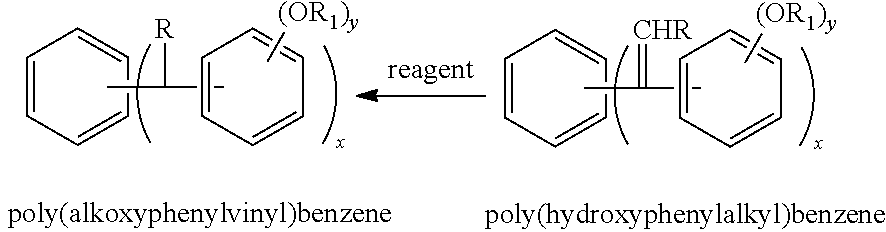
The poly(alkoxybenzoyl)benzene is reacted with a Wittig reagent to generate a poly(alkoxyphenylvinyl)benzene compound which is then reduced to a poly(alkoxyphenylalkyl)benzene (reductioning of said poly(alkoxyphenylvinyl)benzene compound with at least one reducing agent (hydrogen, palladium on carbon, and Raney nickel) to produce a poly(alkoxyphenylalkyl)benzene). The poly(alkoxyphenylalkyl)benzene is then reacted with the appropriate reagent (at least one of boron tribromide, pyridine hydrochloride, and aluminum triiodide) to demethylate the methoxy groups to generate a poly(hydroxyphenylalkyl)benzene. The poly(hydroxyphenylalkyl)benzene compound is cyanated by reaction with cyanogen halide (CNBr or CNCl or any combination thereof) and base to give the poly(cyanatophenylalkyl)benzene. Also the liquid cyanate esters, derivatives, isomers and diastereomers that are produced by the methods above are included in the embodiments of the invention.
Figure US08530693-20130910-C00001
Some uses for embodiments of the invention include use in preparation of polymers with high thermal stability and mechanical strength. Such polymers may be utilized in jet aircraft and weapons systems.
The following examples are for illustration purposes only and not to be used to limit any of the embodiments.
Scheme 1. Example Synthesis of one particular monomer from the general Markush structure
Figure US08530693-20130910-C00002
3-(Dimethylamino)-4′-methoxyacrylophenone (2)
In Scheme 1, A 2 L round-bottomed flask equipped with magnetic stirbar and reflux condenser was charged with 4-methoxyacetophenone (300.4 g, 2 mol) and N,N-dimethylformamide dimethyl acetal (358 g, 3 mol, 1.5 equiv) and the mixture was refluxed. The reaction progress was followed by 1H NMR analysis and was complete after 48 h reflux. Shortly after cooling to rt—(room temperature) the reaction mixture solidified. Filtration on a medium porosity glass frit gave a first crop of product (160.22 g) as yellow microcrystals after washing with Et2O. The filtrate was rotary evaporated leaving a second crop of product (181.3 g). The title compound was obtained as light yellow plates from toluene. Yield: 341.5 g (83%). Mp: 82-85° C. (lit.[13] 90° C.). 1H NMR (300 MHz, CDCl3, δ, ppm): 7.91 (d, J=8.8 Hz, 2H), 7.76 (d, J=12.5 Hz, 1H), 6.90 (d, J=8.8 Hz, 2H), 5.69 (d, J=12.4 Hz, 1H), 3.81 (s, 3H), 2.96 (bs, 6H). 13C NMR (75 MHz, CDCl3, δ, ppm): 187.15, 161.86, 153.66, 133.07, 129.31, 113.21, 91.59, 55.21. Anal. calcd for C12H15NO2: C, 70.22; H, 7.37; N, 6.82. Found: C, 70.38; H, 7.33; N, 6.79.
1,3,5-Tris(4-methoxybenzoyl)benzene (3)
A 2 L round-bottomed flask equipped with magnetic stirbar and reflux condenser was charged with glacial HOAc (683 mL, 11.4 mol) followed by pyridine (171 mL, 2.16 mol) and then 3-(dimethylamino)-4′-methoxyacrylophenone (2) (341.5 g, 1.66 mol) was added. The mixture was refluxed for 12 h. The mixture was allowed to cool to rt whereby copious solids precipitated. An addition funnel was equipped and H2O (300 mL) was added dropwise with vigorous stirring. The mixture was filtered on a medium porosity glass frit to obtain a light tan, granular solid that was recrystallized from toluene. Yield: 223.3 g (84%). Mp: 179-183° C. (lit.[14] 175-176° C.). 1H NMR (300 MHz, DMSO-d6, δ, ppm): 8.14 (s, 3H), 7.83 (d, J=8.8 Hz, 6H), 7.08 (d, J=8.8 Hz, 6H), 3.84 (s, 9H). 13C NMR (75 MHz, DMSO-d6, δ, ppm): 192.97, 163.43, 138.03, 132.89, 132.44, 128.73, 114.10, 55.63. Anal. calcd for C30H24O6: C, 74.99; H, 5.03. Found: C, 75.03; H, 4.80.
1,3,5-Tris(1-(4-methoxyphenyl)vinyl)benzene (4)
A 250 mL round-bottomed flask equipped with magnetic stirring bar and reflux condenser was charged with methyltriphenylphosphonium bromide (43.48 g, 122 mmol, 3.5 equiv), KOtBu (13.7 g, 122 mmol, 3.5 equiv) and THF (300 mL). After 1 h, 1,3,5-tris(4-methoxybenzoyl)benzene (3) (16.73 g, 34.8 mmol) was added portionwise over 30 min. After the addition, the mixture was refluxed for 1 h. Upon cooling to rt, H2O (50 mL) was added and the mixture was neutralized by adding HOAc (1 g, 17 mmol, 0.5 equiv). The organic layer was separated and washed with brine (50 mL). The organic layer was dried over anhydrous MgSO4 and rotary evaporated to a thick oil which slowly crystallized. The crude was dissolved in hot iPrOH (200 mL) and allowed to cool, whereby the title compound crystallized. Filtration on a medium porosity glass frit gave the title compound as white needles. Yield: 13.29 g (97%). Mp: 116-118° C. 1H NMR (300 MHz, CDCl3, δ, ppm): 7.30 (d, J=8.8 Hz, 6H), 7.28 (s, 3H), 6.85 (d, J=9 Hz, 6H), 5.36 (d, J=1.0 Hz, 3H), 5.33 (d, J=1.0 Hz, 3H), 3.82 (s, 9H). 13C NMR (75 MHz, CDCl3, δ, ppm): 159.56, 149.43, 141.77, 133.88, 129.48, 128.08, 113.78, 113.33, 55.49. Anal. Calcd for C33H30O3: C, 83.51; H, 6.37. Found: C, 83.31; H, 6.35.
Racemic 1,3,5-Tris(1-(4-methoxyphenyl)ethyl)benzene (5)
A mixture of 1,3,5-tris(1-(4-methoxyphenyl)vinyl)benzene (4) (19.61 g, 41 mmol), 5% Pd/C (500 mg), THF (50 mL) and EtOH (50 mL) was hydrogenated (50 torr) on a Parr® apparatus for 5 h. After this time the uptake of hydrogen ceased. The mixture was filtered through diatomaceous earth to remove the catalyst and rotary evaporated leaving the title compound as a colorless, viscous oil. Yield: 19.6 g (100%). 1H NMR (300 MHz, CDCl3, δ, ppm): 7.06 (d, J=8.7 Hz, 6H), 6.88-6.84 (m, 3H), 6.79 (d, J=8.9 Hz, 6H), 4.0 (q, J=7.5 Hz, 3H), 3.78 (s, 9H), 1.52 (d, J=7.3 Hz, 9H). 13C NMR (75 MHz, CDCl3, δ, ppm): 157.16, 145.83, 145.78, 145.74, 138.03, 137.99, 137.97, 127.55, 123.54, 123.46, 123.41, 113.36, 54.61, 42.94, 42.92, 21.29. Anal. calcd for C33H36O3: C, 82.46; H, 7.55. Found: C, 82.23; H, 7.40.
Racemic 1,3,5-Tris(1-(4-hydroxyphenyl)ethyl)benzene (6)
A 250 mL round-bottomed flask equipped with magnetic stirring bar was charged with racemic 1,3,5-tris(1-(4-methoxyphenyl)ethyl)benzene (5) (19.6 g, 41 mmol) and pyridine hydrochloride (56.8 g, 0.49 mol, 12 equiv). The mixture was protected with an N2 bubbler and heated in a 180° C. oil bath for 5 h. The mixture was allowed to cool briefly to ˜120° C. and then 55° C. H2O (100 mL) was added slowly to the mixture with vigorous stirring. The mixture was extracted three times with EtOAc (100 mL portions). The collected organic phase was washed with brine (200 mL) and dried over anhydrous MgSO4. Rotary evaporation gave a thick, colorless oil that foamed under vacuum. Yield: 17.17 g (95%). 1H NMR (300 MHz, DMSO-d6, δ, ppm): 9.12 (s, 3OH), 6.98 (d, J=8.6 Hz, 6H), 6.90 (s, 3H), 6.63 (d, J=8.6 Hz, 6H), 3.92 (q, J=7.2 Hz, 3H), 1.44 (d, J=7.5 Hz, 9H). 13C NMR (75 MHz, DMSO-d6, δ, ppm): 155.35, 146.59, 146.53, 146.48, 136.69, 136.67, 136.65, 128.04, 123.88, 123.65, 114.96, 43.49, 43.46, 22.09, 22.04. Anal. calcd for C30H30O3.0.65H2O: C, 80.02; H, 7.01. Found: C, 80.38; H, 7.41.
Racemic 1,3,5-Tris(1-(4-cyanatophenyl)ethyl)benzene (7)
A 250 mL round-bottomed flask equipped with magnetic stirring bar was charged with racemic 1,3,5-tris(1-(4-hydroxyphenyl)ethyl)benzene (6) (4.36 g, 99 mmol), cyanogen bromide (3.68, 34.7 mmol, 3.5 equiv) and anhydrous acetone (50 mL). The mixture was cooled in a −20° C. bath before dropwise addition of TEA (2.99 g, 297 mmol, 3 equiv). Near the end of the addition, copious solids (TEA·HBr) precipitated. After 1 h, ice cold H2O (100 mL) and CH2Cl2 (100 mL) were added and the phases were separated. The organic layer was washed with cold saturated NaHCO3 (50 mL) and then brine (50 mL). After drying over anhydrous MgSO4, the solvent was evaporated leaving a viscous, pale yellow oil. The crude product was dissolved in CH2Cl2 and filtered through a pad of silica gel and rotary evaporated to give the title compound in analytically pure form as a thick, colorless oil. Yield: 5.0 g (98%). 1H NMR (300 MHz, CDCl3, δ, ppm): 7.21 (s, 12H), 6.84-6.81 (m, 3H), 4.09 (q, J=7.2 Hz, 3H), 1.57 (d, J=7.2 Hz, 9H). 13C NMR (75 MHz, CDCl3, δ, ppm): 151.44, 146.23, 146.19, 146.15, 145.45, 145.42, 145.39, 129.66, 125.13, 125.08, 115.47, 109.14, 44.29, 22.16. FTIR (KBr, cm−1): 2263 (OCN), 2233 (OCN). Anal. calcd for C33H27N3O3: C, 77.17; H, 5.30; N, 8.18. Found: C, 77.17; H, 5.32; N, 8.33.
Results of Synthesis
Where a range of values is provided, it is understood that each intervening value, to the tenth of the unit of the lower limit unless the context clearly dictates otherwise, between the upper and lower limits of that range is also specifically disclosed. Each smaller range between any stated value or intervening value in a stated range and any other stated or intervening value in that stated range is encompassed within the invention. The upper and lower limits of these smaller ranges may independently be included or excluded in the range, and each range where either, neither or both limits are included in the smaller ranges is also encompassed within the invention, subject to any specifically excluded limit in the stated range. Where the stated range includes one or both of the limits, ranges excluding either or both of those included limits are also included in the invention.
While the invention has been described, disclosed, illustrated and shown in various terms of certain embodiments or modifications which it has presumed in practice, the scope of the invention is not intended to be, nor should it be deemed to be, limited thereby and such other modifications or embodiments as may be suggested by the teachings herein are particularly reserved especially as they fall within the breadth and scope of the claims here appended.

Claims (5)

What is claimed is:
1. A method for making cyanate esters, comprising:
combining benzenecarboxylic acid having one to six carbons (x) with at least one effective reagent to chlorinate said benzenecarboxylic acid to produce a one to six carbons (x=2 or 3) benzenecarbonyl chloride;
Figure US08530693-20130910-C00003
combining said benzenecarbonyl chloride with at least one alkoxybenzene compound under reaction by Friedel-Crafts conditions to produce a poly(alkoxybenzoyl)benzene having one to six carbons (x=2 or 3), (y=1−5);
Figure US08530693-20130910-C00004
combining said poly(alkoxybenzoyl)benzene with Wittig reagent to produce a poly(alkoxyphenylvinyl)benzene compound;
Figure US08530693-20130910-C00005
reducing of said poly(alkoxyphenylvinyl)benzene compound with at least one reducing agent to produce a poly(alkoxyphenylalkyl)benzene;
Figure US08530693-20130910-C00006
combining said poly(alkoxyphenylalkyl)benzene with at least one demethylating reagent to produce poly(hydroxyphenylalkyl)benzene; and
Figure US08530693-20130910-C00007
combining said poly(hydroxyphenylalkyl)benzene compound is cyanated by reaction with cyanogen halide (CNBr or CNCl) and base to produce a poly(cyanatophenylalkyl)benzene.
2. The method according to claim 1, wherein said reducing agent utilized to produce a poly(alkoxyphenylalkyl)benzene is selected from the group consisting of hydrogen, palladium on carbon, and Raney nickel.
3. The method according to claim 1, wherein said cyanogen halide comprises CNBr, CNCl, and any combination thereof.
4. The method according to claim 1, wherein said demethylating reagent comprises at least one of boron tribromide, pyridine hydrochloride, and aluminum triiodide.
5. The method according to claim 1, wherein said effective reagent comprises at least one of thionyl chloride.
US12/955,000 2010-11-29 2010-11-29 Liquid cyanate esters Active 2031-12-10 US8530693B1 (en)

Priority Applications (1)

Application Number Priority Date Filing Date Title
US12/955,000 US8530693B1 (en) 2010-11-29 2010-11-29 Liquid cyanate esters

Applications Claiming Priority (1)

Application Number Priority Date Filing Date Title
US12/955,000 US8530693B1 (en) 2010-11-29 2010-11-29 Liquid cyanate esters

Publications (1)

Publication Number Publication Date
US8530693B1 true US8530693B1 (en) 2013-09-10

Family

ID=49084095

Family Applications (1)

Application Number Title Priority Date Filing Date
US12/955,000 Active 2031-12-10 US8530693B1 (en) 2010-11-29 2010-11-29 Liquid cyanate esters

Country Status (1)

Country Link
US (1) US8530693B1 (en)

Citations (1)

* Cited by examiner, † Cited by third party
Publication number Priority date Publication date Assignee Title
US6572980B1 (en) * 2001-08-13 2003-06-03 Henkel Loctite Corporation Reworkable thermosetting resin compositions

Patent Citations (1)

* Cited by examiner, † Cited by third party
Publication number Priority date Publication date Assignee Title
US6572980B1 (en) * 2001-08-13 2003-06-03 Henkel Loctite Corporation Reworkable thermosetting resin compositions

Similar Documents

Publication Publication Date Title
JP5892067B2 (en) Organophosphorus compound and method for producing the same
US10633391B2 (en) Diol, method for manufacturing diol, di(meth)acrylate, and method for manufacturing di(meth)acrylate
KR101466245B1 (en) Method for preparing methanesulfonic acid salt and novel compound used therein
KR101019453B1 (en) Synthesis method of O-desmethylvenlafaxine
CN103313964A (en) Intermediate compounds and methods for the preparation of fingolimod
KR101832534B1 (en) Method for preparing diamine precursor compound
WO2008106179A1 (en) Intermediates and processes for the synthesis of ramelteon
US8530693B1 (en) Liquid cyanate esters
US11898082B1 (en) Fire resistant phosphate cyanate esters
Sudo et al. A highly rigid diamine monomer derived from naturally occurring myo‐inositol and its use for polyamide synthesis
JP2020037572A (en) Novel hydroxyphenylboronic acid ester, method for producing the same, and method for producing hydroxybiphenyl compound
KR102658762B1 (en) Method of preparing intermediate for synthesizing sphinosine-1-phosphate receptor agonist
JP3031036B2 (en) Fluorinated aromatic diamine compound, fluorinated diamine compound in which amino group is protected, and methods for producing them
US20080027244A1 (en) Method for Manufacturing Aromatic Dicarboxylic Acid
US5639915A (en) Process for the production of aniline derivatives
PT1904469E (en) New pyrocatechin derivatives
JP2002212194A (en) Triarylphosphine oxide derivative having a fluorine-containing alkyl group and method for producing the same
KR100683274B1 (en) Process for preparing substituted benzopyran compound
US2716659A (en) Arylurethans of hexylresorcinol
Wang et al. An efficient synthesis of symmetrical bisamides catalysed by molecular iodine under neutral conditions
JP4397823B2 (en) Nitro or aminoaryl polyadamantane derivatives and process for producing the same
JP2001089407A (en) Diphenylacetylene compound and method of producing the same compound
JP2023028383A (en) Amino group-containing compound and method for producing the same, reactive flame retardant, and composition
JP2006193434A (en) 4,4'-diaminobiphenyl compound
KR100760015B1 (en) Intermediates for the synthesis of benzopyran compounds

Legal Events

Date Code Title Description
AS Assignment

Owner name: UNITED STATES OF AMERICA AS REPRESENTED BY THE SEC

Free format text: ASSIGNMENT OF ASSIGNORS INTEREST;ASSIGNOR:DAVIS, MATTHEW C.;REEL/FRAME:025425/0443

Effective date: 20101118

STCF Information on status: patent grant

Free format text: PATENTED CASE

FPAY Fee payment

Year of fee payment: 4

SULP Surcharge for late payment
MAFP Maintenance fee payment

Free format text: PAYMENT OF MAINTENANCE FEE, 8TH YEAR, LARGE ENTITY (ORIGINAL EVENT CODE: M1552); ENTITY STATUS OF PATENT OWNER: LARGE ENTITY

Year of fee payment: 8

FEPP Fee payment procedure

Free format text: 11.5 YR SURCHARGE- LATE PMT W/IN 6 MO, LARGE ENTITY (ORIGINAL EVENT CODE: M1556); ENTITY STATUS OF PATENT OWNER: LARGE ENTITY

MAFP Maintenance fee payment

Free format text: PAYMENT OF MAINTENANCE FEE, 12TH YEAR, LARGE ENTITY (ORIGINAL EVENT CODE: M1553); ENTITY STATUS OF PATENT OWNER: LARGE ENTITY

Year of fee payment: 12