US8524857B2 - Diamino-alcohol compounds, their manufacture and use in epoxy resins - Google Patents
Diamino-alcohol compounds, their manufacture and use in epoxy resins Download PDFInfo
- Publication number
- US8524857B2 US8524857B2 US12/928,600 US92860010A US8524857B2 US 8524857 B2 US8524857 B2 US 8524857B2 US 92860010 A US92860010 A US 92860010A US 8524857 B2 US8524857 B2 US 8524857B2
- Authority
- US
- United States
- Prior art keywords
- alkyl
- independently hydrogen
- epoxy
- epoxy resins
- diamino
- Prior art date
- Legal status (The legal status is an assumption and is not a legal conclusion. Google has not performed a legal analysis and makes no representation as to the accuracy of the status listed.)
- Active, expires
Links
- 0 *C([1*])(N)C(O)CC([2*])C([3*])([4*])N Chemical compound *C([1*])(N)C(O)CC([2*])C([3*])([4*])N 0.000 description 12
- LJXPYNGPPWFQFQ-UHFFFAOYSA-N C.CC(C)(N)C(O)CC(C1=CC=CC=C1)C(C)(C)N Chemical compound C.CC(C)(N)C(O)CC(C1=CC=CC=C1)C(C)(C)N LJXPYNGPPWFQFQ-UHFFFAOYSA-N 0.000 description 1
- WJNRVKSPNPDURT-UHFFFAOYSA-N C.CC(CC(O)C(C)(C)N)C(C)(C)N Chemical compound C.CC(CC(O)C(C)(C)N)C(C)(C)N WJNRVKSPNPDURT-UHFFFAOYSA-N 0.000 description 1
- LIWQCNIMKKBWIJ-UHFFFAOYSA-N CC(C)(C(O)CC(C1=CC=CC=C1)C(C)(C)[N+](=O)[O-])[N+](=O)[O-].CC(C)(N)C(O)CC(C1=CC=CC=C1)C(C)(C)N Chemical compound CC(C)(C(O)CC(C1=CC=CC=C1)C(C)(C)[N+](=O)[O-])[N+](=O)[O-].CC(C)(N)C(O)CC(C1=CC=CC=C1)C(C)(C)N LIWQCNIMKKBWIJ-UHFFFAOYSA-N 0.000 description 1
- LSRAVNUYRDEASJ-FHVKFMIDSA-N CC(C)(C(O)CC(C1=CC=CC=C1)C(C)(C)[N+](=O)[O-])[N+](=O)[O-].CC(C)[N+](=O)[O-].O=C/C=C/C1=CC=CC=C1 Chemical compound CC(C)(C(O)CC(C1=CC=CC=C1)C(C)(C)[N+](=O)[O-])[N+](=O)[O-].CC(C)[N+](=O)[O-].O=C/C=C/C1=CC=CC=C1 LSRAVNUYRDEASJ-FHVKFMIDSA-N 0.000 description 1
- CTZCRCAYWHFTPI-UHFFFAOYSA-N CC(C)(N)C(O)CC(C1=CC=CC=C1)C(C)(C)N.CC(CC(O)C(C)(C)N)C(C)(C)N Chemical compound CC(C)(N)C(O)CC(C1=CC=CC=C1)C(C)(C)N.CC(CC(O)C(C)(C)N)C(C)(C)N CTZCRCAYWHFTPI-UHFFFAOYSA-N 0.000 description 1
- DNDXJHQMOCJJLD-VQSZBRBVSA-N CC(C)[N+](=O)[O-].CC(CC(O)C(C)(C)[N+](=O)[O-])C(C)(C)[N+](=O)[O-].[H]C(=O)/C=C/C Chemical compound CC(C)[N+](=O)[O-].CC(CC(O)C(C)(C)[N+](=O)[O-])C(C)(C)[N+](=O)[O-].[H]C(=O)/C=C/C DNDXJHQMOCJJLD-VQSZBRBVSA-N 0.000 description 1
- KNGHAWMXOIHFEN-UHFFFAOYSA-N CC(CC(O)C(C)(C)N)C(C)(C)N.CC(CC(O)C(C)(C)[N+](=O)[O-])C(C)(C)[N+](=O)[O-] Chemical compound CC(CC(O)C(C)(C)N)C(C)(C)N.CC(CC(O)C(C)(C)[N+](=O)[O-])C(C)(C)[N+](=O)[O-] KNGHAWMXOIHFEN-UHFFFAOYSA-N 0.000 description 1
- OBYLQFCMXHINHE-UHFFFAOYSA-N CC(CN)CC(O)CN Chemical compound CC(CN)CC(O)CN OBYLQFCMXHINHE-UHFFFAOYSA-N 0.000 description 1
- DCUUVBYIFJPYFK-UHFFFAOYSA-N CCC(C(C)CC(O)C(CC)[N+](=O)[O-])[N+](=O)[O-].CCC(N)C(C)CC(O)C(N)CC Chemical compound CCC(C(C)CC(O)C(CC)[N+](=O)[O-])[N+](=O)[O-].CCC(N)C(C)CC(O)C(N)CC DCUUVBYIFJPYFK-UHFFFAOYSA-N 0.000 description 1
- ZGMOMFMWINVTSU-VQSZBRBVSA-N CCC(C(C)CC(O)C(CC)[N+](=O)[O-])[N+](=O)[O-].CCC[N+](=O)[O-].[H]C(=O)/C=C/C Chemical compound CCC(C(C)CC(O)C(CC)[N+](=O)[O-])[N+](=O)[O-].CCC[N+](=O)[O-].[H]C(=O)/C=C/C ZGMOMFMWINVTSU-VQSZBRBVSA-N 0.000 description 1
- ZJWOPMGVUJTXCZ-UHFFFAOYSA-N CCC(N)C(C)CC(O)C(N)CC Chemical compound CCC(N)C(C)CC(O)C(N)CC ZJWOPMGVUJTXCZ-UHFFFAOYSA-N 0.000 description 1
Classifications
-
- C—CHEMISTRY; METALLURGY
- C08—ORGANIC MACROMOLECULAR COMPOUNDS; THEIR PREPARATION OR CHEMICAL WORKING-UP; COMPOSITIONS BASED THEREON
- C08G—MACROMOLECULAR COMPOUNDS OBTAINED OTHERWISE THAN BY REACTIONS ONLY INVOLVING UNSATURATED CARBON-TO-CARBON BONDS
- C08G59/00—Polycondensates containing more than one epoxy group per molecule; Macromolecules obtained by polymerising compounds containing more than one epoxy group per molecule using curing agents or catalysts which react with the epoxy groups
- C08G59/18—Macromolecules obtained by polymerising compounds containing more than one epoxy group per molecule using curing agents or catalysts which react with the epoxy groups ; e.g. general methods of curing
- C08G59/40—Macromolecules obtained by polymerising compounds containing more than one epoxy group per molecule using curing agents or catalysts which react with the epoxy groups ; e.g. general methods of curing characterised by the curing agents used
- C08G59/62—Alcohols or phenols
- C08G59/64—Amino alcohols
-
- C—CHEMISTRY; METALLURGY
- C08—ORGANIC MACROMOLECULAR COMPOUNDS; THEIR PREPARATION OR CHEMICAL WORKING-UP; COMPOSITIONS BASED THEREON
- C08L—COMPOSITIONS OF MACROMOLECULAR COMPOUNDS
- C08L63/00—Compositions of epoxy resins; Compositions of derivatives of epoxy resins
-
- C—CHEMISTRY; METALLURGY
- C08—ORGANIC MACROMOLECULAR COMPOUNDS; THEIR PREPARATION OR CHEMICAL WORKING-UP; COMPOSITIONS BASED THEREON
- C08L—COMPOSITIONS OF MACROMOLECULAR COMPOUNDS
- C08L2205/00—Polymer mixtures characterised by other features
- C08L2205/02—Polymer mixtures characterised by other features containing two or more polymers of the same C08L -group
Definitions
- the present invention relates to a new class of compounds, namely diamino-alcohols, a process for producing same, and their use in preparing epoxy resins having high glass transition temperatures (Tg).
- Simple amine compounds are known to provide neutralizing, dispersant and hardening properties when added to coatings, mineral slurries and epoxy formulations. Methods for simple amine compound manufacture are well-documented and known in the art, and when the goal is to prepare primary amines, the preferred routes often involve intermediate nitro alcohol compounds.
- This nitro alcohol is also prepared as an intermediate to making a vasopeptidase inhibitor, as discussed in Efficient Asymmetric Synthesis of the Vasopeptidase Inhibitor BMS-189921 by Janak Singh et al., Org. Lett. (2003), 5, 17, 3155-3158.
- manufacture of the nitro alcohol compound 2,6-dinitro-5-phenyl-heptan-3-ol has been described in David St. Clair Black et. al. Australian Journal of Chemistry, 1976, 29(11), 2511.
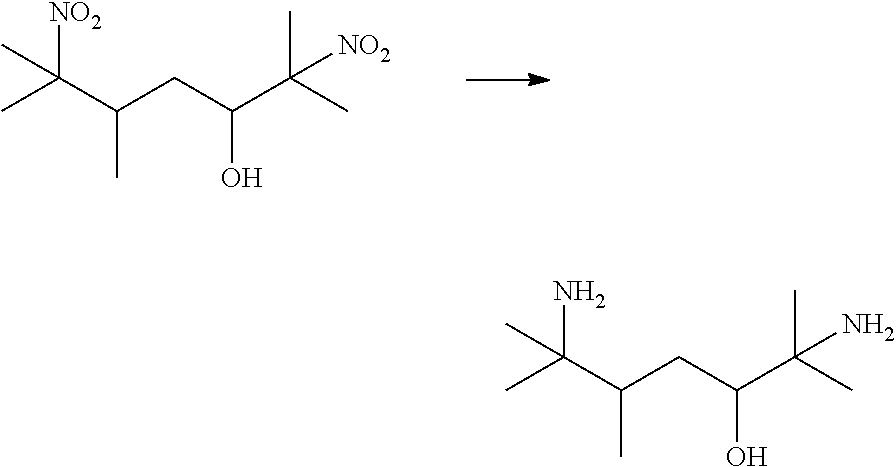
- nitroalcohol compounds may be readily converted to the amino alcohol compounds by hydrogenation with hydrogen over a suitable catalyst, for example Raney nickel or a platinum- or palladium-based catalyst (Pt or Pd in elemental form or as oxides, with or without supports, e.g., carbon).
- a suitable catalyst for example Raney nickel or a platinum- or palladium-based catalyst (Pt or Pd in elemental form or as oxides, with or without supports, e.g., carbon).
- reducing agents which will reduce nitroalkanes to primary amines include metal/acid combinations, e.g., iron/acetic acid; and aluminum hydrides.
- the preferred reducing agents include hydrogen gas in combination with any of the following catalysts: Raney nickel, platinum or palladium.
- Amines and amino alcohols are known to be hardeners, or curing agents, for epoxy resins.
- IPDA isophorone diamine
- Diamines that are straight chain aliphatic are useful as hardeners, but typically do not result in a resin with high Tg.
- aliphatic diamines are Dytek (Tg: 104° C.), AEP (Tg: 106° C.) and TMD (Tg: 104° C.).
- amino alcohols are used as hardeners or curing agents commercially today, due to their ability to cure at lower temperatures than simple amines, but these amines also do not enable the formation of cured epoxy resins with high glass transition temperatures (Tg).
- amino alcohols include, without limitation, ethanolamine (EA), diethanolamine (DEA), 2-amino-2-methyl-1-propanol (AMP) which is commercially available from ANGUS Chemical of Buffalo Grove, Ill., USA), and 2-amino-2-ethyl-1,3-propanediol (AEPD) [Asghar checking whether we have Tg data for any of these amino-alcohols], also commercially available from ANGUS Chemical of Buffalo Grove, Ill., USA, etc.
- EA ethanolamine
- DEA diethanolamine
- AMP 2-amino-2-methyl-1-propanol
- AEPD 2-amino-2-ethyl-1,3-propanediol
- TRIS-AMINO isophoronediamine (IPDA), meta-xylenediamine (MXDA), aminoethylpiperazine (AEP), ethylenediamine, etc.
- IPDA isophoronediamine
- MXDA meta-xylenediamine
- AEP aminoethylpiperazine
- TRIS-AMINO is a non-volatile alkanolamine possessing primary amine functionality commercially available from ANGUS Chemical of Buffalo Grove, Ill., USA
- the present invention provides a cured resin system comprising: (a) 35 to 90% by weight of at least one epoxy resin; and (b). 0.1% to 35% of a diamino alcohol compound having the formula:
- R is independently hydrogen, alkyl, or aryl;
- R 1 is independently hydrogen, or alkyl; alternatively, R and R 1 may be linked together to form a cycloalkyl;
- R 2 is independently hydrogen, alkyl, or aryl;
- R 3 is independently hydrogen, alkyl, or aryl;
- R 4 is independently hydrogen, or alkyl; and alternatively, R 3 and R 4 may be linked together to form a cycloalkyl; wherein all weight percents are based on the total weight of the cured resin system.
- the epoxy resin may be one or more compounds selected from the group consisting of: cycloaliphatic (acyclic) epoxides, cycloaliphatic epoxides modified with glycols, epoxy phenolic novolac resins, multifunctional (polyepoxy) epoxy resins, bisphenol A-based epoxy resins, and bisphenol F-based epoxy resins.
- the epoxy resin comprises a mixture of at least two epoxy resins.
- the diamino alcohol compound may be the product of 2-nitropropane and one aldehyde selected from the group consisting of crotonaldehyde and cinnamaldehyde.
- R, R 1 , R 2 , R 3 and R 4 are each methyl.
- the present invention also provides a method for preparing a curable resin system comprising admixing: (a) 35 to 65% by weight of at least one epoxy resin; and (b) 0.1 to 35% by weight of a diamino alcohol compound having the formula:
- R is independently hydrogen, alkyl, or aryl;
- R 1 is independently hydrogen, or alkyl; alternatively, R and R 1 may be linked together to form a cycloalkyl;
- R 2 is independently hydrogen, alkyl, or aryl;
- R 3 is independently hydrogen, alkyl, or aryl;
- R 4 is independently hydrogen, or alkyl; and alternatively, R 3 and R 4 may be linked together to form a cycloalkyl; wherein all weight percents are based on the total weight of the cured resin system.
- the epoxy resin may be one or more compounds selected from the group consisting of: cycloaliphatic (acyclic) epoxides, cycloaliphatic epoxides modified with glycols, epoxy phenolic novolac resins, multifunctional (polyepoxy) epoxy resins, bisphenol A-based epoxy resins, and bisphenol F-based epoxy resins.
- the epoxy resin comprises a mixture of at least two epoxy resins.
- the diamino alcohol compound may be the product of 2-nitropropane and one aldehyde selected from the group consisting of crotonaldehyde and cinnamaldehyde.
- R, R 1 , R 2 , R 3 and R 4 are each methyl.
- R is independently hydrogen, alkyl, aryl, or —CH 2 OH;
- R 1 is independently hydrogen, alkyl, or —CH 2 OH; alternatively, R and R 1 may be linked together to form a cycloalkyl;
- R 2 is independently hydrogen, methyl, alkyl, phenyl or substituted phenyl;
- R 3 is independently hydrogen, alkyl, phenyl or substituted phenyl, or —CH 2 OH;
- R 4 is independently hydrogen, alkyl, or —CH 2 OH; and alternatively, R 3 and R 4 may be linked together to form a cycloalkyl.
- diamino alcohols includes various degrees of poly-alcohols (“polyols”) as well as simple diamino mono-alcohols.
- polyols poly-alcohols
- simple diamino mono-alcohols simple diamino mono-alcohols.
- the simpler diamino mono-alcohols would have the following formula:
- R is independently hydrogen, alkyl, phenyl or substituted phenyl;
- R 1 is independently hydrogen or alkyl; alternatively, R and R 1 may be linked together to form a cycloalkyl;
- R 2 is independently hydrogen, alkyl, or phenyl or substituted phenyl;
- R 3 is independently hydrogen, alkyl, or aryl;
- R 4 is independently hydrogen or alkyl; and alternatively, R 3 and R 4 may be linked together to form a cycloalkyl.
- the diamino mono-alcohols of the present invention may be produced by reaction of a nitroalkane and an ⁇ , ⁇ -unsaturated aldehyde which produces an intermediate dinitro alcohol compound.
- This reaction is typically operated at temperatures between 0° C. and 100° C. under atmospheric pressure, for example, without limitation between 0° C. and 50° C.
- Applicants have surprisingly and conveniently found that this reaction proceeds sequentially with Michael addition of nitroalkane to the olefin occurring first, followed by aldol (Henry) reaction in which the second nitroalkane is added to the aldehyde, to produce a single species of dinitro mono-alcohol intermediate.
- the nitroalkane may be a primary or secondary nitroalkane having the formula:
- R is hydrogen, R 1 is hydrogen, alkyl, phenyl or substituted phenyl; or wherein R is alkyl, phenyl, or substituted phenyl, and R 1 is alkyl, or R and R 1 may be linked together to form a cycloalkyl.
- nitromethane, nitroethane, 2-nitropropane, nitrocyclohexane etc. are all suitable nitroalkanes for use as starting materials to prepare the diamino alcohol compounds in accordance with the present invention. More particularly, the primary or secondary nitroalkane may be a C 1 -C 20 nitroalkane, a C 1 -C 10 nitroalkane, or even a C 2 -C 6 nitroalkane.
- Suitable ⁇ , ⁇ -unstaturated aldehydes have the following formula:
- R is hydrogen, methyl(alkyl), phenyl, or substituted phenyl.
- Suitable unsaturated aldehydes include, but are not limited to, acrolein, crotonaldehyde, cinnamaldehyde, derivatives of cinnamaldehyde substituted at the aromatic ring, etc.
- a suitable catalyst including, but not limited to, organic bases such as 1,8-Diazabicyclo[5.4.0]undec-7-ene (“DBU”), 2-dimethylamino-2-methyl-1-propanol (“DMAMP”), trimethylamine (TMA), dimethylisopropylamine (DMIPA), N,N,N′,N′-tetramethylguanidine (TMG), Verkade's base, etc.
- organic bases such as 1,8-Diazabicyclo[5.4.0]undec-7-ene (“DBU”), 2-dimethylamino-2-methyl-1-propanol (“DMAMP”), trimethylamine (TMA), dimethylisopropylamine (DMIPA), N,N,N′,N′-tetramethylguanidine (TMG), Verkade's base, etc.
- inorganic bases such as potassium carbonate, and sodium hydroxide may also be used as catalysts for the sequential Michael-Henry reaction described above.
- the starting materials are provided at a molar ratio of nitroalkane to aldehyde of typically 2:1.
- the reaction may be performed with or without a solvent, according to the preference of the practitioner.
- Suitable solvents include but are not limited to tetrahydrofuran, 2-methyltetrahydrofuran, dioxane.
- the (1) nitroalkane is a primary nitroalkane and the process for production of the diamino poly-alcohol compound further comprises, after reacting the (1) primary nitroalkane and (2) ⁇ , ⁇ -unstaturated aldehyde, but prior to reducing the resulting nitro alcohol, further reacting the resulting nitro alcohol with (3) an aldehyde, such as formaldehyde, to form a dinitro poly-alcohol compound, which is then further reduced under hydrogenation conditions and in the presence of a catalyst.
- an aldehyde such as formaldehyde
- diamino poly-alcohol (polyol) compounds proceeds as follows: (A) reacting (1) a primary nitroalkane and (2) an ⁇ , ⁇ -unsaturated aldehyde to form a dinitroalcohol; (B) further reacting the dinitroalcohol with (3) an aldehyde, such as formaldehyde, to form a dinitro poly-alcohol (e.g., a dintro-dialcohol or dinitro-trialcohol) product; and (C) then further reducing the dinitro poly-alcohol product to the corresponding diamino poly-alcohol product under hydrogenation conditions, in the presence of a catalyst.
- A reacting (1) a primary nitroalkane and (2) an ⁇ , ⁇ -unsaturated aldehyde to form a dinitroalcohol
- an aldehyde such as formaldehyde
- the reaction is performed under conditions in which the Michael addition of the nitroalkane occurs more rapidly than the Henry reaction (i.e., temperatures between 0° C. and 100° C. under atmospheric pressure, for example, without limitation, between 0° C. and 50° C.), allowing for the sequential reactions to produce the dinitro poly-alcohol.
- the (1) nitroalkane and the (2) aldehyde are provided at a molar ratio of 2:1 during the first reaction step which produces the dinitro alcohol.
- the primary nitroalkane may be a primary C 1 -C 20 nitroalkane, for example, without limitation, a primary C 1 -C 10 nitroalkane.
- the ⁇ , ⁇ -unsaturated aldehyde may be selected from the group consisting of: acrolein, crotonaldehyde, cinnamaldehyde, and derivatives of cinnamaldehyde substituted at the aromatic ring.
- the ratio of the formaldehyde to the dinitro alcohol is typically 2:1 for this sequential reaction step.
- this reaction may be performed with or without a solvent, according to the preference of the practitioner, such as, without limitation, tetrahydrofuran, 2-methyltetrahydrofuran, dioxane.
- the intermediate dinitro alcohol compound produced by either of the above-described sequential Michael-Henry reactions has the following formula:
- R is independently hydrogen, alkyl, aryl, or —CH 2 OH;
- R 1 is independently hydrogen, alkyl, or —CH 2 OH; alternatively, R and R 1 may be linked together to form a cycloalkyl;
- R 2 is independently hydrogen, methyl, alkyl, phenyl or substituted phenyl;
- R 3 is independently hydrogen, alkyl, phenyl or substituted phenyl, or —CH 2 OH;
- R 4 is independently hydrogen, alkyl, or —CH 2 OH; and alternatively, R 3 and R 4 may be linked together to form a cycloalkyl.
- the nitroalkane is 2-nitropropane and the ⁇ , ⁇ -unsaturated aldehyde is either crotonaldehyde or cinnamaldehyde, which would produce a dinitro mono-alcohol compound.
- the dinitro alcohol intermediate is then further reduced under hydrogenation conditions in the presence of a suitable catalyst to produce the desired diamino alcohol comprising two amino groups, each of which is bonded to a tertiary carbon atom.
- suitable dehydrogenation catalysts include, without limitation, Raney nickel, or a platinum- or palladium-based catalyst, (e.g., platinum or palladium in elemental form or as oxides, with or without supports, e.g., carbon).
- Other suitable reducing agents include, without limitation, metal/acid combinations, e.g., iron/acetic acid; and aluminum hydrides.
- An example of a dehydrogenation catalyst system suitable for use in accordance with the present invention is hydrogen gas in combination with any of Raney nickel, platinum or palladium.
- the hydrogenation of dinitro alcohol to produce the diamino alcohol may be performed at pressures between 100 and 1000 pounds per square inch (“psi”) and temperatures between 30° C. and 100° C.
- a solvent may be used, such as, without limitation, tetrahydrofuran or methanol.
- the diamino alcohols of the present invention are useful hardeners for epoxy resin systems, some of which are capable of yielding cured epoxy resins with glass transition temperatures (Tgs) of greater than 120° C.
- Such curable epoxy resin systems may be formed by admixing at least one epoxy resin, the diamino alcohol described hereinabove, as well as, optionally, a catalyst, other hardeners, toughening agents, flame retardants and other additives known and used by persons of ordinary skill in the relevant art.
- the curable epoxy resin system may then be cured, for example, without limitation and dependent upon the particular type of epoxy resin used and its intended application, by exposure to elevated temperatures, exposure to ultraviolet light, etc.
- the glass transition temperature, or Tg may be measured by any suitable method known and practiced by persons of ordinary skill in the relevant art, including, but not limited to, differential scanning calorimetry (DSC) or dynamic mechanical thermal analysis (DMTA), as per ASTM D5045.
- DSC differential scanning calorimetry
- DMTA dynamic mechanical thermal analysis
- Measurement of glass transition temperature by DSC may be performed, for example, using a Q100 DSC testing apparatus, commercially available from T.A. Instruments of New Castle, Del., USA, and set up for 10° C./minute scans. Sample size is typically kept under 15 milligrams. Hermetic pans with holes punched in the lids may be used to contain the samples in the DSC cell. DSC scans are analyzed for final Tg using half extrapolated tangents (Tg analysis).
- Measurement of glass transition temperature by DMTA may be performed, for example, according to ASTM D5045, at an angular frequency of 1 Hertz (Hz) and 0.1% strain, run on three rectangular samples.
- the temperature range chosen for these examples may be between 30° C. and 2800° C.
- the sample size if typically 17 millimeters (mm) long, 13 mm wide and 4 mm thick.
- the samples are inserted between adjustable clamps and the clamps are closed using a torque wrench.
- the samples are then subjected to oscillations in torsion mode. Samples are subjected to a dynamic temperature ramp at 3° C./minute.
- a slower heating rate may be employed to maintain thermal equilibrium and considering the thermal mass of the sample. Storage and loss modulus as well as tangent delta are recorded.
- a cured resin system in accordance with the present invention comprises: (a) 35 to 90% by weight of at least one epoxy resin; and (b) 0.1 to 35% by weight of a diamino alcohol compound having the formula:
- R is independently hydrogen, alkyl, or aryl;
- R 1 is independently hydrogen, or alkyl; alternatively, R and R 1 may be linked together to form a cycloalkyl;
- R 2 is independently hydrogen, alkyl, or aryl;
- R 3 is independently hydrogen, alkyl, or aryl;
- R 4 is independently hydrogen, or alkyl; and alternatively, R 3 and R 4 may be linked together to form a cycloalkyl; wherein all weight percents are based on the total weight of the cured resin system.
- amounts up to the stoichiometric amount of the diamino alcohol hardener, relative to the epoxy resin, are considered “effective amounts” in accordance with the present invention. More particularly, the stoichiometric amount of the diamino alcohol hardener is calculated by adding together the number of equivalents on the basis of weight per displaceable —NH group in the amino alcohol utilized. Generally, as is also understood by persons of ordinary skill, a lesser amount of a diamino alcohol hardener of higher molecular weight will be required than of a diamino alcohol hardener of lower molecular weight.
- a diamino alcohol hardener derived from crotonaldehyde might be suitable for producing an epoxy resin system in accordance with the present invention
- a diamino alcohol hardener derived from cinnamaldehyde were used instead, then some amount less than 35% by weight would be appropriate.
- the preferred diamino alcohols for use as hardeners in epoxy resin systems are those in which the amine functionality is attached to a tertiary carbon, such as, for example, compounds of the following formulae:
- the most effective diamino alcohols to provide epoxy resin systems having high Tg's are when R 2 is an alkyl chain or phenyl group and when R, R 1 , R 3 and R 4 are methyl groups.
- the multifunctional diamino alcohols may be used as a hardener system to cure a variety of epoxy resins and ultimately give high Tg materials (Tg greater than 140° C.).
- Tg Tg greater than 140° C.
- the Tg reported for the cured epoxy resin systems incorporating some of these diamino alcohols, particularly the 2-nitropropane adducts, are higher (by at least 20° C.) than epoxys containing conventional amino alcohol hardeners. This is particularly beneficial in high temperature applications.
- these materials cure very efficiently and do not have a high density of hydroxyl group, thus attracting less water and this in return give better overall property of the final system.
- the diamines functionality provides multiple sites for curing an epoxy resin and, thus, allows reaction of multiple epoxy groups using one mole of the diamino alcohol to produce several new secondary alcohols sites in the epoxy system. This is beneficial as it is widely believed that secondary alcohols assist in adhesion promotion to the metal in an epoxy coating formulation. Without intending to be limited by theory, the alcohol functionality is also believed to have a catalytic effect during the curing process. Similarly, control of the stoichiometry of the epoxy resin to the diamine such that the cured resin maintains a high concentration of secondary amine functionality is also anticipated to enhance the adhesion of this resin to surfaces resulting in a strongly adhered, high Tg resin in applications where these two properties are important.
- the diamino alcohol of the present invention has multiple amines rather than multiple hydroxyl groups, as in the amino compounds more typically used for epoxy systems. This may provide for effective curing of the resin and also allows modification of the backbone of the diamine hardener by changing the alkyl chain length. This technique also allows addition of any desired functional group such as phenyl groups, alkyl groups, hydroxyl groups and any degree of amine (primary, secondary or tertiary) that would be beneficial in controlling the Tg.
- the above-described method of synthesis used in the preparation of the diamino alcohols allows for the careful placement of desired functionality on the molecule.
- the synthesis methods allow for creating diamines of high amine functionality in a fairly compact but highly substituted molecule.
- the Tg value of the cured epoxy resin can be changed by changing the nature of nitro paraffin used to construct the molecules.
- the diamino alcohols can be used with any type of epoxy resin, which means, as that term is used herein, compounds containing one or more reactive oxirane groups (—C 2 H 3 O), referred to herein as “epoxy groups” or “epoxy functionality”.
- Suitable epoxy resins include those compounds containing at least one vicinal epoxy group.
- the epoxy resin may be saturated or unsaturated, aliphatic, cycloaliphatic, aromatic or heterocyclic and may be substituted.
- the epoxy resin may also be monomeric or polymeric.
- epoxy resins suitable for use in accordance with the present invention include, for example without limitation, cycloaliphatic (acyclic) epoxides, cycloaliphatic epoxides modified with glycols, epoxy phenolic novolac resins, multifunctional (polyepoxy) epoxy resins, bisphenol A-based epoxy resins, and bisphenol F-based epoxy resins, among others, as well as mixtures thereof.
- Cycloaliphatic epoxides include, for instance, diepoxides of cycloaliphatic esters of dicarboxylic acids, such as bis(3,4-epoxycyclohexylmethyl)oxalate, bis(3,4-epoxycyclohexylmethyl)adipate, vinylcyclohexene diepoxide, and dicyclopentadiene diepoxide.
- cycloaliphatic epoxy resins include 3,4-epoxycyclohexylmethyl-3,4-epoxycyclohexane carboxylate and other cycloaliphatic epoxy resins under the tradename designations ERL, D.E.R.
- CELLOXIDE 2021, CELLOXIDE 2021P, EPOLEAD GT301 are cycloaliphatic epoxy resins commercially available from Daicel Chemical Industries, Ltd of Japan.
- Cycloaliphatic epoxides modified with glycols include, for instance, an aliphatic epoxy modified with polypropylene glycol, epoxidized polybutadiene, silicone resin containing epoxy functionality, epoxy vinylester resins, glycidated resins, epoxidized oils, etc.
- ERL-4299 bis(3,4-epoxycyclohexyl)adipate
- CELLOXIDE 2080 series ((3′,4′-epoxycyclohexane)methyl 3′,4′-epoxycyclohexyl-carboxylate modified ⁇ -caprolactone) is commercially available from Daicel Chemical Industries, Ltd.
- Epoxy phenolic novolac resins suitable for use in the present invention include, without limitation, condensates of phenols with formaldehyde that are obtained under acid conditions, such as phenol novolacs, bisphenol A novolacs and cresol novolacs.
- Multifunctional epoxy resins include, for example, without limitation, resorcinol diglycidyl ether (1,3-bis-(2,3-epoxypropoxy)benzene), triglycidyl p-aminophenol (4-)2,3-epoxypropoxy)-N,N-bis(2,3-epoxypropyl)aniline), polyepoxy compounds based on aromatic amines and epichlorohydrin, such as N,N′-diglycidylaniline, N-diglycidyl-4-aminophenyl, etc., and mixtures of such compounds.
- epoxy resins suitable for use in the present invention include, but are not limited to, 4,4′-dihydroxydiphenyl dimethyl methane (i.e., bisphenol A), bis(4-hydroxyphenol)methane (i.e., bisphenol F), diglycidyl ether of Bisphenol F, and other resins based on bisphenyl A and bisphenyl F.
- D.E.R. 332, D.E.R. 383 and D.E.R. 331 are bisphenol A-based epoxy resins commercially available from The Dow Chemical Company.
- D.E.R. 354 and D.E.R. 354LV are bisphenol F-based epoxy resins also commercially available from The Dow Chemical Company.
- the material can be used with other hardeners and/or catalyst systems depending on the application.
- the material can also be used as a ‘modified hardener’ or prepolymer by reacting it, initially, with LER (liquid epoxy resin) and then using the reaction product in the final epoxy resin formulation.
- LER liquid epoxy resin
- Suitable amine- and/or amide-curing agents include those compounds that contain a primary amine moiety, and compounds that contain two or more primary or secondary amine or amide moieties linked to a common central organic moiety.
- Suitable amine-containing curing agents include amino alcohols, ethylene diamine, diethylene triamine, polyoxypropylene diamine, triethylene tetramine, dicyandiamide, melamine, cyclohexylamine, benzylamine, diethylaniline, methylenedianiline, m-phenylenediamine, diaminodiphenylsulfone, 2,4 bis(p-aminobenzyl)aniline, piperidine, N,N-diethyl-1,3-propane diamine, and the like, and soluble adducts of amines and polyepoxides and their salts.
- Suitable amide-curing agents include the dicyandiamide and polyamidoamines. Polyamidoamines are typically the reaction product of a polyacid and an amine.
- thiol curing agents may be used with the present invention.
- “thiol” also includes polythiol and polymercaptan curing agents.
- Suitable thiols include, but are not limited to, aliphatic thiols such as methanedithiol, propanedithiol, cyclohexanedithiol, 2-mercaptoethyl-2,3-dimercaptosuccinate, diethylene glycol bis(2-mercaptoacetate), pentaerythritol tris(thioglycolate), aromatic thiols such as di-, tris-, or tetra-mercaptobenzene, dimercaptobiphenol, toluenedithiol, among others.
- Accelerators include those compounds which catalyze the reaction of the epoxy resin with the curing agent. Accelerators are compounds containing amine, phosphine, heterocyclic nitrogen, ammonium, phosphonium, arsonium or sulfonium moieties. Examples include imidazoles, imidazolidines, and imidazolines.
- catalysts include free radical initiators, such as azo compounds, including azoisobutyronitrile, and organic peroxides, such as tertiary-butyl perbenzoate, tertiary-butyl peroctate, methyl ethyl ketone peroxide, acetoacetic peroxide, and benzoyl peroxide, among others.
- free radical initiators such as azo compounds, including azoisobutyronitrile
- organic peroxides such as tertiary-butyl perbenzoate, tertiary-butyl peroctate, methyl ethyl ketone peroxide, acetoacetic peroxide, and benzoyl peroxide, among others.
- the resin system in accordance with the present invention may further comprise flame retardant additives including, without limitation, brominated additives such as tetrabromobisphenol A (TBBA) and derivatives thereof, and non-brominated additives such as compounds derived from DOP (9,10-dihydro-9-oxa-10-phosphaphenanthrene 10-oxide), e.g., DOP-hydroquinone, condensation products of DOP with glycidyl ether, derivatives of novolacs, and inorganic retardants such as aluminum trihydrate and aluminum phosphinite.
- brominated additives such as tetrabromobisphenol A (TBBA) and derivatives thereof
- non-brominated additives such as compounds derived from DOP (9,10-dihydro-9-oxa-10-phosphaphenanthrene 10-oxide), e.g., DOP-hydroquinone, condensation products of DOP with glycidyl ether, derivatives of novolac
- the resin system in accordance with the present invention may further comprise toughening agents for reducing brittleness in the cured resin system.
- Toughening agents include, but are not limited to, rubber compounds, block copolymers (e.g., amphiphillic block copolymers), carboxyl terminated butadiene, polysulfide-based toughening agents, amine-terminated butadiene nitrile and polythioethers.
- toughening agents may be present in epoxy resin systems in amounts between 0.1 and 30% by weight, based on the total weight of resin system.
- additives and fillers may also be included in the resin system of the present invention.
- additives and fillers may include, for example, boric acid, silica, glass, talc, metal powders, wetting agents, pigments, coloring agents, mold release agents, coupling agents, ion scavengers, UV stabilizers, flexibilizing agents and tackifying agents.
- resins such as polyol resins, polyester resins, phenolic resins, as well as other agents such as for viscosity reduction and stabilization, as are well known in the industry.
- a three neck round bottom flask equipped with a stir bar, thermocouple, dropping funnel capped with nitrogen inlet and condenser was charged with 2-Nitropropane (50 g, 0.56 mols, 5.0 equivalents) and catalytic amount of DBU.
- the deep yellow solution was mixed under nitrogen for about thirty minutes.
- crotonaldehyde (7.9 g, 9.2 mL, 0.112 moles, 1.0 equivalent) drop-wise over a period of twenty minutes.
- the addition of crotonaldehyde in this case was done at room temperature and during addition, exotherm of about 12° C.-15° C. was observed. After complete addition, the reaction was stirred at room temperature for 6 hours.
- the diamino alcohol product of this Example 3 is labeled “CINNAM-AMP-NH2” in the Table below.
- DSC has been extensively used to study the cure kinetics of such epoxy systems by studying the heat flow to the sample as a function of temperature
- Dow D.E.R.TM 331 was used as the matrix resin. It is a general purpose resin widely used in the industry and regarded as a good starting point for the preliminary studies.
- DSC thermograms were obtained for the resin and hardener mixtures. The exothermic behavior can be used as an indication of observing the progress of the reaction. Once the curing reaction is done, the part can be cooled down and another DSC run can be performed to look for the Tg.
- DSC analyses were performed using a TA instruments Model Q100 Differential Scanning calorimeter. The instrument was connected to a refrigerated cooling system and auto sampler.
- D.E.R. 24 (Tg: 129.5° C.); Trimethyl Hexane diamine—TMD (Tg: 104° C.); Aminoethylpiperazine—AEP (Tg: 106° C.); IPD ((Tg: 147° C.); Cyclohexane Bis(methylamine) (Tg: 130° C.); Dytek A ((Tg: 104° C.); Encamine MCA (Tg: 62° C.);
Landscapes
- Chemical & Material Sciences (AREA)
- Health & Medical Sciences (AREA)
- Chemical Kinetics & Catalysis (AREA)
- Medicinal Chemistry (AREA)
- Polymers & Plastics (AREA)
- Organic Chemistry (AREA)
- Organic Low-Molecular-Weight Compounds And Preparation Thereof (AREA)
- Epoxy Resins (AREA)
Abstract
Description

wherein R is independently hydrogen, alkyl, or aryl; R1 is independently hydrogen, or alkyl; alternatively, R and R1 may be linked together to form a cycloalkyl; R2 is independently hydrogen, alkyl, or aryl; R3 is independently hydrogen, alkyl, or aryl; R4 is independently hydrogen, or alkyl; and alternatively, R3 and R4 may be linked together to form a cycloalkyl; wherein all weight percents are based on the total weight of the cured resin system. The epoxy resin may be one or more compounds selected from the group consisting of: cycloaliphatic (acyclic) epoxides, cycloaliphatic epoxides modified with glycols, epoxy phenolic novolac resins, multifunctional (polyepoxy) epoxy resins, bisphenol A-based epoxy resins, and bisphenol F-based epoxy resins.

wherein R is independently hydrogen, alkyl, or aryl; R1 is independently hydrogen, or alkyl; alternatively, R and R1 may be linked together to form a cycloalkyl; R2 is independently hydrogen, alkyl, or aryl; R3 is independently hydrogen, alkyl, or aryl; R4 is independently hydrogen, or alkyl; and alternatively, R3 and R4 may be linked together to form a cycloalkyl; wherein all weight percents are based on the total weight of the cured resin system. The epoxy resin may be one or more compounds selected from the group consisting of: cycloaliphatic (acyclic) epoxides, cycloaliphatic epoxides modified with glycols, epoxy phenolic novolac resins, multifunctional (polyepoxy) epoxy resins, bisphenol A-based epoxy resins, and bisphenol F-based epoxy resins.

wherein R is independently hydrogen, alkyl, aryl, or —CH2OH; R1 is independently hydrogen, alkyl, or —CH2OH; alternatively, R and R1 may be linked together to form a cycloalkyl; R2 is independently hydrogen, methyl, alkyl, phenyl or substituted phenyl; R3 is independently hydrogen, alkyl, phenyl or substituted phenyl, or —CH2OH; R4 is independently hydrogen, alkyl, or —CH2OH; and alternatively, R3 and R4 may be linked together to form a cycloalkyl.

wherein R is independently hydrogen, alkyl, phenyl or substituted phenyl; R1 is independently hydrogen or alkyl; alternatively, R and R1 may be linked together to form a cycloalkyl; R2 is independently hydrogen, alkyl, or phenyl or substituted phenyl; R3 is independently hydrogen, alkyl, or aryl; R4 is independently hydrogen or alkyl; and alternatively, R3 and R4 may be linked together to form a cycloalkyl.

wherein R is hydrogen, R1 is hydrogen, alkyl, phenyl or substituted phenyl; or wherein R is alkyl, phenyl, or substituted phenyl, and R1 is alkyl, or R and R1 may be linked together to form a cycloalkyl. For example, without limitation, nitromethane, nitroethane, 2-nitropropane, nitrocyclohexane etc. are all suitable nitroalkanes for use as starting materials to prepare the diamino alcohol compounds in accordance with the present invention. More particularly, the primary or secondary nitroalkane may be a C1-C20 nitroalkane, a C1-C10 nitroalkane, or even a C2-C6 nitroalkane.

wherein R is hydrogen, methyl(alkyl), phenyl, or substituted phenyl. Suitable unsaturated aldehydes include, but are not limited to, acrolein, crotonaldehyde, cinnamaldehyde, derivatives of cinnamaldehyde substituted at the aromatic ring, etc.

wherein R is independently hydrogen, alkyl, aryl, or —CH2OH; R1 is independently hydrogen, alkyl, or —CH2OH; alternatively, R and R1 may be linked together to form a cycloalkyl; R2 is independently hydrogen, methyl, alkyl, phenyl or substituted phenyl; R3 is independently hydrogen, alkyl, phenyl or substituted phenyl, or —CH2OH; R4 is independently hydrogen, alkyl, or —CH2OH; and alternatively, R3 and R4 may be linked together to form a cycloalkyl.

wherein R is independently hydrogen, alkyl, or aryl; R1 is independently hydrogen, or alkyl; alternatively, R and R1 may be linked together to form a cycloalkyl; R2 is independently hydrogen, alkyl, or aryl; R3 is independently hydrogen, alkyl, or aryl; R4 is independently hydrogen, or alkyl; and alternatively, R3 and R4 may be linked together to form a cycloalkyl; wherein all weight percents are based on the total weight of the cured resin system.

These materials are obtained in two steps, as described in detail hereinabove, by reacting one mole of either cinnamaldehyde or crotonaldehyde with two moles of 2-nitropropane, followed by hydrogenating using Raney nickel catalyst.

- A: propwise addition of crotonaldehyde when the 2-NP/DBU mixture is at −30° C. and warm to room temperature.
- B: propwise addition of crotonaldehyde when the 2-NP/DBU mixture is at 20° C. and warm to room temperature.
- C: propwise addition of crotonaldehyde when the 2-NP/DBU mixture is at room temperature


| TABLE | |||||
| Molecule | Tg | Exotherm-1 | Exotherm-2 | ||
| (Structure) | (° C.) | (° C.) | (° C.) | ||
 |
142 | 118 | 187 | ||
 |
144 | 128 | 207 | ||
 |
108 | 123 | 175 | ||
 |
78 | 99 | 114 | ||
Claims (12)


Priority Applications (1)
| Application Number | Priority Date | Filing Date | Title |
|---|---|---|---|
| US12/928,600 US8524857B2 (en) | 2009-12-22 | 2010-12-15 | Diamino-alcohol compounds, their manufacture and use in epoxy resins |
Applications Claiming Priority (2)
| Application Number | Priority Date | Filing Date | Title |
|---|---|---|---|
| US28463709P | 2009-12-22 | 2009-12-22 | |
| US12/928,600 US8524857B2 (en) | 2009-12-22 | 2010-12-15 | Diamino-alcohol compounds, their manufacture and use in epoxy resins |
Publications (2)
| Publication Number | Publication Date |
|---|---|
| US20110152407A1 US20110152407A1 (en) | 2011-06-23 |
| US8524857B2 true US8524857B2 (en) | 2013-09-03 |
Family
ID=43844552
Family Applications (1)
| Application Number | Title | Priority Date | Filing Date |
|---|---|---|---|
| US12/928,600 Active 2031-01-22 US8524857B2 (en) | 2009-12-22 | 2010-12-15 | Diamino-alcohol compounds, their manufacture and use in epoxy resins |
Country Status (6)
| Country | Link |
|---|---|
| US (1) | US8524857B2 (en) |
| EP (1) | EP2341093B1 (en) |
| CN (1) | CN102181044B (en) |
| BR (1) | BRPI1005890A8 (en) |
| CA (1) | CA2723359C (en) |
| MX (1) | MX2010013996A (en) |
Families Citing this family (3)
| Publication number | Priority date | Publication date | Assignee | Title |
|---|---|---|---|---|
| CA2723493C (en) * | 2009-12-22 | 2013-08-06 | Dow Global Technologies, Inc. | Novel diamino-alcohol compounds, their manufacture and use in high solids mineral slurries |
| EP2931781B1 (en) * | 2012-12-14 | 2020-11-04 | Blue Cube IP LLC | Modified epoxy resins |
| US8933189B2 (en) * | 2013-03-15 | 2015-01-13 | E I Du Pont De Nemours And Company | Polymers derived from renewably resourced lysinol |
Citations (13)
| Publication number | Priority date | Publication date | Assignee | Title |
|---|---|---|---|---|
| US2475996A (en) | 1946-11-02 | 1949-07-12 | Shell Dev | Dinitro alcohols and process of producing the same from unsaturated aldehydes |
| US3607833A (en) | 1969-10-03 | 1971-09-21 | Vanderbilt Co R T | Prepolymer of epoxy resin and tris(hydroxymethyl) aminomethane and curable composition thereof |
| US4293682A (en) | 1980-05-12 | 1981-10-06 | Milliken Research Corporation | Nitrogen containing compounds and compositions |
| US4330644A (en) | 1981-04-03 | 1982-05-18 | Shell Oil Company | Curable tris(hydroxyalkyl) aminomethane-modified epoxy resin composition |
| US4340717A (en) | 1981-03-12 | 1982-07-20 | Milliken Research Corporation | Nitrogen-containing compounds |
| US5112926A (en) | 1989-01-09 | 1992-05-12 | Industrial Technology Research Institute | Thermal-resistant resin composition for printed circuit boards based on triazine modified epoxy resin blends |
| US5436339A (en) * | 1991-03-06 | 1995-07-25 | Abbott Laboratories | Process for the preparation of a substituted diaminoalcohol |
| US5478885A (en) | 1994-04-15 | 1995-12-26 | Shell Oil Company | Composition of epoxy resin, epoxidized block polydiene and curing agent |
| US20040147690A1 (en) | 2003-01-27 | 2004-07-29 | Resolution Performance Products Llc | Epoxy resin curing compositions and resin compositions including same |
| US20070065669A1 (en) | 2003-09-05 | 2007-03-22 | Edmondson Stephen J | Curable alkanolamine-containing epoxy powder coating composition |
| WO2009089145A1 (en) | 2008-01-08 | 2009-07-16 | Dow Global Technologies Inc. | High tg epoxy systems for composite application |
| US8070044B1 (en) * | 2010-12-02 | 2011-12-06 | Rohm And Haas Electronic Materials Llc | Polyamine flux composition and method of soldering |
| US8070045B1 (en) * | 2010-12-02 | 2011-12-06 | Rohm And Haas Electronic Materials Llc | Curable amine flux composition and method of soldering |
Family Cites Families (1)
| Publication number | Priority date | Publication date | Assignee | Title |
|---|---|---|---|---|
| US3943104A (en) | 1973-03-09 | 1976-03-09 | Jefferson Chemical Company, Inc. | Method of accelerating epoxy curing |
-
2010
- 2010-12-03 CA CA2723359A patent/CA2723359C/en active Active
- 2010-12-08 EP EP10194226.6A patent/EP2341093B1/en active Active
- 2010-12-15 US US12/928,600 patent/US8524857B2/en active Active
- 2010-12-16 MX MX2010013996A patent/MX2010013996A/en active IP Right Grant
- 2010-12-21 CN CN201010618068.8A patent/CN102181044B/en active Active
- 2010-12-21 BR BRPI1005890A patent/BRPI1005890A8/en not_active Application Discontinuation
Patent Citations (14)
| Publication number | Priority date | Publication date | Assignee | Title |
|---|---|---|---|---|
| US2475996A (en) | 1946-11-02 | 1949-07-12 | Shell Dev | Dinitro alcohols and process of producing the same from unsaturated aldehydes |
| US3607833A (en) | 1969-10-03 | 1971-09-21 | Vanderbilt Co R T | Prepolymer of epoxy resin and tris(hydroxymethyl) aminomethane and curable composition thereof |
| US4293682A (en) | 1980-05-12 | 1981-10-06 | Milliken Research Corporation | Nitrogen containing compounds and compositions |
| US4340717A (en) | 1981-03-12 | 1982-07-20 | Milliken Research Corporation | Nitrogen-containing compounds |
| US4330644A (en) | 1981-04-03 | 1982-05-18 | Shell Oil Company | Curable tris(hydroxyalkyl) aminomethane-modified epoxy resin composition |
| US5112926A (en) | 1989-01-09 | 1992-05-12 | Industrial Technology Research Institute | Thermal-resistant resin composition for printed circuit boards based on triazine modified epoxy resin blends |
| US5436339A (en) * | 1991-03-06 | 1995-07-25 | Abbott Laboratories | Process for the preparation of a substituted diaminoalcohol |
| US5478885A (en) | 1994-04-15 | 1995-12-26 | Shell Oil Company | Composition of epoxy resin, epoxidized block polydiene and curing agent |
| US20040147690A1 (en) | 2003-01-27 | 2004-07-29 | Resolution Performance Products Llc | Epoxy resin curing compositions and resin compositions including same |
| US7001938B2 (en) | 2003-01-27 | 2006-02-21 | Resolution Performance Products Llc | Epoxy resin curing compositions and resin compositions including same |
| US20070065669A1 (en) | 2003-09-05 | 2007-03-22 | Edmondson Stephen J | Curable alkanolamine-containing epoxy powder coating composition |
| WO2009089145A1 (en) | 2008-01-08 | 2009-07-16 | Dow Global Technologies Inc. | High tg epoxy systems for composite application |
| US8070044B1 (en) * | 2010-12-02 | 2011-12-06 | Rohm And Haas Electronic Materials Llc | Polyamine flux composition and method of soldering |
| US8070045B1 (en) * | 2010-12-02 | 2011-12-06 | Rohm And Haas Electronic Materials Llc | Curable amine flux composition and method of soldering |
Also Published As
| Publication number | Publication date |
|---|---|
| CN102181044A (en) | 2011-09-14 |
| CA2723359A1 (en) | 2011-06-22 |
| BRPI1005890A8 (en) | 2017-10-10 |
| MX2010013996A (en) | 2012-06-08 |
| EP2341093B1 (en) | 2014-06-18 |
| CN102181044B (en) | 2013-07-10 |
| CA2723359C (en) | 2015-03-17 |
| BRPI1005890A2 (en) | 2013-04-02 |
| US20110152407A1 (en) | 2011-06-23 |
| EP2341093A1 (en) | 2011-07-06 |
Similar Documents
| Publication | Publication Date | Title |
|---|---|---|
| EP3420016B1 (en) | Benzylated mannich base curing agents, compositions, and methods | |
| ES2637367T3 (en) | Curing agents of benzylated polyamine | |
| US8703844B2 (en) | Low-viscosity epoxy resin composition with low blushing | |
| US20210301075A1 (en) | Low-emission epoxy resin composition | |
| US20110166259A1 (en) | Water soluble amine and uses thereof | |
| US20100249337A1 (en) | Epoxi-amine composition modified with hydroxyalkyl urethane | |
| CN103649042A (en) | Low-emission hardener for epoxy resins | |
| US12173113B2 (en) | Waterborne epoxy curing agent | |
| JP2021521162A (en) | How to make phenalkamine | |
| JP3201730B2 (en) | Reactive accelerators for epoxy resins cured with amines. | |
| US8524857B2 (en) | Diamino-alcohol compounds, their manufacture and use in epoxy resins | |
| ES3037861T3 (en) | Biobased amine curing agent for curable compositions | |
| US20240294703A1 (en) | Amine hardener with high content in renewable carbon | |
| TWI898126B (en) | Epoxy resin curing agent, epoxy resin composition, and coating material | |
| US20250084206A1 (en) | Hardener for epoxy resins | |
| JPH1129622A (en) | Epoxy resin curing agent | |
| JP2024542986A (en) | Mannich base with high renewable carbon content | |
| JP6565229B2 (en) | Curing agent for epoxy resin | |
| US12240999B2 (en) | BHM in adhesive compositions | |
| US20260078214A1 (en) | Curing agent for epoxy resins, which curing agent has diphenolic acid | |
| US20120029156A1 (en) | Epoxy Curing Compositions and Methods | |
| JPH05302017A (en) | Epoxy resin composition and cured product thereof |
Legal Events
| Date | Code | Title | Description |
|---|---|---|---|
| AS | Assignment |
Owner name: DOW GLOBAL TECHNOLOGIES LLC, MICHIGAN Free format text: ASSIGNMENT OF ASSIGNORS INTEREST;ASSIGNOR:TOMLINSON, IAN A.;REEL/FRAME:030640/0566 Effective date: 20101117 Owner name: ANGUS CHEMICAL COMPANY, ILLINOIS Free format text: ASSIGNMENT OF ASSIGNORS INTEREST;ASSIGNOR:PEERA, ASGHAR;REEL/FRAME:030640/0448 Effective date: 20101115 |
|
| STCF | Information on status: patent grant |
Free format text: PATENTED CASE |
|
| AS | Assignment |
Owner name: JPMORGAN CHASE BANK, N.A., AS COLLATERAL AGENT, IL Free format text: SECURITY AGREEMENT;ASSIGNOR:ANGUS CHEMICAL COMPANY;REEL/FRAME:034881/0001 Effective date: 20150202 |
|
| AS | Assignment |
Owner name: ANGUS CHEMICAL COMPANY, ILLINOIS Free format text: ASSIGNMENT OF ASSIGNORS INTEREST;ASSIGNOR:DOW GLOBAL TECHNOLOGIES LLC;REEL/FRAME:035213/0405 Effective date: 20150202 |
|
| FEPP | Fee payment procedure |
Free format text: PAT HOLDER CLAIMS SMALL ENTITY STATUS, ENTITY STATUS SET TO SMALL (ORIGINAL EVENT CODE: LTOS); ENTITY STATUS OF PATENT OWNER: SMALL ENTITY |
|
| FPAY | Fee payment |
Year of fee payment: 4 |
|
| AS | Assignment |
Owner name: ANGUS CHEMICAL COMPANY, ILLINOIS Free format text: RELEASE BY SECURED PARTY;ASSIGNOR:JPMORGAN CHASE BANK, N.A.;REEL/FRAME:054586/0231 Effective date: 20201124 |
|
| AS | Assignment |
Owner name: JPMORGAN CHASE BANK, N.A., AS COLLATERAL AGENT, NEW YORK Free format text: PATENT SECURITY AGREEMENT (1ST LIEN);ASSIGNOR:ANGUS CHEMICAL COMPANY;REEL/FRAME:054553/0706 Effective date: 20201124 Owner name: JEFFERIES FINANCE LLC, AS COLLATERAL AGENT, NEW YORK Free format text: PATENT SECURITY AGREEMENT (2ND LIEN);ASSIGNOR:ANGUS CHEMICAL COMPANY;REEL/FRAME:054553/0719 Effective date: 20201124 |
|
| MAFP | Maintenance fee payment |
Free format text: PAYMENT OF MAINTENANCE FEE, 8TH YR, SMALL ENTITY (ORIGINAL EVENT CODE: M2552); ENTITY STATUS OF PATENT OWNER: SMALL ENTITY Year of fee payment: 8 |
|
| AS | Assignment |
Owner name: ADVANCION CORPORATION, ILLINOIS Free format text: CHANGE OF NAME;ASSIGNOR:ANGUS CHEMICAL COMPANY;REEL/FRAME:066697/0518 Effective date: 20230901 |
|
| MAFP | Maintenance fee payment |
Free format text: PAYMENT OF MAINTENANCE FEE, 12TH YR, SMALL ENTITY (ORIGINAL EVENT CODE: M2553); ENTITY STATUS OF PATENT OWNER: SMALL ENTITY Year of fee payment: 12 |