US8513425B2 - Heteroaryl pyrrolidinyl and piperidinyl ketone derivatives and uses thereof - Google Patents
Heteroaryl pyrrolidinyl and piperidinyl ketone derivatives and uses thereof Download PDFInfo
- Publication number
- US8513425B2 US8513425B2 US13/301,605 US201113301605A US8513425B2 US 8513425 B2 US8513425 B2 US 8513425B2 US 201113301605 A US201113301605 A US 201113301605A US 8513425 B2 US8513425 B2 US 8513425B2
- Authority
- US
- United States
- Prior art keywords
- methanone
- phenyl
- alkyl
- pyrrolidin
- optionally substituted
- Prior art date
- Legal status (The legal status is an assumption and is not a legal conclusion. Google has not performed a legal analysis and makes no representation as to the accuracy of the status listed.)
- Active
Links
- 0 CC.CC.[1*]C1(C(=O)[Ar])CCN([2*])C1 Chemical compound CC.CC.[1*]C1(C(=O)[Ar])CCN([2*])C1 0.000 description 27
- SAHJMWFRKFDFOZ-UHFFFAOYSA-N CN1C=CC2=CC(C(=O)C3(CC4=CC=CC=C4)CCNC3)=CC=C21 Chemical compound CN1C=CC2=CC(C(=O)C3(CC4=CC=CC=C4)CCNC3)=CC=C21 SAHJMWFRKFDFOZ-UHFFFAOYSA-N 0.000 description 3
- PLVRLDVZLHJHLZ-UHFFFAOYSA-N CC(C)(C)CCC1(C(=O)C2=CC(Cl)=C(Cl)S2)CCNCC1 Chemical compound CC(C)(C)CCC1(C(=O)C2=CC(Cl)=C(Cl)S2)CCNCC1 PLVRLDVZLHJHLZ-UHFFFAOYSA-N 0.000 description 2
- ZIHJVSLILCJLCK-UHFFFAOYSA-N CC(C)(C)CCC1(C(=O)C2=CC=C(N)C(F)=C2)CCNCC1 Chemical compound CC(C)(C)CCC1(C(=O)C2=CC=C(N)C(F)=C2)CCNCC1 ZIHJVSLILCJLCK-UHFFFAOYSA-N 0.000 description 2
- WLOSKXSEHIAYSF-UHFFFAOYSA-N CC(C)(C)CCC1(C(=O)C2=CC=C3C(Cl)=CC=CC3=N2)CCNC1 Chemical compound CC(C)(C)CCC1(C(=O)C2=CC=C3C(Cl)=CC=CC3=N2)CCNC1 WLOSKXSEHIAYSF-UHFFFAOYSA-N 0.000 description 2
- FEFGXICFKQBCRL-UHFFFAOYSA-N CC(C)(C)CCC1(C(=O)C2=CC=C3C=CC=CC3=N2)CCNC1 Chemical compound CC(C)(C)CCC1(C(=O)C2=CC=C3C=CC=CC3=N2)CCNC1 FEFGXICFKQBCRL-UHFFFAOYSA-N 0.000 description 2
- JXIHZLYRWFFHPQ-UHFFFAOYSA-N CC(C)(C)CCC1(C(=O)C2=CC=C3NN=CC3=C2)CCNC1 Chemical compound CC(C)(C)CCC1(C(=O)C2=CC=C3NN=CC3=C2)CCNC1 JXIHZLYRWFFHPQ-UHFFFAOYSA-N 0.000 description 2
- YOWUBZTUZXLCTP-UHFFFAOYSA-N CC(C)(C)CCC1(C(=O)C2=CSC3=C2C=C(F)C=C3)CCNC1 Chemical compound CC(C)(C)CCC1(C(=O)C2=CSC3=C2C=C(F)C=C3)CCNC1 YOWUBZTUZXLCTP-UHFFFAOYSA-N 0.000 description 2
- ZPUKBLDNNGLPQO-UHFFFAOYSA-N CC(C)CC1(C(=O)C2=CSC3=C2C=CC=C3)CCNC1 Chemical compound CC(C)CC1(C(=O)C2=CSC3=C2C=CC=C3)CCNC1 ZPUKBLDNNGLPQO-UHFFFAOYSA-N 0.000 description 2
- FCUARUZXUCCHFT-UHFFFAOYSA-N CC(C)CCC1(C(=O)C2=CC(Cl)=C(N)C(F)=C2)CCNC1 Chemical compound CC(C)CCC1(C(=O)C2=CC(Cl)=C(N)C(F)=C2)CCNC1 FCUARUZXUCCHFT-UHFFFAOYSA-N 0.000 description 2
- LRZJHOSHAUZZIG-UHFFFAOYSA-N CC(C)CCC1(C(=O)C2=CC(F)=C(Cl)C(Cl)=C2)CCNC1 Chemical compound CC(C)CCC1(C(=O)C2=CC(F)=C(Cl)C(Cl)=C2)CCNC1 LRZJHOSHAUZZIG-UHFFFAOYSA-N 0.000 description 2
- GOCXYVWIBZZZJG-MRXNPFEDSA-N CC(C)CC[C@@]1(C(=O)C2=CC=C(N)C(Cl)=C2)CCNC1 Chemical compound CC(C)CC[C@@]1(C(=O)C2=CC=C(N)C(Cl)=C2)CCNC1 GOCXYVWIBZZZJG-MRXNPFEDSA-N 0.000 description 2
- KSKOKUBPUSATCC-OAHLLOKOSA-N CC(C)C[C@@]1(C(=O)C2=CC=C(N)C(Cl)=C2)CCCN1 Chemical compound CC(C)C[C@@]1(C(=O)C2=CC=C(N)C(Cl)=C2)CCCN1 KSKOKUBPUSATCC-OAHLLOKOSA-N 0.000 description 2
- QQGYDDXMJJIYOS-UHFFFAOYSA-N CC(C)OCC1(C(=O)C2=CC(F)=C(N)C(Cl)=C2)CCCN1 Chemical compound CC(C)OCC1(C(=O)C2=CC(F)=C(N)C(Cl)=C2)CCCN1 QQGYDDXMJJIYOS-UHFFFAOYSA-N 0.000 description 2
- UYINFTNVLIPILJ-UHFFFAOYSA-N CC(C)OCC1(C(=O)C2=CC=C(Cl)C(Cl)=C2)CCNC1 Chemical compound CC(C)OCC1(C(=O)C2=CC=C(Cl)C(Cl)=C2)CCNC1 UYINFTNVLIPILJ-UHFFFAOYSA-N 0.000 description 2
- UBRNRVMFPMXRMF-UHFFFAOYSA-N CC(C)OCC1(C(=O)C2=CC=C3NN=CC3=C2)CCCN1 Chemical compound CC(C)OCC1(C(=O)C2=CC=C3NN=CC3=C2)CCCN1 UBRNRVMFPMXRMF-UHFFFAOYSA-N 0.000 description 2
- JZHVZAOQFISPAC-UHFFFAOYSA-N CC1(CCC2(C(=O)C3=CC(F)=C4NC=CC4=C3)CCNC2)CC1 Chemical compound CC1(CCC2(C(=O)C3=CC(F)=C4NC=CC4=C3)CCNC2)CC1 JZHVZAOQFISPAC-UHFFFAOYSA-N 0.000 description 2
- SNRGNUJTTCOZJL-UHFFFAOYSA-N CCCC1(C(=O)C2=CC(Cl)=C(N)C(F)=C2)CCNCC1 Chemical compound CCCC1(C(=O)C2=CC(Cl)=C(N)C(F)=C2)CCNCC1 SNRGNUJTTCOZJL-UHFFFAOYSA-N 0.000 description 2
- OGJLYEMGSGPHSJ-UHFFFAOYSA-N CCCC1(C(=O)C2=CC(F)=C(Cl)C(Cl)=C2)CCNCC1 Chemical compound CCCC1(C(=O)C2=CC(F)=C(Cl)C(Cl)=C2)CCNCC1 OGJLYEMGSGPHSJ-UHFFFAOYSA-N 0.000 description 2
- FNFKZYYQLOGCQA-UHFFFAOYSA-N CCCC1(C(=O)C2=CC(F)=C(F)C(F)=C2)CCCNC1 Chemical compound CCCC1(C(=O)C2=CC(F)=C(F)C(F)=C2)CCCNC1 FNFKZYYQLOGCQA-UHFFFAOYSA-N 0.000 description 2
- HXBAGRQWNRNLGU-UHFFFAOYSA-N CCCC1(C(=O)C2=CC=C(Br)C(C)=C2)CCNC1 Chemical compound CCCC1(C(=O)C2=CC=C(Br)C(C)=C2)CCNC1 HXBAGRQWNRNLGU-UHFFFAOYSA-N 0.000 description 2
- XUMIFIXYHLZEJU-UHFFFAOYSA-N CCCC1(C(=O)C2=CC=C(Cl)C(C)=C2)CCCNC1 Chemical compound CCCC1(C(=O)C2=CC=C(Cl)C(C)=C2)CCCNC1 XUMIFIXYHLZEJU-UHFFFAOYSA-N 0.000 description 2
- IHEGTQQKDAJEPO-UHFFFAOYSA-N CCCC1(C(=O)C2=CC=C(Cl)C(Cl)=C2)CC(OC)(OC)CN1 Chemical compound CCCC1(C(=O)C2=CC=C(Cl)C(Cl)=C2)CC(OC)(OC)CN1 IHEGTQQKDAJEPO-UHFFFAOYSA-N 0.000 description 2
- OPUOOPOTFCXPLL-UHFFFAOYSA-N CCCC1(C(=O)C2=CC=C(Cl)C(Cl)=C2)CCCCN1 Chemical compound CCCC1(C(=O)C2=CC=C(Cl)C(Cl)=C2)CCCCN1 OPUOOPOTFCXPLL-UHFFFAOYSA-N 0.000 description 2
- IZUAGEMMNNINIY-IAPIXIRKSA-N CCCC1(C(=O)C2=CC=C(Cl)C(Cl)=C2)C[C@@H](O)CN1 Chemical compound CCCC1(C(=O)C2=CC=C(Cl)C(Cl)=C2)C[C@@H](O)CN1 IZUAGEMMNNINIY-IAPIXIRKSA-N 0.000 description 2
- CAOGDUOLYLGMGP-UHFFFAOYSA-N CCCC1(C(=O)C2=CC=C(Cl)C(Cl)=C2O)CCNC1 Chemical compound CCCC1(C(=O)C2=CC=C(Cl)C(Cl)=C2O)CCNC1 CAOGDUOLYLGMGP-UHFFFAOYSA-N 0.000 description 2
- GEAHRQNLMHDCIW-UHFFFAOYSA-N CCCC1(C(=O)C2=CC=C(Cl)C(Cl)=N2)CCCN1 Chemical compound CCCC1(C(=O)C2=CC=C(Cl)C(Cl)=N2)CCCN1 GEAHRQNLMHDCIW-UHFFFAOYSA-N 0.000 description 2
- CKNLTQAVDHYLGC-UHFFFAOYSA-N CCCC1(C(=O)C2=CC=C(Cl)C(F)=C2)CCCNC1 Chemical compound CCCC1(C(=O)C2=CC=C(Cl)C(F)=C2)CCCNC1 CKNLTQAVDHYLGC-UHFFFAOYSA-N 0.000 description 2
- PMWJXJVDUJHXHT-UHFFFAOYSA-N CCCC1(C(=O)C2=CC=C3NC=CC3=C2)CCCN1 Chemical compound CCCC1(C(=O)C2=CC=C3NC=CC3=C2)CCCN1 PMWJXJVDUJHXHT-UHFFFAOYSA-N 0.000 description 2
- PASJNAYLJWDQIX-UHFFFAOYSA-N CCCC1(C(=O)C2=CNC3=C2C=CC=C3)CCNC1 Chemical compound CCCC1(C(=O)C2=CNC3=C2C=CC=C3)CCNC1 PASJNAYLJWDQIX-UHFFFAOYSA-N 0.000 description 2
- KDRWWMYQSPUPAQ-UHFFFAOYSA-N CCCC1(C(=O)C2=CSC3=C2C=C(F)C=C3)CCNC1 Chemical compound CCCC1(C(=O)C2=CSC3=C2C=C(F)C=C3)CCNC1 KDRWWMYQSPUPAQ-UHFFFAOYSA-N 0.000 description 2
- ZVMLGQUOGMQTRG-UHFFFAOYSA-N CCCC1(C(=O)C2=NC(Cl)=C(Cl)C=C2)CCNC1 Chemical compound CCCC1(C(=O)C2=NC(Cl)=C(Cl)C=C2)CCNC1 ZVMLGQUOGMQTRG-UHFFFAOYSA-N 0.000 description 2
- YUGUYTAVSHBDTJ-UHFFFAOYSA-N CCCC1(C(=O)C2=NC=C(Cl)C(Cl)=C2)CCNC1 Chemical compound CCCC1(C(=O)C2=NC=C(Cl)C(Cl)=C2)CCNC1 YUGUYTAVSHBDTJ-UHFFFAOYSA-N 0.000 description 2
- UBOHBOFFAYUJEO-UHFFFAOYSA-N CCCC1(C(=O)C2=NC=C(Cl)C=C2)CCNC1 Chemical compound CCCC1(C(=O)C2=NC=C(Cl)C=C2)CCNC1 UBOHBOFFAYUJEO-UHFFFAOYSA-N 0.000 description 2
- YJDDJAPLZXXVLT-UHFFFAOYSA-N CCCCC1(C(=O)C2=CSC3=C2C=CC=C3F)CCNC1 Chemical compound CCCCC1(C(=O)C2=CSC3=C2C=CC=C3F)CCNC1 YJDDJAPLZXXVLT-UHFFFAOYSA-N 0.000 description 2
- GDCJLKCMSUXLSO-HNNXBMFYSA-N CCCC[C@]1(C(=O)C2=CC(F)=C(Cl)C(Cl)=C2)CCNC1 Chemical compound CCCC[C@]1(C(=O)C2=CC(F)=C(Cl)C(Cl)=C2)CCNC1 GDCJLKCMSUXLSO-HNNXBMFYSA-N 0.000 description 2
- INEHYFAMZQPYDY-KRWDZBQOSA-N CCCC[C@]1(C(=O)C2=CC(F)=C3NC=CC3=C2)CCNC1 Chemical compound CCCC[C@]1(C(=O)C2=CC(F)=C3NC=CC3=C2)CCNC1 INEHYFAMZQPYDY-KRWDZBQOSA-N 0.000 description 2
- NJISTIFKYHTOJU-HNNXBMFYSA-N CCCC[C@]1(C(=O)C2=CC=C(Cl)C(Cl)=C2)CCNC1 Chemical compound CCCC[C@]1(C(=O)C2=CC=C(Cl)C(Cl)=C2)CCNC1 NJISTIFKYHTOJU-HNNXBMFYSA-N 0.000 description 2
- USVNKIXNEHOJAS-LBPRGKRZSA-N CCC[C@]1(C(=O)C2=CC(Cl)=C(Cl)S2)CCNC1 Chemical compound CCC[C@]1(C(=O)C2=CC(Cl)=C(Cl)S2)CCNC1 USVNKIXNEHOJAS-LBPRGKRZSA-N 0.000 description 2
- NVHLQOKZIFFNOX-INIZCTEOSA-N CCC[C@]1(C(=O)C2=CC(F)=C3NC=CC3=C2)CCNC1 Chemical compound CCC[C@]1(C(=O)C2=CC(F)=C3NC=CC3=C2)CCNC1 NVHLQOKZIFFNOX-INIZCTEOSA-N 0.000 description 2
- NYCYWINZFKDIQQ-UHFFFAOYSA-N CCOCC1(C(=O)C2=CC(Cl)=C(Cl)S2)CCNC1 Chemical compound CCOCC1(C(=O)C2=CC(Cl)=C(Cl)S2)CCNC1 NYCYWINZFKDIQQ-UHFFFAOYSA-N 0.000 description 2
- NTDBMPQAZINKFC-ZDUSSCGKSA-N CC[C@]1(C(=O)C2=CC=C(Cl)C(Cl)=C2N)CCNC1 Chemical compound CC[C@]1(C(=O)C2=CC=C(Cl)C(Cl)=C2N)CCNC1 NTDBMPQAZINKFC-ZDUSSCGKSA-N 0.000 description 2
- CFFNMNCKKGSBAC-UHFFFAOYSA-N COC1=CC(CC2(C(=O)C3=CC=C4NC=CC4=C3)CCNC2)=CC=C1 Chemical compound COC1=CC(CC2(C(=O)C3=CC=C4NC=CC4=C3)CCNC2)=CC=C1 CFFNMNCKKGSBAC-UHFFFAOYSA-N 0.000 description 2
- JLEVHRDXKOMKHT-UHFFFAOYSA-N O=C(/C1=C/C2=C(C=CC=C2)S1)C1(CC2CCOCC2)CCNC1 Chemical compound O=C(/C1=C/C2=C(C=CC=C2)S1)C1(CC2CCOCC2)CCNC1 JLEVHRDXKOMKHT-UHFFFAOYSA-N 0.000 description 2
- ZOOYCXCRVKSAIY-FQEVSTJZSA-N O=C(C1=CC(F)=C2NC=CC2=C1)[C@]1(CC2=CC=CC=C2)CCNC1 Chemical compound O=C(C1=CC(F)=C2NC=CC2=C1)[C@]1(CC2=CC=CC=C2)CCNC1 ZOOYCXCRVKSAIY-FQEVSTJZSA-N 0.000 description 2
- FEEHXQFOGKFLOP-UHFFFAOYSA-N O=C(C1=CC2=C(C=CC=C2F)S1)C1(CC2CCOCC2)CCNC1 Chemical compound O=C(C1=CC2=C(C=CC=C2F)S1)C1(CC2CCOCC2)CCNC1 FEEHXQFOGKFLOP-UHFFFAOYSA-N 0.000 description 2
- IQVBMGXBFCJSNN-UHFFFAOYSA-N O=C(C1=CC=C(Cl)C(Cl)=C1)C1(CN2C=CC=N2)CCNC1 Chemical compound O=C(C1=CC=C(Cl)C(Cl)=C1)C1(CN2C=CC=N2)CCNC1 IQVBMGXBFCJSNN-UHFFFAOYSA-N 0.000 description 2
- CYDBQDVVSAFIMK-UHFFFAOYSA-N O=C(C1=CC=C2NC=CC2=C1)C1(CC2=C(F)C=CC=C2)CCNC1 Chemical compound O=C(C1=CC=C2NC=CC2=C1)C1(CC2=C(F)C=CC=C2)CCNC1 CYDBQDVVSAFIMK-UHFFFAOYSA-N 0.000 description 2
- LPLLJFFJYKVRLO-HXUWFJFHSA-N O=C(C1=CC=C2NC=CC2=C1)[C@]1(CC2=CC=CC=C2)CCCN1 Chemical compound O=C(C1=CC=C2NC=CC2=C1)[C@]1(CC2=CC=CC=C2)CCCN1 LPLLJFFJYKVRLO-HXUWFJFHSA-N 0.000 description 2
- JHBXYVBNWXENQD-NRFANRHFSA-N O=C(C1=CC=C2NC=CC2=C1)[C@]1(CC2=CC=CC=C2)CCCNC1 Chemical compound O=C(C1=CC=C2NC=CC2=C1)[C@]1(CC2=CC=CC=C2)CCCNC1 JHBXYVBNWXENQD-NRFANRHFSA-N 0.000 description 2
- GJQBOYYAVYRBRH-PRFGXUFPSA-N B.C.C.C.C.CC(C)(C)OC(=O)N1C2CCC1CC(=O)C2.CCCC1(C(=O)OC)CCC2CCC1N2C(=O)OC(C)(C)C.CCCC1(CO)CCC2CCC1N2C(=O)OC(C)(C)C.COC(=O)C1=C(O)CC2CCC1N2C(=O)OC(C)(C)C.COC(=O)C1=CCC2CCC1N2C(=O)OC(C)(C)C.COC(=O)C1CCC2CCC1N2C(=O)OC(C)(C)C.COC(=O)[C@H]1C2CCC(C[C@H]1O)N2C(=O)OC(C)(C)C.O=C1CC2CCC(C1)C2.[2H]CP.[NaH] Chemical compound B.C.C.C.C.CC(C)(C)OC(=O)N1C2CCC1CC(=O)C2.CCCC1(C(=O)OC)CCC2CCC1N2C(=O)OC(C)(C)C.CCCC1(CO)CCC2CCC1N2C(=O)OC(C)(C)C.COC(=O)C1=C(O)CC2CCC1N2C(=O)OC(C)(C)C.COC(=O)C1=CCC2CCC1N2C(=O)OC(C)(C)C.COC(=O)C1CCC2CCC1N2C(=O)OC(C)(C)C.COC(=O)[C@H]1C2CCC(C[C@H]1O)N2C(=O)OC(C)(C)C.O=C1CC2CCC(C1)C2.[2H]CP.[NaH] GJQBOYYAVYRBRH-PRFGXUFPSA-N 0.000 description 1
- QYJVZOGBCOZESY-UHFFFAOYSA-N C.CCCC1(C(=O)C2=CC(Cl)=C(Cl)C=C2)CCC2CCC1C2.CCCC1(C(=O)C2=CC(Cl)=C(Cl)C=C2)CCC2CCC1N2C(=O)OC(C)(C)C.CCCC1(C(O)C2=CC(Cl)=C(Cl)C=C2)CCC2CCC1N2C(=O)OC(C)(C)C.CCCC1(C=O)CCC2CCC1N2C(=O)OC(C)(C)C.Cl Chemical compound C.CCCC1(C(=O)C2=CC(Cl)=C(Cl)C=C2)CCC2CCC1C2.CCCC1(C(=O)C2=CC(Cl)=C(Cl)C=C2)CCC2CCC1N2C(=O)OC(C)(C)C.CCCC1(C(O)C2=CC(Cl)=C(Cl)C=C2)CCC2CCC1N2C(=O)OC(C)(C)C.CCCC1(C=O)CCC2CCC1N2C(=O)OC(C)(C)C.Cl QYJVZOGBCOZESY-UHFFFAOYSA-N 0.000 description 1
- LFJKJESODOJAQP-UHFFFAOYSA-N C.CCOCC1(C(=O)OC)CCCN1B(C)O.CCOCC1(C=O)CCCN1B(C)O Chemical compound C.CCOCC1(C(=O)OC)CCCN1B(C)O.CCOCC1(C=O)CCCN1B(C)O LFJKJESODOJAQP-UHFFFAOYSA-N 0.000 description 1
- VBBDJKMYIVAICR-UHFFFAOYSA-M C1=CC=C(C2=CCNCC2)C=C1.CC(C)[Si](C(C)C)(C(C)C)N1C=CC2=CC(Br)=CC=C21.CCS[Na].COC(=O)N1CCC(C(=O)C2=CC=C3NC=CC3=C2)(C2=CC=CC=C2)C1.COC(=O)N1CCC(C2=CC=CC=C2)(C(O)C2=CC=C3C(=C2)C=CN3[Si](C(C)C)(C(C)C)C(C)C)C1.COC(=O)N1CCC(C=O)(C2=CC=CC=C2)C1.COC(=O)N1CCC2(C3=CC=CC=C3)OC2C1.Cl.O=C(C1=CC=C2NC=CC2=C1)C1(C2=CC=CC=C2)CCNC1.[Li]C(C)(C)C Chemical compound C1=CC=C(C2=CCNCC2)C=C1.CC(C)[Si](C(C)C)(C(C)C)N1C=CC2=CC(Br)=CC=C21.CCS[Na].COC(=O)N1CCC(C(=O)C2=CC=C3NC=CC3=C2)(C2=CC=CC=C2)C1.COC(=O)N1CCC(C2=CC=CC=C2)(C(O)C2=CC=C3C(=C2)C=CN3[Si](C(C)C)(C(C)C)C(C)C)C1.COC(=O)N1CCC(C=O)(C2=CC=CC=C2)C1.COC(=O)N1CCC2(C3=CC=CC=C3)OC2C1.Cl.O=C(C1=CC=C2NC=CC2=C1)C1(C2=CC=CC=C2)CCNC1.[Li]C(C)(C)C VBBDJKMYIVAICR-UHFFFAOYSA-M 0.000 description 1
- BEZWUMQAJUSHNT-UHFFFAOYSA-N C1=CC=C2NC=CC2=C1.CC(C)(C)C Chemical compound C1=CC=C2NC=CC2=C1.CC(C)(C)C BEZWUMQAJUSHNT-UHFFFAOYSA-N 0.000 description 1
- JJBTZDPMHNXTKL-UHFFFAOYSA-N C1=CC=C2NN=CC2=C1.CC(C)(C)C Chemical compound C1=CC=C2NN=CC2=C1.CC(C)(C)C JJBTZDPMHNXTKL-UHFFFAOYSA-N 0.000 description 1
- CTBFXCODBKMLRQ-UHFFFAOYSA-N C=CCC1(C(=O)C2=CC=C3NN=CC3=C2)CCN(B(C)O)C1.CCCC1(C(=O)C2=CC=C3NN=CC3=C2)CCN(B(C)O)C1.CCCC1(C(=O)C2=CC=C3NN=CC3=C2)CCNC1.Cl Chemical compound C=CCC1(C(=O)C2=CC=C3NN=CC3=C2)CCN(B(C)O)C1.CCCC1(C(=O)C2=CC=C3NN=CC3=C2)CCN(B(C)O)C1.CCCC1(C(=O)C2=CC=C3NN=CC3=C2)CCNC1.Cl CTBFXCODBKMLRQ-UHFFFAOYSA-N 0.000 description 1
- AJZGEQOJKRMKNV-UHFFFAOYSA-N CB(O)N1C=CC2=CC(Br)=CC=C21.CCCC1(C(=O)C2=CC=C3C(=C2)C=CN3B(C)O)CCCN1B(C)O.CCCC1(C(=O)C2=CC=C3NC=CC3=C2)CCCN1.CCCC1(C(O)C2=CC=C3C(=C2)C=CN3B(C)O)CCCN1B(C)O.CCCC1(C=O)CCCN1B(C)O.O=CC(F)(F)F.[Li]C(C)(C)C Chemical compound CB(O)N1C=CC2=CC(Br)=CC=C21.CCCC1(C(=O)C2=CC=C3C(=C2)C=CN3B(C)O)CCCN1B(C)O.CCCC1(C(=O)C2=CC=C3NC=CC3=C2)CCCN1.CCCC1(C(O)C2=CC=C3C(=C2)C=CN3B(C)O)CCCN1B(C)O.CCCC1(C=O)CCCN1B(C)O.O=CC(F)(F)F.[Li]C(C)(C)C AJZGEQOJKRMKNV-UHFFFAOYSA-N 0.000 description 1
- NPXPGFASMPJBCX-UHFFFAOYSA-N CB(O)N1CCC(C(=O)C2=CC=C(Cl)C(Cl)=C2)C1.CB(O)N1CCC(CC2=CC=CC=C2)(C(=O)C2=CC=C(Cl)C(Cl)=C2)C1.CON(C)C(=O)C1CCN(B(C)O)C1.Cl.ClC1=CC=C(Br)C=C1Cl.O=C(C1=CC=C(Cl)C(Cl)=C1)C1(CC2=CC=CC=C2)CCNC1.[Li]C(C)(C)C Chemical compound CB(O)N1CCC(C(=O)C2=CC=C(Cl)C(Cl)=C2)C1.CB(O)N1CCC(CC2=CC=CC=C2)(C(=O)C2=CC=C(Cl)C(Cl)=C2)C1.CON(C)C(=O)C1CCN(B(C)O)C1.Cl.ClC1=CC=C(Br)C=C1Cl.O=C(C1=CC=C(Cl)C(Cl)=C1)C1(CC2=CC=CC=C2)CCNC1.[Li]C(C)(C)C NPXPGFASMPJBCX-UHFFFAOYSA-N 0.000 description 1
- NMBRIKWAMAOZTJ-UHFFFAOYSA-N CB(O)N1CCC(CC2=CC=CC=C2)(C(=O)C2=CC=C3C(=C2)C(I)=CN3S(=O)(=O)C2=CC=CC=C2)C1.CB(O)N1CCC(CC2=CC=CC=C2)(C(=O)C2=CC=C3NC=CC3=C2)C1.Cl.Cl.[C-]#[N+]C1=CN(S(=O)(=O)C2=CC=CC=C2)C2=CC=C(C(=O)C3(CC4=CC=CC=C4)CCN(B(C)O)C3)C=C12.[C-]#[N+]C1=CNC2=CC=C(C(=O)C3(CC4=CC=CC=C4)CCN(B(C)O)C3)C=C12.[C-]#[N+]C1=CNC2=CC=C(C(=O)C3(CC4=CC=CC=C4)CCNC3)C=C12 Chemical compound CB(O)N1CCC(CC2=CC=CC=C2)(C(=O)C2=CC=C3C(=C2)C(I)=CN3S(=O)(=O)C2=CC=CC=C2)C1.CB(O)N1CCC(CC2=CC=CC=C2)(C(=O)C2=CC=C3NC=CC3=C2)C1.Cl.Cl.[C-]#[N+]C1=CN(S(=O)(=O)C2=CC=CC=C2)C2=CC=C(C(=O)C3(CC4=CC=CC=C4)CCN(B(C)O)C3)C=C12.[C-]#[N+]C1=CNC2=CC=C(C(=O)C3(CC4=CC=CC=C4)CCN(B(C)O)C3)C=C12.[C-]#[N+]C1=CNC2=CC=C(C(=O)C3(CC4=CC=CC=C4)CCNC3)C=C12 NMBRIKWAMAOZTJ-UHFFFAOYSA-N 0.000 description 1
- NGZZFXMBHBTQMV-UHFFFAOYSA-N CB(O)N1CCC(CC2=CC=CC=C2)(C(=O)C2=CC=C3C(=C2)C=CN3C)C1.CB(O)N1CCC(CC2=CC=CC=C2)(C(=O)C2=CC=C3NC=CC3=C2)C1.CN1C=CC2=CC(C(=O)C3(CC4=CC=CC=C4)CCNC3)=CC=C21.Cl.Cl Chemical compound CB(O)N1CCC(CC2=CC=CC=C2)(C(=O)C2=CC=C3C(=C2)C=CN3C)C1.CB(O)N1CCC(CC2=CC=CC=C2)(C(=O)C2=CC=C3NC=CC3=C2)C1.CN1C=CC2=CC(C(=O)C3(CC4=CC=CC=C4)CCNC3)=CC=C21.Cl.Cl NGZZFXMBHBTQMV-UHFFFAOYSA-N 0.000 description 1
- RQOQGFCXLVEXKQ-DHQACSOMSA-N CB(O)N1CC[C@@](CC2=CC=CC=C2)(C(=O)C2=CC=C3NC=CC3=C2)C1.Cl.O=C(C1=CC=C2NC=CC2=C1)[C@@]1(CC2=CC=CC=C2)CCNC1.O=C(C1=CC=C2NC=CC2=C1)[C@]1(CC2=CC=CC=C2)CCNC1 Chemical compound CB(O)N1CC[C@@](CC2=CC=CC=C2)(C(=O)C2=CC=C3NC=CC3=C2)C1.Cl.O=C(C1=CC=C2NC=CC2=C1)[C@@]1(CC2=CC=CC=C2)CCNC1.O=C(C1=CC=C2NC=CC2=C1)[C@]1(CC2=CC=CC=C2)CCNC1 RQOQGFCXLVEXKQ-DHQACSOMSA-N 0.000 description 1
- NTBYCXVHVZUPGZ-UHFFFAOYSA-N CB1OB(C)OB(C)O1.CCCC1(C(=O)C2=CC(Cl)=C(C)S2)CCN(C(=O)OC(C)(C)C)C1.CCCC1(C(=O)C2=CC(Cl)=C(C)S2)CCNC1.CCCC1(C(=O)C2=CC(Cl)=C(Cl)S2)CCN(C(=O)OC(C)(C)C)C1.CCCC1(C(O)C2=CC(Cl)=C(Cl)S2)CCN(C(=O)OC(C)(C)C)C1.Cl.ClC1=C(Cl)SC=C1.O=[Mn]=O.[H]C(=O)C1(CCC)CCN(C(=O)OC(C)(C)C)C1 Chemical compound CB1OB(C)OB(C)O1.CCCC1(C(=O)C2=CC(Cl)=C(C)S2)CCN(C(=O)OC(C)(C)C)C1.CCCC1(C(=O)C2=CC(Cl)=C(C)S2)CCNC1.CCCC1(C(=O)C2=CC(Cl)=C(Cl)S2)CCN(C(=O)OC(C)(C)C)C1.CCCC1(C(O)C2=CC(Cl)=C(Cl)S2)CCN(C(=O)OC(C)(C)C)C1.Cl.ClC1=C(Cl)SC=C1.O=[Mn]=O.[H]C(=O)C1(CCC)CCN(C(=O)OC(C)(C)C)C1 NTBYCXVHVZUPGZ-UHFFFAOYSA-N 0.000 description 1
- BJSYIDODUVIOEA-UHFFFAOYSA-N CC(C)(C)CC1(C(=O)C2=CC=C(Cl)C(Cl)=C2)CCNC1 Chemical compound CC(C)(C)CC1(C(=O)C2=CC=C(Cl)C(Cl)=C2)CCNC1 BJSYIDODUVIOEA-UHFFFAOYSA-N 0.000 description 1
- QGIQQTVKQBXHEN-UHFFFAOYSA-N CC(C)(C)CCC1(C(=O)/C2=C/C3=C(C=CC(F)=C3)C2)CCNC1 Chemical compound CC(C)(C)CCC1(C(=O)/C2=C/C3=C(C=CC(F)=C3)C2)CCNC1 QGIQQTVKQBXHEN-UHFFFAOYSA-N 0.000 description 1
- OMDABHHLPRURBF-UHFFFAOYSA-N CC(C)(C)CCC1(C(=O)/C2=C/C3=C(C=CC(F)=C3)S2)CCNC1 Chemical compound CC(C)(C)CCC1(C(=O)/C2=C/C3=C(C=CC(F)=C3)S2)CCNC1 OMDABHHLPRURBF-UHFFFAOYSA-N 0.000 description 1
- HNZCJABGAPQZJZ-UHFFFAOYSA-N CC(C)(C)CCC1(C(=O)/C2=C/C3=C(C=CC=C3)C2)CCNC1 Chemical compound CC(C)(C)CCC1(C(=O)/C2=C/C3=C(C=CC=C3)C2)CCNC1 HNZCJABGAPQZJZ-UHFFFAOYSA-N 0.000 description 1
- ISXGKVMWTNKLPN-UHFFFAOYSA-N CC(C)(C)CCC1(C(=O)/C2=C/C3=C(C=CC=C3)C2)CCNCC1 Chemical compound CC(C)(C)CCC1(C(=O)/C2=C/C3=C(C=CC=C3)C2)CCNCC1 ISXGKVMWTNKLPN-UHFFFAOYSA-N 0.000 description 1
- AYUSZPQFTHYAKP-UHFFFAOYSA-N CC(C)(C)CCC1(C(=O)/C2=C/C3=C(C=CC=C3)N2S(=O)(=O)C2=CC=CC=C2)CCNC1 Chemical compound CC(C)(C)CCC1(C(=O)/C2=C/C3=C(C=CC=C3)N2S(=O)(=O)C2=CC=CC=C2)CCNC1 AYUSZPQFTHYAKP-UHFFFAOYSA-N 0.000 description 1
- MUCOWQIQUFKAFL-UHFFFAOYSA-N CC(C)(C)CCC1(C(=O)/C2=C/C3=C(C=CC=C3)S2)CCNC1 Chemical compound CC(C)(C)CCC1(C(=O)/C2=C/C3=C(C=CC=C3)S2)CCNC1 MUCOWQIQUFKAFL-UHFFFAOYSA-N 0.000 description 1
- PUPZSVYSRUFXQX-UHFFFAOYSA-N CC(C)(C)CCC1(C(=O)/C2=C/C3=C(C=CC=C3Cl)C2)CCNC1 Chemical compound CC(C)(C)CCC1(C(=O)/C2=C/C3=C(C=CC=C3Cl)C2)CCNC1 PUPZSVYSRUFXQX-UHFFFAOYSA-N 0.000 description 1
- VTIWZRPTCWJTEC-UHFFFAOYSA-N CC(C)(C)CCC1(C(=O)/C2=C/C3=C(C=CC=C3F)S2)CCNC1 Chemical compound CC(C)(C)CCC1(C(=O)/C2=C/C3=C(C=CC=C3F)S2)CCNC1 VTIWZRPTCWJTEC-UHFFFAOYSA-N 0.000 description 1
- UEAJSOYSJLZVQP-UHFFFAOYSA-N CC(C)(C)CCC1(C(=O)/C2=C/C3=C(C=CC=N3)C2)CCNC1 Chemical compound CC(C)(C)CCC1(C(=O)/C2=C/C3=C(C=CC=N3)C2)CCNC1 UEAJSOYSJLZVQP-UHFFFAOYSA-N 0.000 description 1
- UZBJVBBURLGFEJ-UHFFFAOYSA-N CC(C)(C)CCC1(C(=O)/C2=C/C3=C(S2)C(F)=CC=C3)CCNC1 Chemical compound CC(C)(C)CCC1(C(=O)/C2=C/C3=C(S2)C(F)=CC=C3)CCNC1 UZBJVBBURLGFEJ-UHFFFAOYSA-N 0.000 description 1
- AIGSBZFJFSQVPD-UHFFFAOYSA-N CC(C)(C)CCC1(C(=O)C2=CC(Cl)=C(Cl)S2)CCNC1 Chemical compound CC(C)(C)CCC1(C(=O)C2=CC(Cl)=C(Cl)S2)CCNC1 AIGSBZFJFSQVPD-UHFFFAOYSA-N 0.000 description 1
- NCRGMZUOVRYODH-UHFFFAOYSA-N CC(C)(C)CCC1(C(=O)C2=CC(Cl)=C(N)C(F)=C2)CCNC1 Chemical compound CC(C)(C)CCC1(C(=O)C2=CC(Cl)=C(N)C(F)=C2)CCNC1 NCRGMZUOVRYODH-UHFFFAOYSA-N 0.000 description 1
- BINJCVHVYJSTMI-UHFFFAOYSA-N CC(C)(C)CCC1(C(=O)C2=CC(F)=C(Cl)C(Cl)=C2)CCNC1 Chemical compound CC(C)(C)CCC1(C(=O)C2=CC(F)=C(Cl)C(Cl)=C2)CCNC1 BINJCVHVYJSTMI-UHFFFAOYSA-N 0.000 description 1
- WMMCKKZDQDOLHU-UHFFFAOYSA-N CC(C)(C)CCC1(C(=O)C2=CC(F)=C(Cl)C(Cl)=C2)CCNCC1 Chemical compound CC(C)(C)CCC1(C(=O)C2=CC(F)=C(Cl)C(Cl)=C2)CCNCC1 WMMCKKZDQDOLHU-UHFFFAOYSA-N 0.000 description 1
- RTEKJIXBRXPUBE-UHFFFAOYSA-N CC(C)(C)CCC1(C(=O)C2=CC(F)=C(N)C(Cl)=C2)CCNCC1 Chemical compound CC(C)(C)CCC1(C(=O)C2=CC(F)=C(N)C(Cl)=C2)CCNCC1 RTEKJIXBRXPUBE-UHFFFAOYSA-N 0.000 description 1
- MJCKYDPFUPMINT-UHFFFAOYSA-N CC(C)(C)CCC1(C(=O)C2=CC(F)=C3NC=CC3=C2)CCNC1 Chemical compound CC(C)(C)CCC1(C(=O)C2=CC(F)=C3NC=CC3=C2)CCNC1 MJCKYDPFUPMINT-UHFFFAOYSA-N 0.000 description 1
- XAWZAOVMAIDAMF-UHFFFAOYSA-N CC(C)(C)CCC1(C(=O)C2=CC3=C(C=CC=C3)S2)CCNCC1 Chemical compound CC(C)(C)CCC1(C(=O)C2=CC3=C(C=CC=C3)S2)CCNCC1 XAWZAOVMAIDAMF-UHFFFAOYSA-N 0.000 description 1
- VZAYFZGSCLSRHK-UHFFFAOYSA-N CC(C)(C)CCC1(C(=O)C2=CC=C(Cl)C(Cl)=C2)CCNCC1 Chemical compound CC(C)(C)CCC1(C(=O)C2=CC=C(Cl)C(Cl)=C2)CCNCC1 VZAYFZGSCLSRHK-UHFFFAOYSA-N 0.000 description 1
- LDPIPPINNOCUOR-UHFFFAOYSA-N CC(C)(C)CCC1(C(=O)C2=CC=C(Cl)C(OC3=CC=CC=C3)=C2)CCNC1 Chemical compound CC(C)(C)CCC1(C(=O)C2=CC=C(Cl)C(OC3=CC=CC=C3)=C2)CCNC1 LDPIPPINNOCUOR-UHFFFAOYSA-N 0.000 description 1
- AGUUQSUHPOIIJD-UHFFFAOYSA-N CC(C)(C)CCC1(C(=O)C2=CC=C(Cl)C(OC3=CC=CC=C3)=C2)CCNCC1 Chemical compound CC(C)(C)CCC1(C(=O)C2=CC=C(Cl)C(OC3=CC=CC=C3)=C2)CCNCC1 AGUUQSUHPOIIJD-UHFFFAOYSA-N 0.000 description 1
- OQKSAEPPIZZEIY-UHFFFAOYSA-N CC(C)(C)CCC1(C(=O)C2=CC=C(N)C(Cl)=C2)CCCN1 Chemical compound CC(C)(C)CCC1(C(=O)C2=CC=C(N)C(Cl)=C2)CCCN1 OQKSAEPPIZZEIY-UHFFFAOYSA-N 0.000 description 1
- APFRQKRCPYHTLD-UHFFFAOYSA-N CC(C)(C)CCC1(C(=O)C2=CC=C(N)C(Cl)=C2)CCNC1 Chemical compound CC(C)(C)CCC1(C(=O)C2=CC=C(N)C(Cl)=C2)CCNC1 APFRQKRCPYHTLD-UHFFFAOYSA-N 0.000 description 1
- LKAVQAYVNHGSBF-UHFFFAOYSA-N CC(C)(C)CCC1(C(=O)C2=CC=C(N)C(Cl)=C2)CCNCC1 Chemical compound CC(C)(C)CCC1(C(=O)C2=CC=C(N)C(Cl)=C2)CCNCC1 LKAVQAYVNHGSBF-UHFFFAOYSA-N 0.000 description 1
- UBAFWEAUURTRJS-UHFFFAOYSA-N CC(C)(C)CCC1(C(=O)C2=CC=C3NC=CC3=C2)CCNC1 Chemical compound CC(C)(C)CCC1(C(=O)C2=CC=C3NC=CC3=C2)CCNC1 UBAFWEAUURTRJS-UHFFFAOYSA-N 0.000 description 1
- BIVOSYFAZKXJPQ-UHFFFAOYSA-N CC(C)(C)CCC1(C(=O)C2=CC=C3NC=CC3=N2)CCNC1 Chemical compound CC(C)(C)CCC1(C(=O)C2=CC=C3NC=CC3=N2)CCNC1 BIVOSYFAZKXJPQ-UHFFFAOYSA-N 0.000 description 1
- WMONHIUXMOXBDS-UHFFFAOYSA-N CC(C)(C)CCC1(C(=O)C2=CC=C3NN=CC3=C2)CCCN1 Chemical compound CC(C)(C)CCC1(C(=O)C2=CC=C3NN=CC3=C2)CCCN1 WMONHIUXMOXBDS-UHFFFAOYSA-N 0.000 description 1
- GWJFCHOMBYPMQW-UHFFFAOYSA-N CC(C)(C)CCC1(C(=O)C2=CSC3=C2C=C(F)C=C3)CCN(C(=O)OC(C)(C)C)C1.CC(C)(C)CCC1(C(=O)C2=CSC3=C2C=C(F)C=C3)CCNC1.CC(C)(C)CCC1(C(O)C2=CSC3=C2C=C(F)C=C3)CCN(C(=O)OC(C)(C)C)C1.Cl.FC1=CC2=C(C=C1)SC=C2Br.O=[Mn]=O.[H]C(=O)C1(CCC(C)(C)C)CCN(C(=O)OC(C)(C)C)C1 Chemical compound CC(C)(C)CCC1(C(=O)C2=CSC3=C2C=C(F)C=C3)CCN(C(=O)OC(C)(C)C)C1.CC(C)(C)CCC1(C(=O)C2=CSC3=C2C=C(F)C=C3)CCNC1.CC(C)(C)CCC1(C(O)C2=CSC3=C2C=C(F)C=C3)CCN(C(=O)OC(C)(C)C)C1.Cl.FC1=CC2=C(C=C1)SC=C2Br.O=[Mn]=O.[H]C(=O)C1(CCC(C)(C)C)CCN(C(=O)OC(C)(C)C)C1 GWJFCHOMBYPMQW-UHFFFAOYSA-N 0.000 description 1
- AYWXMSPRNAUTSP-UHFFFAOYSA-N CC(C)(C)CCC1(C(=O)C2=CSC3=C2C=CC=C3)CCNC1 Chemical compound CC(C)(C)CCC1(C(=O)C2=CSC3=C2C=CC=C3)CCNC1 AYWXMSPRNAUTSP-UHFFFAOYSA-N 0.000 description 1
- HDTFFJQXWCAMCY-UHFFFAOYSA-N CC(C)(C)CCC1(C(=O)C2=CSC3=C2C=CC=C3)CCNCC1 Chemical compound CC(C)(C)CCC1(C(=O)C2=CSC3=C2C=CC=C3)CCNCC1 HDTFFJQXWCAMCY-UHFFFAOYSA-N 0.000 description 1
- PYVJGAJSQAJKLP-UHFFFAOYSA-N CC(C)(C)CCC1(C(=O)C2=CSC3=C2C=CC=C3F)CCNC1 Chemical compound CC(C)(C)CCC1(C(=O)C2=CSC3=C2C=CC=C3F)CCNC1 PYVJGAJSQAJKLP-UHFFFAOYSA-N 0.000 description 1
- PFGKTYZNBTWPPE-UHFFFAOYSA-N CC(C)(C)CCC1(C(=O)C2=NC=C(Cl)C(Cl)=C2)CCNC1 Chemical compound CC(C)(C)CCC1(C(=O)C2=NC=C(Cl)C(Cl)=C2)CCNC1 PFGKTYZNBTWPPE-UHFFFAOYSA-N 0.000 description 1
- MUCOWQIQUFKAFL-LJQANCHMSA-N CC(C)(C)CC[C@@]1(C(=O)/C2=C/C3=C(C=CC=C3)S2)CCNC1 Chemical compound CC(C)(C)CC[C@@]1(C(=O)/C2=C/C3=C(C=CC=C3)S2)CCNC1 MUCOWQIQUFKAFL-LJQANCHMSA-N 0.000 description 1
- BINJCVHVYJSTMI-QGZVFWFLSA-N CC(C)(C)CC[C@@]1(C(=O)C2=CC(F)=C(Cl)C(Cl)=C2)CCNC1 Chemical compound CC(C)(C)CC[C@@]1(C(=O)C2=CC(F)=C(Cl)C(Cl)=C2)CCNC1 BINJCVHVYJSTMI-QGZVFWFLSA-N 0.000 description 1
- MJCKYDPFUPMINT-LJQANCHMSA-N CC(C)(C)CC[C@@]1(C(=O)C2=CC(F)=C3NC=CC3=C2)CCNC1 Chemical compound CC(C)(C)CC[C@@]1(C(=O)C2=CC(F)=C3NC=CC3=C2)CCNC1 MJCKYDPFUPMINT-LJQANCHMSA-N 0.000 description 1
- IYHIZUCENFBTJG-QGZVFWFLSA-N CC(C)(C)CC[C@@]1(C(=O)C2=CC=C(Cl)C(Cl)=C2)CCNC1 Chemical compound CC(C)(C)CC[C@@]1(C(=O)C2=CC=C(Cl)C(Cl)=C2)CCNC1 IYHIZUCENFBTJG-QGZVFWFLSA-N 0.000 description 1
- APFRQKRCPYHTLD-QGZVFWFLSA-N CC(C)(C)CC[C@@]1(C(=O)C2=CC=C(N)C(Cl)=C2)CCNC1 Chemical compound CC(C)(C)CC[C@@]1(C(=O)C2=CC=C(N)C(Cl)=C2)CCNC1 APFRQKRCPYHTLD-QGZVFWFLSA-N 0.000 description 1
- MUCOWQIQUFKAFL-IBGZPJMESA-N CC(C)(C)CC[C@]1(C(=O)/C2=C/C3=C(C=CC=C3)S2)CCNC1 Chemical compound CC(C)(C)CC[C@]1(C(=O)/C2=C/C3=C(C=CC=C3)S2)CCNC1 MUCOWQIQUFKAFL-IBGZPJMESA-N 0.000 description 1
- BINJCVHVYJSTMI-KRWDZBQOSA-N CC(C)(C)CC[C@]1(C(=O)C2=CC(F)=C(Cl)C(Cl)=C2)CCNC1 Chemical compound CC(C)(C)CC[C@]1(C(=O)C2=CC(F)=C(Cl)C(Cl)=C2)CCNC1 BINJCVHVYJSTMI-KRWDZBQOSA-N 0.000 description 1
- MJCKYDPFUPMINT-IBGZPJMESA-N CC(C)(C)CC[C@]1(C(=O)C2=CC(F)=C3NC=CC3=C2)CCNC1 Chemical compound CC(C)(C)CC[C@]1(C(=O)C2=CC(F)=C3NC=CC3=C2)CCNC1 MJCKYDPFUPMINT-IBGZPJMESA-N 0.000 description 1
- IYHIZUCENFBTJG-KRWDZBQOSA-N CC(C)(C)CC[C@]1(C(=O)C2=CC=C(Cl)C(Cl)=C2)CCNC1 Chemical compound CC(C)(C)CC[C@]1(C(=O)C2=CC=C(Cl)C(Cl)=C2)CCNC1 IYHIZUCENFBTJG-KRWDZBQOSA-N 0.000 description 1
- APFRQKRCPYHTLD-KRWDZBQOSA-N CC(C)(C)CC[C@]1(C(=O)C2=CC=C(N)C(Cl)=C2)CCNC1 Chemical compound CC(C)(C)CC[C@]1(C(=O)C2=CC=C(N)C(Cl)=C2)CCNC1 APFRQKRCPYHTLD-KRWDZBQOSA-N 0.000 description 1
- MBAJWMOHIGQLOZ-UHFFFAOYSA-N CC(C)(C)OC(=O)N1CCC(CC2CCOCC2)(C(=O)C2=CC3=C(S2)C(F)=CC=C3)C1.CC(C)(C)OC(=O)N1CCC(CC2CCOCC2)(C(O)C2=CC3=C(S2)C(F)=CC=C3)C1.Cl.FC1=CC=CC2=C1SC=C2.O=C(C1=CC2=C(S1)C(F)=CC=C2)C1(CC2CCOCC2)CCNC1.O=[Mn]=O.[H]C(=O)C1(CC2CCOCC2)CCN(C(=O)OC(C)(C)C)C1 Chemical compound CC(C)(C)OC(=O)N1CCC(CC2CCOCC2)(C(=O)C2=CC3=C(S2)C(F)=CC=C3)C1.CC(C)(C)OC(=O)N1CCC(CC2CCOCC2)(C(O)C2=CC3=C(S2)C(F)=CC=C3)C1.Cl.FC1=CC=CC2=C1SC=C2.O=C(C1=CC2=C(S1)C(F)=CC=C2)C1(CC2CCOCC2)CCNC1.O=[Mn]=O.[H]C(=O)C1(CC2CCOCC2)CCN(C(=O)OC(C)(C)C)C1 MBAJWMOHIGQLOZ-UHFFFAOYSA-N 0.000 description 1
- BVKUXOMORGVZGM-UNURYZOHSA-N CC(C)(C)OC(=O)OC(=O)OC(C)(C)C.CN1CCC[C@@]1(CC1=CC=CC=C1)C(=O)O.CO.COC(=O)[C@]1(CC2=CC=CC=C2)CCCN1C.O=C(O)[C@]1(CC2=CC=CC=C2)CCCN1 Chemical compound CC(C)(C)OC(=O)OC(=O)OC(C)(C)C.CN1CCC[C@@]1(CC1=CC=CC=C1)C(=O)O.CO.COC(=O)[C@]1(CC2=CC=CC=C2)CCCN1C.O=C(O)[C@]1(CC2=CC=CC=C2)CCCN1 BVKUXOMORGVZGM-UNURYZOHSA-N 0.000 description 1
- FYPOFTWQPZTWHJ-UHFFFAOYSA-N CC(C)(C)OC(N(CC1)CC1(Cc1ccccc1)C(c(cc1)cc2c1[n](C)cc2)=O)=O Chemical compound CC(C)(C)OC(N(CC1)CC1(Cc1ccccc1)C(c(cc1)cc2c1[n](C)cc2)=O)=O FYPOFTWQPZTWHJ-UHFFFAOYSA-N 0.000 description 1
- SQUZLMXRFZMGGE-UHFFFAOYSA-N CC(C)C1(C(=O)C2=CC=C(Cl)C(Cl)=C2)CCNC1 Chemical compound CC(C)C1(C(=O)C2=CC=C(Cl)C(Cl)=C2)CCNC1 SQUZLMXRFZMGGE-UHFFFAOYSA-N 0.000 description 1
- QZBFRXPDHPHQTQ-UHFFFAOYSA-N CC(C)CC1(C(=O)/C2=C/C3=C(C=CC=C3)N2C)CCNCC1 Chemical compound CC(C)CC1(C(=O)/C2=C/C3=C(C=CC=C3)N2C)CCNCC1 QZBFRXPDHPHQTQ-UHFFFAOYSA-N 0.000 description 1
- ZYHPOMSWEWJZRL-UHFFFAOYSA-N CC(C)CC1(C(=O)/C2=C/C3=C(C=CC=C3)N2S(=O)(=O)C2=CC=CC=C2)CCNCC1 Chemical compound CC(C)CC1(C(=O)/C2=C/C3=C(C=CC=C3)N2S(=O)(=O)C2=CC=CC=C2)CCNCC1 ZYHPOMSWEWJZRL-UHFFFAOYSA-N 0.000 description 1
- ATJBMMVOPZWHLD-UHFFFAOYSA-N CC(C)CC1(C(=O)/C2=C/C3=C(C=CC=C3)S2)CCNC1 Chemical compound CC(C)CC1(C(=O)/C2=C/C3=C(C=CC=C3)S2)CCNC1 ATJBMMVOPZWHLD-UHFFFAOYSA-N 0.000 description 1
- QGDGZCZIKYAEKM-UHFFFAOYSA-N CC(C)CC1(C(=O)C2=CC(Cl)=C(Cl)S2)CCNC1 Chemical compound CC(C)CC1(C(=O)C2=CC(Cl)=C(Cl)S2)CCNC1 QGDGZCZIKYAEKM-UHFFFAOYSA-N 0.000 description 1
- ZNHRVBRJBDWHBJ-UHFFFAOYSA-N CC(C)CC1(C(=O)C2=CC(Cl)=C(N)C(F)=C2)CCNC1 Chemical compound CC(C)CC1(C(=O)C2=CC(Cl)=C(N)C(F)=C2)CCNC1 ZNHRVBRJBDWHBJ-UHFFFAOYSA-N 0.000 description 1
- NPUMXBIRHSOHLD-UHFFFAOYSA-N CC(C)CC1(C(=O)C2=CC(F)=C(Cl)C(Cl)=C2)CCNC1 Chemical compound CC(C)CC1(C(=O)C2=CC(F)=C(Cl)C(Cl)=C2)CCNC1 NPUMXBIRHSOHLD-UHFFFAOYSA-N 0.000 description 1
- CKDQWZSFDCSOQU-UHFFFAOYSA-N CC(C)CC1(C(=O)C2=CC(F)=C(Cl)C(Cl)=C2)CCNCC1 Chemical compound CC(C)CC1(C(=O)C2=CC(F)=C(Cl)C(Cl)=C2)CCNCC1 CKDQWZSFDCSOQU-UHFFFAOYSA-N 0.000 description 1
- URIOSVUTKUFPPO-UHFFFAOYSA-N CC(C)CC1(C(=O)C2=CC(F)=C(N)C(Cl)=C2)CCNCC1 Chemical compound CC(C)CC1(C(=O)C2=CC(F)=C(N)C(Cl)=C2)CCNCC1 URIOSVUTKUFPPO-UHFFFAOYSA-N 0.000 description 1
- BQPPVEGRBUQCRL-UHFFFAOYSA-N CC(C)CC1(C(=O)C2=CC(F)=C3NC=CC3=C2)CCCNC1 Chemical compound CC(C)CC1(C(=O)C2=CC(F)=C3NC=CC3=C2)CCCNC1 BQPPVEGRBUQCRL-UHFFFAOYSA-N 0.000 description 1
- BLKNUASSHDJVDJ-UHFFFAOYSA-N CC(C)CC1(C(=O)C2=CC(F)=C3NC=CC3=C2)CCNC1 Chemical compound CC(C)CC1(C(=O)C2=CC(F)=C3NC=CC3=C2)CCNC1 BLKNUASSHDJVDJ-UHFFFAOYSA-N 0.000 description 1
- WKOABQQTCIVTJA-UHFFFAOYSA-N CC(C)CC1(C(=O)C2=CC3=C(C=CC=C3F)S2)CCNC1 Chemical compound CC(C)CC1(C(=O)C2=CC3=C(C=CC=C3F)S2)CCNC1 WKOABQQTCIVTJA-UHFFFAOYSA-N 0.000 description 1
- SIKPKEUQJDONDR-UHFFFAOYSA-N CC(C)CC1(C(=O)C2=CC3=C(S2)C(F)=CC=C3)CCNC1 Chemical compound CC(C)CC1(C(=O)C2=CC3=C(S2)C(F)=CC=C3)CCNC1 SIKPKEUQJDONDR-UHFFFAOYSA-N 0.000 description 1
- GMEQNYYMPIZEGY-UHFFFAOYSA-N CC(C)CC1(C(=O)C2=CC=C(Cl)C(Cl)=C2)CCNC1 Chemical compound CC(C)CC1(C(=O)C2=CC=C(Cl)C(Cl)=C2)CCNC1 GMEQNYYMPIZEGY-UHFFFAOYSA-N 0.000 description 1
- PCLYMRRSOPAQSA-UHFFFAOYSA-N CC(C)CC1(C(=O)C2=CC=C(Cl)C(Cl)=C2)CCNCC1 Chemical compound CC(C)CC1(C(=O)C2=CC=C(Cl)C(Cl)=C2)CCNCC1 PCLYMRRSOPAQSA-UHFFFAOYSA-N 0.000 description 1
- USHBBAXBEFOYRR-UHFFFAOYSA-N CC(C)CC1(C(=O)C2=CC=C(Cl)C(Cl)=C2N)CCNC1 Chemical compound CC(C)CC1(C(=O)C2=CC=C(Cl)C(Cl)=C2N)CCNC1 USHBBAXBEFOYRR-UHFFFAOYSA-N 0.000 description 1
- KSKOKUBPUSATCC-UHFFFAOYSA-N CC(C)CC1(C(=O)C2=CC=C(N)C(Cl)=C2)CCCN1 Chemical compound CC(C)CC1(C(=O)C2=CC=C(N)C(Cl)=C2)CCCN1 KSKOKUBPUSATCC-UHFFFAOYSA-N 0.000 description 1
- PEDHMSKUDDKNDR-UHFFFAOYSA-N CC(C)CC1(C(=O)C2=CC=C(N)C(Cl)=C2)CCNC1 Chemical compound CC(C)CC1(C(=O)C2=CC=C(N)C(Cl)=C2)CCNC1 PEDHMSKUDDKNDR-UHFFFAOYSA-N 0.000 description 1
- NSCJRMMXSCDYSL-UHFFFAOYSA-N CC(C)CC1(C(=O)C2=CC=C(N)C(Cl)=C2)CCNCC1 Chemical compound CC(C)CC1(C(=O)C2=CC=C(N)C(Cl)=C2)CCNCC1 NSCJRMMXSCDYSL-UHFFFAOYSA-N 0.000 description 1
- HHCWELKPROEGBD-UHFFFAOYSA-N CC(C)CC1(C(=O)C2=CC=C3NC=CC3=C2)CCNC1 Chemical compound CC(C)CC1(C(=O)C2=CC=C3NC=CC3=C2)CCNC1 HHCWELKPROEGBD-UHFFFAOYSA-N 0.000 description 1
- HXVMFBSINMZKRO-UHFFFAOYSA-N CC(C)CC1(C(=O)C2=CC=C3NN=CC3=C2)CCCN1 Chemical compound CC(C)CC1(C(=O)C2=CC=C3NN=CC3=C2)CCCN1 HXVMFBSINMZKRO-UHFFFAOYSA-N 0.000 description 1
- JVDIEDOQKJYJEQ-UHFFFAOYSA-N CC(C)CC1(C(=O)C2=CSC3=C2C=C(F)C=C3)CCNC1 Chemical compound CC(C)CC1(C(=O)C2=CSC3=C2C=C(F)C=C3)CCNC1 JVDIEDOQKJYJEQ-UHFFFAOYSA-N 0.000 description 1
- WQRMCOZKYZLEFO-UHFFFAOYSA-N CC(C)CC1(C(=O)C2=NC(Cl)=C(Cl)C=C2)CCNC1 Chemical compound CC(C)CC1(C(=O)C2=NC(Cl)=C(Cl)C=C2)CCNC1 WQRMCOZKYZLEFO-UHFFFAOYSA-N 0.000 description 1
- AXNNABBIWFHGHL-UHFFFAOYSA-N CC(C)CCC1(C(=O)/C2=C/C3=C(C=CC=C3)C2)CCNCC1 Chemical compound CC(C)CCC1(C(=O)/C2=C/C3=C(C=CC=C3)C2)CCNCC1 AXNNABBIWFHGHL-UHFFFAOYSA-N 0.000 description 1
- BXPVDWXHLSLEIJ-UHFFFAOYSA-N CC(C)CCC1(C(=O)/C2=C/C3=C(C=CC=C3)N2C)CCNCC1 Chemical compound CC(C)CCC1(C(=O)/C2=C/C3=C(C=CC=C3)N2C)CCNCC1 BXPVDWXHLSLEIJ-UHFFFAOYSA-N 0.000 description 1
- AOMBGORCVUVPEO-UHFFFAOYSA-N CC(C)CCC1(C(=O)C2=CC(Cl)=C(Cl)S2)CCNC1 Chemical compound CC(C)CCC1(C(=O)C2=CC(Cl)=C(Cl)S2)CCNC1 AOMBGORCVUVPEO-UHFFFAOYSA-N 0.000 description 1
- QZDDWWUEAABEGS-UHFFFAOYSA-N CC(C)CCC1(C(=O)C2=CC(F)=C(Cl)C(Cl)=C2)CCNCC1 Chemical compound CC(C)CCC1(C(=O)C2=CC(F)=C(Cl)C(Cl)=C2)CCNCC1 QZDDWWUEAABEGS-UHFFFAOYSA-N 0.000 description 1
- LDTHWAKBVZMFAU-UHFFFAOYSA-N CC(C)CCC1(C(=O)C2=CC(F)=C(N)C(Cl)=C2)CCNCC1 Chemical compound CC(C)CCC1(C(=O)C2=CC(F)=C(N)C(Cl)=C2)CCNCC1 LDTHWAKBVZMFAU-UHFFFAOYSA-N 0.000 description 1
- KIMRUTAJTDBFHO-UHFFFAOYSA-N CC(C)CCC1(C(=O)C2=CC(F)=C3NC=CC3=C2)CCNC1 Chemical compound CC(C)CCC1(C(=O)C2=CC(F)=C3NC=CC3=C2)CCNC1 KIMRUTAJTDBFHO-UHFFFAOYSA-N 0.000 description 1
- HVLNUTUNBAUTNM-UHFFFAOYSA-N CC(C)CCC1(C(=O)C2=CC=C(N)C(Cl)=C2)CCCN1 Chemical compound CC(C)CCC1(C(=O)C2=CC=C(N)C(Cl)=C2)CCCN1 HVLNUTUNBAUTNM-UHFFFAOYSA-N 0.000 description 1
- GOCXYVWIBZZZJG-UHFFFAOYSA-N CC(C)CCC1(C(=O)C2=CC=C(N)C(Cl)=C2)CCNC1 Chemical compound CC(C)CCC1(C(=O)C2=CC=C(N)C(Cl)=C2)CCNC1 GOCXYVWIBZZZJG-UHFFFAOYSA-N 0.000 description 1
- FYUQJKWAYPRQTJ-UHFFFAOYSA-N CC(C)CCC1(C(=O)C2=CC=C(N)C(Cl)=C2)CCNCC1 Chemical compound CC(C)CCC1(C(=O)C2=CC=C(N)C(Cl)=C2)CCNCC1 FYUQJKWAYPRQTJ-UHFFFAOYSA-N 0.000 description 1
- OXTQLJSTWXJZFS-UHFFFAOYSA-N CC(C)CCC1(C(=O)C2=CC=C3NC=CC3=C2)CCNC1 Chemical compound CC(C)CCC1(C(=O)C2=CC=C3NC=CC3=C2)CCNC1 OXTQLJSTWXJZFS-UHFFFAOYSA-N 0.000 description 1
- GJZUHTBRZMCTDJ-UHFFFAOYSA-N CC(C)CCC1(C(=O)C2=CC=C3NN=CC3=C2)CCCN1 Chemical compound CC(C)CCC1(C(=O)C2=CC=C3NN=CC3=C2)CCCN1 GJZUHTBRZMCTDJ-UHFFFAOYSA-N 0.000 description 1
- AVUFDYVSVOYGJJ-UHFFFAOYSA-N CC(C)CCC1(C(=O)C2=CSC3=C2C=CC=C3)CCNC1 Chemical compound CC(C)CCC1(C(=O)C2=CSC3=C2C=CC=C3)CCNC1 AVUFDYVSVOYGJJ-UHFFFAOYSA-N 0.000 description 1
- LRZJHOSHAUZZIG-MRXNPFEDSA-N CC(C)CC[C@@]1(C(=O)C2=CC(F)=C(Cl)C(Cl)=C2)CCNC1 Chemical compound CC(C)CC[C@@]1(C(=O)C2=CC(F)=C(Cl)C(Cl)=C2)CCNC1 LRZJHOSHAUZZIG-MRXNPFEDSA-N 0.000 description 1
- KIMRUTAJTDBFHO-GOSISDBHSA-N CC(C)CC[C@@]1(C(=O)C2=CC(F)=C3NC=CC3=C2)CCNC1 Chemical compound CC(C)CC[C@@]1(C(=O)C2=CC(F)=C3NC=CC3=C2)CCNC1 KIMRUTAJTDBFHO-GOSISDBHSA-N 0.000 description 1
- UJJNIABVFUJPGK-MRXNPFEDSA-N CC(C)CC[C@@]1(C(=O)C2=CC=C(Cl)C(Cl)=C2)CCNC1 Chemical compound CC(C)CC[C@@]1(C(=O)C2=CC=C(Cl)C(Cl)=C2)CCNC1 UJJNIABVFUJPGK-MRXNPFEDSA-N 0.000 description 1
- LRZJHOSHAUZZIG-INIZCTEOSA-N CC(C)CC[C@]1(C(=O)C2=CC(F)=C(Cl)C(Cl)=C2)CCNC1 Chemical compound CC(C)CC[C@]1(C(=O)C2=CC(F)=C(Cl)C(Cl)=C2)CCNC1 LRZJHOSHAUZZIG-INIZCTEOSA-N 0.000 description 1
- KIMRUTAJTDBFHO-SFHVURJKSA-N CC(C)CC[C@]1(C(=O)C2=CC(F)=C3NC=CC3=C2)CCNC1 Chemical compound CC(C)CC[C@]1(C(=O)C2=CC(F)=C3NC=CC3=C2)CCNC1 KIMRUTAJTDBFHO-SFHVURJKSA-N 0.000 description 1
- UJJNIABVFUJPGK-INIZCTEOSA-N CC(C)CC[C@]1(C(=O)C2=CC=C(Cl)C(Cl)=C2)CCNC1 Chemical compound CC(C)CC[C@]1(C(=O)C2=CC=C(Cl)C(Cl)=C2)CCNC1 UJJNIABVFUJPGK-INIZCTEOSA-N 0.000 description 1
- GOCXYVWIBZZZJG-INIZCTEOSA-N CC(C)CC[C@]1(C(=O)C2=CC=C(N)C(Cl)=C2)CCNC1 Chemical compound CC(C)CC[C@]1(C(=O)C2=CC=C(N)C(Cl)=C2)CCNC1 GOCXYVWIBZZZJG-INIZCTEOSA-N 0.000 description 1
- QGDGZCZIKYAEKM-ZDUSSCGKSA-N CC(C)C[C@@]1(C(=O)C2=CC(Cl)=C(Cl)S2)CCNC1 Chemical compound CC(C)C[C@@]1(C(=O)C2=CC(Cl)=C(Cl)S2)CCNC1 QGDGZCZIKYAEKM-ZDUSSCGKSA-N 0.000 description 1
- BLKNUASSHDJVDJ-KRWDZBQOSA-N CC(C)C[C@@]1(C(=O)C2=CC(F)=C3NC=CC3=C2)CCNC1 Chemical compound CC(C)C[C@@]1(C(=O)C2=CC(F)=C3NC=CC3=C2)CCNC1 BLKNUASSHDJVDJ-KRWDZBQOSA-N 0.000 description 1
- GMEQNYYMPIZEGY-HNNXBMFYSA-N CC(C)C[C@@]1(C(=O)C2=CC=C(Cl)C(Cl)=C2)CCNC1 Chemical compound CC(C)C[C@@]1(C(=O)C2=CC=C(Cl)C(Cl)=C2)CCNC1 GMEQNYYMPIZEGY-HNNXBMFYSA-N 0.000 description 1
- HXVMFBSINMZKRO-MRXNPFEDSA-N CC(C)C[C@@]1(C(=O)C2=CC=C3NN=CC3=C2)CCCN1 Chemical compound CC(C)C[C@@]1(C(=O)C2=CC=C3NN=CC3=C2)CCCN1 HXVMFBSINMZKRO-MRXNPFEDSA-N 0.000 description 1
- QGDGZCZIKYAEKM-CYBMUJFWSA-N CC(C)C[C@]1(C(=O)C2=CC(Cl)=C(Cl)S2)CCNC1 Chemical compound CC(C)C[C@]1(C(=O)C2=CC(Cl)=C(Cl)S2)CCNC1 QGDGZCZIKYAEKM-CYBMUJFWSA-N 0.000 description 1
- NPUMXBIRHSOHLD-OAHLLOKOSA-N CC(C)C[C@]1(C(=O)C2=CC(F)=C(Cl)C(Cl)=C2)CCNC1 Chemical compound CC(C)C[C@]1(C(=O)C2=CC(F)=C(Cl)C(Cl)=C2)CCNC1 NPUMXBIRHSOHLD-OAHLLOKOSA-N 0.000 description 1
- BLKNUASSHDJVDJ-QGZVFWFLSA-N CC(C)C[C@]1(C(=O)C2=CC(F)=C3NC=CC3=C2)CCNC1 Chemical compound CC(C)C[C@]1(C(=O)C2=CC(F)=C3NC=CC3=C2)CCNC1 BLKNUASSHDJVDJ-QGZVFWFLSA-N 0.000 description 1
- GMEQNYYMPIZEGY-OAHLLOKOSA-N CC(C)C[C@]1(C(=O)C2=CC=C(Cl)C(Cl)=C2)CCNC1 Chemical compound CC(C)C[C@]1(C(=O)C2=CC=C(Cl)C(Cl)=C2)CCNC1 GMEQNYYMPIZEGY-OAHLLOKOSA-N 0.000 description 1
- KSKOKUBPUSATCC-HNNXBMFYSA-N CC(C)C[C@]1(C(=O)C2=CC=C(N)C(Cl)=C2)CCCN1 Chemical compound CC(C)C[C@]1(C(=O)C2=CC=C(N)C(Cl)=C2)CCCN1 KSKOKUBPUSATCC-HNNXBMFYSA-N 0.000 description 1
- HXVMFBSINMZKRO-INIZCTEOSA-N CC(C)C[C@]1(C(=O)C2=CC=C3NN=CC3=C2)CCCN1 Chemical compound CC(C)C[C@]1(C(=O)C2=CC=C3NN=CC3=C2)CCCN1 HXVMFBSINMZKRO-INIZCTEOSA-N 0.000 description 1
- IUYBDDNJOCDFQW-UHFFFAOYSA-N CC(C)OCC1(C(=O)C2=CC(F)=C3NC=CC3=C2)CCCNC1 Chemical compound CC(C)OCC1(C(=O)C2=CC(F)=C3NC=CC3=C2)CCCNC1 IUYBDDNJOCDFQW-UHFFFAOYSA-N 0.000 description 1
- COCVPLPHVAZDAF-UHFFFAOYSA-N CC(C)OCC1(C(=O)C2=CC(F)=C3NC=CC3=C2)CCNC1 Chemical compound CC(C)OCC1(C(=O)C2=CC(F)=C3NC=CC3=C2)CCNC1 COCVPLPHVAZDAF-UHFFFAOYSA-N 0.000 description 1
- HFJPQKBQGCFBQI-UHFFFAOYSA-N CC(C)OCC1(C(=O)C2=CC=C(N)C(Cl)=C2)CCCN1 Chemical compound CC(C)OCC1(C(=O)C2=CC=C(N)C(Cl)=C2)CCCN1 HFJPQKBQGCFBQI-UHFFFAOYSA-N 0.000 description 1
- HFJPQKBQGCFBQI-OAHLLOKOSA-N CC(C)OC[C@@]1(C(=O)C2=CC=C(N)C(Cl)=C2)CCCN1 Chemical compound CC(C)OC[C@@]1(C(=O)C2=CC=C(N)C(Cl)=C2)CCCN1 HFJPQKBQGCFBQI-OAHLLOKOSA-N 0.000 description 1
- HFJPQKBQGCFBQI-HNNXBMFYSA-N CC(C)OC[C@]1(C(=O)C2=CC=C(N)C(Cl)=C2)CCCN1 Chemical compound CC(C)OC[C@]1(C(=O)C2=CC=C(N)C(Cl)=C2)CCCN1 HFJPQKBQGCFBQI-HNNXBMFYSA-N 0.000 description 1
- SQNJTVRBGMQSBC-UHFFFAOYSA-N CC(C)[Si](C(C)C)(C(C)C)N1C=CC2=CC(Br)=CC=C21 Chemical compound CC(C)[Si](C(C)C)(C(C)C)N1C=CC2=CC(Br)=CC=C21 SQNJTVRBGMQSBC-UHFFFAOYSA-N 0.000 description 1
- KCPKZYOCEYXBKE-UHFFFAOYSA-N CC1(CC2(C(=O)C3=CC=C(Cl)C(Cl)=C3)CCNC2)CC1 Chemical compound CC1(CC2(C(=O)C3=CC=C(Cl)C(Cl)=C3)CCNC2)CC1 KCPKZYOCEYXBKE-UHFFFAOYSA-N 0.000 description 1
- AWIIRYGYXUMSSL-UHFFFAOYSA-N CC1(CCC2(C(=O)C3=CC=C(Cl)C(Cl)=C3)CCNC2)CC1 Chemical compound CC1(CCC2(C(=O)C3=CC=C(Cl)C(Cl)=C3)CCNC2)CC1 AWIIRYGYXUMSSL-UHFFFAOYSA-N 0.000 description 1
- CADILMZWZQVAHB-UHFFFAOYSA-N CC1=C2C=CC=CC2=NC(C(=O)C2(CCC(C)(C)C)CCNCC2)=C1 Chemical compound CC1=C2C=CC=CC2=NC(C(=O)C2(CCC(C)(C)C)CCNCC2)=C1 CADILMZWZQVAHB-UHFFFAOYSA-N 0.000 description 1
- UMRQUMQDMSAALW-UHFFFAOYSA-N CC1=CC(C(=O)C2(CCC(C)(C)C)CCNCC2)=CC=C1Cl Chemical compound CC1=CC(C(=O)C2(CCC(C)(C)C)CCNCC2)=CC=C1Cl UMRQUMQDMSAALW-UHFFFAOYSA-N 0.000 description 1
- LYJBMFHICHSVDY-UHFFFAOYSA-N CC1=CC2=CC(C(=O)C3(CC4=CC=CC=C4)CCNC3)=CC=C2N1 Chemical compound CC1=CC2=CC(C(=O)C3(CC4=CC=CC=C4)CCNC3)=CC=C2N1 LYJBMFHICHSVDY-UHFFFAOYSA-N 0.000 description 1
- MZGJPVOTOHUEGK-UHFFFAOYSA-N CC1=CC=C(C(=O)C2(CCC(C)(C)C)CCNC2)C=C1Cl Chemical compound CC1=CC=C(C(=O)C2(CCC(C)(C)C)CCNC2)C=C1Cl MZGJPVOTOHUEGK-UHFFFAOYSA-N 0.000 description 1
- UMZWMGKWSBXUTE-UHFFFAOYSA-N CC1=CC=C(C(=O)C2(CCC(C)(C)C)CCNCC2)C=C1Cl Chemical compound CC1=CC=C(C(=O)C2(CCC(C)(C)C)CCNCC2)C=C1Cl UMZWMGKWSBXUTE-UHFFFAOYSA-N 0.000 description 1
- JUSZAQXCCNTRHD-UHFFFAOYSA-N CCCC1(C(=O)/C2=C(\C)C3=C(C=CC=C3)S2)CCNC1 Chemical compound CCCC1(C(=O)/C2=C(\C)C3=C(C=CC=C3)S2)CCNC1 JUSZAQXCCNTRHD-UHFFFAOYSA-N 0.000 description 1
- NHWXQJNDOAPHNE-UHFFFAOYSA-N CCCC1(C(=O)/C2=C(\Cl)C3=C(C=CC=C3)S2)CCNC1 Chemical compound CCCC1(C(=O)/C2=C(\Cl)C3=C(C=CC=C3)S2)CCNC1 NHWXQJNDOAPHNE-UHFFFAOYSA-N 0.000 description 1
- NKIPBASGIXMIBX-UHFFFAOYSA-N CCCC1(C(=O)/C2=C/C3=C(C2)C(F)=CC=C3)CCNCC1 Chemical compound CCCC1(C(=O)/C2=C/C3=C(C2)C(F)=CC=C3)CCNCC1 NKIPBASGIXMIBX-UHFFFAOYSA-N 0.000 description 1
- YIQNJUUFOJNYPL-UHFFFAOYSA-N CCCC1(C(=O)/C2=C/C3=C(C=C(F)C=C3)C2)CCNCC1 Chemical compound CCCC1(C(=O)/C2=C/C3=C(C=C(F)C=C3)C2)CCNCC1 YIQNJUUFOJNYPL-UHFFFAOYSA-N 0.000 description 1
- CHZCYIRHOMQPAJ-UHFFFAOYSA-N CCCC1(C(=O)/C2=C/C3=C(C=C(F)C=C3)S2)CCNC1 Chemical compound CCCC1(C(=O)/C2=C/C3=C(C=C(F)C=C3)S2)CCNC1 CHZCYIRHOMQPAJ-UHFFFAOYSA-N 0.000 description 1
- LBXJBFAHDMJWDW-UHFFFAOYSA-N CCCC1(C(=O)/C2=C/C3=C(C=CC(C)=C3)S2)CCNC1 Chemical compound CCCC1(C(=O)/C2=C/C3=C(C=CC(C)=C3)S2)CCNC1 LBXJBFAHDMJWDW-UHFFFAOYSA-N 0.000 description 1
- XEANEEGNRCWLML-UHFFFAOYSA-N CCCC1(C(=O)/C2=C/C3=C(C=CC(Cl)=C3)S2)CCNC1 Chemical compound CCCC1(C(=O)/C2=C/C3=C(C=CC(Cl)=C3)S2)CCNC1 XEANEEGNRCWLML-UHFFFAOYSA-N 0.000 description 1
- KXWOYGVVBSPPOF-UHFFFAOYSA-N CCCC1(C(=O)/C2=C/C3=C(C=CC(F)=C3)C2)CCNCC1 Chemical compound CCCC1(C(=O)/C2=C/C3=C(C=CC(F)=C3)C2)CCNCC1 KXWOYGVVBSPPOF-UHFFFAOYSA-N 0.000 description 1
- BFTABMRYTAYZEN-UHFFFAOYSA-M CCCC1(C(=O)/C2=C/C3=C(C=CC(F)=C3)N2)CCN(C)CC1.CCCC1(C(=O)/C2=C/C3=C(C=CC(F)=C3)N2)CCNCC1.CCCC1(C(=O)/C2=C/C3=C(C=CC(F)=C3)N2S(=O)(=O)C2=CC=CC=C2)CCN(C)CC1.CCCC1(C(O)/C2=C/C3=C(C=CC(F)=C3)N2S(=O)(=O)C2=CC=CC=C2)CCN(C)CC1.Cl.FC1=CC2=C(C=C1)N(C1=CC=CC=C1)C=C2.FC1=CC2=C(C=C1)NC=C2.O=S=O.O[Na].[H]C(=O)C1(CCC)CCN(C)CC1.[Li]C(C)(C)C Chemical compound CCCC1(C(=O)/C2=C/C3=C(C=CC(F)=C3)N2)CCN(C)CC1.CCCC1(C(=O)/C2=C/C3=C(C=CC(F)=C3)N2)CCNCC1.CCCC1(C(=O)/C2=C/C3=C(C=CC(F)=C3)N2S(=O)(=O)C2=CC=CC=C2)CCN(C)CC1.CCCC1(C(O)/C2=C/C3=C(C=CC(F)=C3)N2S(=O)(=O)C2=CC=CC=C2)CCN(C)CC1.Cl.FC1=CC2=C(C=C1)N(C1=CC=CC=C1)C=C2.FC1=CC2=C(C=C1)NC=C2.O=S=O.O[Na].[H]C(=O)C1(CCC)CCN(C)CC1.[Li]C(C)(C)C BFTABMRYTAYZEN-UHFFFAOYSA-M 0.000 description 1
- BJKWQGNJPNIFJE-UHFFFAOYSA-N CCCC1(C(=O)/C2=C/C3=C(C=CC(F)=C3)S2)CCNC1 Chemical compound CCCC1(C(=O)/C2=C/C3=C(C=CC(F)=C3)S2)CCNC1 BJKWQGNJPNIFJE-UHFFFAOYSA-N 0.000 description 1
- GCMLLWDPIRTTEY-UHFFFAOYSA-N CCCC1(C(=O)/C2=C/C3=C(C=CC=C3)C2)CCNC1 Chemical compound CCCC1(C(=O)/C2=C/C3=C(C=CC=C3)C2)CCNC1 GCMLLWDPIRTTEY-UHFFFAOYSA-N 0.000 description 1
- XGYSISPKEJYVCZ-UHFFFAOYSA-N CCCC1(C(=O)/C2=C/C3=C(C=CC=C3)C2)CCNCC1 Chemical compound CCCC1(C(=O)/C2=C/C3=C(C=CC=C3)C2)CCNCC1 XGYSISPKEJYVCZ-UHFFFAOYSA-N 0.000 description 1
- FATMZDGAIRCIEY-UHFFFAOYSA-N CCCC1(C(=O)/C2=C/C3=C(C=CC=C3)S2)CCNC1 Chemical compound CCCC1(C(=O)/C2=C/C3=C(C=CC=C3)S2)CCNC1 FATMZDGAIRCIEY-UHFFFAOYSA-N 0.000 description 1
- OOLZSEOWUWBBFC-UHFFFAOYSA-N CCCC1(C(=O)/C2=C/C3=C(C=CC=C3F)C2)CCNCC1 Chemical compound CCCC1(C(=O)/C2=C/C3=C(C=CC=C3F)C2)CCNCC1 OOLZSEOWUWBBFC-UHFFFAOYSA-N 0.000 description 1
- VRFGXNYOXHOWIP-UHFFFAOYSA-N CCCC1(C(=O)/C2=C/C3=C(C=CC=C3F)S2)CCNC1 Chemical compound CCCC1(C(=O)/C2=C/C3=C(C=CC=C3F)S2)CCNC1 VRFGXNYOXHOWIP-UHFFFAOYSA-N 0.000 description 1
- DMDTUVKDTFVGNE-UHFFFAOYSA-N CCCC1(C(=O)/C2=C/C3=C(S2)C(F)=CC=C3)CCNC1 Chemical compound CCCC1(C(=O)/C2=C/C3=C(S2)C(F)=CC=C3)CCNC1 DMDTUVKDTFVGNE-UHFFFAOYSA-N 0.000 description 1
- AQOSFPBDMWRNSO-UHFFFAOYSA-N CCCC1(C(=O)/C2=N/C3=C(C=CC=C3)S2)CCNC1 Chemical compound CCCC1(C(=O)/C2=N/C3=C(C=CC=C3)S2)CCNC1 AQOSFPBDMWRNSO-UHFFFAOYSA-N 0.000 description 1
- JMOIWGXYYOOBHY-UHFFFAOYSA-N CCCC1(C(=O)C2=C(Cl)C=CS2)CCCNC1 Chemical compound CCCC1(C(=O)C2=C(Cl)C=CS2)CCCNC1 JMOIWGXYYOOBHY-UHFFFAOYSA-N 0.000 description 1
- OQOBHQZPXLWUFV-UHFFFAOYSA-N CCCC1(C(=O)C2=C(F)C=C(Cl)C(Cl)=C2)CCCNC1 Chemical compound CCCC1(C(=O)C2=C(F)C=C(Cl)C(Cl)=C2)CCCNC1 OQOBHQZPXLWUFV-UHFFFAOYSA-N 0.000 description 1
- CKDQWWDTGAHMNQ-UHFFFAOYSA-N CCCC1(C(=O)C2=C(F)C=C3NC=CC3=C2)CCNC1 Chemical compound CCCC1(C(=O)C2=C(F)C=C3NC=CC3=C2)CCNC1 CKDQWWDTGAHMNQ-UHFFFAOYSA-N 0.000 description 1
- CNBTUIPRJLLZFG-UHFFFAOYSA-N CCCC1(C(=O)C2=CC(C(F)(F)F)=C3NC=CC3=C2)CCNC1 Chemical compound CCCC1(C(=O)C2=CC(C(F)(F)F)=C3NC=CC3=C2)CCNC1 CNBTUIPRJLLZFG-UHFFFAOYSA-N 0.000 description 1
- ROWOIFGCJAXTNL-UHFFFAOYSA-N CCCC1(C(=O)C2=CC(C)=C(Cl)C(Cl)=C2)CCCNC1 Chemical compound CCCC1(C(=O)C2=CC(C)=C(Cl)C(Cl)=C2)CCCNC1 ROWOIFGCJAXTNL-UHFFFAOYSA-N 0.000 description 1
- FBNJTSPTIFOYRZ-UHFFFAOYSA-N CCCC1(C(=O)C2=CC(C)=CC(C(=O)N(C)C)=C2)CCCNC1 Chemical compound CCCC1(C(=O)C2=CC(C)=CC(C(=O)N(C)C)=C2)CCCNC1 FBNJTSPTIFOYRZ-UHFFFAOYSA-N 0.000 description 1
- JHEBXGHITSTDIG-UHFFFAOYSA-N CCCC1(C(=O)C2=CC(Cl)=C(C)S2)CCNC1 Chemical compound CCCC1(C(=O)C2=CC(Cl)=C(C)S2)CCNC1 JHEBXGHITSTDIG-UHFFFAOYSA-N 0.000 description 1
- NFFXRNVVJFRMKB-UHFFFAOYSA-N CCCC1(C(=O)C2=CC(Cl)=C(C3=CC=C(F)C=C3)S2)CCNC1 Chemical compound CCCC1(C(=O)C2=CC(Cl)=C(C3=CC=C(F)C=C3)S2)CCNC1 NFFXRNVVJFRMKB-UHFFFAOYSA-N 0.000 description 1
- CDMHCSBOTVRDIK-UHFFFAOYSA-N CCCC1(C(=O)C2=CC(Cl)=C(Cl)C(Cl)=C2)CCCNC1 Chemical compound CCCC1(C(=O)C2=CC(Cl)=C(Cl)C(Cl)=C2)CCCNC1 CDMHCSBOTVRDIK-UHFFFAOYSA-N 0.000 description 1
- DBVTVFLFPDIEBY-UHFFFAOYSA-N CCCC1(C(=O)C2=CC(Cl)=C(Cl)C(Cl)=C2)CCNC1 Chemical compound CCCC1(C(=O)C2=CC(Cl)=C(Cl)C(Cl)=C2)CCNC1 DBVTVFLFPDIEBY-UHFFFAOYSA-N 0.000 description 1
- USVNKIXNEHOJAS-UHFFFAOYSA-N CCCC1(C(=O)C2=CC(Cl)=C(Cl)S2)CCNC1 Chemical compound CCCC1(C(=O)C2=CC(Cl)=C(Cl)S2)CCNC1 USVNKIXNEHOJAS-UHFFFAOYSA-N 0.000 description 1
- LRMQGTHTRGRPGX-UHFFFAOYSA-N CCCC1(C(=O)C2=CC(Cl)=C(Cl)S2)CCNCC1 Chemical compound CCCC1(C(=O)C2=CC(Cl)=C(Cl)S2)CCNCC1 LRMQGTHTRGRPGX-UHFFFAOYSA-N 0.000 description 1
- NXPPJMVAPODSSD-UHFFFAOYSA-N CCCC1(C(=O)C2=CC(Cl)=C3NC=CC3=C2)CCNC1 Chemical compound CCCC1(C(=O)C2=CC(Cl)=C3NC=CC3=C2)CCNC1 NXPPJMVAPODSSD-UHFFFAOYSA-N 0.000 description 1
- ZJFPHYCMSOPDHN-UHFFFAOYSA-N CCCC1(C(=O)C2=CC(Cl)=CC(Cl)=C2)CCNC1 Chemical compound CCCC1(C(=O)C2=CC(Cl)=CC(Cl)=C2)CCNC1 ZJFPHYCMSOPDHN-UHFFFAOYSA-N 0.000 description 1
- TUGVCHXXWKRCKS-UHFFFAOYSA-N CCCC1(C(=O)C2=CC(Cl)=CC=C2)CCNC1 Chemical compound CCCC1(C(=O)C2=CC(Cl)=CC=C2)CCNC1 TUGVCHXXWKRCKS-UHFFFAOYSA-N 0.000 description 1
- LTUWHTYZOORDBN-UHFFFAOYSA-N CCCC1(C(=O)C2=CC(Cl)=CS2)CCNC1 Chemical compound CCCC1(C(=O)C2=CC(Cl)=CS2)CCNC1 LTUWHTYZOORDBN-UHFFFAOYSA-N 0.000 description 1
- PYAZXWUFAFEQPI-UHFFFAOYSA-N CCCC1(C(=O)C2=CC(F)=C(Br)C(Cl)=C2)CCNC1 Chemical compound CCCC1(C(=O)C2=CC(F)=C(Br)C(Cl)=C2)CCNC1 PYAZXWUFAFEQPI-UHFFFAOYSA-N 0.000 description 1
- DHJOELLMAJRZOG-UHFFFAOYSA-N CCCC1(C(=O)C2=CC(F)=C(Cl)C(Cl)=C2)CCCN1 Chemical compound CCCC1(C(=O)C2=CC(F)=C(Cl)C(Cl)=C2)CCCN1 DHJOELLMAJRZOG-UHFFFAOYSA-N 0.000 description 1
- ZVKJWAZRVUHRCT-UHFFFAOYSA-N CCCC1(C(=O)C2=CC(F)=C(Cl)C(Cl)=C2)CCCN1B(C)O.CCCC1(C(O)C2=CC(F)=C(Cl)C(Cl)=C2)CCCN1.CCCC1(C(O)C2=CC(F)=C(Cl)C(Cl)=C2)CCCN1B(C)O.CCCC1(C=O)CCCN1B(C)O.Cl.FC1=C(Cl)C(Cl)=CC(Br)=C1.[MgH2] Chemical compound CCCC1(C(=O)C2=CC(F)=C(Cl)C(Cl)=C2)CCCN1B(C)O.CCCC1(C(O)C2=CC(F)=C(Cl)C(Cl)=C2)CCCN1.CCCC1(C(O)C2=CC(F)=C(Cl)C(Cl)=C2)CCCN1B(C)O.CCCC1(C=O)CCCN1B(C)O.Cl.FC1=C(Cl)C(Cl)=CC(Br)=C1.[MgH2] ZVKJWAZRVUHRCT-UHFFFAOYSA-N 0.000 description 1
- CVEJMVFCQBMODT-UHFFFAOYSA-N CCCC1(C(=O)C2=CC(F)=C(Cl)C(Cl)=C2)CCCNC1 Chemical compound CCCC1(C(=O)C2=CC(F)=C(Cl)C(Cl)=C2)CCCNC1 CVEJMVFCQBMODT-UHFFFAOYSA-N 0.000 description 1
- ROTQELJZWHYIHR-UHFFFAOYSA-N CCCC1(C(=O)C2=CC(F)=C(Cl)C(Cl)=C2)CCNC1 Chemical compound CCCC1(C(=O)C2=CC(F)=C(Cl)C(Cl)=C2)CCNC1 ROTQELJZWHYIHR-UHFFFAOYSA-N 0.000 description 1
- ZSLSLASAYAFEBP-UHFFFAOYSA-N CCCC1(C(=O)C2=CC(F)=C(F)C(F)=C2)CCNC1 Chemical compound CCCC1(C(=O)C2=CC(F)=C(F)C(F)=C2)CCNC1 ZSLSLASAYAFEBP-UHFFFAOYSA-N 0.000 description 1
- TZHAYRHCAHSZFU-UHFFFAOYSA-N CCCC1(C(=O)C2=CC(F)=C(N)C(Cl)=C2)CCNC1 Chemical compound CCCC1(C(=O)C2=CC(F)=C(N)C(Cl)=C2)CCNC1 TZHAYRHCAHSZFU-UHFFFAOYSA-N 0.000 description 1
- WTCFDFPSNBMAOR-UHFFFAOYSA-N CCCC1(C(=O)C2=CC(F)=C3NC=CC3=C2)CCCN1 Chemical compound CCCC1(C(=O)C2=CC(F)=C3NC=CC3=C2)CCCN1 WTCFDFPSNBMAOR-UHFFFAOYSA-N 0.000 description 1
- KFPHMAQEYMFMJH-UHFFFAOYSA-N CCCC1(C(=O)C2=CC(F)=C3NC=CC3=C2)CCCNC1 Chemical compound CCCC1(C(=O)C2=CC(F)=C3NC=CC3=C2)CCCNC1 KFPHMAQEYMFMJH-UHFFFAOYSA-N 0.000 description 1
- NVHLQOKZIFFNOX-UHFFFAOYSA-N CCCC1(C(=O)C2=CC(F)=C3NC=CC3=C2)CCNC1 Chemical compound CCCC1(C(=O)C2=CC(F)=C3NC=CC3=C2)CCNC1 NVHLQOKZIFFNOX-UHFFFAOYSA-N 0.000 description 1
- VQMVLUNRRKDLMX-UHFFFAOYSA-N CCCC1(C(=O)C2=CC(F)=CC(Cl)=C2)CCCNC1 Chemical compound CCCC1(C(=O)C2=CC(F)=CC(Cl)=C2)CCCNC1 VQMVLUNRRKDLMX-UHFFFAOYSA-N 0.000 description 1
- QGMJTMGGYZGUHD-UHFFFAOYSA-N CCCC1(C(=O)C2=CC3=C(C=CC=C3)S2)CCNCC1 Chemical compound CCCC1(C(=O)C2=CC3=C(C=CC=C3)S2)CCNCC1 QGMJTMGGYZGUHD-UHFFFAOYSA-N 0.000 description 1
- ZXAGAYMXQZCNHX-UHFFFAOYSA-N CCCC1(C(=O)C2=CC=C(Br)C(Br)=C2)CCNC1 Chemical compound CCCC1(C(=O)C2=CC=C(Br)C(Br)=C2)CCNC1 ZXAGAYMXQZCNHX-UHFFFAOYSA-N 0.000 description 1
- PYXRWCWLCRHQGV-UHFFFAOYSA-N CCCC1(C(=O)C2=CC=C(Br)C(Cl)=C2)CCNC1 Chemical compound CCCC1(C(=O)C2=CC=C(Br)C(Cl)=C2)CCNC1 PYXRWCWLCRHQGV-UHFFFAOYSA-N 0.000 description 1
- MBEQJNUOQFXAIF-UHFFFAOYSA-N CCCC1(C(=O)C2=CC=C(C#N)C(C#N)=C2)CCCNC1 Chemical compound CCCC1(C(=O)C2=CC=C(C#N)C(C#N)=C2)CCCNC1 MBEQJNUOQFXAIF-UHFFFAOYSA-N 0.000 description 1
- NLRCHLOJBVBRNV-UHFFFAOYSA-N CCCC1(C(=O)C2=CC=C(C#N)C=C2)CCCNC1 Chemical compound CCCC1(C(=O)C2=CC=C(C#N)C=C2)CCCNC1 NLRCHLOJBVBRNV-UHFFFAOYSA-N 0.000 description 1
- MHUKJJLIOANDGX-UHFFFAOYSA-N CCCC1(C(=O)C2=CC=C(C(C)C)C=C2)CCCNC1 Chemical compound CCCC1(C(=O)C2=CC=C(C(C)C)C=C2)CCCNC1 MHUKJJLIOANDGX-UHFFFAOYSA-N 0.000 description 1
- KKFNUQUQZKEVGK-UHFFFAOYSA-N CCCC1(C(=O)C2=CC=C(C(F)(F)F)C=C2)CCCNC1 Chemical compound CCCC1(C(=O)C2=CC=C(C(F)(F)F)C=C2)CCCNC1 KKFNUQUQZKEVGK-UHFFFAOYSA-N 0.000 description 1
- JMDKBGDSLJZSHO-UHFFFAOYSA-N CCCC1(C(=O)C2=CC=C(C)C(Cl)=C2)CCCNC1 Chemical compound CCCC1(C(=O)C2=CC=C(C)C(Cl)=C2)CCCNC1 JMDKBGDSLJZSHO-UHFFFAOYSA-N 0.000 description 1
- UDOYIFXIWKFKKE-UHFFFAOYSA-N CCCC1(C(=O)C2=CC=C(C)C=C2)CCCNC1 Chemical compound CCCC1(C(=O)C2=CC=C(C)C=C2)CCCNC1 UDOYIFXIWKFKKE-UHFFFAOYSA-N 0.000 description 1
- ZGUQTANZJOPGPV-UHFFFAOYSA-N CCCC1(C(=O)C2=CC=C(C3=CC=CC=C3)C=C2)CCCNC1 Chemical compound CCCC1(C(=O)C2=CC=C(C3=CC=CC=C3)C=C2)CCCNC1 ZGUQTANZJOPGPV-UHFFFAOYSA-N 0.000 description 1
- IHZPONSUMYMFOY-UHFFFAOYSA-N CCCC1(C(=O)C2=CC=C(C3=NNC=C3)C=C2)CCCNC1 Chemical compound CCCC1(C(=O)C2=CC=C(C3=NNC=C3)C=C2)CCCNC1 IHZPONSUMYMFOY-UHFFFAOYSA-N 0.000 description 1
- XTXCXISZESQSCW-UHFFFAOYSA-N CCCC1(C(=O)C2=CC=C(Cl)C(Br)=C2)CCNC1 Chemical compound CCCC1(C(=O)C2=CC=C(Cl)C(Br)=C2)CCNC1 XTXCXISZESQSCW-UHFFFAOYSA-N 0.000 description 1
- DTADZLJUFZBJAH-UHFFFAOYSA-N CCCC1(C(=O)C2=CC=C(Cl)C(C#N)=C2)CCCNC1 Chemical compound CCCC1(C(=O)C2=CC=C(Cl)C(C#N)=C2)CCCNC1 DTADZLJUFZBJAH-UHFFFAOYSA-N 0.000 description 1
- KKLBILMKBWHAMC-UHFFFAOYSA-N CCCC1(C(=O)C2=CC=C(Cl)C(C(=O)NC)=C2)CCCNC1 Chemical compound CCCC1(C(=O)C2=CC=C(Cl)C(C(=O)NC)=C2)CCCNC1 KKLBILMKBWHAMC-UHFFFAOYSA-N 0.000 description 1
- FVHLAJIUSJQJCT-UHFFFAOYSA-N CCCC1(C(=O)C2=CC=C(Cl)C(C(C)=O)=C2)CCCNC1 Chemical compound CCCC1(C(=O)C2=CC=C(Cl)C(C(C)=O)=C2)CCCNC1 FVHLAJIUSJQJCT-UHFFFAOYSA-N 0.000 description 1
- DMBWSQCLSKOBRK-UHFFFAOYSA-N CCCC1(C(=O)C2=CC=C(Cl)C(C(F)(F)F)=C2)CCNC1 Chemical compound CCCC1(C(=O)C2=CC=C(Cl)C(C(F)(F)F)=C2)CCNC1 DMBWSQCLSKOBRK-UHFFFAOYSA-N 0.000 description 1
- PFHKLHQSPYMCLN-UHFFFAOYSA-N CCCC1(C(=O)C2=CC=C(Cl)C(C)=C2)CCNC1 Chemical compound CCCC1(C(=O)C2=CC=C(Cl)C(C)=C2)CCNC1 PFHKLHQSPYMCLN-UHFFFAOYSA-N 0.000 description 1
- GAKUPPLSUUUSBY-UHFFFAOYSA-N CCCC1(C(=O)C2=CC=C(Cl)C(C3=CC=CC=C3)=C2)CCCNC1 Chemical compound CCCC1(C(=O)C2=CC=C(Cl)C(C3=CC=CC=C3)=C2)CCCNC1 GAKUPPLSUUUSBY-UHFFFAOYSA-N 0.000 description 1
- XCTWLMZRNKRIBY-UHFFFAOYSA-N CCCC1(C(=O)C2=CC=C(Cl)C(C3CC3)=C2)CCCNC1 Chemical compound CCCC1(C(=O)C2=CC=C(Cl)C(C3CC3)=C2)CCCNC1 XCTWLMZRNKRIBY-UHFFFAOYSA-N 0.000 description 1
- ZTHRMLFWIHZCTB-UHFFFAOYSA-N CCCC1(C(=O)C2=CC=C(Cl)C(CC)=C2)CCNC1 Chemical compound CCCC1(C(=O)C2=CC=C(Cl)C(CC)=C2)CCNC1 ZTHRMLFWIHZCTB-UHFFFAOYSA-N 0.000 description 1
- XKYVCIZIFSCPNZ-UHFFFAOYSA-N CCCC1(C(=O)C2=CC=C(Cl)C(COC)=C2)CCCNC1 Chemical compound CCCC1(C(=O)C2=CC=C(Cl)C(COC)=C2)CCCNC1 XKYVCIZIFSCPNZ-UHFFFAOYSA-N 0.000 description 1
- VUYUNLZAYBCULL-UHFFFAOYSA-N CCCC1(C(=O)C2=CC=C(Cl)C(Cl)=C2)CC(=O)CN1 Chemical compound CCCC1(C(=O)C2=CC=C(Cl)C(Cl)=C2)CC(=O)CN1 VUYUNLZAYBCULL-UHFFFAOYSA-N 0.000 description 1
- XETLFXAXJFQYRS-UHFFFAOYSA-N CCCC1(C(=O)C2=CC=C(Cl)C(Cl)=C2)CCC(C)(C)N1 Chemical compound CCCC1(C(=O)C2=CC=C(Cl)C(Cl)=C2)CCC(C)(C)N1 XETLFXAXJFQYRS-UHFFFAOYSA-N 0.000 description 1
- HWJCHTVVHUINLQ-UHFFFAOYSA-N CCCC1(C(=O)C2=CC=C(Cl)C(Cl)=C2)CCCN1 Chemical compound CCCC1(C(=O)C2=CC=C(Cl)C(Cl)=C2)CCCN1 HWJCHTVVHUINLQ-UHFFFAOYSA-N 0.000 description 1
- ZFNRTPJFVBEJML-UHFFFAOYSA-N CCCC1(C(=O)C2=CC=C(Cl)C(Cl)=C2)CCCNC1 Chemical compound CCCC1(C(=O)C2=CC=C(Cl)C(Cl)=C2)CCCNC1 ZFNRTPJFVBEJML-UHFFFAOYSA-N 0.000 description 1
- AREPFYCXWWGMPZ-UHFFFAOYSA-N CCCC1(C(=O)C2=CC=C(Cl)C(Cl)=C2)CCN1 Chemical compound CCCC1(C(=O)C2=CC=C(Cl)C(Cl)=C2)CCN1 AREPFYCXWWGMPZ-UHFFFAOYSA-N 0.000 description 1
- HVLPRTLORBIKNG-UHFFFAOYSA-N CCCC1(C(=O)C2=CC=C(Cl)C(Cl)=C2)CCNC1 Chemical compound CCCC1(C(=O)C2=CC=C(Cl)C(Cl)=C2)CCNC1 HVLPRTLORBIKNG-UHFFFAOYSA-N 0.000 description 1
- ZURAGJXUDLADFG-UHFFFAOYSA-N CCCC1(C(=O)C2=CC=C(Cl)C(Cl)=C2)CCNCC1 Chemical compound CCCC1(C(=O)C2=CC=C(Cl)C(Cl)=C2)CCNCC1 ZURAGJXUDLADFG-UHFFFAOYSA-N 0.000 description 1
- LVBAQWBEQONMLF-UHFFFAOYSA-N CCCC1(C(=O)C2=CC=C(Cl)C(Cl)=C2)CNC1 Chemical compound CCCC1(C(=O)C2=CC=C(Cl)C(Cl)=C2)CNC1 LVBAQWBEQONMLF-UHFFFAOYSA-N 0.000 description 1
- CLWWXQUPXPXANA-ZRKZCGFPSA-N CCCC1(C(=O)C2=CC=C(Cl)C(Cl)=C2)C[C@@H](OC)CN1 Chemical compound CCCC1(C(=O)C2=CC=C(Cl)C(Cl)=C2)C[C@@H](OC)CN1 CLWWXQUPXPXANA-ZRKZCGFPSA-N 0.000 description 1
- ASTQCAFHEFNUII-XLLULAGJSA-N CCCC1(C(=O)C2=CC=C(Cl)C(Cl)=C2)C[C@H](F)CN1 Chemical compound CCCC1(C(=O)C2=CC=C(Cl)C(Cl)=C2)C[C@H](F)CN1 ASTQCAFHEFNUII-XLLULAGJSA-N 0.000 description 1
- IZUAGEMMNNINIY-XLLULAGJSA-N CCCC1(C(=O)C2=CC=C(Cl)C(Cl)=C2)C[C@H](O)CN1 Chemical compound CCCC1(C(=O)C2=CC=C(Cl)C(Cl)=C2)C[C@H](O)CN1 IZUAGEMMNNINIY-XLLULAGJSA-N 0.000 description 1
- PRWNJZXHYVLZRV-UHFFFAOYSA-N CCCC1(C(=O)C2=CC=C(Cl)C(Cl)=C2F)CCCNC1 Chemical compound CCCC1(C(=O)C2=CC=C(Cl)C(Cl)=C2F)CCCNC1 PRWNJZXHYVLZRV-UHFFFAOYSA-N 0.000 description 1
- DATZKMDSGSFXIB-UHFFFAOYSA-N CCCC1(C(=O)C2=CC=C(Cl)C(Cl)=N2)CCCN1.CCCC1(C(=O)C2=CC=C(Cl)C(Cl)=N2)CCCN1B(C)O.CCCC1(C(O)C2=CC=C(Cl)C(Cl)=N2)CCCN1B(C)O.CCCC1(C=O)CCCN1B(C)O.Cl.ClC1=CC=C(Br)N=C1Cl Chemical compound CCCC1(C(=O)C2=CC=C(Cl)C(Cl)=N2)CCCN1.CCCC1(C(=O)C2=CC=C(Cl)C(Cl)=N2)CCCN1B(C)O.CCCC1(C(O)C2=CC=C(Cl)C(Cl)=N2)CCCN1B(C)O.CCCC1(C=O)CCCN1B(C)O.Cl.ClC1=CC=C(Br)N=C1Cl DATZKMDSGSFXIB-UHFFFAOYSA-N 0.000 description 1
- SEEDRERWDJLGNF-UHFFFAOYSA-N CCCC1(C(=O)C2=CC=C(Cl)C(F)=C2)CCNC1 Chemical compound CCCC1(C(=O)C2=CC=C(Cl)C(F)=C2)CCNC1 SEEDRERWDJLGNF-UHFFFAOYSA-N 0.000 description 1
- DVMOOIRLFKCIIF-UHFFFAOYSA-N CCCC1(C(=O)C2=CC=C(Cl)C(OC(C)C)=C2)CCNC1 Chemical compound CCCC1(C(=O)C2=CC=C(Cl)C(OC(C)C)=C2)CCNC1 DVMOOIRLFKCIIF-UHFFFAOYSA-N 0.000 description 1
- RTQFCBRLCAQKAU-UHFFFAOYSA-N CCCC1(C(=O)C2=CC=C(Cl)C(OC)=C2)CCCNC1 Chemical compound CCCC1(C(=O)C2=CC=C(Cl)C(OC)=C2)CCCNC1 RTQFCBRLCAQKAU-UHFFFAOYSA-N 0.000 description 1
- JIVNUBWSOGPHBG-UHFFFAOYSA-N CCCC1(C(=O)C2=CC=C(Cl)C(OC)=C2)CCNC1 Chemical compound CCCC1(C(=O)C2=CC=C(Cl)C(OC)=C2)CCNC1 JIVNUBWSOGPHBG-UHFFFAOYSA-N 0.000 description 1
- RAOOMVDPLZMUFV-UHFFFAOYSA-N CCCC1(C(=O)C2=CC=C(Cl)C(OC3=CC=CC=C3)=C2)CCNC1 Chemical compound CCCC1(C(=O)C2=CC=C(Cl)C(OC3=CC=CC=C3)=C2)CCNC1 RAOOMVDPLZMUFV-UHFFFAOYSA-N 0.000 description 1
- DTKHHXURZUBPJW-UHFFFAOYSA-N CCCC1(C(=O)C2=CC=C(Cl)C3=CC=CC=C23)CCCNC1 Chemical compound CCCC1(C(=O)C2=CC=C(Cl)C3=CC=CC=C23)CCCNC1 DTKHHXURZUBPJW-UHFFFAOYSA-N 0.000 description 1
- ZYWWOKNTXBRMEK-UHFFFAOYSA-N CCCC1(C(=O)C2=CC=C(Cl)C=C2)CCCNC1 Chemical compound CCCC1(C(=O)C2=CC=C(Cl)C=C2)CCCNC1 ZYWWOKNTXBRMEK-UHFFFAOYSA-N 0.000 description 1
- BQGNWXPGSXEDMG-UHFFFAOYSA-N CCCC1(C(=O)C2=CC=C(Cl)C=C2)CCNC1 Chemical compound CCCC1(C(=O)C2=CC=C(Cl)C=C2)CCNC1 BQGNWXPGSXEDMG-UHFFFAOYSA-N 0.000 description 1
- DNOZWCURWCSWLX-UHFFFAOYSA-N CCCC1(C(=O)C2=CC=C(Cl)C=C2C)CCCNC1 Chemical compound CCCC1(C(=O)C2=CC=C(Cl)C=C2C)CCCNC1 DNOZWCURWCSWLX-UHFFFAOYSA-N 0.000 description 1
- ANTDDLPHSUPOOE-UHFFFAOYSA-N CCCC1(C(=O)C2=CC=C(Cl)C=C2Cl)CCNC1 Chemical compound CCCC1(C(=O)C2=CC=C(Cl)C=C2Cl)CCNC1 ANTDDLPHSUPOOE-UHFFFAOYSA-N 0.000 description 1
- XIWNDCVEATVNQA-UHFFFAOYSA-N CCCC1(C(=O)C2=CC=C(F)C(Cl)=C2)CCCNC1 Chemical compound CCCC1(C(=O)C2=CC=C(F)C(Cl)=C2)CCCNC1 XIWNDCVEATVNQA-UHFFFAOYSA-N 0.000 description 1
- QWIPTXMISMYHEA-UHFFFAOYSA-N CCCC1(C(=O)C2=CC=C(F)C(Cl)=C2)CCNC1 Chemical compound CCCC1(C(=O)C2=CC=C(F)C(Cl)=C2)CCNC1 QWIPTXMISMYHEA-UHFFFAOYSA-N 0.000 description 1
- NHKDQTKISYDRLT-UHFFFAOYSA-N CCCC1(C(=O)C2=CC=C(F)C(F)=C2)CCNC1 Chemical compound CCCC1(C(=O)C2=CC=C(F)C(F)=C2)CCNC1 NHKDQTKISYDRLT-UHFFFAOYSA-N 0.000 description 1
- VXWZWXJGEGFGIK-UHFFFAOYSA-N CCCC1(C(=O)C2=CC=C(F)C=C2)CCCNC1 Chemical compound CCCC1(C(=O)C2=CC=C(F)C=C2)CCCNC1 VXWZWXJGEGFGIK-UHFFFAOYSA-N 0.000 description 1
- JNAKEFKBTDGJBP-UHFFFAOYSA-N CCCC1(C(=O)C2=CC=C(F)C=C2)CCNC1 Chemical compound CCCC1(C(=O)C2=CC=C(F)C=C2)CCNC1 JNAKEFKBTDGJBP-UHFFFAOYSA-N 0.000 description 1
- PJVWRILKIKQKAR-UHFFFAOYSA-N CCCC1(C(=O)C2=CC=C(I)C=C2)CCCNC1 Chemical compound CCCC1(C(=O)C2=CC=C(I)C=C2)CCCNC1 PJVWRILKIKQKAR-UHFFFAOYSA-N 0.000 description 1
- WVZMHYCNWMCWBJ-UHFFFAOYSA-N CCCC1(C(=O)C2=CC=C(N)C(Cl)=C2)CCCN1 Chemical compound CCCC1(C(=O)C2=CC=C(N)C(Cl)=C2)CCCN1 WVZMHYCNWMCWBJ-UHFFFAOYSA-N 0.000 description 1
- SYPPAACYAFSSMA-UHFFFAOYSA-N CCCC1(C(=O)C2=CC=C(N)C(Cl)=C2)CCNC1 Chemical compound CCCC1(C(=O)C2=CC=C(N)C(Cl)=C2)CCNC1 SYPPAACYAFSSMA-UHFFFAOYSA-N 0.000 description 1
- KLFVBHDTQIGGFY-UHFFFAOYSA-N CCCC1(C(=O)C2=CC=C(N)C(Cl)=C2)CCNCC1 Chemical compound CCCC1(C(=O)C2=CC=C(N)C(Cl)=C2)CCNCC1 KLFVBHDTQIGGFY-UHFFFAOYSA-N 0.000 description 1
- MZHVSTHRLSNXHT-UHFFFAOYSA-N CCCC1(C(=O)C2=CC=C(NC(C)=O)C(Cl)=C2)CCNC1 Chemical compound CCCC1(C(=O)C2=CC=C(NC(C)=O)C(Cl)=C2)CCNC1 MZHVSTHRLSNXHT-UHFFFAOYSA-N 0.000 description 1
- MRAXVYUKHVOIPV-UHFFFAOYSA-N CCCC1(C(=O)C2=CC=C(O)C(Cl)=C2)CCCNC1 Chemical compound CCCC1(C(=O)C2=CC=C(O)C(Cl)=C2)CCCNC1 MRAXVYUKHVOIPV-UHFFFAOYSA-N 0.000 description 1
- HPRIJZJXXMTYQJ-UHFFFAOYSA-N CCCC1(C(=O)C2=CC=C(OC(F)(F)F)C=C2)CCNC1 Chemical compound CCCC1(C(=O)C2=CC=C(OC(F)(F)F)C=C2)CCNC1 HPRIJZJXXMTYQJ-UHFFFAOYSA-N 0.000 description 1
- CRYISKKGLZZMIK-UHFFFAOYSA-N CCCC1(C(=O)C2=CC=C(OC)C(Cl)=C2)CCNC1 Chemical compound CCCC1(C(=O)C2=CC=C(OC)C(Cl)=C2)CCNC1 CRYISKKGLZZMIK-UHFFFAOYSA-N 0.000 description 1
- JPPPQYFLGUHASI-UHFFFAOYSA-N CCCC1(C(=O)C2=CC=C(OC)C=C2)CCNC1 Chemical compound CCCC1(C(=O)C2=CC=C(OC)C=C2)CCNC1 JPPPQYFLGUHASI-UHFFFAOYSA-N 0.000 description 1
- WVEZYHRIXUSYNI-UHFFFAOYSA-N CCCC1(C(=O)C2=CC=C(OC3=CC=CC=C3)C(Cl)=C2)CCNC1 Chemical compound CCCC1(C(=O)C2=CC=C(OC3=CC=CC=C3)C(Cl)=C2)CCNC1 WVEZYHRIXUSYNI-UHFFFAOYSA-N 0.000 description 1
- IVZZUIGVLUXXLN-UHFFFAOYSA-N CCCC1(C(=O)C2=CC=C(OC3=CC=CC=C3)C=C2)CCNC1 Chemical compound CCCC1(C(=O)C2=CC=C(OC3=CC=CC=C3)C=C2)CCNC1 IVZZUIGVLUXXLN-UHFFFAOYSA-N 0.000 description 1
- FNRJICUXZMPPNH-UHFFFAOYSA-N CCCC1(C(=O)C2=CC=C(S(C)(=O)=O)C(Cl)=C2)CCCNC1 Chemical compound CCCC1(C(=O)C2=CC=C(S(C)(=O)=O)C(Cl)=C2)CCCNC1 FNRJICUXZMPPNH-UHFFFAOYSA-N 0.000 description 1
- ZIYHMLSUJFLZBK-UHFFFAOYSA-N CCCC1(C(=O)C2=CC=C(SC)C(Cl)=C2)CCCNC1 Chemical compound CCCC1(C(=O)C2=CC=C(SC)C(Cl)=C2)CCCNC1 ZIYHMLSUJFLZBK-UHFFFAOYSA-N 0.000 description 1
- NTWZPANNPLNQHR-UHFFFAOYSA-N CCCC1(C(=O)C2=CC=C3C(=C2)C=CN3C)CCNCC1 Chemical compound CCCC1(C(=O)C2=CC=C3C(=C2)C=CN3C)CCNCC1 NTWZPANNPLNQHR-UHFFFAOYSA-N 0.000 description 1
- MWTPTWRUBZCIMK-UHFFFAOYSA-N CCCC1(C(=O)C2=CC=C3C=C(OC)C=CC3=C2)CCNC1 Chemical compound CCCC1(C(=O)C2=CC=C3C=C(OC)C=CC3=C2)CCNC1 MWTPTWRUBZCIMK-UHFFFAOYSA-N 0.000 description 1
- WQOQFJFFBGFADY-UHFFFAOYSA-N CCCC1(C(=O)C2=CC=C3C=CC=CC3=C2)CCNC1 Chemical compound CCCC1(C(=O)C2=CC=C3C=CC=CC3=C2)CCNC1 WQOQFJFFBGFADY-UHFFFAOYSA-N 0.000 description 1
- SPOGUCVPEXSQTN-UHFFFAOYSA-N CCCC1(C(=O)C2=CC=C3C=CC=CC3=N2)CCNCC1 Chemical compound CCCC1(C(=O)C2=CC=C3C=CC=CC3=N2)CCNCC1 SPOGUCVPEXSQTN-UHFFFAOYSA-N 0.000 description 1
- BFYHFKHXEJGOGF-UHFFFAOYSA-N CCCC1(C(=O)C2=CC=C3C=CC=NC3=C2)CCNC1 Chemical compound CCCC1(C(=O)C2=CC=C3C=CC=NC3=C2)CCNC1 BFYHFKHXEJGOGF-UHFFFAOYSA-N 0.000 description 1
- HJIBDIRLSUZJTJ-UHFFFAOYSA-N CCCC1(C(=O)C2=CC=C3CCCC3=C2)CCCNC1 Chemical compound CCCC1(C(=O)C2=CC=C3CCCC3=C2)CCCNC1 HJIBDIRLSUZJTJ-UHFFFAOYSA-N 0.000 description 1
- WYIYLVVXHBPKCS-UHFFFAOYSA-N CCCC1(C(=O)C2=CC=C3N=CC=CC3=C2)CCNC1 Chemical compound CCCC1(C(=O)C2=CC=C3N=CC=CC3=C2)CCNC1 WYIYLVVXHBPKCS-UHFFFAOYSA-N 0.000 description 1
- KKIOMFVVMRZONL-UHFFFAOYSA-N CCCC1(C(=O)C2=CC=C3NC(=O)C=CC3=C2)CCNC1 Chemical compound CCCC1(C(=O)C2=CC=C3NC(=O)C=CC3=C2)CCNC1 KKIOMFVVMRZONL-UHFFFAOYSA-N 0.000 description 1
- WVEPJHRFNYVHKC-UHFFFAOYSA-N CCCC1(C(=O)C2=CC=C3NC=CC3=C2)CCCNC1 Chemical compound CCCC1(C(=O)C2=CC=C3NC=CC3=C2)CCCNC1 WVEPJHRFNYVHKC-UHFFFAOYSA-N 0.000 description 1
- UBFDJWJQRZGGNS-UHFFFAOYSA-N CCCC1(C(=O)C2=CC=C3NC=CC3=C2)CCN(C)CC1 Chemical compound CCCC1(C(=O)C2=CC=C3NC=CC3=C2)CCN(C)CC1 UBFDJWJQRZGGNS-UHFFFAOYSA-N 0.000 description 1
- PAFPHCZHNAQWFM-UHFFFAOYSA-N CCCC1(C(=O)C2=CC=C3NC=CC3=C2)CCNC1 Chemical compound CCCC1(C(=O)C2=CC=C3NC=CC3=C2)CCNC1 PAFPHCZHNAQWFM-UHFFFAOYSA-N 0.000 description 1
- KUQHCCYYVOWQKW-UHFFFAOYSA-N CCCC1(C(=O)C2=CC=C3NC=CC3=C2)CCNCC1 Chemical compound CCCC1(C(=O)C2=CC=C3NC=CC3=C2)CCNCC1 KUQHCCYYVOWQKW-UHFFFAOYSA-N 0.000 description 1
- ZXMKTIRMPGEQMV-UHFFFAOYSA-N CCCC1(C(=O)C2=CC=C3NCCCC3=C2)CCNC1 Chemical compound CCCC1(C(=O)C2=CC=C3NCCCC3=C2)CCNC1 ZXMKTIRMPGEQMV-UHFFFAOYSA-N 0.000 description 1
- HSKQAGAIFODDIO-UHFFFAOYSA-N CCCC1(C(=O)C2=CC=C3NN=CC3=C2)CCNC1 Chemical compound CCCC1(C(=O)C2=CC=C3NN=CC3=C2)CCNC1 HSKQAGAIFODDIO-UHFFFAOYSA-N 0.000 description 1
- UMQWMUPPGHFSCJ-UHFFFAOYSA-N CCCC1(C(=O)C2=CC=CC(Cl)=C2Cl)CCNC1 Chemical compound CCCC1(C(=O)C2=CC=CC(Cl)=C2Cl)CCNC1 UMQWMUPPGHFSCJ-UHFFFAOYSA-N 0.000 description 1
- DWMPCKHRRUEIPV-UHFFFAOYSA-N CCCC1(C(=O)C2=CC=CC(Cl)=C2OC2=CC=CC=C2)CCNC1 Chemical compound CCCC1(C(=O)C2=CC=CC(Cl)=C2OC2=CC=CC=C2)CCNC1 DWMPCKHRRUEIPV-UHFFFAOYSA-N 0.000 description 1
- UOBMIAXVLCRTIG-UHFFFAOYSA-N CCCC1(C(=O)C2=CC=CC(OC3=CC=C(F)C=C3)=C2)CCNC1 Chemical compound CCCC1(C(=O)C2=CC=CC(OC3=CC=C(F)C=C3)=C2)CCNC1 UOBMIAXVLCRTIG-UHFFFAOYSA-N 0.000 description 1
- VBEMGXWXVKPWOG-UHFFFAOYSA-N CCCC1(C(=O)C2=CC=CC3=CC=CC=C32)CCCNC1 Chemical compound CCCC1(C(=O)C2=CC=CC3=CC=CC=C32)CCCNC1 VBEMGXWXVKPWOG-UHFFFAOYSA-N 0.000 description 1
- NDFWXXSBXFCVIJ-UHFFFAOYSA-N CCCC1(C(=O)C2=CC=CC=C2)CCCNC1 Chemical compound CCCC1(C(=O)C2=CC=CC=C2)CCCNC1 NDFWXXSBXFCVIJ-UHFFFAOYSA-N 0.000 description 1
- LYDYEKDUTCXXCD-UHFFFAOYSA-N CCCC1(C(=O)C2=CC=CC=C2)CCNC1 Chemical compound CCCC1(C(=O)C2=CC=CC=C2)CCNC1 LYDYEKDUTCXXCD-UHFFFAOYSA-N 0.000 description 1
- VTFYVELIGYQGIA-UHFFFAOYSA-N CCCC1(C(=O)C2=CN=C3NC=CC3=C2)CCCN1 Chemical compound CCCC1(C(=O)C2=CN=C3NC=CC3=C2)CCCN1 VTFYVELIGYQGIA-UHFFFAOYSA-N 0.000 description 1
- YNTZYCLDTDOTBO-UHFFFAOYSA-N CCCC1(C(=O)C2=CSC3=C2C=CC=C3)CCNC1 Chemical compound CCCC1(C(=O)C2=CSC3=C2C=CC=C3)CCNC1 YNTZYCLDTDOTBO-UHFFFAOYSA-N 0.000 description 1
- VZBNKVBBAQKYAD-UHFFFAOYSA-N CCCC1(C(=O)C2=CSC3=C2C=CC=C3)CCNCC1 Chemical compound CCCC1(C(=O)C2=CSC3=C2C=CC=C3)CCNCC1 VZBNKVBBAQKYAD-UHFFFAOYSA-N 0.000 description 1
- GDAPKYRELCAFNY-UHFFFAOYSA-N CCCC1(C(=O)C2=CSC3=C2C=CC=C3F)CCNC1 Chemical compound CCCC1(C(=O)C2=CSC3=C2C=CC=C3F)CCNC1 GDAPKYRELCAFNY-UHFFFAOYSA-N 0.000 description 1
- PEEGSESFDHWBFH-UHFFFAOYSA-N CCCC1(C(=O)C2=NC3=CC=CC=C3C=C2)CCN(C(=O)OC(C)(C)C)CC1.CCCC1(C(=O)C2=NC3=CC=CC=C3C=C2)CCNCC1.CCCC1(C(O)C2=NC3=CC=CC=C3C=C2)CCN(C(=O)OC(C)(C)C)CC1.CCCC1(C=O)CCN(C(=O)OC(C)(C)C)CC1.Cl.ClC1=NC2=CC=CC=C2C=C1.IC1=NC2=CC=CC=C2C=C1.O=[Mn]=O Chemical compound CCCC1(C(=O)C2=NC3=CC=CC=C3C=C2)CCN(C(=O)OC(C)(C)C)CC1.CCCC1(C(=O)C2=NC3=CC=CC=C3C=C2)CCNCC1.CCCC1(C(O)C2=NC3=CC=CC=C3C=C2)CCN(C(=O)OC(C)(C)C)CC1.CCCC1(C=O)CCN(C(=O)OC(C)(C)C)CC1.Cl.ClC1=NC2=CC=CC=C2C=C1.IC1=NC2=CC=CC=C2C=C1.O=[Mn]=O PEEGSESFDHWBFH-UHFFFAOYSA-N 0.000 description 1
- FTHBFIPJDZJMDI-UHFFFAOYSA-N CCCC1(C(=O)C2=NC=C(Cl)C(Cl)=C2)CCCN1 Chemical compound CCCC1(C(=O)C2=NC=C(Cl)C(Cl)=C2)CCCN1 FTHBFIPJDZJMDI-UHFFFAOYSA-N 0.000 description 1
- VMRBVRQPKAORBE-UHFFFAOYSA-N CCCC1(C(=O)OCC)CCN(C(=O)OC(C)(C)C)CC1.CCCC1(C=O)CCN(C(=O)OC(C)(C)C)CC1.CCCI.CCOC(=O)C1CCN(C(=O)OC(C)(C)C)CC1 Chemical compound CCCC1(C(=O)OCC)CCN(C(=O)OC(C)(C)C)CC1.CCCC1(C=O)CCN(C(=O)OC(C)(C)C)CC1.CCCI.CCOC(=O)C1CCN(C(=O)OC(C)(C)C)CC1 VMRBVRQPKAORBE-UHFFFAOYSA-N 0.000 description 1
- JFOQVLJSSXARNQ-UHFFFAOYSA-N CCCC1(CCNCC1)C(c([nH]c1ccc2)cc1c2F)=O Chemical compound CCCC1(CCNCC1)C(c([nH]c1ccc2)cc1c2F)=O JFOQVLJSSXARNQ-UHFFFAOYSA-N 0.000 description 1
- KEEHDOOYBFJOGM-UHFFFAOYSA-N CCCCC1(C(=O)/C2=C/C3=C(C=CC=C3)C2)CCNC1 Chemical compound CCCCC1(C(=O)/C2=C/C3=C(C=CC=C3)C2)CCNC1 KEEHDOOYBFJOGM-UHFFFAOYSA-N 0.000 description 1
- VGPIWAUZQWFJHY-UHFFFAOYSA-N CCCCC1(C(=O)/C2=C/C3=C(C=CC=C3)C2)CCNCC1 Chemical compound CCCCC1(C(=O)/C2=C/C3=C(C=CC=C3)C2)CCNCC1 VGPIWAUZQWFJHY-UHFFFAOYSA-N 0.000 description 1
- XDTBLVPNFFKGOO-UHFFFAOYSA-N CCCCC1(C(=O)/C2=C/C3=C(C=CC=C3F)S2)CCNC1 Chemical compound CCCCC1(C(=O)/C2=C/C3=C(C=CC=C3F)S2)CCNC1 XDTBLVPNFFKGOO-UHFFFAOYSA-N 0.000 description 1
- UJAUYWSIBZGZNR-UHFFFAOYSA-N CCCCC1(C(=O)C2=C(F)C(F)=C3NC=CC3=C2)CCNC1 Chemical compound CCCCC1(C(=O)C2=C(F)C(F)=C3NC=CC3=C2)CCNC1 UJAUYWSIBZGZNR-UHFFFAOYSA-N 0.000 description 1
- LPSMJCQSWXNPNB-UHFFFAOYSA-N CCCCC1(C(=O)C2=CC(Cl)=C(Cl)S2)CCNC1 Chemical compound CCCCC1(C(=O)C2=CC(Cl)=C(Cl)S2)CCNC1 LPSMJCQSWXNPNB-UHFFFAOYSA-N 0.000 description 1
- GDCJLKCMSUXLSO-UHFFFAOYSA-N CCCCC1(C(=O)C2=CC(F)=C(Cl)C(Cl)=C2)CCNC1 Chemical compound CCCCC1(C(=O)C2=CC(F)=C(Cl)C(Cl)=C2)CCNC1 GDCJLKCMSUXLSO-UHFFFAOYSA-N 0.000 description 1
- DJWQBAFHRDZXBC-UHFFFAOYSA-N CCCCC1(C(=O)C2=CC(F)=C(Cl)C(Cl)=C2)CCNCC1 Chemical compound CCCCC1(C(=O)C2=CC(F)=C(Cl)C(Cl)=C2)CCNCC1 DJWQBAFHRDZXBC-UHFFFAOYSA-N 0.000 description 1
- UQXMQKOQFXMKRN-UHFFFAOYSA-N CCCCC1(C(=O)C2=CC(F)=C(N)C(Cl)=C2)CCNCC1 Chemical compound CCCCC1(C(=O)C2=CC(F)=C(N)C(Cl)=C2)CCNCC1 UQXMQKOQFXMKRN-UHFFFAOYSA-N 0.000 description 1
- XFCPMDUMARATNL-UHFFFAOYSA-N CCCCC1(C(=O)C2=CC(F)=C(O)C(Cl)=C2)CCNC1 Chemical compound CCCCC1(C(=O)C2=CC(F)=C(O)C(Cl)=C2)CCNC1 XFCPMDUMARATNL-UHFFFAOYSA-N 0.000 description 1
- INEHYFAMZQPYDY-UHFFFAOYSA-N CCCCC1(C(=O)C2=CC(F)=C3NC=CC3=C2)CCNC1 Chemical compound CCCCC1(C(=O)C2=CC(F)=C3NC=CC3=C2)CCNC1 INEHYFAMZQPYDY-UHFFFAOYSA-N 0.000 description 1
- DTALWCMRMSTBDC-UHFFFAOYSA-N CCCCC1(C(=O)C2=CC3=C(S2)C(F)=CC=C3)CCNC1 Chemical compound CCCCC1(C(=O)C2=CC3=C(S2)C(F)=CC=C3)CCNC1 DTALWCMRMSTBDC-UHFFFAOYSA-N 0.000 description 1
- LKUWNJZWVCDPOZ-UHFFFAOYSA-N CCCCC1(C(=O)C2=CC=C(Cl)C(Cl)=C2)CCCN1 Chemical compound CCCCC1(C(=O)C2=CC=C(Cl)C(Cl)=C2)CCCN1 LKUWNJZWVCDPOZ-UHFFFAOYSA-N 0.000 description 1
- IRGKDZXMPXLMAZ-UHFFFAOYSA-M CCCCC1(C(=O)C2=CC=C(Cl)C(Cl)=C2)CCCN1.CCCCC1(C(=O)C2=CC=C(Cl)C(Cl)=C2)CCCN1B(C)O.CCCCC1(C(O)C2=CC=C(Cl)C(Cl)=C2)CCCN1B(C)O.CCCCC1(C=O)CCCN1B(C)O.Cl.ClC1=CC=C([Mg]Br)C=C1Cl Chemical compound CCCCC1(C(=O)C2=CC=C(Cl)C(Cl)=C2)CCCN1.CCCCC1(C(=O)C2=CC=C(Cl)C(Cl)=C2)CCCN1B(C)O.CCCCC1(C(O)C2=CC=C(Cl)C(Cl)=C2)CCCN1B(C)O.CCCCC1(C=O)CCCN1B(C)O.Cl.ClC1=CC=C([Mg]Br)C=C1Cl IRGKDZXMPXLMAZ-UHFFFAOYSA-M 0.000 description 1
- NJISTIFKYHTOJU-UHFFFAOYSA-N CCCCC1(C(=O)C2=CC=C(Cl)C(Cl)=C2)CCNC1 Chemical compound CCCCC1(C(=O)C2=CC=C(Cl)C(Cl)=C2)CCNC1 NJISTIFKYHTOJU-UHFFFAOYSA-N 0.000 description 1
- JENSTMFDAKQRIH-UHFFFAOYSA-N CCCCC1(C(=O)C2=CC=C(Cl)C(Cl)=C2)CCNCC1 Chemical compound CCCCC1(C(=O)C2=CC=C(Cl)C(Cl)=C2)CCNCC1 JENSTMFDAKQRIH-UHFFFAOYSA-N 0.000 description 1
- CVBDIFQJKRXNPV-UHFFFAOYSA-N CCCCC1(C(=O)C2=CC=C(N([Si](C)(C)C)[Si](C)(C)C)C(Cl)=C2)CCCN1B(C)O.CCCCC1(C(=O)C2=CC=C(N)C(Cl)=C2)CCCN1.CCCCC1(C(O)C2=CC=C(N([Si](C)(C)C)[Si](C)(C)C)C(Cl)=C2)CCCN1B(C)O.CCCCC1(C=O)CCCN1B(C)O.C[Si](C)(C)N(C1=CC=C(Br)C=C1Cl)[Si](C)(C)C.Cl.[Li]C(C)(C)C Chemical compound CCCCC1(C(=O)C2=CC=C(N([Si](C)(C)C)[Si](C)(C)C)C(Cl)=C2)CCCN1B(C)O.CCCCC1(C(=O)C2=CC=C(N)C(Cl)=C2)CCCN1.CCCCC1(C(O)C2=CC=C(N([Si](C)(C)C)[Si](C)(C)C)C(Cl)=C2)CCCN1B(C)O.CCCCC1(C=O)CCCN1B(C)O.C[Si](C)(C)N(C1=CC=C(Br)C=C1Cl)[Si](C)(C)C.Cl.[Li]C(C)(C)C CVBDIFQJKRXNPV-UHFFFAOYSA-N 0.000 description 1
- DOTVHFCLUNRJAA-UHFFFAOYSA-N CCCCC1(C(=O)C2=CC=C(N)C(Cl)=C2)CCCN1 Chemical compound CCCCC1(C(=O)C2=CC=C(N)C(Cl)=C2)CCCN1 DOTVHFCLUNRJAA-UHFFFAOYSA-N 0.000 description 1
- YJZSDNAENMFQMH-UHFFFAOYSA-N CCCCC1(C(=O)C2=CC=C(N)C(Cl)=C2)CCNCC1 Chemical compound CCCCC1(C(=O)C2=CC=C(N)C(Cl)=C2)CCNCC1 YJZSDNAENMFQMH-UHFFFAOYSA-N 0.000 description 1
- IWKAPLSVGQUCNY-UHFFFAOYSA-N CCCCC1(C(=O)C2=CC=C3NC=CC3=C2)CCCNC1 Chemical compound CCCCC1(C(=O)C2=CC=C3NC=CC3=C2)CCCNC1 IWKAPLSVGQUCNY-UHFFFAOYSA-N 0.000 description 1
- SOYJBYUDJDLOJN-UHFFFAOYSA-N CCCCC1(C(=O)C2=CC=C3NC=CC3=C2)CCNC1 Chemical compound CCCCC1(C(=O)C2=CC=C3NC=CC3=C2)CCNC1 SOYJBYUDJDLOJN-UHFFFAOYSA-N 0.000 description 1
- COECAEPPBFXNJR-UHFFFAOYSA-N CCCCC1(C(=O)C2=CC=C3NC=CC3=C2)CCNCC1 Chemical compound CCCCC1(C(=O)C2=CC=C3NC=CC3=C2)CCNCC1 COECAEPPBFXNJR-UHFFFAOYSA-N 0.000 description 1
- CAKCAVOBRWUCLQ-UHFFFAOYSA-N CCCCC1(C(=O)C2=CC=C3NN=CC3=C2)CCCN1 Chemical compound CCCCC1(C(=O)C2=CC=C3NN=CC3=C2)CCCN1 CAKCAVOBRWUCLQ-UHFFFAOYSA-N 0.000 description 1
- LVSIELCJLBNXMT-UHFFFAOYSA-N CCCCC1(C(=O)C2=CC=C3NN=CC3=C2)CCNC1 Chemical compound CCCCC1(C(=O)C2=CC=C3NN=CC3=C2)CCNC1 LVSIELCJLBNXMT-UHFFFAOYSA-N 0.000 description 1
- SHNKOXMERGUEQO-UHFFFAOYSA-N CCCCC1(C(=O)C2=CN=C3NC=CC3=C2)CCNC1 Chemical compound CCCCC1(C(=O)C2=CN=C3NC=CC3=C2)CCNC1 SHNKOXMERGUEQO-UHFFFAOYSA-N 0.000 description 1
- WXGSKRGTLFLUOD-UHFFFAOYSA-N CCCCC1(C(=O)C2=CSC3=C2C(F)=CC=C3)CCNC1 Chemical compound CCCCC1(C(=O)C2=CSC3=C2C(F)=CC=C3)CCNC1 WXGSKRGTLFLUOD-UHFFFAOYSA-N 0.000 description 1
- XRRKSGUIQVOGAE-UHFFFAOYSA-N CCCCC1(C(=O)C2=CSC3=C2C=C(F)C=C3)CCNC1 Chemical compound CCCCC1(C(=O)C2=CSC3=C2C=C(F)C=C3)CCNC1 XRRKSGUIQVOGAE-UHFFFAOYSA-N 0.000 description 1
- RPLJVOWONRRKIT-UHFFFAOYSA-N CCCCC1(C(=O)C2=CSC3=C2C=CC=C3)CCNC1 Chemical compound CCCCC1(C(=O)C2=CSC3=C2C=CC=C3)CCNC1 RPLJVOWONRRKIT-UHFFFAOYSA-N 0.000 description 1
- PPAMCHNRHVICEZ-UHFFFAOYSA-N CCCCC1(C(=O)C2=NSC3=C2C=CC=C3)CCNC1 Chemical compound CCCCC1(C(=O)C2=NSC3=C2C=CC=C3)CCNC1 PPAMCHNRHVICEZ-UHFFFAOYSA-N 0.000 description 1
- GZPDHCGUUBMZJT-HHVZCZSDSA-N CCCCC1(C(=O)OC)CCCN1B(C)O.CCCCC1(C=O)CCCN1B(C)O.CCCCC1(CO)CCCN1B(C)O.COC(=O)C1CCCN1B(C)O.[2H]CP.[AlH3].[LiH] Chemical compound CCCCC1(C(=O)OC)CCCN1B(C)O.CCCCC1(C=O)CCCN1B(C)O.CCCCC1(CO)CCCN1B(C)O.COC(=O)C1CCCN1B(C)O.[2H]CP.[AlH3].[LiH] GZPDHCGUUBMZJT-HHVZCZSDSA-N 0.000 description 1
- UJAUYWSIBZGZNR-QGZVFWFLSA-N CCCC[C@@]1(C(=O)C2=C(F)C(F)=C3NC=CC3=C2)CCNC1 Chemical compound CCCC[C@@]1(C(=O)C2=C(F)C(F)=C3NC=CC3=C2)CCNC1 UJAUYWSIBZGZNR-QGZVFWFLSA-N 0.000 description 1
- LPSMJCQSWXNPNB-CYBMUJFWSA-N CCCC[C@@]1(C(=O)C2=CC(Cl)=C(Cl)S2)CCNC1 Chemical compound CCCC[C@@]1(C(=O)C2=CC(Cl)=C(Cl)S2)CCNC1 LPSMJCQSWXNPNB-CYBMUJFWSA-N 0.000 description 1
- GDCJLKCMSUXLSO-OAHLLOKOSA-N CCCC[C@@]1(C(=O)C2=CC(F)=C(Cl)C(Cl)=C2)CCNC1 Chemical compound CCCC[C@@]1(C(=O)C2=CC(F)=C(Cl)C(Cl)=C2)CCNC1 GDCJLKCMSUXLSO-OAHLLOKOSA-N 0.000 description 1
- INEHYFAMZQPYDY-QGZVFWFLSA-N CCCC[C@@]1(C(=O)C2=CC(F)=C3NC=CC3=C2)CCNC1 Chemical compound CCCC[C@@]1(C(=O)C2=CC(F)=C3NC=CC3=C2)CCNC1 INEHYFAMZQPYDY-QGZVFWFLSA-N 0.000 description 1
- NJISTIFKYHTOJU-OAHLLOKOSA-N CCCC[C@@]1(C(=O)C2=CC=C(Cl)C(Cl)=C2)CCNC1 Chemical compound CCCC[C@@]1(C(=O)C2=CC=C(Cl)C(Cl)=C2)CCNC1 NJISTIFKYHTOJU-OAHLLOKOSA-N 0.000 description 1
- SOYJBYUDJDLOJN-QGZVFWFLSA-N CCCC[C@@]1(C(=O)C2=CC=C3NC=CC3=C2)CCNC1 Chemical compound CCCC[C@@]1(C(=O)C2=CC=C3NC=CC3=C2)CCNC1 SOYJBYUDJDLOJN-QGZVFWFLSA-N 0.000 description 1
- LVSIELCJLBNXMT-MRXNPFEDSA-N CCCC[C@@]1(C(=O)C2=CC=C3NN=CC3=C2)CCNC1 Chemical compound CCCC[C@@]1(C(=O)C2=CC=C3NN=CC3=C2)CCNC1 LVSIELCJLBNXMT-MRXNPFEDSA-N 0.000 description 1
- UJAUYWSIBZGZNR-KRWDZBQOSA-N CCCC[C@]1(C(=O)C2=C(F)C(F)=C3NC=CC3=C2)CCNC1 Chemical compound CCCC[C@]1(C(=O)C2=C(F)C(F)=C3NC=CC3=C2)CCNC1 UJAUYWSIBZGZNR-KRWDZBQOSA-N 0.000 description 1
- LPSMJCQSWXNPNB-ZDUSSCGKSA-N CCCC[C@]1(C(=O)C2=CC(Cl)=C(Cl)S2)CCNC1 Chemical compound CCCC[C@]1(C(=O)C2=CC(Cl)=C(Cl)S2)CCNC1 LPSMJCQSWXNPNB-ZDUSSCGKSA-N 0.000 description 1
- SOYJBYUDJDLOJN-KRWDZBQOSA-N CCCC[C@]1(C(=O)C2=CC=C3NC=CC3=C2)CCNC1 Chemical compound CCCC[C@]1(C(=O)C2=CC=C3NC=CC3=C2)CCNC1 SOYJBYUDJDLOJN-KRWDZBQOSA-N 0.000 description 1
- LVSIELCJLBNXMT-INIZCTEOSA-N CCCC[C@]1(C(=O)C2=CC=C3NN=CC3=C2)CCNC1 Chemical compound CCCC[C@]1(C(=O)C2=CC=C3NN=CC3=C2)CCNC1 LVSIELCJLBNXMT-INIZCTEOSA-N 0.000 description 1
- FATMZDGAIRCIEY-MRXNPFEDSA-N CCC[C@@]1(C(=O)/C2=C/C3=C(C=CC=C3)S2)CCNC1 Chemical compound CCC[C@@]1(C(=O)/C2=C/C3=C(C=CC=C3)S2)CCNC1 FATMZDGAIRCIEY-MRXNPFEDSA-N 0.000 description 1
- USVNKIXNEHOJAS-GFCCVEGCSA-N CCC[C@@]1(C(=O)C2=CC(Cl)=C(Cl)S2)CCNC1 Chemical compound CCC[C@@]1(C(=O)C2=CC(Cl)=C(Cl)S2)CCNC1 USVNKIXNEHOJAS-GFCCVEGCSA-N 0.000 description 1
- ROTQELJZWHYIHR-CQSZACIVSA-N CCC[C@@]1(C(=O)C2=CC(F)=C(Cl)C(Cl)=C2)CCNC1 Chemical compound CCC[C@@]1(C(=O)C2=CC(F)=C(Cl)C(Cl)=C2)CCNC1 ROTQELJZWHYIHR-CQSZACIVSA-N 0.000 description 1
- NVHLQOKZIFFNOX-MRXNPFEDSA-N CCC[C@@]1(C(=O)C2=CC(F)=C3NC=CC3=C2)CCNC1 Chemical compound CCC[C@@]1(C(=O)C2=CC(F)=C3NC=CC3=C2)CCNC1 NVHLQOKZIFFNOX-MRXNPFEDSA-N 0.000 description 1
- HWJCHTVVHUINLQ-AWEZNQCLSA-N CCC[C@@]1(C(=O)C2=CC=C(Cl)C(Cl)=C2)CCCN1 Chemical compound CCC[C@@]1(C(=O)C2=CC=C(Cl)C(Cl)=C2)CCCN1 HWJCHTVVHUINLQ-AWEZNQCLSA-N 0.000 description 1
- ZFNRTPJFVBEJML-OAHLLOKOSA-N CCC[C@@]1(C(=O)C2=CC=C(Cl)C(Cl)=C2)CCCNC1 Chemical compound CCC[C@@]1(C(=O)C2=CC=C(Cl)C(Cl)=C2)CCCNC1 ZFNRTPJFVBEJML-OAHLLOKOSA-N 0.000 description 1
- HVLPRTLORBIKNG-CQSZACIVSA-N CCC[C@@]1(C(=O)C2=CC=C(Cl)C(Cl)=C2)CCNC1 Chemical compound CCC[C@@]1(C(=O)C2=CC=C(Cl)C(Cl)=C2)CCNC1 HVLPRTLORBIKNG-CQSZACIVSA-N 0.000 description 1
- IZUAGEMMNNINIY-YGRLFVJLSA-N CCC[C@@]1(C(=O)C2=CC=C(Cl)C(Cl)=C2)C[C@@H](O)CN1 Chemical compound CCC[C@@]1(C(=O)C2=CC=C(Cl)C(Cl)=C2)C[C@@H](O)CN1 IZUAGEMMNNINIY-YGRLFVJLSA-N 0.000 description 1
- WVEPJHRFNYVHKC-QGZVFWFLSA-N CCC[C@@]1(C(=O)C2=CC=C3NC=CC3=C2)CCCNC1 Chemical compound CCC[C@@]1(C(=O)C2=CC=C3NC=CC3=C2)CCCNC1 WVEPJHRFNYVHKC-QGZVFWFLSA-N 0.000 description 1
- PAFPHCZHNAQWFM-MRXNPFEDSA-N CCC[C@@]1(C(=O)C2=CC=C3NC=CC3=C2)CCNC1 Chemical compound CCC[C@@]1(C(=O)C2=CC=C3NC=CC3=C2)CCNC1 PAFPHCZHNAQWFM-MRXNPFEDSA-N 0.000 description 1
- FTQBIVFBXYAAQX-HNNXBMFYSA-N CCC[C@@]1(C(=O)C2=CC=C3NN=CC3=C2)CCCN1 Chemical compound CCC[C@@]1(C(=O)C2=CC=C3NN=CC3=C2)CCCN1 FTQBIVFBXYAAQX-HNNXBMFYSA-N 0.000 description 1
- FATMZDGAIRCIEY-INIZCTEOSA-N CCC[C@]1(C(=O)/C2=C/C3=C(C=CC=C3)S2)CCNC1 Chemical compound CCC[C@]1(C(=O)/C2=C/C3=C(C=CC=C3)S2)CCNC1 FATMZDGAIRCIEY-INIZCTEOSA-N 0.000 description 1
- ROTQELJZWHYIHR-AWEZNQCLSA-N CCC[C@]1(C(=O)C2=CC(F)=C(Cl)C(Cl)=C2)CCNC1 Chemical compound CCC[C@]1(C(=O)C2=CC(F)=C(Cl)C(Cl)=C2)CCNC1 ROTQELJZWHYIHR-AWEZNQCLSA-N 0.000 description 1
- KFPHMAQEYMFMJH-KRWDZBQOSA-N CCC[C@]1(C(=O)C2=CC(F)=C3NC=CC3=C2)CCCNC1 Chemical compound CCC[C@]1(C(=O)C2=CC(F)=C3NC=CC3=C2)CCCNC1 KFPHMAQEYMFMJH-KRWDZBQOSA-N 0.000 description 1
- HWJCHTVVHUINLQ-CQSZACIVSA-N CCC[C@]1(C(=O)C2=CC=C(Cl)C(Cl)=C2)CCCN1 Chemical compound CCC[C@]1(C(=O)C2=CC=C(Cl)C(Cl)=C2)CCCN1 HWJCHTVVHUINLQ-CQSZACIVSA-N 0.000 description 1
- HVLPRTLORBIKNG-AWEZNQCLSA-N CCC[C@]1(C(=O)C2=CC=C(Cl)C(Cl)=C2)CCNC1 Chemical compound CCC[C@]1(C(=O)C2=CC=C(Cl)C(Cl)=C2)CCNC1 HVLPRTLORBIKNG-AWEZNQCLSA-N 0.000 description 1
- IZUAGEMMNNINIY-QMTHXVAHSA-N CCC[C@]1(C(=O)C2=CC=C(Cl)C(Cl)=C2)C[C@@H](O)CN1 Chemical compound CCC[C@]1(C(=O)C2=CC=C(Cl)C(Cl)=C2)C[C@@H](O)CN1 IZUAGEMMNNINIY-QMTHXVAHSA-N 0.000 description 1
- CKNLTQAVDHYLGC-HNNXBMFYSA-N CCC[C@]1(C(=O)C2=CC=C(Cl)C(F)=C2)CCCNC1 Chemical compound CCC[C@]1(C(=O)C2=CC=C(Cl)C(F)=C2)CCCNC1 CKNLTQAVDHYLGC-HNNXBMFYSA-N 0.000 description 1
- WVEPJHRFNYVHKC-KRWDZBQOSA-N CCC[C@]1(C(=O)C2=CC=C3NC=CC3=C2)CCCNC1 Chemical compound CCC[C@]1(C(=O)C2=CC=C3NC=CC3=C2)CCCNC1 WVEPJHRFNYVHKC-KRWDZBQOSA-N 0.000 description 1
- PAFPHCZHNAQWFM-INIZCTEOSA-N CCC[C@]1(C(=O)C2=CC=C3NC=CC3=C2)CCNC1 Chemical compound CCC[C@]1(C(=O)C2=CC=C3NC=CC3=C2)CCNC1 PAFPHCZHNAQWFM-INIZCTEOSA-N 0.000 description 1
- FTQBIVFBXYAAQX-OAHLLOKOSA-N CCC[C@]1(C(=O)C2=CC=C3NN=CC3=C2)CCCN1 Chemical compound CCC[C@]1(C(=O)C2=CC=C3NN=CC3=C2)CCCN1 FTQBIVFBXYAAQX-OAHLLOKOSA-N 0.000 description 1
- UNSJYFXAMWAPJX-UHFFFAOYSA-N CCNCC1(C(=O)C2=CC3=C(C=CC=C3)S2)CCNC1 Chemical compound CCNCC1(C(=O)C2=CC3=C(C=CC=C3)S2)CCNC1 UNSJYFXAMWAPJX-UHFFFAOYSA-N 0.000 description 1
- PAFFZDCOAIOJGS-UHFFFAOYSA-N CCOC1(C(=O)C2=CC=C3NC=CC3=C2)CCNC1 Chemical compound CCOC1(C(=O)C2=CC=C3NC=CC3=C2)CCNC1 PAFFZDCOAIOJGS-UHFFFAOYSA-N 0.000 description 1
- HTWUTDCRXVUCMF-UHFFFAOYSA-N CCOCC1(C(=O)/C2=C/C3=C(C=CC(F)=C3)S2)CCNC1 Chemical compound CCOCC1(C(=O)/C2=C/C3=C(C=CC(F)=C3)S2)CCNC1 HTWUTDCRXVUCMF-UHFFFAOYSA-N 0.000 description 1
- PTPJPGGLNMAPEZ-UHFFFAOYSA-N CCOCC1(C(=O)C2=CC(F)=C3NC=CC3=C2)CCCNC1 Chemical compound CCOCC1(C(=O)C2=CC(F)=C3NC=CC3=C2)CCCNC1 PTPJPGGLNMAPEZ-UHFFFAOYSA-N 0.000 description 1
- PKEWUQPHEKJOIK-UHFFFAOYSA-N CCOCC1(C(=O)C2=CC(F)=C3NC=CC3=C2)CCNC1 Chemical compound CCOCC1(C(=O)C2=CC(F)=C3NC=CC3=C2)CCNC1 PKEWUQPHEKJOIK-UHFFFAOYSA-N 0.000 description 1
- KIKSPYRDONXZNC-UHFFFAOYSA-N CCOCC1(C(=O)C2=CC=C(Cl)C(Cl)=C2)CCCN1 Chemical compound CCOCC1(C(=O)C2=CC=C(Cl)C(Cl)=C2)CCCN1 KIKSPYRDONXZNC-UHFFFAOYSA-N 0.000 description 1
- URMKGDNVNFDPEN-UHFFFAOYSA-N CCOCC1(C(=O)C2=CC=C(Cl)C(Cl)=C2)CCNC1 Chemical compound CCOCC1(C(=O)C2=CC=C(Cl)C(Cl)=C2)CCNC1 URMKGDNVNFDPEN-UHFFFAOYSA-N 0.000 description 1
- XCOHXEYAWSYCQX-UHFFFAOYSA-N CCOCC1(C(=O)C2=CC=C(N)C(Cl)=C2)CCCN1 Chemical compound CCOCC1(C(=O)C2=CC=C(N)C(Cl)=C2)CCCN1 XCOHXEYAWSYCQX-UHFFFAOYSA-N 0.000 description 1
- JOKBDWHAIJTJDQ-UHFFFAOYSA-N CCOCC1(C(=O)C2=CC=C3NC=CC3=C2)CCNC1 Chemical compound CCOCC1(C(=O)C2=CC=C3NC=CC3=C2)CCNC1 JOKBDWHAIJTJDQ-UHFFFAOYSA-N 0.000 description 1
- XNHHQYVSNRQOGN-UHFFFAOYSA-N CCOCC1(C(=O)C2=CC=C3NN=CC3=C2)CCCN1 Chemical compound CCOCC1(C(=O)C2=CC=C3NN=CC3=C2)CCCN1 XNHHQYVSNRQOGN-UHFFFAOYSA-N 0.000 description 1
- DXKFPZZSXXPEHG-UHFFFAOYSA-N CCOCC1(C(=O)C2=CSC3=C2C=CC=C3)CCNC1 Chemical compound CCOCC1(C(=O)C2=CSC3=C2C=CC=C3)CCNC1 DXKFPZZSXXPEHG-UHFFFAOYSA-N 0.000 description 1
- UWFMOUBXKZGALO-UHFFFAOYSA-N CCOCCC1(C(=O)C2=CC=C(Cl)C(Cl)=C2)CCNC1 Chemical compound CCOCCC1(C(=O)C2=CC=C(Cl)C(Cl)=C2)CCNC1 UWFMOUBXKZGALO-UHFFFAOYSA-N 0.000 description 1
- YLMCLMDTVSEMCX-UHFFFAOYSA-N CCS(=O)(=O)CC1(C(=O)C2=CC(F)=C3NC=CC3=C2)CCNC1 Chemical compound CCS(=O)(=O)CC1(C(=O)C2=CC(F)=C3NC=CC3=C2)CCNC1 YLMCLMDTVSEMCX-UHFFFAOYSA-N 0.000 description 1
- NTDBMPQAZINKFC-CYBMUJFWSA-N CC[C@@]1(C(=O)C2=CC=C(Cl)C(Cl)=C2N)CCNC1 Chemical compound CC[C@@]1(C(=O)C2=CC=C(Cl)C(Cl)=C2N)CCNC1 NTDBMPQAZINKFC-CYBMUJFWSA-N 0.000 description 1
- MGCBHVZKRAZSAY-UHFFFAOYSA-N CN(C)C1=CC=C(C(=O)C2(CCC(C)(C)C)CCNCC2)C=C1Cl Chemical compound CN(C)C1=CC=C(C(=O)C2(CCC(C)(C)C)CCNCC2)C=C1Cl MGCBHVZKRAZSAY-UHFFFAOYSA-N 0.000 description 1
- MTURLPAXYGPGNY-UHFFFAOYSA-N CN1C2=C(C=CC=C2)/C=C\1C(=O)C1(CCC(C)(C)C)CCNCC1 Chemical compound CN1C2=C(C=CC=C2)/C=C\1C(=O)C1(CCC(C)(C)C)CCNCC1 MTURLPAXYGPGNY-UHFFFAOYSA-N 0.000 description 1
- ZGPNSQYVTQEMJR-UHFFFAOYSA-N CN1C=CC2=CC(C(=O)C3(CC4=CC=CC=C4)CCNCC3)=CC=C21 Chemical compound CN1C=CC2=CC(C(=O)C3(CC4=CC=CC=C4)CCNCC3)=CC=C21 ZGPNSQYVTQEMJR-UHFFFAOYSA-N 0.000 description 1
- FJQXECNKSJWGIF-UHFFFAOYSA-N CN1CCC(CC2=CC=CC=C2)(C(=O)C2=CC=C3NC=CC3=C2)C1 Chemical compound CN1CCC(CC2=CC=CC=C2)(C(=O)C2=CC=C3NC=CC3=C2)C1 FJQXECNKSJWGIF-UHFFFAOYSA-N 0.000 description 1
- OHXOQELCMRNMRS-UHFFFAOYSA-N COC(C)(C)CC1(C(=O)C2=CC=C(Cl)C(Cl)=C2)CCNC1 Chemical compound COC(C)(C)CC1(C(=O)C2=CC=C(Cl)C(Cl)=C2)CCNC1 OHXOQELCMRNMRS-UHFFFAOYSA-N 0.000 description 1
- MLEAIEBGMXIKJX-UHFFFAOYSA-N COC(C)(C)CCC1(C(=O)C2=CC=C(Cl)C(Cl)=C2)CCNC1 Chemical compound COC(C)(C)CCC1(C(=O)C2=CC=C(Cl)C(Cl)=C2)CCNC1 MLEAIEBGMXIKJX-UHFFFAOYSA-N 0.000 description 1
- YCCKQBKDJWHFHZ-UHFFFAOYSA-N COC1=CC(CC2(C(=O)C3=CC=C4NC=CC4=C3)CCNCC2)=CC=C1 Chemical compound COC1=CC(CC2(C(=O)C3=CC=C4NC=CC4=C3)CCNCC2)=CC=C1 YCCKQBKDJWHFHZ-UHFFFAOYSA-N 0.000 description 1
- LGTBDDRIZSWBDK-UHFFFAOYSA-N COC1=CC=C(CC2(C(=O)C3=CC=C4NC=CC4=C3)CCCNC2)C=C1 Chemical compound COC1=CC=C(CC2(C(=O)C3=CC=C4NC=CC4=C3)CCCNC2)C=C1 LGTBDDRIZSWBDK-UHFFFAOYSA-N 0.000 description 1
- LNDJBGBJACHZQS-UHFFFAOYSA-N COC1=CC=C(CC2(C(=O)C3=CC=C4NC=CC4=C3)CCNC2)C=C1 Chemical compound COC1=CC=C(CC2(C(=O)C3=CC=C4NC=CC4=C3)CCNC2)C=C1 LNDJBGBJACHZQS-UHFFFAOYSA-N 0.000 description 1
- WWTVYYLJVACEPI-UHFFFAOYSA-N COC1=CC=C(CC2(C(=O)C3=CC=C4NC=CC4=C3)CCNCC2)C=C1 Chemical compound COC1=CC=C(CC2(C(=O)C3=CC=C4NC=CC4=C3)CCNCC2)C=C1 WWTVYYLJVACEPI-UHFFFAOYSA-N 0.000 description 1
- OTPGNIMJFUXVGX-UHFFFAOYSA-N COCC1(C(=O)C2=CC(F)=C3NC=CC3=C2)CCCNC1 Chemical compound COCC1(C(=O)C2=CC(F)=C3NC=CC3=C2)CCCNC1 OTPGNIMJFUXVGX-UHFFFAOYSA-N 0.000 description 1
- ZIVCVUMBNPWNTM-UHFFFAOYSA-N COCC1(C(=O)C2=CC=C3NC=CC3=C2)CCNC1 Chemical compound COCC1(C(=O)C2=CC=C3NC=CC3=C2)CCNC1 ZIVCVUMBNPWNTM-UHFFFAOYSA-N 0.000 description 1
- JAXKGNRNGKCNDY-UHFFFAOYSA-N COCCC1(C(=O)C2=CC(F)=C3NC=CC3=C2)CCNC1 Chemical compound COCCC1(C(=O)C2=CC(F)=C3NC=CC3=C2)CCNC1 JAXKGNRNGKCNDY-UHFFFAOYSA-N 0.000 description 1
- SKGRRIDFCRHILC-UHFFFAOYSA-N COCCC1(C(=O)C2=CC=C(Cl)C(Cl)=C2)CCCNC1 Chemical compound COCCC1(C(=O)C2=CC=C(Cl)C(Cl)=C2)CCCNC1 SKGRRIDFCRHILC-UHFFFAOYSA-N 0.000 description 1
- IXBBOTZBUNWDMZ-UHFFFAOYSA-N N#CC1=CC=CC(CC2(C(=O)C3=CC=C4NC=CC4=C3)CCNC2)=C1 Chemical compound N#CC1=CC=CC(CC2(C(=O)C3=CC=C4NC=CC4=C3)CCNC2)=C1 IXBBOTZBUNWDMZ-UHFFFAOYSA-N 0.000 description 1
- GFXBWCKXIIVGDE-UHFFFAOYSA-N N#CC1=CNC2=CC=C(C(=O)C3(CC4=CC=CC=C4)CCNC3)C=C12 Chemical compound N#CC1=CNC2=CC=C(C(=O)C3(CC4=CC=CC=C4)CCNC3)C=C12 GFXBWCKXIIVGDE-UHFFFAOYSA-N 0.000 description 1
- BGWVYTXIBKBJMR-UHFFFAOYSA-N NC1=CC=C(C(=O)C2(CC3CC3)CCCN2)C=C1Cl Chemical compound NC1=CC=C(C(=O)C2(CC3CC3)CCCN2)C=C1Cl BGWVYTXIBKBJMR-UHFFFAOYSA-N 0.000 description 1
- KSDZCZADEVZAIX-UHFFFAOYSA-N O=C(C1=CC(Cl)=C(Cl)S1)C1(CC2CCOCC2)CCNC1 Chemical compound O=C(C1=CC(Cl)=C(Cl)S1)C1(CC2CCOCC2)CCNC1 KSDZCZADEVZAIX-UHFFFAOYSA-N 0.000 description 1
- LMRPQUPDLBHAKF-UHFFFAOYSA-N O=C(C1=CC(Cl)=C2NC=CC2=C1)C1(CC2=CC=CC=C2)CCNCC1 Chemical compound O=C(C1=CC(Cl)=C2NC=CC2=C1)C1(CC2=CC=CC=C2)CCNCC1 LMRPQUPDLBHAKF-UHFFFAOYSA-N 0.000 description 1
- QNDVPHMLVQTPGK-UHFFFAOYSA-N O=C(C1=CC(F)=C(Cl)C(Cl)=C1)C1(CC2CCOCC2)CCNC1 Chemical compound O=C(C1=CC(F)=C(Cl)C(Cl)=C1)C1(CC2CCOCC2)CCNC1 QNDVPHMLVQTPGK-UHFFFAOYSA-N 0.000 description 1
- ZOOYCXCRVKSAIY-UHFFFAOYSA-N O=C(C1=CC(F)=C2NC=CC2=C1)C1(CC2=CC=CC=C2)CCNC1 Chemical compound O=C(C1=CC(F)=C2NC=CC2=C1)C1(CC2=CC=CC=C2)CCNC1 ZOOYCXCRVKSAIY-UHFFFAOYSA-N 0.000 description 1
- RJKIKTJMYXMIBK-UHFFFAOYSA-N O=C(C1=CC(F)=C2NC=CC2=C1)C1(CC2=CC=CC=C2)CCNCC1 Chemical compound O=C(C1=CC(F)=C2NC=CC2=C1)C1(CC2=CC=CC=C2)CCNCC1 RJKIKTJMYXMIBK-UHFFFAOYSA-N 0.000 description 1
- XRZUNJSXLSXKNH-UHFFFAOYSA-N O=C(C1=CC(F)=C2NC=CC2=C1)C1(CC2CC2)CCCNC1 Chemical compound O=C(C1=CC(F)=C2NC=CC2=C1)C1(CC2CC2)CCCNC1 XRZUNJSXLSXKNH-UHFFFAOYSA-N 0.000 description 1
- DUKHQZJSWXYIHH-UHFFFAOYSA-N O=C(C1=CC(F)=C2NC=CC2=C1)C1(CC2CC2)CCNC1 Chemical compound O=C(C1=CC(F)=C2NC=CC2=C1)C1(CC2CC2)CCNC1 DUKHQZJSWXYIHH-UHFFFAOYSA-N 0.000 description 1
- LKUCVIYUHGVGAZ-UHFFFAOYSA-N O=C(C1=CC(F)=C2NC=CC2=C1)C1(CC2CCOCC2)CCNC1 Chemical compound O=C(C1=CC(F)=C2NC=CC2=C1)C1(CC2CCOCC2)CCNC1 LKUCVIYUHGVGAZ-UHFFFAOYSA-N 0.000 description 1
- ZOOYCXCRVKSAIY-HXUWFJFHSA-N O=C(C1=CC(F)=C2NC=CC2=C1)[C@@]1(CC2=CC=CC=C2)CCNC1 Chemical compound O=C(C1=CC(F)=C2NC=CC2=C1)[C@@]1(CC2=CC=CC=C2)CCNC1 ZOOYCXCRVKSAIY-HXUWFJFHSA-N 0.000 description 1
- IRRMDFSNGIQYJH-UHFFFAOYSA-N O=C(C1=CC2=C(S1)C(F)=CC=C2)C1(CC2CCOCC2)CCNC1 Chemical compound O=C(C1=CC2=C(S1)C(F)=CC=C2)C1(CC2CCOCC2)CCNC1 IRRMDFSNGIQYJH-UHFFFAOYSA-N 0.000 description 1
- XCSLXLQNQWRTLV-UHFFFAOYSA-N O=C(C1=CC=C(Cl)C(Cl)=C1)C1(C2CCCC2)CCNC1 Chemical compound O=C(C1=CC=C(Cl)C(Cl)=C1)C1(C2CCCC2)CCNC1 XCSLXLQNQWRTLV-UHFFFAOYSA-N 0.000 description 1
- IKJHRTXRKHTQPC-UHFFFAOYSA-N O=C(C1=CC=C(Cl)C(Cl)=C1)C1(CC2=CC=CC=C2)CCNC1 Chemical compound O=C(C1=CC=C(Cl)C(Cl)=C1)C1(CC2=CC=CC=C2)CCNC1 IKJHRTXRKHTQPC-UHFFFAOYSA-N 0.000 description 1
- DPOAULJGTVJJKN-UHFFFAOYSA-N O=C(C1=CC=C(Cl)C(Cl)=C1)C1(CC2CC2)CCNC1 Chemical compound O=C(C1=CC=C(Cl)C(Cl)=C1)C1(CC2CC2)CCNC1 DPOAULJGTVJJKN-UHFFFAOYSA-N 0.000 description 1
- OOWSDISYPCDYPH-UHFFFAOYSA-N O=C(C1=CC=C(Cl)C(Cl)=C1)C1(CC2CCCC2)CCNC1 Chemical compound O=C(C1=CC=C(Cl)C(Cl)=C1)C1(CC2CCCC2)CCNC1 OOWSDISYPCDYPH-UHFFFAOYSA-N 0.000 description 1
- JFOOKHZUHUFATO-UHFFFAOYSA-N O=C(C1=CC=C(Cl)C(Cl)=C1)C1(CC2CCOCC2)CCNC1 Chemical compound O=C(C1=CC=C(Cl)C(Cl)=C1)C1(CC2CCOCC2)CCNC1 JFOOKHZUHUFATO-UHFFFAOYSA-N 0.000 description 1
- LKKYXGCPJNZTFX-UHFFFAOYSA-N O=C(C1=CC=C(Cl)C(Cl)=C1)C1(CC=C(F)F)CCCN1 Chemical compound O=C(C1=CC=C(Cl)C(Cl)=C1)C1(CC=C(F)F)CCCN1 LKKYXGCPJNZTFX-UHFFFAOYSA-N 0.000 description 1
- VUFHWZXUBWNORX-UHFFFAOYSA-N O=C(C1=CC=C(Cl)C(Cl)=C1)C1(CCC2CCCCC2)CCNC1 Chemical compound O=C(C1=CC=C(Cl)C(Cl)=C1)C1(CCC2CCCCC2)CCNC1 VUFHWZXUBWNORX-UHFFFAOYSA-N 0.000 description 1
- YSVFXULBQMKTOR-UHFFFAOYSA-N O=C(C1=CC=C(Cl)C(Cl)=C1)C1(CCCC(F)(F)F)CCNC1 Chemical compound O=C(C1=CC=C(Cl)C(Cl)=C1)C1(CCCC(F)(F)F)CCNC1 YSVFXULBQMKTOR-UHFFFAOYSA-N 0.000 description 1
- MTOOXNDTLLKWSC-UHFFFAOYSA-N O=C(C1=CC=C2C=CCC2=C1)C1(CC2=CC=CC=C2)CCNC1 Chemical compound O=C(C1=CC=C2C=CCC2=C1)C1(CC2=CC=CC=C2)CCNC1 MTOOXNDTLLKWSC-UHFFFAOYSA-N 0.000 description 1
- QDMBEMALFSLYSJ-UHFFFAOYSA-N O=C(C1=CC=C2NC=CC2=C1)C1(C2=CC=CC=C2)CCNC1 Chemical compound O=C(C1=CC=C2NC=CC2=C1)C1(C2=CC=CC=C2)CCNC1 QDMBEMALFSLYSJ-UHFFFAOYSA-N 0.000 description 1
- NPLACMCJYPWLAL-UHFFFAOYSA-N O=C(C1=CC=C2NC=CC2=C1)C1(C2=CC=CC=C2)CCNCC1 Chemical compound O=C(C1=CC=C2NC=CC2=C1)C1(C2=CC=CC=C2)CCNCC1 NPLACMCJYPWLAL-UHFFFAOYSA-N 0.000 description 1
- AGKIVZSVOWEBBU-UHFFFAOYSA-N O=C(C1=CC=C2NC=CC2=C1)C1(CC2=C(F)C=CC=C2)CCNCC1 Chemical compound O=C(C1=CC=C2NC=CC2=C1)C1(CC2=C(F)C=CC=C2)CCNCC1 AGKIVZSVOWEBBU-UHFFFAOYSA-N 0.000 description 1
- NJOAEERKPXTLQA-UHFFFAOYSA-N O=C(C1=CC=C2NC=CC2=C1)C1(CC2=CC(Cl)=C(Cl)C=C2)CCNCC1 Chemical compound O=C(C1=CC=C2NC=CC2=C1)C1(CC2=CC(Cl)=C(Cl)C=C2)CCNCC1 NJOAEERKPXTLQA-UHFFFAOYSA-N 0.000 description 1
- ZKJZBBPYVAVKIN-UHFFFAOYSA-N O=C(C1=CC=C2NC=CC2=C1)C1(CC2=CC(F)=C(F)C=C2)CCNCC1 Chemical compound O=C(C1=CC=C2NC=CC2=C1)C1(CC2=CC(F)=C(F)C=C2)CCNCC1 ZKJZBBPYVAVKIN-UHFFFAOYSA-N 0.000 description 1
- OJDQPWDNQIQEKC-UHFFFAOYSA-N O=C(C1=CC=C2NC=CC2=C1)C1(CC2=CC(F)=CC=C2)CCCNC1 Chemical compound O=C(C1=CC=C2NC=CC2=C1)C1(CC2=CC(F)=CC=C2)CCCNC1 OJDQPWDNQIQEKC-UHFFFAOYSA-N 0.000 description 1
- RNOZFQHEKGDWBK-UHFFFAOYSA-N O=C(C1=CC=C2NC=CC2=C1)C1(CC2=CC=C(Cl)C(Cl)=C2)CCNC1 Chemical compound O=C(C1=CC=C2NC=CC2=C1)C1(CC2=CC=C(Cl)C(Cl)=C2)CCNC1 RNOZFQHEKGDWBK-UHFFFAOYSA-N 0.000 description 1
- JACJIXMAUKDVJE-UHFFFAOYSA-N O=C(C1=CC=C2NC=CC2=C1)C1(CC2=CC=C(F)C=C2)CCNC1 Chemical compound O=C(C1=CC=C2NC=CC2=C1)C1(CC2=CC=C(F)C=C2)CCNC1 JACJIXMAUKDVJE-UHFFFAOYSA-N 0.000 description 1
- TVGLIGMMLHJRBU-UHFFFAOYSA-N O=C(C1=CC=C2NC=CC2=C1)C1(CC2=CC=C(F)C=C2)CCNCC1 Chemical compound O=C(C1=CC=C2NC=CC2=C1)C1(CC2=CC=C(F)C=C2)CCNCC1 TVGLIGMMLHJRBU-UHFFFAOYSA-N 0.000 description 1
- UYJQFFOSKCKBLC-UHFFFAOYSA-N O=C(C1=CC=C2NC=CC2=C1)C1(CC2=CC=CC(F)=C2)CCNC1 Chemical compound O=C(C1=CC=C2NC=CC2=C1)C1(CC2=CC=CC(F)=C2)CCNC1 UYJQFFOSKCKBLC-UHFFFAOYSA-N 0.000 description 1
- IZUXDYFINZBYKI-UHFFFAOYSA-N O=C(C1=CC=C2NC=CC2=C1)C1(CC2=CC=CC(F)=C2)CCNCC1 Chemical compound O=C(C1=CC=C2NC=CC2=C1)C1(CC2=CC=CC(F)=C2)CCNCC1 IZUXDYFINZBYKI-UHFFFAOYSA-N 0.000 description 1
- GZMVATBMIADACI-UHFFFAOYSA-N O=C(C1=CC=C2NC=CC2=C1)C1(CC2=CC=CC=C2)CCCCNC1 Chemical compound O=C(C1=CC=C2NC=CC2=C1)C1(CC2=CC=CC=C2)CCCCNC1 GZMVATBMIADACI-UHFFFAOYSA-N 0.000 description 1
- JHBXYVBNWXENQD-UHFFFAOYSA-N O=C(C1=CC=C2NC=CC2=C1)C1(CC2=CC=CC=C2)CCCNC1 Chemical compound O=C(C1=CC=C2NC=CC2=C1)C1(CC2=CC=CC=C2)CCCNC1 JHBXYVBNWXENQD-UHFFFAOYSA-N 0.000 description 1
- LWIZTBGDAFNFMW-UHFFFAOYSA-N O=C(C1=CC=C2NC=CC2=C1)C1(CC2=CC=CC=C2)CCNC1 Chemical compound O=C(C1=CC=C2NC=CC2=C1)C1(CC2=CC=CC=C2)CCNC1 LWIZTBGDAFNFMW-UHFFFAOYSA-N 0.000 description 1
- LGCPITGZBZPIIE-UHFFFAOYSA-N O=C(C1=CC=C2NC=CC2=C1)C1(CC2=CC=CC=C2)CCNCC1 Chemical compound O=C(C1=CC=C2NC=CC2=C1)C1(CC2=CC=CC=C2)CCNCC1 LGCPITGZBZPIIE-UHFFFAOYSA-N 0.000 description 1
- MDLYPVGOCJZPGM-UHFFFAOYSA-N O=C(C1=CC=C2NC=CC2=C1)C1(CC2=CC=CC=C2)CNC1 Chemical compound O=C(C1=CC=C2NC=CC2=C1)C1(CC2=CC=CC=C2)CNC1 MDLYPVGOCJZPGM-UHFFFAOYSA-N 0.000 description 1
- OIIYONSNSGIUQH-UHFFFAOYSA-N O=C(C1=CC=C2NC=CC2=C1)C1(CC2=CN=CC=N2)CCNC1 Chemical compound O=C(C1=CC=C2NC=CC2=C1)C1(CC2=CN=CC=N2)CCNC1 OIIYONSNSGIUQH-UHFFFAOYSA-N 0.000 description 1
- KQRUSJVSSJUUGL-UHFFFAOYSA-N O=C(C1=CC=C2NC=CC2=C1)C1(CC2=CSC=N2)CCNC1 Chemical compound O=C(C1=CC=C2NC=CC2=C1)C1(CC2=CSC=N2)CCNC1 KQRUSJVSSJUUGL-UHFFFAOYSA-N 0.000 description 1
- XERSFDRKLLDZRN-UHFFFAOYSA-N O=C(C1=CC=C2NC=CC2=C1)C1(CC2CC2)CCNC1 Chemical compound O=C(C1=CC=C2NC=CC2=C1)C1(CC2CC2)CCNC1 XERSFDRKLLDZRN-UHFFFAOYSA-N 0.000 description 1
- AYALDIBQODLYEL-UHFFFAOYSA-N O=C(C1=CC=C2NC=CC2=C1)C1(CC2CC2)CCNCC1 Chemical compound O=C(C1=CC=C2NC=CC2=C1)C1(CC2CC2)CCNCC1 AYALDIBQODLYEL-UHFFFAOYSA-N 0.000 description 1
- FCWQIBQYGRELGF-UHFFFAOYSA-N O=C(C1=CC=C2NC=CC2=C1)C1(CCC(F)(F)F)CCNC1 Chemical compound O=C(C1=CC=C2NC=CC2=C1)C1(CCC(F)(F)F)CCNC1 FCWQIBQYGRELGF-UHFFFAOYSA-N 0.000 description 1
- HPAPZWUDKFMZMC-UHFFFAOYSA-N O=C(C1=CC=C2NC=CC2=C1)C1(CCC2CC2)CCNC1 Chemical compound O=C(C1=CC=C2NC=CC2=C1)C1(CCC2CC2)CCNC1 HPAPZWUDKFMZMC-UHFFFAOYSA-N 0.000 description 1
- JHBXYVBNWXENQD-OAQYLSRUSA-N O=C(C1=CC=C2NC=CC2=C1)[C@@]1(CC2=CC=CC=C2)CCCNC1 Chemical compound O=C(C1=CC=C2NC=CC2=C1)[C@@]1(CC2=CC=CC=C2)CCCNC1 JHBXYVBNWXENQD-OAQYLSRUSA-N 0.000 description 1
- LWIZTBGDAFNFMW-HXUWFJFHSA-N O=C(C1=CC=C2NC=CC2=C1)[C@@]1(CC2=CC=CC=C2)CCNC1 Chemical compound O=C(C1=CC=C2NC=CC2=C1)[C@@]1(CC2=CC=CC=C2)CCNC1 LWIZTBGDAFNFMW-HXUWFJFHSA-N 0.000 description 1
- LWIZTBGDAFNFMW-FQEVSTJZSA-N O=C(C1=CC=C2NC=CC2=C1)[C@]1(CC2=CC=CC=C2)CCNC1 Chemical compound O=C(C1=CC=C2NC=CC2=C1)[C@]1(CC2=CC=CC=C2)CCNC1 LWIZTBGDAFNFMW-FQEVSTJZSA-N 0.000 description 1
- DMHCJFHZKFBCCC-UHFFFAOYSA-N O=C(C1=CC=C2NCCC2=C1)C1(CC2=CC=CC=C2)CCNC1 Chemical compound O=C(C1=CC=C2NCCC2=C1)C1(CC2=CC=CC=C2)CCNC1 DMHCJFHZKFBCCC-UHFFFAOYSA-N 0.000 description 1
- WAJULVXRUKFJIO-UHFFFAOYSA-N O=C(C1=CC=C2NN=CC2=C1)C1(CC2=CC=CC=C2)CCNC1 Chemical compound O=C(C1=CC=C2NN=CC2=C1)C1(CC2=CC=CC=C2)CCNC1 WAJULVXRUKFJIO-UHFFFAOYSA-N 0.000 description 1
- AMYIBOVCSKHSFD-UHFFFAOYSA-N O=C(C1=CC=C2NN=CC2=C1)C1(CC2=CC=CC=C2)CCNCC1 Chemical compound O=C(C1=CC=C2NN=CC2=C1)C1(CC2=CC=CC=C2)CCNCC1 AMYIBOVCSKHSFD-UHFFFAOYSA-N 0.000 description 1
- NCEIQWSDAPLEHK-UHFFFAOYSA-N O=C(C1=CC=C2NN=CC2=C1)C1(CC2=CSC=N2)CCCN1 Chemical compound O=C(C1=CC=C2NN=CC2=C1)C1(CC2=CSC=N2)CCCN1 NCEIQWSDAPLEHK-UHFFFAOYSA-N 0.000 description 1
- XMRQWYRMGDXIKE-UHFFFAOYSA-N O=C(C1=CC=C2NN=CC2=C1)C1(CC2CC2)CCCN1 Chemical compound O=C(C1=CC=C2NN=CC2=C1)C1(CC2CC2)CCCN1 XMRQWYRMGDXIKE-UHFFFAOYSA-N 0.000 description 1
- ACZLMZFJNDNYHM-UHFFFAOYSA-N O=C(C1=CC=C2NN=CC2=C1)C1(CC2CCC2)CCCN1 Chemical compound O=C(C1=CC=C2NN=CC2=C1)C1(CC2CCC2)CCCN1 ACZLMZFJNDNYHM-UHFFFAOYSA-N 0.000 description 1
- KKYFYRTWOVEUTE-UHFFFAOYSA-N O=C(C1=CC=C2NN=CC2=C1)C1(CC2CCCC2)CCCN1 Chemical compound O=C(C1=CC=C2NN=CC2=C1)C1(CC2CCCC2)CCCN1 KKYFYRTWOVEUTE-UHFFFAOYSA-N 0.000 description 1
- QCCVMJVUEZILMO-UHFFFAOYSA-N O=C(C1=CC=C2NN=CC2=C1)C1(CC2CCCCC2)CCCN1 Chemical compound O=C(C1=CC=C2NN=CC2=C1)C1(CC2CCCCC2)CCCN1 QCCVMJVUEZILMO-UHFFFAOYSA-N 0.000 description 1
- NKXOGAAVTXYCBU-UHFFFAOYSA-N O=C(C1=CC=C2NN=CC2=C1)C1(CCC2CCCCC2)CCCN1 Chemical compound O=C(C1=CC=C2NN=CC2=C1)C1(CCC2CCCCC2)CCCN1 NKXOGAAVTXYCBU-UHFFFAOYSA-N 0.000 description 1
- JYORPUXQPMDDTP-UHFFFAOYSA-N O=C(C1=CC=C2SC=CC2=C1)C1(CC2=CC=CC=C2)CCNC1 Chemical compound O=C(C1=CC=C2SC=CC2=C1)C1(CC2=CC=CC=C2)CCNC1 JYORPUXQPMDDTP-UHFFFAOYSA-N 0.000 description 1
- UJJFCWQKOKAKOW-UHFFFAOYSA-N O=C(C1=CC=CC2=C1C=CN2)C1(CC2=CC=CC=C2)CCNC1 Chemical compound O=C(C1=CC=CC2=C1C=CN2)C1(CC2=CC=CC=C2)CCNC1 UJJFCWQKOKAKOW-UHFFFAOYSA-N 0.000 description 1
- JZYFYKNFOBWKAN-UHFFFAOYSA-N O=C(C1=CC=CC=C1)C1(CC2=CC=CC=C2)CCNCC1 Chemical compound O=C(C1=CC=CC=C1)C1(CC2=CC=CC=C2)CCNCC1 JZYFYKNFOBWKAN-UHFFFAOYSA-N 0.000 description 1
- WFPLHAHCHOHVGF-UHFFFAOYSA-N O=C(C1=CN=C2NC=CC2=C1)C1(CC2=CC=CC=C2)CCNC1 Chemical compound O=C(C1=CN=C2NC=CC2=C1)C1(CC2=CC=CC=C2)CCNC1 WFPLHAHCHOHVGF-UHFFFAOYSA-N 0.000 description 1
- UBFXZGVYPOIDGF-UHFFFAOYSA-N O=C1CC2=CC(C(=O)C3(CC4=CC=CC=C4)CCNC3)=CC=C2N1 Chemical compound O=C1CC2=CC(C(=O)C3(CC4=CC=CC=C4)CCNC3)=CC=C2N1 UBFXZGVYPOIDGF-UHFFFAOYSA-N 0.000 description 1
- RJIXBQRQCPJOHO-QBIMZIAESA-N [H][C@]12CC[C@@](CC(C)C)(C(=O)C3=CC=C(Cl)C(Cl)=C3)[C@@]([H])(CC1)N2 Chemical compound [H][C@]12CC[C@@](CC(C)C)(C(=O)C3=CC=C(Cl)C(Cl)=C3)[C@@]([H])(CC1)N2 RJIXBQRQCPJOHO-QBIMZIAESA-N 0.000 description 1
- RSBNUPXNVCXZMU-ROUUACIJSA-N [H][C@]12CC[C@@]([H])(CC(CCC)(C(=O)/C3=C/C4=C(C=CC=C4)C3)C1)N2 Chemical compound [H][C@]12CC[C@@]([H])(CC(CCC)(C(=O)/C3=C/C4=C(C=CC=C4)C3)C1)N2 RSBNUPXNVCXZMU-ROUUACIJSA-N 0.000 description 1
- UFQHROQVLQZXDY-STQMWFEESA-N [H][C@]12CC[C@@]([H])(CC(CCC)(C(=O)C3=CC=C(Cl)C(Cl)=C3)C1)N2 Chemical compound [H][C@]12CC[C@@]([H])(CC(CCC)(C(=O)C3=CC=C(Cl)C(Cl)=C3)C1)N2 UFQHROQVLQZXDY-STQMWFEESA-N 0.000 description 1
- YRTXUGSOVSZHJO-WDBKCZKBSA-N [H][C@]12CC[C@@]([H])(N1)[C@](C)(C(=O)C1=CC=C(Cl)C(Cl)=C1)CC2 Chemical compound [H][C@]12CC[C@@]([H])(N1)[C@](C)(C(=O)C1=CC=C(Cl)C(Cl)=C1)CC2 YRTXUGSOVSZHJO-WDBKCZKBSA-N 0.000 description 1
- PYHCWORIIXOKNA-SRCQZFHVSA-N [H][C@]12CC[C@@]([H])(N1)[C@](CCC)(C(=O)C1=CC=C(Cl)C(Cl)=C1)CC2 Chemical compound [H][C@]12CC[C@@]([H])(N1)[C@](CCC)(C(=O)C1=CC=C(Cl)C(Cl)=C1)CC2 PYHCWORIIXOKNA-SRCQZFHVSA-N 0.000 description 1
- SYHVERZTUAUXCB-MZMPZRCHSA-N [H][C@]12CC[C@@]([H])(N1)[C@](CCCC)(C(=O)C1=CC=C(Cl)C(Cl)=C1)CC2 Chemical compound [H][C@]12CC[C@@]([H])(N1)[C@](CCCC)(C(=O)C1=CC=C(Cl)C(Cl)=C1)CC2 SYHVERZTUAUXCB-MZMPZRCHSA-N 0.000 description 1
- YRTXUGSOVSZHJO-YVLXSGLVSA-N [H][C@]12CC[C@](C)(C(=O)C3=CC=C(Cl)C(Cl)=C3)[C@@]([H])(CC1)N2 Chemical compound [H][C@]12CC[C@](C)(C(=O)C3=CC=C(Cl)C(Cl)=C3)[C@@]([H])(CC1)N2 YRTXUGSOVSZHJO-YVLXSGLVSA-N 0.000 description 1
- PYHCWORIIXOKNA-VMGRFDJRSA-N [H][C@]12CC[C@](CCC)(C(=O)C3=CC=C(Cl)C(Cl)=C3)[C@@]([H])(CC1)N2 Chemical compound [H][C@]12CC[C@](CCC)(C(=O)C3=CC=C(Cl)C(Cl)=C3)[C@@]([H])(CC1)N2 PYHCWORIIXOKNA-VMGRFDJRSA-N 0.000 description 1
- SYHVERZTUAUXCB-QBIMZIAESA-N [H][C@]12CC[C@](CCCC)(C(=O)C3=CC=C(Cl)C(Cl)=C3)[C@@]([H])(CC1)N2 Chemical compound [H][C@]12CC[C@](CCCC)(C(=O)C3=CC=C(Cl)C(Cl)=C3)[C@@]([H])(CC1)N2 SYHVERZTUAUXCB-QBIMZIAESA-N 0.000 description 1
Classifications
-
- C—CHEMISTRY; METALLURGY
- C07—ORGANIC CHEMISTRY
- C07D—HETEROCYCLIC COMPOUNDS
- C07D403/00—Heterocyclic compounds containing two or more hetero rings, having nitrogen atoms as the only ring hetero atoms, not provided for by group C07D401/00
- C07D403/02—Heterocyclic compounds containing two or more hetero rings, having nitrogen atoms as the only ring hetero atoms, not provided for by group C07D401/00 containing two hetero rings
- C07D403/06—Heterocyclic compounds containing two or more hetero rings, having nitrogen atoms as the only ring hetero atoms, not provided for by group C07D401/00 containing two hetero rings linked by a carbon chain containing only aliphatic carbon atoms
-
- A—HUMAN NECESSITIES
- A61—MEDICAL OR VETERINARY SCIENCE; HYGIENE
- A61K—PREPARATIONS FOR MEDICAL, DENTAL OR TOILETRY PURPOSES
- A61K31/00—Medicinal preparations containing organic active ingredients
- A61K31/33—Heterocyclic compounds
- A61K31/395—Heterocyclic compounds having nitrogen as a ring hetero atom, e.g. guanethidine or rifamycins
- A61K31/435—Heterocyclic compounds having nitrogen as a ring hetero atom, e.g. guanethidine or rifamycins having six-membered rings with one nitrogen as the only ring hetero atom
- A61K31/44—Non condensed pyridines; Hydrogenated derivatives thereof
- A61K31/445—Non condensed piperidines, e.g. piperocaine
- A61K31/4523—Non condensed piperidines, e.g. piperocaine containing further heterocyclic ring systems
-
- A—HUMAN NECESSITIES
- A61—MEDICAL OR VETERINARY SCIENCE; HYGIENE
- A61P—SPECIFIC THERAPEUTIC ACTIVITY OF CHEMICAL COMPOUNDS OR MEDICINAL PREPARATIONS
- A61P25/00—Drugs for disorders of the nervous system
-
- A—HUMAN NECESSITIES
- A61—MEDICAL OR VETERINARY SCIENCE; HYGIENE
- A61P—SPECIFIC THERAPEUTIC ACTIVITY OF CHEMICAL COMPOUNDS OR MEDICINAL PREPARATIONS
- A61P25/00—Drugs for disorders of the nervous system
- A61P25/22—Anxiolytics
-
- A—HUMAN NECESSITIES
- A61—MEDICAL OR VETERINARY SCIENCE; HYGIENE
- A61P—SPECIFIC THERAPEUTIC ACTIVITY OF CHEMICAL COMPOUNDS OR MEDICINAL PREPARATIONS
- A61P25/00—Drugs for disorders of the nervous system
- A61P25/24—Antidepressants
-
- A—HUMAN NECESSITIES
- A61—MEDICAL OR VETERINARY SCIENCE; HYGIENE
- A61P—SPECIFIC THERAPEUTIC ACTIVITY OF CHEMICAL COMPOUNDS OR MEDICINAL PREPARATIONS
- A61P43/00—Drugs for specific purposes, not provided for in groups A61P1/00-A61P41/00
-
- C—CHEMISTRY; METALLURGY
- C07—ORGANIC CHEMISTRY
- C07D—HETEROCYCLIC COMPOUNDS
- C07D205/00—Heterocyclic compounds containing four-membered rings with one nitrogen atom as the only ring hetero atom
- C07D205/02—Heterocyclic compounds containing four-membered rings with one nitrogen atom as the only ring hetero atom not condensed with other rings
- C07D205/04—Heterocyclic compounds containing four-membered rings with one nitrogen atom as the only ring hetero atom not condensed with other rings having no double bonds between ring members or between ring members and non-ring members
-
- C—CHEMISTRY; METALLURGY
- C07—ORGANIC CHEMISTRY
- C07D—HETEROCYCLIC COMPOUNDS
- C07D207/00—Heterocyclic compounds containing five-membered rings not condensed with other rings, with one nitrogen atom as the only ring hetero atom
- C07D207/02—Heterocyclic compounds containing five-membered rings not condensed with other rings, with one nitrogen atom as the only ring hetero atom with only hydrogen or carbon atoms directly attached to the ring nitrogen atom
- C07D207/04—Heterocyclic compounds containing five-membered rings not condensed with other rings, with one nitrogen atom as the only ring hetero atom with only hydrogen or carbon atoms directly attached to the ring nitrogen atom having no double bonds between ring members or between ring members and non-ring members
- C07D207/08—Heterocyclic compounds containing five-membered rings not condensed with other rings, with one nitrogen atom as the only ring hetero atom with only hydrogen or carbon atoms directly attached to the ring nitrogen atom having no double bonds between ring members or between ring members and non-ring members with hydrocarbon radicals, substituted by hetero atoms, attached to ring carbon atoms
-
- C—CHEMISTRY; METALLURGY
- C07—ORGANIC CHEMISTRY
- C07D—HETEROCYCLIC COMPOUNDS
- C07D211/00—Heterocyclic compounds containing hydrogenated pyridine rings, not condensed with other rings
- C07D211/04—Heterocyclic compounds containing hydrogenated pyridine rings, not condensed with other rings with only hydrogen or carbon atoms directly attached to the ring nitrogen atom
- C07D211/06—Heterocyclic compounds containing hydrogenated pyridine rings, not condensed with other rings with only hydrogen or carbon atoms directly attached to the ring nitrogen atom having no double bonds between ring members or between ring members and non-ring members
- C07D211/08—Heterocyclic compounds containing hydrogenated pyridine rings, not condensed with other rings with only hydrogen or carbon atoms directly attached to the ring nitrogen atom having no double bonds between ring members or between ring members and non-ring members with hydrocarbon or substituted hydrocarbon radicals directly attached to ring carbon atoms
- C07D211/18—Heterocyclic compounds containing hydrogenated pyridine rings, not condensed with other rings with only hydrogen or carbon atoms directly attached to the ring nitrogen atom having no double bonds between ring members or between ring members and non-ring members with hydrocarbon or substituted hydrocarbon radicals directly attached to ring carbon atoms with substituted hydrocarbon radicals attached to ring carbon atoms
- C07D211/30—Heterocyclic compounds containing hydrogenated pyridine rings, not condensed with other rings with only hydrogen or carbon atoms directly attached to the ring nitrogen atom having no double bonds between ring members or between ring members and non-ring members with hydrocarbon or substituted hydrocarbon radicals directly attached to ring carbon atoms with substituted hydrocarbon radicals attached to ring carbon atoms with hydrocarbon radicals, substituted by doubly bound oxygen or sulfur atoms or by two oxygen or sulfur atoms singly bound to the same carbon atom
-
- C—CHEMISTRY; METALLURGY
- C07—ORGANIC CHEMISTRY
- C07D—HETEROCYCLIC COMPOUNDS
- C07D401/00—Heterocyclic compounds containing two or more hetero rings, having nitrogen atoms as the only ring hetero atoms, at least one ring being a six-membered ring with only one nitrogen atom
- C07D401/02—Heterocyclic compounds containing two or more hetero rings, having nitrogen atoms as the only ring hetero atoms, at least one ring being a six-membered ring with only one nitrogen atom containing two hetero rings
- C07D401/06—Heterocyclic compounds containing two or more hetero rings, having nitrogen atoms as the only ring hetero atoms, at least one ring being a six-membered ring with only one nitrogen atom containing two hetero rings linked by a carbon chain containing only aliphatic carbon atoms
-
- C—CHEMISTRY; METALLURGY
- C07—ORGANIC CHEMISTRY
- C07D—HETEROCYCLIC COMPOUNDS
- C07D401/00—Heterocyclic compounds containing two or more hetero rings, having nitrogen atoms as the only ring hetero atoms, at least one ring being a six-membered ring with only one nitrogen atom
- C07D401/02—Heterocyclic compounds containing two or more hetero rings, having nitrogen atoms as the only ring hetero atoms, at least one ring being a six-membered ring with only one nitrogen atom containing two hetero rings
- C07D401/10—Heterocyclic compounds containing two or more hetero rings, having nitrogen atoms as the only ring hetero atoms, at least one ring being a six-membered ring with only one nitrogen atom containing two hetero rings linked by a carbon chain containing aromatic rings
-
- C—CHEMISTRY; METALLURGY
- C07—ORGANIC CHEMISTRY
- C07D—HETEROCYCLIC COMPOUNDS
- C07D403/00—Heterocyclic compounds containing two or more hetero rings, having nitrogen atoms as the only ring hetero atoms, not provided for by group C07D401/00
- C07D403/14—Heterocyclic compounds containing two or more hetero rings, having nitrogen atoms as the only ring hetero atoms, not provided for by group C07D401/00 containing three or more hetero rings
-
- C—CHEMISTRY; METALLURGY
- C07—ORGANIC CHEMISTRY
- C07D—HETEROCYCLIC COMPOUNDS
- C07D405/00—Heterocyclic compounds containing both one or more hetero rings having oxygen atoms as the only ring hetero atoms, and one or more rings having nitrogen as the only ring hetero atom
- C07D405/02—Heterocyclic compounds containing both one or more hetero rings having oxygen atoms as the only ring hetero atoms, and one or more rings having nitrogen as the only ring hetero atom containing two hetero rings
- C07D405/06—Heterocyclic compounds containing both one or more hetero rings having oxygen atoms as the only ring hetero atoms, and one or more rings having nitrogen as the only ring hetero atom containing two hetero rings linked by a carbon chain containing only aliphatic carbon atoms
-
- C—CHEMISTRY; METALLURGY
- C07—ORGANIC CHEMISTRY
- C07D—HETEROCYCLIC COMPOUNDS
- C07D409/00—Heterocyclic compounds containing two or more hetero rings, at least one ring having sulfur atoms as the only ring hetero atoms
- C07D409/02—Heterocyclic compounds containing two or more hetero rings, at least one ring having sulfur atoms as the only ring hetero atoms containing two hetero rings
- C07D409/06—Heterocyclic compounds containing two or more hetero rings, at least one ring having sulfur atoms as the only ring hetero atoms containing two hetero rings linked by a carbon chain containing only aliphatic carbon atoms
-
- C—CHEMISTRY; METALLURGY
- C07—ORGANIC CHEMISTRY
- C07D—HETEROCYCLIC COMPOUNDS
- C07D409/00—Heterocyclic compounds containing two or more hetero rings, at least one ring having sulfur atoms as the only ring hetero atoms
- C07D409/14—Heterocyclic compounds containing two or more hetero rings, at least one ring having sulfur atoms as the only ring hetero atoms containing three or more hetero rings
-
- C—CHEMISTRY; METALLURGY
- C07—ORGANIC CHEMISTRY
- C07D—HETEROCYCLIC COMPOUNDS
- C07D417/00—Heterocyclic compounds containing two or more hetero rings, at least one ring having nitrogen and sulfur atoms as the only ring hetero atoms, not provided for by group C07D415/00
- C07D417/02—Heterocyclic compounds containing two or more hetero rings, at least one ring having nitrogen and sulfur atoms as the only ring hetero atoms, not provided for by group C07D415/00 containing two hetero rings
- C07D417/06—Heterocyclic compounds containing two or more hetero rings, at least one ring having nitrogen and sulfur atoms as the only ring hetero atoms, not provided for by group C07D415/00 containing two hetero rings linked by a carbon chain containing only aliphatic carbon atoms
-
- C—CHEMISTRY; METALLURGY
- C07—ORGANIC CHEMISTRY
- C07D—HETEROCYCLIC COMPOUNDS
- C07D417/00—Heterocyclic compounds containing two or more hetero rings, at least one ring having nitrogen and sulfur atoms as the only ring hetero atoms, not provided for by group C07D415/00
- C07D417/14—Heterocyclic compounds containing two or more hetero rings, at least one ring having nitrogen and sulfur atoms as the only ring hetero atoms, not provided for by group C07D415/00 containing three or more hetero rings
-
- C—CHEMISTRY; METALLURGY
- C07—ORGANIC CHEMISTRY
- C07D—HETEROCYCLIC COMPOUNDS
- C07D451/00—Heterocyclic compounds containing 8-azabicyclo [3.2.1] octane, 9-azabicyclo [3.3.1] nonane, or 3-oxa-9-azatricyclo [3.3.1.0<2,4>] nonane ring systems, e.g. tropane or granatane alkaloids, scopolamine; Cyclic acetals thereof
- C07D451/02—Heterocyclic compounds containing 8-azabicyclo [3.2.1] octane, 9-azabicyclo [3.3.1] nonane, or 3-oxa-9-azatricyclo [3.3.1.0<2,4>] nonane ring systems, e.g. tropane or granatane alkaloids, scopolamine; Cyclic acetals thereof containing not further condensed 8-azabicyclo [3.2.1] octane or 3-oxa-9-azatricyclo [3.3.1.0<2,4>] nonane ring systems, e.g. tropane; Cyclic acetals thereof
-
- C—CHEMISTRY; METALLURGY
- C07—ORGANIC CHEMISTRY
- C07D—HETEROCYCLIC COMPOUNDS
- C07D487/00—Heterocyclic compounds containing nitrogen atoms as the only ring hetero atoms in the condensed system, not provided for by groups C07D451/00 - C07D477/00
- C07D487/02—Heterocyclic compounds containing nitrogen atoms as the only ring hetero atoms in the condensed system, not provided for by groups C07D451/00 - C07D477/00 in which the condensed system contains two hetero rings
- C07D487/04—Ortho-condensed systems
Definitions
- This invention pertains to heteroaryl pyrrolidinyl and piperidinyl ketone compounds and methods for using the same.
- compounds of the present invention are useful for treatment of diseases associated with monoamine reuptake inhibitors.
- SSRIs serotonin reuptake inhibitors
- Enhancement of serotonin and norepinephrine neurotransmission is recognized to be synergistic in the pharmacotherapy of depressive and anxiolytic disorders, in comparison with enhancement of only serotonin or norepinephrine neurotransmission alone (Thase et al., Br. J. Psychiatry (2001) 178, 234, 241; Tran et al., J. Clin. Psychopharmacology (2003) 23, 78-86).
- Dual reuptake inhibitors of both serotonin and norepinephrine, such as duloxetine, milnacipran and venlafaxine are currently marketed for treatment of depressive and anxiolytic disorders (Mallinckrodt et al., J.
- Dual reuptake inhibitors of serotonin and norepinephrine also offer potential treatments for schizophrenia and other psychoses, dyskinesias, drug addition, cognitive disorders, Alzheimer's disease, obsessive-compulsive behaviour, attention deficit disorders, panic attacks, social phobias, eating disorders such as obesity, anorexia, bulimia and “binge-eating”, stress, hyperglycaemia, hyperlipidemia, non-insulin-dependent diabetes, seizure disorders such as epilepsy, and treatment of conditions associated with neurological damage resulting from stroke, brain trauma, cerebral ischaemia, head injury and hemorrhage.
- Dual reuptake inhibitors of serotonin and norepinephrine also offer potential treatments for disorders and disease states of the urinary tract, and for pain and inflammation.
- triple reuptake inhibitors which inhibit the reuptake of norepinephrine, serotonin, and dopamine, have been recognized as useful for the treatment of depression and other CNS indications (Beer et al., J. Clinical Pharmacology (2004) 44:1360-1367; Skolnick et al., Eur J Pharmacol . (2003) Feb. 14; 461(2-3):99-104.
- Monamine reuptake inhibitors also have use in pain treatment. Serotonin has been found to have a role in pain processing in the peripheral nervous system and to contribute to peripheral sensitization and hyperalgesia in inflammation and nerve injury (Sommer et al., Molecular Neurobiology (2004) 30(2), 117-125. The serotonin-norepinephrine reuptake inhibitor duloxetine has been shown effective in treatment of pain in animal models (Iyengar et al., J. Pharm. Exper. Therapeutics (20040, 311, 576-584).
- One aspect of the invention provides compounds of formula I:
- n is from 0 to 3;
- n is from 0 to 2;
- Ar is:
- R 1 is:
- R 2 is:
- R a and R b each independently is:
- the invention also provides pharmaceutical compositions, methods of using, and methods of preparing the aforementioned compounds.
- Antagonist refers to a compound that enhances the activity of another compound or receptor site.
- Alkyl means the monovalent linear or branched saturated hydrocarbon moiety, consisting solely of carbon and hydrogen atoms, having from one to twelve carbon atoms.
- “Lower alkyl” refers to an alkyl group of one to six carbon atoms, i.e. C 1 -C 6 alkyl. Examples of alkyl groups include, but are not limited to, methyl, ethyl, propyl, isopropyl, isobutyl, sec-butyl, tert-butyl, pentyl, n-hexyl, octyl, dodecyl, and the like. “Branched alkyl” means isopropyl, isobutyl, tert-butyl,
- Alkylene means a linear saturated divalent hydrocarbon radical of one to six carbon atoms or a branched saturated divalent hydrocarbon radical of three to six carbon atoms, e.g., methylene, ethylene, 2,2-dimethylethylene, propylene, 2-methylpropylene, butylene, pentylene, and the like.
- Alkoxy means a moiety of the formula —OR, wherein R is an alkyl moiety as defined herein.
- alkoxy moieties include, but are not limited to, methoxy, ethoxy, isopropoxy, tert-butoxy and the like.
- Alkoxyalkyl means a moiety of the formula —R′—R′′, where R′ is alkylene and R′′ is alkoxy as defined herein.
- exemplary alkoxyalkyl groups include, by way of example, 2-methoxyethyl, 3-methoxypropyl, 1-methyl-2-methoxyethyl, 1-(2-methoxyethyl)-3-methoxypropyl, and 1-(2-methoxyethyl)-3-methoxypropyl.
- Alkylcarbonyl means a moiety of the formula —C(O)—R, where R′ is alkyl as defined herein.
- Alkylsulfonyl means a moiety of the formula —SO 2 —R′ where R′ is alkyl as defined herein.
- Alkylsulfanyl means a moiety of the formula —S—R′ where R′ is alkyl as defined herein.
- Alkylsulfonylalkyl means a moiety of the formula —R b —SO 2 —R a , where R a is alkyl and R b is alkylene as defined herein.
- exemplary alkylsulfonylalkyl groups include, by way of example, 3-methanesulfonylpropyl, 2-methanesulfonylethyl, 2-methanesulfonylpropy, and the like.
- Alkylsulfanylalkyl means a moiety of the formula —R b —S—R a , where R a is alkyl and R b is alkylene as defined herein.
- Alkylsulfonyloxy means a moiety of the formula R a —SO 2 —O—, where R a is alkyl as defined herein.
- Amino means a moiety of the formula —NRR′ wherein R and R′ each independently is hydrogen or alkyl as defined herein. “Amino thus includes “alkylamino (where one of R and R′ is alkyl and the other is hydrogen) and “dialkylamino (where R and R′ are both alkyl.
- Alkylcarbonylamino means a group of the formula —NR—C(O)—R′ wherein R is hydrogen or alkyl and R′ is alkyl as defined herein.
- Antagonist refers to a compound that diminishes or prevents the action of another compound or receptor site.
- Aryl means a monovalent cyclic aromatic hydrocarbon moiety consisting of a mono-, bi- or tricyclic aromatic ring.
- the aryl group can be optionally substituted as defined herein.
- aryl moieties include, but are not limited to, optionally substituted phenyl, naphthyl, phenanthryl, fluorenyl, indenyl, azulenyl, oxydiphenyl, biphenyl, methylenediphenyl, aminodiphenyl, diphenylsulfidyl, diphenylsulfonyl, diphenylisopropylidenyl, benzodioxanyl, benzodioxylyl, benzoxazinyl, benzoxazinonyl, benzopiperadinyl, benzopiperazinyl, benzopyrrolidinyl, benzomorpholinyl, methylenedioxyphenyl, ethylenedioxyphenyl, and
- Aryloxy means a moiety of the formula —OR, wherein R is an aryl moiety as defined herein.
- Alkoxy means a moiety of the formula —OR, wherein R is an aralkyl moiety as defined herein.
- X 1 , X 2 , X 3 and X 4 are N (aza), and the others are carbon.
- “Azaindoles” may be optionally substituted, as defined herein for heteroaryls, at position 1, 2 and 3, and at any of positions 4-through seven that are not nitrogen.
- “Azaindolyl” thus includes: “pyrrolopyrimidines” of the above formula wherein X 2 and X 4 are N; “pyrrolopyrimidines” of the above formula wherein X 1 and X 3 are N; “pyrollopyrazines” of the above formula wherein X 1 and X 4 are N; “pyrrolopyridines” of the above formula wherein X 1 is N; “pyrrolopyridines” of the above formula wherein X 2 is N; “pyrrolopyridines” of the above formula wherein X 3 is N; and “pyrrolopyridines” of the above formula wherein X 4 is N.
- azaindolyl is 7-azaindolyl (X 1 , X 2 , X 3 ⁇ C and X 4 ⁇ N) or pyrrolo[2,3-b]pyridinyl.
- Another preferred azaindole is 4-azaindolyl or pyrrolo[3,2-b]pyridinyl.
- X 1 , X 2 , X 3 and X 4 are N (aza), and the others are carbon.
- “Azaindazoles” may be optionally substituted, as defined herein for heteroaryls, at position 1, 2 and 3, and at any of positions 4-through seven that are not nitrogen.
- “Azaindaolyl” thus includes: “pyrazolopyrimidines” of the above formula wherein X 2 and X 4 are N; “pyrazolopyrimidines” of the above formula wherein X 1 and X 3 are N; “pyrazolopyrazines” of the above formula wherein X 1 and X 4 are N; “pyrazolopyridines” of the above formula wherein X 1 is N; “pyrazolopyridines” of the above formula wherein X 2 is N; “pyrazolopyridines” of the above formula wherein X 3 is N; and “pyrazolopyridines” of the above formula wherein X 4 is N.
- Cyanoalkyl means a moiety of the formula —R′—R′′, where R′ is alkylene as defined herein and R′′ is cyano or nitrile.
- Cycloalkyl means a monovalent saturated carbocyclic moiety consisting of mono- or bicyclic rings. Cycloalkyl can optionally be substituted with one or more substituents, wherein each substituent is independently hydroxy, alkyl, alkoxy, halo, haloalkyl, amino, monoalkylamino, or dialkylamino, unless otherwise specifically indicated. Examples of cycloalkyl moieties include, but are not limited to, cyclopropyl, cyclobutyl, cyclopentyl, cyclohexyl, cycloheptyl, and the like, including partially unsaturated derivatives thereof.
- exemplary cycloalkyloxy include cyclopropyloxy, cyclobutyloxy, cyclopentyloxy, cyclohexyloxy and the like.
- Cycloalkylalkyl means a moiety of the formula —R′—R′′, where R′ is alkylene and R′′ is cycloalkyl as defined herein.
- Alkylcycloalkylalkyl means a moiety of the formula
- n is from 1 to 4, R is alkylene and R′ is alkyl as defined herein.
- An exemplary alkylcycloalkylalkyl is 2-(1-methyl-cyclopropyl)-ethyl.
- Exemplary alkylcycloalkylalkyl include 2-(1-methyl-cyclopropyl)-ethyl and 3-(1-methyl-cyclopropylmethyl.
- Cycloalkylalkyloxy and “cycloalkylalkoxy”, which may be used interchangeably, mean a group of the formula —OR wherein R is cycloalkylalkyl as defined herein.
- Exemplary cycloalkyloxy include cyclopropylmethoxy, cyclobutylmethoxy, cyclopentylmethoxy, cyclohexylmethoxy and the like.
- Heteroalkyl means an alkyl radical as defined herein, including a branched C 4 -C 7 -alkyl, wherein one, two or three hydrogen atoms have been replaced with a substituent independently selected from the group consisting of —OR a , —NR b R c , and —S(O) n R d (where n is an integer from 0 to 2), with the understanding that the point of attachment of the heteroalkyl radical is through a carbon atom, wherein R a is hydrogen, acyl, alkyl, cycloalkyl, or cycloalkylalkyl; R b and R c are independently of each other hydrogen, acyl, alkyl, cycloalkyl, or cycloalkylalkyl; and when n is 0, R d is hydrogen, alkyl, cycloalkyl, or cycloalkylalkyl, and when n is 1 or 2, R d is alkyl, cyclo
- Representative examples include, but are not limited to, 2-hydroxyethyl, 3-hydroxypropyl, 2-hydroxy-1-hydroxymethylethyl, 2,3-dihydroxypropyl, 1-hydroxymethylethyl, 3-hydroxybutyl, 2,3-dihydroxybutyl, 2-hydroxy-1-methylpropyl, 2-aminoethyl, 3-aminopropyl, 2-methylsulfonylethyl, aminosulfonylmethyl, aminosulfonylethyl, amino sulfonylpropyl, methylaminosulfonylmethyl, methylaminosulfonylethyl, methylaminosulfonylpropyl, and the like.
- Heteroaryl means a monocyclic, bicyclic or tricyclic radical of 5 to 12 ring atoms having at least one aromatic ring containing one, two, or three ring heteroatoms selected from N, O, or S, the remaining ring atoms being C, with the understanding that the attachment point of the heteroaryl radical will be on an aromatic ring.
- the heteroaryl ring may be optionally substituted as defined herein.
- heteroaryl moieties include, but are not limited to, optionally substituted imidazolyl, oxazolyl, isoxazolyl, thiazolyl, isothiazolyl, oxadiazolyl, thiadiazolyl, pyrazinyl, pyridazinyl, thiophenyl, furanyl, pyranyl, pyridinyl, pyrrolyl, pyrazolyl, pyrimidyl, quinolinyl, isoquinolinyl, quinazolinyl, benzofuranyl, benzothiophenyl, benzothiopyranyl, benzimidazolyl, benzoxazolyl, benzooxadiazolyl, benzothiazolyl, benzothiadiazolyl, benzopyranyl, indolyl, isoindolyl, indazolyl, triazolyl, triazinyl, quinoxalinyl, purin
- Heteroarylalkyl and “heteroaralkyl”, which may be used interchangeably, mean a radical-R a R b where R a is an alkylene group and R b is a heteroaryl group as defined herein
- halo and “halogen”, which may be used interchangeably, refer to a substituent fluoro, chloro, bromo, or iodo.
- Haloalkyl means alkyl as defined herein in which one or more hydrogen has been replaced with same or different halogen.
- exemplary haloalkyls include —CH 2 Cl, —CH 2 CF 3 , —CH 2 CCl 3 , perfluoroalkyl (e.g., —CF 3 ), and the like.
- Haloalkoxy means a moiety of the formula —OR, wherein R is a haloalkyl moiety as defined herein.
- Examples of haloalkoxy moieties include, but are not limited to, trifluoromethoxy, difluoromethoxy, 2,2,2-trifluoroethoxy, and the like.
- “Hydroxyalkyl” refers to a subset of heteroalkyl and refers in particular to an alkyl moiety as defined herein that is substituted with one or more, preferably one, two or three hydroxy groups, provided that the same carbon atom does not carry more than one hydroxy group.
- Representative examples include, but are not limited to, hydroxymethyl, 2-hydroxyethyl, 2-hydroxypropyl, 3-hydroxypropyl, 1-(hydroxymethyl)-2-methylpropyl, 2-hydroxybutyl, 3-hydroxybutyl, 4-hydroxybutyl, 2,3-dihydroxypropyl, 2-hydroxy-1-hydroxymethylethyl, 2,3-dihydroxybutyl, 3,4-dihydroxybutyl and 2-(hydroxymethyl)-3-hydroxypropyl
- Heterocycloamino means a saturated ring wherein at least one ring atom is N, NH or N-alkyl and the remaining ring atoms form an alkylene group.
- Heterocyclyl means a monovalent saturated moiety, consisting of one to three rings, heterocyclyl ring may be optionally substituted as defined herein.
- heterocyclyl moieties include, but are not limited to, optionally substituted piperidinyl, piperazinyl, homopiperazinyl, azepanyl, pyrrolidinyl, pyrazolidinyl, imidazolinyl, imidazolidinyl, oxazolidinyl, isoxazolidinyl, morpholinyl, thiazolidinyl, isothiazolidinyl, thiadiazolylidinyl, benzothiazolidinyl, benzoazolylidinyl, dihydrofuranyl, tetrahydrofuryl, dihydropyranyl, tetrahydropyranyl, thiamorpholinyl, thiamorpholinylsulfoxide, thiamorpholinylsulfone,
- Optionally substituted when used in association with “aryl”, phenyl”, “heteroaryl” (including indolyl such as indol-1-yl, indol-2-yl and indol-3-yl, 2,3-dihydroindolyl such as 2,3-dihydroindol-1-yl, 2,3-dihydroindol-2-yl and 2,3-dihydroindol-3-yl, indazolyl such as indazol-1-yl, indazol-2-yl and indazol-3-yl, benzimidazolyl such as benzimidazol-1-yl and benzimidazol-2-yl, benzothiophenyl such as benzothiophen-2-yl and benzothiophen-3-yl, benzoxazol-2-yl, benzothiazol-2-yl, thienyl, furanyl, pyridiny
- aryl phenyl
- heteroaryl cycloalkyl or “heterocyclyl”
- alkyl, halo, haloalkyl, alkoxy, cyano, amino and alkylsulfonyl More preferred substituents are methyl, fluoro, chloro, trifluoromethyl, methoxy, amino and methanesulfonyl.
- leaving group means the group with the meaning conventionally associated with it in synthetic organic chemistry, i.e., an atom or group displaceable under substitution reaction conditions.
- Examples of leaving groups include, but are not limited to, halogen, alkane- or arylenesulfonyloxy, such as methanesulfonyloxy, ethanesulfonyloxy, thiomethyl, benzenesulfonyloxy, tosyloxy, and thienyloxy, dihalophosphinoyloxy, optionally substituted benzyloxy, isopropyloxy, acyloxy, and the like.
- Module means a molecule that interacts with a target. The interactions include, but are not limited to, agonist, antagonist, and the like, as defined herein.
- Disease and Disease state means any disease, condition, symptom, disorder or indication.
- “Inert organic solvent” or “inert solvent” means the solvent is inert under the conditions of the reaction being described in conjunction therewith, including for example, benzene, toluene, acetonitrile, tetrahydrofuran, N,N-dimethylformamide, chloroform, methylene chloride or dichloromethane, dichloroethane, diethyl ether, ethyl acetate, acetone, methyl ethyl ketone, methanol, ethanol, propanol, isopropanol, tert-butanol, dioxane, pyridine, and the like.
- the solvents used in the reactions of the present invention are inert solvents.
- “Pharmaceutically acceptable” means that which is useful in preparing a pharmaceutical composition that is generally safe, non-toxic, and neither biologically nor otherwise undesirable and includes that which is acceptable for veterinary as well as human pharmaceutical use.
- “Pharmaceutically acceptable salts” of a compound means salts that are pharmaceutically acceptable, as defined herein, and that possess the desired pharmacological activity of the parent compound. Such salts include:
- acid addition salts formed with inorganic acids such as hydrochloric acid, hydrobromic acid, sulfuric acid, nitric acid, phosphoric acid, and the like; or formed with organic acids such as acetic acid, benzenesulfonic acid, benzoic, camphorsulfonic acid, citric acid, ethanesulfonic acid, fumaric acid, glucoheptonic acid, gluconic acid, glutamic acid, glycolic acid, hydroxynaphtoic acid, 2-hydroxyethanesulfonic acid, lactic acid, maleic acid, malic acid, malonic acid, mandelic acid, methanesulfonic acid, muconic acid, 2-naphthalenesulfonic acid, propionic acid, salicylic acid, succinic acid, tartaric acid, p-toluenesulfonic acid, trimethylacetic acid, and the like; or
- Acceptable organic bases include diethanolamine, ethanolamine, N-methylglucamine, triethanolamine, tromethamine, and the like.
- Acceptable inorganic bases include aluminum hydroxide, calcium hydroxide, potassium hydroxide, sodium carbonate and sodium hydroxide.
- the preferred pharmaceutically acceptable salts are the salts formed from acetic acid, hydrochloric acid, sulphuric acid, methanesulfonic acid, maleic acid, phosphoric acid, tartaric acid, citric acid, sodium, potassium, calcium, zinc, and magnesium.
- Protecting group means the group which selectively blocks one reactive site in a multifunctional compound such that a chemical reaction can be carried out selectively at another unprotected reactive site in the meaning conventionally associated with it in synthetic chemistry. Certain processes of this invention rely upon the protective groups to block reactive nitrogen and/or oxygen atoms present in the reactants.
- the terms “amino-protecting group” and “nitrogen protecting group” are used interchangeably herein and refer to those organic groups intended to protect the nitrogen atom against undesirable reactions during synthetic procedures.
- Exemplary nitrogen protecting groups include, but are not limited to, trifluoroacetyl, acetamido, benzyl (Bn), benzyloxycarbonyl (carbobenzyloxy, CBZ), p-methoxybenzyloxycarbonyl, p-nitrobenzyloxycarbonyl, tert-butoxycarbonyl (BOC), and the like. Skilled persons will know how to choose a group for the ease of removal and for the ability to withstand the following reactions.
- Solidvates means solvent additions forms that contain either stoichiometric or non stoichiometric amounts of solvent. Some compounds have a tendency to trap a fixed molar ratio of solvent molecules in the crystalline solid state, thus forming a solvate. If the solvent is water the solvate formed is a hydrate, when the solvent is alcohol, the solvate formed is an alcoholate. Hydrates are formed by the combination of one or more molecules of water with one of the substances in which the water retains its molecular state as H 2 O, such combination being able to form one or more hydrate.
- Subject means mammals and non-mammals. Mammals means any member of the mammalia class including, but not limited to, humans; non-human primates such as chimpanzees and other apes and monkey species; farm animals such as cattle, horses, sheep, goats, and swine; domestic animals such as rabbits, dogs, and cats; laboratory animals including rodents, such as rats, mice, and guinea pigs; and the like. Examples of non-mammals include, but are not limited to, birds, and the like. The term “subject” does not denote a particular age or sex.
- Disease states associated with serotonin, norepinephrine and/or dopamine neurotransmission include depressive and anxiolytic disorders, as well as schizophrenia and other psychoses, dyskinesias, drug addition, cognitive disorders, Alzheimer's disease, attention deficit disorders such as ADHD, obsessive-compulsive behaviour, panic attacks, social phobias, eating disorders such as obesity, anorexia, bulimia and “binge-eating”, stress, hyperglycaemia, hyperlipidaemia, non-insulin-dependent diabetes, seizure disorders such as epilepsy, and treatment of conditions associated with neurological damage resulting from stroke, brain trauma, cerebral ischaemia, head injury, haemorrhage, and disorders and disease states of the urinary tract.
- Disease states associated with serotonin, norepinephrine and/or dopamine neurotransmission also include inflammation conditions in a subject.
- Compounds of the invention would be useful to treat arthritis, including but not limited to, rheumatoid arthritis, spondyloarthropathies, gouty arthritis, osteoarthritis, systemic lupus erythematosus and juvenile arthritis, osteoarthritis, gouty arthritis and other arthritic conditions.
- “Depression” as used herein includes, but is not limited to, major depression, long-term depression, dysthymia, mental states of depressed mood characterised by feelings of sadness, despair, discouragement, “blues”, melancholy, feelings of low self esteem, guilt and self reproach, withdrawal from interpersonal contact, and somatic symptoms such as eating and sleep disturbances.
- “Anxiety” as used herein includes, but is not limited to, unpleasant or undesirable emotional states associated with psychophysiological responses to anticipation of unreal, imagined or exaggerated danger or harm, and physical concomitants such as increased heart rate, altered respiration rate, sweating, trembling, weakness and fatigue, feelings of impending danger, powerlessness, apprehension and tension.
- “Disorders of the urinary tract” or “uropathy” used interchangeably with “symptoms of the urinary tract” means the pathologic changes in the urinary tract.
- urinary tract disorders include, but are not limited to, stress incontinence, urge incontence, benign prostatic hypertrophy (BPH), prostatitis, detrusor hyperreflexia, outlet obstruction, urinary frequency, nocturia, urinary urgency, overactive bladder, pelvic hypersensitivity, urethritis, prostatodynia, cystitis, idiophatic bladder hypersensitivity, and the like.
- Disease states associated with the urinary tract or “urinary tract disease states” or “uropathy” used interchangeably with “symptoms of the urinary tract” mean the pathologic changes in the urinary tract, or dysfunction of urinary bladder smooth muscle or its innervation causing disordered urinary storage or voiding. Symptoms of the urinary tract include, but are not limited to, overactive bladder (also known as detrusor hyperactivity), outlet obstruction, outlet insufficiency, and pelvic hypersensitivity.
- “Overactive bladder” or “detrusor hyperactivity” includes, but is not limited to, the changes symptomatically manifested as urgency, frequency, altered bladder capacity, incontinence, micturition threshold, unstable bladder contractions, sphincteric spasticity, detrusor hyperreflexia (neurogenic bladder), detrusor instability, and the like.
- Outlet obstruction includes, but is not limited to, benign prostatic hypertrophy (BPH), urethral stricture disease, tumors, low flow rates, difficulty in initiating urination, urgency, suprapubic pain, and the like.
- BPH benign prostatic hypertrophy
- urethral stricture disease tumors
- low flow rates difficulty in initiating urination
- urgency urgency
- suprapubic pain and the like.
- Outlet insufficiency includes, but is not limited to, urethral hypermobility, intrinsic sphincteric deficiency, mixed incontinence, stress incontinence, and the like.
- Pelvic Hypersensitivity includes, but is not limited to, pelvic pain, interstitial (cell) cystitis, prostatodynia, prostatitis, vulvadynia, urethritis, orchidalgia, overactive bladder, and the like.
- “Pain” means the more or less localized sensation of discomfort, distress, or agony, resulting from the stimulation of specialized nerve endings.
- pain There are many types of pain, including, but not limited to, lightning pains, phantom pains, shooting pains, acute pain, inflammatory pain, neuropathic pain, complex regional pain, neuralgia, neuropathy, and the like ( Dorland's Illustrated Medical Dictionary, 28 th Edition, W. B. Saunders Company, Philadelphia, Pa.).
- the goal of treatment of pain is to reduce the degree of severity of pain perceived by a treatment subject.
- Neuroneuropathic pain means the pain resulting from functional disturbances and/or pathological changes as well as noninflammatory lesions in the peripheral nervous system.
- Examples of neuropathic pain include, but are not limited to, thermal or mechanical hyperalgesia, thermal or mechanical allodynia, diabetic pain, entrapment pain, and the like.
- “Therapeutically effective amount” means an amount of a compound that, when administered to a subject for treating a disease state, is sufficient to effect such treatment for the disease state.
- the “therapeutically effective amount” will vary depending on the compound, disease state being treated, the severity or the disease treated, the age and relative health of the subject, the route and form of administration, the judgment of the attending medical or veterinary practitioner, and other factors.
- Treating” or “treatment” of a disease state includes:
- treating when referring to a chemical reaction means adding or mixing two or more reagents under appropriate conditions to produce the indicated and/or the desired product. It should be appreciated that the reaction which produces the indicated and/or the desired product may not necessarily result directly from the combination of two reagents which were initially added, i.e., there may be one or more intermediates which are produced in the mixture which ultimately leads to the formation of the indicated and/or the desired product.
- n is from 0 to 3;
- n is from 0 to 2;
- Ar is:
- R 1 is:
- R 2 is:
- R a and R b each independently is:
- Ar is:
- Ar is:
- Ar is:
- Ar is optionally substituted indolyl.
- Ar is optionally substituted indazolyl.
- Ar is optionally substituted azaindolyl.
- Ar is optionally substituted benzothiophenyl.
- Ar is optionally substituted benzimidazolyl.
- Ar is optionally substituted benzoxazolyl.
- Ar is optionally substituted benzothiazolyl.
- Ar is optionally substituted quinolinyl.
- Ar is optionally substituted isoquinolinyl.
- Ar is optionally substituted naphthalenyl.
- Ar is optionally substituted 2,3-dihydro-indolyl.
- Ar is optionally substituted azaindazolyl.
- Ar is optionally substituted pyridinyl.
- Ar is optionally substituted thiophenyl.
- Ar is optionally substituted pyrrolyl.
- Ar is optionally substituted benzothiazolyl.
- Ar is optionally substituted benzisothiazolyl.
- Ar is optionally substituted phenyl.
- Ar is substituted phenyl.
- Ar is phenyl substituted two or three times.
- Ar is indol-2-yl, indol-3-yl, indol-4-yl, indol-5-yl or indol-6-yl, each optionally substituted.
- Ar is indol-2-yl, indol-5-yl or indol-6-yl, each optionally substituted.
- Ar is optionally substituted indol-5-yl.
- Ar is optionally substituted indazol-5-yl.
- Ar is optionally substituted benzothiophen-5-yl.
- Ar is optionally substituted benzothiophen-2-yl.
- Ar is optionally substituted benzothiophen-3-yl.
- Ar is optionally substituted benzothiophen-5-yl.
- Ar is optionally substituted benzothiophen-6-yl.
- Ar is optionally substituted thien-2-yl.
- Ar is optionally substituted thien-3-yl.
- Ar is optionally substituted benzothiazol-2-yl.
- Ar is optionally substituted benzisothiazol-3-yl.
- Ar is optionally substituted naphthalen-2-yl.
- Ar is optionally substituted quinolin-6-yl.
- Ar is optionally substituted quinolin-2-yl.
- Ar is optionally substituted isoquinolin-6-yl.
- Ar is optionally substituted 2,3-dihydro-indol-5-yl.
- Ar is optionally substituted 1,3-dihydro-indol-2-one-5-yl.
- Ar is optionally substituted benzimidazol-5-yl.
- Ar is optionally substituted benzoxazol-5-yl.
- Ar is optionally substituted benzothiazol-5-yl.
- Ar is optionally substituted 1,2,3,4-tetrahydroquinolin-6-yl.
- Ar is optionally substituted quinolin-2-one-6-yl.
- Ar is optionally substituted pyridin-2-yl.
- such azaindolyl is preferably pyrrolo[2,3-b]pyridin-yl.
- such azaindolyl is preferably pyrrolo[2,3-b]pyridin-5-yl.
- Ar is any of indolyl, indazolyl, azaindolyl, azaindazolyl, 2,3-dihydro-indolyl, 1,3-dihydro-indol-2-one-yl, benzothiophenyl, benzimidazolyl, benzoxazolyl, benzisoxazolyl, benzothiazolyl, benzisothiazolyl, quinolinyl, 1,2,3,4-tetrahydroquinolinyl, quinolin-2-one-yl, isoquinolinyl, pyridinyl, thiophenyl, pyrrolyl, naphthalenyl or phenyl that is optionally substituted, such optional substituents may comprise one, two or three groups each independently selected from:
- r, s, t and u each independently is 0 or 1;
- Z is —C(O)— or —SO 2 —;
- X and Y each independently is —O—, —NR d — or a bond;
- R c is:
- R d is:
- Ar is any of indolyl, indazolyl, azaindolyl, azaindazolyl, 2,3-dihydro-indolyl, 1,3-dihydro-indol-2-one-yl, benzothiophenyl, benzimidazolyl, benzoxazolyl, benzisoxazolyl, benzothiazolyl, benzisothiazolyl, quinolinyl, 1,2,3,4-tetrahydroquinolinyl, quinolin-2-one-yl, isoquinolinyl, pyridinyl, thiophenyl, pyrrolyl, naphthalenyl or phenyl that is optionally substituted, such optional substituents may comprise one, two or three groups each independently selected from:
- hetero-C 1-6 alkyl selected from:
- Ar is any of indolyl, indazolyl, azaindolyl, azaindazolyl, 2,3-dihydro-indolyl, 1,3-dihydro-indol-2-one-yl, benzothiophenyl, benzimidazolyl, benzoxazolyl, benzisoxazolyl, benzothiazolyl, benzisothiazolyl, quinolinyl, 1,2,3,4-tetrahydroquinolinyl, quinolin-2-one-yl, isoquinolinyl, pyridinyl, thiophenyl, pyrrolyl, naphthalenyl or phenyl that is optionally substituted, such optional substituents may comprise one or two groups each independently selected from:
- Ar is any of indolyl, indazolyl, azaindolyl, azaindazolyl, 2,3-dihydro-indolyl, 1,3-dihydro-indol-2-one-yl, benzothiophenyl, benzimidazolyl, benzoxazolyl, benzisoxazolyl, benzothiazolyl, benzisothiazolyl, quinolinyl, 1,2,3,4-tetrahydroquinolinyl, quinolin-2-one-yl, isoquinolinyl, pyridinyl, thiophenyl, pyrrolyl, naphthalenyl or phenyl that is optionally substituted, such optional substituents may comprise one or two groups each independently selected from halo, amino, C 1-6 alkyl, and halo-C 1-6 alkyl.
- Ar is substituted once or twice with halo, preferably
- Ar is phenyl substituted one, two or three times with groups independently selected from:
- Ar is phenyl substituted two or three times with groups independently selected from:
- Ar is phenyl substituted two or three times with halo.
- Ar is phenyl substituted at the 3- and 4-positions, and optionally substituted at the 2- or 5-position, with groups independently selected from:
- Ar is phenyl substituted at the 3- and 4-positions, and optionally substituted at the 2- or 5-position, with groups independently selected from:
- Ar is phenyl substituted at the 3- and 4-positions, and optionally substituted at the 2- or 5-position, with halo.
- Ar is phenyl substituted at the 3- and 4-positions, and optionally substituted at the 2- or 5-position, with halo or amino.
- Ar is pyridinyl substituted one or two times with groups independently selected from:
- Ar is pyridinyl substituted one or two times with groups independently selected from:
- Ar is thiophenyl substituted once, twice or three times with groups independently selected from:
- Ar is thiophenyl substituted once or twice with groups independently selected from:
- Ar is thiophenyl substituted once or twice with halo.
- Ar is thiophen-2-yl substituted at the 4- and 5-positions, and optionally substituted at the 3-position, with groups independently selected from:
- Ar is thiophen-2-yl substituted at the 4- and 5-positions, and optionally substituted at the 3-position, with groups independently selected from:
- Ar is thiophen-2-yl substituted at the 4- and 5-positions, and optionally substituted at the 3-position, with halo.
- Ar is thiophen-2-yl substituted at the 4- and 5-positions, and optionally substituted at the 3-position, with halo or amino.
- Ar is pyrrolyl substituted once, twice or three times with groups independently selected from:
- Ar is pyrrolyl substituted once or twice with groups independently selected from:
- Ar is pyrrolyl substituted once or twice with halo.
- Ar is pyrrol-2-yl substituted at the 4- and 5-positions, and optionally substituted at the 3-position, with groups independently selected from:
- Ar is pyrrol-2-yl substituted at the 4- and 5-positions, and optionally substituted at the 3-position, with groups independently selected from:
- Ar is pyrrol-2-yl substituted at the 4- and 5-positions, and optionally substituted at the 3-position, with halo.
- Ar is pyrrol-2-yl substituted at the 4- and 5-positions, and optionally substituted at the 3-position, with halo or amino.
- Ar is pyridinyl substituted one or two times with halo.
- Ar is: 3,4-dichloro-phenyl; 4-methoxy-phenyl; 4-methyl-phenyl; 4-fluoro-phenyl; 3-chloro-phenyl; 4-chloro-phenyl; 4-iodo-phenyl; 4-cyano-phenyl; 4-isopropyl-phenyl; 4-phenyl-phenyl (biphenyl-4-yl); 4-(pyrazol-3-yl-phenyl; 4-chloro-3-methoxy-phenyl; 4-chloro-3-ethyl-phenyl; 4-chloro-3-cyano-phenyl; 4-chloro-3-phenyl-phenyl (6-chloro-biphenyl-3-yl); 3-chloro-4-methoxy-phenyl; 3-chloro-4-methoxymethyl-phenyl; 3-chloro-4-hydroxy-phenyl; 3-chloro-4-methylsulfanyl-phenyl
- Ar is: 3,4-dichloro-phenyl; 4-chloro-3-fluoro-phenyl; 3-chloro-4-fluoro-phenyl; 3,4-difluoro-phenyl; 3,4-dibromo-phenyl; 3-bromo-4-chloro-phenyl; 3,4,5-trifluoro-phenyl; 3,4,5-trichloro-phenyl; 3,4-dichloro-5-fluoro-phenyl; 4,5-dichloro-2-fluoro-phenyl; 4-bromo-3-chloro-phenyl; 4-chloro-3-isopropoxy-phenyl; 4-amino-3-chloro-phenyl; 4-amino-3-fluoro-phenyl; 4-amino-3-chloro-5-fluoro-phenyl; 2-amino-3,4-dichloro-phenyl; or 4-bromo-3-chloro-5-flufluoro-fluoro
- Ar is: 3,4-dichloro-phenyl; 3,4-dichloro-5-fluoro-phenyl; 4-amino-3-chloro-phenyl; or 4-amino-3-chloro-5-fluoro-phenyl.
- Ar is 3,4-dichloro-phenyl.
- Ar is 3,4-dichloro-5-fluoro-phenyl.
- Ar is 4-amino-3-chloro-phenyl.
- Ar is 4-amino-3-chloro-5-fluoro-phenyl.
- Ar is: indol-5-yl; 1-methyl-indol-5-yl; 7-fluoro-indol-5-yl; 2-methyl-indol-5-yl; indol-4-yl; 7-chloro-indol-5-yl; indol-3-yl; 7-trifluoromethyl-indol-5-yl; 6-fluoro-indol-5-yl; 6,7-difluoro-indol-5-yl; indol-2-yl; 5-fluoro-indol-2-yl; 1-phenylsulfonyl-indol-2-yl; 1-methyl-indol-2-yl; 6-fluoro-indol-2-yl; 7-fluoro-indol-2-yl; or 4-fluoro-indol-2-yl.
- Ar is: benzothiophen-5-yl; benzothiophen-2-yl; benzothiophen-3-yl; 5-fluoro-benzothiophen-2-yl; 6-fluoro-benzothiophen-2-yl; 5-chloro-benzothiophen-2-yl; 7-fluoro-benzothiophen-2-yl; or 4-fluoro-benzothiophen-2-yl.
- Ar is: 4,5-dichloro-thiophen-2-yl; 4-chloro-thiophen-2-yl; 3-chloro-thiophen-2-yl; or 4-chloro-5-methyl-thiophen-2-yl.
- R 2 is hydrogen
- R 2 is C 1-6 alkyl.
- R 2 is methyl
- Ar preferably is phenyl substituted once, twice, or three times, and more preferably two or three times, with any of halo, C 1-6 alkyl, C 1-6 alkoxy, hydroxy or cyano.
- m is 1, n is 1, Ar is optionally substituted indol-5-yl, R 1 is optionally substituted benzyl, and R 2 is hydrogen.
- m is 1
- n is 1
- Ar is optionally substituted indol-5-yl
- R 1 is C 3-6 alkyl
- R 2 is hydrogen
- m is 1, n is 2, Ar is optionally substituted indol-5-yl, R 1 is optionally substituted benzyl, and R 2 is hydrogen.
- m is 1, n is 2, Ar is optionally substituted indol-5-yl, R 1 is C 3-6 alkyl, and R 2 is hydrogen.
- m is 2, n is 1, Ar is optionally substituted indol-5-yl, R 1 is optionally substituted benzyl, and R 2 is hydrogen.
- m is 2, n is 1, Ar is optionally substituted indol-5-yl, R 1 is C 3-6 alkyl, and R 2 is hydrogen.
- m is 1, n is 1, Ar is optionally substituted indazol-5-yl, R 1 is optionally substituted benzyl, and R 2 is hydrogen.
- m is 1
- n is 1
- Ar is optionally substituted indazol-5-yl
- R 1 is C 3-6 alkyl
- R 2 is hydrogen
- m is 1, n is 2, Ar is optionally substituted indazol-5-yl, R 1 is optionally substituted benzyl, and R 2 is hydrogen.
- m is 1, n is 2, Ar is optionally substituted indazol-5-yl, R 1 is C 3-6 alkyl, and R 2 is hydrogen.
- m is 2, n is 1, Ar is optionally substituted indazol-5-yl, R 1 is optionally substituted benzyl, and R 2 is hydrogen.
- m is 2, n is 1, Ar is optionally substituted indazol-5-yl, R 1 is C 3-6 alkyl, and R 2 is hydrogen.
- m is 1, n is 1, Ar is optionally substituted phenyl, R 1 is optionally substituted benzyl, and R 2 is hydrogen.
- m is 1, n is 1, Ar is optionally substituted phenyl, R 1 is C 3-6 alkyl, and R 2 is hydrogen.
- m is 1, n is 2, Ar is optionally substituted indazol-5-yl, R 1 is optionally substituted benzyl, and R 2 is hydrogen.
- m is 1, n is 2, Ar is optionally substituted phenyl, R 1 is C 3-6 alkyl, and R 2 is hydrogen.
- m is 2, n is 1, Ar is optionally substituted phenyl, R 1 is optionally substituted benzyl, and R 2 is hydrogen.
- m is 2, n is 1, Ar is optionally substituted phenyl, R 1 is C 3-6 alkyl, and R 2 is hydrogen.
- R a and R b are hydrogen.
- one of R a and R b is hydrogen and the other is C 1-6 alkoxy, halo, oxo or hydroxy.
- R a and R b together form a C 1-2 alkylene
- the subject compounds may be of formula II:
- p is from 0 to 3;
- X is N or CR e ;
- R 3 is:
- R 4 , R 5 and R e each independently is:
- X is N.
- X is CR e .
- X is CH.
- R 3 is hydrogen
- R 3 is C 1-6 alkyl.
- R 3 is methyl
- m is 1, n is 1, X is CH, R 1 is optionally substituted benzyl, and R 3 is hydrogen.
- m is 1, n is 1, X is N, R 1 is C 3-6 alkyl, and R 3 is hydrogen.
- m is 1, n is 1, X is CH, R 1 is optionally substituted benzyl, and R 3 is hydrogen.
- m is 1, n is 1, X is N, R 1 is C 3-6 alkyl, and R 3 is hydrogen.
- the subject compounds may be of formula III:
- p is 0, 1 or 2.
- p is 0, 1 or 2 and R 6 is halo.
- p is 0, 1 or 2 and R 6 is fluoro.
- p is 1 and R 6 is fluoro.
- p 0.
- the subject compounds may be of formula IV:
- q is 0 or 1
- R 6 , R 7 and R 8 each independently is:
- R 6 , R 7 and R 8 each independently is: halo; amino; C 1-6 alkyl; C 1-6 alkylcarbonyl; halo-C 1-6 alkyl; C 1-6 alkoxy; halo-C 1-6 alkoxy; hydroxy; or cyano.
- one of R 6 , R 7 and R 8 is amino, and the others are halo.
- q is 1, one of R 6 , R 7 and R 8 is amino, and the others are halo.
- q is 1 and R 6 , R 7 and R 8 are halo.
- q is 0, one of R 6 and R 7 is amino, and the other is halo.
- q is 0 and R 6 and R 7 are halo.
- one of R 6 , R 7 and R 8 is fluoro, and the others are chloro.
- q is 1, one of R 6 , R 7 and R 8 is amino, and the others are chloro or fluoro.
- q is 1.
- R 6 , R 7 and R 8 are halo.
- q is 1, R 7 is amino, and R 6 and R 8 are independently fluoro or chloro.
- q is 0, R 7 is amino, and R 6 is fluoro or chloro.
- the subject compounds may be of formula V:
- R 6 , R 7 and R 8 each independently is:
- R 8 is hydrogen, and R 6 and R 7 each independently is: halo; amino; C 1-6 alkyl; C 1-6 alkylcarbonyl; halo-C 1-6 alkyl; C 1-6 alkoxy; halo-C 1-6 alkoxy; hydroxy; or cyano.
- R 8 is hydrogen, and R 6 and R 7 are halo.
- R 8 is hydrogen, and R 6 and R 7 are chloro or fluoro.
- R 8 is hydrogen, and R 6 and R 7 are chloro.
- R 8 is hydrogen, one of R 6 and R 7 is amino, and the other is halo.
- R 6 is halo
- R 7 and R 8 are hydrogen.
- one of R 6 , R 7 and R 8 is amino, and the others are halo.
- m is 0.
- m is 1.
- m is 2.
- m is 3.
- n 0.
- n 1
- n is 2.
- n 1
- n 1
- m is 2 and n is 0.
- n 0.
- n 0.
- n 1
- R 1 is:
- aryl-C 1-3 alkyl wherein the aryl portion is optionally substituted
- heteroaryl-C 1-3 alkyl wherein the heteroaryl portion is optionally substituted
- R 1 is:
- aryl-C 1-3 alkyl wherein the aryl portion is optionally substituted.
- R 1 is:
- R 1 is:
- R 1 is:
- n-propyl isopropyl; tert-butyl; n-butyl; isobutyl; n-pentyl; isopentyl; 2,2-dimethyl-propyl; 3,3-dimethyl-butyl; cyclopentyl; cyclopropyl-methyl; cyclobutyl-methyl; cyclopentyl-methyl; cyclohexyl-methyl; cyclopropyl-ethyl; cyclohexyl-ethyl; 2-(1-methyl-cyclopropyl)-ethyl; 3-(1-methyl-cyclopropylmethyl; 3,3,3-trifluoro-propyl; or 4,4,4-trifluoro-butyl.
- R 1 is:
- n-propyl isopropyl; tert-butyl; n-butyl; isobutyl; isopentyl; 2,2-dimethyl-propyl; 3,3-dimethyl-butyl; cyclopentyl; cyclopropyl-methyl; cyclobutyl-methyl; cyclopentyl-methyl; cyclohexyl-methyl; cyclopropyl-ethyl; cyclohexyl-ethyl; 2-(1-methyl-cyclopropyl)-ethyl; or 3-(1-methyl-cyclopropylmethyl.
- heteroaryl moiety may be pyridinyl, pyrazinyl, thiazolyl or pyrazolyl.
- R 1 is: C 1-6 alkyl; aryl-C 1-6 alkyl; C 3-6 cycloalkyl-C 1-6 alkyl; hetero-C 1-6 alkyl; halo-C 1-6 alkyl; or C 1-6 -alkyl-C 1-3 cycloalkyl-C 1-6 alkyl.
- R 1 is: C 1-6 alkyl; aryl-C 1-6 alkyl; C 3-6 cycloalkyl-C 1-6 alkyl; or C 1-6 -alkyl-C 1-3 cycloalkyl-C 1-6 alkyl.
- R 1 is C 3-6 alkyl.
- R 1 is C 3-6 alkenyl.
- R 1 is C 3-6 alkynyl.
- R 1 is C 2-6 alkoxy.
- R 1 is C 3-7 cycloalkyl-C 1-6 alkyl.
- R 1 is C 3-7 cycloalkyl.
- R 1 is C 1-6 alkyl-C 3-6 -cycloalkyl-C 1-6 alkyl
- R 1 is hetero-C 1-6 alkyl.
- R 1 is heterocyclyl-C 1-6 alkyl.
- R 1 is heterocyclyl-C 1-6 alkyl selected from tetrahydropyranylmethyl, tetrahydrofuranylmethyl and piperidinylmethyl.
- R 1 is tetrahydropyranylmethyl.
- R 1 is hetero-C 1-6 alkyl selected from:
- R 1 is hydroxy-C 1-6 alkyl.
- R 1 is C 1-6 alkylsulfonyl-C 1-6 alkyl.
- R 1 is C 1-6 alkylsulfanyl-C 1-6 alkyl.
- R 1 is C 1-6 alkoxy-C 1-6 alkyl.
- R 1 is halo-C 1-6 alkyl.
- R 1 is optionally substituted aryl.
- R 1 is optionally substituted heteroaryl.
- R 1 is aryl-C 1-3 alkyl wherein the aryl portion is optionally substituted.
- R 1 is heteroaryl-C 1-3 alkyl wherein the heteroaryl portion is optionally substituted.
- R 1 is heteroaryl-C 1-3 alkyl selected from pyridinyl-C 1-3 alkyl, pyrazinyl-C 1-3 alkyl, thiazolyl-C 1-3 alkyl and pyrazolyl-C 1-3 alkyl.
- R 1 is n-propyl, isopropyl, n-butyl, isobutyl, n-pentyl or isopentyl.
- R 1 is n-propyl
- R 1 is isopropyl
- R 1 is n-butyl
- R 1 is isobutyl
- R 1 is tert-butyl
- R 1 is n-pentyl
- R 1 is isopentyl
- R 1 is 2,2-dimethyl-propyl.
- R 1 is 3,3-dimethyl-butyl.
- R 1 is cyclopropyl-methyl.
- R 1 is 2-(1-methyl-cyclopropyl)-ethyl.
- R 1 is 3-(1-methyl-cyclopropylmethyl.
- R 1 is:
- R 1 is:
- R 1 is optionally substituted benzyl.
- R 1 is optionally substituted phenyl.
- R 1 is C 3-6 alkyl.
- R 1 is optionally substituted phenylethyl.
- R 1 is optionally substituted heteroaryl-C 1-6 alkyl selected from thiazolylmethyl and pyrazolylmethyl.
- R 4 , R 5 and R c each preferably is independently selected from:
- hetero-C 1-6 alkyl selected from:
- R 4 , R 5 and R c each more preferably is independently selected from:
- R 1 is optionally substituted aryl, optionally substituted heteroaryl, optionally substituted aryl-C 1-3 alkyl (including optionally substituted benzyl) or optionally substituted heteroaryl-C 1-3 alkyl
- optionally substituents may comprise one, two or three groups each independently selected from:
- R 1 is optionally substituted aryl, optionally substituted heteroaryl, optionally substituted aryl-C 1-3 alkyl (including optionally substituted benzyl) or optionally substituted heteroaryl-C 1-3 alkyl
- optionally substituents more preferably comprise one, two or three groups each independently selected from:
- hetero-C 1-6 alkyl selected from:
- R 1 is optionally substituted aryl, optionally substituted heteroaryl, optionally substituted aryl-C 1-3 alkyl (including optionally substituted benzyl) or optionally substituted heteroaryl-C 1-3 alkyl, such optionally substituents still more preferably comprise one or two groups each independently selected from:
- the subject compounds may be more specifically of formula VI:
- the subject compounds may be more specifically of formula VIa or formula VIb:
- the subject compounds may be more specifically of formula VII:
- the subject compounds may be more specifically of formula VIIa or formula VIIb:
- the subject compounds may be more specifically of formula VIII:
- the subject compounds may be more specifically of formula VIIIa or formula VIIIb:
- the subject compounds may be more specifically of formula IX:
- the subject compounds may be more specifically of formula X:
- the subject compounds may be more specifically of formula Xa or formula Xb:
- the starting materials and reagents used in preparing these compounds generally are either available from commercial suppliers, such as Aldrich Chemical Co., or are prepared by methods known to those skilled in the art following procedures set forth in references such as Fieser and Fieser's Reagents for Organic Synthesis ; Wiley & Sons: New York, 1991, Volumes 1-15 ; Rodd's Chemistry of Carbon Compounds, Elsevier Science Publishers, 1989, Volumes 1-5 and Supplementals; and Organic Reactions , Wiley & Sons: New York, 1991, Volumes 1-40.
- the following synthetic reaction schemes are merely illustrative of some methods by which the compounds of the present invention can be synthesized, and various modifications to these synthetic reaction schemes can be made and will be suggested to one skilled in the art having referred to the disclosure contained in this Application.
- the starting materials and the intermediates of the synthetic reaction schemes can be isolated and purified if desired using conventional techniques, including but not limited to, filtration, distillation, crystallization, chromatography, and the like. Such materials can be characterized using conventional means, including physical constants and spectral data.
- the reactions described herein preferably are conducted under an inert atmosphere at atmospheric pressure at a reaction temperature range of from about ⁇ 78° C. to about 150° C., more preferably from about 0° C. to about 125° C., and most preferably and conveniently at about room (or ambient) temperature, e.g., about 20° C.
- Scheme A illustrates one synthetic procedure usable to prepare compounds of the invention, wherein X is halo or other leaving group and may be the same or different in each occurrence, PG is a protecting group, and m, n, Ar and R 1 are as defined herein.
- an aryl compound a such as an aryl halide
- an N-protected heterocyclic amide compound b in the presence of strong base, such as alkyl lithium reagent, to afford aryl heterocyclic ketone c.
- the values of m an n in compound b may be selected to provide pyrrolidinyl, piperidinyl, azetidinyl, azepinyl, or like heterocyclic moieties.
- an alkylation is carried out by reacting aryl heterocyclic ketone c with alkylating agent d, to afford compound e.
- Alkylating agent d may comprise, for example, a benzyl halide, alkenyl halide or other alkylating reagent.
- the compound e may then be deprotected in step 3 to afford compound f, which is a compound of formula I in accordance with the invention.
- N-alkylation of compound f can provide compounds where R 2 is alkyl.
- R 1 group introduced in step 2 is alkenyl or alkynyl
- a hydrogenation reaction may be carried out to change the R 1 to alkyl.
- Scheme B shows another synthetic route to the compounds of the invention, wherein R is lower alkyl, PG is a protecting group, X is a leaving group, and m, n, Ar and R 1 are as defined herein.
- step 1 of Scheme B cyclic amine carboxylic acid ester g is treated with alkylating agent h in the presence of strong base, such as an alkyl lithium reagent, to provide alkylated cyclic amine i.
- the cyclic amine g may be pyrrolidinyl, piperidinyl, azetidinyl, azepinyl, or the like according to the values of m and n, as noted above.
- step 2 the ester group of compound i is reduced to afford the primary alcohol compound i.
- the reduction of step 2 may be achieved, for example, using LiAlH 4 .
- Alcohol compound i then undergoes a partial oxidation in step 4 to yield aldehyde compound k.
- step 3 The oxidation of step 3 may be carried out, for example, using Dess Martin Periodinane or a chromate reagent.
- An alkylation is carried out in step 4 by reaction of aldehyde compound k with aryl magnesium bromide m. to afford aryl alcohol compound n.
- step 5 alcohol n is oxidized to the corresponding aryl ketone compound e.
- the oxidation may be carried out, for example, using MnO 2 , Swern's reagent, or like oxidizing agent.
- step 6 the aryl ketone compound e is deprotected to provide compound f which is a compound of formula I in accordance with the invention.
- the compounds of the invention are usable for the treatment of diseases or conditions associated with serotonin neurotransmission, norepinephrine neuortransmission and/or dopamine neurotransmission.
- diseases and conditions include depressive and anxiolytic disorders, as well as schizophrenia and other psychoses, dyskinesias, drug addition, cognitive disorders, Alzheimer's disease, attention deficit disorders such as ADHD, obsessive-compulsive behaviour, panic attacks, social phobias, eating disorders such as obesity, anorexia, bulimia and “binge-eating”, stress, hyperglycaemia, hyperlipidaemia, non-insulin-dependent diabetes, seizure disorders such as epilepsy, and treatment of conditions associated with neurological damage resulting from stroke, brain trauma, cerebral ischaemia, head injury, and haemorrhage.
- the compounds of the invention are also usable for treatment of disorders and disease states of the urinary tract such as stress incontinence, urge incontinence, benign prostatic hypertrophy (BPH), prostatitis, detrusor hyperreflexia, outlet obstruction, urinary frequency, nocturia, urinary urgency, overactive bladder, pelvic hypersensitivity, urethritis, prostatodynia, cystitis, idiophatic bladder hypersensitivity.
- disorders and disease states of the urinary tract such as stress incontinence, urge incontinence, benign prostatic hypertrophy (BPH), prostatitis, detrusor hyperreflexia, outlet obstruction, urinary frequency, nocturia, urinary urgency, overactive bladder, pelvic hypersensitivity, urethritis, prostatodynia, cystitis, idiophatic bladder hypersensitivity.
- the compounds of the invention also possess anti-inflammatory and/or analgesic properties in vivo, and accordingly, are expected to find utility in the treatment of disease states associated with pain conditions from a wide variety of causes, including, but not limited to, neuropathic pain, inflammatory pain, surgical pain, visceral pain, dental pain, premenstrual pain, central pain, pain due to burns, migraine or cluster headaches, nerve injury, neuritis, neuralgias, poisoning, ischemic injury, interstitial cystitis, cancer pain, viral, parasitic or bacterial infection, post-traumatic injuries (including fractures and sports injuries), and pain associated with functional bowel disorders such as irritable bowel syndrome.
- causes including, but not limited to, neuropathic pain, inflammatory pain, surgical pain, visceral pain, dental pain, premenstrual pain, central pain, pain due to burns, migraine or cluster headaches, nerve injury, neuritis, neuralgias, poisoning, ischemic injury, interstitial cystitis, cancer pain, viral, parasitic
- Compounds of the invention are also useful for treatment of arthritis, including but not limited to, rheumatoid arthritis, spondyloarthropathies, gouty arthritis, osteoarthritis, systemic lupus erythematosus and juvenile arthritis, osteoarthritis, gouty arthritis and other arthritic conditions.
- the invention includes pharmaceutical compositions comprising at least one compound of the present invention, or an individual isomer, racemic or non-racemic mixture of isomers or a pharmaceutically acceptable salt or solvate thereof, together with at least one pharmaceutically acceptable carrier, and optionally other therapeutic and/or prophylactic ingredients.
- the compounds of the invention will be administered in a therapeutically effective amount by any of the accepted modes of administration for agents that serve similar utilities. Suitable dosage ranges are typically 1-500 mg daily, preferably 1-100 mg daily, and most preferably 1-30 mg daily, depending upon numerous factors such as the severity of the disease to be treated, the age and relative health of the subject, the potency of the compound used, the route and form of administration, the indication towards which the administration is directed, and the preferences and experience of the medical practitioner involved.
- One of ordinary skill in the art of treating such diseases will be able, without undue experimentation and in reliance upon personal knowledge and the disclosure of this Application, to ascertain a therapeutically effective amount of the compounds of the present invention for a given disease.
- Compounds of the invention may be administered as pharmaceutical formulations including those suitable for oral (including buccal and sub-lingual), rectal, nasal, topical, pulmonary, vaginal, or parenteral (including intramuscular, intraarterial, intrathecal, subcutaneous and intravenous) administration or in a form suitable for administration by inhalation or insufflation.
- the preferred manner of administration is generally oral using a convenient daily dosage regimen which can be adjusted according to the degree of affliction.
- a compound or compounds of the invention, together with one or more conventional adjuvants, carriers, or diluents, may be placed into the form of pharmaceutical compositions and unit dosages.
- the pharmaceutical compositions and unit dosage forms may be comprised of conventional ingredients in conventional proportions, with or without additional active compounds or principles, and the unit dosage forms may contain any suitable effective amount of the active ingredient commensurate with the intended daily dosage range to be employed.
- compositions may be employed as solids, such as tablets or filled capsules, semisolids, powders, sustained release formulations, or liquids such as solutions, suspensions, emulsions, elixirs, or filled capsules for oral use; or in the form of suppositories for rectal or vaginal administration; or in the form of sterile injectable solutions for parenteral use.
- Formulations containing about one (1) milligram of active ingredient or, more broadly, about 0.01 to about one hundred (100) milligrams, per tablet, are accordingly suitable representative unit dosage forms.
- the compounds of the invention may be formulated in a wide variety of oral administration dosage forms.
- the pharmaceutical compositions and dosage forms may comprise a compound or compounds of the present invention or pharmaceutically acceptable salts thereof as the active component.
- the pharmaceutically acceptable carriers may be either solid or liquid. Solid form preparations include powders, tablets, pills, capsules, cachets, suppositories, and dispersible granules.
- a solid carrier may be one or more substances which may also act as diluents, flavouring agents, solubilizers, lubricants, suspending agents, binders, preservatives, tablet disintegrating agents, or an encapsulating material.
- the carrier In powders, the carrier generally is a finely divided solid which is a mixture with the finely divided active component.
- the active component In tablets, the active component generally is mixed with the carrier having the necessary binding capacity in suitable proportions and compacted in the shape and size desired.
- the powders and tablets preferably contain from about one (1) to about seventy (70) percent of the active compound.
- Suitable carriers include but are not limited to magnesium carbonate, magnesium stearate, talc, sugar, lactose, pectin, dextrin, starch, gelatine, tragacanth, methylcellulose, sodium carboxymethylcellulose, a low melting wax, cocoa butter, and the like.
- the term “preparation” is intended to include the formulation of the active compound with encapsulating material as carrier, providing a capsule in which the active component, with or without carriers, is surrounded by a carrier, which is in association with it.
- cachets and lozenges are included. Tablets, powders, capsules, pills, cachets, and lozenges may be as solid forms suitable for oral administration.
- liquid form preparations including emulsions, syrups, elixirs, aqueous solutions, aqueous suspensions, or solid form preparations which are intended to be converted shortly before use to liquid form preparations.
- Emulsions may be prepared in solutions, for example, in aqueous propylene glycol solutions or may contain emulsifying agents, for example, such as lecithin, sorbitan monooleate, or acacia.
- Aqueous solutions can be prepared by dissolving the active component in water and adding suitable colorants, flavors, stabilizers, and thickening agents.
- Aqueous suspensions can be prepared by dispersing the finely divided active component in water with viscous material, such as natural or synthetic gums, resins, methylcellulose, sodium carboxymethylcellulose, and other well known suspending agents.
- Solid form preparations include solutions, suspensions, and emulsions, and may contain, in addition to the active component, colorants, flavors, stabilizers, buffers, artificial and natural sweeteners, dispersants, thickeners, solubilizing agents, and the like.
- the compounds of the invention may be formulated for parenteral administration (e.g., by injection, for example bolus injection or continuous infusion) and may be presented in unit dose form in ampoules, pre-filled syringes, small volume infusion or in multi-dose containers with an added preservative.
- the compositions may take such forms as suspensions, solutions, or emulsions in oily or aqueous vehicles, for example solutions in aqueous polyethylene glycol.
- oily or nonaqueous carriers, diluents, solvents or vehicles examples include propylene glycol, polyethylene glycol, vegetable oils (e.g., olive oil), and injectable organic esters (e.g., ethyl oleate), and may contain formulatory agents such as preserving, wetting, emulsifying or suspending, stabilizing and/or dispersing agents.
- the active ingredient may be in powder form, obtained by aseptic isolation of sterile solid or by lyophilization from solution for constitution before use with a suitable vehicle, e.g., sterile, pyrogen-free water.
- the compounds of the invention may be formulated for topical administration to the epidermis as ointments, creams or lotions, or as a transdermal patch.
- Ointments and creams may, for example, be formulated with an aqueous or oily base with the addition of suitable thickening and/or gelling agents.
- Lotions may be formulated with an aqueous or oily base and will in general also containing one or more emulsifying agents, stabilizing agents, dispersing agents, suspending agents, thickening agents, or coloring agents.
- Formulations suitable for topical administration in the mouth include lozenges comprising active agents in a flavored base, usually sucrose and acacia or tragacanth; pastilles comprising the active ingredient in an inert base such as gelatine and glycerine or sucrose and acacia; and mouthwashes comprising the active ingredient in a suitable liquid carrier.
- the compounds of the invention may be formulated for administration as suppositories.
- a low melting wax such as a mixture of fatty acid glycerides or cocoa butter is first melted and the active component is dispersed homogeneously, for example, by stirring. The molten homogeneous mixture is then poured into convenient sized molds, allowed to cool, and to solidify.
- the compounds of the invention may be formulated for vaginal administration. Pessaries, tampons, creams, gels, pastes, foams or sprays containing in addition to the active ingredient such carriers as are known in the art to be appropriate.
- the subject compounds may be formulated for nasal administration.
- the solutions or suspensions are applied directly to the nasal cavity by conventional means, for example, with a dropper, pipette or spray.
- the formulations may be provided in a single or multidose form. In the latter case of a dropper or pipette, this may be achieved by the patient administering an appropriate, predetermined volume of the solution or suspension. In the case of a spray, this may be achieved for example by means of a metering atomizing spray pump.
- the compounds of the invention may be formulated for aerosol administration, particularly to the respiratory tract and including intranasal administration.
- the compound will generally have a small particle size for example of the order of five (5) microns or less. Such a particle size may be obtained by means known in the art, for example by micronization.
- the active ingredient is provided in a pressurized pack with a suitable propellant such as a chlorofluorocarbon (CFC), for example, dichlorodifluoromethane, trichlorofluoromethane, or dichlorotetrafluoroethane, or carbon dioxide or other suitable gas.
- CFC chlorofluorocarbon
- the aerosol may conveniently also contain a surfactant such as lecithin.
- the dose of drug may be controlled by a metered valve.
- the active ingredients may be provided in a form of a dry powder, for example a powder mix of the compound in a suitable powder base such as lactose, starch, starch derivatives such as hydroxypropylmethyl cellulose and polyvinylpyrrolidine (PVP).
- a suitable powder base such as lactose, starch, starch derivatives such as hydroxypropylmethyl cellulose and polyvinylpyrrolidine (PVP).
- the powder carrier will form a gel in the nasal cavity.
- the powder composition may be presented in unit dose form for example in capsules or cartridges of e.g., gelatine or blister packs from which the powder may be administered by means of an inhaler.
- formulations can be prepared with enteric coatings adapted for sustained or controlled release administration of the active ingredient.
- the compounds of the present invention can be formulated in transdermal or subcutaneous drug delivery devices. These delivery systems are advantageous when sustained release of the compound is necessary and when patient compliance with a treatment regimen is crucial.
- Compounds in transdermal delivery systems are frequently attached to a skin-adhesive solid support.
- the compound of interest can also be combined with a penetration enhancer, e.g., Azone (1-dodecylazacycloheptan-2-one).
- Sustained release delivery systems are inserted subcutaneously into the subdermal layer by surgery or injection.
- the subdermal implants encapsulate the compound in a lipid soluble membrane, e.g., silicone rubber, or a biodegradable polymer, e.g., polylactic acid.
- the pharmaceutical preparations are preferably in unit dosage forms.
- the preparation is subdivided into unit doses containing appropriate quantities of the active component.
- the unit dosage form can be a packaged preparation, the package containing discrete quantities of preparation, such as packeted tablets, capsules, and powders in vials or ampoules.
- the unit dosage form can be a capsule, tablet, cachet, or lozenge itself, or it can be the appropriate number of any of these in packaged form.
- Lithium bis(trimethylsilyl)amide (1.0 M in THF, 28 mL, 28 mmol) was slowly added to a solution of 5-bromoindole (5.00 g, 25.5 mmol) in THF (60 mL) at ⁇ 78° C., under nitrogen atmosphere.
- the reaction mixture was stirred at ⁇ 78° C. for 20 minutes, then triisopropylsilylchloride (5.7 mL, 26.8 mmol) was added.
- the resulting mixture was stirred at ⁇ 78° C. for 20 minutes, then warmed to room temperature over a period of 1 hour.
- Step 1 4-Propyl-piperidine-1,4-dicarboxylic acid 1-tert-butyl ester 4-ethyl ester
- step 1 Similarly prepared using the procedure of step 1 were:
- Step 2 3-(1-Triisopropylsilanyl-1H-indole-5-carbonyl)-pyrrolidine-1-carboxylic acid tert-butyl ester
- tert-Butyllithium (1.7 M in pentane, 13 mL, 22.13 mmol) was added to a solution of 5-bromo-1-triisopropylsilanyl-1H-indole (3.54 g, 10.06 mmol) in THF (35 mL) at ⁇ 78° C. under nitrogen atmosphere. The pale yellow reaction mixture was stirred at ⁇ 78° C. for 15 minutes, then a solution of 3-(methoxy-methyl-carbamoyl)-pyrrolidine-1-carboxylic acid tert-butyl ester (2.60 g, 10.06 mmol) in THF (5 mL) was slowly added. The resulting mixture was stirred at ⁇ 78° C.
- Lithium bis(trimethylsilyl)amide (1.0 M in THF, 12.1 mL) was added to a solution of 3-(1-triisopropylsilanyl-1H-indole-5-carbonyl)-pyrrolidine-1-carboxylic acid tert-butyl ester (1.90 g, 4.03 mmol) in THF (25 mL) at 0° C. under nitrogen atmosphere.
- the reaction mixture was stirred at 0° C. for 10 minutes and then benzyl bromide (1.9 mL, 16.12 mmol) was added. The resulting mixture was warmed to room temperature and stirred for 1.5 hours.
- 1,4-Dioxane (1.5 mL) was then added and the mixture was heated to reflux under nitrogen atmosphere for one hour.
- the reaction mixture was cooled to room temperature and filtered through a celite pad.
- the filter cake was rinsed with EtOAc and the filtrate was concentrated under reduced pressure.
- the residue was purified by flash chromatography (30% of EtOAc in hexane) to give 115 mg (95% yield) of 3-(1-benzenesulfonyl-3-cyano-1H-indole-5-carbonyl)-3-benzyl-pyrrolidine-1-carboxylic acid tert-butyl ester as a pale yellow foam.
- 5-(3-Allyl-pyrrolidine-3-carbonyl)-indazole-1-carboxylic acid tert-butyl ester was prepared as described in steps 3 and 4 of Example 1, but replacing benzyl bromide with allyl iodide.
- Pd/C (10%, Degussa catalyst type E101 NE/W, 100 mg) was added to a solution of 5-(3-allyl-pyrrolidine-3-carbonyl)-indazole-1-carboxylic acid tert-butyl ester (200 mg, 0.56 mmol) in MeOH (10 mL). The resulting mixture was stirred under hydrogen atmosphere (balloon pressure) for 2.5 hours.
- reaction mixture was then filtered through a celite pad and the filtrate was evaporated under reduced pressure to give 207 mg of crude 5-[hydroxy-(3-propyl-pyrrolidin-3-yl)-methyl]-indazole-1-carboxylic acid tert-butyl ester as an off-white foam.
- This material was dissolved in toluene (8 mL) and activated manganese dioxide (85%, 240 mg, 2.80 mmol) was added. The resulting mixture was heated at 100° C. for 3 hours, then cooled to room temperature and filtered through a celite pad.
- Triethylamine (2.6 mL, 19.15 mmol) was added to a suspension of 4-phenyl-1,2,3,6-tetrahydropyridine hydrochloride (1.50 g, 7.66 mmol) in DCM (30 mL). The resulting mixture was stirred for 5 minutes until complete dissolution of the solids, then was cooled to 0° C., and methyl chloroformate (0.65 mL, 8.43 mmol) was added dropwise. A thick white precipitate formed. The reaction mixture was warmed to room temperature and stirred for 1 hour, then was quenched by addition of water, and extracted with DCM.
- tert-Butyllithium (1.7 M in pentane, 8.9 mL, 15.10 mmol) was added at ⁇ 78° C., under nitrogen atmosphere to a solution of 5-bromo-1-triisopropylsilanyl-1H-indole (2.42 g, 6.86 mmol) in THF (25 mL). The resulting pale yellow solution was stirred at ⁇ 78° C. for 15 minutes, then a solution of 3-formyl-3-phenyl-pyrrolidine-1-carboxylic acid methyl ester (1.60 g, 6.86 mmol) in THF (5 mL) was then slowly added. The reaction mixture was stirred at ⁇ 78° C.
- Manganese dioxide (85%, 256 mg, 2.95 mmol) was added to a solution of 3-[hydroxy-(1-triisopropylsilanyl-1H-indol-5-yl)-methyl]-3-phenyl-pyrrolidine-1-carboxylic acid methyl ester (300 mg, 0.59 mmol) in toluene (8 mL). The reaction mixture was heated at 100° C. for 2 hours, then cooled to room temperature and filtered through a celite pad.
- 4-(1H-Indole-5-carbonyl)-4-phenyl-piperidine-1-carboxylic acid tert-butyl ester was prepared following the procedure described above using 4-formyl-4-phenyl-piperidine-1-carboxylic acid tert-butyl ester (prepared as described in Preparation 5).
- tert-Butyllithium (1.7 M in pentane, 2.5 mL, 4.25 mmol) was added at ⁇ 78° C. to a solution of 4-bromo-1,2-dichlorobenzene (435 mg, 1.93 mmol) in THF (10 mL) under nitrogen atmosphere. The resulting solution was stirred at ⁇ 78° C. for 15 minutes, and then a solution of 3-(methoxy-methyl-carbamoyl)-pyrrolidine-1-carboxylic acid tert-butyl ester (500 mg, 1.93 mmol) in THF (2 mL) was slowly added. The reaction mixture was stirred at ⁇ 78° C. for 20 minutes and then warmed up to room temperature over a period of 30 minutes.
- Benzyl bromide (0.19 mL, 1.60 mmol) was added to a solution of 3-(3,4-dichloro-benzoyl)-pyrrolidine-1-carboxylic acid tert-butyl ester (138 mg, 0.40 mmol) in THF (5 mL), and then lithium bis(trimethylsilyl)amide (1.0 M, in THF, 1.2 mL, 1.20 mmol) was slowly added at room temperature. The reaction mixture was stirred at room temperature for 1.5 hours, then was quenched by addition of saturated aqueous NH 4 Cl, diluted with water, and extracted with EtOAc. The combined organic extracts were dried over MgSO 4 , filtered and evaporated under reduced pressure.
- Trifluoroacetic acid (0.3 mL) was added at room temperature to a solution of 3-benzyl-3-(3,4-dichloro-benzoyl)-pyrrolidine-1-carboxylic acid tert-butyl ester (40 mg, 0.092 mmol) in DCM (3 mL).
- the reaction mixture was stirred at room temperature for 1 hour, then poured into aqueous NaOH (1.0 M), diluted with water and extracted with DCM. The combined organic extracts were dried over MgSO 4 , filtered and evaporated under reduced pressure.
- Step 1 3-Benzyl-3-(3,3-dibromo-2-oxo-2,3-dihydro-1H-indole-5-carbonyl)-pyrrolidine-1-carboxylic acid tert-butyl ester and 3-Benzyl-3-(3-bromo-2-oxo-2,3-dihydro-1H-indole-5-carbonyl)-pyrrolidine-1-carboxylic acid tert-butyl ester
- Zinc powder (130 mg, 2.00 mmol) was added to a solution of 3-benzyl-3-(3,3-dibromo-2-oxo-2,3-dihydro-1H-indole-5-carbonyl)-pyrrolidine-1-carboxylic acid tert-butyl ester (115 mg, 0.20 mmol) in acetic acid (4 mL). The reaction mixture was stirred vigorously at room temperature for 1 hour. Solids were removed by filtration, and the filtrate was concentrate under reduced pressure to give 3-benzyl-3-(2-oxo-2,3-dihydro-1H-indole-5-carbonyl)-pyrrolidine-1-carboxylic acid tert-butyl ester as a foam.
- reaction mixture was warmed to ambient temperature and stirred at ambient temperature for 30 minutes.
- the reaction mixture was quenched by the addition of saturated aqueous NH 4 Cl (10 mL) and extracted with EtOAc. The combined extracts were washed with brine, then dried (MgSO 4 ), filtered, and concentrated in vacuo to an oil (0.75 g).
Landscapes
- Chemical & Material Sciences (AREA)
- Organic Chemistry (AREA)
- Health & Medical Sciences (AREA)
- Life Sciences & Earth Sciences (AREA)
- Veterinary Medicine (AREA)
- Public Health (AREA)
- General Health & Medical Sciences (AREA)
- Medicinal Chemistry (AREA)
- Animal Behavior & Ethology (AREA)
- Pharmacology & Pharmacy (AREA)
- Nuclear Medicine, Radiotherapy & Molecular Imaging (AREA)
- Engineering & Computer Science (AREA)
- General Chemical & Material Sciences (AREA)
- Chemical Kinetics & Catalysis (AREA)
- Bioinformatics & Cheminformatics (AREA)
- Biomedical Technology (AREA)
- Neurology (AREA)
- Neurosurgery (AREA)
- Psychiatry (AREA)
- Pain & Pain Management (AREA)
- Epidemiology (AREA)
- Pharmaceuticals Containing Other Organic And Inorganic Compounds (AREA)
- Plural Heterocyclic Compounds (AREA)
- Hydrogenated Pyridines (AREA)
- Nitrogen Condensed Heterocyclic Rings (AREA)
- Pyrrole Compounds (AREA)
- Pyridine Compounds (AREA)
- Seasonings (AREA)
Abstract
Compounds of the formula:

-
- or pharmaceutically acceptable salts thereof,
- wherein m, n, Ar, R1, R2, Ra and Rb are defined herein. Also provided are pharmaceutical compositions, methods of using, and methods of preparing the compounds.
Description
This application is a Divisional of U.S. application Ser. No. 12/002,696 filed on Dec. 18, 2007, which claims benefit of priority of U.S. Provisional Application No. 60/875,969, filed on Dec. 19, 2006 and U.S. Provisional Application No. 60/999,561, filed on Oct. 19, 2007, the disclosures of which are hereby incorporated by reference in their entirety.
This invention pertains to heteroaryl pyrrolidinyl and piperidinyl ketone compounds and methods for using the same. In particular, compounds of the present invention are useful for treatment of diseases associated with monoamine reuptake inhibitors.
Monoamine deficiency has been long been linked to depressive, anxiolytic and other disorders (see, e.g.: Charney et al., J. Clin. Psychiatry (1998) 59, 1-14; Delgado et al., J. Clin. Psychiatry (2000) 67, 7-11; Resser et al., Depress. Anxiety (2000) 12 (Suppl 1) 2-19; and Hirschfeld et al., J. Clin. Psychiatry (2000) 61, 4-6. In particular, serotonin (5-hydroxytryptamine) and norepinephrine are recognized as key modulatory neurotransmitters that play an important role in mood regulation. Selective serotonin reuptake inhibitors (SSRIs) such as fluoxetine, sertraline, paroxetine, fluvoxamine, citalopram and escitalopram have provided treatments for depressive disorders (Masand et al., Harv. Rev. Psychiatry (1999) 7, 69-84). Noradrenaline or norepinephrine reuptake inhibitors such as reboxetine, atomoxetine, desipramine and nortryptyline have provided effective treatments for depressive, attention deficit and hyperactivity disorders (Scates et al., Ann. Pharmacother. (2000) 34, 1302-1312; Tatsumi et al., Eur. J. Pharmacol. (1997) 340, 249-258).
Enhancement of serotonin and norepinephrine neurotransmission is recognized to be synergistic in the pharmacotherapy of depressive and anxiolytic disorders, in comparison with enhancement of only serotonin or norepinephrine neurotransmission alone (Thase et al., Br. J. Psychiatry (2001) 178, 234, 241; Tran et al., J. Clin. Psychopharmacology (2003) 23, 78-86). Dual reuptake inhibitors of both serotonin and norepinephrine, such as duloxetine, milnacipran and venlafaxine are currently marketed for treatment of depressive and anxiolytic disorders (Mallinckrodt et al., J. Clin. Psychiatry (2003) 5(1) 19-28; Bymaster et al., Expert Opin. Investig. Drugs (2003) 12(4) 531-543). Dual reuptake inhibitors of serotonin and norepinephrine also offer potential treatments for schizophrenia and other psychoses, dyskinesias, drug addition, cognitive disorders, Alzheimer's disease, obsessive-compulsive behaviour, attention deficit disorders, panic attacks, social phobias, eating disorders such as obesity, anorexia, bulimia and “binge-eating”, stress, hyperglycaemia, hyperlipidemia, non-insulin-dependent diabetes, seizure disorders such as epilepsy, and treatment of conditions associated with neurological damage resulting from stroke, brain trauma, cerebral ischaemia, head injury and hemorrhage. Dual reuptake inhibitors of serotonin and norepinephrine also offer potential treatments for disorders and disease states of the urinary tract, and for pain and inflammation.
More recently, “triple reuptake” inhibitors (“broad-spectrum antidepressants”) which inhibit the reuptake of norepinephrine, serotonin, and dopamine, have been recognized as useful for the treatment of depression and other CNS indications (Beer et al., J. Clinical Pharmacology (2004) 44:1360-1367; Skolnick et al., Eur J Pharmacol. (2003) Feb. 14; 461(2-3):99-104.
Monamine reuptake inhibitors also have use in pain treatment. Serotonin has been found to have a role in pain processing in the peripheral nervous system and to contribute to peripheral sensitization and hyperalgesia in inflammation and nerve injury (Sommer et al., Molecular Neurobiology (2004) 30(2), 117-125. The serotonin-norepinephrine reuptake inhibitor duloxetine has been shown effective in treatment of pain in animal models (Iyengar et al., J. Pharm. Exper. Therapeutics (20040, 311, 576-584).
There is accordingly a need for compounds that are effective as serotonin reuptake inhibitors, norepinephrine reuptake inhibitors, dopamine reuptake inhibitors, and/or dual reuptake inhibitors of serotonin, norepinephrine and/or dopamine, or triple reuptake inhibitors of norepinephrine, serotonin, and dopamine, as well as methods of making and using such compounds in the treatment of depressive, anxiolytic, genitourinary, pain, and other disorders. The present invention satisfies these needs.
One aspect of the invention provides compounds of formula I:

or a pharmaceutically acceptable salt thereof,
wherein:
m is from 0 to 3;
n is from 0 to 2;
Ar is:
-
- optionally substituted indolyl;
- optionally substituted indazolyl;
- optionally substituted azaindolyl;
- optionally substituted azaindazolyl;
- optionally substituted 2,3-dihydro-indolyl;
- optionally substituted 1,3-dihydro-indol-2-one-yl;
- optionally substituted benzothiophenyl;
- optionally substituted benzimidazolyl;
- optionally substituted benzoxazolyl;
- optionally substituted benzisoxazolyl;
- optionally substituted benzothiazolyl;
- optionally substituted benzisothiazolyl;
- optionally substituted quinolinyl;
- optionally substituted 1,2,3,4-tetrahydroquinolinyl;
- optionally substituted quinolin-2-one-yl;
- optionally substituted isoquinolinyl;
- optionally substituted naphthalenyl;
- optionally substituted pyridinyl;
- optionally substituted thiophenyl;
- optionally substituted pyrrolyl; or
- optionally substituted phenyl;
R1 is:
-
- C1-6alkyl;
- C2-6alkenyl;
- C2-6alkynyl;
- hetero-C1-6alkyl;
- halo-C1-6alkyl;
- halo-C2-6alkenyl;
- C3-7cycloalkyl;
- C3-7cycloalkyl-C1-6alkyl;
- C1-6alkyl-C3-6cycloalkyl-C1-6alkyl;
- C1-6alkoxy;
- C1-6alkylsulfonyl;
- C1-6alkylsulfanyl;
- optionally substituted aryl;
- optionally substituted heteroaryl;
- heterocyclyl-C1-6alkyl;
- aryl-C1-3alkyl wherein the aryl portion is optionally substituted;
- heteroaryl-C1-3alkyl wherein the heteroaryl portion is optionally substituted;
- aryloxy;
- aryl-C1-6alkoxy;
- heteroaryloxy; or
- heteroaryl-C1-6alkoxy;
R2 is:
-
- hydrogen; or
- C1-6alkyl; and
Ra and Rb each independently is:
-
- hydrogen;
- C1-6alkyl;
- C1-6alkoxy;
- halo;
- hydroxy; or
- oxo;
- or Ra and Rb together form a C1-2alkylene;
provided that when m is 1, n is 2 and Ar is optionally substituted phenyl, then R1 is not methyl or ethyl.
The invention also provides pharmaceutical compositions, methods of using, and methods of preparing the aforementioned compounds.
Unless otherwise stated, the following terms used in this Application, including the specification and claims, have the definitions given below. It must be noted that, as used in the specification and the appended claims, the singular forms “a”, “an,” and “the” include plural referents unless the context clearly dictates otherwise.
“Agonist” refers to a compound that enhances the activity of another compound or receptor site.
“Alkyl” means the monovalent linear or branched saturated hydrocarbon moiety, consisting solely of carbon and hydrogen atoms, having from one to twelve carbon atoms. “Lower alkyl” refers to an alkyl group of one to six carbon atoms, i.e. C1-C6alkyl. Examples of alkyl groups include, but are not limited to, methyl, ethyl, propyl, isopropyl, isobutyl, sec-butyl, tert-butyl, pentyl, n-hexyl, octyl, dodecyl, and the like. “Branched alkyl” means isopropyl, isobutyl, tert-butyl,
“Alkylene” means a linear saturated divalent hydrocarbon radical of one to six carbon atoms or a branched saturated divalent hydrocarbon radical of three to six carbon atoms, e.g., methylene, ethylene, 2,2-dimethylethylene, propylene, 2-methylpropylene, butylene, pentylene, and the like.
“Alkoxy” means a moiety of the formula —OR, wherein R is an alkyl moiety as defined herein. Examples of alkoxy moieties include, but are not limited to, methoxy, ethoxy, isopropoxy, tert-butoxy and the like.
“Alkoxyalkyl” means a moiety of the formula —R′—R″, where R′ is alkylene and R″ is alkoxy as defined herein. Exemplary alkoxyalkyl groups include, by way of example, 2-methoxyethyl, 3-methoxypropyl, 1-methyl-2-methoxyethyl, 1-(2-methoxyethyl)-3-methoxypropyl, and 1-(2-methoxyethyl)-3-methoxypropyl.
“Alkylcarbonyl” means a moiety of the formula —C(O)—R, where R′ is alkyl as defined herein.
“Alkylsulfonyl” means a moiety of the formula —SO2—R′ where R′ is alkyl as defined herein.
“Alkylsulfanyl” means a moiety of the formula —S—R′ where R′ is alkyl as defined herein.
“Alkylsulfonylalkyl” means a moiety of the formula —Rb—SO2—Ra, where Ra is alkyl and Rb is alkylene as defined herein. Exemplary alkylsulfonylalkyl groups include, by way of example, 3-methanesulfonylpropyl, 2-methanesulfonylethyl, 2-methanesulfonylpropy, and the like.
“Alkylsulfanylalkyl” means a moiety of the formula —Rb—S—Ra, where Ra is alkyl and Rb is alkylene as defined herein.
“Alkylsulfonyloxy” means a moiety of the formula Ra—SO2—O—, where Ra is alkyl as defined herein.
“Amino means a moiety of the formula —NRR′ wherein R and R′ each independently is hydrogen or alkyl as defined herein. “Amino thus includes “alkylamino (where one of R and R′ is alkyl and the other is hydrogen) and “dialkylamino (where R and R′ are both alkyl.
“Alkylcarbonylamino” means a group of the formula —NR—C(O)—R′ wherein R is hydrogen or alkyl and R′ is alkyl as defined herein.
“Antagonist” refers to a compound that diminishes or prevents the action of another compound or receptor site.
“Aryl” means a monovalent cyclic aromatic hydrocarbon moiety consisting of a mono-, bi- or tricyclic aromatic ring. The aryl group can be optionally substituted as defined herein. Examples of aryl moieties include, but are not limited to, optionally substituted phenyl, naphthyl, phenanthryl, fluorenyl, indenyl, azulenyl, oxydiphenyl, biphenyl, methylenediphenyl, aminodiphenyl, diphenylsulfidyl, diphenylsulfonyl, diphenylisopropylidenyl, benzodioxanyl, benzodioxylyl, benzoxazinyl, benzoxazinonyl, benzopiperadinyl, benzopiperazinyl, benzopyrrolidinyl, benzomorpholinyl, methylenedioxyphenyl, ethylenedioxyphenyl, and the like. Preferred aryl include optionally substituted phenyl and optionally substituted naphthyl.
“Aryloxy” means a moiety of the formula —OR, wherein R is an aryl moiety as defined herein.
“Arylalkyl” and “Aralkyl”, which may be used interchangeably, mean a radical —RaRb where Ra is an alkylene group and Rb is an aryl group as defined herein; e.g., phenylalkyls such as benzyl, phenylethyl, 3-(3-chlorophenyl)-2-methylpentyl, and the like are examples of arylalkyl.
“Aralkoxy” means a moiety of the formula —OR, wherein R is an aralkyl moiety as defined herein.
“Azaindolyl” means a group of the formula

wherein one or two of any of X1, X2, X3 and X4 is N (aza), and the others are carbon. “Azaindoles” may be optionally substituted, as defined herein for heteroaryls, at position 1, 2 and 3, and at any of positions 4-through seven that are not nitrogen. “Azaindolyl” thus includes: “pyrrolopyrimidines” of the above formula wherein X2 and X4 are N; “pyrrolopyrimidines” of the above formula wherein X1 and X3 are N; “pyrollopyrazines” of the above formula wherein X1 and X4 are N; “pyrrolopyridines” of the above formula wherein X1 is N; “pyrrolopyridines” of the above formula wherein X2 is N; “pyrrolopyridines” of the above formula wherein X3 is N; and “pyrrolopyridines” of the above formula wherein X4 is N. One preferred azaindolyl is 7-azaindolyl (X1, X2, X3═C and X4═N) or pyrrolo[2,3-b]pyridinyl. Another preferred azaindole is 4-azaindolyl or pyrrolo[3,2-b]pyridinyl.
“Azaindazolyl” means a group of the formula

wherein one or two of any of X1, X2, X3 and X4 is N (aza), and the others are carbon. “Azaindazoles” may be optionally substituted, as defined herein for heteroaryls, at position 1, 2 and 3, and at any of positions 4-through seven that are not nitrogen. “Azaindaolyl” thus includes: “pyrazolopyrimidines” of the above formula wherein X2 and X4 are N; “pyrazolopyrimidines” of the above formula wherein X1 and X3 are N; “pyrazolopyrazines” of the above formula wherein X1 and X4 are N; “pyrazolopyridines” of the above formula wherein X1 is N; “pyrazolopyridines” of the above formula wherein X2 is N; “pyrazolopyridines” of the above formula wherein X3 is N; and “pyrazolopyridines” of the above formula wherein X4 is N.
“Cyanoalkyl” means a moiety of the formula —R′—R″, where R′ is alkylene as defined herein and R″ is cyano or nitrile.
“Cycloalkyl” means a monovalent saturated carbocyclic moiety consisting of mono- or bicyclic rings. Cycloalkyl can optionally be substituted with one or more substituents, wherein each substituent is independently hydroxy, alkyl, alkoxy, halo, haloalkyl, amino, monoalkylamino, or dialkylamino, unless otherwise specifically indicated. Examples of cycloalkyl moieties include, but are not limited to, cyclopropyl, cyclobutyl, cyclopentyl, cyclohexyl, cycloheptyl, and the like, including partially unsaturated derivatives thereof.
“Cycloalkyloxy” and “cycloalkoxy”, which may be used interchangeably, mean a group of the formula —OR wherein R is cycloalkyl as defined herein. Exemplary cycloalkyloxy include cyclopropyloxy, cyclobutyloxy, cyclopentyloxy, cyclohexyloxy and the like.
“Cycloalkylalkyl” means a moiety of the formula —R′—R″, where R′ is alkylene and R″ is cycloalkyl as defined herein.
“Alkylcycloalkylalkyl” means a moiety of the formula

wherein n is from 1 to 4, R is alkylene and R′ is alkyl as defined herein. An exemplary alkylcycloalkylalkyl is 2-(1-methyl-cyclopropyl)-ethyl. Exemplary alkylcycloalkylalkyl include 2-(1-methyl-cyclopropyl)-ethyl and 3-(1-methyl-cyclopropylmethyl.
“Cycloalkylalkyloxy” and “cycloalkylalkoxy”, which may be used interchangeably, mean a group of the formula —OR wherein R is cycloalkylalkyl as defined herein. Exemplary cycloalkyloxy include cyclopropylmethoxy, cyclobutylmethoxy, cyclopentylmethoxy, cyclohexylmethoxy and the like.
“Heteroalkyl” means an alkyl radical as defined herein, including a branched C4-C7-alkyl, wherein one, two or three hydrogen atoms have been replaced with a substituent independently selected from the group consisting of —ORa, —NRbRc, and —S(O)nRd (where n is an integer from 0 to 2), with the understanding that the point of attachment of the heteroalkyl radical is through a carbon atom, wherein Ra is hydrogen, acyl, alkyl, cycloalkyl, or cycloalkylalkyl; Rb and Rc are independently of each other hydrogen, acyl, alkyl, cycloalkyl, or cycloalkylalkyl; and when n is 0, Rd is hydrogen, alkyl, cycloalkyl, or cycloalkylalkyl, and when n is 1 or 2, Rd is alkyl, cycloalkyl, cycloalkylalkyl, amino, acylamino, monoalkylamino, or dialkylamino. Representative examples include, but are not limited to, 2-hydroxyethyl, 3-hydroxypropyl, 2-hydroxy-1-hydroxymethylethyl, 2,3-dihydroxypropyl, 1-hydroxymethylethyl, 3-hydroxybutyl, 2,3-dihydroxybutyl, 2-hydroxy-1-methylpropyl, 2-aminoethyl, 3-aminopropyl, 2-methylsulfonylethyl, aminosulfonylmethyl, aminosulfonylethyl, amino sulfonylpropyl, methylaminosulfonylmethyl, methylaminosulfonylethyl, methylaminosulfonylpropyl, and the like.
“Heteroaryl” means a monocyclic, bicyclic or tricyclic radical of 5 to 12 ring atoms having at least one aromatic ring containing one, two, or three ring heteroatoms selected from N, O, or S, the remaining ring atoms being C, with the understanding that the attachment point of the heteroaryl radical will be on an aromatic ring. The heteroaryl ring may be optionally substituted as defined herein. Examples of heteroaryl moieties include, but are not limited to, optionally substituted imidazolyl, oxazolyl, isoxazolyl, thiazolyl, isothiazolyl, oxadiazolyl, thiadiazolyl, pyrazinyl, pyridazinyl, thiophenyl, furanyl, pyranyl, pyridinyl, pyrrolyl, pyrazolyl, pyrimidyl, quinolinyl, isoquinolinyl, quinazolinyl, benzofuranyl, benzothiophenyl, benzothiopyranyl, benzimidazolyl, benzoxazolyl, benzooxadiazolyl, benzothiazolyl, benzothiadiazolyl, benzopyranyl, indolyl, isoindolyl, indazolyl, triazolyl, triazinyl, quinoxalinyl, purinyl, quinazolinyl, quinolizinyl, naphthyridinyl, pteridinyl, carbazolyl, azepinyl, diazepinyl, acridinyl and the like.
“Heteroarylalkyl” and “heteroaralkyl”, which may be used interchangeably, mean a radical-RaRb where Ra is an alkylene group and Rb is a heteroaryl group as defined herein
The terms “halo” and “halogen”, which may be used interchangeably, refer to a substituent fluoro, chloro, bromo, or iodo.
“Haloalkyl” means alkyl as defined herein in which one or more hydrogen has been replaced with same or different halogen. Exemplary haloalkyls include —CH2Cl, —CH2CF3, —CH2CCl3, perfluoroalkyl (e.g., —CF3), and the like.
“Haloalkoxy” means a moiety of the formula —OR, wherein R is a haloalkyl moiety as defined herein. Examples of haloalkoxy moieties include, but are not limited to, trifluoromethoxy, difluoromethoxy, 2,2,2-trifluoroethoxy, and the like.
“Hydroxyalkyl” refers to a subset of heteroalkyl and refers in particular to an alkyl moiety as defined herein that is substituted with one or more, preferably one, two or three hydroxy groups, provided that the same carbon atom does not carry more than one hydroxy group. Representative examples include, but are not limited to, hydroxymethyl, 2-hydroxyethyl, 2-hydroxypropyl, 3-hydroxypropyl, 1-(hydroxymethyl)-2-methylpropyl, 2-hydroxybutyl, 3-hydroxybutyl, 4-hydroxybutyl, 2,3-dihydroxypropyl, 2-hydroxy-1-hydroxymethylethyl, 2,3-dihydroxybutyl, 3,4-dihydroxybutyl and 2-(hydroxymethyl)-3-hydroxypropyl
“Heterocycloamino” means a saturated ring wherein at least one ring atom is N, NH or N-alkyl and the remaining ring atoms form an alkylene group.
“Heterocyclyl” means a monovalent saturated moiety, consisting of one to three rings, heterocyclyl ring may be optionally substituted as defined herein. Examples of heterocyclyl moieties include, but are not limited to, optionally substituted piperidinyl, piperazinyl, homopiperazinyl, azepanyl, pyrrolidinyl, pyrazolidinyl, imidazolinyl, imidazolidinyl, oxazolidinyl, isoxazolidinyl, morpholinyl, thiazolidinyl, isothiazolidinyl, thiadiazolylidinyl, benzothiazolidinyl, benzoazolylidinyl, dihydrofuranyl, tetrahydrofuryl, dihydropyranyl, tetrahydropyranyl, thiamorpholinyl, thiamorpholinylsulfoxide, thiamorpholinylsulfone, dihydroquinolinyl, dihydrisoquinolinyl, tetrahydroquinolinyl, tetrahydrisoquinolinyl, and the like. Preferred heterocyclyl include tetrahydropyranyl, tetrahydrofuranyl, pipiridinyl, piperazinyl and pyrrolidinyl.
“Optionally substituted”, when used in association with “aryl”, phenyl”, “heteroaryl” (including indolyl such as indol-1-yl, indol-2-yl and indol-3-yl, 2,3-dihydroindolyl such as 2,3-dihydroindol-1-yl, 2,3-dihydroindol-2-yl and 2,3-dihydroindol-3-yl, indazolyl such as indazol-1-yl, indazol-2-yl and indazol-3-yl, benzimidazolyl such as benzimidazol-1-yl and benzimidazol-2-yl, benzothiophenyl such as benzothiophen-2-yl and benzothiophen-3-yl, benzoxazol-2-yl, benzothiazol-2-yl, thienyl, furanyl, pyridinyl, pyrimidinyl, pyridazinyl, pyrazinyl, oxazolyl, thiazolyl, isoxazolyl, isothiazolyl, imidazolyl, pyrazolyl and quinolinyl)” or “heterocyclyl”, means an aryl, phenyl, heteroaryl or heterocyclyl which is optionally substituted independently with one to four substituents, preferably one or two substituents selected from alkyl, cycloalkyl, alkoxy, halo, haloalkyl, haloalkoxy, cyano, nitro, heteroalkyl, amino, acylamino, mono-alkylamino, di-alkylamino, hydroxyalkyl, alkoxyalkyl, benzyloxy, cycloalkylalkyl, cycloalkoxy, cycloalkylalkoxy, alkylsulfonyloxy, optionally substituted thiophenyl, optionally substituted pyrazolyl, optionally substituted pyridinyl, morpholinocarbonyl, —(CH2)q—S(O)rRf; —(CH2)q—NRgRh; —(CH2)qC(═O)—NRgRh; —(CH2)q—C(═O)—C(═O)—NRgRh; —(CH2)q—SO2—NRgRh; —(CH2)q—N(Rf)—C(═O)—Ri; —(CH2)q—C(═O)—Ri; or —(CH2)q—N(Rf)SO2—Rg; where q is 0 or 1, r is from 0 to 2, Rf, Rg, and Rh each independently is hydrogen or alkyl, and each Ri is independently hydrogen, alkyl, hydroxy, or alkoxy. Certain preferred optional substituents for “aryl”, phenyl”, “heteroaryl” “cycloalkyl” or “heterocyclyl” include alkyl, halo, haloalkyl, alkoxy, cyano, amino and alkylsulfonyl. More preferred substituents are methyl, fluoro, chloro, trifluoromethyl, methoxy, amino and methanesulfonyl.
“Leaving group” means the group with the meaning conventionally associated with it in synthetic organic chemistry, i.e., an atom or group displaceable under substitution reaction conditions. Examples of leaving groups include, but are not limited to, halogen, alkane- or arylenesulfonyloxy, such as methanesulfonyloxy, ethanesulfonyloxy, thiomethyl, benzenesulfonyloxy, tosyloxy, and thienyloxy, dihalophosphinoyloxy, optionally substituted benzyloxy, isopropyloxy, acyloxy, and the like.
“Modulator” means a molecule that interacts with a target. The interactions include, but are not limited to, agonist, antagonist, and the like, as defined herein.
“Optional” or “optionally” means that the subsequently described event or circumstance may but need not occur, and that the description includes instances where the event or circumstance occurs and instances in which it does not.
“Disease” and “Disease state” means any disease, condition, symptom, disorder or indication.
“Inert organic solvent” or “inert solvent” means the solvent is inert under the conditions of the reaction being described in conjunction therewith, including for example, benzene, toluene, acetonitrile, tetrahydrofuran, N,N-dimethylformamide, chloroform, methylene chloride or dichloromethane, dichloroethane, diethyl ether, ethyl acetate, acetone, methyl ethyl ketone, methanol, ethanol, propanol, isopropanol, tert-butanol, dioxane, pyridine, and the like. Unless specified to the contrary, the solvents used in the reactions of the present invention are inert solvents.
“Pharmaceutically acceptable” means that which is useful in preparing a pharmaceutical composition that is generally safe, non-toxic, and neither biologically nor otherwise undesirable and includes that which is acceptable for veterinary as well as human pharmaceutical use.
“Pharmaceutically acceptable salts” of a compound means salts that are pharmaceutically acceptable, as defined herein, and that possess the desired pharmacological activity of the parent compound. Such salts include:
acid addition salts formed with inorganic acids such as hydrochloric acid, hydrobromic acid, sulfuric acid, nitric acid, phosphoric acid, and the like; or formed with organic acids such as acetic acid, benzenesulfonic acid, benzoic, camphorsulfonic acid, citric acid, ethanesulfonic acid, fumaric acid, glucoheptonic acid, gluconic acid, glutamic acid, glycolic acid, hydroxynaphtoic acid, 2-hydroxyethanesulfonic acid, lactic acid, maleic acid, malic acid, malonic acid, mandelic acid, methanesulfonic acid, muconic acid, 2-naphthalenesulfonic acid, propionic acid, salicylic acid, succinic acid, tartaric acid, p-toluenesulfonic acid, trimethylacetic acid, and the like; or
salts formed when an acidic proton present in the parent compound either is replaced by a metal ion, e.g., an alkali metal ion, an alkaline earth ion, or an aluminum ion; or coordinates with an organic or inorganic base. Acceptable organic bases include diethanolamine, ethanolamine, N-methylglucamine, triethanolamine, tromethamine, and the like. Acceptable inorganic bases include aluminum hydroxide, calcium hydroxide, potassium hydroxide, sodium carbonate and sodium hydroxide.
The preferred pharmaceutically acceptable salts are the salts formed from acetic acid, hydrochloric acid, sulphuric acid, methanesulfonic acid, maleic acid, phosphoric acid, tartaric acid, citric acid, sodium, potassium, calcium, zinc, and magnesium.
It should be understood that all references to pharmaceutically acceptable salts include solvent addition forms (solvates) or crystal forms (polymorphs) as defined herein, of the same acid addition salt.
“Protective group” or “protecting group” means the group which selectively blocks one reactive site in a multifunctional compound such that a chemical reaction can be carried out selectively at another unprotected reactive site in the meaning conventionally associated with it in synthetic chemistry. Certain processes of this invention rely upon the protective groups to block reactive nitrogen and/or oxygen atoms present in the reactants. For example, the terms “amino-protecting group” and “nitrogen protecting group” are used interchangeably herein and refer to those organic groups intended to protect the nitrogen atom against undesirable reactions during synthetic procedures. Exemplary nitrogen protecting groups include, but are not limited to, trifluoroacetyl, acetamido, benzyl (Bn), benzyloxycarbonyl (carbobenzyloxy, CBZ), p-methoxybenzyloxycarbonyl, p-nitrobenzyloxycarbonyl, tert-butoxycarbonyl (BOC), and the like. Skilled persons will know how to choose a group for the ease of removal and for the ability to withstand the following reactions.
“Solvates” means solvent additions forms that contain either stoichiometric or non stoichiometric amounts of solvent. Some compounds have a tendency to trap a fixed molar ratio of solvent molecules in the crystalline solid state, thus forming a solvate. If the solvent is water the solvate formed is a hydrate, when the solvent is alcohol, the solvate formed is an alcoholate. Hydrates are formed by the combination of one or more molecules of water with one of the substances in which the water retains its molecular state as H2O, such combination being able to form one or more hydrate.
“Subject” means mammals and non-mammals. Mammals means any member of the mammalia class including, but not limited to, humans; non-human primates such as chimpanzees and other apes and monkey species; farm animals such as cattle, horses, sheep, goats, and swine; domestic animals such as rabbits, dogs, and cats; laboratory animals including rodents, such as rats, mice, and guinea pigs; and the like. Examples of non-mammals include, but are not limited to, birds, and the like. The term “subject” does not denote a particular age or sex.
“Disease states” associated with serotonin, norepinephrine and/or dopamine neurotransmission include depressive and anxiolytic disorders, as well as schizophrenia and other psychoses, dyskinesias, drug addition, cognitive disorders, Alzheimer's disease, attention deficit disorders such as ADHD, obsessive-compulsive behaviour, panic attacks, social phobias, eating disorders such as obesity, anorexia, bulimia and “binge-eating”, stress, hyperglycaemia, hyperlipidaemia, non-insulin-dependent diabetes, seizure disorders such as epilepsy, and treatment of conditions associated with neurological damage resulting from stroke, brain trauma, cerebral ischaemia, head injury, haemorrhage, and disorders and disease states of the urinary tract. “Disease states” associated with serotonin, norepinephrine and/or dopamine neurotransmission also include inflammation conditions in a subject. Compounds of the invention would be useful to treat arthritis, including but not limited to, rheumatoid arthritis, spondyloarthropathies, gouty arthritis, osteoarthritis, systemic lupus erythematosus and juvenile arthritis, osteoarthritis, gouty arthritis and other arthritic conditions.
“Depression” as used herein includes, but is not limited to, major depression, long-term depression, dysthymia, mental states of depressed mood characterised by feelings of sadness, despair, discouragement, “blues”, melancholy, feelings of low self esteem, guilt and self reproach, withdrawal from interpersonal contact, and somatic symptoms such as eating and sleep disturbances.
“Anxiety” as used herein includes, but is not limited to, unpleasant or undesirable emotional states associated with psychophysiological responses to anticipation of unreal, imagined or exaggerated danger or harm, and physical concomitants such as increased heart rate, altered respiration rate, sweating, trembling, weakness and fatigue, feelings of impending danger, powerlessness, apprehension and tension.
“Disorders of the urinary tract” or “uropathy” used interchangeably with “symptoms of the urinary tract” means the pathologic changes in the urinary tract. Examples of urinary tract disorders include, but are not limited to, stress incontinence, urge incontence, benign prostatic hypertrophy (BPH), prostatitis, detrusor hyperreflexia, outlet obstruction, urinary frequency, nocturia, urinary urgency, overactive bladder, pelvic hypersensitivity, urethritis, prostatodynia, cystitis, idiophatic bladder hypersensitivity, and the like.
“Disease states associated with the urinary tract” or “urinary tract disease states” or “uropathy” used interchangeably with “symptoms of the urinary tract” mean the pathologic changes in the urinary tract, or dysfunction of urinary bladder smooth muscle or its innervation causing disordered urinary storage or voiding. Symptoms of the urinary tract include, but are not limited to, overactive bladder (also known as detrusor hyperactivity), outlet obstruction, outlet insufficiency, and pelvic hypersensitivity.
“Overactive bladder” or “detrusor hyperactivity” includes, but is not limited to, the changes symptomatically manifested as urgency, frequency, altered bladder capacity, incontinence, micturition threshold, unstable bladder contractions, sphincteric spasticity, detrusor hyperreflexia (neurogenic bladder), detrusor instability, and the like.
“Outlet obstruction” includes, but is not limited to, benign prostatic hypertrophy (BPH), urethral stricture disease, tumors, low flow rates, difficulty in initiating urination, urgency, suprapubic pain, and the like.
“Outlet insufficiency” includes, but is not limited to, urethral hypermobility, intrinsic sphincteric deficiency, mixed incontinence, stress incontinence, and the like.
“Pelvic Hypersensitivity” includes, but is not limited to, pelvic pain, interstitial (cell) cystitis, prostatodynia, prostatitis, vulvadynia, urethritis, orchidalgia, overactive bladder, and the like.
“Pain” means the more or less localized sensation of discomfort, distress, or agony, resulting from the stimulation of specialized nerve endings. There are many types of pain, including, but not limited to, lightning pains, phantom pains, shooting pains, acute pain, inflammatory pain, neuropathic pain, complex regional pain, neuralgia, neuropathy, and the like (Dorland's Illustrated Medical Dictionary, 28th Edition, W. B. Saunders Company, Philadelphia, Pa.). The goal of treatment of pain is to reduce the degree of severity of pain perceived by a treatment subject.
“Neuropathic pain” means the pain resulting from functional disturbances and/or pathological changes as well as noninflammatory lesions in the peripheral nervous system. Examples of neuropathic pain include, but are not limited to, thermal or mechanical hyperalgesia, thermal or mechanical allodynia, diabetic pain, entrapment pain, and the like.
“Therapeutically effective amount” means an amount of a compound that, when administered to a subject for treating a disease state, is sufficient to effect such treatment for the disease state. The “therapeutically effective amount” will vary depending on the compound, disease state being treated, the severity or the disease treated, the age and relative health of the subject, the route and form of administration, the judgment of the attending medical or veterinary practitioner, and other factors.
The terms “those defined above” and “those defined herein” when referring to a variable incorporates by reference the broad definition of the variable as well as preferred, more preferred and most preferred definitions, if any.
“Treating” or “treatment” of a disease state includes:
-
- (i) preventing the disease state, i.e. causing the clinical symptoms of the disease state not to develop in a subject that may be exposed to or predisposed to the disease state, but does not yet experience or display symptoms of the disease state.
- (ii) inhibiting the disease state, i.e., arresting the development of the disease state or its clinical symptoms, or
- (iii) relieving the disease state, i.e., causing temporary or permanent regression of the disease state or its clinical symptoms.
The terms “treating”, “contacting” and “reacting” when referring to a chemical reaction means adding or mixing two or more reagents under appropriate conditions to produce the indicated and/or the desired product. It should be appreciated that the reaction which produces the indicated and/or the desired product may not necessarily result directly from the combination of two reagents which were initially added, i.e., there may be one or more intermediates which are produced in the mixture which ultimately leads to the formation of the indicated and/or the desired product.
Nomenclature and Structures
In general, the nomenclature used in this Application is based on AUTONOM™ v.4.0, a Beilstein Institute computerized system for the generation of IUPAC systematic nomenclature. Chemical structures shown herein were prepared using ISIS® version 2.2. Any open valency appearing on a carbon, oxygen, sulfur or nitrogen atom in the structures herein indicates the presence of a hydrogen atom.
Whenever a chiral carbon is present in a chemical structure, it is intended that all stereoisomers associated with that chiral carbon are encompassed by the structure.
All patents and publications identified herein are incorporated herein by reference in their entirety.
Compounds of the Invention

or a pharmaceutically acceptable salt thereof,
wherein:
m is from 0 to 3;
n is from 0 to 2;
Ar is:
-
- optionally substituted indolyl;
- optionally substituted indazolyl;
- optionally substituted azaindolyl;
- optionally substituted azaindazolyl;
- optionally substituted 2,3-dihydro-indolyl;
- optionally substituted 1,3-dihydro-indol-2-one-yl;
- optionally substituted benzothiophenyl;
- optionally substituted benzimidazolyl;
- optionally substituted benzoxazolyl;
- optionally substituted benzisoxazolyl;
- optionally substituted benzothiazolyl;
- optionally substituted benzisothiazolyl;
- optionally substituted quinolinyl;
- optionally substituted 1,2,3,4-tetrahydroquinolinyl;
- optionally substituted quinolin-2-one-yl;
- optionally substituted isoquinolinyl;
- optionally substituted naphthalenyl;
- optionally substituted pyridinyl;
- optionally substituted thiophenyl;
- optionally substituted pyrrolyl; or
- optionally substituted phenyl;
R1 is:
-
- C1-6alkyl;
- C2-6alkenyl;
- C2-6alkynyl;
- hetero-C1-6alkyl;
- halo-C1-6alkyl;
- halo-C2-6alkenyl;
- C3-7cycloalkyl;
- C3-7cycloalkyl-C1-6alkyl;
- C1-6alkyl-C3-6cycloalkyl-C1-6alkyl;
- C1-6alkoxy;
- C1-6alkylsulfonyl;
- C1-6alkylsulfanyl;
- optionally substituted aryl;
- optionally substituted heteroaryl;
- heterocyclyl-C1-6alkyl;
- aryl-C1-3alkyl wherein the aryl portion is optionally substituted;
- heteroaryl-C1-3alkyl wherein the heteroaryl portion is optionally substituted;
- aryloxy;
- aryl-C1-6alkoxy;
- heteroaryloxy; or
- heteroaryl-C1-6alkoxy;
R2 is:
-
- hydrogen; or
- C1-6alkyl; and
Ra and Rb each independently is:
-
- hydrogen;
- C1-6alkyl;
- C1-6alkoxy;
- halo;
- hydroxy; or
- oxo;
- or Ra and Rb together form a C1-2alkylene;
provided that when m is 1, n is 2 and Ar is optionally substituted phenyl, then R1 is not methyl or ethyl.
In certain embodiments of formula I, Ar is:
optionally substituted indolyl;
optionally substituted indazolyl;
optionally substituted 2,3-dihydro-indolyl;
optionally substituted 1,3-dihydro-indol-2-one-yl;
optionally substituted benzothiophenyl;
optionally substituted quinolinyl;
optionally substituted 1,2,3,4-tetrahydroquinolinyl;
optionally substituted azaindolyl;
optionally substituted naphthalenyl;
optionally substituted benzothiazolyl;
optionally substituted benzisothiazolyl;
optionally substituted thiophenyl; or
optionally substituted phenyl.
In certain embodiments of formula I, Ar is:
optionally substituted indolyl; or
optionally substituted indazolyl;
In certain embodiments of formula I, Ar is:
optionally substituted naphthalenyl; or
optionally substituted phenyl.
In certain embodiments of formula I, Ar is optionally substituted indolyl.
In certain embodiments of formula I, Ar is optionally substituted indazolyl.
In certain embodiments of formula I, Ar is optionally substituted azaindolyl.
In certain embodiments of formula I, Ar is optionally substituted benzothiophenyl.
In certain embodiments of formula I, Ar is optionally substituted benzimidazolyl.
In certain embodiments of formula I, Ar is optionally substituted benzoxazolyl.
In certain embodiments of formula I, Ar is optionally substituted benzothiazolyl.
In certain embodiments of formula I, Ar is optionally substituted quinolinyl.
In certain embodiments of formula I, Ar is optionally substituted isoquinolinyl.
In certain embodiments of formula I, Ar is optionally substituted naphthalenyl.
In certain embodiments of formula I, Ar is optionally substituted 2,3-dihydro-indolyl.
In certain embodiments of formula I, Ar is optionally substituted azaindazolyl.
In certain embodiments of formula I, Ar is optionally substituted pyridinyl.
In certain embodiments of formula I, Ar is optionally substituted thiophenyl.
In certain embodiments of formula I, Ar is optionally substituted pyrrolyl.
In certain embodiments of formula I, Ar is optionally substituted benzothiazolyl.
In certain embodiments of formula I, Ar is optionally substituted benzisothiazolyl.
In certain embodiments of formula I, Ar is optionally substituted phenyl.
In certain embodiments of formula I, Ar is substituted phenyl.
In certain embodiments of formula I, Ar is phenyl substituted two or three times.
In certain embodiments of formula I, Ar is indol-2-yl, indol-3-yl, indol-4-yl, indol-5-yl or indol-6-yl, each optionally substituted.
In certain embodiments of formula I, Ar is indol-2-yl, indol-5-yl or indol-6-yl, each optionally substituted.
In certain embodiments of formula I, Ar is optionally substituted indol-5-yl.
In certain embodiments of formula I, Ar is optionally substituted indazol-5-yl.
In certain embodiments of formula I, Ar is optionally substituted benzothiophen-5-yl.
In certain embodiments of formula I, Ar is optionally substituted benzothiophen-2-yl.
In certain embodiments of formula I, Ar is optionally substituted benzothiophen-3-yl.
In certain embodiments of formula I, Ar is optionally substituted benzothiophen-5-yl.
In certain embodiments of formula I, Ar is optionally substituted benzothiophen-6-yl.
In certain embodiments of formula I, Ar is optionally substituted thien-2-yl.
In certain embodiments of formula I, Ar is optionally substituted thien-3-yl.
In certain embodiments of formula I, Ar is optionally substituted benzothiazol-2-yl.
In certain embodiments of formula I, Ar is optionally substituted benzisothiazol-3-yl.
In certain embodiments of formula I, Ar is optionally substituted naphthalen-2-yl.
In certain embodiments of formula I, Ar is optionally substituted quinolin-6-yl.
In certain embodiments of formula I, Ar is optionally substituted quinolin-2-yl.
In certain embodiments of formula I, Ar is optionally substituted isoquinolin-6-yl.
In certain embodiments of formula I, Ar is optionally substituted 2,3-dihydro-indol-5-yl.
In certain embodiments of formula I, Ar is optionally substituted 1,3-dihydro-indol-2-one-5-yl.
In certain embodiments of formula I, Ar is optionally substituted benzimidazol-5-yl.
In certain embodiments of formula I, Ar is optionally substituted benzoxazol-5-yl.
In certain embodiments of formula I, Ar is optionally substituted benzothiazol-5-yl.
In certain embodiments of formula I, Ar is optionally substituted 1,2,3,4-tetrahydroquinolin-6-yl.
In certain embodiments of formula I, Ar is optionally substituted quinolin-2-one-6-yl.
In certain embodiments of formula I, Ar is optionally substituted pyridin-2-yl.
In embodiments of formula I where Ar is optionally substituted azaindolyl, such azaindolyl is preferably pyrrolo[2,3-b]pyridin-yl.
In certain embodiments of formula I where Ar is optionally substituted azaindolyl, such azaindolyl is preferably pyrrolo[2,3-b]pyridin-5-yl.
Where Ar is any of indolyl, indazolyl, azaindolyl, azaindazolyl, 2,3-dihydro-indolyl, 1,3-dihydro-indol-2-one-yl, benzothiophenyl, benzimidazolyl, benzoxazolyl, benzisoxazolyl, benzothiazolyl, benzisothiazolyl, quinolinyl, 1,2,3,4-tetrahydroquinolinyl, quinolin-2-one-yl, isoquinolinyl, pyridinyl, thiophenyl, pyrrolyl, naphthalenyl or phenyl that is optionally substituted, such optional substituents may comprise one, two or three groups each independently selected from:
halo;
C1-6alkyl;
halo-C1-6alkyl;
halo-C1-6alkoxy;
C1-6alkoxy;
hydroxy;
hetero-C1-6alkyl;
cyano;
nitro;
amino;
N—C1-6alkyl-amino;
N,N-di-C1-6alkylamino; or
—(CH2)n—Y—(CH2)s—Z—(CH2)t-Q-(CH2)u—Rc;
wherein
r, s, t and u each independently is 0 or 1;
Z is —C(O)— or —SO2—;
X and Y each independently is —O—, —NRd— or a bond;
Rc is:
-
- hydrogen;
- C1-6alkyl;
- halo-C1-6alkyl;
- halo-C1-6alkoxy;
- C1-6alkoxy;
- hydroxy;
- hetero-C1-6alkyl;
- cyano;
- amino;
- C1-6alkyl-amino; or
- N,N-di-C1-6alkylamino; and
Rd is:
-
- hydrogen; or
- C1-6alkyl.
Where Ar is any of indolyl, indazolyl, azaindolyl, azaindazolyl, 2,3-dihydro-indolyl, 1,3-dihydro-indol-2-one-yl, benzothiophenyl, benzimidazolyl, benzoxazolyl, benzisoxazolyl, benzothiazolyl, benzisothiazolyl, quinolinyl, 1,2,3,4-tetrahydroquinolinyl, quinolin-2-one-yl, isoquinolinyl, pyridinyl, thiophenyl, pyrrolyl, naphthalenyl or phenyl that is optionally substituted, such optional substituents may comprise one, two or three groups each independently selected from:
halo;
C1-6alkyl;
halo-C1-6alkyl;
halo-C1-6alkoxy;
C1-6alkoxy;
hydroxy;
hetero-C1-6alkyl selected from:
-
- hydroxy-C1-6alkyl;
- C1-6alkylsulfonyl-C1-6alkyl; and
- C1-6alkoxy-C1-6alkyl;
cyano;
nitro;
amino;
N—C1-6alkyl-amino;
N,N-di-C1-6alkylamino;
C1-6alkyl-sulfonyl; or
—C(O)Rc wherein Rc is:
-
- C1-6alkyl;
- amino;
- C1-6alkyl-amino; or
- N,N-di-C1-6alkylamino.
Where Ar is any of indolyl, indazolyl, azaindolyl, azaindazolyl, 2,3-dihydro-indolyl, 1,3-dihydro-indol-2-one-yl, benzothiophenyl, benzimidazolyl, benzoxazolyl, benzisoxazolyl, benzothiazolyl, benzisothiazolyl, quinolinyl, 1,2,3,4-tetrahydroquinolinyl, quinolin-2-one-yl, isoquinolinyl, pyridinyl, thiophenyl, pyrrolyl, naphthalenyl or phenyl that is optionally substituted, such optional substituents may comprise one or two groups each independently selected from:
halo;
amino;
C1-6alkyl;
halo-C1-6alkyl;
C1-6alkoxy;
hydroxy; or
cyano.
Preferably, where Ar is any of indolyl, indazolyl, azaindolyl, azaindazolyl, 2,3-dihydro-indolyl, 1,3-dihydro-indol-2-one-yl, benzothiophenyl, benzimidazolyl, benzoxazolyl, benzisoxazolyl, benzothiazolyl, benzisothiazolyl, quinolinyl, 1,2,3,4-tetrahydroquinolinyl, quinolin-2-one-yl, isoquinolinyl, pyridinyl, thiophenyl, pyrrolyl, naphthalenyl or phenyl that is optionally substituted, such optional substituents may comprise one or two groups each independently selected from halo, amino, C1-6alkyl, and halo-C1-6alkyl. In some embodiments Ar is substituted once or twice with halo, preferably fluoro.
In certain embodiments of formula I, Ar is phenyl substituted one, two or three times with groups independently selected from:
halo;
amino;
C1-6alkyl;
C3-6cycloalkyl;
C1-6alkylcarbonyl;
C1-6alkylsulfonyl;
C1-6alkylsulfanyl;
halo-C1-6alkyl;
C1-6alkoxy;
halo-C1-6alkoxy;
C1-6alkoxy-C1-6alkyl;
hydroxy;
cyano;
optionally substituted phenyl;
optionally substituted phenoxy;
phenylsulfonyl; or
optionally substituted heteroaryl.
In certain embodiments of formula I, Ar is phenyl substituted two or three times with groups independently selected from:
halo;
amino;
C1-6alkyl;
halo-C1-6alkyl;
C1-6alkoxy;
hydroxy; or cyano.
In certain embodiments of formula I, Ar is phenyl substituted two or three times with halo.
In certain embodiments of formula I, Ar is phenyl substituted at the 3- and 4-positions, and optionally substituted at the 2- or 5-position, with groups independently selected from:
halo;
amino;
C1-6alkyl;
C3-6cycloalkyl;
C1-6alkylcarbonyl;
C1-6alkylsulfonyl;
C1-6alkylsulfanyl;
halo-C1-6alkyl;
C1-6alkoxy;
halo-C1-6alkoxy;
C1-6alkoxy-C1-6alkyl;
hydroxy;
cyano;
optionally substituted phenyl;
optionally substituted phenoxy; or
optionally substituted heteroaryl.
In certain embodiments of formula I, Ar is phenyl substituted at the 3- and 4-positions, and optionally substituted at the 2- or 5-position, with groups independently selected from:
halo;
amino;
C1-6alkyl;
halo-C1-6alkyl;
C1-6alkoxy;
hydroxy; or
cyano.
In certain embodiments of formula I, Ar is phenyl substituted at the 3- and 4-positions, and optionally substituted at the 2- or 5-position, with halo.
In certain embodiments of formula I, Ar is phenyl substituted at the 3- and 4-positions, and optionally substituted at the 2- or 5-position, with halo or amino.
In certain embodiments of formula I, Ar is pyridinyl substituted one or two times with groups independently selected from:
halo;
amino;
C1-6alkyl;
C3-6cycloalkyl;
C1-6alkylcarbonyl;
C1-6alkylsulfonyl;
C1-6alkylsulfanyl;
halo-C1-6alkyl;
C1-6alkoxy;
halo-C1-6alkoxy;
C1-6alkoxy-C1-6alkyl;
hydroxy;
cyano;
optionally substituted phenyl;
optionally substituted phenoxy; or
optionally substituted heteroaryl.
In certain embodiments of formula I, Ar is pyridinyl substituted one or two times with groups independently selected from:
halo;
amino;
C1-6alkyl;
halo-C1-6alkyl;
C1-6alkoxy;
hydroxy; or
cyano.
In certain embodiments of formula I, Ar is thiophenyl substituted once, twice or three times with groups independently selected from:
halo;
amino;
C1-6alkyl;
C3-6cycloalkyl;
C1-6alkylcarbonyl;
C1-6alkylsulfonyl;
C1-6alkylsulfanyl;
halo-C1-6alkyl;
C1-6alkoxy;
halo-C1-6alkoxy;
C1-6alkoxy-C1-6alkyl;
hydroxy;
cyano;
optionally substituted phenyl;
optionally substituted phenoxy; or
optionally substituted heteroaryl.
In certain embodiments of formula I, Ar is thiophenyl substituted once or twice with groups independently selected from:
halo;
amino;
C1-6alkyl;
halo-C1-6alkyl;
C1-6alkoxy;
hydroxy; or
cyano.
In certain embodiments of formula I, Ar is thiophenyl substituted once or twice with halo.
In certain embodiments of formula I, Ar is thiophen-2-yl substituted at the 4- and 5-positions, and optionally substituted at the 3-position, with groups independently selected from:
halo;
amino;
C1-6alkyl;
C3-6cycloalkyl;
C1-6alkylcarbonyl;
C1-6alkylsulfonyl;
C1-6alkylsulfanyl;
halo-C1-6alkyl;
C1-6alkoxy;
halo-C1-6alkoxy;
C1-6alkoxy-C1-6alkyl;
hydroxy;
cyano;
optionally substituted phenyl;
optionally substituted phenoxy; or
optionally substituted heteroaryl.
In certain embodiments of formula I, Ar is thiophen-2-yl substituted at the 4- and 5-positions, and optionally substituted at the 3-position, with groups independently selected from:
halo;
amino;
C1-6alkyl;
halo-C1-6alkyl;
C1-6alkoxy;
hydroxy; or
cyano.
In certain embodiments of formula I, Ar is thiophen-2-yl substituted at the 4- and 5-positions, and optionally substituted at the 3-position, with halo.
In certain embodiments of formula I, Ar is thiophen-2-yl substituted at the 4- and 5-positions, and optionally substituted at the 3-position, with halo or amino.
In certain embodiments of formula I, Ar is pyrrolyl substituted once, twice or three times with groups independently selected from:
halo;
amino;
C1-6alkyl;
C3-6cycloalkyl;
C1-6alkylcarbonyl;
C1-6alkylsulfonyl;
C1-6alkylsulfanyl;
halo-C1-6alkyl;
C1-6alkoxy;
halo-C1-6alkoxy;
C1-6alkoxy-C1-6alkyl;
hydroxy;
cyano;
optionally substituted phenyl;
optionally substituted phenoxy; or
optionally substituted heteroaryl.
In certain embodiments of formula I, Ar is pyrrolyl substituted once or twice with groups independently selected from:
halo;
amino;
C1-6alkyl;
halo-C1-6alkyl;
C1-6alkoxy;
hydroxy; or
cyano.
In certain embodiments of formula I, Ar is pyrrolyl substituted once or twice with halo.
In certain embodiments of formula I, Ar is pyrrol-2-yl substituted at the 4- and 5-positions, and optionally substituted at the 3-position, with groups independently selected from:
halo;
amino;
C1-6alkyl;
C3-6cycloalkyl;
C1-6alkylcarbonyl;
C1-6alkylsulfonyl;
C1-6alkylsulfanyl;
halo-C1-6alkyl;
C1-6alkoxy;
halo-C1-6alkoxy;
C1-6alkoxy-C1-6alkyl;
hydroxy;
cyano;
optionally substituted phenyl;
optionally substituted phenoxy; or
optionally substituted heteroaryl.
In certain embodiments of formula I, Ar is pyrrol-2-yl substituted at the 4- and 5-positions, and optionally substituted at the 3-position, with groups independently selected from:
halo;
amino;
C1-6alkyl;
halo-C1-6alkyl;
C1-6alkoxy;
hydroxy; or
cyano.
In certain embodiments of formula I, Ar is pyrrol-2-yl substituted at the 4- and 5-positions, and optionally substituted at the 3-position, with halo.
In certain embodiments of formula I, Ar is pyrrol-2-yl substituted at the 4- and 5-positions, and optionally substituted at the 3-position, with halo or amino.
In certain embodiments of formula I, Ar is pyridinyl substituted one or two times with halo.
In certain embodiments of formula I, Ar is: 3,4-dichloro-phenyl; 4-methoxy-phenyl; 4-methyl-phenyl; 4-fluoro-phenyl; 3-chloro-phenyl; 4-chloro-phenyl; 4-iodo-phenyl; 4-cyano-phenyl; 4-isopropyl-phenyl; 4-phenyl-phenyl (biphenyl-4-yl); 4-(pyrazol-3-yl-phenyl; 4-chloro-3-methoxy-phenyl; 4-chloro-3-ethyl-phenyl; 4-chloro-3-cyano-phenyl; 4-chloro-3-phenyl-phenyl (6-chloro-biphenyl-3-yl); 3-chloro-4-methoxy-phenyl; 3-chloro-4-methoxymethyl-phenyl; 3-chloro-4-hydroxy-phenyl; 3-chloro-4-methylsulfanyl-phenyl; 3-chloro-4-methylsulfonyl-phenyl; 4-acetyl-3-chloro-phenyl; 4-chloro-3-fluoro-phenyl; 4-chloro-3-cyclopropyl-phenyl; 4-chloro-3-acetyl-phenyl; 4-chloro-3-cyano-phenyl; 3-chloro-4-fluoro-phenyl; 3-chloro-5-fluoro-phenyl; 2,3-dichloro-phenyl; 3,5-dichloro-phenyl; 3,4-difluoro-phenyl; 3,4-dibromo-phenyl; 3,4-di-cyano-phenyl; 3-chloro-4-methyl-phenyl; 3-bromo-4-chloro-phenyl; 4-chloro-3-methyl-phenyl; 4-chloro-3-trifluoromethyl-phenyl; 4-trifluoromethyl-phenyl; 4-trifluoromethoxy-phenyl; 3,4,5-trifluoro-phenyl; 3,4,5-trichloro-phenyl; 3,4-dichloro-5-fluoro-phenyl; 3,4-dichloro-5-methyl-phenyl; 4,5-dichloro-2-fluoro-phenyl; 4-bromo-3-chloro-phenyl; 4-chloro-3-isopropoxy-phenyl; 3-(4-fluoro-phenoxy)-phenyl; 4-amino-3-chloro-phenyl; 4-amino-3-fluoro-phenyl; 4-bromo-3-methyl-phenyl; 4-amino-3-chloro-5-fluoro-phenyl; 2-amino-3,4-dichloro-phenyl; 4-bromo-3-chloro-5-fluoro-phenyl; 3-chloro-5-fluoro-4-hydroxy-phenyl; 4-chloro-3-phenoxy-phenyl; or 3-chloro-4-phenoxy-phenyl.
In certain embodiments of formula I, Ar is: 3,4-dichloro-phenyl; 4-chloro-3-fluoro-phenyl; 3-chloro-4-fluoro-phenyl; 3,4-difluoro-phenyl; 3,4-dibromo-phenyl; 3-bromo-4-chloro-phenyl; 3,4,5-trifluoro-phenyl; 3,4,5-trichloro-phenyl; 3,4-dichloro-5-fluoro-phenyl; 4,5-dichloro-2-fluoro-phenyl; 4-bromo-3-chloro-phenyl; 4-chloro-3-isopropoxy-phenyl; 4-amino-3-chloro-phenyl; 4-amino-3-fluoro-phenyl; 4-amino-3-chloro-5-fluoro-phenyl; 2-amino-3,4-dichloro-phenyl; or 4-bromo-3-chloro-5-fluoro-phenyl.
In certain embodiments of formula I, Ar is: 3,4-dichloro-phenyl; 3,4-dichloro-5-fluoro-phenyl; 4-amino-3-chloro-phenyl; or 4-amino-3-chloro-5-fluoro-phenyl.
In certain embodiments of formula I, Ar is 3,4-dichloro-phenyl.
In certain embodiments of formula I, Ar is 3,4-dichloro-5-fluoro-phenyl.
In certain embodiments of formula I, Ar is 4-amino-3-chloro-phenyl.
In certain embodiments of formula I, Ar is 4-amino-3-chloro-5-fluoro-phenyl.
In certain embodiments of formula I, Ar is: indol-5-yl; 1-methyl-indol-5-yl; 7-fluoro-indol-5-yl; 2-methyl-indol-5-yl; indol-4-yl; 7-chloro-indol-5-yl; indol-3-yl; 7-trifluoromethyl-indol-5-yl; 6-fluoro-indol-5-yl; 6,7-difluoro-indol-5-yl; indol-2-yl; 5-fluoro-indol-2-yl; 1-phenylsulfonyl-indol-2-yl; 1-methyl-indol-2-yl; 6-fluoro-indol-2-yl; 7-fluoro-indol-2-yl; or 4-fluoro-indol-2-yl.
In certain embodiments of formula I, Ar is: benzothiophen-5-yl; benzothiophen-2-yl; benzothiophen-3-yl; 5-fluoro-benzothiophen-2-yl; 6-fluoro-benzothiophen-2-yl; 5-chloro-benzothiophen-2-yl; 7-fluoro-benzothiophen-2-yl; or 4-fluoro-benzothiophen-2-yl.
In certain embodiments of formula I, Ar is: 4,5-dichloro-thiophen-2-yl; 4-chloro-thiophen-2-yl; 3-chloro-thiophen-2-yl; or 4-chloro-5-methyl-thiophen-2-yl.
In certain embodiments of formula I, R2 is hydrogen.
In certain embodiments of formula I, R2 is C1-6alkyl.
In certain embodiments of formula I, R2 is methyl.
In certain embodiments of formula I where Ar is optionally substituted phenyl, Ar preferably is phenyl substituted once, twice, or three times, and more preferably two or three times, with any of halo, C1-6alkyl, C1-6alkoxy, hydroxy or cyano.
In certain embodiments of formula I, m is 1, n is 1, Ar is optionally substituted indol-5-yl, R1 is optionally substituted benzyl, and R2 is hydrogen.
In certain embodiments of formula I, m is 1, n is 1, Ar is optionally substituted indol-5-yl, R1 is C3-6alkyl, and R2 is hydrogen.
In certain embodiments of formula I, m is 1, n is 2, Ar is optionally substituted indol-5-yl, R1 is optionally substituted benzyl, and R2 is hydrogen.
In certain embodiments of formula I, m is 1, n is 2, Ar is optionally substituted indol-5-yl, R1 is C3-6alkyl, and R2 is hydrogen.
In certain embodiments of formula I, m is 2, n is 1, Ar is optionally substituted indol-5-yl, R1 is optionally substituted benzyl, and R2 is hydrogen.
In certain embodiments of formula I, m is 2, n is 1, Ar is optionally substituted indol-5-yl, R1 is C3-6alkyl, and R2 is hydrogen.
In certain embodiments of formula I, m is 1, n is 1, Ar is optionally substituted indazol-5-yl, R1 is optionally substituted benzyl, and R2 is hydrogen.
In certain embodiments of formula I, m is 1, n is 1, Ar is optionally substituted indazol-5-yl, R1 is C3-6alkyl, and R2 is hydrogen.
In certain embodiments of formula I, m is 1, n is 2, Ar is optionally substituted indazol-5-yl, R1 is optionally substituted benzyl, and R2 is hydrogen.
In certain embodiments of formula I, m is 1, n is 2, Ar is optionally substituted indazol-5-yl, R1 is C3-6alkyl, and R2 is hydrogen.
In certain embodiments of formula I, m is 2, n is 1, Ar is optionally substituted indazol-5-yl, R1 is optionally substituted benzyl, and R2 is hydrogen.
In certain embodiments of formula I, m is 2, n is 1, Ar is optionally substituted indazol-5-yl, R1 is C3-6alkyl, and R2 is hydrogen.
In certain embodiments of formula I, m is 1, n is 1, Ar is optionally substituted phenyl, R1 is optionally substituted benzyl, and R2 is hydrogen.
In certain embodiments of formula I, m is 1, n is 1, Ar is optionally substituted phenyl, R1 is C3-6alkyl, and R2 is hydrogen.
In certain embodiments of formula I, m is 1, n is 2, Ar is optionally substituted indazol-5-yl, R1 is optionally substituted benzyl, and R2 is hydrogen.
In certain embodiments of formula I, m is 1, n is 2, Ar is optionally substituted phenyl, R1 is C3-6alkyl, and R2 is hydrogen.
In certain embodiments of formula I, m is 2, n is 1, Ar is optionally substituted phenyl, R1 is optionally substituted benzyl, and R2 is hydrogen.
In certain embodiments of formula I, m is 2, n is 1, Ar is optionally substituted phenyl, R1 is C3-6alkyl, and R2 is hydrogen.
In certain embodiments of formula I, Ra and Rb are hydrogen.
In certain embodiments of formula I, one of Ra and Rb is hydrogen and the other is C1-6alkoxy, halo, oxo or hydroxy.
In certain embodiments of formula I, Ra and Rb together form a C1-2alkylene;
In certain embodiments of formula I, the subject compounds may be of formula II:
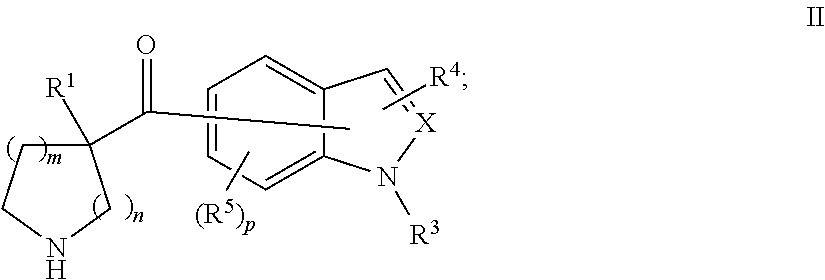
wherein:
p is from 0 to 3;
X is N or CRe;
R3 is:
-
- hydrogen; or
- C1-6alkyl;
R4, R5 and Re each independently is:
-
- hydrogen;
- halo;
- C1-6alkyl;
- halo-C1-6alkyl;
- halo-C1-6alkoxy;
- C1-6alkoxy;
- hydroxy;
- hetero-C1-6alkyl;
- cyano;
- nitro;
- amino;
- N—C1-6alkyl-amino;
- N,N-di-C1-6alkylamino; or
- —(CH2)r—Y—(CH2)s—Z—(CH2)t-Q-(CH2)u—Rc;
- wherein
- r, s, t and u each independently is 0 or 1;
- Z is —C(O)— or —SO2—;
- X and Y each independently is —O—, —NRd— or a bond;
- Rc is:
- hydrogen;
- C1-6alkyl;
- halo-C1-6alkyl;
- halo-C1-6alkoxy;
- C1-6alkoxy;
- hydroxy;
- hetero-C1-6alkyl;
- cyano;
- amino;
- C1-6alkyl-amino; or
- N,N-di-C1-6alkylamino; and
- Rd is:
- hydrogen; or
- C1-6alkyl; and
m, n and R1 are as defined herein for formula I.
In certain embodiments of formula II, X is N.
In certain embodiments of formula II, X is CRe.
In certain embodiments of formula II, X is CH.
In certain embodiments of formula II, R3 is hydrogen.
In certain embodiments of formula II, R3 is C1-6alkyl.
In certain embodiments of formula II, R3 is methyl.
In certain embodiments of formula II, m is 1, n is 1, X is CH, R1 is optionally substituted benzyl, and R3 is hydrogen.
In certain embodiments of formula II, m is 1, n is 1, X is N, R1 is C3-6 alkyl, and R3 is hydrogen.
In certain embodiments of formula II, m is 1, n is 1, X is CH, R1 is optionally substituted benzyl, and R3 is hydrogen.
In certain embodiments of formula II, m is 1, n is 1, X is N, R1 is C3-6alkyl, and R3 is hydrogen.
In certain embodiments of formula I, the subject compounds may be of formula III:

wherein m, n, p, R1, R4 and R5 are as defined herein for formula I.
In certain embodiments of formula II or III, p is 0, 1 or 2.
In certain embodiments of formula II or III, p is 0, 1 or 2 and R6 is halo.
In certain embodiments of formula II or III, p is 0, 1 or 2 and R6 is fluoro.
In certain embodiments of formula II or III, p is 1 and R6 is fluoro.
In certain embodiments of formula II or III, p is 0.
In certain embodiments of formula I, the subject compounds may be of formula IV:

wherein:
q is 0 or 1;
R6, R7 and R8 each independently is:
-
- halo;
- amino;
- C1-6alkyl;
- C3-6cycloalkyl;
- C1-6alkylcarbonyl;
- C1-6alkylsulfonyl;
- C1-6alkylsulfanyl;
- halo-C1-6alkyl;
- C1-6alkoxy;
- halo-C1-6alkoxy;
- C1-6alkoxy-C1-6alkyl;
- hydroxy;
- cyano;
- optionally substituted phenyl;
- optionally substituted phenoxy; or
- optionally substituted heteroaryl;
- or R6 and R7 together form C1-2alkylene or C1-2alkylene-dioxy;
- or R7 and R8 together form C1-2alkylene or C1-2alkylene-dioxy;
and wherein m, n and R1 are as defined herein for formula I.
In certain embodiments of formula IV, R6, R7 and R8 each independently is: halo; amino; C1-6alkyl; C1-6alkylcarbonyl; halo-C1-6alkyl; C1-6alkoxy; halo-C1-6alkoxy; hydroxy; or cyano.
In certain embodiments of formula IV, one of R6, R7 and R8 is amino, and the others are halo.
In certain embodiments of formula IV, q is 1, one of R6, R7 and R8 is amino, and the others are halo.
In certain embodiments of formula N, q is 1 and R6, R7 and R8 are halo.
In certain embodiments of formula N, q is 0, one of R6 and R7 is amino, and the other is halo.
In certain embodiments of formula N, q is 0 and R6 and R7 are halo.
In certain embodiments of formula N, one of R6, R7 and R8 is fluoro, and the others are chloro.
In certain embodiments of formula N, q is 1, one of R6, R7 and R8 is amino, and the others are chloro or fluoro.
In certain embodiments of formula N, q is 0.
In certain embodiments of formula N, q is 1.
In certain embodiments of formula N, R6, R7 and R8 are halo.
In certain embodiments of formula N, q is 1, R7 is amino, and R6 and R8 are independently fluoro or chloro.
In certain embodiments of formula N, q is 0, R7 is amino, and R6 is fluoro or chloro.
In certain embodiments of formula I, the subject compounds may be of formula V:

wherein:
R6, R7 and R8 each independently is:
-
- hydrogen;
- halo;
- amino;
- C1-6alkyl;
- C3-6cycloalkyl;
- C1-6alkylcarbonyl;
- C1-6alkylsulfonyl;
- C1-6alkylsulfanyl;
- halo-C1-6alkyl;
- C1-6alkoxy;
- halo-C1-6alkoxy;
- C1-6alkoxy-C1-6alkyl;
- hydroxy;
- cyano;
- optionally substituted phenyl;
- optionally substituted phenoxy; or
- optionally substituted heteroaryl;
- or R7 and R8 together form C1-2alkylene or C1-2alkylene-dioxy;
and wherein m, n and R1 are as defined herein for formula I.
In certain embodiments of formula V, R8 is hydrogen, and R6 and R7 each independently is: halo; amino; C1-6alkyl; C1-6alkylcarbonyl; halo-C1-6alkyl; C1-6alkoxy; halo-C1-6alkoxy; hydroxy; or cyano.
In certain embodiments of formula V, R8 is hydrogen, and R6 and R7 are halo.
In certain embodiments of formula V, R8 is hydrogen, and R6 and R7 are chloro or fluoro.
In certain embodiments of formula V, R8 is hydrogen, and R6 and R7 are chloro.
In certain embodiments of formula V, R8 is hydrogen, one of R6 and R7 is amino, and the other is halo.
In certain embodiments of formula V, R6 is halo, and R7 and R8 are hydrogen.
In certain embodiments of formula V, one of R6, R7 and R8 is amino, and the others are halo.
In certain embodiments of any of formulas I, II, III, IV or V, m is 0.
In certain embodiments of any of formulas I, II, III, IV or V, m is 1.
In certain embodiments of any of formulas I, II, III, IV or V, m is 2.
In certain embodiments of any of formulas I, II, III, IV or V, m is 3.
In certain embodiments of any of formulas I, II, III, IV or V, n is 0.
In certain embodiments of any of formulas I, II, III, IV or V, n is 1.
In certain embodiments of any of formulas I, II, III, IV or V, n is 2.
In certain embodiments of any of formulas I, II, III, IV or V, m is 1 and n is 1.
In certain embodiments of any of formulas I, II, III, IV or V, m is 2 and n is 1.
In certain embodiments of any of formulas I, II, III, N or V, m is 2 and n is 0.
In certain embodiments of any of formulas I, II, III, N or V, m is 3 and n is 0.
In certain embodiments of any of formulas I, II, III, N or V, m is 1 and n is 0.
In certain embodiments of any of formulas I, II, III, N or V, m is 1 and n is 2.
In certain embodiments of any of formulas I, II, III, N or V, m is 0 and n is 1.
In certain embodiments of any of formulas I, II, III, N or V, R1 is:
C1-6alkyl;
C1-6alkenyl;
C1-6alkynyl;
C1-6alkoxy;
C3-7cycloalkyl-C1-6alkyl;
hetero-C1-6alkyl;
halo-C1-6alkyl;
optionally substituted aryl;
aryl-C1-3alkyl wherein the aryl portion is optionally substituted;
heteroaryl-C1-3alkyl wherein the heteroaryl portion is optionally substituted;
In certain embodiments of any of formulas I, II, III, N or V, R1 is:
C1-6alkyl;
C1-6alkenyl; or
aryl-C1-3alkyl wherein the aryl portion is optionally substituted.
In certain embodiments of any of formulas I, II, III, IV or V, R1 is:
C3-6alkyl;
C3-6haloalkyl;
C3-6cycloalkyl-C1-3alkyl;
C1-2alkoxy-C1-3alkyl;
C1-2alkyl-C3-6cycloalkyl-C1-3alkyl;
optionally substituted benzyl.
In certain embodiments of any of formulas I, II, III, N or V, R1 is:
n-propyl; isopropyl; tert-butyl; n-butyl; isobutyl; n-pentyl; isopentyl; 2,2-dimethyl-propyl; 3,3-dimethyl-butyl; cyclopentyl; cyclopropyl-methyl; cyclobutyl-methyl; cyclopentyl-methyl; cyclohexyl-methyl; cyclopropyl-ethyl; cyclohexyl-ethyl; 2-(1-methyl-cyclopropyl)-ethyl; 3-(1-methyl-cyclopropylmethyl; 3,3,3-trifluoro-propyl; 4,4,4-trifluoro-butyl; 3,3-difluoro-allyl; benzyl; 3-fluoro-benzyl; 4-fluoro-benzyl; 3-methoxy-benzyl; 4-methoxy-benzyl; 3,4-dichloro-benzyl; 3,4-difluoro-benzyl; pyrazin-2-yl-methyl; thiazol-4-yl-methyl; pyrazol-1-yl-methyl; methoxy-methyl; ethoxy-methyl; isopropoxy-methyl; 2-methoxy-ethyl; 2-ethoxy-ethyl; 3-methoxy-3-methyl-butyl; 3-ethanesulfonyl-methyl; or tetrahydropyran-4-ylmethyl.
In certain embodiments of any of formulas I, II, III, N or V, R1 is:
n-propyl; isopropyl; tert-butyl; n-butyl; isobutyl; n-pentyl; isopentyl; 2,2-dimethyl-propyl; 3,3-dimethyl-butyl; cyclopentyl; cyclopropyl-methyl; cyclobutyl-methyl; cyclopentyl-methyl; cyclohexyl-methyl; cyclopropyl-ethyl; cyclohexyl-ethyl; 2-(1-methyl-cyclopropyl)-ethyl; 3-(1-methyl-cyclopropylmethyl; 3,3,3-trifluoro-propyl; or 4,4,4-trifluoro-butyl.
In certain embodiments of any of formulas I, II, III, N or V, R1 is:
n-propyl; isopropyl; tert-butyl; n-butyl; isobutyl; isopentyl; 2,2-dimethyl-propyl; 3,3-dimethyl-butyl; cyclopentyl; cyclopropyl-methyl; cyclobutyl-methyl; cyclopentyl-methyl; cyclohexyl-methyl; cyclopropyl-ethyl; cyclohexyl-ethyl; 2-(1-methyl-cyclopropyl)-ethyl; or 3-(1-methyl-cyclopropylmethyl.
In certain embodiments of any of formulas I, II, III, IV or V wherein R1 is heteroaryl-C1-3alkyl, heteroaryloxy, heteroaryl-C1-6alkoxy, the heteroaryl moiety may be pyridinyl, pyrazinyl, thiazolyl or pyrazolyl.
In certain embodiments of any of formulas I, II, III, IV or V, R1 is: C1-6alkyl; aryl-C1-6alkyl; C3-6cycloalkyl-C1-6alkyl; hetero-C1-6alkyl; halo-C1-6alkyl; or C1-6-alkyl-C1-3cycloalkyl-C1-6alkyl.
In certain embodiments of any of formulas I, II, III, IV or V, R1 is: C1-6alkyl; aryl-C1-6alkyl; C3-6cycloalkyl-C1-6alkyl; or C1-6-alkyl-C1-3cycloalkyl-C1-6alkyl.
In certain embodiments of any of formulas I, II, III, N or V, R1 is C3-6alkyl.
In certain embodiments of any of formulas I, II, III, IV or V, R1 is C3-6alkenyl.
In certain embodiments of any of formulas I, II, III, N or V, R1 is C3-6alkynyl.
In certain embodiments of any of formulas I, II, III, N or V, R1 is C2-6alkoxy.
In certain embodiments of any of formulas I, II, III, IV or V, R1 is C3-7cycloalkyl-C1-6alkyl.
In certain embodiments of any of formulas I, II, III, N or V, R1 is C3-7cycloalkyl.
In certain embodiments of any of formulas I, II, III, N or V, R1 is C1-6alkyl-C3-6-cycloalkyl-C1-6alkyl
In certain embodiments of any of formulas I, II, III, N or V, R1 is hetero-C1-6alkyl.
In certain embodiments of any of formulas I, II, III, IV or V, R1 is heterocyclyl-C1-6alkyl.
In certain embodiments of any of formulas I, II, III, IV or V, R1 is heterocyclyl-C1-6alkyl selected from tetrahydropyranylmethyl, tetrahydrofuranylmethyl and piperidinylmethyl.
In certain embodiments of any of formulas I, II, III, N or V, R1 is tetrahydropyranylmethyl.
In certain embodiments of any of formulas I, II, III, IV or V, R1 is hetero-C1-6alkyl selected from:
hydroxy-C1-6alkyl;
C1-6alkylsulfonyl-C1-6alkyl;
C1-6alkylsulfanyl-C1-6alkyl; and
C1-6alkoxy-C1-6alkyl.
In certain embodiments of any of formulas I, II, III, N or V, R1 is hydroxy-C1-6alkyl.
In certain embodiments of any of formulas I, II, III, N or V, R1 is C1-6alkylsulfonyl-C1-6alkyl.
In certain embodiments of any of formulas I, II, III, N or V, R1 is C1-6alkylsulfanyl-C1-6alkyl.
In certain embodiments of any of formulas I, II, III, IV or V, R1 is C1-6alkoxy-C1-6alkyl.
In certain embodiments of any of formulas I, II, III, IV or V, R1 is halo-C1-6alkyl.
In certain embodiments of any of formulas I, II, III, N or V, R1 is optionally substituted aryl.
In certain embodiments of any of formulas I, II, III, N or V, R1 is optionally substituted heteroaryl.
In certain embodiments of any of formulas I, II, III, N or V, R1 is aryl-C1-3alkyl wherein the aryl portion is optionally substituted.
In certain embodiments of any of formulas I, II, III, N or V, R1 is heteroaryl-C1-3 alkyl wherein the heteroaryl portion is optionally substituted.
In certain embodiments of any of formulas I, II, III, N or V, R1 is heteroaryl-C1-3alkyl selected from pyridinyl-C1-3alkyl, pyrazinyl-C1-3alkyl, thiazolyl-C1-3alkyl and pyrazolyl-C1-3alkyl.
In certain embodiments of any of formulas I, II, III, N or V, R1 is n-propyl, isopropyl, n-butyl, isobutyl, n-pentyl or isopentyl.
In certain embodiments of any of formulas I, II, III, N or V, R1 is n-propyl.
In certain embodiments of any of formulas I, II, III, N or V, R1 is isopropyl.
In certain embodiments of any of formulas I, II, III, IV or V, R1 is n-butyl.
In certain embodiments of any of formulas I, II, III, N or V, R1 is isobutyl.
In certain embodiments of any of formulas I, II, III, N or V, R1 is tert-butyl.
In certain embodiments of any of formulas I, II, III, N or V, R1 is n-pentyl.
In certain embodiments of any of formulas I, II, III, N or V, R1 is isopentyl.
In certain embodiments of any of formulas I, II, III, N or V, R1 is 2,2-dimethyl-propyl.
In certain embodiments of any of formulas I, II, III, IV or V, R1 is 3,3-dimethyl-butyl.
In certain embodiments of any of formulas I, II, III, N or V, R1 is cyclopropyl-methyl.
In certain embodiments of any of formulas I, II, III, N or V, R1 is 2-(1-methyl-cyclopropyl)-ethyl.
In certain embodiments of any of formulas I, II, III, N or V, R1 is 3-(1-methyl-cyclopropylmethyl.
In certain embodiments of any of formulas I, II, III, IV or V, R1 is:
optionally substituted benzyl;
thiazolylmethyl;
pyrazinylmethyl;
optionally substituted phenyl; or
C1-6alkyl.
In certain embodiments of any of formulas I, II, III, IV or V, R1 is:
optionally substituted benzyl;
optionally substituted phenyl; or
C3-6alkyl.
In certain embodiments of any of formulas I, II, III, IV or V, R1 is optionally substituted benzyl.
In certain embodiments of any of formulas I, II, III, IV or V, R1 is optionally substituted phenyl.
In certain embodiments of any of formulas I, II, III, N or V, R1 is C3-6 alkyl.
In certain embodiments of any of formulas I, II, III, IV or V, R1 is optionally substituted phenylethyl.
In certain embodiments of any of formulas I, II, III, IV or V, R1 is optionally substituted heteroaryl-C1-6alkyl selected from thiazolylmethyl and pyrazolylmethyl.
In certain embodiments of formula II, R4, R5 and Rc each preferably is independently selected from:
halo;
C1-6alkyl;
halo-C1-6alkyl;
halo-C1-6alkoxy;
C1-6alkoxy;
hydroxy;
hetero-C1-6alkyl selected from:
-
- hydroxy-C1-6alkyl;
- C1-6 alkylsulfonyl-C1-6alkyl; and
- C1-6alkoxy-C1-6alkyl;
cyano;
nitro;
amino;
N—C1-6alkyl-amino;
N,N-di-C1-6alkylamino;
C1-6alkyl-sulfonyl; or
—C(O)Rc wherein Rc is:
-
- C1-6alkyl;
- amino;
- C1-6alkyl-amino; or
- N,N-di-C1-6alkylamino.
In certain embodiments of any of formula II, R4, R5 and Rc each more preferably is independently selected from:
halo;
C1-6alkyl;
halo-C1-6alkyl;
C1-6alkoxy;
hydroxy; or
cyano.
In embodiments of formulas I, II, III, IV or V where R1 is optionally substituted aryl, optionally substituted heteroaryl, optionally substituted aryl-C1-3 alkyl (including optionally substituted benzyl) or optionally substituted heteroaryl-C1-3alkyl, such optionally substituents may comprise one, two or three groups each independently selected from:
halo;
C1-6alkyl;
halo-C1-6alkyl;
halo-C1-6alkoxy;
C1-6alkoxy;
hydroxy;
hetero-C1-6alkyl;
cyano;
nitro;
amino;
N—C1-6alkyl-amino;
N,N-di-C1-6alkylamino; or
—(CH2)r—Y—(CH2)s—Z—(CH2)t-Q-(CH2)—-Rc;
wherein
-
- r, s, t and u each independently is 0 or 1;
- Z is —C(O)— or —SO2—;
- X and Y each independently is —O—, —NRd— or a bond;
- Rc is:
- hydrogen;
- C1-6alkyl;
- halo-C1-6alkyl;
- halo-C1-6alkoxy;
- C1-6alkoxy;
- hydroxy;
- hetero-C1-6alkyl;
- cyano;
- amino;
- C1-6alkyl-amino; or
- N,N-di-C1-6alkylamino; and
- Rd is:
- hydrogen; or
- C1-6alkyl.
In embodiments of formulas I, II, III, IV or V where R1 is optionally substituted aryl, optionally substituted heteroaryl, optionally substituted aryl-C1-3 alkyl (including optionally substituted benzyl) or optionally substituted heteroaryl-C1-3alkyl, such optionally substituents more preferably comprise one, two or three groups each independently selected from:
halo;
C1-6alkyl;
halo-C1-6alkyl;
halo-C1-6alkoxy;
C1-6alkoxy;
hydroxy;
hetero-C1-6alkyl selected from:
-
- hydroxy-C1-6alkyl;
- C1-6alkylsulfonyl-C1-6alkyl; and
- C1-6alkoxy-C1-6alkyl;
cyano;
nitro;
amino;
N—C1-6alkyl-amino
N,N-di-C1-6alkylamino;
C1-6alkyl-sulfonyl; or
—C(O)Re wherein Rc is:
-
- C1-6alkyl;
- amino;
- C1-6alkyl-amino; or
- N,N-di-C1-6alkylamino.
In embodiments of formulas I, II, III, IV or V where R1 is optionally substituted aryl, optionally substituted heteroaryl, optionally substituted aryl-C1-3 alkyl (including optionally substituted benzyl) or optionally substituted heteroaryl-C1-3alkyl, such optionally substituents still more preferably comprise one or two groups each independently selected from:
halo;
C1-6alkyl;
halo-C1-6alkyl;
C1-6alkoxy;
hydroxy; or
cyano.
In certain embodiments of formula I, the subject compounds may be more specifically of formula VI:

wherein Ar and R1 are as defined herein for formula I.
In certain embodiments of formula VI, the subject compounds may be more specifically of formula VIa or formula VIb:

wherein Ar and R1 are as defined herein for formula I.
In certain embodiments of formula I, the subject compounds may be more specifically of formula VII:

wherein Ar and R1 are as defined herein for formula I.
In certain embodiments of formula VII, the subject compounds may be more specifically of formula VIIa or formula VIIb:

wherein Ar and R1 are as defined herein for formula I.
In certain embodiments of formula I, the subject compounds may be more specifically of formula VIII:

wherein Ar and R1 are as defined herein for formula I.
In certain embodiments of formula VIII, the subject compounds may be more specifically of formula VIIIa or formula VIIIb:

wherein Ar and R1 are as defined herein for formula I.
In certain embodiments of formula I, the subject compounds may be more specifically of formula IX:

wherein Ar and R1 are as defined herein for formula I.
In certain embodiments of formula I, the subject compounds may be more specifically of formula X:

wherein Ar and R1 are as defined herein for formula I.
In certain embodiments of formula X, the subject compounds may be more specifically of formula Xa or formula Xb:

wherein Ar and R1 are as defined herein for formula I.
Representative compounds in accordance with the methods of the invention are shown in Table 1. Melting points (° C.) in Table 1 are for hydrochloride salts unless indicated otherwise.
| TABLE 1 | |||
| # | Structure | Name | mp/M + H |
| 1 |
 |
(3-Benzyl-pyrrolidin-3-yl)-(1H- indol-5-yl)-methanone | 305 |
| 2 |
 |
[3-(3-Fluoro-benzyl)-pyrrolidin-3- yl]-(1H-indol-5-yl)-methanone | 323 |
| 3 |
 |
5-(3-Benzyl-pyrrolidine-3- carbonyl)-1H-indole-3-carbonitrile | 330 |
| 4 |
 |
(3-Benzyl-pyrrolidin-3-yl)-(1H- indazol-5-yl)-methanone | 306 |
| 5 |
 |
(S)-3-Benzyl-pyrrolidin-3-yl)-(1H- indol-5-yl)-methanone | 305 |
| 6 |
 |
3-[3-(1H-Indole-5-carbonyl)- pyrrolidin-3-ylmethyl]-benzonitrile | 330 |
| 7 |
 |
((R)-3-Benzyl-pyrrolidin-3-yl)- (1H-indol-5-yl)-methanone | 305 |
| 8 |
 |
(1H-Indol-5-yl)-[3-(3-methoxy- benzyl)-pyrrolidin-3-yl]- methanone | 335 |
| 9 |
 |
(3-Benzyl-pyrrolidin-3-yl)-(7- fluoro-1H-indol-5-yl)-methanone | 323 |
| 10 |
 |
(3-Benzyl-pyrrolidin-3-yl)-(1- methyl-1H-indol-5-yl)-methanone | 319 |
| 11 |
 |
(1H-Indol-5-yl)-(3-propyl- pyrrolidin-3-yl)-methanone | 257 |
| 12 |
 |
[3-(4-Fluoro-benzyl)-pyrrolidin-3- yl]-(1H-indol-5-yl)-methanone | 323 |
| 13 |
 |
(3-Benzyl-pyrrolidin-3-yl)-(3,4- dichloro-phenyl)-methanone | 334 |
| 14 |
 |
(1H-Indol-5-yl)-[3-(4-methoxy- benzyl)-pyrrolidin-3-yl]- methanone | 335 |
| 15 |
 |
[3-(3,4-Dichloro-benzyl)- pyrrolidin-3-yl]-(1H-indol-5-yl)- methanone | 373 |
| 16 |
 |
[3-(2-Fluoro-benzyl)-pyrrolidin-3- yl]-(1H-indol-5-yl)methanone | 323 |
| 17 |
 |
5-(3-Benzyl-pyrrolidine-3- carbonyl)-1,3-dihydro-indol-2-one | 321 |
| 18 |
 |
(3-Benzyl-pyrrolidin-3-yl)-(2- methyl-1H-indol-5-yl)-methnanone | 319 |
| 19 |
 |
(3-Benzyl-pyrrolidin-3-yl)-(2,3- dihydro-1H-indol-5-yl)-methanone | 307 |
| 20 |
 |
(3-Butyl-pyrrolidin-3-yl)-(1H- indol-5-yl)-methanone | 271 |
| 21 |
 |
(1H-Indazol-5-yl)-(3-propyl- pyrrolidin-3-yl)-methonone | 258 |
| 22 |
 |
(1H-Indol-5-yl)-[3-(3-methyl- butyl)-pyrrolidin-3-yl]-methanone | 285 |
| 23 |
 |
(1H-Indol-5-yl)-(3-isobutyl- pyrrolidin-3-yl)-methanone | 271 |
| 24 |
 |
(3-Butyl-pyrrolidin-3-yl)-(1H- indazol-5-yl)-methanone | 272 |
| 25 |
 |
(3-Butyl-pyrrolidin-3-yl)-(7-fluoro- 1H-indol-5-yl)-methanone | 289 |
| 26 |
 |
(7-Fluoro-1H-indol-5-yl)-(3- propyl-pyrrolidin-3-yl)-methanone | 275 |
| 27 |
 |
Benzo[b]thiophen-5-yl-(3-benzyl- pyrrolidin-3-yl)-methanone | 322 |
| 28 |
 |
(3-Benzyl-pyrrolidin-3-yl)-(1H- indol-6-yl)-methanone | 305 |
| 29 |
 |
(3-Benzyl-1-methyl-pyrrolidin-3- yl)-(1H-indol-5-yl)-methanone | 319 |
| 30 |
 |
(1H-Indol-5-yl)-(3-thiazol-4- ylmethyl-pyrrolidin-3-yl)-methanone | 312 |
| 31 |
 |
((S)-3-Benzyl-pyrrolidin-3-yl)-(7- fluoro-1H-indol-5-yl)-methanone | 323 |
| 32 |
 |
((R)-3-Benzyl-pyrrolidin-3-yl)-(7- fluoro-1H-indol-5-yl)-methanone | 323 |
| 33 |
 |
Phenyl-(3-propyl-pyrrolidin-3-yl)- methanone | 218 |
| 34 |
 |
(3-Benzyl-pyrrolidin-3-yl)-(1H- indol-4-yl)-methanone | 305 |
| 35 |
 |
Naphthalen-2-yl-(3-propyl- pyrrolidin-3-yl)-methanone | 268 |
| 36 |
 |
(4-Methoxy-phenyl)-(3-propyl- pyrrolidin-3-yl)-methanone | 248 |
| 37 |
 |
(4-Fluoro-phenyl)-(3-propyl- pyrrolidin-3-yl)-methanone | 236 |
| 38 |
 |
(1H-Indol-5-yl)-(3-pyrazin-2- ylmethyl-pyrrolidin-3-yl)- methanone | 307 |
| 39 |
 |
((S)-3-Butyl-pyrrolidin-3-yl)-(1H- indol-5-yl)-methanone | 271 |
| 40 |
 |
((R)-3-Butyl-pyrrolidin-3-yl)-(1H- indol-5-yl)-methanone | 271 |
| 41 |
 |
((S)-3-Butyl-pyrrolidin-3-yl)-(1H- indazol-5-yl)-methanone | 272 |
| 42 |
 |
((R)-3-Butyl-pyrrolidin-3-yl)-(1H- indazol-5-yl)-methanone | 272 |
| 43 |
 |
(3,4-Dichloro-phenyl)-(3-propyl- pyrrolidin-3-yl)-methanone | 286 |
| 44 |
 |
6-(3-Propyl-pyrrolidine-3- carbonyl)-1H-quinolin-2-one | 285 |
| 45 |
 |
(3-Chloro-phenyl)-(3-propyl- pyrrolidin-3-yl)-methanone | 252 |
| 46 |
 |
(3-Cyclopropylmethyl-pyrrolidin- 3-yl)-(1H-indol-5-yl)-methanone | 269 |
| 47 |
 |
(6-Methoxy-naphthalen-2-yl)-(3- propyl-pyrrolidin-3-yl)-methanone | 298 |
| 48 |
 |
((S)-3-Butyl-pyrrolidin-3-yl)-(7- fluoro-1H-indol-5-yl)-methanone | 119.0-120.0 |
| 49 |
 |
(3-Propyl-pyrrolidin-3-yl)- quinolin-6-yl-methanone | 269 |
| 50 |
 |
(3-Propyl-pyrrolidin-3-yl)-(1,2,3,4- tetrahydro-quinolin-6-yl)- methanone | 273 |
| 51 |
 |
((R)-3-Butyl-pyrrolidin-3-yl)-(7- fluoro-1H-indol-5-yl)-methanone | 112.0-113.0 |
| 52 |
 |
(4-Benzyl-piperidin-4-yl)-(1H- indol-5-yl)-methanone | 319 |
| 53 |
 |
(4-Benzyl-piperidin-4-yl)-phenyl- methanone | 280 |
| 54 |
 |
(4-Benzyl-piperidin-4-yl)-(1H- indazol-5-yl)-methanone | 320 |
| 55 |
 |
(1H-Indol-5-yl)-[4-(3-methoxy- benzyl)-piperidin-4-yl]-methanone | 349 |
| 56 |
 |
(4-Benzyl-piperidin-4-yl)-(1- methyl-1H-indol-5-yl)-methnanone | 333 |
| 57 |
 |
4-(3-Fluoro-benzyl)-piperidin-4- yl]-(1H-indol-5-yl)-methanone | 337 |
| 58 |
 |
[4-(2-Fluoro-benzyl)-piperidin-4- yl]-(1H-indol-5-yl)-methanone | 337 |
| 59 |
 |
(1H-Indol-5-yl)-[4-(4-methoxy- benzyl)-piperidin-4-yl]-methanone | 349 |
| 60 |
 |
(1H-Indol-5-yl)-(4-propyl- piperidin-4-yl)-methanone | 163.9-165.1 |
| 61 |
 |
[4-(4-Fluoro-benzyl)-piperidin-4- yl]-(1H-indol-5-yl)-methanone | 337 |
| 62 |
 |
[4-(3,4-Difluoro-benzyl)-piperidin- 4-yl]-(1H-indol-5-yl)-methanone | 355 |
| 63 |
 |
[4-(3,4-Dichloro-benzyl)-piperidin- 4-yl]-(1H-indol-5-yl)-methanone | 387 |
| 64 |
 |
(4-Benzyl-piperidin-4-yl)-(7- fluoro-1H-indol-5-yl)-methanone | 337 |
| 65 |
 |
(4-Benzyl-piperidin-4-yl)-(7- chloro-1H-indol-5-yl)-methanone | 353 |
| 66 |
 |
(1-Methyl-1H-indol-5-yl)-(4- propyl-piperidin-4-yl)-methanone | 184.4-186.3 |
| 67 |
 |
(4-Butyl-piperidin-4-yl)-(1H-indol- 5-yl)-methanone | 130.6-133.9 |
| 68 |
 |
(4-Cyclopropylmethyl-piperidin-4- yl)-(1H-indol-5-yl)-methanone | 169.4-170.2 |
| 69 |
 |
(1H-Indol-5-yl)-(1-methyl-4- propyl-piperidin-4-yl)-methanone | 285 |
| 70 |
 |
(3-Benzyl-piperidin-3-yl)-(1H- indol-5-yl)-methanone | 319 |
| 71 |
 |
(1H-Indol-5-yl)-[3-(4-methoxy- benzyl)-piperidin-3-yl]-methanone | 349 |
| 72 |
 |
(1H-Indol-5-yl)-(3-propyl- piperidin-3-yl)-methanone | 132.0-137.0 |
| 73 |
 |
((S)-3-Benzyl-piperidin-3-yl)-(1H- indol-5-yl)-methanone | 319 |
| 74 |
 |
((R)-3-Benzyl-piperidin-3-yl)-(1H- indol-5-yl)-methanone | 319 |
| 75 |
 |
[3-(3-Fluoro-benzyl)-piperidin-3- yl]-(1H-indol-5-yl)-methanone | 337 |
| 76 |
 |
(3-Butyl-piperidin-3-yl)-(1H-indol- 5-yl)-methanone | 166.8-170.8 |
| 77 |
 |
(1H-Indol-5-yl)-((S)-3-propyl- piperidin-3-yl)-methanone | 115.0-117.0 |
| 78 |
 |
(1H-Indol-5-yl)-((R)-3-propyl- piperidin-3-yl)-methanone | 271 |
| 79 |
 |
(7-Fluoro-1H-indol-5-yl)-(3- propyl-piperidin-3-yl)-methanone | 289 |
| 80 |
 |
(2-Benzyl-pyrrolidin-2-yl)-(1H- indol-5-yl)-methanone | 405 |
| 81 |
 |
(3-Benzyl-azepan-3-yl)-(1H-indol- 5-yl)-methanone | 333 |
| 82 |
 |
(1H-Indol-5-yl)-(3-phenyl- pyrrolidin-3-yl)-methanone | 291 |
| 83 |
 |
(1H-Indol-5-yl)-(4-phenyl- piperidin-4-yl)-methanone | 305 |
| 84 |
 |
(3-Benzyl-pyrrolidin-3-yl)-(1H- pyrrolo[2,3-b]pyridin-5-yl)- methanone | 306 |
| 85 |
 |
(3-Butyl-pyrrolidin-3-yl)-(1H- pyrrolo[2,3-b]pyridin-5-yl)- methanone | 272 |
| 86 |
 |
(3-Benzyl-azetidin-3-yl)-(1H- indol-5-yl)-methanone | 291 |
| 87 |
 |
(1H-Indol-5-yl)-(3- methoxymethyl-pyrrolidin-3-yl)- methanone | 59.1-61.0 |
| 88 |
 |
(3-Ethoxymethyl-pyrrolidin-3-yl)- (1H-indol-5-yl)-methanone | 98.6-99.6 |
| 89 |
 |
(7-Fluoro-1H-indol-5-yl)-(3- isopropoxymethyl-pyrrolidin-3-yl)- methanone | 154.5-155.4 |
| 90 |
 |
(3-Ethoxy-pyrrolidin-3-yl)-(1H- indol-5-yl)-methanone | 259 |
| 91 |
 |
(3-Ethoxymethyl-piperidin-3-yl)- (7-fluoro-1H-indol-5-yl)- methanone | 291 |
| 92 |
 |
(7-Fluoro-1H-indol-5-yl)-(3- methoxymethyl-piperidin-3-yl)- methanonemethanone | 277 |
| 93 |
 |
(1H-Indol-3-yl)-(3-propyl- pyrrolidin-3-yl)-methanone | 257 |
| 94 |
 |
(3,4-Dichloro-phenyl)-(2-propyl- piperidin-2-yl)-methanone | 300 |
| 95 |
 |
[3-(3,3-Dimethyl-butyl)- pyrrolidin-3-yl]-(1H-indol-5-yl)- methanone | 299 |
| 96 |
 |
[3-(2-Cyclopropyl-ethyl)- pyrrolidin-3-yl]-(1H-indol-5-yl)- methanone | 283 |
| 97 |
 |
(1H-Indol-5-yl)-((S)-3-propyl- pyrrolidin-3-yl)-methanone | 257 |
| 98 |
 |
(3-Propyl-pyrrolidin-3-yl)- quinolin-7-yl-methanone | 269 |
| 99 |
 |
(1H-Indol-5-yl)-((R)-3-propyl- pyrrolidin-3-yl)-methanone | 257 |
| 100 |
 |
(3,4-Dichloro-phenyl)-(3- ethoxymethyl-pyrrolidin-3-yl)- methanone | 303 |
| 101 |
 |
(7-Chloro-1H-indol-5-yl)-(3- propyl-pyrrolidin-3-yl)-methanone | 291 |
| 102 |
 |
(1H-Indol-5-yl)-[3-(3,3,3- trifluoro-propyl)-pyrrolidin-3-yl]- methanone | 311 |
| 103 |
 |
(4-Chloro-3-methoxy-phenyl)-(3- propyl-pyrrolidin-3-yl)-methanone | 282 |
| 104 |
 |
N-[2-Chloro-4-(3-propyl- pyrrolidine-3-carbonyl)-phenyl]- acetamide | 309 |
| 105 |
 |
(3-Ethoxymethyl-pyrrolidin-3-yl)- (7-fluoro-1H-indol-5-yl)- methanone | 162.5-163.0 |
| 106 |
 |
(3-Chloro-4-methoxy-phenyl)-(3- propyl-pyrrolidin-3-yl)-methanone | 282 |
| 107 |
 |
(3,4-Dichloro-phenyl)-((S)-3- propyl-pyrrolidin-3-yl)-methanone | 136.6-138.2 |
| 108 |
 |
(3,4-Dichloro-phenyl)-((R)-3- propyl-pyrrolidin-3-yl)-methanone | 287 |
| 109 |
 |
(4-Chloro-3-fluoro-phenyl)-(3- propyl-pyrrolidin-3-yl)-methanone | 270 |
| 110 |
 |
(3-Chloro-4-fluoro-phenyl)-(3- propyl-pyrrolidin-3-yl)-methanone | 270 |
| 111 |
 |
(3,5-Dichloro-phenyl)-(3-propyl- pyrrolidin-3-yl)-methanone | 287 |
| 112 |
 |
(3,4-Difluoro-phenyl)-(3-propyl- pyrrolidin-3-yl)-methanone | 254 |
| 113 |
 |
(3,4-Dichoro-phenyl)-(3- isopropoxymethyl-pyrrolidin-3-yl)- methanone | 317 |
| 114 |
 |
(3-Butyl-pyrrolidin-3-yl)-(3,4- dichloro-phenyl)-methanone | 301 |
| 115 |
 |
(4-Chloro-phenyl)-(3-propyl- pyrrolidin-3-yl)-methanone | 252 |
| 116 |
 |
(3-Chloro-4-methyl-phenyl)-(3- propyl-pyrrolidin-3-yl)-methanone | 266 |
| 117 |
 |
(3-Propyl-pyrrolidin-3-yl)-(7- trifluoromethyl-1H-indol-5-yl)- methanone | 325 |
| 118 |
 |
(4-Chloro-3-methyl-phenyl)-(3- propyl-pyrrolidin-3-yl)-methanone | 266 |
| 119 |
 |
(3-Propyl-pyrrolidin-3-yl)-(4- trifluoromethoxy-phenyl)- methanone | 302 |
| 120 |
 |
(4-Chloro-3-trifluoromethyl- phenyl)-(3-propyl-pyrrolidin-3-yl)- methanone | 320 |
| 121 |
 |
(3-Propyl-pyrrolidin-3-yl)-(3,4,5- trifluoro-phenyl)-methanone | 172.0-173.5 |
| 122 |
 |
(3,4-Dichloro-5-fluoro-phenyl)-(3- propyl-pyrrolidin-3-yl)-methanone | 305 |
| 123 |
 |
(3-Ethanesulfonylmethyl- pyrrolidin-3-yl)-(7-fluoro- 1H-indol-5-yl)-methanone | 339 |
| 124 |
 |
(4-Bromo-3-chloro-phenyl)-(3- propyl-pyrrolidin-3-yl)-methanone | 331 |
| 125 |
 |
(4-Phenoxy-phenyl)-(3-propyl- pyrrolidin-3-yl)-methanone | 310 |
| 126 |
 |
(4-Chloro-3-isopropoxy-phenyl)- (3-propyl-pyrrolidin-3-yl)- methanone | 310 |
| 127 |
 |
(6-Fluoro-1H-indol-5-yl)-(3- propyl-pyrrolidin-3-yl)-methanone | 275 |
| 128 |
 |
[3-(2-Cyclohexyl-ethyl)- pyrrolidin-3-yl]-(3,4-dichloro- phenyl)-methanone | 355 |
| 129 |
 |
[3-(4-Fluoro-phenoxy]-phenyl]-(3- propyl-pyrrolidin-3-yl)-methanone | 328 |
| 130 |
 |
(3,4-Dichloro-phenyl)-[3-(3,3- dimethyl-butyl)-pyrrolidin-3-yl]- methanone | 152.5-154.0 |
| 131 |
 |
(4-Amino-3-chloro-phenyl)-(3- propyl-pyrrolidin-3-yl)-methanone | 81.0-82.0 |
| 132 |
 |
(2,3-Dichloro-phenyl)-(3-propyl- pyrrolidin-3-yl)-methanone | 287 |
| 133 |
 |
(3-Propyl-pyrrolidin-3-yl)-(3,4,5- trichloro-phenyl)-methanone | 174.0-175.0 |
| 134 |
 |
(3,4-Dibromo-phenyl)-(3-propyl- pyrrolidin-3-yl)-methanone | 82.5-83.0 |
| 135 |
 |
(3,4-Dichloro-phenyl)-[3-(4,4,4- trifluoro-butyl)-pyrrolidin-3-yl]- methanone | 355 |
| 136 |
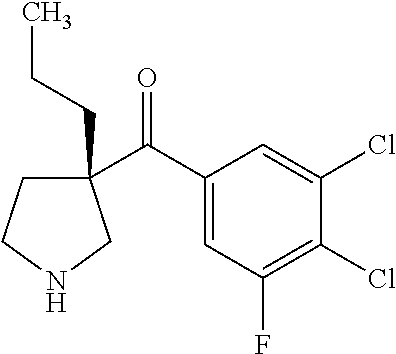 |
(3,4-Dichloro-5-fluoro-phenyl)- ((S)-3-propyl-pyrrolidin-3-yl)- methanone | 149.5-150.5 |
| 137 |
 |
(3,4-Dichloro-5-fluoro-phenyl)- ((R)-3-propyl-pyrrolidin-3-yl)- methanone | 305 |
| 138 |
 |
(4-Chloro-3-ethyl-phenyl)-(3- propyl-pyrrolidin-3-yl)-methanone | 280 |
| 139 |
 |
(3-Bromo-4-chloro-phenyl)-(3- propyl-pyrrolidin-3-yl)-methanone | 331 |
| 140 |
 |
(3-Cyclopropylmethyl-pyrrolidin- 3-yl)-(3,4-dichloro-phenyl)- methanone | 299 |
| 141 |
 |
(3,4-Dichloro-phenyl)-[3- (tetrahydro-pyran-4-ylmethyl)- pyrrolidin-3-yl]-methanone | 186.0-187.0 |
| 142 |
 |
(4-Bromo-3-methyl-phenyl)-(3- propyl-pyrrolidin-3-yl)-methanone | 311 |
| 143 |
 |
(7-Fluoro-1H-indol-5-yl)-((S)-3- propyl-pyrrolidin-3-yl)-methanone | 140.0-141.0 |
| 144 |
 |
(4-Amino-3-chloro-5-fluoro- phenyl)-(3-propyl-pyrrolidin-3-yl)- methanone | 65.0-67.0 |
| 45 |
 |
(7-Fluoro-1H-indol-5-yl)-((R)-3- propyl-pyrrolidin-3-yl)-methanone | 100.0-101.0 |
| 146 |
 |
(4-Bromo-3-chloro-5-fluoro- phenyl)-(3-propyl-pyrrolidin-3-yl)- methanone | 349 |
| 147 |
 |
(3-Butyl-pyrrolidin-3-yl)-(3,4- dichloro-5-fluoro-phenyl)- methanone | 319 |
| 148 |
 |
((R)-3-Butyl-pyrrolidin-3-yl)-(3,4- dichloro-5-fluoro-phenyl)- methanone | 129.0-130.0 |
| 149 |
 |
((S)-3-Butyl-pyrrolidin-3-yl)-(3,4- dichloro-5-fluoro-phenyl)- methanone | 319 |
| 150 |
 |
((S)-3-Butyl-pyrrolidin-3-yl)-(3,4- dichloro-phenyl)-methanone | 154.7-155.5 |
| 151 |
 |
((R)-3-Butyl-pyrrolidin-3-yl)-(3,4- dichloro-phenyl)-methanone | 153.8-154.8 |
| 152 |
 |
(3,4-Dichloro-2-hydroxy-phenyl)- (3-propyl-pyrrolidin-3-yl)- methanone | 180.0-181.0 |
| 153 |
 |
(7-Fluoro-1H-indol-5-yl)-(3- isobutyl-pyrrolidin-3-yl)- methanone | 119.0-120.0 |
| 154 |
 |
(7-Fluoro-1H-indol-5-yl)-[3-(3- methyl-butyl)-pyrrolidin-3-yl]- methanone | 109.0-110.0 |
| 155 |
 |
(3-Butyl-pyrrolidin-3-yl)-(3- chloro-5-fluoro-4-hydroxy- phenyl)-methanone | 300 |
| 156 |
 |
(7-Fluoro-1H-indol-5-yl)-((S)-3- isobutyl-pyrrolidin-3-yl)- methanone | 141.8-143.0 |
| 157 |
 |
(7-Fluoro-1H-indol-5-yl)-((R)-3- isobutyl-pyrrolidin-3-yl)- methanone | 196.2-197.8 |
| 158 |
 |
[3-(3,3-Dimethyl-butyl)-pyrrolidin- 3-yl]-(7-fluoro-1H-indol-5-yl)- methanone | 135.0-136.0 |
| 159 |
 |
(3,4-Dichloro-phenyl)-(3-isobutyl- pyrrolidin-3-yl)-methanone | 301 |
| 160 |
 |
(3,4-Dichloro-5-fluoro-phenyl)-(3- isobutyl-pyrrolidin-3-yl)- methanone | 319 |
| 161 |
 |
(3-Butyl-pyrrolidin-3-yl)-(6,7- difluoro-1H-indol-5-yl)-methanone | 70.0-71.0 |
| 162 |
 |
(7-Fluoro-1H-indol-5-yl)-[(S)-3-(3- methyl-butyl)-pyrrolidin-3-yl]- methanone | 106.0-107.0 |
| 163 |
 |
(7-Fluoro-1H-indol-5-yl)-[(R)-3- (3-methyl-butyl)-pyrrolidin-3-yl]- methanone | 109.0-110.0 |
| 164 |
 |
(7-Fluoro-1H-indol-5-yl)-[3-(2- methoxy-ethyl)-pyrrolidin-3-yl]- methanone | 291 |
| 165 |
 |
(3,4-Dichloro-phenyl)-[(S)-3-(3- methyl-butyl)-pyrrolidin-3-yl]- methanone | 315 |
| 166 |
 |
(3,4-Dichloro-phenyl)-(3- isopropyl-pyrrolidin-3-yl)- methanone | 287 |
| 167 |
 |
((S)-3-Butyl-pyrrolidin-3-yl)-(6,7- difluoro-1H-indol-5-yl)-methanone | 100.0-101.0 |
| 168 |
 |
((R)-3-Butyl-pyrrolidin-3-yl)-(6,7- difluoro-1H-indol-5-yl)-methanone | 99.0-100.0 |
| 169 |
 |
(7-Fluoro-1H-indol-5-yl)-{3-[2-(1- methyl-cyclopropyl)-ethyl]- pyrrolidin-3-yl}-methanone | 119.0-120.0 |
| 170 |
 |
[(S)-3-(3,3-Dimethyl-butyl)- pyrrolidin-3-yl]-(7-fluoro-1H- indol-5-yl)-methanone | 198.7-199.9 |
| 171 |
 |
[(R)-3-(3,3-Dimethyl-butyl)- pyrrolidin-3-yl]-(7-fluoro-1H- indol-5-yl)-methanone | 135.5-138.9 |
| 172 |
 |
(3,4-Dichloro-phenyl)-[(S)-3-(3,3- dimethyl-butyl)-pyrrolidin-3-yl]- methanone | 190.0-191.0 |
| 173 |
 |
(3,4-Dichloro-phenyl)-[(R)-3-(3,3- dimethyl-butyl)-pyrrolidin-3-yl]- methanone | 188.0-189.0 |
| 174 |
 |
(3,4-Dichloro-phenyl)-((S)-3- isobutyl-pyrrolidin-3-yl)- methanone | 167.5-168.5 |
| 175 |
 |
(3,4-Dichloro-5-fluoro-phenyl)-[3- (3-methyl-butyl)-pyrrolidin-3-yl]- methanone | 333 |
| 176 |
 |
(3,4-Dichloro-phenyl)-((R)-3- isobutyl-pyrrolidin-3-yl)- methanone | 166.5-167.5 |
| 177 |
 |
(3,4-Dichloro-5-fluoro-phenyl)-[3- (3,3-dimethyl-butyl)-pyrrolidin-3- yl]-methanone | 347 |
| 178 |
 |
(3,4-Dichloro-phenyl)-[(R)-3-(3- methyl-butyl)-pyrrolidin-3-yl]- methanone | 154.0-155.0 |
| 179 |
 |
(3,4-Dichloro-5-fluoro-phenyl)- [(R)-3-(3-methyl-butyl)-pyrrolidin- 3-yl]-methanone | 119.0-120.0 |
| 180 |
 |
(3,4-Dichloro-5-fluoro-phenyl)- [(S)-3-(3-methyl-butyl)-pyrrolidin- 3-yl]-methanone | 119.0-120.0 |
| 181 |
 |
(3-Cyclopropylmethyl-pyrrolidin- 3-yl)-(7-fluoro-1H-indol-5-yl)- methanone | 109.0-110.0 |
| 182 |
 |
(3,4-Dichloro-phenyl)-[3-(2- ethoxy-ethyl)-pyrrolidin-3-yl]- methanone | 317 |
| 183 |
 |
(7-Fluoro-1H-indol-5-yl)-[3- (tetrahydro-pyran-4-ylmethyl)- pyrrolidin-3-yl]-methanone | 139.0-140.0 |
| 184 |
 |
(3,4-Dichloro-phenyl)-{3-[2-(1- methyl-cyclopropyl)-ethyl]- pyrrolidin-3-yl}-methanone | 188.0-189.0 |
| 185 |
 |
(3,4-Dichloro-5-fluoro-phenyl)- [(R)-3-(3,3-dimethyl-butyl)- pyrrolidin-3-yl]-methanone | 171.0-172.0 |
| 186 |
 |
(3,4-Dichloro-5-fluoro-phenyl)- [(S)-3-(3,3-dimethyl-butyl)- pyrrolidin-3-yl]-methanone | 347 |
| 187 |
 |
[3-(3,3-Dimethyl-butyl)-pyrrolidin- 3-yl]-(1H-indazol-5-yl)-methanone | 240.0-241.0 |
| 188 |
 |
(4-Amino-3-chloro-5-fluoro- phenyl)-[3-(3,3-dimethyl-butyl)- pyrrolidin-3-yl]-methanone | 327 |
| 189 |
 |
(4-Amino-3-chloro-5-fluoro- phenyl)-(3-isobutyl-pyrrolidin-3- yl)-methanone | 299 |
| 190 |
 |
(3,4-Dichloro-5-fluoro-phenyl)-[3- (tetrahydro-pyran-4-ylmethyl)- pyrrolidin-3-yl]-methanone | 153.0-154.0 |
| 191 |
 |
(4-Amino-3-chloro-phenyl)-[3- (3,3-dimethyl-butyl)-pyrrolidin-3- yl]-methanone | 309 |
| 192 |
 |
(4-Amino-3-chloro-phenyl)-(3- isobutyl-pyrrolidin-3-yl)- methanone | 281 |
| 193 |
 |
(3,4-Dichloro-phenyl-(3-pyrazol- 1-ylmethyl-pyrrolidin-3-yl)- methanone | 325 |
| 194 |
 |
(3-Cyclopentyl-pyrrolidin-3-yl)- (3,4-dichloro-phenyl)-methanone | 313 |
| 195 |
 |
(4-Amino-3-chloro-phenyl)-[3-(3- methyl-butyl)-pyrrolidin-3-yl]- methanone | 100.0-101.0 |
| 196 |
 |
(3,4-Dichloro-5-fluoro-phenyl)- ((S)-3-isobutyl-pyrrolidin-3-yl)- methanone | 153.0-154.0 |
| 197 |
 |
(4-Amino-3-chloro-5-fluoro- phenyl)-[3-(3-methyl-butyl)- pyrrolidin-3-yl]-methanone | 92.0-93.0 |
| 198 |
 |
(3-Chloro-2-phenoxy-phenyl)-(3- propyl-pyrrolidin-3-yl)-methanone | 344 |
| 199 |
 |
(3,4-Dichloro-phenyl)-[3-(2,2- dimethyl-propyl)-pyrrolidin-3-yl]- methanone | 199.0-202.0 |
| 200 |
 |
(3,4-Dichloro-phenyl)-[3-(3- methoxy-3-methyl-butyl)- pyrrolidin-3-yl]-methanone | 145.0-146.8 |
| 201 |
 |
(4-Chloro-3-phenoxy-phenyl)-(3- propyl-pyrrolidin-3-yl)-methanone | 344 |
| 202 |
 |
(3-Chloro-4-phenoxy-phenyl)-(3- propyl-pyrrolidin-3-yl)-methanone | 344 |
| 203 |
 |
(2-Amino-3,4-dichloro-phenyl)-(3- isobutyl-pyrrolidin-3-yl)- methanone | 316 |
| 204 |
 |
(3-Chloro-4-methyl-phenyl)-[3- (3,3-dimethyl-butyl)-pyrrolidin-3- yl]-methanone | 176.7-178.6 |
| 205 |
 |
((R)-2-Benzyl-pyrrolidin-2-yl)- (1H-indol-5-yl)-methanone | 305 |
| 206 |
 |
(3,4-Dichloro-phenyl)-(2-propyl- pyrrolidin-2-yl)-methanone | 287 |
| 207 |
 |
(3,4-Dichloro-phenyl)-((R)-2- propyl-pyrrolidin-2-yl)-methanone | 287 |
| 208 |
 |
(3,4-Dichloro-phenyl)-((S)-2- propyl-pyrrolidin-2-yl)-methanone | 154.0-155.0 |
| 209 |
 |
(3,4-Dichloro-5-fluoro-phenyl)-(2- propyl-pyrrolidin-2-yl)-methanone | 202.0-203.5 |
| 210 |
 |
(2-Butyl-pyrrolidin-2-yl)-(3,4- dichloro-phenyl)-methanone | 119.5-120.0 |
| 211 |
 |
(3,4-Dichloro-phenyl)-(2- ethoxymethyl-pyrrolidin-2-yl)- methanone | 303 |
| 212 |
 |
(2-Butyl-pyrrolidin-2-yl)-(1H- indazol-5-yl)-methanone | >300 |
| 213 |
 |
(3,4-Dichloro-phenyl)-[2-(3,3- difluoro-allyl)-pyrrolidin-2-yl]- methanone | 321 |
| 214 |
 |
(3,4-Dichloro-phenyl)-((2R,4R)-4- hydroxy-2-propyl-pyrrolidin-2-yl)- methanone | 302 |
| 215 |
 |
(3,4-Dichloro-phenyl)-((2S,4R)-4- hydroxy-2-propyl-pyrrolidin-2-yl)- methanone | 108.0-109.0 |
| 216 |
 |
(7-Fluoro-1H-indol-5-yl)-(2- propyl-pyrrolidin-2-yl)-methanone | 264.0-265.0 |
| 217 |
 |
(3,4-Dichloro-phenyl)-(5,5- dimethyl-2-propyl-pyrrolidin-2-yl)- methanone | 244.0-246.0 |
| 218 |
 |
(4-Amino-3-chloro-phenyl)-(2- propyl-pyrrolidin-2-yl)-methanone | 267 |
| 219 |
 |
(1H-Indazol-5-yl)-(2-propyl- pyrrolidin-2-yl)-methanone | 208.0-209.0 |
| 220 |
 |
(4-Amino-3-chloro-phenyl)-(2- butyl-pyrrolidin-2-yl)-methanone | 281 |
| 221 |
 |
(1H-Indazol-5-yl)-(2- isopropoxymethyl-pyrrolidin-2-yl)- methanone | 288 |
| 222 |
 |
(3,4-Dichloro-phenyl)-((S)-4- fluoro-2-propyl-pyrrolidin-2-yl)- methanone | 305 |
| 223 |
 |
(1H-Indol-5-yl)-(2-propyl- pyrrolidin-2-yl)-methanone | 257 |
| 224 |
 |
(3,4-Dichloro-phenyl)-((R)-4- methoxy-2-propyl-pyrrolidin-2-yl)- methanone | 317 |
| 225 |
 |
(3,4-Dichloro-phenyl)-(4,4- dimethoxy-2-propyl-pyrrolidin-2- yl)-methanone | 347 |
| 226 |
 |
(1H-Indazol-5-yl)-(2-isobutyl- pyrrolidin-2-yl)-methanone | >300 |
| 227 |
 |
(2-Cyclopropylmethyl-pyrrolidin- 2-yl)-(1H-indazol-5-yl)-methanone | 291.0-292.0 |
| 228 |
 |
(3,4-Dichloro-phenyl)-((R)-4- hydroxy-2-propyl-pyrrolidin-2-yl)- methanone | 110.0-111.0 |
| 229 |
 |
5-(3,4-Dichloro-benzoyl)-5- propyl-pyrrolidin-3-one | 301 |
| 230 |
 |
(4-Amino-3-chloro-phenyl)-(2- isobutyl-pyrrolidin-2-yl)- methanone | 149.0-140.0 |
| 231 |
 |
(1H-Indazol-5-yl)-((R)-2-propyl- pyrrolidin-2-yl)methanone | 258 |
| 232 |
 |
(1H-Indazol-5-yl)-((S)-2-propyl- pyrrolidin-2-yl)-methanone | 258 |
| 233 |
 |
(4-Amino-3-chloro-phenyl)-(2- cyclopropylmethyl-pyrrolidin-2- yl)-methanone | 146.0-147.0 |
| 234 |
 |
(3,4-Dichloro-phenyl)-((S)-4- hydroxy-2-propyl-pyrrolidin-2-yl)- methanone | 303 |
| 235 |
 |
(2-Ethoxymethyl-pyrrolidin-2-yl)- (1H-indazol-5-yl)-methanone | 274 |
| 236 |
 |
[2-(3,3-Dimethyl-butyl)- pyrrolidin-2-yl]-(1H-indazol-5-yl)- methanone | 300 |
| 237 |
 |
(1H-Indazol-5-yl)-[2-(3-methyl- butyl)-pyrrolidin-2-yl]-methanone | 126.0-127.0 |
| 238 |
 |
(4-Amino-3-chloro-phenyl)-[2-(3- methyl-butyl)-pyrrolidin-2-yl]- methanone | 119.0-120.0 |
| 239 |
 |
(4-Amino-3-chloro-phenyl)-(2- isopropoxymethyl-pyrrolidin-2-yl)- methanone | 297 |
| 240 |
 |
(4-Amino-3-chloro-5-fluoro- phenyl)-(2-isopropoxymethyl- pyrrolidin-2-yl)-methanone | 315 |
| 241 |
 |
(4-Amino-3-chloro-phneyl)-(2- ethoxymethyl-pyrrolidin-2-yl)- methanone | 283 |
| 242 |
 |
(4-Amino-3-chloro-phenyl)-[2- (3,3-dimethyl-butyl)-pyrrolidin-2- yl]-methanone | 309 |
| 243 |
 |
(1H-Indazol-5-yl)-(2-thiazol-4- ylmethyl-pyrrolidin-2-yl)- methanone | 313 |
| 244 |
 |
(2-Cyclobutylmethyl-pyrrolidin-2- yl)-(1H-indazol-5-yl)-methanone | >300 |
| 245 |
 |
(2-Cyclopentylmethyl-pyrrolidin- 2-yl)-(1H-indazol-5-yl)-methanone | >300 |
| 246 |
 |
(2-Cyclohexylmethyl-pyrrolidin-2- yl)-(1H-indazol-5-yl)-methanone | 104.0-105.0 |
| 247 |
 |
(1H-Indazol-5-yl)-((S)-2-isobutyl- pyrrolidin-2-yl)-methanone | 272 |
| 248 |
 |
(1H-Indazol-5-yl)-((R)-2-isobutyl- pyrrolidin-2-yl)-methanone | 272 |
| 249 |
 |
[2-(2-Cyclohexyl-ethyl)- pyrrolidin-2-yl]-(1H-indazol-5-yl)- methanone | 326 |
| 250 |
 |
(4-Amino-3-chloro-phenyl)-((S)- 2-isobutyl-pyrrolidin-2-yl)- methanone | 114.0-115.0 |
| 251 |
 |
(4-Amino-3-chloro-phenyl)-((R)- 2-isobutyl-pyrrolidin-2-yl)- methanone | 114.0-115.0 |
| 252 |
 |
(4-Amino-3-chloro-phenyl)-((S)- 2-isopropoxymethyl-pyrrolidin-2- yl)-methanone | 297 |
| 253 |
 |
(4-Amino-3-chloro-phenyl)-((R)- 2-isopropoxymethyl-pyrrolidin-2- yl)-methanone | 297 |
| 254 |
 |
(3,4-Dichloro-phenyl)-(4-propyl- piperidin-4-yl)-methanone | 130.0-131.0 |
| 255 |
 |
(3,4-Dichloro-5-fluoro-phenyl)-(4- propyl-piperidin-4-yl)-methanone | 319 |
| 256 |
 |
(3,4-Dichloro-phenyl)-(4-isobutyl- piperidin-4-yl)-methanone | 185.0-186.0 |
| 257 |
 |
(4-Butyl-piperidin-4-yl)-(3,4- dichloro-phenyl)-methanone | 115.0-116.0 |
| 258 |
 |
(3,4-Dichloro-phenyl)-[4-(3,3- dimethyl-butyl)-piperidin-4-yl]- methanone | 231.0-232.0 |
| 259 |
 |
(4-Butyl-piperidin-4-yl)-(3,4- dichoro-5-fluoro-phenyl)- methanone | 141.0-142.0 |
| 260 |
 |
(3,4-Dichloro-5-fluoro-phenyl)-[4- (3-methyl-butyl)-piperidin-4-yl]- methanone | 181.0-182.0 |
| 261 |
 |
(4-Amino-3-chloro-phenyl)-[4-(3- methyl-butyl)-piperidin-4-yl]- methanone | 180.0-181.0 |
| 262 |
 |
(3,4-Dichloro-5-fluoro-phenyl)-[4- (3,3-dimethyl-butyl)-piperidin-4- yl]-methanone | 205.0-206.0 |
| 263 |
 |
(4-Amino-3-chloro-5-fluoro- phenyl)-(4-butyl-piperidin-4-yl)- methanone | 184.0-185.0 |
| 264 |
 |
(4-Amino-3-fluoro-phenyl)-[4- (3,3-dimethyl-butyl)-piperidin-4- yl]-methanone | 236.0-237.0 |
| 265 |
 |
(4-Amino-3-chloro-phenyl)-(4- butyl-piperidin-4-yl)-methanone | 135.0-136.0 |
| 266 |
 |
(4-Amino-3-chloro-phenyl)-(4- isobutyl-piperidin-4-yl)-methanone | 159.0-160.0 |
| 267 |
 |
(3,4-Dichloro-5-fluoro-phenyl)-(4- isobutyl-piperidin-4-yl)-methanone | 166.0-167.0 |
| 268 |
 |
(4-Amino-3-chloro-phenyl)-[4- (3,3-dimethyl-butyl)-piperidin-4- yl]-methanone | 260.0-261.0 |
| 269 |
 |
(4-Amino-3-chloro-phenyl)-(4- propyl-piperidin-4-yl)-methanone | 108.0-109.0 |
| 270 |
 |
(4-Amino-3-chloro-5-fluoro- phenyl)-(4-isobutyl-piperidin-4- yl)-methanone | 208.0-209.0 |
| 271 |
 |
(3,4-Dichloro-phenyl)-((1R,5S)-3- propyl-8-aza-bicyclo[3.2.1]oct-3- yl)-methanone | 230.0-231.0 |
| 272 |
 |
(4-Amino-3-chloro-5-fluoro- phenyl)-[4-(3,3-dimethyl-butyl)- piperidin-4-yl]-methanone | 341 |
| 723 |
 |
(4-Amino-3-chloro-5-fluoro- phenyl)-(4-propyl-piperidin-4-yl)- methanone | 299 |
| 274 |
 |
(4-Amino-3-chloro-5-fluoro- phenyl)-[4-(3-methyl-butyl)- piperidin-4-yl]-methanone | 197.0-205.0 |
| 275 |
 |
(3,4-Dichloro-phenyl)-(3-propyl- piperidin-3-yl)-methanone | 191.0-192.6 |
| 276 |
 |
(4-Chloro-3-fluoro-phenyl)-(3- propyl-piperidin-3-yl)-methanone | 284 |
| 277 |
 |
(3,4-Dichloro-phenyl)-(3- ethoxymethyl-piperidin-3-yl)- methanone | 317 |
| 278 |
 |
(3,4-Dichloro-phenyl)-((S)-3- propyl-piperidin-3-yl)-methanone | 167.0-170.0 |
| 279 |
 |
(3,4-Dichloro-phenyl)-((R)-3- propyl-piperidin-3-yl)-methanone | 162.0-164.0 |
| 280 |
 |
(3-Chloro-5-fluoro-phenyl)-(3- propyl-piperidin-3-yl)-methanone | 196.0-197.0 |
| 281 |
 |
(3-Propyl-piperidin-3-yl)-(4- trifluoromethyl-phenyl)-methanone | 300 |
| 282 |
 |
(4-Chloro-phenyl)-(3-propyl- piperidin-3-yl)-methanone | 266 |
| 283 |
 |
(4-Fluoro-phenyl)-(3-propyl- piperidin-3-yl)-methanone | 250 |
| 284 |
 |
(3-Propyl-piperidin-3-yl)-p-tolyl- methanone | 246 |
| 285 |
 |
(4-Chloro-3-methyl-phenyl)-(3- propyl-piperidin-3-yl)-methanone | 280 |
| 286 |
 |
(3-Chloro-4-methyl-phenyl)-(3- propyl-piperidin-3-yl)-methanone | 182.0-183.0 |
| 287 |
 |
(7-Fluoro-1H-indol-5-yl)-(3- isobutyl-piperidin-3-yl)-methanone | 186.5-187.9 |
| 288 |
 |
(3-Chloro-4-fluoro-phenyl)-(3- propyl-piperidin-3-yl)-methanone | 284 |
| 289 |
 |
(4-Isopropyl-phenyl-(3-propyl- piperidin-3-yl)-methanone | 274 |
| 290 |
 |
(4-Chloro-2-methyl-phenyl)-(3- propyl-piperidin-3-yl)-methanone | 214.5-215.0 |
| 291 |
 |
(3-Propyl-piperidin-3-yl)-(3,4,5- trifluoro-phenyl)-methanone | 168.4-169.5 |
| 292 |
 |
(3-Cyclopropylmethyl-piperidin-3- yl)-(7-fluoro-1H-indol-5-yl)- methanone | 223.0-224.0 |
| 293 |
 |
Biphenyl-4-yl-(3-propyl-piperidin- 3-yl)-methanone | 129.0-130.0 |
| 294 |
 |
(4-Iodo-phenyl)-(3-propyl- piperidin-3-yl)-methanone | 135.0-136.0 |
| 295 |
 |
(7-Fluoro-1H-indol-5-yl)-(3- isopropoxymethyl-piperidin-3-yl)- methanone | 319 |
| 296 |
 |
(7-Fluoro-1H-indol-5-yl)-((S)-3- propyl-piperidin-3-yl)-methanone | 319.6-320.7 |
| 297 |
 |
4-(3-Propyl-piperidine-3- carbonyl)-benzonitrile | 115.0-116.0 |
| 298 |
 |
(3,4-Dichloro-5-fluoro-phenyl)-(3- propyl-piperidin-3-yl)-methanone | 199.0-200.0 |
| 299 |
 |
Naphthalen-1-yl-(3-propyl- piperidin-3-yl)-methanone | 109.0-110.0 |
| 300 |
 |
Phenyl-(3-propyl-piperidin-3-yl)- methanone | 232 |
| 301 |
 |
(3,4-Dichloro-2-fluoro-phenyl)-(3- propyl-piperidin-3-yl)-methanone | 130.0-132.0 |
| 302 |
 |
(3-Propyl-piperidin-3-yl)-(3,4,5- trichloro-phenyl)-methanone | 241.0-215.0 |
| 303 |
 |
(3-Chloro-4-hydroxy-phenyl)-(3- propyl-piperidin-3-yl)-methanone | 265.6-266.9 |
| 304 |
 |
(3-Propyl-piperidin-3-yl)-[4-(1H- pyrazol-3-yl)-phenyl]-methanone; compound with (E)-but-2-enedioic acid | 154.0-155.0 (succinate salt) |
| 305 |
 |
(4-Chloro-naphthalen-1-yl)-(3- propyl-piperidin-3-yl)-methanone | 131.0-132.0 |
| 306 |
 |
(4-Chloro-3-methoxymethyl- phenyl)-(3-propyl-piperidin-3-yl)- methanone | 310 |
| 307 |
 |
(4,5-Dichloro-2-fluoro-phenyl)-(3- propyl-piperidin-3-yl)-methanone | 182.0-182.5 |
| 308 |
 |
Indan-5-yl-(3-propyl-piperidin-3- yl)-methanone | 76.0-77.0 |
| 309 |
 |
(4-Chloro-3-cyclopropyl-phenyl)- (3-propyl-piperidin-3-yl)- methanone | 84.5-85.5 |
| 310 |
 |
1-[2-Chloro-5-(3-propyl- piperidine-3-carbonyl)-phenyl]- ethanone | 308 |
| 311 |
 |
(3,4-Dichloro-5-methyl-phenyl)-(3- propyl-piperidin-3-yl)-methanone | 220.0-221.0 |
| 312 |
 |
2-Chloro-N,N-dimethyl-5-(3- propyl-piperidine-3-carbonyl)- benzamide | 337 |
| 313 |
 |
2-Chloro-N-methyl-5-(3-propyl- piperidine-3-carbonyl)-benzamide | 323 |
| 314 |
 |
(3-Chloro-4-methylsulfanyl- phenyl)-(3-propyl-piperidin-3-yl)- methanone | 312 |
| 315 |
 |
(3-Chloro-4-methanesulfonyl- phenyl)-(3-propyl-piperidin-3-yl)- methanone | 344 |
| 316 |
 |
(4-Chloro-3-methoxy-phenyl)-(3- propyl-piperidin-3-yl)-methanone | 296 |
| 317 |
 |
(3,4-Dichloro-phenyl)- ((1R,2S,5R)-2-methyl-8-aza- bicyclo[3.2.1]oct-2-yl)-methanone | 299 |
| 318 |
 |
(3,4-Dichloro-phenyl)- ((1R,2R,5R)-2-methyl-8-aza- bicyclo[3.2.1]oct-2-yl)-methanone | 299 |
| 319 |
 |
((1R,2S,5R)-2-Butyl-8-aza- bicyclo[3.2.1]oct-2-yl)-(3,4- dichloro-phenyl)-methanone | 90.0-91.0 |
| 320 |
 |
(3,4-Dichloro-phenyl)- ((1R,2S,5R)-2-propyl-8-aza- bicyclo[3.2.1]oct-2-yl)-methanone | 145.0-146.0 |
| 321 |
 |
(3,4-Dichloro-phenyl)- ((1R,2R,5R)-2-propyl-8-aza- bicyclo[3.2.1]oct-2-yl)-methanone | 238.0-239.0 |
| 322 |
 |
2-Chloro-5-(3-propyl-piperidine- 3-carbonyl)-benzonitrile | 197.0-198.0 |
| 323 |
 |
4-(3-Propyl-piperidine-3- carbonyl)-phthalonitrile | 186.0-187.0 |
| 324 |
 |
(6-Chloro-biphenyl-3-yl)-(3- propyl-piperidin-3-yl)-methanone | 210.0-202.0 |
| 325 |
 |
(3,4-Dichloro-phenyl)- ((1R,2R,5R)-2-isobutyl-8-aza- bicyclo[3.2.1]oct-2-yl)-methanone | 341 |
| 326 |
 |
((1R,2R,5R)-2-Butyl-8-aza- bicyclo[3.2.1]oct-2-yl)-(3,4- dichloro-phenyl)-methanone | 100.0-114.0 |
| 363 |
 |
(2-Propyl-pyrrolidin-2-yl)-(1H- pyrrolo[2,3-b]pyridin-5-yl)- methanone | 258 |
| 364 |
 |
(4,5-Dichloro-pyridin-2-yl)-(2- propyl-pyrrolidin-2-yl)-methanone | 288 |
| 365 |
 |
(5,6-Dichloro-pyridin-2-yl)-(2- propyl-pyrrolidin-2-yl)-methanone | 288 |
| 366 |
 |
(5-Chloro-pyridin-2-yl)-(3-propyl- pyrrolidin-3-yl)-methanone | 253 |
| 367 |
 |
(5,6-Dichloro-pyridin-2-yl)-(3- propyl-pyrrolidin-3-yl)-methanone | 288 |
| 368 |
 |
(4,5-Dichloro-pyridin-2-yl)-(3- propyl-pyrrolidin-3-yl)-methanone | 288 |
| 369 |
 |
(5,6-Dichloro-pyridin-2-yl)-(3- isobutyl-pyrrolidin-3-yl)-methanone | 302 |
| 370 |
 |
(4,5-Dichloro-pyridin-2-yl)-[3- (3,3-dimethyl-butyl)-pyrrolidin-3- yl]-methanone | 330 |
| 371 |
 |
[3-(3,3-Dimethyl-butyl)-pyrrolidin- 3-yl]-quinolin-2-yl-methanone | 311 |
| 372 |
 |
[3-(3,3-Dimethyl-butyl)-pyrrolidin- 3-yl]-(1H-pyrrolo[3,2-b]pyridin-5- yl)-methanone | 300 |
| 373 |
 |
(3,4-Dichloro-phenyl)-(2-propyl- azetidin-2-yl)-methanone | 252.6-254.0 |
| 374 |
 |
(4,5-Dichloro-phenyl-thiophen-2-yl)-(3- propyl-pyrrolidin-3-yl)-methanone | 293 |
| 375 |
 |
(4-Chloro-thiophen-2-yl)-(3- propyl-pyrrolidin-3-yl)-methanone | 258 |
| 376 |
 |
Benzo[b]thiophen-2-yl-(3-propyl- pyrrolidin-3-yl)-methanone | 274 |
| 377 |
 |
(3-Chloro-thiophen-2-yl)-(3- propyl-piperidin-3-yl)-methanone | 272 |
| 378 |
 |
(5-Fluoro-benzo[b]thiophen-2-yl)- (3-propyl-pyrrolidin-3-yl)- methanone | 292 |
| 379 |
 |
(4,5-Dichloro-thiophen-2-yl)-(3- ethoxymethyl-pyrrolidin-3-yl)- methanone | 309 |
| 380 |
 |
(3-Ethoxymethyl-pyrrolidin-3-yl)- (5-fluoro-benzo[b]thiophen-2-yl)- methanone | 308 |
| 381 |
 |
(6-Fluoro-benzyl[b]thiophen-2-yl)- (3-propyl-pyrrolidin-3-yl)- methanone | 292 |
| 382 |
 |
(3-Butyl-pyrrolidin-3-yl)-(4,5- dichloro-thiophen-2-yl)-methanone | 307 |
| 383 |
 |
(4,5-Dichloro-thiophen-2-yl)-((S)- 3-propyl-pyrrolidin-3-yl)- methanone | 293 |
| 384 |
 |
(4,5-Dichoro-thiophen-2-yl)-((R)- 3-propyl-pyrrolidin-3-yl)- methanone | 293 |
| 385 |
 |
(4,5-Dichloro-thiophen-2-yl)-[3-(3- methyl-butyl)-pyrrolidin-3-yl]- methanone | 321 |
| 386 |
 |
Benzo[b]thiophen-2-yl-(3-isobutyl- pyrrolidin-3-yl)-methanone | 288 |
| 387 |
 |
Benzo[b]thiophen-2-yl-[3-(3,3- dimethyl-butyl)-pyrrolidin-3-yl]- methanone | 316 |
| 388 |
 |
(4,5-Dichloro-thiophen-2-yl)-(3- isobutyl-pyrrolidin-3-yl)- methanone | 307 |
| 389 |
 |
(4,5-Dichloro-thiophen-2-yl)-[3- (3,3-dimethyl-butyl)-pyrrolidin-3- yl]-methnanone | 335 |
| 390 |
 |
(5-Methyl-benzo[b]thiophen-2-yl)- (3-propyl-pyrrolidin-3-yl)- methanone | 288 |
| 391 |
 |
(5-Chloro-benzo[b]thiophen-2-yl)- (3-propyl-pyrrolidin-3-yl)- methanone | 308 |
| 392 |
 |
Benzo[b]thiophen-2-yl-((S)-3- propyl-pyrrolidin-3-yl)-methanone | 274 |
| 393 |
 |
Benzo[b]thiophen-2-yl-((R)-3- propyl-pyrrolidin-3-yl)-methanone | 274 |
| 394 |
 |
((S)-3-Butyl-pyrrolidin-3-yl)-(4,5- dichloro-thiophen-2-yl)-methanone | 307 |
| 395 |
 |
((R)-3-Butyl-pyrrolidin-3-yl)-(4,5- dichloro-thiophen-2-yl)-methanone | 307 |
| 396 |
 |
Benzo[b]thiophen-2-yl-[3- (tetrahydro-pyran-4-ylmethyl)- pyrrolidin-3-yl]-methanone | 330 |
| 397 |
 |
(7-Fluoro-benzo[b]thiophen-2-yl)- (3-propyl-pyrrolidin-3-yl)- methanone | 292 |
| 398 |
 |
(4-Fluoro-benzo[b]thiophen-2-yl)- (3-propyl-pyrrolidin-3-yl)- methanone | 292 |
| 399 |
 |
Benzo[b]thiophen-2-yl-[(R)-3-(3,3- dimethyl-butyl)-pyrrolidin-3-yl]- methanone | 217.0-218.0 |
| 400 |
 |
Benzo[b]thiophen-2-yl-[(S)-3-(3,3- dimethyl-butyl)-pyrrolidin-3-yl]- methanone | 219.0-220.0 |
| 401 |
 |
(4,5-Dichloro-thiophen-2-yl)-[3- (tetrahydro-pyran-4-ylmethyl)- pyrrolidin-3-yl]-methanone | 349 |
| 402 |
 |
[3-(3,3-Dimethyl-butyl)-pyrrolidin- 3-yl]-(5-fluoro-benzo[b]thiophen- 2-yl)-methanone | 209.0-210.0 |
| 403 |
 |
[3-(3,3-Dimethyl-butyl)-pyrrolidin- 3-yl]-(4-fluoro-benzyl[b]thiophen- 2-yl)-methanone | 334 |
| 404 |
 |
(3-Butyl-pyrrolidin-3-yl)-(4-fluoro- benzo[b]thiophen-2-yl)-methanone | 306 |
| 405 |
 |
[3-(3,3-Dimethyl-butyl)-pyrrolidin- 3-yl]-(7-fluoro-benzyl[b]thiophen- 2-yl)-methanone | 334 |
| 406 |
 |
(3-Butyl-pyrrolidin-3-yl)-(7-fluoro- benzo[b]thiophen-2-yl)-methanone | 306 |
| 407 |
 |
(4-Fluoro-benzo[b]thiophen-2-yl)- [3-(tetrahydro-pyran-4-ylmethyl)- pyrrolidin-3-yl]-methanone | 116.0-117.0 |
| 408 |
 |
Benzo[b]thiophen-2-yl-(3- ethylamino-pyrrolidin-3-yl)- methanone | 289 |
| 409 |
 |
(7-Fluoro-benzo[b]thiophen-2-yl)- (3-isobutyl-pyrrolidin-3-yl)- methanone | 306 |
| 410 |
 |
(7-Fluoro-benzo[b]thiophen-2-yl)- [3-(tetrahydro-pyran-4-ylmethyl)- pyrrolidin-3-yl]-methanone | 348 |
| 411 |
 |
(4-Fluoro-benzo[b]thiophen-2-yl)- (3-isobutyl-pyrrolidin-3-yl)- methanone | 174.0-175.0 |
| 412 |
 |
Benzo[b]thiophen-2-yl-(4-propyl- piperidin-4-yl)-methanone | 288 |
| 413 |
 |
(4,5-Dichloro-thiophen-2-yl)-(4- propyl-piperidin-4-yl)-methanone | 307 |
| 414 |
 |
(4,5-Dichloro-thiophen-2-yl)-[4- (3,3-dimethyl-butyl)-piperidin-4- yl]-methanone | 349 |
| 415 |
 |
Benzo[b]thiophen-2-yl-[4-(3,3- dimethyl-butyl)-piperidin-4-yl]- methanone | 330 |
| 416 |
 |
(4,5-Dichloro-thiophen-2-yl)-((S)- 3-isobutyl-pyrrolidin-3-yl)- methanone | 166.0-168.0 |
| 417 |
 |
(4,5-Dichloro-thiophen-2-yl)-((R)- 3-isobutyl-pyrrolidin-3-yl)- methanone | 165.0-167.0 |
| 418 |
 |
(4-Chloro-5-methyl-thiophen-2- yl)-(3-propyl-pyrrolidin-3-yl)- methanone | 272 |
| 419 |
 |
Benzo[b]thiophen-3-yl-(3-propyl- pyrrolidin-3-yl)-methanone | 274 |
| 420 |
 |
(5-Fluoro-benzo[b]thiophen-3-yl)- (3-propyl-pyrrolidin-3-yl)- methanone | 292 |
| 421 |
 |
Benzo[b]thiophen-3-yl-(3- ethoxymethyl-pyrrolidin-3-yl)- methanone | 290 |
| 422 |
 |
Benzo[b]thiophen-3-yl-(3-butyl- pyrrolidin-3-yl)-methanone | 288 |
| 423 |
 |
Benzo[b]thiophen-3-yl-[3-(3- methyl-butyl)-pyrrolidin-3-yl]- methanone | 302 |
| 424 |
 |
Benzo[b]thiophen-3-yl-(3-isobutyl- pyrrolidin-3-yl)-methanone | 288 |
| 425 |
 |
Benzo[b]thiophen-3-yl-[3-(3,3- dimethyl-butyl)-pyrrolidin-3-yl]- methanone | 316 |
| 426 |
 |
[3-(3,3-Dimethyl-butyl)-pyrrolidin- 3-yl]-(5-fluoro-benzo[b]thiophen- 3-yl)-methanone | 334 |
| 427 |
 |
(5-Fluoro-benzo[b]thiophen-3-yl)- (3-isobutyl-pyrrolidin-3-yl)- methanone | 306 |
| 428 |
 |
(3-Butyl-pyrrolidin-3-yl)-(5-fluoro- benzo[b]thiophen-3-yl)-methanone | 306 |
| 429 |
 |
Benzo[b]thiophen-3-yl-(4-propyl- piperidin-4-yl)-methanone | 288 |
| 430 |
 |
Benzo[b]thiophen-3-yl-[4-(3,3- dimethyl-butyl)-piperidin-4-yl]- methanone | 330 |
| 431 |
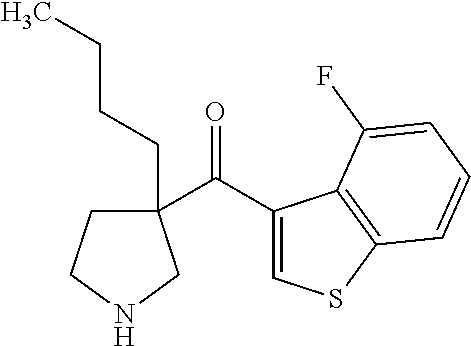 |
(3-Butyl-pyrrolidin-3-yl)-(4-fluoro- benzo[b]thiophen-3-yl)-methanone | 306 |
| 432 |
 |
(3-Butyl-pyrrolidin-3-yl)-(7-fluoro- benzo[b]thiophen-3-yl)-methanone | 306 |
| 433 |
 |
[3-(3,3-Dimethyl-butyl)-pyrrolidin- 3-yl]-(7-fluoro-benzo[b]thiophen- 3-yl)-methanone | 334 |
| 434 |
 |
(7-Fluoro-benzo[b]thiophen-3-yl)- (3-propyl-pyrrolidin-3-yl)- methanone | 292 |
| 435 |
 |
(1H-Indol-2-yl)-(3-propyl- pyrrolidin-3-yl)-methanone | 257 |
| 436 |
 |
[3-(3,3-Dimethyl-butyl)-pyrrolidin- 3-yl]-(1H-indol-2-yl)-methanone | 299 |
| 437 |
 |
(1H-Indol-2-yl)-(4-propyl- piperidin-4-yl)-methanone | 271 |
| 438 |
 |
(1-Benzenesulfonyl-1H-indol-2- yl)-[4-(3,3-dimethyl-butyl)- piperidin-4-yl]-methanone | 439 |
| 439 |
 |
[3-(3,3-Dimethyl-butyl)-pyrrolidin- 3-yl]-(5-fluoro-1H-indol-2-yl)- methanone | 317 |
| 440 |
 |
(1H-Indol-2-yl)-[4-(3-methyl- butyl)-piperidin-4-yl]-methanone | 299 |
| 441 |
 |
(4-Butyl-piperidin-4-yl)-(1H-indol- 2-yl)-methanone | 285 |
| 442 |
 |
[4-(3,3-Dimethyl-butyl)-piperidin- 4-yl]-(1H-indol-2-yl)-methanone | 313 |
| 443 |
 |
(1-Benzenesulfonyl-1H-indol-2- yl)-(4-isobutyl-piperidin-4-yl)- methanone | 425 |
| 444 |
 |
[4-(3-Methyl-butyl)-piperidin-4- yl]-(1-methyl-1H-indol-2-yl)- methanone | 313 |
| 445 |
 |
[4-(3,3-Dimethyl-butyl)-piperidin- 4-yl]-(1-methyl-1H-indol-2-yl)- methanone | 327 |
| 446 |
 |
(1H-Indol-2-yl)-(4-isobutyl- piperidin-4-yl)-methanone | 299 |
| 447 |
 |
(2-Butyl-pyrrolidin-2-yl)-(1H- indol-2-yl)-methanone | 271 |
| 448 |
 |
(4-Chloro-1H-indol-2-yl)-[3-(3,3- dimethyl-butyl)-pyrrolidin-3-yl]- methanone | 333 |
| 449 |
 |
(5-Fluoro-1H-indol-2-yl)-(4- propyl-piperidin-4-yl)-methanone | 289 |
| 450 |
 |
(6-Fluoro-1H-indol-2-yl)-(4- propyl-piperidin-4-yl)-methanone | 289 |
| 451 |
 |
(7-Fluoro-1H-indol-2-yl)-(4- propyl-piperidin-4-yl)-methanone | 289 |
| 452 |
 |
(4-Fluoro-1H-indol-2-yl)-(4- propyl-piperidin-4-yl)-methanone | 289 |
| 453 |
 |
[3-(3,3-Dimethyl-butyl)-pyrrolidin- 3-yl]-(1H-pyrrolo[3,2-b]pyridin-2- yl)-methanone | 300 |
| 454 |
 |
(1H-Indol-2-yl)-((1R,2R,5R)-2- propyl-8-aza-bicyclo[3.2.1]oct-2- yl)-methanone | 297 |
| 455 |
 |
[3-(3,3-Dimethyl-butyl)-pyrrolidin- 3-yl]-quinolin-2-yl-methanone | 311 |
| 456 |
 |
(4-Propyl-piperidin-4-yl)-quinolin- 2-yl-methanone | 283 |
| 457 |
 |
(5-Chloro-quinolin-2-yl)-[3-(3,3- dimethyl-butyl)-pyrrolidin-3-yl]- methanone | 345 |
| 458 |
 |
[4-(3,3-Dimethyl-butyl)-piperidin- 4-yl]-(4-methyl-quinolin-2-yl)- methanone | 339 |
| 459 |
 |
[3-(3,3-Dimethyl-butyl)-pyrrolidin- 3-yl]-(4-methyl-quinolin-2-yl)- methanone | 345 |
| 460 |
 |
(3,4-Dichloro-phenyl)-(3-propyl- azetidin-3-yl)-methanone | 59.0-60.0 |
| 461 |
 |
Benzo[d]isothiazol-3-yl-(3-butyl- pyrrolidin-3-yl)-methanone | 289 |
| 462 |
 |
Benzothiazol-2-yl-(3-propyl- pyrrolidin-3-yl)-methanone | 275 |
| 463 |
 |
(2-Amino-3,4-dichloro-phenyl)- ((S)-3-ethyl-pyrrolidin-3-yl)- methanone | 288 |
| 464 |
 |
(4-Amino-3-chloro-phenyl)-[((S)-3- (3,3-dimethyl-butyl)-pyrrolidin-3- yl]-methanone | 226.2-232.5 |
| 465 |
 |
(4-Amino-3-chloro-phenyl)-[(R)-3- (3,3-dimethyl-butyl)-pyrrolidin-3- yl]-methanone | 223.3-231.0 |
| 466 |
 |
(2-Amino-3,4-dichloro-phenyl)- ((R)-3-ethyl-pyrrolidin-3-yl)- methanone | 288 |
| 467 |
 |
(4-Amino-3-chloro-phenyl)-[(S)-3- (3-methyl-butyl)-pyrrolidin-3-yl]- methanone | 193.1-199.2 |
| 468 |
 |
(4-Amino-3-chloro-phenyl)-[(R)-3- (3-methyl-butyl)-pyrrolidin-3-yl]- methanone | 295 |
| 469 |
 |
(3-Chloro-4-methyl-phenyl)-[4- (3,3-dimethyl-butyl)-piperidin-4- yl]-methanone | 237.6-238.6 |
| 470 |
 |
(4-Chloro-3-methyl-phenyl)-[4- (3,3-dimethyl-butyl)-piperidin-4- yl]-methanone | 223.0-225.2 |
| 471 |
 |
(3-Chloro-4-dimethylamino- phenyl)-[4-(3,3-dimethyl-butyl)- piperidin-4-yl]-methanone | 351 |
| 472 |
 |
(4-Chloro-3-phenoxy-phenyl)-[4- (3,3-dimethyl-butyl)-piperidin-4- yl]-methanone | 400 |
| 473 |
 |
[4-Chloro-5-(4-fluoro-phenyl)- thiophen-2-yl]-(3-propyl- pyrrolidin-3-yl)-methanone | 60.0-71.0 |
| 474 |
 |
(3-Methyl-benzo[b]thiophen-2-yl)- (3-propyl-pyrrolidin-3-yl)- methanone | 288 |
| 475 |
 |
(3-Chloro-benzo[b]thiophen-2-yl)- (3-propyl-pyrrolidin-3-yl)- methanone | 308 |
| 476 |
 |
(3,4-Dichloro-phenyl)-[3-(1- methyl-cyclopropylmethyl)- pyrrolidin-3-yl]-methanone | 313 |
| 477 |
 |
(2,4-Dichloro-phenyl)-(3-propyl- pyrrolidin-3-yl)-methanone | 287 |
| 478 |
 |
(3-Cyclopentylmethyl-pyrrolidin- 3-yl)-(3,4-dichloro-phenyl)- methanone | 327 |
| 479 |
 |
(4-Chloro-3-phenoxy-phenyl)-[3- (3,3-dimethyl-butyl)-pyrrolidin-3- yl]-methanone | 386 |
| 480 |
 |
(3,4-Dichloro-phenyl)-[3-(2- methoxy-2-methyl-propyl)- pyrrolidin-3-yl]-methanone | 331 |
Compounds of the present invention can be made by a variety of methods depicted in the illustrative synthetic reaction schemes shown and described below.
The starting materials and reagents used in preparing these compounds generally are either available from commercial suppliers, such as Aldrich Chemical Co., or are prepared by methods known to those skilled in the art following procedures set forth in references such as Fieser and Fieser's Reagents for Organic Synthesis; Wiley & Sons: New York, 1991, Volumes 1-15; Rodd's Chemistry of Carbon Compounds, Elsevier Science Publishers, 1989, Volumes 1-5 and Supplementals; and Organic Reactions, Wiley & Sons: New York, 1991, Volumes 1-40. The following synthetic reaction schemes are merely illustrative of some methods by which the compounds of the present invention can be synthesized, and various modifications to these synthetic reaction schemes can be made and will be suggested to one skilled in the art having referred to the disclosure contained in this Application.
The starting materials and the intermediates of the synthetic reaction schemes can be isolated and purified if desired using conventional techniques, including but not limited to, filtration, distillation, crystallization, chromatography, and the like. Such materials can be characterized using conventional means, including physical constants and spectral data.
Unless specified to the contrary, the reactions described herein preferably are conducted under an inert atmosphere at atmospheric pressure at a reaction temperature range of from about −78° C. to about 150° C., more preferably from about 0° C. to about 125° C., and most preferably and conveniently at about room (or ambient) temperature, e.g., about 20° C.
Scheme A below illustrates one synthetic procedure usable to prepare compounds of the invention, wherein X is halo or other leaving group and may be the same or different in each occurrence, PG is a protecting group, and m, n, Ar and R1 are as defined herein.
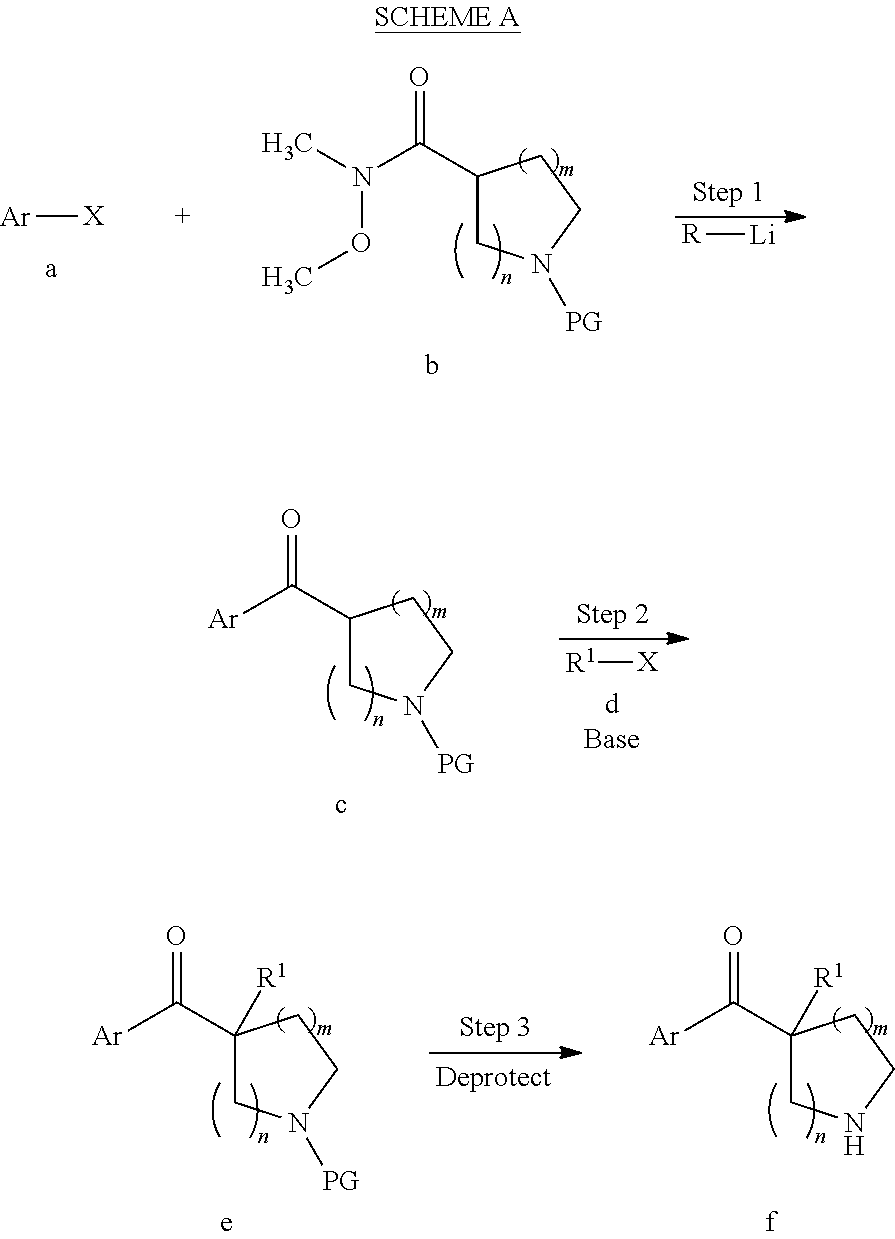
In step 1 of Scheme A, an aryl compound a, such as an aryl halide, is reacted with an N-protected heterocyclic amide compound b in the presence of strong base, such as alkyl lithium reagent, to afford aryl heterocyclic ketone c. The values of m an n in compound b may be selected to provide pyrrolidinyl, piperidinyl, azetidinyl, azepinyl, or like heterocyclic moieties. In step 2 an alkylation is carried out by reacting aryl heterocyclic ketone c with alkylating agent d, to afford compound e. Alkylating agent d may comprise, for example, a benzyl halide, alkenyl halide or other alkylating reagent. The compound e may then be deprotected in step 3 to afford compound f, which is a compound of formula I in accordance with the invention.
Numerous variations on the procedures of Scheme A are possible and will be readily apparent to those skilled in the art. For example, N-alkylation of compound f can provide compounds where R2 is alkyl. Where the R1 group introduced in step 2 is alkenyl or alkynyl, a hydrogenation reaction may be carried out to change the R1 to alkyl.
Scheme B shows another synthetic route to the compounds of the invention, wherein R is lower alkyl, PG is a protecting group, X is a leaving group, and m, n, Ar and R1 are as defined herein.

In step 1 of Scheme B, cyclic amine carboxylic acid ester g is treated with alkylating agent h in the presence of strong base, such as an alkyl lithium reagent, to provide alkylated cyclic amine i. The cyclic amine g may be pyrrolidinyl, piperidinyl, azetidinyl, azepinyl, or the like according to the values of m and n, as noted above. In step 2 the ester group of compound i is reduced to afford the primary alcohol compound i. The reduction of step 2 may be achieved, for example, using LiAlH4. Alcohol compound i then undergoes a partial oxidation in step 4 to yield aldehyde compound k. The oxidation of step 3 may be carried out, for example, using Dess Martin Periodinane or a chromate reagent. An alkylation is carried out in step 4 by reaction of aldehyde compound k with aryl magnesium bromide m. to afford aryl alcohol compound n. In step 5 alcohol n is oxidized to the corresponding aryl ketone compound e. The oxidation may be carried out, for example, using MnO2, Swern's reagent, or like oxidizing agent. In step 6 the aryl ketone compound e is deprotected to provide compound f which is a compound of formula I in accordance with the invention.
Many variations on the procedure of Scheme B are possible and are considered to be within the scope of this invention. For example, an aryl lithium reagent may be used in step 4. Specific details for producing compounds of the invention are described in the Examples section below.
The compounds of the invention are usable for the treatment of diseases or conditions associated with serotonin neurotransmission, norepinephrine neuortransmission and/or dopamine neurotransmission. Such diseases and conditions include depressive and anxiolytic disorders, as well as schizophrenia and other psychoses, dyskinesias, drug addition, cognitive disorders, Alzheimer's disease, attention deficit disorders such as ADHD, obsessive-compulsive behaviour, panic attacks, social phobias, eating disorders such as obesity, anorexia, bulimia and “binge-eating”, stress, hyperglycaemia, hyperlipidaemia, non-insulin-dependent diabetes, seizure disorders such as epilepsy, and treatment of conditions associated with neurological damage resulting from stroke, brain trauma, cerebral ischaemia, head injury, and haemorrhage.
The compounds of the invention are also usable for treatment of disorders and disease states of the urinary tract such as stress incontinence, urge incontinence, benign prostatic hypertrophy (BPH), prostatitis, detrusor hyperreflexia, outlet obstruction, urinary frequency, nocturia, urinary urgency, overactive bladder, pelvic hypersensitivity, urethritis, prostatodynia, cystitis, idiophatic bladder hypersensitivity.
The compounds of the invention also possess anti-inflammatory and/or analgesic properties in vivo, and accordingly, are expected to find utility in the treatment of disease states associated with pain conditions from a wide variety of causes, including, but not limited to, neuropathic pain, inflammatory pain, surgical pain, visceral pain, dental pain, premenstrual pain, central pain, pain due to burns, migraine or cluster headaches, nerve injury, neuritis, neuralgias, poisoning, ischemic injury, interstitial cystitis, cancer pain, viral, parasitic or bacterial infection, post-traumatic injuries (including fractures and sports injuries), and pain associated with functional bowel disorders such as irritable bowel syndrome.
Compounds of the invention are also useful for treatment of arthritis, including but not limited to, rheumatoid arthritis, spondyloarthropathies, gouty arthritis, osteoarthritis, systemic lupus erythematosus and juvenile arthritis, osteoarthritis, gouty arthritis and other arthritic conditions.
The invention includes pharmaceutical compositions comprising at least one compound of the present invention, or an individual isomer, racemic or non-racemic mixture of isomers or a pharmaceutically acceptable salt or solvate thereof, together with at least one pharmaceutically acceptable carrier, and optionally other therapeutic and/or prophylactic ingredients.
In general, the compounds of the invention will be administered in a therapeutically effective amount by any of the accepted modes of administration for agents that serve similar utilities. Suitable dosage ranges are typically 1-500 mg daily, preferably 1-100 mg daily, and most preferably 1-30 mg daily, depending upon numerous factors such as the severity of the disease to be treated, the age and relative health of the subject, the potency of the compound used, the route and form of administration, the indication towards which the administration is directed, and the preferences and experience of the medical practitioner involved. One of ordinary skill in the art of treating such diseases will be able, without undue experimentation and in reliance upon personal knowledge and the disclosure of this Application, to ascertain a therapeutically effective amount of the compounds of the present invention for a given disease.
Compounds of the invention may be administered as pharmaceutical formulations including those suitable for oral (including buccal and sub-lingual), rectal, nasal, topical, pulmonary, vaginal, or parenteral (including intramuscular, intraarterial, intrathecal, subcutaneous and intravenous) administration or in a form suitable for administration by inhalation or insufflation. The preferred manner of administration is generally oral using a convenient daily dosage regimen which can be adjusted according to the degree of affliction.
A compound or compounds of the invention, together with one or more conventional adjuvants, carriers, or diluents, may be placed into the form of pharmaceutical compositions and unit dosages. The pharmaceutical compositions and unit dosage forms may be comprised of conventional ingredients in conventional proportions, with or without additional active compounds or principles, and the unit dosage forms may contain any suitable effective amount of the active ingredient commensurate with the intended daily dosage range to be employed. The pharmaceutical compositions may be employed as solids, such as tablets or filled capsules, semisolids, powders, sustained release formulations, or liquids such as solutions, suspensions, emulsions, elixirs, or filled capsules for oral use; or in the form of suppositories for rectal or vaginal administration; or in the form of sterile injectable solutions for parenteral use. Formulations containing about one (1) milligram of active ingredient or, more broadly, about 0.01 to about one hundred (100) milligrams, per tablet, are accordingly suitable representative unit dosage forms.
The compounds of the invention may be formulated in a wide variety of oral administration dosage forms. The pharmaceutical compositions and dosage forms may comprise a compound or compounds of the present invention or pharmaceutically acceptable salts thereof as the active component. The pharmaceutically acceptable carriers may be either solid or liquid. Solid form preparations include powders, tablets, pills, capsules, cachets, suppositories, and dispersible granules. A solid carrier may be one or more substances which may also act as diluents, flavouring agents, solubilizers, lubricants, suspending agents, binders, preservatives, tablet disintegrating agents, or an encapsulating material. In powders, the carrier generally is a finely divided solid which is a mixture with the finely divided active component. In tablets, the active component generally is mixed with the carrier having the necessary binding capacity in suitable proportions and compacted in the shape and size desired. The powders and tablets preferably contain from about one (1) to about seventy (70) percent of the active compound. Suitable carriers include but are not limited to magnesium carbonate, magnesium stearate, talc, sugar, lactose, pectin, dextrin, starch, gelatine, tragacanth, methylcellulose, sodium carboxymethylcellulose, a low melting wax, cocoa butter, and the like. The term “preparation” is intended to include the formulation of the active compound with encapsulating material as carrier, providing a capsule in which the active component, with or without carriers, is surrounded by a carrier, which is in association with it. Similarly, cachets and lozenges are included. Tablets, powders, capsules, pills, cachets, and lozenges may be as solid forms suitable for oral administration.
Other forms suitable for oral administration include liquid form preparations including emulsions, syrups, elixirs, aqueous solutions, aqueous suspensions, or solid form preparations which are intended to be converted shortly before use to liquid form preparations. Emulsions may be prepared in solutions, for example, in aqueous propylene glycol solutions or may contain emulsifying agents, for example, such as lecithin, sorbitan monooleate, or acacia. Aqueous solutions can be prepared by dissolving the active component in water and adding suitable colorants, flavors, stabilizers, and thickening agents. Aqueous suspensions can be prepared by dispersing the finely divided active component in water with viscous material, such as natural or synthetic gums, resins, methylcellulose, sodium carboxymethylcellulose, and other well known suspending agents. Solid form preparations include solutions, suspensions, and emulsions, and may contain, in addition to the active component, colorants, flavors, stabilizers, buffers, artificial and natural sweeteners, dispersants, thickeners, solubilizing agents, and the like.
The compounds of the invention may be formulated for parenteral administration (e.g., by injection, for example bolus injection or continuous infusion) and may be presented in unit dose form in ampoules, pre-filled syringes, small volume infusion or in multi-dose containers with an added preservative. The compositions may take such forms as suspensions, solutions, or emulsions in oily or aqueous vehicles, for example solutions in aqueous polyethylene glycol. Examples of oily or nonaqueous carriers, diluents, solvents or vehicles include propylene glycol, polyethylene glycol, vegetable oils (e.g., olive oil), and injectable organic esters (e.g., ethyl oleate), and may contain formulatory agents such as preserving, wetting, emulsifying or suspending, stabilizing and/or dispersing agents. Alternatively, the active ingredient may be in powder form, obtained by aseptic isolation of sterile solid or by lyophilization from solution for constitution before use with a suitable vehicle, e.g., sterile, pyrogen-free water.
The compounds of the invention may be formulated for topical administration to the epidermis as ointments, creams or lotions, or as a transdermal patch. Ointments and creams may, for example, be formulated with an aqueous or oily base with the addition of suitable thickening and/or gelling agents. Lotions may be formulated with an aqueous or oily base and will in general also containing one or more emulsifying agents, stabilizing agents, dispersing agents, suspending agents, thickening agents, or coloring agents. Formulations suitable for topical administration in the mouth include lozenges comprising active agents in a flavored base, usually sucrose and acacia or tragacanth; pastilles comprising the active ingredient in an inert base such as gelatine and glycerine or sucrose and acacia; and mouthwashes comprising the active ingredient in a suitable liquid carrier.
The compounds of the invention may be formulated for administration as suppositories. A low melting wax, such as a mixture of fatty acid glycerides or cocoa butter is first melted and the active component is dispersed homogeneously, for example, by stirring. The molten homogeneous mixture is then poured into convenient sized molds, allowed to cool, and to solidify.
The compounds of the invention may be formulated for vaginal administration. Pessaries, tampons, creams, gels, pastes, foams or sprays containing in addition to the active ingredient such carriers as are known in the art to be appropriate.
The subject compounds may be formulated for nasal administration. The solutions or suspensions are applied directly to the nasal cavity by conventional means, for example, with a dropper, pipette or spray. The formulations may be provided in a single or multidose form. In the latter case of a dropper or pipette, this may be achieved by the patient administering an appropriate, predetermined volume of the solution or suspension. In the case of a spray, this may be achieved for example by means of a metering atomizing spray pump.
The compounds of the invention may be formulated for aerosol administration, particularly to the respiratory tract and including intranasal administration. The compound will generally have a small particle size for example of the order of five (5) microns or less. Such a particle size may be obtained by means known in the art, for example by micronization. The active ingredient is provided in a pressurized pack with a suitable propellant such as a chlorofluorocarbon (CFC), for example, dichlorodifluoromethane, trichlorofluoromethane, or dichlorotetrafluoroethane, or carbon dioxide or other suitable gas. The aerosol may conveniently also contain a surfactant such as lecithin. The dose of drug may be controlled by a metered valve. Alternatively the active ingredients may be provided in a form of a dry powder, for example a powder mix of the compound in a suitable powder base such as lactose, starch, starch derivatives such as hydroxypropylmethyl cellulose and polyvinylpyrrolidine (PVP). The powder carrier will form a gel in the nasal cavity. The powder composition may be presented in unit dose form for example in capsules or cartridges of e.g., gelatine or blister packs from which the powder may be administered by means of an inhaler.
When desired, formulations can be prepared with enteric coatings adapted for sustained or controlled release administration of the active ingredient. For example, the compounds of the present invention can be formulated in transdermal or subcutaneous drug delivery devices. These delivery systems are advantageous when sustained release of the compound is necessary and when patient compliance with a treatment regimen is crucial. Compounds in transdermal delivery systems are frequently attached to a skin-adhesive solid support. The compound of interest can also be combined with a penetration enhancer, e.g., Azone (1-dodecylazacycloheptan-2-one). Sustained release delivery systems are inserted subcutaneously into the subdermal layer by surgery or injection. The subdermal implants encapsulate the compound in a lipid soluble membrane, e.g., silicone rubber, or a biodegradable polymer, e.g., polylactic acid.
The pharmaceutical preparations are preferably in unit dosage forms. In such form, the preparation is subdivided into unit doses containing appropriate quantities of the active component. The unit dosage form can be a packaged preparation, the package containing discrete quantities of preparation, such as packeted tablets, capsules, and powders in vials or ampoules. Also, the unit dosage form can be a capsule, tablet, cachet, or lozenge itself, or it can be the appropriate number of any of these in packaged form.
Other suitable pharmaceutical carriers and their formulations are described in Remington: The Science and Practice of Pharmacy 1995, edited by E. W. Martin, Mack Publishing Company, 19th edition, Easton, Pa. Representative pharmaceutical formulations containing a compound of the present invention are described below.
The following preparations and examples are given to enable those skilled in the art to more clearly understand and to practice the present invention. They should not be considered as limiting the scope of the invention, but merely as being illustrative and representative thereof. The following abbreviations may be used in the Examples.
| ABBREVIATIONS |
| AcOH | Acetic acid |
| Bn | Benzyl |
| (BOC)2O | di-tert-Butyl dicarbonate |
| t-BuLi | tert-Butyllithium |
| t-BuOH | tert-Butyl alcohol |
| m-CPBA | 3-Chloroperoxybenzoic acid |
| DCM | Dichloromethane/Methylene chloride |
| DEA | Diethylamine |
| DIPEA | Diisopropylethylamine |
| DIBALH | Diisobutylaluminum hydride |
| DMF | N,N-Dimethylformamide |
| DMP | Dess Martin Periodinane (acetic acid 1,1-diacetoxy-3-oxo- |
| 1lambda*5*-ioda-2-oxa-indan-l-yl ester) | |
| Dppf | 1,1′-Bis(diphenylphosphino)ferrocene |
| EDC | 1-(3-Dimethylaminopropyl)-3-ethylcarbodiimide |
| hydrochloride | |
| EtOAc | Ethyl acetate |
| HPLC | High pressure liquid chromatography |
| HOBt | 1-Hydroxybenzotriazole |
| LAH | Lithium aluminum hydride |
| LHMDS | Lithium bis(trimethylsilyl)amide |
| MeOH | Methanol |
| MsCl | Methanesulfonyl chloride |
| NBS | N-bromosuccinimide |
| PFBSF | Perfluorobutanesulfonyl fluoride |
| TBAF | Tetrabutylammonium fluoride |
| TBAHS | Tetrabutyl ammonium hydrogen sulfate |
| TBDMS | tert-Butyldimethylsilyl |
| TMSI | Iodotrimethylsilane |
| TEA | Triethylamine |
| TIPS | Triisopropylsilyl |
| TFA | Trifluoroacetic acid |
| THF | Tetrahydrofuran |
| TMAF | Tetramethylammonium fluoride |
| TMS | trimethylsilyl |

Lithium bis(trimethylsilyl)amide (1.0 M in THF, 28 mL, 28 mmol) was slowly added to a solution of 5-bromoindole (5.00 g, 25.5 mmol) in THF (60 mL) at −78° C., under nitrogen atmosphere. The reaction mixture was stirred at −78° C. for 20 minutes, then triisopropylsilylchloride (5.7 mL, 26.8 mmol) was added. The resulting mixture was stirred at −78° C. for 20 minutes, then warmed to room temperature over a period of 1 hour. The reaction was quenched by addition of a saturated aqueous solution of NH4Cl, diluted with water, and the resulting mixture was extracted with EtOAc. The organic layer was separated, dried over MgSO4, filtered and evaporated under reduced pressure to give a crude oil that was purified by flash chromatography (hexane 100%) providing 8.94 g (99% yield) of 5-bromo-1-triisopropylsilanyl-1H-indole as a colorless oil.
In a similar manner, using the appropriate starting material, the following compounds were prepared:
5-Bromo-1-triisopropylsilanyl-1H-indazole (86% yield, yellow solid);
5-Bromo-1-triisopropylsilanyl-1H-pyrrolo[2,3-b]pyridine (87% yield, yellow solid);
5-Bromo-2-methyl-1-triisopropylsilanyl-1H-indole;
5-Bromo-1-triisopropylsilanyl-2,3-dihydro-1H-indole (100% yield, white solid);
5-Bromo-1-(tert-butyl-dimethyl-silanyl)-1H-indole; and
5-Bromo-7-fluoro-1-triisopropylsilanyl-1H-indole.
The synthesis of (R)-2-benzyl-pyrrolidine-1,2-dicarboxylic acid 1-tert-butyl ester 2-methyl ester was carried out according to the process shown in Scheme C.

A mixture of (R)-2-benzyl-pyrrolidine-2-carboxylic acid (2.07 g, 10.1 mmol) and tetramethylammonium hydroxide pentahydrate (1.83 g, 10.1 mmol) in acetonitrile (100 mL) was stirred under nitrogen for 90 minutes, then (Boc)2O (3.31 g, 15.2 mmol) was added. After 48 hours a second portion of (Boc)2O (1.10 g, 5.0 mmol) was added. After 24 hours the reaction mixture was concentrated in vacuo, then partitioned between ether (100 mL) and water (50 mL). The aqueous phase was washed with ether (50 mL) then acidified to pH 4 with 10% aqueous citric acid (20 mL). The resultant solution was extracted with EtOAc and the combined extracts were washed with brine (30 mL), dried (MgSO4), filtered and concentrated in vacuo to yield (R)-2-benzyl-pyrrolidine-1,2-dicarboxylic acid 1-tert-butyl ester (1.26 g, 4.13 mmol, 41%) as a foam.
To a stirred solution of (R)-2-benzyl-pyrrolidine-1,2-dicarboxylic acid 1-tert-butyl ester (1.23 g, 4.0 mmol) in THF (10 mL) and methanol (10 mL) at 0° C. under nitrogen was added TMS-diazomethane (5.0 mL of a 2.0 M solution in hexanes, 5.0 mmol) dropwise. The reaction mixture was warmed to ambient temperature then concentrated in vacuo to an oil (1.36 g). Purification by chromatography (silica, 5-15% EtOAc in hexanes) gave (R)-2-benzyl-pyrrolidine-1,2-dicarboxylic acid 1-tert-butyl ester 2-methyl ester (1.03 g, 3.23 mmol, 81%) as an oil.
The synthesis of 2-butyl-2-formyl-pyrrolidine-1-carboxylic acid tert-butyl ester was carried out according to the process shown in Scheme D.

To a stirred solution of pyrrolidine-1,2-dicarboxylic acid 1-tert-butyl ester 2-methyl ester (3.00 g, 13.1 mmol) in THF (50 mL) at −78° C. and under nitrogen was added LHMDS (14.4 mL of 1.0 M solution in THF, 14.4 mmol) dropwise. After 30 minutes, a solution of 1-iodobutane (2.23 mL, 19.7 mmol) in THF (1 mL) was added dropwise. The reaction mixture was stirred for 30 minutes at −78° C., warmed to ambient temperature over 90 minutes, then quenched by the addition of saturated aqueous NH4Cl and extracted with EtOAc. The combined extracts were washed with saturated aqueous NaHCO3 and brine then dried (MgSO4), filtered and concentrated in vacuo to a yellow oil (4.5 g). Purification by chromatography (silica, 10% EtOAc in hexanes) gave 2-butyl-pyrrolidine-1,2-dicarboxylic acid 1-tert-butyl ester 2-methyl ester (2.57 g, 9.01 mmol, 69%) as a clear colourless oil.
Utilizing the above procedure and the appropriate starting materials the following were similarly prepared:
2-Propyl-pyrrolidine-1,2-dicarboxylic acid 1-tert-butyl ester 2-methyl ester (colourless oil, 85%) using 1-iodopropane;
2-Ethoxymethyl-pyrrolidine-1,2-dicarboxylic acid 1-tert-butyl ester 2-methyl ester (colourless oil, 76%) using chloromethoxy-ethane;
2-(3,3-Difluoro-allyl)-pyrrolidine-1,2-dicarboxylic acid 1-tert-butyl ester 2-methyl ester (colourless oil, 11%) using 1,1,1-trifluoro-3-iodopropane;
2-Isopropoxymethyl-pyrrolidine-1,2-dicarboxylic acid 1-tert-butyl ester 2-ethyl ester (colourless oil, 49%) from chloromethoxyisopropyl ether and pyrrolidine-1,2-dicarboxylic acid 1-tert-butyl ester 2-ethyl ester;
2-Isobutyl-pyrrolidine-1,2-dicarboxylic acid 1-tert-butyl ester 2-ethyl ester (colourless oil, 67%) from 1-iodo-2-methylpropane and pyrrolidine-1,2-dicarboxylic acid 1-tert-butyl ester 2-ethyl ester;
2-Cyclopropylmethyl-pyrrolidine-1,2-dicarboxylic acid 1-tert-butyl ester 2-ethyl ester (colourless oil, 50%) from cyclopropylmethyl bromide and pyrrolidine-1,2-dicarboxylic acid 1-tert-butyl ester 2-ethyl ester;
5,5-Dimethyl-2-propyl-pyrrolidine-1,2-dicarboxylic acid 1-tert-butyl ester 2-methyl ester, (colourless oil, 76%) from 1-iodopropane and 5,5-Dimethyl-pyrrolidine-1,2-dicarboxylic acid 1-tert-butyl ester 2-methyl ester:
(2R,4R)-4-(tert-Butyl-dimethyl-silanyloxy)-2-propyl-pyrrolidine-1,2-dicarboxylic acid 1-tert-butyl ester 2-methyl ester (colourless oil, 26%) and (2S,4R)-4-(tert-butyl-dimethyl-silanyloxy)-2-propyl-pyrrolidine-1,2-dicarboxylic acid 1-tert-butyl ester 2-methyl ester colourless oil, 30%) from 1-iodopropane and (2S,4R)-4-(tert-Butyl-dimethyl-silanyloxy)-pyrrolidine-1,2-dicarboxylic acid 1-tert-butyl ester 2-methyl ester;
2-Propyl-azetidine-1,2-dicarboxylic acid 1-tert-butyl ester 2-methyl ester (colourless oil, 80%) from 1-iodopropane and azetidine-1,2-dicarboxylic acid 1-tert-butyl ester 2-methyl ester;
2-Propyl-piperidine-1,2-dicarboxylic acid 1-tert-butyl ester 2-ethyl ester, (colourless oil, 38%) from 1-iodopropane and piperidine-1,2-dicarboxylic acid 1-tert-butyl ester 2-ethyl ester; and
2-(Tetrahydro-pyran-4-ylmethyl)-pyrrolidine-1,2-dicarboxylic acid 1-tert-butyl ester 2-methyl ester.
To a stirred solution of 2-butyl-pyrrolidine-1,2-dicarboxylic acid 1-tert-butyl ester 2-methyl ester (0.842 g, 2.95 mmol) in THF (30 mL) at 0° C. under nitrogen was added LiAlH4 (2.95 mL of a 1.0 M solution in THF, 2.95 mmol) dropwise. After 15 min the reaction mixture was quenched by the addition of sodium sulfate decahydrate (2.5 g) then filtered. The filter cake was washed with DCM (50 mL) then the combined filtrates were concentrated in vacuo to give 2-butyl-2-hydroxymethyl-pyrrolidine-1-carboxylic acid tert-butyl ester (0.763 g) as a clear, colourless oil that was used directly without further purification.
Utilizing the above procedure and the appropriate starting materials the following were similarly prepared:
2-Hydroxymethyl-2-propyl-pyrrolidine-1-carboxylic acid tert-butyl ester (yellow oil, 94%);
2-Hydroxymethyl-2-isopropoxymethyl-pyrrolidine-1-carboxylic acid tert-butyl ester (colourless oil, 89%);
2-Hydroxymethyl-2-isobutyl-pyrrolidine-1-carboxylic acid tert-butyl ester, (colourless oil, 100%);
2-Cyclopropylmethyl-2-hydroxymethyl-pyrrolidine-1-carboxylic acid tert-butyl ester, colourless oil, 100%);
2-Hydroxymethyl-5,5-dimethyl-2-propyl-pyrrolidine-1-carboxylic acid tert-butyl ester, (colourless oil, 100%);
(2S,4R)-2-Hydroxymethyl-2-propyl-4-(1,1,2,2-tetramethyl-propoxy)-pyrrolidine-1-carboxylic acid tert-butyl ester, (colourless oil, 100%) and 2-Hydroxymethyl-2-(tetrahydro-pyran-4-ylmethyl)-pyrrolidine-1-carboxylic acid tert-butyl ester.
To a stirred solution of 2-2-butyl-2-hydroxymethyl-pyrrolidine-1-carboxylic acid tert-butyl ester (0.763 g, ca. 2.95 mmol) in DCM (30 mL) at 0° C. under nitrogen was added DMP (2.50 g, 5.90 mmol) in a single portion then the reaction mixture was warmed to ambient temperature. After 14 h the reaction mixture was diluted with DCM (70 mL), washed with 1 N NaOH (2×30 mL) and brine (30 mL) then dried (MgSO4), filtered and concentrated in vacuo. Purification by chromatography (silica, 10-20% EtOAc in hexanes) gave 2-butyl-2-formyl-pyrrolidine-1-carboxylic acid tert-butyl ester (0.359 g, 1.41 mmol, 48%) as a pale yellow oil.
Utilizing the above procedure and the appropriate starting materials the following were similarly prepared:
2-Formyl-2-propyl-pyrrolidine-1-carboxylic acid tert-butyl ester (colourless oil, 92%);
2-Formyl-2-isopropoxymethyl-pyrrolidine-1-carboxylic acid tert-butyl ester (colourless oil, 77%);
2-Formyl-2-isobutyl-pyrrolidine-1-carboxylic acid tert-butyl ester, (colourless oil, 79%);
2-Cyclopropylmethyl-2-formyl-pyrrolidine-1-carboxylic acid tert-butyl ester, (yellow oil, 85%);
2-Formyl-5,5-dimethyl-2-propyl-pyrrolidine-1-carboxylic acid tert-butyl ester, (colourless oil, 85%):
(2S,4R)-4-(tert-Butyl-dimethyl-silanyloxy)-2-formyl-2-propyl-pyrrolidine-1-carboxylic acid tert-butyl ester, (colourless oil, 63%); and
2-Formyl-2-(tetrahydro-pyran-4-ylmethyl)-pyrrolidine-1-carboxylic acid tert-butyl ester.
The synthetic procedure for this preparation is outlined in Scheme E below.

To a stirred solution of 2-ethoxymethyl-pyrrolidine-1,2-dicarboxylic acid 1-tert-butyl ester 2-methyl ester (1.00 g, 3.48 mmol, prepared using the procedure of preparation 3 step 1) in THF (40 mL) at −78° C. under nitrogen was added DIBALH (4.09 mL of 1.7 M solution in PhCH3, 6.96 mmol) dropwise over 15 minutes such that the internal temperature did not exceed −75° C. After 4.5 hours the reaction mixture was quenched by addition of sodium sulfate decahydrate (4 g) and MeOH (0.5 mL) and then warmed to ambient temperature. The reaction mixture was diluted with EtOAc (50 mL) and filtered. The filter cake was washed with EtOAc (200 mL), and the combined filtrates were concentrated in vacuo to a colourless oil. Purification by chromatography (silica, 10-30% EtOAc in hexanes) gave 2-ethoxymethyl-2-formyl-pyrrolidine-1-carboxylic acid tert-butyl ester (0.528 g, 2.05 mmol, 59%) as a clear, colourless oil.
Utilizing the above procedure and the appropriate starting materials the following were similarly prepared:
2-(3,3-Difluoro-allyl)-2-formyl-pyrrolidine-1-carboxylic acid tert-butyl ester (colourless oil, 100%);
(2R,4R)-4-(tert-Butyl-dimethyl-silanyloxy)-2-formyl-2-propyl-pyrrolidine-1-carboxylic acid tert-butyl ester, (colourless oil, 36%);
2-Formyl-2-propyl-azetidine-1-carboxylic acid tert-butyl ester, (colourless oil, 53%); and
2-Hydroxymethyl-2-propyl-piperidine-1-carboxylic acid tert-butyl ester, (colourless oil, 72%).
The synthetic procedure for this preparation is outlined in Scheme F below.

To a solution of potassium hexamethyldisilazide (29.1 g, 146 mmol) in THF (200 mL) at −78° C. was added ethyl N-Boc-piperidine-4-carboxylate (25 g, 97 mmol). The reaction mixture was stirred at −78° C. for 30 minutes, then 1-iodopropane (14.2 mL, 146 mmol) was slowly added. The reaction mixture was stirred at −78° C. for a further 20 minutes, then warmed to room temperature and stirred for 1 hour. The reaction was quenched by addition of saturated aqueous NH4Cl solution and extracted with EtOAc. The combined organic extracts were washed with brine, dried over MgSO4, filtered and evaporated under reduced pressure. The residue was purified by flash chromatography (0% to 50% EtOAc in hexanes) to afford 19.3 g (66%) of 4-propyl-piperidine-1,4-dicarboxylic acid 1-tert-butyl ester 4-ethyl ester as a yellow oil.
To a solution of 4-propyl-piperidine-1,4-dicarboxylic acid 1-tert-butyl ester 4-ethyl ester (19.3 g, 64.3 mmol) in THF (120 mL) at 0° C. was slowly added lithium aluminum hydride (1.0 M in THF, 65 mL, 65 mmol). The reaction mixture was stirred at 0° C. for one hour, then quenched by the slow addition of solid Na2SO4.10H2O, and stirred vigorously at room temperature for one hour. The solids were removed via filtration through Celite, rinsing with EtOAc. The filtrate was concentrated under reduced pressure to give a yellow oil.
In a separate flask, oxalyl chloride (5.4 mL, 64.3 mmol) was dissolved in dichloromethane (150 mL) and cooled to −78° C. Dimethylsulfoxide (9.1 mL, 130 mmol) was slowly added and the reaction mixture was stirred at −78° C. for 15 min. The above yellow oil dissolved in dichloromethane (50 mL) was slowly added. After stirring at −78° C. for 15 minutes, Et3N (45 mL, 322 mmol) was added. The reaction mixture was allowed to warm to room temperature over one hour, then was quenched with H2O and extracted with dichloromethane. The combined organic extracts were dried over MgSO4, filtered and concentrated under reduced pressure. The residue was purified by flash chromatography (0% to 50% EtOAc in hexanes) to afford 12.3 g (75%) of 4-formyl-4-propyl-piperidine-1-carboxylic acid tert-butyl ester as a colorless oil.
The synthetic procedure described in this Example was carried out according to the process shown in Scheme G.


Pyrrolidine-1,3-dicarboxylic acid 1-tert-butyl ester (3.00 g, 13.93 mmol), N,O-dimethylhydroxylamine hydrochloride (1.63 g, 16.72 mmol), 1-(3-dimethylaminopropyl)-3-ethylcarbodiimide hydrochloride (2.94 g, 15.32 mmol) and 1-hydroxybenzotriazole (2.07 g, 15.32 mmol) were placed in a 100 mL round bottomed flask and dissolved in DMF (30 mL). Diisopropylethylamine (6.1 mL, 34.82 mmol) was slowly added, and the reaction mixture was stirred at room temperature for 24 hours. The reaction was quenched by addition of water and extracted with ethyl acetate. The combined organic extracts were washed with water and brine, dried over MgSO4, filtered and evaporated under reduced pressure to give 2.60 g (72% yield) of 3-(methoxy-methyl-carbamoyl)-pyrrolidine-1-carboxylic acid tert-butyl ester as a pale yellow oil which was used in the next step without further purification.
Similarly prepared using the procedure of step 1 were:
- 4-(Methoxy-methyl-carbamoyl)-piperidine-1-carboxylic acid tert-butyl ester;
- 3-(Methoxy-methyl-carbamoyl)-piperidine-1-carboxylic acid tert-butyl ester;
- 2-(Methoxy-methyl-carbamoyl)-azetidine-1-carboxylic acid tert-butyl ester; and
- 3-(Methoxy-methyl-carbamoyl)-azepine-1-carboxylic acid tert-butyl ester.
tert-Butyllithium (1.7 M in pentane, 13 mL, 22.13 mmol) was added to a solution of 5-bromo-1-triisopropylsilanyl-1H-indole (3.54 g, 10.06 mmol) in THF (35 mL) at −78° C. under nitrogen atmosphere. The pale yellow reaction mixture was stirred at −78° C. for 15 minutes, then a solution of 3-(methoxy-methyl-carbamoyl)-pyrrolidine-1-carboxylic acid tert-butyl ester (2.60 g, 10.06 mmol) in THF (5 mL) was slowly added. The resulting mixture was stirred at −78° C. for 30 minutes, then allowed to warm to room temperature over a period of 1 hour. The reaction was quenched by addition of a saturated aqueous solution of NH4Cl and was partitioned between water and EtOAc. The organic layer was dried over MgSO4, filtered and evaporated under reduced pressure. The crude residue was purified by flash chromatography (10% to 25% of EtOAc in hexane) to give 2.66 g (56% yield) of 3-(1-triisopropylsilanyl-1H-indole-5-carbonyl)-pyrrolidine-1-carboxylic acid tert-butyl ester as colorless oil.
Lithium bis(trimethylsilyl)amide (1.0 M in THF, 12.1 mL) was added to a solution of 3-(1-triisopropylsilanyl-1H-indole-5-carbonyl)-pyrrolidine-1-carboxylic acid tert-butyl ester (1.90 g, 4.03 mmol) in THF (25 mL) at 0° C. under nitrogen atmosphere. The reaction mixture was stirred at 0° C. for 10 minutes and then benzyl bromide (1.9 mL, 16.12 mmol) was added. The resulting mixture was warmed to room temperature and stirred for 1.5 hours. The reaction was quenched by addition of a saturated aqueous solution of NH4Cl, then diluted with water and extracted with EtOAc. The organic layer was dried over MgSO4, filtered and evaporated under reduced pressure. The residue was purified by flash chromatography (10% to 20% of EtOAc in hexane) to give 1.55 g (69% yield) of 3-benzyl-3-(1-triisopropylsilanyl-1H-indole-5-carbonyl)-pyrrolidine-1-carboxylic acid tert-butyl ester as a white foam.
A solution of tetrabutylammonium fluoride (1.0 M in THF, 1.2 mL) was slowly added at 0° C. to a solution of 3-benzyl-3-(1-triisopropylsilanyl-1H-indole-5-carbonyl)-pyrrolidine-1-carboxylic acid tert-butyl ester (670 mg, 1.19 mmol) in THF (15 mL). The resulting bright yellow mixture was stirred at 0° C. for 20 minutes, then was quenched by addition of water. The resulting mixture was extracted with EtOAc, and the combined organic layers were dried over MgSO4, filtered and evaporated under reduced pressure. The residue was purified by flash chromatography (30% to 50% of EtOAc in hexane) to give 447 mg (93% yield) of 3-benzyl-3-(1H-indole-5-carbonyl)-pyrrolidine-1-carboxylic acid tert-butyl ester as a white foam.
The two enantiomers of 3-Benzyl-3-(1H-indole-5-carbonyl)-pyrrolidine-1-carboxylic acid tert-butyl ester were separated by chiral HPLC (using a Chiralpak IA column, with 90/10 hexane/EtOH, 1.4 mL/min.).
Enantiomer A:
[α]d=+8.6° (5.2 mg/1.0 mL of EtOH).
Enantiomer B:
[α]d=−10.2° (5.2 mg/1.0 mL of EtOH).
A solution of HCl (1.0 M in MeOH, 12 mL) was added to a solution of 3-benzyl-3-(1H-indole-5-carbonyl)-pyrrolidine-1-carboxylic acid tert-butyl ester enantiomer A (257 mg, 0.635 mmol) in MeOH (5 mL). The resulting pale yellow solution was stirred at room temperature for 6 hours, then cooled to 0° C. and quenched by addition of aqueous NaOH (1.0 M). The mixture was diluted with water and extracted with DCM. The combined organic layers were dried over MgSO4, filtered and evaporated under reduced pressure. The residue was purified by flash chromatography (5% to 10% of MeOH in DCM with 0.5% of NH4OH) to give 179 mg (93% yield) of (3-Benzyl-pyrrolidin-3-yl)-(1H-indol-5-yl)-methanone, which was dissolved in a mixture of DCM/MeOH. A solution of HCl (1 M in Et2O) was added, and the resulting mixture was evaporated under reduced pressure and the residue was triturated with Et2O to give 173 mg of (3-benzyl-pyrrolidin-3-yl)-(1H-indol-5-yl)-methanone hydrochloride enantiomer A as a white powder. MS=305 [M+H]+; [α]D=−26.3° (5.40 mg/1.0 mL of MeOH).
In a similar manner (3-benzyl-pyrrolidin-3-yl)-(1H-indol-5-yl)-methanone hydrochloride enantiomer B was prepared: [α]D=+24.4° (5.45 mg/1.0 mL of MeOH).
Utilizing the procedure of Example 1 with the appropriate starting material, the following compounds were prepared:
(3-Benzyl-pyrrolidin-3-yl)-(7-fluoro-1H-indol-5-yl)-methanone hydrochloride, pink powder, MS=324 [M+H]+;
(1H-Indol-5-yl)-[3-(3-methoxy-benzyl)-pyrrolidin-3-yl]-methanone hydrochloride, light pink powder, MS=335 [M+H]+;
3-[3-(1H-Indole-5-carbonyl)-pyrrolidin-3-ylmethyl]-benzonitrile hydrochloride, white solid, MS=330 [M+H]+;
[3-(3-Fluoro-benzyl)-pyrrolidin-3-yl]-(1H-indol-5-yl)-methanone hydrochloride, pink-orange solid, MS=323 [M+H]+;
[3-(4-Fluoro-benzyl)-pyrrolidin-3-yl]-(1H-indol-5-yl)-methanone hydrochloride, red powder, MS=323 [M+H]+;
(1H-Indol-5-yl)-[3-(4-methoxy-benzyl)-pyrrolidin-3-yl]-methanone hydrochloride, MS=335 [M+H]+;
[3-(3,4-Dichloro-benzyl)-pyrrolidin-3-yl]-(1H-indol-5-yl)-methanone hydrochloride, off-white powder, MS=374 [M+H]+;
[3-(2-Fluoro-benzyl)-pyrrolidin-3-yl]-(1H-indol-5-yl)-methanone hydrochloride, pink solid, MS=323 [M+H]+;
(3-Benzyl-pyrrolidin-3-yl)-(2-methyl-1H-indol-5-yl)-methanone hydrochloride, yellow solid, MS=319 [M+H]+;
(3-Benzyl-pyrrolidin-3-yl)-(2,3-dihydro-1H-indol-5-yl)-methanone hydrochloride, light yellow powder, MS=307 [M+H]+;
(4-Benzyl-piperidin-4-yl)-(1H-indol-5-yl)-methanone, off-white powder, MS=319 [M+H]+;
(3-Benzyl-piperidin-3-yl)-(1H-indol-5-yl)-methanone, white solid, MS=319 [M+H]+: the two enantiomers were separated by chiral HPLC on a Chiralpak IB column with 65/35 hexane/EtOH+0.1% DEA, 1.0 ml/min;
Enantiomer A hydrochloride salt (white powder), [α]D=−126.4° (5.12 mg/1.024 mL of MeOH),
Enantiomer B hydrochloride salt (white powder), [α]D=+129.4° (5.26 mg/1.052 mL of MeOH).
(1H-Indol-5-yl)-[3-(4-methoxy-benzyl)-piperidin-3-yl]methanone hydrochloride, pale yellow powder, MS=349 [M+H]+;
[3-(3-Fluoro-benzyl)-piperidin-3-yl]-(1H-indol-5-yl)-methanone hydrochloride, white solid, MS=337 [M+H]+;
Additional compounds prepared by the above procedure are shown in Table 1.
The synthetic procedure described in this Example was carried out according to the process shown in Scheme H.

Freshly crushed potassium hydroxide (35 mg, 0.617 mmol) was added to a solution of 3-benzyl-3-(1H-indole-5-carbonyl)-pyrrolidine-1-carboxylic acid tert-butyl ester (100 mg, 0.247 mmol) in DMF (1.5 mL). A solution of iodine (63 mg, 0.247 mmol) in DMF (0.5 mL) was then added dropwise, and the reaction mixture was stirred at room temperature for 45 minutes. The reaction was quenched by addition of an aqueous solution of Na2S2O3 and diluted with water. The resulting mixture was extracted with EtOAc; the combined organic extracts were washed with water, dried over MgSO4, filtered and evaporated under reduced pressure. The residue was immediately dissolved in DMF (2 mL), and NaH (60% in mineral oil, 12 mg, 0.296 mmol) was added to the solution. The resulting mixture was stirred for 20 minutes, after which benzenesulfonyl chloride (38 μL, 0.296 mmol) was then added dropwise. The reaction mixture was stirred for 30 minutes, then quenched by addition of water. The resulting mixture was extracted with EtOAc, and the combined organic extracts were washed with water, dried over MgSO4, filtered and evaporated under reduced pressure. The residue was purified by flash chromatography (10% to 30% of EtOAc in hexane) to give 150 mg (91% yield) of 3-(1-benzenesulfonyl-3-iodo-1H-indole-5-carbonyl)-3-benzyl-pyrrolidine-1-carboxylic acid tert-butyl ester as a white foam.
Copper(I) cyanide (76 mg, 0.852 mmol) was added to a 25 mL round bottom flask charged with 3-(1-benzenesulfonyl-3-iodo-1H-indole-5-carbonyl)-3-benzyl-pyrrolidine-1-carboxylic acid tert-butyl ester (143 mg, 0.213 mmol), followed by 1,1′-bis(diphenylphosphino)ferrocene (24 mg, 0.043 mmol) and tris(dibenzylideneacetone) dipalladium(0) (10 mg, 0.011 mmol). 1,4-Dioxane (1.5 mL) was then added and the mixture was heated to reflux under nitrogen atmosphere for one hour. The reaction mixture was cooled to room temperature and filtered through a celite pad. The filter cake was rinsed with EtOAc and the filtrate was concentrated under reduced pressure. The residue was purified by flash chromatography (30% of EtOAc in hexane) to give 115 mg (95% yield) of 3-(1-benzenesulfonyl-3-cyano-1H-indole-5-carbonyl)-3-benzyl-pyrrolidine-1-carboxylic acid tert-butyl ester as a pale yellow foam.
Water (1 mL) was added to a solution of 3-(1-benzenesulfonyl-3-cyano-1H-indole-5-carbonyl)-3-benzyl-pyrrolidine-1-carboxylic acid tert-butyl ester (100 mg, 0.175 mmol) in MeOH (4 mL), followed by potassium carbonate (73 mg, 0.525 mmol). The reaction mixture was heated at 50° C. for 10 minutes, then cooled to room temperature and diluted with water and brine. The resulting mixture was extracted with DCM, dried over MgSO4, filtered and evaporated under reduced pressure. The residue was purified by flash chromatography (30% to 50% of EtOAc in hexane) to give 3-benzyl-3-(3-cyano-1H-indole-5-carbonyl)-pyrrolidine-1-carboxylic acid tert-butyl ester as white foamy solid.
A solution of HCl (1.0 M in MeOH, 8 mL) was slowly added at 0° C. to a solution of 3-benzyl-3-(3-cyano-1H-indole-5-carbonyl)-pyrrolidine-1-carboxylic acid tert-butyl ester (169 mg, 0.393 mmol) in MeOH (2 mL). The resulting pale yellow mixture was stirred at room temperature for 4 hours, then was quenched by addition of 0° C. aqueous NaOH (1.0 M). The resulting mixture was diluted with water and extracted with DCM. The combined organic extracts were dried over MgSO4, filtered and evaporated under reduced pressure. The crude was purified by flash chromatography (MeOH in DCM with 0.5% of NH4OH) to give 42 mg of 5-(3-Benzyl-pyrrolidine-3-carbonyl)-1H-indole-3-carbonitrile as a white foamy solid. This product was dissolved in DCM and a solution of HCl (1.0 M in Et20, 1 equivalent) was added. MeOH was added and the resulting mixture was evaporated under reduced pressure. The residue was triturated with Et2O and 32 mg of 5-(3-benzyl-pyrrolidine-3-carbonyl)-1H-indole-3-carbonitrile hydrochloride was collected as a white solid; MS=330 [M+H]+.
Additional compounds prepared by the above procedure are shown in Table 1.
The synthetic procedure described in this Example was carried out according to the process shown in Scheme I.

5-(3-Allyl-pyrrolidine-3-carbonyl)-indazole-1-carboxylic acid tert-butyl ester was prepared as described in steps 3 and 4 of Example 1, but replacing benzyl bromide with allyl iodide. Pd/C (10%, Degussa catalyst type E101 NE/W, 100 mg) was added to a solution of 5-(3-allyl-pyrrolidine-3-carbonyl)-indazole-1-carboxylic acid tert-butyl ester (200 mg, 0.56 mmol) in MeOH (10 mL). The resulting mixture was stirred under hydrogen atmosphere (balloon pressure) for 2.5 hours. The reaction mixture was then filtered through a celite pad and the filtrate was evaporated under reduced pressure to give 207 mg of crude 5-[hydroxy-(3-propyl-pyrrolidin-3-yl)-methyl]-indazole-1-carboxylic acid tert-butyl ester as an off-white foam. This material was dissolved in toluene (8 mL) and activated manganese dioxide (85%, 240 mg, 2.80 mmol) was added. The resulting mixture was heated at 100° C. for 3 hours, then cooled to room temperature and filtered through a celite pad. The filtrate was evaporated under reduced pressure, and the resulting residue was purified by flash chromatography to give 86 mg of 5-(3-propyl-pyrrolidine-3-carbonyl)-indazole-1-carboxylic acid tert-butyl ester as a white foamy solid.
5-(3-Propyl-pyrrolidine-3-carbonyl)-indazole-1-carboxylic acid tert-butyl ester was deprotected following the procedure described in step 4 of Example 2, (1H-indazol-5-yl)-(3-propyl-pyrrolidin-3-yl)-methanone hydrochloride was obtained as a white powder; MS=258 [M+H]+.
Utilizing the above described procedure and the appropriate starting material, the following compounds were prepared:
(1H-Indol-5-yl)-(3-propyl-pyrrolidin-3-yl)-methanone hydrochloride, MS=257 [M+H]+;
(3-Butyl-pyrrolidin-3-yl)-(1H-indol-5-yl)-methanone hydrochloride, MS=271 [M+H]+; and
(1H-Indol-5-yl)-[3-(3-methyl-butyl)-pyrrolidin-3-yl]-methanone hydrochloride, MS=285 [M+H]+.
Additional compounds prepared by the above procedure are shown in Table 1.
The synthetic procedure described in this Example was carried out according to the process shown in Scheme J.

Triethylamine (2.6 mL, 19.15 mmol) was added to a suspension of 4-phenyl-1,2,3,6-tetrahydropyridine hydrochloride (1.50 g, 7.66 mmol) in DCM (30 mL). The resulting mixture was stirred for 5 minutes until complete dissolution of the solids, then was cooled to 0° C., and methyl chloroformate (0.65 mL, 8.43 mmol) was added dropwise. A thick white precipitate formed. The reaction mixture was warmed to room temperature and stirred for 1 hour, then was quenched by addition of water, and extracted with DCM. The combined organic extracts were dried over MgSO4, filtered and evaporated under reduced pressure to give 1.75 g of 4-phenyl-3,6-dihydro-2H-pyridine-1-carboxylic acid methyl ester as a pale yellow oil. This crude product (7.66 mmol) was dissolved in chloroform (30 mL) and 3-chloroperoxybenzoic acid (77%, 2.22 g, 9.95 mmol) was added. The resulting solution was stirred at room temperature for 18 hours. An aqueous solution of Na2SO3 (20%, 30 mL) was added and the resulting mixture was vigorously stirred for 1 hour. The phases were separated and the aqueous layer was extracted with DCM. The combined organic extracts were washed with a saturated aqueous solution of NaHCO3, dried over MgSO4, filtered and evaporated under reduced pressure to give a pale yellow oil. This crude oil was purified by flash chromatography (10% to 20% of EtOAc in hexane) to give 1.68 g (94% 2 steps yield) of 6-phenyl-7-oxa-3-aza-bicyclo[4.1.0]heptane-3-carboxylic acid methyl ester as a colorless oil.
Boron trifluoride diethyl etherate (1.82 mL, 14.40 mmol) was slowly added at room temperature to a solution of 6-phenyl-7-oxa-3-aza-bicyclo[4.1.0]heptane-3-carboxylic acid methyl ester (1.68 g, 7.20 mmol). A slightly exothermic reaction was observed and after 5 minutes the reaction mixture was quenched by slow addition of saturated aqueous NaHCO3 (50 mL). The resulting mixture was extracted with EtOAc, and the combined organic extracts were washed with water, dried over MgSO4, filtered and evaporated under reduced pressure to give 1.63 g (97% yield) of 3-formyl-3-phenyl-pyrrolidine-1-carboxylic acid methyl ester as a pale yellow oil which was used without further purification.
tert-Butyllithium (1.7 M in pentane, 8.9 mL, 15.10 mmol) was added at −78° C., under nitrogen atmosphere to a solution of 5-bromo-1-triisopropylsilanyl-1H-indole (2.42 g, 6.86 mmol) in THF (25 mL). The resulting pale yellow solution was stirred at −78° C. for 15 minutes, then a solution of 3-formyl-3-phenyl-pyrrolidine-1-carboxylic acid methyl ester (1.60 g, 6.86 mmol) in THF (5 mL) was then slowly added. The reaction mixture was stirred at −78° C. for 30 minutes and then warmed to room temperature over a period of 1 hour. The reaction was quenched by addition of a saturated aqueous solution of NH4Cl and diluted with water. The resulting mixture was extracted with EtOAc, and the combined organic extracts were dried over MgSO4, filtered and evaporated under reduced pressure. The residue was purified by flash chromatography (10% to 50% of EtOAc in hexane) to give 1.76 g (51% yield) of 3-[hydroxy-(1-triisopropylsilanyl-1H-indol-5-yl)-methyl]-3-phenyl-pyrrolidine-1-carboxylic acid methyl ester as a white foamy solid.
Manganese dioxide (85%, 256 mg, 2.95 mmol) was added to a solution of 3-[hydroxy-(1-triisopropylsilanyl-1H-indol-5-yl)-methyl]-3-phenyl-pyrrolidine-1-carboxylic acid methyl ester (300 mg, 0.59 mmol) in toluene (8 mL). The reaction mixture was heated at 100° C. for 2 hours, then cooled to room temperature and filtered through a celite pad. The filtrate was evaporated under reduced pressure to give 326 mg of 3-phenyl-3-(1-triisopropylsilanyl-1H-indole-5-carbonyl)-pyrrolidine-1-carboxylic acid methyl ester as a colorless foamy oil. A portion of this product (298 mg, 0.59 mmol) was dissolved in THF (8 mL) and a solution of tetrabutylammonium fluoride (1.0 M in THF, 0.60 mL, 0.59 mmol) was added at 0° C. The reaction mixture was stirred at 0° C. for 20 minutes, then was quenched by addition of water. The resulting mixture was extracted with EtOAc, and the combined organic extracts were dried over MgSO4, filtered and evaporated under reduced pressure. The residue was purified by flash chromatography (30% to 50% of EtOAc in hexane) to give 167 mg (81% 2 steps yield) of 3-(1H-indole-5-carbonyl)-3-phenyl-pyrrolidine-1-carboxylic acid methyl ester as a white foam.
4-(1H-Indole-5-carbonyl)-4-phenyl-piperidine-1-carboxylic acid tert-butyl ester was prepared following the procedure described above using 4-formyl-4-phenyl-piperidine-1-carboxylic acid tert-butyl ester (prepared as described in Preparation 5).
Sodium ethanethiolate (113 mg, 1.35 mmol) was added to a solution of 3-(1H-indole-5-carbonyl)-3-phenyl-pyrrolidine-1-carboxylic acid methyl ester (157 mg, 0.45 mmol) in DMF (3 mL). The resulting mixture was heated at 100° C. for 2 hours and then at 120° C. for 2 further hours. The reaction mixture was cooled to room temperature and quenched by addition of water. The resulting mixture was extracted with EtOAc, and the combined organic extracts were washed with water, dried over MgSO4, filtered and evaporated under reduced pressure to give 230 mg of an oil that was purified by flash chromatography (MeOH/DCM/NH4OH) to give 15 mg of (1H-indol-5-yl)-(3-phenyl-pyrrolidin-3-yl)-methanone; MS=291 [M+H]+.
Similarly prepared was (1H-Indol-5-yl)-(4-phenyl-piperidin-4-yl)-methanone, MS=305 [M+H]+.
Additional compounds prepared by the above procedure are shown in Table 1.
The synthetic procedure described in this Example was carried out according to the process shown in Scheme K.

Sodium hydride (60% in mineral oil, 12 mg, 0.296 mmol) was added at room temperature to a solution of 3-benzyl-3-(1H-indole-5-carbonyl)-pyrrolidine-1-carboxylic acid tert-butyl ester (100 mg, 0.247 mmol) in DMF (3 mL). The resulting mixture was stirred at room temperature for 20 minutes, and then methyliodide (18 μL, 0.296 mmol) was added. The reaction mixture was then stirred for 30 minutes, then quenched by addition of water and extracted with EtOAc. The combined organic extracts were washed with water and brine, dried over MgSO4, filtered and evaporated under reduced pressure to give 105 mg of 3-benzyl-3-(1-methyl-1H-indole-5-carbonyl)-pyrrolidine-1-carboxylic acid tert-butyl ester as a white foam that was used without further purification.
3-Benzyl-3-(1-methyl-1H-indole-5-carbonyl)-pyrrolidine-1-carboxylic acid tert-butyl ester was deprotected as described in Example 1, Step 4 to give (3-Benzyl-pyrrolidin-3-yl)-(1-methyl-1H-indol-5-yl)-methanone as a hydrochloride salt; MS=319 [M+H]+.
Additional compounds prepared by the above procedure are shown in Table 1.
The synthetic procedure described in this Example was carried out according to the process shown in Scheme L.

tert-Butyllithium (1.7 M in pentane, 2.5 mL, 4.25 mmol) was added at −78° C. to a solution of 4-bromo-1,2-dichlorobenzene (435 mg, 1.93 mmol) in THF (10 mL) under nitrogen atmosphere. The resulting solution was stirred at −78° C. for 15 minutes, and then a solution of 3-(methoxy-methyl-carbamoyl)-pyrrolidine-1-carboxylic acid tert-butyl ester (500 mg, 1.93 mmol) in THF (2 mL) was slowly added. The reaction mixture was stirred at −78° C. for 20 minutes and then warmed up to room temperature over a period of 30 minutes. The reaction was quenched by addition of saturated aqueous NH4Cl, then diluted with water and extracted with EtOAc. The combined organic extracts were dried over MgSO4, filtered and evaporated under reduced pressure to give an oil that was purified by flash chromatography (10% to 30% of EtOAc in hexane) to give 143 mg (22% yield) of 3-(3,4-dichloro-benzoyl)-pyrrolidine-1-carboxylic acid tert-butyl ester as a colorless oil.
Benzyl bromide (0.19 mL, 1.60 mmol) was added to a solution of 3-(3,4-dichloro-benzoyl)-pyrrolidine-1-carboxylic acid tert-butyl ester (138 mg, 0.40 mmol) in THF (5 mL), and then lithium bis(trimethylsilyl)amide (1.0 M, in THF, 1.2 mL, 1.20 mmol) was slowly added at room temperature. The reaction mixture was stirred at room temperature for 1.5 hours, then was quenched by addition of saturated aqueous NH4Cl, diluted with water, and extracted with EtOAc. The combined organic extracts were dried over MgSO4, filtered and evaporated under reduced pressure. The residue was purified by flash chromatography (10% to 20% of EtOAc in hexane) to give 40 mg (23% yield) of 3-benzyl-3-(3,4-dichloro-benzoyl)-pyrrolidine-1-carboxylic acid tert-butyl ester as a colorless oil.
Trifluoroacetic acid (0.3 mL) was added at room temperature to a solution of 3-benzyl-3-(3,4-dichloro-benzoyl)-pyrrolidine-1-carboxylic acid tert-butyl ester (40 mg, 0.092 mmol) in DCM (3 mL). The reaction mixture was stirred at room temperature for 1 hour, then poured into aqueous NaOH (1.0 M), diluted with water and extracted with DCM. The combined organic extracts were dried over MgSO4, filtered and evaporated under reduced pressure. The residue was purified by flash chromatography (3% to 10% of MeOH in DCM+0.5% of NH4OH) to give 15 mg (48% yield) of 3-benzyl-pyrrolidin-3-yl)-(3,4-dichloro-phenyl)-methanone as a yellow oil. This material was dissolved in DCM and a solution of HCl (1.0 M in Et20, 1.1 equivalents) was added, the resulting mixture was concentrated under reduced pressure and the residue was triturated with Et2O to give 17 mg of 3-benzyl-pyrrolidin-3-yl)-(3,4-dichloro-phenyl)-methanone hydrochloride as a white solid; MS=334 [M+H]+.
Additional compounds prepared by the above procedure are shown in Table 1.
The synthetic procedure described in this Example was carried out according to the process shown in Scheme M.

Freshly recrystallized N-bromosuccinimide (278 mg, 1.56 mmol) was added in portions, over a period of 5 minutes at room temperature, to a solution of 3-benzyl-3-(1H-indole-5-carbonyl)-pyrrolidine-1-carboxylic acid tert-butyl ester (210 mg, 0.52 mmol) in a mixture of t-BuOH/water (5% water, 8.40 mL). The reaction mixture was stirred for 1.5 hours at room temperature and then concentrated under reduced pressure. The residue was partitioned between water and DCM, and the combined organic extracts were dried over MgSO4, filtered and evaporated under reduced pressure. The residue was purified by flash chromatography (30% to 60% of EtOAc in hexane) to give 129 mg (43% yield) of 3-benzyl-3-(3,3-dibromo-2-oxo-2,3-dihydro-1H-indole-5-carbonyl)-pyrrolidine-1-carboxylic acid tert-butyl ester as a pale yellow foamy solid, and 67 mg (26% yield) of 3-benzyl-3-(3-bromo-2-oxo-2,3-dihydro-1H-indole-5-carbonyl)-pyrrolidine-1-carboxylic acid tert-butyl ester as a pale yellow foamy solid.
Zinc powder (130 mg, 2.00 mmol) was added to a solution of 3-benzyl-3-(3,3-dibromo-2-oxo-2,3-dihydro-1H-indole-5-carbonyl)-pyrrolidine-1-carboxylic acid tert-butyl ester (115 mg, 0.20 mmol) in acetic acid (4 mL). The reaction mixture was stirred vigorously at room temperature for 1 hour. Solids were removed by filtration, and the filtrate was concentrate under reduced pressure to give 3-benzyl-3-(2-oxo-2,3-dihydro-1H-indole-5-carbonyl)-pyrrolidine-1-carboxylic acid tert-butyl ester as a foam. The same procedure was repeated using the 3-benzyl-3-(3-bromo-2-oxo-2,3-dihydro-1H-indole-5-carbonyl)-pyrrolidine-1-carboxylic acid tert-butyl ester to provide additional 3-benzyl-3-(2-oxo-2,3-dihydro-1H-indole-5-carbonyl)-pyrrolidine-1-carboxylic acid tert-butyl ester.
3-Benzyl-3-(2-oxo-2,3-dihydro-1H-indole-5-carbonyl)-pyrrolidine-1-carboxylic acid tert-butyl ester was deprotected following the procedure described in Example 3 to give 5-(3-Benzyl-pyrrolidine-3-carbonyl)-1,3-dihydro-indol-2-one hydrochloride as an off-white powder; MS=321 [M+H]+.
Additional compounds prepared by the above procedure are shown in Table 1.
The synthetic procedure described in this Example was carried out according to the process shown in Scheme N.

To a stirred solution of 5-bromo-1-triisopropylsilanyl-1H-indole (0.55 g, 1.57 mmol) in THF (10 mL) at −78° C. under nitrogen atmosphere was added tert-butyllithium (2.02 mL of 1.55 M solution in pentanes, 3.13 mmol) dropwise. After one hour, the reaction mixture was added rapidly to a cold (−78° C.) solution of (R)-2-benzyl-pyrrolidine-1,2-dicarboxylic acid 1-tert-butyl ester 2-methyl ester (0.50 g, 3.13 mmol) in THF (10 mL). The reaction mixture was stirred at −78° C. for one hour, then warmed to room temperature and stirred for two hours. The reaction mixture was quenched by the addition of saturated aqueous NH4Cl (20 mL) then extracted with EtOAc. The combined extracts were washed with brine then dried (MgSO4), filtered and concentrated in vacuo. Purification by chromatography (silica, 0-20% EtOAc in hexanes) gave 2-benzyl-2-(1-triisopropylsilanyl-1H-indole-5-carbonyl)-pyrrolidine-1-carboxylic acid tert-butyl ester (0.145 g, 0.259 mmol, 16%) as a colourless gum.
Utilizing the appropriate starting materials the following compound was also prepared:
2-Butyl-2-(1-triisopropylsilanyl-1H-indazole-5-carbonyl)-pyrrolidine-1-carboxylic acid tert-butyl ester, (yellow oil, 31%).
To a stirred solution of 2-benzyl-2-(1-triisopropylsilanyl-1H-indole-5-carbonyl)-pyrrolidine-1-carboxylic acid tert-butyl ester (0.145 g, 0.259 mmol) in THF (5 mL) at ambient temperature under nitrogen was added TMAF (0.026 g, 0.285 mmol). After one hour, the reaction mixture was concentrated in vacuo. Purification of the residue by chromatography (silica, 25-50% EtOAc in hexanes) gave 2-benzyl-2-(1H-indole-5-carbonyl)-pyrrolidine-1-carboxylic acid tert-butyl ester (0.045 g, 0.111 mmol, 43%) as a colourless foam.
Utilizing the appropriate starting materials the following compound was also prepared:
2-Butyl-2-(1H-indazole-5-carbonyl)-pyrrolidine-1-carboxylic acid tert-butyl ester (yellow solid, 25%).
A solution of 2-benzyl-2-(1H-indole-5-carbonyl)-pyrrolidine-1-carboxylic acid tert-butyl ester (0.045 g, 0.111 mmol) in 1N HCl in MeOH (2.2 mL) was stirred for 14 hours at ambient temperature under nitrogen. Aqueous NaOH (4 N, 0.6 mL) was added and the reaction mixture was extracted into DCM. The combined extracts were washed with brine then dried (MgSO4), filtered and concentrated in vacuo. Purification of the residue by chromatography (silica, 0-10% of a 9:1 MeOH:NH4OH solution in DCM) gave (2-benzyl-pyrrolidin-2-yl)-(1H-indol-5-yl)-methanone (0.021 g, 0.069 mmol, 62%) as a colourless solid, MS=305 [M+H]+.
Utilizing the appropriate starting materials the following compound was also prepared:
(2-Butyl-pyrrolidin-2-yl)-(1H-indazol-5-yl)-methanone, (yellow solid, 100%), MS=306 [M+H]+.
Additional compounds prepared by the above procedure are shown in Table 1.
The synthetic procedure described in this Example was carried out according to the process shown in Scheme O.

To a stirred solution of 2-butyl-2-formyl-pyrrolidine-1-carboxylic acid tert-butyl ester (0.753 g, 2.95 mmol) in THF (12 mL) at 0° C. and under nitrogen was added 3,4-dichlorophenylmagnesium bromide (11.8 mL of a 0.5 M solution in pentanes, 5.9 mmol) dropwise over 10 minutes. After 20 minutes, the reaction mixture was quenched by the addition of saturated aqueous NH4Cl (30 mL) then extracted with EtOAc. The combined extracts were washed with brine then dried (MgSO4), filtered and concentrated in vacuo to a yellow oil (1.9 g). Purification by chromatography (silica, 5-20% EtOAc in hexanes) gave 2-butyl-2-[(3,4-dichloro-phenyl)-hydroxy-methyl]-pyrrolidine-1-carboxylic acid tert-butyl ester (0.548 g, 1.36 mmol, 46%) as a colourless gum and as an inseparable mixture of diastereomers
Utilizing the appropriate starting materials the following compounds were also prepared:
2-[(3,4-Dichloro-phenyl)-hydroxy-methyl]-2-propyl-pyrrolidine-1-carboxylic acid tert-butyl ester (pale yellow oil, 47%);
2-[(3,4-Dichloro-phenyl)-hydroxy-methyl]-2-ethoxymethyl-pyrrolidine-1-carboxylic acid tert-butyl ester (colourless oil, 59%);
2-[(3,4-Dichloro-phenyl)-hydroxy-methyl]-2-(3,3-difluoro-allyl)-pyrrolidine-1-carboxylic acid tert-butyl ester (colourless gum, 42%);
2-[(3,4-Dichloro-phenyl)-hydroxy-methyl]-5,5-dimethyl-2-propyl-pyrrolidine-1-carboxylic acid tert-butyl ester, (colourless foam, 81%);
(2R,4R)-4-(tert-Butyl-dimethyl-silanyloxy)-2-[(3,4-dichloro-phenyl)-hydroxy-methyl]-2-propyl-pyrrolidine-1-carboxylic acid tert-butyl ester, (colourless gum, 70%);
(2S,4R)-4-(tert-Butyl-dimethyl-silanyloxy)-2-[(3,4-dichloro-phenyl)-hydroxy-methyl]-2-propyl-pyrrolidine-1-carboxylic acid tert-butyl ester, (colourless oil, 45%);
2-[(3,4-Dichloro-phenyl)-hydroxy-methyl]-2-propyl-azetidine-1-carboxylic acid tert-butyl ester, (colourless oil, 21%) as a single diasteromer;
2-[(3,4-Dichloro-phenyl)-hydroxy-methyl]-2-propyl-piperidine-1-carboxylic acid tert-butyl ester (colourless oil, 10%).
To a stirred solution of 2-butyl-2-[(3,4-dichloro-phenyl)-hydroxy-methyl]-pyrrolidine-1-carboxylic acid tert-butyl ester (0.520 g, 1.29 mmol) in DCM (20 mL) at 0° C. under nitrogen was added DMP (0.658 g, 1.55 mmol) in a single portion. The reaction mixture was warmed to ambient temperature and stirred for 30 minutes, then diluted with DCM, washed with 1 N NaOH and brine, then dried (MgSO4), filtered and concentrated in vacuo to a yellow oil (0.62 g). Purification by chromatography (silica, 10-20% EtOAc in hexanes) gave 2-butyl-2-(3,4-dichloro-benzoyl)-pyrrolidine-1-carboxylicacid tert-butyl ester (0.441 g, 1.10 mmol, 85%) as a clear colourless gum.
Utilizing the appropriate starting materials the following compounds were also prepared:
2-(3,4-Dichloro-benzoyl)-2-propyl-pyrrolidine-1-carboxylic acid tert-butyl ester (white solid, 88%);
2-(3,4-Dichloro-benzoyl)-2-ethoxymethyl-pyrrolidine-1-carboxylic acid tert-butyl ester (colourless residue, 75%);
2-(3,4-Dichloro-benzoyl)-2-(3,3-difluoro-allyl)-pyrrolidine-1-carboxylic acid tert-butyl ester (yellow oil, 81%);
2-(3,4-Dichloro-benzoyl)-5,5-dimethyl-2-propyl-pyrrolidine-1-carboxylic acid tert-butyl ester, (colourless gum, 83%);
(2R,4R)-4-(tert-Butyl-dimethyl-silanyloxy)-2-(3,4-dichloro-benzoyl)-2-propyl-pyrrolidine-1-carboxylic acid tert-butyl ester, (colourless gum, 73%);
(2S,4R)-4-(tert-Butyl-dimethyl-silanyloxy)-2-(3,4-dichloro-benzoyl)-2-propyl-pyrrolidine-1-carboxylic acid tert-butyl ester, (colourless oil, 83%);
2-(3,4-Dichloro-benzoyl)-2-propyl-azetidine-1-carboxylic acid tert-butyl ester, (colourless residue, 58%);
2-(3,4-Dichloro-benzoyl)-2-propyl-piperidine-1-carboxylic acid tert-butyl ester, (colourless oil, 80%).
A solution of 2-butyl-2-(3,4-dichloro-benzoyl)-pyrrolidine-1-carboxylic acid tert-butyl ester (0.435 g, 1.09 mmol) in 1N HCl in MeOH (10.9 mL) was stirred at ambient temperature under nitrogen for 14 hours. The reaction mixture was concentrated in vacuo, then redissolved in DCM and concentrated in vacuo to remove excess HCl. Purification by chromatography (silica, 0-10% MeOH in DCM) gave (2-butyl-pyrrolidin-2-yl)-(3,4-dichloro-phenyl)-methanone (0.249 g, 0.740 mmol, 68%) as a white powder, MS=300 [M+H]+.
Utilizing the appropriate starting materials the following compounds were prepared in similar fashion:
(3,4-Dichloro-phenyl)-(2-propyl-pyrrolidin-2-yl)-methanone (off-white solid, 81%); MS=286 [M+H]+;
(3,4-Dichloro-phenyl)-(2-ethoxymethyl-pyrrolidin-2-yl)-methanone (white solid, 99%); MS=302 [M+H]+;
(3,4-Dichloro-phenyl)4-2-(3,3-difluoro-allyl)-pyrrolidin-2-yd-methanone (white powder, 97%); MS=320 [M+H]+;
(3,4-Dichloro-phenyl)-(5,5-dimethyl-2-propyl-pyrrolidin-2-yl)-methanone, (pale yellow powder, 97%); MS=314 [M+H]+;
(3,4-Dichloro-phenyl)-(2-propyl-azetidin-2-yl)-methanone (white powder, 30%) after analytical HPLC purification; MS=272 [M+H]+; and
(3,4-Dichloro-phenyl)-(2-propyl-piperidin-2-yl)-methanone, (yellow solid, 97%), MS=300 [M+H]+.
Additional compounds prepared by the above procedure are shown in Table 1.
The synthetic procedure described in this Example was carried out according to the process shown in Scheme P.

To a stirred solution of 2-(4-bromo-2-chloro-phenyl)-1,1,1,3,3,3-hexamethyl-disilazane (0.484 g, 1.38 mmol) in ether (14 mL) at −78° C. and under nitrogen was added tert-butyllithium (2.03 mL, 1.43 M solution in pentanes, 2.91 mmol) dropwise. After 90 minutes, a solution of 2-butyl-2-formyl-pyrrolidine-1-carboxylic acid tert-butyl ester (0.353 g, 1.38 mmol) in ether (3 mL) was added to the reaction mixture dropwise. After one hour, the reaction mixture was warmed to ambient temperature and stirred at ambient temperature for 30 minutes. The reaction mixture was quenched by the addition of saturated aqueous NH4Cl (10 mL) and extracted with EtOAc. The combined extracts were washed with brine, then dried (MgSO4), filtered, and concentrated in vacuo to an oil (0.75 g). Purification by chromatography (silica, 5-20% EtOAc in hexanes) gave 2-butyl-2-{[3-chloro-4-(1,1,1,3,3,3-hexamethyl-disilazan-2-yl)-phenyl]-hydroxy-methyl}-pyrrolidine-1-carboxylic acid tert-butyl ester (0.357 g, 0.678 mmol, 49%) as a colourless oil.
Utilizing the appropriate starting materials the following compounds were also prepared:
2-{[3-Chloro-4-(1,1,1,3,3,3-hexamethyl-disilazan-2-yl)-phenyl]-hydroxy-methyl}-2-propyl-pyrrolidine-1-carboxylic acid tert-butyl ester (colourless foam, 43%);
2-[Hydroxy-(1-triisopropylsilanyl-1H-indazol-5-yl)-methyl]-2-propyl-pyrrolidine-1-carboxylic acid tert-butyl ester, (yellow foam, 50%);
2-{[1-(tert-Butyl-dimethyl-silanyl)-7-fluoro-1H-indol-5-yl]-hydroxy-methyl}-2-propyl-pyrrolidine-1-carboxylic acid tert-butyl ester, (white solid, 49%); and
2-Cyclopropylmethyl-2-[hydroxy-(1-triisopropylsilanyl-1H-indazol-5-yl)-methyl]-pyrrolidine-1-carboxylic acid tert-butyl ester, (colourless gum, 62%).
To a stirred solution of 2-butyl-2-{[3-chloro-4-(1,1,1,3,3,3-hexamethyl-disilazan-2-yl)-phenyl]-hydroxy-methyl}-pyrrolidine-1-carboxylic acid tert-butyl ester (0.357 g, 0.678 mmol) in DCM (10 mL) at ambient temperature under nitrogen was added DMP (0.575 g, 1.36 mmol) in a single portion. After one hour the reaction mixture was diluted with DCM, washed with 1 N NaOH and brine, then dried (MgSO4), filtered and concentrated in vacuo to a brown residue (0.290 g). Purification by chromatography (silica, 10% EtOAc in hexanes) gave 2-butyl-2-[3-chloro-4-(1,1,1,3,3,3-hexamethyl-disilazan-2-yl)-benzoyl]-pyrrolidine-1-carboxylic acid tert-butyl ester (0.208 g, 0.397 mmol, 58%) as a clear colourless residue.
Utilizing the appropriate starting materials the following compounds were also prepared:
2-[3-Chloro-4-(1,1,1,3,3,3-hexamethyl-disilazan-2-yl)-benzoyl]-2-propyl-pyrrolidine-1-carboxylic acid tert-butyl ester, (yellow oil, 96%);
2-Propyl-2-(1-triisopropylsilanyl-1H-indazole-5-carbonyl)-pyrrolidine-1-carboxylic acid tert-butyl ester, (yellow foam, 77%);
2-[1-(tert-Butyl-dimethyl-silanyl)-7-fluoro-1H-indole-5-carbonyl]-2-propyl-pyrrolidine-1-carboxylic acid tert-butyl ester, (yellow oil, 75%);
2-Cyclopropylmethyl-2-(1-triisopropylsilanyl-1H-indazole-5-carbonyl)-pyrrolidine-1-carboxylic acid tert-butyl ester, (colourless gum, 27%).
A solution of 2-butyl-2-[3-chloro-4-(1,1,1,3,3,3-hexamethyl-disilazan-2-yl)-benzoyl]-pyrrolidine-1-carboxylic acid tert-butyl ester (0.205 g, 0.391 mmol) in methanolic 1N HCl (7.8 mL) was stirred at 50° C. under nitrogen for 2 hours. The reaction mixture was concentrated in vacuo to yield (4-amino-3-chloro-phenyl)-(2-butyl-pyrrolidin-2-yl)-methanone (0.249 g, quantitative yield) as a light brown powder and as a monohydrochloride salt.
Utilizing the appropriate starting materials the following compounds were also prepared by the above procedure:
(4-Amino-3-chloro-phenyl)-(2-propyl-pyrrolidin-2-yl)-methanone, (beige solid, 83%), MS=267 [M+H]+;
(1H-Indazol-5-yl)-(2-propyl-pyrrolidin-2-yl)-methanone, (yellow solid, 57%), MS=258 [M+H]+;
(7-Fluoro-1H-indol-5-yl)-(2-propyl-pyrrolidin-2-yl)-methanone (light brown foam, 60%), MS=275 [M+H]+;
(2-Cyclopropylmethyl-pyrrolidin-2-yl)-(1H-indazol-5-yl)-methanone (white powder, 99%), MS=270 [M+H]+.
Additional compounds prepared by the above procedure are shown in Table 1.
The synthetic procedure described in this Example was carried out according to the process shown in Scheme Q.

To a stirred solution of 5-bromo-1-triisopropylsilanyl-1H-pyrrolo[2,3-b]pyridine (0.587 g, 1.66 mmol) in ether (20 mL) at −78° C. and under nitrogen was added tert-butyllithium (2.30 mL of 1.51 M solution in pentanes, 3.49 mmol) dropwise. After 90 minutes, a solution of 2-formyl-2-propyl-pyrrolidine-1-carboxylic acid tert-butyl ester (0.400 g, 1.66 mmol) in ether (1 mL) was added to the reaction mixture dropwise. After stirring for one hour, the reaction mixture was warmed to ambient temperature over 30 minutes. The reaction mixture was quenched by the addition of saturated aqueous NH4Cl (20 mL) then extracted with EtOAc. The combined extracts were washed with saturated aqueous NaHCO3 and brine, then dried (MgSO4), filtered and concentrated in vacuo to a yellow oil (0.90 g). Purification by chromatography (silica, 5-20% EtOAc in hexanes) gave 2-[hydroxy-(1-triisopropylsilanyl-1H-pyrrolo[2,3-b]pyridin-5-yl)-methyl]-2-propyl-pyrrolidine-1-carboxylic acid tert-butyl ester (0.576 g, 1.12 mmol, 53%) as a colourless gum.
Utilizing the appropriate starting materials the following compounds were also prepared:
2-[Hydroxy-(1-triisopropylsilanyl-1H-indazol-5-yl)-methyl]-2-isopropoxymethyl-pyrrolidine-1-carboxylic acid tert-butyl ester, (yellow oil, 79%); and
2-[Hydroxy-(1-triisopropylsilanyl-1H-indazol-5-yl)-methyl]-2-isobutyl-pyrrolidine-1-carboxylic acid tert-butyl ester, (colourless oil, 56%).
To a stirred solution of 2-[hydroxy-(1-triisopropylsilanyl-1H-pyrrolo[2,3-b]pyridin-5-yl)-methyl]-2-propyl-pyrrolidine-1-carboxylic acid tert-butyl ester (0.528 g, 1.03 mmol) in DCM (15 mL) at ambient temperature under nitrogen was added DMP (0.652 g, 1.54 mmol) in a single portion. After 90 minutes the reaction mixture was diluted with DCM, washed with 1 N NaOH and brine, then dried (MgSO4), filtered and concentrated in vacuo to a brown oil. Purification by chromatography (silica, 5 to 10% EtOAc in hexanes) gave 2-propyl-2-(1-triisopropylsilanyl-1H-pyrrolo[2,3-b]pyridine-5-carbonyl)-pyrrolidine-1-carboxylic acid tert-butyl ester (0.415 g, 0.809 mmol, 79%) as a yellow gum.
Utilizing the appropriate starting materials the following compounds were also prepared:
2-Isopropoxymethyl-2-(1-triisopropylsilanyl-1H-indazole-5-carbonyl)-pyrrolidine-1-carboxylic acid tert-butyl ester, (yellow solid, 96%); and
2-Isobutyl-2-(1-triisopropylsilanyl-1H-indazole-5-carbonyl)-pyrrolidine-1-carboxylic acid tert-butyl ester, (colourless gum, 49%).
To a stirred solution of 2-propyl-2-(1-triisopropylsilanyl-1H-pyrrolo[2,3-b]pyridine-5-carbonyl)-pyrrolidine-1-carboxylic acid tert-butyl ester (0.415 g, 0.809 mmol) in THF (7.5 mL) at ambient temperature under nitrogen was added TMAF (0.753 g, 8.09 mmol). The reaction mixture was stirred for one hour, then diluted with saturated aqueous NaHCO3 (30 mL) and water (15 mL) and extracted with EtOAc. The combined organic extracts were washed with brine, dried (MgSO4), filtered, and concentrated in vacuo to a pale yellow gum. Purification by chromatography (silica, 50 to 100% EtOAc in hexanes) gave 2-propyl-2-(1H-pyrrolo[2,3-b]pyridine-5-carbonyl)-pyrrolidine-1-carboxylic acid tert-butyl ester (0.247 g, 0.692 mmol, 86%) as a colourless foam.
Utilizing the appropriate starting materials the following compounds were also prepared:
2-(1H-Indazole-5-carbonyl)-2-isopropoxymethyl-pyrrolidine-1-carboxylic acid tert-butyl ester, white foam, 68%);
2-(1H-Indazole-5-carbonyl)-2-isobutyl-pyrrolidine-1-carboxylic acid tert-butyl ester, (yellow foam, 30%);
(2R,4R)-2-(3,4-Dichloro-benzoyl)-4-hydroxy-2-propyl-pyrrolidine-1-carboxylic acid tert-butyl ester, (colourless residue, 79%);
(2S,4R)-2-(3,4-Dichloro-benzoyl)-4-hydroxy-2-propyl-pyrrolidine-1-carboxylic acid tert-butyl ester, (colourless gum, 79%).
A solution of 2-propyl-2-(1H-pyrrolo[2,3-b]pyridine-5-carbonyl)-pyrrolidine-1-carboxylic acid tert-butyl ester (0.240 g, 0.672 mmol) in 1N methanolic HCl (10.1 mL) was stirred at 20° C. under nitrogen for 18 hours. The reaction mixture was concentrated in vacuo then triturated with DCM (5 mL) and concentrated in vacuo to yield (2-propyl-pyrrolidin-2-yl)-(1H-pyrrolo[2,3-b]pyridin-5-yl)-methanone (0.215 g, 0.652 mmol, 97%) as a white powder and as a monohydrochloride salt, MS=258 [M+H]+.
Utilizing the appropriate starting materials the following compounds were also prepared:
(1H-Indazol-5-yl)-(2-isopropoxymethyl-pyrrolidin-2-yl)-methanone, (white solid, 94%), MS=288 [M+H]+;
(1H-Indazol-5-yl)-(2-isobutyl-pyrrolidin-2-yl)-methanone, (yellow powder, 100%), MS=272 [M+H]+;
(3,4-Dichloro-phenyl)-((2R,4R)-4-hydroxy-2-propyl-pyrrolidin-2-yl)-methanone, (white solid, 61%), MS=302 [M+H]+; and
(3,4-Dichloro-phenyl)-((2S,4R)-4-hydroxy-2-propyl-pyrrolidin-2-yl)-methanone, (white solid, 97%), MS=302 [M+H]+.
Additional compounds prepared by the above procedure are shown in Table 1.
The synthetic procedure described in this Example was carried out according to the process shown in Scheme R.

To a stirred solution of 2-bromo-5,6-dichloro-pyridine (0.500 g, 2.20 mmol) in THF (6 mL) at 0° C. and under nitrogen was added isopropylmagnesium chloride (1.21 mL of a 2 M solution in THF, 2.42 mmol) dropwise. After 2 hours, a solution of 2-formyl-2-propyl-pyrrolidine-1-carboxylic acid tert-butyl ester (0.317 g, 1.32 mmol) in THF (1 mL) was added to the reaction mixture dropwise. After 30 minutes, the reaction mixture was warmed to ambient temperature and stirred for one hour, then quenched by the addition of saturated aqueous NH4Cl (10 mL) and extracted with EtOAc. The combined organic extracts were washed with brine, dried (MgSO4), filtered, and concentrated in vacuo. Purification of the residue by chromatography (silica, 0 to 40% EtOAc in hexanes) gave 2-[(5,6-dichloro-pyridin-2-yl)-hydroxy-methyl]-2-propyl-pyrrolidine-1-carboxylic acid tert-butyl ester (0.289 g, 0.745 mmol, 56%) as a yellow oil and as an inseparable mixture of diastereomers.
Utilizing the appropriate starting materials, 2-[(4,5-Dichloro-pyridin-2-yl)-hydroxy-methyl]-2-propyl-pyrrolidine-1-carboxylic acid tert-butyl ester (orange oil, 19%) was also prepared using the above procedure.
To a stirred solution of 2-[(5,6-dichloro-pyridin-2-yl)-hydroxy-methyl]-2-propyl-pyrrolidine-1-carboxylic acid tert-butyl ester (0.288 g, 0.742 mmol) in DCM (12 mL) at 0° C. under nitrogen was added DMP (0.315 g, 0.742 mmol) in a single portion. The reaction mixture was stirred for one hour, then was quenched with a 1:1 mixture of 10% aqueous Na2S2O3 and saturated aqueous NaHCO3 (50 mL), and extracted with DCM (3×30 mL). The combined organic phases were concentrated in vacuo to give 2-(5,6-dichloro-pyridine-2-carbonyl)-2-propyl-pyrrolidine-1-carboxylic acid tert-butyl ester (0.280 g, 0.725 mmol, 98%) as a yellow solid that was used directly without further purification.
Utilizing the appropriate starting materials, 2-(4,5-Dichloro-pyridine-2-carbonyl)-2-propyl-pyrrolidine-1-carboxylic acid tert-butyl ester (colourless oil, 43%) was also prepared.
A solution of 2-(5,6-dichloro-pyridine-2-carbonyl)-2-propyl-pyrrolidine-1-carboxylic acid tert-butyl ester (0.280 g, 0.725 mmol) in 1N HCl in MeOH (3 mL) was stirred at ambient temperature under nitrogen for 20 hours. The reaction mixture was concentrated in vacuo and the resulting residue was purified by chromatography (silica, 0 to 30% MeOH in DCM) to yield (5,6-dichloro-pyridin-2-yl)-(2-propyl-pyrrolidin-2-yl)-methanone (0.167 g, 0.522 mmol, 72%) as a yellow solid and as a monohydrochloride salt, MS=287 [M+H]+.
Utilizing the appropriate starting material, (4,5-Dichloro-pyridin-2-yl)-(2-propyl-pyrrolidin-2-yl)-methanone (yellow gum, 37%) was also prepared, MS=287 [M+H]+.
Additional compounds prepared by the above procedure are shown in Table 1.
The synthetic procedure described in this Example was carried out according to the process shown in Scheme S.

A stirred mixture of 3,4-dichloro-5-fluorophenyl bromide (1.38 g, 5.66 mmol) and magnesium turnings (0.145 g, 5.94 mmol) in THF (8 mL) was heated at reflux under nitrogen for 30 minutes, then cooled to 0° C. To the reaction mixture was added a solution of 2-formyl-2-propyl-pyrrolidine-1-carboxylic acid tert-butyl ester (0.682 g, 2.38 mmol) in THE (2 mL) dropwise over 15 minutes. The cold reaction mixture was stirred for one hour, then quenched by the addition of saturated aqueous NH4Cl (20 mL) and extracted with EtOAc. The combined organic extracts were washed with brine, dried (MgSO4), filtered and concentrated in vacuo to a yellow oil (1.7 g). Purification by chromatography (silica, 0 to 20% EtOAc in hexanes) gave 2-[(3,4-dichloro-5-fluoro-phenyl)-hydroxy-methyl]-2-propyl-pyrrolidine-1-carboxylic acid tert-butyl ester (0.571 g, 1.41 mmol, 50%) as a white solid.
To a stirred solution of 2-[(3,4-dichloro-5-fluoro-phenyl)-hydroxy-methyl]-2-propyl-pyrrolidine-1-carboxylic acid tert-butyl ester (0.533 g, 1.31 mmol) in DCM (20 mL) at 0° C. under nitrogen was added DMP (0.557 g, 1.55 mmol) in a single portion. The reaction mixture was warmed to ambient temperature and stirred for 90 minutes. A second portion of DMP (0.110 g, 0.26 mmol) was added, and the reaction mixture was stirred for 30 minutes, then diluted with DCM, washed with 1 N NaOH, brine (20 mL), dried (MgSO4), filtered and concentrated in vacuo to a clear colourless oil (0.55 g). Purification by chromatography (silica, 5-20% EtOAc in hexanes) gave 2-(3,4-dichloro-5-fluoro-benzoyl)-2-propyl-pyrrolidine-1-carboxylic acid tert-butyl ester (0.358 g, 0.886 mmol, 68%) as a clear colourless gum.
A solution of 2-(3,4-dichloro-5-fluoro-benzoyl)-2-propyl-pyrrolidine-1-carboxylic acid tert-butyl ester (0.346 g, 0.856 mmol) in 1N methanolic HCl (8.6 mL) was stirred at ambient temperature under nitrogen for 15 hours. The reaction mixture was concentrated in vacuo then redissolved in DCM and re-concentrated in vacuo to remove excess HCl, furnishing (3,4-dichloro-5-fluoro-phenyl)-(2-propyl-pyrrolidin-2-yl)-methanone (0.294 g, quantitative yield) as a white powder, MS=304 [M+H]+.
Additional compounds prepared by the above procedure are shown in Table 1.
The synthetic procedure described in this Example was carried out according to the process shown in Scheme T.

(R)-4-(tert-Butyl-dimethyl-silanyloxy)-2-propyl-2-[(3,4-dichloro-phenyl)-hydroxy-methyl]-pyrrolidine-1-carboxylic acid tert-butyl ester was prepared by reaction of 3,4-dichlorophenyl magnesium bromide with (R)-4-(tert-Butyl-dimethyl-silanyloxy)-2-formyl-2-propyl-pyrrolidine-1-carboxylic acid tert-butyl ester following the procedure of step 1 of Example 11.
(R)-4-(tert-Butyl-dimethyl-silanyloxy)-2-propyl-2-(3,4-dichloro-benzoyl)-pyrrolidine-1-carboxylic acid tert-butyl ester was prepared by oxidation of (R)-4-(tert-Butyl-dimethyl-silanyloxy)-2-propyl-2-[(3,4-dichloro-phenyl)-hydroxy-methyl]-pyrrolidine-1-carboxylic acid tert-butyl ester with DMP following the procedure of step 2 of Example 11.
(R)-2-(3,4-Dichloro-benzoyl)-4-hydroxy-2-propyl-pyrrolidine-1-carboxylic acid tert-butyl ester was prepared by treating (R)-4-(tert-Butyl-dimethyl-silanyloxy)-2-propyl-2-(3,4-dichloro-benzoyl)-pyrrolidine-1-carboxylic acid tert-butyl ester with TMAF following the procedure of step 3 of Example 11.
To a stirred solution of (R)-2-(3,4-dichloro-benzoyl)-4-hydroxy-2-propyl-pyrrolidine-1-carboxylic acid tert-butyl ester (0.222 g, 0.554 mmol) in THF (3 mL) at ambient temperature under nitrogen was added perfluorobutanesulfonyl fluoride (0.195 mL, 1.11 mmol), triethylamine trihydrofluoride (0.181 mL, 1.11 mmol) and triethylamine (0.46 mL, 3.32 mmol). The reaction mixture was stirred for 18 hours, then filtered through a pad of silica, washed with EtOAc, and concentrated in vacuo to give (S)-2-(3,4-dichloro-benzoyl)-4-fluoro-2-propyl-pyrrolidine-1-carboxylic acid tert-butyl ester (0.222 g, 0.551 mmol, 99%) as a yellow foam that was used directly in the next step without further purification.
A solution of (S)-2-(3,4-dichloro-benzoyl)-4-fluoro-2-propyl-pyrrolidine-1-carboxylic acid tert-butyl ester (0.220 g, 0.545 mmol) in 1N methanolic HCl (3 mL) was stirred at 20° C. under nitrogen for 18 hours. The reaction mixture was concentrated in vacuo then purified by chromatography (silica, 0 to 20% MeOH in DCM) to yield (3,4-dichloro-phenyl)-((2R,4S)-4-fluoro-2-propyl-pyrrolidin-2-yl)-methanone (0.048 g, 0.158 mmol, 29%) as a first fraction (yellow oil) then (3,4-dichloro-phenyl)-((2S,4S)-4-fluoro-2-propyl-pyrrolidin-2-yl)-methanone (0.072 g, 0.238 mmol, 44%) as a second fraction (yellow oil), each as a monohydrochloride salt, MS=304 [M+H]+.
Additional compounds prepared by the above procedure are shown in Table 1.
The synthetic procedure described in this Example was carried out according to the process shown in Scheme U.

To a stirred solution of 5-bromo-indole-1-carboxylic acid tert-butyl ester (0.700 g, 2.37 mmol) in ether (20 mL) at −78° C. and under nitrogen was added tert-butyllithium (3.64 mL of 1.43 M solution in pentanes, 5.21 mmol) dropwise. After 30 minutes, a solution of 2-formyl-2-propyl-pyrrolidine-1-carboxylic acid tert-butyl ester (0.569 g, 2.37 mmol) in ether (5 mL) was added to the reaction mixture dropwise. The reaction mixture was stirred for one hour, then quenched by the addition of saturated aqueous NH4Cl, and extracted with EtOAc. The combined organic extracts were washed with saturated aqueous NaHCO3 and brine, then dried (MgSO4), filtered and concentrated in vacuo. Purification by chromatography (silica, 0-60% EtOAc in hexanes) gave 5-[(1-tert-butoxycarbonyl-2-propyl-pyrrolidin-2-yl)-hydroxy-methyl]-indole-1-carboxylic acid tert-butyl ester (0.466 g, 1.02 mmol, 43%) as a yellow oil.
To a stirred solution of 5-[(1-tert-butoxycarbonyl-2-propyl-pyrrolidin-2-yl)-hydroxy-methyl]-indole-1-carboxylic acid tert-butyl ester (0.460 g, 1.00 mmol) in DCM (10 mL) at 0° C. under nitrogen was added DMP (0.652 g, 1.54 mmol) in a single portion. The reaction mixture warmed to ambient temperature and stirred for 90 minutes, then diluted with DCM, washed with a 1:1 mixture of 10% aqueous Na2S2O5 and NaHCO3, followed by brine, then dried (MgSO4), filtered and concentrated in vacuo to a yellow oil. Purification by chromatography (silica, 0 to 80% EtOAc in hexanes) gave 5-(1-tert-butoxycarbonyl-2-propyl-pyrrolidine-2-carbonyl)-indole-1-carboxylic acid tert-butyl ester (0.132 g, 0.289 mmol, 29%) as a yellow oil.
To a stirred solution of 5-(1-tert-butoxycarbonyl-2-propyl-pyrrolidine-2-carbonyl)-indole-1-carboxylic acid tert-butyl ester (0.132 g, 0.289 mmol) in DCM (3 mL) at 20° C. under nitrogen was added TFA (1 mL). After 14 hours the reaction mixture was quenched with saturated aqueous NaHCO3 and extracted with DCM. The combined organic phases were concentrated in vacuo then purified by chromatography (silica, 0 to 30% MeOH in DCM) to furnish (1H-indol-5-yl)-(2-propyl-pyrrolidin-2-yl)-methanone (0.053 g, 0.207 mmol, 72%) as a beige foam, MS=257 [M+H]+.
Additional compounds prepared by the above procedure are shown in Table 1.
The synthetic procedure described in this Example was carried out according to the process shown in Scheme V.


8-Azabicyclo[3.2.1]octan-3-one hydrochloride (nortropinone hydrochloride, 10.0 g, 62 mmol) was dissolved in 1,4-dioxane (200 mL) and water (50 mL). N,N-diisopropylethylamine (20.0 g, 155 mmol) and di-tert-butyldicarbonate (20.3 g, 93 mmol) were added, and the reaction mixture was stirred at room temperature for three hours. The mixture was diluted with water and extracted with ethyl acetate. The combined organic extracts were with water and brine, dried over sodium sulfate, filtered, and concentrated under reduced pressure. The residue was purified by flash chromatography (silica gel, ethyl acetate/hexane) to provide 3-oxo-8-azabicyclo[3.2.1]octane-8-carboxylic acid tert-butyl ester as an off-white solid, 14 g (99% yield).
3-Oxo-8-azabicyclo[3.2.1]octane-8-carboxylic acid tert-butyl ester from Step 1 (14.1 g, 62 mmol) was dissolved in cyclohexane (550 mL), to which was added dimethyl carbonate (12.4 g, 137 mmol), followed by sodium hydride (5.0 g, 125 mmol) and methanol (0.2 mL). The reaction mixture was stirred at reflux for 15 hours, then cooled to room temperature, and water (25 mL) was added. The reaction mixture was concentrated under reduced pressure to a volume of 50 mL, which was then partitioned between ethyl acetate and saturated aqueous ammonium chloride. The combined organic extracts were washed with water and brine, dried over sodium sulfate, filtered, and concentrated under reduced pressure. The residue was purified by flash chromatography (silica gel, ethyl acetate/hexane) to provide 3-hydroxy-8-azabicyclo[3.2.1]oct-2-ene-2,8-dicarboxylic acid 8-tert-butyl ester 2-methyl ester as a light yellow oil (15.4 g, 87% yield).
3-Hydroxy-8-azabicyclo[3.2.1]oct-2-ene-2,8-dicarboxylic acid 8-tert-butyl ester 2-methyl ester from Step 2 (15.4 g, 54 mmol) was dissolved in methanol (350 mL). The resulting solution was cooled in an acetonitrile/dry ice bath (−45° C.). Sodium borohydride (5.15 g, 136 mmol, 10-40 mesh) was added, and the reaction mixture was stirred at −45° C. for 1.5 hours, after which time saturated aqueous ammonium chloride (50 mL) was added. The mixture was warmed to room temperature and then concentrated under reduced pressure to a volume of 50 mL, which was then partitioned between dichloromethane and saturated aqueous ammonium chloride. The combined organic layers were dried over sodium sulfate, filtered and concentrated under reduced pressure. The residue was purified by flash chromatography (silica gel, ethyl acetate/hexane) to provide endo-3-hydroxy-8-azabicyclo[3.2.1]octane-2,8-dicarboxylic acid 8-tert-butyl ester exo-2-methyl ester as a colorless oil (8.1 g, 52% yield).
Endo-3-hydroxy-8-azabicyclo[3.2.1]octane-2,8-dicarboxylic acid 8-tert-butyl ester exo-2-methyl ester from Step 3 (8.1 g, 28 mmol) was dissolved in 1,2-dichloroethane (120 mL), to which was added triethylamine (17.2 g, 170 mmol) and trifluoroacetic anhydride (17.8 g, 85 mmol). The reaction mixture was stirred at room temperature for 15 hours, then aqueous saturated sodium bicarbonate (150 mL) and dichloromethane (280 mL) were added. The organic phase was separated and washed with brine. The combined organic layers were dried over sodium sulfate, filtered and concentrated under reduced pressure. The residue was purified by flash chromatography (silica gel, ethyl acetate/hexane) to provide 8-azabicyclo[3.2.1]oct-2-ene-2,8-dicarboxylic acid 8-tert-butyl ester 2-methyl ester as a yellow oil (6.0 g, 79% yield).
8-Azabicyclo[3.2.1]oct-2-ene-2,8-dicarboxylic acid 8-tert-butyl ester 2-methyl ester from Step 4 (5.9 g, 22 mmol) was dissolved in ethanol (100 mL), to which palladium (10% on charcoal, 0.59 g) was added. The resulting mixture was shaken under an atmosphere of hydrogen (50 psi) for 2 hours at room temperature, and was then filtered through a bed of Celite, which was washed with ethyl acetate. The filtrate was concentrated under reduced pressure, and the resulting residue was purified by flash chromatography (silica gel, ethyl acetate/hexane) to provide 8-azabicyclo[3.2.1]octane-2,8-dicarboxylic acid 8-tert-butyl ester 2-methyl ester as a mixture of endo and exo isomers as a colorless oil (5.8 g, 97% yield).
8-Azabicyclo[3.2.1]octane-2,8-dicarboxylic acid 8-tert-butyl ester 2-methyl ester as a mixture of endo and exo isomers from Step 5 (1.0 g, 3.7 mmol) was dissolved in tetrahydrofuran (30 mL), and 1-iodopropane (3.2 g, 19 mmol) was added. The resulting solution was cooled to −76° C. and treated dropwise over 15 minutes with solution of potassium bis(trimethylsilyl) amide in toluene (0.5 M, 11.1 mL, 5.6 mmol). Stirring was continued at −76° C. for 1.5 hours, and the reaction mixture was then allowed to warm slowly to 0° C. over 3 hours. Saturated aqueous ammonium chloride was added, and the resulting mixture was extracted with ethyl acetate. The combined organic extracts were washed with water and brine, dried over sodium sulfate, filtered, and concentrated under reduced pressure. The residue was purified by flash chromatography (silica gel, ethyl acetate/hexane) to provide 2-propyl-8-aza-bicyclo[3.2.1]octane-2,8-dicarboxylic acid 8-tert-butyl ester 2-methyl ester as a mixture of endo and exo isomers as a pale yellow oil (0.99 g, 85% yield).
2-Propyl-8-aza-bicyclo[3.2.1]octane-2,8-dicarboxylic acid 8-tert-butyl ester 2-methyl ester (mixture of endo and exo isomers from Step 6, 0.98 g, 3.1 mmol) was dissolved in tetrahydrofuran (15 mL), and the resulting mixture was cooled to 0° C. A solution of lithium aluminum hydride in tetrahydrofuran (1 M, 3.3 mL, 3.3 mmol) in tetrahydrofuran was added dropwise over 10 minutes, and stirring was continued at 0° C. for 1.5 hours. A saturated aqueous solution of potassium sodium tartrate (10 mL) was added, and the mixture was warmed to room temperature and stirred for 15 hours. Additional saturated aqueous solution of potassium sodium tartrate (10 mL) was added, and the mixture was extracted with ethyl acetate. The combined organic extracts were washed with water and brine, dried over sodium sulfate, filtered, and concentrated under reduced pressure. The residue was purified by flash chromatography (silica gel, ethyl acetate/hexane) to provide 2-hydroxymethyl-2-propyl-8-azabicyclo[3.2.1]octane-8-carboxylic acid tert-butyl ester as a separable mixture of endo and exo isomers, both as colorless oils (0.68 g and 0.17 g, 76% and 19% yield, respectively).
exo-2-Hydroxymethyl-2-propyl-8-azabicyclo[3.2.1]octane-8-carboxylic acid tert-butyl ester from Step 7 (0.67 g, 2.4 mmol) was dissolved in dichloromethane (25 mL). The solution was cooled to 0° C., and Dess-Martin periodinane (1.0 g, 2.4 mmol) was added. Stirring was continued for 5 minutes at 0° C., followed by 1.5 hours at room temperature. To the reaction mixture was added to diethyl ether (50 mL) and aqueous sodium hydroxide (1 M, 20 mL), followed by additional diethyl ether (30 mL). The phases were separated, and the organic phase was washed with water and brine. The combined organic layers dried over sodium sulfate, and concentrated under reduced pressure. The residue was purified by flash chromatography (silica gel, ethyl acetate/hexane) to provide exo-2-formyl-2-propyl-8-azabicyclo[3.2.1]octane-8-carboxylic acid tert-butyl ester as a colorless oil (0.61 g, 90% yield).
exo-2-Formyl-2-propyl-8-azabicyclo[3.2.1]octane-8-carboxylic acid tert-butyl ester from Step 8 (0.45 g, 1.6 mmol) was dissolved in tetrahydrofuran (4 mL). The resulting solution was cooled to 0° C., and a solution 3,4-dichlorophenylmagnesium bromide in tetrahydrofuran (0.5 M, 6.4 mL, 3.2 mmol) was added dropwise over 10 minutes. Stirring was continued at 0° C. for 1.5 hours, then aqueous saturated ammonium chloride (20 mL) was added. The resulting mixture was extracted with ethyl acetate, and the combined organic extracts were washed with water and brine, dried over sodium sulfate, filtered, and concentrated under reduced pressure. The residue was purified by flash chromatography (silica gel, ethyl acetate/hexane) to provide exo-2-[(3,4-dichlorophenyl)-hydroxymethyl]-2-propyl-8-azabicyclo[3.2.1]octane-8-carboxylic acid tert-butyl ester as a mixture of epimers as a white solid (0.57 g, 83% yield).
exo-2-[(3,4-dichlorophenyl)-hydroxymethyl]-2-propyl-8-azabicyclo[3.2.1]octane-8-carboxylic acid tert-butyl ester as a mixture of epimers from Step 9 (0.56 g, 1.3 mmol) was suspended in acetonitrile (14 mL). Dichloromethane (4 mL) was added, and to the resulting homogeneous solution was added Dess-Martin periodinane (0.56 g, 1.3 mmol), followed by stirring at room temperature for 1 hour. To the reaction mixture was added diethyl ether (80 mL) and aqueous sodium hydroxide (1 M, 20 mL). The phases were separated, and the combined organic extracts were washed with water and brine, dried over sodium sulfate, filtered, and concentrated under reduced pressure. The residue was purified by flash chromatography (silica gel, ethyl acetate/hexane) to provide exo-2-(3,4-dichlorobenzoyl)-2-propyl-8-azabicyclo[3.2.1]octane-8-carboxylic acid tert-butyl ester as an off-white solid (0.53 g, 95% yield).
exo-2-(3,4-Dichlorobenzoyl)-2-propyl-8-azabicyclo[3.2.1]octane-8-carboxylic acid tert-butyl ester from Step 10 (0.15 g, 0.35 mmol) was dissolved in a solution of hydrogen chloride in methanol (1 M, 3.5 mL), and the resulting solution was stirred at 40° C. for two hours. The reaction mixture was concentrated under reduced pressure to provide exo-(3,4-dichloro-phenyl)-(2-propyl-8-azabicyclo[3.2.1]oct-2-yl)methanone hydrochloride as a white foam (0.13 g, 99% yield).
Similarly prepared from endo-2-hydroxymethyl-2-propyl-8-azabicyclo[3.2.1]octane-8-carboxylic acid tert-butyl ester from Step 7, following Steps 8-11, was endo-(3,4-dichloro-phenyl)-(2-propyl-8-azabicyclo[3.2.1]oct-2-yl)methanone hydrochloride, MS=326 [M+H]+
Additional compounds prepared by the above procedure are shown in Table 1.
The synthetic procedure described in this Example was carried out according to the process shown in Scheme W.

To a 0° C. solution of 5-fluoroindole (10 g, 74 mmol) and tetrabutyl ammonium hydrogen sulfate (3.8 g, 11 mmol) in 200 mL of toluene was added 200 mL 50% aqueous NaOH, followed by addition of benzene sulfonylchloride (14 mL, 111 mmol). The reaction mixture was allowed to warm to room temperature overnight. The reaction mixture was extracted with ethyl acetate and washed with 1 M HCl, aqueous sodium bicarbonate, water and brine. The organic layer was dried over magnesium sulfate, filtered and concentrated in vacuo. The remaining residue was recrystallized from ethyl acetate and hexanes to afford 19 g (96% yield) of 1-benzenesulfonyl-5-fluoro-1H-indole as a white crystalline solid.
To a −78° C. solution of 1-benzenesulfonyl-5-fluoro-1H-indole (539 mg, 1.96 mmol) in 30 mL THF, t-BuLi (1.5 mL, 2.54 mmol) was slowly added. The reaction mixture was stirred for 30 minutes, then a solution of 4-formyl-4-propyl-piperidine-1-carboxylic acid tert-butyl ester (500 mg, 1.96 mmol) in 5 mL THF was added. The reaction was allowed to stir for 2 hours at −78° C. and was then warmed to −20° C. and quenched with a saturated aqueous solution of ammonium chloride. The reaction mixture was extracted with ethyl acetate and the combined organic layers were washed with brine, dried (MgSO4), filtered and concentrated onto silica. The material was chromatographed over a 25 g Thomson column eluting with 20% ethyl acetate 80% hexanes to afford 4-[(1-benzenesulfonyl-5-fluoro-1H-indol-2-yl)-hydroxy-methyl]-4-propyl-piperidine-1-carboxylic acid tert-butyl ester (319 mg, 0.6 mmol) in a 53% yield as a beige foam.
To a solution of 4-[(1-benzenesulfonyl-5-fluoro-1H-indol-2-yl)-hydroxy-methyl]-4-propyl-piperidine-1-carboxylic acid tert-butyl ester (319 mg, 0.6 mmol) in 20 mL of dichloromethane was added Dess-Martin periodinane (255 mg, 0.6 mmol). The reaction was stirred for 30 minutes at room temperature, and then quenched with a 1:1 mixture of 5% aqueous Na2S2O3: saturated aqueous NaHCO3. The mixture was stirred until all solids were dissolved, then extracted with diethyl ether. The combined organic layers were washed with saturated aqueous NaHCO3, and brine, dried (MgSO4), filtered and concentrated in vacuo to afford crude 4-(1-benzenesulfonyl-5-fluoro-1H-indole-2-carbonyl)-4-propyl-piperidine-1-carboxylic acid tert-butyl ester (300 mg, 0.57 mmol) as a beige solid in a 95% yield.
To a solution of 4-(1-benzenesulfonyl-5-fluoro-1H-indole-2-carbonyl)-4-propyl-piperidine-1-carboxylic acid tert-butyl ester (290 mg, 0.55 mmol) in 30 mL of methanol was added 10 mL of 1M NaOH. The reaction mixture was warmed to 80° C. and was allowed to stir for one hour, then was concentrated in vacuo to remove the methanol. The remaining residue was extracted with ethyl acetate, and the combined organic layers were washed with brine, dried (MgSO4), filtered and concentrated in vacuo to afford a yellow colored oil. The oil was chromatographed over a 12 g SiO2 column eluting with 20% ethyl Acetate, 80% hexanes to afford 4-(5-fluoro-1H-indole-2-carbonyl)-4-propyl-piperidine-1-carboxylic acid tert-butyl ester 162 mg as a white solid in 76% yield.
4-(5-fluoro-1H-indole-2-carbonyl)-4-propyl-piperidine-1-carboxylic acid tert-butyl ester 162 mg was dissolved in 1 M methanolic HCl and stirred at room temperature for 24 hours. The solvent was removed to afford an oil which was precipitated from diethyl ether to give (5-fluoro-1H-indol-2-yl)-(4-propyl-piperidin-4-yl)-methanone; hydrochloride 132 mg as a solid in 97% yield, MS=289 [M+H]+.
Additional compounds prepared by the above procedure are shown in Table 1.
The synthetic procedure described in this Example was carried out according to the process shown in Scheme X.

2-Iodoquinoline was prepared according to the procedure of Kimber, et. al. (Tetrahedron 2000, 56, 3575). To a solution of 2-chloroquinoline (10.0 g, 61.5 mmol) in CH3CN (100 mL) was added sodium iodide (14 g, 92.3 mmol) and acetyl chloride (8.8 mL, 123 mmol). The reaction mixture was stirred at 100° C. for 5 hours, then cooled to room temperature and quenched with 10% aqueous K2CO3 (100 mL) and 5% aqueous NaHSO3 (50 mL). The aqueous layer was extracted twice with dichloromethane then the combined organic extracts were dried over MgSO4, filtered and concentrated under reduced pressure. The residue was purified by flash chromatography (0% to 20% EtOAc in hexanes) to provide 9.7 g (70%) of 2-iodoquinoline as a yellow solid.
To a solution of 2-iodoquinoline (670 mg, 2.6 mmol) in THF (10 mL) at 0° C. was slowly added isopropyl magnesium chloride (2.0 M in THF, 1.6 mL, 3.2 mmol). The reaction mixture was stirred at 0° C. for 30 minutes, then a solution of 4-formyl-4-propyl-piperidine-1-carboxylic acid tert-butyl ester (670 mg, 2.6 mmol) in THF (3 mL) was slowly added. The reaction mixture was stirred at 0° C. for 30 minutes, then warmed to room temperature, quenched with saturated aqueous NH4Cl solution, and extracted with EtOAc. The combined organic extracts were washed with brine, dried over MgSO4, filtered and concentrated under reduced pressure. The residue was purified by flash chromatography (0% to 20% EtOAc in hexanes) to afford 190 mg (19%) of 4-(hydroxy-quinolin-2-yl-methyl)-4-propyl-piperidine-1-carboxylic acid tert-butyl ester as a yellow oil.
To a solution of 4-(hydroxy-quinolin-2-yl-methyl)-4-propyl-piperidine-1-carboxylic acid tert-butyl ester (190 mg, 0.5 mmol) in toluene (5 mL) was added manganese (IV) oxide (activated, 260 mg, 3.0 mmol). The reaction mixture was heated at 100° C. for 3 hours, then cooled to room temperature and filtered through Celite, rinsing with EtOAc. The filtrate was concentrated and purified by flash chromatography (0% to 20% EtOAc in hexanes) to provide 124 mg (67%) of 4-propyl-4-(quinoline-2-carbonyl)-piperidine-1-carboxylic acid tert-butyl ester as a colorless oil.
4-Propyl-4-(quinoline-2-carbonyl)-piperidine-1-carboxylic acid tert-butyl ester (124 mg, 0.32 mmol) was dissolved in a solution of anhydrous 1.0M HCl in MeOH (5 mL). The reaction mixture was stirred at room temperature for 15 hours then concentrated under reduced pressure to afford 82 mg (80%) of (4-propyl-piperidin-4-yl)-quinolin-2-yl-methanone hydrochloride as a yellow solid, MS=283 [M+H]+.
Additional compounds prepared by the above procedure are shown in Table 1.
The synthetic procedure described in this Example was carried out according to the process shown in Scheme Y.

A mixture of 3-bromo-5-fluoro-benzothiophene (0.4 g, 1.73 mmoles), magnesium (0.051 g, 2.1 mmoles) and a few particles of iodine in anhydrous tetrahydrofuran (10 nil) was refluxed for 7 hours, and then cooled in an ice bath. To the reaction mixture was slowly added a solution of 3-(3,3-dimethyl-butyl)-3-formyl-pyrrolidine-1-carboxylic acid tert-butyl ester (0.39 g, 1.38 mmoles) in anhydrous tetrahydrofuran (9 ml). The reaction mixture was stirred at ice bath temperature for one hour and quenched with saturated aqueous ammonium chloride solution. The aqueous solution was extracted into ethylacetate which was washed with brine and dried over anhydrous sodium sulfate. After removal of drying agent, the organic solution was concentrated under reduced pressure. The residue was purified by silica gel chromatography (0 to 20% ethyl acetate in hexane) to yield 3-(3,3-dimethyl-butyl)-3-[(5-fluoro-benzo[b]thiophen-3-yl)-hydroxy-methyl]-pyrrolidine-1-carboxylic acid tert butyl ester as yellow foam (0.13 g, 21%), MS=436 [M+H]+,
3-(3,3-Dimethyl-butyl)-3-(5-fluoro-benzo[b]thiophene-3-carbonyl)-pyrrolidine-1-carboxylic acid tert-butyl ester was prepared from 3-(3,3-dimethyl-butyl)-3-[(5-fluoro-benzo[b]thiophen-3-yl)-hydroxy-methyl]-pyrrolidine-1-carboxylic acid tert butyl ester by oxidation with MnO2 using the procedure of step 3 of Example 18.
[3-(3,3-Dimethyl-butyl)-pyrrolidin-3-yl]-(5-fluoro-benzo[b]thiophen-3-yl)-methanone was prepared from 3-(3,3-Dimethyl-butyl)-3-(5-fluoro-benzo[b]thiophene-3-carbonyl)-pyrrolidine-1-carboxylic acid tert-butyl ester using the procedure of step 4 of Example 18, MS=334 [M+H]+.
Additional compounds prepared by the above procedure are shown in Table 1.
The synthetic procedure described in this Example was carried out according to the process shown in Scheme Z.

To a solution of 7-fluoro-benzothiophene (0.22 g, 1.44 mmoles) in anhydrous tetrahydrofuran (10 ml) at −78° C. was added dropwise a solution of n-BuLi in hexane (1.6M, 0.9 ml, 1.44 mmoles). The reaction mixture was stirred at −78° C. for one hour, and then a solution of 3-formyl-3-(tetrahydro-pyran-4-ylmethyl)-pyrrolidine-1-carboxylic acid tert-butyl ester (0.3 g, 1.01 mmoles) in anhydrous tetrahydrofuran (5 ml) was then added. The reaction mixture was stirred at −78° C. for 3 hours, quenched with saturated aqueous ammonium chloride, and partitioned between ethyl acetate and saturated aqueous ammonium chloride solution. The organic phase was washed with brine, dried over anhydrous sodium sulfate, filtered, and concentrated under reduced pressure. The residue was purified by silica gel chromatography (10 to 45% ethyl acetate in hexane) to yield 3-[(7-Fluoro-benzo[b]thiophen-2-yl)-hydroxy-methyl]-3-(tetrahydro-pyran-4-ylmethyl)-pyrrolidine-1-carboxylic acid tert-butyl ester as a colorless semisolid (0.138 g, 30%). MS=450 [M+H]+.
3-(7-Fluoro-benzo[b]thiophene-2-carbonyl)-3-(tetrahydro-pyran-4-ylmethyl)-pyrrolidine-1-carboxylic acid tert-butyl ester was prepared from 3-[(7-fluoro-benzo[b]thiophen-2-yl)-hydroxy-methyl]-3-(tetrahydro-pyran-4-ylmethyl)-pyrrolidine-1-carboxylic acid tert-butyl ester by oxidation with MnO2 using the procedure of step 3 of Example 18.
(7-Fluoro-benzo[b]thiophen-2-yl)-[3-(tetrahydro-pyran-4-ylmethyl)-pyrrolidin-3-yl]-methanone was prepared from 3-(7-Fluoro-benzo[b]thiophene-2-carbonyl)-3-(tetrahydro-pyran-4-ylmethyl)-pyrrolidine-1-carboxylic acid tert-butyl ester using the procedure of step 4 of Example 18, MS=348 [M+H]+.
Additional compounds prepared by the above procedure are shown in Table 1.
The synthetic procedure described in this Example was carried out according to the process shown in Scheme AA.

3-[(4,5-Dichloro-thiophen-2-yl)-hydroxy-methyl]-3-propyl-pyrrolidine-1-carboxylic acid tert-butyl ester was prepared from 2,3-dichloro-thiophene and 3-formyl-3-propyl-pyrrolidine-1-carboxylic acid tert-butyl ester using the procedure of step 1 of Example 20.
A mixture of 3-[(4,5-dichloro-thiophen-2-yl)-hydroxy-methyl]-3-propyl-pyrrolidine-1-carboxylic acid tert-butyl ester (0.423 g, 1.07 mmoles) and manganese(IV) oxide (1.3 g, 12.7 mmoles) in toluene (20 ml) was refluxed for 2 hours and filtered through a celite pad. The filtrate was washed with brine, dried over anhydrous sodium sulfate, filtered and concentrated under reduced pressure. The residue was purified by silica gel chromatography (10% ethyl acetate in hexane) to yield 3-(4,5-dichloro-thiophene-2-carbonyl)-3-propyl-pyrrolidine-1-carboxylic acid tert-butyl ester as pale yellow solid (0.27 g, 64%). M+Na: 414.
A mixture of 3-(4,5-dichloro-thiophene-2-carbonyl)-3-propyl-pyrrolidine-1-carboxylic acid tert-butyl ester (0.2 g, 0.512 mmoles), trimethylboroxine (0.24 g, 1.91 mmoles), potassium carbonate (0.22 g, 1.59 mmoles), and tetrakis(triphenylphosphine)palladium(0) (0.06 g, 0.051 mmoles) in dioxane (10 ml) was refluxed for three hours, then cooled to room temperature. The mixture was filtered through celite and the filtrate was concentrated under reduced pressure. The residue was purified by silica gel chromatography (0 to 10% ethyl acetate in hexane) to yield 3-(4-chloro-5-methyl-thiophene-2-carbonyl)-3-propyl-pyrrolidine-1-carboxylic acid tert-butyl ester as a solid (0.166 g, 87%). M+Na: 394
A solution of 3-(4-chloro-5-methyl-thiophene-2-carbonyl)-3-propyl-pyrrolidine-1-carboxylic acid tert-butyl ester (0.16 g, 0.43 mmoles) in a mixed solvent of methanol and dichloromethane (3 ml/3 ml) was added a solution of hydrochloride acid in anhydrous ether (1M, 10 ml). The solution was stirred at room temperature over night, and concentrated under reduced pressure. The residue was triturated with hexanes and diethyl ether to yield (4-chloro-5-methyl-thiophen-2-yl)-(3-propyl-pyrrolidin-3-yl)-methanone hydrochloride as solid (0.129 g, 97%). [M+H]+: 272
Similarly prepared, by omitting step 3, was (4,5-dichloro-thiophen-2-yl)-(3-propyl-pyrrolidin-3-yl)-methanone, MS=292 [M+H]+.
Additional compounds prepared by the above procedure are shown in Table 1.
Pharmaceutical preparations for delivery by various routes are formulated as shown in the following Tables. “Active ingredient” or “Active compound” as used in the Tables means one or more of the Compounds of Formula I.
| Composition for Oral Administration |
| Ingredient | % wt./wt. | ||
| Active ingredient | 20.0% | ||
| Lactose | 79.5% | ||
| Magnesium stearate | 0.5% | ||
The ingredients are mixed and dispensed into capsules containing about 100 mg each; one capsule would approximate a total daily dosage.
| Composition for Oral Administration |
| Ingredient | % wt./wt. | ||
| Active ingredient | 20.0% | ||
| Magnesium stearate | 0.5% | ||
| Crosscarmellose sodium | 2.0% | ||
| Lactose | 76.5% | ||
| PVP (polyvinylpyrrolidine) | 1.0% | ||
The ingredients are combined and granulated using a solvent such as methanol. The formulation is then dried and formed into tablets (containing about 20 mg of active compound) with an appropriate tablet machine.
| Composition for Oral Administration |
| Ingredient | Amount | ||
| Active compound | 1.0 | g | ||
| Fumaric acid | 0.5 | g | ||
| Sodium chloride | 2.0 | g | ||
| Methyl paraben | 0.15 | g | ||
| Propyl paraben | 0.05 | g | ||
| Granulated sugar | 25.5 | g | ||
| Sorbitol (70% solution) | 12.85 | g | ||
| Veegum K (Vanderbilt Co.) | 1.0 | g | ||
| Flavoring | 0.035 | ml | ||
| Colorings | 0.5 | mg | ||
| Distilled water | q.s. to 100 | ml | ||
The ingredients are mixed to form a suspension for oral administration.
| Parenteral Formulation |
| Ingredient | % wt./wt. | ||
| Active ingredient | 0.25 | g |
| Sodium Chloride | qs to make isotonic |
| Water for injection | 100 | ml | ||
The active ingredient is dissolved in a portion of the water for injection. A sufficient quantity of sodium chloride is then added with stirring to make the solution isotonic. The solution is made up to weight with the remainder of the water for injection, filtered through a 0.2 micron membrane filter and packaged under sterile conditions.
| Suppository Formulation |
| Ingredient | % wt./wt. | ||
| Active ingredient | 1.0% | ||
| Polyethylene glycol 1000 | 74.5% | ||
| Polyethylene glycol 4000 | 24.5% | ||
The ingredients are melted together and mixed on a steam bath, and poured into molds containing 2.5 g total weight.
| Topical Formulation |
| Ingredients | grams | ||
| Active compound | 0.2-2 | ||
| Span 60 | 2 | ||
| Tween 60 | 2 | ||
| Mineral oil | 5 | ||
| Petrolatum | 10 | ||
| Methyl paraben | 0.15 | ||
| Propyl paraben | 0.05 | ||
| BHA (butylated | 0.01 | ||
| hydroxy anisole) | |||
| Water | q.s. 100 | ||
All of the ingredients, except water, are combined and heated to about 60° C. with stirring. A sufficient quantity of water at about 60° C. is then added with vigorous stirring to emulsify the ingredients, and water then added q.s. about 100 g.
Several aqueous suspensions containing from about 0.025-0.5 percent active compound are prepared as nasal spray formulations. The formulations optionally contain inactive ingredients such as, for example, microcrystalline cellulose, sodium carboxymethylcellulose, dextrose, and the like. Hydrochloric acid may be added to adjust pH. The nasal spray formulations may be delivered via a nasal spray metered pump typically delivering about 50-100 microliters of formulation per actuation. A typical dosing schedule is 2-4 sprays every 4-12 hours.
The screening assay of this example was used to determine the affinity of ligands at the hSERT transporter by competition with [3H]-Citalopram.
Scintillation Proximity Assay (SPA) works by bringing radioligand within close proximity to the bead's scintillant to stimulate light emission. In this assay, the receptor-containing membranes were pre-coupled to the SPA beads and the binding of the appropriate radioligand to the transporter was measured. The light emission was proportional to the amount of bound radioligand. Unbound radioligand produced no signal as a result of distant proximity to scintillant (lack of energy transfer).
HEK-293 cells (Tatsumi et al., Eur. J. Pharmacol. 1997, 30, 249-258) stably expressing recombinant hSERT were maintained with media (DMEM high glucose with 10% FBS, 300 μg/ml G418 and 2 mM L-Glutamine) and incubated at 37° C. with 5% CO2. Cells are released from culture flasks using PBS for 1-2 minutes. The cells were subsequently centrifuged at 1000 g's for 5 minutes and resuspended in PBS prior to being used in the membrane preparation.
Cell membranes were prepared using a membrane preparation buffer of 50 mM TRIS (pH 7.4). Cell membranes were prepared from a single cube (7.5×10⁹ cells total). Cells were homogenized using a Polytron (setting medium for a 4 second burst). The homogenate was then centrifuged at 48,000×g for 15 minutes, the supernatant subsequently removed and discarded, and the pellet resuspended with fresh buffer. After a second centrifugation, the pellet was re-homogenized and brought to a final volume determined during the assay. Typically, membrane portions were aliquoted in 3 mg/ml (w:v). and stored at −80° C.
For Scintillation Proximity Assay IC50/Ki determination, 50 mM Tris-HCl and 300 mM NaCl, (pH 7.4) buffers were utilized. Compounds of the invention were diluted from 10 mM to 0.1 nM FAC (10 point curves, whole log/half log dilutions) via a Beckman Biomek 2000 using a serial dilution protocol. The test compounds were then transferred (20 μl/well) and the [3H]-Citalopram radioligand was added at 50 μl/well. Membrane and beads were prepared to a ratio of 10 μg:0.7 mg, with 0.7 mg PVT-WGA Amersham beads (Cat# RPQ0282V) added per well. 130 μl of the membrane:bead mixture was added to the assay plate. The mixtures were allowed to stand at room temperature for one hour, and were then counted on a Packard TopCount LCS, a generic Scintillation Proximity Assay counting protocol settings (Energy Range: Low, Efficiency Mode: Normal, Region A: 1.50-35.00, Region B: 1.50-256.00, Count Time (min): 0.40, Background Subtract: none, Half-Life Correction: no, Quench Indicator: tSIS, Platemap blank subtraction: No, Cross talk reduction: Off).
The % inhibition was calculated for each compound tested [(Compound counts per minute (CPM) at maximum concentration-Non-Specific CPM)/Total CPM*100]. The concentration producing 50% inhibition (IC50) was determined using an iterative non-linear curve fitting technique with Activity Base/Xlfit using the following equation:
where max=total binding, min=non specific binding, x=concentration (M) of the tested compound and n=Hill slope. The inhibition dissociation constant (Ki) of each compound was determined according to the method of Cheng-Prusoff and then converted into negative logarithm (pKi) of the Ki.
Using the above procedure, compounds of the invention were found to have affinity for human serotonin transporter. For example, naphthalen-2-yl-(3-propyl-pyrrolidin-3-yl)-methanone exhibited a pKi of approximately 9.82 using the above assay.
This assay was used to determine the affinity of ligands for the hNET transporter by competition with [3H]-Nisoxetine. As in the hSERT assay of the above example, receptor-containing membranes were pre-coupled to the SPA beads and the binding of the appropriate radioligand to the transporter was measured. The light emission was proportional to the amount of bound radioligand, with unbound radioligand producing no signal.
HEK-293 cells (Tatsumi et al., Eur. J. Pharmacol. 1997, 30, 249-258) stably expressing recombinant hNET (Clone: HEK-hNET #2) were maintained with media (DMEM hi glucose with 10% FBS, 300 μg/ml G418 and 2 mM L-Glutamine) and incubated at 37° C. with 5% CO2. Cells were released from culture flasks using PBS for 1-2 minutes. The cells were subsequently centrifuged at 1000 g's for 5 minutes and resuspended in PBS prior to being used in the membrane preparation.
Cell membranes were prepared using a membrane preparation buffer of 50 mM TRIS (pH 7.4). Cell membranes were prepared from a single cube (7.5×10⁹ cells total). Cells were homogenized using a Polytron (setting medium for a 4 second burst). The homogenate was then centrifuged at 48,000×g for 15 minutes, the supernatant subsequently removed and discarded, and the pellet resuspended with fresh buffer. After a second centrifugation, the pellet was re-homogenized and brought to a final volume determined during the assay. Typically, membrane portions were aliquoted in 3-6 mg/ml (w:v). and stored at −80° C.
3[H] Nisoxetine radioligand (Amersham Cat. # TRK942 or Perkin Elmer Cat. # NET1084, specific activity: 70-87 Ci/mmol, stock concentration: 1.22e-5 M, final concentration: 8.25e-9 M), and 50 mM Tris-HCl, 300 mM NaCl, (pH 7.4) buffers were used for Scintillation Proximity Assay IC50/Ki determination. Compounds of the invention were diluted from 10 mM to 0.1 nM FAC (10 point curves, whole log/half log dilutions) via a Beckman Biomek 2000 using a serial dilution protocol. The test compounds were then transferred (20 μl/well) and the radioligand was added at 50 μl/well. Membrane and beads were prepared to a ratio of 10 μg: 0.7 mg, with 0.7 mg PVT-WGA Amersham beads (Cat#RPQ0282V) added per well. 130 μA of the membrane:bead mixture was added to the assay plate. The mixtures were allowed to stand at room temperature for one hour, and were then counted on a Packard TopCount LCS, a generic SPA counting protocol settings (Energy Range: Low, Efficiency Mode: Normal, Region A: 1.50-35.00, Region B: 1.50-256.00, Count Time (min.): 0.40, Background Subtract: none, Half-Life Correction: no, Quench Indicator: tSIS, Platemap blank subtraction: No, Cross talk reduction: Off).
The % inhibition was calculated for each compound tested [(Compound CPM at maximum concentration-Non-Specific CPM)/Total CPM*100]. The concentration producing 50% inhibition (IC50) was determined using an iterative non-linear curve fitting technique with Activity Base/Xlfit using the following equation:
where max=total binding, min=non specific binding, x=concentration (M) of the tested compound and n=Hill slope. The inhibition dissociation constant (Ki) of each compound was determined according to the method of Cheng-Prusoff and then converted into negative logarithm (pKi) of the Ki.
Using the above procedure, compounds of the invention were found to have affinity for the human norepinephrine transporter. For example, (7-Fluoro-1H-indol-5-yl)-[(S)-3-(3-methyl-butyl)-pyrrolidin-3-yl]-methanone exhibited a pKi of approximately 9.2 using the above assay.
This assay was used to determine the affinity of ligands for the dopamine transporter by competition with [3H]-Vanoxerine.
HEK-293 cells (Tatsumi et al., Eur. J. Pharmacol. 1997, 30, 249-258) stably expressing recombinant hDAT were maintained with media (DMEM hi glucose with 10% FBS, 300 μg/ml G418 and 2 mM L-Glutamine) and incubated at 37° C. with 5% CO2. Cells were plated four hours prior to experiment by placing approximately 30,000 cells per well (in PBS) on white, opaque Cell-Tak coated 96 well plates. Extra buffer was apriated from the cell plates using an ELx405 plate washer.
3-[H] vanoxerine (GBR 12909) radioligand, specific activity approximately 59 Ci/mmol, stock concentration, 400 nM, and 50 mM Tris-HCl, 300 mM NaCl, (pH 7.4) buffers were used for Scintillation Proximity Assay IC50/Ki determination. Compounds of the invention were diluted from 10 mM to 0.1 nM FAC (10 point curves, whole log/half log dilutions) via a Beckman Biomek 2000 using a 10-point dilution protocol. The mixtures were allowed to stand at room temperature for 30 minutes, and were then counted on a Packard TopCount LCS, a generic SPA counting protocol settings, Count Time (min.): 0.40, Background Subtract: none, Half-Life Correction: none, Quench Indicator: tSIS, Platemap blank subtraction: none, Cross talk reduction: Off).
The % inhibition was calculated for each compound tested [(Compound CPM at maximum concentration-Non-Specific CPM)/Total CPM*100]. The concentration producing 50% inhibition (IC50) was determined using an iterative non-linear curve fitting technique with Activity Base/Xlfit using the following equation:
where max=total binding, min=non specific binding, x=concentration (M) of the tested compound and n=Hill slope. The inhibition dissociation constant (Ki) of each compound was determined according to the method of Cheng-Prusoff and then converted into negative logarithm (pKi) of the Ki.
Using the above procedure, compounds of the invention were found to have affinity for the human dopamine transporter. For example, [(S)-3-(3,3-Dimethyl-butyl)-pyrrolidin-3-yl]-(7-fluoro-1H-indol-5-yl)-methanone exhibited a pKi of approximately 9.2 using the above assay.
Male Sprague Dawley rats (180-220 g) are placed in individual Plexiglas cylinders and allowed to acclimate to the testing environment for 30 min. Vehicle, drug or positive control (morphine 2 mg/kg) is administered subcutaneously at 5 ml/kg. 15 min post dosing, formalin (5% in 50 μl) is injected into plantar surface of the right hind paw using a 26-gauge needle. Rats are immediately put back to the observation chamber. Mirrors placed around the chamber allow unhindered observation of the formalin-injected paw. The duration of nociphensive behavior of each animal is recorded by a blinded observer using an automated behavioral timer. Hindpaw licking and shaking/lifting are recorded separately in 5 mM bin, for a total of 60 min. The sum of time spent licking or shaking in seconds from time 0 to 5 min is considered the early phase, whereas the late phase is taken as the sum of seconds spent licking or shaking from 15 to 40 min. A plasma sample is collected.
Adult male Sprague-Dawley rats (350-425 g; Harlan, Indianapolis, Ind.) are housed 1-2 per cage in an animal care facility. Rats are deeply anesthetized with pentobarbital sodium (45 mg/kg) administered intraperitoneally. Electrodes are placed and secured into the external oblique musculature for electromyographic (EMG) recording. Electrode leads are tunneled subcutaneously and exteriorized at the nape of the neck for future access. After surgery, rats are housed separately and allowed to recuperate for 4-5 days prior to testing.
The descending colon and rectum are distended by pressure-controlled inflation of a 7-8 cm-long flexible latex balloon tied around a flexible tube. The balloon is lubricated, inserted into the colon via the anus, and anchored by taping the balloon catheter to the base of the tail. Colorectal distension (CRD) is achieved by opening a solenoid gate to a constant pressure air reservoir. Intracolonic pressure is controlled and continuously monitored by a pressure control device. Response is quantified as the visceromotor response (VMR), a contraction of the abdominal and hindlimb musculature. EMG activity produced by contraction of the external oblique musculature is quantified using Spike2 software (Cambridge Electronic Design). Each distension trial lasts 60 sec, and EMG activity is quantified for 20 sec before distension (baseline), during 20 sec distension, and 20 sec after distention. The increase in total number of recorded counts during distension above baseline is defined as the response. Stable baseline responses to CRD (10, 20, 40 and 80 mmHg, 20 seconds, 4 minutes apart) are obtained in conscious, unsedated rats before any treatment.
Compounds are evaluated for effects on responses to colon distension initially in a model of acute visceral nociception and a model of colon hypersensitivity produced by intracolonic treatment with zymosan (1 mL, 25 mg/mL) instilled into the colon with a gavage needle inserted to a depth of about 6 cm. Experimental groups will consist of 8 rats each.
Acute visceral nociception: For testing effects of drug on acute visceral nociception, 1 of 3 doses of drug, vehicle or positive control (morphine, 2.5 mg/kg) are administered after baseline responses are established; responses to distension are followed over the next 60-90 minutes.
Visceral hypersensitivity: For testing effects of drug or vehicle after intracolonic treatment with zymosan, intracolonic treatment is given after baseline responses are established. Prior to drug testing at 4 hours, responses to distension are assessed to establish the presence of hypersensitivity. In zymosan-treated rats, administration of 1 of 3 doses of drug, vehicle or positive control (morphine, 2.5 mg/kg) are given 4 hours after zymosan treatment and responses to distension followed over the next 60-90 minutes.
The effects of compounds of this invention on cold allodynia are determined using the chronic constriction injury (CCI) model of neuropathic pain in rats, where cold allodynia is measured in a cold-water bath with a metal-plate floor and water at a depth of 1.5-2.0 cm and a temperature of 3-4° C. (Gogas, K. R. et al., Analgesia, 1997, 3, 1-8).
Specifically, CCI, rats are anesthetized; the trifurcation of the sciatic nerve is located and 4 ligatures (4-0, or 5-0 chromic gut) are placed circumferentially around the sciatic nerve proximal to the trifurcation. The rats are then allowed to recover from the surgery. On days 4-7 after surgery, the rats are initially assessed for cold-induced allodynia by individually placing the animals in the cold-water bath and recording the total lifts of the injured paw during a 1-min period of time: The injured paw is lifted out of the water. Paw lifts associated with locomotion or body repositioning are not recorded. Rats that displayed 5 lifts per min or more on day 4-7 following surgery are considered to exhibit cold allodynia and are used in subsequent studies. In the acute studies, vehicle, reference compound or compounds of this invention are administered subcutaneously (s.c.) 30 min before testing. The effects of repeated administration of the compounds of this invention on cold allodynia are determined 14, 20 or 38 h following the last oral dose of the following regimen: oral (p.o.) administration of vehicle, reference or a compound of this invention at ˜12 h intervals (BID) for 7 days.
While the present invention has been described with reference to the specific embodiments thereof, it should be understood by those skilled in the art that various changes may be made and equivalents may be substituted without departing from the true spirit and scope of the invention. In addition, many modifications may be made to adapt a particular situation, material, composition of matter, process, process step or steps, to the objective spirit and scope of the present invention. All such modifications are intended to be within the scope of the claims appended hereto.
Claims (12)
1. A compound of formula I:

or a pharmaceutically acceptable salt thereof,
wherein:
m is 1;
n is 2;
Ar is:
optionally substituted phenyl;
R1 is:
hetero-C1-6alkyl;
halo-C1-6alkyl;
C3-7cycloalkyl-C1-6alkyl;
C1-6alkyl-C3-6cycloalkyl-C1-6alkyl; or
aryl-C1-3alkyl;
R2 is:
hydrogen; or
C1-6alkyl; and
Ra and Rb each independently is:
hydrogen;
C1-6alkyl; or
or Ra and Rb together form a C1-2alkylene;
provided that when m is 1, n is 2 and Ar is optionally substituted phenyl, then R1 is not methyl or ethyl.
2. The compound of claim 1 , wherein R1 is:
C3-6alkyl;
C3-6cycloalkyl-C1-6alkyl; or
C1-6-alkyl-C1-3cycloalkyl-C1-6alkyl.
3. The compound of claim 1 , wherein R1 is C3-6alkyl.
4. The compound of claim 1 , wherein R2 is hydrogen.
5. The compound of claim 1 , wherein Ra and Rb are hydrogen.
6. The compound of claim 1 , wherein said compound is of formula IX:

wherein Ar and R1 are as recited in claim 1 .
7. The compound of claim 6 , wherein:
R1 is:
C3-6alkyl;
C3-6cycloalkyl-C1-6alkyl; or
C1-6-alkyl-C1-3cycloalkyl-C1-6alkyl; and
Ar is phenyl substituted one, two or three times with groups independently selected from:
halo;
amino;
C1-6alkyl;
C3-6cycloalkyl;
C1-6alkylcarbonyl;
C1-6alkylsulfonyl;
C1-6alkylsulfanyl;
halo-C1-6alkyl;
C1-6alkoxy;
halo-C1-6alkoxy;
C1-6alkoxy-C1-6alkyl;
hydroxy;
cyano;
optionally substituted phenyl;
optionally substituted phenoxy;
phenylsulfonyl; or
optionally substituted heteroaryl.
8. The compound of claim 7 , wherein R1 is C3-6alkyl.
9. The compound of claim 8 , wherein Ar is phenyl substituted at the 3- and 4-positions with groups independently selected from:
halo;
amino;
C1-6alkyl;
halo-C1-6alkyl;
C1-6alkoxy;
hydroxy; or
cyano.
10. The compound of claim 9 , wherein Ar is phenyl substituted at the 3- and 4-positions with halo or amino.
11. The compound of claim 9 , wherein Ar is phenyl substituted at the 3- and 4-positions with halo.
12. A pharmaceutical composition comprising a compound of claim 1 and a pharmaceutically acceptable carrier.
Priority Applications (1)
| Application Number | Priority Date | Filing Date | Title |
|---|---|---|---|
| US13/301,605 US8513425B2 (en) | 2006-12-19 | 2011-11-21 | Heteroaryl pyrrolidinyl and piperidinyl ketone derivatives and uses thereof |
Applications Claiming Priority (4)
| Application Number | Priority Date | Filing Date | Title |
|---|---|---|---|
| US87596906P | 2006-12-19 | 2006-12-19 | |
| US99956107P | 2007-10-19 | 2007-10-19 | |
| US12/002,696 US8084623B2 (en) | 2006-12-19 | 2007-12-18 | Pyrrolidinyl and piperidinyl ketone derivatives and uses thereof |
| US13/301,605 US8513425B2 (en) | 2006-12-19 | 2011-11-21 | Heteroaryl pyrrolidinyl and piperidinyl ketone derivatives and uses thereof |
Related Parent Applications (1)
| Application Number | Title | Priority Date | Filing Date |
|---|---|---|---|
| US12/002,696 Division US8084623B2 (en) | 2006-12-19 | 2007-12-18 | Pyrrolidinyl and piperidinyl ketone derivatives and uses thereof |
Publications (2)
| Publication Number | Publication Date |
|---|---|
| US20120065225A1 US20120065225A1 (en) | 2012-03-15 |
| US8513425B2 true US8513425B2 (en) | 2013-08-20 |
Family
ID=39262542
Family Applications (2)
| Application Number | Title | Priority Date | Filing Date |
|---|---|---|---|
| US12/002,696 Active 2030-03-25 US8084623B2 (en) | 2006-12-19 | 2007-12-18 | Pyrrolidinyl and piperidinyl ketone derivatives and uses thereof |
| US13/301,605 Active US8513425B2 (en) | 2006-12-19 | 2011-11-21 | Heteroaryl pyrrolidinyl and piperidinyl ketone derivatives and uses thereof |
Family Applications Before (1)
| Application Number | Title | Priority Date | Filing Date |
|---|---|---|---|
| US12/002,696 Active 2030-03-25 US8084623B2 (en) | 2006-12-19 | 2007-12-18 | Pyrrolidinyl and piperidinyl ketone derivatives and uses thereof |
Country Status (30)
| Country | Link |
|---|---|
| US (2) | US8084623B2 (en) |
| EP (3) | EP2354124B1 (en) |
| JP (1) | JP5394252B2 (en) |
| KR (1) | KR101054189B1 (en) |
| CN (1) | CN101563319B (en) |
| AR (1) | AR064397A1 (en) |
| AT (1) | ATE513808T1 (en) |
| BR (1) | BRPI0720742B8 (en) |
| CA (1) | CA2671378C (en) |
| CL (1) | CL2007003672A1 (en) |
| CO (1) | CO6190531A2 (en) |
| CR (1) | CR10809A (en) |
| CY (1) | CY1113916T1 (en) |
| DK (1) | DK2354124T3 (en) |
| EC (1) | ECSP099442A (en) |
| ES (2) | ES2366980T3 (en) |
| HR (1) | HRP20130362T1 (en) |
| IL (1) | IL198879A0 (en) |
| MA (1) | MA31142B1 (en) |
| MX (1) | MX2009006334A (en) |
| MY (1) | MY186650A (en) |
| NO (1) | NO20092058L (en) |
| NZ (1) | NZ577114A (en) |
| PE (2) | PE20121151A1 (en) |
| PL (1) | PL2354124T3 (en) |
| PT (1) | PT2354124E (en) |
| RU (1) | RU2479575C2 (en) |
| SG (1) | SG170054A1 (en) |
| TW (1) | TWI377202B (en) |
| WO (1) | WO2008074703A1 (en) |
Families Citing this family (15)
| Publication number | Priority date | Publication date | Assignee | Title |
|---|---|---|---|---|
| CN101977907A (en) * | 2008-03-20 | 2011-02-16 | 弗·哈夫曼-拉罗切有限公司 | Pyrrolidinyl derivatives and uses thereof |
| KR20110010783A (en) * | 2008-06-18 | 2011-02-07 | 에프. 호프만-라 로슈 아게 | Aryl Ketones as MRI |
| CN102340992B (en) | 2009-02-09 | 2014-11-05 | 桑诺维恩药品公司 | Pyrrolidine triple reuptake inhibitors |
| JP5992192B2 (en) * | 2012-03-30 | 2016-09-14 | 三井金属鉱業株式会社 | Palladium catalyst |
| RU2014145806A (en) | 2012-04-25 | 2016-06-10 | Ф. Хоффманн-Ля Рош Аг | METHODS FOR PRODUCING (3,4-DICHLOROPHENYL) - ((S) -3-PROPYL-PYRROLIDIN-3-IL) -METANON HYDROCHLORIDE |
| CN105102448B (en) | 2013-02-28 | 2018-03-06 | 百时美施贵宝公司 | Phenylpyrazole derivatives as ROCK1 and ROCK2 inhibitor |
| AR094929A1 (en) | 2013-02-28 | 2015-09-09 | Bristol Myers Squibb Co | DERIVATIVES OF PHENYLPIRAZOL AS POWERFUL INHIBITORS OF ROCK1 AND ROCK2 |
| CN110642880B (en) * | 2019-10-11 | 2021-12-31 | 长沙麓兴生物科技有限公司 | Preparation method of nitrogen unsubstituted pyrazole and indazole boric acid |
| CN114014792B (en) * | 2021-12-15 | 2024-01-26 | 沈阳海诺威医药科技有限公司 | Preparation method of 7- (4-bromobenzoyl) -1, 3-dihydro-2H-indol-2-one |
| CN119156209A (en) | 2022-02-28 | 2024-12-17 | 诺埃玛制药公司 | Triple uptake inhibitors for the treatment of atypical depression |
| CN116751157B (en) * | 2023-06-21 | 2025-09-12 | 上海再启生物技术有限公司 | A scaled-up preparation method for 2-(2-amino-5-bromo-benzoyl)pyridine |
| TW202525282A (en) | 2023-08-28 | 2025-07-01 | 瑞士商諾埃瑪製藥公司 | Methods of treating a behavioral immuno-metabolic cluster condition or disorder using a triple reuptake inhibitor |
| WO2025046050A1 (en) * | 2023-08-30 | 2025-03-06 | Noema Pharma Ag | Methods of treating a sleep disorder using a triple reuptake inhibitor |
| WO2025106383A1 (en) * | 2023-11-17 | 2025-05-22 | Merck Sharp & Dohme Llc | Pyrrolidinyl derivatives useful as hcn1/hcn 2 modulators |
| WO2025146469A1 (en) * | 2024-01-05 | 2025-07-10 | Noema Pharma Ag | Treatment for the symptoms of menopause and perimenopause |
Family Cites Families (44)
| Publication number | Priority date | Publication date | Assignee | Title |
|---|---|---|---|---|
| US3073829A (en) * | 1963-01-15 | Certificate of correction | ||
| US2248018A (en) * | 1939-03-30 | 1941-07-01 | Winthrop Chem Co Inc | 4-aryl-piperidine-ketones and a process of preparing them |
| US3056795A (en) * | 1958-04-30 | 1962-10-02 | Sterling Drug Inc | 3-aryl-3-(aroyl or alkanoyl)tropanes and preparation thereof |
| NL130088C (en) | 1960-03-14 | |||
| US4341698A (en) * | 1979-06-21 | 1982-07-27 | Richardson-Merrell Inc. | Enkaphalin derivatives |
| GB2060937A (en) | 1979-10-12 | 1981-05-07 | Rolls Royce | Fluid-flow restrictor assembly |
| ZA806501B (en) * | 1979-10-27 | 1981-10-28 | Richardson Merrell Inc | 4-(4-alkyl-aroyl-1-piperidino)butyrophenone antipsychotic agents |
| US4443451A (en) * | 1981-07-15 | 1984-04-17 | Janssen Pharmaceutica N.V. | Bicyclic pyrimidin-5-one derivatives |
| CA1228867A (en) | 1984-05-03 | 1987-11-03 | Celanese Corporation | Methanol carbonylation process |
| CA2071897A1 (en) | 1989-12-28 | 1991-06-29 | Richard A. Glennon | Sigma receptor ligands and the use thereof |
| IL117149A0 (en) | 1995-02-23 | 1996-06-18 | Schering Corp | Muscarinic antagonists |
| FR2735127B1 (en) | 1995-06-09 | 1997-08-22 | Pf Medicament | NEW HETEROAROMATIC PIPERAZINES USEFUL AS MEDICAMENTS. |
| GB9523583D0 (en) * | 1995-11-17 | 1996-01-17 | Merck Sharp & Dohme | Therapeutic agents |
| FR2758327B1 (en) | 1997-01-15 | 1999-04-02 | Pf Medicament | NEW ARYLPIPERAZINES DERIVED FROM PIPERIDINE |
| RU2198873C2 (en) * | 1998-02-26 | 2003-02-20 | Акцо Нобель Н.В. | Derivatives of azethidine and pyrrolidine |
| AU6936500A (en) | 1999-08-24 | 2001-03-19 | Regents Of The University Of California, The | Non-quinoline inhibitors of malaria parasites |
| US20020151712A1 (en) * | 1999-09-14 | 2002-10-17 | Nan-Horng Lin | 3-pyrrolidinyloxy-3'-pyridyl ether compounds useful for controlling chemical synaptic transmission |
| EP1218336A2 (en) * | 1999-09-20 | 2002-07-03 | Takeda Chemical Industries, Ltd. | Melanin concentrating hormone antagonist |
| EP1242080A4 (en) * | 1999-09-27 | 2003-01-22 | Univ Georgetown | INHIBITORS OF DOPAMINE TRANSPORT AND THEIR USE |
| EP1318988A2 (en) | 2000-09-11 | 2003-06-18 | Sepracor, Inc. | Ligands for monoamine receptors and transporters, and methods of use thereof (neurotransmission) |
| EP1373204B1 (en) | 2001-03-09 | 2016-10-26 | Janssen Pharmaceuticals, Inc. | Heterocyclic compounds |
| US6569887B2 (en) * | 2001-08-24 | 2003-05-27 | Dov Pharmaceuticals Inc. | (−)-1-(3,4-Dichlorophenyl)-3-azabicyclo[3.1.0]hexane, compositions thereof, and uses as a dopamine-reuptake |
| US20030236277A1 (en) | 2002-02-14 | 2003-12-25 | Kadow John F. | Indole, azaindole and related heterocyclic pyrrolidine derivatives |
| TW200403058A (en) | 2002-04-19 | 2004-03-01 | Bristol Myers Squibb Co | Heterocyclo inhibitors of potassium channel function |
| US20040034019A1 (en) * | 2002-08-08 | 2004-02-19 | Ronald Tomlinson | Piperazine and piperidine derivatives |
| AU2003268464A1 (en) | 2002-09-03 | 2004-03-29 | Scios Inc. | INDOLE-TYPE DERIVATIVES AS INHIBITORS OF p38 KINASE |
| WO2004024720A1 (en) | 2002-09-11 | 2004-03-25 | Merck & Co., Inc. | Piperazine urea derivatives as melanocortin-4 receptor agonists |
| WO2004033427A1 (en) | 2002-10-11 | 2004-04-22 | Astrazeneca Ab | 1,4-disubstituted piperidine derivatives and their use as 11-betahsd1 inhibitors |
| WO2004080925A2 (en) | 2003-03-12 | 2004-09-23 | The University Of Western Ontario | Synthesis of tetrahydro-1,2-oxazines by the cycloaddition of nitrones with cyclopropanes |
| US20060014987A1 (en) | 2003-07-07 | 2006-01-19 | Lan Huang | Synthesis of beta-elemene, intermediates thereto, analogues and uses thereof |
| JP2005057154A (en) * | 2003-08-07 | 2005-03-03 | Canon Inc | Exposure equipment |
| EP1680408A2 (en) | 2003-10-24 | 2006-07-19 | F. Hoffmann-La Roche Ag | Ccr3 receptor antagonists |
| GB0325745D0 (en) | 2003-11-05 | 2003-12-10 | Astrazeneca Ab | Chemical compounds |
| KR20050045927A (en) * | 2003-11-12 | 2005-05-17 | 주식회사 엘지생명과학 | Melanocortin receptor agonists |
| JP4866723B2 (en) | 2004-02-26 | 2012-02-01 | 協和発酵キリン株式会社 | Preventive and / or therapeutic agent for neutrophilic inflammatory disease |
| RU2382778C2 (en) | 2004-06-21 | 2010-02-27 | Ф.Хоффманн-Ля Рош Аг | Indole derivatives as histamine receptor antagonists |
| SG154433A1 (en) | 2004-06-30 | 2009-08-28 | Janssen Pharmaceutica Nv | Phthalazine derivatives as parp inhibitors |
| BRPI0515500A (en) | 2004-09-20 | 2008-07-29 | Xenon Pharmaceuticals Inc | pyridazine derivatives for stearoyl coa desaturase inhibition |
| GT200500375A (en) * | 2004-12-20 | 2006-11-28 | PIPERIDINE DERIVATIVES AND THEIR USE AS ANTI-INFLAMMATORY AGENTS | |
| DE102004061934A1 (en) | 2004-12-22 | 2006-07-13 | Siemens Ag | Method for data transmission between a transmitting and a receiving unit in a Bluetooth radio communication system |
| US7968538B2 (en) | 2005-01-25 | 2011-06-28 | Galenea Corp. | Substituted arylamine compounds and methods of treatment |
| WO2006086609A2 (en) | 2005-02-10 | 2006-08-17 | Axys Pharmaceuticals, Inc. | Inhibitors of tryptase |
| EP1968976A1 (en) | 2005-12-12 | 2008-09-17 | NERVIANO MEDICAL SCIENCES S.r.l. | Substituted pyrazolo [4,3-c] pyridine derivatives active as kinase inhibitors |
| EP2010172B1 (en) | 2006-04-07 | 2012-08-29 | Janssen Pharmaceutica N.V. | Indoles and benzoimidazoles as modulators of the histamine h4 receptor |
-
2007
- 2007-12-11 WO PCT/EP2007/063736 patent/WO2008074703A1/en not_active Ceased
- 2007-12-11 SG SG201101463-6A patent/SG170054A1/en unknown
- 2007-12-11 MY MYPI20092331A patent/MY186650A/en unknown
- 2007-12-11 PT PT101904464T patent/PT2354124E/en unknown
- 2007-12-11 CA CA2671378A patent/CA2671378C/en active Active
- 2007-12-11 ES ES07848060T patent/ES2366980T3/en active Active
- 2007-12-11 MX MX2009006334A patent/MX2009006334A/en active IP Right Grant
- 2007-12-11 DK DK10190446.4T patent/DK2354124T3/en active
- 2007-12-11 PL PL10190446T patent/PL2354124T3/en unknown
- 2007-12-11 ES ES10190446T patent/ES2401129T3/en active Active
- 2007-12-11 RU RU2009122666/04A patent/RU2479575C2/en active
- 2007-12-11 NZ NZ577114A patent/NZ577114A/en not_active IP Right Cessation
- 2007-12-11 KR KR1020097012797A patent/KR101054189B1/en active Active
- 2007-12-11 AT AT07848060T patent/ATE513808T1/en active
- 2007-12-11 EP EP10190446A patent/EP2354124B1/en active Active
- 2007-12-11 CN CN2007800471648A patent/CN101563319B/en active Active
- 2007-12-11 JP JP2009541988A patent/JP5394252B2/en active Active
- 2007-12-11 EP EP12173720.9A patent/EP2684871B1/en active Active
- 2007-12-11 BR BRPI0720742A patent/BRPI0720742B8/en active IP Right Grant
- 2007-12-11 EP EP07848060A patent/EP2102157B1/en active Active
- 2007-12-14 PE PE2012000299A patent/PE20121151A1/en not_active Application Discontinuation
- 2007-12-14 PE PE2007001801A patent/PE20081831A1/en not_active Application Discontinuation
- 2007-12-18 AR ARP070105673A patent/AR064397A1/en not_active Application Discontinuation
- 2007-12-18 TW TW096148487A patent/TWI377202B/en not_active IP Right Cessation
- 2007-12-18 US US12/002,696 patent/US8084623B2/en active Active
- 2007-12-18 CL CL200703672A patent/CL2007003672A1/en unknown
-
2009
- 2009-05-20 CR CR10809A patent/CR10809A/en unknown
- 2009-05-21 IL IL198879A patent/IL198879A0/en unknown
- 2009-05-22 CO CO09053154A patent/CO6190531A2/en not_active Application Discontinuation
- 2009-05-27 NO NO20092058A patent/NO20092058L/en not_active Application Discontinuation
- 2009-06-17 EC EC2009009442A patent/ECSP099442A/en unknown
- 2009-06-22 MA MA32024A patent/MA31142B1/en unknown
-
2011
- 2011-11-21 US US13/301,605 patent/US8513425B2/en active Active
-
2013
- 2013-04-05 CY CY20131100284T patent/CY1113916T1/en unknown
- 2013-04-25 HR HRP20130362TT patent/HRP20130362T1/en unknown
Non-Patent Citations (3)
| Title |
|---|
| Kubinyi (3D QSAR in Drug Design: Ligand-Protein Interactions and Molecular Similarity, vol. 2-3, Springer, 1998, 800 pages). pp. 243-244 provided. * |
| Rhoden et al. (J. Bioorg. Med. Chem. 13 (2005) 5623-34). * |
| Schaumann (CAPLUS Abstract of: Archiv fuer Experimentelle Pathologie und Pharmakologie (1940), 196, 109-36). * |
Also Published As
Similar Documents
| Publication | Publication Date | Title |
|---|---|---|
| US8513425B2 (en) | Heteroaryl pyrrolidinyl and piperidinyl ketone derivatives and uses thereof | |
| US20090318493A1 (en) | Aryl pyrrolidinyl and piperidinyl ketone derivatives and uses thereof | |
| EP2257545B1 (en) | Pyrrolidinyl derivatives and uses thereof | |
| AU2007336375B2 (en) | Heteroaryl pyrrolidinyl and piperidinyl ketone derivatives | |
| US7998963B2 (en) | Arylpiperazine derivatives and uses thereof | |
| US8093285B2 (en) | Aminopiperidinyl derivatives and uses thereof |
Legal Events
| Date | Code | Title | Description |
|---|---|---|---|
| STCF | Information on status: patent grant |
Free format text: PATENTED CASE |
|
| FPAY | Fee payment |
Year of fee payment: 4 |
|
| MAFP | Maintenance fee payment |
Free format text: PAYMENT OF MAINTENANCE FEE, 8TH YEAR, LARGE ENTITY (ORIGINAL EVENT CODE: M1552); ENTITY STATUS OF PATENT OWNER: LARGE ENTITY Year of fee payment: 8 |
|
| MAFP | Maintenance fee payment |
Free format text: PAYMENT OF MAINTENANCE FEE, 12TH YEAR, LARGE ENTITY (ORIGINAL EVENT CODE: M1553); ENTITY STATUS OF PATENT OWNER: LARGE ENTITY Year of fee payment: 12 |