US8509454B2 - Focusing on a portion of an audio scene for an audio signal - Google Patents
Focusing on a portion of an audio scene for an audio signal Download PDFInfo
- Publication number
- US8509454B2 US8509454B2 US11/933,638 US93363807A US8509454B2 US 8509454 B2 US8509454 B2 US 8509454B2 US 93363807 A US93363807 A US 93363807A US 8509454 B2 US8509454 B2 US 8509454B2
- Authority
- US
- United States
- Prior art keywords
- sound field
- audio signal
- spatial attention
- channel
- indicated
- Prior art date
- Legal status (The legal status is an assumption and is not a legal conclusion. Google has not performed a legal analysis and makes no representation as to the accuracy of the status listed.)
- Expired - Fee Related, expires
Links
Images



Classifications
-
- H—ELECTRICITY
- H04—ELECTRIC COMMUNICATION TECHNIQUE
- H04S—STEREOPHONIC SYSTEMS
- H04S7/00—Indicating arrangements; Control arrangements, e.g. balance control
- H04S7/30—Control circuits for electronic adaptation of the sound field
- H04S7/302—Electronic adaptation of stereophonic sound system to listener position or orientation
- H04S7/303—Tracking of listener position or orientation
-
- H—ELECTRICITY
- H04—ELECTRIC COMMUNICATION TECHNIQUE
- H04S—STEREOPHONIC SYSTEMS
- H04S2400/00—Details of stereophonic systems covered by H04S but not provided for in its groups
- H04S2400/11—Positioning of individual sound objects, e.g. moving airplane, within a sound field
-
- H—ELECTRICITY
- H04—ELECTRIC COMMUNICATION TECHNIQUE
- H04S—STEREOPHONIC SYSTEMS
- H04S2400/00—Details of stereophonic systems covered by H04S but not provided for in its groups
- H04S2400/15—Aspects of sound capture and related signal processing for recording or reproduction
-
- H—ELECTRICITY
- H04—ELECTRIC COMMUNICATION TECHNIQUE
- H04S—STEREOPHONIC SYSTEMS
- H04S2420/00—Techniques used stereophonic systems covered by H04S but not provided for in its groups
- H04S2420/01—Enhancing the perception of the sound image or of the spatial distribution using head related transfer functions [HRTF's] or equivalents thereof, e.g. interaural time difference [ITD] or interaural level difference [ILD]
-
- H—ELECTRICITY
- H04—ELECTRIC COMMUNICATION TECHNIQUE
- H04S—STEREOPHONIC SYSTEMS
- H04S2420/00—Techniques used stereophonic systems covered by H04S but not provided for in its groups
- H04S2420/11—Application of ambisonics in stereophonic audio systems
-
- H—ELECTRICITY
- H04—ELECTRIC COMMUNICATION TECHNIQUE
- H04S—STEREOPHONIC SYSTEMS
- H04S3/00—Systems employing more than two channels, e.g. quadraphonic
Definitions
- the present invention relates to processing a multi-channel audio signal in order to focus on an audio scene.
- a conference call may include participants located in different company buildings of an industrial campus, different cities in the United States, or different countries throughout the world. Consequently, it is important that spatialized audio signals are combined to facilitate communications among the participants of the teleconference.
- Spatial attention processing typically relies on applying an upmix algorithm or a repanning algorithm.
- teleconferencing it is possible to move the active speech source closer to the listener by using 3D audio processing or by amplifying the signal when only one channel is available for the playback.
- the processing typically takes place in the conference mixer which detects the active talker and processes this voice accordingly.
- Visual and auditory representations can be combined in 3D audio teleconferencing.
- the visual representation which can use the display of a mobile device, can show a table with the conference participants as positioned figures. The voice of a participant on the right side of the table is then heard from the right side over the headphones. The user can reposition the figures of the participants on the screen and, in this way, can also change the corresponding direction of the sound. For example, if the user moves the figure of a participant who is at the right side, across to the center, then the voice of the participant also moves from the right to the center. This capability gives the user an interactive way to modify the auditory presentation.
- Binaural technology reproduces the same sound at the listener's eardrums as the sound that would have been produced there by an actual acoustic source.
- binaural technology there are two main applications of binaural technology.
- One is for virtualizing static sources such as the left and right channels in a stereo music recording.
- the other is for virtualizing, in real-time, moving sources according to the actions of the user, which is the case for games, or according to the specifications of a pre-defined script, which is the case for 3D ringing tones.
- An aspect of the present invention provides methods, computer-readable media, and apparatuses for spatially manipulating sound that is played back to a listener over headphones.
- the listener can direct spatial attention to a part of the sound stage analogous to a magnifying glass being used to pick out details in a picture. Focusing on an audio scene is useful in applications such as teleconferencing, where several people, or even several groups of people, are positioned in a virtual environment around the listener.
- the invention can often be used when spatial audio is an important part of the user experience. Consequently, the invention can also be applied to stereo music and 3D audio for games.
- headtracking may be incorporated in order to stabilize the audio scene relative to the environment. Headtracking enables a listener to hear the remote participants in a teleconference call at fixed positions relative to the environment regardless of the listener's head orientation.
- an input multi-channel audio signal that is generated by a plurality of audio sources is obtained, and directional information is determined for each of the audio sources.
- the user provides a desired direction of spatial attention so that audio processing can focus on the desired direction and render a corresponding multi-channel audio signal to the user.
- a region of an audio scene is expanded around the desired direction while the audio scene is compressed in another portion of the audio scene and a third region is left unmodified.
- One region may be comprised of several disjointed spatial sections.
- input azimuth values of an audio scene are re-mapped to output azimuth values, where the output azimuth values are different from the input azimuth values.
- a non-linear re-mapping function may be used to re-map the azimuth values.
- FIG. 1A shows an architecture for focusing on a portion of an audio scene for a multi-channel audio signal according to an embodiment of the invention.
- FIG. 1B shows a second architecture for focusing on a portion of an audio scene for a multi-channel audio signal according to an embodiment of the invention.
- FIG. 2 shows an architecture for re-panning an audio signal according to an embodiment of the invention.
- FIG. 3 shows an architecture for directional audio coding (DirAC) analysis according to an embodiment of the invention.
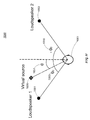
- FIG. 4 shows an architecture for directional audio coding (DirAC) synthesis according to an embodiment of the invention.
- FIG. 5 shows a scenario for a listener facing an acoustic source in order to focus on the sound source according to an embodiment of the invention.
- FIG. 6 shows a linear re-mapping function according to an embodiment of the invention.
- FIG. 7 shows a non-linear re-mapping function according to an embodiment of the invention.
- FIG. 8 shows scenarios for focusing on an acoustic source according to an embodiment of the invention.
- FIG. 9 shows a bank of filters for processing a multi-channel audio signal according to an embodiment of the invention.
- FIG. 10 shows an example of positioning of a virtual sound source in accordance with an embodiment of the invention.
- FIG. 11 shows an apparatus for re-panning an audio signal according to an embodiment of the invention.
- embodiments of the invention may support the re-panning multiple audio (sound) signals by applying spatial cue coding.
- Sound sources in each of the signals may be re-panned before the signals are mixed to a combined signal.
- processing may be applied in a conference bridge that receives two omni-directionally recorded (or synthesized) sound field signals as will be further discussed.
- the conference bridge subsequently re-pans one of the signals to the listeners left side and the signal to the right side.
- the source image mapping and panning may further be adaptively based on the content and use case. Mapping may be done by manipulating the directional parameters prior to directional decoding or before directional mixing.
- embodiments of the invention support a signal format that is agnostic to the transducer system used in reproduction. Consequently, a processed signal may be played through headphones and different loudspeaker setups.
- the human auditory system has an ability to separate streams according to their spatial characteristics. This ability is often referred to as the “cocktail-party effect” because it can readily be demonstrated by a phenomenon we are all familiar with. In a noisy crowded room at a party it is possible to have a conversation because the listener can focus the attention on the person speaking, and in effect filter out the sound that comes from other directions. Consequently, the task of concentrating on a particular sound source is made easier if the sound source is well separated spatially from other sounds and also if the sound source of interest is the loudest.
- FIG. 1 shows architecture 10 for focusing on a portion of an audio scene for multi-channel audio signal 51 according to an embodiment of the invention.
- a listener (not shown) can focus on a desired sound source (focusing spatial attention on a selected part of a sound scene) by listening to binaural audio signal 53 through headphones (not shown) or another set of transducers (e.g., audio loudspeakers).
- Embodiments of the invention also support synthesizing a processed multi-channel audio signal with more than two transducers. Spatial focusing is implemented by using 3D audio technology corresponding to spatial content analysis module 1 and 3D audio processing module 3 as will be further discussed.
- Architecture 10 provides spatial manipulation of sound that may be played back to a listener over headphones.
- the listener can direct spatial attention to a part of the sound stage in a way similar to how a magnifying glass can be used to pick out details in a picture. Focusing may be useful in applications such as teleconferencing, where several people, or even several groups of people, are positioned in a virtual environment around the listener.
- architecture 10 may be used when spatial audio is an important part of the user experience. Consequently, architecture 10 may be applied to stereo music and 3D audio for games.
- Architecture 10 may incorporate headtracking for stabilizing the audio scene relative to the environment. Headtracking enables a listener to hear the remote participants in a teleconference call at fixed positions relative to the environment regardless of the listener's head orientation.
- the desired part of the sound scene can be one particular person talking among several others in a teleconference, or vocal performers in a music track. If a headtracker is available, the user (listener) only has to turn one's head in order to control the desired direction of spatial focus to provide headtracking parameters 57 .
- spatial focus parameters 59 may be provided by user control input 55 through an input device, e.g., keypad or joystick.
- Multi-channel audio signal 51 may be a set of independent signals, such as a number of speech inputs in a teleconference call, or a set of signals that contain spatial information regarding the relationship to each other, e.g., as in the Ambisonics B-format.
- Stereo music and binaural content are examples of two-channel signals that contain spatial information.
- spatial content analysis corresponding to spatial content analysis module 1
- One approach is DirAC (as will be discussed with FIGS. 3 and 4 ).
- a special case of the full DirAC analysis is center channel extraction from two-channel signals which is useful for stereo music.
- FIG. 1B shows architecture 100 for focusing on a portion of an audio scene for multi-channel audio signal 151 according to an embodiment of the invention.
- Processing module 101 provides audio output 153 in accordance with modified parameters 163 in order to focus on an audio scene.
- Sound source position parameters 159 are replaced with modified values 161 .
- Remapping module 103 modifies azimuth and elevation according to remapping function or a vector 155 that effectively defines the value of a function at a number of discrete points.
- Remapping controller 105 determines remapping function/vector 155 from orientation angle 157 and mapping preset input 163 as will be discussed.
- Position control module 107 controls the 3D positioning of each sound source, or channel. For example, in a conferencing system, module 107 defines positions at which the voices of the participants are located, as illustrated in FIG. 8 . Positioning may be automatic or it can be controlled by the user.
- An exemplary embodiment may perform in a terminal that supports a decentralized 3D teleconferencing system.
- the terminal receives monophonic audio signals from all the other participating terminals and spatializes the audio signals locally.
- Remapping function/vector 155 defines the mapping from an input parameter value set to an output parameter value set. For example, a single input azimuth value may be mapped to new azimuth value (e.g., 10 degrees ⁇ 15 degrees) or a range of input azimuth values may be mapped linearly (or nonlinearly) to another range of azimuth values (e.g. 0-90 degrees ⁇ 0-45 degrees).
- One possible format of repanning operation is as a mapping from the input azimuth values to the output azimuth values.
- R(v) sigmoid remapping function
- R ⁇ ( v ) k ⁇ ⁇ 1 ⁇ ( 360 1 + e - k ⁇ ⁇ 2 ⁇ v - 180 ) ( 1 )
- v is an azimuth angle between plus and minus 180 degrees
- k1 and k2 are appropriately chosen positive constants, then sources clustered around the angle zero are expanded and sources clustered around plus and minus 180 degrees are compressed.
- k1 of 1.0562 and k2 of 0.02 a list of pairs of corresponding input-output azimuths is given below (output values are rounded to nearest degree) as shown in Table 1.
- mapping vector defines the value of the mapping function at discrete points. If an input value is between these discrete points, linear interpolation or some other interpolation method can be used to interpolate values between these points.
- Example of mapping vector would be the “Output” row in Table 1.
- the vector has a resolution of 30 degrees and defines the values of the output azimuth at discrete points for certain input azimuth values. Using a vector representation the mapping can be implemented in a simple way as a combination of table look-up and optional interpolation operations.
- a new mapping function (or vector) 155 is generated when control signal defining the spatial focus direction (orientation angle) or mapping preset 163 is changed.
- a change of input signal 157 obtained from the input device (e.g., joystick) results in the generation of new remapping function/vector 155 .
- An exemplary real-time modification may be a rotation operation.
- the remapping vector is modified accordingly.
- a change of orientation angle can be implemented by adding an angle v0 to the result of the remapping function R(v) and projecting the sum on the range from ⁇ 180 to 180 modulo 360. For example, if R(v) is 150 and v0 is 70, then the new remapped angle is ⁇ 140 because 70 plus 150 is 220 which is congruent to ⁇ 140 modulo 360 and ⁇ 140 is in the range between ⁇ 180 and 180.
- Mapping preset 163 may be used to select which function is used for remapping or which static mapping vector templates. Examples include:
- mapping preset 0 (disabled) Input ⁇ 180 ⁇ 150 ⁇ 120 ⁇ 90 ⁇ 60 ⁇ 30 0 30 60 90 120 150 180
- mapping preset 1 (narrow beam) Input ⁇ 180 ⁇ 150 ⁇ 120 ⁇ 90 ⁇ 60 ⁇ 40 0 40 60 90 120 150 180
- mapping preset 2 (wide beam) Input ⁇ 180 ⁇ 150 ⁇ 120 ⁇ 90 ⁇ 80 ⁇ 60 0 60 80 90 120 150 180 Moreover, dynamic generation of remapping vector may be supported with embodiments of the invention.
- FIG. 2 shows architecture 200 for re-panning audio signal 251 according to an embodiment of the invention.
- Panning is the spread of a monaural signal into a stereo or multi-channel sound field. With re-panning, a pan control typically varies the distribution of audio power over a plurality of loudspeakers, in which the total power is constant.
- Architecture 200 may be applied to systems that have knowledge of the spatial characteristics of the original sound fields and that may re-synthesize the sound field from audio signal 251 and available spatial metadata (e.g., directional information 253 ).
- Spatial metadata may be available by an analysis method (performed by module 201 ) or may be included with audio signal 251 .
- Spatial re-panning module 203 subsequently modifies directional information 253 to obtain modified directional information 257 . (As shown in FIG. 4 , directional information may include azimuth, elevation, and diffuseness estimates.)
- Directional re-synthesis module 205 forms re-panned signal 259 from audio signal 255 and modified directional information 257 .
- the data stream (comprising audio signal 255 and modified directional information 257 ) typically has a directionally coded format (e.g., B-format as will be discussed) after re-panning.
- each data stream includes a different audio signal with corresponding directional information.
- the re-panned signals may then be combined (mixed) by directional re-synthesis module 205 to form output signal 259 . If the signal mixing is performed by re-synthesis module 205 , the mixed output stream may have the same or similar format as the input streams (e.g., audio signal with directional information).
- a system performing mixing is disclosed by U.S. patent application Ser. No. 11/478,792 (“DIRECT ENCODING INTO A DIRECTIONAL AUDIO CODING FORMAT”, Jarmo Hiipakka) filed Jun. 30, 2006, which is hereby incorporated by reference.
- two audio signals associated with directional information are combined by analyzing the signals for combining the spatial data.
- the actual signals are mixed (added) together.
- mixing may happen after the re-synthesis, so that signals from several re-synthesis modules (e.g. module 205 ) are mixed.
- the output signal may be rendered to a listener by directing an acoustic signal through a set of loudspeakers or earphones.
- the output signal may be transmitted to the user and then rendered (e.g., when processing takes place in conference bridge.) Alternatively, output is stored in a storage device (not shown).
- Modifications of spatial information may include remapping any range (2D) or area (3D) of positions to a new range or area.
- the remapped range may include the whole original sound field or may be sufficiently small that it essentially covers only one sound source in the original sound field.
- the remapped range may also be defined using a weighting function, so that sound sources close to the boundary may be partially remapped.
- Re-panning may also consist of several individual re-panning operations together. Consequently, embodiments of the invention support scenarios in which positions of two sound sources in the original sound field are swapped.
- Spatial re-panning module 203 modifies the original azimuth, elevation and diffuseness estimates (directional information 253 ) to obtain modified azimuth, elevation and diffuseness estimates (modified directional information 257 ) in accordance with re-mapping vector 263 provided by re-mapping controller 207 .
- Re-mapping controller 207 determines re-mapping vector 263 from orientation angle information 261 , which is typically provided by an input device (e.g., a joystick, headtracker). Orientation angle information 261 specifies where the listener wants to focus attention.
- Mapping preset 265 is a control signal that specifies the type of mapping that will be used. A specific mapping describes which parts of the sound stage are spatially compressed, expanded, or unmodified. Several parts of the sound scene can be re-panned qualitatively the same way so that, for example, sources clustered around straight left and straight right are expanded whereas sources clustered around the front and the rear are compressed.
- directional information 253 contains information about the diffuseness of the sound field
- diffuseness is typically processed by module 203 when re-panning the sound field. Consequently, it may be possible to maintain the natural character of the diffuse field.
- map the original diffuseness component of the sound field to a specific position or a range of positions in the modified sound field for special effects. For example, different diffuseness values may be used for the spatial region where the spatial focus is set than other regions. Diffuseness values may be changed according to function that depends on the direction where spatial focus attention is set.
- the desired sound field is represented by its spherical harmonic components in a single point.
- the sound field is then regenerated using any suitable number of loudspeakers or a pair of headphones.
- the sound field is described using the zero th -order component (sound pressure signal W) and three first-order components (pressure gradient signals X, Y, and Z along the three Cartesian coordinate axes).
- Embodiments of the invention may also determine higher-order components.
- the first-order signal that consists of the four channels W, X, Y, and Z, often referred as the B-format signal.
- W ⁇ ( t ) 1 2 ⁇ x ⁇ ( t )
- X ⁇ ( t ) cos ⁇ ⁇ ⁇ cos ⁇ ⁇ ⁇ ⁇ ⁇ x ⁇ ( t )
- Y ⁇ ( t ) sin ⁇ ⁇ ⁇ ⁇ cos ⁇ ⁇ ⁇ ⁇ ⁇ x ⁇ ( t )
- Z ⁇ ( t ) sin ⁇ ⁇ ⁇ ⁇ ⁇ x ⁇ ( t ) , ( EQ .
- x(t) is the monophonic input signal
- ⁇ is the azimuth angle (anti-clockwise angle from center front)
- ⁇ is the elevation angle
- W(t), X(t), Y(t), and Z(t) are the individual channels of the resulting B-format signal.
- the multiplier on the W signal is a convention that originates from the need to get a more even level distribution between the four channels. (Some references use an approximate value of 0.707 instead.)
- the directional angles can, naturally, be made to change with time, even if this was not explicitly made visible in the equations.
- Multiple monophonic sources can also be encoded using the same equations individually for all sources and mixing (adding together) the resulting B-format signals.
- the B-format conversion can be replaced with simplified computation. For example, if the signal can be assumed the standard 2-channel stereo (with loudspeakers at +/ ⁇ 30 degrees angles), the conversion equations reduce into multiplications with constants. Currently, this assumption holds for many application scenarios.
- Embodiments of the invention support parameter space re-panning for multiple sound scene signals by applying spatial cue coding. Sound sources in each of the signals are re-panned before they are mixed to a combined signal. Processing may be applied, for example, in a conference bridge that receives two omni-directionally recorded (or synthesized) sound field signals, which then re-pans one of these to the listeners left side and the other to the right side.
- the source image mapping and panning may further be adaptively based on content and use. Mapping may be performed by manipulating the directional parameters prior to directional decoding or before directional mixing.
- FIG. 3 shows an architecture 300 for a directional audio coding (DirAC) analysis module (e.g., module 201 as shown in FIG. 2 ) according to an embodiment of the invention.
- DirAC analysis module 201 extracts the audio signal 255 and directional information 253 from input signal 251 .
- DirAC analysis provides time and frequency dependent information on the directions of sound sources regarding the listener and the relation of diffuseness to direct sound energy. This information is then used for selecting the sound sources positioned near or on a desired axis between loudspeakers and directing them into the desired channel.
- the signal for the loudspeakers may be generated by subtracting the direct sound portion of those sound sources from the original stereo signal, thus preserving the correct directions of arrival of the echoes.
- a B-format signal comprises components W(t) 351 , X(t) 353 , Y(t) 355 , and Z(t) 357 .
- STFT short-time Fourier transform
- each component is transformed into frequency bands 361 a - 361 n (corresponding to W(t) 351 ), 363 a - 363 n (corresponding to X(t) 353 ), 365 a - 365 n (corresponding to Y(t) 355 ), and 367 a - 367 n (corresponding to Z(t) 357 ).
- STFT short-time Fourier transform
- Direction-of-arrival parameters (including azimuth and elevation) and diffuseness parameters are estimated for each frequency band 303 and 305 for each time instance.
- parameters 369 - 373 correspond to the first frequency band
- parameters 375 - 379 correspond to the N th frequency band.
- FIG. 4 shows an architecture 400 for a directional audio coding (DirAC) synthesizer (e.g., directional re-synthesis module 205 as shown in FIG. 2 ) according to an embodiment of the invention.
- Base signal W(t) 451 is divided into a plurality of frequency bands by transformation process 401 . Synthesis is based on processing the frequency components of base signal W(t) 451 .
- W(t) 451 is typically recorded by the omni-directional microphone.
- the frequency components of W(t) 451 are distributed and processed by sound positioning and reproduction processes 405 - 407 according to the direction and diffuseness estimates 453 - 457 gathered in the analysis phase to provide processed signals to loudspeakers 459 and 461 .
- DirAC reproduction (re-synthesis) is based on taking the signal recorded by the omni-directional microphone, and distributing this signal according to the direction and diffuseness estimates gathered in the analysis phase.
- DirAC re-synthesis may generalize a system by supporting the same representation for the sound field and use an arbitrary loudspeaker (or transducer, in general) setup in reproduction.
- the sound field may be coded in parameters that are independent of the actual transducer setup used for reproduction, namely direction of arrival angles (azimuth, elevation) and diffuseness.
- FIG. 5 shows scenarios 551 and 553 for listener 505 a , 505 b facing an acoustic source in order to focus on the sound source (e.g., acoustic source 501 or 503 ) according to an embodiment of the invention.
- the user ( 505 a , 505 b ) can control the spatial attention through an input device.
- the input device can be of a type commonly used in mobile devices, such as a keypad or a joystick, or it can use sensors such as accelerometers, magnetometers, or gyros to detect the user's movement.
- a headtracker for example, can direct attention to a certain part of the sound stage according to the direction in which the listener is facing as illustrated in FIG. 5 .
- the desired direction can be linearly or nonlinearly dependent on the listeners head orientation. With some embodiments, it may be more convenient to turn head only 30 degrees to set the spatial attention to 90 degrees. A backwards tilt can determine the gain applied to the selected part of the sound scene. With headtracking, the direction control of spatial attention control may be switched on and off, for example, by pressing a button. Thus, spatial attention can be locked to certain position. With embodiment of the invention, it may be advantageous in a 3D teleconferencing session to give a constant boost to a certain participant who has weaker voice than the others.
- the overall loudness can be preserved by attenuating sounds localized outside the selected part of the sound scene as shown by gain functions 561 (corresponding to scenario 551 ) and 563 (corresponding to scenario 553 ).
- FIG. 6 shows linear re-mapping function 601 according to an embodiment of the invention.
- the linear re-mapping function 601 does not change the positions of any of the audio sources in the audio scene since the relationship between the original azimuth, and the remapped azimuth is linear with a slope of one (as shown in derivative function 603 ).
- FIG. 7 shows non-linear re-mapping function 701 according to an embodiment of the invention.
- a derivative greater than one is equivalent to an expansion of space whereas a derivative smaller than one means is equivalent to a compression of space.
- the graphical representation of the alphabet 705 which represents compression and expansion about different audio sources, where the letters of the alphabet represent the audio sources
- the letters of the alphabet represent the audio sources
- audio processing module 3 (as shown in FIG. 1A ) utilizes re-mapping function (e.g., function 701 ) to alter the relationship of acoustic sources for the output multi-channel audio signal that is rendered to the listener.
- re-mapping function e.g., function 701
- FIG. 8 shows scenarios 851 , 853 , and 855 for focusing on an acoustic source according to an embodiment of the invention.
- spatial focus processing with azimuth remapping can move audio sources away from each other so that intelligibility is improved during simultaneous speech with respect to the audio source that the listener wishes to focus on.
- re-mapping may be implemented by controlling the locations where individual sound sources are spatialized.
- re-panning can be implemented using a re-panning approach or by using an up-mixing approach.
- FIG. 9 shows a bank of filters 905 for processing a multi-channel audio signal according to an embodiment of the invention.
- the multi-channel audio signal comprises signal components 951 - 957 that are generated by corresponding audio sources.
- the bank of filters include head-related transfer function (HRTF) filters 901 and 903 that process the signal component 951 for left channel 961 and right channel 963 , respectively, of the binaural output that is played to the listener through headphones, loudspeakers, or other suitable transducers.
- Bank of filters 905 also include additional HRTF filters for the other signal components.
- HRTF head-related transfer function
- audio signals are generated by seven participants that are spatialized for one remote listener, where each of the seven speech signals is available separately.
- Each speech signal is processed with a pair of head-related transfer functions (HRTF's) in order to produce a two-channel binaural output.
- the seven signals are then mixed together by including all of the left outputs into one channel (left channel 961 ) and all of the right outputs into the other channel (right channel 963 ).
- the HRTF's are implemented as digital filters whose properties correspond to the desired position of the spatialized source.
- a possible default mapping may place the seven spatialized sources evenly distributed across the sound stage, from ⁇ 90 degrees azimuth (straight left) to 90 degrees azimuth (straight right). Referring to FIG.
- the digital filters that implement the HRTFs are updated with the new positions. From left to right, the azimuths (in degrees) become ( ⁇ 90 ⁇ 70 ⁇ 50 0 50 70 90). If the listener now decides to focus on source 802 , the azimuths become ( ⁇ 90 ⁇ 45 0 22.5 45 67.5 90). Thus, the signal processing structure remains the same, but the filter parameters within the structure must be updated according to the desired spatial remapping.
- incoming audio signal 251 is in directional audio (DirAC) format (mono audio channel with spatial parameters).
- DIrAC directional audio
- new mapping pattern is generated to create modified directional information 257 and provide it to spatial repanning module 203 .
- audio sources that would have been mapped to ( ⁇ 90 ⁇ 30 ⁇ 60 0 60 30 90) without repanning, could be mapped e.g., to azimuth positions ( ⁇ 90 ⁇ 70 ⁇ 50 0 50 70 90).
- a new mapping pattern is used to produce different modified directional information 257 . This may include modifying the diffuseness values as well, for example by using less diffuseness for those frequency bands that are positioned in the area where the listener has focused the attention. Diffuseness modification can be used to provide clearer (drier) sound from this direction.
- FIG. 10 shows an example of positioning of virtual sound source 1005 in accordance with an embodiment of the invention.
- Virtual source 1005 is located between loudspeakers 1001 and 1003 as specified by separation angles 1051 - 1055 .
- Embodiments of the invention also support stereo headphones, where one side corresponds to loudspeaker 1001 and the other side corresponds to loudspeaker 1003 .
- the separation angles which are measured relative to listener 1061 , are used to determine amplitude panning. When the sine panning law is used, the amplitudes for loudspeakers 1001 and 1003 are determined according to the equation
- FIG. 11 shows an apparatus 1100 for re-panning an audio signal 1151 to re-panned output signal 1169 according to an embodiment of the invention.
- Processor 1103 obtains input signal 1151 through audio input interface 1101 .
- signal 1151 may be recorded in a B-format, or audio input interface may convert signals 1151 in a B-format using EQ. 1.
- Modules 1 and 3 (as shown in FIG. 1A ) may be implemented by processor 1103 executing computer-executable instructions that are stored on memory 1107 .
- Processor 1103 provides combined re-panned signal 1169 through audio output interface 1105 in order to render the output signal to the user.
- Apparatus 1100 may assume different forms, including discrete logic circuitry, a microprocessor system, or an integrated circuit such as an application specific integrated circuit (ASIC).
- ASIC application specific integrated circuit
- the computer system may include at least one computer such as a microprocessor, digital signal processor, and associated peripheral electronic circuitry.
Landscapes
- Physics & Mathematics (AREA)
- Engineering & Computer Science (AREA)
- Acoustics & Sound (AREA)
- Signal Processing (AREA)
- Stereophonic System (AREA)
- Circuit For Audible Band Transducer (AREA)
Abstract
Description
where v is an azimuth angle between plus and minus 180 degrees, k1 and k2 are appropriately chosen positive constants, then sources clustered around the angle zero are expanded and sources clustered around plus and minus 180 degrees are compressed. For a value of k1 of 1.0562 and k2 of 0.02, a list of pairs of corresponding input-output azimuths is given below (output values are rounded to nearest degree) as shown in Table 1.
| TABLE 1 | |||||||||||||
| Input | −180 | −150 | −120 | −90 | −60 | −30 | 0 | 30 | 60 | 90 | 120 | 150 | 180 |
| Output | −180 | −172 | −158 | −136 | −102 | −55 | 0 | 55 | 102 | 136 | 158 | 172 | 180 |
An approximation to the mapping function description may be made by defining a mapping vector. The vector defines the value of the mapping function at discrete points. If an input value is between these discrete points, linear interpolation or some other interpolation method can be used to interpolate values between these points. Example of mapping vector would be the “Output” row in Table 1. The vector has a resolution of 30 degrees and defines the values of the output azimuth at discrete points for certain input azimuth values. Using a vector representation the mapping can be implemented in a simple way as a combination of table look-up and optional interpolation operations.
| mapping preset 0 (disabled) |
| Input | −180 | −150 | −120 | −90 | −60 | −30 | 0 | 30 | 60 | 90 | 120 | 150 | 180 |
| mapping preset 1 (narrow beam) |
| Input | −180 | −150 | −120 | −90 | −60 | −40 | 0 | 40 | 60 | 90 | 120 | 150 | 180 |
| mapping preset 2 (wide beam) |
| Input | −180 | −150 | −120 | −90 | −80 | −60 | 0 | 60 | 80 | 90 | 120 | 150 | 180 |
Moreover, dynamic generation of remapping vector may be supported with embodiments of the invention.
where x(t) is the monophonic input signal, θ is the azimuth angle (anti-clockwise angle from center front), φ is the elevation angle, and W(t), X(t), Y(t), and Z(t) are the individual channels of the resulting B-format signal. Note that the multiplier on the W signal is a convention that originates from the need to get a more even level distribution between the four channels. (Some references use an approximate value of 0.707 instead.) It is also worth noting that the directional angles can, naturally, be made to change with time, even if this was not explicitly made visible in the equations. Multiple monophonic sources can also be encoded using the same equations individually for all sources and mixing (adding together) the resulting B-format signals.
-
- Re-panning solves the problem of combining sound field signals from several conference rooms
- Realistic representation of conference participants
- Generic solution for spatial re-panning in parameter space
where g1 and g2 are the ILD values for
Claims (22)
Priority Applications (5)
| Application Number | Priority Date | Filing Date | Title |
|---|---|---|---|
| US11/933,638 US8509454B2 (en) | 2007-11-01 | 2007-11-01 | Focusing on a portion of an audio scene for an audio signal |
| PCT/IB2008/002909 WO2009056956A1 (en) | 2007-11-01 | 2008-10-29 | Focusing on a portion of an audio scene for an audio signal |
| EP20080845656 EP2208363A1 (en) | 2007-11-01 | 2008-10-29 | Focusing on a portion of an audio scene for an audio signal |
| EP20130161611 EP2613564A3 (en) | 2007-11-01 | 2008-10-29 | Focusing on a portion of an audio scene for an audio signal |
| CN200880113925.XA CN101843114B (en) | 2007-11-01 | 2008-10-29 | Method, apparatus and integrated circuit for focusing on audio signal |
Applications Claiming Priority (1)
| Application Number | Priority Date | Filing Date | Title |
|---|---|---|---|
| US11/933,638 US8509454B2 (en) | 2007-11-01 | 2007-11-01 | Focusing on a portion of an audio scene for an audio signal |
Publications (2)
| Publication Number | Publication Date |
|---|---|
| US20090116652A1 US20090116652A1 (en) | 2009-05-07 |
| US8509454B2 true US8509454B2 (en) | 2013-08-13 |
Family
ID=40386481
Family Applications (1)
| Application Number | Title | Priority Date | Filing Date |
|---|---|---|---|
| US11/933,638 Expired - Fee Related US8509454B2 (en) | 2007-11-01 | 2007-11-01 | Focusing on a portion of an audio scene for an audio signal |
Country Status (4)
| Country | Link |
|---|---|
| US (1) | US8509454B2 (en) |
| EP (2) | EP2613564A3 (en) |
| CN (1) | CN101843114B (en) |
| WO (1) | WO2009056956A1 (en) |
Cited By (21)
| Publication number | Priority date | Publication date | Assignee | Title |
|---|---|---|---|---|
| US9318121B2 (en) | 2014-04-21 | 2016-04-19 | Sony Corporation | Method and system for processing audio data of video content |
| US9602946B2 (en) | 2014-12-19 | 2017-03-21 | Nokia Technologies Oy | Method and apparatus for providing virtual audio reproduction |
| US9674453B1 (en) | 2016-10-26 | 2017-06-06 | Cisco Technology, Inc. | Using local talker position to pan sound relative to video frames at a remote location |
| US20170188169A1 (en) * | 2014-03-28 | 2017-06-29 | Samsung Electronics Co., Ltd. | Method and apparatus for rendering acoustic signal, and computer-readable recording medium |
| US9933989B2 (en) | 2013-10-31 | 2018-04-03 | Dolby Laboratories Licensing Corporation | Binaural rendering for headphones using metadata processing |
| US10165386B2 (en) | 2017-05-16 | 2018-12-25 | Nokia Technologies Oy | VR audio superzoom |
| US20190306651A1 (en) | 2018-03-27 | 2019-10-03 | Nokia Technologies Oy | Audio Content Modification for Playback Audio |
| US10491643B2 (en) | 2017-06-13 | 2019-11-26 | Apple Inc. | Intelligent augmented audio conference calling using headphones |
| US10531219B2 (en) | 2017-03-20 | 2020-01-07 | Nokia Technologies Oy | Smooth rendering of overlapping audio-object interactions |
| US10993067B2 (en) | 2017-06-30 | 2021-04-27 | Nokia Technologies Oy | Apparatus and associated methods |
| US11039264B2 (en) | 2014-12-23 | 2021-06-15 | Ray Latypov | Method of providing to user 3D sound in virtual environment |
| US11074036B2 (en) | 2017-05-05 | 2021-07-27 | Nokia Technologies Oy | Metadata-free audio-object interactions |
| US11096004B2 (en) | 2017-01-23 | 2021-08-17 | Nokia Technologies Oy | Spatial audio rendering point extension |
| US11115625B1 (en) | 2020-12-14 | 2021-09-07 | Cisco Technology, Inc. | Positional audio metadata generation |
| US20220159125A1 (en) * | 2020-11-18 | 2022-05-19 | Kelly Properties, Llc | Processing And Distribution Of Audio Signals In A Multi-Party Conferencing Environment |
| US11395087B2 (en) | 2017-09-29 | 2022-07-19 | Nokia Technologies Oy | Level-based audio-object interactions |
| US11425502B2 (en) | 2020-09-18 | 2022-08-23 | Cisco Technology, Inc. | Detection of microphone orientation and location for directional audio pickup |
| US11825026B1 (en) * | 2020-12-10 | 2023-11-21 | Hear360 Inc. | Spatial audio virtualization for conference call applications |
| US12047739B2 (en) | 2022-06-01 | 2024-07-23 | Cisco Technology, Inc. | Stereo sound generation using microphone and/or face detection |
| US12081965B2 (en) | 2021-03-04 | 2024-09-03 | Nokia Technologies Oy | Spatial audio modification |
| US12170875B2 (en) | 2019-07-30 | 2024-12-17 | Dolby Laboratories Licensing Corporation | Managing playback of multiple streams of audio over multiple speakers |
Families Citing this family (105)
| Publication number | Priority date | Publication date | Assignee | Title |
|---|---|---|---|---|
| US11431312B2 (en) | 2004-08-10 | 2022-08-30 | Bongiovi Acoustics Llc | System and method for digital signal processing |
| US10158337B2 (en) | 2004-08-10 | 2018-12-18 | Bongiovi Acoustics Llc | System and method for digital signal processing |
| US10848118B2 (en) | 2004-08-10 | 2020-11-24 | Bongiovi Acoustics Llc | System and method for digital signal processing |
| DE102005033239A1 (en) * | 2005-07-15 | 2007-01-25 | Fraunhofer-Gesellschaft zur Förderung der angewandten Forschung e.V. | Apparatus and method for controlling a plurality of loudspeakers by means of a graphical user interface |
| DE102005033238A1 (en) * | 2005-07-15 | 2007-01-25 | Fraunhofer-Gesellschaft zur Förderung der angewandten Forschung e.V. | Apparatus and method for driving a plurality of loudspeakers by means of a DSP |
| US10701505B2 (en) | 2006-02-07 | 2020-06-30 | Bongiovi Acoustics Llc. | System, method, and apparatus for generating and digitally processing a head related audio transfer function |
| US10848867B2 (en) | 2006-02-07 | 2020-11-24 | Bongiovi Acoustics Llc | System and method for digital signal processing |
| US11202161B2 (en) | 2006-02-07 | 2021-12-14 | Bongiovi Acoustics Llc | System, method, and apparatus for generating and digitally processing a head related audio transfer function |
| US8949120B1 (en) | 2006-05-25 | 2015-02-03 | Audience, Inc. | Adaptive noise cancelation |
| KR20090110242A (en) * | 2008-04-17 | 2009-10-21 | 삼성전자주식회사 | Method and apparatus for processing audio signals |
| GB0815362D0 (en) * | 2008-08-22 | 2008-10-01 | Queen Mary & Westfield College | Music collection navigation |
| EP2249334A1 (en) * | 2009-05-08 | 2010-11-10 | Fraunhofer-Gesellschaft zur Förderung der angewandten Forschung e.V. | Audio format transcoder |
| US9888335B2 (en) | 2009-06-23 | 2018-02-06 | Nokia Technologies Oy | Method and apparatus for processing audio signals |
| US20110096915A1 (en) * | 2009-10-23 | 2011-04-28 | Broadcom Corporation | Audio spatialization for conference calls with multiple and moving talkers |
| US9196238B2 (en) | 2009-12-24 | 2015-11-24 | Nokia Technologies Oy | Audio processing based on changed position or orientation of a portable mobile electronic apparatus |
| JP5407848B2 (en) * | 2009-12-25 | 2014-02-05 | 富士通株式会社 | Microphone directivity control device |
| WO2011104418A1 (en) * | 2010-02-26 | 2011-09-01 | Nokia Corporation | Modifying spatial image of a plurality of audio signals |
| US9558755B1 (en) | 2010-05-20 | 2017-01-31 | Knowles Electronics, Llc | Noise suppression assisted automatic speech recognition |
| KR20120004909A (en) * | 2010-07-07 | 2012-01-13 | 삼성전자주식회사 | Stereo playback method and apparatus |
| US8908874B2 (en) * | 2010-09-08 | 2014-12-09 | Dts, Inc. | Spatial audio encoding and reproduction |
| US9111526B2 (en) | 2010-10-25 | 2015-08-18 | Qualcomm Incorporated | Systems, method, apparatus, and computer-readable media for decomposition of a multichannel music signal |
| US9578440B2 (en) * | 2010-11-15 | 2017-02-21 | The Regents Of The University Of California | Method for controlling a speaker array to provide spatialized, localized, and binaural virtual surround sound |
| EP2716021A4 (en) * | 2011-05-23 | 2014-12-10 | Nokia Corp | SPACE AUDIO PROCESSING APPARATUS |
| TWI453451B (en) * | 2011-06-15 | 2014-09-21 | Dolby Lab Licensing Corp | Method for capturing and playback of sound originating from a plurality of sound sources |
| US9032042B2 (en) | 2011-06-27 | 2015-05-12 | Microsoft Technology Licensing, Llc | Audio presentation of condensed spatial contextual information |
| EP2727380B1 (en) | 2011-07-01 | 2020-03-11 | Dolby Laboratories Licensing Corporation | Upmixing object based audio |
| US8958569B2 (en) * | 2011-12-17 | 2015-02-17 | Microsoft Technology Licensing, Llc | Selective spatial audio communication |
| US10154361B2 (en) * | 2011-12-22 | 2018-12-11 | Nokia Technologies Oy | Spatial audio processing apparatus |
| CN104541327B (en) | 2012-02-23 | 2018-01-12 | 杜比国际公司 | Method and system for efficient restoration of high frequency audio content |
| EP2829083B1 (en) * | 2012-03-23 | 2016-08-10 | Dolby Laboratories Licensing Corporation | System and method of speaker cluster design and rendering |
| EP2829050A1 (en) | 2012-03-23 | 2015-01-28 | Dolby Laboratories Licensing Corporation | Schemes for emphasizing talkers in a 2d or 3d conference scene |
| KR101901593B1 (en) * | 2012-03-28 | 2018-09-28 | 삼성전자주식회사 | Virtual sound producing method and apparatus for the same |
| US9420386B2 (en) * | 2012-04-05 | 2016-08-16 | Sivantos Pte. Ltd. | Method for adjusting a hearing device apparatus and hearing device apparatus |
| WO2013153464A1 (en) | 2012-04-13 | 2013-10-17 | Nokia Corporation | Method, apparatus and computer program for generating an spatial audio output based on an spatial audio input |
| US9955280B2 (en) | 2012-04-19 | 2018-04-24 | Nokia Technologies Oy | Audio scene apparatus |
| US9570081B2 (en) | 2012-04-26 | 2017-02-14 | Nokia Technologies Oy | Backwards compatible audio representation |
| JP5973058B2 (en) * | 2012-05-07 | 2016-08-23 | ドルビー・インターナショナル・アーベー | Method and apparatus for 3D audio playback independent of layout and format |
| US9746916B2 (en) | 2012-05-11 | 2017-08-29 | Qualcomm Incorporated | Audio user interaction recognition and application interface |
| US9736604B2 (en) | 2012-05-11 | 2017-08-15 | Qualcomm Incorporated | Audio user interaction recognition and context refinement |
| DE102012214081A1 (en) * | 2012-06-06 | 2013-12-12 | Siemens Medical Instruments Pte. Ltd. | Method of focusing a hearing instrument beamformer |
| US9640194B1 (en) | 2012-10-04 | 2017-05-02 | Knowles Electronics, Llc | Noise suppression for speech processing based on machine-learning mask estimation |
| WO2014062509A1 (en) | 2012-10-18 | 2014-04-24 | Dolby Laboratories Licensing Corporation | Systems and methods for initiating conferences using external devices |
| EP2733964A1 (en) | 2012-11-15 | 2014-05-21 | Fraunhofer-Gesellschaft zur Förderung der angewandten Forschung e.V. | Segment-wise adjustment of spatial audio signal to different playback loudspeaker setup |
| CN105210364A (en) * | 2013-02-25 | 2015-12-30 | 视听公司 | Dynamic audio perspective change during video playback |
| CN104019885A (en) | 2013-02-28 | 2014-09-03 | 杜比实验室特许公司 | Sound field analysis system |
| US9648439B2 (en) | 2013-03-12 | 2017-05-09 | Dolby Laboratories Licensing Corporation | Method of rendering one or more captured audio soundfields to a listener |
| EP2974253B1 (en) * | 2013-03-15 | 2019-05-08 | Dolby Laboratories Licensing Corporation | Normalization of soundfield orientations based on auditory scene analysis |
| US20140278418A1 (en) * | 2013-03-15 | 2014-09-18 | Broadcom Corporation | Speaker-identification-assisted downlink speech processing systems and methods |
| US10635383B2 (en) | 2013-04-04 | 2020-04-28 | Nokia Technologies Oy | Visual audio processing apparatus |
| US9883312B2 (en) * | 2013-05-29 | 2018-01-30 | Qualcomm Incorporated | Transformed higher order ambisonics audio data |
| US9883318B2 (en) | 2013-06-12 | 2018-01-30 | Bongiovi Acoustics Llc | System and method for stereo field enhancement in two-channel audio systems |
| DE102013211283B4 (en) * | 2013-06-17 | 2018-01-11 | Deutsche Telekom Ag | Playback of audio data using distributed electroacoustic transducers in networked mobile devices |
| GB2516056B (en) * | 2013-07-09 | 2021-06-30 | Nokia Technologies Oy | Audio processing apparatus |
| US9536540B2 (en) | 2013-07-19 | 2017-01-03 | Knowles Electronics, Llc | Speech signal separation and synthesis based on auditory scene analysis and speech modeling |
| EP3036919A1 (en) * | 2013-08-20 | 2016-06-29 | HARMAN BECKER AUTOMOTIVE SYSTEMS MANUFACTURING Kft | A system for and a method of generating sound |
| US9906858B2 (en) | 2013-10-22 | 2018-02-27 | Bongiovi Acoustics Llc | System and method for digital signal processing |
| CN104735582B (en) * | 2013-12-20 | 2018-09-07 | 华为技术有限公司 | A kind of audio signal processing method, device and equipment |
| ES2837864T3 (en) * | 2014-01-03 | 2021-07-01 | Dolby Laboratories Licensing Corp | Binaural audio generation in response to multichannel audio using at least one feedback delay network |
| CN104768121A (en) | 2014-01-03 | 2015-07-08 | 杜比实验室特许公司 | Binaural audio is generated in response to multi-channel audio by using at least one feedback delay network |
| US10820883B2 (en) | 2014-04-16 | 2020-11-03 | Bongiovi Acoustics Llc | Noise reduction assembly for auscultation of a body |
| CN110556120B (en) * | 2014-06-27 | 2023-02-28 | 杜比国际公司 | Method for decoding a Higher Order Ambisonics (HOA) representation of a sound or sound field |
| US9883314B2 (en) | 2014-07-03 | 2018-01-30 | Dolby Laboratories Licensing Corporation | Auxiliary augmentation of soundfields |
| US9749769B2 (en) | 2014-07-30 | 2017-08-29 | Sony Corporation | Method, device and system |
| CN106797512B (en) | 2014-08-28 | 2019-10-25 | 美商楼氏电子有限公司 | Method, system and non-transitory computer readable storage medium for multi-source noise suppression |
| EP3205116B1 (en) * | 2014-10-10 | 2021-07-28 | Gde Engineering Pty Ltd | Method and apparatus for providing customised sound distributions |
| US9787846B2 (en) * | 2015-01-21 | 2017-10-10 | Microsoft Technology Licensing, Llc | Spatial audio signal processing for objects with associated audio content |
| US10225814B2 (en) * | 2015-04-05 | 2019-03-05 | Qualcomm Incorporated | Conference audio management |
| US10237678B2 (en) * | 2015-06-03 | 2019-03-19 | Razer (Asia-Pacific) Pte. Ltd. | Headset devices and methods for controlling a headset device |
| KR20250107956A (en) * | 2015-11-17 | 2025-07-14 | 돌비 레버러토리즈 라이쎈싱 코오포레이션 | Headtracking for parametric binaural output system and method |
| KR102063307B1 (en) | 2016-03-15 | 2020-01-07 | 프라운호퍼 게젤샤프트 쭈르 푀르데룽 데어 안겐반텐 포르슝 에. 베. | Apparatus, method, or computer program for generating sound field technology |
| CN109076306B (en) * | 2016-04-12 | 2021-04-13 | 皇家飞利浦有限公司 | Spatial audio processing that emphasizes sound sources close to focus |
| EP3255905A1 (en) * | 2016-06-07 | 2017-12-13 | Nokia Technologies Oy | Distributed audio mixing |
| EP3255904A1 (en) * | 2016-06-07 | 2017-12-13 | Nokia Technologies Oy | Distributed audio mixing |
| WO2017218492A1 (en) * | 2016-06-14 | 2017-12-21 | The Trustees Of Columbia University In The City Of New York | Neural decoding of attentional selection in multi-speaker environments |
| US11373672B2 (en) | 2016-06-14 | 2022-06-28 | The Trustees Of Columbia University In The City Of New York | Systems and methods for speech separation and neural decoding of attentional selection in multi-speaker environments |
| GB2551521A (en) * | 2016-06-20 | 2017-12-27 | Nokia Technologies Oy | Distributed audio capture and mixing controlling |
| EP3261367B1 (en) * | 2016-06-21 | 2020-07-22 | Nokia Technologies Oy | Method, apparatus, and computer program code for improving perception of sound objects in mediated reality |
| WO2018026963A1 (en) * | 2016-08-03 | 2018-02-08 | Hear360 Llc | Head-trackable spatial audio for headphones and system and method for head-trackable spatial audio for headphones |
| JP2018037944A (en) * | 2016-09-01 | 2018-03-08 | ソニーセミコンダクタソリューションズ株式会社 | Imaging control device, imaging apparatus, and imaging control method |
| US10492016B2 (en) * | 2016-09-29 | 2019-11-26 | Lg Electronics Inc. | Method for outputting audio signal using user position information in audio decoder and apparatus for outputting audio signal using same |
| CN110915240B (en) * | 2017-06-26 | 2022-06-14 | 雷.拉蒂波夫 | Method for providing interactive music composition to user |
| EP3454578B1 (en) * | 2017-09-06 | 2020-11-04 | Sennheiser Communications A/S | A communication system for communicating audio signals between a plurality of communication devices in a virtual sound environment |
| CN111133411B (en) * | 2017-09-29 | 2023-07-14 | 苹果公司 | Spatial Audio Upmixing |
| CA3219566C (en) | 2017-10-04 | 2025-10-07 | Fraunhofer-Gesellschaft Zur Foerderung Der Angewandten Forschung E.V. | Apparatus, method and computer program for encoding, decoding, scene processing and other procedures related to dirac based spatial audio coding |
| GB2567244A (en) * | 2017-10-09 | 2019-04-10 | Nokia Technologies Oy | Spatial audio signal processing |
| KR102418168B1 (en) * | 2017-11-29 | 2022-07-07 | 삼성전자 주식회사 | Device and method for outputting audio signal, and display device using the same |
| JP6431225B1 (en) * | 2018-03-05 | 2018-11-28 | 株式会社ユニモト | AUDIO PROCESSING DEVICE, VIDEO / AUDIO PROCESSING DEVICE, VIDEO / AUDIO DISTRIBUTION SERVER, AND PROGRAM THEREOF |
| GB2575511A (en) * | 2018-07-13 | 2020-01-15 | Nokia Technologies Oy | Spatial audio Augmentation |
| GB2575509A (en) | 2018-07-13 | 2020-01-15 | Nokia Technologies Oy | Spatial audio capture, transmission and reproduction |
| US10959035B2 (en) | 2018-08-02 | 2021-03-23 | Bongiovi Acoustics Llc | System, method, and apparatus for generating and digitally processing a head related audio transfer function |
| GB2591066A (en) | 2018-08-24 | 2021-07-21 | Nokia Technologies Oy | Spatial audio processing |
| GB2577885A (en) | 2018-10-08 | 2020-04-15 | Nokia Technologies Oy | Spatial audio augmentation and reproduction |
| US10721579B2 (en) | 2018-11-06 | 2020-07-21 | Motorola Solutions, Inc. | Correlated cross-feed of audio and video |
| GB2584629A (en) | 2019-05-29 | 2020-12-16 | Nokia Technologies Oy | Audio processing |
| GB2584837A (en) * | 2019-06-11 | 2020-12-23 | Nokia Technologies Oy | Sound field related rendering |
| GB2584838A (en) | 2019-06-11 | 2020-12-23 | Nokia Technologies Oy | Sound field related rendering |
| US11432097B2 (en) * | 2019-07-03 | 2022-08-30 | Qualcomm Incorporated | User interface for controlling audio rendering for extended reality experiences |
| GB2587335A (en) | 2019-09-17 | 2021-03-31 | Nokia Technologies Oy | Direction estimation enhancement for parametric spatial audio capture using broadband estimates |
| WO2021138517A1 (en) | 2019-12-30 | 2021-07-08 | Comhear Inc. | Method for providing a spatialized soundfield |
| CN113473319A (en) * | 2021-07-14 | 2021-10-01 | 斑马网络技术有限公司 | Bluetooth multi-channel audio playing method, device and system |
| GB2620593A (en) * | 2022-07-12 | 2024-01-17 | Nokia Technologies Oy | Transporting audio signals inside spatial audio signal |
| GB2620960A (en) * | 2022-07-27 | 2024-01-31 | Nokia Technologies Oy | Pair direction selection based on dominant audio direction |
| EP4333423A1 (en) * | 2022-09-05 | 2024-03-06 | Nokia Technologies Oy | Video conference calls |
| EP4443901A1 (en) * | 2023-04-06 | 2024-10-09 | Koninklijke Philips N.V. | Generation of an audio stereo signal |
| EP4462769A1 (en) * | 2023-05-08 | 2024-11-13 | Koninklijke Philips N.V. | Generation of an audiovisual signal |
Citations (15)
| Publication number | Priority date | Publication date | Assignee | Title |
|---|---|---|---|---|
| US4860366A (en) | 1986-07-31 | 1989-08-22 | Nec Corporation | Teleconference system using expanders for emphasizing a desired signal with respect to undesired signals |
| US5940118A (en) | 1997-12-22 | 1999-08-17 | Nortel Networks Corporation | System and method for steering directional microphones |
| US6405163B1 (en) | 1999-09-27 | 2002-06-11 | Creative Technology Ltd. | Process for removing voice from stereo recordings |
| US20030007648A1 (en) | 2001-04-27 | 2003-01-09 | Christopher Currell | Virtual audio system and techniques |
| US20030053680A1 (en) | 2001-09-17 | 2003-03-20 | Koninklijke Philips Electronics N.V. | Three-dimensional sound creation assisted by visual information |
| US20040037436A1 (en) | 2002-08-26 | 2004-02-26 | Yong Rui | System and process for locating a speaker using 360 degree sound source localization |
| US6771778B2 (en) | 2000-09-29 | 2004-08-03 | Nokia Mobile Phonés Ltd. | Method and signal processing device for converting stereo signals for headphone listening |
| WO2004077884A1 (en) | 2003-02-26 | 2004-09-10 | Helsinki University Of Technology | A method for reproducing natural or modified spatial impression in multichannel listening |
| US20040196982A1 (en) * | 2002-12-03 | 2004-10-07 | Aylward J. Richard | Directional electroacoustical transducing |
| US20070041592A1 (en) | 2002-06-04 | 2007-02-22 | Creative Labs, Inc. | Stream segregation for stereo signals |
| US20070050441A1 (en) | 2005-08-26 | 2007-03-01 | Step Communications Corporation,A Nevada Corporati | Method and apparatus for improving noise discrimination using attenuation factor |
| US20070127753A1 (en) | 2003-04-09 | 2007-06-07 | Feng Albert S | Systems and methods for interference suppression with directional sensing patterns |
| US20070213858A1 (en) * | 2004-10-01 | 2007-09-13 | Matsushita Electric Industrial Co., Ltd. | Acoustic adjustment device and acoustic adjustment method |
| US20090060208A1 (en) * | 2007-08-27 | 2009-03-05 | Pan Davis Y | Manipulating Spatial Processing in a Audio System |
| US20090092259A1 (en) * | 2006-05-17 | 2009-04-09 | Creative Technology Ltd | Phase-Amplitude 3-D Stereo Encoder and Decoder |
Family Cites Families (1)
| Publication number | Priority date | Publication date | Assignee | Title |
|---|---|---|---|---|
| DE102005033238A1 (en) * | 2005-07-15 | 2007-01-25 | Fraunhofer-Gesellschaft zur Förderung der angewandten Forschung e.V. | Apparatus and method for driving a plurality of loudspeakers by means of a DSP |
-
2007
- 2007-11-01 US US11/933,638 patent/US8509454B2/en not_active Expired - Fee Related
-
2008
- 2008-10-29 WO PCT/IB2008/002909 patent/WO2009056956A1/en not_active Ceased
- 2008-10-29 EP EP20130161611 patent/EP2613564A3/en not_active Ceased
- 2008-10-29 EP EP20080845656 patent/EP2208363A1/en not_active Withdrawn
- 2008-10-29 CN CN200880113925.XA patent/CN101843114B/en not_active Expired - Fee Related
Patent Citations (15)
| Publication number | Priority date | Publication date | Assignee | Title |
|---|---|---|---|---|
| US4860366A (en) | 1986-07-31 | 1989-08-22 | Nec Corporation | Teleconference system using expanders for emphasizing a desired signal with respect to undesired signals |
| US5940118A (en) | 1997-12-22 | 1999-08-17 | Nortel Networks Corporation | System and method for steering directional microphones |
| US6405163B1 (en) | 1999-09-27 | 2002-06-11 | Creative Technology Ltd. | Process for removing voice from stereo recordings |
| US6771778B2 (en) | 2000-09-29 | 2004-08-03 | Nokia Mobile Phonés Ltd. | Method and signal processing device for converting stereo signals for headphone listening |
| US20030007648A1 (en) | 2001-04-27 | 2003-01-09 | Christopher Currell | Virtual audio system and techniques |
| US20030053680A1 (en) | 2001-09-17 | 2003-03-20 | Koninklijke Philips Electronics N.V. | Three-dimensional sound creation assisted by visual information |
| US20070041592A1 (en) | 2002-06-04 | 2007-02-22 | Creative Labs, Inc. | Stream segregation for stereo signals |
| US20040037436A1 (en) | 2002-08-26 | 2004-02-26 | Yong Rui | System and process for locating a speaker using 360 degree sound source localization |
| US20040196982A1 (en) * | 2002-12-03 | 2004-10-07 | Aylward J. Richard | Directional electroacoustical transducing |
| WO2004077884A1 (en) | 2003-02-26 | 2004-09-10 | Helsinki University Of Technology | A method for reproducing natural or modified spatial impression in multichannel listening |
| US20070127753A1 (en) | 2003-04-09 | 2007-06-07 | Feng Albert S | Systems and methods for interference suppression with directional sensing patterns |
| US20070213858A1 (en) * | 2004-10-01 | 2007-09-13 | Matsushita Electric Industrial Co., Ltd. | Acoustic adjustment device and acoustic adjustment method |
| US20070050441A1 (en) | 2005-08-26 | 2007-03-01 | Step Communications Corporation,A Nevada Corporati | Method and apparatus for improving noise discrimination using attenuation factor |
| US20090092259A1 (en) * | 2006-05-17 | 2009-04-09 | Creative Technology Ltd | Phase-Amplitude 3-D Stereo Encoder and Decoder |
| US20090060208A1 (en) * | 2007-08-27 | 2009-03-05 | Pan Davis Y | Manipulating Spatial Processing in a Audio System |
Non-Patent Citations (23)
| Title |
|---|
| Avendano, Carlos, "Frequency-Domain Techniques for Stereo to Multichannel Upmix," Audio Engineering Society, International Conference on Virtual, Synthetic and Entertainment Audio, 2002, pp. 1-10, Finland. |
| Billinghurst, Mark et al. "Motion-Tracking in Spatial Mobile Audio-Conferencing," Mobile HCI '07, 2007, pp. 1-4, Singapore. |
| Blauert, Jens. Spatial Hearing: The Psychophysics of Human Sound Localization, 1997, The MIT Press, USA. |
| Elen, R. "Ambisonic.net" , 1998, pp. 1-27, USA. |
| Elen, R. "Ambisonic.net" <http://www.ambisonic.net/>, 1998, pp. 1-27, USA. |
| Gerzon, Michael A., "Optimum Reproduction Matrices for Multispeaker Stereo," Journal of the Audio Engineering Society, Jul./Aug. 1992, pp. 571-589, vol. 40, No. 7/8, USA. |
| Griesinger, David, "Multichannel Matrix Surround Decoders for Two-Eared Listeners," Audio Engineering Society 101st Convention, Preprint, 1996, pp. 1-22, USA. |
| International Preliminary Report on Patentability for related application PCT/IB2008/002909, dated May 4, 2010, pp. 1-7. |
| International Search Report for PCT/IB2008/002909, dated Mar. 19, 2009, pp. 1-4. |
| Irwan, R. "Two-to-Five Channel Sound Processing," Audio Engineering Society, 2002, pp. 914-926, vol. 50, No. 11, USA. |
| Jot, Jean-Marc, "Spatial Enhancement of Audio Recordings," AES 23rd International Conference, 2003, pp. 1-11, Denmark. |
| Julstrom, Stephen, "A High-Performance Surround Sound Process for Home Video," Journal of the Audio Engineering Society, Jul./Aug. 1987, pp. 536-549, vol. 35, No. 7/8, USA. |
| Li, Yan, "An Unsupervised Adaptive Filtering Approach of 2-to-5 Channel Upmix," Audio Engineering Society, 2005, pp. 1-7, USA. |
| Malham D. G., "Spatial Hearing Mechanisms and Sound Reproduction," University of York, Music Technology Group 1998, pp. 1-12, England. |
| Merimaa, Juha, "Spatial Impulse Response Rendering I: Analysis and Synthesis," Audio Engineering Society, 2005, vol. 53, No. 12, pp. 1115-1127, USA. |
| Office Action in CN 200880113925.X dated Jun. 1, 2012. |
| Pulkii, Ville et al. "Analysing Virtual Sound Source Attributes Using a Binaural Auditory Model," Journal of the Audio Engineering Society, 1999, pp. 203-218, USA. |
| Pulkii, Ville, "Directional Audio Coding in Spatial Sound Reproduction and Stereo Upmixing," Audio Engineering Society 28th International Conference, 2006, pp. 1-8, Sweden. |
| Pulkii, Ville, "Directional Audio Coding: Filterbank and STFT-based Design," Audio Engineering Society Convention Paper, 2006, pp. 1-12, France. |
| Pulkki, Ville, "Spatial Impulse Repsonse Rendering II: Reproduction of Diffuse Sound and Listening Tests," Audio Engineering Society, 2006, vol. 54, No. 1/2, pp. 3-18, USA. |
| Pulkki, Ville, "Spatial Impulse Response Rendering: Listening Tests and Applications to Continuous Sound," Audio Engineering Society, 2005, pp. 1-13, Spain. |
| Second Office Action in CN200880113925.X dated Jan. 5, 2013. |
| University of York, "Sound in Space," Music Technology Group, 2004, pp. 1-2, England. |
Cited By (36)
| Publication number | Priority date | Publication date | Assignee | Title |
|---|---|---|---|---|
| US10255027B2 (en) | 2013-10-31 | 2019-04-09 | Dolby Laboratories Licensing Corporation | Binaural rendering for headphones using metadata processing |
| US11269586B2 (en) | 2013-10-31 | 2022-03-08 | Dolby Laboratories Licensing Corporation | Binaural rendering for headphones using metadata processing |
| US10838684B2 (en) | 2013-10-31 | 2020-11-17 | Dolby Laboratories Licensing Corporation | Binaural rendering for headphones using metadata processing |
| US10503461B2 (en) | 2013-10-31 | 2019-12-10 | Dolby Laboratories Licensing Corporation | Binaural rendering for headphones using metadata processing |
| US9933989B2 (en) | 2013-10-31 | 2018-04-03 | Dolby Laboratories Licensing Corporation | Binaural rendering for headphones using metadata processing |
| US11681490B2 (en) | 2013-10-31 | 2023-06-20 | Dolby Laboratories Licensing Corporation | Binaural rendering for headphones using metadata processing |
| US12061835B2 (en) | 2013-10-31 | 2024-08-13 | Dolby Laboratories Licensing Corporation | Binaural rendering for headphones using metadata processing |
| US10382877B2 (en) | 2014-03-28 | 2019-08-13 | Samsung Electronics Co., Ltd. | Method and apparatus for rendering acoustic signal, and computer-readable recording medium |
| US10149086B2 (en) * | 2014-03-28 | 2018-12-04 | Samsung Electronics Co., Ltd. | Method and apparatus for rendering acoustic signal, and computer-readable recording medium |
| US20170188169A1 (en) * | 2014-03-28 | 2017-06-29 | Samsung Electronics Co., Ltd. | Method and apparatus for rendering acoustic signal, and computer-readable recording medium |
| US10687162B2 (en) | 2014-03-28 | 2020-06-16 | Samsung Electronics Co., Ltd. | Method and apparatus for rendering acoustic signal, and computer-readable recording medium |
| US9318121B2 (en) | 2014-04-21 | 2016-04-19 | Sony Corporation | Method and system for processing audio data of video content |
| US9602946B2 (en) | 2014-12-19 | 2017-03-21 | Nokia Technologies Oy | Method and apparatus for providing virtual audio reproduction |
| US11039264B2 (en) | 2014-12-23 | 2021-06-15 | Ray Latypov | Method of providing to user 3D sound in virtual environment |
| US9674453B1 (en) | 2016-10-26 | 2017-06-06 | Cisco Technology, Inc. | Using local talker position to pan sound relative to video frames at a remote location |
| US11096004B2 (en) | 2017-01-23 | 2021-08-17 | Nokia Technologies Oy | Spatial audio rendering point extension |
| US12538089B2 (en) | 2017-01-23 | 2026-01-27 | Nokia Technologies Oy | Spatial audio rendering point extension |
| US10531219B2 (en) | 2017-03-20 | 2020-01-07 | Nokia Technologies Oy | Smooth rendering of overlapping audio-object interactions |
| US11044570B2 (en) | 2017-03-20 | 2021-06-22 | Nokia Technologies Oy | Overlapping audio-object interactions |
| US11604624B2 (en) | 2017-05-05 | 2023-03-14 | Nokia Technologies Oy | Metadata-free audio-object interactions |
| US11442693B2 (en) | 2017-05-05 | 2022-09-13 | Nokia Technologies Oy | Metadata-free audio-object interactions |
| US11074036B2 (en) | 2017-05-05 | 2021-07-27 | Nokia Technologies Oy | Metadata-free audio-object interactions |
| US10165386B2 (en) | 2017-05-16 | 2018-12-25 | Nokia Technologies Oy | VR audio superzoom |
| US10491643B2 (en) | 2017-06-13 | 2019-11-26 | Apple Inc. | Intelligent augmented audio conference calling using headphones |
| US10993067B2 (en) | 2017-06-30 | 2021-04-27 | Nokia Technologies Oy | Apparatus and associated methods |
| US11395087B2 (en) | 2017-09-29 | 2022-07-19 | Nokia Technologies Oy | Level-based audio-object interactions |
| US10542368B2 (en) | 2018-03-27 | 2020-01-21 | Nokia Technologies Oy | Audio content modification for playback audio |
| US20190306651A1 (en) | 2018-03-27 | 2019-10-03 | Nokia Technologies Oy | Audio Content Modification for Playback Audio |
| US12170875B2 (en) | 2019-07-30 | 2024-12-17 | Dolby Laboratories Licensing Corporation | Managing playback of multiple streams of audio over multiple speakers |
| US11425502B2 (en) | 2020-09-18 | 2022-08-23 | Cisco Technology, Inc. | Detection of microphone orientation and location for directional audio pickup |
| US20220159125A1 (en) * | 2020-11-18 | 2022-05-19 | Kelly Properties, Llc | Processing And Distribution Of Audio Signals In A Multi-Party Conferencing Environment |
| US11750745B2 (en) * | 2020-11-18 | 2023-09-05 | Kelly Properties, Llc | Processing and distribution of audio signals in a multi-party conferencing environment |
| US11825026B1 (en) * | 2020-12-10 | 2023-11-21 | Hear360 Inc. | Spatial audio virtualization for conference call applications |
| US11115625B1 (en) | 2020-12-14 | 2021-09-07 | Cisco Technology, Inc. | Positional audio metadata generation |
| US12081965B2 (en) | 2021-03-04 | 2024-09-03 | Nokia Technologies Oy | Spatial audio modification |
| US12047739B2 (en) | 2022-06-01 | 2024-07-23 | Cisco Technology, Inc. | Stereo sound generation using microphone and/or face detection |
Also Published As
| Publication number | Publication date |
|---|---|
| CN101843114B (en) | 2014-08-06 |
| EP2613564A3 (en) | 2013-11-06 |
| US20090116652A1 (en) | 2009-05-07 |
| WO2009056956A1 (en) | 2009-05-07 |
| EP2208363A1 (en) | 2010-07-21 |
| CN101843114A (en) | 2010-09-22 |
| EP2613564A2 (en) | 2013-07-10 |
Similar Documents
| Publication | Publication Date | Title |
|---|---|---|
| US8509454B2 (en) | Focusing on a portion of an audio scene for an audio signal | |
| Zotter et al. | Ambisonics: A practical 3D audio theory for recording, studio production, sound reinforcement, and virtual reality | |
| TWI700687B (en) | Apparatus, method and computer program for encoding, decoding, scene processing and other procedures related to dirac based spatial audio coding | |
| CN102859584B (en) | Device and method for converting a first parametric spatial audio signal into a second parametric spatial audio signal | |
| CN101356573B (en) | Control over decoding of binaural audio signals | |
| US20080298610A1 (en) | Parameter Space Re-Panning for Spatial Audio | |
| KR101341523B1 (en) | How to Generate Multi-Channel Audio Signals from Stereo Signals | |
| JP5455657B2 (en) | Method and apparatus for enhancing speech reproduction | |
| JP4921470B2 (en) | Method and apparatus for generating and processing parameters representing head related transfer functions | |
| Pulkki et al. | First‐Order Directional Audio Coding (DirAC) | |
| KR20170106063A (en) | A method and an apparatus for processing an audio signal | |
| KR20200041860A (en) | Concept for generating augmented sound field descriptions or modified sound field descriptions using multi-layer descriptions | |
| CN104010265A (en) | Audio space rendering device and method | |
| US12183358B2 (en) | Sound field related rendering | |
| JP2025128068A (en) | Apparatus, method, and computer program for repositioning spatial audio streams | |
| AU2023258816A1 (en) | Sound generation device, sound reproduction device, sound generation method, and sound signal processing program | |
| EP4358545A1 (en) | Generating parametric spatial audio representations | |
| AUDIO—PART | AES 40th INTERNATIONAL CONfERENCE | |
| Masiero et al. | EUROPEAN SYMPOSIUM ON ENVIRONMENTAL ACOUSTICS AND ON BUILDINGS ACOUSTICALLY SUSTAINABLE |
Legal Events
| Date | Code | Title | Description |
|---|---|---|---|
| AS | Assignment |
Owner name: NOKIA CORPORATION, FINLAND Free format text: ASSIGNMENT OF ASSIGNORS INTEREST;ASSIGNORS:KIRKEBY, OLE;VIROLAINEN, JUSSI;REEL/FRAME:021262/0897 Effective date: 20071029 |
|
| STCF | Information on status: patent grant |
Free format text: PATENTED CASE |
|
| CC | Certificate of correction | ||
| AS | Assignment |
Owner name: NOKIA TECHNOLOGIES OY, FINLAND Free format text: ASSIGNMENT OF ASSIGNORS INTEREST;ASSIGNOR:NOKIA CORPORATION;REEL/FRAME:035544/0481 Effective date: 20150116 |
|
| FPAY | Fee payment |
Year of fee payment: 4 |
|
| MAFP | Maintenance fee payment |
Free format text: PAYMENT OF MAINTENANCE FEE, 8TH YEAR, LARGE ENTITY (ORIGINAL EVENT CODE: M1552); ENTITY STATUS OF PATENT OWNER: LARGE ENTITY Year of fee payment: 8 |
|
| AS | Assignment |
Owner name: PIECE FUTURE PTE. LTD., SINGAPORE Free format text: ASSIGNMENT OF ASSIGNORS INTEREST;ASSIGNOR:NOKIA TECHNOLOGIES OY;REEL/FRAME:062489/0895 Effective date: 20221107 |
|
| FEPP | Fee payment procedure |
Free format text: MAINTENANCE FEE REMINDER MAILED (ORIGINAL EVENT CODE: REM.); ENTITY STATUS OF PATENT OWNER: LARGE ENTITY |
|
| LAPS | Lapse for failure to pay maintenance fees |
Free format text: PATENT EXPIRED FOR FAILURE TO PAY MAINTENANCE FEES (ORIGINAL EVENT CODE: EXP.); ENTITY STATUS OF PATENT OWNER: LARGE ENTITY |
|
| STCH | Information on status: patent discontinuation |
Free format text: PATENT EXPIRED DUE TO NONPAYMENT OF MAINTENANCE FEES UNDER 37 CFR 1.362 |
|
| FP | Lapsed due to failure to pay maintenance fee |
Effective date: 20250813 |