US8507502B2 - Fused bicyclic and tricyclic pyrimidine compounds as tyrosine kinase inhibitors - Google Patents
Fused bicyclic and tricyclic pyrimidine compounds as tyrosine kinase inhibitors Download PDFInfo
- Publication number
- US8507502B2 US8507502B2 US12/614,584 US61458409A US8507502B2 US 8507502 B2 US8507502 B2 US 8507502B2 US 61458409 A US61458409 A US 61458409A US 8507502 B2 US8507502 B2 US 8507502B2
- Authority
- US
- United States
- Prior art keywords
- compound
- heteroaryl
- aryl
- heterocycloalkyl
- heterocycloalkenyl
- Prior art date
- Legal status (The legal status is an assumption and is not a legal conclusion. Google has not performed a legal analysis and makes no representation as to the accuracy of the status listed.)
- Active, expires
Links
- 0 *CC(CC)[Y]C1=CC([H])=NC=C1.C Chemical compound *CC(CC)[Y]C1=CC([H])=NC=C1.C 0.000 description 32
- PFCOOHZUPOIZDZ-HJCJDWHVSA-N CC.CC.CC(C)(C)C1=C(C(C)(C)C)C(C2=CC=CC=C2)=[W]C1.CC(C)(C)C1=C(C(C)(C)C)C(C2=CC=CC=C2)=[W]C1 Chemical compound CC.CC.CC(C)(C)C1=C(C(C)(C)C)C(C2=CC=CC=C2)=[W]C1.CC(C)(C)C1=C(C(C)(C)C)C(C2=CC=CC=C2)=[W]C1 PFCOOHZUPOIZDZ-HJCJDWHVSA-N 0.000 description 2
- CPXFCJMMYZSAKG-HLKPEAGISA-N C/C=C/C(=O)N1CCC2=C(C1)SC1=C2C(N[C@H](COCC2=CC(F)=CC=C2)C2=CC=CC=C2)=NC=N1.CCC[C@@H](NC1=NC=NC2=C1C1=C(CN(C(=O)/C=C/CN(C)C)CC1)S2)C1=CC=CC=C1.CCN(C/C=C/C(=O)N1CCC2=C(C1)SC1=C2C(N[C@H](C)C2=CC=CC=C2)=NC=N1)CCO.CN(C)C/C=C/C(=O)N1CCC2=C(C1)SC1=C2C(N[C@H](CCOCC2=CC=CC=C2F)C2=CC=CC=C2)=NC=N1.CN(C)C/C=C/C(=O)N1CCC2=C(C1)SC1=C2C(N[C@H](COCC2=CC=C(F)C=C2)C2=CC=CC=C2)=NC=N1 Chemical compound C/C=C/C(=O)N1CCC2=C(C1)SC1=C2C(N[C@H](COCC2=CC(F)=CC=C2)C2=CC=CC=C2)=NC=N1.CCC[C@@H](NC1=NC=NC2=C1C1=C(CN(C(=O)/C=C/CN(C)C)CC1)S2)C1=CC=CC=C1.CCN(C/C=C/C(=O)N1CCC2=C(C1)SC1=C2C(N[C@H](C)C2=CC=CC=C2)=NC=N1)CCO.CN(C)C/C=C/C(=O)N1CCC2=C(C1)SC1=C2C(N[C@H](CCOCC2=CC=CC=C2F)C2=CC=CC=C2)=NC=N1.CN(C)C/C=C/C(=O)N1CCC2=C(C1)SC1=C2C(N[C@H](COCC2=CC=C(F)C=C2)C2=CC=CC=C2)=NC=N1 CPXFCJMMYZSAKG-HLKPEAGISA-N 0.000 description 1
- WHIAGBHVSIKFME-NFMYLQSNSA-N C1=CC=C(COC[C@@H](NC2=NC=NC3=C2C2=C(CNCC2)S3)C2=CC=CC=C2)C=C1.C=CC(=O)N1CCC2=C(C1)SC1=C2C(N[C@H](COCC2=CC(F)=CC=C2)C2=CC=CC=C2)=NC=N1.CC(C)(C)OC(=O)N1CCC2=C(C1)SC1=C2C(N[C@H](COCC2=CC=CC=C2)C2=CC=CC=C2)=NC=N1.CCN(CC)C/C=C/C(=O)N1CCC2=C(C1)SC1=C2C(N[C@H](CCO)C2=CC=CC=C2)=NC=N1.CN(C)C/C=C/C(=O)N1CCC2=C(C1)SC1=C2C(N[C@H](COCC2=CC=CC=C2)C2=CC=CC=C2)=NC=N1 Chemical compound C1=CC=C(COC[C@@H](NC2=NC=NC3=C2C2=C(CNCC2)S3)C2=CC=CC=C2)C=C1.C=CC(=O)N1CCC2=C(C1)SC1=C2C(N[C@H](COCC2=CC(F)=CC=C2)C2=CC=CC=C2)=NC=N1.CC(C)(C)OC(=O)N1CCC2=C(C1)SC1=C2C(N[C@H](COCC2=CC=CC=C2)C2=CC=CC=C2)=NC=N1.CCN(CC)C/C=C/C(=O)N1CCC2=C(C1)SC1=C2C(N[C@H](CCO)C2=CC=CC=C2)=NC=N1.CN(C)C/C=C/C(=O)N1CCC2=C(C1)SC1=C2C(N[C@H](COCC2=CC=CC=C2)C2=CC=CC=C2)=NC=N1 WHIAGBHVSIKFME-NFMYLQSNSA-N 0.000 description 1
- DLFVHQZRZUSDIF-QOGMGQJOSA-N C1=CC=C([C@@H](CC2=NNN=N2)NC2=NC=NC3=C2C2=C(CCCC2)S3)C=C1.CC#CC(=O)NC1=CC=C(C2=NC3=C(N=CN=C3N[C@H](C(=O)O)C3=CC=CC=C3)N2)C=C1.CC#CC(=O)NC1=CC=C(C2=NC3=C(N=CN=C3N[C@H](C(=O)O)C3=CC=CC=C3)O2)C=C1.CC#CC(=O)NC1=CC=C(C2=NC3=C(N=CN=C3N[C@H](C(=O)O)C3=CC=CC=C3)S2)C=C1.CN(C)C/C=C/C(=O)NC1=CC=C(C2=NC3=C(N=CN=C3N[C@H](C(=O)O)C3=CC=CC=C3)O2)C=C1 Chemical compound C1=CC=C([C@@H](CC2=NNN=N2)NC2=NC=NC3=C2C2=C(CCCC2)S3)C=C1.CC#CC(=O)NC1=CC=C(C2=NC3=C(N=CN=C3N[C@H](C(=O)O)C3=CC=CC=C3)N2)C=C1.CC#CC(=O)NC1=CC=C(C2=NC3=C(N=CN=C3N[C@H](C(=O)O)C3=CC=CC=C3)O2)C=C1.CC#CC(=O)NC1=CC=C(C2=NC3=C(N=CN=C3N[C@H](C(=O)O)C3=CC=CC=C3)S2)C=C1.CN(C)C/C=C/C(=O)NC1=CC=C(C2=NC3=C(N=CN=C3N[C@H](C(=O)O)C3=CC=CC=C3)O2)C=C1 DLFVHQZRZUSDIF-QOGMGQJOSA-N 0.000 description 1
- RNJMVGXIZUONBW-HYBGOSJCSA-N C=C(C)C(=O)N1CCC2=C(C1)SC1=C2C(N[C@H](CO)C2=CC=CC=C2)=NC=N1.C=CC(=O)N1CCC2=C(C1)SC1=C2C(N[C@H](CCO)C2=CC=CC=C2)=NC=N1.CC#CC(=O)N1CCC2=C(C1)SC1=C2C(N[C@H](C)C2=CC=CC=C2)=NC=N1.C[C@@H](NC1=NC=NC2=C1C1=C(CN(C(=O)/C=C/CN(C)C)CC1)S2)C1=CC=CC=C1.O=C(/C=C/CN1CCCC1)N1CCC2=C(C1)SC1=C2C(N[C@H](CO)C2=CC=CC=C2)=NC=N1 Chemical compound C=C(C)C(=O)N1CCC2=C(C1)SC1=C2C(N[C@H](CO)C2=CC=CC=C2)=NC=N1.C=CC(=O)N1CCC2=C(C1)SC1=C2C(N[C@H](CCO)C2=CC=CC=C2)=NC=N1.CC#CC(=O)N1CCC2=C(C1)SC1=C2C(N[C@H](C)C2=CC=CC=C2)=NC=N1.C[C@@H](NC1=NC=NC2=C1C1=C(CN(C(=O)/C=C/CN(C)C)CC1)S2)C1=CC=CC=C1.O=C(/C=C/CN1CCCC1)N1CCC2=C(C1)SC1=C2C(N[C@H](CO)C2=CC=CC=C2)=NC=N1 RNJMVGXIZUONBW-HYBGOSJCSA-N 0.000 description 1
- ZLKPYECCJOYHSU-OIZSVJTPSA-N C=C(CN(C)C)C(=O)N1CCC2=C(C1)SC1=C2C(N[C@H](CO)C2=CC=CC=C2)=NC=N1.C=CC(=O)N1CCC2=C(C1)SC1=C2C(N[C@H](CO)C2=CC=CC=C2)=C(C#N)C=N1.C=CC(=O)N1CCC2=C(C1)SC1=C2C(N[C@H](COC)C2=CC=CC=C2)=NC=N1.CCN(CC)C/C=C/C(=O)N1CCC2=C(C1)SC1=C2C(N[C@@H](C)C2=CC=CC=C2)=NC=N1.C[C@H](NC1=NC=NC2=C1C1=C(CN(C(=O)/C=C/CN(C)C)CC1)S2)C1=CC=CC=C1 Chemical compound C=C(CN(C)C)C(=O)N1CCC2=C(C1)SC1=C2C(N[C@H](CO)C2=CC=CC=C2)=NC=N1.C=CC(=O)N1CCC2=C(C1)SC1=C2C(N[C@H](CO)C2=CC=CC=C2)=C(C#N)C=N1.C=CC(=O)N1CCC2=C(C1)SC1=C2C(N[C@H](COC)C2=CC=CC=C2)=NC=N1.CCN(CC)C/C=C/C(=O)N1CCC2=C(C1)SC1=C2C(N[C@@H](C)C2=CC=CC=C2)=NC=N1.C[C@H](NC1=NC=NC2=C1C1=C(CN(C(=O)/C=C/CN(C)C)CC1)S2)C1=CC=CC=C1 ZLKPYECCJOYHSU-OIZSVJTPSA-N 0.000 description 1
- MSGCFZRPMYGOBH-FHGBGEAJSA-N C=CC(=O)CC1=CC(C2=C(C3=CC=CC=C3)OC3=C2C(N[C@H](CO)C2=CC=CC=C2)=NC=N3)=CC=C1.CN(C)C/C=C/C(=O)CC1=CC(C2=C(C3=CC=CC=C3)OC3=C2C(N[C@H](CO)C2=CC=CC=C2)=NC=N3)=CC=C1 Chemical compound C=CC(=O)CC1=CC(C2=C(C3=CC=CC=C3)OC3=C2C(N[C@H](CO)C2=CC=CC=C2)=NC=N3)=CC=C1.CN(C)C/C=C/C(=O)CC1=CC(C2=C(C3=CC=CC=C3)OC3=C2C(N[C@H](CO)C2=CC=CC=C2)=NC=N3)=CC=C1 MSGCFZRPMYGOBH-FHGBGEAJSA-N 0.000 description 1
- VMSGVUOGEZQWPJ-KUTRZMJLSA-N C=CC(=O)N1CC2=C(C1)C1=C(N=CN=C1N[C@H](C(=O)O)C1=CC=CC=C1)S2.C=CC(=O)N1CC2=C(C1)C1=C(N=CN=C1N[C@H](C(=O)OC)C1=CC=CC=C1)S2.CCOC(=O)/C=C/C(=O)N1CC2=C(C1)C1=C(N=CN=C1N[C@H](C(=O)OC)C1=CC=CC=C1)S2.CN(C)C/C=C/C(=O)N1CC2=C(C1)C1=C(N=CN=C1N[C@H](C(=O)O)C1=CC=CC=C1)S2.COC(=O)[C@@H](NC1=NC=NC2=C1C1=C(CN(C(=O)/C=C/CN(C)C)C1)S2)C1=CC=CC=C1 Chemical compound C=CC(=O)N1CC2=C(C1)C1=C(N=CN=C1N[C@H](C(=O)O)C1=CC=CC=C1)S2.C=CC(=O)N1CC2=C(C1)C1=C(N=CN=C1N[C@H](C(=O)OC)C1=CC=CC=C1)S2.CCOC(=O)/C=C/C(=O)N1CC2=C(C1)C1=C(N=CN=C1N[C@H](C(=O)OC)C1=CC=CC=C1)S2.CN(C)C/C=C/C(=O)N1CC2=C(C1)C1=C(N=CN=C1N[C@H](C(=O)O)C1=CC=CC=C1)S2.COC(=O)[C@@H](NC1=NC=NC2=C1C1=C(CN(C(=O)/C=C/CN(C)C)C1)S2)C1=CC=CC=C1 VMSGVUOGEZQWPJ-KUTRZMJLSA-N 0.000 description 1
- VFALOOXPHZHPAG-AXKKAADVSA-N C=CC(=O)N1CC2=C(C1)C1=C(N=CN=C1N[C@H](CC)C1=CC=CC=C1)S2.CC#CC(=O)N1CCC2=C(C1)SC1=C2C(N[C@H](CC)C2=CC=CC=C2)=NC=N1.CCOC(=O)/C=C/C(=O)N1CC2=C(C1)C1=C(N=CN=C1N[C@H](CC)C1=CC=CC=C1)S2.CC[C@@H](NC1=NC=NC2=C1C1=C(CN(C(=O)/C=C/C(=O)O)C1)S2)C1=CC=CC=C1.CC[C@@H](NC1=NC=NC2=C1C1=C(CN(C(=O)/C=C/CN(C)C)C1)S2)C1=CC=CC=C1 Chemical compound C=CC(=O)N1CC2=C(C1)C1=C(N=CN=C1N[C@H](CC)C1=CC=CC=C1)S2.CC#CC(=O)N1CCC2=C(C1)SC1=C2C(N[C@H](CC)C2=CC=CC=C2)=NC=N1.CCOC(=O)/C=C/C(=O)N1CC2=C(C1)C1=C(N=CN=C1N[C@H](CC)C1=CC=CC=C1)S2.CC[C@@H](NC1=NC=NC2=C1C1=C(CN(C(=O)/C=C/C(=O)O)C1)S2)C1=CC=CC=C1.CC[C@@H](NC1=NC=NC2=C1C1=C(CN(C(=O)/C=C/CN(C)C)C1)S2)C1=CC=CC=C1 VFALOOXPHZHPAG-AXKKAADVSA-N 0.000 description 1
- ODSLDHUNZZAWFH-QDJYXFNBSA-N C=CC(=O)N1CC2=C(C1)C1=C(N=CN=C1N[C@H](CO)C1=CC=CC=C1)S2.CCOC(=O)/C=C/C(=O)N1CC2=C(C1)C1=C(N=CN=C1N[C@H](CO)C1=CC=CC=C1)S2.CN(C)C/C=C/C(=O)N1CC2=C(C1)C1=C(N=CN=C1N[C@H](CO)C1=CC=CC=C1)S2.COCC(=O)N1CCC2=C(C1)SC1=C2C(N[C@H](CO)C2=CC=CC=C2)=NC=N1.O=C(CCl)N1CCC2=C(C1)SC1=C2C(N[C@H](CO)C2=CC=CC=C2)=NC=N1 Chemical compound C=CC(=O)N1CC2=C(C1)C1=C(N=CN=C1N[C@H](CO)C1=CC=CC=C1)S2.CCOC(=O)/C=C/C(=O)N1CC2=C(C1)C1=C(N=CN=C1N[C@H](CO)C1=CC=CC=C1)S2.CN(C)C/C=C/C(=O)N1CC2=C(C1)C1=C(N=CN=C1N[C@H](CO)C1=CC=CC=C1)S2.COCC(=O)N1CCC2=C(C1)SC1=C2C(N[C@H](CO)C2=CC=CC=C2)=NC=N1.O=C(CCl)N1CCC2=C(C1)SC1=C2C(N[C@H](CO)C2=CC=CC=C2)=NC=N1 ODSLDHUNZZAWFH-QDJYXFNBSA-N 0.000 description 1
- ZXKHNNYWPDHXGG-KYWCRLQNSA-N C=CC(=O)N1CCC2=C(C1)SC1=C2C(N(CC2=CC=CC(F)=C2)[C@H](COCC2=CC(F)=CC=C2)C2=CC=CC=C2)=NC=N1.C=CC(=O)N1CCC2=C(C1)SC1=C2C(N[C@H](CCOCC2=CC(F)=CC=C2)C2=CC=CC=C2)=NC=N1.C=CC(=O)N1CCC2=C(C1)SC1=C2C(N[C@H](COCC2=CC(OC)=CC=C2)C2=CC=CC=C2)=NC=N1.CC#CC(=O)N1CCC2=C(C1)SC1=C2C(N[C@H](COCC2=CC(F)=CC=C2)C2=CC=CC=C2)=NC=N1.CN(C)C/C=C/C(=O)N1CCC2=C(C1)SC1=C2C(N[C@H](COCC2=CC=NC=C2)C2=CC=CC=C2)=NC=N1 Chemical compound C=CC(=O)N1CCC2=C(C1)SC1=C2C(N(CC2=CC=CC(F)=C2)[C@H](COCC2=CC(F)=CC=C2)C2=CC=CC=C2)=NC=N1.C=CC(=O)N1CCC2=C(C1)SC1=C2C(N[C@H](CCOCC2=CC(F)=CC=C2)C2=CC=CC=C2)=NC=N1.C=CC(=O)N1CCC2=C(C1)SC1=C2C(N[C@H](COCC2=CC(OC)=CC=C2)C2=CC=CC=C2)=NC=N1.CC#CC(=O)N1CCC2=C(C1)SC1=C2C(N[C@H](COCC2=CC(F)=CC=C2)C2=CC=CC=C2)=NC=N1.CN(C)C/C=C/C(=O)N1CCC2=C(C1)SC1=C2C(N[C@H](COCC2=CC=NC=C2)C2=CC=CC=C2)=NC=N1 ZXKHNNYWPDHXGG-KYWCRLQNSA-N 0.000 description 1
- QIHPWDHVRJVDFW-LYMZIPTFSA-N C=CC(=O)N1CCC2=C(C1)SC1=C2C(NC(CCO)C2=CC=CC=C2)=NC=N1.CCC(=O)N1CCC2=C(C1)SC1=C2C(N[C@H](C)C2=CC=CC=C2)=NC=N1.CCN(CC)C/C=C/C(=O)N1CCC2=C(C1)SC1=C2C(N[C@H](C)C2=CC=CC=C2)=NC=N1.CN(C)C/C=C/C(=O)N1CCC2=C(C1)SC1=C2C(NC2=CC(Cl)=C(F)C=C2)=NC=N1.CN(C)C/C=C/C(=O)N1CCC2=C(C1)SC1=C2C(N[C@H](CO[Si](C)(C)C(C)(C)C)C2=CC=CC=C2)=NC=N1 Chemical compound C=CC(=O)N1CCC2=C(C1)SC1=C2C(NC(CCO)C2=CC=CC=C2)=NC=N1.CCC(=O)N1CCC2=C(C1)SC1=C2C(N[C@H](C)C2=CC=CC=C2)=NC=N1.CCN(CC)C/C=C/C(=O)N1CCC2=C(C1)SC1=C2C(N[C@H](C)C2=CC=CC=C2)=NC=N1.CN(C)C/C=C/C(=O)N1CCC2=C(C1)SC1=C2C(NC2=CC(Cl)=C(F)C=C2)=NC=N1.CN(C)C/C=C/C(=O)N1CCC2=C(C1)SC1=C2C(N[C@H](CO[Si](C)(C)C(C)(C)C)C2=CC=CC=C2)=NC=N1 QIHPWDHVRJVDFW-LYMZIPTFSA-N 0.000 description 1
- WMNUDEWINNJGBQ-PMHMOGAQSA-N C=CC(=O)N1CCC2=C(C1)SC1=C2C(N[C@@H](CO)C2=CC=CC=C2)=NC=N1.C=CC(=O)N1CCC2=C(C1)SC1=C2C(N[C@@H](CO[Si](C)(C)C(C)(C)C)C2=CC=CC=C2)=NC=N1.CC[C@@H](NC1=NC=NC2=C1C(Cl)=C(C1=CC=CC=C1)O2)C1=CC=CC=C1.CC[C@@H](NC1=NC=NC2=C1C=C(C1=CC=CC=C1)O2)C1=CC=CC=C1.OC[C@@H](NC1=NC=NC2=C1C1=C(CCCC1)O2)C1=CC=CC=C1 Chemical compound C=CC(=O)N1CCC2=C(C1)SC1=C2C(N[C@@H](CO)C2=CC=CC=C2)=NC=N1.C=CC(=O)N1CCC2=C(C1)SC1=C2C(N[C@@H](CO[Si](C)(C)C(C)(C)C)C2=CC=CC=C2)=NC=N1.CC[C@@H](NC1=NC=NC2=C1C(Cl)=C(C1=CC=CC=C1)O2)C1=CC=CC=C1.CC[C@@H](NC1=NC=NC2=C1C=C(C1=CC=CC=C1)O2)C1=CC=CC=C1.OC[C@@H](NC1=NC=NC2=C1C1=C(CCCC1)O2)C1=CC=CC=C1 WMNUDEWINNJGBQ-PMHMOGAQSA-N 0.000 description 1
- DWRYWLNDCYPZQH-ANEYQEFOSA-N C=CC(=O)N1CCC2=C(C1)SC1=C2C(N[C@H](C(=O)O)C2=CC=CC=C2)=NC=N1.C=CC(=O)N1CCC2=C(C1)SC1=C2C(N[C@H](C(=O)OC)C2=CC=CC=C2)=NC=N1.CC#CC(=O)N1CC2=C(C1)C1=C(N=CN=C1N[C@H](CO)C1=CC=CC=C1)S2.CN(C)CCNC(=O)/C=C/C(=O)N1CC2=C(C1)C1=C(N=CN=C1N[C@H](CO)C1=CC=CC=C1)S2.O=C(O)/C=C/C(=O)N1CC2=C(C1)C1=C(N=CN=C1N[C@H](CO)C1=CC=CC=C1)S2 Chemical compound C=CC(=O)N1CCC2=C(C1)SC1=C2C(N[C@H](C(=O)O)C2=CC=CC=C2)=NC=N1.C=CC(=O)N1CCC2=C(C1)SC1=C2C(N[C@H](C(=O)OC)C2=CC=CC=C2)=NC=N1.CC#CC(=O)N1CC2=C(C1)C1=C(N=CN=C1N[C@H](CO)C1=CC=CC=C1)S2.CN(C)CCNC(=O)/C=C/C(=O)N1CC2=C(C1)C1=C(N=CN=C1N[C@H](CO)C1=CC=CC=C1)S2.O=C(O)/C=C/C(=O)N1CC2=C(C1)C1=C(N=CN=C1N[C@H](CO)C1=CC=CC=C1)S2 DWRYWLNDCYPZQH-ANEYQEFOSA-N 0.000 description 1
- DKIAGYMPZBGICN-AJMGDVCKSA-N C=CC(=O)N1CCC2=C(C1)SC1=C2C(N[C@H](C)C2=CC=CC=C2)=NC=N1.C=CS(=O)(=O)N1CCC2=C(C1)SC1=C2C(N[C@H](CO)C2=CC=CC=C2)=NC=N1.CN(C)C/C=C/C(=O)N1CCC2=C(C1)SC1=C2C(N[C@H](CO)C2=CC=CC=C2)=NC=N1.O=C(/C=C/CN1CCCCC1)N1CCC2=C(C1)SC1=C2C(N[C@H](CO)C2=CC=CC=C2)=NC=N1.O=C(O)/C=C\C(=O)N1CCC2=C(C1)SC1=C2C(N[C@H](CO)C2=CC=CC=C2)=NC=N1 Chemical compound C=CC(=O)N1CCC2=C(C1)SC1=C2C(N[C@H](C)C2=CC=CC=C2)=NC=N1.C=CS(=O)(=O)N1CCC2=C(C1)SC1=C2C(N[C@H](CO)C2=CC=CC=C2)=NC=N1.CN(C)C/C=C/C(=O)N1CCC2=C(C1)SC1=C2C(N[C@H](CO)C2=CC=CC=C2)=NC=N1.O=C(/C=C/CN1CCCCC1)N1CCC2=C(C1)SC1=C2C(N[C@H](CO)C2=CC=CC=C2)=NC=N1.O=C(O)/C=C\C(=O)N1CCC2=C(C1)SC1=C2C(N[C@H](CO)C2=CC=CC=C2)=NC=N1 DKIAGYMPZBGICN-AJMGDVCKSA-N 0.000 description 1
- WAOLELYPJCISRI-OYTSDXLLSA-N C=CC(=O)N1CCC2=C(C1)SC1=C2C(N[C@H](CC(=O)O)C2=CC=CC=C2)=NC=N1.C=CC(=O)N1CCC2=C(C1)SC1=C2C(N[C@H](CC2=NNN=N2)C2=CC=CC=C2)=NC=N1.CC#CC(=O)N1CCC2=C(C1)SC1=C2C(N[C@H](CC2=NNN=N2)C2=CC=CC=C2)=NC=N1.CN(C)C/C=C/C(=O)N1CCC2=C(C1)SC1=C2C(N[C@H](CC2=NNN=N2)C2=CC=CC=C2)=NC=N1.[C-]#[N+]C[C@@H](NC1=NC=NC2=C1C1=C(CN(C(=O)C=C)CC1)S2)C1=CC=CC=C1 Chemical compound C=CC(=O)N1CCC2=C(C1)SC1=C2C(N[C@H](CC(=O)O)C2=CC=CC=C2)=NC=N1.C=CC(=O)N1CCC2=C(C1)SC1=C2C(N[C@H](CC2=NNN=N2)C2=CC=CC=C2)=NC=N1.CC#CC(=O)N1CCC2=C(C1)SC1=C2C(N[C@H](CC2=NNN=N2)C2=CC=CC=C2)=NC=N1.CN(C)C/C=C/C(=O)N1CCC2=C(C1)SC1=C2C(N[C@H](CC2=NNN=N2)C2=CC=CC=C2)=NC=N1.[C-]#[N+]C[C@@H](NC1=NC=NC2=C1C1=C(CN(C(=O)C=C)CC1)S2)C1=CC=CC=C1 WAOLELYPJCISRI-OYTSDXLLSA-N 0.000 description 1
- STGJIIVILBWJAZ-SODQBKBMSA-N C=CC(=O)N1CCC2=C(C1)SC1=C2C(N[C@H](CC)C2=CC=CC=C2)=NC=N1.CCOC(=O)/C=C/C(=O)N1CCC2=C(C1)SC1=C2C(N[C@H](CC)C2=CC=CC=C2)=NC=N1.CC[C@@H](NC1=NC=NC2=C1C1=C(CN(C(=O)/C=C/C(=O)NCCN(C)C)CC1)S2)C1=CC=CC=C1.CC[C@@H](NC1=NC=NC2=C1C1=C(CN(C(=O)/C=C/C(=O)O)CC1)S2)C1=CC=CC=C1.CC[C@@H](NC1=NC=NC2=C1C1=C(CN(C(=O)/C=C/CN(C)C)CC1)S2)C1=CC=CC=C1 Chemical compound C=CC(=O)N1CCC2=C(C1)SC1=C2C(N[C@H](CC)C2=CC=CC=C2)=NC=N1.CCOC(=O)/C=C/C(=O)N1CCC2=C(C1)SC1=C2C(N[C@H](CC)C2=CC=CC=C2)=NC=N1.CC[C@@H](NC1=NC=NC2=C1C1=C(CN(C(=O)/C=C/C(=O)NCCN(C)C)CC1)S2)C1=CC=CC=C1.CC[C@@H](NC1=NC=NC2=C1C1=C(CN(C(=O)/C=C/C(=O)O)CC1)S2)C1=CC=CC=C1.CC[C@@H](NC1=NC=NC2=C1C1=C(CN(C(=O)/C=C/CN(C)C)CC1)S2)C1=CC=CC=C1 STGJIIVILBWJAZ-SODQBKBMSA-N 0.000 description 1
- JJIKCVSBTICWLU-KHKSSQICSA-N C=CC(=O)N1CCC2=C(C1)SC1=C2C(N[C@H](CO)C2=CC=CC=C2)=NC=N1.C=CC(=O)N1CCC2=C(C1)SC1=C2C(N[C@H](CO[Si](C)(C)C(C)(C)C)C2=CC=CC=C2)=NC=N1.CCC(=O)N1CCC2=C(C1)SC1=C2C(N[C@H](CO)C2=CC=CC=C2)=NC=N1.O=C(/C=C/C1=CC=CC=C1)N1CCC2=C(C1)SC1=C2C(N[C@H](CO)C2=CC=CC=C2)=NC=N1.OC[C@@H](NC1=NC=NC2=C1C1=C(CNCC1)S2)C1=CC=CC=C1 Chemical compound C=CC(=O)N1CCC2=C(C1)SC1=C2C(N[C@H](CO)C2=CC=CC=C2)=NC=N1.C=CC(=O)N1CCC2=C(C1)SC1=C2C(N[C@H](CO[Si](C)(C)C(C)(C)C)C2=CC=CC=C2)=NC=N1.CCC(=O)N1CCC2=C(C1)SC1=C2C(N[C@H](CO)C2=CC=CC=C2)=NC=N1.O=C(/C=C/C1=CC=CC=C1)N1CCC2=C(C1)SC1=C2C(N[C@H](CO)C2=CC=CC=C2)=NC=N1.OC[C@@H](NC1=NC=NC2=C1C1=C(CNCC1)S2)C1=CC=CC=C1 JJIKCVSBTICWLU-KHKSSQICSA-N 0.000 description 1
- LCWKYJCEGZXYQV-VOZOHQRYSA-N C=CC(=O)N1CCC2=C(C1)SC1=C2C(N[C@H](CO)C2=CC=CC=C2)=NC=N1.CC(C)(C)OC(=O)N1CCC(=O)CC1.CC(C)(C)OC(=O)N1CCC2=C(C1)SC1=C2C(=O)NC=N1.CC(C)(C)OC(=O)N1CCC2=C(C1)SC1=C2C(Cl)=NC=N1.CC(C)(C)OC(=O)N1CCC2=C(C1)SC1=C2C(N[C@H](CO)C2=CC=CC=C2)=NC=N1.CCOC(=O)C1=C(N)SC2=C1CCN(C(=O)OC(C)(C)C)C2.OC[C@@H](NC1=NC=NC2=C1C1=C(CNCC1)S2)C1=CC=CC=C1 Chemical compound C=CC(=O)N1CCC2=C(C1)SC1=C2C(N[C@H](CO)C2=CC=CC=C2)=NC=N1.CC(C)(C)OC(=O)N1CCC(=O)CC1.CC(C)(C)OC(=O)N1CCC2=C(C1)SC1=C2C(=O)NC=N1.CC(C)(C)OC(=O)N1CCC2=C(C1)SC1=C2C(Cl)=NC=N1.CC(C)(C)OC(=O)N1CCC2=C(C1)SC1=C2C(N[C@H](CO)C2=CC=CC=C2)=NC=N1.CCOC(=O)C1=C(N)SC2=C1CCN(C(=O)OC(C)(C)C)C2.OC[C@@H](NC1=NC=NC2=C1C1=C(CNCC1)S2)C1=CC=CC=C1 LCWKYJCEGZXYQV-VOZOHQRYSA-N 0.000 description 1
- FABMYSMTFGWZHE-BHLDFRKRSA-N C=CC(=O)N1CCC2=C(C1)SC1=C2C(N[C@H](CO)CC2=CC=CC=C2)=NC=N1.C=CC(=O)N1CCC2=C(C1)SC1=C2C(N[C@H](COCC2=CC=CC=C2)C2=CC=CC=C2)=NC=N1.CC[C@@H](NC1=NC=NC2=C1C1=C(CN(C(=O)/C=C/CN(CC)CC)CC1)S2)C1=CC=CC=C1.CN(C)C/C=C/C(=O)N1CCC2=C(C1)SC1=C2C(N[C@H](CCO)C2=CC=CC=C2)=NC=N1.CN(C)C/C=C/C(=O)N1CCC2=C(C1)SC1=C2C(N[C@H](CO)CC2=CC=CC=C2)=NC=N1 Chemical compound C=CC(=O)N1CCC2=C(C1)SC1=C2C(N[C@H](CO)CC2=CC=CC=C2)=NC=N1.C=CC(=O)N1CCC2=C(C1)SC1=C2C(N[C@H](COCC2=CC=CC=C2)C2=CC=CC=C2)=NC=N1.CC[C@@H](NC1=NC=NC2=C1C1=C(CN(C(=O)/C=C/CN(CC)CC)CC1)S2)C1=CC=CC=C1.CN(C)C/C=C/C(=O)N1CCC2=C(C1)SC1=C2C(N[C@H](CCO)C2=CC=CC=C2)=NC=N1.CN(C)C/C=C/C(=O)N1CCC2=C(C1)SC1=C2C(N[C@H](CO)CC2=CC=CC=C2)=NC=N1 FABMYSMTFGWZHE-BHLDFRKRSA-N 0.000 description 1
- ZQVWTBAMVZNVLV-FYHPAMPDSA-N C=CC(=O)N1CCC2=C(C1)SC1=C2C(N[C@H](COC)C2=CC=CC=C2)=C(C#N)C=N1.C=CC(=O)N1CCC2=C(C1)SC1=C2C(N[C@H](COCC2=CC=CC=C2)C2=CC=CC=C2)=C(C#N)C=N1.CN(C)C/C=C/C(=O)N1CCC2=C(C1)SC1=C2C(N[C@H](CO)C2=CC=CC=C2)=C(C#N)C=N1.CN(C)C/C=C/C(=O)N1CCC2=C(C1)SC1=C2C(N[C@H](COCC2=CC=CC=C2)C2=CC=CC=C2)=C(C#N)C=N1.COC[C@@H](NC1=C(C#N)C=NC2=C1C1=C(CN(C(=O)/C=C/CN(C)C)CC1)S2)C1=CC=CC=C1 Chemical compound C=CC(=O)N1CCC2=C(C1)SC1=C2C(N[C@H](COC)C2=CC=CC=C2)=C(C#N)C=N1.C=CC(=O)N1CCC2=C(C1)SC1=C2C(N[C@H](COCC2=CC=CC=C2)C2=CC=CC=C2)=C(C#N)C=N1.CN(C)C/C=C/C(=O)N1CCC2=C(C1)SC1=C2C(N[C@H](CO)C2=CC=CC=C2)=C(C#N)C=N1.CN(C)C/C=C/C(=O)N1CCC2=C(C1)SC1=C2C(N[C@H](COCC2=CC=CC=C2)C2=CC=CC=C2)=C(C#N)C=N1.COC[C@@H](NC1=C(C#N)C=NC2=C1C1=C(CN(C(=O)/C=C/CN(C)C)CC1)S2)C1=CC=CC=C1 ZQVWTBAMVZNVLV-FYHPAMPDSA-N 0.000 description 1
- QVWAGUOAOFVNDC-HYBVHIQGSA-N C=CC(=O)N1CCC2=C(C1)SC1=C2C(N[C@H](COCC2=CC(C)=CC=C2)C2=CC=CC=C2)=NC=N1.C=CC(=O)N1CCC2=C(C1)SC1=C2C(N[C@H](COCC2=CC([N+](=O)[O-])=CC=C2)C2=CC=CC=C2)=NC=N1.CCN(CC)C/C=C/C(=O)N1CCC2=C(C1)SC1=C2C(N[C@H](COC)C2=CC=CC=C2)=NC=N1.COC1=CC=CC(COC[C@@H](NC2=NC=NC3=C2C2=C(CN(C(=O)/C=C/CN(C)C)CC2)S3)C2=CC=CC=C2)=C1.COC[C@@H](NC1=NC=NC2=C1C1=C(CN(C(=O)/C=C/CN(C)C)CC1)S2)C1=CC=CC=C1 Chemical compound C=CC(=O)N1CCC2=C(C1)SC1=C2C(N[C@H](COCC2=CC(C)=CC=C2)C2=CC=CC=C2)=NC=N1.C=CC(=O)N1CCC2=C(C1)SC1=C2C(N[C@H](COCC2=CC([N+](=O)[O-])=CC=C2)C2=CC=CC=C2)=NC=N1.CCN(CC)C/C=C/C(=O)N1CCC2=C(C1)SC1=C2C(N[C@H](COC)C2=CC=CC=C2)=NC=N1.COC1=CC=CC(COC[C@@H](NC2=NC=NC3=C2C2=C(CN(C(=O)/C=C/CN(C)C)CC2)S3)C2=CC=CC=C2)=C1.COC[C@@H](NC1=NC=NC2=C1C1=C(CN(C(=O)/C=C/CN(C)C)CC1)S2)C1=CC=CC=C1 QVWAGUOAOFVNDC-HYBVHIQGSA-N 0.000 description 1
- RDQLWOMNESJFOP-YPLZFRDLSA-N C=CC(=O)N1CCC2=C(C1)SC1=C2C(N[C@H](COCC2=CC=C(C(F)(F)F)C=C2)C2=CC=CC=C2)=NC=N1.CC(C)(C)OC(=O)N1CCC2=C(C1)SC1=C2C(N(CC2=CC=CC(F)=C2)[C@H](COCC2=CC(F)=CC=C2)C2=CC=CC=C2)=NC=N1.CC(C)NC/C=C/C(=O)N1CCC2=C(C1)SC1=C2C(N[C@H](C)C2=CC=CC=C2)=NC=N1.CN(C)C/C=C/C(=O)N1CCC2=C(C1)SC1=C2C(N[C@H](COCC2=NC=CC=C2)C2=CC=CC=C2)=NC=N1.CNC/C=C/C(=O)N1CCC2=C(C1)SC1=C2C(N[C@H](C)C2=CC=CC=C2)=NC=N1 Chemical compound C=CC(=O)N1CCC2=C(C1)SC1=C2C(N[C@H](COCC2=CC=C(C(F)(F)F)C=C2)C2=CC=CC=C2)=NC=N1.CC(C)(C)OC(=O)N1CCC2=C(C1)SC1=C2C(N(CC2=CC=CC(F)=C2)[C@H](COCC2=CC(F)=CC=C2)C2=CC=CC=C2)=NC=N1.CC(C)NC/C=C/C(=O)N1CCC2=C(C1)SC1=C2C(N[C@H](C)C2=CC=CC=C2)=NC=N1.CN(C)C/C=C/C(=O)N1CCC2=C(C1)SC1=C2C(N[C@H](COCC2=NC=CC=C2)C2=CC=CC=C2)=NC=N1.CNC/C=C/C(=O)N1CCC2=C(C1)SC1=C2C(N[C@H](C)C2=CC=CC=C2)=NC=N1 RDQLWOMNESJFOP-YPLZFRDLSA-N 0.000 description 1
- BQABSYDNYSUGSL-AFWUSUTASA-N C=CC(=O)NC.C[N+](=O)[O-].ClC1=NC=NC2=C1C(Br)=C(C1=CC=CC=C1)O2.ClC1=NC=NC2=C1C=C(C1=CC=CC=C1)O2.N#CC1=C(N)OC(C2=CC=CC=C2)=C1.O=C(CBr)C1=CC=CC=C1.O=C1NC=NC2=C1C=C(C1=CC=CC=C1)O2.OC[C@@H](NC1=NC=NC2=C1C(Br)=C(C1=CC=CC=C1)O2)C1=CC=CC=C1.OC[C@@H](NC1=NC=NC2=C1C(C1=CC=CC=C1)=C(C1=CC=CC=C1)O2)C1=CC=CC=C1.OC[C@@H](NC1=NC=NC2=C1C(C1=CC=CC=C1)=C(C1=CC=CC=C1)O2)C1=CC=CC=C1 Chemical compound C=CC(=O)NC.C[N+](=O)[O-].ClC1=NC=NC2=C1C(Br)=C(C1=CC=CC=C1)O2.ClC1=NC=NC2=C1C=C(C1=CC=CC=C1)O2.N#CC1=C(N)OC(C2=CC=CC=C2)=C1.O=C(CBr)C1=CC=CC=C1.O=C1NC=NC2=C1C=C(C1=CC=CC=C1)O2.OC[C@@H](NC1=NC=NC2=C1C(Br)=C(C1=CC=CC=C1)O2)C1=CC=CC=C1.OC[C@@H](NC1=NC=NC2=C1C(C1=CC=CC=C1)=C(C1=CC=CC=C1)O2)C1=CC=CC=C1.OC[C@@H](NC1=NC=NC2=C1C(C1=CC=CC=C1)=C(C1=CC=CC=C1)O2)C1=CC=CC=C1 BQABSYDNYSUGSL-AFWUSUTASA-N 0.000 description 1
- KVOSYDRICDQOMM-FSILVEKPSA-N C=CC(=O)NC1=CC(C2=C(C3=CC=C(OCCN(C)C)C=C3)OC3=C2C(N[C@H](COCC2=CC=CC(F)=C2)C2=CC=CC=C2)=NC=N3)=CC=C1.C=CC(=O)NC1=CC(C2=C(C3=CC=CC=C3)OC3=C2C(N[C@H](COCC2=CC=CC(F)=C2)C2=CC=CC=C2)=NC=N3)=CC=C1.C=CC(=O)NC1=CC(C2=COC3=C2C(N[C@H](COCC2=CC=CC(F)=C2)C2=CC=CC=C2)=NC=N3)=CC=C1.CCOC1=CC2=C(C=C1NC(=O)/C=C/CN(C)C)C(N[C@H](COCC1=CC(F)=CC=C1)C1=CC=CC=C1)=C(C#N)C=N2.CN(C)C/C=C/C(=O)NC1=CC(C2=C(C3=CC=CC=C3)OC3=C2C(N[C@H](COCC2=CC=CC(F)=C2)C2=CC=CC=C2)=NC=N3)=CC=C1 Chemical compound C=CC(=O)NC1=CC(C2=C(C3=CC=C(OCCN(C)C)C=C3)OC3=C2C(N[C@H](COCC2=CC=CC(F)=C2)C2=CC=CC=C2)=NC=N3)=CC=C1.C=CC(=O)NC1=CC(C2=C(C3=CC=CC=C3)OC3=C2C(N[C@H](COCC2=CC=CC(F)=C2)C2=CC=CC=C2)=NC=N3)=CC=C1.C=CC(=O)NC1=CC(C2=COC3=C2C(N[C@H](COCC2=CC=CC(F)=C2)C2=CC=CC=C2)=NC=N3)=CC=C1.CCOC1=CC2=C(C=C1NC(=O)/C=C/CN(C)C)C(N[C@H](COCC1=CC(F)=CC=C1)C1=CC=CC=C1)=C(C#N)C=N2.CN(C)C/C=C/C(=O)NC1=CC(C2=C(C3=CC=CC=C3)OC3=C2C(N[C@H](COCC2=CC=CC(F)=C2)C2=CC=CC=C2)=NC=N3)=CC=C1 KVOSYDRICDQOMM-FSILVEKPSA-N 0.000 description 1
- AAHIYVNUWRQDAU-OFHXTTGPSA-N C=CC(=O)NC1=CC(C2=C(C3=CC=CC=C3)OC3=C2C(N(C)C(COC)C2=CC=CC=C2)=NC=N3)=CC=C1.C=CC(=O)NC1=CC(C2=CSC3=C2C(N[C@H](CO)C2=CC=CC=C2)=NC=N3)=CC=C1.CN(C)C/C=C/C(=O)N1C(C)(C)CC2=C(SC3=C2C(N[C@H](CO)C2=CC=CC=C2)=NC=N3)C1(C)C.CN(C)C/C=C/C(=O)N1CC2=C(CC1(C)C)C1=C(N=CN=C1N[C@H](CO)C1=CC=CC=C1)S2.CN(C)C/C=C/C(=O)N1CCC2=C(SC3=C2C(N[C@H](CO)C2=CC=CC=C2)=NC=N3)C1(C)C Chemical compound C=CC(=O)NC1=CC(C2=C(C3=CC=CC=C3)OC3=C2C(N(C)C(COC)C2=CC=CC=C2)=NC=N3)=CC=C1.C=CC(=O)NC1=CC(C2=CSC3=C2C(N[C@H](CO)C2=CC=CC=C2)=NC=N3)=CC=C1.CN(C)C/C=C/C(=O)N1C(C)(C)CC2=C(SC3=C2C(N[C@H](CO)C2=CC=CC=C2)=NC=N3)C1(C)C.CN(C)C/C=C/C(=O)N1CC2=C(CC1(C)C)C1=C(N=CN=C1N[C@H](CO)C1=CC=CC=C1)S2.CN(C)C/C=C/C(=O)N1CCC2=C(SC3=C2C(N[C@H](CO)C2=CC=CC=C2)=NC=N3)C1(C)C AAHIYVNUWRQDAU-OFHXTTGPSA-N 0.000 description 1
- ZOJIEZBDTYWEFC-UESWRXCDSA-N C=CC(=O)NC1=CC(C2=C(C3=CC=CC=C3)OC3=C2C(N[C@H](C)C2=CC=CC=C2)=NC=N3)=CC=C1.C=CC(=O)NC1=CC(C2=C(C3=CC=CC=C3)OC3=C2C(N[C@H](CO)C2=CC=CC=C2)=NC=N3)=CC=C1.C=CC(=O)NC1=CC(C2=C(C3=CC=CC=C3)OC3=C2C(N[C@H](COC(=O)C=C)C2=CC=CC=C2)=NC=N3)=CC=C1.C=CC(=O)NC1=CC=C(C2=C(C3=CC=CC=C3)OC3=C2C(N[C@H](C)C2=CC=CC=C2)=NC=N3)C=C1.FC1=CC(COC[C@@H](NC2=NC=NC3=C2C(C2=CC=CC=C2)=C(C2=CC=CC=C2)O3)C2=CC=CC=C2)=CC=C1 Chemical compound C=CC(=O)NC1=CC(C2=C(C3=CC=CC=C3)OC3=C2C(N[C@H](C)C2=CC=CC=C2)=NC=N3)=CC=C1.C=CC(=O)NC1=CC(C2=C(C3=CC=CC=C3)OC3=C2C(N[C@H](CO)C2=CC=CC=C2)=NC=N3)=CC=C1.C=CC(=O)NC1=CC(C2=C(C3=CC=CC=C3)OC3=C2C(N[C@H](COC(=O)C=C)C2=CC=CC=C2)=NC=N3)=CC=C1.C=CC(=O)NC1=CC=C(C2=C(C3=CC=CC=C3)OC3=C2C(N[C@H](C)C2=CC=CC=C2)=NC=N3)C=C1.FC1=CC(COC[C@@H](NC2=NC=NC3=C2C(C2=CC=CC=C2)=C(C2=CC=CC=C2)O3)C2=CC=CC=C2)=CC=C1 ZOJIEZBDTYWEFC-UESWRXCDSA-N 0.000 description 1
- URXFTFRTQGJCMY-QLWNMMSESA-N C=CC(=O)NC1=CC(C2=C(C3=CC=CC=C3)OC3=C2C(N[C@H](COCC2=CC=CC(F)=C2)C2=CC=C(Cl)C=C2)=NC=N3)=CC=C1.C=CC(=O)NC1=CC(C2=C(C3=CC=CC=C3)OC3=C2C(N[C@H](COCC2=CC=CC(F)=C2)C2=CC=CC=C2)=C(C#N)C=N3)=CC=C1.CN(C)C/C=C/C(=O)NC1=CC(C2=C(C3=CC=CC=C3)OC3=C2C(N[C@H](COCC2=CC=CC(F)=C2)C2=CC=C(Cl)C=C2)=NC=N3)=CC=C1.CN(C)C/C=C/C(=O)NC1=CC(C2=C(C3=CC=CC=C3)OC3=C2C(N[C@H](COCC2=CC=CC(F)=C2)C2=CC=CC=C2)=C(C#N)C=N3)=CC=C1.CN(C)C/C=C/C(=O)NC1=CC(C2=COC3=C2C(N[C@H](COCC2=CC=CC(F)=C2)C2=CC=C(Cl)C=C2)=NC=N3)=CC=C1 Chemical compound C=CC(=O)NC1=CC(C2=C(C3=CC=CC=C3)OC3=C2C(N[C@H](COCC2=CC=CC(F)=C2)C2=CC=C(Cl)C=C2)=NC=N3)=CC=C1.C=CC(=O)NC1=CC(C2=C(C3=CC=CC=C3)OC3=C2C(N[C@H](COCC2=CC=CC(F)=C2)C2=CC=CC=C2)=C(C#N)C=N3)=CC=C1.CN(C)C/C=C/C(=O)NC1=CC(C2=C(C3=CC=CC=C3)OC3=C2C(N[C@H](COCC2=CC=CC(F)=C2)C2=CC=C(Cl)C=C2)=NC=N3)=CC=C1.CN(C)C/C=C/C(=O)NC1=CC(C2=C(C3=CC=CC=C3)OC3=C2C(N[C@H](COCC2=CC=CC(F)=C2)C2=CC=CC=C2)=C(C#N)C=N3)=CC=C1.CN(C)C/C=C/C(=O)NC1=CC(C2=COC3=C2C(N[C@H](COCC2=CC=CC(F)=C2)C2=CC=C(Cl)C=C2)=NC=N3)=CC=C1 URXFTFRTQGJCMY-QLWNMMSESA-N 0.000 description 1
- DZLZTKJUKKCXMF-AIUULDSZSA-N C=CC(=O)NC1=CC(C2=COC3=C2C(N[C@H](CO)C2=CC=CC=C2)=NC=N3)=CC=C1.C=CC(=O)NC1=CC=CC(C2=CC3=C(N=CN=C3N[C@H](CO)C3=CC=CC=C3)S2)=C1.CC#CC(=O)NC1=CC(C2=C(C3=CC=CC=C3)OC3=C2C(N[C@H](CO)C2=CC=CC=C2)=NC=N3)=CC=C1.CC#CC(=O)NC1=CC(C2=C(C3=CC=CC=C3)OC3=C2C(N[C@H](COC)C2=CC=CC=C2)=NC=N3)=CC=C1.CN(C)C/C=C/C(=O)NC1=CC(C2=C(C3=CC=CC=C3)OC3=C2C(N[C@H](CO)C2=CC=CC=C2)=NC=N3)=CC=C1 Chemical compound C=CC(=O)NC1=CC(C2=COC3=C2C(N[C@H](CO)C2=CC=CC=C2)=NC=N3)=CC=C1.C=CC(=O)NC1=CC=CC(C2=CC3=C(N=CN=C3N[C@H](CO)C3=CC=CC=C3)S2)=C1.CC#CC(=O)NC1=CC(C2=C(C3=CC=CC=C3)OC3=C2C(N[C@H](CO)C2=CC=CC=C2)=NC=N3)=CC=C1.CC#CC(=O)NC1=CC(C2=C(C3=CC=CC=C3)OC3=C2C(N[C@H](COC)C2=CC=CC=C2)=NC=N3)=CC=C1.CN(C)C/C=C/C(=O)NC1=CC(C2=C(C3=CC=CC=C3)OC3=C2C(N[C@H](CO)C2=CC=CC=C2)=NC=N3)=CC=C1 DZLZTKJUKKCXMF-AIUULDSZSA-N 0.000 description 1
- QJYAGMYPEDUHOT-PYHLKLFTSA-N C=CC(=O)NC1=CC2=C(C=C1)N=CN=C2N[C@H](C(=O)O)C1=CC=CC=C1.C=CC(=O)NC1=CC2=C(C=C1OCC)N=CN=C2N[C@H](C(=O)O)C1=CC=CC=C1.CC#CC(=O)NC1=CC2=C(C=C1)N=CN=C2N[C@H](C(=O)O)C1=CC=CC=C1.CCOC1=CC2=C(C=C1NC(=O)/C=C/CN(C)C)C(N[C@H](C(=O)O)C1=CC=CC=C1)=NC=N2.CN(C)C/C=C/C(=O)NC1=CC2=C(C=C1)N=CN=C2N[C@H](C(=O)O)C1=CC=CC=C1 Chemical compound C=CC(=O)NC1=CC2=C(C=C1)N=CN=C2N[C@H](C(=O)O)C1=CC=CC=C1.C=CC(=O)NC1=CC2=C(C=C1OCC)N=CN=C2N[C@H](C(=O)O)C1=CC=CC=C1.CC#CC(=O)NC1=CC2=C(C=C1)N=CN=C2N[C@H](C(=O)O)C1=CC=CC=C1.CCOC1=CC2=C(C=C1NC(=O)/C=C/CN(C)C)C(N[C@H](C(=O)O)C1=CC=CC=C1)=NC=N2.CN(C)C/C=C/C(=O)NC1=CC2=C(C=C1)N=CN=C2N[C@H](C(=O)O)C1=CC=CC=C1 QJYAGMYPEDUHOT-PYHLKLFTSA-N 0.000 description 1
- RLBAQGXGUQQBRS-SBMIBOFNSA-N C=CC(=O)NC1=CC2=C(C=C1)N=CN=C2N[C@H](CC)C1=CC=CC=C1.C=CC(=O)NC1=CC2=C(C=C1OCC)N=CN=C2N[C@H](CC)C1=CC=CC=C1.C=CC(=O)NC1=CC=C(C2=NC3=C(N=CN=C3N[C@H](CO)C3=CC=CC=C3)N2)C=C1.C=CC(=O)NC1=CC=C(C2=NC3=C(N=CN=C3N[C@H](CO)C3=CC=CC=C3)S2)C=C1.CC#CC(=O)NC1=CC2=C(C=C1OCC)N=CN=C2N[C@H](C(=O)O)C1=CC=CC=C1 Chemical compound C=CC(=O)NC1=CC2=C(C=C1)N=CN=C2N[C@H](CC)C1=CC=CC=C1.C=CC(=O)NC1=CC2=C(C=C1OCC)N=CN=C2N[C@H](CC)C1=CC=CC=C1.C=CC(=O)NC1=CC=C(C2=NC3=C(N=CN=C3N[C@H](CO)C3=CC=CC=C3)N2)C=C1.C=CC(=O)NC1=CC=C(C2=NC3=C(N=CN=C3N[C@H](CO)C3=CC=CC=C3)S2)C=C1.CC#CC(=O)NC1=CC2=C(C=C1OCC)N=CN=C2N[C@H](C(=O)O)C1=CC=CC=C1 RLBAQGXGUQQBRS-SBMIBOFNSA-N 0.000 description 1
- SJXWQWMBWMYPDG-RUBSSUIMSA-N C=CC(=O)NC1=CC2=C(C=C1)N=CN=C2N[C@H](CO)C1=CC=CC=C1.C=CC(=O)NC1=CC2=C(C=C1OCC)N=CN=C2N[C@H](CO)C1=CC=CC=C1.C=CC(=O)NC1=CC2=C(C=C1OCCN(C)C)N=CN=C2N[C@H](CO)C1=CC=CC=C1.CCOC1=CC2=C(C=C1NC(=O)/C=C/CN(C)C)C(N[C@H](CO)C1=CC=CC=C1)=NC=N2.CN(C)C/C=C/C(=O)NC1=CC2=C(C=C1)N=CN=C2N[C@H](CO)C1=CC=CC=C1 Chemical compound C=CC(=O)NC1=CC2=C(C=C1)N=CN=C2N[C@H](CO)C1=CC=CC=C1.C=CC(=O)NC1=CC2=C(C=C1OCC)N=CN=C2N[C@H](CO)C1=CC=CC=C1.C=CC(=O)NC1=CC2=C(C=C1OCCN(C)C)N=CN=C2N[C@H](CO)C1=CC=CC=C1.CCOC1=CC2=C(C=C1NC(=O)/C=C/CN(C)C)C(N[C@H](CO)C1=CC=CC=C1)=NC=N2.CN(C)C/C=C/C(=O)NC1=CC2=C(C=C1)N=CN=C2N[C@H](CO)C1=CC=CC=C1 SJXWQWMBWMYPDG-RUBSSUIMSA-N 0.000 description 1
- UPVWXFCQUJXJDM-UOTGUZGPSA-N C=CC(=O)NC1=CC=C(C2=C(C3=CC=C(OC)C=C3)OC3=C2C(N[C@H](CO)C2=CC=CC=C2)=NC=N3)C=C1.CC#CC(=O)NC1=CC=C(C2=C(C3=CC=CC=C3)OC3=C2C(N[C@H](CO)C2=CC=CC=C2)=NC=N3)C=C1.CN(C)CCNC(=O)/C=C/C(=O)NC1=CC=C(C2=C(C3=CC=CC=C3)OC3=C2C(N[C@H](CO)C2=CC=CC=C2)=NC=N3)C=C1.O=C(O)/C=C/C(=O)NC1=CC=C(C2=C(C3=CC=CC=C3)OC3=C2C(N[C@H](CO)C2=CC=CC=C2)=NC=N3)C=C1 Chemical compound C=CC(=O)NC1=CC=C(C2=C(C3=CC=C(OC)C=C3)OC3=C2C(N[C@H](CO)C2=CC=CC=C2)=NC=N3)C=C1.CC#CC(=O)NC1=CC=C(C2=C(C3=CC=CC=C3)OC3=C2C(N[C@H](CO)C2=CC=CC=C2)=NC=N3)C=C1.CN(C)CCNC(=O)/C=C/C(=O)NC1=CC=C(C2=C(C3=CC=CC=C3)OC3=C2C(N[C@H](CO)C2=CC=CC=C2)=NC=N3)C=C1.O=C(O)/C=C/C(=O)NC1=CC=C(C2=C(C3=CC=CC=C3)OC3=C2C(N[C@H](CO)C2=CC=CC=C2)=NC=N3)C=C1 UPVWXFCQUJXJDM-UOTGUZGPSA-N 0.000 description 1
- VFOMJPHAXDOOOR-TXWBMOQISA-N C=CC(=O)NC1=CC=C(C2=C(C3=CC=C(OCCN(C)C)C=C3)OC3=C2C(N[C@H](CO)C2=CC=CC=C2)=NC=N3)C=C1.C=CC(=O)NC1=CC=C(C2=C(C3=CC=CC=C3)OC3=C2C(N[C@H](C(=O)O)C2=CC=CC=C2)=NC=N3)C=C1.CC#CC(=O)NC1=CC=C(C2=C(C3=CC=CC=C3)OC3=C2C(N[C@H](C(=O)O)C2=CC=CC=C2)=NC=N3)C=C1.CN(C)C/C=C/C(=O)NC1=CC=C(C2=C(C3=CC=CC=C3)OC3=C2C(N[C@H](C(=O)O)C2=CC=CC=C2)=NC=N3)C=C1 Chemical compound C=CC(=O)NC1=CC=C(C2=C(C3=CC=C(OCCN(C)C)C=C3)OC3=C2C(N[C@H](CO)C2=CC=CC=C2)=NC=N3)C=C1.C=CC(=O)NC1=CC=C(C2=C(C3=CC=CC=C3)OC3=C2C(N[C@H](C(=O)O)C2=CC=CC=C2)=NC=N3)C=C1.CC#CC(=O)NC1=CC=C(C2=C(C3=CC=CC=C3)OC3=C2C(N[C@H](C(=O)O)C2=CC=CC=C2)=NC=N3)C=C1.CN(C)C/C=C/C(=O)NC1=CC=C(C2=C(C3=CC=CC=C3)OC3=C2C(N[C@H](C(=O)O)C2=CC=CC=C2)=NC=N3)C=C1 VFOMJPHAXDOOOR-TXWBMOQISA-N 0.000 description 1
- WDLIAUINOXFRRZ-BYSSSJBLSA-N C=CC(=O)NC1=CC=C(C2=C(C3=CC=CC=C3)OC3=C2C(N[C@H](CO)C2=CC=CC=C2)=NC=N3)C=C1.CC#CC(=O)N1CC2=C(C1)C1=C(N=CN=C1N[C@H](CC)C1=CC=CC=C1)S2.CCOC(=O)/C=C/C(=O)NC1=CC=C(C2=C(C3=CC=CC=C3)OC3=C2C(N[C@H](CO)C2=CC=CC=C2)=NC=N3)C=C1.CC[C@@H](NC1=NC=NC2=C1C1=C(CN(C(=O)/C=C/C(=O)NCCN(C)C)C1)S2)C1=CC=CC=C1.CN(C)C/C=C/C(=O)NC1=CC=C(C2=C(C3=CC=CC=C3)OC3=C2C(N[C@H](CO)C2=CC=CC=C2)=NC=N3)C=C1 Chemical compound C=CC(=O)NC1=CC=C(C2=C(C3=CC=CC=C3)OC3=C2C(N[C@H](CO)C2=CC=CC=C2)=NC=N3)C=C1.CC#CC(=O)N1CC2=C(C1)C1=C(N=CN=C1N[C@H](CC)C1=CC=CC=C1)S2.CCOC(=O)/C=C/C(=O)NC1=CC=C(C2=C(C3=CC=CC=C3)OC3=C2C(N[C@H](CO)C2=CC=CC=C2)=NC=N3)C=C1.CC[C@@H](NC1=NC=NC2=C1C1=C(CN(C(=O)/C=C/C(=O)NCCN(C)C)C1)S2)C1=CC=CC=C1.CN(C)C/C=C/C(=O)NC1=CC=C(C2=C(C3=CC=CC=C3)OC3=C2C(N[C@H](CO)C2=CC=CC=C2)=NC=N3)C=C1 WDLIAUINOXFRRZ-BYSSSJBLSA-N 0.000 description 1
- DZFHGGBBPFNIIC-UYCSXUJASA-N C=CC(=O)NC1=CC=C(C2=C(C3=CC=CC=C3)OC3=C2C(N[C@H](COCC2=CC=CC(F)=C2)C2=CC=CC=C2)=NC=N3)C=C1.C=CC(=O)NC1=CC=C(C2=COC3=C2C(N[C@H](COCC2=CC=CC(F)=C2)C2=CC=CC=C2)=NC=N3)C=C1.CN(C)C/C=C/C(=O)NC1=CC(C2=COC3=C2C(N[C@H](COCC2=CC=CC(F)=C2)C2=CC=CC=C2)=NC=N3)=CC=C1.CN(C)C/C=C/C(=O)NC1=CC=C(C2=C(C3=CC=CC=C3)OC3=C2C(N[C@H](COCC2=CC=CC(F)=C2)C2=CC=CC=C2)=NC=N3)C=C1.CN(C)C/C=C/C(=O)NC1=CC=C(C2=COC3=C2C(N[C@H](COCC2=CC=CC(F)=C2)C2=CC=CC=C2)=NC=N3)C=C1 Chemical compound C=CC(=O)NC1=CC=C(C2=C(C3=CC=CC=C3)OC3=C2C(N[C@H](COCC2=CC=CC(F)=C2)C2=CC=CC=C2)=NC=N3)C=C1.C=CC(=O)NC1=CC=C(C2=COC3=C2C(N[C@H](COCC2=CC=CC(F)=C2)C2=CC=CC=C2)=NC=N3)C=C1.CN(C)C/C=C/C(=O)NC1=CC(C2=COC3=C2C(N[C@H](COCC2=CC=CC(F)=C2)C2=CC=CC=C2)=NC=N3)=CC=C1.CN(C)C/C=C/C(=O)NC1=CC=C(C2=C(C3=CC=CC=C3)OC3=C2C(N[C@H](COCC2=CC=CC(F)=C2)C2=CC=CC=C2)=NC=N3)C=C1.CN(C)C/C=C/C(=O)NC1=CC=C(C2=COC3=C2C(N[C@H](COCC2=CC=CC(F)=C2)C2=CC=CC=C2)=NC=N3)C=C1 DZFHGGBBPFNIIC-UYCSXUJASA-N 0.000 description 1
- YGKVCLAOBZRYAG-CKWQWIQFSA-N C=CC(=O)NC1=CC=C(C2=NC3=C(N=CN=C3N[C@H](C(=O)O)C3=CC=CC=C3)N2)C=C1.C=CC(=O)NC1=CC=C(C2=NC3=C(N=CN=C3N[C@H](C(=O)O)C3=CC=CC=C3)O2)C=C1.C=CC(=O)NC1=CC=C(C2=NC3=C(N=CN=C3N[C@H](C(=O)O)C3=CC=CC=C3)S2)C=C1.CC#CC(=O)NC1=CC=C(C2=NC3=C(N=CN=C3N[C@H](CO)C3=CC=CC=C3)O2)C=C1.CN(C)C/C=C/C(=O)NC1=CC=C(C2=NC3=C(N=CN=C3N[C@H](C(=O)O)C3=CC=CC=C3)N2)C=C1.CN(C)C/C=C/C(=O)NC1=CC=C(C2=NC3=C(N=CN=C3N[C@H](C(=O)O)C3=CC=CC=C3)S2)C=C1 Chemical compound C=CC(=O)NC1=CC=C(C2=NC3=C(N=CN=C3N[C@H](C(=O)O)C3=CC=CC=C3)N2)C=C1.C=CC(=O)NC1=CC=C(C2=NC3=C(N=CN=C3N[C@H](C(=O)O)C3=CC=CC=C3)O2)C=C1.C=CC(=O)NC1=CC=C(C2=NC3=C(N=CN=C3N[C@H](C(=O)O)C3=CC=CC=C3)S2)C=C1.CC#CC(=O)NC1=CC=C(C2=NC3=C(N=CN=C3N[C@H](CO)C3=CC=CC=C3)O2)C=C1.CN(C)C/C=C/C(=O)NC1=CC=C(C2=NC3=C(N=CN=C3N[C@H](C(=O)O)C3=CC=CC=C3)N2)C=C1.CN(C)C/C=C/C(=O)NC1=CC=C(C2=NC3=C(N=CN=C3N[C@H](C(=O)O)C3=CC=CC=C3)S2)C=C1 YGKVCLAOBZRYAG-CKWQWIQFSA-N 0.000 description 1
- UFJUOSKNSFABHA-ILCTWZAHSA-N C=CC(=O)NC1=CC=C(C2=NC3=C(N=CN=C3N[C@H](CO)C3=CC=CC=C3)O2)C=C1.CC#CC(=O)NC1=CC=C(C2=NC3=C(N=CN=C3N[C@H](CO)C3=CC=CC=C3)N2)C=C1.CC#CC(=O)NC1=CC=C(C2=NC3=C(N=CN=C3N[C@H](CO)C3=CC=CC=C3)S2)C=C1.CN(C)C/C=C/C(=O)NC1=CC=C(C2=NC3=C(N=CN=C3N[C@H](CO)C3=CC=CC=C3)N2)C=C1.CN(C)C/C=C/C(=O)NC1=CC=C(C2=NC3=C(N=CN=C3N[C@H](CO)C3=CC=CC=C3)O2)C=C1.CN(C)C/C=C/C(=O)NC1=CC=C(C2=NC3=C(N=CN=C3N[C@H](CO)C3=CC=CC=C3)S2)C=C1 Chemical compound C=CC(=O)NC1=CC=C(C2=NC3=C(N=CN=C3N[C@H](CO)C3=CC=CC=C3)O2)C=C1.CC#CC(=O)NC1=CC=C(C2=NC3=C(N=CN=C3N[C@H](CO)C3=CC=CC=C3)N2)C=C1.CC#CC(=O)NC1=CC=C(C2=NC3=C(N=CN=C3N[C@H](CO)C3=CC=CC=C3)S2)C=C1.CN(C)C/C=C/C(=O)NC1=CC=C(C2=NC3=C(N=CN=C3N[C@H](CO)C3=CC=CC=C3)N2)C=C1.CN(C)C/C=C/C(=O)NC1=CC=C(C2=NC3=C(N=CN=C3N[C@H](CO)C3=CC=CC=C3)O2)C=C1.CN(C)C/C=C/C(=O)NC1=CC=C(C2=NC3=C(N=CN=C3N[C@H](CO)C3=CC=CC=C3)S2)C=C1 UFJUOSKNSFABHA-ILCTWZAHSA-N 0.000 description 1
- ZFZINZQJTWLUNK-MBFBBECUSA-N C=CCN1CCC2=C(C1)SC1=C2C(N[C@H](CO)C2=CC=CC=C2)=NC=N1.CCN(CC)C/C=C/C(=O)N1CCC2=C(C1)SC1=C2C(N[C@H](CO)C2=CC=CC=C2)=NC=N1.CN(C)CCCN1CCC2=C(C1)SC1=C2C(N[C@H](CO)C2=CC=CC=C2)=NC=N1.CN(C)CCN1CCC2=C(C1)SC1=C2C(N[C@H](CO)C2=CC=CC=C2)=NC=N1.CN(C)CCNC(=O)/C=C/C(=O)N1CCC2=C(C1)SC1=C2C(N[C@H](CO)C2=CC=CC=C2)=NC=N1 Chemical compound C=CCN1CCC2=C(C1)SC1=C2C(N[C@H](CO)C2=CC=CC=C2)=NC=N1.CCN(CC)C/C=C/C(=O)N1CCC2=C(C1)SC1=C2C(N[C@H](CO)C2=CC=CC=C2)=NC=N1.CN(C)CCCN1CCC2=C(C1)SC1=C2C(N[C@H](CO)C2=CC=CC=C2)=NC=N1.CN(C)CCN1CCC2=C(C1)SC1=C2C(N[C@H](CO)C2=CC=CC=C2)=NC=N1.CN(C)CCNC(=O)/C=C/C(=O)N1CCC2=C(C1)SC1=C2C(N[C@H](CO)C2=CC=CC=C2)=NC=N1 ZFZINZQJTWLUNK-MBFBBECUSA-N 0.000 description 1
- JWNOOEHXVHMHQE-TZURFTLTSA-N CC#CC(=O)N1CC2=C(C1)C1=C(N=CN=C1N[C@H](C(=O)O)C1=CC=CC=C1)S2.CC#CC(=O)N1CC2=C(C1)C1=C(N=CN=C1N[C@H](C(=O)OC)C1=CC=CC=C1)S2.CN(C)CCNC(=O)/C=C/C(=O)N1CC2=C(C1)C1=C(N=CN=C1N[C@H](C(=O)O)C1=CC=CC=C1)S2.COC(=O)[C@@H](NC1=NC=NC2=C1C1=C(CN(C(=O)/C=C/C(=O)NCCN(C)C)C1)S2)C1=CC=CC=C1.O=C(O)/C=C/C(=O)N1CC2=C(C1)C1=C(N=CN=C1N[C@H](C(=O)O)C1=CC=CC=C1)S2 Chemical compound CC#CC(=O)N1CC2=C(C1)C1=C(N=CN=C1N[C@H](C(=O)O)C1=CC=CC=C1)S2.CC#CC(=O)N1CC2=C(C1)C1=C(N=CN=C1N[C@H](C(=O)OC)C1=CC=CC=C1)S2.CN(C)CCNC(=O)/C=C/C(=O)N1CC2=C(C1)C1=C(N=CN=C1N[C@H](C(=O)O)C1=CC=CC=C1)S2.COC(=O)[C@@H](NC1=NC=NC2=C1C1=C(CN(C(=O)/C=C/C(=O)NCCN(C)C)C1)S2)C1=CC=CC=C1.O=C(O)/C=C/C(=O)N1CC2=C(C1)C1=C(N=CN=C1N[C@H](C(=O)O)C1=CC=CC=C1)S2 JWNOOEHXVHMHQE-TZURFTLTSA-N 0.000 description 1
- RQOMZZZICBOIHM-VFBGIDCCSA-N CC#CC(=O)N1CCC2=C(C1)SC1=C2C(N[C@H](C(=O)O)C2=CC=CC=C2)=NC=N1.CC#CC(=O)N1CCC2=C(C1)SC1=C2C(N[C@H](C(=O)OC)C2=CC=CC=C2)=NC=N1.CN(C)CCNC(=O)/C=C/C(=O)N1CCC2=C(C1)SC1=C2C(N[C@H](C(=O)O)C2=CC=CC=C2)=NC=N1.COC(=O)[C@@H](NC1=NC=NC2=C1C1=C(CN(C(=O)/C=C/C(=O)NCCN(C)C)CC1)S2)C1=CC=CC=C1.O=C(O)/C=C/C(=O)N1CCC2=C(C1)SC1=C2C(N[C@H](C(=O)O)C2=CC=CC=C2)=NC=N1 Chemical compound CC#CC(=O)N1CCC2=C(C1)SC1=C2C(N[C@H](C(=O)O)C2=CC=CC=C2)=NC=N1.CC#CC(=O)N1CCC2=C(C1)SC1=C2C(N[C@H](C(=O)OC)C2=CC=CC=C2)=NC=N1.CN(C)CCNC(=O)/C=C/C(=O)N1CCC2=C(C1)SC1=C2C(N[C@H](C(=O)O)C2=CC=CC=C2)=NC=N1.COC(=O)[C@@H](NC1=NC=NC2=C1C1=C(CN(C(=O)/C=C/C(=O)NCCN(C)C)CC1)S2)C1=CC=CC=C1.O=C(O)/C=C/C(=O)N1CCC2=C(C1)SC1=C2C(N[C@H](C(=O)O)C2=CC=CC=C2)=NC=N1 RQOMZZZICBOIHM-VFBGIDCCSA-N 0.000 description 1
- AXDICRONPXFUBC-YJVZVSBWSA-N CC#CC(=O)N1CCC2=C(C1)SC1=C2C(N[C@H](CO)C2=CC=CC=C2)=NC=N1.COC(=O)[C@@H](NC1=NC=NC2=C1C1=C(CCC1)S2)C1=CC=CC=C1.COC(=O)[C@@H](NC1=NC=NC2=C1C1=C(CCCC1)S2)C1=CC=CC=C1.O=C(O)[C@@H](NC1=NC=NC2=C1C1=C(CCC1)S2)C1=CC=CC=C1.O=C(O)[C@@H](NC1=NC=NC2=C1C1=C(CCCC1)S2)C1=CC=CC=C1 Chemical compound CC#CC(=O)N1CCC2=C(C1)SC1=C2C(N[C@H](CO)C2=CC=CC=C2)=NC=N1.COC(=O)[C@@H](NC1=NC=NC2=C1C1=C(CCC1)S2)C1=CC=CC=C1.COC(=O)[C@@H](NC1=NC=NC2=C1C1=C(CCCC1)S2)C1=CC=CC=C1.O=C(O)[C@@H](NC1=NC=NC2=C1C1=C(CCC1)S2)C1=CC=CC=C1.O=C(O)[C@@H](NC1=NC=NC2=C1C1=C(CCCC1)S2)C1=CC=CC=C1 AXDICRONPXFUBC-YJVZVSBWSA-N 0.000 description 1
- HGPLBBQJQYSGSL-VJLAFFJFSA-N CC#CC(=O)NC1=CC2=C(C=C1)N=CN=C2N[C@H](CO)C1=CC=CC=C1.CC#CC(=O)NC1=CC2=C(C=C1OCC)N=CN=C2N[C@H](CO)C1=CC=CC=C1.CC#CC(=O)NC1=CC2=C(C=C1OCCN(C)C)N=CN=C2N[C@H](CO)C1=CC=CC=C1.CCOC1=CC2=C(C=C1NC(=O)/C=C/C(=O)NCCN(C)C)C(N[C@H](CO)C1=CC=CC=C1)=NC=N2.CN(C)CCNC(=O)/C=C/C(=O)NC1=CC2=C(C=C1)N=CN=C2N[C@H](CO)C1=CC=CC=C1 Chemical compound CC#CC(=O)NC1=CC2=C(C=C1)N=CN=C2N[C@H](CO)C1=CC=CC=C1.CC#CC(=O)NC1=CC2=C(C=C1OCC)N=CN=C2N[C@H](CO)C1=CC=CC=C1.CC#CC(=O)NC1=CC2=C(C=C1OCCN(C)C)N=CN=C2N[C@H](CO)C1=CC=CC=C1.CCOC1=CC2=C(C=C1NC(=O)/C=C/C(=O)NCCN(C)C)C(N[C@H](CO)C1=CC=CC=C1)=NC=N2.CN(C)CCNC(=O)/C=C/C(=O)NC1=CC2=C(C=C1)N=CN=C2N[C@H](CO)C1=CC=CC=C1 HGPLBBQJQYSGSL-VJLAFFJFSA-N 0.000 description 1
- GJUKNBXQNBWKEC-JKFZNVLFSA-N CC#CC(=O)NC1=CC2=C(C=C1)N=CN=C2N[C@H](COC)C1=CC=CC=C1.CC#CC(=O)NC1=CC2=C(C=C1)N=CN=C2N[C@H](COCC1=CC(F)=CC=C1)C1=CC=CC=C1.CCOC1=CC2=C(C=C1NC(=O)/C=C/CN(CC)CO)C(N[C@H](COCC1=CC(F)=CC=C1)C1=CC=CC=C1)=NC=N2.CN(C)C/C=C/C(=O)NC1=CC2=C(C=C1)N=CN=C2N[C@H](COCC1=CC(F)=CC=C1)C1=CC=C(Cl)C=C1.CN(C)C/C=C/C(=O)NC1=CC2=C(C=C1O[C@@H]1CCOC1)N=CN=C2N[C@H](COCC1=CC(F)=CC=C1)C1=CC=CC=C1 Chemical compound CC#CC(=O)NC1=CC2=C(C=C1)N=CN=C2N[C@H](COC)C1=CC=CC=C1.CC#CC(=O)NC1=CC2=C(C=C1)N=CN=C2N[C@H](COCC1=CC(F)=CC=C1)C1=CC=CC=C1.CCOC1=CC2=C(C=C1NC(=O)/C=C/CN(CC)CO)C(N[C@H](COCC1=CC(F)=CC=C1)C1=CC=CC=C1)=NC=N2.CN(C)C/C=C/C(=O)NC1=CC2=C(C=C1)N=CN=C2N[C@H](COCC1=CC(F)=CC=C1)C1=CC=C(Cl)C=C1.CN(C)C/C=C/C(=O)NC1=CC2=C(C=C1O[C@@H]1CCOC1)N=CN=C2N[C@H](COCC1=CC(F)=CC=C1)C1=CC=CC=C1 GJUKNBXQNBWKEC-JKFZNVLFSA-N 0.000 description 1
- PFAZBNLHYMJYEF-LDEHYZRMSA-N CC#CC(=O)NC1=CC=C(C2=NC3=C(N=CN=C3N[C@H](COCC3=CC(F)=CC=C3)C3=CC=CC=C3)N2)C=C1.CC#CC(=O)NC1=CC=C(C2=NC3=C(N=CN=C3N[C@H](COCC3=CC(F)=CC=C3)C3=CC=CC=C3)O2)C=C1.CC#CC(=O)NC1=CC=C(C2=NC3=C(N=CN=C3N[C@H](COCC3=CC(F)=CC=C3)C3=CC=CC=C3)S2)C=C1.CN(C)C/C=C/C(=O)NC1=CC=C(C2=NC3=C(N=CN=C3N[C@H](COCC3=CC(F)=CC=C3)C3=CC=CC=C3)N2)C=C1.CN(C)C/C=C/C(=O)NC1=CC=C(C2=NC3=C(N=CN=C3N[C@H](COCC3=CC(F)=CC=C3)C3=CC=CC=C3)S2)C=C1 Chemical compound CC#CC(=O)NC1=CC=C(C2=NC3=C(N=CN=C3N[C@H](COCC3=CC(F)=CC=C3)C3=CC=CC=C3)N2)C=C1.CC#CC(=O)NC1=CC=C(C2=NC3=C(N=CN=C3N[C@H](COCC3=CC(F)=CC=C3)C3=CC=CC=C3)O2)C=C1.CC#CC(=O)NC1=CC=C(C2=NC3=C(N=CN=C3N[C@H](COCC3=CC(F)=CC=C3)C3=CC=CC=C3)S2)C=C1.CN(C)C/C=C/C(=O)NC1=CC=C(C2=NC3=C(N=CN=C3N[C@H](COCC3=CC(F)=CC=C3)C3=CC=CC=C3)N2)C=C1.CN(C)C/C=C/C(=O)NC1=CC=C(C2=NC3=C(N=CN=C3N[C@H](COCC3=CC(F)=CC=C3)C3=CC=CC=C3)S2)C=C1 PFAZBNLHYMJYEF-LDEHYZRMSA-N 0.000 description 1
- SRKRKFLJLCJGQG-XUFAWFINSA-N CC(=O)C(=O)N1CCC2=C(C1)SC1=C2C(N[C@H](CO)C2=CC=CC=C2)=NC=N1.CC(=O)OC[C@@H](NC1=NC=NC2=C1C1=C(CN(C(=O)/C=C/CN(C)C)CC1)S2)C1=CC=CC=C1.CN(C)C/C=C/C(=O)N1CCC2=C(C1)SC1=C2C(N[C@H](COCC2=C(F)C=CC=C2)C2=CC=CC=C2)=NC=N1.CN(C)C/C=C/C(=O)N1CCC2=C(C1)SC1=C2C(N[C@H](COCC2=CN=CC=C2)C2=CC=CC=C2)=NC=N1.O=C(C1=CCCCC1)N1CCC2=C(C1)SC1=C2C(N[C@H](CO)C2=CC=CC=C2)=NC=N1 Chemical compound CC(=O)C(=O)N1CCC2=C(C1)SC1=C2C(N[C@H](CO)C2=CC=CC=C2)=NC=N1.CC(=O)OC[C@@H](NC1=NC=NC2=C1C1=C(CN(C(=O)/C=C/CN(C)C)CC1)S2)C1=CC=CC=C1.CN(C)C/C=C/C(=O)N1CCC2=C(C1)SC1=C2C(N[C@H](COCC2=C(F)C=CC=C2)C2=CC=CC=C2)=NC=N1.CN(C)C/C=C/C(=O)N1CCC2=C(C1)SC1=C2C(N[C@H](COCC2=CN=CC=C2)C2=CC=CC=C2)=NC=N1.O=C(C1=CCCCC1)N1CCC2=C(C1)SC1=C2C(N[C@H](CO)C2=CC=CC=C2)=NC=N1 SRKRKFLJLCJGQG-XUFAWFINSA-N 0.000 description 1
- TUMJIFLGCYJAOA-MKJZTIRCSA-N CC(=O)NC1=CC(C2=C(C3=CC=CC=C3)OC3=C2C(N[C@H](CO)C2=CC=CC=C2)=NC=N3)=CC=C1.CC(=O)NC1=CC=C(C2=C(C3=CC=CC=C3)OC3=C2C(N[C@H](CO)C2=CC=CC=C2)=NC=N3)C=C1.COC1=CC=C(C2=C(C3=CC=C(OC)C=C3)C3=C(N=CN=C3N[C@H](CO)C3=CC=CC=C3)O2)C=C1.OC[C@@H](NC1=NC=NC2=C1C(C1=CC=C3OCOC3=C1)=C(C1=CC=CC=C1)O2)C1=CC=CC=C1.OC[C@@H](NC1=NC=NC2=C1C(C1=CC=CO1)=C(C1=CC=CC=C1)O2)C1=CC=CC=C1 Chemical compound CC(=O)NC1=CC(C2=C(C3=CC=CC=C3)OC3=C2C(N[C@H](CO)C2=CC=CC=C2)=NC=N3)=CC=C1.CC(=O)NC1=CC=C(C2=C(C3=CC=CC=C3)OC3=C2C(N[C@H](CO)C2=CC=CC=C2)=NC=N3)C=C1.COC1=CC=C(C2=C(C3=CC=C(OC)C=C3)C3=C(N=CN=C3N[C@H](CO)C3=CC=CC=C3)O2)C=C1.OC[C@@H](NC1=NC=NC2=C1C(C1=CC=C3OCOC3=C1)=C(C1=CC=CC=C1)O2)C1=CC=CC=C1.OC[C@@H](NC1=NC=NC2=C1C(C1=CC=CO1)=C(C1=CC=CC=C1)O2)C1=CC=CC=C1 TUMJIFLGCYJAOA-MKJZTIRCSA-N 0.000 description 1
- BIDOFWAVYUDGSH-SZGXQLLWSA-N CC(=O)OC/C=C/C(=O)N1CCC2=C(C1)SC1=C2C(N[C@H](C)C2=CC=CC=C2)=NC=N1.C[C@@H](NC1=NC=NC2=C1C1=C(CN(C(=O)/C=C/CN(C)CCO)CC1)S2)C1=CC=CC=C1.C[C@@H](NC1=NC=NC2=C1C1=C(CN(C(=O)/C=C/CN(CCO)CCO)CC1)S2)C1=CC=CC=C1.C[C@@H](NC1=NC=NC2=C1C1=C(CN(C(=O)/C=C/CNC3CC3)CC1)S2)C1=CC=CC=C1.C[C@@H](NC1=NC=NC2=C1C1=C(CN(C(=O)/C=C/CNN3CCCCC3)CC1)S2)C1=CC=CC=C1 Chemical compound CC(=O)OC/C=C/C(=O)N1CCC2=C(C1)SC1=C2C(N[C@H](C)C2=CC=CC=C2)=NC=N1.C[C@@H](NC1=NC=NC2=C1C1=C(CN(C(=O)/C=C/CN(C)CCO)CC1)S2)C1=CC=CC=C1.C[C@@H](NC1=NC=NC2=C1C1=C(CN(C(=O)/C=C/CN(CCO)CCO)CC1)S2)C1=CC=CC=C1.C[C@@H](NC1=NC=NC2=C1C1=C(CN(C(=O)/C=C/CNC3CC3)CC1)S2)C1=CC=CC=C1.C[C@@H](NC1=NC=NC2=C1C1=C(CN(C(=O)/C=C/CNN3CCCCC3)CC1)S2)C1=CC=CC=C1 BIDOFWAVYUDGSH-SZGXQLLWSA-N 0.000 description 1
- RTZGDIVRVLOAFB-FTFZFNPHSA-N CC(=O)OC[C@@H](NC1=NC=NC2=C1C(Br)=C(C1=CC=CC=C1)O2)C1=CC=CC=C1.OC[C@@H](NC1=NC=NC2=C1C(Br)=C(C1=CC=CC=C1)O2)C1=CC=CC=C1.OC[C@@H](NC1=NC=NC2=C1C(C1=COC=C1)=C(C1=CC=CC=C1)O2)C1=CC=CC=C1.OC[C@@H](NC1=NC=NC2=C1C(Cl)=C(C1=CC=CC=C1)O2)C1=CC=CC=C1.OC[C@@H](NC1=NC=NC2=C1C=C(C1=CC=CC=C1)O2)C1=CC=CC=C1 Chemical compound CC(=O)OC[C@@H](NC1=NC=NC2=C1C(Br)=C(C1=CC=CC=C1)O2)C1=CC=CC=C1.OC[C@@H](NC1=NC=NC2=C1C(Br)=C(C1=CC=CC=C1)O2)C1=CC=CC=C1.OC[C@@H](NC1=NC=NC2=C1C(C1=COC=C1)=C(C1=CC=CC=C1)O2)C1=CC=CC=C1.OC[C@@H](NC1=NC=NC2=C1C(Cl)=C(C1=CC=CC=C1)O2)C1=CC=CC=C1.OC[C@@H](NC1=NC=NC2=C1C=C(C1=CC=CC=C1)O2)C1=CC=CC=C1 RTZGDIVRVLOAFB-FTFZFNPHSA-N 0.000 description 1
- MONZPNXQUXJWBT-OCEZBBSSSA-N CC(C)(C)OC(=O)N1CCC2=C(C1)SC1=C2C(N[C@H](CO)C2=CC=CC=C2)=NC=N1.CCOC(=O)N1CCC2=C(C1)SC1=C2C(N[C@H](CO)C2=CC=CC=C2)=NC=N1.OC[C@@H](NC1=NC=NC2=C1C(Cl)=C(C1=CC=CC=C1)S2)C1=CC=CC=C1.OC[C@@H](NC1=NC=NC2=C1C=C(C1=CC=CC=C1)S2)C1=CC=CC=C1.OC[C@@H](NC1=NC=NC2=C1C=CS2)C1=CC=CC=C1 Chemical compound CC(C)(C)OC(=O)N1CCC2=C(C1)SC1=C2C(N[C@H](CO)C2=CC=CC=C2)=NC=N1.CCOC(=O)N1CCC2=C(C1)SC1=C2C(N[C@H](CO)C2=CC=CC=C2)=NC=N1.OC[C@@H](NC1=NC=NC2=C1C(Cl)=C(C1=CC=CC=C1)S2)C1=CC=CC=C1.OC[C@@H](NC1=NC=NC2=C1C=C(C1=CC=CC=C1)S2)C1=CC=CC=C1.OC[C@@H](NC1=NC=NC2=C1C=CS2)C1=CC=CC=C1 MONZPNXQUXJWBT-OCEZBBSSSA-N 0.000 description 1
- XZAHIYIHPPOZBC-LVEHXPSQSA-N CC.CC(C)(C)C1=C(C(C)(C)C)[W]=C(C2=CC=CC=C2)C1 Chemical compound CC.CC(C)(C)C1=C(C(C)(C)C)[W]=C(C2=CC=CC=C2)C1 XZAHIYIHPPOZBC-LVEHXPSQSA-N 0.000 description 1
- IBLUGRGWVCFAET-UHFFFAOYSA-N CC.CC.CC(C)(C)C1=C(C(C)(C)C)C(C2=CC=CC=C2)=C(C2=CC=CC=C2)C1 Chemical compound CC.CC.CC(C)(C)C1=C(C(C)(C)C)C(C2=CC=CC=C2)=C(C2=CC=CC=C2)C1 IBLUGRGWVCFAET-UHFFFAOYSA-N 0.000 description 1
- DCWHYLJNWNGUBN-HKUYOJFASA-N CC1=C(C)C2=C(N=CN=C2N[C@H](CO)C2=CC=CC=C2)S1.CC1=CSC2=C1C(N[C@H](CO)C1=CC=CC=C1)=NC=N2.OC[C@@H](NC1=NC=NC2=C1C1=C(CCC1)S2)C1=CC=CC=C1.OC[C@@H](NC1=NC=NC2=C1C1=C(CCCC1)S2)C1=CC=CC=C1.OC[C@H](NC1=NC=NC2=C1C1=C(CCCC1)S2)C1=CC=CC=C1 Chemical compound CC1=C(C)C2=C(N=CN=C2N[C@H](CO)C2=CC=CC=C2)S1.CC1=CSC2=C1C(N[C@H](CO)C1=CC=CC=C1)=NC=N2.OC[C@@H](NC1=NC=NC2=C1C1=C(CCC1)S2)C1=CC=CC=C1.OC[C@@H](NC1=NC=NC2=C1C1=C(CCCC1)S2)C1=CC=CC=C1.OC[C@H](NC1=NC=NC2=C1C1=C(CCCC1)S2)C1=CC=CC=C1 DCWHYLJNWNGUBN-HKUYOJFASA-N 0.000 description 1
- XLDBWOPIILPHNU-OVRCPYLSSA-N CC1=CC(COC[C@@H](NC2=NC=NC3=C2C(C2=CC=CC(NC(=O)/C=C/CN(C)C)=C2)=CO3)C2=CC=CC=C2)=CC=C1.CN(C)C/C=C/C(=O)NC1=CC=CC(C2=CSC3=C2C(N[C@H](CO)C2=CC=CC=C2)=NC=N3)=C1 Chemical compound CC1=CC(COC[C@@H](NC2=NC=NC3=C2C(C2=CC=CC(NC(=O)/C=C/CN(C)C)=C2)=CO3)C2=CC=CC=C2)=CC=C1.CN(C)C/C=C/C(=O)NC1=CC=CC(C2=CSC3=C2C(N[C@H](CO)C2=CC=CC=C2)=NC=N3)=C1 XLDBWOPIILPHNU-OVRCPYLSSA-N 0.000 description 1
- SLVXAAMMWCIBQW-NBRQIQPISA-N CCCCOC(=O)[C@@H](NC1=NC=NC2=C1C(Br)=C(C1=CC=CC=C1)O2)C1=CC=CC=C1.CC[C@@H](NC1=NC=NC2=C1C(C1=CC=CC=C1)=C(C1=CC=CC=C1)O2)C1=CC=CC=C1.CC[C@H](NC1=NC=NC2=C1C(C1=CC=CC=C1)=C(C1=CC=CC=C1)O2)C1=CC=CC=C1.NC(=O)[C@@H](NC1=NC=NC2=C1C(C1=CC=CC=C1)=C(C1=CC=CC=C1)O2)C1=CC=CC=C1.O=C(O)[C@@H](NC1=NC=NC2=C1C(Br)=C(C1=CC=CC=C1)O2)C1=CC=CC=C1 Chemical compound CCCCOC(=O)[C@@H](NC1=NC=NC2=C1C(Br)=C(C1=CC=CC=C1)O2)C1=CC=CC=C1.CC[C@@H](NC1=NC=NC2=C1C(C1=CC=CC=C1)=C(C1=CC=CC=C1)O2)C1=CC=CC=C1.CC[C@H](NC1=NC=NC2=C1C(C1=CC=CC=C1)=C(C1=CC=CC=C1)O2)C1=CC=CC=C1.NC(=O)[C@@H](NC1=NC=NC2=C1C(C1=CC=CC=C1)=C(C1=CC=CC=C1)O2)C1=CC=CC=C1.O=C(O)[C@@H](NC1=NC=NC2=C1C(Br)=C(C1=CC=CC=C1)O2)C1=CC=CC=C1 SLVXAAMMWCIBQW-NBRQIQPISA-N 0.000 description 1
- GYFWMHJVENDGCH-QZPBFXQESA-N CCCCOC(=O)[C@@H](NC1=NC=NC2=C1C(C1=CC=CC=C1)=C(C1=CC=CC=C1)O2)C1=CC=CC=C1.CCCOC(=O)[C@@H](NC1=NC=NC2=C1C(C1=CC=CC=C1)=C(C1=CC=CC=C1)O2)C1=CC=CC=C1.CCOC(=O)[C@@H](NC1=NC=NC2=C1C(C1=CC=CC=C1)=C(C1=CC=CC=C1)O2)C1=CC=CC=C1.COC(=O)[C@@H](NC1=NC=NC2=C1C(C1=CC=CC=C1)=C(C1=CC=CC=C1)O2)C1=CC=CC=C1.O=C(O)[C@@H](NC1=NC=NC2=C1C(C1=CC=CC=C1)=C(C1=CC=CC=C1)O2)C1=CC=CC=C1 Chemical compound CCCCOC(=O)[C@@H](NC1=NC=NC2=C1C(C1=CC=CC=C1)=C(C1=CC=CC=C1)O2)C1=CC=CC=C1.CCCOC(=O)[C@@H](NC1=NC=NC2=C1C(C1=CC=CC=C1)=C(C1=CC=CC=C1)O2)C1=CC=CC=C1.CCOC(=O)[C@@H](NC1=NC=NC2=C1C(C1=CC=CC=C1)=C(C1=CC=CC=C1)O2)C1=CC=CC=C1.COC(=O)[C@@H](NC1=NC=NC2=C1C(C1=CC=CC=C1)=C(C1=CC=CC=C1)O2)C1=CC=CC=C1.O=C(O)[C@@H](NC1=NC=NC2=C1C(C1=CC=CC=C1)=C(C1=CC=CC=C1)O2)C1=CC=CC=C1 GYFWMHJVENDGCH-QZPBFXQESA-N 0.000 description 1
- ALTDTFHSBMHWIV-KFNOWBHLSA-N CCNC(=O)/C=C/C(=O)N1CCC2=C(C1)SC1=C2C(N[C@H](CO)C2=CC=CC=C2)=NC=N1.CCOC(=O)/C=C/C(=O)N1CCC2=C(C1)SC1=C2C(N[C@H](CO)C2=CC=CC=C2)=NC=N1.CN1CCN(C/C=C/C(=O)N2CCC3=C(C2)SC2=C3C(N[C@H](CO)C3=CC=CC=C3)=NC=N2)CC1.O=C(/C=C/CN1CCOCC1)N1CCC2=C(C1)SC1=C2C(N[C@H](CO)C2=CC=CC=C2)=NC=N1.O=C(O)/C=C/C(=O)N1CCC2=C(C1)SC1=C2C(N[C@H](CO)C2=CC=CC=C2)=NC=N1 Chemical compound CCNC(=O)/C=C/C(=O)N1CCC2=C(C1)SC1=C2C(N[C@H](CO)C2=CC=CC=C2)=NC=N1.CCOC(=O)/C=C/C(=O)N1CCC2=C(C1)SC1=C2C(N[C@H](CO)C2=CC=CC=C2)=NC=N1.CN1CCN(C/C=C/C(=O)N2CCC3=C(C2)SC2=C3C(N[C@H](CO)C3=CC=CC=C3)=NC=N2)CC1.O=C(/C=C/CN1CCOCC1)N1CCC2=C(C1)SC1=C2C(N[C@H](CO)C2=CC=CC=C2)=NC=N1.O=C(O)/C=C/C(=O)N1CCC2=C(C1)SC1=C2C(N[C@H](CO)C2=CC=CC=C2)=NC=N1 ALTDTFHSBMHWIV-KFNOWBHLSA-N 0.000 description 1
- LYXRZHCBLYVAPM-MOSQWYQZSA-N CCOC(=O)/C=C/C(=O)N1CCC2=C(C1)SC1=C2C(N[C@H](C(=O)O)C2=CC=CC=C2)=NC=N1.CCOC(=O)/C=C/C(=O)N1CCC2=C(C1)SC1=C2C(N[C@H](C(=O)OC)C2=CC=CC=C2)=NC=N1.CN(C)C/C=C/C(=O)N1CCC2=C(C1)SC1=C2C(N[C@H](C(=O)O)C2=CC=CC=C2)=NC=N1.COC(=O)[C@@H](NC1=NC=NC2=C1C1=C(CN(C(=O)/C=C/C(=O)O)CC1)S2)C1=CC=CC=C1.COC(=O)[C@@H](NC1=NC=NC2=C1C1=C(CN(C(=O)/C=C/CN(C)C)CC1)S2)C1=CC=CC=C1 Chemical compound CCOC(=O)/C=C/C(=O)N1CCC2=C(C1)SC1=C2C(N[C@H](C(=O)O)C2=CC=CC=C2)=NC=N1.CCOC(=O)/C=C/C(=O)N1CCC2=C(C1)SC1=C2C(N[C@H](C(=O)OC)C2=CC=CC=C2)=NC=N1.CN(C)C/C=C/C(=O)N1CCC2=C(C1)SC1=C2C(N[C@H](C(=O)O)C2=CC=CC=C2)=NC=N1.COC(=O)[C@@H](NC1=NC=NC2=C1C1=C(CN(C(=O)/C=C/C(=O)O)CC1)S2)C1=CC=CC=C1.COC(=O)[C@@H](NC1=NC=NC2=C1C1=C(CN(C(=O)/C=C/CN(C)C)CC1)S2)C1=CC=CC=C1 LYXRZHCBLYVAPM-MOSQWYQZSA-N 0.000 description 1
- MLLXNRYYXGHBMV-FIUKLFETSA-N CCOC(=O)/C=C/C(=O)NC1=CC2=C(C=C1)N=CN=C2N[C@H](CO)C1=CC=CC=C1.CCOC(=O)/C=C/C(=O)NC1=CC2=C(C=C1OCC)N=CN=C2N[C@H](CO)C1=CC=CC=C1.CCOC1=CC2=C(C=C1NC(=O)/C=C/C(=O)O)C(N[C@H](CO)C1=CC=CC=C1)=NC=N2.CN(C)C/C=C/C(=O)NC1=CC2=C(C=C1OCCN(C)C)N=CN=C2N[C@H](CO)C1=CC=CC=C1.O=C(O)/C=C/C(=O)NC1=CC2=C(C=C1)N=CN=C2N[C@H](CO)C1=CC=CC=C1 Chemical compound CCOC(=O)/C=C/C(=O)NC1=CC2=C(C=C1)N=CN=C2N[C@H](CO)C1=CC=CC=C1.CCOC(=O)/C=C/C(=O)NC1=CC2=C(C=C1OCC)N=CN=C2N[C@H](CO)C1=CC=CC=C1.CCOC1=CC2=C(C=C1NC(=O)/C=C/C(=O)O)C(N[C@H](CO)C1=CC=CC=C1)=NC=N2.CN(C)C/C=C/C(=O)NC1=CC2=C(C=C1OCCN(C)C)N=CN=C2N[C@H](CO)C1=CC=CC=C1.O=C(O)/C=C/C(=O)NC1=CC2=C(C=C1)N=CN=C2N[C@H](CO)C1=CC=CC=C1 MLLXNRYYXGHBMV-FIUKLFETSA-N 0.000 description 1
- KALYQKQVIBNOCS-PVZAPPIPSA-N CCOC(=O)N1CCC2=C(C1)SC1=C2C(N[C@H](CC)C2=CC=CC=C2)=NC=N1.CC[C@@H](NC1=NC=NC2=C1C1=C(CCC1)S2)C1=CC=CC=C1.CC[C@@H](NC1=NC=NC2=C1C1=C(CN(CCN3CCOCC3)CC1)S2)C1=CC=CC=C1.CC[C@@H](NC1=NC=NC2=C1C1=C(CNCC1)S2)C1=CC=CC=C1.CC[C@@H](NC1=NC=NC2=C1C=C(C1=CC=CC=C1)S2)C1=CC=CC=C1 Chemical compound CCOC(=O)N1CCC2=C(C1)SC1=C2C(N[C@H](CC)C2=CC=CC=C2)=NC=N1.CC[C@@H](NC1=NC=NC2=C1C1=C(CCC1)S2)C1=CC=CC=C1.CC[C@@H](NC1=NC=NC2=C1C1=C(CN(CCN3CCOCC3)CC1)S2)C1=CC=CC=C1.CC[C@@H](NC1=NC=NC2=C1C1=C(CNCC1)S2)C1=CC=CC=C1.CC[C@@H](NC1=NC=NC2=C1C=C(C1=CC=CC=C1)S2)C1=CC=CC=C1 KALYQKQVIBNOCS-PVZAPPIPSA-N 0.000 description 1
- XSZPZXMXEXRFSG-VSVFRGAYSA-N CCOC1=CC2=C(C=C1NC(=O)/C=C/CN(C)C)C(N[C@H](CO)C1=CC=C(Cl)C=C1)=NC=N2.CCOC1=CC2=C(C=C1NC(=O)/C=C/CN(C)C)C(N[C@H](COC)C1=CC=C(Cl)C=C1)=NC=N2.CCOC1=CC2=C(C=C1NC(=O)/C=C/CN(C)C)C(N[C@H](COC)C1=CC=CC=C1)=NC=N2.CN(C)C/C=C/C(=O)N1CCC2=C(C1)SC1=C2C(N[C@H](COCC2=CC(F)=CC=C2)C2=CC=C(Cl)C=C2)=C(C#N)C=N1.CN(C)C/C=C/C(=O)N1CCC2=C(C1)SC1=C2C(N[C@H](COCC2=CC=CC=C2)C2=CC=C(Cl)C=C2)=C(C#N)C=N1 Chemical compound CCOC1=CC2=C(C=C1NC(=O)/C=C/CN(C)C)C(N[C@H](CO)C1=CC=C(Cl)C=C1)=NC=N2.CCOC1=CC2=C(C=C1NC(=O)/C=C/CN(C)C)C(N[C@H](COC)C1=CC=C(Cl)C=C1)=NC=N2.CCOC1=CC2=C(C=C1NC(=O)/C=C/CN(C)C)C(N[C@H](COC)C1=CC=CC=C1)=NC=N2.CN(C)C/C=C/C(=O)N1CCC2=C(C1)SC1=C2C(N[C@H](COCC2=CC(F)=CC=C2)C2=CC=C(Cl)C=C2)=C(C#N)C=N1.CN(C)C/C=C/C(=O)N1CCC2=C(C1)SC1=C2C(N[C@H](COCC2=CC=CC=C2)C2=CC=C(Cl)C=C2)=C(C#N)C=N1 XSZPZXMXEXRFSG-VSVFRGAYSA-N 0.000 description 1
- NLXMJAVUVCINOF-RDMUTYIWSA-N CCOC1=CC2=C(C=C1NC(=O)/C=C/CN(C)C)C(N[C@H](COCC1=CC(F)=CC=C1)C1=CC=CC=C1)=NC=N2.CCOC1=CC2=C(C=C1NC(=O)/C=C/CN(C)C)C(N[C@H](COCC1=NC=CC=C1)C1=CC=CC=C1)=NC=N2.CN(C)C/C=C/C(=O)NC1=CC2=C(C=C1)N=CN=C2N[C@H](COCC1=CC(F)=CC=C1)C1=CC=CC=C1.CN(C)C/C=C/C(=O)NC1=CC2=C(C=C1)N=CN=C2N[C@H](COCC1=NC=CC=C1)C1=CC=CC=C1.COC[C@@H](NC1=NC=NC2=C1C=C(NC(=O)/C=C/CN(C)C)C=C2)C1=CC=CC=C1 Chemical compound CCOC1=CC2=C(C=C1NC(=O)/C=C/CN(C)C)C(N[C@H](COCC1=CC(F)=CC=C1)C1=CC=CC=C1)=NC=N2.CCOC1=CC2=C(C=C1NC(=O)/C=C/CN(C)C)C(N[C@H](COCC1=NC=CC=C1)C1=CC=CC=C1)=NC=N2.CN(C)C/C=C/C(=O)NC1=CC2=C(C=C1)N=CN=C2N[C@H](COCC1=CC(F)=CC=C1)C1=CC=CC=C1.CN(C)C/C=C/C(=O)NC1=CC2=C(C=C1)N=CN=C2N[C@H](COCC1=NC=CC=C1)C1=CC=CC=C1.COC[C@@H](NC1=NC=NC2=C1C=C(NC(=O)/C=C/CN(C)C)C=C2)C1=CC=CC=C1 NLXMJAVUVCINOF-RDMUTYIWSA-N 0.000 description 1
- UUOQWKXBRSQBII-AAFKNCOJSA-N CC[C@@H](NC1=NC=NC2=C1C1=C(CCCC1)S2)C1=CC=CC=C1.CC[C@@H](NC1=NC=NC2=C1C1=C(CN(C(=O)OC(C)(C)C)CC1)S2)C1=CC=CC=C1.CC[C@H](NC1=NC=NC2=C1C1=C(CCCC1)S2)C1=CC=CC=C1.COC(=O)[C@@H](NC1=NC=NC2=C1C=C(C1=CC=CC=C1)S2)C1=CC=CC=C1.O=C(O)[C@@H](NC1=NC=NC2=C1C=C(C1=CC=CC=C1)S2)C1=CC=CC=C1 Chemical compound CC[C@@H](NC1=NC=NC2=C1C1=C(CCCC1)S2)C1=CC=CC=C1.CC[C@@H](NC1=NC=NC2=C1C1=C(CN(C(=O)OC(C)(C)C)CC1)S2)C1=CC=CC=C1.CC[C@H](NC1=NC=NC2=C1C1=C(CCCC1)S2)C1=CC=CC=C1.COC(=O)[C@@H](NC1=NC=NC2=C1C=C(C1=CC=CC=C1)S2)C1=CC=CC=C1.O=C(O)[C@@H](NC1=NC=NC2=C1C=C(C1=CC=CC=C1)S2)C1=CC=CC=C1 UUOQWKXBRSQBII-AAFKNCOJSA-N 0.000 description 1
- GHYMTSXOHRJPDM-ARAAPQEHSA-N CN(C)C/C=C/C(=O)N1C(C)(C)CC2=C(SC3=C2C(N[C@H](COCC2=CC(F)=CC=C2)C2=CC=CC=C2)=NC=N3)C1(C)C.CN(C)C/C=C/C(=O)N1C(F)(F)CC2=C(SC3=C2C(N[C@H](CO)C2=CC=CC=C2)=NC=N3)C1(F)F.CN(C)C/C=C/C(=O)N1CC2=C(CC1(F)F)C1=C(N=CN=C1N[C@H](CO)C1=CC=CC=C1)S2.CN(C)C/C=C/C(=O)N1CCC2=C(SC3=C2C(N[C@H](CO)C2=CC=CC=C2)=NC=N3)C1(F)F.COC[C@@H](NC1=NC=NC2=C1C1=C(S2)C(C)(C)N(C(=O)/C=C/CN(C)C)C(C)(C)C1)C1=CC=CC=C1 Chemical compound CN(C)C/C=C/C(=O)N1C(C)(C)CC2=C(SC3=C2C(N[C@H](COCC2=CC(F)=CC=C2)C2=CC=CC=C2)=NC=N3)C1(C)C.CN(C)C/C=C/C(=O)N1C(F)(F)CC2=C(SC3=C2C(N[C@H](CO)C2=CC=CC=C2)=NC=N3)C1(F)F.CN(C)C/C=C/C(=O)N1CC2=C(CC1(F)F)C1=C(N=CN=C1N[C@H](CO)C1=CC=CC=C1)S2.CN(C)C/C=C/C(=O)N1CCC2=C(SC3=C2C(N[C@H](CO)C2=CC=CC=C2)=NC=N3)C1(F)F.COC[C@@H](NC1=NC=NC2=C1C1=C(S2)C(C)(C)N(C(=O)/C=C/CN(C)C)C(C)(C)C1)C1=CC=CC=C1 GHYMTSXOHRJPDM-ARAAPQEHSA-N 0.000 description 1
- DEWCGPVOXGVXJS-ZKHAJNNYSA-N CN(C)C/C=C/C(=O)N1CCC2=C(C1)SC1=C2C(N[C@H](CO)C2=CC=C(Cl)C=C2)=C(C#N)C=N1.CN(C)C/C=C/C(=O)N1CCC2=C(C1)SC1=C2C(N[C@H](CO)C2=CC=C(Cl)C=C2)=NC=N1.CN(C)C/C=C/C(=S)N1CCC2=C(C1)SC1=C2C(N[C@H](CO)C2=CC=CC=C2)=NC=N1.CN(C)C/C=C/C(=S)N1CCC2=C(C1)SC1=C2C(N[C@H](COCC2=CC(F)=CC=C2)C2=CC=CC=C2)=NC=N1.COC[C@@H](NC1=NC=NC2=C1C1=C(CN(C(=S)/C=C/CN(C)C)CC1)S2)C1=CC=CC=C1 Chemical compound CN(C)C/C=C/C(=O)N1CCC2=C(C1)SC1=C2C(N[C@H](CO)C2=CC=C(Cl)C=C2)=C(C#N)C=N1.CN(C)C/C=C/C(=O)N1CCC2=C(C1)SC1=C2C(N[C@H](CO)C2=CC=C(Cl)C=C2)=NC=N1.CN(C)C/C=C/C(=S)N1CCC2=C(C1)SC1=C2C(N[C@H](CO)C2=CC=CC=C2)=NC=N1.CN(C)C/C=C/C(=S)N1CCC2=C(C1)SC1=C2C(N[C@H](COCC2=CC(F)=CC=C2)C2=CC=CC=C2)=NC=N1.COC[C@@H](NC1=NC=NC2=C1C1=C(CN(C(=S)/C=C/CN(C)C)CC1)S2)C1=CC=CC=C1 DEWCGPVOXGVXJS-ZKHAJNNYSA-N 0.000 description 1
- OPTGTSHMSSSYEW-SXOCZAPISA-N CN(C)C/C=C/C(=O)N1CCC2=C(C1)SC1=C2C(N[C@H](COCC2=CC(F)=CC=C2)C2=CC=CC=C2)=NC=N1.C[C@@H](NC1=NC=NC2=C1C1=C(CN(C(=O)/C=C/CN(C)C)CC1)S2)C1=CC=C(Br)C=C1.C[C@@H](NC1=NC=NC2=C1C1=C(CN(C(=O)/C=C/CN=[N+]=[N-])CC1)S2)C1=CC=CC=C1.C[C@@H](NC1=NC=NC2=C1C1=C(CN(C(=O)/C=C/CNC3=CC=CC=C3)CC1)S2)C1=CC=CC=C1.C[C@@H](NC1=NC=NC2=C1C1=C(CN(C(=O)C3CC3)CC1)S2)C1=CC=CC=C1 Chemical compound CN(C)C/C=C/C(=O)N1CCC2=C(C1)SC1=C2C(N[C@H](COCC2=CC(F)=CC=C2)C2=CC=CC=C2)=NC=N1.C[C@@H](NC1=NC=NC2=C1C1=C(CN(C(=O)/C=C/CN(C)C)CC1)S2)C1=CC=C(Br)C=C1.C[C@@H](NC1=NC=NC2=C1C1=C(CN(C(=O)/C=C/CN=[N+]=[N-])CC1)S2)C1=CC=CC=C1.C[C@@H](NC1=NC=NC2=C1C1=C(CN(C(=O)/C=C/CNC3=CC=CC=C3)CC1)S2)C1=CC=CC=C1.C[C@@H](NC1=NC=NC2=C1C1=C(CN(C(=O)C3CC3)CC1)S2)C1=CC=CC=C1 OPTGTSHMSSSYEW-SXOCZAPISA-N 0.000 description 1
- AZWKMPWSSAPVRN-ALCCCZNESA-N CN(C)C/C=C/C(=O)NC1=CC(C2=C(C3=CC=CC=C3)OC3=C2C(N[C@H](CO)C2=CC=CC=C2)=NC=N3)=CC=C1.O=[N+]([O-])C1=CC(C2=C(C3=CC=CC=C3)OC3=C2C(N[C@H](CO)C2=CC=CC=C2)=NC=N3)=CC=C1 Chemical compound CN(C)C/C=C/C(=O)NC1=CC(C2=C(C3=CC=CC=C3)OC3=C2C(N[C@H](CO)C2=CC=CC=C2)=NC=N3)=CC=C1.O=[N+]([O-])C1=CC(C2=C(C3=CC=CC=C3)OC3=C2C(N[C@H](CO)C2=CC=CC=C2)=NC=N3)=CC=C1 AZWKMPWSSAPVRN-ALCCCZNESA-N 0.000 description 1
- ROHOFZHKGPNBLQ-ZVHOBQMZSA-N CN(C)C/C=C/C(=O)NC1=CC(C2=C(Cl)OC3=C2C(N[C@H](CO)C2=CC=CC=C2)=NC=N3)=CC=C1.CN(C)C/C=C/C(=O)NC1=CC(C2=C(Cl)OC3=C2C(N[C@H](COCC2=CC=CC(F)=C2)C2=CC=CC=C2)=NC=N3)=CC=C1.CN(C)C/C=C/C(=O)NC1=CC(C2=COC3=C2C(N[C@H](COCC2=CC=CC(F)=C2)C2=CC=CC=C2)=C(C#N)C=N3)=CC=C1.CN(C)C/C=C/C(=O)NC1=CC=CC(C2=C(C3=CC=CC=C3)C3=C(N=CN=C3N[C@H](COCC3=CC=CC(F)=C3)C3=CC=CC=C3)O2)=C1.COC[C@@H](NC1=NC=NC2=C1C(C1=CC=CC(NC(=O)/C=C/CN(C)C)=C1)=C(Cl)O2)C1=CC=CC=C1 Chemical compound CN(C)C/C=C/C(=O)NC1=CC(C2=C(Cl)OC3=C2C(N[C@H](CO)C2=CC=CC=C2)=NC=N3)=CC=C1.CN(C)C/C=C/C(=O)NC1=CC(C2=C(Cl)OC3=C2C(N[C@H](COCC2=CC=CC(F)=C2)C2=CC=CC=C2)=NC=N3)=CC=C1.CN(C)C/C=C/C(=O)NC1=CC(C2=COC3=C2C(N[C@H](COCC2=CC=CC(F)=C2)C2=CC=CC=C2)=C(C#N)C=N3)=CC=C1.CN(C)C/C=C/C(=O)NC1=CC=CC(C2=C(C3=CC=CC=C3)C3=C(N=CN=C3N[C@H](COCC3=CC=CC(F)=C3)C3=CC=CC=C3)O2)=C1.COC[C@@H](NC1=NC=NC2=C1C(C1=CC=CC(NC(=O)/C=C/CN(C)C)=C1)=C(Cl)O2)C1=CC=CC=C1 ROHOFZHKGPNBLQ-ZVHOBQMZSA-N 0.000 description 1
- BADFCFCBOCRKRP-WXXVKINGSA-N CN(C)C/C=C/C(=O)NC1=CC=C(C2=C(Cl)C3=C(N=CN=C3N[C@H](COCC3=CC(F)=CC=C3)C3=CC=CC=C3)S2)C=C1.CN(C)C/C=C/C(=O)NC1=CC=C(C2=CC3=C(N=CN=C3N[C@H](COCC3=CC(F)=CC=C3)C3=CC=CC=C3)S2)C=C1.CN(C)C/C=C/C(=O)NC1=CC=CC(C2=CSC3=C2C(N[C@H](CO)C2=CC=CC=C2)=NC=N3)=C1.CN(C)C/C=C/C(=O)NC1=CC=CC(C2=CSC3=C2C(N[C@H](COCC2=CC(F)=CC=C2)C2=CC=CC=C2)=NC=N3)=C1.COC[C@@H](NC1=NC=NC2=C1C(C1=CC(NC(=O)/C=C/CN(C)C)=CC=C1)=CS2)C1=CC=CC=C1 Chemical compound CN(C)C/C=C/C(=O)NC1=CC=C(C2=C(Cl)C3=C(N=CN=C3N[C@H](COCC3=CC(F)=CC=C3)C3=CC=CC=C3)S2)C=C1.CN(C)C/C=C/C(=O)NC1=CC=C(C2=CC3=C(N=CN=C3N[C@H](COCC3=CC(F)=CC=C3)C3=CC=CC=C3)S2)C=C1.CN(C)C/C=C/C(=O)NC1=CC=CC(C2=CSC3=C2C(N[C@H](CO)C2=CC=CC=C2)=NC=N3)=C1.CN(C)C/C=C/C(=O)NC1=CC=CC(C2=CSC3=C2C(N[C@H](COCC2=CC(F)=CC=C2)C2=CC=CC=C2)=NC=N3)=C1.COC[C@@H](NC1=NC=NC2=C1C(C1=CC(NC(=O)/C=C/CN(C)C)=CC=C1)=CS2)C1=CC=CC=C1 BADFCFCBOCRKRP-WXXVKINGSA-N 0.000 description 1
- AWGHWURHVBARKE-YYJPAMEUSA-N CN(C)C/C=C/C(=O)NC1=CC=C(C2=NC3=C(N=CN=C3N[C@H](COCC3=CC(F)=CC=C3)C3=CC=CC=C3)O2)C=C1.COC[C@@H](NC1=NC=NC2=C1C(C1=CC=CC=C1)=C(C1=CC(NC(=O)/C=C/CN(C)C)=CC=C1)O2)C1=CC=CC=C1.COC[C@@H](NC1=NC=NC2=C1N=C(C1=CC=C(NC(=O)/C=C/CN(C)C)C=C1)N2)C1=CC=CC=C1.COC[C@@H](NC1=NC=NC2=C1N=C(C1=CC=C(NC(=O)/C=C/CN(C)C)C=C1)O2)C1=CC=CC=C1.COC[C@@H](NC1=NC=NC2=C1N=C(C1=CC=C(NC(=O)/C=C/CN(C)C)C=C1)S2)C1=CC=CC=C1 Chemical compound CN(C)C/C=C/C(=O)NC1=CC=C(C2=NC3=C(N=CN=C3N[C@H](COCC3=CC(F)=CC=C3)C3=CC=CC=C3)O2)C=C1.COC[C@@H](NC1=NC=NC2=C1C(C1=CC=CC=C1)=C(C1=CC(NC(=O)/C=C/CN(C)C)=CC=C1)O2)C1=CC=CC=C1.COC[C@@H](NC1=NC=NC2=C1N=C(C1=CC=C(NC(=O)/C=C/CN(C)C)C=C1)N2)C1=CC=CC=C1.COC[C@@H](NC1=NC=NC2=C1N=C(C1=CC=C(NC(=O)/C=C/CN(C)C)C=C1)O2)C1=CC=CC=C1.COC[C@@H](NC1=NC=NC2=C1N=C(C1=CC=C(NC(=O)/C=C/CN(C)C)C=C1)S2)C1=CC=CC=C1 AWGHWURHVBARKE-YYJPAMEUSA-N 0.000 description 1
- HJWSZLGBOBFZRT-XXSQHJLTSA-N CN(C)C/C=C/C(=O)NC1=CC=CC(C2=C(C3=CC=CC=C3)C3=C(N=CN=C3N[C@H](CO)C3=CC=CC=C3)S2)=C1.CN(C)C/C=C/C(=O)NC1=CC=CC(C2=C(C3=CC=CC=C3)C3=C(N=CN=C3N[C@H](COCC3=CC(F)=CC=C3)C3=CC=CC=C3)S2)=C1.CN(C)C/C=C/C(=O)NC1=CC=CC(C2=C(C3=CC=CC=C3)SC3=C2C(N[C@H](CO)C2=CC=CC=C2)=C(C#N)C=N3)=C1.CN(C)C/C=C/C(=O)NC1=CC=CC(C2=C(C3=CC=CC=C3)SC3=C2C(N[C@H](CO)C2=CC=CC=C2)=NC=N3)=C1.COC[C@@H](NC1=NC=NC2=C1C(C1=CC=CC=C1)=C(C1=CC(NC(=O)/C=C/CN(C)C)=CC=C1)S2)C1=CC=CC=C1 Chemical compound CN(C)C/C=C/C(=O)NC1=CC=CC(C2=C(C3=CC=CC=C3)C3=C(N=CN=C3N[C@H](CO)C3=CC=CC=C3)S2)=C1.CN(C)C/C=C/C(=O)NC1=CC=CC(C2=C(C3=CC=CC=C3)C3=C(N=CN=C3N[C@H](COCC3=CC(F)=CC=C3)C3=CC=CC=C3)S2)=C1.CN(C)C/C=C/C(=O)NC1=CC=CC(C2=C(C3=CC=CC=C3)SC3=C2C(N[C@H](CO)C2=CC=CC=C2)=C(C#N)C=N3)=C1.CN(C)C/C=C/C(=O)NC1=CC=CC(C2=C(C3=CC=CC=C3)SC3=C2C(N[C@H](CO)C2=CC=CC=C2)=NC=N3)=C1.COC[C@@H](NC1=NC=NC2=C1C(C1=CC=CC=C1)=C(C1=CC(NC(=O)/C=C/CN(C)C)=CC=C1)S2)C1=CC=CC=C1 HJWSZLGBOBFZRT-XXSQHJLTSA-N 0.000 description 1
- LSUTYGCXIANEHW-OXJUYVJGSA-N CN(C)C/C=C/C(=O)NC1=CC=CC(C2=C(C3=CC=CC=C3)SC3=C2C(N[C@H](COCC2=CC(F)=CC=C2)C2=CC=CC=C2)=NC=N3)=C1.CN(C)C/C=C/C(=O)NC1=CC=CC(C2=C(Cl)SC3=C2C(N[C@H](CO)C2=CC=CC=C2)=NC=N3)=C1.CN(C)C/C=C/C(=O)NC1=CC=CC(C2=C(Cl)SC3=C2C(N[C@H](COCC2=CC(F)=CC=C2)C2=CC=CC=C2)=NC=N3)=C1.COC[C@@H](NC1=NC=NC2=C1C(C1=CC(NC(=O)/C=C/CN(C)C)=CC=C1)=C(C1=CC=CC=C1)S2)C1=CC=CC=C1.COC[C@@H](NC1=NC=NC2=C1C(C1=CC(NC(=O)/C=C/CN(C)C)=CC=C1)=C(Cl)S2)C1=CC=CC=C1 Chemical compound CN(C)C/C=C/C(=O)NC1=CC=CC(C2=C(C3=CC=CC=C3)SC3=C2C(N[C@H](COCC2=CC(F)=CC=C2)C2=CC=CC=C2)=NC=N3)=C1.CN(C)C/C=C/C(=O)NC1=CC=CC(C2=C(Cl)SC3=C2C(N[C@H](CO)C2=CC=CC=C2)=NC=N3)=C1.CN(C)C/C=C/C(=O)NC1=CC=CC(C2=C(Cl)SC3=C2C(N[C@H](COCC2=CC(F)=CC=C2)C2=CC=CC=C2)=NC=N3)=C1.COC[C@@H](NC1=NC=NC2=C1C(C1=CC(NC(=O)/C=C/CN(C)C)=CC=C1)=C(C1=CC=CC=C1)S2)C1=CC=CC=C1.COC[C@@H](NC1=NC=NC2=C1C(C1=CC(NC(=O)/C=C/CN(C)C)=CC=C1)=C(Cl)S2)C1=CC=CC=C1 LSUTYGCXIANEHW-OXJUYVJGSA-N 0.000 description 1
- SRDGURMAKGWRCI-BFQZXXLPSA-N CN(C)C/C=C/C(=O)NC1=CC=CC(C2=CC3=C(N=CN=C3N[C@H](COCC3=CC(F)=CC=C3)C3=CC=CC=C3)S2)=C1.COCCN(C)C/C=C/C(=O)N1CCC2=C(C1)SC1=C2C(N[C@H](CO)C2=CC=CC=C2)=NC=N1 Chemical compound CN(C)C/C=C/C(=O)NC1=CC=CC(C2=CC3=C(N=CN=C3N[C@H](COCC3=CC(F)=CC=C3)C3=CC=CC=C3)S2)=C1.COCCN(C)C/C=C/C(=O)N1CCC2=C(C1)SC1=C2C(N[C@H](CO)C2=CC=CC=C2)=NC=N1 SRDGURMAKGWRCI-BFQZXXLPSA-N 0.000 description 1
- QRIQSWHMAXGAGF-QSLZVAHYSA-N COC1=CC=C(C2=C(C3=CC=CC=C3)OC3=C2C(N[C@H](CO)C2=CC=CC=C2)=NC=N3)C=C1.OC[C@@H](CC1=CC=CC=C1)NC1=NC=NC2=C1C(C1=CC=CC=C1)=C(C1=CC=CC=C1)O2.OC[C@@H](NC1=NC=NC2=C1C(C1=CC=CC=C1)=C(C1=CC=CC=C1)O2)C1=CC=CC=C1.OC[C@H](CC1=CC=CC=C1)NC1=NC=NC2=C1C(C1=CC=CC=C1)=C(C1=CC=CC=C1)O2.OC[C@H](NC1=NC=NC2=C1C(C1=CC=CC=C1)=C(C1=CC=CC=C1)O2)C1=CC=CC=C1 Chemical compound COC1=CC=C(C2=C(C3=CC=CC=C3)OC3=C2C(N[C@H](CO)C2=CC=CC=C2)=NC=N3)C=C1.OC[C@@H](CC1=CC=CC=C1)NC1=NC=NC2=C1C(C1=CC=CC=C1)=C(C1=CC=CC=C1)O2.OC[C@@H](NC1=NC=NC2=C1C(C1=CC=CC=C1)=C(C1=CC=CC=C1)O2)C1=CC=CC=C1.OC[C@H](CC1=CC=CC=C1)NC1=NC=NC2=C1C(C1=CC=CC=C1)=C(C1=CC=CC=C1)O2.OC[C@H](NC1=NC=NC2=C1C(C1=CC=CC=C1)=C(C1=CC=CC=C1)O2)C1=CC=CC=C1 QRIQSWHMAXGAGF-QSLZVAHYSA-N 0.000 description 1
- QJMRPIFVUJPZRI-YRTCJPGSSA-N ClC1=NC=NC2=C1C(C1=CC=CC=C1)=C(C1=CC=CC=C1)O2.N#CC1=C(N)OC(C2=CC=CC=C2)=C1C1=CC=CC=C1.O=C(C1=CC=CC=C1)C(O)C1=CC=CC=C1.O=C1NC=NC2=C1C(C1=CC=CC=C1)=C(C1=CC=CC=C1)O2.OC[C@@H](NC1=NC=NC2=C1C(C1=CC=CC=C1)=C(C1=CC=CC=C1)O2)C1=CC=CC=C1 Chemical compound ClC1=NC=NC2=C1C(C1=CC=CC=C1)=C(C1=CC=CC=C1)O2.N#CC1=C(N)OC(C2=CC=CC=C2)=C1C1=CC=CC=C1.O=C(C1=CC=CC=C1)C(O)C1=CC=CC=C1.O=C1NC=NC2=C1C(C1=CC=CC=C1)=C(C1=CC=CC=C1)O2.OC[C@@H](NC1=NC=NC2=C1C(C1=CC=CC=C1)=C(C1=CC=CC=C1)O2)C1=CC=CC=C1 QJMRPIFVUJPZRI-YRTCJPGSSA-N 0.000 description 1
- OJZHIAWBKLLXMN-WGVOJFRMSA-N ClC1=NC=NC2=C1C1=C(CCCC1)S2.N#CC1=C(N)SC2=C1CCCC2.O=C1CCCCC1.O=C1NC=NC2=C1C1=C(CCCC1)S2.OC[C@@H](NC1=NC=NC2=C1C1=C(CCCC1)S2)C1=CC=CC=C1 Chemical compound ClC1=NC=NC2=C1C1=C(CCCC1)S2.N#CC1=C(N)SC2=C1CCCC2.O=C1CCCCC1.O=C1NC=NC2=C1C1=C(CCCC1)S2.OC[C@@H](NC1=NC=NC2=C1C1=C(CCCC1)S2)C1=CC=CC=C1 OJZHIAWBKLLXMN-WGVOJFRMSA-N 0.000 description 1
Classifications
-
- C—CHEMISTRY; METALLURGY
- C07—ORGANIC CHEMISTRY
- C07D—HETEROCYCLIC COMPOUNDS
- C07D491/00—Heterocyclic compounds containing in the condensed ring system both one or more rings having oxygen atoms as the only ring hetero atoms and one or more rings having nitrogen atoms as the only ring hetero atoms, not provided for by groups C07D451/00 - C07D459/00, C07D463/00, C07D477/00 or C07D489/00
- C07D491/02—Heterocyclic compounds containing in the condensed ring system both one or more rings having oxygen atoms as the only ring hetero atoms and one or more rings having nitrogen atoms as the only ring hetero atoms, not provided for by groups C07D451/00 - C07D459/00, C07D463/00, C07D477/00 or C07D489/00 in which the condensed system contains two hetero rings
- C07D491/04—Ortho-condensed systems
-
- A—HUMAN NECESSITIES
- A61—MEDICAL OR VETERINARY SCIENCE; HYGIENE
- A61K—PREPARATIONS FOR MEDICAL, DENTAL OR TOILETRY PURPOSES
- A61K31/00—Medicinal preparations containing organic active ingredients
- A61K31/33—Heterocyclic compounds
- A61K31/395—Heterocyclic compounds having nitrogen as a ring hetero atom, e.g. guanethidine or rifamycins
- A61K31/495—Heterocyclic compounds having nitrogen as a ring hetero atom, e.g. guanethidine or rifamycins having six-membered rings with two or more nitrogen atoms as the only ring heteroatoms, e.g. piperazine or tetrazines
- A61K31/505—Pyrimidines; Hydrogenated pyrimidines, e.g. trimethoprim
- A61K31/517—Pyrimidines; Hydrogenated pyrimidines, e.g. trimethoprim ortho- or peri-condensed with carbocyclic ring systems, e.g. quinazoline, perimidine
-
- A—HUMAN NECESSITIES
- A61—MEDICAL OR VETERINARY SCIENCE; HYGIENE
- A61K—PREPARATIONS FOR MEDICAL, DENTAL OR TOILETRY PURPOSES
- A61K31/00—Medicinal preparations containing organic active ingredients
- A61K31/33—Heterocyclic compounds
- A61K31/395—Heterocyclic compounds having nitrogen as a ring hetero atom, e.g. guanethidine or rifamycins
- A61K31/495—Heterocyclic compounds having nitrogen as a ring hetero atom, e.g. guanethidine or rifamycins having six-membered rings with two or more nitrogen atoms as the only ring heteroatoms, e.g. piperazine or tetrazines
- A61K31/505—Pyrimidines; Hydrogenated pyrimidines, e.g. trimethoprim
- A61K31/519—Pyrimidines; Hydrogenated pyrimidines, e.g. trimethoprim ortho- or peri-condensed with heterocyclic rings
-
- A—HUMAN NECESSITIES
- A61—MEDICAL OR VETERINARY SCIENCE; HYGIENE
- A61K—PREPARATIONS FOR MEDICAL, DENTAL OR TOILETRY PURPOSES
- A61K31/00—Medicinal preparations containing organic active ingredients
- A61K31/33—Heterocyclic compounds
- A61K31/395—Heterocyclic compounds having nitrogen as a ring hetero atom, e.g. guanethidine or rifamycins
- A61K31/495—Heterocyclic compounds having nitrogen as a ring hetero atom, e.g. guanethidine or rifamycins having six-membered rings with two or more nitrogen atoms as the only ring heteroatoms, e.g. piperazine or tetrazines
- A61K31/505—Pyrimidines; Hydrogenated pyrimidines, e.g. trimethoprim
- A61K31/519—Pyrimidines; Hydrogenated pyrimidines, e.g. trimethoprim ortho- or peri-condensed with heterocyclic rings
- A61K31/525—Isoalloxazines, e.g. riboflavins, vitamin B2
-
- A—HUMAN NECESSITIES
- A61—MEDICAL OR VETERINARY SCIENCE; HYGIENE
- A61P—SPECIFIC THERAPEUTIC ACTIVITY OF CHEMICAL COMPOUNDS OR MEDICINAL PREPARATIONS
- A61P1/00—Drugs for disorders of the alimentary tract or the digestive system
-
- A—HUMAN NECESSITIES
- A61—MEDICAL OR VETERINARY SCIENCE; HYGIENE
- A61P—SPECIFIC THERAPEUTIC ACTIVITY OF CHEMICAL COMPOUNDS OR MEDICINAL PREPARATIONS
- A61P1/00—Drugs for disorders of the alimentary tract or the digestive system
- A61P1/18—Drugs for disorders of the alimentary tract or the digestive system for pancreatic disorders, e.g. pancreatic enzymes
-
- A—HUMAN NECESSITIES
- A61—MEDICAL OR VETERINARY SCIENCE; HYGIENE
- A61P—SPECIFIC THERAPEUTIC ACTIVITY OF CHEMICAL COMPOUNDS OR MEDICINAL PREPARATIONS
- A61P11/00—Drugs for disorders of the respiratory system
-
- A—HUMAN NECESSITIES
- A61—MEDICAL OR VETERINARY SCIENCE; HYGIENE
- A61P—SPECIFIC THERAPEUTIC ACTIVITY OF CHEMICAL COMPOUNDS OR MEDICINAL PREPARATIONS
- A61P15/00—Drugs for genital or sexual disorders; Contraceptives
-
- A—HUMAN NECESSITIES
- A61—MEDICAL OR VETERINARY SCIENCE; HYGIENE
- A61P—SPECIFIC THERAPEUTIC ACTIVITY OF CHEMICAL COMPOUNDS OR MEDICINAL PREPARATIONS
- A61P17/00—Drugs for dermatological disorders
-
- A—HUMAN NECESSITIES
- A61—MEDICAL OR VETERINARY SCIENCE; HYGIENE
- A61P—SPECIFIC THERAPEUTIC ACTIVITY OF CHEMICAL COMPOUNDS OR MEDICINAL PREPARATIONS
- A61P25/00—Drugs for disorders of the nervous system
-
- A—HUMAN NECESSITIES
- A61—MEDICAL OR VETERINARY SCIENCE; HYGIENE
- A61P—SPECIFIC THERAPEUTIC ACTIVITY OF CHEMICAL COMPOUNDS OR MEDICINAL PREPARATIONS
- A61P35/00—Antineoplastic agents
-
- A—HUMAN NECESSITIES
- A61—MEDICAL OR VETERINARY SCIENCE; HYGIENE
- A61P—SPECIFIC THERAPEUTIC ACTIVITY OF CHEMICAL COMPOUNDS OR MEDICINAL PREPARATIONS
- A61P35/00—Antineoplastic agents
- A61P35/02—Antineoplastic agents specific for leukemia
-
- A—HUMAN NECESSITIES
- A61—MEDICAL OR VETERINARY SCIENCE; HYGIENE
- A61P—SPECIFIC THERAPEUTIC ACTIVITY OF CHEMICAL COMPOUNDS OR MEDICINAL PREPARATIONS
- A61P35/00—Antineoplastic agents
- A61P35/04—Antineoplastic agents specific for metastasis
-
- A—HUMAN NECESSITIES
- A61—MEDICAL OR VETERINARY SCIENCE; HYGIENE
- A61P—SPECIFIC THERAPEUTIC ACTIVITY OF CHEMICAL COMPOUNDS OR MEDICINAL PREPARATIONS
- A61P43/00—Drugs for specific purposes, not provided for in groups A61P1/00-A61P41/00
-
- C—CHEMISTRY; METALLURGY
- C07—ORGANIC CHEMISTRY
- C07D—HETEROCYCLIC COMPOUNDS
- C07D239/00—Heterocyclic compounds containing 1,3-diazine or hydrogenated 1,3-diazine rings
- C07D239/70—Heterocyclic compounds containing 1,3-diazine or hydrogenated 1,3-diazine rings condensed with carbocyclic rings or ring systems
- C07D239/72—Quinazolines; Hydrogenated quinazolines
- C07D239/86—Quinazolines; Hydrogenated quinazolines with hetero atoms directly attached in position 4
- C07D239/94—Nitrogen atoms
-
- C—CHEMISTRY; METALLURGY
- C07—ORGANIC CHEMISTRY
- C07D—HETEROCYCLIC COMPOUNDS
- C07D487/00—Heterocyclic compounds containing nitrogen atoms as the only ring hetero atoms in the condensed system, not provided for by groups C07D451/00 - C07D477/00
- C07D487/02—Heterocyclic compounds containing nitrogen atoms as the only ring hetero atoms in the condensed system, not provided for by groups C07D451/00 - C07D477/00 in which the condensed system contains two hetero rings
- C07D487/04—Ortho-condensed systems
-
- C—CHEMISTRY; METALLURGY
- C07—ORGANIC CHEMISTRY
- C07D—HETEROCYCLIC COMPOUNDS
- C07D491/00—Heterocyclic compounds containing in the condensed ring system both one or more rings having oxygen atoms as the only ring hetero atoms and one or more rings having nitrogen atoms as the only ring hetero atoms, not provided for by groups C07D451/00 - C07D459/00, C07D463/00, C07D477/00 or C07D489/00
- C07D491/02—Heterocyclic compounds containing in the condensed ring system both one or more rings having oxygen atoms as the only ring hetero atoms and one or more rings having nitrogen atoms as the only ring hetero atoms, not provided for by groups C07D451/00 - C07D459/00, C07D463/00, C07D477/00 or C07D489/00 in which the condensed system contains two hetero rings
-
- C—CHEMISTRY; METALLURGY
- C07—ORGANIC CHEMISTRY
- C07D—HETEROCYCLIC COMPOUNDS
- C07D495/00—Heterocyclic compounds containing in the condensed system at least one hetero ring having sulfur atoms as the only ring hetero atoms
- C07D495/02—Heterocyclic compounds containing in the condensed system at least one hetero ring having sulfur atoms as the only ring hetero atoms in which the condensed system contains two hetero rings
-
- C—CHEMISTRY; METALLURGY
- C07—ORGANIC CHEMISTRY
- C07D—HETEROCYCLIC COMPOUNDS
- C07D495/00—Heterocyclic compounds containing in the condensed system at least one hetero ring having sulfur atoms as the only ring hetero atoms
- C07D495/02—Heterocyclic compounds containing in the condensed system at least one hetero ring having sulfur atoms as the only ring hetero atoms in which the condensed system contains two hetero rings
- C07D495/04—Ortho-condensed systems
-
- C—CHEMISTRY; METALLURGY
- C07—ORGANIC CHEMISTRY
- C07D—HETEROCYCLIC COMPOUNDS
- C07D495/00—Heterocyclic compounds containing in the condensed system at least one hetero ring having sulfur atoms as the only ring hetero atoms
- C07D495/12—Heterocyclic compounds containing in the condensed system at least one hetero ring having sulfur atoms as the only ring hetero atoms in which the condensed system contains three hetero rings
-
- C—CHEMISTRY; METALLURGY
- C07—ORGANIC CHEMISTRY
- C07D—HETEROCYCLIC COMPOUNDS
- C07D495/00—Heterocyclic compounds containing in the condensed system at least one hetero ring having sulfur atoms as the only ring hetero atoms
- C07D495/12—Heterocyclic compounds containing in the condensed system at least one hetero ring having sulfur atoms as the only ring hetero atoms in which the condensed system contains three hetero rings
- C07D495/14—Ortho-condensed systems
-
- C—CHEMISTRY; METALLURGY
- C07—ORGANIC CHEMISTRY
- C07D—HETEROCYCLIC COMPOUNDS
- C07D513/00—Heterocyclic compounds containing in the condensed system at least one hetero ring having nitrogen and sulfur atoms as the only ring hetero atoms, not provided for in groups C07D463/00, C07D477/00 or C07D499/00 - C07D507/00
- C07D513/02—Heterocyclic compounds containing in the condensed system at least one hetero ring having nitrogen and sulfur atoms as the only ring hetero atoms, not provided for in groups C07D463/00, C07D477/00 or C07D499/00 - C07D507/00 in which the condensed system contains two hetero rings
- C07D513/04—Ortho-condensed systems
Definitions
- Protein kinases play important roles in cellular signal pathways that regulate various cell functions such as differentiation, proliferation, migration, and apoptosis. Deregulation of protein kinases is implicated in a number of diseases including cancer. Thus protein kinases are attractive therapeutic targets in cancer treatment.
- Epidermal growth factor receptor is a subfamily of four closely related receptor tyrosine kinases: EGFR, HER2, HER3, and HER4. Binding of EGF ligand to the extracellular domain of EGFR leads to activation of the intracellular protein-tyrosine kinase activity. As a result, autophosphorylation of several tyrosine residues in the C-terminal domain of EGFR occurs. (Kamath, S., Buolamwini, J. K., Med. Res. Rev. 2006, 26, 569-594).
- EGFR kinase inhibitors such as Gefitinib and Erlotinib
- NSCLC Non-Small Cell Lung cancer
- This invention is based on the unexpected discovery that certain fused bicyclic or tricyclic compounds can be used to inhibit activity of EGFR kinase (e.g., EGFR T790M mutant), which allows these compounds to be applied in treating cancer (e.g., NSCLC).
- EGFR kinase e.g., EGFR T790M mutant
- this invention relates to a fused bicyclic or tricyclic compound of formula (I):
- X is N or CR 1 , in which R 1 is CN, CONH 2 , halo, or H; Y is O, S, or NR 2 , in which R 2 is H, alkyl, alkenyl, alkynyl, aryl, heteroaryl, cycloalkyl, cycloalkenyl, heterocycloalkyl, or heterocycloalkenyl; A is alkyl, alkenyl, alkynyl, aryl, heteroaryl, cycloalkyl, cycloalkenyl, heterocycloalkyl, heterocycloalkenyl, halo, cyano, nitro, OR 3 , OC(O)R 3 , C(O)R 3 , C(O)OR 3 , C(O)NR 3 R 4 , NR 3 R 4 , NHC(O)R 3 , NHC(O)NR 3 R 4 , NHC(S)R 3 , NHC(O)
- R 5 is H, alkyl, alkenyl, alkynyl, aryl, heteroaryl, cycloalkyl, cycloalkenyl, heterocycloalkyl, heterocycloalkenyl, C(O)R a , C(O)C(O)R a , C(O)OR a , C(O)NR a R b , or SO 2 R a , in which each of R a and R b , independently, is H, alkyl, alkenyl, alkynyl, aryl, heteroaryl, cycloalkyl, cycloalkenyl, heterocycloalkyl, or heterocycloalkenyl, or R a and R b , together with the nitrogen atoms to which they are bonded, are heterocycloalkyl, heterocycloalken
- each of R 6 and R 7 is H, alkyl optionally substituted with alkylamino (e.g., dialkylamino), alkenyl, alkynyl, aryl, heteroaryl, cycloalkyl, cycloalkenyl, heterocycloalkyl, heterocycloalkenyl, C(O)R c , C(O)OR c , C(O)NR c R d , or CH 2 NR c R d , in which each of R c and R d , independently, is H, alkyl, alkenyl, alkynyl, aryl, heteroaryl, cycloalkyl, cycloalkenyl, heterocycloalkyl, or heterocycloalkenyl, or R c and R d , together with the nitrogen atoms to which they are bonded, are heterocycloalkyl, heterocycloalkenyl, or heteroaryl, and R 8 is H,
- A can be OR 3 , R 3 being H, aryl, heteroaryl, or C 1-3 alkyl optionally substituted with aryl or heteroaryl or A can be C(O)OR 3 ;
- B can be phenyl; m can be 0 or 1; n can be 0; X can be N; Y can be NH; or Z can be S.
- A can be OR 3 , R 3 being H, aryl, heteroaryl, or C 1-3 alkyl optionally substituted with aryl or heteroaryl, or A can be C(O)OR 3 ;
- B can be phenyl; m can be 0 or 1; n can be 0; X can be N; Y can be NH; or Z can be S.
- alkyl refers to a straight or branched monovalent hydrocarbon containing 1-20 carbon atoms (e.g., C 1 -C 10 ). Examples of alkyl include, but are not limited to, methyl, ethyl, n-propyl, i-propyl, n-butyl, i-butyl, and t-butyl.
- alkenyl refers to a straight or branched monovalent hydrocarbon containing 2-20 carbon atoms (e.g., C 2 -C 10 ) and one or more double bonds. Examples of alkenyl include, but are not limited to, ethenyl, propenyl, and allyl.
- alkynyl refers to a straight or branched monovalent hydrocarbon containing 2-20 carbon atoms (e.g., C 2 -C 10 ) and one or more triple bonds. Examples of alkynyl include, but are not limited to, ethynyl, 1-propynyl, 1- and 2-butynyl, and 1-methyl-2-butynyl.
- alkylamino refers to an —N(R)-alkyl in which R can be H, alkyl, alkenyl, alkynyl, cycloalkyl, cycloalkenyl, heterocycloalkyl, heterocycloalkenyl, aryl, or heteroaryl.
- cycloalkyl refers to a monovalent saturated hydrocarbon ring system having 3 to 30 carbon atoms (e.g., C 3 -C 12 ).
- examples of cycloalkyl include, but are not limited to, cyclopropyl, cyclobutyl, cyclopentyl, cyclohexyl, cycloheptyl, and cyclooctyl.
- cycloalkenyl refers to a monovalent non-aromatic hydrocarbon ring system having 3 to 30 carbons (e.g., C 3 -C 12 ) and one or more double bonds. Examples include cyclopentenyl, cyclohexenyl, and cycloheptenyl.
- heterocycloalkyl refers to a monovalent nonaromatic 5-8 membered monocyclic, 8-12 membered bicyclic, or 11-14 membered tricyclic ring system having one or more heteroatoms (such as O, N, S, or Se).
- heterocycloalkyl groups include, but are not limited to, piperazinyl, pyrrolidinyl, dioxanyl, morpholinyl, and tetrahydrofuranyl.
- heterocycloalkenyl refers to a monovalent nonaromatic 5-8 membered monocyclic, 8-12 membered bicyclic, or 11-14 membered tricyclic ring system having one or more heteroatoms (such as O, N, S, or Se) and one or more double bonds.
- aryl refers to a monovalent 6-carbon monocyclic, 10-carbon bicyclic, 14-carbon tricyclic aromatic ring system.
- aryl groups include, but are not limited to, phenyl, naphthyl, and anthracenyl.
- heteroaryl refers to a monovalent aromatic 5-8 membered monocyclic, 8-12 membered bicyclic, or 11-14 membered tricyclic ring system having one or more heteroatoms (such as O, N, S, or Se).
- heteroaryl groups include pyridyl, furyl, imidazolyl, benzimidazolyl, pyrimidinyl, thienyl, quinolinyl, indolyl, and thiazolyl.
- Alkyl, alkenyl, alkynyl, cycloalkyl, heterocycloalkyl, cycloalkenyl, heterocycloalkenyl, alkylamino, aryl, and heteroaryl mentioned above include both substituted and unsubstituted moieties.
- alkylamino, cycloalkyl, heterocycloalkyl, cycloalkenyl, heterocycloalkenyl, aryl, and heteroaryl include, but are not limited to, C 1 -C 10 alkyl, C 2 -C 10 alkenyl, C 2 -C 10 alkynyl, C 3 -C 20 cycloalkyl, C 3 -C 20 cycloalkenyl, C 1 -C 20 heterocycloalkyl, C 1 -C 20 heterocycloalkenyl, C 1 -C 10 alkoxy, aryl, aryloxy, heteroaryl, heteroaryloxy, amino, C 1 -C 10 alkylamino, arylamino, hydroxy, halo, oxo (O ⁇ ), thioxo (S ⁇ ), thio, silyl, C 1 -C 10 alkylthio, arylthio, C 1 -C 10 alkylsulfon
- alkyl, alkenyl, or alkynyl include all of the above-recited substituents except C 1 -C 10 alkyl.
- Cycloalkyl, cycloalkenyl, heterocycloalkyl, heterocycloalkenyl, aryl, and heteroaryl can also be fused with each other.
- this invention relates to a fused bicyclic or tricyclic compound of formula (I):
- X is N or CR 1 , in which R 1 is CN, CONH 2 , halo, or H; Y is O, S, or NR 2 , in which R 2 is H, alkyl, alkenyl, alkynyl, aryl, heteroaryl, cycloalkyl, cycloalkenyl, heterocycloalkyl, or heterocycloalkenyl; A is alkyl, alkenyl, alkynyl, aryl, heteroaryl, cycloalkyl, cycloalkenyl, heterocycloalkyl, heterocycloalkenyl, halo, cyano, nitro, OR 3 , OC(O)R 3 , C(O)R 3 , C(O)OR 3 , C(O)NR 3 R 4 , NR 3 R 4 , NHC(O)R 3 , NHC(O)NR 3 R 4 , NHC(S)R 3 , NHC(O)
- each of R′ and R′′ independently, is H, alkyl, alkenyl, alkynyl, aryl, heteroaryl, cycloalkyl, cycloalkenyl, heterocycloalkyl, heterocycloalkenyl, halo, nitro, cyano, OR a , OR a O, C(O)OR a , C(O)NR a R b , NR b C(O)R a , NHC(O)NR a R b , NR b C(S)R a , NHSO 2 R a , or NR a R b , in which each of R a and R b , independently, is H, alkyl, alkenyl, alkynyl, aryl, heteroaryl, cycloalkyl, cycloalkenyl, heterocycloalkyl, or heterocycloalkenyl, or R a and R b , together with the nitrogen atom
- R 6 being H, alkyl, alkenyl, alkynyl, aryl, heteroaryl, cycloalkyl, cycloalkenyl, heterocycloalkyl, heterocycloalkenyl, C(O)R c , C(O)OR c , C(O)NR c R d , or CH 2 NR c R d , in which each of R c and R d , independently, is H, alkyl, alkenyl, alkynyl, aryl, heteroaryl, cycloalkyl, cycloalkenyl, heterocycloalkyl, or heterocycloalkenyl, or R c and R d , together with the nitrogen atoms to which they are bonded, are heterocycloalkyl, heterocycloalkenyl, or heteroaryl, and R 7 being H, alkyl, alkenyl, alkynyl, aryl, heteroaryl, cycloalkyl,
- A can be OR 3 , R 3 being H, aryl, heteroaryl, or C 1-3 alkyl optionally substituted with aryl or heteroaryl;
- B can be phenyl; m can be 1; n can be 0; X can be N; Y can be NH; or Z can be O.
- A can be OR 3 , R 3 being H, aryl, heteroaryl, or C 1-3 alkyl optionally substituted with aryl or heteroaryl, or A can be C(O)OR 3 ;
- m can be 0 or 1;
- X can be N;
- Y can be NH;
- Z can be 0;
- W can be CR 5 , in which R 5 is halo; or each of R′ and R′′, independently, can be OR a .
- this invention relates to a fused bicyclic or tricyclic compound of formula (I):
- X is N or CR 1 , in which R 1 is CN, CONH 2 , halo, or H; Y is O, S, or NR 2 , in which R 2 is H, alkyl, alkenyl, alkynyl, aryl, heteroaryl, cycloalkyl, cycloalkenyl, heterocycloalkyl, or heterocycloalkenyl; A is alkenyl, alkynyl, aryl, heteroaryl, cycloalkyl, cycloalkenyl, heterocycloalkyl, heterocycloalkenyl, halo, cyano, nitro, OC(O)R 3 , C(O)R 3 , C(O)OR 3 , C(O)NR 3 R 4 , NR 3 R 4 , NHC(O)R 3 , NHC(O)NR 3 R 4 , NHC(S)R 3 , NHC(O)OR 3 , SO 2 R 3
- each of R′ and R′′ independently, is H, alkyl, alkenyl, alkynyl, aryl, heteroaryl, cycloalkyl, cycloalkenyl, heterocycloalkyl, heterocycloalkenyl, halo, nitro, cyano, OR a , OR a O, C(O)OR a , C(O)NR a R b , NR b C(O)R a , NHC(O)NR a R b , NR b C(S)R a , NHSO 2 R a , or NR a R b , in which each of R a and R b , independently, is H, alkyl, alkenyl, alkynyl, aryl, heteroaryl, cycloalkyl, cycloalkenyl, heterocycloalkyl, or heterocycloalkenyl, or R a and R b , together with the nitrogen atom
- this invention relates to a fused bicyclic or tricyclic compound of formula (I):
- X is N or CR 1 , in which R 1 is CN, CONH 2 , halo, or H; Y is O, S, or NR 2 , in which R 2 is H, alkyl, alkenyl, alkynyl, aryl, heteroaryl, cycloalkyl, cycloalkenyl, heterocycloalkyl, or heterocycloalkenyl; A is alkenyl, alkynyl, aryl, heteroaryl, cycloalkyl, cycloalkenyl, heterocycloalkyl, heterocycloalkenyl, halo, cyano, nitro, OR 3 , OC(O)R 3 , C(O)R 3 , C(O)OR 3 , C(O)NR 3 R 4 , NR 3 R 4 , NHC(O)R 3 , NHC(O)NR 3 R 4 , NHC(S)R 3 , NHC(O)OR 3 ,
- each of R′ and R′′ independently, is H, alkyl, alkenyl, alkynyl, aryl, heteroaryl, cycloalkyl, cycloalkenyl, heterocycloalkyl, heterocycloalkenyl, halo, nitro, cyano, OR a , OR a O, C(O)OR a , C(O)NR a R b , NR b C(O)R a , NHC(O)NR a R b , NR b C(S)R a , NHSO 2 R a , or NR a R b , in which each of R a and R b , independently, is H, alkyl, alkenyl, alkynyl, aryl, heteroaryl, cycloalkyl, cycloalkenyl, heterocycloalkyl, or heterocycloalkenyl, or R a and R b , together with the nitrogen atom
- this invention relates to a fused bicyclic or tricyclic compound of formula
- X is N or CR 1 , in which R 1 is CN, CONH 2 , halo, or H; Y is O, S, or NR 2 , in which R 2 is H, alkyl, alkenyl, alkynyl, aryl, heteroaryl, cycloalkyl, cycloalkenyl, heterocycloalkyl, or heterocycloalkenyl; A is alkyl, alkenyl, alkynyl, aryl, heteroaryl, cycloalkyl, cycloalkenyl, heterocycloalkyl, heterocycloalkenyl, halo, cyano, nitro, OR 3 , OC(O)R 3 , C(O)R 3 , C(O)OR 3 , C(O)NR 3 R 4 , NR 3 R 4 , NHC(O)R 3 , NHC(O)NR 3 R 4 , NHC(S)R 3 , NHC(O)
- each of R′ and R′′ independently, is H, alkyl, alkenyl, alkynyl, aryl, heteroaryl, cycloalkyl, cycloalkenyl, heterocycloalkyl, heterocycloalkenyl, nitro, cyano, OR a , C(O)OR a , C(O)NR a R b , NR b C(O)R a , NHC(O)NR a R b , NR b C(S)R a , NHSO 2 R a , or NR a R b , in which each of R a and R b , independently, is H, alkyl, alkenyl, alkynyl, aryl, heteroaryl, cycloalkyl, cycloalkenyl, heterocycloalkyl, or heterocycloalkenyl, or R a and R b , together with the nitrogen atoms to which they are bonded, are
- R 6 being H, alkyl, alkenyl, alkynyl, aryl, heteroaryl, cycloalkyl, cycloalkenyl, heterocycloalkyl, heterocycloalkenyl, C(O)R c , C(O)OR c , C(O)NR c R d , or CH 2 NR c R d , in which each of R c and R d , independently, is H, alkyl, alkenyl, alkynyl, aryl, heteroaryl, cycloalkyl, cycloalkenyl, heterocycloalkyl, or heterocycloalkenyl, or R c and R d , together with the nitrogen atoms to which they are bonded, are heterocycloalkyl, heterocycloalkenyl, or heteroaryl, and R 7 being H, alkyl, alkenyl, alkynyl, aryl, heteroaryl, cycloalkyl,
- A can be OR 3 , R 3 being H, aryl, heteroaryl, or C 1-3 alkyl optionally substituted with aryl or heteroaryl, or A can be C(O)OR 3 ;
- B can be phenyl;
- m can be 0 or 1; or
- n can be 0.
- this invention relates to a fused bicyclic or tricyclic compound of formula (I):
- X is N or CR 1 , in which R 1 is CN, CONH 2 , halo, or H; Y is O, S, or NR 2 , in which R 2 is H, alkyl, alkenyl, alkynyl, aryl, heteroaryl, cycloalkyl, cycloalkenyl, heterocycloalkyl, or heterocycloalkenyl; A is alkenyl, alkynyl, aryl, heteroaryl, cycloalkyl, cycloalkenyl, heterocycloalkyl, heterocycloalkenyl, halo, cyano, nitro, OR 3 , OC(O)R 3 , C(O)R 3 , C(O)OR 3 , C(O)NR 3 R 4 , NR 3 R 4 , NHC(O)R 3 , NHC(O)NR 3 R 4 , NHC(S)R 3 , NHC(O)OR 3 ,
- each of R′ is H, alkyl, alkenyl, alkynyl, aryl, heteroaryl, cycloalkyl, cycloalkenyl, heterocycloalkyl, heterocycloalkenyl, halo, nitro, cyano, OR a , OR a O, C(O)OR a , C(O)NR a R b , NR b C(O)R a , NHC(O)NR a R b , NR b C(S)R a , NHSO 2 R a , or NR a R b , in which each of R a and R b , independently, is H, alkyl, alkenyl, alkynyl, aryl, heteroaryl, cycloalkyl, cycloalkenyl, heterocycloalkyl, or heterocycloalkenyl, or R a and R b , together with the nitrogen atoms to which they are
- R 3 being H, aryl, heteroaryl, or C 1-3 alkyl optionally substituted with aryl or heteroaryl.
- R′ is
- R 6 is H, alkyl, alkenyl, alkynyl, aryl, heteroaryl, cycloalkyl, cycloalkenyl, heterocycloalkyl, heterocycloalkenyl, C(O)R c , C(O)OR c , C(O)NR c R d , or CH 2 NR c R d , in which each of R c and R d , independently, is H, alkyl, alkenyl, alkynyl, aryl, heteroaryl, cycloalkyl, cycloalkenyl, heterocycloalkyl, or heterocycloalkenyl, or R c and R d , together with the nitrogen atoms to which they are bonded, are heterocycloalkyl, heterocycloalkenyl, or heteroaryl, and R 7 is H, alkyl, alkenyl, alkynyl, aryl, heteroaryl, cycloalkyl,
- fused bicyclic or tricyclic compounds described above include the compounds themselves, as well as their salts, their solvates, and their prodrugs, if applicable.
- a salt for example, can be formed between an anion and a positively charged group (e.g., amino) on a fused bicyclic or tricyclic compound.
- Suitable anions include chloride, bromide, iodide, sulfate, bisulfate, sulfamate, nitrate, phosphate, citrate, methanesulfonate, trifluoroacetate, glutamate, glucuronate, glutarate, malate, maleate, succinate, fumarate, tartrate, tosylate, salicylate, lactate, naphthalenesulfonate, and acetate.
- a salt can also be formed between a cation and a negatively charged group (e.g., carboxylate) on a fused bicyclic or tricyclic compound.
- Suitable cations include sodium ion, potassium ion, magnesium ion, calcium ion, and an ammonium cation such as tetramethylammonium ion.
- the fused bicyclic or tricyclic compounds also include those salts containing quaternary nitrogen atoms.
- Examples of prodrugs include esters and other pharmaceutically acceptable derivatives, which, upon administration to a subject, are capable of providing active fused bicyclic or tricyclic compounds.
- This invention also relates to a method of inhibiting EGFR kinase (or other tyrosine kinases such as ERBB2 kinase) activity by contacting a cell expressing the protein kinase with an effective amount of one or more of the fused bicyclic or tricyclic compounds described above.
- the cell can be a tumor cell or a cell that over-expresses the protein kinase.
- this invention encompasses a method of treating an EGFR kinase-mediated disorder (or other tyrosine kinases—such as ERBB2 kinase-related disorder) such as cancer by administering to a subject in need thereof an effective amount of one or more of the fused bicyclic or tricyclic compounds described above.
- compositions containing one or more of the above-described fused bicyclic or tricyclic compounds for use in treating cancer e.g., NSCLC
- this therapeutic use and use of the compounds for the manufacture of a medicament for treating cancer e.g., NSCLC
- the fused bicyclic or tricyclic compounds of this invention can be prepared by conventional chemical transformations (including protecting group methodologies), e.g., those described in R. Larock, Comprehensive Organic Transformations , VCH Publishers (1989); T. W. Greene and P. G. M. Wuts, Protective Groups in Organic Synthesis, 3 rd Ed., John Wiley and Sons (1999); L. Fieser and M. Fieser, Fieser and Fieser's Reagents for Organic Synthesis , John Wiley and Sons (1994); and L. Paquette, ed., Encyclopedia of Reagents for Organic Synthesis , John Wiley and Sons (1995) and subsequent editions thereof.
- Schemes 1-4 below show transformations for synthesizing compounds of this invention.
- the thienopyrimdine compounds XVI of this invention can be synthesized by a slightly modified route as shown in Scheme 2.
- Piperidin-4-one (VIII) is protected with Boc under basic conditions, and the product is reacted with malanonitrile and sulphur to form the thiophene ring.
- Cyclization of X with formamidine acetate in DMF at 100° C. gives the thienopyrimidinone XI.
- Reaction of XI with POCl 3 provides the chlorine-substituted thienopyrimidine (XII), which is transformed into the substituted thienopyrimidine (XIII) by reacting with an appropriate amine (VI) in hot n-butanol.
- the furanopyrimidine compounds of this invention can also be synthesized by alternative methods.
- Scheme 4 below exemplifies such an alternative synthetic route.
- Bromination of a chloro-substituted furanopyrimidine (XX) using N-bromosuccinimide (NBS) in DMF affords the bromo, chloro-substituted furanopyrimidine (XXII).
- N-bromosuccinimide (NCS) affords the corresponding dichloro derivative of XXII.
- Reaction of XXII with an appropriate amine (VI) by heating in n-butanol gives the bromo, amino-substituted furanopyrimidine (XXIII).
- the furanopyrimidine compound (XXIV) of this invention is then synthesized by reacting compound XXIII with an appropriate boronic acid under the standard Suzuki coupling conditions (Pd(OAc) 2 , PPh 3 , and sodium carbonate in a mixture of water and dioxane under refluxing conditions for 2-3 h).
- fused bicyclic or tricyclic compounds of this invention can also be synthesized in manners similar to those outlined in Schemes 1-4 with necessary modifications as recognized by those skilled in the art.
- a fused bicyclic or tricyclic compound thus synthesized can be further purified by flash column chromatography, high performance liquid chromatography, crystallization, or any other suitable methods.
- the compounds mentioned herein may contain a non-aromatic double bond and one or more asymmetric centers. Thus, they can occur as racemates and racemic mixtures, single enantiomers, individual diastereomers, diastereomeric mixtures, and cis- or trans-isomeric forms. All such isomeric forms are contemplated.
- a pharmaceutical composition that contains an effective amount of at least one of the fused bicyclic or tricyclic compounds of this invention and a pharmaceutically acceptable carrier, and (2) a method for treating cancer by administering to a subject in need of this treatment an effective amount of such a fused bicyclic or tricyclic compound.
- treating refers to administering a fused bicyclic or tricyclic compound to a subject that has cancer, or has a symptom of or a predisposition toward it, with the purpose to cure, heal, alleviate, relieve, alter, remedy, ameliorate, improve, or affect cancer, the symptoms of or the predisposition toward cancer.
- an effective amount refers to the amount of the active agent that is required to confer the intended therapeutic effect in the subject. Effective amounts may vary, as recognized by those skilled in the art, depending on route of administration, excipient usage, and the possibility of co-usage with other agents.
- Cancer that can be treated by the methods of the invention include both solid and haematological tumours of various organs.
- solid tumors include pancreatic cancer; bladder cancer; colorectal cancer; breast cancer, including metastatic breast cancer; prostate cancer, including androgen-dependent and androgen-independent prostate cancer; renal cancer, including, e.g., metastatic renal cell carcinoma; hepatocellular cancer; lung cancer, including, e.g., non-small cell lung cancer (NSCLC), bronchioloalveolar carcinoma (BAC), and adenocarcinoma of the lung; ovarian cancer, including, e.g., progressive epithelial or primary peritoneal cancer; cervical cancer; gastric cancer; esophageal cancer; head and neck cancer, including, e.g., squamous cell carcinoma of the head and neck; melanoma; neuroendocrine cancer, including metastatic neuroendocrine tumors; brain tumors, including, e.g., glioma, anaplastic
- hematologic malignancy examples include acute myeloid leukemia (AML); chronic myelogenous leukemia (CML), including accelerated CML and CML blast phase (CML-BP); acute lymphoblastic leukemia (ALL); chronic lymphocytic leukemia (CLL); Hodgkin's disease (HD); non-Hodgkin's lymphoma (NHL), including follicular lymphoma and mantle cell lymphoma; B-cell lymphoma; T-cell lymphoma; multiple myeloma (MM); Waldenstrom's macroglobulinemia; myelodysplastic syndromes (MDS), including refractory anemia (RA), refractory anemia with ringed siderblasts (RARS), (refractory anemia with excess blasts (RAEB), and RAEB in transformation (RAEB-T); and myeloproliferative syndromes.
- AML acute myeloid leukemia
- CML chronic myelogenous
- cytotoxic agents suitable for use in combination with the protein kinase inhibitors of the invention include: antimetabolites, including, e.g., capecitibine, gemcitabine, 5-fluorouracil or 5-fluorouracil/leucovorin, fludarabine, cytarabine, mercaptopurine, thioguanine, pentostatin, and methotrexate; topoisomerase inhibitors, including, e.g., etoposide, teniposide, camptothecin, topotecan, irinotecan, doxorubicin, and daunorubicin; vinca alkaloids, including, e.g., vincristine and vinblastin; taxanes, including, e.g., paclitaxel and docetaxel; platinum agents, including
- the above-described pharmaceutical composition can be administered orally, parenterally, by inhalation spray, topically, rectally, nasally, buccally, vaginally or via an implanted reservoir.
- parenteral as used herein includes subcutaneous, intracutaneous, intravenous, intramuscular, intraarticular, intraarterial, intrasynovial, intrasternal, intrathecal, intralesional, and intracranial injection or infusion techniques.
- a sterile injectable composition e.g., a sterile injectable aqueous or oleaginous suspension
- a sterile injectable preparation can be formulated according to techniques known in the art using suitable dispersing or wetting agents (such as Tween 80) and suspending agents.
- the sterile injectable preparation can also be a sterile injectable solution or suspension in a non-toxic parenterally acceptable diluent or solvent, for example, as a solution in 1,3-butanediol.
- suitable vehicles and solvents that can be employed are mannitol, water, Ringer's solution and isotonic sodium chloride solution.
- sterile, fixed oils are conventionally employed as a solvent or suspending medium (e.g., synthetic mono- or diglycerides).
- Fatty acids such as oleic acid and its glyceride derivatives are useful in the preparation of injectables, as are natural pharmaceutically-acceptable oils, such as olive oil or castor oil, especially in their polyoxyethylated versions.
- These oil solutions or suspensions can also contain a long-chain alcohol diluent or dispersant, or carboxymethyl cellulose or similar dispersing agents.
- Other commonly used surfactants such as Tweens or Spans or other similar emulsifying agents or bioavailability enhancers which are commonly used in the manufacture of pharmaceutically acceptable solid, liquid, or other dosage forms can also be used for the purposes of formulation.
- a composition for oral administration can be any orally acceptable dosage form including, but not limited to, capsules, tablets, emulsions and aqueous suspensions, dispersions and solutions.
- carriers that are commonly used include lactose and corn starch.
- Lubricating agents, such as magnesium stearate, are also typically added.
- useful diluents include lactose and dried corn starch.
- aqueous suspensions or emulsions are administered orally, the active ingredient can be suspended or dissolved in an oily phase combined with emulsifying or suspending agents. If desired, certain sweetening, flavoring, or coloring agents can be added.
- a nasal aerosol or inhalation composition can be prepared according to techniques well known in the art of pharmaceutical formulation.
- a fused bicyclic or tricyclic compound-containing composition can also be administered in the form of suppositories for rectal administration.
- the carrier in the pharmaceutical composition must be “acceptable” in the sense of being compatible with the active ingredient of the formulation (and preferably, capable of stabilizing it) and not deleterious to the subject to be treated.
- solubilizing agents which form more soluble complexes with the fused bicyclic or tricyclic compounds, or more solubilizing agents, can be utilized as pharmaceutical carriers for delivery of the active compounds.
- examples of other carriers include colloidal silicon dioxide, magnesium stearate, sodium lauryl sulfate, and D&C Yellow #10.
- Suitable in vitro assays can be used to preliminarily evaluate the efficacy of the fused bicyclic or tricyclic compounds of this invention in inhibiting activity of EGFR kinase.
- the compounds can further be examined for their efficacy in treating cancer in vitro and/or in vivo.
- a compound can be tested for its efficacy in inhibiting cancer cell growth (e.g., a growth inhibition assay of HCC827 cells) or it can be administered to an animal (e.g., a mouse model) having cancer and its therapeutic effects are then assessed. Based on the results, an appropriate dosage range and administration route can also be determined.
- N-Bromosuccinimide (1.16 g, 6.50 mmol) was added portion wise to 4-chloro-6-phenyl-furo[2,3-d]pyrimidine (4) (1.0 g, 4.33 mmol) in 20 mL DMF. After the resulting mixture was stirred at room temperature for 3 h, water (100 mL) was added. The resulting precipitate was filtered, washed with water, the crude compound was purified by silica gel column chromatography using a mixture of ethyl acetate:n-hexane (1:10), to provide 5 (1.14 g, 85%).
- the EGFR kinase assay was carried out in a 96-well plate at 37° C. for 60 min with a 50 ⁇ l mixture including the following components: 50 ng GST-EGFR-KD WT proteins, 25 mM Tris-HCl, pH 7.5, 4 mM MnCl 2 , 2 mM DTT, 10 mM MgCl 2 , 0.1 mg/ml bovine serum albumin, 10 ⁇ M poly(Glu,Tyr) 4:1, 0.5 mM Na 3 VO 4 , 5 ⁇ M ATP and a test compound. Following incubation, 50 ⁇ l Kinase-Glo Plus Reagent (Promega) was added and the mixture was further incubated at 25° C. for 20 min. A 70 ⁇ l aliquot of each reaction mixture was transferred to a black microtiter plate and the luminescence was measured on Wallac Vector 1420 multilabel counter (PerkinElmer).
- HCC827 cell viability was examined by the MTS assay (Promega, Madison, Wis., USA). 1000 HCC827 cells in 100 ⁇ l RPMI1640 with 10% FBS medium were seeded in each well of a 96-well plate. After 96-h incubation with a test compound, the cells were further incubated with 20 ⁇ l of a MTS/PMS mixture (MTS/PMS ratio: 20:1) in each well of the 96-well plate for 2 h at 37° C. in a humidified incubator with 5% CO 2 to allow viable cells to convert the tetrazolium salt (MTS) into formazan. The amount/concentration of formazan, which indicates the number of live cells, was determined by measuring its absorbance at 490 nm using a PerkinElmer Victor2 plate reader (PerkinElmer, Shelton, Conn., USA).
- Example 9 Based on the test results in Example 9, only Compounds 1, 3-5, 7-8, 12, 15, 23, 31, 35, 37-51, 53, 54, 56, 62-68, 75, 106, 107, 118, 176, 178, 181, 185-188, 190-195, 198, 200, 202-206, 208-219, 223, 224, 226-232, 236, 238, 239, 241, and 243-246 were tested in this assay.
- IC 50 values i.e., the concentration of a test compound which causes 50% of the cell death
- Compounds 1, 35, 37-39, 41, 63, 202, and 245 showed IC 50 values between 100 nM and 300 nM
- Compounds 12, 62, 64-68, 75, 106, 107, 176, 178, 181, 185, 187, 190-192, 194, 195, 198, 200, 203-205, and 208-219, 223, 224, 226-232, 236, 238, 239, 241, 243, and 246 showed IC 50 values between 1 nM, and 99 nM.
- GST-EGFR-KD L858RT/790M containing the EGFR kinase catalytic domain were expressed in Sf9 insect cells transfected with the baculovirus containing pBac-PAK8-GST-EGFR-KD L858RT/790M plasmid.
- GST-EGFR-KD L858RT/790 M protein expression and purification were done in a manner similar to that reported earlier (Analytical Biochemistry 377 (2008) 89-94).
- the EGFR L858RT790M Kinase-Glo assays were carried out in 96-well plates at 37° C. for 60 min in a final volume of 50 ⁇ L including the following components: 200 ng GST-EGFR-KD L858R/T790M proteins, 25 mM HEPES, pH 7.4, 4 mM MnCl 2 , 2 mM DTT, 10 mM MgCl 2 , 0.1 mg/ml bovine serum albumin, 10 ⁇ M poly(Glu,Tyr) 4:1, 0.5 mM Na 3 VO 4 , 1 ⁇ M ATP, and a test compound.
- IC 50 values i.e., the concentration of a test compound at which activity of 50% of mutant EGFR is inhibited
- Compounds 12, 62, 176, 185, 187, 195, 200, 202, 210, 223, 226, 227, 236, 240, and 243 showed IC 50 values between 10 nM and 499 nM.
- HCC827 cells were injected via s.c. in nude mice to form lung cancer xenograft mice.
- Mice bearing tumor with a size of ⁇ 100 mm 3 were randomly assigned to two groups: a vehicle control group (10 mice), and a treatment group (21 mice). Of the treated mice, 21 received Compound 62 at a daily dosage of 5 mg/kg and 15 mg/kg via IV injection through the tail veins for 5 days/week for 2 consecutive weeks (days 1-5 and 8-12).
- Compound 62 suppressed tumor growth significantly (p ⁇ 0.05), indicating its potent in vivo anti-cancer activity.
- the tumor size was 39% (5 mg/kg) or 23% (15 mg/kg) of that of the vehicle controls at the end of the observation period on the 22nd day post treatment.
Landscapes
- Chemical & Material Sciences (AREA)
- Organic Chemistry (AREA)
- Health & Medical Sciences (AREA)
- Animal Behavior & Ethology (AREA)
- Medicinal Chemistry (AREA)
- Pharmacology & Pharmacy (AREA)
- Life Sciences & Earth Sciences (AREA)
- General Health & Medical Sciences (AREA)
- Public Health (AREA)
- Veterinary Medicine (AREA)
- Nuclear Medicine, Radiotherapy & Molecular Imaging (AREA)
- General Chemical & Material Sciences (AREA)
- Chemical Kinetics & Catalysis (AREA)
- Bioinformatics & Cheminformatics (AREA)
- Engineering & Computer Science (AREA)
- Epidemiology (AREA)
- Oncology (AREA)
- Endocrinology (AREA)
- Neurology (AREA)
- Neurosurgery (AREA)
- Biomedical Technology (AREA)
- Dermatology (AREA)
- Hematology (AREA)
- Reproductive Health (AREA)
- Pulmonology (AREA)
- Pharmaceuticals Containing Other Organic And Inorganic Compounds (AREA)
- Nitrogen Condensed Heterocyclic Rings (AREA)
- Quinoline Compounds (AREA)
- Heterocyclic Carbon Compounds Containing A Hetero Ring Having Oxygen Or Sulfur (AREA)
- Nitrogen And Oxygen Or Sulfur-Condensed Heterocyclic Ring Systems (AREA)
Abstract

wherein A, B, C, X, Y, m, and n are defined herein. Also disclosed are a method for inhibiting EGFR kinase activity and a method for treating cancer with these compounds.
Description


in which p is 0, 1, or 2, q is 1 or 2, Z is O, S, or NH, W is CH2 or NRS, in which R5 is H, alkyl, alkenyl, alkynyl, aryl, heteroaryl, cycloalkyl, cycloalkenyl, heterocycloalkyl, heterocycloalkenyl, C(O)Ra, C(O)C(O)Ra, C(O)ORa, C(O)NRaRb, or SO2Ra, in which each of Ra and Rb, independently, is H, alkyl, alkenyl, alkynyl, aryl, heteroaryl, cycloalkyl, cycloalkenyl, heterocycloalkyl, or heterocycloalkenyl, or Ra and Rb, together with the nitrogen atoms to which they are bonded, are heterocycloalkyl, heterocycloalkenyl, or heteroaryl, and each of R6, R7, R8, R9, R10, and R11, independently, is H, alkyl, or halo. In particular, this invention relates to a fused bicyclic or tricyclic compound of formula (II):


in which each of R6 and R7, independently, is H, alkyl optionally substituted with alkylamino (e.g., dialkylamino), alkenyl, alkynyl, aryl, heteroaryl, cycloalkyl, cycloalkenyl, heterocycloalkyl, heterocycloalkenyl, C(O)Rc, C(O)ORc, C(O)NRcRd, or CH2NRcRd, in which each of Rc and Rd, independently, is H, alkyl, alkenyl, alkynyl, aryl, heteroaryl, cycloalkyl, cycloalkenyl, heterocycloalkyl, or heterocycloalkenyl, or Rc and Rd, together with the nitrogen atoms to which they are bonded, are heterocycloalkyl, heterocycloalkenyl, or heteroaryl, and R8 is H, alkyl, alkenyl, alkynyl, aryl, heteroaryl, cycloalkyl, cycloalkenyl, heterocycloalkyl, or heterocycloalkenyl. In these compounds, A can be OR3, R3 being H, aryl, heteroaryl, or C1-3 alkyl optionally substituted with aryl or heteroaryl or A can be C(O)OR3; B can be phenyl; m can be 0 or 1; n can be 0; X can be N; Y can be NH; or Z can be S.

In formula (I), X is N or CR1, in which R1 is CN, CONH2, halo, or H; Y is O, S, or NR2, in which R2 is H, alkyl, alkenyl, alkynyl, aryl, heteroaryl, cycloalkyl, cycloalkenyl, heterocycloalkyl, or heterocycloalkenyl; A is alkyl, alkenyl, alkynyl, aryl, heteroaryl, cycloalkyl, cycloalkenyl, heterocycloalkyl, heterocycloalkenyl, halo, cyano, nitro, OR3, OC(O)R3, C(O)R3, C(O)OR3, C(O)NR3R4, NR3R4, NHC(O)R3, NHC(O)NR3R4, NHC(S)R3, NHC(O)OR3, SO2R3, SO3R3, or SO2NR3R4, in which each of R3 and R4, independently, is H, alkyl, alkenyl, alkynyl, silyl, aryl, heteroaryl, cycloalkyl, cycloalkenyl, heterocycloalkyl, or heterocycloalkenyl, or R3 and R4, together with the nitrogen atoms to which they are bonded, are heterocycloalkyl, heterocycloalkenyl, or heteroaryl; B is aryl or heteroaryl; each of m and n, independently, is 0, 1, or 2; and ring

in which each of R′ and R″, independently, is H, alkyl, alkenyl, alkynyl, aryl, heteroaryl, cycloalkyl, cycloalkenyl, heterocycloalkyl, heterocycloalkenyl, halo, nitro, cyano, ORa, ORaO, C(O)ORa, C(O)NRaRb, NRbC(O)Ra, NHC(O)NRaRb, NRbC(S)Ra, NHSO2Ra, or NRaRb, in which each of Ra and Rb, independently, is H, alkyl, alkenyl, alkynyl, aryl, heteroaryl, cycloalkyl, cycloalkenyl, heterocycloalkyl, or heterocycloalkenyl, or Ra and Rb, together with the nitrogen atoms to which they are bonded, are heterocycloalkyl, heterocycloalkenyl, or heteroaryl, Z is O or NH, provided that at most one of R′ and R″ is H, and W is N or CR5, in which R5 is alkenyl, alkynyl, aryl substituted with ORa, ORaO, or NRbC(O)Ra, heteroaryl, cycloalkyl, cycloalkenyl, heterocycloalkyl, heterocycloalkenyl, halo, nitro, C(O)ORa, C(O)NRaRb, NRbC(O)Ra, NHC(O)NRaRb, NRbC(S)Ra, NHSO2Ra, or NRaRb. In particular, the compound is of formula (II):


R6 being H, alkyl, alkenyl, alkynyl, aryl, heteroaryl, cycloalkyl, cycloalkenyl, heterocycloalkyl, heterocycloalkenyl, C(O)Rc, C(O)ORc, C(O)NRcRd, or CH2NRcRd, in which each of Rc and Rd, independently, is H, alkyl, alkenyl, alkynyl, aryl, heteroaryl, cycloalkyl, cycloalkenyl, heterocycloalkyl, or heterocycloalkenyl, or Rc and Rd, together with the nitrogen atoms to which they are bonded, are heterocycloalkyl, heterocycloalkenyl, or heteroaryl, and R7 being H, alkyl, alkenyl, alkynyl, aryl, heteroaryl, cycloalkyl, cycloalkenyl, heterocycloalkyl, or heterocycloalkenyl. In these compounds, A can be OR3, R3 being H, aryl, heteroaryl, or C1-3 alkyl optionally substituted with aryl or heteroaryl; B can be phenyl; m can be 1; n can be 0; X can be N; Y can be NH; or Z can be O.

In formula (I), X is N or CR1, in which R1 is CN, CONH2, halo, or H; Y is O, S, or NR2, in which R2 is H, alkyl, alkenyl, alkynyl, aryl, heteroaryl, cycloalkyl, cycloalkenyl, heterocycloalkyl, or heterocycloalkenyl; A is alkenyl, alkynyl, aryl, heteroaryl, cycloalkyl, cycloalkenyl, heterocycloalkyl, heterocycloalkenyl, halo, cyano, nitro, OC(O)R3, C(O)R3, C(O)OR3, C(O)NR3R4, NR3R4, NHC(O)R3, NHC(O)NR3R4, NHC(S)R3, NHC(O)OR3, SO2R3, SO3R3, or SO2NR3R4, in which each of R3 and R4, independently, is H, alkyl, alkenyl, alkynyl, aryl, heteroaryl, cycloalkyl, cycloalkenyl, heterocycloalkyl, or heterocycloalkenyl, or R3 and R4, together with the nitrogen atoms to which they are bonded, are heterocycloalkyl, heterocycloalkenyl, or heteroaryl; B is aryl or heteroaryl; each of m and n, independently, is 0, 1, or 2; and ring C is

in which each of R′ and R″, independently, is H, alkyl, alkenyl, alkynyl, aryl, heteroaryl, cycloalkyl, cycloalkenyl, heterocycloalkyl, heterocycloalkenyl, halo, nitro, cyano, ORa, ORaO, C(O)ORa, C(O)NRaRb, NRbC(O)Ra, NHC(O)NRaRb, NRbC(S)Ra, NHSO2Ra, or NRaRb, in which each of Ra and Rb, independently, is H, alkyl, alkenyl, alkynyl, aryl, heteroaryl, cycloalkyl, cycloalkenyl, heterocycloalkyl, or heterocycloalkenyl, or Ra and Rb, together with the nitrogen atoms to which they are bonded, are heterocycloalkyl, heterocycloalkenyl, or heteroaryl, Z is O or NH, and W is N or CR5, in which R5 is alkenyl, alkynyl, aryl, heteroaryl, cycloalkyl, cycloalkenyl, heterocycloalkyl, heterocycloalkenyl, halo, nitro, C(O)ORa, C(O)NRaRb, NRbC(O)Ra, NHC(O)NRaRb, NRbC(S)Ra, NHSO2Ra, or NRaRb. In particular, the compound is of formula (II):


In formula (I), X is N or CR1, in which R1 is CN, CONH2, halo, or H; Y is O, S, or NR2, in which R2 is H, alkyl, alkenyl, alkynyl, aryl, heteroaryl, cycloalkyl, cycloalkenyl, heterocycloalkyl, or heterocycloalkenyl; A is alkenyl, alkynyl, aryl, heteroaryl, cycloalkyl, cycloalkenyl, heterocycloalkyl, heterocycloalkenyl, halo, cyano, nitro, OR3, OC(O)R3, C(O)R3, C(O)OR3, C(O)NR3R4, NR3R4, NHC(O)R3, NHC(O)NR3R4, NHC(S)R3, NHC(O)OR3, SO2R3, SO3R3, or SO2NR3R4, in which each of R3 and R4, independently, is H, alkyl, alkenyl, alkynyl, silyl, aryl, heteroaryl, cycloalkyl, cycloalkenyl, heterocycloalkyl, or heterocycloalkenyl, or R3 and R4, together with the nitrogen atoms to which they are bonded, are heterocycloalkyl, heterocycloalkenyl, or heteroaryl when X is N, and A is H, alkyl, alkenyl, alkynyl, aryl, heteroaryl, cycloalkyl, cycloalkenyl, heterocycloalkyl, heterocycloalkenyl, halo, cyano, nitro, OR3, OC(O)R3, C(O)R3, C(O)OR3, C(O)NR3R4, NR3R4, NHC(O)R3, NHC(O)NR3R4, NHC(S)R3, NHC(O)OR3, SO2R3, SO3R3, or SO2NR3R4 when X is CR1; B is aryl or heteroaryl; each of m and n, independently, is 0, 1, or 2; and ring C is

in which each of R′ and R″, independently, is H, alkyl, alkenyl, alkynyl, aryl, heteroaryl, cycloalkyl, cycloalkenyl, heterocycloalkyl, heterocycloalkenyl, halo, nitro, cyano, ORa, ORaO, C(O)ORa, C(O)NRaRb, NRbC(O)Ra, NHC(O)NRaRb, NRbC(S)Ra, NHSO2Ra, or NRaRb, in which each of Ra and Rb, independently, is H, alkyl, alkenyl, alkynyl, aryl, heteroaryl, cycloalkyl, cycloalkenyl, heterocycloalkyl, or heterocycloalkenyl, or Ra and Rb, together with the nitrogen atoms to which they are bonded, are heterocycloalkyl, heterocycloalkenyl, or heteroaryl, Z is S, and W is N or CR5, in which R5 is H, alkyl, alkenyl, alkynyl, aryl, heteroaryl, cycloalkyl, cycloalkenyl, heterocycloalkyl, heterocycloalkenyl, halo, nitro, C(O)ORa, C(O)NRaRb, NRbC(O)Ra, NHC(O)NRaRb, NRbC(S)Ra, NHSO2Ra, or NRaRb. In particular, the compound is of formula (II):


In formula (I), X is N or CR1, in which R1 is CN, CONH2, halo, or H; Y is O, S, or NR2, in which R2 is H, alkyl, alkenyl, alkynyl, aryl, heteroaryl, cycloalkyl, cycloalkenyl, heterocycloalkyl, or heterocycloalkenyl; A is alkyl, alkenyl, alkynyl, aryl, heteroaryl, cycloalkyl, cycloalkenyl, heterocycloalkyl, heterocycloalkenyl, halo, cyano, nitro, OR3, OC(O)R3, C(O)R3, C(O)OR3, C(O)NR3R4, NR3R4, NHC(O)R3, NHC(O)NR3R4, NHC(S)R3, NHC(O)OR3, SO2R3, SO3R3, or SO2NR3R4, in which each of R3 and R4, independently, is H, alkyl, alkenyl, alkynyl, silyl, aryl, heteroaryl, cycloalkyl, cycloalkenyl, heterocycloalkyl, or heterocycloalkenyl, or R3 and R4, together with the nitrogen atoms to which they are bonded, are heterocycloalkyl, heterocycloalkenyl, or heteroaryl; B is aryl or heteroaryl; each of m and n, independently, is 0, 1, or 2; and ring C is

in which each of R′ and R″, independently, is H, alkyl, alkenyl, alkynyl, aryl, heteroaryl, cycloalkyl, cycloalkenyl, heterocycloalkyl, heterocycloalkenyl, nitro, cyano, ORa, C(O)ORa, C(O)NRaRb, NRbC(O)Ra, NHC(O)NRaRb, NRbC(S)Ra, NHSO2Ra, or NRaRb, in which each of Ra and Rb, independently, is H, alkyl, alkenyl, alkynyl, aryl, heteroaryl, cycloalkyl, cycloalkenyl, heterocycloalkyl, or heterocycloalkenyl, or Ra and Rb, together with the nitrogen atoms to which they are bonded, are heterocycloalkyl, heterocycloalkenyl, or heteroaryl, provided that at least one of R′ and R″ is NRbC(O)Ra, NHC(O)NRaRb, NRbC(S)Ra, or NHSO2Ra. In particular, the compound is of formula (II):


R6 being H, alkyl, alkenyl, alkynyl, aryl, heteroaryl, cycloalkyl, cycloalkenyl, heterocycloalkyl, heterocycloalkenyl, C(O)Rc, C(O)ORc, C(O)NRcRd, or CH2NRcRd, in which each of Rc and Rd, independently, is H, alkyl, alkenyl, alkynyl, aryl, heteroaryl, cycloalkyl, cycloalkenyl, heterocycloalkyl, or heterocycloalkenyl, or Rc and Rd, together with the nitrogen atoms to which they are bonded, are heterocycloalkyl, heterocycloalkenyl, or heteroaryl, and R7 being H, alkyl, alkenyl, alkynyl, aryl, heteroaryl, cycloalkyl, cycloalkenyl, heterocycloalkyl, or heterocycloalkenyl. In these compounds, A can be OR3, R3 being H, aryl, heteroaryl, or C1-3 alkyl optionally substituted with aryl or heteroaryl, or A can be C(O)OR3; B can be phenyl; m can be 0 or 1; or n can be 0.

In formula (I), X is N or CR1, in which R1 is CN, CONH2, halo, or H; Y is O, S, or NR2, in which R2 is H, alkyl, alkenyl, alkynyl, aryl, heteroaryl, cycloalkyl, cycloalkenyl, heterocycloalkyl, or heterocycloalkenyl; A is alkenyl, alkynyl, aryl, heteroaryl, cycloalkyl, cycloalkenyl, heterocycloalkyl, heterocycloalkenyl, halo, cyano, nitro, OR3, OC(O)R3, C(O)R3, C(O)OR3, C(O)NR3R4, NR3R4, NHC(O)R3, NHC(O)NR3R4, NHC(S)R3, NHC(O)OR3, SO2R3, SO3R3, or SO2NR3R4, in which each of R3 and R4, independently, is H, alkyl, alkenyl, alkynyl, silyl, aryl, heteroaryl, cycloalkyl, cycloalkenyl, heterocycloalkyl, or heterocycloalkenyl, or R3 and R4, together with the nitrogen atoms to which they are bonded, are heterocycloalkyl, heterocycloalkenyl, or heteroaryl when X is N, and A is H, alkyl, alkenyl, alkynyl, aryl, heteroaryl, cycloalkyl, cycloalkenyl, heterocycloalkyl, heterocycloalkenyl, halo, cyano, nitro, OR3, OC(O)R3, C(O)R3, C(O)OR3, C(O)NR3R4, NR3R4, NHC(O)R3, NHC(O)NR3R4, NHC(S)R3, NHC(O)OR3, SO2R3, SO3R3, or SO2NR3R4 when X is CR1; B is aryl or heteroaryl; each of m and n, independently, is 0, 1, or 2; and ring C is

in which each of R′ is H, alkyl, alkenyl, alkynyl, aryl, heteroaryl, cycloalkyl, cycloalkenyl, heterocycloalkyl, heterocycloalkenyl, halo, nitro, cyano, ORa, ORaO, C(O)ORa, C(O)NRaRb, NRbC(O)Ra, NHC(O)NRaRb, NRbC(S)Ra, NHSO2Ra, or NRaRb, in which each of Ra and Rb, independently, is H, alkyl, alkenyl, alkynyl, aryl, heteroaryl, cycloalkyl, cycloalkenyl, heterocycloalkyl, or heterocycloalkenyl, or Ra and Rb, together with the nitrogen atoms to which they are bonded, are heterocycloalkyl, heterocycloalkenyl, or heteroaryl, Z is O or S, and W is N or CR5, in which R5 is H, alkyl, alkenyl, alkynyl, aryl, heteroaryl, cycloalkyl, cycloalkenyl, heterocycloalkyl, heterocycloalkenyl, halo, nitro, C(O)ORa, C(O)NRaRb, NRbC(O)Ra, NHC(O)NRaRb, NRbC(S)Ra, NHSO2Ra, or NRaRb. In particular, the compound is of formula (II):


in which R6 is H, alkyl, alkenyl, alkynyl, aryl, heteroaryl, cycloalkyl, cycloalkenyl, heterocycloalkyl, heterocycloalkenyl, C(O)Rc, C(O)ORc, C(O)NRcRd, or CH2NRcRd, in which each of Rc and Rd, independently, is H, alkyl, alkenyl, alkynyl, aryl, heteroaryl, cycloalkyl, cycloalkenyl, heterocycloalkyl, or heterocycloalkenyl, or Rc and Rd, together with the nitrogen atoms to which they are bonded, are heterocycloalkyl, heterocycloalkenyl, or heteroaryl, and R7 is H, alkyl, alkenyl, alkynyl, aryl, heteroaryl, cycloalkyl, cycloalkenyl, heterocycloalkyl, or heterocycloalkenyl.


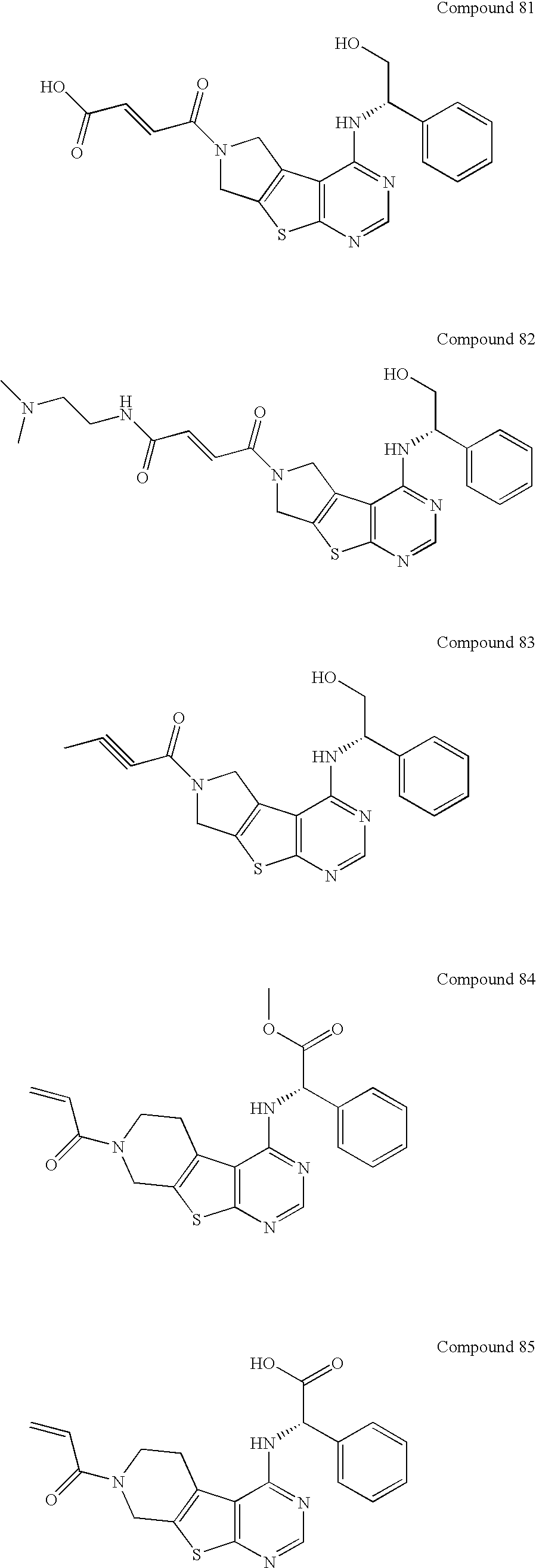


Claims (19)


Priority Applications (1)
| Application Number | Priority Date | Filing Date | Title |
|---|---|---|---|
| US12/614,584 US8507502B2 (en) | 2008-11-10 | 2009-11-09 | Fused bicyclic and tricyclic pyrimidine compounds as tyrosine kinase inhibitors |
Applications Claiming Priority (2)
| Application Number | Priority Date | Filing Date | Title |
|---|---|---|---|
| US11286508P | 2008-11-10 | 2008-11-10 | |
| US12/614,584 US8507502B2 (en) | 2008-11-10 | 2009-11-09 | Fused bicyclic and tricyclic pyrimidine compounds as tyrosine kinase inhibitors |
Publications (2)
| Publication Number | Publication Date |
|---|---|
| US20100120805A1 US20100120805A1 (en) | 2010-05-13 |
| US8507502B2 true US8507502B2 (en) | 2013-08-13 |
Family
ID=42153606
Family Applications (1)
| Application Number | Title | Priority Date | Filing Date |
|---|---|---|---|
| US12/614,584 Active 2031-11-05 US8507502B2 (en) | 2008-11-10 | 2009-11-09 | Fused bicyclic and tricyclic pyrimidine compounds as tyrosine kinase inhibitors |
Country Status (6)
| Country | Link |
|---|---|
| US (1) | US8507502B2 (en) |
| JP (1) | JP5781934B2 (en) |
| KR (1) | KR101703941B1 (en) |
| CN (1) | CN102264745B (en) |
| TW (1) | TWI385174B (en) |
| WO (1) | WO2010054285A2 (en) |
Cited By (3)
| Publication number | Priority date | Publication date | Assignee | Title |
|---|---|---|---|---|
| CN108137497A (en) * | 2015-06-23 | 2018-06-08 | 法国施维雅药厂 | Novel bicyclic derivatives, processes for their preparation and pharmaceutical compositions containing them |
| WO2023283269A1 (en) | 2021-07-06 | 2023-01-12 | Shih, Chuan | Crystalline forms of (s, e)-4-(dimethylamino)-n-(3-(4-(2-hydroxy-1-phenylethylamino)-6-phenylfuro[2,3-d]pyrimidin-5-yl)phenyl)but-2-enamide free base |
| RU2851691C2 (en) * | 2021-07-06 | 2025-11-27 | Анбоджен Терапьютикс, Инк. | Crystalline forms of free base (s,e)-4-(dimethylamino)-n-(3-(4-(2-hydroxy-1-phenylethylamino)-6-phenylfuro[2,3-d]pyrimidin-5-yl)phenyl)but-2-enamide |
Families Citing this family (26)
| Publication number | Priority date | Publication date | Assignee | Title |
|---|---|---|---|---|
| AU2014202057B2 (en) * | 2010-06-23 | 2016-05-05 | Hanmi Science Co., Ltd. | Novel Fused Pyrimidine Derivatives for Inhibition of Tyrosine Kinase Activity |
| MX342164B (en) * | 2010-06-23 | 2016-09-19 | Hanmi Science Co Ltd | Novel fused pyrimidine derivatives for inhibition of tyrosine kinase activity. |
| EP2595993B1 (en) | 2010-07-23 | 2018-04-18 | President and Fellows of Harvard College | Tricyclic proteasome activity enhancing compounds |
| TW201217387A (en) | 2010-09-15 | 2012-05-01 | Hoffmann La Roche | Azabenzothiazole compounds, compositions and methods of use |
| CN103087077B (en) * | 2011-11-03 | 2016-05-18 | 上海希迈医药科技有限公司 | Thienopyrimidine and furans miazines derivative, its preparation method and in application pharmaceutically |
| EP2806875B1 (en) | 2012-01-25 | 2017-07-19 | Proteostasis Therapeutics, Inc. | Proteasome activity modulating compounds |
| AU2013202373B2 (en) * | 2012-01-25 | 2016-04-14 | Proteostasis Therapeutics, Inc. | Proteasome activity enhancing compounds |
| CN103360407B (en) * | 2012-04-10 | 2016-06-22 | 上海希迈医药科技有限公司 | A kind of Thienopyrimidine analog derivative, its preparation method and in application pharmaceutically |
| CN104140395B (en) * | 2013-05-08 | 2018-07-24 | 中国医学科学院药物研究所 | Butynamide derivative and its preparation method and pharmaceutical composition and purposes |
| CN104016983B (en) * | 2013-10-08 | 2018-11-02 | 上海创诺制药有限公司 | Pyrrolo-triazine analog derivative and its preparation method and purposes |
| FR3015483B1 (en) | 2013-12-23 | 2016-01-01 | Servier Lab | NOVEL THIENOPYRIMIDINE DERIVATIVES, PROCESS FOR THEIR PREPARATION AND PHARMACEUTICAL COMPOSITIONS CONTAINING SAME |
| CN104974104B (en) * | 2014-04-03 | 2019-10-01 | 中国医学科学院药物研究所 | Propine amide derivatives and its preparation method and pharmaceutical composition and purposes containing oxazole |
| CN104974109B (en) * | 2014-04-03 | 2019-10-01 | 中国医学科学院药物研究所 | Propine amide derivatives and its preparation method and pharmaceutical composition and purposes containing thiazole |
| CN105085406B (en) * | 2014-05-16 | 2020-11-03 | 中国医学科学院药物研究所 | Benzimidazole-containing cyclopropargyl amide derivatives, preparation method, pharmaceutical composition and use thereof |
| CN106458969A (en) * | 2014-08-25 | 2017-02-22 | 四川海思科制药有限公司 | A kind of (substituted phenyl)(substituted pyrimidine) amino derivative and its preparation method and pharmaceutical use |
| EP3111960B1 (en) * | 2015-07-03 | 2019-12-11 | Kyoto University | Nuclear medicine diagnostic imaging agent |
| CN105061462B (en) * | 2015-08-18 | 2017-05-24 | 沈阳药科大学 | Tetrahydrobenzo [4,5] thieno [2,3-d] pyrimidines compound containing amide and application thereof |
| CN105061460B (en) * | 2015-08-18 | 2017-06-30 | 沈阳药科大学 | Tetrahydro benzo [4,5] thieno [2,3 d] pyrimidines and its application containing sulfide based structural |
| CN105061461B (en) * | 2015-08-18 | 2017-06-30 | 沈阳药科大学 | Tetrahydro benzo [4,5] thieno [2,3 d] pyrimidines and its application containing benzylamine structure |
| CN105037385B (en) * | 2015-08-18 | 2017-04-26 | 沈阳药科大学 | Piperazine-structure-containing tetrahydrobenzo[4,5]thieno[2,3-d]pyrimidine compounds and application thereof |
| FR3046792B1 (en) * | 2016-01-19 | 2018-02-02 | Les Laboratoires Servier | NOVEL AMMONIUM DERIVATIVES, PROCESS FOR THEIR PREPARATION AND PHARMACEUTICAL COMPOSITIONS CONTAINING THEM |
| CN106946896B (en) * | 2017-03-30 | 2019-05-21 | 成都知普莱生物医药科技有限公司 | Furans simultaneously [2,3-d] pyrimidine -4- amine derivative |
| WO2020132384A1 (en) | 2018-12-21 | 2020-06-25 | Celgene Corporation | Thienopyridine inhibitors of ripk2 |
| MX2021010319A (en) * | 2019-03-01 | 2021-12-10 | Revolution Medicines Inc | Bicyclic heteroaryl compounds and uses thereof. |
| WO2021041539A2 (en) * | 2019-08-28 | 2021-03-04 | Ferro Therapeutics, Inc. | Compounds and methods of use |
| TWI906763B (en) * | 2024-02-05 | 2025-12-01 | 財團法人國家衛生研究院 | Inhibitors of epidermal growth factor receptor |
Citations (32)
| Publication number | Priority date | Publication date | Assignee | Title |
|---|---|---|---|---|
| WO1995019774A1 (en) | 1994-01-25 | 1995-07-27 | Warner-Lambert Company | Bicyclic compounds capable of inhibiting tyrosine kinases of the epidermal growth factor receptor family |
| WO1996016960A1 (en) | 1994-11-30 | 1996-06-06 | Zeneca Limited | Quinazoline derivatives |
| WO1997002266A1 (en) | 1995-07-06 | 1997-01-23 | Novartis Ag | Pyrrolopyrimidines and processes for the preparation thereof |
| WO1997038983A1 (en) | 1996-04-12 | 1997-10-23 | Warner-Lambert Company | Irreversible inhibitors of tyrosine kinases |
| WO1997049689A1 (en) | 1996-06-21 | 1997-12-31 | Pharmacia & Upjohn S.P.A. | Bicyclic 4-aralkylaminopyrimidine derivatives as tyrosine kinase inhibitors |
| WO1998002437A1 (en) | 1996-07-13 | 1998-01-22 | Glaxo Group Limited | Bicyclic heteroaromatic compounds as protein tyrosine kinase inhibitors |
| WO2000051991A1 (en) | 1999-02-27 | 2000-09-08 | Boehringer Ingelheim Pharma Kg | 4-AMINO-QUINAZOLINE AND QUINOLINE DERIVATIVES HAVING AN INHIBITORY EFFECT ON SIGNAL TRANsSDUCTION MEDIATED BY TYROSINE KINASES |
| WO2000078735A1 (en) | 1999-06-21 | 2000-12-28 | Boehringer Ingelheim Pharma Kg | Bicyclic heterocycles, medicaments containing these compounds, their use and methods for the production thereof |
| WO2001049688A1 (en) | 2000-01-07 | 2001-07-12 | Universitaire Instelling Antwerpen | Purine derivatives, process for their preparation and use thereof |
| WO2001077104A1 (en) | 2000-04-08 | 2001-10-18 | Boehringer Ingelheim Pharma Gmbh & Co. Kg | Bicyclic heterocylces, medicaments containing said compounds, the use thereof and method for producing them |
| WO2002018376A1 (en) | 2000-08-26 | 2002-03-07 | Boehringer Ingelheim Pharma Gmbh & Co. Kg | Bicyclic heterocycles, medicaments containing these compounds, their use, and methods for the production thereof |
| WO2002018370A1 (en) | 2000-08-26 | 2002-03-07 | Boehringer Ingelheim Pharma Gmbh & Co. Kg | Bicyclic heterocycles, medicaments containing these compounds, their use, and methods for the production thereof |
| WO2002018373A1 (en) | 2000-08-26 | 2002-03-07 | Boehringer Ingelheim Pharma Gmbh & Co. Kg | Quinazoline derivatives, medicaments containing these compounds, their use, and methods for the production thereof |
| WO2002018375A1 (en) | 2000-08-26 | 2002-03-07 | Boehringer Ingelheim Pharma Gmbh & Co. Kg | Quinazolines, medicaments, which contain these compounds and which are effective as tyrosine kinase inhibitors, their use, and methods for the production thereof |
| WO2002050043A1 (en) | 2000-12-20 | 2002-06-27 | Boehringer Ingelheim Pharma Gmbh & Co. Kg | Quinazoline derivatives, medicaments containing said compounds, their utilization and method for the production thereof |
| WO2003066060A2 (en) | 2002-02-05 | 2003-08-14 | Boehringer Ingelheim Pharma Gmbh & Co.Kg | Use of tyrosine kinase inhibitors for the treatment of inflammatory processes |
| WO2003068264A1 (en) | 2002-02-16 | 2003-08-21 | Boehringer Ingelheim Pharma Gmbh & Co.Kg | New medicinal compositions on the basis of anticholinergic agents and egfr kinase inhibitors |
| WO2003094921A2 (en) | 2002-05-11 | 2003-11-20 | Boehringer Ingelheim Pharma Gmbh & Co. Kg | Utilization of inhibitors of egfr-mediated signal transduction for the treatment of benign prostatic hyperplasia (bph)/prostatic hypertrophy |
| WO2004004775A1 (en) | 2002-07-09 | 2004-01-15 | Boehringer Ingelheim Pharma Gmbh & Co. Kg | Novel drug compositions based on novel anticholinergics and inhibitors of egfr-kinase |
| WO2005011701A1 (en) | 2003-07-28 | 2005-02-10 | Boehringer Ingelheim International Gmbh | Use of quinazoline tyrosine kinase inhibitors in the treatment of inflammatory processes |
| US20050148562A1 (en) | 2000-10-31 | 2005-07-07 | Boehringer Ingelheim Pharma Gmbh & Co. Kg | Pharmaceutical compositions based on anticholinergics and additional active ingredients |
| WO2005065687A1 (en) | 2004-01-09 | 2005-07-21 | Boehringer Ingelheim International Gmbh | Novel pharmaceutical combinations containing scopine or tropic acid esters and egfr-kinase inhibitors |
| WO2005067546A2 (en) | 2004-01-13 | 2005-07-28 | Ambit Biosciences Corporation | Pyrrolopyrimidine derivatives and analogs and their use in the treatment and prevention of diseases |
| US20050239778A1 (en) | 2004-04-22 | 2005-10-27 | Boehringer Ingelheim International Gmbh | Novel medicament combinations for the treatment of respiratory diseases |
| WO2006015775A2 (en) | 2004-08-07 | 2006-02-16 | Boehringer Ingelheim International Gmbh | Egfr kinase inhibitor combinations for treating respiratory and gastrointestinal disorders |
| WO2006082129A1 (en) | 2005-02-04 | 2006-08-10 | Boehringer Ingelheim International Gmbh | Use of tyrosine kinase inhibitors for the treatment of chronic rhinosinusitis |
| WO2007003554A1 (en) | 2005-07-01 | 2007-01-11 | Boehringer Ingelheim International Gmbh | Novel medicinal combinations which are used for treating respiratory tract diseases and contain beta-2 long-acting agonists and at least one other type of active substance. |
| WO2007054551A1 (en) | 2005-11-11 | 2007-05-18 | Boehringer Ingelheim International Gmbh | Combination treatment of cancer comprising egfr/her2 inhibitors |
| WO2007056208A2 (en) | 2005-11-02 | 2007-05-18 | Cytovia, Inc. | N-arylalkyl-thienopyrimidin-4-amines and analogs as activators of caspases and inducers of apoptosis and the use thereof |
| WO2007109279A2 (en) | 2006-03-20 | 2007-09-27 | Bayer Healthcare Ag | Tetrahydropyridothienopyrimidine compounds and methods of use thereof |
| WO2008006287A1 (en) | 2006-07-05 | 2008-01-17 | Tianjin Hemay Bio-Tech Co. Ltd | Inreversible protein tyrosine kinases inhibitors and the preparation methods and uses thereof |
| WO2009033581A1 (en) | 2007-09-14 | 2009-03-19 | Bayer Schering Pharma Aktiengesellschaft | Substituted tricyclic compounds and methods of use thereof |
Family Cites Families (5)
| Publication number | Priority date | Publication date | Assignee | Title |
|---|---|---|---|---|
| US6002008A (en) * | 1997-04-03 | 1999-12-14 | American Cyanamid Company | Substituted 3-cyano quinolines |
| SE0202462D0 (en) * | 2002-08-14 | 2002-08-14 | Astrazeneca Ab | Novel use |
| US7399865B2 (en) * | 2003-09-15 | 2008-07-15 | Wyeth | Protein tyrosine kinase enzyme inhibitors |
| US7674907B2 (en) * | 2004-07-23 | 2010-03-09 | Amgen Inc. | Furanopyridine derivatives and methods of use |
| ATE476434T1 (en) * | 2004-12-09 | 2010-08-15 | Xention Ltd | THIENOPYRIDINE DERIVATIVES AS POTASSIUM CHANNEL INHIBITORS |
-
2009
- 2009-11-09 US US12/614,584 patent/US8507502B2/en active Active
- 2009-11-09 TW TW098137894A patent/TWI385174B/en active
- 2009-11-09 WO PCT/US2009/063684 patent/WO2010054285A2/en not_active Ceased
- 2009-11-09 KR KR1020117011218A patent/KR101703941B1/en active Active
- 2009-11-09 CN CN200980144458.1A patent/CN102264745B/en active Active
- 2009-11-09 JP JP2011535715A patent/JP5781934B2/en active Active
Patent Citations (33)
| Publication number | Priority date | Publication date | Assignee | Title |
|---|---|---|---|---|
| WO1995019774A1 (en) | 1994-01-25 | 1995-07-27 | Warner-Lambert Company | Bicyclic compounds capable of inhibiting tyrosine kinases of the epidermal growth factor receptor family |
| WO1996016960A1 (en) | 1994-11-30 | 1996-06-06 | Zeneca Limited | Quinazoline derivatives |
| WO1997002266A1 (en) | 1995-07-06 | 1997-01-23 | Novartis Ag | Pyrrolopyrimidines and processes for the preparation thereof |
| WO1997038983A1 (en) | 1996-04-12 | 1997-10-23 | Warner-Lambert Company | Irreversible inhibitors of tyrosine kinases |
| WO1997049689A1 (en) | 1996-06-21 | 1997-12-31 | Pharmacia & Upjohn S.P.A. | Bicyclic 4-aralkylaminopyrimidine derivatives as tyrosine kinase inhibitors |
| WO1998002437A1 (en) | 1996-07-13 | 1998-01-22 | Glaxo Group Limited | Bicyclic heteroaromatic compounds as protein tyrosine kinase inhibitors |
| WO2000051991A1 (en) | 1999-02-27 | 2000-09-08 | Boehringer Ingelheim Pharma Kg | 4-AMINO-QUINAZOLINE AND QUINOLINE DERIVATIVES HAVING AN INHIBITORY EFFECT ON SIGNAL TRANsSDUCTION MEDIATED BY TYROSINE KINASES |
| WO2000078735A1 (en) | 1999-06-21 | 2000-12-28 | Boehringer Ingelheim Pharma Kg | Bicyclic heterocycles, medicaments containing these compounds, their use and methods for the production thereof |
| WO2001049688A1 (en) | 2000-01-07 | 2001-07-12 | Universitaire Instelling Antwerpen | Purine derivatives, process for their preparation and use thereof |
| WO2001077104A1 (en) | 2000-04-08 | 2001-10-18 | Boehringer Ingelheim Pharma Gmbh & Co. Kg | Bicyclic heterocylces, medicaments containing said compounds, the use thereof and method for producing them |
| WO2002018376A1 (en) | 2000-08-26 | 2002-03-07 | Boehringer Ingelheim Pharma Gmbh & Co. Kg | Bicyclic heterocycles, medicaments containing these compounds, their use, and methods for the production thereof |
| WO2002018370A1 (en) | 2000-08-26 | 2002-03-07 | Boehringer Ingelheim Pharma Gmbh & Co. Kg | Bicyclic heterocycles, medicaments containing these compounds, their use, and methods for the production thereof |
| WO2002018373A1 (en) | 2000-08-26 | 2002-03-07 | Boehringer Ingelheim Pharma Gmbh & Co. Kg | Quinazoline derivatives, medicaments containing these compounds, their use, and methods for the production thereof |
| WO2002018375A1 (en) | 2000-08-26 | 2002-03-07 | Boehringer Ingelheim Pharma Gmbh & Co. Kg | Quinazolines, medicaments, which contain these compounds and which are effective as tyrosine kinase inhibitors, their use, and methods for the production thereof |
| US20050148562A1 (en) | 2000-10-31 | 2005-07-07 | Boehringer Ingelheim Pharma Gmbh & Co. Kg | Pharmaceutical compositions based on anticholinergics and additional active ingredients |
| WO2002050043A1 (en) | 2000-12-20 | 2002-06-27 | Boehringer Ingelheim Pharma Gmbh & Co. Kg | Quinazoline derivatives, medicaments containing said compounds, their utilization and method for the production thereof |
| WO2003066060A2 (en) | 2002-02-05 | 2003-08-14 | Boehringer Ingelheim Pharma Gmbh & Co.Kg | Use of tyrosine kinase inhibitors for the treatment of inflammatory processes |
| WO2003068264A1 (en) | 2002-02-16 | 2003-08-21 | Boehringer Ingelheim Pharma Gmbh & Co.Kg | New medicinal compositions on the basis of anticholinergic agents and egfr kinase inhibitors |
| WO2003094921A2 (en) | 2002-05-11 | 2003-11-20 | Boehringer Ingelheim Pharma Gmbh & Co. Kg | Utilization of inhibitors of egfr-mediated signal transduction for the treatment of benign prostatic hyperplasia (bph)/prostatic hypertrophy |
| WO2004004775A1 (en) | 2002-07-09 | 2004-01-15 | Boehringer Ingelheim Pharma Gmbh & Co. Kg | Novel drug compositions based on novel anticholinergics and inhibitors of egfr-kinase |
| WO2005011701A1 (en) | 2003-07-28 | 2005-02-10 | Boehringer Ingelheim International Gmbh | Use of quinazoline tyrosine kinase inhibitors in the treatment of inflammatory processes |
| WO2005065687A1 (en) | 2004-01-09 | 2005-07-21 | Boehringer Ingelheim International Gmbh | Novel pharmaceutical combinations containing scopine or tropic acid esters and egfr-kinase inhibitors |
| WO2005067546A2 (en) | 2004-01-13 | 2005-07-28 | Ambit Biosciences Corporation | Pyrrolopyrimidine derivatives and analogs and their use in the treatment and prevention of diseases |
| US20050239778A1 (en) | 2004-04-22 | 2005-10-27 | Boehringer Ingelheim International Gmbh | Novel medicament combinations for the treatment of respiratory diseases |
| WO2006015775A2 (en) | 2004-08-07 | 2006-02-16 | Boehringer Ingelheim International Gmbh | Egfr kinase inhibitor combinations for treating respiratory and gastrointestinal disorders |
| WO2006082129A1 (en) | 2005-02-04 | 2006-08-10 | Boehringer Ingelheim International Gmbh | Use of tyrosine kinase inhibitors for the treatment of chronic rhinosinusitis |
| WO2007003554A1 (en) | 2005-07-01 | 2007-01-11 | Boehringer Ingelheim International Gmbh | Novel medicinal combinations which are used for treating respiratory tract diseases and contain beta-2 long-acting agonists and at least one other type of active substance. |
| US20070037781A1 (en) | 2005-07-01 | 2007-02-15 | Boehringer Ingelheim International Gmbh | Novel combinations of medicaments for the treatment of respiratory diseases containing long-acting beta-agonists and at least one additional active ingredient |
| WO2007056208A2 (en) | 2005-11-02 | 2007-05-18 | Cytovia, Inc. | N-arylalkyl-thienopyrimidin-4-amines and analogs as activators of caspases and inducers of apoptosis and the use thereof |
| WO2007054551A1 (en) | 2005-11-11 | 2007-05-18 | Boehringer Ingelheim International Gmbh | Combination treatment of cancer comprising egfr/her2 inhibitors |
| WO2007109279A2 (en) | 2006-03-20 | 2007-09-27 | Bayer Healthcare Ag | Tetrahydropyridothienopyrimidine compounds and methods of use thereof |
| WO2008006287A1 (en) | 2006-07-05 | 2008-01-17 | Tianjin Hemay Bio-Tech Co. Ltd | Inreversible protein tyrosine kinases inhibitors and the preparation methods and uses thereof |
| WO2009033581A1 (en) | 2007-09-14 | 2009-03-19 | Bayer Schering Pharma Aktiengesellschaft | Substituted tricyclic compounds and methods of use thereof |
Non-Patent Citations (11)
Cited By (5)
| Publication number | Priority date | Publication date | Assignee | Title |
|---|---|---|---|---|
| CN108137497A (en) * | 2015-06-23 | 2018-06-08 | 法国施维雅药厂 | Novel bicyclic derivatives, processes for their preparation and pharmaceutical compositions containing them |
| US10323041B2 (en) * | 2015-06-23 | 2019-06-18 | Les Laboratoires Servier | Bicyclic derivatives, a process for their preparation and pharmaceutical compositions containing them |
| CN108137497B (en) * | 2015-06-23 | 2021-06-15 | 法国施维雅药厂 | Bicyclic derivatives, process for their preparation and pharmaceutical compositions containing them |
| WO2023283269A1 (en) | 2021-07-06 | 2023-01-12 | Shih, Chuan | Crystalline forms of (s, e)-4-(dimethylamino)-n-(3-(4-(2-hydroxy-1-phenylethylamino)-6-phenylfuro[2,3-d]pyrimidin-5-yl)phenyl)but-2-enamide free base |
| RU2851691C2 (en) * | 2021-07-06 | 2025-11-27 | Анбоджен Терапьютикс, Инк. | Crystalline forms of free base (s,e)-4-(dimethylamino)-n-(3-(4-(2-hydroxy-1-phenylethylamino)-6-phenylfuro[2,3-d]pyrimidin-5-yl)phenyl)but-2-enamide |
Also Published As
| Publication number | Publication date |
|---|---|
| HK1162509A1 (en) | 2012-08-31 |
| CN102264745B (en) | 2015-07-22 |
| JP2012508252A (en) | 2012-04-05 |
| CN102264745A (en) | 2011-11-30 |
| TWI385174B (en) | 2013-02-11 |
| US20100120805A1 (en) | 2010-05-13 |
| WO2010054285A2 (en) | 2010-05-14 |
| KR20110103937A (en) | 2011-09-21 |
| TW201018696A (en) | 2010-05-16 |
| WO2010054285A3 (en) | 2010-09-16 |
| JP5781934B2 (en) | 2015-09-24 |
| KR101703941B1 (en) | 2017-02-07 |
Similar Documents
| Publication | Publication Date | Title |
|---|---|---|
| US8507502B2 (en) | Fused bicyclic and tricyclic pyrimidine compounds as tyrosine kinase inhibitors | |
| CN112119075B (en) | Fused ring compounds | |
| CN102014627B (en) | Fused bicyclic pyrimidine compounds as aurora kinase inhibitors | |
| EP2331530B1 (en) | Fused multicyclic compounds as protein kinase inhibitors | |
| ES2377358T3 (en) | Pharmaceutical compounds | |
| AU2022219987A1 (en) | Cdk inhibitors and methods of use thereof | |
| TWI499420B (en) | Phosphoinositide 3-kinase inhibitor compounds and methods of use | |
| JP2021098721A (en) | Substituted quinazoline compounds and methods for use thereof | |
| JP5961628B2 (en) | 2,4-Diamino-6,7-dihydro-5H-pyrrolo [2,3] pyrimidine derivatives which are FAK / Pyk2 inhibitors | |
| TW202241903A (en) | Pyrrolotriazine compounds as tam inhibitors | |
| US8058427B2 (en) | Coumarin compounds and their use for treating cancer | |
| AU2016282289A1 (en) | HPK1 inhibitors and methods of using same | |
| CA2864672C (en) | Pyrazolopyrimidinyl inhibitors of ubiquitin-activating enzyme | |
| WO2016119707A1 (en) | Novel heteroaryl and heterocycle compounds, compositions and methods | |
| KR20230167347A (en) | Tricyclic compounds and their uses | |
| CN116332910A (en) | 2-aminopyrimidine derivatives as kinase inhibitors and their preparation and application | |
| HK1162509B (en) | Fused bicyclic and tricyclic pyrimidine compounds as tyrosine kinase inhibitors | |
| WO2019134082A1 (en) | Novel pyrimidine derivatives as mth1 inhibitors | |
| HK1151694B (en) | Fused bicyclic pyrimidine compounds as aurora kinase inhibitors | |
| HK1163089B (en) | Fused multicyclic compounds as protein kinase inhibitors | |
| HK1125631A1 (en) | Benzazole derivatives, compositions, and methods of use as aurora kinase inhibitors | |
| HK1125631B (en) | Benzazole derivatives, compositions, and methods of use as aurora kinase inhibitors |
Legal Events
| Date | Code | Title | Description |
|---|---|---|---|
| AS | Assignment |
Owner name: NATIONAL HEALTH RESEARCH INSTITUTES,TAIWAN Free format text: ASSIGNMENT OF ASSIGNORS INTEREST;ASSIGNORS:HSIEH, HSING-PANG;COUMAR, SELVARAJ MOHANE;HSU, TSU-AN;AND OTHERS;SIGNING DATES FROM 20091110 TO 20091111;REEL/FRAME:023597/0405 Owner name: NATIONAL HEALTH RESEARCH INSTITUTES, TAIWAN Free format text: ASSIGNMENT OF ASSIGNORS INTEREST;ASSIGNORS:HSIEH, HSING-PANG;COUMAR, SELVARAJ MOHANE;HSU, TSU-AN;AND OTHERS;SIGNING DATES FROM 20091110 TO 20091111;REEL/FRAME:023597/0405 |
|
| STCF | Information on status: patent grant |
Free format text: PATENTED CASE |
|
| FPAY | Fee payment |
Year of fee payment: 4 |
|
| MAFP | Maintenance fee payment |
Free format text: PAYMENT OF MAINTENANCE FEE, 8TH YR, SMALL ENTITY (ORIGINAL EVENT CODE: M2552); ENTITY STATUS OF PATENT OWNER: SMALL ENTITY Year of fee payment: 8 |
|
| MAFP | Maintenance fee payment |
Free format text: PAYMENT OF MAINTENANCE FEE, 12TH YR, SMALL ENTITY (ORIGINAL EVENT CODE: M2553); ENTITY STATUS OF PATENT OWNER: SMALL ENTITY Year of fee payment: 12 |