US8497003B2 - Glucose compound, cellulose composition, cellulose film, polarizing plate and liquid crystal display device - Google Patents
Glucose compound, cellulose composition, cellulose film, polarizing plate and liquid crystal display device Download PDFInfo
- Publication number
- US8497003B2 US8497003B2 US12/750,220 US75022010A US8497003B2 US 8497003 B2 US8497003 B2 US 8497003B2 US 75022010 A US75022010 A US 75022010A US 8497003 B2 US8497003 B2 US 8497003B2
- Authority
- US
- United States
- Prior art keywords
- cellulose
- film
- group
- liquid crystal
- compound
- Prior art date
- Legal status (The legal status is an assumption and is not a legal conclusion. Google has not performed a legal analysis and makes no representation as to the accuracy of the status listed.)
- Expired - Fee Related, expires
Links
- XSCLAMXGEIPKRC-LJSFEPEYSA-N C=CCOC1=CC=C(C(=O)O[C@@H]2O[C@@H]3CO[C@@H](C4=CC=C(C)C=C4)O[C@H]3[C@H](O)[C@H]2O)C=C1.C=CCOC1=CC=C(C(=O)O[C@@H]2O[C@@H]3CO[C@@H](C4=CC=C(C)C=C4)O[C@H]3[C@H](OC(C)=O)[C@H]2OC(C)=O)C=C1.CC(=O)O[C@@H]1[C@@H](OC(C)=O)[C@H](OC(=O)C2=CC=C(C)C=C2C)O[C@@H]2CO[C@@H](C3=CC=C(C)C=C3)O[C@@H]12.COC1=CC(C(=O)O[C@@H]2O[C@@H]3CO[C@@H](C4=CC=C(C)C=C4)O[C@H]3[C@H](OC(C)=O)[C@H]2OC(C)=O)=CC=C1C.COCCOCCOC1=CC=C(C(=O)O[C@@H]2O[C@@H]3CO[C@@H](C4=CC=C(C)C=C4)O[C@H]3[C@H](OC(C)=O)[C@H]2OC(C)=O)C=C1 Chemical compound C=CCOC1=CC=C(C(=O)O[C@@H]2O[C@@H]3CO[C@@H](C4=CC=C(C)C=C4)O[C@H]3[C@H](O)[C@H]2O)C=C1.C=CCOC1=CC=C(C(=O)O[C@@H]2O[C@@H]3CO[C@@H](C4=CC=C(C)C=C4)O[C@H]3[C@H](OC(C)=O)[C@H]2OC(C)=O)C=C1.CC(=O)O[C@@H]1[C@@H](OC(C)=O)[C@H](OC(=O)C2=CC=C(C)C=C2C)O[C@@H]2CO[C@@H](C3=CC=C(C)C=C3)O[C@@H]12.COC1=CC(C(=O)O[C@@H]2O[C@@H]3CO[C@@H](C4=CC=C(C)C=C4)O[C@H]3[C@H](OC(C)=O)[C@H]2OC(C)=O)=CC=C1C.COCCOCCOC1=CC=C(C(=O)O[C@@H]2O[C@@H]3CO[C@@H](C4=CC=C(C)C=C4)O[C@H]3[C@H](OC(C)=O)[C@H]2OC(C)=O)C=C1 XSCLAMXGEIPKRC-LJSFEPEYSA-N 0.000 description 1
- IVEPWUAPXBCSHI-BZOCDCDFSA-N CC(=O)OC(C)=O.CO.COC1=CC=C(C(=O)Cl)C=C1.COC1=CC=C(C(=O)O[C@@H]2O[C@@H]3CO[C@@H](C4=CC=C(OC)C=C4)O[C@H]3[C@H](OC(C)=O)[C@H]2OC(C)=O)C=C1.COC1=CC=C(C(OC)OC)C=C1.COC1=CC=C([C@@H]2OC[C@H]3OC(O)[C@H](O)[C@@H](O)[C@@H]3O2)C=C1.COC1=CC=C([C@@H]2OC[C@H]3OC(O)[C@H](OC(C)=O)[C@@H](OC(C)=O)[C@@H]3O2)C=C1.COC1=CC=C([C@@H]2OC[C@H]3OC(OC(C)=O)[C@H](OC(C)=O)[C@@H](OC(C)=O)[C@@H]3O2)C=C1.NCC1=CC=CC=C1.OC[C@H]1OC(O)[C@H](O)[C@@H](O)[C@@H]1O.S.S=S.S=S=S Chemical compound CC(=O)OC(C)=O.CO.COC1=CC=C(C(=O)Cl)C=C1.COC1=CC=C(C(=O)O[C@@H]2O[C@@H]3CO[C@@H](C4=CC=C(OC)C=C4)O[C@H]3[C@H](OC(C)=O)[C@H]2OC(C)=O)C=C1.COC1=CC=C(C(OC)OC)C=C1.COC1=CC=C([C@@H]2OC[C@H]3OC(O)[C@H](O)[C@@H](O)[C@@H]3O2)C=C1.COC1=CC=C([C@@H]2OC[C@H]3OC(O)[C@H](OC(C)=O)[C@@H](OC(C)=O)[C@@H]3O2)C=C1.COC1=CC=C([C@@H]2OC[C@H]3OC(OC(C)=O)[C@H](OC(C)=O)[C@@H](OC(C)=O)[C@@H]3O2)C=C1.NCC1=CC=CC=C1.OC[C@H]1OC(O)[C@H](O)[C@@H](O)[C@@H]1O.S.S=S.S=S=S IVEPWUAPXBCSHI-BZOCDCDFSA-N 0.000 description 1
- YPFRJGGLGDBLJF-SRKNNVBBSA-N CC(=O)O[C@@H]1[C@@H](OC(C)=O)[C@H](OC(=O)C2=CC=C(C)C=C2)O[C@@H]2CO[C@@H](C3=CC=C(C)C=C3)O[C@@H]12.CC(=O)O[C@@H]1[C@@H](OC(C)=O)[C@H](OC(=O)C2=CC=C(C)C=C2)O[C@@H]2CO[C@@H](C3=CC=C(C)C=C3)O[C@@H]12.CC(=O)O[C@@H]1[C@@H](OC(C)=O)[C@H](OC(=O)C2=CC=C(C)C=C2)O[C@@H]2CO[C@@H](C3=CC=C(C)C=C3)O[C@@H]12.CC(=O)O[C@@H]1[C@@H](OC(C)=O)[C@H](OC(=O)C2=CC=C(C)C=C2)O[C@@H]2CO[C@@H](C3=CC=C(C)C=C3)O[C@@H]12.CC1=CC=C(C(=O)O[C@@H]2O[C@@H]3CO[C@@H](C4=CC=C(C)C=C4)O[C@H]3[C@H](O)[C@H]2O)C=C1.CC1=CC=C(C(=O)O[C@@H]2O[C@@H]3CO[C@@H](C4=CC=C(C)C=C4)O[C@H]3[C@H](O)[C@H]2O)C=C1 Chemical compound CC(=O)O[C@@H]1[C@@H](OC(C)=O)[C@H](OC(=O)C2=CC=C(C)C=C2)O[C@@H]2CO[C@@H](C3=CC=C(C)C=C3)O[C@@H]12.CC(=O)O[C@@H]1[C@@H](OC(C)=O)[C@H](OC(=O)C2=CC=C(C)C=C2)O[C@@H]2CO[C@@H](C3=CC=C(C)C=C3)O[C@@H]12.CC(=O)O[C@@H]1[C@@H](OC(C)=O)[C@H](OC(=O)C2=CC=C(C)C=C2)O[C@@H]2CO[C@@H](C3=CC=C(C)C=C3)O[C@@H]12.CC(=O)O[C@@H]1[C@@H](OC(C)=O)[C@H](OC(=O)C2=CC=C(C)C=C2)O[C@@H]2CO[C@@H](C3=CC=C(C)C=C3)O[C@@H]12.CC1=CC=C(C(=O)O[C@@H]2O[C@@H]3CO[C@@H](C4=CC=C(C)C=C4)O[C@H]3[C@H](O)[C@H]2O)C=C1.CC1=CC=C(C(=O)O[C@@H]2O[C@@H]3CO[C@@H](C4=CC=C(C)C=C4)O[C@H]3[C@H](O)[C@H]2O)C=C1 YPFRJGGLGDBLJF-SRKNNVBBSA-N 0.000 description 1
- ZDQHCXVPNDQKTR-XMOKHLMNSA-N CC(=O)O[C@H]1[C@@H]2O[C@H](C3=CC=C(C)C=C3)OC[C@H]2O[C@@H](OCC2=CC=C(C)C=C2)[C@@H]1OC(C)=O.CC(=O)O[C@H]1[C@@H]2O[C@H](C3=CC=C(C)C=C3)OC[C@H]2O[C@@H](OCC2=CC=C(C)C=C2)[C@@H]1OC(C)=O.CC(=O)O[C@H]1[C@@H]2O[C@H](C3=CC=C(C)C=C3)OC[C@H]2O[C@@H](OCC2=CC=C(C)C=C2)[C@@H]1OC(C)=O.CC(=O)O[C@H]1[C@@H]2O[C@H](C3=CC=C(C)C=C3)OC[C@H]2O[C@@H](OCC2=CC=C(C)C=C2)[C@@H]1OC(C)=O.CC1=CC=C(C(=O)O[C@@H]2O[C@@H]3CO[C@@H](C4=CC=C(C)C=C4)O[C@H]3[C@H](O)[C@H]2O)C=C1.CC1=CC=C(C(=O)O[C@@H]2O[C@@H]3CO[C@@H](C4=CC=C(C)C=C4)O[C@H]3[C@H](O)[C@H]2O)C=C1 Chemical compound CC(=O)O[C@H]1[C@@H]2O[C@H](C3=CC=C(C)C=C3)OC[C@H]2O[C@@H](OCC2=CC=C(C)C=C2)[C@@H]1OC(C)=O.CC(=O)O[C@H]1[C@@H]2O[C@H](C3=CC=C(C)C=C3)OC[C@H]2O[C@@H](OCC2=CC=C(C)C=C2)[C@@H]1OC(C)=O.CC(=O)O[C@H]1[C@@H]2O[C@H](C3=CC=C(C)C=C3)OC[C@H]2O[C@@H](OCC2=CC=C(C)C=C2)[C@@H]1OC(C)=O.CC(=O)O[C@H]1[C@@H]2O[C@H](C3=CC=C(C)C=C3)OC[C@H]2O[C@@H](OCC2=CC=C(C)C=C2)[C@@H]1OC(C)=O.CC1=CC=C(C(=O)O[C@@H]2O[C@@H]3CO[C@@H](C4=CC=C(C)C=C4)O[C@H]3[C@H](O)[C@H]2O)C=C1.CC1=CC=C(C(=O)O[C@@H]2O[C@@H]3CO[C@@H](C4=CC=C(C)C=C4)O[C@H]3[C@H](O)[C@H]2O)C=C1 ZDQHCXVPNDQKTR-XMOKHLMNSA-N 0.000 description 1
- PEINETRHLFUJLO-HROLFNFRSA-N CC1=CC=C(CO[C@@H]2O[C@@H]3CO[C@@H](C4=CC=C(C)C=C4)O[C@H]3[C@H](O)[C@H]2O)C=C1.CC1=CC=C(CO[C@@H]2O[C@@H]3CO[C@@H](C4=CC=C(C)C=C4)O[C@H]3[C@H](O)[C@H]2O)C=C1.CC1=CC=C(CO[C@@H]2O[C@@H]3CO[C@@H](C4=CC=C(C)C=C4)O[C@H]3[C@H](O)[C@H]2O)C=C1.CC1=CC=C(CO[C@@H]2O[C@@H]3CO[C@@H](C4=CC=C(C)C=C4)O[C@H]3[C@H](O)[C@H]2O)C=C1.CCC(=O)O[C@@H]1[C@@H](OC(=O)CC)[C@H](OC(=O)C2=CC=C(C)C=C2)O[C@@H]2CO[C@@H](C3=CC=C(C)C=C3)O[C@@H]12.CCCC(=O)O[C@@H]1[C@@H](OC(=O)CCC)[C@H](OC(=O)C2CCC(C)CC2)O[C@@H]2CO[C@@H](C3=CC=C(C)C=C3)O[C@@H]12 Chemical compound CC1=CC=C(CO[C@@H]2O[C@@H]3CO[C@@H](C4=CC=C(C)C=C4)O[C@H]3[C@H](O)[C@H]2O)C=C1.CC1=CC=C(CO[C@@H]2O[C@@H]3CO[C@@H](C4=CC=C(C)C=C4)O[C@H]3[C@H](O)[C@H]2O)C=C1.CC1=CC=C(CO[C@@H]2O[C@@H]3CO[C@@H](C4=CC=C(C)C=C4)O[C@H]3[C@H](O)[C@H]2O)C=C1.CC1=CC=C(CO[C@@H]2O[C@@H]3CO[C@@H](C4=CC=C(C)C=C4)O[C@H]3[C@H](O)[C@H]2O)C=C1.CCC(=O)O[C@@H]1[C@@H](OC(=O)CC)[C@H](OC(=O)C2=CC=C(C)C=C2)O[C@@H]2CO[C@@H](C3=CC=C(C)C=C3)O[C@@H]12.CCCC(=O)O[C@@H]1[C@@H](OC(=O)CCC)[C@H](OC(=O)C2CCC(C)CC2)O[C@@H]2CO[C@@H](C3=CC=C(C)C=C3)O[C@@H]12 PEINETRHLFUJLO-HROLFNFRSA-N 0.000 description 1
- MAAGNJHFRKBFSY-MXVIHJGJSA-N CCC1=CC=C(OC(=O)[C@H]2CC[C@H](C(=O)OC3=CC=C(CC)C=C3)CC2)C=C1 Chemical compound CCC1=CC=C(OC(=O)[C@H]2CC[C@H](C(=O)OC3=CC=C(CC)C=C3)CC2)C=C1 MAAGNJHFRKBFSY-MXVIHJGJSA-N 0.000 description 1
- XNZKPRGYYGNUGE-HDONMJQYSA-N COC1=CC=C(CO)C=C1.COC1=CC=C(CO[C@@H]2O[C@@H]3CO[C@@H](C4=CC=C(OC)C=C4)O[C@H]3[C@H](O)[C@H]2O)C=C1.COC1=CC=C(CO[C@@H]2O[C@@H]3CO[C@@H](C4=CC=C(OC)C=C4)O[C@H]3[C@H](OC(C)=O)[C@H]2OC(C)=O)C=C1.COC1=CC=C([C@@H]2OC[C@H]3OC(O)[C@H](OC(C)=O)[C@@H](OC(C)=O)[C@@H]3O2)C=C1.COC1=CC=C([C@@H]2OC[C@H]3OC(OC(=N)C(Cl)(Cl)Cl)[C@H](OC(C)=O)[C@@H](OC(C)=O)[C@@H]3O2)C=C1.S=S=S.S=S=S=S Chemical compound COC1=CC=C(CO)C=C1.COC1=CC=C(CO[C@@H]2O[C@@H]3CO[C@@H](C4=CC=C(OC)C=C4)O[C@H]3[C@H](O)[C@H]2O)C=C1.COC1=CC=C(CO[C@@H]2O[C@@H]3CO[C@@H](C4=CC=C(OC)C=C4)O[C@H]3[C@H](OC(C)=O)[C@H]2OC(C)=O)C=C1.COC1=CC=C([C@@H]2OC[C@H]3OC(O)[C@H](OC(C)=O)[C@@H](OC(C)=O)[C@@H]3O2)C=C1.COC1=CC=C([C@@H]2OC[C@H]3OC(OC(=N)C(Cl)(Cl)Cl)[C@H](OC(C)=O)[C@@H](OC(C)=O)[C@@H]3O2)C=C1.S=S=S.S=S=S=S XNZKPRGYYGNUGE-HDONMJQYSA-N 0.000 description 1
- KQJHEAUPUFGPOR-UHFFFAOYSA-N COC1=CC=C(NC2=NC(NC3=CC=CC(C)=C3)=NC(NC3=CC=CC(C)=C3)=N2)C=C1 Chemical compound COC1=CC=C(NC2=NC(NC3=CC=CC(C)=C3)=NC(NC3=CC=CC(C)=C3)=N2)C=C1 KQJHEAUPUFGPOR-UHFFFAOYSA-N 0.000 description 1
Classifications
-
- C—CHEMISTRY; METALLURGY
- C07—ORGANIC CHEMISTRY
- C07H—SUGARS; DERIVATIVES THEREOF; NUCLEOSIDES; NUCLEOTIDES; NUCLEIC ACIDS
- C07H13/00—Compounds containing saccharide radicals esterified by carbonic acid or derivatives thereof, or by organic acids, e.g. phosphonic acids
- C07H13/02—Compounds containing saccharide radicals esterified by carbonic acid or derivatives thereof, or by organic acids, e.g. phosphonic acids by carboxylic acids
- C07H13/04—Compounds containing saccharide radicals esterified by carbonic acid or derivatives thereof, or by organic acids, e.g. phosphonic acids by carboxylic acids having the esterifying carboxyl radicals attached to acyclic carbon atoms
-
- C—CHEMISTRY; METALLURGY
- C07—ORGANIC CHEMISTRY
- C07H—SUGARS; DERIVATIVES THEREOF; NUCLEOSIDES; NUCLEOTIDES; NUCLEIC ACIDS
- C07H13/00—Compounds containing saccharide radicals esterified by carbonic acid or derivatives thereof, or by organic acids, e.g. phosphonic acids
- C07H13/02—Compounds containing saccharide radicals esterified by carbonic acid or derivatives thereof, or by organic acids, e.g. phosphonic acids by carboxylic acids
- C07H13/08—Compounds containing saccharide radicals esterified by carbonic acid or derivatives thereof, or by organic acids, e.g. phosphonic acids by carboxylic acids having the esterifying carboxyl radicals directly attached to carbocyclic rings
-
- C—CHEMISTRY; METALLURGY
- C07—ORGANIC CHEMISTRY
- C07H—SUGARS; DERIVATIVES THEREOF; NUCLEOSIDES; NUCLEOTIDES; NUCLEIC ACIDS
- C07H15/00—Compounds containing hydrocarbon or substituted hydrocarbon radicals directly attached to hetero atoms of saccharide radicals
- C07H15/18—Acyclic radicals, substituted by carbocyclic rings
-
- C—CHEMISTRY; METALLURGY
- C07—ORGANIC CHEMISTRY
- C07H—SUGARS; DERIVATIVES THEREOF; NUCLEOSIDES; NUCLEOTIDES; NUCLEIC ACIDS
- C07H9/00—Compounds containing a hetero ring sharing at least two hetero atoms with a saccharide radical
- C07H9/02—Compounds containing a hetero ring sharing at least two hetero atoms with a saccharide radical the hetero ring containing only oxygen as ring hetero atoms
- C07H9/04—Cyclic acetals
-
- G—PHYSICS
- G02—OPTICS
- G02B—OPTICAL ELEMENTS, SYSTEMS OR APPARATUS
- G02B5/00—Optical elements other than lenses
- G02B5/30—Polarising elements
- G02B5/3025—Polarisers, i.e. arrangements capable of producing a definite output polarisation state from an unpolarised input state
- G02B5/3033—Polarisers, i.e. arrangements capable of producing a definite output polarisation state from an unpolarised input state in the form of a thin sheet or foil, e.g. Polaroid
-
- C—CHEMISTRY; METALLURGY
- C09—DYES; PAINTS; POLISHES; NATURAL RESINS; ADHESIVES; COMPOSITIONS NOT OTHERWISE PROVIDED FOR; APPLICATIONS OF MATERIALS NOT OTHERWISE PROVIDED FOR
- C09K—MATERIALS FOR MISCELLANEOUS APPLICATIONS, NOT PROVIDED FOR ELSEWHERE
- C09K2323/00—Functional layers of liquid crystal optical display excluding electroactive liquid crystal layer characterised by chemical composition
- C09K2323/03—Viewing layer characterised by chemical composition
- C09K2323/035—Ester polymer, e.g. polycarbonate, polyacrylate or polyester
Definitions
- optical compensation sheets for use, for example, in a liquid crystal display device, have optical anisotropy (a higher retardation value). Therefore, a synthetic polymer film, e.g. a polycarbonate film or polysulfone film, which has a high retardation value, is generally used as the optical compensation sheet.
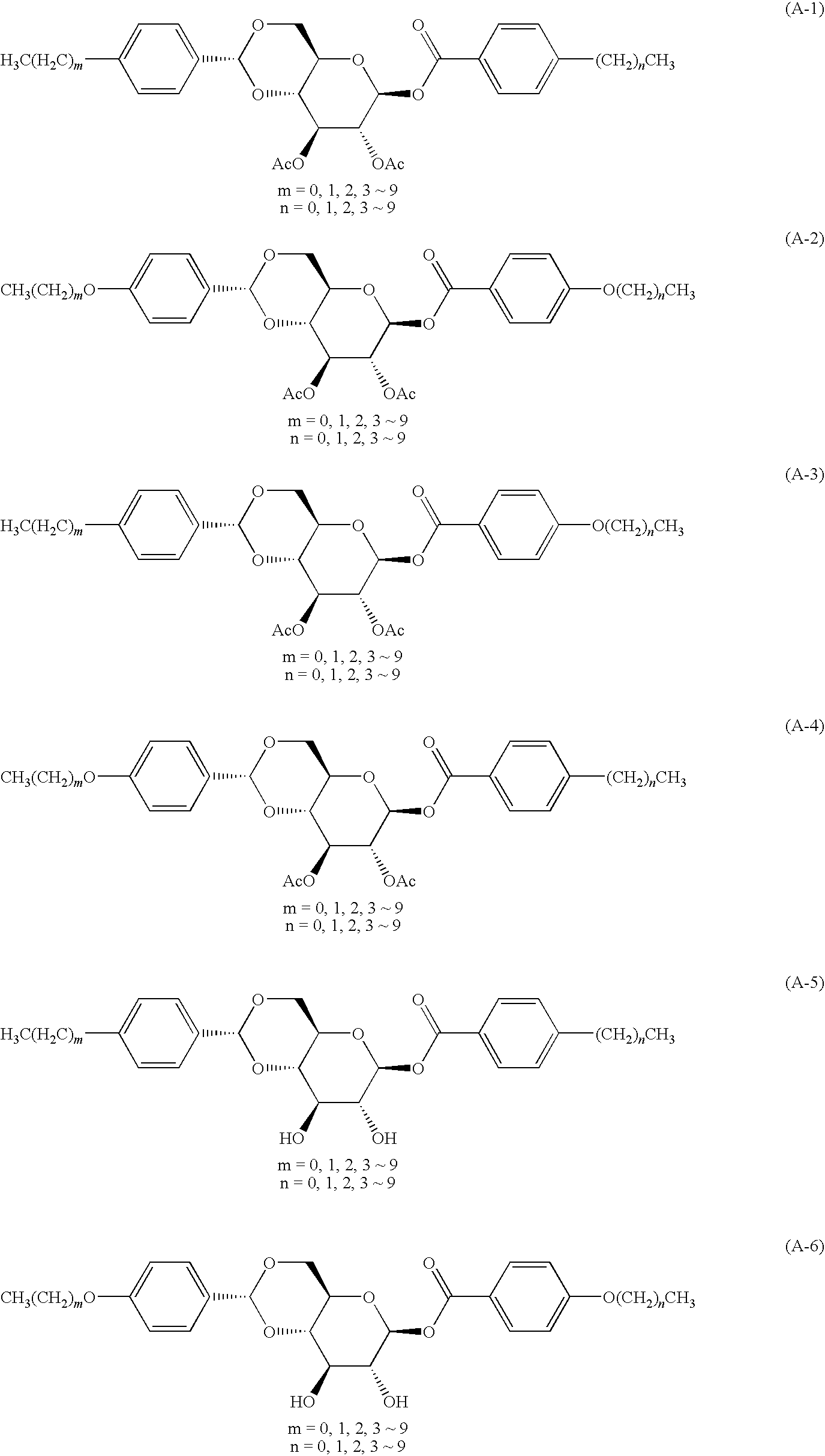
- the present invention resides in a glucose compound represented by Formula (I):
- R 11 and R 12 each independently represent an alkyl group having 1 to 10 carbon atoms or an alkenyl group having 2 to 10 carbon atoms, wherein one CH 2 group or two or more non-adjacent CH 2 groups in the alkyl and alkenyl groups may be replaced by O;
- L 1 represents —COO—*, —OCH 2 —* (binding to B at the * side), or a single bond;
- a and B each independently represent a trans-1,4-cyclohexylene group which may be substituted or a 1,4-phenylene group which may be substituted; and
- R 13 and R 14 each independently represent a hydrogen atom or an acyl group having 1 to 10 carbon atoms.
- the present invention resides in a retardation-increasing agent, which comprises the aforementioned glucose compound.
- R 11 and R 12 each independently represent an alkyl group having 1 to 10 carbon atoms or an alkenyl group having 2 to 10 carbon atoms, wherein one CH 2 group or two or more non-adjacent CH 2 groups in the alkyl and alkenyl groups may be replaced by O;
- L 1 represents —OCO—*, —OCH 2 —* (binding to B at the * side), or a single bond;
- a and B each independently represent a trans-1,4-cyclohexylene group which may be substituted or a 1,4-phenylene group which may be substituted; and
- R 13 and R 14 each independently represent a hydrogen atom or an acyl group having 1 to 10 carbon atoms.
- R 15 and R 16 each independently represent an alkyl group having 1 to 6 carbon atoms or an alkenyl group having 2 to 5 carbon atoms, wherein one CH 2 group or two or more non-adjacent CH 2 groups in the alkyl and alkenyl groups may be replaced by O;
- L 2 represents —OCO—* or —OCH 2 —* (binding to the phenylene group at the * side);
- R 17 and R 18 each independently represent a hydrogen atom or an acyl group having 1 to 10 carbon atoms; and
- R 19 and R 20 each independently represent a hydrogen atom, a methyl group or a methoxy group.
- R 11 and R 12 each independently represent an alkyl group having 1 to 10 carbon atoms or an alkenyl group having 2 to 10 carbon atoms, wherein one CH 2 group or two or more non-adjacent CH 2 groups in the alkyl and alkenyl groups may be replaced by O;
- L 1 represents —OCO—*, —OCH 2 —* (binding to B at the * side), or a single bond;
- a and B each independently represent a trans-1,4-cyclohexylene group which may be substituted or a 1,4-phenylene group which may be substituted; and
- R 13 and R 14 each independently represent a hydrogen atom or an acyl group having 1 to 10 carbon atoms.
- Each of R 11 and R 12 is preferably an alkyl group having 1 to 10 carbon atoms, an alkoxy group having 1 to 10 carbon atoms, an alkoxyalkyl group having 1 to 10 carbon atoms or an alkenyl group having 2 to 10 carbon atoms; more preferably an alkyl group having 1 to 6 carbon atoms, an alkoxy group having 1 to 6 carbon atoms, an alkoxyalkyl group having 1 to 6 carbon atoms or an alkenyl group having 2 to 5 carbon atoms; still more preferably an ethyl group, a n-propyl group, a n-butyl group, a n-pentyl group, a methoxy group, an ethoxy group, a n-propoxy group, a n-butoxy group or an allyl group; and most preferably a methoxy group.
- R 11 and R 12 may be the same as or different from each other.
- L 1 represents —COO—*, —OCH 2 —* (binding to B at the * side) or a single bond, preferably —OCO—* or —OCH 2 —*.
- a and B each independently represent a trans-1,4-cyclohexylene group or a 1,4-phenylene group; preferably a 1,4-phenylene group.
- the rings A and B may be substituted, and examples of favorable substituent groups include a methyl group, an ethyl group, a methoxy group and the like, but the rings are more preferably unsubstituted or substituted with one or more methyl groups.
- R 13 and R 14 each independently represent a hydrogen atom or an acyl group having 1 to 10 carbon atoms; preferably a hydrogen atom, an acetyl group, a propionyl group, a butylyl group or a benzoyl group; more preferably a hydrogen atom or an acetyl group.
- R 13 and R 14 may be the same as or different from each other.
- glucose compounds represented by the following Formula (II) are preferable.
- R 15 and R 16 each independently represent an alkyl group having 1 to 6 carbon atoms or an alkenyl group having 2 to 5 carbon atoms, wherein one CH 2 group or two or more non-adjacent CH 2 groups in the alkyl and alkenyl groups may be replaced by O;
- L 2 represents —OCO—* or —OCH 2 —* (binding to the phenylene group at the * side);
- R 17 and R 18 each independently represent a hydrogen atom or an acyl group having 1 to 10 carbon atoms; and
- R 19 and R 29 each independently represent a hydrogen atom, a methyl group or a methoxy group.
- the compound represented by Formula (I) of the present invention can be synthesized from (D)-glucose according to the scheme shown below.
- J. Am. Chem. Soc., 2000, 124 (33), pp. 9756-9767 describes a method of synthesizing an intermediate B by acetal exchange of (D)-glucose, acylation and subsequent selective deacylation on the 1-positioned hydroxyl group.
- any esterification reaction for example a method using a corresponding acid halide or a condensing agent, may be employed.
- a glucose compound B can be obtained, for example by a method of converting it to an intermediate C and then glycosylating it with a corresponding alcohol, according to the method described in Carbohyd. Res. 1985, 135, 203., or Angew. Chem., Int. Ed. Engl. 1986, 25, 212.
- the synthesis method for the compound of the present invention is not limited to the methods described above.
- the content of the compound represented by Formula (I) or (II) in the cellulose composition of the present invention is preferably 0.1 to 15 mass %, more preferably 0.5 to 10 mass %, and still more preferably 1 to 5 mass %, with respect to the cellulose compound.
- the compound represented by Formula (I) or (II) can be used as a retardation-increasing agent (adjusting agent) for an optical film, and favorably as a retardation-increasing agent used in preparation of a film that particularly shows excellent Re expression by stretching.
- the compound represented by Formula (I) or (II) is useful particularly as a retardation-increasing agent for cellulose films. A method of producing a film containing these compounds, for example, will be described below in detail.
- the cellulose composition of the present invention is a composition comprising the cellulose compound and the compound represented by Formula (I) or (II).
- the term “cellulose compound” refers to a compound having cellulose as a basic structure.
- the cellulose compound also means a compound having a cellulose skeleton obtained by introducing a functional group biologically or chemically into a cellulose to be used as a raw material.
- the cellulose compound is preferably a cellulose ester, and more preferably a cellulose acylate (examples thereof include a cellulose triacylate and a cellulose acylate propionate).
- two or more cellulose compounds different from each other may be blended to use.
- the cellulose acylates preferable among cellulose compounds include the following materials. That is, with respect to the degree of substitution for hydroxyl groups of cellulose, cellulose acylates satisfying all of the relations (a) to (c) defined below are used to advantage: 1.0 ⁇ SA+SB ⁇ 3.0 (a) 0.5 ⁇ SA ⁇ 3.0 (b) 0 ⁇ SB ⁇ 1.5 (c)
- SA and SB represent degrees of substitution of acyl groups for hydroxyl groups of cellulose, and more specifically SA is the degree of acetyl substitution and SB is the degree of acyl substitution having 3 to 22 carbon atoms.
- the glucose units having a ⁇ -1, 4 bond and forming the cellulose have free hydroxyl groups in the 2-, 3- and 6-positions thereof.
- the cellulose acylate is a polymer obtained by esterifying a part or all of those hydroxyl groups. Its acyl substitution degree means the total of the esterification degrees of cellulose in the 2-, 3- and 6-positions (an esterification degree of 100% meaning a substitution degree of 1).
- the total of the SA and SB in the hydroxyl groups is more preferably from 1.50 to 2.96, even more preferably from 2.00 to 2.95.
- the SB is preferably from 0 to 1.5, more preferably from 0 to 1.0.
- at least 28% of SB is for the substituent of the 6-positioned hydroxyl group, more preferably at least 30% of SB is for the substituent of the 6-positioned hydroxyl group, even more preferably at least 35% of SB is for the substituent of the 6-positioned hydroxyl group, and particularly preferably at least 40% of SB is for the substituent of the 6-positioned hydroxyl group.
- the total of the SA and the SB in the hydroxyl groups at the 6 positions in the cellulose acylate is preferably 0.8 or more, more preferably 0.85 or more, even more preferably 0.90 or more.
- the cellulose acylate for use in the present invention may be aliphatic acyl groups or aromatic acyl groups, and is not particularly limited.
- the acyl substituent may be an alkylcarbonyl ester of cellulose, an alkenylcarbonyl ester of cellulose, an aromatic carbonyl ester of cellulose or an aromatic alkylcarbonyl ester of cellulose. These esters may have a substituent.
- substituents include a propionyl group, a butanoyl group, a heptanoyl group, a hexanoyl group, an octanoyl group, a decanoyl group, a dodecanoyl group, a tridecanoyl group, a tetradecanoyl group, a hexadecanoyl group, an octadecanoyl group, an isobutanoyl group, a pivaloyl group, a cyclohexanecarbonyl group, an oleoyl group, a benzoyl group, a naphthylcarbonyl group and a cinnamoyl group.
- a propionyl group, a butanoyl group, a dodecanoyl group, an octadecanoyl group, a pivaloyl group, an oleoyl group, a benzoyl group, a naphthylcarbonyl group and a cinnamoyl group are more preferred.
- a representative synthesis method is a liquid phase acetylation method using a carboxylic anhydride-an acetic acid-a sulfuric acid catalyst. More specifically, a cellulose raw material such as cotton linter and wood pulp is pretreated with an appropriate amount of acetic acid and then charged into a previously cooled carboxylating mixed solution to esterify the cellulose, thereby synthesizing a complete cellulose acylate (the total of acyl substitution degrees at the 2-position, 3-position and 6-position is almost 3.00).
- the carboxylating mixed solution generally contains an acetic acid as a solvent, a carboxylic anhydride as an esterifying agent, and a sulfuric acid as a catalyst.
- the carboxylic anhydride is usually used stoichiometrically in excess of the total of the cellulose with which the carboxylic acid reacts, and the moisture present in the system.
- an aqueous solution of neutralizer for example, carbonate, acetate or oxide of calcium, magnesium, iron, aluminum or zinc
- the obtained complete cellulose acylate is kept at 50 to 90° C.
- the cellulose acylate is saponified and ripened and is changed to a cellulose acylate having desired acyl substitution degree and polymerization degree.
- an acetylation reaction catalyst generally, the remaining sulfuric acid
- the cellulose acylate solution is charged into water or dilute sulfuric acid (alternatively, water or dilute sulfuric acid is charged into the cellulose acylate solution) with or without neutralizing the catalyst remaining in the system by using a neutralizing agent described above, thereby separating the cellulose acylate, and after washing and stabilization treatment, the cellulose acylate is obtained.
- the polymerization degree of the cellulose acylate preferably used in the present invention is, in terms of viscosity average polymerization degree, preferably from 200 to 700, more preferably 250 to 550, still more preferably from 250 to 400, yet still more preferably from 250 to 350.
- the average molecular weight can be measured by the limiting viscosity method of Uda, et al. (Kazuo Uda and Hideo Saito, JOURNAL OF THE SOCIETY OF FIBER SCIENCE AND TECHNOLOGY, JAPAN, Vol. 18, No. 1, pp. 105-120 (1962)). Furthermore, this is described in detail in JP-A-9-95538.
- the cellulose acylate reduced in low molecular components can be obtained by removing low molecular components from a cellulose acylate synthesized by a normal method.
- the low molecular components can be removed by washing the cellulose acylate with an appropriate organic solvent.
- the cellulose acylate in general contains water and the water content is known to be from 2.5 to 5 mass %.
- the cellulose acylate needs to be dried, and the method therefor is not particularly limited as long as the objective water content (for example, 2 mass % or less) can be obtained.
- the content of the cellulose compound in the cellulose composition of the present invention is preferably 55 mass % or more, more preferably 70 mass % or more, and still more preferably 80 mass % or more, with respect to the total amount of the solid matters.
- particles of a cellulose acylate is preferably used as a raw material for film production. It is preferable that 90% or more by mass of the particles has a particle diameter of 0.5 to 5 mm, and 50% or more by mass of the particles has a particle diameter of 1 to 4 mm.
- the shapes of the cellulose acylate particles are preferably made as completely spherical as possible.
- the cellulose composition of the present invention may contain, in addition to the cellulose compound and the compound represented by Formula (I), various additives in each preparation step according to application (such as plasticizers, ultraviolet inhibitors, antidegradants, optical anisotropy-controlling agents, fine particles, releasing agents, infrared absorbents and others).
- the additive(s) may be in a solid or oily state. That is, there is no particular limitation to the melting points or boiling points of the additives.
- an ultraviolet absorber having a melting point of less than 20° C. and an ultraviolet absorber having a melting point of 20° C. or more may be used in combination; or, similarly, plasticizers may be used in combination.
- JP-A-2001-151901 can be applied to the present invention.
- examples of the infrared absorber include those described in JP-A-2001-194522.
- These additives may be added at any stage in the dope preparation process, but a step of adding the additives to prepare a dope may be added as a final preparation step of the dope preparation process.
- the amount of each material added is not particularly limited as long as its function can be exerted.
- the kind or amount added of the additive may be different among respective layers. This is a conventionally known technique described, for example, in JP-A-2001-151902.
- the organic solvent used to dissolve the cellulose compound, preferably the cellulose acylate, in the present invention will be described hereinafter.
- the ester, ketone and ether each have a ring structure.
- a compound having two or more functional groups of an ester, a ketone and an ether may also be used as the main solvent, and the compound may have another functional group such as alcoholic hydroxyl group.
- the number of carbon atoms may suffice if it falls within the range specified for the compound having any one of the functional groups.
- esters having a carbon number of 3 to 12 examples include ethyl formate, propyl formate, pentyl formate, methyl acetate, ethyl acetate and pentyl acetate.
- ketones having a carbon number of 3 to 12 include acetone, methyl ethyl ketone, diethyl ketone, diisobutyl ketone, cyclopentanone, cyclohexanone, and methylcyclohexanone.
- Examples of the ethers having a carbon number of 3 to 12 include diisopropyl ether, dimethoxymethane, dimethoxyethane, 1,4-dioxane, 1,3-dioxolane, tetrahydrofuran, anisole and phenetole.
- Examples of the organic solvent having two or more kinds of functional groups include 2-ethoxyethyl acetate, 2-methoxyethanol and 2-butoxyethanol.
- the chlorine-free organic solvent preferably used for the solution of cellulose compound is selected from various aspects described above, but is preferably as follows.
- the chlorine-free solvent is preferably a mixed solvent comprising three or more different kinds of solvents and in which the first solvent is at least one member selected from methyl acetate, ethyl acetate, methyl formate, ethyl formate, acetone, dioxolane and dioxane, or a mixed solution thereof, the second solvent is selected from ketones having a carbon number of 4 to 7 and acetoacetic acid esters, and the third solvent is selected from alcohols having a carbon number of 1 to 10 and hydrocarbons, preferably from alcohols having a carbon number of 1 to 8.
- the second solvent may be omitted.
- the first solvent is preferably methyl acetate, acetone, methyl formate, ethyl formate or a mixture thereof
- the second solvent is preferably methyl ethyl ketone, cyclopentanone, cyclohexanone or methyl acetylacetate and may be a mixed solvent thereof.
- the hydrocarbon may be linear, branched or cyclic, and either an aromatic hydrocarbon or an aliphatic hydrocarbon can be used.
- the aliphatic hydrocarbon may be either saturated or unsaturated.
- Examples of the hydrocarbon include cyclohexane, hexane, benzene, toluene and xylene.
- These alcohols and hydrocarbons as the third solvent may be used individually or as a mixture of two or more kinds thereof and this is not particularly limited.
- Specific preferred compounds of the alcohol as the third solvent include methanol, ethanol, 1-propanol, 2-propanol, 1-butanol, 2-butanol and cyclohexanol, and specific preferred examples of the hydrocarbon include cyclohexane and hexane. Among these, more preferred are methanol, ethanol, 1-propanol, 2-propanol and 1-butanol.
- the mixing ratio of these three kinds of solvents is, based on the entire amount of the mixed solvent, preferably such that the first solvent is from 20 to 95 mass %, the second solvent is from 2 to 60 mass % and the third solvent is from 2 to 30 mass %, more preferably such that the first solvent is from 30 to 90 mass %, the second solvent is from 3 to 50 mass % and the alcohol as the third solvent is from 3 to 25 mass %, still more preferably such that the first solvent is from 30 to 90 mass %, the second solvent is from 3 to 30 mass % and the third solvent is an alcohol and occupies from 3 to 15 mass %.
- the first solvent and the third solvent are contained preferably at proportions of 20 to 90% by mass and 10 to 80% by mass, respectively, more preferably at proportions of 30 to 86% by mass and 14 to 70% by mass, respectively.
- the chlorine-free organic solvent for use in the present invention is described in more detail in JIII Journal of Technical Disclosure (No. 2001-1745, pp. 12-16, Japan Institute of Invention and Innovation (Mar. 15, 2001)).
- Preferred examples of the combination of chlorine-free organic solvents for use in the present invention include, but are not limited to, the following compositions.
- An organic solvent other than the chlorine-based organic solvent may also be mixed without any particular problem.
- dichloromethane is preferably used to occupy at least 50 mass % in the entire amount of organic solvents.
- the other organic solvent used in combination with the chlorine-based organic solvent as the main solvent is described below.
- the other organic solvent is preferably a solvent selected from an ester, a ketone, an ether, an alcohol, a hydrocarbon and the like each having a carbon number of 3 to 12.
- the ester, ketone, ether and alcohol each may have a cyclic structure.
- the alcohol used in combination with the chlorine-based organic solvent may be linear, branched or cyclic.
- a saturated aliphatic hydrocarbon is preferred.
- the hydroxyl group of the alcohol may be primary, secondary or tertiary.
- the alcohol include methanol, ethanol, 1-propanol, 2-propanol, 1-butanol, 2-butanol, tert-butanol, 1-pentanol, 2-methyl-2-butanol and cyclohexanol.
- a fluorine-based alcohol may be used as the alcohol. Examples thereof include 2-fluoroethanol, 2,2,2-trifluoroethanol and 2,2,3,3-tetrafluoro-1-propanol.
- the chlorine-free organic solvent which is used in combination with the chlorine-based organic solvent which is a main solvent used for the cellulose compound is not particularly limited.
- the chlorine-free organic solvent is selected from methyl acetate, ethyl acetate, methyl formate, ethyl formate, acetone, dioxolane, dioxane, ketones and acetoacetic acid esters each having 4 to 7 carbon atoms, and alcohols and hydrocarbons each having 1 to 10 carbon atoms.
- a diluted cellulose compound solution obtained by diluting a dope containing the cellulose compound, preferably the cellulose acylate, with the above described organic solvent to give a concentration of from 0.1 to 5% by mass has an aggregate molecular weight of cellulose compound (preferably the cellulose acylate) of from 150,000 to 15,000,000, more preferably from 180,000 to 9,000,000.
- the aggregate molecular weight can be determined by a static light scattering method.
- the cellulose compound (preferably the cellulose acylate) is preferably dissolved such that the squared radius of inertia simultaneously determined by this method becomes from 10 to 200 nm.
- the squared radius of inertia is more preferably from 20 to 200 nm.
- the cellulose compound (preferably the cellulose acylate) is preferably dissolved such that the second virial coefficient becomes from ⁇ 2 ⁇ 10 ⁇ 4 to 4 ⁇ 10 ⁇ 4 .
- the second virial coefficient is more preferably from ⁇ 2 ⁇ 10 ⁇ 4 to 2 ⁇ 10 ⁇ 4 .
- solutions of 0.1 mass %, 0.2 mass %, 0.3 mass % or 0.4 mass % are prepared by dissolving cellulose acylate in a solvent which is used for the dope.
- cellulose acylate dried at 120° C. for 2 hours is used and weighed at 25° C. and 10% RH.
- the dissolution is performed by the method employed at the dissolution of dope (ordinary temperature dissolution, cooling dissolution or high temperature dissolution).
- the method for dissolving cellulose compound is not particularly limited, and the dissolution may be performed by a room temperature dissolution method, a cooling dissolution method, a high temperature dissolution method or a combination thereof.
- These dissolution methods are described as the preparation method of a cellulose compound solution, for example, in JP-A-5-163301, JP-A-61-106628, JP-A-58-127737, JP-A-9-95544, JP-A-10-95854, JP-A-10-45950, JP-A-2000-53784, JP-A-11-322946, JP-A-11-322947, JP-A-2-276830, JP-A-2000-273239, JP-A-11-71463, JP-A-04-259511, JP-A-2000-273184, JP-A-11-323017 and JP-A-11-302388.
- the methods for dissolving cellulose compounds in an organic solvent described in these patent publications can be performed by a room temperature dis
- the method described in detail in JIII Journal of Technical Disclosure (No. 2001-1745, pp. 22-25, Japan Institute of Invention and Innovation (Mar. 15, 2001)) can be employed.
- the dope solution of cellulose compound used in the present invention may be subjected to concentration and filtration of the solution, and these are similarly described in detail in JIII Journal of Technical Disclosure (No. 2001-1745, page 25, Japan Institute of Invention and Innovation (Mar. 15, 2001)).
- the temperature is most often higher than the boiling point of the organic solvent used and in such a case, the dissolution is performed under pressure.
- the cellulose composition of the present invention can be prepared by mixing a solution obtained by dissolving the compound represented by Formula (I) or (II) in a suitable solvent with a cellulose compound solution obtained by dissolving the cellulose compound in a suitable solvent.
- the method of mixing these solutions is not particularly limited, and the solution obtained by mixing the solutions can be used as a dope for preparation of film.
- the order of adding the cellulose compound and the compound represented by Formula (I) or (II) is not particularly limited, and these solutions may be added simultaneously.
- the concentration of the cellulose compound in the dope is preferably 10 to 30 mass %, more preferably 13 to 27 mass %, and particularly preferably 15 to 25 mass %.
- the method of dissolving the cellulose compound is not particularly limited as long as the dope having the above concentration is obtained.
- the examples of the method include; controlling the concentration in dissolving step of the cellulose compound; preparing a desired high-concentration solution by a concentration step described below after preparing a low-concentration solution (for example, 9 to 14 mass %); and preparing a desired concentration solution by adding various additives after preparing a high-concentration solution.
- a solvent for dissolving the compound represented by Formula (I) or (II) can be used the solvent similar to that used for dissolving the cellulose compound described above.
- the concentration of the compound represented by Formula (I) or (II) in the dope is, for example, 0.1 to 30 mass %, preferably 1 to 15 mass %.
- the dope solution containing cellulose compound preferably has a viscosity and a dynamic storage modulus in the following ranges, because the casting is facilitated.
- a sample solution (1 mL) is measured using “Steel Cone (trade name)” with a diameter of 4 cm/2° in a rheometer “CLS 500 (trade name)” (both manufactured by TA Instruments). The measurement is performed under the prescribed conditions of the apparatus (oscillation step/temperature ramp) by varying the temperature at 2° C./min in the range from 40° C. to ⁇ 10° C., and the static non-Newton viscosity n*(Pa ⁇ s) at 40° C. and the storage modulus G′ (Pa) at ⁇ 5° C. are determined.
- the measurement is started after previously keeping the sample solution at the measurement initiation temperature until the liquid temperature becomes constant.
- the dope preferably has a viscosity of 1 to 400 Pa ⁇ s at 40° C. and a dynamic storage modulus of 500 Pa or more at 15° C., more preferably a viscosity of 10 to 200 Pa ⁇ s at 40° C. and a dynamic storage modulus of 100 to 1,000,000 Pa at 15° C.
- the dynamic storage modulus at low temperature is preferably larger and, for example, when the casting support is at ⁇ 5° C., the dynamic storage modulus at ⁇ 5° C. is preferably from 10,000 to 1,000,000 Pa, and when the support is at ⁇ 50° C., the dynamic storage modulus at ⁇ 50° C. is preferably from 10,000 to 5,000,000 Pa.
- the cellulose film of the present invention comprises the cellulose composition of the present invention described above.
- the dope is supplied to a pressure-type die from the dope discharge port through, for example, a pressure-type quantitative gear pump capable of feeding a constant amount of solution with high precision by the number of rotations, and uniformly cast on an endlessly running metal support in the casting part from the mouth ring (slit) of the pressure-type die, and the damp-dry dope film (also called web) is peeled off from the metal support at the peeling point after nearly one round of the metal support.
- a pressure-type quantitative gear pump capable of feeding a constant amount of solution with high precision by the number of rotations, and uniformly cast on an endlessly running metal support in the casting part from the mouth ring (slit) of the pressure-type die, and the damp-dry dope film (also called web) is peeled off from the metal support at the peeling point after nearly one round of the metal support.
- the obtained web is nipped by clips at both ends, conveyed by a tenter while keeping the width, thereby dried, then conveyed by a roll group of a drying apparatus to complete the drying, and taken up to a predetermined length by a take-up machine.
- the combination of the tenter and the drying apparatus comprising a roll group varies depending on the purpose.
- a coating apparatus is added in many cases so as to apply surface treatment to the film, such as subbing layer, antistatic layer, antihalation layer and protective layer.
- the relative humidity is preferably from 0 to 70%, and more preferably from 0 to 50%.
- the temperature of the support in the casting section for casting the dope is from ⁇ 50 to 130° C., preferably from ⁇ 30 to 25° C., and more preferably from ⁇ 20 to 15° C.
- a cooled gas may be introduced into the casting section, or the space may be cooled by disposing a cooling unit in the casting section. At that time, it is important to take care such that water does not attach. Such can be achieved by a method of utilizing a dried gas or the like.
- the physical properties as referred to herein include physical properties described in detail in JIII Journal of Technical Disclosure (No. 2001-1745, issued Mar. 15, 2001 (pages 6 to 7) by Japan Institute of Invention and Innovation). Examples thereof include haze, transmittance, spectral characteristics, retardation (Re), retardation (Rth), molecular orientation axis, axis displacement, tear strength, folding strength, tensile strength, difference in Rt of inner and outer windings, creaking, kinetic friction, alkaline hydrolysis, curl value, water content, amount of residual solvent, thermal shrinkage, high-humidity dimensional evaluation, water vapor permeability, planarity of a base, dimensional stability, thermal shrinkage starting temperature, elastic moduhlis and measurement of bright spot foreign matter.
- Examples thereof further include impedance and surface condition to be used for the evaluation of a base.
- impedance and surface condition to be used for the evaluation of a base.
- yellow index, transparency and thermal physical properties for example, Tg and crystallization heat
- Tg and crystallization heat as described in detail in JIII Journal of Technical Disclosure (No. 2001-1745, issued Mar. 15, 2001 (page 11) by Japan Institute of Invention and Innovation) can be exemplified.
- the cellulose film of the present invention may be stretched. It is particularly preferable that the film is stretched at a given rate for expression of optical anisotropy.
- the cellulose film can be stretched by a uniaxial roll stretching, uniaxial tenter stretching, simultaneous biaxial stretching, consecutive biaxial stretching or inflation process at a temperature in the range of 10° C. to 50° C. higher than its glass transition temperature (Tg).
- Tg glass transition temperature
- the film can be stretched at a residual solvent content in the range of 1 to 30%, more preferably in the range of 5 to 20%.
- the stretch ratio preferably used is 1.1 to 3.5.
- the cellulose film may be subjected to a surface treatment as the case may be, thereby achieving an enhancement of adhesion between the cellulose film and each of functional layers (for example, an undercoat layer and a backing layer).
- a glow discharge treatment for example, an ultraviolet irradiation treatment, a corona treatment, a flame treatment or an acid or alkali treatment can be employed.
- the glow discharge treatment as referred to herein may be a treatment with a low-temperature plasma occurring under a low-pressure gas of from 10 ⁇ 10 ⁇ 3 to 20 Ton (0.133 Pa to 2.67 kPa), and furthermore, a treatment with a plasma under an atmospheric pressure is also preferable.
- a plasma excitation gas means a gas which is plasma-excited under the foregoing condition, and examples thereof include argon, helium, neon, krypton, xenon, nitrogen, carbon dioxide, fluorocarbons such as tetrafluoromethane and mixtures thereof. Such is described in detail in Journal of Technical Disclosure (No. 2001-1745, issued Mar. 15, 2001 (pages 30 to 32) by Japan Institute of Invention and Innovation).
- irradiation energy of from 20 to 500 kGy at from 10 to 1,000 keV is preferably used, and irradiation energy of from 20 to 300 kGy at from 30 to 500 keV is more preferably used.
- an alkali saponification treatment is especially preferable, and this is extremely effective as a surface treatment for the cellulose acylate film.
- an aqueous solution of a surfactant can be used as the solvent.
- the alkali of the alkali saponification coating solution is preferably an alkali which is soluble in the foregoing solvent, and more preferably KOH or NaOH.
- the pH of the saponification coating solution is preferably 10 or more, and more preferably 12 or more.
- the reaction is preferably carried out at room temperature for from one second to 5 minutes, more preferably from 5 seconds to 5 minutes, and especially preferably from 20 seconds to 3 minutes.
- the surface coated with the saponification liquid is washed with water or rinsed with an acid and then washed with water.
- a coating type saponification treatment and provision of an oriented film as described later can be continuously carried out, whereby the number of steps can be reduced.
- Re( ⁇ ) and Rth( ⁇ ) indicate the in-plane retardation and the retardation in a thickness direction, respectively, at a wavelength of ⁇ .
- Re( ⁇ ) is measured by making light at a wavelength of ⁇ nm to be incident in the film normal direction in KOBRA 21ADH or WR (trade names, manufactured by Oji Scientific Instruments).
- the measurement wavelength ( ⁇ nm) can be selected by manual exchange of wavelength selection filters or the retardation can be calculated from observed values by conversion, for example using a suitable program.
- the Rth( ⁇ ) is calculated by the following method.
- the above-described Re( ⁇ ) is measured at 6 points in total by making light at a wavelength of ⁇ nm to be incident from directions inclined with respect to the film normal direction in 10° steps up to 50° on one side from the normal direction with the in-plane slow axis (judged by KOBRA 21ADH or WR) being used as the inclination axis (rotation axis) (when the slow axis is not present, an arbitrary direction in the film plane is used as the rotation axis) and based on the retardation values measured, the assumed value of average refractive index and the film thickness value input, Rth( ⁇ ) is calculated by KOBRA 21ADH or WR.
- the retardation value at an inclination angle larger than that inclination angle is calculated by KOBRA 21 ADH or WR after converting its sign into a negative sign.
- Rth after measuring the retardation values from two arbitrary inclined directions by using the slow axis as the inclination axis (rotation axis) (when the slow axis is not present, an arbitrary direction in the film plane is used as the rotation axis), based on the values obtained, the assumed value of average refractive index and the film thickness value input, Rth can also be calculated according to the following formulae (1) and (2).
- Re ⁇ ( ⁇ ) [ nx - ny ⁇ nz ⁇ ny ⁇ ⁇ sin ⁇ ( sin - 1 ⁇ ( sin ⁇ ( ⁇ ) nx ) ) ⁇ 2 + ⁇ nz ⁇ ⁇ cos ⁇ ( sin - 1 ⁇ ( sin ⁇ ( ⁇ ) nx ) ) ⁇ 2 ] ⁇ d cos ⁇ ⁇ sin - 1 ⁇ ( sin ⁇ ( ⁇ ) nx ) ⁇ Formula ⁇ ⁇ ( 1 ) Note:
- Re( ⁇ ) represents the retardation value in the direction inclined at an angle of ⁇ from the normal direction
- nx represents the refractive index in the in-plane slow axis direction
- ny represents the refractive index in the direction crossing with nx at right angles in the plane
- nz represents the refractive index in the direction crossing with nx and ny at right angles
- d represents the film thickness.
- Rth( ⁇ ) is calculated by the following method.
- the Re( ⁇ ) is measured at 11 points by making light at a wavelength of ⁇ nm to be incident from directions inclined with respect the film normal direction in 10° steps from ⁇ 50° to +50° with the in-plane slow axis (judged by KOBRA 21ADH or WR) being used as the inclination axis (rotation axis) and based on the retardation values measured, the assumed value of average refractive index and the film thickness value input, Rth( ⁇ ) is calculated by KOBRA 21ADH or WR.
- the cellulose film of the present invention is useful as optical films, in particular as a polarizing plate protective film, an optical compensation sheet (also called phase difference film) for liquid crystal display devices, an optical compensation sheet for reflective liquid crystal display devices, and a support for silver halide photographic light-sensitive materials.
- the polarizing plate is not particularly limited with respect to the preparation method and can be prepared by a general method.
- Examples of the adhesive which is used for sticking the treatment surface of the protective film and the polarizer include polyvinyl alcohol based adhesives such as polyvinyl alcohol and polyvinyl butyral; and vinyl based latexes such as butyl acrylate.
- the polarizing plate is configured of a polarizer and protective films for protecting the both surfaces of the polarizer and further configured such that a protective film is stuck on one of the surfaces of the polarizing plate, with a separate film being stuck on the opposite surface thereto.
- the protective film and the separate film are used for the purpose of protecting the polarizing plate at the shipment of the polarizing plate, the product inspection and so on.
- the protective film is stuck for the purpose of protecting the surface of the polarizing plate and is used on an opposite surface side to the surface onto which the polarizing plate is stuck to a liquid crystal plate.
- the separate film is used for the purpose of covering the adhesive layer to be stuck to a liquid crystal plate and is used on a side of the surface onto which the polarizing plate is stuck to a liquid crystal plate.
- a substrate containing liquid crystals is disposed between two polarizing plates.
- a polarizing-plate protective film to which the film of the present invention is applied can exhibit excellent display performances, regardless of the site the film is to be disposed.
- a transparent hard coat layer, an anti-glare layer, an anti-reflection layer, and the like layers are disposed to a polarizing-plate protective film to be disposed at the outermost surface at the displaying side of a liquid crystal display, employment of the aforementioned polarizing-plate protective film at this site is especially preferable.
- the cellulose film of the present invention can be used in various applications, and is particularly effective when used as an optical compensation sheet for liquid crystal display devices.
- the cellulose film of the present invention can be used in liquid crystal cells having various display modes.
- various display modes such as a TN (twisted nematic) mode, an IPS (in-plane switching) mode, an FLC (ferroelectric liquid crystal) mode, an AFLC (anti-ferroelectric liquid crystal) mode, an OCB (optically compensatory bend) mode, an STN (super twisted nematic) mode, a VA (vertically aligned) mode and an HAN (hybrid aligned nematic) mode are proposed.
- display modes in combination of the abovementioned display modes different in liquid crystal orientation are also proposed.
- the cellulose film of the present invention is also effective, when used in any display mode of liquid crystal display device. Further, the cellulose film of the present invention can be preferably used in any of transparent-type, reflection-type, and semitransparent-type liquid crystal displays.
- the cellulose film of the present invention can be used as a support for an optical compensation sheet that is used in TN type liquid crystal displays having the liquid crystal cell of TN mode.
- the cellulose film of the present invention may be also used as a support for an optical compensation sheet that is employed in STN-type liquid crystal displays installing a STN mode liquid crystal cell.
- rod-shaped liquid crystalline molecules in the liquid crystal cell are twisted within a range from 90 to 360 degrees, and the product (And) between the refractive index anisotropy ( ⁇ n) of the rod-shaped liquid crystalline molecule and the cell gap (d) falls within a range from 300 to 1500 nm.
- Optical compensation films used in STN-mode liquid crystal display devices are described in JP-A-2000-105316.
- the cellulose film according to the embodiment can be used as an optical compensation film or a support of the optical compensation film in a VA-mode liquid crystal display device having a VA (Vertical Alignment)-mode liquid crystal cell.
- the cellulose film according to the embodiment is also advantageously used as a support of the optical compensation film in an OCB (Optically Compensated Bend)-mode liquid crystal display device having an OCB-mode liquid crystal cell or in a HAN (Hybrid Aligned Nematic)-mode liquid crystal display device having a HAN-mode liquid crystal cell.
- OCB Optically Compensated Bend
- HAN Hybrid Aligned Nematic
- the cellulose film can also be advantageously used as an optical compensation sheet for the reflection-type liquid crystal display devices of TN-type, STN-type, HAN-type, or GH (Guest-host)-type. These display modes are well known for a long time.
- the TN-type reflection-type liquid crystal display devices can be prepared in accordance with, for example, JP-A-10-123478, WO 98/48320, and Japanese Patent No. 3022477.
- the optical compensation sheet for use in a reflection type liquid crystal display device can be prepared in accordance with, for example, WO 00/65384.
- the cellulose film of the present invention is also advantageously used as a support of the optical compensation film in an ASM (axially symmetric aligned microcell)-mode liquid crystal display device having an ASM-mode liquid crystal cell.
- ASM-mode liquid crystal cell is characterized in that the cell thickness is held by a position-adjustable resin spacer.
- liquid crystal cell of ASM mode is similar to the properties of the liquid crystal cell of TN mode.
- the liquid crystal cells of ASM mode and ASM type liquid crystal display devices can be prepared in accordance with, for example, a paper of Kume et al. (Kume et al., SID 98 Digest, P. 1089 (1998)). The detailed applications of the cellulose film described above are described in JIII Journal of Technical Disclosure (No. 2001-1745, issued Mar. 15, 2001 (pages 45 to 59) by Japan Institute of Invention and Innovation).
- the present invention it is to provide a novel compound that can be used as a retardation-increasing agent to be able to provide an optical film with desired retardation without causing the problem of bleeding out; and to provide a cellulose film excellent in durability. According to the present invention it is also to provide a liquid crystal display device employing an optically anisotropic transparent support containing the retardation-increasing agent that is superior in image display characteristics (particularly with expanded view angle and with less fluctuation in color).
- the glucose compound of the present invention is superior in retardation-increasing efficiency and resistant to precipitation thereof on the surface of the cellulose film, and does not cause the problem of bleeding out.
- the cellulose film containing the same is superior in optical anisotropy and durability.
- the compound was identified by 1 H-NMR.
- the melting point of the compound obtained was 233° C.
- the intermediate S4 (3.77 g), 2.0 g of 4-methoxybenzyl alcohol and 6.0 g of dry molecular sieves 4A (MS 4A) were added to 50 ml of dehydrated dichloromethane, and the mixture was stirred at room temperature for 2 hours.
- the liquid mixture was cooled to ⁇ 50° C. while stirred, and 65 ⁇ l of trimethylsilyltrifluoromethanoic acid was added dropwise thereto, and the reaction solution was warmed to ⁇ 20° C.
- the reaction solution was stirred at the same temperature for 4 hours; saturated aqueous sodium bicarbonate solution was then added to the reaction solution; and the mixture was warmed to room temperature.
- the compound was identified by 1 H-NMR.
- the melting point of the compound obtained was 189° C.
- the compound was identified by 1 H-NMR.
- the melting point of the compound obtained was 165° C.
- Cellulose Acetate Solution was prepared by charging the following compositions into a mixing tank and stirring it under heating to dissolve respective components.
- the dope thus obtained was cast by using a band casting machine.
- the film at a residual solvent content of 15 mass % was stretched crosswise at a stretch ratio of 30% under a condition of 200° C. in a tenter, to give a cellulose acetate film (thickness: 50 ⁇ m).
- the Re and Rth retardation values of each cellulose acetate film prepared were measured by using KOBRA (WR, trade name, manufactured by Oji Scientific Instruments Co., Ltd.) at wavelengths of 446 nm, 548 nm and 629 nm were measured in an environment of 25° C. and a relative humidity of 60%.
- KOBRA WR, trade name, manufactured by Oji Scientific Instruments Co., Ltd.
- the durability of the films was evaluated by visual observation of bleeding out after thermo-treatment in an environment of 60° C. and a humidity of 90% for 7 days.
- the films 1 to 5 containing the compound represented by Formula (I) or (II) of the present invention are higher anisotropic optically than the film 8 containing no compound represented by Formula (I) or (II). It is also apparent that the films 1 to 5 containing the compound represented by Formula (I) or (II) of the present invention did not show bleeding out after thermo-treatment at 60° C. and a humidity of 90% for 7 days, demonstrating their excellent durability. In contrast, the film 6 containing the comparative compound 1 showed the bleeding out.
- the films 1 to 5 containing the compound represented by Formula (I) or (II) of the present invention favorably retained their reverse dispersibility (Re(629)-Re(446), Rth(629)-Rth(446)).
- the film 7 containing the comparative compound 2 had almost complete loss of reverse dispersibility.
Landscapes
- Chemical & Material Sciences (AREA)
- Organic Chemistry (AREA)
- Molecular Biology (AREA)
- Life Sciences & Earth Sciences (AREA)
- Biochemistry (AREA)
- Biotechnology (AREA)
- General Health & Medical Sciences (AREA)
- Genetics & Genomics (AREA)
- Health & Medical Sciences (AREA)
- Engineering & Computer Science (AREA)
- Physics & Mathematics (AREA)
- General Physics & Mathematics (AREA)
- Optics & Photonics (AREA)
- Polarising Elements (AREA)
- Manufacture Of Macromolecular Shaped Articles (AREA)
- Compositions Of Macromolecular Compounds (AREA)
- Saccharide Compounds (AREA)
- Liquid Crystal (AREA)
Abstract

-
- wherein, R11 and R12 each independently represent an alkyl group having 1 to 10 carbon atoms or an alkenyl group having 2 to 10 carbon atoms, wherein one CH2 group or two or more non-adjacent CH2 groups in the alkyl and alkenyl groups may be replaced by O; L1 represents —OCO—*, —OCH2—* (binding to B at the * side), or a single bond; A and B each independently represent a trans-1,4-cyclohexylene group which may be substituted or a 1,4-phenylene group which may be substituted; and R13 and R14 each independently represent a hydrogen atom or an acyl group having 1 to 10 carbon atoms; and a cellulose composition, a cellulose film, an optical film, a polarizing plate, a liquid crystal display device, and a retardation-increasing agent which have the glucose compound.
Description

- (1) A glucose compound represented by Formula (I):

- (2) The glucose compound described in the above item (1), wherein the compound represented by Formula (I) is a compound represented by Formula (II):

- (3) A cellulose composition, comprising at least one kind of a cellulose compound and at least one kind of glucose compound described in the above item (1) or (2).
- (4) A cellulose film, comprising the cellulose composition described in the above item (3).
- (5) An optical film, comprising the cellulose film described in the above item (4).
- (6) A polarizing plate, comprising a polarization film and two transparent protective films placed on both sides of the polarization film, wherein at least one of the transparent protective films is the optical film described in the above item (5).
- (7) A liquid crystal display device, comprising a liquid crystal cell and two polarizing plates placed on both sides of the liquid crystal cell, wherein at least one of the polarizing plates is the polarizing plate described in the above item (6).
- (8) The liquid crystal display device described in the above item (7), wherein a display mode of the liquid crystal display device is a VA mode.
- (9) A retardation-increasing agent comprising the glucose compound described in the above item (1) or (2).




1.0≦SA+SB≦3.0 (a)
0.5≦SA≦3.0 (b)
0≦SB≦1.5 (c)
-
- methyl acetate/acetone/methanol/ethanol/butanol (75/10/5/5/5, parts by mass),
- methyl acetate/acetone/methanol/ethanol/propanol (75/10/5/5/5, parts by mass),
- methyl acetate/acetone/methanol/butanol/cyclohexane (75/10/5/5/5, parts by mass),
- methyl acetate/acetone/ethanol/butanol (81/8/7/4, parts by mass),
- methyl acetate/acetone/ethanol/butanol (82/10/4/4, parts by mass),
- methyl acetate/acetone/ethanol/butanol (80/10/4/6, parts by mass),
- methyl acetate/methyl ethyl ketone/methanol/butanol (80/10/5/5, parts by mass),
- methyl acetate/acetone/methyl ethyl ketone/ethanol/isopropanol (75/10/10/5/7, parts by mass),
- methyl acetate/cyclopentanone/methanol/isopropanol (80/10/5/8, parts by mass),
- methyl acetate/acetone/butanol (85/5/5, parts by mass),
- methyl acetate/cyclopentanone/acetone/methanol/butanol (60/15/15/5/6, parts by mass),
- methyl acetate/cyclohexanone/methanol/hexane (70/20/5/5, parts by mass),
- methyl acetate/methyl ethyl ketone/acetone/methanol/ethanol (50/20/20/5/5, parts by mass),
- methyl acetate/1,3-dioxolane/methanol/ethanol (70/20/5/5, parts by mass),
- methyl acetate/dioxolane/acetone/methanol/ethanol (60/20/10/5/5, parts by mass),
- methyl acetate/acetone/cyclopentanone/ethanol/isobutanol/cyclohexane (65/10/10/5/5/5, parts by mass),
- methyl formate/methyl ethyl ketone/acetone/methanol/ethanol (50/20/20/5/5, parts by mass),
- methyl formate/acetone/ethyl acetate/ethanol/butanol/hexane (65/10/10/5/5/5, parts by mass),
- acetone/methyl acetoacetate/methanol/ethanol (65/20/10/5, parts by mass),
- acetone/cyclopentanone/ethanol/butanol (65/20/10/5, parts by mass),
- acetone/1,3-dioxolane/ethanol/butanol (65/20/10/5, parts by mass), and 1,3-dioxolane/cyclohexanone/methyl ethyl ketone/methanol/butanol (55/20/10/5/5/5, parts by mass).
-
- dichloromethane/methanol/ethanol/butanol (75/10/5/5, parts by mass),
- dichloromethane/acetone/methanol/propanol (80/10/5/5, parts by mass)
- dichloromethane/methanol/butanol/cyclohexane (75/10/5/5, parts by mass),
- dichloromethane/methyl ethyl ketone/methanol/butanol (80/10/5/5, parts by mass),
- dichloromethane/acetone/methyl ethyl ketone/ethanol/isopropanol (75/10/10/5/7, parts by mass),
- dichloromethane/cyclopentanone/methanol/isopropanol (80/10/5/8, parts by mass),
- dichloromethane/methyl acetate/butanol (80/10/10, parts by mass),
- dichloromethane/cyclohexanone/methanol/hexane (70/20/5/5, parts by mass),
- dichloromethane/methyl ethyl ketone/acetone/methanol/ethanol (50/20/20/5/5, parts by mass),
- dichloromethane/1,3-dioxolane/methanol/ethanol (70/20/5/5, parts by mass),
- dichloromethane/dioxane/acetone/methanol/ethanol (60/20/10/5/5, parts by mass),
- dichloromethane/acetone/cyclopentanone/ethanol/isobutanol/cyclohexane (65/10/10/5/5/5, parts by mass),
- dichloromethane/methyl ethyl ketone/acetone/methanol/ethanol (70/10/10/5/5, parts by mass),
- dichloromethane/acetone/ethyl acetate/ethanol/butanol/hexane (65/10/10/5/5/5, parts by mass),
- dichloromethane/methyl acetoacetate/methanol/ethanol (65/20/10/5, parts by mass), and
- dichloromethane/cyclopentanone/ethanol/butanol (65/20/10/5, parts by mass).
Note:
Rth=((nx+ny)/2−nz)d formula (2)

[Synthesis of Intermediate S1]

[Synthesis of Intermediate S4]
| Cellulose Acetate of acetyl substitution degree | 100.0 | parts by mass |
| of 2.44 | ||
| Methylene chloride (first solvent) | 318 | parts by mass |
| Methanol (second solvent) | 47 | parts by mass |
| TABLE 1 | |||||||||
| Film | Additive amount | Film thickness | Re(548) | Re(629)-Re(446) | Rth(548) | Rth(629)-Rth(446) | |||
| No. | Additive | (parts by mass) | (μm) | (nm) | (nm) | (nm) | (nm) | Durability* | Remarks |
| 1 | Compound A-2 | 2 | 50 | 46 | 5 | 134 | 11 | ∘ | This |
| (m = 0, n = 0) | invention | ||||||||
| 2 | Compound A-2 | 4 | 50 | 57 | 4 | 146 | 9 | ∘ | This |
| (m = 0, n = 0) | invention | ||||||||
| 3 | Compound B-2 | 2 | 52 | 43 | 5.5 | 123 | 12 | ∘ | This |
| (m = 0, n = 0) | invention | ||||||||
| 4 | Compound B-2 | 4 | 50 | 51 | 4.5 | 129 | 10 | ∘ | This |
| (m = 0, n = 0) | invention | ||||||||
| 5 | Compound B-6 | 2 | 54 | 46 | 5 | 126 | 11 | ∘ | This |
| (m = 0, n = 0) | invention | ||||||||
| 6 | Comparative | 2 | 50 | 47 | 5 | 137 | 11 | x | Comparative |
| compound 1 | example | ||||||||
| 7 | Comparative | 2 | 50 | 56 | 1 | 160 | 0 | ∘ | Comparative |
| compound 2 | example | ||||||||
| 8 | — | — | 50 | 35 | 7.5 | 120 | 13 | — | Comparative |
| example | |||||||||
| *Durability: bleeding out after thermo-treatment in an environment of 60° C. and a humidity of 90% for 7 days | |||||||||
| ∘: bleeding out was not shown | |||||||||
| x: bleeding out was shown | |||||||||
Comparative compound 1 as described in JP-A-2002-296421

Comparative compound 2 as described in JP-A-2003-344655

Claims (4)

Applications Claiming Priority (2)
| Application Number | Priority Date | Filing Date | Title |
|---|---|---|---|
| JP2009-087821 | 2009-03-31 | ||
| JP2009087821A JP5342913B2 (en) | 2009-03-31 | 2009-03-31 | Glucose compound, cellulose composition, cellulose film, polarizing plate and liquid crystal display device |
Publications (2)
| Publication Number | Publication Date |
|---|---|
| US20100245729A1 US20100245729A1 (en) | 2010-09-30 |
| US8497003B2 true US8497003B2 (en) | 2013-07-30 |
Family
ID=42783767
Family Applications (1)
| Application Number | Title | Priority Date | Filing Date |
|---|---|---|---|
| US12/750,220 Expired - Fee Related US8497003B2 (en) | 2009-03-31 | 2010-03-30 | Glucose compound, cellulose composition, cellulose film, polarizing plate and liquid crystal display device |
Country Status (2)
| Country | Link |
|---|---|
| US (1) | US8497003B2 (en) |
| JP (1) | JP5342913B2 (en) |
Families Citing this family (2)
| Publication number | Priority date | Publication date | Assignee | Title |
|---|---|---|---|---|
| JP5655706B2 (en) * | 2011-05-24 | 2015-01-21 | コニカミノルタ株式会社 | Liquid crystal display |
| CN104496961B (en) * | 2014-12-10 | 2016-08-24 | 天津大学 | The substituted Gluconate of acetal and Preparation method and use |
Citations (6)
| Publication number | Priority date | Publication date | Assignee | Title |
|---|---|---|---|---|
| US20010028977A1 (en) * | 1995-05-03 | 2001-10-11 | Michael Kazacos | High energy density vanadium electrolyte solutions, methods of preparation thereof and all-vanadium redox cells and batteries containing high energy vanadium electrolyte solutions |
| JP2002296421A (en) | 2001-03-30 | 2002-10-09 | Fuji Photo Film Co Ltd | Retardation controlling agent and cellulose ester film |
| US20030171458A1 (en) * | 2002-01-16 | 2003-09-11 | Buchanan Charles M. | Novel carbohydrate esters and polyol esters as plasticizers for polymers, compositions and articles including such plasticizers and methods of using the same |
| US20050077648A1 (en) * | 2003-10-08 | 2005-04-14 | Masaru Sugiura | Solution casting method and polymer film |
| US20050087103A1 (en) * | 2002-02-15 | 2005-04-28 | Soili Peltonen | Novel starch-based adhesives |
| US20080122128A1 (en) * | 2006-11-25 | 2008-05-29 | Konica Minolta Opto, Inc. | Method for producing optical film |
Family Cites Families (1)
| Publication number | Priority date | Publication date | Assignee | Title |
|---|---|---|---|---|
| WO2009011229A1 (en) * | 2007-07-19 | 2009-01-22 | Konica Minolta Opto, Inc. | Cellulose ester film, method for production of cellulose ester film, and protective film for polarizing plate, polarizing plate and liquid crystal display device each using the cellulose ester film |
-
2009
- 2009-03-31 JP JP2009087821A patent/JP5342913B2/en not_active Expired - Fee Related
-
2010
- 2010-03-30 US US12/750,220 patent/US8497003B2/en not_active Expired - Fee Related
Patent Citations (6)
| Publication number | Priority date | Publication date | Assignee | Title |
|---|---|---|---|---|
| US20010028977A1 (en) * | 1995-05-03 | 2001-10-11 | Michael Kazacos | High energy density vanadium electrolyte solutions, methods of preparation thereof and all-vanadium redox cells and batteries containing high energy vanadium electrolyte solutions |
| JP2002296421A (en) | 2001-03-30 | 2002-10-09 | Fuji Photo Film Co Ltd | Retardation controlling agent and cellulose ester film |
| US20030171458A1 (en) * | 2002-01-16 | 2003-09-11 | Buchanan Charles M. | Novel carbohydrate esters and polyol esters as plasticizers for polymers, compositions and articles including such plasticizers and methods of using the same |
| US20050087103A1 (en) * | 2002-02-15 | 2005-04-28 | Soili Peltonen | Novel starch-based adhesives |
| US20050077648A1 (en) * | 2003-10-08 | 2005-04-14 | Masaru Sugiura | Solution casting method and polymer film |
| US20080122128A1 (en) * | 2006-11-25 | 2008-05-29 | Konica Minolta Opto, Inc. | Method for producing optical film |
Non-Patent Citations (3)
| Title |
|---|
| Chemical Listing, Benzyl 4,6-O-benzylidene-alpha-D-mannopyranoside, chemBlink, 2012. * |
| Hydranal, 4-Methoxyphenyl-3-o-allyl-4,6-o-benzylidene-beta-D-galactopyranoside, Santa Cruz Biotechnology Inc., Netvertise GmbH, 2012. * |
| JPO Website Machine English Translation of JP 2000-248258, Amanokura et al., Sep. 12, 2000. * |
Also Published As
| Publication number | Publication date |
|---|---|
| US20100245729A1 (en) | 2010-09-30 |
| JP5342913B2 (en) | 2013-11-13 |
| JP2010235555A (en) | 2010-10-21 |
Similar Documents
| Publication | Publication Date | Title |
|---|---|---|
| JP4147584B2 (en) | Cellulose acylate film, polarizing plate and liquid crystal display device | |
| US20090053429A1 (en) | Cellulose acylate film and method for producing same, and retardation film, polarizer and liquid crystal display device comprising the film | |
| JP4186063B2 (en) | Cellulose composition, cellulose film, and modifier for cellulose film | |
| US20070275188A1 (en) | Method for producing cellulose acylate film and cellulose acylate film | |
| US20110236603A1 (en) | Cellulose acylate film, retarder, polarizing plate, and liquid crystal display devices | |
| US8497003B2 (en) | Glucose compound, cellulose composition, cellulose film, polarizing plate and liquid crystal display device | |
| JP4459750B2 (en) | Cellulose acylate composition, cellulose acylate film, and trialkoxybenzoic acid derivative compound | |
| JP4447998B2 (en) | Cellulose derivative composition and cellulose derivative film | |
| JP4537789B2 (en) | Cellulose acylate composition, cellulose acylate film, and benzoic acid phenyl ester compound | |
| KR101160859B1 (en) | Cellulose body composition and cellulose body film | |
| JP2005247961A (en) | Cellulose composition, cellulose film, modifier for cellulose film, polarizing plate-protecting film, liquid crystal display device and silver halide photographic photosensitive material | |
| JP4257456B2 (en) | Cellulose composition, cellulose film, and modifier for cellulose film | |
| JP4667047B2 (en) | Cellulosic composition, cellulose film, cellulose film modifier, polarizing plate protective film, liquid crystal display device, silver halide photographic light-sensitive material | |
| JP2005330443A (en) | Cellulose derivative composition and cellulose derivative film | |
| JP4299114B2 (en) | Cellulose ester film | |
| JP4272038B2 (en) | Cellulose acylate film, polarizing plate protective film, liquid crystal display, silver halide photographic light-sensitive material | |
| JP4447997B2 (en) | Cellulose derivative composition, cellulose derivative film, and trialkoxybenzoic acid derivative compound | |
| KR101109443B1 (en) | Cellulose body composition, Cellulose body film, Modifier for cellulose body film, Polarizing plate protective film, Liquid crystal display, Silver halide photosensitive material | |
| JP4269868B2 (en) | Cellulose composition, cellulose film, and modifier for cellulose film | |
| JP4953668B2 (en) | Cellulose acylate film and method for producing the same, retardation film using the same, polarizing plate and liquid crystal display device | |
| JP2005247960A (en) | Cellulose composition, cellulose film, modifier for cellulose film, polarizing plate-protecting film, liquid crystal display device and silver halide photographic photosensitive material | |
| JP2006096793A (en) | Cellulosic substance composition, cellulosic substance film, additive for cellulosic substance film, protective film for polarizing plate, liquid crystal display device and silver halide photographic material | |
| JP2006096878A (en) | Cellulose derivative composition and cellulose derivative film | |
| JP2005113113A (en) | Cellulose material composition, cellulose material film, modifier for the cellulose material film, polarizing plate protective film, liquid crystal display device, and silver halide photographic sensitized material | |
| KR20050012158A (en) | Cellulose composition, cellulose film and modifier for use therefor, and polarizing plate protecting film, liquid crystal display device and silver halide photographic photosensitive material employing the film |
Legal Events
| Date | Code | Title | Description |
|---|---|---|---|
| AS | Assignment |
Owner name: FUJIFILM CORPORATION, JAPAN Free format text: ASSIGNMENT OF ASSIGNORS INTEREST;ASSIGNORS:SHIMAMURA, SATOSHI;HISAKADO, YOSHIAKI;NISHIKAWA, NAOYUKI;REEL/FRAME:024162/0413 Effective date: 20100329 |
|
| STCF | Information on status: patent grant |
Free format text: PATENTED CASE |
|
| FEPP | Fee payment procedure |
Free format text: PAYOR NUMBER ASSIGNED (ORIGINAL EVENT CODE: ASPN); ENTITY STATUS OF PATENT OWNER: LARGE ENTITY |
|
| FPAY | Fee payment |
Year of fee payment: 4 |
|
| MAFP | Maintenance fee payment |
Free format text: PAYMENT OF MAINTENANCE FEE, 8TH YEAR, LARGE ENTITY (ORIGINAL EVENT CODE: M1552); ENTITY STATUS OF PATENT OWNER: LARGE ENTITY Year of fee payment: 8 |
|
| FEPP | Fee payment procedure |
Free format text: MAINTENANCE FEE REMINDER MAILED (ORIGINAL EVENT CODE: REM.); ENTITY STATUS OF PATENT OWNER: LARGE ENTITY |
|
| LAPS | Lapse for failure to pay maintenance fees |
Free format text: PATENT EXPIRED FOR FAILURE TO PAY MAINTENANCE FEES (ORIGINAL EVENT CODE: EXP.); ENTITY STATUS OF PATENT OWNER: LARGE ENTITY |
|
| STCH | Information on status: patent discontinuation |
Free format text: PATENT EXPIRED DUE TO NONPAYMENT OF MAINTENANCE FEES UNDER 37 CFR 1.362 |
|
| FP | Lapsed due to failure to pay maintenance fee |
Effective date: 20250730 |