US8495000B2 - Data integration apparatus and method - Google Patents

Data integration apparatus and method Download PDF

Info

Publication number
US8495000B2
US8495000B2 US12/619,060 US61906009A US8495000B2 US 8495000 B2 US8495000 B2 US 8495000B2 US 61906009 A US61906009 A US 61906009A US 8495000 B2 US8495000 B2 US 8495000B2
Authority
US
United States
Prior art keywords
signals
value
confidence
indicating
existence
Prior art date
Legal status (The legal status is an assumption and is not a legal conclusion. Google has not performed a legal analysis and makes no representation as to the accuracy of the status listed.)
Expired - Fee Related, expires
Application number
US12/619,060
Other versions
US20100161545A1 (en
Inventor
Sunmin LIM
Sang Won Kim
Changhyun PARK
Myung Sun Song
Current Assignee (The listed assignees may be inaccurate. Google has not performed a legal analysis and makes no representation or warranty as to the accuracy of the list.)
Electronics and Telecommunications Research Institute ETRI
Original Assignee
Electronics and Telecommunications Research Institute ETRI
Priority date (The priority date is an assumption and is not a legal conclusion. Google has not performed a legal analysis and makes no representation as to the accuracy of the date listed.)
Filing date
Publication date
Application filed by Electronics and Telecommunications Research Institute ETRI filed Critical Electronics and Telecommunications Research Institute ETRI
Assigned to ELECTRONICS AND TELECOMMUNICATIONS RESEARCH INSTITUTE reassignment ELECTRONICS AND TELECOMMUNICATIONS RESEARCH INSTITUTE ASSIGNMENT OF ASSIGNORS INTEREST (SEE DOCUMENT FOR DETAILS). Assignors: KIM, SANG WON, LIM, SUNMIN, PARK, CHANGHYUN, SONG, MYUNG SUN
Publication of US20100161545A1 publication Critical patent/US20100161545A1/en
Application granted granted Critical
Publication of US8495000B2 publication Critical patent/US8495000B2/en
Expired - Fee Related legal-status Critical Current
Adjusted expiration legal-status Critical

Links

Images

Classifications

    • HELECTRICITY
    • H04ELECTRIC COMMUNICATION TECHNIQUE
    • H04WWIRELESS COMMUNICATION NETWORKS
    • H04W24/00Supervisory, monitoring or testing arrangements
    • H04W24/08Testing, supervising or monitoring using real traffic
    • HELECTRICITY
    • H04ELECTRIC COMMUNICATION TECHNIQUE
    • H04LTRANSMISSION OF DIGITAL INFORMATION, e.g. TELEGRAPHIC COMMUNICATION
    • H04L27/00Modulated-carrier systems
    • HELECTRICITY
    • H04ELECTRIC COMMUNICATION TECHNIQUE
    • H04WWIRELESS COMMUNICATION NETWORKS
    • H04W84/00Network topologies
    • H04W84/02Hierarchically pre-organised networks, e.g. paging networks, cellular networks, WLAN [Wireless Local Area Network] or WLL [Wireless Local Loop]

Definitions

  • the present invention relates to data integration using a weighting factor, and more particularly, to a data integration apparatus and method of combining results from various sensing devices using a weight factor and producing a final sensing result.
  • a final sensing result is produced using only signals in each sensing device.
  • the conventional data integration method is classified into a decision integration method using AND, OR, and Majority logics and a method using prior probabilities such as Bayesian detection and the Neyman-Pearson test.
  • the decision integration method using Majority logic is between the former two methods.
  • the Majority logic is formed of nodes having a similar signal to noise ratio (SNR), an excellent performance is shown.
  • SNR signal to noise ratio
  • the performance of the Majority logic is lower than that of the OR logic.
  • the disadvantages above may be problems to actually realize the data integration method.
  • the present invention provides a data integration apparatus and method using a weighted vector indicating the most excellent performance from among AND, OR, Majority logic methods, even in SNR-unknown conditions.
  • data integration apparatus including: an information receiving unit receiving sensing information from at least one sensing device, the sensing information comprising a value indicating the existence of signals and confidence estimated parameters indicating the degree of confidence for the value indicating the existence of signals; a weight reflecting unit generating a weighting factor based on the confidence estimated parameters; and a confidence producing unit producing characteristic values indicating the degree of confidence of the sensing information transmitted from each sensing device using the value indicating the existence of signals and the weighting factor.
  • a data integration method including: receiving sensing information from at least one sensing device, the sensing information comprising a value indicating the existence of signals and confidence estimated parameters indicating the degree of confidence for the value indicating the existence of signals; generating a weighting factor based on the confidence estimated parameters; and producing characteristic values indicating the degree of confidence of the sensing information transmitted from each sensing device using the value indicating the existence of signals and the weighting factor.
  • FIG. 1 is a flowchart illustrating a data integration method according to an exemplary embodiment of the present invention
  • FIG. 2 is a flowchart illustrating a data integration method according to an exemplary embodiment of the present invention
  • FIG. 3 is a flowchart illustrating a data integration method according to another exemplary embodiment of the present invention.
  • FIG. 4 is a block diagram of a data integration apparatus according to an exemplary embodiment of the present invention.
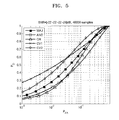
  • FIG. 5 is a graph illustrating detection performance according to various data integration methods when there are four sensing devices, three of which have a similar signal to noise ratio (SNR) and one of which is a hidden terminal; and
  • SNR signal to noise ratio
  • FIG. 6 is a graph illustrating the detection performance of a data integration method according to an embodiment of the present invention when there are five sensing devices having various SNRs.
  • FIG. 1 is a flowchart illustrating a data integration method according to an exemplary embodiment of the present invention.
  • CPE customer premises equipment
  • the received confidence estimated parameter Wi is converted to generate a weighting factor w i in the range of 0 to 1, in operation 120 .
  • a value of a confidence vector may be used as the value of the confidence estimated parameter Wi.
  • the value of the confidence estimated parameter Wi may be obtained using a value of Received Signal Strength Indication (RSSI).
  • RSSI Received Signal Strength Indication
  • the value of the confidence estimated parameter Wi above is only an example and may be substituted for and changed to a parameter for obtaining the weighting factor w i .
  • the value Ui and the weighting factor w i are used to calculate characteristic values ⁇ i (n) indicating the degree of confidence of the sensing information transmitted respectively from the sensing devices (n is a time index, that is, ⁇ i (n) indicates the CV at time n of i th device), in operation 130 ,
  • FIG. 2 is a flowchart illustrating a data integration method executed in an IEEE 802.22 WRAN system, according to an exemplary embodiment of the present invention.
  • a value of the CV is used as the weighting factor w i .
  • FIG. 2 is described with reference to the IEEE 802.22 WRAN system.
  • the value Ui indicating the existence of signals and a value CV i of the CV from among sensing results transmitted from each CPE of the IEEE 802.22 WRAN system are used, in operation 210 .
  • the sensing results transmitted from each CPE include the CV indicating the degree of confidence for the determination on the value Ui indicating the existence of signals, in addition to the value Ui indicating the existence of signals.
  • the value CV i of the CV may be used as a weighting factor.
  • the weighting factor w i is in the range of 0 to 1, 0 is indicated when there is no weighting factor w i and 1 is indicated when there is a weighting factor w i .
  • the value U i (n) indicating the existence of signals indicates the existence of signals from among the sensing results reported from at least one sensing device i.
  • the data integration apparatus determines that signals exist.
  • the value U i (n) and the weighting factor w i received from the at least one sensing device i are used to calculate the characteristic values ⁇ i (n) respectively of the sensing devices.
  • 1 indicating that the signals exist and ⁇ 1 indicating that the signals do not exist are respectively assigned to the characteristic values ⁇ i (n), if the weighting factor w i is greater than a threshold value, and 0 is assigned to the characteristic value ⁇ i (n) if the weighting factor w i is below the threshold value, in operations 230 through 232 , respectively.
  • Equation 2 the total sum of the characteristic values ⁇ i (n) respectively of the sensing devices is obtained. Then, if the total sum is greater than the threshold value, it is finally determined that signals exist; otherwise, it is determined that a channel is empty, in operations 240 through 242 , respectively. For example, in Equation 2, 0 is assigned to the threshold value.
  • u ⁇ ( n ) ⁇ 1 , ⁇ i ⁇ u _ i ⁇ ( n ) ⁇ 0 0 , ⁇ i ⁇ u _ i ⁇ ( n ) ⁇ 0 [ Equation ⁇ ⁇ 2 ]
  • FIG. 3 is a flowchart illustrating a data integration method according to another exemplary embodiment of the present invention.
  • the value CV i of the CV is used as the weighting factor w i .
  • the final results are obtained using the difference of the values CV i of the CVs respectively of the sensing devices.
  • the value Ui indicating the existence of signals and the value CV i of the CV from among the sensing results received in the data integration apparatus according to the present invention are used, in operations 310 and 320 .
  • FIG. 3 is only an example and parameters (for example, RSSI indicating the level of a received signal) indicating the degree of confidence for the value Ui, in addition to the value CV i of the CV, may be used to obtain the weighting factor w i .
  • the value CV i of the CV in the i th sensing device is directly used as the characteristic value ⁇ i (n) of the i th sensing device, in operations 330 and 332 . If it is determined that the signals do not exist based on the value Ui as a sensing result of i th sensing device, in operation 330 , “ ⁇ 1” is multiplied by the value CV i of the CV in the i th sensing device so as to be used as the characteristic value ⁇ i (n) of the i th sensing device, in operation 331 , as shown in Equation 3.
  • the characteristic values ⁇ i (n) respectively of the sensing devices are obtained as in Equation 3. Then, as in Equation 2, the total sum of the characteristic values ⁇ i (n) respectively of the sensing devices is obtained. If the total sum is greater than the threshold value, in operation 340 , it is finally determined that signals exist; otherwise, it is determined that a channel is empty. It is determined that the threshold value may be set to other values, in addition to 0 as in Equation 2.
  • FIG. 4 is a block diagram of the data integration apparatus according to an exemplary embodiment of the present invention.
  • the data integration apparatus includes an information receiving unit 410 , a weight reflecting unit 420 , and a confidence producing unit 430 .
  • the information receiving unit 410 receives sensing information including the value Ui indicating the existence of signals and the confidence estimated parameter Wi for obtaining a weighting factor w i from at least one sensing device.
  • the weight reflecting unit 420 generates the weighting factor w i based on the parameters, for obtaining a weighting factor, received in the information receiving unit 410 .
  • the parameters for obtaining a weighting factor include a value for CV and RSSI. That is, a value indicating the degree of confidence for the value Ui indicating the existence of signals is used to generate the weighting factor w i . In this case, both methods described in FIGS. 2 and 3 may be used to generate the weighting factor w i .
  • the confidence producing unit 430 produces the characteristic values indicating the degree of confidence for the sensing information transmitted respectively from the sensing devices using the value Ui indicating the existence of signals and the weighting factor w i .
  • the total sum of the characteristic values produced respectively from the sensing devices is compared to a previously set threshold value and thus the existence of signals received from the sensing devices is finally determined.
  • a data integration apparatus in a base station receives sensing information from sensing devices A and B that are outside the base station building and a sensing device C that is inside the base station building and data is integrated as follows.
  • values Wi(a), Wi(b), and the high confidence estimated parameter Wi(c) are respectively converted into the weighting factors and the characteristic values respectively of the sensing devices are obtained by carrying out an operation with information Ui(a), Ui(b), and Ui(c). Then, when the total sum of the characteristic values respectively of the sensing devices A, B, and C is greater than the threshold value, it is finally determined that signals exist. When the total sum of the characteristic values respectively of the sensing devices A, B, and C is lower than the threshold value, it is finally determined that signals do not exist.
  • each sensing device detects signals through an energy detection method, in which 4000 samples are used in a signal to noise ratio (SNR) condition.
  • SNR signal to noise ratio
  • FIG. 5 is a graph illustrating detection performance according to various data integration methods when there are four sensing devices, three of which have a similar SNR and one of which is a hidden terminal.
  • the Majority logic method shows the most excellent performance from among AND, OR, and Majority logic methods.
  • two data integration methods CV 1 and CV 2 described above, according to the present invention, using the weighting factor show a more excellent detection performance than that of the Majority logic method.
  • FIG. 6 is a graph illustrating the detection performance of a data integration method according to an embodiment of the present invention when there are five sensing devices having various SNRs.
  • the OR method shows the most excellent performance from among AND, OR, and Majority logic methods.
  • FIG. 5 since the data integration method described with reference to FIG. 3 has a lower probability of false alarm, a higher detection performance than the conventional OR method is shown.
  • the sensing devices When the sensing devices have a similar SNR, the most excellent performance is shown in the data integration method using a Majority logic method. When the sensing devices have different SNRs, the most excellent performance is shown in the data integration method using an OR logic method.
  • a data integration method varies according to a received SNR condition of the sensing device.
  • the SNR may be hardly estimated.
  • the weighting factor w i and the value Ui indicating the existence of signals are applied together to the data integration method so that detection performance of the data integration method can be improved regardless of the SNR of signals received in each sensing device.
  • the invention can also be embodied as computer readable code on a computer readable recording medium.
  • the computer readable recording medium is any data storage device that can store data which can be thereafter read by a computer system.
  • Examples of the computer readable recording medium include read-only memory (ROM), random-access memory (RAM), CD-ROMs, magnetic tapes, floppy disks, and optical data storage devices.
  • ROM read-only memory
  • RAM random-access memory
  • CD-ROMs compact disc-read only memory
  • magnetic tapes magnetic tapes
  • floppy disks magnetic tapes
  • optical data storage devices optical data storage devices.
  • the computer readable recording medium can also be distributed over network coupled computer systems so that the computer readable code is stored and executed in a distributed fashion.

Landscapes

  • Engineering & Computer Science (AREA)
  • Computer Networks & Wireless Communication (AREA)
  • Signal Processing (AREA)
  • Mobile Radio Communication Systems (AREA)

Abstract

Provided are a data integration apparatus and method using a weight factor. The data integration apparatus receives sensing information from at least one sensing device, the sensing information including a value indicating the existence of signals and confidence estimated parameters indicating the degree of confidence for the value indicating the existence of signals, and then generates the weighting factor based on the confidence estimated parameters. Then, the value indicating the existence of signals and the weighting factor are used to produce characteristic values of each sensing device and to finally determine the existence of signals.

Description

CROSS-REFERENCE TO RELATED PATENT APPLICATION
This application claims the benefit of Korean Patent Application No. 10-2008-0131176, filed on Dec. 22, 2008, in the Korean Intellectual Property Office, the disclosure of which is incorporated herein in its entirety by reference.
BACKGROUND OF THE INVENTION
1. Field of the Invention
The present invention relates to data integration using a weighting factor, and more particularly, to a data integration apparatus and method of combining results from various sensing devices using a weight factor and producing a final sensing result.
2. Description of the Related Art
In a conventional data integration method, a final sensing result is produced using only signals in each sensing device. The conventional data integration method is classified into a decision integration method using AND, OR, and Majority logics and a method using prior probabilities such as Bayesian detection and the Neyman-Pearson test.
In the method using prior probabilities, the existence of signals may not be known in an actual circumstance. Accordingly, the prior probabilities cannot be estimated and used so that the conventional decision integration method is generally used.
In the conventional decision integration method, advantages and disadvantages exist in each of its types. For example, in the decision integration method using AND logic, when some of the sensing devices cannot detect a signal due to an environmental factor such as fading, an error, which is a sensing result finally indicating that a signal does not exist, may be generated. However, the probability of false alarm is low.
In the decision integration method using OR logic, although a hidden terminal problem occurs, when some of the sensing devices determine that a signal exists, it is determined that a signal exists as a final sensing result. However, when a signal does not exist, the probability of false alarm increases due to a sensing error.
The decision integration method using Majority logic is between the former two methods. When the Majority logic is formed of nodes having a similar signal to noise ratio (SNR), an excellent performance is shown. However, when there is a difference of SNR in each sensing device, the performance of the Majority logic is lower than that of the OR logic.
As described above, the disadvantages above may be problems to actually realize the data integration method.
SUMMARY OF THE INVENTION
In order to solve conventional problems, a data integration method, which can be applied regardless of a similar signal to noise ratio (SNR) condition in each sensing device, is required.
The present invention provides a data integration apparatus and method using a weighted vector indicating the most excellent performance from among AND, OR, Majority logic methods, even in SNR-unknown conditions.
According to an aspect of the present invention, there is provided data integration apparatus including: an information receiving unit receiving sensing information from at least one sensing device, the sensing information comprising a value indicating the existence of signals and confidence estimated parameters indicating the degree of confidence for the value indicating the existence of signals; a weight reflecting unit generating a weighting factor based on the confidence estimated parameters; and a confidence producing unit producing characteristic values indicating the degree of confidence of the sensing information transmitted from each sensing device using the value indicating the existence of signals and the weighting factor.
According to another aspect of the present invention, there is provided a data integration method including: receiving sensing information from at least one sensing device, the sensing information comprising a value indicating the existence of signals and confidence estimated parameters indicating the degree of confidence for the value indicating the existence of signals; generating a weighting factor based on the confidence estimated parameters; and producing characteristic values indicating the degree of confidence of the sensing information transmitted from each sensing device using the value indicating the existence of signals and the weighting factor.
BRIEF DESCRIPTION OF THE DRAWINGS
The above and other features and advantages of the present invention will become more apparent by describing in detail exemplary embodiments thereof with reference to the attached drawings in which:
FIG. 1 is a flowchart illustrating a data integration method according to an exemplary embodiment of the present invention;
FIG. 2 is a flowchart illustrating a data integration method according to an exemplary embodiment of the present invention;
FIG. 3 is a flowchart illustrating a data integration method according to another exemplary embodiment of the present invention;
FIG. 4 is a block diagram of a data integration apparatus according to an exemplary embodiment of the present invention;
FIG. 5 is a graph illustrating detection performance according to various data integration methods when there are four sensing devices, three of which have a similar signal to noise ratio (SNR) and one of which is a hidden terminal; and
FIG. 6 is a graph illustrating the detection performance of a data integration method according to an embodiment of the present invention when there are five sensing devices having various SNRs.
DETAILED DESCRIPTION OF THE INVENTION
The present invention will now be described more fully with reference to the accompanying drawings, in which exemplary embodiments of the invention are shown. In the drawings, like reference numerals refer to like elements. In the description, the detailed descriptions of well-known technologies and structures may be omitted so as not to hinder the understanding of the present invention.
FIG. 1 is a flowchart illustrating a data integration method according to an exemplary embodiment of the present invention.
In order to realize the data integration method according to the present invention, sensing information, including a value Ui indicating the existence of signals and a confidence estimated parameter Wi indicating the degree of confidence for the value Ui, is received from at least one sensing device (i is an index of a customer premises equipment (CPE). That is, if it is assumed that there are 3 devices in one base station, each device may have one of indexes i=1, 2, 3. Thus, i is an index used to classify the result of each device when receiving sensing results from the number of devices at the base station), in operation 110.
The received confidence estimated parameter Wi is converted to generate a weighting factor w i in the range of 0 to 1, in operation 120.
With regard to FIG. 1, in an IEEE 802.22 Wireless Regional Area Network (WRAN) system, a value of a confidence vector (CV) may be used as the value of the confidence estimated parameter Wi. In addition, the value of the confidence estimated parameter Wi may be obtained using a value of Received Signal Strength Indication (RSSI).
The value of the confidence estimated parameter Wi above is only an example and may be substituted for and changed to a parameter for obtaining the weighting factor w i.
Then, the value Ui and the weighting factor w i are used to calculate characteristic values ūi(n) indicating the degree of confidence of the sensing information transmitted respectively from the sensing devices (n is a time index, that is, ūi(n) indicates the CV at time n of ith device), in operation 130,
If the total sum of the characteristic values ūi(n) calculated respectively in the sensing devices is greater than a previously set threshold value, in operation 140, it is finally determined that the signals exist, in operation 141. Otherwise, it is finally determined that the signals do not exist, in operation 142.
FIG. 2 is a flowchart illustrating a data integration method executed in an IEEE 802.22 WRAN system, according to an exemplary embodiment of the present invention. In FIG. 2, a value of the CV is used as the weighting factor w i.
FIG. 2 is described with reference to the IEEE 802.22 WRAN system. In a data integration apparatus according to an embodiment of the present invention, the value Ui indicating the existence of signals and a value CVi of the CV from among sensing results transmitted from each CPE of the IEEE 802.22 WRAN system are used, in operation 210.
In the IEEE 802.22 WRAN system, the sensing results transmitted from each CPE include the CV indicating the degree of confidence for the determination on the value Ui indicating the existence of signals, in addition to the value Ui indicating the existence of signals. In the IEEE 802.22 WRAN system, the value CVi of the CV may be used as a weighting factor.
Since the weighting factor w i is in the range of 0 to 1, 0 is indicated when there is no weighting factor w i and 1 is indicated when there is a weighting factor w i. In the IEEE 802.22 WRAN system, the CV is in the range of 0 to 1 and thus an additional operation for converting the CV into the weighting factor w i is not needed. That is, in the IEEE 802.22 WRAN system, the value CVi of the CV, w i=wi=CVi, is used as a value of a weight vector, in operation 220.
The value Ui(n) indicating the existence of signals indicates the existence of signals from among the sensing results reported from at least one sensing device i.
When the value Ui(n) is 0, the data integration apparatus according to the present invention determines that signals do not exist by using the weight vector of w i=wi=CVi. When the value Ui(n) is 1, the data integration apparatus according to the present invention determines that signals exist.
u _ i ( n ) = { 1 , u i ( n ) = 1 , w _ i λ 0 , w _ i < λ - 1 , u i ( n ) = 0 w _ i λ [ Equation 1 ]
As in Equation 1, in the data integration apparatus, the value Ui(n) and the weighting factor w i received from the at least one sensing device i are used to calculate the characteristic values ūi(n) respectively of the sensing devices. In the data integration method, 1 indicating that the signals exist and −1 indicating that the signals do not exist are respectively assigned to the characteristic values ūi(n), if the weighting factor w i is greater than a threshold value, and 0 is assigned to the characteristic value ūi(n) if the weighting factor w i is below the threshold value, in operations 230 through 232, respectively.
In addition, as in Equation 2 below, the total sum of the characteristic values ūi(n) respectively of the sensing devices is obtained. Then, if the total sum is greater than the threshold value, it is finally determined that signals exist; otherwise, it is determined that a channel is empty, in operations 240 through 242, respectively. For example, in Equation 2, 0 is assigned to the threshold value.
u ( n ) = { 1 , i u _ i ( n ) 0 0 , i u _ i ( n ) < 0 [ Equation 2 ]
FIG. 3 is a flowchart illustrating a data integration method according to another exemplary embodiment of the present invention. In FIG. 3, the value CVi of the CV is used as the weighting factor w i. In addition, in FIG. 3, the final results are obtained using the difference of the values CVi of the CVs respectively of the sensing devices. The value Ui indicating the existence of signals and the value CVi of the CV from among the sensing results received in the data integration apparatus according to the present invention are used, in operations 310 and 320. However, FIG. 3 is only an example and parameters (for example, RSSI indicating the level of a received signal) indicating the degree of confidence for the value Ui, in addition to the value CVi of the CV, may be used to obtain the weighting factor w i.
In the data integration method, if it is determined that the signals exist based on the value Ui as a sensing result of an ith sensing device, the value CVi of the CV in the ith sensing device is directly used as the characteristic value ūi(n) of the ith sensing device, in operations 330 and 332. If it is determined that the signals do not exist based on the value Ui as a sensing result of ith sensing device, in operation 330, “−1” is multiplied by the value CVi of the CV in the ith sensing device so as to be used as the characteristic value ūi(n) of the ith sensing device, in operation 331, as shown in Equation 3.
u _ i ( n ) = { w _ i , u i ( n ) = 1 - w _ i , u i ( n ) = 0 [ Equation 3 ]
The characteristic values ūi(n) respectively of the sensing devices are obtained as in Equation 3. Then, as in Equation 2, the total sum of the characteristic values ūi(n) respectively of the sensing devices is obtained. If the total sum is greater than the threshold value, in operation 340, it is finally determined that signals exist; otherwise, it is determined that a channel is empty. It is determined that the threshold value may be set to other values, in addition to 0 as in Equation 2.
FIG. 4 is a block diagram of the data integration apparatus according to an exemplary embodiment of the present invention.
The data integration apparatus includes an information receiving unit 410, a weight reflecting unit 420, and a confidence producing unit 430.
The information receiving unit 410 receives sensing information including the value Ui indicating the existence of signals and the confidence estimated parameter Wi for obtaining a weighting factor w i from at least one sensing device.
The weight reflecting unit 420 generates the weighting factor w i based on the parameters, for obtaining a weighting factor, received in the information receiving unit 410. Examples of the parameters for obtaining a weighting factor include a value for CV and RSSI. That is, a value indicating the degree of confidence for the value Ui indicating the existence of signals is used to generate the weighting factor w i. In this case, both methods described in FIGS. 2 and 3 may be used to generate the weighting factor w i.
The confidence producing unit 430 produces the characteristic values indicating the degree of confidence for the sensing information transmitted respectively from the sensing devices using the value Ui indicating the existence of signals and the weighting factor w i. The total sum of the characteristic values produced respectively from the sensing devices is compared to a previously set threshold value and thus the existence of signals received from the sensing devices is finally determined.
As an example of the data integration apparatus according to the present invention, a data integration apparatus in a base station receives sensing information from sensing devices A and B that are outside the base station building and a sensing device C that is inside the base station building and data is integrated as follows.
In the sensing devices A and B that are outside the base station building, information shown as Ui(a) and Ui(b) indicating that signals exist and values Wi(a) and Wi(b) indicating high confidence for the value Ui are transmitted to the base station. In the sensing device C that is inside the base station building, information shown as Ui(c) indicating that signals do not exist, on the assumption that the signals are not received, and a high confidence estimated parameter Wi(c) are transmitted to the base station.
In the data integration apparatus in the base station, values Wi(a), Wi(b), and the high confidence estimated parameter Wi(c) are respectively converted into the weighting factors and the characteristic values respectively of the sensing devices are obtained by carrying out an operation with information Ui(a), Ui(b), and Ui(c). Then, when the total sum of the characteristic values respectively of the sensing devices A, B, and C is greater than the threshold value, it is finally determined that signals exist. When the total sum of the characteristic values respectively of the sensing devices A, B, and C is lower than the threshold value, it is finally determined that signals do not exist.
In FIGS. 5 and 6, each sensing device detects signals through an energy detection method, in which 4000 samples are used in a signal to noise ratio (SNR) condition.
FIG. 5 is a graph illustrating detection performance according to various data integration methods when there are four sensing devices, three of which have a similar SNR and one of which is a hidden terminal.
When the sensing devices have a similar SNR, the Majority logic method shows the most excellent performance from among AND, OR, and Majority logic methods. However, when one hidden terminal exists, two data integration methods CV1 and CV2 described above, according to the present invention, using the weighting factor show a more excellent detection performance than that of the Majority logic method.
FIG. 6 is a graph illustrating the detection performance of a data integration method according to an embodiment of the present invention when there are five sensing devices having various SNRs. In this case, the OR method shows the most excellent performance from among AND, OR, and Majority logic methods. However, as illustrated in FIG. 5, since the data integration method described with reference to FIG. 3 has a lower probability of false alarm, a higher detection performance than the conventional OR method is shown.
When the sensing devices have a similar SNR, the most excellent performance is shown in the data integration method using a Majority logic method. When the sensing devices have different SNRs, the most excellent performance is shown in the data integration method using an OR logic method.
Accordingly, in the prior art, a data integration method varies according to a received SNR condition of the sensing device. However, in actual realization of the data integration method, when a low SNR is received, the SNR may be hardly estimated.
According to the present invention, the weighting factor w i and the value Ui indicating the existence of signals are applied together to the data integration method so that detection performance of the data integration method can be improved regardless of the SNR of signals received in each sensing device.
The invention can also be embodied as computer readable code on a computer readable recording medium. The computer readable recording medium is any data storage device that can store data which can be thereafter read by a computer system.
Examples of the computer readable recording medium include read-only memory (ROM), random-access memory (RAM), CD-ROMs, magnetic tapes, floppy disks, and optical data storage devices. The computer readable recording medium can also be distributed over network coupled computer systems so that the computer readable code is stored and executed in a distributed fashion.
While the present invention has been particularly shown and described with reference to exemplary embodiments thereof, it will be understood by those of ordinary skill in the art that various changes in form and details may be made therein without departing from the spirit and scope of the present invention as defined by the following claims.

Claims (8)

What is claimed is:
1. A data integration apparatus having a data processor, the data integration apparatus comprising:
an information receiving unit, operating on the data processor, the information receiving unit receiving sensing information from each of a plurality of sensing devices, the sensing information comprising a value indicating the existence of signals and a confidence estimated parameter indicating the degree of confidence for the value indicating the existence of signals;
a weight reflecting unit, operating on the data processor, the weight reflecting unit generating a weighting factor based on the confidence estimated for each of the plurality of sensing devices; and
a confidence producing unit, operating on the data processor, the confidence producing unit producing a characteristic value for each of the plurality of sensing devices, wherein the characteristic value indicates the degree of confidence of the sensing information transmitted from a sensing device and is produced using the value indicating the existence of signals and the weighting factor, and
wherein the total sum of the characteristic values produced from the sensing devices is compared with a previously set threshold value in order to finally determine whether the signals exist.
2. The apparatus of claim 1, wherein in the confidence producing unit, “1” indicating that the signals exist and “−1” indicating that the signals do not exist are assigned to the characteristic value when the weighting factor is greater than a previously set threshold value, and 0 is assigned to the characteristic value when the weighting factor is below the previously set threshold value.
3. The apparatus of claim 1, wherein in the confidence producing unit, when it is determined that the signals exist based on the value indicating the existence of signals, the weighting factor is used as the characteristic value and when it is determined that the signals do not exist based on the value indicating the existence of signals, “−1” is multiplied by the weighting factor so as to be used as the characteristic value.
4. The apparatus of claim 1, wherein the confidence estimated parameters comprise at least one of a value for a confidence vector and a value of Received Signal Strength Indication (RSSI) indicating a level of intensity of signals received from the at least one sensing device.
5. A data integration method comprising:
receiving sensing information from each of a plurality of sensing devices, the sensing information comprising a value indicating the existence of signals and a confidence estimated parameter indicating the degree of confidence for the value indicating the existence of signals;
generating a weighting factor based on the confidence estimated for each of the plurality of sensing devices; and
producing a characteristic value for each of the plurality of sensing devices, wherein the characteristic value indicates the degree of confidence of the sensing information transmitted from a sensing device and is produced using the value indicating the existence of signals and the weighting factor, and
wherein the total sum of the characteristic values produced from the sensing devices is compared with a previously set threshold value in order to finally determine whether the signals exist.
6. A data integration method comprising:
receiving sensing information from at least one sensing device, the sensing information comprising a value indicating the existence of signals and confidence estimated parameters indicating the degree of confidence for the value indicating the existence of signals;
generating a weighting factor based on the confidence estimated parameters; and
producing characteristic values indicating the degree of confidence of the sensing information transmitted from each sensing device using the value indicating the existence of signals and the weighting factor,
wherein in the characteristic values, 1 indicating that the signals exist and −1 indicating that the signals do not exist are respectively assigned to the characteristic values based on the value indicating the existence of signals, if the weighting factor is greater than a previously set threshold value, and 0 is assigned to the characteristic values if the weighting factor is below the previously set threshold value.
7. The method of claim 5, wherein the weighting factor is used as the characteristic value when it is determined that the signals exist based on the value indicating the existence of signals and −1 is multiplied by the weighting factor, when it is determined that the signals do not exist based on the value indicating the existence of signals, so as to be used as the characteristic value.
8. The method of claim 5, wherein the confidence estimated parameters comprise at least one of a value for a confidence vector and a value of Received Signal Strength Indication (RSSI) indicating a level of intensity of signals received from the sensing device.
US12/619,060 2008-12-22 2009-11-16 Data integration apparatus and method Expired - Fee Related US8495000B2 (en)

Applications Claiming Priority (2)

Application Number Priority Date Filing Date Title
KR1020080131176A KR101166029B1 (en) 2008-12-22 2008-12-22 Method and Apparatus for data fusion
KR10-2008-0131176 2008-12-22

Publications (2)

Publication Number Publication Date
US20100161545A1 US20100161545A1 (en) 2010-06-24
US8495000B2 true US8495000B2 (en) 2013-07-23

Family

ID=42267516

Family Applications (1)

Application Number Title Priority Date Filing Date
US12/619,060 Expired - Fee Related US8495000B2 (en) 2008-12-22 2009-11-16 Data integration apparatus and method

Country Status (2)

Country Link
US (1) US8495000B2 (en)
KR (1) KR101166029B1 (en)

Families Citing this family (1)

* Cited by examiner, † Cited by third party
Publication number Priority date Publication date Assignee Title
DE102022204408A1 (en) * 2022-05-04 2023-11-09 Robert Bosch Gesellschaft mit beschränkter Haftung Method and device for detecting a specific movement of a bicycle

Citations (5)

* Cited by examiner, † Cited by third party
Publication number Priority date Publication date Assignee Title
US20030186663A1 (en) 2002-03-26 2003-10-02 Hai-Wen Chen Method and system for multi-sensor data fusion
US20050062605A1 (en) * 2003-09-05 2005-03-24 Sutphin Eldon M. Remote sensor with voice locator message
WO2006076798A1 (en) 2005-01-18 2006-07-27 Marinvent Corporation Method and apparatus for performing a sensor fusion to provide a position of a target-of-interest
WO2009115957A2 (en) 2008-03-18 2009-09-24 Koninklijke Philips Electronics N.V. Distributed spectrum sensing
KR20100128393A (en) 2009-05-28 2010-12-08 울산대학교 산학협력단 Spectrum Sensing Method Based on Reliability and Cr System Using the Same

Patent Citations (6)

* Cited by examiner, † Cited by third party
Publication number Priority date Publication date Assignee Title
US20030186663A1 (en) 2002-03-26 2003-10-02 Hai-Wen Chen Method and system for multi-sensor data fusion
US20050062605A1 (en) * 2003-09-05 2005-03-24 Sutphin Eldon M. Remote sensor with voice locator message
WO2006076798A1 (en) 2005-01-18 2006-07-27 Marinvent Corporation Method and apparatus for performing a sensor fusion to provide a position of a target-of-interest
US20060239559A1 (en) 2005-01-18 2006-10-26 Maris John M Method and apparatus for performing a sensor fusion to provide a position of a target-of-interest
WO2009115957A2 (en) 2008-03-18 2009-09-24 Koninklijke Philips Electronics N.V. Distributed spectrum sensing
KR20100128393A (en) 2009-05-28 2010-12-08 울산대학교 산학협력단 Spectrum Sensing Method Based on Reliability and Cr System Using the Same

Non-Patent Citations (2)

* Cited by examiner, † Cited by third party
Title
Qi, Hairong, et al.; Mobile-Agent-Based Collaborative Signal and Information Processing in Sensor Networks; 2003; Proceedings of the IEEE, vol. 91, No. 8; pp. 1172-1183. *
Varshney, P. K.; "Multisensor data fusion"; 1997; "Electronics & Communication Engineering Journal"; pp. 245-253. *

Also Published As

Publication number Publication date
KR20100072689A (en) 2010-07-01
US20100161545A1 (en) 2010-06-24
KR101166029B1 (en) 2012-07-19

Similar Documents

Publication Publication Date Title
US20170324488A1 (en) Method and apparatus for evaluating node performance and system
US9628996B2 (en) Spectrum sensing apparatus and method for cooperative cognitive radio network in non-gaussian noise environment, and fusion center apparatus and cooperative cognitive radio system using the same
US9369936B2 (en) Handover technique for wireless communications enabled devices
US9077446B2 (en) Method for controlling random access for the efficient sensing of the cooperative spectrum in a cognitive radio-based frequency resource sharing system
CN111600667A (en) A Spectrum Sensing Method Based on CNN-LSTM
KR100970757B1 (en) Cooperative Channel Sensing Method of Energy Detector Board for Multi-Users in Wireless Recognition System
JP2010187359A (en) Method for estimating condition of wireless channels
KR102538735B1 (en) Cooperative spectrum detection optimization system using genetic algoritnm in cognitive wireless network environment and cooperative spectrum detection optimization by using the same
Awasthi et al. Energy—efficiency techniques in cooperative spectrum sensing: a survey
US8495000B2 (en) Data integration apparatus and method
US7450947B2 (en) Method and apparatus for dynamic spectrum sharing
Leung et al. The use of fuzzy spaces in signal detection
CN104065430A (en) Cooperative Spectrum Detection Method Based on Node Identification
Gupta et al. Improved weighted cooperative spectrum sensing algorithm based on reliability in cognitive radio networks
US20060078073A1 (en) Communication channel detector and channel detection method
CN119276398A (en) A spectrum sensing method based on non-circular signal spatial spectrum
KR101419808B1 (en) Method of detecting white spaces in cognitive radion system and apparatus thereof
Li et al. Reliable cooperative spectrum sensing algorithm based on Dempster-Shafer theory
Hassan et al. Predicted eigenvalue threshold based spectrum sensing with correlated multiple-antennas
Masari et al. Comparison Analysis of Static and Dynamic Thresholds for Conventional Cognitive Radio Spectrum Sensing Methods
Kustra et al. Performance of hybrid sensing method in multipath fading environment
CN109660308B (en) A Method for Establishing Multi-Wall Embedded Loss Model and Its Application
Aziz A fuzzy approach for multiple-receiver digital communication systems with data fusion
KR101560557B1 (en) Cooperative Spectrum Sensing Method in Cognitive Radio Network with limited Feedback and Apparatus thereof
Sunkara et al. Optimal M-Out-of-S Rule for Asynchronous Cooperative Sensing in Heterogeneous Cognitive Radio Networks

Legal Events

Date Code Title Description
AS Assignment

Owner name: ELECTRONICS AND TELECOMMUNICATIONS RESEARCH INSTIT

Free format text: ASSIGNMENT OF ASSIGNORS INTEREST;ASSIGNORS:LIM, SUNMIN;KIM, SANG WON;PARK, CHANGHYUN;AND OTHERS;REEL/FRAME:023522/0191

Effective date: 20090914

FEPP Fee payment procedure

Free format text: PAYOR NUMBER ASSIGNED (ORIGINAL EVENT CODE: ASPN); ENTITY STATUS OF PATENT OWNER: SMALL ENTITY

REMI Maintenance fee reminder mailed
LAPS Lapse for failure to pay maintenance fees

Free format text: PATENT EXPIRED FOR FAILURE TO PAY MAINTENANCE FEES (ORIGINAL EVENT CODE: EXP.)

STCH Information on status: patent discontinuation

Free format text: PATENT EXPIRED DUE TO NONPAYMENT OF MAINTENANCE FEES UNDER 37 CFR 1.362

FP Lapsed due to failure to pay maintenance fee

Effective date: 20170723