US8471020B2 - Perylene-based semiconducting materials - Google Patents
Perylene-based semiconducting materials Download PDFInfo
- Publication number
- US8471020B2 US8471020B2 US13/412,023 US201213412023A US8471020B2 US 8471020 B2 US8471020 B2 US 8471020B2 US 201213412023 A US201213412023 A US 201213412023A US 8471020 B2 US8471020 B2 US 8471020B2
- Authority
- US
- United States
- Prior art keywords
- alkyl
- compound
- cor
- formula
- membered heteroaryl
- Prior art date
- Legal status (The legal status is an assumption and is not a legal conclusion. Google has not performed a legal analysis and makes no representation as to the accuracy of the status listed.)
- Expired - Fee Related
Links
- 0 [1*]N1C(=O)C2=C(C#N)C=C3C4=CC(C#N)=C5C(=O)N([2*])C(=O)C6=C5C4=C(/C=C\6[N+]#[C-])C4=C3C2=C(C1=O)/C([N+]#[C-])=C\4 Chemical compound [1*]N1C(=O)C2=C(C#N)C=C3C4=CC(C#N)=C5C(=O)N([2*])C(=O)C6=C5C4=C(/C=C\6[N+]#[C-])C4=C3C2=C(C1=O)/C([N+]#[C-])=C\4 0.000 description 13
- KZBBQEJCYWCKAY-UHFFFAOYSA-N C.C1=CC=C(P(C2=CC=CC=C2)C2=CC=CC=C2)C=C1.C1=CC=C(P(C2=CC=CC=C2)C2=CC=CC=C2)C=C1.C1=CC=C(P(C2=CC=CC=C2)C2=CC=CC=C2)C=C1.CC1(C)OB(B2OC(C)(C)C(C)(C)O2)OC1(C)C.CCC(CC)N1C(=O)C2=C(B3OC(C)(C)C(C)(C)O3)C=C3C4=C(/C=C(/B5OC(C)(C)C(C)(C)O5)C(=C24)C1=O)C1=C2C4=C(C(=O)N(C(CC)CC)C(=O)/C4=C(B4OC(C)(C)C(C)(C)O4)/C=C/32)C(B2OC(C)(C)C(C)(C)O2)=C1.CCC(CC)N1C(=O)C2=CC=C3C4=C(/C=C\C(=C24)C1=O)C1=C2C4=C(C=C1)C(=O)N(C(CC)CC)C(=O)/C4=C/C=C/32.[C-]#[O+].[Ru] Chemical compound C.C1=CC=C(P(C2=CC=CC=C2)C2=CC=CC=C2)C=C1.C1=CC=C(P(C2=CC=CC=C2)C2=CC=CC=C2)C=C1.C1=CC=C(P(C2=CC=CC=C2)C2=CC=CC=C2)C=C1.CC1(C)OB(B2OC(C)(C)C(C)(C)O2)OC1(C)C.CCC(CC)N1C(=O)C2=C(B3OC(C)(C)C(C)(C)O3)C=C3C4=C(/C=C(/B5OC(C)(C)C(C)(C)O5)C(=C24)C1=O)C1=C2C4=C(C(=O)N(C(CC)CC)C(=O)/C4=C(B4OC(C)(C)C(C)(C)O4)/C=C/32)C(B2OC(C)(C)C(C)(C)O2)=C1.CCC(CC)N1C(=O)C2=CC=C3C4=C(/C=C\C(=C24)C1=O)C1=C2C4=C(C=C1)C(=O)N(C(CC)CC)C(=O)/C4=C/C=C/32.[C-]#[O+].[Ru] KZBBQEJCYWCKAY-UHFFFAOYSA-N 0.000 description 1
- AFESTZUYEITUIT-UHFFFAOYSA-N C.C1=CC=C(P(C2=CC=CC=C2)C2=CC=CC=C2)C=C1.C1=CC=C(P(C2=CC=CC=C2)C2=CC=CC=C2)C=C1.C1=CC=C(P(C2=CC=CC=C2)C2=CC=CC=C2)C=C1.CC1(C)OB(B2OC(C)(C)C(C)(C)O2)OC1(C)C.CCCCCCCC(CCCCCCC)N1C(=O)C2=C(B3OC(C)(C)C(C)(C)O3)C=C3C4=C(/C=C(/B5OC(C)(C)C(C)(C)O5)C(=C24)C1=O)C1=C2C4=C(C(=O)N(C(CCCCCCC)CCCCCCC)C(=O)/C4=C(B4OC(C)(C)C(C)(C)O4)/C=C/32)C(B2OC(C)(C)C(C)(C)O2)=C1.CCCCCCCC(CCCCCCC)N1C(=O)C2=CC=C3C4=C(/C=C\C(=C24)C1=O)C1=C2C4=C(C=C1)C(=O)N(C(CCCCCCC)CCCCCCC)C(=O)/C4=C/C=C/32.[C-]#[O+].[Ru] Chemical compound C.C1=CC=C(P(C2=CC=CC=C2)C2=CC=CC=C2)C=C1.C1=CC=C(P(C2=CC=CC=C2)C2=CC=CC=C2)C=C1.C1=CC=C(P(C2=CC=CC=C2)C2=CC=CC=C2)C=C1.CC1(C)OB(B2OC(C)(C)C(C)(C)O2)OC1(C)C.CCCCCCCC(CCCCCCC)N1C(=O)C2=C(B3OC(C)(C)C(C)(C)O3)C=C3C4=C(/C=C(/B5OC(C)(C)C(C)(C)O5)C(=C24)C1=O)C1=C2C4=C(C(=O)N(C(CCCCCCC)CCCCCCC)C(=O)/C4=C(B4OC(C)(C)C(C)(C)O4)/C=C/32)C(B2OC(C)(C)C(C)(C)O2)=C1.CCCCCCCC(CCCCCCC)N1C(=O)C2=CC=C3C4=C(/C=C\C(=C24)C1=O)C1=C2C4=C(C=C1)C(=O)N(C(CCCCCCC)CCCCCCC)C(=O)/C4=C/C=C/32.[C-]#[O+].[Ru] AFESTZUYEITUIT-UHFFFAOYSA-N 0.000 description 1
- AFZHOYBHXXBWGB-UHFFFAOYSA-N CC.CN1C(=O)C2=CC=C3C4=CC=C5C(=O)N(C)C(=O)C6=C5C4=C(/C=C\6)C4=C3C2=C(/C=C\4)C1=O Chemical compound CC.CN1C(=O)C2=CC=C3C4=CC=C5C(=O)N(C)C(=O)C6=C5C4=C(/C=C\6)C4=C3C2=C(/C=C\4)C1=O AFZHOYBHXXBWGB-UHFFFAOYSA-N 0.000 description 1
- JFQHMTKBOFJOEJ-UHFFFAOYSA-N CN1C(=O)C2=C3C4=C(C([Y])=C2)C2=C5C6=C(C=C2)C(=O)N(C)C(=O)/C6=C/C([Y])=C5/C4=C/C=C\3C1=O Chemical compound CN1C(=O)C2=C3C4=C(C([Y])=C2)C2=C5C6=C(C=C2)C(=O)N(C)C(=O)/C6=C/C([Y])=C5/C4=C/C=C\3C1=O JFQHMTKBOFJOEJ-UHFFFAOYSA-N 0.000 description 1
- YIKCGVLRKCMAJB-UHFFFAOYSA-N O=C1CC(=O)C2=C3C1=CC=C1C4=CC=C5C(=O)CC(=O)C6=C5C4=C(/C=C\6)C(=C13)/C=C\2 Chemical compound O=C1CC(=O)C2=C3C1=CC=C1C4=CC=C5C(=O)CC(=O)C6=C5C4=C(/C=C\6)C(=C13)/C=C\2 YIKCGVLRKCMAJB-UHFFFAOYSA-N 0.000 description 1
- DTTDFSSVLWKYHE-UHFFFAOYSA-N [C-]#[N+]C1=CC2=C3C4=C1C(=O)N(C(CC)CC)C(=O)/C4=C(C#N)/C=C3/C1=C/C(C#N)=C3/C(=O)N(C(CC)CC)C(=O)C4=C3C1=C2C=C4[N+]#[C-] Chemical compound [C-]#[N+]C1=CC2=C3C4=C1C(=O)N(C(CC)CC)C(=O)/C4=C(C#N)/C=C3/C1=C/C(C#N)=C3/C(=O)N(C(CC)CC)C(=O)C4=C3C1=C2C=C4[N+]#[C-] DTTDFSSVLWKYHE-UHFFFAOYSA-N 0.000 description 1
- CHVXZCCXMUBLEC-UHFFFAOYSA-N [C-]#[N+]C1=CC2=C3C4=C1C(=O)N(C(CCCCCCC)CCCCCCC)C(=O)/C4=C(C#N)/C=C3/C1=C/C(C#N)=C3/C(=O)N(C(CCCCCCC)CCCCCCC)C(=O)C4=C3C1=C2C=C4[N+]#[C-] Chemical compound [C-]#[N+]C1=CC2=C3C4=C1C(=O)N(C(CCCCCCC)CCCCCCC)C(=O)/C4=C(C#N)/C=C3/C1=C/C(C#N)=C3/C(=O)N(C(CCCCCCC)CCCCCCC)C(=O)C4=C3C1=C2C=C4[N+]#[C-] CHVXZCCXMUBLEC-UHFFFAOYSA-N 0.000 description 1
- JTARZZCZOHOHLI-UHFFFAOYSA-N [C-]#[N+]C1=CC2=C3C4=C1C1=C5C6=C(C=C1)C(=O)N(C(C)CC)C(=O)/C6=C/C(C#N)=C5/C4=C/C=C\3C(=O)N(C(C)CC)C2=O Chemical compound [C-]#[N+]C1=CC2=C3C4=C1C1=C5C6=C(C=C1)C(=O)N(C(C)CC)C(=O)/C6=C/C(C#N)=C5/C4=C/C=C\3C(=O)N(C(C)CC)C2=O JTARZZCZOHOHLI-UHFFFAOYSA-N 0.000 description 1
- PUURPAXOXHFPOR-UHFFFAOYSA-N [C-]#[N+]C1=CC2=C3C4=C1C1=C5C6=C(C=C1)C(=O)N(C)C(=O)/C6=C/C(C1=CC=C(C6=CC=C(C7=C/C8=C9/C%10=C\7C7=C%11C%12=C(C=C7)C(=O)N(C)C(=O)C%12=CC(C#N)=C%11\C%10=C\C=C/9C(=O)N(C)C8=O)S6)S1)=C5/C4=C/C=C\3C(=O)N(C)C2=O Chemical compound [C-]#[N+]C1=CC2=C3C4=C1C1=C5C6=C(C=C1)C(=O)N(C)C(=O)/C6=C/C(C1=CC=C(C6=CC=C(C7=C/C8=C9/C%10=C\7C7=C%11C%12=C(C=C7)C(=O)N(C)C(=O)C%12=CC(C#N)=C%11\C%10=C\C=C/9C(=O)N(C)C8=O)S6)S1)=C5/C4=C/C=C\3C(=O)N(C)C2=O PUURPAXOXHFPOR-UHFFFAOYSA-N 0.000 description 1
Images


Classifications
-
- C—CHEMISTRY; METALLURGY
- C07—ORGANIC CHEMISTRY
- C07F—ACYCLIC, CARBOCYCLIC OR HETEROCYCLIC COMPOUNDS CONTAINING ELEMENTS OTHER THAN CARBON, HYDROGEN, HALOGEN, OXYGEN, NITROGEN, SULFUR, SELENIUM OR TELLURIUM
- C07F5/00—Compounds containing elements of Groups 3 or 13 of the Periodic Table
- C07F5/02—Boron compounds
- C07F5/025—Boronic and borinic acid compounds
-
- C—CHEMISTRY; METALLURGY
- C07—ORGANIC CHEMISTRY
- C07D—HETEROCYCLIC COMPOUNDS
- C07D471/00—Heterocyclic compounds containing nitrogen atoms as the only ring hetero atoms in the condensed system, at least one ring being a six-membered ring with one nitrogen atom, not provided for by groups C07D451/00 - C07D463/00
- C07D471/02—Heterocyclic compounds containing nitrogen atoms as the only ring hetero atoms in the condensed system, at least one ring being a six-membered ring with one nitrogen atom, not provided for by groups C07D451/00 - C07D463/00 in which the condensed system contains two hetero rings
- C07D471/06—Peri-condensed systems
Definitions
- Organic semiconducting materials can be used in electronic devices such as organic photovoltaic (OPV) cells, organic field-effect transistors (OFETs) and organic light emitting diodes (OLEDs).
- OCV organic photovoltaic
- OFETs organic field-effect transistors
- OLEDs organic light emitting diodes
- the organic semiconducting material-based devices show high charge carrier mobility and high stability, in particular towards oxidation, under ambient conditions.
- the organic semiconducting materials are compatible with liquid processing techniques as liquid processing techniques are convenient from the point of processability, and thus allow the production of low cost organic semiconducting material-based electronic devices.
- liquid processing techniques are also compatible with plastic substrates, and thus allow the production of light weight and flexible organic semiconducting material-based electronic devices.
- an electronic device including the composition.
- U.S. Pat. No. 7,355,198 B2 describes am organic thin film transistor (OFET), which interposes an organic acceptor film between source and drain electrodes and an organic semiconductor film.
- the organic semiconductor film is formed of pentacene.
- the organic acceptor film is formed of at least one electron withdrawing material selected from a long list of compounds, including N,N′-bis(di-tert-butyphenyl)-3,4,9,10-perylenedicarboxylmide.
- U.S. Pat. No. 7,326,956 B2 describes a thin film transistor comprising a layer of organic semiconductor material comprising tetracarboxylic diimide 3,4,9,10-perylene-based compound having attached to each of the imide nitrogen atoms a carbocyclic or heterocyclic aromatic ring system substituted with one or more fluorine containing groups.
- the fluorine-containing N,N′-diaryl perylene-based tetracarboxylic diimide compound is represented by the following structure:
- a 1 and A 2 are independently carbocyclic and/or heterocyclic aromatic ring systems comprising at least one aromatic ring in which one or more hydrogen atoms are substituted with at least one fluorine-containing group.
- the perylene nucleus can be optionally substituted with up to eight independently selected X groups, wherein n is an integer from 0 to 8.
- the X substituent groups on the perylene can include a long list of substituents, including halogens such as fluorine or chlorine, and cyano.
- each R 1 to R 8 , R 11 and R 12 can be independently selected from H, an electron-withdrawing substituent and a moiety comprising such substituent.
- Electron-withdrawing substitutents include a long list of substituents, including cyano.
- R 9 and R 10 are independently selected from H, alkyl, substituted alkyl, cycloalkyl, substituted cycloalkyl, aryl, substituted aryl, polycyclic aryl and/or substituted polycyclic aryl moieties.
- At least one of R 1 , R 4 , R 5 , R 8 , R 11 and R 12 can be a cyano substituent.
- Such cyanated compounds can be di- or tetra-substituted as shown by the following structures:
- WO 2005/124453 describes perylenetetracarboxylic diimide charge-transfer materials, for example a perylenetetracarboxylic diimide charge-transfer material having formula
- Y in each instance can be independently selected from H, CN, acceptors, donors and a polymerizable group; and X in each instance can be independently selected from a large group of listed compounds.
- WO 2008/063609 describes diimide-based semiconductor compounds.
- the compound can have formula
- R 1 at each occurrence is independently selected from a long list of groups, including branched C 3-20 -alkyl and branched C 3-20 -alkenyl.
- R 1 and R 2 at each occurrence independently are selected from a large list of groups, including H, C 1-30 -alkyl and C 2-30 -alkenyl; and R 3 , R 4 , R 5 and R 6 are independently H or an electron-withdrawing group.
- at least one of R 3 , R 4 , R 5 and R 6 can be Br or cyano.
- the semiconducting compound can include
- WO 2009/144205 describes bispolycyclic rylene-based semiconducting materials, for example
- the object is solved by the compound of claim 1 , the process of claim 2 , the compound of claim 6 , and the electronic device of claim 7 .
- the perylene-based semiconducting compound of the present invention is of formula
- C 1-10 -alkyl and C 1-30 -alkyl can be branched or unbranched.
- Examples of C 1-10 -alkyl are methyl, ethyl, n-propyl, isopropyl, n-butyl, sec-butyl, isobutyl, tert-butyl, n-pentyl, neopentyl, isopentyl, n-(1-ethyl)propyl, n-hexyl, n-heptyl, n-octyl, n-(2-ethyl)hexyl, n-nonyl and n-decyl.
- C 3-8 -alkyl examples include n-propyl, isopropyl, n-butyl, sec-butyl, isobutyl, tert-butyl, n-pentyl, neopentyl, isopentyl, n-(1-ethyl)propyl, n-hexyl, n-heptyl, n-octyl and n-(2-ethyl)hexyl.
- C 1-30 -alkyl examples are C 1-10 -alkyl, and n-undecyl, n-dodecyl, n-undecyl, n-dodecyl, n-tridecyl, n-tetradecyl, n-pentadecyl, n-hexadecyl, n-heptadecyl, n-octadecyl, n-nonadecyl and n-icosyl (C 20 ), n-docosyl (C 22 ), n-tetracosyl (C 24 ), n-hexacosyl (C 26 ), n-octacosyl (C 28 ) and n-triacontyl (C 30 ).
- C 2-10 -alkenyl and C 2-30 -alkenyl can be branched or unbranched.
- Examples of C 2-10 -alkenyl are vinyl, propenyl, cis-2-butenyl, trans-2-butenyl, 3-butenyl, cis-2-pentenyl, trans-2-pentenyl, cis-3-pentenyl, trans-3-pentenyl, 4-pentenyl, 2-methyl-3-butenyl, hexenyl, heptenyl, octenyl, nonenyl and docenyl.
- C 2-30 -alkenyl examples are C 2-10 -alkenyl, and linoleyl (C 18 ), linolenyl (C 18 ), oleyl (C 18 ), arachidonyl (C 20 ), and erucyl (C 22 ).
- C 2-10 -alkynyl and C 2-30 -alkynyl can be branched or unbranched.
- Examples of C 2-10 -alkynyl are ethynyl, 2-propynyl, 2-butynyl, 3-butynyl, pentynyl, hexynyl, heptynyl, octynyl, nonynyl and decynyl.
- C 2-30 -alkynyl examples are C 2-10 -alkynyl, and undecynyl, dodecynyl, undecynyl, dodecynyl, tridecynyl, tetradecynyl, pentadecynyl, hexadecynyl, heptadecynyl, octadecynyl, non-adecynyl and icosynyl (C 20 ).
- C 3-10 -cycloalkyl are preferably monocyclic C 3-10 -cycloalkyls such as cyclopropyl, cyclobutyl, cyclopentyl, cyclohexyl, cycloheptyl and cyclooctyl, but include also polycyclic C 3-10 -cycloalkyls such as decalinyl, norbornyl and adamantyl.
- C 5-10 -cycloalkenyl are preferably monocyclic C 5-10 -cycloalkenyls such as cyclopentenyl, cyclohexenyl, cyclohexadienyl and cycloheptatrienyl, but include also polycyclic C 5-10 -cycloalkenyls.
- 3-14 membered cycloheteroalkyl are monocyclic 3-8 membered cycloheteroalkyl and polycyclic, for example bicyclic 7-12 membered cycloheteroalkyl.
- Examples of monocyclic 3-8 membered cycloheteroalkyl are monocyclic 5 membered cycloheteroalkyl containing one heteroatom such as pyrrolidinyl, 1-pyrrolinyl, 2-pyrrolinyl, 3-pyrrolinyl, tetrahydrofuryl, 2,3-dihydrofuryl, tetrahydrothiophenyl and 2,3-dihydrothiophenyl, monocyclic 5 membered cycloheteroalkyl containing two heteroatoms such as imidazolidinyl, imidazolinyl, pyrazolidinyl, pyrazolinyl, oxazolidinyl, oxazolinyl, isoxazolidinyl, isoxazolinyl, thiazolidinyl, thiazolinyl, isothiazolidinyl and isothiazolinyl, monocyclic 5 membered cycloheter
- An example of a bicyclic 7-12 membered cycloheteroalkyl is decahydronaphthyl.
- C 6-14 -aryl can be monocyclic or polycyclic.
- Examples of C 6-14 -aryl are monocyclic C 6 -aryl such as phenyl, bicyclic C 6-10 -aryl such as 1-naphthyl, 2-naphthyl, indenyl, indanyl and tetrahydronaphthyl, and tricyclic C 12-14 -aryl such as anthryl, phenanthryl, fluorenyl and s-indacenyl.
- 5-14 membered heteroaryl can be monocyclic 5-8 membered heteroaryl, or polycyclic 7-14 membered heteroaryl, for example bicyclic 7-12 membered or tricyclic 9-14 membered heteroaryl.
- monocyclic 5-8 membered heteroaryl examples include monocyclic 5 membered heteroaryl containing one heteroatom such as pyrrolyl, furyl and thiophenyl, monocyclic 5 membered heteroaryl containing two heteroatoms such as imidazolyl, pyrazolyl, oxazolyl, isoxazolyl, thiazolyl, isothiazolyl, monocyclic 5 membered heteroaryl containing three heteroatoms such as 1,2,3-triazolyl, 1,2,4-triazolyl and oxadiazolyl, monocyclic 5 membered heteroaryl containing four heteroatoms such as tetrazolyl, monocyclic 6 membered heteroaryl containing one heteroatom such as pyridyl, monocyclic 6 membered heteroaryl containing two heteroatoms such as pyrazinyl, pyrimidinyl and pyridazinyl, monocyclic 6 membered heteroaryl containing three heteroatoms
- bicyclic 7-12 membered heteroaryl examples include bicyclic 9 membered heteroaryl containing one heteroatom such as indolyl, isoindolyl, indolizinyl, indolinyl, benzofuryl, isobenzofuryl, benzothiophenyl and isobenzothiophenyl, bicyclic 9 membered heteroaryl containing two heteroatoms such as indazolyl, benzimidazolyl, benzimidazolinyl, benzoxazolyl, benzisooxazolyl, benzthiazolyl, benzisothiazolyl, furopyridyl and thienopyridyl, bicyclic 9 membered heteroaryl containing three heteroatoms such as benzotriazolyl, benzoxadiazolyl, oxazolopyridyl, isooxazolopyridyl, thiazolopyridyl, isothiazolopyridyl and
- tricyclic 9-14 membered heteroaryls examples include dibenzofuryl, acridinyl, phenoxazinyl, 7H-cyclopenta[1,2-b:3,4-b′]dithiophenyl and 4H-cyclopenta[2,1-b:3,4-b′]dithiophenyl.
- halogen examples are —F, —Cl, —Br and —I.
- C 1-10 -alkoxy examples are methoxy, ethoxy, n-propoxy, isopropoxy, n-butoxy, sec-butoxy, isobutoxy, tert-butoxy, n-pentoxy, neopentoxy, isopentoxy, hexoxy, n-heptoxy, n-octoxy, n-nonoxy and n-decoxy.
- C 2-5 -alkylene examples include ethylene, propylene, butylene and pentylene.
- R 1 and R 2 are independently selected from the group consisting of H, C 1-30 -alkyl, C 2-30 -alkenyl, C 2-30 -alkynyl, C 3-10 -cycloalkyl, C 5-10 -cycloalkenyl, 3-14 membered cycloheteroalkyl,
- R 1 and R 2 are independently selected from the group consisting of H, C 1-30 -alkyl, C 2-30 -alkenyl,
- R 1 and R 2 are independently from each other C 1-30 -alkyl
- R 1 and R 2 are the same and are C 1-30 -alkyl, preferably C m -alkyl,
- R 1 and R 2 are the same and are unsubstituted C 1-30 -alkyl, preferably unsubstituted C 3-8 -alkyl such as n-(1-ethyl)propyl.
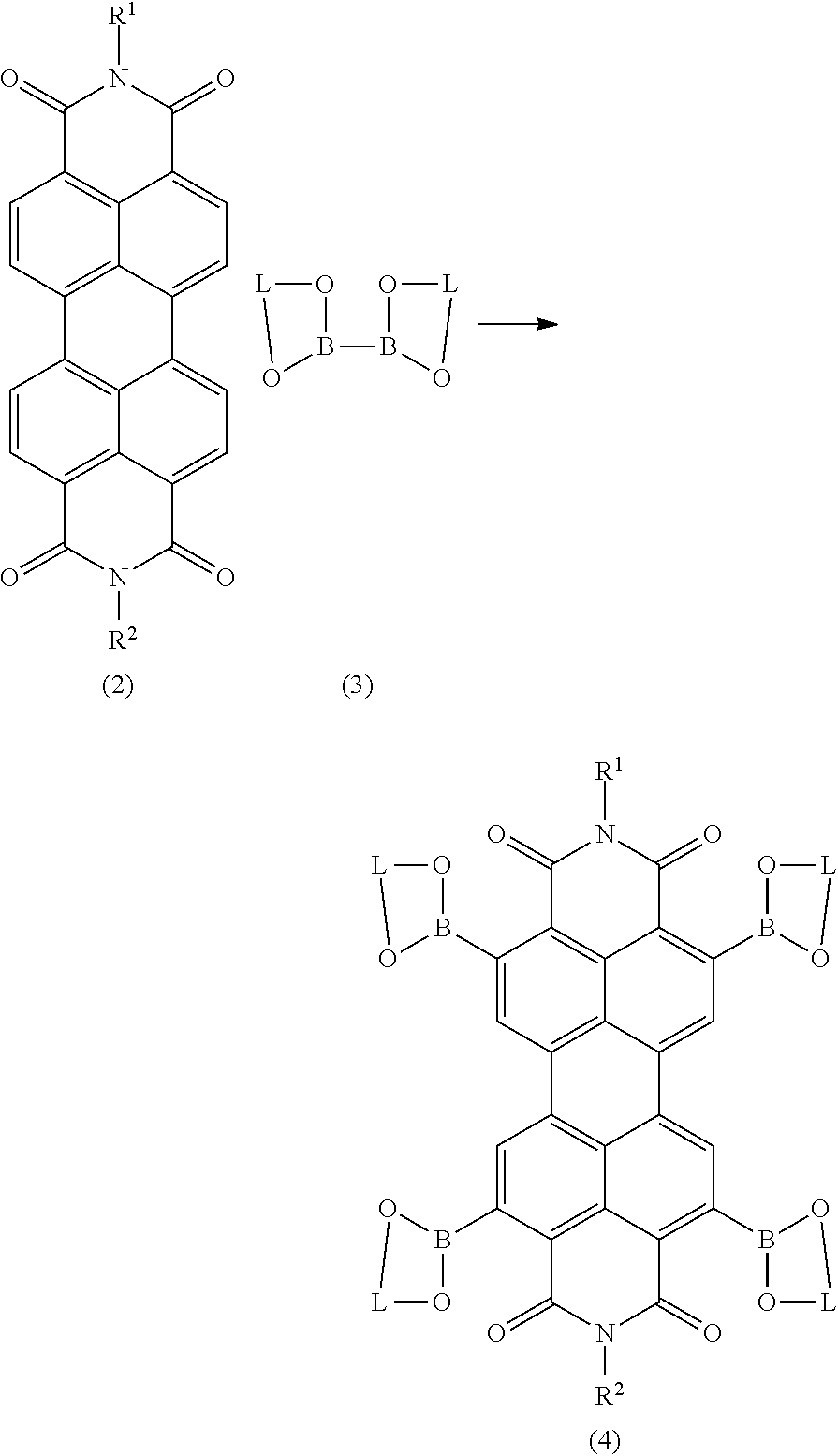
- R 1 and R 2 are as defined above, which process comprises the steps of (i) treating a compound of formula (2) with a boron-containing compound of formula (3) in the presence of a transition metal-containing catalyst to form a boron-containing compound of formula (4)
- R 1 and R 2 are as defined above, and L is a linking group, and (ii) treating the boron-containing compound of formula (4) with a cyanide source in order to form the compound of formula (1).
- L is preferably C 2-5 -alkylene, which can be optionally substituted with 1 to 6 C 1-10 -alkyl groups. More preferably L is ethylene or propylene and is substituted with 2 to 4 methyl groups.
- the transition metal-containing catalyst can be an iridium-containing catalyst such as [Ir(cod)OMe] 2 , or, preferably, a ruthenium-containing catalyst, such as RuH2(CO)(PPh 3 ) 3 .
- the first step can be performed in the presence of a base such as di-tert-butylbipyridine. If the transition metal-containing catalyst is an iridium-containing catalyst, the first step is usually performed in a suitable organic solvent such as tetrahydrofuran or 1,4-dioxane. If the transition metal-containing catalyst is an iridium-containing catalyst, the first step is usually performed at elevated temperatures, such as at temperatures from 60 to 110° C. In principal, if the transition metal-containing catalyst is an iridium-containing catalyst, the first step can be performed in analogy to the method described by C. W. Liskey; X. Liao; J. F. Hartwig in J.
- the first step is usually performed in a suitable organic solvent such as toluene, pinacolone and mesitylene or mixtures thereof. If the transition metal-containing catalyst is ruthenium-containing catalyst, the first step is usually performed at elevated temperatures, such as at temperatures from 120 to 160° C.
- the cyanide source in step two can be tetra-C 1-10 -alkylammoniumcyanide, tetra-C 1-10 -alkylphosphoniumcyanide or hexa-C 1-10 -alkylguanidiniumcyanide.
- the cyanide source in step two can be Zn(CN) 2 .
- the second step is usually performed in the presence of a base such as CsF and a copper reagent such as Cu(NO 3 ) 2 .
- the second step is usually performed in a suitable solvent such as water, methanol and dioxane, or mixtures thereof.
- the second step is usually performed at elevated temperatures, such as at temperatures from 80 to 120° C.
- step two can be performed in analogy to the method described by C. W. Liskey; X. Liao; J. F. Hartwig in J. Am. Chem. Soc. 2010, 132, 11389-11391.
- the compounds of formulae (4) and (1) can be isolated by methods known in the art, such as column chromatography.
- the compound of formula (2) can be obtained by methods known in the art, for example as described in the subsection titled “Synthesis” of F. Würthner, Chem. Commun., 2004, 1564-1579.
- R 1 , R 2 and L are as defined above.
- Also part of the present invention is an electronic device comprising the compound of formula (1) as semiconducting material.
- Also part of the invention is the use of the compound of formula (1) as semiconducting material.
- FIG. 1 the design of the bottom-gate organic field effect transistor of example 5 is shown.
- drain current I SD [A] in relation to the gate voltage V SG [V] (top transfer curve) and the drain current I SD 0.5 [ ⁇ A 0.5 ] in relation to the gate voltage V SG [V] (bottom transfer curve) for the bottom-gate organic field effect transistor of example 5 comprising compound 1b as semiconducting material at a drain voltage V SD of 100 V is shown.
- FIG. 3 the charge carrier mobility ⁇ sat [cm 2 /Vs] in relation to the gate voltage V SG [V] for the bottom-gate organic field effect transistor of example 5 comprising compound 1b as semiconducting material is shown.
- the compounds of formula (1) show a high charge carrier mobility and a high stability, in particular towards oxidation, under ambient conditions. Furthermore the compounds of formula (1) are compatible with liquid processing techniques.
- N,N′-Bis(1-ethylpropyl) perylene-3,4:9,10-tetracarboxylic acid bisimide (2a) (100 mg, 0.189 mmol) and bispinacolondiboronate (3a) (0.383 g, 1.51 mmol) are mixed together and dissolved in 2 mL dry mesitylene and 0.15 mL dry pinacolone. Argon is bubbled trough the solution for 30 minutes. RuH2(CO)(PPh 3 ) 3 (0.082 mg, 0.09 mmol) is added to the reaction mixture and the vessel heated to 140° C. for 30 hours. After cooling the system to room temperature, the solvent is evaporated and the desired compound purified by column chromatography (silica, CH 2 Cl 2 /AcOEt 50/1). An orange bright solid is obtained with 60% yield (117 mg, 0.113 mmol).
- N,N′-Bis(1-ethylpropyl)-2,5,8,11-tetrakis[4,4,5,5-tetramethyl-1,3,2-dioxaborolan-2-y]perylene-3,4:9,10-tetracarboxylic acid bisimide (4a) 50 mg, 0.048 mmol
- zinc cyanide 68 mg, 0.58 mmol
- caesium fluoride 29 mg, 0.19 mmol
- copper nitrate 90 mg, 0.38
- reaction mixture is then poured into a saturated solution of ammonium chloride and extracted with dichloromethane.
- the organic phase is dried over magnesium sulfate and the solvent evaporated.
- the product is purified via column chromatography (silica, dichloromethane/acetone 50/1) and obtained as a red-orange solid (yield 40%, 13 mg, 0.019 mmol).
- N,N′-Bis(1-heptyloctyl) perylene-3,4:9,10-tetracarboxylic acid bisimide (2b) (0.12 mmol) and bispinacolondiboronate (3a) (0.99 mmol) are mixed together and dissolved in 2 mL dry mesitylene and 0.15 mL dry pinacolone. Argon is bubbled trough the solution for 30 minutes. RuH 2 (CO)(PPh 3 ) 3 (0.06 mmol) is added to the reaction mixture and the vessel heated to 140° C. for 24 hours. After cooling the system to room temperature, the solvent is evaporated and the desired compound 4b is purified by column chromatography (silica, CH 2 Cl 2 /AcOEt 50/1).
- N,N′-Bis(1-heptyloctyl)-2,5,8,11-tetrakis[4,4,5,5-tetramethyl-1,3,2-dioxaborolan-2-y]perylene-3,4:9,10-tetracarboxylic acid bisimide (4b) (63 mg, 0.05 mmol), prepared as described in example 3, cesium fluoride (29 mg, 0.19 mmol), zinc cyanide (68 mg, 0.58 mmol) and copper(II) nitrate ⁇ 2.5H 2 0 (89 mg, 0.38 mmol) are suspended in 3 mL of a 5/1 mixture of dioxane/methanol and heated in a microwave vessel at 80° C. for 5 minutes.
- Thermally grown silicon dioxide (thickness: 200 nm) is used as dielectric layer.
- the gate electrode is formed by depositing highly doped silicon on one side of the dielectric layer.
- the other side of the dielectric layer is treated with hexamethyldisilazane (HMDS) by vapour deposition of hexamethyldisilazane.
- HMDS hexamethyldisilazane
- the contact angle of the surface of the HMPS-treated side of the dielectric layer is 93.2 ⁇ 1.3°.
- Source/drain electrodes (Ta (thickness: 10 nm) covered by Au (thickness: 40 nm)) are deposited on the HMPS-treated side of the dielectric layer by vapour deposition.
- FIG. 1 The design of the bottom-gate organic field effect transistor of example 5 is shown in FIG. 1 .
- the drain current I SD [A] in relation to the gate voltage V SG [V] (top transfer curve) and the drain current I SD 0.5 [ ⁇ A 0.5 ] in relation to the gate voltage V SG [V] (bottom transfer curve) for the bottom-gate organic field effect transistor of example 5 comprising compound 1b as semiconducting material at a drain voltage V SD of 100 V is determined in a nitrogen filled glove box (O 2 content: 0.1 ppm, H 2 O content: 0.0 ppm, pressure: 1120 Pa, temperature: 17° C.) using a Keithley 4200 machine is shown. The results are shown in FIG. 2 .
- FIG. 3 the charge carrier mobility ⁇ sat [cm 2 /Vs] in relation to the gate voltage V SG [V] for the bottom-gate organic field effect transistor of example 5 comprising compound 1b as semiconducting material is shown.
- the average values and the 90% confidence interval (in parentheses) of the charge carrier mobility ⁇ sat [cm 2 /Vs], the I ON /I OFF ratio and the switch-on voltage V 50 [V] for the bottom-gate organic field effect transistor of example 5 comprising compound 1b as semiconducting material is given in table 1.
- the switch-on voltage V 50 [V] is the gate voltage V 50 [V] where the drain current I SD [A] starts to increase (out of the off-state).
Landscapes
- Chemical & Material Sciences (AREA)
- Organic Chemistry (AREA)
- Heterocyclic Carbon Compounds Containing A Hetero Ring Having Oxygen Or Sulfur (AREA)
- Nitrogen Condensed Heterocyclic Rings (AREA)
Abstract

Description
-
- a first compound of formula [EC-]n-Ar1 (I), wherein
- A1 is a first aromatic core and is a divalent, trivalent or tetravalent radical of a long list of formulae, including
- a first compound of formula [EC-]n-Ar1 (I), wherein

-
-
- that is unsubstituted or substituted with a long list of substituents, including fluoro and cyano,
- EC is a first end capping group and is a monovalent radical of a long list of formulae,
- n is an integer of 2 to 4
- Z is NH or CH2, and
- a second compound having an aromatic radical that comprises the first aromatic core of the first compound, a second end capping group that comprises the first end capping group of the first compound, a divalent radical that comprises a divalent radical of the first end capping group, or a combination thereof,
wherein the composition is amorphous and solution processible.
-

wherein A1 and A2 are independently carbocyclic and/or heterocyclic aromatic ring systems comprising at least one aromatic ring in which one or more hydrogen atoms are substituted with at least one fluorine-containing group. The perylene nucleus can be optionally substituted with up to eight independently selected X groups, wherein n is an integer from 0 to 8. The X substituent groups on the perylene can include a long list of substituents, including halogens such as fluorine or chlorine, and cyano.

wherein each R1 to R8, R11 and R12 can be independently selected from H, an electron-withdrawing substituent and a moiety comprising such substituent. Electron-withdrawing substitutents include a long list of substituents, including cyano. R9 and R10 are independently selected from H, alkyl, substituted alkyl, cycloalkyl, substituted cycloalkyl, aryl, substituted aryl, polycyclic aryl and/or substituted polycyclic aryl moieties. At least one of R1, R4, R5, R8, R11 and R12 can be a cyano substituent. Such cyanated compounds can be di- or tetra-substituted as shown by the following structures:


wherein Y in each instance can be independently selected from H, CN, acceptors, donors and a polymerizable group; and X in each instance can be independently selected from a large group of listed compounds.

wherein R1 at each occurrence is independently selected from a long list of groups, including branched C3-20-alkyl and branched C3-20-alkenyl.

wherein R1 and R2 at each occurrence independently are selected from a large list of groups, including H, C1-30-alkyl and C2-30-alkenyl; and R3, R4, R5 and R6 are independently H or an electron-withdrawing group. In certain embodiments, at least one of R3, R4, R5 and R6 can be Br or cyano. For example, the semiconducting compound can include

WO 2009/144205 describes bispolycyclic rylene-based semiconducting materials, for example

S. Nakanzono, S. Easwaramoorthi, D. Kim, H. Shinokubo, A. Osuka Org. Lett. 2009, 11, 5426 to 5429 describes the preparation of 2,5,8,11 tetraarylated perylene tetracaroxylic acid bisimides from perylene tetracarboxylic acid bisimides


wherein
- R1 and R2 are independently selected from the group consisting of H, C1-30-alkyl, C2-30-alkenyl, C2-30-alkynyl, C3-10-cycloalkyl, C5-10-cycloalkenyl, 3-14 membered cycloheteroalkyl, C6-14-aryl and 5-14 membered heteroaryl,
- wherein
- if R1 or R2 are C1-30-alkyl, C2-30-alkenyl or C2-30-alkynyl, this R1 or R2 can be optionally substituted with 1 to 6 groups independently selected from the group consisting of halogen, —CN, —NO2, —OH, C1-10-alkoxy, —O—CH2CH2O—C1-10-alkyl, —O—COR3, —S—C1-10-alkyl, —NH2, —NHR3, —NR3R4, —NH—COR3, —COOH, —COORS, —CONH2, —CONHR3, —CONR3R4, —CO—H, —COR3, C3-10-cycloalkyl, 3-14 membered cycloheteroalkyl, C6-14-aryl and 5-14 membered heteroaryl;
- if R1 or R2 are C3-10-cycloalkyl, C5-10-cycloalkenyl or 3-14 membered cycloheteroalkyl, this R1 or R2 can be optionally substituted with 1 to 6 groups independently selected from the group consisting of halogen, —CN, —NO2, —OH, C1-10-alkoxy, —O—CH2CH2O—C1-10-alkyl, —O—COR3, —S—C1-10-alkyl, —NH2, —NHR3, —NR3R4, —NH—COR3, —COOH, —COORS, —CONH2, —CONHR3, —CONR3R4, —CO—H, —COR3, C1-10-alkyl, C2-10-alkenyl, C2-10-alkynyl, C6-14-aryl and 5-14 membered heteroaryl;
- if R1 or R2 are C6-14-aryl or 5-14 membered heteroaryl, this R1 or R2 can be optionally substituted with 1 to 6 groups independently selected from the group consisting of halogen, —CN, —NO2, —OH, C1-10-alkoxy, —O—CH2CH2O—C1-10-alkyl, —O—COR3, —S—C1-10-alkyl, —NH2, —NHR3, —NR3R4, —NH—COR3, —COOH, —COORS, —CONH2, —CONHR3, —CONR3R4, —CO—H, —COR3, C1-10-alkyl, C2-10-alkenyl, C2-10-alkynyl, C3-10-cycloalkyl, C5-10-cycloalkenyl and 3-14 membered cycloheteroalkyl,
- wherein R3 and R4 are at each occurrence are independently from each other selected from the group consisting of C1-10-alkyl, C2-10-alkenyl, C2-10-alkynyl, C3-10-cycloalkyl, C5-10-cycloalkenyl, 3-14 membered cycloheteroalkyl, C6-14-aryl and 5-14 membered heteroaryl.
-
- wherein
- if R1 or R2 are C1-30-alkyl, C2-30-alkenyl or C2-30-alkynyl, this R1 or R2 can be optionally substituted with 1 to 6 groups independently selected from the group consisting of halogen, —CN, —NO2, —OH, C1-10-alkoxy, —O—CH2CH2O—C1-10-alkyl, —O—COR3, —S—C1-10-alkyl, —NH2, —NHR3, —NR3R4, —NH—COR3, —COOH, —COORS, —CONH2, —CONHR3, —CONR3R4, —CO—H, —COR3, C3-10-cycloalkyl, 3-14 membered cycloheteroalkyl, C6-14-aryl and 5-14 membered heteroaryl;
- if R1 or R2 are C3-10-cycloalkyl, C5-10-cycloalkenyl or 3-14 membered cycloheteroalkyl, this R1 or R2 can be optionally substituted with 1 to 6 groups independently selected from the group consisting of halogen, —CN, —NO2, —OH, C1-10-alkoxy, —O—CH2CH2O—C1-10-alkyl, —O—COR3, —S—C1-10-alkyl, —NH2, —NHR3, —NR3R4, —NH—COR3, —COOH, —COORS, —CONH2, —CONHR3, —CONR3R4, —CO—H, —COR3, C1-10-alkyl, C2-10-alkenyl, C2-10-alkynyl, C6-14-aryl and 5-14 membered heteroaryl;
- wherein R3 and R4 are at each occurrence are independently from each other selected from the group consisting of C1-10-alkyl, C2-10-alkenyl, C2-10-alkynyl, C3-10-cycloalkyl, C5-10-cycloalkenyl, 3-14 membered cycloheteroalkyl, C6-14-aryl and 5-14 membered heteroaryl.
-
- wherein
- if R1 or R2 are C1-30-alkyl or C2-30-alkenyl, this R1 or R2 can be optionally substituted with 1 to 6 groups independently selected from the group consisting of halogen, —CN, —NO2, —OH, C1-10-alkoxy, —O—CH2CH2O—C1-10-alkyl, —O—COR3, —S—C1-10-alkyl, —NH2, —NHR3, —NR3R4, —NH—COR3, —COOH, —COORS, —CONH2, —CONHR3, —CONR3R4, —CO—H, —COR3, C3-10-cycloalkyl, 3-14 membered cycloheteroalkyl, C6-14-aryl and 5-14 membered heteroaryl;
- wherein R3 and R4 are at each occurrence are independently from each other selected from the group consisting of C1-10-alkyl, C2-10-alkenyl, C2-10-alkynyl, C3-10-cycloalkyl, C5-10-cycloalkenyl, 3-14 membered cycloheteroalkyl, C6-14-aryl and 5-14 membered heteroaryl.
-
- wherein
- R1 or R2 can be optionally substituted with 1 to 6 groups independently selected from the group consisting of halogen, —CN, —NO2, —OH, C1-10-alkoxy, —O—CH2CH2O—C1-10-alkyl, —O—COR3, —S—C1-10-alkyl, —NH2, —NHR3, —NR3R4, —NH—COR3, —COOH, —COORS, —CONH2, —CONHR3, —CONR3R4, —CO—H, —COR3, C3-10-cycloalkyl, 3-14 membered cycloheteroalkyl, C6-14-aryl and 5-14 membered heteroaryl;
- wherein R3 and R4 are at each occurrence are independently from each other selected from the group consisting of C1-10-alkyl, C2-10-alkenyl, C2-10-alkynyl, C3-10-cycloalkyl, C5-10-cycloalkenyl, 3-14 membered cycloheteroalkyl, C6-14-aryl and 5-14 membered heteroaryl.
-
- wherein
- R1 or R2 can be optionally substituted with 1 to 6 groups independently selected from the group consisting of halogen, —CN, —NO2, —OH, C1-10-alkoxy, —O—CH2CH2O—C1-10-alkyl, —O—COR3, —S—C1-10-alkyl, —NH2, —NHR3, —NR3R4, —NH—COR3, —COOH, —COORS, —CONH2, —CONHR3, —CONR3R4, —CO—H, —COR3, C3-10-cycloalkyl, 3-14 membered cycloheteroalkyl, C6-14-aryl and 5-14 membered heteroaryl;
- wherein R3 and R4 are at each occurrence are independently from each other selected from the group consisting of C1-10-alkyl, C2-10-alkenyl, C2-10-alkynyl, C3-10-cycloalkyl, C5-10-cycloalkenyl, 3-14 membered cycloheteroalkyl, C6-14-aryl and 5-14 membered heteroaryl.

wherein R1 and R2 are as defined above,
which process comprises the steps of
(i) treating a compound of formula (2) with a boron-containing compound of formula (3) in the presence of a transition metal-containing catalyst to form a boron-containing compound of formula (4)

wherein R1 and R2 are as defined above, and L is a linking group,
and
(ii) treating the boron-containing compound of formula (4) with a cyanide source in order to form the compound of formula (1).

wherein R1, R2 and L are as defined above.


| TABLE 1 | |||
| μsat | VSO | ||
| Compound | [cm2/Vs] | ION/IOFF | [V] |
| 1b | 1.5 (±1.2) × 10−6 | 1.6 (±0.4) × 102 | 61.3 (±2.0) |
Claims (8)


Priority Applications (1)
| Application Number | Priority Date | Filing Date | Title |
|---|---|---|---|
| US13/412,023 US8471020B2 (en) | 2011-03-03 | 2012-03-05 | Perylene-based semiconducting materials |
Applications Claiming Priority (2)
| Application Number | Priority Date | Filing Date | Title |
|---|---|---|---|
| US201161448669P | 2011-03-03 | 2011-03-03 | |
| US13/412,023 US8471020B2 (en) | 2011-03-03 | 2012-03-05 | Perylene-based semiconducting materials |
Publications (2)
| Publication Number | Publication Date |
|---|---|
| US20120226042A1 US20120226042A1 (en) | 2012-09-06 |
| US8471020B2 true US8471020B2 (en) | 2013-06-25 |
Family
ID=46753707
Family Applications (1)
| Application Number | Title | Priority Date | Filing Date |
|---|---|---|---|
| US13/412,023 Expired - Fee Related US8471020B2 (en) | 2011-03-03 | 2012-03-05 | Perylene-based semiconducting materials |
Country Status (1)
| Country | Link |
|---|---|
| US (1) | US8471020B2 (en) |
Cited By (3)
| Publication number | Priority date | Publication date | Assignee | Title |
|---|---|---|---|---|
| US20140039193A1 (en) * | 2012-08-06 | 2014-02-06 | Max-Planck-Gesellschaft zur Foerd. der Wisse. e.V. | Boron containing perylene monoimides, a process for their production, their use as building blocks for the production of perylene monoimide derivatives, monoimide derivatives and their use in dye-sensitized solar cells |
| US9385326B2 (en) | 2013-01-15 | 2016-07-05 | Basf Se | Triangulene oligomers and polymers and their use as hole conducting material |
| US9583719B2 (en) | 2011-08-12 | 2017-02-28 | Basf Se | Carbazolocarbazol-bis(dicarboximides) and their use as semiconductors |
Families Citing this family (4)
| Publication number | Priority date | Publication date | Assignee | Title |
|---|---|---|---|---|
| CN103492387A (en) * | 2011-03-03 | 2014-01-01 | 巴斯夫欧洲公司 | Perylene-based semiconductor materials |
| EP2970570B1 (en) | 2013-03-12 | 2017-04-19 | Saudi Basic Industries Corporation | Semiconductor polymers |
| CN108424413B (en) * | 2017-02-15 | 2019-09-03 | 中国科学院化学研究所 | Synthesis, preparation method and application of a tripterene-based perylene imide compound |
| CN108997346B (en) * | 2018-09-10 | 2020-01-10 | 北京化工大学 | Based on perylene bisimide C3Symmetrical spiroplasmane derivative and synthesis and application thereof |
Citations (9)
| Publication number | Priority date | Publication date | Assignee | Title |
|---|---|---|---|---|
| US20050176970A1 (en) | 2004-01-26 | 2005-08-11 | Marks Tobin J. | Perylene n-type semiconductors and related devices |
| WO2005124453A2 (en) | 2004-06-14 | 2005-12-29 | Georgia Tech Research Corporation | Perylene charge-transport materials, methods of fabrication thereof, and methods of use thereof |
| US7282275B2 (en) | 2002-04-19 | 2007-10-16 | 3M Innovative Properties Company | Materials for organic electronic devices |
| US7326956B2 (en) | 2004-12-17 | 2008-02-05 | Eastman Kodak Company | Fluorine-containing N,N′-diaryl perylene-based tetracarboxylic diimide compounds as N-type semiconductor materials for thin film transistors |
| US7355198B2 (en) | 2004-04-29 | 2008-04-08 | Samsung Sdi Co., Ltd. | Organic thin film transistor including organic acceptor film |
| WO2008063609A2 (en) | 2006-11-17 | 2008-05-29 | Polyera Corporation | Diimide-based semiconductor materials and methods of preparing and using the same |
| WO2008085942A2 (en) | 2007-01-08 | 2008-07-17 | Polyera Corporation | Methods for preparing arene-bis(dicarboximide)-based semiconducting materials and related intermediates for preparing same |
| WO2009098252A1 (en) | 2008-02-05 | 2009-08-13 | Basf Se | Perylene semiconductors and methods of preparation and use thereof |
| WO2009144205A1 (en) | 2008-05-30 | 2009-12-03 | Basf Se | Rylene-based semiconductor materials and methods of preparation and use thereof |
-
2012
- 2012-03-05 US US13/412,023 patent/US8471020B2/en not_active Expired - Fee Related
Patent Citations (15)
| Publication number | Priority date | Publication date | Assignee | Title |
|---|---|---|---|---|
| US7282275B2 (en) | 2002-04-19 | 2007-10-16 | 3M Innovative Properties Company | Materials for organic electronic devices |
| US20050176970A1 (en) | 2004-01-26 | 2005-08-11 | Marks Tobin J. | Perylene n-type semiconductors and related devices |
| US7671202B2 (en) | 2004-01-26 | 2010-03-02 | Northwestern University | Perylene n-type semiconductors and related devices |
| US7355198B2 (en) | 2004-04-29 | 2008-04-08 | Samsung Sdi Co., Ltd. | Organic thin film transistor including organic acceptor film |
| US20080223444A1 (en) | 2004-06-14 | 2008-09-18 | Seth Marder | Perylene Charge-Transport Materials, Methods of Fabrication Thereof, and Methods of Use Thereof |
| WO2005124453A2 (en) | 2004-06-14 | 2005-12-29 | Georgia Tech Research Corporation | Perylene charge-transport materials, methods of fabrication thereof, and methods of use thereof |
| US7326956B2 (en) | 2004-12-17 | 2008-02-05 | Eastman Kodak Company | Fluorine-containing N,N′-diaryl perylene-based tetracarboxylic diimide compounds as N-type semiconductor materials for thin film transistors |
| US20080185577A1 (en) | 2006-11-17 | 2008-08-07 | Antonio Facchetti | Diimide-based semiconductor materials and methods of preparing and using the same |
| WO2008063609A2 (en) | 2006-11-17 | 2008-05-29 | Polyera Corporation | Diimide-based semiconductor materials and methods of preparing and using the same |
| US20080177073A1 (en) | 2007-01-08 | 2008-07-24 | Antonio Facchetti | Methods for preparing arene-BIS (dicarboximide)-based semiconducting materials and related intermediates for preparing same |
| WO2008085942A2 (en) | 2007-01-08 | 2008-07-17 | Polyera Corporation | Methods for preparing arene-bis(dicarboximide)-based semiconducting materials and related intermediates for preparing same |
| WO2009098252A1 (en) | 2008-02-05 | 2009-08-13 | Basf Se | Perylene semiconductors and methods of preparation and use thereof |
| US20100319778A1 (en) | 2008-02-05 | 2010-12-23 | Basf Se | Perylene semiconductors and methods of preparation and use thereof |
| WO2009144205A1 (en) | 2008-05-30 | 2009-12-03 | Basf Se | Rylene-based semiconductor materials and methods of preparation and use thereof |
| US20110136333A1 (en) | 2008-05-30 | 2011-06-09 | Basf Se | Semiconductor materials and methods of preparation and use thereof |
Non-Patent Citations (5)
| Title |
|---|
| Battagliarin, G. et al.: Efficient tuning of LUMO levels of 2,5,8,11-substituted perylenediimides via Copper catalyzed reactions. Organic Letters, vol. 13, pp. 3399-3401, 2011. * |
| Carl W. Liskey, et al., Journal of American Chemical Society, 2010, vol. 132, pp. 11389-11391. |
| Ibraheem A. I. Mkhalid, et al., Chemical Revisions, 2009, vol. 110, pp. 890-931. |
| Satomi Nakazono, et al., Organic Letters, 2009, vol. 11, No. 23, pp. 5426-5429. |
| Soichiro Kawamorita, et al., Journal of American Chemical Society, 2009, vol. 131, pp. 5058-5059. |
Cited By (6)
| Publication number | Priority date | Publication date | Assignee | Title |
|---|---|---|---|---|
| US9583719B2 (en) | 2011-08-12 | 2017-02-28 | Basf Se | Carbazolocarbazol-bis(dicarboximides) and their use as semiconductors |
| US20140039193A1 (en) * | 2012-08-06 | 2014-02-06 | Max-Planck-Gesellschaft zur Foerd. der Wisse. e.V. | Boron containing perylene monoimides, a process for their production, their use as building blocks for the production of perylene monoimide derivatives, monoimide derivatives and their use in dye-sensitized solar cells |
| US8816081B2 (en) * | 2012-08-06 | 2014-08-26 | Basf Se | Boron containing perylene monoimides, a process for their production, their use as building blocks for the production of perylene monoimide derivatives, monoimide derivatives and their use in dye-sensitized solar cells |
| US9105410B2 (en) | 2012-08-06 | 2015-08-11 | Basf Se | Boron containing perylene monoimides, a process for their production, their use as building blocks for the production of perylene monoimide derivatives, monoimide derivatives and their use in dye-sensitized solar cells |
| US9624375B2 (en) | 2012-08-06 | 2017-04-18 | Basf Se | Boron containing perylene monoimides, a process for their production, their use as building blocks for the production of perylene monoimide derivatives, monoimide derivatives and their use in dye-sensitized solar cells |
| US9385326B2 (en) | 2013-01-15 | 2016-07-05 | Basf Se | Triangulene oligomers and polymers and their use as hole conducting material |
Also Published As
| Publication number | Publication date |
|---|---|
| US20120226042A1 (en) | 2012-09-06 |
Similar Documents
| Publication | Publication Date | Title |
|---|---|---|
| US20120226042A1 (en) | Perylene-based Semiconducting Materials | |
| CN103492452B (en) | Semiconductor materials based on diketopiperido-piperidine copolymers | |
| US20180175305A1 (en) | Azaazene analogues and their use as semiconductor | |
| CN1980791B (en) | Perylene n-type semiconductors and related devices | |
| US9780315B2 (en) | Heteroacene compounds for organic electronics | |
| JP5744323B2 (en) | Perylene halide based semiconductor materials | |
| WO2012117089A1 (en) | Perylene-based semiconducting materials | |
| TW201300435A (en) | Semiconductor materials based on thienothiophene-2,5-dione oligomers and polymers | |
| US9716237B2 (en) | Heteroacenes for organic electronics | |
| WO2013024026A1 (en) | Fluorinated perylene-based semiconducting materials | |
| US20120289703A1 (en) | Halogenated perylene-based semiconducting materials | |
| US8436127B2 (en) | Semiconductor materials based on diketopiperidinopiperidine copolymers | |
| US20130211088A1 (en) | Fluorinated perylene-based semiconducting materials | |
| KR20200070289A (en) | Sulfonium salt of DNTT as a soluble photo-cutting precursor for organic semiconductors used in organic field effect transistors and related compounds | |
| US10079346B2 (en) | Heteroaromatic compounds for organic electronics |
Legal Events
| Date | Code | Title | Description |
|---|---|---|---|
| AS | Assignment |
Owner name: BASF SE, GERMANY Free format text: ASSIGNMENT OF ASSIGNORS INTEREST;ASSIGNORS:REICHELT, HELMUT;GEBNER, THOMAS;MULLEN, KLAUS;AND OTHERS;SIGNING DATES FROM 20120229 TO 20120307;REEL/FRAME:030408/0733 |
|
| STCF | Information on status: patent grant |
Free format text: PATENTED CASE |
|
| FPAY | Fee payment |
Year of fee payment: 4 |
|
| FEPP | Fee payment procedure |
Free format text: MAINTENANCE FEE REMINDER MAILED (ORIGINAL EVENT CODE: REM.); ENTITY STATUS OF PATENT OWNER: LARGE ENTITY |
|
| LAPS | Lapse for failure to pay maintenance fees |
Free format text: PATENT EXPIRED FOR FAILURE TO PAY MAINTENANCE FEES (ORIGINAL EVENT CODE: EXP.); ENTITY STATUS OF PATENT OWNER: LARGE ENTITY |
|
| STCH | Information on status: patent discontinuation |
Free format text: PATENT EXPIRED DUE TO NONPAYMENT OF MAINTENANCE FEES UNDER 37 CFR 1.362 |
|
| FP | Lapsed due to failure to pay maintenance fee |
Effective date: 20210625 |