US8468642B2 - Window scraper for an optical instrument - Google Patents

Window scraper for an optical instrument Download PDF

Info

Publication number
US8468642B2
US8468642B2 US12/404,021 US40402109A US8468642B2 US 8468642 B2 US8468642 B2 US 8468642B2 US 40402109 A US40402109 A US 40402109A US 8468642 B2 US8468642 B2 US 8468642B2
Authority
US
United States
Prior art keywords
blade
scraper
optical surface
length
edge
Prior art date
Legal status (The legal status is an assumption and is not a legal conclusion. Google has not performed a legal analysis and makes no representation as to the accuracy of the status listed.)
Expired - Fee Related, expires
Application number
US12/404,021
Other versions
US20090229067A1 (en
Inventor
Richard Becker
Craig J. Cornelius
Oliver Hamann
Evandro Mendonca
Robert E. LaVigueur
Current Assignee (The listed assignees may be inaccurate. Google has not performed a legal analysis and makes no representation or warranty as to the accuracy of the list.)
Mettler Toledo Autochem Inc
Original Assignee
Mettler Toledo Autochem Inc
Priority date (The priority date is an assumption and is not a legal conclusion. Google has not performed a legal analysis and makes no representation as to the accuracy of the date listed.)
Filing date
Publication date
Application filed by Mettler Toledo Autochem Inc filed Critical Mettler Toledo Autochem Inc
Priority to US12/404,021 priority Critical patent/US8468642B2/en
Publication of US20090229067A1 publication Critical patent/US20090229067A1/en
Assigned to METTLER-TOLEDO AUTOCHEM, INC. reassignment METTLER-TOLEDO AUTOCHEM, INC. ASSIGNMENT OF ASSIGNORS INTEREST (SEE DOCUMENT FOR DETAILS). Assignors: BECKER, RICHARD, CORNELIUS, CRAIG J., HAMANN, OLIVER, MENDONCA, EVANDRO, LAVIGUEUR, ROBERT E.
Application granted granted Critical
Publication of US8468642B2 publication Critical patent/US8468642B2/en
Expired - Fee Related legal-status Critical Current
Adjusted expiration legal-status Critical

Links

Images

Classifications

    • GPHYSICS
    • G02OPTICS
    • G02BOPTICAL ELEMENTS, SYSTEMS OR APPARATUS
    • G02B27/00Optical systems or apparatus not provided for by any of the groups G02B1/00 - G02B26/00, G02B30/00
    • G02B27/0006Optical systems or apparatus not provided for by any of the groups G02B1/00 - G02B26/00, G02B30/00 with means to keep optical surfaces clean, e.g. by preventing or removing dirt, stains, contamination, condensation
    • AHUMAN NECESSITIES
    • A61MEDICAL OR VETERINARY SCIENCE; HYGIENE
    • A61BDIAGNOSIS; SURGERY; IDENTIFICATION
    • A61B1/00Instruments for performing medical examinations of the interior of cavities or tubes of the body by visual or photographical inspection, e.g. endoscopes; Illuminating arrangements therefor
    • A61B1/00064Constructional details of the endoscope body
    • A61B1/00071Insertion part of the endoscope body
    • A61B1/0008Insertion part of the endoscope body characterised by distal tip features
    • A61B1/00087Tools
    • AHUMAN NECESSITIES
    • A61MEDICAL OR VETERINARY SCIENCE; HYGIENE
    • A61BDIAGNOSIS; SURGERY; IDENTIFICATION
    • A61B1/00Instruments for performing medical examinations of the interior of cavities or tubes of the body by visual or photographical inspection, e.g. endoscopes; Illuminating arrangements therefor
    • A61B1/12Instruments for performing medical examinations of the interior of cavities or tubes of the body by visual or photographical inspection, e.g. endoscopes; Illuminating arrangements therefor with cooling or rinsing arrangements
    • A61B1/126Instruments for performing medical examinations of the interior of cavities or tubes of the body by visual or photographical inspection, e.g. endoscopes; Illuminating arrangements therefor with cooling or rinsing arrangements provided with means for cleaning in-use
    • BPERFORMING OPERATIONS; TRANSPORTING
    • B08CLEANING
    • B08BCLEANING IN GENERAL; PREVENTION OF FOULING IN GENERAL
    • B08B1/00Cleaning by methods involving the use of tools
    • B08B1/10Cleaning by methods involving the use of tools characterised by the type of cleaning tool
    • B08B1/16Rigid blades, e.g. scrapers; Flexible blades, e.g. wipers
    • B08B1/165Scrapers
    • BPERFORMING OPERATIONS; TRANSPORTING
    • B08CLEANING
    • B08BCLEANING IN GENERAL; PREVENTION OF FOULING IN GENERAL
    • B08B1/00Cleaning by methods involving the use of tools
    • B08B1/30Cleaning by methods involving the use of tools by movement of cleaning members over a surface
    • B08B1/32Cleaning by methods involving the use of tools by movement of cleaning members over a surface using rotary cleaning members
    • GPHYSICS
    • G02OPTICS
    • G02BOPTICAL ELEMENTS, SYSTEMS OR APPARATUS
    • G02B23/00Telescopes, e.g. binoculars; Periscopes; Instruments for viewing the inside of hollow bodies; Viewfinders; Optical aiming or sighting devices
    • G02B23/24Instruments or systems for viewing the inside of hollow bodies, e.g. fibrescopes
    • G02B23/2476Non-optical details, e.g. housings, mountings, supports

Definitions

  • Optical instruments such as, but not limited to, particle size characterization scanners, which operate in crystallization or granulation processes that experience particle growth, often have their optical performance degraded by the deposition of particles on their external windows. Such depositions are often so rigidly attached to the windows that squeegee and brush-type wipers cannot dislodge the particles from the windows.
  • a scraper for an optical surface of a device includes a blade having an edge that is rigid and non-deforming to withstand high shear stresses.
  • the blade is configured to rotate about a first axis parallel to the optical surface and also configured to move in a line with respect to a second axis perpendicular to the optical surface. This allows the rigid, non-deforming blade to maintain contact with the optical surface.
  • the edge is configured to move across the optical surface to remove any materials adhered to the surface.
  • the scraper can be used to clean the optical surface of an instrument, for example.
  • the edge is configured to have three degrees of freedom of movement in order to maintain contact with the optical surface and to remove materials or particles present on the optical surface.
  • One degree of freedom of movement is the ability of the blade to rotate about a first axis that is parallel to the optical surface so that the edge can make contact with the surface when the optical surface is skewed with respect to the axis.
  • the pivot point of rotation lies on the edge of the blade.
  • One degree of freedom of movement is forwards and backwards with respect to the optical surface, wherein the scraper blade is biased or pressed against the optical surface so that the edge can make contact with the optical surface when the optical surface is skewed with respect to a second axis parallel to the optical surface and perpendicular to the first axis.
  • One degree of freedom of movement is across the optical surface, which can be rotation or translation across the optical surface, and oscillatory.
  • One embodiment for allowing the blade to rotate to keep contact with the optical surface when the surface is skewed with respect to an axis parallel to the optical surface includes placing the blade within a slot that includes a curved surface such that the proximal side of the blade includes a matching curved surface to allow rotation in the slot.
  • the blade may include a plurality of scraping edges, wherein each scraping edge is made up of two adjoining surfaces coming together to form an angle of 90 degrees or less.
  • the scraper blade may have two edges to allow scraping in a forward and backward direction.
  • a pivot shaft is attached to a driver at one end thereof.
  • the pivot shaft is connected to a bracket on the opposite end thereof.
  • the pivot shaft is configured so as to apply a force such that the scraper blade is pressed against the optical surface to produce high shear stresses on any material that accumulates on the surface.
  • the pivot shaft allows the second degree of freedom of movement to allow the blade to move forwards and backwards in a direction perpendicular to the optical surface to allow contact with the optical surface when the optical surface is skewed with respect to a vertical axis.
  • the scraper blade edge may be made from a metal, ceramic, or plastics.
  • the scraper blade edge is less hard than the optical surface to avoid scratching of the surface.
  • the scraper blade edge is rigid and, therefore, cannot bend or conform to maintain contact with the flat surface of the optical surface to operate as desired.
  • the scraper blade has three degrees of freedom. First, the blade rotates along an axis parallel to the optical surface such that the blade edge can align itself to the surface. Second, the scraper blade is also able to translate forwards and backwards in line with an axis perpendicular to the optical surface, i.e., in towards the optical surface or away from the optical surface. Third, the scraper blade can move across the optical surface, such as by rotation or translation across the surface.
  • a bracket that connects the shaft to the blade can have a slot for insertion of the blade.
  • the slot includes a curved surface against which the proximal side of the blade seats and the proximal side of the blade include a matching curved surface. This permits the scraper blade to rotate about the center of a pivot point that is parallel to the optical surface, i.e., the pivot point lies along the edge of the blade.
  • FIG. 1 is a diagrammatical illustration of an optical instrument and a window scraper in accordance with one embodiment of the present invention
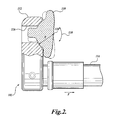
  • FIG. 2 is a diagrammatical illustration of a cross-sectional view of a window scraper in accordance with one embodiment of the present invention
  • FIG. 3 is a diagrammatical illustration of a top view of a portion of a scraper blade in accordance with one embodiment of the present invention
  • FIG. 4 is a diagrammatical illustration of a top view of a portion of a scraper blade in accordance with one embodiment of the present invention
  • FIG. 5 is a diagrammatical illustration of a top view of a portion of a scraper blade in accordance with one embodiment of the present invention.
  • FIG. 6 is a diagrammatical illustration of a top view of a portion of a scraper blade in accordance with one embodiment of the present invention.
  • FIG. 7 is a diagrammatical illustration of a top view of a portion of a scraper blade in accordance with one embodiment of the present invention.
  • FIG. 8 is a diagrammatical illustration of an instrument and window scraper in accordance with one embodiment of the present invention.
  • FIG. 9 is a diagrammatical illustration of a cross-sectional view of an instrument and window scraper in accordance with one embodiment of the present invention.
  • Embodiments of the present invention are related to scrapers for windows, including, but not limited to, the process side optical surface of windows.
  • optical surfaces are present in, but are not necessarily limited to, optical instruments.
  • a window can be any surface that collects, attracts, or on which particles or other materials of any kind accumulate.
  • applications in which embodiments of the disclosed window scraper may be used include particle processing, such as in the area of pharmaceuticals manufacturing, where binders, such as cellulose and lactose, can accumulate on instruments.
  • binders such as cellulose and lactose
  • other applications for the disclosed window scraper are possible, such as, but not limited to any instrument, sensor, device, and surface used in chemical processing and manufacturing, and other fields.
  • any application requiring the removal of particles and/or materials from a surface are suitable applications in which the disclosed window scraper may be used.
  • the optical instrument 100 includes an elongated tube 106 .
  • the elongated tube 106 includes a distal end 108 .
  • the distal end 108 of instrument 100 includes a window 104 .
  • the window 104 has an optical surface on the distal side thereof.
  • the distal end 108 of instrument 100 may be positioned within any location having a material or condition that is desired to be measured by the instrument 100 .
  • the distal end 108 of instrument 100 can be inserted in any pipeline, vessel, tank, reactor, and the like.
  • the instrument 100 is a particle characterization instrument that can measure any one or more of the size, shape, chemical composition, and concentration of particles.
  • An “optical surface” as used herein, refers to any material through which electromagnetic radiation may be transmitted. Electromagnetic radiation includes visible light, near infrared, middle infrared, and far infrared radiation, for example. However, embodiments of the optical surface should not be construed as being limited to any particular wavelength of electromagnetic radiation.
  • Optical surfaces out of which the window 104 can be made can include, but are not limited to the following materials: industrial sapphire (aluminum dioxide crystals), industrial diamond, glass, quartz, fusila, surface-hardened materials, diamond-coated materials, nano-coated materials, silicon, and the like.
  • industrial sapphire aluminum dioxide crystals
  • industrial diamond glass, quartz, fusila
  • surface-hardened materials diamond-coated materials
  • nano-coated materials silicon, and the like.
  • a common characteristic of the above-mentioned materials is the ability to transmit a form of electromagnetic radiation that may be emitted or received by the instrument 100 .
  • the instrument 100 includes a window scraper 102 .
  • the window scraper 102 includes a pivot shaft 114 , a blade bracket 112 connected to the distal end of the pivot shaft 114 , and a scraper blade 110 connected to the end of the blade bracket 112 .
  • the pivot shaft 114 extends parallel to the longitudinal axis of the instrument 100 and can be internal to the elongated tube 106 of the instrument 100 .
  • the proximal end of the pivot shaft 114 which is not shown in FIGS. 1 and 2 , is understood to be connected to a drive mechanism.
  • the drive mechanism may impart an oscillatory motion to the pivot shaft 114 .
  • the blade bracket 112 is attached at the distal end of the pivot shaft 114 perpendicular to the axis of rotation of the pivot shaft 114 .
  • the blade bracket 112 includes a lower end and an upper end. The lower end is attached to the distal end of the pivot shaft 114 .
  • the upper end of the blade bracket 112 includes a blade slot 116 .
  • the blade slot 116 supports the scraper blade 110 .
  • the scraper blade 110 is allowed to rotate in the blade slot 116 about the blade pivot 118 as indicated by the double-headed arrow 130 in FIG. 2 .
  • the pivot shaft 114 exerts a force in the direction of the arrow with the designation “F.”
  • the pivot shaft 114 forces the scraper blade 110 against the window 104 surface to produce high shear stresses on any material accumulated on the surface of window 104 caused by the movement of the scraper blade 110 , thus effectively removing such accumulated material
  • the scraper blade 110 or, at the very least, the portion of the scraper blade 110 (i.e., the edge) that contacts the window 104 is made of a material that is rigid and is generally non-deformable during scraping. Suitable materials for the scraper blade 110 edge include, but are not limited to, metals, ceramics, rigid plastics, and the like.
  • the scraper blade 110 edge is less hard than the window 104 surface material to prevent scratching of the window 104 surface.
  • the scraper blade 110 edge advantageously withstands high shear forces required to dislodge particle deposits.
  • the scraper blade 110 edge is advantageously hard enough such that the abrasion associated with scraping does not substantially wear the scraping edges of the scraper blade 110 too quickly.
  • the scraper blade 110 edge is also corrosion resistant to some degree.
  • One representative material for a scraper blade 110 includes stainless steel, such as 13-8 stainless hardened to RC35, for example.
  • the scraper blade 110 edge is rigid and, therefore, cannot bend or conform to maintain contact with a flat surface of the window 104 .
  • the scraper blade 110 has three degrees of freedom.
  • the scraper blade 110 is able to rotate about an axis perpendicular to the window, or, in other embodiments, the scraper blade 110 can be configured to translate along an axis parallel to the window 104 and perpendicular to the scraping edges. In the illustrated embodiment, the scraper blade 110 lies vertically and is rotated by the pivot shaft 114 .
  • the scraper blade 110 is able to rotate about an axis parallel and horizontal to the window 104 and perpendicular to the scraping edges, i.e., about the blade pivot 118 as shown in FIG. 2 . This keeps the blade 110 in contact with the window if the window is skewed with respect to a horizontal axis.
  • the scraper blade 110 is also able to translate either forwards or backwards or in line along an axis perpendicular to the window 104 to keep the blade in contact with the window 104 , i.e., in the direction of the force F. This keeps the blade 110 in contact with the window when the window is skewed with respect to a vertical axis.
  • the blade 110 when the scraper is positioned to the side of the window 104 , the blade 110 will then lie horizontally and would be configured to rotate about an axis that is parallel and vertical to the window 104 . In this case, the rotation of the blade along this vertical axis allows for the blade to keep in contact with the window, when the window is skewed with respect to the vertical axis.
  • the blade would also be configured to move in line with an axis that is perpendicular to the surface. The force being exerted on the blade to press against the window in the forward direction allows the blade to keep in contact with the window, when the window is skewed with respect to a horizontal axis.
  • the blade edge can be arcuate, concave, or convex to match the shape of the optical surface.
  • the scraper blade 110 is able to rotate about the blade pivot 118 , the scraper blade 110 is fitted into the slot 116 in the blade bracket 112 .
  • the slot 116 is perpendicular to the window 104 and parallel to the axis of the pivot shaft 114 .
  • the back edge of the scraper blade 110 and the front side of the slot 116 may have a matching radius that permits the scraper blade 110 to rotate about the center of that radius at the blade pivot 118 . This rotation allows the scraping edge or edges to align themselves parallel to the window 104 .
  • the center of the scraper blade 110 rotation is located at the window 104 surface. This results in minimum coupling between scraper blade 110 rotation and the slot 116 and scraper blade 110 translation along the pivot shaft 114 .
  • the scraper blade 110 has a width and a length significantly greater than its thickness. The plane formed by the length and width is oriented perpendicular to the window 104 surface. The thin distal face of the scraper blade 110 makes contact with the window 104 .
  • FIG. 3 is a diagrammatical illustration of a portion of the top view of the scraper blade 110 showing the configuration of the thin face.
  • the scraping edges of the scraper blade 110 are represented in FIG. 3 as reference numerals 120 a and 122 a .
  • the scraping edges 120 a and 122 a that are formed on the thin face of the scraper blade 110 are perpendicular to the direction of scraping and are sharp.
  • FIG. 3 illustrates two scraping edges 120 a and 122 a , so that scraping action is performed on both the forward and backward phases of oscillatory motion.
  • FIGS. 4 , 5 , 6 , and 7 Other embodiments of sharp scraping edges are illustrated in FIGS. 4 , 5 , 6 , and 7 .
  • FIGS. 4 and 5 illustrate two sharp scraping edges 120 b , 122 b , 120 c , and 122 c at the face of the scraper blade
  • FIGS. 6 and 7 illustrate a single sharp scraping edge 120 d and 120 e .
  • the scraping edge of FIGS. 6 and 7 may be used on a scraper blade that travels in a single direction.
  • the window scraper 102 may also be used on a window scraper 102 traveling in a single direction; however, when one scraping edge is determined to be dull or not performing, such as by noticing reduced light transmissivity, the window scraper 102 may automatically reverse direction to use the second scraping edge.
  • the scraping edges illustrated in FIGS. 3 to 7 are formed by two adjoining surfaces making an angle of 90 degrees or less.
  • FIGS. 8 and 9 are diagrammatical illustrations of the entire instrument 100 and window scraper.
  • the complete window scraper is shown, including the pivot shaft 114 that is attached at the proximal end to a driver 132 within a housing 130 .
  • the driver 132 can impart an oscillatory motion to the pivot shaft that in turn moves the bracket 112 and blade 110 across the surface of the window 104 .
  • the pivot shaft is also configured to move in the direction either forwards or backwards perpendicular to the window 104 , thus allowing the blade 110 to maintain contact with the window 104 .
  • the pivot shaft 114 is fitted with appropriate bearings to support rotation as well as in line movement of the shaft.
  • the pivot shaft can be biased forwards, such as with a spring, so that the blade 110 exerts pressure on the window 104 surface.
  • a window scraper 102 is suitable to be used on or in connection with a surface, optical or otherwise, that is desired to be cleansed of adhering particles and/or materials.
  • the motion of the scraper blade 110 in relation to the window 104 to be scraped can take any one of various implementations.
  • the scraper blade 110 may be rotated through a sector of an arc in an oscillatory motion.
  • the scraper blade 110 may be attached to a guide or rail that causes the scraper blade 110 to translate in a straight line across the window 104 surface, again in an oscillatory motion.
  • the scraper blade 110 can be attached to a pivot shaft wherein the pivot shaft rotates in a continuous or periodic fashion making a complete 360 degree rotation.
  • more than one scraper blade 110 can be provided on a single blade bracket 112 , or, alternatively, multiple blade brackets 112 may be provided with a single scraper blade 112 on each blade bracket 112 .
  • the scraper blade 110 can be configured to scrape more than one window. Numerous other modifications are readily apparent from the above disclosure.
  • the operation of the window scraper 102 can be controlled by a means for indicating when the window 104 needs to be scraped. For example, by measuring the light transmissivity through the window 104 with a sensor, a predetermined limit can be set that actuates the window scraper 102 to remove the adhered materials, thus restoring the light transmissivity to the normal operating range. Should the window scraper 102 be used for an optical instrument with measurement capability, means can be provided that indicate when the window scraper 102 is in operation that causes the measurement readings from the optical instrument to be discarded or disregarded as accurate readings. Means can also be provided when the scraping operation is completed, thus indicating that instrument measurement readings are once again indicating accurate operating conditions. Means to determine when the window scraper 102 is in operation as a cut-off means for measuring instrument readings can include a position sensor, a motion sensor, or an amp meter connected to the actuator.
  • means for delivering ultrasonic energy to the scraper blade 110 can assist with removal of tenaciously adhered particles or materials from the window 104 surface.

Landscapes

  • Physics & Mathematics (AREA)
  • Health & Medical Sciences (AREA)
  • Life Sciences & Earth Sciences (AREA)
  • Optics & Photonics (AREA)
  • Surgery (AREA)
  • Biomedical Technology (AREA)
  • Medical Informatics (AREA)
  • Radiology & Medical Imaging (AREA)
  • Nuclear Medicine, Radiotherapy & Molecular Imaging (AREA)
  • Engineering & Computer Science (AREA)
  • Biophysics (AREA)
  • Heart & Thoracic Surgery (AREA)
  • Pathology (AREA)
  • Molecular Biology (AREA)
  • Animal Behavior & Ethology (AREA)
  • General Health & Medical Sciences (AREA)
  • Public Health (AREA)
  • Veterinary Medicine (AREA)
  • General Physics & Mathematics (AREA)
  • Astronomy & Astrophysics (AREA)
  • Cleaning In General (AREA)

Abstract

A scraper for an optical surface of a device is disclosed. The scraper includes a blade having an edge that is rigid and non-deforming to withstand high shear stresses. The blade is configured to rotate about a first axis parallel to the optical surface and also configured to move in a line with respect to a second axis perpendicular to the optical surface. This allows the rigid, non-deforming blade to maintain contact with the optical surface. Furthermore, the edge is configured to move across the optical surface to remove any materials adhered to the surface. The scraper can be used to clean the optical surface of an instrument, for example.

Description

CROSS-REFERENCE TO RELATED APPLICATION
This application claims the benefit of Provisional Application No. 61/036,333, filed Mar. 13, 2008, which application is incorporated herein by reference in its entirety.
BACKGROUND
Optical instruments, such as, but not limited to, particle size characterization scanners, which operate in crystallization or granulation processes that experience particle growth, often have their optical performance degraded by the deposition of particles on their external windows. Such depositions are often so rigidly attached to the windows that squeegee and brush-type wipers cannot dislodge the particles from the windows.
Accordingly, alternatives are desired to overcome the problems with the conventional brush-type wipers and squeegees.
SUMMARY
This summary is provided to introduce a selection of concepts in a simplified form that are further described below in the Detailed Description. This summary is not intended to identify key features of the claimed subject matter, nor is it intended to be used as an aid in determining the scope of the claimed subject matter.
A scraper for an optical surface of a device is disclosed. The scraper includes a blade having an edge that is rigid and non-deforming to withstand high shear stresses. The blade is configured to rotate about a first axis parallel to the optical surface and also configured to move in a line with respect to a second axis perpendicular to the optical surface. This allows the rigid, non-deforming blade to maintain contact with the optical surface. Furthermore, the edge is configured to move across the optical surface to remove any materials adhered to the surface. The scraper can be used to clean the optical surface of an instrument, for example.
The edge is configured to have three degrees of freedom of movement in order to maintain contact with the optical surface and to remove materials or particles present on the optical surface.
One degree of freedom of movement is the ability of the blade to rotate about a first axis that is parallel to the optical surface so that the edge can make contact with the surface when the optical surface is skewed with respect to the axis. The pivot point of rotation lies on the edge of the blade.
One degree of freedom of movement is forwards and backwards with respect to the optical surface, wherein the scraper blade is biased or pressed against the optical surface so that the edge can make contact with the optical surface when the optical surface is skewed with respect to a second axis parallel to the optical surface and perpendicular to the first axis.
One degree of freedom of movement is across the optical surface, which can be rotation or translation across the optical surface, and oscillatory.
One embodiment for allowing the blade to rotate to keep contact with the optical surface when the surface is skewed with respect to an axis parallel to the optical surface includes placing the blade within a slot that includes a curved surface such that the proximal side of the blade includes a matching curved surface to allow rotation in the slot.
The blade may include a plurality of scraping edges, wherein each scraping edge is made up of two adjoining surfaces coming together to form an angle of 90 degrees or less. The scraper blade may have two edges to allow scraping in a forward and backward direction.
A pivot shaft is attached to a driver at one end thereof. The pivot shaft is connected to a bracket on the opposite end thereof. The pivot shaft is configured so as to apply a force such that the scraper blade is pressed against the optical surface to produce high shear stresses on any material that accumulates on the surface. The pivot shaft allows the second degree of freedom of movement to allow the blade to move forwards and backwards in a direction perpendicular to the optical surface to allow contact with the optical surface when the optical surface is skewed with respect to a vertical axis.
The scraper blade edge may be made from a metal, ceramic, or plastics. The scraper blade edge is less hard than the optical surface to avoid scratching of the surface.
Because the scraper blade edge is rigid and, therefore, cannot bend or conform to maintain contact with the flat surface of the optical surface to operate as desired, the scraper blade has three degrees of freedom. First, the blade rotates along an axis parallel to the optical surface such that the blade edge can align itself to the surface. Second, the scraper blade is also able to translate forwards and backwards in line with an axis perpendicular to the optical surface, i.e., in towards the optical surface or away from the optical surface. Third, the scraper blade can move across the optical surface, such as by rotation or translation across the surface.
A bracket that connects the shaft to the blade can have a slot for insertion of the blade. The slot includes a curved surface against which the proximal side of the blade seats and the proximal side of the blade include a matching curved surface. This permits the scraper blade to rotate about the center of a pivot point that is parallel to the optical surface, i.e., the pivot point lies along the edge of the blade.
DESCRIPTION OF THE DRAWINGS
The foregoing aspects and many of the attendant advantages of this invention will become more readily appreciated as the same become better understood by reference to the following detailed description, when taken in conjunction with the accompanying drawings, wherein:
FIG. 1 is a diagrammatical illustration of an optical instrument and a window scraper in accordance with one embodiment of the present invention;
FIG. 2 is a diagrammatical illustration of a cross-sectional view of a window scraper in accordance with one embodiment of the present invention;
FIG. 3 is a diagrammatical illustration of a top view of a portion of a scraper blade in accordance with one embodiment of the present invention;
FIG. 4 is a diagrammatical illustration of a top view of a portion of a scraper blade in accordance with one embodiment of the present invention;
FIG. 5 is a diagrammatical illustration of a top view of a portion of a scraper blade in accordance with one embodiment of the present invention;
FIG. 6 is a diagrammatical illustration of a top view of a portion of a scraper blade in accordance with one embodiment of the present invention;
FIG. 7 is a diagrammatical illustration of a top view of a portion of a scraper blade in accordance with one embodiment of the present invention;
FIG. 8 is a diagrammatical illustration of an instrument and window scraper in accordance with one embodiment of the present invention; and
FIG. 9 is a diagrammatical illustration of a cross-sectional view of an instrument and window scraper in accordance with one embodiment of the present invention.
DETAILED DESCRIPTION
While illustrative embodiments have been illustrated and described, it will be appreciated that various changes can be made therein without departing from the spirit and scope of the invention.
Embodiments of the present invention are related to scrapers for windows, including, but not limited to, the process side optical surface of windows. As used herein, optical surfaces are present in, but are not necessarily limited to, optical instruments.
A window can be any surface that collects, attracts, or on which particles or other materials of any kind accumulate. For example, applications in which embodiments of the disclosed window scraper may be used include particle processing, such as in the area of pharmaceuticals manufacturing, where binders, such as cellulose and lactose, can accumulate on instruments. However, other applications for the disclosed window scraper are possible, such as, but not limited to any instrument, sensor, device, and surface used in chemical processing and manufacturing, and other fields. In general, any application requiring the removal of particles and/or materials from a surface are suitable applications in which the disclosed window scraper may be used. Although the following description of a representative window scraper is with reference to an optical instrument, the window scraper is not thereby limited solely for use in this application.
Referring collectively to both FIGS. 1 and 2, a representative optical instrument 100 is illustrated. The specific details of the optical instrument 100 are not disclosed herein for brevity. In one particular embodiment, the optical instrument 100 includes an elongated tube 106. The elongated tube 106 includes a distal end 108. The distal end 108 of instrument 100 includes a window 104. The window 104 has an optical surface on the distal side thereof. The distal end 108 of instrument 100 may be positioned within any location having a material or condition that is desired to be measured by the instrument 100. For example, the distal end 108 of instrument 100 can be inserted in any pipeline, vessel, tank, reactor, and the like. In one particular embodiment, the instrument 100 is a particle characterization instrument that can measure any one or more of the size, shape, chemical composition, and concentration of particles. An “optical surface” as used herein, refers to any material through which electromagnetic radiation may be transmitted. Electromagnetic radiation includes visible light, near infrared, middle infrared, and far infrared radiation, for example. However, embodiments of the optical surface should not be construed as being limited to any particular wavelength of electromagnetic radiation.
Optical surfaces out of which the window 104 can be made can include, but are not limited to the following materials: industrial sapphire (aluminum dioxide crystals), industrial diamond, glass, quartz, fusila, surface-hardened materials, diamond-coated materials, nano-coated materials, silicon, and the like. A common characteristic of the above-mentioned materials is the ability to transmit a form of electromagnetic radiation that may be emitted or received by the instrument 100.
The instrument 100 includes a window scraper 102. The window scraper 102 includes a pivot shaft 114, a blade bracket 112 connected to the distal end of the pivot shaft 114, and a scraper blade 110 connected to the end of the blade bracket 112. The pivot shaft 114 extends parallel to the longitudinal axis of the instrument 100 and can be internal to the elongated tube 106 of the instrument 100. The proximal end of the pivot shaft 114, which is not shown in FIGS. 1 and 2, is understood to be connected to a drive mechanism. The drive mechanism may impart an oscillatory motion to the pivot shaft 114. The blade bracket 112 is attached at the distal end of the pivot shaft 114 perpendicular to the axis of rotation of the pivot shaft 114. The blade bracket 112 includes a lower end and an upper end. The lower end is attached to the distal end of the pivot shaft 114. The upper end of the blade bracket 112 includes a blade slot 116. The blade slot 116 supports the scraper blade 110. The scraper blade 110 is allowed to rotate in the blade slot 116 about the blade pivot 118 as indicated by the double-headed arrow 130 in FIG. 2. The pivot shaft 114 exerts a force in the direction of the arrow with the designation “F.” Thus, the pivot shaft 114 forces the scraper blade 110 against the window 104 surface to produce high shear stresses on any material accumulated on the surface of window 104 caused by the movement of the scraper blade 110, thus effectively removing such accumulated material
The scraper blade 110 or, at the very least, the portion of the scraper blade 110 (i.e., the edge) that contacts the window 104 is made of a material that is rigid and is generally non-deformable during scraping. Suitable materials for the scraper blade 110 edge include, but are not limited to, metals, ceramics, rigid plastics, and the like. The scraper blade 110 edge is less hard than the window 104 surface material to prevent scratching of the window 104 surface. The scraper blade 110 edge advantageously withstands high shear forces required to dislodge particle deposits. The scraper blade 110 edge is advantageously hard enough such that the abrasion associated with scraping does not substantially wear the scraping edges of the scraper blade 110 too quickly. Preferably, the scraper blade 110 edge is also corrosion resistant to some degree. One representative material for a scraper blade 110 includes stainless steel, such as 13-8 stainless hardened to RC35, for example. The scraper blade 110 edge is rigid and, therefore, cannot bend or conform to maintain contact with a flat surface of the window 104. To operate as desired, the scraper blade 110 has three degrees of freedom. For the scraping action to occur, the scraper blade 110 is able to rotate about an axis perpendicular to the window, or, in other embodiments, the scraper blade 110 can be configured to translate along an axis parallel to the window 104 and perpendicular to the scraping edges. In the illustrated embodiment, the scraper blade 110 lies vertically and is rotated by the pivot shaft 114. To keep the scraping edge or edges parallel to the window 104, the scraper blade 110 is able to rotate about an axis parallel and horizontal to the window 104 and perpendicular to the scraping edges, i.e., about the blade pivot 118 as shown in FIG. 2. This keeps the blade 110 in contact with the window if the window is skewed with respect to a horizontal axis. The scraper blade 110 is also able to translate either forwards or backwards or in line along an axis perpendicular to the window 104 to keep the blade in contact with the window 104, i.e., in the direction of the force F. This keeps the blade 110 in contact with the window when the window is skewed with respect to a vertical axis. In other embodiments, for example, when the scraper is positioned to the side of the window 104, the blade 110 will then lie horizontally and would be configured to rotate about an axis that is parallel and vertical to the window 104. In this case, the rotation of the blade along this vertical axis allows for the blade to keep in contact with the window, when the window is skewed with respect to the vertical axis. The blade would also be configured to move in line with an axis that is perpendicular to the surface. The force being exerted on the blade to press against the window in the forward direction allows the blade to keep in contact with the window, when the window is skewed with respect to a horizontal axis. Therefore, two degrees of freedom of movement that include rotation of the blade about a pivot point parallel to the optical surface, and movement in a direction that is in line with an axis that is perpendicular to the optical surface, such as forwards and backwards, are needed to keep the blade in contact with the optical surface. The third degree of movement provides for the blade to move across the surface.
Besides using a straight blade edge, the blade edge can be arcuate, concave, or convex to match the shape of the optical surface.
In a preferred embodiment, the scraper blade 110 is able to rotate about the blade pivot 118, the scraper blade 110 is fitted into the slot 116 in the blade bracket 112. The slot 116 is perpendicular to the window 104 and parallel to the axis of the pivot shaft 114. The back edge of the scraper blade 110 and the front side of the slot 116 may have a matching radius that permits the scraper blade 110 to rotate about the center of that radius at the blade pivot 118. This rotation allows the scraping edge or edges to align themselves parallel to the window 104. Additionally, the center of the scraper blade 110 rotation is located at the window 104 surface. This results in minimum coupling between scraper blade 110 rotation and the slot 116 and scraper blade 110 translation along the pivot shaft 114. This also minimizes the force required to keep the scraping edges parallel to the window 104. While this arrangement of the blade pivot is advantageous any other arrangements, including mechanical pivot axes, flexure mounts and the like that allow a pivoting motion around an axis essentially parallel to the window surface and collinear with the direction of the motion of the wiper blade may be suitable.
In one embodiment, the scraper blade 110 has a width and a length significantly greater than its thickness. The plane formed by the length and width is oriented perpendicular to the window 104 surface. The thin distal face of the scraper blade 110 makes contact with the window 104. FIG. 3 is a diagrammatical illustration of a portion of the top view of the scraper blade 110 showing the configuration of the thin face. The scraping edges of the scraper blade 110 are represented in FIG. 3 as reference numerals 120 a and 122 a. The scraping edges 120 a and 122 a that are formed on the thin face of the scraper blade 110 are perpendicular to the direction of scraping and are sharp. FIG. 3 illustrates two scraping edges 120 a and 122 a, so that scraping action is performed on both the forward and backward phases of oscillatory motion.
Other embodiments of sharp scraping edges are illustrated in FIGS. 4, 5, 6, and 7. FIGS. 4 and 5 illustrate two sharp scraping edges 120 b, 122 b, 120 c, and 122 c at the face of the scraper blade, whereas FIGS. 6 and 7 illustrate a single sharp scraping edge 120 d and 120 e. The scraping edge of FIGS. 6 and 7 may be used on a scraper blade that travels in a single direction. The scraping edges illustrated in FIGS. 3, 4, and 5 may also be used on a window scraper 102 traveling in a single direction; however, when one scraping edge is determined to be dull or not performing, such as by noticing reduced light transmissivity, the window scraper 102 may automatically reverse direction to use the second scraping edge. Generally, the scraping edges illustrated in FIGS. 3 to 7 are formed by two adjoining surfaces making an angle of 90 degrees or less.
FIGS. 8 and 9 are diagrammatical illustrations of the entire instrument 100 and window scraper. As mentioned above, the design and type of instrument does not affect the window scraper of the invention, but is merely shown to illustrate one representative embodiment of how the window scraper may be used. The complete window scraper is shown, including the pivot shaft 114 that is attached at the proximal end to a driver 132 within a housing 130. The driver 132 can impart an oscillatory motion to the pivot shaft that in turn moves the bracket 112 and blade 110 across the surface of the window 104. The pivot shaft is also configured to move in the direction either forwards or backwards perpendicular to the window 104, thus allowing the blade 110 to maintain contact with the window 104. To this end, the pivot shaft 114 is fitted with appropriate bearings to support rotation as well as in line movement of the shaft. The pivot shaft can be biased forwards, such as with a spring, so that the blade 110 exerts pressure on the window 104 surface.
Although one representative embodiment of a window scraper 102 has been illustrated and described, it is to be appreciated that variations are encompassed within the scope of this disclosure. A window scraper 102, as disclosed herein, is suitable to be used on or in connection with a surface, optical or otherwise, that is desired to be cleansed of adhering particles and/or materials. Furthermore, the motion of the scraper blade 110 in relation to the window 104 to be scraped can take any one of various implementations. The scraper blade 110 may be rotated through a sector of an arc in an oscillatory motion. Alternatively, the scraper blade 110 may be attached to a guide or rail that causes the scraper blade 110 to translate in a straight line across the window 104 surface, again in an oscillatory motion. As another alternative, the scraper blade 110 can be attached to a pivot shaft wherein the pivot shaft rotates in a continuous or periodic fashion making a complete 360 degree rotation. Furthermore, more than one scraper blade 110 can be provided on a single blade bracket 112, or, alternatively, multiple blade brackets 112 may be provided with a single scraper blade 112 on each blade bracket 112. For that matter, the scraper blade 110 can be configured to scrape more than one window. Numerous other modifications are readily apparent from the above disclosure.
In other embodiments, the operation of the window scraper 102 can be controlled by a means for indicating when the window 104 needs to be scraped. For example, by measuring the light transmissivity through the window 104 with a sensor, a predetermined limit can be set that actuates the window scraper 102 to remove the adhered materials, thus restoring the light transmissivity to the normal operating range. Should the window scraper 102 be used for an optical instrument with measurement capability, means can be provided that indicate when the window scraper 102 is in operation that causes the measurement readings from the optical instrument to be discarded or disregarded as accurate readings. Means can also be provided when the scraping operation is completed, thus indicating that instrument measurement readings are once again indicating accurate operating conditions. Means to determine when the window scraper 102 is in operation as a cut-off means for measuring instrument readings can include a position sensor, a motion sensor, or an amp meter connected to the actuator.
In still other embodiments, means for delivering ultrasonic energy to the scraper blade 110 can assist with removal of tenaciously adhered particles or materials from the window 104 surface.
While illustrative embodiments have been illustrated and described, it will be appreciated that various changes can be made therein without departing from the spirit and scope of the invention.

Claims (19)

The embodiments of the invention in which an exclusive property or privilege is claimed are defined as follows:
1. A scraper for an optical surface, comprising:
a pivot shaft;
a bracket, an axis thereof extending radially from the pivot shaft, with a blade slot formed along the axis;
a rigid and non-deforming blade, having a length and a width that are significantly larger than a thickness thereof, the length and width defining a plane of the blade which remains perpendicular to the optical surface with one of the length edges arranged to bear against the optical surface and the other length edge mounted in the blade slot, the blade slot allowing rotation of the blade in the plane.
2. The scraper of claim 1, wherein the blade is configured to rotate about a pivot point that lies on the edge that bears against the optical surface.
3. The scraper of claim 1, wherein the edge that bears against the optical surface is formed by adjoining surfaces making an angle of 90 degrees or less.
4. The scraper of claim 1, wherein the blade includes a plurality of scraping edges.
5. The scraper of claim 1, wherein the blade is configured to oscillate.
6. The scraper of claim 1, wherein the blade edge that bears against the optical surface is made from a metal, ceramic, or rigid plastic.
7. The scraper of claim 1, wherein the slot includes a curved surface against which a matching curved surface of the other length edge of the blade seats.
8. The scraper of claim 1, wherein the slot includes a curved surface against which a matching curved surface on a proximal side of the blade seats.
9. A scraper for an optical surface, comprising:
a bracket, with a blade slot formed along an axis of the bracket;
a rigid and non-deforming blade, having a length and a width that are significantly larger than a thickness thereof, the length and width defining a plane of the blade which remains perpendicular to the optical surface with one of the length edges arranged to bear against the optical surface and the other length edge mounted in the blade slot the blade slot allowing rotation of the blade in the plane mounted in the blade slot in perpendicular relationship to the optical surface, against which an edge of the blade bears, the blade having limited rotation in the blade slot in a plane defined by the blade; and
corresponding curved surfaces, a first of which is a proximal surface of the blade and a second of which is a surface of the slot, against which the first curved surface seats.
10. The scraper of claim 9, further comprising:
a pivot shaft, a distal end of which is connected to the bracket.
11. A scraper for an optical surface, comprising:
a pivot shaft, extending perpendicular to the optical surface and arranged for oscillatory rotation about an axis thereof;
a bracket, an axis thereof extending radially from the pivot shaft;
a blade slot extending along the axis of the bracket;
a rigid and non-deforming blade, the blade having a length and a width that are significantly larger than a thickness thereof, the blade held in the blade slot such that the length and width define a plane of the blade which remains perpendicular to the optical surface with one of the length edges bearing against the optical surface and the other length edge mounted in the blade slot during the oscillatory rotation.
12. The scraper of claim 11, wherein the blade is configured to rotate about a pivot point that lies on the length edge that bears against the optical surface.
13. The scraper of claim 11, wherein the length edge that bears against the optical surface edge is formed by adjoining surfaces making an angle of 90 degrees or less.
14. The scraper of claim 11, wherein the blade includes a plurality of scraping edges.
15. The scraper of claim 11, wherein the blade is configured to oscillate.
16. The scraper of claim 11, wherein the length edge that bears against the optical surface bears is made from a metal, ceramic, or rigid plastic.
17. An instrument, comprising:
an optical surface; and
the scraper of claim 14, arranged in operative proximity to the optical surface.
18. The instrument of claim 17, wherein:
the instrument is a particle analyzer.
19. The instrument of claim 17, wherein the instrument can analyze one or more of the size, shape, chemical composition, and concentration of particles.
US12/404,021 2008-03-13 2009-03-13 Window scraper for an optical instrument Expired - Fee Related US8468642B2 (en)

Priority Applications (1)

Application Number Priority Date Filing Date Title
US12/404,021 US8468642B2 (en) 2008-03-13 2009-03-13 Window scraper for an optical instrument

Applications Claiming Priority (2)

Application Number Priority Date Filing Date Title
US3633308P 2008-03-13 2008-03-13
US12/404,021 US8468642B2 (en) 2008-03-13 2009-03-13 Window scraper for an optical instrument

Publications (2)

Publication Number Publication Date
US20090229067A1 US20090229067A1 (en) 2009-09-17
US8468642B2 true US8468642B2 (en) 2013-06-25

Family

ID=40627123

Family Applications (1)

Application Number Title Priority Date Filing Date
US12/404,021 Expired - Fee Related US8468642B2 (en) 2008-03-13 2009-03-13 Window scraper for an optical instrument

Country Status (6)

Country Link
US (1) US8468642B2 (en)
EP (1) EP2263113B1 (en)
JP (1) JP2011515207A (en)
CN (1) CN102016689B (en)
AT (1) ATE520052T1 (en)
WO (1) WO2009114807A1 (en)

Cited By (2)

* Cited by examiner, † Cited by third party
Publication number Priority date Publication date Assignee Title
US20210290048A1 (en) * 2018-11-29 2021-09-23 Board Of Regents, The University Of Texas System Devices, systems and methods for cleaning of elongated instrument surface
US20220175236A1 (en) * 2020-01-27 2022-06-09 Board Of Regents, The University Of Texas System Wiper assembly for imaging element cleaning apparatus

Families Citing this family (16)

* Cited by examiner, † Cited by third party
Publication number Priority date Publication date Assignee Title
DE102011078617B4 (en) 2011-07-04 2025-09-04 Endress+Hauser Conducta Gmbh+Co. Kg Device and method for cleaning deposits and deposits on an end plate of a sensor body
JP6528471B2 (en) * 2015-03-09 2019-06-12 セイコーエプソン株式会社 Image forming apparatus and stain detection method
CN105361849B (en) * 2015-11-24 2018-08-21 嵊州亿源投资管理有限公司 gastroscope with control end
CN105361848B (en) * 2015-11-24 2017-11-24 陈玉玲 Dispenser gastroscope
CN105361850B (en) * 2015-11-24 2017-11-24 深圳市技领科技有限公司 Gastroscope
EP3541265A4 (en) * 2016-11-16 2020-06-17 Board of Regents, The University of Texas System DEVICES, SYSTEMS AND METHODS FOR IN VIVO CLEANING OF A MEDICAL INSTRUMENT SURFACE
CN109483594B (en) * 2018-11-16 2020-06-12 中国矿业大学 A kind of film peeling self-cleaning explosion-proof camera device and cleaning method for coal mine robot
US10791918B1 (en) 2019-10-04 2020-10-06 ClearCam Inc. Imaging element cleaning apparatus
US11284789B2 (en) 2019-10-04 2022-03-29 ClearCam, Inc. Imaging element cleaning apparatus with structure-mandated cleaning member motion control
US12133638B2 (en) 2020-06-03 2024-11-05 Brigham Young University Integrated cleaning device and system for optical instruments
CA3187965A1 (en) * 2020-06-22 2021-12-30 Excelsense Technologies Corp. Apparatus for cleaning an optical surface in an optical device
US10993609B1 (en) 2021-01-23 2021-05-04 ClearCam Inc. Imaging element cleaning device with imaging device fitment adjustability
US11109940B1 (en) 2021-02-09 2021-09-07 ClearCam Inc. Devices, apparatuses, systems and methods for facilitating cleaning of an imaging element of an imaging device
US11766309B2 (en) 2021-03-09 2023-09-26 ClearCam Inc. Articles, kits and methods adapted for facilitating adjustability of operative apparatuses
US20220304563A1 (en) * 2021-03-26 2022-09-29 Vicarious Surgical Inc. Lens cleaning system and method for a surgical camera
US11707189B1 (en) 2022-02-10 2023-07-25 ClearCam Inc. Methods, devices and systems for cleaning an imaging element with a translatable cleaning element

Citations (28)

* Cited by examiner, † Cited by third party
Publication number Priority date Publication date Assignee Title
US1938840A (en) * 1932-02-29 1933-12-12 Severin G Kleven Scraping device for windshields
GB489352A (en) 1935-10-29 1938-07-22 Umberto Galli Improvements in wipers for the wind-screens of vehicles and for other purposes
US2582717A (en) * 1947-07-05 1952-01-15 Roy M Pierce Windshield wiper
US2707298A (en) 1951-11-20 1955-05-03 Jr Waldo H Wiest Magnetic windshield scraper
US2727270A (en) * 1951-02-14 1955-12-20 Fiat Spa Windscreen wiper
US3837036A (en) * 1971-05-03 1974-09-24 Bosch Gmbh Robert Apparatus for wiping exposed convex surfaces of lenses on head lights of automotive vehicles or the like
US3844661A (en) 1973-02-14 1974-10-29 Gen Atomic Co Self-cleaning optical cell for a fluid analysis system
US4422206A (en) * 1982-06-18 1983-12-27 Brace Arthur W Ice scraper
US4719661A (en) * 1984-12-22 1988-01-19 Swf Auto-Electric Gmbh Cleaning device for motor vehicle window panes
US5185531A (en) 1991-09-26 1993-02-09 Wedgewood Technology, Inc. Window cleaner for inline optical sensors
JPH0545273A (en) 1991-08-19 1993-02-23 Shimadzu Corp Cell for measuring particle size distribution
US5208938A (en) * 1990-09-20 1993-05-11 Gec-Marconi Limited Centrifugally operated wiper mechanism for cleaning turret mounted lenses
WO1996012938A1 (en) 1994-10-24 1996-05-02 Protimeter Inc. Wiper assembly for optical surfaces
DE29508980U1 (en) * 1995-05-31 1996-09-26 Robert Bosch Gmbh, 70469 Stuttgart Device for operating a wiper
JPH08248370A (en) 1995-03-13 1996-09-27 Sharp Corp LCD panel cleaning method
US5983504A (en) * 1995-05-31 1999-11-16 Suncast Corporation Ice scraper
JP2001205072A (en) 2000-01-26 2001-07-31 Toru Taniguchi Peep window with scraper device
JP2002088562A (en) 2000-09-20 2002-03-27 Murata Mach Ltd Cleaning device for spinning nozzle surface
US20020139394A1 (en) 2001-04-03 2002-10-03 Barry Bronson Self-cleaning lens shield
WO2003078975A2 (en) 2002-03-15 2003-09-25 Ysi Incorporated Wiper and brush device for cleaning water quality sensors
JP2004230315A (en) 2003-01-31 2004-08-19 Toshiba Corp Cleaning device and cleaning method for optical window glass
EP1541995A1 (en) 2003-12-12 2005-06-15 L.B. BOHLE PHARMATECHNIK GmbH Method and apparatus for assessing the quality of materials in granular form
US20060199998A1 (en) 2005-02-14 2006-09-07 Olympus Medical Systems Corp. Endoscope system
US20070002319A1 (en) 2005-04-29 2007-01-04 Knopp Kevin J Method and apparatus for conducting Raman spectroscopy
WO2007012878A1 (en) 2005-07-29 2007-02-01 Qinetiq Limited Laser measurement device and method
JP2007117103A (en) 2005-10-24 2007-05-17 Olympus Medical Systems Corp Endoscope sheath, endoscope device
WO2007090717A1 (en) 2006-02-06 2007-08-16 Hach Lange Gmbh Waste water immersion probe
US20080212101A1 (en) * 2004-11-11 2008-09-04 Frank Wolf Optical Sensor for Detecting Moisture on a Windshield of a Motor Vehicle

Family Cites Families (3)

* Cited by examiner, † Cited by third party
Publication number Priority date Publication date Assignee Title
JPH06121204A (en) * 1992-10-02 1994-04-28 Fuji Photo Optical Co Ltd Television camera
JPH0738746U (en) * 1993-12-27 1995-07-14 アスモ株式会社 Ball joint device
JP2003181387A (en) * 2001-12-17 2003-07-02 Nippon Soda Co Ltd Device for cleaning inspection window

Patent Citations (31)

* Cited by examiner, † Cited by third party
Publication number Priority date Publication date Assignee Title
US1938840A (en) * 1932-02-29 1933-12-12 Severin G Kleven Scraping device for windshields
GB489352A (en) 1935-10-29 1938-07-22 Umberto Galli Improvements in wipers for the wind-screens of vehicles and for other purposes
US2582717A (en) * 1947-07-05 1952-01-15 Roy M Pierce Windshield wiper
US2727270A (en) * 1951-02-14 1955-12-20 Fiat Spa Windscreen wiper
US2707298A (en) 1951-11-20 1955-05-03 Jr Waldo H Wiest Magnetic windshield scraper
US3837036A (en) * 1971-05-03 1974-09-24 Bosch Gmbh Robert Apparatus for wiping exposed convex surfaces of lenses on head lights of automotive vehicles or the like
US3844661A (en) 1973-02-14 1974-10-29 Gen Atomic Co Self-cleaning optical cell for a fluid analysis system
US4422206A (en) * 1982-06-18 1983-12-27 Brace Arthur W Ice scraper
US4719661A (en) * 1984-12-22 1988-01-19 Swf Auto-Electric Gmbh Cleaning device for motor vehicle window panes
US5208938A (en) * 1990-09-20 1993-05-11 Gec-Marconi Limited Centrifugally operated wiper mechanism for cleaning turret mounted lenses
JPH0545273A (en) 1991-08-19 1993-02-23 Shimadzu Corp Cell for measuring particle size distribution
US5185531A (en) 1991-09-26 1993-02-09 Wedgewood Technology, Inc. Window cleaner for inline optical sensors
WO1996012938A1 (en) 1994-10-24 1996-05-02 Protimeter Inc. Wiper assembly for optical surfaces
JPH08248370A (en) 1995-03-13 1996-09-27 Sharp Corp LCD panel cleaning method
US5983504A (en) * 1995-05-31 1999-11-16 Suncast Corporation Ice scraper
DE29508980U1 (en) * 1995-05-31 1996-09-26 Robert Bosch Gmbh, 70469 Stuttgart Device for operating a wiper
JP2001205072A (en) 2000-01-26 2001-07-31 Toru Taniguchi Peep window with scraper device
JP2002088562A (en) 2000-09-20 2002-03-27 Murata Mach Ltd Cleaning device for spinning nozzle surface
US20020139394A1 (en) 2001-04-03 2002-10-03 Barry Bronson Self-cleaning lens shield
MXPA04009013A (en) 2002-03-15 2004-11-26 Ysi Inc Wiper and brush device for cleaning water quality sensors.
WO2003078975A2 (en) 2002-03-15 2003-09-25 Ysi Incorporated Wiper and brush device for cleaning water quality sensors
WO2003078975A3 (en) 2002-03-15 2003-12-11 Ysi Inc Wiper and brush device for cleaning water quality sensors
US20030233723A1 (en) 2002-03-15 2003-12-25 Mike Lizotte Wiper and brush device for cleaning water quality sensors
JP2004230315A (en) 2003-01-31 2004-08-19 Toshiba Corp Cleaning device and cleaning method for optical window glass
EP1541995A1 (en) 2003-12-12 2005-06-15 L.B. BOHLE PHARMATECHNIK GmbH Method and apparatus for assessing the quality of materials in granular form
US20080212101A1 (en) * 2004-11-11 2008-09-04 Frank Wolf Optical Sensor for Detecting Moisture on a Windshield of a Motor Vehicle
US20060199998A1 (en) 2005-02-14 2006-09-07 Olympus Medical Systems Corp. Endoscope system
US20070002319A1 (en) 2005-04-29 2007-01-04 Knopp Kevin J Method and apparatus for conducting Raman spectroscopy
WO2007012878A1 (en) 2005-07-29 2007-02-01 Qinetiq Limited Laser measurement device and method
JP2007117103A (en) 2005-10-24 2007-05-17 Olympus Medical Systems Corp Endoscope sheath, endoscope device
WO2007090717A1 (en) 2006-02-06 2007-08-16 Hach Lange Gmbh Waste water immersion probe

Non-Patent Citations (1)

* Cited by examiner, † Cited by third party
Title
International Search Report and Written Opinion of the International Searching Authority mailed Jun. 3, 2009, in corresponding International Application No. PCT/US2009/037159, filed Mar. 13, 2009.

Cited By (6)

* Cited by examiner, † Cited by third party
Publication number Priority date Publication date Assignee Title
US20210290048A1 (en) * 2018-11-29 2021-09-23 Board Of Regents, The University Of Texas System Devices, systems and methods for cleaning of elongated instrument surface
US11877729B2 (en) * 2018-11-29 2024-01-23 Board Of Regents, The University Of Texas System Devices, systems and methods for cleaning of elongated instrument surface
US20240115121A1 (en) * 2018-11-29 2024-04-11 Board Of Regents, The University Of Texas System Devices, systems and methods for cleaning of elongated instrument surface
US12239296B2 (en) * 2018-11-29 2025-03-04 Board Of Regents, The University Of Texas System Devices, systems and methods for cleaning of elongated instrument surface
US20220175236A1 (en) * 2020-01-27 2022-06-09 Board Of Regents, The University Of Texas System Wiper assembly for imaging element cleaning apparatus
US11737661B2 (en) * 2020-01-27 2023-08-29 Board Of Regents, The University Of Texas System Wiper assembly for imaging element cleaning apparatus

Also Published As

Publication number Publication date
JP2011515207A (en) 2011-05-19
ATE520052T1 (en) 2011-08-15
WO2009114807A1 (en) 2009-09-17
US20090229067A1 (en) 2009-09-17
EP2263113A1 (en) 2010-12-22
CN102016689B (en) 2013-08-28
CN102016689A (en) 2011-04-13
EP2263113B1 (en) 2011-08-10

Similar Documents

Publication Publication Date Title
US8468642B2 (en) Window scraper for an optical instrument
US6825926B2 (en) Flow cell for urinalysis diagnostic system and method of making same
JP2011515207A5 (en)
CN1004890B (en) Device for cleaning sensing roller
TWI663085B (en) Ice scraper
US5001938A (en) Sampling system
CN106111573A (en) The clearing apparatus of roller component and the cleaning method of roller component
JP4747341B2 (en) Homogenizer for pretreatment of solid and / or plant specimens
CN116892988B (en) Ultrasonic flow metering device and control method thereof
CN100563923C (en) Angle Determining Tool and Manual Scaler Grinding Device Utilizing It
JP2000211731A (en) Wear gage device for belt cleaner device
CN212568497U (en) Optical water quality sensor with self-cleaning and correcting functions
CN221153935U (en) Scraper blade with self-cleaning mechanism
CN114466774A (en) Cleaning unit, blade unit, optical sensing device, and cleaning method
CN119438200A (en) A water environment monitoring device and detection method thereof
CN116773481A (en) Online spectrum detection system for solving problems of window wall hanging and multiple reference sampling
EP3243071B1 (en) Method of obtaining or maintaining optical transmittance into deaerated liquid
US20250208407A1 (en) Process measuring device and method for its operation
JP2007530801A (en) Elastic doctor
CN119841046B (en) Belt longitudinal tearing prevention detection equipment based on ultrasonic technology
JP3828105B2 (en) Endoscope observation window cleaning nozzle manufacturing method and endoscope observation window cleaning nozzle
CN221707424U (en) High efficiency water quality analysis instrument changer
CN221515508U (en) Flowmeter straight tube inner wall cleaning device
JP2005134356A (en) Reaction vessel for supercritical water
JPH09273990A (en) Sampling device for optical measurement of liquids

Legal Events

Date Code Title Description
AS Assignment

Owner name: METTLER-TOLEDO AUTOCHEM, INC., MARYLAND

Free format text: ASSIGNMENT OF ASSIGNORS INTEREST;ASSIGNORS:BECKER, RICHARD;CORNELIUS, CRAIG J.;HAMANN, OLIVER;AND OTHERS;SIGNING DATES FROM 20080403 TO 20090601;REEL/FRAME:028371/0209

STCF Information on status: patent grant

Free format text: PATENTED CASE

CC Certificate of correction
FPAY Fee payment

Year of fee payment: 4

FEPP Fee payment procedure

Free format text: MAINTENANCE FEE REMINDER MAILED (ORIGINAL EVENT CODE: REM.); ENTITY STATUS OF PATENT OWNER: LARGE ENTITY

LAPS Lapse for failure to pay maintenance fees

Free format text: PATENT EXPIRED FOR FAILURE TO PAY MAINTENANCE FEES (ORIGINAL EVENT CODE: EXP.); ENTITY STATUS OF PATENT OWNER: LARGE ENTITY

STCH Information on status: patent discontinuation

Free format text: PATENT EXPIRED DUE TO NONPAYMENT OF MAINTENANCE FEES UNDER 37 CFR 1.362

FP Lapsed due to failure to pay maintenance fee

Effective date: 20210625