US8466636B2 - Excavator drive system with bi state motor transfer switches - Google Patents

Excavator drive system with bi state motor transfer switches Download PDF

Info

Publication number
US8466636B2
US8466636B2 US12/897,115 US89711510A US8466636B2 US 8466636 B2 US8466636 B2 US 8466636B2 US 89711510 A US89711510 A US 89711510A US 8466636 B2 US8466636 B2 US 8466636B2
Authority
US
United States
Prior art keywords
state
power source
motor
switches
motors
Prior art date
Legal status (The legal status is an assumption and is not a legal conclusion. Google has not performed a legal analysis and makes no representation as to the accuracy of the status listed.)
Active, expires
Application number
US12/897,115
Other versions
US20120079821A1 (en
Inventor
Joy Mazumdar
Current Assignee (The listed assignees may be inaccurate. Google has not performed a legal analysis and makes no representation or warranty as to the accuracy of the list.)
Innomotics LLC
Original Assignee
Siemens Industry Inc
Priority date (The priority date is an assumption and is not a legal conclusion. Google has not performed a legal analysis and makes no representation as to the accuracy of the date listed.)
Filing date
Publication date
Application filed by Siemens Industry Inc filed Critical Siemens Industry Inc
Priority to US12/897,115 priority Critical patent/US8466636B2/en
Assigned to SIEMENS INDUSTRY, INC. reassignment SIEMENS INDUSTRY, INC. ASSIGNMENT OF ASSIGNORS INTEREST (SEE DOCUMENT FOR DETAILS). Assignors: MAZUMDAR, JOY
Priority to CA2813398A priority patent/CA2813398A1/en
Priority to PCT/US2011/053258 priority patent/WO2012047586A1/en
Publication of US20120079821A1 publication Critical patent/US20120079821A1/en
Application granted granted Critical
Publication of US8466636B2 publication Critical patent/US8466636B2/en
Assigned to SIEMENS LARGE DRIVES LLC. reassignment SIEMENS LARGE DRIVES LLC. ASSIGNMENT OF ASSIGNORS INTEREST (SEE DOCUMENT FOR DETAILS). Assignors: SIEMENS INDUSTRY, INC.
Assigned to INNOMOTICS LLC reassignment INNOMOTICS LLC CHANGE OF NAME (SEE DOCUMENT FOR DETAILS). Assignors: SIEMENS LARGE DRIVES LLC
Active legal-status Critical Current
Adjusted expiration legal-status Critical

Links

Images

Classifications

    • EFIXED CONSTRUCTIONS
    • E02HYDRAULIC ENGINEERING; FOUNDATIONS; SOIL SHIFTING
    • E02FDREDGING; SOIL-SHIFTING
    • E02F9/00Component parts of dredgers or soil-shifting machines, not restricted to one of the kinds covered by groups E02F3/00 - E02F7/00
    • E02F9/20Drives; Control devices
    • E02F9/2058Electric or electro-mechanical or mechanical control devices of vehicle sub-units
    • E02F9/2062Control of propulsion units
    • E02F9/207Control of propulsion units of the type electric propulsion units, e.g. electric motors or generators
    • BPERFORMING OPERATIONS; TRANSPORTING
    • B60VEHICLES IN GENERAL
    • B60LPROPULSION OF ELECTRICALLY-PROPELLED VEHICLES; SUPPLYING ELECTRIC POWER FOR AUXILIARY EQUIPMENT OF ELECTRICALLY-PROPELLED VEHICLES; ELECTRODYNAMIC BRAKE SYSTEMS FOR VEHICLES IN GENERAL; MAGNETIC SUSPENSION OR LEVITATION FOR VEHICLES; MONITORING OPERATING VARIABLES OF ELECTRICALLY-PROPELLED VEHICLES; ELECTRIC SAFETY DEVICES FOR ELECTRICALLY-PROPELLED VEHICLES
    • B60L3/00Electric devices on electrically-propelled vehicles for safety purposes; Monitoring operating variables, e.g. speed, deceleration or energy consumption
    • B60L3/0023Detecting, eliminating, remedying or compensating for drive train abnormalities, e.g. failures within the drive train
    • B60L3/0061Detecting, eliminating, remedying or compensating for drive train abnormalities, e.g. failures within the drive train relating to electrical machines
    • BPERFORMING OPERATIONS; TRANSPORTING
    • B60VEHICLES IN GENERAL
    • B60LPROPULSION OF ELECTRICALLY-PROPELLED VEHICLES; SUPPLYING ELECTRIC POWER FOR AUXILIARY EQUIPMENT OF ELECTRICALLY-PROPELLED VEHICLES; ELECTRODYNAMIC BRAKE SYSTEMS FOR VEHICLES IN GENERAL; MAGNETIC SUSPENSION OR LEVITATION FOR VEHICLES; MONITORING OPERATING VARIABLES OF ELECTRICALLY-PROPELLED VEHICLES; ELECTRIC SAFETY DEVICES FOR ELECTRICALLY-PROPELLED VEHICLES
    • B60L3/00Electric devices on electrically-propelled vehicles for safety purposes; Monitoring operating variables, e.g. speed, deceleration or energy consumption
    • B60L3/0092Electric devices on electrically-propelled vehicles for safety purposes; Monitoring operating variables, e.g. speed, deceleration or energy consumption with use of redundant elements for safety purposes
    • BPERFORMING OPERATIONS; TRANSPORTING
    • B60VEHICLES IN GENERAL
    • B60LPROPULSION OF ELECTRICALLY-PROPELLED VEHICLES; SUPPLYING ELECTRIC POWER FOR AUXILIARY EQUIPMENT OF ELECTRICALLY-PROPELLED VEHICLES; ELECTRODYNAMIC BRAKE SYSTEMS FOR VEHICLES IN GENERAL; MAGNETIC SUSPENSION OR LEVITATION FOR VEHICLES; MONITORING OPERATING VARIABLES OF ELECTRICALLY-PROPELLED VEHICLES; ELECTRIC SAFETY DEVICES FOR ELECTRICALLY-PROPELLED VEHICLES
    • B60L50/00Electric propulsion with power supplied within the vehicle
    • B60L50/50Electric propulsion with power supplied within the vehicle using propulsion power supplied by batteries or fuel cells
    • B60L50/51Electric propulsion with power supplied within the vehicle using propulsion power supplied by batteries or fuel cells characterised by AC-motors
    • BPERFORMING OPERATIONS; TRANSPORTING
    • B60VEHICLES IN GENERAL
    • B60LPROPULSION OF ELECTRICALLY-PROPELLED VEHICLES; SUPPLYING ELECTRIC POWER FOR AUXILIARY EQUIPMENT OF ELECTRICALLY-PROPELLED VEHICLES; ELECTRODYNAMIC BRAKE SYSTEMS FOR VEHICLES IN GENERAL; MAGNETIC SUSPENSION OR LEVITATION FOR VEHICLES; MONITORING OPERATING VARIABLES OF ELECTRICALLY-PROPELLED VEHICLES; ELECTRIC SAFETY DEVICES FOR ELECTRICALLY-PROPELLED VEHICLES
    • B60L2200/00Type of vehicles
    • B60L2200/40Working vehicles
    • YGENERAL TAGGING OF NEW TECHNOLOGICAL DEVELOPMENTS; GENERAL TAGGING OF CROSS-SECTIONAL TECHNOLOGIES SPANNING OVER SEVERAL SECTIONS OF THE IPC; TECHNICAL SUBJECTS COVERED BY FORMER USPC CROSS-REFERENCE ART COLLECTIONS [XRACs] AND DIGESTS
    • Y02TECHNOLOGIES OR APPLICATIONS FOR MITIGATION OR ADAPTATION AGAINST CLIMATE CHANGE
    • Y02TCLIMATE CHANGE MITIGATION TECHNOLOGIES RELATED TO TRANSPORTATION
    • Y02T10/00Road transport of goods or passengers
    • Y02T10/60Other road transportation technologies with climate change mitigation effect
    • Y02T10/64Electric machine technologies in electromobility
    • YGENERAL TAGGING OF NEW TECHNOLOGICAL DEVELOPMENTS; GENERAL TAGGING OF CROSS-SECTIONAL TECHNOLOGIES SPANNING OVER SEVERAL SECTIONS OF THE IPC; TECHNICAL SUBJECTS COVERED BY FORMER USPC CROSS-REFERENCE ART COLLECTIONS [XRACs] AND DIGESTS
    • Y02TECHNOLOGIES OR APPLICATIONS FOR MITIGATION OR ADAPTATION AGAINST CLIMATE CHANGE
    • Y02TCLIMATE CHANGE MITIGATION TECHNOLOGIES RELATED TO TRANSPORTATION
    • Y02T10/00Road transport of goods or passengers
    • Y02T10/60Other road transportation technologies with climate change mitigation effect
    • Y02T10/70Energy storage systems for electromobility, e.g. batteries

Definitions

  • the invention relates to excavator drive systems that control excavator propulsion and bucket motion, and in particular motor transfer switches in such drive systems that selectively couple and decouple drive system motors from shared power sources.
  • a known shovel system 10 includes a chassis to which are mounted a pair of tracks 12 , 14 , a boom 16 , a dipper arm 18 and a bucket 20 .
  • the excavator 10 has a drive system 30 that enables the designated individual motions referred to as hoist, swing, crowd and propel. Those motions are typically powered by multi-phase AC asynchronous motors 40 , 42 , 44 , 46 that are fed by active front end rectified inverters 32 including IGBT vector control.
  • the inverters 32 reduce the harmonics associated with rectification and provide reactive power support at the shovel's point of common coupling (PCC).
  • the known excavator drive system 30 shown in FIG. 2 , has a propel motion system comprising two independently controlled motors 44 , 46 powering respective tracks 12 , 14 .
  • a propel motion system comprising two independently controlled motors 44 , 46 powering respective tracks 12 , 14 .
  • Transfer switches 34 allow sharing of power source inverters 32 between pairs of crowd and propel 1 motion motors 40 , 44 and hoist and propel 2 motion motors 42 , 46 .
  • Each transfer switch 34 is controlled by a programmable logic controller (PLC) 38 ; they communicate with each other via communications bus 39 or other known communications pathway.
  • PLC programmable logic controller
  • Typical known industrial transfer switches 34 have a motor module 35 that drives multiple switch modules 36 (often known multi-phase motor contactors) through an external mechanical linkage.
  • the switch modules 36 typically are single pole double throw or double pole, double throw motor contactors having external mechanical “on”/“off” switches 37 .
  • the motor module 35 mechanically interfaces with the switch module external mechanical switches 37 and functionally enables remote mechanical actuation under control of a programmable logic controller (PLC) 38 .
  • PLC programmable logic controller
  • a representative motor module 35 includes a reversable motor 35 A driving a mechanical linkage (here pinion 35 B engaging rack 35 C interface with on/off switches 37 ).
  • the known commercialized motor module 35 being a mechanical device, typically needs greater than 2 seconds to perform a motor transfer, due to system response phase lag.
  • Quicker transfer time is desired to increase excavator productivity. As an example, if in a typical operational hour there are 5 transfers between propel and digging modes and each transfer expends 3 seconds, that results in a loss of 30 seconds per hour. The expended time presents an opportunity to gain productivity of an additional digging cycle with an expensive piece of earthmoving equipment.
  • an excavator including an excavator drive system that is capable of transferring electric power from one drive motor to another drive motor without mechanical external transfer linkages and auxiliary motor drives that typically have long transfer time lags from initiation of a transfer command to completion of the power transfer.
  • an object of the present invention is to create an excavator, including an excavator drive system that is capable of transferring electric power from one drive motor to another drive motor quicker than presently done using known transfer switches having mechanical external transfer linkages and auxiliary motor drives.
  • Another object of the present invention is to create an excavator, including an excavator drive system, that does not cause disruption of power to drive system motors due to a transmit switch power failure.
  • Excavator drive systems of the present invention have a first motor for powering an excavator bucket and a second motor for powering an excavator propulsion system and a power source for the motors.
  • a first non-volatile bi-state switch having a motorized electromagnetic actuator, selectively couples and decouples the first motor to the power source.
  • a second non-volatile bi-state switch having a motorized electromagnetic actuator for selectively couples and decouples the second motor to the power source.
  • At least one relay device controlling energization of the electromagnetic actuators is electrically coupled to at least one of the respective electromagnetic actuators.
  • a controller such as a programmable logic controller (PLC) is electrically coupled to and in communication with the at least one relay device.
  • the PLC transmits control signals to the at least one relay device, for selective coupling of one of the motors to the power source while decoupling the other motor from the power source.
  • PLC programmable logic controller
  • the motors and power source often are multi-phase, and in which case the bi-state switches have separate poles for each phase. All the poles of each separate bi-state switch may be coupled to a common relay device controlling energization of electromagnetic actuators in each pole, so that all phases are switched simultaneously.
  • the bi-state switches may incorporate a status indicator that communicates to the controller coupling or uncoupling state status.
  • the controller may compare an intended bi-state switch coupling state with the state indicated by the status indicator and recognize a fault when the compared states differ. Upon recognition of a compared state difference fault the controller may re-synchronize the bi-state switches so that one couples its respective motor and power source while the second decouples its respective motor and power source.
  • the respective non-volatile bi-state switches are capable of holding a coupled or decoupled state until its electromagnetic actuator is energized again by its respective relay.
  • Another aspect of the present invention is directed to application in an excavator system, comprising a chassis having a drive system for moving a propulsion system including a pair of first and second tracks, a boom and an excavator bucket coupled to the boom.
  • the excavator drive system includes a first motor for powering the excavator bucket hoist motion; a second motor for powering the propulsion system first track; a third motor for powering the excavator bucket hoist crowd motion; and a fourth motor for powering the propulsion system second track.
  • the drive system has a first power source for the first and second motors and a second power source for the third and fourth motors.
  • the drive system further has first non-volatile bi-state switch, having a motorized electromagnetic actuator for selectively coupling and decoupling the first motor to the first power source; and a second non-volatile bi-state switch, having a motorized electromagnetic actuator for selectively coupling and decoupling the second motor to the first power source.
  • the drive system has a third non-volatile bi-state switch, having a motorized electromagnetic actuator for selectively coupling and decoupling the third motor to the second power source and a fourth non-volatile bi-state switch, having a motorized electromagnetic actuator for selectively coupling and decoupling the fourth motor to the second power source.
  • At least one relay device controlling energization of electromagnetic actuators is electrically coupled to at least one of the respective electromagnetic actuators.
  • a controller is electrically coupled to and in communication with the at least one relay device, transmitting control signals thereto, for selective coupling of one of the first or second motors to the first power source while decoupling the other motor from the first power source and for selective coupling of the third or fourth motors to the second power source while decoupling the other motor from the second power source.
  • the drive system may have multi-phase motors, inverter power sources and bi-state switches having separate poles for each phase. All the poles of each separate bi-state switch may be coupled to a common relay device controlling energization of electromagnetic actuators in each pole, so that all phases are switched simultaneously.
  • the bi-state switches may incorporate a status indicator that communicates to the controller coupling or uncoupling state status.
  • the controller may compare an intended bi-state switch coupling state with the state indicated by the status indicator and recognize a fault when the compared states differ. Upon recognition of a “compared states differ” fault the controller may re-synchronize the bi-state switches so that one couples its respective motor and power source while the second decouples its respective motor and power source.
  • the respective non-volatile bi-state switches are capable of holding a coupled or decoupled state until its electromagnetic actuator is energized again by its respective relay.
  • FIG. 1 shows a schematic perspective view of an excavator and its ranges of motion
  • FIG. 2 is a schematic of a known excavator drive system
  • FIG. 3 is a partial schematic diagram of an excavator drive system of the present invention, simplified to show a single current phase for two motors and their shared power system;
  • FIG. 4 is a schematic block diagram of an excavator drive system the present invention.
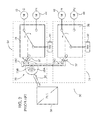
  • FIG. 5 is a schematic diagram of an exemplary excavator drive system of the present invention, showing four motors that provide the excavator ranges of motion shown in FIG. 1 and their two shared power sources.
  • the drive system of the present invention provides for quicker power transfer from one paired drive motor to the other motor, reducing transfer time from multiple seconds to a fraction of a second.
  • the drive system of the present invention also preserves transfer status in the event of power failure to the non-volatile bi-state transfer switches electromagnetic actuators.
  • FIG. 3 shows a single phase ( ⁇ N ) embodiment of the drive system 30 of the present invention. Alternating current power from inverter 32 is transferred between motor 42 , driving hoist motion H of the excavator 10 bucket 20 and motor 46 , driving propulsion motion P 2 of the excavator tread 14 , depending upon whether the excavator is being propelled between digging locations or is digging.
  • Each of the disconnect switches 50 , 52 is a single pole single throw switch. In multiple phase applications a single pole switch can be dedicated to each phase, such as by ganging them together, or alternatively, a multi-phase single throw switch sharing a common housing can be constructed.
  • Single pole disconnector switches 50 , 52 have a fixed contact 54 and a moving contact 56 for selectively coupling and decoupling the inverter power source 32 to the respective motors 42 , 46 .
  • the moving contact 56 is opened and closed with a motorized mechanism including an electromagnetic actuator, schematically shown as box and dashed line 58 .
  • the disconnect switch 50 , 52 operates by charging an electromagnetic coil in the actuator 58 , and is both non-volatile and bi-state. In other words, the switch can only be fully opened or fully closed state, and it “holds” state until caused to change state by the actuator 58 .
  • the same actuator pulse is used to open and to close the contacts 54 , 56 sequentially as needed. In the closed position/state the contacts 54 , 56 are mechanically locked. In opened contact position/state a spring holds the status.
  • switch 50 , 52 No externally applied electrical holding power is necessary to maintain switch 50 , 52 state.
  • actuator 58 energization power to either of the switches 50 , 52 is disrupted, the affected switch will hold its pre-disruption state.
  • the switches 50 , 52 of the present invention do not decouple either of motors 42 , 46 from the inverter power source 32 in the event of switch power disruption.
  • An exemplary disconnect switch suitable for practicing the present invention is a model XMS disconnector switch sold by Secheron SA of Geneva, Switzerland.
  • Switching state of the non-volatile bi-state disconnect switches 50 , 52 is changed by energizing the respective actuators 58 in each switch by means of relay devices 60 , each of which includes a fixed contact 64 and a moving contact 66 .
  • Relay power supply 69 provides sufficient power to energize the bi-state switch 50 , 52 actuators. Exemplary output specifications for power supply 69 are 5 kW with 125 V DC and (in worst case) 35 A to operate the motor transfer switches 50 , 52 reliably in a temperature range of ⁇ 40° C. to +50° C., with margin for a ⁇ 10% variation of the power supply output.
  • the bi-state switches 50 , 52 are capable of indicating their respective coupled status (i.e., opened or closed), such as through known “normally open” (N.O.) and “normally closed” (N.C.) auxiliary contacts status indicators that are in communication with the PLC 38 input ports via communications pathway 39 .
  • the PLC 38 in turn causes the relay devices 60 to energize the actuators 58 in the respective bi-state switch pairs 50 , 52 .
  • bi-state switches 50 , 52 and relay devices 60 describe electromechanical components, one skilled in the art may substitute solid state switching components to perform either or both of their respective functions.
  • FIGS. 4 and 5 show application of the present invention to a three-phase excavator drive system 30 , having two separate pairs of drive motors 40 , 44 for crowd and propulsion 1 drive and motors 42 , 46 for hoist and propulsion 2 drive.
  • each bi-state disconnector switch 50 , 52 is a single pole disconnector, 12 single switches will be required to achieve 12 phases (i.e., four motors each having three phases).
  • Each of the motor pairs is selectively coupled to its corresponding inverter 32 power source through pairs of bi-state switches 50 , 52 .
  • the individual single-pole single throw switches 50 , 52 functions as a single pole double throw change-over switch that transfers power from one paired motor to the other.
  • six bi-state disconnector switches are in closed position (e.g., crowd/hoist functions) and six are in open position (e.g., their corresponding pair counterpart propulsion 1 /propulsion 2 functions).
  • the bi-state switches 50 , 52 are capable of indicating their respective coupled status (i.e., opened or closed) such as through known “normally open” (N.O.) and “normally closed” (N.C.) auxiliary contacts b 1 , b 2 that are in communication with the PLC 38 via communications pathway 39 . If each switch 50 or 52 in each of the three motor phases has its own dedicated relay device 60 and the PLC 38 is intended to monitor status of each individual phase, a total of 12 monitoring PLC inputs and 12 outputs (total 24) are required. While 24 separate monitoring inputs/outputs may be accommodated with an appropriately sized PLC input/output interface card, it is possible to reduce the switches 50 , 52 control and monitoring interfaces down to 4 PLC control outputs and 2 inputs.
  • the bi-state switches 50 , 52 are grouped into four separate operational blocks corresponding to each of the drive motors 40 , 42 , 44 , 46 .
  • Each block of three mechanically-linked, single phase bi-state switches 50 , 52 have the same “open” or “closed” status and shares one common relay device 60 .
  • a single PLC 38 output causes the relay device 60 to energize all bi-state switch actuators 58 in its block.
  • the same special switching sequence is started to get the bi-state switches 50 , 52 back to the cases B or C. This sequence makes it possible to resynchronize without knowing the exact status. Whether there is loss of synchronization or a power failure, the non-volatile bi-state switches 50 , 52 will continue to maintain their existing status, so that excavator operation can continue until re-synchronization or power supply resumption.
  • the status of the main contacts is shown in Table I. There are 16 cases indicated as case A to case P.
  • each block of 3 bi-state disconnect switches 50 , 52 has two auxiliary contacts a 1 or b 1 ,a 2 or b 2 .
  • the status of contacts for Crowd (a 1 ,b 2 ) and Propel 1 (a 2 , b 1 ) are shown in the Table II. Similar status would exist for Hoist and Propel 2 blocks.
  • the PLC 38 is programmed to enable the system to perform the changeover and the fault handling sequences.
  • the PLC 38 has to hold the output signals for a defined pulse duration to assure completion of the bi-state switch 50 , 52 state change. This pulse duration time defines the transfer time of the drive system 30 .
  • Two bi-state switches 50 , 52 have been combined to create a single phase, single pole double throw switch, in order to confirm feasibility of the present invention for application in excavator drive systems.
  • Six such units need to be combined to meet the requirements of an excavator drive system three-phase propel 1 -propel 2 /hoist-crowd transfer switch.
  • the experimental testing determined transfer switch operational and performance parameters, and confirmed that the present invention is capable of performing transfer operations in fractions of a second rather than multiple seconds expended in known transfer switches.
  • the measurements are for minimal pulse duration with 48 V control supply. This is the best possible switching time achieved.
  • opening a bi-state disconnect switch takes much longer than closing the same switch. Therefore the opening time is defined in the transfer switch time.
  • the minimal transfer switch time which could be found on the actual bi-state switch at a supply of 48 V is 116 ms. Synchronization is necessary initially between the paired switches 50 , 52 and after a fault. The internal logic connections of the auxiliary contacts b 1 , b 2 were proved and verified.

Landscapes

  • Engineering & Computer Science (AREA)
  • Life Sciences & Earth Sciences (AREA)
  • Sustainable Development (AREA)
  • Sustainable Energy (AREA)
  • Power Engineering (AREA)
  • Transportation (AREA)
  • Mechanical Engineering (AREA)
  • Mining & Mineral Resources (AREA)
  • Civil Engineering (AREA)
  • General Engineering & Computer Science (AREA)
  • Structural Engineering (AREA)
  • Operation Control Of Excavators (AREA)

Abstract

An excavator drive system wherein one of a pair of propulsion motors shares one of a pair of inverter power sources with another of a pair of motors dedicated to crowd and hoist motions. A pair of non-volatile bi-state switches, triggered under control of a controller, allow sharing of inverters between hoist and propel 1 motors. Another pair of switches allows inverter sharing between propel 2 and crowd motors. Each pair of switches enables change over and power transfer from one of the paired motors to the other motor. The bi-state switches enable quicker transfer of power between motors than transfer switches employing external motor-powered mechanical transfer linkages. Bi-state transfer switches also maintain transfer coupling status in the event of power failure to the switch actuators, allowing an excavator operator to continue the drive function in operation prior to the switch power failure.

Description

BACKGROUND OF THE DISCLOSURE
1. Field of the Invention
The invention relates to excavator drive systems that control excavator propulsion and bucket motion, and in particular motor transfer switches in such drive systems that selectively couple and decouple drive system motors from shared power sources.
2. Description of the Prior Art
Excavator systems, such as electric shovels and drag lines, are critical high power-consuming equipment in the mining industry. As shown in FIGS. 1 and 2, a known shovel system 10 includes a chassis to which are mounted a pair of tracks 12, 14, a boom 16, a dipper arm 18 and a bucket 20. The excavator 10 has a drive system 30 that enables the designated individual motions referred to as hoist, swing, crowd and propel. Those motions are typically powered by multi-phase AC asynchronous motors 40, 42, 44, 46 that are fed by active front end rectified inverters 32 including IGBT vector control. The inverters 32 reduce the harmonics associated with rectification and provide reactive power support at the shovel's point of common coupling (PCC).
The known excavator drive system 30, shown in FIG. 2, has a propel motion system comprising two independently controlled motors 44, 46 powering respective tracks 12, 14. For descriptive simplicity only a single phase of the multi-phase system is shown, it being readily apparent to those skilled in the art that the other phases have similar construction, function and operation. Transfer switches 34 allow sharing of power source inverters 32 between pairs of crowd and propel 1 motion motors 40, 44 and hoist and propel 2 motion motors 42, 46. Each transfer switch 34 is controlled by a programmable logic controller (PLC) 38; they communicate with each other via communications bus 39 or other known communications pathway.
Typical known industrial transfer switches 34 have a motor module 35 that drives multiple switch modules 36 (often known multi-phase motor contactors) through an external mechanical linkage. The switch modules 36 typically are single pole double throw or double pole, double throw motor contactors having external mechanical “on”/“off” switches 37. The motor module 35 mechanically interfaces with the switch module external mechanical switches 37 and functionally enables remote mechanical actuation under control of a programmable logic controller (PLC) 38. As shown in FIG. 2 a representative motor module 35 includes a reversable motor 35A driving a mechanical linkage (here pinion 35B engaging rack 35C interface with on/off switches 37).
The known commercialized motor module 35, being a mechanical device, typically needs greater than 2 seconds to perform a motor transfer, due to system response phase lag. Quicker transfer time is desired to increase excavator productivity. As an example, if in a typical operational hour there are 5 transfers between propel and digging modes and each transfer expends 3 seconds, that results in a loss of 30 seconds per hour. The expended time presents an opportunity to gain productivity of an additional digging cycle with an expensive piece of earthmoving equipment.
In the event of loss of power to the transfer switch 34, some of the known switch module contactors 36 lose power and default to a driven motor “off” condition, in which case the excavator ceases motion. If prior to transfer switch 34 power loss the excavator 10 is performing a translation or digging motion the operation ceases, even though the excavator operator did not need to transfer motor power. If the prior state of motor connection was preserved after a transfer switch 34 power failure, as is possible with some known commercialized devices, the operator could continue excavator operation in that prior connection status mode.
Thus, a need exists in the art for an excavator, including an excavator drive system that is capable of transferring electric power from one drive motor to another drive motor without mechanical external transfer linkages and auxiliary motor drives that typically have long transfer time lags from initiation of a transfer command to completion of the power transfer.
Another need exists in the art for an excavator, including an excavator drive system, that does not cause disruption of power to drive system motors due to a transmit switch power failure, so that an operator can continue to use the excavator drive system in the manner preceding the power failure.
SUMMARY OF THE INVENTION
Accordingly, an object of the present invention is to create an excavator, including an excavator drive system that is capable of transferring electric power from one drive motor to another drive motor quicker than presently done using known transfer switches having mechanical external transfer linkages and auxiliary motor drives.
Another object of the present invention is to create an excavator, including an excavator drive system, that does not cause disruption of power to drive system motors due to a transmit switch power failure.
These and other objects are achieved in accordance with the present invention by excavator drive systems of the present invention, as well as excavators incorporating such drive systems. Excavator drive systems of the present invention have a first motor for powering an excavator bucket and a second motor for powering an excavator propulsion system and a power source for the motors. A first non-volatile bi-state switch, having a motorized electromagnetic actuator, selectively couples and decouples the first motor to the power source. Similarly, a second non-volatile bi-state switch, having a motorized electromagnetic actuator for selectively couples and decouples the second motor to the power source. At least one relay device controlling energization of the electromagnetic actuators is electrically coupled to at least one of the respective electromagnetic actuators. A controller, such as a programmable logic controller (PLC), is electrically coupled to and in communication with the at least one relay device. The PLC transmits control signals to the at least one relay device, for selective coupling of one of the motors to the power source while decoupling the other motor from the power source.
In practicing the present invention, the motors and power source often are multi-phase, and in which case the bi-state switches have separate poles for each phase. All the poles of each separate bi-state switch may be coupled to a common relay device controlling energization of electromagnetic actuators in each pole, so that all phases are switched simultaneously. The bi-state switches may incorporate a status indicator that communicates to the controller coupling or uncoupling state status. The controller may compare an intended bi-state switch coupling state with the state indicated by the status indicator and recognize a fault when the compared states differ. Upon recognition of a compared state difference fault the controller may re-synchronize the bi-state switches so that one couples its respective motor and power source while the second decouples its respective motor and power source. Desirably, the respective non-volatile bi-state switches are capable of holding a coupled or decoupled state until its electromagnetic actuator is energized again by its respective relay.
Another aspect of the present invention is directed to application in an excavator system, comprising a chassis having a drive system for moving a propulsion system including a pair of first and second tracks, a boom and an excavator bucket coupled to the boom. The excavator drive system includes a first motor for powering the excavator bucket hoist motion; a second motor for powering the propulsion system first track; a third motor for powering the excavator bucket hoist crowd motion; and a fourth motor for powering the propulsion system second track. The drive system has a first power source for the first and second motors and a second power source for the third and fourth motors. The drive system further has first non-volatile bi-state switch, having a motorized electromagnetic actuator for selectively coupling and decoupling the first motor to the first power source; and a second non-volatile bi-state switch, having a motorized electromagnetic actuator for selectively coupling and decoupling the second motor to the first power source. The drive system has a third non-volatile bi-state switch, having a motorized electromagnetic actuator for selectively coupling and decoupling the third motor to the second power source and a fourth non-volatile bi-state switch, having a motorized electromagnetic actuator for selectively coupling and decoupling the fourth motor to the second power source. At least one relay device controlling energization of electromagnetic actuators is electrically coupled to at least one of the respective electromagnetic actuators. A controller is electrically coupled to and in communication with the at least one relay device, transmitting control signals thereto, for selective coupling of one of the first or second motors to the first power source while decoupling the other motor from the first power source and for selective coupling of the third or fourth motors to the second power source while decoupling the other motor from the second power source.
The drive system may have multi-phase motors, inverter power sources and bi-state switches having separate poles for each phase. All the poles of each separate bi-state switch may be coupled to a common relay device controlling energization of electromagnetic actuators in each pole, so that all phases are switched simultaneously. The bi-state switches may incorporate a status indicator that communicates to the controller coupling or uncoupling state status. The controller may compare an intended bi-state switch coupling state with the state indicated by the status indicator and recognize a fault when the compared states differ. Upon recognition of a “compared states differ” fault the controller may re-synchronize the bi-state switches so that one couples its respective motor and power source while the second decouples its respective motor and power source. Desirably, the respective non-volatile bi-state switches are capable of holding a coupled or decoupled state until its electromagnetic actuator is energized again by its respective relay.
The objects and features of the present invention may be applied jointly or severally in any combination or sub-combination by those skilled in the art.
BRIEF DESCRIPTION OF THE DRAWINGS
The teachings of the present invention can be readily understood by considering the following detailed description in conjunction with the accompanying drawings, in which:
FIG. 1 shows a schematic perspective view of an excavator and its ranges of motion;
FIG. 2 is a schematic of a known excavator drive system;
FIG. 3 is a partial schematic diagram of an excavator drive system of the present invention, simplified to show a single current phase for two motors and their shared power system;
FIG. 4 is a schematic block diagram of an excavator drive system the present invention; and
FIG. 5 is a schematic diagram of an exemplary excavator drive system of the present invention, showing four motors that provide the excavator ranges of motion shown in FIG. 1 and their two shared power sources.
To facilitate understanding, identical reference numerals have been used, where possible, to designate identical elements that are common to the figures.
DETAILED DESCRIPTION
After considering the following description, those skilled in the art will clearly realize that the teachings of my invention can be readily utilized in excavator drive systems. The drive system of the present invention provides for quicker power transfer from one paired drive motor to the other motor, reducing transfer time from multiple seconds to a fraction of a second. The drive system of the present invention also preserves transfer status in the event of power failure to the non-volatile bi-state transfer switches electromagnetic actuators.
Drive System Architecture and Functional Overview
FIG. 3 shows a single phase (ΦN) embodiment of the drive system 30 of the present invention. Alternating current power from inverter 32 is transferred between motor 42, driving hoist motion H of the excavator 10 bucket 20 and motor 46, driving propulsion motion P2 of the excavator tread 14, depending upon whether the excavator is being propelled between digging locations or is digging.
Power transfer between the motors 42, 46 is accomplished with a pair of respective first and second disconnect switches 50, 52, designed to connect and isolate electrical circuits, rather than by known externally motorized transfer switches, the disadvantages of which were previously described. Each of the disconnect switches 50, 52 is a single pole single throw switch. In multiple phase applications a single pole switch can be dedicated to each phase, such as by ganging them together, or alternatively, a multi-phase single throw switch sharing a common housing can be constructed.
Single pole disconnector switches 50, 52 have a fixed contact 54 and a moving contact 56 for selectively coupling and decoupling the inverter power source 32 to the respective motors 42, 46. The moving contact 56 is opened and closed with a motorized mechanism including an electromagnetic actuator, schematically shown as box and dashed line 58. The disconnect switch 50, 52 operates by charging an electromagnetic coil in the actuator 58, and is both non-volatile and bi-state. In other words, the switch can only be fully opened or fully closed state, and it “holds” state until caused to change state by the actuator 58. The same actuator pulse is used to open and to close the contacts 54, 56 sequentially as needed. In the closed position/state the contacts 54, 56 are mechanically locked. In opened contact position/state a spring holds the status.
No externally applied electrical holding power is necessary to maintain switch 50, 52 state. In the event that actuator 58 energization power to either of the switches 50, 52 is disrupted, the affected switch will hold its pre-disruption state. Thus, unlike previously known transfer switches, the switches 50, 52 of the present invention do not decouple either of motors 42, 46 from the inverter power source 32 in the event of switch power disruption. An exemplary disconnect switch suitable for practicing the present invention is a model XMS disconnector switch sold by Secheron SA of Geneva, Switzerland.
Switching state of the non-volatile bi-state disconnect switches 50, 52 is changed by energizing the respective actuators 58 in each switch by means of relay devices 60, each of which includes a fixed contact 64 and a moving contact 66. Relay power supply 69 provides sufficient power to energize the bi-state switch 50, 52 actuators. Exemplary output specifications for power supply 69 are 5 kW with 125 V DC and (in worst case) 35 A to operate the motor transfer switches 50, 52 reliably in a temperature range of −40° C. to +50° C., with margin for a ±10% variation of the power supply output. The bi-state switches 50, 52 are capable of indicating their respective coupled status (i.e., opened or closed), such as through known “normally open” (N.O.) and “normally closed” (N.C.) auxiliary contacts status indicators that are in communication with the PLC 38 input ports via communications pathway 39. The PLC 38 in turn causes the relay devices 60 to energize the actuators 58 in the respective bi-state switch pairs 50, 52.
While the exemplary embodiments of the bi-state switches 50, 52 and relay devices 60 describe electromechanical components, one skilled in the art may substitute solid state switching components to perform either or both of their respective functions.
FIGS. 4 and 5 show application of the present invention to a three-phase excavator drive system 30, having two separate pairs of drive motors 40, 44 for crowd and propulsion 1 drive and motors 42, 46 for hoist and propulsion 2 drive. As each bi-state disconnector switch 50, 52 is a single pole disconnector, 12 single switches will be required to achieve 12 phases (i.e., four motors each having three phases). Each of the motor pairs is selectively coupled to its corresponding inverter 32 power source through pairs of bi-state switches 50, 52. Functionally in each phase, the individual single-pole single throw switches 50, 52 functions as a single pole double throw change-over switch that transfers power from one paired motor to the other. In operation, as shown in FIG. 4, six bi-state disconnector switches are in closed position (e.g., crowd/hoist functions) and six are in open position (e.g., their corresponding pair counterpart propulsion 1/propulsion 2 functions).
As previously described, the bi-state switches 50, 52 are capable of indicating their respective coupled status (i.e., opened or closed) such as through known “normally open” (N.O.) and “normally closed” (N.C.) auxiliary contacts b1, b2 that are in communication with the PLC 38 via communications pathway 39. If each switch 50 or 52 in each of the three motor phases has its own dedicated relay device 60 and the PLC 38 is intended to monitor status of each individual phase, a total of 12 monitoring PLC inputs and 12 outputs (total 24) are required. While 24 separate monitoring inputs/outputs may be accommodated with an appropriately sized PLC input/output interface card, it is possible to reduce the switches 50, 52 control and monitoring interfaces down to 4 PLC control outputs and 2 inputs.
As shown in FIG. 5, the bi-state switches 50, 52 are grouped into four separate operational blocks corresponding to each of the drive motors 40, 42, 44, 46. Each block of three mechanically-linked, single phase bi-state switches 50, 52 have the same “open” or “closed” status and shares one common relay device 60. A single PLC 38 output causes the relay device 60 to energize all bi-state switch actuators 58 in its block.
In FIG. 5, the 2 PLC inputs B1 and B2 are used to monitor the status. While the blocks C (Crowd) and H (Hoist) are closed and P1 (Propel 1) and P2 (Propel 2) are opened B1=1 and B2=0. While the blocks P1 and P2 are closed and C and H are opened B1=0 and B2=1; B1=0 and B2=0 indicates a fault. It is not possible to have both B1=1 and B2=1. In other words, it is exactly known whether the machine is in Crowd/Hoist mode, in Propel mode or there is a fault situation.
The Logical Operation Sequence is presented below in Tables I and II. With the mechanical linking of each bi-state switch 50, 52 blocks there are 16 possible statuses (Case A-P) for the main contacts 54, 56 and the auxiliary contacts b1, b2. For each case, the status of the auxiliary contacts and what signal is given to the PLC (B1, B2) is shown. Normal operation is change over. That means switchover between Case B and Case C. Otherwise there is some kind of fault. Not every fault is critical, e.g., at the beginning all switches 50, 52 are open so there is just a synchronization required.
For all fault cases the same special switching sequence is started to get the bi-state switches 50, 52 back to the cases B or C. This sequence makes it possible to resynchronize without knowing the exact status. Whether there is loss of synchronization or a power failure, the non-volatile bi-state switches 50, 52 will continue to maintain their existing status, so that excavator operation can continue until re-synchronization or power supply resumption.
The status of the main contacts is shown in Table I. There are 16 cases indicated as case A to case P.
TABLE I
STATUS OF MAIN CONTACTS
Propel Propel
Status Case Crowd 1 Hoist 2
Start A 0 0 0 0
C + H B 1 0 1 0
working
P1 + P2 C 0 1 0 1
working
C + H D 1 1 1 0
working,
P1 error
C + H E 1 0 1 1
working,
P2 error
C + H F 0 0 1 0
working, C
error
C + H G 0 1 1 0
working,
C + P1error
C + H H 0 0 1 1
working,
C + P2error
C + H I 1 0 0 0
working, H
error
C + H J 1 1 0 0
working,
H + P1 error
C + H K 1 0 0 1
working,
H + P2 error
P1 + P2 L 0 0 0 1
working,
P1 error
P1 + P2 M 0 1 0 0
working,
P2 error
P1 + P2 N 1 1 0 1
working, C
error
P1 + P2 O 0 1 1 1
working, H
error
All ON P 1 1 1 1
As has been described above, each block of 3 bi-state disconnect switches 50, 52 has two auxiliary contacts a1 or b1,a2 or b2. As an example, the status of contacts for Crowd (a1,b2) and Propel 1 (a2, b1) are shown in the Table II. Similar status would exist for Hoist and Propel 2 blocks.
TABLE II
STATUS OF AUXILIARY CONTACTS
Crowd Crowd Propel Propel
Status Case (a1) (b2) 1 (a2) 1 (b1)
Start A 0 1 0 1
C + H B 1 0 0 1
working
P1 + P2 C 0 1 1 0
working
C + H D 1 0 1 0
working,
P1 error
C + H E 1 0 0 1
working,
P2 error
C + H F 0 1 0 1
working, C
error
C + H G 0 1 1 0
working,
C + P1error
C + H H 0 1 0 1
working,
C + P2 error
C + H I 1 0 0 1
working, H
error
C + H J 1 0 1 0
working,
H + P1 error
C + H K 1 0 0 1
working,
H + P2 error
P1 + P2 L 0 1 0 1
working,
P1 error
P1 + P2 M 0 1 1 0
working,
P2 error
P1 + P2 N 1 0 1 1
working, C
error
P1 + P2 O 0 1 1 0
working, H
error
All ON P 1 0 1 0
In the above tables, status 1 indicates a contact is closed and status 0 indicates a contact is open. To implement the excavator drive system 30 motor power transfer, the PLC 38 is programmed to enable the system to perform the changeover and the fault handling sequences. The PLC 38 has to hold the output signals for a defined pulse duration to assure completion of the bi-state switch 50, 52 state change. This pulse duration time defines the transfer time of the drive system 30.
EXPERIMENTAL EXAMPLES
Two bi-state switches 50, 52 have been combined to create a single phase, single pole double throw switch, in order to confirm feasibility of the present invention for application in excavator drive systems. Six such units need to be combined to meet the requirements of an excavator drive system three-phase propel 1-propel 2/hoist-crowd transfer switch. The experimental testing determined transfer switch operational and performance parameters, and confirmed that the present invention is capable of performing transfer operations in fractions of a second rather than multiple seconds expended in known transfer switches.
A. Test Setup at Ambient Temperature:
  • Two single pole non-volatile bi-state Model XMS disconnect switches (switch 50 switch 52)
  • Power supply: 27.6 V/48.0 V
  • Logic circuit voltage: 27.6 V/27.6
  • Timer relays: CM1/UC24-60V
  • Power relays: Omron Model G9 EB-1-B and Siemens Model 3TH2022-0BB4
B. Measurements with 27.6 V, Switch 50 Opening and Switch 52 Closing
The measurements are for minimal pulse duration with 27.6 V control supply. During operation, both the bi-state switches exhibited similar behavior, i.e., switch 50 opening, switch 52 closing was similar to switch 50 closing, switch 52 opening.
  • Pulse duration: 504 ms
  • Beginning of the pulse until closing of 50: 184 ms
  • Beginning of the pulse until opening of 52: 534 ms
  • Coil current maximum: 6.9 A
C. Measurements with 48 V, Switch 50 Opening and Switch 52 Closing
The measurements are for minimal pulse duration with 48 V control supply. This is the best possible switching time achieved.
  • Pulse duration: 84.4 ms
  • Beginning of the pulse until opening of 50: 116 ms
  • Coil current maximum: 10.6 A
One important finding was that operating at the higher end of the rated actuation coil voltage of actuator 58 resulted in shorter switching times. Table III and Table IV show the comparison of results for 27.6 V and 48 V.
TABLE III
RESULTS FOR 27.6 V
Pulse tA tB Ic
[ms] [ms] [ms] [A]
I 504 184 534 6.9
II 500 532 178 6.7
III 496 146 6.7
IV 496 522
V 223 250 6.6
TABLE IV
RESULTS FOR 48 V
Pulse tA tB Ic
[ms] [ms] [ms] [A]
I
II 500 528 12.8
III
IV
V 84.4 116 10.6
In the tables:
  • tA: time from beginning of the pulse till action of switch 50
  • tB: time from beginning of the pulse till action of switch 52
  • Ic: coil current maximum
  • I: 50 closing, 52 opening
  • II: 50 opening, 52 closing
  • III: Synchronization 50 closing
  • IV: Synchronization 50 opening
  • V: Minimal pulse duration
V. CONCLUSIONS
One of the important findings from the test results was that opening a bi-state disconnect switch takes much longer than closing the same switch. Therefore the opening time is defined in the transfer switch time. The minimal transfer switch time which could be found on the actual bi-state switch at a supply of 48 V is 116 ms. Synchronization is necessary initially between the paired switches 50, 52 and after a fault. The internal logic connections of the auxiliary contacts b1, b2 were proved and verified.
Advantages of the present invention over known external mechanical linkage transfer switches include fast transfer time of fractions of a second compared to many seconds, simple logic, lack of holding energy input to maintain non-volatile bi-state switch state, relatively simpler robust construction and very minimal maintenance. These application advantages of the present invention have to be weighed by those skilled in the art with potential increased switching noise, size, weight, higher actuator actuation coil current needs, and additional power relays to accomplish the switching status logic implementation described herein that minimizes PLC switch status inputs (or use a PLC I/O interface that accommodates more inputs). It is believed that in most excavator drive system motor transfer applications, those skilled in the art will appreciate that the advantages of the present invention are preferable to excavator drive systems using known transfer switches.
Although various embodiments which incorporate the teachings of the present invention have been shown and described in detail herein, those skilled in the art can readily devise many other varied embodiments that still incorporate these teachings.

Claims (25)

What is claimed is:
1. An excavator drive system, comprising:
a first motor for powering an excavator bucket;
a second motor for powering an excavator propulsion system;
a power source for the motors;
a first non-volatile bi-state switch, having a motorized electromagnetic actuator for selectively coupling and decoupling the first motor to the power source;
a second non-volatile bi-state switch, having a motorized electromagnetic actuator for selectively coupling and decoupling the second motor to the power source;
at least one relay device for controlling energization of electromagnetic actuators, electrically coupled to at least one of the respective electromagnetic actuators; and
a controller electrically coupled to and in communication with the at least one relay device, transmitting control signals thereto for selective coupling of one of the motors to the power source while decoupling the other motor from the power source.
2. The system of claim 1, wherein the motors and power source are multi-phase and the bi-state switches have separate poles coupled to each separate phase of the respective motors and power source.
3. The system of claim 2, wherein all the poles of each respective bi-state switch are coupled to a common relay device controlling energization of electromagnetic actuators in said switch.
4. The system of claim 2, wherein each bi-state switch pole comprises a separate single pole bi-state switch coupled to a common relay device controlling energization of electromagnetic actuators in each of said single pole switches.
5. The system of claim 1, wherein each of the bi-state switches has a status indicator that communicates to the controller coupling or uncoupling state status.
6. The system of claim 5, wherein the controller compares an intended bi-state switch coupling state with the state indicated by the status indicator and recognizes a fault when the compared states differ.
7. The system of claim 6, wherein the controller re-synchronizes the pair of first and second bi-state switches after fault recognition, so that one of the switches couples its respective motor and power source while the second decouples its respective motor and power source.
8. The system of claim 1, wherein the non-volatile bi-state switches hold a coupled or decoupled state until its electromagnetic actuator is re-energized by its respective relay.
9. An excavator system, comprising:
a chassis having a propulsion system, a boom and an excavator bucket coupled to the boom;
a first motor for powering the excavator bucket;
a second motor for powering the propulsion system;
a power source for the motors;
a first non-volatile bi-state switch, having a motorized electromagnetic actuator for selectively coupling and decoupling the first motor to the power source;
a second non-volatile bi-state switch, having a motorized electromagnetic actuator for selectively coupling and decoupling the second motor to the power source;
at least one relay device for controlling energization of electromagnetic actuators, electrically coupled to at least one of the respective electromagnetic actuators; and
a controller electrically coupled to and in communication with the at least one relay device, transmitting control signals thereto for selective coupling of one of the motors to the power source while decoupling the other motor from the power source.
10. The system of claim 9, wherein the motors and power source are multi-phase and the bi-state switches have separate poles coupled to each separate phase of the respective motors and power source.
11. The system of claim 10, wherein all the poles of each respective bi-state switch are coupled to a common relay device controlling energization of electromagnetic actuators in said switch.
12. The system of claim 10, wherein each bi-state switch pole comprises a separate single pole bi-state switch coupled to a common relay device controlling energization of electromagnetic actuators in each of said single pole switches.
13. The system of claim 9, wherein each of the bi-state switches has a status indicator that communicates to the controller coupling or uncoupling state status.
14. The system of claim 13, wherein the controller compares an intended bi-state switch coupling state with the state indicated by the status indicator and recognizes a fault when the compared states differ.
15. The system of claim 14, wherein the controller re-synchronizes the pair of first and second bi-state switches after fault recognition, so that one of the switches couples its respective motor and power source while the second decouples its respective motor and power source.
16. The system of claim 9, wherein the non-volatile bi-state switches hold a coupled or decoupled state until its electromagnetic actuator is re-energized by its respective relay.
17. An excavator system, comprising:
a chassis having a propulsion system including a pair of first and second tracks, a boom and an excavator bucket coupled to the boom;
a first motor for powering the excavator bucket hoist motion;
a second motor for powering the propulsion system first track;
a third motor for powering the excavator bucket hoist crowd motion;
a fourth motor for powering the propulsion system second track;
a first power source for the first and second motors;
a second power source for the third and fourth motors;
a first non-volatile bi-state switch, having a motorized electromagnetic actuator for selectively coupling and decoupling the first motor to the first power source;
a second non-volatile bi-state switch, having a motorized electromagnetic actuator for selectively coupling and decoupling the second motor to the first power source;
a third non-volatile bi-state switch, having a motorized electromagnetic actuator for selectively coupling and decoupling the third motor to the second power source;
a fourth non-volatile bi-state switch, having a motorized electromagnetic actuator for selectively coupling and decoupling the fourth motor to the second power source;
at least one relay device for controlling energization of electromagnetic actuators, electrically coupled to at least one of the respective electromagnetic actuators; and
a controller electrically coupled to and in communication with the at least one of relay device, transmitting control signals thereto for selective coupling of one of the first or second motors to the first power source while decoupling the other motor from the first power source and for selective coupling of the third or fourth motors to the second power source while decoupling the other motor from the second power source.
18. The system of claim 17, wherein the motors and power sources are multi-phase and the bi-state switches have separate poles coupled to each separate phase of the respective motors and power sources.
19. The system of claim 18, wherein all the poles of each respective bi-state switch are coupled to a common relay device controlling energization of electromagnetic actuators in said switch.
20. The system of claim 18, wherein each bi-state switch pole comprises a separate single pole bi-state switch coupled to a common relay device controlling energization of electromagnetic actuators in each of said single pole switches.
21. The system of claim 17, wherein each of the bi-state switches has a status indicator that communicates to the controller coupling or uncoupling state status.
22. The system of claim 21, wherein the controller compares an intended bi-state switch coupling state with the state indicated by the status indicator and recognizes a fault when the compared states differ.
23. The system of claim 22, wherein the controller re-synchronizes the bi-state switches after fault recognition, so that intended coupling and decoupling is accomplished.
24. The system of claim 17, wherein the respective non-volatile bi-state switches hold a coupled or decoupled state until its electromagnetic actuator is re-energized by its respective relay.
25. The system of claim 17, wherein:
the motors and power sources have three phases and the bi-state switches have separate poles coupled to each separate phase of its respective motor and power source;
each of the first through fourth bi-state switches has a separate relay device to which all its respective poles are coupled, for controlling energization of electromagnetic actuators in each of said poles, each bi-state switch having a status indicator that communicates to the controller coupling or uncoupling state status; and
the controller is a programmable logic controller having a separate output in communication with each of the respective relay devices for transmitting said control signals thereto, and at least two inputs for receiving status communications from the status indicator.
US12/897,115 2010-10-04 2010-10-04 Excavator drive system with bi state motor transfer switches Active 2032-02-10 US8466636B2 (en)

Priority Applications (3)

Application Number Priority Date Filing Date Title
US12/897,115 US8466636B2 (en) 2010-10-04 2010-10-04 Excavator drive system with bi state motor transfer switches
CA2813398A CA2813398A1 (en) 2010-10-04 2011-09-26 Excavator drive system with bi-state motor transfer switches
PCT/US2011/053258 WO2012047586A1 (en) 2010-10-04 2011-09-26 Excavator drive system with bi-state motor transfer switches

Applications Claiming Priority (1)

Application Number Priority Date Filing Date Title
US12/897,115 US8466636B2 (en) 2010-10-04 2010-10-04 Excavator drive system with bi state motor transfer switches

Publications (2)

Publication Number Publication Date
US20120079821A1 US20120079821A1 (en) 2012-04-05
US8466636B2 true US8466636B2 (en) 2013-06-18

Family

ID=44789616

Family Applications (1)

Application Number Title Priority Date Filing Date
US12/897,115 Active 2032-02-10 US8466636B2 (en) 2010-10-04 2010-10-04 Excavator drive system with bi state motor transfer switches

Country Status (3)

Country Link
US (1) US8466636B2 (en)
CA (1) CA2813398A1 (en)
WO (1) WO2012047586A1 (en)

Cited By (1)

* Cited by examiner, † Cited by third party
Publication number Priority date Publication date Assignee Title
US9065275B2 (en) * 2013-08-26 2015-06-23 Infineon Technologies Austria Ag Driving circuit for an electric motor

Families Citing this family (7)

* Cited by examiner, † Cited by third party
Publication number Priority date Publication date Assignee Title
US8972120B2 (en) * 2012-04-03 2015-03-03 Harnischfeger Technologies, Inc. Extended reach crowd control for a shovel
CN102660973A (en) * 2012-04-30 2012-09-12 赵国新 Servo operation system for engineering machinery
US9201418B1 (en) * 2014-05-12 2015-12-01 Innoserv Fa Inc. Servo motor drive
JP2019190104A (en) * 2018-04-24 2019-10-31 ヤンマー株式会社 Electric driven work machine
DE102020209310A1 (en) * 2020-07-23 2022-01-27 Zf Friedrichshafen Ag Converter device for converting an operating voltage for an electric vehicle, drive device and method for converting an operating voltage
DE102020213313A1 (en) * 2020-10-22 2022-04-28 Zf Friedrichshafen Ag Inverter device for an electric vehicle, drive device and method for providing a drive voltage for a drive motor for an electric vehicle
DE102020213312A1 (en) 2020-10-22 2022-04-28 Zf Friedrichshafen Ag Device for providing operating power for an additional drive for an electric vehicle and method for converting an operating voltage

Citations (8)

* Cited by examiner, † Cited by third party
Publication number Priority date Publication date Assignee Title
US4776751A (en) 1987-08-19 1988-10-11 Deere & Company Crowd control system for a loader
US5352965A (en) * 1992-10-29 1994-10-04 Kabushiki Kaisha Toshiba Container crane driving control system
EP1455439A1 (en) 2001-11-21 2004-09-08 Kobelco Construction Machinery Co., Ltd. Actuator driving device of working machine
US20050122068A1 (en) 2003-12-04 2005-06-09 Hitachi Construction Machinery Co., Ltd. Operation circuit for a work vehicle
JP2006246631A (en) 2005-03-03 2006-09-14 Shin Caterpillar Mitsubishi Ltd Control circuit of electric hydraulic work machine
US7832126B2 (en) * 2007-05-17 2010-11-16 Siemens Industry, Inc. Systems, devices, and/or methods regarding excavating
US8186465B2 (en) * 2005-09-01 2012-05-29 Toyota Jidosha Kabushiki Kaisha Hybrid vehicle and controlling method thereof
US8362721B2 (en) * 2008-02-21 2013-01-29 J.S. Redpath Limited Battery powered mechanized raise climbing system

Patent Citations (8)

* Cited by examiner, † Cited by third party
Publication number Priority date Publication date Assignee Title
US4776751A (en) 1987-08-19 1988-10-11 Deere & Company Crowd control system for a loader
US5352965A (en) * 1992-10-29 1994-10-04 Kabushiki Kaisha Toshiba Container crane driving control system
EP1455439A1 (en) 2001-11-21 2004-09-08 Kobelco Construction Machinery Co., Ltd. Actuator driving device of working machine
US20050122068A1 (en) 2003-12-04 2005-06-09 Hitachi Construction Machinery Co., Ltd. Operation circuit for a work vehicle
JP2006246631A (en) 2005-03-03 2006-09-14 Shin Caterpillar Mitsubishi Ltd Control circuit of electric hydraulic work machine
US8186465B2 (en) * 2005-09-01 2012-05-29 Toyota Jidosha Kabushiki Kaisha Hybrid vehicle and controlling method thereof
US7832126B2 (en) * 2007-05-17 2010-11-16 Siemens Industry, Inc. Systems, devices, and/or methods regarding excavating
US8362721B2 (en) * 2008-02-21 2013-01-29 J.S. Redpath Limited Battery powered mechanized raise climbing system

Non-Patent Citations (1)

* Cited by examiner, † Cited by third party
Title
PCT International Search Report mailed Nov. 22, 2011 corresponding to PCT International Search Report filed Sep. 26, 2011 (9 pages).

Cited By (1)

* Cited by examiner, † Cited by third party
Publication number Priority date Publication date Assignee Title
US9065275B2 (en) * 2013-08-26 2015-06-23 Infineon Technologies Austria Ag Driving circuit for an electric motor

Also Published As

Publication number Publication date
WO2012047586A1 (en) 2012-04-12
CA2813398A1 (en) 2012-04-12
US20120079821A1 (en) 2012-04-05

Similar Documents

Publication Publication Date Title
US8466636B2 (en) Excavator drive system with bi state motor transfer switches
US7568931B2 (en) Integrated power cell bypass assembly and power supply including same
US7265458B2 (en) Apparatus and methods for coordinated static switch operations for load transfers in uninterruptible power supply systems
US10630103B2 (en) Automatic transfer switch (ATS) bypass switch
CN103701200A (en) Power supply selection module of electric appliance with automatic changeover switch
CN203660646U (en) Power supply selection module of automatic transfer switching equipment
US12074473B2 (en) Changeover device, retrofit kit and method for supplying electrical power to a load
CN201708581U (en) Double-power-supply automatic switching loop
CN104184206B (en) Accident emergency power supply circuit and its operation/cutting method
US6597154B2 (en) Electrical energy distribution system and contactor for such a system
CN221040929U (en) Isolation switch
JP2021191080A (en) Power supply
JP5899173B2 (en) Power supply device
WO2025156349A1 (en) Power system
CN110829573A (en) Method for non-overlapping switching of power supplies and power transfer switch for implementing such a method
Mazumdar Application of transfer switch in mining converters
EP3038226B1 (en) System and method for supplying electric power
CN222973408U (en) Control systems and turnouts
CN217882964U (en) Frequency conversion control system
CN216216058U (en) Bus-tie switch and bus-tie cabinet
CN204334113U (en) A Control System of Automatic Transfer Switch Driver with Triple Protection
CN223451679U (en) Dual power transfer switch
CN112952993A (en) Dual-power spare power automatic switching loop control method based on relay lap joint
CN117895633A (en) Three-channel alternating current emergency power supply interlocking control method and system
CN223261465U (en) Motor control circuit and dual power conversion circuit

Legal Events

Date Code Title Description
AS Assignment

Owner name: SIEMENS INDUSTRY, INC., GEORGIA

Free format text: ASSIGNMENT OF ASSIGNORS INTEREST;ASSIGNOR:MAZUMDAR, JOY;REEL/FRAME:025085/0956

Effective date: 20100930

STCF Information on status: patent grant

Free format text: PATENTED CASE

FPAY Fee payment

Year of fee payment: 4

MAFP Maintenance fee payment

Free format text: PAYMENT OF MAINTENANCE FEE, 8TH YEAR, LARGE ENTITY (ORIGINAL EVENT CODE: M1552); ENTITY STATUS OF PATENT OWNER: LARGE ENTITY

Year of fee payment: 8

AS Assignment

Owner name: SIEMENS LARGE DRIVES LLC., GEORGIA

Free format text: ASSIGNMENT OF ASSIGNORS INTEREST;ASSIGNOR:SIEMENS INDUSTRY, INC.;REEL/FRAME:065191/0604

Effective date: 20230927

AS Assignment

Owner name: INNOMOTICS LLC, GEORGIA

Free format text: CHANGE OF NAME;ASSIGNOR:SIEMENS LARGE DRIVES LLC;REEL/FRAME:065225/0389

Effective date: 20230530

MAFP Maintenance fee payment

Free format text: PAYMENT OF MAINTENANCE FEE, 12TH YEAR, LARGE ENTITY (ORIGINAL EVENT CODE: M1553); ENTITY STATUS OF PATENT OWNER: LARGE ENTITY

Year of fee payment: 12