US8465838B2 - Polyimide-alkylphosphate fuser member - Google Patents
Polyimide-alkylphosphate fuser member Download PDFInfo
- Publication number
- US8465838B2 US8465838B2 US13/020,453 US201113020453A US8465838B2 US 8465838 B2 US8465838 B2 US 8465838B2 US 201113020453 A US201113020453 A US 201113020453A US 8465838 B2 US8465838 B2 US 8465838B2
- Authority
- US
- United States
- Prior art keywords
- fuser member
- layer
- alkylthiophosphate
- polyimide
- carbon atoms
- Prior art date
- Legal status (The legal status is an assumption and is not a legal conclusion. Google has not performed a legal analysis and makes no representation as to the accuracy of the status listed.)
- Active, expires
Links
- 0 [1*]OP(=S)(O[2*])S[Sb](SP(=S)(O[3*])O[4*])SP(=S)(O[5*])O[6*].[1*]OP(=S)(O[2*])S[Zn]SP(=S)(O[3*])O[4*] Chemical compound [1*]OP(=S)(O[2*])S[Sb](SP(=S)(O[3*])O[4*])SP(=S)(O[5*])O[6*].[1*]OP(=S)(O[2*])S[Zn]SP(=S)(O[3*])O[4*] 0.000 description 2
Images


Classifications
-
- G—PHYSICS
- G03—PHOTOGRAPHY; CINEMATOGRAPHY; ANALOGOUS TECHNIQUES USING WAVES OTHER THAN OPTICAL WAVES; ELECTROGRAPHY; HOLOGRAPHY
- G03G—ELECTROGRAPHY; ELECTROPHOTOGRAPHY; MAGNETOGRAPHY
- G03G15/00—Apparatus for electrographic processes using a charge pattern
- G03G15/20—Apparatus for electrographic processes using a charge pattern for fixing, e.g. by using heat
- G03G15/2003—Apparatus for electrographic processes using a charge pattern for fixing, e.g. by using heat using heat
- G03G15/2014—Apparatus for electrographic processes using a charge pattern for fixing, e.g. by using heat using heat using contact heat
- G03G15/2053—Structural details of heat elements, e.g. structure of roller or belt, eddy current, induction heating
- G03G15/2057—Structural details of heat elements, e.g. structure of roller or belt, eddy current, induction heating relating to the chemical composition of the heat element and layers thereof
-
- B—PERFORMING OPERATIONS; TRANSPORTING
- B32—LAYERED PRODUCTS
- B32B—LAYERED PRODUCTS, i.e. PRODUCTS BUILT-UP OF STRATA OF FLAT OR NON-FLAT, e.g. CELLULAR OR HONEYCOMB, FORM
- B32B25/00—Layered products comprising a layer of natural or synthetic rubber
- B32B25/04—Layered products comprising a layer of natural or synthetic rubber comprising rubber as the main or only constituent of a layer, which is next to another layer of the same or of a different material
- B32B25/08—Layered products comprising a layer of natural or synthetic rubber comprising rubber as the main or only constituent of a layer, which is next to another layer of the same or of a different material of synthetic resin
-
- C—CHEMISTRY; METALLURGY
- C08—ORGANIC MACROMOLECULAR COMPOUNDS; THEIR PREPARATION OR CHEMICAL WORKING-UP; COMPOSITIONS BASED THEREON
- C08K—Use of inorganic or non-macromolecular organic substances as compounding ingredients
- C08K5/00—Use of organic ingredients
- C08K5/0091—Complexes with metal-heteroatom-bonds
-
- C—CHEMISTRY; METALLURGY
- C08—ORGANIC MACROMOLECULAR COMPOUNDS; THEIR PREPARATION OR CHEMICAL WORKING-UP; COMPOSITIONS BASED THEREON
- C08K—Use of inorganic or non-macromolecular organic substances as compounding ingredients
- C08K5/00—Use of organic ingredients
- C08K5/49—Phosphorus-containing compounds
- C08K5/5398—Phosphorus bound to sulfur
-
- C—CHEMISTRY; METALLURGY
- C08—ORGANIC MACROMOLECULAR COMPOUNDS; THEIR PREPARATION OR CHEMICAL WORKING-UP; COMPOSITIONS BASED THEREON
- C08L—COMPOSITIONS OF MACROMOLECULAR COMPOUNDS
- C08L79/00—Compositions of macromolecular compounds obtained by reactions forming in the main chain of the macromolecule a linkage containing nitrogen with or without oxygen or carbon only, not provided for in groups C08L61/00 - C08L77/00
- C08L79/04—Polycondensates having nitrogen-containing heterocyclic rings in the main chain; Polyhydrazides; Polyamide acids or similar polyimide precursors
- C08L79/08—Polyimides; Polyester-imides; Polyamide-imides; Polyamide acids or similar polyimide precursors
-
- C—CHEMISTRY; METALLURGY
- C08—ORGANIC MACROMOLECULAR COMPOUNDS; THEIR PREPARATION OR CHEMICAL WORKING-UP; COMPOSITIONS BASED THEREON
- C08L—COMPOSITIONS OF MACROMOLECULAR COMPOUNDS
- C08L83/00—Compositions of macromolecular compounds obtained by reactions forming in the main chain of the macromolecule a linkage containing silicon with or without sulfur, nitrogen, oxygen or carbon only; Compositions of derivatives of such polymers
- C08L83/10—Block- or graft-copolymers containing polysiloxane sequences
-
- C—CHEMISTRY; METALLURGY
- C08—ORGANIC MACROMOLECULAR COMPOUNDS; THEIR PREPARATION OR CHEMICAL WORKING-UP; COMPOSITIONS BASED THEREON
- C08L—COMPOSITIONS OF MACROMOLECULAR COMPOUNDS
- C08L83/00—Compositions of macromolecular compounds obtained by reactions forming in the main chain of the macromolecule a linkage containing silicon with or without sulfur, nitrogen, oxygen or carbon only; Compositions of derivatives of such polymers
- C08L83/10—Block- or graft-copolymers containing polysiloxane sequences
- C08L83/12—Block- or graft-copolymers containing polysiloxane sequences containing polyether sequences
-
- Y—GENERAL TAGGING OF NEW TECHNOLOGICAL DEVELOPMENTS; GENERAL TAGGING OF CROSS-SECTIONAL TECHNOLOGIES SPANNING OVER SEVERAL SECTIONS OF THE IPC; TECHNICAL SUBJECTS COVERED BY FORMER USPC CROSS-REFERENCE ART COLLECTIONS [XRACs] AND DIGESTS
- Y10—TECHNICAL SUBJECTS COVERED BY FORMER USPC
- Y10T—TECHNICAL SUBJECTS COVERED BY FORMER US CLASSIFICATION
- Y10T428/00—Stock material or miscellaneous articles
- Y10T428/31504—Composite [nonstructural laminate]
- Y10T428/3154—Of fluorinated addition polymer from unsaturated monomers
-
- Y—GENERAL TAGGING OF NEW TECHNOLOGICAL DEVELOPMENTS; GENERAL TAGGING OF CROSS-SECTIONAL TECHNOLOGIES SPANNING OVER SEVERAL SECTIONS OF THE IPC; TECHNICAL SUBJECTS COVERED BY FORMER USPC CROSS-REFERENCE ART COLLECTIONS [XRACs] AND DIGESTS
- Y10—TECHNICAL SUBJECTS COVERED BY FORMER USPC
- Y10T—TECHNICAL SUBJECTS COVERED BY FORMER US CLASSIFICATION
- Y10T428/00—Stock material or miscellaneous articles
- Y10T428/31504—Composite [nonstructural laminate]
- Y10T428/31652—Of asbestos
- Y10T428/31663—As siloxane, silicone or silane
-
- Y—GENERAL TAGGING OF NEW TECHNOLOGICAL DEVELOPMENTS; GENERAL TAGGING OF CROSS-SECTIONAL TECHNOLOGIES SPANNING OVER SEVERAL SECTIONS OF THE IPC; TECHNICAL SUBJECTS COVERED BY FORMER USPC CROSS-REFERENCE ART COLLECTIONS [XRACs] AND DIGESTS
- Y10—TECHNICAL SUBJECTS COVERED BY FORMER USPC
- Y10T—TECHNICAL SUBJECTS COVERED BY FORMER US CLASSIFICATION
- Y10T428/00—Stock material or miscellaneous articles
- Y10T428/31504—Composite [nonstructural laminate]
- Y10T428/31721—Of polyimide
Definitions
- This disclosure is generally directed to fuser members useful in electrophotographic imaging apparatuses, including digital, image on image, and the like.
- the fuser member described herein can also be used in a transfix apparatus in a solid ink jet printing machine.
- Centrifugal molding is used to obtain seamless polyimide belts useful as fuser members.
- a thin fluorine or silicone release layer is applied to the inner surface of a rigid cylindrical mandrel.
- a polyimide coating is applied to the inner surface of the mandrel containing the release layer. The polyimide is cured and then released from the mandrel.
- the length of the polyimide belt is determined by the size of the mandrel.
- the requirement of a release layer on the inner surface of the mandrel is an additional process step.
- the cost is expensive.
- a polyimide fuser belt requires a modulus that is greater than 4,000 MPa.
- the onset decomposition temperature should be greater than 400° C. Such requirements, along with reduced cost of manufacturing, are desirable.
- a fuser member includes a substrate layer comprising a polyimide polymer and an alkylthiophosphate.
- a fuser member including a substrate layer comprising a polyimide polymer and an alkylthiophosphate. Disposed on the substrate layer is an intermediate layer comprising a material selected from the group consisting of silicone and fluoroelastomer. A fluoropolymer release layer is disposed on the intermediate layer.
- composition of a polyimide polymer, alkylthiophosphate and a solvent According to another embodiment there is provided a composition of a polyimide polymer, alkylthiophosphate and a solvent.
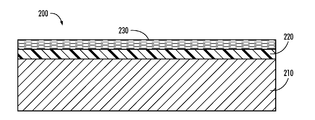
- FIG. 1 depicts an exemplary fuser member having a belt substrate in accordance with the present teachings.
- FIGS. 2A-2B depict exemplary fusing configurations using the fuser member shown in FIG. 1 in accordance with the present teachings.
- FIG. 3 depicts a fuser configuration using a transfix apparatus.
- FIG. 4 depicts a tensioning of a fusing member for final curing.
- a range of “less than 10” can include any and all sub-ranges between (and including) the minimum value of zero and the maximum value of 10, that is, any and all sub-ranges having a minimum value of equal to or greater than zero and a maximum value of equal to or less than 10, e.g., 1 to 5.
- the numerical values as stated for the parameter can take on negative values.
- the example value of range stated as “less than 10” can assume negative values, e.g. ⁇ 1, ⁇ 2, ⁇ 3, ⁇ 10, ⁇ 20, ⁇ 30, etc.
- the fuser or fixing member can include a substrate having one or more functional intermediate layers formed thereon.
- the substrate described herein includes a belt.
- the one or more intermediate layers include cushioning layers and release layers.
- Such fuser member can be used as an oil-less fusing member for high speed, high quality electrophotographic printing to ensure and maintain a good toner release from the fused toner image on an image supporting material (e.g., a paper sheet), and further assist paper stripping.
- the fuser member can include, for example, a substrate, with one or more functional intermediate layers formed thereon.
- the substrate can be formed in various shapes, such as a belt, or a film, using suitable materials that are non-conductive or conductive depending on a specific configuration, for example, as shown in FIG. 1 .
- an exemplary embodiment of a fusing or transfix member 200 can include a belt substrate 210 with one or more functional intermediate layers, e.g., 220 and an outer surface layer 230 formed thereon.
- the outer surface layer 230 is also referred to as a release layer.
- the belt substrate 210 is described further and is made of a polyimide polymer and an alkylthiophosphate.
- Examples of materials used for the functional intermediate layer 220 include fluorosilicones, silicone rubbers such as room temperature vulcanization (RTV) silicone rubbers, high temperature vulcanization (HTV) silicone rubbers, and low temperature vulcanization (LTV) silicone rubbers. These rubbers are known and readily available commercially, such as SILASTIC® 735 black RTV and SILASTIC® 732 RTV, both from Dow Corning; 106 RTV Silicone Rubber and 90 RTV Silicone Rubber, both from General Electric; and JCR6115CLEAR HTV and SE4705U HTV silicone rubbers from Dow Corning Toray Silicones.
- RTV room temperature vulcanization
- HTV high temperature vulcanization
- LTV low temperature vulcanization
- silicone materials include siloxanes (such as polydimethylsiloxanes); fluorosilicones such as Silicone Rubber 552, available from Sampson Coatings, Richmond, Va.; liquid silicone rubbers such as vinyl crosslinked heat curable rubbers or silanol room temperature crosslinked materials; and the like.
- siloxanes such as polydimethylsiloxanes
- fluorosilicones such as Silicone Rubber 552, available from Sampson Coatings, Richmond, Va.
- liquid silicone rubbers such as vinyl crosslinked heat curable rubbers or silanol room temperature crosslinked materials; and the like.
- Another specific example is Dow Corning Sylgard 182.
- Commercially available LSR rubbers include Dow Corning Q3-6395, Q3-6396, SILASTIC® 590 LSR, SILASTIC® 591 LSR, SILASTIC® 595 LSR, SILASTIC® 596 LSR, and SILASTIC® 598 LSR from Dow Corning.
- the functional layers provide elasticity and can be mixed with inorgan
- fluoroelastomers are from the class of 1) copolymers of two of vinylidenefluoride, hexafluoropropylene, and tetrafluoroethylene; such as those known commercially as VITON A® 2) terpolymers of vinylidenefluoride, hexafluoropropylene, and tetrafluoroethylene those known commercially as VITON B®; and 3) tetrapolymers of vinylidenefluoride, hexafluoropropylene, tetrafluoroethylene, and cure site monomer those known commercially as VITON GH® or VITON GF®.
- the cure site monomer can be 4-bromoperfluorobutene-1,1,1-dihydro-4-bromoperfluorobutene-1,3-bromoperfluoropropene-1,1,1-dihydro-3-bromoperfluoropropene-1, or any other suitable, known cure site monomer, such as those commercially available from DuPont.
- fluoropolymers include FLUOREL 2170®, FLUOREL 2174®, FLUOREL 2176®, FLUOREL 2177® and FLUOREL LVS 76®, FLUOREL® being a registered trademark of 3M Company.
- Additional commercially available materials include AFLASTM a poly(propylene-tetrafluoroethylene), and FLUOREL II® (LII900) a poly(propylene-tetrafluoroethylenevinylidenefluoride), both also available from 3M Company, as well as the Tecnoflons identified as FOR-60KIR, FOR-LHF®, NM® FOR-THF®, FOR-TFS® TH® NH®, P757® TNS®, T439 PL958® BR9151® and TN505, available from Ausimont.
- AFLASTM a poly(propylene-tetrafluoroethylene
- FLUOREL II® LII900
- Tecnoflons identified as FOR-60KIR, FOR-LHF®, NM® FOR-THF®, FOR-TFS® TH® NH®, P757® TNS®, T439 PL958® BR9151® and TN505, available from Ausimont.
- the fluoroelastomers VITON GH® and VITON GF® have relatively low amounts of vinylidenefluoride.
- the VITON GF® and VITON GH® have about 35 weight percent of vinylidenefluoride, about 34 weight percent of hexafluoropropylene, and about 29 weight percent of tetrafluoroethylene, with about 2 weight percent cure site monomer.
- the thickness of the functional intermediate layer 220 is from about 30 microns to about 1,000 microns, or from about 100 microns to about 800 microns, or from about 150 microns to about 500 microns.
- An exemplary embodiment of a release layer 230 includes fluoropolymer particles.
- Fluoropolymer particles suitable for use in the formulation described herein include fluorine-containing polymers. These polymers include fluoropolymers comprising a monomeric repeat unit that is selected from the group consisting of vinylidene fluoride, hexafluoropropylene, tetrafluoroethylene, perfluoroalkylvinylether, and mixtures thereof.
- the fluoropolymers may include linear or branched polymers, and cross-linked fluoroelastomers.
- fluoropolymer examples include polytetrafluoroethylene (PTFE); perfluoroalkoxy polymer resin (PFA); copolymer of tetrafluoroethylene (TFE) and hexafluoropropylene (HFP); copolymers of hexafluoropropylene (HFP) and vinylidene fluoride (VDF or VF2); terpolymers of tetrafluoroethylene (TFE), vinylidene fluoride (VDF), and hexafluoropropylene (HFP); and tetrapolymers of tetrafluoroethylene (TFE), vinylidene fluoride (VF2), and hexafluoropropylene (HFP), and mixtures thereof.
- PTFE polytetrafluoroethylene
- PFA perfluoroalkoxy polymer resin
- HFP hexafluoropropylene
- HFP vinylidene fluoride
- the fluoropolymer particles provide chemical and thermal stability and have a low surface energy.
- the fluoropolymer particles have a melting temperature of from about 255° C. to about 360° C. or from about 280° C. to about 330° C. These particles are melted to form the release layer.
- the thickness of the outer surface layer or release layer 230 can be from about 10 microns to about 100 microns, or from about 20 microns to about 80 microns, or from about 40 microns to about 60 microns.
- any known and available suitable adhesive layer also referred to as a primer layer, may be positioned between the release layer 230 , the functional intermediate layer 220 and the substrate 210 .
- suitable adhesives include silanes such as amino silanes (such as, for example, HV Primer 10 from Dow Corning), titanates, zirconates, aluminates, and the like, and mixtures thereof.
- an adhesive in from about 0.001 percent to about 10 percent solution can be wiped on the substrate.
- the adhesive layer can be coated on the substrate, or on the outer layer, to a thickness of from about 2 nanometers to about 2,000 nanometers, or from about 2 nanometers to about 500 nanometers.
- the adhesive can be coated by any suitable known technique, including spray coating or wiping.
- FIGS. 2A and 2B depict an exemplary fusing configuration for the fusing process in accordance with the present teachings. It should be readily apparent to one of ordinary skill in the art that the fusing configurations 300 B and 400 B depicted in FIGS. 2A-2B , respectively, represent generalized schematic illustrations and that other members/layers/substrates/configurations can be added or existing members/layers/substrates/configurations can be removed or modified. Although an electrophotographic printer is described herein, the disclosed apparatus and method can be applied to other printing technologies. Examples include offset printing and inkjet and solid transfix machines.
- FIG. 2A depicts the fusing configuration 300 B using a fuser belt shown in FIG. 1 in accordance with the present teachings.
- the configuration 300 B can include a fuser belt of FIG. 1 that forms a fuser nip with a pressure applying mechanism 335 , such as a pressure belt, for an image supporting material 315 .
- the pressure applying mechanism 335 can be used in combination with a heat lamp (not shown) to provide both the pressure and heat for the fusing process of the toner particles on the image supporting material 315 .
- the configuration 300 B can include one or more external heat rolls 350 along with, e.g., a cleaning web 360 , as shown in FIG. 2A .
- FIG. 2B depicts the fusing configuration 400 B using a fuser belt shown in FIG. 1 in accordance with the present teachings.
- the configuration 400 B can include a fuser belt (i.e., 200 of FIG. 1 ) that forms a fuser nip with a pressure applying mechanism 435 , such as a pressure belt in FIG. 2B , for a media substrate 415 .
- the pressure applying mechanism 435 can be used in a combination with a heat lamp to provide both the pressure and heat for the fusing process of the toner particles on the media substrate 415 .
- the configuration 400 B can include a mechanical system 445 to move the fuser belt 200 and thus fusing the toner particles and forming images on the media substrate 415 .
- the mechanical system 445 can include one or more rolls 445 a - c , which can also be used as heat rolls when needed.
- FIG. 3 demonstrates a view of an embodiment of a transfix member 7 which may be in the form of a belt, sheet, film, or like form.
- the transfix member 7 is constructed similarly to the fuser belt described above.
- the developed image 12 positioned on intermediate transfer member 1 is brought into contact with and transferred to transfix member 7 via rollers 4 and 8 .
- Roller 4 and/or roller 8 may or may not have heat associated therewith.
- Transfix member 7 proceeds in the direction of arrow 13 .
- the developed image is transferred and fused to a copy substrate 9 as copy substrate 9 is advanced between rollers 10 and 11 . Rollers 10 and/or 11 may or may not have heat associated therewith.
- the substrate layer 210 disclosed herein is a polyimide composition comprising an internal release agent of an alkylthiophosphate that self releases from a metal substrate such as stainless steel.
- the prior art teaches applying an external release layer on the metal substrate before coating the polyimide layer, and then releasing it.
- the disclosed composition is cost effective since only one coating layer is needed.
- the disclosed polyamic acid includes one of a polyamic acid of pyromellitic dianhydride/4,4′-oxydianiline, a polyamic acid of pyromellitic dianhydride/phenylenediamine, a polyamic acid of biphenyl tetracarboxylic dianhydride/4,4′-oxydianiline, a polyamic acid of biphenyl tetracarboxylic dianhydride/phenylenediamine, a polyamic acid of benzophenone tetracarboxylic dianhydride/4,4′-oxydianiline, a polyamic acid of benzophenone tetracarboxylic dianhydride/4,4′-oxydianiline/phenylenediamine, and the like and mixtures thereof.
- polyamic acid of biphenyl tetracarboxylic dianhydride/4,4′-oxydianiline examples include U-VARNISH A, and S (about 20 weight in NMP), both from UBE America Inc., New York, N.Y.
- polyamic acid of biphenyl tetracarboxylic dianhydride/phenylenediamine examples include PI-2610 (about 10.5 weight in NMP), and PI-2611 (about 13.5 weight in NMP), both from HD MicroSystems, Parlin, N.J.
- polyamic acid of benzophenone tetracarboxylic dianhydride/4,4′-oxydianiline examples include RP46, and RP50 (about 18 weight percent in NMP), both from Unitech Corp., Hampton, Va.
- Various amounts of polyamic acid can be selected for the substrate, such as for example, from about 90 weight percent to about 99.9 weight percent, from about 95 weight percent to about 99.8 weight percent, or from about 97 weight percent to about 99.5 weight percent.
- Suitable dianhydrides include aromatic dianhydrides and aromatic tetracarboxylic acid dianhydrides such as, for example, 9,9-bis(trifluoromethyl)xanthene-2,3,6,7-tetracarboxylic acid dianhydride, 2,2-bis(3,4-dicarboxyphenyl)hexafluoropropane dianhydride, 2,2-bis((3,4-dicarboxyphenoxy)phenyl)hexafluoropropane dianhydride, 4,4′-bis(3,4-dicarboxy-2,5,6-trifluorophenoxy)octafluorobiphenyl dianhydride, 3,3′,4,4′-tetracarboxybiphenyl dianhydride, 3,3′,4,4′-tetracarboxybenzophenone dian
- Exemplary diamines suitable for use in the preparation of the polyamic acid include 4,4′-bis-(m-aminophenoxy)-biphenyl, 4,4′-bis-(m-aminophenoxy)-diphenyl sulfide, 4,4′-bis-(m-aminophenoxy)-diphenyl sulfone, 4,4′-bis-(p-aminophenoxy)-benzophenone, 4,4′-bis-(p-aminophenoxy)-diphenyl sulfide, 4,4′-bis-(p-aminophenoxy)-diphenyl sulfone, 4,4′-diamino-azobenzene, 4,4′-diaminobiphenyl, 4,4′-diaminodiphenylsulfone, 4,4′-diamino-p-terphenyl, 1,3-bis-(gamma-aminopropyl)-tetramethyl-disi
- the dianhydrides and diamines are, for example, selected in a weight ratio of dianhydride to diamine of from about 20:80 to about 80:20, and more specifically, in an about 50:50 weight ratio.
- the above aromatic dianhydride like aromatic tetracarboxylic acid dianhydrides and diamines like aromatic diamines are used singly or as a mixture, respectively.
- the disclosed alkylthiophosphate includes zinc dialkylthiophospahte as the internal release agent and includes the structures;
- R 1 , R 2 , R 3 , R 4 , R 5 and R 6 each independently represents a hydrogen atom; alkyl with, for example, from about 1 carbon atom to about 20 carbon atoms; cycloalkyl with, for example, from about 6 carbon atoms to about 26 carbon atoms; aryl, alkylaryl or arylalkyl groups with from about 6 carbon atoms to about 50 carbon atoms; a hydrocarbyl group containing, for example, from about 3 carbon atoms to about 20 carbon atoms, and containing an ester, ether, alcohol or carboxyl group; and an alkyl group which may be straight, chain or branched with, for example, from about 2 carbon atoms to about 18 carbon atoms, or from about 4 carbon atoms to about 8 carbon atoms.
- alkyl and alkoxy groups examples include ethyl, propyl, isopropyl, butyl, isobutyl, pentyl, hexyl ethylhexyl, and the like, and mixtures thereof; and the corresponding alkoxides.
- metal dialkyldithiophosphates include zinc diethyldithiophosphate, antimony diamyldithiophosphate, molybdenum di(2-ethylhexyl)dithiophosphate, and the like.
- Commercial zinc dialkyldithiophosphates include ELCOTM 102 (a mixed, primary zinc dialkyldithiophosphate), 103 (a mixed primary and secondary zinc dialkyldithiophosphate), 106, 108, 114, 119, and 121, available from Elco Corporation, Cleveland, Ohio.
- a number of the thiophosphates contain a certain amount of petroleum distillates, mineral oils such as ValPar500TM, available from Valero Energy Corporation, San Antonio, Tex.
- molybdenum dialkyldithiophosphates include MOLYVAN LTM (molybdenum di(2-ethylhexyl)phosphorodithioate), available from R.T. Vanderbilt Company, Inc., Norwalk, Conn.
- Commercial antimony dialkyldithiophosphates include VANLUBE 622TM and 648TM (antimony dialkylphosphorodithioate), available from R.T. Vanderbilt Company, Inc., Norwalk, Conn.
- Examples of other metals suitable in metal dialkyldithiophosphates include lead and manganese.
- the disclosed composition comprises a polyamic acid such as a polyamic acid of biphenyl tetracarboxylic dianhydride/4,4-oxydianiline and an internal release agent such as a zinc dialkyldithiophosphate (ZDDP). No greater than 0.5 weight percent of the internal release agent is needed to fully release the polyimide layer from the stainless steel substrate.
- a polyamic acid such as a polyamic acid of biphenyl tetracarboxylic dianhydride/4,4-oxydianiline
- an internal release agent such as a zinc dialkyldithiophosphate (ZDDP). No greater than 0.5 weight percent of the internal release agent is needed to fully release the polyimide layer from the stainless steel substrate.
- the polyimide substrate composition can optionally contain a polysiloxane copolymer to enhance or smooth the coating.
- concentration of the polysiloxane copolymer is less than about 1 weight percent or less than about 0.2 weight percent of the compostion.
- the disclosed polyimide substrate layer 210 possesses a Young's modulus of from about 4,000 MPa to about 10,000 MPa, or from about 5,000 MPa to about 9,000 MPa, or from about 6,000 MPA to about 8,000 MPa; and an onset decomposition temperature of from about 400° C. to about 600° C., or from about 425° C. to about 575° C., or from about 450° C. to about 550° C.
- compositions used in a process of preparing a seamless polyimide belt for a fuser belt substrate via flow coating In a centrifugal molding process, a thin fluorine or silicone release layer is applied on the inside of a rigid cylindrical mandrel, and then the polyimide layer is applied and subsequently cured and released from the mandrel.
- a flow coating process and the disclosed composition eliminates the requirement of an extra release layer, thus reducing manufacturing cost.
- the composition of the substrate layer comprises a polyamic acid such as a polyamic acid of pyromellitic dianhydride/4,4-oxydianiline and an internal release agent of a alkylthiophosphate.
- the internal release agent is present in an amount of from about 0.05 weight percent to about 2 weight percent or from about 0.1 weight percent to about 1 weight percent or from about 0.2 weight percent to about 0.8 weight percent of the composition.
- the alkylthiophosphate release agent is needed to fully release the polyimide layer from the stainless steel substrate.
- the polyimide-alkylthiophosphate composition is flow coated on a welded stainless steel belt or an electroformed seamless nickel belt at the desired product circumference.
- the polyimide-alkylthiophosphate belt is partially cured, or pre-cured, at from about 150° C. to about 250° C., or from about 180° C. to about 220° C. for a time of from about 30 minutes to about 90 minutes, or from about 45 minutes to about 75 minutes, and self releases from the stainless steel belt or electroformed seamless nickel belt, and then is further completely cured at from about 250° C. to about 370° C., or from about 300° C.
- This final curing is at a tension of from about 1 kilogram to about 10 kilograms.
- the pre-cured belt 210 is tensioned between two rollers 250 while rotating the direction of arrow 20 .
- the final curing produces a belt that exhibits a modulus suitable for use as a fuser member.
- the seam thickness and profile of the seamed stainless steel belt can be minimized, and the surface finish and roughness of the substrate belt can be specified.
- a rough lathed or honed belt is better for the polyimide layer release.
- Such a configuration easily allows the production of belts of various lengths and widths. Using a rotating mandrel limits the width and length of the belts able to be produced as each belt requires a separate mandrel.
- the coating belt substrate is a rough lathed belt substrate with a R a (average roughness) of from about 0.01 micron to about 0.5 micron, or from about 0.05 micron to about 0.3 micron, or from about 0.1 micron to about 0.2 micron; and a R max or from about 0.05 micron to about 2 micron, or from about 0.1 micron to about 1 micron, or from about 0.2 micron to about 0.7 micron.
- the back of the polyimide fuser substrate flow coated from this substrate is similarly rough lathed.
- the coating belt substrate is a honed belt substrate with a R a of from about 0.15 micron to about 1 micron, or from about 0.2 micron to about 0.8 micron, or from about 0.3 micron to about 0.7 micron; and a R max of from about 0.5 micron to about 10 microns, or from about 1 micron to about 7 microns, or from about 2 microns to about 4 microns.
- the back of the polyimide fuser substrate flow coated from this substrate is similarly honed.
- the polyimide-alkylthiophosphate layer thickness can be achieved by single pass or multi pass coating.
- single pass the polyimide layer is coated, and pre-cured at a temperature between about 125° C. and about 190° C. for a time of about 30 minutes to about 90 minutes, and then fully cured at a temperature between about 250° C. and about 370° C. for a time of about 30 minutes to about 90 minutes.
- multi-pass such as dual pass, the bottom polyimide layer is coated on a substrate and pre-cured between about 125° C. and about 190° C. for a time of about 30 minutes to about 90 minutes, and the top polyimide layer is subsequently coated and pre-cured between about 125° C. and about 190° C.
- a stainless steel belt is used as the coating substrate.
- the substrate is rotated at a speed of from about 20 rpm to about 100 rpm, or from about 40 rpm to about 60 rpm during the thermal curing of the coating.
- the polyimide substrate composition includes a solvent.
- the solvent selected to form the composition include toluene, hexane, cycloheaxne, heptane, tetrahydrofuran, methyl ethyl ketone, methyl isobutyl ketone, N,N′-dimethylformamide, N,N′-dimethylacetamide, N-methylpyrrolidone (NMP), methylene chloride and the like and mixtures thereof where the solvent is selected, for example, in an amount of from about 70 weight percent to about 95 weight percent, and from 80 weight percent to about 90 weight percent based on the amounts in the coating mixture.
- Additives and additional conductive or non-conductive fillers may be present in the above-described composition.
- other filler materials or additives including, for example, inorganic particles, can be used for the coating composition and the subsequently formed surface layer.
- Fillers used herein include carbon blacks such aluminum nitride, boron nitride, aluminum oxide, graphite, graphene, copper flake, nano diamond, carbon black, carbon nanotubes, metal oxides, doped metal oxide, metal flake, and mixtures thereof.
- other additives known to one of ordinary skill in the art can also be included to form the disclosed composite materials.
- composition is coated on a substrate in any suitable known manner.
- Typical techniques for coating such materials on the substrate layer include flow coating, liquid spray coating, dip coating, wire wound rod coating, fluidized bed coating, powder coating, electrostatic spraying, sonic spraying, blade coating, molding, laminating, and the like.
- the composition liquid was coated on a stainless steel substrate, and subsequently cured at 75° C. for 30 minutes, 190° C. for 30 minutes and 320° C. for 60 minutes.
- the resulting polyimide substrate self released from the stainless steel coating substrate, and an 80 ⁇ m smooth polyimide substrate was obtained.
- the polyimide substrate was further tested for modulus and onset decomposition temperature.
- the modulus was about 8,800 MPa, and the onset decomposition temperature was about 583° C.
- commercially available polyimide substrates possess a modulus of from about 6,000 MPa to about 8,000 MPa.
- the onset decomposition temperature of commercially available polyimide substrates is about 530° C.
- the key properties of the disclosed polyimide substrate were comparable to commercially available substrates.
Landscapes
- Chemical & Material Sciences (AREA)
- Health & Medical Sciences (AREA)
- Chemical Kinetics & Catalysis (AREA)
- Medicinal Chemistry (AREA)
- Polymers & Plastics (AREA)
- Organic Chemistry (AREA)
- Physics & Mathematics (AREA)
- General Physics & Mathematics (AREA)
- Laminated Bodies (AREA)
- Fixing For Electrophotography (AREA)
- Compositions Of Macromolecular Compounds (AREA)
Abstract
Description

wherein R1, R2, R3, R4, R5 and R6 each independently represents a hydrogen atom; alkyl with, for example, from about 1 carbon atom to about 20 carbon atoms; cycloalkyl with, for example, from about 6 carbon atoms to about 26 carbon atoms; aryl, alkylaryl or arylalkyl groups with from about 6 carbon atoms to about 50 carbon atoms; a hydrocarbyl group containing, for example, from about 3 carbon atoms to about 20 carbon atoms, and containing an ester, ether, alcohol or carboxyl group; and an alkyl group which may be straight, chain or branched with, for example, from about 2 carbon atoms to about 18 carbon atoms, or from about 4 carbon atoms to about 8 carbon atoms. Examples of alkyl and alkoxy groups include ethyl, propyl, isopropyl, butyl, isobutyl, pentyl, hexyl ethylhexyl, and the like, and mixtures thereof; and the corresponding alkoxides.
Claims (16)

Priority Applications (3)
| Application Number | Priority Date | Filing Date | Title |
|---|---|---|---|
| US13/020,453 US8465838B2 (en) | 2011-02-03 | 2011-02-03 | Polyimide-alkylphosphate fuser member |
| JP2012010193A JP5722243B2 (en) | 2011-02-03 | 2012-01-20 | Fuser material |
| DE201210201245 DE102012201245A1 (en) | 2011-02-03 | 2012-01-30 | fuser |
Applications Claiming Priority (1)
| Application Number | Priority Date | Filing Date | Title |
|---|---|---|---|
| US13/020,453 US8465838B2 (en) | 2011-02-03 | 2011-02-03 | Polyimide-alkylphosphate fuser member |
Publications (2)
| Publication Number | Publication Date |
|---|---|
| US20120202078A1 US20120202078A1 (en) | 2012-08-09 |
| US8465838B2 true US8465838B2 (en) | 2013-06-18 |
Family
ID=46547183
Family Applications (1)
| Application Number | Title | Priority Date | Filing Date |
|---|---|---|---|
| US13/020,453 Active 2031-09-17 US8465838B2 (en) | 2011-02-03 | 2011-02-03 | Polyimide-alkylphosphate fuser member |
Country Status (3)
| Country | Link |
|---|---|
| US (1) | US8465838B2 (en) |
| JP (1) | JP5722243B2 (en) |
| DE (1) | DE102012201245A1 (en) |
Cited By (3)
| Publication number | Priority date | Publication date | Assignee | Title |
|---|---|---|---|---|
| US20130142553A1 (en) * | 2011-12-06 | 2013-06-06 | Samsung Electronics Co., Ltd. | Fixing device having pressing unit with carbon nano tube heating layer |
| US8712304B2 (en) * | 2012-04-09 | 2014-04-29 | Xerox Corporation | Fuser member |
| US11027397B2 (en) | 2016-12-23 | 2021-06-08 | Saint-Gobain Abrasives, Inc. | Coated abrasives having a performance enhancing composition |
Families Citing this family (4)
| Publication number | Priority date | Publication date | Assignee | Title |
|---|---|---|---|---|
| EP0487688A4 (en) | 1990-06-18 | 1992-12-02 | Harris Corporation | Low offset unity gain buffer amplifier |
| US8824945B2 (en) * | 2011-02-09 | 2014-09-02 | Xerox Corporation | Metallic nanoparticle reinforced polyimide for fuser belt with high thermal conductivity |
| US8829088B1 (en) * | 2013-04-29 | 2014-09-09 | Xerox Corporation | Fuser member compositions |
| US9477190B2 (en) * | 2014-04-14 | 2016-10-25 | Xerox Corporation | Fuser member |
Citations (3)
| Publication number | Priority date | Publication date | Assignee | Title |
|---|---|---|---|---|
| US20050261456A1 (en) * | 2004-05-21 | 2005-11-24 | Shin-Etsu Chemical Co., Ltd. | Partial block polyimide-polysiloxane copolymer, making method , and resin composition comprising the copolymer |
| US20070026329A1 (en) * | 2005-07-28 | 2007-02-01 | Xerox Corporation | Photoreceptor layer having thiophosphate lubricants |
| US20070147914A1 (en) * | 2003-12-02 | 2007-06-28 | Junichiro Takahashi | Metal belt, fixing belt and heat fixing device |
Family Cites Families (2)
| Publication number | Priority date | Publication date | Assignee | Title |
|---|---|---|---|---|
| JPH02106776A (en) * | 1988-10-17 | 1990-04-18 | Canon Inc | Fixing oil composition for electrophotography |
| JP2010117645A (en) * | 2008-11-14 | 2010-05-27 | Ricoh Co Ltd | Heat-resistant resin belt, production method of same, fixing device, and image forming device |
-
2011
- 2011-02-03 US US13/020,453 patent/US8465838B2/en active Active
-
2012
- 2012-01-20 JP JP2012010193A patent/JP5722243B2/en not_active Expired - Fee Related
- 2012-01-30 DE DE201210201245 patent/DE102012201245A1/en not_active Ceased
Patent Citations (3)
| Publication number | Priority date | Publication date | Assignee | Title |
|---|---|---|---|---|
| US20070147914A1 (en) * | 2003-12-02 | 2007-06-28 | Junichiro Takahashi | Metal belt, fixing belt and heat fixing device |
| US20050261456A1 (en) * | 2004-05-21 | 2005-11-24 | Shin-Etsu Chemical Co., Ltd. | Partial block polyimide-polysiloxane copolymer, making method , and resin composition comprising the copolymer |
| US20070026329A1 (en) * | 2005-07-28 | 2007-02-01 | Xerox Corporation | Photoreceptor layer having thiophosphate lubricants |
Cited By (5)
| Publication number | Priority date | Publication date | Assignee | Title |
|---|---|---|---|---|
| US20130142553A1 (en) * | 2011-12-06 | 2013-06-06 | Samsung Electronics Co., Ltd. | Fixing device having pressing unit with carbon nano tube heating layer |
| US8874018B2 (en) * | 2011-12-06 | 2014-10-28 | Samsung Electronics Co., Ltd. | Fixing device having pressing unit with carbon nano tube heating layer |
| US8712304B2 (en) * | 2012-04-09 | 2014-04-29 | Xerox Corporation | Fuser member |
| US11027397B2 (en) | 2016-12-23 | 2021-06-08 | Saint-Gobain Abrasives, Inc. | Coated abrasives having a performance enhancing composition |
| US12053857B2 (en) | 2016-12-23 | 2024-08-06 | Saint-Gobain Abrasives, Inc. | Coated abrasives having a performance enhancing composition |
Also Published As
| Publication number | Publication date |
|---|---|
| DE102012201245A1 (en) | 2012-08-09 |
| JP5722243B2 (en) | 2015-05-20 |
| JP2012163953A (en) | 2012-08-30 |
| US20120202078A1 (en) | 2012-08-09 |
Similar Documents
| Publication | Publication Date | Title |
|---|---|---|
| US9229396B1 (en) | Fuser member | |
| US20120052306A1 (en) | Fuser member | |
| US8465838B2 (en) | Polyimide-alkylphosphate fuser member | |
| US8929792B2 (en) | Fuser member | |
| US10365597B2 (en) | Endless belt comprising boron nitride nanotubes | |
| US9342008B2 (en) | Fuser member compositions | |
| US8541108B2 (en) | Fuser member | |
| US8414815B2 (en) | Seamless fuser member process | |
| US20150153687A1 (en) | Fuser member | |
| US8652628B2 (en) | Fuser member | |
| US9034423B2 (en) | Method of making a fuser member | |
| US9217969B2 (en) | Fuser member coating compositions | |
| US20120231258A1 (en) | Fuser member | |
| US8829088B1 (en) | Fuser member compositions | |
| US8712304B2 (en) | Fuser member | |
| US8911871B2 (en) | Fuser member | |
| US8829089B1 (en) | Fuser member compositions | |
| US9471012B2 (en) | Coating composition | |
| US20180107140A1 (en) | Fuser members | |
| US9244410B1 (en) | Fuser member | |
| US8906513B2 (en) | Fuser member | |
| US10273344B1 (en) | Fuser component comprising fluorinated boron nitride nanosheets | |
| US9477190B2 (en) | Fuser member |
Legal Events
| Date | Code | Title | Description |
|---|---|---|---|
| AS | Assignment |
Owner name: XEROX CORPORATION, CONNECTICUT Free format text: ASSIGNMENT OF ASSIGNORS INTEREST;ASSIGNOR:WU, JIN;REEL/FRAME:025747/0830 Effective date: 20110203 |
|
| FEPP | Fee payment procedure |
Free format text: PAYOR NUMBER ASSIGNED (ORIGINAL EVENT CODE: ASPN); ENTITY STATUS OF PATENT OWNER: LARGE ENTITY |
|
| STCF | Information on status: patent grant |
Free format text: PATENTED CASE |
|
| FPAY | Fee payment |
Year of fee payment: 4 |
|
| MAFP | Maintenance fee payment |
Free format text: PAYMENT OF MAINTENANCE FEE, 8TH YEAR, LARGE ENTITY (ORIGINAL EVENT CODE: M1552); ENTITY STATUS OF PATENT OWNER: LARGE ENTITY Year of fee payment: 8 |
|
| AS | Assignment |
Owner name: CITIBANK, N.A., AS AGENT, DELAWARE Free format text: SECURITY INTEREST;ASSIGNOR:XEROX CORPORATION;REEL/FRAME:062740/0214 Effective date: 20221107 |
|
| AS | Assignment |
Owner name: XEROX CORPORATION, CONNECTICUT Free format text: RELEASE OF SECURITY INTEREST IN PATENTS AT R/F 062740/0214;ASSIGNOR:CITIBANK, N.A., AS AGENT;REEL/FRAME:063694/0122 Effective date: 20230517 |
|
| AS | Assignment |
Owner name: CITIBANK, N.A., AS COLLATERAL AGENT, NEW YORK Free format text: SECURITY INTEREST;ASSIGNOR:XEROX CORPORATION;REEL/FRAME:064760/0389 Effective date: 20230621 |
|
| AS | Assignment |
Owner name: JEFFERIES FINANCE LLC, AS COLLATERAL AGENT, NEW YORK Free format text: SECURITY INTEREST;ASSIGNOR:XEROX CORPORATION;REEL/FRAME:065628/0019 Effective date: 20231117 |
|
| AS | Assignment |
Owner name: XEROX CORPORATION, CONNECTICUT Free format text: TERMINATION AND RELEASE OF SECURITY INTEREST IN PATENTS RECORDED AT RF 064760/0389;ASSIGNOR:CITIBANK, N.A., AS COLLATERAL AGENT;REEL/FRAME:068261/0001 Effective date: 20240206 Owner name: CITIBANK, N.A., AS COLLATERAL AGENT, NEW YORK Free format text: SECURITY INTEREST;ASSIGNOR:XEROX CORPORATION;REEL/FRAME:066741/0001 Effective date: 20240206 |
|
| MAFP | Maintenance fee payment |
Free format text: PAYMENT OF MAINTENANCE FEE, 12TH YEAR, LARGE ENTITY (ORIGINAL EVENT CODE: M1553); ENTITY STATUS OF PATENT OWNER: LARGE ENTITY Year of fee payment: 12 |
|
| AS | Assignment |
Owner name: U.S. BANK TRUST COMPANY, NATIONAL ASSOCIATION, AS COLLATERAL AGENT, CONNECTICUT Free format text: FIRST LIEN NOTES PATENT SECURITY AGREEMENT;ASSIGNOR:XEROX CORPORATION;REEL/FRAME:070824/0001 Effective date: 20250411 |
|
| AS | Assignment |
Owner name: U.S. BANK TRUST COMPANY, NATIONAL ASSOCIATION, AS COLLATERAL AGENT, CONNECTICUT Free format text: SECOND LIEN NOTES PATENT SECURITY AGREEMENT;ASSIGNOR:XEROX CORPORATION;REEL/FRAME:071785/0550 Effective date: 20250701 |