US8465730B1 - Polyglycerol polyesters - Google Patents
Polyglycerol polyesters Download PDFInfo
- Publication number
- US8465730B1 US8465730B1 US13/506,163 US201213506163A US8465730B1 US 8465730 B1 US8465730 B1 US 8465730B1 US 201213506163 A US201213506163 A US 201213506163A US 8465730 B1 US8465730 B1 US 8465730B1
- Authority
- US
- United States
- Prior art keywords
- polyglycerol
- carbons
- alkyl
- polyester
- skin
- Prior art date
- Legal status (The legal status is an assumption and is not a legal conclusion. Google has not performed a legal analysis and makes no representation as to the accuracy of the status listed.)
- Active - Reinstated
Links
- UOKCVZGYVWMSRH-UHFFFAOYSA-N CCCCCCCCCC1C(CCCCC)C=CC(CC)C1CCCCC Chemical compound CCCCCCCCCC1C(CCCCC)C=CC(CC)C1CCCCC UOKCVZGYVWMSRH-UHFFFAOYSA-N 0.000 description 6
- JVOXTOXJOUTOSS-UHFFFAOYSA-N CCCCCCCCCC1C(CCCCC)CCC(CC)C1CCCCC Chemical compound CCCCCCCCCC1C(CCCCC)CCC(CC)C1CCCCC JVOXTOXJOUTOSS-UHFFFAOYSA-N 0.000 description 4
- LNBGVVQYVJQDAK-UHFFFAOYSA-N CCCCCC1C=CC(CCCCCCCCC=O)C(CCCCC)C1CCCCCCCCC(=O)O Chemical compound CCCCCC1C=CC(CCCCCCCCC=O)C(CCCCC)C1CCCCCCCCC(=O)O LNBGVVQYVJQDAK-UHFFFAOYSA-N 0.000 description 1
- MOAWBPOKDPKECB-UHFFFAOYSA-N CCCCCC1CCC(CCCCCCCCC=O)C(CCCCC)C1CCCCCCCCC(=O)O Chemical compound CCCCCC1CCC(CCCCCCCCC=O)C(CCCCC)C1CCCCCCCCC(=O)O MOAWBPOKDPKECB-UHFFFAOYSA-N 0.000 description 1
- OFOBLEOULBTSOW-UHFFFAOYSA-N O=C(O)CC(=O)O Chemical compound O=C(O)CC(=O)O OFOBLEOULBTSOW-UHFFFAOYSA-N 0.000 description 1
- UAOXGVSADMLCFK-UHFFFAOYSA-N OCC(O)COCC(O)COCC(O)COCC(O)CO Chemical compound OCC(O)COCC(O)COCC(O)COCC(O)CO UAOXGVSADMLCFK-UHFFFAOYSA-N 0.000 description 1
Classifications
-
- A—HUMAN NECESSITIES
- A61—MEDICAL OR VETERINARY SCIENCE; HYGIENE
- A61K—PREPARATIONS FOR MEDICAL, DENTAL OR TOILETRY PURPOSES
- A61K8/00—Cosmetics or similar toiletry preparations
- A61K8/18—Cosmetics or similar toiletry preparations characterised by the composition
- A61K8/30—Cosmetics or similar toiletry preparations characterised by the composition containing organic compounds
- A61K8/33—Cosmetics or similar toiletry preparations characterised by the composition containing organic compounds containing oxygen
- A61K8/39—Derivatives containing from 2 to 10 oxyalkylene groups
-
- A—HUMAN NECESSITIES
- A61—MEDICAL OR VETERINARY SCIENCE; HYGIENE
- A61Q—SPECIFIC USE OF COSMETICS OR SIMILAR TOILETRY PREPARATIONS
- A61Q17/00—Barrier preparations; Preparations brought into direct contact with the skin for affording protection against external influences, e.g. sunlight, X-rays or other harmful rays, corrosive materials, bacteria or insect stings
- A61Q17/04—Topical preparations for affording protection against sunlight or other radiation; Topical sun tanning preparations
Definitions
- the present invention is directed toward a series of polyglycerol polyesters with tunable ascetics and performance in cosmetic formulation.
- These novel polyglycerol polyesters are designed to be multidimensional. Multidimensional is meant that the polymer contains a variety of groups containing different chemical and physical properties covalently bonded together.
- the physical properties of the current invention can be tuned rapidly by controlling the ratio of fatty groups, as well as the cross-linker used. Tuned here is meant the ability to adjust the physical properties to a desired value.
- the resulting polyglycerol polyesters have outstanding aesthetics and physical properties.
- Polyglycerol compounds are well known materials. They are made by the condensation reaction of glycerin. The resulting products are polar and posses several un-reacted hydroxyl groups. The number of glycerin molecules condensed in the reaction is referred to as the degree of polymerization (DP). The condensation reaction run between two glycerin molecules produces water as a byproduct.
- U.S. Pat. No. 5,721,305 issued Feb. 24, 1998 to Eshuis, et al. entitled Polyglycerol production teaches how polyglycerol is made.
- U.S. Pat. No. 3,936,391 issued Feb. 3, 1976 to Gabby entitled “Hydrated polyglycerol Ester Composition” teaches a polyglycerol ester emulsifier is prepared by heating a polyglycerol ester containing 3 to 10 glycerol units and a 1 to 2 saturated fatty acyl ester groups containing 16 to 20 carbon atoms, glycerol and water at a temperature of 125 to 135° F. The heat is maintained until a homogeneous paste-like consistency is imparted thereto.
- UVA protection has been a source of increasing discussion worldwide due to the steadily climbing rates of skin cancer, and particularly malignant melanoma. There have been many who say one of the problems has been the emphasis on SPF, which have steadily increased, and not enough emphasis on UVA protection.
- the SPF test is a measurement of erythema and 85% to 90% of the erytema energy is UVB energy. While this means that to obtain SPFs higher than 10, some UVA protection must be present the SPF test provides little indication of the magnitude of the UVA protection.
- UVA energy is defined as the Ultraviolet energy from 320 nm to 400 nm and UVAI energy is defined as energy from 340 nm to 400 nm.
- the JCIA Persistent Pigment Darkening test compares the amount of energy needed to produce melagenesis(tan) in unprotected skin versus the amount of energy needed to produce a tan in protected skin. This test predominantly is based on the amount of UV energy absorbed in the UVAII, 320 nm to 340 nm area of the Ultraviolet spectra. The FDA recognizing this devised a second test to measure the energy absorbed in the UVAI area of the spectra. Simply stated, this in vitro test is based on dividing the average amount of absorbance in the UVAI area by the average amount of absorbance in the entire UV spectra.
- the resultant ratio determines the amount of UVA protection that can be labeled.
- Front panel labeling is required to reflect this by a star system and descriptor system as follows:
- product absorbance must have increasing magnitude of absorbance in the UVA region and increasing breadth in the longer UVAI wavelengths.
- the product needs to absorb as much in the long UVAI wavelengths as is absorbed in the shorter wavelengths. While this sounds simple in theory, it is very contradictory to common sunscreen products in the US as well as the world, which almost always have the predominant amount of their absorbance in the UVB region and then rapidly taper off in the UVAII and UVAI. Obtaining the highest ratio with an SPF of 30 or higher is practically impossible with existing US approved sunscreen active materials without using a product so opaque that few if any would use.
- Avobenzone The only chemical sunscreen available to use in the US that absorbs with any significance in the UVAI region is Butyl Methoxydibenzoylmethane, more commonly known as Avobenzone. And even Avobenzone is woefully lacking in producing the broad coverage needed to obtain a 4 star, high SPF product since the maximum absorbance of Avobenzone in a polar solvent such as ethanol is 357 nm and the absorbance drops off extremely fast at increasingly higher wavelengths. The maximum absorbance is even lower in non-polar solvents such as most oils. This situation is exacerbated by the fact that once an alcohol product is applied to the skin the alcohol quickly evaporates leaving the Avobenzone in an increasingly polar environment.
- sunscreen products are in fact emulsions that have the Avobenzone dissolved in a non-polar oil phase in order for it to be solubilized and emulsified.
- the maximum absorbance in some commonly used oil ingredients used to solubilize and emulsify Avobenzone have in fact much lower maximum absorptions.
- Avobenzone maximum absorbance in Mineral Oil is only at at 351 nm and C12-15 Alkyls Benzoate is at 355 nm.
- Note a typical absorption pattern for Avobenzone in C12-15 alkyl benzoate, run using a UV-Visible spectrophotometer results in a spectrum with very little absobance in the range of 390 nm. Improving the absorbance at this wavelength would result in an improved star rating.
- UV-B irradiation causes skin burning and erythema.
- This UV-B radiation must thus be screened from the skin.”
- UV-A radiation of wavelengths of from 320 to 400 nm, which tan the skin, also adversely affects it, especially in the case of sensitive skin or skin which is continually exposed to solar radiation.
- UV-A rays especially cause a loss in the elasticity of the skin and the appearance of wrinkles, promoting premature skin aging.
- Such irradiation promotes triggering of the erythemal reaction or amplifies this reaction in certain individuals and may even be the source of phototoxic or photoallergic reactions.
- UV-A and/or UV-B A wide variety of compounds suited for photoprotection (UV-A and/or UV-B) of the skin are known to this art. Most of these are aromatic compounds exhibiting absorption of UV radiation in the region from 280 to 315 nm, or in the region from 315 to 400 nm, or in both of these regions. There is no good way known at present to modify the absorption properties of molecules to meet the specific needs, or to combine products to cover a wide range of UV wavelengths. Products heretofore known are typically formulated into antisun or sunscreen compositions which are in the form of an emulsion of oil-in-water type or water in oil type, and which thus contain, in various concentrations, one or more conventional lipophilic and/or hydrophilic organic screening agents.
- sunscreening agent that can absorb ultra violet radiation at specific desired wavelengths.
- these compounds exhibiting anti-UV activity must also have good cosmetic properties in compositions comprised thereof, good solubility in the usual solvents, and in particular fatty substances such as oils and greases, as well as good resistance to water and to perspiration.
- the current invention is directed toward a series of multi-domain polyglycerol polyesters that are synthesized by the reaction of polyglycerol, a diacid and a mixture of fatty acids. These multidimensional polyglycerol polyesters contain a mixture of fatty groups with differing melt points. The multi-domain nature of the current invention will provide very unique physical properties and ascetics in cosmetic formulations.
- Another aspect of the present invention is a process for providing improved sun protection to the skin, which comprises contacting the skin with an effective sun protection concentration of a composition which comprises:
- R 1 is an alkyl containing 8 to 26 carbons, or mixtures thereof
- R 2 is an alkyl containing 8 to 26 carbons or mixtures thereof
- R 3 is independently selected from an alkyl containing 2 to 12 carbons, or an alkyl confining to the following structure:
- n is an integer ranging from 0 to 9
- m is an integer ranging from 0 to 9 and a sunscreening active.
- the effective conditioning concentration ranges from 5.0% and 55.0% by weight sunscreening actives and 5% to 25% by weight polyester Sunscreening active is defined herein below.
- the present invention is related to a series of novel polyglycerol polyesters that are prepared by the reaction of a mixture of fatty acids, polyglycerol and a diacid.
- the nature of a polymer that contains different physical properties mainly the difference between the water loving nature of polyglycerol and the physical properties of the fatty group produces products that have extremely unique properties.
- the selection of the fatty groups, the diacid, and polyglycerol will drastically change the physical and cosmetic aesthetics of the resulting material.
- the compounds of the present invention are made by the esterification reaction of a diacid, polyglycerol, and a mixture of at least two fatty acids.
- the resulting products have the compatibility over those materials lacking the combination of these groups. This combination of groups results in a high efficient deposition of the skin, hair and fibers.
- the present invention is aimed at a series of novel multi-domain polyglycerol polyester that provides desired aesthetics and structure in cosmetic formulations.
- R 1 is an alkyl containing 8 to 26 carbons, or mixtures thereof
- R 2 is an alkyl containing 8 to 26 carbons or mixtures thereof
- R 3 is independently selected from an alkyl containing 2 to 12 carbons, or an alkyl confining to the following structure:
- n is an integer ranging from 0 to 9
- m is an integer ranging from 0 to 9.
- Another aspect of the present invention is a process for providing improved sun protection to the skin, which comprises contacting the skin with an effective sun protection concentration of a composition which comprises:
- R 1 is an alkyl containing 8 to 26 carbons, or mixtures thereof
- R 2 is an alkyl containing 8 to 26 carbons or mixtures thereof
- R 3 is independently selected from an alkyl containing 2 to 12 carbons, or an alkyl confining to the following structure:
- n is an integer ranging from 0 to 9
- m is an integer ranging from 0 to 9 and a sunscreening active.
- the effective conditioning concentration ranges from 5.0% and 55.0% by weight sunscreening actives and 5% to 25% by weight polyester Sunscreening active is defined herein below.
- R 1 and R 2 are different.
- one of R 1 and R 2 is solid and the other is liquid, (as used herein, liquid is meant pourable at 25° C., by solid is meant solid at 25° C.).
- R 1 is an alkyl having 18 carbons.
- R 3 is dimer acid
- R 2 is an alkyl having 18 carbons.
- R 3 is an alkyl having 7 carbons.
- n 0;
- n 0;
- Fatty acids useful in the practice of the present invention are items of commerce commercially available from Cognis.
- Fatty acids useful as raw materials in the preparation of compounds of the present invention are commercially available from a variety of sources including Procter and Gamble of Cincinnati Ohio. The structures are well known to those skilled in the art. R—C(O)—OH
- Polyglycerol is useful as raw materials in the preparation of compounds of the present invention.
- Polyglycerols are commercially available from a variety of sources including Solvay Chemicals of Rheinberg Germany.
- n is an integer ranging from 0 to 9.
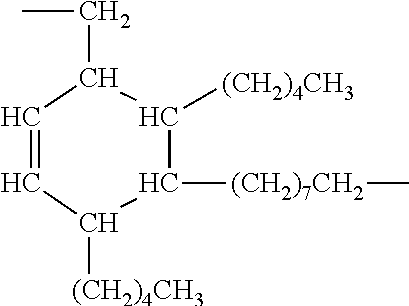
- Dimer acid is an item of commerce available commercially from Cognis Corporation. It conforms to the following structure:
- Hydrogenated dimer acid is an item of commerce available commercially from Henkel Corporation. It conforms to the following structure:
- Dicarboxylic acid useful as raw materials in the synthesis of the compounds of the present invention are commercially available from a variety of sources including Cognis. They conform to the following structure;
- c is an integer ranging from 1 to 10.
- a specified number of grams polyglycerol (examples 20-22) is added to a specified amount of fatty acids (examples 1-18) and a diacid (examples 23 and 34).
- the reaction mixture is heated to 160-180° C. Water is removed by vacuum during the reaction process.
- the reaction is monitored by the determination of acid value. The acid value will diminish as the reaction proceeds.
- the reaction is cooled once the acid value fails to change over an additional two hours at elevated temperature. The product is used without purification.
- the compounds of the present invention when added to alcoholic solutions, surprisingly and unexpectedly produce outstanding film formation and provide outstanding aesthetics to cosmetic formulations. Furthermore, the compounds of the present invention when added into a sunscreen or sun-block formulation, surprisingly and unexpectedly produce waterproofing on the skin.
- sunscreen formulations were prepared using polyglycerol polyesters and the absorbance and improvement in sun protection factor was monitored.
- the formulations were prepared by heating the organic filters and polyglycerol polyesters in C12 15 alkyl benzoate. Alcohol was then added into this solution and stirred until a homogeneous solution was obtained. A detailed breakdown of the formulation is shown below.
- Avobenzone The only chemical sunscreen available to use in the US that absorbs with any significance in the UVAI region is Butyl Methoxydibenzoylmethane, more commonly known as Avobenzone. And even Avobenzone is woefully lacking in producing the broad coverage needed to obtain a 4 star, high SPF product since the maximum absorbance of Avobenzone in a polar solvent such as ethanol is 357 nm and the absorbance drops off extremely fast at increasingly higher wavelengths. The maximum absorbance is even lower in non-polar solvents such as most oils. This situation is exacerbated by the fact that once an alcohol product is applied to the skin the alcohol quickly evaporates leaving the Avobenzone in an increasingly polar environment.
- sunscreen products are in fact emulsions that have the Avobenzone dissolved in a non-polar oil phase in order for it to be solubilized and emulsified.
- Avobenzone is useful in the compositions at a range of between 1 to 3% by weight.
- Organic sunscreens known to those of skill in the art are suitable for use in combination with the SPF enhancing polymer of the present invention.
- organic sunscreen active agents suitable for use with the SPF enhancing polymer of the present invention include those which are currently approved by the US Food and Drug Administration in the Sunscreen Drug Products for Over-The-Counter Human Use Final Monograph as published in the Federal Register on May 21, 1999 at Volume 64, Number 98, pages 27666-27693.
- Organic sunscreens currently approved by the FDA are as follows, (referred herein as sunscreening actives): p-Aminobenzoic acid (PABA) up to 15%; Avobenzone up to 3%; Cinoxate up to 3%; Dioxybenzone up to 3%; Homosalate up to 15%; Menthyl anthranilate up to 5%; Octocrylene up to 10%; Octyl methoxycinnamate (Octinoxate) up to 7.5%; Octyl salicylate up to 5%; Oxybenzone up to 6%; Padimate 0 up to 8%; Phenylbenzimidazole sulfonic acid (Ensulizole) up to 4%; Sulisobenzone up to 10%; Trolamine salicylate up to 12%.
- PABA p-Aminobenzoic acid
- Avobenzone up to 3%
- Cinoxate up to 3%
- Dioxybenzone up to 3%
- Homosalate up to 15%
- sunscreening actives include ingredients accepted for use in products intended to contact human skin that are approved in countries outside the US are also considered to be within the scope of the present invention.
- organic sunscreening actives include not currently approved by the FDA but suitable for use in combination with the SPF-enhancing polymer of Formula I include the following: 4-Methylbenzylidene camphor (USAN Enzacamene); Methylene Bis-Benzotriazolyl Tetramethylbutylphenol (USAN Bisoctrizole) marketed under the tradename Tinosorb® M; Bis-Ethylhexyloxyphenol Methoxyphenyl Triazine (USAN Bemotrizinol) marketed under the tradename marketed under the tradename Tinosorb® S; Terephthalylidene Dicamphor Sulfonic Acid (USAN Ecamsule) marketed under the tradename Mexoryl® SX; Drometrizole Trisiloxane marketed under the tradename Mexo
- Examples 35 and examples 68 of the current invention show an increase in SPF (in vitro) of 19.5 and 10.4 respectively. This results shows that these materials can be used in sunscreen formulations, specifically alcoholic sunscreen formulations, provides an unexpected SPF boost. This boost in SPF provides a more efficient sunscreen formulation. Efficient here is meant a higher SPF value without increasing the amount of sunscreen filters.
- the LaVay compounds failed to improve the SPF values. Not wanting to be bound by a specific theory, the LaVay compounds lack any fatty groups on the polymer, thereby lacking both fatty groups and more critically, the specific groups of the present invention.
Landscapes
- Health & Medical Sciences (AREA)
- Life Sciences & Earth Sciences (AREA)
- Animal Behavior & Ethology (AREA)
- General Health & Medical Sciences (AREA)
- Public Health (AREA)
- Veterinary Medicine (AREA)
- Emergency Medicine (AREA)
- Birds (AREA)
- Epidemiology (AREA)
- Dermatology (AREA)
- Cosmetics (AREA)
Abstract
Description
| UVAI/UV Ratio | Descriptor | No. of Stars | |||
| <20 | No UVA claim | 0 | |||
| .20-.39 | Low UVA | 1 | |||
| .40-.69 | Medium | 2 | |||
| .70-.95 | High | 3 | |||
| >0.95 | Highest | 4 | |||

wherein,
R1 is an alkyl containing 8 to 26 carbons, or mixtures thereof;
R2 is an alkyl containing 8 to 26 carbons or mixtures thereof;
R3 is independently selected from an alkyl containing 2 to 12 carbons, or an alkyl confining to the following structure:

or

or mixtures thereof;
n is an integer ranging from 0 to 9;
m is an integer ranging from 0 to 9
and
a sunscreening active.

wherein,
R1 is an alkyl containing 8 to 26 carbons, or mixtures thereof;
R2 is an alkyl containing 8 to 26 carbons or mixtures thereof;
R3 is independently selected from an alkyl containing 2 to 12 carbons, or an alkyl confining to the following structure:

or

or mixtures thereof;
n is an integer ranging from 0 to 9;
m is an integer ranging from 0 to 9.

wherein,
R1 is an alkyl containing 8 to 26 carbons, or mixtures thereof;
R2 is an alkyl containing 8 to 26 carbons or mixtures thereof;
R3 is independently selected from an alkyl containing 2 to 12 carbons, or an alkyl confining to the following structure:

or

or mixtures thereof;
n is an integer ranging from 0 to 9;
m is an integer ranging from 0 to 9
and
a sunscreening active.
R—C(O)—OH
| Saturated |
| Example | R Formula | Common Name | Molecular Weight | ||
| 1 | C7H5 | Caprylic | 144 | ||
| 2 | C9H19 | Capric | 172 | ||
| 3 | C11H23 | Lauric | 200 | ||
| 4 | C13H27 | Myristic | 228 | ||
| 5 | C14H29 | Pentadecanoic | 242 | ||
| 6 | C15H31 | Palmitic | 256 | ||
| 7 | C17H35 | Stearic | 284 | ||
| 8 | C17H35 | Isosteric | 284 | ||
| 9 | C19H39 | Arachidinic | 312 | ||
| 10 | C21H43 | Behenic | 340 | ||
| 12 | C26H53 | cetrotic | 396 | ||
| 13 | C33H67 | geddic acid | 508 | ||
| Unsaturated |
| Example | R Formula | Common Name | Molecular Weight | ||
| 14 | C17H33 | Oleic | 282 | ||
| 15 | C17H31 | Linoleic | 280 | ||
| 16 | C17H29 | Linolenic | 278 | ||
| 17 | C15H29 | Palmitoleic | 254 | ||
| 18 | C13H25 | Myristicoleic | 226 | ||
| 19 | C21H41 | Erucic | 338 | ||

wherein;
n is an integer ranging from 0 to 9.
| Example | n | MW |
| 20 | 0 | 225.0 |
| 21 | 3 | 450.0 |
| 22 | 7 | 750.0 |


wherein;
c is an integer ranging from 1 to 10.
| Saturated Dicarboxylic acids |
| Example | Common Name | c | Molecular Weight | |||
| 25 | Malonic | 1 | 104 | |||
| 26 | Succinic | 2 | 118 | |||
| 27 | Glutaric | 3 | 132 | |||
| 28 | Adipic | 4 | 146 | |||
| 29 | Pimelic | 5 | 160 | |||
| 30 | Subric | 6 | 174 | |||
| 31 | Azelaic | 7 | 188 | |||
| 32 | Sebacic | 8 | 202 | |||
| 33 | Undecanedioic | 9 | 216 | |||
| 34 | Dodecanedioic | 10 | 230 | |||
| Polyglycerol | R1 | R2 | Diacid | |
| Ex- | Ex- | Ex- | Ex- | |||||
| Example | ample | Grams | ample | Grams | ample | Grams | ample | Grams |
| 35 | 20 | 33.8 | 8 | 85.5 | 7 | 85.5 | 24 | 45.1 |
| 36 | 20 | 33.8 | 8 | 149.7 | 7 | 21.4 | 23 | 45.1 |
| 37 | 20 | 31.8 | 14 | 79.7 | 10 | 96.0 | 24 | 42.5 |
| 38 | 20 | 33.4 | 14 | 146.6 | 10 | 25.3 | 24 | 44.7 |
| 39 | 20 | 31.7 | 8 | 80.2 | 10 | 95.8 | 23 | 42.3 |
| 40 | 20 | 33.3 | 8 | 147.2 | 10 | 25.1 | 23 | 44.4 |
| 41 | 20 | 33.9 | 14 | 85.0 | 7 | 85.7 | 24 | 45.4 |
| 42 | 20 | 34.0 | 14 | 149.1 | 7 | 45.1 | 24 | 45.5 |
| 43 | 21 | 85.7 | 8 | 65.0 | 7 | 65.0 | 23 | 34.3 |
| 44 | 21 | 85.7 | 8 | 113.8 | 7 | 16.3 | 23 | 34.3 |
| 45 | 21 | 81.7 | 14 | 61.4 | 10 | 74.1 | 24 | 32.8 |
| 46 | 21 | 84.9 | 14 | 111.8 | 10 | 19.2 | 24 | 34.1 |
| 47 | 21 | 81.6 | 8 | 61.9 | 10 | 73.9 | 23 | 32.6 |
| 48 | 21 | 84.6 | 8 | 112.3 | 10 | 19.2 | 23 | 33.8 |
| 49 | 21 | 85.9 | 14 | 64.6 | 7 | 65.1 | 24 | 34.5 |
| 50 | 21 | 86.0 | 14 | 113.2 | 7 | 16.3 | 24 | 34.3 |
| 51 | 22 | 59.6 | 8 | 75.3 | 7 | 75.3 | 23 | 39.7 |
| 52 | 22 | 59.6 | 8 | 131.9 | 7 | 18.8 | 23 | 39.7 |
| 53 | 22 | 56.4 | 14 | 70.7 | 10 | 85.2 | 24 | 37.7 |
| 54 | 22 | 59.0 | 14 | 129.3 | 10 | 22.3 | 24 | 39.4 |
| 55 | 22 | 56.3 | 8 | 71.2 | 10 | 85.0 | 23 | 37.5 |
| 56 | 22 | 58.7 | 8 | 129.9 | 10 | 22.2 | 23 | 39.1 |
| 57 | 22 | 59.7 | 14 | 74.8 | 7 | 75.5 | 24 | 39.9 |
| 58 | 22 | 59.8 | 14 | 131.2 | 7 | 18.9 | 24 | 40.0 |
| 59 | 20 | 39.6 | 8 | 100.0 | 7 | 100.0 | 26 | 10.4 |
| 60 | 20 | 39.6 | 8 | 175.1 | 7 | 25.0 | 26 | 10.4 |
| 61 | 21 | 89.8 | 14 | 67.5 | 10 | 81.4 | 31 | 11.3 |
| 62 | 21 | 93.7 | 14 | 123.3 | 10 | 21.2 | 31 | 11.7 |
| 63 | 22 | 62.5 | 8 | 79.0 | 10 | 94.4 | 32 | 14.0 |
| 64 | 22 | 65.5 | 8 | 145.0 | 10 | 24.8 | 32 | 14.7 |
| 65 | 20 | 38.2 | 14 | 95.7 | 7 | 96.6 | 34 | 19.5 |
| 66 | 20 | 34.0 | 14 | 149.1 | 7 | 21.5 | 34 | 45.5 |
| 67 | 20 | 33.9 | 8 | 85.8 | 14 | 85.0 | 23 | 45.2 |
| 68 | 20 | 38.8 | 14 | 170.4 | 7 | 24.6 | 31 | 16.2 |
| Concentration | ||
| (wt %) | ||
| Formulation | ||
| Material | D | E | |
| Avobenzone | 3.0 | 3.0 | |
| Homosalate | 8.7 | 8.7 | |
| Octinoxate | 5.0 | 5.0 | |
| Octisalate | 5.0 | 5.0 | |
| Octocrylene | 2.5 | 2.5 | |
| Oxybenzone | 5.0 | 5.0 | |
| SD Alcohol | 50.0 | 50.0 | |
| C12 15 Alkyl Benzoate | 15.5 | 15.5 | |
| Cyclomethicone (D5) (control) | 5.0 | 0.0 | |
| 7,638,116 Example 13 | 5.0 | 0.0 | |
| 7,638,116 Example 17 | 0.0 | 5.0 | |
| Critical | Increase in SPF | SPF | ||||
| Wavelength | (in vitro) | (in vivo) | ||||
| Formulation | (nm) | (%) | (%) | |||
| A | 377.3 | 0.0 | 35 | |||
| B | 376.8 | 19.5 | 42 | |||
| C | 376.5 | 10.4 | 39 | |||
| Critical | Increase in | SPF | ||||
| Wavelength | SPF (in vitro) | (in vivo) | ||||
| Formulation | (nm) | (%) | (%) | |||
| D | 377.4 | 0.0 | 34 | |||
| E | 376.8 | 0.0 | 35 | |||
Claims (18)



Priority Applications (2)
| Application Number | Priority Date | Filing Date | Title |
|---|---|---|---|
| US13/506,163 US8465730B1 (en) | 2012-02-06 | 2012-04-02 | Polyglycerol polyesters |
| US13/986,022 US8680225B1 (en) | 2012-04-02 | 2013-03-25 | Terminal silicone polyglycerol polyesters |
Applications Claiming Priority (2)
| Application Number | Priority Date | Filing Date | Title |
|---|---|---|---|
| US201261633102P | 2012-02-06 | 2012-02-06 | |
| US13/506,163 US8465730B1 (en) | 2012-02-06 | 2012-04-02 | Polyglycerol polyesters |
Related Child Applications (1)
| Application Number | Title | Priority Date | Filing Date |
|---|---|---|---|
| US13/986,022 Continuation-In-Part US8680225B1 (en) | 2012-04-02 | 2013-03-25 | Terminal silicone polyglycerol polyesters |
Publications (1)
| Publication Number | Publication Date |
|---|---|
| US8465730B1 true US8465730B1 (en) | 2013-06-18 |
Family
ID=48578115
Family Applications (1)
| Application Number | Title | Priority Date | Filing Date |
|---|---|---|---|
| US13/506,163 Active - Reinstated US8465730B1 (en) | 2012-02-06 | 2012-04-02 | Polyglycerol polyesters |
Country Status (1)
| Country | Link |
|---|---|
| US (1) | US8465730B1 (en) |
Cited By (12)
| Publication number | Priority date | Publication date | Assignee | Title |
|---|---|---|---|---|
| US20130217837A1 (en) * | 2011-12-08 | 2013-08-22 | Thomas G. O'Lenick | Terminal Silicone Capped Regiospecific Glycerin Polyesters |
| US8956596B1 (en) * | 2013-03-25 | 2015-02-17 | Surfatech Corporation | Polymeric esters |
| WO2020191361A2 (en) | 2019-03-21 | 2020-09-24 | Codiak Biosciences, Inc. | Extracellular vesicles for vaccine delivery |
| WO2020191369A1 (en) | 2019-03-21 | 2020-09-24 | Codiak Biosciences, Inc. | Process for preparing extracellular vesicles |
| EP3868808A1 (en) | 2020-02-21 | 2021-08-25 | Nouryon Chemicals International B.V. | Biodegradable polyesters for water-resistant anhydrous suncare formulations |
| JP2021134209A (en) * | 2020-02-21 | 2021-09-13 | ヌーリオン ケミカルズ インターナショナル ベスローテン フェノーツハップNouryon Chemicals International B.V. | Biodegrable polyester for water-resistant anhydrous suncare formulation |
| WO2022066928A2 (en) | 2020-09-23 | 2022-03-31 | Codiak Biosciences, Inc. | Process for preparing extracellular vesicles |
| WO2022066934A2 (en) | 2020-09-23 | 2022-03-31 | Codiak Biosciences, Inc. | Process for preparing extracellular vesicles |
| US20230338272A1 (en) * | 2022-04-20 | 2023-10-26 | Thomas O'Lenick | Process for Transfer Resistance Polymers in Pigmented Products |
| WO2025003292A1 (en) * | 2023-06-30 | 2025-01-02 | Evonik Operations Gmbh | Polyglycerol partial ester comprising oleic acid |
| US12285516B2 (en) | 2020-02-21 | 2025-04-29 | Nouryon Chemicals International B.V. | Biodegradable polyesters for water-resistant oil-in-water suncare formulations |
| WO2025088221A1 (en) | 2023-10-26 | 2025-05-01 | Polymerexpert Sa | Biobased polyester film-forming agents |
Citations (2)
| Publication number | Priority date | Publication date | Assignee | Title |
|---|---|---|---|---|
| US6280709B1 (en) * | 1998-04-10 | 2001-08-28 | John Papadakos | Preparation of sun protection oil |
| US7638116B2 (en) * | 2007-10-29 | 2009-12-29 | Zenitech Llc | Polyglycerol dimer polyester resins |
-
2012
- 2012-04-02 US US13/506,163 patent/US8465730B1/en active Active - Reinstated
Patent Citations (2)
| Publication number | Priority date | Publication date | Assignee | Title |
|---|---|---|---|---|
| US6280709B1 (en) * | 1998-04-10 | 2001-08-28 | John Papadakos | Preparation of sun protection oil |
| US7638116B2 (en) * | 2007-10-29 | 2009-12-29 | Zenitech Llc | Polyglycerol dimer polyester resins |
Cited By (19)
| Publication number | Priority date | Publication date | Assignee | Title |
|---|---|---|---|---|
| US20130217837A1 (en) * | 2011-12-08 | 2013-08-22 | Thomas G. O'Lenick | Terminal Silicone Capped Regiospecific Glycerin Polyesters |
| US8623969B2 (en) * | 2011-12-08 | 2014-01-07 | Surfatech Corporation | Terminal silicone capped regiospecific glycerin polyesters |
| US8956596B1 (en) * | 2013-03-25 | 2015-02-17 | Surfatech Corporation | Polymeric esters |
| WO2020191361A2 (en) | 2019-03-21 | 2020-09-24 | Codiak Biosciences, Inc. | Extracellular vesicles for vaccine delivery |
| WO2020191369A1 (en) | 2019-03-21 | 2020-09-24 | Codiak Biosciences, Inc. | Process for preparing extracellular vesicles |
| EP4671268A2 (en) | 2019-03-21 | 2025-12-31 | Lonza Sales AG | METHOD FOR THE PRODUCTION OF EXTRACELLULAR VESCLES |
| US12502427B2 (en) | 2019-03-21 | 2025-12-23 | Lonza Sales Ag | Extracellular vesicles for vaccine delivery |
| JP2021134209A (en) * | 2020-02-21 | 2021-09-13 | ヌーリオン ケミカルズ インターナショナル ベスローテン フェノーツハップNouryon Chemicals International B.V. | Biodegrable polyester for water-resistant anhydrous suncare formulation |
| EP3868809A1 (en) | 2020-02-21 | 2021-08-25 | Nouryon Chemicals International B.V. | Biodegradable polyesters for water-resistant water-in-oil suncare formulations |
| US12285516B2 (en) | 2020-02-21 | 2025-04-29 | Nouryon Chemicals International B.V. | Biodegradable polyesters for water-resistant oil-in-water suncare formulations |
| US12290590B2 (en) | 2020-02-21 | 2025-05-06 | Nouryon Chemicals International B.V. | Biodegradable polyesters for water-resistant anhydrous suncare formulations |
| EP3868810A1 (en) | 2020-02-21 | 2021-08-25 | Nouryon Chemicals International B.V. | Biodegradable polyesters for water-resistant oil-in-water suncare formulations |
| EP3868808A1 (en) | 2020-02-21 | 2021-08-25 | Nouryon Chemicals International B.V. | Biodegradable polyesters for water-resistant anhydrous suncare formulations |
| WO2022066928A2 (en) | 2020-09-23 | 2022-03-31 | Codiak Biosciences, Inc. | Process for preparing extracellular vesicles |
| WO2022066934A2 (en) | 2020-09-23 | 2022-03-31 | Codiak Biosciences, Inc. | Process for preparing extracellular vesicles |
| US20230338272A1 (en) * | 2022-04-20 | 2023-10-26 | Thomas O'Lenick | Process for Transfer Resistance Polymers in Pigmented Products |
| WO2025003292A1 (en) * | 2023-06-30 | 2025-01-02 | Evonik Operations Gmbh | Polyglycerol partial ester comprising oleic acid |
| WO2025088221A1 (en) | 2023-10-26 | 2025-05-01 | Polymerexpert Sa | Biobased polyester film-forming agents |
| FR3154731A1 (en) | 2023-10-26 | 2025-05-02 | Polymerexpert Sa | BIO-SOURCE POLYESTER FILM-FORMING AGENTS |
Similar Documents
| Publication | Publication Date | Title |
|---|---|---|
| JP7698429B2 (en) | Biodegradable polyesters for water-resistant oil-in-water sun care formulations. | |
| JP5940454B2 (en) | UV-absorbing composite polyester polymer, compositions containing UV-absorbing composite polyester polymer, and related methods | |
| JP5060942B2 (en) | Photostabilization of sunscreen compositions combining α-cyano-β, β-diphenylacrylate compounds and dialkyl naphthanates | |
| KR20150040958A (en) | Improved high protection sunscreen composition | |
| JP7337793B2 (en) | Composition comprising a UV screening agent, an acrylic polymer, and a fatty acid ester of dextrin | |
| EP4279531B1 (en) | Crosslinked polyglycerol esters | |
| EP4279532B1 (en) | Crosslinked polyglycerol partial esters | |
| KR20170131349A (en) | Cosmetic sunscreen composition | |
| CA2879468A1 (en) | Improved sunscreen composition | |
| KR20160107064A (en) | Sunscreen composition comprising polyglyceryl surfactants | |
| DE10155542A1 (en) | Cosmetic or dermatological sunscreen preparation | |
| JP4688546B2 (en) | Improved solubilizer / solvent for organic UV screening agents | |
| EP3868810A1 (en) | Biodegradable polyesters for water-resistant oil-in-water suncare formulations | |
| EP2034949B2 (en) | Method for increasing the sun protection factor of a cosmetic and/or dermatological preparation | |
| AU2018217217A1 (en) | UV absorbing complex polyester polymers, compositions containing UV absorbing complex polyester polymers, and related methods | |
| CN105050573A (en) | Anhydrous cosmetic or dermatological composition comprising a merocyanine and an oily phase | |
| DE202018006791U1 (en) | A liquid and transparent blend of UV filters | |
| WO2025186202A2 (en) | Butylene glycol esters of c8-c10 fatty acids | |
| US20250025403A1 (en) | Film Former | |
| AU2014218415A1 (en) | UV absorbing complex polyester polymers, compositions containing UV absorbing complex polyester polymers, and related methods |
Legal Events
| Date | Code | Title | Description |
|---|---|---|---|
| STCF | Information on status: patent grant |
Free format text: PATENTED CASE |
|
| AS | Assignment |
Owner name: SURFATECH CORPORATION, GEORGIA Free format text: ASSIGNMENT OF ASSIGNORS INTEREST;ASSIGNOR:O'LENICK, THOMAS GEORGE, DR;REEL/FRAME:031745/0351 Effective date: 20131128 |
|
| REMI | Maintenance fee reminder mailed | ||
| FPAY | Fee payment |
Year of fee payment: 4 |
|
| SULP | Surcharge for late payment | ||
| FEPP | Fee payment procedure |
Free format text: MAINTENANCE FEE REMINDER MAILED (ORIGINAL EVENT CODE: REM.); ENTITY STATUS OF PATENT OWNER: SMALL ENTITY |
|
| FEPP | Fee payment procedure |
Free format text: 7.5 YR SURCHARGE - LATE PMT W/IN 6 MO, SMALL ENTITY (ORIGINAL EVENT CODE: M2555); ENTITY STATUS OF PATENT OWNER: SMALL ENTITY |
|
| MAFP | Maintenance fee payment |
Free format text: PAYMENT OF MAINTENANCE FEE, 8TH YR, SMALL ENTITY (ORIGINAL EVENT CODE: M2552); ENTITY STATUS OF PATENT OWNER: SMALL ENTITY Year of fee payment: 8 |
|
| FEPP | Fee payment procedure |
Free format text: MAINTENANCE FEE REMINDER MAILED (ORIGINAL EVENT CODE: REM.); ENTITY STATUS OF PATENT OWNER: SMALL ENTITY |
|
| LAPS | Lapse for failure to pay maintenance fees |
Free format text: PATENT EXPIRED FOR FAILURE TO PAY MAINTENANCE FEES (ORIGINAL EVENT CODE: EXP.); ENTITY STATUS OF PATENT OWNER: SMALL ENTITY |
|
| STCH | Information on status: patent discontinuation |
Free format text: PATENT EXPIRED DUE TO NONPAYMENT OF MAINTENANCE FEES UNDER 37 CFR 1.362 |
|
| FP | Lapsed due to failure to pay maintenance fee |
Effective date: 20250618 |
|
| PRDP | Patent reinstated due to the acceptance of a late maintenance fee |
Effective date: 20250915 |
|
| FEPP | Fee payment procedure |
Free format text: SURCHARGE, PETITION TO ACCEPT PYMT AFTER EXP, UNINTENTIONAL. (ORIGINAL EVENT CODE: M2558); ENTITY STATUS OF PATENT OWNER: SMALL ENTITY Free format text: PETITION RELATED TO MAINTENANCE FEES GRANTED (ORIGINAL EVENT CODE: PMFG); ENTITY STATUS OF PATENT OWNER: SMALL ENTITY Free format text: PETITION RELATED TO MAINTENANCE FEES FILED (ORIGINAL EVENT CODE: PMFP); ENTITY STATUS OF PATENT OWNER: SMALL ENTITY |
|
| MAFP | Maintenance fee payment |
Free format text: PAYMENT OF MAINTENANCE FEE, 12TH YR, SMALL ENTITY (ORIGINAL EVENT CODE: M2553); ENTITY STATUS OF PATENT OWNER: SMALL ENTITY Year of fee payment: 12 |
|
| STCF | Information on status: patent grant |
Free format text: PATENTED CASE |