US8455360B2 - Method for fabricating storage node of semiconductor device - Google Patents
Method for fabricating storage node of semiconductor device Download PDFInfo
- Publication number
- US8455360B2 US8455360B2 US13/073,348 US201113073348A US8455360B2 US 8455360 B2 US8455360 B2 US 8455360B2 US 201113073348 A US201113073348 A US 201113073348A US 8455360 B2 US8455360 B2 US 8455360B2
- Authority
- US
- United States
- Prior art keywords
- storage node
- layer
- approximately
- cleaning
- cleaning process
- Prior art date
- Legal status (The legal status is an assumption and is not a legal conclusion. Google has not performed a legal analysis and makes no representation as to the accuracy of the status listed.)
- Active, expires
Links
Images




Classifications
-
- H—ELECTRICITY
- H10—SEMICONDUCTOR DEVICES; ELECTRIC SOLID-STATE DEVICES NOT OTHERWISE PROVIDED FOR
- H10D—INORGANIC ELECTRIC SEMICONDUCTOR DEVICES
- H10D1/00—Resistors, capacitors or inductors
- H10D1/01—Manufacture or treatment
- H10D1/041—Manufacture or treatment of capacitors having no potential barriers
- H10D1/042—Manufacture or treatment of capacitors having no potential barriers using deposition processes to form electrode extensions
-
- H—ELECTRICITY
- H10—SEMICONDUCTOR DEVICES; ELECTRIC SOLID-STATE DEVICES NOT OTHERWISE PROVIDED FOR
- H10D—INORGANIC ELECTRIC SEMICONDUCTOR DEVICES
- H10D1/00—Resistors, capacitors or inductors
- H10D1/60—Capacitors
- H10D1/68—Capacitors having no potential barriers
- H10D1/692—Electrodes
- H10D1/711—Electrodes having non-planar surfaces, e.g. formed by texturisation
- H10D1/716—Electrodes having non-planar surfaces, e.g. formed by texturisation having vertical extensions
-
- H—ELECTRICITY
- H10—SEMICONDUCTOR DEVICES; ELECTRIC SOLID-STATE DEVICES NOT OTHERWISE PROVIDED FOR
- H10P—GENERIC PROCESSES OR APPARATUS FOR THE MANUFACTURE OR TREATMENT OF DEVICES COVERED BY CLASS H10
- H10P70/00—Cleaning of wafers, substrates or parts of devices
- H10P70/20—Cleaning during device manufacture
- H10P70/23—Cleaning during device manufacture during, before or after processing of insulating materials
-
- H—ELECTRICITY
- H10—SEMICONDUCTOR DEVICES; ELECTRIC SOLID-STATE DEVICES NOT OTHERWISE PROVIDED FOR
- H10P—GENERIC PROCESSES OR APPARATUS FOR THE MANUFACTURE OR TREATMENT OF DEVICES COVERED BY CLASS H10
- H10P70/00—Cleaning of wafers, substrates or parts of devices
- H10P70/20—Cleaning during device manufacture
- H10P70/27—Cleaning during device manufacture during, before or after processing of conductive materials, e.g. polysilicon or amorphous silicon layers
Definitions
- Exemplary embodiments of the present invention relate to a method for fabricating a semiconductor device, and more particularly, to a method for fabricating a storage node of a semiconductor device, which may reduce the occurrence of a bridge.
- an area of a cell of the semiconductor device decreases.
- a capacitance necessary for an operation of the semiconductor device including a capacitor e.g., a dynamic random access memory (DRAM) device.
- DRAM dynamic random access memory
- an attempt is continuously being made to increase the capacitance of the capacitor by forming a storage node (i.e., a bottom electrode of the capacitor) in a three-dimensional structure, for example, a cylindrical structure.
- a storage node hole is formed on a sacrificial dielectric pattern, and then a storage node layer is formed by forming a conductive material on the inner surface of the storage node hole, and performing an etching process.
- the interval between adjacent storage nodes decreases. This may cause a leaning phenomenon of the storage node, and thus a bridging phenomenon between the adjacent storage nodes may occur.
- a support pattern e.g., a floating support pattern may be formed between the adjacent storage nodes by forming the support pattern on the sacrificial dielectric pattern between the adjacent storage nodes and removing the sacrificial dielectric pattern under the support pattern through a full dip-out process to form the floating support pattern.
- carbon and metal components released from a metal layer constituting the storage node, may form a cluster and adhere to the top and bottom of the support pattern.
- the metal-carbon cluster may act as an electrical path between adjacent storage nodes.
- An embodiment of the present invention relates to a method for fabricating a storage node of a semiconductor device, which may effectively reduce a metal-carbon cluster adhered to the surface of a support layer by a dip-out process, when forming a cylindrical storage node that supports adjacent storage nodes by a support layer.
- a method for fabricating a storage node of a semiconductor device includes forming a sacrificial dielectric pattern with a storage node hole on a substrate, forming a support layer on the sacrificial dielectric pattern; forming a storage node, supported by the support layer, in the storage node hole, performing a full dip-out process to expose the outer wall of the storage node, and performing a cleaning process for removing or reducing a bridge-causing material formed on the surface of the support layer supporting the top of the outer wall of the storage node through the full dip-out process.
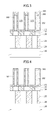
- FIGS. 1 to 8 are cross-sectional views illustrating a method for fabricating a storage node of a semiconductor device according to an exemplary embodiment of the present invention.
- FIGS. 1 to 8 are cross-sectional views illustrating a method for fabricating a storage node of a semiconductor device according to an exemplary embodiment of the present invention.
- a first dielectric layer 120 having an impurity region (not illustrated), is formed on a semiconductor substrate 110 , and a storage node contact 122 is formed in the first dielectric layer 120 to be electrically connected to the impurity region of the semiconductor substrate 110 .
- the storage node contact 122 may be formed of a polysilicon layer.
- a second dielectric layer 130 is formed on the first dielectric layer 120 and the storage node contact 122 , and a landing pad 132 is formed in the second dielectric layer 130 to be electrically connected to the storage node contact 122 .
- the landing pad 132 may reduce the contact resistance of the top surface of the storage node contact 122 .
- the landing pad 132 may be formed of a polysilicon layer, and also may not be formed.
- An etch stop layer 140 is formed on the second dielectric layer 130 and the landing pad 132 .
- the etch stop layer 140 may be formed of a nitride layer with a thickness of approximately 400 ⁇ to approximately 800 ⁇ .
- a sacrificial dielectric layer 150 is formed on the etch stop layer 140 .
- the etch stop layer 140 and the sacrificial dielectric layer 150 may be formed of materials having a sufficient etch selectivity with respect to each other. For example, if the etch stop layer 140 is formed of a nitride layer, the sacrificial dielectric layer 150 may be formed of an oxide layer. In this case, the sacrificial layer 150 is formed of an oxide layer containing carbon components.
- the oxide layer includes a phosphosilicate (PSG) layer or a tetraethyl orthosilicate (TEOS) layer.
- PSG phosphosilicate
- TEOS tetraethyl orthosilicate
- the sacrificial dielectric layer 150 is formed to a thickness of approximately 14,000 ⁇ to approximately 19,000 ⁇ .
- a support layer 160 is formed on the sacrificial dielectric layer 150 .
- the support layer 160 is formed of a nitride layer with a thickness of approximately 400 ⁇ to approximately 15,000 ⁇ .
- an etching process using a mask pattern is performed to remove a portion of the support layer 160 , the sacrificial dielectric layer 150 and the etch stop layer 140 , thereby forming a support pattern 162 , a sacrificial dielectric pattern 152 and an etch stop pattern 142 having a storage node hole 170 therethrough.
- the top surface of the landing pad 132 is exposed by the storage node hole 170 .
- a conductive layer 180 is formed over the resulting structure including the storage node hole 170 .
- the conductive layer 180 may be formed of a metal/metal nitride layer, for example, a titanium/titanium nitride (Ti/TiN) layer.
- the conductive layer 180 may be formed of a single metal layer or a single metal nitride layer.
- a titanium layer may be formed and a thermal treatment process may be performed thereon to form a titanium silicide (TiSi 2 ) layer (not illustrated) on the contact surface between the titanium layer and the landing pad 132 .
- a first cleaning process using a mixed solution of NH 4 OH, H 2 O 2 and H 2 O i.e., an SC-1 (Standard Cleaning-1) cleaning solution
- a second cleaning process using ozone (O 3 ) are performed continuously in a single wafer cleaning equipment.
- the first cleaning process using an SC-1 cleaning solution is performed to remove/reduce the titanium contacting the sacrificial dielectric pattern 152
- the second cleaning process using ozone is performed to remove/reduce the carbon (C) components from the surface of the conductive layer 180 .
- a titanium silicide layer (not illustrated) may also be formed on the contact surface between the titanium layer and the sacrificial dielectric pattern 152 .
- the amount of a titanium source causing a titanium-carbon cluster formed by the subsequent full dip-out process may decrease.
- a certain thickness of the top of the conductive layer 180 is removed to expose the top surface of the support pattern 162 .
- this process may be performed through a chemical mechanical polishing (CMP) process to form a storage node 182 .
- the storage node 182 has an outer wall contacting the outer walls of the support pattern 162 and the sacrificial dielectric pattern 152 , and a bottom surface contacting the landing pad 132 .
- a full dip-out process is performed to remove the sacrificial dielectric pattern 152 .
- a portion (denoted by ‘A’) of the support pattern 162 on the sacrificial pattern 152 may be removed before performing the full dip-out process of the sacrificial dielectric pattern 152 to expose a portion of the sacrificial dielectric pattern 152 .
- an etching solution is supplied to the exposed sacrificial dielectric patterns 152 to remove the sacrificial dielectric patterns 152 .
- the etching solution may include a buffer oxide etchant (BOE).
- BOE buffer oxide etchant
- the metal e.g., titanium (Ti)
- the carbon (C) in the sacrificial dielectric pattern 152 may form a cluster and adhere to the bottom surface and the top surface of the support pattern 162 , as illustrated in FIG. 6 .
- the titanium-carbon cluster 600 should be removed because it becomes a bridge-causing material by acting as an electrical path between the adjacent storage nodes 182 .
- the present invention performs a first cleaning process and a second cleaning process continuously in a single wafer cleaning equipment.
- a first cleaning process using an SC-1 (Standard Cleaning-1) cleaning solution is performed as represented by arrows in FIG. 7 .
- the SC-1 cleaning solution may be a mixed solution of NH 4 OH, H 2 O 2 and H 2 O.
- the volume percentage (vol %) of the mixed solution of NH 4 OH, H 2 O 2 and H 2 O may range from approximately 1:4:20 to approximately 1:5:80.
- the first cleaning process may be performed at room temperature, for example, at temperatures of approximately 20° C. to approximately 30° C.
- the first cleaning process may melt and remove the titanium (Ti) of the titanium-carbon cluster 600 . If the first cleaning process and the second cleaning process are performed after the forming of the titanium silicide layer as described with reference to FIG. 3 , the amount of titanium that is the source material of the titanium-carbon cluster 600 may decrease, thus further enhancing the titanium removal effects in this process.
- a first cleaning process using an SC-1 (Standard Cleaning-1) cleaning solution is performed as represented by arrows.
- the first cleaning process may be performed at room temperatures of approximately 20° C. to approximately 30° C. because it is performed using an SC-1 cleaning solution. Therefore, the titanium may be removed/reduced more efficiently, as compared to the case of using other cleaning solution at high temperatures.
- the cleaning process is performed at high temperatures of approximately 80° C. or more. This may increase the concentration of titanium in a cleaning vessel, thus causing an error in the measurement of the concentration of H 2 O 2 in the SPM cleaning solution. Accordingly, the amount of H 2 O 2 may not be controlled, thus making it difficult to accurately control the titanium-carbon cluster removing process.
- this exemplary embodiment may reduce such a problem because it performs the first cleaning process using an SC-1 cleaning solution at room temperature.
- a plasma nitridation process may be performed to remove the remaining carbon.
- a second cleaning process using ozone is performed as represented by arrows.
- the second cleaning process may be performed at temperatures of approximately 10° C. to approximately 30° C.
- the ozone concentration may range from approximately 5 ppm to approximately 100 ppm.
- the carbon components of the titanium-carbon cluster 600 may be removed/reduced by the second cleaning process.
- the second cleaning process is performed after the first cleaning process.
- the first cleaning process may be performed after the second cleaning process.
- one of the first cleaning process and the second cleaning process may be omitted according to the required design rule.
- the first cleaning process and the second cleaning process are performed continuously in a single wafer cleaning equipment.
- the first cleaning process and the second cleaning process may be performed in a batch-type cleaning equipment according to the required design rule.
- the first cleaning process using an SC-1 cleaning solution and the second cleaning process using ozone are performed after the performing of the dip-out process for removing the sacrificial dielectric pattern, the metal-carbon cluster adhered to the surface of the support layer may be removed/reduced more efficiently.
- a certain portion of the storage node is removed by the first cleaning process and the second cleaning process to facilitate the subsequent dielectric layer deposition, thereby leakage current characteristics of the capacitor may be improved.
Landscapes
- Semiconductor Memories (AREA)
Abstract
Description
Claims (15)
Applications Claiming Priority (2)
| Application Number | Priority Date | Filing Date | Title |
|---|---|---|---|
| KR10-2010-0065590 | 2010-07-07 | ||
| KR1020100065590A KR101185989B1 (en) | 2010-07-07 | 2010-07-07 | Method of fabricating storage node in semiconductor device |
Publications (2)
| Publication Number | Publication Date |
|---|---|
| US20120009790A1 US20120009790A1 (en) | 2012-01-12 |
| US8455360B2 true US8455360B2 (en) | 2013-06-04 |
Family
ID=45438909
Family Applications (1)
| Application Number | Title | Priority Date | Filing Date |
|---|---|---|---|
| US13/073,348 Active 2032-01-16 US8455360B2 (en) | 2010-07-07 | 2011-03-28 | Method for fabricating storage node of semiconductor device |
Country Status (2)
| Country | Link |
|---|---|
| US (1) | US8455360B2 (en) |
| KR (1) | KR101185989B1 (en) |
Citations (8)
| Publication number | Priority date | Publication date | Assignee | Title |
|---|---|---|---|---|
| US6696338B2 (en) | 2001-12-28 | 2004-02-24 | Hynix Semiconductor Inc. | Method for forming ruthenium storage node of semiconductor device |
| US20040110340A1 (en) * | 2002-06-29 | 2004-06-10 | Kim Gyu Hyun | Method for manufacturing semiconductor device |
| KR20050024979A (en) | 2003-09-05 | 2005-03-11 | 삼성전자주식회사 | Method of forming capacitor |
| KR20050091120A (en) | 2004-03-10 | 2005-09-15 | 주식회사 하이닉스반도체 | Method for forming capacitor of semiconductor device |
| US20060141202A1 (en) * | 2003-03-24 | 2006-06-29 | Taeko Suenaga | Information recording medium and manufacturing method thereof |
| US20060216884A1 (en) * | 2005-03-23 | 2006-09-28 | Choi Hyung B | Methd for forming capacitor of semiconductor device |
| KR20100044558A (en) | 2008-10-22 | 2010-04-30 | 주식회사 하이닉스반도체 | Method of manufacturing semiconductor device |
| US20100325853A1 (en) | 2009-06-30 | 2010-12-30 | Jie Seok-Ho | Method for fabricating capacitor |
-
2010
- 2010-07-07 KR KR1020100065590A patent/KR101185989B1/en active Active
-
2011
- 2011-03-28 US US13/073,348 patent/US8455360B2/en active Active
Patent Citations (8)
| Publication number | Priority date | Publication date | Assignee | Title |
|---|---|---|---|---|
| US6696338B2 (en) | 2001-12-28 | 2004-02-24 | Hynix Semiconductor Inc. | Method for forming ruthenium storage node of semiconductor device |
| US20040110340A1 (en) * | 2002-06-29 | 2004-06-10 | Kim Gyu Hyun | Method for manufacturing semiconductor device |
| US20060141202A1 (en) * | 2003-03-24 | 2006-06-29 | Taeko Suenaga | Information recording medium and manufacturing method thereof |
| KR20050024979A (en) | 2003-09-05 | 2005-03-11 | 삼성전자주식회사 | Method of forming capacitor |
| KR20050091120A (en) | 2004-03-10 | 2005-09-15 | 주식회사 하이닉스반도체 | Method for forming capacitor of semiconductor device |
| US20060216884A1 (en) * | 2005-03-23 | 2006-09-28 | Choi Hyung B | Methd for forming capacitor of semiconductor device |
| KR20100044558A (en) | 2008-10-22 | 2010-04-30 | 주식회사 하이닉스반도체 | Method of manufacturing semiconductor device |
| US20100325853A1 (en) | 2009-06-30 | 2010-12-30 | Jie Seok-Ho | Method for fabricating capacitor |
Also Published As
| Publication number | Publication date |
|---|---|
| US20120009790A1 (en) | 2012-01-12 |
| KR20120004879A (en) | 2012-01-13 |
| KR101185989B1 (en) | 2012-09-25 |
Similar Documents
| Publication | Publication Date | Title |
|---|---|---|
| CN114823539B (en) | Method for manufacturing semiconductor structure and semiconductor structure | |
| KR102403619B1 (en) | Semiconductor device and method for manufacturing the same | |
| JP2002261161A (en) | Method for manufacturing semiconductor device | |
| CN104979163A (en) | Capacitor and its manufacturing method | |
| US9018733B1 (en) | Capacitor, storage node of the capacitor, and method of forming the same | |
| US8728898B2 (en) | Method for fabricating semiconductor device | |
| US11688611B2 (en) | Method for manufacturing a capacitor | |
| US7749856B2 (en) | Method of fabricating storage node with supported structure of stacked capacitor | |
| US20090258469A1 (en) | Method of manufacturing semiconductor device | |
| US20060115954A1 (en) | Methods of manufacturing a capacitor and a semiconductor device | |
| TWI817793B (en) | Method of forming semiconductor structure | |
| US8455360B2 (en) | Method for fabricating storage node of semiconductor device | |
| WO2019151043A1 (en) | Dram and production method of same | |
| CN117596862A (en) | Semiconductor structures and manufacturing methods | |
| TWI841201B (en) | Semiconductor structure and method of forming the same | |
| TWI892595B (en) | Method of forming semiconductor structure | |
| JP3816494B2 (en) | Dry etching method and semiconductor device manufacturing method | |
| TWI914010B (en) | Method for fabricating a capacitor | |
| TWI833494B (en) | Semiconductor structure and method of forming the same | |
| KR101003490B1 (en) | Capacitor Formation Method of Semiconductor Device | |
| JP2005064505A (en) | Semiconductor capacitor structure and manufacturing method thereof | |
| KR100914290B1 (en) | Capacitor Formation Method of Semiconductor Device | |
| KR100762869B1 (en) | Capacitor Formation Method | |
| KR100884345B1 (en) | Capacitor Formation Method of Semiconductor Device | |
| TW202614784A (en) | Method for fabricating a capacitor |
Legal Events
| Date | Code | Title | Description |
|---|---|---|---|
| AS | Assignment |
Owner name: HYNIX SEMICONDUCTOR INC., KOREA, REPUBLIC OF Free format text: ASSIGNMENT OF ASSIGNORS INTEREST;ASSIGNORS:YOON, HYO GEUN;PARK, JI YONG;LEE, SUN JIN;REEL/FRAME:026032/0635 Effective date: 20110323 |
|
| FEPP | Fee payment procedure |
Free format text: PAYOR NUMBER ASSIGNED (ORIGINAL EVENT CODE: ASPN); ENTITY STATUS OF PATENT OWNER: LARGE ENTITY |
|
| STCF | Information on status: patent grant |
Free format text: PATENTED CASE |
|
| FPAY | Fee payment |
Year of fee payment: 4 |
|
| MAFP | Maintenance fee payment |
Free format text: PAYMENT OF MAINTENANCE FEE, 8TH YEAR, LARGE ENTITY (ORIGINAL EVENT CODE: M1552); ENTITY STATUS OF PATENT OWNER: LARGE ENTITY Year of fee payment: 8 |
|
| AS | Assignment |
Owner name: SK HYNIX INC., KOREA, REPUBLIC OF Free format text: CHANGE OF NAME;ASSIGNOR:HYNIX-SEMICONDUCTOR INC.;REEL/FRAME:067328/0814 Effective date: 20120730 |
|
| AS | Assignment |
Owner name: MIMIRIP LLC, TEXAS Free format text: ASSIGNMENT OF ASSIGNORS INTEREST;ASSIGNOR:SK HYNIX INC.;REEL/FRAME:067369/0832 Effective date: 20240311 |
|
| AS | Assignment |
Owner name: SK HYNIX INC., KOREA, REPUBLIC OF Free format text: CORRECTIVE ASSIGNMENT TO CORRECT THE ASSIGNEE IS HYNIX SEMICONDUCTOR INC. NOT HYNIX-SEMICONDUCTOR INC. THERE IS NO HYPHEN IN THE NAME. PREVIOUSLY RECORDED ON REEL 67328 FRAME 814. ASSIGNOR(S) HEREBY CONFIRMS THE CHANGE OF NAME;ASSIGNOR:HYNIX SEMICONDUCTOR INC.;REEL/FRAME:067412/0482 Effective date: 20120730 |
|
| MAFP | Maintenance fee payment |
Free format text: PAYMENT OF MAINTENANCE FEE, 12TH YEAR, LARGE ENTITY (ORIGINAL EVENT CODE: M1553); ENTITY STATUS OF PATENT OWNER: LARGE ENTITY Year of fee payment: 12 |