US8451861B2 - Method for requesting bandwidth allocation and detecting service flow in communication system - Google Patents
Method for requesting bandwidth allocation and detecting service flow in communication system Download PDFInfo
- Publication number
- US8451861B2 US8451861B2 US12/203,065 US20306508A US8451861B2 US 8451861 B2 US8451861 B2 US 8451861B2 US 20306508 A US20306508 A US 20306508A US 8451861 B2 US8451861 B2 US 8451861B2
- Authority
- US
- United States
- Prior art keywords
- cid
- private
- field
- indicating
- region
- Prior art date
- Legal status (The legal status is an assumption and is not a legal conclusion. Google has not performed a legal analysis and makes no representation as to the accuracy of the status listed.)
- Expired - Fee Related, expires
Links
Images




Classifications
-
- H—ELECTRICITY
- H04—ELECTRIC COMMUNICATION TECHNIQUE
- H04W—WIRELESS COMMUNICATION NETWORKS
- H04W74/00—Wireless channel access
- H04W74/002—Transmission of channel access control information
- H04W74/004—Transmission of channel access control information in the uplink, i.e. towards network
-
- H—ELECTRICITY
- H04—ELECTRIC COMMUNICATION TECHNIQUE
- H04W—WIRELESS COMMUNICATION NETWORKS
- H04W72/00—Local resource management
- H04W72/04—Wireless resource allocation
- H04W72/044—Wireless resource allocation based on the type of the allocated resource
- H04W72/0453—Resources in frequency domain, e.g. a carrier in FDMA
-
- H—ELECTRICITY
- H04—ELECTRIC COMMUNICATION TECHNIQUE
- H04L—TRANSMISSION OF DIGITAL INFORMATION, e.g. TELEGRAPHIC COMMUNICATION
- H04L47/00—Traffic control in data switching networks
- H04L47/70—Admission control; Resource allocation
-
- H—ELECTRICITY
- H04—ELECTRIC COMMUNICATION TECHNIQUE
- H04L—TRANSMISSION OF DIGITAL INFORMATION, e.g. TELEGRAPHIC COMMUNICATION
- H04L47/00—Traffic control in data switching networks
- H04L47/70—Admission control; Resource allocation
- H04L47/82—Miscellaneous aspects
- H04L47/824—Applicable to portable or mobile terminals
-
- H—ELECTRICITY
- H04—ELECTRIC COMMUNICATION TECHNIQUE
- H04L—TRANSMISSION OF DIGITAL INFORMATION, e.g. TELEGRAPHIC COMMUNICATION
- H04L47/00—Traffic control in data switching networks
- H04L47/70—Admission control; Resource allocation
- H04L47/82—Miscellaneous aspects
- H04L47/827—Aggregation of resource allocation or reservation requests
-
- H—ELECTRICITY
- H04—ELECTRIC COMMUNICATION TECHNIQUE
- H04W—WIRELESS COMMUNICATION NETWORKS
- H04W28/00—Network traffic management; Network resource management
- H04W28/02—Traffic management, e.g. flow control or congestion control
- H04W28/0273—Traffic management, e.g. flow control or congestion control adapting protocols for flow control or congestion control to wireless environment, e.g. adapting transmission control protocol [TCP]
-
- H—ELECTRICITY
- H04—ELECTRIC COMMUNICATION TECHNIQUE
- H04W—WIRELESS COMMUNICATION NETWORKS
- H04W76/00—Connection management
- H04W76/10—Connection setup
- H04W76/11—Allocation or use of connection identifiers
-
- H—ELECTRICITY
- H04—ELECTRIC COMMUNICATION TECHNIQUE
- H04W—WIRELESS COMMUNICATION NETWORKS
- H04W28/00—Network traffic management; Network resource management
- H04W28/16—Central resource management; Negotiation of resources or communication parameters, e.g. negotiating bandwidth or QoS [Quality of Service]
- H04W28/18—Negotiating wireless communication parameters
- H04W28/20—Negotiating bandwidth
-
- H—ELECTRICITY
- H04—ELECTRIC COMMUNICATION TECHNIQUE
- H04W—WIRELESS COMMUNICATION NETWORKS
- H04W72/00—Local resource management
- H04W72/20—Control channels or signalling for resource management
- H04W72/21—Control channels or signalling for resource management in the uplink direction of a wireless link, i.e. towards the network
-
- H—ELECTRICITY
- H04—ELECTRIC COMMUNICATION TECHNIQUE
- H04W—WIRELESS COMMUNICATION NETWORKS
- H04W8/00—Network data management
- H04W8/26—Network addressing or numbering for mobility support
Definitions
- the present invention relates to a communication system. More particularly, the present invention relates to a method for requesting UpLink (UL) bandwidth allocation by a Mobile Station (MS), and allocating the uplink bandwidth by a Base Station (BS) in a communication system.
- UL UpLink
- MS Mobile Station
- BS Base Station
- a Base Station When a bandwidth allocation is received from a Mobile Station (MS) through an uplink bandwidth allocation request, a Base Station (BS) should rapidly allocate the bandwidth.
- An uplink bandwidth allocation request is performed for each Connection IDentifier (CID) of an MS, and the bandwidth allocation by the BS is performed for each MS. That is, an MS requests allocation of a bandwidth required according to each CID, and a BS collects bandwidths requested according to each CID and allocates bandwidths according to each MS.
- CID Connection IDentifier
- a polling scheme which is a representative scheme for requesting uplink bandwidth allocation by an MS, will now be described.
- the polling scheme is used to request bandwidth allocation by transmitting a 6-byte bandwidth request header, in which information about an uplink bandwidth required for a corresponding CID is recorded, at a preset polling interval according to each CID of the MSs.
- the information about a bandwidth may be, for example, the amount of bandwidth.
- the polling scheme is used for service that requires bandwidths of various sizes during a certain interval, or for service that requires bandwidths of various sizes during various intervals.
- FIG. 1 is a view illustrating the format of a conventional uplink bandwidth request header.
- the uplink bandwidth request header includes a Header Type (HT) field 101 , an EnCoding (EC) field 103 , a type field 105 , a Bandwidth Request (BR) field 107 and 109 , a CID field 111 and 113 , and a Header Check Sequence (HCS) field 115 .
- HT Header Type
- EC EnCoding
- BR Bandwidth Request
- HCS Header Check Sequence
- An MS can request bandwidth allocation by recording a CID, i.e. a Transport CID, which requests bandwidth allocation, in the CID field 111 and 113 of the uplink bandwidth request header shown in FIG. 1 , and then transmits the uplink bandwidth request header to a BS.
- the Transport CID is allocated in one-to-one correspondence with a service flow of the BS, which manages the MS, and the Transport CID is unique only to the BS.
- the Transport CID of the MS collides with a Transport CID allocated to MSs in the area covered by the target BS.
- the target BS performs a separate CID update operation to allocate a new Transport CID to the MS.
- the Transport CID is unique only to a corresponding BS
- the target BS since the Transport CID is unique only to a corresponding BS, when an MS having a Transport CID is handed over from the current serving BS to a target BS, the target BS must perform a CID update operation for the MS. Therefore, there is a problem in that resources are wasted due to a CID update that must be performed whenever a handover is performed.
- An aspect of the present invention is to address at least the above-mentioned problems and/or disadvantages and to provide at least the advantages described below. Accordingly, an aspect of the present invention is to provide a method for requesting bandwidth allocation by a mobile station, and allocating bandwidth by a base station according to the request of the mobile station so that waste of resources due to a CID update can be prevented in a communication system.
- Another aspect of the present invention is to provide a method for requesting bandwidth allocation for a plurality of CIDs at the same time, and allocating bandwidth by a base station according to the request of the mobile station in a communication system.
- a method for requesting bandwidth allocation by a mobile station in a communication system includes detecting at least one CID, bandwidth allocation for which is to be requested, when the number of the at least one detected CID equals one, generating a bandwidth request header, which includes a region for indicating a first CID representing basic information for identification of the mobile station, a region for indicating a ranking of the detected CID, and a region for indicating information about bandwidth requested for the detected CID and transmitting the bandwidth request header to a base station.
- a method for requesting bandwidth allocation by a mobile station in a communication system includes detecting at least one CID, bandwidth allocation for which is to be requested, when the detected at least one CID comprises a plurality of CIDs, generating a bandwidth request header, which includes a subtype region for indicating that the detected CID is plural in number, a region for indicating a basic CID for identification of the mobile station, a region for indicating a bitmap that represents the detected CIDs in a list in which CIDs of the mobile station are arranged according to a rule, and a region for indicating information about bandwidth requested for the detected CIDs and transmitting the bandwidth request header to a base station.
- a method for detecting a service flow, to which a MAC header and a MAC PDU concatenated with the MAC header belong, in a communication system includes receiving a message, which includes a MAC header, an extended subheader group length field, an extended subheader type field, and an extended subheader body field corresponding to the extended subheader type field, wherein a private CID index is indicated in the extended subheader body field and detecting a service flow, to which the MAC header and a MAC PDU concatenated with the MAC header belong, according to the private CID index indicated in the extended subheader body field of the message, wherein a private CID indicated by the private CID index is allocated such that a mobile station is uniquely identified in the communication system.
- a method for detecting a service flow, to which a MAC header and a MAC PDU concatenated with the MAC header belong, in a communication system includes receiving a message including a MAC header and a private CID field, wherein a private CID index, to which the MAC header and a MAC PDU concatenated with the MAC header belong, is indicated and detecting a service flow, to which the MAC header and a MAC PDU concatenated with the MAC header belong, according to the private CID index indicated in the private CID field of the message, wherein a private CID indicated by the private CID index is allocated such that a mobile station is uniquely identified in the communication system.
- FIG. 1 is a view illustrating the format of a conventional uplink bandwidth request header
- FIG. 2 is a view illustrating the format of an uplink bandwidth request header in a communication system according to an exemplary embodiment of the present invention
- FIG. 3 is a view illustrating an operation of determining a value recorded in a private CID index field according to an exemplary embodiment of the present invention
- FIG. 4 is a view illustrating the format of an uplink bandwidth request header in a communication system according to an exemplary embodiment of the present invention
- FIG. 5 is a view illustrating the format of an uplink bandwidth request header in a communication system according to an exemplary embodiment of the present invention
- FIG. 6 is a view illustrating an operation of determining a value recorded in the bandwidth request CID MAP field according to an exemplary embodiment of the present invention
- FIG. 7 is a view illustrating the format of an exemplary generic MAC header
- FIG. 8 is a view illustrating the format of an exemplary extended subheader group
- FIG. 9 is a view illustrating the format of a first message in a communication system according to an exemplary embodiment of the present invention.
- FIG. 10 is a view illustrating the format of a second message in a communication system according to an exemplary embodiment of the present invention.
- Exemplary embodiments of the present invention propose a method in which a Mobile Station (MS) requests bandwidth allocation by a combination of a basic Connection IDentifier (CID) and a private CID, and a Base Station (BS) allocates a bandwidth according to the request of the MS in a communication system.
- the basic CID represents a CID for distinguishing each MS from the others
- the private CID represents a CID newly proposed by exemplary embodiments of the present invention.
- exemplary embodiments of the present invention propose a method in which an MS requests bandwidth allocation for a plurality of CIDs at the same time, and a BS allocates a bandwidth according to the request of the mobile station in a communication system.
- exemplary embodiments of the present invention propose a method in which an MS and a BS detect a service flow according to use of a private CID.
- the private CID is unique only in each MS so that the same CID can be allocated even though different service flows, according to a communication service provision between a BS and an MS, are used. Therefore, although an MS having such a private CID moves from the coverage area of the current serving BS to the coverage area of a target BS through a handover or the like, the pre-allocated private CID can be continuously used, so that the target BS has no need to perform a separate CID update for allocating a new CID.
- MAC Media Access Control
- the uplink bandwidth request header proposed by exemplary embodiments of the present invention can be formed by borrowing and using any reserved field.
- FIG. 2 is a view illustrating the format of an uplink bandwidth request header in a communication system according to an exemplary embodiment of the present invention.
- the uplink bandwidth request header shown in FIG. 2 is used when there is one service flow for which to request bandwidth allocation, and includes a Header Type (HT) field 201 , an EnCoding (EC) field 203 , a Type field 205 , a private CID index field 207 , a Bandwidth Request (BR) field 209 and 211 , a basic CID field 213 and 215 , and a Header Check Sequence (HCS) field 217 .
- HT Header Type
- EC EnCoding
- Type field 205 a private CID index field 207
- BR Bandwidth Request
- HCS Header Check Sequence
- An MS requests bandwidth allocation by transmitting the uplink bandwidth request header shown in FIG. 2 to a BS.
- the BS evaluates the private CID index field 207 and the basic CID field 213 and 215 in the uplink bandwidth request header, and detects a service flow, a bandwidth allocation for which has been requested from the MS. Then, for the detected service flow, the BS allocates the MS bandwidth according to the bandwidth amount information recorded in the bandwidth request field 209 and 211 .
- the private CID index field 207 is defined to have a size of “n” bits
- the BR field 209 is defined to have a size of “13-n” bits, wherein the “n” is determined by equation 1 below.
- n min( M,m ) (1)
- M represents a value that varies depending on the minimum value of the size of the bandwidth request field 209 and 211 .
- M may have a value of “10.”
- m represents a minimum value among integers that satisfy a condition that “2 m ⁇ k,” wherein “k” represents a total number of CIDs possessed by an MS corresponding to a basic CID.
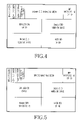
- FIG. 3 is a view illustrating an operation of determining a value recorded in the private CID index field 207 according to an exemplary embodiment of the present invention.
- Mobile station # 1 303 corresponding to basic CID # 100 301 , includes primary management CID # 0 305 , secondary management CID # 1 307 , and service flow # 2 309 to service flow # 7 319 , wherein it is assumed that different service flows are allocated different private CIDs.
- the MS # 1 303 When it is assumed that the MS # 1 303 requests bandwidth allocation for service flow # 6 317 from among the service flows which the MS # 1 303 possesses, the MS # 1 303 first detects the ranking of the service flow # 6 317 from a list, in which the primary management CID # 0 305 , the secondary management CID # 1 307 , and the service flows are arranged according to a rule. Then, the MS # 1 303 records the detected ranking in the private CID index field 207 of the uplink bandwidth request header, and transmits the uplink bandwidth request header to a BS. In this case, the value recorded in the private CID index field 207 corresponds to “6.”
- the BS receives the uplink bandwidth request header, and then checks the value of the private CID index field 207 . Accordingly, the BS can identify that it is requested to allocate bandwidth for a service flow corresponding to a sixth ranking, that is, bandwidth for the service flow # 6 317 , in the list, in which the includes primary management CID # 0 305 , the secondary management CID # 1 307 , and the service flows are arranged according to the rule.
- FIG. 3 illustrates a method of determining a private CID index value by the list in which the primary management CID, the secondary management CID, and the service flows are arranged according to the rule
- the private CID index value may be determined by a list in which only the plurality of service flows, except for the primary management CID and the secondary management CID, are arranged according to a rule.
- FIG. 4 is a view illustrating the format of an uplink bandwidth request header in a communication system according to an exemplary embodiment of the present invention.
- the uplink bandwidth request header shown in FIG. 4 is used when there is one service flow for which to request bandwidth allocation, and includes an HT field 401 , an EC field 403 , a Type field 405 , a Sub-type field 407 , a private CID index field 409 , a bandwidth request field 411 and 413 , a basic CID field 415 and 417 , and an HCS field 419 .
- an MS requests bandwidth allocation by transmitting the uplink bandwidth request header shown in FIG. 4 to a BS.
- the BS checks the Sub-type field 407 , the private CID index field 409 , and the basic CID field 415 and 417 in the uplink bandwidth request header, and detects a service flow, bandwidth allocation for which has been requested from the MS.
- the private CID index field 409 is defined to have a size of “n” bits, and the bandwidth request field 411 is defined to have a size of “12-n” bits, wherein the “n” is determined by equation 1 above. Since a method of determining a value recorded in the private CID index field 409 is the same as the method of determining a value recorded in the private CID index field 207 , described above with reference to FIG. 3 , a detailed description thereof will be omitted.
- FIG. 5 is a view illustrating the format of an uplink bandwidth request header in a communication system according to an exemplary embodiment of the present invention.
- the uplink bandwidth request header shown in FIG. 5 is used when there are a plurality of service flows for which to request bandwidth allocation, and includes an HT field 501 , an EC field 503 , a Type field 505 , a Sub-type field 507 , a Bandwidth Request (BR) CID MAP field 509 , a Bandwidth Request (BR) field 511 and 513 , a basic CID field 515 and 517 , and an HCS field 519 .
- BR Bandwidth Request
- BR Bandwidth Request
- an MS requests bandwidth allocation by transmitting the uplink bandwidth request header shown in FIG. 5 to a BS.
- the BS checks the Sub-type field 507 , the BR CID MAP field 509 , and the basic CID field 515 and 517 in the uplink bandwidth request header, and detects service flows, bandwidth allocation for which has been requested from the MS.
- the BS can recognize that the MS has requested bandwidth allocation for a plurality of service flows.
- the BS allocates to the MS bandwidth for the detected service flows according to bandwidth request information recorded in the BR field 511 and 513 .
- the bandwidth amount information represents the total sum of the amount of bandwidth required for service flows, bandwidth allocation for which has been requested by the MS.
- the bandwidth request CID MAP field 509 is defined to have a size of “n” bits, and the bandwidth request field 511 is defined to have a size of “12-n” bits, wherein the “n” is determined by equation 1 above.
- FIG. 6 is a view illustrating an operation of determining a value recorded in the bandwidth request CID MAP field 509 according to an exemplary embodiment of the present invention.
- Mobile station # 2 603 corresponding to basic CID # 200 601 , includes primary management CID # 0 605 , secondary management CID # 1 607 , and service flow # 2 609 to service flow # 7 619 , wherein it is assumed that different service flows are allocated different private CIDs.
- the MS # 2 603 When it is assumed that the MS # 2 603 requests bandwidth allocation for each of service flow # 2 609 , service flow # 4 613 , service flow # 5 615 , and service flow # 7 619 among the service flows which the MS # 2 603 possesses, the MS # 2 603 first sets bits corresponding to the service flows, a bandwidth allocation request for which is to be made, to “1,” while setting bits corresponding to service flows, a bandwidth allocation request for which is not to be made, to “0” in a list, in which all the service flows possessed by the MS are arranged according to a rule, thereby generating a bitmap.
- the MS # 2 603 records the generated bitmap in the bandwidth request CID MAP field 509 of the uplink bandwidth request header, and transmits the uplink bandwidth request header to a BS.
- a bitmap value recorded in the bandwidth request CID MAP field 509 corresponds to “101101.”
- the BS when receiving the uplink bandwidth request header, the BS can identify that it is requested to allocate bandwidth for a plurality of service flows, that is, for service flow # 2 609 , service flow # 4 613 , service flow # 5 615 , and service flow # 7 619 , corresponding to bits set to “1” in the bandwidth request CID MAP field 509 .
- a method for solving a problem that a BS cannot distinguish a private CID of each MS from the other private CIDs due to the characteristics of the private CID when the MS has transmitted a MAC header with a combination of a basic CID and the private CID according to an exemplary embodiment of the present invention.
- the following description will be given about a method for receiving, by the BS, a general MAC header (hereinafter, referred to as a “generic MAC header”) newly defined in exemplary embodiments of the present invention, and detecting a service flow, to which the generic MAC header and a MAC PDU concatenated with the generic MAC header belong.
- FIG. 7 is a view illustrating the format of a generic MAC header according to an exemplary embodiment of the present invention.
- the generic MAC header includes an HT field 701 , an EC field 703 , a Type field 705 , an Extended Subheader Field (ESF) 707 for indicating whether or not a subheader exists, a Cycle Redundancy Check (CRC) indicator field 709 for indicating a CRC error, an Encryption Key Sequence (EKS) field 711 for specifying information about a key used for payload encryption, a Reserved (Rsvd) field 713 , a LENgth (LEN) field 715 and 717 , a CID field 719 and 721 , and an HCS field 723 .
- ESF Extended Subheader Field
- CRC Cycle Redundancy Check
- EKS Encryption Key Sequence
- An exemplary method in which a BS receives a generic MAC header newly defined in the present invention and detects a service flow, to which a generic MAC header and a MAC PDU concatenated with the generic MAC header belong including, for example, a method using the ESF 707 and a method using the reserved field 713 .
- an MS defines a new type of extended subheader.
- the bit value of the ESF 707 in the generic MAC header is set to “1.”
- the ESF 707 is a field for indicating whether or not an extended subheader exists, as described above.
- an MS concatenates an extended subheader proposed in exemplary embodiments of the present invention with the generic MAC header, and then transmits the generic MAC header including the extended subheader to a base station.
- FIG. 8 is a view illustrating the format of an exemplary extended subheader group.
- the extended subheader includes an extended subheader group length field 801 for specifying information about the entire length of the extended subheader, a reserved (Rsvd) field 803 , an extended subheader type-1 field 805 , an extended subheader body-1 field 807 , etc.
- 128 types of the extended subheader may be defined according to the value of the extended subheader type field 805 .
- a new extended subheader body corresponding to the new type of extended subheader is also defined.
- the extended subheader may be distinguished according to values of the extended subheader type field 805 in uplink and downlink.
- types of extended subheader distinguished according to values of the extended subheader type field 805 in uplink are as shown in Table 1 below.
- types of extended subheader distinguished according to values of the extended subheader type field 805 in downlink are as shown in Table 2 below.
- a reserved region for cases where the extended subheader type field 805 has a value within a range of 6 to 127 in uplink, and a reserved region for cases where the extended subheader type field 805 has a value within a range of 5 to 127 in downlink are newly defined. Therefore, in order to enable a BS to distinguish a specific service flow, an MS concatenates the newly defined extended subheader with a generic MAC header, in which the bit value of the ESF 707 is set to “1,” and then transmits the generic MAC header to the base station.
- the format of a message obtained by concatenating the newly defined extended subheader with a generic MAC header will be described with reference to FIG. 9 .
- the message, in which an extended subheader is concatenated with a generic MAC header, transmitted either from an MS to a BS, or from a BS to an MS will be defined as a first message, for convenience of description.
- FIG. 9 is a view illustrating the format of the first message in a communication system according to an exemplary embodiment of the present invention.
- the first message includes a generic MAC header 900 , an extended subheader group length field 930 , a conventional extended subheader 940 , and an extended subheader 950 proposed according to an exemplary embodiment of the present invention.
- the generic MAC header 900 includes an HT field 901 , an EC field 903 , a Type field 905 , an ESF 907 , a CI field 909 , an EKS field 911 , a reserved field 913 , a LENgth field 915 and 917 , a CID field 919 and 921 , and an HCS field 923 , wherein the bit value of the ESF 907 is set to “1.”
- the extended subheader 950 proposed according to an exemplary embodiment of the present invention includes a reserved field 951 , an extended subheader type-6 field 953 , and an extended subheader body-6 field 955 , wherein a private CID index value is recorded in the extended subheader body-6 field 955 , and the size of the extended subheader body-6 field 955 is defined as 8 bits. Since a method of determining a value recorded in the extended subheader body-6 field 955 is the same as the method of determining a value recorded in the private CID index field 207 , described above with reference to FIG. 3 , a detailed description thereof will be omitted. Although FIG.
- the extended subheader type field 953 has a value of “6” as an example, it is possible to use any value among the values of the extended subheader type field 953 corresponding to reserved regions in Tables 1 and 2, that is, any value within a range of 6 to 127, which are values of the extended subheader type field 953 in uplink, and a range of 5 to 127, which are values of the extended subheader type field 953 in downlink.
- an MS transmits the first message shown in FIG. 9 to a BS, and the BS receives the first message, checks the value of the extended subheader body-6 field 955 , and the CID field 919 and 921 in the first message, and detects a service flow, to which the generic MAC header and a MAC PDU concatenated with the generic MAC header belong in the MS. Also, a BS transmits the first message shown in FIG.
- the MS receives the first message, checks the value of the extended subheader body-6 field 955 , and the CID field 919 and 921 in the first message, and detects a service flow, to which the generic MAC header and a MAC PDU concatenated with the generic MAC header belong in the MS.
- an MS defines the reserved field 713 as a private CID indicator field.
- the defined private CID indicator field is set to “1,” an MS concatenates a private CID indicator field proposed in exemplary embodiments of the present invention with the generic MAC header, and then transmits the generic MAC header including the private CID indicator field to a base station.
- the MS concatenates a private CID indicator field proposed in the present invention with the generic MAC header, in which the CID indicator field is set to “1,” and then transmits the generic MAC header including the private CID indicator field.
- the format of a message obtained by concatenating a private CID indicator field proposed according to an exemplary embodiment of the present invention with a generic MAC header will be described with reference to FIG. 10 .
- the transmission message, in which a private CID indicator field is concatenated with a generic MAC header will be defined as a second message, for convenience of description.
- FIG. 10 is a view illustrating the format of the second message in a communication system according to an exemplary embodiment of the present invention.
- the second message includes a generic MAC header 1000 and a private CID index field 1030 according to an exemplary embodiment of the present invention.
- the generic MAC header 1000 includes an HT field 1001 , an EC field 1003 , a Type field 1005 , an ESF 1007 , a CI field 1009 , an EKS field 1011 , a private CID indicator field 1013 , a length field 1015 and 1017 , a CID field 1019 and 1021 , and an HCS field 1023 , wherein the bit value of the private CID indicator field 1013 is set to “1.”
- an MS transmits the second message shown in FIG. 10 to a BS, and the BS receives the second message, checks the value of the private CID index field 1030 , and the CID field 1019 and 1021 in the second message, and detects a service flow, to which the generic MAC header and a MAC PDU concatenated with the generic MAC header belong in the MS.
- a BS transmits the second message shown in FIG. 10 to a MS, and the MS receives the second message, checks the value of the private CID index field 1030 , and the CID field 1019 and 1021 in the second message, and detects a service flow, to which the generic MAC header and a MAC PDU concatenated with the generic MAC header belong in the MS.
- an MS requests bandwidth allocation by a combination of a basic CID and a private CID, so that it is possible to omit a CID update process generated at the time of a handover. As a result, waste of resources due to the CID update can be prevented.
- an MS can request bandwidth allocation for a plurality of CIDs at the same time, so that the system overhead due to bandwidth allocation requests is reduced.
Landscapes
- Engineering & Computer Science (AREA)
- Computer Networks & Wireless Communication (AREA)
- Signal Processing (AREA)
- Quality & Reliability (AREA)
- Mobile Radio Communication Systems (AREA)
Abstract
Description
n=min(M,m) (1)
| TABLE 1 | ||
| Extended | ||
| subheader | Extended subchannel | |
| type | Name | body size [byte] |
| 0 | SDU_SN |
1 |
| 1 | DL sleep control extended |
3 |
| 2 | Feedback request extended |
3 |
| 3 | SN request extended |
1 |
| 4 | PDU SN(short) |
1 |
| 5 | PDU SN(long) |
2 |
| 6~127 | Reserved | — |
| TABLE 2 | ||
| Extended | ||
| Extended | subchannel | |
| subheader | body | |
| type | Name | size [byte] |
| 0 | MIMO mode feedback extended |
1 |
| 1 | UL Tx power report extended |
1 |
| 2 | Mini-feedback |
2 |
| 3 | PDU SN(short) |
1 |
| 4 | PDU SN(long) |
2 |
| 5~127 | Reserved | — |
Claims (13)
n=min(M,m),
n=min(M,m),
n=min(M,m),
Applications Claiming Priority (4)
| Application Number | Priority Date | Filing Date | Title |
|---|---|---|---|
| KR20070092546 | 2007-09-12 | ||
| KR2007-0092546 | 2007-09-12 | ||
| KR1020070136686A KR101447288B1 (en) | 2007-09-12 | 2007-12-24 | Methods for requesting bandwidth allocation and detecting service flow in a communication system |
| KR2007-0136686 | 2007-12-24 |
Publications (2)
| Publication Number | Publication Date |
|---|---|
| US20090069024A1 US20090069024A1 (en) | 2009-03-12 |
| US8451861B2 true US8451861B2 (en) | 2013-05-28 |
Family
ID=40695142
Family Applications (1)
| Application Number | Title | Priority Date | Filing Date |
|---|---|---|---|
| US12/203,065 Expired - Fee Related US8451861B2 (en) | 2007-09-12 | 2008-09-02 | Method for requesting bandwidth allocation and detecting service flow in communication system |
Country Status (4)
| Country | Link |
|---|---|
| US (1) | US8451861B2 (en) |
| EP (1) | EP2198534A1 (en) |
| KR (1) | KR101447288B1 (en) |
| WO (1) | WO2009035230A1 (en) |
Families Citing this family (7)
| Publication number | Priority date | Publication date | Assignee | Title |
|---|---|---|---|---|
| KR101447288B1 (en) * | 2007-09-12 | 2014-10-07 | 삼성전자주식회사 | Methods for requesting bandwidth allocation and detecting service flow in a communication system |
| US9270457B2 (en) * | 2008-12-31 | 2016-02-23 | Intel Corporation | Optimizing security bits in a media access control (MAC) header |
| WO2010095882A2 (en) * | 2009-02-20 | 2010-08-26 | Samsung Electronics Co., Ltd. | Method and system for managing connection payload information in medium access control protocol data unit |
| US8259663B2 (en) * | 2009-05-01 | 2012-09-04 | Qualcomm Incorporated | Methods and systems using efficient ranging message transmission during initial ranging |
| CN102783237A (en) * | 2010-03-01 | 2012-11-14 | 交互数字专利控股公司 | Method and apparatus for performing hybrid per station and per flow uplink allocations |
| KR101678814B1 (en) * | 2010-04-12 | 2016-11-23 | 삼성전자주식회사 | Method and apparatus for supporting cooperative handover in broadband wireless communication system |
| EP2564526B1 (en) * | 2010-04-30 | 2020-04-01 | Samsung Electronics Co., Ltd | Methods of encoding and decoding control information in a medium access control protocol data unit |
Citations (7)
| Publication number | Priority date | Publication date | Assignee | Title |
|---|---|---|---|---|
| US6687225B1 (en) * | 1998-11-10 | 2004-02-03 | Fujitsu Limited | Bandwidth control apparatus |
| US20060203712A1 (en) | 2005-03-09 | 2006-09-14 | Samsung Electronics Co., Ltd. | System and method for performing ranging process in a communication system |
| US20070206545A1 (en) | 2006-03-01 | 2007-09-06 | Freescale Semiconductor, Inc. | Prioritization of connection identifiers for an uplink scheduler in a broadband wireless access communication system |
| US20070253421A1 (en) * | 2006-05-01 | 2007-11-01 | Motorola, Inc. | Selective reception of multi user joint coded packets |
| US20080101376A1 (en) | 2006-10-27 | 2008-05-01 | Samsung Electronics Co., Ltd. | Method of providing multicast/broadcast service using wibro/wimax network and system using the method |
| US20090069024A1 (en) * | 2007-09-12 | 2009-03-12 | Samsung Electronics Co. Ltd. | Method for Requesting Bandwidth Allocation and Detecting Service Flow in Communication System |
| US20100144360A1 (en) * | 2007-08-31 | 2010-06-10 | Fujitsu Limited | Message exchange method, wireless communication system, wireless terminal, and wireless base station |
-
2007
- 2007-12-24 KR KR1020070136686A patent/KR101447288B1/en not_active Expired - Fee Related
-
2008
- 2008-09-02 US US12/203,065 patent/US8451861B2/en not_active Expired - Fee Related
- 2008-09-03 EP EP08829967A patent/EP2198534A1/en not_active Withdrawn
- 2008-09-03 WO PCT/KR2008/005190 patent/WO2009035230A1/en not_active Ceased
Patent Citations (7)
| Publication number | Priority date | Publication date | Assignee | Title |
|---|---|---|---|---|
| US6687225B1 (en) * | 1998-11-10 | 2004-02-03 | Fujitsu Limited | Bandwidth control apparatus |
| US20060203712A1 (en) | 2005-03-09 | 2006-09-14 | Samsung Electronics Co., Ltd. | System and method for performing ranging process in a communication system |
| US20070206545A1 (en) | 2006-03-01 | 2007-09-06 | Freescale Semiconductor, Inc. | Prioritization of connection identifiers for an uplink scheduler in a broadband wireless access communication system |
| US20070253421A1 (en) * | 2006-05-01 | 2007-11-01 | Motorola, Inc. | Selective reception of multi user joint coded packets |
| US20080101376A1 (en) | 2006-10-27 | 2008-05-01 | Samsung Electronics Co., Ltd. | Method of providing multicast/broadcast service using wibro/wimax network and system using the method |
| US20100144360A1 (en) * | 2007-08-31 | 2010-06-10 | Fujitsu Limited | Message exchange method, wireless communication system, wireless terminal, and wireless base station |
| US20090069024A1 (en) * | 2007-09-12 | 2009-03-12 | Samsung Electronics Co. Ltd. | Method for Requesting Bandwidth Allocation and Detecting Service Flow in Communication System |
Non-Patent Citations (1)
| Title |
|---|
| IEEE Std 802.16e-2005 and IEEE Std 802.16/2004/Cor-2005 (Amendment and Corrigendum to IEEE std. 802.16-2004), IEEE Standard for Local and Metropolitan Area Networks, Part 16: Air Interface for Fixed and Mobile Broadband Wireless Access Systems, Amendment 2: Physical and Medium Access Control Layers for Combined Fixed and Mobile Operation in Licensed Bands, and Corrigendum 1, Feb. 28, 2006, New York. |
Also Published As
| Publication number | Publication date |
|---|---|
| WO2009035230A1 (en) | 2009-03-19 |
| KR101447288B1 (en) | 2014-10-07 |
| KR20090027552A (en) | 2009-03-17 |
| US20090069024A1 (en) | 2009-03-12 |
| EP2198534A1 (en) | 2010-06-23 |
Similar Documents
| Publication | Publication Date | Title |
|---|---|---|
| CN110536351B (en) | Information processing method in IAB network, IAB and computer storage medium | |
| US7339921B2 (en) | Connection identification allocating system and method in a broadband wireless access communication system | |
| US9531468B2 (en) | Method and system for requesting allocation of bandwith and allocating bandwith in a multi-hop relay environment | |
| US8040806B2 (en) | Methods of generating data block in mobile communication system | |
| US7266107B2 (en) | Apparatus and method for allocating a common channel in a CDMA mobile communication system | |
| US8687565B2 (en) | Method of effectively transmitting radio resource allocation request in mobile communication system | |
| EP1025728B1 (en) | Method of controlling communication resources | |
| US8451861B2 (en) | Method for requesting bandwidth allocation and detecting service flow in communication system | |
| EP2056543B1 (en) | Wireless bandwidth allocating method and wireless base station | |
| MX2007005446A (en) | Method of transmitting/receiving control information of data channel for enhanced uplink data transmission. | |
| CN101426280A (en) | Measurement report transmission in telecommunications system | |
| JP5410448B2 (en) | Transmission method, user device, and network device | |
| KR20110120828A (en) | Broadband short-range wireless communication device and method | |
| CN102045148A (en) | Data transmission method and device based on relay mobile communication system | |
| US20090059858A1 (en) | System and Method for requesting bandwidth allocation and allocating bandwidth in communication system | |
| US8873472B2 (en) | System and method for allocating resources in a communication system | |
| US9042242B2 (en) | Identifying method and protocol data unit generating apparatus | |
| US7961749B2 (en) | Signaling method and system for channel switching in a wireless local area network | |
| CN100546415C (en) | Method, system, base station, and terminal for message processing for notifying terminal of message processing | |
| WO2009075529A1 (en) | A method for requesting bandwidth in a wireless access system | |
| US20080020731A1 (en) | Accounting method and system in a communication system | |
| WO2002030137A1 (en) | Method and arrangement in a communication system for connecting a gprs radio access network to a umts core network |
Legal Events
| Date | Code | Title | Description |
|---|---|---|---|
| AS | Assignment |
Owner name: SAMSUNG ELECTRONICS CO. LTD., KOREA, REPUBLIC OF Free format text: ASSIGNMENT OF ASSIGNORS INTEREST;ASSIGNORS:LEE, OK-SEON;LIM, GEUN-HWI;SHIM, JAE-JEONG;AND OTHERS;REEL/FRAME:021470/0911 Effective date: 20080901 |
|
| FEPP | Fee payment procedure |
Free format text: PAYOR NUMBER ASSIGNED (ORIGINAL EVENT CODE: ASPN); ENTITY STATUS OF PATENT OWNER: LARGE ENTITY |
|
| STCF | Information on status: patent grant |
Free format text: PATENTED CASE |
|
| FPAY | Fee payment |
Year of fee payment: 4 |
|
| FEPP | Fee payment procedure |
Free format text: MAINTENANCE FEE REMINDER MAILED (ORIGINAL EVENT CODE: REM.); ENTITY STATUS OF PATENT OWNER: LARGE ENTITY |
|
| LAPS | Lapse for failure to pay maintenance fees |
Free format text: PATENT EXPIRED FOR FAILURE TO PAY MAINTENANCE FEES (ORIGINAL EVENT CODE: EXP.); ENTITY STATUS OF PATENT OWNER: LARGE ENTITY |
|
| STCH | Information on status: patent discontinuation |
Free format text: PATENT EXPIRED DUE TO NONPAYMENT OF MAINTENANCE FEES UNDER 37 CFR 1.362 |
|
| FP | Lapsed due to failure to pay maintenance fee |
Effective date: 20210528 |