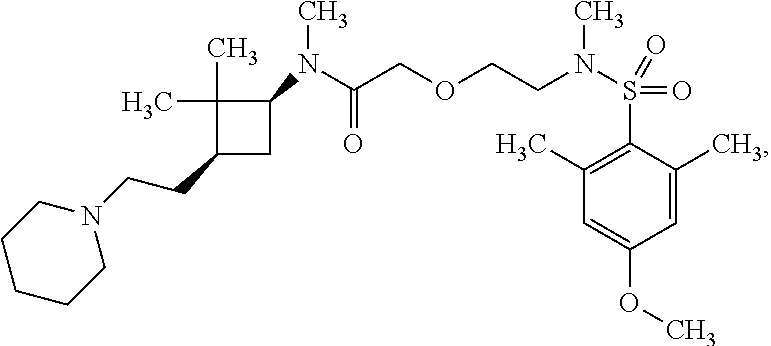
This application is a national phase entry under 35 U.S.C. 371 of international application PCT/EP2008/060564, filed Aug. 12, 2008, which claims priority to PCT/EP2007/058408, filed Aug. 14, 2007, and EP08102047.1, filed Feb. 26, 2008, each of which is hereby incorporated by reference in its entirety.
The present invention relates to compounds of general formula I
wherein A, B, D, Y, R
1, R
2, R
3, R
4 and R
5 are defined as in claim
1, the enantiomers, diastereomers, mixtures thereof and the salts thereof, particularly the physiologically acceptable salts thereof with organic or inorganic acids or bases, which have valuable properties, the preparation thereof, the pharmaceutical compositions containing the pharmacologically effective compounds, the preparation thereof and the use thereof.
DETAILED DESCRIPTION OF THE INVENTION
In the above general formula I in a first embodiment
- A denotes a bond, C1-4-alkylene or —CH2—C(O),
- B denotes a bond, C1-3-alkylene, —O or —C(O),
- D denotes a group of general formulae II
- Y denotes a C1-6-alkylene group optionally substituted by the group R2, wherein a methylene group may additionally be replaced by Y1 and
- Y1 denotes —O, —S, —S(O), —N(R2), —N(R2)—C(O), —C(O)—N(R2), —C(O), —CH(aryl), C3-6-cycloalkylene or —S(O)2—,
- R1 denotes C3-7-cycloalkyl or aryl, heteroaryl or aryl-C1-3-alkyl, each of which may be substituted by one, two, three or four groups R1.1, while the groups R1.1 may be identical or different and
- R1.1 denotes H, F, Cl, Br, I, C1-3-alkyl, F3C, HO, C1-3-alkyl-O or C1-3-alkyl-O—C2-4-alkylene-O—,
- R2 denotes H or C1-3-alkyl, while each methylene group may be substituted by up to two and each methyl group may be substituted by up to three fluorine atoms, or also denotes H3C—C(O),
- R3 denotes a) C1-6-alkylene,
- b) a C3-6-cycloalkylene group mono-, di or trisubstituted by R3.1,
- c) a C5-7-cycloalkenylene group mono- or disubstituted by R3.1 which is fused to a phenyl ring via the unsaturated bond,
- d) —N(R2),
- e) an arylene group mono- or disubstituted by R3.1,
- f) a heteroarylene group mono- or disubstituted by R3.1,
- g) a saturated 4- to 7-membered heterocyclic ring mono- or disubstituted by R3.1,
- h) an unsaturated 5- to 7-membered heterocyclic ring mono- or disubstituted by R3.1, which is fused to one or two phenyl rings via the unsaturated bonds, or
- i) a saturated 8- to 10-membered aza-heterobicyclic group mono- or disubstituted by R3.1,
- while the groups R3.1 may be identical or different in each case and
- R3.1 denotes H, F, Cl, Br, I, C1-3-alkyl, HO, C1-3-alkyl-O or C1-3-alkyl-O—C2-4-alkylene-O—, or
- R3 also denotes —O, if B does not denote the group —O—,
- R4 denotes a) —O,
- b) —C(O)O,
- c) —C(O)NR2,
- d) —NR2,
- e) —NR2—NR2,
- f) C3-7-cycloalkylene,
- g) C1-6-alkylene,
- h) an arylene group mono- or disubstituted by R4.1,
- i) a heteroarylene group mono- or disubstituted by R4.1,
- j) a 4- to 7-membered saturated heterocyclic ring mono- or disubstituted by R4.1,
- k) a saturated 8- to 10-membered diaza-heterobicyclic group mono- or disubstituted by R4.1,
- l) a 5- to 7-membered unsaturated heterocyclic ring mono- or disubstituted by R4.1, which is fused to one or two phenyl rings via the unsaturated bonds, or
- m) a saturated 9- to 11-membered diaza-spirocyclic group,
- while the groups R4.1 may be identical or different in each case and
- R4.1 denotes H, F, Cl, Br, I, C1-3-alkyl, HO, C1-3-alkyl-O or C1-3-alkyl-O—C2-4-alkylene-O—,
- R5 denotes H, HO, C1-8-alkyl, a C3-7-cycloalkyl group optionally substituted by C1-3-alkyl, H2N, C1-4-alkyl-NH, (C3-6-cycloalkyl)-NH, (C1-4-alkyl)2N, (C1-4-alkyl)(C3-6-cycloalkyl)N, (cyclopropylmethyl)(methyl)N, H2N—C(O), a phenyl group mono- or disubstituted by R5.1, a heteroaryl group mono- or disubstituted by R5.1 or a 4- to 7-membered saturated heterocyclic ring mono- or disubstituted by R5.1, while the groups R5.1 may be identical or different in each case and
- R5.1 denotes H, F, Cl, Br, I, C1-3-alkyl, HO, C1-3-alkyl-O, (C1-3-alkyl)2N or C1-3-alkyl-O—C2-4-alkylene-O—,
the enantiomers, the diastereomers, the mixtures and the salts thereof, particularly the physiologically acceptable salts thereof with organic or inorganic acids or bases.
A second embodiment of the present invention comprises the compounds of the above general formula I, wherein
- A denotes a bond, C1-4-alkylene or —CH2—C(O),
- B denotes a bond, C1-2-alkylene, —O or —C(O),
- D denotes a group of general formula II
- Y denotes C1-4-alkylene or a group selected from
- R1 denotes aryl or heteroaryl, each of which may be substituted by one, two, three or four groups R1.1, while the groups R1.1 may be identical or different and
- R1.1 denotes H, F, Cl, Br, I, C1-3-alkyl, F3C, HO, C1-3-alkyl-O or C1-3-alkyl-O—C2-4-alkylene-O—,
- R2 denotes H, H3C, H5C2, isopropyl, F3C—CH2, F2CH—CH2 or FH2C—H2C,
- R3 denotes C1-4-alkylene, —N(R2) or a group selected from
-
- R3.1 denotes H, F, Cl, Br, I, C1-3-alkyl, HO, C1-3-alkyl-O or C1-3-alkyl-O—C2-4-alkylene-O—, or
- R3 also denotes —O, if B does not denote the group —O—,
- R4 denotes C1-4-alkylene, C3-7-cycloalkylene, —O or a group selected from
- R5 denotes H, C1-8-alkyl, C3-7-cycloalkyl, HO, (C1-3-alkyl)-O, (C1-4-alkyl)-NH, (C3-6-cycloalkyl)-NH, (C1-4-alkyl)2N, (C1-4-alkyl)(C3-6-cycloalkyl)N, (cyclopropylmethyl)(methyl)N, H2N—C(O), or
- R5 denotes a group selected from
the enantiomers, the diastereomers, the mixtures and the salts thereof, particularly the physiologically acceptable salts thereof with organic or inorganic acids or bases.
A third embodiment of the present invention comprises the compounds of the above general formula I, wherein
- A denotes a bond, C1-3-alkylene or —CH2—C(O),
- B denotes a bond, C1-2-alkylene, —O or —C(O),
- D denotes a group of general formula II
- Y denotes a group selected from
- R1 denotes a group selected from
- R2 denotes H, H3C, H5C2 or FH2C—H2C,
- R3 denotes C1-4-alkylene, —NH, —N(CH3) or a group selected from
-
- R3 also denotes —O, if B does not denote the group —O—,
- R4 denotes C1-4-alkylene, C3-7-cycloalkylene, —O or a group selected from
- R5 denotes H, HO, C1-5-alkyl, C3-5-cycloalkyl, H2N, (C1-2-alkyl)-NH, (C3-6-cycloalkyl)-NH, (C1-2-alkyl)2N, (C1-4-alkyl)(C3-6-cycloalkyl)N, (cyclopropylmethyl)(methyl)N, H2N—C(O), or
- R5 denotes a group selected from
the enantiomers, the diastereomers, the mixtures and the salts thereof, particularly the physiologically acceptable salts thereof with organic or inorganic acids or bases.
A fourth embodiment of the present invention comprises the compounds of the above general formula I, wherein A, B, D, Y, R2, R3, R4 and R5 are defined as hereinbefore under the first to third embodiments and
the enantiomers, the diastereomers, the mixtures and the salts thereof, particularly the physiologically acceptable salts thereof with organic or inorganic acids or bases.
A fifth embodiment of the present invention comprises the compounds of the above general formula I, wherein A, B, R1, R3, R4 and R5 are defined as hereinbefore under the first to fourth embodiments and
- -D-Y— together denote a group selected from
- R2 denotes H or C1-3-alkyl-,
the enantiomers, the diastereomers, the mixtures and the salts thereof, particularly the physiologically acceptable salts thereof with organic or inorganic acids or bases.
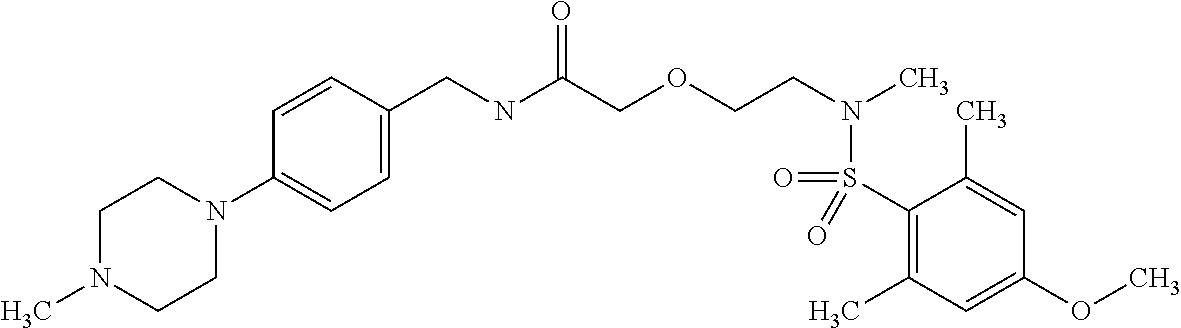
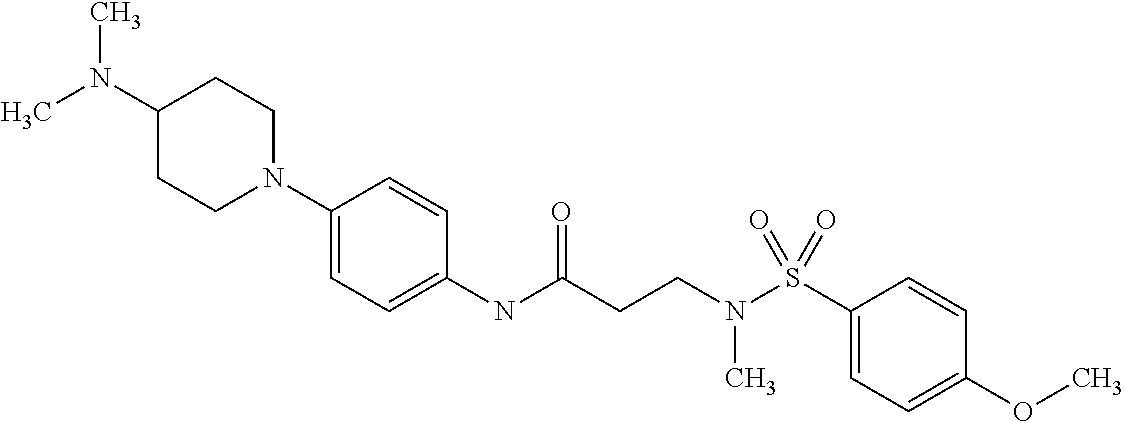
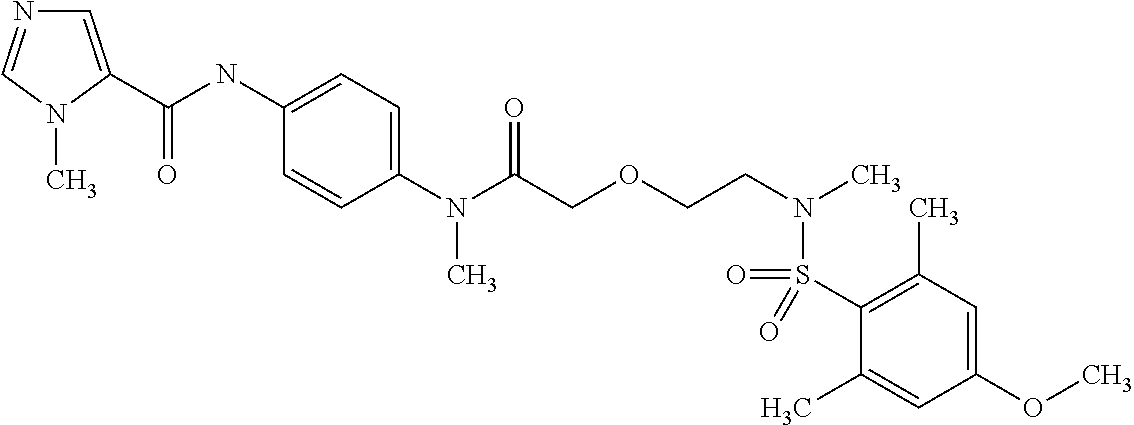
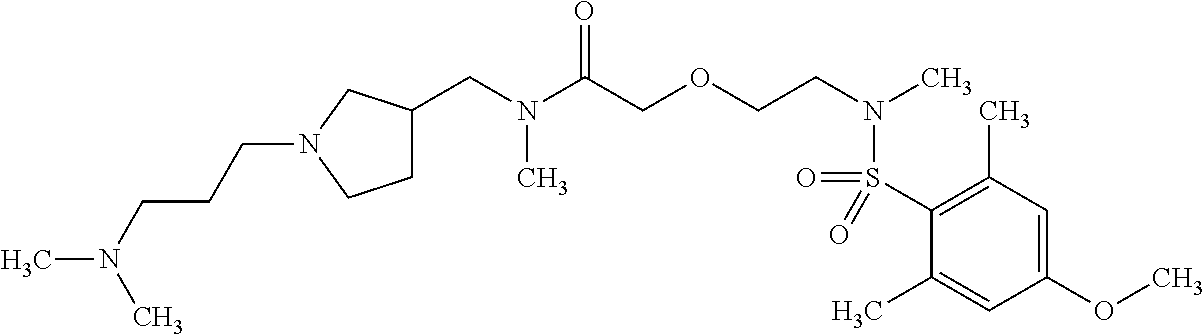
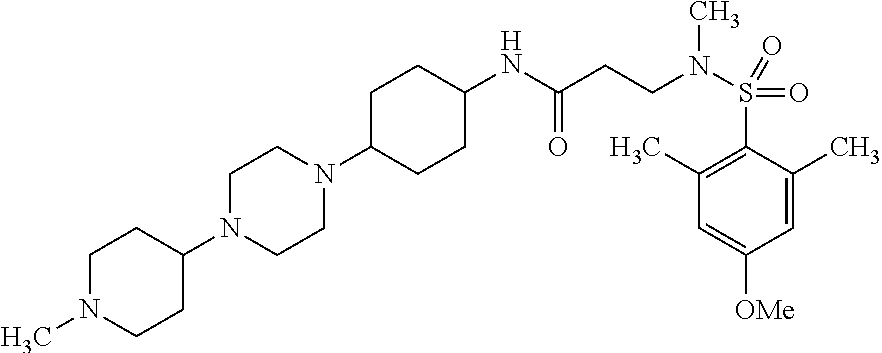
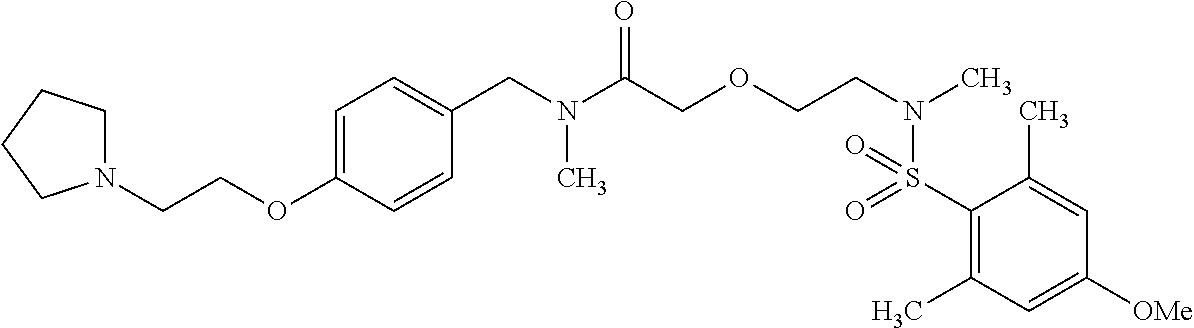
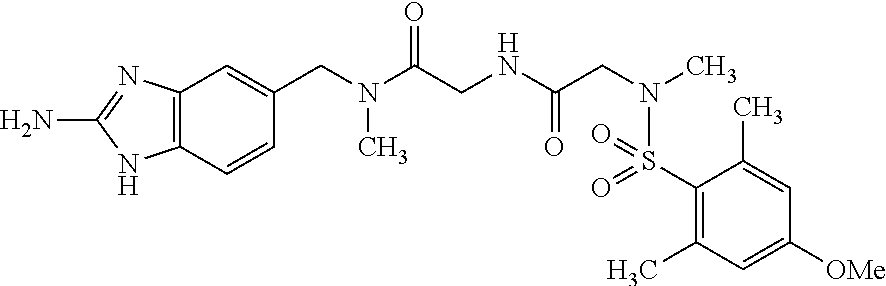
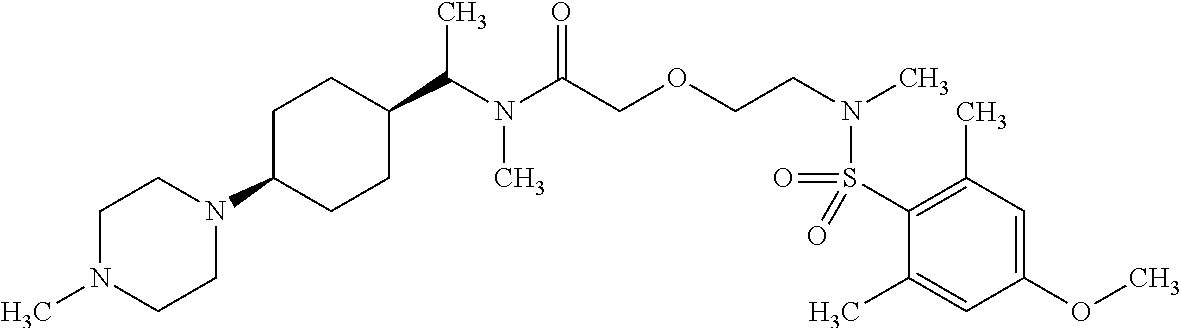
The following are mentioned as examples of most particularly preferred compounds of the above general formula I:
| |
| Example | Structure |
| |
| (1) | |
| |
| (2) | |
| |
| (3) | |
| |
| (4) | |
| |
| (5) | |
| |
| (6) | |
| |
| (7) | |
| |
| (8) | |
| |
| (9) | |
| |
| (10) | |
| |
| (11) | |
| |
| (12) | |
| |
| (13) | |
| |
| (14) | |
| |
| (15) | |
| |
| (16) | |
| |
| (17) | |
| |
| (18) | |
| |
| (19) | |
| |
| (20) | |
| |
| (21) | |
| |
| (22) | |
| |
| (23) | |
| |
| (24) | |
| |
| (25) | |
| |
| (26) | |
| |
| (27) | |
| |
| (28) | |
| |
| (29) | |
| |
| (30) | |
| |
| (31) | |
| |
| (32) | |
| |
| (33) | |
| |
| (34) | |
| |
| (35) | |
| |
| (36) | |
| |
| (37) | |
| |
| (38) | |
| |
| (39) | |
| |
| (40) | |
| |
| (41) | |
| |
| (42) | |
| |
| (43) | |
| |
| (44) | |
| |
| (45) | |
| |
| (46) | |
| |
| (47) | |
| |
| (48) | |
| |
| (49) | |
| |
| (50) | |
| |
| (51) | |
| |
| (52) | |
| |
| (53) | |
| |
| (54) | |
| |
| (55) | |
| |
| (56) | |
| |
| (57) | |
| |
| (58) | |
| |
| (59) | |
| |
| (60) | |
| |
| (61) | |
| |
| (62) | |
| |
| (63) | |
| |
| (64) | |
| |
| (65) | |
| |
| (66) | |
| |
| (67) | |
| |
| (68) | |
| |
| (69) | |
| |
| (70) | |
| |
| (71) | |
| |
| (72) | |
| |
| (73) | |
| |
| (74) | |
| |
| (75) | |
| |
| (76) | |
| |
| (77) | |
| |
| (78) | |
| |
| (79) | |
| |
| (80) | |
| |
| (81) | |
| |
| (82) | |
| |
| (83) | |
| |
| (84) | |
| |
| (85) | |
| |
| (86) | |
| |
| (87) | |
| |
| (88) | |
| |
| (89) | |
| |
| (90) | |
| |
| (91) | |
| |
| (92) | |
| |
| (93) | |
| |
| (94) | |
| |
| (95) | |
| |
| (96) | |
| |
| (97) | |
| |
| (98) | |
| |
| (99) | |
| |
| (100) | |
| |
| (101) | |
| |
| (102) | |
| |
| (103) | |
| |
| (104) | |
| |
| (105) | |
| |
| (106) | |
| |
| (107) | |
| |
| (108) | |
| |
| (109) | |
| |
| (110) | |
| |
| (111) | |
| |
| (112) | |
| |
| (113) | |
| |
| (114) | |
| |
| (115) | |
| |
| (116) | |
| |
| (117) | |
| |
| (118) | |
| |
| (119) | |
| |
| (120) | |
| |
| (121) | |
| |
| (122) | |
| |
| (123) | |
| |
| (124) | |
| |
| (125) | |
| |
| (126) | |
| |
| (127) | |
| |
| (128) | |
| |
| (129) | |
| |
| (130) | |
| |
| (131) | |
| |
| (132) | |
| |
| (133) | |
| |
| (134) | |
| |
| (135) | |
| |
| (136) | |
| |
| (137) | |
| |
| (138) | |
| |
| (139) | |
| |
| (140) | |
| |
| (141) | |
| |
| (142) | |
| |
| (143) | |
| |
| (144) | |
| |
| (145) | |
| |
| (146) | |
| |
| (147) | |
| |
| (148) | |
| |
| (149) | |
| |
| (150) | |
| |
| (151) | |
| |
| (152) | |
| |
| (153) | |
| |
| (154) | |
| |
| (155) | |
| |
| (156) | |
| |
| (157) | |
| |
| (158) | |
| |
| (159) | |
| |
| (160) | |
| |
| (161) | |
| |
| (162) | |
| |
| (163) | |
| |
| (164) | |
| |
| (165) | |
| |
| (166) | |
| |
| (167) | |
| |
| (168) | |
| |
| (169) | |
| |
| (170) | |
| |
| (171) | |
| |
| (172) | |
| |
| (173) | |
| |
| (174) | |
| |
| (175) | |
| |
| (176) | |
| |
| (177) | |
| |
| (178) | |
| |
| (179) | |
| |
| (180) | |
| |
| (181) | |
| |
| (182) | |
| |
| (183) | |
| |
| (184) | |
| |
| (185) | |
| |
| (186) | |
| |
| (187) | |
| |
| (188) | |
| |
| (189) | |
| |
| (190) | |
| |
| (191) | |
| |
| (192) | |
| |
| (193) | |
| |
| (194) | |
| |
| (195) | |
| |
| (196) | |
| |
| (197) | |
| |
| (198) | |
| |
| (199) | |
| |
| (200) | |
| |
| (201) | |
| |
| (202) | |
| |
| (203) | |
| |
| (204) | |
| |
| (205) | |
| |
| (206) | |
| |
| (207) | |
| |
| (208) | |
| |
| (209) | |
| |
| (210) | |
| |
| (211) | |
| |
| (212) | |
| |
| (213) | |
| |
| (214) | |
| |
| (215) | |
| |
| (216) | |
| |
| (217) | |
| |
| (218) | |
| |
| (219) | |
| |
| (220) | |
| |
| (221) | |
| |
| (222) | |
| |
| (223) | |
| |
| (224) | |
| |
| (225) | |
| |
| (226) | |
| |
| (227) | |
| |
| (228) | |
| |
| (229) | |
| |
| (230) | |
| |
| (231) | |
| |
| (232) | |
| |
| (233) | |
| |
| (234) | |
| |
| (235) | |
| |
| (236) | |
| |
| (237) | |
| |
| (238) | |
| |
| (239) | |
| |
| (240) | |
| |
| (241) | |
| |
| (242) | |
| |
| (243) | |
| |
| (244) | |
| |
| (245) | |
| |
| (246) | |
| |
| (247) | |
| |
| (248) | |
| |
| (249) | |
| |
| (250) | |
| |
| (251) | |
| |
| (252) | |
| |
| (253) | |
| |
| (254) | |
| |
| (255) | |
| |
| (256) | |
| |
| (257) | |
| |
| (258) | |
| |
| (259) | |
| |
| (260) | |
| |
| (261) | |
| |
| (262) | |
| |
| (263) | |
| |
| (264) | |
| |
| (265) | |
| |
| (266) | |
| |
| (267) | |
| |
| (268) | |
| |
| (269) | |
| |
| (270) | |
| |
| (271) | |
| |
| (272) | |
| |
| (273) | |
| |
| (274) | |
| |
| (275) | |
| |
| (276) | |
| |
| (277) | |
| |
| (278) | |
| |
| (279) | |
| |
| (280) | |
| |
| (281) | |
| |
| (282) | |
| |
| (283) | |
| |
| (284) | |
| |
| (285) | |
| |
| (286) | |
| |
| (287) | |
| |
| (288) | |
| |
| (289) | |
| |
| (290) | |
| |
| (291) | |
| |
| (292) | |
| |
| (293) | |
| |
| (294) | |
| |
| (295) | |
| |
| (296) | |
| |
| (297) | |
| |
| (298) | |
| |
| (299) | |
| |
| (300) | |
| |
| (301) | |
| |
| (302) | |
| |
| (303) | |
| |
| (304) | |
| |
| (305) | |
| |
| (306) | |
| |
| (307) | |
| |
| (308) | |
| |
| (309) | |
| |
| (310) | |
| |
| (311) | |
| |
| (312) | |
| |
| (313) | |
| |
| (314) | |
| |
| (315) | |
| |
| (316) | |
| |
| (317) | |
| |
| (318) | |
| |
| (319) | |
| |
| (320) | |
| |
| (321) | |
| |
| (322) | |
| |
| (323) | |
| |
| (324) | |
| |
| (325) | |
| |
| (326) | |
| |
| (327) | |
| |
| (328) | |
| |
| (329) | |
| |
| (330) | |
| |
| (331) | |
| |
| (332) | |
| |
| (333) | |
| |
| (334) | |
| |
| (335) | |
| |
| (336) | |
| |
| (337) | |
| |
| (338) | |
| |
| (339) | |
| |
| (340) | |
| |
| (341) | |
| |
| (342) | |
| |
| (343) | |
| |
| (344) | |
| |
| (345) | |
| |
| (346) | |
| |
| (347) | |
| |
| (348) | |
| |
| (349) | |
| |
| (350) | |
| |
| (351) | |
| |
| (352) | |
| |
| (353) | |
| |
| (354) | |
| |
| (355) | |
| |
| (356) | |
| |
| (357) | |
| |
| (358) | |
| |
| (359) | |
| |
| (360) | |
| |
| (361) | |
| |
| (362) | |
| |
| (363) | |
| |
| (364) | |
| |
| (365) | |
| |
| (366) | |
| |
| (367) | |
| |
| (368) | |
| |
| (369) | |
| |
| (370) | |
| |
| (371) | |
| |
| (372) | |
| |
| (373) | |
| |
| (374) | |
| |
| (375) | |
| |
| (376) | |
| |
| (377) | |
| |
| (378) | |
| |
| (379) | |
| |
| (380) | |
| |
| (381) | |
| |
| (382) | |
| |
| (383) | |
| |
| (384) | |
| |
| (385) | |
| |
| (386) | |
| |
| (387) | |
| |
| (388) | |
| |
| (389) | |
| |
| (390) | |
| |
| (391) | |
| |
| (392) | |
| |
| (393) | |
| |
| (394) | |
| |
| (395) | |
| |
| (396) | |
| |
| (397) | |
| |
| (398) | |
| |
| (399) | |
| |
| (400) | |
| |
| (401) | |
| |
| (402) | |
| |
| (403) | |
| |
| (404) | |
| |
| (405) | |
| |
| (406) | |
| |
| (407) | |
| |
| (408) | |
| |
| (409) | |
| |
| (410) | |
| |
| (411) | |
| |
| (412) | |
| |
| (413) | |
| |
| (414) | |
| |
| (415) | |
| |
| (416) | |
| |
| (417) | |
| |
| (418) | |
| |
| (419) | |
| |
| (420) | |
| |
| (421) | |
| |
| (422) | |
| |
| (423) | |
| |
| (424) | |
| |
| (425) | |
| |
| (426) | |
| |
| (427) | |
| |
| (428) | |
| |
| (429) | |
| |
| (430) | |
| |
| (431) | |
| |
| (432) | |
| |
| (433) | |
| |
| (434) | |
| |
| (435) | |
| |
| (436) | |
| |
| (437) | |
| |
| (438) | |
| |
| (439) | |
| |
| (440) | |
| |
| (441) | |
| |
| (442) | |
| |
| (443) | |
| |
| (444) | |
| |
| (445) | |
| |
| (446) | |
| |
| (447) | |
| |
| (448) | |
| |
| (449) | |
| |
| (450) | |
| |
| (451) | |
| |
| (452) | |
| |
| (453) | |
| |
| (454) | |
| |
| (455) | |
| |
| (456) | |
| |
| (457) | |
| |
| (458) | |
| |
| (459) | |
| |
| (460) | |
| |
| (461) | |
| |
| (462) | |
| |
| (463) | |
| |
| (464) | |
| |
| (465) | |
| |
| (466) | |
| |
| (467) | |
| |
| (468) | |
| |
| (469) | |
| |
| (470) | |
| |
| (471) | |
| |
| (472) | |
| |
| (473) | |
| |
| (474) | |
| |
| (475) | |
| |
| (476) | |
| |
| (477) | |
| |
| (478) | |
| |
| (479) | |
| |
| (480) | |
| |
| (481) | |
| |
| (482) | |
| |
| (483) | |
| |
| (484) | |
| |
| (485) | |
| |
| (486) | |
| |
| (487) | |
| |
| (488) | |
| |
| (489) | |
| |
| (490) | |
| |
| (491) | |
| |
| (492) | |
| |
| (493) | |
| |
| (494) | |
| |
| (495) | |
| |
| (496) | |
| |
| (497) | |
| |
| (498) | |
| |
| (499) | |
| |
| (500) | |
| |
| (501) | |
| |
| (502) | |
| |
| (503) | |
| |
| (504) | |
| |
| (505) | |
| |
| (506) | |
| |
| (507) | |
| |
| (508) | |
| |
| (509) | |
| |
| (510) | |
| |
| (511) | |
| |
| (512) | |
| |
| (513) | |
| |
| (514) | |
| |
| (515) | |
| |
| (516) | |
| |
| (517) | |
| |
| (518) | |
| |
| (519) | |
| |
| (520) | |
| |
| (521) | |
| |
| (522) | |
| |
| (523) | |
| |
| (524) | |
| |
| (525) | |
| |
| (526) | |
| |
| (527) | |
| |
| (528) | |
| |
| (529) | |
| |
| (530) | |
| |
| (531) | |
| |
| (532) | |
| |
| (533) | |
| |
| (534) | |
| |
| (535) | |
| |
| (536) | |
| |
| (537) | |
| |
| (538) | |
| |
| (539) | |
| |
| (540) | |
| |
| (541) | |
| |
| (542) | |
| |
| (543) | |
| |
| (544) | |
| |
| (545) | |
| |
| (546) | |
| |
| (547) | |
| |
| (548) | |
| |
| (549) | |
| |
| (550) | |
| |
| (551) | |
| |
| (552) | |
| |
| (553) | |
| |
| (554) | |
| |
| (555) | |
| |
| (556) | |
| |
| (557) | |
| |
| (558) | |
| |
| (559) | |
| |
| (560) | |
| |
| |
| (561) | |
| |
| (562) | |
| |
| (563) | |
| |
| (564) | |
| |
| (565) | |
| |
| (566) | |
| |
| (567) | |
| |
| (568) | |
| |
| (569) | |
| |
| (570) | |
| |
| (571) | |
| |
| (572) | |
| |
| (573) | |
| |
| (574) | |
| |
| (575) | |
| |
| (576) | |
| |
| (577) | |
| |
| (578) | |
| |
| (579) | |
| |
| (580) | |
| |
| (581) | |
| |
| (582) | |
| |
| (583) | |
| |
| (584) | |
| |
| (585) | |
| |
| (586) | |
| |
| (587) | |
| |
| (588) | |
| |
| (589) | |
| |
| (590) | |
| |
| (591) | |
| |
| (592) | |
| |
| (593) | |
| |
| (594) | |
| |
| (595) | |
| |
| (596) | |
| |
| (597) | |
| |
| (598) | |
| |
| (599) | |
| |
| (600) | |
| |
| (601) | |
| |
| (602) | |
| |
| (603) | |
| |
| (604) | |
| |
| (605) | |
| |
| (606) | |
| |
| (607) | |
| |
| (608) | |
| |
| (609) | |
| |
| (610) | |
| |
| (611) | |
| |
| (612) | |
| |
| (613) | |
| |
| (614) | |
| |
| (615) | |
| |
| (616) | |
| |
| (617) | |
| |
| (618) | |
| |
| (619) | |
| |
| (620) | |
| |
| (621) | |
| |
| (622) | |
| |
| (623) | |
| |
| (624) | |
| |
| (625) | |
| |
| (626) | |
| |
| (627) | |
| |
| (628) | |
| |
| (629) | |
| |
| (630) | |
| |
| (631) | |
| |
| (632) | |
| |
| (633) | |
| |
| (634) | |
| |
| (635) | |
| |
| (636) | |
| |
| (637) | |
| |
| (638) | |
| |
| (639) | |
| |
| (640) | |
| |
| (641) | |
| |
| (642) | |
| |
| (643) | |
| |
| (644) | |
| |
| (645) | |
| |
| (646) | |
| |
| (647) | |
| |
| (648) | |
| |
| (649) | |
| |
| (650) | |
| |
| (651) | |
| |
| (652) | |
| |
| (653) | |
| |
| (654) | |
| |
| (655) | |
| |
| (656) | |
| |
| (657) | |
| |
| (658) | |
| |
| (659) | |
| |
| (660) | |
| |
| (661) | |
| |
| (662) | |
| |
| (663) | |
| |
| (664) | |
| |
| (665) | |
| |
| (666) | |
| |
| (667) | |
| |
| (668) | |
| |
| (669) | |
| |
| (670) | |
| |
| (671) | |
| |
| (672) | |
| |
| (673) | |
| |
| (674) | |
| |
| (675) | |
| |
| (676) | |
| |
| (677) | |
| |
| (678) | |
| |
| (679) | |
| |
| (680) | |
| |
| (681) | |
| |
| (682) | |
| |
| (683) | |
| |
| (684) | |
| |
| (685) | |
| |
| (686) | |
| |
| (687) | |
| |
| (688) | |
| |
| (689) | |
| |
| (690) | |
| |
| (691) | |
| |
| (692) | |
| |
| (693) | |
| |
| (694) | |
| |
| (695) | |
| |
| (696) | |
| |
| (697) | |
| |
| (698) | |
| |
| (699) | |
| |
| (700) | |
| |
| (701) | |
| |
| (702) | |
| |
| (703) | |
| |
| (704) | |
| |
| (705) | |
| |
| (706) | |
| |
| (707a) | |
| |
| (707b) | |
| |
| (708) | |
| |
| (709) | |
| |
the enantiomers, the diastereomers, the mixtures and the salts thereof, particularly the physiologically acceptable salts thereof with organic or inorganic acids or bases.
TERMS AND DEFINITIONS USED
Unless otherwise stated, all the substituents are independent of one another. If for example there are a plurality of C1-6-alkyl groups as substituents in one group, in the case of three C1-6-alkyl substituents, independently of one another, one may represent methyl, one n-propyl and one tert-butyl.
If in the structural formulae given hereinbefore or hereinafter, in a substituent, there is no evidence of a valency and no other information can be inferred from the name, this valency is occupied by a proton, if this makes sense chemically. This applies particularly to nitrogen substituents.
If in the structural formulae given hereinbefore or hereinafter, in a substituent, there is no evidence of a bond and no other information can be inferred from the name, this bond is occupied by a methyl group, if this makes sense chemically. Examples of this include:
Within the scope of this application, in the definition of possible substituents, these may also be represented in the form of a structural formula. If present, an asterisk (*) in the structural formula of the substituent is to be understood as being the linking point to the rest of the molecule.
The subject-matter of this invention also includes the compounds according to the invention, including the salts thereof, wherein one or more hydrogen atoms, for example one, two, three, four or five hydrogen atoms, are replaced by deuterium.
By the term “C1-2-alkyl” (including those which are part of other groups) are meant alkyl groups with 1 to 2 carbon atoms, by the term “C1-3-alkyl” are meant branched and unbranched alkyl groups with 1 to 3 carbon atoms, by the term “C1-4-alkyl” are meant branched and unbranched alkyl groups with 1 to 4 carbon atoms, by the term “C1-5-alkyl” are meant branched and unbranched alkyl groups with 1 to 5 carbon atoms, by the term “C1-6-alkyl” are meant branched and unbranched alkyl groups with 1 to 6 carbon atoms and by the term “C1-8-alkyl” are meant branched and unbranched alkyl groups with 1 to 8 carbon atoms. Examples include: methyl, ethyl, n-propyl, iso-propyl, n-butyl, iso-butyl, sec-butyl, tert-butyl, n-pentyl, iso-pentyl, neo-pentyl, hexyl, heptyl and octyl. The following abbreviations may optionally also be used for the above-mentioned groups: Me, Et, n-Pr, i-Pr, n-Bu, i-Bu, t-Bu, etc. Unless stated otherwise, the definitions propyl, butyl, pentyl, hexyl, heptyl and octyl include all the possible isomeric forms of the groups in question. Thus, for example, propyl includes n-propyl and iso-propyl, butyl includes iso-butyl, sec-butyl and tert-butyl etc.
Moreover, the terms mentioned above also include those groups wherein each methylene group may be substituted by up to two fluorine atoms and each methyl group may be substituted by up to three fluorine atoms.
By the term “C1-2-alkylene” are meant branched and unbranched alkylene groups with 1 or 2 carbon atoms, by the term “C1-3-alkylene” (including those which are part of other groups) are meant branched and unbranched alkylene groups with 1 to 3 carbon atoms, by the term “C1-4-alkylene” are meant branched and unbranched alkylene groups with 1 to 4 carbon atoms, by the term “C1-6-alkylene” are meant branched and unbranched alkylene groups with 1 to 6 carbon atoms and by the term “C2-4-alkylene” are meant branched and unbranched alkylene groups with 2 to 4 carbon atoms. Examples include: methylene, ethylene, ethane-1,1-diyl, propylene, propane-2,2-diyl, 1-methylethylene, butylene, 1-methylpropylene, 1,1-dimethylethylene, 1,2-dimethylethylene. Unless stated otherwise, the definitions propylene and butylene include all the possible isomeric forms with the same number of carbons. Thus, for example, propyl also includes 1-methylethylene and butylene includes 1-methylpropylene, 1,1-dimethylethylene, 1,2-dimethylethylene.
In addition, the terms mentioned above also include those groups wherein each methylene group may be substituted by up to two fluorine atoms.
By the term “C3-5-cycloalkyl” are meant cyclic alkyl groups with 3 to 5 carbon atoms, by the term “C3-6-cycloalkyl” are meant cyclic alkyl groups with 3 to 6 carbon atoms and by the term “C3-7-cycloalkyl” (including those which are part of other groups) are meant cyclic alkyl groups with 3 to 7 carbon atoms. Examples include: cyclopropyl, cyclobutyl, cyclopentyl, cyclohexyl or cycloheptyl. Unless otherwise stated, the cyclic alkyl groups may be substituted by one or more groups selected from among methyl, ethyl, iso-propyl, tert-butyl, hydroxy, fluorine, chlorine, bromine and iodine.
By the term “C3-6-cycloalkylene” (including those which are part of other groups) are meant cyclic alkylene groups with 3 to 6 carbon atoms, by the term “C3-7-cycloalkylene” are meant cyclic alkylene groups with 3 to 7 carbon atoms and by the term “C4-6-cycloalkylene” are meant cyclic alkylene groups with 4 to 6 carbon atoms. Examples include: cyclopropylene, cyclobutylene, cyclopentylene, cyclohexylene or cycloheptylene. Unless otherwise stated, the cyclic alkylene groups may be substituted by one or more groups selected from among methyl, ethyl, iso-propyl, tert-butyl, hydroxy, fluorine, chlorine, bromine and iodine. A C4- or a C5-cycloalkylene group may be linked to the remainder of the molecule in the 1,2 position or in the 1,3 position, preferably in the 1,3 position. A C6- or a C7-cycloalkylene group may be linked to the remainder of the molecule in the 1,2 position, in the 1,3 position or in the 1,4 position, preferably in the 1,3 position.
By the term “C5-7-cycloalkenylene” (including those which are part of other groups) are meant cyclic alkenyl groups with 5 to 7 carbon atoms, which contain an unsaturated bond and which are fused to a phenyl ring via this unsaturated bond. Examples include: cyclopentenyl, cyclohexenyl or cycloheptenyl:
Unless otherwise stated, the cyclic alkenyl groups may be substituted by one or more groups selected from among methyl, ethyl, iso-propyl, tert-butyl, hydroxy, fluorine, chlorine, bromine and iodine.
By the term “saturated heterocyclic rings” are meant four, five, six or seven membered heterocyclic rings which may contain one, two or three heteroatoms selected from among oxygen, sulphur and nitrogen. The ring may be attached to the molecule through a carbon atom and/or—if present—through a nitrogen atom or also through two carbon atoms or through two nitrogen atoms. Although it is encompassed by the term “heterocyclic rings”, the term “heterocyclic non-aromatic rings” denotes five, six or seven membered saturated rings. Examples include:
By the term “saturated diaza-heterocycles” are meant six or seven membered heterocyclic rings which contain two nitrogen atoms. The ring is linked to the remainder of the molecule through both nitrogen atoms. Examples include:
By the term “saturated aza-heterobicycles” are meant eight, nine or ten membered heterobicyclic rings which contain a nitrogen atom. The ring is linked to the remainder of the molecule through a carbon atom and the nitrogen atom. Examples include:
By the term “saturated diaza-heterobicycles” are meant eight, nine or ten membered heterobicyclic rings which contain two nitrogen atoms. The ring is linked to the remainder of the molecule through both nitrogen atoms. Examples include:
By the term “unsaturated heterocyclic rings” are meant five-, six- or seven-membered, mono- or diunsaturated heterocyclic rings which may contain one, two or three heteroatoms, selected from among oxygen, sulphur and nitrogen and condensed through the unsaturated bonds with one or two phenyl rings. The heterocyclic ring may be linked to the molecule through a carbon atom and/or—if present—through a nitrogen atom or through two carbon atoms or through two nitrogen atoms. Examples include:
By the term “saturated diaza-spirocycles” are meant nine-, ten- or eleven-membered spirocyclic rings which contain two nitrogen atoms. The spirocyclic group is linked to the remainder of the molecule through the two nitrogen atoms. Examples include:
By the term “aryl” (including those which are part of other groups) are meant aromatic ring systems with 6 or 10 carbon atoms. Examples of these are phenyl, 1-naphthyl or 2-naphthyl; preferred aryl groups are phenyl and 1-naphthyl; the particularly preferred aryl group is phenyl. Unless otherwise stated, the aromatic groups may be substituted by one or more groups selected from among methyl, ethyl, n-propyl, iso-propyl, tert-butyl, hydroxy, methoxy, trifluoromethoxy, fluorine, chlorine, bromine and iodine, while the groups may be identical or different.
By the term “heteroaryl” are meant five- or six-membered heterocyclic aromatic groups or 9-11 membered bicyclic heteroaryl rings, which may contain one, two or three heteroatoms, selected from among oxygen, sulphur and nitrogen, and additionally contain sufficient conjugated double bonds to form an aromatic system. Examples of five- or six-membered heterocyclic aromatic groups are as follows:
Unless otherwise stated, the heteroaryls mentioned previously may be substituted by one or more groups selected from among methyl, ethyl, n-propyl, iso-propyl, tert-butyl, hydroxy, methoxy, trifluoromethoxy, fluorine, chlorine, bromine and iodine, while the groups may be identical or different.
Bicyclic heteroaryl rings may preferably be substituted in the phenyl group.
By the term “arylene” (including those which are part of other groups) are meant aromatic ring systems with 6 or 10 carbon atoms. Examples include: phenylene, 1-naphthylene or 2-naphthylene, the preferred arylene group being phenylene.
Unless otherwise stated, the aromatic groups may be substituted by one or more groups selected from among methyl, ethyl, n-propyl, iso-propyl, tert-butyl, hydroxy, methoxy, trifluoromethoxy, fluorine, chlorine, bromine and iodine.
These aromatic ring systems are linked to the rest of the molecule at two places independently of one another through a carbon atom in each case.
By the term “heteroarylene” are meant five- or six-membered heterocyclic aromatic groups or 9-11 membered bicyclic heteroaryl rings which may contain one, two or three heteroatoms selected from among oxygen, sulphur and nitrogen, and additionally sufficient conjugated double bonds to form an aromatic system. These heterocyclic aromatic groups are linked at two points independently of one another either through carbon and/or nitrogen.
The following are examples of five- or six-membered heterocyclic aromatic groups:
Unless otherwise stated, the heteroaromatic groups may be substituted by one or more groups selected from among methyl, ethyl, n-propyl, iso-propyl, tert-butyl, hydroxy, methoxy, trifluoromethoxy, fluorine, chlorine, bromine and iodine. Preferably, the substituents in the above-mentioned 5-10 membered bicyclic heteroaryl rings are in the phenyl ring.
If they contain suitable basic functions, for example amino groups, compounds of general formula I may be converted, particularly for pharmaceutical use, into the physiologically acceptable salts thereof with inorganic or organic acids. Examples of inorganic acids for this purpose include hydrobromic acid, phosphoric acid, nitric acid, hydrochloric acid, sulphuric acid, methanesulphonic acid, ethanesulphonic acid, benzenesulphonic acid or p-toluenesulphonic acid, while organic acids that may be used include malic acid, succinic acid, acetic acid, fumaric acid, maleic acid, mandelic acid, lactic acid, tartaric acid or citric acid. In addition, any tertiary amino groups present in the molecule may be quaternised. Alkyl halides are used for the reaction. According to the invention methyl iodide is preferably used for the quaternization.
In addition, the compounds of general formula I, if they contain suitable carboxylic acid functions, may if desired be converted into the addition salts thereof with inorganic or organic bases. Examples of inorganic bases include alkali or alkaline earth metal hydroxides, e.g. sodium hydroxide or potassium hydroxide, or carbonates, ammonia, zinc or ammonium hydroxides; examples of organic amines include diethylamine, triethylamine, ethanolamine, diethanolamine, triethanolamine, cyclohexylamine or dicyclohexylamine.
The compounds according to the invention may be present as racemates, provided that they have only one chiral element, but may also be obtained as pure enantiomers, i.e. in the (R) or (S) form.
However, the application also includes the individual diastereomeric pairs of antipodes or mixtures thereof, which are obtained if there is more than one chiral element in the compounds of general formula I, as well as the individual optically active enantiomers of which the above-mentioned racemates are made up. The invention relates to the compounds in question, optionally in the form of the individual optical isomers, mixtures of the individual enantiomers or racemates, in the form of the tautomers as well as in the form of the free bases or the corresponding acid addition salts with pharmacologically acceptable acids—such as for example acid addition salts with hydrohalic acids—for example hydrochloric or hydrobromic acid—or organic acids—such as for example oxalic, fumaric, diglycolic or methanesulphonic acid.
METHODS OF PREPARATION
According to the invention the compounds of general formula I are obtained by methods known per se, for example by the following methods:
The linking of carboxylic acids of general formula III shown in Scheme 1 wherein all the groups are as hereinbefore defined, with amines of general formula IV, wherein all the groups are as hereinbefore defined, forming carboxylic acid amides of general formula Ia, wherein all the groups are as hereinbefore defined, may be carried out using conventional methods of amide formation.
The coupling is preferably carried out using methods known from peptide chemistry (cf. e.g. Houben-Weyl, Methoden der Organischen Chemie, Vol. 15/2), for example using carbodiimides such as e.g. dicyclohexylcarbodiimide (DCC), diisopropyl carbodiimide (DIC) or ethyl-(3-dimethylaminopropyl)-carbodiimide, O-(1H-benzotriazol-1-yl)-N,N—N′,N′-tetramethyluronium hexafluorophosphate (HBTU) or tetrafluoroborate (TBTU) or 1H-benzotriazol-1-yl-oxy-tris-(dimethylamino)-phosphonium hexafluorophosphate (BOP). By adding 1-hydroxybenzotriazole (HOBt) or 3-hydroxy-4-oxo-3,4-dihydro-1,2,3-benzotriazine (HOObt) the reaction speed can be increased. The couplings are normally carried out with equimolar amounts of the coupling components as well as the coupling reagent in solvents such as dichloromethane, tetrahydrofuran, acetonitrile, dimethyl formamide (DMF), dimethyl acetamide (DMA), N-methylpyrrolidone (NMP) or mixtures thereof and at temperatures between −30° C. and +30° C., preferably −20° C. and +25° C. If necessary, N-ethyl-diisopropylamine (Hünig base) is preferably used as an additional auxiliary base.
An alternative method of attachment consists in converting a carboxylic acid of general formula III, wherein all the groups are as hereinbefore defined, into a carboxylic acid chloride of general formula V, wherein all the groups are as hereinbefore defined, and subsequent reaction with an amine of general formula IV, wherein all the groups are as hereinbefore defined. The synthesis of a carboxylic acid chloride of general formula V is carried out using methods known from the literature (see e.g. Houben-Weyl, Methoden der Organischen Chemie, vol. E5/1).
The carboxylic acids of general formula III used as starting materials, wherein all the groups are as hereinbefore defined, is obtained using methods known per se from the literature, for example by the methods of synthesis shown in Schemes 2 to 7.
The sulphonic acid chlorides of general formula VI, wherein R1 is as hereinbefore defined, are either known from the literature or commercially obtainable. They are reacted under standard reaction conditions with an amine of general formulae H2N—R2, VIIIa or VIIIb to obtain sulphonic acid amides of general formulae VII, X or XI, wherein R1 and R2 are hereinbefore defined and n denotes a number 1, 2, 3 or 4 and R6 denotes a C1-6-alkyl group. The reaction is optionally carried out in the presence of a base such as triethylamine, DIPEA or pyridine and an inert solvent such as dichloromethane or tetrahydrofuran at a temperature of 0° C. to 100° C. with a typical reaction time of one to 24 hours.
The reaction of the sulphonic acid amides of general formula VII with a halide of general formula IX, wherein Hal1 denotes chlorine or bromine, is carried out using methods known from the literature, for example with the aid of a base such as potassium or sodium carbonate in dimethylformamide or tetrahydrofuran at 0° C. to 100° C.
The hydrolysis of the carboxylic acid esters of general formula XI, wherein R1 and R2 are as hereinbefore defined, n denotes a number 1, 2, 3 or 4 and R6 denotes a C1-3-alkyl group, to obtain carboxylic acids of general formula XII, wherein R1 and R2 are as hereinbefore defined and n denotes a number 1, 2, 3 or 4 and R6 denotes a C1-3-alkyl group, is carried out under known conditions, for example with lithium or sodium carbonate and water in methanol and/or tetrahydrofuran.
The preparation of sulphonic acid amides of general formula XIV is carried out as described under Scheme 2.
The alkylation of the hydroxyl function of the sulphonic acid amides of general formula XIV, wherein R1 and R2 are as hereinbefore defined with the proviso that R2 does not denote a hydrogen atom, and n denotes a number 1, 2, 3 or 4 and R6 denotes a C1-3-alkyl group, is carried out under reaction conditions known from the literature, for example under 2-phase conditions using a phase transfer catalyst in the presence of a strong inorganic base such as sodium hydroxide solution or potassium hydroxide solution and in an inert solvent such as toluene at 0° C. to 100° C.
The cleaving of the tert-butylester of general formula XVI, wherein R1 and R2 are as hereinbefore defined, n denotes a number 1, 2, 3 or 4 and R6 denotes a C1-3-alkyl group and R7 denotes a hydrogen atom or a C1-3-alkyl group, is carried out using methods known from the literature (see e.g. Philip J. Kocieński, Protecting Groups, 3rd Edition, 2005, published by Georg Thieme).
The sulphonation of the hydroxyl function of a compound of general formula XIV, wherein R1 and R2 are as hereinbefore defined, with the proviso that R2 does not denote a hydrogen atom, and n denotes a number 1, 2, 3 or 4 and R6 denotes a C1-3-alkyl group, with a sulphonic acid chloride of general formula R8SO2Cl, wherein R8 denotes a C1-3-alkyl group or a phenyl group optionally substituted by a C1-3-alkyl group, to form compounds of general formula XVIII, wherein all the groups are as hereinbefore defined, is carried out under standard reaction conditions, typically in the presence of a base such as DMAP and/or pyridine and an inert solvent such as dichloromethane or THF at −5° C. to 35° C. A liquid base such as pyridine may be used as the base and solvent simultaneously.
The subsequent alkylation of the amines of general formula VII to form compounds of general formula XIX, wherein R1 and R2 are as hereinbefore defined, n denotes a number 1, 2, 3 or 4 and R6 denotes a C1-3-alkyl group and R6 denotes a C1-6-alkyl group, is conveniently carried out in a solvent such as toluene, chlorobenzene, dimethylformamide, dimethylsulphoxide (DMSO), dichloromethane, acetonitrile or pyridine, for example at temperatures between 0° C. and 150° C. and conveniently in the presence of bases such as pyridine, triethylamine, DIPEA, potassium carbonate, potassium-tert-butoxide or sodium methoxide, the alkylsulphonate serving as the leaving group.
The hydrolysis of the carboxylic acid esters of general formula XIX to form carboxylic acids of general formula XX is carried out as described under Scheme 2.
The Finkelstein reaction of compounds of general formula XVIII, wherein R1 and R2 are as hereinbefore defined, n denotes a number 1, 2, 3 or 4 and R6 denotes a C1-3-alkyl group and R8 denotes a C1-3-alkyl group or a phenyl group optionally substituted by a C1-3-alkyl group, to form halides of general formula XXI, wherein R1 and R2 are as hereinbefore defined and n denotes a number 1, 2, 3 or 4 and R6 denotes a C1-3-alkyl group, is carried out under known reaction conditions (see e.g. H. Finkelstein, Berichte der Deutschen Chemischen Gesellschaft 43, 1910, 1528).
The subsequent alkylation of the glycine ester is carried out as described under Scheme 4 (R2≠H).
The amino function in the compounds of general formula XXIII is protected by a conventional protective group PG by known methods. The selected protective group is one which can be cleaved under non-hydrogenolytic conditions. A preferred protective group is the Boc group. An overview of the chemistry of protective groups can be found in Theodora W. Greene and Peter G. M. Wuts, Protective Groups in Organic Synthesis, Second Edition, 1991, published by John Wiley and Sons, and in Philip J. Kocieński, Protecting Groups, 3rd Edition, 2005, published by Georg Thieme.
The cleaving of the carboxylic acid esters of general formula XXIII to form carboxylic acids of general formula XXIV is carried out as described under Scheme 2.
The alkylation of a thiol of general formula XXV, wherein n denotes a number 1, 2, 3 or 4 and R6 denotes a C1-6-alkyl group, to obtain compounds of general formula XXVI, wherein R1 and R2 are as hereinbefore defined, n denotes a number 1, 2, 3 or 4 and R6 denotes a C1-6-alkyl group, is conveniently carried out in a solvent such as toluene, chlorobenzene, DMF, DMSO, dichloromethane, acetonitrile or pyridine, for example at temperatures between 0° C. and 150° C. and conveniently in the presence of bases such as pyridine, triethylamine, DIPEA, potassium carbonate, potassium-tert-butoxide or sodium methoxide, while the alkylsulphonate serves as leaving group.
The hydrolysis of the carboxylic acid esters of general formula XXVI to form carboxylic acids of general formula XXVII, wherein all the groups are as hereinbefore defined, is carried out as described under Scheme 2.
The amide linking of carboxylic acids of general formula XII, wherein R1 and R2 are as hereinbefore defined and n denotes a number 1, 2, 3 or 4, and amino acids of general formula VIII, wherein R1 and R2 are as hereinbefore defined, n denotes a number 1, 2, 3 or 4 and R6 denotes a C1-6-alkyl group, to obtain carboxylic acid amides of general formula XXVIII, wherein R1 and R2 are as hereinbefore defined, n denotes a number 1, 2, 3 or 4 and R6 denotes a C1-6-alkyl group, is carried out as described under Scheme 1.
As mentioned under Scheme 2, the carboxylic acid ester of general formula XXVIII is cleaved to form carboxylic acid of general formula XXIX, wherein R1 and R2 are as hereinbefore defined and n denotes a number 1, 2, 3 or 4.
The amines of general formula IV used as starting materials are either commercially obtainable, or are obtained using methods known per se from the literature, for example by the methods of synthesis represented in Schemes 8 to 12, wherein R1.1 is as hereinbefore defined, Hal1 denotes a chlorine or bromine atom and Hal2 denotes a fluorine, chlorine or bromine atom or a group R9.
The reaction of an amine of general formula XXX, wherein R9 denotes a C1-3-alkyl group, with a halo-nitrobenzene of general formula XXXI, wherein R1.1 is as hereinbefore defined and Hal2 denotes a fluorine, chlorine or bromine atom or a group R9, is carried out using known methods, for example in a solvent such as tetrahydrofuran, dimethylformamide or dimethylsulphoxide and conveniently in the presence of a suitable base such as triethylamine or potassium carbonate, at a temperature of 20° C. to 160° C. If the amine of general formula XXX is liquid, the reaction may also be carried out without a solvent and additional base.
The reduction of the nitro group to form anilines of general formula XXXIII, wherein R1.1 is as hereinbefore defined and R9 denotes a C1-3-alkyl group, is carried out under standard reaction conditions (see e.g. Richard C. Larock, Comprehensive Organic Transformations, 1989, VCH), preferably under standard conditions of catalytic hydrogenolysis with a catalyst such as palladium on charcoal or Raney nickel in a solvent such as methanol or ethanol.
The reaction of compounds of general formulae XXX, wherein R9 denotes a C1-3-alkyl group, with a compound of general formula XXXIV, wherein R1.1 is as hereinbefore defined and Hal2 denotes a fluorine, chlorine or bromine atom or a group R9, to obtain compounds of general formula XXXV, wherein R1.1 is as hereinbefore defined and R9 denotes a C1-3-alkyl group, is carried out as described under Scheme 8.
The reduction of a nitrile of general formula XXXV to form an amine of general formula XXXVI, wherein R1.1 is as hereinbefore defined and R9 denotes a C1-3-alkyl group, may be carried out under standard conditions of catalytic hydrogenolysis with a catalyst such as for example Raney nickel in a solvent such as ammoniacal methanol or ethanol or with a reducing agent such as lithium aluminium hydride or sodium borohydride in a solvent such as tetrahydrofuran, optionally in the presence of aluminium chloride.
The formylation of an amine of general formula XXXVI to obtain a compound of general formula XXXVII, wherein R1.1 is as hereinbefore defined and R9 denotes a C1-3-alkyl group, is conveniently carried out in a solvent such as dichloromethane, for example at temperatures from 40° C. to 70° C. and in the presence of acetic anhydride and formic acid.
The carbamate formation to obtain compounds of general formula XXXVIII, wherein R1.1 is as hereinbefore defined, R6 denotes a C1-6-alkyl and R9 denotes a C1-3-alkyl group is carried out by known methods, for example with a chloroformic acid ester or Boc-anhydride in the presence of a base such as triethylamine or sodium hydroxide solution and a solvent such as THF or dioxane.
The reduction of the formyl or of the carbamate to obtain compounds of general formula XXXIX, wherein R11 is as hereinbefore defined and R9 denotes a C1-3-alkyl group, is carried out under standard reaction conditions, preferably with a reducing agent such as lithium aluminium hydride and in a solvent such as tetrahydrofuran at a temperature of 50° C. to 100° C.
The halogen-nitrogen exchange in compounds of general formulae XXX, wherein R9 denotes a C1-3-alkyl group, and XL, wherein R1.1 is as hereinbefore defined and Hal2 denotes a fluorine, chlorine or bromine atom or a group R9, for preparing compounds of general formula XLI, wherein R1.1 is as hereinbefore defined and R9 denotes a C1-3-alkyl group, is carried out as described under Scheme 8.
The reaction of benzaldehydes of general formula XLI, wherein R1.1 is as hereinbefore defined and R9 denotes a C1-3-alkyl group, with an amine of general formula H2NR2, wherein R2 is as hereinbefore defined, to obtain a compound of general formula XLII, wherein R1.1 and R2 are as hereinbefore defined and R9 denotes a C1-3-alkyl group, is a reductive amination. It is carried out by known methods, for example with a reducing agent such as sodium triacetoxyborohydride, sodium borohydride or sodium cyanoborohydride, conveniently in a solvent such as tetrahydrofuran or dichloromethane, optionally with the addition of acetic acid.
The reaction of an amine of general formula XXX, wherein R9 denotes a C1-3-alkyl group, with a halogen-nitropyridine of general formula XLIII, wherein R1.1 is as hereinbefore defined and Hal1 denotes a chlorine or bromine atom, is carried out by known methods, for example in a solvent such as tetrahydrofuran, dichloromethane, methanol or DMSO and conveniently in the presence of a suitable base such as triethylamine, sodium hydroxide solution or potassium carbonate and at a temperature of 20° C. to 100° C.
The subsequent reduction of the nitro group of a compound of general formula XLIV, wherein R1.1 is as hereinbefore defined and R9 denotes a C1-3-alkyl group, to obtain compounds of general formula XLV, wherein R1.1 is as hereinbefore defined and R9 denotes a C1-3-alkyl group, is carried out as described under Scheme 8.
The amide linking of carboxylic acids of general formula XLVI, wherein all the groups are as hereinbefore defined, and amines of general formula H2NR2, wherein R2 is as hereinbefore defined, to form carboxylic acid amides of general formula XLVII, wherein all the groups are as hereinbefore defined, is carried out as described under Scheme 1.
The reduction of carboxylic acid amides of general formula XLVII to obtain amines of general formula XLVIII, wherein all the groups are as hereinbefore defined, is carried out under standard reaction conditions, preferably in the presence of a reducing agent such as lithium aluminium hydride and a solvent such as tetrahydrofuran at 40° C. to 100° C.
Description of the Method of hBK1 Receptor Binding
CHO cells expressing the hBK1 receptor are cultivated in Dulbecco's modified medium. The medium from confluent cultures is removed and the cells are washed with PBS buffer, scraped off and isolated by centrifugation. The cells are then homogenized in suspension and the homogenate is centrifuged and resuspended. The protein content is determined and the membrane preparation obtained in this manner is then frozen at −80° C.
After thawing, 200 μl of the homogenate (50 to 100 μg of proteins/assay) are incubated at room temperature with 0.5 to 1.0 nM of kallidin (DesArg10, Leu9), [3,4-prolyl-3,43H(N)] and increasing concentrations of the test substance in a total volume of 250 μl for 60 minutes. The incubation is terminated by rapid filtration through GF/B glass fibre filters which had been pretreated with polyethyleneimine (0.3%). The protein-bound radioactivity is measured in a TopCount NXT. Non-specific binding is defined as radioactivity bound in the presence of 1.0 μM of kallidin (DesArg10, Leu9), [3,4-prolyl-3,43H(N)]. The concentration/binding curve is analysed using a computer-assisted nonlinear curve fitting. The K which corresponds to the test substance is determined using the data obtained in this manner.
To demonstrate that the compounds of general formula I with different structural elements show good to very good bradykinin-B1-receptor antagonistic effects, the following Table gives the Ki values obtained according to the test method described above. It is pointed out that the compounds were selected for their different structural elements and not in order to emphasise specific compounds:
| |
(1) |
6.2 |
| |
(13) |
2.1 |
| |
(22) |
7 |
| |
(53) |
2.4 |
| |
(55) |
0.7 |
| |
(59) |
6.3 |
| |
(61) |
3.3 |
| |
(66) |
4.6 |
| |
(67) |
0.4 |
| |
(72) |
2.8 |
| |
(73) |
6.8 |
| |
(77) |
8.7 |
| |
(78) |
5.8 |
| |
(97) |
6.7 |
| |
(102) |
5.0 |
| |
(109) |
6.0 |
| |
(114) |
4.4 |
| |
(117) |
0.99 |
| |
(130) |
5.7 |
| |
(180) |
5.2 |
| |
(181) |
7.1 |
| |
(182) |
4.8 |
| |
(183) |
6.6 |
| |
(184) |
1.3 |
| |
(186) |
3.4 |
| |
(188) |
9.4 |
| |
(216) |
4.9 |
| |
(227) |
4.8 |
| |
(269) |
7.8 |
| |
(303) |
6.32 |
| |
(323) |
2.8 |
| |
(325) |
0.94 |
| |
(326) |
6.5 |
| |
(334) |
8.65 |
| |
(335) |
9.37 |
| |
(338) |
1.11 |
| |
(352) |
9.2 |
| |
(353) |
6.1 |
| |
(356) |
8.8 |
| |
(358) |
3.5 |
| |
(360) |
4.4 |
| |
(361) |
7.4 |
| |
(365) |
2.4 |
| |
(367) |
2.7 |
| |
(368) |
1.52 |
| |
(369) |
3.8 |
| |
(372) |
2.39 |
| |
(381) |
8.1 |
| |
(383) |
6.2 |
| |
(384) |
9.3 |
| |
(385) |
6.4 |
| |
(386) |
6.3 |
| |
(389) |
3.7 |
| |
(392) |
8.3 |
| |
(393) |
1.6 |
| |
(394) |
1.04 |
| |
(397) |
7.5 |
| |
(398) |
0.74 |
| |
(399) |
3 |
| |
(400) |
0.79 |
| |
(401) |
2.7 |
| |
(402) |
9.3 |
| |
(404) |
2.8 |
| |
(418) |
1.2 |
| |
(419) |
0.65 |
| |
(420) |
9.1 |
| |
(421) |
8.7 |
| |
(423) |
3.4 |
| |
(424) |
1.4 |
| |
(425) |
8.3 |
| |
(428) |
6.3 |
| |
(435) |
1.5 |
| |
(439) |
7.5 |
| |
(441) |
4.6 |
| |
(444) |
6.9 |
| |
(445) |
5.6 |
| |
(448) |
0.82 |
| |
(451) |
9 |
| |
(458) |
4.3 |
| |
(463) |
2 |
| |
(464) |
1.5 |
| |
(465) |
3.8 |
| |
(468) |
1 |
| |
(469) |
8 |
| |
(471) |
4.1 |
| |
(472) |
0.68 |
| |
(473) |
1.8 |
| |
(474) |
1.4 |
| |
(475) |
2.4 |
| |
(476) |
2.35 |
| |
(477) |
5.8 |
| |
(478) |
1 |
| |
(492) |
3.2 |
| |
(576) |
0.85 |
| |
(577) |
0.34 |
| |
(580) |
6.2 |
| |
(582) |
9.3 |
| |
(584) |
9.0 |
| |
(586) |
5.1 |
| |
(587) |
9.5 |
| |
(588) |
1.5 |
| |
(589) |
5.1 |
| |
(591) |
1.9 |
| |
(592) |
2.8 |
| |
(613) |
9.7 |
| |
(614) |
2 |
| |
(616) |
3.7 |
| |
(619) |
1.2 |
| |
(620) |
5.9 |
| |
(621) |
5.8 |
| |
(623) |
3.4 |
| |
(624) |
8 |
| |
(630) |
5.5 |
| |
INDICATIONS
By virtue of their pharmacological properties, the novel compounds and their physiologically acceptable salts are suitable for treating diseases and symptoms of diseases caused at least to some extent by stimulation of bradykinin-B1 receptors.
In view of their pharmacological effect the substances are suitable for the treatment of
(a) acute pain such as e.g. toothache, peri- and postoperative pain, traumatic pain, muscle pain, the pain caused by burns, sunburn, trigeminal neuralgia, pain caused by colic, as well as spasms of the gastro-intestinal tract or uterus;
(b) visceral pain such as e.g. chronic pelvic pain, gynecological pain, pain before and during menstruation, pain caused by pancreatitis, peptic ulcers, interstitial cystitis, renal colic, angina pectoris, pain caused by irritable bowel, non-ulcerative dyspepsia and gastritis, non-cardiac thoracic pain and pain caused by myocardial ischaemia and cardiac infarct;
(c) neuropathic pain such as e.g. painful neuropathies, pain of diabetic neuropathy, AIDS-associated neuropathic pain, pain of lumbago, non-herpes-associated neuralgia, post-zoster neuralgia, nerve damage, cerebro-cranial trauma, pain of nerve damage caused by toxins or chemotherapy, phantom pain, pain of multiple sclerosis, nerve root tears and painful traumatically-caused damage to individual nerves;
(d) inflammatory/pain receptor-mediated pain in connection with diseases such as osteoarthritis, rheumatoid arthritis, rheumatic fever, tendo-synovitis, tendonitis, gout, vulvodynia, damage to and diseases of the muscles and fascia (muscle injury, fibromyalgia), osteoarthritis, juvenile arthritis, spondylitis, gout-arthritis, psoriasis-arthritis, fibromyalgia, myositis, migraine, dental disease, influenza and other virus infections such as colds, systemic lupus erythematodes,
(e) tumour pain associated with cancers such as lymphatid or myeloid leukaemia, Hodgkin's disease, non-Hodgkin's lymphomas, lymphogranulomatosis, lymphosarcomas, solid malignant tumours and extensive metastases;
(f) headache diseases such as e.g. headache of various origins, cluster headaches, migraine (with or without aura) and tension headaches.
The compounds are also suitable for treating
(g) inflammatory changes connected with diseases of the airways such as bronchial asthma, including allergic asthma (atopic and non-atopic) as well as bronchospasm on exertion, occupationally induced asthma, viral or bacterial exacerbation of an existing asthma and other non-allergically induced asthmatic diseases;
chronic obstructive pulmonary disease (COPD) including pulmonary emphysema, acute adult respiratory distress syndrome (ARDS), bronchitis, lung inflammation, allergic rhinitis (seasonal and all year round), vasomotor rhinitis and diseases caused by dust in the lungs such as aluminosis, anthracosis, asbestosis, chalicosis, siderosis, silicosis, tabacosis and byssinosis;
(h) inflammatory phenomena caused by sunburn and burns, oedema after burns trauma, cerebral oedema and angiooedema, intestinal complaints including Crohn's diseases and ulcerative colitis, irritable bowel syndrome, pancreatitis, nephritis, cystitis (interstitial cystitis), uveitis; inflammatory skin diseases (such as e.g. psoriasis and eczema), vascular diseases of the connective tissue, lupus, sprains and fractures;
(i) diabetes mellitus and its effects (such as e.g. diabetic vasculopathy, diabetic neuropathy, diabetic retinopathy) and diabetic symptoms in insulitis (e.g. hyperglycaemia, diuresis, proteinuria and increased renal excretion of nitrite and kallikrein);
(j) neurodegenerative diseases such as Parkinson's disease and Alzheimer's disease;
(k) sepsis and septic shock after bacterial infections or after trauma;
(l) syndromes that cause itching and allergic skin reactions;
(m) osteoporosis;
(n) epilepsy;
(o) damage to the central nervous system;
(p) wounds and tissue damage;
(q) inflammation of the gums;
(r) benign prostatic hyperplasia and hyperactive bladder;
(s) pruritus;
(t) vitiligo;
(u) disorders of the motility of respiratory, genito-urinary, gastro-intestinal or vascular regions and
(v) post-operative fever.
In addition to being suitable as human therapeutic agents, these substances are also useful in the veterinary treatment of domestic animals, exotic animals and farm animals.
For treating pain, it may be advantageous to combine the compounds according to the invention with stimulating substances such as caffeine or other pain-alleviating active compounds. If active compounds suitable for treating the cause of the pain are available, these can be combined with the compounds according to the invention. If, independently of the pain treatment, other medical treatments are also indicated, for example for high blood pressure or diabetes, the active compounds required can be combined with the compounds according to the invention.
The following compounds may be used for combination therapy, for example:
Non-steroidal antirheumatics (NSAR): COX-2 inhibitors such as propionic acid derivatives (alminoprofen, benoxaprofen, bucloxic acid, carprofen, fenhufen, fenoprofen, fiuprofen, fiulbiprofen, ibuprofen, indoprofen, ketoprofen, miroprofen, naproxen, oxaprozin, pirprofen, pranoprofen, suprofen, tiaprofenic acid, tioxaprofen), acetic acid derivatives (indomethacin, acemetacin, alcofenac, isoxepac, oxpinax, sulindac, tiopinac, tolmetin, zidometacin, zomepirac) fenamic derivatives (meclofenamic acid, mefenamic acid, tolfenamic acid), biphenyl-carboxylic acid derivatives, oxicams (isoxicam, meloxicam, piroxicam, sudoxicam and tenoxicam), salicylic acid derivatives (acetylsalicylic acid, sulphasalazin, why not also mesalazin, olsalazin, and pyrazolone (apazone, bezpiperylone, feprazone, mofebutazone, oxyphenbutazone, phenylbutazone, why not also propyphenazone and metamizol, and coxibs (celecoxib, valecoxib, rofecoxib, etoricoxib).
Opiate receptor agonists such as e.g. morphine, propoxyphen (Darvon), tramadol, buprenorphine.
Cannabinoid agonists such as e.g. GW-1000, KDS-2000, SAB-378, SP-104, NVP001-GW-843166, GW-842166X, PRS-211375.
Sodium channel blockers such as e.g. carbamazepine, mexiletin, lamotrigin, pregabalin, tectin, NW-1029, CGX-1002.
N-type calcium channel blockers such as e.g. ziconitide, NMED-160, SP1-860.
Serotonergic and noradrenergic modulators such as e.g. SR-57746, paroxetine, duloxetine, clonidine, amitriptyline, citalopram.
Corticosteroids such as e.g. betamethasone, budesonide, cortisone, dexamethasone, hydrocortisone, methylprednisolone, prednisolone, prednisone and triamcinolone.
Histamine H1-receptor antagonists such as e.g. bromopheniramine, chloropheniramine, dexchlorpheniramine, triprolidine, clemastine, diphenhydramine, diphenylpyraline, tripelennamine, hydroxyzine, methdilazine, promethazine, trimeprazine azatadine, cyproheptadine, antazoline, pheniramine, pyrilamine, astemizole, terfenadine, loratadine, cetirizine, desloratadine, fexofenadine, levocetirizine.
Histamine H2-receptor antagonists such as e.g. cimetidine, famotidine, and ranitidine.
Proton pump inhibitors such as e.g. omeprazole, pantoprazole, esomeprazole. Leukotriene antagonists and 5-lipoxygenasehemmer such as e.g. zafirlukast, montelukast, pranlukast and zileuton.
Local anaesthetics such as e.g. ambroxol, lidocaine.
VR1 agonists and antagonists such as e.g. NGX-4010, WL-1002, ALGRX-4975, WL-10001, AMG-517.
Nicotine receptor agonists such as e.g. ABT-202, A-366833, ABT-594, BTG-102, A-85380, CGX1204.
P2X3-receptor antagonists such as e.g. A-317491, ISIS-13920, AZD-9056.
NGF agonists and antagonists such as e.g. RI-724, RI-1024, AMG-819, AMG-403, PPH 207.
NK1 and NK2 antagonists such as e.g. DA-5018, R-116301, CP-728663, ZD-2249.
NMDA antagonists such as e.g. NER-MD-11, CNS-5161, EAA-090, AZ-756, CNP-3381.
potassium channel modulators such as e.g. CL-888, ICA-69673, retigabin.
GABA modulators such as e.g. lacosamide.
Serotonergic and noradrenergic modulators such as e.g. SR-57746, paroxetine, duloxetine, clonidine, amitriptyline, citalopram, flibanserine.
Anti-migraine drugs such as e.g. sumatriptan, zolmitriptan, naratriptan, eletriptan.
The dosage necessary for obtaining a pain-alleviating effect is, in the case of intravenous administration, expediently from 0.01 to 3 mg/kg of body weight, preferably from 0.1 to 1 mg/kg, and, in the case of oral administration, from 0.1 to 8 mg/kg of body weight, preferably from 0.5 to 3 mg/kg, in each case 1 to 3 times per day. The compounds prepared according to the invention can be administered intravenously, subcutaneously, intramuscularly, intrarectally, intranasally, by inhalation, transdermally or orally, aerosol formulations being particularly suitable for inhalation. They can be incorporated into customary pharmaceutical preparations, such as tablets, coated tablets, capsules, powders, suspensions, solutions, metered-dose aerosols or suppositories, if appropriate together with one or more customary inert carriers and/or diluents, for example with maize starch, lactose, cane sugar, microcrystalline cellulose, magnesium stearate, polyvinylpyrrolidone, citric acid, tartaric acid, water, water/ethanol, water/glycerol, water/sorbitol, water/polyethylene glycol, propylene glycol, cetylstearyl alcohol, carboxymethylcellulose or fatty substances, such as hardened fat, or suitable mixtures thereof.
EXPERIMENTAL SECTION
Generally, there are IR, 1H NMR and/or mass spectra for the compounds that were prepared. The ratios given for the eluants are in volume units of the solvents in question. For ammonia, the given volume units are based on a concentrated solution of ammonia in water.
Unless indicated otherwise, the acid, base and salt solutions used for working up the reaction solutions are aqueous systems having the stated concentrations. For chromatographic purification, silica gel from Millipore (MATREX™, 35-70 μm) or Alox (E. Merck, Darmstadt, Alumina 90 standardized, 63-200 μm, article No. 1.01097.9050) are used.
In the descriptions of the experiments, the following abbreviations are used:
| |
| CDI |
1,1′-carbonyldiimidazole |
| TLC |
thin layer chromatogram |
| DIPEA |
diisopropylethylamine |
| DMAP |
4-dimethylaminopyridine |
| DMF |
dimethylformamide |
| DMSO |
dimethylsulphoxide |
| HATU |
O-(7-azabenzotriazol-1-yl)-N,N,N′,N′-tetramethyluronium |
| |
hexafluorophosphate |
| tert |
tertiary |
| TBTU |
2-(1H-benzotriazol-1-yl)-1,1,3,3-tetramethyluronium- |
| |
tetrafluoroborate |
| THF |
tetrahydrofuran |
| |
The following analytical HPLC methods were used:
| column: |
XTerra ™ MS C18, 2.5 μM, 4.6 × 30 mm |
| detection: |
210-420 nm |
| eluant A: |
water/0.1% formic acid |
| eluant B: |
acetonitrile/0.1% formic acid |
| gradient: |
time in min |
% A |
% B |
flow rate in mL/min |
| |
0.0 |
95.0 |
5.0 |
1.0 |
| |
0.1 |
95.0 |
5.0 |
1.0 |
| |
3.1 |
2.0 |
98.0 |
1.0 |
| |
4.5 |
2.0 |
98.0 |
1.0 |
| |
5.0 |
95.0 |
5.0 |
1.0 |
| column: |
Microsorb C18, 3 μM, 4.6 × 50 mm |
| detection: |
220-320 nm |
| eluant A: |
water/0.1% TFA |
| eluant B: |
acetonitrile/0.1% TFA |
| gradient: |
time in min |
% A |
% B |
flow rate in mL/min |
| |
0.0 |
95.0 |
5.0 |
1.5 |
| |
0.5 |
95.0 |
5.0 |
1.5 |
| |
3.8 |
2.0 |
98.0 |
1.5 |
| |
4.3 |
2.0 |
98.0 |
1.5 |
| |
4.35 |
95.0 |
5.0 |
1.5 |
| |
4.6 |
95.0 |
5.0 |
1.5 |
| column: |
XTerra ™ MS C18, 3.5 μM, 4.6 × 50 mm |
| detection: |
210-420 nm |
| eluant A: |
water/0.1% formic acid |
| eluant B: |
acetonitrile/0.1% formic acid |
| gradient: |
time in min |
% A |
% B |
flow rate in mL/min |
| |
0.0 |
95.0 |
5.0 |
1.0 |
| |
0.1 |
95.0 |
5.0 |
1.0 |
| |
7.1 |
2.0 |
98.0 |
1.0 |
| |
7.9 |
2.0 |
98.0 |
1.0 |
| |
8.0 |
95.0 |
5.0 |
1.0 |
| column: |
Zorbax Stable Bond C18, 3.5 μM, 4.6 × 75 mm |
| detection: |
230-360 nm |
| eluant A: |
water/0.1% formic acid |
| eluant B: |
acetonitrile/0.1% formic acid |
| gradient: |
time in min |
% A |
% B |
flow rate in mL/min |
| |
0.0 |
95.0 |
5.0 |
1.6 |
| |
0.1 |
95.0 |
5.0 |
1.6 |
| |
4.5 |
10.0 |
90.0 |
1.6 |
| |
5.09 |
10.0 |
90.0 |
1.6 |
| |
5.5 |
90.0 |
10.0 |
1.6 |
| column: |
Interchim Strategy C18, 5 μM, 4.6 × 50 mm |
| detection: |
220-320 nm |
| eluant A: |
water/0.1% TFA |
| eluant B: |
acetonitrile |
| gradient: |
time in min |
% A |
% B |
flow rate in mL/min |
| |
0.0 |
95.0 |
5.0 |
3.0 |
| |
0.3 |
95.0 |
5.0 |
3.0 |
| |
2.0 |
2.0 |
98.0 |
3.0 |
| |
2.4 |
2.0 |
98.0 |
3.0 |
| |
2.45 |
95.0 |
5.0 |
3.0 |
| |
2.8 |
95.0 |
5.0 |
3.0 |
| column: |
Merck Cromolith Speed ROD RP18e, 4.6 × 50 mm |
| detection: |
190-400 nm |
| eluant A: |
water/0.1% formic acid |
| eluant B: |
acetonitrile/0.1% formic acid |
| gradient: |
time in min |
% A |
% B |
flow rate in mL/min |
| |
0.0 |
90.0 |
10.0 |
1.5 |
| |
4.5 |
10.0 |
90.0 |
1.5 |
| |
5.0 |
10.0 |
90.0 |
1.5 |
| |
5.5 |
90.0 |
10.0 |
1.5 |
| column: |
Waters SunFire C18, 3.5 μM, 4.6 × 50 mm |
| detection: |
210-500 nm |
| eluant A: |
water/0.1% TFA |
| eluant B: |
acetonitrile/0.1% TFA |
| gradient: |
time in min |
% A |
% B |
flow rate in mL/min |
| |
0.0 |
95.0 |
5.0 |
1.5 |
| |
2.0 |
2.0 |
98.0 |
1.5 |
| |
3.0 |
2.0 |
98.0 |
1.5 |
| |
3.4 |
95.0 |
5.0 |
1.5 |
| column: |
Waters XBridge C18, 3.5 μM, 4.6 × 50 mm |
| detection: |
210-500 nm |
| eluant A: |
water/0.1% TFA |
| eluant B: |
acetonitrile/0.1% TFA |
| gradient: |
time in min |
% A |
% B |
flow rate in mL/min |
| |
0.0 |
95.0 |
5.0 |
1.0 |
| |
0.1 |
95.0 |
5.0 |
1.0 |
| |
5.1 |
2.0 |
98.0 |
1.0 |
| |
6.5 |
2.0 |
98.0 |
1.0 |
| |
7.0 |
95.0 |
5.0 |
1.0 |
| column: |
Merck Chromolith ™ Flash RP18e, 4.6 × 25 mm |
| detection: |
190-400 nm |
| eluant A: |
water/0.1% formic acid |
| eluant B: |
acetonitrile/0.1% formic acid |
| gradient: |
time in min |
% A |
% B |
flow rate in mL/min |
| |
0.0 |
90.0 |
10.0 |
1.6 |
| |
2.7 |
10.0 |
90.0 |
1.6 |
| |
3.0 |
10.0 |
90.0 |
1.6 |
| |
3.3 |
90.0 |
10.0 |
1.6 |
| column: |
Merck Chromolith ™ Flash RP18e, 4.6 × 25 mm |
| detection: |
210-400 nm |
| eluant A: |
water/0.1% TFA |
| eluant B: |
acetonitrile/0.1% TFA |
| gradient: |
time in min |
% A |
% B |
flow rate in mL/min |
| |
0.0 |
95.0 |
5.0 |
2.5 |
| |
0.2 |
95.0 |
5.0 |
2.5 |
| |
1.5 |
2.0 |
98.0 |
2.5 |
| |
1.7 |
2.0 |
98.0 |
2.5 |
| |
1.9 |
95.0 |
5.0 |
2.5 |
| |
2.2 |
95.0 |
5.0 |
2.5 |
| column: |
Waters XBridge C18, 3.5 μM, 4.6 × 50 mm |
| detection: |
210-500 nm |
| eluant A: |
water/0.1% TFA |
| eluant B: |
acetonitrile/0.1% TFA |
| gradient: |
time in min |
% A |
% B |
flow rate in mL/min |
| |
0.0 |
95.0 |
5.0 |
1.5 |
| |
2.0 |
0.0 |
100.0 |
1.5 |
| |
3.0 |
0.0 |
100.0 |
1.5 |
| |
3.4 |
95.0 |
5.0 |
1.5 |
| column: |
YMC-Pack ODS-AQ, 3.0 μM, 4.6 × 75 mm |
| detection: |
230-360 nm |
| eluant A: |
water/0.1% formic acid |
| eluant B: |
acetonitrile/0.1% formic acid |
| gradient: |
time in min |
% A |
% B |
flow rate in mL/min |
| |
0.0 |
95.0 |
5.0 |
1.6 |
| |
4.5 |
10.0 |
90.0 |
1.6 |
| |
5.0 |
10.0 |
90.0 |
1.6 |
| |
5.5 |
90.0 |
10.0 |
1.6 |
| column: |
Varian C18 Pursuit XRs, 10 μM, 50 × 250 mm |
| detection: |
UV controlled |
| eluant A: |
water/0.2% ammonia |
| eluant B: |
acetonitrile |
| gradient: |
time in min |
% A |
% B |
flow rate in mL/min |
| |
0.0 |
90.0 |
10.0 |
100.00 |
| |
1.0 |
90.0 |
10.0 |
100.00 |
| |
1.5 |
90.0 |
10.0 |
180.00 |
| |
13.0 |
0 |
100.0 |
180.00 |
| |
15.5 |
0 |
100.0 |
180.00 |
| |
15.75 |
90.0 |
10.0 |
180.00 |
| |
19.0 |
90.0 |
10.0 |
180.00 |
| column: |
Waters Xbridge C18, 2.5 μM, 3.0 × 30 mm |
| detection: |
230-360 nm |
| eluant A: |
water/0.1% ammonia |
| eluant B: |
acetonitrile/0.1% ammonia |
| gradient: |
time in min |
% A |
% B |
flow rate in mL/min |
| |
0.0 |
95.0 |
5.0 |
1.4 |
| |
1.6 |
50.0 |
5.0 |
1.4 |
| |
1.8 |
10.0 |
90.0 |
1.4 |
| |
2.0 |
10.0 |
90.0 |
1.4 |
| |
2.2 |
95 |
10 |
1.4 |
| |
The following microwave apparatus was used: Biotage EmrysOptimizer™
Preparation of the End Compounds
Example 1
A mixture of 1.0 g (4.07 mmol) of 2,3-dichlorobenzenesulphonic acid chloride, 0.33 g (4.89 mmol) of methylamine hydrochloride, 2.73 ml (19.55 mmol) of triethylamine and 20 ml dichloromethane is stirred overnight at ambient temperature. The reaction mixture is then washed once with 1N HCl, saturated sodium hydrogen carbonate solution, water and saturated sodium chloride solution, dried on sodium sulphate and then evaporated to dryness.
C7H7Cl2NO2S (240.11)
[M+H]+=240/242/244
TLC: silica gel, petroleum ether/ethyl acetate 2:1, Rf value=0.50
A mixture of 0.9 g (3.75 mmol) of product from 1a and 20 ml DMF is taken and combined with 1.55 g (11.24 mmol) of potassium carbonate and 0.49 ml (4.50 mmol) of ethyl 3-bromopropionate. The reaction mixture is stirred overnight at ambient temperature and then mixed with water. It is extracted twice with ethyl acetate. The organic extracts are washed three times with water and once with saturated sodium chloride solution, dried on sodium sulphate and evaporated to dryness.
C11H13Cl2NO4S (326.20)
[M+H]+=326/328/330
TLC: silica gel, petroleum ether/ethyl acetate 2:1, Rf value=0.45
A mixture of 1.15 g (3.53 mmol) of product from 1b, 0.74 g (17.63 mmol) of lithium hydroxide monohydrate, 15 ml THF and 15 ml of water is stirred for one hour at ambient temperature. Then the THF is eliminated in vacuo and the residue is acidified with concentrated HCl. The reaction mixture is then extracted three times with ethyl acetate. The organic extracts are washed with saturated sodium chloride solution, dried on sodium sulphate and evaporated to dryness. The crude product is triturated with diethyl ether and suction filtered.
C10H11Cl2NO4S (312.17)
[M+H]+=310/312/314
TLC: silica gel, petroleum ether/ethyl acetate 2:1, Rf value=0.03
A mixture of 5.0 g (30.63 mmol) of 1-pyridin-4-yl-piperazine, 4.32 g (30.63 mmol) of 1-fluoro-4-nitrobenzene (Aldrich), 10.62 ml (76.59 mmol) of triethylamine and 100 ml DMF is heated for 50 min at reflux temperature and then evaporated to dryness. The crude product thus obtained is purified by column chromatography through silica gel (eluant: dichloromethane/ethanol/ammonia 12:1:0.1 to 10:1:0.1).
C15H16N4O2 (284.31)
[M+H]+=285
TLC: silica gel, dichloromethane/methanol/ammonia 9:1:0.1, Rf value=0.52
A mixture of 4.95 g (17.41 mmol) of product from 1d, 0.6 g palladium on charcoal (10%), 120 ml dichloromethane and 20 ml of methanol is hydrogenated for five hours in the autoclave at ambient temperature. Then the mixture is suction filtered and the filter cake is decocted another six times with dichloromethane/methanol 1:1 and suction filtered again. The combined filtrates are evaporated to dryness in vacuo.
C15H18N4 (254.33)
[M+H]+=255
A mixture of 1.25 g (4.00 mmol) of product from 1c, 2.0 ml (14.34 mmol) of triethylamine, 1.28 g (4.00 mmol) of TBTU and 7 ml DMF is stirred for 45 min at ambient temperature. Then 1.0 g (3.93 mmol) of product from 1e is added and the mixture is stirred overnight at ambient temperature. Then the reaction mixture is poured into water and extracted with dichloromethane. The organic extracts are washed with water, dried on Na2SO4 and evaporated to dryness. The crude product thus obtained was purified by column chromatography through silica gel (eluant: dichloromethane with 5-20% methanol).
C25H27Cl2N5O3S (548.49)
[M+H]+=548/550/552
TLC: silica gel, dichloromethane/methanol 4:1, Rf value=0.65
Example 2
A mixture of 0.5 g (2.17 mmol) of N-(1-benzylpiperidin-4-yl)-phthalimide (Bioorg. Med. Chem. Lett. 11, 2001, 2325-2330), 0.33 g (2.17 mmol) of 4-chloropyridine hydrochloride, 1.2 ml (8.69 mmol) of triethylamine and 2.4 ml of absolute ethanol is heated in the microwave to 150° C. for one hour. The reaction mixture is then diluted with ethanol, the precipitate formed is filtered off. The filtrates are evaporated to dryness and the crude product is purified by preparative HPLC.
C18H17N3O2×C2HF3O2 (421.37)
[M+H]+=308
HPLC (Method 1): retention time=2.07 min
A mixture of 0.3 g (0.71 mmol) of product from 2a, 0.09 g (1.42 mmol) of hydrazine hydrate 80% and 6 ml of absolute ethanol is refluxed for four hours. The reaction mixture is then cooled to 0° C., the precipitate formed is filtered off. The filtrates are evaporated to dryness.
C10H15N3 (177.25)
[M+H]+=178
Example 2 is prepared analogously to 1f from 0.22 g (0.71 mmol) of product from 1c, 0.24 g (1.35 mmol) of product from 2b, 0.3 ml (2.13 mmol) of triethylamine and 0.23 g (0.71 mmol) of TBTU in 5.5 ml DMF.
C20H24Cl2N4O3S (471.40)
[M+H]+=471/473/475
TLC: silica gel, dichloromethane/methanol 9:1, Rf value=0.2
Example 3
A mixture of 0.99 g (4.00 mmol) of 4-methoxy-2,3,6-trimethyl-benzenesulphonyl chloride, 0.69 g (4.51 mmol) of β-alanine ethylester hydrochloride, 2.23 ml (15.98 mmol) of triethylamine and 20 ml dichloromethane is stirred overnight at ambient temperature. The reaction mixture is then washed with 0.5 M HCl, saturated sodium hydrogen carbonate solution, water and saturated sodium chloride solution, dried on sodium sulphate and evaporated to dryness in vacuo.
C15H23NO5S (329.41)
[M+H]+=330
TLC: silica gel, petroleum ether/ethyl acetate 2:1, Rf value=0.43
A mixture of 1.24 g (3.76 mmol) of product from 3a, 0.84 ml (13.55 mmol) of methyl iodide, 1.04 g (7.53 mmol) of anhydrous potassium carbonate and 10 ml DMF is stirred for five hours at ambient temperature. The reaction mixture is then evaporated to dryness in vacuo, the residue is taken up in ethyl acetate. It is washed with water, saturated sodium hydrogen carbonate solution and saturated sodium chloride solution, dried on sodium sulphate and evaporated to dryness in vacuo.
C16H25NO5S (343.44)
[M+H]+=344
TLC: silica gel, petroleum ether/ethyl acetate 2:1, Rf value=0.52
The acid is prepared analogously to 1c from 1.29 g (3.76 mmol) of product from 3b, 0.79 g (18.80 mmol) of lithium hydroxide monohydrate, 15 ml THF and 15 ml of water.
C14H21NO5S (315.39)
[M+H]+=316
TLC: silica gel, petroleum ether/ethyl acetate 2:1, Rf value=0.07
Example 3 is prepared analogously to 1f from 0.15 g (0.47 mmol) of product from 3c, 0.12 g (0.47 mmol) of product from 1e, 0.2 ml (1.43 mmol) of triethylamine and 0.15 g (0.48 mmol) of TBTU in 8 ml DMF.
C29H37N15O4S (551.70)
[M+H]+=552
TLC: silica gel, dichloromethane/methanol 9:1, Rf value=0.38
Example 4
Example 4 is prepared analogously to 1f from 0.39 g (1.26 mmol) of product from 1c, 0.24 g (1.26 mmol) of 4-(4-methylpiperazin-1-yl)aniline (J. Med. Chem. SIR 48, 7, 2005, 2371-2387), 0.35 ml (2.51 mmol) of triethylamine and 0.50 g (1.32 mmol) of HATU in 5 ml DMF.
C21H26CL2N4O3S (485.43)
[M+H]+=485/487/489
HPLC (Method 2): retention time=2.64 min
Example 5
5a is prepared analogously to 1f from 0.39 g (1.26 mmol) of product from 1c, 0.24 g (1.26 mmol) of 4-(4-methylpiperazin-1-yl)aniline (J. Med. Chem. SIR 48, 7, 2005, 2371-2387), 0.35 ml (2.51 mmol) of triethylamine and 0.50 g (1.32 mmol) of HATU in 5 ml DMF.
C25H32CL2N4O5S (571.52)
A mixture of 0.60 g (1.05 mmol) of product from 5a, 3 ml TFA and 3 ml dichloromethane is stirred for two hours at ambient temperature. The reaction mixture is evaporated to dryness and the crude product is purified by preparative HPLC.
C20H24Cl2N4O3S (471.40)
[M+H]+=471/473/475
HPLC (Method 2): retention time=2.58 min
Example 6
Example 6 is prepared analogously to 1f from 0.22 g (0.71 mmol) of product from 1c, 0.12 g (0.78 mmol) of 3-(4-methylpiperazin-1-yl)-propylamine (Bioorg. Med. Chem. Lett. 13, 2003, 2131-2136), 0.30 ml (2.13 mmol) of triethylamine and 0.23 g (0.71 mmol) of TBTU in 5.5 ml THF.
C18H28Cl2N4O3S×2C2HF3O2 (679.46)
[M+H]+=451/453/455
HPLC (Method 5): retention time=1.37 min
Example 7
Example 7 is prepared analogously to 1f from 0.22 g (0.71 mmol) of product from 1c, 0.14 g (0.71 mmol) of 4-(1-methylpiperidin-4-yl)-aniline (JW Pharmlab), 0.30 ml (2.13 mmol) of triethylamine and 0.23 g (0.71 mmol) of TBTU in 5.5 ml THF.
C22H27Cl2N3O3S×C2HF3O2 (598.46)
[M+H]+=484/486/488
HPLC (Method 5): retention time=1.57 min
Example 8
8a is prepared analogously to 1d from 0.5 g (3.90 mmol) of 4-dimethylamino-piperidine (Alfa Aesar), 0.44 g (4.18 mmol) of 1-fluoro-4-nitrobenzene (Aldrich) and 1.33 ml (76.59 mmol) of triethylamine in 12 ml DMF.
C13H19N3O2 (249.31)
[M+H]+=250
A mixture of 1.66 g (6.67 mmol) of product from 8a, 0.17 g palladium on charcoal (5%) and 132 ml of ethanol is hydrogenated in the autoclave at ambient temperature. Then the catalyst is removed by suction filtering and the filtrate is evaporated to dryness in vacuo.
C13H21N3 (219.33)
[M+H]+=220
TLC: silica gel, dichloromethane/methanol 9:1, Rf value=0.1
Example 8 is prepared analogously to 1f from 0.22 g (0.71 mmol) of product from 1c, 0.16 g (0.71 mmol) of product from 8b, 0.30 ml (2.13 mmol) of triethylamine and 0.23 g (0.71 mmol) of TBTU in 5.5 ml THF.
C23H30Cl2N4O3S×2C2HF3O2 (741.53)
[M+H]+=513/515/517
HPLC (Method 5): retention time=1.46 min
Example 9
13 ml acetic anhydride are taken and 8 ml formic acid are slowly added thereto. The reaction mixture is heated for 1.5 hours to 50° C. and then combined with 80 ml dichloromethane. While cooling with the ice bath 5.0 g (19.66 mmol) are then added. The mixture is stirred for one hour at ambient temperature and then evaporated to dryness. The residue is combined with semisaturated sodium hydrogen carbonate solution and extracted twice with dichloromethane. The organic extracts are washed with saturated sodium chloride solution, dried on sodium sulphate and evaporated to dryness. The crude product thus obtained is purified by column chromatography through silica gel (eluant: dichloromethane/methanol/ammonia 9:1:0.1).
C16H18N4O (282.34)
[M+H]+=283
At 60° C. a mixture of 10.63 ml lithium aluminium hydride 2 M in THF (21.25 mmol) and 50 ml THF is slowly combined with 3.0 g (10.63 mmol) of product from 9a. The reaction mixture is stirred for eight hours at 60° C. and four hours at ambient temperature. While cooling with the ice bath 20 ml of water are then added. The mixture is filtered through Celite and washed with THF and dichloromethane. The filtrate is evaporated to dryness. The residue is combined with dichloromethane, washed with water and 1 M sodium hydroxide solution, dried on sodium sulphate solution and evaporated to dryness. The crude product thus obtained is purified by column chromatography through silica gel (eluant: dichloromethane/methanol/ammonia 9:1:0.1).
C16H20N4 (268.36)
Example 9 is prepared analogously to 1f from 0.15 g (0.48 mmol) of product from 1c, 0.14 g (0.51 mmol) of product from 9b, 0.13 ml (0.96 mmol) of triethylamine and 0.19 g (0.51 mmol) of HATU in 5 ml DMF.
C26H29Cl2N5O3S (562.51)
[M+H]+=562/564/566
HPLC (Method 2): retention time=2.86 min
Example 10
A mixture of 1.0 g (9.70 mmol) of N-methyl-β-alanine (Convertex), 24 ml dioxane, 12 ml of water and 2.68 g (19.38 mmol) of anhydrous potassium carbonate is combined with 2.33 g (10.66 mmol) of Boc-anhydride while cooling with an ice bath. The reaction mixture is stirred for three days at ambient temperature. Then the dioxane is eliminated in vacuo. The aqueous residue is extracted with ethyl acetate (ethyl acetate phases are discarded), then acidified slightly with 1 M hydrochloric acid and then extracted with dichloromethane. The organic dichloromethane extracts are washed with saturated sodium chloride solution, dried on sodium sulphate and evaporated to dryness.
C9H17NO4 (203.24)
[M+H]+=204
10b is prepared analogously to 1f from 1.85 g (9.10 mmol) of product from 10a, 2.32 g (9.10 mmol) of product from 1e, 3.81 ml (27.31 mmol) of triethylamine and 2.92 g (9.10 mmol) of TBTU in 80 ml DMF.
C24H33N5O3 (439.55)
[M+H]+=440
TLC: silica gel, dichloromethane/methanol 9:1, Rf value=0.49
A mixture of 3.20 g (7.28 mmol) of product from 10b, 20 ml TFA and 60 ml dichloromethane is stirred for 30 min at ambient temperature. Then the reaction mixture is evaporated to dryness in vacuo. The crude product thus obtained is purified by column chromatography through silica gel (eluant: dichloromethane/ethanol/ammonia 9:1:0.1 to 4:1:0.1).
C19H25N5O (339.43)
[M+H]+=340
TLC: silica gel, dichloromethane/methanol/ammonia 9:1:0.1, Rf value=0.25
A mixture of 0.1 g (0.30 mmol) of product from 10c, 0.056 g (0.25 mmol) of 1-naphthylsulphonic acid chloride, 0.137 ml (0.98 mmol) of triethylamine and 5 ml dichloromethane is stirred overnight at ambient temperature. Then the reaction mixture is evaporated to dryness in vacuo. The crude product thus obtained is purified by column chromatography through silica gel (eluant: dichloromethane/ethanol/ammonia 12:1:0.1).
C29H31N5O3S (529.65)
[M+H]+=530
TLC: silica gel, dichloromethane/methanol/ammonia 9:1:0.1, Rf value=0.44
Example 11
Example 11 is prepared analogously to 10d from 0.10 g (0.30 mmol) of product from 10c, 0.052 g (0.25 mmol) of 2-chlorobenzenesulphonic acid chloride, 0.14 ml (98 mmol) of triethylamine in 5 ml dichloromethane.
C25H28ClN5O3S (514.04)
[M+H]+=514/516
TLC: silica gel, dichloromethane/methanol/ammonia 9:1:0.1, Rf value=0.47
Example 12
Example 12 is prepared analogously to 10d from 0.10 g (0.30 mmol) of product from 10c, 0.047 g (0.25 mmol) of p-toluenesulphonic acid chloride, 0.14 ml (98 mmol) of triethylamine in 5 ml dichloromethane.
C26H31N5O3S (493.62)
[M+H]+=494
TLC: silica gel, dichloromethane/methanol/ammonia 9:1:0.1, Rf value=0.43
Example 13
A mixture of 2.0 g (14.69 mmol) of 3,5-dimethylanisol and 20 ml dichloromethane is combined with 5.85 ml (88.0 mmol) of chlorosulphonic acid while cooling with an ice bath. The reaction mixture is then stirred for 20 min at ambient temperature and then poured onto 50 ml ice water. The mixture is extracted with 100 ml dichloromethane. The organic extracts are washed with 5% sodium hydrogen carbonate solution, dried on sodium sulphate and evaporated to dryness.
C9H11ClO3S (234.70)
[M+H]+=234/236
TLC: silica gel, petroleum ether/ethyl acetate 9:1, Rf value=0.46
Example 13 is prepared analogously to 10d from 0.10 g (0.30 mmol) of product from 10c, 0.058 g (0.25 mmol) of product from 13a, 0.14 ml (98 mmol) of triethylamine in 5 ml dichloromethane.
C28H35N5O4S (537.67)
[M+H]+=538
TLC: silica gel, dichloromethane/methanol/ammonia 9:1:0.1, Rf value=0.62
Example 14
Example 14 is prepared analogously to 10d from 0.10 g (0.30 mmol) of product from 10c, 0.047 g (0.25 mmol) of m-toluenesulphonic acid chloride, 0.14 ml (98 mmol) of triethylamine in 5 ml dichloromethane.
C26H31N5O3S (493.62)
[M+H]+=494
TLC: silica gel, dichloromethane/methanol/ammonia 9:1:0.1, Rf value=0.47
Example 15
Example 15 is prepared analogously to 10d from 0.10 g (0.30 mmol) of product from 10c, 0.047 g (0.25 mmol) of o-toluenesulphonic acid chloride, 0.14 ml (98 mmol) of triethylamine in 5 ml dichloromethane.
C26H31N5O3S (493.62)
[M+H]+=494
HPLC (Method 1): retention time=2.37 min
Example 16
Example 16 is prepared analogously to 10d from 0.10 g (0.30 mmol) of product from 10c, 0.043 g (0.25 mmol) of benzenesulphonic acid chloride, 0.14 ml (98 mmol) of triethylamine in 5 ml dichloromethane.
C25H29N5O3S (479.60)
[M+H]+=480
HPLC (Method 1): retention time=2.40 min
Example 17
A mixture of 1.03 g (6.28 mmol) of 1-(4-pyridyl)-piperazine (Girindus) and 50 ml dichloromethane is combined with 1.0 g (6.28 mmol) of tert-butyl-N-(2-oxoethyl)-carbamate (Aldrich). The reaction mixture is then stirred for 30 min at ambient temperature, then combined with 2.66 g (12.56 mmol) of sodium-triacetoxyborohydride while cooling with an ice bath and then stirred overnight at ambient temperature. Another 60 ml dichloromethane are added and the reaction mixture is washed with saturated sodium hydrogen carbonate solution and saturated sodium chloride solution. The organic phase is dried on sodium sulphate and evaporated to dryness. The crude product thus obtained is purified by column chromatography through silica gel (eluant: dichloromethane/ethanol/ammonia 14:1:0.1 to 10:1:0.1).
C16H26N4O2 (306.40)
[M+H]+=307
A mixture of 0.36 g (1.19 mmol) of product from 17a, 1.19 ml (15.50 mmol) of TFA and 2 ml dichloromethane is stirred for two hours at ambient temperature. Then the reaction mixture is evaporated to dryness in vacuo.
C11H18N4×2C2HF3O2 (434.33)
[M+H]+=207
HPLC (Method 2): retention time=0.98 min
Example 17 is prepared analogously to 1f from 0.22 g (0.71 mmol) of product from 1c, 0.34 g (0.78 mmol) of product from 17b, 0.50 ml (3.56 mmol) of triethylamine and 0.23 g (0.71 mmol) of TBTU in 5.5 ml THF.
C21H27Cl2N5O3S×2C2HF3O2 (728.49)
[M+H]+=500/502/504
HPLC (Method 2): retention time=3.14 min
Example 18
18a is prepared analogously to 1f from 0.20 g (0.64 mmol) of product from 1c, 0.17 g (0.64 mmol) of tert-butyl 4-(4-aminobutyl)-piperazine-1-carboxylate (J. Med. Chem. 47, 2004, 4300-4315), 0.27 ml (1.92 mmol) of triethylamine and 0.21 g (0.64 mmol) of TBTU in 5 ml THF.
C23H36CL2N4O5S (551.53)
M+H]+=551/553/555
TLC: silica gel, dichloromethane/methanol 30:1, Rf value=0.1
A mixture of 0.29 g (0.53 mmol) of product from 18a, 0.53 ml TFA and 1 ml dichloromethane is stirred for two hours at ambient temperature. The reaction mixture is washed with saturated sodium hydrogen carbonate solution. After the phase separation the aqueous phase is extracted three times more with dichloromethane. The organic extracts are dried on sodium sulphate and evaporated to dryness in vacuo.
C18H28Cl2N4O3S (451.41)
[M+H]+=451/453/455
HPLC (Method 2): retention time=2.22 min
Example 19
A mixture of 5.0 ml (45.13 mmol) of N-methylpiperazine and 0.73 g (6.00 mmol) of 4-fluorobenzonitrile (Aldrich) is heated for 12 hours to 80° C. Then it is evaporated to dryness and the residue is mixed with water. It is extracted three times with ethyl acetate. The organic extracts are dried on sodium sulphate and evaporated to dryness in vacuo.
C12H15N3 (201.27)
M+H]+=202
TLC: silica gel, dichloromethane/ethanol 95:5, Rf value=0.31
A mixture of 1.17 g (5.81 mmol) of product from 19a, 0.3 g Raney nickel and 50 ml of methanolic ammonia solution is hydrogenated at 50° C. in the autoclave. Then the catalyst is filtered off and the filtrate is evaporated to dryness in vacuo.
C12H19N3 (205.30)
M+H]+=206
Example 19 is prepared analogously to 1f from 0.16 g (0.50 mmol) of product from 1c, 0.10 g (0.50 mmol) of product from 19b, 0.14 ml (1.00 mmol) of triethylamine and 0.16 g (0.50 mmol) of TBTU in 3 ml DMF.
C22H28Cl2N4O3S×HCl (535.91)
[M+H]+=499/501/503
HPLC (Method 3): retention time=3.49 min
Example 20
A mixture of 0.5 g (4.99 mmol) of N-methylpiperazine (Aldrich), 1.41 g (4.99 mmol) of N-(4-bromobutyl)-phthalimide (Fluka), 0.86 ml (4.99 mmol) of DIPEA and 9.3 ml acetonitrile is heated for 45 min in the microwave to 120° C. Then it is evaporated to dryness. The crude product thus obtained is purified by column chromatography through silica gel (eluant: dichloromethane/methanol 98:2).
C17H23N3O2 (301.38)
M+H]+=302
A mixture of 1.94 g (6.44 mmol) of product from 20a, 1.61 g (25.75 mmol) of hydrazine hydrate hydrate and 15 ml of absolute ethanol is heated for 5.5 hours in the autoclave to 120° C. The precipitate formed is filtered off. Then the filtrate is evaporated to dryness.
C9H21N3 (171.28)
Example 20 is prepared analogously to 1f from 0.50 g (1.61 mmol) of product from 1c, 0.55 g (3.22 mmol) of product from 20b, 0.67 ml (4.83 mmol) of triethylamine and 0.52 g (1.61 mmol) of TBTU in 30 ml DMF.
C19H30Cl2N4O3S×2HCl (538.36)
[M+H]+=465/467/469
HPLC (Method 1): retention time=2.15 min
Example 21
A mixture of 2.06 g (12.62 mmol) of 1-pyridin-4-yl-piperazine (Girindus), 2.00 g (12.62 mmol) of 2-chloro-5-nitropyridine (Fluka) and 50 ml dichloromethane is stirred for 15 min at ambient temperature and then combined with 6.31 ml (12.62 mmol) of 2 M sodium hydroxide solution. The reaction mixture is stirred for 20 hours at ambient temperature and then combined with 300 ml dichloromethane and 100 ml 5% sodium hydrogen carbonate solution. After the phase separation the organic phase is dried on sodium sulphate and evaporated to dryness in vacuo. The crude product is stirred with 100 ml diethyl ether/ethanol 2:1, filtered off and dried.
C14H15N5O2 (285.30)
[M+H]+=286
TLC: silica gel, dichloromethane/ethanol 9:1, Rf value=0.10
A mixture of 1.75 g (6.13 mmol) of product from 21a, 0.4 g palladium on charcoal (10%), 100 ml dichloromethane and 50 ml of methanol is hydrogenated for five hours in the autoclave at ambient temperature. Then the catalyst is removed by suction filtering and the filtrate is evaporated to dryness in vacuo. The residue is stirred with 100 ml diethyl ether/ethanol 2:1 and suction filtered. The crude product thus obtained is purified by column chromatography through silica gel (eluant: dichloromethane/methanol/ammonia 95:5:0.5).
C14H17N5 (255.32)
[M+H]+=256
TLC: silica gel, dichloromethane/methanol/ammonia 9:1:0.1, Rf value=0.37
Example 21 is prepared analogously to 1f from 0.11 g (0.35 mmol) of product from 1c, 0.089 g (0.35 mmol) of product from 21b, 0.098 ml (0.70 mmol) of triethylamine and 0.13 g (0.42 mmol) of TBTU in 15 ml THF.
C24H26Cl2N6O3S (549.47)
[M+H]+=549/551/553
HPLC (Method 4): retention time=2.7 min
Example 22
22a is prepared analogously to 3a from 3.00 g (12.78 mmol) of product from 13a, 2.16 g (14.06 mmol) of β-alanine ethylester hydrochloride, 7.13 ml (51.13 mmol) of triethylamine in 70 ml dichloromethane.
C14H21NO5S (315.39)
[M+H]+=316
TLC: silica gel, petroleum ether/ethyl acetate 2:1, Rf value=0.23
22b is prepared analogously to 3b from 4.06 g (12.87 mmol) of product from 22a, 2.40 ml (38.62 mmol) of methyl iodide, 3.56 g (25.75 mmol) of potassium carbonate anhydrous in 40 ml DMF.
C15H23NO5S (329.41)
[M+H]+=330
TLC: silica gel, petroleum ether/ethyl acetate 2:1, Rf value=0.36
The acid is prepared analogously to 1c from 3.83 g (11.63 mmol) of product from 22b, 2.44 g (58.13 mmol) of lithium hydroxide monohydrate in 30 ml THF and 30 ml of water.
C13H19NO5S (301.36)
[M+H]+=302
TLC: silica gel, petroleum ether/ethyl acetate 1:1, Rf value=0.12
Example 22 is prepared analogously to 1f from 0.13 g (0.42 mmol) of product from 22c, 0.089 g (0.35 mmol) of product from 21b, 0.098 ml (0.70 mmol) of triethylamine and 0.13 g (0.42 mmol) of TBTU in 15 ml THF.
C27H34N6O4S (538.66)
[M+H]+=539
HPLC (Method 4): retention time=2.6 min
Example 23
Example 23 is prepared analogously to 1f from 0.30 g (1.00 mmol) of product from 22c, 0.22 g (1.00 mmol) of product from 8b, 0.42 ml (2.99 mmol) of triethylamine and 0.32 g (1.00 mmol) of TBTU in 15 ml DMF.
C26H38N4O4S (502.67)
[M+H]+=503
HPLC (Method 1): retention time=2.47 min
Example 24
Example 24 is prepared analogously to 1f from 0.25 g (0.80 mmol) of product from 3c, 0.18 g (0.80 mmol) of product from 8b, 0.33 ml (2.39 mmol) of triethylamine and 0.26 g (0.80 mmol) of TBTU in 10 ml DMF.
C27H40N4O4S (516.70)
[M+H]+=517
HPLC (Method 1): retention time=2.50 min
Example 25
Example 25 is prepared analogously to 1f from 0.20 g (0.66 mmol) of product from 22c, 0.14 g (0.73 mmol) of 4-(1-methylpiperidin-4-yl)-aniline (JW Pharmlab), 0.28 ml (1.99 mmol) of triethylamine and 0.21 g (0.66 mmol) of TBTU in 50 ml THF.
C27H40N4O4S×C2HF3O2 (587.65)
[M+H]+=474
HPLC (Method 2): retention time=3.03 min
Example 26
Example 26 is prepared analogously to 1f from 0.20 g (0.66 mmol) of product from 22c, 0.14 g (0.73 mmol) of 4-(4-methylpiperazin-1-yl)aniline (J. Med. Chem. SIR 48, 7, 2005, 2371-2387), 0.28 ml (1.99 mmol) of triethylamine and 0.21 g (0.66 mmol) of TBTU in 5 ml THF.
C24H34N4O4S×C2HF3O2 (588.65)
[M+H]+=475
HPLC (Method 5): retention time=1.50 min
Example 27
A mixture of 1.00 g (6.31 mmol) of 2-chloro-5-nitropyridine (Fluka), 1.32 ml (9.46 mmol) of triethylamine and 2 ml of methanol is taken and slowly combined with 1.13 g (8.83 mmol) of 4-dimethylamino-piperidine (Alfa Aesar). The reaction solution is then quenched with semisaturated sodium chloride, the precipitate formed is suction filtered and dried.
C12H18N4O2 (250.30)
27b is prepared analogously to 8b from 1.50 g (5.99 mmol) of product from 27a, 0.20 g palladium on charcoal (10%) and 15 ml of methanol.
C12H20N4 (220.31)
A mixture of 0.11 g (0.35 mmol) of product from 22c and 2.0 ml of thionyl chloride is stirred for two hours at ambient temperature. The reaction mixture is then evaporated to dryness in vacuo.
C13H18ClNO4S (319.81)
A mixture of 0.11 g (0.34 mmol) of product from 27c, 0.091 g (0.41 mmol) of product from 27b, 0.18 ml (1.03 mmol) of DIPEA and 45 ml THF is stirred for two hours at ambient temperature. The reaction mixture is then evaporated to dryness in vacuo. The crude product is purified by preparative HPLC. Then the hydrochloride is prepared using 4 M HCl in dioxane.
C25H37N5O4S×2HCl (576.58)
[M+H]+=504
HPLC (Method 2): retention time=2.73 min
Example 28
A mixture of 1.50 g (6.84 mmol) of 1-(2-aminoethyl)-4-benzylpiperazine (Maybridge), 1.64 g (7.52 mmol) of Boc-anhydride and 30 ml dichloromethane is stirred for one hour at ambient temperature. Then the reaction solution is diluted with 100 ml dichloromethane and washed with 1 M sodium hydroxide solution and water. The organic phase is dried on sodium sulphate and evaporated to dryness in vacuo.
C18H29N3O2 (319.44)
HPLC (Method 4): retention time=2.6 min
A mixture of 2.10 g (6.57 mmol) of product from 28a, 0.25 g palladium on charcoal (10%) and 30 ml of methanol is hydrogenated for 15 hours at ambient temperature in the autoclave. Then the catalyst is removed by suction filtering and the filtrate is evaporated to dryness in vacuo.
C11H23N3O4 (229.32)
[M+H]+=230
TLC: silica gel, dichloromethane/ethanol 9:1, Rf value=0.08
A mixture of 1.18 g (6.32 mmol) of 4-bromo-2,6-dimethylpyridine (Acta Chem. Scand. Ser. B 42, 1988, 373-377), 1.45 g (6.32 mmol) of product from 28b and 2.2 ml DIPEA is heated for 50 min to 130° C. in the microwave. The reaction mixture is combined with ethyl acetate and semisaturated potassium carbonate solution and then the phases are separated. The organic phase is dried on sodium sulphate and evaporated to dryness in vacuo. The crude product thus obtained is purified by column chromatography through silica gel (eluant: dichloromethane/methanol/ammonia 95:5:0.5).
C18H30N4O2S (334.46)
[M+H]+=335
TLC: silica gel, dichloromethane/methanol/ammonia 9:1:0.1, Rf value=0.37
A mixture of 1.61 g (4.81 mmol) of product from 28c, 3.70 ml TFA and 30 ml dichloromethane is stirred for six hours at ambient temperature. The reaction mixture is then diluted with dichloromethane and washed with 5% sodium hydrogen carbonate solution. The aqueous phase is extracted twice more with ethyl acetate. The combined organic phases are dried on sodium sulphate and evaporated to dryness in vacuo. The crude product thus obtained is purified by column chromatography through silica gel (eluant: dichloromethane/methanol/ammonia 90:10:1).
C13H22N4 (234.34)
[M+H]+=235
TLC: silica gel, dichloromethane/methanol/ammonia 9:1:0.1, Rf value=0.10
Example 28 is prepared analogously to 1f from 0.11 g (0.35 mmol) of product from 22c, 0.082 g (0.35 mmol) of product from 28d, 0.098 ml (0.70 mmol) of triethylamine and 0.13 g (0.42 mmol) of TBTU in 7 ml THF and 1 ml DMF.
C26H39N5O4S (517.69)
[M+H]+=518
HPLC (Method 4): retention time=2.4 min
Example 29
29a is prepared analogously to 28c from 0.12 g (0.80 mmol) of 4-chloropyridine hydrochloride (Aldrich), 0.20 g (0.80 mmol) of N-methyl-N-(2-piperidin-4-yl-ethyl)-benzamide (J. Med. Chem. 33, 1990, 1880-1887), 0.23 ml (1.68 mmol) of triethylamine in 5 ml of ethanol.
C20H25N3O (323.43)
[M+H]+=324
A mixture of 0.52 g (1.61 mmol) of product from 29a, 10 ml of 2 M potassium hydroxide solution and 10 ml of ethanol is refluxed for 30 hours. The reaction mixture is evaporated down by half in vacuo and then extracted with dichloromethane. The organic extracts are dried on sodium sulphate and evaporated to dryness in vacuo.
C13H21N3 (219.33)
[M+H]+=220
TLC: silica gel, dichloromethane/methanol/ammonia 8:2:0.01, Rf value=0.46
Example 29 is prepared analogously to 1f from 0.14 g (0.46 mmol) of product from 22c, 0.10 g (0.46 mmol) of product from 29b, 0.15 ml (1.09 mmol) of triethylamine and 0.16 g (0.50 mmol) of TBTU in 30 ml THF and 5 ml DMF.
C26H38N4O4S×HCl (539.13)
[M+H]+=503
TLC: silica gel, dichloromethane/methanol/ammonia 8:2:0.01, Rf value=0.41
Example 30
A mixture of 3.25 g (26.60 mmol) of 3,5-dimethylphenol (Aldrich), 3.20 g (28.52 mmol) of potassium-tert-butoxide and 40 ml DMSO is stirred for one hour at ambient temperature. Then 3.80 g (27.34 mmol) of bromoethylmethylether (Aldrich) is added dropwise thereto and the mixture is stirred for another two hours at ambient temperature. The reaction mixture is poured onto water and extracted with diethyl ether. The organic extracts are washed with water and saturated sodium chloride solution, dried on sodium sulphate and evaporated to dryness in vacuo.
C11H16O2 (180.24)
[M+H]+=181
TLC: silica gel, petroleum ether/ethyl acetate 9:1, Rf value=0.31
30b is prepared analogously to 13a from 4.30 g (23.86 mmol) of product from 30a and 5.60 g (48.06 mmol) of chlorosulphonic acid in 100 ml dichloromethane.
C11H15ClO4S (278.75)
TLC: silica gel, petroleum ether/ethyl acetate 9:1, Rf value=0.06
30a is prepared analogously to 3a from 1.70 g (6.10 mmol) of product from 30b, 1.20 g (7.81 mmol) of R-alanine ethylester hydrochloride, 2.60 ml (18.65 mmol) of triethylamine in 30 ml dichloromethane.
C16H25NO6S (359.44)
[M+H]+=360
TLC: silica gel, dichloromethane/methanol 19:1, Rf value=0.51
30d is prepared analogously to 3b from 1.90 g (5.29 mmol) of product from 30c, 1.10 g (7.75 mmol) of methyl iodide, 1.50 g (10.85 mmol) of anhydrous potassium carbonate in 30 ml DMF.
C17H27NO6S (373.47)
[M+H]+=374
The acid is prepared analogously to 1c from 1.70 g (4.55 mmol) of product from 30d, 0.80 g (20.00 mmol) of sodium hydroxide in 30 ml of ethanol and 10 ml of water.
C15H23NO6S (345.41)
[M+H]+=346
Example 30 is prepared analogously to 1f from 0.14 g (0.39 mmol) of product from 30e, 0.10 g (0.39 mmol) of product from 21b, 0.10 ml (0.99 mmol) of triethylamine and 0.14 g (0.44 mmol) of TBTU in 30 ml THF and 5 ml DMF.
C29H38N6O5S (582.72)
[M+H]+=583
TLC: silica gel, dichloromethane/methanol/ammonia 8:2:0.01, Rf value=0.44
Example 31
Example 31 is prepared analogously to 1f from 0.16 g (0.46 mmol) of product from 30e, 0.10 g (0.46 mmol) of product from 29b, 0.11 ml (1.09 mmol) of triethylamine and 0.16 g (0.50 mmol) of TBTU in 30 ml THF and 5 ml DMF.
C28H42N4O5S×HCl (583.18)
[M+H]+=547
TLC: silica gel, dichloromethane/methanol/ammonia 8:2:0.01, Rf value=0.52
Example 32
A mixture of 3.00 g (18.81 mmol) of 2-chloro-5-nitropyrimidine (Apin), 3.07 g (18.81 mmol) of 1-(4-pyridyl)-piperazine (Girindus), 9.40 ml (18.81 mmol) of 2 M sodium hydroxide solution in 80 ml dichloromethane is stirred for 2.5 hours at ambient temperature. Then the reaction mixture is diluted with 100 ml dichloromethane and washed with 5% sodium hydrogen carbonate solution. The organic phase is dried on sodium sulphate and evaporated to dryness in vacuo. The crude product is triturated with a mixture of 50 ml of water and 30 ml ethyl acetate, filtered off and dried.
C13H14N6O2 (286.29)
[M+H]+=287
HPLC (Method 4): retention time=2.6 min
32b is prepared analogously to 21b from 1.93 g (6.74 mmol) of product from 32a and 0.3 g palladium on charcoal (10%) in 60 ml dichloromethane and 30 ml of methanol.
C13H16N6 (256.31)
[M+H]+=257
TLC: silica gel, dichloromethane/methanol 8:2, Rf value=0.11
Example 32 is prepared analogously to 1f from 0.11 g (0.35 mmol) of product from 22c, 0.090 g (0.35 mmol) of product from 32b, 0.098 ml (0.70 mmol) of triethylamine and 0.13 g (0.42 mmol) of TBTU in 7 ml THF and 1 ml DMF.
C26H33N7O4S (539.65)
[M+H]+=540
HPLC (Method 4): retention time=2.9 min
Example 33
A mixture of 0.68 g (2.91 mmol) of 4-(4-dimethylamino-piperidin-1-yl)-benzaldehyde (Tetrahedron 57, 2001, 4781-4785), 15 ml of 2 M ammonia in ethanol and 0.10 g Raney nickel is hydrogenated at ambient temperature in the autoclave. Then the catalyst is filtered off and the filtrate is evaporated to dryness in vacuo.
C14H23N3 (233.35)
Example 33 is prepared analogously to 27d from 0.27 g (0.84 mmol) of product from 27c, 0.63 g (2.68 mmol) of product from 33a, 0.22 ml (1.26 mmol) of DIPEA in 3 ml dichloromethane.
C27H40N4O4S×2HCl (589.62)
[M+H]+=517
HPLC (Method 5): retention time=1.46 min
Example 34
A mixture of 4.97 ml (59.50 mmol) of pyrrolidine and 100 ml dichloromethane is slowly combined with 5.00 g (23.80 mmol) of (4-bromomethyl-phenyl)-acetonitrile (Tetrahedron 47, 1991, 3969-3980) while cooling with an ice bath. Then the reaction mixture is heated to ambient temperature, washed with water, dried on magnesium sulphate and evaporated to dryness in vacuo.
C13H16N2 (200.28)
[M+H]+=201
TLC: silica gel, dichloromethane/methanol/ammonia 9:1:0.1, Rf value=0.58
A mixture of 4.70 g (23.47 mmol) of product from 34a, 0.5 g Raney nickel and 50 ml of methanolic ammonia solution is hydrogenated in the autoclave at 50° C. Then the catalyst is filtered off and the filtrate is evaporated to dryness in vacuo.
C13H20N2 (204.31)
[M+H]+=205
A mixture of 4.09 g (20.00 mmol) of product from 34b, 5.62 ml (40.00 mmol) of triethylamine and 100 ml dichloromethane is slowly combined with 2.17 ml (22.00 mmol) of ethyl chloroformate (Aldrich) while cooling with an ice bath. Then the mixture is stirred for five hours at ambient temperature. The reaction mixture is then quenched with water and extracted with MTB-ether. The organic extracts are washed twice with water, dried on magnesium sulphate and evaporated to dryness in vacuo. The crude product thus obtained is purified by column chromatography through silica gel (eluant: dichloromethane/methanol/ammonia 9:1:0.1).
C16H24N2O2 (276.37)
[M+H]α=277
A mixture of 3.60 g (13.03 mmol) of product from 34c and 25 ml THF is slowly combined with 51.05 ml (51.05 mmol) of 1 M lithium aluminium hydride in THF (Aldrich). Then the mixture is stirred for two hours at ambient temperature and two hours at 70° C. The reaction mixture is then quenched with water and 15% sodium hydroxide solution and stirred for another hour at ambient temperature. The precipitate formed is filtered off and the filtrate is evaporated to dryness in vacuo. The crude product thus obtained is purified by column chromatography through silica gel (eluant: dichloromethane/methanol/ammonia 9:1:0.1).
C14H22N2 (218.34)
[M+H]+=219
Example 34 is prepared analogously to 1f from 0.11 g (0.35 mmol) of product from 22c, 0.076 g (0.35 mmol) of product from 34d, 0.098 ml (0.70 mmol) of triethylamine and 0.13 g (0.42 mmol) of TBTU in 7 ml THF and 1 ml DMF.
C27H39N3O4S (501.68)
[M+H]+=502
HPLC (Method 4): retention time=3.1 min
Example 35
A mixture of 0.33 g (2.34 mmol) of 1-fluoro-4-nitrobenzene (Aldrich), 0.30 g (2.34 mmol) of 3-dimethylamino-piperidine (Chess), 0.46 ml (3.27 mmol) of triethylamine and 4 ml DMF is stirred for six hours at ambient temperature. The reaction mixture is then quenched with water and extracted with dichloromethane. The organic extracts are washed with saturated sodium chloride solution, dried on sodium sulphate and evaporated to dryness in vacuo.
C13H19N3O2 (249.31)
[M+H]+=250
TLC: silica gel, dichloromethane/methanol/ammonia 9:1:0.1, Rf value=0.56
A mixture of 0.25 g (1.00 mmol) of product from 35a, 30 mg Raney nickel and 10 ml ethyl acetate is hydrogenated in the autoclave at ambient temperature. The catalyst is filtered off and the filtrate is evaporated to dryness in vacuo.
C13H21N3 (219.33)
TLC: silica gel, dichloromethane/methanol/ammonia 9:1:0.1, Rf value=0.25
Example 35 is prepared analogously to 1f from 0.16 g (0.50 mmol) of product from 1c, 0.11 g (0.50 mmol) of product from 35b, 0.14 ml (1.00 mmol) of triethylamine and 0.16 g (0.50 mmol) of TBTU in 3 ml DMF.
C23H30Cl2N4O3S×HCl (539.14)
[M+H]+=513/515/517
HPLC (Method 1): retention time=2.43 min
Example 36
A mixture of 2.50 g (13.35 mmol) of 3-piperazin-1-yl-benzonitrile (Tetrahedron 55, 1999, 13285-13300), 3.00 g (13.75 mmol) of Boc-anhydride, 2.40 ml (13.78 mmol) of DIPEA and 50 ml THF is stirred for four hours at ambient temperature and then evaporated to dryness in vacuo. The residue is taken up in water and extracted with diethyl ether. The organic extracts are dried on sodium sulphate and evaporated to dryness in vacuo.
C16H21N3O2 (287.36)
[M+Na]+=310
36b is prepared analogously to 34b from 4.40 g (15.31 mmol) of product from 36a, 0.7 g Raney nickel and 45 ml of methanolic ammonia solution.
C16H25N3O2 (291.39)
[M+H]+=292
36c is prepared analogously to 1f from 0.40 g (1.33 mmol) of product from 22c, 0.43 g (1.46 mmol) of product from 36b, 0.56 ml (3.98 mmol) of triethylamine and 0.43 g (1.33 mmol) of TBTU in 10 ml THF.
C29H42N4O6S (574.73)
M+H]+=575
TLC: silica gel, dichloromethane/methanol 9:1, Rf value=0.53
Example 36 is prepared analogously to 18b from 0.50 g (0.57 mmol) of product from 36c, 0.44 ml TFA in 5 ml dichloromethane.
C18H28Cl2N4O3S×C2HF3O2 (588.64)
[M+H]+=475
HPLC (Method 2): retention time=2.95 min
Example 37
A mixture of 2.00 g (12.25 mmol) of 1-(4-pyridyl)-piperazine (Girindus), 1.65 g (14.70 mmol) of potassium-tert-butoxide and 50 ml DMSO is stirred for 30 min at ambient temperature and then combined with 2.25 g (12.25 mmol) of 1-benzylmethylamino-2-chloroethane (Chem. Pharm. Bull. 45, 1997, 996-1007). The reaction mixture is stirred overnight at ambient temperature and then poured onto ice water. It is extracted four times with dichloromethane. The organic extracts are dried on sodium sulphate and evaporated to dryness in vacuo. The crude product thus obtained is purified by column chromatography through silica gel (eluant: dichloromethane/methanol/ammonia 9:1:0.1).
C19H26N4 (310.44)
[M+H]+=311
TLC: silica gel, dichloromethane/methanol/ammonia 9:1:0.1, Rf value=0.22
A mixture of 1.78 g (5.73 mmol) of product from 37a, 0.40 g palladium hydroxide and 50 ml of methanol is hydrogenated at 40° C. in the autoclave. The catalyst is filtered off and the filtrate is evaporated to dryness in vacuo. The crude product thus obtained is purified by column chromatography through silica gel (eluant: dichloromethane/methanol/ammonia 9:1:0.1).
C12H20N4 (220.31)
[M+H]+=221
TLC: silica gel, dichloromethane/methanol/ammonia 9:1:0.1, Rf value=0.13
Example 37 is prepared analogously to 1f from 0.11 g (0.35 mmol) of product from 22c, 0.072 g (0.35 mmol) of product from 37b, 0.098 ml (0.70 mmol) of triethylamine and 0.13 g (0.42 mmol) of TBTU in 7 ml THF.
C25H37N5O4S×2HCl (576.58)
[M+H]+=504
HPLC (Method 4): retention time=2.5 min
Example 38
A mixture of 4.44 g (33.29 mmol) of aluminium chloride (Merck) and 16 ml of dichloroethane is taken and 1.24 ml (17.44 mmol) of acetyl chloride (Aldrich) is slowly added while cooling with an ice bath. The mixture is stirred for 30 min at ambient temperature. Then 3.00 g (15.85 mmol) of 1-(1,2,4,5-tetrahydrobenzo[d]azepin-3-yl)-ethanone (J. Med. Chem. 46, 2003, 4952-4964) in 7 ml of dichloroethane slowly added to the reaction mixture. After two hours' stirring at ambient temperature the reaction mixture is poured onto a mixture of 6 M HCl and ice. After the phase separation the aqueous phase is extracted another three times with dichloromethane. The combined organic phases are washed with water, dried on sodium sulphate and evaporated to dryness in vacuo. The crude product thus obtained is triturated with diethyl ether, filtered off and dried.
C14H17NO2 (231.29)
[M+H]+=232
A mixture of 2.86 g (12.37 mmol) of product from 38a and 79 ml 2.5 M sodium hydroxide solution is slowly combined at ambient temperature with 2.48 ml (48.23 mmol) of bromine. The reaction mixture is then stirred for one hour at ambient temperature. The precipitate formed is filtered off and the filtrate is extracted with MTB-ether. The aqueous phase is then mixed with concentrated HCl and a little sodium disulphite solution while cooling with an ice bath. The precipitate formed is filtered off and dried in the circulating air dryer at 30° C.
C13H15NO3 (233.26)
[M+H]+=234
A mixture of 2.12 g (9.09 mmol) of product from 38b and 20 ml 6 M HCl is heated for 3.5 days to 100° C. The reaction mixture is then cooled with a mixture of ice and ethanol. The precipitate formed is filtered off, washed with a little cooled acetone and diethyl ether and dried in the desiccator.
C11H13NO2×HCl (227.69)
[M+H]+=192
First 0.94 ml (17.83 mmol) of 50% sodium hydroxide solution, then 2.66 ml (35.66 mmol) of 37% formalin solution are slowly added to a mixture of 2.03 g (8.92 mmol) of product from 38c and 3.36 ml (89.16 mmol) of formic acid. The reaction mixture is heated for two hours to 70° C. and then evaporated to dryness in vacuo. The residue is combined with water and concentrated HCl and again evaporated to dryness. The crude product is triturated with a little ice-cold water, filtered off and dried in the circulating air dryer at 60° C.
C12H15NO2×HCl (241.71)
[M+H]+=206
38e is prepared analogously to 1f from 2.00 g (8.27 mmol) of product from 38d, 18.20 ml (9.10 mmol) of ammonia 0.5 M in dioxane (Aldrich), 3.46 ml (24.82 mmol) of triethylamine and 3.19 g (9.93 mmol) of TBTU in 30 ml THF.
C12H16N2O (204.27)
[M+H]+=205
HPLC (Method 2): retention time=1.54 min
A mixture of 5.20 ml (5.20 mmol) of lithium aluminium hydride 1 M in THF (Aldrich) and 18 ml THF is heated to 50° C. and slowly combined with 0.84 g (2.64 mmol) of product from 38e. The reaction mixture is then stirred for 30 min at 50° C. It is then cooled to −20° C. and the reaction mixture is quenched first with a mixture of water and THF, then with 2 M sodium hydroxide solution. It is stirred for one hour at ambient temperature. The precipitate formed is filtered off, the filtrate is evaporated to dryness in vacuo. The residue is taken up in dichloromethane and washed with saturated sodium hydrogen sulphate solution. The organic phase is dried on sodium sulphate and evaporated to dryness in vacuo.
C12H18N2 (190.28)
[M+H]+=191
HPLC (Method 2): retention time=2.21 min
Example 38 is prepared analogously to 1f from 0.19 g (0.63 mmol) of product from 22c, 0.12 g (0.63 mmol) of product from 38f, 0.26 ml (1.89 mmol) of triethylamine and 0.20 g (0.63 mmol) of TBTU in 5 ml THF.
C25H35N3O4S×C2HF3O2 (587.65)
[M+H]+=474
HPLC (Method 4): retention time=2.98 min
Example 39
A mixture of 1.50 g (6.07 mmol) of benzyl 4-oxo-azepan-1-carboxylate (Tyger), 20 ml (40.00 mmol) of dimethylamine 2 M in THF (Aldrich) and 0.34 ml (6.07 mmol) of acetic acid is stirred for 20 min at ambient temperature and then combined with 3.82 g (18.00 mmol) of sodium triacetoxyborohydride (Aldrich). The mixture is stirred overnight at ambient temperature. The reaction mixture is then mixed with saturated sodium hydrogen carbonate solution and extracted with ethyl acetate. The organic extracts are washed with saturated sodium chloride solution, dried on sodium sulphate and evaporated to dryness in vacuo. The crude product thus obtained is purified by column chromatography through silica gel (eluant: dichloromethane/4-12% (methanol+10% ammonia)).
C16H24N2O2 (276.37)
[M+H]+=277
HPLC (Method 1): retention time=2.12 min
A mixture of 1.00 g (3.62 mmol) of product from 39a, 0.10 g palladium on charcoal (10%) and 30 ml of methanol is hydrogenated at ambient temperature in the autoclave. The catalyst is then filtered off, the filtrate is evaporated to dryness in vacuo.
C8H18N2 (142.24)
[M+H]+=143
TLC: silica gel, dichloromethane/methanol/ammonia 9:1:0.1, Rf value=0.12
39c is prepared analogously to 1d from 0.56 g (4.37 mmol) of product from 39b, 0.64 g (4.50 mmol) of 4-fluoro-nitrobenzene (Aldrich), 0.65 ml (4.60 mmol) of triethylamine in 5 ml DMF.
C14H21N3O2 (263.34)
[M+H]+=264
TLC: silica gel, dichloromethane/methanol/ammonia 9:1:0.1, Rf value=0.60
39d is prepared analogously to 8b from 0.94 g (3.55 mmol) of product from 39c and 0.10 g palladium on charcoal (10%) in 30 ml of methanol.
C14H23N3O2 (233.35)
TLC: silica gel, dichloromethane/methanol/ammonia 9:1:0.1, Rf value=0.15
Example 39 is prepared analogously to 1f from 0.30 g (1.00 mmol) of product from 22c, 0.23 g (1.00 mmol) of product from 39d, 0.42 ml (3.00 mmol) of triethylamine and 0.32 g (1.00 mmol) of TBTU in 15 ml DMF.
C27H40N4O4S×HCl (553.16)
[M+H]+=517
TLC: silica gel, dichloromethane/methanol/ammonia 9:1:0.1, Rf value=0.42
HPLC (Method 5): retention time=1.50 min
Example 40
Example 40 is prepared analogously to 1f from 0.16 g (0.50 mmol) of product from 1c, 0.12 g (0.50 mmol) of product from 39d, 0.21 ml (1.50 mmol) of triethylamine and 0.16 g (0.50 mmol) of TBTU in 5 ml DMF.
C24H32Cl2N4O3S×HCl (563.97)
[M+H]+=527/529/531
TLC: silica gel, dichloromethane/methanol/ammonia 6:1:0.2, Rf value=0.48
HPLC (Method 5): retention time=1.53 min
Example 41
41a is prepared analogously to 1d from 1.00 g (5.87 mmol) of diethyl-piperidin-4-ylmethyl-amine (Chem. Pharm. Bull. 42, 1994, 74-84), 0.83 g (5.87 mmol) of 4-fluoro-nitrobenzene (Aldrich), 1.14 ml (8.20 mmol) of triethylamine in 12 ml DMF.
C16H25N3O2 (291.39)
[M+H]+=292
TLC: silica gel, dichloromethane/ethanol 9:1, Rf value=0.5
A mixture of 0.40 g (1.37 mmol) of product from 41a, 0.10 g palladium on charcoal (10%) and 30 ml of methanol is hydrogenated at ambient temperature in the autoclave. The catalyst is then filtered off, the filtrate is evaporated to dryness in vacuo.
C16H27N3 (261.41)
TLC: silica gel, dichloromethane/ethanol 9:1, Rf value=0.1
Example 41 is prepared analogously to 1f from 0.40 g (1.34 mmol) of product from 22c, 0.35 g (1.34 mmol) of product from 41b, 0.47 ml (3.35 mmol) of triethylamine and 0.43 g (1.34 mmol) of TBTU in 7 ml THF and 1 ml DMF.
C29H44N4O4S×HCl (581.21)
[M+H]+=545
HPLC (Method 5): retention time=1.42 min
Example 42
42a is prepared analogously to 1d from 1.88 g (12.00 mmol) of dimethyl-(2-piperidin-4-yl-ethyl)-amine (J. Med. Chem. 36, 1993, 162-165), 1.69 g (12.00 mmol) of 4-fluoro-nitrobenzene (Aldrich), 2.37 ml (17.00 mmol) of triethylamine in 15 ml DMF.
C15H23N3O2 (277.36)
[M+H]+=278
TLC: silica gel, dichloromethane/ethanol 9:1, Rf value=0.2
A mixture of 0.30 g (1.08 mmol) of product from 42a, 0.10 g palladium on charcoal (10%) and 30 ml of methanol is hydrogenated at ambient temperature in the autoclave. The catalyst is then filtered off, the filtrate is evaporated to dryness in vacuo.
C15H25N3 (247.38)
Example 42 is prepared analogously to 1f from 0.33 g (1.08 mmol) of product from 22c, 0.27 g (1.08 mmol) of product from 42b, 0.38 ml (2.70 mmol) of triethylamine and 0.35 g (1.08 mmol) of TBTU in 7 ml THF and 1 ml DMF.
C28H42N4O4S (530.72)
[M+H]+=531
HPLC (Method 5): retention time=1.41 min
Example 43
A mixture of 0.15 g (0.25 mmol) of product from 36d, 0.025 ml (0.40 mmol) of methyl iodide (Aldrich), 0.10 ml (0.75 mmol) of potassium carbonate and 5 ml acetonitrile is stirred overnight at ambient temperature. The reaction mixture is then combined with 10% TFA, the product is separated off by preparative HPLC.
C25H36N4O4S×C2HF3O2 (602.67)
[M+H]+=489
HPLC (Method 2): retention time=2.99 min
Example 44
A mixture of 0.72 g (4.61 mmol) of dimethyl-(2-piperidin-4-yl-ethyl)-amine (J. Med. Chem. 36, 1993, 162-165), 0.73 g (4.61 mmol) of 2-chloro-5-nitropyridine (Fluka), 1.30 g (9.41 mmol) of potassium carbonate and 100 ml THF is stirred at ambient temperature over the weekend. The precipitate is filtered off, the filtrate is evaporated to dryness in vacuo. The crude product thus obtained is purified by column chromatography through silica gel (eluant: dichloromethane/methanol 19:1 to 4:1).
C14H22N4O2 (278.35)
[M+H]+=279
A mixture of 0.26 g (0.93 mmol) of product from 44a, 0.05 g palladium on charcoal (10%) and 30 ml of methanol is hydrogenated at ambient temperature in the autoclave. The catalyst is then filtered off, the filtrate is evaporated to dryness in vacuo.
C14H24N4 (248.37)
[M+H]+=249
Example 44 is prepared analogously to 1f from 0.12 g (0.40 mmol) of product from 22c, 0.10 g (0.40 mmol) of product from 44b, 0.069 ml (0.50 mmol) of triethylamine and 0.14 g (0.44 mmol) of TBTU in 40 ml THF and 5 ml DMF.
C27H41N5O4S×2HCl (604.63)
[M+H]+=532
HPLC (Method 5): retention time=1.40 min
Example 45
45a is prepared analogously to 44a from 1.00 g (5.87 mmol) of diethyl-piperidin-4-ylmethyl-amine (Chem. Pharm. Bull. 42, 1994, 74-84), 0.93 g (5.87 mmol) of 2-chloro-5-nitropyridine (Fluka) and 1.70 g (12.30 mmol) of potassium carbonate in 100 ml THF.
C15H24N4O2 (292.38)
[M+H]+=293
A mixture of 0.20 g (0.68 mmol) of product from 45a, 0.03 g palladium on charcoal (10%) and 30 ml of methanol is hydrogenated at ambient temperature in the autoclave. The catalyst is then filtered off, the filtrate is evaporated to dryness in vacuo.
C15H26N4 (262.39)
[M+H]+=263
Example 45 is prepared analogously to 1f from 0.16 g (0.53 mmol) of product from 22c, 0.14 g (0.53 mmol) of product from 45b, 0.096 ml (0.69 mmol) of triethylamine and 0.19 g (0.58 mmol) of TBTU in 40 ml THF and 5 ml DMF.
C28H43N5O4S×2HCl (618.66)
[M+H]+=546
HPLC (Method 5): retention time=1.40 min
Example 46
46a is prepared analogously to 1d from 3.00 g (15.21 mmol) of 2-piperazin-1-yl-1-pyrrolidin-1-yl-ethanone (Chess), 2.15 g (15.21 mmol) of 1-fluoro-4-nitrobenzene (Aldrich) and 3.07 ml (22.00 mmol) of triethylamine in 25 ml DMF.
C16H22N4O3 (318.37)
[M+H]+=319
TLC: silica gel, dichloromethane/ethanol 9:1, Rf value=0.4
A mixture of 3.00 g (9.42 mmol) of product from 46a, 0.30 g palladium on charcoal (10%) and 200 ml of methanol is hydrogenated at ambient temperature in the autoclave. The catalyst is then filtered off, the filtrate is evaporated to dryness in vacuo.
C16H24N4O (288.39)
TLC: silica gel, dichloromethane/ethanol 9:1, Rf value=0.42
30.00 ml (30.00 mmol) of lithium aluminium hydride 1 M in THF (Aldrich) is placed in 50 ml THF and at ambient temperature combined with a mixture of 2.70 g (9.36 mmol) of product from 46b and 20 ml THF. The reaction mixture is then stirred for three hours at ambient temperature and then combined with 20% sodium hydroxide solution while cooling with an ice bath. The precipitate formed is filtered off, the filtrate is evaporated to dryness in vacuo.
C16H26N4 (274.40)
Example 46 is prepared analogously to 1f from 0.30 g (1.00 mmol) of product from 22c, 0.27 g (1.00 mmol) of product from 46c, 0.35 ml (2.50 mmol) of triethylamine and 0.32 g (1.00 mmol) of TBTU in 7 ml THF and 1 ml DMF.
C29H43N5O4S×HCl (594.21)
[M+H]+=558
HPLC (Method 5): retention time=1.43 min
Example 47
Example 47 is prepared analogously to 1f from 0.20 g (0.66 mmol) of product from 22c, 0.14 g (0.66 mmol) of 4-(4-methyl-piperazin-1-ylmethyl)-phenylamine (Med. Chem. Res. 9, 1999, 149-161), 0.28 ml (1.99 mmol) of triethylamine and 0.21 g (0.66 mmol) of TBTU in 5 ml THF.
C25H36N4O4S (488.64)
[M+H]+=489
HPLC (Method 5): retention time=1.42 min
Example 48
48a is prepared analogously to 1f from 0.24 g (1.45 mmol) of 4-nitrobenzoic acid (Aldrich), 0.19 g (1.45 mmol) of 4-dimethylamino-piperidine (Alfa Aesar), 0.21 ml (1.52 mmol) of triethylamine and 0.49 g (1.52 mmol) of TBTU in 8 ml DMF.
C14H19N3O3×C2HF3O2 (391.34)
[M+H]+=278
HPLC (Method 2): retention time=2.29 min
A mixture of 0.36 g (0.92 mmol) of product from 48a, 0.092 g palladium on charcoal (10%) and 5 ml of methanol is hydrogenated at ambient temperature in the autoclave. The catalyst is then filtered off, the filtrate is evaporated to dryness in vacuo.
C14H21N3O×C2HF3O2 (361.36)
[M+H]+=248
HPLC (Method 2): retention time=0.66 min
Example 48 is prepared analogously to 1f from 0.15 g (0.50 mmol) of product from 22c, 0.18 g (0.50 mmol) of product from 48b, 0.21 ml (1.49 mmol) of triethylamine and 0.16 g (0.50 mmol) of TBTU in 3 ml THF.
C27H38N4O5S×C2HF3O2 (644.70)
[M+H]+=531
HPLC (Method 5): retention time=1.48 min
Example 49
Example 49 is prepared analogously to 1f from 0.15 g (0.50 mmol) of product from 22c, 0.11 g (0.50 mmol) of (4-aminophenyl)-(4-methylpiperazin-1-yl)methanone (J. Org. Chem. 24, 1959, 459-463), 0.21 ml (1.49 mmol) of triethylamine and 0.16 g (0.50 mmol) of TBTU in 3 ml THF.
C25H34N4O5S×C2HF3O2 (616.65)
[M+H]+=503
HPLC (Method 5): retention time=1.47 min
Example 50
50a is prepared analogously to 1f from 0.60 g (4.34 mmol) of 5-amino-pyridine-2-carboxylic acid (Pharm. Acta Helv. 44, 1969, 637-643), 0.56 g (4.34 mmol) of 4-dimethylamino-piperidine (Alfa Aesar), 0.64 ml (4.56 mmol) of triethylamine and 1.46 g (4.56 mmol) of TBTU in 24 ml DMF.
C13H20N4O×2C2HF3O2 (476.37)
HPLC (Method 2): retention time=0.65 min
A mixture of 0.64 g (1.99 mmol) of product from 27c, 1.90 g (2.39 mmol) of product from 50a, 0.08 g (0.33 mmol) of DMAP and 16 ml chlorobenzene is heated to 15° C. for 39 hours. The reaction mixture is then evaporated to dryness in vacuo. The product is obtained by preparative HPLC.
C26H37N5O5S×C2HF3O2 (645.69)
[M+H]+=532
HPLC (Method 5): retention time=1.44 min
Example 51
A mixture of 0.26 g (1.11 mmol) of product from 39d, 0.27 g (1.22 mmol) of Boc-anhydride, 0.17 ml (1.22 mmol) of triethylamine and 15 ml dichloromethane is stirred overnight at ambient temperature. Then the reaction mixture is diluted with dichloromethane, washed with saturated sodium hydrogen carbonate solution and saturated sodium chloride solution, dried on sodium sulphate and evaporated to dryness in vacuo.
C19H31N3O2 (333.47)
[M+H]+=334
HPLC (Method 1): retention time=2.40 min
0.13 g (3.40 mmol) of lithium aluminium hydride are placed in 5 ml THF, heated to 60° C. and combined with 0.38 g (1.14 mmol) of product from 51a in 5 ml THF. The reaction mixture is then refluxed for four hours and stirred overnight at ambient temperature. Then the reaction mixture is quenched with water and 1 M sodium hydroxide solution. The precipitate formed is filtered off through Celite, the filtrate is evaporated to dryness in vacuo.
C15H25N3 (247.38)
TLC: silica gel, dichloromethane/methanol/ammonia 4:1:0.2, Rf value=0.68
Example 51 is prepared analogously to 1f from 0.15 g (0.50 mmol) of product from 22c, 0.12 g (0.50 mmol) of product from 51b, 0.21 ml (1.50 mmol) of triethylamine and 0.18 g (0.55 mmol) of TBTU in 8 ml DMF.
C28H42N4O4S×HCl (567.18)
[M+H]+=531
HPLC (Method 1): retention time=2.5 min
Example 52
0.70 ml (7.36 mmol) of acetic anhydride are placed under a nitrogen atmosphere and slowly combined with 0.42 ml (9.06 mmol) of formic acid while cooling with an ice bath. The reaction mixture is heated for two hours to 50-60° C. and then combined with 0.50 g (2.28 mmol) of product from 8b in 7 ml dichloromethane while cooling with an ice bath. After 20 minutes' stirring at ambient temperature the reaction mixture is evaporated to dryness in vacuo. The crude product thus obtained is purified by column chromatography through silica gel (eluant: dichloromethane/methanol/ammonia 9:1:0.1).
C14H21N3O (247.34)
[M+H]+=248
HPLC (Method 5): retention time=0.50 min
52b is prepared analogously to 51b from 0.17 g (4.51 mmol) of lithium aluminium hydride and 0.58 g (2.34 mmol) of product from 52a in 10 ml THF.
C14H23N3 (233.35)
TLC: silica gel, dichloromethane/methanol/ammonia 9:1:0.1, Rf value=0.5
Example 52 is prepared analogously to 1f from 0.21 g (0.68 mmol) of product from 22c, 0.24 g (0.68 mmol) of product from 52b, 0.28 ml (2.04 mmol) of triethylamine and 0.22 g (0.68 mmol) of TBTU in 4 ml THF.
C27H40N4O4S×C2HF3O2 (630.72)
[M+H]+=517
HPLC (Method 5): retention time=1.50 min
Example 53
53a is prepared analogously to 3a from 4.50 g (19.17 mmol) of product from 13a, 1.69 g (21.10 mmol) of N-methylaminoethanol (BASF), 6.68 ml (47.90 mmol) of triethylamine in 150 ml dichloromethane.
C12H19NO4S (273.35)
[M+H]+=274
TLC: silica gel, dichloromethane/ethanol 19:1, Rf value=0.43
First 100 ml 35% sodium hydroxide solution, then 4.18 ml (28.26 mmol) of tert-butyl bromoacetate in 20 ml of toluene are added to a mixture of 5.15 g (18.84 mmol) of product from 53a, 1.75 g (6.60 mmol) of tetrabutylammonium chloride (Fluka) and 80 ml of toluene at 0° C. The reaction mixture is then stirred for 1.5 hours at ambient temperature, then diluted with diethyl ether. After the phase separation the organic phase is washed four times with water until neutral, dried on sodium sulphate and evaporated to dryness in vacuo. The crude product thus obtained is purified by column chromatography through silica gel (eluant: petroleum ether/ethyl acetate 4:1).
C18H29NO6S (387.49)
[M+H]+=388
TLC: silica gel, petroleum ether/ethyl acetate 7:3, Rf value=0.59
A mixture of 6.80 g (17.55 mmol) of product from 53b, 8 ml TFA and 100 ml dichloromethane is stirred for 2.5 hours at ambient temperature. The reaction mixture is then evaporated to dryness in vacuo. The residue is combined with 1 M sodium hydroxide solution and extracted twice with ethyl acetate (organic extracts are discarded). The aqueous phase is acidified with 2 M HCl, then extracted again with ethyl acetate. The organic extracts are washed with water, dried on sodium sulphate and evaporated to dryness in vacuo.
C14H21NO6S (331.29)
[M+H]+=332
HPLC (Method 4): retention time=3.4 min
53d is prepared analogously to 28c from 1.00 g (6.10 mmol) of 4-chloro-2-methylpyridine hydrochloride (Alfa Aesar) and 2.08 g (12.20 mmol) of N-methyl-N-piperidin-4-ylmethyl-acetamide (DE 1100635, Rhône-Poulenc, 1961).
C15H23N3O (261.36)
[M+H]+=262
HPLC (Method 4): retention time=1.9 min
A mixture of 1.37 g (5.24 mmol) of product from 53d and 15 ml semiconcentrated HCl is refluxed for four days. The reaction mixture is made alkaline with 20% sodium hydroxide solution and extracted with dichloromethane. The organic extracts are dried on sodium sulphate and evaporated to dryness in vacuo.
C13H21N3 (219.33)
[M+H]+=220
TLC: silica gel, dichloromethane/methanol/ammonia 8:2:0.2, Rf value=0.48
Example 53 is prepared analogously to 1f from 0.099 g (0.30 mmol) of product from 53c, 0.066 g (0.30 mmol) of product from 53e, 0.10 ml (0.75 mmol) of triethylamine and 0.12 g (0.36 mmol) of TBTU in 8 ml THF and 1 ml DMF.
C27H40N4O5S×HCl (569.16)
[M+H]+=533
HPLC (Method 4): retention time=3.1 min
Example 54
54a is prepared analogously to 1f from 2.00 g (8.27 mmol) of product from 38d, 8.28 ml (16.55 mmol) of methylamine 2 M in THF (Aldrich), 3.46 ml (24.82 mmol) of triethylamine and 3.19 g (9.93 mmol) of TBTU in 30 ml THF.
C13H18N2O (218.29)
[M+H]+=219
TLC: silica gel, dichloromethane/methanol 8:2, Rf value=0.14
54b is prepared analogously to 38f from 1.00 g (4.58 mmol) of product from 54a and 9.00 ml (9.00 mmol) of lithium aluminium hydride 1 M in THF (Aldrich) in 30 ml THF.
C13H20N2 (204.31)
[M+H]+=205
TLC: silica gel, dichloromethane/methanol 8:2, Rf value=0.07
Example 54 is prepared analogously to 1f from 0.099 g (0.30 mmol) of product from 53c, 0.088 g (0.30 mmol) of product from 54b, 0.10 ml (0.75 mmol) of triethylamine and 0.12 g (0.36 mmol) of TBTU in 7 ml THF and 1 ml DMF.
C27H39N3O5S×HCl (554.14)
[M+H]+=518
HPLC (Method 4): retention time=3.1 min
Example 55
A mixture of 3.20 g (34.00 mmol) of 2-aminopyridine (Aldrich), 2.75 g (11.31 mmol) of 4-bromoacetylbenzoic acid (Fluorochem) and 100 ml of ethanol is refluxed for six hours at reflux temperature and stirred overnight at ambient temperature. The precipitate formed is filtered off and dried.
C14H10N2O2 (238.24)
[M+H]+=239
55b is prepared analogously to 27c from 1.7 g (7.14 mmol) of product from 55a and 30 ml of thionyl chloride.
C14H9ClN2O×HCl (293.15)
2.10 g (7.14 mmol) of product from 55b in 100 ml dichloromethane are combined with 25 ml (50.00 mmol) of methylamine 2 M in THF (Aldrich) while cooling with an ice bath. The reaction mixture is then stirred for two hours at ambient temperature and then evaporated to dryness in vacuo. The residue is triturated with water, filtered off and dried. The crude product thus obtained is purified by column chromatography through silica gel (eluant: dichloromethane/methanol 97:3).
C15H13N3O (251.28)
[M+H]+=252
A mixture of 0.70 g (2.79 mmol) of product from 55c, 0.15 g palladium on charcoal (20%), 100 ml of methanol and 30 ml dichloromethane is hydrogenated at ambient temperature in the autoclave. The catalyst is filtered off, the filtrate is evaporated to dryness in vacuo.
C15H17N3O (255.32)
[M+H]+=256
55e is prepared analogously to 38f from 0.80 g (3.13 mmol) of product from 55d and 20.00 ml (20.00 mmol) of lithium aluminium hydride 1 M in THF (Aldrich) in 50 ml of pyridine.
C15H19N3 (241.33)
[M+H]+=242
Example 55 is prepared analogously to 1f from 0.14 g (0.42 mmol) of product from 53c, 0.10 g (0.41 mmol) of product from 55e, 0.14 ml (0.99 mmol) of triethylamine and 0.15 g (0.46 mmol) of TBTU in 30 ml THF and 5 ml DMF.
C29H38N4O5S×HCl (591.16)
[M+H]+=555
TLC: silica gel, dichloromethane/methanol 9:1, Rf value=0.26
Example 56
56a is prepared analogously to 27c from 1.35 g (5.59 mmol) of 1-benzyl-pyrrolidine-3-carboxylic acid (J. Org. Chem. 33, 1968, 3637-3639) and 10 ml of thionyl chloride.
C12H14ClNO×HCl (260.16)
56b is prepared analogously to 55c from 1.45 g (5.57 mmol) of product from 56a, 10 ml (50.00 mmol) of methylamine 2 M in THF (Aldrich) in 50 ml THF.
C13H18N2O (218.29)
[M+H]+=219
A mixture of 1.10 g (5.04 mmol) of product from 56b, 0.20 g palladium hydroxide and 40 ml of methanol is hydrogenated at 50° C. in the autoclave. The catalyst is filtered off, the filtrate is evaporated to dryness in vacuo.
C6H12N2O (128.17)
[M+H]+=129
56d is prepared analogously to 28c from 0.76 g (5.08 mmol) of 4-chloropyridine hydrochloride (Aldrich), 0.65 g (5.07 mmol) of product from 56c and 1.52 ml (10.88 mmol) of triethylamine in 10 ml of ethanol.
C11H15N3O (205.26)
[M+H]+=206
56e is prepared analogously to 38f from 0.45 g (2.19 mmol) of product from 56d and 7.00 ml (7.00 mmol) of lithium aluminium hydride 1 M in THF (Aldrich) in 30 ml THF.
C11H17N3 (191.27)
[M+H]+=192
Example 56 is prepared analogously to 1f from 0.14 g (0.42 mmol) of product from 53c, 0.10 g (0.42 mmol) of product from 56e, 0.18 ml (1.29 mmol) of triethylamine and 0.18 g (0.56 mmol) of TBTU in 30 ml THF and 5 ml DMF.
C25H36N4O5S×HCl (541.10)
[M+H]+=505
HPLC (Method 5): retention time=1.51 min
Example 57
Example 57 is prepared analogously to 1f from 0.10 g (0.30 mmol) of product from 53c, 0.066 g (0.30 mmol) of product from 8b, 0.13 ml (0.91 mmol) of triethylamine and 0.097 g (0.30 mmol) of TBTU in 5 ml DMF.
C27H40N4O5S×C2HF3O2 (646.72)
[M+H]+=533
HPLC (Method 5): retention time=1.51 min
Example 58
Example 58 is prepared analogously to 1f from 0.10 g (0.30 mmol) of product from 53c, 0.07 g (0.30 mmol) of product from 33a, 0.13 ml (0.91 mmol) of triethylamine and 0.097 g (0.30 mmol) of TBTU in 5 ml DMF.
C28H42N4O5S×C2HF3O2 (660.75)
[M+H]+=547
HPLC (Method 5): retention time=1.48 min
Example 59
59a is prepared analogously to 1f from 2.00 g (11.16 mmol) of terephthalic acid monomethylamide (EMKA), 1.90 ml (22.32 mmol) of isopropylamine (Aldrich), 3.11 ml (22.32 mmol) of triethylamine and 4.30 g (13.40 mmol) of TBTU in 60 ml THF.
C12H16N2O2 (220.27)
[M+H]+=221
HPLC (Method 4): retention time=2.3 min
59b is prepared analogously to 38f from 1.34 g (6.08 mmol) of product from 59a and 25.00 ml (25.00 mmol) of lithium aluminium hydride 1 M in THF (Aldrich) in 150 ml THF.
C12H20N2 (192.30)
[M+H]+=193
TLC: silica gel, dichloromethane/methanol/ammonia 9:1:0.1, Rf value=0.17
Example 59 is prepared analogously to 1f from 0.099 g (0.30 mmol) of product from 53c, 0.058 g (0.30 mmol) of product from 59b, 0.10 ml (0.75 mmol) of triethylamine and 0.12 g (0.36 mmol) of TBTU in 8 ml THF.
C26H39N3O5S×HCl (542.13)
[M+H]+=506
HPLC (Method 4): retention time=3.1 min
Example 60
A mixture of 3.00 g (13.91 mmol) of methyl 4-aminoethylbenzoate (EMKA), 1.94 ml (13.91 mmol) of triethylamine and 50 ml THF is stirred for 10 min at ambient temperature and then combined with 1.13 ml (15.30 mmol) of acetone. The reaction mixture is stirred for another 30 min at ambient temperature, then 3.24 g (15.30 mmol) of sodium triacetoxyborohydride and 1.19 ml (20.86 mmol) of acetic acid are added. The mixture is stirred for 16 hours at ambient temperature. The reaction mixture is evaporated to dryness in vacuo, the residue is taken up in 1 M HCl and extracted with ethyl acetate (organic phase is discarded). The aqueous phase is made alkaline with saturated potassium carbonate solution and extracted with ethyl acetate. The organic extracts are dried on sodium sulphate and evaporated to dryness in vacuo.
C13H19NO2 (221.30)
[M+H]+=222
HPLC (Method 4): retention time=2.2 min
A mixture of 2.52 g (11.39 mmol) of product from 60a, 11.40 ml (22.80 mmol) of methylamine 2 M in THF (Aldrich), 0.54 g (5.70 mmol) of magnesium chloride (Aldrich) and 100 ml THF is stirred for 17 hours at 120° C. in the autoclave. The reaction mixture is filtered, the filtrate is evaporated to dryness in vacuo. The crude product thus obtained is purified by column chromatography through silica gel (eluant: dichloromethane/methanol/ammonia 9:1:0.1).
C13H20N2O (220.31)
[M+H]+=221
TLC: silica gel, dichloromethane/methanol/ammonia 9:1:0.1, Rf value=0.21
60c is prepared analogously to 38f from 1.49 g (6.76 mmol) of product from 60b and 10.00 ml (10.00 mmol) of lithium aluminium hydride 1 M in THF (Aldrich) in 60 ml THF.
C13H22N2 (206.33)
[M+H]+=207
TLC: silica gel, dichloromethane/methanol/ammonia 9:1:0.1, Rf value=0.10
Example 60 is prepared analogously to 1f from 0.099 g (0.30 mmol) of product from 53c, 0.062 g (0.30 mmol) of product from 60c, 0.083 ml (0.60 mmol) of triethylamine and 0.12 g (0.36 mmol) of TBTU in 8 ml THF.
C27H41N3O5S (519.70)
[M+H]+=520
HPLC (Method 4): retention time=3.2 min
Example 61
61a is prepared analogously to 28c from 1.00 g (6.67 mmol) of 4-chloropyridine hydrochloride (Aldrich) and 2.55 g (15.00 mmol) of N-methyl-N-piperidin-4-ylmethyl-acetamide (DE 110635, Rhône-Poulenc, 1961) in 1 ml of water.
C14H21N3O (247.34)
[M+H]+=248
A mixture of 1.00 g (4.04 mmol) of product from 61a and 10 ml semiconcentrated HCl is refluxed for three days. The reaction mixture is then diluted with water, made alkaline with 20% sodium hydroxide solution and extracted with ethyl acetate. The organic extracts are dried on sodium sulphate and evaporated to dryness in vacuo.
C12H19N3 (205.30)
TLC: silica gel, dichloromethane/ethanol 9:1, Rf value=0.2
Example 61 is prepared analogously to 1f from 0.099 g (0.30 mmol) of product from 53c, 0.062 g (0.30 mmol) of product from 61b, 0.083 ml (0.60 mmol) of triethylamine and 0.12 g (0.36 mmol) of TBTU in 8 ml THF and 1 ml DMF.
C26H38N4O5S (518.67)
[M+H]+=519
HPLC (Method 4): retention time=3.2 min
Example 62
A mixture of 1.69 g (10.00 mmol) of 4-(1H-imidazol-4-yl)-benzonitrile (J. Am. Chem. Soc. 93, 1971, 4256-4263), 1.12 g (10.00 mmol) of potassium-tert-butoxide and 25 ml DMSO is first stirred for 30 min at ambient temperature, then slowly combined with 0.62 ml (10.00 mmol) of methyl iodide and stirred for another 2.5 hours at ambient temperature. The reaction mixture is then added to water, the precipitate formed is filtered off and dried in vacuo. The crude product thus obtained is purified by column chromatography through silica gel (eluant: dichloromethane/ethanol 19:1).
C11H9N3 (183.21)
[M+H]+=184
HPLC (Method 4): retention time=1.9 min
62b is prepared analogously to 34b from 1.02 g (5.57 mmol) of product from 62a, 0.20 g Raney nickel and 30 ml of methanolic ammonia solution.
C11H13N3 (187.24)
TLC: silica gel, dichloromethane/methanol/ammonia 9:1:0.1, Rf value=0.27
Example 62 is prepared analogously to 1f from 0.099 g (0.30 mmol) of product from 53c, 0.056 g (0.30 mmol) of product from 62b, 0.083 ml (0.60 mmol) of triethylamine and 0.12 g (0.36 mmol) of TBTU in 7 ml THF and 1 ml DMF.
C25H32N4O5S×HCl (537.07)
[M+H]+=501
HPLC (Method 4): retention time=3.2 min
Example 63
5.00 g (22.32 mmol) of 2-bromo-4′-cyano-acetophenone (Aldrich) and 10.00 g (169.29 mmol) of acetamide (Merck) are heated together with stirring for two hours to 210° C. After cooling, the reaction mixture is stirred into water and acidified with 2 M HCl. The precipitate is filtered off and discarded. The filtrate is made alkaline with concentrated ammonia solution, the precipitate is filtered off and dried in vacuo. The crude product thus obtained is purified by column chromatography through silica gel (eluant: dichloromethane/ethanol 9:1).
C11H9N3 (183.21)
[M−H]−=182
HPLC (Method 4): retention time=1.9 min
63b is prepared analogously to 62a from 2.39 g (13.05 mmol) of product from 63a, 1.46 g (13.05 mmol) of potassium-tert-butoxide and 0.81 ml (13.05 mmol) of methyl iodide in 50 ml DMSO.
C12H11N3 (197.24)
[M+H]+=198
HPLC (Method 4): retention time=1.9 min
63c is prepared analogously to 34b from 2.04 g (10.34 mmol) of product from 63b, 0.40 g Raney nickel and 50 ml of methanolic ammonia solution.
C12H15N3 (201.27)
TLC: silica gel, dichloromethane/methanol/ammonia 9:1:0.1, Rf value=0.19
Example 63 is prepared analogously to 1f from 0.099 g (0.30 mmol) of product from 53c, 0.060 g (0.30 mmol) of product from 63c, 0.083 ml (0.60 mmol) of triethylamine and 0.12 g (0.36 mmol) of TBTU in 7 ml THF and 1 ml DMF.
C26H34N4O5S×HCl (551.10)
[M+H]+=515
HPLC (Method 4): retention time=3.2 min
Example 64
64a is prepared analogously to 1f from 4.00 g (19.21 mmol) of ethyl 4-carboxymethyl-benzoate (J. Med. Chem. 41, 1998, 5219-5246), 19.21 ml (38.42 mmol) of dimethylamine 2 M in THF (Aldrich), 5.36 ml (38.42 mmol) of triethylamine and 7.39 g (23.00 mmol) of TBTU in 100 ml THF.
C13H17NO3 (235.28)
[M+H]+=236
HPLC (Method 4): retention time=3.3 min
A mixture of 3.07 g (13.05 mmol) of product from 64a, 9.75 ml (39.00 mmol) of 4 M sodium hydroxide solution, 9.75 ml of water and 50 ml of ethanol is stirred overnight at ambient temperature. Then the ethanol is eliminated in vacuo. The aqueous residue is acidified with 4 M HCl and extracted with ethyl acetate. The organic extracts are dried on sodium sulphate and evaporated to dryness in vacuo. The product thus obtained is triturated with diethyl ether and dried.
C11H13NO3 (207.23)
[M+H]+=208
HPLC (Method 4): retention time=2.3 min
64c is prepared analogously to 1f from 2.30 g (11.10 mmol) of product from 64b, 11.10 ml (22.20 mmol) of dimethylamine 2 M in THF (Aldrich), 3.09 ml (22.20 mmol) of triethylamine and 4.28 g (13.32 mmol) of TBTU in 70 ml THF.
C12H16N2O2 (220.27)
[M+H]+=221
TLC: silica gel, dichloromethane/methanol/ammonia 9:1:0.1, Rf value=0.44
64d is prepared analogously to 38f from 1.92 g (8.72 mmol) of product from 64c and 40.00 ml (40.00 mmol) of lithium aluminium hydride 1 M in THF (Aldrich) in 150 ml THF.
C12H20N2 (192.30)
[M+H]+=193
TLC: silica gel, dichloromethane/methanol/ammonia 9:1:0.1, Rf value=0.10
Example 64 is prepared analogously to 1f from 0.099 g (0.30 mmol) of product from 53c, 0.058 g (0.30 mmol) of product from 64d, 0.083 ml (0.60 mmol) of triethylamine and 0.12 g (0.36 mmol) of TBTU in 7 ml THF and 1 ml DMF.
C26H39N3O5S (505.67)
[M+H]+=508
HPLC (Method 4): retention time=3.0 min
Example 65
65a is prepared analogously to 34b from 0.40 g (1.82 mmol) of 4-imidazo[1,2-a]pyridin-2-yl-benzonitrile (J. Med. Chem. 41, 1998, 4317-4328), 0.10 g Raney nickel and 40 ml of methanolic ammonia solution.
C14H13N3 (223.27)
[M+H]+=224
TLC: silica gel, dichloromethane/methanol 9:1, Rf value=0.06
A mixture of 0.40 g (1.79 mmol) of product from 65a, 0.05 g platinum oxide and 40 ml of methanol is hydrogenated at 50° C. in the autoclave. The catalyst is filtered off, the filtrate is evaporated to dryness in vacuo.
C14H17N3 (227.30)
[M+H]+=228
Example 65 is prepared analogously to 1f from 0.15 g (0.44 mmol) of product from 53c, 0.10 g (0.44 mmol) of product from 65b, 0.15 ml (1.09 mmol) of triethylamine and 0.16 g (0.48 mmol) of TBTU in 30 ml THF and 10 ml DMF.
C28H36N4O5S×HCl (577.14)
[M+H]+=541
HPLC (Method 5): retention time=1.57 min
Example 66
A mixture of 0.50 g (2.06 mmol) of 4-bromoacetylbenzoic acid (Fluorochem) and 5 ml formamide is stirred for one hour at 150° C. in the microwave. After cooling the precipitated product is filtered off, washed with diethyl ether and dried.
C10H8N2O2 (188.18)
[M+H]+=189
A mixture of 1.60 g (8.50 mmol) of product from 66a, 5.40 g (38.04 mmol) of methyl iodide, 7.00 g (25.33 mmol) of potassium carbonate and 30 ml DMF is stirred overnight at ambient temperature. The reaction mixture is filtered, the filtrate is evaporated to dryness in vacuo. The crude product thus obtained is purified by column chromatography through silica gel (eluant: dichloromethane/methanol 100:1 to 75:1).
C12H12N2O2 (216.24)
[M+H]+=217
A mixture of 0.75 g (3.47 mmol) of product from 66b and 20 ml methylamine 33% in ethanol (Fluka) is heated to 160° C. overnight in the autoclave. The reaction mixture is evaporated to dryness in vacuo. The crude product thus obtained is purified by column chromatography through silica gel (eluant: dichloromethane/methanol 50:1 to 25:1).
C12H13N3O (215.25)
[M+H]+=216
66d is prepared analogously to 38f from 0.41 g (1.91 mmol) of product from 66c and 3.00 ml (3.00 mmol) of lithium aluminium hydride 1 M in THF (Aldrich) in 70 ml THF.
C12H15N3 (201.27)
[M+H]+=202
TLC: silica gel, dichloromethane/methanol/ammonia 8:2:0.01, Rf value=0.16
Example 66 is prepared analogously to 1f from 0.15 g (0.45 mmol) of product from 53c, 0.09 g (0.45 mmol) of product from 66d, 0.11 ml (1.09 mmol) of triethylamine and 0.16 g (0.50 mmol) of TBTU in 30 ml THF and 5 ml DMF.
C26H34N4O5S×HCl (551.10)
[M+H]+=515
TLC: silica gel, dichloromethane/methanol 9:1, Rf value=0.52
Example 67
A mixture of 1.21 g (6.14 mmol) of product from 63b, 20 ml 20% sodium hydroxide solution and 40 ml of ethanol is refluxed overnight with stirring. The ethanol is eliminated in vacuo. The residue is diluted with water and acidified with 4 M HCl. The precipitated product is filtered off and dried at 50° C. in the circulating air dryer.
C12H12N2O2 (252.70)
[M+H]+=217
HPLC (Method 4): retention time=1.7 min
67b is prepared analogously to 1f from 1.55 g (6.13 mmol) of product from 67a, 4.60 ml (9.20 mmol) of methylamine 2 M in THF (Aldrich), 1.71 ml (12.30 mmol) of triethylamine and 2.38 g (7.40 mmol) of TBTU in 50 ml THF.
C13H15N3O (229.28)
[M+H]+=230
TLC: silica gel, dichloromethane/methanol 9:1, Rf value=0.47
67c is prepared analogously to 38f from 1.33 g (5.80 mmol) of product from 67b and 15.00 ml (15.00 mmol) of lithium aluminium hydride 1 M in THF (Aldrich) in 80 ml THF.
C13H17N3 (215.29)
[M+H]+=216
TLC: silica gel, dichloromethane/methanol/ammonia 9:1:0.1, Rf value=0.29
Example 67 is prepared analogously to 1f from 0.099 g (0.30 mmol) of product from 53c, 0.065 g (0.30 mmol) of product from 67c, 0.083 ml (0.60 mmol) of triethylamine and 0.12 g (0.36 mmol) of TBTU in 7 ml THF and 1 ml DMF.
C27H36N4O5S×HCl (565.13)
[M+H]+=529
HPLC (Method 4): retention time=3.1 min
Example 68
68a is prepared analogously to 1f from 5.39 g (20.16 mmol) of 1-benzhydryl-azetidine-3-carboxylic acid (Acros), 15 ml (30.00 mmol) of methylamine 2 M in THF (Aldrich), 5.58 ml (40.00 mmol) of triethylamine and 7.71 g (24.00 mmol) of TBTU in 150 ml THF.
C18H20N2O (280.36)
HPLC (Method 4): retention time=2.5 min
A mixture of 5.32 g (18.98 mmol) of product from 68a, 0.50 g palladium on charcoal (10%) and 100 ml of methanol is hydrogenated for 24 hours at ambient temperature in the autoclave. The catalyst is filtered off, the filtrate is evaporated to dryness in vacuo. The crude product thus obtained is purified by column chromatography through silica gel (eluant: dichloromethane/methanol/ammonia 70:30:3).
C5H10N2O (114.15)
TLC: silica gel, dichloromethane/methanol/ammonia 7:3:0.3, Rf value=0.17
68c is prepared analogously to 28c from 1.31 g (8.76 mmol) of 4-chloropyridine hydrochloride (Aldrich), 1.00 g (8.76 mmol) of product from 68b and 2.40 ml (17.22 mmol) of triethylamine in 5 ml of ethanol.
C10H13N3O (191.23)
[M+H]+=192
TLC: silica gel, dichloromethane/methanol/ammonia 9:1:0.1, Rf value=0.25
68d is prepared analogously to 38f from 0.46 g (2.41 mmol) of product from 68c and 5.00 ml (5.00 mmol) of lithium aluminium hydride 1 M in THF (Aldrich) in 20 ml THF.
C10H15N3 (177.25)
[M+H]+=178
TLC: silica gel, dichloromethane/methanol/ammonia 8:2:0.2, Rf value=0.40
Example 68 is prepared analogously to 1f from 0.083 g (0.25 mmol) of product from 53c, 0.044 g (0.25 mmol) of product from 68d, 0.070 ml (0.50 mmol) of triethylamine and 0.096 g (0.30 mmol) of TBTU in 7 ml THF and 1 ml DMF.
C24H34N4O5S (490.62)
[M+H]+=491
HPLC (Method 4): retention time=2.9 min
Example 69
Example 69 is prepared analogously to 1f from 0.083 g (0.25 mmol) of product from 53c, 0.041 g (0.25 mmol) of 4-(2-dimethylamino-ethyl)-phenylamine (JW Pharmlab), 0.070 ml (0.50 mmol) of triethylamine and 0.096 g (0.30 mmol) of TBTU in 7 ml THF and 1 ml DMF.
C24H35N3O5S×HCl (514.08)
[M+H]+=478
HPLC (Method 4): retention time=3.1 min
Example 70
Example 70 is prepared analogously to 1f from 0.083 g (0.25 mmol) of product from 53c, 0.048 g (0.25 mmol) of 3-(2-diethylamino-ethyl)-phenylamine (analogously to J. Med. Chem. 28, 1985, 1533-1536), 0.070 ml (0.50 mmol) of triethylamine and 0.096 g (0.30 mmol) of TBTU in 7 ml THF and 1 ml DMF.
C26H39N3O5S (505.67)
[M+H]+=506
HPLC (Method 4): retention time=3.4 min
Example 71
Example 71 is prepared analogously to 1f from 0.083 g (0.25 mmol) of product from 53c, 0.038 g (0.25 mmol) of 4-dimethylaminomethyl-phenylamine (J. Chem. Soc. 1935, 871), 0.070 ml (0.50 mmol) of triethylamine and 0.096 g (0.30 mmol) of TBTU in 7 ml THF and 1 ml DMF.
C23H33N3O5S (463.59)
[M+H]+=464
HPLC (Method 4): retention time=3.1 min
Example 72
72a is prepared analogously to 60a from 0.82 g (5.00 mmol) of 4-formyl-benzoic acid methylamide (EMKA), 0.50 ml (5.00 mmol) of cyclopentylamine (Aldrich), 0.37 ml (6.50 mmol) of acetic acid and 1.59 g (7.50 mmol) of sodium triacetoxyborohydride in 30 ml THF.
C14H20N2O (232.32)
TLC: silica gel, dichloromethane/ethanol 9:1, Rf value=0.15
72b is prepared analogously to 38f from 1.00 g (4.30 mmol) of product from 72a and 9.00 ml (9.00 mmol) of lithium aluminium hydride 1 M in THF (Aldrich) in 40 ml THF.
C14H22N2 (218.34) [M+H]+=219
TLC: silica gel, dichloromethane/ethanol 9:1, Rf value=0.2
Example 72 is prepared analogously to 1f from 0.20 g (0.60 mmol) of product from 53c, 0.13 g (0.60 mmol) of product from 72b, 0.21 ml (1.50 mmol) of triethylamine and 0.23 g (0.72 mmol) of TBTU in 10 ml THF.
C28H41N3O5S×HCl (568.17)
[M+H]+=532
HPLC (Method 5): retention time=1.60 min
Example 73
A mixture of 2.60 g (11.65 mmol) of product from 65a, 2.55 g (11.68 mmol) of Boc-anhydride and 100 ml DMF is stirred for two hours at ambient temperature. Then 100 ml of water are slowly added thereto. The precipitated product is filtered off, washed with water and petroleum ether and dried.
C19H21N3O2 (323.39)
[M+H]+=324
TLC: silica gel, dichloromethane/methanol 9:1, Rf value=0.78
73b is prepared analogously to 62a from 1.00 g (3.09 mmol) of product from 73a, 0.70 g (6.24 mmol) of potassium-tert-butoxide and 0.98 ml (6.90 mmol) of methyl iodide in 30 ml DMSO.
C17H17N3O2 (295.34)
[M+H]+=296
A mixture of 0.59 g (1.75 mmol) of product from 73b, 2 ml TFA and 30 ml dichloromethane is stirred for three hours at ambient temperature. The reaction mixture is then washed with water, dried on sodium sulphate and evaporated to dryness in vacuo.
C15H15N3 (237.30)
[M+H]+=238
Example 73 is prepared analogously to 1f from 0.14 g (0.42 mmol) of product from 53c, 0.10 g (0.42 mmol) of product from 73c, 0.10 ml (0.99 mmol) of triethylamine and 0.15 g (0.46 mmol) of TBTU in 30 ml THF and 5 ml DMF.
C29H34N4O5S×HCl (587.13)
[M+H]+=551
HPLC (Method 5): retention time=1.58 min
Example 74
74a is prepared analogously to 53b from 4.08 g (14.93 mmol) of product from 53a, 4.68 g (22.39 mmol) of tert-butyl 2-bromopropionate (TCI), 1.38 g (4.98 mmol) of tetrabutylammonium chloride (Fluka) and 70 ml of 35% sodium hydroxide solution in 70 ml of toluene.
C19H31NO6S (401.52)
[M+H]+=402
TLC: silica gel, petroleum ether/ethyl acetate 7:3, Rf value=0.69
74b is prepared analogously to 53c from 5.12 g (12.75 mmol) of product from 74a and 5.89 ml TFA in 80 ml dichloromethane.
C15H23NO6S (345.41)
[M+H]+=346
TLC: silica gel, dichloromethane/ethanol 19:1, Rf value=0.25
Example 74 is prepared analogously to 1f from 0.10 g (0.30 mmol) of product from 74b, 0.058 g (0.30 mmol) of product from 64d, 0.084 ml (0.60 mmol) of triethylamine and 0.12 g (0.36 mmol) of TBTU in 7 ml THF and 1 ml DMF.
C27H41N3O5S (519.70)
[M+H]+=520
HPLC (Method 4): retention time=3.1 min
Example 75
75a is prepared analogously to 60a from 0.82 g (5.00 mmol) of 4-formyl-benzoic acid methylamide (EMKA), 0.67 ml (5.00 mmol) of 4-methylcyclohexylamine cis/trans mixture (Acros), 0.37 ml (6.50 mmol) of acetic acid and 1.59 g (7.50 mmol) of sodium triacetoxyborohydride in 30 ml THF.
C16H24N2O (260.37)
TLC: silica gel, dichloromethane/ethanol 9:1, Rf value=0.25
75b is prepared analogously to 38f from 1.30 g (4.99 mmol) of product from 75a and 10.00 ml (10.00 mmol) of lithium aluminium hydride 1 M in THF (Aldrich) in 50 ml THF.
C16H26N2 (246.39)
TLC: silica gel, dichloromethane/ethanol 9:1, Rf value=0.2
Example 75 is prepared analogously to 1f from 0.20 g (0.60 mmol) of product from 53c, 0.15 g (0.60 mmol) of product from 75b, 0.21 ml (1.50 mmol) of triethylamine and 0.23 g (0.72 mmol) of TBTU in 10 ml THF.
C30H45N3O5S×HCl (596.22)
[M+H]+=560
HPLC (Method 5): retention time=1.65 min
Example 76
Example 76 is prepared analogously to 1f from 0.10 g (0.30 mmol) of product from 74b, 0.060 g (0.30 mmol) of product from 63c, 0.084 ml (0.60 mmol) of triethylamine and 0.12 g (0.36 mmol) of TBTU in 7 ml THF and 1 ml DMF.
C27H36N4O5S (528.66)
[M+H]+=529
HPLC (Method 4): retention time=3.2 min
Example 77
77a is prepared analogously to 60a from 0.82 g (5.00 mmol) of 4-formyl-benzoic acid methylamide (EMKA), 0.58 ml (5.00 mmol) of 3-pentylamine (Aldrich), 0.37 ml (6.50 mmol) of acetic acid and 1.59 g (7.50 mmol) of sodium triacetoxyborohydride in 30 ml THF.
C14H22N2O (234.34)
[M+H]+=235
TLC: silica gel, dichloromethane/ethanol 9:1, Rf value=0.4
77b is prepared analogously to 38f from 1.10 g (4.69 mmol) of product from 77a and 9.40 ml (9.40 mmol) of lithium aluminium hydride 1 M in THF (Aldrich) in 40 ml THF.
C14H24N2 (220.35)
TLC: silica gel, dichloromethane/ethanol 9:1, Rf value=0.1
Example 77 is prepared analogously to 1f from 0.20 g (0.60 mmol) of product from 53c, 0.13 g (0.60 mmol) of product from 77b, 0.21 ml (1.50 mmol) of triethylamine and 0.23 g (0.72 mmol) of TBTU in 10 ml THF.
C28H43N3O5S×HCl (570.18)
[M+H]+=534
TLC: silica gel, dichloromethane/ethanol 9:1, Rf value=0.45
Example 78
78a is prepared analogously to 60a from 0.82 g (5.00 mmol) of 4-formyl-benzoic acid methylamide (EMKA), 0.53 ml (5.00 mmol) of tert-butylamine (Fluka), 0.37 ml (6.50 mmol) of acetic acid and 1.59 g (7.50 mmol) of sodium triacetoxyborohydride in 30 ml THF.
C13H20N2O (220.31)
[M+H]+=221
TLC: silica gel, dichloromethane/ethanol 9:1, Rf value=0.15
78b is prepared analogously to 38f from 1.00 g (4.54 mmol) of product from 78a and 9.10 ml (9.10 mmol) of lithium aluminium hydride 1 M in THF (Aldrich) in 40 ml THF.
C13H22N2 (206.33)
Example 78 is prepared analogously to 1f from 0.20 g (0.60 mmol) of product from 53c, 0.12 g (0.60 mmol) of product from 78b, 0.21 ml (1.50 mmol) of triethylamine and 0.23 g (0.72 mmol) of TBTU in 10 ml THF.
C27H41N3O5S (519.70)
[M+H]+=520
HPLC (Method 5): retention time=1.58 min
Example 79
A mixture of 0.50 ml (4.70 mmol) of 1-fluoro-3-nitrobenzene (Fluka), 1.34 g (9.39 mmol) of 4-(N,N-dimethylaminomethyl)-piperidine (Eur. J. Med. Chem. Chim. Ther. 37, 2002, 487-502), 0.65 g (4.70 mmol) of potassium carbonate and 6.6 ml DMSO is stirred for five days at 110° C. The reaction mixture is then poured onto ice, the precipitate formed is filtered off. The product thus obtained is dried overnight in the vacuum desiccator.
C14H21N3O2 (263.34)
[M+H]+=264
TLC: silica gel, dichloromethane/methanol 9:1, Rf value=0.20
A mixture of 0.95 ml (3.60 mmol) of product from 79a, 0.095 g palladium on charcoal (5%) and 72 ml of ethanol is hydrogenated at ambient temperature in the autoclave. The catalyst is filtered off, the filtrate is evaporated to dryness in vacuo.
C14H23N3 (233.35)
[M+H]+=234
Example 79 is prepared analogously to 1f from 0.15 g (0.46 mmol) of product from 53c, 0.11 g (0.46 mmol) of product from 79b, 0.084 ml (0.60 mmol) of triethylamine and 0.18 g (0.56 mmol) of TBTU in 3 ml DMF.
C28H42N4O5S (546.72)
[M+H]+=547
HPLC (Method 5): retention time=1.49 min
Example 80
80a is prepared analogously to 33a from 0.70 g (3.01 mmol) of 4-(4-dimethylamino-piperidin-1-yl)-benzaldehyde (Tetrahedron 57, 2001, 4781-4785), 3.00 ml (31.88 mmol) of methylamine 33% in ethanol (Aldrich), 0.20 g Raney nickel in 25 ml of ethanol.
C15H25N3 (247.38)
[M+H]+=248
TLC: silica gel, dichloromethane/methanol/ammonia 9:1:0.1, Rf value=0.16
Example 80 is prepared analogously to 1f from 0.15 g (0.45 mmol) of product from 53c, 0.11 g (0.45 mmol) of product from 80a, 0.13 ml (0.90 mmol) of triethylamine and 0.17 g (0.54 mmol) of TBTU in 5 ml DMF.
C29H44N4O5S×HCl (597.21)
[M+H]+=561
HPLC (Method 1): retention time=2.33 min
Example 81
81a is prepared analogously to 33a from 1.00 g (4.90 mmol) of 4-(4-methyl-piperazin-1-yl)-benzaldehyde (Chem. Pharm Bull. 45, 1997, 1458-1469), 4.00 ml (42.50 mmol) of methylamine 33% in ethanol (Aldrich), 0.20 g Raney nickel in 30 ml of ethanol.
C13H21N3 (219.33)
[M+H]+=220
TLC: silica gel, dichloromethane/methanol/ammonia 9:1:0.1, Rf value=0.15
Example 81 is prepared analogously to 1f from 0.15 g (0.45 mmol) of product from 53c, 0.099 g (0.45 mmol) of product from 81a, 0.13 ml (0.90 mmol) of triethylamine and 0.17 g (0.54 mmol) of TBTU in 5 ml DMF.
C27H40N4O5S×HCl (569.16)
[M+H]+=533
HPLC (Method 1): retention time=2.28 min
Example 82
Example 82 is prepared analogously to 1f from 0.15 g (0.45 mmol) of product from 53c, 0.092 g (0.45 mmol) of product from 19b, 0.13 ml (0.90 mmol) of triethylamine and 0.17 g (0.54 mmol) of TBTU in 5 ml DMF.
C26H38N4O5S×HCl (555.13)
[M+H]+=519
HPLC (Method 1): retention time=2.29 min
Example 83
83a is prepared analogously to 51a from 1.35 g (5.16 mmol) of product from 41b, 1.24 g (5.68 mmol) of Boc-anhydride and 0.80 ml (5.68 mmol) of triethylamine in 50 ml dichloromethane.
C21H35N3O2 (361.52)
[M+H]+=362
TLC: silica gel, dichloromethane/methanol/ammonia 9:1:0.1, Rf value=0.42
83b is prepared analogously to 51b from 1.80 g (4.98 mmol) of product from 83a and 0.57 g (15.00 mmol) of lithium aluminium hydride (Aldrich) in 25 ml THF.
C17H29N3 (275.43)
[M+H]+=276
HPLC (Method 1): retention time=1.77 min
Example 83 is prepared analogously to 1f from 0.14 g (0.50 mmol) of product from 22c, 0.15 g (0.50 mmol) of product from 83b, 0.14 ml (1.00 mmol) of triethylamine and 0.18 g (0.55 mmol) of TBTU in 6 ml DMF.
C30H46N4O4S×HCl (595.24)
[M+H]+=559
HPLC (Method 1): retention time=2.46 min
Example 84
Example 84 is prepared analogously to 1f from 0.15 g (0.50 mmol) of product from 22c, 0.10 g (0.50 mmol) of 4-(1-methylpiperidin-4-yloxy)-phenylamine (ART-CHEM), 0.14 ml (1.00 mmol) of triethylamine and 0.18 g (0.55 mmol) of TBTU in 6 ml DMF.
C25H35N3O5S×HCl (526.09)
[M+H]+=490
HPLC (Method 1): retention time=2.40 min
Example 85
Example 85 is prepared analogously to 1f from 0.15 g (0.50 mmol) of product from 22c, 0.09 g (0.50 mmol) of 4-(2-dimethylamino-ethoxy)-phenylamine (Collect. Czech. Chem. Commun. 55, 1990, 282-295), 0.14 ml (1.00 mmol) of triethylamine and 0.18 g (0.55 mmol) of TBTU in 6 ml DMF.
C23H33N3O5S×HCl (500.05)
[M+H]+=464
HPLC (Method 1): retention time=2.35 min
Example 86
Example 86 is prepared analogously to 1f from 0.14 g (0.45 mmol) of product from 22c, 0.099 g (0.45 mmol) of product from 81a, 0.13 ml (0.90 mmol) of triethylamine and 0.17 g (0.54 mmol) of TBTU in 5 ml DMF.
C26H38N4O5S×HCl (539.13)
[M+H]+=503
HPLC (Method 1): retention time=2.43 min
Example 87
A mixture of 0.11 g (0.33 mmol) of product from 27c, 0.043 g (0.33 mmol) of 3-amino-6-chloropyridazine (Acros), 0.12 ml (0.66 mmol) of DIPEA and 10 ml dichloromethane is refluxed for three days with stirring. The precipitate is then filtered off. The filtrate is evaporated to dryness in vacuo and the crude product is purified by preparative HPLC.
C17H21ClN4O4S (412.89)
[M+H]+=413/415
A mixture of 0.03 g (0.073 mmol) of product from 87a and 0.013 g (0.073 mmol) of diethyl-piperidin-4-ylmethyl-amine (Chem. Pharm. Bull. 42, 1994, 74-84) is melted at 173° C. The product is then recovered from the reaction mixture by preparative HPLC.
C27H42N6O4S (546.73)
[M+H]+=547
HPLC (Method 6): retention time=2.12 min
Example 88
88a is prepared analogously to 51a from 0.70 g (3.18 mmol) of product from 27b, 0.80 g (3.65 mmol) of Boc-anhydride and 5.50 ml (11.00 mmol) of 2 M sodium hydroxide solution in 40 ml dioxane and 20 ml of water.
C17H28N4O2 (320.43)
[M+H]+=321
TLC: silica gel, dichloromethane/methanol/ammonia 4:1:0.2, Rf value=0.83
88b is prepared analogously to 51b from 0.60 g (1.87 mmol) of product from 88a and 0.21 g (5.60 mmol) of lithium aluminium hydride (Aldrich) in 20 ml THF.
C13H22N4 (234.34)
[M+H]+=235
TLC: silica gel, dichloromethane/methanol/ammonia 4:1:0.2, Rf value=0.62
Example 88 is prepared analogously to 27d from 0.16 g (0.50 mmol) of product from 27c, 0.12 g (0.50 mmol) of product from 88b and 0.17 ml (1.00 mmol) of DIPEA in 5 ml THF.
C26H39N5O4S×HCl (554.15)
[M+H]+=518
TLC: silica gel, dichloromethane/methanol/ammonia 9:1:0.1, Rf value=0.61
Example 89
89a is prepared analogously to 8a from 0.70 g (4.18 mmol) of 4-piperidinopiperidine (Aldrich), 0.44 ml (4.18 mmol) of 1-fluoro-4-nitrobenzene
(Acros) and 1.33 ml (9.61 mmol) of triethylamine in 12 ml DMF.
C16H23N3O2 (289.37)
[M+H]+=290
TLC: silica gel, dichloromethane/methanol/ammonia 9:1:0.1, Rf value=0.3
89b is prepared analogously to 8b from 0.96 g (3.32 mmol) of product from 89a and 0.093 g palladium on charcoal (5%) in 45 ml of ethanol.
C16H25N3 (259.39)
[M+H]+=260
TLC: silica gel, dichloromethane/methanol/ammonia 9:1:0.1, Rf value=0.2
Example 89 is prepared analogously to 1f from 0.10 g (0.33 mmol) of product from 22c, 0.086 g (0.33 mmol) of product from 89b, 0.14 ml (1.00 mmol) of triethylamine and 0.11 g (0.33 mmol) of TBTU in 2 ml THF.
C29H42N4O4S×C2HF3O2 (656.76)
[M+H]+=543
HPLC (Method 5): retention time=1.47 min
Example 90
90a is prepared analogously to 8a from 0.84 g (4.18 mmol) of 4-N-Boc-aminopiperidine (Acros), 0.44 ml (4.18 mmol) of 1-fluoro-4-nitrobenzene (Acros) and 1.33 ml (9.61 mmol) of triethylamine in 12 ml DMF.
C16H23N3O4 (321.37)
[M+H]+=322
90b is prepared analogously to 8b from 1.01 g (3.43 mmol) of product from 90a and 0.11 g palladium on charcoal (5%) in 45 ml of ethanol.
C16H25N3O2 (291.39)
[M+H]+=292
90c is prepared analogously to 1f from 0.10 g (0.33 mmol) of product from 22c, 0.097 g (0.33 mmol) of product from 90b, 0.14 ml (1.00 mmol) of triethylamine and 0.11 g (0.33 mmol) of TBTU in 2 ml THF.
C29H42N4O6S (574.73)
[M+H]+=575
HPLC (Method 5): retention time=1.62 min
Example 90 is prepared analogously to 18b from 0.19 g (0.33 mmol) of product from 90c and 0.33 ml TFA in 0.5 ml dichloromethane.
C24H34N4O4S×C2HF3O2 (588.64)
[M+H]+=475
HPLC (Method 5): retention time=1.41 min
Example 91
91a is prepared analogously to 8a from 0.90 g (4.18 mmol) of tert-butyl methyl-piperidin-4-yl-carbamate (Fluorochem), 0.44 ml (4.18 mmol) of 1-fluoro-4-nitrobenzene (Acros) and 1.33 ml (9.61 mmol) of triethylamine in 12 ml DMF.
C17H25N3O4 (335.40)
[M+H]+=336
TLC: silica gel, dichloromethane/methanol 30:1, Rf value=0.6
91b is prepared analogously to 8b from 1.08 g (3.22 mmol) of product from 91a and 0.11 g palladium on charcoal (5%) in 45 ml of ethanol.
C17H27N3O2 (305.42)
[M+H]+=306
TLC: silica gel, dichloromethane/methanol 30:1, Rf value=0.4
91c is prepared analogously to 1f from 0.10 g (0.33 mmol) of product from 22c, 0.10 g (0.33 mmol) of product from 91b, 0.14 ml (1.00 mmol) of triethylamine and 0.11 g (0.33 mmol) of TBTU in 2 ml THF.
C30H44N4O6S (588.76)
[M+H]+=589
HPLC (Method 5): retention time=1.69 min
Example 91 is prepared analogously to 18b from 0.21 g (0.36 mmol) of product from 91c and 0.36 ml TFA in 0.6 ml dichloromethane.
C25H36N4O4S×C2HF3O2 (602.67)
[M+H]+=489
HPLC (Method 5): retention time=1.42 min
Example 92
A mixture of 0.66 g (5.16 mmol) of 4-dimethylamino-piperidine (Alfa Aesar), 1.00 g (4.69 mmol) of tert-butyl (4-oxocyclohexyl)-carbamate (Fluorochem), 1.19 g (5.16 mmol) of sodium triacetoxyborohydride and 20 ml dichloromethane is stirred under nitrogen for four hours at ambient temperature. The reaction mixture is then diluted with dichloromethane, washed with saturated sodium hydrogen carbonate solution, dried on sodium sulphate and evaporated to dryness in vacuo.
C18H35N3O2 (325.49)
A mixture of 0.80 g (2.46 mmol) of product from 92a, 4 ml 6 M HCl, 3 ml 37% HCl and 3 ml of methanol is stirred for two hours at 50° C. The reaction mixture is then evaporated to dryness in vacuo.
C13H27N3×3HCl (334.76)
Example 92 is prepared analogously to 1f from 0.10 g (0.33 mmol) of product from 22c, 0.13 g (0.40 mmol) of product from 92b, 0.23 ml (1.66 mmol) of triethylamine and 0.13 g (0.40 mmol) of TBTU in 8 ml DMF.
C26H44N4O4S×2HCl (581.64)
[M+H]+=509
HPLC (Method 5): retention time=1.36 min
Example 93
93a is carried out analogously to 92a from 0.63 g (3.70 mmol) of diethyl-piperidin-4-ylmethyl-amine (Chem. Pharm. Bull. 42, 1994, 74-84), 0.72 g (3.37 mmol) of tert-butyl (4-oxocyclohexyl)-carbamate (Fluorochem) and 0.86 g (4.04 mmol) of sodium triacetoxyborohydride in 20 ml dichloromethane.
O21H41N3O2 (367.57)
93b is prepared analogously to 92b from 0.90 g (2.45 mmol) of product from 93a, 4 ml 6 M HCl and 3 ml 37% HCl in 3 ml of methanol.
C16H33N3×3HCl (376.84)
Example 93 is prepared analogously to 1f from 0.10 g (0.33 mmol) of product from 22c, 0.14 g (0.37 mmol) of product from 93b, 0.23 ml (1.66 mmol) of triethylamine and 0.13 g (0.40 mmol) of TBTU in 8 ml DMF.
C29H50N4O4S×2HCl (623.72)
[M+H]+=551
HPLC (Method 5): retention time=1.39 min
Example 94
A mixture of 0.88 g (6.88 mmol) of 4-dimethylamino-piperidine (Alfa Aesar), 1.00 g (4.93 mmol) of 3-bromo-6-nitropyridine (Aldrich), 0.18 g (0.49 mmol) of tetrabutyl-ammonium iodide, 0.74 g (5.33 mmol) of potassium carbonate and 5 ml DMSO is stirred for two hours at 80° C. Then the reaction mixture is poured onto water and extracted with dichloromethane. The organic extracts are washed with saturated sodium hydrogen carbonate solution and saturated sodium chloride solution, dried on sodium sulphate and evaporated to dryness in vacuo. The crude product thus obtained is purified by preparative HPLC.
C12H18N4O2×CH2O2 (296.32)
HPLC (Method 1): retention time=1.49 min
94b is prepared analogously to 8b from 0.50 g (2.00 mmol) of product from 94a and 0.08 g palladium on charcoal (10%) in 40 ml of methanol.
C12H20N4 (220.31)
A mixture of 0.63 g (2.10 mmol) of product from 22c, 0.91 g (9.00 mmol) of N-methylmorpholine, 0.45 g (2.04 mmol) of product from 94b and 50 ml THF is stirred for 10 minutes at ambient temperature and then combined with 5.22 ml (9.00 mmol) of propylphosphonic anhydride 50% in ethyl acetate (Fluka). The reaction mixture is stirred overnight at ambient temperature and then evaporated to dryness in vacuo. The residue is combined with 2 N potassium carbonate solution and extracted with dichloromethane. The organic extracts are washed with water and saturated sodium chloride solution, dried on sodium sulphate and evaporated to dryness in vacuo. The crude product thus obtained is purified by preparative HPLC.
C25H37N5O4S×C2HF3O2 (617.68)
[M+H]+=504
HPLC (Method 5): retention time=1.38 min
Example 95
Example 95 is prepared analogously to 1f from 0.08 g (0.27 mmol) of product from 22c, 0.066 g (0.27 mmol) of product from 80a, 0.11 ml (0.80 mmol) of triethylamine and 0.085 g (0.27 mmol) of TBTU in 2 ml THF.
C28H42N4O4S×C2HF3O2 (644.75)
[M+H]+=531
HPLC (Method 5): retention time=1.50 min
Example 96
Example 96 is prepared analogously to 1f from 0.08 g (0.27 mmol) of product from 22c, 0.054 g (0.27 mmol) of product from 19b, 0.11 ml (0.80 mmol) of triethylamine and 0.085 g (0.27 mmol) of TBTU in 2 ml THF.
C25H36N4O4S×C2HF3O2 (602.67)
[M+H]+=489
HPLC (Method 5): retention time=1.49 min
Example 97
97a is prepared analogously to 8a from 1.00 g (5.87 mmol) of diethyl-piperidin-4-ylmethyl-amine (Chem. Pharm. Bull. 42, 1994, 74-84), 0.91 g (5.87 mmol) of 1-fluoro-2-methyl-4-nitrobenzene (ABCR) and 1.14 ml (8.20 mmol) of triethylamine in 12 ml DMF.
C17H27N3O2 (305.42)
[M+H]+=306
97b is prepared analogously to 8b from 0.91 g (2.98 mmol) of product from 97a and 0.20 g palladium on charcoal (10%) in 50 ml of methanol.
C17H29N3 (275.43)
Example 97 is prepared analogously to 1f from 0.15 g (0.50 mmol) of product from 22c, 0.14 g (0.50 mmol) of product from 97b, 0.21 ml (1.50 mmol) of triethylamine and 0.16 g (0.50 mmol) of TBTU in 7 ml THF and 1 ml DMF.
C30H46N4O4S×HCl (595.24)
[M+H]+=559
HPLC (Method 5): retention time=1.44 min
Example 98
98a is prepared analogously to 8a from 0.75 g (5.87 mmol) of 4-dimethylamino-piperidine (Alfar Aesar), 0.91 g (5.87 mmol) of 1-fluoro-2-methyl-4-nitrobenzene (ABCR) and 1.14 ml (8.20 mmol) of triethylamine in 12 ml DMF.
C14H21N3O2 (263.34)
98b is prepared analogously to 8b from 0.30 g (1.14 mmol) of product from 98a and 0.10 g palladium on charcoal (10%) in 25 ml of methanol.
C14H23N3 (233.35)
Example 98 is prepared analogously to 1f from 0.32 g (1.07 mmol) of product from 22c, 0.25 g (1.07 mmol) of product from 98b, 0.42 ml (3.00 mmol) of triethylamine and 0.34 g (1.07 mmol) of TBTU in 7 ml THF and 1 ml DMF.
C27H40N4O4S×HCl (553.16)
[M+H]+=517
HPLC (Method 5): retention time=1.52 min
Example 99
99a is prepared analogously to 8a from 0.92 g (5.87 mmol) of dimethyl-(2-piperidin-4-yl-ethyl)-amine (J. Med. Chem. 36, 1993, 162-165), 0.91 g (5.87 mmol) of 1-fluoro-2-methyl-4-nitrobenzene (ABCR) and 2.49 g (18.00 mmol) of potassium carbonate in 12 ml DMF.
C16H25N3O2 (291.39)
[M+H]+=292
99b is prepared analogously to 8b from 0.60 g (1.14 mmol) of product from 99a and 0.20 g palladium on charcoal (10%) in 50 ml of methanol.
C16H27N3 (261.41)
Example 99 is prepared analogously to 1f from 0.15 g (0.50 mmol) of product from 22c, 0.13 g (0.50 mmol) of product from 99b, 0.21 ml (1.50 mmol) of triethylamine and 0.16 g (0.50 mmol) of TBTU in 7 ml THF and 1 ml DMF.
C29H44N4O4S×HCl (581.21)
[M+H]+=545
HPLC (Method 5): retention time=1.42 min
Example 100
100a is prepared analogously to 8a from 1.00 g (4.47 mmol) of 4-(3-methyl-3H-imidazol-4-yl)-piperidine (J. Med. Chem. 46, 2003, 5445-5457), 0.63 g (4.47 mmol) of 4-fluoro-nitrobenzene (ABCR) and 2.10 g (15.20 mmol) of potassium carbonate in 50 ml DMF.
C14H16N4O2 (272.30)
[M+H]+=273
100b-1 and 100b-2 are prepared analogously to 62a from 1.10 g (4.04 mmol) of product from 100a, 0.60 g (4.23 mmol) of methyl iodide and 0.46 g (4.10 mmol) of potassium-tert-butoxide in 50 ml DMSO. The resulting mixture of isomers is separated by column chromatography through silica gel (eluant: dichloromethane/methanol 100:1 to 30:1).
100b-1: C15H18N4O2 (286.33)
[M+H]+=287
TLC: silica gel, dichloromethane/methanol 9:1, Rf value=0.50
100b-2: C15H18N4O2 (286.33)
[M+H]+=287
TLC: silica gel, dichloromethane/methanol 9:1, Rf value=0.38
100c is prepared analogously to 8b from 0.10 g (0.35 mmol) of 100b-2 and 0.20 g palladium on charcoal (10%) in 30 ml of methanol.
C15H20N4 (256.35)
TLC: silica gel, dichloromethane/methanol 9:1, Rf value=0.10
Example 100 is prepared analogously to 1f from 0.085 g (0.28 mmol) of product from 22c, 0.070 g (0.27 mmol) of product from 100c, 0.048 ml (0.35 mmol) of triethylamine and 0.095 g (0.30 mmol) of TBTU in 20 ml THF and 3 ml DMF.
C28H37N5O4S×HCl (576.15)
[M+H]+=540
HPLC (Method 5): retention time=1.41 min
Example 101
101a is prepared analogously to 8b from 0.35 g (1.22 mmol) of 100b-1 and 0.50 g palladium on charcoal (10%) in 50 ml of methanol.
C15H20N4 (256.35)
TLC: silica gel, dichloromethane/methanol 9:1, Rf value=0.14
Example 101 is prepared analogously to 1f from 0.12 g (0.40 mmol) of product from 22c, 0.10 g (0.39 mmol) of product from 101a, 0.05 ml (0.50 mmol) of triethylamine and 0.14 g (0.42 mmol) of TBTU in 30 ml THF and 5 ml DMF.
C28H37N5O4S (539.69)
[M+H]+=540
TLC: silica gel, dichloromethane/methanol 9:1, Rf value=0.47
Example 102
102a is prepared analogously to 60a from 0.50 g (5.00 mmol) of N-methylcyclohexylamine (CHESS), 0.82 g (5.00 mmol) of 4-formyl-benzoic acid methylamide (EMKA), 1.59 g (7.50 mmol) of sodium triacetoxyborohydride and 0.37 ml (6.50 mmol) of acetic acid in 30 ml THF.
C15H22N2 (246.35)
102b is prepared analogously to 38f from 1.06 g (4.30 mmol) of product from 102a and 8.60 ml (8.60 mmol) of lithium aluminium hydride 1 M in THF (Aldrich) in 40 ml THF.
C15H24N2 (232.36)
Example 102 is prepared analogously to 1f from 0.20 g (0.60 mmol) of product from 53c, 0.14 g (0.60 mmol) of product from 102b, 0.21 ml (1.50 mmol) of triethylamine and 0.23 g (0.72 mmol) of TBTU in 10 ml THF.
C29H43N3O5S×HCl (582.20)
[M+H]+=546
HPLC (Method 5): retention time=1.58 min
Example 103
A mixture of 0.04 g (0.079 mmol) of 70, 4.8 mg (0.12 mmol) of sodium hydride 60%, 1 ml THF and 0.5 ml DMF is stirred for 30 minutes at ambient temperature. Then 4.9 μl (0.079 mmol) of methyl iodide are added and the mixture is stirred for a further two hours at ambient temperature. The reaction mixture is then evaporated to dryness in vacuo, the residue is mixed with water and extracted with ethyl acetate. The organic extracts are dried on sodium sulphate and evaporated to dryness in vacuo. The crude product thus obtained is purified by column chromatography (eluant: dichloromethane/methanol/ammonia 95:5:0.5).
C13H22N2 (206.33)
[M+H]+=207
Example 103 is prepared analogously to 1f from 0.08 g (0.24 mmol) of product from 53c, 0.05 g (0.24 mmol) of product from 103a, 0.067 ml (0.48 mmol) of triethylamine and 0.093 g (0.29 mmol) of TBTU in 7 ml THF and 1 ml DMF.
C27H41N3O5S (519.70)
[M+H]+=520
HPLC (Method 4): retention time=3.2 min
Example 104
104a is prepared analogously to 60a from 0.35 g (1.72 mmol) of 4-(2-methyl-1.3-thiazol-4-yl)-benzaldehyde (Maybridge), 1.50 ml (3.00 mmol) of methylamine 2 M in THF (Acros), 0.70 g (3.30 mmol) of sodium triacetoxyborohydride and 0.23 ml (4.00 mmol) of acetic acid in 20 ml THF.
C12H14N2S (218.32)
[M+H]+=219
Example 104 is prepared analogously to 1f from 0.16 g (0.47 mmol) of product from 53c, 0.10 g (0.46 mmol) of product from 104a, 0.11 ml (1.09 mmol) of triethylamine and 0.16 g (0.48 mmol) of TBTU in 30 ml THF and 5 ml DMF.
C26H33N3O5S2 (531.69)
[M+H]+=532
TLC: silica gel, dichloromethane/methanol 9:1, Rf value=0.66
Example 105
Example 105 is prepared analogously to 1f from 0.14 g (0.41 mmol) of product from 53c, 0.10 g (0.40 mmol) of methyl-[3-(2-morpholin-4-yl-ethoxy)-benzyl]-amine (Maybridge), 0.14 ml (0.99 mmol) of triethylamine and 0.14 g (0.44 mmol) of TBTU in 30 ml THF and 5 ml DMF.
C28H41N3O7S×HCl (600.17)
[M+H]+=564
TLC: silica gel, dichloromethane/methanol 9:1, Rf value=0.59
Example 106
Example 106 is prepared analogously to 1f from 0.17 g (0.51 mmol) of product from 53c, 0.10 g (0.50 mmol) of methyl-(3-pyrimidin-5-yl-benzyl)-amine (Maybridge), 0.17 ml (1.19 mmol) of triethylamine and 0.17 g (0.53 mmol) of TBTU in 30 ml THF and 5 ml DMF.
C26H32N4O5S×HCl (549.08)
[M+H]+=513
HPLC (Method 5): retention time=1.78 min
Example 107
Example 107 is prepared analogously to 1f from 0.18 g (0.54 mmol) of product from 53c, 0.10 g (0.53 mmol) of (4-furan-2-yl-benzyl)-methyl-amine (Maybridge), 0.18 ml (1.29 mmol) of triethylamine and 0.18 g (0.56 mmol) of TBTU in 30 ml THF and 5 ml DMF.
C26H32N2O6S (500.61)
[M+H]+=501
HPLC (Method 5): retention time=2.09 min
Example 108
107a is prepared analogously to 79a from 2.41 g (18.78 mmol) of 4-dimethylamino-piperidine (Alfa Aesar), 1.00 ml (9.39 mmol) of 1-fluoro-3-nitrobenzene (Fluka) and 1.30 g (9.39 mmol) of potassium carbonate in 15 ml DMSO.
C13H19N3O2 (249.31)
[M+H]+=250
A mixture of 1.74 g (6.98 mmol) of product from 108a, 12.00 g (68.92 mmol) of sodium dithionite, 10.00 g (72.35 mmol) of potassium carbonate, 60 ml THF and 30 ml of water six hours is heated to 80° C. After cooling the organic phase is separated off, washed with saturated sodium chloride solution, dried on sodium sulphate and evaporated to dryness in vacuo.
C13H21N3 (219.33)
Example 108 is prepared analogously to 1f from 0.13 g (0.40 mmol) of product from 53c, 0.10 g (0.47 mmol) of product from 108b, 0.067 ml (0.48 mmol) of triethylamine and 0.15 g (0.48 mmol) of TBTU in 5 ml DMF.
C27H40N4O5S (532.70)
[M+H]+=533
HPLC (Method 5): retention time=1.56 min
Example 109
A mixture of 0.59 g (3.12 mmol) of 4-pyrrolidin-1-ylmethyl-benzylamine (Enamine-BB), 0.29 ml (3.75 mmol) of methyl chloroformate (Fluka), 0.52 ml (3.75 mmol) of triethylamine and 10 ml dichloromethane is stirred for two hours at ambient temperature. The reaction mixture is diluted with 10 ml dichloromethane, washed twice with water, dried on sodium sulphate and evaporated to dryness in vacuo.
C14H20N2O2 (248.32)
109b is prepared analogously to 51b from 0.61 g (2.44 mmol) of product from 109a and 5.00 ml (5.00 mmol) of lithium aluminium hydride 1 M in THF (Aldrich) in 5 ml THF.
C13H20N2 (204.31)
Example 109 is prepared analogously to 1f from 0.18 g (0.54 mmol) of product from 53c, 0.17 g (0.81 mmol) of product from 109b, 0.15 ml (1.07 mmol) of triethylamine and 0.21 g (0.65 mmol) of TBTU in 4 ml DMF.
C27H39N3O5S×CH2O2 (631.71)
[M+H]+=518
HPLC (Method 5): retention time=1.56 min
Example 110
Example 110 is prepared analogously to 1f from 0.12 g (0.36 mmol) of product from 53c, 0.096 g (0.51 mmol) of 4-pyrrolidin-1-ylmethyl-benzylamine (Enamine-BB), 0.10 ml (0.72 mmol) of triethylamine and 0.14 g (0.44 mmol) of TBTU in 4 ml DMF.
C26H37N3O5S×CH2O2 (617.68)
[M+H]+=504
HPLC (Method 5): retention time=1.56 min
Example 111
A mixture of 1.00 g (4.25 mmol) of tert-butyl (4-formylbenzyl)-carbamate (Acros) and 10 ml dichloromethane is combined successively with 1.15 ml (8.50 mmol) of cis-2,6-dimethylpiperidine (Aldrich) and 1.80 g (8.50 mmol) of sodium triacetoxyborohydride while cooling with an ice bath. The reaction mixture is stirred for three days at ambient temperature, then slowly quenched with saturated sodium hydrogen carbonate solution and extracted with dichloromethane. The organic extracts are washed with water and saturated sodium chloride solution, dried on sodium sulphate and evaporated to dryness in vacuo. The crude product thus obtained is purified by column chromatography (eluant: dichloromethane/methanol 93:7).
C20H32N2O2 (332.48)
[M+H]+=333
HPLC (Method 5): retention time=1.47 min
111b is prepared analogously to 51b from 0.92 g (2.76 mmol) of product from 111a and 8.27 ml (8.27 mmol) of lithium aluminium hydride 1 M in THF (Aldrich) in 30 ml THF.
C16H26N2 (246.39)
[M+H]+=247
HPLC (Method 5): retention time=1.03 min
Example 111 is prepared analogously to 1f from 0.08 g (0.24 mmol) of product from 53c, 0.059 g (0.24 mmol) of product from 111b, 0.10 ml (0.72 mmol) of triethylamine and 0.078 g (0.24 mmol) of TBTU in 2 ml THF.
C30H45N3O5S×C2HF3O2 (673.78)
[M+H]+=560
HPLC (Method 5): retention time=1.59 min
Example 112
250.00 ml (500.00 mmol) of methylamine 2 M in methanol (Fluka) are slowly combined with 54.00 g (250.00 mmol) of 4-nitrobenzylbromide (Fluka) while cooling with an ice bath. The reaction mixture is stirred for one hour while cooling with an ice bath and for 30 minutes at ambient temperature and then evaporated to dryness in vacuo. The residue is stirred with diethyl ether and filtered off. The filtrate is evaporated to dryness in vacuo, combined with sodium carbonate solution and extracted with diethyl ether. The organic extracts are dried on sodium sulphate and evaporated to dryness in vacuo. The crude product thus obtained is purified by column chromatography (eluant: dichloromethane/methanol 5:0 to 5:1).
C8H10N2O2 (166.18)
[M+H]+=167
A mixture of 13.40 g (80.64 mmol) of product from 112a and 25 ml ethyl acetate is slowly combined with 17.68 g (81.00 mmol) of Boc-anhydride while cooling with an ice bath. The reaction mixture is stirred for three hours at ambient temperature, then washed with water, dried on sodium sulphate and evaporated to dryness in vacuo.
C13H18N2O4 (266.29)
A mixture of 23.00 g (86.37 mmol) of product from 112b, 2.30 g Raney nickel, 230 ml of ethanol and 230 ml ethyl acetate is hydrogenated in the autoclave at ambient temperature. The catalyst is filtered off, the filtrate is evaporated to dryness in vacuo. The crude product thus obtained is purified by column chromatography (eluant: petroleum ether/ethyl acetate 1:1).
C13H20N2O2 (236.31)
[M+H]+=237
TLC: silica gel, petroleum ether/ethyl acetate 1:1, Rf value=0.55
A mixture of 0.50 g (2.12 mmol) of product from 112c, 0.48 g (3.56 mmol) of trimethylsilyl isocyanate (Fluka) and 15 ml THF is refluxed over the weekend with stirring. Then the reaction mixture is evaporated to dryness in vacuo.
C14H21N3O3 (279.33)
[2M+H]+=559
A mixture of 0.64 g (2.29 mmol) of product from 112d and 10 ml of methanolic HCl is stirred for three hours at ambient temperature and for two hours at 50° C. Then the reaction mixture is evaporated to dryness in vacuo. The residue is dried overnight in vacuo.
C9H13N3×HCl (215.68)
[M+H]+=180
Example 112 is prepared analogously to 1f from 0.20 g (0.60 mmol) of product from 53c, 0.13 g (0.60 mmol) of product from 112e, 0.42 ml (3.02 mmol) of triethylamine and 0.22 g (0.66 mmol) of TBTU in 4 ml DMF.
C23H32N4O6S (492.59)
[M+H]+=493
HPLC (Method 6): retention time=2.93 min
Example 113
A mixture of 2.00 g (9.92 mmol) of 4-methylaminomethyl-benzoic acid hydrochloride (J. Med. Chem. 26, 1983, 309-312) and 25 ml of ethanolic HCl is stirred for 1.5 hours at reflux temperature. Then the reaction mixture is evaporated to dryness in vacuo.
C11H15NO2×HCl (229.70)
[M+H]+=194
HPLC (Method 6): retention time=1.39 min
113b is prepared analogously to 1f from 0.70 g (2.11 mmol) of product from 53c, 0.49 g (2.11 mmol) of product from 113a, 0.88 ml (6.34 mmol) of triethylamine and 0.78 g (2.32 mmol) of TBTU in 12 ml DMF.
C25H34N2O7S (506.61)
[M+H]+=507
HPLC (Method 6): retention time=3.95 min
A mixture of 1.06 g (2.09 mmol) of product from 133b, 7.00 ml (7.00 mmol) of 1 M sodium hydroxide solution, 15 ml THF and 1.5 ml of ethanol is stirred for four hours at 50° C. The reaction mixture is then combined with 7 ml 1 M HCl and evaporated to dryness in vacuo. The residue is taken up in acetone, dried on magnesium sulphate and evaporated to dryness in vacuo.
C23H30N2O7S (478.56)
[M+H]+=479
HPLC (Method 6): retention time=3.21 min
Example 113 is prepared analogously to 1f from 0.50 g (1.05 mmol) of product from 113c, 4.00 ml (2.00 mmol) of ammonia 0.5 M in dioxane, 0.44 ml (3.14 mmol) of triethylamine and 0.38 g (1.15 mmol) of TBTU in 4 ml DMF.
C23H31N3O6S (477.57)
[M+H]+=478
HPLC (Method 6): retention time=2.92 min
Example 114
A mixture of 0.075 g (0.15 mmol) of 61, 0.1 g (0.71 mmol) of methyl iodide and 5 ml dichloromethane is stirred overnight at ambient temperature. The reaction mixture is then evaporated to dryness in vacuo.
C27H41N4O5S×I (660.61)
[M+H]+=533
HPLC (Method 5): retention time=1.55 min
Example 115
Example 115 is prepared analogously to 114 from 0.03 g (0.059 mmol) of 64 and 0.05 g (0.35 mmol) of methyl iodide in 5 ml dichloromethane.
C27H42N3O5S×I (647.61)
[M+H]+=520
HPLC (Method 5): retention time=1.55 min
Example 116
116a is prepared analogously to 1f from 0.50 g (1.05 mmol) of product from 113c, 0.14 g (1.05 mmol) of tert-butyl hydrazine carboxylate (Aldrich), 0.58 ml (4.18 mmol) of triethylamine and 0.38 g (1.15 mmol) of TBTU in 6 ml DMF.
C28H40N4O8S (592.71)
[M+H]+=593
HPLC (Method 6): retention time=3.46 min
Example 116 is prepared analogously to 112e from 0.68 g (1.15 mmol) of product from 116a and 10 ml of methanolic HCl.
C23H32N4O6S×C2HF3O2 (606.61)
[M+H]+=493
HPLC (Method 6): retention time=3.46 min
Example 117
A mixture of 3.20 g (17.47 mmol) of product from 63a, 50 ml 20% sodium hydroxide solution and 50 ml of ethanol is refluxed overnight with stirring. Then the ethanol is eliminated in vacuo and the aqueous residue is neutralised with concentrated HCl. The precipitate formed is filtered off and dried.
C11H10N2O2 (202.21)
[M+H]+=203
A mixture of 2.70 g (13.35 mmol) of product from 117a, 8.00 g (57.89 mmol) of potassium carbonate and 100 ml DMF is stirred for one hour at 60° C. After cooling the reaction mixture is combined with 3.50 g (27.65 mmol) of benzyl chloride (Aldrich) at ambient temperature and then stirred over the weekend at 60° C. The reaction mixture is poured onto water and stirred for one hour at ambient temperature. The precipitate formed is filtered off and dried.
C25H22N2O2 (382.45)
[M+H]+=383
TLC: silica gel, dichloromethane/methanol 9:1, Rf value=0.64
A mixture of 1.80 g (4.71 mmol) of product from 117b and 100 ml methylamine 33% in ethanol (Aldrich) is stirred for six hours at 180° C. and overnight at 160° C. in the autoclave. The reaction mixture is then evaporated to dryness in vacuo. The crude product thus obtained is purified by column chromatography (eluant: dichloromethane/methanol 19:1).
C19H19N3O (305.37)
[M+H]+=306
A mixture of 1.20 g (3.93 mmol) of product from 117c, 0.20 g palladium on charcoal (20%) and 50 ml of methanol is hydrogenated at 50° C. in the autoclave. The catalyst is filtered off, the filtrate is evaporated to dryness in vacuo.
C12H13N3O (215.25)
[M+H]+=216
117e is prepared analogously to 38f from 0.70 g (3.25 mmol) of product from 117d and 10.00 ml (10.00 mmol) of lithium aluminium hydride 1 M in THF (Aldrich) in 200 ml THF.
C12H15N3 (201.27)
[M+H]+=202
Example 117 is prepared analogously to 1f from 0.17 g (0.51 mmol) of product from 53c, 0.10 g (0.50 mmol) of product from 117e, 0.17 ml (1.19 mmol) of triethylamine and 0.17 g (0.53 mmol) of TBTU in 30 ml THF and 5 ml DMF.
C26H34N4O5S (514.64)
[M+H]+=515
TLC: silica gel, dichloromethane/methanol 9:1, Rf value=0.28
Example 118
118a is prepared analogously to 13a from 0.75 g (4.05 mmol) of 5-bromo-m-xylene (Aldrich), 0.55 ml (8.30 mmol) of chlorosulphonic acid (Aldrich) and 10 ml dichloromethane.
C8H8BrClO2S (283.57)
HPLC (Method 6): retention time=4.76 min
118b is prepared analogously to 3a from 0.65 g (2.29 mmol) of product from 118a and 0.28 ml (3.44 mmol) of N-methylaminoethanol (BASF) in 5 ml THF.
C11H16BrNO3S (322.22)
HPLC (Method 6): retention time=3.38 min
118c is first prepared analogously to 53b from 0.74 g (2.29 mmol) of product from 118b, 0.75 g (5.06 mmol) of tert-butyl 2-bromopropionate (Fluka), 0.42 g (1.14 mmol) of tetrabutylammonium iodide (Aldrich) and 8.67 g (75.90 mmol) of 35% sodium hydroxide solution in 40 ml of toluene. The tert-butyl ester is then stirred overnight together with 2 ml HCl 4 M in dioxane (Aldrich) in 4 ml dioxane at ambient temperature. The product is then obtained by evaporating the reaction mixture in vacuo.
C13H18BrNO5S (380.26)
HPLC (Method 6): retention time=3.48 min
Example 118 is prepared analogously to 1f from 0.10 g (0.26 mmol) of product from 118c, 0.054 g (0.26 mmol) of product from 61b, 0.11 ml (0.79 mmol) of triethylamine and 0.084 g (0.26 mmol) of TBTU in 10 ml THF and 3 ml DMF.
C25H35BrN4O4S (567.54)
[M+H]+=568/569/571
HPLC (Method 6): retention time=2.77 min
Example 119
A mixture of 0.03 g (0.053 mmol) of 118 and 0.03 g palladium on charcoal in 5 ml of methanol is hydrogenated in the autoclave at ambient temperature. The catalyst is filtered off, the filtrate is evaporated to dryness in vacuo. The crude product thus obtained is purified by preparative HPLC.
C25H36N4O4S (488.64)
[M+H]+=489
HPLC (Method 6): retention time=2.45 min
Example 120
120a is prepared analogously to 3a from 0.50 g (2.29 mmol) of 2,4,6-trimethylbenzene-sulphonic acid chloride (Fluka) and 0.19 g (2.52 mmol) of N-methylaminoethanol (BASF) in 5 ml THF.
C12H19NO3S (257.35)
[M+H]+=258
120b is prepared analogously to 118c from 0.56 g (2.18 mmol) of product from 120a, 0.48 ml (3.26 mmol) of tert-butyl 2-bromopropionate (Fluka), 0.18 g (0.65 mmol) of tetrabutylammonium chloride (Fluka) and 7.46 g (65.28 mmol) of 35% sodium hydroxide solution in 20 ml of toluene and subsequent stirring in 2 ml HCl 4 M in dioxane.
C14H21NO5S (315.39)
Example 120 is prepared analogously to 1f from 0.10 g (0.32 mmol) of product from 120b, 0.065 g (0.32 mmol) of product from 61b, 0.13 ml (0.95 mmol) of triethylamine and 0.20 g (0.63 mmol) of TBTU in 10 ml THF.
C26H38N4O4S (502.67)
[M+H]+=503
HPLC (Method 5): retention time=1.57 min
Example 121
A mixture of 0.98 g (7.05 mmol) of sarcosine methylester hydrochloride (Fluka), 1.65 g (7.05 mmol) of product from 13a and 50 ml of pyridine is stirred for one hour at ambient temperature. The reaction mixture is then evaporated to dryness in vacuo. The residue is then taken up in 1 M HCl and extracted with ethyl acetate. The organic extracts are dried on sodium sulphate and evaporated to dryness in vacuo.
C13H19NO5S (301.36)
[M+H]+=302
A mixture of 1.90 g (6.29 mmol) of product from 121a, 6.45 ml (12.90 mmol) of 2 M sodium hydroxide solution and 9 ml of methanol is stirred for three days at ambient temperature. The methanol is eliminated in vacuo, the aqueous residue is poured onto 1 M HCl. The precipitate formed is filtered off and dried overnight in the vacuum desiccator.
C12H17NO5S (287.33)
[M+H]+=288
121c is prepared analogously to 1f from 0.20 g (0.70 mmol) of product from 121b, 0.087 g (0.70 mmol) of glycine methylester hydrochloride (Aldrich), 0.29 ml (2.09 mmol) of triethylamine and 0.22 g (0.70 mmol) of TBTU in 5 ml THF.
C15H22N2O6S (358.41)
[M+H]+=359
HPLC (Method 5): retention time=1.72 min
121d is prepared analogously to 121b from 0.23 g (0.63 mmol) of product from 121c and 0.64 ml (1.29 mmol) of 2 M sodium hydroxide solution in 1 ml of methanol.
C14H20N2O6S (344.38)
[M+H]+=345
121e is prepared analogously to 28c from 3.00 g (14.00 mmol) of tert-butyl piperidine-4-ylmethyl-carbamate (EMKA), 2.10 g (14.00 mmol) of 4-chloropyridine hydrochloride (Aldrich) and 7.80 ml (56.32 mmol) of triethylamine in 15 ml isopropanol.
C16H25N3O2 (291.39)
[M+H]+=292
HPLC (Method 5): retention time=1.40 min
121f is prepared analogously to 18b from 1.44 g (4.95 mmol) of product from 121e and 4.95 ml TFA in 8 ml dichloromethane.
C11H17N3×2C2HF3O2 (419.32)
[M+H]+=192
HPLC (Method 5): retention time=0.36 min
Example 121 is prepared analogously to 1f from 0.09 g (0.26 mmol) of product from 121d, 0.11 g (0.26 mmol) of product from 121f, 0.15 ml (1.05 mmol) of triethylamine and 0.084 g (0.26 mmol) of TBTU in 1.9 ml THF.
C25H35N5O5S×C2HF3O2 (631.67)
[M+H]+=518
HPLC (Method 5): retention time=1.46 min
Example 122
Example 122 is prepared analogously to 1f from 0.09 g (0.26 mmol) of product from 121d, 0.054 g (0.26 mmol) of product from 61b, 0.11 ml (0.78 mmol) of triethylamine and 0.084 g (0.26 mmol) of TBTU in 1.9 ml THF.
C26H37N5O5S×C2HF3O2 (645.69)
[M+H]+=532
HPLC (Method 5): retention time=1.50 min
Example 123
123a is prepared analogously to 1f from 0.20 g (0.70 mmol) of product from 121b, 0.097 g (0.70 mmol) of sarcosine methylester hydrochloride (Fluka), 0.29 ml (2.09 mmol) of triethylamine and 0.22 g (0.70 mmol) of TBTU in 5 ml THF.
C16H24N2O6S (372.44)
[M+H]+=373
HPLC (Method 5): retention time=1.78 min
123b is prepared analogously to 121b from 0.23 g (0.60 mmol) of product from 123a and 0.62 ml (1.24 mmol) of 2 M sodium hydroxide solution in 1 ml of methanol.
C15H22N2O6S (258.41)
[M+H]+=359
Example 123 is prepared analogously to 1f from 0.094 g (0.26 mmol) of product from 123b, 0.11 g (0.26 mmol) of product from 121f, 0.15 ml (1.05 mmol) of triethylamine and 0.084 g (0.26 mmol) of TBTU in 1.9 ml THF.
C26H37N5O5S×C2HF3O2 (645.69)
[M+H]+=532
HPLC (Method 5): retention time=1.47 min
Example 124
Example 124 is prepared analogously to 1f from 0.094 g (0.26 mmol) of product from 123b, 0.054 g (0.26 mmol) of product from 61b, 0.11 ml (0.78 mmol) of triethylamine and 0.084 g (0.26 mmol) of TBTU in 1.9 ml THF.
C27H39N5O5S×C2HF3O2 (659.72)
[M+H]+=548
HPLC (Method 5): retention time=1.49 min
Example 125
Example 125 is prepared analogously to 1f from 0.09 g (0.26 mmol) of product from 121d, 0.076 g (0.26 mmol) of product from 54b, 0.11 ml (0.78 mmol) of triethylamine and 0.084 g (0.26 mmol) of TBTU in 1.9 ml THF.
C27H38N4O5S (530.68)
[M+H]+=531
HPLC (Method 1): retention time=2.43 min
Example 126
Example 126 is prepared analogously to 1f from 0.09 g (0.26 mmol) of product from 121d, 0.05 g (0.26 mmol) of product from 59b, 0.11 ml (0.78 mmol) of triethylamine and 0.084 g (0.26 mmol) of TBTU in 1.9 ml THF.
C26H38N4O5S×HCl (555.13)
[M+H]+=519
HPLC (Method 1): retention time=2.42 min
Example 127
Example 127 is prepared analogously to 1f from 0.09 g (0.26 mmol) of product from 121d, 0.065 g (0.26 mmol) of product from 80a, 0.11 ml (0.78 mmol) of triethylamine and 0.084 g (0.26 mmol) of TBTU in 1.9 ml THF.
C29H43N5O5S×HCl (610.21)
[M+H]+=574
HPLC (Method 1): retention time=2.38 min
Example 128
Example 128 is prepared analogously to 1f from 0.09 g (0.26 mmol) of product from 121d, 0.057 g (0.26 mmol) of product from 81a, 0.11 ml (0.78 mmol) of triethylamine and 0.084 g (0.26 mmol) of TBTU in 1.9 ml THF.
C27H39N5O5S×C2HF3O2 (610.21)
[M+H]+=546
HPLC (Method 5): retention time=1.51 min
Example 129
Example 129 is prepared analogously to 1f from 0.09 g (0.26 mmol) of product from 121d, 0.056 g (0.26 mmol) of product from 67c, 0.11 ml (0.78 mmol) of triethylamine and 0.084 g (0.26 mmol) of TBTU in 1.9 ml THF.
C27H35N5O5S×C2HF3O2 (655.69)
[M+H]+=542
HPLC (Method 5): retention time=1.52 min
Example 130
130a is prepared analogously to 10d from 0.50 g (2.13 mmol) of product from 13a, 0.42 g (2.13 mmol) of ethyl 5-methylaminovalerate (J. Am. Chem. Soc. 55, 1933, 1233-1241) and 1.18 ml (8.52 mmol) of triethylamine in 15 ml THF.
C17H27NO5S (357.47)
[M+H]+=358
HPLC (Method 6): retention time=4.10 min
130b is prepared analogously to 121b from 0.62 g (1.73 mmol) of product from 130a and 7.00 ml (7.00 mmol) of 1 M sodium hydroxide solution in 1.5 ml of methanol and 15 ml THF.
C15H23NO5S (329.41)
[M+H]+=330
HPLC (Method 6): retention time=3.24 min
Example 130 is prepared analogously to 1f from 0.18 g (0.54 mmol) of product from 130b, 0.10 g (0.49 mmol) of product from 61b, 0.14 ml (0.97 mmol) of triethylamine and 0.18 g (0.54 mmol) of TBTU in 3 ml DMF.
C27H40N4O4S (516.70)
[M+H]+=517
HPLC (Method 6): retention time=2.65 min
Example 131
Example 131 is prepared analogously to 1f from 0.069 g (0.21 mmol) of product from 130b, 0.088 g (0.21 mmol) of product from 121f, 0.087 ml (0.63 mmol) of triethylamine and 0.077 g (0.23 mmol) of TBTU in 1 ml DMF.
C26H38N4O4S×CH2O2 (548.71)
[M+H]+=503
HPLC (Method 6): retention time=2.52 min
Example 132
A mixture of 2.50 g (9.15 mmol) of product from 53a, 1.39 ml (10.00 mmol) of triethylamine and 50 ml THF is combined at ambient temperature with 0.77 ml (10.00 mmol) of methanesulphonic acid chloride (Aldrich). The reaction mixture is then stirred overnight at ambient temperature. The precipitate formed is filtered off. The filtrate is evaporated to dryness in vacuo. The residue is taken up in ethyl acetate and washed with water and saturated sodium chloride solution, dried on sodium sulphate and evaporated to dryness in vacuo.
C13H21NO6S2 (351.44)
[M+H]+=352
TLC: silica gel, dichloromethane/methanol 9.5:0.5, Rf value=0.95
A mixture of 0.50 g (1.42 mmol) of product from 132a, 0.20 g (1.42 mmol) of sarcosine methylester hydrochloride (Aldrich), 0.52 ml (3.00 mmol) of DIPEA and 5 ml DMF is stirred for 24 hours at 80° C. The reaction mixture is evaporated down in vacuo. The residue is taken up in dichloromethane and washed with water and saturated sodium hydrogen carbonate solution, dried on sodium sulphate and evaporated to dryness in vacuo. The crude product thus obtained is purified by column chromatography (eluant: dichloromethane/0-3% methanol).
C16H26N2O5S (358.45)
[M+H]+=359
132c is prepared analogously to 1c from 0.29 g (0.81 mmol) of product from 132b and 0.17 g (4.00 mmol) of lithium hydroxide monohydrate (Aldrich) in 5 ml THF and 4 ml of water.
C15H24N2O5S (344.43)
HPLC (Method 1): retention time=2.32 min
Example 132 is prepared analogously to 1f from 0.10 g (0.29 mmol) of product from 132c, 0.06 g (0.29 mmol) of product from 61b, 0.084 ml (0.60 mmol) of triethylamine and 0.096 g (0.30 mmol) of TBTU in 10 ml DMF.
C27H41N5O4S×2HCl (604.63)
[M+H]+=532
HPLC (Method 5): retention time=1.39 min
Example 133
Example 133 is prepared analogously to 1f from 0.10 g (0.29 mmol) of product from 132c, 0.12 g (0.29 mmol) of product from 121f, 0.17 ml (1.20 mmol) of triethylamine and 0.096 g (0.30 mmol) of TBTU in 60 ml DMF.
C26H39N5O4S×2HCl (590.61)
[M+H]+=518
HPLC (Method 5): retention time=1.37 min
Example 134
A mixture of 1.60 g (4.55 mmol) of product from 132a, 2.10 g (14.00 mmol) of sodium iodide and 30 ml acetone is stirred for eight hours at reflux temperature. The reaction mixture is then filtered through silica gel. The filtrate is evaporated to dryness in vacuo. The residue is taken up in ethyl acetate, washed with water, dried on sodium sulphate and evaporated to dryness in vacuo.
C12H18INO3S (383.25)
[M+H]+=384
HPLC (Method 1): retention time=3.75 min
134b is prepared analogously to 132b from 1.30 g (3.39 mmol) of product from 134a, 1.28 g (10.20 mmol) of glycine methylester hydrochloride (Aldrich) and 3.48 ml (20.00 mmol) of DIPEA in 15 ml acetonitrile.
C15H24N2O5S (344.43)
[M+H]+=345
TLC: silica gel, dichloromethane/methanol 9.5:0.5, Rf value=0.38
A mixture of 0.46 g (1.34 mmol) of product from 134b, 0.33 g (1.50 mmol) of Boc-anhydride, 0.21 ml (1.50 mmol) of triethylamine and 30 ml dichloromethane is stirred overnight at ambient temperature. The reaction mixture is then diluted with dichloromethane and washed with saturated sodium hydrogen carbonate solution and saturated sodium chloride solution, dried on sodium sulphate and evaporated to dryness in vacuo.
C20H32N2O7S (444.54)
[M+H]+=445
TLC: silica gel, dichloromethane/methanol 9.5:0.5, Rf value=0.45
134d is prepared analogously to 1c from 0.59 g (1.33 mmol) of product from 134c and 0.28 g (6.60 mmol) of lithium hydroxide monohydrate (Aldrich) in 7 ml THF and 6.6 ml of water.
C19H30N2O7S (430.52)
[M+H]+=431
134e is prepared analogously to 1f from 0.15 g (0.35 mmol) of product from 134d, 0.072 g (0.35 mmol) of product from 61b, 0.098 ml (0.70 mmol) of triethylamine and 0.11 g (0.35 mmol) of TBTU in 7 ml DMF.
C31H47N5O6S (617.80)
[M+H]+=618
HPLC (Method 1): retention time=2.62 min
Example 134 is prepared analogously to 18b from 0.16 g (0.26 mmol) of product from 134e and 3 ml TFA in 3 ml dichloromethane.
C26H39N5O4S×2HCl (590.61)
[M+H]+=518
HPLC (Method 5): retention time=1.40 min
Example 135
135a is prepared analogously to 1f from 0.15 g (0.35 mmol) of product from 134d, 0.15 g (0.35 mmol) of product from 121f, 0.20 ml (1.40 mmol) of triethylamine and 0.11 g (0.35 mmol) of TBTU in 7 ml DMF.
C30H45N5O6S (603.77)
[M+H]+=604
TLC: silica gel, dichloromethane/methanol/ammonia 9:1:0.1, Rf value=0.48
Example 135 is prepared analogously to 18b from 0.16 g (0.27 mmol) of product from 135a and 5 ml TFA in 5 ml dichloromethane.
C25H37N5O4S×2HCl (576.58)
[M+H]+=504
HPLC (Method 1): retention time=2.17 min
Example 136
A mixture of 0.21 g (0.60 mmol) of product from 132a, 0.065 ml (0.60 mmol) of ethyl mercaptoacetate (Aldrich), 0.17 g (1.20 mmol) of potassium carbonate and 10 ml acetonitrile is stirred for 24 hours at ambient temperature. The precipitate is filtered off, the filtrate is evaporated down in vacuo. The crude product thus obtained is purified by preparative HPLC.
C16H25NO5S2 (375.51)
[M+H]+=376
136b is prepared analogously to 121b from 0.070 g (0.19 mmol) of product from 136a and 2.00 ml (2.00 mmol) of 1 M sodium hydroxide solution in 5 ml THF.
C14H21NO5S2 (347.45)
[M+H]+=348
Example 136 is prepared analogously to 1f from 0.064 g (0.18 mmol) of product from 136b, 0.038 g (0.18 mmol) of product from 61b, 0.079 ml (0.46 mmol) of DIPEA and 0.059 g (0.18 mmol) of TBTU in 5 ml DMF.
C26H38N4O4S2 (534.74)
[M+H]+=535
HPLC (Method 6): retention time=2.68 min
Example 137
Example 137 is prepared analogously to 1f from 0.073 g (0.21 mmol) of product from 136b, 0.088 g (0.21 mmol) of product from 121f, 0.11 ml (0.63 mmol) of DIPEA and 0.087 g (0.27 mmol) of TBTU in 5 ml DMF.
C25H36N4O4S2×C2HF3O2 (634.73)
[M+H]+=521
HPLC (Method 6): retention time=2.57 min
Example 138
138a is prepared analogously to 3a from 2.0 g (8.52 mmol) of product of 13a, 1.37 g (8.55 mmol) of N-Boc-ethylenediamine (Fluka) and 1.0 g (9.89 mmol) of triethylamine in 50 ml THF.
C16H26N2O5S (358.45)
[M−H]−=357
HPLC (Method 6): retention time=3.63 min
138b is prepared analogously to 3b from 3.38 g (9.43 mmol) of the product of 138a, 0.53 ml (8.55 mmol) of methyl iodide, 1.77 g (12.83 mmol) of potassium carbonate under anhydrous conditions in 30 ml DMSO.
C17H28N2O5S (372.48)
[M+H]+=373
HPLC (Method 6): retention time=3.89 min
138b is prepared analogously to 28d from 3.61 g (9.69 mmol) of the product of 138b and 10 ml TFA in 50 ml dichloromethane.
C127H20N2O3S (272.36)
[M+H]+=273
HPLC (Method 6): retention time=1.95 min
A mixture of 0.50 g (1.84 mmol) of the product of 138c, 0.56 ml (5.51 mmol) of triethylamine and 25 ml dichloromethane is combined with 0.38 ml (2.75 mmol) of monoethyl oxalate chloride (Fluka) in 5 ml dichloromethane while cooling with an ice bath and the mixture is stirred for two hours at ambient temperature. The reaction mixture is then diluted with dichloromethane, washed with 10% aqueous citric acid solution, saturated sodium sulphate solution and with water, dried on sodium sulphate and evaporated to dryness in vacuo.
C16H24N2O6S (372.44)
[M+H]+=373
A mixture of 0.60 g (1.60 mmol) of the product of 138d, 5.6 ml 1 M sodium hydroxide solution and 6 ml of ethanol is stirred for four hours at ambient temperature and then evaporated to dryness in vacuo. The residue is combined with 8 ml 1 M hydrochloric acid and extracted with ethyl acetate. The combined organic extracts are washed with water and saturated sodium chloride solution, dried on sodium sulphate and evaporated to dryness in vacuo.
C14H20N2O6S (344.38)
[M+H]+=345
Example 138 is prepared analogously to 1f from 40.0 mg (0.12 mmol) of the product of 138e, 48.2 mg (0.12 mmol) of N,N-dimethyl-N′-(4-methylaminomethyl-phenyl)-ethan-1,2-diamine (analogously to J. Chem. Soc 1960, 3163-3165), 0.038 ml (0.29 mmol) of DIPEA and 38.9 mg (0.12 mmol) of TBTU in 1.5 ml DMF.
C26H39N5O5S (533.68)
[M+H]+=534
HPLC (Method 6): retention time=1.61 min
Example 139
Example 139 is prepared analogously to 1f from 40.0 mg (0.12 mmol) of the product of 138e, 22.5 mg (0.12 mmol) of N-(4-aminomethyl-phenyl)-N′,N′-dimethylethan-1,2-diamine (analogously to J. Chem. Soc 1960, 3163-3165), 0.038 ml (0.29 mmol) of DIPEA and 38.9 mg (0.12 mmol) of TBTU in 1.5 ml DMF.
C25H37N5O5S (519.66)
[M+H]+=520
HPLC (Method 6): retention time=1.53 min
The following compounds were prepared analogously to Example 22:
Example 140
C27H33N5O4S×C2HF3O2 (637.67)
[M+H]+=524
HPLC (Method 6): retention time=2.43 min
Example 141
C29H29N3O4S×C2HF3O2 (629.65)
[M+H]+=516
HPLC (Method 6): retention time=3.39 min
Example 142
C28H35N5O4S (537.67)
[M+H]+=538
HPLC (Method 6): retention time=2.45 min
Example 143
C31H44N6O4S×C2HF3O2 (710.81)
[M+H]+=597
HPLC (Method 6): retention time=2.30 min
Example 144
C23H27N5O5S×C2HF3O2 (599.58)
[M+H]+=486
HPLC (Method 6): retention time=2.46 min
Example 145
C26H39N3O4S (489.67)
[M+H]+=490
HPLC (Method 6): retention time=2.66 min
Example 146
C34H39N5O4S (613.77)
[M+H]+=614
HPLC (Method 6): retention time=3.07 min
Example 147
C26H39N3O4S×C2HF3O2 (603.70)
[M+H]+=490
HPLC (Method 6): retention time=2.60 min
Example 148
C24H34N4O5S×CH2O2 (536.64)
[M+H]+=491
HPLC (Method 6): retention time=2.29 min
Example 149
C25H36N4O5S×CH2O2 (550.67)
[M+H]+=505
HPLC (Method 6): retention time=2.32 min
Example 150
C25H36N4O5S (504.64)
[M+H]+=505
HPLC (Method 6): retention time=2.31 min
Example 151
C26H38N4O5S×CH2O2 (564.70)
[M+H]+=519
HPLC (Method 6): retention time=2.34 min
Example 152
C27H41N5O4S×2C2HF3O2 (759.76)
[M+H]+=532
HPLC (Method 5): retention time=1.40 min
Example 153
C30H46N4O5S×HCl (611.24)
[M+H]+=575
HPLC (Method 1): retention time=2.12 min
Example 154
C29H44N4O5S×HCl (597.21)
[M+H]+=561
HPLC (Method 8): retention time=3.12 min
Example 155
C27H40N4O5S×HCl (569.16)
[M+H]+=533
HPLC (Method 11): retention time=1.67 min
Example 156
C25H35N3O4S×HCl (510.09)
[M+H]+=474
HPLC (Method 7): retention time=1.90 min
Example 157
C24H33N3O4S×C2HF3O2 (573.63)
[M+H]+=460
HPLC (Method 5): retention time=1.52 min
Example 158
C26H35N3O4S×C2HF3O2 (599.66)
[M+H]+=486
HPLC (Method 5): retention time=1.55 min
Example 159
C26H37N3O4S×C2HF3O2 (601.68)
[M+H]+=488
HPLC (Method 5): retention time=1.54 min
Example 160
C25H35N3O5S×C2HF3O2 (603.65)
[M+H]+=490
HPLC (Method 5): retention time=1.54 min
Example 161
C26H40N4O4S×HCl (541.15)
[M+H]+=505
HPLC (Method 5): retention time=1.59 min
Example 162
C25H38N4O4S×HCl (527.12)
[M+H]+=491
HPLC (Method 5): retention time=1.55 min
Example 163
C25H37N13O4S×HCl (512.11)
[M+H]+=476
HPLC (Method 5): retention time=1.56 min
Example 164
C26H37N3O4S×HCl (524.12)
[M+H]+=488
HPLC (Method 5): retention time=1.54 min
Example 165
C24H36N4O4S×HCl (513.09)
[M+H]+=477
HPLC (Method 7): retention time=1.88 min
Example 166
C25H38N4O4S×HCl (527.12)
[M+H]+=491
HPLC (Method 7): retention time=1.92 min
Example 167
C23H34N4O4S×HCl (499.07)
[M+H]+=463
HPLC (Method 7): retention time=1.79 min
Example 168
C24H36N4O4S×HCl (513.09)
[M+H]+=477
HPLC (Method 7): retention time=1.86 min
Example 169
C24H34N4O4S×C2HF3O2 (588.64)
[M+H]+=475
HPLC (Method 5): retention time=1.39 min
Example 170
C29H45N5O4S×2HCl (632.69)
[M+H]+=560
TLC: silica gel, dichloromethane/ethanol 9:1, Rf value=0.22
Example 171
C26H39N5O4S×2HCl (590.61)
[M+H]+=518
TLC: silica gel, dichloromethane/ethanol 4:1, Rf value=0.68
Example 172
C28H43N5O4S×2HCl (618.66)
[M+H]+=546
HPLC (Method 5): retention time=1.26 min
Example 173
C29H42N4O4S (542.73)
[M+H]+=543
HPLC (Method 4): retention time=2.8 min
Example 174
C27H41N5O4S×2HCl (604.63)
[M+H]+=532
HPLC (Method 5): retention time=1.39 min
Example 175
C26H37FN4O4S×HCl (557.12)
[M+H]+=521
TLC: silica gel, dichloromethane/ethanol 9:1, Rf value=0.25
Example 176
C29H43FN4O4S×HCl (599.20)
[M+H]+=563
TLC: silica gel, dichloromethane/ethanol 9:1, Rf value=0.40
Example 177
C28H41FN4O4S×HCl (585.17)
[M+H]+=549
TLC: silica gel, dichloromethane/ethanol 9:1, Rf value=0.35
Example 178
C27H40N4O4S (516.70)
[M+H]+=517
TLC: silica gel, dichloromethane/ethanol/ammonia 8:2:0.01, Rf value=0.41
Example 179
C29H42N4O4S×HCl (579.19)
[M+H]+=543
TLC: silica gel, dichloromethane/ethanol/ammonia 8:2:0.01, Rf value=0.47
Example 180
C26H37ClN4O4S×HCl (573.58)
[M+H]+=537/539
TLC: silica gel, dichloromethane/ethanol 9:1, Rf value=0.26
Example 181
C29H43ClN4O4S×HCl (615.66)
[M+H]+=579/581
TLC: silica gel, dichloromethane/ethanol 9:1, Rf value=0.45
Example 182
C28H41ClN4O4S×HCl (601.63)
[M+H]+=565/567
TLC: silica gel, dichloromethane/ethanol 9:1, Rf value=0.30
Example 183
C27H39FN4O4S×HCl (571.15)
[M+H]+=535
TLC: silica gel, dichloromethane/ethanol/ammonia 8:2:0.01, Rf value=0.26
Example 184
C27H39BrN4O4S×HCl (632.05)
[M+H]+=595/597
TLC: silica gel, dichloromethane/ethanol/ammonia 8:2:0.01, Rf value=0.51
Example 185
C30H44N4O4S×HCl (593.22)
[M+H]+=557
TLC: silica gel, dichloromethane/ethanol/ammonia 8:2:0.01, Rf value=0.63
Example 186
C27H39ClN4O4S×HCl (587.60)
[M+H]+=551
TLC: silica gel, dichloromethane/ethanol/ammonia 8:2:0.01, Rf value=0.58
Example 187
C30H37N5O4S×HCl (600.17)
[M+H]+=564
HPLC (Method 4): retention time=3.0 min
Example 188
C29H41ClN4O4S×HCl (613.64)
[M+H]+=577/579
TLC: silica gel, dichloromethane/methanol 9:1, Rf value=0.24
Example 189
C26H33N5O4S2 (543.70)
[M+H]+=544
HPLC (Method 6): retention time=3.11 min
Example 190
C26H38N4O5S (518.67)
[M+H]+=519
HPLC (Method 6): retention time=2.44 min
Example 191
C19H25N3O4S×C2HF3O2 (505.51)
[M+H]+=392
HPLC (Method 6): retention time=2.04 min
Example 192
C27H35N5O5S (541.66)
[M+H]+=542
HPLC (Method 6): retention time=2.51 min
Example 193
C25H36N4O5S (504.64)
[M+H]+=505
HPLC (Method 6): retention time=2.43 min
Example 194
C29H36N4O4S (536.69)
[M+H]+=537
HPLC (Method 6): retention time=2.19 min
Example 195
C28H38N6O4S (554.71)
[M+H]+=555
HPLC (Method 6): retention time=2.37 min
Example 196
C26H38N4O4S (502.67)
[M+H]+=503
HPLC (Method 6): retention time=2.35 min
Example 197
C26H38N4O4S (502.67)
[M+H]+=503
HPLC (Method 6): retention time=2.00 min
Example 198
C27H38N4O5S×C2HF3O2 (644.70)
[M+H]+=531
HPLC (Method 6): retention time=2.45 min
Example 199
C27H38N4O5S (530.68)
[M+H]+=531
HPLC (Method 6): retention time=2.53 min
Example 200
C25H35N5O4S (501.64)
[M+H]+=502
HPLC (Method 6): retention time=2.05 min
Example 201
C24H31N5O4S (485.60)
[M+H]+=486
HPLC (Method 6): retention time=2.41 min
Example 202
C24H35FN4O4S×CH2O2 (540.65)
[M+H]+=495
HPLC (Method 6): retention time=2.50 min
Example 203
C27H38N4O5S (530.68)
[M+H]+=531
HPLC (Method 6): retention time=2.36 min
Example 204
C28H42N4O4S (530.72)
[M+H]+=531
HPLC (Method 6): retention time=2.60 min
Example 205
C28H40N4O5S (544.71)
[M+H]+=545
HPLC (Method 6): retention time=2.21 min
Example 206
C27H39ClN4O4S (551.14)
[M+H]+=551/553
HPLC (Method 6): retention time=2.65 min
Example 207
C27H40N4O4S×C2HF3O2 (630.72)
[M+H]+=517
HPLC (Method 6): retention time=2.51 min
Example 208
C27H38N4O5S×CH2O2 (576.71)
[M+H]+=531
HPLC (Method 6): retention time=2.33 min
Example 209
C28H44N6O4S×C2HF3O2 (674.78)
[M+H]+=561
HPLC (Method 6): retention time=2.14 min
Example 210
C28H44N6O4S×C2HF3O2 (674.78)
[M+H]+=561
HPLC (Method 6): retention time=2.43 min
Example 211
C25H38N6O4S×C2HF3O2 (632.70)
[M+H]+=519
HPLC (Method 6): retention time=2.11 min
Example 212
C30H43N3O4S×C2HF3O2 (655.77)
[M+H]+=542
HPLC (Method 6): retention time=2.75 min
Example 213
C25H38N6O4S×C2HF3O2 (632.70)
[M+H]+=519
HPLC (Method 6): retention time=2.30 min
Example 214
C27H42N6O4S×C2HF3O2 (660.75)
[M+H]+=547
HPLC (Method 6): retention time=2.08 min
Example 215
C27H42N6O4S×C2HF3O2 (660.75)
[M+H]+=547
HPLC (Method 6): retention time=2.34 min
Example 216
C28H40ClN5O4S×CH2O2 (624.19)
[M+H]+=578/580
HPLC (Method 6): retention time=2.64 min
Example 217
C28H41N5O4S×CH2O2 (589.75)
[M+H]+=544
HPLC (Method 6): retention time=2.09 min
Example 218
C27H38N6O4S×CH2O2 (588.72)
[M+H]+=543
HPLC (Method 9): retention time=1.67 min
Example 219
C28H40N6O4S (556.72)
[M+H]+=557
HPLC (Method 9): retention time=1.71 min
Example 220
C26H36N6O4S×CH2O2 (574.69)
[M+H]+=529
HPLC (Method 9): retention time=1.61 min
Example 221
C26H44N4O4S (508.72)
[M+H]+=509
HPLC (Method 9): retention time=1.23 min
Example 222
C27H46N4O4S×2C2HF3O2 (750.79)
[M+H]+=523
HPLC (Method 9): retention time=1.30 min
Example 223
C28H48N4O4S×2C2HF3O2 (764.82)
[M+H]+=537
HPLC (Method 9): retention time=1.31 min
Example 224
C26H43N3O4S (493.70)
[M+H]+=494
HPLC (Method 9): retention time=1.72 min
Example 225
C24H41N3O4S×C2HF3O2 (581.69)
[M+H]+=468
HPLC (Method 9): retention time=1.69 min
Example 226
C25H36N4O4S×C2HF3O2 (602.67)
[M+H]+=489
HPLC (Method 5): retention time=1.39 min
Example 227
C29H38N5O4S×I (679.61)
[M+H]+=552
HPLC (Method 5): retention time=1.55 min
Example 228
C29H50N4O4S (550.80)
[M+H]+=551
HPLC (Method 5): retention time=1.38 min
Example 229
C29H50N4O4S (550.80)
[M+H]+=551
HPLC (Method 5): retention time=1.40 min
Example 230
C28H40N4O4S×2HCl (601.63)
[M+H]+=529
HPLC (Method 5): retention time=1.41 min
Example 231
C29H43N5O4S (557.75)
[M+H]+=558
HPLC (Method 1): retention time=1.90 min
Example 232
C29H49N5O4S (563.80)
[M+H]+=564
HPLC (Method 5): retention time=1.33 min
Example 233
C27H47N5O4S×2HCl (610.68)
[M+H]+=538
HPLC (Method 7): retention time=1.74 min
Example 234
C27H38N4O4S (610.68)
[M+H]+=515
HPLC (Method 5): retention time=1.41 min
Example 235
C29H43N5O4S (557.75)
[M+H]+=558
HPLC (Method 5): retention time=1.43 min
Example 236
C28H40N4O4S×2C2HF3O2 (756.75)
[M+H]+=529
HPLC (Method 5): retention time=1.42 min
Example 237
C28H48N4O4S×2HCl (609.69)
[M+H]+=537
HPLC (Method 7): retention time=1.70 min
Example 238
C26H38N4O4S×2C2HF3O2 (730.72)
[M+H]+=503
HPLC (Method 5): retention time=1.40 min
Example 239
C26H44N4O4S×2HCl (581.64)
[M+H]+=509
HPLC (Method 5): retention time=1.38 min
Example 240
C26H44N4O4S×2HCl (581.64)
[M+H]+=509
HPLC (Method 5): retention time=1.40 min
Example 241
C27H46N4O4S×2HCl (595.67)
[M+H]+=523
TLC: silica gel, dichloromethane/methanol/ammonia 9:1:0.1, Rf value=0.13
Example 242
C27H46N4O4S×2HCl (595.67)
[M+H]+=523
TLC: silica gel, dichloromethane/methanol/ammonia 9:1:0.1, Rf value=0.13
Example 243
C28H46N4O4S×2HCl (607.68)
[M+H]+=535
HPLC (Method 5): retention time=1.10 min
Example 244
C27H46N4O4S×2HCl (595.67)
[M+H]+=523
TLC: silica gel, dichloromethane/methanol/ammonia 9:1:0.1, Rf value=0.25
Example 245
C27H46N4O4S×2HCl (595.67)
[M+H]+=523
TLC: silica gel, dichloromethane/methanol/ammonia 9:1:0.1, Rf value=0.25
Example 246
C27H46N4O4S×2C2HF3O2 (750.79)
[M+H]+=523
HPLC (Method 5): retention time=1.38 min
Example 247
C29H48N4O4S×2C2HF3O2 (776.83)
[M+H]+=549
HPLC (Method 5): retention time=1.39 min
Example 248
C29H48N4O4S×2C2HF3O2 (776.83)
[M+H]+=549
HPLC (Method 5): retention time=1.39 min
Example 249
C28H48N4O4S×2HCl (609.69)
[M+H]+=537
HPLC (Method 5): retention time=1.38 min
Example 250
C28H48N4O4S×2HCl (609.69)
[M+H]+=537
HPLC (Method 11): retention time=1.60 min
Example 251
C28H48N4O4S×2HCl (609.69)
[M+H]+=537
HPLC (Method 7): retention time=1.71 min
Example 252
C30H43N5O4S×HCl (606.22)
[M+H]+=570
TLC: silica gel, dichloromethane/methanol/ammonia 9:1:0.1, Rf value=0.29
Example 253
C28H39ClN4O4S×HCl (599.61)
[M+H]+=563/565
HPLC (Method 5): retention time=1.59 min
Example 254
C28H41ClN4O4S×HCl (601.63)
[M+H]+=565/567
TLC: silica gel, dichloromethane/methanol/ammonia 9:1:0.1, Rf value=0.46
Example 255
C30H45ClN4O4S×HCl (629.68)
[M+H]+=593/595
TLC: silica gel, dichloromethane/methanol 9:1, Rf value=0.42
Example 256
C29H43ClN4O4S×HCl (615.66)
[M+H]+=579/581
TLC: silica gel, dichloromethane/methanol 9:1, Rf value=0.23
Example 257
C30H37N5O4S×HCl (600.17)
[M+H]+=564
TLC: silica gel, dichloromethane/methanol/ammonia 8:2:0.1, Rf value=0.67
Example 258
C30H43N5O4S (569.76)
[M+H]+=570
TLC: silica gel, dichloromethane/methanol/ammonia 8:2:0.2, Rf value=0.65
Example 259
C30H43ClN4O4S×HCl (627.67)
[M+H]+=591/593
TLC: silica gel, dichloromethane/methanol 9:1, Rf value=0.20
Example 260
C29H43ClN4O4S×HCl (615.66)
[M+H]+=579/581
TLC: silica gel, dichloromethane/methanol 9:1, Rf value=0.17
Example 261
C28H46N4O4S×2HCl (607.68)
[M+H]+=535
TLC: silica gel, dichloromethane/methanol/ammonia 8:2:0.2, Rf value=0.23
Example 262
C31H52N4O4S×2HCl (649.76)
[M+H]+=577
TLC: silica gel, dichloromethane/methanol/ammonia 8:2:0.2, Rf value=0.69
Example 263
C28H46N4O4S (534.76)
[M+H]+=535
TLC: silica gel, dichloromethane/methanol/ammonia 8:2:0.2, Rf value=0.58
Example 264
C31H52N4O4S (576.84)
[M+H]+=577
TLC: silica gel, dichloromethane/methanol/ammonia 8:2:0.2, Rf value=0.56
Example 265
C28H46N4O4S×2HCl (607.68)
[M+H]+=535
TLC: silica gel, dichloromethane/methanol/ammonia 8:2:0.2, Rf value=0.58
Example 266
C27H46N4O4S (522.74)
[M+H]+=523
HPLC (Method 9): retention time=1.30 min
Example 267
C27H46N4O4S (522.74)
[M+H]+=523
HPLC (Method 9): retention time=1.28 min
Example 268
C29H48N4O4S×CH2O2 (594.81)
[M+H]+=549
HPLC (Method 6): retention time=1.96 min
Example 269
C309H44N4O4S (556.76)
[M+H]+=557
HPLC (Method 9): retention time=1.71 min
Example 270
C24H42N4O4S×C2HF3O2 (596.70)
[M+H]+=483
HPLC (Method 9): retention time=1.23 min
Example 271
C27H46N4O4S (522.74)
[M+H]+=523
HPLC (Method 9): retention time=1.23 min
Example 272
C25H44N4O4S (496.71)
[M+H]+=497
HPLC (Method 9): retention time=1.25 min
Example 273
C28H49N5O4S×2HCl (624.71)
[M+H]+=552
HPLC (Method 10): retention time=1.06 min
Example 274
C29H50N4O4S×CH2O2 (596.82)
[M+H]+=551
HPLC (Method 9): retention time=1.31 min
Example 275
C27H45N5O5S×CH2O2 (597.77)
[M+H]+=552
HPLC (Method 9): retention time=1.20 min
Example 276
C28H48N4O4S (536.77)
[M+H]+=537
HPLC (Method 6): retention time=1.32 min
Example 277
C27H45N5O5S×C2HF3O2 (665.77)
[M+H]+=552
HPLC (Method 9): retention time=1.18 min
Example 278
C27H46N4O4S×2 C2HF3O2 (750.79)
[M+H]+=523
HPLC (Method 9): retention time=1.29 min
Example 279
C24H34ClN5O4S (524.08)
[M+H]+=524/526
HPLC (Method 9): retention time=1.60 min
Example 280
C23H38N4O4S×2C2HF3O2 (694.69)
[M+H]+=467
HPLC (Method 9): retention time=1.16 min
Example 281
C26H38ClN5O4S×C2HF3O2 (666.15)
[M+H]+=552/554
HPLC (Method 9): retention time=1.68 min
Example 282
C26H44N4O4S×2HCl (581.64)
[M+H]+=509
HPLC (Method 5): retention time=1.36 min
Example 283
C29H48N4O4S×2HCl (621.70)
[M+H]+=549
HPLC (Method 5): retention time=1.38 min
Example 284
C29H48N4O4S (548.78)
[M+H]+=549
HPLC (Method 5): retention time=1.38 min
Example 285
C29H48N4O4S (548.78)
[M+H]+=549
HPLC (Method 5): retention time=1.36 min
Example 286
C29H46F2N4O4S (584.76)
[M+H]+=585
HPLC (Method 5): retention time=1.38 min
Example 287
C29H47FN4O4S (566.77)
[M+H]+=567
HPLC (Method 5): retention time=1.38 min
Example 288
C29H47FN4O4S (566.77)
[M+H]+=567
HPLC (Method 5): retention time=1.36 min
Example 289
C29H48N4O5S (564.78)
[M+H]+=565
HPLC (Method 5): retention time=1.37 min
Example 290
C30H50N4O4S (562.81)
[M+H]+=563
HPLC (Method 5): retention time=1.39 min
Example 291
C29H50N4O4S (550.80)
[M+H]+=551
HPLC (Method 5): retention time=1.36 min
Example 292
C30H50N4O4S (562.81)
[M+H]+=563
HPLC (Method 5): retention time=1.28 min
Example 293
C27H47N5O4S×3C2HF3O2 (879.83)
[M+H]+=538
HPLC (Method 5): retention time=1.33 min
Example 294
C30H50N4O4S×2HCl (635.73)
[M+H]+=563
HPLC (Method 5): retention time=1.37 min
Example 295
C29H46F2N4O4S×2C2HF3O2 (584.76)
[M+H]+=585
HPLC (Method 5): retention time=1.38 min
Example 296
C29H47FN4O4S×2C2HF3O2 (794.82)
[M+H]+=567
HPLC (Method 5): retention time=1.35 min
Example 297
C29H47FN4O4S×2C2HF3O2 (794.82)
[M+H]+=567
HPLC (Method 5): retention time=1.36 min
Example 298
C29H48N4O5S (564.78)
[M+H]+=565
HPLC (Method 5): retention time=1.36 min
Example 299
C30H50N4O4S (562.81)
[M+H]+=563
HPLC (Method 5): retention time=1.37 min
Example 300
C29H50N4O4S (550.80)
[M+H]+=551
HPLC (Method 5): retention time=1.37 min
Example 301
C30H50N4O4S (562.81)
[M+H]+=563
HPLC (Method 5): retention time=1.37 min
Example 302
C30H50N4O4S×3C2HF3O2 (877.81)
[M+H]+=536
HPLC (Method 5): retention time=1.34 min
Example 303
C30H50N4O4S (562.81)
[M+H]+=563
HPLC (Method 5): retention time=1.37 min
Example 304
C29H49N5O4S×3C2HF3O2 (905.87)
[M+H]+=564
HPLC (Method 5): retention time=1.08 min
Example 305
C28H46N4O4S×2HCl (607.68)
[M+H]+=535
TLC: silica gel, dichloromethane/methanol/ammonia 8:2:0.2, Rf value=0.19
Example 306
C27H40N4O4S×C2HF3O4 (630.72)
[M+H]+=517
HPLC (Method 9): retention time=1.40 min
Example 307
C29H48N4O4S (548.78)
[M+H]+=549
HPLC (Method 6): retention time=1.24 min
Example 308
C27H46N4O4S (522.74)
[M+H]+=523
HPLC (Method 9): retention time=1.29 min
Example 309
C26H44N4O4S (508.72)
[M+H]+=509
HPLC (Method 9): retention time=1.30 min
Example 310
C26H44N4O4S (508.72)
[M+H]+=509
HPLC (Method 9): retention time=1.23 min
Example 311
C26H44N4O4S (508.72)
[M+H]+=509
HPLC (Method 6): retention time=1.20 min
Example 312
C25H35N3O5S×HCl (526.09)
[M+H]+=490
HPLC (Method 10): retention time=1.16 min
Example 313
C26H37N3O5S×HCl (540.12)
[M+H]+=504
HPLC (Method 10): retention time=1.22 min
Example 314
C24H38N4O5S×C2HF3O2 (608.67)
[M+H]+=495
HPLC (Method 9): retention time=1.47 min
Example 315
C24H40N4O4S (480.66)
[M+H]+=481
HPLC (Method 9): retention time=1.21 min
Example 316
C24H40N4O4S×C2HF3O2 (594.69)
[M+H]+=481
HPLC (Method 9): retention time=1.19 min
Example 317
C27H39N3O5S×HCl (554.14)
[M+H]+=518
HPLC (Method 5): retention time=1.36 min
Example 593
C26H38N4O4S×HCl (539.13)
[M+H]+=503
HPLC (Method 5): retention time=1.29 min
Example 594
C27H40N4O4S×HCl (553.16)
[M+H]+=517
HPLC (Method 5): retention time=1.35 min
Example 595
C25H36N4O4S×HCl (525.10)
[M+H]+=489
HPLC (Method 5): retention time=1.31 min
Example 596
C26H38N4O4S×HCl (539.13)
[M+H]+=503
HPLC (Method 5): retention time=1.35 min
Example 597
C26H37N3O5S×HCl (540.12)
[M+H]+=504
HPLC (Method 10): retention time=1.18 min
Example 598
C29H48N4O4S×C2HF3O2 (662.81)
[M+H]+=549
HPLC (Method 9): retention time=1.27 min
Example 599
C27H45N5O4S×3HCl (645.13)
[M+H]+=536
HPLC (Method 5): retention time=1.14 min
Example 600
C29H48N4O4S×2HCl (621.70)
[M+H]+=549
HPLC (Method 5): retention time=1.16 min
Example 601
C29H48N4O4S (548.78)
[M+H]+=549
HPLC (Method 5): retention time=1.16 min
Example 602
C30H50N4O4S×C2HF3O2 (676.83)
[M+H]+=563
HPLC (Method 9): retention time=1.14 min
Example 608
C29H48N4O4S×C2HF3O2 (662.81)
[M+H]+=549
HPLC (Method 9): retention time=1.30 min
Example 609
C30H50N4O4S×2HCl (635.73)
[M+H]+=563
HPLC (Method 11): retention time=1.70 min
Example 610
C28H48N4O4S×2HCl (609.69)
[M+H]+=537
HPLC (Method 11): retention time=1.67 min
Example 611
C27H44N4O4S×2HCl (593.65)
[M+H]+=521
HPLC (Method 11): retention time=1.61 min
Example 636
C29H48N4O4S×2HCl (621.70)
[M+H]+=549
HPLC (Method 4): retention time=2.39 min
Example 637
C29H48N4O4S×2HCl (621.70)
[M+H]+=549
HPLC (Method 4): retention time=2.34 min
The following compounds were prepared analogously to Example 53:
Example 318
C23H30N2O7S (478.56)
[M+H]+=479
HPLC (Method 6): retention time=3.21 min
Example 319
C26H33N5O6S (543.64)
[M+H]+=544
HPLC (Method 6): retention time=2.51 min
Example 320
C26H38N4O6S (534.67)
[M+H]+=535
HPLC (Method 6): retention time=2.48 min
Example 321
C26H398N3O6S (521.67)
[M+H]+=522
HPLC (Method 6): retention time=2.60 min
Example 322
C27H41N3O5S (519.70)
[M+H]+=520
HPLC (Method 6): retention time=2.61 min
Example 323
C27H42N4O5S×HCl (571.17)
[M+H]+=535
HPLC (Method 5): retention time=1.57 min
Example 324
C29H34N4O5S×C2HF3O2 (664.69)
[M+H]+=551
HPLC (Method 5): retention time=1.60 min
Example 325
C26H40N4O5S×HCl (557.15)
[M+H]+=521
HPLC (Method 5): retention time=1.53 min
Example 326
C28H41N3O5S×C2HF3O2 (645.73)
[M+H]+=532
HPLC (Method 5): retention time=1.54 min
Example 327
C25H37N3O5S×HCl (528.11)
[M+H]+=492
HPLC (Method 5): retention time=1.53 min
Example 328
C26H39N3O6S×C2HF3O2 (635.69)
[M+H]+=522
HPLC (Method 5): retention time=1.53 min
Example 329
C26H37N3O5S×HCl (540.12)
[M+H]+=504
HPLC (Method 7): retention time=1.93 min
Example 330
C26H39N3O5S×HCl (542.13)
[M+H]+=506
HPLC (Method 5): retention time=1.54 min
Example 331
C28H41N3O5S×HCl (568.17)
[M+H]+=532
TLC: silica gel, dichloromethane/methanol/ammonia 9:1:0.1, Rf value=0.30
Example 332
C26H37N3O5S×HCl (540.12)
[M+H]+=504
HPLC (Method 5): retention time=1.51 min
Example 333
C28H42N4O5S×HCl (583.18)
[M+H]+=547
HPLC (Method 5): retention time=1.54 min
Example 334
C28H42N4O5S×HCl (583.18)
[M+H]+=547
HPLC (Method 10): retention time=1.24 min
Example 335
C29H44N4O5S×HCl (597.21)
[M+H]+=561
HPLC (Method 5): retention time=1.55 min
Example 336
C27H45N3O5S×HCl (560.19)
[M+H]+=524
TLC: silica gel, dichloromethane/methanol/ammonia 8:2:0.01, Rf value=0.39
Example 337
C27H39N3O5S×HCl (554.14)
[M+H]+=518
HPLC (Method 4): retention time=3.4 min
Example 338
C28H41N3O5S×HCl (568.17)
[M+H]+=532
TLC: silica gel, dichloromethane/methanol 9:1, Rf value=0.14
Example 339
C24H30N4O5S×C2HF3O2 (600.61)
[M+H]+=487
HPLC (Method 6): retention time=2.58 min
Example 340
C25H35N3O5S×C2HF3O2 (603.65)
[M+H]+=490
HPLC (Method 6): retention time=2.61 min
Example 341
C23H29N5O5S×C2HF3O2 (601.60)
[M+H]+=488
HPLC (Method 6): retention time=3.28 min
Example 342
C27H39FN4O6S (566.69)
[M+H]+=567
HPLC (Method 6): retention time=2.59 min
Example 343
C25H37FN4O5S (524.65)
[M+H]+=525
HPLC (Method 6): retention time=2.59 min
Example 344
C27H38N4O5S (530.68)
[M+H]+=531
HPLC (Method 6): retention time=2.65 min
Example 345
C26H33N5O6S (543.64)
[M+H]+=544
HPLC (Method 6): retention time=2.39 min
Example 346
C26H35N5O5S (529.65)
[M+H]+=530
HPLC (Method 6): retention time=2.43 min
Example 347
C28H40N4O5S (544.71)
[M+H]+=545
HPLC (Method 6): retention time=2.65 min
Example 348
C27H39N5O5S (545.70)
[M+H]+=546
HPLC (Method 6): retention time=2.19 min
Example 349
C26H39ClN4O5S (555.13)
[M+H]+=555/557
HPLC (Method 6): retention time=2.63 min
Example 350
C25H44N4O5S (512.71)
[M+H]+=513
HPLC (Method 6): retention time=1.94 min
Example 351
C27H41N3O6S (535.70)
[M+H]+=536
HPLC (Method 6): retention time=2.56 min
Example 352
C26H38ClN3O6S×CH2O2 (602.14)
[M+H]+=556/558
HPLC (Method 6): retention time=2.65 min
Example 353
C30H44N4O6S (572.76)
[M+H]+=573
HPLC (Method 6): retention time=2.69 min
Example 354
C27H42N4O6S (534.71)
[M+H]+=535
HPLC (Method 6): retention time=2.54 min
Example 355
C24H42N4O5S (498.68)
[M+H]+=499
HPLC (Method 6): retention time=1.95 min
Example 356
C28H41ClN4O5S (581.17)
[M+H]+=581/583
HPLC (Method 6): retention time=2.77 min
Example 357
C27H36N4O6S (544.66)
[M+H]+=545
HPLC (Method 6): retention time=2.59 min
Example 358
C28H41N3O6S (547.71)
[M+H]+=548
HPLC (Method 6): retention time=2.59 min
Example 359
C25H44N4O5S (512.71)
[M+H]+=513
HPLC (Method 6): retention time=1.94 min
Example 360
C25H32N4O5S (500.61)
[M+H]+=501
HPLC (Method 6): retention time=2.41 min
Example 361
C23H31N5O5S (489.59)
[M+H]+=490
HPLC (Method 6): retention time=2.46 min
Example 362
C27H39N3O5S×C2HF3O2 (631.71)
[M+H]+=518
HPLC (Method 6): retention time=2.54 min
Example 363
C26H41N5O5S×CH2O2 (581.73)
[M+H]+=536
HPLC (Method 6): retention time=2.58 min
Example 364
C25H39N5O5S×CH2O2 (567.70)
[M+H]+=522
HPLC (Method 6): retention time=2.31 min
Example 365
C27H36N4O5S×C2HF3O2 (642.69)
[M+H]+=529
HPLC (Method 6): retention time=2.56 min
Example 366
O21H30N4O5S (450.55)
[M+H]+=451
HPLC (Method 6): retention time=2.31 min
Example 367
C26H34N4O5S (514.64)
[M+H]+=515
HPLC (Method 6): retention time=2.51 min
Example 368
C29H41N5O5S×C2HF3O2 (685.76)
[M+H]+=572
HPLC (Method 6): retention time=2.14 min
Example 369
C24H33N5O5S×C2HF3O2 (617.64)
[M+H]+=504
HPLC (Method 9): retention time=1.61 min
Example 370
C24H33N5O5S×C2HF3O2 (617.64)
[M+H]+=504
HPLC (Method 9): retention time=1.59 min
Example 371
C27H45N3O5S×C2HF3O2 (637.75)
[M+H]+=524
HPLC (Method 9): retention time=1.70 min
Example 372
C26H46N4O5S (526.73)
[M+H]+=527
HPLC (Method 5): retention time=1.43 min
Example 373
C28H41N3O5S×C2HF3O2 (645.73)
[M+H]+=532
HPLC (Method 5): retention time=1.56 min
Example 374
C28H43N5O5S×C2HF3O2 (675.76)
[M+H]+=562
HPLC (Method 5): retention time=1.41 min
Example 375
C26H39N5O5S×C2HF3O2 (647.71)
[M+H]+=534
HPLC (Method 5): retention time=1.42 min
Example 376
C28H41N3O6S (547.71)
[M+H]+=548
HPLC (Method 5): retention time=1.53 min
Example 377
C26H41N5O5S (535.70)
[M+H]+=536
HPLC (Method 5): retention time=1.42 min
Example 378
C29H44N4O5S×HCl (597.21)
[M+H]+=561
HPLC (Method 7): retention time=1.91 min
Example 379
C29H43N3O5S×C2HF3O2 (659.76)
[M+H]+=546
HPLC (Method 5): retention time=1.59 min
Example 380
C28H43N5O5S×2C2HF3O2 (789.78)
[M+H]+=562
HPLC (Method 5): retention time=1.40 min
Example 381
C30H46N4O5S×C2HF3O2 (688.80)
[M+H]+=575
HPLC (Method 5): retention time=1.56 min
Example 382
C25H39N5O5S×2HCl (594.60)
[M+H]+=522
HPLC (Method 5): retention time=1.40 min
Example 383
C26H46N4O5S×2HCl (599.65)
[M+H]+=527
HPLC (Method 5): retention time=1.41 min
Example 384
C27H46N4O5S×HCl (575.20)
[M+H]+=539
TLC: silica gel, dichloromethane/methanol/ammonia 8:2:0.01, Rf value=0.35
Example 385
C28H42N4O5S×HCl (583.18)
[M+H]+=547
TLC: silica gel, dichloromethane/methanol/ammonia 9:1:0.1, Rf value=0.32
Example 386
C28H41N3O5S×HCl (568.17)
[M+H]+=532
TLC: silica gel, dichloromethane/methanol/ammonia 9:1:0.1, Rf value=0.35
Example 387
C26H44N4O5S×HCl (561.18)
[M+H]+=525
TLC: silica gel, dichloromethane/methanol/ammonia 8:2:0.01, Rf value=0.12
Example 388
C29H44N4O5S×HCl (597.21)
[M+H]+=561
TLC: silica gel, dichloromethane/methanol 9:1, Rf value=0.30
Example 389
C28H44N4O5S×HCl (585.20)
[M+H]+=549
TLC: silica gel, dichloromethane/methanol 9:1, Rf value=0.15
Example 390
C28H47N3O5S×HCl (574.22)
[M+H]+=538
TLC: silica gel, dichloromethane/methanol 9:1, Rf value=0.05
Example 391
C26H45N3O5S×HCl (548.18)
[M+H]+=512
HPLC (Method 5): retention time=1.56 min
Example 392
C26H43N3O5S×HCl (546.16)
[M+H]+=510
TLC: silica gel, dichloromethane/methanol 9:1, Rf value=0.05
Example 393
C25H42N4O5S×2HCl (583.61)
[M+H]+=511
TLC: silica gel, dichloromethane/ethanol/ammonia 9:1:0.1, Rf value=0.22
Example 394
C25H42N4O5S×2HCl (583.61)
[M+H]+=511
HPLC (Method 5): retention time=1.37 min
Example 395
C25H43N3O5S×HCl (534.15)
[M+H]+=498
TLC: silica gel, dichloromethane/methanol/ammonia 8:2:0.01, Rf value=0.58
Example 396
C25H43N3O5S×HCl (534.15)
[M+H]+=498
TLC: silica gel, dichloromethane/methanol/ammonia 8:2:0.01, Rf value=0.57
Example 397
C26H44N4O5S×2HCl (597.64)
[M+H]+=525
TLC: silica gel, dichloromethane/methanol/ammonia 8:2:0.2, Rf value=0.52
Example 398
C27H46N4O5S×2HCl (611.67)
[M+H]+=539
HPLC (Method 12): retention time=2.45 min
Example 399
C27H46N4O5S×2HCl (611.67)
[M+H]+=539
HPLC (Method 12): retention time=2.35 min
Example 400
C26H44N4O6S×2HCl (597.64)
[M+H]+=525
HPLC (Method 12): retention time=2.3 min
Example 401
C26H44N4O6S×2HCl (597.64)
[M+H]+=525
HPLC (Method 12): retention time=2.3 min
Example 402
C28H41N3O6S (547.71)
[M+H]+=548
HPLC (Method 9): retention time=1.7 min
Example 403
C27H36N4O6S (544.66)
[M+H]+=545
HPLC (Method 9): retention time=1.69 min
Example 404
C26H37N5O5S (531.67)
[M+H]+=532
HPLC (Method 6): retention time=1.56 min
Example 405
C26H39FN4O5S (538.68)
[M+H]+=539
HPLC (Method 6): retention time=2.60 min
Example 406
C26H46N4O5S×2HCl (599.65)
[M+H]+=527
HPLC (Method 7): retention time=1.78 min
Example 407
C26H46N4O5S×2HCl (599.65)
[M+H]+=527
HPLC (Method 7): retention time=1.77 min
Example 408
C26H36N4O5S (516.65)
[M+H]+=517
HPLC (Method 9): retention time=1.65 min
Example 409
C25H42N4O6S×C2HF3O2 (640.71)
[M+H]+=527
HPLC (Method 9): retention time=1.55 min
Example 410
C27H44N4O6S×C2HF3O2 (666.75)
[M+H]+=553
HPLC (Method 9): retention time=1.57 min
Example 411
C26H44N4O6S×C2HF3O2 (654.74)
[M+H]+=541
HPLC (Method 9): retention time=1.57 min
Example 412
C27H45N3O5S×C2HF3O2 (637.75)
[M+H]+=524
HPLC (Method 6): retention time=1.71 min
Example 413
C23H30N4O5S (474.57)
[M+H]+=475
HPLC (Method 9): retention time=1.53 min
Example 414
O21H35N3O5S (441.59)
[M+H]+=442
HPLC (Method 9): retention time=1.48 min
Example 415
C28H46N4O6S×C2HF3O2 (680.78)
[M+H]+=567
HPLC (Method 9): retention time=1.60 min
Example 416
C27H44N4O6S×C2HF3O2 (666.75)
[M+H]+=553
HPLC (Method 9): retention time=1.57 min
Example 417
C24H40N4O6S×C2HF3O2 (626.69)
[M+H]+=513
HPLC (Method 9): retention time=1.53 min
Example 418
C30H43N3O6S×CH2O2 (619.77)
[M+H]+=574
HPLC (Method 9): retention time=1.73 min
Example 419
O31H52N4O5S×C2HF3O2 (706.86)
[M+H]+=593
HPLC (Method 9): retention time=1.34 min
Example 420
C27H46N4O5S (538.74)
[M+H]+=539
HPLC (Method 9): retention time=1.43 min
Example 421
C26H44N4O5S×C2HF3O2 (638.74)
[M+H]+=525
HPLC (Method 6): retention time=1.53 min
Example 422
C26H44N4O5S×C2HF3O2 (638.74)
[M+H]+=525
HPLC (Method 6): retention time=1.41 min
Example 423
C29H49N3O5S×C2HF3O2 (665.81)
[M+H]+=552
HPLC (Method 9): retention time=1.74 min
Example 424
C29H41N3O5S (543.72)
[M+H]+=544
HPLC (Method 6): retention time=1.73 min
Example 425
C26H43N3O5S×C2HF3O2 (623.73)
[M+H]+=510
HPLC (Method 9): retention time=1.63 min
Example 426
C22H37N3O5S (455.61)
[M+H]+=456
HPLC (Method 6): retention time=1.55 min
Example 427
C26H44N4O6S (540.72)
[M+H]+=541
HPLC (Method 6): retention time=1.59 min
Example 428
C27H48N4O5S×2HCl (613.68)
[M+H]+=541
HPLC (Method 7): retention time=1.65 min
Example 429
C27H48N4O5S×2HCl (613.68)
[M+H]+=541
HPLC (Method 11): retention time=1.64 min
Example 430
C26H46N4O5S×2C2HF3O2 (754.78)
[M+H]+=527
HPLC (Method 5): retention time=1.16 min
Example 431
C26H46N4O5S×2HCl (599.65)
[M+H]+=527
HPLC (Method 7): retention time=1.82 min
Example 432
C26H46N4O5S×2HCl (599.65)
[M+H]+=527
HPLC (Method 7): retention time=1.82 min
Example 433
C26H44N4O5S×2HCl (597.64)
[M+H]+=525
HPLC (Method 12): retention time=2.3 min
Example 434
C27H46N4O5S×2HCl (611.67)
[M+H]+=539
TLC: silica gel, dichloromethane/methanol/ammonia 8:2:0.2, Rf value=0.65
Example 435
C27H45N3O5S (523.73)
[M+H]+=524
HPLC (Method 6): retention time=1.29 min
Example 436
C24H40N4O5S×CH2O2 (542.69)
[M+H]+=497
HPLC (Method 9): retention time=1.25 min
Example 437
C26H44N4O5S×CH2O2 (570.74)
[M+H]+=525
HPLC (Method 9): retention time=1.31 min
Example 438
C25H42N4O5S×CH2O2 (556.72)
[M+H]+=511
HPLC (Method 9): retention time=1.31 min
Example 439
C27H45N3O5S (523.73)
[M+H]+=524
HPLC (Method 6): retention time=1.67 min
Example 440
C25H44N4O5S×C2HF3O2 (626.73)
[M+H]+=513
HPLC (Method 9): retention time=1.29 min
Example 441
C28H48N4O5S×2HCl (625.69)
[M+H]+=553
HPLC (Method 9): retention time=1.35 min
Example 442
C28H48N4O5S×2HCl (625.69)
[M+H]+=553
HPLC (Method 9): retention time=1.32 min
Example 443
C28H48N4O5S (552.77)
[M+H]+=553
HPLC (Method 9): retention time=1.37 min
Example 444
C28H48N4O5S×CH2O2 (598.80)
[M+H]+=553
HPLC (Method 9): retention time=1.35 min
Example 445
C30H43ClN4O5S (607.21)
[M+H]+=608
HPLC (Method 6): retention time=1.80 min
Example 446
C26H44N4O5S×2HCl (597.64)
[M+H]+=525
HPLC (Method 12): retention time=2.4 min
Example 447
C26H44N4O5S×2HCl (597.64)
[M+H]+=525
HPLC (Method 12): retention time=2.4 min
Example 448
C29H48N4O5S×2HCl (637.70)
[M+H]+=565
HPLC (Method 12): retention time=2.3 min
Example 449
C29H48N4O5S×2HCl (637.70)
[M+H]+=565
HPLC (Method 12): retention time=2.92 min
Example 450
C26H44N4O5S×2HCl (597.64)
[M+H]+=525
TLC: silica gel, dichloromethane/methanol/ammonia 8:2:0.2, Rf value=0.60
Example 451
C27H46N4O5S×2HCl (611.67)
[M+H]+=539
TLC: silica gel, dichloromethane/methanol/ammonia 8:2:0.2, Rf value=0.62
Example 452
C27H45N3O5S×HCl (560.19)
[M+H]+=524
HPLC (Method 12): retention time=3.01 min
Example 453
C28H48N4O5S×2HCl (625.69)
[M+H]+=553
HPLC (Method 12): retention time=2.45 min
Example 454
C25H42N4O5S×2HCl (583.61)
[M+H]+=511
HPLC (Method 12): retention time=2.33 min
Example 455
C24H42N4O5S×C2HF3O2 (612.70)
[M+H]+=499
HPLC (Method 9): retention time=1.32 min
Example 456
C25H42N4O5S×2C2HF3O2 (738.74)
[M+H]+=511
HPLC (Method 9): retention time=1.24 min
Example 457
C25H42N4O5S×2C2HF3O2 (738.74)
[M+H]+=511
HPLC (Method 9): retention time=1.27 min
Example 458
C28H46N4O5S×CH2O2 (596.78)
[M+H]+=551
HPLC (Method 6): retention time=1.31 min
Example 459
C26H43N3O5S×C2HF3O2 (623.73)
[M+H]+=510
HPLC (Method 9): retention time=1.62 min
Example 460
C25H40N4O6S×C2HF3O2 (638.70)
[M+H]+=525
HPLC (Method 9): retention time=1.49 min
Example 461
C26H42N4O6S×C2HF3O2 (652.72)
[M+H]+=539
HPLC (Method 9): retention time=1.51 min
Example 462
C26H42N4O6S×C2HF3O2 (652.72)
[M+H]+=539
HPLC (Method 9): retention time=1.52 min
Example 463
C28H47N3O5S (537.76)
[M+H]+=538
HPLC (Method 9): retention time=1.71 min
Example 464
C28H48N4O5S (552.77)
[M+H]+=553
HPLC (Method 9): retention time=1.39 min
Example 465
C28H46N4O5S×CH2O2 (596.78)
[M+H]+=551
HPLC (Method 6): retention time=1.32 min
Example 466
C26H46N4O5S (526.73)
[M+H]+=527
HPLC (Method 9): retention time=1.27 min
Example 467
C24H41N3O5S (483.67)
[M+H]+=484
HPLC (Method 6): retention time=1.60 min
Example 468
C30H50N4O5S×CH2O2 (624.83)
[M+H]+=579
HPLC (Method 6): retention time=1.31 min
Example 469
C23H36Cl2N4O5S (551.53)
[M+H]+=551/553/555
HPLC (Method 9): retention time=1.30 min
Example 470
C26H43N3O5S (509.70)
[M+H]+=510
HPLC (Method 6): retention time=1.67 min
Example 471
C30H50N4O5S×C2HF3O2 (692.83)
[M+H]+=579
HPLC (Method 9): retention time=1.39 min
Example 472
C30H50N4O5S×C2HF3O2 (692.83)
[M+H]+=579
HPLC (Method 9): retention time=1.39 min
Example 473
C29H50N4O5S×C2HF3O2 (680.82)
[M+H]+=567
HPLC (Method 9): retention time=1.40 min
Example 474
C29H49N3O5S (551.78)
[M+H]+=552
HPLC (Method 9): retention time=1.72 min
Example 475
C28H46N4O6S×C2HF3O2 (680.78)
[M+H]+=567
HPLC (Method 9): retention time=1.60 min
Example 476
C29H50N4O5S×C2HF3O2 (680.82)
[M+H]+=567
HPLC (Method 9): retention time=1.41 min
Example 477
C27H45N3O5S×C2HF3O2 (637.75)
[M+H]+=524
HPLC (Method 9): retention time=1.69 min
Example 478
C29H48N4O5S×2HCl (637.70)
[M+H]+=565
HPLC (Method 12): retention time=2.4 min
Example 479
C27H44N4O6S×C2HF3O2 (666.75)
[M+H]+=553
HPLC (Method 9): retention time=1.61 min
Example 480
C26H42N4O6S×C2HF3O2 (652.72)
[M+H]+=539
HPLC (Method 9): retention time=1.60 min
Example 481
C26H42N4O6S (538.70)
[M+H]+=539
HPLC (Method 9): retention time=1.47 min
Example 482
C25H40N4O6S (524.67)
[M+H]+=525
HPLC (Method 9): retention time=1.48 min
Example 575
C26H44N4O5S (524.72)
[M+H]+=525
HPLC (Method 9): retention time=1.30 min
Example 576
C27H46N4O5S (538.74)
[M+H]+=539
HPLC (Method 9): retention time=1.34 min
Example 577
C28H46N4O5S×2HCl (623.68)
[M+H]+=551
TLC: silica gel, dichloromethane/methanol/ammonia 8:2:0.2, Rf value=0.71
Example 578
C27H44N4O6S×C2HF3O2 (666.75)
[M+H]+=553
HPLC (Method 9): retention time=1.62 min
Example 579
C26H44N4O5S×2C2HF3O2 (752.76)
[M+H]+=525
HPLC (Method 9): retention time=1.33 min
Example 580
C26H42N4O6S×C2HF3O2 (652.72)
[M+H]+=539
HPLC (Method 9): retention time=1.50 min
Example 581
C25H44N4O5S (512.71)
[M+H]+=513
HPLC (Method 9): retention time=1.27 min
Example 582
C28H47N3O5S×C2HF3O2 (651.78)
[M+H]+=538
HPLC (Method 9): retention time=1.71 min
Example 583
C27H46N4O5S (538.74)
[M+H]+=539
HPLC (Method 9): retention time=1.37 min
Example 584
C27H46N4O5S (538.74)
[M+H]+=539
HPLC (Method 9): retention time=1.44 min
Example 585
C25H43N3O6S×HCl (550.15)
[M+H]+=514
HPLC (Method 5): retention time=1.34 min
Example 586
C29H50N4O5S×2HCl (639.72)
[M+H]+=567
HPLC (Method 5): retention time=1.21 min
Example 587
C29H50N4O5S×2HCl (639.72)
[M+H]+=567
HPLC (Method 5): retention time=1.20 min
Example 588
C32H54N4O5S×C2HF3O2 (720.88)
[M+H]+=607
HPLC (Method 9): retention time=1.37 min
Example 589
C26H44N4O5S×2C2HF3O2 (752.76)
[M+H]+=525
HPLC (Method 9): retention time=1.41 min
Example 590
C25H44N4O5S (512.71)
[M+H]+=513
HPLC (Method 9): retention time=1.35 min
Example 591
C28H48N4O5S×2C2HF3O2 (780.82)
[M+H]+=553
HPLC (Method 9): retention time=1.40 min
Example 592
C26H43N3O5S (509.70)
[M+H]+=510
HPLC (Method 9): retention time=1.70 min
Example 612
C27H45N3O6S×HCl (576.19)
[M+H]+=540
HPLC (Method 5): retention time=1.37 min
Example 613
C25H43N3O6S×HCl (550.15)
[M+H]+=514
HPLC (Method 5): retention time=1.36 min
Example 614
C27H45N3O6S×HCl (576.19)
[M+H]+=540
HPLC (Method 5): retention time=1.38 min
Example 615
C27H47N3O5S×HCl (562.21)
[M+H]+=526
HPLC (Method 4): retention time=3.0 min
Example 616
C28H47N3O5S×HCl (574.22)
[M+H]+=538
HPLC (Method 4): retention time=3.1 min
Example 617
C26H44N4O5S (524.72)
[M+H]+=525
HPLC (Method 9): retention time=1.32 min
Example 618
C27H46N4O5S (538.74)
[M+H]+=539
HPLC (Method 9): retention time=1.57 min
Example 619
C27H45N3O6S (539.73)
[M+H]+=540
HPLC (Method 9): retention time=1.65 min
Example 620
C25H43N3O5S (497.69)
[M+H]+=498
HPLC (Method 9): retention time=1.65 min
Example 621
C28H47N3O5S×HCl (574.22)
[M+H]+=538
HPLC (Method 9): retention time=1.68 min
Example 622
C26H41N3O6S×C2HF3O2 (609.70)
[M+H]+=496
HPLC (Method 9): retention time=1.62 min
Example 623
C27H44N4O6S×C2HF3O2 (666.76)
[M+H]+=553
HPLC (Method 9): retention time=1.57 min
Example 624
C26H44N4O6S×C2HF3O2 (654.75)
[M+H]+=541
HPLC (Method 9): retention time=1.56 min
Example 625
C26H43N5O6S×C2HF3O2 (667.74)
[M+H]+=554
HPLC (Method 9): retention time=1.00 min
Example 626
C27H45N5O6S×C2HF3O2 (681.77)
[M+H]+=568
HPLC (Method 9): retention time=1.03 min
Example 627
C24H40N4O6S×C2HF3O2 (626.69)
[M+H]+=513
HPLC (Method 9): retention time=1.50 min
Example 628
C26H42N4O6S×C2HF3O2 (654.72)
[M+H]+=539
HPLC (Method 9): retention time=1.55 min
Example 629
C25H42N4O6S×C2HF3O2 (640.71)
[M+H]+=527
HPLC (Method 9): retention time=1.63 min
Example 630
C27H44N4O6S (552.73)
[M+H]+=553
HPLC (Method 9): retention time=1.65 min
Example 638
C28H47N3O6S×HCl (590.22)
[M+H]+=554
HPLC (Method 5): retention time=1.44 min
Example 639
C27H44N4O6S×C2HF3O2 (666.75)
[M+H]+=553
HPLC (Method 9): retention time=1.59 min
Example 640
C27H44N4O6S×C2HF3O2 (666.75)
[M+H]+=553
HPLC (Method 9): retention time=1.61 min
Example 641
C26H44N4O6S×C2HF3O2 (590.22)
[M+H]+=541
HPLC (Method 9): retention time=1.56 min
Example 642
C27H44N4O6S×C2HF3O2 (666.75)
[M+H]+=553
HPLC (Method 9): retention time=1.55 min
Example 643
C26H42N4O6S×C2HF3O2 (652.72)
[M+H]+=539
HPLC (Method 9): retention time=1.55 min
Example 644
C25H38F3N3O4S (533.66)
[M+H]+=534
Example 645
C25H38F3N3O4S (533.66)
[M+H]+=534
Example 646
C24H37Cl2N3O4S (534.55)
[M+H]+=535
Example 647
C25H37ClF3N3O4S (568.10)
[M+H]+=569
The following compounds were prepared analogously to Example 121:
Example 483
C25H34N4O5S×C2HF3O2 (616.65)
[M+H]+=503
HPLC (Method 6): retention time=2.30 min
Example 484
C25H36N4O5S×HCl (541.10)
[M+H]+=505
HPLC (Method 5): retention time=1.49 min
Example 485
C28H39FN4O5S×C2HF3O2 (676.72)
[M+H]+=563
HPLC (Method 5): retention time=1.55 min
Example 486
C26H36N4O5S×HCl (553.11)
[M+H]+=517
HPLC (Method 11): retention time=1.73 min
Example 487
C25H34N4O5S×C2HF3O2 (616.65)
[M+H]+=503
HPLC (Method 5): retention time=1.49 min
Example 488
C27H36N4O5S×C2HF3O2 (642.69)
[M+H]+=529
HPLC (Method 5): retention time=1.50 min
Example 489
C27H38N4O5S×C2HF3O2 (644.70)
[M+H]+=531
HPLC (Method 5): retention time=1.54 min
Example 490
C26H36N4O6S×C2HF3O2 (646.68)
[M+H]+=533
HPLC (Method 5): retention time=1.51 min
Example 491
C27H41N5O5S×HCl (584.17)
[M+H]+=548
HPLC (Method 5): retention time=1.53 min
Example 492
C26H39N5O5S×HCl (570.15)
[M+H]+=534
HPLC (Method 5): retention time=1.52 min
Example 493
C26H38N4O5S×HCl (555.13)
[M+H]+=519
HPLC (Method 5): retention time=1.51 min
Example 494
C26H33N5O5S (527.64)
[M+H]+=528
HPLC (Method 4): retention time=3.0 min
Example 495
C28H40N4O5S×HCl (581.17)
[M+H]+=545
HPLC (Method 4): retention time=3.1 min
Example 496
C26H36N4O5S×HCl (553.11)
[M+H]+=517
HPLC (Method 5): retention time=1.48 min
Example 497
C28H41N5O5S×HCl (596.18)
[M+H]+=560
HPLC (Method 5): retention time=1.52 min
Example 498
C28H41N5O5S×HCl (596.18)
[M+H]+=560
HPLC (Method 5): retention time=1.52 min
Example 499
C29H43N5O5S×HCl (610.21)
[M+H]+=574
HPLC (Method 5): retention time=1.57 min
Example 500
C27H44N4O5S×HCl (573.19)
[M+H]+=537
TLC: silica gel, dichloromethane/methanol/ammonia 8:2:0.01, Rf value=0.66
Example 501
C27H38N4O5S×HCl (567.14)
[M+H]+=531
HPLC (Method 4): retention time=3.0 min
Example 502
C28H40N4O5S×HCl (581.17)
[M+H]+=545
TLC: silica gel, dichloromethane/methanol 9:1, Rf value=0.18
Example 503
C28H41N5O5S×HCl (596.18)
[M+H]+=560
TLC: silica gel, ethyl acetate/methanol/ammonia 9:1:0.1, Rf value=0.42
Example 504
C27H38N8O5S (558.69)
[M+H]+=559
HPLC (Method 6): retention time=2.23 min
Example 505
C28H39N5O5S (557.71)
[M+H]+=558
HPLC (Method 6): retention time=2.35 min
Example 506
C26H38ClN5O5S×CH2O2 (614.16)
[M+H]+=568/570
HPLC (Method 6): retention time=2.55 min
Example 507
C27H40N4O6S (548.70)
[M+H]+=549
HPLC (Method 6): retention time=2.49 min
Example 508
C25H43N5O5S (525.71)
[M+H]+=526
HPLC (Method 6): retention time=1.85 min
Example 509
C30H43N5O5S (585.76)
[M+H]+=586
HPLC (Method 6): retention time=2.66 min
Example 510
C27H38N4O5S (530.68)
[M+H]+=531
HPLC (Method 6): retention time=2.52 min
Example 511
C27H41N5O5S (547.71)
[M+H]+=548
HPLC (Method 6): retention time=2.44 min
Example 512
C26H37ClN4O6S (569.11)
[M+H]+=570
HPLC (Method 6): retention time=2.56 min
Example 513
C24H41N5O5S (511.68)
[M+H]+=512
HPLC (Method 6): retention time=1.80 min
Example 514
C28H40ClN5O5S (594.17)
[M+H]+=594/596
HPLC (Method 6): retention time=2.68 min
Example 515
C27H35N5O6S (557.66)
[M+H]+=558
HPLC (Method 6): retention time=2.51 min
Example 516
C28H40N4O6S (560.71)
[M+H]+=561
HPLC (Method 6): retention time=2.51 min
Example 517
C25H31N5O5S (513.61)
[M+H]+=514
HPLC (Method 6): retention time=2.35 min
Example 518
C27H39N5O5S×C2HF3O2 (659.72)
[M+H]+=546
HPLC (Method 6): retention time=2.44 min
Example 519
C23H30N6O5S (502.59)
[M+H]+=503
HPLC (Method 6): retention time=2.37 min
Example 520
C27H39N5O5S×C2HF3O2 (659.72)
[M+H]+=546
HPLC (Method 6): retention time=2.52 min
Example 521
C28H41N5O5S×C2HF3O2 (673.75)
[M+H]+=560
HPLC (Method 6): retention time=2.58 min
Example 522
C28H39N5O5S×C2HF3O2 (671.73)
[M+H]+=558
HPLC (Method 6): retention time=2.57 min
Example 523
C27H38N4O5S×C2HF3O2 (644.70)
[M+H]+=531
HPLC (Method 6): retention time=2.45 min
Example 524
C26H40N6O5S (548.70)
[M+H]+=549
HPLC (Method 6): retention time=2.52 min
Example 525
C29H43N5O5S×C2HF3O2 (687.77)
[M+H]+=574
HPLC (Method 6): retention time=2.72 min
Example 526
C30H43N5O5S (585.76)
[M+H]+=586
HPLC (Method 6): retention time=2.70 min
Example 527
C25H38N6O5S×CH2O2 (580.70)
[M+H]+=535
HPLC (Method 6): retention time=2.16 min
Example 528
C27H35N5O5S×C2HF3O2 (655.69)
[M+H]+=542
HPLC (Method 6): retention time=2.48 min
Example 529
C28H41N5O5S×C2HF3O2 (673.75)
[M+H]+=560
HPLC (Method 6): retention time=2.61 min
Example 530
O21H29N5O5S (463.55)
[M+H]+=464
HPLC (Method 9): retention time=1.47 min
Example 531
C26H33N5O5S (527.64)
[M+H]+=528
HPLC (Method 9): retention time=1.60 min
Example 532
C29H40N6O5S (584.73)
[M+H]+=585
HPLC (Method 9): retention time=1.37 min
Example 533
C24H32N6O5S×C2HF3O2 (630.64)
[M+H]+=517
HPLC (Method 9): retention time=1.58 min
Example 534
C24H32N6O5S×C2HF3O2 (630.64)
[M+H]+=517
HPLC (Method 9): retention time=1.57 min
Example 535
C27H44N4O5S×C2HF3O2 (650.75)
[M+H]+=537
HPLC (Method 9): retention time=1.68 min
Example 536
C26H45N5O5S×2HCl (612.65)
[M+H]+=540
HPLC (Method 5): retention time=1.39 min
Example 537
C28H40N4O5S×C2HF3O2 (658.73)
[M+H]+=545
HPLC (Method 5): retention time=1.53 min
Example 538
C26H38N4O6S×C2HF3O2 (648.69)
[M+H]+=535
HPLC (Method 5): retention time=1.43 min
Example 539
C28H40N4O6S (560.71)
[M+H]+=561
HPLC (Method 5): retention time=1.50 min
Example 540
C26H40N6O5S (548.70)
[M+H]+=549
HPLC (Method 5): retention time=1.39 min
Example 541
C29H43N5O5S×HCl (610.21)
[M+H]+=574
HPLC (Method 7): retention time=1.88 min
Example 542
C29H42N4O5S×C2HF3O2 (672.76)
[M+H]+=559
HPLC (Method 5): retention time=1.55 min
Example 543
C25H38N6O5S×2HCl (607.59)
[M+H]+=535
HPLC (Method 5): retention time=1.39 min
Example 544
C30H45N5O5S×C2HF3O2 (701.80)
[M+H]+=588
HPLC (Method 5): retention time=1.55 min
Example 545
C28H40N4O5S×HCl (581.17)
[M+H]+=545
HPLC (Method 4): retention time=3.3 min
Example 546
C27H45N5O5S×2HCl (624.66)
[M+H]+=552
TLC: silica gel, dichloromethane/methanol/ammonia 8:2:0.01, Rf value=0.25
Example 547
C26H43N5O5S×HCl (574.18)
[M+H]+=538
TLC: silica gel, dichloromethane/methanol/ammonia 8:2:0.01, Rf value=0.10
Example 548
C29H43N5O5S×HCl (610.21)
[M+H]+=574
TLC: silica gel, dichloromethane/methanol 9:1, Rf value=0.25
Example 549
O31H44N4O5S×HCl (621.23)
[M+H]+=585
HPLC (Method 12): retention time=3.0 min
Example 550
C28H43N5O5S×HCl (598.20)
[M+H]+=562
TLC: silica gel, dichloromethane/methanol 9:1, Rf value=0.14
Example 551
C29H42N4O5S×HCl (595.19)
[M+H]+=559
TLC: silica gel, dichloromethane/methanol/ammonia 9:1:0.1, Rf value=0.32
Example 552
C28H40N4O6S (560.71)
[M+H]+=561
HPLC (Method 9): retention time=1.66 min
Example 553
C27H35N5O6S (557.66)
[M+H]+=558
HPLC (Method 9): retention time=1.64 min
Example 554
C26H38FN5O5S (551.68)
[M+H]+=552
HPLC (Method 6): retention time=2.30 min
Example 555
C26H36N6O5S (544.67)
[M+H]+=545
HPLC (Method 6): retention time=1.48 min
Example 556
C26H35N5O5S (529.65)
[M+H]+=530
HPLC (Method 9): retention time=1.61 min
Example 557
C23H29N5O5S (487.57)
[M+H]+=488
HPLC (Method 9): retention time=1.53 min
Example 558
C27H47N5O5S×2HCl (626.68)
[M+H]+=554
HPLC (Method 7): retention time=1.61 min
Example 559
C27H47N5O5S×2HCl (626.68)
[M+H]+=554
HPLC (Method 7): retention time=1.61 min
Example 560
C28H47N5O5S×CH2O2 (611.80)
[M+H]+=566
HPLC (Method 9): retention time=1.33 min
Example 561
C25H41N5O5S×2HCl (596.61)
[M+H]+=524
HPLC (Method 12): retention time=2.3 min
Example 562
C26H43N5O5S×2HCl (610.64)
[M+H]+=538
TLC: silica gel, dichloromethane/methanol/ammonia 8:2:0.2, Rf value=0.53
Example 563
C29H42N4O5S×HCl (595.19)
[M+H]+=559
HPLC (Method 12): retention time=2.8 min
Example 564
C26H38N4O5S×C2HF3O2 (632.69)
[M+H]+=519
HPLC (Method 9): retention time=1.61 min
Example 565
C29H40N4O5S (556.72)
[M+H]+=557
HPLC (Method 9): retention time=1.69 min
Example 566
C30H42N4O6S (586.74)
[M+H]+=587
HPLC (Method 9): retention time=1.74 min
Example 603
C29H49N5O5S×2HCl (652.72)
[M+H]+=580
HPLC (Method 10): retention time=1.11 min
Example 604
C30H51N5O5S×2HCl (666.74)
[M+H]+=594
HPLC (Method 10): retention time=1.11 min
Example 605
C29H42N4O5S×HCl (595.19)
[M+H]+=559
HPLC (Method 12): retention time=3.1 min
Example 606
C29H42N4O5S×HCl (595.19)
[M+H]+=559
TLC: silica gel, dichloromethane/methanol/ammonia 8:2:0.01, Rf value=0.68
Example 631
C27H44N4O6S×HCl (589.19)
[M+H]+=553
HPLC (Method 5): retention time=1.35 min
Example 632
C25H42N4O6S×HCl (563.15)
[M+H]+=527
HPLC (Method 5): retention time=1.38 min
Example 633
C27H44N4O6S×HCl (589.19)
[M+H]+=553
HPLC (Method 5): retention time=1.35 min
Example 634
C25H42N4O6S×HCl (563.15)
[M+H]+=527
HPLC (Method 5): retention time=1.32 min
The following compounds were prepared analogously to Example 130:
Example 567
C26H44N4O4S×2C2HF3O2 (736.76)
[M+H]+=509
HPLC (Method 6): retention time=1.36 min
Example 568
C28H41N3O4S×C2HF3O2 (629.73)
[M+H]+=516
HPLC (Method 6): retention time=1.77 min
The following compounds were prepared analogously to Example 136:
Example 569
C25H42N4O4S2×C2HF3O2 (640.78)
[M+H]+=527
HPLC (Method 6): retention time=1.35 min
Example 570
C27H39N3O4S2 (533.75)
[M+H]+=534
HPLC (Method 6): retention time=1.74 min
The following compound was prepared analogously to Example 138:
Example 571
C26H38N4O5S×CH2O2 (564.70)
[M+H]+=519
HPLC (Method 6): retention time=2.33 min
Example 572
A mixture of 88.0 mg (0.167 mmol) of 569, 0.15 g (0.61 mmol) of 70% m-chloroper-benzoic acid (Fluka) and 3 ml dichloromethane is stirred for 30 minutes at ambient temperature and then evaporated to dryness in vacuo. The residue is dissolved in methanol and membrane-filtered. The product is then obtained by preparative HPLC from the filtrate.
C25H42N4O8S2 (590.76)
[M+H]+=591
A mixture of 90.0 mg (0.15 mmol) of the product of 572a, 20.0 mg Raney nickel and 10 ml THF is stirred for one hour in the autoclave at ambient temperature. Then the catalyst is filtered off and the filtrate is evaporated to dryness in vacuo. The crude product thus obtained is purified by preparative HPLC.
C25H42N4O6S2×CH2O2 (604.78)
[M+H]+=559
HPLC (Method 6): retention time=1.33 min
Example 573
573a is prepared analogously to 1f from 2.16 g (7.50 mmol) of the product of 121b, 1.20 g (7.50 mmol) of N-Boc-ethylenediamine (Fluka), 3.14 ml (22.50 mmol) of triethylamine and 2.41 g (7.50 mmol) of TBTU in 28 ml THF and 4 ml DMF.
C19H31N3O6S (429.53)
TLC: silica gel, dichloromethane/ethanol 19:1, Rf value=0.35
573b is prepared analogously to 28d from 2.70 g (6.29 mmol) of the product of 573a and 7 ml TFA in 50 ml dichloromethane.
C14H23N3O4S (329.42)
TLC: silica gel, dichloromethane/ethanol 9:1, Rf value=0.15
Example 573 is prepared analogously to 1f from 0.119 g (0.50 mmol) of 4-(2-diethylaminoethoxy)-benzoic acid (J. Med. Chem. 14, 1971, 836-842), 0.165 g (0.50 mmol) of the product of 573b, 0.21 ml (1.50 mmol) of triethylamine and 0.16 g (0.50 mmol) of TBTU in 7 ml THF and 1 ml DMF.
C27H40N4O6S×HCl (585.16)
HPLC (Method 5): retention time=1.44 min
The following compounds were prepared analogously to Example 573:
Example 574
C26H36N4O5S×HCl (553.11)
[M+H]+=517
HPLC (Method 5): retention time=1.40 min
Example 607
C28H40N4O5S×HCl (581.17)
[M+H]+=545
HPLC (Method 12): retention time=3.51 min
Example 635
A mixture of 0.78 g (4.98 mmol) of monomethylmalonate potassium salt (Fluka), 0.52 g (5.47 mmol) of magnesium chloride and 30 ml THF is stirred for four hours at 50° C. A second mixture of 1.00 g (3.32 mmol) of the product of 22c, 0.65 g (3.98 mmol) of CU and 20 ml THF is stirred first for one hour at RT and then added to the first mixture. The mixture is stirred overnight at RT and then the precipitate formed is filtered off. The filtrate is evaporated to dryness in vacuo. The crude product thus obtained is triturated with water, filtered off and dried at 45° C. in the vacuum dryer.
C16H23NO6S (357.42)
[M+H]+=358
HPLC (Method 9): retention time=2.19 min
635b is prepared analogously to 60a from 0.47 ml (4.07 mmol) of 1-methyl-4-piperidone (Fluka), 0.76 g. (4.07 mmol) of (R)-3-(Boc-amino)-pyrrolidine (Fluka), 1.72 g (8.13 mmol) of sodium triacetoxyborohydride and 0.23 ml (4.07 mmol) of acetic acid in 10 ml dichloromethane.
C15H29N3O2 (283.41)
[M+H]+=284
635c is prepared analogously to 38f from 0.90 g (3.18 mmol) of the product of 635b and 5.0 ml (10.00 mmol) of lithium aluminium hydride (2M in THF) in 15 ml THF.
C11H23N3 (197.32)
[M+H]+=198
A mixture of 0.56 g (1.58 mmol) of the product of 635a, 0.54 g (2.73 mmol) of the product of 635c and 5 ml of toluene is heated to 120° C. for 24 hours. Then the reaction mixture is evaporated to dryness in vacuo. The crude product thus obtained is purified by preparative HPLC.
C26H42N4O5S (522.70)
[M+H]+=523
HPLC (Method 9): retention time=1.33 min
The following were obtained analogously to the Examples described hereinbefore:
Example 651
C28H48N4O5S (552.78)
[M+H]+=553
HPLC (Method 5): Retention time=1.45 min
Example 652
C28H46N4O6S (566.76)
[M+H]+=5567
HPLC (Method 5): Retention time=1.65 min
Example 653
C26H44N4O6S (540.72)
[M+H]+=567
HPLC (Method 5): Retention time=1.64 min
Example 654
C27H45N3O6S (539.73)
[M+H]+=540
HPLC (Method 5): Retention time=1.67 min
Example 655
C29H48N4O5S (564.79)
[M+H]+=565
HPLC (Method 5): Retention time=1.47 min
Example 656
C29H48N4O6S (580.79)
[M+H]+=581
HPLC (Method 5): Retention time=1.65 min
Example 657
C30H48N4O6S (592.80)
[M+H]+=593
HPLC (Method 5): Retention time=1.62 min
Example 658
C27H45N3O6S (539.73)
[M+H]+=540
HPLC (Method 5): Retention time=1.67 min
Example 659
C25H42N4O5S (510.70)
[M+H]+=511
HPLC (Method 5): Retention time=1.33 min
Example 660
C25H39Br2N3O5S (653.47)
[M+H]+=652/54/56
HPLC (Method 5): Retention time=1.82 min
Example 661
C26H42N4O6S (538.71)
[M+H]+=539
HPLC (Method 5): Retention time=1.49 min
Example 662
C28H46N4O6S (566.76)
[M+H]+=567
HPLC (Method 5): Retention time=1.62 min
Example 663
C31H53N5O5S (607.86)
[M+H]+=608
HPLC (Method 7): Retention time=1.21 min
Example 664
C27H45N3O5S (523.73)
[M+H]+=524
HPLC (Method 5): Retention time=1.74 min
Example 665
C23H37N3O6S (483.63)
[M+H]+=484
HPLC (Method 5): Retention time=1.46 min
Example 666
C27H45N3O5S (523.73)
[M+H]+=524
HPLC (Method 12): Retention time=3.09 min
Example 667
C27H45N3O5S (523.73)
[M+H]+=524
HPLC (Method 12): Retention time=3.04 min
Example 668
C28H46N4O6S (566.76)
[M+H]+=567
HPLC (Method 5): Retention time=1.62 min
Example 669
C26H44N4O5S (524.72)
[M+H]+=525
HPLC (Method 4): Retention time=3.63 min
Example 670
C26H42N4O6S (538.71)
[M+H]+=539
HPLC (Method 5): Retention time=1.53 min
Example 671
C29H48N4O6S (580.79)
[M+H]+=581
HPLC (Method 5): Retention time=1.61 min
Example 672
C30H50N4O6S (594.81)
[M+H]+=595
HPLC (Method 5): Retention time=1.64 min
Example 673
C26H44N4O5S (524.72)
[M+H]+=525
HPLC (Method 4): Retention time=3.67 min
Example 674
C27H46N4O5S (538.75)
[M+H]+=539
HPLC (Method 5): Retention time=1.40 min
Example 675
C27H46N4O5S (538.75)
[M+H]+=539
HPLC (Method 5): Retention time=1.46 min
Example 676
C25H42N4O5S (510.70)
[M+H]+=511
HPLC (Method 8): Retention time=1.45 min
Example 677
C27H44N4O6S (552.73)
[M+H]+=553
HPLC (Method 5): Retention time=1.57 min
Example 678
C25H43N3O5S (497.70)
[M+H]+=498
HPLC (Method 5): Retention time=1.65 min
Example 679
C27H47N3O5S (525.75)
[M+H]+=526
HPLC (Method 5): Retention time=1.72 min
Example 680
C27H45N3O5S (523.73)
[M+H]+=524
HPLC (Method 5): Retention time=1.71 min
Example 681
C28H47N3O5S (537.76)
[M+H]+=538
HPLC (Method 5): Retention time=1.73 min
Example 682
C28H48N4O5S (552.78)
[M+H]+=553
HPLC (Method 8): Retention time=1.53 min
Example 683
C28H48N4O5S (552.78)
[M+H]+=553
HPLC (Method 8): Retention time=1.46 min
Example 684
C27H45N3O5S (523.73)
[M+H]+=511
HPLC (Method 12): Retention time=3.09 min
Example 685
C27H45N3O5S (523.73)
[M+H]+=524
HPLC (Method 5): Retention time=1.86 min
Example 686
C26H43N3O6S (525.71)
[M+H]+=526
HPLC (Method 5): Retention time=1.16 min
Example 687
C27H46N4O5S (538.75)
[M+H]+=539
HPLC (Method 14): Retention time=1.82 min
Example 688
C27H46N4O5S (538.75)
[M+H]+=539
HPLC (Method 5): Retention time=1.61 min
Example 689
C26H43N3O5S (509.71)
[M+H]+=510
HPLC (Method 5): Retention time=1.68 min
Example 690
C26H43N3O6S (525.71)
[M++]+=526
HPLC (Method 5): Retention time=1.69 min
Example 691
C27H145N3O6S (539.73)
[M+H]+=540
HPLC (Method 5): Retention time=1.65 min
Example 692
C25H42N4O5S (510.70)
[M+H]+=511
HPLC (Method 14): Retention time=1.68 min
Example 693
C26H44N4O5S (524.72)
[M+H]+=525
HPLC (Method 5): Retention time=1.77 min
Example 694
C27H45N3O5S (523.73)
[M+H]+=524
HPLC (Method 5): Retention time=1.76 min
Example 695
C26H44N4O5S (524.72)
[M+H]+=525
HPLC (Method 5): Retention time=1.47 min
Example 696
C29H48N4O5S (564.79)
[M+H]+=565
HPLC (Method 14): Retention time=1.58 min
Example 697
C25H43N3O5S (497.70)
[M+H]+=498
HPLC (Method 5): Retention time=1.81 min
Example 698
C26H43N3O5S (509.71)
[M+H]+=510
HPLC (Method 5): Retention time=1.83 min
Example 699
C27H45N3O5S (523.73)
[M+H]+=524
HPLC (Method 5): Retention time=1.87 min
Example 700
C28H47N3O5S (537.76)
[M+H]+=538
HPLC (Method 5): Retention time=1.91 min
Example 701
C27H46N4O5S (538.75)
[M+H]+=539
HPLC (Method 5): Retention time=1.36 min
Example 702
C29H48N4O5S (564.79)
[M+H]+=565
HPLC (Method 14): Retention time=1.95 min
Example 703
C27H45N3O5S (523.73)
[M+H]+=524
HPLC (Method 5): Retention time=1.90 min
Example 704
C25H42N4O5S (510.70)
[M+H]+=511
HPLC (Method 5): Retention time=1.63 min
Example 705
C27H46N4O5S (538.75)
[M+H]+=539
HPLC (Method 5): Retention time=1.69 min
Example 706
A solution of 800 mg (5.67 mmol) of 3-fluoronitrobenzene, 647.4 mg (5.67 mmol) of (3S)-(−)-(dimethylamino)-pyrrolidine and 1.27 ml diisopropylethylamine in 2 ml N-methyl-pyrrolidinone was stirred for 14 hours at 100° C. The crude product thus obtained was isolated and purified by chromatography.
C12H17N3O2 (235.3)
Yield: 630 mg (47% of theory)
[M+H]+=236
The product of Example 706a) was dissolved in 15 ml ethyl acetate, combined with 200 mg Raney nickel and hydrogenated at ambient temperature and under 3 bar of H2 pressure.
C12H19N3 (205.3)
Yield: 104 mg (18% of theory)
[M+H]+=206
The product of Example 706b) (100 mg, 0.49 mmol) was dissolved in 2 ml ethyl acetate and combined with 159 mg (0.73 mmol) of di-tert-butyl-dicarbonate and stirred for two hours at ambient temperature. Then the solution was evaporated down and the crude product thus obtained was purified by chromatography.
C17H27N3O2 (305.4)
Yield: 134 mg (90% of theory)
[M+H]+=306
A solution of lithium aluminium hydride (2N in THF), which had previously been diluted with 2 ml of anhydrous THF, was carefully added dropwise to a solution of the product of Example 706c) (132 mg, 0.44 mmol) in 3 ml of anhydrous THF, while cooling. Then the mixture was slowly heated and then the reaction mixture was refluxed for 4 hours. It was then cooled to −5° C. and 1 ml of a 1N sodium hydroxide solution was added dropwise. The precipitate formed was filtered off and washed with approx. 5 ml THF and then with methanol. The combined organic solutions were dried on sodium sulphate and then evaporated down. The product thus obtained was reacted further without purification.
C13H21N3 (219.3)
Yield: 80 mg (83% of theory)
[M+H]+=220
Analytical HPLC (method 10): retention time: 0.31 min.
The product of Example 706d) was dissolved in 5 ml of methanol and after the addition of 10 mg of a Nishimura catalyst it was hydrogenated at ambient temperature and under 3 bar H2 pressure. The crude product thus obtained was reacted further without purification.
C13H27N3 (225.4)
Yield: 80 mg (97% of theory)
[M+H]+=226
Analytical HPLC (method 10): retention time: 0.28 min.
The product of Example 706e) was further reacted analogously to Example 53. The crude mixture of diastereomers thus obtained was separated by chromatography into two pairs of diastereomers (HPLC method 13). In this way, the pair of diastereomers was obtained with substituents in the cis position on the cyclohexane ring.
C27H46N4O5S (538.7)
Yield: 14 mg (7.2% of theory)
[M+H]+=539
HPLC (method 13): retention time: 1.79 min.
Example 707
The product of Example 706e) was further reacted analogously to Example 53. The crude mixture of diastereomers thus obtained was separated by chromatography into two pairs of diastereomers (HPLC method 13). In this way, the pair of diastereomers was obtained with substituents in the trans position on the cyclohexane ring.
C27H46N4O5S (538.7)
Yield: 3 mg (1.5% of theory)
[M+H]+=539
HPLC (method 13): retention time: 1.91 min
Example 708
Analogously to Example (55f) (1R,3S)-3-tert-butyloxycarbonylamino-cyclopentanecarboxylic acid was reacted with N-methyl-benzylamine.
Yield: 82% of theory
C19H28N2O3 (332.44)
[M+H]+=333
HPLC (method 5): retention time: 2.41 min
The tert-butoxycarbonyl protective group was cleaved under standard conditions with trifluoroacetic acid in dichloromethane.
Yield: 92% of theory
C14H20N2O3 (232.32)
A solution of the product of Example (708b) (3.0 g, 12.91 mmol) in 45 ml acetonitrile was combined with 8.92 g (65 mmol) of potassium carbonate, 0.10 g (0.6 mmol) of potassium iodide and 2.49 g (12.91 mmol) of bis-chloroethyl-methylamine hydrochloride and refluxed for four hours. After cooling the reaction mixture was diluted with approx. 50 ml dichloromethane and extracted with 50 ml of water. The organic phase was dried on sodium sulphate and evaporated down. The crude product thus obtained was reacted further without purification.
Yield: 65% of theory
C19H29N3O (315.45)
1.0 g (3.17 mmol) of the product of Example 708c) was reduced under standard conditions with lithium aluminium hydride in THF.
Yield: 880 mg (91% of theory)
C19H31N3 (301.47)
The product of Example 708d) (880 mg, 2.92 mmol) was hydrogenated in methanol with the addition of Pd/charcoal (10%) at ambient temperature and 3 bar of H2 pressure.
Yield: (94% of theory)
C12H25N3 (211.35)
The product of Example 708e) was further reacted analogously to Example (53).
Yield: 67% of theory
C26H44N4O5S (524.72)
[M+H]+=525
HPLC (method 5): Retention time=1.44 min
Example 709
C26H44N4O5S (524.72)
[M+H]+=525
HPLC (method 5): Retention time=1.43 min
The following Examples describe pharmaceutical formulations which contain as active substance any desired compound of general formula I:
Example I
Dry Ampoule with 75 mg of Active Compound Per 10 ml
Composition:
| | |
| | Active compound | 75.0 | mg |
| | Mannitol | 50.0 | mg |
| | Water for injection | ad 10.0 | ml |
| | |
Production:
Active compound and mannitol are dissolved in water. The charged ampoules are freeze dried. Water for injection is used to dissolve to give the solution ready for use.
Example II
Tablet with 50 mg of Active Compound
Composition:
| | |
| | (1) Active compound | 50.0 mg |
| | (2) Lactose | 98.0 mg |
| | (3) Maize starch | 50.0 mg |
| | (4) Polyvinylpyrrolidone | 15.0 mg |
| | (5) Magnesium stearate | 2.0 mg |
| | | 215.0 mg |
| | |
Production:
(1), (2) and (3) are mixed and granulated with an aqueous solution of (4). (5) is admixed to the dry granules. Tablets are compressed from this mixture, biplanar with a bevel on both sides and dividing groove on one side.
Diameter of the tablets: 9 mm.
Example III
Tablet with 350 mg of Active Compound
Composition:
| | |
| | (1) Active compound | 350.0 mg |
| | (2) Lactose | 136.0 mg |
| | (3) Maize starch | 80.0 mg |
| | (4) Polyvinylpyrrolidone | 30.0 mg |
| | (5) Magnesium stearate | 4.0 mg |
| | | 600.0 mg |
| | |
Production:
(1), (2) and (3) are mixed and granulated with an aqueous solution of (4). (5) is admixed to the dry granules. Tablets are compressed from this mixture, biplanar with a bevel on both sides and dividing groove on one side.
Diameter of the tablets: 12 mm.
Example IV
Capsule with 50 mg of Active Compound
Composition:
| | |
| | (1) Active compound | 50.0 mg |
| | (2) Maize starch dried | 58.0 mg |
| | (3) Lactose powdered | 50.0 mg |
| | (4) Magnesium stearate | 2.0 mg |
| | | 160.0 mg |
| | |
Production:
(1) is triturated with (3). This trituration is added to the mixture of (2) and (4) with vigorous mixing.
This powder mixture is packed into hard gelatine two-piece capsules of size 3 in a capsule-filling machine.
Example V
Capsules with 350 mg of Active Compound
Composition:
| | |
| | (1) Active compound | 350.0 mg |
| | (2) Maize starch dried | 46.0 mg |
| | (3) Lactose powdered | 30.0 mg |
| | (4) Magnesium stearate | 4.0 mg |
| | | 430.0 mg |
| | |
Production:
(1) is triturated with (3). This trituration is added to the mixture of (2) and (4) with vigorous stirring.
This powder mixture is packed into hard gelatine two-piece capsules of size 0 in a capsule-filling machine.
Example VI
Suppositories with 100 mg of Active Compound
1 Suppository Comprises:
| |
|
| |
Active compound |
100.0 mg |
| |
Polyethylene glycol (M.W. 1500) |
600.0 mg |
| |
Polyethylene glycol (M.W. 6000) |
460.0 mg |
| |
Polyethylene sorbitan monostearate |
840.0 mg |
| |
|
2000.0 mg |
| |
|