US8440862B2 - Process for preparing β-amino-α-hydroxycarboxamides - Google Patents
Process for preparing β-amino-α-hydroxycarboxamides Download PDFInfo
- Publication number
- US8440862B2 US8440862B2 US12/564,497 US56449709A US8440862B2 US 8440862 B2 US8440862 B2 US 8440862B2 US 56449709 A US56449709 A US 56449709A US 8440862 B2 US8440862 B2 US 8440862B2
- Authority
- US
- United States
- Prior art keywords
- salt
- formula
- amino
- compounds
- cyclopropyl
- Prior art date
- Legal status (The legal status is an assumption and is not a legal conclusion. Google has not performed a legal analysis and makes no representation as to the accuracy of the status listed.)
- Active, expires
Links
- 238000004519 manufacturing process Methods 0.000 title abstract description 7
- 150000003839 salts Chemical class 0.000 claims description 52
- 150000001875 compounds Chemical class 0.000 claims description 48
- 239000002253 acid Substances 0.000 claims description 37
- RRONHWAVOYADJL-HNNXBMFYSA-N (2s)-3-phenyl-2-(phenylmethoxycarbonylamino)propanoic acid Chemical compound C([C@@H](C(=O)O)NC(=O)OCC=1C=CC=CC=1)C1=CC=CC=C1 RRONHWAVOYADJL-HNNXBMFYSA-N 0.000 claims description 7
- CBQJSKKFNMDLON-JTQLQIEISA-N N-acetyl-L-phenylalanine Chemical compound CC(=O)N[C@H](C(O)=O)CC1=CC=CC=C1 CBQJSKKFNMDLON-JTQLQIEISA-N 0.000 claims description 4
- DRNGSSWBFKDSEE-UHFFFAOYSA-N 3-amino-n-cyclopropyl-2-hydroxyhexanamide Chemical compound CCCC(N)C(O)C(=O)NC1CC1 DRNGSSWBFKDSEE-UHFFFAOYSA-N 0.000 claims 1
- QGZKDVFQNNGYKY-UHFFFAOYSA-N Ammonia Chemical compound N QGZKDVFQNNGYKY-UHFFFAOYSA-N 0.000 abstract description 25
- 238000000034 method Methods 0.000 abstract description 18
- 230000008569 process Effects 0.000 abstract description 15
- 229910021529 ammonia Inorganic materials 0.000 abstract description 11
- 150000001412 amines Chemical class 0.000 abstract description 7
- -1 WO 01/74768 Chemical class 0.000 description 25
- 150000007513 acids Chemical class 0.000 description 18
- 238000006243 chemical reaction Methods 0.000 description 18
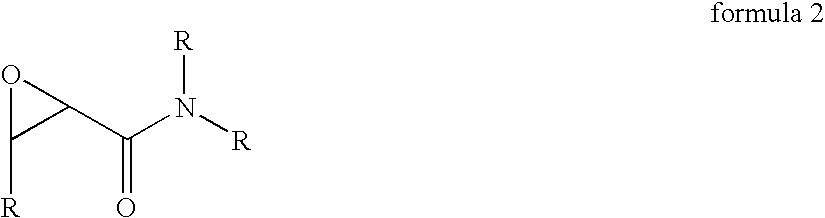
- 0 *C1OC1C(=O)N(*)* Chemical compound *C1OC1C(=O)N(*)* 0.000 description 13
- 150000003254 radicals Chemical class 0.000 description 12
- 125000004432 carbon atom Chemical group C* 0.000 description 11
- 150000002148 esters Chemical class 0.000 description 10
- IAZDPXIOMUYVGZ-UHFFFAOYSA-N Dimethylsulphoxide Chemical compound CS(C)=O IAZDPXIOMUYVGZ-UHFFFAOYSA-N 0.000 description 9
- YXFVVABEGXRONW-UHFFFAOYSA-N Toluene Chemical compound CC1=CC=CC=C1 YXFVVABEGXRONW-UHFFFAOYSA-N 0.000 description 9
- 239000000203 mixture Substances 0.000 description 9
- IJGRMHOSHXDMSA-UHFFFAOYSA-N Atomic nitrogen Chemical compound N#N IJGRMHOSHXDMSA-UHFFFAOYSA-N 0.000 description 6
- LFQSCWFLJHTTHZ-UHFFFAOYSA-N Ethanol Chemical compound CCO LFQSCWFLJHTTHZ-UHFFFAOYSA-N 0.000 description 6
- XEKOWRVHYACXOJ-UHFFFAOYSA-N Ethyl acetate Chemical compound CCOC(C)=O XEKOWRVHYACXOJ-UHFFFAOYSA-N 0.000 description 6
- VEXZGXHMUGYJMC-UHFFFAOYSA-N Hydrochloric acid Chemical compound Cl VEXZGXHMUGYJMC-UHFFFAOYSA-N 0.000 description 6
- KFZMGEQAYNKOFK-UHFFFAOYSA-N Isopropanol Chemical compound CC(C)O KFZMGEQAYNKOFK-UHFFFAOYSA-N 0.000 description 6
- NINIDFKCEFEMDL-UHFFFAOYSA-N Sulfur Chemical compound [S] NINIDFKCEFEMDL-UHFFFAOYSA-N 0.000 description 6
- 150000001408 amides Chemical class 0.000 description 6
- 230000015572 biosynthetic process Effects 0.000 description 6
- 239000002904 solvent Substances 0.000 description 6
- XLYOFNOQVPJJNP-UHFFFAOYSA-N water Substances O XLYOFNOQVPJJNP-UHFFFAOYSA-N 0.000 description 6
- 125000004209 (C1-C8) alkyl group Chemical group 0.000 description 5
- QVGXLLKOCUKJST-UHFFFAOYSA-N atomic oxygen Chemical group [O] QVGXLLKOCUKJST-UHFFFAOYSA-N 0.000 description 5
- QBYIENPQHBMVBV-HFEGYEGKSA-N (2R)-2-hydroxy-2-phenylacetic acid Chemical compound O[C@@H](C(O)=O)c1ccccc1.O[C@@H](C(O)=O)c1ccccc1 QBYIENPQHBMVBV-HFEGYEGKSA-N 0.000 description 4
- ARDZPNHBMYHPHZ-JGVFFNPUSA-N (2r,3s)-n-cyclopropyl-3-propyloxirane-2-carboxamide Chemical compound CCC[C@@H]1O[C@H]1C(=O)NC1CC1 ARDZPNHBMYHPHZ-JGVFFNPUSA-N 0.000 description 4
- JNRZUUANNDLJKU-RGIGUAHHSA-N (2s,3s)-3-amino-n-cyclopropyl-2-hydroxyhexanamide;(2s)-2-hydroxy-2-phenylacetic acid Chemical compound OC(=O)[C@@H](O)C1=CC=CC=C1.CCC[C@H](N)[C@H](O)C(=O)NC1CC1 JNRZUUANNDLJKU-RGIGUAHHSA-N 0.000 description 4
- CSCPPACGZOOCGX-UHFFFAOYSA-N Acetone Chemical compound CC(C)=O CSCPPACGZOOCGX-UHFFFAOYSA-N 0.000 description 4
- OAICVXFJPJFONN-UHFFFAOYSA-N Phosphorus Chemical compound [P] OAICVXFJPJFONN-UHFFFAOYSA-N 0.000 description 4
- IWYDHOAUDWTVEP-UHFFFAOYSA-N R-2-phenyl-2-hydroxyacetic acid Natural products OC(=O)C(O)C1=CC=CC=C1 IWYDHOAUDWTVEP-UHFFFAOYSA-N 0.000 description 4
- 150000001298 alcohols Chemical class 0.000 description 4
- 150000001299 aldehydes Chemical class 0.000 description 4
- 238000001816 cooling Methods 0.000 description 4
- 229910052736 halogen Inorganic materials 0.000 description 4
- 150000002367 halogens Chemical group 0.000 description 4
- JMMWKPVZQRWMSS-UHFFFAOYSA-N isopropanol acetate Natural products CC(C)OC(C)=O JMMWKPVZQRWMSS-UHFFFAOYSA-N 0.000 description 4
- 229940011051 isopropyl acetate Drugs 0.000 description 4
- GWYFCOCPABKNJV-UHFFFAOYSA-M isovalerate Chemical compound CC(C)CC([O-])=O GWYFCOCPABKNJV-UHFFFAOYSA-M 0.000 description 4
- JVTAAEKCZFNVCJ-UHFFFAOYSA-N lactic acid Chemical compound CC(O)C(O)=O JVTAAEKCZFNVCJ-UHFFFAOYSA-N 0.000 description 4
- 229960002510 mandelic acid Drugs 0.000 description 4
- 238000002360 preparation method Methods 0.000 description 4
- 238000003786 synthesis reaction Methods 0.000 description 4
- 238000005160 1H NMR spectroscopy Methods 0.000 description 3
- QTBSBXVTEAMEQO-UHFFFAOYSA-N Acetic acid Chemical compound CC(O)=O QTBSBXVTEAMEQO-UHFFFAOYSA-N 0.000 description 3
- XUIMIQQOPSSXEZ-UHFFFAOYSA-N Silicon Chemical compound [Si] XUIMIQQOPSSXEZ-UHFFFAOYSA-N 0.000 description 3
- 239000005864 Sulphur Substances 0.000 description 3
- ZMANZCXQSJIPKH-UHFFFAOYSA-N Triethylamine Chemical compound CCN(CC)CC ZMANZCXQSJIPKH-UHFFFAOYSA-N 0.000 description 3
- 125000001931 aliphatic group Chemical group 0.000 description 3
- 150000001540 azides Chemical class 0.000 description 3
- 238000004296 chiral HPLC Methods 0.000 description 3
- 238000006735 epoxidation reaction Methods 0.000 description 3
- 235000019439 ethyl acetate Nutrition 0.000 description 3
- 125000005842 heteroatom Chemical group 0.000 description 3
- 125000002887 hydroxy group Chemical group [H]O* 0.000 description 3
- ARDZPNHBMYHPHZ-UHFFFAOYSA-N n-cyclopropyl-3-propyloxirane-2-carboxamide Chemical compound CCCC1OC1C(=O)NC1CC1 ARDZPNHBMYHPHZ-UHFFFAOYSA-N 0.000 description 3
- 229910052757 nitrogen Inorganic materials 0.000 description 3
- 230000003287 optical effect Effects 0.000 description 3
- 150000007524 organic acids Chemical class 0.000 description 3
- 235000005985 organic acids Nutrition 0.000 description 3
- 230000003647 oxidation Effects 0.000 description 3
- 238000007254 oxidation reaction Methods 0.000 description 3
- 125000004430 oxygen atom Chemical group O* 0.000 description 3
- 230000009467 reduction Effects 0.000 description 3
- 239000010703 silicon Substances 0.000 description 3
- 229910052710 silicon Inorganic materials 0.000 description 3
- 239000007858 starting material Substances 0.000 description 3
- DRNGSSWBFKDSEE-YUMQZZPRSA-N (2s,3s)-3-amino-n-cyclopropyl-2-hydroxyhexanamide Chemical compound CCC[C@H](N)[C@H](O)C(=O)NC1CC1 DRNGSSWBFKDSEE-YUMQZZPRSA-N 0.000 description 2
- LMSDLVWKLIICSU-WSZWBAFRSA-N (2s,3s)-3-amino-n-cyclopropyl-2-hydroxyhexanamide;hydrochloride Chemical compound Cl.CCC[C@H](N)[C@H](O)C(=O)NC1CC1 LMSDLVWKLIICSU-WSZWBAFRSA-N 0.000 description 2
- 125000006552 (C3-C8) cycloalkyl group Chemical group 0.000 description 2
- JVSFQJZRHXAUGT-UHFFFAOYSA-N 2,2-dimethylpropanoyl chloride Chemical compound CC(C)(C)C(Cl)=O JVSFQJZRHXAUGT-UHFFFAOYSA-N 0.000 description 2
- KMGUEILFFWDGFV-UHFFFAOYSA-N 2-benzoyl-2-benzoyloxy-3-hydroxybutanedioic acid Chemical compound C=1C=CC=CC=1C(=O)C(C(C(O)=O)O)(C(O)=O)OC(=O)C1=CC=CC=C1 KMGUEILFFWDGFV-UHFFFAOYSA-N 0.000 description 2
- VHUUQVKOLVNVRT-UHFFFAOYSA-N Ammonium hydroxide Chemical compound [NH4+].[OH-] VHUUQVKOLVNVRT-UHFFFAOYSA-N 0.000 description 2
- FEWJPZIEWOKRBE-JCYAYHJZSA-N Dextrotartaric acid Chemical compound OC(=O)[C@H](O)[C@@H](O)C(O)=O FEWJPZIEWOKRBE-JCYAYHJZSA-N 0.000 description 2
- 239000004593 Epoxy Substances 0.000 description 2
- 241000711549 Hepacivirus C Species 0.000 description 2
- FEWJPZIEWOKRBE-UHFFFAOYSA-N Tartaric acid Natural products [H+].[H+].[O-]C(=O)C(O)C(O)C([O-])=O FEWJPZIEWOKRBE-UHFFFAOYSA-N 0.000 description 2
- 125000000217 alkyl group Chemical group 0.000 description 2
- XXROGKLTLUQVRX-UHFFFAOYSA-N allyl alcohol Chemical compound OCC=C XXROGKLTLUQVRX-UHFFFAOYSA-N 0.000 description 2
- 150000001414 amino alcohols Chemical class 0.000 description 2
- 150000008064 anhydrides Chemical class 0.000 description 2
- 125000004429 atom Chemical group 0.000 description 2
- 239000002585 base Substances 0.000 description 2
- WGQKYBSKWIADBV-UHFFFAOYSA-N benzylamine Chemical compound NCC1=CC=CC=C1 WGQKYBSKWIADBV-UHFFFAOYSA-N 0.000 description 2
- DKPFZGUDAPQIHT-UHFFFAOYSA-N butyl acetate Chemical compound CCCCOC(C)=O DKPFZGUDAPQIHT-UHFFFAOYSA-N 0.000 description 2
- MIOPJNTWMNEORI-UHFFFAOYSA-N camphorsulfonic acid Chemical compound C1CC2(CS(O)(=O)=O)C(=O)CC1C2(C)C MIOPJNTWMNEORI-UHFFFAOYSA-N 0.000 description 2
- 150000001805 chlorine compounds Chemical class 0.000 description 2
- 125000001559 cyclopropyl group Chemical group [H]C1([H])C([H])([H])C1([H])* 0.000 description 2
- 229940042399 direct acting antivirals protease inhibitors Drugs 0.000 description 2
- HHLFWLYXYJOTON-UHFFFAOYSA-N glyoxylic acid Chemical compound OC(=O)C=O HHLFWLYXYJOTON-UHFFFAOYSA-N 0.000 description 2
- 239000000543 intermediate Substances 0.000 description 2
- 150000002527 isonitriles Chemical class 0.000 description 2
- 125000001449 isopropyl group Chemical group [H]C([H])([H])C([H])(*)C([H])([H])[H] 0.000 description 2
- 239000004310 lactic acid Substances 0.000 description 2
- 235000014655 lactic acid Nutrition 0.000 description 2
- 230000014759 maintenance of location Effects 0.000 description 2
- QJGQUHMNIGDVPM-UHFFFAOYSA-N nitrogen(.) Chemical compound [N] QJGQUHMNIGDVPM-UHFFFAOYSA-N 0.000 description 2
- 239000012074 organic phase Substances 0.000 description 2
- 150000002924 oxiranes Chemical class 0.000 description 2
- 229910052760 oxygen Inorganic materials 0.000 description 2
- 239000001301 oxygen Substances 0.000 description 2
- 239000000137 peptide hydrolase inhibitor Substances 0.000 description 2
- 125000001997 phenyl group Chemical group [H]C1=C([H])C([H])=C(*)C([H])=C1[H] 0.000 description 2
- 229910052698 phosphorus Inorganic materials 0.000 description 2
- 239000011574 phosphorus Substances 0.000 description 2
- 239000002244 precipitate Substances 0.000 description 2
- 108090000765 processed proteins & peptides Proteins 0.000 description 2
- 238000010992 reflux Methods 0.000 description 2
- 238000007142 ring opening reaction Methods 0.000 description 2
- 238000003756 stirring Methods 0.000 description 2
- 235000002906 tartaric acid Nutrition 0.000 description 2
- 239000011975 tartaric acid Substances 0.000 description 2
- IWYDHOAUDWTVEP-ZETCQYMHSA-N (S)-mandelic acid Chemical compound OC(=O)[C@@H](O)C1=CC=CC=C1 IWYDHOAUDWTVEP-ZETCQYMHSA-N 0.000 description 1
- YBYIRNPNPLQARY-UHFFFAOYSA-N 1H-indene Natural products C1=CC=C2CC=CC2=C1 YBYIRNPNPLQARY-UHFFFAOYSA-N 0.000 description 1
- HOJZAHQWDXAPDJ-UHFFFAOYSA-N 3-anilino-2-hydroxypropanoic acid Chemical compound OC(=O)C(O)CNC1=CC=CC=C1 HOJZAHQWDXAPDJ-UHFFFAOYSA-N 0.000 description 1
- 125000003682 3-furyl group Chemical group O1C([H])=C([*])C([H])=C1[H] 0.000 description 1
- 125000004575 3-pyrrolidinyl group Chemical group [H]N1C([H])([H])C([H])([H])C([H])(*)C1([H])[H] 0.000 description 1
- 125000001397 3-pyrrolyl group Chemical group [H]N1C([H])=C([*])C([H])=C1[H] 0.000 description 1
- 125000001541 3-thienyl group Chemical group S1C([H])=C([*])C([H])=C1[H] 0.000 description 1
- FAXMLJQZLHERED-UHFFFAOYSA-N 4-[tert-butyl(diphenyl)silyl]oxycyclohexane-1-carbonitrile Chemical compound C=1C=CC=CC=1[Si](C=1C=CC=CC=1)(C(C)(C)C)OC1CCC(C#N)CC1 FAXMLJQZLHERED-UHFFFAOYSA-N 0.000 description 1
- 125000000339 4-pyridyl group Chemical group N1=C([H])C([H])=C([*])C([H])=C1[H] 0.000 description 1
- ZCYVEMRRCGMTRW-UHFFFAOYSA-N 7553-56-2 Chemical compound [I] ZCYVEMRRCGMTRW-UHFFFAOYSA-N 0.000 description 1
- HBAQYPYDRFILMT-UHFFFAOYSA-N 8-[3-(1-cyclopropylpyrazol-4-yl)-1H-pyrazolo[4,3-d]pyrimidin-5-yl]-3-methyl-3,8-diazabicyclo[3.2.1]octan-2-one Chemical class C1(CC1)N1N=CC(=C1)C1=NNC2=C1N=C(N=C2)N1C2C(N(CC1CC2)C)=O HBAQYPYDRFILMT-UHFFFAOYSA-N 0.000 description 1
- WKBOTKDWSSQWDR-UHFFFAOYSA-N Bromine atom Chemical compound [Br] WKBOTKDWSSQWDR-UHFFFAOYSA-N 0.000 description 1
- JGCZSBSKVHXKDO-UHFFFAOYSA-N CCCC(C(O)C(=O)O)[N+](=O)[O-].CCCC(N)C(C)O.CCCC(N)C(O)C(=O)O.CCCC[N+](=O)[O-] Chemical compound CCCC(C(O)C(=O)O)[N+](=O)[O-].CCCC(N)C(C)O.CCCC(N)C(O)C(=O)O.CCCC[N+](=O)[O-] JGCZSBSKVHXKDO-UHFFFAOYSA-N 0.000 description 1
- UYHTYQLFTJMJFS-CLYGMWBKSA-N CCC[C@H](N)C(C)O.CCC[C@H](N)C(C)OC(C)=O.CCC[C@H](NC)C(=O)O.[H]C(=O)[C@H](CCC)NC Chemical compound CCC[C@H](N)C(C)O.CCC[C@H](N)C(C)OC(C)=O.CCC[C@H](NC)C(=O)O.[H]C(=O)[C@H](CCC)NC UYHTYQLFTJMJFS-CLYGMWBKSA-N 0.000 description 1
- PEKZODCZPGNCDI-WEEMKTSFSA-N CCC[C@H](N)C(C)O.CCC[C@H](N)C(O)C(=O)O.CCC[C@H](NC)C(=O)O.CCC[C@H](NC)C(O)C#N.[H]C(=O)[C@H](CCC)NC Chemical compound CCC[C@H](N)C(C)O.CCC[C@H](N)C(O)C(=O)O.CCC[C@H](NC)C(=O)O.CCC[C@H](NC)C(O)C#N.[H]C(=O)[C@H](CCC)NC PEKZODCZPGNCDI-WEEMKTSFSA-N 0.000 description 1
- LSIDMNMUXNIKFU-IVADLZMMSA-N CCC[C@H](NC(=O)[C@@H]1[C@H]2CCC[C@H]2CN1C(=O)[C@@H](NC(=O)[C@@H](NC(=O)C1=CN=CC=N1)C1CCCCC1)C(C)C)C(=O)C(=O)NC1CC1 Chemical compound CCC[C@H](NC(=O)[C@@H]1[C@H]2CCC[C@H]2CN1C(=O)[C@@H](NC(=O)[C@@H](NC(=O)C1=CN=CC=N1)C1CCCCC1)C(C)C)C(=O)C(=O)NC1CC1 LSIDMNMUXNIKFU-IVADLZMMSA-N 0.000 description 1
- JQGWGHDPRYZPOC-QMAISDHCSA-N CCC[C@H]([NH3+])[C@H](O)C(=O)NC1CC1.O=C(NC(CC1=CC=CC=C1)C(=O)[O-])OCC1=CC=CC=C1.S.S Chemical compound CCC[C@H]([NH3+])[C@H](O)C(=O)NC1CC1.O=C(NC(CC1=CC=CC=C1)C(=O)[O-])OCC1=CC=CC=C1.S.S JQGWGHDPRYZPOC-QMAISDHCSA-N 0.000 description 1
- OKTJSMMVPCPJKN-UHFFFAOYSA-N Carbon Chemical group [C] OKTJSMMVPCPJKN-UHFFFAOYSA-N 0.000 description 1
- ZAMOUSCENKQFHK-UHFFFAOYSA-N Chlorine atom Chemical compound [Cl] ZAMOUSCENKQFHK-UHFFFAOYSA-N 0.000 description 1
- HTJDQJBWANPRPF-UHFFFAOYSA-N Cyclopropylamine Chemical compound NC1CC1 HTJDQJBWANPRPF-UHFFFAOYSA-N 0.000 description 1
- 238000003476 Darzens condensation reaction Methods 0.000 description 1
- ULGZDMOVFRHVEP-RWJQBGPGSA-N Erythromycin Chemical class O([C@@H]1[C@@H](C)C(=O)O[C@@H]([C@@]([C@H](O)[C@@H](C)C(=O)[C@H](C)C[C@@](C)(O)[C@H](O[C@H]2[C@@H]([C@H](C[C@@H](C)O2)N(C)C)O)[C@H]1C)(C)O)CC)[C@H]1C[C@@](C)(OC)[C@@H](O)[C@H](C)O1 ULGZDMOVFRHVEP-RWJQBGPGSA-N 0.000 description 1
- PXGOKWXKJXAPGV-UHFFFAOYSA-N Fluorine Chemical compound FF PXGOKWXKJXAPGV-UHFFFAOYSA-N 0.000 description 1
- 229940122388 Thrombin inhibitor Drugs 0.000 description 1
- 125000000641 acridinyl group Chemical group C1(=CC=CC2=NC3=CC=CC=C3C=C12)* 0.000 description 1
- NIXOWILDQLNWCW-UHFFFAOYSA-N acrylic acid group Chemical group C(C=C)(=O)O NIXOWILDQLNWCW-UHFFFAOYSA-N 0.000 description 1
- 150000001253 acrylic acids Chemical class 0.000 description 1
- 230000004913 activation Effects 0.000 description 1
- 229910052783 alkali metal Inorganic materials 0.000 description 1
- 229940024606 amino acid Drugs 0.000 description 1
- 150000001413 amino acids Chemical class 0.000 description 1
- 238000006399 aminohydroxylation reaction Methods 0.000 description 1
- 125000005428 anthryl group Chemical group [H]C1=C([H])C([H])=C2C([H])=C3C(*)=C([H])C([H])=C([H])C3=C([H])C2=C1[H] 0.000 description 1
- 239000008346 aqueous phase Substances 0.000 description 1
- 239000007864 aqueous solution Substances 0.000 description 1
- 239000003125 aqueous solvent Substances 0.000 description 1
- 125000003118 aryl group Chemical group 0.000 description 1
- 150000005840 aryl radicals Chemical class 0.000 description 1
- 238000011914 asymmetric synthesis Methods 0.000 description 1
- 230000008901 benefit Effects 0.000 description 1
- 239000004305 biphenyl Substances 0.000 description 1
- 235000010290 biphenyl Nutrition 0.000 description 1
- GDTBXPJZTBHREO-UHFFFAOYSA-N bromine Substances BrBr GDTBXPJZTBHREO-UHFFFAOYSA-N 0.000 description 1
- 229910052794 bromium Inorganic materials 0.000 description 1
- 210000004899 c-terminal region Anatomy 0.000 description 1
- 125000002837 carbocyclic group Chemical group 0.000 description 1
- 150000001728 carbonyl compounds Chemical class 0.000 description 1
- 239000003054 catalyst Substances 0.000 description 1
- 229910052801 chlorine Inorganic materials 0.000 description 1
- 239000000460 chlorine Substances 0.000 description 1
- 238000004587 chromatography analysis Methods 0.000 description 1
- 238000009833 condensation Methods 0.000 description 1
- 230000005494 condensation Effects 0.000 description 1
- 125000004122 cyclic group Chemical group 0.000 description 1
- 125000001995 cyclobutyl group Chemical group [H]C1([H])C([H])([H])C([H])(*)C1([H])[H] 0.000 description 1
- 125000000113 cyclohexyl group Chemical group [H]C1([H])C([H])([H])C([H])([H])C([H])(*)C([H])([H])C1([H])[H] 0.000 description 1
- 125000001511 cyclopentyl group Chemical group [H]C1([H])C([H])([H])C([H])([H])C([H])(*)C1([H])[H] 0.000 description 1
- 238000009510 drug design Methods 0.000 description 1
- 150000002170 ethers Chemical class 0.000 description 1
- 125000001495 ethyl group Chemical group [H]C([H])([H])C([H])([H])* 0.000 description 1
- 238000000605 extraction Methods 0.000 description 1
- 229910052731 fluorine Inorganic materials 0.000 description 1
- 239000011737 fluorine Substances 0.000 description 1
- 238000010438 heat treatment Methods 0.000 description 1
- 125000003187 heptyl group Chemical group [H]C([*])([H])C([H])([H])C([H])([H])C([H])([H])C([H])([H])C([H])([H])C([H])([H])[H] 0.000 description 1
- 150000002390 heteroarenes Chemical class 0.000 description 1
- 125000001072 heteroaryl group Chemical group 0.000 description 1
- 125000000623 heterocyclic group Chemical group 0.000 description 1
- 125000004051 hexyl group Chemical group [H]C([H])([H])C([H])([H])C([H])([H])C([H])([H])C([H])([H])C([H])([H])* 0.000 description 1
- 238000004128 high performance liquid chromatography Methods 0.000 description 1
- 229930195733 hydrocarbon Natural products 0.000 description 1
- 150000002430 hydrocarbons Chemical class 0.000 description 1
- 230000007062 hydrolysis Effects 0.000 description 1
- 238000006460 hydrolysis reaction Methods 0.000 description 1
- 125000003454 indenyl group Chemical group C1(C=CC2=CC=CC=C12)* 0.000 description 1
- 239000003112 inhibitor Substances 0.000 description 1
- 239000011630 iodine Substances 0.000 description 1
- 229910052740 iodine Inorganic materials 0.000 description 1
- 125000000959 isobutyl group Chemical group [H]C([H])([H])C([H])(C([H])([H])[H])C([H])([H])* 0.000 description 1
- 238000002955 isolation Methods 0.000 description 1
- 229910052747 lanthanoid Inorganic materials 0.000 description 1
- 150000002602 lanthanoids Chemical class 0.000 description 1
- 125000002496 methyl group Chemical group [H]C([H])([H])* 0.000 description 1
- 125000004573 morpholin-4-yl group Chemical group N1(CCOCC1)* 0.000 description 1
- 125000004108 n-butyl group Chemical group [H]C([H])([H])C([H])([H])C([H])([H])C([H])([H])* 0.000 description 1
- 125000004123 n-propyl group Chemical group [H]C([H])([H])C([H])([H])C([H])([H])* 0.000 description 1
- 125000001624 naphthyl group Chemical group 0.000 description 1
- 125000000449 nitro group Chemical group [O-][N+](*)=O 0.000 description 1
- 125000004971 nitroalkyl group Chemical group 0.000 description 1
- 239000011356 non-aqueous organic solvent Substances 0.000 description 1
- 125000002347 octyl group Chemical group [H]C([*])([H])C([H])([H])C([H])([H])C([H])([H])C([H])([H])C([H])([H])C([H])([H])C([H])([H])[H] 0.000 description 1
- 239000003921 oil Substances 0.000 description 1
- 238000005580 one pot reaction Methods 0.000 description 1
- 239000003960 organic solvent Substances 0.000 description 1
- 229910000487 osmium oxide Inorganic materials 0.000 description 1
- 239000007800 oxidant agent Substances 0.000 description 1
- JIWAALDUIFCBLV-UHFFFAOYSA-N oxoosmium Chemical compound [Os]=O JIWAALDUIFCBLV-UHFFFAOYSA-N 0.000 description 1
- 125000001147 pentyl group Chemical group C(CCCC)* 0.000 description 1
- 125000004934 phenanthridinyl group Chemical group C1(=CC=CC2=NC=C3C=CC=CC3=C12)* 0.000 description 1
- 125000005561 phenanthryl group Chemical group 0.000 description 1
- 229960005190 phenylalanine Drugs 0.000 description 1
- ZUOUZKKEUPVFJK-UHFFFAOYSA-N phenylbenzene Natural products C1=CC=CC=C1C1=CC=CC=C1 ZUOUZKKEUPVFJK-UHFFFAOYSA-N 0.000 description 1
- 159000000001 potassium salts Chemical class 0.000 description 1
- NLJMJLNTAWRZIU-UYXJWNHNSA-M potassium;(2r,3s)-3-propyloxirane-2-carboxylate Chemical compound [K+].CCC[C@@H]1O[C@H]1C([O-])=O NLJMJLNTAWRZIU-UYXJWNHNSA-M 0.000 description 1
- 150000003140 primary amides Chemical class 0.000 description 1
- 125000002924 primary amino group Chemical group [H]N([H])* 0.000 description 1
- 102000004196 processed proteins & peptides Human genes 0.000 description 1
- 239000000047 product Substances 0.000 description 1
- 239000003586 protic polar solvent Substances 0.000 description 1
- 125000004943 pyrimidin-6-yl group Chemical group N1=CN=CC=C1* 0.000 description 1
- 125000002943 quinolinyl group Chemical group N1=C(C=CC2=CC=CC=C12)* 0.000 description 1
- 230000009257 reactivity Effects 0.000 description 1
- 229920006395 saturated elastomer Polymers 0.000 description 1
- 125000002914 sec-butyl group Chemical group [H]C([H])([H])C([H])([H])C([H])(*)C([H])([H])[H] 0.000 description 1
- 239000007787 solid Substances 0.000 description 1
- 239000000243 solution Substances 0.000 description 1
- 125000001424 substituent group Chemical group 0.000 description 1
- 229910052717 sulfur Inorganic materials 0.000 description 1
- 230000002194 synthesizing effect Effects 0.000 description 1
- 125000000999 tert-butyl group Chemical group [H]C([H])([H])C(*)(C([H])([H])[H])C([H])([H])[H] 0.000 description 1
- 239000003868 thrombin inhibitor Substances 0.000 description 1
- 231100000331 toxic Toxicity 0.000 description 1
- 230000002588 toxic effect Effects 0.000 description 1
- 238000007056 transamidation reaction Methods 0.000 description 1
- 230000017105 transposition Effects 0.000 description 1
Classifications
-
- C—CHEMISTRY; METALLURGY
- C07—ORGANIC CHEMISTRY
- C07D—HETEROCYCLIC COMPOUNDS
- C07D303/00—Compounds containing three-membered rings having one oxygen atom as the only ring hetero atom
- C07D303/02—Compounds containing oxirane rings
- C07D303/48—Compounds containing oxirane rings with hetero atoms or with carbon atoms having three bonds to hetero atoms with at the most one bond to halogen, directly attached to ring carbon atoms, e.g. ester or nitrile radicals
-
- C—CHEMISTRY; METALLURGY
- C07—ORGANIC CHEMISTRY
- C07C—ACYCLIC OR CARBOCYCLIC COMPOUNDS
- C07C231/00—Preparation of carboxylic acid amides
- C07C231/12—Preparation of carboxylic acid amides by reactions not involving the formation of carboxamide groups
-
- C—CHEMISTRY; METALLURGY
- C07—ORGANIC CHEMISTRY
- C07C—ACYCLIC OR CARBOCYCLIC COMPOUNDS
- C07C231/00—Preparation of carboxylic acid amides
- C07C231/16—Preparation of optical isomers
- C07C231/20—Preparation of optical isomers by separation of optical isomers
-
- C—CHEMISTRY; METALLURGY
- C07—ORGANIC CHEMISTRY
- C07C—ACYCLIC OR CARBOCYCLIC COMPOUNDS
- C07C237/00—Carboxylic acid amides, the carbon skeleton of the acid part being further substituted by amino groups
- C07C237/02—Carboxylic acid amides, the carbon skeleton of the acid part being further substituted by amino groups having the carbon atoms of the carboxamide groups bound to acyclic carbon atoms of the carbon skeleton
- C07C237/04—Carboxylic acid amides, the carbon skeleton of the acid part being further substituted by amino groups having the carbon atoms of the carboxamide groups bound to acyclic carbon atoms of the carbon skeleton the carbon skeleton being acyclic and saturated
-
- C—CHEMISTRY; METALLURGY
- C07—ORGANIC CHEMISTRY
- C07C—ACYCLIC OR CARBOCYCLIC COMPOUNDS
- C07C271/00—Derivatives of carbamic acids, i.e. compounds containing any of the groups, the nitrogen atom not being part of nitro or nitroso groups
- C07C271/06—Esters of carbamic acids
- C07C271/08—Esters of carbamic acids having oxygen atoms of carbamate groups bound to acyclic carbon atoms
- C07C271/10—Esters of carbamic acids having oxygen atoms of carbamate groups bound to acyclic carbon atoms with the nitrogen atoms of the carbamate groups bound to hydrogen atoms or to acyclic carbon atoms
- C07C271/22—Esters of carbamic acids having oxygen atoms of carbamate groups bound to acyclic carbon atoms with the nitrogen atoms of the carbamate groups bound to hydrogen atoms or to acyclic carbon atoms to carbon atoms of hydrocarbon radicals substituted by carboxyl groups
-
- C—CHEMISTRY; METALLURGY
- C07—ORGANIC CHEMISTRY
- C07C—ACYCLIC OR CARBOCYCLIC COMPOUNDS
- C07C2601/00—Systems containing only non-condensed rings
- C07C2601/02—Systems containing only non-condensed rings with a three-membered ring
Definitions
- the present invention is directed to a process for preparing ⁇ -amino- ⁇ -hydroxycarboxamides.
- the process works with epoxycarboxamides of the formula 2
- ⁇ -amino- ⁇ -hydroxycarboxamides are important intermediates for chemical synthesis. They may, for example, be reacted further to 3-amino-2-ketamides.
- a multitude of recent protease inhibitors contain, as C-terminal units, 3-amino-2-ketoamides. Examples thereof are calpin inhibitors (WO 95/00535), thrombin inhibitors (J. Cacciola et al., Tetrahedron Lett. 38, 5741 (1997)) and, very particularly, a multitude of hepatitis C virus (HCV) protease inhibitors, as detailed, for example, in WO 05/087731, WO 05/058821. Among the latter, VX-950 is mentioned by way of example (WO 01/74768, WO 02/18369), which is already in advanced stages of clinical development.
- a disadvantage of this process is that the complete range of possible stereoisomeric compounds are obtained, which, after oxidation of the hydroxyl group, lead to mixtures of diastereomeric compounds, which cannot be separated in most cases. If they can, this is possible only with chromatographic methods (K. X. Chen, J. Med. Chem., 49, 995 (2006)).
- a disadvantage of this process is that large amounts of chiral catalysts and toxic osmium oxide are required as oxidizing agents.
- a disadvantage of this variant is that azides have to be used for ring opening, which is problematic from a safety point of view, and an additional reduction step is required for conversion to the amines.
- enantiomerically pure epoxides either the corresponding allyl alcohol has to be epoxidized according to Sharpless (J. Cacciola, Tetrahedron Lett. 38, 5741 (1997), US 2003/0153788) or, for the epoxidation of the corresponding acrylic acids, lanthanide complexes (T.
- epoxycarboxylic acids and esters can be opened directly with ammonia or amines, preferably benzylamine.
- the free acids are opened exclusively by attack at the C-2 atom (e.g.: Y. Liwschitz, J. Chem. Soc., 1961, 1116).
- An exception is formed by 3-phenylglycidic acid, which reacts with ammonia predominantly to give phenylisoserine (WO 03/003804).
- Addition of at least stoichiometric amounts of Ti(O-iPr) 4 in the reaction of aliphatic acids likewise allows a reversal of selectivity (K. B. Sharpless, J. Org. Chem. 50, 1560 (1985)).
- the invention is directed to a process for preparing compounds of the general formula (I)
- R 1 , R 2 , R 3 , R 4 , R 5 are each independently (C 1 -C 8 )-alkyl, HO-(C 1 -C 8 )-alkyl, (C 2 -C 8 )-alkoxyalkyl, (C 6 -C 18 )-aryl, (C 7-19 )-aralkyl, (C 3 -C 18 )-heteroaryl, (C 4 -C 19 )-heteroaralkyl, (C 1 -C 8 )-alkyl-(C 6 -C 18 )-aryl, (C 1 -C 8 )-alkyl-(C 3 -C 18 )-heteroaryl, (C 3 -C 8 )-cycloalkyl, (C 1 -C 8 )-alkyl-(C 3 -C 8 )-cycloalkyl, (C 3 -C 8 )-cycloalkyl-(C 1 -C 8
- R 4 and R 5 and/or R 2 and R 3 together form a (C 2 -C 8 )-alkylene bridge
- the process involves reacting epoxycarboxamides of the general formula (II):
- R 1 , R 4 , R 5 are each as defined above with ammonia or amines of the general formula (III)
- R 2 , R 3 are each as defined above. Production of the desired product is achieved in a completely surprising and advantageous manner. Compounds of general formula (I) are obtained in high yields, unexpectedly high regioisomeric purity and, in the case where R 1 ⁇ H, with virtually complete retention of the diastereomeric purities.
- aliphatic epoxycarboxamides of formula (II) especially compounds in which R 1 is a linear alkyl chain having 2-8 carbon atoms, especially a linear C 3 -alkyl radical.
- the present invention relates to a process for preparing enantiomerically enriched compounds of general formula (I) in which enantiomerically enriched compounds of formula (II) are used or the racemic diastereomerically enriched compounds of formula (I) which otherwise form are crystallized enantioselectively as the salt with chiral organic acids.
- the inventive reaction can be performed in a solvent considered useful for this purpose by a person skilled in the art.
- Preferred solvents include: water, aqueous and nonaqueous organic solvents. Preference is given to performing the reaction in protic solvents, for example alcohols or water, and very particularly in mixtures thereof (for example ethanol and concentrated aqueous ammonia).
- the reaction is preferably performed at a temperature of 0-200° C., more preferably at 20-150° C. and very particularly at 50-100° C., in a pressure vessel at the autogenous pressure which is established.
- the invention likewise provides enantiomerically enriched N-cyclopropyl-3-alkyloxiranecarboxamides of the formula (IV)
- R is a linear (C 1 -C 8 )-alkyl radical.
- a further aspect of the present invention is that of salts of the compounds of the formula (V)
- R is a linear (C 1 -C 8 )-alkyl radical with chiral acids, for example hydroxyl acids (e.g. mandelic acid, tartaric acid, dibenzoyltartaric acid, ditolyltartaric acid, lactic acid), N-acylamino acids (e.g. benzyloxycarbonyl-L-phenylalanine, acetyl-L-phenylalanine) or sulphonic acids (e.g. camphorsulphonic acid) or aminodicarboxylic acids.
- hydroxyl acids e.g. mandelic acid, tartaric acid, dibenzoyltartaric acid, ditolyltartaric acid, lactic acid
- N-acylamino acids e.g. benzyloxycarbonyl-L-phenylalanine, acetyl-L-phenylalanine
- sulphonic acids e.g. camphorsulphonic acid
- salts of 2S,3S compounds of the formula (V) with optically active acids are especially preferred.
- all salts considered useful by the person skilled in the art may be used for salt formation.
- Particularly useful salts include (2S,3S)-N-cyclopropyl-3-amino-2-hydroxy-hexanamide (S)-mandelic acid salt or the corresponding (2R,3R)-(R)-mandelic acid salt, and the (2S,3S-N-cyclopropyl-3-amino-2-hydroxyhexanamide N-benzyloxycarbonyl-L-phenylalanine salt and the corresponding (2R,3R)-phenylalanine salt.
- the epoxycarboxamides of the formula (II) may be prepared by processes known to those skilled in the art, for example in a simple manner from the corresponding acids and the amines of the formula HNR 4 R 5 .
- the epoxycarboxylic acids may be activated, using methods well known in peptide chemistry (see for example, Houben-Weyl Vol. 15, Synthesis of Peptides, Thieme Verlag Stuttgart 1974). Preference is given, however, to preparing these compounds as described in US 2003/0153788 by means of mixed anhydrides and very particularly by means of pivaloyl chloride. Particular preference is given to using alkali metal salts of the epoxycarboxylic acids, very particularly potassium salts, for the reaction with the acid chlorides.
- the epoxycarboxylic acids may occur as 4 different stereoisomers.
- the process according to the invention preferably proceeds such that the erythro-aminohydroxy compounds of the formula (I) form stereoselectively from the trans-epoxide amides of the formula (II), while the cis compounds result selectively in the corresponding threo compounds.
- Use of the enantiomerically pure epoxycarboxamides of the formula (II) where R 1 ⁇ H results in the corresponding aminohydroxy compounds of the formula (I) in which the configuration at C atom 3 is exchanged compared to the epoxy compound.
- a further commonly used method for preparing epoxycarboxylic acid derivatives is Darzen glycidic ester synthesis. Starting from aldehydes and haloacetic esters, predominantly the trans compounds are formed. Similar results are obtained in the reaction of carbonyl compounds with sulphur ylides (WO 03/087075). In many cases, the pure trans compounds can then be obtained by crystallizing the corresponding epoxycarboxylic acid salts. This has the further advantage that these salts can be reacted directly with acid chlorides to give the mixed anhydrides and these in turn, if appropriate in one pot, to the amides.
- enantiomerically pure and diastereo-merically pure derivatives of the compounds of the general formula (I), more preferably the erythro compounds thereof are prepared by salt pair formation with chiral acids, for example hydroxyl acids (e.g. mandelic acid, tartaric acid, dibenzoyltartaric acid, ditolyltartaric acid, lactic acid), N-acylamino acids (e.g. benzyloxycarbonyl-L-phenylalanine, acetyl-L-phenylalanine) or sulphonic acids (e.g. camphorsulphonic acid).
- hydroxyl acids e.g. mandelic acid, tartaric acid, dibenzoyltartaric acid, ditolyltartaric acid, lactic acid
- N-acylamino acids e.g. benzyloxycarbonyl-L-phenylalanine, acetyl-L-phenylalanine
- sulphonic acids e.g. cam
- Salt formation is performed preferably with 0.2-2.0 equivalents, better 0.3-1.0 equivalent, very preferably 0.5-0.6 equivalent, of the chiral acid.
- the solvents used are, depending on the solubility of the salts, organic solvents such as alcohols, esters, ethers, hydrocarbons. Particular preference is given to using alcohols such as ethanol and isopropanol, and acetic esters such as ethyl acetate, n-butyl acetate and isopropyl acetate. To increase the solubility, a little water can also be added to the solvents. Preference is given to dissolving the compounds of the formula (I) and the chiral acid under hot conditions and to crystallizing the salts by cooling.
- the free bases of the compounds of formula (I) can be obtained from the salts by known processes, for example acid-base extraction. Salt exchange with stronger acids, for example hydrochloric acid, is also possible.
- the invention likewise provides for the preparation of pharmacologically active compounds using salts of compounds of formula V
- R is a linear (C 1 -C 8 )-alkyl radical with chiral acids.
- (C 1 -C 8 )-Alkyl radicals are considered to be methyl, ethyl, n-propyl, isopropyl, n-butyl, isobutyl, sec-butyl, tert-butyl, pentyl, hexyl, heptyl or octyl including all of their bonding isomers.
- (C 1 -C 8 )-alkoxy” radical corresponds to the (C 1 -C 8 )-alkyl radical with the proviso that it is bonded to the molecule via an oxygen atom.
- (C 2 -C 8 )-Alkoxyalkyl means radicals in which the alkyl chain is interrupted by at least one oxygen function, where two oxygen atoms may not be joined to one another.
- the number of carbon atoms specifies the total number of carbon atoms present in the radical.
- a “(C 2 -C 8 )-alkylene bridge” is a carbon chain having two to eight carbon atoms, this chain being bonded to the molecule in question via two different carbon atoms. It can be a saturated or unsaturated carbocyclic or heterocyclic ring having 1-4 nitrogen, silicon, sulphur, phosphorus or oxygen atoms in the ring system.
- radicals described in the preceding paragraphs may be mono- or polysubstituted by halogens and/or nitrogen-, oxygen-, phosphorus-, sulphur-, silicon-containing radicals.
- halogens and/or nitrogen-, oxygen-, phosphorus-, sulphur-, silicon-containing radicals.
- alkyl radicals of the type mentioned above which have one or more of these heteroatoms in their chain or which are bonded to the radical via one of these heteroatoms.
- (C 3 -C 8 )-Cycloalkyl is understood to mean cyclopropyl, cyclo-butyl, cyclopentyl, cyclohexyl or cycloheptyl radicals, etc. which may be substituted by one or more halogens and/or nitrogen-, oxygen-, phosphorus-, sulphur-, silicon-containing radicals and/or have nitrogen, oxygen, phosphorus, sulphur atoms in the ring, for example 1-, 2-, 3-, 4-piperidyl, 1-, 2-, 3-pyrrolidinyl, 2-, 3-tetrahydrofuryl, 2-, 3-, 4-morpholinyl.
- a “(C 3 -C 8 )-cycloalkyl-(C 1 -C 8 )-alkyl radical” denotes a cyclo-alkyl radical as detailed above, which is bonded to the molecule via an alkyl radical as specified above.
- (C 1 -C 8 )-acyloxy means an alkyl radical as defined above which has a maximum of 8 carbon atoms and is bonded to the molecule via a COO function.
- (C 1 -C 8 )-acyl means an alkyl radical as defined above which has max. 8 carbon atoms and is bonded to the molecule via a CO function.
- a “(C 6 -C 18 )-aryl radical” is understood to mean an aromatic radical having 6 to 18 carbon atoms.
- this includes compounds such as phenyl, naphthyl, anthryl, phenanthryl, biphenyl radicals, or systems of the above-described type fused to the molecule in question, for example indenyl systems which may optionally be substituted by halogen, (C 1 -C 8 )-alkyl, (C 1 -C 8 )-alkoxy, NH 2 , NH(C 1 -C 8 )-alkyl, N((C 1 -C 8 )-alkyl) 2 , OH, CF 3 , NH(C 1 -C 8 )-acyl, N((C 1 -C 8 )-acyl) 2 , (C 1 -C 8 )-acyl, (C 1 -C 8 )-acyloxy.
- a “(C 7 -C 19 )-aralkyl radical” is a (C 6 -C 18 )-aryl radical bonded to the molecule via a (C 1 -C 8 )-alkyl radical.
- a “(C 3 -C 18 )-heteroaryl radical” denotes a five-, six- or seven-membered aromatic ring system composed of 3 to 18 carbon atoms and having heteroatoms, for example nitrogen, oxygen or sulphur, in the ring.
- heteroaromatics are considered in particular to be radicals such as 1-, 2-, 3-furyl, such as 1-, 2-, 3-pyrrolyl, 1-, 2-, 3-thienyl, 2-, 3-, 4-pyridyl, 2-, 3-, 4-, 5-, 6-, 7-indolyl, 3-, 4-, 5-pyrazolyl, 2-, 4-, 5-imidazolyl, acridinyl, quinolinyl, phenanthridinyl, 2-, 4-, 5-, 6-pyrimidinyl.
- This radical may be substituted with the same radicals as the above mentioned aryl radical.
- a “(C 4 -C 19 )-heteroaralkyl” is understood to mean a hetero-aromatic system corresponding to the (C 7 -C 19 )-aralkyl radical.
- Hal halogens
- Useful halogens include fluorine, chlorine, bromine and iodine.
- enantiomerically enriched or “enantiomeric excess” is understood, in the context of the invention, to mean the proportion of one enantiomer in a mixture with its optical antipode in a range of >50% and ⁇ 100%.
- diastereomerically enriched refers to the proportion of one diastereomer in a mixture with the other possible diastereomers of the compound in question.
- trans-3-n-propyloxiranecarboxylic acid potassium salt 200 g are suspended in 2 l of acetone, admixed with 120 g of triethylamine and cooled to 3° C.
- 146 g of pivaloyl chloride are then added, and the mixture is stirred at 20° C. for 20 minutes and then cooled to 3° C.
- the aqueous phase is removed and the organic phase is admixed with 300 ml of water and the pH is adjusted to 2 with hydrochloric acid.
- the organic phase is removed and concentrated in vacuo. 175 g of N-cyclopropyl-trans-3-n-propyloxiranecarboxamide are obtained as a light brown oil.
- N-cyclopropyl-trans-3-n-propyloxiranecarboxamide are dissolved in 1683 g of 10.5% by weight ethanolic ammonia and heated to 100° C. in a closed autoclave for 6 h. Thereafter, the mixture is cooled to room temperature; the solvent is removed in vacuo. The residue is suspended in 700 ml of toluene, very substantially concentrated again and diluted with fresh toluene. Heating to reflux dissolves the residue. After cooling to 0° C. and filtering-off, 136 g of N-cyclopropyl-erythro-3-amino-2-hydroxyhexanamide are obtained.
Landscapes
- Chemical & Material Sciences (AREA)
- Organic Chemistry (AREA)
- Chemical Kinetics & Catalysis (AREA)
- Analytical Chemistry (AREA)
- Organic Low-Molecular-Weight Compounds And Preparation Thereof (AREA)
- Epoxy Compounds (AREA)
Abstract
which are reacted with ammonia or other amines.
Description

which are reacted with ammonia or other amines.


- 1. Condensation of nitroalkanes with glyoxalic acid, reduction of the nitro group and subsequent conversion of the acid to the amide (K. X. Chen, J. Med. Chem. 49, 567, (2006); ibid. 995):

- 2. Conversion of protected amino acids to the aldehydes, conversion to the cyanohydrins, hydrolysis thereof to the acid and subsequent conversion to the amides (e.g.: WO 01/74768, WO 02/18369, WO 05/087731, S.-H. Chen, Lett. Drug Design & Discovery, 2005, 118).

- 3. By enantioselective aminohydroxylation (Sharpless, Angew, Chem. 109, 2752 (1997); WO 97/46516, WO 98/42657) of acrylic esters (WO 05/087731, US 2005/0197301):

- 4. Primary amides can, by analogy to point 2, be prepared by reacting the aldehydes with isonitriles and acetic acid (J. G. Catalano, Biorg. Med. Chem. Lett., 14, 719 (2004); D. G. Barrett, ibid. 2543; L. Banfi, Molecular Diversity, 6, 227 (2003), WO 05/087731, US 2005/0197301):

- 5. A further possibility consists in the regioselective ring opening of epoxyamides by means of azide and subsequent reduction to amino compounds (J. Cacciola, Tetrahedron Lett. 38, 5741 (1997); US 2003/0153788, K. B. Sharpless, J. Org. Chem. 50, 5696 (1985)).


in which

in which

in which
- R1=(C1-C8)-alkyl,
- R2, R3═H,
- R4═H, and
- R5═(C1-C8)-alkyl-(C3-C8)-cycloalkyl, especially cyclopropyl.


in which

in which

in which
([enantiomer1]−[enantiomer2])/([enantiomer1]+[enantiomer2])=ee.

| δ/ppm | Multiplicity | Intensity | Assignment |
| 0.40-0.65 | m | 4 | 8 |
| 0.91 | t | 3 | 6 |
| 1.42/1.54 | m/m | 1/1 | 4 |
| 1.24 | m | 2 | 5 |
| 1.60 | s (broad) | 2 | NH2 |
| 2.64 | m | 1 | 7 |
| 2.97 | m | 1 | 3 |
| 3.10 | d | 1 | 2 |
| 7.98 | d | 1 | NH 9 |

| δ/ppm | Multiplicity | Intensity | Assignment |
| 0.40-0.65 | m | 4 | 8 |
| 0.83 | t | 3 | 6 |
| 1.13/1.43 | m/m | 1/1 | 4 |
| 1.24 | m | 2 | 5 |
| 1.60 | s (broad) | 2 | NH2 |
| 2.65 | m | 1 | 7 |
| 2.79 | m | 1 | 3 |
| 3.69 | d | 1 | 2 |
| 5.31 | s (broad) | 1 | OH |
| 7.68 | d | 1 | NH 9 |
b) With Aqueous Ammonia

| δ/ppm | Multiplicity | Intensity | Assignment |
| 0.45-0.65 | m | 4 | 8 |
| 0.84 | t | 3 | 6 |
| 1.23/1.37 | m/m | 2 | 4 |
| 1.37 | m | 2 | 5 |
| 2.68 | m | 1 | 7 |
| 2.85/3.09 | dd/dd | 2 | b |
| 3.28 | m | 1 | 3 |
| 3.99 | m | 1 | a |
| 4.11 | d | 1 | 2 |
| 4.96 | dd | 2 | f |
| 6.78 | d | 1 | NH Z |
| 7.1-7.4 | m | 10 | 2 * Phe |
| 7.95 | d | 1 | NH 9 |
Claims (20)

Priority Applications (1)
| Application Number | Priority Date | Filing Date | Title |
|---|---|---|---|
| US12/564,497 US8440862B2 (en) | 2006-07-04 | 2009-09-22 | Process for preparing β-amino-α-hydroxycarboxamides |
Applications Claiming Priority (5)
| Application Number | Priority Date | Filing Date | Title |
|---|---|---|---|
| DE102006031202 | 2006-07-04 | ||
| DE102006031202.3 | 2006-07-04 | ||
| DE102006031202 | 2006-07-04 | ||
| US11/819,964 US7612237B2 (en) | 2006-07-04 | 2007-06-29 | Process for preparing β-amino-α-hydroxycarboxamides |
| US12/564,497 US8440862B2 (en) | 2006-07-04 | 2009-09-22 | Process for preparing β-amino-α-hydroxycarboxamides |
Related Parent Applications (1)
| Application Number | Title | Priority Date | Filing Date |
|---|---|---|---|
| US11/819,964 Division US7612237B2 (en) | 2006-07-04 | 2007-06-29 | Process for preparing β-amino-α-hydroxycarboxamides |
Publications (2)
| Publication Number | Publication Date |
|---|---|
| US20100010242A1 US20100010242A1 (en) | 2010-01-14 |
| US8440862B2 true US8440862B2 (en) | 2013-05-14 |
Family
ID=38477115
Family Applications (2)
| Application Number | Title | Priority Date | Filing Date |
|---|---|---|---|
| US11/819,964 Active US7612237B2 (en) | 2006-07-04 | 2007-06-29 | Process for preparing β-amino-α-hydroxycarboxamides |
| US12/564,497 Active 2029-09-07 US8440862B2 (en) | 2006-07-04 | 2009-09-22 | Process for preparing β-amino-α-hydroxycarboxamides |
Family Applications Before (1)
| Application Number | Title | Priority Date | Filing Date |
|---|---|---|---|
| US11/819,964 Active US7612237B2 (en) | 2006-07-04 | 2007-06-29 | Process for preparing β-amino-α-hydroxycarboxamides |
Country Status (8)
| Country | Link |
|---|---|
| US (2) | US7612237B2 (en) |
| EP (1) | EP1876168B1 (en) |
| JP (1) | JP4787795B2 (en) |
| CN (1) | CN101100443B (en) |
| CA (1) | CA2592927C (en) |
| DE (1) | DE102006059317A1 (en) |
| IL (1) | IL184342A (en) |
| PT (1) | PT1876168E (en) |
Families Citing this family (9)
| Publication number | Priority date | Publication date | Assignee | Title |
|---|---|---|---|---|
| EP2295401A3 (en) * | 2006-03-16 | 2012-07-25 | Vertex Pharmaceuticals Incorporated | Deuterated hepatitis C protease inhibitors |
| DE102006059317A1 (en) * | 2006-07-04 | 2008-01-10 | Evonik Degussa Gmbh | Process for the preparation of β-amino-α-hydroxy-carboxylic acid amides |
| EP2459525B1 (en) * | 2009-07-29 | 2017-03-01 | Merck Sharp & Dohme Corp. | Enantio- and stereo-specific syntheses of -amino- - hydroxy amides |
| CN101691338B (en) * | 2009-08-26 | 2013-08-14 | 凯莱英生命科学技术(天津)有限公司 | Synthesis method of chiral epoxy compound and intermediate products and final product |
| CN101935263A (en) * | 2010-07-12 | 2011-01-05 | 重庆博腾制药科技股份有限公司 | Method for preparing amino acid derivative |
| WO2014153113A2 (en) * | 2013-03-14 | 2014-09-25 | Virobay, Inc. | Processes and intermediates for the preparation of 3 amino-n-cyclopropyl-2 hydroxypropionamide derivatives |
| WO2017078709A1 (en) * | 2015-11-04 | 2017-05-11 | Intel Corporation | Three-dimensional small form factor system in package architecture |
| US10546780B2 (en) | 2016-09-07 | 2020-01-28 | Texas Instruments Incorporated | Methods and apparatus for scribe seal structures |
| US11087913B2 (en) * | 2017-05-15 | 2021-08-10 | General Electric Company | Transformer system |
Citations (20)
| Publication number | Priority date | Publication date | Assignee | Title |
|---|---|---|---|---|
| DE583243C (en) | 1931-05-24 | 1933-08-31 | Schering Kahlbaum Akt Ges | Process for the preparation of oxyamino acids and their compounds |
| US3538158A (en) | 1966-11-04 | 1970-11-03 | Basf Ag | Beta-carbamyl-beta-hydroxyethylamines |
| WO1995000535A1 (en) | 1993-06-24 | 1995-01-05 | Alkermes, Incorporated | Optically pure calpain inhibitor compounds |
| WO1998042657A1 (en) | 1997-03-21 | 1998-10-01 | The Scripps Research Institute | SYNTHESIS OF α,β-SUBSTITUTED AMINO AMIDES, ESTERS AND ACIDS |
| US6025516A (en) | 1998-10-14 | 2000-02-15 | Chiragene, Inc. | Resolution of 2-hydroxy-3-amino-3-phenylpropionamide and its conversion to C-13 sidechain of taxanes |
| US6057473A (en) | 1996-05-21 | 2000-05-02 | The Scripps Research Institute | Synthesis of aryl serines |
| WO2001074768A2 (en) | 2000-04-03 | 2001-10-11 | Vertex Pharmaceuticals Incorporated | Inhibitors of serine proteases, particularly hepatitis c virus ns3 protease |
| WO2002018369A2 (en) | 2000-08-31 | 2002-03-07 | Eli Lilly And Company | Peptidomimetic protease inhibitors |
| US20030153788A1 (en) | 2000-06-30 | 2003-08-14 | Seikagaku Corporation | Epoxycarboxamide compound, azide compound, and amino alcohol compound, and process for preparing alpha-keto amide compound using them |
| WO2003087075A1 (en) | 2002-04-04 | 2003-10-23 | University Of Bristol | Asymmetric synthesis of glycidic amides |
| WO2005058821A1 (en) | 2003-12-11 | 2005-06-30 | Schering Corporation | Inhibitors of hepatitis c virus ns3/ns4a serine protease |
| US20050197301A1 (en) | 2004-02-27 | 2005-09-08 | Schering Corporation | 3,4-(cyclopentyl)-fused proline compounds as inhibitors of hepatitis C virus NS3 serine protease |
| WO2005082892A2 (en) | 2004-02-17 | 2005-09-09 | Dr. Reddy's Laboratories Ltd. | Triazole compounds as antibacterial agents and pharmaceutical compositions containing them |
| WO2005087731A1 (en) | 2004-02-27 | 2005-09-22 | Schering Corporation | Sulfur compounds as inhibitors of hepatitis c virus ns3 serine protease |
| WO2006008170A1 (en) | 2004-07-23 | 2006-01-26 | Dsm Ip Assets B.V. | Process for the preparation of (2r, 3r)-2-hydroxy-3-amino-3-aryl-propionamide and (2r, 3r)-2-hydroxy-3-amino-3-aryl-propionic acid alkyl ester |
| US7034178B2 (en) | 2001-07-03 | 2006-04-25 | Altana Pharma Ag | Process for the production of 3-phenylisoserine |
| WO2007105729A1 (en) | 2006-03-13 | 2007-09-20 | Ajinomoto Co., Inc. | Process for production of cyclopropylamide compound |
| WO2007109023A1 (en) | 2006-03-16 | 2007-09-27 | Vertex Pharmaceuticals Incorporated | Processes and intermediates for preparing steric compounds |
| WO2007138928A1 (en) | 2006-05-26 | 2007-12-06 | Kaneka Corporation | Process for production of optically active 3-amino-2 -hydroxypropionic cyclopropylamide derivatives and salts thereof |
| US20080015368A1 (en) | 2006-07-04 | 2008-01-17 | Degussa Gmbh | Process for preparing beta-amino-alpha-hydroxycarboxamides |
Family Cites Families (3)
| Publication number | Priority date | Publication date | Assignee | Title |
|---|---|---|---|---|
| DE3712330A1 (en) * | 1987-04-11 | 1988-10-20 | Basf Ag | 2-HYDROXY-3-AMINO-PROPIONIC ACID-N, N-DIACETIC ACID AND THEIR DERIVATIVES, THEIR PRODUCTION AND USE, IN PARTICULAR AS A COMPLEXING AGENT AND THE DETERGENT AND CLEANING AGENT CONTAINING THEM |
| EP0907637A1 (en) * | 1996-06-28 | 1999-04-14 | MERCK PATENT GmbH | Phenylalamine derivatives as integrin inhibitors |
| JP3966701B2 (en) | 2001-07-19 | 2007-08-29 | ピーティー・パブリク ケルタス チウィ キミア ティービーケー | Paper using acacia pulp and method for producing the same |
-
2006
- 2006-12-15 DE DE102006059317A patent/DE102006059317A1/en not_active Withdrawn
-
2007
- 2007-06-15 PT PT71103436T patent/PT1876168E/en unknown
- 2007-06-15 EP EP07110343.6A patent/EP1876168B1/en active Active
- 2007-06-29 US US11/819,964 patent/US7612237B2/en active Active
- 2007-07-02 IL IL184342A patent/IL184342A/en active IP Right Grant
- 2007-07-03 CA CA2592927A patent/CA2592927C/en not_active Expired - Fee Related
- 2007-07-04 CN CN2007101272003A patent/CN101100443B/en not_active Expired - Fee Related
- 2007-07-04 JP JP2007175902A patent/JP4787795B2/en not_active Expired - Fee Related
-
2009
- 2009-09-22 US US12/564,497 patent/US8440862B2/en active Active
Patent Citations (22)
| Publication number | Priority date | Publication date | Assignee | Title |
|---|---|---|---|---|
| DE583243C (en) | 1931-05-24 | 1933-08-31 | Schering Kahlbaum Akt Ges | Process for the preparation of oxyamino acids and their compounds |
| US3538158A (en) | 1966-11-04 | 1970-11-03 | Basf Ag | Beta-carbamyl-beta-hydroxyethylamines |
| WO1995000535A1 (en) | 1993-06-24 | 1995-01-05 | Alkermes, Incorporated | Optically pure calpain inhibitor compounds |
| US6057473A (en) | 1996-05-21 | 2000-05-02 | The Scripps Research Institute | Synthesis of aryl serines |
| WO1998042657A1 (en) | 1997-03-21 | 1998-10-01 | The Scripps Research Institute | SYNTHESIS OF α,β-SUBSTITUTED AMINO AMIDES, ESTERS AND ACIDS |
| US6025516A (en) | 1998-10-14 | 2000-02-15 | Chiragene, Inc. | Resolution of 2-hydroxy-3-amino-3-phenylpropionamide and its conversion to C-13 sidechain of taxanes |
| WO2001074768A2 (en) | 2000-04-03 | 2001-10-11 | Vertex Pharmaceuticals Incorporated | Inhibitors of serine proteases, particularly hepatitis c virus ns3 protease |
| US20030153788A1 (en) | 2000-06-30 | 2003-08-14 | Seikagaku Corporation | Epoxycarboxamide compound, azide compound, and amino alcohol compound, and process for preparing alpha-keto amide compound using them |
| WO2002018369A2 (en) | 2000-08-31 | 2002-03-07 | Eli Lilly And Company | Peptidomimetic protease inhibitors |
| US7034178B2 (en) | 2001-07-03 | 2006-04-25 | Altana Pharma Ag | Process for the production of 3-phenylisoserine |
| WO2003087075A1 (en) | 2002-04-04 | 2003-10-23 | University Of Bristol | Asymmetric synthesis of glycidic amides |
| WO2005058821A1 (en) | 2003-12-11 | 2005-06-30 | Schering Corporation | Inhibitors of hepatitis c virus ns3/ns4a serine protease |
| US20050153900A1 (en) | 2003-12-11 | 2005-07-14 | Schering Corporation | Novel inhibitors of hepatitis C virus NS3/NS4a serine protease |
| WO2005082892A2 (en) | 2004-02-17 | 2005-09-09 | Dr. Reddy's Laboratories Ltd. | Triazole compounds as antibacterial agents and pharmaceutical compositions containing them |
| US20050197301A1 (en) | 2004-02-27 | 2005-09-08 | Schering Corporation | 3,4-(cyclopentyl)-fused proline compounds as inhibitors of hepatitis C virus NS3 serine protease |
| WO2005087731A1 (en) | 2004-02-27 | 2005-09-22 | Schering Corporation | Sulfur compounds as inhibitors of hepatitis c virus ns3 serine protease |
| WO2006008170A1 (en) | 2004-07-23 | 2006-01-26 | Dsm Ip Assets B.V. | Process for the preparation of (2r, 3r)-2-hydroxy-3-amino-3-aryl-propionamide and (2r, 3r)-2-hydroxy-3-amino-3-aryl-propionic acid alkyl ester |
| WO2007105729A1 (en) | 2006-03-13 | 2007-09-20 | Ajinomoto Co., Inc. | Process for production of cyclopropylamide compound |
| WO2007109023A1 (en) | 2006-03-16 | 2007-09-27 | Vertex Pharmaceuticals Incorporated | Processes and intermediates for preparing steric compounds |
| US20100298568A1 (en) * | 2006-03-16 | 2010-11-25 | Vertex Pharmaceuticals Incorporated | Processes and intermediates for preparing steric compounds |
| WO2007138928A1 (en) | 2006-05-26 | 2007-12-06 | Kaneka Corporation | Process for production of optically active 3-amino-2 -hydroxypropionic cyclopropylamide derivatives and salts thereof |
| US20080015368A1 (en) | 2006-07-04 | 2008-01-17 | Degussa Gmbh | Process for preparing beta-amino-alpha-hydroxycarboxamides |
Non-Patent Citations (34)
Also Published As
| Publication number | Publication date |
|---|---|
| JP2008013568A (en) | 2008-01-24 |
| CA2592927A1 (en) | 2008-01-04 |
| JP4787795B2 (en) | 2011-10-05 |
| IL184342A (en) | 2014-05-28 |
| CN101100443B (en) | 2012-04-25 |
| US20080015368A1 (en) | 2008-01-17 |
| US20100010242A1 (en) | 2010-01-14 |
| PT1876168E (en) | 2015-06-17 |
| DE102006059317A1 (en) | 2008-01-10 |
| IL184342A0 (en) | 2008-01-20 |
| CN101100443A (en) | 2008-01-09 |
| CA2592927C (en) | 2010-12-21 |
| HK1111160A1 (en) | 2008-08-01 |
| EP1876168B1 (en) | 2015-03-04 |
| EP1876168A1 (en) | 2008-01-09 |
| US7612237B2 (en) | 2009-11-03 |
Similar Documents
| Publication | Publication Date | Title |
|---|---|---|
| US8440862B2 (en) | Process for preparing β-amino-α-hydroxycarboxamides | |
| US6020518A (en) | Process for preparing β-amino-α-hydroxy acid derivatives | |
| ZA200502275B (en) | Process for the synthesis of intermediates useful for the synthesis of tubulin inhibitors | |
| US6639094B2 (en) | Process for producing α-aminoketone derivatives | |
| KR100650303B1 (en) | Production method of α-amino ketones | |
| US7935831B2 (en) | Process for the preparation of 2-azabicyclo[3.3.0]octane-3-carboxylic Acid Derivatives | |
| US6538160B2 (en) | Process for producing α-aminohalomethyl ketone derivatives | |
| JPWO2000044706A1 (en) | Method for producing α-aminoketones | |
| US7057066B2 (en) | Process for producing 3-amino-2-hydroxypropionic acid derivatives | |
| US6169200B1 (en) | Method for producing α-hydroxy-β-aminocarboxylic acids | |
| JPWO2003014081A1 (en) | Method for producing optically active azetidine-2-carboxylic acid | |
| HK1111160B (en) | PROCESS FOR PREPARING β-AMINO-α-HYDROXYCARBOXAMIDES | |
| JP4532801B2 (en) | Method for preparing (-)-(1S, 4R) N protected 4-amino-2-cyclopentene-1-carboxylic acid ester | |
| US20090187017A1 (en) | Process for preparing enantiomerically enriched beta-amino acid derivatives | |
| JP2006249097A (en) | METHOD FOR PRODUCING beta-AMINO-alpha-HYDROXY ACID DERIVATIVE |
Legal Events
| Date | Code | Title | Description |
|---|---|---|---|
| FEPP | Fee payment procedure |
Free format text: PAYOR NUMBER ASSIGNED (ORIGINAL EVENT CODE: ASPN); ENTITY STATUS OF PATENT OWNER: LARGE ENTITY |
|
| STCF | Information on status: patent grant |
Free format text: PATENTED CASE |
|
| FEPP | Fee payment procedure |
Free format text: PAYER NUMBER DE-ASSIGNED (ORIGINAL EVENT CODE: RMPN); ENTITY STATUS OF PATENT OWNER: LARGE ENTITY Free format text: PAYOR NUMBER ASSIGNED (ORIGINAL EVENT CODE: ASPN); ENTITY STATUS OF PATENT OWNER: LARGE ENTITY |
|
| FPAY | Fee payment |
Year of fee payment: 4 |
|
| MAFP | Maintenance fee payment |
Free format text: PAYMENT OF MAINTENANCE FEE, 8TH YEAR, LARGE ENTITY (ORIGINAL EVENT CODE: M1552); ENTITY STATUS OF PATENT OWNER: LARGE ENTITY Year of fee payment: 8 |
|
| AS | Assignment |
Owner name: DEGUSSA GMBH, GERMANY Free format text: ASSIGNMENT OF ASSIGNORS INTEREST;ASSIGNOR:KNAUP, GUENTER;REEL/FRAME:056066/0584 Effective date: 20070817 Owner name: EVONIK DEGUSSA GMBH, GERMANY Free format text: CHANGE OF NAME;ASSIGNOR:DEGUSSA GMBH;REEL/FRAME:056066/0728 Effective date: 20100219 |
|
| AS | Assignment |
Owner name: EVONIK OPERATIONS GMBH, GERMANY Free format text: CHANGE OF NAME;ASSIGNOR:EVONIK DEGUSSA GMBH;REEL/FRAME:056098/0082 Effective date: 20191104 |
|
| MAFP | Maintenance fee payment |
Free format text: PAYMENT OF MAINTENANCE FEE, 12TH YEAR, LARGE ENTITY (ORIGINAL EVENT CODE: M1553); ENTITY STATUS OF PATENT OWNER: LARGE ENTITY Year of fee payment: 12 |