US8436208B2 - Substituted oligo- or polythiophenes - Google Patents
Substituted oligo- or polythiophenes Download PDFInfo
- Publication number
- US8436208B2 US8436208B2 US12/921,176 US92117609A US8436208B2 US 8436208 B2 US8436208 B2 US 8436208B2 US 92117609 A US92117609 A US 92117609A US 8436208 B2 US8436208 B2 US 8436208B2
- Authority
- US
- United States
- Prior art keywords
- nrr
- nhr
- alkyl
- independently
- substituted
- Prior art date
- Legal status (The legal status is an assumption and is not a legal conclusion. Google has not performed a legal analysis and makes no representation as to the accuracy of the status listed.)
- Expired - Fee Related, expires
Links
- 0 [10*]B(C)C.[10*]P(C)(C)=O.[10*]P(C)C.[4*][Ge]([5*])(C)C.[4*][Si]([5*])(C)C Chemical compound [10*]B(C)C.[10*]P(C)(C)=O.[10*]P(C)C.[4*][Ge]([5*])(C)C.[4*][Si]([5*])(C)C 0.000 description 62
- QSJXEFYPDANLFS-UHFFFAOYSA-N CC(=O)C(C)=O Chemical compound CC(=O)C(C)=O QSJXEFYPDANLFS-UHFFFAOYSA-N 0.000 description 8
- WAMJGZZFPXUHLW-UHFFFAOYSA-N C.CC(=O)C(C)=O Chemical compound C.CC(=O)C(C)=O WAMJGZZFPXUHLW-UHFFFAOYSA-N 0.000 description 3
- JNBUKARPVZABMY-UHFFFAOYSA-N CC1=C(C2=CC=C(Br)S2)SC2=C1[Si](C)(C)C1=C2SC(C2=CC=C(Br)S2)=C1C Chemical compound CC1=C(C2=CC=C(Br)S2)SC2=C1[Si](C)(C)C1=C2SC(C2=CC=C(Br)S2)=C1C JNBUKARPVZABMY-UHFFFAOYSA-N 0.000 description 2
- WVMGIVNUHCUYED-UHFFFAOYSA-N CCCCCCC1=C([Si](C)(C)C)SC2=C1[Si](C1=CC=CC=C1)(C1=CC=CC=C1)C1=C2SC([Si](C)(C)C)=C1CCCCCC Chemical compound CCCCCCC1=C([Si](C)(C)C)SC2=C1[Si](C1=CC=CC=C1)(C1=CC=CC=C1)C1=C2SC([Si](C)(C)C)=C1CCCCCC WVMGIVNUHCUYED-UHFFFAOYSA-N 0.000 description 2
- ZDOAAGKDDMHMGK-UHFFFAOYSA-N B=NS.C.CCCC=C1C2=C(SC([Si](C)(C)C)=C2CCCCCCCCCCCC)C2=C1C(CCCCCCCCCCCC)=C([Si](C)(C)C)S2.CCCCCCC1(CCCCCC)C2=C(SC(Br)=C2C)C2=C1C(C)=C(Br)S2.CCCCCCCCCCCCC1=C([Si](C)(C)C)SC2=C1C(=O)C1=C2SC([Si](C)(C)C)=C1CCCCCCCCCCCC.CCCCCCCCCCCCC1=C([Si](C)(C)C)SC2=C1C(CCCC)(CCCC)C1=C2SC([Si](C)(C)C)=C1CCCCCCCCCCCC Chemical compound B=NS.C.CCCC=C1C2=C(SC([Si](C)(C)C)=C2CCCCCCCCCCCC)C2=C1C(CCCCCCCCCCCC)=C([Si](C)(C)C)S2.CCCCCCC1(CCCCCC)C2=C(SC(Br)=C2C)C2=C1C(C)=C(Br)S2.CCCCCCCCCCCCC1=C([Si](C)(C)C)SC2=C1C(=O)C1=C2SC([Si](C)(C)C)=C1CCCCCCCCCCCC.CCCCCCCCCCCCC1=C([Si](C)(C)C)SC2=C1C(CCCC)(CCCC)C1=C2SC([Si](C)(C)C)=C1CCCCCCCCCCCC ZDOAAGKDDMHMGK-UHFFFAOYSA-N 0.000 description 1
- KAOIVOZBCFCXQR-UHFFFAOYSA-N B=NS.C=C=C=C=C=C=C=C=C=C=C=CC1=C(Br)SC2=C1C(=O)C1=C2SC(Br)=C1CCCCCCCCCCCC.C=C=C=C=C=C=C=C=C=C=C=CC1=C(C)SC2=C1C(=O)C1=C2SC([Si](C)(C)C)=C1CCCCCCCCCCCC.CN(C)C(=O)Cl.[HH].[HH].[HH].[HH].[HH].[HH].[HH].[HH].[HH].[HH].[HH].[HH].[HH].[HH].[HH].[HH].[HH].[HH].[HH].[HH].[HH].[HH].[HH].[HH].[Li]CCCC Chemical compound B=NS.C=C=C=C=C=C=C=C=C=C=C=CC1=C(Br)SC2=C1C(=O)C1=C2SC(Br)=C1CCCCCCCCCCCC.C=C=C=C=C=C=C=C=C=C=C=CC1=C(C)SC2=C1C(=O)C1=C2SC([Si](C)(C)C)=C1CCCCCCCCCCCC.CN(C)C(=O)Cl.[HH].[HH].[HH].[HH].[HH].[HH].[HH].[HH].[HH].[HH].[HH].[HH].[HH].[HH].[HH].[HH].[HH].[HH].[HH].[HH].[HH].[HH].[HH].[HH].[Li]CCCC KAOIVOZBCFCXQR-UHFFFAOYSA-N 0.000 description 1
- TURJNDBZULHTSB-UHFFFAOYSA-N B=NS.C=C=C=C=C=C=C=C=C=C=C=CC1=C(Br)SC2=C1[Si](C)(C)C1=C2SC(Br)=C1CCCCCCCCCCCC.C=C=C=C=C=C=C=C=C=C=C=CC1=C(C)SC2=C1[Si](C)(C)C1=C2SC([Si](C)(C)C)=C1CCCCCCCCCCCC.C[Si](C)(Cl)Cl.[HH].[HH].[HH].[HH].[HH].[HH].[HH].[HH].[HH].[HH].[HH].[HH].[HH].[HH].[HH].[HH].[HH].[HH].[HH].[HH].[HH].[HH].[HH].[HH].[Li]CCCC Chemical compound B=NS.C=C=C=C=C=C=C=C=C=C=C=CC1=C(Br)SC2=C1[Si](C)(C)C1=C2SC(Br)=C1CCCCCCCCCCCC.C=C=C=C=C=C=C=C=C=C=C=CC1=C(C)SC2=C1[Si](C)(C)C1=C2SC([Si](C)(C)C)=C1CCCCCCCCCCCC.C[Si](C)(Cl)Cl.[HH].[HH].[HH].[HH].[HH].[HH].[HH].[HH].[HH].[HH].[HH].[HH].[HH].[HH].[HH].[HH].[HH].[HH].[HH].[HH].[HH].[HH].[HH].[HH].[Li]CCCC TURJNDBZULHTSB-UHFFFAOYSA-N 0.000 description 1
- YOQDMVYRHRPFMI-UHFFFAOYSA-N B=NS.C=C=C=C=C=C=C=C=C=C=C=CC1=C(\Br)S/C2=C\1C(=O)C(=O)C1=C2SC(Br)=C1CCCCCCCCCCCC.C=C=C=C=C=C=C=C=C=C=C=CC1=C(\[Si](C)(C)C)S/C2=C\1C(=O)C(=O)C1=C2SC([Si](C)(C)C)=C1CCCCCCCCCCCC.CN1CCN(C)C(=O)C1=O.[HH].[HH].[HH].[HH].[HH].[HH].[HH].[HH].[HH].[HH].[HH].[HH].[HH].[HH].[HH].[HH].[HH].[HH].[HH].[HH].[HH].[HH].[HH].[HH].[Li]CCCC Chemical compound B=NS.C=C=C=C=C=C=C=C=C=C=C=CC1=C(\Br)S/C2=C\1C(=O)C(=O)C1=C2SC(Br)=C1CCCCCCCCCCCC.C=C=C=C=C=C=C=C=C=C=C=CC1=C(\[Si](C)(C)C)S/C2=C\1C(=O)C(=O)C1=C2SC([Si](C)(C)C)=C1CCCCCCCCCCCC.CN1CCN(C)C(=O)C1=O.[HH].[HH].[HH].[HH].[HH].[HH].[HH].[HH].[HH].[HH].[HH].[HH].[HH].[HH].[HH].[HH].[HH].[HH].[HH].[HH].[HH].[HH].[HH].[HH].[Li]CCCC YOQDMVYRHRPFMI-UHFFFAOYSA-N 0.000 description 1
- NFQMMAXTLJTMMC-UHFFFAOYSA-N BrC1=C(C2=C(Br)C=CS2)SC=C1.C.C.C[Si](C)(C)C1=CC(Br)=C(C2=C(Br)C=C([Si](C)(C)C)S2)S1.C[Si](C)(C)Cl.[Li]CCCC Chemical compound BrC1=C(C2=C(Br)C=CS2)SC=C1.C.C.C[Si](C)(C)C1=CC(Br)=C(C2=C(Br)C=C([Si](C)(C)C)S2)S1.C[Si](C)(C)Cl.[Li]CCCC NFQMMAXTLJTMMC-UHFFFAOYSA-N 0.000 description 1
- ZGYDOCXLDDQSEE-UHFFFAOYSA-N BrC1=CC2=C(S1)C1=C(C=C(Br)S1)C1=NC3=C(C=CC=C3)N=C12.CCCCC(CC)COC1=C(OCC(CC)CCCC)C=C2N=C3C(=NC2=C1)C1=C(SC(Br)=C1)C1=C3C=C(Br)S1 Chemical compound BrC1=CC2=C(S1)C1=C(C=C(Br)S1)C1=NC3=C(C=CC=C3)N=C12.CCCCC(CC)COC1=C(OCC(CC)CCCC)C=C2N=C3C(=NC2=C1)C1=C(SC(Br)=C1)C1=C3C=C(Br)S1 ZGYDOCXLDDQSEE-UHFFFAOYSA-N 0.000 description 1
- SXNCMLQAQIGJDO-UHFFFAOYSA-N BrC1=CC=C(C2=CC=C(Br)S2)S1 Chemical compound BrC1=CC=C(C2=CC=C(Br)S2)S1 SXNCMLQAQIGJDO-UHFFFAOYSA-N 0.000 description 1
- STTLIKSSJIVNEZ-UHFFFAOYSA-E BrC1=CC=C(C2=CC=C(Br)S2)S1.BrC1=CSC(C2=CC(Br)=CS2)=C1.CC1=C(Br)SC(C2=C(Br)C(C)=C(Br)S2)=C1Br.CC1=C(Br)SC2=C1C(=O)C1=C2SC(Br)=C1C.CC1=C(C2=CC=C(Br)S2)SC2=C1C(=O)C1=C2SC(C2=CC=C(Br)S2)=C1C.CC1=C(C2=CC=CS2)SC2=C1C(=O)C1=C2SC(C2=CC=CS2)=C1C.CC1=C([Si](C)(C)C)SC(C2=C(Br)C(C)=C([Si](C)(C)C)S2)=C1Br.CC1=C([Si](C)(C)C)SC(C2=CC(C)=C([Si](C)(C)C)S2)=C1.CC1=C([Si](C)(C)C)SC2=C1C(=O)C1=C2SC([Si](C)(C)C)=C1C.CC1=CSC(C2=CC(C)=CS2)=C1.C[Si](C)(C)C1=C(Br)C=C(C2=CC(Br)=C([Si](C)(C)C)S2)S1.I[IH]I.I[V](I)I.I[V](I)I.I[V]I.[Li]C1=C(C2=C([Li])C(C)=C([Si](C)(C)C)S2)SC([Si](C)(C)C)=C1C.[V].[V]I Chemical compound BrC1=CC=C(C2=CC=C(Br)S2)S1.BrC1=CSC(C2=CC(Br)=CS2)=C1.CC1=C(Br)SC(C2=C(Br)C(C)=C(Br)S2)=C1Br.CC1=C(Br)SC2=C1C(=O)C1=C2SC(Br)=C1C.CC1=C(C2=CC=C(Br)S2)SC2=C1C(=O)C1=C2SC(C2=CC=C(Br)S2)=C1C.CC1=C(C2=CC=CS2)SC2=C1C(=O)C1=C2SC(C2=CC=CS2)=C1C.CC1=C([Si](C)(C)C)SC(C2=C(Br)C(C)=C([Si](C)(C)C)S2)=C1Br.CC1=C([Si](C)(C)C)SC(C2=CC(C)=C([Si](C)(C)C)S2)=C1.CC1=C([Si](C)(C)C)SC2=C1C(=O)C1=C2SC([Si](C)(C)C)=C1C.CC1=CSC(C2=CC(C)=CS2)=C1.C[Si](C)(C)C1=C(Br)C=C(C2=CC(Br)=C([Si](C)(C)C)S2)S1.I[IH]I.I[V](I)I.I[V](I)I.I[V]I.[Li]C1=C(C2=C([Li])C(C)=C([Si](C)(C)C)S2)SC([Si](C)(C)C)=C1C.[V].[V]I STTLIKSSJIVNEZ-UHFFFAOYSA-E 0.000 description 1
- JVIKVRUPKPVVGB-UHFFFAOYSA-N BrC1=CC=C(C2=CC=C(Br)S2)S1.C=C=C=C=C=C=C=C=C=C=C=CC1=C(Br)SC(C2=C(Br)C(CCCCCCCCCCCC)=C(Br)S2)=C1Br.[HH].[HH].[HH].[HH].[HH].[HH].[HH].[HH].[HH].[HH].[HH].[HH] Chemical compound BrC1=CC=C(C2=CC=C(Br)S2)S1.C=C=C=C=C=C=C=C=C=C=C=CC1=C(Br)SC(C2=C(Br)C(CCCCCCCCCCCC)=C(Br)S2)=C1Br.[HH].[HH].[HH].[HH].[HH].[HH].[HH].[HH].[HH].[HH].[HH].[HH] JVIKVRUPKPVVGB-UHFFFAOYSA-N 0.000 description 1
- KITUXFRDWJKACE-UHFFFAOYSA-N BrC1=CSC(C2=CC(Br)=CS2)=C1 Chemical compound BrC1=CSC(C2=CC(Br)=CS2)=C1 KITUXFRDWJKACE-UHFFFAOYSA-N 0.000 description 1
- VTKOGHLJJCNXDV-UHFFFAOYSA-M BrC1=CSC(C2=CC(Br)=CS2)=C1.C.C#CC1=CC=CC=C1.C(#CC1=CSC(C2=CC(C#CC3=CC=CC=C3)=CS2)=C1)C1=CC=CC=C1.[Cu]I.[Pd] Chemical compound BrC1=CSC(C2=CC(Br)=CS2)=C1.C.C#CC1=CC=CC=C1.C(#CC1=CSC(C2=CC(C#CC3=CC=CC=C3)=CS2)=C1)C1=CC=CC=C1.[Cu]I.[Pd] VTKOGHLJJCNXDV-UHFFFAOYSA-M 0.000 description 1
- GRVUYEMVCWKIGA-UHFFFAOYSA-N C.C.CC(=O)OC(C)=O.CC(=O)OC(C)=O.CCCCCCC1=C([Si](C)(C)C)SC(C2=C(Br)C(CCCCCC)=C([Si](C)(C)C)S2)=C1Br.CCCCCCC1=C([Si](C)(C)C)SC2=C1C(=O)N(CCCCCC)C(=O)C1=C2S/C([Si](C)(C)C)=C\1CCCCCC.CCCCCCC1=C([Si](C)(C)C)SC2=C1C(=O)OC(=O)C1=C2S/C([Si](C)(C)C)=C\1CCCCCC.O=C=O.[Li]CCCC Chemical compound C.C.CC(=O)OC(C)=O.CC(=O)OC(C)=O.CCCCCCC1=C([Si](C)(C)C)SC(C2=C(Br)C(CCCCCC)=C([Si](C)(C)C)S2)=C1Br.CCCCCCC1=C([Si](C)(C)C)SC2=C1C(=O)N(CCCCCC)C(=O)C1=C2S/C([Si](C)(C)C)=C\1CCCCCC.CCCCCCC1=C([Si](C)(C)C)SC2=C1C(=O)OC(=O)C1=C2S/C([Si](C)(C)C)=C\1CCCCCC.O=C=O.[Li]CCCC GRVUYEMVCWKIGA-UHFFFAOYSA-N 0.000 description 1
- KNUTXWAZAUZMJY-UHFFFAOYSA-N C1=CC=C(C2=CC=CC=C2)C=C1.C1=CC=C(C2=CC=CC=C2)C=C1.C1=CC=C(C2=CC=CC=C2)C=C1.C1=CC=C(C2=CC=CC=C2)C=C1.C1=CC=C(C2=CC=CC=C2)C=C1.C1=CC=C(C2=CC=CC=C2)C=C1.C1=CC=C(C2=CC=CC=C2)C=C1.C1=CC=C(C2=CC=CC=C2)C=C1.C1=CC=C([Pd](C2=CC=CC=C2)(C2=CC=CC=C2)C2=CC=CC=C2)C=C1.C1=CC=C([Pd](C2=CC=CC=C2)(C2=CC=CC=C2)C2=CC=CC=C2)C=C1.C=C=C=C=C=C=C=C=C=C=C=CC1=C(C2=CC=C(C3=CC(C)=C(Br)S3)S2)SC2=C1C(=O)C1=C2SC(C2=CC=C(C3=CC(C)=C(Br)S3)S2)=C1CCCCCCCCCCCC.C=C=C=C=C=C=C=C=C=C=C=CC1=C(C2=CC=C(C3=CC=C(Br)S3)S2)SC2=C1C(=O)C1=C2SC(C2=CC=C(C3=CC=C(C)S3)S2)=C1CCCCCCCCCCCC.CCCC[Sn](CCCC)(CCCC)C1=CC(C)=CC1.CCCC[Sn](CCCC)(CCCC)C1=CC=CC1.[HH].[HH].[HH].[HH].[HH].[HH].[HH].[HH].[HH].[HH].[HH].[HH].[HH].[HH].[HH].[HH].[HH].[HH].[HH].[HH].[HH].[HH].[HH].[HH] Chemical compound C1=CC=C(C2=CC=CC=C2)C=C1.C1=CC=C(C2=CC=CC=C2)C=C1.C1=CC=C(C2=CC=CC=C2)C=C1.C1=CC=C(C2=CC=CC=C2)C=C1.C1=CC=C(C2=CC=CC=C2)C=C1.C1=CC=C(C2=CC=CC=C2)C=C1.C1=CC=C(C2=CC=CC=C2)C=C1.C1=CC=C(C2=CC=CC=C2)C=C1.C1=CC=C([Pd](C2=CC=CC=C2)(C2=CC=CC=C2)C2=CC=CC=C2)C=C1.C1=CC=C([Pd](C2=CC=CC=C2)(C2=CC=CC=C2)C2=CC=CC=C2)C=C1.C=C=C=C=C=C=C=C=C=C=C=CC1=C(C2=CC=C(C3=CC(C)=C(Br)S3)S2)SC2=C1C(=O)C1=C2SC(C2=CC=C(C3=CC(C)=C(Br)S3)S2)=C1CCCCCCCCCCCC.C=C=C=C=C=C=C=C=C=C=C=CC1=C(C2=CC=C(C3=CC=C(Br)S3)S2)SC2=C1C(=O)C1=C2SC(C2=CC=C(C3=CC=C(C)S3)S2)=C1CCCCCCCCCCCC.CCCC[Sn](CCCC)(CCCC)C1=CC(C)=CC1.CCCC[Sn](CCCC)(CCCC)C1=CC=CC1.[HH].[HH].[HH].[HH].[HH].[HH].[HH].[HH].[HH].[HH].[HH].[HH].[HH].[HH].[HH].[HH].[HH].[HH].[HH].[HH].[HH].[HH].[HH].[HH] KNUTXWAZAUZMJY-UHFFFAOYSA-N 0.000 description 1
- PCOWCVXNRJDJTE-UHFFFAOYSA-N C1=CC=C(C2=CC=CC=C2)C=C1.C1=CC=C(C2=CC=CC=C2)C=C1.C1=CC=C(C2=CC=CC=C2)C=C1.C1=CC=C(C2=CC=CC=C2)C=C1.C1=CC=C([Pd](C2=CC=CC=C2)(C2=CC=CC=C2)C2=CC=CC=C2)C=C1.C=C=C=C=C=C=C=C=C=C=C=CC1=C(C2=CC=C(Br)S2)SC2=C1C(=O)C1=C2SC(C2=CC=C(Br)S2)=C1CCCCCCCCCCCC.CCCC[Sn](CCCC)(CCCC)C1=CC=CS1.[HH].[HH].[HH].[HH].[HH].[HH].[HH].[HH].[HH].[HH].[HH].[HH] Chemical compound C1=CC=C(C2=CC=CC=C2)C=C1.C1=CC=C(C2=CC=CC=C2)C=C1.C1=CC=C(C2=CC=CC=C2)C=C1.C1=CC=C(C2=CC=CC=C2)C=C1.C1=CC=C([Pd](C2=CC=CC=C2)(C2=CC=CC=C2)C2=CC=CC=C2)C=C1.C=C=C=C=C=C=C=C=C=C=C=CC1=C(C2=CC=C(Br)S2)SC2=C1C(=O)C1=C2SC(C2=CC=C(Br)S2)=C1CCCCCCCCCCCC.CCCC[Sn](CCCC)(CCCC)C1=CC=CS1.[HH].[HH].[HH].[HH].[HH].[HH].[HH].[HH].[HH].[HH].[HH].[HH] PCOWCVXNRJDJTE-UHFFFAOYSA-N 0.000 description 1
- JRLIHLDXEIUYRH-UHFFFAOYSA-N C=C=C=C=C=C=C=C=C=C=C=CC1=C(Br)SC(C2=C(Br)C(CCCCCCCCCCCC)=C(Br)S2)=C1Br.C=C=C=C=C=C=C=C=C=C=C=CC1=C(C)SC(C2=C(Br)C(CCCCCCCCCCCC)=C([Si](C)(C)C)S2)=C1Br.C[Si](C)(C)Cl.[HH].[HH].[HH].[HH].[HH].[HH].[HH].[HH].[HH].[HH].[HH].[HH].[HH].[HH].[HH].[HH].[HH].[HH].[HH].[HH].[HH].[HH].[HH].[HH].[Li]CCCC Chemical compound C=C=C=C=C=C=C=C=C=C=C=CC1=C(Br)SC(C2=C(Br)C(CCCCCCCCCCCC)=C(Br)S2)=C1Br.C=C=C=C=C=C=C=C=C=C=C=CC1=C(C)SC(C2=C(Br)C(CCCCCCCCCCCC)=C([Si](C)(C)C)S2)=C1Br.C[Si](C)(C)Cl.[HH].[HH].[HH].[HH].[HH].[HH].[HH].[HH].[HH].[HH].[HH].[HH].[HH].[HH].[HH].[HH].[HH].[HH].[HH].[HH].[HH].[HH].[HH].[HH].[Li]CCCC JRLIHLDXEIUYRH-UHFFFAOYSA-N 0.000 description 1
- DKVLPKDGUFCDDA-UHFFFAOYSA-N C=CC1=CC2=C(C=C1)N=C1C(=N2)C2=C(SC([Si](C)(C)C)=C2)C2=C1C=C([Si](C)(C)C)S2.C=C[B-](F)(F)F.C[Si](C)(C)C1=CC2=C(S1)C1=C(C=C([Si](C)(C)C)S1)C1=NC3=C(C=CC(Br)=C3)N=C12.[K+] Chemical compound C=CC1=CC2=C(C=C1)N=C1C(=N2)C2=C(SC([Si](C)(C)C)=C2)C2=C1C=C([Si](C)(C)C)S2.C=C[B-](F)(F)F.C[Si](C)(C)C1=CC2=C(S1)C1=C(C=C([Si](C)(C)C)S1)C1=NC3=C(C=CC(Br)=C3)N=C12.[K+] DKVLPKDGUFCDDA-UHFFFAOYSA-N 0.000 description 1
- JSNWDNYNMATYEO-UHFFFAOYSA-N CC1=C(Br)SC(C2=C(Br)C(C)=C(Br)S2)=C1Br Chemical compound CC1=C(Br)SC(C2=C(Br)C(C)=C(Br)S2)=C1Br JSNWDNYNMATYEO-UHFFFAOYSA-N 0.000 description 1
- GOCOUHKLFBQXKV-UHFFFAOYSA-N CC1=C(Br)SC(C2=C(C)C3=C(S2)/C2=C(C3=O)/C(C)=C(/C3=CC(C)=C(Br)S3)S2)=C1 Chemical compound CC1=C(Br)SC(C2=C(C)C3=C(S2)/C2=C(C3=O)/C(C)=C(/C3=CC(C)=C(Br)S3)S2)=C1 GOCOUHKLFBQXKV-UHFFFAOYSA-N 0.000 description 1
- LDDBCZCAYLULLL-UHFFFAOYSA-N CC1=C(Br)SC2=C1C(=O)C1=C\2S/C(Br)=C\1C Chemical compound CC1=C(Br)SC2=C1C(=O)C1=C\2S/C(Br)=C\1C LDDBCZCAYLULLL-UHFFFAOYSA-N 0.000 description 1
- CFBIPAYGWKUCTO-UHFFFAOYSA-N CC1=C(Br)SC2=C1[Ge](C)(C)C1=C2SC(Br)=C1C Chemical compound CC1=C(Br)SC2=C1[Ge](C)(C)C1=C2SC(Br)=C1C CFBIPAYGWKUCTO-UHFFFAOYSA-N 0.000 description 1
- MHCVDTMIBIZEBA-UHFFFAOYSA-N CC1=C(Br)SC2=C1[Si](C)(C)C1=C\2S/C(Br)=C\1C Chemical compound CC1=C(Br)SC2=C1[Si](C)(C)C1=C\2S/C(Br)=C\1C MHCVDTMIBIZEBA-UHFFFAOYSA-N 0.000 description 1
- OMWISQMDMBJHOG-UHFFFAOYSA-N CC1=C(Br)SC2=C1[Si](C1=CC=CC=C1)(C1=CC=CC=C1)C1=C2SC(Br)=C1C Chemical compound CC1=C(Br)SC2=C1[Si](C1=CC=CC=C1)(C1=CC=CC=C1)C1=C2SC(Br)=C1C OMWISQMDMBJHOG-UHFFFAOYSA-N 0.000 description 1
- GQONLLCUUZZQHB-DCMVUIKLSA-N CC1=C(C2=CC=C(Br)S2)SC2=C1C(=O)C1=C2SC(C2=CC=C(Br)S2)=C1C.CC1=CC=C(C2=C(C)C3=C(S2)C2=C(C3=O)C(C)=C(C3=CC=C(C)S3)S2)S1.[2H]C([2H])(=O)[Ni] Chemical compound CC1=C(C2=CC=C(Br)S2)SC2=C1C(=O)C1=C2SC(C2=CC=C(Br)S2)=C1C.CC1=CC=C(C2=C(C)C3=C(S2)C2=C(C3=O)C(C)=C(C3=CC=C(C)S3)S2)S1.[2H]C([2H])(=O)[Ni] GQONLLCUUZZQHB-DCMVUIKLSA-N 0.000 description 1
- WRPZRKOGYVOREP-UHFFFAOYSA-N CC1=C(C2=CC=CS2)SC2=C1C(=O)C1=C\2S/C(C2=CC=CS2)=C\1C Chemical compound CC1=C(C2=CC=CS2)SC2=C1C(=O)C1=C\2S/C(C2=CC=CS2)=C\1C WRPZRKOGYVOREP-UHFFFAOYSA-N 0.000 description 1
- HVEUYRZLYCDBRO-UHFFFAOYSA-N CC1=C([Si](C)(C)C)SC(C2=C(Br)C(C)=C([Si](C)(C)C)S2)=C1Br Chemical compound CC1=C([Si](C)(C)C)SC(C2=C(Br)C(C)=C([Si](C)(C)C)S2)=C1Br HVEUYRZLYCDBRO-UHFFFAOYSA-N 0.000 description 1
- BICHSVUYGJQORS-UHFFFAOYSA-N CC1=C([Si](C)(C)C)SC2=C1C(=O)C(=O)C1=C2S/C([Si](C)(C)C)=C\1C Chemical compound CC1=C([Si](C)(C)C)SC2=C1C(=O)C(=O)C1=C2S/C([Si](C)(C)C)=C\1C BICHSVUYGJQORS-UHFFFAOYSA-N 0.000 description 1
- RPTLQGUNOBPFGY-UHFFFAOYSA-N CC1=C([Si](C)(C)C)SC2=C1C(=O)C1=C\2S/C([Si](C)(C)C)=C\1C Chemical compound CC1=C([Si](C)(C)C)SC2=C1C(=O)C1=C\2S/C([Si](C)(C)C)=C\1C RPTLQGUNOBPFGY-UHFFFAOYSA-N 0.000 description 1
- TURITXTWZFPDHH-UHFFFAOYSA-N CCCCC(CC)COC1=C(OCC(CC)CCCC)C=C2N=C3C(=NC2=C1)C1=C(SC(Br)=C1)C1=C3/C=C(/Br)S1 Chemical compound CCCCC(CC)COC1=C(OCC(CC)CCCC)C=C2N=C3C(=NC2=C1)C1=C(SC(Br)=C1)C1=C3/C=C(/Br)S1 TURITXTWZFPDHH-UHFFFAOYSA-N 0.000 description 1
- AKLNDQVQPDALNX-UHFFFAOYSA-N CCCCC(CC)COC1=C(OCC(CC)CCCC)C=C2N=C3C(=NC2=C1)C1=C(SC([Si](C)(C)C)=C1)C1=C3C=C([Si](C)(C)C)S1.C[Si](C)(C)C1=CC2=C(S1)C1=C(C=C([Si](C)(C)C)S1)C1=NC3=C(C=CC=C3)N=C12 Chemical compound CCCCC(CC)COC1=C(OCC(CC)CCCC)C=C2N=C3C(=NC2=C1)C1=C(SC([Si](C)(C)C)=C1)C1=C3C=C([Si](C)(C)C)S1.C[Si](C)(C)C1=CC2=C(S1)C1=C(C=C([Si](C)(C)C)S1)C1=NC3=C(C=CC=C3)N=C12 AKLNDQVQPDALNX-UHFFFAOYSA-N 0.000 description 1
- IVHXWFSRDTZGJC-UHFFFAOYSA-N CCCCCCC1(CCCCCC)C2=C(SC(Br)=C2C)/C2=C1/C(C)=C(/Br)S2 Chemical compound CCCCCCC1(CCCCCC)C2=C(SC(Br)=C2C)/C2=C1/C(C)=C(/Br)S2 IVHXWFSRDTZGJC-UHFFFAOYSA-N 0.000 description 1
- ZGLOBTDGTLGNGH-UHFFFAOYSA-N CCCCCCC1=C([Si](C)(C)C)SC2=C1C(=O)N(CCCCCC)C(=O)C1=C2S/C([Si](C)(C)C)=C\1CCCCCC Chemical compound CCCCCCC1=C([Si](C)(C)C)SC2=C1C(=O)N(CCCCCC)C(=O)C1=C2S/C([Si](C)(C)C)=C\1CCCCCC ZGLOBTDGTLGNGH-UHFFFAOYSA-N 0.000 description 1
- FPGOSEGZEHYZFK-UHFFFAOYSA-N CCCCCCC1=C([Si](C)(C)C)SC2=C1C(=O)OC(=O)C1=C2S/C([Si](C)(C)C)=C\1CCCCCC Chemical compound CCCCCCC1=C([Si](C)(C)C)SC2=C1C(=O)OC(=O)C1=C2S/C([Si](C)(C)C)=C\1CCCCCC FPGOSEGZEHYZFK-UHFFFAOYSA-N 0.000 description 1
- SCEJPNGMVUGSSW-UHFFFAOYSA-P C[SH+](C)(C)c1cc(Br)c(-c([s]c([SH+](C)(C)C)c2)c2Br)[s]1 Chemical compound C[SH+](C)(C)c1cc(Br)c(-c([s]c([SH+](C)(C)C)c2)c2Br)[s]1 SCEJPNGMVUGSSW-UHFFFAOYSA-P 0.000 description 1
- LSJYXFXZQCWABA-UHFFFAOYSA-N C[Si](C)(C)C1=C(Br)SC2=C1[Si](C)(C)C1=C2SC(Br)=C1[Si](C)(C)C.C[Si](C)(C)Cl.C[Si]1(C)C2=C(SC(Br)=C2)C2=C1C=C(Br)S2 Chemical compound C[Si](C)(C)C1=C(Br)SC2=C1[Si](C)(C)C1=C2SC(Br)=C1[Si](C)(C)C.C[Si](C)(C)Cl.C[Si]1(C)C2=C(SC(Br)=C2)C2=C1C=C(Br)S2 LSJYXFXZQCWABA-UHFFFAOYSA-N 0.000 description 1
- XRIFWQBSGYETIO-UHFFFAOYSA-N C[Si](C)(C)C1=C(Br)SC2=C1[Si](C)(C)C1=C\2S/C(Br)=C\1[Si](C)(C)C Chemical compound C[Si](C)(C)C1=C(Br)SC2=C1[Si](C)(C)C1=C\2S/C(Br)=C\1[Si](C)(C)C XRIFWQBSGYETIO-UHFFFAOYSA-N 0.000 description 1
- ZKCVPMCCGPMMBH-UHFFFAOYSA-N C[Si](C)(C)C1=CC(Br)=C(C2=C(Br)C=C([Si](C)(C)C)S2)S1 Chemical compound C[Si](C)(C)C1=CC(Br)=C(C2=C(Br)C=C([Si](C)(C)C)S2)S1 ZKCVPMCCGPMMBH-UHFFFAOYSA-N 0.000 description 1
- YRZBFWQZDQFGTQ-UHFFFAOYSA-N C[Si](C)(C)C1=CC(Br)=C(C2=C(Br)C=C([Si](C)(C)C)S2)S1.C[Si](C)(C)C1=CC2=C(S1)C1=C(C=C([Si](C)(C)C)S1)[Si]2(C)C Chemical compound C[Si](C)(C)C1=CC(Br)=C(C2=C(Br)C=C([Si](C)(C)C)S2)S1.C[Si](C)(C)C1=CC2=C(S1)C1=C(C=C([Si](C)(C)C)S1)[Si]2(C)C YRZBFWQZDQFGTQ-UHFFFAOYSA-N 0.000 description 1
- DACCRRMOIJDULI-UHFFFAOYSA-N C[Si](C)(C)C1=CC2=C(S1)/C1=C(/C=C(/[Si](C)(C)C)S1)C2=O Chemical compound C[Si](C)(C)C1=CC2=C(S1)/C1=C(/C=C(/[Si](C)(C)C)S1)C2=O DACCRRMOIJDULI-UHFFFAOYSA-N 0.000 description 1
- XHMZDCBUDWHPRC-UHFFFAOYSA-N C[Si](C)(C)C1=CC2=C(S1)/C1=C(/C=C(/[Si](C)(C)C)S1)[Si]2(C)C Chemical compound C[Si](C)(C)C1=CC2=C(S1)/C1=C(/C=C(/[Si](C)(C)C)S1)[Si]2(C)C XHMZDCBUDWHPRC-UHFFFAOYSA-N 0.000 description 1
- BOYWCDJDNPJAOQ-UHFFFAOYSA-N C[Si](C)(C)C1=CC2=C(S1)C1=C(/C=C(/[Si](C)(C)C)S1)C(=O)C2=O Chemical compound C[Si](C)(C)C1=CC2=C(S1)C1=C(/C=C(/[Si](C)(C)C)S1)C(=O)C2=O BOYWCDJDNPJAOQ-UHFFFAOYSA-N 0.000 description 1
- POGHPWNGGNCSPB-UHFFFAOYSA-N C[Si](C)(C)C1=CC2=C(S1)C1=C(/C=C(/[Si](C)(C)C)S1)C1=NC3=C(C=CC=C3)N=C12 Chemical compound C[Si](C)(C)C1=CC2=C(S1)C1=C(/C=C(/[Si](C)(C)C)S1)C1=NC3=C(C=CC=C3)N=C12 POGHPWNGGNCSPB-UHFFFAOYSA-N 0.000 description 1
- AYDVMBPVMXNULX-UHFFFAOYSA-N C[Si](C)(C)C1=CC2=C(S1)C1=C(C=C([Si](C)(C)C)S1)C(=O)C2=O.C[Si](C)(C)C1=CC2=C(S1)C1=C(C=C([Si](C)(C)C)S1)C1=NC3=C(C=CC(Br)=C3)N=C12.NC1=C(N)C=C(Br)C=C1 Chemical compound C[Si](C)(C)C1=CC2=C(S1)C1=C(C=C([Si](C)(C)C)S1)C(=O)C2=O.C[Si](C)(C)C1=CC2=C(S1)C1=C(C=C([Si](C)(C)C)S1)C1=NC3=C(C=CC(Br)=C3)N=C12.NC1=C(N)C=C(Br)C=C1 AYDVMBPVMXNULX-UHFFFAOYSA-N 0.000 description 1
- YXFVVABEGXRONW-UHFFFAOYSA-N Cc1ccccc1 Chemical compound Cc1ccccc1 YXFVVABEGXRONW-UHFFFAOYSA-N 0.000 description 1
- IEFCEPPVOWHLLE-UHFFFAOYSA-N O=C1C2=C(SC(Br)=C2)/C2=C1/C=C(/Br)S2 Chemical compound O=C1C2=C(SC(Br)=C2)/C2=C1/C=C(/Br)S2 IEFCEPPVOWHLLE-UHFFFAOYSA-N 0.000 description 1
- WNQZCXVXAMOOCZ-UHFFFAOYSA-N O=C1C2=C(SC(Br)=C2)C2=C1C=C(Br)S2.ON=C1C2=C(SC(Br)=C2)C2=C1C=C(Br)S2 Chemical compound O=C1C2=C(SC(Br)=C2)C2=C1C=C(Br)S2.ON=C1C2=C(SC(Br)=C2)C2=C1C=C(Br)S2 WNQZCXVXAMOOCZ-UHFFFAOYSA-N 0.000 description 1
Classifications
-
- C—CHEMISTRY; METALLURGY
- C07—ORGANIC CHEMISTRY
- C07D—HETEROCYCLIC COMPOUNDS
- C07D333/00—Heterocyclic compounds containing five-membered rings having one sulfur atom as the only ring hetero atom
- C07D333/02—Heterocyclic compounds containing five-membered rings having one sulfur atom as the only ring hetero atom not condensed with other rings
- C07D333/04—Heterocyclic compounds containing five-membered rings having one sulfur atom as the only ring hetero atom not condensed with other rings not substituted on the ring sulphur atom
- C07D333/26—Heterocyclic compounds containing five-membered rings having one sulfur atom as the only ring hetero atom not condensed with other rings not substituted on the ring sulphur atom with hetero atoms or with carbon atoms having three bonds to hetero atoms with at the most one bond to halogen, e.g. ester or nitrile radicals, directly attached to ring carbon atoms
- C07D333/28—Halogen atoms
-
- C—CHEMISTRY; METALLURGY
- C07—ORGANIC CHEMISTRY
- C07D—HETEROCYCLIC COMPOUNDS
- C07D495/00—Heterocyclic compounds containing in the condensed system at least one hetero ring having sulfur atoms as the only ring hetero atoms
- C07D495/02—Heterocyclic compounds containing in the condensed system at least one hetero ring having sulfur atoms as the only ring hetero atoms in which the condensed system contains two hetero rings
- C07D495/04—Ortho-condensed systems
-
- C—CHEMISTRY; METALLURGY
- C07—ORGANIC CHEMISTRY
- C07D—HETEROCYCLIC COMPOUNDS
- C07D495/00—Heterocyclic compounds containing in the condensed system at least one hetero ring having sulfur atoms as the only ring hetero atoms
- C07D495/12—Heterocyclic compounds containing in the condensed system at least one hetero ring having sulfur atoms as the only ring hetero atoms in which the condensed system contains three hetero rings
- C07D495/14—Ortho-condensed systems
-
- C—CHEMISTRY; METALLURGY
- C07—ORGANIC CHEMISTRY
- C07F—ACYCLIC, CARBOCYCLIC OR HETEROCYCLIC COMPOUNDS CONTAINING ELEMENTS OTHER THAN CARBON, HYDROGEN, HALOGEN, OXYGEN, NITROGEN, SULFUR, SELENIUM OR TELLURIUM
- C07F7/00—Compounds containing elements of Groups 4 or 14 of the Periodic Table
- C07F7/02—Silicon compounds
- C07F7/08—Compounds having one or more C—Si linkages
- C07F7/0803—Compounds with Si-C or Si-Si linkages
- C07F7/081—Compounds with Si-C or Si-Si linkages comprising at least one atom selected from the elements N, O, halogen, S, Se or Te
- C07F7/0812—Compounds with Si-C or Si-Si linkages comprising at least one atom selected from the elements N, O, halogen, S, Se or Te comprising a heterocyclic ring
- C07F7/0814—Compounds with Si-C or Si-Si linkages comprising at least one atom selected from the elements N, O, halogen, S, Se or Te comprising a heterocyclic ring said ring is substituted at a C ring atom by Si
-
- C—CHEMISTRY; METALLURGY
- C07—ORGANIC CHEMISTRY
- C07F—ACYCLIC, CARBOCYCLIC OR HETEROCYCLIC COMPOUNDS CONTAINING ELEMENTS OTHER THAN CARBON, HYDROGEN, HALOGEN, OXYGEN, NITROGEN, SULFUR, SELENIUM OR TELLURIUM
- C07F9/00—Compounds containing elements of Groups 5 or 15 of the Periodic Table
- C07F9/02—Phosphorus compounds
- C07F9/547—Heterocyclic compounds, e.g. containing phosphorus as a ring hetero atom
- C07F9/6564—Heterocyclic compounds, e.g. containing phosphorus as a ring hetero atom having phosphorus atoms, with or without nitrogen, oxygen, sulfur, selenium or tellurium atoms, as ring hetero atoms
- C07F9/6578—Heterocyclic compounds, e.g. containing phosphorus as a ring hetero atom having phosphorus atoms, with or without nitrogen, oxygen, sulfur, selenium or tellurium atoms, as ring hetero atoms having phosphorus and sulfur atoms with or without oxygen atoms, as ring hetero atoms
-
- C—CHEMISTRY; METALLURGY
- C08—ORGANIC MACROMOLECULAR COMPOUNDS; THEIR PREPARATION OR CHEMICAL WORKING-UP; COMPOSITIONS BASED THEREON
- C08G—MACROMOLECULAR COMPOUNDS OBTAINED OTHERWISE THAN BY REACTIONS ONLY INVOLVING UNSATURATED CARBON-TO-CARBON BONDS
- C08G61/00—Macromolecular compounds obtained by reactions forming a carbon-to-carbon link in the main chain of the macromolecule
- C08G61/12—Macromolecular compounds containing atoms other than carbon in the main chain of the macromolecule
-
- C—CHEMISTRY; METALLURGY
- C08—ORGANIC MACROMOLECULAR COMPOUNDS; THEIR PREPARATION OR CHEMICAL WORKING-UP; COMPOSITIONS BASED THEREON
- C08G—MACROMOLECULAR COMPOUNDS OBTAINED OTHERWISE THAN BY REACTIONS ONLY INVOLVING UNSATURATED CARBON-TO-CARBON BONDS
- C08G61/00—Macromolecular compounds obtained by reactions forming a carbon-to-carbon link in the main chain of the macromolecule
- C08G61/12—Macromolecular compounds containing atoms other than carbon in the main chain of the macromolecule
- C08G61/122—Macromolecular compounds containing atoms other than carbon in the main chain of the macromolecule derived from five- or six-membered heterocyclic compounds, other than imides
-
- C—CHEMISTRY; METALLURGY
- C08—ORGANIC MACROMOLECULAR COMPOUNDS; THEIR PREPARATION OR CHEMICAL WORKING-UP; COMPOSITIONS BASED THEREON
- C08G—MACROMOLECULAR COMPOUNDS OBTAINED OTHERWISE THAN BY REACTIONS ONLY INVOLVING UNSATURATED CARBON-TO-CARBON BONDS
- C08G61/00—Macromolecular compounds obtained by reactions forming a carbon-to-carbon link in the main chain of the macromolecule
- C08G61/12—Macromolecular compounds containing atoms other than carbon in the main chain of the macromolecule
- C08G61/122—Macromolecular compounds containing atoms other than carbon in the main chain of the macromolecule derived from five- or six-membered heterocyclic compounds, other than imides
- C08G61/123—Macromolecular compounds containing atoms other than carbon in the main chain of the macromolecule derived from five- or six-membered heterocyclic compounds, other than imides derived from five-membered heterocyclic compounds
-
- C—CHEMISTRY; METALLURGY
- C08—ORGANIC MACROMOLECULAR COMPOUNDS; THEIR PREPARATION OR CHEMICAL WORKING-UP; COMPOSITIONS BASED THEREON
- C08G—MACROMOLECULAR COMPOUNDS OBTAINED OTHERWISE THAN BY REACTIONS ONLY INVOLVING UNSATURATED CARBON-TO-CARBON BONDS
- C08G61/00—Macromolecular compounds obtained by reactions forming a carbon-to-carbon link in the main chain of the macromolecule
- C08G61/12—Macromolecular compounds containing atoms other than carbon in the main chain of the macromolecule
- C08G61/122—Macromolecular compounds containing atoms other than carbon in the main chain of the macromolecule derived from five- or six-membered heterocyclic compounds, other than imides
- C08G61/123—Macromolecular compounds containing atoms other than carbon in the main chain of the macromolecule derived from five- or six-membered heterocyclic compounds, other than imides derived from five-membered heterocyclic compounds
- C08G61/126—Macromolecular compounds containing atoms other than carbon in the main chain of the macromolecule derived from five- or six-membered heterocyclic compounds, other than imides derived from five-membered heterocyclic compounds with a five-membered ring containing one sulfur atom in the ring
-
- H—ELECTRICITY
- H10—SEMICONDUCTOR DEVICES; ELECTRIC SOLID-STATE DEVICES NOT OTHERWISE PROVIDED FOR
- H10K—ORGANIC ELECTRIC SOLID-STATE DEVICES
- H10K85/00—Organic materials used in the body or electrodes of devices covered by this subclass
- H10K85/10—Organic polymers or oligomers
- H10K85/111—Organic polymers or oligomers comprising aromatic, heteroaromatic, or aryl chains, e.g. polyaniline, polyphenylene or polyphenylene vinylene
- H10K85/113—Heteroaromatic compounds comprising sulfur or selene, e.g. polythiophene
-
- H—ELECTRICITY
- H10—SEMICONDUCTOR DEVICES; ELECTRIC SOLID-STATE DEVICES NOT OTHERWISE PROVIDED FOR
- H10K—ORGANIC ELECTRIC SOLID-STATE DEVICES
- H10K85/00—Organic materials used in the body or electrodes of devices covered by this subclass
- H10K85/10—Organic polymers or oligomers
- H10K85/151—Copolymers
-
- C—CHEMISTRY; METALLURGY
- C08—ORGANIC MACROMOLECULAR COMPOUNDS; THEIR PREPARATION OR CHEMICAL WORKING-UP; COMPOSITIONS BASED THEREON
- C08G—MACROMOLECULAR COMPOUNDS OBTAINED OTHERWISE THAN BY REACTIONS ONLY INVOLVING UNSATURATED CARBON-TO-CARBON BONDS
- C08G2261/00—Macromolecular compounds obtained by reactions forming a carbon-to-carbon link in the main chain of the macromolecule
- C08G2261/10—Definition of the polymer structure
- C08G2261/12—Copolymers
- C08G2261/124—Copolymers alternating
-
- C—CHEMISTRY; METALLURGY
- C08—ORGANIC MACROMOLECULAR COMPOUNDS; THEIR PREPARATION OR CHEMICAL WORKING-UP; COMPOSITIONS BASED THEREON
- C08G—MACROMOLECULAR COMPOUNDS OBTAINED OTHERWISE THAN BY REACTIONS ONLY INVOLVING UNSATURATED CARBON-TO-CARBON BONDS
- C08G2261/00—Macromolecular compounds obtained by reactions forming a carbon-to-carbon link in the main chain of the macromolecule
- C08G2261/10—Definition of the polymer structure
- C08G2261/14—Side-groups
- C08G2261/141—Side-chains having aliphatic units
-
- C—CHEMISTRY; METALLURGY
- C08—ORGANIC MACROMOLECULAR COMPOUNDS; THEIR PREPARATION OR CHEMICAL WORKING-UP; COMPOSITIONS BASED THEREON
- C08G—MACROMOLECULAR COMPOUNDS OBTAINED OTHERWISE THAN BY REACTIONS ONLY INVOLVING UNSATURATED CARBON-TO-CARBON BONDS
- C08G2261/00—Macromolecular compounds obtained by reactions forming a carbon-to-carbon link in the main chain of the macromolecule
- C08G2261/30—Monomer units or repeat units incorporating structural elements in the main chain
- C08G2261/32—Monomer units or repeat units incorporating structural elements in the main chain incorporating heteroaromatic structural elements in the main chain
- C08G2261/322—Monomer units or repeat units incorporating structural elements in the main chain incorporating heteroaromatic structural elements in the main chain non-condensed
- C08G2261/3223—Monomer units or repeat units incorporating structural elements in the main chain incorporating heteroaromatic structural elements in the main chain non-condensed containing one or more sulfur atoms as the only heteroatom, e.g. thiophene
-
- C—CHEMISTRY; METALLURGY
- C08—ORGANIC MACROMOLECULAR COMPOUNDS; THEIR PREPARATION OR CHEMICAL WORKING-UP; COMPOSITIONS BASED THEREON
- C08G—MACROMOLECULAR COMPOUNDS OBTAINED OTHERWISE THAN BY REACTIONS ONLY INVOLVING UNSATURATED CARBON-TO-CARBON BONDS
- C08G2261/00—Macromolecular compounds obtained by reactions forming a carbon-to-carbon link in the main chain of the macromolecule
- C08G2261/30—Monomer units or repeat units incorporating structural elements in the main chain
- C08G2261/32—Monomer units or repeat units incorporating structural elements in the main chain incorporating heteroaromatic structural elements in the main chain
- C08G2261/324—Monomer units or repeat units incorporating structural elements in the main chain incorporating heteroaromatic structural elements in the main chain condensed
- C08G2261/3244—Monomer units or repeat units incorporating structural elements in the main chain incorporating heteroaromatic structural elements in the main chain condensed containing only one kind of heteroatoms other than N, O, S
-
- C—CHEMISTRY; METALLURGY
- C08—ORGANIC MACROMOLECULAR COMPOUNDS; THEIR PREPARATION OR CHEMICAL WORKING-UP; COMPOSITIONS BASED THEREON
- C08G—MACROMOLECULAR COMPOUNDS OBTAINED OTHERWISE THAN BY REACTIONS ONLY INVOLVING UNSATURATED CARBON-TO-CARBON BONDS
- C08G2261/00—Macromolecular compounds obtained by reactions forming a carbon-to-carbon link in the main chain of the macromolecule
- C08G2261/30—Monomer units or repeat units incorporating structural elements in the main chain
- C08G2261/32—Monomer units or repeat units incorporating structural elements in the main chain incorporating heteroaromatic structural elements in the main chain
- C08G2261/324—Monomer units or repeat units incorporating structural elements in the main chain incorporating heteroaromatic structural elements in the main chain condensed
- C08G2261/3247—Monomer units or repeat units incorporating structural elements in the main chain incorporating heteroaromatic structural elements in the main chain condensed containing combinations of different heteroatoms other than nitrogen and oxygen or nitrogen and sulfur
-
- C—CHEMISTRY; METALLURGY
- C08—ORGANIC MACROMOLECULAR COMPOUNDS; THEIR PREPARATION OR CHEMICAL WORKING-UP; COMPOSITIONS BASED THEREON
- C08G—MACROMOLECULAR COMPOUNDS OBTAINED OTHERWISE THAN BY REACTIONS ONLY INVOLVING UNSATURATED CARBON-TO-CARBON BONDS
- C08G2261/00—Macromolecular compounds obtained by reactions forming a carbon-to-carbon link in the main chain of the macromolecule
- C08G2261/30—Monomer units or repeat units incorporating structural elements in the main chain
- C08G2261/36—Oligomers, i.e. comprising up to 10 repeat units
- C08G2261/364—Oligomers, i.e. comprising up to 10 repeat units containing hetero atoms
-
- C—CHEMISTRY; METALLURGY
- C08—ORGANIC MACROMOLECULAR COMPOUNDS; THEIR PREPARATION OR CHEMICAL WORKING-UP; COMPOSITIONS BASED THEREON
- C08G—MACROMOLECULAR COMPOUNDS OBTAINED OTHERWISE THAN BY REACTIONS ONLY INVOLVING UNSATURATED CARBON-TO-CARBON BONDS
- C08G2261/00—Macromolecular compounds obtained by reactions forming a carbon-to-carbon link in the main chain of the macromolecule
- C08G2261/90—Applications
- C08G2261/92—TFT applications
-
- H—ELECTRICITY
- H10—SEMICONDUCTOR DEVICES; ELECTRIC SOLID-STATE DEVICES NOT OTHERWISE PROVIDED FOR
- H10K—ORGANIC ELECTRIC SOLID-STATE DEVICES
- H10K85/00—Organic materials used in the body or electrodes of devices covered by this subclass
- H10K85/40—Organosilicon compounds, e.g. TIPS pentacene
-
- Y—GENERAL TAGGING OF NEW TECHNOLOGICAL DEVELOPMENTS; GENERAL TAGGING OF CROSS-SECTIONAL TECHNOLOGIES SPANNING OVER SEVERAL SECTIONS OF THE IPC; TECHNICAL SUBJECTS COVERED BY FORMER USPC CROSS-REFERENCE ART COLLECTIONS [XRACs] AND DIGESTS
- Y02—TECHNOLOGIES OR APPLICATIONS FOR MITIGATION OR ADAPTATION AGAINST CLIMATE CHANGE
- Y02E—REDUCTION OF GREENHOUSE GAS [GHG] EMISSIONS, RELATED TO ENERGY GENERATION, TRANSMISSION OR DISTRIBUTION
- Y02E10/00—Energy generation through renewable energy sources
- Y02E10/50—Photovoltaic [PV] energy
- Y02E10/549—Organic PV cells
Definitions
- the present application relates to novel bridged 2,2′-dithiophene derivates and their use as organic semiconductor in organic devices as well as to a semiconductor device comprising said bridged dithiophene derivate.
- oligo- and polythiophenes already have been prepared since exhibit interesting electronic properties, e.g. for the development of lightweight batteries, electrochromic display devices, light-emitting diodes, optical switches (see, for example, Donat-Bouillud et al., Chem. Mater. (1997) 2815).
- the present invention thus pertains to a process for the preparation of a substituted 2,2′-dithiophene, which process comprises the steps
- Hal stands for hydrogen or halogen, especially BrMany of the p, R1 and R1′ independently are hydrogen or a substituent, n ranges from 0 to 6, preferably being 0; Y, if present, is substituted or unsubstituted phenylene, thiene, 1,2-ethylene, or is 1,2-ethinylene; R2 and R2′ independently are hydrogen or are selected from C 1 -C 25 alkyl, C 3 -C 12 cycloalkyl, C 4 -C 25 aryl, C 5 -C 25 alkylaryl or C 5 -C 25 aralkyl, each of which is unsubstituted or substituted; with a suitable lithium organic compound, preferably Li-alkyl or Li-alkylamide; b) optional exchange of lithium against another metal selected from Mg, Zn and Cu by reaction with a suitable metal salt or metal organic compound; followed by c) reaction of the metallated intermediate obtained in step (a) or (b) with a suitable electro
- R4, R5, and R10 are selected from C 1 -C 25 alkyl, C 3 -C 12 cycloalkyl, C 4 -C 25 aryl, C 5 -C 25 alkylaryl or C 5 -C 25 aralkyl, each of which is unsubstituted or substituted;
- Y′ and Z′ are suitable leaving groups allowing for a reaction with the metal thienyl intermediate formed in step (a) or (b); and optionally d) modification of the product obtained in step (c), e.g. by introducing one or more conjugating moieties Y as defined above, ring closure between suitable monovalent residues R17, exchange or extension of functional groups or substituents such as addition to carbonyl or substitution of carbonyl in R17 or R18.
- Metal reagents for the exchange of lithium against Mg, Zn or Cu are well known in the art, examples are bromides, chlorides, iodides, carbonates, sulphates of Mg(II), Zn(II), Mn(II), Cu(II) or Cu(I).
- the reaction may be carried out in close analogy and under conditions known for metal exchange reactions.
- An aldehyde used in the addition reaction step (c) is often selected from OCH—R20, where R20 is H or C 1 -C 12 alkyl or C 6 -C 12 aryl or -arylalkyl.
- R17 as a hydrocarbon or acyl or silyl residue is often selected from
- Y′ and Z′ as leaving groups are, independently, often selected from C 1 -C 12 alkoxy, C 1 -C 12 acyloxy, NH 2 , C 1 -C 12 alkylamino, halogen such as iodo, or Y′ and Z′ are linked together to form, together with R18, a 5- or 6-membered heterocyclic ring.
- Preferred Y′ and Z′ as linked moiety include —NH—CH 2 —CH 2 —NH—, —O—CH 2 —CH 3 —O—, and substituted variants thereof.
- Substituents are mainly selected from halogen, OR, C 1 -C 18 alkyl, C 2 -C 18 alkenyl, C 1 -C 18 alkylthio, C 1 -C 18 acyl, C 4 -C 10 aryl, C 3 -C 12 cycloalkyl, C 1 -C 18 acyloxy, or from the residues COR, CH ⁇ NR, CH ⁇ N—OH, CH ⁇ N—OR, COOR, CONHR, CONRR′, CONH—NHR, CONH—NRR′, SO 2 R, SO 3 R, SO 2 NHR, SO 2 NRR′, SO 2 NH—NHR, SO 2 NH—NRR′, S(O)R, S(O)OR, S(O)NHR, S(O)NRR′, S(O)NH—NHR, S(O)NH—NRR′, SiRR′R′′, PORR′, PO(OR)R′, PO(OR) 2 , PO(N
- R, R′ and R′′ independently are selected from C 1 -C 18 alkyl, C 1 -C 18 haloalkyl, C 5 -C 10 aryl, C 3 -C 12 cycloalkyl, preferably from C 1 -C 6 alkyl, phenyl, cyclopentyl, cyclohexyl; and R may also be hydrogen.
- Preferred products accessible by the present process are 2,2′-dithiophenes which are substituted in both positions 3,3′ (or interlinked in this position to form an annelated tricyclic module), especially preferred are persubstituted end products, i.e. those which additionally carry substituents (or annellated rings) in the 4,4′,5,5′-positions.
- R 1 and R 1 ′ independently of each other are H or a substituent, halogen or, in case that n is not 0, may be SiR 6 R 4 R 5 ;
- R 2 and R 2 ′ may be the same or different and are selected from C 1 -C 25 alkyl, C 3 -C 12 cycloalkyl, C 2 -C 25 alkenyl, C 2 -C 25 alkynyl, C 4 -C 25 aryl, C 5 -C 25 alkylaryl or C 5 -C 25 aralkyl, each of which is unsubstituted or substituted; and in case that R3 and R3′, or R7 and R7′, together are the bridging group
- R 2 and R 2 ′ independently may also be hydrogen;
- R4, R5, R6, R4′, R5′, R6′ independently are selected from C 1 -C 25 alkyl, C 3 -C 12 cycloalkyl, C 4 -C 25 aryl, or C 5 -C 25 aralkyl; and the neighbouring residues R4 and R5, and correspondingly R4′ and R5′, may further be interlinked to form a divalent hydrocarbon residue of 4 to 25 carbon atoms which may be substituted and/or interrupted;
- R3 and R3′, independently, are as defined for R7, R7′;
- R7, R7′ independently are C 1 -C 25 alkyl, C 2 -C 25 alkenyl, C 2 -C 25 alkynyl, C 1 -C 25 acyl, C 2 -C 25 alkoxycarbonyl, C 1 -C 25 acyloxy, C 3 -C 12 cycloalkyl, C 4 -C
- R3 and R3′ together may also form a bridging group
- M is Si or Ge; Y is selected from
- n ranges from 0 to 6; R8 and R8′ independently are H or a substituent; R9 and R9′ together form a bridging group selected from
- R10 is C 1 -C 25 alkyl, C 3 -C 12 cycloalkyl, C 4 -C 25 aryl, C 5 -C 25 alkylaryl or C 5 -C 25 aralkyl, each of which is unsubstituted or substituted;
- R11 is as defined for R8 or is OR8; one of R12 and R13 may be hydrogen while the other, or both R12 and R13, are substituents; or both R12 and R13 are interlinked to form a divalent hydrocarbon residue of 2 to 25 carbon atoms which may be substituted and/or interrupted; m is 0, 1, 2, 3 or 4, and R14 is a substituent, or 2 or 3 neighbouring residues R14 may be interlinked to form a divalent or trivalent hydrocarbon residue of 4 to 25 carbon atoms which may be substituted and/or interrupted; and any substituent, if present, is selected from halogen, OR, C 1 -C 18 alkyl, C 2 -C 18 alkenyl, C
- dicarboxy or dicarboxylate precursor may be formed from the dicarboxy or dicarboxylate precursor described above by a suitable reaction forming an anhydride, thioanhydride or imide; a compound containing the moiety
- dicarbonyl precursor R7 and R7′ together forming the bridging group
- step (c) is reacted in step (c) with
- the invention therefore includes a compound of the formula
- R 1 and R 1 ′ independently of each other are H or a substituent, halogen or, in case that n is not 0, may be SiR 6 R 4 R 5 ;
- R 2 and R 2 ′ may be the same or different and are selected from C 1 -C 25 alkyl, C 3 -C 12 cycloalkyl, C 2 -C 25 alkenyl, C 2 -C 25 alkynyl, C 4 -C 25 aryl, C 5 -C 25 alkylaryl or C 5 -C 25 aralkyl, each of which is unsubstituted or substituted; and in case that R3 and R3′, or R7 and R7′, together are the bridging group
- R 2 and R 2 ′ independently may also be hydrogen;
- R4, R5, R6, R4′, R5′, R6′ independently are selected from C 1 -C 25 alkyl, C 3 -C 12 cycloalkyl, C 4 -C 25 aryl, or C 5 -C 25 aralkyl; and the neighbouring residues R4 and R5, and correspondingly R4′ and R5′, may further be interlinked to form a divalent hydrocarbon residue of 4 to 25 carbon atoms which may be substituted and/or interrupted;
- R3 and R3′, independently, are as defined for R7, R7′;
- R7, R7′ independently are C 1 -C 25 alkyl, C 2 -C 25 alkenyl, C 2 -C 25 alkynyl, C 2 -C 25 alkoxycarbonyl, C 1 -C 25 acyl, C 1 -C 25 acyloxy, C 3 -C 12 cycloalkyl, C 4 -C
- R3 and R3′ together may also form a bridging group
- n ranges from 0 to 6; R8 and R8′ independently are H or a substituent; R9 and R9′ together form a bridging group selected from
- R10 is C 1 -C 25 alkyl, C 3 -C 12 cycloalkyl, C 4 -C 25 aryl, C 5 -C 25 alkylaryl or C 5 -C 25 aralkyl, each of which is unsubstituted or substituted;
- R11 is as defined for R8 or is OR8; one of R12 and R13 may be hydrogen while the other, or both R12 and R13, are substituents; or both R12 and R13 are interlinked to form a divalent hydrocarbon residue of 2 to 25 carbon atoms which may be substituted and/or interrupted; m is 0, 1, 2, 3 or 4, and R14 is a substituent, or 2 or 3 neighbouring residues R14 may be interlinked to form a divalent or trivalent hydrocarbon residue of 4 to 25 carbon atoms which may be substituted and/or interrupted; and any substituent, if present, is selected from halogen, OR, C 1 -C 18 alkyl, C 2 -C 18 alkenyl, C
- R12, R13 different from hydrogen most preferably are F, C 1 -C 25 alkyl, or together are interlinked to form a divalent hydrocarbon residue of 2 to 12 carbon atoms which may be substituted and/or interrupted.
- R 1 and R 1 ′ are independently of each other H, halogen or SiR 6 R 4 R 5 ;
- R 2 and R 2 ′ may be the same or different and are selected from C 4 -C 25 alkyl, C 2 -C 25 alkenyl, C 2 -C 25 alkynyl, C 5 -C 12 cycloalkyl, C 4 -C 25 aryl, C 5 -C 25 alkylaryl or C 5 -C 25 aralkyl, each of which is unsubstituted or substituted; and in case that R 1 or R 1 ′ is SiR 6 R 4 R 5 , and/or X is the bridging group
- R 2 and R 2 ′ independently may also be hydrogen or C 1 -C 3 alkyl;
- R4, R5, R6, R4′, R5′, R6′ independently are selected from C 1 -C 12 alkyl, C 5 -C 12 cycloalkyl, phenyl, or C 7 -C 12 phenylalkyl;
- X is a bridging group selected from
- R 1 and R 1 ′ independently of each other are H, halogen or, especially in case that n is not O, SiR 6 R 4 R 5 ;
- R 1 and R 1 ′ are independently of each other H, halogen or SiR 6 R 4 R 5 ;
- R 2 and R 2 ′ may be the same or different and are selected from C 4 -C 18 alkyl or C 5 -C 25 -thienylalkyl or phenylalkyl; and in case that X is the bridging group
- X or R3 and R3′ together may also form a bridging group
- R 2 and R 2 ′ independently may also be hydrogen;
- R7, R7′ independently are C 1 -C 25 alkyl, C 2 -C 25 alkenyl, C 2 -C 25 alkynyl, C 1 -C 25 acyl, C 2 -C 25 alkoxycarbonyl, C 1 -C 25 acyloxy, C 3 -C 12 cycloalkyl, C 4 -C 25 aryl, C 5 -C 25 alkylaryl or C 5 -C 25 aralkyl, each of which is unsubstituted or substituted; or R7 and R7′, together are a bridging group selected from
- M is Si or Ge; Y and Y′′ independently are selected from
- n and p independently range from 0 to 6; R8 and R8′ independently are H or a substituent; R9 and R9′ together form a bridging group selected from
- R10 is C 1 -C 25 alkyl, C 3 -C 12 cycloalkyl, C 4 -C 25 aryl, C 5 -C 25 alkylaryl or C 5 -C 25 aralkyl, each of which is unsubstituted or substituted;
- R11 is as defined for R8 or is OR8; one of R12 and R13 may be hydrogen while the other, or both R12 and R13, are substituents; or both R12 and R13 are interlinked to form a divalent hydrocarbon residue of 2 to 25 carbon atoms which may be substituted and/or interrupted; m is 0, 1, 2, 3 or 4, and R14 is a substituent, or 2 or 3 neighbouring residues R14 may be interlinked to form a divalent or trivalent hydrocarbon residue of 4 to 25 carbon atoms which may be substituted and/or interrupted; and any substituent, if present, is selected from halogen, OR, C 1 -C 18 alkyl, C 2 -C 18 alkenyl, C
- oligomers or polymers of the invention may contain further monomer units, especially those useful for the preparation of electroconductive or semiconductive polymers.
- the polymerization starting from suitable monomers, e.g. of present formulae (X)-(XII), may be effected in analogy to reactions described in WO08/000,664.
- Classes of suitable comonomer units, such as diketopyrrolopyrrole, dithiophene, and branching units, as well as methods for copolymerization, are likewise described in WO08/000,664 (see pages 5-26 therein).
- Acyl is preferably an aliphatic or aromatic residue of an organic acid —CO—R 11 , usually of 1 to 30 carbon atoms, wherein R 11 embraces aryl, alkyl, alkenyl, alkynyl, cycloalkyl, each of which may be substituted or unsubstituted and/or interrupted as described elsewhere inter alia for alkyl residues, or R′ may be H (i.e. COR′ being formyl).
- aryl e.g. in C 4 -C 25 aryl or C 1 -C 14 -aryl
- this preferably comprises monocyclic rings or polycyclic ring systems with the highest possible number of double bonds, such as preferably phenyl, naphthyl, anthrachinyl, anthracenyl or fluorenyl.
- aryl mainly embraces C 1 -C 18 aromatic moieties, which may be heterocyclic rings (also denoted as heteroaryl) containing, as part of the ring structure, one or more heteroatoms mainly selected from O, N and S; hydrocarbon aryl examples mainly are C 6 -C 18 including phenyl, naphthyl, anthrachinyl, anthracenyl, fluorenyl, especially phenyl.
- C 4 -C 18 aryl e.g. selected from phenyl, naphthyl, pyridyl, tetrahydronaphthyl, furyl, thiophenyl, pyrryl, chinolyl, isochinolyl, anthrachinyl, anthracenyl, phenanthryl, pyrenyl, benzothiazolyl, benzoisothiazolyl, benzothienyl, especially C 6 -C 10 aryl; most preferred is phenyl, naphthyl, furyl, thienyl.
- Halogen denotes I, Br, Cl, F, preferably Cl, Br, especially Br.
- Alkyl stands for any acyclic saturated monovalent hydrocarbyl group; alkenyl denotes such a group but containing at least one carbon-carbon double bond (such as in allyl); similarly, alkynyl denotes such a group but containing at least one carbon-carbon triple bond (such as in propargyl). In case that an alkenyl or alkynyl group contains more than one double bond, these bonds usually are not cumulated, but may be arranged in an alternating order, such as in —[CH ⁇ CH—] n or —[CH ⁇ C(CH 3 )—] n , where n may be, for example, from the range 2-50. Where not defined otherwise, preferred alkyl contains 1-22 carbon atoms; preferred alkenyl and alkinyl each contains 2-22 carbon atoms, especially 3-22 carbon atoms.
- any alkyl moiety of more than one, especially more than 2 carbon atoms, or such alkyl or alkylene moieties which are part of another moiety may be interrupted by a heterofunction such as O, S, COO, OCNR10, OCOO, OCONR10, NR10CNR10, or NR10, where R10 is H, C 1 -C 12 alkyl, C 3 -C 12 cycloalkyl, phenyl. They can be interrupted by one or more of these spacer groups, one group in each case being inserted, in general, into one carbon-carbon bond of the alkyl or alkylene moiety or a carbon-carbon bond the moiety is bonding to.
- Hetero-hetero bonds for example O—O, S—S, NH—NH, etc., usually do not occur; if the interrupted alkyl is additionally substituted, the substituents are generally not ⁇ to the heteroatom. If two or more interrupting groups of the type —O—, —NR10-, —S— occur in one radical, they often are identical. Examples for interrupted cycloalkyls are dioxanyl, morpholinyl, piperidinyl, piperazinyl.
- alkyl wherever used, thus mainly embraces especially uninterrupted and, where appropriate, substituted C 1 -C 22 alkyl such as methyl, ethyl, propyl, isopropyl, n-butyl, sec-butyl, isobutyl, tert-butyl, 2-ethylbutyl, n-pentyl, isopentyl, 1-methylpentyl, 1,3-dimethylbutyl, n-hexyl, 1-methylhexyl, n-heptyl, isoheptyl, 1,1,3,3-tetramethylbutyl, 1-methylheptyl, 3-methylheptyl, n-octyl, 2-ethylhexyl, 1,1,3-trimethylhexyl, 1,1,3,3-tetramethylpentyl, nonyl, decyl, undecyl, 1-methylundecyl, dodecyl, 1,1,3,3,5,5
- Haloalkyl denotes alkyl substituted by halogen; this includes perhalogenated alkyl such as perfluoroalkyl, especially C 1 -C 12 perfluoroalkyl, which is a branched or unbranched radical such as for example —CF 3 , —CF 2 CF 3 , —CF 2 CF 2 CF 3 , —CF(CF 3 ) 2 , —(CF 2 ) 3 CF 3 , and —C(CF 3 ) 3 .
- perhalogenated alkyl such as perfluoroalkyl, especially C 1 -C 12 perfluoroalkyl, which is a branched or unbranched radical such as for example —CF 3 , —CF 2 CF 3 , —CF 2 CF 2 CF 3 , —CF(CF 3 ) 2 , —(CF 2 ) 3 CF 3 , and —C(CF 3 ) 3 .
- Aralkyl is, within the definitions given, usually selected from C 7 -C 24 aralkyl radicals, preferably C 7 -C 15 aralkyl radicals, which may be substituted, such as, for example, benzyl, 2-benzyl-2-propyl, ⁇ -phenethyl, ⁇ -methylbenzyl, ⁇ , ⁇ -dimethylbenzyl, ⁇ -phenyl-butyl, ⁇ -phenyl-octyl, ⁇ -phenyl-dodecyl; or phenyl-C 1 -C 4 alkyl substituted on the phenyl ring by one to three C 1 -C 4 alkyl groups, such as, for example, 2-methylbenzyl, 3-methylbenzyl, 4-methylbenzyl, 2,4-dimethylbenzyl, 2,6-dimethylbenzyl or 4-tert-butylbenzyl. or 3-methyl-5-(1′,1′,3′,3′-te
- Alkynyl such as C 2-24 alkynyl is straight-chain or branched and preferably C 2-8 alkynyl, which may be unsubstituted or substituted, such as, for example, ethynyl, 1-propyn-3-yl, 1-butyn-4-yl, 1-pentyn-5-yl, 2-methyl-3-butyn-2-yl, 1,4-pentadiyn-3-yl, 1,3-pentadiyn-5-yl, 1-hexyn-6-yl, cis-3-methyl-2-penten-4-yn-1-yl, trans-3-methyl-2-penten-4-yn-1-yl, 1,3-hexadiyn-5-yl, 1-octyn-8-yl, 1-nonyn-9-yl, 1-decyn-10-yl, or 1-tetracosyn-24-yl.
- Aliphatic cyclic moieties include cycloalkyl, aliphatic heterocyclic moieties, as well as unsaturated variants thereof such as cycloalkenyl.
- Cycloalkyl such as C 3 -C 18 cycloalkyl, is preferably C 3 -C 12 cycloalkyl or said cycloalkyl substituted by one to three C 1 -C 4 alkyl groups, and includes cyclopropyl, cyclobutyl, cyclopentyl, methylcyclopentyl, dimethylcyclopentyl, cyclohexyl, methylcyclohexyl, dimethylcyclohexyl, trimethylcyclohexyl, tert-butylcyclohexyl, cycloheptyl, cyclooctyl, cyclononyl, cyclodecyl, cyclododecyl, 1-adamantyl, or 2-adamantyl.
- Cyclohexyl, 1-adamantyl and cyclopentyl are most preferred.
- C 3 -C 12 cycloalkyl includes cyclopropyl, cyclobutyl, cyclopentyl, cyclohexyl, cycloheptyl, cyclooctyl, cyclononyl, cyclodecyl, cycloundecyl, cyclododecyl; preferred among these residues are C 3 -C 6 cycloalkyl as well as cyclododecyl, especially cyclohexyl.
- Alkoxy such as C 1 -C 24 alkoxy is a straight-chain or branched radical, e.g. methoxy, ethoxy, n-propoxy, isopropoxy, n-butoxy, sec-butoxy, tert-butoxy, amyloxy, isoamyloxy or tert-amyloxy, heptyloxy, octyloxy, isooctyloxy, nonyloxy, decyloxy, undecyloxy, dodecyloxy, tetradecyloxy, pentadecyloxy, hexadecyloxy, heptadecyloxy and octadecyloxy.
- C 6 -C 18 cycloalkoxy is, for example, cyclopentyloxy, cyclohexyloxy, cycloheptyloxy or cyclooctyloxy, or said cycloalkoxy substituted by one to three C 1 -C 4 alkyl, for example, methylcyclopentyloxy, dimethylcyclopentyloxy, methylcyclohexyloxy, dimethylcyclohexyloxy, trimethylcyclohexyloxy, or tert-butylcyclohexyloxy.
- C 6 -C 24 aryloxy is typically phenoxy or phenoxy substituted by one to three C 1 -C 4 alkyl groups, such as, for example o-, m- or p-methylphenoxy, 2,3-dimethylphenoxy, 2,4-dimethylphenoxy, 2,5-dimethylphenoxy, 2,6-dimethylphenoxy, 3,4-dimethylphenoxy, 3,5-dimethylphenoxy, 2-methyl-6-ethylphenoxy, 4-tert-butylphenoxy, 2-ethylphenoxy or 2,6-diethylphenoxy.
- C 6 -C 24 aralkoxy is typically phenyl-C 1 -C 9 alkoxy, such as, for example, benzyloxy, ⁇ -methylbenzyloxy, ⁇ , ⁇ -dimethylbenzyloxy or 2-phenylethoxy.
- C 1 -C 24 alkylthio radicals are straight-chain or branched alkylthio radicals, such as e.g. methylthio, ethylthio, propylthio, isopropylthio, n-butylthio, isobutylthio, pentylthio, isopentyl-thio, hexylthio, heptylthio, octylthio, decylthio, tetradecylthio, hexadecylthio or octadecylthio.
- Preferred hydrocarbyl(oxy) are C 1 -C 20 alkyl(oxy), aryl(oxy) such as phenyl(oxy), C 1 -C 9 alkylphenyl(oxy), where “(oxy)” stands for the optional linker “—O—” which may be present or not. More preferred are three C 1 -C 20 -alkyl or -alkoxy substituents, i.e. substituted silyl then is Si(R12) 3 with R12 being C 1 -C 20 -alkyl or -alkoxy, especially three C 1 -C 8 -alkyl substitutents, such as methyl, ethyl, isopropyl, t-butyl or isobutyl.
- Cyclic structures formally formed by ring closure e.g. by interlinking 2 or more adjacent residues to form a bridge
- a hydrocarbon residue of 2 to 25 carbon atoms which may be substituted and/or interrupted, often comprise 5 to 12 ring atoms in total.
- hydrocarbon rings such as benzene, naphthalene, anthracene, phenanthrene, cycloaliphatic rings such as C 5 -C 12 cycloalkyl, heteroaryl as explained above in more detail, or heterocyclic rings such as morpholine, piperidine, piperazine, tetrahydrofuran.
- Hal stands for halogen, especially Br, further residues are as defined above, where identically named residues such as R1 may be identical or different.
- R1 is usually different from hydrogen and preferably halogen (such as Br) or silyl (e.g. SiR4R5R6 as defined above).
- Y′ and Z are advantageously selected from moieties able to form a covalent bond with thienyl-lithium, examples for suitable reagents Y′—R7 and Y′—X—Z are DMF, CO 2 , esters, amides, acylchlorides, carbamoylchlorides, chlorosilanes, boronates etc.
- the lithiating agent may be a Li-alkyl such as butyllithium.
- the reactions are usually carried out in analogy to lithium reactions known in the art, e.g. under exclusion of oxygen (e.g. using N 2 , Ar), at low temperature (e.g. ⁇ 100 to 0° C.), using a suitable solvent such as ethers (diethylether, THF, dioxane etc.) or hydrocarbons (e.g. C 5 -C 8 alkanes).
- the products of the above reaction may be conveniently derivatized in close analogy to methods known in the art to obtain further compounds of the invention, e.g. by introducing one or more conjugating moieties Y, ring closure as indicated in the above scheme, exchange or extension of bridging members or substituents, polymerization to obtain homopolymers, or copolymerization with further suitable monomers as explained further above.
- An example for a further derivatization is given in the following scheme:
- R14 is preferably a residue containing one or more double bonds (YH, such as aryl, vinyl, 1-ethinyl) in conjugation with the bisthiophene moiety.
- R2 may be any moiety which derives from a Grignard reagent, preferably alkyl or aryl, including Grignard compatible functional groups, or other coupling reactions like Suzuki (boronic acid derivatives) or Stille (trialkyltin derivatives), Nigishi (ZnCl derivatives); an example for a catalytic coupling reaction is the Sonogashira-coupling as described in Helv. Chim. Acta, 1996, 755-766:
- ethinylbenzene reagent may be replaced by other alkynyl compounds to obtain further carbon bonded substituents R2, whose initial triple bond may be converted into a C,C double or single bond or used for the introduction of one or more substituents according to well known methods such as hydrorgenation or further addition reactions.
- suitably substituted dithiophene precursors may be obtained from monomeric educts according to the following methods:
- the compounds and polymers of the invention can be used as the semiconductor layer in semiconductor devices. Accordingly, the present invention also relates to semiconductor devices, comprising a compound of formulae (XI), (XII) and/or an oligo/polymer of the formula (XIII).
- the semiconductor device is especially a diode, an organic field effect transistor and/or a solar cell, or a device containing a diode and/or an organic field effect transistor, and/or a solar cell.
- semiconductor devices There are numerous types of semiconductor devices. Common to all is the presence of one or more semiconductor materials. Semiconductor devices have been described, for example, by S. M. Sze in Physics of Semiconductor Devices, 2 nd edition, John Wiley and Sons, New York (1981).
- Such devices include rectifiers, transistors (of which there are many types, including p-n-p, n-p-n, and thin-film transistors), light emitting semiconductor devices (for example, organic light emitting diodes in display applications or backlight in e.g. liquid crystal displays), photoconductors, current limiters, solar cells, thermistors, p-n junctions, field-effect diodes, Schottky diodes, and so forth.
- the semiconductor material is combined with one or more metals and/or insulators to form the device.
- Semiconductor devices can be prepared or manufactured by known methods such as, for example, those described by Peter Van Zant in Microchip Fabrication, Fourth Edition, McGraw-Hill, New York (2000).
- organic electronic components can be manufactured as described by D. R. Gamota et al. in Printed Organic and Molecular Electronics, Kluver Academic Publ., Boston, 2004.
- a particularly useful type of transistor device generally includes a gate electrode, a gate dielectric on the gate electrode, a source electrode and a drain electrode adjacent to the gate dielectric, and a semiconductor layer adjacent to the gate dielectric and adjacent to the source and drain electrodes (see, for example, S. M. Sze, Physics of Semiconductor Devices, 2.sup.nd edition, John Wiley and Sons, page 492, New York (1981)). These components can be assembled in a variety of configurations such as top-gate, bottom-gate or as vertical transistor. More specifically, an organic thin-film transistor (OTFT) has an organic semiconductor layer.
- a substrate supports the OTFT during manufacturing, testing, and/or use.
- the substrate can provide an electrical function for the OTFT.
- Useful substrate materials include organic and inorganic materials.
- the substrate can comprise silicon materials inclusive of various appropriate forms of silicon, inorganic glasses, ceramic foils, polymeric materials (for example, acrylics, polyester, epoxies, polyamides, polycarbonates, polyimides, polyketones, poly(oxy-1,4-phenyleneoxy-1,4-phenylenecarbonyl-1,4-phenylene) (sometimes referred to as poly(ether ether ketone) or PEEK), polynorbornenes, polyphenyleneoxides, poly(ethylene naphthalenedicarboxylate) (PEN), poly(ethylene terephthalate) (PET), poly(phenylene sulfide) (PPS)), filled polymeric materials (for example, fiber-reinforced plastics (FRP)), and coated metallic foils.
- polymeric materials for example, acrylics
- the gate electrode can be any useful conductive material.
- the gate electrode can comprise doped silicon, or a metal, such as aluminum, chromium, gold, silver, nickel, palladium, platinum, tantalum, and titanium.
- Conductive oxides such as indium tin oxide, or conducting inks/pastes comprised of carbon black/graphite or colloidal silver dispersions, optionally containing polymer binders can also be used.
- Conductive polymers also can be used, for example polyaniline or poly(3,4-ethylenedioxythiophene)/poly(styrene sulfonate) (PEDOT:PSS).
- PEDOT:PSS poly(3,4-ethylenedioxythiophene)/poly(styrene sulfonate)
- alloys, combinations, and multilayers of these materials can be useful.
- the same material can provide the gate electrode function and also provide the support function of the substrate.
- doped silicon can function as the gate electrode and support the
- the gate dielectric is generally provided on the gate electrode. This gate dielectric electrically insulates the gate electrode from the balance of the OTFT device.
- Useful materials for the gate dielectric can comprise, for example, an inorganic electrically insulating material.
- the gate dielectric (insulator) can be a material, such as, an oxide, nitride, or it can be a material selected from the family of ferroelectric insulators (e.g. organic materials such as poly(vinylidene fluoride/trifluoroethylene or poly(m-xylylene adipamide)), or it can be an organic polymeric insulator (e.g. poly(methacrylate)s, poly(acrylate)s, polyimides, benzocyclobutenes (BCBs), parylenes, polyvinylalcohol, polyvinylphenol (PVP), polystyrenes, polyester, polycarbonates) as for example described in J. Veres et al. Chem. Mat.
- ferroelectric insulators e.g. organic materials such as poly(vinylidene fluoride/trifluoroethylene or poly(m-xylylene adipamide)
- organic polymeric insulator e.g. poly(methacrylate
- materials useful for the gate dielectric include strontiates, tantalates, titanates, zirconates, aluminum oxides, silicon oxides, tantalum oxides, titanium oxides, silicon nitrides, barium titanate, barium strontium titanate, barium zirconate titanate, zinc selenide, and zinc sulphide, including but not limited to PbZr x Ti 1-x O 3 (PZT), Bi 4 Ti 3 O 12 , BaMgF 4 , Ba(Zr 1-x Ti x )O 3 (BZT).
- alloys, hybride materials e.g.
- the thickness of the dielectric layer is, for example, from about 10 to 1000 nm, with a more specific thickness being about 100 to 500 nm, providing a capacitance in the range of 0.1-100 nanofarads (nF).
- the source electrode and drain electrode are separated from the gate electrode by the gate dielectric, while the organic semiconductor layer can be over or under the source electrode and drain electrode.
- the source and drain electrodes can be any useful conductive material favourably providing a low resistance ohmic contact to the semiconductor layer.
- Useful materials include most of those materials described above for the gate electrode, for example, aluminum, barium, calcium, chromium, gold, silver, nickel, palladium, platinum, titanium, polyaniline, PEDOT:PSS, other conducting polymers, alloys thereof, combinations thereof, and multilayers thereof. Some of these materials are appropriate for use with n-type semiconductor materials and others are appropriate for use with p-type semiconductor materials, as is known in the art. In order to improve charge injection, various methods for doping the electrode(surface) have been described in the literature.
- the thin film electrodes can be provided by any useful means such as physical vapor deposition (for example, thermal evaporation or sputtering) or (ink jet) printing methods.
- the patterning of these electrodes can be accomplished by known methods such as shadow masking, additive photolithography, subtractive photolithography, printing, microcontact printing, and pattern coating.
- the present invention further provides a thin film transistor device comprising
- a gate insulator layer disposed on said electrically conducting gate electrodes
- organic semiconductor layer disposed in the channel between source and drain electrodes on said insulator layer substantially overlapping said gate electrodes; wherein said organic semiconductor layer comprise a compound of formulae (XI), (XII) and/or an oligo/polymer of the formula (XIII), or a mixture containing one or more such compounds.
- the present invention further provides a process for preparing a thin film transistor device comprising the steps of:
- a mixture containing a compound of formulae (XI), (XII) and/or an oligo/polymer of the formula (XIII) results in a semi-conducting layer comprising a compound of formulae (XI), (XII) and/or an oligo/polymer of the formula (XIII) (typically 5% to 99.9999% by weight, especially 20 to 85% by weight) and at least another material.
- the other material can be, but is not restricted to a fraction of the same polymer of formula (XIII) with different molecular weight, another compound of the invention, a semi-conducting polymer, organic small molecules, carbon nanotubes, a fullerene derivative, inorganic particles (quantum dots, quantum rods, quantum tripods, TiO 2 , ZnO etc.), conductive particles (Au, Ag etc.), insulator materials like the ones described for the gate dielectric (PET, PS etc.).
- any suitable substrate can be used to prepare the thin films of the compounds and/or polymers of the present invention.
- the substrate used to prepare the above thin films is a metal, silicon, plastic, paper, coated paper, fabric, glass or coated glass.
- a TFT is fabricated, for example, by solution deposition of a compound and/or polymer of the invention on a highly doped silicon substrate covered with a thermally grown oxide layer followed by vacuum deposition and patterning of source and drain electrodes.
- a TFT is fabricated by deposition of source and drain electrodes on a highly doped silicon substrate covered with a thermally grown oxide and then solution deposition of the compound and/or polymer to form a thin film.
- the gate electrode could also be a patterned metal gate electrode on a substrate or a conducting material such as, a conducting polymer, which is then coated with an insulator applied either by solution coating or by vacuum deposition on the patterned gate electrodes.
- Any suitable solvent can be used to dissolve, and/or disperse the compounds and/or polymers of the present invention, provided it is inert and can be removed partly, or completely, from the substrate by conventional drying means (e.g. application of heat, reduced pressure, airflow etc.).
- Suitable organic solvents for processing the semiconductors of the invention include, but are not limited to, aromatic or aliphatic hydrocarbons, halogenated such as chlorinated or fluorinated hydrocarbons, esters, ethers amides, such as chloroform, tetrachloroethane, tetrahydrofuran, toluene, tetraline, anisole, xylene, ethyl acetate, methyl ethyl ketone, dimethyl formamide, dichlorobenzene, trichlorobenzene, propylene glycol monomethyl ether acetate (PGMEA) and mixtures thereof.
- aromatic or aliphatic hydrocarbons such as chlorinated or fluorinated hydrocarbons, esters, ethers amides, such as chloroform, tetrachloroethane, tetrahydrofuran, toluene, tetraline, anisole, xylene, ethyl
- the solution, and/or dispersion is then applied by a method, such as, spin-coating, dip-coating, screen printing, microcontact printing, doctor blading or other solution application techniques known in the art on the substrate to obtain thin films of the semiconducting material.
- a method such as, spin-coating, dip-coating, screen printing, microcontact printing, doctor blading or other solution application techniques known in the art on the substrate to obtain thin films of the semiconducting material.
- the term “dispersion” covers any composition comprising the semiconductor material of the present invention, which is not fully dissolved in a solvent.
- the dispersion can be done selecting a composition including at least a compound of formulae (XI), (XII) and/or an oligo/polymer of the formula (XIII), or a mixture containing such a compound, and a solvent, wherein the compound/polymer exhibits lower solubility in the solvent at room temperature but exhibits greater solubility in the solvent at an elevated temperature, wherein the composition gels when the elevated temperature is lowered to a first lower temperature without agitation;
- the dispersion can also be constituted of (a) a continuous phase comprising a solvent, a binder resin, and optionally a dispersing agent, and (b) a disperse phase comprising a compound of formulae (XI), (XII) and/or an oligo/polymer of the formula (XIII), or mixture containing a compound and/or polymer of the present invention.
- the degree of solubility of the present compound/polymer in the solvent may vary for example from 0% to about 20% solubility, particularly from 0% to about 5% solubility.
- the thickness of the organic semiconductor layer is in the range of from about 5 to about 1000 nm, especially the thickness is in the range of from about 10 to about 100 nm.
- the compounds/polymers of the invention can be used alone or in combination as the organic semiconductor layer of the semiconductor device.
- the layer can be provided by any useful means, such as, for example, vapor deposition (for materials with relatively low molecular weight) and printing techniques.
- the compounds of the invention may be sufficiently soluble in organic solvents and can be solution deposited and patterned (for example, by spin coating, dip coating, ink jet printing, gravure printing, flexo printing, offset printing, screen printing, microcontact (wave)-printing, drop or zone casting, or other known techniques).
- the compounds/polymers of the invention can be used in integrated circuits comprising a plurality of OTFTs, as well as in various electronic articles.
- Such articles include, for example, radio-frequency identification (RFID) tags, backplanes for flexible displays (for use in, for example, personal computers, cell phones, or handheld devices), smart cards, memory devices, sensors (e.g. light-, image-, bio-, chemo-, mechanical- or temperature sensors), especially photodiodes, or security devices and the like. Due to its ambi-polarity the material can also be used in Organic Light Emitting Transistors (OLET).
- OFID radio-frequency identification
- OLET Organic Light Emitting Transistors
- the invention provides organic photovoltaic (PV) devices (solar cells) comprising a polymer according to the present invention.
- PV organic photovoltaic
- the PV device comprise in this order:
- transition layer such as an alkali halogenide, especially lithium fluoride
- the photoactive layer comprises the polymers of the present invention.
- the photoactive layer is made of a conjugated polymer of the present invention, as an electron donor and an acceptor material, like a fullerene, particularly a functionalized fullerene PCBM, as an electron acceptor.
- fullerenes useful in this invention may have a broad range of sizes (number of carbon atoms per molecule).
- the term fullerene as used herein includes various cage-like molecules of pure carbon, including Buckminsterfullerene (C 60 ) and the related “spherical” fullerenes as well as carbon nanotubes.
- Fullerenes may be selected from those known in the art ranging from, for example, C 20 -C 1000 .
- the fullerene is selected from the range of C 60 to C 96 .
- the fullerene is C 60 or C 70 , such as [60]PCBM, or [70]PCBM.
- the acceptor material can also be a material selected from the group consisting of another compound and/or polymer of present invention or any semi-conducting polymer provided that the polymers retain acceptor-type and electron mobility characteristics, organic small molecules, carbon nanotubes, inorganic particles (quantum dots, quantum rods, quantum tripods, TiO 2 , ZnO etc.).
- the electrodes are preferably composed of metals or “metal substitutes”.
- metal is used to embrace both materials composed of an elementally pure metal, e.g., Mg, and also metal alloys which are materials composed of two or more elementally pure metals, e.g., Mg and Ag together, denoted Mg:Ag.
- metal substitute refers to a material that is not a metal within the normal definition, but which has the metal-like properties that are desired in certain appropriate applications.
- An example is a printable conductive ink, as described in WO08/135,632.
- metal substitutes for electrodes and charge transfer layers would include doped wide-bandgap semiconductors, for example, transparent conducting oxides such as indium tin oxide (ITO), gallium indium tin oxide (GITO), and zinc indium tin oxide (ZITO).
- transparent conducting oxides such as indium tin oxide (ITO), gallium indium tin oxide (GITO), and zinc indium tin oxide (ZITO).
- ITO indium tin oxide
- GITO gallium indium tin oxide
- ZITO zinc indium tin oxide
- Another suitable metal substitute is the transparent conductive polymer polyanaline (PANI) and its chemical relatives, or PEDOT:PSS.
- Metal substitutes may be further selected from a wide range of non-metallic materials, wherein the term “non-metallic” is meant to embrace a wide range of materials provided that the material is free of metal in its chemically uncombined form.
- Highly transparent, non-metallic, low resistance cathodes or highly efficient, low resistance metallic/non-metallic compound cathodes are, for example, disclosed in U.S. Pat. No. 6,420,031 and U.S. Pat. No. 5,703,436.
- the substrate can be, for example, a plastic (flexible substrate), or glass substrate.
- a smoothing layer is situated between the anode and the photoactive layer.
- a preferred material for this smoothing layer comprises a film of 3,4-polyethylenedioxythiophene (PEDOT), or 3,4-polyethylenedioxythiophene:polystyrene-sulfonate (PEDOT:PSS).
- the photovoltaic cell comprises, as described for example, in U.S. Pat. No. 6,933,436 a transparent glass carrier, onto which an electrode layer made of indium/tin oxide (ITO) is applied.
- This electrode layer generally has a comparatively rough surface structure, so that it is covered with a smoothing layer made of a polymer, typically PEDOT, which is made electrically conductive through doping.
- the photoactive layer is made of two components, has a layer thickness of, for example, 100 nm to a few ⁇ m depending on the application method, and is applied onto this smoothing layer.
- Photoactive layer is made of a conjugated compound and/or polymer of the present invention, as an electron donor and a fullerene, particularly functionalized fullerene PCBM, as an electron acceptor. These two components are mixed with a solvent and applied as a solution onto the smoothing layer by, for example, the spin-coating method, the casting method, the Langmuir-Blodgett (“LB”) method, the ink jet printing method and the dripping method. A squeegee or printing method could also be used to coat larger surfaces with such a photoactive layer.
- a dispersion agent such as chlorobenzene is preferably used as a solvent.
- the vacuum deposition method, the spin-coating method, the ink jet printing method and the casting method are particularly preferred in view of ease of operation and cost.
- the coating can be carried out using a solution and/or dispersion prepared by dissolving, or dispersing the composition in a concentration of from 0.01 to 90% by weight in an appropriate organic solvent such as benzene, toluene, xylene, tetrahydrofurane, methyltetrahydrofurane, N,N-dimethylformamide, acetone, acetonitrile, anisole, dichloromethane, dimethylsulfoxide, chlorobenzene, 1,2-dichlorobenzene and mixtures thereof.
- an appropriate organic solvent such as benzene, toluene, xylene, tetrahydrofurane, methyltetrahydrofurane, N,N-dimethylformamide, acetone, acetonitrile, anisole, dichloromethane, dimethylsulfoxide, chlorobenzene, 1,2-dichlorobenzene and mixtures thereof.
- this transition layer is made of an alkali halogenide, namely a lithium fluoride, which is vapor deposited in a vacuum of 2 ⁇ 10 ⁇ 6 torr at a rate of 0.2 nm/minute.
- ITO is used as a hole-collecting electrode
- aluminum which is vapor deposited onto the electrically insulating transition layer, is used as an electron-collecting electrode.
- the electric insulation properties of the transition layer obviously prevent influences which hinder the crossing of the charge carrier from being effective, particularly in the transition region from the photoactive layer to the transition layer.
- one or more of the layers may be treated with plasma prior to depositing the next layer. It is particularly advantageous that the PEDOT:PSS layer be subject to a mild plasma treatment prior to deposition of the next layer.
- the photovoltaic (PV) device can also consist of multiple junction solar cells that are processed on top of each other in order to absorb more of the solar spectrum.
- Such structures are, for example, described in App. Phys. Let. 90, 143512 (2007), Adv. Funct. Mater. 16, 1897-1903 (2006) and WO2004/112161.
- a so called ‘tandem solar cell’ comprise in this order:
- transition layer such as an alkali halogenide, especially lithium fluoride
- a middle electrode such as Au, Al, ZnO, TiO 2 etc.
- a transition layer such as an alkali halogenide, especially lithium fluoride
- the PV device can also be processed on a fiber as described, for example, in US20070079867 and US 20060013549.
- inventive compounds, materials or films can also be used alone or together with other materials in or as alignment layers in LCD or OLED devices, as described for example in US2003/0021913.
- n-dodecyl magnesium bromide in ether prepared from 9 g of magnesium turnings and 87.0 g n-dodecylbromide in 200 ml of diethylether
- a solution of 40 g of 4,4′-dibromo-2,2′-dithiophene is slowly added to a solution of 40 g of 4,4′-dibromo-2,2′-dithiophene.
- N-bromosuccinimide N-bromosuccinimide
- the mixture is stirred at 0° C. for 30 minutes and at room temperature for an additional hour. After evaporation the residue is washed with water and suspended in 200 ml of methanol. The mixture is heated under reflux for 1 hour and after cooling to room temperature.
- the product 5 is obtained as dark-violett flakes by filtation (yield: 55%).
- dialkylated variants 7a, 7b or 7c are obtained in an analogous procedure.
- reaction mixture is quenched by adding 100 ml water.
- the phases are separated and the organic phase is washed twice with brine and dried over sodium sulphate.
- the residue is suspended in methanol and the formed solid is recovered by filtration and dried under vacuum. Affords 43 g (92%) of the title compound 15 as an off-white powder.
- reaction mixture is quenched by adding 100 ml water.
- the phases are separated and the organic phase is washed twice with brine and dried over sodium sulphate. Evaporation of the solvent affords 33.1 g of a red residue, which contains approximately 90% product 16 (NMR; corresponds to 88.5% yield).
- Purification can be achieved either by flash chromatography or suspension in methanol.
- 1,6 dibromo-3,4-cyclopentathiophenone 17 The reaction mixture is quenched by adding 100 ml water. The phases are separated and the organic phase is once washed with brine. After phase separation 37.4 g N-bromo succinimide are added to the organic ohase at once at 0° C. The reaction mixture is stirred for 30 minutes at 0° C. and 1 hour at room temperature. After evaporation to dryness the residue is washed twice with 200 ml water each, which is decanted, and then boiled for 1 hour in 200 ml methanol. After cooling to room temperature the product is collected by filtration. Affords 30.1 g (85.2%) of the title compound 17 as dark-violet flakes.
- a 100 ml reactor is charged in a nitrogen flushed glove-box with 1.48 g NiCOD 2 and 0.84 g 2,2′-bipyridine. After the addition of 20 ml toluene (degassed) the reactor is sealed with a septum and the reaction mixture is homogenized in an ultra sound bath until a deep-blue slurry is obtained. 3 g 3,5-Didodecyl-2,6-di-(5-bromo)thiophen-2-yl-cyclopenta[2,1-b; 3,4-b′]dithiophen-4-one are dissolved in 15 ml toluene and degas-sed. This solution is added via a syringe to the nickel solution from above and the whole mixture is heated to 80° C. After 30 minutes, the product is isolated as a solid, rubber-like dark-blue mass.
- TFT thin-film transistor
- Source and drain electrodes are patterned by photolithography directly on the gate-oxide (bottom-contact configuration).
- transistors are present with Au source/drain electrodes defining channels of different length.
- the SiO2 surface Prior to the deposition of the organic semiconductor, the SiO2 surface is derivatized with hexamethyldisilazane (HMDS) or octadecyltrichlorosilane (OTS).
- HMDS hexamethyldisilazane
- OTS octadecyltrichlorosilane
- the films are prepared either by spin casting or drop casting the polymer obtained in example w), x), y) in different solvents. The transistor behaviour is measured on an automated tester elaborated by CSEM, Transistor Prober TP-10.
- the thin-film transistors prepared using the compound 24 of example 9 show p-type transistor behavior.
- the transistors show a good field effect mobility and threshold voltage.
- the transistors show on/off current ratios of 10 3 .
Landscapes
- Chemical & Material Sciences (AREA)
- Organic Chemistry (AREA)
- Health & Medical Sciences (AREA)
- Medicinal Chemistry (AREA)
- Polymers & Plastics (AREA)
- Chemical Kinetics & Catalysis (AREA)
- Materials Engineering (AREA)
- Engineering & Computer Science (AREA)
- Biochemistry (AREA)
- Molecular Biology (AREA)
- General Health & Medical Sciences (AREA)
- Life Sciences & Earth Sciences (AREA)
- Heterocyclic Carbon Compounds Containing A Hetero Ring Having Oxygen Or Sulfur (AREA)
- Thin Film Transistor (AREA)
- Polyoxymethylene Polymers And Polymers With Carbon-To-Carbon Bonds (AREA)
- Photovoltaic Devices (AREA)
- Liquid Deposition Of Substances Of Which Semiconductor Devices Are Composed (AREA)
- Plural Heterocyclic Compounds (AREA)
- Polymers With Sulfur, Phosphorus Or Metals In The Main Chain (AREA)
Abstract

Description

wherein Hal stands for hydrogen or halogen, especially BrMany of the p,
R1 and R1′ independently are hydrogen or a substituent,
n ranges from 0 to 6, preferably being 0;
Y, if present, is substituted or unsubstituted phenylene, thiene, 1,2-ethylene, or is 1,2-ethinylene;
R2 and R2′ independently are hydrogen or are selected from C1-C25alkyl, C3-C12cycloalkyl, C4-C25aryl, C5-C25alkylaryl or C5-C25aralkyl, each of which is unsubstituted or substituted;
with a suitable lithium organic compound, preferably Li-alkyl or Li-alkylamide;
b) optional exchange of lithium against another metal selected from Mg, Zn and Cu by reaction with a suitable metal salt or metal organic compound; followed by
c) reaction of the metallated intermediate obtained in step (a) or (b) with a suitable electrophil, which is CO2 or an aldehyde (addition reaction), or a compound Y′—R17 or Y′—R18-Z (substitution reaction), where
R17 is a suitable hydrocarbon or acyl or silyl residue,
R18 is selected from CO, CO—CO,

where R4, R5, and R10 are selected from C1-C25alkyl, C3-C12cycloalkyl, C4-C25aryl, C5-C25alkylaryl or C5-C25aralkyl, each of which is unsubstituted or substituted;
Y′ and Z′ are suitable leaving groups allowing for a reaction with the metal thienyl intermediate formed in step (a) or (b); and optionally
d) modification of the product obtained in step (c), e.g. by introducing one or more conjugating moieties Y as defined above, ring closure between suitable monovalent residues R17, exchange or extension of functional groups or substituents such as addition to carbonyl or substitution of carbonyl in R17 or R18.

wherein X′ is H or an equivalent of a cation;
addition of an aldehyde OCH—R20 leads to a hydroxylated product such as

these OH or COOH functions obtained may conveniently be transformed in subsequent step (d).

wherein
R1 and R1′ independently of each other are H or a substituent, halogen or, in case that n is not 0, may be SiR6R4R5;
R2 and R2′ may be the same or different and are selected from C1-C25alkyl, C3-C12cycloalkyl, C2-C25alkenyl, C2-C25alkynyl, C4-C25aryl, C5-C25alkylaryl or C5-C25aralkyl, each of which is unsubstituted or substituted; and in case that R3 and R3′, or R7 and R7′, together are the bridging group

R2 and R2′ independently may also be hydrogen;
R4, R5, R6, R4′, R5′, R6′ independently are selected from C1-C25alkyl, C3-C12cycloalkyl, C4-C25aryl, or C5-C25aralkyl; and the neighbouring residues R4 and R5, and correspondingly R4′ and R5′, may further be interlinked to form a divalent hydrocarbon residue of 4 to 25 carbon atoms which may be substituted and/or interrupted;
R3 and R3′, independently, are as defined for R7, R7′;
R7, R7′ independently are C1-C25alkyl, C2-C25alkenyl, C2-C25alkynyl, C1-C25acyl, C2-C25alkoxycarbonyl, C1-C25acyloxy, C3-C12cycloalkyl, C4-C25aryl, C5-C25alkylaryl or C5-C25aralkyl, each of which is unsubstituted or substituted;
or R7 and R7′, together are a bridging group selected from

and, especially R3 and R3′ together, may also form a bridging group

M is Si or Ge;
Y is selected from

n ranges from 0 to 6;
R8 and R8′ independently are H or a substituent;
R9 and R9′ together form a bridging group selected from

R10 is C1-C25alkyl, C3-C12cycloalkyl, C4-C25aryl, C5-C25alkylaryl or C5-C25aralkyl, each of which is unsubstituted or substituted;
R11 is as defined for R8 or is OR8;
one of R12 and R13 may be hydrogen while the other, or both R12 and R13, are substituents; or both R12 and R13 are interlinked to form a divalent hydrocarbon residue of 2 to 25 carbon atoms which may be substituted and/or interrupted;
m is 0, 1, 2, 3 or 4, and R14 is a substituent, or 2 or 3 neighbouring residues R14 may be interlinked to form a divalent or trivalent hydrocarbon residue of 4 to 25 carbon atoms which may be substituted and/or interrupted;
and
any substituent, if present, is selected from halogen, OR, C1-C18alkyl, C2-C18alkenyl, C1-C18alkylthio, C1-C18acyl, C4-C10aryl, C3-C12cycloalkyl, C1-C18acyloxy, or from the residues COR, CH═NR, CH═N—OH, CH═N—OR, COOR, CONHR, CONRR′, CONH—NHR, CONH—NRR′, SO2R, SO3R, SO2NHR, SO2NRR′, SO2NH—NHR, SO2NH—NRR′, S(O)R, S(O)OR, S(O)NHR, S(O)NRR′, S(O)NH—NHR, S(O)NH—NRR′, SiRR′R″, PORR′, PO(OR)R′, PO(OR)2, PO(NHR)2, PO(NRR′)2, CN, NO2, NHR, NRR′, NH—NHR, NH—NRR′, CONROH;
where R, R′ and R″ independently are selected from C1-C18alkyl, C1-C18haloalkyl, C5-C10aryl, C3-C12cycloalkyl, preferably from C1-C6alkyl, phenyl, cyclopentyl, cyclohexyl;
and R may also be hydrogen.

are conveniently formed in the modification/derivatization step noted above. For example,
a compound containing the moiety

may be formed from the carbonyl precursor by reaction with an amine H2N—R11;
a compound containing the moiety

may be formed from the carbonyl precursor by reaction with suitable reagents introducing R12 and R13, which lead to addition on the carbonyl-C and substitution of the OH or OR formed;
a compound containing the moiety

may be formed from the dicarboxy or dicarboxylate precursor described above by a suitable reaction forming an anhydride, thioanhydride or imide;
a compound containing the moiety

may be formed from the dicarbonyl precursor (R7 and R7′ together forming the bridging group)

by reaction with a suitable diamine

Further reaction details and transformation/modification reactions are described below and in the present examples.

is reacted in step (c) with

wherein R independently is as defined above, to obtain

which is optionally further modified in step (d), e.g. in a manner as described above.

wherein
R1 and R1′ independently of each other are H or a substituent, halogen or, in case that n is not 0, may be SiR6R4R5;
R2 and R2′ may be the same or different and are selected from C1-C25alkyl, C3-C12cycloalkyl, C2-C25alkenyl, C2-C25alkynyl, C4-C25aryl, C5-C25alkylaryl or C5-C25aralkyl, each of which is unsubstituted or substituted; and in case that R3 and R3′, or R7 and R7′, together are the bridging group

R2 and R2′ independently may also be hydrogen;
R4, R5, R6, R4′, R5′, R6′ independently are selected from C1-C25alkyl, C3-C12cycloalkyl, C4-C25aryl, or C5-C25aralkyl; and the neighbouring residues R4 and R5, and correspondingly R4′ and R5′, may further be interlinked to form a divalent hydrocarbon residue of 4 to 25 carbon atoms which may be substituted and/or interrupted;
R3 and R3′, independently, are as defined for R7, R7′;
R7, R7′ independently are C1-C25alkyl, C2-C25alkenyl, C2-C25alkynyl, C2-C25alkoxycarbonyl, C1-C25acyl, C1-C25acyloxy, C3-C12cycloalkyl, C4-C25aryl, C5-C25alkylaryl or C5-C25aralkyl, each of which is unsubstituted or substituted;
or R7 and R7′, together are a bridging group selected from

and, especially R3 and R3′ together, may also form a bridging group

M is Si or Ge;
Y is selected from

n ranges from 0 to 6;
R8 and R8′ independently are H or a substituent;
R9 and R9′ together form a bridging group selected from

R10 is C1-C25alkyl, C3-C12cycloalkyl, C4-C25aryl, C5-C25alkylaryl or C5-C25aralkyl, each of which is unsubstituted or substituted;
R11 is as defined for R8 or is OR8;
one of R12 and R13 may be hydrogen while the other, or both R12 and R13, are substituents; or both R12 and R13 are interlinked to form a divalent hydrocarbon residue of 2 to 25 carbon atoms which may be substituted and/or interrupted;
m is 0, 1, 2, 3 or 4, and R14 is a substituent, or 2 or 3 neighbouring residues R14 may be interlinked to form a divalent or trivalent hydrocarbon residue of 4 to 25 carbon atoms which may be substituted and/or interrupted;
and
any substituent, if present, is selected from halogen, OR, C1-C18alkyl, C2-C18alkenyl, C1-C18alkylthio, C1-C18acyl, C4-C10aryl, C3-C12cycloalkyl, C1-C18acyloxy, or from the residues COR, CH═NR, CH═N—OH, CH═N—OR, COOR, CONHR, CONRR′, CONH—NHR, CONH—NRR′, SO2R, SO3R, SO2NHR, SO2NRR′, SO2NH—NHR, SO2NH—NRR′, S(O)R, S(O)OR, S(O)NHR, S(O)NRR′, S(O)NH—NHR, S(O)NH—NRR′, SiRR′R″, PORR′, PO(OR)R′, PO(OR)2, PO(NHR)2, PO(NRR)2, CN, NO2, NHR, NRR′, NH—NHR, NH—NRR′, CONROH;
where R, R′ and R″ independently are selected from C1-C18alkyl, C1-C18haloalkyl, C5-C10aryl, C3-C12cycloalkyl, preferably from C1-C6alkyl, phenyl, cyclopentyl, cyclohexyl;
and R may also be hydrogen;
provided that if R7 and R7′ together are —CO—, at least one of R2 and R2′ contains at least 2 carbon atoms, especially 4 or more carbon atoms.

wherein
R1 and R1′ are independently of each other H, halogen or SiR6R4R5;
R2 and R2′ may be the same or different and are selected from C4-C25alkyl, C2-C25alkenyl, C2-C25alkynyl, C5-C12cycloalkyl, C4-C25aryl, C5-C25alkylaryl or C5-C25aralkyl, each of which is unsubstituted or substituted; and in case that R1 or R1′ is SiR6R4R5, and/or X is the bridging group

R2 and R2′ independently may also be hydrogen or C1-C3alkyl;
R4, R5, R6, R4′, R5′, R6′ independently are selected from C1-C12alkyl, C5-C12cycloalkyl, phenyl, or C7-C12phenylalkyl;
X is a bridging group selected from

Y is selected from

n ranges from 0 to 6;
R8 and R8′ independently are H or as defined for R;
R9 and R9′ together form a bridging group selected from

R10 is C1-C12alkyl, C5-C12cycloalkyl, phenyl, C7-C12alkylphenyl or C7-C12phenylalkyl, each of which is unsubstituted or substituted;
R11 is as defined for R8 or is OR8;
one of R12 and R13 may be hydrogen while the other, or both R12 and R13, are substituents; or both R12 and R13 are interlinked to form a divalent hydrocarbon residue of 2 to 25 carbon atoms which may be substituted and/or interrupted;
m is 0, 1, 2, 3 or 4, and R14 is a substituent, or 2 or 3 neighbouring residues R14 may be interlinked to form a divalent or trivalent hydrocarbon residue of 4 to 25 carbon atoms which may be substituted and/or interrupted; and
any substituent, if present, is selected from halogen, OR, C1-C18alkyl, C2-C18alkenyl, C1-C12alkylthio, C1-C18acyl, C4-C10aryl, C3-C12cycloalkyl, C1-C18acyloxy, C5-C10aryloxy, C5-C12cycloalkyloxy, or from the residues COR, CH═NR, CH═N—OH, CH═N—OR, COOR, CONHR, CONRR′, CONH—NHR, CONH—NRR′, SO2R, SO3R, SO2NHR, SO2NRR′, SO2NH—NHR, SO2NH—NRR′, S(O)R, S(O)OR, S(O)NHR, S(O)NRR′, S(O)NH—NHR, S(O)NH—NRR′, SiRR′R″, PORR′, PO(OR)R′, PO(OR)2, PO(NHR)2, PO(NRR′)2, CN, NO2, NHR, NRR′, NH—NHR, NH—NRR′, CONROH;
where R, R′ and R″ independently are selected from C1-C18alkyl, phenyl, cyclopentyl, cyclohexyl; and R may also be hydrogen.

R2 and R2′, independently may also be hydrogen or C1-C3alkyl;
R4, R5, R6, R4′, R5′, R6′ independently are selected from C1-C18alkyl;
R3 and R3′, or R7 and R7′, together, and X are a bridging group selected from

and, especially X or R3 and R3′ together, may also form a bridging group

Y is

n ranges from 0 to 3;
R8 and R8′ independently are H, C1-C18alkyl, phenyl, cyclopentyl, cyclohexyl;
R9 and R9′ together form a bridging group selected from

and
R11 is H, OH, C1-C18alkyl or C1-C18alkoxy.

wherein
R2 and R2′ may be the same or different and are selected from C1-C25alkyl, C3-C12cycloalkyl, C2-C25alkenyl, C2-C25alkynyl, C4-C25aryl, C5-C25alkylaryl or C5-C25aralkyl, each of which is unsubstituted or substituted; and in case that R7 and R7′, together are the bridging group

R2 and R2′ independently may also be hydrogen;
R7, R7′ independently are C1-C25alkyl, C2-C25alkenyl, C2-C25alkynyl, C1-C25acyl, C2-C25alkoxycarbonyl, C1-C25acyloxy, C3-C12cycloalkyl, C4-C25aryl, C5-C25alkylaryl or C5-C25aralkyl, each of which is unsubstituted or substituted;
or R7 and R7′, together are a bridging group selected from

and, may also form a bridging group

M is Si or Ge;
Y and Y″ independently are selected from

n and p independently range from 0 to 6;
R8 and R8′ independently are H or a substituent;
R9 and R9′ together form a bridging group selected from

R10 is C1-C25alkyl, C3-C12cycloalkyl, C4-C25aryl, C5-C25alkylaryl or C5-C25aralkyl, each of which is unsubstituted or substituted;
R11 is as defined for R8 or is OR8;
one of R12 and R13 may be hydrogen while the other, or both R12 and R13, are substituents; or both R12 and R13 are interlinked to form a divalent hydrocarbon residue of 2 to 25 carbon atoms which may be substituted and/or interrupted;
m is 0, 1, 2, 3 or 4, and R14 is a substituent, or 2 or 3 neighbouring residues R14 may be interlinked to form a divalent or trivalent hydrocarbon residue of 4 to 25 carbon atoms which may be substituted and/or interrupted;
and
any substituent, if present, is selected from halogen, OR, C1-C18alkyl, C2-C18alkenyl, C1-C18alkylthio, C1-C18acyl, C4-C10aryl, C3-C12cycloalkyl, C1-C18acyloxy, or from the residues COR, CH═NR, CH═N—OH, CH═N—OR, COOR, CONHR, CONRR′, CONH—NHR, CONH—NRR′, SO2R, SO3R, SO2NHR, SO2NRR′, SO2NH—NHR, SO2NH—NRR′, S(O)R, S(O)OR, S(O)NHR, S(O)NRR′, S(O)NH—NHR, S(O)NH—NRR′, SiRR′R″, PORR′, PO(OR)R′, PO(OR)2, PO(NHR)2, PO(NRR′)2, CN, NO2, NHR, NRR′, NH—NHR, NH—NRR′, CONROH;
where R, R′ and R″ independently are selected from C1-C18alkyl, C1-C18haloalkyl, C5-C10aryl, C3-C12cycloalkyl, preferably from C1-C6alkyl, phenyl, cyclopentyl, cyclohexyl;
and R may also be hydrogen.

wherein the residues are as defined further above; especially preferred is the one with n=0. This intermediate is usually formed in situ, and reacted further to form the desired 3,3′-disubstituted dithiophenes, according to the following scheme:

wherein Hal stands for halogen, especially Br, further residues are as defined above, where identically named residues such as R1 may be identical or different. R1 is usually different from hydrogen and preferably halogen (such as Br) or silyl (e.g. SiR4R5R6 as defined above). Y′ and Z are advantageously selected from moieties able to form a covalent bond with thienyl-lithium, examples for suitable reagents Y′—R7 and Y′—X—Z are DMF, CO2, esters, amides, acylchlorides, carbamoylchlorides, chlorosilanes, boronates etc. The lithiating agent may be a Li-alkyl such as butyllithium. The reactions are usually carried out in analogy to lithium reactions known in the art, e.g. under exclusion of oxygen (e.g. using N2, Ar), at low temperature (e.g. −100 to 0° C.), using a suitable solvent such as ethers (diethylether, THF, dioxane etc.) or hydrocarbons (e.g. C5-C8alkanes).


wherein R14 is preferably a residue containing one or more double bonds (YH, such as aryl, vinyl, 1-ethinyl) in conjugation with the bisthiophene moiety.


wherein the ethinylbenzene reagent may be replaced by other alkynyl compounds to obtain further carbon bonded substituents R2, whose initial triple bond may be converted into a C,C double or single bond or used for the introduction of one or more substituents according to well known methods such as hydrorgenation or further addition reactions.
-
- using at least 2 eq. of heavy metal (such as copper) for the coupling and 2 eq. of zinc for the precursor
- (e.g. tetrahedron letters, 2006, 2829-2833:

-
- Kumada-type reactions (e.g. J. Chem. Soc. Chem. Commun, 1987, 1021-1023):

-
- IIc may be prepared with at least 2 eq. of silver for the coupling and 2 eq. of zinc for the pre-cursor (JACS 2006, 10930-109331):


Preferred examples for compounds of the invention include those
-
- of type VI, derived from V, in which R1=H, Br or silyl and all other R mean C-substitution, e.g. of the formulae:

-
-
- structures of type VII, derived from V as claimed, in which R1=H, Br or silyl and all other R mean C-substitution, preferred examples:
-


-
- dissolving at the elevated temperature at least a portion of the compound/polymer in the solvent; lowering the temperature of the composition from the elevated temperature to the first lower temperature; agitating the composition to disrupt any gelling, wherein the agitating commences at any time prior to, simultaneous with, or subsequent to the lowering the elevated temperature of the composition to the first lower temperature; depositing a layer of the composition wherein the composition is at a second lower temperature lower than the elevated temperature; and drying at least partially the layer.

a) A solution of 40 g of 1 in 200 ml of dry tetrahydrofuran (THF) is added rapidly to a solution of lithium diisopropylamide (LDA, prepared from 100 ml of 2.7 M solution of butyllithium in hexane and 28.8 g diisopropylamine in 200 ml of dry THF) at −70° C. under nitrogen atmosphere. After the colour of the mixture has become orange-brown, the mixture is allowed to warm to −20° C. and then 100 ml of water are added. The organic phase is separated, washed with brine, dried and evaporated. The residue is recrystallized from methanol to obtain 36.5 g of 4,4′-dibromo-2,2′-dithiophene as an off-white powder (yield: 91.2%).

b) 10 g of 2 are dissolved in 150 ml dry THF and 70 ml heptane under nitrogen atmosphere and the solution is cooled to −20° C. After adding of 9.5 ml of a 2.7 M solution of butyllithium in heptane the obtained solution is stirred at −20° C. for 1 hour, 3 ml of trimethylsilyl chloride (TMSCl) is added thereto, the resulting mixture is stirred at −20° for 15 minutes and then allowed to warm to room temperature. After stirring for an additional hour 50 ml of water are added. The organic phase is separated, washed with brine, dried and evaporated to obtain 9.9 g of 3 as an orange-brown semisolid residue (yield: 100%).

c) Educt 3 is dissolved in 500 ml of dry THF under nitrogen atmosphere and the solution is cooled to −60° C. A 2.7 M solution of BuLi in heptane are added at once and the mixture is allowed to warm to −30° C. followed by addition of 11.5 ml dimethylcarbamyl chloride. After stirring at −20° C. for 15 minutes the mixture is allowed to warm to 0° C. and 100 ml of water are added thereto. The organic phase is separated, washed with brine, dried and evaporated to obtain 4 as a red residue (yield: 58%).
d) For the further reaction to 5, it is not necessary to isolate 4. The organic phase of c) is separated and washed with brine. 37.4 g of N-bromosuccinimide (NBS) are added thereto at 0° C., the mixture is stirred at 0° C. for 30 minutes and at room temperature for an additional hour. After evaporation the residue is washed with water and suspended in 200 ml of methanol. The mixture is heated under reflux for 1 hour and after cooling to room temperature. The product 5 is obtained as dark-violett flakes by filtation (yield: 55%).

e) 0.94 g of tetrakistriphenylphosphino palladium are added to a degassed solution of 11.13 g of 5 and 15.1 g of 6 in 100 ml of toluene and the mixture is heated under reflux for 16 h, cooled to room temperature and filtered through silica gel. The filtrate is evaporated, the residue is suspended in 100 ml of methanol, stirred for 1 hour and 10.5 g of the 3,5-didodecyl-2,6-di(thien-2-yl)-cyclopenta[2,1-b; 3,4-b′]dithiophen-4-one 7 are obtained as dark-bluish solid by filtration (yield: 95%).


a) A solution of 3 (see example 1b above) in 150 ml of dry THF is cooled to −40° C. 16 ml of a 2.7 M solution of BuLi in heptane are added and the resulting solution is stirred at −20° C. for 15 minutes. 2.58 g of dimethyl dichloro silane are added thereto and the mixture is stirred at 0° C. for 30 minutes and at room temperature for an additional hour followed by adding of 50 ml of 1 N hydrochloric acid. The organic phase is separated, washed with brine, dried and evaporated to obtain 9 as colourless liquid (yield: 95%).
b) Bromination using NBS in analogy to the method shown in example 1e yields 10.
c) The same reaction sequence shown in the above sections (a) and (b), but replacing dimethyl dichloro silane with the equivalent amount of diphenyl dichloro silane, gives 30 in 90% overall yield:

d) The same reaction sequence shown in the above section (a), but starting from 4,4′-di-n-hexyl-3,3′,-dibromio-5,5′-di(trimethylsilyl)-2,2-dithiophene 3′ rather than from the corresponding 4,4′-n-didodecyl educt 3 yields 38:

e) The same reaction sequence shown in section (e) of example 1, but starting from the above educt 10 rather than from educt 5, yields 40:

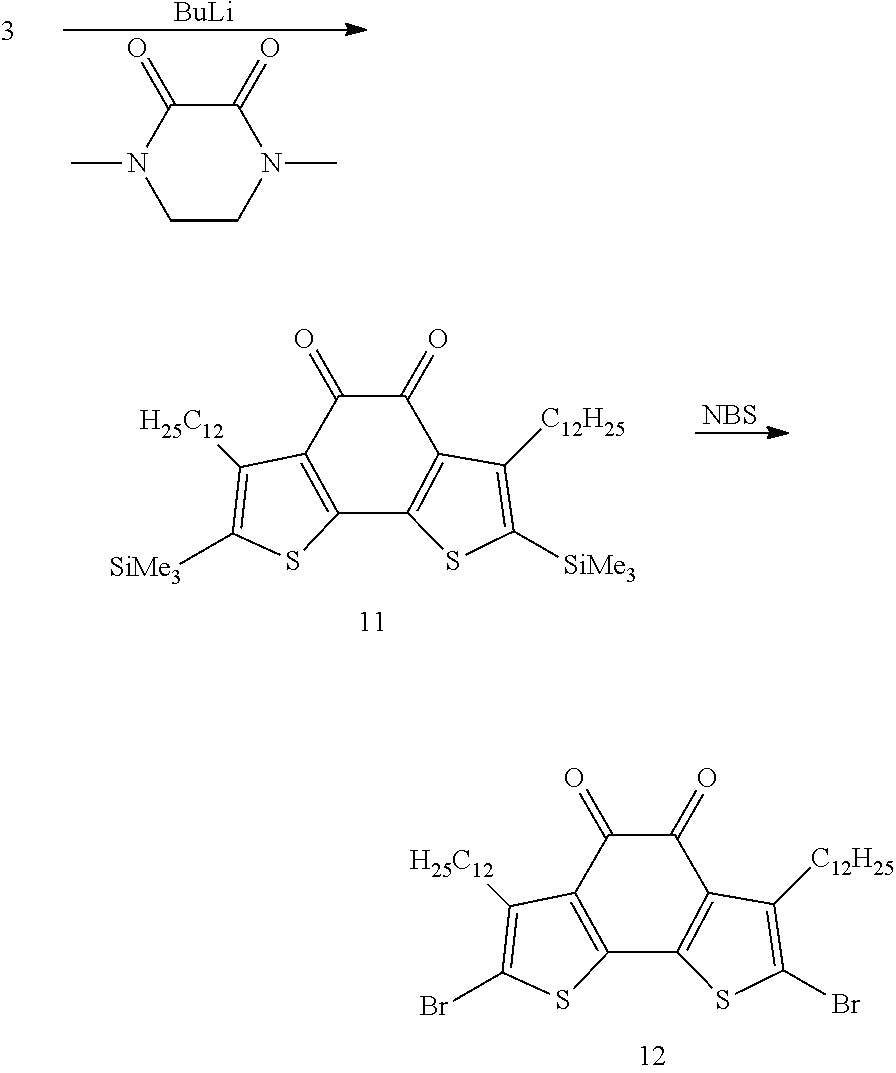
a) 11 is obtained as red powder (yield: 40%) according to example 2a with the exception that 3.20 g of 1,4-dimethylpiperazine-2,3-dione are used instead of dichlorodimethylsilane.
b) Bromination using NBS in analogy to the method shown in example 1e yields 12.


Bromination


a) A solution of 0.5 g 4 in 5 ml THF is treated at −20° C. with 1.1 eq. butyl lithium and then slowly warmed to 0° C. The reaction is quenched by the addition of 1.1 eq. trifluoro acetic anhydride and stirred for an additional hour at room temperature.

a) 10 g 3 are lithiated as described in Ex.1 c) and then cooled to −78° C. 5 g solid carbon dioxide is added in one portion and the solution is allowed to warm to room temperature. The solution is again cooled to 0° C., quenched with diluted HCl and twice extracted with TBME. The combined organic phases are washed with brine, dried over sodium sulphate and evaporated to dryness. 50 ml acetic anhydride is added to the residue and the suspension is refluxed for 2 hours. After cooling down the slurry is extracted several times with hexane, the combined hexane phases are evaporated to dryness and further dried in a vacuum oven affording 7.4 g 36 as a reddish-white solid.
b) The product from above is dissolved in THF, treated at 0° C. with 2.2 eq. hexylamine and stirred for 1 hour at room temperature. After standard work-up (TBME, diluted HCl, brine) the residue is suspended in acetic acid, treated with 10 eq. each of acetic anhydride and sodium acetate and refluxed for 16 hours. Then most of the solvent is evaporated and the residue is suspended in aqueous sodium bicarbonate, followed by extraction with TBME. The combined organic layers are washed with brine, dried and evaporated dryness affording 7.6 g 37 as a yellowish solid.
| No | Structure | NMR |
| 15 |
 |
1HNMR: δ (ppm) 0.00 (s, 18 H), 6.81 (s, 2 H) 13CNMR: δ (ppm) 0.00 (TMS), 113.14 (C3), 134.11, 137.15, 143.05 |
| 16 |
 |
1HNMR: δ (ppm) 7.05 (s, 2H) 13CNMR: δ (ppm) 125.41 (C4), 141.08 (C2), 147.42 (C3), 152.21 (C5), 180.51 (C═O) |
| 17 |
 |
1HNMR: δ (ppm) 6.99 (s, 2H) 13CNMR: δ (ppm) 114.17 (C5), 124.62 (C4), 139.74 (C2), 148.80 (C3), 180.51 (C═O) |
| 1 |
 |
1HNMR: δ (ppm) 13CNMR: δ (ppm) |
 |
1HNMR: δ (ppm) 13CNMR: δ (ppm) | |
| 2 |
 |
1HNMR: δ (ppm) 0.89 (t, 6H), 1.27 (m, 36 H (18xCH2)), 1.56 (m, 4H), 2.67 (dd, 4H) 13CNMR: δ (ppm) 14.51 (CH3), 23.08 (CH2), 28.93-32.31 (9xCH2), 111.28 (C5), 114.82 (C3), 128.80 (C4), 141.68 (C2) |
| 3 |
 |
1HNMR: δ (ppm) 13CNMR: δ (ppm) |
| 4 |
 |
1HNMR: δ (ppm) 0.35 (s, 18 H), 0.90 (t, 6H), 1.28 (m, 36 H (18xCH2)), 1.61 (m, 4H), 2.69 (dd, 4H) 13CNMR: δ (ppm) 0.00 (TMS), 13.72 (CH3), 22.23 (CH2), 28.95-31.52 (9xCH2), 136.45, 142.98, 146.82, 152.40, 183.66 |
| 5 |
 |
1HNMR: δ (ppm) 0.88 (t, 6H), 1.26 (m. 36 H (18xCH2)), 1.59 (m. 4H), 2.57 (dd, 4H) 13CNMR: δ (ppm) 14.50 (CH3), 23.09 (CH2). 29.40-32.31 (9xCH2), 111.10 (C-Br), 137.31, 139.78, 147.35, 182.13 |
 |
1HNMR: δ (ppm) 0.93 (t, 6H), 1.32 (m, 36 H (18xCH2)), 1.65 (m, 4H), 2.83 (dd. 4H). 7.06 (m, 2H), 7.10 (m. 2H), 7.32 (dd, 2H) 13CNMR: δ (ppm) 14.51 (CH3), 23.08 (CH2), 28.60-32.31 (9xCH2), 126.02, 126.32, 127.68, 134.15, 135.32, 141.04, 146.84, 184.20 (C═O) | |
| 7c |
 |
1HNMR: δ (ppm) 0.85 (2xt, 12H), 1.1-1.4 (m, 40 H), 1.59 (m, 8H), 2.48 (dd, 8H), 7.77 (s, 2H) |
| 21 |
 |
1HNMR: δ (ppm) 0.00 (s, 18H), 7.23 (s, 2H) 13CNMR: δ (ppm) 0.00, 134.53, 136.08, 142.68, 148.47, 175.31 |
| 22 |
 |
1HNMR: δ (ppm) 0.20 (s, 18H), 7.47 (dd, 2H), 7.94 (dd, 2H), 8.17 (s, 2H) 13CNMR: δ (ppm) 0.00, 129.08, 131.48, 135.64, 139.82, 140.01, 140.45, 141.26 |
| 22c |
 |
1HNMR: δ (ppm) 0.98 (t, 6H), 1.06 (t, 6H), 1.42 (m, 8H), 1.62 (m, 8H), 1.96 (m, 2H), 4.13 (d, 4H), 7.19 (s, 2H), 7.97 (s, 2H) 13CNMR: δ (ppm) 23.15, 24.09, 24.12, 29.18, 30.73, 30.74, 39.34, 71.58, 105.65, 112.51, 126.93, 133.24, 134.48, 135.53, 139.87, 154.10 |
| 19 |
 |
1HNMR: δ (ppm) 0.00 (s, 18H), 0.08 (s, 6H), 6.83 (s, 2 H) |
| 10 |
 |
13CNMR: δ (ppm) 0.02, 17.30, 25.89, 31-38 (tot. 20 C), 111.186, 144.48, 147.95, 150.01 |
| 11 |
 |
1HNMR: δ (ppm) 0.00 (s, 18H), 0.87 (t, 6H), 1.24 (m, 36 H (18xCH2)), 1.62 (m, 4H), 2.57 (dd, 4H) 13CNMR: δ (ppm) 0.00 (TMS), 13.79 (CH3), 21.97 (CH2), 28.63-31.72 (10xCH2), 136.45, 142.98, 146.82, 152.40, 174.83 |
| 32 |
 |
1HNMR: δ (ppm) 0.42 (s, 18H), 0.53 (s, 6H) |
| 35 |
 |
1HNMR: δ (ppm) 0.81 (2x t, 12H), 0.9 (m, 4H), 1.1-1.3 (m, 46H), 1.48 (m, 4H), 1.78 (m, 4H), 2.63 (dd, 4H) |
| 36 |
 |
1HNMR: δ (ppm) 0.32 (s, 18 H), 0.84 (t, 6H), 1.1-1.4 (m, 12H), 1.48 (m, 4H), 2.45 (dd, 4H) |
| 37 |
 |
1HNMR: δ (ppm) 0.00 (s, 18 H), 0.54 (t, 6H), 0.59 (t, 3H), 1.0-1.3 (m. 18H), 1.40 (m. 6H), 2.45 (dd, 4H). 3.81 (dd, 2H) |
| 38 |
 |
1HNMR: δ (ppm) 0.34 (s, 18 H), 0.87 (t, 6H), 1.1-1.4 (m, 16H), 2.41 (dd, 4H), 7.3-7.4 (m, 8H), 7.65 (m, 2H) 13CNMR: δ (ppm) 0.00, 14.72, 23.15, 28.72, 29.31, 29.89, 31.56, 129.84, 135.02, 136.01, 141.08, 141.41, 155.18 |
| 40 |
 |
1HNMR: δ (ppm) 0.40 (s, 6H), 0.78 (t, 6H), 1.1-1.3 (m, 36H), 1.45 (m, 4H), 2.61 (dd, 4H), 6.73 (d, 2H), 6.87 (d, 2H) 13CNMR: δ (ppm) 0.00, 17.20, 25.77, 31-38 (tot. 20 C), 114.40, 127.95, 133.05, 133.50, 140.71, 147.83, 148.19, 149.58 |
Claims (18)


Applications Claiming Priority (4)
| Application Number | Priority Date | Filing Date | Title |
|---|---|---|---|
| EP08152824 | 2008-03-17 | ||
| EP08152824 | 2008-03-17 | ||
| EP08152824.2 | 2008-03-17 | ||
| PCT/EP2009/052646 WO2009115413A2 (en) | 2008-03-17 | 2009-03-06 | Substituted oligo- or polythiophenes |
Publications (2)
| Publication Number | Publication Date |
|---|---|
| US20110062426A1 US20110062426A1 (en) | 2011-03-17 |
| US8436208B2 true US8436208B2 (en) | 2013-05-07 |
Family
ID=40090379
Family Applications (1)
| Application Number | Title | Priority Date | Filing Date |
|---|---|---|---|
| US12/921,176 Expired - Fee Related US8436208B2 (en) | 2008-03-17 | 2009-03-06 | Substituted oligo- or polythiophenes |
Country Status (8)
| Country | Link |
|---|---|
| US (1) | US8436208B2 (en) |
| EP (1) | EP2254929B1 (en) |
| JP (1) | JP5661604B2 (en) |
| KR (1) | KR101555076B1 (en) |
| CN (1) | CN101977961B (en) |
| CA (1) | CA2716929A1 (en) |
| TW (1) | TWI593689B (en) |
| WO (1) | WO2009115413A2 (en) |
Cited By (1)
| Publication number | Priority date | Publication date | Assignee | Title |
|---|---|---|---|---|
| US10364317B2 (en) | 2014-09-09 | 2019-07-30 | Merck Patent Gmbh | Conjugated polymers |
Families Citing this family (34)
| Publication number | Priority date | Publication date | Assignee | Title |
|---|---|---|---|---|
| KR101805203B1 (en) | 2009-05-27 | 2018-01-10 | 바스프 에스이 | Polycyclic dithiophenes |
| JP5763632B2 (en) * | 2009-06-30 | 2015-08-12 | ソルベイ ユーエスエイ インコーポレイテッド | Polymer comprising at least one bithiophene repeat unit, method of synthesizing the polymer, and composition comprising the same |
| US8859714B1 (en) | 2009-07-01 | 2014-10-14 | Northwestern University | Polymeric semiconductors and related devices |
| JP2011116963A (en) * | 2009-10-30 | 2011-06-16 | Sumitomo Chemical Co Ltd | Compound and element using the same |
| JP2011116964A (en) * | 2009-10-30 | 2011-06-16 | Sumitomo Chemical Co Ltd | Compound and element using the same |
| US8735605B2 (en) * | 2010-01-30 | 2014-05-27 | Ocean's King Lighting Science & Technology Co., Ltd. | Heterocyclic quinoid thiophene organic photoelectric material, preparation method and application thereof |
| CN102884061A (en) * | 2010-02-10 | 2013-01-16 | 乔治亚州技术研究公司 | Method of making coupled heteroaryl compounds via rearrangement of halogenated heteroaromatics followed by oxidative coupling |
| CN102190680B (en) * | 2010-03-09 | 2014-06-25 | 海洋王照明科技股份有限公司 | Silicon-containing thiophene organic photoelectric material and preparation method and application thereof |
| KR20130038224A (en) * | 2010-03-15 | 2013-04-17 | 가부시키가이샤 구라레 | Thienopyridine derivative, method for producing same and organic semiconductor device using same |
| CN102206329B (en) * | 2010-03-31 | 2013-01-23 | 海洋王照明科技股份有限公司 | Dithiophene silole-quinoxalines conjugated polymer, and its preparation method and application |
| CN102295755B (en) * | 2010-06-25 | 2013-01-23 | 海洋王照明科技股份有限公司 | Fluorene copolymer containing thiophene and thiophene-pyrrole dione units and preparation method as well as application thereof |
| JP2012162514A (en) * | 2011-01-20 | 2012-08-30 | Kuraray Co Ltd | Dithienogermole polymer and organic semiconductor device containing the same |
| US9006376B2 (en) | 2011-02-28 | 2015-04-14 | University Of Florida Research Foundation, Inc. | Germole containing conjugated molecules and polymers |
| WO2013023108A1 (en) | 2011-08-10 | 2013-02-14 | Georgia Tech Research Corporation | Coupled heteroaryl compounds via rearrangement of halogenated heteroaromatics followed by oxidative coupling (heteroarylene spacer moiety) |
| WO2013023109A1 (en) | 2011-08-10 | 2013-02-14 | Georgia Tech Research Corporation | Coupled heteroaryl compounds via rearrangement of halogenated heteroaromatics followed by oxidative coupling (coupled tricyclic core compounds) |
| WO2013023107A1 (en) | 2011-08-10 | 2013-02-14 | Georgia Tech Research Corporation | Coupled heteroaryl compounds via rearrangement of halogenated heteroaromatics followed by oxidative coupling (electron withdrawing groups) |
| WO2013023106A1 (en) | 2011-08-10 | 2013-02-14 | Georgia Tech Research Corporation | Coupled heteroaryl compounds via rearrangement of halogenated heteroaromatics followed by oxidative coupling (acyl moieties) |
| JP5847605B2 (en) * | 2011-08-22 | 2016-01-27 | 住友化学株式会社 | Silole derivative and organic electronic device comprising silole derivative |
| WO2013065836A1 (en) | 2011-11-02 | 2013-05-10 | 三菱化学株式会社 | Process for producing fused-ring aromatic compound, and conjugated polymer |
| CN103917575A (en) | 2011-11-02 | 2014-07-09 | 三菱化学株式会社 | Method for producing conjugated polymer, conjugated polymer, photoelectric conversion element, solar cell, and solar cell module |
| TWI635111B (en) * | 2012-03-16 | 2018-09-11 | Merck Patent Gmbh | Conjugated polymer |
| US8841409B2 (en) | 2012-03-22 | 2014-09-23 | Polyera Corporation | Conjugated polymers and their use in optoelectronic devices |
| WO2014016219A1 (en) | 2012-07-23 | 2014-01-30 | Basf Se | Dithienobenzofuran polymers and small molecules for electronic application |
| CN103833987B (en) * | 2012-11-27 | 2016-01-13 | 海洋王照明科技股份有限公司 | Cyclopentadienedithiderivatives-thiophene is coughed up and two (diazosulfide) multipolymer and its preparation method and application |
| US9472764B2 (en) | 2012-12-04 | 2016-10-18 | Northwestern University | Conjugated polymers and their use in optoelectronic devices |
| JP6112717B2 (en) * | 2013-05-13 | 2017-04-12 | 国立大学法人東京工業大学 | Organic heteropolymer having dithienogermol skeleton and process for producing the same |
| EP2818493A1 (en) | 2013-06-25 | 2014-12-31 | Basf Se | Near infrared absorbing polymers for electronic applications |
| CN105906788B (en) * | 2016-06-12 | 2018-06-29 | 南京邮电大学 | Polymer containing phenazine structure and its preparation method and application |
| FR3091530A1 (en) * | 2019-01-09 | 2020-07-10 | Université De Pau Et Des Pays De L'adour | FORBIDDEN VERY LOW BAND POLYMERS |
| CN109824691A (en) * | 2019-03-11 | 2019-05-31 | 四川师范大学 | Liquid crystal compounds based on cyclopentadienodithiophen-4-one and their preparation |
| US11849629B2 (en) | 2021-11-19 | 2023-12-19 | Phillips 66 Company | Fused dithieno benzothiadiazole polymers for organic photovolatics |
| US11326019B1 (en) | 2021-11-19 | 2022-05-10 | Phillips 66 Company | Fused dithieno benzothiadiazole polymers for organic photovoltaics |
| US11690283B2 (en) | 2021-11-19 | 2023-06-27 | Phillips 66 Company | Fused dithieno benzothiadiazole polymers for organic photovoltaics |
| US11332579B1 (en) | 2021-11-19 | 2022-05-17 | Phillips 66 Company | Fused dithieno benzothiadiazole polymers for organic photovoltaics |
Citations (6)
| Publication number | Priority date | Publication date | Assignee | Title |
|---|---|---|---|---|
| US20030080324A1 (en) | 2000-07-24 | 2003-05-01 | Northwestern University | n-type thiophene semiconductors |
| WO2004000020A1 (en) | 2002-06-24 | 2003-12-31 | Bayer Cropscience Aktiengesellschaft | Fungicidal combinations of active substances |
| WO2004058740A1 (en) | 2002-11-29 | 2004-07-15 | Infineon Technologies Ag | Amino-substituted oligothiophenes as organic semiconductor materials |
| EP1605007A1 (en) | 2004-06-10 | 2005-12-14 | Xerox Corporation | Processes to prepare oligomeric thiophene compounds |
| EP1615237A1 (en) | 2004-07-08 | 2006-01-11 | Samsung Electronics Co., Ltd | Organic semiconductor copolymers containing oligothiophene and n-type heteroaromatic units |
| EP1679330A1 (en) | 2002-01-11 | 2006-07-12 | Xerox Corporation | Polythiophenes and devices thereof |
Family Cites Families (11)
| Publication number | Priority date | Publication date | Assignee | Title |
|---|---|---|---|---|
| JPS6431817A (en) * | 1987-07-28 | 1989-02-02 | Canon Kk | Electrically conductive polymeric material |
| JP2768441B2 (en) * | 1988-07-29 | 1998-06-25 | 勝美 吉野 | Manufacturing method of anisotropic conductor |
| JP3608883B2 (en) * | 1996-09-02 | 2005-01-12 | 三井化学株式会社 | Optical information recording medium |
| JP3587361B2 (en) * | 2000-01-27 | 2004-11-10 | キヤノン株式会社 | Organic light emitting device |
| WO2002009201A1 (en) * | 2000-07-24 | 2002-01-31 | Northwestern University | n-TYPE THIOPHENE SEMICONDUCTORS |
| WO2002092564A2 (en) * | 2001-05-15 | 2002-11-21 | Basell Polyolefine Gmbh | Synthesis of cyclopentadiene derivatives |
| JP2005255573A (en) * | 2004-03-10 | 2005-09-22 | Tokuyama Corp | Dithieno compounds and electroluminescent materials |
| US7528176B2 (en) * | 2004-09-14 | 2009-05-05 | Northwestern University | Carbonyl-functionalized thiophene compounds and related device structures |
| WO2007097395A1 (en) * | 2006-02-22 | 2007-08-30 | Sumitomo Chemical Company, Limited | Fluorine-containing compound and method for producing same, fluorine-containing polymer, organic thin film, and organic thin film device |
| JP4517154B2 (en) * | 2006-03-10 | 2010-08-04 | 国立大学法人 筑波大学 | Polyphenylene dendrimer |
| WO2007121252A2 (en) * | 2006-04-11 | 2007-10-25 | Konarka Technologies, Inc. | Tandem photovoltaic cells |
-
2009
- 2009-03-06 US US12/921,176 patent/US8436208B2/en not_active Expired - Fee Related
- 2009-03-06 CN CN200980110165.1A patent/CN101977961B/en not_active Expired - Fee Related
- 2009-03-06 KR KR1020107023188A patent/KR101555076B1/en not_active Expired - Fee Related
- 2009-03-06 EP EP09722493.5A patent/EP2254929B1/en not_active Not-in-force
- 2009-03-06 JP JP2011500147A patent/JP5661604B2/en not_active Expired - Fee Related
- 2009-03-06 CA CA2716929A patent/CA2716929A1/en not_active Abandoned
- 2009-03-06 WO PCT/EP2009/052646 patent/WO2009115413A2/en not_active Ceased
- 2009-03-16 TW TW098108386A patent/TWI593689B/en not_active IP Right Cessation
Patent Citations (6)
| Publication number | Priority date | Publication date | Assignee | Title |
|---|---|---|---|---|
| US20030080324A1 (en) | 2000-07-24 | 2003-05-01 | Northwestern University | n-type thiophene semiconductors |
| EP1679330A1 (en) | 2002-01-11 | 2006-07-12 | Xerox Corporation | Polythiophenes and devices thereof |
| WO2004000020A1 (en) | 2002-06-24 | 2003-12-31 | Bayer Cropscience Aktiengesellschaft | Fungicidal combinations of active substances |
| WO2004058740A1 (en) | 2002-11-29 | 2004-07-15 | Infineon Technologies Ag | Amino-substituted oligothiophenes as organic semiconductor materials |
| EP1605007A1 (en) | 2004-06-10 | 2005-12-14 | Xerox Corporation | Processes to prepare oligomeric thiophene compounds |
| EP1615237A1 (en) | 2004-07-08 | 2006-01-11 | Samsung Electronics Co., Ltd | Organic semiconductor copolymers containing oligothiophene and n-type heteroaromatic units |
Non-Patent Citations (3)
| Title |
|---|
| Donat-Bouillud et al, Synthetic Metals 84 (1997) pp. 235-236. |
| English Language abstract of WO 2004/058740 printed on Dec. 17, 2010. |
| Letizia et al, JACS, 130 (30), 9679-9694 (Jul. 2008). |
Cited By (1)
| Publication number | Priority date | Publication date | Assignee | Title |
|---|---|---|---|---|
| US10364317B2 (en) | 2014-09-09 | 2019-07-30 | Merck Patent Gmbh | Conjugated polymers |
Also Published As
| Publication number | Publication date |
|---|---|
| JP2011520777A (en) | 2011-07-21 |
| TWI593689B (en) | 2017-08-01 |
| KR20100137516A (en) | 2010-12-30 |
| TW200951138A (en) | 2009-12-16 |
| KR101555076B1 (en) | 2015-09-22 |
| US20110062426A1 (en) | 2011-03-17 |
| WO2009115413A2 (en) | 2009-09-24 |
| EP2254929A2 (en) | 2010-12-01 |
| EP2254929B1 (en) | 2018-05-16 |
| CA2716929A1 (en) | 2009-09-24 |
| CN101977961B (en) | 2015-04-08 |
| JP5661604B2 (en) | 2015-01-28 |
| WO2009115413A3 (en) | 2010-05-06 |
| CN101977961A (en) | 2011-02-16 |
Similar Documents
| Publication | Publication Date | Title |
|---|---|---|
| EP2254929B1 (en) | Substituted oligo- or polythiophenes | |
| US9716241B2 (en) | Polycyclic dithiophenes | |
| CN101889016B (en) | Pyrrolopyrrole derivatives, their manufacture and use | |
| CN103140492B (en) | Diketopyrrolopyrrole-based semiconductors | |
| US8758880B2 (en) | Ketopyrroles as organic semiconductors | |
| US8946376B2 (en) | Semiconductors based on diketopyrrolopyrroles | |
| CN102449030B (en) | Diketopyrrolopyrrole polymers for use in organic semiconductor devices | |
| US9362508B2 (en) | Diketopyrrolopyrrole oligomers for use in organic semiconductor devices | |
| CN102388046A (en) | Pyrrolopyrrole derivatives, their manufacture and use as semiconductors |
Legal Events
| Date | Code | Title | Description |
|---|---|---|---|
| AS | Assignment |
Owner name: BASF SE, GERMANY Free format text: ASSIGNMENT OF ASSIGNORS INTEREST;ASSIGNORS:KIRNER, HANS JURG;BIENEWALD, FRANK;FLORES, JEAN-CHARLES;AND OTHERS;SIGNING DATES FROM 20101015 TO 20101026;REEL/FRAME:025430/0173 |
|
| STCF | Information on status: patent grant |
Free format text: PATENTED CASE |
|
| FPAY | Fee payment |
Year of fee payment: 4 |
|
| AS | Assignment |
Owner name: CLAP CO., LTD., KOREA, REPUBLIC OF Free format text: ASSIGNMENT OF ASSIGNORS INTEREST;ASSIGNOR:BASF SE;REEL/FRAME:052459/0201 Effective date: 20200121 |
|
| FEPP | Fee payment procedure |
Free format text: ENTITY STATUS SET TO SMALL (ORIGINAL EVENT CODE: SMAL); ENTITY STATUS OF PATENT OWNER: SMALL ENTITY |
|
| MAFP | Maintenance fee payment |
Free format text: PAYMENT OF MAINTENANCE FEE, 8TH YR, SMALL ENTITY (ORIGINAL EVENT CODE: M2552); ENTITY STATUS OF PATENT OWNER: SMALL ENTITY Year of fee payment: 8 |
|
| FEPP | Fee payment procedure |
Free format text: MAINTENANCE FEE REMINDER MAILED (ORIGINAL EVENT CODE: REM.); ENTITY STATUS OF PATENT OWNER: SMALL ENTITY |
|
| LAPS | Lapse for failure to pay maintenance fees |
Free format text: PATENT EXPIRED FOR FAILURE TO PAY MAINTENANCE FEES (ORIGINAL EVENT CODE: EXP.); ENTITY STATUS OF PATENT OWNER: SMALL ENTITY |
|
| STCH | Information on status: patent discontinuation |
Free format text: PATENT EXPIRED DUE TO NONPAYMENT OF MAINTENANCE FEES UNDER 37 CFR 1.362 |
|
| FP | Lapsed due to failure to pay maintenance fee |
Effective date: 20250507 |