US8428602B2 - Methods for enhancing performance of open-access and closed-access femtocells - Google Patents
Methods for enhancing performance of open-access and closed-access femtocells Download PDFInfo
- Publication number
- US8428602B2 US8428602B2 US12/901,341 US90134110A US8428602B2 US 8428602 B2 US8428602 B2 US 8428602B2 US 90134110 A US90134110 A US 90134110A US 8428602 B2 US8428602 B2 US 8428602B2
- Authority
- US
- United States
- Prior art keywords
- femtocell
- macrocell
- mms
- capacity
- mobile station
- Prior art date
- Legal status (The legal status is an assumption and is not a legal conclusion. Google has not performed a legal analysis and makes no representation as to the accuracy of the status listed.)
- Active, expires
Links
Images



Classifications
-
- H—ELECTRICITY
- H04—ELECTRIC COMMUNICATION TECHNIQUE
- H04W—WIRELESS COMMUNICATION NETWORKS
- H04W36/00—Hand-off or reselection arrangements
- H04W36/04—Reselecting a cell layer in multi-layered cells
-
- H—ELECTRICITY
- H04—ELECTRIC COMMUNICATION TECHNIQUE
- H04W—WIRELESS COMMUNICATION NETWORKS
- H04W36/00—Hand-off or reselection arrangements
- H04W36/16—Performing reselection for specific purposes
- H04W36/165—Performing reselection for specific purposes for reducing network power consumption
-
- H—ELECTRICITY
- H04—ELECTRIC COMMUNICATION TECHNIQUE
- H04W—WIRELESS COMMUNICATION NETWORKS
- H04W84/00—Network topologies
- H04W84/02—Hierarchically pre-organised networks, e.g. paging networks, cellular networks, WLAN [Wireless Local Area Network] or WLL [Wireless Local Loop]
- H04W84/04—Large scale networks; Deep hierarchical networks
- H04W84/042—Public Land Mobile systems, e.g. cellular systems
- H04W84/045—Public Land Mobile systems, e.g. cellular systems using private Base Stations, e.g. femto Base Stations, home Node B
Definitions
- the present invention relates to wireless communications. More specifically, the present invention relates to improving performance of small co-located cellular networks (e.g., femtocells) under open-access and closed-access configurations.
- small co-located cellular networks e.g., femtocells
- the femtocell reuses the spectrum resources of the co-located macrocell network. While a co-channel deployment brings efficient spectrum usage, co-channel deployment also results in co-channel interference (CCI) between the femtocell and the macrocell.
- CCI co-channel interference
- Co-channel femtocell networks may be “open-access” or “closed-access.”
- any macrocell MS mMS
- An open-access femtocell often allows a large enough number of users to degrade the average bandwidth available per user.
- a closed-access femtocell e.g., a closed subscriber group (CSG) femtocell, only an authorized group of mMSs may join the femtocell.
- CSG closed subscriber group
- areal capacity gain is defined as the ratio of system capacity with one or more femtocells to the corresponding system capacity without a femtocell.
- open-access operations have issues, such as privacy and burden on the backhaul of a femtocell.
- the term “femtocell” is used to represent a local cellular network that is co-located with a larger cellular network (e.g., a macrocell), the term “femtocell” or “macrocell” are merely illustrative, the principles disclosed herein are equally applicable to any pairing of a local cellular network that is co-located within the service area of a larger cellular network.
- an access mode for a co-located cellular network is important from an interference point of view. While the open-access mode strains spectrum resources, a restricted access mode (e.g., CSG) may result in significant interference between femtocell and macrocell users.
- a co-located cellular network e.g., a femtocell or a picocell network
- an open-access femtocell may improve its performance by load balancing, using a capacity-based metric to select a femtocell for each user seeking to associate with a femtocell.
- An exchange mechanism allows information (e.g., potential bandwidth) to be exchanged between a macrocell base station (mBS) and a femtocell base station (fBS), so as to allow a macrocell mobile station (mMS) to select a femtocell with the most available capacity.
- mBS macrocell base station
- fBS femtocell base station
- a fBS broadcasts its available bandwidth information to mMS's to allow the macrocell mobile stations to associate with the femtocell with the most capacity offered.
- a closed-access femtocell may improve performance through spectrum sensing, so as to optimally select a portion of the macrocell spectrum for reuse.
- a femtocell BS may decide which portion of the spectrum to reuse, based on different criteria such as maximizing the combined capacity available to the femtocell mobile stations and the macrocell stations, assuring a minimum capacity for the adversely affected macrocell MS's, and assuring a maximum interference-over-thermal noise (IoT) value.
- IoT interference-over-thermal noise
- FIG. 1 shows macrocell user (mMS) 20 of macrocell 10 ; macrocell 10 has a service area that includes femtocells 30 , 40 and 50 .
- FIG. 2 shows, in a simple co-channel system (i.e., a femtocell provided within the service area of a macrocell), (a) downlink signals and interference, (b) uplink signals and interference and (c) a spectrum shared between the macrocell and the femtocell.
- a simple co-channel system i.e., a femtocell provided within the service area of a macrocell
- downlink signals and interference i.e., a femtocell provided within the service area of a macrocell
- uplink signals and interference i.e., uplink signals and interference
- FIG. 3 shows communication among the fBS's, the mMS's and the mBS to exchange bandwidth information and to select a capacity-maximizing femtocell for each mMS, in accordance with one embodiment of the present invention.
- FIG. 4 shows a second method for communicating among the fBS's, the mMS's and the mBS to exchange bandwidth information and to select a capacity-maximizing femtocell for each mMS, in accordance with one embodiment of the present invention.
- FIG. 5 shows an example of information exchange through broadcasting of resource information between an mMS 502 , fBS's 504 and 506 and mBS 508 , in accordance with one embodiment of the present invention.
- FIG. 6 shows a third method for communicating among the fBS's, the mMS's and the mBS to exchange bandwidth information and to select a capacity-maximizing femtocell for each mMS, in accordance with one embodiment of the present invention.
- FIG. 7 shows an example of information exchange through polling of resource information between an mMS 402 , fBS's 404 and 406 and mBS 408 , in accordance with one embodiment of the present invention.
- FIG. 8 shows one method for an fBS in a CSG type femtocell to determine whether or not to reuse an overlapped band (OB) in order to maximize the combined capacity, according to one embodiment of the present invention.
- OB overlapped band
- FIG. 9 shows a system that is used as a model for the open-access mode simulations of FIGS. 10( a )-( b ) and FIGS. 11( a )- 11 ( d ).
- FIGS. 11( a )- 11 ( c ) illustrate respectively the capacities available to the mMS at 300 m, 500 m, 800 m from the mBS (i.e., d mBS ), as a function of the x-coordinate of the mMS.
- FIGS. 11( a )- 11 ( c ) are simulated based on the configuration of FIG. 9) .
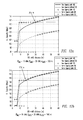
- FIG. 13( a ) and FIG. 13( b ) show the downlink (DL) combined capacity and the femtocell capacity, with and without spectrum sensing (SS).
- DL downlink
- SS spectrum sensing
- FIG. 1 shows macrocell user (mMS) 20 of macrocell 10 ; macrocell 10 has a service area that includes open-access femtocells 30 and 40 , and CSG type femtocell 50 .
- the methods of the present invention improve the performances of both open-access mode and CSG type of femtocells.
- the received signal quality is used by mobile users to make hand-off and cell-selection decisions.
- FIG. 1 shows macrocell user (mMS) 20 of macrocell 10 ;
- macrocell 10 has a service area that includes open-access femtocells 30 and 40 , and CSG type femtocell 50 .
- the methods of the present invention improve the performances of both open-access mode and CSG type of femtocells.
- the received signal quality is used by mobile users to make hand-off and cell-selection decisions.
- FIG. 1 shows macrocell user (mMS) 20 of macrocell 10 ; macrocell 10 has a service area that includes
- mMS 20 may receive better service if the hand-off decision is based on selecting the target femtocell with the lesser load (i.e., higher bandwidth per user), such as femtocell 40 , even though a higher link quality is available at another femtocell, such as femtocell 30 .
- FIG. 1 also shows that a CSG type femtocell (e.g., femtocell 50 ) suffers from large interference from mMS's (e.g., mMS 60 ), that are close to the femtocell.
- FIG. 2 shows, in a simple co-channel system (i.e., a femtocell provided within the service area of a macrocell), (a) downlink signals and interference, (b) uplink signals and interference and (c) a spectrum shared between the macrocell and the femtocell.
- a single femtocell mobile station (fMS) which uses the spectrum resources of the femtocell, is situated near an mMS.
- the downlink (DL) and uplink (UL) transmissions of the femtocell and the macrocell are aligned in time (i.e., the DL transmissions of both the femtocell and the macrocell occurs simultaneously)
- the transmission of mMS 150 interferes with the reception at fBS 160 and the transmission of fMS 140 interferes with the reception at mBS 170 .
- the transmission of mBS 130 interferes with reception at fMS 100 and the transmission of fBS 120 interferes with the reception at mMS 110 .
- the present invention provides a framework for capacity-maximizing cell selection for an mMS.
- the present invention provides criteria for optimal reuse of the macrocell spectrum resources (e.g., overlap band 180 of the spectrum in FIG. 2( c )) at a femtocell.
- the femtocell reuses the macrocell spectrum only when the reuse maximizes the-combined capacity available to the users of the femtocell and the macrocell.
- the femtocell reuses the macrocell spectrum only when a minimum rate is guaranteed for any adversely affected mMS in the vicinity of a femtocell.
- the rate information of the mMS may be communicated to the femtocell by the macrocell BS over the backhaul.
- the femtocell reuses the macrocell spectrum only when the interference-over-thermal noise (IoT) threshold observed over the femtocell's spectrum is below a threshold.
- IoT interference-over-thermal noise
- capacity models for both the UL and DL in the two-user scenarios of FIG. 2 are set forth below.
- the mMS uses only a portion of its allocated spectrum 190
- the fMS uses the full spectrum 180 allocated to it.
- the system may use multicarrier transmissions, with each resource unit capable of being individually demodulated.
- the capacity models are first derived with the mMS assumed sufficiently far away from the femtocell such that a hand-off of the mMS to the femtocell is not possible. Under that assumption, the capacity models need not distinguish between open-access and CSG mode operations for the femtocell. The “no hand-off” constraint is then relaxed to provide capacity models for both open-access and CSG mode femtocells, assuming a lesser mMS-fBS distance. Techniques for improving the capacities under the respective operation modes are also provided.
- the mMS user becomes closer to the femtocell, its transmission results in stronger UL interference with the fBS under the CSG mode.
- Such interference is avoided in the open-access mode by allowing a hand-off of the mMS to the femtocell, at the expense of a reduced average user bandwidth at the femtocell.
- C DL ( fMS ) ( N f - N m ) ⁇ B ⁇ ⁇ log ⁇ ( 1 + ( N f - N m ) ⁇ P fBS , fMS ( N f - N m ) ⁇ BN 0 ) + N m ⁇ B ⁇ ⁇ log ⁇ ( 1 + N m ⁇ P fBS , fMS N m ⁇ P mBS , fMS + N m ⁇ BN 0 ) .
- C DL C DL (mMS) +C DL (fMS) .
- the mMS user becomes closer to the femtocell, a hand-off to the femtocell is possible under the open-access mode due to the better signal quality, while stronger DL interference results from the fBS under the CSG mode (i.e., the mMS cannot handoff to the fBS).
- the mMS can make a hand-off to the femtocell.
- the criterion for triggering a hand-off is an optimization that affects significantly the combined throughputs of the femtocell users and the macrocell users.
- the cell with the strongest received signal strength (RSS) is selected for handoff (see e.g., the article, “Proposed text for HO from femtocell BS to macro BS or other femtocell BS (AWD-femto),” K. Y. Lin, H. P. Lin, and R. T. Juang, IEEE Standard Contribution C802.16m-09/1307, July 2009). That is, the cell with the best signal quality is selected by:
- i ⁇ arg ⁇ max i ⁇ ⁇ P i , mMS ⁇ , ( 7 )
- i denotes the candidate cell index
- the mMS makes a hand-off to the cell with the best signal quality.
- Other parameters affecting capacity available to an mMS, such as interference and bandwidth, may also be taken into account.
- the link quality between mMS 20 and femtocell 30 or the mBS of macrocell 10 may be better than the link quality between mMS 20 and femtocell 40 .
- FIG. 1 the link quality between mMS 20 and femtocell 30 or the mBS of macrocell 10 may be better than the link quality between mMS 20 and femtocell 40 .
- femtocell 30 is already associated with several users, and thus is likely to offer a less desirable bandwidth per user, while the bandwidth for user is likely better at femtocell 40 , which is associated with only a single user. Therefore, due to the availability of greater spectrum resources, femtocell 40 may offer better capacity to mMS 20 , as compared to Femtocell 30 or macrocell 10 .
- the capacity-maximizing cell selection criterion for the mMS is simply:
- Equation (8) takes into account link quality, the available bandwidth and interference.
- equation (8) thus include 1) fairer distribution of the spectrum among macrocell and femtocell users, 2) a lower limit for the number of users that may be connected to a femtocell, and 3) a lesser burden on the backhaul of the femtocell network.
- FIG. 3 shows communication among the femtocells, the mMS's and the mBS to exchange bandwidth information and to select a capacity-maximizing femtocell for each mMS, in accordance with one embodiment of the present invention.
- femtocells communicate their respective available bandwidths (or, their respective numbers of users associated) to the mBS.
- each mMS measures the SINR with each femtocell and communicate the measurements to the mBS.
- the mBS can calculate the capacity available to the mMS after a hand-off to a femtocell.
- the mBS may select for each mMS the femtocell that results in the greatest capacity available to the mMS, and triggers a hand-off of the mMS to the selected femtocell.
- a hand-off is triggered only if the hand-off to the femtocell results in a capacity improvement that exceeds a threshold ⁇ cap between the current capacity and post-hand off capacity.
- the capacity can also be required to be averaged over a duration ⁇ time , to smooth out the effect of noise.
- FIG. 4 shows a second method for communicating among the fBS's, the mMS's and the mBS to exchange bandwidth information and to select a capacity-maximizing femtocell for each mMS, in accordance with one embodiment of the present invention.
- the femtocells broadcast their respective available bandwidths to the mMS's.
- each mMS measures the SINR it experiences with each femtocell.
- the mMS calculates the potential capacity that it may expect available in each femtocell, and selects the candidate femtocell offering the greatest post-hand-off capacity, using equation (8), for example.
- a hand-off is triggered only if the hand-off to the femtocell results in a capacity improvement that exceeds a threshold ⁇ cap between the current capacity and post-hand off capacity (step 260 ).
- the capacity can also be required to be averaged over a duration ⁇ time , to smooth out the effect of noise.
- FIG. 5 shows an example of information exchange through broadcasting of resource information between mMS 502 , fBS's 504 and 506 and mBS 508 , in accordance with one embodiment of the present invention.
- fBS's 504 and 506 and mBS 508 broadcast messages relating to their respective available resource information.
- the frequency at which the resource information is communicated may be determined based on spectrum efficiency considerations, for example. A lesser frequency of information exchange, however, may result in less efficient hand-offs, if the resource within the cells change more frequently than the frequency of communication. Therefore, the resource information broadcast messages may be provided as frequently as seconds, minutes, hours, or even days, depending on how often the traffic within these cells significantly vary.
- Handing off to fBS 504 involves: (a) mMS 502 sending a Connection_Request message 536 to fBS 504 ; (b) in response, fBS 504 sends Connection_Setup message 538 back to mMS 502 ; and (c) mMS 502 acknowledges Connection_Setup message 538 by Connection_Complete message 540 .
- the corresponding messages are RRCConnectionRequest, RRCConnectionSetup, and RRCConnectionComplete.
- mMS 502 may also release the connection with the previously serving cell (i.e., mBS 508 ) before establishing connection with fBS 504 (i.e., messages 532 and 534 ), or after establishing connection with fBS 504 (i.e., messages 542 and 544 ).
- the previously serving cell i.e., mBS 508
- fBS 504 i.e., messages 532 and 534
- messages 542 and 544 i.e., messages 542 and 544
- FIG. 6 shows a third method for communicating among the fBS's, the mMS's and the mBS to exchange bandwidth information and to select a capacity-maximizing femtocell for each mMS, in accordance with one embodiment of the present invention.
- the resource information at different femtocells is requested by each mMS from each femtocell when needed.
- a mMS continuously monitors the SINR of the received packets from all the femtocells.
- SINR serving is the SINR of the current serving cell
- ⁇ is a scaling factor that depends on the implementation and the typical spectrum resources available in the serving cell and candidate cells. For example, typically, less spectrum resources are available for the mMS from the macrocell than the spectrum resources available in the femtocells. Therefore, if the serving cell is the macrocell, one may select ⁇ 1 (e.g., 0.6), to favor the mMS handing-off to one of the candidate cells.
- the mMS When a hand-off is triggered, at step 275 , the mMS requests resource information (e.g., available spectrum, number of users, traffic information etc.) from the candidate cells.
- resource information e.g., available spectrum, number of users, traffic information etc.
- each of the candidate cells communicate the requested information.
- the mMS compares the capacity available from each candidate cells with the capacity provided in the current serving cell.
- the mMS selects and establishes connection with that candidate cell at step 290 . However, if the capacity of the serving cell exceeds the capacities of all the candidate cells, the mMS may keep its connection with the serving cell, rather than handing-off to a candidate cell.
- a hand-off is triggered only if the hand-off to the femtocell results in a capacity improvement that exceeds a threshold ⁇ cap between the current capacity and post-hand off capacity.
- the capacity can also be required to be averaged over a duration ⁇ time , to smooth out the effect of noise.
- FIG. 7 shows an example of information exchange through polling of resource information between an mMS 402 , fBS's 404 and 406 and mBS 408 , in accordance with one embodiment of the present invention.
- mMS 402 periodically monitors the SINR of the received packets from different femtocells.
- mMS 402 triggers a hand-off check at step 410 . Otherwise, at step 415 , mMS 402 returns to monitoring the SINR of all the cells.
- mMS 402 evaluates at step 430 the post-hand-off capacity available at each femtocell. Accordingly, prior to step 430 , mMS 402 sends Resource_Info_Req messages 422 and 424 to candidate cells 404 and 406 to request the femtocells for their respective available resources (e.g., its spectrum and the number of users, traffic information). In response, candidate femtocells 404 and 406 respond with Resource_Info_Rsp messages 426 and 428 with the requested information. Once all the resource information is collected at mMS 402 , the post-hand-off capacity is calculated for each of the candidate cells 404 and 406 .
- Resource_Info_Req messages 422 and 424 to candidate cells 404 and 406 to request the femtocells for their respective available resources (e.g., its spectrum and the number of users, traffic information).
- candidate femtocells 404 and 406 respond with Resource_Info_Rsp messages 426 and 428
- mMS 402 establishes a connection with that candidate cell (in this case, femtocell 402 ) by exchanging hand-off protocol messages 436 , 438 and 440 .
- the connection with the serving cell may be released before establishing connection with femtocell 402 (i.e., exchanging release protocol messages 432 and 434 ) or after establishing connection with femtocell 402 (i.e., exchanging release protocol messages 442 and 444 ).
- a femtocell uses the same spectrum as an mMS.
- the DL capacity available to mMS according to equation (4) and the UL capacity provided to the fMS according to equation (2) may be too low due to the presence of interference in the system, as reported in the article “A comparative study of different deployment modes for femtocell networks,” H. Mahmoud and I. Guvenc, in Proc. First IEEE Int. Workshop on Indoor and Outdoor Femto Cells ( IOFC ), in conjunction with IEEE PIMRC 2009, Tokyo, Japan, September 2009.
- a combined capacity maximizing criteria for deciding when a frequency resource of the macrocell should be used at a femtocell is provided, according to one embodiment of the present invention.
- Other criteria such as an IoT threshold, and a minimum mMS capacity can also be used, as discussed earlier.
- the UL capacities for the mMS and fMS may be respectively written as
- equation (13) Comparing equation (13) with equation (3), the femtocell in equation (13) no longer benefits from the overlapping bandwidth (OB). However, for a smaller mMS-fBS distance d mMS, fBS , interference in the OB may be significant for both the femtocell and the macrocell. Therefore, avoiding reuse of the OB improves the combined capacity expressed in equation (13) for a smaller d mMS, fBS .
- the threshold criteria for reusing the OB may be obtained from equating equations (3) and (13), which may be rewritten as:
- equation (15) becomes: BN 0 ( P fMS,fBS P fMS,mBS +P mMS,mBS P fMS,fBS )+( BN 0 ) 2
- P fMS,fBS P mMS,mBS P mMS,fBS P fMS,mBS +BN 0 P mMS,mBS P fMS,mBS , (16)
- Dividing both sides of equation (16) by P mMS,mBS provides:
- Equation (18) provides the UL interference power threshold between the mMS and the fBS.
- the OB at the femtocell is preferably not reused, so as to reduce the impact of the interference on the capacities available to the mMS's and the fMS.
- the corresponding threshold distance ⁇ fBS-mMS may be explicitly obtained from equation (18), by substituting the path loss equations into the power term P mMS,fBS .
- C CSG , UL ( SS ) ⁇ C UL if ⁇ ⁇ P mMS , fBS ⁇ BN 0 ⁇ P fMS , fBS P fMS , mBS C ⁇ UL if ⁇ ⁇ P mMS , fBS ⁇ BN 0 ⁇ P fMS , fBS P fMS , mBS , ( 19 )
- C UL is provided by equation (3) and ⁇ tilde over (C) ⁇ UL is provided in equation (13).
- the DL capacities for the mMS and fMS are respectively provided by:
- the DL combined capacity with CSG-SS can be obtained after equating equation (6) and equation (22) and assuming the terms N 0 2 and P fBS,mMS N 0 are negligible relative the other terms. Therefore:
- C CSG , DL ( SS ) ⁇ C DL if ⁇ ⁇ P fBS , mMS ⁇ BN 0 ⁇ P fBS , fMS P mBS , fMS C ⁇ DL if ⁇ ⁇ P fBS , mMS ⁇ BN 0 ⁇ P fBS , fMS P mBS , fMS , ( 23 )
- C UL is provided by equation (6)
- ⁇ tilde over (C) ⁇ UL is provided in equation (22).
- the corresponding distance threshold ⁇ fBS-mMS can be explicitly obtained by substituting the related path-loss models into P fBS,mMS .
- FIG. 8 shows one method for an fBS to determine whether or not to reuse an overlapped band (OB) in order to maximize the combined capacity in a CSG type femtocell, according to one embodiment of the present invention. As shown in FIG.
- the fMS (at step 300 ), the mMS (at step 310 ), and the mBS (at step 320 ) each sense its spectrum and share their respective detected levels of interference.
- the fMS and the mMS at steps 300 and 310 , share their respective detected interference levels with the fBS and the mBS during their uplinks.
- the mBS shares the detected interference levels detected by itself and the mMS's with the femtocells, using backhaul connections.
- each fBS combines its local sensing results with the sensing results of the fMS's, the mMS's and the mBS, to decide whether to reuse the OB (i.e., the overlapped band) during the uplink and the downlink.
- the determination of whether or not to reuse the OB for the UL and DL may be based, for example, on equations (18) and (23) respectively.
- FIG. 9 shows a system that is used as a model for the open access mode simulations of FIGS. 10( a )-( b ) and FIGS. 11( a )- 11 ( d ).
- two fBSs i.e., fBS- 1 and fBS- 2
- Both fBSs have a wall-penetration loss of 5 dB.
- An mBS (not shown on the figure) is located at (d mBS 1/2 , d mBS 1/2 ), where d mBS denotes the distance between fBS- 1 and the mBS.
- d mBS denotes the distance between fBS- 1 and the mBS.
- a total of 10 MHz of spectrum is available, which is used simultaneously by the femtocells and the macrocell.
- the macrocell may serve, for example, 100 users.
- the mMS locations on a line that is parallel to the x-axis are simulated (e.g., from the coordinate ( ⁇ 40, 8) m to (60, 8) m).
- the macrocell capacity is considerably lower than either femtocell when the mMS is close to the femtocell. This result is due to the smaller bandwidth assigned to the macrocell, and the increasing interference when the mMS approaches each femtocell.
- FIGS. 11( a )- 11 ( c ) illustrate respectively the capacities of mMS at 300 m, 500 m, 800 m from the mBS (i.e., d mBS ), as a function of the x-coordinate of the mMS.
- FIGS. 11( a )- 11 ( c ) are simulated under the configuration of FIG. 9) .
- the maximum capacity handoff metrics, the best-RSS handoff metrics and the CSG capacity are included for comparison.
- the CSG capacity of the mMS improves due to better signal quality.
- FIGS. 11( b ) and 11 ( c ) illustrate results at greater distances between the mBS and the femtocell.
- a capacity maximizing cell selection yields better capacities as compared to RSS based cell selection.
- d mBS 500 m, i.e., corresponding to the case of FIG. 11( b )
- N f2 1
- the mMS capacity improves even further, especially when it is closer to fBS- 2 .
- N f2 values i.e., the number of resource blocks allocated to be used in femtocell fBS- 2 .
- the mean CSG capacity degrades along this trajectory, as the RSS becomes weaker for larger d mBS .
- For very small d mBS all approaches provide roughly the same performance. However, as d mBS increases, capacity-based hand-off starts performing significantly better than the other approaches, especially for smaller N f2 .
- the system models illustrated in FIGS. 2( a ) and 2 ( b ) are used.
- the fBS is located at the center of a 15 m by 15 m apartment that has 10 dB wall penetration loss
- the fMS is located 7 m away from the fBS
- the mMS is located on a line between the fBS and the mBS.
- the mMS and the fMS significantly interfere with each other when the mMS is close to the fBS.
- the power level of the received interference signal at the mMS decreases as the mMS moves away from the fBS towards the mBS.
- the interference signal level at the fMS received from the transmission at the mBS remains constant.
- the interference can be detected through perfect spectrum sensing, and the femtocell abstains from reusing the OB.
- the combined 1 UL capacity improves because of the reduced interference at the mMS.
- the OB is utilized interference-free by the mMS.
- the improvement in the combined capacity with CSG-SS is more apparent for smaller d mBS , since the interference impact on the mBS increases.
- the ⁇ fBS-mMS computed using the threshold value in equation (19) is also indicated in each of the FIGS. 12( a ) and 12 ( b ). The threshold value matches well with the crossing point of the CSG combined capacity with and without reuse of the OB at the femtocell, respectively
- FIG. 13( a ) and FIG. 13( b ) show the DL combined capacity and the femtocell capacity, with and without spectrum sensing (SS).
- SS spectrum sensing
Landscapes
- Engineering & Computer Science (AREA)
- Computer Networks & Wireless Communication (AREA)
- Signal Processing (AREA)
- Mobile Radio Communication Systems (AREA)
Abstract
Description
where Nm is the number of resource units used by the mMS, B is the bandwidth per resource unit, Ptx,rx is the received power per resource unit at receiver rx from the transmitter tx, N0 is the noise power, and Nf is the number of resource units available for the femtocell. Then, the combined UL capacity for the two users is given by
C UL =C UL (mMS) +C UL (fMS). (3)
while the DL capacity for the fMS is given by
Hence, the combined DL capacity for the two users is given by
C DL =C DL (mMS) +C DL (fMS). (5)
where i denotes the candidate cell index, and the mMS makes a hand-off to the cell with the best signal quality. Other parameters affecting capacity available to an mMS, such as interference and bandwidth, may also be taken into account. For example, as described above with respect to
where CDL,i (mMS) denotes the resulting DL capacity of the mMS if it makes a hand-off to cell-i. Averaging the received signals and multiple threshold tests may be used to avoid the so-called ping-pong effect (i.e., the MS switching links frequently between different cells). Equation (8) takes into account link quality, the available bandwidth and interference. The advantages of equation (8) thus include 1) fairer distribution of the spectrum among macrocell and femtocell users, 2) a lower limit for the number of users that may be connected to a femtocell, and 3) a lesser burden on the backhaul of the femtocell network.
Comparing equations (9) and (10) with corresponding equations (1) and (2), the capacity available to
Accordingly, the combined UL capacity may be expressed as
{tilde over (C)} UL ={tilde over (C)} CSG,UL (mMS) +{tilde over (C)} CSG,UL (fMS). (13)
Comparing equation (13) with equation (3), the femtocell in equation (13) no longer benefits from the overlapping bandwidth (OB). However, for a smaller mMS-fBS distance dmMS, fBS, interference in the OB may be significant for both the femtocell and the macrocell. Therefore, avoiding reuse of the OB improves the combined capacity expressed in equation (13) for a smaller dmMS, fBS.
Cancelling common terms, equation (15) becomes:
BN 0(P fMS,fBS P fMS,mBS +P mMS,mBS P fMS,fBS)+(BN 0)2 P fMS,fBS =P mMS,mBS P mMS,fBS P fMS,mBS +BN 0 P mMS,mBS P fMS,mBS, (16)
Dividing both sides of equation (16) by PmMS,mBS provides:
In equation (17), because the terms having the N0 2 and N0PfMS,mBS factors are typically much less than the other terms, the terms having N0 2 and N0PfMS,mBS factors can be neglected, so that equation (17) can be approximated by:
Equation (18) provides the UL interference power threshold between the mMS and the fBS. When the UL interference is greater than this threshold, the OB at the femtocell is preferably not reused, so as to reduce the impact of the interference on the capacities available to the mMS's and the fMS. Moreover, by using the related outdoor-to-indoor path loss models, the corresponding threshold distance δfBS-mMS may be explicitly obtained from equation (18), by substituting the path loss equations into the power term PmMS,fBS.
where, CUL is provided by equation (3) and {tilde over (C)}UL is provided in equation (13).
where, the downlink combined capacity with no reuse of the OB becomes
{tilde over (C)} DL ={tilde over (C)} CSG,DL (mMS) +{tilde over (C)} CSG,DL (fMS). (22)
where, CUL is provided by equation (6) and {tilde over (C)}UL is provided in equation (22). As in the UL case, the corresponding distance threshold δfBS-mMS can be explicitly obtained by substituting the related path-loss models into PfBS,mMS.
| TABLE 1 |
| Parameters for representative simulations. |
| Parameter | Value | ||
| Central frequency | 2.1 | ||
| Bandwidth | |||
| 10 MHz, 5 MHz | |||
| DL transmit power (mBS, fBS) | 40 dBm, 10 dBm | ||
| UL transmit power (mMS, fMS) | 20 dBm, 10 dBm | ||
| Thermal noise density | −174 dBm/Hz | ||
| Wall penetration loss (WL) | 5 dB, 10 dB | ||
| Antenna heights (mBS, fBS, MS) | 15 m, 1.5 m, 1.5 m | ||
| House size | 15 m × 15 m | ||
| Scheduling strategy | Equal bandwidth per user | ||
Claims (17)
Priority Applications (3)
| Application Number | Priority Date | Filing Date | Title |
|---|---|---|---|
| US12/901,341 US8428602B2 (en) | 2009-10-14 | 2010-10-08 | Methods for enhancing performance of open-access and closed-access femtocells |
| PCT/US2010/052181 WO2011046876A1 (en) | 2009-10-14 | 2010-10-11 | Methods for enhancing performance of open-access and closed-access femtocells |
| US13/563,449 US8452293B2 (en) | 2009-10-14 | 2012-07-31 | Methods for enhancing performance of open-access and closed-access femtocells |
Applications Claiming Priority (2)
| Application Number | Priority Date | Filing Date | Title |
|---|---|---|---|
| US25143109P | 2009-10-14 | 2009-10-14 | |
| US12/901,341 US8428602B2 (en) | 2009-10-14 | 2010-10-08 | Methods for enhancing performance of open-access and closed-access femtocells |
Related Child Applications (1)
| Application Number | Title | Priority Date | Filing Date |
|---|---|---|---|
| US13/563,449 Division US8452293B2 (en) | 2009-10-14 | 2012-07-31 | Methods for enhancing performance of open-access and closed-access femtocells |
Publications (2)
| Publication Number | Publication Date |
|---|---|
| US20110086641A1 US20110086641A1 (en) | 2011-04-14 |
| US8428602B2 true US8428602B2 (en) | 2013-04-23 |
Family
ID=43855247
Family Applications (2)
| Application Number | Title | Priority Date | Filing Date |
|---|---|---|---|
| US12/901,341 Active 2031-04-30 US8428602B2 (en) | 2009-10-14 | 2010-10-08 | Methods for enhancing performance of open-access and closed-access femtocells |
| US13/563,449 Expired - Fee Related US8452293B2 (en) | 2009-10-14 | 2012-07-31 | Methods for enhancing performance of open-access and closed-access femtocells |
Family Applications After (1)
| Application Number | Title | Priority Date | Filing Date |
|---|---|---|---|
| US13/563,449 Expired - Fee Related US8452293B2 (en) | 2009-10-14 | 2012-07-31 | Methods for enhancing performance of open-access and closed-access femtocells |
Country Status (2)
| Country | Link |
|---|---|
| US (2) | US8428602B2 (en) |
| WO (1) | WO2011046876A1 (en) |
Cited By (2)
| Publication number | Priority date | Publication date | Assignee | Title |
|---|---|---|---|---|
| US20120207025A1 (en) * | 2011-02-14 | 2012-08-16 | Qualcomm Incorporated | Methods and apparatus for evaluating number of protected active users based on qos requirements, throughput and traffic |
| CN105916178A (en) * | 2016-06-07 | 2016-08-31 | 中国联合网络通信集团有限公司 | Load balancing method and apparatus thereof |
Families Citing this family (26)
| Publication number | Priority date | Publication date | Assignee | Title |
|---|---|---|---|---|
| US20100177695A1 (en) * | 2009-01-09 | 2010-07-15 | Samsung Electronics Co., Ltd. | Technique for interference mitigation using mobile station signaling |
| KR101571904B1 (en) * | 2009-11-09 | 2015-11-27 | 연세대학교 산학협력단 | Apparatus and method for allocating frequency resource to micro UE in a mobile communication system |
| US9042870B2 (en) * | 2009-11-17 | 2015-05-26 | Alcatel Lucent | Methods for capacity limitation mitigation in a radio frequency device |
| CN102123485A (en) * | 2010-01-08 | 2011-07-13 | 中兴通讯股份有限公司 | Indicating method of CSG ID and type of base station as well as acquisition method of CSG ID indication |
| WO2011107292A1 (en) * | 2010-03-04 | 2011-09-09 | Nec Europe Ltd. | Method and femtocell base station for supporting wireless connectivity of a mobile station to a cellular network |
| KR101641106B1 (en) * | 2010-06-09 | 2016-07-20 | 삼성전자주식회사 | Method of communication for mobile terminal, pico base station and macro base station in heterogeneous network |
| US20120003987A1 (en) * | 2010-06-30 | 2012-01-05 | Subramanian Vasudevan | Method And Apparatus For Optimizing Network Throughput |
| KR20120012711A (en) * | 2010-08-03 | 2012-02-10 | 삼성전자주식회사 | Communication method of macro base station and small base station for interference control |
| JP5505262B2 (en) * | 2010-11-05 | 2014-05-28 | 富士通株式会社 | Load balancing method, base station |
| US8666424B2 (en) * | 2011-04-27 | 2014-03-04 | The Trustees Of Columbia University In The City Of New York | Systems, methods, and media for reducing femtocell interference |
| CN102761878B (en) * | 2011-04-29 | 2016-07-06 | 上海贝尔股份有限公司 | Home eNodeB disturbance coordination method, Home eNodeB and subscriber terminal equipment |
| TWI487415B (en) * | 2011-05-02 | 2015-06-01 | Inst Information Industry | Network system, femtocell, femtocell management apparatus, resource allocation method and computer program product thereof |
| US8538339B2 (en) | 2011-05-04 | 2013-09-17 | Empire Technology Development Llc | Method for distributed interference coordination in a femtocell environment |
| US8989794B2 (en) | 2011-06-20 | 2015-03-24 | Qualcomm Incorporated | Method and apparatus for unplanned deployment of base stations |
| US9603087B2 (en) * | 2011-10-18 | 2017-03-21 | Broadcom Corporation | Green femtocells and methods of implementing the same |
| US9479978B2 (en) | 2011-10-18 | 2016-10-25 | Broadcom Corporation | Method for determining a handover between a macrocell and a femtocell |
| US9479986B2 (en) * | 2012-01-27 | 2016-10-25 | Kyocera Corporation | Communication control method, base station, and user terminal |
| US9048982B2 (en) | 2012-08-02 | 2015-06-02 | Empire Technology Development Llc | Method for distributed interference coordination in a femtocell environment |
| US9131421B2 (en) | 2013-03-15 | 2015-09-08 | Nokia Solutions And Networks Oy | Methods and apparatus for handover management |
| EP2830358B1 (en) * | 2013-07-25 | 2019-07-17 | Alcatel Lucent | Evaluation whether a not activated small cell should be activated to serve user equipment |
| US9276713B2 (en) | 2014-01-09 | 2016-03-01 | Qualcomm Incorporated | Method and apparatus for time and spatial utilization of a high power base station cell spectrum by a small cell |
| US11317421B2 (en) | 2014-11-20 | 2022-04-26 | British Telecommunications Public Limited Company | Cellular communications network |
| GB2541021A (en) * | 2015-08-06 | 2017-02-08 | Fujitsu Ltd | Terminal reporting in wireless communication system |
| US10477488B2 (en) * | 2016-04-17 | 2019-11-12 | Lg Electronics Inc. | Method for transmitting signals by considering interferences in FED2D environment and apparatus therefor |
| CN109327838B (en) * | 2018-11-20 | 2021-09-17 | 吉林大学 | Spectrum clustering-based spectrum resource allocation method in heterogeneous cellular network |
| WO2021060885A1 (en) | 2019-09-24 | 2021-04-01 | Samsung Electronics Co.,Ltd. | Methods and systems for sharing aerial assets amongst terrestrial network operators |
Citations (4)
| Publication number | Priority date | Publication date | Assignee | Title |
|---|---|---|---|---|
| US20030109257A1 (en) * | 2001-12-07 | 2003-06-12 | Johan Nilsson | Mobile terminal for optimal spectrum utilization in cellular systems |
| US20070054667A1 (en) * | 2005-08-25 | 2007-03-08 | Samsung Electronics Co., Ltd. | System and method for performing handover in a wireless mobile communication system |
| US20100061343A1 (en) * | 2006-11-20 | 2010-03-11 | Telefonaktiebolaget L M Ericsson (Publ) | Scenario Based Measurement Type Selection |
| US20100278141A1 (en) * | 2009-05-01 | 2010-11-04 | At&T Mobility Ii Llc | Access control for macrocell to femtocell handover |
Family Cites Families (7)
| Publication number | Priority date | Publication date | Assignee | Title |
|---|---|---|---|---|
| US7257094B2 (en) * | 2001-01-16 | 2007-08-14 | Texas Instruments Incorporated | Jointly controlling transmission rate and power in a communications system |
| AU2002345137A1 (en) * | 2002-07-03 | 2004-01-23 | Nokia Corporation | Method for allocating information transfer capacity in mobile communication system, and mobile communication system |
| US7046963B2 (en) * | 2002-12-06 | 2006-05-16 | Texas Instruments Incorporated | Method and apparatus of signal estimation over generalized fading channel |
| US20090061892A1 (en) * | 2007-08-27 | 2009-03-05 | Via Telecom, Inc. | Location assisted connection to femtocell |
| US8811198B2 (en) * | 2007-10-24 | 2014-08-19 | Qualcomm Incorporated | Pilot report based on interference indications in wireless communication systems |
| US8340060B2 (en) * | 2008-03-03 | 2012-12-25 | Ntt Docomo, Inc. | OFDMA-based co-channel femtocell |
| US8717983B2 (en) * | 2009-04-07 | 2014-05-06 | National Taiwan University MediaTek Inc. | Mechanism of dynamic resource transaction for wireless OFDMA systems |
-
2010
- 2010-10-08 US US12/901,341 patent/US8428602B2/en active Active
- 2010-10-11 WO PCT/US2010/052181 patent/WO2011046876A1/en not_active Ceased
-
2012
- 2012-07-31 US US13/563,449 patent/US8452293B2/en not_active Expired - Fee Related
Patent Citations (4)
| Publication number | Priority date | Publication date | Assignee | Title |
|---|---|---|---|---|
| US20030109257A1 (en) * | 2001-12-07 | 2003-06-12 | Johan Nilsson | Mobile terminal for optimal spectrum utilization in cellular systems |
| US20070054667A1 (en) * | 2005-08-25 | 2007-03-08 | Samsung Electronics Co., Ltd. | System and method for performing handover in a wireless mobile communication system |
| US20100061343A1 (en) * | 2006-11-20 | 2010-03-11 | Telefonaktiebolaget L M Ericsson (Publ) | Scenario Based Measurement Type Selection |
| US20100278141A1 (en) * | 2009-05-01 | 2010-11-04 | At&T Mobility Ii Llc | Access control for macrocell to femtocell handover |
Non-Patent Citations (11)
| Title |
|---|
| "3rd Generation Partnership Project; Technical Specification Group Radio Access Networks; 3G Home NodeB Study Item Technical Report (Release 8)," 3GPP, 3GPP TR 25.820, Mar. 2008. |
| D. L. Perez, A. Valcarce, G. D. L. Roche, E. Liu, and J. Zhang;, "Access methods to WiMAX femtocells: A downlink system-level case study," in Proc. IEEE Int. Conf. Commun. Syst. (ICCS), Guangzhou, China, Nov. 2008, pp. 1657-1662. |
| FemtoForum, "Interference management in UMTS femtocells," White Paper, Dec. 2008. [Online]. Available: http://www.femtoforum.org/femto/Files/File/Interference Management in UMTS Femtocells.pdf. |
| H. A. Mahmoud, I. Guvenc, and F. Watanabe, "Performance of Open Access Femtocell Networks with Different Cell-Selection Methods", in Proc. IEEE VTC 2010, Taipei, Taiwan, May 2010. |
| H. Claussen, "Performance of macro-and co-channel femtocells in a hierarchical cell structure," in Proc. IEEE Int. Symp. Personal, Indoor, Mobile Radio Commun. (PIMRC), Athens, Greece, Sep. 2007, pp. 1-5. |
| H. Mahmoud and I. Guvenc, "A comparative study of different deployment modes for femtocell networks," in Proc. First IEEE Int. Workshop on Indoor and Outdoor Femto Cells (IOFC), in conjunction with IEEE PIMRC 2009, Tokyo, Japan, Sep. 2009. |
| I. Demirdogen, I. Guvenc, and H. Arslan, "Capacity of Closed-Access Femtocell Networks with Dynamic Spectrum Reuse," to appear in IEEE PIMRC 2010, Istanbul, Turkey, Sep. 2010. |
| I. Demirdogen, I. Guvenc, H. Arslan, "A Simulation Study of Performance Trade-offs in Open Access Femtocell Networks," to appear in IEEE Indoor Outdoor Femtocells (IOFC) Workshop (co-located with PIMRC 2010), Istanbul, Turkey, Sep. 2010. |
| K. Y. Lin, H. P. Lin, and R. T. Juang, "Proposed text for HO from femtocell BS to macro BS or other femtocell BS (AWD-femto)," IEEE Standard Contribution C802.16m-09/1307, Jul. 2009. |
| S. Huan, K. Linling, and L. Jianhua, "Interference avoidance scheme in the 802.16m femto cell environments," IEEE Standard Contribution C802.16m-09/0009, Jan. 2009. |
| S. P. Yeh, S. Talwar, S. C. Lee, and H. Kim, "WiMAX femtocells: a perspective on network architecture, capacity, and coverage," IEEE Commun. Mag., vol. 46, No. 10, pp. 58-65, Oct. 2008. |
Cited By (4)
| Publication number | Priority date | Publication date | Assignee | Title |
|---|---|---|---|---|
| US20120207025A1 (en) * | 2011-02-14 | 2012-08-16 | Qualcomm Incorporated | Methods and apparatus for evaluating number of protected active users based on qos requirements, throughput and traffic |
| US9642147B2 (en) * | 2011-02-14 | 2017-05-02 | Qualcomm Incorporated | Methods and apparatus for evaluating number of protected active users based on QoS requirements, throughput and traffic |
| CN105916178A (en) * | 2016-06-07 | 2016-08-31 | 中国联合网络通信集团有限公司 | Load balancing method and apparatus thereof |
| CN105916178B (en) * | 2016-06-07 | 2019-07-09 | 中国联合网络通信集团有限公司 | A kind of method and device of load balancing |
Also Published As
| Publication number | Publication date |
|---|---|
| WO2011046876A1 (en) | 2011-04-21 |
| US20110086641A1 (en) | 2011-04-14 |
| US20130029676A1 (en) | 2013-01-31 |
| US8452293B2 (en) | 2013-05-28 |
Similar Documents
| Publication | Publication Date | Title |
|---|---|---|
| US8452293B2 (en) | Methods for enhancing performance of open-access and closed-access femtocells | |
| US8280387B2 (en) | Femtocell channel assignment and power control for improved femtocell coverage and efficient cell search | |
| KR101641106B1 (en) | Method of communication for mobile terminal, pico base station and macro base station in heterogeneous network | |
| US8880088B2 (en) | Signalling for interference management in HETNETs | |
| US20100113060A1 (en) | Method and apparatus of spectrum utilization in a wireless cellular environment | |
| US20190268782A1 (en) | Communications device and method | |
| US20110009065A1 (en) | Interference mitigation in a femtocell access point | |
| Ramazanali et al. | Survey of user association in 5G HetNets | |
| Tian et al. | An adaptive bias configuration strategy for range extension in LTE-advanced heterogeneous networks | |
| CN104333900A (en) | Method and base station for controlling access point power transmission | |
| Hu et al. | Realistic indoor wi-fi and femto deployment study as the offloading solution to lte macro networks | |
| Morimoto et al. | Investigation on Transmission Power Control Suitable for Heterogeneous Network Employing Cell Range Expansion in LTE-Advanced Uplink | |
| KR20120065406A (en) | Wireless communication system, large cell base station and communication control method | |
| Yang et al. | A novel load balancing scheme in LTE and WiFi coexisted network for OFDMA system | |
| Mahmoud et al. | Performance of open access femtocell networks with different cell-selection methods | |
| Prasad et al. | Enhanced small cell discovery in heterogeneous networks using optimized RF fingerprints | |
| Zhao et al. | Interference study for cognitive LTE-femtocell in TV white spaces | |
| US9622193B2 (en) | Method and system for reducing co-channel interference due to the deployment of femtocells in a macro-cellular network | |
| KR101616759B1 (en) | Method and apparatus for selecting frequency allocation in wireless communication system | |
| Khadraoui et al. | Performance analysis of LTE-WiFi very tight coupling | |
| Nasrin et al. | A mobility management scheme to reduce the impact of channel heterogeneity in cognitive radio femtocell networks | |
| KR101438798B1 (en) | Method for cooperative operation between macrocell base station and femtocell base station | |
| Xenakis et al. | Chapter Energy Efficient Mobility Management for the Macrocell–Femtocell LTE Network | |
| Chhetri et al. | Intercell interference mitigation in lte-advanced heterogeneous network | |
| Mitra | Handoffs in hierarchical macro/femto networks and an algorithm for efficient handoffs |
Legal Events
| Date | Code | Title | Description |
|---|---|---|---|
| AS | Assignment |
Owner name: DOCOMO COMMUNICATIONS LABORATORIES USA, INC., CALI Free format text: ASSIGNMENT OF ASSIGNORS INTEREST;ASSIGNORS:GUVENC, ISMAIL;WATANABE, FUJIO;REEL/FRAME:025121/0055 Effective date: 20101006 Owner name: NTT DOCOMO INC., JAPAN Free format text: ASSIGNMENT OF ASSIGNORS INTEREST;ASSIGNOR:DOCOMO COMMUNICATIONS LABORATORIES USA, INC.;REEL/FRAME:025121/0060 Effective date: 20101008 |
|
| FEPP | Fee payment procedure |
Free format text: PAYOR NUMBER ASSIGNED (ORIGINAL EVENT CODE: ASPN); ENTITY STATUS OF PATENT OWNER: LARGE ENTITY |
|
| STCF | Information on status: patent grant |
Free format text: PATENTED CASE |
|
| FPAY | Fee payment |
Year of fee payment: 4 |
|
| MAFP | Maintenance fee payment |
Free format text: PAYMENT OF MAINTENANCE FEE, 8TH YEAR, LARGE ENTITY (ORIGINAL EVENT CODE: M1552); ENTITY STATUS OF PATENT OWNER: LARGE ENTITY Year of fee payment: 8 |
|
| MAFP | Maintenance fee payment |
Free format text: PAYMENT OF MAINTENANCE FEE, 12TH YEAR, LARGE ENTITY (ORIGINAL EVENT CODE: M1553); ENTITY STATUS OF PATENT OWNER: LARGE ENTITY Year of fee payment: 12 |