US8425700B2 - High energy, low temperature gelled bi-propellant formulation preparation method - Google Patents
High energy, low temperature gelled bi-propellant formulation preparation method Download PDFInfo
- Publication number
- US8425700B2 US8425700B2 US13/013,762 US201113013762A US8425700B2 US 8425700 B2 US8425700 B2 US 8425700B2 US 201113013762 A US201113013762 A US 201113013762A US 8425700 B2 US8425700 B2 US 8425700B2
- Authority
- US
- United States
- Prior art keywords
- mixing vessel
- gellant
- mixing
- liquid propane
- propane
- Prior art date
- Legal status (The legal status is an assumption and is not a legal conclusion. Google has not performed a legal analysis and makes no representation as to the accuracy of the status listed.)
- Expired - Fee Related, expires
Links
Images




Classifications
-
- C—CHEMISTRY; METALLURGY
- C06—EXPLOSIVES; MATCHES
- C06B—EXPLOSIVES OR THERMIC COMPOSITIONS; MANUFACTURE THEREOF; USE OF SINGLE SUBSTANCES AS EXPLOSIVES
- C06B47/00—Compositions in which the components are separately stored until the moment of burning or explosion, e.g. "Sprengel"-type explosives; Suspensions of solid component in a normally non-explosive liquid phase, including a thickened aqueous phase
- C06B47/02—Compositions in which the components are separately stored until the moment of burning or explosion, e.g. "Sprengel"-type explosives; Suspensions of solid component in a normally non-explosive liquid phase, including a thickened aqueous phase the components comprising a binary propellant
- C06B47/12—Compositions in which the components are separately stored until the moment of burning or explosion, e.g. "Sprengel"-type explosives; Suspensions of solid component in a normally non-explosive liquid phase, including a thickened aqueous phase the components comprising a binary propellant a component being a liquefied normally gaseous fuel
-
- C—CHEMISTRY; METALLURGY
- C06—EXPLOSIVES; MATCHES
- C06B—EXPLOSIVES OR THERMIC COMPOSITIONS; MANUFACTURE THEREOF; USE OF SINGLE SUBSTANCES AS EXPLOSIVES
- C06B47/00—Compositions in which the components are separately stored until the moment of burning or explosion, e.g. "Sprengel"-type explosives; Suspensions of solid component in a normally non-explosive liquid phase, including a thickened aqueous phase
- C06B47/02—Compositions in which the components are separately stored until the moment of burning or explosion, e.g. "Sprengel"-type explosives; Suspensions of solid component in a normally non-explosive liquid phase, including a thickened aqueous phase the components comprising a binary propellant
- C06B47/04—Compositions in which the components are separately stored until the moment of burning or explosion, e.g. "Sprengel"-type explosives; Suspensions of solid component in a normally non-explosive liquid phase, including a thickened aqueous phase the components comprising a binary propellant a component containing a nitrogen oxide or acid thereof
-
- F—MECHANICAL ENGINEERING; LIGHTING; HEATING; WEAPONS; BLASTING
- F17—STORING OR DISTRIBUTING GASES OR LIQUIDS
- F17C—VESSELS FOR CONTAINING OR STORING COMPRESSED, LIQUEFIED OR SOLIDIFIED GASES; FIXED-CAPACITY GAS-HOLDERS; FILLING VESSELS WITH, OR DISCHARGING FROM VESSELS, COMPRESSED, LIQUEFIED, OR SOLIDIFIED GASES
- F17C2221/00—Handled fluid, in particular type of fluid
- F17C2221/03—Mixtures
-
- F—MECHANICAL ENGINEERING; LIGHTING; HEATING; WEAPONS; BLASTING
- F17—STORING OR DISTRIBUTING GASES OR LIQUIDS
- F17C—VESSELS FOR CONTAINING OR STORING COMPRESSED, LIQUEFIED OR SOLIDIFIED GASES; FIXED-CAPACITY GAS-HOLDERS; FILLING VESSELS WITH, OR DISCHARGING FROM VESSELS, COMPRESSED, LIQUEFIED, OR SOLIDIFIED GASES
- F17C2227/00—Transfer of fluids, i.e. method or means for transferring the fluid; Heat exchange with the fluid
- F17C2227/03—Heat exchange with the fluid
- F17C2227/0337—Heat exchange with the fluid by cooling
- F17C2227/0341—Heat exchange with the fluid by cooling using another fluid
- F17C2227/0348—Water cooling
-
- F—MECHANICAL ENGINEERING; LIGHTING; HEATING; WEAPONS; BLASTING
- F17—STORING OR DISTRIBUTING GASES OR LIQUIDS
- F17C—VESSELS FOR CONTAINING OR STORING COMPRESSED, LIQUEFIED OR SOLIDIFIED GASES; FIXED-CAPACITY GAS-HOLDERS; FILLING VESSELS WITH, OR DISCHARGING FROM VESSELS, COMPRESSED, LIQUEFIED, OR SOLIDIFIED GASES
- F17C2227/00—Transfer of fluids, i.e. method or means for transferring the fluid; Heat exchange with the fluid
- F17C2227/03—Heat exchange with the fluid
- F17C2227/0367—Localisation of heat exchange
- F17C2227/0388—Localisation of heat exchange separate
-
- F—MECHANICAL ENGINEERING; LIGHTING; HEATING; WEAPONS; BLASTING
- F17—STORING OR DISTRIBUTING GASES OR LIQUIDS
- F17C—VESSELS FOR CONTAINING OR STORING COMPRESSED, LIQUEFIED OR SOLIDIFIED GASES; FIXED-CAPACITY GAS-HOLDERS; FILLING VESSELS WITH, OR DISCHARGING FROM VESSELS, COMPRESSED, LIQUEFIED, OR SOLIDIFIED GASES
- F17C2265/00—Effects achieved by gas storage or gas handling
- F17C2265/02—Mixing fluids
- F17C2265/025—Mixing fluids different fluids
-
- F—MECHANICAL ENGINEERING; LIGHTING; HEATING; WEAPONS; BLASTING
- F17—STORING OR DISTRIBUTING GASES OR LIQUIDS
- F17C—VESSELS FOR CONTAINING OR STORING COMPRESSED, LIQUEFIED OR SOLIDIFIED GASES; FIXED-CAPACITY GAS-HOLDERS; FILLING VESSELS WITH, OR DISCHARGING FROM VESSELS, COMPRESSED, LIQUEFIED, OR SOLIDIFIED GASES
- F17C2270/00—Applications
- F17C2270/01—Applications for fluid transport or storage
- F17C2270/0186—Applications for fluid transport or storage in the air or in space
- F17C2270/0194—Applications for fluid transport or storage in the air or in space for use under microgravity conditions, e.g. space
Definitions
- the present invention relates to a method for preparing rocket propellants. More specifically, the present invention is a method for preparing a low-storage temperature bipropellant combination that provides for reduced power budgets devoted to propellant warming and offers significant improvements in safety operations combined with high performance. This enables, for example, missions to the outer planets on lower power budgets than is currently possible. This propellant technology also has applications in upper stage orbital maneuvering requiring high-performance, low temperature bi-propellants.
- TCSs Thermal Control Systems
- MON mixed oxides of nitrogen
- NTO dinitrogen tetroxide/nitrogen dioxide
- 6,165,293 discloses a thixotropic IRFNA gel oxidizer for use in hypergolic fuel bipropellants.
- U.S. Pat. No. 6,652,682 discloses gelled bipropellants doped with nano-sized boron particles.
- the present invention is a method for preparing a bi-propellant system comprising gelled liquid propane (GLP) fuel.
- GLP gelled liquid propane
- the bi-propellant system is particularly well-suited for outer planet missions but also functions in near earth environments. Additives such as powders of boron, carbon, lithium, and/or aluminum can be added to the fuel component to improve performance or enhance hypergolicity.
- the gelling agent can be silicon dioxide, clay, carbon, or organic or inorganic polymers.
- the bi-propellant system may be, but need not be, hypergolic.
- FIG. 1 Theoretical Vacuum Specific Impulse of gelled MON-30/gelled propane
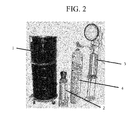
- FIG. 2 Apparatus For Producing Mixed Oxides Of Nitrogen (MON)
- FIG. 3 Integrated System Diagram With The Various Components Identified
- FIG. 4 Liquid propane gel mixer
- the present invention is a method for preparing a bipropellant formulation comprising a gelled liquid propane (GLP) fuel component.
- the bipropellant system provides a vacuum specific impulse (I sp,1000-vac ) as high as 360 seconds.
- the energy density of the propulsion system can be further improved by adding an energetic additive, such as a sub-micron powder of boron, carbon, or aluminum to the fuel component. Increasing the density of the propellant through the addition of energetic powders also allows for higher thrust levels in volume-limited propulsion systems.
- the formulation is particularly useful for outer planetary missions because of the very low freezing points and operational temperatures of the fuel and oxidizer.
- Liquid MON propellants of up to 25% NO (75% N 2 O 4 +25% NO) are sometimes used as oxidizers on military and commercial satellites.
- the non-gelled form of the invented oxidizer is MON-30 (70% N 2 O 4 +30% NO), which has a freezing point of ⁇ 16.1° C., or 7.1° C. lower than MON-25.
- Gelling of MON-30 in addition to the well-known safety benefits, reduces the possibility of combustion instability, seen in some MON systems, where the nitric oxide (NO) can flash at the injector face. Most importantly, gelling MON-30 reduces the freezing point relative to the liquid and lowers operational temperatures as well.
- Propane CH 3 CH 2 CH 3
- CH 3 CH 2 CH 3 is a gaseous hydrocarbon that readily liquefies by compression and cooling and melts at ⁇ 189.9° C. and boils at ⁇ 42.2° C. Gelling the propellant provides the advantage of higher volumetric efficiency.
- MON-30 and GLP gelling/mixing can be performed using a variety of devices, methods, and conditions. The following method and apparatus is provided as an example and it is understood by those skilled in the art that other methods of mixing may also be used.
- MON-30 and GLP are gelled using one-liter churn-mixers, each comprising a cylindrical vessel that is sealed by a piston-like closure-lid.
- a rod, attached externally to a pneumatic actuator, goes through the center of the closure-lid and attaches to a perforated churn-plate.
- the churn-plate has thirty-six, 6 mm diameter holes and is pneumatically cycled up and down, through the entire mixer volume, forcing the entire mass of liquid and gelling agents through the perforations with each half-cycle.
- the mixing temperatures are around ⁇ 20° C. for MON-30 and around ⁇ 50° C. for LP.
- Gelling agents may include silicon dioxide, clay, carbon, organic or inorganic polymers, or combinations thereof. Generally, the % by weight of gelling agent used is the minimum required to achieve the desired physical properties. The amount of gallant used is preferably 1% to 12% by weight and most preferably 2% to 5% by weight. In one preferred embodiment, the gelling agent for MON-30 and LP is fumed silica. A small amount of polymeric agent, such as hydroxypropyl cellulose, may also be added to improve long-term storage characteristics. Surfactants may be used to improve the “wetting” of a gellant. Hypergolicity of the fuel may be increased including small amounts of Lithium metal, hydrogen gas, or MMH.
- the oxidizer for the low-temperature propellant combination is MON-30.
- MONs are solutions of Nitric Oxide (NO) in Dinitrogen Tetroxide/Nitrogen Dioxide. The reaction that takes place as NO is added to NO 2 is shown below. The reaction is exothermic and releases 6000 kcal/kg. NO+NO 2 ⁇ N 2 O 3
- FIG. 2 One type of apparatus that may be used to synthesize MON-30 is shown in FIG. 2 and comprises ice water bath 1 , NO 2 transfer tank 2 , reaction cylinder 3 , and nitrous oxide tank 4 .
- FIG. 3 shows a diagram of the integrated system with the various components identified.
- MON-30 was synthesized by applying a vacuum to all system hardware, feeding 500 g of liquid NO 2 into the reaction cylinder, and lowering the reaction cylinder apparatus and NO tank into the ice water bath to maintain the temperature of the reactants at 0° C. Once the pressure in the reaction cylinder and the NO bottle reach equilibrium, 214 g of NO was metered into the reaction cylinder.
- the MON-30 was gelled at around ⁇ 25° C. with 3% fumed silica by weight using a plate churn mixer. The mixture was churned for approximately 2 minutes. The gelled MON-30 has a freezing point of ⁇ 81° C.
- Propane was gelled using a plate churn mixer shown in FIG. 4 placed inside an insulated polyethylene drum filled with a water-ethylene glycol mixture cooled to ⁇ 55° C.
- Elements of the plate churn mixer shown in FIG. 4 are the mixer actuator rod 5 , mixing/storage vessel 6 , cryogenic valve 7 , absolute pressure transducer 8 , and pressure transducer disconnect valve 9 .
- 20 grams of Cabot M-5® fumed silica were introduced into the mixing vessel. After addition of the silica, the vessel was attached to a vacuum pump, evacuated, and cooled in dry ice for 10 minutes. 500 grams of liquid propane was introduced into the mixing vessel.
- the system was submerged in a 70/30-ethylene glycol/water bath and cooled to ⁇ 55° C. Once the mixing vessel pressure reached approximately 8 psia, the mixture was churned for approximately 2 minutes.
- the gelled propane has a freezing point of ⁇ 189.9° C.
Landscapes
- Chemical & Material Sciences (AREA)
- Organic Chemistry (AREA)
- Filling Or Discharging Of Gas Storage Vessels (AREA)
- Cosmetics (AREA)
- Colloid Chemistry (AREA)
Abstract
Description
NO+NO2→N2O3
Claims (20)
Priority Applications (1)
| Application Number | Priority Date | Filing Date | Title |
|---|---|---|---|
| US13/013,762 US8425700B2 (en) | 2005-12-02 | 2011-01-25 | High energy, low temperature gelled bi-propellant formulation preparation method |
Applications Claiming Priority (2)
| Application Number | Priority Date | Filing Date | Title |
|---|---|---|---|
| US11/292,442 US7896987B2 (en) | 2005-12-02 | 2005-12-02 | High energy, low temperature gelled bi-propellant formulation |
| US13/013,762 US8425700B2 (en) | 2005-12-02 | 2011-01-25 | High energy, low temperature gelled bi-propellant formulation preparation method |
Related Parent Applications (1)
| Application Number | Title | Priority Date | Filing Date |
|---|---|---|---|
| US11/292,442 Division US7896987B2 (en) | 2005-12-02 | 2005-12-02 | High energy, low temperature gelled bi-propellant formulation |
Publications (2)
| Publication Number | Publication Date |
|---|---|
| US20120073713A1 US20120073713A1 (en) | 2012-03-29 |
| US8425700B2 true US8425700B2 (en) | 2013-04-23 |
Family
ID=38092871
Family Applications (4)
| Application Number | Title | Priority Date | Filing Date |
|---|---|---|---|
| US11/292,442 Expired - Fee Related US7896987B2 (en) | 2005-12-02 | 2005-12-02 | High energy, low temperature gelled bi-propellant formulation |
| US11/584,954 Active 2028-08-27 US7810990B2 (en) | 2005-12-02 | 2006-10-23 | Apparatus and method for gelling liquefied gasses |
| US12/874,242 Expired - Fee Related US8047703B2 (en) | 2005-12-02 | 2010-09-02 | Apparatus and method for gelling liquefied gasses |
| US13/013,762 Expired - Fee Related US8425700B2 (en) | 2005-12-02 | 2011-01-25 | High energy, low temperature gelled bi-propellant formulation preparation method |
Family Applications Before (3)
| Application Number | Title | Priority Date | Filing Date |
|---|---|---|---|
| US11/292,442 Expired - Fee Related US7896987B2 (en) | 2005-12-02 | 2005-12-02 | High energy, low temperature gelled bi-propellant formulation |
| US11/584,954 Active 2028-08-27 US7810990B2 (en) | 2005-12-02 | 2006-10-23 | Apparatus and method for gelling liquefied gasses |
| US12/874,242 Expired - Fee Related US8047703B2 (en) | 2005-12-02 | 2010-09-02 | Apparatus and method for gelling liquefied gasses |
Country Status (2)
| Country | Link |
|---|---|
| US (4) | US7896987B2 (en) |
| WO (1) | WO2007064965A2 (en) |
Families Citing this family (3)
| Publication number | Priority date | Publication date | Assignee | Title |
|---|---|---|---|---|
| DE102008025217B4 (en) * | 2008-05-27 | 2013-08-22 | Bayern-Chemie Gesellschaft Für Flugchemische Antriebe Mbh | combustion engine |
| CN102447118A (en) * | 2011-11-10 | 2012-05-09 | 江苏环能通环保科技有限公司 | Manufacture equipment for negative electrode material of lithium battery |
| DE102017202207A1 (en) * | 2017-02-13 | 2018-08-16 | Arianegroup Gmbh | Process for degassing hypergolic fuels |
Citations (8)
| Publication number | Priority date | Publication date | Assignee | Title |
|---|---|---|---|---|
| US3380250A (en) | 1964-11-18 | 1968-04-30 | United Aircraft Corp | Bi-propellant rocket system |
| US4499723A (en) | 1982-07-26 | 1985-02-19 | Rockwell International Corporation | Tris(2-azidoethyl)amine and method of preparation thereof |
| US5288915A (en) | 1991-11-07 | 1994-02-22 | The Dow Chemical Company | Process of making ketones |
| US5438824A (en) * | 1994-03-21 | 1995-08-08 | The United States Of America As Represented By The Secretary Of The Army | Silicon as a high energy additive for fuel gels and solid fuel-gas generators for propulsion systems |
| US6210504B1 (en) | 1999-05-21 | 2001-04-03 | The United States Of America As Represented By The Secretary Of The Army | Tertiary amine azides in liquid or gel fuels in gas generator systems |
| US20020196704A1 (en) | 2001-06-26 | 2002-12-26 | May Douglas L. | Perforated-plate churn-mixer |
| US20030159811A1 (en) | 2002-02-11 | 2003-08-28 | Douglas Nurmi | Ammonia Vapor Generation |
| US20050158477A1 (en) | 2003-12-25 | 2005-07-21 | Tokyo Electron Limited | Deposition apparatus and a deposition method using medium in a supercritical state |
Family Cites Families (6)
| Publication number | Priority date | Publication date | Assignee | Title |
|---|---|---|---|---|
| US3900070A (en) * | 1974-05-06 | 1975-08-19 | Halliburton Co | Gelling liquid hydrocarbons |
| US6165293A (en) * | 1983-05-26 | 2000-12-26 | The United States Of America As Represented By The Secretary Of The Army | Thixotropic IRFNA gel |
| US6013143A (en) * | 1998-04-20 | 2000-01-11 | The United States Of America As Represented By The Secretary Of The Army | Tertiary amine azides in hypergolic liquid or gel fuels propellant systems |
| US6397580B1 (en) * | 1998-07-09 | 2002-06-04 | Bi-Propellant Rocket Research Corporation | High performance rocket engine having a stepped expansion combustion chamber and method of making the same |
| AU5695001A (en) * | 1999-11-11 | 2001-07-24 | Kelly Space & Technology, Inc. | Nitrous oxide/fuel monopropellants |
| US6652682B1 (en) * | 2001-10-17 | 2003-11-25 | The United States Of America As Represented By The Secretary Of The Navy | Propellant composition comprising nano-sized boron particles |
-
2005
- 2005-12-02 US US11/292,442 patent/US7896987B2/en not_active Expired - Fee Related
-
2006
- 2006-10-23 US US11/584,954 patent/US7810990B2/en active Active
- 2006-12-02 WO PCT/US2006/046137 patent/WO2007064965A2/en not_active Ceased
-
2010
- 2010-09-02 US US12/874,242 patent/US8047703B2/en not_active Expired - Fee Related
-
2011
- 2011-01-25 US US13/013,762 patent/US8425700B2/en not_active Expired - Fee Related
Patent Citations (8)
| Publication number | Priority date | Publication date | Assignee | Title |
|---|---|---|---|---|
| US3380250A (en) | 1964-11-18 | 1968-04-30 | United Aircraft Corp | Bi-propellant rocket system |
| US4499723A (en) | 1982-07-26 | 1985-02-19 | Rockwell International Corporation | Tris(2-azidoethyl)amine and method of preparation thereof |
| US5288915A (en) | 1991-11-07 | 1994-02-22 | The Dow Chemical Company | Process of making ketones |
| US5438824A (en) * | 1994-03-21 | 1995-08-08 | The United States Of America As Represented By The Secretary Of The Army | Silicon as a high energy additive for fuel gels and solid fuel-gas generators for propulsion systems |
| US6210504B1 (en) | 1999-05-21 | 2001-04-03 | The United States Of America As Represented By The Secretary Of The Army | Tertiary amine azides in liquid or gel fuels in gas generator systems |
| US20020196704A1 (en) | 2001-06-26 | 2002-12-26 | May Douglas L. | Perforated-plate churn-mixer |
| US20030159811A1 (en) | 2002-02-11 | 2003-08-28 | Douglas Nurmi | Ammonia Vapor Generation |
| US20050158477A1 (en) | 2003-12-25 | 2005-07-21 | Tokyo Electron Limited | Deposition apparatus and a deposition method using medium in a supercritical state |
Also Published As
| Publication number | Publication date |
|---|---|
| WO2007064965A3 (en) | 2008-10-23 |
| US8047703B2 (en) | 2011-11-01 |
| US20070245750A1 (en) | 2007-10-25 |
| US20100319822A1 (en) | 2010-12-23 |
| US7810990B2 (en) | 2010-10-12 |
| WO2007064965A2 (en) | 2007-06-07 |
| US20090320973A1 (en) | 2009-12-31 |
| US20120073713A1 (en) | 2012-03-29 |
| US7896987B2 (en) | 2011-03-01 |
Similar Documents
| Publication | Publication Date | Title |
|---|---|---|
| Zakirov et al. | Nitrous oxide as a rocket propellant | |
| US6367244B1 (en) | Propulsion system containing a mixed-phase propellant and a method for propelling an object with the same | |
| Remissa et al. | Propulsion systems, propellants, green propulsion subsystems and their applications: a review | |
| Cong et al. | Propulsive performance of hypergolic H202/kerosene bipropellant | |
| US7966805B2 (en) | Hydroxyl amine based staged combustion hybrid rocket motor | |
| US20240124372A1 (en) | Propellant | |
| US20120073713A1 (en) | High Energy, Low Temperature Gelled Bi-Propellant Formulation Preparation Method | |
| US12442350B2 (en) | Small satellite propulsion system utilizing liquid propellant ullage vapor | |
| US20130199155A1 (en) | Rocket Propulsion Systems, and Related Methods | |
| DeGroot et al. | Chemical microthruster options | |
| US20140182265A1 (en) | Rocket Propulsion Systems, and Related Methods | |
| WO2001051433A1 (en) | Nitrous oxide/fuel monopropellants | |
| Di Salvo | High energy, low temperature gelled bi-propellant formulation | |
| Karabeyoglu | Mixtures of nitrous oxide and oxygen (nytrox) as oxidizers for rocket propulsion applications | |
| Wilson et al. | Catalytic Decomposition of Nitrous Oxide Monopropellant for Hybrid Motor Re-Ignition | |
| Colozza | Comparison of Mars aircraft propulsion systems | |
| Benhidjeb-Carayon et al. | Hypergolicity of Mixed Oxides of Nitrogen with Solid Fuels for Hybrid Rocket Application | |
| US20130019586A1 (en) | Propulsion method and device comprising a liquid oxidant and a solid compound | |
| JP2002020191A (en) | Liquid oxidizing agent and hybrid propellant | |
| US6331220B1 (en) | Gas-generating liquid compositions (PERSOL 2) | |
| Karabeyoglu | Mixtures of nitrous oxide, carbon dioxide and oxygen as oxidizers for Mars applications | |
| JP2011006274A (en) | Low temperature resistant propellant | |
| Hendel | Review of solid propellants for space exploration | |
| Suresh et al. | Hydroxyl ammonium nitrate (HAN) based propellants for the next generation launch vehicles-a review | |
| US6299711B1 (en) | Gas-generating liquid compositions (OXSOL 3) |
Legal Events
| Date | Code | Title | Description |
|---|---|---|---|
| STCF | Information on status: patent grant |
Free format text: PATENTED CASE |
|
| FPAY | Fee payment |
Year of fee payment: 4 |
|
| MAFP | Maintenance fee payment |
Free format text: PAYMENT OF MAINTENANCE FEE, 8TH YR, SMALL ENTITY (ORIGINAL EVENT CODE: M2552); ENTITY STATUS OF PATENT OWNER: SMALL ENTITY Year of fee payment: 8 |
|
| FEPP | Fee payment procedure |
Free format text: MAINTENANCE FEE REMINDER MAILED (ORIGINAL EVENT CODE: REM.); ENTITY STATUS OF PATENT OWNER: SMALL ENTITY |
|
| LAPS | Lapse for failure to pay maintenance fees |
Free format text: PATENT EXPIRED FOR FAILURE TO PAY MAINTENANCE FEES (ORIGINAL EVENT CODE: EXP.); ENTITY STATUS OF PATENT OWNER: SMALL ENTITY |
|
| STCH | Information on status: patent discontinuation |
Free format text: PATENT EXPIRED DUE TO NONPAYMENT OF MAINTENANCE FEES UNDER 37 CFR 1.362 |
|
| FP | Lapsed due to failure to pay maintenance fee |
Effective date: 20250423 |