US8415376B2 - Inhibitors of PI3 kinase - Google Patents
Inhibitors of PI3 kinase Download PDFInfo
- Publication number
- US8415376B2 US8415376B2 US12/995,431 US99543109A US8415376B2 US 8415376 B2 US8415376 B2 US 8415376B2 US 99543109 A US99543109 A US 99543109A US 8415376 B2 US8415376 B2 US 8415376B2
- Authority
- US
- United States
- Prior art keywords
- chloro
- pyridinyl
- alkyl
- quinolinyl
- fluorobenzenesulfonamide
- Prior art date
- Legal status (The legal status is an assumption and is not a legal conclusion. Google has not performed a legal analysis and makes no representation as to the accuracy of the status listed.)
- Active, expires
Links
- 0 [1*]C1=C(CC)C=C(C)C=N1 Chemical compound [1*]C1=C(CC)C=C(C)C=N1 0.000 description 21
- KHILRWPNKYROLV-UHFFFAOYSA-N CC1=CC=C(C)C=C1.CC1=CC=C(F)C=C1 Chemical compound CC1=CC=C(C)C=C1.CC1=CC=C(F)C=C1 KHILRWPNKYROLV-UHFFFAOYSA-N 0.000 description 4
- PADGVRPUKDUCJK-UHFFFAOYSA-N CC(C)C1=C2C=CC=NC2=CC=C1.CC(C)C1=C2C=CN=CC2=CC=C1.CC(C)C1=C2C=CN=NC2=CC=C1.CC(C)C1=C2C=NC=CC2=CC=C1.CC(C)C1=C2C=NN=CC2=CC=C1.CC(C)C1=C2N=CC=CC2=CC=C1.CC(C)C1=C2N=CC=NC2=CC=C1.CC(C)C1=C2N=NC=CC2=CC=C1.CC(C)C1=CC=C2C=CC=NC2=C1.CC(C)C1=CC=C2C=CN=CC2=C1.CC(C)C1=CC=C2C=CN=NC2=C1.CC(C)C1=CC=C2C=NC=CC2=C1.CC(C)C1=CC=C2C=NN=CC2=C1.CC(C)C1=CC=C2N=CC=CC2=C1.CC(C)C1=CC=C2N=CC=NC2=C1.CC(C)C1=CC=C2N=NC=CC2=C1 Chemical compound CC(C)C1=C2C=CC=NC2=CC=C1.CC(C)C1=C2C=CN=CC2=CC=C1.CC(C)C1=C2C=CN=NC2=CC=C1.CC(C)C1=C2C=NC=CC2=CC=C1.CC(C)C1=C2C=NN=CC2=CC=C1.CC(C)C1=C2N=CC=CC2=CC=C1.CC(C)C1=C2N=CC=NC2=CC=C1.CC(C)C1=C2N=NC=CC2=CC=C1.CC(C)C1=CC=C2C=CC=NC2=C1.CC(C)C1=CC=C2C=CN=CC2=C1.CC(C)C1=CC=C2C=CN=NC2=C1.CC(C)C1=CC=C2C=NC=CC2=C1.CC(C)C1=CC=C2C=NN=CC2=C1.CC(C)C1=CC=C2N=CC=CC2=C1.CC(C)C1=CC=C2N=CC=NC2=C1.CC(C)C1=CC=C2N=NC=CC2=C1 PADGVRPUKDUCJK-UHFFFAOYSA-N 0.000 description 3
- SKLDKFHBNJPZIQ-UHFFFAOYSA-N CC(C)C1=C2C=CC=NC2=NC=C1.CC(C)C1=C2C=NN=CC2=CC=C1.CC(C)C1=C2N=CC=CC2=NC=C1.CC(C)C1=CC=C2C=CC=NC2=C1.CC(C)C1=CC=C2C=NC=CC2=C1.CC(C)C1=CC=C2C=NC=CC2=N1.CC(C)C1=CC=C2C=NN=CC2=C1.CC(C)C1=CC=C2N=CC=CC2=C1.CC(C)C1=CC=C2N=CC=NC2=C1.CC(C)C1=CC=C2N=NC=CC2=C1.CC(C)C1=NC=C2N=CC=CC2=C1 Chemical compound CC(C)C1=C2C=CC=NC2=NC=C1.CC(C)C1=C2C=NN=CC2=CC=C1.CC(C)C1=C2N=CC=CC2=NC=C1.CC(C)C1=CC=C2C=CC=NC2=C1.CC(C)C1=CC=C2C=NC=CC2=C1.CC(C)C1=CC=C2C=NC=CC2=N1.CC(C)C1=CC=C2C=NN=CC2=C1.CC(C)C1=CC=C2N=CC=CC2=C1.CC(C)C1=CC=C2N=CC=NC2=C1.CC(C)C1=CC=C2N=NC=CC2=C1.CC(C)C1=NC=C2N=CC=CC2=C1 SKLDKFHBNJPZIQ-UHFFFAOYSA-N 0.000 description 3
- GTPIIWYFOLNJBX-UHFFFAOYSA-N CC(C)C1=C2C=NN=CC2=CC=C1.CC(C)C1=C2N=CC=CC2=NC=C1.CC(C)C1=CC=C2C=CN=NC2=C1.CC(C)C1=CC=C2C=CN=NC2=N1.CC(C)C1=CC=C2C=NN=CC2=C1.CC(C)C1=CC=C2C=NN=CC2=N1.CC(C)C1=CN=C2C=NN=CC2=C1.CC(C)C1=NC=C2C=CN=NC2=C1.CC(C)C1=NC=C2C=NN=CC2=C1 Chemical compound CC(C)C1=C2C=NN=CC2=CC=C1.CC(C)C1=C2N=CC=CC2=NC=C1.CC(C)C1=CC=C2C=CN=NC2=C1.CC(C)C1=CC=C2C=CN=NC2=N1.CC(C)C1=CC=C2C=NN=CC2=C1.CC(C)C1=CC=C2C=NN=CC2=N1.CC(C)C1=CN=C2C=NN=CC2=C1.CC(C)C1=NC=C2C=CN=NC2=C1.CC(C)C1=NC=C2C=NN=CC2=C1 GTPIIWYFOLNJBX-UHFFFAOYSA-N 0.000 description 3
- LTEKGJQRPYSYNV-UHFFFAOYSA-N CC(C)C1=CC=C2C=CC=NC2=C1.CC(C)C1=CC=C2C=CC=NC2=N1.CC(C)C1=CC=C2C=CN=CC2=C1.CC(C)C1=CC=C2C=CN=CC2=N1.CC(C)C1=CC=C2C=NC=CC2=C1.CC(C)C1=CC=C2C=NC=CC2=C1.CC(C)C1=CC=C2C=NC=CC2=N1.CC(C)C1=CC=C2N=CC=CC2=C1.CC(C)C1=CC=C2N=CC=CC2=N1.CC(C)C1=CC=C2N=CC=NC2=C1.CC(C)C1=CC=C2N=CC=NC2=N1.CC(C)C1=CC=C2N=NC=CC2=C1.CC(C)C1=CC=C2N=NC=CC2=N1.CC(C)C1=CN=C2C=CC=NC2=C1.CC(C)C1=CN=C2C=CN=CC2=C1.CC(C)C1=CN=C2C=CN=NC2=C1.CC(C)C1=CN=C2C=NC=CC2=C1.CC(C)C1=CN=C2N=CC=CC2=C1.CC(C)C1=CN=C2N=CC=NC2=C1.CC(C)C1=NC=C2C=CN=CC2=C1.CC(C)C1=NC=C2C=NC=CC2=C1.CC(C)C1=NC=C2N=CC=CC2=C1.CC(C)C1=NC=C2N=CC=NC2=C1.CC(C)C1=NC=C2N=NC=CC2=C1 Chemical compound CC(C)C1=CC=C2C=CC=NC2=C1.CC(C)C1=CC=C2C=CC=NC2=N1.CC(C)C1=CC=C2C=CN=CC2=C1.CC(C)C1=CC=C2C=CN=CC2=N1.CC(C)C1=CC=C2C=NC=CC2=C1.CC(C)C1=CC=C2C=NC=CC2=C1.CC(C)C1=CC=C2C=NC=CC2=N1.CC(C)C1=CC=C2N=CC=CC2=C1.CC(C)C1=CC=C2N=CC=CC2=N1.CC(C)C1=CC=C2N=CC=NC2=C1.CC(C)C1=CC=C2N=CC=NC2=N1.CC(C)C1=CC=C2N=NC=CC2=C1.CC(C)C1=CC=C2N=NC=CC2=N1.CC(C)C1=CN=C2C=CC=NC2=C1.CC(C)C1=CN=C2C=CN=CC2=C1.CC(C)C1=CN=C2C=CN=NC2=C1.CC(C)C1=CN=C2C=NC=CC2=C1.CC(C)C1=CN=C2N=CC=CC2=C1.CC(C)C1=CN=C2N=CC=NC2=C1.CC(C)C1=NC=C2C=CN=CC2=C1.CC(C)C1=NC=C2C=NC=CC2=C1.CC(C)C1=NC=C2N=CC=CC2=C1.CC(C)C1=NC=C2N=CC=NC2=C1.CC(C)C1=NC=C2N=NC=CC2=C1 LTEKGJQRPYSYNV-UHFFFAOYSA-N 0.000 description 3
- NKCQEIXYLHACJC-UHFFFAOYSA-N CC(C)C1=CC=C2N=CC=CC2=C1 Chemical compound CC(C)C1=CC=C2N=CC=CC2=C1 NKCQEIXYLHACJC-UHFFFAOYSA-N 0.000 description 3
- BHCLTGGLKRXPJS-UHFFFAOYSA-N CC(C)C1=CC=C2N=CC=CC2=C1.CC(C)C1=CC=C2N=CC=NC2=C1 Chemical compound CC(C)C1=CC=C2N=CC=CC2=C1.CC(C)C1=CC=C2N=CC=NC2=C1 BHCLTGGLKRXPJS-UHFFFAOYSA-N 0.000 description 3
- UGXGHLUTCJOYLX-UHFFFAOYSA-N CC(C)C1=CC=C2N=CC=NC2=C1 Chemical compound CC(C)C1=CC=C2N=CC=NC2=C1 UGXGHLUTCJOYLX-UHFFFAOYSA-N 0.000 description 3
- NAJVYULLAHNXEJ-UHFFFAOYSA-N C.CC1=CC=NC2=CC=C(C(C)C)C=C12 Chemical compound C.CC1=CC=NC2=CC=C(C(C)C)C=C12 NAJVYULLAHNXEJ-UHFFFAOYSA-N 0.000 description 2
- FKZHJOAAIPSVIA-UHFFFAOYSA-N COC1=CC=C(S(=O)(=O)NC2=CC(C3=CC=C4OCCOC4=C3)=CN=C2Cl)C=C1 Chemical compound COC1=CC=C(S(=O)(=O)NC2=CC(C3=CC=C4OCCOC4=C3)=CN=C2Cl)C=C1 FKZHJOAAIPSVIA-UHFFFAOYSA-N 0.000 description 2
- JAUTYTRHOSKTKY-UHFFFAOYSA-N COCC1CCCN1C1=NC2=CC(C3=CN=C(Cl)C(NS(=O)(=O)C4=CC=C(F)C=C4)=C3)=CC=C2N=C1 Chemical compound COCC1CCCN1C1=NC2=CC(C3=CN=C(Cl)C(NS(=O)(=O)C4=CC=C(F)C=C4)=C3)=CC=C2N=C1 JAUTYTRHOSKTKY-UHFFFAOYSA-N 0.000 description 2
- HXJZKJDWNSLBHJ-ZIAGYGMSSA-N C[C@@H]1CN(C2=CC=NC3=CC=C(C4=CC(NS(C)(=O)=O)=C(Cl)N=C4)C=C32)C[C@@H](C)O1 Chemical compound C[C@@H]1CN(C2=CC=NC3=CC=C(C4=CC(NS(C)(=O)=O)=C(Cl)N=C4)C=C32)C[C@@H](C)O1 HXJZKJDWNSLBHJ-ZIAGYGMSSA-N 0.000 description 2
- HXJZKJDWNSLBHJ-OKILXGFUSA-N C[C@H]1CN(C2=CC=NC3=CC=C(C4=CC(NS(C)(=O)=O)=C(Cl)N=C4)C=C32)C[C@@H](C)O1 Chemical compound C[C@H]1CN(C2=CC=NC3=CC=C(C4=CC(NS(C)(=O)=O)=C(Cl)N=C4)C=C32)C[C@@H](C)O1 HXJZKJDWNSLBHJ-OKILXGFUSA-N 0.000 description 2
- HXJZKJDWNSLBHJ-KBPBESRZSA-N C[C@H]1CN(C2=CC=NC3=CC=C(C4=CC(NS(C)(=O)=O)=C(Cl)N=C4)C=C32)C[C@H](C)O1 Chemical compound C[C@H]1CN(C2=CC=NC3=CC=C(C4=CC(NS(C)(=O)=O)=C(Cl)N=C4)C=C32)C[C@H](C)O1 HXJZKJDWNSLBHJ-KBPBESRZSA-N 0.000 description 2
- WTPDXGANEFRNSG-UHFFFAOYSA-N O=S(=O)(NC1=C(Cl)N=CC(C2=CC=C3N=CC=C(N4CCOCC4)C3=C2)=C1)C1=CC=CN=C1 Chemical compound O=S(=O)(NC1=C(Cl)N=CC(C2=CC=C3N=CC=C(N4CCOCC4)C3=C2)=C1)C1=CC=CN=C1 WTPDXGANEFRNSG-UHFFFAOYSA-N 0.000 description 2
- SYFBEZSETRBMIL-UHFFFAOYSA-N O=S(=O)(NC1=C(Cl)N=CC(C2=CC=C3N=CC=C(OCC4CCSCC4)C3=C2)=C1)C1=CC=C(F)C=C1 Chemical compound O=S(=O)(NC1=C(Cl)N=CC(C2=CC=C3N=CC=C(OCC4CCSCC4)C3=C2)=C1)C1=CC=C(F)C=C1 SYFBEZSETRBMIL-UHFFFAOYSA-N 0.000 description 2
- PTBUVHCLTBDERA-UHFFFAOYSA-N O=S(=O)(NC1=CC(C2=CC=C3N=CC=C(Cl)C3=C2)=CN=C1Cl)C1=CC=C(F)C=C1 Chemical compound O=S(=O)(NC1=CC(C2=CC=C3N=CC=C(Cl)C3=C2)=CN=C1Cl)C1=CC=C(F)C=C1 PTBUVHCLTBDERA-UHFFFAOYSA-N 0.000 description 2
- URYZQWSKPHPBQX-UHFFFAOYSA-N O=S(=O)(NC1=CC(N2CCC3=C(C=CC=N3)C2)=CN=C1Cl)C1=CC=C(F)C=C1 Chemical compound O=S(=O)(NC1=CC(N2CCC3=C(C=CC=N3)C2)=CN=C1Cl)C1=CC=C(F)C=C1 URYZQWSKPHPBQX-UHFFFAOYSA-N 0.000 description 2
- QWLMCXBKLVKYBE-UHFFFAOYSA-N [H]N(CC1=CC(OC)=CC=C1OC)C1=CC=NC2=CC=C(C3=CC(NS(C)(=O)=O)=C(Cl)N=C3)C=C21 Chemical compound [H]N(CC1=CC(OC)=CC=C1OC)C1=CC=NC2=CC=C(C3=CC(NS(C)(=O)=O)=C(Cl)N=C3)C=C21 QWLMCXBKLVKYBE-UHFFFAOYSA-N 0.000 description 2
- ZGGJWXFVGCFNHI-UHFFFAOYSA-N BrC1=CC=C2N=CC=C(N3CCOCC3)C2=C1.CC1(C)OB(C2=CC=C3N=CC=C(N4CCOCC4)C3=C2)OC1(C)C.ClC1=CC=NC2=CC=C(Br)C=C12.NC1=CC(Br)=CN=C1Cl.O=S(=O)(NC1=CC(Br)=CN=C1Cl)C1=CC=C(F)C=C1.O=S(=O)(NC1=CC(C2=CC=C3N=CC=C(N4CCOCC4)C3=C2)=CN=C1Cl)C1=CC=C(F)C=C1 Chemical compound BrC1=CC=C2N=CC=C(N3CCOCC3)C2=C1.CC1(C)OB(C2=CC=C3N=CC=C(N4CCOCC4)C3=C2)OC1(C)C.ClC1=CC=NC2=CC=C(Br)C=C12.NC1=CC(Br)=CN=C1Cl.O=S(=O)(NC1=CC(Br)=CN=C1Cl)C1=CC=C(F)C=C1.O=S(=O)(NC1=CC(C2=CC=C3N=CC=C(N4CCOCC4)C3=C2)=CN=C1Cl)C1=CC=C(F)C=C1 ZGGJWXFVGCFNHI-UHFFFAOYSA-N 0.000 description 1
- LBFRLXVNPMYUKI-UHFFFAOYSA-N Brc(cc12)ccc1nccc2N1CCOCC1 Chemical compound Brc(cc12)ccc1nccc2N1CCOCC1 LBFRLXVNPMYUKI-UHFFFAOYSA-N 0.000 description 1
- PYDHLPWZQDLMRX-UHFFFAOYSA-N C.C.C.C.C.C=C1C=NC2=CC=C(C(C)C)C=C2N1C.C=C1COC2=CC=C(C(C)C)C=C2N1C.CC(C)C1=CC=C2C=CC=CC2=C1.CC(C)C1=CC=C2C=CC=NC2=C1.CC(C)C1=CC=C2C=CN=CC2=C1.CC(C)C1=CC=C2O=CC=OC2=C1.CC(C)N1C=CC2=C(C=CC=N2)C1=O.CC(C)N1CCC2=C(C=CC=N2)C1 Chemical compound C.C.C.C.C.C=C1C=NC2=CC=C(C(C)C)C=C2N1C.C=C1COC2=CC=C(C(C)C)C=C2N1C.CC(C)C1=CC=C2C=CC=CC2=C1.CC(C)C1=CC=C2C=CC=NC2=C1.CC(C)C1=CC=C2C=CN=CC2=C1.CC(C)C1=CC=C2O=CC=OC2=C1.CC(C)N1C=CC2=C(C=CC=N2)C1=O.CC(C)N1CCC2=C(C=CC=N2)C1 PYDHLPWZQDLMRX-UHFFFAOYSA-N 0.000 description 1
- WXKHTWLYEWZZQF-UHFFFAOYSA-N C.C.CC(C)C1=CC=C2C=CC=CC2=C1.CC(C)C1=CC=C2C=CC=NC2=C1.CC(C)C1=CC=C2C=CN=CC2=C1 Chemical compound C.C.CC(C)C1=CC=C2C=CC=CC2=C1.CC(C)C1=CC=C2C=CC=NC2=C1.CC(C)C1=CC=C2C=CN=CC2=C1 WXKHTWLYEWZZQF-UHFFFAOYSA-N 0.000 description 1
- AOQMBLUIHQGGKY-UHFFFAOYSA-N C1=CN=C2C=CC=NC2=C1.ClC1=C2N=CC=CC2=NC=C1.ClC1=CC=C2N=CC=CC2=N1.O=S(=O)(NC1=C(Cl)N=CC(C2=CC=C3N=CC=CC3=N2)=C1)C1=CC=C(F)C=C1.[O-][N+]1=C2C=CC=NC2=CC=C1 Chemical compound C1=CN=C2C=CC=NC2=C1.ClC1=C2N=CC=CC2=NC=C1.ClC1=CC=C2N=CC=CC2=N1.O=S(=O)(NC1=C(Cl)N=CC(C2=CC=C3N=CC=CC3=N2)=C1)C1=CC=C(F)C=C1.[O-][N+]1=C2C=CC=NC2=CC=C1 AOQMBLUIHQGGKY-UHFFFAOYSA-N 0.000 description 1
- ATWKDGJLBAGQRR-UHFFFAOYSA-N C1=NC2=C(CNCC2)C(N2CCOCC2)=C1.CCOC(=O)C(=CNC1=CCN(C(=O)OCC)CC1)C(=O)OCC.CCOC(=O)C1=C(O)C2=C(CCN(C(=O)OCC)C2)N=C1.CCOC(=O)N1CCC(=O)CC1.CCOC(=O)N1CCC2=C(C1)C(Cl)=CC=N2.CCOC(=O)N1CCC2=C(C1)C(N1CCOCC1)=CC=N2.CCOC(=O)N1CCC2=C(C1)C(O)=C(C(=O)O)C=N2.CCOC(=O)N1CCC2=C(C1)C(O)=CC=N2.CN(C)S(=O)(=O)NC1=C(Cl)N=CC(N2CCC3=C(C2)C(N2CCOCC2)=CC=N3)=C1 Chemical compound C1=NC2=C(CNCC2)C(N2CCOCC2)=C1.CCOC(=O)C(=CNC1=CCN(C(=O)OCC)CC1)C(=O)OCC.CCOC(=O)C1=C(O)C2=C(CCN(C(=O)OCC)C2)N=C1.CCOC(=O)N1CCC(=O)CC1.CCOC(=O)N1CCC2=C(C1)C(Cl)=CC=N2.CCOC(=O)N1CCC2=C(C1)C(N1CCOCC1)=CC=N2.CCOC(=O)N1CCC2=C(C1)C(O)=C(C(=O)O)C=N2.CCOC(=O)N1CCC2=C(C1)C(O)=CC=N2.CN(C)S(=O)(=O)NC1=C(Cl)N=CC(N2CCC3=C(C2)C(N2CCOCC2)=CC=N3)=C1 ATWKDGJLBAGQRR-UHFFFAOYSA-N 0.000 description 1
- KGNNMSGRBVKSQP-UHFFFAOYSA-N CC(=O)N1CCN(C2=NC3=CC(C4=CN=C(Cl)C(NS(=O)(=O)C5=CC=C(F)C=C5)=C4)=CC=C3N=C2)CC1 Chemical compound CC(=O)N1CCN(C2=NC3=CC(C4=CN=C(Cl)C(NS(=O)(=O)C5=CC=C(F)C=C5)=C4)=CC=C3N=C2)CC1 KGNNMSGRBVKSQP-UHFFFAOYSA-N 0.000 description 1
- VUONXGVITMKHRL-UHFFFAOYSA-N CC(=O)NC1=NC2=CC=C(Br)C=C2C=C1.COC1=CC=C(S(=O)(=O)NC2=C(Cl)N=CC(B3OC(C)(C)C(C)(C)O3)=C2)C=C1.COC1=CC=C(S(=O)(=O)NC2=C(Cl)N=CC(Br)=C2)C=C1.COC1=CC=C(S(=O)(=O)NC2=C(Cl)N=CC(C3=CC=C4N=C(NC(C)=O)C=CC4=C3)=C2)C=C1.NC1=C(Cl)N=CC(Br)=C1.NC1=NC2=CC=C(Br)C=C2C=C1 Chemical compound CC(=O)NC1=NC2=CC=C(Br)C=C2C=C1.COC1=CC=C(S(=O)(=O)NC2=C(Cl)N=CC(B3OC(C)(C)C(C)(C)O3)=C2)C=C1.COC1=CC=C(S(=O)(=O)NC2=C(Cl)N=CC(Br)=C2)C=C1.COC1=CC=C(S(=O)(=O)NC2=C(Cl)N=CC(C3=CC=C4N=C(NC(C)=O)C=CC4=C3)=C2)C=C1.NC1=C(Cl)N=CC(Br)=C1.NC1=NC2=CC=C(Br)C=C2C=C1 VUONXGVITMKHRL-UHFFFAOYSA-N 0.000 description 1
- HGJJYPQHPVINQT-UHFFFAOYSA-N CC(=O)OCC1=CC(C2=CC=C3N=CC=C(N4CCOCC4)C3=C2)=CN=C1Cl Chemical compound CC(=O)OCC1=CC(C2=CC=C3N=CC=C(N4CCOCC4)C3=C2)=CN=C1Cl HGJJYPQHPVINQT-UHFFFAOYSA-N 0.000 description 1
- NPYQSHKPEPRFJY-UHFFFAOYSA-N CC(C)(C)C(=O)NCC1=CC(C2=CC=C3N=CC=C(N4CCOCC4)C3=C2)=CN=C1Cl Chemical compound CC(C)(C)C(=O)NCC1=CC(C2=CC=C3N=CC=C(N4CCOCC4)C3=C2)=CN=C1Cl NPYQSHKPEPRFJY-UHFFFAOYSA-N 0.000 description 1
- DFTAKCCDVCSYPQ-UHFFFAOYSA-N CC(C)(C)OC(=O)N1CCCC(CCC2=NC3=CC(C4=CN=C(Cl)C(NS(=O)(=O)C5=CC=C(F)C=C5)=C4)=CC=C3N=C2)C1 Chemical compound CC(C)(C)OC(=O)N1CCCC(CCC2=NC3=CC(C4=CN=C(Cl)C(NS(=O)(=O)C5=CC=C(F)C=C5)=C4)=CC=C3N=C2)C1 DFTAKCCDVCSYPQ-UHFFFAOYSA-N 0.000 description 1
- SKITWSZQDVMBAI-UHFFFAOYSA-N CC(C)(C)OC(=O)N1CCCC(CCC2=NC3=CC(C4=CN=C(Cl)C(NS(=O)(=O)C5=CC=C(F)C=C5)=C4)=CC=C3N=C2)C1.O=S(=O)(NC1=CC(C2=CC=C3N=CC(CCC4CCCCC4)=NC3=C2)=CN=C1Cl)C1=CC=C(F)C=C1 Chemical compound CC(C)(C)OC(=O)N1CCCC(CCC2=NC3=CC(C4=CN=C(Cl)C(NS(=O)(=O)C5=CC=C(F)C=C5)=C4)=CC=C3N=C2)C1.O=S(=O)(NC1=CC(C2=CC=C3N=CC(CCC4CCCCC4)=NC3=C2)=CN=C1Cl)C1=CC=C(F)C=C1 SKITWSZQDVMBAI-UHFFFAOYSA-N 0.000 description 1
- CUNHWBADBYLCFV-UHFFFAOYSA-N CC(C)(C)OC(=O)NCCOC1=CC=NC2=CC=C(C3=CN=C(Cl)C(NS(=O)(=O)C4=CC=C(F)C=C4)=C3)C=C21 Chemical compound CC(C)(C)OC(=O)NCCOC1=CC=NC2=CC=C(C3=CN=C(Cl)C(NS(=O)(=O)C4=CC=C(F)C=C4)=C3)C=C21 CUNHWBADBYLCFV-UHFFFAOYSA-N 0.000 description 1
- YNVLWVKCRNXFIK-UHFFFAOYSA-N CC(C)C1=C2C=CN=NC2=CC=C1.CC(C)C1=C2C=NN=CC2=CC=C1.CC(C)C1=C2N=NC=CC2=CC=C1.CC(C)C1=CC=C2C=CN=NC2=C1.CC(C)C1=CC=C2C=NN=CC2=C1.CC(C)C1=CC=C2N=NC=CC2=C1 Chemical compound CC(C)C1=C2C=CN=NC2=CC=C1.CC(C)C1=C2C=NN=CC2=CC=C1.CC(C)C1=C2N=NC=CC2=CC=C1.CC(C)C1=CC=C2C=CN=NC2=C1.CC(C)C1=CC=C2C=NN=CC2=C1.CC(C)C1=CC=C2N=NC=CC2=C1 YNVLWVKCRNXFIK-UHFFFAOYSA-N 0.000 description 1
- LRDGUNIQENHKMH-UHFFFAOYSA-N CC(C)C1=C2C=NC=CC2=CC=C1.CC(C)C1=CC=C2C=CC=CC2=C1.CC(C)C1=CC=C2C=CN=CC2=C1.CC(C)C1=CC=C2N=CC=CC2=C1 Chemical compound CC(C)C1=C2C=NC=CC2=CC=C1.CC(C)C1=CC=C2C=CC=CC2=C1.CC(C)C1=CC=C2C=CN=CC2=C1.CC(C)C1=CC=C2N=CC=CC2=C1 LRDGUNIQENHKMH-UHFFFAOYSA-N 0.000 description 1
- BZKSJJAAUJPCKZ-UHFFFAOYSA-N CC(C)C1=C2C=NN=CC2=CC=C1.CC(C)C1=C2N=NC=CC2=CN=C1.CC(C)C1=CC=C2C=CN=NC2=C1.CC(C)C1=CC=C2C=CN=NC2=N1.CC(C)C1=CC=C2C=NN=CC2=C1.CC(C)C1=CC=C2C=NN=CC2=N1.CC(C)C1=CC=C2N=NC=CC2=C1.CC(C)C1=CC=C2N=NC=CC2=N1.CC(C)C1=CN=C2C=CN=NC2=C1.CC(C)C1=CN=C2C=NN=CC2=C1.CC(C)C1=NC=C2C=NN=CC2=C1.CC(C)C1=NC=C2N=NC=CC2=C1 Chemical compound CC(C)C1=C2C=NN=CC2=CC=C1.CC(C)C1=C2N=NC=CC2=CN=C1.CC(C)C1=CC=C2C=CN=NC2=C1.CC(C)C1=CC=C2C=CN=NC2=N1.CC(C)C1=CC=C2C=NN=CC2=C1.CC(C)C1=CC=C2C=NN=CC2=N1.CC(C)C1=CC=C2N=NC=CC2=C1.CC(C)C1=CC=C2N=NC=CC2=N1.CC(C)C1=CN=C2C=CN=NC2=C1.CC(C)C1=CN=C2C=NN=CC2=C1.CC(C)C1=NC=C2C=NN=CC2=C1.CC(C)C1=NC=C2N=NC=CC2=C1 BZKSJJAAUJPCKZ-UHFFFAOYSA-N 0.000 description 1
- SHLRNAMEMGGTKI-UHFFFAOYSA-N CC(C)N1CCN(C2=CC=NC3=CC=C(C4=CC(NS(=O)(=O)C5=CC=C(F)C=C5)=C(Cl)N=C4)C=C32)CC1 Chemical compound CC(C)N1CCN(C2=CC=NC3=CC=C(C4=CC(NS(=O)(=O)C5=CC=C(F)C=C5)=C(Cl)N=C4)C=C32)CC1 SHLRNAMEMGGTKI-UHFFFAOYSA-N 0.000 description 1
- RLVNHVYZDFYZET-UHFFFAOYSA-N CC(C)N1CCN(C2=NC3=CC(C4=CN=C(Cl)C(NS(=O)(=O)C5=CC=C(F)C=C5)=C4)=CC=C3N=C2)CC1.ClC1=NC2=CC(Br)=CC=C2N=C1.O=S(=O)(NC1=CC(C2=CC=C3N=CC(F)=NC3=C2)=CN=C1Cl)C1=CC=C(F)C=C1 Chemical compound CC(C)N1CCN(C2=NC3=CC(C4=CN=C(Cl)C(NS(=O)(=O)C5=CC=C(F)C=C5)=C4)=CC=C3N=C2)CC1.ClC1=NC2=CC(Br)=CC=C2N=C1.O=S(=O)(NC1=CC(C2=CC=C3N=CC(F)=NC3=C2)=CN=C1Cl)C1=CC=C(F)C=C1 RLVNHVYZDFYZET-UHFFFAOYSA-N 0.000 description 1
- CDLDKNWEZKVMDJ-UHFFFAOYSA-N CC(C1=CC=CC=C1)N1CCN(C2=CC=NC3=CC=C(C4=CC(NS(=O)(=O)C5=CC=C(F)C=C5)=C(Cl)N=C4)C=C32)CC1 Chemical compound CC(C1=CC=CC=C1)N1CCN(C2=CC=NC3=CC=C(C4=CC(NS(=O)(=O)C5=CC=C(F)C=C5)=C(Cl)N=C4)C=C32)CC1 CDLDKNWEZKVMDJ-UHFFFAOYSA-N 0.000 description 1
- QPOIRQDNRDTKJL-UHFFFAOYSA-N CC(C1=CC=CC=C1)N1CCN(C2=CC=NC3=CC=C(C4=CC(NS(C)(=O)=O)=C(Cl)N=C4)C=C32)CC1 Chemical compound CC(C1=CC=CC=C1)N1CCN(C2=CC=NC3=CC=C(C4=CC(NS(C)(=O)=O)=C(Cl)N=C4)C=C32)CC1 QPOIRQDNRDTKJL-UHFFFAOYSA-N 0.000 description 1
- NBAJFXKIDRFYRO-UHFFFAOYSA-N CC(C1=CC=CC=C1)N1CCN(C2=CC=NC3=CC=C(C4=CN=C(Cl)C(N(C)C)=C4)C=C32)CC1 Chemical compound CC(C1=CC=CC=C1)N1CCN(C2=CC=NC3=CC=C(C4=CN=C(Cl)C(N(C)C)=C4)C=C32)CC1 NBAJFXKIDRFYRO-UHFFFAOYSA-N 0.000 description 1
- GHAMUJKKUUJUEK-UHFFFAOYSA-N CC(CC1=NC2=CC(C3=CN=C(Cl)C(NS(=O)(=O)C4=CC=C(F)C=C4)=C3)=CC=C2N=C1)C1=CC=C(F)C=C1 Chemical compound CC(CC1=NC2=CC(C3=CN=C(Cl)C(NS(=O)(=O)C4=CC=C(F)C=C4)=C3)=CC=C2N=C1)C1=CC=C(F)C=C1 GHAMUJKKUUJUEK-UHFFFAOYSA-N 0.000 description 1
- ZEYXMGMEPMUWSC-UHFFFAOYSA-N CC1(C)CN(C2=CC=NC3=CC=C(C4=CN=C(Cl)C(NS(C)(=O)=O)=C4)C=C32)CCO1 Chemical compound CC1(C)CN(C2=CC=NC3=CC=C(C4=CN=C(Cl)C(NS(C)(=O)=O)=C4)C=C32)CCO1 ZEYXMGMEPMUWSC-UHFFFAOYSA-N 0.000 description 1
- ZPKPKFVLYSSNHU-UHFFFAOYSA-N CC1(C)OB(B2OC(C)(C)C(C)(C)O2)OC1(C)C.CC1(C)OB(C2=CC3=C(C=C2)N=CC=C3O)OC1(C)C.O=S(=O)(NC1=C(Cl)N=CC(Br)=C1)C1=CC=C(F)C=C1.O=S(=O)(NC1=C(Cl)N=CC(C2=CC3=C(C=C2)N=CC=C3O)=C1)C1=CC=C(F)C=C1.OC1=CC=NC2=C1C=C(Br)C=C2 Chemical compound CC1(C)OB(B2OC(C)(C)C(C)(C)O2)OC1(C)C.CC1(C)OB(C2=CC3=C(C=C2)N=CC=C3O)OC1(C)C.O=S(=O)(NC1=C(Cl)N=CC(Br)=C1)C1=CC=C(F)C=C1.O=S(=O)(NC1=C(Cl)N=CC(C2=CC3=C(C=C2)N=CC=C3O)=C1)C1=CC=C(F)C=C1.OC1=CC=NC2=C1C=C(Br)C=C2 ZPKPKFVLYSSNHU-UHFFFAOYSA-N 0.000 description 1
- SHPASRMBFMSGCL-UHFFFAOYSA-N CC1(C)OB(C2=CC(N)=C(Cl)N=C2)OC1(C)C.NC1=C(Cl)N=CC(Br)=C1.NC1=C(Cl)N=CC(C2=CC3=C(C=C2)N=CC=C3N2CCOCC2)=C1.O=S(=O)(NC1=C(Cl)N=CC(C2=CC3=C(C=C2)N=CC=C3N2CCOCC2)=C1)C1=CC=CC=C1F Chemical compound CC1(C)OB(C2=CC(N)=C(Cl)N=C2)OC1(C)C.NC1=C(Cl)N=CC(Br)=C1.NC1=C(Cl)N=CC(C2=CC3=C(C=C2)N=CC=C3N2CCOCC2)=C1.O=S(=O)(NC1=C(Cl)N=CC(C2=CC3=C(C=C2)N=CC=C3N2CCOCC2)=C1)C1=CC=CC=C1F SHPASRMBFMSGCL-UHFFFAOYSA-N 0.000 description 1
- VZQQIQQWRDOPDZ-UHFFFAOYSA-N CC1(C)OB(C2=CC3=C(C=C2)N=CC=C3Cl)OC1(C)C.ClC1=CC=NC2=C1C=C(Br)C=C2.O=S(=O)(NC1=C(Cl)N=CC(C2=CC3=C(C=C2)N=CC=C3Cl)=C1)C1=CC=C(F)C=C1.O=S(=O)(NC1=C(Cl)N=CC(C2=CC3=C(C=C2)N=CC=C3N2CCCCC2)=C1)C1=CC=C(F)C=C1 Chemical compound CC1(C)OB(C2=CC3=C(C=C2)N=CC=C3Cl)OC1(C)C.ClC1=CC=NC2=C1C=C(Br)C=C2.O=S(=O)(NC1=C(Cl)N=CC(C2=CC3=C(C=C2)N=CC=C3Cl)=C1)C1=CC=C(F)C=C1.O=S(=O)(NC1=C(Cl)N=CC(C2=CC3=C(C=C2)N=CC=C3N2CCCCC2)=C1)C1=CC=C(F)C=C1 VZQQIQQWRDOPDZ-UHFFFAOYSA-N 0.000 description 1
- WGEIPSYNAGYKSV-UHFFFAOYSA-N CC1(C)OB(C2=CC=C3N=CC=C(Cl)C3=C2)OC1(C)C.COCCN(C)C1=CC=NC2=CC=C(B3OC(C)(C)C(C)(C)O3)C=C21.COCCN(C)C1=CC=NC2=CC=C(C3=CN=C(Cl)C(NS(=O)(=O)N(C)CCOC)=C3)C=C21 Chemical compound CC1(C)OB(C2=CC=C3N=CC=C(Cl)C3=C2)OC1(C)C.COCCN(C)C1=CC=NC2=CC=C(B3OC(C)(C)C(C)(C)O3)C=C21.COCCN(C)C1=CC=NC2=CC=C(C3=CN=C(Cl)C(NS(=O)(=O)N(C)CCOC)=C3)C=C21 WGEIPSYNAGYKSV-UHFFFAOYSA-N 0.000 description 1
- VAKRMWFBLCNZNN-UHFFFAOYSA-N CC1(C)OB(C2=CC=C3N=CC=CC3=C2)OC1(C)C.COC1=CC=C(S(=O)(=O)CC2=CC(Br)=CN=C2Cl)C=C1.COC1=CC=C(S(=O)(=O)NC2=CC(C3=CC4=C(C=C3)N=CC=C4)=CN=C2Cl)C=C1 Chemical compound CC1(C)OB(C2=CC=C3N=CC=CC3=C2)OC1(C)C.COC1=CC=C(S(=O)(=O)CC2=CC(Br)=CN=C2Cl)C=C1.COC1=CC=C(S(=O)(=O)NC2=CC(C3=CC4=C(C=C3)N=CC=C4)=CN=C2Cl)C=C1 VAKRMWFBLCNZNN-UHFFFAOYSA-N 0.000 description 1
- BXTNRJBCLRDMDN-UHFFFAOYSA-N CC1(C)OB(C2=CN=C(Cl)C(NS(=O)(=O)C3=CC=C(F)C=C3)=C2)OC1(C)C.O=S(=O)(NC1=CC(Br)=CN=C1Cl)C1=CC=C(F)C=C1.O=S(=O)(NC1=CC(C2=CC=C3N=CC(N4CCOCC4)=NC3=C2)=CN=C1Cl)C1=CC=C(F)C=C1 Chemical compound CC1(C)OB(C2=CN=C(Cl)C(NS(=O)(=O)C3=CC=C(F)C=C3)=C2)OC1(C)C.O=S(=O)(NC1=CC(Br)=CN=C1Cl)C1=CC=C(F)C=C1.O=S(=O)(NC1=CC(C2=CC=C3N=CC(N4CCOCC4)=NC3=C2)=CN=C1Cl)C1=CC=C(F)C=C1 BXTNRJBCLRDMDN-UHFFFAOYSA-N 0.000 description 1
- IYEDCKURTJIKON-UHFFFAOYSA-N CC1(C)OB(C2=CN=C(Cl)C(NS(=O)(=O)C3=CC=C(F)C=C3)=C2)OC1(C)C.O=S(=O)(NC1=CC(C2=CC=C3N=CC(C4=CC=NC=C4)=NC3=C2)=CN=C1Cl)C1=CC=C(F)C=C1.O=S(=O)(NC1=CC(C2=CC=C3N=CC(Cl)=NC3=C2)=CN=C1Cl)C1=CC=C(F)C=C1 Chemical compound CC1(C)OB(C2=CN=C(Cl)C(NS(=O)(=O)C3=CC=C(F)C=C3)=C2)OC1(C)C.O=S(=O)(NC1=CC(C2=CC=C3N=CC(C4=CC=NC=C4)=NC3=C2)=CN=C1Cl)C1=CC=C(F)C=C1.O=S(=O)(NC1=CC(C2=CC=C3N=CC(Cl)=NC3=C2)=CN=C1Cl)C1=CC=C(F)C=C1 IYEDCKURTJIKON-UHFFFAOYSA-N 0.000 description 1
- YLBKJFUWDUMHAV-UHFFFAOYSA-N CC1(C)OB(c(ccc2ncc3)cc2c3N2CCOCC2)OC1(C)C Chemical compound CC1(C)OB(c(ccc2ncc3)cc2c3N2CCOCC2)OC1(C)C YLBKJFUWDUMHAV-UHFFFAOYSA-N 0.000 description 1
- VMFALDWCEQUFSX-UHFFFAOYSA-N CC1(C)OB(c2cc3cccnc3cc2)OC1(C)C Chemical compound CC1(C)OB(c2cc3cccnc3cc2)OC1(C)C VMFALDWCEQUFSX-UHFFFAOYSA-N 0.000 description 1
- HXGOSHLWVBGQEL-UHFFFAOYSA-N CC1=CC=C2C=CC=NC2=C1.O=S(=O)(NC1=CC(C2=CC=C3C=CC=NC3=C2)=CN=C1Cl)C1=CC=C(F)C=C1.OC1=CC=C2C=CC=NC2=C1 Chemical compound CC1=CC=C2C=CC=NC2=C1.O=S(=O)(NC1=CC(C2=CC=C3C=CC=NC3=C2)=CN=C1Cl)C1=CC=C(F)C=C1.OC1=CC=C2C=CC=NC2=C1 HXGOSHLWVBGQEL-UHFFFAOYSA-N 0.000 description 1
- KDIYGRFWHBDDQX-UHFFFAOYSA-N CC1=CC=CC=C1OC1CCN(C2=CC=NC3=CC=C(C4=CC(NS(C)(=O)=O)=C(Cl)N=C4)C=C32)C1 Chemical compound CC1=CC=CC=C1OC1CCN(C2=CC=NC3=CC=C(C4=CC(NS(C)(=O)=O)=C(Cl)N=C4)C=C32)C1 KDIYGRFWHBDDQX-UHFFFAOYSA-N 0.000 description 1
- UMAKFONVBMBLQS-UHFFFAOYSA-N CC1=CC=CN=C1C#N.N#CC1=NC=CC=C1CBr.N#CCC1=CC=CN=C1C#N.NC1=CC2=CC=CN=C2C(Br)=N1.NC1=CC2=CC=CN=C2C=N1.O=S(=O)(NC1=C(Cl)C=CC(C2=NC=C3N=CC=CC3=C2)=C1)C1=CC=C(F)C=C1.O=S(=O)(OC1=CC2=CC=CN=C2C=N1)C(F)(F)F Chemical compound CC1=CC=CN=C1C#N.N#CC1=NC=CC=C1CBr.N#CCC1=CC=CN=C1C#N.NC1=CC2=CC=CN=C2C(Br)=N1.NC1=CC2=CC=CN=C2C=N1.O=S(=O)(NC1=C(Cl)C=CC(C2=NC=C3N=CC=CC3=C2)=C1)C1=CC=C(F)C=C1.O=S(=O)(OC1=CC2=CC=CN=C2C=N1)C(F)(F)F UMAKFONVBMBLQS-UHFFFAOYSA-N 0.000 description 1
- MDHRMUOJMANTEU-UHFFFAOYSA-N CC1=CN=C(Cl)C(NS(C)(=O)=O)=C1.CS(=O)(=O)NC1=CC(Br)=CN=C1Cl.NC1=CC(Br)=CN=C1Cl.O=S(=O)(Cl)Cl Chemical compound CC1=CN=C(Cl)C(NS(C)(=O)=O)=C1.CS(=O)(=O)NC1=CC(Br)=CN=C1Cl.NC1=CC(Br)=CN=C1Cl.O=S(=O)(Cl)Cl MDHRMUOJMANTEU-UHFFFAOYSA-N 0.000 description 1
- HAOHMLFKXCHEBV-UHFFFAOYSA-N CC1=NC=CC(C2=CC=NC3=CC=C(C4=CC(NS(C)(=O)=O)=C(Cl)N=C4)C=C32)=C1 Chemical compound CC1=NC=CC(C2=CC=NC3=CC=C(C4=CC(NS(C)(=O)=O)=C(Cl)N=C4)C=C32)=C1 HAOHMLFKXCHEBV-UHFFFAOYSA-N 0.000 description 1
- WOQSOVWWGCAZGR-UHFFFAOYSA-N CC1CN(C2=CC=NC3=CC=C(C4=CC(NS(=O)(=O)C5=CC=C(F)C=C5)=C(Cl)N=C4)C=C32)CC(C)O1 Chemical compound CC1CN(C2=CC=NC3=CC=C(C4=CC(NS(=O)(=O)C5=CC=C(F)C=C5)=C(Cl)N=C4)C=C32)CC(C)O1 WOQSOVWWGCAZGR-UHFFFAOYSA-N 0.000 description 1
- JXGLTDWELWYRLU-UHFFFAOYSA-N CC1CN(C2=NC3=CC(C4=CN=C(Cl)C(NS(=O)(=O)C5=CC=C(F)C=C5)=C4)=CC=C3N=C2)CC(C)O1 Chemical compound CC1CN(C2=NC3=CC(C4=CN=C(Cl)C(NS(=O)(=O)C5=CC=C(F)C=C5)=C4)=CC=C3N=C2)CC(C)O1 JXGLTDWELWYRLU-UHFFFAOYSA-N 0.000 description 1
- XSXQPOGNYVAIFF-UHFFFAOYSA-N CCN(CC1=NOC(C2CC2)=N1)C1=CC=NC2=CC=C(C3=CC(NS(C)(=O)=O)=C(Cl)N=C3)C=C21 Chemical compound CCN(CC1=NOC(C2CC2)=N1)C1=CC=NC2=CC=C(C3=CC(NS(C)(=O)=O)=C(Cl)N=C3)C=C21 XSXQPOGNYVAIFF-UHFFFAOYSA-N 0.000 description 1
- ZXSIYBPGJQKXGN-UHFFFAOYSA-N CCN(CCC#N)C1=CC=NC2=CC=C(C3=CC(NS(C)(=O)=O)=C(Cl)N=C3)C=C21 Chemical compound CCN(CCC#N)C1=CC=NC2=CC=C(C3=CC(NS(C)(=O)=O)=C(Cl)N=C3)C=C21 ZXSIYBPGJQKXGN-UHFFFAOYSA-N 0.000 description 1
- LWQKBYVAAGZPFK-UHFFFAOYSA-N CCOC(=N)C(=O)OCC.CCOC(=O)C#N.NC1=NC2=CC=C(Br)C=C2CC1=O.NC1=NC2=CC=C(C3=CC(NS(=O)(=O)C4=CC=C(F)C=C4)=C(Cl)N=C3)C=C2CC1=O Chemical compound CCOC(=N)C(=O)OCC.CCOC(=O)C#N.NC1=NC2=CC=C(Br)C=C2CC1=O.NC1=NC2=CC=C(C3=CC(NS(=O)(=O)C4=CC=C(F)C=C4)=C(Cl)N=C3)C=C2CC1=O LWQKBYVAAGZPFK-UHFFFAOYSA-N 0.000 description 1
- IHZCEOGPYTUMNI-UHFFFAOYSA-N CN(C)C1=CC(B2OC(C)(C)C(C)(C)O2)=CN=C1Cl.CN(C)C1=CC(Br)=CN=C1Cl.CN(C)C1=CC(C2=CC=C3N=CC=C(N4CCOCC4)C3=C2)=CN=C1Cl Chemical compound CN(C)C1=CC(B2OC(C)(C)C(C)(C)O2)=CN=C1Cl.CN(C)C1=CC(Br)=CN=C1Cl.CN(C)C1=CC(C2=CC=C3N=CC=C(N4CCOCC4)C3=C2)=CN=C1Cl IHZCEOGPYTUMNI-UHFFFAOYSA-N 0.000 description 1
- AQEMMIJJTGVJPX-UHFFFAOYSA-N CN(C)C1=CC(C2=CC=C3N=CC=C(Cl)C3=C2)=CN=C1Cl Chemical compound CN(C)C1=CC(C2=CC=C3N=CC=C(Cl)C3=C2)=CN=C1Cl AQEMMIJJTGVJPX-UHFFFAOYSA-N 0.000 description 1
- FBHCBLWABJIDMA-UHFFFAOYSA-N CN(C)C1=CC(C2=CC=C3N=CC=CC3=C2)=CN=C1Cl Chemical compound CN(C)C1=CC(C2=CC=C3N=CC=CC3=C2)=CN=C1Cl FBHCBLWABJIDMA-UHFFFAOYSA-N 0.000 description 1
- DCKNELOICLMUKN-UHFFFAOYSA-N CN(C)C1=CC=C(C2=CC=NC3=CC=C(C4=CC(NS(=O)(=O)C5=CC=C(F)C=C5)=C(Cl)N=C4)C=C32)C=C1 Chemical compound CN(C)C1=CC=C(C2=CC=NC3=CC=C(C4=CC(NS(=O)(=O)C5=CC=C(F)C=C5)=C(Cl)N=C4)C=C32)C=C1 DCKNELOICLMUKN-UHFFFAOYSA-N 0.000 description 1
- KSVVOPFPUWGRPS-UHFFFAOYSA-N CN(C)C1=CC=NC2=CC=C(Br)C=C21.COC1=CC=C(S(=O)(=O)NC2=CC(C3=CC4=C(C=C3)N=CC=C4N(C)C)=CN=C2Cl)C=C1.ClC1=CC=NC2=CC=C(Br)C=C12 Chemical compound CN(C)C1=CC=NC2=CC=C(Br)C=C21.COC1=CC=C(S(=O)(=O)NC2=CC(C3=CC4=C(C=C3)N=CC=C4N(C)C)=CN=C2Cl)C=C1.ClC1=CC=NC2=CC=C(Br)C=C12 KSVVOPFPUWGRPS-UHFFFAOYSA-N 0.000 description 1
- RTHFARGKBRIFCM-UHFFFAOYSA-N CN(C)C1=CC=NC2=CC=C(C3=CC(NS(=O)(=O)C4=CC=C(F)C=C4)=C(Cl)N=C3)C=C21 Chemical compound CN(C)C1=CC=NC2=CC=C(C3=CC(NS(=O)(=O)C4=CC=C(F)C=C4)=C(Cl)N=C3)C=C21 RTHFARGKBRIFCM-UHFFFAOYSA-N 0.000 description 1
- IIICZPZEJIGJSR-UHFFFAOYSA-N CN(C)C1=NC2=CC(C3=CN=C(Cl)C(NS(=O)(=O)C4=CC=C(F)C=C4)=C3)=CC=C2N=C1.O=S(=O)(NC1=CC(C2=CC=C3N=CC(F)=NC3=C2)=CN=C1Cl)C1=CC=C(F)C=C1 Chemical compound CN(C)C1=NC2=CC(C3=CN=C(Cl)C(NS(=O)(=O)C4=CC=C(F)C=C4)=C3)=CC=C2N=C1.O=S(=O)(NC1=CC(C2=CC=C3N=CC(F)=NC3=C2)=CN=C1Cl)C1=CC=C(F)C=C1 IIICZPZEJIGJSR-UHFFFAOYSA-N 0.000 description 1
- IWHFYEJENXJWIY-UHFFFAOYSA-N CN(C)S(=O)(=O)Cl.CN(C)S(=O)(=O)NC1=CC(Br)=CN=C1Cl.CN(C)S(=O)(=O)NC1=CC(C2=CC=C3N=CC=C(N4CCOCC4)C3=C2)=CN=C1Cl.NC1=CC(Br)=CN=C1Cl Chemical compound CN(C)S(=O)(=O)Cl.CN(C)S(=O)(=O)NC1=CC(Br)=CN=C1Cl.CN(C)S(=O)(=O)NC1=CC(C2=CC=C3N=CC=C(N4CCOCC4)C3=C2)=CN=C1Cl.NC1=CC(Br)=CN=C1Cl IWHFYEJENXJWIY-UHFFFAOYSA-N 0.000 description 1
- DSSXSAKPZYNKME-UHFFFAOYSA-N CN(C)S(=O)(=O)NC1=C(Cl)N=CC(C2=CC=C3N=CC(=O)N(C4=CC=CC=C4)C3=C2)=C1.O=C1C=NC2=CC=C(Br)C=C2N1C1=CC=CC=C1.OC1=NC2=CC(Br)=CC=C2N=C1 Chemical compound CN(C)S(=O)(=O)NC1=C(Cl)N=CC(C2=CC=C3N=CC(=O)N(C4=CC=CC=C4)C3=C2)=C1.O=C1C=NC2=CC=C(Br)C=C2N1C1=CC=CC=C1.OC1=NC2=CC(Br)=CC=C2N=C1 DSSXSAKPZYNKME-UHFFFAOYSA-N 0.000 description 1
- SLEGDLITDADIFZ-UHFFFAOYSA-N CN(C)S(=O)(=O)NC1=C(Cl)N=CC(C2=CC=C3N=CC=C(Cl)C3=C2)=C1 Chemical compound CN(C)S(=O)(=O)NC1=C(Cl)N=CC(C2=CC=C3N=CC=C(Cl)C3=C2)=C1 SLEGDLITDADIFZ-UHFFFAOYSA-N 0.000 description 1
- BISQUFDAEGGSCB-UHFFFAOYSA-N CN(C)S(=O)(=O)NC1=CC(C2=CC=C3N=CC(=O)N(C4=CC(C(F)(F)F)=CC=C4)C3=C2)=CN=C1Cl.O=C1=CC2=CC(Br)=CC=C2N=C1.O=C1C=NC2=CC=C(Br)C=C2N1C1=CC(C(F)(F)F)=CC=C1 Chemical compound CN(C)S(=O)(=O)NC1=CC(C2=CC=C3N=CC(=O)N(C4=CC(C(F)(F)F)=CC=C4)C3=C2)=CN=C1Cl.O=C1=CC2=CC(Br)=CC=C2N=C1.O=C1C=NC2=CC=C(Br)C=C2N1C1=CC(C(F)(F)F)=CC=C1 BISQUFDAEGGSCB-UHFFFAOYSA-N 0.000 description 1
- NNHILZVCHGOJKV-UHFFFAOYSA-N CN(CC#N)C1=NC2=CC(C3=CN=C(Cl)C(NS(=O)(=O)C4=CC=C(F)C=C4)=C3)=CC=C2N=C1 Chemical compound CN(CC#N)C1=NC2=CC(C3=CN=C(Cl)C(NS(=O)(=O)C4=CC=C(F)C=C4)=C3)=CC=C2N=C1 NNHILZVCHGOJKV-UHFFFAOYSA-N 0.000 description 1
- IIKBZMGVPFXFOV-UHFFFAOYSA-N CN(CC1=CC=CC(F)=C1)C1=CC=NC2=CC=C(C3=CC(NS(C)(=O)=O)=C(Cl)N=C3)C=C21 Chemical compound CN(CC1=CC=CC(F)=C1)C1=CC=NC2=CC=C(C3=CC(NS(C)(=O)=O)=C(Cl)N=C3)C=C21 IIKBZMGVPFXFOV-UHFFFAOYSA-N 0.000 description 1
- BCKWCRGCXCOSGR-UHFFFAOYSA-N CN(CC1=CC=CC=C1)C1=NC2=CC(C3=CN=C(Cl)C(NS(=O)(=O)C4=CC=C(F)C=C4)=C3)=CC=C2N=C1 Chemical compound CN(CC1=CC=CC=C1)C1=NC2=CC(C3=CN=C(Cl)C(NS(=O)(=O)C4=CC=C(F)C=C4)=C3)=CC=C2N=C1 BCKWCRGCXCOSGR-UHFFFAOYSA-N 0.000 description 1
- HRGDQUWEHWNXPC-UHFFFAOYSA-N CNC1=NC2=C(C=C1)C=C(C1=CN=C(Cl)C(NS(=O)(=O)C3=CC=C(OC)C=C3)=C1)C=C2.CNC1=NC2=CC=C(Br)C=C2C=C1.ClC1=NC2=CC=C(Br)C=C2C=C1 Chemical compound CNC1=NC2=C(C=C1)C=C(C1=CN=C(Cl)C(NS(=O)(=O)C3=CC=C(OC)C=C3)=C1)C=C2.CNC1=NC2=CC=C(Br)C=C2C=C1.ClC1=NC2=CC=C(Br)C=C2C=C1 HRGDQUWEHWNXPC-UHFFFAOYSA-N 0.000 description 1
- ACPHEMGPKLITAY-UHFFFAOYSA-N CNCCOC.COCCN(C)S(=O)(=O)NC1=CC(Br)=CN=C1Cl.COCCN(C)S(=O)(=O)NC1=CC(C2=CC=C3N=CC=C(N4CCOCC4)C3=C2)=CN=C1Cl.NC1=CC(Br)=CN=C1Cl Chemical compound CNCCOC.COCCN(C)S(=O)(=O)NC1=CC(Br)=CN=C1Cl.COCCN(C)S(=O)(=O)NC1=CC(C2=CC=C3N=CC=C(N4CCOCC4)C3=C2)=CN=C1Cl.NC1=CC(Br)=CN=C1Cl ACPHEMGPKLITAY-UHFFFAOYSA-N 0.000 description 1
- BNHPCQHUSUQVAS-UHFFFAOYSA-N COC1=C(C2=CC=NC3=C2C=C(C2=CC(NS(=O)(=O)C4=CC=C(F)C=C4)=C(Cl)N=C2)C=C3)C=CC=N1.O=S(=O)(NC1=C(Cl)N=CC(C2=CC=C3N=CC=C(Cl)C3=C2)=C1)C1=CC=C(F)C=C1 Chemical compound COC1=C(C2=CC=NC3=C2C=C(C2=CC(NS(=O)(=O)C4=CC=C(F)C=C4)=C(Cl)N=C2)C=C3)C=CC=N1.O=S(=O)(NC1=C(Cl)N=CC(C2=CC=C3N=CC=C(Cl)C3=C2)=C1)C1=CC=C(F)C=C1 BNHPCQHUSUQVAS-UHFFFAOYSA-N 0.000 description 1
- IKXAQETYJHXOKV-UHFFFAOYSA-N COC1=C2N=CC=CC2=CC(C2=CC(NS(=O)(=O)C3=CC=C(F)C=C3)=C(Cl)C=C2)=N1.COC1=NC(N)=CC2=CC=CN=C21.COC1=NC(OS(=O)(=O)C(F)(F)F)=CC2=CC=CN=C21 Chemical compound COC1=C2N=CC=CC2=CC(C2=CC(NS(=O)(=O)C3=CC=C(F)C=C3)=C(Cl)C=C2)=N1.COC1=NC(N)=CC2=CC=CN=C21.COC1=NC(OS(=O)(=O)C(F)(F)F)=CC2=CC=CN=C21 IKXAQETYJHXOKV-UHFFFAOYSA-N 0.000 description 1
- SYMXGFDOABGFIX-UHFFFAOYSA-N COC1=CC2=CC(C3=CN=C(Cl)C(NS(=O)(=O)C4=CC=C(F)C=C4)=C3)=CC=C2N=C1 Chemical compound COC1=CC2=CC(C3=CN=C(Cl)C(NS(=O)(=O)C4=CC=C(F)C=C4)=C3)=CC=C2N=C1 SYMXGFDOABGFIX-UHFFFAOYSA-N 0.000 description 1
- HMUAKEQYIABKSM-UHFFFAOYSA-N COC1=CC2=CC(C3=CN=C(Cl)C(NS(C)(=O)=O)=C3)=CC=C2N=C1 Chemical compound COC1=CC2=CC(C3=CN=C(Cl)C(NS(C)(=O)=O)=C3)=CC=C2N=C1 HMUAKEQYIABKSM-UHFFFAOYSA-N 0.000 description 1
- KKEUOTLUNJBFFQ-UHFFFAOYSA-N COC1=CC=C(CCC2=NC3=CC(C4=CN=C(Cl)C(NS(=O)(=O)C5=CC=C(F)C=C5)=C4)=CC=C3N=C2)C=C1 Chemical compound COC1=CC=C(CCC2=NC3=CC(C4=CN=C(Cl)C(NS(=O)(=O)C5=CC=C(F)C=C5)=C4)=CC=C3N=C2)C=C1 KKEUOTLUNJBFFQ-UHFFFAOYSA-N 0.000 description 1
- DDUVJGJWAVFXDV-UHFFFAOYSA-N COC1=CC=C(N2C(=O)C=NC3=CC=C(Br)C=C32)C=N1.COC1=CC=C(N2C(=O)C=NC3=CC=C(C4=CN=C(Cl)C(NS(=O)(=O)N(C)C)=C4)C=C32)C=N1.O=C1=CC2=CC(Br)=CC=C2N=C1 Chemical compound COC1=CC=C(N2C(=O)C=NC3=CC=C(Br)C=C32)C=N1.COC1=CC=C(N2C(=O)C=NC3=CC=C(C4=CN=C(Cl)C(NS(=O)(=O)N(C)C)=C4)C=C32)C=N1.O=C1=CC2=CC(Br)=CC=C2N=C1 DDUVJGJWAVFXDV-UHFFFAOYSA-N 0.000 description 1
- JZNDQHWYCIKXJI-UHFFFAOYSA-N COC1=CC=C(S(=O)(=O)NC2=C(Cl)N=CC(C3=CC=C4N=C(N)C=CC4=C3)=C2)C=C1 Chemical compound COC1=CC=C(S(=O)(=O)NC2=C(Cl)N=CC(C3=CC=C4N=C(N)C=CC4=C3)=C2)C=C1 JZNDQHWYCIKXJI-UHFFFAOYSA-N 0.000 description 1
- IIOVPSRWSHNAQE-UHFFFAOYSA-N COC1=CC=C(S(=O)(=O)NC2=CC(C3=CC4=C(C=C3)N=CC=C4N3CCC(OC)CC3)=CN=C2Cl)C=C1.COC1CCN(C2=CC=NC3=CC=C(Br)C=C32)CC1.ClC1=CC=NC2=CC=C(Br)C=C12 Chemical compound COC1=CC=C(S(=O)(=O)NC2=CC(C3=CC4=C(C=C3)N=CC=C4N3CCC(OC)CC3)=CN=C2Cl)C=C1.COC1CCN(C2=CC=NC3=CC=C(Br)C=C32)CC1.ClC1=CC=NC2=CC=C(Br)C=C12 IIOVPSRWSHNAQE-UHFFFAOYSA-N 0.000 description 1
- KUEWTZIHMXONPZ-UHFFFAOYSA-N COC1=CC=NC2=CC=C(C3=CN=C(Cl)C(NS(=O)(=O)C4=CC=C(F)C=C4)=C3)C=C21 Chemical compound COC1=CC=NC2=CC=C(C3=CN=C(Cl)C(NS(=O)(=O)C4=CC=C(F)C=C4)=C3)C=C21 KUEWTZIHMXONPZ-UHFFFAOYSA-N 0.000 description 1
- SBCOUDQNUWEMBZ-UHFFFAOYSA-M COC1=NC(N)=CC2=CC=CN=C21.COC1=NC(OS(=O)(=O)C(F)(F)F)=CC2=CC=CN=C21.CO[Na].N#CCC1=CC=CN=C1C#N.O=NO[Na].O=S(=O)(O)C(F)(F)F Chemical compound COC1=NC(N)=CC2=CC=CN=C21.COC1=NC(OS(=O)(=O)C(F)(F)F)=CC2=CC=CN=C21.CO[Na].N#CCC1=CC=CN=C1C#N.O=NO[Na].O=S(=O)(O)C(F)(F)F SBCOUDQNUWEMBZ-UHFFFAOYSA-M 0.000 description 1
- VZLIOFZDUOOLOY-UHFFFAOYSA-N COC1=NC=C(Br)C=C1I.COC1=NC=C(Br)C=C1NS(C)(=O)=O.COC1=NC=C(C2=CC=C3N=CC=C(N4CCOCC4)C3=C2)C=C1NS(C)(=O)=O Chemical compound COC1=NC=C(Br)C=C1I.COC1=NC=C(Br)C=C1NS(C)(=O)=O.COC1=NC=C(C2=CC=C3N=CC=C(N4CCOCC4)C3=C2)C=C1NS(C)(=O)=O VZLIOFZDUOOLOY-UHFFFAOYSA-N 0.000 description 1
- GEGHYPJCEYLTLJ-UHFFFAOYSA-N COC1=NC=C(C2=CC=C3N=CC=C(C4=CC=NC=C4)C3=C2)C=C1NS(C)(=O)=O Chemical compound COC1=NC=C(C2=CC=C3N=CC=C(C4=CC=NC=C4)C3=C2)C=C1NS(C)(=O)=O GEGHYPJCEYLTLJ-UHFFFAOYSA-N 0.000 description 1
- UCLYFJKEEITQTN-UHFFFAOYSA-N COC1=NC=CC(C2=CC=NC3=CC=C(C4=CC(NS(C)(=O)=O)=C(Cl)N=C4)C=C32)=C1 Chemical compound COC1=NC=CC(C2=CC=NC3=CC=C(C4=CC(NS(C)(=O)=O)=C(Cl)N=C4)C=C32)=C1 UCLYFJKEEITQTN-UHFFFAOYSA-N 0.000 description 1
- WHDINVVHVBQZQX-UHFFFAOYSA-N COC1CCCN(C2=NC3=CC(C4=CN=C(Cl)C(NS(=O)(=O)C5=CC=C(F)C=C5)=C4)=CC=C3N=C2)C1 Chemical compound COC1CCCN(C2=NC3=CC(C4=CN=C(Cl)C(NS(=O)(=O)C5=CC=C(F)C=C5)=C4)=CC=C3N=C2)C1 WHDINVVHVBQZQX-UHFFFAOYSA-N 0.000 description 1
- AKUBJNKMQOIYPV-UHFFFAOYSA-N COC1CCN(C2=NC3=CC(C4=CN=C(Cl)C(NS(=O)(=O)C5=CC=C(F)C=C5)=C4)=CC=C3N=C2)CC1 Chemical compound COC1CCN(C2=NC3=CC(C4=CN=C(Cl)C(NS(=O)(=O)C5=CC=C(F)C=C5)=C4)=CC=C3N=C2)CC1 AKUBJNKMQOIYPV-UHFFFAOYSA-N 0.000 description 1
- MCZMKXIATXZFLW-UHFFFAOYSA-N COCC(C)NC1=CC=NC2=CC=C(C3=CC(NS(=O)(=O)C4=CC=C(F)C=C4)=C(Cl)N=C3)C=C21 Chemical compound COCC(C)NC1=CC=NC2=CC=C(C3=CC(NS(=O)(=O)C4=CC=C(F)C=C4)=C(Cl)N=C3)C=C21 MCZMKXIATXZFLW-UHFFFAOYSA-N 0.000 description 1
- SSSUUXVCIJETQY-UHFFFAOYSA-N COCC1CCCN1C1=CC=NC2=CC=C(C3=CC(NS(C)(=O)=O)=C(Cl)N=C3)C=C21 Chemical compound COCC1CCCN1C1=CC=NC2=CC=C(C3=CC(NS(C)(=O)=O)=C(Cl)N=C3)C=C21 SSSUUXVCIJETQY-UHFFFAOYSA-N 0.000 description 1
- NDKSCRVQVFQYFR-UHFFFAOYSA-N COCCCC1=NC2=CC(C3=CN=C(Cl)C(NS(=O)(=O)C4=CC=C(F)C=C4)=C3)=CC=C2N=C1 Chemical compound COCCCC1=NC2=CC(C3=CN=C(Cl)C(NS(=O)(=O)C4=CC=C(F)C=C4)=C3)=CC=C2N=C1 NDKSCRVQVFQYFR-UHFFFAOYSA-N 0.000 description 1
- FUCFMCKCHUSEOG-UHFFFAOYSA-N COCCN(C)C1=NC2=CC(C3=CN=C(Cl)C(NS(=O)(=O)C4=CC=C(F)C=C4)=C3)=CC=C2N=C1 Chemical compound COCCN(C)C1=NC2=CC(C3=CN=C(Cl)C(NS(=O)(=O)C4=CC=C(F)C=C4)=C3)=CC=C2N=C1 FUCFMCKCHUSEOG-UHFFFAOYSA-N 0.000 description 1
- ZAWLJWHMFOXXBW-UHFFFAOYSA-N COCCN(C)S(=O)(=O)NC1=C(Cl)N=CC(B2OC(C)(C)C(C)(C)O2)=C1.COCCN(C)S(=O)(=O)NC1=C(Cl)N=CC(Br)=C1.COCCN(C)S(=O)(=O)NC1=CC(C2=CC=C3N=CC(=O)N(C4=CC=CC=C4)C3=C2)=CN=C1Cl Chemical compound COCCN(C)S(=O)(=O)NC1=C(Cl)N=CC(B2OC(C)(C)C(C)(C)O2)=C1.COCCN(C)S(=O)(=O)NC1=C(Cl)N=CC(Br)=C1.COCCN(C)S(=O)(=O)NC1=CC(C2=CC=C3N=CC(=O)N(C4=CC=CC=C4)C3=C2)=CN=C1Cl ZAWLJWHMFOXXBW-UHFFFAOYSA-N 0.000 description 1
- LMGUSKYEAFRYLF-UHFFFAOYSA-N COCCN(C)S(=O)(=O)NC1=CC(C2=CC=C3N=CC(=O)N(C4=CC(C(F)(F)F)=CC=C4)C3=C2)=CN=C1Cl Chemical compound COCCN(C)S(=O)(=O)NC1=CC(C2=CC=C3N=CC(=O)N(C4=CC(C(F)(F)F)=CC=C4)C3=C2)=CN=C1Cl LMGUSKYEAFRYLF-UHFFFAOYSA-N 0.000 description 1
- FQTRTFZRCVMEKM-UHFFFAOYSA-N COCCNC1=CC=NC2=CC=C(C3=CC(NS(=O)(=O)C4=CC=C(F)C=C4)=C(Cl)N=C3)C=C21 Chemical compound COCCNC1=CC=NC2=CC=C(C3=CC(NS(=O)(=O)C4=CC=C(F)C=C4)=C(Cl)N=C3)C=C21 FQTRTFZRCVMEKM-UHFFFAOYSA-N 0.000 description 1
- CGFWNQWKGKRQOQ-UHFFFAOYSA-N COCCO.COCCOC1=CC=NC2=CC=C(C3=CC(NS(=O)(=O)C4=CC=C(F)C=C4)=C(Cl)N=C3)C=C21.O=S(=O)(NC1=C(Cl)N=CC(C2=CC=C3N=CC=C(Cl)C3=C2)=C1)C1=CC=C(F)C=C1.[NaH] Chemical compound COCCO.COCCOC1=CC=NC2=CC=C(C3=CC(NS(=O)(=O)C4=CC=C(F)C=C4)=C(Cl)N=C3)C=C21.O=S(=O)(NC1=C(Cl)N=CC(C2=CC=C3N=CC=C(Cl)C3=C2)=C1)C1=CC=C(F)C=C1.[NaH] CGFWNQWKGKRQOQ-UHFFFAOYSA-N 0.000 description 1
- AJEHDTVSJKBLFR-UHFFFAOYSA-N COCCOCOC1=CC(Br)=CN=C1Cl.COCCOCOC1=CC(C2=CC=C3N=CC=C(N4CCOCC4)C3=C2)=CN=C1Cl.OC1=CC(C2=CC=C3N=CC=C(N4CCOCC4)C3=C2)=CN=C1Cl Chemical compound COCCOCOC1=CC(Br)=CN=C1Cl.COCCOCOC1=CC(C2=CC=C3N=CC=C(N4CCOCC4)C3=C2)=CN=C1Cl.OC1=CC(C2=CC=C3N=CC=C(N4CCOCC4)C3=C2)=CN=C1Cl AJEHDTVSJKBLFR-UHFFFAOYSA-N 0.000 description 1
- YOCUJBFROZWENO-UHFFFAOYSA-N COc(cc1)ccc1S(Cc1cc(Br)cnc1Cl)(=O)=O Chemical compound COc(cc1)ccc1S(Cc1cc(Br)cnc1Cl)(=O)=O YOCUJBFROZWENO-UHFFFAOYSA-N 0.000 description 1
- SENHCNUCMNPEFM-UHFFFAOYSA-N COc(cc1)ccc1S(Nc1cc(-c(cc2)cc3c2nccc3)cnc1Cl)(=O)=O Chemical compound COc(cc1)ccc1S(Nc1cc(-c(cc2)cc3c2nccc3)cnc1Cl)(=O)=O SENHCNUCMNPEFM-UHFFFAOYSA-N 0.000 description 1
- XWIOMNHGTVEWSO-UHFFFAOYSA-N CS(=O)(=O)NC1=C(Cl)N=CC(C2=CC=C3N=CC=C(C4=CC(C(F)(F)F)=NC=C4)C3=C2)=C1 Chemical compound CS(=O)(=O)NC1=C(Cl)N=CC(C2=CC=C3N=CC=C(C4=CC(C(F)(F)F)=NC=C4)C3=C2)=C1 XWIOMNHGTVEWSO-UHFFFAOYSA-N 0.000 description 1
- VNVLQDPDTWLLGX-UHFFFAOYSA-N CS(=O)(=O)NC1=C(Cl)N=CC(C2=CC=C3N=CC=C(C4=CCOCC4)C3=C2)=C1 Chemical compound CS(=O)(=O)NC1=C(Cl)N=CC(C2=CC=C3N=CC=C(C4=CCOCC4)C3=C2)=C1 VNVLQDPDTWLLGX-UHFFFAOYSA-N 0.000 description 1
- AVQPMMPGKROVJE-UHFFFAOYSA-N CS(=O)(=O)NC1=C(Cl)N=CC(C2=CC=C3N=CC=C(C4=CN=C(C(F)(F)F)C=C4)C3=C2)=C1 Chemical compound CS(=O)(=O)NC1=C(Cl)N=CC(C2=CC=C3N=CC=C(C4=CN=C(C(F)(F)F)C=C4)C3=C2)=C1 AVQPMMPGKROVJE-UHFFFAOYSA-N 0.000 description 1
- MGQUJWWSINQQFA-UHFFFAOYSA-N CS(=O)(=O)NC1=C(Cl)N=CC(C2=CC=C3N=CC=C(C4CCOCC4)C3=C2)=C1 Chemical compound CS(=O)(=O)NC1=C(Cl)N=CC(C2=CC=C3N=CC=C(C4CCOCC4)C3=C2)=C1 MGQUJWWSINQQFA-UHFFFAOYSA-N 0.000 description 1
- CDKUOOSUQUAMSM-UHFFFAOYSA-N CS(=O)(=O)NC1=C(Cl)N=CC(C2=CC=C3N=CC=C(N4CC5=C(C=C(F)C=C5)C4)C3=C2)=C1 Chemical compound CS(=O)(=O)NC1=C(Cl)N=CC(C2=CC=C3N=CC=C(N4CC5=C(C=C(F)C=C5)C4)C3=C2)=C1 CDKUOOSUQUAMSM-UHFFFAOYSA-N 0.000 description 1
- VKWQNXDLAZPLKJ-UHFFFAOYSA-N CS(=O)(=O)NC1=C(Cl)N=CC(C2=CC=C3N=CC=C(N4CCC(C5=CC=CC=C5)CC4)C3=C2)=C1 Chemical compound CS(=O)(=O)NC1=C(Cl)N=CC(C2=CC=C3N=CC=C(N4CCC(C5=CC=CC=C5)CC4)C3=C2)=C1 VKWQNXDLAZPLKJ-UHFFFAOYSA-N 0.000 description 1
- QEXFBWSERUTWCB-UHFFFAOYSA-N CS(=O)(=O)NC1=C(Cl)N=CC(C2=CC=C3N=CC=C(N4CCN(CC5=CC6=C(C=C5)OCO6)CC4)C3=C2)=C1 Chemical compound CS(=O)(=O)NC1=C(Cl)N=CC(C2=CC=C3N=CC=C(N4CCN(CC5=CC6=C(C=C5)OCO6)CC4)C3=C2)=C1 QEXFBWSERUTWCB-UHFFFAOYSA-N 0.000 description 1
- TWPVEAQPFWMMCL-UHFFFAOYSA-N CS(=O)(=O)NC1=CC(C2=CC=C3N=CC(N4CCOCC4)=NC3=C2)=CN=C1Cl Chemical compound CS(=O)(=O)NC1=CC(C2=CC=C3N=CC(N4CCOCC4)=NC3=C2)=CN=C1Cl TWPVEAQPFWMMCL-UHFFFAOYSA-N 0.000 description 1
- PARFJNRMWQJYSY-UHFFFAOYSA-N CS(=O)(=O)NC1=CC(C2=CC=C3N=CC=C(C4=CC=NC=C4)C3=C2)=CN=C1Cl Chemical compound CS(=O)(=O)NC1=CC(C2=CC=C3N=CC=C(C4=CC=NC=C4)C3=C2)=CN=C1Cl PARFJNRMWQJYSY-UHFFFAOYSA-N 0.000 description 1
- UBUGJRMDFKHAGM-UHFFFAOYSA-N CS(=O)(=O)NC1=CC(C2=CC=C3N=CC=C(C4=CN=CC=C4)C3=C2)=CN=C1C1=CN=CC=C1 Chemical compound CS(=O)(=O)NC1=CC(C2=CC=C3N=CC=C(C4=CN=CC=C4)C3=C2)=CN=C1C1=CN=CC=C1 UBUGJRMDFKHAGM-UHFFFAOYSA-N 0.000 description 1
- WAFZOEOOEWTYIQ-UHFFFAOYSA-N CS(=O)(=O)NC1=CC(C2=CC=C3N=CC=C(C4=CN=CC=C4)C3=C2)=CN=C1Cl Chemical compound CS(=O)(=O)NC1=CC(C2=CC=C3N=CC=C(C4=CN=CC=C4)C3=C2)=CN=C1Cl WAFZOEOOEWTYIQ-UHFFFAOYSA-N 0.000 description 1
- YNYDYBOPRMQAPZ-UHFFFAOYSA-N CS(=O)(=O)NC1=CC(C2=CC=C3N=CC=C(Cl)C3=C2)=CN=C1Cl Chemical compound CS(=O)(=O)NC1=CC(C2=CC=C3N=CC=C(Cl)C3=C2)=CN=C1Cl YNYDYBOPRMQAPZ-UHFFFAOYSA-N 0.000 description 1
- LLMAGTSUGHBMKE-UHFFFAOYSA-N CS(=O)(=O)NC1=CC(C2=CC=C3N=CC=C(N4CCOCC4)C3=C2)=CN=C1Cl Chemical compound CS(=O)(=O)NC1=CC(C2=CC=C3N=CC=C(N4CCOCC4)C3=C2)=CN=C1Cl LLMAGTSUGHBMKE-UHFFFAOYSA-N 0.000 description 1
- FEIGHWUMZIFDBZ-UHFFFAOYSA-N CS(=O)(=O)NC1=CC(C2=CC=C3N=CC=C(OC4=CC=CC=C4)C3=C2)=CN=C1Cl Chemical compound CS(=O)(=O)NC1=CC(C2=CC=C3N=CC=C(OC4=CC=CC=C4)C3=C2)=CN=C1Cl FEIGHWUMZIFDBZ-UHFFFAOYSA-N 0.000 description 1
- UDHVYINUKAIYFE-UHFFFAOYSA-N CS(=O)(=O)NC1=CC(C2=CC=C3N=CC=CC3=C2)=CN=C1Cl Chemical compound CS(=O)(=O)NC1=CC(C2=CC=C3N=CC=CC3=C2)=CN=C1Cl UDHVYINUKAIYFE-UHFFFAOYSA-N 0.000 description 1
- KJILYZMXTLCPDQ-UHFFFAOYSA-N Clc(c1c2)ccnc1ccc2Br Chemical compound Clc(c1c2)ccnc1ccc2Br KJILYZMXTLCPDQ-UHFFFAOYSA-N 0.000 description 1
- WVYAFYAEWSIPAA-UHFFFAOYSA-N NC1=CC(Br)=CN=C1Cl.O=S(=O)(NC1=CC(Br)=CN=C1Cl)N1CCOCC1.O=S(=O)(NC1=CC(C2=CC=C3N=CC=C(N4CCOCC4)C3=C2)=CN=C1Cl)N1CCOCC1 Chemical compound NC1=CC(Br)=CN=C1Cl.O=S(=O)(NC1=CC(Br)=CN=C1Cl)N1CCOCC1.O=S(=O)(NC1=CC(C2=CC=C3N=CC=C(N4CCOCC4)C3=C2)=CN=C1Cl)N1CCOCC1 WVYAFYAEWSIPAA-UHFFFAOYSA-N 0.000 description 1
- GGPIEVORLQIQRP-UHFFFAOYSA-N NC1=CC=CC=C1N.OC1=NC2=CC(Br)=CC=C2N=C1.OC1=NC2=CC=CC=C2N=C1 Chemical compound NC1=CC=CC=C1N.OC1=NC2=CC(Br)=CC=C2N=C1.OC1=NC2=CC=CC=C2N=C1 GGPIEVORLQIQRP-UHFFFAOYSA-N 0.000 description 1
- BZOYXKIKPLFHRL-UHFFFAOYSA-N NCC1=CC(C2=CC=C3N=CC=C(N4CCOCC4)C3=C2)=CN=C1Cl Chemical compound NCC1=CC(C2=CC=C3N=CC=C(N4CCOCC4)C3=C2)=CN=C1Cl BZOYXKIKPLFHRL-UHFFFAOYSA-N 0.000 description 1
- ZSEZSALOLWCCGT-UHFFFAOYSA-N Nc(cc(cn1)Br)c1Cl Chemical compound Nc(cc(cn1)Br)c1Cl ZSEZSALOLWCCGT-UHFFFAOYSA-N 0.000 description 1
- YCDZRTKRELYPTR-UHFFFAOYSA-N O=C(c1c(C=C2)nccc1)N2c(cn1)cc(NS(c(cc2)ccc2F)(=O)=O)c1Cl Chemical compound O=C(c1c(C=C2)nccc1)N2c(cn1)cc(NS(c(cc2)ccc2F)(=O)=O)c1Cl YCDZRTKRELYPTR-UHFFFAOYSA-N 0.000 description 1
- IRBPCBIGTORQOF-UHFFFAOYSA-N O=C1C2=C(C=CN1C1=CN=C(Cl)C(NS(=O)(=O)C3=CC=C(F)C=C3)=C1)N=CC=C2.O=C1NC=CC2=C1C=CC=N2 Chemical compound O=C1C2=C(C=CN1C1=CN=C(Cl)C(NS(=O)(=O)C3=CC=C(F)C=C3)=C1)N=CC=C2.O=C1NC=CC2=C1C=CC=N2 IRBPCBIGTORQOF-UHFFFAOYSA-N 0.000 description 1
- CKQGFDLVOAVQRD-UHFFFAOYSA-N O=C1COC2=CC=C(C3=CN=C(Cl)C(NS(=O)(=O)C4=CC=C(F)C=C4)=C3)C=C2C1 Chemical compound O=C1COC2=CC=C(C3=CN=C(Cl)C(NS(=O)(=O)C4=CC=C(F)C=C4)=C3)C=C2C1 CKQGFDLVOAVQRD-UHFFFAOYSA-N 0.000 description 1
- WTYLPQUOPMMOQW-UHFFFAOYSA-N O=C1NC=Cc2c1cccn2 Chemical compound O=C1NC=Cc2c1cccn2 WTYLPQUOPMMOQW-UHFFFAOYSA-N 0.000 description 1
- ATODTJKYNOOJGH-UHFFFAOYSA-N O=S(=O)(NC1=C(Cl)N=CC(C2=CC3=C(C=C2)C=NC=C3)=C1)C1=CC=C(F)C=C1 Chemical compound O=S(=O)(NC1=C(Cl)N=CC(C2=CC3=C(C=C2)C=NC=C3)=C1)C1=CC=C(F)C=C1 ATODTJKYNOOJGH-UHFFFAOYSA-N 0.000 description 1
- FKKMRFVSMWEAJN-UHFFFAOYSA-N O=S(=O)(NC1=C(Cl)N=CC(C2=CC3=C(C=C2)N=CC=C3N2CCC(O)C2)=C1)C1=CC=C(F)C=C1 Chemical compound O=S(=O)(NC1=C(Cl)N=CC(C2=CC3=C(C=C2)N=CC=C3N2CCC(O)C2)=C1)C1=CC=C(F)C=C1 FKKMRFVSMWEAJN-UHFFFAOYSA-N 0.000 description 1
- LGDWBXISXWXDQF-UHFFFAOYSA-N O=S(=O)(NC1=C(Cl)N=CC(C2=CC3=C(C=C2)N=CC=C3N2CCC(O)CC2)=C1)C1=CC=C(F)C=C1 Chemical compound O=S(=O)(NC1=C(Cl)N=CC(C2=CC3=C(C=C2)N=CC=C3N2CCC(O)CC2)=C1)C1=CC=C(F)C=C1 LGDWBXISXWXDQF-UHFFFAOYSA-N 0.000 description 1
- WFCVOUQRRQZXPP-UHFFFAOYSA-N O=S(=O)(NC1=C(Cl)N=CC(C2=CC3=C(C=C2)N=CC=C3N2CCOCC2)=C1)C1=C(Cl)C=CC=C1Cl Chemical compound O=S(=O)(NC1=C(Cl)N=CC(C2=CC3=C(C=C2)N=CC=C3N2CCOCC2)=C1)C1=C(Cl)C=CC=C1Cl WFCVOUQRRQZXPP-UHFFFAOYSA-N 0.000 description 1
- FFSQBPAROCVTDB-UHFFFAOYSA-N O=S(=O)(NC1=C(Cl)N=CC(C2=CC3=C(C=C2)N=CC=C3N2CCOCC2)=C1)C1=CC=CC=C1Cl Chemical compound O=S(=O)(NC1=C(Cl)N=CC(C2=CC3=C(C=C2)N=CC=C3N2CCOCC2)=C1)C1=CC=CC=C1Cl FFSQBPAROCVTDB-UHFFFAOYSA-N 0.000 description 1
- VCBPUBKXIUCCIO-UHFFFAOYSA-N O=S(=O)(NC1=C(Cl)N=CC(C2=CC3=C(C=C2)N=NC=C3)=C1)C1=CC=C(F)C=C1 Chemical compound O=S(=O)(NC1=C(Cl)N=CC(C2=CC3=C(C=C2)N=NC=C3)=C1)C1=CC=C(F)C=C1 VCBPUBKXIUCCIO-UHFFFAOYSA-N 0.000 description 1
- UQYOBCKMGNDSEW-UHFFFAOYSA-N O=S(=O)(NC1=C(Cl)N=CC(C2=CC=C3N=CC=C(C4=CC(Cl)=NC=C4)C3=C2)=C1)C1=CC=C(F)C=C1 Chemical compound O=S(=O)(NC1=C(Cl)N=CC(C2=CC=C3N=CC=C(C4=CC(Cl)=NC=C4)C3=C2)=C1)C1=CC=C(F)C=C1 UQYOBCKMGNDSEW-UHFFFAOYSA-N 0.000 description 1
- DBCYFWOTALWDQJ-UHFFFAOYSA-N O=S(=O)(NC1=C(Cl)N=CC(C2=CC=C3N=CC=C(C4=CC=CC=C4)C3=C2)=C1)C1=CC=C(F)C=C1 Chemical compound O=S(=O)(NC1=C(Cl)N=CC(C2=CC=C3N=CC=C(C4=CC=CC=C4)C3=C2)=C1)C1=CC=C(F)C=C1 DBCYFWOTALWDQJ-UHFFFAOYSA-N 0.000 description 1
- RTXWPOABAGXULX-UHFFFAOYSA-N O=S(=O)(NC1=C(Cl)N=CC(C2=CC=C3N=CC=C(C4=CN=CC=C4)C3=C2)=C1)C1=CC=C(F)C=C1 Chemical compound O=S(=O)(NC1=C(Cl)N=CC(C2=CC=C3N=CC=C(C4=CN=CC=C4)C3=C2)=C1)C1=CC=C(F)C=C1 RTXWPOABAGXULX-UHFFFAOYSA-N 0.000 description 1
- YJTTURZPALGUKO-UHFFFAOYSA-N O=S(=O)(NC1=C(Cl)N=CC(C2=CC=C3N=CC=C(N4CCCC(O)CC4)C3=C2)=C1)C1=CC=C(F)C=C1 Chemical compound O=S(=O)(NC1=C(Cl)N=CC(C2=CC=C3N=CC=C(N4CCCC(O)CC4)C3=C2)=C1)C1=CC=C(F)C=C1 YJTTURZPALGUKO-UHFFFAOYSA-N 0.000 description 1
- ANJMEARDENWYPS-UHFFFAOYSA-N O=S(=O)(NC1=C(Cl)N=CC(C2=CC=C3N=CC=C(N4CCN(CC5=CC=CC=C5)CC4)C3=C2)=C1)C1=CC=C(F)C=C1 Chemical compound O=S(=O)(NC1=C(Cl)N=CC(C2=CC=C3N=CC=C(N4CCN(CC5=CC=CC=C5)CC4)C3=C2)=C1)C1=CC=C(F)C=C1 ANJMEARDENWYPS-UHFFFAOYSA-N 0.000 description 1
- GHYIOUMBYNIERQ-UHFFFAOYSA-N O=S(=O)(NC1=C(Cl)N=CC(C2=CC=C3N=CC=C(N4CCN(CC5=CC=NC=C5)CC4)C3=C2)=C1)C1=CC=C(F)C=C1 Chemical compound O=S(=O)(NC1=C(Cl)N=CC(C2=CC=C3N=CC=C(N4CCN(CC5=CC=NC=C5)CC4)C3=C2)=C1)C1=CC=C(F)C=C1 GHYIOUMBYNIERQ-UHFFFAOYSA-N 0.000 description 1
- ZAASNXPJZCSLJK-UHFFFAOYSA-N O=S(=O)(NC1=C(Cl)N=CC(C2=CC=C3N=CC=C(OC4CCSC4)C3=C2)=C1)C1=CC=C(F)C=C1 Chemical compound O=S(=O)(NC1=C(Cl)N=CC(C2=CC=C3N=CC=C(OC4CCSC4)C3=C2)=C1)C1=CC=C(F)C=C1 ZAASNXPJZCSLJK-UHFFFAOYSA-N 0.000 description 1
- KALPBNDJMRFSSH-UHFFFAOYSA-N O=S(=O)(NC1=C(Cl)N=CC(C2=CC=NC3=C2N=CC=C3)=C1)C1=CC=C(F)C=C1 Chemical compound O=S(=O)(NC1=C(Cl)N=CC(C2=CC=NC3=C2N=CC=C3)=C1)C1=CC=C(F)C=C1 KALPBNDJMRFSSH-UHFFFAOYSA-N 0.000 description 1
- GVTHYMBGAHNEQM-UHFFFAOYSA-N O=S(=O)(NC1=C(Cl)N=CC(C2=CN=C3N=CC=CC3=C2)=C1)C1=CC=C(F)C=C1 Chemical compound O=S(=O)(NC1=C(Cl)N=CC(C2=CN=C3N=CC=CC3=C2)=C1)C1=CC=C(F)C=C1 GVTHYMBGAHNEQM-UHFFFAOYSA-N 0.000 description 1
- JFUGKFDIFUJAPP-UHFFFAOYSA-N O=S(=O)(NC1=CC(C2=CC=C3C=NN=CC3=C2)=CN=C1Cl)C1=CC=C(F)C=C1 Chemical compound O=S(=O)(NC1=CC(C2=CC=C3C=NN=CC3=C2)=CN=C1Cl)C1=CC=C(F)C=C1 JFUGKFDIFUJAPP-UHFFFAOYSA-N 0.000 description 1
- BOVVAECURRIWGY-UHFFFAOYSA-N O=S(=O)(NC1=CC(C2=CC=C3N=CC(CCC4CCCCC4)=NC3=C2)=CN=C1Cl)C1=CC=C(F)C=C1 Chemical compound O=S(=O)(NC1=CC(C2=CC=C3N=CC(CCC4CCCCC4)=NC3=C2)=CN=C1Cl)C1=CC=C(F)C=C1 BOVVAECURRIWGY-UHFFFAOYSA-N 0.000 description 1
- GGTJYEFYXYMXPG-UHFFFAOYSA-N O=S(=O)(NC1=CC(C2=CC=C3N=CC(CCCC4=CC=CC=C4)=NC3=C2)=CN=C1Cl)C1=CC=C(F)C=C1 Chemical compound O=S(=O)(NC1=CC(C2=CC=C3N=CC(CCCC4=CC=CC=C4)=NC3=C2)=CN=C1Cl)C1=CC=C(F)C=C1 GGTJYEFYXYMXPG-UHFFFAOYSA-N 0.000 description 1
- FQSIFTUYJGPPTH-UHFFFAOYSA-N O=S(=O)(NC1=CC(C2=CC=C3N=CC(CCCN4CCCCC4)=NC3=C2)=CN=C1Cl)C1=CC=C(F)C=C1 Chemical compound O=S(=O)(NC1=CC(C2=CC=C3N=CC(CCCN4CCCCC4)=NC3=C2)=CN=C1Cl)C1=CC=C(F)C=C1 FQSIFTUYJGPPTH-UHFFFAOYSA-N 0.000 description 1
- ZJGNLLGUEFKDDO-UHFFFAOYSA-N O=S(=O)(NC1=CC(C2=CC=C3N=CC(CCCN4CCOCC4)=NC3=C2)=CN=C1Cl)C1=CC=C(F)C=C1 Chemical compound O=S(=O)(NC1=CC(C2=CC=C3N=CC(CCCN4CCOCC4)=NC3=C2)=CN=C1Cl)C1=CC=C(F)C=C1 ZJGNLLGUEFKDDO-UHFFFAOYSA-N 0.000 description 1
- KJTYYYMNLIMBJW-UHFFFAOYSA-N O=S(=O)(NC1=CC(C2=CC=C3N=CC(CCCOC4=CC=CC=C4)=NC3=C2)=CN=C1Cl)C1=CC=C(F)C=C1 Chemical compound O=S(=O)(NC1=CC(C2=CC=C3N=CC(CCCOC4=CC=CC=C4)=NC3=C2)=CN=C1Cl)C1=CC=C(F)C=C1 KJTYYYMNLIMBJW-UHFFFAOYSA-N 0.000 description 1
- ZVLSVNCJSAVVGW-UHFFFAOYSA-N O=S(=O)(NC1=CC(C2=CC=C3N=CC(N4CCC(F)(F)CC4)=NC3=C2)=CN=C1Cl)C1=CC=C(F)C=C1 Chemical compound O=S(=O)(NC1=CC(C2=CC=C3N=CC(N4CCC(F)(F)CC4)=NC3=C2)=CN=C1Cl)C1=CC=C(F)C=C1 ZVLSVNCJSAVVGW-UHFFFAOYSA-N 0.000 description 1
- CITYVTFEGMZZGV-UHFFFAOYSA-N O=S(=O)(NC1=CC(C2=CC=C3N=CC(N4CCCCC4)=NC3=C2)=CN=C1Cl)C1=CC=C(F)C=C1 Chemical compound O=S(=O)(NC1=CC(C2=CC=C3N=CC(N4CCCCC4)=NC3=C2)=CN=C1Cl)C1=CC=C(F)C=C1 CITYVTFEGMZZGV-UHFFFAOYSA-N 0.000 description 1
- MYORKXGAGCDMPK-UHFFFAOYSA-N O=S(=O)(NC1=CC(C2=CC=C3N=CC(N4CCNCC4)=NC3=C2)=CN=C1Cl)C1=CC=C(F)C=C1 Chemical compound O=S(=O)(NC1=CC(C2=CC=C3N=CC(N4CCNCC4)=NC3=C2)=CN=C1Cl)C1=CC=C(F)C=C1 MYORKXGAGCDMPK-UHFFFAOYSA-N 0.000 description 1
- AJPDMKLGNABHPM-UHFFFAOYSA-N O=S(=O)(NC1=CC(C2=CC=C3N=CC(O)=CC3=C2)=CN=C1Cl)C1=CC=C(F)C=C1 Chemical compound O=S(=O)(NC1=CC(C2=CC=C3N=CC(O)=CC3=C2)=CN=C1Cl)C1=CC=C(F)C=C1 AJPDMKLGNABHPM-UHFFFAOYSA-N 0.000 description 1
- LBMKYGFVNPHLPV-UHFFFAOYSA-N O=S(=O)(NC1=CC(C2=CC=C3N=CC=CC3=C2)=CN=C1Cl)C1=CC=C(F)C=C1 Chemical compound O=S(=O)(NC1=CC(C2=CC=C3N=CC=CC3=C2)=CN=C1Cl)C1=CC=C(F)C=C1 LBMKYGFVNPHLPV-UHFFFAOYSA-N 0.000 description 1
- TZARJJVXWKVJIK-UHFFFAOYSA-N O=S(=O)(NC1=CC(C2=CC=C3N=CC=NC3=C2)=CN=C1Cl)C1=CC=C(F)C=C1 Chemical compound O=S(=O)(NC1=CC(C2=CC=C3N=CC=NC3=C2)=CN=C1Cl)C1=CC=C(F)C=C1 TZARJJVXWKVJIK-UHFFFAOYSA-N 0.000 description 1
- DYJCFNSQGVWXMR-UHFFFAOYSA-N O=S(=O)(NC1=CC(C2=CC=C3OCCOC3=C2)=CN=C1Cl)C1=CC=C(F)C=C1 Chemical compound O=S(=O)(NC1=CC(C2=CC=C3OCCOC3=C2)=CN=C1Cl)C1=CC=C(F)C=C1 DYJCFNSQGVWXMR-UHFFFAOYSA-N 0.000 description 1
- CAOLODGYWBKQJH-UHFFFAOYSA-N O=S(=O)(NC1=CC(C2=CC=CC3=C2C=NN=C3)=CN=C1Cl)C1=CC=C(F)C=C1 Chemical compound O=S(=O)(NC1=CC(C2=CC=CC3=C2C=NN=C3)=CN=C1Cl)C1=CC=C(F)C=C1 CAOLODGYWBKQJH-UHFFFAOYSA-N 0.000 description 1
- NISINSDPCKGKBV-UHFFFAOYSA-N O=S(c(cc1)ccc1F)(Nc1cc(-c(cc2)cc3c2ncc(NCCc2ccccc2)n3)cnc1Cl)=O Chemical compound O=S(c(cc1)ccc1F)(Nc1cc(-c(cc2)cc3c2ncc(NCCc2ccccc2)n3)cnc1Cl)=O NISINSDPCKGKBV-UHFFFAOYSA-N 0.000 description 1
- RTARVPHTCQRSDW-UHFFFAOYSA-N O=S(c(cc1)ccc1F)(Nc1cc(-c(cc23)ccc2nccc3N2CCOCC2)cnc1Cl)=O Chemical compound O=S(c(cc1)ccc1F)(Nc1cc(-c(cc23)ccc2nccc3N2CCOCC2)cnc1Cl)=O RTARVPHTCQRSDW-UHFFFAOYSA-N 0.000 description 1
- KLEJCMJLXPKUKB-UHFFFAOYSA-N O=S(c(cc1)ccc1F)(Nc1cc(Br)cnc1Cl)=O Chemical compound O=S(c(cc1)ccc1F)(Nc1cc(Br)cnc1Cl)=O KLEJCMJLXPKUKB-UHFFFAOYSA-N 0.000 description 1
- MLDCFBDEOCYKHK-UHFFFAOYSA-N O=S1(=O)CCC(COC2=CC=NC3=CC=C(C4=CC(NS(=O)(=O)C5=CC=C(F)C=C5)=C(Cl)N=C4)C=C32)CC1 Chemical compound O=S1(=O)CCC(COC2=CC=NC3=CC=C(C4=CC(NS(=O)(=O)C5=CC=C(F)C=C5)=C(Cl)N=C4)C=C32)CC1 MLDCFBDEOCYKHK-UHFFFAOYSA-N 0.000 description 1
- OYFYYNYUCQBNLS-UHFFFAOYSA-N O=S1(=O)CCC(OC2=CC=NC3=CC=C(C4=CC(NS(=O)(=O)C5=CC=C(F)C=C5)=C(Cl)N=C4)C=C32)C1 Chemical compound O=S1(=O)CCC(OC2=CC=NC3=CC=C(C4=CC(NS(=O)(=O)C5=CC=C(F)C=C5)=C(Cl)N=C4)C=C32)C1 OYFYYNYUCQBNLS-UHFFFAOYSA-N 0.000 description 1
- QGIRRZLCNUTPLP-UHFFFAOYSA-N OCC1=CC(C2=CC=C3N=CC=C(N4CCOCC4)C3=C2)=CN=C1Cl Chemical compound OCC1=CC(C2=CC=C3N=CC=C(N4CCOCC4)C3=C2)=CN=C1Cl QGIRRZLCNUTPLP-UHFFFAOYSA-N 0.000 description 1
- ZHVLDWJDLYWNSR-UHFFFAOYSA-N [H]N(C1=CC=NC2=CC=C(C3=CC(NS(C)(=O)=O)=C(Cl)N=C3)C=C21)C1CCNCC1 Chemical compound [H]N(C1=CC=NC2=CC=C(C3=CC(NS(C)(=O)=O)=C(Cl)N=C3)C=C21)C1CCNCC1 ZHVLDWJDLYWNSR-UHFFFAOYSA-N 0.000 description 1
- AVSIGUXBLAYHME-UHFFFAOYSA-N [H]N(CC(C)(C)OC)C1=CC=NC2=CC=C(C3=CC(NS(C)(=O)=O)=C(Cl)N=C3)C=C21 Chemical compound [H]N(CC(C)(C)OC)C1=CC=NC2=CC=C(C3=CC(NS(C)(=O)=O)=C(Cl)N=C3)C=C21 AVSIGUXBLAYHME-UHFFFAOYSA-N 0.000 description 1
- YMALNMKYJXDZRH-HDICACEKSA-N [H][C@]12CC[C@]([H])(CC1)CN(C1=NC3=CC(C4=CN=C(Cl)C(NS(=O)(=O)C5=CC=C(F)C=C5)=C4)=CC=C3N=C1)C2 Chemical compound [H][C@]12CC[C@]([H])(CC1)CN(C1=NC3=CC(C4=CN=C(Cl)C(NS(=O)(=O)C5=CC=C(F)C=C5)=C4)=CC=C3N=C1)C2 YMALNMKYJXDZRH-HDICACEKSA-N 0.000 description 1
Classifications
-
- C—CHEMISTRY; METALLURGY
- C07—ORGANIC CHEMISTRY
- C07D—HETEROCYCLIC COMPOUNDS
- C07D401/00—Heterocyclic compounds containing two or more hetero rings, having nitrogen atoms as the only ring hetero atoms, at least one ring being a six-membered ring with only one nitrogen atom
- C07D401/02—Heterocyclic compounds containing two or more hetero rings, having nitrogen atoms as the only ring hetero atoms, at least one ring being a six-membered ring with only one nitrogen atom containing two hetero rings
- C07D401/04—Heterocyclic compounds containing two or more hetero rings, having nitrogen atoms as the only ring hetero atoms, at least one ring being a six-membered ring with only one nitrogen atom containing two hetero rings directly linked by a ring-member-to-ring-member bond
-
- A—HUMAN NECESSITIES
- A61—MEDICAL OR VETERINARY SCIENCE; HYGIENE
- A61P—SPECIFIC THERAPEUTIC ACTIVITY OF CHEMICAL COMPOUNDS OR MEDICINAL PREPARATIONS
- A61P35/00—Antineoplastic agents
-
- A—HUMAN NECESSITIES
- A61—MEDICAL OR VETERINARY SCIENCE; HYGIENE
- A61P—SPECIFIC THERAPEUTIC ACTIVITY OF CHEMICAL COMPOUNDS OR MEDICINAL PREPARATIONS
- A61P35/00—Antineoplastic agents
- A61P35/02—Antineoplastic agents specific for leukemia
-
- A—HUMAN NECESSITIES
- A61—MEDICAL OR VETERINARY SCIENCE; HYGIENE
- A61P—SPECIFIC THERAPEUTIC ACTIVITY OF CHEMICAL COMPOUNDS OR MEDICINAL PREPARATIONS
- A61P43/00—Drugs for specific purposes, not provided for in groups A61P1/00-A61P41/00
-
- C—CHEMISTRY; METALLURGY
- C07—ORGANIC CHEMISTRY
- C07D—HETEROCYCLIC COMPOUNDS
- C07D401/00—Heterocyclic compounds containing two or more hetero rings, having nitrogen atoms as the only ring hetero atoms, at least one ring being a six-membered ring with only one nitrogen atom
- C07D401/14—Heterocyclic compounds containing two or more hetero rings, having nitrogen atoms as the only ring hetero atoms, at least one ring being a six-membered ring with only one nitrogen atom containing three or more hetero rings
-
- C—CHEMISTRY; METALLURGY
- C07—ORGANIC CHEMISTRY
- C07D—HETEROCYCLIC COMPOUNDS
- C07D471/00—Heterocyclic compounds containing nitrogen atoms as the only ring hetero atoms in the condensed system, at least one ring being a six-membered ring with one nitrogen atom, not provided for by groups C07D451/00 - C07D463/00
- C07D471/02—Heterocyclic compounds containing nitrogen atoms as the only ring hetero atoms in the condensed system, at least one ring being a six-membered ring with one nitrogen atom, not provided for by groups C07D451/00 - C07D463/00 in which the condensed system contains two hetero rings
- C07D471/04—Ortho-condensed systems
Definitions
- the present invention relates to compounds that inhibit phosphoinositide 3-kinase (PI3K); methods of treating diseases or conditions, such as cancer, using the compounds; and pharmaceutical compositions containing the compounds.
- PI3K phosphoinositide 3-kinase
- PI3 kinases are a family of lipid kinases that have been found to play a key role in the regulation of many cellular processes including proliferation, survival, carbohydrate metabolism, and motility. PI3Ks are considered to have an important role in intracellular signal transduction. In particular, the PI3Ks generate and convey signals that have important roles in cancer. PI3Ks are ubiquitously expressed, are activated by a high proportion of cell surface receptors, especially those linked to tyrosine kinases, and influence a variety of cellular functions and events. Although some PI3K activity is likely to be essential for cellular health, PI3Ks are a diverse group of enzymes for which there is increasing evidence of functional specialization. This opens up the possibility of developing isoform-selective inhibitors that can be used to treat cancer.
- PI3K The primary enzymatic activity of PI3K is the phosphorylation of inositol lipids (phosphoinositides) on the 3-position of the inositol headgroup.
- PI3 kinases catalyze the addition of phosphate to the 3′-OH position of the inositol ring of inositol lipids generating phosphatidyl inositol monophosphate, phosphatidyl inositol diphosphate and phosphatidyl inositol triphosphate.
- PI3Ks There are a total of eight mammalian PI3Ks, which have been divided into three main classes on the basis of sequence homology, in vitro substrate preference, and method of activation and regulation.
- Enzymes of a first class (Class I) have a broad substrate specificity and phosphorylate phosphatidylinositiol (PtdIns), PtdIns(4)P and PtdIns(4,5)P 2 .
- Class I PI3 kinases include mammalian p110 ⁇ , p110 ⁇ , p110 ⁇ and p110 ⁇ . Different members of the PI3-kinase family generate different lipid products. To date, four 3-phosphorylated inositol lipids have been identified in vivo.
- lipids are bound by proteins that contain the appropriate lipid recognition module and which either act as effectors or transmit the PI3K signal onwards.
- the most familiar form of PI3K is a heterodimeric complex, consisting of a 110 kDa catalytic subunit now known as p110 ⁇ and an 85 kDa regulatory/adapter subunit, p85 ⁇ .
- Phosphatidylinositol 3-kinase-alpha (PI3K ⁇ ), a dual specificity lipid and protein kinase, is composed of an 85 kDa regulatory subunit and a 110 kDa catalytic subunit.
- the protein includes a catalytic subunit, which uses ATP to phosphorylate PtdIns, PtdIns(4)P and PtdIns(4,5)P 2 .
- PTEN a tumor suppressor, can dephosphorylate phosphatidylinositol (3,4,5)-trisphosphate (PIP3), the major product of PI3 kinase Class I.
- PIP3 in turn, is required for translocation of protein kinase B (AKT1, PKB) to the cell membrane, where it is phosphorylated and activated by upstream kinases.
- AKT1 protein kinase B
- PKB protein kinase B
- PI3K ⁇ has been implicated in the control of cytoskeletal reorganization, apoptosis, vesicular trafficking and proliferation and differentiation processes.
- Increased copy number and expression of the p110 ⁇ gene is associated with a number of cancers such as ovarian cancer, cervical cancer, breast cancer, colon cancer, rectal cancer, endometrial cancer, stomach cancer, liver cancer, lung cancer, thyroid cancer, acute myelogenous leukemia (AML), chronic myelogenous leukemia (CML), and glioblastomas.
- AML acute myelogenous leukemia
- CML chronic myelogenous leukemia
- glioblastomas In view of the important role of PI3K ⁇ in biological processes and disease states, inhibitors of this protein kinase are desirable.
- the present invention provides PI3K inhibitors, particularly PI3K ⁇ inhibitors, which are useful for treating PI3K ⁇ -mediated diseases and conditions.
- the present invention provides compounds of Formula I
- Q is an optionally substituted 6,6-bicyclic heteroaromatic ring, wherein the ring is selected from:
- R 1 is halo or —CF 3 .
- R 1 is chlorine
- X 1 is CH.
- X 2 is —NHSO 2 — or —N(CH 3 )SO 2 —.
- Z is phenyl or phenyl substituted with halo or —OCH 3 .
- R 1 is Cl; X 1 is CH; X 2 is —NHSO 2 — and Z is fluorophenyl.
- Q is an optionally substituted 6,6-bicyclic heteroaromatic ring, wherein the ring is
- each X is CH.
- Q is an optionally substituted 6,6-bicyclic heteroaromatic ring, wherein the ring is
- each X is CH.
- the present invention provides compounds of Formula I
- Q is an optionally substituted 6,6-bicyclic heteroaromatic ring selected from
- X 1 is CH and R 1 is Cl.
- X 2 is —NHSO 2 — or —N(CH 3 )SO 2 —.
- Z is C 1-6 alkyl or phenyl substituted with halo or —OC 1-6 alkyl.
- X 2 is —NHSO 2 — or —N(CH 3 )SO 2 — and Z is
- the present invention provides a pharmaceutical composition comprising:
- Q is an optionally substituted 6,6-bicyclic heteroaromatic ring, wherein the ring is selected from:
- R 1 is halo or —CF 3 .
- R 1 is chlorine
- X 1 is CH.
- X 2 is —NHSO 2 — or —N(CH 3 )SO 2 —.
- Z is phenyl or phenyl substituted with halo or —OCH 3 .
- R 1 is Cl; X 1 is CH; X 2 is —NHSO 2 — and Z is fluorophenyl.
- Q is an optionally substituted 6,6-bicyclic heteroaromatic ring, wherein the ring is
- Q is an optionally substituted 6,6-bicyclic heteroaromatic ring, wherein the ring is
- the present invention provides a pharmaceutical composition comprising:
- X 1 is CH and R 1 is Cl.
- X 2 is —NHSO 2 — or —N(CH 3 )SO 2 —.
- Z is C 1-6 alkyl or phenyl substituted with halo or —OC 1-6 alkyl.
- X 2 is —NHSO 2 — or —N(CH 3 )SO 2 — and Z is
- the present invention provides methods of treating melanoma, ovarian cancer, cervical cancer, breast cancer, colon cancer, rectal cancer, endometrial cancer, pancreatic cancer, lung cancer, stomach cancer, glioblastoma, liver cancer, prostate cancer, acute lyelogeous leukemia, chronic lyelogenous leukemia, or thyroid cancer, the method comprising administering to a patient in need thereof a therapeutically effective amount of a compound of Formula I
- Q is an optionally substituted 6,6-bicyclic heteroaromatic ring, wherein the ring is selected from:
- R 1 is halo or —CF 3 .
- R 1 is chlorine
- X 1 is CH.
- X 2 is —NHSO 2 — or —N(CH 3 )SO 2 —.
- Z is phenyl or phenyl substituted with halo or —OCH 3 .
- R 1 is Cl; X 1 is CH; X 2 is —NHSO 2 — and Z is fluorophenyl.
- Q is an optionally substituted 6,6-bicyclic heteroaromatic ring, wherein the ring is
- Q is an optionally substituted 6,6-bicyclic heteroaromatic ring, wherein the ring is
- each X is CH.
- the present invention provides methods of treating melanoma, ovarian cancer, cervical cancer, breast cancer, colon cancer, rectal cancer, endometrial cancer, pancreatic cancer, lung cancer, stomach cancer, glioblastoma, liver cancer, prostate cancer, acute lyelogeous leukemia, chronic lyelogenous leukemia, or thyroid cancer, the method comprising administering to a patient in need thereof a therapeutically effective amount of a compound of Formula I
- X 1 is CH and R 1 is Cl.
- X 2 is —NHSO 2 — or —N(CH 3 )SO 2 —.
- Z is C 1-6 alkyl or phenyl substituted with halo or —OC 1-6 alkyl.
- X 2 is —NHSO 2 — or —N(CH 3 )SO 2 — and Z is
- an additional pharmaceutically active compound is administered to the patient, which compound is selected from the group consisting of antineoplastic agents; anti-angiogenic agents; chemotherapeutic agents and peptidal cancer therapy agents.
- any additional pharmaceutically active agent compound is an antineoplastic agent and the antineoplastic agent is selected from the group consisting of antibiotic-type agents; alkylating agents; antimetabolite agents; hormonal agents; immunological agents; interferon-type agents; and kinase inhibitors.
- Q is an optionally substituted 6,6-bicyclic heteroaromatic ring, wherein the ring is selected from:
- R 1 is halo or —CF 3 .
- R 1 is chlorine
- X 1 is CH.
- X 2 is —NHSO 2 — or —N(CH 3 )SO 2 —.
- Z is phenyl or phenyl substituted with halo or —OCH 3 .
- R 1 is Cl; X 1 is CH; X 2 is —NHSO 2 — and Z is fluorophenyl.
- X 1 is CH and R 1 is Cl.
- X 2 is —NHSO 2 — or —N(CH 3 )SO 2 —.
- Z is C 1-6 alkyl or phenyl substituted with halo or —OC 1-6 alkyl.
- X 2 is —NHSO 2 — or —N(CH 3 )SO 2 — and Z is
- compositions comprising:
- an additional pharmaceutically active compound is administered to the patient, which compound is selected from the group consisting of antineoplastic agents; anti-angiogenic agents; chemotherapeutic agents and peptidal cancer therapy agents.
- the additional pharmaceutically active agent compound is an antineoplastic agent and the antineoplastic agent is selected from the group consisting of antibiotic-type agents; alkylating agents; antimetabolite agents; hormonal agents; immunological agents; interferon-type agents; and kinase inhibitors.
- R 1 is halo or —CF 3 .
- R 1 is chlorine
- X 1 is CH.
- X 2 is —NHSO 2 — or —N(CH 3 )SO 2 —.
- Z is phenyl or phenyl substituted with halo or —OCH 3 .
- R 1 is Cl; X 1 is CH; X 2 is —NHSO 2 — and Z is fluorophenyl.
- each R is not hydrogen
- R 1 is halo or —CF 3 .
- R 1 is chlorine
- X 1 is CH.
- X 2 is —NHSO 2 — or —N(CH 3 )SO 2 —.
- Z is phenyl or phenyl substituted with halo or —OCH 3 .
- R 1 is Cl; X 1 is CH; X 2 is —NHSO 2 — and Z is fluorophenyl.
- the present invention relates to compounds of Formula I
- the present invention also provides pharmaceutical compositions comprising a compound of Formula I, and methods of treating diseases or conditions, such as cancer, using a compound of Formula I.
- alkyl means a straight or branched chain hydrocarbon.
- Representative examples of alkyl groups include methyl, ethyl, propyl, isopropyl, butyl, isobutyl, tert-butyl, sec-butyl, pentyl and hexyl.
- Typical alkyl groups are alkyl groups having from 1 to 8 carbon atoms, which groups are commonly represented as C 1 - 8 alkyl.
- alkoxy means an alkyl group bonded to an oxygen atom.
- Representative examples of alkoxy groups include methoxy, ethoxy, tert-butoxy, propoxy and isobutoxy.
- Common alkoxy groups are C 1 - 8 alkoxy.
- halogen means chlorine, fluorine, bromine or iodine.
- alkenyl means a branched or straight chain hydrocarbon having one or more carbon-carbon double bonds.
- Representative examples alkenyl groups include ethenyl, propenyl, allyl, butenyl and 4-methylbutenyl.
- Common alkenyl groups are C 2 - 8 alkenyl.
- alkynyl means a branched or straight chain hydrocarbon having one or more carbon-carbon triple bonds.
- Representative examples of alkynyl groups include ethynyl, propynyl (propargyl) and butynyl.
- Common alkynyl groups are C 2 - 8 alkynyl.
- cycloalkyl means a cyclic, nonaromatic hydrocarbon.
- examples of cycloalkyl groups include cyclopropyl, cyclobutyl, cyclopentyl, cyclohexyl and cycloheptyl.
- a cycloalkly group can contain one or more double bond.
- Examples of cycloalkyl groups that contain double bonds include cyclopentenyl, cyclohexenyl, cyclohexadienyl and cyclobutadienyl.
- Common cycloalkyl groups are C 3 - 8 cycloalkyl groups.
- perfluoroalkyl means an alkyl group in which all of the hydrogen atoms have been replaced with fluorine atoms.
- Common perfluoroalkyl groups are C 1 - 8 perfluoroalkyl.
- An example of a common perfluoroalkyl group is CF 3 .
- acyl means a group derived from an organic acid by removal of the hydroxy group (—OH).
- hydroxy group —OH
- the acyl group CH 3 C( ⁇ O)— is formed by the removal of the hydroxy group from CH 3 C( ⁇ O)OH.
- aryl means a cyclic, aromatic hydrocarbon. Examples of aryl groups include phenyl and naphthyl. Common aryl groups are six to thirteen membered rings.
- heteroatom as used herein means an oxygen, nitrogen or sulfur atom.
- heteroaryl means a cyclic, aromatic hydrocarbon in which one or more carbon atoms of an aryl group have been replaced with a heteroatom. If the heteroaryl group contains more than one heteroatom, the heteroatoms may be the same or different.
- heteroaryl groups include pyridyl, pyrimidinyl, imidazolyl, thienyl, furyl, pyrazinyl, pyrrolyl, indolyl, triazolyl, pyridazinyl, indazolyl, purinyl, quinolizinyl, isoquinolyl, quinolyl, naphthyridinyl, quinoxalinyl, isothiazolyl and benzo[b]thienyl.
- Common heteroaryl groups are five to thirteen membered rings that contain from 1 to 4 heteroatoms. Heteroaryl groups that are five and six membered rings that contain 1 to 3 heterotaoms are particularly common.
- heterocycloalkyl means a cycloalkyl group in which one or more of the carbon atoms has been replaced with a heteroatom. If the heterocycloalkyl group contains more than one heteroatom, the heteroatoms may be the same or different. Examples of heterocycloalkyl groups include tetrahydrofuryl, morpholinyl, piperazinyl, piperidinyl and pyrrolidinyl. It is also possible for the heterocycloalkyl group to have one or more double bonds, but is not aromatic. Examples of heterocycloalkyl groups containing double bonds include dihydrofuran. Common heterocycloalkyl groups are three to ten membered rings containing from 1 to 4 heteroatoms. Heterocycloalkyl groups that are five and six membered rings that contain 1 to 3 heterotaoms are particularly common.
- cyclic ring groups i.e., aryl, heteroaryl, cycloalkyl, and heterocycloalkyl, can comprise more than one ring.
- the naphthyl group is a fused bicyclic ring system.
- the present invention include ring groups that have bridging atoms, or ring groups that have a spiro orientation.
- five to six membered aromatic rings are phenyl, furyl, thienyl, pyrrolyl, oxazolyl, thiazolyl, imidazolyl, pyrazolyl, isoxazolyl, isothiazolyl, pyridinyl, pyridiazinyl, pyrimidinyl, and pyrazinyl.
- Representative examples of partially saturated, fully saturated or fully unsaturated five to eight membered rings, optionally having one to three heteroatoms, are cyclopentyl, cyclohexyl, cycloheptyl, cyclooctyl and phenyl.
- FIG. 1 Further exemplary five membered rings are furyl, thienyl, pyrrolyl, 2-pyrrolinyl, 3-pyrrolinyl, pyrrolidinyl, 1,3-dioxolanyl, oxazolyl, thiazolyl, imidazolyl, 2H-imidazolyl, 2-imidazolinyl, imidazolidinyl, pyrazolyl, 2-pyrazolinyl, pyrazolidinyl, isoxazolyl, isothiazolyl, 1,2-dithiolyl, 1,3-dithiolyl, 3H-1,2-oxathiolyl, 1,2,3-oxadizaolyl, 1,2,4-oxadiazolyl, 1,2,5-oxadiazolyl, 1,3,4oxadiazolyl, 1,2,3-triazolyl, 1,2,4-trizaolyl, 1,3,4-thiadiazolyl, 3H-1,2,3
- FIG. 1 For exemplary six membered rings are 2H-pyranyl, 4H-pyranyl, pyridinyl, piperidinyl, 1,2-dioxinyl, 1,3-dioxinyl, 1,4-dioxanyl, morpholinyl, 1,4-dithianyl, thiomorpholinyl, pyndazinyl, pyrimidinyl, pyrazinyl, piperazinyl, 1,3,5-triazinyl, 1,2,4-triazinyl, 1,2,3-triazinyl, 1,3,5-trithianyl, 4H-1,2-oxazinyl, 2H-1,3-oxazinyl, 6H-1,3-oxazinyl, 6H-1,2-oxazinyl, 1,4-oxazinyl, 2H-1,2-oxazinyl, 4H-1,4-oxazinyl, 2H-1,2-oxaziny
- exemplary seven membered rings are azepinyl, oxepinyl, thiepinyl and 1,2,4-triazepinyl.
- FIG. 1 Further exemplary eight membered rings are cyclooctyl, cyclooctenyl and cyclooctadienyl.
- Exemplary bicyclic rings consisting of two fused partially saturated, fully saturated or fully unsaturated five and/or six membered rings, optionally having one to four heteroatoms, are indolizinyl, indolyl, isoindolyl, indolinyl, cyclopenta(b)pyridinyl, pyrano(3,4-b)pyrrolyl, benzofuryl, isobenzofuryl, benzo(b)thienyl, benzo(c)thienyl, 1H-indazolyl, indoxazinyl, benzoxazolyl, anthranilyl, benzimidazolyl, benzthiazolyl, purinyl, quinolinyl, isoquinolinyl, cinnolinyl, phthalazinyl, quinazolinyl, quinoxalinyl, 1,8-naphthyridinyl, pteridinyl, indenyl, iso
- a cyclic ring group may be bonded to another group in more than one way. If no particular bonding arrangement is specified, then all possible arrangements are intended.
- pyridyl includes 2-, 3-, or 4-pyridyl
- thienyl includes 2-, or 3-thienyl.
- substituted means that a hydrogen atom on a molecule or group is replaced with a group or atom.
- substituents include: halogen, C 1-8 alkyl, hydroxyl, C 1-8 alkoxy, —NR x R x , nitro, cyano, halo or perhaloC 1-8 alkyl, C 2-8 alkenyl, C 2-8 alkynyl, —SR x , —S( ⁇ O) 2 R x , —C( ⁇ O)OR x , —C( ⁇ O)R x , wherein each l′e is independently hydrogen or C 1- C 8 alkyl. It is noted that when the substituent is —NR x R x , the R x groups may be joined together with the nitrogen atom to form a ring.
- a group or atom that replaces a hydrogen atom is also called a substituent.
- Any particular molecule or group can have one or more substituent depending on the number of hydrogen atoms that can be replaced.
- — represents a covalent bond and can also be used in a group to indicate the point of attachment to another group.
- terapéuticaally effective amount means an amount of a compound that ameliorates, attenuates or eliminates one or more symptom of a particular disease or condition, or prevents or delays the onset of one of more symptom of a particular disease or condition.
- patient means animals, such as dogs, cats, cows, horses, sheep and humans. Particular patients are mammals.
- patient includes males and females.
- pharmaceutically acceptable means that the referenced substance, such as a compound of Formula I, a salt of a compound of Formula I, a formulation containing a compound of Formula I, or a particular excipient, are suitable for administration to a patient.
- treating include preventative (e.g., prophylactic) and palliative treatment.
- excipient means any pharmaceutically acceptable additive, carrier, diluent, adjuvant, or other ingredient, other than the active pharmaceutical ingredient (API), which is typically included for formulation and/or administration to a patient.
- API active pharmaceutical ingredient
- the compounds of the present invention are administered to a patient in a therapeutically effective amount.
- the compounds can be administered alone or as part of a pharmaceutically acceptable composition or formulation.
- the compounds or compositions can be administered all at once, as for example, by a bolus injection, multiple times, such as by a series of tablets, or delivered substantially uniformly over a period of time, as for example, using transdermal delivery. It is also noted that the dose of the compound can be varied over time.
- the compounds of the present invention can be administered alone, in combination with other compounds of the present invention, or with other pharmaceutically active compounds.
- the other pharmaceutically active compounds can be intended to treat the same disease or condition as the compounds of the present invention or a different disease or condition. If the patient is to receive or is receiving multiple pharmaceutically active compounds, the compounds can be administered simultaneously, or sequentially.
- the active compounds may be found in one tablet or in separate tablets, which can be administered at once or sequentially in any order.
- the compositions may be different forms. For example, one or more compound may be delivered via a tablet, while another is administered via injection or orally as a syrup. All combinations, delivery methods and administration sequences are contemplated.
- kits comprises two separate pharmaceutical compositions: a compound of the present invention, and a second pharmaceutical compound.
- the kit comprises a container for containing the separate compositions such as a divided bottle or a divided foil packet. Additional examples of containers include syringes, boxes and bags.
- the kit comprises directions for the use of the separate components.
- the kit form is particularly advantageous when the separate components are preferably administered in different dosage forms (e.g., oral and parenteral), are administered at different dosage intervals, or when titration of the individual components of the combination is desired by the prescribing physician or veterinarian.
- Blister packs are well known in the packaging industry and are being widely used for the packaging of pharmaceutical unit dosage forms (tablets, capsules, and the like). Blister packs generally consist of a sheet of relatively stiff material covered with a foil of a preferably transparent plastic material. During the packaging process recesses are formed in the plastic foil. The recesses have the size and shape of the tablets or capsules to be packed. Next, the tablets or capsules are placed in the recesses and the sheet of relatively stiff material is sealed against the plastic foil at the face of the foil which is opposite from the direction in which the recesses were formed. As a result, the tablets or capsules are sealed in the recesses between the plastic foil and the sheet. Preferably the strength of the sheet is such that the tablets or capsules can be removed from the blister pack by manually applying pressure on the recesses whereby an opening is formed in the sheet at the place of the recess. The tablet or capsule can then be removed via said opening.
- a memory aid on the kit, e.g., in the form of numbers next to the tablets or capsules whereby the numbers correspond with the days of the regimen which the tablets or capsules so specified should be ingested.
- a memory aid is a calendar printed on the card, e.g., as follows “First Week, Monday, Tuesday, . . . etc . . . Second Week, Monday, Tuesday, . . . ” etc.
- a “daily dose” can be a single tablet or capsule or several pills or capsules to be taken on a given day.
- a daily dose of a compound of the present invention can consist of one tablet or capsule, while a daily dose of the second compound can consist of several tablets or capsules and vice versa.
- the memory aid should reflect this and aid in correct administration of the active agents.
- a dispenser designed to dispense the daily doses one at a time in the order of their intended use.
- the dispenser is equipped with a memory-aid, so as to further facilitate compliance with the regimen.
- a memory-aid is a mechanical counter which indicates the number of daily doses that has been dispensed.
- a battery-powered micro-chip memory coupled with a liquid crystal readout, or audible reminder signal which, for example, reads out the date that the last daily dose has been taken and/or reminds one when the next dose is to be taken.
- the compounds of the present invention and other pharmaceutically active agents can be administered to a patient either orally, rectally, parenterally, (for example, intravenously, intramuscularly, or subcutaneously) intracisternally, intravaginally, intraperitoneally, intravesically, locally (for example, powders, ointments or drops), or as a buccal or nasal spray. All methods that are used by those skilled in the art to administer a pharmaceutically active agent are contemplated.
- compositions suitable for parenteral injection may comprise physiologically acceptable sterile aqueous or nonaqueous solutions, dispersions, suspensions, or emulsions, and sterile powders for reconstitution into sterile injectable solutions or dispersions.
- suitable aqueous and nonaqueous carriers, diluents, solvents, or vehicles include water, ethanol, polyols (propylene glycol, polyethylene glycol, glycerol, and the like), suitable mixtures thereof, vegetable oils (such as olive oil) and injectable organic esters such as ethyl oleate.
- Proper fluidity can be maintained, for example, by the use of a coating such as lecithin, by the maintenance of the required particle size in the case of dispersions, and by the use of surfactants.
- compositions may also contain adjuvants such as preserving, wetting, emulsifying, and dispersing agents.
- adjuvants such as preserving, wetting, emulsifying, and dispersing agents.
- Microorganism contamination can be prevented by adding various antibacterial and antifungal agents, for example, parabens, chlorobutanol, phenol, sorbic acid, and the like.
- isotonic agents for example, sugars, sodium chloride, and the like.
- Prolonged absorption of injectable pharmaceutical compositions can be brought about by the use of agents delaying absorption, for example, aluminum monostearate and gelatin.
- Solid dosage forms for oral administration include capsules, tablets, powders, and granules.
- the active compound is admixed with at least one inert customary excipient (or carrier) such as sodium citrate or dicalcium phosphate or
- fillers or extenders as for example, starches, lactose, sucrose, mannitol, and silicic acid;
- binders as for example, carboxymethylcellulose, alginates, gelatin, polyvinylpyrrolidone, sucrose, and acacia;
- humectants as for example, glycerol;
- disintegrating agents as for example, agar-agar, calcium carbonate, potato or tapioca starch, alginic acid, certain complex silicates, and sodium carbonate;
- solution retarders as for example, paraffin;
- absorption accelerators as for example, quaternary ammonium compounds;
- wetting agents as for example, paraffin
- compositions of a similar type may also be used as fillers in soft and hard filled gelatin capsules using such excipients as lactose or milk sugar, as well as high molecular weight polyethylene glycols, and the like.
- Solid dosage forms such as tablets, dragees, capsules, pills, and granules can be prepared with coatings and shells, such as enteric coatings and others well known in the art. They may also contain opacifying agents, and can also be of such composition that they release the active compound or compounds in a certain part of the intestinal tract in a delayed manner. Examples of embedding compositions that can be used are polymeric substances and waxes. The active compounds can also be in micro-encapsulated form, if appropriate, with one or more of the above-mentioned excipients.
- Liquid dosage forms for oral administration include pharmaceutically acceptable emulsions, solutions, suspensions, syrups, and elixirs.
- the liquid dosage form may contain inert diluents commonly used in the art, such as water or other solvents, solubilizing agents and emulsifiers, as for example, ethyl alcohol, isopropyl alcohol, ethyl carbonate, ethyl acetate, benzyl alcohol, benzyl benzoate, propylene glycol, 1,3-butylene glycol, dimethylformamide, oils, in particular, cottonseed oil, groundnut oil, corn germ oil, olive oil, castor oil, and sesame seed oil, glycerol, tetrahydrofurfuryl alcohol, polyethylene glycols and fatty acid esters of sorbitan, or mixtures of these substances, and the like.
- inert diluents commonly used in the art, such as water or other solvents, solubilizing
- the composition can also include adjuvants, such as wetting agents, emulsifying and suspending agents, sweetening, flavoring, and perfuming agents.
- adjuvants such as wetting agents, emulsifying and suspending agents, sweetening, flavoring, and perfuming agents.
- Suspensions in addition to the active compound, may contain suspending agents, as for example, ethoxylated isostearyl alcohols, polyoxyethylene sorbitol and sorbitan esters, microcrystalline cellulose, aluminum metahydroxide, bentonite, agar-agar, and tragacanth, or mixtures of these substances, and the like.
- compositions for rectal administration are preferable suppositories, which can be prepared by mixing the compounds of the present invention with suitable non-irritating excipients or carriers such as cocoa butter, polyethylene glycol or a suppository wax, which are solid at ordinary room temperature, but liquid at body temperature, and therefore, melt in the rectum or vaginal cavity and release the active component.
- suitable non-irritating excipients or carriers such as cocoa butter, polyethylene glycol or a suppository wax, which are solid at ordinary room temperature, but liquid at body temperature, and therefore, melt in the rectum or vaginal cavity and release the active component.
- Dosage forms for topical administration of a compound of the present invention include ointments, powders, sprays and inhalants.
- the active compound or fit compounds are admixed under sterile condition with a physiologically acceptable carrier, and any preservatives, buffers, or propellants that may be required.
- Opthalmic formulations, eye ointments, powders, and solutions are also contemplated as being within the scope of this invention.
- the compounds of the present invention can be administered to a patient at dosage levels in the range of about 0.1 to about 3,000 mg per day.
- dosage levels in the range of about 0.1 to about 3,000 mg per day.
- a dosage in the range of about 0.01 to about 100 mg per kilogram body weight is typically sufficient.
- the specific dosage and dosage range that can be used depends on a number of factors, including the requirements of the patient, the severity of the condition or disease being treated, and the pharmacological activity of the compound being administered. The determination of dosage ranges and optimal dosages for a particular patient is within the ordinary skill in the art.
- the compounds of the present invention can be administered as pharmaceutically acceptable salts, esters, amides or prodrugs.
- salts refers to inorganic and organic salts of compounds of the present invention.
- the salts can be prepared in situ during the final isolation and purification of a compound, or by separately reacting a purified compound in its free base or acid form with a suitable organic or inorganic base or acid and isolating the salt thus formed.
- Representative salts include the hydrobromide, hydrochloride, sulfate, bisulfate, nitrate, acetate, oxalate, palmitiate, stearate, laurate, borate, benzoate, lactate, phosphate, tosylate, citrate, maleate, fumarate, succinate, tartrate, naphthylate, mesylate, glucoheptonate, lactobionate, and laurylsulphonate salts, and the like.
- the salts may include cations based on the alkali and alkaline earth metals, such as sodium, lithium, potassium, calcium, magnesium, and the like, as well as non-toxic ammonium, quaternary ammonium, and amine cations including, but not limited to, ammonium, tetramethylammonium, tetraethylammonium, methylamine, dimethylamine, trimethylamine, triethylamine, ethylamine, and the like. See, for example, S. M. Berge, et al., “Pharmaceutical Salts,” J Pharm Sci, 66: 1-19 (1977).
- esters of the compounds of the present invention examples include C 1 -C 8 alkyl esters. Acceptable esters also include C 5 -C 7 cycloalkyl esters, as well as arylalkyl esters such as benzyl. C 1 -C 4 alkyl esters are commonly used. Esters of compounds of the present invention may be prepared according to methods that are well known in the art.
- Examples of pharmaceutically acceptable amides of the compounds of the present invention include amides derived from ammonia, primary C 1 -C 8 alkyl amines, and secondary C 1 -C 8 dialkyl amines In the case of secondary amines, the amine may also be in the form of a 5 or 6 membered heterocycloalkyl group containing at least one nitrogen atom. Amides derived from ammonia, C 1 -C 3 primary alkyl amines and C 1 -C 2 dialkyl secondary amines are commonly used. Amides of the compounds of the present invention may be prepared according to methods well known to those skilled in the art.
- prodrug means compounds that are transformed in vivo to yield a compound of the present invention. The transformation may occur by various mechanisms, such as through hydrolysis in blood.
- a discussion of the use of prodrugs is provided by T. Higuchi and W. Stella, “Pro-drugs as Novel Delivery Systems,” Vol. 14 of the A.C.S. Symposium Series, and in Bioreversible Carriers in Drug Design, ed. Edward B. Roche, American Pharmaceutical Association and Pergamon Press, 1987.
- a prodrug can comprise an ester formed by the replacement of the hydrogen atom of the add group with a group such as (C 1 -C 8 alkyl, (C 2 -Cl 2 )alkanoyloxymethyl, 1-(alkanoyloxy)ethyl having from 4 to 9 carbon atoms, 1-methyl-1-(alkanoyloxy)ethyl having from 5 to 10 carbon atoms, alkoxycarbonyloxymethyl having from 3 to 6 carbon atoms, 1-(alkoxycarbonyloxy)ethyl having from 4 to 7 carbon atoms, 1-methyl-1-(alkoxycarbonyloxy)ethyl having from 5 to 8 carbon atoms, N-(alkoxycarbonyl)aminomethyl having from 3 to 9 carbon atoms, 1-(N-(alkoxycarbonyl)aminomethyl having from 4 to 10 carbon atoms, 3-phthalidyl, 4-cro
- a prodrug can be formed by the replacement of the hydrogen atom of the alcohol group with a group such as (C 1 -C 6 )alkanoyloxymethyl, 1-((C 1 -C 6 )alkanoyloxy)ethyl, 1-methyl-1-((C 1 -C 6 )alkanoyloxy)ethyl, (C 1 -C 6 )alkoxycarbonyloxymethyl, N—(C 1 -C 6 alkoxycarbonylaminomethyl, succinoyl, (C 1 -C 6 )alkanoyl, ⁇ -amino(C 1 -C 4 )alkanoyl, arylacyl and ⁇ -aminoacyl, or ⁇ -aminoacyl- ⁇ -aminoacyl, where each ⁇ -aminoacyl group is independently selected from the naturally occurring L-amino acids, —P(O)(OH)
- the compounds of the present invention may contain asymmetric or chiral centers, and therefore, exist in different stereoisomeric forms. It is contemplated that all stereoisomeric forms of the compounds as well as mixtures thereof, including racemic mixtures, form part of the present invention. In addition, the present invention contemplates all geometric and positional isomers. For example, if the compound contains a double bond, both the cis and trans forms (designated as S and E, respectively), as well as mixtures, are contemplated.
- stereoisomers such as diastereomeric mixtures
- Enantiomers can also be separated by converting the enantiomeric mixture into a diasteromeric mixture by reaction with an appropriate optically active compound (e.g., an alcohol), separating the diastereomers and converting (e.g., hydrolyzing) the individual diastereomers to the corresponding pure enantiomers.
- an appropriate optically active compound e.g., an alcohol
- converting e.g., hydrolyzing
- some compounds may be atropisomers (e.g., substituted biaryls).
- the compounds of the present invention may exist in unsolvated as well as solvated forms with pharmaceutically acceptable solvents such as water (hydrate), ethanol, and the like.
- pharmaceutically acceptable solvents such as water (hydrate), ethanol, and the like.
- the present invention contemplates and encompasses both the solvated and unsolvated forms.
- compounds of the present invention may exist in different tautomeric forms. All tautomers of compounds of the present invention are contemplated. For example, all of the tautomeric forms of the imidazole moiety are included in this invention. Also, for example, all keto-enol or imine-enamine forms of the compounds are included in this invention.
- the present invention encompass compounds that are synthesized in vitro using laboratory techniques, such as those well known to synthetic chemists; or synthesized using in vivo techniques, such as through metabolism, fermentation, digestion, and the like. It is also contemplated that the compounds of the present invention may be synthesized using a combination of in vitro and in vivo techniques.
- the present invention also includes isotopically-labelled compounds, which are identical to those recited herein, but for the fact that one or more atoms are replaced by an atom having an atomic mass or mass number different from the atomic mass or mass number usually found in nature.
- isotopes that can be incorporated into compounds of the invention include isotopes of hydrogen, carbon, nitrogen, oxygen, phosphorous, fluorine and chlorine, such as 2 H, 3 H, 13 C, 14 C, 15 N, 16 O, 17 O, 31 P, 32 P, 35 S, 18 F, and 36 Cl.
- isotopically-labelled compounds of the present invention for example those into which radioactive isotopes such as 3 H and 14 C are incorporated, are useful in drug and/or substrate tissue distribution assays. Tritiated, i.e., 3 H, and carbon-14, i.e., 14 C, isotopes are particularly preferred for their ease of preparation and detection.
- Isotopically labelled compounds of this invention can generally be prepared by substituting a readily available isotopically labelled reagent for a non-isotopically labelled reagent.
- the compounds of the present invention may exist in various solid states including crystalline states and as an amorphous state.
- crystalline states also called polymorphs, and the amorphous states of the present compounds are contemplated as part of this invention.
- LG generally refer to groups that are displaceable by a nucleophile.
- Such leaving groups are known in the art.
- Examples of leaving groups include, but are not limited to, halides (e.g., I, Br, F, Cl), sulfonates (e.g., mesylate, tosylate), sulfides (e.g., SCH 3 ), N-hydroxsuccinimide, N-hydroxybenzotriazole, and the like.
- nucleophiles include, but are not limited to, amines, thiols, alcohols, Grignard reagents, anionic species (e.g., alkoxides, amides, carbanions) and the like.
- the compounds of the present invention are useful for the treatment of PI3K mediated diseases and disorders including melanomas, carcinomas, and other cancers.
- a method of modulating a PI3K enzyme in a patient comprising administering to a patient in need thereof a therapeutically effective amount of a compound of Formula I, or a pharmaceutically acceptable salt thereof.
- the present invention also concerns the use of a compound of Formula I, or a pharmaceutically acceptable salt thereof, for the manufacture of a medicament for the treatment of a PI3K mediated disease such as cancer.
- patient in need thereof means a patient who has or is at risk of having a PI3K mediated disease or condition.
- cancer means a physiological condition in mammals that is characterized by unregulated cell growth.
- General classes of cancers include carcinomas, lymphomas, sarcomas, and blastomas.
- the compounds of the present invention can be used to treat cancer.
- the methods of treating a cancer comprise administering to a patient in need thereof a therapeutically effective amount of a compound of Formula I or a pharmaceutically acceptable salt thereof.
- Cancers which may be treated with compounds of the present invention include, without limitation, carcinomas such as cancer of the bladder, breast, colon, rectum, kidney, liver, lung (small cell lung cancer, and non-small-cell lung cancer), esophagus, gall-bladder, ovary, pancreas, stomach, cervix, thyroid, prostate, and skin (including squamous cell carcinoma); hematopoietic tumors of lymphoid lineage (including leukemia, acute lymphocitic leukemia, chronic lyelogenous leukemia, acute lymphoblastic leukemia, B-cell lymphoma, T-cell-lymphoma, Hodgkin's lymphoma, non-Hodgkin's lymphoma, hairy cell lymphoma and Burkett's lymphoma); hematopoietic tumors of myeloid lineage (including acute and chronic myelogenous leukemias, myelodysplastic syndrome and promyelocytic le
- the compounds of the present invention can also be used to treat hyperproliferative disorders such as thyroid hyperplasia (especially Grave's disease), and cysts (such as hypervascularity of ovarian stroma, characteristic of polycystic ovarian syndrome (Stein-Leventhal syndrome)).
- hyperproliferative disorders such as thyroid hyperplasia (especially Grave's disease), and cysts (such as hypervascularity of ovarian stroma, characteristic of polycystic ovarian syndrome (Stein-Leventhal syndrome)).
- the compounds of Formula I may also be administered in combination with one or more additional pharmaceutically active compounds/agents.
- the additional pharmaceutically active agent is an agent that can be used to treat a cancer.
- an additional pharmaceutically active agent can be selected from antineoplastic agents, anti-angiogenic agents, chemotherapeutic agents and peptidal cancer therapy agents.
- the antineoplastic agents are selected from antibiotic-type agents, alkylating agents, antimetabolite agents, hormonal agents, immunological agents, interferon-type agents, kinase inhibitors, miscellaneous agents and combinations thereof
- the additional pharmaceutically active compounds/agents may be a traditional small organic chemical molecules or can be macromolecules such as a proteins, antibodies, peptibodies, DNA, RNA or fragments of such macromolecules.
- Examples of specific pharmaceutically active agents that can be used in the treatment of cancers and that can be used in combination with one or more compound of the present invention include: methotrexate; tamoxifen; fluorouracil; 5-fluorouracil; hydroxyurea; mercaptopurine; cisplatin; carboplatin; daunorubicin; doxorubicin; etoposide; vinblastine; vincristine; pacitaxel; thioguanine; idarubicin; dactinomycin; imatinib; gemcitabine; altretamine; asparaginase; bleomycin; capecitabine; carmustine; cladibrine; cyclophosphamine; cytarabine; decarazine; docetaxel; idarubicin; ifosfamide; irinotecan; fludarabine; mitosmycin; mitoxane; mitoxantrone; topote
- Additional pharmaceutically active agents that can be used in the treatment of cancers and that can be used in combination with one or more compound of the present invention include: epoetin alfa; darbepoetin alfa; panitumumab; pegfilgrastim; palifermin; filgrastim; denosumab; ancestim; AMG 102; AMG 386; AMG 479; AMG 655; AMG 745; AMG 951; and AMG 706, or a pharmaceutically acceptable salt thereof.
- the compounds of the present invention can also be used in combination with pharmaceutically active agents that treat nausea.
- agents that can be used to treat nausea include: dronabinol; granisetron; metoclopramide; ondansetron; and prochlorperazine; or a pharmaceutically acceptable salt thereof.
- the compounds of the present invention can be used in combination with other agents that can be used to treat cancer such as acemannan; aclarubicin; aldesleukin; alitretinoin; amifostine; amrubicin; amsacrine; anagrelide; arglabin; arsenic trioxide; BAM 002 (Novelos); bicalutamide; broxuridine; celmoleukin; cetrorelix; cladribine; clotrimazole; DA 3030 (Dong-A); daclizumab; denileukin diftitox; deslorelin; dilazep; docosanol; doxercalciferol; doxifluridine; bromocriptine; cytarabine; HIT diclofenac; interferon alfa; tretinoin; edelfosine; edrecolomab; eflornithine; emit
- the compounds of the present invention may also be used in combination with radiation therapy, hormone therapy, surgery and immunotherapy, which therapies are well know to those skilled in the art.
- HPLC analyses were run on an Agilent Model 1100 system with an Agilent Technologies Zorbax SB—C 8 (5 ⁇ ) reverse phase column (4.6 ⁇ 150 mm) run at 30° C. with a flow rate of about 1.50 mL/min (Agilent Technologies, Santa Clara, Calif.).
- the mobile phase used solvent A (H 2 O/0.1% TFA) and solvent B (ACN/0.1% TFA) with a 11 min gradient from 5% to 100% ACN. The gradient was followed by a 2 mM. return to 5% ACN and about a 2.5 min. re-equilibration (flush). It is noted that all percents (%) used herein are by weight with respect to the total weight.
- the mobile phase used a mixture of solvent A (H 2 O/0.1% HOAc) and solvent B (ACN/0.1% HOAc) with a 9 min time period for a gradient from 10% to 90% solvent B. The gradient was followed by a 0.5 min period to return to 10% solvent B and a 2.5 min 10% solvent B re-equilibration (flush) of the column.
- solvent A H 2 O/0.1% HOAc
- solvent B ACN/0.1% HOAc
- compounds of the present invention were purified via reverse phase HPLC using a Gilson workstation (Gilson, Middleton, Wis.) utilizing one of the following two columns and methods:(A) Using a 50 ⁇ 100 mm column (Waters, Exterra, C18, 5 ⁇ ) (Waters, Milford, Mass.) at 50 mL/min.
- the mobile phase used was a mixture of solvent A (H 2 O/10 mM ammonium carbonate at pH about 10, adjusted with conc. NH 4 OH) and solvent B (85:15 ACN/water, 10 mM ammonium carbonate at pH of about 10 adjusted with conc. NH 4 OH).
- Each purification run utilized a 10 min gradient from 40% to 100% solvent B followed by a 5 mM flow of 100% solvent B. The gradient was followed by a 2 min return to 40% solvent B.
- a halide such as 1 can be converted to the corresponding boronate 2, in the form of either a boronic ester or a boronic acid, when reacted with a diborane such as bis(pinacolato)diboron in the presence of a catalyst such as Pd(dppf)Cl 2 and a base such as KOAc in a suitable solvent, typically dioxane, DME, DMSO, or DMF at elevated temperature.
- a suitable solvent typically dioxane, DME, DMSO, or DMF at elevated temperature.
- a typical Suzuki coupling may involve agitating a mixture of the reacting partners with a catalyst such as Pd(dppf)Cl 2 , Pd(PPh 3 ) 4 , or mobilized palladium such as Pd-fibrecat, a base such as Na 2 CO 3 , in a polar solvent such as dioxane, or DME and water under an inert atmosphere.
- a catalyst such as Pd(dppf)Cl 2 , Pd(PPh 3 ) 4 , or mobilized palladium such as Pd-fibrecat
- a base such as Na 2 CO 3
- a polar solvent such as dioxane, or DME
- the reaction may be heated with either a conventional heating bath or under microwave irradiation.
- bromide 1 can be converted to a zincate either through transmetallation from the corresponding Grinard species, or by reacting with activated zinc.
- the resulting zincate can undergo a Negishi type of coupling (Negishi, E.-I. Acc. Chem. Res. 1982, 15, 340) with a bromide such as 3, in the presence of a catalyst to give a compound of Formula I.
- the method described in Scheme 1 may tolerate functional groups that are useful for further transformations.
- an amino group such as in 1A may be present for the transformation 1A to 2A to I-A and then be functionalized as a sulfonamide such as I-B.
- 6-bromo-4-chloroquinoline (3A) undergoes boronation selectively at the C—Br bond to give 3B without compromising the C—Cl bond.
- the C—Cl bond can withstand the subsequent Suzuki coupling leading to I-C and finally can be converted to I-D under another Suzuki condition.
- 3A can react with nucleophiles such as morpholine at the C—Cl bond to give a functionalized bromide 3C which can then be subjected to Suzuki coupling with 2.
- a compound of Formula I may be prepared in several methods from commercially available pyridine or pyrazine derivatives. As shown in Scheme 3, one method involves an electrophilic halogenation (e.g. chlorination) of compound 6 where the function Z—X 2 may be ether OH, OR, NH 2 , or NHR that directs ortho substitution at the pyridine or pyrazine ring to give 7. Further conversion of the chloride can be achieved through reaction with a suitable nucleophiles such as an alkoxide to give 1. Compound 7 may be directly converted to a compound of Formula I (R 1 ⁇ Cl) as described in Scheme 1, and the chloride can then be further functionalized through transition metal catalyzed cross-coupling reactions such as Suzuki or Negishi reaction.
- electrophilic halogenation e.g. chlorination
- a phenol such as 8 can undergo electrophilic substitutions such as nitration to give 9.
- the latter can be reduced to aniline derivative 10 and subsequently functionalized at the 2-OH position.
- the 2-hydroxyl group of 9 may be converted to halide 11 and the resulting 2-halo-3-nitro compound can undergo nucleophilic substitution at the halogen to give 12.
- a method of functionalization of a heterocyclic [6,6]-ring system is illustrated by the synthesis of 7-bromoquinoxalin-2-ol 18 (Scheme 5).
- Ortho-phenylene diamine 16 cyclizes with a glyoxylate to give 17, which then can be selectively brominated at the 7-position (Lumma, W. C. et al., J. Med. Chem. 1981, 24, 93).
- a useful method for the synthesis of intermediate 6 starts with the halogenation of phenol 8 followed by conventional derivatization at the OH group to structure 22 (Scheme 7).
- the C—X bond in 22 is particularly suitable for metal catalyzed C-heteroatom bond formation such that amides (X 2 ⁇ (CO)NH), sulfanamides (X 2 ⁇ (SO 2 )NH) and other C—O, C—S bonds may be constructed.
- a particular class of compounds, sulfamide I-E may be synthesized from bromide 23.
- the latter is best prepared by the addition of thionyl chloride, cooled at —40° C., to a pre-cooled (—30° C.) mixture of 1A, an amine R a R a NH, and a catalytic amount of DMAP, in pyridine (Scheme 8).
- quinoxolin-2-one 17 may be further functionalized at N-1 position to quinoxolinone 23 (Scheme 9).
- alkylation of 17 with alkyl halides in the presence of NaH may give rise to the N-alkylated product as the major regioisomer.
- Cu(II) catalyzed N-arylation with aryl boronic acids will result in the N-aryl derivative.
- N-(5-bromo-2-chloropyridin-3-yl)-4-fluorobenzenesulfonamide (Some starting materials may be obtained from Combi Blocks, San Diego, Calif.) A suspension of 5-bromo-2-chloropyridin-3-amine (10.0 g, 48 mmol), para-fluorobenzene sulfonyl chloride (20 g, 101 mmol), and pyridine (97 mL, 1205 mmol) was stirred at 23° C. for 24 hours. The solvent volume was then reduced by 50% under reduced pressure and the resulting solid collected by filtration, and was then washed with IPA (2 ⁇ 25 mL) followed by diethyl ether (20 mL). MS (ESI pos. ion) m/z calc'd for C 17 H 10 BrClF 2 N 2 O 4 S 2 : 521.9/523.9; found 522.8/524.8.
- 6-bromo-4-morpholinoquinoline A suspension of 6-bromo-4-chloroquinoline (725 mg, 2990 ⁇ mol) and morpholine (651 ⁇ L, 7474 ⁇ mol) in DMF (4 mL) was heated to 90° C. for 90 minutes. The reaction was then partitioned between EtOAc (30 mL) and water (30 mL). The separated organic was then dried over MgSO 4 and concentrated to an oil under reduced pressure. MS (ESI pos. ion) m/z calc'd for C 13 H 13 BrN 2 O: 292.0/294.0; found 293.0/295.0.
- N-(2-chloro-5-(4-(4-morpholinyl)-6-quinolinyl)-3-pyridinyl)-4-fluorobenzenesulfonamide A suspension of N-(5-bromo-2-chloropyridin-3-yl)-4-fluorobenzenesulfonamide (159 mg, 435 ⁇ mol), 4-morpholino-6-(4,4,5,5-tetramethyl-1,3,2-dioxaborolan-2-yl)quinoline (148 mg, 435 ⁇ mol), dichloro[1,1′bis(diphenylphoshino)ferrocene]palladium(II)dichloromethane adduct (24 mg, 33 ⁇ mol), and Na 2 CO 3 (184 mg, 1740 ⁇ mol) in 1,4-dioxane (2 mL) and water (1 mL) was sparged with argon for 5 minutes, then heated to 100° C.
- tert-butyl 2-(6-bromoquinolin-4-yloxy)ethylcarbamate A suspension of 6-bromo-4-chloroquinoline (1000 mg, 4124 ⁇ mol), tert-butyl n-(2-hydroxyethyl)carbamate (2327 ⁇ l, 14433 ⁇ mol), and cesium carbonate (825 ⁇ l, 10309 ⁇ mol) in DMF (5 mL) was stirred at 37° C. for 18 hours. The reaction was then partitioned between EtOAc (40 mL) and water (60 mL).
- 6-bromo-3-methoxyquinoline A mixture of 6-bromoquinolin-3-ol (2000 mg, 8926 ⁇ mol), methanol (361 ⁇ l, 8926 ⁇ mol), triphenylphosphine (2068 ⁇ l, 8926 ⁇ mol), and diisopropyl azodicarboxylate (1805 ⁇ l, 8926 ⁇ mol) in THF (20 mL) was stirred at 23° C. for 18 hours. The reaction was first concentrated under reduced pressure then partitioned between EtOAc (60 mL) and 5% NaHCO 3 (30 mL).
- 6-bromo-4-phenoxyquinoline A suspension of 6-bromo-4-chloroquinoline (787 mg, 3245 ⁇ mol), phenol (611 mg, 6491 ⁇ mol), and cesium carbonate (779 ⁇ l, 9736 ⁇ mol) in DMF (8 mL) was heated to 50° C. with stirring for 72 hours. The reaction was then partitioned between EtOAc (30 mL) and 1 M NaOH (30 mL). The separated organic layer was dried over MgSO 4 and then concentrated to a solid under reduced pressure from toluene. MS (ESI pos. ion) m/z calc'd for C 15 H 10 BrNO: 299.0/301.0; found 300.0/302.0.
- the mixture was degassed by bubbling argon through for 10 min.
- the tube was irradiated with microwave at 100° C. for 10 min two times.
- the reaction mixture was cooled to RT then partitioned between water (20 mL) and EtOAc (20 mL).
- the aqueous phase was extracted with EtOAc (2 ⁇ 20 mL).
- the combined organic phases were washed with saturated aqueous NaCl (50 mL).
- the organic phase was dried over sodium sulfate, filtered and concentrated in vacuo to afford a brown solid (0.0826 g).
- the crude product was purified by column chromatography (eluent: acetone in CHCl 3 30% -60%) to afford a light brown solid (0.0328 g).
- the mixture was degassed by bubbling nitrogen through for 5 min.
- the tube was irradiated with microwave at 120° C., 15 min then again at 120° C. for 10 min.
- the reaction mixture was cooled to RT then partitioned between water (100 mL) and EtOAc (100 mL).
- the aqueous phase was extracted with EtOAc (100 mL).
- the combined organic phases were washed with saturated aqueous NaCl (200 mL).
- the organic phase was dried over sodium sulfate, filtered and concentrated in vacuo to afford 3.56 g of brown residue.
- N-(2-chloro-5-(3-(4-morpholinyl)-6-quinoxalinyl)-3-pyridinyl)-4-fluorobenzenesulfonamide To a microwave vial (5 mL) was added N-(2-chloro-5-(4,4,5,5-tetramethyl-1,3,2-dioxaborolan-2-yl)pyridin-3-yl)-4-fluorobenzenesulfonamide (0.123 g, 0.298 mmol), 7-bromo-2-morpholinoquinoxaline (0.0777 g, 0.264 mmol), PdCl 2 (dppf)-CH 2 Cl 2 adduct (0.0108 g, 0.0132 mmol) and potassium carbonate (2.0 M, 0.330 mL, 0.660 mmol) in 1,4-dioxane (3 mL).
- the mixture was degassed by bubbling nitrogen through for 10 min.
- the tube was irradiated with microwave at 100° C. for 10 min.
- the reaction mixture was cooled to RT then partitioned between water (30 mL) and EtOAc (30 mL).
- the aqueous phase was extracted with EtOAc (30 mL), then with 25% isopropanol in CHCl 3 +1% NH 4 OH (30 mL).
- the combined organic phases were dried over sodium sulfate, filtered and concentrated in vacuo to yield 0.125 g of crude product.
- N-(2-chloro-5-(3-fluoro quinoxalin-6-yl)pyridin-3-yl)-4-fluorobenzenesulfonamide To a microwave vial (20 mL) was added N-(2-chloro-5-(4,4,5,5-tetramethyl-1,3,2-dioxaborolan-2-yl)pyridin-3-yl)-4-fluorobenzenesulfonamide (1.64 g, 3.97 mmol), 7-bromo-2-fluoroquinoxaline (0.998 g, 4.40 mmol), PdCl 2 (dppf)-CH 2 Cl 2 adduct (0.169 g, 0.207 mmol) and potassium carbonate (2.0 M, 4.97 mL, 9.94 mmol) in 1,4-dioxane (15 mL).
- the mixture was degassed by bubbling nitrogen through for 10 min.
- the tube was irradiated with microwave at 100° C. for 10 min.
- the reaction mixture was cooled to RT then partitioned between water (50 mL) and EtOAc (50 mL).
- the aqueous phase was extracted with EtOAc (2 ⁇ 50 mL).
- the combined organic phases were washed with saturated aqueous NaCl (100 mL).
- the organic phase was dried over sodium sulfate, filtered and concentrated in vacuo to afford a brown/black residue.
- the crude product was purified by column chromatography (eluent: EtOAc in hexanes 10% -50%) to afford a waxy solid (1.12 g) as the desired product.
- N-(2-chloro-5-(3-(4-(1-methylethyl)-1-piperazinyl)-6-quinoxalinyl)-3-pyridinyl)-4-fluorobenzenesulfonamide To a microwave vial (5 mL), N-(2-chloro-5-(3-fluoroquinoxalin-6-yl)pyridin-3-yl)-4-fluorobenzenesulfonamide (0.0313 g, 0.0723 mmol) and 1-isopropylpiperazine (0.0259 mL, 0.181 mmol) were dissolved in DMF (1 mL). The yellow solution was stirred at 60° C. for 1.5 h.
- the vial was sealed and placed into CEM microwave (CEM Corp., Matthews, N.C.) for 20 min. at 120° C., with 100 watts of power.
- LC/MS showed a desired product mass as a major peak.
- the reaction mixture was partitioned between DCM/water.
- the aqueous layer was extracted with DCM (2 ⁇ 10 mL).
- the combined organic layers were washed with water, brine, dried over MgSO 4 and concentrated.
- N-(2-chloro-5-(4-chloroquinolin-6-yl)pyridin-3-yl)-4-fluorobenzenesulfonamide To a 5 mL CEM microwave tube was added N-(5-bromo-2-chloropyridin-3-yl)-4-fluorobenzenesulfonamide (0.4 g, 1 mmol), 4-chloro-6-(4,4,5,5-tetramethyl-1,3,2-dioxaborolan-2-yl)quinoline (0.4 g, 1 mmol), sodium carbonate (2 mL, 3 mmol), Pd fibrecat PPh (Sigma-Aldrich, St.
- Example numbers 25-30 were prepared according to the procedure described in Example 24.
- Examples 33 and 34 were prepared according to the procedure described in example 32.
- the reaction vessel was sealed and the mixture was stirred and heated at 100° C. for 1 h. Water was added in, and the suspension was filtered, the solid was air-dried.
- the crude was purified through a Redi-Sep® (Teledyne ISCO, Lincoln, Nebr.) pre-packed silica gel column (40 g), eluting with a gradient of 2% to 5% MeOH in CH 2 Cl 2 to provide N-(2-chloro-5-(cinnolin-6-yl)pyridin-3-yl)-4-fluorobenzenesulfonamide (15 mg, 5.0% yield) as a yellow solid.
- MS (ESI pos.
- N-(2-chloro-5-(5-phthalazinyl)-3-pyridinyl)-4-fluorobenzenesulfonamide A suspension of N-(2-chloro-5-(4,4,5,5-tetramethyl-1,3,2-dioxaborolan-2-yl)pyridin-3-yl)-4-fluorobenzenesulfonamide (149 mg, 362 ⁇ mol), 5-bromophthalazine (63 mg, 301 ⁇ mol), dichloro[1,1′bis(diphenylphoshino)ferrocene]palladium(II)dichloromethane adduct (17 mg, 23 ⁇ mol), and Na 2 CO 3 (96 mg, 904 ⁇ mol) in 1,4-dioxane (2 mL) and water (1 mL) was spurged with nitrogen for 5 minutes, then heated to 100° C.
- 1,5-naphthyridine N (1)-oxide. (Some starting materials may be obtained from Aldrich, St. Louis, Mo.) To a 100 mL round-bottomed flask was added 1,5-naphthyridine (260 mg, 1998 ⁇ mol), CH 2 Cl 2 (10 mL), 3-chloroperoxybenzoic acid (517 mg, 2997 ⁇ mol). The reaction mixture was stirred at room temperature for overnight (ca 16 h). The solvent was removed in vacuo and the residue was purified by silica gel chromatography, eluting with 20% MeOH/EtOAc to give the product (223 mg, 76.4% yield). MS (ESI pos.
- Ethyl 2-ethoxy-2-iminoacetate (Some starting materials may be obtained from Aldrich, St. Louis, Mo.) To a 100 mL round-bottomed flask was added ethyl cyanoformate (8 mL, 83 mmol), EtOH (10 mL, 171 mmol), pentane (30 mL). Anhydous HCl gas was bubbled to the solution at ⁇ 15° C. for three hours. The solid was filtered out and washed with EtOH, ether. After the drying, the solid was suspended in Et 2 O (60 mL), Et 3 N (12 mL) was then added. The mixture was stirred at room temperature for 2 hours.
- N-(5-bromo-2-chloropyridin-3-yl)-4-methoxybenzenesulfonamide (Some starting materials may be obtained from Aldrich, St. Louis, Mo. and Fluka Chemie, Buchs, Switzerland)
- 5-bromo-2-chloropyridin-3-amine (2.50 g, 12.1 mmol)
- 24 mL THF 24 mL
- 1.0 M LiHMDS (24.1 mL, 24.1 mmol) was added slowly and the solution was stirred for 10 min at ⁇ 78° C.
- the tube was sealed and the mixture was heated at 90° C. for 2 h.
- the mixture was diluted with CH 2 Cl 2 and water, and the aqueous portion was brought to pH 7-8 with 2 N HCl.
- the layers were separated, the aqueous was extracted with additional CH 2 Cl 2 , and the combined organics were dried with MgSO 4 , filtered and concentrated.
- the crude material was purified by silica gel chromatography using a CH 2 Cl 2 in 90/10/1 CH 2 Cl 2 /MeOH/NH 4 OH gradient. This material was further purified by trituration in MeOH.
- a reaction tube was charged with sodium carbonate (353 ⁇ l, 706 ⁇ mol), Pd(Ph 3 P) 4 (16 mg, 14 ⁇ mol), N-(2-chloro-5-(4,4,5,5-tetramethyl-1,3,2-dioxaborolan-2-yl)pyridin-3-yl)-4-methoxybenzenesulfonamide (100 mg, 235 ⁇ mol), 6-bromoquinolin-2-amine (53 mg, 235 ⁇ mol) and 1.2 mL EtOH.
- the tube was sealed and the mixture was heated at 90° C. for 2 h.
- the mixture was diluted with CH 2 Cl 2 and washed with water.
- the organic portion was dried with MgSO 4 , filtered and concentrated.
- 6-bromo-N-methylquinolin-2-amine To a solution of 6-bromo-2-chloroquinoline (200 mg, 0.825 mmol) in ethanol (1.5 mL) was added methylamine (192 mg, 2.474 mmol). The reaction was irradiated in the microwave at 100° C. for 90 minutes. The crude material was cooled to ambient temperature, partitioned between water and methylene chloride and extracted with 15 mL of methylene chloride (3 ⁇ ). The organic layer was dried over MgSO 4 , filtered and concentrated under reduced pressure. The resulting solid was purified by ISCO with a 10-40% gradient of ethyl acetate in hexanes to afford the desired product.
- N-(2-chloro-5-(2-(methylamino)-6-quinolinyl)-3-pyridinyl)-4-methoxybenzenesulfonamide In a 15 mL sealed-pressure tube was added N-(2-chloro-5-(4,4,5,5-tetramethyl-1,3,2-dioxaborolan-2-yl)pyridin-3-yl)-4-methoxybenzenesulfonamide (140 mg, 0.329 mmol), 6-bromo-N-methylquinolin-2-amine (65 mg, 0.274 mmol), sodium carbonate (2M, 0.4 mL) and 8 mol % of Pd(PPh 3 ) 4 (25 mg, 0.022 mmol), in ethanol (1.5 mL).
- 6-bromo-N,N-dimethylquinolin-4-amine In a 5 mL microwave tube was added 6-bromo-4-chloroquinoline (180 mg, 0.742 mmol), dimethylamine (40% Wt in water, 0.7 mL)) in EtOH (0.8 mL). The tube was sealed and irradiated at 120° C. for 30 minutes. The crude was cooled to ambient temperature, partitioned between water and methylene chloride, and extracted with DCM (3 ⁇ ). Organic layer was dried over Na 2 SO 4 and concentrated to afford the desired material. The material was carried forward as is.
- the tube was purged with argon for 10 minutes, backfilled with argon, sealed and placed in a pre-heated oil bath for 6 hours.
- the crude was partitioned between equal parts water and methylene chloride, extracted with 20 mL of methylene chloride (3 ⁇ ), washed with brine, dried over Na 2 SO 4 , filtered and concentrated in vacuo. Resulting solids were taken up in equal parts MeOH and DMSO and purified by Gilson reverse phase HPLC with a 15-90% gradient of ACN in water with 0.1% TFA as a modifier.
- 6-bromo-4-(4-methoxypiperidin-1-yl)quinoline (Some starting materials may be obtained from Oakwood Products Inc., Columbia, S.C., BioBlocks, San Diego, Calif. and Aldrich, St. Louis, Mo.)
- a 5 mL microwave tube was charged with 6-bromo-4-chloroquinoline (150 mg, 0.619 mmol) and 4-methoxypiperidine (712 mg, 6.186 mmol), in EtOH (0.8 mL).
- the tube was irradiated at 135° C. for 3 hours.
- the crude material was concentrated in vacuo, diluted with EtOAc, washed with 0.1 N HCl and extracted with EtOAc (2 ⁇ , 15 mL) and concentrated under reduced pressure to afford the desired material.
- the tube was purged with argon for 10 minutes, backfilled with argon, sealed and placed in a pre-heated oil bath for 3 hours.
- the crude was partitioned between equal parts water and DCM and extracted with DCM (3 ⁇ , 20 mL). Organics were washed with brine, dried over Na 2 SO 4 , filter and concentrated in vacuo. Resulting solids were taken up in equal parts MeOH and DMSO and purified by Gilson reverse phase HPLC with a 20-95% gradient of ACN in water with 0.1% TFA as a modifier. Following basification with saturated sodium bicarbonate and extraction with methylene chloride (3 ⁇ , 10 mL), the organic layer was dried over Na 2 SO 4 , filtered and concentrated in vacuo to afford desired product.
- the mixture was degassed by bubbling nitrogen through for 5 min.
- the tube was irradiated with microwave at 120° C. for 15 min then again at 120° C. for 10 min.
- the reaction was quenched by adding water (40 mL).
- the aqueous phase was extracted with EtOAc (3 ⁇ 20 mL).
- the combined organic phases were washed with saturated aqueous NaCl (50 mL).
- the organic phase was dried over sodium sulfate, filtered and concentrated in vacuo to afford a crude product.
- the crude product was purified by column chromatography (eluent: EtOAc in hexanes 0% -20%) to afford the title compound as a cream solid (0.364 g).
- the mixture was degassed by bubbling nitrogen through for 10 min.
- the tube was irradiated with microwave at 100° C. for 10 min.
- the reaction was cooled to rt then partitioned between water (20 mL) and EtOAc (20 mL).
- the aqueous phase was extracted with EtOAc (2 ⁇ 20 mL).
- the combined organic phases were washed with saturated aqueous NaCl (40 mL).
- the organic phase was dried over sodium sulfate, filtered and concentrated in vacuo.
- the crude product was purified by column chromatography (eluent: isopropanol in CHCl 3 0% -10%) to afford the title compound as a light yellow solid (0.0864 g).
- the mixture was degassed by bubbling nitrogen through for 10 min.
- the tube was irradiated with microwave at 100° C. for 10 min.
- the reaction was cooled to RT then partitioned between water (20 mL) and EtOAc (20 mL).
- the aqueous phase was extracted with EtOAc (2 ⁇ 20 mL).
- the combined organic phases were washed with saturated aqueous NaCl (40 mL).
- the organic phase was dried over sodium sulfate, filtered and concentrated in vacuo.
- the crude product was purified by column chromatography (eluent: acetone in hexanes 0% -30%) to afford the title compound as a white solid (0.0884 g).
- 1,7-naphthyridin-6-yl trifluoromethanesulfonate To a 50 mL round-bottomed flask was added 1,7-naphthyridin-6-amine (102 mg, 703 ⁇ mol), sodium nitrite (0.04 mL, 1405 ⁇ mol), DMF (1.6 mL), trifluoromethanesulfonic acid (0.8 mL, 9041 ⁇ mol). The reaction mixture was stirred at room temperature for 2 h.
- N-(2-chloro-5-(1,7-naphthyridin-6-yl)pyridin-3-yl)-4-fluorobenzenesulfonamide To a 50 mL round-bottomed flask was added 1,7-naphthyridin-6-yl trifluoromethanesulfonate (42 mg, 151 ⁇ mol), N-(2-chloro-5-(4,4,5,5-tetramethyl-1,3,2-dioxaborolan-2-yl)pyridin-3-yl)-4-fluorobenzenesulfonamide (62 mg, 151 ⁇ mol), tetrakis(triphenylphosphine)palladium (17 mg, 15 ⁇ mol), sodium carbonate (151 ⁇ l, 302 ⁇ mol), dioxane (1 mL).
- the reaction mixture was stirred at 100° C. for 1 h. The mixture was cooled down to room temperature. The reaction mixture was diluted with saturated NH 4 Cl (5 mL) and extracted with EtOAc (2 ⁇ 30 mL). The organic extract was washed with water (5 mL), saturated NaCl (5 mL), dried over Na 2 SO 4 , filtered and concentrated in vacuo nad the residue was purified by silica gel chromatography, eluting with 30% EtOAc/CH 2 Cl 2 to give N-(2-chloro-5-(8-methoxy-1,7-naphthyridin-6-yl)pyridin-3-yl)-4-fluorobenzenesulfonamide (42 mg, 63% yield) as a white solid.
- N-(2-chloro-5-(4-chloroquinolin-6-yl)pyridin-3-yl)methanesulfonamide (0.0500 g, 0.136 mmol, Example 9), 3-(4,4,5,5-tetramethyl-1,3,2-dioxaborolan-2-yl)pyridine (0.0334 g, 0.163 mmol), potassium acetate (0.0333 g, 0.339 mmol) and dichlorobis(di-tert-butylphenylphosphine)palladium(II) (0.0042 g, 0.0068 mmol) were mixed into 1 mL of nBuOH along with 0.1 mL of water.
- the reaction mixture was stirred at 105° C. for 3 h.
- the reaction mixture was partitioned between water (10mL)/brine (10 mL) and 25% IPA/CHCl 3 (20 mL).
- the aqueous phase was extracted with 25% IPA/CHCl 3 (2 ⁇ 20 mL).
- the combined organic phases were dried over sodium sulfate, filtered and concentrated in vacuo.
- the crude product was purified by silica gel column chromatography (eluent: acetone in DCM 20%-70%) to afford an off white solid (0.0286 g) as the desired product.
- MS (ESI pos. ion) m/z calcd for C 20 H 15 ClN 4 O 2 S: 410.1; found 410.9 [M+1].
- N-(5-Bromo-2-methoxypyridin-3-yl)methanesulfonamide To a 5 mL microwave vial, 5-bromo-3-iodo-2-methoxypyridine (0.317 g, 1.01 mmol, Alfa Aesar, Ward Hill, Mass.), methanesulfonamide (0.100 g, 1.06 mmol), cesium carbonate (0.829 g, 2.54 mmol) and copper(I) iodide (0.0211 g, 0.111 mmol) were mixed into DMF (1 mL). water (0.1 mL) was added and the mixture was heated at 105° C. for 20 h.
- N-(2-methoxy-5-(4-morpholinoquinolin-6-yl)pyridin-3-yl)methanesulfonamide To a 5 mL microwave reaction tube was added N-(5-bromo-2-methoxypyridin-3-yl)methanesulfonamide (0.0682 g, 0.243 mmol), 4-morpholino-6-(4,4,5,5-tetramethyl-1,3,2-dioxaborolan-2-yl)quinoline (0.1098 g, 0.323 mmol, Example 1, step 3), dichlro[1,1′-bis(diphenylphosphino)ferrocene]palladium(II) dichloromethane adduct (0.0123 g, 0.0151 mmol) and potassium carbonate (0.303 ml, 0.606 mmol) in 1,4-dioxane (2 mL).
- the mixture was degassed by bubbling nitrogen through for 10 min.
- the tube was subjected to the microwave irradiation at 100° C. for 10 min.
- the reaction mixture was partitioned between water (20 mL) and EtOAc (20 mL).
- the aqueous phase was extracted with EtOAc (2 ⁇ 10 mL).
- the combined organic phases were washed with saturated aqueous NaCl (50 mL).
- the organic phase was dried over sodium sulfate, filtered and concentrated in vacuo.
- N-(2-Chloro-5-(3-chloroquinoxalin-6-yl)pyridin-3-yl)-4-fluorobenzenesulfonamide To a 5 mL microwave vial, 7-bromo-2-chloroquinoxaline (0.100 g, 0.410 mmol), N-(2-chloro-5-(4,4,5,5-tetramethyl-1,3,2-dioxaborolan-2-yl)pyridin-3-yl)-4-fluorobenzenesulfonamide (0.189 g, 0.457 mmol), dichlorobis(di-tert-butylphenylphosphine)palladium(II) (0.0138 g, 0.0222 mmol) and potassium carbonate (0.513 ml, 1.03 mmol) were mixed into 1,4-dioxane (4 mL).
- the mixture was degassed by bubbling nitrogen through for 5 min.
- the reaction mixture was stirred at 90° C. for 1.5 h.
- the reaction mixture was partitioned between water (20 mL) and EtOAc (20 mL).
- the aqueous phase was extracted with EtOAc (2 ⁇ 20 mL).
- the combined organic phases were washed with saturated aqueous NaCl (40 mL).
- the organic phase was dried over sodium sulfate, filtered and concentrated in vacuo. Upon addition of DCM, precipitate came out and it was collected via filtration to afford a white solid (0.0746 g) as the desired product.
- N-(2-Chloro-5-(3-(pyridin-4-yl)quinoxalin-6-yl)pyridin-3-yl)-4-fluorobenzenesulfonamide To a 5 mL microwave vial, N-(2-chloro-5-(3-chloroquinoxalin-6-yl)pyridin-3-yl)-4-fluorobenzenesulfonamide (0.106 g, 0.236 mmol), pyridine-4-ylboronic acid (0.0430 g, 0.350 mmol), dichlorobis(di-tert-butylphenylphosphine)palladium(II) (0.0111 g, 0.0178 mmol), potassium acetate (0.0581 g, 0.592 mmol) and water (0.300 ml, 16.7 mmol) were mixed into (4 mL).
- the mixture was degassed by bubbling nitrogen through for 5 min.
- the reaction mixture was stirred at 90° C. for 6 h, then at 110° C. for 1.5 h.
- the reaction mixture was partitioned between Tris-1M HCl pH 7 buffer (20 mL) and EtOAc (20 mL).
- the aqueous phase was extracted with EtOAc (20 mL).
- the combined organic phases were washed with saturated aqueous NaCl (40 mL).
- the organic phase was dried over sodium sulfate, filtered and concentrated in vacuo.
- the crude product was purified by silica gel column chromatography (eluent: acetone in DCM 0%-50%) to afford a light yellow solid (0.0662 g) as the desired product.
- N′-(5-bromo-2-chloropyridin-3-yl)-N,N-dimethylsulfonamide To a microwave vial equipped with a magnetic stirbar was added 5-bromo-2-chloropyridin-3-amine (0.300 g, 1.4 mmol), Pyridine (3.0 mL, 36 mmol), DMAP (0.053 g, 0.43 mmol) and dimethylsulfamoyl chloride (0.77 mL, 7.2 mmol) (Aldrich, St. Louis, Mo.).
- the vial was capped, then placed into a CEM Microwave for 15 minutes at 140° C., while 100 Watts of energy was supplied via Powermax® (simultaneous heating while cooling technology). The progress of the reaction was monitored by LC/MS, which showed mostly desired product.
- the mixture was added to a round-bottom flask, then diluted with 1:1 dichloromethane/ethyl acetate (20 mL) and stirred 5 minutes.
- the DCM/EtOAc mixture was decanted into a round-bottom flask, while the insoluble dark pyridine residues remained in the flask. This process was repeated three times. The combined organic washes were concentrated in-vacuo.
- the vial was capped and placed into CEM Microwave for 12 minutes at 100° C., while 100 Watts of energy was supplied via Powermax® (Simultaneous heating while cooling technology). The progress of the reaction was monitored by LC/MS, which showed desired material in the mixture.
- the organic layer was collected by extracting the Water with DCM (3 ⁇ 25 mL) and brine solution. The combined organics was dried over sodium sulfate, filtered, and concentrated in-vacuo.
- the crude was purified by ISCO Silica-Gel Chromatography (Teledyne ISCO, Lincoln, Nebr.) (80 gram column) in a gradient of 0-8% isopropyl alcohol/DCM over 30 minutes. The fractions with desired material were combined and concentrated.
- N′-(5-bromo-2-chloro-3-pyridinyl)-N-(2-methoxyethyl)-N-methylsulfamide To a 100-mL round-bottomed flask was added 5-bromo-2-chloropyridin-3-amine (0.400 g, 1.928 mmol) and N-(2-methoxyethyl)methylamine (0.207 mL, 1.928 mmol) in pyridine (4 mL). To the stirred reaction mixture, DMAP (0.059 g, 0.482 mmol) was added, then chilled the mixture to ⁇ 30° C. in a dry ice/acetone bath.
- N′-(2-chloro-5-(4-(4-morpholinyl)-6-quinolinyl)-3-pyridinyl)-N-(2-methoxyethyl)-N-methylsulfamide To a microwave vial equipped with a stirbar and charged with 4-morpholinoquinolin-6-ylboronic acid (0.11 g, 0.42 mmol), cesium carbonate (0.34 g, 1.0 mmol), PdCl 2 (dppf)-DCM (0.051 g, 0.063 mmol), N′-(5-bromo-2-chloro-3-pyridinyl)-N-(2-methoxyethyl)-N-methylsulfamide (0.125 g, 0.35 mmol) in THF (3 mL) was added water (0.5 mL).
- the vial was capped and placed into CEM Microwave for 12 minutes at 100° C., while 100 Watts of energy was supplied via Powermax® (Simultaneous heating while cooling technology). The progress of the reaction was monitored by LC/MS, which showed desired material in the mixture.
- the mixture was poured into a round-bottom flask equipped with a stirbar and diluted with DCM, Water and brine solution. The aqueous layer was extracted with DCM (3 ⁇ 25 mL). The combined organics were dried over sodium sulfate, filtered, and concentrated in-vacuo.
- the crude was purified by ISCO Silica-Gel Chromatography (Teledyne ISCO, Lincoln, Nebr.) (40 gram column) in a gradient of 1-10% IPA/DCM over 20 minutes. The fractions with desired material were combined and concentrated. The crude residue was triturated with ethyl ether and hexanes to give N′-(2-chloro-5-(4-(4-morpholinyl)-6-quinolinyl)-3-pyridinyl)-N-(2-methoxyethyl)-N-methylsulfamide (0.075 g, 44% yield) as a light-yellow crystalline solid. MS (ESI pos.
- N-(5-bromo-2-chloropyridin-3-yl)morpholine-4-sulfonamide To a 50 mL round-bottom flask equipped with a stir bar and charged with 5-bromo-2-chloropyridin-3-amine (0.863 g, 4.2 mmol) in pyridine (5 mL), was added DMAP (0.13 g, 1.0 mmol) and morpholine (0.36 mL, 4.2 mmol). The mixture was chilled to ⁇ 30° C. in a dry ice/acetone bath. Then sulfuryl chloride (0.36 mL, 4.6 mmol) was added dropwise into the mixture while stirring.
- the vial was capped and placed into CEM Microwave for 12 minutes at 100° C., while 100 Watts of energy was supplied via Powermax® (Simultaneous heating while cooling technology). The progress of the reaction was monitored by LC/MS, which showed desired material in the mixture.
- the mixture was diluted with DCM (5 mL) and then filtered.
- the crude material was purified by ISCO Silica-Gel Chromatography (Teledyne ISCO, Lincoln, Nebr.) (40 gram column) in a gradient of 1-10% IPA/DCM over 20 minutes. The fractions with desired material were combined and concentrated.
- N′-(2-chloro-5-(4-chloro-6-quinolinyl)-3-pyridinyl)-N,N-dimethylsulfamide To a microwave vial equipped with a stirbar was charged with 4-chloro-6-(4,4,5,5-tetramethyl-1,3,2-dioxaborolan-2-yl)quinoline (0.044 g, 0.15 mmol), cesium carbonate (0.12 g, 0.38 mmol), PdCl 2 (dppf)-DCM (0.019 g, 0.023 mmol), N′-(5-bromo-2-chloropyridin-3-yl)-N,N-dimethylsulfonamide (0.040 g, 0.13 mmol) in THF (3 mL) was added water (0.5 mL).
- the vial was capped and placed into CEM Microwave for 10 minutes at 100° C., while 100 Watts of energy was supplied via Powermax® (Simultaneous heating while cooling technology). The progress of the reaction was monitored by LC/MS, which showed desired material in the mixture.
- the crude organic layer was extracted from the aqueous layer with DCM (3 ⁇ 20 mL). The combined organics were dried over sodium sulfate, filtered, and concentrated in-vacuo. The crude was purified by Silica-Gel Chromatography (SiliCycle-High Performance 40 gram column)(Teledyne ISCO, Lincoln, Nebr.), in a gradient of 5-50% EtOAc/DCM over 35 minutes.
- N-(2-methoxyethyl)-N-methyl-6-(4,4,5,5-tetramethyl-1,3,2-dioxaborolan-2-yl)quinolin-4-amine To a microwave vial equipped with a stirbar, was added 4-chloro-6-(4,4,5,5-tetramethyl-1,3,2-dioxaborolan-2-yl)quinoline (0.300 g, 1.0 mmol) and ethanol (1.5 mL). Then N-(2-methoxyethyl)methylamine (TCI America, Wellesley, Mass.) (1.1 mL, 10 mmol) and HCl (0.0031 mL, 0.10 mmol) was added into the mixture.
- TCI America, Wellesley, Mass. 1.1 mL, 10 mmol
- HCl 0.0031 mL, 0.10 mmol
- the mixture was transferred to a round-bottom and the mixture was concentrated in-vacuo.
- the oil was diluted with DCM and water.
- the organic layer was collected by extracting the water with DCM (3 ⁇ 25 mL).
- the vial was capped and placed into CEM Microwave for 10 minutes at 100° C., while 100Watts of energy was supplied via Powermax® (Simultaneous heating while cooling technology). The progress of the reaction was monitored by LC/MS, which showed desired material in the mixture.
- the mixture was diluted with DCM, water and brine solution.
- the organic layer was collected by extracting the aqueous with DCM (3 ⁇ 25 mL). The combined organics were dried over sodium sulfate, filtered, and concentrated in-vacuo.
- the crude was purified by ISCO Silica-Gel Chromatography (40 gram column) (Teledyne ISCO, Lincoln, Nebr.) in a gradient of 1-10% IPA/DCM over 20 minutes.
- N-(2-chloro-5-(4,4,5,5-tetramethyl-1,3,2-dioxaborolan-2-yl)pyridin-3-yl)-4-fluorobenzenesulfonamide 62 mg, 150 ⁇ mol
- 1-bromo-3,4-(ethylenedioxy)benzene 32 mg, 150 ⁇ mol, Aldrich, St. Louis, Mo.
- dichloro 1,1′-bis(diphenylphosphino)ferrocene palladium (II) (12 mg, 15 ⁇ mol)
- Cesium carbonate 98 mg, 300 ⁇ mol
- dioxane 1 mL
- water 0.2 mL
- the reaction mixture was stirred at 100° C. for 1 h. The mixture was cooled down to room temperature. The reaction mixture was diluted with saturated NH 4 Cl (5 mL) and extracted with EtOAc (2 ⁇ 30 mL). The organic extract was washed with saturated NaCl (10 mL), dried over Na 2 SO 4 , filtered and concentrated in vacuo and the residue was purified by silica gel chromatography, eluting with 30% EtOAc/hexanes to give N-(2-chloro-5-(2,3-dihydrobenzo[b][1,4]dioxin-6-yl)pyridin-3-yl)-4-fluorobenzenesulfonamide (51 mg, 81% yield).
- N-(2-chloro-5-(4,4,5,5-tetramethyl-1,3,2-dioxaborolan-2-yl)pyridin-3-yl)-4-fluorobenzenesulfonamide (0.15 g, 0.37 mmol)
- 6-bromo-2H-benzo[b][1,4]oxazin-3(4 H)-one (Aldrich, St Louis, Mo.)(0.10 g, 0.44 mmol)
- sodium carbonate (0.12 g, 1.1 mmol
- tetrakis(triphenylphosphine)palladium 0.021 g, 0.018 mmol) (Strem Chemicals, Newburyport, Mass.), EtOH (1.5 mL), and water (0.5 mL).
- the tube was sealed, purged with argon for several minutes, and the reaction mixture was heated at 90° C. for 12 h.
- the reaction mixture was diluted with water and extracted with EtOAc (2 ⁇ ).
- the combined organic phases were washed with water, brine, dried over Na 2 SO 4 , filtered, and concentrated in vacuo.
- the crude material was absorbed onto a plug of silica gel and purified by chromatography through a Redi-Sep pre-packed silica gel column (12 g) eluting with a gradient 2 to 5% MeOH in DCM, to provide crude N-(2-chloro-5-(3-oxo-3,4-dihydro-2H-benzo[b][1,4]oxazin-6-yl)pyridin-3-yl)-4-fluorobenzenesulfonamide.
- N-(2-chloro-5-(3-oxo-4-phenyl-3,4-dihydroquinoxalin-6-yl)pyridin-2-yl)dimethylaminosulfonamide To a 5 mL microwave tube was added N-(2-chloro-5-(4,4,5,5-tetramethyl-1,3,2-dioxaborolan-2-yl)pyridin-3-yl)dimethylaminosulfonamide (0.079 g, 0.219 mmol), 7-bromo-1-phenylquinoxalin-2(1H)-one (0.060 g, 0.199 mmol), 1,1′-bis(diphenylphosphino)ferrocene]dichloride palladium(II) (0.015 g, 0.020 mmol), sodium carbonate (0.249 mL, 0.498 mmol), and dioxane (3 mL).
- N-(2-chloro-5-(4,4,5,5-tetramethyl-1,3,2-dioxaborolan-2-yl)pyridin-3-yl) 2-methoxy-N-methylethanaminosulfonamide To a 25 mL microwave tube was added N-(5-bromo-2-chloropyridin-3-yl)2-methoxy-N-methylethanaminosulfonamide (0.500 g, 1.394 mmol), bis(pinacolato)diboron (0.425 g, 1.673 mmol), 1,1′-bis(diphenylphosphino)ferrocene]dichloride palladium(II) (0.102 g, 0.139 mmol), potassium acetate (0.274 g, 2.79 mmol), and dioxane (10 mL).
- the resulting mixture was sealed and underwent microwave heating at 110° C. for 20 min.
- the reaction mixture was partitioned between pH 7 buffer (1M Tris-HCl) and DCM.
- the aqueous layer was extracted with DCM (2 ⁇ 15 mL).
- the combined organic layers were dried over MgSO 4 and concentrated. Hexanes (20 mL) was added into the dried crude product and stirred for 1 h. The supernatant was removed by decanting and this process was repeated one more time to remove excess bis(pinacolato)diboron.
- the product was dried under vacuum to give a dark brownish liquid (510 mg). This product was used as is for the next step.
- reaction mixture was diluted with EtOAc, washed with citric acid (10%), water, brine, dried over Na 2 SO 4 , filtered, and concentrated in vacuo.
- the crude material was absorbed onto a plug of silica gel and purified first by silica gel column chromatography using a Redi-Sep pre-packed silica gel column (12 g) and eluting with a gradient 1 to 4% MeOH in DCM.
- ethyl 4-chloro-7,8-dihydro-1,6-naphthyridine-6(5H)-carboxylate A mixture of ethyl 4-oxo-4,5,7,8-tetrahydro-1,6-naphthyridine-6(1H)-carboxylate (0.5 g, 2.250 mmol) and POCl 3 (5.0 mL, 53.6 mmol) in DCM (5 mL) was heated to 100° C. for 3 h. The mixture was cooled to rt. Benzene (20 mL) was added. The mixture was mixed with toluene and evaporated to dryness.
- ethyl 4-morpholino-7,8-dihydro-1,6-naphthyridine-6(5H)-carboxylate A mixture of ethyl 4-chloro-7,8-dihydro-1,6-naphthyridine-6(5H)-carboxylate (0.36 g, 1.496 mmol) and morpholine (0.50 mL, 5.74 mmol) in BuOH (5 mL) was heated to 100° C. under nitrogen. Three more batches of morpholine were added over 48 h period. The mixture was cooled to rt. EtOAc (20 mL) was added. The slurry was filtered and the white solid was washed with EtOAc.
- the solid was dissolved in DMSO and purified by reverse-phase preparative HPLC (Phenomenex Luna column, 5 micron, C8(2), 100 ⁇ , 150 ⁇ 21.2 mm, 0.1% TFA in CH 3 CN/H 2 O, gradient 5% to 90% over 10 min)
- the product fraction was concentrated, and neutralized with NaHCO 3 .
- the slurry was filtered and washed with water to provide N-(2-chloro-5-(5-oxo-1,6-naphthyridin-6(5H)-yl)pyridin-3-yl)-4-fluorobenzenesulfonamide (37 mg, 0.086 mmol, 8.60% yield) as an off-white powder.
- the following assays can be used to determine the degree of activity of individual compounds as PI3 kinase and/or mTOR inhibitors.
- Full length p110 subunits of PI3K ⁇ , ⁇ and ⁇ , N-terminally labeled with polyHis tag, can be co-expressed with p85 with Baculo virus expression vectors in sf9 insect cells.
- P110/p85 heterodimers can be purified by sequential Ni-NTA, Q-HP, Superdex-100 chromatography.
- Purified ⁇ , ⁇ and ⁇ isozymes can be stored at ⁇ 20° C. in 20 mM Tris, pH 8, 0.2M NaCl, 50% glycerol, 5 mM DTT, 2 mM Na cholate.
- Truncated PI3K ⁇ , residues 114-1102, N-terminally labeled with polyHis tag, can be expressed with Baculo virus in Hi5 insect cells.
- the ⁇ isozyme can be purified by sequential Ni-NTA, Superdex-200, Q-HP chromatography.
- the ⁇ isozyme can be stored frozen at ⁇ 80° C. in NaH 2 PO 4 , pH 8, 0.2M NaCl, 1% ethylene glycol, 2 mM ⁇ -mercaptoethanol.
- PI3K enzyme assays (alpha, beta, delta and gamma) can be performed in 25 ⁇ L with the above final concentrations of components in white polyproplyene plates.
- Phosphatidyl inositol phosphoacceptor, PtdIns(4,5)P 2 (eg. P4508) can be obtained from Echelon Biosciences, Salt Lake City, Utah.
- the ATPase activity of the alpha and gamma isozymes may not be greatly stimulated by PtdIns(4,5)P 2 under these conditions, it can be omitted from the assay of these isozymes.
- Test compounds can be dissolved in DMSO and diluted with three-fold serial dilutions.
- the compound in DMSO (1 ⁇ L) may be added per test well, and the inhibition relative to reactions containing no compound, with and without enzyme can be determined After assay incubation at RT, the reaction can be stopped and residual ATP can be determined by addition of an equal volume of a commercial ATP bioluminescence kit (Perkin Elmer EasyLite, Perkin Elmer, Waltham, Mass.) according to the manufacturer's instructions, and detected using an Analyst GT luminometer.
- a commercial ATP bioluminescence kit Perkin Elmer EasyLite, Perkin Elmer, Waltham, Mass.
- Activity data for the compounds tested in the PI3K enzyme assays is provided in Table 1 under the column heading ATP Loss (PI3K ⁇ ) or ATP Loss (PI3K ⁇ ).
- This assay determines the ability of a compound to inhibit the phosphorylation of Serine 472 in Akt using a MSD based sandwich immunoassay (Meso Scale Detection, Meso Scale Discovery (MSD), Gaithersburg, Md.).
- MSD based sandwich immunoassay Meso Scale Detection, Meso Scale Discovery (MSD), Gaithersburg, Md.
- HCT 116 human colon carcinoma cell lines can be grown in McCoy's 5A growth medium (GIBCO, Carlsbad, Calif.) containing 10% FBS (GIBCO, Carlsbad, Calif.) and X1 Penicillin-streptomycin-glutamine (GIBCO, Carlsbad, Calif.).
- cells Prior to the assay, cells can be detached from the culture flask with trypsin, and re-suspended in complete media to give a final concentration of 1.6 ⁇ 10 5 cells per mL. Aliquots (100 ⁇ l) of the HCT116 cell suspension can be seeded into each well of a 96 well tissue culture plate to give a final density of 16,000 cells per well. Cells can then be incubated overnight at 37° C.
- the cells can be treated with serially diluted test compounds and incubated for 2 hours at 37° C.
- the culture media on the HCT 116 cells can be replaced with 189 ⁇ L McCoys media, supplemented with 0.1% BSA (ICN Biomedicals, Inc., Costa Mesa, Calif.).
- Compounds can be prepared as either 10 mM or 0.5 mM stock solutions in DMSO, and serially diluted 3 fold in a 10-point dose-response curve to give final concentrations that are 200-fold greater than the desired final test concentration. Aliquots (1 ⁇ L) of serially-diluted compounds can be transferred to 96 well tissue culture plates containing the HCT 116 cells.
- each plate can contain wells having a final concentration of 2.5 ⁇ M of a potent PI3K inhibitor which had previously been shown to completely inhibit Akt phosphorylation at this test concentration.
- wells can contain 0.5% DMSO in place of compound.
- the plates can be mixed at 700 rpm for 2 min to ensure even distribution of the test compound and incubated for 2 hours at 37° C. Cells can then be stimulated with insulin-like growth factor 1 (Sigma, St Louis, Mo.) at final concentration of 100 ng/ml for 15 minutes at 37° C.
- the media can then be removed and the cells treated with 80 ⁇ L cell-lysis buffer (MSD) containing a cocktail of protease and phosphatase inhibitors for one hour at 4° C.
- MSD cell-lysis buffer
- Cell lysate can then be transferred to pre-blocked MSD assay plates pre-coated with a capture antibody specific for Akt, and the plates can be incubated for 2 hours at room temperature.
- the cell lysates can then be removed and plates can then be washed four times with 200 ⁇ l per well of Tris wash buffer (500 mM Tris, PH 7.5, 1.5 M NaCl, 0.2% Tween-20).
- Tris wash buffer 500 mM Tris, PH 7.5, 1.5 M NaCl, 0.2% Tween-20.
- Subsequently cells can be incubated for 1 hour at room temperature with a 25 ⁇ L solution containing the detection antibody, anti-phospho Akt (Ser 473) labeled with an electrochemiluminescent compound (Meso Scale Discovery SULPHO-TAGTM label, MSD, Gaithersburg, Md.).
- the detection antibody can be removed and plates can then be washed four times with 200 ⁇ L per well of Tris wash buffer. An aliquot of 150 ⁇ L of diluted MSD read buffer can then be applied to each well, and the electrochemiluminescent signal can be measured using a MSD SECTORTM plate reader (Meso Scale Discovery, Gaithersburg, Md.). This instrument measures the intensity of emitted light to determine a quantitative measure of phosphorylated Akt in each well. The dose-response data obtained with each compound can be analyzed and the IC 50 inhibition of Akt phosphorylation at Ser473 can be calculated.
- the PI3K AlphaScreen® assay measures the activity of a panel of four phosphoinositide 3-kinases: PI3K ⁇ , PI3K ⁇ , PI3K ⁇ , and PI3K ⁇ . Each of these enzymes phosphorylates the 3′-hydroxyl group on phosphatidylinositiol (4,5)-bisphosphate (PIP 2 ) to produce phosphatidylinositol (3,4,5)-trisphosphate (PIP 3 ).
- This phosphorylation activity is measured using a GST-tagged PIP 3 binding protein (Echelon Biosciences, Salt Lake City, Utah), an anti-GST-tagged Acceptor bead, and streptavidin-Donor bead.
- IP 4 biotinylated-PIP 3 analog
- the interaction of biotinylated-PIP 3 analog (IP 4 ) and the PIP 3 binding protein brings both Acceptor and Donor beads together producing, upon excitation of the Donor beads at 680 nm, a singlet oxygen species leading to the luminescent AlphaScreen® signal.
- PIP 3 is produced via phophorylation of PIP2 by a PI3K
- PIP3 competes with biotinylated-PIP 3 analog (IP 4 ) for binding to the PIP 3 binding protein.
- the enzyme reaction buffer is made using sterile water (Baxter, Deerfield, Ill.) and 50 mM Tris HCl pH 7, 14 mM MgCl 2 , 2 mM sodium cholate, and 100 mM NaCl. 2 mM DTT is added fresh the day of the experiment.
- the AlphaScreen® reaction buffer is made using sterile water and 10 mM Tris HCl pH 7.5, 150 mM NaCl, 0.10% Tween 20, and 30 mM EDTA. 1 mM DTT is added fresh the day of the experiment.
- the source plates for this assay are 384-well Greiner clear polypropylene plates containing test compounds at 5mM and diluted 1:2 over 22 points. Columns 23 and 24 contain only DMSO as these are designated for positive and negative controls. Source plates are replicated into 384-well Optiplates (PerkinElmer, Waltham, Mass.), 0.5 ⁇ L/well, to make assay-ready plates.
- the different PI3K isoforms are each diluted in enzyme reaction buffer to 2 ⁇ working solutions.
- PI3K ⁇ is diluted to 1.6 nM
- PI3K ⁇ is diluted to 0.8 nM
- PI3K ⁇ is diluted to 15 nM
- PI3K ⁇ is diluted to 1.6nM.
- Two different 2 ⁇ substrate solutions are made in enzyme reaction buffer.
- PI(4,5)P2 (Echelon Biosciences, Salt Lake City, Utah) is diluted to 10 ⁇ M and ATP is diluted to 20 ⁇ M. This solution is used in the assays testing PI3K ⁇ and PI3K ⁇ .
- PI(4,5)P2 is diluted to 10 ⁇ M and ATP is diluted to 8 ⁇ M. This solution used in the assays testing PI3K ⁇ and PI3K ⁇ .
- the AlphaScreen® reaction solutions are made using beads from the anti-GST AlphaScreen® kit (PerkinElmer, Waltham, Mass.). Two solutions are made in Alphascreen reaction buffer to 4 ⁇ working concentrations.
- biotinylated-IP 4 (Echelon Biosciences, Salt Lake City, Utah) is diluted to 40 nM and streptavadin-Donor Beads are diluted to 80 ⁇ g/mL.
- PIP 3 -binding protein (Echelon Biosciences, Salt Lake City, Utah) is diluted to 40 nM and anti-GST-Acceptor Beads are diluted to 80 ⁇ g/mL. 10 ⁇ L/well of enzyme reaction buffer is added to Column 24 of the assay ready plates in place of enzyme. This is done for plates in the PI3K ⁇ , ⁇ , and 67 assays.
- Activity data for the compounds tested in the assay is provided in Table 2 under the column heading PI3K ⁇ AlphaScreen®.
- the pAkt AlphaScreen® assay determines whether there is phosphorylation of Akt at Serine 473 by recruitment of a phosphospecific antibody. This assay was performed using U87 MG cells.
- the U87 growth media consists of MEM (Gibco, Carlsbad, Calif.) supplemented with 10% FBS (Gibco,), 1 ⁇ Non-Essential Amino Acids (Gibco,) and 1 ⁇ Penicillin/Streptomycin/Glutamine (Gibco).
- the cells were maintained weekly using 0.05% Trypsin (Gibco) and replated in 150 mm TC-Treated Culture Dishes (Corning, Corning, N.Y.).
- the first day of the assay the adherent cells were trypsinized, media was added to the loose cells and cells were mixed to a homogenous mixture. 0.5 ml of the homogenous mixture was counted on the Beckman Coulter® Vi-CELLTM XR (Fullerton, Calif.). 50 frames of cells were counted and the number of viable cells was determined. The cells were then diluted to 0.25 million cells per ml, and centrifuged at 200 rcf for 5 minutes. The media was removed and the cells were reconstituted in fresh media for plating.
- the cells were plated at 20 ⁇ l per well on the PerkinElmer® FlexDrop PLUS in Low Volume 384 Well White Tissue Culture Plates (Corning) with a final cell density of 5K cells per well. The plates were incubated overnight at 37° Celsius, 5% CO 2 .
- the compound plates were prepared, the cells were treated with compound and the pAkt reaction mix was added to the cell lysate.
- 384 well compound plates were prepared containing 1 ⁇ l of compound per well starting at 5 mM and diluted 1:2 across the row, resulting in a 22 well serial dilution. 39 ⁇ l of growth media was added to the compound plate in rows 1-22 using the PerkinElmer® FlexDrop PLUS resulting in a DMSO concentration of 2.5%.
- the cell plates and diluted compound plates were put onto the VELOCITY11TM VPREPTM 384 ST where the compound plate was mixed and 5 ⁇ l of serially diluted compound or controls was added to the cell plate.
- the final concentration of the compounds was 25 ⁇ M serially diluted to 11.9 pM in 0.5% DMSO.
- the cell plates were then incubated with compound for two hours at 37° Celsius, 5% CO 2 . After two hours, the media in the cell plates was aspirated using the BioTek® ELx405HT plate washer (Winooski, Vt.) removing the majority of media and compound without disturbing the adherent U87 cells.
- the following assay reagents are components of the SureFire® Akt (Ser 473) Phosphorylation 50K Point Kit (TGR BioSciences, Sydney, Austalia) and an IgG Detection Kit (PerkinElmer, Waltham, Mass.).
- the AlphaScreen® reaction was prepared under low light conditions (subdued or green light) including p-Akt (Ser 473) Reaction Buffer, Dilution Buffer, Activation Buffer, Acceptor Beads and Donor Beads at a ratio of 40:20:10:1:1 respectively.
- the AlphaScreen® reaction was added to the cell lysate at 6 ⁇ l per well using the PerkinElmer® FlexDrop PLUS. The plates were placed in a humid environment to reduce edge effects and incubated overnight at room temperature with restricted air flow in the dark.
- the compounds of the present invention may inhibit mTOR, PI3K or both.
- the assay below can be used to determine if a compound inhibits mTOR.
- one aspect of the present invention concerns compounds that inhibit PI3K and mTOR.
- the present invention concerns compounds that primarily inhibit mTOR.
- the present invention concerns compounds that primarily inhibit PI3K.
- the present invention also contemplates the use of such compounds for the treatment of the diseases and conditions, such as cancer, disclosed herein.
- the Invitrogen (Carlsbad, Calif.) mammalian target of rapamycin (mTOR) Lanthascreen assay can be used to quantitate mTOR kinase activity in an in vitro setting.
- Active mTOR phosphorylates eukaryotic translation initiation factor 4E binding protein 1 (4E-BP1) on residue threonine 46.
- This phosphorylation event can be detected with a phospho-specific terbium (Tb) labeled Ab, in turn bringing the Tb label in close proximity to the GFP tagged 4E-BP1 and allowing for time-resolved fluorescence resonance energy transfer (TR-FRET), which correlates 4E-BP1 phosphorylation levels with mTOR kinase activity.
- Tb phospho-specific terbium
- Enzyme reaction buffer can be prepared in deionized water containing 50 mM HEPES (pH 7.5), 0.01% Polysorbate 20, 1 mM EGTA, and 10 mM MnCl 2 .
- Dilutions of the compound to be tested can be prepared in 96-well polypropylene plates (Fisher Scientific, Waltham, Mass.). One row represents a 10-point dose of compound diluted 1:3 in enzyme reaction buffer and 20% dimethyl sulfoxide (DMSO). The top concentration for all compounds is 36 ⁇ M. Wells 6 and 12 can serve as the no compound (DMSO only) and high compound controls.
- DMSO dimethyl sulfoxide
- An mTOR substrate solution can prepared in enzyme reaction buffer containing 1600 nM green fluorescent protein tagged eukaryotic translation initiation factor 4E binding protein 1 (GFP-4E-BP1) (Invitrogen, Carlsbad, Calif.) and 28 uM adenosine triphosphate (ATP) (Calbiochem, Gibbstown, N.J.).
- GFP-4E-BP1 green fluorescent protein tagged eukaryotic translation initiation factor 4E binding protein 1
- ATP adenosine triphosphate
- mTOR enzyme (Invitrogen, Carlsbad, Calif.) can be diluted in enzyme reaction buffer to a working concentration of 100 ng/mL.
- the enzyme assay can be run in 384 well low volume assay plates (Corning, Corning, N.Y.). 2.5 uL of substrate solution containing GFP-4E-BP1 and ATP can be added to appropriate wells in the assay plate followed by 2.5 ⁇ L of compound dilutions. 5 ⁇ L of appropriately diluted mTOR enzyme can be added and the reaction allowed to proceed for 1 hour at room temperature. Final reagent concentrations in the enzyme assay are 50 ng/mL mTOR, 400 nM GFP-4E-BP1, and 7 ⁇ M ATP.
- the enzyme assay can be terminated upon the addition of 10 ⁇ L of 20 mM EDTA and 4 nM Tb-labeled anti-phospho-4E-BP1 [T46] antibody (Invitrogen, Carlsbad, Calif.).
- the assay plate can then be incubated at room temperature for 1 hour and results read on a Tecan Safire II plate reader (Tecan, Switzerland).
Landscapes
- Organic Chemistry (AREA)
- Chemical & Material Sciences (AREA)
- Health & Medical Sciences (AREA)
- General Health & Medical Sciences (AREA)
- Veterinary Medicine (AREA)
- Nuclear Medicine, Radiotherapy & Molecular Imaging (AREA)
- General Chemical & Material Sciences (AREA)
- Pharmacology & Pharmacy (AREA)
- Life Sciences & Earth Sciences (AREA)
- Animal Behavior & Ethology (AREA)
- Chemical Kinetics & Catalysis (AREA)
- Public Health (AREA)
- Medicinal Chemistry (AREA)
- Hematology (AREA)
- Oncology (AREA)
- Engineering & Computer Science (AREA)
- Bioinformatics & Cheminformatics (AREA)
- Pharmaceuticals Containing Other Organic And Inorganic Compounds (AREA)
- Plural Heterocyclic Compounds (AREA)
- Nitrogen Condensed Heterocyclic Rings (AREA)
- Medicines That Contain Protein Lipid Enzymes And Other Medicines (AREA)
Abstract

Description

or a pharmaceutically acceptable salt thereof,
- wherein Q is an optionally substituted 6,6-bicyclic heteroaromatic ring selected from

- wherein the 6,6-bicyclic heteroaromatic ring has 0, 1, 2, or 3 substituents on carbon atoms that are independently selected from R;
- each X is independently N or CR, provided that no more than one X is N;
- X1 is N or CR;
- R1 is halo, —CF3, —C1-6alkyl, —C2-6alkenyl, —C2-6alkynyl, —OC1-6alkyl, or —CN, wherein the —C1-6alkyl, —C2-6alkenyl, or —C2-6alkynyl are substituted by 0, 1, 2 or 3 substituents independently selected from —C1-8alkyl, —C2-6alkenyl, —C2-6alkynyl, C1-4haloalkyl, halo, —CN, nitro, —C(═O)Rb, —C(═O)ORb, —C(═O)NRaRa, —C(═NRa)NRaRa, —ORa, —OC(═O)Rb, —OC(═O)NRaRa, —OC(═O)N(Ra)S(═O)2Rb, —OC2-6alkylNRaRa, —OC2-6alkylORa, —SRa, —S(═O)Rb, —S(═O)2Rb, —S(═O)2NRaRa, —S(═O)2N(Ra)C(═O)Rb, —S(═O)2N(Ra)C(═O)ORb, —S(═O)2N(Ra)C(═O)NRaRa, —NRaRa, —N(Ra)C(═O)Rb, —N(Ra)C(═O)ORb, —N(Ra)C(═O)NRaRa, —N(Ra)C(═NRa)NRaRa, —N(Ra)S(═O)2Rb, —N(Ra)S(═O)2NRaRa, —NRaC2-6alkylNRaRa, —NRaC2-6alkylORa, or a saturated, partially saturated or unsaturated 5-, 6- or 7-membered monocyclic ring or 6-, 7-, 8-, 9-, or 10-membered bicylcic ring containing 0, 1, 2, 3 or 4 heteroatoms independently selected from N, O and S, wherein the ring is further substituted by 0, 1, 2 or 3 substituents independently selected from C1-8alkyl, —C2-6alkenyl, —C2-6alkynyl, C1-4haloalkyl, halo, —CN, nitro, —C(═O)Rb, —C(═O)ORb, —C(═O)NRaRa, —C(═NRa)NRaRa, —ORa, —OC(═O)Rb, —OC(═O)NRaRa, —OC(═O)N(Ra)S(═O)2Rb, —OC2-6alkylNRaRa, —OC2-6alkylORa, —SRa, —S(═O)Rb, —S(═O)2Rb, —S(═O)2NRaRa, —S(═O)2N(Ra)C(═O)Rb, —S(═O)2N(Ra)C(═O)ORb, —S(═O)2N(Ra)C(═O)NRaRa, —NRaRa, —N(Ra)C(═O)Rb, —N(Ra)C(═O)ORb, —N(Ra)C(═O)NRaRa, —N(Ra)C(═NRa)NRaRa, —N(Ra)S(═O)2Rb, —N(Ra)S(═O)2NRaRa, —NRaC2-6 alkylNRaRa or —NRaC2-6alkylORa;
- X2 is —N(Ra)S(═O)2(CRaRa)n—, —N(Ra)C(═O)(CRaRa)n—, —O(CRaRa)n—, —(CRaRa)nO—, —(CRaRa)nS(═O)m—, —(CRaRa)nN(Ra)—, —N(Ra)(CRaRa)n—, —S(O)m(CRaRa)n—, —N(Ra)(CRaRa)n—, —S(═O)2N(Ra)(CRaRa)n—, —N(Ra)C(═O)O(CRaRa)n—, —N(Ra)C(═O)NRa(CRaRa)n—, —N(Ra)C(═NRa)NRa(CRaRa)n—, —OC(═O)NRa(CRaRa)n—, or —N(Ra)S(═O)2NRa(CRaRa)n—;
- Z is hydrogen, —C1-6alkyl, —C2-6alkenyl, —C2-6alkynyl, —C(═O)Ra, or a saturated, partially saturated or unsaturated 5-, 6- or 7-membered monocyclic ring or 6-, 7-, 8-, 9-, or 10-membered bicylcic ring containing 0, 1, 2, 3 or 4 heteroatoms independently selected from N, O and S, wherein the —C1-6alkyl, —C2-6alkenyl, —C2-6alkynyl, or ring are substituted by 0, 1, 2 or 3 substituents independently selected from C1-8alkyl, —C2-6alkenyl, —C2-6alkynyl, C1-4haloalkyl, halo, —CN, nitro, —C(═O)Rb, —C(═O)ORb, —C(═O)NRaRa, —C(═NRa)NRaRa, —ORa, —OC(═O)Rb, —OC(═O)NRaRa, —OC(═O)N(Ra)S(═O)2Rb, —OC2-6alkylNRaRa, —OC2-6alkylORa, —SRa, —S(═O)Rb, —S(═O)2Rb, —S(═O)2NRaRa, —S(═O)2N(Ra)C(═O)Rb, —S(═O)2N(Ra)C(═O)ORb, —S(═O)2N(Ra)C(═O)NRaRa, —NRaRa, —N(Ra)C(═O)Rb, —N(Ra)C(═O)ORb, —N(Ra)C(═O)NRaRa, —N(Ra)C(═NRa)NRaRa, —N(Ra)S(═O)2Rb, —N(Ra)S(═O)2NRaRa, —NRaC2-6 alkylNRaRa or —NRaC2-6alkylORa;
- each R is independently hydrogen, C1-4haloalkyl, halo, —CN, nitro, —C(═O)NRaRa, —C(═O)Rb, —C(═O)ORb, —C(═NRa)NRaRa, —ORa, —OC(═O)Rb, —OC(═O)NRaRa, —O—C1-6alkylN(Ra)C(═O)ORb, —OC(═O)N(Ra)S(═O)2Rb, —OC2-6alkylNRaRa, —OC2-6alkylORa, —SRa, —S(═O)Rb, —S(═O)2Rb, —S(═O)2NRaRa, —S(═O)2N(Ra)C(═O)Rb, —S(═O)2N(Ra)C(═O)ORb, —S(═O)2N(Ra)C(═O)NRaRa, —NRaRa, —N(Ra)C(═O)Rb, —N(Ra)C(═O)ORb, —N(Ra)C(═O)NRaRa, —N(Ra)C(═NRa)NRaRa, —N(Ra)S(═O)2Rb, —N(Ra)S(═O)2NRaRa, —NRaC2-6alkylNRaRa, —NRaC2-6alkylORa, —C1-6alkyl, —C2-6alkenyl, —C2-6alkynyl, or a saturated, partially saturated or unsaturated 5-, 6- or 7-membered monocyclic ring or 6-, 7-, 8-, 9-, or 10-membered bicylcic ring containing 0, 1, 2, 3 or 4 heteroatoms independently selected from N, O and S, wherein the —C1-6alkyl, —C2-6alkenyl, —C2-6alkynyl, or ring are substituted by 0, 1, 2 or 3 substituents independently selected from C1-8alkyl, —C2-6alkenyl, —C2-6alkynyl, C1-4haloalkyl, halo, cyano, nitro, —C(═O)Rb, —C(═O)ORb, —C(═O)NRaRa, —C(═NRa)NRaRa, —ORa, —OC(═O)Rb, —OC(═O)NRaRa, —OC(═O)N(Ra)S(═O)2Rb, —OC2-6alkylNRaRa, —OC2-6alkylORa, —SRa, —S(═O)Rb, —S(═O)2Rb, —S(═O)2NRaRa, —S(═O)2N(Ra)C(═O)Rb, —S(═O)2N(Ra)C(═O)ORb, —S(═O)2N(Ra)C(═O)NRaRa, —NRaRa, —N(Ra)C(═O)Rb, —N(Ra)C(═O)ORb, —N(Ra)C(═O)NRaRa, —N(Ra)C(═NRa)NRaRa, —N(Ra)S(═O)2Rb, —N(Ra)S(═O)2NRaRa, —NRaC2-6alkylNRaRa, —NRaC2-6alkylORa, —N(Ra)(CRaRa)n—Y, —(CRaRa)nY, or —(CRaRa)nORa;
- Y is a saturated, partially saturated or unsaturated 5-, 6- or 7-membered monocyclic ring or 6-, 7-, 8-, 9-, or 10-membered bicylcic ring containing 0, 1, 2, 3 or 4 heteroatoms independently selected from N, O and S, which is substituted with 0, 1, or 2 substituents independently selected from C1-8alkyl, —C2-6alkenyl, —C2-6alkynyl, C1-4haloalkyl, halo, —CN, nitro, —C(═O)Rb, —C(═O)ORb, —C(═O)NRaRa, —C(═NRa)NRaRa, —ORa, —OC(═O)Rb, —OC(═O)NRaRa, —OC(═O)N(Ra)S(═O)2Rb, —OC2-6alkylNRaRa, —OC2-6alkylORa, —SRa, —S(═O)Rb, —S(═O)2Rb, —S(═O)2NRaRa, —S(═O)2N(Ra)C(═O)Rb, —S(═O)2N(Ra)C(═O)ORb, —S(═O)2N(Ra)C(═O)NRaRa, —NRaRa, —N(Ra)C(═O)Rb, —N(Ra)C(═O)ORb, —N(Ra)C(═O)NRaRa, —N(Ra)C(═NRa)NRaRa, —N(Ra)S(═O)2Rb, —N(Ra)S(═O)2NRaRa, —NRaC2-6alkylNRaRa or —NRaC2-6alkylORa;
- each Ra is independently hydrogen or Rb;
- each Rb is independently phenyl, benzyl or C1-6alkyl, wherein the phenyl, benzyl or C1-6alkyl is substituted by 0, 1, 2 or 3 substituents independently selected from halo, C1-4alkyl, C1-3haloalkyl, —OC1-4alkyl, —NH2, —CN, —NHC1-4alkyl, or —N(C1-4alkyl)2;
- each n is independently 0, 1, 2, or 3; and
- each m is independently 0, 1, or 2.


—NHSO2—
or
—N(CH3)SO2—.

and each X is CH.

and each X is CH.

or a pharmaceutically acceptable salt thereof,

- wherein the 6,6-bicyclic heteroaromatic ring has 0, 1, or 2 substituents on carbon atoms that are independently selected from R;
- X1 is CH or N;
- R1 is halo, —CF3 or C1-6alkyl;
- X2 is —N(Ra)S(═O)2—, —(CRaRa)nO—, or —(CRaRa)nN(Ra)—;
- Z is hydrogen, phenyl, C1-6alkyl, —(C═O)Ra, wherein the phenyl is substituted with 0, 1, 2 or 3, substituents independently selected from halo, —OC1-6akyl, or C1-6alkyl;
- each R is independently hydrogen, C1-4haloalkyl, halo, —CN, nitro, —C(═O)NRaRa, —C(═O)Rb, —C(═O)ORb, —C(═NRa)NRaRa, —ORa, —OC(═O)Rb, —OC(═O)NRaRa, —O—C1-6alkylN(Ra)C(═O)ORb, —OC(═O)N(Ra)S(═O)2Rb, —OC2-6alkylNRaRa, —OC2-6alkylORa, —SRa, —S(═O)Rb, —S(═O)2Rb, —S(═O)2NRaRa, —S(═O)2N(Ra)C(═O)Rb, —S(═O)2N(Ra)C(═O)ORb, —S(═O)2N(Ra)C(═O)NRaRa, —NRaRa, —N(Ra)C(═O)Rb, —N(Ra)C(═O)ORb, —N(Ra)C(═O)NRaRa, —N(Ra)C(═NRa)NRaRa, —N(Ra)S(═O)2Rb, —N(Ra)S(═O)2NRaRa, —NRaC2-6alkylNRaRa, —NRaC2-6alkylORa, —C1-6alkyl, —C2-6alkenyl, —C2-6alkynyl, or a saturated, partially saturated or unsaturated 5-, 6- or 7-membered monocyclic ring or 6-, 7-, 8-, 9-, or 10-membered bicylcic ring containing 0, 1, 2, 3 or 4 heteroatoms independently selected from N, O and S, wherein the —C1-6alkyl, —C2-6alkenyl, —C2-6alkynyl, or ring are substituted by 0, 1, 2 or 3 substituents independently selected from C1-8alkyl, —C2-6alkenyl, —C2-6alkynyl, C1-4haloalkyl, halo, cyano, nitro, —C(═O)Rb, —C(═O)ORb, —C(═O)NRaRa, —C(═NRa)NRaRa, —ORa, —OC(═O)Rb, —OC(═O)NRaRa, —OC(═O)N(Ra)S(═O)2Rb, —OC2-6alkylNRaRa, —OC2-6alkylORa, —SRa, —S(═O)Rb, —S(═O)2Rb, —S(═O)2NRaRa, —S(═O)2N(Ra)C(═O)Rb, —S(═O)2N(Ra)C(═O)ORb, —S(═O)2N(Ra)C(═O)NRaRa, —NRaRa, —N(Ra)C(═O)Rb, —N(Ra)C(═O)ORb, —N(Ra)C(═O)NRaRa, —N(Ra)C(═NRa)NRaRa, —N(Ra)S(═O)2Rb, —N(Ra)S(═O)2NRaRa, —NRaC2-6alkylNRaRa, —NRaC2-6alkylORa, —N(Ra)(CRaRa)n—Y, —(CRaRa)nY, or —(CRaRa)nORa;
- Y is a saturated, partially saturated or unsaturated 5-, 6- or 7-membered monocyclic ring or 6-, 7-, 8-, 9-, or 10-membered bicylcic ring containing 0, 1, 2, 3 or 4 heteroatoms independently selected from N, O and S, which is substituted with 0, 1, or 2 substituents independently selected from C1-8alkyl, —C2-6alkenyl, —C2-6alkynyl, C1-4haloalkyl, halo, —CN, nitro, —C(═O)Rb, —C(═O)ORb, —C(═O)NRaRa, —C(═NRa)NRaRa, —ORa, —OC(═O)Rb, —OC(═O)NRaRa, —OC(═O)N(Ra)S(═O)2Rb, —OC2-6alkylNRaRa, —OC2-6alkylORa, —SRa, —S(═O)Rb, —S(═O)2Rb, —S(═O)2NRaRa, —S(═O)2N(Ra)C(═O)Rb, —S(═O)2N(Ra)C(═O)ORb, —S(═O)2N(Ra)C(═O)NRaRa, —NRaRa, —N(Ra)C(═O)Rb, —N(Ra)C(═O)ORb, —N(Ra)C(═O)NRaRa, —N(Ra)C(═NRa)NRaRa, —N(Ra)S(═O)2Rb, —N(Ra)S(═O)2NRaRa, —NRaC2-6alkylNRaRa or —NRaC2-6alkylORa;
- each Ra is independently hydrogen or Rb;
- each Rb is independently phenyl, benzyl or C1-6alkyl, wherein the phenyl, benzyl or C1-6alkyl is substituted by 0, 1, 2 or 3 substituents independently selected from halo, C1-4alkyl, C1-3haloalkyl, —OC1-4alkyl, —NH2, —CN, —NHC1-4alkyl, or —N(C1-4alkyl)2;
- each n is independently 0, 1, 2, or 3; and
- each m is independently 0, 1, or 2.


or a pharmaceutically acceptable salt thereof,
- wherein Q is an optionally substituted 6,6-bicyclic heteroaromatic ring selected from

- wherein the 6,6-bicyclic heteroaromatic ring has 0, 1, 2, or 3 substituents on carbon atoms that are independently selected from R;
- each X is independently N or CR, provided that no more than one X is N;
- X1 is N or CR;
- R1 is halo, —CF3, —C1-6alkyl, —C2-6alkenyl, —C2-6alkynyl, —OC1-6alkyl, or —CN, wherein the —C1-6alkyl, —C2-6alkenyl, or —C2-6alkynyl are substituted by 0, 1, 2 or 3 substituents independently selected from —C1-8alkyl, —C2-6alkenyl, —C2-6alkynyl, C1-4haloalkyl, halo, —CN, nitro, —C(═O)Rb, —C(═O)ORb, —C(═O)NRaRa, —C(═NRa)NRaRa, —ORa, —OC(═O)Rb, —OC(═O)NRaRa, —OC(═O)N(Ra)S(═O)2Rb, —OC2-6alkylNRaRa, —OC2-6alkylORa, —SRa, —S(═O)Rb, —S(═O)2Rb, —S(═O)2NRaRa, —S(═O)2N(Ra)C(═O)Rb, —S(═O)2N(Ra)C(═O)ORb, —S(═O)2N(Ra)C(═O)NRaRa, —NRaRa, —N(Ra)C(═O)Rb, —N(Ra)C(═O)ORb, —N(Ra)C(═O)NRaRa, —N(Ra)C(═NRa)NRaRa, —N(Ra)S(═O)2Rb, —N(Ra)S(═O)2NRaRa, —NRaC2-6alkylNRaRa, —NRaC2-6alkylORa, or a saturated, partially saturated or unsaturated 5-, 6- or 7-membered monocyclic ring or 6-, 7-, 8-, 9-, or 10-membered bicylcic ring containing 0, 1, 2, 3 or 4 heteroatoms independently selected from N, O and S, wherein the ring is further substituted by 0, 1, 2 or 3 substituents independently selected from C1-8alkyl, —C2-6alkenyl, —C2-6alkynyl, C1-4haloalkyl, halo, —CN, nitro, —C(═O)Rb, —C(═O)ORb, —C(═O)NRaRa, —C(═NRa)NRaRa, —ORa, —OC(═O)Rb, —OC(═O)NRaRa, —OC(═O)N(Ra)S(═O)2Rb, —OC2-6alkylNRaRa, —OC2-6alkylORa, —SRa, —S(═O)Rb, —S(═O)2Rb, —S(═O)2NRaRa, —S(═O)2N(Ra)C(═O)Rb, —S(═O)2N(Ra)C(═O)ORb, —S(═O)2N(Ra)C(═O)NRaRa, —NRaRa, —N(Ra)C(═O)Rb, —N(Ra)C(═O)ORb, —N(Ra)C(═O)NRaRa, —N(Ra)C(═NRa)NRaRa, —N(Ra)S(═O)2Rb, —N(Ra)S(═O)2NRaRa, —NRaC2-6alkylNRaRa or —NRaC2-6alkylORa;
- X2 is —N(Ra)S(═O)2(CRaRa)n—, —N(Ra)C(═O)(CRaRa)n—, —O(CRaRa)n—, —(CRaRa)nO—, —(CRaRa)nS(═O)m—, —(CRaRa)nN(Ra)—, —N(Ra)(CRaRa)n—, —S(O)m(CRaRa)n—, —N(Ra)(CRaRa)n—, —S(═O)2N(Ra)(CRaRa)n—, —N(Ra)C(═O)O(CRaRa)n—, —N(Ra)C(═O)NRa(CRaRa)n—, —N(Ra)C(═NRa)NRa(CRaRa)n—, —OC(═O)NRa(CRaRa)n—, or —N(Ra)S(═O)2NRa(CRaRa)n—;
- Z is hydrogen, —C1-6alkyl, —C2-6alkenyl, —C2-6alkynyl, —C(═O)Ra, or a saturated, partially saturated or unsaturated 5-, 6- or 7-membered monocyclic ring or 6-, 7-, 8-, 9-, or 10-membered bicylcic ring containing 0, 1, 2, 3 or 4 heteroatoms independently selected from N, O and S, wherein the —C1-6alkyl, —C2-6alkenyl, —C2-6alkynyl, or ring are substituted by 0, 1, 2 or 3 substituents independently selected from C1-8alkyl, —C2-6alkenyl, —C2-6alkynyl, C1-4haloalkyl, halo, —CN, nitro, —C(═O)Rb, —C(═O)ORb, —C(═O)NRaRa, —C(═NRa)NRaRa, —ORa, —OC(═O)Rb, —OC(═O)NRaRa, —OC(═O)N(Ra)S(═O)2Rb, —OC2-6alkylNRaRa, —OC2-6alkylORa, —SRa, —S(═O)Rb, —S(═O)2Rb, —S(═O)2NRaRa, —S(═O)2N(Ra)C(═O)Rb, —S(═O)2N(Ra)C(═O)ORb, —S(═O)2N(Ra)C(═O)NRaRa, —NRaRa, —N(Ra)C(═O)Rb, —N(Ra)C(═O)ORb, —N(Ra)C(═O)NRaRa, —N(Ra)C(═NRa)NRaRa, —N(Ra)S(═O)2Rb, —N(Ra)S(═O)2NRaRa, —NRaC2-6alkylNRaRa or —NRaC2-6alkylORa;
- each R is independently hydrogen, C1-4haloalkyl, halo, —CN, nitro, —C(═O)NRaRa, —C(═O)Rb, —C(═O)ORb, —C(═NRa)NRaRa, —ORa, —OC(═O)Rb, —OC(═O)NRaRa, —O—C1-6alkylN(Ra)C(═O)ORb, —OC(═O)N(Ra)S(═O)2Rb, —OC2-6alkylNRaRa, —OC2-6alkylORa, —SRa, —S(═O)Rb, —S(═O)2Rb, —S(═O)2NRaRa, —S(═O)2N(Ra)C(═O)Rb, —S(═O)2N(Ra)C(═O)ORb, —S(═O)2N(Ra)C(═O)NRaRa, —NRaRa, —N(Ra)C(═O)Rb, —N(Ra)C(═O)ORb, —N(Ra)C(═O)NRaRa, —N(Ra)C(═NRa)NRaRa, —N(Ra)S(═O)2Rb, —N(Ra)S(═O)2NRaRa, —NRaC2-6alkylNRaRa, —NRaC2-6alkylORa, —C1-6alkyl, —C2-6alkenyl, —C2-6alkynyl, or a saturated, partially saturated or unsaturated 5-, 6- or 7-membered monocyclic ring or 6-, 7-, 8-, 9-, or 10-membered bicylcic ring containing 0, 1, 2, 3 or 4 heteroatoms independently selected from N, O and S, wherein the —C1-6alkyl, —C2-6alkenyl, —C2-6alkynyl, or ring are substituted by 0, 1, 2 or 3 substituents independently selected from C1-8alkyl, —C2-6alkenyl, —C2-6alkynyl, C1-4haloalkyl, halo, cyano, nitro, —C(═O)Rb, —C(═O)ORb, —C(═O)NRaRa, —C(═NRa)NRaRa, —ORa, —OC(═O)Rb, —OC(═O)NRaRa, —OC(═O)N(Ra)S(═O)2Rb, —OC2-6alkylNRaRa, —OC2-6alkylORa, —SRa, —S(═O)Rb, —S(═O)2Rb, —S(═O)2NRaRa, —S(═O)2N(Ra)C(═O)Rb, —S(═O)2N(Ra)C(═O)ORb, —S(═O)2N(Ra)C(═O)NRaRa, —NRaRa, —N(Ra)C(═O)Rb, —N(Ra)C(═O)ORb, —N(Ra)C(═O)NRaRa, —N(Ra)C(═NRa)NRaRa, —N(Ra)S(═O)2Rb, —N(Ra)S(═O)2NRaRa, —NRaC2-6alkylNRaRa, —NRaC2-6alkylORa, —N(Ra)(CRaRa)n—Y, —(CRaRa)nY, or —(CRaRa)nORa;
- Y is a saturated, partially saturated or unsaturated 5-, 6- or 7-membered monocyclic ring or 6-, 7-, 8-, 9-, or 10-membered bicylcic ring containing 0, 1, 2, 3 or 4 heteroatoms independently selected from N, O and S, which is substituted with 0, 1, or 2 substituents independently selected from C1-8alkyl, —C2-6alkenyl, —C2-6alkynyl, C1-4haloalkyl, halo, —CN, nitro, —C(═O)Rb, —C(═O)ORb, —C(═O)NRaRa, —C(═NRa)NRaRa, —ORa, —OC(═O)Rb, —OC(═O)NRaRa, —OC(═O)N(Ra)S(═O)2Rb, —OC2-6alkylNRaRa, —OC2-6alkylORa, —SRa, —S(═O)Rb, —S(═O)2Rb, —S(═O)2NRaRa, —S(═O)2N(Ra)C(═O)Rb, —S(═O)2N(Ra)C(═O)ORb, —S(═O)2N(Ra)C(═O)NRaRa, —NRaRa, —N(Ra)C(═O)Rb, —N(Ra)C(═O)ORb, —N(Ra)C(═O)NRaRa, —N(Ra)C(═NRa)NRaRa, —N(Ra)S(═O)2Rb, —N(Ra)S(═O)2NRaRa, —NRaC2-6alkylNRaRa or —NRaC2-6alkylORa;
- each Ra is independently H or Rb;
- each Rb is independently phenyl, benzyl or C1-6alkyl, wherein the phenyl, benzyl or C1-6alkyl is substituted by 0, 1, 2 or 3 substituents independently selected from halo, C1-4alkyl, C1-3haloalkyl, —OC1-4alkyl, —NH2, —CN, —NHC1-4alkyl, or —N(C1-4alkyl)2;
- each n is independently 0, 1, 2, or 3; and
- each m is independently 0, 1, or 2;
- and


-
- and each X is CH.

-
- and each X is CH.

or a pharmaceutically acceptable salt thereof,
- wherein Q is is an optionally substituted 6,6-bicyclic heteroaromatic ring selected from
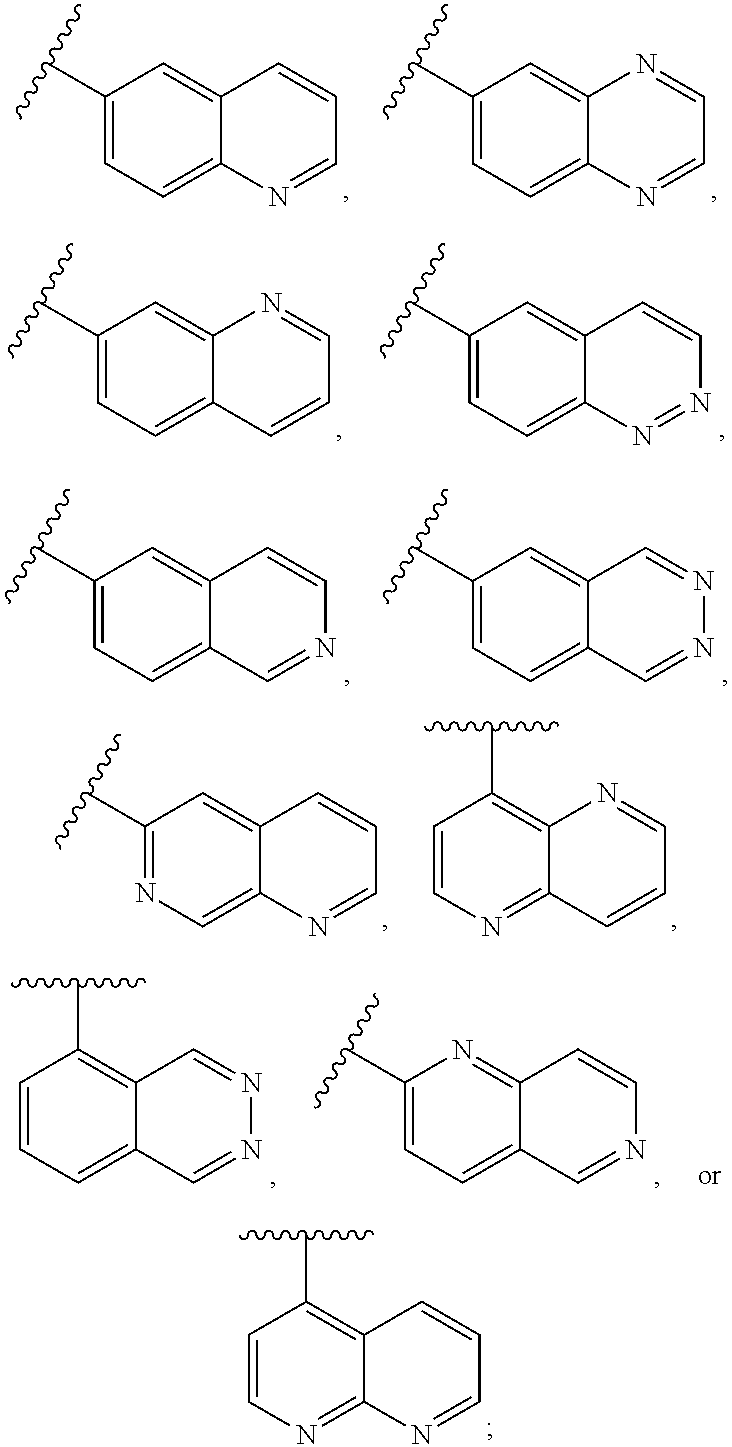
- wherein the 6,6-bicyclic heteroaromatic ring has 0, 1, or 2 substituents on carbon atoms that are independently selected from R;
- X1 is CH or N;
- R1 is halo, —CF3 or C1-6alkyl;
- X2 is —N(Ra)S(═O)2—, —(CRaRa)nO—, or —(CRaRa)nN(Ra)—;
- Z is hydrogen, phenyl, C1-6alkyl, —(C═O)Ra, wherein the phenyl is substituted with 0, 1, 2 or 3, substituents independently selected from halo, —OC1-6akyl, or C1-6alkyl;
- each R is independently hydrogen, C1-4haloalkyl, halo, —CN, nitro, —C(═O)NRaRa, —C(═O)Rb, —C(═O)ORb, —C(═NRa)NRaRa, —ORa, —OC(═O)Rb, —OC(═O)NRaRa, —O—C1-6alkylN(Ra)C(═O)ORb, —OC(═O)N(Ra)S(═O)2Rb, —OC2-6alkylNRaRa, —OC2-6alkylORa, —SRa, —S(═O)Rb, —S(═O)2Rb, —S(═O)2NRaRa, —S(═O)2N(Ra)C(═O)Rb, —S(═O)2N(Ra)C(═O)ORb, —S(═O)2N(Ra)C(═O)NRaRa, —NRaRa, —N(Ra)C(═O)Rb, —N(Ra)C(═O)ORb, —N(Ra)C(═O)NRaRa, —N(Ra)C(═NRa)NRaRa, —N(Ra)S(═O)2Rb, —N(Ra)S(═O)2NRaRa, —NRaC2-6alkylNRaRa, —NRaC2-6alkylORa, —C1-6alkyl, —C2-6alkenyl, —C2-6alkynyl, or a saturated, partially saturated or unsaturated 5-, 6- or 7-membered monocyclic ring or 6-, 7-, 8-, 9-, or 10-membered bicylcic ring containing 0, 1, 2, 3 or 4 heteroatoms independently selected from N, O and S, wherein the —C1-6alkyl, —C2-6alkenyl, —C2-6alkynyl, or ring are substituted by 0, 1, 2 or 3 substituents independently selected from C1-8alkyl, —C2-6alkenyl, —C2-6alkynyl, C1-4haloalkyl, halo, cyano, nitro, —C(═O)Rb, —C(═O)ORb, —C(═O)NRaRa, —C(═NRa)NRaRa, —ORa, —OC(═O)Rb, —OC(═O)NRaRa, —OC(═O)N(Ra)S(═O)2Rb, —OC2-6alkylNRaRa, —OC2-6alkylORa, —SRa, —S(═O)Rb, —S(═O)2Rb, —S(═O)2NRaRa, —S(═O)2N(Ra)C(═O)Rb, —S(═O)2N(Ra)C(═O)ORb, —S(═O)2N(Ra)C(═O)NRaRa, —NRaRa, —N(Ra)C(═O)Rb, —N(Ra)C(═O)ORb, —N(Ra)C(═O)NRaRa, —N(Ra)C(═NRa)NRaRa, —N(Ra)S(═O)2Rb, —N(Ra)S(═O)2NRaRa, —NRaC2-6alkylNRaRa, —NRaC2-6alkylORa, —N(Ra)(CRaRa)n—Y, —(CRaRa)nY, or —(CRaRa)nORa;
- Y is a saturated, partially saturated or unsaturated 5-, 6- or 7-membered monocyclic ring or 6-, 7-, 8-, 9-, or 10-membered bicylcic ring containing 0, 1, 2, 3 or 4 heteroatoms independently selected from N, O and S, which is substituted with 0, 1, or 2 substituents independently selected from C1-8alkyl, —C2-6alkenyl, —C2-6alkynyl, C1-4haloalkyl, halo, —CN, nitro, —C(═O)Rb, —C(═O)ORb, —C(═O)NRaRa, —C(═NRa)NRaRa, —ORa, —OC(═O)Rb, —OC(═O)NRaRa, —OC(═O)N(Ra)S(═O)2Rb, —OC2-6alkylNRaRa, —OC2-6alkylORa, —SRa, —S(═O)Rb, —S(═O)2Rb, —S(═O)2NRaRa, —S(═O)2N(Ra)C(═O)Rb, —S(═O)2N(Ra)C(═O)ORb, —S(═O)2N(Ra)C(═O)NRaRa, —NRaRa, —N(Ra)C(═O)Rb, —N(Ra)C(═O)ORb, —N(Ra)C(═O)NRaRa, —N(Ra)C(═NRa)NRaRa, —N(Ra)S(═O)2Rb, —N(Ra)S(═O)2NRaRa, —NRaC2-6alkylNRaRa or —NRaC2-6alkylORa;
- each Ra is independently hydrogen or Rb;
- each Rb is independently phenyl, benzyl or C1-6alkyl, wherein the phenyl, benzyl or C1-6alkyl is substituted by 0, 1, 2 or 3 substituents independently selected from halo, C1-4alkyl, C1-3haloalkyl, —OC1-4alkyl, —NH2, —CN, —NHC1-4alkyl, or —N(C1-4alkyl)2;
- each n is independently 0, 1, 2, or 3; and
- each m is independently 0, 1, or 2; and
—OC1-6alkyl.


or a pharmaceutically acceptable salt thereof,
- wherein Q is an optionally substituted 6,6-bicyclic heteroaromatic ring selected from

- wherein the 6,6-bicyclic heteroaromatic ring has 0, 1, 2, or 3 substituents on carbon atoms that are independently selected from R;
- each X is independently N or CR, provided that no more than one X is N;
- X1 is N or CR;
- R1 is halo, —CF3, —C1-6alkyl, —C2-6alkenyl, —C2-6alkynyl, —OC1-6alkyl, or —CN, wherein the —C1-6alkyl, —C2-6alkenyl, or —C2-6alkynyl are substituted by 0, 1, 2 or 3 substituents independently selected from —C1-8alkyl, —C2-6alkenyl, —C2-6alkynyl, C1-4haloalkyl, halo, —CN, nitro, —C(═O)Rb, —C(═O)ORb, —C(═O)NRaRa, —C(═NRa)NRaRa, —ORa, —OC(═O)Rb, —OC(═O)NRaRa, —OC(═O)N(Ra)S(═O)2Rb, —OC2-6alkylNRaRa, —OC2-6alkylORa, —SRa, —S(═O)Rb, —S(═O)2Rb, —S(═O)2NRaRa, —S(═O)2N(Ra)C(═O)Rb, —S(═O)2N(Ra)C(═O)ORb, —S(═O)2N(Ra)C(═O)NRaRa, —NRaRa, —N(Ra)C(═O)Rb, —N(Ra)C(═O)ORb, —N(Ra)C(═O)NRaRa, —N(Ra)C(═NRa)NRaRa, —N(Ra)S(═O)2Rb, —N(Ra)S(═O)2NRaRa, —NRaC2-6alkylNRaRa, —NRaC2-6alkylORa, or a saturated, partially saturated or unsaturated 5-, 6- or 7-membered monocyclic ring or 6-, 7-, 8-, 9-, or 10-membered bicylcic ring containing 0, 1, 2, 3 or 4 heteroatoms independently selected from N, O and S, wherein the ring is further substituted by 0, 1, 2 or 3 substituents independently selected from C1-8alkyl, —C2-6alkenyl, —C2-6alkynyl, C1-4haloalkyl, halo, —CN, nitro, —C(═O)Rb, —C(═O)ORb, —C(═O)NRaRa, —C(═NRa)NRaRa, —ORa, —OC(═O)Rb, —OC(═O)NRaRa, —OC(═O)N(Ra)S(═O)2Rb, —OC2-6alkylNRaRa, —OC2-6alkylORa, —SRa, —S(═O)Rb, —S(═O)2Rb, —S(═O)2NRaRa, —S(═O)2N(Ra)C(═O)Rb, —S(═O)2N(Ra)C(═O)ORb, —S(═O)2N(Ra)C(═O)NRaRa, —NRaRa, —N(Ra)C(═O)Rb, —N(Ra)C(═O)ORb, —N(Ra)C(═O)NRaRa, —N(Ra)C(═NRa)NRaRa, —N(Ra)S(═O)2Rb, —N(Ra)S(═O)2NRaRa, —NRaC2-6alkylNRaRa or —NRaC2-6alkylORa;
- X2 is —N(Ra)S(═O)2(CRaRa)n—, —N(Ra)C(═O)(CRaRa)n—, —O(CRaRa)n—, —(CRaRa)nO—, —(CRaRa)nS(═O)m—, —(CRaRa)nN(Ra)—, —N(Ra)(CRaRa)n—, —S(O)m(CRaRa)n—, —N(Ra)(CRaRa)n—, —S(═O)2N(Ra)(CRaRa)n—, —N(Ra)C(═O)O(CRaRa)n—, —N(Ra)C(═O)NRa(CRaRa)n—, —N(Ra)C(═NRa)NRa(CRaRa)n—, —OC(═O)NRa(CRaRa)n—, or —N(Ra)S(═O)2NRa(CRaRa)n—;
- Z is hydrogen, —C1-6alkyl, —C2-6alkenyl, —C2-6alkynyl, —C(═O)Ra, or a saturated, partially saturated or unsaturated 5-, 6- or 7-membered monocyclic ring or 6-, 7-, 8-, 9-, or 10-membered bicylcic ring containing 0, 1, 2, 3 or 4 heteroatoms independently selected from N, O and S, wherein the —C1-6alkyl, —C2-6alkenyl, —C2-6alkynyl, or ring are substituted by 0, 1, 2 or 3 substituents independently selected from C1-8alkyl, —C2-6alkenyl, —C2-6alkynyl, C1-4haloalkyl, halo, —CN, nitro, —C(═O)Rb, —C(═O)ORb, —C(═O)NRaRa, —C(═NRa)NRaRa, —ORa, —OC(═O)Rb, —OC(═O)NRaRa, —OC(═O)N(Ra)S(═O)2Rb, —OC2-6alkylNRaRa, —OC2-6alkylORa, —SRa, —S(═O)Rb, —S(═O)2Rb, —S(═O)2NRaRa, —S(═O)2N(Ra)C(═O)Rb, —S(═O)2N(Ra)C(═O)ORb, —S(═O)2N(Ra)C(═O)NRaRa, —NRaRa, —N(Ra)C(═O)Rb, —N(Ra)C(═O)ORb, —N(Ra)C(═O)NRaRa, —N(Ra)C(═NRa)NRaRa, —N(Ra)S(═O)2Rb, —N(Ra)S(═O)2NRaRa, —NRaC2-6alkylNRaRa or —NRaC2-6alkylORa;
- each R is independently hydrogen, C1-4haloalkyl, halo, —CN, nitro, —C(═O)NRaRa, —C(═O)Rb, —C(═O)ORb, —C(═NRa)NRaRa, —ORa, —OC(═O)Rb, —OC(═O)NRaRa, —O—C1-6alkylN(Ra)C(═O)ORb, —OC(═O)N(Ra)S(═O)2Rb, —OC2-6alkylNRaRa, —OC2-6alkylORa, —SRa, —S(═O)Rb, —S(═O)2Rb, —S(═O)2NRaRa, —S(═O)2N(Ra)C(═O)Rb, —S(═O)2N(Ra)C(═O)ORb, —S(═O)2N(Ra)C(═O)NRaRa, —NRaRa, —N(Ra)C(═O)Rb, —N(Ra)C(═O)ORb, —N(Ra)C(═O)NRaRa, —N(Ra)C(═NRa)NRaRa, —N(Ra)S(═O)2Rb, —N(Ra)S(═O)2NRaRa, —NRaC2-6alkylNRaRa, —NRaC2-6alkylORa, —C1-6alkyl, —C2-6alkenyl, —C2-6alkynyl, or a saturated, partially saturated or unsaturated 5-, 6- or 7-membered monocyclic ring or 6-, 7-, 8-, 9-, or 10-membered bicylcic ring containing 0, 1, 2, 3 or 4 heteroatoms independently selected from N, O and S, wherein the —C1-6alkyl, —C2-6alkenyl, —C2-6alkynyl, or ring are substituted by 0, 1, 2 or 3 substituents independently selected from C1-8alkyl, —C2-6alkenyl, —C2-6alkynyl, C1-4haloalkyl, halo, cyano, nitro, —C(═O)Rb, —C(═O)ORb, —C(═O)NRaRa, —C(═NRa)NRaRa, —ORa, —OC(═O)Rb, —OC(═O)NRaRa, —OC(═O)N(Ra)S(═O)2Rb, —OC2-6alkylNRaRa, —OC2-6alkylORa, —SRa, —S(═O)Rb, —S(═O)2Rb, —S(═O)2NRaRa, —S(═O)2N(Ra)C(═O)Rb, —S(═O)2N(Ra)C(═O)ORb, —S(═O)2N(Ra)C(═O)NRaRa, —NRaRa, —N(Ra)C(═O)Rb, —N(Ra)C(═O)ORb, —N(Ra)C(═O)NRaRa, —N(Ra)C(═NRa)NRaRa, —N(Ra)S(═O)2Rb, —N(Ra)S(═O)2NRaRa, —NRaC2-6alkylNRaRa, —NRaC2-6alkylORa, —N(Ra)(CRaRa)n—Y, —(CRaRa)nY, or —(CRaRa)nORa;
- Y is a saturated, partially saturated or unsaturated 5-, 6- or 7-membered monocyclic ring or 6-, 7-, 8-, 9-, or 10-membered bicylcic ring containing 0, 1, 2, 3 or 4 heteroatoms independently selected from N, O and S, which is substituted with 0, 1, or 2 substituents independently selected from C1-8alkyl, —C2-6alkenyl, —C2-6alkynyl, C1-4haloalkyl, halo, —CN, nitro, —C(═O)Rb, —C(═O)ORb, —C(═O)NRaRa, —C(═NRa)NRaRa, —ORa, —OC(═O)Rb, —OC(═O)NRaRa, —OC(═O)N(Ra)S(═O)2Rb, —OC2-6alkylNRaRa, —OC2-6alkylORa, —SRa, —S(═O)Rb, —S(═O)2Rb, —S(═O)2NRaRa, —S(═O)2N(Ra)C(═O)Rb, —S(═O)2N(Ra)C(═O)ORb, —S(═O)2N(Ra)C(═O)NRaRa, —NRaRa, —N(Ra)C(═O)Rb, —N(Ra)C(═O)ORb, —N(Ra)C(═O)NRaRa, —N(Ra)C(═NRa)NRaRa, —N(Ra)S(═O)2Rb, —N(Ra)S(═O)2NRaRa, —NRaC2-6alkylNRaRa or —NRaC2-6alkylORa;
- each Ra is independently H or Rb;
- each Rb is independently phenyl, benzyl or C1-6alkyl, wherein the phenyl, benzyl or C1-6alkyl is substituted by 0, 1, 2 or 3 substituents independently selected from halo, C1-4alkyl, C1-3haloalkyl, —OC1-4alkyl, —NH2, —CN, —NHC1-4alkyl, or —N(C1-4alkyl)2;
- each n is independently 0, 1, 2, or 3; and
- each m is independently 0, 1, or 2.


-
- and each X is CH.

and each X is CH.

or a pharmaceutically acceptable salt thereof
- wherein Q is is an optionally substituted 6,6-bicyclic heteroaromatic ring selected from

- wherein the 6,6-bicyclic heteroaromatic ring has 0, 1, or 2 substituents on carbon atoms that are independently selected from R;
- X1 is CH or N;
- R1 is halo, —CF3 or C1-6alkyl;
- X2 is —N(Ra)S(═O)2—, —(CRaRa)nO—, or —(CRaRa)nN(Ra)—;
- Z is hydrogen, phenyl, C1-6alkyl, —(C═O)Ra, wherein the phenyl is substituted with 0, 1, 2 or 3, substituents independently selected from halo, —OC1-6akyl, or C1-6alkyl;
- each R is independently hydrogen, C1-4haloalkyl, halo, —CN, nitro, —C(═O)NRaRa, —C(═O)Rb, —C(═O)ORb, —C(═NRa)NRaRa, —ORa, —OC(═O)Rb, —OC(═O)NRaRa, —O—C1-6alkylN(Ra)C(═O)ORb, —OC(═O)N(Ra)S(═O)2Rb, —OC2-6alkylNRaRa, —OC2-6alkylORa, —SRa, —S(═O)Rb, —S(═O)2Rb, —S(═O)2NRaRa, —S(═O)2N(Ra)C(═O)Rb, —S(═O)2N(Ra)C(═O)ORb, —S(═O)2N(Ra)C(═O)NRaRa, —NRaRa, —N(Ra)C(═O)Rb, —N(Ra)C(═O)ORb, —N(Ra)C(═O)NRaRa, —N(Ra)C(═NRa)NRaRa, —N(Ra)S(═O)2Rb, —N(Ra)S(═O)2NRaRa, —NRaC2-6alkylNRaRa, —NRaC2-6alkylORa, —C1-6alkyl, —C2-6alkenyl, —C2-6alkynyl, or a saturated, partially saturated or unsaturated 5-, 6- or 7-membered monocyclic ring or 6-, 7-, 8-, 9-, or 10-membered bicylcic ring containing 0, 1, 2, 3 or 4 heteroatoms independently selected from N, O and S, wherein the —C1-6alkyl, —C2-6alkenyl, —C2-6alkynyl, or ring are substituted by 0, 1, 2 or 3 substituents independently selected from C1-8alkyl, —C2-6alkenyl, —C2-6alkynyl, C1-4haloalkyl, halo, cyano, nitro, —C(═O)Rb, —C(═O)ORb, —C(═O)NRaRa, —C(═NRa)NRaRa, —ORa, —OC(═O)Rb, —OC(═O)NRaRa, —OC(═O)N(Ra)S(═O)2Rb, —OC2-6alkylNRaRa, —OC2-6alkylORa, —SRa, —S(═O)Rb, —S(═O)2Rb, —S(═O)2NRaRa, —S(═O)2N(Ra)C(═O)Rb, —S(═O)2N(Ra)C(═O)ORb, —S(═O)2N(Ra)C(═O)NRaRa, —NRaRa, —N(Ra)C(═O)Rb, —N(Ra)C(═O)ORb, —N(Ra)C(═O)NRaRa, —N(Ra)C(═NRa)NRaRa, —N(Ra)S(═O)2Rb, —N(Ra)S(═O)2NRaRa, —NRaC2-6alkylNRaRa, —NRaC2-6alkylORa, —N(Ra)(CRaRa)n—Y, —(CRaRa)nY, or —(CRaRa)nORa;
- Y is a saturated, partially saturated or unsaturated 5-, 6- or 7-membered monocyclic ring or 6-, 7-, 8-, 9-, or 10-membered bicylcic ring containing 0, 1, 2, 3 or 4 heteroatoms independently selected from N, O and S, which is substituted with 0, 1, or 2 substituents independently selected from C1-8alkyl, —C2-6alkenyl, —C2-6alkynyl, C1-4haloalkyl, halo, —CN, nitro, —C(═O)Rb, —C(═O)ORb, —C(═O)NRaRa, —C(═NRa)NRaRa, —ORa, —OC(═O)Rb, —OC(═O)NRaRa, —OC(═O)N(Ra)S(═O)2Rb, —OC2-6alkylNRaRa, —OC2-6alkylORa, —SRa, —S(═O)Rb, —S(═O)2Rb, —S(═O)2NRaRa, —S(═O)2N(Ra)C(═O)Rb, —S(═O)2N(Ra)C(═O)ORb, —S(═O)2N(Ra)C(═O)NRaRa, —NRaRa, —N(Ra)C(═O)Rb, —N(Ra)C(═O)ORb, —N(Ra)C(═O)NRaRa, —N(Ra)C(═NRa)NRaRa, —N(Ra)S(═O)2Rb, —N(Ra)S(═O)2NRaRa, —NRaC2-6alkylNRaRa or —NRaC2-6alkylORa;
- each Ra is independently hydrogen or Rb;
- each Rb is independently phenyl, benzyl or C1-6alkyl, wherein the phenyl, benzyl or C1-6alkyl is substituted by 0, 1, 2 or 3 substituents independently selected from halo, C1-4alkyl, C1-3haloalkyl, —OC1-4alkyl, —NH2, —CN, —NHC1-4alkyl, or —N(C1-4alkyl)2;
- each n is independently 0, 1, 2, or 3; and
- each m is independently 0, 1, or 2.
—NHSO2—
or
—N(CH3)SO2—.


or a pharmaceutically acceptable salt thereof,
- wherein Q is an optionally substituted 6,6-bicyclic heteroaromatic ring selected from

- wherein the 6,6-bicyclic heteroaromatic ring has 0, 1, 2, or 3 substituents on carbon atoms that are independently selected from R;
- each X is independently N or CR, provided that no more than one X is N;
- X1 is N or CR;
- R1 is halo, —CF3, —C1-6alkyl, —C2-6alkenyl, —C2-6alkynyl, —OC1-6alkyl, or —CN, wherein the —C1-6alkyl, —C2-6alkenyl, or —C2-6alkynyl are substituted by 0, 1, 2 or 3 substituents independently selected from —C1-8alkyl, —C2-6alkenyl, —C2-6alkynyl, C1-4haloalkyl, halo, —CN, nitro, —C(═O)Rb, —C(═O)ORb, —C(═O)NRaRa, —C(═NRa)NRaRa, —ORa, —OC(═O)Rb, —OC(═O)NRaRa, —OC(═O)N(Ra)S(═O)2Rb, —OC2-6alkylNRaRa, —OC2-6alkylORa, —SRa, —S(═O)Rb, —S(═O)2Rb, —S(═O)2NRaRa, —S(═O)2N(Ra)C(═O)Rb, —S(═O)2N(Ra)C(═O)ORb, —S(═O)2N(Ra)C(═O)NRaRa, —NRaRa, —N(Ra)C(═O)Rb, —N(Ra)C(═O)ORb, —N(Ra)C(═O)NRaRa, —N(Ra)C(═NRa)NRaRa, —N(Ra)S(═O)2Rb, —N(Ra)S(═O)2NRaRa, —NRaC2-6alkylNRaRa, —NRaC2-6alkylORa, or a saturated, partially saturated or unsaturated 5-, 6- or 7-membered monocyclic ring or 6-, 7-, 8-, 9-, or 10-membered bicylcic ring containing 0, 1, 2, 3 or 4 heteroatoms independently selected from N, O and S, wherein the ring is further substituted by 0, 1, 2 or 3 substituents independently selected from C1-8alkyl, —C2-6alkenyl, —C2-6alkynyl, C1-4haloalkyl, halo, —CN, nitro, —C(═O)Rb, —C(═O)ORb, —C(═O)NRaRa, —C(═NRa)NRaRa, —ORa, —OC(═O)Rb, —OC(═O)NRaRa, —OC(═O)N(Ra)S(═O)2Rb, —OC2-6alkylNRaRa, —OC2-6alkylORa, —SRa, —S(═O)Rb, —S(═O)2Rb, —S(═O)2NRaRa, —S(═O)2N(Ra)C(═O)Rb, —S(═O)2N(Ra)C(═O)ORb, —S(═O)2N(Ra)C(═O)NRaRa, —NRaRa, —N(Ra)C(═O)Rb, —N(Ra)C(═O)ORb, —N(Ra)C(═O)NRaRa, —N(Ra)C(═NRa)NRaRa, —N(Ra)S(═O)2Rb, —N(Ra)S(═O)2NRaRa, —NRaC2-6alkylNRaRa or —NRaC2-6alkylORa;
- X2 is —N(Ra)S(═O)2(CRaRa)n—, —N(Ra)C(═O)(CRaRa)n—, —O(CRaRa)n—, —(CRaRa)nO—, —(CRaRa)nS(═O)m—, —(CRaRa)nN(Ra)—, —N(Ra)(CRaRa)n—, —S(O)m(CRaRa)n—, —N(Ra)(CRaRa)n—, —S(═O)2N(Ra)(CRaRa)n—, —N(Ra)C(═O)O(CRaRa)n—, —N(Ra)C(═O)NRa(CRaRa)n—, —N(Ra)C(═NRa)NRa(CRaRa)n—, —OC(═O)NRa(CRaRa)n—, or —N(Ra)S(═O)2NRa(CRaRa)n—;
- Z is hydrogen, —C1-6alkyl, —C2-6alkenyl, —C2-6alkynyl, —C(═O)Ra, or a saturated, partially saturated or unsaturated 5-, 6- or 7-membered monocyclic ring or 6-, 7-, 8-, 9-, or 10-membered bicylcic ring containing 0, 1, 2, 3 or 4 heteroatoms independently selected from N, O and S, wherein the —C1-6alkyl, —C2-6alkenyl, —C2-6alkynyl, or ring are substituted by 0, 1, 2 or 3 substituents independently selected from C1-8alkyl, —C2-6alkenyl, —C2-6alkynyl, C1-4haloalkyl, halo, —CN, nitro, —C(═O)Rb, —C(═O)ORb, —C(═O)NRaRa, —C(═NRa)NRaRa, —ORa, —OC(═O)Rb, —OC(═O)NRaRa, —OC(═O)N(Ra)S(═O)2Rb, —OC2-6alkylNRaRa, —OC2-6alkylORa, —SRa, —S(═O)Rb, —S(═O)2Rb, —S(═O)2NRaRa, —S(═O)2N(Ra)C(═O)Rb, —S(═O)2N(Ra)C(═O)ORb, —S(═O)2N(Ra)C(═O)NRaRa, —NRaRa, —N(Ra)C(═O)Rb, —N(Ra)C(═O)ORb, —N(Ra)C(═O)NRaRa, —N(Ra)C(═NRa)NRaRa, —N(Ra)S(═O)2Rb, —N(Ra)S(═O)2NRaRa, —NRaC2-6alkylNRaRa or —NRaC2-6alkylORa;
- each R is independently hydrogen, C1-4haloalkyl, halo, —CN, nitro, —C(═O)NRaRa, —C(═O)Rb, —C(═O)ORb, —C(═NRa)NRaRa, —ORa, —OC(═O)Rb, —OC(═O)NRaRa, —O—C1-6alkylN(Ra)C(═O)ORb, —OC(═O)N(Ra)S(═O)2Rb, —OC2-6alkylNRaRa, —OC2-6alkylORa, —SRa, —S(═O)Rb, —S(═O)2Rb, —S(═O)2NRaRa, —S(═O)2N(Ra)C(═O)Rb, —S(═O)2N(Ra)C(═O)ORb, —S(═O)2N(Ra)C(═O)NRaRa, —NRaRa, —N(Ra)C(═O)Rb, —N(Ra)C(═O)ORb, —N(Ra)C(═O)NRaRa, —N(Ra)C(═NRa)NRaRa, —N(Ra)S(═O)2Rb, —N(Ra)S(═O)2NRaRa, —NRaC2-6alkylNRaRa, —NRaC2-6alkylORa, —C1-6alkyl, —C2-6alkenyl, —C2-6alkynyl, or a saturated, partially saturated or unsaturated 5-, 6- or 7-membered monocyclic ring or 6-, 7-, 8-, 9-, or 10-membered bicylcic ring containing 0, 1, 2, 3 or 4 heteroatoms independently selected from N, O and S, wherein the —C1-6alkyl, —C2-6alkenyl, —C2-6alkynyl, or ring are substituted by 0, 1, 2 or 3 substituents independently selected from C1-8alkyl, —C2-6alkenyl, —C2-6alkynyl, C1-4haloalkyl, halo, cyano, nitro, —C(═O)Rb, —C(═O)ORb, —C(═O)NRaRa, —C(═NRa)NRaRa, —ORa, —OC(═O)Rb, —OC(═O)NRaRa, —OC(═O)N(Ra)S(═O)2Rb, —OC2-6alkylNRaRa, —OC2-6alkylORa, —SRa, —S(═O)Rb, —S(═O)2Rb, —S(═O)2NRaRa, —S(═O)2N(Ra)C(═O)Rb, —S(═O)2N(Ra)C(═O)ORb, —S(═O)2N(Ra)C(═O)NRaRa, —NRaRa, —N(Ra)C(═O)Rb, —N(Ra)C(═O)ORb, —N(Ra)C(═O)NRaRa, —N(Ra)C(═NRa)NRaRa, —N(Ra)S(═O)2Rb, —N(Ra)S(═O)2NRaRa, —NRaC2-6alkylNRaRa, —NRaC2-6alkylORa, —N(Ra)(CRaRa)n—Y, —(CRaRa)nY, or —(CRaRa)nORa;
- Y is a saturated, partially saturated or unsaturated 5-, 6- or 7-membered monocyclic ring or 6-, 7-, 8-, 9-, or 10-membered bicylcic ring containing 0, 1, 2, 3 or 4 heteroatoms independently selected from N, O and S, which is substituted with 0, 1, or 2 substituents independently selected from C1-8alkyl, —C2-6alkenyl, —C2-6alkynyl, C1-4haloalkyl, halo, —CN, nitro, —C(═O)Rb, —C(═O)ORb, —C(═O)NRaRa, —C(═NRa)NRaRa, —ORa, —OC(═O)Rb, —OC(═O)NRaRa, —OC(═O)N(Ra)S(═O)2Rb, —OC2-6alkylNRaRa, —OC2-6alkylORa, —SRa, —S(═O)Rb, —S(═O)2Rb, —S(═O)2NRaRa, —S(═O)2N(Ra)C(═O)Rb, —S(═O)2N(Ra)C(═O)ORb, —S(═O)2N(Ra)C(═O)NRaRa, —NRaRa, —N(Ra)C(═O)Rb, —N(Ra)C(═O)ORb, —N(Ra)C(═O)NRaRa, —N(Ra)C(═NRa)NRaRa, —N(Ra)S(═O)2Rb, —N(Ra)S(═O)2NRaRa, —NRaC2-6alkylNRaRa or —NRaC2-6alkylORa;
- each Ra is independently hydrogen or Rb;
- each Rb is independently phenyl, benzyl or C1-6alkyl, wherein the phenyl, benzyl or C1-6alkyl is substituted by 0, 1, 2 or 3 substituents independently selected from halo, C1-4alkyl, C1-3haloalkyl, —OC1-4alkyl, —NH2, —CN, —NHC1-4alkyl, or —N(C1-4alkyl)2;
- each n is independently 0, 1, 2, or 3; and
- each m is independently 0, 1, or 2.

—NHSO2—
or
—N(CH3)SO2—.

or a pharmaceutically acceptable salt thereof,
- wherein Q is is an optionally substituted 6,6-bicyclic heteroaromatic ring selected from

- wherein the 6,6-bicyclic heteroaromatic ring has 0, 1, or 2 substituents on carbon atoms that are independently selected from R;
- X1 is CH or N;
- R1 is halo, —CF3 or C1-6alkyl;
- X2 is —N(Ra)S(═O)2—, —(CRaRa)nO—, or —(CRaRa)nN(Ra)—;
- Z is hydrogen, phenyl, C1-6alkyl, —(C═O)Ra, wherein the phenyl is substituted with 0, 1, 2 or 3, substituents independently selected from halo, —OC1-6akyl, or C1-6alkyl;
- each R is independently hydrogen, C1-4haloalkyl, halo, —CN, nitro, —C(═O)NRaRa, —C(═O)Rb, —C(═O)ORb, —C(═NRa)NRaRa, —ORa, —OC(═O)Rb, —OC(═O)NRaRa, —O—C1-6alkylN(Ra)C(═O)ORb, —OC(═O)N(Ra)S(═O)2Rb, —OC2-6alkylNRaRa, —OC2-6alkylORa, —SRa, —S(═O)Rb, —S(═O)2Rb, —S(═O)2NRaRa, —S(═O)2N(Ra)C(═O)Rb, —S(═O)2N(Ra)C(═O)ORb, —S(═O)2N(Ra)C(═O)NRaRa, —NRaRa, —N(Ra)C(═O)Rb, —N(Ra)C(═O)ORb, —N(Ra)C(═O)NRaRa, —N(Ra)C(═NRa)NRaRa, —N(Ra)S(═O)2Rb, —N(Ra)S(═O)2NRaRa, —NRaC2-6alkylNRaRa, —NRaC2-6alkylORa, —C1-6alkyl, —C2-6alkenyl, —C2-6alkynyl, or a saturated, partially saturated or unsaturated 5-, 6- or 7-membered monocyclic ring or 6-, 7-, 8-, 9-, or 10-membered bicylcic ring containing 0, 1, 2, 3 or 4 heteroatoms independently selected from N, O and S, wherein the —C1-6alkyl, —C2-6alkenyl, —C2-6alkynyl, or ring are substituted by 0, 1, 2 or 3 substituents independently selected from C1-8alkyl, —C2-6alkenyl, —C2-6alkynyl, C1-4haloalkyl, halo, cyano, nitro, —C(═O)Rb, —C(═O)ORb, —C(═O)NRaRa, —C(═NRa)NRaRa, —ORa, —OC(═O)Rb, —OC(═O)NRaRa, —OC(═O)N(Ra)S(═O)2Rb, —OC2-6alkylNRaRa, —OC2-6alkylORa, —SRa, —S(═O)Rb, —S(═O)2Rb, —S(═O)2NRaRa, —S(═O)2N(Ra)C(═O)Rb, —S(═O)2N(Ra)C(═O)ORb, —S(═O)2N(Ra)C(═O)NRaRa, —NRaRa, —N(Ra)C(═O)Rb, —N(Ra)C(═O)ORb, —N(Ra)C(═O)NRaRa, —N(Ra)C(═NRa)NRaRa, —N(Ra)S(═O)2Rb, —N(Ra)S(═O)2NRaRa, —NRaC2-6alkylNRaRa, —NRaC2-6alkylORa, —N(Ra)(CRaRa)n—Y, —(CRaRa)nY, or —(CRaRa)nORa;
- Y is a saturated, partially saturated or unsaturated 5-, 6- or 7-membered monocyclic ring or 6-, 7-, 8-, 9-, or 10-membered bicylcic ring containing 0, 1, 2, 3 or 4 heteroatoms independently selected from N, O and S, which is substituted with 0, 1, or 2 substituents independently selected from C1-8alkyl, —C2-6alkenyl, —C2-6alkynyl, C1-4haloalkyl, halo, —CN, nitro, —C(═O)Rb, —C(═O)ORb, —C(═O)NRaRa, —C(═NRa)NRaRa, —ORa, —OC(═O)Rb, —OC(═O)NRaRa, —OC(═O)N(Ra)S(═O)2Rb, —OC2-6alkylNRaRa, —OC2-6alkylORa, —SRa, —S(═O)Rb, —S(═O)2Rb, —S(═O)2NRaRa, —S(═O)2N(Ra)C(═O)Rb, —S(═O)2N(Ra)C(═O)ORb, —S(═O)2N(Ra)C(═O)NRaRa, —NRaRa, —N(Ra)C(═O)Rb, —N(Ra)C(═O)ORb, —N(Ra)C(═O)NRaRa, —N(Ra)C(═NRa)NRaRa, —N(Ra)S(═O)2Rb, —N(Ra)S(═O)2NRaRa, —NRaC2-6alkylNRaRa or —NRaC2-6alkylORa;
- each Ra is independently hydrogen or Rb;
- each Rb is independently phenyl, benzyl or C1-6alkyl, wherein the phenyl, benzyl or C1-6alkyl is substituted by 0, 1, 2 or 3 substituents independently selected from halo, C1-4alkyl, C1-3haloalkyl, —OC1-4alkyl, —NH2, —CN, —NHC1-4alkyl, or —N(C1-4alkyl)2;
- each n is independently 0, 1, 2, or 3; and
- each m is independently 0, 1, or 2.
—NHSO2—
or
—N(CH3)SO2—.

-
- A) a compound in accordance with the above embodiments, or a pharmaceutically acceptable salt thereof; and
- B) a pharmaceutically acceptable excipient.

or a pharmaceutically acceptable salt thereof,
- wherein Q is a ring

- wherein the ring has 0, 1, 2, or 3 substituents on carbon atoms that are independently selected from R;
- X1 is N or CR;
- R1 is halo, —CF3, —C1-6alkyl, —C2-6alkenyl, —C2-6alkynyl, —OC1-6alkyl, or —CN, wherein the —C1-6alkyl, —C2-6alkenyl, or —C2-6alkynyl are substituted by 0, 1, 2 or 3 substituents independently selected from —C1-8alkyl, —C2-6alkenyl, —C2-6alkynyl, C1-4haloalkyl, halo, —CN, nitro, —C(═O)Rb, —C(═O)ORb, —C(═O)NRaRa, —C(═NRa)NRaRa, —ORa, —OC(═O)Rb, —OC(═O)NRaRa, —OC(═O)N(Ra)S(═O)2Rb, —OC2-6alkylNRaRa, —OC2-6alkylORa, —SRa, —S(═O)Rb, —S(═O)2Rb, —S(═O)2NRaRa, —S(═O)2N(Ra)C(═O)Rb, —S(═O)2N(Ra)C(═O)ORb, —S(═O)2N(Ra)C(═O)NRaRa, —NRaRa, —N(Ra)C(═O)Rb, —N(Ra)C(═O)ORb, —N(Ra)C(═O)NRaRa, —N(Ra)C(═NRa)NRaRa, —N(Ra)S(═O)2Rb, —N(Ra)S(═O)2NRaRa, —NRaC2-6alkylNRaRa, —NRaC2-6alkylORa, or a saturated, partially saturated or unsaturated 5-, 6- or 7-membered monocyclic ring or 6-, 7-, 8-, 9-, or 10-membered bicylcic ring containing 0, 1, 2, 3 or 4 heteroatoms independently selected from N, O and S, wherein the ring is further substituted by 0, 1, 2 or 3 substituents independently selected from C1-8alkyl, —C2-6alkenyl, —C2-6alkynyl, C1-4haloalkyl, halo, —CN, nitro, —C(═O)Rb, —C(═O)ORb, —C(═O)NRaRa, —C(═NRa)NRaRa, —ORa, —OC(═O)Rb, —OC(═O)NRaRa, —OC(═O)N(Ra)S(═O)2Rb, —OC2-6alkylNRaRa, —OC2-6alkylORa, —SRa, —S(═O)Rb, —S(═O)2Rb, —S(═O)2NRaRa, —S(═O)2N(Ra)C(═O)Rb, —S(═O)2N(Ra)C(═O)ORb, —S(═O)2N(Ra)C(═O)NRaRa, —NRaRa, —N(Ra)C(═O)Rb, —N(Ra)C(═O)ORb, —N(Ra)C(═O)NRaRa, —N(Ra)C(═NRa)NRaRa, —N(Ra)S(═O)2Rb, —N(Ra)S(═O)2NRaRa, —NRaC2-6alkylNRaRa or —NRaC2-6alkylORa;
- X2 is —N(Ra)S(═O)2(CRaRa)n—, —N(Ra)C(═O)(CRaRa)n—, —O(CRaRa)n—, —(CRaRa)nO—, —(CRaRa)nS(═O)m—, —(CRaRa)nN(Ra)—, —N(Ra)(CRaRa)n—, —S(O)m(CRaRa)n—, —N(Ra)(CRaRa)n—, —S(═O)2N(Ra)(CRaRa)n—, —N(Ra)C(═O)O(CRaRa)n—, —N(Ra)C(═O)NRa(CRaRa)n—, —N(Ra)C(═NRa)NRa(CRaRa)n—, —OC(═O)NRa(CRaRa)n—, or —N(Ra)S(═O)2NRa(CRaRa)n—;
- Z is hydrogen, —C1-6alkyl, —C2-6alkenyl, —C2-6alkynyl, —C(═O)Ra, or a saturated, partially saturated or unsaturated 5-, 6- or 7-membered monocyclic ring or 6-, 7-, 8-, 9-, or 10-membered bicylcic ring containing 0, 1, 2, 3 or 4 heteroatoms independently selected from N, O and S, wherein the —C1-6alkyl, —C2-6alkenyl, —C2-6alkynyl, or ring are substituted by 0, 1, 2 or 3 substituents independently selected from C1-8alkyl, —C2-6alkenyl, —C2-6alkynyl, C1-4haloalkyl, halo, —CN, nitro, —C(═O)Rb, —C(═O)ORb, —C(═O)NRaRa, —C(═NRa)NRaRa, —ORa, —OC(═O)Rb, —OC(═O)NRaRa, —OC(═O)N(Ra)S(═O)2Rb, —OC2-6alkylNRaRa, —OC2-6alkylORa, —SRa, —S(═O)Rb, —S(═O)2Rb, —S(═O)2NRaRa, —S(═O)2N(Ra)C(═O)Rb, —S(═O)2N(Ra)C(═O)ORb, —S(═O)2N(Ra)C(═O)NRaRa, —NRaRa, —N(Ra)C(═O)Rb, —N(Ra)C(═O)ORb, —N(Ra)C(═O)NRaRa, —N(Ra)C(═NRa)NRaRa, —N(Ra)S(═O)2Rb, —N(Ra)S(═O)2NRaRa, —NRaC2-6alkylNRaRa or —NRaC2-6alkylORa;
- each R is independently hydrogen, C1-4haloalkyl, halo, —CN, nitro, —C(═O)NRaRa, —C(═O)Rb, —C(═O)ORb, —C(═NRa)NRaRa, —ORa, —OC(═O)Rb, —OC(═O)NRaRa, —O—C1-6alkylN(Ra)C(═O)ORb, —OC(═O)N(Ra)S(═O)2Rb, —OC2-6alkylNRaRa, —OC2-6alkylORa, —SRa, —S(═O)Rb, —S(═O)2Rb, —S(═O)2NRaRa, —S(═O)2N(Ra)C(═O)Rb, —S(═O)2N(Ra)C(═O)ORb, —S(═O)2N(Ra)C(═O)NRaRa, —NRaRa, —N(Ra)C(═O)Rb, —N(Ra)C(═O)ORb, —N(Ra)C(═O)NRaRa, —N(Ra)C(═NRa)NRaRa, —N(Ra)S(═O)2Rb, —N(Ra)S(═O)2NRaRa, —NRaC2-6alkylNRaRa, —NRaC2-6alkylORa, —C1-6alkyl, —C2-6alkenyl, —C2-6alkynyl, or a saturated, partially saturated or unsaturated 5-, 6- or 7-membered monocyclic ring or 6-, 7-, 8-, 9-, or 10-membered bicylcic ring containing 0, 1, 2, 3 or 4 heteroatoms independently selected from N, O and S, wherein the —C1-6alkyl, —C2-6alkenyl, —C2-6alkynyl, or ring are substituted by 0, 1, 2 or 3 substituents independently selected from C1-8alkyl, —C2-6alkenyl, —C2-6alkynyl, C1-4haloalkyl, halo, cyano, nitro, —C(═O)Rb, —C(═O)ORb, —C(═O)NRaRa, —C(═NRa)NRaRa, —ORa, —OC(═O)Rb, —OC(═O)NRaRa, —OC(═O)N(Ra)S(═O)2Rb, —OC2-6alkylNRaRa, —OC2-6alkylORa, —SRa, —S(═O)Rb, —S(═O)2Rb, —S(═O)2NRaRa, —S(═O)2N(Ra)C(═O)Rb, —S(═O)2N(Ra)C(═O)ORb, —S(═O)2N(Ra)C(═O)NRaRa, —NRaRa, —N(Ra)C(═O)Rb, —N(Ra)C(═O)ORb, —N(Ra)C(═O)NRaRa, —N(Ra)C(═NRa)NRaRa, —N(Ra)S(═O)2Rb, —N(Ra)S(═O)2NRaRa, —NRaC2-6alkylNRaRa, —NRaC2-6alkylORa, —N(Ra)(CRaRa)n—Y, —(CRaRa)nY, or —(CRaRa)nORa;
- each Rf is independently, C1-4haloalkyl, halo, —CN, nitro, —C(═O)NRaRa, —C(═O)Rb, —C(═O)ORb, —C(═NRa)NRaRa, —ORa, —OC(═O)Rb, —OC(═O)NRaRa, —O—C1-6alkylN(Ra)C(═O)ORb, —OC(═O)N(Ra)S(═O)2Rb, —OC2-6alkylNRaRa, —OC2-6alkylORa, —SRa, —S(═O)Rb, —S(═O)2Rb, —S(═O)2NRaRa, —S(═O)2N(Ra)C(═O)Rb, —S(═O)2N(Ra)C(═O)ORb, —S(═O)2N(Ra)C(═O)NRaRa, —NRaRa, —N(Ra)C(═O)Rb, —N(Ra)C(═O)ORb, —N(Ra)C(═O)NRaRa, —N(Ra)C(═NRa)NRaRa, —N(Ra)S(═O)2Rb, —N(Ra)S(═O)2NRaRa, —NRaC2-6alkylNRaRa, —NRaC2-6alkylORa, —C1-6alkyl, —C2-6alkenyl, —C2-6alkynyl, wherein the —C1-6alkyl, —C2-6alkenyl, —C2-6alkynyl are substituted by 0, 1, 2 or 3 substituents independently selected from C1-8alkyl, —C2-6alkenyl, —C2-6alkynyl, C1-4haloalkyl, halo, cyano, nitro, —C(═O)Rb, —C(═O)ORb, —C(═O)NRaRa, —C(═NRa)NRaRa, —ORa, —OC(═O)Rb, —OC(═O)NRaRa, —OC(═O)N(Ra)S(═O)2Rb, —OC2-6alkylNRaRa, —OC2-6alkylORa, —SRa, —S(═O)Rb, —S(═O)2Rb, —S(═O)2NRaRa, —S(═O)2N(Ra)C(═O)Rb, —S(═O)2N(Ra)C(═O)ORb, —S(═O)2N(Ra)C(═O)NRaRa, —NRaRa, —N(Ra)C(═O)Rb, —N(Ra)C(═O)ORb, —N(Ra)C(═O)NRaRa, —N(Ra)C(═NRa)NRaRa, —N(Ra)S(═O)2Rb, —N(Ra)S(═O)2NRaRa, —NRaC2-6alkylNRaRa, —NRaC2-6alkylORa, —N(Ra)(CRaRa)n—Y, —(CRaRa)nY, or —(CRaRa)nORa;
- Y is a saturated, partially saturated or unsaturated 5-, 6- or 7-membered monocyclic ring or 6-, 7-, 8-, 9-, or 10-membered bicylcic ring containing 0, 1, 2, 3 or 4 heteroatoms independently selected from N, O and S, which is substituted with 0, 1, or 2 substituents independently selected from C1-8alkyl, —C2-6alkenyl, —C2-6alkynyl, C1-4haloalkyl, halo, —CN, nitro, —C(═O)Rb, —C(═O)ORb, —C(═O)NRaRa, —C(═NRa)NRaRa, —ORa, —OC(═O)Rb, —OC(═O)NRaRa, —OC(═O)N(Ra)S(═O)2Rb, —OC2-6alkylNRaRa, —OC2-6alkylORa, —SRa, —S(═O)Rb, —S(═O)2Rb, —S(═O)2NRaRa, —S(═O)2N(Ra)C(═O)Rb, —S(═O)2N(Ra)C(═O)ORb, —S(═O)2N(Ra)C(═O)NRaRa, —NRaRa, —N(Ra)C(═O)Rb, —N(Ra)C(═O)ORb, —N(Ra)C(═O)NRaRa, —N(Ra)C(═NRa)NRaRa, —N(Ra)S(═O)2Rb, —N(Ra)S(═O)2NRaRa, —NRaC2-6alkylNRaRa or —NRaC2-6alkylORa;
- each Ra is independently hydrogen or Rb;
- each Rb is independently phenyl, benzyl or C1-6alkyl, wherein the phenyl, benzyl or C1-6alkyl is substituted by 0, 1, 2 or 3 substituents independently selected from halo, C1-4alkyl, C1-3haloalkyl, —OC1-4alkyl, —NH2, —CN, —NHC1-4alkyl, or —N(C1-4alkyl)2;
- each n is independently 0, 1, 2, or 3; and
- each m is independently 0, 1, or 2.
—NHSO2—
or
—N(CH3)SO2—.

or a pharmaceutically acceptable salt thereof,
- wherein Q is a ring selected from

- wherein the ring has 0, 1, 2, or 3 substituents on carbon atoms that are independently selected from R, provided that when Q is
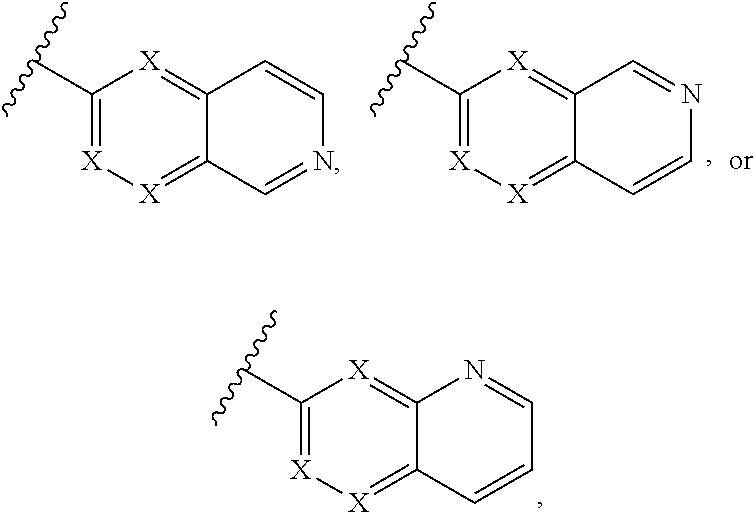
and X2 is —NHSO2—, then each R is not hydrogen;
- each X is independently N or CR; provided that at least one X is N;
- X1 is N or CR;
- R1 is halo, —CF3, —C1-6alkyl, —C2-6alkenyl, —C2-6alkynyl, —OC1-6alkyl, or —CN, wherein the —C1-6alkyl, —C2-6alkenyl, or —C2-6alkynyl are substituted by 0, 1, 2 or 3 substituents independently selected from —C1-8alkyl, —C2-6alkenyl, —C2-6alkynyl, C1-4haloalkyl, halo, —CN, nitro, —C(═O)Rb, —C(═O)ORb, —C(═O)NRaRa, —C(═NRa)NRaRa, —ORa, —OC(═O)Rb, —OC(═O)NRaRa, —OC(═O)N(Ra)S(═O)2Rb, —OC2-6alkylNRaRa, —OC2-6alkylORa, —SRa, —S(═O)Rb, —S(═O)2Rb, —S(═O)2NRaRa, —S(═O)2N(Ra)C(═O)Rb, —S(═O)2N(Ra)C(═O)ORb, —S(═O)2N(Ra)C(═O)NRaRa, —NRaRa, —N(Ra)C(═O)Rb, —N(Ra)C(═O)ORb, —N(Ra)C(═O)NRaRa, —N(Ra)C(═NRa)NRaRa, —N(Ra)S(═O)2Rb, —N(Ra)S(═O)2NRaRa, —NRaC2-6alkylNRaRa, —NRaC2-6alkylORa, or a saturated, partially saturated or unsaturated 5-, 6- or 7-membered monocyclic ring or 6-, 7-, 8-, 9-, or 10-membered bicylcic ring containing 0, 1, 2, 3 or 4 heteroatoms independently selected from N, O and S, wherein the ring is further substituted by 0, 1, 2 or 3 substituents independently selected from C1-8alkyl, —C2-6alkenyl, —C2-6alkynyl, C1-4haloalkyl, halo, —CN, nitro, —C(═O)Rb, —C(═O)ORb, —C(═O)NRaRa, —C(═NRa)NRaRa, —ORa, —OC(═O)Rb, —OC(═O)NRaRa, —OC(═O)N(Ra)S(═O)2Rb, —OC2-6alkylNRaRa, —OC2-6alkylORa, —SRa, —S(═O)Rb, —S(═O)2Rb, —S(═O)2NRaRa, —S(═O)2N(Ra)C(═O)Rb, —S(═O)2N(Ra)C(═O)ORb, —S(═O)2N(Ra)C(═O)NRaRa, —NRaRa, —N(Ra)C(═O)Rb, —N(Ra)C(═O)ORb, —N(Ra)C(═O)NRaRa, —N(Ra)C(═NRa)NRaRa, —N(Ra)S(═O)2Rb, —N(Ra)S(═O)2NRaRa, —NRaC2-6alkylNRaRa or —NRaC2-6alkylORa;
- X2 is —N(Ra)S(═O)2(CRaRa)n—, —N(Ra)C(═O)(CRaRa)n—, —O(CRaRa)n—, —(CRaRa)nO—, —(CRaRa)nS(═O)m—, —(CRaRa)nN(Ra)—, —N(Ra)(CRaRa)n—, —S(O)m(CRaRa)n—, —N(Ra)(CRaRa)n—, —S(═O)2N(Ra)(CRaRa)n—, —N(Ra)C(═O)O(CRaRa)n—, —N(Ra)C(═O)NRa(CRaRa)n—, —N(Ra)C(═NRa)NRa(CRaRa)n—, —OC(═O)NRa(CRaRa)n—, or —N(Ra)S(═O)2NRa(CRaRa)n—;
- Z is hydrogen, —C1-6alkyl, —C2-6alkenyl, —C2-6alkynyl, —C(═O)Ra, or a saturated, partially saturated or unsaturated 5-, 6- or 7-membered monocyclic ring or 6-, 7-, 8-, 9-, or 10-membered bicylcic ring containing 0, 1, 2, 3 or 4 heteroatoms independently selected from N, O and S, wherein the —C1-6alkyl, —C2-6alkenyl, —C2-6alkynyl, or ring are substituted by 0, 1, 2 or 3 substituents independently selected from C1-8alkyl, —C2-6alkenyl, —C2-6alkynyl, C1-4haloalkyl, halo, —CN, nitro, —C(═O)Rb, —C(═O)ORb, —C(═O)NRaRa, —C(═NRa)NRaRa, —ORa, —OC(═O)Rb, —OC(═O)NRaRa, —OC(═O)N(Ra)S(═O)2Rb, —OC2-6alkylNRaRa, —OC2-6alkylORa, —SRa, —S(═O)Rb, —S(═O)2Rb, —S(═O)2NRaRa, —S(═O)2N(Ra)C(═O)Rb, —S(═O)2N(Ra)C(═O)ORb, —S(═O)2N(Ra)C(═O)NRaRa, —NRaRa, —N(Ra)C(═O)Rb, —N(Ra)C(═O)ORb, —N(Ra)C(═O)NRaRa, —N(Ra)C(═NRa)NRaRa, —N(Ra)S(═O)2Rb, —N(Ra)S(═O)2NRaRa, —NRaC2-6alkylNRaRa or —NRaC2-6alkylORa; or X2—Z together are halo;
- each R is independently hydrogen, C1-4haloalkyl, halo, —CN, nitro, —C(═O)NRaRa, —C(═O)Rb, —C(═O)ORb, —C(═NRa)NRaRa, —ORa, —OC(═O)Rb, —OC(═O)NRaRa, —O—C1-6alkylN(Ra)C(═O)ORb, —OC(═O)N(Ra)S(═O)2Rb, —OC2-6alkylNRaRa, —OC2-6alkylORa, —SRa, —S(═O)Rb, —S(═O)2Rb, —S(═O)2NRaRa, —S(═O)2N(Ra)C(═O)Rb, —S(═O)2N(Ra)C(═O)ORb, —S(═O)2N(Ra)C(═O)NRaRa, —NRaRa, —N(Ra)C(═O)Rb, —N(Ra)C(═O)ORb, —N(Ra)C(═O)NRaRa, —N(Ra)C(═NRa)NRaRa, —N(Ra)S(═O)2Rb, —N(Ra)S(═O)2NRaRa, —NRaC2-6alkylNRaRa, —NRaC2-6alkylORa, —C1-6alkyl, —C2-6alkenyl, —C2-6alkynyl, or a saturated, partially saturated or unsaturated 5-, 6- or 7-membered monocyclic ring or 6-, 7-, 8-, 9-, or 10-membered bicylcic ring containing 0, 1, 2, 3 or 4 heteroatoms independently selected from N, O and S, wherein the —C1-6alkyl, —C2-6alkenyl, —C2-6alkynyl, or ring are substituted by 0, 1, 2 or 3 substituents independently selected from C1-8alkyl, —C2-6alkenyl, —C2-6alkynyl, C1-4haloalkyl, halo, cyano, nitro, —C(═O)Rb, —C(═O)ORb, —C(═O)NRaRa, —C(═NRa)NRaRa, —ORa, —OC(═O)Rb, —OC(═O)NRaRa, —OC(═O)N(Ra)S(═O)2Rb, —OC2-6alkylNRaRa, —OC2-6alkylORa, —SRa, —S(═O)Rb, —S(═O)2Rb, —S(═O)2NRaRa, —S(═O)2N(Ra)C(═O)Rb, —S(═O)2N(Ra)C(═O)ORb, —S(═O)2N(Ra)C(═O)NRaRa, —NRaRa, —N(Ra)C(═O)Rb, —N(Ra)C(═O)ORb, —N(Ra)C(═O)NRaRa, —N(Ra)C(═NRa)NRaRa, —N(Ra)S(═O)2Rb, —N(Ra)S(═O)2NRaRa, —NRaC2-6alkylNRaRa, —NRaC2-6alkylORa, —N(Ra)(CRaRa)n—Y, —(CRaRa)nY, or —(CRaRa)nORa;
- Rg is hydrogen;
- Rh is C1-6alkyl; or a saturated, partially saturated or unsaturated 5-, 6- or 7-membered monocyclic ring or 6-, 7-, 8-, 9-, or 10-membered bicylcic ring containing 0, 1, 2, 3 or 4 heteroatoms independently selected from N, O and S, wherein the ring is substituted by 0, 1, 2 or 3 substituents independently selected from C1-8alkyl, —C2-6alkenyl, —C2-6alkynyl, C1-4haloalkyl, halo, cyano, nitro, —C(═O)Rb, —C(═O)ORb, —C(═O)NRaRa, —C(═NRa)NRaRa, —ORa, —OC(═O)Rb, —OC(═O)NRaRa, —OC(═O)N(Ra)S(═O)2Rb, —OC2-6alkylNRaRa, —OC2-6alkylORa, —SRa, —S(═O)Rb, —S(═O)2Rb, —S(═O)2NRaRa, —S(═O)2N(Ra)C(═O)Rb, —S(═O)2N(Ra)C(═O)ORb, —S(═O)2N(Ra)C(═O)NRaRa, —NRaRa, —N(Ra)C(═O)Rb, —N(Ra)C(═O)ORb, —N(Ra)C(═O)NRaRa, —N(Ra)C(═NRa)NRaRa, —N(Ra)S(═O)2Rb, —N(Ra)S(═O)2NRaRa, —NRaC2-6alkylNRaRa, —NRaC2-6alkylORa, —N(Ra)(CRaRa)n—Y, —(CRaRa)nY, or —(CRaRa)nORa;
- Y is a saturated, partially saturated or unsaturated 5-, 6- or 7-membered monocyclic ring or 6-, 7-, 8-, 9-, or 10-membered bicylcic ring containing 0, 1, 2, 3 or 4 heteroatoms independently selected from N, O and S, which is substituted with 0, 1, or 2 substituents independently selected from C1-8alkyl, —C2-6alkenyl, —C2-6alkynyl, C1-4haloalkyl, halo, —CN, nitro, —C(═O)Rb, —C(═O)ORb, —C(═O)NRaRa, —C(═NRa)NRaRa, —ORa, —OC(═O)Rb, —OC(═O)NRaRa, —OC(═O)N(Ra)S(═O)2Rb, —OC2-6alkylNRaRa, —OC2-6alkylORa, —SRa, —S(═O)Rb, —S(═O)2Rb, —S(═O)2NRaRa, —S(═O)2N(Ra)C(═O)Rb, —S(═O)2N(Ra)C(═O)ORb, —S(═O)2N(Ra)C(═O)NRaRa, —NRaRa, —N(Ra)C(═O)Rb, —N(Ra)C(═O)ORb, —N(Ra)C(═O)NRaRa, —N(Ra)C(═NRa)NRaRa, —N(Ra)S(═O)2Rb, —N(Ra)S(═O)2NRaRa, —NRaC2-6alkylNRaRa or —NRaC2-6alkylORa;
- each Ra is independently hydrogen or Rb;
- each Rb is independently phenyl, benzyl or C1-6alkyl, wherein the phenyl, benzyl or C1-6alkyl is substituted by 0, 1, 2 or 3 substituents independently selected from halo, C1-4alkyl, C1-3haloalkyl, —OC1-4alkyl, —NH2, —CN, —NHC1-4alkyl, or —N(C14alkyl)2;
- each n is independently 0, 1, 2, or 3; and
- each m is independently 0, 1, or 2.
—NHSO2—
or
—N(CH3)SO2—.
- N-(2-chloro-5-(4-(4-morpholinyl)-6-quinolinyl)-3-pyridinyl)-4-fluorobenzenesulfonamide;
- N-(2-chloro-5-(4-chloro-6-quinolinyl)-3-pyridinyl)-4-fluorobenzenesulfonamide;
- tert-butyl (2-((6-(6-chloro-5-(((4(4-fluorophenyl)sulfonyl)amino)-3-pyridinyl)-4-quinolinyl)oxy)ethyl)carbamate;
- N-(2-chloro-5-(3-methoxy-6-quinolinyl)-3-pyridinyl)-4-fluorobenzenesulfonamide;
- N-(2-chloro-5-(4-phenoxy-6-quinolinyl)-3-pyridinyl)methanesulfonamide;
- N-(2-chloro-5-(6-quinoxalinyl)-3-pyridinyl)-4-fluorobenzenesulfonamide;
- N-(2-chloro-5-(6-quinolinyl)-3-pyridinyl)-4-fluorobenzenesulfonamide;
- N-(2-chloro-5-(4-methoxy-6-quinolinyl)-3-pyridinyl)-4-fluorobenzenesulfonamide;
- N-(2-chloro-5-(4-chloro-6-quinolinyl)-3-pyridinyl)methanesulfonamide;
- N-(2-chloro-5-(3-methoxy-6-quinolinyl)-3-pyridinyl)methanesulfonamide;
- N-(2-chloro-5-(4-(4-morpholinyl)-6-quinolinyl)-3-pyridinyl)methanesulfonamide;
- N-(2-chloro-5-(6-quinolinyl)-3-pyridinyl)methanesulfonamide;
- 2-chloro-N,N-dimethyl-5-(6-quinolinyl)-3-pyridinamine;
- (2-chloro-5-(4-(4-morpholinyl)-6-quinolinyl)-3-pyridinyl)methanol;
- (2-chloro-5-(4-(4-morpholinyl)-6-quinolinyl)-3-pyridinyl)methyl acetate;
- 1-(2-chloro-5-(4-(4-morpholinyl)-6-quinolinyl)-3-pyridinyl)methanamine;
- N-((2-chloro-5-(4-(4-morpholinyl)-6-quinolinyl)-3-pyridinyl)methyl)-2,2-dimethylpropanamide;
- N-(2-chloro-5-(7-quinolinyl)-3-pyridinyl)-4-fluorobenzenesulfonamide;
- 2-chloro-5-(4-(4-morpholinyl)-6-quinolinyl)-3-pyridinol;
- N-(2-chloro-5-(3-(4-morpholinyl)-6-quinoxalinyl)-3-pyridinyl)-4-fluorobenzenesulfonamide;
- N-(2-chloro-5-(3-(4-(1-methylethyl)-1-piperazinyl)-6-quinoxalinyl)-3-pyridinyl)-4-fluorobenzenesulfonamide;
- N-(2-chloro-5-(3-hydroxy-6-quinolinyl)-3-pyridinyl)-4-fluorobenzenesulfonamide;
- N-(2-chloro-5-(4-hydroxy-6-quinolinyl)-3-pyridinyl)-4-fluorobenzenesulfonamide;
- N-(2-chloro-5-(4-(1-piperidinyl)-6-quinolinyl)-3-pyridinyl)-4-fluorobenzenesulfonamide;
- N-(2-chloro-5-(4-(4-(1-methylethyl)-1-piperazinyl)-6-quinolinyl)-3-pyridinyl)-4-fluorobenzenesulfonamide;
- N-(2-chloro-5-(4-(3-hydroxy-1-pyrrolidinyl)-6-quinolinyl)-3-pyridinyl)-4-fluorobenzenesulfonamide;
- N-(2-chloro-5-(4-(4-hydroxy-1-piperidinyl)-6-quinolinyl)-3-pyridinyl)-4-fluorobenzenesulfonamide;
- N-(5-(4-(4-benzyl-1-piperazinyl)-6-quinolinyl)-2-chloro-3-pyridinyl)-4-fluorobenzenesulfonamide;
- N-(2-chloro-5-(4-(4-(1-phenylethyl)-1-piperazinyl)-6-quinolinyl)-3-pyridinyl)-4-fluorobenzenesulfonamide;
- N-(2-chloro-5-(4-(2,6-dimethyl-4-morpholinyl)-6-quinolinyl)-3-pyridinyl)-4-fluorobenzenesulfonamide;
- N-(2-chloro-5-(4-(2-methoxyethoxy)-6-quinolinyl)-3-pyridinyl)-4-fluorobenzenesulfonamide;
- N-(2-chloro-5-(4-(4-morpholinyl)-6-quinolinyl)-3-pyridinyl)-2-fluorobenzenesulfonamide;
- 2-chloro-N-(2-chloro-5-(4-(4-morpholinyl)-6-quinolinyl)-3-pyridinyl)benzenesulfonamide;
- 2,6-dichloro-N-(2-chloro-5-(4-(4-morpholinyl)-6-quinolinyl)-3-pyridinyl)benzenesulfonamide;
- N-(2-chloro-5-(4-(2-methoxy-3-pyridinyl)-6-quinolinyl)-3-pyridinyl)-4-fluorobenzenesulfonamide;
- N-(2-chloro-5-(4-phenyl-6-quinolinyl)-3-pyridinyl)-4-fluorobenzenesulfonamide;
- N-(2-chloro-5-(6-cinnolinyl)-3-pyridinyl)-4-fluorobenzenesulfonamide;
- N-(2-chloro-5-(6-isoquinolinyl)-3-pyridinyl)-4-fluorobenzenesulfonamide;
- N-(2-chloro-5-(5-phthalazinyl)-3-pyridinyl)-4-fluorobenzenesulfonamide;
- N-(2-chloro-5-(6-phthalazinyl)-3-pyridinyl)-4-fluorobenzenesulfonamide;
- N-(2-chloro-5-(1,5-naphthyridin-2-yl)-3-pyridinyl)-4-fluorobenzenesulfonamide;
- N-(2-chloro-5-(1,5-naphthyridin-4-yl)-3-pyridinyl)-4-fluorobenzenesulfonamide;
- N-(5-(2-amino-3-oxo-3,4-dihydro-6-quinoxalinyl)-2-chloro-3-pyridinyl)-4-fluorobenzenesulfonamide;
- N-(2-chloro-5-(1,8-naphthyridin-3-yl)-3-pyridinyl)-4-fluorobenzenesulfonamide;
- N-(6-(6-chloro-5-(((4-methoxyphenyl)sulfonyl)amino)-3-pyridinyl)-2-quinolinyl)acetamide;
- N-(5-(2-amino-6-quinolinyl)-2-chloro-3-pyridinyl)-4-methoxybenzenesulfonamide;
- N-(2-chloro-5-(6-quinolinyl)-3-pyridinyl)-4-methoxybenzenesulfonamide;
- N-(2-chloro-5-(2-(methylamino)-6-quinolinyl)-3-pyridinyl)-4-methoxybenzenesulfonamide;
- N-(2-chloro-5-(4-(dimethylamino)-6-quinolinyl)-3-pyridinyl)-4-methoxybenzenesulfonamide;
- N-(2-chloro-5-(4-(4-methoxy-1-piperidinyl)-6-quinolinyl)-3-pyridinyl)-4-methoxybenzenesulfonamide;
- 2-chloro-N,N-dimethyl-5-(4-(4-morpholinyl)-6-quinolinyl)-3-pyridinamine;
- 2-chloro-5-(4-chloro-6-quinolinyl)-N,N-dimethyl-3-pyridinamine;
- 2-chloro-N,N-dimethyl-5-(4-(4-(1-phenylethyl)-1-piperazinyl)-6-quinolinyl)-3-pyridinamine;
- N-(2-chloro-5-(3-(1-piperidinyl)-6-quinoxalinyl)-3-pyridinyl)-4-fluorobenzenesulfonamide;
- N-(2-chloro-5-(3-((2-methoxyethyl)(methyl)amino)-6-quinoxalinyl)-3-pyridinyl)-4-fluorobenzenesulfonamide;
- N-(5-(3-(4-acetyl-1-piperazinyl)-6-quinoxalinyl)-2-chloro-3-pyridinyl)-4-fluorobenzenesulfonamide;
- N-(2-chloro-5-(3-((2-phenoxyethyl)amino)-6-quinoxalinyl)-3-pyridinyl)-4-fluorobenzenesulfonamide;
- N-(2-chloro-5-(3-(4,4-difluoro-1-piperidinyl)-6-quinoxalinyl)-3-pyridinyl)-4-fluorobenzenesulfonamide;
- tert-butyl 3-(((7-(6-chloro-5-(((4-fluorophenyl)sulfonyl)amino)-3-pyridinyl)-2-quinoxalinyl)amino)methyl)-1-piperidinecarboxylate;
- N-(2-chloro-5-(3-((1-(4-fluorophenyl)ethyl)amino)-6-quinoxalinyl)-3-pyridinyl)-4-fluorobenzenesulfonamide;
- N-(2-chloro-5-(3-((2-(1-piperidinyl)ethyl)amino)-6-quinoxalinyl)-3-pyridinyl)-4-fluorobenzenesulfonamide;
- N-(5-(3-(3-azabicyclo[3.2.2]non-3-yl)-6-quinoxalinyl)-2-chloro-3-pyridinyl)-4-fluorobenzenesulfonamide;
- N-(2-chloro-5-(3-((4-methoxybenzyl)amino)-6-quinoxalinyl)-3-pyridinyl)-4-fluorobenzenesulfonamide;
- N-(2-chloro-5-(3-((2-phenylethyl)amino)-6-quinoxalinyl)-3-pyridinyl)-4-fluorobenzenesulfonamide;
- N-(5-(3-(benzyl(methyl)amino)-6-quinoxalinyl)-2-chloro-3-pyridinyl)-4-fluorobenzenesulfonamide;
- N-(2-chloro-5-(3-((3-methoxy-1-piperidinyl)-6-quinoxalinyl)-3-pyridinyl)-4-fluorobenzenesulfonamide;
- N-(2-chloro-5-(3-(2,6-dimethyl-4-morpholinyl)-6-quinoxalinyl)-3-pyridinyl)-4-fluorobenzenesulfonamide;
- N-(2-chloro-5-(3-(2-(methoxymethyl)-1-pyrrolidinyl)-6-quinoxalinyl)-3-pyridinyl)-4-fluorobenzenesulfonamide;
- N-(2-chloro-5-(3-(4-methoxy-1-piperidinyl)-6-quinoxalinyl)-3-pyridinyl)-4-fluorobenzenesulfonamide;
- N-(2-chloro-5-(3-((cyclohexylmethyl)amino)-6-quinoxalinyl)-3-pyridinyl)-4-fluorobenzenesulfonamide;
- N-(2-chloro-5-(3-((cyanomethyl)(methyl)amino)-6-quinoxalinyl)-3-pyridinyl)-4-fluorobenzenesulfonamide;
- N-(2-chloro-5-(3-(1-piperazinyl)-6-quinoxalinyl)-3-pyridinyl)-4-fluorobenzenesulfonamide;
- N-(2-chloro-5-(3-((2-methoxyethyl)amino)-6-quinoxalinyl)-3-pyridinyl)-4-fluorobenzenesulfonamide;
- N-(2-chloro-5-(3-((3-piperidinylmethyl)amino)-6-quinoxalinyl)-3-pyridinyl)-4-fluorobenzenesulfonamide;
- N-(2-chloro-5-(1,7-naphthyridin-6-yl)pyridin-3-yl)-4-fluorobenzenesulfonamide;
- N-(2-Chloro-5-(8-methoxy-1,7-naphthyridin-6-yl)pyridin-3-yl)-4-fluorobenzenesulfonamide;
- N-(2-chloro-5-(4-(((5-cyclopropyl-1,2,4-oxadiazol-3-yl)methyl)(ethyl)amino)-6-quinolinyl)-3-pyridinyl)methanesulfonamide;
- N-(2-chloro-5-(4-((2-cyanoethyl)(ethyl)amino)-6-quinolinyl)-3-pyridinyl)methanesulfonamide;
- N-(2-chloro-5-(4-((2-methoxy-2-methylpropyl)amino)-6-quinolinyl)-3-pyridinyl)methanesulfonamide;
- N-(2-chloro-5-(4-(3-(2-methylphenoxy)-1-pyrrolidinyl)-6-quinolinyl)-3-pyridinyl)methanesulfonamide;
- N-(2-chloro-5-(4-(2-(methoxymethyl)-1-pyrrolidinyl)-6-quinolinyl)-3-pyridinyl)methanesulfonamide;
- N-(2-chloro-5-(4-(4-phenyl-1-piperidinyl)-6-quinolinyl)-3-pyridinyl)methanesulfonamide;
- N-(2-chloro-5-(4-(4-(1-phenylethyl)-1-piperazinyl)-6-quinolinyl)-3-pyridinyl)methanesulfonamide;
- N-(5-(4-(4-(1,3-benzodioxol-5-ylmethyl)-1-piperazinyl)-6-quinolinyl)-2-chloro-3-pyridinyl)methanesulfonamide;
- N-(2-chloro-5-(4-((3-fluorobenzyl)(methyl)amino)-6-quinolinyl)-3-pyridinyl)methanesulfonamide;
- N-(2-chloro-5-(4-(5-fluoro-1,3-dihydro-2H-isoindol-2-yl)-6-quinolinyl)-3-pyridinyl)methanesulfonamide;
- N-(2-chloro-5-(4-((2,5-dimethoxybenzyl)amino)-6-quinolinyl)-3-pyridinyl)methanesulfonamide;
- N-(2-chloro-5-(4-(4-piperidinylamino)-6-quinolinyl)-3-pyridinyl)methanesulfonamide;
- N-(2-chloro-5-(4-(4-(4-pyridinylmethyl)-1-piperazinyl)-6-quinolinyl)-3-pyridinyl)-4-fluorobenzenesulfonamide;
- N-(2-chloro-5-(4-(2,2-dimethyl-4-morpholinyl)-6-quinolinyl)-3-pyridinyl)methanesulfonamide;
- N-(2-chloro-5-(3-((2-(4-morpholinyl)ethyl)amino)-6-quinoxalinyl)-3-pyridinyl)-4-fluorobenzenesulfonamide;
- N-(2-chloro-5-(3-(4-morpholinyl)-6-quinoxalinyl)-3-pyridinyl)methanesulfonamide;
- N-(2-chloro-5-(4-(3-pyridinyl)-6-quinolinyl)-3-pyridinyl)-4-fluorobenzenesulfonamide;
- N-(2-chloro-5-(4-(2-chloro-4-pyridinyl)-6-quinolinyl)-3-pyridinyl)-4-fluorobenzenesulfonamide;
- N-(2-chloro-5-(4-(4-hydroxy-1-azepanyl)-6-quinolinyl)-3-pyridinyl)-4-fluorobenzenesulfonamide;
- N-(2-chloro-5-(4-((2R,6S)-2,6-dimethyl-4-morpholinyl)-6-quinolinyl)-3-pyridinyl)-4-fluorobenzenesulfonamide;
- N-(2-chloro-5-(4-(dimethylamino)-6-quinolinyl)-3-pyridinyl)-4-fluorobenzenesulfonamide;
- N-(2-chloro-5-(4-((2-methoxyethyl)amino)-6-quinolinyl)-3-pyridinyl)-4-fluorobenzenesulfonamide;
- N-(2-chloro-5-(4-((2-methoxy-1-methylethyl)amino)-6-quinolinyl)-3-pyridinyl)-4-fluorobenzenesulfonamide;
- N-(2-chloro-5-(4-(tetrahydro-2H-thiopyran-4-ylmethoxy)-6-quinolinyl)-3-pyridinyl)-4-fluorobenzenesulfonamide;
- N-(2-chloro-5-(4-(4-morpholinyl)-6-quinolinyl)-3-pyridinyl)-3-pyridinesulfonamide;
- N-(2-chloro-5-(4-(4-(dimethylamino)phenyl)-6-quinolinyl)-3-pyridinyl)-4-fluorobenzenesulfonamide;
- N-(2-chloro-5-(4-((2R,6S)-2,6-dimethyl-4-morpholinyl)-6-quinolinyl)-3-pyridinyl)methanesulfonamide;
- N-(2-chloro-5-(4-(2,6-dimethyl-4-morpholinyl)-6-quinolinyl)-3-pyridinyl)methanesulfonamide;
- N-(2-chloro-5-(4-(2-methyl-4-pyridinyl)-6-quinolinyl)-3-pyridinyl)methanesulfonamide;
- N-(2-chloro-5-(4-(2-methoxy-4-pyridinyl)-6-quinolinyl)-3-pyridinyl)methanesulfonamide;
- N-(2-chloro-5-(4-(3,6-dihydro-2H-pyran-4-yl)-6-quinolinyl)-3-pyridinyl)methanesulfonamide;
- N-(2-chloro-5-(4-(tetrahydro-3-thiophenyloxy)-6-quinolinyl)-3-pyridinyl)-4-fluorobenzenesulfonamide;
- N-(2-chloro-5-(4-((2S,6S)-2,6-dimethyl-4-morpholinyl)-6-quinolinyl)-3-pyridinyl)methanesulfonamide;
- N-(2-chloro-5-(4-((2R,6R)-2,6-dimethyl-4-morpholinyl)-6-quinolinyl)-3-pyridinyl)methanesulfonamide;
- N-(2-chloro-5-(4-(2-(trifluoromethyl)-4-pyridinyl)-6-quinolinyl)-3-pyridinyl)methanesulfonamide;
- N-(2-chloro-5-(4-(6-(trifluoromethyl)-3-pyridinyl)-6-quinolinyl)-3-pyridinyl)methanesulfonamide;
- N-(2-Chloro-5-(4-((tetrahydro-2H-thiopyran-1,1-dioxide-4-yl)methoxy)quinolin-6-yl)pyridin-3-yl)-4-fluorobenzenesulfonamide;
- N-(2-Chloro-5-(4-(tetrahydro-2H-pyran-4-yl)quinolin-6-yl)pyridin-3-yl)methanesulfonamide;
- N-(2-Chloro-5-(4-(tetrahydrothiophen-1,1-dioxide-3-yloxy)quinolin-6-yl)pyridin-3-yl)-4-fluorobenzenesulfonamide;
- N-(2-Chloro-5-(4-(pyridin-3-yl)quinolin-6-yl)pyridin-3-yl)methanesulfonamide;
- N-(5-(4-(Pyridin-3-yl)quinolin-6-yl)-2,3′-bipyridin-3-yl)methanesulfonamide;
- N-(2-Chloro-5-(4-(pyridin-4-yl)quinolin-6-yl)pyridin-3-yl)methanesulfonamide;
- N-(2-Methoxy-5-(4-morpholinoquinolin-6-yl)pyridin-3-yl)methanesulfonamide;
- N-(2-Methoxy-5-(4-(pyridin-4-yl)quinolin-6-yl)pyridin-3-yl)methanesulfonamide;
- N-(2-Chloro-5-(3-(pyridin-4-yl)quinoxalin-6-yl)pyridin-3-yl)-4-fluorobenzenesulfonamide;
- N′-(2-Chloro-5-(4-(4-morpholinyl)-6-quinolinyl)-3-pyridinyl)-N,N-dimethylsulfamide;
- N′-(2-Chloro-5-(4-(4-morpholinyl)-6-quinolinyl)-3-pyridinyl)-N-(2-methoxyethyl)-N-methylsulfamide;
- N-(2-chloro-5-(4-morpholinoquinolin-6-yl)pyridin-3-yl)morpholine-4-sulfonamide;
- N′-(2-chloro-5-(4-chloro-6-quinolinyl)-3-pyridinyl)-N,N-dimethylsulfamide;
- N′-(2-chloro-5-(4-((2-methoxyethyl)(methyl)amino)-6-quinolinyl)-3-pyridinyl)-N-(2-methoxyethyl)-N-methylsulfamide;
- N-(2-Chloro-5-(2,3-dihydrobenzo[b][1,4]dioxin-6-yl)pyridin-3-yl)-4-methoxybenzenesulfonamide;
- N-(2-Chloro-5-(2,3-dihydrobenzo[b][1,4]dioxin-6-yl)pyridin-3-yl)-4-fluorobenzenesulfonamide;
- N-(2-Chloro-5-(3-oxo-3,4-dihydro-2H-benzo[b][1,4]oxazin-6-yl)pyridin-3-yl)-4-fluorobenzenesulfonamide;
- N-(2-chloro-5-(3-oxo-4-phenyl-3,4-dihydroquinoxalin-6-yl)pyridin-3-yl)dimethylaminosulfonamide;
- N-(2-chloro-5-(3-oxo-4-phenyl-3,4-dihydroquinoxalin-6-yl)pyridin-3-yl) 2-methoxy-N-methylethanaminosulfonamide;
- N-(2-chloro-5-(4-(6-methoxypyridin-3-yl)-3-oxo-3,4-dihydroquinoxalin-6-yl)pyridin-3-yl)dimethylaminosulfonamide;
- N-(2-chloro-5-(3-oxo-4-(3-(trifluoromethyl)phenyl)-3,4-dihydroquinoxalin-6-yl)pyridin-3-yl)dimethylaminosulfonamide;
- N-(2-Chloro-5-(3-oxo-4-(3-(trifluoromethyl)phenyl)-3,4-dihydroquinoxalin-6-yl)pyridin-3-yl) 2-methoxy-N-methylethanamino sulfonamide;
- N-(2-Chloro-5-(7,8-dihydro-1,6-naphthyridin-6(5H)-yl)pyridin-3-yl)-4-fluorobenzenesulfonamide;
- N′-(2-Chloro-5-(4-(4-morpholinyl)-7,8-dihydro-1,6-naphthyridin-6(5H)-yl)-3-pyridinyl)-N,N-dimethylsulfamide; or
- N-(2-chloro-5-(5-oxo-1,6-naphthyridin-6(5H)-yl)-3-pyridinyl)-4-fluorobenzenesulfonamide.

or a pharmaceutically acceptable salt thereof, as defined in the various embodiments above.
- ACN acetonitrile
- TFA trifluoroacetic acid
- TFAA trifluoroacetic anhydride
- Ts tosyl
- DTT dithiothreitol
- ATP adenosine 5′-triphosphate
- PIP2 phosphatidylinositol bisphosphate
- FBS fetal bovine serum
- Ac2O acetic anhydride
- DMAP dimethyl aminopyridine
- rt or RT room temperature
- LCMS, LC-MS or LC/MS liquid chromatography mass spectroscopy
- NMR nuclear magnetic resonance
- aq aqueous
- py or pyr pyridine
- TsCl para-toluene sulfonyl chloride
- MS mass spectra
- ESI electrospray ionization
- m/z mass divided by charge
- TS toluene sulfonyl
- iPr2NEt N-ethyl diisopropylamine
- HPLC high pressure liquid chromatography
- TMS tetramethylsilane
- iPrOH isopropyl alchohol
- PG protecting group
- DCM dichloromethane
- DMSO dimethyl sulfoxide
- DMF N,N-dimethylformamide
- THF tetrahydrofuran
- Et2O diethyl ether
- EtOAc ethyl acetate
- MeOH methyl alcohol
- EtOH ethyl alcohol
- MeCN acetonitrile
- MeI iodomethane
- NMP 1-methyl-2-pyrrolidinone
- DCM dichloromethane
- TFA trifuoroacetic acid
- Sat. saturated
- h hour
- min minutes
- mL milliliters
- g grams
- mg milligrams
- HOAc acetic acid
- Conc. concentrated
- Pos. ion positive ion
- KOAc potaisum hydroxyacetate
- DME dimethyl ether
- IPA or iPrOH isopropyl alcohol
- Calc'd calculated
- Hex hexanes
- MsCl mesylchloride
- Et3N triethylamine
- wt weight
- Percents of reagents specified in the examples below are percent by volume, unless indicated otherwise
General Synthetic Schemes


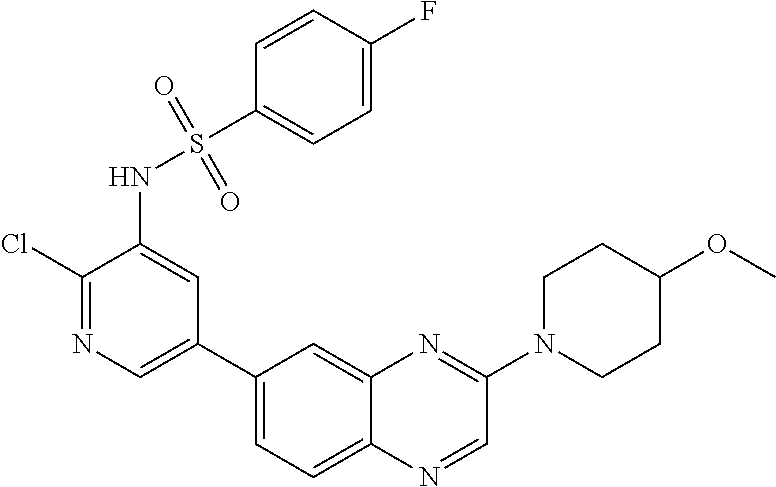


| Prepared | |||
| analogous | |||
| to example | MS | ||
| Example | Name | number | (M + 1) |
| 77 | N-(2-chloro-5-(4-(((5- | 24 | 499.0 |
| cyclopropyl-1,2,4-oxadiazol-3- | |||
| yl)methyl)(ethyl)amino)-6- | |||
| quinolinyl)-3- | |||
| pyridinyl)methanesulfonamide | |||
| 78 | N-(2-chloro-5-(4-((2- | 24 | 429.9 |
| cyanoethyl)(ethyl)amino)-6- | |||
| quinolinyl)-3- | |||
| pyridinyl)methanesulfonamide | |||
| 79 | N-(2-chloro-5-(4-((2-methoxy-2- | 24 | 434.9 |
| methylpropyl)amino)-6- | |||
| quinolinyl)-3- | |||
| pyridinyl)methanesulfonamide | |||
| 80 | N-(2-chloro-5-(4-(3-(2- | 24 | 508.9 |
| methylphenoxy)-1-pyrrolidinyl)- | |||
| 6-quinolinyl)-3- | |||
| pyridinyl)methanesulfonamide | |||
| 81 | N-(2-chloro-5-(4-(2- | 24 | 446.9 |
| (methoxymethyl)-1- | |||
| pyrrolidinyl)-6-quinolinyl)-3- | |||
| pyridinyl)methanesulfonamide | |||
| 82 | N-(2-chloro-5-(4-(4-phenyl-1- | 24 | 493.0 |
| piperidinyl)-6-quinolinyl)-3- | |||
| pyridinyl)methanesulfonamide | |||
| 83 | N-(2-chloro-5-(4-(4-(1- | 24 | 522.0 |
| phenylethyl)-1-piperazinyl)-6- | |||
| quinolinyl)-3- | |||
| pyridinyl)methanesulfonamide | |||
| 84 | N-(5-(4-(4-(1,3-benzodioxol-5- | 24 | 552.0 |
| ylmethyl)-1-piperazinyl)-6- | |||
| quinolinyl)-2-chloro-3- | |||
| pyridinyl)methanesulfonamide | |||
| 85 | N-(2-chloro-5-(4-((3- | 24 | 471.0 |
| fluorobenzyl)(methyl)amino)-6- | |||
| quinolinyl)-3- | |||
| pyridinyl)methanesulfonamide | |||
| 86 | N-(2-chloro-5-(4-(5-fluoro-1,3- | 24 | 469.0 |
| dihydro-2H-isoindol-2-yl)-6- | |||
| quinolinyl)-3- | |||
| pyridinyl)methanesulfonamide | |||
| 87 | N-(2-chloro-5-(4-((2,5- | 24 | 499.0 |
| dimethoxybenzyl)amino)-6- | |||
| quinolinyl)-3- | |||
| pyridinyl)methanesulfonamide | |||
| 88 | N-(2-chloro-5-(4-(4- | 24 | 432.0 |
| piperidinylamino)-6-quinolinyl)- | |||
| 3-pyridinyl)methanesulfonamide | |||
| 89 | N-(2-chloro-5-(4-(4-(4- | 1 | 589.1 |
| pyridinylmethyl)-1-piperazinyl)- | |||
| 6-quinolinyl)-3-pyridinyl)-4- | |||
| fluorobenzenesulfonamide | |||
| 90 | N-(2-chloro-5-(4-(2,2-dimethyl- | 11 | 447.0 |
| 4-morpholinyl)-6-quinolinyl)-3- | |||
| pyridinyl)methanesulfonamide | |||
| 91 | N-(2-chloro-5-(3-((2-(4- | 20 | 543.0 |
| morpholinyl)ethyl)amino)-6- | |||
| quinoxalinyl)-3-pyridinyl)-4- | |||
| fluorobenzenesulfonamide | |||
| 92 | N-(2-chloro-5-(3-(4- | 20 | 419.9 |
| morpholinyl)-6-quinoxalinyl)-3- | |||
| pyridinyl)methanesulfonamide | |||
| 93 | N-(2-chloro-5-(4-(3-pyridinyl)- | 35 | 490.8 |
| 6-quinolinyl)-3-pyridinyl)-4- | |||
| fluorobenzenesulfonamide | |||
| 94 | N-(2-chloro-5-(4-(2-chloro-4- | 35 | 524.9 |
| pyridinyl)-6-quinolinyl)-3- | |||
| pyridinyl)-4- | |||
| fluorobenzenesulfonamide | |||
| 95 | N-(2-chloro-5-(4-(4-hydroxy-1- | 26 | 527.0 |
| azepanyl)-6-quinolinyl)-3- | |||
| pyridinyl)-4- | |||
| fluorobenzenesulfonamide | |||
| 96 | N-(2-chloro-5-(4-((2R,6S)-2,6- | 26 | 527.0 |
| dimethyl-4-morpholinyl)-6- | |||
| quinolinyl)-3-pyridinyl)-4- | |||
| fluorobenzenesulfonamide | |||
| 97 | N-(2-chloro-5-(4- | 1 | 457.0 |
| (dimethylamino)-6-quinolinyl)- | |||
| 3-pyridinyl)-4- | |||
| fluorobenzenesulfonamide | |||
| 98 | N-(2-chloro-5-(4-((2- | 1 | 487.0 |
| methoxyethyl)amino)-6- | |||
| quinolinyl)-3-pyridinyl)-4- | |||
| fluorobenzenesulfonamide | |||
| 99 | N-(2-chloro-5-(4-((2-methoxy-1- | 1 | 501.0 |
| methylethyl)amino)-6- | |||
| quinolinyl)-3-pyridinyl)-4- | |||
| fluorobenzenesulfonamide | |||
| 100 | N-(2-chloro-5-(4-(tetrahydro- | 1 | 544.0 |
| 2H-thiopyran-4-ylmethoxy)-6- | |||
| quinolinyl)-3-pyridinyl)-4- | |||
| fluorobenzenesulfonamide | |||
| 101 | N-(2-chloro-5-(4-(4- | 32 | 481.9 |
| morpholinyl)-6-quinolinyl)-3- | |||
| pyridinyl)-3- | |||
| pyridinesulfonamide | |||
| 102 | N-(2-chloro-5-(4-(4- | 35 | 532.9 |
| (dimethylamino)phenyl)-6- | |||
| quinolinyl)-3-pyridinyl)-4- | |||
| fluorobenzenesulfonamide | |||
| 103 | N-(2-chloro-5-(4-((2R,6S)-2,6- | 24 | 446.9 |
| dimethyl-4-morpholinyl)-6- | |||
| quinolinyl)-3- | |||
| pyridinyl)methanesulfonamide | |||
| 104 | N-(2-chloro-5-(4-(2,6-dimethyl- | 24 | 446.9 |
| 4-morpholinyl)-6-quinolinyl)-3- | |||
| pyridinyl)methanesulfonamide | |||
| 105 | N-(2-chloro-5-(4-(2-methyl-4- | 116 | 424.9 |
| pyridinyl)-6-quinolinyl)-3- | |||
| pyridinyl)methanesulfonamide | |||
| 106 | N-(2-chloro-5-(4-(2-methoxy-4- | 116 | 440.9 |
| pyridinyl)-6-quinolinyl)-3- | |||
| pyridinyl)methanesulfonamide | |||
| 107 | N-(2-chloro-5-(4-(3,6-dihydro- | 116 | 415.9 |
| 2H-pyran-4-yl)-6-quinolinyl)-3- | |||
| pyridinyl)methanesulfonamide | |||
| 108 | N-(2-chloro-5-(4-(tetrahydro-3- | 1 | 515.8 |
| thiophenyloxy)-6-quinolinyl)-3- | |||
| pyridinyl)-4- | |||
| fluorobenzenesulfonamide | |||
| 109 | N-(2-chloro-5-(4-((2S,6S)-2,6- | 104* | 446.9 |
| dimethyl-4-morpholinyl)-6- | |||
| quinolinyl)-3- | |||
| pyridinyl)methanesulfonamide | |||
| 110 | N-(2-chloro-5-(4-((2R,6R)-2,6- | 104* | 446.9 |
| dimethyl-4-morpholinyl)-6- | |||
| quinolinyl)-3- | |||
| pyridinyl)methanesulfonamide | |||
| 111 | N-(2-chloro-5-(4-(2- | 116 | 478.8 |
| (trifluoromethyl)-4-pyridinyl)-6- | |||
| quinolinyl)-3- | |||
| pyridinyl)methanesulfonamide | |||
| 112 | N-(2-chloro-5-(4-(6- | 116 | 478.8 |
| (trifluoromethyl)-3-pyridinyl)-6- | |||
| quinolinyl)-3- | |||
| pyridinyl)methanesulfonamide | |||
| *Enantiomers were separated on Chiralpak AD-H (2 × 25 cm) SN 08-9743 using 25% ethanol (0.1% DEA)/CO2, 100 bar at 75 mL/min with detection at 220 nm. | |||
| Example | Structure |
| 77 |
 |
| 78 |
 |
| 79 |
 |
| 80 |
 |
| 81 |
 |
| 82 |
 |
| 83 |
 |
| 84 |
 |
| 85 |
 |
| 86 |
 |
| 87 |
 |
| 88 |
 |
| 89 |
 |
| 90 |
 |
| 91 |
 |
| 92 |
 |
| 93 |
 |
| 94 |
 |
| 95 |
 |
| 96 |
 |
| 97 |
 |
| 98 |
 |
| 99 |
 |
| 100 |
 |
| 101 |
 |
| 102 |
 |
| 103 |
 |
| 104 |
 |
 |
|
| 105 |
 |
| 106 |
 |
| 107 |
 |
| 108 |
 |
| 109 |
 |
| 110 |
 |
| 111 |
 |
| 112 |
 |


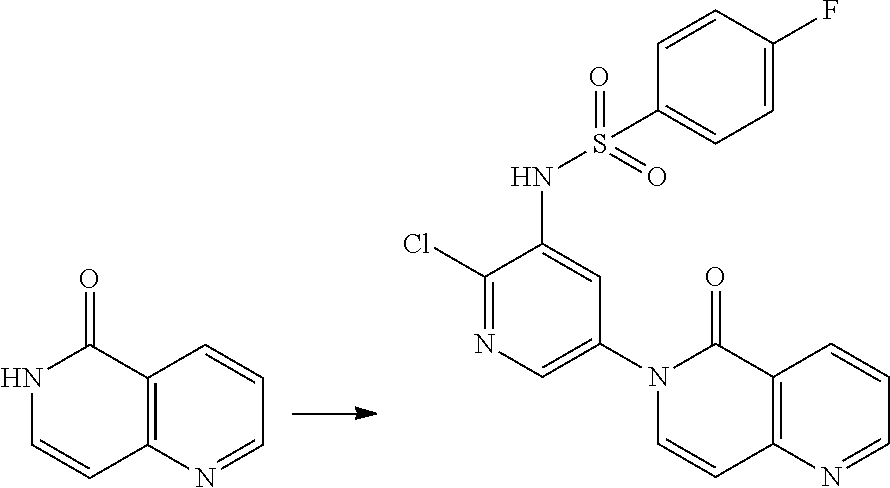
| Alpha | Beta | Delta | Gamma | ||
| 50 mM Tris | pH | 8 | pH | 7.5 | pH | 7.5 | pH | 8 |
| MgCl2 | 15 | mM | 10 | mM | 10 | mM | 15 | mM |
| Na cholate | 2 | mM | 1 | mM | 0.5 | mM | 2 | mM |
| DTT | 2 | mM | 1 | mM | 1 | mM | 2 | mM |
| ATP | 1 | uM | 0.5 | uM | 0.5 | uM | 1 | uM |
| PIP2 | none | 2.5 | uM | 2.5 | uM | none |
| time | 1 | hr | 2 | hr | 2 | hr | 1 | hr |
| [Enzyme] | 15 | nM | 40 | nM | 15 | nM | 50 | nM |
In Vitro PI3 Kinase Enzyme Assays (PI3K Atploss)
| TABLE 1 | ||||
| ATP Loss | ATP Loss | HCT116 | ||
| (PBKα) | (PI3Kβ) | Cell | ||
| Example | IC50 μM | IC50 μM | IC50 μM | |
| no. | IUPAC name | (Avg) | (Avg) | (Avg) |
| 1 | N-(2-chloro-5-(4-(4- | 0.0055 | 0.0174 | 0.0174 |
| morpholinyl)-6-quinolinyl)-3- | ||||
| pyridinyl)-4- | ||||
| fluorobenzenesulfonamide | ||||
| 2 | N-(2-chloro-5-(4-chloro-6- | 0.0062 | 0.0093 | 0.1090 |
| quinolinyl)-3-pyridinyl)-4- | ||||
| fluorobenzenesulfonamide | ||||
| 3 | tert-butyl (2-((6-(6-chloro-5- | 0.0678 | 0.6823 | 1.6602 |
| (((4-fluorophenyl)sulfonyl)amino)- | ||||
| 3-pyridinyl)-4- | ||||
| quinolinyl)oxy)ethyl)carbamate | ||||
| 4 | N-(2-chloro-5-(3-methoxy-6- | 0.0162 | 0.0253 | 0.1857 |
| quinolinyl)-3-pyridinyl)-4- | ||||
| fluorobenzenesulfonamide | ||||
| 5 | N-(2-chloro-5-(4-phenoxy-6- | 0.2549 | 0.1051 | 1.1422 |
| quinolinyl)-3- | ||||
| pyridinyl)methanesulfonamide | ||||
| 6 | N-(2-chloro-5-(6- | 0.0081 | 0.0254 | 1.5896 |
| quinoxalinyl)-3-pyridinyl)-4- | ||||
| fluorobenzenesulfonamide | ||||
| 7 | N-(2-chloro-5-(6-quinolinyl)- | 0.0099 | 0.0277 | 1.3045 |
| 3-pyridinyl)-4- | ||||
| fluorobenzenesulfonamide | ||||
| 8 | N-(2-chloro-5-(4-methoxy-6- | 0.0127 | 0.0147 | 0.2217 |
| quinolinyl)-3-pyridinyl)-4- | ||||
| fluorobenzenesulfonamide | ||||
| 9 | N-(2-chloro-5-(4-chloro-6- | 0.0142 | 0.0520 | 2.0588 |
| quinolinyl)-3- | ||||
| pyridinyl)methanesulfonamide | ||||
| 10 | N-(2-chloro-5-(3-methoxy-6- | 0.0424 | 0.1657 | 0.3477 |
| quinolinyl)-3- | ||||
| pyridinyl)methanesulfonamide | ||||
| 11 | N-(2-chloro-5-(4-(4- | 0.0458 | 0.1557 | 0.0501 |
| morpholinyl)-6-quinolinyl)-3- | ||||
| pyridinyl)methanesulfonamide | ||||
| 12 | N-(2-chloro-5-(6-quinolinyl)- | 0.0689 | 0.3652 | 2.6490 |
| 3-pyridinyl)methanesulfonamide | ||||
| 13 | 2-chloro-N,N-dimethyl-5-(6- | 1.1157 | 40 | ND |
| quinolinyl)-3-pyridinamine | ||||
| 14 | (2-chloro-5-(4-(4- | 1.1288 | 5.4228 | ND |
| morpholinyl)-6-quinolinyl)-3- | ||||
| pyridinyl)methanol | ||||
| 15 | (2-chloro-5-(4-(4- | 1.3861 | 3.6650 | ND |
| morpholinyl)-6-quinolinyl)-3- | ||||
| pyridinyl)methyl acetate | ||||
| 16 | 1-(2-chloro-5-(4-(4- | 3.5346 | 26.6752 | ND |
| morpholinyl)-6-quinolinyl)-3- | ||||
| pyridinyl)methanamine | ||||
| 17 | N-((2-chloro-5-(4-(4- | 3.1131 | 27.4351 | ND |
| morpholinyl)-6-quinolinyl)-3- | ||||
| pyridinyl)methyl)-2,2- | ||||
| dimethylpropanamide | ||||
| 18 | N-(2-chloro-5-(7-quinolinyl)- | 1.9657 | 7.7049 | ND |
| 3-pyridinyl)-4- | ||||
| fluorobenzenesulfonamide | ||||
| 19 | 2-chloro-5-(4-(4- | 0.0258 | 0.6439 | 0.3113 |
| morpholinyl)-6-quinolinyl)-3- | ||||
| pyridinol | ||||
| 20 | N-(2-chloro-5-(3-(4- | 0.0030 | 0.0189 | 0.0062 |
| morpholinyl)-6-quinoxalinyl)- | ||||
| 3-pyridinyl)-4- | ||||
| fluorobenzenesulfonamide | ||||
| 21 | N-(2-chloro-5-(3-(4-(1- | 0.0054 | 0.0096 | 0.0115 |
| methylethyl)-1-piperazinyl)- | ||||
| 6-quinoxalinyl)-3-pyridinyl)- | ||||
| 4-fluorobenzenesulfonamide | ||||
| 22 | N-(2-chloro-5-(3-hydroxy-6- | 0.0114 | 0.0552 | 0.6542 |
| quinolinyl)-3-pyridinyl)-4- | ||||
| fluorobenzenesulfonamide | ||||
| 23 | N-(2-chloro-5-(4-hydroxy-6- | 0.5886 | 1.6179 | ND |
| quinolinyl)-3-pyridinyl)-4- | ||||
| fluorobenzenesulfonamide | ||||
| 24 | N-(2-chloro-5-(4-(1- | 0.0028 | 0.0184 | 0.1590 |
| piperidinyl)-6-quinolinyl)-3- | ||||
| pyridinyl)-4- | ||||
| fluorobenzenesulfonamide | ||||
| 25 | N-(2-chloro-5-(4-(4-(1- | 0.0092 | 0.0119 | 0.0189 |
| methylethyl)-1-piperazinyl)- | ||||
| 6-quinolinyl)-3-pyridinyl)-4- | ||||
| fluorobenzenesulfonamide | ||||
| 26 | N-(2-chloro-5-(4-(3-hydroxy- | 0.0111 | 0.0778 | 2.9647 |
| 1-pyrrolidinyl)-6-quinolinyl)- | ||||
| 3-pyridinyl)-4- | ||||
| fluorobenzenesulfonamide | ||||
| 27 | N-(2-chloro-5-(4-(4-hydroxy- | 0.0041 | 0.0126 | 0.1757 |
| 1-piperidinyl)-6-quinolinyl)- | ||||
| 3-pyridinyl)-4- | ||||
| fluorobenzenesulfonamide | ||||
| 28 | N-(5-(4-(4-benzyl-1- | 0.0062 | 0.0339 | ND |
| piperazinyl)-6-quinolinyl)-2- | ||||
| chloro-3-pyridinyl)-4- | ||||
| fluorobenzenesulfonamide | ||||
| 29 | N-(2-chloro-5-(4-(4-(1- | 0.0069 | 0.0449 | 0.3454 |
| phenylethyl)-1-piperazinyl)- | ||||
| 6-quinolinyl)-3-pyridinyl)-4- | ||||
| fluorobenzenesulfonamide | ||||
| 30 | N-(2-chloro-5-(4-(2,6- | 0.0041 | 0.0302 | 0.0228 |
| dimethyl-4-morpholinyl)-6- | ||||
| quinolinyl)-3-pyridinyl)-4- | ||||
| fluorobenzenesulfonamide | ||||
| 31 | N-(2-chloro-5-(4-(2- | 0.0075 | 0.0144 | 0.0252 |
| methoxyethoxy)-6- | ||||
| quinolinyl)-3-pyridinyl)-4- | ||||
| fluorobenzenesulfonamide | ||||
| 32 | N-(2-chloro-5-(4-(4- | 0.0050 | 0.0248 | 0.0117 |
| morpholinyl)-6-quinolinyl)-3- | ||||
| pyridinyl)-2- | ||||
| fluorobenzenesulfonamide | ||||
| 33 | 2-chloro-N-(2-chloro-5-(4- | 0.0041 | 0.0219 | 0.0063 |
| (4-morpholinyl)-6- | ||||
| quinolinyl)-3- | ||||
| pyridinyl)benzenesulfonamide | ||||
| 34 | 2,6-dichloro-N-(2-chloro-5- | 0.0065 | 0.0359 | 0.0376 |
| (4-(4-morpholinyl)-6- | ||||
| quinolinyl)-3- | ||||
| pyridinyl)benzenesulfonamide | ||||
| 35 | N-(2-chloro-5-(4-(2- | 0.0077 | 0.0212 | 0.0548 |
| methoxy-3-pyridinyl)-6- | ||||
| quinolinyl)-3-pyridinyl)-4- | ||||
| fluorobenzenesulfonamide | ||||
| 36 | N-(2-chloro-5-(4-phenyl-6- | 0.0071 | 0.0149 | 0.0914 |
| quinolinyl)-3-pyridinyl)-4- | ||||
| fluorobenzenesulfonamide | ||||
| 37 | N-(2-chloro-5-(6-cinnolinyl)- | 0.0783 | 0.2120 | ND |
| 3-pyridinyl)-4- | ||||
| fluorobenzenesulfonamide | ||||
| 38 | N-(2-chloro-5-(6- | 0.7399 | 40 | ND |
| isoquinolinyl)-3-pyridinyl)-4- | ||||
| fluorobenzenesulfonamide | ||||
| 39 | N-(2-chloro-5-(5- | 1.8989 | 4.1211 | ND |
| phthalazinyl)-3-pyridinyl)-4- | ||||
| fluorobenzenesulfonamide | ||||
| 40 | N-(2-chloro-5-(6- | 0.8995 | 0.6976 | ND |
| phthalazinyl)-3-pyridinyl)-4- | ||||
| fluorobenzenesulfonamide | ||||
| 41 | N-(2-chloro-5-(1,5- | 0.0134 | 0.0597 | 0.6294 |
| naphthyridin-2-yl)-3- | ||||
| pyridinyl)-4- | ||||
| fluorobenzenesulfonamide | ||||
| 42 | N-(2-chloro-5-(1,5- | 0.0875 | 0.6197 | 1.7274 |
| naphthyridin-4-yl)-3- | ||||
| pyridinyl)-4- | ||||
| fluorobenzenesulfonamide | ||||
| 43 | N-(5-(2-amino-3-oxo-3,4- | 0.0169 | 0.0648 | 5.0374 |
| dihydro-6-quinoxalinyl)-2- | ||||
| chloro-3-pyridinyl)-4- | ||||
| fluorobenzenesulfonamide | ||||
| 44 | N-(2-chloro-5-(1,8- | 2.8438 | 5.6101 | ND |
| naphthyridin-3-yl)-3- | ||||
| pyridinyl)-4- | ||||
| fluorobenzenesulfonamide | ||||
| 45 | N-(6-(6-chloro-5-(((4- | 0.0192 | 0.0597 | 0.0646 |
| methoxyphenyl)sulfonyl)amino)- | ||||
| 3-pyridinyl)-2- | ||||
| quinolinyl)acetamide | ||||
| 46 | N-(5-(2-amino-6-quinolinyl)- | 0.1361 | 0.1799 | 0.1077 |
| 2-chloro-3-pyridinyl)-4- | ||||
| methoxybenzenesulfonamide | ||||
| 47 | N-(2-chloro-5-(6-quinolinyl)- | 0.0417 | 0.0249 | 0.5264 |
| 3-pyridinyl)-4- | ||||
| methoxybenzenesulfonamide | ||||
| 48 | N-(2-chloro-5-(2- | 0.0954 | 2.4907 | ND |
| (methylamino)-6-quinolinyl)- | ||||
| 3-pyridinyl)-4- | ||||
| methoxybenzenesulfonamide | ||||
| 49 | N-(2-chloro-5-(4- | 0.0074 | 0.0151 | 0.2732 |
| (dimethylamino)-6- | ||||
| quinolinyl)-3-pyridinyl)-4- | ||||
| methoxybenzenesulfonamide | ||||
| 50 | N-(2-chloro-5-(4-(4- | 0.0030 | 0.0366 | 0.1072 |
| methoxy-1-piperidinyl)-6- | ||||
| quinolinyl)-3-pyridinyl)-4- | ||||
| methoxybenzenesulfonamide | ||||
| 51 | 2-chloro-N,N-dimethyl-5-(4- | 0.1793 | 2.4625 | ND |
| (4-morpholinyl)-6- | ||||
| quinolinyl)-3-pyridinamine | ||||
| 52 | 2-chloro-5-(4-chloro-6- | 0.4302 | 2.2401 | ND |
| quinolinyl)-N,N-dimethyl-3- | ||||
| pyridinamine | ||||
| 53 | 2-chloro-N,N-dimethyl-5-(4- | 0.2945 | 4.2210 | ND |
| (4-(1-phenylethyl)-1- | ||||
| piperazinyl)-6-quinolinyl)-3- | ||||
| pyridinamine | ||||
| 54 | N-(2-chloro-5-(3-(1- | 0.0027 | 0.0842 | 0.1410 |
| piperidinyl)-6-quinoxalinyl)- | ||||
| 3-pyridinyl)-4- | ||||
| fluorobenzenesulfonamide | ||||
| 55 | N-(2-chloro-5-(3-((2- | 0.0027 | 0.0207 | 0.0640 |
| methoxyethyl)(methyl)amino)- | ||||
| 6-quinoxalinyl)-3-pyridinyl)-4- | ||||
| fluorobenzenesulfonamide | ||||
| 56 | N-(5-(3-(4-acetyl-1- | 0.0057 | 0.0318 | 0.0236 |
| piperazinyl)-6-quinoxalinyl)- | ||||
| 2-chloro-3-pyridinyl)-4- | ||||
| fluorobenzenesulfonamide | ||||
| 57 | N-(2-chloro-5-(3-((2- | 0.0022 | 0.0079 | 0.0451 |
| phenoxyethyl)amino)-6- | ||||
| quinoxalinyl)-3-pyridinyl)-4- | ||||
| fluorobenzenesulfonamide | ||||
| 58 | N-(2-chloro-5-(3-(4,4- | 0.0034 | 0.0824 | 0.0635 |
| difluoro-1-piperidinyl)-6- | ||||
| quinoxalinyl)-3-pyridinyl)-4- | ||||
| fluorobenzenesulfonamide | ||||
| 59 | tert-butyl 3-(((7-(6-chloro-5- | 0.0031 | 0.0225 | 0.1357 |
| (((4-fluorophenyl)sulfonyl)amino)- | ||||
| 3-pyridinyl)-2- | ||||
| quinoxalinyl)amino)methyl)- | ||||
| 1-piperidinecarboxylate | ||||
| 60 | N-(2-chloro-5-(3-((1-(4- | 0.0103 | 0.0436 | 0.5693 |
| fluorophenyl)ethyl)amino)-6- | ||||
| quinoxalinyl)-3-pyridinyl)-4- | ||||
| fluorobenzenesulfonamide | ||||
| 61 | N-(2-chloro-5-(3-((2-(1- | 0.0073 | 0.0155 | 0.0515 |
| piperidinyl)ethyl)amino)-6- | ||||
| quinoxalinyl)-3-pyridinyl)-4- | ||||
| fluorobenzenesulfonamide | ||||
| 62 | N-(5-(3-(3- | 0.0059 | 0.3429 | 0.2631 |
| azabicyclo[3.2.2]non-3-yl)- | ||||
| 6-quinoxalinyl)-2-chloro-3- | ||||
| pyridinyl)-4- | ||||
| fluorobenzenesulfonamide | ||||
| 63 | N-(2-chloro-5-(3-((4- | 0.0056 | 0.0502 | 0.1576 |
| methoxybenzyl)amino)-6- | ||||
| quinoxalinyl)-3-pyridinyl)-4- | ||||
| fluorobenzenesulfonamide | ||||
| 64 | N-(2-chloro-5-(3-((2- | 0.0074 | 0.0597 | 0.1883 |
| phenylethyl)amino)-6- | ||||
| quinoxalinyl)-3-pyridinyl)-4- | ||||
| fluorobenzenesulfonamide | ||||
| 65 | N-(5-(3- | 0.0039 | 0.0303 | 0.2792 |
| (benzyl(methyl)amino)-6- | ||||
| quinoxalinyl)-2-chloro-3- | ||||
| pyridinyl)-4- | ||||
| fluorobenzenesulfonamide | ||||
| 66 | N-(2-chloro-5-(3-(3- | 0.0027 | 0.0300 | 0.0405 |
| methoxy-1-piperidinyl)-6- | ||||
| quinoxalinyl)-3-pyridinyl)-4- | ||||
| fluorobenzenesulfonamide | ||||
| 67 | N-(2-chloro-5-(3-(2,6- | 0.0029 | 0.0648 | 0.0203 |
| dimethyl-4-morpholinyl)-6- | ||||
| quinoxalinyl)-3-pyridinyl)-4- | ||||
| fluorobenzenesulfonamide | ||||
| 68 | N-(2-chloro-5-(3-(2- | 0.0081 | 0.0358 | 0.0434 |
| (methoxymethyl)-1- | ||||
| pyrrolidinyl)-6-quinoxalinyl)- | ||||
| 3-pyridinyl)-4- | ||||
| fluorobenzenesulfonamide | ||||
| 69 | N-(2-chloro-5-(3-(4- | 0.0051 | 0.0344 | 0.0526 |
| methoxy-1-piperidinyl)-6- | ||||
| quinoxalinyl)-3-pyridinyl)-4- | ||||
| fluorobenzenesulfonamide | ||||
| 70 | N-(2-chloro-5-(3- | 0.0045 | 0.0532 | 0.1507 |
| ((cyclohexylmethyl)amino)- | ||||
| 6-quinoxalinyl)-3-pyridinyl)- | ||||
| 4-fluorobenzenesulfonamide | ||||
| 71 | N-(2-chloro-5-(3- | 0.0188 | 0.0934 | 0.0893 |
| ((cyanomethyl)(methyl)amino)- | ||||
| 6-quinoxalinyl)-3-pyridinyl)-4- | ||||
| fluorobenzenesulfonamide | ||||
| 72 | N-(2-chloro-5-(3-(1- | 0.0049 | 0.0100 | 0.0168 |
| piperazinyl)-6-quinoxalinyl)- | ||||
| 3-pyridinyl)-4- | ||||
| fluorobenzenesulfonamide | ||||
| 73 | N-(2-chloro-5-(3-((2- | 0.0029 | 0.0334 | 0.0595 |
| methoxyethyl)amino)-6- | ||||
| quinoxalinyl)-3-pyridinyl)-4- | ||||
| fluorobenzenesulfonamide | ||||
| 74 | N-(2-chloro-5-(3-((3- | 0.0192 | 0.0463 | 2.6292 |
| piperidinylmethyl)amino)-6- | ||||
| quinoxalinyl)-3-pyridinyl)-4- | ||||
| fluorobenzenesulfonamide | ||||
| 75 | N-(2-chloro-5-(1,7- | ND | ND | ND |
| naphthyridin-6-yl)pyridin-3- | ||||
| yl)-4- | ||||
| fluorobenzenesulfonamide | ||||
| 76 | N-(2-chloro-5-(8-methoxy- | ND | ND | 0.8056 |
| 1,7-naphthyridin-6- | ||||
| yl)pyridin-3-yl)-4- | ||||
| fluorobenzenesulfonamide | ||||
| PI3Kα | |||
| AlphaScreen ® | mTOR | U87 | |
| Example | Ki (μM) | IC50 (μM) | IC50 (μM) |
| no. | (Avg)) | (Avg) | (Avg) |
| 77 | 0.0184 | 0.0677 | 1.9290 |
| 78 | 0.0276 | 0.0117 | 0.1934 |
| 79 | 0.0823 | 0.3635 | 2.8350 |
| 80 | 0.0294 | 0.3894 | 0.7036 |
| 81 | 0.3682 | 2.7441 | 2.7145 |
| 82 | 0.0052 | 0.0167 | 0.3639 |
| 83 | 0.0136 | 0.0821 | 0.7577 |
| 84 | 0.0225 | 0.0487 | 0.2894 |
| 85 | 0.0158 | 0.0621 | 1.6618 |
| 86 | 0.0160 | 0.1618 | 0.6667 |
| 87 | 0.0332 | 0.2949 | 1.4183 |
| 88 | 0.1608 | 1.7709 | 6.8388 |
| 89 | 0.0025 | 0.0039 | 0.0223 |
| 90 | 0.0107 | 0.0044 | 0.0484 |
| 91 | 0.0033 | 0.0053 | 0.0750 |
| 92 | 0.0028 | 0.0283 | 0.0840 |
| 93 | 0.0008 | 0.0016 | 0.0119 |
| 94 | 0.0013 | 0.0006 | 0.0053 |
| 95 | 0.0058 | 0.1112 | ND |
| 96 | 0.0068 | 0.0110 | 0.0375 |
| 97 | 0.0086 | 0.1106 | ND |
| 98 | 0.0889 | 1.1578 | ND |
| 99 | 0.1215 | 2.3929 | ND |
| 100 | 0.0012 | 0.0400 | ND |
| 101 | 0.0027 | 0.0036 | 0.0762 |
| 102 | 0.0013 | 0.0153 | 0.0641 |
| 103 | 0.0032 | 0.0102 | 0.0556 |
| 104 | 0.0083 | 0.0058 | 0.0284 |
| 105 | 0.0015 | 0.0015 | 0.0085 |
| 106 | 0.0019 | 0.0034 | 0.0259 |
| 107 | 0.0017 | 0.0040 | 0.0198 |
| 108 | 0.0023 | 0.0079 | 0.3061 |
| 109 | 0.0032 | 0.0137 | 0.0214 |
| 110 | 0.0063 | 0.0051 | 0.0141 |
| 111 | 0.0030 | 0.0028 | 0.0261 |
| 112 | 0.0021 | 0.0021 | 0.0091 |
| 113 | 0.0016 | 0.0146 | 0.0444 |
| 114 | ND | 0.0063 | 0.0254 |
| 115 | ND | 0.0126 | 0.1944 |
| 116 | 0.0013 | 0.0029 | 0.0190 |
| 117 | 0.0053 | 0.0015 | 0.2547 |
| 118 | 0.0011 | 0.0012 | 0.01267 |
| 119 | 0.0047 | 0.0176 | 0.0448 |
| 120 | 0.0035 | 0.0048 | 0.0147 |
| 121 | 0.0011 | 0.0057 | 0.0310 |
| 122 | 0.0065 | 0.0182 | 0.0163 |
| 123 | 0.0054 | 0.0169 | 0.0370 |
| 124 | 0.0046 | 0.0143 | 0.0399 |
| 125 | 0.0033 | 0.0077 | 0.7230 |
| 126 | 0.0801 | 0.1342 | 0.6691 |
| 127 | 0.0273 | 0.0651 | ND |
| 128 | 0.0333 | 0.0527 | 20.4163 |
| 129 | 0.0858 | ND | ND |
| 130 | 0.0025 | 0.0012 | 0.0087 |
| 131 | 0.0032 | 0.0076 | 0.0092 |
| 132 | 0.0022 | 0.0023 | 0.0408 |
| 133 | 0.0023 | 0.0005 | 0.0094 |
| 134 | 0.0185 | 0.0042 | 0.0283 |
| 135 | 0.0638 | 0.2182 | ND |
| 136 | 0.1108 | 0.0650 | 0.2887 |
| 137 | 0.5482 | ND | 2.9827 |
| ND = not determined | |||
Claims (9)


Priority Applications (1)
| Application Number | Priority Date | Filing Date | Title |
|---|---|---|---|
| US12/995,431 US8415376B2 (en) | 2008-05-30 | 2009-05-29 | Inhibitors of PI3 kinase |
Applications Claiming Priority (3)
| Application Number | Priority Date | Filing Date | Title |
|---|---|---|---|
| US5774508P | 2008-05-30 | 2008-05-30 | |
| PCT/US2009/045713 WO2009155121A2 (en) | 2008-05-30 | 2009-05-29 | Inhibitors of pi3 kinase |
| US12/995,431 US8415376B2 (en) | 2008-05-30 | 2009-05-29 | Inhibitors of PI3 kinase |
Publications (2)
| Publication Number | Publication Date |
|---|---|
| US20110092504A1 US20110092504A1 (en) | 2011-04-21 |
| US8415376B2 true US8415376B2 (en) | 2013-04-09 |
Family
ID=40902593
Family Applications (1)
| Application Number | Title | Priority Date | Filing Date |
|---|---|---|---|
| US12/995,431 Active 2029-08-24 US8415376B2 (en) | 2008-05-30 | 2009-05-29 | Inhibitors of PI3 kinase |
Country Status (8)
| Country | Link |
|---|---|
| US (1) | US8415376B2 (en) |
| EP (1) | EP2307400B1 (en) |
| JP (1) | JP5599783B2 (en) |
| AU (1) | AU2009260447B2 (en) |
| CA (1) | CA2725014C (en) |
| ES (1) | ES2474147T3 (en) |
| MX (1) | MX315904B (en) |
| WO (1) | WO2009155121A2 (en) |
Cited By (1)
| Publication number | Priority date | Publication date | Assignee | Title |
|---|---|---|---|---|
| WO2017132157A1 (en) * | 2015-01-29 | 2017-08-03 | Fuqiang Ruan | Heterocyclic compounds as inhibitors of class i pi3ks |
Families Citing this family (62)
| Publication number | Priority date | Publication date | Assignee | Title |
|---|---|---|---|---|
| CA2725014C (en) | 2008-05-30 | 2014-06-17 | Amgen Inc. | Inhibitors of pi3 kinase |
| JP2012521354A (en) | 2009-03-20 | 2012-09-13 | アムジエン・インコーポレーテツド | Inhibitors of PI3 kinase |
| JP5728683B2 (en) * | 2009-09-04 | 2015-06-03 | バイエル・インテレクチュアル・プロパティ・ゲゼルシャフト・ミット・ベシュレンクテル・ハフツングBayer Intellectual Property GmbH | Substituted aminoquinoxalines as tyrosine threonine kinase inhibitors |
| RU2012146246A (en) | 2010-03-31 | 2014-05-10 | Актелион Фармасьютиклз Лтд | ANTIBACTERIAL DERIVATIVES OF ISOCHINOLIN-3-ILMOCHEIN |
| JO2998B1 (en) | 2010-06-04 | 2016-09-05 | Amgen Inc | Piperidinone derivatives as mdm2 inhibitors for the treatment of cancer |
| AR088729A1 (en) | 2011-03-29 | 2014-07-02 | Actelion Pharmaceuticals Ltd | DERIVATIVES OF 3-UREIDOISOQUINOLIN-8-ILO AND A PHARMACEUTICAL COMPOSITION |
| CN102731525A (en) * | 2011-04-08 | 2012-10-17 | 上海艾力斯医药科技有限公司 | Benzomorpholine derivative |
| US9376425B2 (en) | 2011-09-27 | 2016-06-28 | Amgen, Inc. | Heterocyclic compounds as MDM2 inhibitors for the treatment of cancer |
| EP2794594A1 (en) * | 2011-12-22 | 2014-10-29 | Novartis AG | Quinoline derivatives |
| WO2013135612A1 (en) | 2012-03-14 | 2013-09-19 | Bayer Intellectual Property Gmbh | Substituted imidazopyridazines |
| CN103539777B (en) * | 2012-07-13 | 2016-03-02 | 广东东阳光药业有限公司 | PI3 kinase modulator and using method thereof and purposes |
| WO2014022128A1 (en) * | 2012-07-29 | 2014-02-06 | Calitor Sciences, Llc | Pi3 kinase modulators and methods of use |
| CN103626783B (en) * | 2012-08-22 | 2016-06-08 | 中国科学院上海药物研究所 | Bicyclic fused heterocyclic compound and application and pharmaceutical composition thereof |
| CN103788071A (en) * | 2012-11-01 | 2014-05-14 | 中国人民解放军第二军医大学 | N-(5-(quinolyl-6-yl) pyridyl-3-yl)benzsulfamide derivatives, and preparation method and treatment use thereof |
| CN104016979B (en) * | 2012-11-23 | 2017-05-03 | 广东东阳光药业有限公司 | Substituted cyclic compound as well as use method and application thereof |
| WO2014120995A2 (en) | 2013-02-01 | 2014-08-07 | Wellstat Therapeutics Corporation | Amine compounds having anti-inflammatory, antifungal, antiparasitic and anticancer activity |
| WO2014130470A1 (en) | 2013-02-19 | 2014-08-28 | Amgen Inc. | Cis-morpholinone and other compounds as mdm2 inhibitors for the treatment of cancer |
| WO2014160177A2 (en) * | 2013-03-13 | 2014-10-02 | Exelixis, Inc. | Quinazoline inhibitors of pi3k |
| MX374513B (en) | 2013-03-14 | 2025-03-06 | Amgen Inc | HETEROARYL ACID MORPHOLINONE COMPOUNDS AS MDM2 INHIBITORS FOR CANCER TREATMENT. |
| CN105358530A (en) | 2013-06-10 | 2016-02-24 | 美国安进公司 | Process for preparing MDM2 inhibitors and crystalline forms thereof |
| AP2015008898A0 (en) | 2013-06-11 | 2015-12-31 | Bayer Pharma AG | Prodrug derivatives of substituted triazolopyridines |
| TWI529171B (en) * | 2013-07-29 | 2016-04-11 | 赫孚孟拉羅股份公司 | 1,7-naphthyridine derivatives |
| BR112016010564A2 (en) | 2013-11-11 | 2017-10-10 | Amgen Inc | combination therapy including an mdm2 inhibitor and one or more pharmaceutically active agents for cancer treatment |
| EP3076968B1 (en) * | 2013-12-02 | 2019-04-17 | ChemoCentryx, Inc. | Ccr6 compounds |
| WO2015108881A1 (en) | 2014-01-14 | 2015-07-23 | Millennium Pharmaceuticals, Inc. | Heteroaryls and uses thereof |
| WO2015108861A1 (en) | 2014-01-14 | 2015-07-23 | Millennium Pharmaceuticals, Inc. | Heteroaryls and uses thereof |
| CN105461711B (en) * | 2014-06-17 | 2018-11-06 | 正大天晴药业集团股份有限公司 | Pyrido [1,2-a] pyrimidinone analogues as PI3K inhibitor |
| WO2015192760A1 (en) * | 2014-06-17 | 2015-12-23 | 南京明德新药研发股份有限公司 | Pyridino[1,2-a]pyrimidone analogue used as pi3k inhibitor |
| SG11201705192PA (en) | 2014-12-24 | 2017-07-28 | Gilead Sciences Inc | Fused pyrimidine compounds for the treatment of hiv |
| TWI699355B (en) | 2014-12-24 | 2020-07-21 | 美商基利科學股份有限公司 | Quinazoline compounds |
| BR112017013440A2 (en) | 2014-12-24 | 2018-01-09 | Gilead Sciences, Inc. | isoquinoline compounds for the treatment of hiv |
| CN105130954B (en) * | 2015-06-18 | 2017-10-31 | 浙江大学 | 3,4 26 pyridylquinolines compounds of substitution and preparation and application |
| EA033686B1 (en) * | 2015-08-03 | 2019-11-15 | Bristol Myers Squibb Co | Heterocyclic compounds useful as modulators of tnf alpha |
| CN105859684B (en) * | 2016-04-15 | 2017-03-22 | 四川赛诺唯新生物技术有限公司 | Fused ring compound and preparation method, application and intermediate compound thereof |
| EP4086250B1 (en) * | 2016-07-06 | 2024-12-11 | The Regents Of The University Of Michigan | Multifunctional inhibitors of mek/pi3k and mtor/mek/pi3k biological pathways and therapeutic methods using the same |
| TW201815787A (en) | 2016-09-23 | 2018-05-01 | 美商基利科學股份有限公司 | Phosphatidylinositol 3-kinase inhibitors |
| TW201825465A (en) | 2016-09-23 | 2018-07-16 | 美商基利科學股份有限公司 | Phosphatidylinositol 3-kinase inhibitors |
| TW201813963A (en) | 2016-09-23 | 2018-04-16 | 美商基利科學股份有限公司 | Phosphatidylinositol 3-kinase inhibitors |
| AU2018273356B2 (en) | 2017-05-22 | 2021-09-16 | Amgen Inc. | KRAS G12C inhibitors and methods of using the same |
| GB201712081D0 (en) * | 2017-07-27 | 2017-09-13 | Glaxosmithkline Ip Dev Ltd | Chemical compounds |
| AU2018316175B2 (en) * | 2017-08-11 | 2023-02-23 | The Regents Of The University Of Michigan | Inhibitors of MEK/PI3K, JAK/MEK, JAK/PI3K/mTOR and MEK/PI3K3k/mTOR biological pathways and methods for improving lymphatic uptake, bioavailability, and solubility of therapeutic compounds |
| AU2018329920B2 (en) | 2017-09-08 | 2022-12-01 | Amgen Inc. | Inhibitors of KRAS G12C and methods of using the same |
| CN108373462A (en) * | 2017-12-22 | 2018-08-07 | 西安交通大学 | 6-(Pyridin-4-yl)The quinazoline or quinolines of -4- substituted-aminos and its application |
| US20210139453A1 (en) * | 2018-04-06 | 2021-05-13 | Nippon Soda Co., Ltd. | (hetero)aryl sulfonamide compound and formulation for controlling harmful organisms |
| CA3098574A1 (en) | 2018-05-04 | 2019-11-07 | Amgen Inc. | Kras g12c inhibitors and methods of using the same |
| CN112839647B (en) * | 2018-06-07 | 2025-09-23 | 达萨玛治疗公司 | SARM1 inhibitors |
| MX2020012204A (en) | 2018-06-11 | 2021-03-31 | Amgen Inc | KRAS G12C INHIBITORS TO TREAT CANCER. |
| US11285156B2 (en) | 2018-06-12 | 2022-03-29 | Amgen Inc. | Substituted piperazines as KRAS G12C inhibitors |
| AU2019327555B2 (en) | 2018-08-31 | 2025-01-16 | Amgen, Inc. | Processes for preparing a MDM2 inhibitor |
| US11426472B2 (en) * | 2018-10-17 | 2022-08-30 | Purdue Research Foundation | Fibroblast activation protein (FAP) targeted imaging and therapy in fibrosis |
| JP7377679B2 (en) | 2018-11-19 | 2023-11-10 | アムジエン・インコーポレーテツド | Combination therapy comprising a KRASG12C inhibitor and one or more additional pharmaceutically active agents for the treatment of cancer |
| EP3738593A1 (en) | 2019-05-14 | 2020-11-18 | Amgen, Inc | Dosing of kras inhibitor for treatment of cancers |
| WO2020236947A1 (en) | 2019-05-21 | 2020-11-26 | Amgen Inc. | Solid state forms |
| CN112341434B (en) * | 2019-08-08 | 2021-11-26 | 恩瑞生物医药科技(上海)有限公司 | PI3K/mTOR protein degradation targeting chimera compound and preparation method and medical application thereof |
| US20240139193A1 (en) | 2019-10-15 | 2024-05-02 | Amgen Inc. | Combination therapy of kras inhibitor and shp2 inhibitor for treatment of cancers |
| CN110642854A (en) * | 2019-11-20 | 2020-01-03 | 成都克莱蒙医药科技有限公司 | Polycrystalline form of fused ring compound, composition, preparation method and application thereof |
| US20230028414A1 (en) | 2019-12-16 | 2023-01-26 | Amgen Inc. | Dosing regimen of kras g12c inhibitor |
| US11926632B2 (en) | 2020-06-22 | 2024-03-12 | Pmv Pharmaceuticals, Inc. | Methods and compounds for restoring mutant p53 function |
| JP2023550830A (en) * | 2020-11-27 | 2023-12-05 | キエシ・フアルマチエウテイチ・ソチエタ・ペル・アチオニ | (Aza)quinoline 4-amine derivatives as P2X3 inhibitors |
| EP4277626A4 (en) * | 2021-01-14 | 2024-12-11 | Georgetown University | USP13 INHIBITORS AND METHODS OF USE THEREOF |
| CN112876456A (en) * | 2021-02-04 | 2021-06-01 | 复旦大学 | Cinnoline compound PI3K kinase inhibitor, preparation method thereof and application thereof in pharmacy |
| EP4605089A1 (en) * | 2022-10-20 | 2025-08-27 | Mekanistic Therapeutics LLC | Compounds useful in modulating egfr and pi3k |
Citations (64)
| Publication number | Priority date | Publication date | Assignee | Title |
|---|---|---|---|---|
| EP0290153A1 (en) | 1987-04-21 | 1988-11-09 | Pfizer Limited | Heterobicyclic quinolone derivatives |
| WO2003093297A2 (en) | 2002-05-03 | 2003-11-13 | Exelixis, Inc. | Protein kinase modulators and methods of use |
| WO2005105801A1 (en) | 2004-05-04 | 2005-11-10 | Warner-Lambert Company Llc | Pyrrolyl substituted pyrido[2,3-d]pyrimidin-7-ones and derivatives thereof as therapeutic agents |
| WO2006046031A1 (en) | 2004-10-25 | 2006-05-04 | Piramed Limited | Pharmaceutical compounds |
| WO2007073283A1 (en) | 2005-12-20 | 2007-06-28 | Astrazeneca Ab | Substituted cinnoline derivatives as gabaa-receptor modulators and method for their synthesis |
| WO2007076092A2 (en) | 2005-12-23 | 2007-07-05 | Amgen Inc. | Nitrogen- containing bicyclic hetroaryl compounds for the treatment of raf protein kinase-mediated diseases |
| WO2007095588A1 (en) | 2006-02-14 | 2007-08-23 | Novartis Ag | Pi-3 kinase inhibitors and methods of their use |
| US20070225308A1 (en) | 2004-03-15 | 2007-09-27 | Kyowa Hakko Kogyo Co.,Ltd. | 2-Amino Quinazoline Derivative |
| WO2007117607A2 (en) | 2006-04-06 | 2007-10-18 | Novartis Ag | Quinazolines for pdk1 inhibition |
| WO2007132171A1 (en) | 2006-05-04 | 2007-11-22 | F.Hoffmann-La Roche Ag | Pharmaceutical compounds |
| WO2007134828A1 (en) | 2006-05-23 | 2007-11-29 | Novartis Ag | Pyrazolo [3, 4-d] pyrimidine derivatives useful to treat respiratory disorders |
| WO2007135398A1 (en) | 2006-05-22 | 2007-11-29 | Astrazeneca Ab | Indole derivatives |
| WO2008012326A1 (en) | 2006-07-28 | 2008-01-31 | Novartis Ag | 2,4-substituted quinazolines as lipid kinase inhibitors |
| WO2008025821A1 (en) | 2006-08-30 | 2008-03-06 | Cellzome Limited | Triazole derivatives as kinase inhibitors |
| WO2008032028A1 (en) | 2006-09-14 | 2008-03-20 | Astrazeneca Ab | 2 -benzimidazolyl- 6 -morpholino-4- (azetidine, pyrrolidine, piperidine or azepine) pyrimidine derivatives as pi3k and mtor inhibitors for the treatment of proliferative disorders |
| WO2008092831A1 (en) | 2007-02-01 | 2008-08-07 | Boehringer Ingelheim International Gmbh | Pteridinone derivatives as pi3-kinases inhibitors |
| WO2008118454A2 (en) | 2007-03-23 | 2008-10-02 | Amgen Inc. | Derivatives of quinoline or benzopyrazine and their uses for the treatment of (inter alia) inflammatory diseases, autoimmune diseases or various kinds of cancer |
| WO2008118468A1 (en) | 2007-03-23 | 2008-10-02 | Amgen Inc. | Heterocyclic compounds and their uses |
| WO2008118455A1 (en) | 2007-03-23 | 2008-10-02 | Amgen Inc. | δ3- SUBSTITUTED QUINOLINE OR QUINOXALINE DERIVATIVES AND THEIR USE AS PHOSPHATIDYLINOSITOL 3-KINASE ( PI3K) INHIBITORS |
| WO2008141065A1 (en) | 2007-05-10 | 2008-11-20 | Smithkline Beecham Corporation | Quinoxaline derivatives as p13 kinase inhibitors |
| WO2008144463A1 (en) | 2007-05-18 | 2008-11-27 | Smithkline Beecham Corporation | Quinoline derivatives as pi3 kinase inhibitors |
| WO2008150827A1 (en) | 2007-05-29 | 2008-12-11 | Smithkline Beecham Corporation | Naphthyridine, derivatives as p13 kinase inhibitors |
| WO2008157387A1 (en) | 2007-06-13 | 2008-12-24 | Raduchel William J | Location mechanism for mobile device |
| WO2008157191A2 (en) | 2007-06-14 | 2008-12-24 | Smithkline Beecham Corporation | Quinazoline derivatives as pi3 kinase inhibitors |
| WO2009000832A2 (en) | 2007-06-25 | 2008-12-31 | Boehringer Ingelheim International Gmbh | Chemical compounds |
| WO2009007748A2 (en) | 2007-07-09 | 2009-01-15 | Astrazeneca Ab | Trisubstituted pyrimidine derivatives for the treatment of proliferative diseases |
| WO2009007750A1 (en) | 2007-07-09 | 2009-01-15 | Astrazeneca Ab | Morpholino pyrimidine derivatives used in diseases linked to mtor kinase and/or pi3k |
| WO2009008748A1 (en) | 2007-07-11 | 2009-01-15 | Auckland Uniservices Limited | Pyrazolo[1,5-a]pyridines and their use in cancer therapy |
| WO2009007751A2 (en) | 2007-07-09 | 2009-01-15 | Astrazeneca Ab | Trisubstituted pyrimidine derivatives for the treatment of proliferative diseases |
| WO2009010530A1 (en) | 2007-07-18 | 2009-01-22 | Novartis Ag | Bicyclic heteroaryl compounds and their use as kinase inhibitors |
| WO2009017822A2 (en) | 2007-08-02 | 2009-02-05 | Amgen Inc. | Pi3 kinase modulators and methods of use |
| WO2009021992A2 (en) | 2007-08-14 | 2009-02-19 | Bayer Schering Pharma Aktiengesellschaft | Fused bicyclic pyrimidines |
| WO2009055418A1 (en) | 2007-10-22 | 2009-04-30 | Smithkline Beecham Corporation | Pyridosulfonamide derivatives as pi3 kinase inhibitors |
| WO2009068482A1 (en) | 2007-11-27 | 2009-06-04 | Cellzome Limited | Amino triazoles as pi3k inhibitors |
| US20090163489A1 (en) | 2007-12-19 | 2009-06-25 | Shon Booker | Inhibitors of PI3 kinase |
| WO2009081105A2 (en) | 2007-12-21 | 2009-07-02 | Ucb Pharma S.A. | Quinoxaline and quinoline derivatives as kinase inhibitors |
| WO2009115517A2 (en) | 2008-03-19 | 2009-09-24 | Novartis Ag | Organic compounds |
| WO2009155577A2 (en) | 2008-06-19 | 2009-12-23 | Synthes Usa, Llc | Bone screw purchase augmentation implants, systems and techniques |
| WO2010007099A1 (en) | 2008-07-15 | 2010-01-21 | Cellzome Limited | 2-aminoimidazo[1,2-b]pyridazine derivatives as pi3k inhibitors |
| WO2010007100A1 (en) | 2008-07-15 | 2010-01-21 | Cellzome Ltd | 7-substituted amino triazoles as pi3k inhibitors |
| WO2010008847A2 (en) | 2008-06-24 | 2010-01-21 | Takeda Pharmaceutical Company Limited | Pi3k/m tor inhibitors |
| WO2010014939A1 (en) | 2008-07-31 | 2010-02-04 | Genentech, Inc. | Pyrimidine compounds, compositions and methods of use |
| WO2010012745A2 (en) | 2008-07-29 | 2010-02-04 | Boehringer Ingelheim International Gmbh | Benzimidazoles |
| WO2010030967A1 (en) | 2008-09-12 | 2010-03-18 | Wyeth Llc | 4-aryloxyquinolin-2(1h)-ones as mtor kinase and pi3 kinase inhibitors, for use as anti-cancer agents |
| WO2010052448A2 (en) | 2008-11-05 | 2010-05-14 | Ucb Pharma S.A. | Fused pyrazine derivatives as kinase inhibitors |
| WO2010057877A1 (en) | 2008-11-18 | 2010-05-27 | Cellzome Limited | 7-pyridinyl- or phenyl- substituted triazolo [1, 5 -a] pyridines as pi3k inhibitors |
| WO2010061180A1 (en) | 2008-11-27 | 2010-06-03 | Ucb Pharma S.A. | Quinoline derivatives as p13 kinase inhibitors |
| WO2010096314A1 (en) | 2009-02-18 | 2010-08-26 | Amgen Inc. | INDOLE/BENZIMIDAZOLE COMPOUNDS AS mTOR KINASE INHIBITORS |
| WO2010100144A1 (en) | 2009-03-04 | 2010-09-10 | Merck Serono S.A. | Fused bicyclic compounds as inhibitors for pi3 kinase |
| WO2010108074A2 (en) | 2009-03-20 | 2010-09-23 | Amgen Inc. | Inhibitors of pi3 kinase |
| WO2010120987A1 (en) | 2009-04-17 | 2010-10-21 | Wyeth Llc | Ring fused, ureidoaryl- and carbamoylaryl-bridged morpholino-pyrimidine compounds, their use as mtor kinase and pi3 kinase inhibitors, and their syntheses |
| US20100273764A1 (en) | 2009-04-28 | 2010-10-28 | Amgen Inc. | Inhibitors of pi3 kinase and/or mtor |
| WO2010132598A1 (en) | 2009-05-13 | 2010-11-18 | Amgen Inc. | Heteroaryl compounds as pikk inhibitors |
| WO2010133534A1 (en) | 2009-05-19 | 2010-11-25 | Cellzome Limited | Bicyclic amino substituted compounds as pi3k inhibitors |
| WO2010151737A2 (en) | 2009-06-25 | 2010-12-29 | Amgen Inc. | Heterocyclic compounds and their uses |
| WO2010151740A2 (en) | 2009-06-25 | 2010-12-29 | Amgen Inc. | Heterocyclic compounds and their uses |
| WO2010151601A1 (en) | 2009-06-24 | 2010-12-29 | Genentech, Inc. | Oxo-heterocycle fused pyrimidine compounds, compositions and methods of use |
| WO2010151735A2 (en) | 2009-06-25 | 2010-12-29 | Amgen Inc. | Heterocyclic compounds and their uses |
| WO2010151791A1 (en) | 2009-06-25 | 2010-12-29 | Amgen Inc. | Heterocyclic compounds and their uses |
| US20110092504A1 (en) | 2008-05-30 | 2011-04-21 | Amgen Inc. | Inhibitors of pi3 kinase |
| WO2011051704A1 (en) | 2009-10-27 | 2011-05-05 | Astrazeneca Ab | Chromenone derivatives with anti-tumour activity |
| WO2011055215A2 (en) | 2009-11-05 | 2011-05-12 | Incozen Therapeutics Pvt. Ltd. | Novel kinase modulators |
| WO2011058113A1 (en) | 2009-11-12 | 2011-05-19 | Ucb Pharma S.A. | Fused bicyclic pyridine and pyrazine derivatives as kinase inhibitors |
| WO2011058108A1 (en) | 2009-11-12 | 2011-05-19 | Ucb Pharma S.A. | Quinoline and quinoxaline derivatives as kinase inhibitors |
Family Cites Families (3)
| Publication number | Priority date | Publication date | Assignee | Title |
|---|---|---|---|---|
| AR035851A1 (en) * | 2000-03-28 | 2004-07-21 | Wyeth Corp | 3-CIANOQUINOLINS, 3-CIANO-1,6-NAFTIRIDINES AND 3-CIANO-1,7-NAFTIRIDINS AS INHIBITORS OF PROTEIN KINASES |
| JP2005516927A (en) * | 2001-12-13 | 2005-06-09 | アボット・ラボラトリーズ | 3- (Phenyl-alkoxy) -5- (phenyl) -pyridine derivatives and related compounds as kinase inhibitors for cancer treatment |
| US8101612B2 (en) * | 2006-09-05 | 2012-01-24 | Amgen Inc. | Phthalazine compounds and methods of use |
-
2009
- 2009-05-29 CA CA2725014A patent/CA2725014C/en not_active Expired - Fee Related
- 2009-05-29 EP EP09767432.9A patent/EP2307400B1/en active Active
- 2009-05-29 MX MX2010013110A patent/MX315904B/en active IP Right Grant
- 2009-05-29 JP JP2011511865A patent/JP5599783B2/en not_active Expired - Fee Related
- 2009-05-29 WO PCT/US2009/045713 patent/WO2009155121A2/en not_active Ceased
- 2009-05-29 ES ES09767432.9T patent/ES2474147T3/en active Active
- 2009-05-29 AU AU2009260447A patent/AU2009260447B2/en not_active Ceased
- 2009-05-29 US US12/995,431 patent/US8415376B2/en active Active
Patent Citations (73)
| Publication number | Priority date | Publication date | Assignee | Title |
|---|---|---|---|---|
| EP0290153A1 (en) | 1987-04-21 | 1988-11-09 | Pfizer Limited | Heterobicyclic quinolone derivatives |
| WO2003093297A2 (en) | 2002-05-03 | 2003-11-13 | Exelixis, Inc. | Protein kinase modulators and methods of use |
| US20070225308A1 (en) | 2004-03-15 | 2007-09-27 | Kyowa Hakko Kogyo Co.,Ltd. | 2-Amino Quinazoline Derivative |
| WO2005105801A1 (en) | 2004-05-04 | 2005-11-10 | Warner-Lambert Company Llc | Pyrrolyl substituted pyrido[2,3-d]pyrimidin-7-ones and derivatives thereof as therapeutic agents |
| WO2006046031A1 (en) | 2004-10-25 | 2006-05-04 | Piramed Limited | Pharmaceutical compounds |
| WO2007073283A1 (en) | 2005-12-20 | 2007-06-28 | Astrazeneca Ab | Substituted cinnoline derivatives as gabaa-receptor modulators and method for their synthesis |
| WO2007076092A2 (en) | 2005-12-23 | 2007-07-05 | Amgen Inc. | Nitrogen- containing bicyclic hetroaryl compounds for the treatment of raf protein kinase-mediated diseases |
| WO2007095588A1 (en) | 2006-02-14 | 2007-08-23 | Novartis Ag | Pi-3 kinase inhibitors and methods of their use |
| WO2007117607A2 (en) | 2006-04-06 | 2007-10-18 | Novartis Ag | Quinazolines for pdk1 inhibition |
| WO2007132171A1 (en) | 2006-05-04 | 2007-11-22 | F.Hoffmann-La Roche Ag | Pharmaceutical compounds |
| WO2007135398A1 (en) | 2006-05-22 | 2007-11-29 | Astrazeneca Ab | Indole derivatives |
| WO2007134828A1 (en) | 2006-05-23 | 2007-11-29 | Novartis Ag | Pyrazolo [3, 4-d] pyrimidine derivatives useful to treat respiratory disorders |
| WO2008012326A1 (en) | 2006-07-28 | 2008-01-31 | Novartis Ag | 2,4-substituted quinazolines as lipid kinase inhibitors |
| WO2008025821A1 (en) | 2006-08-30 | 2008-03-06 | Cellzome Limited | Triazole derivatives as kinase inhibitors |
| WO2008032028A1 (en) | 2006-09-14 | 2008-03-20 | Astrazeneca Ab | 2 -benzimidazolyl- 6 -morpholino-4- (azetidine, pyrrolidine, piperidine or azepine) pyrimidine derivatives as pi3k and mtor inhibitors for the treatment of proliferative disorders |
| WO2008092831A1 (en) | 2007-02-01 | 2008-08-07 | Boehringer Ingelheim International Gmbh | Pteridinone derivatives as pi3-kinases inhibitors |
| WO2008118454A2 (en) | 2007-03-23 | 2008-10-02 | Amgen Inc. | Derivatives of quinoline or benzopyrazine and their uses for the treatment of (inter alia) inflammatory diseases, autoimmune diseases or various kinds of cancer |
| US20090023761A1 (en) | 2007-03-23 | 2009-01-22 | Yi Chen | Heterocyclic compounds and their uses |
| WO2008118455A1 (en) | 2007-03-23 | 2008-10-02 | Amgen Inc. | δ3- SUBSTITUTED QUINOLINE OR QUINOXALINE DERIVATIVES AND THEIR USE AS PHOSPHATIDYLINOSITOL 3-KINASE ( PI3K) INHIBITORS |
| WO2008118468A1 (en) | 2007-03-23 | 2008-10-02 | Amgen Inc. | Heterocyclic compounds and their uses |
| US20090137581A1 (en) | 2007-03-23 | 2009-05-28 | Yi Chen | Heterocyclic compounds and their uses |
| US20090030002A1 (en) | 2007-03-23 | 2009-01-29 | Yi Chen | Heterocyclic compounds and their uses |
| WO2008141065A1 (en) | 2007-05-10 | 2008-11-20 | Smithkline Beecham Corporation | Quinoxaline derivatives as p13 kinase inhibitors |
| WO2008144463A1 (en) | 2007-05-18 | 2008-11-27 | Smithkline Beecham Corporation | Quinoline derivatives as pi3 kinase inhibitors |
| WO2008144464A1 (en) | 2007-05-18 | 2008-11-27 | Smithkline Beecham Corporation | Quinoline derivatives as p13 kinase inhibitors |
| WO2008150827A1 (en) | 2007-05-29 | 2008-12-11 | Smithkline Beecham Corporation | Naphthyridine, derivatives as p13 kinase inhibitors |
| WO2008157387A1 (en) | 2007-06-13 | 2008-12-24 | Raduchel William J | Location mechanism for mobile device |
| WO2008157191A2 (en) | 2007-06-14 | 2008-12-24 | Smithkline Beecham Corporation | Quinazoline derivatives as pi3 kinase inhibitors |
| WO2009000832A2 (en) | 2007-06-25 | 2008-12-31 | Boehringer Ingelheim International Gmbh | Chemical compounds |
| WO2009007751A2 (en) | 2007-07-09 | 2009-01-15 | Astrazeneca Ab | Trisubstituted pyrimidine derivatives for the treatment of proliferative diseases |
| WO2009007750A1 (en) | 2007-07-09 | 2009-01-15 | Astrazeneca Ab | Morpholino pyrimidine derivatives used in diseases linked to mtor kinase and/or pi3k |
| WO2009007748A2 (en) | 2007-07-09 | 2009-01-15 | Astrazeneca Ab | Trisubstituted pyrimidine derivatives for the treatment of proliferative diseases |
| WO2009008748A1 (en) | 2007-07-11 | 2009-01-15 | Auckland Uniservices Limited | Pyrazolo[1,5-a]pyridines and their use in cancer therapy |
| WO2009010530A1 (en) | 2007-07-18 | 2009-01-22 | Novartis Ag | Bicyclic heteroaryl compounds and their use as kinase inhibitors |
| US20090054405A1 (en) | 2007-08-02 | 2009-02-26 | Amgen Inc. | PI3 kinase modulators and methods of use |
| WO2009017822A2 (en) | 2007-08-02 | 2009-02-05 | Amgen Inc. | Pi3 kinase modulators and methods of use |
| WO2009021992A2 (en) | 2007-08-14 | 2009-02-19 | Bayer Schering Pharma Aktiengesellschaft | Fused bicyclic pyrimidines |
| WO2009055418A1 (en) | 2007-10-22 | 2009-04-30 | Smithkline Beecham Corporation | Pyridosulfonamide derivatives as pi3 kinase inhibitors |
| WO2009068482A1 (en) | 2007-11-27 | 2009-06-04 | Cellzome Limited | Amino triazoles as pi3k inhibitors |
| US20090163489A1 (en) | 2007-12-19 | 2009-06-25 | Shon Booker | Inhibitors of PI3 kinase |
| WO2009085230A1 (en) | 2007-12-19 | 2009-07-09 | Amgen Inc. | Inhibitors of pi3 kinase |
| WO2009081105A2 (en) | 2007-12-21 | 2009-07-02 | Ucb Pharma S.A. | Quinoxaline and quinoline derivatives as kinase inhibitors |
| WO2009115517A2 (en) | 2008-03-19 | 2009-09-24 | Novartis Ag | Organic compounds |
| US20110092504A1 (en) | 2008-05-30 | 2011-04-21 | Amgen Inc. | Inhibitors of pi3 kinase |
| WO2009155577A2 (en) | 2008-06-19 | 2009-12-23 | Synthes Usa, Llc | Bone screw purchase augmentation implants, systems and techniques |
| WO2010008847A2 (en) | 2008-06-24 | 2010-01-21 | Takeda Pharmaceutical Company Limited | Pi3k/m tor inhibitors |
| WO2010007100A1 (en) | 2008-07-15 | 2010-01-21 | Cellzome Ltd | 7-substituted amino triazoles as pi3k inhibitors |
| WO2010007099A1 (en) | 2008-07-15 | 2010-01-21 | Cellzome Limited | 2-aminoimidazo[1,2-b]pyridazine derivatives as pi3k inhibitors |
| WO2010012745A2 (en) | 2008-07-29 | 2010-02-04 | Boehringer Ingelheim International Gmbh | Benzimidazoles |
| WO2010014939A1 (en) | 2008-07-31 | 2010-02-04 | Genentech, Inc. | Pyrimidine compounds, compositions and methods of use |
| WO2010030967A1 (en) | 2008-09-12 | 2010-03-18 | Wyeth Llc | 4-aryloxyquinolin-2(1h)-ones as mtor kinase and pi3 kinase inhibitors, for use as anti-cancer agents |
| WO2010052448A2 (en) | 2008-11-05 | 2010-05-14 | Ucb Pharma S.A. | Fused pyrazine derivatives as kinase inhibitors |
| WO2010057877A1 (en) | 2008-11-18 | 2010-05-27 | Cellzome Limited | 7-pyridinyl- or phenyl- substituted triazolo [1, 5 -a] pyridines as pi3k inhibitors |
| WO2010061180A1 (en) | 2008-11-27 | 2010-06-03 | Ucb Pharma S.A. | Quinoline derivatives as p13 kinase inhibitors |
| WO2010096314A1 (en) | 2009-02-18 | 2010-08-26 | Amgen Inc. | INDOLE/BENZIMIDAZOLE COMPOUNDS AS mTOR KINASE INHIBITORS |
| WO2010100144A1 (en) | 2009-03-04 | 2010-09-10 | Merck Serono S.A. | Fused bicyclic compounds as inhibitors for pi3 kinase |
| WO2010108074A2 (en) | 2009-03-20 | 2010-09-23 | Amgen Inc. | Inhibitors of pi3 kinase |
| WO2010120987A1 (en) | 2009-04-17 | 2010-10-21 | Wyeth Llc | Ring fused, ureidoaryl- and carbamoylaryl-bridged morpholino-pyrimidine compounds, their use as mtor kinase and pi3 kinase inhibitors, and their syntheses |
| US20100273764A1 (en) | 2009-04-28 | 2010-10-28 | Amgen Inc. | Inhibitors of pi3 kinase and/or mtor |
| WO2010126895A1 (en) | 2009-04-28 | 2010-11-04 | Amgen Inc. | Inhibitors of pi3 kinase and / or mtor |
| WO2010132598A1 (en) | 2009-05-13 | 2010-11-18 | Amgen Inc. | Heteroaryl compounds as pikk inhibitors |
| WO2010133534A1 (en) | 2009-05-19 | 2010-11-25 | Cellzome Limited | Bicyclic amino substituted compounds as pi3k inhibitors |
| WO2010151601A1 (en) | 2009-06-24 | 2010-12-29 | Genentech, Inc. | Oxo-heterocycle fused pyrimidine compounds, compositions and methods of use |
| WO2010151740A2 (en) | 2009-06-25 | 2010-12-29 | Amgen Inc. | Heterocyclic compounds and their uses |
| WO2010151735A2 (en) | 2009-06-25 | 2010-12-29 | Amgen Inc. | Heterocyclic compounds and their uses |
| WO2010151791A1 (en) | 2009-06-25 | 2010-12-29 | Amgen Inc. | Heterocyclic compounds and their uses |
| US20100331306A1 (en) | 2009-06-25 | 2010-12-30 | Amgen Inc. | Heterocyclic compounds and their uses |
| US20100331293A1 (en) | 2009-06-25 | 2010-12-30 | Amgen Inc. | Heterocyclic compounds and their uses |
| WO2010151737A2 (en) | 2009-06-25 | 2010-12-29 | Amgen Inc. | Heterocyclic compounds and their uses |
| WO2011051704A1 (en) | 2009-10-27 | 2011-05-05 | Astrazeneca Ab | Chromenone derivatives with anti-tumour activity |
| WO2011055215A2 (en) | 2009-11-05 | 2011-05-12 | Incozen Therapeutics Pvt. Ltd. | Novel kinase modulators |
| WO2011058113A1 (en) | 2009-11-12 | 2011-05-19 | Ucb Pharma S.A. | Fused bicyclic pyridine and pyrazine derivatives as kinase inhibitors |
| WO2011058108A1 (en) | 2009-11-12 | 2011-05-19 | Ucb Pharma S.A. | Quinoline and quinoxaline derivatives as kinase inhibitors |
Non-Patent Citations (2)
| Title |
|---|
| Hersperger et al. "Palladium-Catalyzed Cross-Coupling Reactions for the Synthesis of 6,8-Disubstituted 1,7-Naphthyridines: A Novel Class of Potent and Selective Phosphodiesterase Type 4D Inhibitors", Journal of Medicinal Chemistry, 43(4): 675-682 (2000). |
| Knight et al. "Discovery of GSK2126458, a Highly Potent Inhibitor of P13K and the Mammalian Target of Rapamycin", ACS Medicinal Chemistry Letters, 1: 39-43 (2010). |
Cited By (1)
| Publication number | Priority date | Publication date | Assignee | Title |
|---|---|---|---|---|
| WO2017132157A1 (en) * | 2015-01-29 | 2017-08-03 | Fuqiang Ruan | Heterocyclic compounds as inhibitors of class i pi3ks |
Also Published As
| Publication number | Publication date |
|---|---|
| CA2725014C (en) | 2014-06-17 |
| WO2009155121A3 (en) | 2010-02-18 |
| CA2725014A1 (en) | 2009-12-23 |
| JP2011522806A (en) | 2011-08-04 |
| MX315904B (en) | 2013-11-29 |
| JP5599783B2 (en) | 2014-10-01 |
| WO2009155121A2 (en) | 2009-12-23 |
| EP2307400B1 (en) | 2014-04-23 |
| AU2009260447A1 (en) | 2009-12-23 |
| MX2010013110A (en) | 2010-12-20 |
| AU2009260447B2 (en) | 2012-03-29 |
| US20110092504A1 (en) | 2011-04-21 |
| EP2307400A2 (en) | 2011-04-13 |
| ES2474147T3 (en) | 2014-07-08 |
Similar Documents
| Publication | Publication Date | Title |
|---|---|---|
| US8415376B2 (en) | Inhibitors of PI3 kinase | |
| US8729074B2 (en) | Inhibitors of PI3 kinase | |
| US7820665B2 (en) | Imidazopyridazine inhibitors of PI3 kinase for cancer treatment | |
| US8772480B2 (en) | Inhibitors of PI3 kinase and/or mTOR | |
| EP2430013B1 (en) | Heteroaryl compounds as pikk inhibitors | |
| HK1167862B (en) | Inhibitors of pi3 kinase and / or mtor |
Legal Events
| Date | Code | Title | Description |
|---|---|---|---|
| AS | Assignment |
Owner name: AMGEN INC., CALIFORNIA Free format text: ASSIGNMENT OF ASSIGNORS INTEREST;ASSIGNORS:BO, YUNXIN Y.;BOOKER, SHON;BRYAN, MARIAN;AND OTHERS;SIGNING DATES FROM 20090722 TO 20090728;REEL/FRAME:023033/0296 |
|
| AS | Assignment |
Owner name: AMGEN INC., CALIFORNIA Free format text: ASSIGNMENT OF ASSIGNORS INTEREST;ASSIGNORS:BO, YUNXIN Y.;BOOKER, SHON;BRYAN, MARIAN CALHOUN;AND OTHERS;SIGNING DATES FROM 20110309 TO 20110315;REEL/FRAME:025966/0676 |
|
| STCF | Information on status: patent grant |
Free format text: PATENTED CASE |
|
| FPAY | Fee payment |
Year of fee payment: 4 |
|
| MAFP | Maintenance fee payment |
Free format text: PAYMENT OF MAINTENANCE FEE, 8TH YEAR, LARGE ENTITY (ORIGINAL EVENT CODE: M1552); ENTITY STATUS OF PATENT OWNER: LARGE ENTITY Year of fee payment: 8 |
|
| MAFP | Maintenance fee payment |
Free format text: PAYMENT OF MAINTENANCE FEE, 12TH YEAR, LARGE ENTITY (ORIGINAL EVENT CODE: M1553); ENTITY STATUS OF PATENT OWNER: LARGE ENTITY Year of fee payment: 12 |