US8414842B2 - Reactor and method for treating a material in a fluid reaction medium - Google Patents

Reactor and method for treating a material in a fluid reaction medium Download PDF

Info

Publication number
US8414842B2
US8414842B2 US12/066,515 US6651506A US8414842B2 US 8414842 B2 US8414842 B2 US 8414842B2 US 6651506 A US6651506 A US 6651506A US 8414842 B2 US8414842 B2 US 8414842B2
Authority
US
United States
Prior art keywords
area
reaction
reactor
fluid
confinement
Prior art date
Legal status (The legal status is an assumption and is not a legal conclusion. Google has not performed a legal analysis and makes no representation as to the accuracy of the status listed.)
Expired - Fee Related, expires
Application number
US12/066,515
Other versions
US20080279728A1 (en
Inventor
Hubert-Alexandre Turc
Christophe Joussot-Dubien
Current Assignee (The listed assignees may be inaccurate. Google has not performed a legal analysis and makes no representation or warranty as to the accuracy of the list.)
Commissariat a lEnergie Atomique et aux Energies Alternatives CEA
Original Assignee
Commissariat a lEnergie Atomique CEA
Priority date (The priority date is an assumption and is not a legal conclusion. Google has not performed a legal analysis and makes no representation as to the accuracy of the date listed.)
Filing date
Publication date
Application filed by Commissariat a lEnergie Atomique CEA filed Critical Commissariat a lEnergie Atomique CEA
Assigned to COMMISSARIAT A L'ENERGIE ATOMIQUE reassignment COMMISSARIAT A L'ENERGIE ATOMIQUE ASSIGNMENT OF ASSIGNORS INTEREST (SEE DOCUMENT FOR DETAILS). Assignors: JOUSSOT-DUBIEN, CHRISTOPHE, TURC, HUBERT-ALEXANDRE
Publication of US20080279728A1 publication Critical patent/US20080279728A1/en
Application granted granted Critical
Publication of US8414842B2 publication Critical patent/US8414842B2/en
Expired - Fee Related legal-status Critical Current
Adjusted expiration legal-status Critical

Links

Images

Classifications

    • BPERFORMING OPERATIONS; TRANSPORTING
    • B01PHYSICAL OR CHEMICAL PROCESSES OR APPARATUS IN GENERAL
    • B01JCHEMICAL OR PHYSICAL PROCESSES, e.g. CATALYSIS OR COLLOID CHEMISTRY; THEIR RELEVANT APPARATUS
    • B01J3/00Processes of utilising sub-atmospheric or super-atmospheric pressure to effect chemical or physical change of matter; Apparatus therefor
    • BPERFORMING OPERATIONS; TRANSPORTING
    • B01PHYSICAL OR CHEMICAL PROCESSES OR APPARATUS IN GENERAL
    • B01JCHEMICAL OR PHYSICAL PROCESSES, e.g. CATALYSIS OR COLLOID CHEMISTRY; THEIR RELEVANT APPARATUS
    • B01J8/00Chemical or physical processes in general, conducted in the presence of fluids and solid particles; Apparatus for such processes
    • B01J8/005Separating solid material from the gas/liquid stream
    • B01J8/006Separating solid material from the gas/liquid stream by filtration
    • AHUMAN NECESSITIES
    • A62LIFE-SAVING; FIRE-FIGHTING
    • A62DCHEMICAL MEANS FOR EXTINGUISHING FIRES OR FOR COMBATING OR PROTECTING AGAINST HARMFUL CHEMICAL AGENTS; CHEMICAL MATERIALS FOR USE IN BREATHING APPARATUS
    • A62D3/00Processes for making harmful chemical substances harmless or less harmful, by effecting a chemical change in the substances
    • BPERFORMING OPERATIONS; TRANSPORTING
    • B01PHYSICAL OR CHEMICAL PROCESSES OR APPARATUS IN GENERAL
    • B01DSEPARATION
    • B01D65/00Accessories or auxiliary operations, in general, for separation processes or apparatus using semi-permeable membranes
    • B01D65/08Prevention of membrane fouling or of concentration polarisation
    • BPERFORMING OPERATIONS; TRANSPORTING
    • B01PHYSICAL OR CHEMICAL PROCESSES OR APPARATUS IN GENERAL
    • B01JCHEMICAL OR PHYSICAL PROCESSES, e.g. CATALYSIS OR COLLOID CHEMISTRY; THEIR RELEVANT APPARATUS
    • B01J19/00Chemical, physical or physico-chemical processes in general; Their relevant apparatus
    • B01J19/18Stationary reactors having moving elements inside
    • BPERFORMING OPERATIONS; TRANSPORTING
    • B01PHYSICAL OR CHEMICAL PROCESSES OR APPARATUS IN GENERAL
    • B01JCHEMICAL OR PHYSICAL PROCESSES, e.g. CATALYSIS OR COLLOID CHEMISTRY; THEIR RELEVANT APPARATUS
    • B01J3/00Processes of utilising sub-atmospheric or super-atmospheric pressure to effect chemical or physical change of matter; Apparatus therefor
    • B01J3/008Processes carried out under supercritical conditions
    • BPERFORMING OPERATIONS; TRANSPORTING
    • B01PHYSICAL OR CHEMICAL PROCESSES OR APPARATUS IN GENERAL
    • B01JCHEMICAL OR PHYSICAL PROCESSES, e.g. CATALYSIS OR COLLOID CHEMISTRY; THEIR RELEVANT APPARATUS
    • B01J3/00Processes of utilising sub-atmospheric or super-atmospheric pressure to effect chemical or physical change of matter; Apparatus therefor
    • B01J3/04Pressure vessels, e.g. autoclaves
    • B01J3/046Pressure-balanced vessels
    • GPHYSICS
    • G21NUCLEAR PHYSICS; NUCLEAR ENGINEERING
    • G21FPROTECTION AGAINST X-RADIATION, GAMMA RADIATION, CORPUSCULAR RADIATION OR PARTICLE BOMBARDMENT; TREATING RADIOACTIVELY CONTAMINATED MATERIAL; DECONTAMINATION ARRANGEMENTS THEREFOR
    • G21F9/00Treating radioactively contaminated material; Decontamination arrangements therefor
    • G21F9/04Treating liquids
    • GPHYSICS
    • G21NUCLEAR PHYSICS; NUCLEAR ENGINEERING
    • G21FPROTECTION AGAINST X-RADIATION, GAMMA RADIATION, CORPUSCULAR RADIATION OR PARTICLE BOMBARDMENT; TREATING RADIOACTIVELY CONTAMINATED MATERIAL; DECONTAMINATION ARRANGEMENTS THEREFOR
    • G21F9/00Treating radioactively contaminated material; Decontamination arrangements therefor
    • G21F9/04Treating liquids
    • G21F9/06Processing

Definitions

  • the invention relates to a reactor for treating a material in a medium, including a sealed body in which is defined a reaction area capable of containing a reaction medium, at least one inlet for introducing the reaction medium into the reaction area, at least one outlet for discharging effluents out of the reaction area.
  • It also relates to a method for detecting an integrity defect of a protective reactor casing, including a body, the protective casing being housed in the reactor and spaced apart from the body in order to delimit a reaction area capable of containing a reaction medium and a confinement area which sealably isolates the reaction area from the body.
  • WO wet oxidation
  • HO hydrothermal oxidation
  • Hydrothermal (HO) oxidation processes in supercritical water use the particular properties of water for pressure and temperature above 221 bars and 374° C. and in particular its low dielectric constant allowing solubilization of hydrophobic compounds, its low density and viscosity allowing mixing in any proportions with gaseous compounds.
  • the obtained reaction medium allows intimate and homogeneous mixing between organic compounds and oxygen having the function of fuel and oxidizer in the mineralization reaction which may then be spontaneously initiated by the temperature of the medium.
  • Gases such as O 2 , CO 2 , N 2 are totally soluble in water as well as many alkanes.
  • combustions may then take place without the interphasic transfer limitation generally observed at low temperatures or at low pressures, like in incinerators or wet oxidation processes, and lead to total mineralization of the organic matrix within dwelling times of the order of one minute.
  • HO processes are therefore particularly suitable for treating waste materials requiring total destruction of their organic matrix.
  • HO processes are its preferred application. Indeed, the HO high temperature and high pressure operating conditions make its application even more advantageous.
  • the reactor includes a body in which is positioned an internal tube which externally delimits a ring-shaped area with the body and inside, a central area called a lumen.
  • the internal tube includes a first end attached to a first end of the body and a second end which leaves a passage for communication between the ring-shaped area and the central area.
  • the constituents of the supercritical medium i.e. water and an oxidant, are introduced into the vicinity of the first end of the reactor under a pressure above 22.1 MPa. They are heated to a temperature above 374° C.
  • a heated mixture of pressurized water/oxidant fluid and of material to be treated is oxidized in a first portion of the internal tube and then cooled in a second portion of this tube.
  • a reactor of this type however has many drawbacks.
  • the materials of HO reaction enclosures should withstand corrosion which develops under temperature and pressure.
  • Stainless steels and nickel alloys are materials with which parts under pressure may be made in standard geometries which may simultaneously withstand high temperatures.
  • stainless steels are unsuitable in the case of salt, acid or basic waste materials because the passivation layer formed by chromium oxide or hydroxide is not stable.
  • the chloride and phosphate actually appear to be particularly aggressive towards steel during the critical transition encountered in pressurized exchangers of the HO processes.
  • NiO nickel oxide
  • the passivation layer formed by nickel oxide (NiO) in the case of nickel-based alloys is more stable provided that the pH of the solution is sufficiently neutral. Corrosion rates depend on the nature of the acid forms in the reaction medium and it is observed that these alloys are more sensitive to acids which may more easily cause corrosion products to pass into solution. Nickel-based alloys are insufficient for being suitable for HO treatment of waste materials with a large variability of composition in acids, bases and salts.
  • the method and the reactor do not provide any filtration for separating the precipitated salts.
  • a frontal filtration method in which a sintered porous material is crossed by the fluid to be filtered ([1] and U.S. Pat. No. 5,582,191 (Li et al.)).
  • the build-up of solid materials in front of the filter is only limited by the turbulence resulting from the injection flow rate of the fluid into the reactor. There results a build-up of material on the filter, which leads to reduction in the efficiency of the filtration.
  • the invention proposes a reactor and a method for treating a material in a fluid reaction medium which remedies these drawbacks.
  • the reactor includes a protective casing positioned inside the body and delimiting the reaction area, the casing being spaced apart from the body so as to delimit a confinement area isolating the reaction area from the body, the reaction area and the confinement area being sealably isolated from each other.
  • the body of the reactor is isolated from the reaction medium.
  • the confinement area contains a fluid which is neutral towards the material forming the reactor.
  • the latter may therefore be made in a steel having mechanical strength properties exclusively.
  • the reactor is therefore less expensive to make.
  • the protective casing is subject to little mechanical stresses because it is substantially subject to the same pressure on each of its faces. Therefore it may be made in a material having good corrosion resistance but low mechanical strength, for example titanium. Under oxidizing conditions, the latter forms a titanium oxide passivation layer which is stable in a large pH range. Titanium and its alloys resist to corrosion by HCl over a larger temperature range than stainless steel and nickel alloys and they further have the advantage of not salting out toxic ions Ni 2+ and Cr 6+ into the effluent.
  • the reaction area contains a fluid medium under pressure, the confinement area containing a confinement fluid in overpressure relative to the pressure of the fluid of the reaction area, the reactor further including a measuring device for measuring consumption of confinement fluid in the case of a failure of the seal of the protective casing.
  • the reactor includes a pressurization capacity containing an amount of confinement fluid, the pressurization capacity being connected to the confinement area through a conduit so as to allow the confinement area to be fed with confinement fluid, a conduit for feeding the reaction area with the reaction fluid medium, a tapping connecting the conduit for feeding the reaction area, to the pressurization capacity so as to set the confinement fluid to the pressure of the reaction fluid medium, a non-return valve with a pressure drop being interposed between the tapping and the reaction area in order to generate a pressure difference between the confinement fluid pressure in the pressurization capacity and the pressure of the reaction fluid medium in the reaction area, a measurement means measuring consumption of the confinement fluid contained in the pressurization capacity.
  • the protective casing of the reaction enclosure provides an additional degree in the safety analysis of the HO method relatively to known installations, notably the method and reactor described in the FR 2 814 967 patent mentioned above.
  • the reactions and the compounds inducing corrosion of the wall of the body of the reactor are confined to a distance from the latter.
  • the reactor of the invention completes this advantage by providing the possibility of a diagnosis of the integrity of this barrier during operation and of dynamic confinement of potentially corrosive elements in the case of piercing of this barrier.
  • the reactor includes a heat exchanger positioned in the confinement area and integrated to a primary circuit for circulating a heat transfer fluid in order to achieve heat exchange between the heat transfer fluid flowing in the exchanger and the reaction medium contained in the reaction area.
  • the use of the protective casing immersed on either side in a pressurized fluid allows the use of stainless steel piping for making the internal heat exchanger because the latter is subject to compression stress and not to tensile stress like the material of the reactor.
  • the walls of the exchanger may therefore be thin, exactly like those of the protective casing.
  • the heat transfer between the reaction medium and the heat transfer fluid is considerably improved as compared with a more conventional configuration where the exchanger is placed on the outer wall of the reactor.
  • the primary circuit for circulating a heat transfer fluid integrates a secondary exchanger and/or an electric resistor servo-controlled by extracting, respectively providing heat power from/to the reaction area and the heat power extracted from the primary circuit is utilized as electrical energy, heating power or pneumatic energy.
  • the reactor includes an internal tube placed inside the protective casing and sealably attached to the body at a first end or to the protective casing, the interior volume of the sealed tube determining a central area, the tube delimiting a ring-shaped area with the protective casing, a passage for communication between the central area of the tube and the ring-shaped area being provided at a second end of the tube, a stirring turbine including blades stirring up the reaction medium of the central area and blades stirring up the reaction medium of the ring-shaped area.
  • the reactor of the invention includes a filter for separating the reaction medium into a permeate with its precipitates having been cleared therefrom and a retentate concentrating the salts and a stirring turbine with which the reaction medium may be stirred up in order to keep it in a turbulent hydraulic flow condition and prevent any build-up of solid retentate in front of the filter.
  • the turbine is driven magnetically and the filter has the shape of a cylinder positioned coaxially with the internal tube.
  • the effluent passes through a heat exchanger, for example a coil, so as to be in a heat exchange relationship with the material to be treated.
  • a heat exchanger for example a coil
  • FIG. 1 is a longitudinal sectional view of a reactor according to the present invention
  • FIG. 2 is a sectional view along the line II-II of FIG. 1 ;
  • FIG. 3 is a sectional view of the reactor of FIG. 1 along the line III-III;
  • FIG. 4 is a sectional view along the line IV-IV of the reactor illustrated in FIG. 1 ;
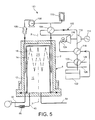
  • FIG. 5 is a schematic sectional view which illustrates the heat handling configuration of the reaction area.
  • the reactor designated by the general reference 1 consists of a body 2 of a general cylindrical shape with an axis XX closed at its upper end by a bottom and at its lower end by a lid 4 .
  • the lower end of the reactor 1 is kept cold by a double jacket 6 in which flows a coolant fluid, for example water.
  • a coolant fluid for example water.
  • a protective casing 8 is positioned inside the body 2 and spaced apart from the latter so as to delimit inside a reaction area 10 and outside a confinement area 12 sealably isolated from each other.
  • the protective casing 8 has a general cylindrical shape, blind at its upper end. It is mounted coaxially with the body 2 of the reactor and is dimensioned so that the plays on the diameter and the length of the casing may be minimized. It is made in a non-porous material but resistant to corrosion such as titanium.
  • the attachment of this casing may be made on the lid, as illustrated in FIG. 1 , or on the body 2 of the reactor.
  • the cold seal between the casing and body and lid is provided by a Viton gasket, for example.
  • a pressurization capacity 60 contains an amount 62 of confinement fluid. It is connected to the confinement area through a conduit 50 so as to allow it to be fed with confinement fluid.
  • a tapping 64 connects the conduit 45 for feeding the reaction area to the pressurization capacity 60 so as to set the confinement fluid 62 to the pressure of the reaction fluid medium.
  • An anti-return valve 66 with pressure loss is interposed between the tapping 64 and the reaction area in order to generate a pressure difference between the pressure of the confinement fluid 62 in the pressurization capacity 60 and the pressure of the reaction fluid medium in the reaction area.
  • a measuring means 68 measures the consumption of the confinement fluid contained in the pressurization capacity.
  • a valve 61 as shown in FIG. 1 , is connected through a conduit to the upper part of the pressurization capacity 60 above the confinement fluid 62 .
  • a primary heat exchanger 14 is provided in the ring-shaped area 12 .
  • the exchanger 14 belongs to a primary circuit 100 (see FIG. 5 ) which itself belongs to a system for handling and making use of the heat energy of the reaction area. The structure and the operation of these systems will be explained in more detail subsequently with reference to FIG. 5 .
  • the use of the protective casing 8 immersed on either side in a pressurized fluid allows the use of stainless steel piping for making the internal heat exchanger 14 which is subject to compression stress and not to tensile stress like the material of the reactor.
  • the walls of the exchanger may therefore be thin, exactly like those of the protective casing, and the heat transfer between the reaction medium and the heat transfer fluid is considerably improved as compared with a more conventional configuration where the exchanger is placed on the outer wall of the reactor.
  • An internal tube designated as a whole by reference 15 is positioned in the reaction area 10 coaxially with the XX axis of the body. It includes a lower portion 16 with a larger diameter and an upper portion 18 with a smaller diameter.
  • the tube 15 includes an open end 15 a which provides a passage for communication between the central area 20 and the ring-shaped area 22 .
  • a stirring turbine 24 positioned in the reaction area 10 , includes a central shaft 26 of axis XX guided in rotation by a centering device 28 integral with the protective casing 8 .
  • the turbine is set into rotation, for example by means of a magnetic drive 30 mounted on the lid 4 . It includes blades 32 parallel to the axis 26 positioned in the internal tube 18 and blades 34 also parallel to the axis 26 positioned in the reactive ring-shaped area 22 .
  • the blades 32 of the central area 20 and the blades 34 of the ring-shaped area 22 are connected through a coupling 36 .
  • Heat transfers from and to the primary exchanger 14 are improved if the flow of the fluids in the reaction ring-shaped area 22 is turbulent. This point is guaranteed by stirring with the blades 34 . Homogeneity in the reaction area is also guaranteed by this device, even in the case when the fluid movements are limited in the direction of flow in order to approach a dwelling time distribution similar to the one existing in piston type flow.
  • the stirring turbine 24 therefore provides decoupling of the heat transfer from the flow of the process fluid.
  • the totality of the equipment internal to the reaction area operates at quasi equal pressure so that the materials and geometries may be retained without having to take into account requirements of mechanical resistance to pressure.
  • the waste injector tube, the oxidant injector and the outlet exchanger are made in materials resistant to HO corrosion, such as titanium and their thicknesses may be minimized in order to improve heat transfer for which they are the origin.
  • a cylindrical filtration device 40 is mounted coaxially with the internal injection tube 15 and more specifically, with the portion 18 of smaller diameter of this tube.
  • the filtration device 40 is extended downwards with a ferrule 41 which is also coaxial with the axis XX of the injection tube 15 and which delimits a ring-shaped space 42 with the tube 15 .
  • a tube 43 wound as a coil forming a heat exchanger opens out at one end in the ring-shaped area 42 and at another end 44 outside the reactor 1 .
  • a conduit 45 for feeding an oxidant, for example pressurized air, passes through the lid 4 at the reaction ring-shaped area 22 .
  • the conduit 45 extends substantially parallel to the axis XX over the whole length of the internal tube 15 so as to have an end 46 which opens out in the vicinity of the upper end 15 a of this tube.
  • the waste material to be treated penetrates under pressure and at the rated flow through a conduit 48 which passes through the lid 4 in order to open out inside the central reaction area 20 .
  • a conduit 50 allows a pressurized fluid medium, for example water, to be introduced into the confinement area 12 .
  • the confinement area is in overpressure with respect to the reaction area, which allows failure of the seal of the protective casing to be detected.
  • a conduit 51 on which is mounted a fluid purge valve 52 is mounted to the upper portion of the body 2 .
  • a conduit 54 passes through the lid at the reaction area 52 .
  • the material treatment method takes place in the following way.
  • the material to be treated penetrates into the central area 20 through the conduit 48 at a rated pressure and flow entirely as a liquid, or as an aqueous suspension containing suspended solid material particles.
  • the material to be treated heats up by flowing against the current of fluid effluent which flows in the exchanger 43 positioned in the portion with a larger diameter 16 of the injection tube 15 .
  • the material to be treated then travels through the portion of smaller diameter 18 of the injection tube from its lower end right up to its open end 15 a . Given that the end 46 of the tube which allows an oxidant to be injected into the reaction area 10 , opens out in the vicinity of the end 15 a of the injection tube, the whole central area 20 is in an anoxic condition.
  • the oxidant injector 46 It is possible to optimize the location of the oxidant injector 46 and to exploit a portion of the reaction area under supercritical conditions but in anoxia. Depending on the position of the injection of air, the waste material contained in the central injection area may be entirely, partly, or not at all, maintained under anoxic conditions before the oxidizing combustion begins.
  • the oxidant may be introduced as a gas (air or air enriched in oxygen, ozone, etc.) or as a liquid (liquid oxygen, hydrogen peroxide, etc.).
  • the material to be treated then travels through the reaction ring-shaped area 22 from top to bottom right up to the microporous filter 40 .
  • the stirrer with straight blades 24 it is possible to guarantee turbulence conditions so that filtration is provided under conditions analogous to tangential filtration and not like a filtration of the frontal type by avoiding the formation of cake, i.e. a build-up of solid material in front of the filter.
  • the formation of this cake is standard in frontal filtration. It strongly reduces the filtering capacity of the component.
  • a tangential flow to the filter is maintained in order to avoid this build-up of material and to thereby guarantee a filtration efficiency as constant as possible over time.
  • the system for utilizing the combustion energy consists of a primary circuit 100 and a secondary circuit 102 .
  • the primary circuit 100 includes the primary exchanger 14 , already described earlier, located in the reactor 1 . It further includes a secondary exchanger 104 common to the primary circuit and to the secondary circuit.
  • a high temperature circulator 106 causes the heat transfer fluid to permanently circulate in the primary circuit.
  • an electrical heater 108 is mounted on the primary circuit. The electrical heater 108 is used in the starting phase of the reactor, before introducing the waste material and producing heat by the HO reaction. It may also be used in an exploitation phase as an alternative to adding a fuel in order to maintain the operating temperature in the reactor.
  • the primary circuit also includes an expansion capacity 110 with which the heat transfer fluid may be maintained in the primary circuit at the pressure of the reactor.
  • the secondary circuit includes, in addition to the already mentioned secondary exchanger 104 , a turbine 112 which drives an alternator/starter 114 and a compressor 116 . Downstream from the turbine 112 , a heat recovery exchanger 118 followed by a second heat recovery exchanger 120 are found in the secondary fluid flow direction. A water tank 122 is located after the heat recovery devices 118 and 120 . From the water tank, the secondary fluid in the liquid state is heated in the heat recovery device 1128 in which it is vaporized. It is compressed in the compressor 116 after having passed through the stop valve 124 . It then flow into the secondary exchanger 104 in which it recovers the heat given off by the primary circuit, and therefore by the HO reaction.
  • the steam raised to a high temperature drives the turbine 112 which allows electricity to be produced by means of the alternator 114 .
  • the steam is cooled a first time in the heat recovery device 118 , by exchanging heat with water from the tank 122 , and a second time in the heat recovery device 120 in which the secondary fluid yields its residual heat not converted into electricity, to a hot water (heating or process) utility network at connection 128 (circulator not shown) with reference 126 , as shown in FIG. 5 , designating a conduit connection to the utility network.
  • the secondary circuit therefore utilizes the excess heat power like a co-conversion generator. In other words, it produces electricity and heat with the particularity that the heat power is not provided by a combustion in the gas phase but by the HO reaction.
  • This circuit is based on equipment of the turbogenerator type in a Brayton cycle.
  • the invention advantageously applies to the treating of organic effluents from the nuclear industry. Indeed, the constraints set by the nuclear safety authorities force miniaturization of the methods for treating fluids loaded with radio-contaminants. HO has proved its applicability to liquid contaminated organic effluents.
  • the filtration method under supercritical conditions of the invention is advantageously applied to decontaminating aqueous or organic effluents by physical separation, with production of a minority flow concentrating the activity and the mineral elements.

Landscapes

  • Chemical & Material Sciences (AREA)
  • Chemical Kinetics & Catalysis (AREA)
  • Organic Chemistry (AREA)
  • High Energy & Nuclear Physics (AREA)
  • Physics & Mathematics (AREA)
  • General Engineering & Computer Science (AREA)
  • Engineering & Computer Science (AREA)
  • Health & Medical Sciences (AREA)
  • General Health & Medical Sciences (AREA)
  • Toxicology (AREA)
  • General Chemical & Material Sciences (AREA)
  • Business, Economics & Management (AREA)
  • Emergency Management (AREA)
  • Physical Or Chemical Processes And Apparatus (AREA)
  • Treatment Of Water By Oxidation Or Reduction (AREA)

Abstract

A reactor for treating a material in a medium. It includes a body (2) in which is defined a reaction area (10) capable of containing a reaction medium, at least one inlet for introducing the reaction medium into the reaction area, one outlet for discharging effluents out of the reaction area. A protective casing (8) positioned inside the body (2) delimits the reaction area (10). It is spaced apart from the body in order to delimit a confinement area (12) isolating the reaction area of the body. The reaction area and the confinement area are sealably isolated from each other.

Description

The invention relates to a reactor for treating a material in a medium, including a sealed body in which is defined a reaction area capable of containing a reaction medium, at least one inlet for introducing the reaction medium into the reaction area, at least one outlet for discharging effluents out of the reaction area.
It also relates to a method for detecting an integrity defect of a protective reactor casing, including a body, the protective casing being housed in the reactor and spaced apart from the body in order to delimit a reaction area capable of containing a reaction medium and a confinement area which sealably isolates the reaction area from the body.
In the field of pressurized methods for treating materials, in particular waste materials, two large families of processes using water as a reaction medium are identified: wet oxidation (WO) methods and hydrothermal oxidation (HO) methods. WO is characterized by temperature and pressure conditions less than the critical conditions of water. Consequently, they operate under biphasic conditions and lead to mineralization kinetics of one or even two orders of magnitude longer than those obtained in HO.
Hydrothermal (HO) oxidation processes in supercritical water use the particular properties of water for pressure and temperature above 221 bars and 374° C. and in particular its low dielectric constant allowing solubilization of hydrophobic compounds, its low density and viscosity allowing mixing in any proportions with gaseous compounds. The obtained reaction medium allows intimate and homogeneous mixing between organic compounds and oxygen having the function of fuel and oxidizer in the mineralization reaction which may then be spontaneously initiated by the temperature of the medium. Gases such as O2, CO2, N2 are totally soluble in water as well as many alkanes. These combustions may then take place without the interphasic transfer limitation generally observed at low temperatures or at low pressures, like in incinerators or wet oxidation processes, and lead to total mineralization of the organic matrix within dwelling times of the order of one minute. HO processes are therefore particularly suitable for treating waste materials requiring total destruction of their organic matrix.
The invention applies both to WO processes and to HO processes which will be called in their global nature, pressurized water processes. However, HO processes are its preferred application. Indeed, the HO high temperature and high pressure operating conditions make its application even more advantageous.
A process and a reactor of this type is already known (FR-2 814 967). The reactor includes a body in which is positioned an internal tube which externally delimits a ring-shaped area with the body and inside, a central area called a lumen. The internal tube includes a first end attached to a first end of the body and a second end which leaves a passage for communication between the ring-shaped area and the central area. According to this method, the constituents of the supercritical medium, i.e. water and an oxidant, are introduced into the vicinity of the first end of the reactor under a pressure above 22.1 MPa. They are heated to a temperature above 374° C. in the ring-shaped area and then introduced into the internal tube at the second end of the reactor at the same time as the material to be treated. A heated mixture of pressurized water/oxidant fluid and of material to be treated is oxidized in a first portion of the internal tube and then cooled in a second portion of this tube.
A reactor of this type however has many drawbacks.
The materials of HO reaction enclosures should withstand corrosion which develops under temperature and pressure. Stainless steels and nickel alloys are materials with which parts under pressure may be made in standard geometries which may simultaneously withstand high temperatures. However, stainless steels are unsuitable in the case of salt, acid or basic waste materials because the passivation layer formed by chromium oxide or hydroxide is not stable. The chloride and phosphate actually appear to be particularly aggressive towards steel during the critical transition encountered in pressurized exchangers of the HO processes.
The passivation layer formed by nickel oxide (NiO) in the case of nickel-based alloys is more stable provided that the pH of the solution is sufficiently neutral. Corrosion rates depend on the nature of the acid forms in the reaction medium and it is observed that these alloys are more sensitive to acids which may more easily cause corrosion products to pass into solution. Nickel-based alloys are insufficient for being suitable for HO treatment of waste materials with a large variability of composition in acids, bases and salts.
On the other hand, the method and the reactor do not provide any filtration for separating the precipitated salts.
On the other hand, a frontal filtration method is known, in which a sintered porous material is crossed by the fluid to be filtered ([1] and U.S. Pat. No. 5,582,191 (Li et al.)). In this method, the build-up of solid materials in front of the filter is only limited by the turbulence resulting from the injection flow rate of the fluid into the reactor. There results a build-up of material on the filter, which leads to reduction in the efficiency of the filtration.
Finally, none of the prior methods provide any efficient recovery and handling of the heat energy released by the HO reaction.
The invention proposes a reactor and a method for treating a material in a fluid reaction medium which remedies these drawbacks.
These goals are achieved by the fact that the reactor includes a protective casing positioned inside the body and delimiting the reaction area, the casing being spaced apart from the body so as to delimit a confinement area isolating the reaction area from the body, the reaction area and the confinement area being sealably isolated from each other.
By this feature, the body of the reactor is isolated from the reaction medium. The confinement area contains a fluid which is neutral towards the material forming the reactor. The latter may therefore be made in a steel having mechanical strength properties exclusively. The reactor is therefore less expensive to make.
The protective casing is subject to little mechanical stresses because it is substantially subject to the same pressure on each of its faces. Therefore it may be made in a material having good corrosion resistance but low mechanical strength, for example titanium. Under oxidizing conditions, the latter forms a titanium oxide passivation layer which is stable in a large pH range. Titanium and its alloys resist to corrosion by HCl over a larger temperature range than stainless steel and nickel alloys and they further have the advantage of not salting out toxic ions Ni2+ and Cr6+ into the effluent.
In an advantageous embodiment, the reaction area contains a fluid medium under pressure, the confinement area containing a confinement fluid in overpressure relative to the pressure of the fluid of the reaction area, the reactor further including a measuring device for measuring consumption of confinement fluid in the case of a failure of the seal of the protective casing.
Preferably the reactor includes a pressurization capacity containing an amount of confinement fluid, the pressurization capacity being connected to the confinement area through a conduit so as to allow the confinement area to be fed with confinement fluid, a conduit for feeding the reaction area with the reaction fluid medium, a tapping connecting the conduit for feeding the reaction area, to the pressurization capacity so as to set the confinement fluid to the pressure of the reaction fluid medium, a non-return valve with a pressure drop being interposed between the tapping and the reaction area in order to generate a pressure difference between the confinement fluid pressure in the pressurization capacity and the pressure of the reaction fluid medium in the reaction area, a measurement means measuring consumption of the confinement fluid contained in the pressurization capacity.
By these features, it is thereby possible to detect a defect of the integrity of the protective casing by continuously measuring the pressure difference. In the case of piercing of the protective casing, the fluid filling the pressurization capacity will gradually be emptied into the reaction enclosure and is replaced by air under pressure in the pressurization capacity. By detecting or measuring the level in this capacity, failure of the integrity of the protective barrier may be detected and the stopping of the process may be under control. In the case of piercing, the pressure gradient on either side of the protective casing confines the corrosive products in the central area by an incoming leak of pressurization fluid. The body of the reactor is thus never in contact with the products which may alter its integrity.
The invention thus advantageously applies to treatments of organic effluents from the nuclear industry. Indeed, the protective casing of the reaction enclosure provides an additional degree in the safety analysis of the HO method relatively to known installations, notably the method and reactor described in the FR 2 814 967 patent mentioned above. In a reactor of this type, the reactions and the compounds inducing corrosion of the wall of the body of the reactor are confined to a distance from the latter. The reactor of the invention completes this advantage by providing the possibility of a diagnosis of the integrity of this barrier during operation and of dynamic confinement of potentially corrosive elements in the case of piercing of this barrier.
In a preferred embodiment, the reactor includes a heat exchanger positioned in the confinement area and integrated to a primary circuit for circulating a heat transfer fluid in order to achieve heat exchange between the heat transfer fluid flowing in the exchanger and the reaction medium contained in the reaction area.
The use of the protective casing immersed on either side in a pressurized fluid allows the use of stainless steel piping for making the internal heat exchanger because the latter is subject to compression stress and not to tensile stress like the material of the reactor. The walls of the exchanger may therefore be thin, exactly like those of the protective casing. The heat transfer between the reaction medium and the heat transfer fluid is considerably improved as compared with a more conventional configuration where the exchanger is placed on the outer wall of the reactor.
In an advantageous embodiment, the primary circuit for circulating a heat transfer fluid integrates a secondary exchanger and/or an electric resistor servo-controlled by extracting, respectively providing heat power from/to the reaction area and the heat power extracted from the primary circuit is utilized as electrical energy, heating power or pneumatic energy.
Advantageously, the reactor includes an internal tube placed inside the protective casing and sealably attached to the body at a first end or to the protective casing, the interior volume of the sealed tube determining a central area, the tube delimiting a ring-shaped area with the protective casing, a passage for communication between the central area of the tube and the ring-shaped area being provided at a second end of the tube, a stirring turbine including blades stirring up the reaction medium of the central area and blades stirring up the reaction medium of the ring-shaped area.
According to the method for detecting an integrity defect of the protective casing of the reactor:
    • the reaction fluid medium is introduced into the reaction area;
    • a confinement fluid is introduced into the confinement area from a pressurization capacity;
    • the reaction fluid medium of the reaction area and the confinement fluid of the pressurization capacity are pressurized by establishing an overpressure in the confinement area, relative to the reaction area;
    • a consumption of confinement fluid is measured in order to detect a possible failure of the protective casing.
According to another feature, the reactor of the invention includes a filter for separating the reaction medium into a permeate with its precipitates having been cleared therefrom and a retentate concentrating the salts and a stirring turbine with which the reaction medium may be stirred up in order to keep it in a turbulent hydraulic flow condition and prevent any build-up of solid retentate in front of the filter.
Advantageously, the turbine is driven magnetically and the filter has the shape of a cylinder positioned coaxially with the internal tube.
In a complementary or alternative way, the effluent passes through a heat exchanger, for example a coil, so as to be in a heat exchange relationship with the material to be treated.
Other features and advantages of the invention will further become apparent upon reading the description which follows of an exemplary embodiment given as an illustration with reference to the appended figures. In these figures:
FIG. 1 is a longitudinal sectional view of a reactor according to the present invention;
FIG. 2 is a sectional view along the line II-II of FIG. 1;
FIG. 3 is a sectional view of the reactor of FIG. 1 along the line III-III;
FIG. 4 is a sectional view along the line IV-IV of the reactor illustrated in FIG. 1;
FIG. 5 is a schematic sectional view which illustrates the heat handling configuration of the reaction area.
In the figures, the reactor designated by the general reference 1, consists of a body 2 of a general cylindrical shape with an axis XX closed at its upper end by a bottom and at its lower end by a lid 4.
The lower end of the reactor 1 is kept cold by a double jacket 6 in which flows a coolant fluid, for example water. With this arrangement it is possible to provide a cold high pressure seal between the body 2 and the lid 4 by a gasket in Viton or of the metal type.
A protective casing 8 is positioned inside the body 2 and spaced apart from the latter so as to delimit inside a reaction area 10 and outside a confinement area 12 sealably isolated from each other.
The protective casing 8 has a general cylindrical shape, blind at its upper end. It is mounted coaxially with the body 2 of the reactor and is dimensioned so that the plays on the diameter and the length of the casing may be minimized. It is made in a non-porous material but resistant to corrosion such as titanium.
The attachment of this casing may be made on the lid, as illustrated in FIG. 1, or on the body 2 of the reactor. The cold seal between the casing and body and lid is provided by a Viton gasket, for example.
The reaction area is fed with a reaction fluid medium through a feeding conduit 45. A pressurization capacity 60 contains an amount 62 of confinement fluid. It is connected to the confinement area through a conduit 50 so as to allow it to be fed with confinement fluid. A tapping 64 connects the conduit 45 for feeding the reaction area to the pressurization capacity 60 so as to set the confinement fluid 62 to the pressure of the reaction fluid medium. An anti-return valve 66 with pressure loss is interposed between the tapping 64 and the reaction area in order to generate a pressure difference between the pressure of the confinement fluid 62 in the pressurization capacity 60 and the pressure of the reaction fluid medium in the reaction area. A measuring means 68 measures the consumption of the confinement fluid contained in the pressurization capacity. A valve 61, as shown in FIG. 1, is connected through a conduit to the upper part of the pressurization capacity 60 above the confinement fluid 62.
A primary heat exchanger 14 is provided in the ring-shaped area 12. By having a heat transfer fluid circulate in the primary exchanger 14, it is possible to heat or to extract heat power from the reaction area. It also provides control of the thermal gradients along the reactor. The exchanger 14 belongs to a primary circuit 100 (see FIG. 5) which itself belongs to a system for handling and making use of the heat energy of the reaction area. The structure and the operation of these systems will be explained in more detail subsequently with reference to FIG. 5.
The use of the protective casing 8 immersed on either side in a pressurized fluid allows the use of stainless steel piping for making the internal heat exchanger 14 which is subject to compression stress and not to tensile stress like the material of the reactor. The walls of the exchanger may therefore be thin, exactly like those of the protective casing, and the heat transfer between the reaction medium and the heat transfer fluid is considerably improved as compared with a more conventional configuration where the exchanger is placed on the outer wall of the reactor.
An internal tube designated as a whole by reference 15, is positioned in the reaction area 10 coaxially with the XX axis of the body. It includes a lower portion 16 with a larger diameter and an upper portion 18 with a smaller diameter. The tube 15 includes an open end 15 a which provides a passage for communication between the central area 20 and the ring-shaped area 22.
A stirring turbine 24, positioned in the reaction area 10, includes a central shaft 26 of axis XX guided in rotation by a centering device 28 integral with the protective casing 8. The turbine is set into rotation, for example by means of a magnetic drive 30 mounted on the lid 4. It includes blades 32 parallel to the axis 26 positioned in the internal tube 18 and blades 34 also parallel to the axis 26 positioned in the reactive ring-shaped area 22. The blades 32 of the central area 20 and the blades 34 of the ring-shaped area 22 are connected through a coupling 36.
Heat transfers from and to the primary exchanger 14 are improved if the flow of the fluids in the reaction ring-shaped area 22 is turbulent. This point is guaranteed by stirring with the blades 34. Homogeneity in the reaction area is also guaranteed by this device, even in the case when the fluid movements are limited in the direction of flow in order to approach a dwelling time distribution similar to the one existing in piston type flow. The stirring turbine 24 therefore provides decoupling of the heat transfer from the flow of the process fluid.
The totality of the equipment internal to the reaction area operates at quasi equal pressure so that the materials and geometries may be retained without having to take into account requirements of mechanical resistance to pressure. The waste injector tube, the oxidant injector and the outlet exchanger are made in materials resistant to HO corrosion, such as titanium and their thicknesses may be minimized in order to improve heat transfer for which they are the origin.
A cylindrical filtration device 40 is mounted coaxially with the internal injection tube 15 and more specifically, with the portion 18 of smaller diameter of this tube. The filtration device 40 is extended downwards with a ferrule 41 which is also coaxial with the axis XX of the injection tube 15 and which delimits a ring-shaped space 42 with the tube 15.
A tube 43 wound as a coil forming a heat exchanger opens out at one end in the ring-shaped area 42 and at another end 44 outside the reactor 1.
A conduit 45 for feeding an oxidant, for example pressurized air, passes through the lid 4 at the reaction ring-shaped area 22. The conduit 45 extends substantially parallel to the axis XX over the whole length of the internal tube 15 so as to have an end 46 which opens out in the vicinity of the upper end 15 a of this tube.
The waste material to be treated penetrates under pressure and at the rated flow through a conduit 48 which passes through the lid 4 in order to open out inside the central reaction area 20. Finally, a conduit 50 allows a pressurized fluid medium, for example water, to be introduced into the confinement area 12. Advantageously, the confinement area is in overpressure with respect to the reaction area, which allows failure of the seal of the protective casing to be detected.
A conduit 51 on which is mounted a fluid purge valve 52 is mounted to the upper portion of the body 2.
Finally, a conduit 54 passes through the lid at the reaction area 52.
The material treatment method takes place in the following way.
The material to be treated penetrates into the central area 20 through the conduit 48 at a rated pressure and flow entirely as a liquid, or as an aqueous suspension containing suspended solid material particles. The material to be treated heats up by flowing against the current of fluid effluent which flows in the exchanger 43 positioned in the portion with a larger diameter 16 of the injection tube 15. The material to be treated then travels through the portion of smaller diameter 18 of the injection tube from its lower end right up to its open end 15 a. Given that the end 46 of the tube which allows an oxidant to be injected into the reaction area 10, opens out in the vicinity of the end 15 a of the injection tube, the whole central area 20 is in an anoxic condition. It is possible to optimize the location of the oxidant injector 46 and to exploit a portion of the reaction area under supercritical conditions but in anoxia. Depending on the position of the injection of air, the waste material contained in the central injection area may be entirely, partly, or not at all, maintained under anoxic conditions before the oxidizing combustion begins.
The oxidant may be introduced as a gas (air or air enriched in oxygen, ozone, etc.) or as a liquid (liquid oxygen, hydrogen peroxide, etc.).
The material to be treated then travels through the reaction ring-shaped area 22 from top to bottom right up to the microporous filter 40. By means of the stirrer with straight blades 24, it is possible to guarantee turbulence conditions so that filtration is provided under conditions analogous to tangential filtration and not like a filtration of the frontal type by avoiding the formation of cake, i.e. a build-up of solid material in front of the filter. The formation of this cake is standard in frontal filtration. It strongly reduces the filtering capacity of the component. In the turbulent flow conditions which are sought in the reactor of the invention, a tangential flow to the filter is maintained in order to avoid this build-up of material and to thereby guarantee a filtration efficiency as constant as possible over time.
The system for utilizing the combustion energy consists of a primary circuit 100 and a secondary circuit 102. The primary circuit 100 includes the primary exchanger 14, already described earlier, located in the reactor 1. It further includes a secondary exchanger 104 common to the primary circuit and to the secondary circuit. A high temperature circulator 106 causes the heat transfer fluid to permanently circulate in the primary circuit. Optionally, an electrical heater 108 is mounted on the primary circuit. The electrical heater 108 is used in the starting phase of the reactor, before introducing the waste material and producing heat by the HO reaction. It may also be used in an exploitation phase as an alternative to adding a fuel in order to maintain the operating temperature in the reactor.
The primary circuit also includes an expansion capacity 110 with which the heat transfer fluid may be maintained in the primary circuit at the pressure of the reactor.
The secondary circuit includes, in addition to the already mentioned secondary exchanger 104, a turbine 112 which drives an alternator/starter 114 and a compressor 116. Downstream from the turbine 112, a heat recovery exchanger 118 followed by a second heat recovery exchanger 120 are found in the secondary fluid flow direction. A water tank 122 is located after the heat recovery devices 118 and 120. From the water tank, the secondary fluid in the liquid state is heated in the heat recovery device 1128 in which it is vaporized. It is compressed in the compressor 116 after having passed through the stop valve 124. It then flow into the secondary exchanger 104 in which it recovers the heat given off by the primary circuit, and therefore by the HO reaction. The steam raised to a high temperature drives the turbine 112 which allows electricity to be produced by means of the alternator 114. The steam is cooled a first time in the heat recovery device 118, by exchanging heat with water from the tank 122, and a second time in the heat recovery device 120 in which the secondary fluid yields its residual heat not converted into electricity, to a hot water (heating or process) utility network at connection 128 (circulator not shown) with reference 126, as shown in FIG. 5, designating a conduit connection to the utility network.
The secondary circuit therefore utilizes the excess heat power like a co-conversion generator. In other words, it produces electricity and heat with the particularity that the heat power is not provided by a combustion in the gas phase but by the HO reaction. This circuit is based on equipment of the turbogenerator type in a Brayton cycle.
The invention advantageously applies to the treating of organic effluents from the nuclear industry. Indeed, the constraints set by the nuclear safety authorities force miniaturization of the methods for treating fluids loaded with radio-contaminants. HO has proved its applicability to liquid contaminated organic effluents.
In the case of the treatment of highly salt-bearing effluents, the filtration method under supercritical conditions of the invention is advantageously applied to decontaminating aqueous or organic effluents by physical separation, with production of a minority flow concentrating the activity and the mineral elements.
REFERENCE
  • [1] Goemans M. G. E., Li., Gloyna E. F., Separation of inorganics salts from supercritical water by cross-flow micro filtration, Sep. Sci. Tech. 30(7-9), pp 1491-1509, 1995.

Claims (7)

The invention claimed is:
1. A reactor for treating a material in a medium comprising a body (2) in which is defined a reaction area (10) capable of containing a reaction medium, at least one fixed inlet for introducing the reaction medium into the reaction area, at least one fixed outlet separate from the inlet for discharging effluents out of the reaction area, characterized in that the reactor comprises a protective casing (8) positioned inside the body (2) and delimiting the reaction area, the casing being spaced apart from the body so as to delimit a confinement area (12) isolating the reaction area from the body, the reaction area and the confinement area being sealable isolated from each other and in that the reaction area (10) contains a fluid medium under a first pressure, the confinement area (12) containing a confinement fluid under a second pressure higher than the first pressure of the fluid in the reaction area, the reactor further comprising a measuring device (68) for measuring consumption of confinement fluid (62) in the case of failure of the seal of the protective casing, a pressurization capacity (60) containing a fixed amount of confinement fluid (62), with the pressurization capacity being connected to the confinement area of the reactor by a conduit (50) so that the confinement area may be fed with confinement fluid, a feeding conduit (45) for feeding the reaction area with reaction fluid medium, a tapping (64) connected between the pressurization capacity and the feeding conduit for feeding the reaction area from the pressurization capacity (60) so as to set the confinement fluid to the pressure of the reaction fluid medium, and an anti-return valve (66) for interposing a pressure drop between the tapping (64) and the conduit (50) in order to generate a pressure difference between the pressure of the confinement fluid in the pressurization capacity and the pressure of the reaction fluid medium in the reaction area which establishes a difference in pressure between the confinement area and the reaction area and wherein the reactor further comprises a heat exchanger (14) positioned in the confinement area (12) and integrated to a primary circuit (100) for circulating a heat transfer fluid in order to achieve heat exchange between the heat transfer fluid flowing in the exchanger (14) and the reaction medium contained in the reaction area so that heat is extracted out from the reactor with the reactor further comprising an internal tube (15) into which the heat transfer fluid flows with the internal tube (15) placed inside the protective casing (8) and sealably attached to the body (2) at a first end of the tube with the interior volume of the sealed tube determining a central area (20), and with the tube delimiting a ring-shaped area (22) with the protective casing, a passage for communication between the central area of the tube and the ring-shaped area being provided at a second end (15 a) of the tube through which the heat transfer fluid exits flowing therefrom in an opposite direction into the ring-shaped area delimited by the protective casing, a stirring turbine (24) including two sets of blades with one set of blades (32) positioned inside the central area for stirring the reaction medium and the second set of blades (34) positioned inside the ring-shaped area.
2. The reactor according to claim 1 wherein the reactor further comprises a secondary exchanger (104) located outside the reactor body (2) and in fluid communication with the heat exchanger (14), with the secondary exchanger servo-controlled providing heat power from/to the reaction area.
3. The reactor according to claim 1 further comprising a secondary circuit which includes a turbine which drives an alternator.
4. The reactor according to claim 1, characterized in that the stirring turbine comprises a shaft rotatably mounted onto the body and/or the protective casing, the shaft bearing internal blades located in the central area of the internal tube and external blades located in the ring-shaped area.
5. The reactor according to claim 1 wherein the heat exchanger comprises a coil.
6. The reactor according to claim 1 characterized in that the reactor comprises a filter (40) for separating the reaction medium into a permeate with its precipitates having been cleared therefrom and a retentate concentrating the salts and wherein the stirring turbine (24) stirs the reaction medium in order to keep it under a turbulent hydraulic flow condition to prevent build-up of solid retentate in front of the filter.
7. The reactor according to claim 6, characterized in that only a single filter is present in the reactor and has the shape of a cylinder positioned coaxially with the internal tube.
US12/066,515 2005-09-28 2006-09-26 Reactor and method for treating a material in a fluid reaction medium Expired - Fee Related US8414842B2 (en)

Applications Claiming Priority (3)

Application Number Priority Date Filing Date Title
FR0552924A FR2891162B1 (en) 2005-09-28 2005-09-28 REACTOR AND PROCESS FOR TREATING MATERIAL IN A FLUID REACTION ENVIRONMENT
FR0552924 2005-09-28
PCT/EP2006/066762 WO2007036526A2 (en) 2005-09-28 2006-09-26 Reactor and method for treating a substance in a fluid reaction medium

Publications (2)

Publication Number Publication Date
US20080279728A1 US20080279728A1 (en) 2008-11-13
US8414842B2 true US8414842B2 (en) 2013-04-09

Family

ID=36202489

Family Applications (1)

Application Number Title Priority Date Filing Date
US12/066,515 Expired - Fee Related US8414842B2 (en) 2005-09-28 2006-09-26 Reactor and method for treating a material in a fluid reaction medium

Country Status (9)

Country Link
US (1) US8414842B2 (en)
EP (1) EP1928590B1 (en)
JP (1) JP5085551B2 (en)
KR (1) KR101295137B1 (en)
CN (1) CN101267881B (en)
CA (1) CA2624016C (en)
ES (1) ES2713269T3 (en)
FR (1) FR2891162B1 (en)
WO (1) WO2007036526A2 (en)

Cited By (1)

* Cited by examiner, † Cited by third party
Publication number Priority date Publication date Assignee Title
US9370677B2 (en) 2013-01-18 2016-06-21 Commissariat à l'énergie atomique et aux énergies alternatives Hydrothermal oxidation device for treating a material in a supercritical medium and implementation method

Families Citing this family (13)

* Cited by examiner, † Cited by third party
Publication number Priority date Publication date Assignee Title
WO2009154089A1 (en) * 2008-06-18 2009-12-23 株式会社神戸製鋼所 High‑pressure treatment apparatus
BRPI0804349A2 (en) * 2008-10-16 2010-07-13 Rm Materiais Refratarios Ltda apparatus and process for thermal decomposition of any type of organic material
US8184763B2 (en) 2009-01-13 2012-05-22 Areva Sa System and a process for producing at least one hydrocarbon fuel from a carbonaceous material
US8426981B2 (en) * 2011-09-22 2013-04-23 Headway Technologies, Inc. Composite layered chip package
JP5850328B2 (en) * 2012-02-21 2016-02-03 株式会社リコー Fluid purification device
JP6016082B2 (en) * 2012-07-20 2016-10-26 株式会社リコー Fluid purification device
JP6048793B2 (en) * 2012-07-24 2016-12-21 株式会社リコー Fluid purification device
JP2016112505A (en) * 2014-12-15 2016-06-23 株式会社リコー Fluid treatment apparatus and method
FR3060416B1 (en) * 2016-12-16 2019-05-31 Commissariat A L'energie Atomique Et Aux Energies Alternatives REACTOR FOR THE HYDROTHERMAL OXIDATION TREATMENT OF ORGANIC MATTER IN A REACTIONAL ENVIRONMENT
FR3082439B1 (en) 2018-06-14 2021-04-23 Commissariat Energie Atomique REACTOR FOR TREATMENT BY HYDROTHERMAL OXIDATION OF AN ORGANIC MATERIAL IN A REACTIONAL MEDIUM
CN109912006B (en) * 2019-03-29 2021-06-08 浙江工业大学 Tube cluster type supercritical water oxidation reactor
CN110586015B (en) * 2019-09-27 2024-08-30 无锡市惠鸿氟材料装备有限公司 ETFE membrane material processing equipment that possesses negative pressure function of preventing
FR3105204B1 (en) * 2019-12-19 2021-12-03 Syctom Lagence Metropolitaine Des Dechets Menagers Heat exchanger reactor

Citations (15)

* Cited by examiner, † Cited by third party
Publication number Priority date Publication date Assignee Title
US3056664A (en) 1959-03-12 1962-10-02 Standard Oil Co Apparatus for handling corrosive materials at high pressures and temperatures
US3066664A (en) 1960-05-25 1962-12-04 Mcnew Daniel Joseph Engine pre-oiling apparatus
US4765809A (en) * 1986-07-10 1988-08-23 Metallgesesllschaft Aktiengesellschaft Apparatus for removing dust from gas
US5421998A (en) 1991-08-09 1995-06-06 Board Of Regents, The University Of Texas System Apparatus for reverse-injection wet oxidation
US5670040A (en) * 1995-02-27 1997-09-23 Foster Wheeler Development Corporation Internal platelet heat source and method of use in a supercritical water oxidation reactor
EP0860182A2 (en) 1997-02-19 1998-08-26 Hitachi, Ltd. Oxidation processing method, and apparatus and process vessel using the method
US5997743A (en) 1995-07-03 1999-12-07 Ahn; Kyu-Hong Water treatment method using hollow fiber membrane and apparatus therefor
US6086832A (en) * 1996-12-06 2000-07-11 Idemitsu Kosan Co., Ltd. Apparatus for evaluating a solid catalyst and evaluation method using the apparatus
US6403729B1 (en) 1998-10-16 2002-06-11 Wacker Chemie Gmbh Process for heterophase reactions in a liquid or supercritical dispersion medium
WO2003064021A1 (en) 2002-01-31 2003-08-07 General Electric Company (A New York Corporation) Improved pressure vessel
US20030153216A1 (en) * 2000-09-06 2003-08-14 Van-Drentham-Susman Hector Filipus Alexander Propulsion apparatus
US20040013588A1 (en) * 2000-06-29 2004-01-22 Georg Groos Hydraulically controlled pressure relief valve for high-pressure reactors
US20040076561A1 (en) * 2000-05-23 2004-04-22 Hisashi Kajiura Method for producing hydrogen storage material and hydrogen storing and desorbing apparatus
WO2005087354A1 (en) 2004-03-11 2005-09-22 Filtech Korea Co., Ltd. Rotor for generating vortex water flow, and filtering apparatus employing the same
WO2006080959A1 (en) 2005-01-25 2006-08-03 General Electric Company Apparatus for processing materials in supercritical fluids and methods thereof

Family Cites Families (2)

* Cited by examiner, † Cited by third party
Publication number Priority date Publication date Assignee Title
US5552039A (en) * 1994-07-13 1996-09-03 Rpc Waste Management Services, Inc. Turbulent flow cold-wall reactor
CN2339566Y (en) * 1998-10-22 1999-09-22 孙传经 Reactor for super-critical water oxygenation waste-water treatment

Patent Citations (16)

* Cited by examiner, † Cited by third party
Publication number Priority date Publication date Assignee Title
US3056664A (en) 1959-03-12 1962-10-02 Standard Oil Co Apparatus for handling corrosive materials at high pressures and temperatures
US3066664A (en) 1960-05-25 1962-12-04 Mcnew Daniel Joseph Engine pre-oiling apparatus
US4765809A (en) * 1986-07-10 1988-08-23 Metallgesesllschaft Aktiengesellschaft Apparatus for removing dust from gas
US5421998A (en) 1991-08-09 1995-06-06 Board Of Regents, The University Of Texas System Apparatus for reverse-injection wet oxidation
US5670040A (en) * 1995-02-27 1997-09-23 Foster Wheeler Development Corporation Internal platelet heat source and method of use in a supercritical water oxidation reactor
US5997743A (en) 1995-07-03 1999-12-07 Ahn; Kyu-Hong Water treatment method using hollow fiber membrane and apparatus therefor
US6086832A (en) * 1996-12-06 2000-07-11 Idemitsu Kosan Co., Ltd. Apparatus for evaluating a solid catalyst and evaluation method using the apparatus
US6168771B1 (en) * 1997-02-19 2001-01-02 Hitachi, Ltd. Supercritical oxidation process and apparatus
EP0860182A2 (en) 1997-02-19 1998-08-26 Hitachi, Ltd. Oxidation processing method, and apparatus and process vessel using the method
US6403729B1 (en) 1998-10-16 2002-06-11 Wacker Chemie Gmbh Process for heterophase reactions in a liquid or supercritical dispersion medium
US20040076561A1 (en) * 2000-05-23 2004-04-22 Hisashi Kajiura Method for producing hydrogen storage material and hydrogen storing and desorbing apparatus
US20040013588A1 (en) * 2000-06-29 2004-01-22 Georg Groos Hydraulically controlled pressure relief valve for high-pressure reactors
US20030153216A1 (en) * 2000-09-06 2003-08-14 Van-Drentham-Susman Hector Filipus Alexander Propulsion apparatus
WO2003064021A1 (en) 2002-01-31 2003-08-07 General Electric Company (A New York Corporation) Improved pressure vessel
WO2005087354A1 (en) 2004-03-11 2005-09-22 Filtech Korea Co., Ltd. Rotor for generating vortex water flow, and filtering apparatus employing the same
WO2006080959A1 (en) 2005-01-25 2006-08-03 General Electric Company Apparatus for processing materials in supercritical fluids and methods thereof

Non-Patent Citations (2)

* Cited by examiner, † Cited by third party
Title
Examination report.
J. Lora, et al., The Effect of Agitation on Reverse Osmosis Desalination, Elsevier Science Pub. B.V., Amsterdam, Desalination 79 (1990) 261-269.

Cited By (1)

* Cited by examiner, † Cited by third party
Publication number Priority date Publication date Assignee Title
US9370677B2 (en) 2013-01-18 2016-06-21 Commissariat à l'énergie atomique et aux énergies alternatives Hydrothermal oxidation device for treating a material in a supercritical medium and implementation method

Also Published As

Publication number Publication date
WO2007036526A2 (en) 2007-04-05
KR101295137B1 (en) 2013-08-09
FR2891162A1 (en) 2007-03-30
US20080279728A1 (en) 2008-11-13
CA2624016C (en) 2013-05-28
CA2624016A1 (en) 2007-04-05
EP1928590A2 (en) 2008-06-11
CN101267881A (en) 2008-09-17
FR2891162B1 (en) 2008-05-09
ES2713269T3 (en) 2019-05-20
EP1928590B1 (en) 2018-11-28
KR20080049778A (en) 2008-06-04
CN101267881B (en) 2011-09-28
JP2009509740A (en) 2009-03-12
WO2007036526A3 (en) 2007-06-28
JP5085551B2 (en) 2012-11-28

Similar Documents

Publication Publication Date Title
US8414842B2 (en) Reactor and method for treating a material in a fluid reaction medium
US6878290B2 (en) Method for oxidizing materials in supercritical water
CN201852773U (en) A corrosion fatigue test device with high temperature and high pressure circulating water
CN103157405B (en) Liquid waste treatment apparatus
WO1998047612A1 (en) Supercritical reaction apparatus and method
US20150060371A1 (en) Reactor for Substrate Oxidation
US10087093B2 (en) Fluid treatment apparatus
US7988869B2 (en) Reactor and method for anoxic treatment of a material in a fluid reaction medium
US5034190A (en) Apparatus for conducting accelerated corrosion testing of nickel alloys
JP2014010049A (en) Hydrogen treatment system for nuclear power plant
JP7472043B2 (en) Reactor for hydrothermal oxidation treatment of organic materials in a reaction medium
CN209396962U (en) It is a kind of can long-period stable operation continuous supercritical water oxidative system
CN108455719A (en) High concentrated organic wastewater wet oxidation processing system and processing method
US20070201304A1 (en) Device And Installation For Injecting Particulate Matter Into An Enclosure And Associated Method
US20020084559A1 (en) System and method for hydrothermal reactions-three layer liner
CA1237202A (en) Modular ultrafiltration device for the cooling liquid of a nuclear reactor
Figueroa et al. Supercritical water oxidation: A promising wastewater treatment technology
CN223725444U (en) A distillation valve
Figueroa et al. Supercritical Water Oxidation (SCWO) Trade Study and 2021 Final Report
CN121244115A (en) System and method for recycling urea solution in urea hydrolysis reactor
CN213943073U (en) Special gas distributing cylinder for reaction kettle
CN100512939C (en) High-concentration industrial-water treatment system and treatment method
Budininkas et al. Catalytic distillation water recovery subsystem
CN108465495A (en) A kind of oil bath heating device of local cooling
CN120121510A (en) A carbonate rock dissolution reaction test device

Legal Events

Date Code Title Description
AS Assignment

Owner name: COMMISSARIAT A L'ENERGIE ATOMIQUE, FRANCE

Free format text: ASSIGNMENT OF ASSIGNORS INTEREST;ASSIGNORS:TURC, HUBERT-ALEXANDRE;JOUSSOT-DUBIEN, CHRISTOPHE;REEL/FRAME:020636/0899

Effective date: 20080214

STCF Information on status: patent grant

Free format text: PATENTED CASE

CC Certificate of correction
FPAY Fee payment

Year of fee payment: 4

MAFP Maintenance fee payment

Free format text: PAYMENT OF MAINTENANCE FEE, 8TH YEAR, LARGE ENTITY (ORIGINAL EVENT CODE: M1552); ENTITY STATUS OF PATENT OWNER: LARGE ENTITY

Year of fee payment: 8

FEPP Fee payment procedure

Free format text: MAINTENANCE FEE REMINDER MAILED (ORIGINAL EVENT CODE: REM.); ENTITY STATUS OF PATENT OWNER: LARGE ENTITY

LAPS Lapse for failure to pay maintenance fees

Free format text: PATENT EXPIRED FOR FAILURE TO PAY MAINTENANCE FEES (ORIGINAL EVENT CODE: EXP.); ENTITY STATUS OF PATENT OWNER: LARGE ENTITY

STCH Information on status: patent discontinuation

Free format text: PATENT EXPIRED DUE TO NONPAYMENT OF MAINTENANCE FEES UNDER 37 CFR 1.362

FP Lapsed due to failure to pay maintenance fee

Effective date: 20250409